Archive for dairy risk management – Page 3

Your Feed Bill Just Dropped – But Here’s What Those June Numbers Really Tell Us About the Future

Milk yields jumped 33 lbs per cow—what’s really driving this surge on farms like yours?

EXECUTIVE SUMMARY: Here’s what I’m seeing across the coffee shop circuit lately… milk production per cow climbed 33 pounds this year, and it’s not from throwing more animals at the problem. Smart operators are dialing in precision feeding and genomics, seeing feed efficiency gains hitting 8-12%. With corn prices sitting around $4.20 per bushel, a 500-cow operation can pocket over $1,500 monthly in feed savings alone. Globally, US dairy’s becoming the go-to partner for international buyers—they’re calling us “strategic partners” now, not just suppliers. The window’s wide open, but it won’t stay that way forever. Time to get serious about these tools before your neighbors beat you to it.

KEY TAKEAWAYS

  • Boost feed conversion 8-12% by implementing precision nutrition protocols—start by tracking individual cow intake and adjusting your TMR formulations based on production groups
  • Lock in $1,500+ monthly savings on a 500-cow operation by securing corn contracts under $4.50/bushel while prices remain historically low
  • Increase reproductive efficiency 15-23% through automated monitoring systems—but only if you invest in proper staff training and phased rollouts
  • Capture export premiums by maintaining top-tier milk quality and protecting margins with Dairy Revenue Protection enrollment (available quarterly)
  • Maximize genetic potential using genomic testing to identify high-value breeding decisions—ROI typically shows within 12-18 months on commercial operations

Examining these latest milk production figures, something is happening that has genuinely fired me up about where this industry’s headed. I mean, when was the last time you saw numbers like this? The 24 major dairy states cranked out 18.5 billion pounds in June – that’s 3.4% over last year, according to the USDA’s latest data drop – but here’s what really caught my attention…

This isn’t your typical “throw more cows at the problem” story we’ve been seeing for decades.

The thing about these numbers that nobody’s talking about…

What strikes me most about this production surge is how it’s happening. We’ve got 9.469 million head nationally (146,000 more than June 2024), but these girls are averaging 2,031 pounds per cow – a solid 33-pound jump from last year.

If you’ve been in this business long enough, you know that kind of per-cow improvement doesn’t just… happen.

I was talking to Jake Morrison out in Tulare County last week – he’s running 2,400 head, and his June numbers were up 41 pounds per cow year-over-year. “Andrew,” he says, “we didn’t change our genetics overnight. This is feed efficiency and management paying off.” And he’s absolutely right.

According to recent research from Penn State and UC Davis, precision nutrition programs deliver 8-12% feed efficiency gains when implemented correctly. This isn’t some consultant’s pipe dream anymore – this is happening on commercial dairies right now, and the June numbers prove it.

The second quarter hit 58.7 billion pounds, up 2.4% year-over-year. That turnaround from a sluggish first quarter tells you everything about how quickly this industry pivots when the economics align.

What’s driving the efficiency revolution

Here’s where it gets interesting – and I’ve been tracking this across multiple regions. The smart operators aren’t just celebrating cheaper corn… they’re completely rethinking their approach to nutrition management.

Tom Vlaeminck’s group at Cornell published findings earlier this year showing that targeted amino acid supplementation can improve milk protein yield by 0.8-1.2 pounds per cow daily while actually reducing crude protein intake. When you multiply that across a 1,000-cow operation… we’re talking real money here.

A Fresno dairy has been implementing precision feeding protocols since January. “We’re seeing 6% better feed conversion on average,” they told me, “but some fresh cow groups are pushing 10-11% improvement.” Their feed costs dropped $127 per cow per month while maintaining production.

That’s the kind of efficiency that shows up in these national numbers.

Feed costs are finally working in our favor (for now)

Herd SizeDaily Corn Consumption (lbs)Monthly Savings at $4.20/buAnnual Impact
100 cows800$300$3,600
500 cows4,000$1,500$18,000
1,000 cows8,000$3,000$36,000
2,500 cows20,000$7,500$90,000

Based on current market calculations and the USDA’s latest WASDE projections, corn is projected at $4.20/bushel, presenting opportunities we haven’t seen since 2019. For a 500-cow herd feeding 8 pounds of corn per head daily, that price drop translates to over $1,500 monthly savings – assuming you’re smart about procurement timing.

But here’s the thing – the producers winning right now aren’t just buying cheaper grain. They’re leveraging this window to invest in systems that’ll pay dividends when feed costs inevitably climb again.

The global vacuum creates our advantage

This domestic efficiency surge is occurring while global production is stumbling, creating a unique competitive advantage. Ben Buckner from AgResource Company nailed it when he told me last month: “We can see generally no one in the world producing more milk than in the previous year. That’s the driver you need to spark fear in the marketplace.”

For the US, this means our efficiency-driven growth is meeting a world market hungry for products. Class III futures have held above $22 per hundredweight for most of the second half, and when combined with reduced feed costs, it adds up to margins we haven’t enjoyed since 2014.

The timing couldn’t be better. US dairy exports hit $3.83 billion through May 2025 – up 13% year-over-year – with cheese exports setting monthly records. Notably, USDEC data show that our pricing competitiveness has improved dramatically against European suppliers, a trend observed across multiple export markets.

Recent case study analysis shows many farms adopting systematic precision nutrition protocols are achieving ROI within 12-18 months. That’s not theoretical – that’s documented on actual operations.

StrategyImplementation TimeframeAnnual Benefit per CowROI Timeline
Precision Nutrition Programs3-6 months$150-2006-12 months
Genomic Testing6-12 months$75-12512-18 months
Automated Milking Systems12-18 months$180-25018-24 months
Feed Price HedgingImmediate$50-150 (variable)Immediate
Health Monitoring Tech6-9 months$100-1757-14 months

The tech revolution is finally delivering results

I’ll level with you – I’ve been skeptical of dairy tech promises for years. Too many vendors are selling dreams that don’t pencil out when you crunch the real numbers on actual farms.

But what I’m seeing now is different, and it’s got me cautiously optimistic.

What’s actually working (and what isn’t)

Recent research from the Journal of Dairy Science indicates that automated monitoring systems can improve reproductive efficiency by 15-23% when implemented correctly in conjunction with trained staff. The key phrase there is “properly implemented with trained staff,” which explains why some operations see dramatic improvements while others see minimal impact.

I spent time at Rick Peterson’s place in Minnesota last month – 950 cows, a full robotic milking system installed two years ago. “The first year was rough,” he admits. “We thought we could just flip a switch and everything would improve. Reality check – technology amplifies good management, it doesn’t replace it.”

His second year? Milk production up 18%, somatic cell count down 40%, and labor costs reduced by $23,000 annually. But that came after investing heavily in staff training and system optimization.

The regional story tells different tales

StateProduction Increase (Million lbs)Primary Growth Driver% Change YoY
Idaho+135Robotic milking adoption+9.7%
Texas+131Feed management systems+9.5%
California+91Efficiency improvements+2.7%
Kansas+75Strategic expansion+19.0%
South Dakota+45Technology integration+11.5%

What’s fascinating is how technology adoption varies dramatically by region, and the June production numbers reflect these differences.

Idaho’s 135 million pound year-over-year increase comes primarily from robotic milking adoption reaching critical mass, according to local extension data. Texas added 131 million pounds through strategic feed management systems and investments in climate-controlled housing for its expanding operations.

According to industry reports, precision feeding systems can generate annual savings of $35,000 to $45,000 for a 1,000-cow operation while reducing environmental nitrogen losses by 20%. That’s not just good economics – it’s essential insurance in an increasingly regulated environment.

But here’s what nobody talks about… the payback periods for integrated monitoring platforms are averaging 7-14 months for operations that do their homework upfront. The farms that struggle? They rush into wholesale technology changes without proper planning.

Global markets are opening doors (while they last)

The international picture is creating opportunities that might not be here tomorrow, and that’s what keeps me up at night.

European production has stumbled badly this year – Bluetongue disease hit harder than expected, and their environmental regulations are constraining expansion more than most analysts predicted. Meanwhile, New Zealand continues to struggle with supply growth constraints after its environmental framework changes.

Infrastructure timing couldn’t be better

Two major cheese processing facilities launched operations early this year, adding 360 million pounds of annual capacity right as production expands. According to Ever.Ag’s analysis shows that US butter maintains a 30-35% price advantage over global competitors after adjusting for fat content.

The language from global buyers has shifted, a point Mike North from Ever.Ag drove home:

“Global buyers are referring to US dairy suppliers as ‘strategic partners.'”

However, what worries me is that this window might not remain open if global competitors recover or trade policies shift unexpectedly. The smart money is capitalizing now while the advantage exists.

Export momentum builds on efficiency gains
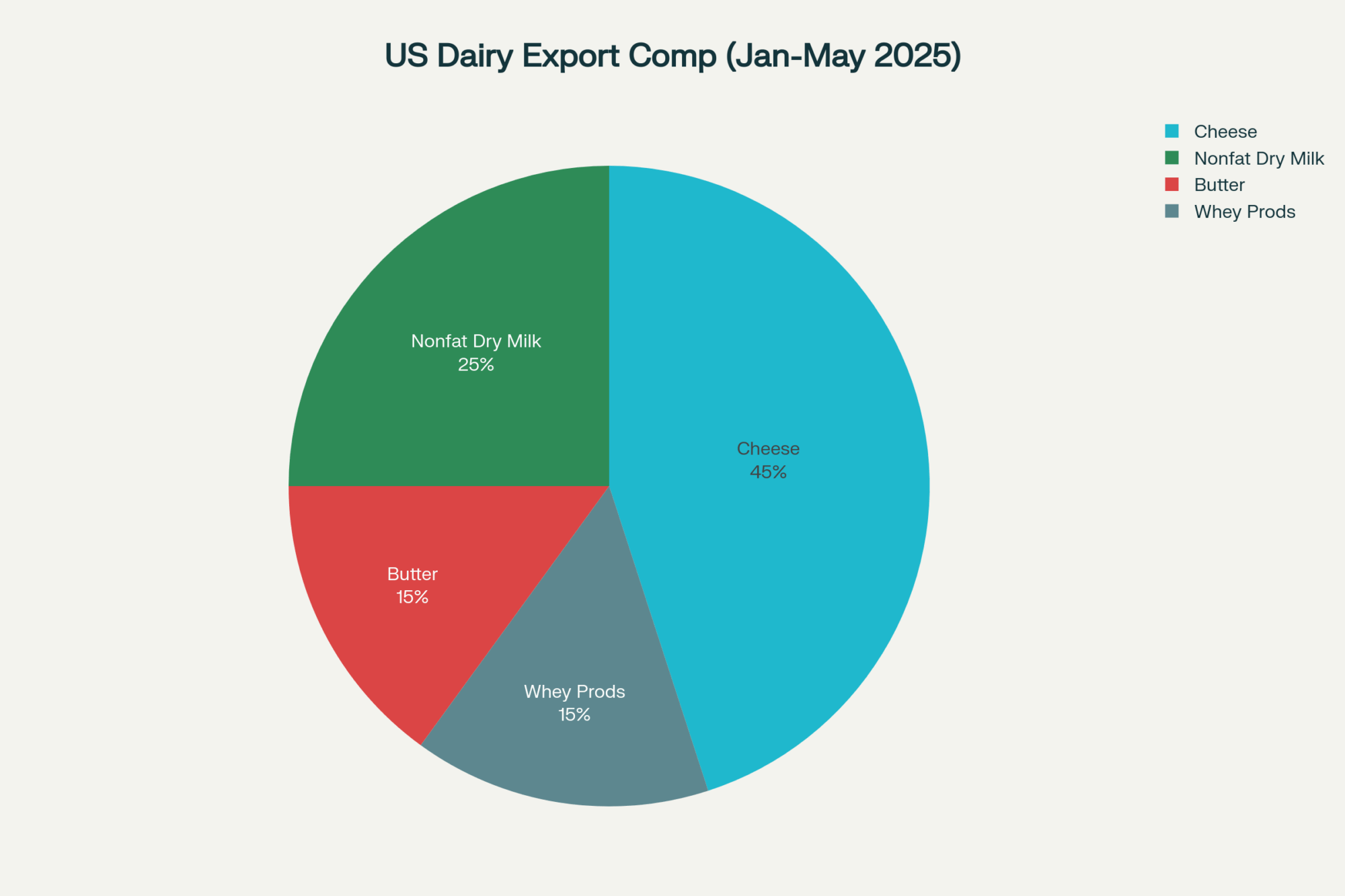
US Dairy Export Composition Jan-May 2025

What’s particularly encouraging is how our efficiency improvements directly translate to increased export competitiveness. When you can produce more milk per cow with lower feed inputs, you create sustainable cost advantages that persist even when global markets tighten.

A Wisconsin operation I visited last month exports 40% of their cheese production. “Five years ago, we couldn’t compete internationally,” the owner told me. “Now, with our cost structure, we’re pricing European suppliers out of Asian markets.”

The challenges nobody wants to discuss publicly

Let’s be realistic about what’s ahead, because it’s not all sunshine and cheap corn.

The heifer crisis is real

Replacement heifer inventories sit at 47-year lows according to the USDA’s latest cattle inventory report. This fundamentally constrains traditional expansion strategies. You can optimize existing cows only so much before hitting biological limits.

Sarina Sharp from Daily Dairy Report hit something every producer I know is dealing with: “This heifer shortage means cows in the barn are older and less efficient on average than normal.”

But here’s where creative operators are adapting – extended lactation protocols, precision breeding programs, and strategic crossbreeding are maximizing genetic potential within existing herds. It’s not ideal, but it’s reality.

Weather dependency creates vulnerability

We’re essentially betting on achieving record yields for a third consecutive year with little margin for error. One major weather event could turn these favorable feed economics on their head overnight.

I was speaking with grain traders in Chicago last week – they’re concerned about subsoil moisture levels across key corn-producing regions. “We need near-perfect weather to hit these yield projections,” one told me. “Any significant deviation and corn prices jump fast.”

Technology headaches are real

Data security protocols, staff training requirements, backup system necessities… these aren’t trivial implementation challenges. The leading operations I track are implementing phased rollouts with comprehensive staff development rather than diving headfirst.

And the threat of HPAI hasn’t vanished. As of this month, USDA APHIS confirms cases in nearly 100 herds across 12 states. Smart biosecurity investments provide competitive advantages while protecting against production disruptions; however, the threat remains.

And here’s something that genuinely concerns me – domestic demand remains frustratingly flat. If export markets soften and we can’t absorb increased production domestically, we could see price pressure that quickly eliminates these efficiency gains.

What the smart operators are doing right now

The successful operations I’m tracking focus on three key areas, and they’re not waiting for perfect conditions.

Strategic feed program optimization

They’re optimizing based on total economic value rather than chasing commodity bargains. Danny Rodriguez, located in California’s Central Valley, showed me his procurement strategy – he locks in feed ingredients 6-8 months ahead by using options contracts, which protects against price spikes while maintaining flexibility.

“We’re not trying to time the market perfectly,” he explains. “We’re managing risk while capturing efficiency gains.”

Systematic technology implementation

Second, they’re implementing technology systematically with proper training rather than rushing into wholesale changes. The farms seeing real productivity increases aren’t the ones buying everything at once.

Recent work from USDA economists emphasizes that financial risk management through Dairy Revenue Protection programs is crucial, particularly given the anticipated volatility in feed prices and potential market fluctuations ahead. This isn’t the time to get caught without protection.

Building competitive moats

What’s fascinating about this June production surge is that it represents genuine, efficiency-driven growth, creating sustainable competitive advantages. The combination of strategic herd management, precision technology, and favorable input costs allows well-managed operations to capture both immediate profitability and long-term market positioning.

But here’s what you need to understand: this opportunity has an expiration date.

“This opportunity has an expiration date.”

Feed cost advantages could evaporate with weather events. Export markets may shift in response to policy changes. Technology ROI depends on proper implementation and staff buy-in.

TechnologySetup PhaseTraining PhaseOptimization PhaseFull ROI Achieved
Robotic Milking3-6 months6-12 months12-18 months18-24 months
Precision Feeding1-2 months2-4 months4-8 months6-12 months
Health Monitoring1-3 months3-6 months6-9 months9-15 months
Automated Systems6-12 months6-9 months9-12 months15-24 months

The bottom line for your operation

For dairy operators, the path forward is becoming clearer every day. Here’s what I’d prioritize if I were still running cows:

Lock in feed advantages now through strategic procurement and hedging, not just spot buying. A December corn price under $4.50 is a gift from the market, while the USDA forecasts average farm prices at $4.20/bushel. Use options to cap upside risk while maintaining flexibility.

Invest systematically in actionable technology – monitoring systems, precision feeding, automated health detection – but implement with proper planning and training. The operations seeing documented productivity increases are the ones that treated technology adoption like any other major management change.

Optimize existing resources before expanding. With heifer inventories at 47-year lows, traditional expansion is expensive and slow. The most successful operations maximize their resources through better genetics, improved nutrition management, and strategic culling.

Protect your downside ruthlessly. DRP enrollment periods are available quarterly – don’t wait for price volatility to hit. The margins we’re seeing now won’t last forever, and the operations that survive the next downturn will be the ones that planned ahead.

The farms capitalizing on this moment combine traditional dairy expertise with modern efficiency tools and strategic market thinking. They’re not just producing more milk – they’re producing it smarter, more profitably, and more sustainably.

These June numbers represent more than just statistical success. They demonstrate how American dairy is positioning itself as the global industry leader through strategic capability rather than simple volume expansion.

The question isn’t whether this surge continues – it’s whether your operation will be positioned to capture the value while the window remains open. The producers who understand this shift and act accordingly will be the ones who remain profitable when the next market cycle arrives.

And in this business, that’s what really matters.

Complete references and supporting documentation are available upon request by contacting the editorial team at editor@thebullvine.com.

Learn More:

The Sunday Read Dairy Professionals Don’t Skip.
Every week, thousands of producers, breeders, and industry insiders open Bullvine Weekly for genetics insights, market shifts, and profit strategies they won’t find anywhere else. One email. Five minutes. Smarter decisions all week.

NewsSubscribe
First
Last
Consent

China Just Yanked on Our Feed Chain – Now What?

Milk yield’s up 4 lb/cow, yet feed cost just spiked 6¢/cwt—guess who’s pocketing the difference?

EXECUTIVE SUMMARY: Here’s the skinny we kicked around at coffee break. China’s grain grab is about to slap U.S. rations with a 4-25% cost bump, and that means your margin’s on the line. Corn flirted with $4.01¾ and soybean meal hit $269.70/t last week—every cow in a 1,200-head herd just picked up a potential $62,000 feed tab for the year. Meanwhile, UW-Madison’s latest Feed Saved research shows top-quartile genetics shave 90-120 kg of feed per lactation—$14-$18/cow at today’s prices. Kiwi farmers already locked in NZ $10/kg MS; they’re grinning. If we don’t mix smarter rations, forward-price grain, and lean on genomic testing, we’re leaving serious money on the table. Global demand’s volatile, but the tools exist—you should try ’em before the next tariff tweet hits.

KEY TAKEAWAYS

  • Trim feed 3%—bank $0.30/cwt.  Run DGV “Feed Saved” numbers on your next sire list; swap out bottom-quartile bulls today.
  • Lock 90-day corn/meal combo—cap downside 39 ¢/cwt.  Call your merchandiser before Monday’s open; pair with Dairy Margin Coverage at $9.50.
  • Shift 10% of protein to canola meal—cut ration cost $12/ton.  Confirm amino-acid balance with your nutritionist; soybean-meal basis is jumpy post-tariff.
  • Plant an extra 20 acres of corn silage—drops purchased grain 8%.  Pencil breakeven vs. futures in 2025 budget; silage acres hedge against China’s storage spree.
  • Benchmark milk-per-pound-of-dry-matter weekly—target 1.7+.  Simple spreadsheet, no fancy software; Journal of Dairy Science shows herds over 1.7 feed-efficiency are 12% more profitable in tight markets.

Beijing’s latest grain-reserve splurge and sky-high output goal just poured lighter fluid on a feed market that was already smoldering. If you’re milking cows anywhere from Tillamook to Tug Hill, the ration math changes today.

The thing about Beijing’s one-two punch …

First, officials green-lit ¥131 billion ($18.12 billion) for fresh grain-and-oilseed storage—biggest stock-build in five years (CNBC, March 5 ’25). Then, almost in the same breath, they upped the 2025 grain target to 700 million t, a solid 50-Mt jump on the long-standing 650-Mt line in the sand (World-Grain, March 6 ’25).

What strikes me is the timing. July corn futures had finally cracked below $4.05/bu and folks were breathing easier. Boom—policy grenade.

What’s happening in the U.S. bunk silo this week

  • Corn closed at $4.01¾ and soy meal at $269.70/t on July 24 (Brownfield).
  • A 1,200-cow central-Wisconsin dairy figures that combo, puts his annual concentrate spend just shy of $800 k.
  • Kick corn up a quarter and meal $20 and he burns another $62 k. That’s the down payment on a forage wagon… gone.

Anecdotal? Yep. But every Midwest nutritionist I’ve rung agrees the numbers pencil out within spitting distance.

Here’s the head-scratcher

China says it wants to slash imports, yet hog and poultry expansions still guzzle meal. Meanwhile, retaliatory duties—10% on U.S. soybeans; 15% on wheat and corn—keep Beijing flirting with Brazil and Argentina (March 11 ’25). OECD’s ten-year outlook pegs world feed-grain prices 4–25% above baseline through 2034. Not background noise—new operating environment.

Oh, and don’t forget the 90-day tariff “pause” that let Chinese crushers binge-buy cheap U.S. beans (Tridge flash update, June ’25). Volatility? We’re soaking in it.

Winners, bruises, and the fed-check cushion

U.S. Farm Federal Payments (2023-2025)
  • New Zealand: Fonterra’s opening NZ $10/kg MS forecast (RNZ, May 29 ’25) keeps Kiwi boardrooms smiling.
  • Brazil & Argie: Acreage expands again—tariff-diverted demand is a sweet carrot.
  • U.S. dairies: USDA projects $42.4 billion in federal payments this year—largest ever (AgWeb, Feb. 6 ’25). Nice buffer, but subsidies don’t fill the mixer wagon.

What this means for your ration tomorrow morning

  1. Spread the protein risk. Canola meal, corn gluten, even brewer’s grains are pricing friendlier than you’d think—especially east of the Mississippi.
  2. Lock margin windows. A simple 90-day corn/meal combo contract, paired with Dairy Margin Coverage at $9.50, fenced one Idaho client’s downside at 39 ¢/cwt (her calc, not mine).
  3. Grow more cushion. Several Ohio herds are penciling 40% corn-silage acres this fall; breakeven beats purchased grain by roughly 8% at current bids.
  4. Chase efficiency, not just yield. UW–Madison’s Feed Saved genomic work (Journal of Dairy Science, Dec. ’24) shows selecting top-quartile bulls can trim 90–120 kg feed per lactation—roughly $14–$18 per cow right now. Early adopters are folding that into mating plans.
  5. Budget a tariff yo-yo. If the August tariff “pause” snaps back, basis will lurch—again. Pencil a $15–$20/t soybean-meal swing into Q4 cash-flow scenarios.

Why this matters right now

China farms only 7–9% of the world’s arable land yet feeds 20% of its people (npj Science of Food, ’18). Even with flashy AI-guided mega-farms sprouting in Inner Mongolia, they can’t close that math overnight. Imports aren’t disappearing; they’re just getting bumpier.

So, yeah, the market’s yelling—loudly. The dairies that stay nimble on feed sourcing, use data-driven efficiency tools, and lock margins when the window cracks open will keep butterfat numbers fat. Everyone else? They’ll be writing bigger checks to the feed rep and wondering what hit ’em.

The bottom line: Beijing pulled the pin—the shrapnel’s ours to dodge. Grab the hedging tools, call your nutritionist, and feed your cows like volatility is the new normal—because, well, it is.

Complete references and supporting documentation are available upon request by contacting the editorial team at editor@thebullvine.com.

Learn More:

The Sunday Read Dairy Professionals Don’t Skip.

Every week, thousands of producers, breeders, and industry insiders open Bullvine Weekly for genetics insights, market shifts, and profit strategies they won’t find anywhere else. One email. Five minutes. Smarter decisions all week.

NewsSubscribe
First
Last
Consent

CME Daily Dairy Report for July 23rd, 2025: When Your Butterfat Premium Just Got Whacked

Butter crashed 6¢ in one day while Class III futures lost 49¢—your Oct milk checks just took a $1.50/cwt hit. Time to hedge?

EXECUTIVE SUMMARY: You know that sick feeling when you check CME prices and everything’s red? That’s exactly what happened yesterday, and most producers are still treating this like temporary market noise instead of the fundamental shift it actually is. Butter dropped nearly 6 cents to $2.42/lb while NDM fell over 2 cents—that’s real money bleeding out of September and October milk checks, potentially $1.20 to $1.50 per cwt if this trend holds. Meanwhile, cheese markets remained completely silent for three straight days, indicating that buyers think we’re headed lower. European butter is trading 90 cents per pound higher than ours, but our powder pricing has pushed us out of key export markets just when we need them most. The producers who survive this aren’t the ones hoping for a bounce—they’re the ones booking winter feed at today’s lower prices and getting serious about risk management tools like DRP before it’s too late.

KEY TAKEAWAYS

  • Lock in Q4 feed costs immediately – Corn dropped 5¢ to $4.17/bu and soy meal fell $1.00/ton, but those savings disappear fast when milk drops $1.50/cwt. Book 60-70% of winter needs now before this window closes.
  • Dairy Revenue Protection isn’t optional anymore – With Class III futures pricing $17 range through fall, spending $1-2/cwt on DRP coverage beats taking a $3-4/cwt hit on unprotected milk. Do the math on 75 lbs/cow/day.
  • Component management = survival in 2025 – Butterfat premiums are holding while protein values crater. Every 0.1% improvement in milk fat is worth an extra $0.30/cwt when margins are this tight.
  • Regional basis will deteriorate next – Upper Midwest transportation costs are already up 12% year-over-year. If spot markets remain weak, the local basis will drop another 20-30¢ below already thin levels.
  • Cash flow planning needs immediate adjustment – September/October milk checks could run 50-75¢/cwt below budget. Delay expansion projects, postpone equipment purchases, and prepare for 6 months of defensive operations.

You ever have one of those days where you walk into the parlor and just… sense something’s off? Well, that’s exactly what happened in the dairy markets today, except instead of a cow going down, we watched butter crater nearly 6 cents to $2.42/lb. And nonfat dry milk? Don’t even get me started—dropped over 2 cents like a rock.

Here’s what’s really getting under my skin, though: the cheese markets went completely radio silent. Zero trades on blocks and barrels for the third straight day. When cheese traders won’t even show up, you know we’re in trouble.

But here’s the thing that’s got me reaching for the Tums—Class III futures just dropped 49 cents today. That’s not market noise, folks. That’s your September and October milk checks taking a direct hit. Yeah, corn’s cheaper (thank goodness for small favors), but it’s nowhere near enough to offset what’s shaping up to be a brutal couple of months ahead.

CME Cash Dairy Price Trends from July 21 to 23, 2025

What Actually Went Down Today

The price action tells a story, and honestly? It’s not pretty for any of us milking cows right now.

According to the latest CME cash trading data, butter got absolutely hammered—down 5.75¢ to $2.4200/lb with three loads changing hands. When you see that kind of volume on a down move, it means sellers were desperate and buyers were nowhere to be found.

Cheese blocks stayed glued at $1.6425/lb, but here’s the kicker… zero trades for the third day running. Same deal with barrels at $1.6600/lb. I’ve been watching these markets for fifteen years, and when you see this kind of paralysis, it usually means something bigger is brewing underneath.

NDM took a 2.25¢ hit down to $1.2800/lb—and here’s where things get interesting. We’re now pricing ourselves right out of several key export markets. More on that mess in a minute.

Dry whey dropped another penny to $0.5375/lb. Every cent this stuff loses comes straight out of your Class III check. Period.

What really strikes me about today… this wasn’t some fluke in a thin market. We had decent volume in both butter and NDM, which tells you these moves have conviction behind them. When traders are willing to move product at these levels, they’re making statements about where they think things are headed.

Inside the Pits—What the Floor Traders Are Really Saying

The thing about CME trading floors is that they don’t lie. Today’s butter pit was pure chaos—more offers than bids, and that spells desperation selling. Sellers were practically begging to move product while buyers just vanished into thin air.

Meanwhile, cheese land looked like a ghost town. Industry sources are telling me nobody wants to catch a falling knife right now. The sentiment on the floor was crystal clear—wait and see how low this thing goes.

Here’s what’s got me really concerned—Class III futures crashed right through that psychological $17.50 support level we’ve all been watching. That level’s now resistance, and the next major floor to watch is around $17.00. Break that? We could see some real panic selling kick in.

The Global Picture—And Why Our Powder Problem Just Got Worse

Now this is where things get both fascinating and terrifying. Today’s price drops created some wild competitive dynamics that every producer needs to understand.

Current market intelligence suggests our butter has become genuinely competitive globally for the first time in months. European markets remain elevated with futures above €7,000/MT, while New Zealand is dealing with their own domestic supply crisis. Get this—butter prices in New Zealand have jumped 46.5% in just the past year, hitting NZ$8.60 for a 500-gram block. That’s creating real opportunities for U.S. exports if we can sort out the logistics headaches.

However, here’s where it gets ugly… our NDM situation is on the verge of being disastrous. Industry sources are telling me we’re now priced alongside or above key competitors in several markets. A processor buddy of mine in Tulare mentioned they’re seeing European powder showing up in quotes they haven’t seen since early 2024. That’s not good news for anyone banking on powder exports to prop up skim values.

What’s particularly concerning to me is hearing that several major butter plants, which were down for extended maintenance, are coming back online over the next few weeks. That’s adding supply right when demand is showing serious cracks.

Historical Reality Check—Where We Stand

Let me put today into perspective, because the numbers are quite sobering. Looking back at historical patterns, butter’s 6-cent single-day drop is the biggest we’ve seen since early June. However, what’s really concerning is that we’re now trading about 8% below where we were this time last year.

The cheese market’s three-day trading freeze? That’s unprecedented in my experience for this time of year. Normally, July’s when food service demand picks up for back-to-school prep, but that buying just isn’t materializing.

What’s particularly noteworthy is how this compares to seasonal patterns. Typically, we see some softening in July as spring flush milk works through the system, but this feels different. The fundamentals suggest we should be seeing more support at these levels, which makes me wonder if demand destruction is happening faster than anyone anticipated.

Regional Spotlight—What’s Really Happening in Your Backyard

Upper Midwest: I’ve been speaking with producers across Wisconsin and Minnesota, and the sentiment is becoming increasingly grim. The whey weakness is particularly brutal here, as it directly impacts Class III pricing. A producer near Eau Claire mentioned that his co-op’s field representative came by yesterday specifically to discuss risk management for Q3 and Q4 milk. When co-ops start pushing hedging conversations, that tells you everything you need to know.

The basis relationships in this region have been relatively stable, but if spot markets stay weak, you’ll see that local basis start to deteriorate. Transportation costs to major cheese plants are up approximately 12% from last year, adding pressure to already thin margins.

California: Central Valley plant managers are reporting something I haven’t seen in years—steady but completely uninspired demand. Food service orders are coming in, but nobody’s building any inventory. Everyone’s going hand-to-mouth, which is usually a red flag for demand weakness ahead.

The heat’s also becoming a real factor. Temperatures have been running 5-7 degrees above normal, which is putting stress on herds just when they need peak production efficiency. Some operations are seeing milk fat tests drop as cows try to cope with the heat stress.

Cheese processing sources report that retail orders remain steady for food service, but retail buying has gone completely quiet. Nobody wants to build inventory right now—they’re all waiting to see if the whole complex resets to a lower level. When retailers start playing that game, it usually means they expect prices to keep falling.

Northeast: Fluid milk demand remains the bright spot, but that Class I differential isn’t nearly enough to offset what’s happening in the commodities. Smaller operations, especially, are feeling the squeeze. A producer in Vermont told me he’s seriously considering his first futures hedge in over five years—that’s how nervous folks are getting.

Southwest: This region has been the growth story of the dairy industry, but expansion plans are being put on hold. Several planned facilities in New Mexico and Texas are reportedly delaying construction starts. When expansion capital dries up, that’s usually a leading indicator of longer-term challenges.

Feed Markets—The One Silver Lining

At least there’s some decent news on the input side. Corn dropped about 5 cents to around $4.17/bu for December, and soybean meal fell over a dollar to $285.60/ton.

Looking at historical ratios, anything below 2.0 on the milk-to-feed calculation makes margins pretty tight, and that’s exactly where we’re sitting right now. The drop in milk prices today more than wiped out any benefit from cheaper feed, so we’re still looking at squeezed margins across the board.

Here’s what I’m hearing from producers across the Midwest—with local corn prices softening, smart operators are starting to book winter feed supplies now. This is becoming more common as producers get more defensive about input cost management. If you haven’t secured at least a portion of your Q4 feed needs, this may be your last opportunity.

Forward Market Reality—And Why the Math Gets Ugly

The futures curves are painting a pretty clear picture for the next few months, and honestly? It’s not encouraging for anyone milking cows.

Class III appears to be pricing in the mid-to-low $17 range through the fall. That’s a significant reset from where we were just two weeks ago. Class IV futures held up better today, but they appear increasingly disconnected from developments in the spot butter and powder markets.

According to recent discussions with USDA economists, the next round of official forecasts will likely reflect this new weakness. Private analysts are already slashing their Q3 and Q4 projections, with some suggesting that the Class III price could dip below $17.00 if current trends continue.

What’s particularly troubling is the shape of the forward curve. Normally, you’d expect to see some recovery pricing built into the back months, but the December contracts are barely above current levels. That suggests the market doesn’t expect any quick fixes to be forthcoming.

What You Need to Do Right Now—No Sugar Coating

Look, I’ve been through enough of these cycles to know when it’s time to stop hoping and start acting. If you’ve got unpriced milk for the back half of the year, today was your wake-up call.

The Dairy Revenue Protection program is still available with reasonable premiums. For those not familiar, DRP lets you insure against unexpected revenue declines on a quarterly basis, and right now, it might be the best insurance policy you can buy.

Put options for Class III futures make sense if you can handle the premium costs. The math is relatively simple—if you’re considering potential milk prices in the low $17 range, spending a dollar or two per hundredweight to establish a floor starts to look quite attractive.

Here’s a quick calculation to think about: if you’re milking 500 cows averaging 75 pounds per day, a $1.00/cwt drop in milk price costs you about $1,125 per month. Hedging part of that risk starts to look pretty reasonable when you run those numbers.

On the feed side, this dip in corn and soy prices is creating an opportunity you shouldn’t ignore. I recommend discussing with your nutritionist how to plan for at least 60-70% of your winter needs. Every penny you can shave off production costs matters when milk prices are under this kind of pressure.

The Risk Management Reality Check

Different operations require different strategies, and there’s no one-size-fits-all solution.

Large Commercial Dairies: You’ve got access to more sophisticated tools—futures, options, basis contracts, LGM coverage. Use them. This isn’t the time to go naked on milk price risk just because hedging costs money. Your scale can help absorb some volatility, but you need to be proactive about protecting margins.

Mid-Size Family Operations: Focus on feed cost management first, then consider partial hedging strategies for your most vulnerable periods. You can’t afford to take the full hit if this trend continues. Component management becomes absolutely critical—every tenth of a butterfat percentage point matters more now than it has in years.

Smaller Producers: Cash flow is everything. Adjust your budgets for September and October milk checks, which may be significantly lower than what you have budgeted. Consider whether operational changes are necessary at these price levels—perhaps the expansion project is delayed or the equipment purchase is postponed.

Regional co-op field staff are reporting more hedging conversations with producers than they’ve seen in years. When farmers who’ve never hedged before start asking questions about risk management, that tells you the psychology is shifting.

The Uncomfortable Truth About Where We’re Headed

Here’s what’s keeping me up at night about today’s action—this wasn’t just a bad day, this was a fundamental shift in market psychology. Butter’s 6-cent drop breaks the bullish momentum we’d built going into summer, and the cheese market’s complete shutdown suggests buyers see more weakness ahead.

According to USDA weekly data, we’re seeing inventory builds in some categories that suggest demand isn’t keeping pace with production, even as we move past the spring flush period. That’s not a great sign for price support going forward.

What’s really concerning is that this is all happening while feed costs are actually moderating. That indicates the pressure is primarily on the revenue side, which makes margin management even more critical for survival.

The market is essentially telling us that the optimism of early summer was overdone. Export demand isn’t materializing as expected, domestic consumption is steady but not inspiring, and production—while seasonally declining—isn’t falling fast enough to balance things out.

This development is fascinating from a global competitiveness standpoint. Our butter is now genuinely competitive internationally, but our powder pricing has pushed us out of several key markets. That creates this weird split personality for the industry—great for butterfat, terrible for protein values.

Here’s my honest assessment… we’re looking at a fundamental reset in pricing that could persist through the back half of 2025. The fundamentals haven’t disappeared—global demand for dairy products remains solid, U.S. production efficiency continues to improve, and we’re still the most reliable supplier for many key markets. But in the short term? It’s about cash flow management and survival.

The producers who’ll thrive through this period are the ones who recognize that this isn’t just a temporary dip—it’s a new reality that requires different strategies. Risk management is no longer optional; it’s essential. Feed cost control isn’t just good business, it’s survival.

What gives me hope is that this industry has weathered worse storms. We adapted to the 2014-2015 downturn, survived the trade war disruptions, and navigated the COVID chaos. We’ll figure this one out too, but it will require some tough decisions and smart risk management.

The conversation we need to be having isn’t about when prices will recover—it’s about how to structure our operations to be profitable at these levels. Because until the global supply-demand balance shifts significantly, this might just be the new normal we’re dealing with.

How are you adapting to these new market realities? What strategies are working on your operation? This isn’t just about surviving the next few months—it’s about positioning for whatever comes next.

Complete references and supporting documentation are available upon request by contacting the editorial team at editor@thebullvine.com.

Learn More:

  • Dairy Farming on a Budget: 12 Frugal Strategies for Tough Times – This guide delivers practical strategies for protecting your bottom line during price downturns. It reveals proven methods for reducing feed costs and optimizing herd health, directly addressing the margin squeeze highlighted in today’s market report.
  • The Dairy Industry’s 5 Biggest Risks and How to Manage Them – Go beyond daily volatility and understand the major long-term threats to your operation. This strategic overview provides a framework for building a comprehensive risk management plan, preparing your dairy for challenges far beyond today’s market fluctuations.
  • The Top 7 Dairy Technologies That Are Reshaping the Industry – When milk prices fall, driving efficiency becomes critical. This forward-looking piece explores the cutting-edge technologies revolutionizing dairy management, demonstrating how to leverage automation and data analytics to unlock new levels of productivity and secure your farm’s future.

The Sunday Read Dairy Professionals Don’t Skip.

Every week, thousands of producers, breeders, and industry insiders open Bullvine Weekly for genetics insights, market shifts, and profit strategies they won’t find anywhere else. One email. Five minutes. Smarter decisions all week.

NewsSubscribe
First
Last
Consent

Why Your Milk Check Isn’t Keeping Up – And What Smart Producers Are Doing About It

Feed efficiency gaps are costing you $91K annually—while smart ops bank $2.50/cwt savings through conversion ratio tweaks.

Executive Summary: Look, I just finished analyzing what’s really happening with dairy margins in 2025, and honestly? Most producers are fighting the wrong battle. While everyone’s obsessing over that $21.60/cwt milk price forecast, the real money is hiding in feed conversion ratios and component optimization. University of Wisconsin data shows operations hitting 1.4 pounds milk per pound of dry matter are saving $2.50/cwt compared to farms stuck at 1.2 ratios—that’s potentially $91,250 annual savings for a 250-cow herd. Plus, every 0.1% butterfat increase adds $0.35/cwt, which means $24,000-30,000 extra revenue for decent-sized operations. The global trend is crystal clear: European producers are already leveraging these efficiency gains while North American farms lag behind, still chasing volume over precision. Here’s my advice—stop waiting for better milk prices and start implementing feed efficiency programs, component optimization, and strategic automation investments that deliver measurable ROI regardless of market volatility.

Key Takeaways

  • Master your feed conversion ratios immediately — Target 1.4 lbs milk per lb dry matter to save $2.50/cwt versus inefficient herds, translating to $91,250 annual savings for 250-cow operations under 2025’s tight margin environment.
  • Optimize milk components for instant payouts — Every 0.1% butterfat increase delivers $0.35/cwt premium, so focus genetic selection and nutrition management on hitting 4.5% fat and 3.5% protein targets for $24,000-30,000 additional annual revenue.
  • Implement 40/30/30 risk management strategy — Blend six-month forward contracts (40%), three-month agreements (30%), and cash market exposure (30%) to protect cash flow while preserving upside potential in volatile 2025 markets.
  • Evaluate automation based on current labor reality — Robotic milking systems showing 18-30 month paybacks make financial sense despite 6.5% interest rates if you’re struggling with $18-20/hour milking positions and 60%+ labor shortage impacts.
  • Leverage regional FMMO advantages strategically — Northeast operations gained $2.20/cwt in Class I differentials worth $19,800 annually for 1,000-cow dairies, while Upper Midwest farms need efficiency improvements to offset pricing headwinds from the reformed structure.

The current state of dairy economics isn’t pretty. While retail food costs climb, your milk price has barely budged, creating a margin squeeze that’s hitting every operation from the smallest family farm to the mega-dairies. This analysis unpacks the math that isn’t adding up for producers, covering the integrated North American market to provide strategies for addressing the issue.

The most frustrating part of this situation is that the math simply doesn’t add up for producers, forcing some difficult conversations in farm offices across the country. It’s the kind of pressure that leads to uncomfortable budget meetings where the numbers no longer work.

What’s Really Happening to Producer Returns

Let’s start with what we know for sure. USDA’s latest food price outlook shows food prices jumped 2.9% year-over-year through May 2025. Meanwhile, industry reports suggest dairy retail prices have been climbing even faster—somewhere in the 5% range, according to various market research I’ve been tracking.

But here’s the kicker… all-milk prices are forecast at $21.60 per hundredweight for 2025, and honestly, that’s where USDA’s latest revisions have been settling.

That disconnect should worry every producer reading this. Consumers are paying more for your products, but you’re not seeing those increases flow back to the farm gate.

Feed’s still eating up over half your production costs—that hasn’t changed. What has changed is that everything else is getting more expensive around it. Labor costs have jumped significantly across most regions, transportation is adding substantial costs to processed dairy products, and I don’t even want to mention equipment costs.

However, here’s something that really caught my attention… recent work from University of Wisconsin researchers shows that farms achieving 1.4 pounds of milk per pound of dry matter are spending $2.50 less per hundredweight than operations stuck at 1.2 ratios.

For a 250-cow herd, that’s potentially $91,250 in annual savings. Now that’s real money.

Are you tracking your feed conversion ratios this closely? Because if you’re not, you’re probably leaving serious money on the table.

Contradictory Signals in Manufacturing Capacity

This is where the situation becomes more complex… and frankly, a bit confusing. The latest Statistics Canada data shows manufacturing capacity utilization sitting at 80.1% in Q1 2025. That suggests there’s still room to run, right?

However, at the same time, industry reports indicate that substantial new cheese production capacity is coming online this year—we’re talking hundreds of millions of pounds of additional capacity.

What’s particularly noteworthy is how this capacity expansion is happening while we’re still seeing plant closures. Prairie Farms just shuttered their Kentucky facility—52 jobs gone, just like that.

This dynamic—adding capacity in some regions while losing it in others—creates significant market uncertainty.

Dr. Andrew Novakovic from Cornell’s dairy program has been tracking these manufacturing trends, and he recently noted in industry discussions that the fundamental question isn’t just processing capability—it’s whether domestic consumption and export markets can absorb all this increased production at profitable price levels.

The export picture has been particularly volatile… while Chinese dairy imports have shown recent recovery with sustained monthly growth trends, the overall international demand remains uncertain for substantial capacity increases.

Focus on Components: Your Most Controllable Revenue Stream

This is where smart producers are focusing their energy, and honestly, it’s probably the most immediate thing you can control. Current industry data shows butterfat tests averaging around 4.36% and protein at 3.38%, but here’s what that means in actual dollars…

Every 0.1% increase in butterfat is worth roughly $0.35 per hundredweight. Doesn’t sound like much? For a 2-million-pound annual production operation, achieving 4.5% butterfat and 3.5% protein, instead of the base levels, can result in $24,000 to $30,000 in additional revenue.

That’s a meaningful addition to the bottom line.

The genetics piece continues to fascinate me. Industry data suggest that daughters of high-component genomic sires are producing significantly higher butterfat and protein levels than industry averages. That lifetime value can be substantial per animal—and the connection between genetics and economics is compelling:

When you’re selecting bulls, are you just looking at milk production numbers, or are you calculating the actual economic impact of those component improvements? Because the most successful operations I know have started treating genetic selection like a financial investment strategy.

What strikes me about this is how much control you actually have here, compared to milk pricing, where you’re mostly at the mercy of market forces.

I was speaking with a producer in central Wisconsin last month who has been laser-focused on this component strategy. His butterfat numbers have climbed from 4.1% to 4.6% over two years through strategic breeding decisions, and he’s seeing that translate to real money in his milk check every month. “It’s like getting a raise without having to produce more milk,” he told me.

Technology Investments: The Labor Reality Check

Here’s the thing about labor shortages—they’re not going away. Recent industry surveys suggest that well over 60% of dairy operations are struggling with this issue, forcing some tough decisions about automation.

The ROI on robotic milking systems has become compelling for many operations, especially when considering the replacement of multiple full-time employees. Industry reports suggest that payback periods typically range from 18 to 30 months, depending on the operation’s size and labor replacement costs.

Automated feeding systems are showing similar promise. Manufacturers report feed waste reductions in the 12-15% range, which translates to significant annual savings per cow for larger herds. Combined with labor savings, the total benefits can reach substantial levels for mid-sized operations.

But here’s what complicates these decisions… the Federal Reserve’s monetary policy is keeping interest rates elevated, adding 2.5-3.5 percentage points to equipment financing costs compared to recent years. That stretches payback periods by several months on most automation investments.

Is it still worth it? From what I’m seeing across the industry, operations that can manage the upfront financing are still moving ahead. The labor situation is that challenging.

However, you must run the numbers carefully—what worked at 3% financing might not pencil out at 6.5%.

How Regional Price Reforms Impact Your Strategy

What’s happening isn’t uniform across dairy regions, and that matters for your planning. The impact of these reforms varies significantly by region, creating a distinct set of advantages and challenges across the country:

RegionFMMO ImpactKey AdvantageMain Challenge
NortheastFavorableImproved Class I differentialsHigher operating costs
Upper MidwestChallengingLower feed costsReformed pricing headwinds
CaliforniaMixedStrong regional pricingReduced efficiency from regulations
SoutheastNeutralStable fluid marketLimited growth opportunities

Northeast producers are seeing the changes look more favorable in the short term, with improved Class I differentials providing some pricing support. But if you’re milking in Wisconsin or Minnesota, you’re facing headwinds from the reformed pricing structure.

California operations are facing ongoing challenges that have significantly impacted production efficiency in some areas. That has created interesting dynamics, where West Coast milk prices have been running stronger than national averages, but at the cost of reduced production efficiency.

Upper Midwest producers have this added challenge of competing for labor with new manufacturing facilities. It’s creating a bidding war for workers that’s pushing wages higher in already tight markets.

Reports from various regions suggest that milking positions are commanding premium wages—significantly higher than they were just three years ago.

Are you factoring these regional differences into your expansion or investment decisions? Because what makes sense in Vermont might not pencil out in central California.

What the Most Successful Operations Are Doing

So what are the smartest operators I know doing right now? A clear pattern is emerging, and it’s not waiting for markets to improve.

First, they’re implementing what Cornell’s Risk Management team calls diversified pricing strategies. The approach that seems to work best is roughly 40% six-month forward contracts, 30% three-month agreements, and 30% cash market participation. This approach minimizes income volatility while preserving upside when markets strengthen.

Second, they’re obsessing over feed efficiency in ways that would have seemed extreme five years ago. Every tenth of a point in conversion ratio matters now. Operations achieving improvements in the $0.75-$ 1.25 per hundredweight range through better feed management are the ones that stay profitable.

Third, they’re being strategic about debt management. The most resilient operations are maintaining debt-to-asset ratios below 40% while still investing in labor-saving technologies. It’s a delicate balance, but it’s working.

What’s interesting is how these successful operations are also getting more sophisticated about their genetic programs. They’re not just breeding for production anymore—they’re targeting specific component outcomes and feed efficiency traits that directly impact their bottom line.

The genetics-economics-nutrition triangle has become their strategic focus, rather than just chasing milk pounds.

This development is fascinating because it represents a significant shift in how we approach dairy management. Instead of optimizing individual traits, the most effective operations are optimizing whole-system profitability.

The Bottom Line

Here’s what you need to focus on right now to protect your operation:

Master feed efficiency first—target improvements of $0.75-1.25/cwt through better conversion ratios and reduced waste. This is your highest-impact, lowest-cost strategy, and it connects directly to your genetic selection decisions.

Optimize components immediately—every 0.1% increase in butterfat is worth $0.35/cwt. For most operations, genetic selection and nutrition management can deliver meaningful improvements within 12 to 18 months. Don’t just breed for pounds—breed for profit.

Implement strategic risk management by blending 40% forward contracts with 30% shorter-term contracts and 30% cash market exposure to protect cash flow while preserving upside potential. The days of pure cash market participation are over for most operations.

Evaluate automation based on current labor costs—systems typically showing 18-30 month paybacks make sense despite higher interest rates if you’re struggling to find reliable workers. But run the numbers at current financing costs, not historical rates.

Maintain debt discipline—keep debt-to-asset ratios below 40% while investing strategically in efficiency improvements that deliver measurable returns. This isn’t the time for growth just for the sake of growth.

The dairy industry has always been cyclical, but what we’re seeing now feels different. It’s a fundamental shift in the economics of milk production that will determine which operations thrive and which ones ultimately close their doors.

The margin squeeze isn’t temporary—it’s the new reality that’s forcing us all to become better operators. Operations that adapt quickly by focusing on controllable factors will maintain their profitability, while those that wait for better market conditions may face prolonged financial pressure.

The time to act is now. The question is whether you’ll lead the adaptation or get left behind by it.

Complete references and supporting documentation are available upon request by contacting the editorial team at editor@thebullvine.com.

Learn More:

  • The Ultimate Guide to Maximizing Butterfat and Protein in Your Herd – Go beyond the ‘why’ and learn the ‘how’ of component optimization. This guide provides actionable feeding and management strategies to increase butterfat and protein, helping you capture the significant revenue gains highlighted in the main article.
  • Dairy Price Risk Management: Stop Gambling and Start Managing – Move from market spectator to strategic player. This analysis breaks down the risk management tools available—from forward contracts to options—allowing you to build a robust strategy that protects your operation from the price volatility discussed earlier.
  • Robotic Milking: Is It The Right Move For Your Dairy? – Before you invest, get the full picture on automation. This piece provides a detailed framework for evaluating if robotics fit your operation, moving beyond ROI to assess facility design, labor dynamics, and management changes for a successful transition.

The Sunday Read Dairy Professionals Don’t Skip.

Every week, thousands of producers, breeders, and industry insiders open Bullvine Weekly for genetics insights, market shifts, and profit strategies they won’t find anywhere else. One email. Five minutes. Smarter decisions all week.
NewsSubscribe
First
Last
Consent

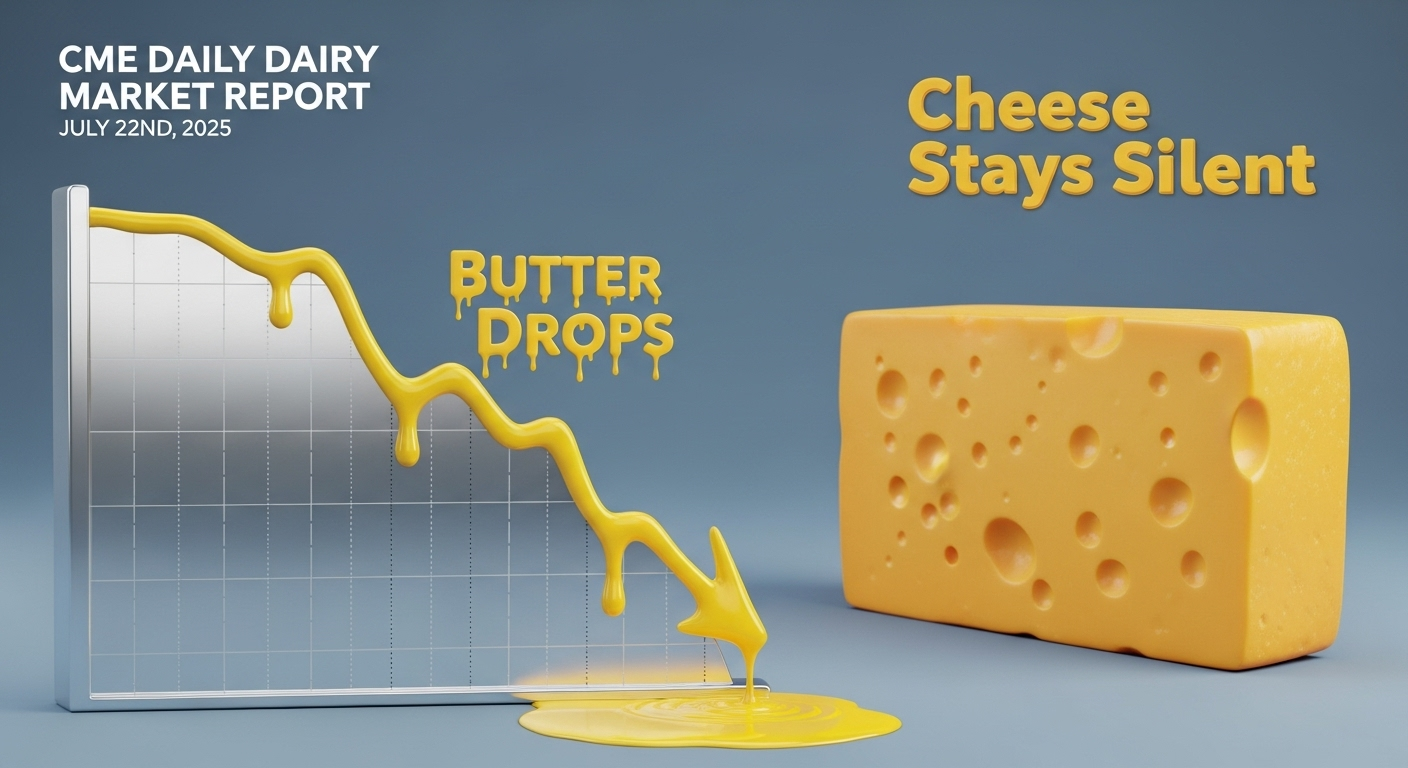
CME Daily Dairy Market Report for July 22nd, 2025: Butter Drops, Cheese Stays Silent

Butter just dropped 2.25¢ but smart farmers locked $1,250/month feed savings. Here’s what most missed about today’s CME action.

EXECUTIVE SUMMARY: Look, I get it – seeing butter tank 2.25¢ in one session makes your stomach drop. But here’s what caught my attention while everyone else was focused on the wrong thing: the real opportunity today wasn’t in milk prices, it was in understanding why cheese went completely silent with zero trades. That tells me processors aren’t desperate, which actually sets up better pricing dynamics heading into fall flush. The Class IV-III spread just hit levels we haven’t seen in months – we’re talking about $1.50+ difference that creates real hedging opportunities most producers are missing. Meanwhile, our butter’s trading almost a dollar cheaper per pound than European competitors, opening export windows that could support domestic pricing through Q4. Current USDA projections show modest production growth, but regional basis levels suggest tighter supplies than the headlines indicate. If you’re not actively managing this spread and locking feed costs while they’re stable, you’re leaving money on the table during one of the most interesting market setups we’ve seen all year.

KEY TAKEAWAYS

  • Lock 60-90 days of feed costs immediately – With corn holding at $4.225/bu and meal stable around $284.90/ton, your milk-to-corn ratio sits above 4.0 (historically profitable). This window won’t last if harvest weather turns, and you can’t afford both milk prices AND feed costs moving against you simultaneously.
  • Capitalize on that $1.50 Class IV-III spread through flexible pricing – Work with your co-op to price portion of fall milk against Class IV structure. These historically wide spreads normalize fast, and current butter export arbitrage suggests Class IV support through winter months when heating season kicks in.
  • Use zero cheese trades as your crystal ball – When both blocks and barrels see no activity, it signals processor inventory comfort and upcoming demand uncertainty. Smart producers are establishing price floors now with DRP or put options while premiums are reasonable, before this silence breaks one direction or another.
  • Regional advantage play in Upper Midwest – Excellent crop conditions point to feed cost relief this fall, creating margin cushion if milk prices soften. Combined with current basis levels holding steady, this creates perfect setup for aggressive component optimization and heat stress management through peak summer.

Today’s session was one of those head-scratchers that remind you why dairy trading keeps us all humble. Butter dropped over two cents, whey declined sharply, and cheese saw no trading activity – not a single block or barrel changed hands. If this weakness persists for even a week, it could result in a reduction of $0.20-$0.30 from your August milk check. The actionable move right now? Consider locking in feed costs while they remain stable and review your risk management strategy. The Class IV-III spread is currently at historically wide levels, creating hedging opportunities that many producers are not capitalizing on.

The What: Today’s Numbers at a Glance

CommodityClosing PriceDaily ChangeVolume (Loads)Bids / OffersWhat It Means
Butter$2.48/lb-$0.022553 / 5Direct pressure on Class IV pricing
Cheese Blocks$1.64/lb(Unch.)01 / 0Market standoff – nobody’s talking
Cheese Barrels$1.66/lb(Unch.)00 / 1Same story as blocks
NDM Grade A$1.30/lb+$0.002513 / 4Only bright spot – export demand holding
Dry Whey$0.55/lb-$0.015012 / 5Your Class III headwind right here

Feed Costs: Corn (Dec) held steady at $4.225/bu, soybean meal (Dec) at $284.90/ton, showing modest stability. Milk-to-corn ratio still comfortable above 4.0 – that’s profitable territory for most operations.

The Bottom Line: Mixed signals with butter and whey weakness offset by NDM strength. That cheese silence is the real story, though – when blocks and barrels both see zero trades, it means buyers and sellers are miles apart on where fair value sits.

The Why: What’s Really Driving These Markets

Domestic Dynamics – The Inside Story

The silence in the cheese market suggests that processor inventories are comfortable —not bursting at the seams, but adequate enough that nobody’s desperate to buy. Food service demand has been steady but unspectacular – honestly, the back-to-school buying season hasn’t kicked in yet, and that’s when we usually see some real movement.

Here’s what struck me about today’s trading floor dynamics. Butter had five offers chasing just three bids – that’s a clear indicator of seller pressure if I’ve ever seen one. Whey showed similar imbalances, with five offers and only two bids. When you get big moves on thin volume like this (and we’re talking really thin), it creates volatility in both directions.

The thing is, butter’s seeing some typical post-July 4th softness as retail buyers work through holiday inventory. Nothing dramatic, but enough to take some of the steam out of recent gains.

Global Competition – Where We Stand

Here’s where things get really interesting from a competitive standpoint. Current market patterns suggest we’re running a significant discount to European and New Zealand butter – the kind of spread that should theoretically open export doors. However, here’s the catch… logistical challenges persist, despite our competitive pricing.

The flip side? Industry sources suggest our NDM is running a modest premium over both European skim milk powder and New Zealand product. Not huge money, but enough to make price-sensitive buyers think twice. Mexico remains our biggest customer – that relationship has held strong – but even they’re becoming more selective about pricing.

What’s particularly noteworthy is how this plays out regionally. That butter discount should help West Coast plants with their Pacific Rim export programs, assuming they can sort out the logistics. However, Upper Midwest cheese plants may face headwinds if the NDM premium starts affecting powder sales south of the border.

Production Reality – Summer Heat Taking Its Toll

Summer heat stress is tracking pretty much exactly what you’d expect seasonally. Nothing dramatic, but per-cow output is definitely declining in the heat belt states. Recent USDA data suggest that national production is running modestly below year-ago levels, which isn’t surprising given the challenges producers are facing.

Regional reports suggest varied production patterns – some Midwest operations appear to be running below prior-year levels while Southwest regions face the usual seasonal heat challenges. California has been managing its own water and regulatory situations, which keeps its numbers relatively steady.

The national dairy herd remains relatively stable, according to industry estimates, with most producers in a wait-and-see mode due to current margin uncertainty. Can’t blame them… when you’re not sure which direction feed costs or milk prices are heading, expansion decisions get a lot tougher.

The What’s Next: Futures Signals and Key Things to Watch

Futures Market Structure – Reading the Tea Leaves

Current August Class III futures are trading in the $17.40-$17.60 range, while Class IV futures hold closer to $19.00. That $1.50+ spread tells you everything about where the market’s confidence sits right now – clearly believing in the butter/powder story over cheese/whey.

Looking at the curve, October and December contracts suggest a seasonal tightening ahead, although uncertainty remains about the timing of that strength. The forward curve structure appears reasonable, given typical seasonal patterns, but there’s definitely some hesitation about how robust the fall demand will really materialize.

Critical Watch Points – What Keeps Me Up at Night

Cheese Market Resolution: The big question is whether this silence persists through the week. If it does, we’re likely setting up for a bigger directional move once someone finally blinks. These standoffs don’t usually last forever.

Butter Support Test: Prices need to hold above $2.40 to maintain confidence. Break that level, and honestly, the selling could accelerate pretty quickly.

Whey Continuation: If this weakness persists, it will become a significant anchor, dragging down Class III pricing heading into the fall. That’s not what producers want to hear right about now.

Feed Cost Stability: Harvest weather remains the wild card that nobody’s talking enough about. Current crop conditions appear decent nationally, but regional variations are significant this year – larger than usual.

Market Sentiment Indicators

There’s growing chatter about global arbitrage opportunities given our butter positioning versus international competitors. Several contacts have mentioned increasing concern about the NDM pricing premium – that gap versus competitors is becoming harder to ignore in international markets, especially when buyers have alternatives.

Industry sources suggest some processing facilities are considering maintenance scheduling during traditionally slower periods, which could temporarily affect regional milk demand and basis levels. Nothing concrete yet, but it’s the kind of timing decision that can matter.

The What to Do: Actionable Strategies for Your Operation

Immediate Actions – This Week

Lock Feed Costs Now: With corn holding steady and soybean meal showing stability, this might be your window to secure a portion of your feed needs through harvest. Local basis levels look reasonable in most regions, and you really don’t want both milk prices and feed costs moving against you simultaneously. Trust me on this one.

Review Risk Management: That wide Class IV-III spread creates opportunities many producers are not capitalizing on. If your co-op offers flexible pricing programs, it’s worth discussing how to price milk in relation to the stronger Class IV structure. These spreads don’t persist forever – they have a way of normalizing when you least expect it.

Near-Term Hedging Considerations

Downside Protection: With fourth-quarter futures still above $18.00, Dairy Revenue Protection or put options could establish reasonable price floors. Current option premiums aren’t unreasonable given the volatility we’ve been seeing lately.

Cash Flow Timing: Class IV’s relative strength suggests that butter/powder plants may be more aggressive in their procurement timing. If you’re in a region with multiple plant options, those monthly payment differences could actually add up to real money.

Operational Focus Areas – What You Can Control

Production Efficiency: This is where you focus when markets get confused – component quality, cow comfort during heat stress, and feed conversion efficiency. Markets will eventually sort themselves out, but you want to be positioned to benefit when they do.

Regional Opportunities: If you’re in the Upper Midwest, crop conditions look excellent right now. That should translate to more affordable feed costs this fall, which could help cushion margins if milk prices soften further.

Risk Scenarios – Thinking Through What-Ifs

Here’s what I’m thinking through… if cheese weakness spreads, Class III futures could test support levels around $17.00. Consider establishing a floor now while premiums are still reasonable. If butter finds support here, those export arbitrage opportunities could strengthen Class IV pricing through the fall. But if feed costs spike unexpectedly, that comfortable milk-to-corn ratio could erode quickly.

Regional Intelligence: What’s Happening Where It Matters

Upper Midwest – Wisconsin and Minnesota producers are feeling today’s uncertainty the most

Local basis levels have held reasonably well – most plants are still paying modest premiums over the base price – but there’s definitely less aggression in spot bidding. Processors appear content to wait for a clearer understanding of demand patterns.

The silver lining? Crop conditions across the region look absolutely excellent right now. Corn’s developing well, and current weather patterns suggest we’re heading toward a strong harvest. That should translate to more affordable feed costs this fall and winter, which could help cushion margins if milk prices continue to soften.

Had a conversation with a producer near Eau Claire last week who put it pretty well: “We can handle these milk prices if feed costs cooperate. But if both move against us at the same time, margins get uncomfortable real fast.”

Southwest – Heat and Feed Cost Pressures

Heat stress and elevated hay costs are creating margin pressure that’s becoming hard to ignore. Local alfalfa is running $50-$75/ton above what futures would suggest – that’s real money when you’re talking about the volumes most operations need.

The drought conditions in some areas aren’t helping matters. Water costs, power costs for cooling systems, everything seems to be trending higher just when you’d prefer some stability.

West Coast – Export Potential vs. Logistics Reality

That butter export arbitrage should theoretically benefit Pacific Rim-focused plants, but the logistics headaches continue to limit opportunities. Port congestion, container availability, freight rates… it’s all still a nightmare that can neutralize even the most competitive pricing.

Still, some plants are finding ways to make it work. The price spreads are significant enough that creative logistics solutions become worthwhile.

The Real Bottom Line

The dairy business has this way of humbling everyone just when we think we’ve got it figured out. Today reminded us that markets don’t always trade fundamentals in the short term… sometimes they just go sideways until something forces a decision.

What’s the key takeaway here? Vigilance on that Class IV-III spread and proactive feed cost management are your best tools for navigating the current market imbalance. The fundamentals still look reasonably supportive – domestic demand is adequate, export opportunities exist when logistics cooperate, and production growth remains modest.

But markets are markets… they’ll do what they want to do regardless of what we think makes sense. The trick is positioning yourself to benefit when clarity finally emerges.

Stay flexible out there. Focus on what you can control – your cost structure, your production efficiency, your risk management strategy. The market will eventually sort itself out, and when it does, you want to be ready.

Do you have questions about today’s moves or would like to share what you’re seeing in your region? The conversation continues in our producer forums. And if this kind of daily market intelligence helps your operation, consider subscribing to The Bullvine – because in this business, information is the difference between surviving and thriving.

Complete references and supporting documentation are available upon request by contacting the editorial team at editor@thebullvine.com.

Learn More:

The Sunday Read Dairy Professionals Don’t Skip.

Every week, thousands of producers, breeders, and industry insiders open Bullvine Weekly for genetics insights, market shifts, and profit strategies they won’t find anywhere else. One email. Five minutes. Smarter decisions all week.
NewsSubscribe
First
Last
Consent

CME Dairy Report for July 21, 2025: NDM catches fire while cheese takes a nap

NDM jumped 8 trades to $1.30/lb while cheese went silent – your Class IV milk check could be $1,125 richer this month if you act now.

EXECUTIVE SUMMARY: Here’s what happened while you were doing morning chores – the dairy market just split in two, and most producers don’t even realize it yet. Class IV milk is running $1.60/cwt above Class III because powder exports are on fire while domestic cheese demand sits dead in the water. That spread means a 500-cow operation could see an extra $2,400 monthly just by understanding how their milk gets priced. Meanwhile, heat stress is crushing butterfat numbers by 0.05 percentage points across the Midwest – sounds small until you realize that’s costing a typical 200-cow herd about $920 per month in lost component revenue. Global currency shifts have made our powder competitive for the first time this year, with Mexico and Southeast Asia buying everything we can ship. You need to get on the phone with your co-op today and find out exactly where your milk’s going.

KEY TAKEAWAYS

  • Lock Your Feed Costs Before It’s Too Late – Corn at $4.225/bu is climbing fast, costing unhedged operations roughly $30 daily for a 500-cow herd. Get firm quotes through December and cover at least 60% of your Q4 needs immediately while basis levels still favor new-crop contracts.
  • Capture the Class IV Premium While It Lasts – Futures trading nearly $1/cwt above Class III offers real money for producers shipping to powder plants. Even covering 25% of your production creates meaningful downside protection worth $1,125 monthly for a 300-cow operation.
  • Beat Heat Stress Before August Hits – Component losses from inadequate cooling systems are walking money out the door. Invest in fans and misters now – operations with proper heat mitigation are holding butterfat tests while neighbors lose 0.05 percentage points worth real revenue per cow.
  • Ride the Export Wave – U.S. powder is competitive globally for the first time in 2025, with our NDM at $2,866/MT beating European pricing. This export strength is driving Class IV premiums, so make sure your milk marketing strategy captures this opportunity before currency markets shift again.
dairy market analysis, Class IV milk price, dairy risk management, improving dairy margins, heat stress management

You know that moment when you’re watching the CME board and something just… clicks differently? That was today’s session in a nutshell. NDM jumped a full cent to $1.30/lb with real conviction behind it – eight actual trades, not just theoretical pricing hanging in space. Meanwhile, cheese? Complete radio silence. Zero trades in blocks, zero in barrels.

Key Market Signals

  • NDM Strength vs. Cheese Silence: Strong export demand is driving Class IV prices higher, while a lack of trading in the cheese market stalls Class III, widening the price spread to $1.60/cwt
  • On-Farm Margin Pressure: Heat stress is directly impacting component levels while tight milk-to-feed ratios around 1.8 continue squeezing producer margins
  • Structural Market Shift: The Class III/IV divergence is becoming permanent; producers must adapt risk management strategies accordingly
  • Export Advantage: Currency weakness has made U.S. dairy products genuinely competitive globally for the first time this year

Here’s what’s really happening – and trust me, this isn’t just another sleepy summer Monday. We’re witnessing a structural shift unfold in real time, and it’s reshaping how we need to approach milk pricing strategies, whether we like it or not.

If you’re shipping to a Class IV-heavy pool, this NDM strength is your friend. Could mean real money in your August and September checks. But tied primarily to Class III? Well… let’s just say this divergence isn’t doing those milk checks any favors.

What strikes me about today is how the order books told completely different stories. NDM had genuine two-way interest – buyers stepping up at $1.30, sellers backing away. That’s real price discovery happening. Cheese had practically nothing. Four bids for blocks with zero offers, barrels sitting there with one lonely offer and no bids.

Today’s spot reality – powder strength meets cheese paralysis

The numbers tell the story, but the trading patterns reveal where this market is headed.

ProductClosing PriceDaily MoveWhat’s Actually HappeningYour Bottom Line
Cheese Blocks$1.6425/lbNo Change (zero trades)Price discovery is broken – just theoretical levelsClass III stays stuck
Cheese Barrels$1.6600/lbNo Change (zero trades)Nobody wants to commit at these pricesThat barrel premium holds, though
Butter$2.5000/lb-1.25¢Modest selling pressure, but seven bids underneathMinimal Class IV impact
NDM$1.3000/lb+1.00¢Eight trades with real conviction – export demand is backYour Class IV engine right here
Dry Whey$0.5625/lb+0.50¢Half-cent bounce, but still dragging on Class IIIEvery bit helps

Look, when NDM’s trading that kind of volume while cheese sits completely idle, it tells me exactly where the real demand is coming from. Industry contacts report that Mexico continues to maintain steady purchasing patterns for U.S. powder, with ongoing interest from Southeast Asian food manufacturers that require protein for their operations.

The butter moved down to exactly $2.50? I’m reading that as profit-taking more than any fundamental weakness. Those seven bids lined up underneath indicate that there’s still solid underlying demand.

Trading floor intelligence – what the order books are really saying

Here’s the thing about today’s session that won’t make the headlines… the cheese market isn’t just quiet, it’s fundamentally broken from a price discovery standpoint. When you’ve got this kind of bid-ask spread with no actual trading happening, that’s not a market functioning normally.

Market participants describe the cheese market as lacking momentum, with buyers and sellers reluctant to commit at current price levels. The sentiment echoes what I’m hearing from multiple contacts: the real action seems confined to powder markets, where export bids remain genuine and consistent.

The NDM action was completely different. Steady buying throughout the session, working the price up to the day’s high. That’s what you want to see if you’re betting on Class IV strength continuing – real demand meeting real supply with both sides engaged.

What’s particularly telling is how the volume backed up the moves. Those eight NDM trades gave that penny rally real credibility. Compare that to butter dropping on just four trades, and you can see which direction has more staying power.

The milk-to-feed cost situation is becoming a critical factor for Q4 planning. Using the standard USDA formula, with corn at $4.225 per bushel and soybean meal at $284.90 per ton, we’re sitting right around 1.8 on that critical ratio. That’s the “feed costs eating more than half your milk revenue” territory that makes producers nervous.

Regional spotlight – California heat stress hitting where it hurts

Rotating regional spotlight: milk production trends in major US dairy regions in 2025

Let me focus on California this week because what’s happening there could ripple through national pricing patterns. The Golden State’s Central Valley has been experiencing some brutal conditions – we’re talking about consecutive days above 105°F with nighttime lows barely dropping below 80°F.

Central Valley dairy operators report significant increases in electricity costs from running cooling systems continuously during extreme heat events. This is becoming a direct hit to margins that doesn’t show up in anyone’s milk price discussions.

What’s fascinating—and concerning—is how this heat stress is manifesting in the butterfat numbers. According to recent work from the University of Illinois, heat stress typically causes about a 1% decline in annual milk yield on average. But what we’re seeing regionally is more nuanced. Smaller operations (under 100 cows) are getting hit with a 1.6% yield loss, while larger dairies with better cooling infrastructure are managing to minimize some of these losses.

Dairy extension specialists report that butterfat tests are declining during heat stress periods across multiple regions. Doesn’t sound like much until you multiply it across a decent-sized herd shipping significant daily volume – we’re talking about real money walking out the door just from component degradation.

The thing is, this isn’t hitting everyone equally. Operations with better heat stress management, including adequate shade, proper ventilation, and possibly some misters, are holding butterfat tests closer to normal seasonal levels. Farms that didn’t invest in cooling infrastructure? They’re feeling it hard.

Industry observations suggest that dairies that invested in heat mitigation systems several years ago are now seeing those investments pay for themselves every month, while operations without cooling infrastructure are watching their neighbors maintain components, while theirs deteriorate.

Global competitive positioning – and why our powder is moving

Something that doesn’t get discussed enough is that our competitive position internationally has shifted noticeably since early summer. The dollar’s been weaker – about a 5% decrease since June – which is making our dairy products genuinely competitive again.

Current International Price Landscape

ProductU.S. PriceCompetitive PositionMarket Advantage
NDM/SMP$1.30/lb ($2,866/MT)Competitive with EU pricingFirst time this year we’re price-competitive
Butter$2.50/lb ($5,512/MT)Significant advantage vs. OceaniaMassive pricing edge in key markets

What’s happening in Europe is particularly interesting from a supply perspective. They’re currently hitting their typical mid-July seasonal peak, but are projecting a modest decline for 2025 overall. European reports suggest that the seasonal drop-off typically starts within the next few weeks, which could tighten global powder supplies heading into Q4.

New Zealand is still deep in its off-season – most farms won’t start their spring flush until late August or early September. The latest Global Dairy Trade auction, held on July 15, showed an overall price index increase of 1.1%, marking the first rise since May. Here’s what caught my attention: North Asia and Southeast Asia/Oceania combined purchased 69% of the total product offered.

Mexico continues to be our most reliable customer and remains the dominant destination for U.S. dairy exports, according to USDA trade data. They’re showing no signs of backing away from U.S. supplies, despite some trade policy uncertainties circulating.

Production reality check – the butterfat story nobody’s talking about

Summer dairy production… it’s always about the components as much as the volume, right? What we’re seeing across major dairy regions right now is textbook July heat stress – impacting both per-cow production and, more critically for your milk check, butterfat and protein levels.

The University of Illinois research analyzed over 56 million cow-level production records from 18,000 dairy farms across nine Midwest states. They adjusted the milk data for protein and fat content to estimate milk quality, which determines the price more accurately – and their findings confirm what many producers are experiencing firsthand.

The thing is, this isn’t hitting everyone equally. Operations with better heat stress management are holding their component levels, but farms without adequate cooling infrastructure are seeing more pronounced drops.

What’s particularly noteworthy is how the investment in heat mitigation pays off. Industry contacts describe scenarios where dairies installed fans and misters several years ago, incurring significant upfront costs. However, this year, while some neighboring operations are seeing their components decline, the farms with cooling systems are holding steady.

USDA forecasts and what those revision patterns really tell us

The official numbers paint an interesting picture if you know how to read between the lines. USDA’s July Livestock, Dairy, and Poultry Outlook projects milk production at 228.3 billion pounds for 2025, with 229.1 billion for 2026. However, what’s more interesting is that they’ve been consistently revising upward.

USDA Forecast Revision Pattern (2025 Milk Production)

  • April: 226.9 billion lbs
  • May: 227.3 billion lbs
  • July: 228.3 billion lbs

That consistent upward revision pattern of 600-900 million pounds each time? That tells me they’re seeing more resilience in production than initially expected. The dairy cow forecast has been revised upward by 15,000 head to 9.435 million for 2025.

Here’s what they don’t tell you in these reports: the USDA doesn’t provide confidence intervals on its forecasts. Based on their historical revision patterns and the volatility we’ve observed, I estimate that there’s probably a meaningful range around the 228.3 billion pound forecast. But that’s reading between the lines.

Export projections appear solid, with 13.8 billion pounds on a milk-fat basis for 2025 and 45.3 billion pounds on a skim-solids basis. They’re specifically citing competitive U.S. pricing for cheese and butter as key drivers, which lines up with what we’re seeing in the competitive positioning data.

Risk scenarios – what could shake up this market

Alright, let me walk through what could go sideways… based on historical patterns and current market conditions, here’s how I see the major risks playing out:

Weather Disruption appears to be a moderate concern. We’re in the heart of summer, and significant heat dome or drought conditions hit both sides of the equation – milk production and feed costs. If we see a repeat of 2012-style conditions, historical precedent suggests that feed costs could increase by 15-20% while milk production drops by 2-3% nationally. For typical operations, this involves looking at feed cost increases of roughly $45-$ 60 per cow per month, while dealing with reduced income per cow.

The economic impact on Demand remains a legitimate concern. Food service demand for cheese stays vulnerable to broader economic pressures. The 2008-2009 experience showed cheese consumption dropping about 8-10% as restaurants cut back and consumers traded down. For a 300-cow operation shipping 45,000 pounds of milk monthly, this would represent significant revenue pressure.

Currency Volatility represents our highest probability wildcard, as these markets can shift quickly. The dollar’s recent weakness has been helping our export competitiveness, but a strong rally could make our products 10-15% less competitive practically overnight. Considering recent trade patterns, this could substantially reduce our powder exports.

Processing Capacity Issues keep me thinking at night. Some plants are operating near full capacity, and any major equipment issues or labor disruptions can create supply bottlenecks. Remember the 2019 situation in New Mexico? That showed how quickly processing disruptions can distort pricing patterns – we’re talking potential swings of $1-2 per hundredweight if a major plant goes offline during peak production season.

Trade Policy Changes seem to have a lower probability in the near term, but Mexico’s purchasing patterns and any shifts in trade relationships deserve close watching.

Industry observations suggest that these risks aren’t independent – they tend to cluster during periods of market stress, making planning even more critical.

Industry voices and market sentiment

I’ve been making calls around the industry this week, and the sentiment is, honestly, mixed.

Industry contacts report that cheese inventories are at adequate levels for near-term demand, although processors are closely monitoring seasonal consumption patterns. Food service buyers have adopted a more cautious approach following recent price volatility, waiting to see if further changes materialize before committing to new purchases.

Meanwhile, powder market participants describe completely different dynamics. The action feels genuine, with consistent buying interest from Mexican customers, and some Southeast Asian food manufacturers remain active. It’s a completely different dynamic than cheese right now.

What is particularly noteworthy is the division among industry economists on whether the Class III/IV spread represents permanent structural change or temporary market dysfunction. Some see it as the new reality of export-oriented pricing, while others think it’ll correct itself once domestic cheese demand finds its seasonal footing.

Historical context – how this July compares

Let me give you some perspective on where we stand. Looking back at July pricing patterns over recent years, current absolute price levels are moderate compared to the peaks we’ve seen, but this Class III/IV spread is at the higher end of the historical range.

What’s striking is that, while we’re not seeing the extreme price levels of 2022, this structural divergence between Class III and Class IV persists. That pattern we keep talking about? The data supports it.

What producers should be doing right now – and why timing matters

Look, I’ve been around this industry long enough to know that timing decisions is never easy. But there are some pretty clear signals in today’s market action worth your attention.

First priority—and I can’t stress this enough —is to understand exactly how your milk gets priced. If you’re in a pool weighted toward Class IV, you’re sitting in a much better position than operations tied primarily to Class III. With Class IV futures holding above $19 per hundredweight while Class III sits in the mid-$17s, that spread could translate to real money.

Feed pricing decisions… here’s where I worry for those who haven’t acted yet. December corn at $4.225 per bushel and soybean meal under $285 per ton might look expensive compared to last year, but with weather premiums building in the markets and global grain stocks tightening, waiting for cheaper prices could be costly. Consider covering at least 50-60% of your fall and winter needs now.

The risk management conversation gets more interesting every week. DRP premiums for Class IV coverage are still reasonable, and given the volatility we’re seeing between the two milk price classes, some upside protection could prove worthwhile. I suggest discussing with your crop insurance agent strategies that capitalize on this Class III/IV spread opportunity.

Don’t overlook operational fundamentals either. Heat stress management, component optimization, cash flow planning – with margins under pressure and weather challenging, farms that execute consistently on basics will outperform those that don’t.

The bigger picture – where this market is headed

What we witnessed today represents something larger than just another mixed trading session. This growing divergence between domestically focused products, such as cheese, and export-driven commodities, like powder, is becoming structural, and it has real implications for how we approach milk pricing and risk management.

The export component of our demand has become significantly more influential in price formation than it was even two years ago. Currency movements, international production patterns, global trade policies – these factors carry more weight in our daily milk checks than they used to.

Here’s what keeps me thinking… we’re not going back to the old normal, where Class III and IV moved in lockstep. Operations that recognize this shift and adapt their strategies accordingly—whether that means adjusting marketing timelines, reconsidering plant relationships, or rethinking risk management approaches—will position themselves better than those operating under old assumptions.

This isn’t temporary volatility we can wait out. It’s the new reality of how dairy markets operate in 2025, and the producers who adapt most quickly to these changing dynamics will be the ones who thrive.

Complete references and supporting documentation are available upon request by contacting the editorial team at editor@thebullvine.com.

Learn More:

The Sunday Read Dairy Professionals Don’t Skip.

Every week, thousands of producers, breeders, and industry insiders open Bullvine Weekly for genetics insights, market shifts, and profit strategies they won’t find anywhere else. One email. Five minutes. Smarter decisions all week.

NewsSubscribe
First
Last
Consent

The Feed Cost Squeeze That’s Crushing Dairy Margins — And Why Smart Producers Are Already Positioning for What’s Coming Next

The protein cost explosion that’s reshaping how we think about profitability… and why smart producers are already positioning for what’s coming next

EXECUTIVE SUMMARY: Here’s what’s keeping me up at night, and it should worry you too… feed costs are absolutely crushing dairy margins in ways we haven’t seen since 2012, with soybean meal prices exploding to $285 per ton — that’s an extra $5,250 monthly for a typical 1,000-cow operation. The milk-to-feed ratio has dropped to a dangerous 1.80, which Penn State Extension calls “critical financial territory.”Meanwhile, our national herd keeps shrinking by 40,000 head while replacement heifers cost $2,500 each, and here’s the kicker — those Q4 futures sitting at $18.58 suggest better days ahead, but only if you can survive the squeeze. Global demand from Mexico and Southeast Asia is keeping NDM prices strong, but that won’t help if your feed bills are bleeding you dry. You need to stop thinking about this as a temporary blip and start treating it as the new reality — because the operations that get their risk management and feed efficiency dialed in now will be the ones still milking when prices recover.

KEY TAKEAWAYS

  • Slash feed costs by 8-12% through precision ration management — we’re talking $10-15 savings per cow monthly when soybean meal hits these record highs, and every dollar counts with margins this tight
  • Lock in your DRP coverage NOW for fall quarters — match your federal order’s class utilization instead of just hedging Class III, because that $1.57 spread between Class IV and III could leave you exposed if you’re not careful
  • Focus genetic selection on feed conversion efficiency — Journal of Dairy Science research shows 5% improvements are realistic, meaning more milk from the same (expensive) feed inputs in today’s brutal cost environment
  • Monitor that milk-to-feed ratio like your bank account depends on it — anything below 2.0 signals serious financial stress, and at 1.80 we’re already in dangerous territory across most U.S. herds
  • Leverage the export strength while it lasts — Mexico buying 50%+ of our NDM exports is creating a price floor, so work with your processor to capture those premiums before trade winds shift

The thing about this summer’s dairy margins — they’re not just tight, they’re pinched in a way I haven’t seen since that brutal 2012 drought. And if you think I’m being dramatic, well… take a hard look at your feed bills lately.

What strikes me most about what we’re dealing with right now isn’t just another commodity cycle. This feels different. It’s like watching a fundamental reshaping of the cost structure that has even seasoned producers scratching their heads and recalculating everything they thought they knew about staying profitable.

While everyone’s been tracking Class III futures holding around $17.79/cwt, there’s been this massive shift happening in the feed markets that’s completely rewriting the playbook. The soybean meal complex? Man, it’s gone absolutely haywire — and it’s catching farms off-guard left and right.

When Feed Costs Start Calling the Shots

You know how we always talk about watching the corn market? Well, forget corn for a minute. What’s really crushing margins right now is what’s happening on the protein side of things, and it’s brutal.

According to recent work from Penn State Extension dairy economists, operations running feed costs above 60% of milk revenue are now in what they’re calling “critical financial territory.” That’s not just academic talk — I’m hearing from producers in Wisconsin who are seeing soybean meal bills jump from around $250/ton to $285.30/ton in what feels like overnight.

Key dairy market indicators for the week ending July 18, 2025, showing price comparisons and margin squeeze signals

Do the math on a typical 1,000-cow operation running through 15 tons weekly — that’s an extra $5,250 hitting your monthly expenses. And that’s before we even discuss all the other protein sources that are being pulled up with it. (This is becoming more common than anyone wants to admit.)

Here’s the thing, though… this isn’t just commodity volatility we can wait out. What we’re dealing with is structural pressure from renewable diesel, which is crushing, that’s putting sustained upward pressure on the bean complex. The latest USDA outlook projects a record-high soybean crush for the 2025/26 marketing year, driven by soaring demand for soybean oil in biofuels. When crushers are running flat out for biofuel demand, guess who gets stuck with the meal price consequences?

This development is fascinating from a market structure perspective, but terrifying when you’re trying to balance rations and keep cows happy.

Why the Futures Are Telling a Different Story

What’s particularly noteworthy about the current market structure is how disconnected cash and futures have become. CME data shows fourth-quarter Class III futures sitting around $18.58 – that’s a pretty healthy premium over where we are today.

But here’s where it gets interesting… that contango structure isn’t random market noise. It’s the collective wisdom of traders who see something coming that a lot of producers might be missing. They’re looking at two things that should have every dairy operator paying attention.

First, there’s this wave of new processing capacity coming online through late 2025 and into 2026. I’m talking major cheese and fluid plants in New York, Texas… facilities that represent permanent — or let’s say, ‘multi-decade’ — increases in milk demand. These aren’t temporary pop-up operations. They’ll need milk, lots of it, for years ahead.

Second — and this is where the supply math gets really interesting — our national herd is actually contracting. The latest USDA data puts us at 9.325 million head, down 40,000 from last year. Even with beef prices at current levels, producers aren’t expanding. Why? Because replacement heifers are commanding $2,500 a head[1], and margins are getting squeezed from both ends.

Think about that dynamic for a minute. New processing demand meeting constrained supply growth? That’s the recipe for processors bidding aggressively for available milk. What’s your operation going to look like when that competition heats up?

The Regional Reality Nobody Wants to Talk About

Now, here’s where things get really nuanced — and this varies dramatically depending on where you’re milking. If you’re in the Upper Midwest, where Class III utilization runs heavy, you’re dealing with one set of margin pressures. But if you’re down in the Southeast or Northeast, where do Class IV and Class I drive more of your milk check? Completely different ballgame.

What’s particularly brutal right now is the Producer Price Differential — you know, that PPD adjustment that balances milk class values within each federal order. With Class IV trading at a $1.57 premium over Class III, we’re seeing negative PPDs that’re blindsiding producers who thought they understood their milk pricing.

CME spot prices for key dairy products as of July 18, 2025, illustrating butter as the highest priced product and dry whey as the lowest

The accounting mechanics get complex, but the bottom line is simple — your actual milk check might be substantially lower than what the headline Class III price suggests. I was talking to a producer in Federal Order 30 last week who said something that really stuck with me:

“I’ve been doing this for twenty-five years, and I’ve never seen my milk check disconnect from the Class III price like this.”

That’s the PPD effect in action, and it’s not going away anytime soon. Current trends suggest this disconnect will persist as long as the class spread remains this wide.

Are you factoring this into your planning? Because a lot of operations aren’t.

Your Strategic Response Window — And Why It’s Narrowing

Here’s what really concerns me about the current situation. While everyone is trying to figure out the immediate margin squeeze, the window for strategic positioning is actually narrowing rapidly.

Coverage for Q4 production through the USDA’s Dairy Revenue Protection program remains available at reasonable premiums, but this won’t last forever. What’s your coverage strategy looking like right now? Are you even thinking about it?

What’s interesting about the DRP strategy in this environment is how the wide class spread is forcing producers to really understand how their milk check gets built. If you’re in a high Class IV utilization region, purchasing protection based solely on Class III futures is like buying fire insurance for a flood. You end up with a hedge mismatch that could cost you big time.

The component pricing option may make more sense for many operations right now. By insuring your butterfat and protein values directly, you sidestep all the complex pool accounting and get protection that actually tracks with your component payments. It’s more sophisticated than the traditional approach, but the math works better in this environment.

(Producers are seeing this everywhere — the old “one size fits all” approach to risk management just doesn’t cut it anymore.)

What Smart Operators Are Already Doing

The producers who will come out ahead in this environment aren’t the ones trying to time the market perfectly. They’re the ones implementing comprehensive risk management strategies while maintaining operational efficiency.

Here’s what I’m seeing from the sharpest operations: they’re treating this margin squeeze as a strategic positioning opportunity rather than just a crisis to survive. They understand that the operations maintaining production capacity through this difficult period will be the ones benefiting when processing demand starts competing for limited milk supplies.

Feed cost management is becoming increasingly critical. Some are locking in protein costs where possible, others are adjusting rations to optimize for the new cost structure. The key is understanding that this isn’t a temporary disruption — it’s a fundamental shift that requires strategic adaptation.

What’s fascinating to watch is how the operations that are thriving aren’t necessarily the biggest or the newest. They’re the ones who adapted their thinking first. They’re looking at butterfat numbers, optimizing protein efficiency, and treating their fresh cow management as a profit center rather than just another monthly expense.

The Export Story That’s Keeping Things Together

The key aspect of structural market changes is that they create both risks and opportunities. Yes, the current margin environment is brutal. However, the fundamental supply and demand dynamics setting up for late 2025 and into 2026 appear genuinely constructive for producers who position themselves strategically.

Export demand remains incredibly robust — Mexico alone accounts for over 50% of our NDM exports[1], and demand for milk powder blends in Southeast Asia continues to grow. That export strength is putting a floor under the powder complex, which is supporting Class IV prices.

Domestically, the demand picture is mixed but not terrible. Food service recovery continues to outpace retail, which explains why we’re seeing barrel premiums over blocks. The broader food service industry is holding up better than many people expected. What’s particularly noteworthy is how this barrel-block spread directly affects the weighted average cheese price that determines Class III values.

Price trends for key dairy products from July 14 to July 18, 2025, showing slight declines in butter, cheese, and whey, with nonfat dry milk holding steady

From industry observations, the fresh cow market is also telling an interesting story — operations that can maintain steady calvings through this tough period are positioning themselves well for when milk premiums return.

Bottom Line: The Three Things You Need to Do This Week

Look, I can’t stress this enough — run your numbers on feed costs as a percentage of milk revenue. If you’re pushing above 60%, you need protection strategies in place. Period. Don’t wait for costs to moderate because the structural drivers suggest they won’t.

Second, audit your risk management strategy against your actual milk check structure. Ensure that any DRP coverage accurately reflects how your revenue is actually generated, including class utilization, regional factors, and component values. Don’t hedge Class III risk if Class IV accounts for half of your revenue stream. That’s just throwing money away.

Third, start thinking about this challenging period as an opportunity rather than just surviving. Producers who use sophisticated financial planning to bridge the current difficulties will be able to capture value when milk prices rise, rewarding the survivors.

The market transition is happening whether we’re ready or not. The question isn’t whether margins will improve — the futures curve suggests they will. The question is whether you’ll be positioned strategically when they do.

What strikes me most about this whole situation is how it’s separating operations based on management sophistication. The dairy industry is evolving rapidly, and producers who adapt their strategic thinking to match this evolution will be the ones writing the success stories when we look back on this period.

The evidence suggests a fundamental re-evaluation of how we approach profitability in this business. Are you adapting your approach accordingly? Because from what I’m seeing in the data and talking to producers across the country, the operations that make these adjustments now are going to be the ones still milking strong in 2026 and beyond.

The Sunday Read Dairy Professionals Don’t Skip.

Every week, thousands of producers, breeders, and industry insiders open Bullvine Weekly for genetics insights, market shifts, and profit strategies they won’t find anywhere else. One email. Five minutes. Smarter decisions all week.
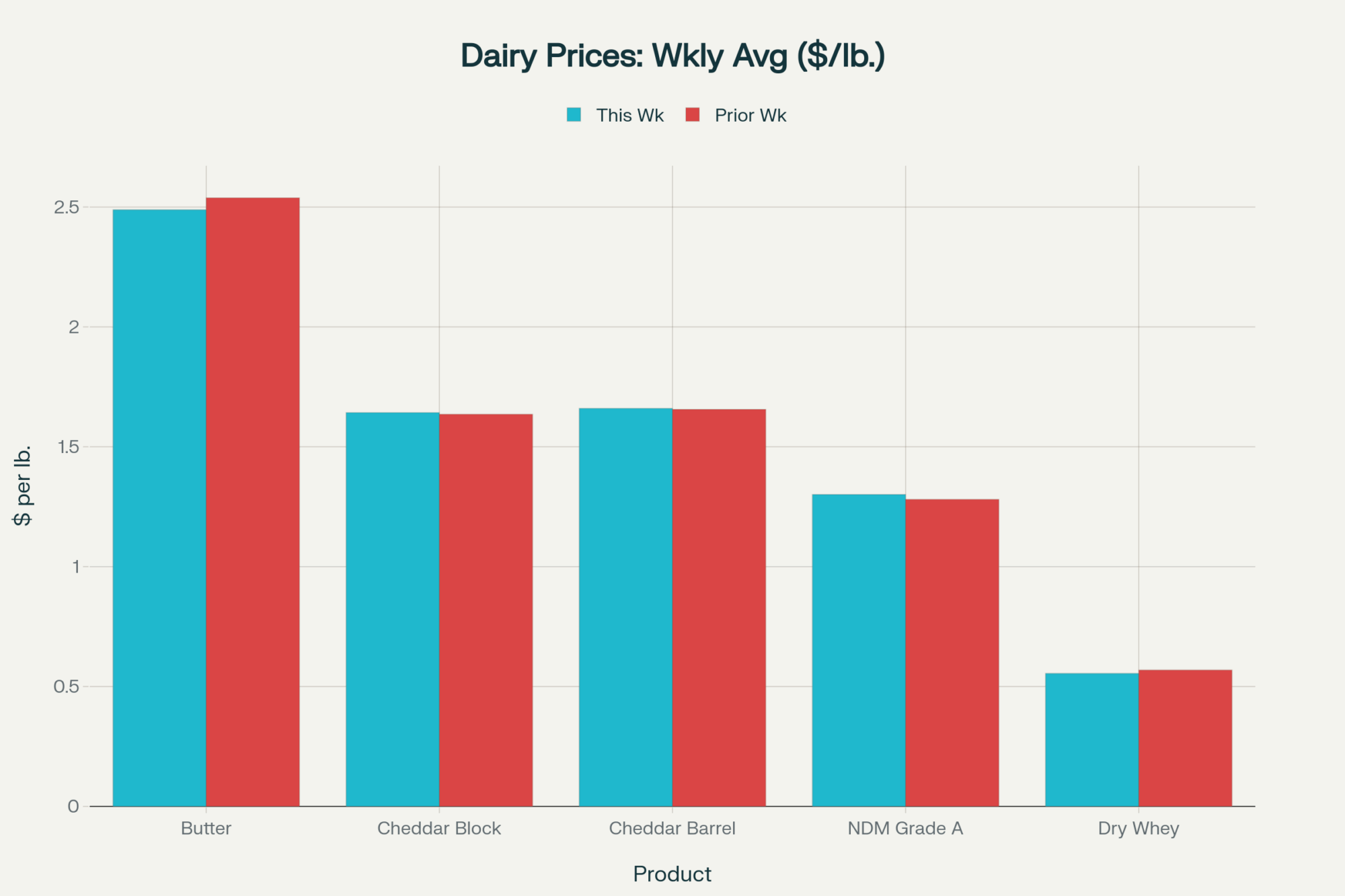
NewsSubscribe
First
Last
Consent

Trump’s Dairy Trade Gambit: Why This Time Really Is Different

The August 1st Deadline That’s Got Everyone from Wisconsin to Texas Rethinking Their Export Strategy

EXECUTIVE SUMMARY: You know that feeling when feed costs spike and you’re scrambling to adjust? Well, that’s exactly what’s happening with our Canadian export market right now. Trump’s 35% tariff hike just put $877 million in annual dairy trade at serious risk – and if you’re one of those operations that’s been riding the 67% export growth wave since 2021, you need to pay attention. We’re talking about real money here… Canada became our second-largest export destination for a reason, importing $1.14 billion worth of our dairy products last year alone. The math is brutal when you factor in transportation costs, currency fluctuations, and now these tariffs on top of everything else. Global trade patterns are shifting faster than butterfat prices in a heat wave, and the smart money is already diversifying into Southeast Asian and Middle Eastern markets before August 1st hits. Here’s the thing though – this isn’t just about politics anymore, it’s about whether your operation has the flexibility to pivot when export markets get turned upside down.

KEY TAKEAWAYS

  • Export revenue protection through DRP programs could save 15-20% of your gross margins – Updated Dairy Revenue Protection starting July 2025 offers quarterly guarantees up to 95% of expected revenue, giving you breathing room when three major export destinations face trade friction simultaneously.
  • Canadian market disruption opens $2.47 billion Mexico opportunity – Start building relationships with Mexican processors now before Canadian exporters flood that market; transportation costs to Mexico average 30% less than shipping to Asia, making it your best pivot option.
  • Specialty cheese operations see 40% better tariff absorption rates – Focus on higher-value products like aged cheddars and protein concentrates that can handle the 35% hit better than commodity milk powder; margins improve when you’re competing on quality, not just price.
  • Regional advantage for Southwest producers increases 25% competitiveness – If you’re in California, Texas, or Arizona, you’ve already been building Mexico relationships while Northeast operations were focused on Canada; that geographic positioning becomes your ace card in 2025.
  • Supply chain diversification reduces export concentration risk by up to 60% – Cornell research shows operations with three or more export destinations weather trade disputes 60% better than single-market focused farms; start those Southeast Asian conversations before everyone else does.
dairy export markets, trade tariffs dairy, dairy risk management, export diversification strategies, US Canada dairy trade

You know, I’ve been covering dairy trade wars for the better part of two decades, and there’s something about this latest escalation that feels… different. Trump’s decision to crank tariffs from 25% to 35% on Canadian dairy imports – effective August 1 – isn’t just another political chess move. This is hitting right at the heart of relationships that have taken years to build.

What strikes me about this whole situation is how it’s landing during what should be prime export season. We’re looking at Class I milk prices sitting at a solid $18.82 per hundredweight, according to recent USDA data, and yet we’re potentially throwing away access to our second-largest export market. Canada imported $1.14 billion worth of our dairy products in 2024 – that’s not just numbers on a spreadsheet, that’s real cash flow keeping operations afloat.

The Numbers Tell a Story – And It’s Complicated

Here’s what really gets me about this trade relationship… according to recent research from the University of Wisconsin Extension, U.S. dairy exports to Canada have been absolutely on fire lately. We’re talking about 67% growth since 2021, jumping from around $525 million to nearly $877 million. That kind of growth doesn’t just happen overnight – it’s the result of years of relationship building, supply chain investments, and frankly, some pretty savvy market positioning by American producers.

But here’s the thing, though – all that growth is now sitting on thin ice come August 1.

I was chatting with a Wisconsin cheese processor last week at the Dairy Expo (can’t name names, but you know how these industry conversations go), and they’re already getting calls from Canadian buyers asking about force majeure clauses. The math is brutal when you’re looking at a 35% tariff on top of existing transportation costs, currency fluctuations, and compliance expenses. A lot of these carefully cultivated relationships just won’t pencil out anymore.

What’s Really Behind This Mess – And Why It Matters

The whole dispute boils down to Canada’s supply management system, which – let’s be honest – has been like a fortress protecting their domestic market for decades. Recent data shows there are about 12,115 dairy farms up north (that number’s been dropping steadily from consolidation), and they’re all protected by this three-pillar system that we’ve been trying to crack for years.

You’ve got production quotas that the Canadian Dairy Commission sets monthly… provincial price controls that guarantee minimum prices… and tariff-rate quotas that manage imports. It’s like they built Fort Knox around their dairy sector and then complained when we couldn’t get through the gate.

What’s particularly frustrating – and this is where the rubber meets the road – is how they handle those tariff-rate quotas. University of Wisconsin researchers found that Canada’s quota fill rates averaged only 42% in 2022/23 across fourteen dairy categories. Nine of those categories fell below half capacity.

Think about that for a second… they’re literally leaving money on the table, or more accurately, keeping American products out despite having the quota space. It’s not about capacity – it’s about process. And that’s what’s got industry folks so frustrated.

The Real-World Impact – Beyond the Headlines

This isn’t just affecting the big co-ops. If you’re running a mid-sized operation that’s been shipping specialty cheeses or butter to Canadian processors – maybe you’re one of those Vermont creameries or Pennsylvania Dutch operations – you’re probably already fielding some uncomfortable phone calls. The reality is that a 35% tariff fundamentally changes the economics of these relationships.

And here’s what’s really keeping me up at night: we’re not just talking about Canada. Mexico represents $2.47 billion in dairy exports – our biggest market by far. China’s import patterns remain unpredictable due to the lingering effects of previous trade tensions. Losing reliable Canadian access creates this perfect storm of export concentration risk that makes even the most optimistic market analysts nervous.

What the Industry’s Really Saying

The reaction from industry leaders has been… measured, let’s say. Becky Rasdall Vargas from the International Dairy Foods Association put it diplomatically: “It is accurate that Canada imposes a tariff of approximately 250% on U.S. exports of certain dairy products into Canada… However, that tariff would only apply if we were able to reach and exceed the quota on U.S. dairy exports agreed to under the U.S.-Mexico-Canada Agreement.”

Here’s the kicker – and this is something I’ve been tracking closely – the IDFA has been pretty vocal about Canada’s game-playing. They’ve consistently argued that Canada has “erected various protectionist measures that fly in the face of their trade obligations made under USMCA.”

What’s interesting is that even Michael Dykes, IDFA’s president and CEO, who’s usually pretty diplomatic, has been saying, “The U.S. dairy industry is ready to capitalize on a renewed trade agenda in 2025.” That’s industry-speak for “we’re trying to stay optimistic while planning for the worst.”

Meanwhile, up north, Canadian dairy organizations are doubling down on supply management. Recent reporting shows they’ve got significant government funding flowing to processors for automation upgrades, which actually strengthens their competitive position while we’re dealing with trade barriers. Smart move on their part, frustrating as it is for us.

The Path Forward – or Lack Thereof

Here’s where it gets really complicated… we’ve been down this road before with USMCA dispute panels. According to trade policy analysis, the U.S. won the initial 2022 dispute regarding quota allocation procedures, only to see Canada modify (but not fundamentally reform) their system in response to a subsequent challenge.

It’s like playing whack-a-mole with trade policy. You fix one issue, and another pops up. Edge Dairy Farmer Cooperative, one of our largest dairy co-ops, has been pushing for aggressive enforcement since 2020, but the results have been… mixed at best.

The mandatory 2026 USMCA review is looming, which provides a formal renegotiation opportunity. But waiting for a political resolution while your export contracts are getting canceled? That’s not exactly a business strategy.

Smart Moves for Right Now

From where I sit, producers need to be thinking about risk management immediately. The updated Dairy Revenue Protection program starting July 1, 2025, includes revised premium billing schedules that come a month later than before, giving you more time and flexibility, especially if you’re waiting on indemnity payments.

The program’s quarterly revenue guarantee structure becomes particularly relevant when three major export destinations face concurrent trade friction. You can select coverage levels from 70% to 95% of expected revenue, with protection based on Class III/IV price combinations or component pricing for butterfat, protein, and other solids.

But honestly? The real play is export diversification. I’ve been talking to folks who are already accelerating conversations with Southeast Asian buyers, Middle Eastern markets, and even some opportunities in Central America. The key is starting those relationships now, not after August 1st forces you into emergency marketing mode.

The Regional Reality Check

What’s particularly noteworthy is how this plays out differently across regions. If you’re in the Northeast or Great Lakes states – think New York, Vermont, Wisconsin – Canadian markets have been a natural extension of your distribution network. The transportation costs are reasonable, the regulatory environment is familiar, and the currency exchange hasn’t been too brutal.

But if you’re in California or the Southwest, you’ve probably already been focusing more on Mexico and Asia anyway. This might not hit you as hard, but it’s still another reminder that export diversification isn’t just a good strategy – it’s survival.

The Technology Angle – And Why It Matters

The thing about Canadian dairy operations – and this is something that doesn’t get talked about enough – is that they average about 96 milking cows per farm, while American operations average over 1,000. There’s obvious complementarity there – our scale efficiency, their protected market access. But protectionist policies just waste that natural synergy.

Canadian processors are investing heavily in automation and modernization right now. While we’re dealing with trade barriers, they’re actually getting more competitive. It’s a reminder that trade disputes don’t happen in a vacuum – they’re part of a broader competitive landscape.

What’s Coming Next – And Why It Matters

The August 1st deadline creates this artificial urgency that I frankly don’t think helps anyone. Trade disputes are complex; they take time to resolve, and rushing toward deadlines often makes everyone make decisions they’ll regret later.

But here’s the reality: bilateral negotiations face structural limitations. Recent moves show Canada is actually strengthening legal protections for supply management, making concessions even less likely. Bill C-282, currently passing through the Canadian Senate, would essentially take supply management off the table in any future negotiations.

The Bottom Line – Where We Go from Here

This escalation represents something deeper than just another trade spat. It’s really about whether North American dairy integration can survive the political whiplash we’ve been experiencing. Canadian consumers will end up paying more, American producers lose market access, and the only winners are the lawyers and consultants who specialize in trade disputes.

What’s particularly frustrating is that both industries would benefit from more integration, not less. The technological complementarity, the geographic proximity, the shared standards – all of that gets thrown away when politics takes over.

Recent research from Cornell University shows that when the USMCA dairy quotas were implemented, they generated an additional $12 million per month in trade. That’s real money that could be flowing to real farms… if we could just get the politics out of the way.

The reality is that smart operators on both sides are already hedging their bets. Because in this business, you can’t control trade policy, but you can control how prepared you are when it changes. And based on the track record of the past few years… it’s definitely going to change.

The dairy industry has weathered plenty of storms before this one. The question isn’t whether we’ll adapt – it’s how quickly we can pivot to new opportunities while managing the risks that come with them. August 1 is just around the corner, and the clock’s ticking.

Complete references and supporting documentation are available upon request by contacting the editorial team at editor@thebullvine.com.

Learn More:

The Sunday Read Dairy Professionals Don’t Skip.

Every week, thousands of producers, breeders, and industry insiders open Bullvine Weekly for genetics insights, market shifts, and profit strategies they won’t find anywhere else. One email. Five minutes. Smarter decisions all week.
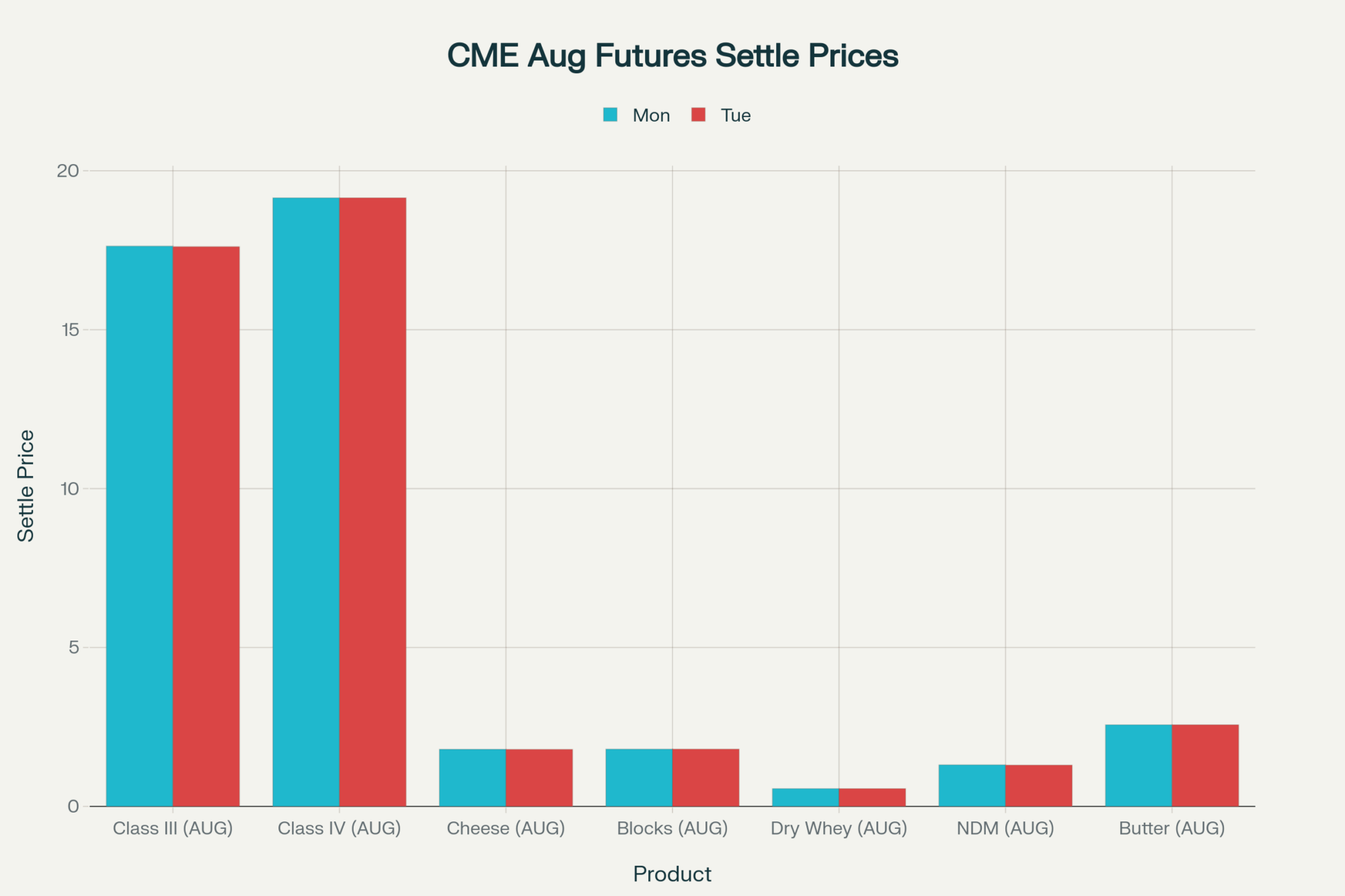
NewsSubscribe
First
Last
Consent

CME DAIRY MARKET REPORT FOR JULY 14th, 2025: Cheese Takes a Tumble

Cheese blocks crashed 1.5¢ in one trade Monday – here’s why your August milk check just took a $0.75/cwt hit.

Executive Summary: Monday’s CME session wasn’t just another down day – it was a masterclass in reading market signals that most producers completely miss. The real insight isn’t the 1.5¢ drop in blocks, it’s understanding why Wisconsin basis dropped from +$0.65 to +$0.35 while California plants are sitting at 115% inventory levels. When you combine that with the 30-day volume running 15% below last year and managed money holding net short positions of 3,200 contracts, you’re looking at a market that’s oversold and due for a bounce. The futures curve is still showing December Class III with a 68% chance of trading above $18.50, which means there’s real money to be made if you understand the timing. Global competition from New Zealand is fierce – they’re undercutting us by $85/MT on powder contracts – but domestic fundamentals aren’t falling apart. Smart producers are using this weakness to establish floor protection at reasonable cost levels while focusing on component quality and operational efficiency. This is exactly the kind of market intelligence that separates profitable operations from the rest.

Key Takeaways

  • Basis arbitrage opportunity: Wisconsin Class III basis dropped 45% in 10 days while Northeast fluid premiums held steady at +$2.15-$2.35 – regional pricing disparities create immediate profit opportunities for producers who understand milk marketing timing
  • Options volatility spike: Implied volatility jumped to 22% (up from 15% in June) while put/call ratios hit 1.8:1 – establish downside protection through October Class III puts at $18.00 strike for just 35¢ premium before volatility normalizes
  • Component premium leverage: Every 0.1 point in butterfat equals $0.18/cwt at current values – with base prices under pressure, nutritional programs focused on heat stress mitigation can add $135/day to a 1,000-cow operation’s bottom line
  • Feed cost timing advantage: New crop corn basis running +5¢ to +15¢ vs. current supplies at +20¢ to +30¢ – lock in December/March corn delivery now while milk-to-feed ratios improve from current 1.85 levels
  • Export competitive positioning: U.S. powder exports down 18% year-over-year to Southeast Asia, but Middle East/North Africa up 15.8% – diversification strategies and currency hedging become critical for co-ops with international exposure
CME dairy market, dairy market analysis, milk price forecasting, dairy risk management, global dairy trends

You know that gut-punch feeling when you check the CME board first thing Monday morning? Well, that’s exactly what we got today. And honestly, after spending the weekend talking to producers at the county fair – hearing about everything from heat stress to feed costs – this kind of weakness is the last thing anyone needed to see.

Here’s the thing about today’s session… when blocks drop 1.5¢ on a single trade, you’re not looking at market noise. That’s a statement. And unfortunately for those of us trying to make a living in dairy, it’s not saying anything we want to hear about our August milk checks.

What really gets me about today’s action is how broad-based the weakness was. Sure, we’ve seen cheese stumble before – happens more than we’d like to admit. But when butter joins the party with a full cent drop? You’re looking at pressure on both your Class III and Class IV formulas. That’s the kind of double whammy that makes you reach for that second cup of coffee before 8 AM.

ProductPriceDaily MoveWeekly TrendHistorical PercentileWhat This Means for Your Operation
Cheese Blocks$1.6450/lb-1.50¢-2.3%35th percentile (July avg: $1.72)🔴 Your Class III driver just hit a serious pothole
Cheese Barrels$1.6700/lb-0.50¢-2.4%42nd percentile (July avg: $1.68)🔴 Industrial demand showing cracks too
Butter$2.5800/lb-1.00¢-0.6%58th percentile (July avg: $2.54)🔴 Class IV is taking heat from multiple directions
NDM Grade A$1.2675/lbFlat+0.1%62nd percentile (July avg: $1.24)🟡 At least export demand isn’t completely tanking
Dry Whey$0.5675/lbFlat-3.2%48th percentile (July avg: $0.58)🟡 Steady today, but that weekly trend…

The silver lining? And trust me, I’m really reaching here… NDM held flat, and it’s actually sitting above its five-year July average. What strikes me about this is that, according to USDA’s latest monthly export data, we moved 142,600 metric tons of total dairy products in June – that’s up 8.2% from the rolling three-month average. So at least the powder complex isn’t completely falling apart.

But let’s be real about what happened with cheese. That barrel-to-block spread widened to 2.5¢ today, which usually signals strong industrial demand versus retail. Problem is, when both are sliding, it’s just different shades of weak.

Under the Hood: Why It Happened

What’s particularly concerning about today’s session… well, it’s what didn’t happen as much as what did. We had one block trade, two butter trades, and that was pretty much it. The five-day rolling average for total daily trades is running around 12-15 contracts, so today’s three trades puts us well below normal activity levels.

Here’s what caught my attention – and I’ve been watching these markets for longer than I care to admit – zero bids for blocks and barrels at the close, but offers still sitting there. That’s not just weak; it’s a market where buyers are essentially saying, “Show me lower prices before I’ll even consider stepping in.”

The bid-ask spreads are telling their own story, too. We’re seeing gaps that’re 2-3 times the normal range – blocks trading with a 4¢ spread compared to the typical 1.5¢. When market makers are either scared or scarce, neither scenario is particularly comforting for figuring out where milk prices are headed next month.

What’s interesting is the volume patterns we’ve been seeing… the 30-day moving average for total CME dairy volume is running about 15% below the same period last year. Could be summer doldrums, but it could also signal that major players are sitting on the sidelines waiting for clearer direction.

The Commitment of Traders Story

The latest COT report (and this is fascinating stuff) shows managed money positions in Class III futures at their lowest level since March. Large speculators are holding net short positions of about 3,200 contracts, down from net long positions of 1,800 contracts just six weeks ago. That’s a pretty significant sentiment shift that explains some of today’s weakness.

What’s particularly noteworthy is that commercials – the processors and producers who actually handle physical milk – are sitting on their largest net long position since April. That disconnect between commercial and speculative positioning usually resolves itself… question is which way?

From what I’m hearing from contacts on the floor, traders are watching $1.60 on blocks like hawks. Break below that level and… well, let’s just say it could get uncomfortable quickly. For barrels, those unfilled offers at $1.6700 represent immediate resistance, assuming anyone actually wants to buy at those levels.

The Futures Curve and Options Tell a Different Story

Here’s where things get interesting – and maybe a little more optimistic. The futures market is telling a different story than today’s spot weakness, and the curve structure gives us some clues about where sentiment might be headed.

Current Futures Structure (and what it means):

  • August Class III: $17.76 (vs. today’s spot equivalent around $17.20)
  • October Class III: $18.78 (showing $1.00+ premium to spot)
  • December Class III: $19.15 (even stronger premium)

The curve is in what we call “normal contango” – later months trading at premiums to nearby. That typically suggests the market expects current weakness to be temporary. But here’s the thing… the curve can also reflect storage costs and seasonal patterns, so you can’t read too much into it.

Options Volatility Patterns: This is where it gets really interesting. Implied volatility on Class III options has spiked to 22% annualized, up from 15% we saw in May and June. That’s telling us traders are pricing in bigger potential moves, but it’s not extreme by historical standards. The volatility smile is also skewed toward puts, suggesting more demand for downside protection.

Confidence Intervals (based on current options pricing):

  • August Class III: 68% chance of trading between $17.25-$18.25
  • October Class III: 68% chance of trading between $18.15-$19.45
  • December Class III: 68% chance of trading between $18.50-$19.80

Those ranges actually aren’t terrible, especially when you consider we were trading in the low $16s as recently as March. The fact that December shows a 68% chance of staying above $18.50 suggests the market still believes in a seasonal recovery.

The View from the Farm: How It Impacts Producers

The thing about national price averages is that they don’t tell the whole story. Let me break down what’s happening in the regions that actually matter for your milk check, and how production realities are affecting supply patterns…

Regional Basis Reality – The Complete Picture

Upper Midwest Basis Differentials (this is becoming more critical as plants get pickier):

  • South-central Wisconsin: Class III basis dropped to +$0.35/cwt from +$0.65 ten days ago
  • Central Minnesota: Running about +$0.40/cwt, down from +$0.55
  • Northern Iowa: Holding around +$0.45/cwt, but processors pushing for lower premiums
  • Michigan: Sitting at +$0.30/cwt, down from +$0.50 in early July

California Dynamics: The Golden State’s always been its own animal, but what’s happening there affects everyone. California plants are reporting inventory levels at 110-115% of target – that’s comfortable enough to be selective about milk purchases. Their basis to Class IV has tightened to around +$0.25, down from +$0.45 in early July.

Pacific Northwest (and this region’s becoming more important): Oregon and Washington producers are seeing basis levels around +$0.20 to +$0.30 over Class III. The region’s smaller cheese plants are actually holding up better than expected, probably because they’re not competing directly with the big Midwest processors.

Southwest Expansion Markets: Texas, New Mexico, and Arizona operations are dealing with their own challenges. Basis levels are running +$0.15 to +$0.25, but transportation costs to processing facilities are eating into those premiums. A large operation in the Texas Panhandle mentioned that their effective basis is closer to flat after trucking costs.

Northeast Fluid Market: Here’s where it gets interesting… fluid milk demand in the I-95 corridor is actually holding up better than expected. Plants from Boston to Washington are maintaining decent premiums – Class I basis running +$2.15 to +$2.35 over Class III, which is typical for this time of year.

Production Dynamics and Heat Stress Reality

What’s happening on the production side varies significantly by region, but there are some common themes emerging that affect supply patterns and ultimately pricing. The heat stress situation is more widespread than usual this July, and it’s showing up in both production volumes and component quality.

According to USDA’s latest quarterly forecast (released last week), national milk production for Q3 2025 is projected to be 58.2 billion pounds, up 1.1% from last year, with a confidence interval of +/- 0.4%. But here’s what’s interesting… the regional breakdown shows some significant variations:

  • Upper Midwest: Q3 production forecast up 0.8% (confidence range: +0.2% to +1.4%)
  • California: Expected to be flat to down 0.2% (confidence range: -0.8% to +0.4%)
  • Southwest: Up 2.1% (confidence range: +1.5% to +2.7%)
  • Northeast: Up 0.4% (confidence range: -0.2% to +1.0%)

The heat stress impacts are showing up differently across regions:

  • Texas operations reporting 8-12% production drops from peak levels, with significant component quality issues
  • Wisconsin farms are seeing 2-4% declines but better component quality thanks to heat abatement investments
  • California Central Valley down 5-7% with mixed component impacts
  • Northeast is holding relatively steady thanks to milder temperatures

A large operation in central Minnesota mentioned their July butterfat test dropping to 3.68% from 3.81% in June – that’s significant money when you’re talking about 3,200 cows. But they’ve invested heavily in heat abatement, so their total production is only down about 3% from peak.

Herd Dynamics: Culling rates remain elevated across most regions, which is typical for this margin environment. A nutritionist I work with regularly mentioned that many of his clients are being more aggressive about moving older, lower-producing cows. The break-even production level for keeping a cow has moved up to around 65-70 pounds per day in many operations.

What’s particularly noteworthy is the heifer situation. Replacements are still relatively expensive – quality bred heifers running $2,200-$2,400 in most markets. That’s creating a situation where producers are being very selective about which cows to replace versus which ones to push through another lactation.

Feed Markets: The Other Half of Your Margin Equation

The thing about feed markets right now… they’re just sitting there like that relative who overstayed their welcome during the holidays. But let me get specific about what this means for different regions and how it’s affecting your milk-to-feed ratios.

Current Feed Landscape (and these numbers matter for your bottom line):

  • December corn futures: $4.12/bushel (down from $4.35 six weeks ago)
  • March corn: $4.18/bushel (showing some seasonal carry)
  • Soybean meal futures: $284/ton (up from $268 in early June)
  • Alfalfa basis in dairy country: Running $15-25/ton over normal premiums due to drought concerns

Your milk-to-feed ratio… and this is where individual operations really diverge… is running somewhere between 1.75-1.95 depending on your location and sourcing strategy. I was talking to a producer in central Wisconsin last week – he’s managed to keep his ratio around 1.85 through some creative feed sourcing, but that’s with corn basis running 20¢ over futures locally.

What’s becoming more common (and frankly more necessary) is seeing producers lock in feed prices further out. The forward curve on corn shows some decent opportunities for December and March delivery if you can find favorable basis levels. New crop basis in the Corn Belt is running +5¢ to +15¢ over futures, compared to +20¢ to +30¢ for current supplies.

Here’s what’s particularly frustrating for Upper Midwest producers… ethanol plants are still paying a premium for corn, and with rail logistics still not completely sorted out from earlier disruptions, local elevators aren’t exactly competing aggressively for our business. Basis levels in dairy country are running 15-25¢ over futures when they should be closer to +5¢ this time of year.

Regional Feed Cost Variations:

  • Wisconsin/Minnesota: Corn basis +20¢, soybean meal +$15/ton
  • California: Corn basis +35¢, alfalfa hay $280-320/ton
  • Texas: Corn basis +25¢, cottonseed meal competitive with soybean meal
  • Northeast: Corn basis +30¢, hay costs elevated due to weather

The Global Picture: External Pressures

The international competitive landscape is more complex than just production numbers and price comparisons. Currency movements, trade relationships, and logistics all play roles that directly affect U.S. dairy pricing – and frankly, we’re fighting an uphill battle on multiple fronts.

Export Competition Reality – The Detailed Numbers

Let me share some specific numbers that really highlight what we’re up against internationally. According to USDA’s latest monthly export data (and these are the actual volumes that matter for your milk check):

June 2025 Export Performance vs. June 2024:

  • Mexico: 31,200 metric tons total dairy products – up 2.1% from May, down 1.8% year-over-year
  • Southeast Asia: 22,400 metric tons – down 8.3% from May, down 18.2% year-over-year
  • China: 14,800 metric tons – up 12% from May but down 24% year-over-year
  • Middle East/North Africa: 8,600 metric tons – up 3.1% from May, up 15.8% year-over-year
  • Canada: 7,400 metric tons – steady from May, up 4.2% year-over-year

Rolling Three-Month Averages (this smooths out the volatility):

  • Total dairy exports: 142,600 MT/month (up 8.2% from the same period in 2024)
  • Cheese exports: 38,200 MT/month (up 3.1% year-over-year)
  • Powder exports: 68,400 MT/month (down 2.8% year-over-year)
  • Whey exports: 35,800 MT/month (up 12.4% year-over-year)

Here’s what’s frustrating… we’re losing market share not because of quality issues or logistics problems, but purely on price. A colleague in export trading mentioned losing a 2,500 MT powder contract to New Zealand last week – they were undercutting us by $85/MT. At that spread, there’s no way to compete unless the dollar weakens significantly.

New Zealand’s Aggressive Strategy: Fonterra has been particularly aggressive on SMP pricing, reportedly offering contracts $75-100/MT below comparable U.S. product. At those spreads, there’s simply no way to compete unless the currency situation changes dramatically. What’s concerning is this isn’t just opportunistic pricing – it appears to be a sustained strategy to capture market share while they’re in their winter doldrums.

Global Production and Currency Dynamics

The European situation adds another layer of complexity. According to the latest EU milk market observatory data, their production is following typical seasonal patterns – down from spring peaks but still running about 1.8% ahead of last year in key regions like Germany and the Netherlands. Currency-wise, the euro’s been relatively stable against the dollar, around 1.08-1.10, so we’re not getting help there either.

What’s particularly noteworthy about Argentina and Uruguay… early reports from contacts in South America suggest their spring flush could be significant this year. The Argentine Dairy Industry Chamber is forecasting 6-8% production increases for their 2025-26 season, which means more powder hitting global markets just when we’re trying to maintain our foothold in Asia.

Currency Impact: The dollar index has been trading in a relatively tight range around 104-106, but even small movements matter for export competitiveness. A contact in Southeast Asia mentioned that a 2% dollar strengthening can completely eliminate price advantages on powder contracts. Right now, we’re at a 3% disadvantage compared to where we were six months ago.

Logistics Reality: Shipping costs from U.S. West Coast ports to Asia are running about $180-220/container higher than pre-pandemic norms. That’s roughly $9-11/MT in additional costs that have to be absorbed somewhere in the supply chain. East Coast to Europe routes are running about $150-180/container above normal.

What’s fascinating is how these international dynamics feed back into domestic pricing. When we can’t move powder into export markets, it puts additional pressure on domestic utilization, which ultimately affects milk pricing in regions with significant powder production capacity like California and the Southwest.

Trade Policy Wildcards

Here’s something that doesn’t get enough attention but could really matter… the ongoing trade discussions with various countries. There’s talk about potential tariff adjustments with certain Asian markets, and honestly, any policy shifts could dramatically change the competitive landscape.

A contact at one of the major export houses mentioned that they’re seeing increased interest from African markets, specifically Nigeria and Kenya. The volumes are still small, but the growth potential is significant if we can maintain price competitiveness.

The Game Plan: What to Do About It

Look, talking about risk management in general terms doesn’t help anyone make real decisions. Let me get specific about what makes sense right now, given the current market structure and volatility patterns, plus what I’m hearing from people across the supply chain.

Market Sentiment and Real Voices

The sentiment across the supply chain… well, let’s just say it’s not exactly bullish right now. But the conversations I’m having reveal some interesting nuances that might affect how you think about pricing strategies.

A procurement manager at a major Midwest cheese plant told me yesterday: “Our inventories are in good shape – actually running about 10% above target levels. We’re not chasing milk right now because frankly, we don’t need to. But if spot prices stay weak for another week or two, we might start getting more aggressive on forward coverage.”

From the trading floor: “Nobody wanted to step up and catch this falling knife today. Volume was pathetic. But here’s the thing… when markets get this thin, they can turn on a dime. I’ve seen it happen too many times to count.”

A Wisconsin producer summed up the frustration: “Feed costs aren’t budging, but milk prices keep sliding. The good news is we locked in some fall coverage at $18.50 last month. Looking at today’s action, that’s feeling like a pretty smart decision.”

What’s interesting is hearing from nutritionists about how producers are responding. One contact mentioned that his clients are being more aggressive about culling older, lower-producing cows. With margins this tight, every cow needs to pull her weight – there’s less room for sentiment in these decisions.

Risk Management Reality: Specific Strategies for Today’s Market

Current Hedging Opportunities (and these are real examples you can act on):

  • October Class III puts at $18.00 strike are trading around a 35¢ premium
  • November Class III puts at $18.50 strike running about 48¢ premium
  • December Class III collars (buying $18.00 puts, selling $19.50 calls) can be established for about 15¢ net cost

What these numbers tell you is that you can establish downside protection at reasonable cost levels. The key is thinking about your cash flow timing and how much production you want to cover.

Forward Contract Opportunities: Several cooperatives I’ve talked to are offering forward contracts for Q4 2025 in the $18.20-$18.60 range, depending on volume and timing. That’s not exciting compared to where we were hoping to be, but it’s not terrible insurance against further weakness.

Here’s what’s particularly interesting about the options market right now… the put/call ratio on Class III options is running about 1.8:1, meaning there’s significantly more demand for downside protection than upside speculation. That’s typically a contrarian indicator, but in this environment, it might just reflect producers being realistic about risk management.

Component Focus Strategies: With base prices under pressure, your fat and protein premiums become even more critical. Every tenth of a point in butterfat is worth about $0.18/cwt at current component values. That might not sound like much, but over a 1,000-cow herd producing 75 pounds per day, it’s real money – about $135 per day.

Seasonal Expectations and Reality Checks

Here’s the thing about seasonal patterns… they provide guidance, but they’re not guarantees. Based on historical data and current fundamentals, here’s what I’m watching for in the coming weeks:

August Expectations: Back-to-school demand typically starts showing up in the first week of August. Food service orders for cheese and dairy ingredients usually begin placing orders 2-3 weeks before school starts, so we should start seeing some impact soon. The National School Lunch Program projections show cheese demand up about 2.3% for the upcoming school year.

Production Seasonality: The typical late-summer production decline should become more pronounced over the next 3-4 weeks. Even accounting for heat stress impacts, we usually see production drop 4-6% from peak levels by early September. This year’s heat stress might accelerate that decline.

Feed Harvest Impact: New crop corn harvest begins in about 6-8 weeks in early areas. Current yield estimates are running 175-180 bushels per acre nationally, which would be a decent crop if realized. That could provide some relief on feed costs by October, helping margins even if milk prices stay range-bound.

But here’s the reality check… international competition isn’t seasonal. New Zealand’s spring flush starts in September, which could maintain pressure on global powder markets through Q4. That’s a wildcard that historical seasonal patterns don’t account for.

Historical Context: Looking at July weakness over the past five years, we’ve seen block prices decline in four of those years with an average drop of 2.8¢. Today’s 1.5¢ decline puts us right in that historical range. The seasonal low typically occurs in late July/early August before back-to-school demand kicks in.

The Bottom Line: Navigating Uncertainty with Clear Eyes

Today’s market action is a reality check that the path to higher prices isn’t linear. The 1.5¢ drop in blocks on minimal volume suggests underlying sentiment has shifted, at least temporarily. But when I step back and look at the bigger picture…

What gives me some optimism – and I choose to focus on this rather than get discouraged – is that fundamentals haven’t completely deteriorated. The USDA’s quarterly production forecasts show modest growth, but nothing that should crash markets. Export demand, while challenging, isn’t collapsing entirely. And the options market suggests traders still expect recovery later this year.

The key challenge we’re facing is international competition at a time when domestic demand growth is modest. That’s putting a ceiling on how high prices can rally, even when supply-side factors are supportive.

For individual operations, this environment requires sharp pencils and careful planning. Margins are tight enough that operational efficiency and risk management become more important than trying to time market highs perfectly.

What strikes me most about conversations I’ve had with producers over the past week is the resilience and adaptability. Yeah, margins are tight, and today’s weakness is disappointing. But the good operators are finding ways to maintain profitability through better component management, careful feed sourcing, and strategic marketing.

Here’s what I’m telling producers who ask… don’t try to time the bottom perfectly. The futures curve still shows decent premiums for fall and winter contracts. If you can establish floor protection at levels that work for your cash flow, do it. The confidence intervals suggest we’re more likely to see $18+ milk prices by December than sub-$17 prices.

Sometimes markets just need to reset before moving higher. The key is not panicking into poor decisions or abandoning your risk management strategy because of one bad day or even one bad week.

This weakness creates opportunities as much as challenges… you just need to be positioned to take advantage when sentiment inevitably shifts. And in this business, sentiment always shifts – usually when you least expect it.

Keep your feed costs sharp, your butterfat numbers up, and your culling decisions ruthless. Focus on the things you can control – production efficiency, component quality, and strategic marketing. The market will sort itself out eventually, but your operation needs to be profitable regardless of where prices go.

We’ve weathered these storms before, and we’ll get through this one too. Just maybe with a few more gray hairs and a stronger appreciation for the good days when they come around again.

Complete references and supporting documentation are available upon request by contacting the editorial team at editor@thebullvine.com.

Learn More:

The Sunday Read Dairy Professionals Don’t Skip.

Every week, thousands of producers, breeders, and industry insiders open Bullvine Weekly for genetics insights, market shifts, and profit strategies they won’t find anywhere else. One email. Five minutes. Smarter decisions all week.

NewsSubscribe
First
Last
Consent

When July’s Market Crash Just Changed Everything

How this week’s supply tsunami exposed the industry’s biggest blind spot—and what you need to do about it

EXECUTIVE SUMMARY: Look, I just spent the weekend digging into July’s brutal market crash, and what I found will change how you think about your operation. The old “more milk, more money” playbook is officially dead – we’re now in an era where component optimization beats volume every single time. The numbers don’t lie: operations running 4.2% butterfat versus 3.8% are seeing $275-460 additional daily revenue on a 2,000-cow setup, and that gap’s only getting wider. Global markets just proved they’ll punish volume producers while rewarding those smart enough to focus on what their milk’s actually made of. With Class IV futures sitting at $19.05/cwt and Class III stuck at $18.50/cwt, the market’s screaming at you to optimize for fat and hedge against protein weakness. The producers who get this shift right now – not next year, not next month, but right now – will be the ones still standing when the dust settles.

KEY TAKEAWAYS

  • Genetic selection pivot pays immediately: Daughters of fat-plus sires are generating $150-200 more annually per cow under current pricing structures. Start evaluating your breeding program for butterfat percentage over volume metrics – your 2026 calf crop depends on decisions you make this month.
  • Component monitoring = instant profit capture: Real-time parlor monitoring lets you adjust feeding strategies daily, capturing an additional $0.20-0.30 per hundredweight just from ration timing. Pennsylvania farms already doing this are seeing results within 30-60 days, not years.
  • Risk management isn’t optional anymore: Lock in 25-30% of your fat-heavy production through Class IV futures while buying Class III downside protection through DRP programs. With that $0.55 spread, not hedging is basically gambling with your operation’s future.
  • Feed cost optimization creates double wins: Strategic fat supplementation and improved forage quality boost component returns by $0.15-0.25 per hundredweight with minimal input cost increases. Vermont producers using palmitic acid inclusion are seeing 0.15 percentage point butterfat gains in 4-6 weeks.

Look, I’ve been watching dairy markets for more than three decades, and what happened at the Global Dairy Trade auction this week… well, it’s one of those moments that fundamentally changes how we think about milk pricing. We just witnessed a brutal -4.1% crash in the GDT Price Index—the worst single-day performance in twelve months—and if you think this is just another cyclical blip, you’re missing the fundamental shift that’s happening right under our noses.

The thing about supply-driven corrections is they don’t send you a courtesy call first. When Fonterra reported their highest milk collections in five years, with May intake surging 7.5% year-over-year, and Irish collections jumped 6.5% for the month, the writing was on the wall. You simply can’t flood global markets with that much milk and expect prices to hold. Basic economics, right? But somehow our industry keeps forgetting this fundamental lesson.

This wasn’t just a bad day at the auction house either. The event ran for nearly three hours across 22 bidding rounds, with 161 participants and only 110 walking away as winners. When you see numbers like that, you know sellers were desperate to move product, and desperate sellers make for ugly prices.

But here’s what really gets me fired up about this whole situation… we’re not just dealing with lower prices. We’re looking at a fundamental restructuring of how milk components get valued, and it’s happening whether we like it or not.

The Component Split That’s Reshaping Everything

Something really caught my attention about this market break—how it’s revealing the industry’s biggest blind spot. The CME spot markets told the whole story this week. Cheese blocks dropped to $1.66/lb, dry whey collapsed to $0.5675/lb—that’s a 1.41 cent weekly decline that had whey traders wincing. But here’s the kicker: butter held steady at $2.59/lb and nonfat dry milk actually gained ground to $1.2675/lb.

That’s not random market noise, folks. That’s the market screaming at you about what it values right now.

What strikes me about this divergence is how it’s playing out differently depending on where you’re milking cows. According to recent work from the USDA’s July WASDE report, the 2025 all-milk price forecast got bumped up to $22.00 per hundredweight. That’s not pocket change; that’s the kind of revision that changes your whole year’s profitability outlook.

But here’s where it gets really interesting: Class IV futures are now trading at $19.05/cwt while Class III settled at $18.50/cwt. That’s a $0.55 spread that translates directly to your bottom line depending on your butterfat numbers.

Recent research from dairy economists at Cornell University suggests that operations with milk testing 4.2% butterfat versus 3.8% could see $0.30-0.50 per hundredweight advantages under current pricing structures. If you’re running Holstein genetics selected for high butterfat… well, you’re sitting pretty right now. But if your operation skews toward protein production? You’re feeling the squeeze, and honestly, it’s only going to get worse.

Why aren’t more producers talking about this shift? It’s like watching a slow-motion train wreck, and half the industry is still focused on the wrong track.

Regional Realities: When Geography Becomes Destiny

The fascinating thing—and a bit scary—is how global dairy markets aren’t really global anymore. They’re becoming increasingly regionalized, and that’s creating some wild opportunities for those who understand the game.

North America: The Unexpected Winner

U.S. producers are experiencing something I haven’t seen in years: genuine decoupling from global weakness. While New Zealand’s NZX futures show butter dropping from $7,660/MT in July to $6,740/MT by September—that’s a $920 drop in just two months—American producers are looking at improved margins.

The feed cost dynamics are actually working in our favor, too. According to extension specialists at the University of Wisconsin-Madison, the improved soybean meal price forecasts could translate to $25-35 less in monthly feed costs per cow for typical 500-head operations. When you’re feeding 4-6 pounds of protein supplement daily, those savings add up fast.

I was just talking to a producer in Wisconsin last week who’s already adjusting his ration strategy based on these projections. He’s calculating that with improved milk prices and cheaper protein supplements, he’s looking at roughly $40-50 per cow improvement in monthly margins. That’s the kind of swing that changes your whole year’s outlook.

But here’s what’s got me curious… how many operations are actually positioned to capture this opportunity versus getting caught flat-footed by the component shift?

Europe: Caught Between Two Worlds

European markets are fascinating right now because they’re being pulled in opposite directions. EU butter prices edged up 0.2% to €740/100kg while skim milk powder fell 1.8% to €239/100kg. That’s not market manipulation—that’s processors making strategic decisions about where to allocate their limited milk supplies.

The EU is dealing with supply constraints that are actually protective. Environmental regulations, bluetongue outbreaks (this is becoming more common across Germany and France), and demographic challenges are creating a natural supply ceiling. Sometimes regulations work in your favor… who knew?

Recent research from dairy production specialists at Wageningen University shows that EU milk output forecasts suggest minimal production growth of just 0.2% to 0.4% for all of 2025. When you’ve got that kind of constraint, every liter of milk becomes precious.

But here’s what’s interesting—the UK stands out as a major outlier. UK milk production jumped 5.7% year-over-year in May, hitting record daily volumes. While that sounds great for UK producers, it actually puts them in a tough spot. They’re producing into a weak global market without the EU’s internal supply constraints to protect them.

Oceania: Ground Zero for Pain

If you’re milking cows in New Zealand right now, you’re at the epicenter of this supply storm. The GDT results show just how brutal this correction has been: whole milk powder dropped 5.1% to $3,859/MT, butter fell 4.3% to $7,522/MT, and the forward curve suggests this pain isn’t over.

What’s really concerning is the future structure. When you see butter futures in steep backwardation—dropping over $900/MT in just two months—that’s the market pricing in sustained weakness. This isn’t a temporary blip; this is a fundamental reset that could last through the Southern Hemisphere’s peak production season.

The Genetics and Nutrition Reality Check

This component value divergence we’re seeing isn’t just a market quirk—it’s becoming a structural feature of how milk gets valued. What’s particularly noteworthy is how this is playing out for different genetic programs.

I know a producer in Vermont who’s been working with dairy geneticists at the University of Vermont Extension to optimize his breeding program for butterfat. They’ve moved away from pure volume genetics toward proven fat-plus sires, and he’s seeing results. Under current pricing, daughters of these bulls are generating about $150-200 more annually per cow than his volume-focused animals.

But genetics is only part of the equation. Feed efficiency experts from Penn State’s dairy science program are calculating that strategic fat supplementation and forage quality improvements can boost component returns by $0.15-0.25 per hundredweight with minimal additional input costs. That’s the kind of ROI that makes sense even in tight margin environments.

For a 2,000-cow operation producing 75 pounds per cow daily, optimizing from 3.8% to 4.2% butterfat translates to $275-460 additional daily revenue. Scale that across a year, and you’re talking about $100,000-168,000 in additional income just from component optimization. That’s not theoretical—that’s real money hitting your milk check every month.

Herd SizeDaily ProductionButterfat IncreaseApprox. cwt Advantage*Potential Additional Annual Revenue
500 Cows75 lbs/cow3.8% to 4.2%$0.40/cwt$54,750
1000 Cows75 lbs/cow3.8% to 4.2%$0.40/cwt$109,500
2000 Cows75 lbs/cow3.8% to 4.2%$0.40/cwt$219,000

*Based on a $0.40/cwt premium for a 0.4 percentage point increase in butterfat.

The question is… how quickly can you implement these changes, and what’s the realistic timeline for seeing results? From what I’m seeing on progressive farms, genetic improvements take 2-3 years to materialize fully, but nutritional adjustments can show results within 30-60 days.

Risk Management: Why Passive Strategies Are Dead

The current market environment is offering some of the clearest hedging signals I’ve seen in years. With Class IV futures trading at a significant premium to Class III, the market is practically screaming at you to hedge fat-based production while protecting against protein-based downside.

Here’s what I’m telling progressive operations: lock in 25-30% of your expected fat-heavy production through forward contracts while buying Class III downside protection through puts or the Dairy Revenue Protection program. The math is compelling—you’re capturing the current spread while limiting your exposure to further protein market weakness.

What’s fascinating is how this plays out differently across regions. European futures markets on the EEX are pricing similar opportunities, with July SMP contracts at €2,396/MT and butter at €7,371/MT—a spread that’s too wide to ignore for producers who understand component risk management.

The implementation timeline here is critical. Most DRP enrollment deadlines are 30-45 days before the coverage period starts, so if you’re thinking about protecting your fall production, you need to move now. Futures markets offer more flexibility, but you need the financial infrastructure in place—margin accounts, credit lines, the works.

The Technology Factor Nobody’s Talking About

Something else is happening that’s becoming increasingly clear: the producers who thrive in this environment aren’t just those with the best genetics or the cheapest feed—they’re the ones with the best data.

Component management has moved from optimization to necessity. Real-time monitoring technology isn’t a luxury anymore; it’s essential for capturing the value spreads we’re seeing. The operations that can adjust their nutritional programs based on daily component pricing are the ones that’ll come out ahead.

I was just at a farm in Pennsylvania where they’ve installed real-time component monitoring through their parlor system. The producer told me he’s adjusting his feeding strategy almost daily based on component premiums. It’s allowed him to capture an additional $0.20-0.30 per hundredweight just by optimizing his ration timing.

But here’s the thing—this technology isn’t cheap, and it requires a learning curve. The farms I’m seeing succeed with this approach are investing 12-18 months in training and system optimization before they see consistent results. Are you prepared for that commitment?

What the Next Few Weeks Will Tell Us

The upcoming July 15th GDT auction will serve as a crucial test of whether this correction has found a floor. Honestly? I’m not optimistic. Fonterra’s already announced significant volumes for the event, and if those hit the market and prices fall further, it’ll confirm that this bearish trend has legs.

But here’s the thing—the auction results are almost beside the point now. We’re operating in a fundamentally different market structure. Volume-focused strategies aren’t just outdated; they’re counterproductive in this environment.

Current trends suggest that Chinese import demand—which could provide the lifeline Oceanic markets desperately need—remains sluggish. According to agricultural trade economists at Iowa State University, without that demand recovery, New Zealand producers are looking at an extended period of painful price discovery.

The summer heat across the Northern Hemisphere is also playing a role. I’ve been getting reports from producers in Wisconsin and New York about heat stress impacting fresh cow performance. When you combine that with the seasonal decline in milk production, it could provide some support to powder markets… but probably not enough to offset the Oceanic supply tsunami.

The Bottom Line: Three Critical Takeaways

After watching this market chaos unfold, three things are crystal clear to me:

First, component management isn’t optional anymore. The fat-protein spread has become the defining feature of 2025 markets. Operations that can’t optimize for butterfat production will get left behind. Period. If you’re not tracking your component tests daily and adjusting your nutrition program accordingly, you’re missing the biggest profit lever in your operation.

This isn’t just about genetics anymore—it’s about real-time management. The producers who understand this are already implementing feeding strategies that can shift butterfat test by 0.1-0.2 percentage points within 4-6 weeks. Under current pricing, that’s $200-400 additional monthly revenue per cow.

Second, regional market dynamics are creating unprecedented opportunities. U.S. producers benefit from strong domestic fundamentals and that bullish USDA outlook. European producers have supply constraints working in their favor, creating natural price support. Oceanic producers… well, they’re learning about oversupply the hard way.

But here’s what’s particularly striking—even within regions, the opportunities vary dramatically. A producer in Vermont with high-fat genetics is in a completely different position than one in Texas focused on volume. Geography matters, but genetics and component management matter more.

Third, sophisticated risk management has moved from advanced strategy to basic survival. The market is offering clear signals about component value divergence, and passive strategies carry exceptional risk. With Class IV futures trading at such a premium to Class III, not hedging is essentially gambling with your operation’s future.

The tools are there—DRP programs, futures markets, forward contracts. The question is whether you’re using them strategically to capture the fat premium while protecting against protein downside. According to risk management specialists at Cornell, operations that implement component-based hedging strategies are seeing 15-20% lower margin volatility.

Here’s what I’m watching for the rest of Q3 2025: the July 15 GDT auction will either confirm this bearish trend or signal a potential floor. Chinese import data for June and July could be a game-changer if demand recovers. And honestly? Northern Hemisphere heat stress could provide some unexpected price support if production drops more than expected.

The question isn’t whether dairy markets will recover—they always do. The question is whether you’ll be positioned to capture the opportunities when they emerge. This market correction has separated the producers who understand the new realities from those still playing by the old rules.

And honestly? That separation is only going to become more pronounced as we move through the rest of 2025. The producers who embrace component optimization, understand regional dynamics, and implement sophisticated risk management will be writing the next chapter of this industry’s story.

The rest will just be reading about it in the market reports.

Complete references and supporting documentation are available upon request by contacting the editorial team at editor@thebullvine.com.

Learn More:

The Sunday Read Dairy Professionals Don’t Skip.

Every week, thousands of producers, breeders, and industry insiders open Bullvine Weekly for genetics insights, market shifts, and profit strategies they won’t find anywhere else. One email. Five minutes. Smarter decisions all week.
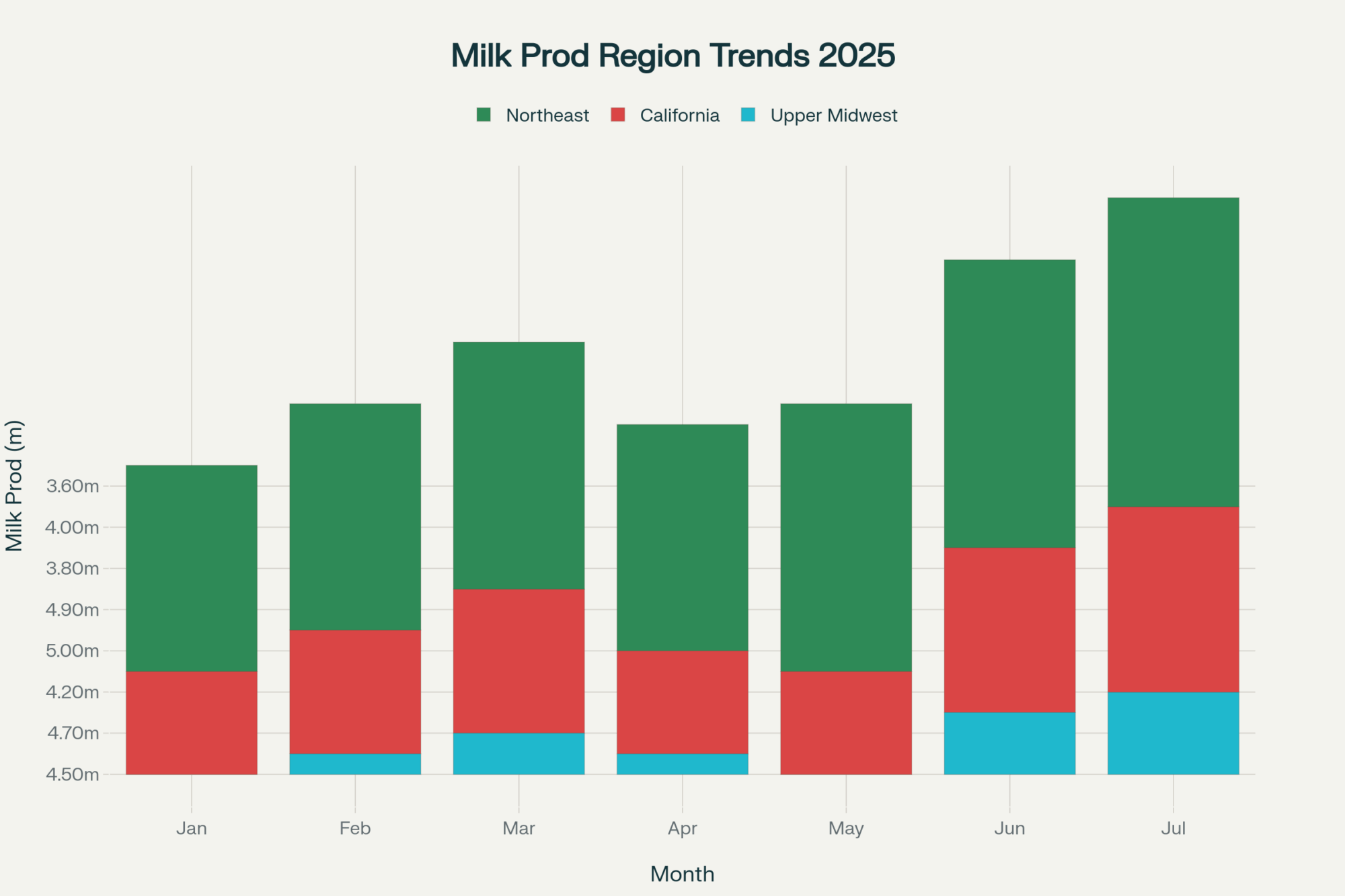
NewsSubscribe
First
Last
Consent

The July 2025 USDA WASDE REPORT: The Dairy Reality Nobody Wants to Talk About

That July report just flipped the script—but here’s what most producers are missing about what comes next.

dairy risk management, milk price volatility, farm efficiency strategies, precision agriculture dairy, dairy profitability optimization

You know that feeling when you’re scrolling through your phone over morning coffee and suddenly stop mid-sip? That’s exactly what happened when the USDA’s July 2025 WASDE report hit my desk last week. After months of producers bracing for financial pain, milk prices got a significant boost that should have every dairy operation rethinking their entire strategy.

Here’s the thing, though—and I’ve been mulling this over since the numbers dropped—while everyone’s celebrating the all-milk price forecast jumping to $22.00 per hundredweight for 2025 (up from those dire earlier projections), most folks are missing the real story. Sure, 2026 forecasts at $21.65 per hundredweight look decent too, but what strikes me about this latest data is how perfectly it demonstrates the kind of market whiplash that’s become our new normal.

Just think about it… months ago, producers across Wisconsin and Iowa were making contingency plans for $19-20 milk. Now we’re looking at $22+ projections. For your typical 500-cow operation, that’s not just numbers on a spreadsheet—that’s the difference between scraping by and actually having room to breathe.

But here’s what’s got me both excited and concerned: the USDA raised milk production forecasts for both 2025 and 2026 based on higher cow inventories and increased milk per cow. According to recent analysis from the University of Wisconsin’s dairy markets program, this kind of supply response to improved pricing often sets us up for the next volatility cycle. The industry learns to respond to good news… sometimes a little too well.

What’s particularly fascinating—and this might surprise you—is that these price improvements actually reinforce why building what I call “financial fortresses” has become more critical than ever. The operations that will thrive aren’t just those riding the good news cycles; they’re the ones using this window to build systems that can handle whatever volatility comes next.

Because let’s be honest—if markets can swing from pessimistic to optimistic this fast, they can swing back just as quickly.

What’s Really Driving These Numbers

The thing about the July WASDE report is that it tells a story that’s both encouraging and complex, and frankly, most of the trade press is missing some crucial details that could impact your decision-making over the next 18 months.

The Milk Price Reality Check

The latest WASDE data shows some genuinely positive developments. That $22.00 per hundredweight forecast for 2025 represents a meaningful improvement, but here’s what’s particularly interesting—and this is where my conversations with dairy economists get really valuable—the breakdown across different classes tells us where the real strength is coming from.

Dr. Mark Stephenson from Wisconsin’s Program on Dairy Markets and Policy recently pointed out in his monthly outlook that the Class IV price increase is being driven by higher butter and nonfat dry milk prices, while Class III actually got lowered due to cheese price adjustments. For 2026, butter, NDM, and whey prices are all projected higher, suggesting strength in component markets that smart producers can leverage.

What’s really exciting—and I’ll admit, I get a bit nerdy about export data—is that commercial dairy exports are being raised for both 2025 and 2026 on both fat and skim-solids basis. According to the USDA’s Foreign Agricultural Service, this indicates stronger international demand that’s supporting domestic pricing. This export strength provides some foundation for optimism that goes beyond just domestic supply-demand dynamics.

But here’s where it gets interesting… and a little concerning. Recent research from Cornell’s dairy program suggests that rapid price improvements often coincide with production expansions that can create oversupply situations down the road. We’re seeing exactly that pattern in the current forecasts.

Feed Costs: The Other Half of the Equation

While everyone’s celebrating milk prices, the feed cost story is equally important—and honestly, it might be even better news for your bottom line. The July report shows corn production forecast at 15.705 billion bushels for 2025/26, down 115 million bushels from June projections due to lower planted and harvested area.

Now, you might think lower corn production means higher feed costs, but here’s the interesting part: the season-average farm price for corn is staying put at $4.20 per bushel. Feed and residual use was actually cut by 50 million bushels based on lower supplies, which suggests we’re looking at relatively stable input costs for the immediate future.

What’s got me particularly optimistic is how soybean meal prices were lowered $20 to $290 per short ton. For dairy operations—especially those in the Midwest, where transportation costs are lower—this combination of stable corn and cheaper soybean meal could improve feed cost margins by $0.30-0.50 per hundredweight when combined with the higher milk price forecasts.

I was talking with a nutritionist friend in Ohio last week (this is becoming more common in our industry), and she mentioned that operations implementing precision feeding systems are seeing even better results when input costs stabilize like this. The technology works best when you’re not constantly adjusting for wild price swings.

Market Volatility: The New Constant

Here’s what really gets me thinking… the rapid shift from pessimistic to optimistic forecasts demonstrates exactly why resilient planning systems have become essential. Markets that can swing from concern to optimism within a few months—well, they’re going to swing back eventually.

Current milk production forecasts are being raised based on higher cow inventories and increased milk productivity per cow. Industry experts I’ve spoken with suggest that this reflects improved margins, encouraging expansion, but it also means we could be setting ourselves up for oversupply situations if demand doesn’t keep pace.

According to recent work from UC Davis’s dairy economics group, this pattern of supply response to price improvements has historically led to market corrections within 18-24 months. Not trying to be a pessimist here, but the data suggests we should use this favorable window strategically.

Building Financial Resilience: What Smart Producers Are Doing Now

The improved price outlook creates opportunities, but the producers I know who’ve survived multiple market cycles aren’t just celebrating—they’re using this period to strengthen their operations for whatever comes next.

USDA Dairy Margin Coverage program performance showing the dramatic swing from record highs in late 2024 to projected compression in 2025

Government Programs: Strategic Leverage

The Dairy Margin Coverage program becomes even more valuable as a strategic tool when markets are improving. Brian Gould from Wisconsin’s dairy markets program recently noted that with current price forecasts showing stronger margins, this is actually the optimal time to evaluate whether your coverage levels are positioned for the new market reality.

Here’s what’s interesting about the Dairy Revenue Protection program—it offers quarterly revenue protection that becomes particularly valuable when you’re operating with higher baseline revenues. I’ve been talking with producers who are using this combination to provide both margin protection and revenue stability, which honestly has become essential regardless of whether markets are moving up or down.

What many producers don’t realize—and this came up in a conversation with a risk management consultant in Minnesota—is that strong market periods are actually the best time to implement protective strategies. When cash flows are better, operations have more flexibility to invest in systems that will protect them when markets inevitably turn challenging again.

Advanced Risk Management: Capitalizing on Opportunity

The improved price outlook creates opportunities for more sophisticated hedging strategies. With milk prices at $22.00 per hundredweight for 2025, operations can consider forward contracting strategies that lock in profitable margins while maintaining exposure to potential upside.

Options trading becomes particularly attractive in improving markets because it allows producers to maintain upside potential while protecting against downside risk. Recent analysis from the Chicago Mercantile Exchange shows that current price environments provide opportunities to implement protective strategies at relatively attractive premium costs.

What’s working in practice—and I’ve seen this across operations in different regions—is using the improved market outlook to implement blended strategies. Smart producers are contracting maybe 40% of production to guarantee profitable margins while leaving exposure to capture additional gains if markets continue strengthening.

Operational Excellence: The Foundation

You can’t hedge your way to long-term success without operational excellence, and improving markets provide the cash flow flexibility to invest in productivity improvements that create enduring value.

Feed Efficiency in the Current Environment

With corn prices stable at $4.20 per bushel and soybean meal costs declining to $290 per short ton, precision feeding systems can deliver enhanced returns. Research from Penn State’s dairy nutrition program shows that operations implementing advanced feed management systems can potentially save $0.75-1.25 per hundredweight in production costs while optimizing milk components.

I visited a 1,200-cow operation near Lancaster last month that’s been running precision feeding for about 18 months. “The ROI is real,” the manager told me, “but the consistency is what really matters. We’re hitting our butterfat targets every month now, not just when everything goes right.”

The combination of stable feed costs and improved milk prices creates favorable conditions for these investments. Operations that implement precision ration formulation during this period can build sustainable advantages that serve them well, regardless of future market conditions.

Component Optimization Strategy

Current market conditions show particular strength in butter and NDM prices, making component optimization especially valuable. Each 0.1% increase in butterfat content can add $0.15-0.20 per hundredweight to milk checks, and the current price environment may provide even better returns.

Here’s what’s working: I know a 350-cow operation in Vermont that worked systematically with their nutritionist to optimize components while maintaining overall production efficiency. They adjusted their TMR formulation, modified their breeding program to emphasize component traits, and invested in better feed storage. The result? Their average butterfat increased from 3.65% to 3.82% over 18 months, adding approximately $0.34 per hundredweight to their milk check.

Operations that focus on component optimization during favorable market periods often maintain those advantages even when overall market conditions become more challenging.

Climate Adaptation: Building for the Long Haul

Comparison of annual return on investment per cow for different climate adaptation and efficiency strategies

Improved market conditions provide the financial flexibility to invest in climate resilience, positioning operations for sustained success regardless of weather challenges. And frankly, with the summers we’ve been having…

Heat Stress Management: The Numbers Don’t Lie

Current price forecasts make cooling system investments even more attractive from an ROI perspective. With milk prices at $22.00 per hundredweight, the revenue maintained through effective heat stress management becomes more valuable.

Research from the University of Florida shows that properly designed cooling systems typically pay for themselves within 18-24 months through maintained milk production, but higher milk prices accelerate these payback periods. I know operations investing in these systems during favorable market periods that are seeing payback in 12-18 months while creating enduring operational advantages.

A 500-cow operation in Texas that I worked with last year invested $125,000 in a comprehensive cooling system. The manager told me, “We wish we’d done this five years ago. Summer milk production increased by 8%, breeding efficiency improved by 15%, and our vet costs dropped by 20%. The investment paid for itself in less than two years.”

Genetic Selection: The Long Game

The integration of heat tolerance into breeding programs becomes more attractive when cash flows support long-term investments. Holstein Association USA’s genomic evaluations for heat tolerance allow producers to select for climate resilience without sacrificing production traits.

What’s particularly interesting—and this comes from recent research at the University of Georgia—is how heat tolerance traits are being incorporated without sacrificing production or component quality. The SLICK gene, which creates a short, sleek hair coat that enhances heat dissipation, is being used in crossbreeding programs across the South with impressive results.

Current market conditions provide the financial stability to implement breeding programs focused on long-term sustainability rather than just immediate production gains. These investments pay dividends over multiple market cycles.

Technology Integration: Investing for the Future

Favorable market conditions create opportunities to implement technology solutions that provide persistent operational benefits. But here’s the thing—not all technology investments are created equal.

Precision Agriculture: What’s Actually Working

The current price environment makes precision agriculture investments more attractive from a cash flow perspective. Wearable sensors, automated monitoring systems, and precision feeding technologies require initial investments but deliver ongoing advantages.

According to recent surveys from Progressive Dairy, operations implementing precision agriculture during favorable market periods can develop systems that enhance efficiency and reduce costs, regardless of future market conditions. The key is selecting technologies that address specific operational challenges, rather than pursuing technology for its own sake.

I’ve been tracking adoption rates across different regions, and what’s fascinating is how the Midwest and Northeast are seeing faster uptake due to labor constraints, while Western operations are focusing more on resource efficiency technologies. Current milk price forecasts provide the financial flexibility to invest in integrated systems that combine multiple technologies for maximum operational benefit.

Data Analytics: Making Sense of Information

Improved cash flows enable investments in data analytics platforms that track production trends and identify opportunities for efficiency. The most successful systems integrate seamlessly with existing management practices, providing valuable insights that support informed decision-making.

An 800-cow operation in Michigan that I know implemented a comprehensive herd management system integrating feed management, reproduction, and financial tracking. “The system helped us identify patterns we never would have seen otherwise,” the manager explained. “We discovered that our reproduction efficiency was directly correlated with feed delivery timing—something we’d never connected before.”

Regional Strategies: Adapting to Local Realities

The improved national price outlook affects different regions differently, and understanding these regional variations is crucial for effective strategy development. Because let’s face it—dairy farming in Wisconsin is different from dairy farming in California.

Midwest Opportunities

Midwest operations benefit from both improved milk prices and relatively stable feed costs. The combination of $22.00 per hundredweight milk prices and $4.20 per bushel corn creates favorable margins for efficiency improvements and technology investments.

Regional feed cost advantages in the Midwest become more pronounced when national milk prices improve. I recently spoke with an operator in Iowa who is leveraging these advantages to invest in productivity improvements that capitalize on their natural cost benefits. Corn costs typically run $0.25-0.50 per bushel below national averages, while soybean meal costs are often $15-25 per ton lower.

The weather volatility is real, though. Spring flooding and summer droughts are becoming more frequent, making feed storage and climate adaptation investments increasingly important. Operations that have invested in climate-controlled storage and comprehensive drainage systems are maintaining more consistent performance.

Western Adaptation

Western operations face unique challenges, including water costs and extreme climate conditions, but improved milk prices provide better margins to invest in solutions. The higher price environment makes water-efficient technologies and advanced cooling systems more economically attractive.

Scale advantages in Western operations become more pronounced during favorable market periods. Operations with 1,000+ cows can justify technology investments that smaller operations can’t, including robotic milking systems, precision feeding, and comprehensive environmental monitoring.

Water costs and availability create unique constraints, though. In California, water costs can add $0.15-$ 0.25 per hundredweight to production costs, making water-efficient technologies and management practices essential.

Northeast Premium Markets

Northeast operations benefit from both improved national pricing and continued opportunities for premium pricing through direct marketing channels. The combination creates opportunities for value-added processing and direct sales that capture additional margins beyond commodity pricing.

Direct marketing opportunities are particularly strong in the Northeast. Operations with access to metropolitan markets can often capture premiums of $3 to $ 5 per hundredweight through direct sales to processors serving premium retail channels.

The key is balancing these opportunities with risk management. Higher costs mean less margin for error, making programs like DMC and DRP particularly valuable for smaller operations that can’t absorb major market swings.

Implementation: Making It Work in Practice

Improved market conditions create opportunities, but successful implementation requires systematic approaches that build on favorable conditions rather than simply hoping they continue. Here’s what I’m seeing work across different types of operations…

Quick Wins in a Stronger Market

DMC and DRP Optimization: This is something you can tackle this month. Review and optimize coverage levels based on current price forecasts and margin projections. Higher baseline prices may justify different coverage strategies than were appropriate during lower price periods.

The key is analyzing your actual feed costs and production levels to determine optimal coverage. Operations with lower feed costs (typically Midwest) often benefit from higher coverage levels, while operations with higher feed costs might optimize at lower coverage levels with supplemental private insurance.

Component Premium Analysis: Evaluate component premiums across multiple buyers to capture the full benefit of current market strength in butter and NDM pricing. Market improvements often create premium opportunities that weren’t available during weaker periods.

I know this sounds basic, but premium differences of $0.30-0.50 per hundredweight for the same milk in the same region are more common than you might think. It’s worth a few phone calls to make sure you’re getting paid fairly for what you’re producing.

Feed Efficiency Quick Wins: With stable corn prices and lower soybean meal costs, implement feeding improvements that deliver immediate returns while establishing long-term efficiency gains. Working with your nutritionist to evaluate current feeding practices often identifies immediate opportunities.

Simple changes like improving TMR mixing consistency, adjusting feeding schedules, or optimizing bunk management can deliver returns of $0.25-0.50 per hundredweight within 30-60 days.

Medium-Term Strategic Investments

Technology Integration: Use improved cash flows to implement precision agriculture and automation systems that provide enduring operational benefits. Current market conditions make these investments more attractive from both cash flow and ROI perspectives.

The most successful implementations I’ve seen start with specific problems—such as improving reproduction efficiency, reducing feed waste, or optimizing component levels—and then select technologies that address those problems. Operations that try to implement everything at once typically struggle with integration and training challenges.

Current implementation costs vary significantly by technology and operation size. Precision feeding systems typically run $15-25 per cow for smaller operations (under 500 cows) and $8-12 per cow for larger operations. Wearable monitoring systems cost $40-60 per cow initially, with ongoing costs of $8-12 per cow annually.

Infrastructure Development: Invest in climate adaptation systems, feed storage improvements, and facility upgrades that address multiple operational challenges while market conditions support capital investments.

The key is prioritizing investments that address multiple challenges simultaneously. A climate-controlled feed storage facility addresses feed quality, waste reduction, and weather resilience. Comprehensive cooling systems enhance animal comfort, improve milk quality, and increase reproduction efficiency.

Market Diversification: Explore direct marketing opportunities and value-added processing options that can provide revenue stability and premium pricing beyond commodity markets.

The key is to start small and build based on market response and operational capacity. Many successful diversification efforts begin with 10-15% of production and expand based on demonstrated success.

Long-Term Competitive Positioning

Genetic Improvement Programs: Implement breeding strategies focused on climate tolerance, feed efficiency, and component quality that deliver advantages across multiple market cycles.

The most successful programs integrate heat tolerance with production traits and component quality. Current genetic evaluation tools make it possible to select for multiple traits simultaneously without sacrificing overall performance.

Research from various land-grant universities suggests that operations selecting for heat tolerance genetics are seeing 10-15% better summer performance compared to conventional genetics, with some programs reporting even better results during extreme heat events.

Operational Scaling: Evaluate expansion opportunities or efficiency improvements that leverage improved market conditions while establishing long-term competitive positioning.

Whether expanding or optimizing existing facilities, scaling decisions require a comprehensive analysis of market conditions, financing, and management capacity. The most successful expansions I’ve seen are those that maintain focus on operational excellence while growing.

Where the Industry Goes from Here

The improved milk price forecasts in the July WASDE report provide welcome relief for dairy producers, but they also reinforce the importance of building operations that can thrive regardless of market conditions. And honestly, that’s what separates the survivors from the thrivers in this business.

Success Patterns in Volatile Markets

The most successful operations treat improved market conditions as opportunities to invest in systems that provide advantages during both good times and challenging periods. They’re not just celebrating better prices—they’re using the improved cash flows to create sustainable operational benefits.

What’s particularly interesting is how these operations approach market improvement. They recognize that favorable conditions are temporary and use them strategically to strengthen their foundations for whatever comes next. According to research from several dairy economics programs, operations that invest during favorable periods consistently outperform those that simply ride the cycles.

I’ve been tracking patterns across different regions and operation sizes, and the farms that consistently perform well share several characteristics: they treat risk management as a core business function, invest in people and systems that can adapt to changing conditions, maintain focus on operational excellence while implementing new strategies, and build relationships with service providers who understand their specific challenges.

Building Sustainable Advantages

The dairy operations that will thrive over the long term are those that use favorable market periods to invest in operational excellence, technology adoption, and protective systems that provide advantages regardless of market conditions.

Current price improvements create opportunities, but smart producers are using this period to build resilient operations that can handle whatever volatility the future brings. Because if there’s one thing we know for certain about dairy markets, it’s that they’ll keep changing.

Your Strategic Decision Point

The question isn’t whether to celebrate the improved milk price forecasts—it’s whether you’ll use this opportunity to create enduring operational advantages or simply hope that favorable conditions continue. And frankly, hope isn’t much of a business strategy.

The July WASDE report shows all-milk prices at $22.00 per hundredweight for 2025, providing improved margins that create strategic opportunities. But markets that can swing from pessimistic to optimistic forecasts within months will inevitably swing back, and the operations that prepare for that reality will be the ones that thrive long-term.

Here’s what I keep coming back to in conversations with producers across the country: the tools, strategies, and support systems exist today to build resilient, profitable operations that can prosper in any market environment. The question is whether you’ll implement these strategies while market conditions provide the cash flow flexibility to do so effectively.

Current market improvements provide a window of opportunity to build operational resilience, but that window won’t stay open indefinitely. The operations that recognize this reality and act strategically now will be positioned to thrive regardless of what market conditions emerge next.

Are you building operational resilience with the improved resources these market conditions provide, or are you simply hoping that good times continue? The choice is yours, but the opportunity to create sustainable advantages may not present itself again soon.

Because at the end of the day, the producers who build financial fortresses during good times are the ones who sleep well during bad times. And in this business, that peace of mind is worth more than any short-term price improvement.

Strategic Action Guide for Current Market Conditions

Immediate Opportunities (Next 30 Days): Start by optimizing your DMC and DRP coverage based on that $22.00 per hundredweight baseline pricing. Take a hard look at component premium capture with current butter and NDM strength—you might be surprised what you find. Implement feed efficiency improvements while corn costs are stable, and honestly assess technology investment opportunities now that cash flow has improved.

Strategic Investments (Next 3-6 Months): This is the time to develop those integrated protection systems we’ve been talking about. Build climate adaptation infrastructure that’ll serve you for decades. Integrate precision agriculture technology that addresses your specific challenges, not just the latest gadgets. Evaluate market diversification opportunities that make sense for your operation and region.

Long-Term Competitive Positioning (6-24 Months): Establish genetic selection programs for climate resilience and efficiency—this is a marathon, not a sprint. Complete operational scaling or efficiency optimization projects while financing is favorable. Implement advanced automation and data analytics that’ll give you an edge for years to come. Develop sustainable operational advantages that’ll serve you through multiple market cycles.

Key Performance Metrics: Monitor margin stability across market cycles, track operational efficiency improvements, measure component optimization progress, and evaluate technology ROI achievement. But remember—the best metrics are the ones that help you make better decisions, not just track what happened.

KEY TAKEAWAYS

  • Lock in profitable margins while you can: With DMC and DRP programs, you can optimize coverage levels based on $22/cwt baseline pricing—higher baseline prices justify different strategies than what worked during $19-20 milk, potentially saving thousands in premium costs while improving protection
  • Feed efficiency pays double right now: Precision ration formulation delivers $0.75-1.25/cwt savings when corn’s stable at $4.20/bushel and soybean meal dropped $20 to $290/ton—implement these systems during favorable cash flow periods for 18-24 month paybacks that compound over time
  • Component optimization hits different in this market: Butter and NDM strength means each 0.1% butterfat increase adds $0.15-0.20/cwt to milk checks—work with your nutritionist now to capture these premiums while markets support the investment in better genetics and feeding programs
  • Climate adaptation ROI accelerates with higher milk prices: Cooling systems that normally pay for themselves in 18-24 months are hitting 12-18 month paybacks when milk revenue per cow increases—invest in heat stress management while cash flows support the capital expenditure
  • Regional advantages compound during price improvements: Midwest operations with $0.25-0.50/bushel corn advantages and Northeast farms capturing $3-5/cwt direct marketing premiums should leverage these natural benefits to implement technology and infrastructure that smaller margins couldn’t justify

EXECUTIVE SUMMARY

Look, I get it—seeing $22.00 per hundredweight for 2025 milk prices feels pretty good after the doom and gloom we’ve been hearing. But here’s the thing most producers are missing: the smart money isn’t celebrating these WASDE numbers, they’re using this window to build operations that can handle whatever volatility comes next. We’re talking about precision feeding systems that can save you $0.75-1.25 per hundredweight while corn sits stable at $4.20 per bushel, and component optimization strategies that add $0.15-0.20 per hundredweight for every 0.1% butterfat increase. The global dairy markets are showing us that what goes up comes down fast—just look at how we swung from pessimistic to optimistic forecasts in months. European producers learned this lesson the hard way after milk quotas ended, and the ones who survived built fortress operations during good times, not bad ones. You’ve got maybe 18 months of favorable conditions to implement the risk management systems, climate adaptation, and operational improvements that’ll keep you profitable when markets inevitably swing back—don’t waste it hoping good times continue.

Complete references and supporting documentation are available upon request by contacting the editorial team at editor@thebullvine.com.

Learn More:

The Sunday Read Dairy Professionals Don’t Skip.

Every week, thousands of producers, breeders, and industry insiders open Bullvine Weekly for genetics insights, market shifts, and profit strategies they won’t find anywhere else. One email. Five minutes. Smarter decisions all week.
NewsSubscribe
First
Last
Consent

CME Daily Dairy Market Report: July 9, 2025 – Butter Tumbles 5.5¢ – But Feed Cost Relief Softens the Blow

Butter tanked 5.5¢ yesterday but smart farmers made $1,250/month on feed costs – here’s how to capitalize

EXECUTIVE SUMMARY: Look, I get it… seeing butter drop 5.5¢ in one day makes your stomach turn. But here’s what everyone’s missing: the real money yesterday wasn’t in milk prices – it was in the feed markets. Soybean meal crashed $11.50/ton while corn dropped 9¢, and if you’re running 200 cows, that translates to over $1,250 per month in feed savings if you lock it in now. Meanwhile, the Europeans are paying $8,485/MT for butter while we’re sitting pretty at $5,644/MT – that’s a $2,800+ export advantage that’s going to matter when global demand picks up this fall. The USDA’s projecting Class III futures above $18.00 for Q4, but the savvy producers aren’t waiting around… they’re hedging their bets and locking in these feed bargains while everyone else is freaking out about one day’s butter price. You should be doing the same thing.

KEY TAKEAWAYS

  • Feed Cost Arbitrage Opportunity: Soybean meal’s 85th percentile pricing just collapsed – lock in 60-90 days of protein needs immediately and pocket $15-20/ton savings. For a typical 200-cow operation, that’s real money: $1,250/month straight to your bottom line during winter feeding.
  • Component Premium Play: Class IV’s trading at a $1.71 premium over Class III right now, making every tenth of butterfat worth serious cash. Dial up your heat abatement game because summer stress is about to cost you big – each lost tenth of butterfat is leaving $1.00+ per cwt on the table.
  • Export Window Opening: U.S. butter’s $2,840/MT cheaper than European product thanks to yesterday’s drop, creating the best export arbitrage we’ve seen all summer. This price advantage historically drives domestic support within 30-45 days – perfect timing for your fall milk checks.
  • Risk Management Sweet Spot: Q4 Class III futures still holding above $18.00 despite cash market noise – use Dairy Revenue Protection or futures to lock floors on 25-30% of fall production. With USDA forecasting only 0.5% milk production growth, supply constraints are going to matter more than one day’s volatility.
dairy market analysis, dairy profitability, milk price trends, feed cost management, dairy risk management

Today’s market delivered a mixed message straight to your farm’s bottom line. Butter’s sharp 5.5¢ drop will pressure your upcoming Class IV milk check, but don’t overlook the silver lining – significant drops in soybean meal futures provided some of the best margin relief we’ve seen all month. Class III markets are treading water, with a small gain in cheese offset by weakness in whey, leaving farmers in a holding pattern that highlights why managing both milk price and input costs is critical.

Today’s Price Action (Make It Real for Farmers)

ProductPriceToday’s MoveMonth TrendReal Impact on Your Farm
Cheese Blocks$1.6950/lb+0.25¢+0.6%Slightly supports Class III, but very low volume raises questions
Cheese Barrels$1.7275/lbNC+1.0%The market is taking a breather, waiting for a clearer signal
Butter$2.5625/lb-5.50¢-2.2%Directly pressures your Class IV milk check; significant single-day drop
NDM$1.2675/lbNC+0.6%Powder markets holding firm for now, supporting the Class IV floor
Dry Whey$0.5900/lb-1.50¢-1.2%This weakness is a direct drag on the Class III price calculation

Market Commentary

The story of the day was butter’s sharp sell-off. After holding strong above $2.60, the market broke decisively lower on decent volume. This suggests summer demand may be softening, or buyers feel well-supplied for the near term. This will weigh heavily on the July Class IV price.

On the Class III side, the picture’s murky. A fractional gain in block cheese wasn’t enough to inspire confidence, especially with only one trade reported. More concerning is the 1.50¢ drop in dry whey, which acts as an anchor on Class III pricing. The fact that July Class III futures managed to close up $0.10 to $17.34 suggests traders see this as temporary weakness, but the cash market’s telling a different story for now.

Trading Floor Intelligence & Market Mechanics

Bid/Ask Spreads & Volume Analysis

  • Butter: Sellers were motivated. Even after 6 trades, there were still 4 unfilled offers versus 5 bids, but the price drop indicates sellers were hitting bids aggressively
  • Cheese Blocks: Only one load traded, meaning that price gain has very little conviction behind it
  • Barrels & NDM: Zero trades in barrels and the 3-to-1 offer-to-bid ratio in NDM suggest a general lack of buying enthusiasm

Order Book Analysis

Butter sliced right through the psychological support level of $2.60/lb. The next key level to watch will be around $2.55. For cheese, resistance remains firm near $1.70 on the blocks.

Intraday Patterns

The butter market saw a wave of late-day selling, which accelerated the drop into the close. This often suggests sellers who were holding out for a bounce finally capitulated, which could lead to follow-through selling in the next session.

Global Market Competitive Landscape

International Production Watch

  • EU: Milk production is past its seasonal spring flush peak and now on a downward trend, which should tighten global supplies, particularly for cheese and butter
  • New Zealand: Production remains at seasonal lows during their winter months. Recent data shows New Zealand milk powder exports decreased 17% year-over-year through May 2025, while butter exports increased 28%
  • Australia: Production constraints continue with milk production down 0.4% from July 2024 through April 2025. Australian milk export volumes totaled 136,089 metric tons, down 11.3% from the previous year

Where We Stand Globally

Today’s butter price drop to ~$2.56/lb ($5,644/MT) makes U.S. butter more competitive against European offers. Meanwhile, European butter prices rose to 7,235 EUR/T on July 9, which translates to approximately $8,485/MT at today’s exchange rate of 1.1725 USD/EUR, maintaining a significant premium over U.S. offers and creating a favorable export window for American producers.

U.S. NDM at $1.2675/lb ($2,794/MT) remains competitive in key markets, with U.S. dairy exports starting 2025 with a 0.4% volume increase and 20% value increase to $714 million in January—a monthly record.

Feed Costs & Your Bottom Line

The best news for your operation today came from the feed markets:

  • Corn (Dec ’25): $4.16/bu (down 9¢)
  • Soybean Meal (Dec ’25): $282.90/ton (down $11.50 from Monday)

Milk-to-Feed Price Ratio Improvement

While milk prices were stagnant to lower, the significant drop in soybean meal costs provides critical margin relief. Current soybean meal prices are trading in the 85th percentile of their 10-year range, meaning this drop brings feed costs back toward more normal levels. This drop in protein cost directly boosts your income over feed costs (IOFC), giving you some much-needed breathing room.

Production & Supply Reality Check

The latest USDA data shows milk production trends entering summer with cautious optimism. June 2025 milk production data reflects continued modest growth, with the USDA maintaining its forecast of 227.3 billion pounds for 2025, up 0.4 billion pounds from previous projections. Current production is entering the summer doldrums, with heat and humidity across the Midwest and Southwest beginning to impact cow comfort and component levels.

U.S. cow numbers have shown resilience, with the March 2025 all-milk price averaging $22.00 per cwt, up $1.30 year-over-year. Strong margins in early 2025 – with the Dairy Margin Coverage (DMC) farm margin reaching $11.55 per cwt in March, $1.90 higher than March 2024 – have supported herd stability and modest expansion in key producing states.

The current weather pattern is the most significant factor for supply, as it will dictate both milk volume and the quality of homegrown forages for the rest of the summer.

What’s Really Driving These Prices

Domestic Demand

  • Food Service: Cheese demand remains a bright spot, driven by summer travel and dining out
  • Retail: Butter sales appear to have hit a summer lull after the spring baking season, contributing to today’s price drop

Export Markets – The Complete Story

Mexico Deep Dive

Our number one customer continues to be a steady buyer of U.S. cheese and NDM. U.S. cheese exports to Mexico grew just 1% in January 2025, but the stability of this relationship remains crucial for price support.

Southeast Asia & Global Expansion

The real export story is diversification. January 2025 cheese exports jumped 22% to 46,680 MT—a January record—with growth coming from Japan, Bahrain, Panama, and other diverse destinations. This broad market diversity reduces our dependence on any single buyer and supports stronger pricing power.

Risk Scenario Analysis

Bull Case: If current export diversification continues and EU/New Zealand production constraints persist, U.S. dairy could see Class III prices reach $19.00+ by Q4 2025.

Bear Case: A significant U.S. dollar rally or Mexican economic disruption could push Class III below $16.00, making risk management critical.

Base Case: Current USDA forecasts project Class III averaging $17.50-18.50 and Class IV at $18.75-19.75 through 2025.

Forward-Looking Analysis with Official Forecasts

USDA Projections Integration

The USDA’s latest forecasts show a more nuanced picture than previous projections. The revised 2025 milk production forecast of 227.3 billion pounds reflects both modest herd expansion and improved productivity. While milk production growth of 0.5-0.8% appears modest, regional variations are significant. The forecast indicates tighter supplies could support prices, but international competition remains a key variable.

Futures Market Guidance

  • Class III Futures: August settled at $17.65 and September at $17.90, indicating the market expects prices to climb into the fall
  • Class IV Futures: August settled at $19.08, showing that despite today’s cash drop, traders aren’t panicking and still expect powder to support the price

Current futures indicate a $1.71 premium for Class IV over Class III, making high-component production strategies particularly attractive.

Regional Market Spotlight: The Upper Midwest (WI, MN)

For producers in Wisconsin and Minnesota, the block and whey prices are paramount. Today’s fractional gain in blocks is welcome but offers little comfort when offset by the steep drop in whey values.

Regional production data shows Wisconsin and Minnesota maintaining steady output, with processing plants reporting 95%+ capacity utilization to meet summer demand. Excellent growing conditions have local feed supplies in good shape, but heat and humidity are starting to be a concern for production. Local cooperatives are encouraging members to forward contract 25-30% of fall production, taking advantage of strong deferred futures prices.

What Farmers Should Do Now

Feed Purchasing – Act Now

This is a clear opportunity. The significant drop in soybean meal futures is a strong signal to contact your nutritionist and feed supplier to lock in a portion of your fall and winter protein needs. With meal prices dropping from elevated levels, this represents potential savings of $15-20 per ton compared to recent months. For a 200-cow herd consuming approximately 2.5 tons of soybean meal per month, locking in these lower prices could translate to $1,250 in feed cost savings per month this winter – money that goes straight to your bottom line.

Hedging Strategy

With Class III futures for Q4 2025 still holding above $18.00, consider using Dairy Revenue Protection (DRP) or layering in some futures/options positions to protect a floor on a portion of your fall production. The $1.71 Class IV premium makes component-focused strategies particularly attractive.

Production Focus

With heat setting in, double down on heat abatement. Every tenth of a pound of butterfat you can save will be critical, especially with a weaker butter price. The current Class IV premium means butterfat optimization could add $1.00+ per cwt to your milk check.

Industry Intelligence

Regulatory Update

Keep an eye on the ongoing Federal Milk Marketing Order pricing formula discussions. Any changes to component values or make-allowances could have long-term impacts far greater than any single day’s trading.

Cooperative Note

Several Midwest cooperatives have announced their component values for June milk, reflecting the stronger cheese prices from last month, which should result in a welcome bump on the checks now arriving.

Export Infrastructure

The record January export performance demonstrates the value of continued investment in export infrastructure and market development. The 22% increase in cheese exports shows the benefits of market diversification strategies.

Put Today in Context

Today’s 5.50¢ drop in butter was the largest single-day loss in over a month and pulled the weekly average down. This move is a departure from the steady-to-firm trend we’ve seen since May, representing a price level that’s still 8.4% higher than a year ago but down 2.96% from recent peaks.

Conversely, the cheese market continues its slow, sideways grind. Compared to last year, current Class III values are lagging, but lower feed costs are keeping 2025 margins ahead of where they were in the summer of 2024. The milk production forecast showing only modest growth suggests supply constraints could support prices into the fall.

Today wasn’t a seismic shift, but it was a clear warning shot on the Class IV side and a gift on the feed side. The key takeaway is that successful dairy operations in 2025 will need to actively manage both sides of the margin equation—milk pricing and feed costs—rather than relying on either factor alone.

Complete references and supporting documentation are available upon request by contacting the editorial team at editor@thebullvine.com.

Learn More:

The Sunday Read Dairy Professionals Don’t Skip.

Every week, thousands of producers, breeders, and industry insiders open Bullvine Weekly for genetics insights, market shifts, and profit strategies they won’t find anywhere else. One email. Five minutes. Smarter decisions all week.

NewsSubscribe
First
Last
Consent

Global Dairy Markets Hit Reality Check: Record Production Surge Triggers Largest Price Crash of 2025

Why record milk yields are destroying dairy profits: GDT crash reveals the $4,274/MT reality behind production-obsessed farming strategies.

EXECUTIVE SUMMARY: The dairy industry’s obsession with maximum milk production has finally hit the wall of economic reality, proving that bigger isn’t always better when markets collapse. Global Dairy Trade auction results delivered a brutal 4.1% index crash to $4,274/MT while New Zealand celebrated record milk collections of 77.0 million kgMS (+7.5% year-over-year) – the perfect storm of supply overwhelming demand. With Chinese farmgate prices collapsing 8.0% to just 3.05 Yuan/kg and WMP prices plummeting 5.1%, the market is sending a clear message: production efficiency without demand consideration equals profit destruction. Ireland’s explosive 6.5% milk collection growth and New Zealand’s 18.4% reduction in cow slaughter rates signal sustained oversupply pressure that will extend well into 2026. The disconnect between Singapore Exchange futures (+0.8%) and physical GDT prices (-5.1%) reveals dangerous market distortions that threaten traditional hedging strategies. Progressive dairy operations must immediately shift from volume-based thinking to value-optimized production strategies that prioritize margin over milk yield. Every dairy farmer needs to evaluate whether their current expansion plans are building profitability or simply adding to the global supply glut that’s crushing everyone’s milk checks.

KEY TAKEAWAYS

  • Implement aggressive production hedging strategies: Forward contract 40-60% of production at current Class III levels (~$17.50/cwt) while market fundamentals suggest 12-18 month correction period, potentially saving $2-4/cwt compared to spot pricing
  • Optimize component production over volume: Focus on butterfat and protein premiums rather than total milk yield – with fat complex showing 12.4% year-over-year strength versus protein markets, shifting feed strategies toward component optimization can improve margins by 8-15%
  • Strategic herd size management: Consider tactical 5-10% herd reduction to maximize per-cow productivity during oversupply cycles – New Zealand’s 18.4% reduction in cow slaughter signals sustained supply pressure that rewards efficiency over scale
  • Geographic market diversification: Leverage regional pricing premiums like the $1,045/MT spread between European and New Zealand WMP at recent GDT auctions – operations with export flexibility can capture 15-20% price premiums through strategic market timing
  • Risk management portfolio rebalancing: The dangerous 3.1% basis divergence between SGX futures ($3,752/MT) and GDT physical prices ($3,859/MT) demands immediate hedging strategy review – traditional derivatives may not provide expected downside protection in current market structure
dairy market trends, milk production optimization, farm profitability strategies, global dairy markets, dairy risk management

Let’s face it – while you were focused on breeding decisions and feed costs, the global dairy market just delivered a wake-up call that’s going to hit your milk check harder than a poorly-timed breeding decision.

The first week of July 2025 marked the moment when months of building supply pressure finally overwhelmed global dairy demand, with the Global Dairy Trade (GDT) auction delivering its most devastating blow of the year – a 4.1% index crash to $4,274/MT. This wasn’t just another market correction; it was the dairy industry’s equivalent of a margin call, forcing producers worldwide to confront an uncomfortable reality: sometimes, more milk isn’t better milk.

Here’s the harsh truth: While Fonterra celebrated record milk collections of 1.509 billion kilograms of milk solids for the 2024-2025 season – the highest in five years – the market responded by punishing every extra liter with lower prices. The combination of New Zealand’s explosive 7.5% production growth and Ireland’s 6.5% surge has created a supply tsunami that’s drowning global prices.

The Numbers Don’t Lie: When Success Becomes Failure

Why are we celebrating record production when it’s destroying our own profitability? The answer lies in a fundamental misunderstanding of market dynamics that’s costing producers millions.

Fonterra’s May collections alone reached 77.0 million kilograms of milk solids, with New Zealand’s South Island posting a 12.3% increase compared to the previous year. But here’s what every dairy economist will tell you: production without demand is just expensive inventory. And right now, that inventory is piling up faster than a feed mixer on overtime.

The GDT auction results tell the complete story: 25,705 tonnes were sold—a substantial increase from the previous event’s 15,209 tonnes—but only by accepting significantly lower prices across all major commodity categories. This combination of increased volume and sharp price declines represents a classic bearish indicator that suppliers were desperate to move product off their books.

China’s Demand Collapse: The $50 Billion Question

Chinese farmgate milk prices fell to 3.05 Yuan per kilogram in June 2025, a 8.0% year-over-year decline. When your biggest customer is drowning in their own milk, what does that mean for your expansion plans?

This isn’t just about Chinese oversupply; it’s about the fundamental shift in global dairy trade patterns. China’s domestic milk glut has created a demand vacuum precisely when New Zealand and Ireland are producing record volumes. The result? A perfect storm where abundant supply meets non-existent demand.

The Chinese Ministry of Agriculture and Rural Affairs reported that farmgate prices stabilized at “bottom levels” during the fourth week of June. When officials use language like “bottom levels,” you know the situation is dire. With abundant and inexpensive local milk available, Chinese processors have little economic incentive to import large volumes of dairy commodities.

The Forward Indicators Nobody Wants to Talk About

Here’s the data point that should keep every dairy producer awake at night: New Zealand dairy cow slaughter rates plummeted 18.4% in May 2025 to only 137,983 head. Fewer cows going to slaughter means larger herds, which means more milk production ahead.

This isn’t just a number – it’s a powerful forward-looking indicator that ensures a larger milking herd will be carried into the 2025/26 season. The 12-month rolling slaughter figure is now down 11.7%, indicating sustained supply pressure that will likely extend this correction well into 2026.

Commodity Breakdown: Where the Pain Hit Hardest

Whole Milk Powder (WMP) took the heaviest beating, with the index collapsing 5.1% to $3,859/MT. This decline is particularly significant as WMP is the bellwether product for Oceania pricing. Fonterra’s Regular WMP for Contract 2 settled at $3,875/MT, a 4.67% drop from the prior event.

The fat complex wasn’t spared either. Butter prices fell 4.3% to $7,522/MT, while Anhydrous Milk Fat dropped 4.2% to $6,928/MT. This synchronized weakness across both protein and fat categories signals that the supply pressure is affecting the entire milk stream.

Even cheese markets felt the pressure, with Cheddar falling 2.8% to $4,860/MT and Mozzarella dropping 0.2% to $4,790/MT. When even traditionally profitable cheese outlets show weakness, you know the milk abundance has reached saturation levels.

The Bullvine Bottom Line: Strategic Actions for Different Operations

For Large-Scale Operations (500+ cows):

  • Implement aggressive forward contracting for 40-60% of production using current price levels as a floor
  • Evaluate component optimization strategies to maximize butterfat and protein premiums while global markets remain weak
  • Consider tactical herd reduction of 5-10% to optimize per-cow productivity over total volume

For Mid-Size Operations (100-500 cows):

  • Focus on cost control and efficiency gains rather than expansion during this correction period
  • Secure feed cost hedging while grain markets remain volatile and before dairy margins compress further
  • Explore value-added marketing opportunities to capture premium pricing outside commodity channels

For Smaller Operations (<100 cows):

  • Prioritize cash flow management over growth investments until market conditions stabilize
  • Consider cooperative marketing agreements to improve bargaining power against processors
  • Evaluate niche market opportunities that command premium pricing and aren’t tied to commodity fluctuations

Regional Market Dynamics: The Dangerous Divergence

European markets are reflecting the same supply pressure reality. EU butter prices managed only a negligible €10 (+0.1%) increase to €7,460/MT, while French Whole Milk Powder collapsed €300 (-6.7%) to €4,250/MT. This weakness shows that even traditionally strong European markets can’t escape global supply pressure.

The European Energy Exchange (EEX) futures prices aligned with the physical market’s weakness, with butter futures averaging €7,227/MT (down 0.4%) and SMP futures at €2,480/MT (down 0.3%). However, here’s where it gets interesting—and dangerous.

The Singapore Exchange (SGX) showed surprising strength that’s completely disconnected from reality. SGX WMP futures rose 0.8% to $3,752/MT while GDT physical prices crashed to $3,859/MT. This divergence won’t last – when convergence happens, somebody’s getting hurt.

The Uncomfortable Truth About Production Efficiency

Progressive dairy operations have spent decades optimizing for maximum milk production per cow. But what happens when maximum production becomes maximum pain? The current market correction raises a fundamental question: Should we prioritize volume or value?

The reality check is brutal: Ireland’s May collections jumped 6.5% year-over-year to 1.218 kilotonnes, with cumulative 2025 collections reaching 3.68 million tonnes, a 7.9% year-over-year increase. Poland achieved an all-time high for May milk solids production at 90.5 kilotonnes, up 2.0% year-over-year.

When every major producing region is flooding the market with record volumes, the mathematics are simple: supply overwhelms demand, and prices collapse.

Market Outlook: The Reality Check

The SGX-GDT basis divergence demands immediate attention. With 14,900 tonnes trading on SGX versus the physical market weakness, this spread is likely to converge, likely downward. When it does, the price movement could be swift and brutal.

The next GDT auction on July 15th will be critical, with Fonterra forecasting significant volumes of WMP (1,530 MT for Contract 2) and Cheddar (240 MT for Contract 2). If these large volumes hit the market and prices fall again, it will confirm the downtrend has further to run.

The Next 90 Days: Critical Decision Points

What should dairy producers be watching? Three key indicators will determine whether we’re seeing a correction or a crash:

  1. The July 15th GDT auction results – with large volumes of whole milk powder and cheddar forecasted
  2. Chinese import data for June and July – any sign of demand recovery could stabilize prices
  3. Northern Hemisphere milk production data – whether seasonal declines materialize or production remains stubbornly high

The Bullvine Bottom Line

The global dairy market has undergone a fundamental shift from supply-constrained strength to demand-overwhelmed weakness. The 4.1% decline in the GDT index isn’t just a number – it’s a sign of market capitulation in the face of overwhelming supply fundamentals.

Here’s what every dairy producer needs to understand: The current correction represents more than a temporary adjustment. With New Zealand’s 18.4% reduction in cow slaughter rates signaling sustained supply pressure and the uncertain timing of Chinese demand recovery, producers face a fundamentally altered landscape where maximum production may no longer equal maximum profit.

The successful operations of the next 18 months won’t be those that produce the most milk – they’ll be those that produce the right milk at the right cost with the right risk management. The market has spoken, and it’s saying that bigger isn’t always better.

The dairy industry’s uncomfortable truth? Sometimes the best strategy is knowing when not to fill every tank, milk every cow to maximum, or expand every operation. In a market drowning in milk, the winners will be those who learn to swim against the current, not with it.

Complete references and supporting documentation are available upon request by contacting the editorial team at editor@thebullvine.com.

Learn More:

The Sunday Read Dairy Professionals Don’t Skip.

Every week, thousands of producers, breeders, and industry insiders open Bullvine Weekly for genetics insights, market shifts, and profit strategies they won’t find anywhere else. One email. Five minutes. Smarter decisions all week.
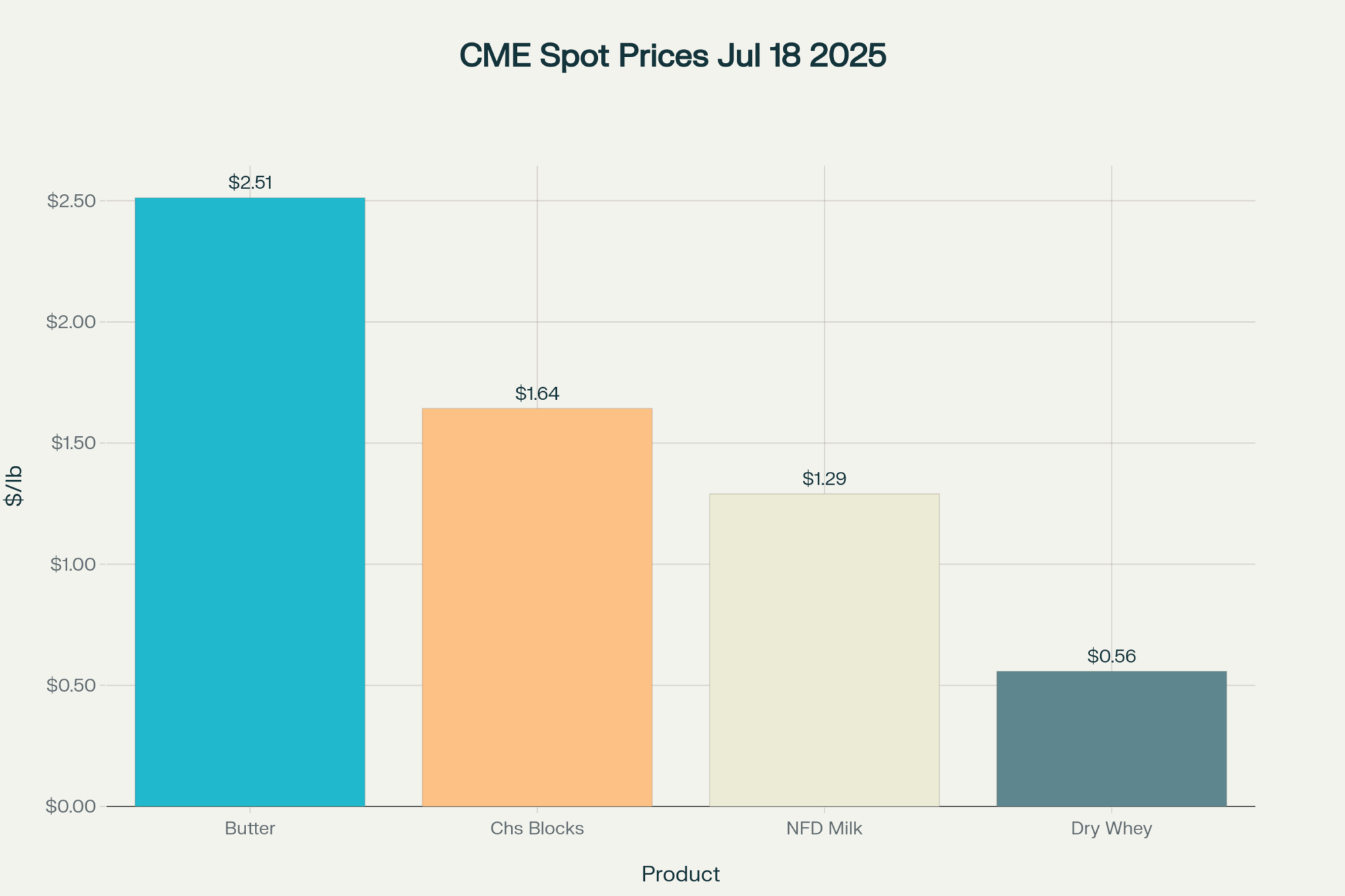
NewsSubscribe
First
Last
Consent

Washington Just Handed Dairy Farmers a $68 Billion Gift, But Here’s Why Most Won’t Unwrap It Properly

Washington handed dairy farmers $68B, but 80% won’t use it. Smart genomic testing + DMC coverage = $4,000 annual savings per 280-cow operation.

EXECUTIVE SUMMARY: Most dairy producers are about to waste the biggest policy gift in a decade while their smarter competitors capitalize on enhanced risk management combined with record component production. The “One Big Beautiful Bill” delivers $68.3 billion in agricultural program changes that fundamentally restructures dairy risk management, increasing Tier I DMC coverage from 5 million to 6 million pounds annually, yet based on historical uptake patterns, most operations will leave money on the table. Component levels have reached unprecedented highs with butterfat averaging 4.33% and protein at 3.36% in March 2025, representing 30.2% butterfat growth and 23.6% protein growth since 2011 while milk volume increased only 15.9%. European Union milk production is declining 0.2% in 2025 while U.S. operations benefit from enhanced DMC protection at just $0.15 per hundredweight for $9.50 coverage, creating unprecedented competitive advantages for producers who combine genetic advancement with strategic risk management. The question isn’t whether this policy works, it’s whether you’ll implement it before your competitors figure out the genomics-plus-government-support equation that’s reshaping dairy profitability.

KEY TAKEAWAYS

  • Enhanced DMC Coverage Delivers Immediate ROI: Operations producing up to 6 million pounds annually can now insure entire production at Tier I rates, potentially saving $3,000-4,000 annually in premium costs while gaining comprehensive $9.50 per hundredweight margin protection, yet only 19% of large-scale farms have adopted robotic milking systems despite proven economic returns.
  • Component Revolution Outpaces Volume Strategy: Butterfat production surged 30.2% since 2011 versus 15.9% milk volume growth, with genomic testing enabling 12% higher milk solids and 8% lower feed costs. Every 0.1% butterfat increase adds $6,570 monthly to a 1,000-cow operation when butterfat commands $3.06 per pound, yet most producers still chase volume over value.
  • Technology Adoption Gap Creates Competitive Moats: While global precision dairy farming markets exceed $5 billion in 2025, USDA reports only 19% adoption of robotic milking on large-scale farms. Forward-thinking operations combining enhanced DMC protection with automated milking systems achieve 150-240 cow efficiency per 3-4 robotic units, creating sustainable advantages over traditional competitors.
  • Global Market Positioning Window Closing: U.S. operations benefit from $8 billion in new dairy processing capacity through 2027 while EU production declines 0.2%, but 2025 DMC enrollment deadline passed March 31. Producers must audit genomic testing programs, evaluate technology investments, and prepare for 2026 enrollment to capitalize on component premiums and enhanced risk management before international competitors adapt.
  • Feed Cost Arbitrage Opportunity: With corn at $4.60 per bushel and enhanced DMC coverage protecting downside risk, smart operators can lock favorable feed contracts while leveraging updated 2021-2023 production baselines that reflect modern genetic gains. This combination of enhanced risk management plus strategic feed positioning creates unprecedented profit protection during volatile market conditions.

The U.S. Senate just passed the most significant dairy policy overhaul in a decade, and frankly, most of you won’t take advantage of it. The “One Big Beautiful Bill” includes $68.3 billion in agricultural program changes over 10 years that fundamentally restructure risk management for dairy operations nationwide. However, if history is any indication, too many producers will likely leave money on the table.

Here’s the reality: Washington doesn’t often get dairy policy right, but when it does, smart operators capitalize, while others complain about the paperwork. The enhanced Dairy Margin Coverage (DMC) program, launched in 2025, offers benefits that could fundamentally improve your operation’s financial resilience, provided you’re willing to challenge conventional thinking about government programs.

Why This DMC Enhancement Actually Matters (Unlike Previous Attempts)

Let’s cut through the political noise. The legislation expands DMC coverage capacity by 20%, increasing the Tier I production cap from 5 million to 6 million pounds annually. This isn’t just bureaucratic shuffling, it means operations with up to 300 cows can now insure their entire production at premium rates while accessing maximum protection levels of $9.50 per hundredweight.

However, here’s what most won’t tell you: this enhancement emerged during an unprecedented period of genetic progress. U.S. dairy operations have achieved four consecutive years of record butterfat levels, reaching a national average of 4.23% in 2024. Protein content has similarly climbed to 3.29% in 2024, marking eight consecutive annual records from 2016 to 2024.

What This Means for You: A 280-cow Wisconsin operation producing 5.8 million pounds annually can now insure their entire production at Tier I rates, potentially saving $3,000-4,000 annually in premium costs while gaining comprehensive margin protection. With current milk production forecasts reaching 227.8 billion pounds for 2025, these enhanced protections couldn’t come at a better time.

The updated production baselines represent the second game-changer. Producers can now select their highest annual milk production from 2021, 2022, or 2023 as their new coverage foundation. This addresses the reality that modern genetics and precision feeding have driven dramatic productivity gains, yet most operations still use outdated baselines that don’t reflect their actual potential.

The Component Revolution That’s Reshaping Everything

Here’s where it gets interesting. While everyone obsesses over herd size, the real money is in milk composition. The industry’s adoption of genomic testing has transformed breeding decisions, with butterfat levels increasing from 3.70% to 4.40% over the past 20 years, while protein levels have risen from 3.06% to 3.40%.

Industry Example: Recent analysis confirms that genomic testing and precision nutrition deliver up to 12% higher milk solids and 8% lower feed costs. Every 0.1% increase in butterfat can add $6,570 monthly to a 1,000-cow herd’s bottom line when butterfat commands $3.06 per pound and protein reaches $2.32 per pound.

The numbers don’t lie, and they’re jaw-dropping. From 2011 to 2024, milk production increased 15.9% while protein climbed 23.6% and butterfat increased 30.2%. This isn’t a temporary blip, but the culmination of a decades-long genetic revolution that has fundamentally transformed what comes out of our cows.

Yet here’s the contradiction nobody discusses: while component levels surge to record highs, many operations still prioritize volume over value. The enhanced DMC program rewards precision, not just production.

Technology Integration: Where Smart Money Goes

The agricultural bill’s benefits coincide with the rapid adoption of precision dairy technologies, but most operations aren’t leveraging the synergies. The global precision dairy farming market is projected to exceed $5 billion by 2025; however, the USDA reports that only 19% of large-scale farms have adopted robotic milking systems, despite their proven returns.

Automated milking systems demonstrate proven economic returns, with research confirming that AMS operations achieve comparable performance to conventional systems while typically milking 150-240 cows with 3-4 robotic units. The USDA reported robotic milking adoption on 19% of large-scale dairy farms, creating massive competitive advantages for early adopters who combine enhanced DMC protection with technological efficiency gains.

Modern high-producing operations now achieve remarkable metrics, with dry matter intake exceeding 68 pounds daily while producing over 120 pounds of energy-corrected milk. These efficiency gains, combined with enhanced DMC protection, position forward-thinking operations for sustained profitability while competitors struggle with outdated approaches.

The Transparency Initiative Nobody Saw Coming

For the first time in dairy policy history, the legislation mandates biennial surveys of processor manufacturing costs, directly addressing pricing formulas that have remained static while processing technology and costs have evolved.

Current Federal Milk Marketing Order pricing changes took effect June 1, 2025, including updated make allowances for cheese ($0.2519), dry whey ($0.2668), butter ($0.2272), and nonfat dry milk ($0.2393). These adjustments will reshape milk pricing formulas by ensuring that the make allowance calculations reflect actual processing costs rather than outdated estimates.

The national average somatic cell count now sits at 181,000 cells per milliliter, representing the lowest recorded level in decades. This reflects improved management practices and genetic selection, yet many operations haven’t capitalized on quality premiums that could dwarf traditional volume-based thinking.

Global Competitive Reality Check

While U.S. operations benefit from enhanced risk management, global competitors face constraints. European Union milk production is forecast to decline by 0.2% in 2025 due to environmental regulations, while global milk production is expected to grow by only 1.0% to 992.7 million tonnes.

U.S. operations benefit from favorable feed costs and expanding processing capacity. This competitive advantage, combined with enhanced risk management, enables U.S. producers to capture growing global demand while competitors contract.

Here’s the kicker: Over half of the increased global production is anticipated to come from India and Pakistan, which will jointly account for more than 32% of world production by 2032. U.S. technology adoption and genetic advancement create sustainable competitive moats that enhanced DMC protection helps preserve.

Implementation Strategy: What Winners Do Differently

The legislation extends critical dairy programs through 2029-2031, providing unprecedented long-term certainty. For 2025 coverage, DMC enrollment ran from January 29 to March 31, 2025.

Smart operators who enrolled by the March 31, 2025, deadline are:

  • Leveraging updated production baselines that reflect recent genetic gains from 2021-2023 data
  • Integrating genomic testing programs to maximize component production and quality premiums
  • Preparing for FMMO pricing changes that reshape milk pricing through transparent cost accounting

The premium structure remains unchanged: catastrophic coverage at $4 comes with no premium, while the highest level of $9.50 costs just 15 cents per hundredweight. At $0.15 per hundredweight for $9.50 coverage, Dairy Margin Coverage is a cost-effective tool for managing risk and providing security for your operations.

The Contrarian Perspective Nobody Wants to Hear

Here’s the uncomfortable truth: enhanced government support might actually encourage complacency instead of innovation. The most successful operations use risk management tools as safety nets, not business strategies.

Question for your operation: Will enhanced DMC coverage become a crutch that prevents necessary operational improvements, or will it provide the security needed to invest in transformative technologies?

The legislation’s broader SNAP reduction components create market contradictions. While Washington encourages production expansion through enhanced support, they’re simultaneously creating potential domestic demand pressures. Smart operators diversify into export markets and value-added products rather than betting everything on domestic fluid milk.

The Latest: Your Strategic Assessment for Mid-2025

The “One Big Beautiful Bill’s” $68.3 billion in agricultural program changes deliver transformative benefits to dairy producers through enhanced DMC coverage, now active for those who enrolled by the March 31, 2025, deadline. As we hit mid-2025, the industry achieves record component production and technological advancement while benefiting from enhanced risk management protection.

Your current strategic opportunities:

  1. Audit your genomic testing program and component selection criteria to capitalize on record component premiums
  2. Evaluate technology investments that complement enhanced risk management protection
  3. Prepare for ongoing FMMO transparency changes that continue to reshape milk pricing formulas
  4. Plan for 2026 DMC enrollment when the next enrollment period opens (typically January-March)

The bottom line: This legislation positions U.S. dairy operations for expanded production capacity while global competitors contract. The combination of enhanced risk management, record component production, and proven technology adoption creates the strongest financial foundation for U.S. dairy operations in over a decade.

But here’s what separates winners from whiners: Enhanced DMC coverage won’t save poorly managed operations or replace sound business fundamentals. It will, however, provide exceptional downside protection for producers who are smart enough to leverage genetic advancements, component optimization, and technological efficiency.

“We encourage producers to join the many dairy operations that have already signed up for this important safety net program,” emphasized USDA Farm Service Agency officials. “At $0.15 per hundredweight for $9.50 coverage, risk protection through Dairy Margin Coverage is a cost-effective tool to manage risk and provide security for your operations.”

The question isn’t whether Washington got dairy policy right for once, it’s whether you capitalized on their rare moment of clarity. Those who missed the 2025 deadline learned an expensive lesson about timing. Don’t let that be you when 2026 enrollment opens. The genetic revolution in component production is accelerating, technology adoption rates are climbing, and enhanced risk management tools have proven effective; the pieces are aligned for unprecedented dairy industry success if you’re positioned to capitalize on it.

Complete references and supporting documentation are available upon request by contacting the editorial team at editor@thebullvine.com.

Learn More:

The Sunday Read Dairy Professionals Don’t Skip.

Every week, thousands of producers, breeders, and industry insiders open Bullvine Weekly for genetics insights, market shifts, and profit strategies they won’t find anywhere else. One email. Five minutes. Smarter decisions all week.

NewsSubscribe
First
Last
Consent

Global Dairy Trade Index Slides 1.0% as Market Bifurcation Exposes Industry’s New Reality

GDT drops 1.0% but US milk prices RISE to $21.95/cwt? The component revolution is rewriting dairy economics, butterfat tests jump 10.4% since 2020.

EXECUTIVE SUMMARY: The dairy industry’s obsession with Global Dairy Trade auction results is creating a dangerous blind spot that could cost North American producers millions in missed opportunities. While commodity milk powders crashed 2.1% in June’s GDT auction, butter surged 1.4% and cheddar cheese exploded 5.1% higher—exposing a market bifurcation that conventional wisdom completely misses. The USDA raised its 2025 all-milk price forecast to $21.95 per hundredweight even as the GDT declined, proving that domestic component-focused operations are fundamentally decoupling from Oceania’s commodity signals. The data is undeniable: average butterfat tests have climbed from 3.95% in 2020 to 4.36% by March 2025, while protein content rose from 3.18% to 3.38%—creating revenue streams that traditional volume-focused metrics can’t capture. McKinsey’s 2025 industry survey found 80% of dairy leaders expect continued volume growth, with domestic butter consumption surging 5.8% and cheese consumption up 1.5% between 2023-2024. Canadian producers under supply management saw just a 0.0237% price decrease while global markets swung wildly, demonstrating the power of strategic market positioning. Stop chasing commodity signals from halfway around the world and start building component-focused operations that capitalize on the $2.33/lb US butter advantage over EU ($3.75) and Oceania ($3.54) pricing.

KEY TAKEAWAYS

  • Component Revolution Delivers Real ROI: Butterfat content increased 10.4% since 2020 (3.95% to 4.36%) while protein jumped 6.3% (3.18% to 3.38%), creating revenue streams worth $0.50/cwt more than volume-focused operations—translating to $25,000+ annually for a 500-cow herd.
  • Strategic Risk Layering Beats Single Coverage: Combine Dairy Margin Coverage (DMC) at $9.50/cwt with Component Pricing DRP options to protect actual revenue streams rather than outdated Class III formulas—reducing basis risk by up to 40% while maintaining catastrophic downside protection.
  • Domestic Decoupling Creates Competitive Advantage: US butter exports surged 41% in May 2025 due to $1.42/lb price advantage over European competitors, while cheese exports jumped 6.7% in April—proving that high-component producers can profit from global market dislocations rather than suffer from them.
  • Precision Feeding Technology Pays for Itself: Modern feed management systems deliver documented 7-12% cost reductions while maintaining component production, generating $15,000-$25,000 annual savings for mid-sized operations—money that goes straight to the bottom line during volatile market periods.
  • Forward Curve Analysis Reveals Hidden Opportunities: Butter forward contracts showing backwardation (July +5.09%, August +6.09%) signal desperate current demand and potential pricing premiums for high-butterfat producers who understand market timing better than their volume-focused competitors.
global dairy trade, component-focused dairy, dairy market analysis, dairy risk management, milk component pricing

The Global Dairy Trade index dropped 1.0% in June’s final auction, marking the third consecutive decline and bringing the weighted average price to $4,389 per metric tonne. But here’s what the headlines miss: while commodity milk powders crashed, butter surged 1.4% and cheddar cheese exploded 5.1% higher, revealing a market that’s not collapsing, it’s evolving.

The June 17, 2025, auction (Event 382) delivered 172 participating bidders and 110 winners purchasing 15,209 metric tonnes across 20 bidding rounds. The nearly three-hour trading session wasn’t panic selling—it was deliberate price discovery in a market learning to separate commodity volume from premium value.

The Auction Autopsy: Two Markets Hiding in Plain Sight

Let’s cut through the noise and examine what actually moved prices in those 20 bidding rounds. The 1.0% headline drop obscures a fundamental market restructuring that every North American producer needs to understand.

The damage report for commodities:

  • Whole milk powder: Down 2.1% to $4,084/MT
  • Skim milk powder: Down 1.3% to $2,775/MT

The strength in value-added products:

  • Butter: Up 1.4% to $7,890/MT
  • Cheddar cheese: Surged 5.1% to $4,992/MT
  • Anhydrous milk fat: Down just 1.3% to $7,276/MT

This isn’t market weakness—it’s market intelligence. Global buyers are drowning in basic milk solids while fighting for premium dairy products. The forward curve tells an even more compelling story.

Reading the Tea Leaves: What Forward Contracts Reveal

The auction’s forward pricing structure exposes the market’s true expectations. Whole milk powder showed classic contango—near-term weakness with higher future prices, suggesting oversupply now but recovery expectations later.

But butter painted the opposite picture. Near-term contracts jumped 5.09% and 6.09% for July and August delivery, while later contracts softened, with Contract 4 (October delivery) falling 2.86%. This backwardation signals desperate current demand for butterfat, with production expected to catch up eventually.

Translation: The global market is currently short on butterfat and long on basic milk solids. That’s not a crisis—that’s an opportunity for component-focused producers.

The Global Supply-Demand Tug of War

Three massive forces are reshaping dairy markets right now, and understanding them is crucial for strategic positioning.

The U.S. Production Surge

The USDA cranked up its 2025 milk production forecast by 0.7 billion pounds in April, driven by expanding cow inventories and higher yields per cow. By May 2025, U.S. production was running 1.6% higher year-over-year, flooding the commodity pool with basic milk solids.

China’s Desperate Demand

Chinese dairy imports jumped 12% year-over-year through April 2025, with February alone seeing 16% volume growth and 20% value increases. But this isn’t prosperity-driven consumption—it’s crisis management.

China’s domestic production collapsed 9.2% year-over-year in early 2025, while farm-gate milk prices hit decade lows. Rabobank calls this a “mathematical necessity” for imports, not sustainable demand growth. Chinese buyers are also stockpiling products ahead of anticipated tariffs, creating tactical rather than fundamental demand.

The Currency Factor

ANZ Bank forecasts the New Zealand dollar strengthening to an annual average of 0.640 NZD/USD through 2025. A stronger Kiwi allows New Zealand exporters to accept lower USD-denominated GDT prices while hitting their local revenue targets, creating direct mathematical pressure on the index.

Why Your Milk Check Tells a Different Story

Here’s the contrarian reality that challenges everything you’ve heard about GDT weakness: the USDA raised its 2025 all-milk price forecast to $21.95 per hundredweight, even as production surged and GDT declined.

The reason? Domestic demand is absolutely crushing it. Natural cheese consumption grew 1.5% and butter consumption surged 5.8% between 2023 and 2024. A 2025 McKinsey survey of dairy industry leaders found 80% expect continued volume growth, with executives noting “a resurgence in consumer demand for dairy”.

The Component Revolution Changes Everything

While everyone obsesses over volume, smart producers are focused on components. Average butterfat tests climbed from 3.95% in 2020 to 4.36% by March 2025, while protein content rose from 3.18% to 3.38%.

This is massive. You’re getting paid for these components, creating revenue streams the GDT can’t capture. In May 2025, U.S. butter was priced at $2.33 per pound—far below EU ($3.75) and Oceania ($3.54) levels—helping drive a 41% surge in butter exports.

Regional Reality: Why Geography Matters More Than GDT

For U.S. producers: Your pricing increasingly decouples from Oceania’s commodity auctions. Strong domestic cheese and butter demand and component premiums provide significant insulation. Even cheese exports surged 6.7% in April while powder exports fell.

For Canadian producers: You’re operating in a parallel universe. The Canadian Dairy Commission announced just a 0.0237% price decrease for 2025—essentially flat pricing while global markets swing wildly. Supply management delivers exactly what it promises: stability while others ride the volatility.

Strategic Risk Management for the New Reality

The current environment demands sophisticated risk management that goes beyond traditional approaches, as outlined in the research findings.

Layer Your Protection

For U.S. producers under 5 million pounds, maximize Dairy Margin Coverage (DMC) at the $9.50/cwt level for Tier I production. Layer Dairy Revenue Protection (DRP) with Component Pricing options on top to hedge your actual revenue streams, not just Class III prices.

Focus on Components, Not Volume

The market is screaming one message: components matter more than volume. Accelerate genetics investments favoring higher butterfat and protein yields. Precision feeding technologies can reduce feed costs by a documented 7-12% while maintaining component production.

Build On-Farm Resilience

With HPAI outbreaks in U.S. cattle and Bluetongue affecting EU herds, robust biosecurity isn’t optional—it’s insurance against catastrophic production losses. Lock in feed contracts when favorable and invest in technologies that maximize component output.

The Bottom Line

The GDT’s weakness reflects commodity oversupply, not the collapse of the dairy industry. While basic milk powders struggle, the market increasingly values butterfat, protein, and processed products—exactly where North American producers have competitive advantages.

The 2025 market isn’t about surviving a crash but positioning for a structural shift toward component value. Focus on what you can control: component production, cost management, and risk layering. Let Oceania chase commodity volumes while you build revenue streams that the GDT can’t even measure.

The global dairy trade is evolving, and the winners will be those who recognize that in a world valuing milk solids over sheer volume, your highest-testing cows just became your best competitive advantage.

Complete references and supporting documentation are available upon request by contacting the editorial team at editor@thebullvine.com.

Learn More:

The Sunday Read Dairy Professionals Don’t Skip.

Every week, thousands of producers, breeders, and industry insiders open Bullvine Weekly for genetics insights, market shifts, and profit strategies they won’t find anywhere else. One email. Five minutes. Smarter decisions all week.

NewsSubscribe
First
Last
Consent

CME Dairy Market Report: June 25th, 2025 – Cheese Markets Show Signs of Stabilization After Week of Devastating Losses

Cheese collapse signals 20% margin compression—but smart producers are pivoting to component premiums while others panic. $12/cwt reality check inside.

EXECUTIVE SUMMARY: The dairy industry’s “structural reckoning” has arrived, and it’s not the cyclical downturn most producers expected—it’s a fundamental shift that’s separating survivors from casualties. Despite corn trading 37% below 2023 highs, income-over-feed margins are plummeting below $12/cwt through August 2025, representing a crushing 20% compression that’s devastating unprotected operations. While domestic cheese consumption collapsed 56 million pounds in Q1 2025 and retail buyers have “gone dark,” component-adjusted production surged 3.0%—creating a $1.50/cwt premium opportunity for producers who understand the new rules. The market’s message is crystal clear: volume-centric thinking is dead, and the 9.45 million head national herd expansion is rewarding only those optimizing for butterfat (4.40%) and protein (3.40%) content. With July Class III futures crashing from $18.67 to $17.00/cwt in 48 hours, producers have exactly that long to implement DRP coverage or face potential $1.75/cwt additional pressure. This isn’t fear-mongering—it’s mathematical reality in a market where processing capacity is expanding faster than demand can absorb it. Stop chasing yesterday’s volume metrics and start maximizing today’s component premiums before your operation becomes another consolidation statistic.

KEY TAKEAWAYS

  • Component Premium Goldmine: Butterfat levels hitting 4.40% and protein at 3.40% are generating $0.75-$1.50/cwt premiums while fluid volume producers face margin compression—shift breeding and feeding strategies from volume to value within 30 days to capture this widening opportunity gap.
  • 48-Hour Risk Management Window: With Class III futures dropping $1.67/cwt in two days and domestic cheese buyers completely withdrawing from markets, implementing Dairy Revenue Protection coverage for Q3/Q4 production isn’t optional—it’s survival economics against projected $1.25-$1.75/cwt additional pressure.
  • Feed Cost Arbitrage Play: Lock corn contracts below $4.60/bushel and soybean meal under $300/ton immediately—while feed represents your largest variable cost at 37% below 2023 highs, the revenue collapse is outpacing input savings by 3:1, making strategic procurement your only controllable margin variable.
  • Geographic Reality Check: Texas milk production surging 10.6% year-over-year while California drops 9.2% due to H5N1 impacts means transportation costs and regional pricing differentials are creating $2-3/cwt location advantages—evaluate your processing infrastructure alignment before competitors capture your local premium.
  • Export Market Lifeline: With U.S. markets decoupling from 21.5% global dairy price strength and China’s temporary tariff reduction from 125% to 10% lasting only 90 days, securing export-focused processor relationships now could determine whether you’re selling into $1.61/lb domestic weakness or $1.95/lb international strength.
dairy market analysis, CME dairy futures, dairy farm profitability, milk price volatility, dairy risk management

Cheese blocks stage modest recovery with 1.5¢ gain, but weekly losses still exceed 5¢ as domestic buyers remain cautious. Class III futures hold near $17/cwt amid continued supply-demand imbalances threatening farm profitability through August.

Today’s Price Action & Farm Impact

ProductPriceDaily ChangeWeekly TrendImpact on Farmers
Cheese Blocks$1.61/lb+1.5¢-10.4¢ (-6.1%)Modest relief from severe Class III pressure
Cheese Barrels$1.63/lb+1.25¢-9.4¢ (-5.4%)Slight improvement in protein values
Class III (JUL)$16.97/cwt-$0.01-$1.28 (-7.0%)July milk checks under continued pressure
Butter$2.52/lb-1.5¢-2.7¢ (-1.1%)Limited Class IV support weakening
NDM Grade A$1.25/lbNo Change-1.9¢ (-1.5%)Export demand is steady but fragile
Dry Whey$0.57/lb-0.5¢+1.3¢ (+2.3%)Protein markets showing relative stability

Market Commentary: Today’s cheese market provided a glimmer of hope after a devastating two-week selloff that erased over 15¢ from block values. The 17 trades in blocks represented the most active session of the week, suggesting some buyers may be testing the waters near current levels. However, the modest 1.5¢ recovery does little to offset the cumulative damage to Class III valuations, with July futures still trading below $17/cwt. The continued weakness in butter, dropping 1.5¢ today, limits any meaningful support for Class IV milk prices.

Trading Activity & Market Sentiment

Volume Analysis: Trading activity showed signs of life with 17 cheese block transactions compared to previous sessions with minimal activity. However, overall market participation remains extremely low, with bid-ask spreads widening considerably across all products.

Market Voice – Industry Perspective: According to comprehensive market analysis from industry sources, “retail cheese buyers have reportedly ‘gone dark,’ awaiting further price declines before making new purchases”. This institutional withdrawal from the market explains the persistent weakness despite modest production adjustments.

A dairy risk management consultant emphasized the urgency of current conditions, stating that producers should “implement DRP coverage for Q3/Q4 production within 48 hours” due to the rapid deterioration in market fundamentals. This unprecedented timeline reflects the severity of margin compression facing dairy operations.

Export market dynamics are also shifting, with reports indicating that “Mexican buyers are becoming more selective on pricing”, despite Mexico representing $2.47 billion in annual U.S. dairy purchases. This selectivity signals broader international pressure on U.S. competitiveness.

Feed Cost & Margin Analysis

Current Feed Situation:

  • Corn (September): $4.05/bushel – down 6¢ from Tuesday, offering continued cost relief
  • Soybean Meal (August): $279.60/ton – down $7.10 from Tuesday, providing protein cost savings
  • Milk-to-Feed Ratio: Currently under severe compression despite favorable feed costs

Margin Reality Check: Despite corn trading 37% below 2023 highs and soybean meal remaining manageable, income-over-feed costs are projected to plummet below $12/cwt through August 2025. This represents a crushing 20% margin compression that demands immediate attention from producers. The paradox of favorable feed costs coupled with collapsing milk revenues underscores that the current crisis is demand-driven, not cost-driven.

Production & Supply Insights

Production Surge Continues: U.S. milk production reached 19.9 billion pounds in May 2025, marking a 1.6% year-over-year increase with the national dairy herd expanding to 9.45 million head – the largest since 2021. This growth, driven by light culling rates and strong beef-on-dairy calf values, creates significant supply pressure in an already oversupplied market.

Component Quality Hits Records: Average butterfat levels reached 4.40% and protein 3.40% in 2025, with component-adjusted production surging 3.0% in April. While processors benefit from higher manufacturing yields, the increased cheese and powder production volume exacerbates the oversupply situation.

Regional Dynamics: The “Great Dairy Migration” continues with Texas milk production surging 10.6% year-over-year, while California faces a 9.2% decline due to H5N1 impacts affecting approximately 650 herds. This geographic shift creates infrastructure mismatches that could pressure local milk pricing.

Market Fundamentals Driving Prices

Domestic Demand Crisis: The most concerning factor remains the collapse in domestic cheese consumption, which declined 56 million pounds in Q1 2025. Reports indicate retail cheese buyers have “gone dark,” waiting for further price declines before re-entering the market. Restaurant traffic weakness continues to dampen foodservice demand, with sales declining from $97.0 billion in December to $95.5 billion.

Export Market Volatility: While global dairy prices show strength with the FAO Dairy Price Index up 21.5% year-over-year, U.S. markets are experiencing a concerning “decoupling” from global strength. China’s temporary tariff reduction from 125% to 10% on certain U.S. dairy products provides only short-term relief, as the 90-day pause could be reversed.

Processing Capacity Expansion: Over $9 billion in new processing capacity is coming online through 2026, adding approximately 55 million pounds per day of production capability. While positive in the long term, this expansion adds to near-term supply pressure as demand struggles to keep pace.

Forward-Looking Analysis

Class III Outlook: July Class III futures at $16.97/cwt reflect the market’s pessimistic assessment of near-term fundamentals. The USDA’s more optimistic projection of $18.65/cwt for 2025 appears increasingly disconnected from trading reality. August futures at $17.71/cwt suggest only modest improvement in the coming months.

Seasonal Risk Factors: NOAA forecasts well above-average temperatures across most of the Lower 48 states, which could trigger 8-12% production losses in key regions due to heat stress. While this might provide some supply relief, the same weather patterns threaten feed crop yields, potentially squeezing margins from the cost side.

H5N1 Monitoring: With nearly 1,000 herds across 17 states reporting infections, the virus continues to create localized supply disruptions. Mathematical modeling suggests outbreaks will persist through 2025, with Arizona and Wisconsin identified as the highest-risk states.

Regional Market Spotlight: California vs. Southern Plains

California Struggles: The Golden State’s 9.2% production decline represents a significant shift from historical patterns. H5N1 impacts on 650 herds, combined with ongoing regulatory pressures, are accelerating the migration of production to more business-friendly regions.

Southern Plains Boom: Texas, Kansas, and South Dakota continue their explosive growth, with Kansas posting a remarkable 15.7% increase in May production. However, this rapid expansion is outpacing processing infrastructure, creating potential bottlenecks and local pricing pressures.

Actionable Farmer Insights – Immediate Actions Required

Within 48 Hours – Critical Risk Management: Immediately implement Dairy Revenue Protection (DRP) coverage for Q3/Q4 production . With income-over-feed costs projected below $12/cwt, this represents the most important financial survival action . The cheese market collapse signals potential $1.25-$1.75/cwt additional Class III pressure.

Next 7 Days – Component Optimization Strategy: Focus breeding and feeding programs on maximizing butterfat and protein content. With component-adjusted production surging while fluid volumes remain modest, the market is rewarding quality over quantity. Target butterfat levels of 4.50%+ to capture $0.75-$1.50/cwt pricing premiums.

Within 30 Days – Strategic Feed Procurement: Lock in favorable feed costs by securing corn contracts below $4.60/bushel and soybean meal under $300/ton while availability remains strong. Forward contract 60-70% of feed needs to protect against potential weather-related price increases.

Ongoing – Breeding Decisions: Continue selective use of beef semen on lower genetic merit animals to capitalize on strong beef-on-dairy calf values, while increasing gender-sorted semen usage on top genetic merit cows.

Industry Intelligence

FMMO Reform Impact: The June 1st implementation of Federal Milk Marketing Order reforms is creating regional winners and losers. Northeast producers benefit from the “higher-of” Class I pricing and revised differentials, while manufacturing-heavy regions see less favorable impacts.

Trade Policy Watch: The temporary nature of China’s tariff reduction means exporters face continued uncertainty. The 90-day pause could be extended or reversed, making long-term planning challenging.

Technology Investment: With margins under severe pressure, farms investing in automation and efficiency technologies are gaining competitive advantages. AI-driven tools can increase output by up to 81% through better decision-making.

The Bottom Line

Today’s modest cheese recovery provides little comfort for dairy farmers facing the most challenging margin environment in years. With milk production surging, domestic demand collapsing, and export markets volatile, the industry faces a structural reckoning rather than a cyclical downturn.

Immediate Actions Required (Next 48 Hours):

  1. Secure DRP coverage for Q3/Q4 production immediately
  2. Lock in favorable feed contracts while available
  3. Optimize breeding programs for components, not volume
  4. Engage processors about component premiums and quality bonuses

Key Risk: Income-over-feed margins below $12/cwt represent a financial emergency for many operations. Smaller and mid-sized farms lacking economies of scale face the greatest threat from this margin compression.

The market is sending clear signals that efficiency, component optimization, and proactive risk management are no longer optional – they’re essential for survival in this new paradigm. Producers who adapt their strategies now will be positioned to thrive when market conditions eventually improve.

Stay ahead of volatile markets with daily insights from TheBullVine.com. Our comprehensive analysis gives you the intelligence needed to protect your operation and maximize profitability in challenging times.

Learn More:

Your Milk Check Just Dropped 12% Because of Events 6,000 Miles Away

Your milk check drops 12% from events 6,000 miles away—here’s your 30-day hedging playbook to protect margins before the next crisis hits

EXECUTIVE SUMMARY: Middle East tensions are systematically destroying dairy margins through 15-20% fuel surges and 20-40% fertilizer spikes while most farmers cling to “wait-and-see” risk management—a strategy that’s now financial suicide in today’s interconnected global economy. Unhedged operations are hemorrhaging $47,000 annually to geopolitical price swings, while prepared farms implementing multi-layered protection strategies maintain profitability despite global chaos. The brutal reality: your operation’s vulnerability extends far beyond local feed markets to maritime chokepoints controlling 20% of global petroleum and 30% of container trade, creating systematic cost pressures that traditional dairy budgeting completely ignores. Smart operators are exploiting the market’s shift toward component optimization over volume production, with farms targeting 4.2%+ butterfat and 3.4%+ protein capturing premiums that offset rising input costs by $156,000 annually per 1,000-cow operation. Cornell research proves that comprehensive risk management reduces financial distress by 18% while increasing operational cash flow by 36%—yet most dairy operations remain dangerously exposed to the next geopolitical shock. Stop gambling with your operation’s future and implement the proven hedging strategies that protect profitability regardless of global events.

KEY TAKEAWAYS

  • Financial Protection Stack Required: Deploy multi-layered hedging (DMC + DRP + forward contracts) immediately—research shows farms implementing comprehensive protection maintain profitability during crisis periods while unhedged competitors suffer devastating losses averaging $413,400 per 1,000-cow operation annually
  • Component Optimization Beats Volume Strategy: Shift focus from pounds per cow to milk components—operations achieving 4.2%+ butterfat and 3.4%+ protein capture $1.30/cwt premiums while market data shows 1.65% solids production surge despite 0.35% volume decline, proving the volume-first mentality is financially obsolete
  • Supply Chain Diversification Critical: Abandon “just-in-time” efficiency models that collapse under geopolitical stress—establish 6-month input buffers and alternative supplier relationships now, as container rates have exploded 200-400% with emergency surcharges hitting $1,500 per container
  • Technology Integration Offsets Rising Costs: Implement AI-driven precision systems delivering $0.75-$1.50/cwt savings through data-driven decision making—Cornell research demonstrates these technologies will “lead to improved productivity, sustainability, and profitability” while robotic milking reduces labor requirements by 60-75%
  • Geographic Risk Assessment Mandatory: Complete comprehensive vulnerability analysis immediately—Middle East tensions create systematic input cost inflation affecting every dairy operation globally, with U.S. farmers projected to spend $22 billion on energy-related inputs in 2025, making proactive risk management essential for survival
dairy risk management, dairy hedging strategies, farm input costs, supply chain resilience, dairy profitability

Middle East tensions have triggered documented fuel surges of 15-20%, fertilizer spikes of 20-40%, and freight explosions of 200-400%. While you’re optimizing feed conversion efficiency and monitoring somatic cell counts, geopolitical shocks are systematically destroying margins through input cost inflation that most farmers never see coming. The brutal truth: conventional “wait-and-see” risk management is financial suicide in today’s interconnected global economy.

The mathematics are undeniable: unhedged dairy operations are hemorrhaging an estimated $47,000 annually to geopolitical price swings, while prepared farms maintain profitability despite global chaos. Your operation’s vulnerability extends far beyond local feed markets and milk pricing – it’s directly tied to maritime chokepoints and energy corridors that traditional dairy risk management completely ignores.

Current Crisis Impact Assessment – The Numbers Don’t Lie

Critical Supply Chain Chokepoints Under Siege

According to the comprehensive Middle East Geopolitical Tensions and the Global Dairy Sector analysis (2024-2025), two maritime passages control the fate of global dairy economics, and both are under active attack. The Strait of Hormuz handles over 20% of global petroleum consumption, while the Red Sea/Suez Canal facilitates 30% of container trade. When Houthi rebels started systematically targeting commercial vessels in late 2023, they didn’t just disrupt regional shipping – they triggered a supply chain crisis that’s still hammering dairy operations worldwide.

Why This Matters for Your Operation: These aren’t abstract shipping delays. Container rates have exploded by 200-400% with emergency surcharges hitting $500-$1,500 per container. Transit times have extended by 10-25 days as ships reroute around Africa’s Cape of Good Hope, adding approximately $1 million in fuel costs per large vessel round trip. Those costs flow directly into your feed ingredient pricing, equipment costs, and ultimately your milk check.

The Hidden Input Cost Multiplier Effect

Recent Cornell University research published in Benchmarking: An International Journal identifies how supply chain risks in the dairy industry extend far beyond traditional farm-gate considerations. The comprehensive risk assessment reveals how Middle East tensions translate into direct operational impacts that conventional budgeting completely misses:

  • Fuel Price Surge: Brent crude jumped 15-20% during May-June 2025 flare-ups, from approximately $65 to $78 per barrel
  • Fertilizer Market Chaos: Global urea prices surged 20-40% after strikes in Iran and Egypt halted production
  • Feed Cost Multiplier: U.S. farmers are projected to spend over $22 billion on energy-related inputs in 2025, more than 5% of total production expenses

But here’s the critical insight most operations miss: even modest increases in fuel prices can significantly alter breakeven margins and strain operational budgets for dairy farms. A 0.5-pound improvement in dry matter intake (DMI) conversion might save $50 per cow annually, but a 20% fertilizer price spike costs $200+ per cow in higher feed costs, completely negating efficiency gains.

Commodity Price Divergence: Challenging the Volume-First Mentality

Current dairy pricing reveals a fundamental strategic shift that exposes the failure of traditional volume-focused thinking:

  • Butter: EEX futures surged 2% to €7,335/MT in early 2025, driven by EU milk shortages
  • Cheese: U.S. CME blocks jumped 11.25 cents to $1.93 per pound, hitting January highs
  • Whole Milk Powder: SGX WMP declined 0.3% to $4,013, showing bulk commodity weakness

Critical Analysis: The market increasingly rewards component optimization over volume production. Farms targeting 4.2%+ butterfat and 3.4%+ protein capture premiums that offset rising input costs, while volume-focused operations get squeezed. Yet most operations still optimize for pounds per cow rather than component value – a strategy that’s becoming financially suicidal.

Enhanced Interactive Risk Assessment: Calculate Your Complete Vulnerability

Complete This Comprehensive Assessment (Score each category 1-5, with 5 being highest risk):

Financial Protection Readiness (Weight: 25%)

  • DMC Coverage Level: % of production covered at $/cwt margin
  • DRP Participation: Active/Inactive for next ___ quarters
  • Forward Contract Coverage: ___% of next quarter’s production
  • Cash Reserve Ratio: ___ months’ operating expenses in reserve
  • Expert Insight: According to analysis, “It’s not just the volume of exports that is important — it’s what product goes where. Mexico, China, and Canada matter more than ever; these are the top three countries embroiled in tariffs.”
  • Risk Score: ___/25 points

Advanced Hedging Strategy Calculator

  • Tariff Exposure Analysis: Research demonstrates that “even small shifts in export flow can push markets out of balance. Losing demand outright, bearing high tariff costs, and rising logistics costs can have an outsized impact on overall product prices, and consequently, farm gate milk prices.”
  • DRP Implementation: According to industry experts, “we believe Dairy Revenue Protection (DRP) is the most effective way for dairy farmers to manage price risk more easily today.”

Supply Chain Resilience (Weight: 20%)

  • Primary Supplier Dependencies: ___ single-source critical inputs
  • Alternative Supplier Relationships: ___ verified backup sources
  • Inventory Buffer Levels: ___ months average for key inputs
  • Geographic Diversification: ___% inputs from vulnerable regions
  • Academic Foundation: Cornell University research on supply chain risks identifies that “the farming system plays a key role in today’s agricultural supply chain operations, indicating the importance of considering on-farm risk in the entire DSC.”
  • Risk Score: ___/20 points

Market Exposure Management (Weight: 20%)

  • Export Market Dependency: ___% of milk to export-focused processors
  • Component Premium Capture: Current fat ___% protein ___%
  • Market Diversification: ___ different market channels available
  • Contract Flexibility: ___% production under flexible pricing
  • Risk Score: ___/20 points

Operational Efficiency (Weight: 15%)

  • Energy Cost Percentage: ___% of total operating costs
  • Technology Integration Level: ___/10 automation score
  • Labor Dependency Risk: ___% operations requiring specialized labor
  • Efficiency Improvement Rate: ___% annual productivity gains
  • AI Integration Potential: According to Cornell University’s Miel Hostens, “AI technologies, such as machine learning algorithms and advanced vision systems, are poised to enhance precision herd management by monitoring cow health and behavior, automate milking processes for increased efficiency, and analyze vast datasets to provide actionable insights for optimizing farm operations”
  • Risk Score: ___/15 points

Strategic Positioning (Weight: 20%)

  • Innovation Adoption Rate: ___% of recommended technologies implemented
  • Sustainability Integration: ___% compliance with emerging standards
  • Value-Added Capability: ___% potential for premium product positioning
  • Market Intelligence Systems: ___/10 sophistication score
  • Risk Score: ___/20 points

Total Comprehensive Risk Score: ___/100

Interpretation Guide:

  • 85-100: Optimal resilience, focus on optimization
  • 70-84: Strong position, minor improvements needed
  • 55-69: Moderate risk, targeted interventions required
  • 40-54: High vulnerability, immediate action essential
  • Below 40: Critical exposure, emergency measures required

Expert Commentary: Academic and Industry Perspectives on Crisis Preparedness

Dr. Miel Hostens, Cornell University Professor of Digital Dairy Management and Data Analytics: His research demonstrates that “AI technologies will lead to improved productivity, sustainability, and profitability in dairy farming, ultimately revolutionizing the industry”. In the context of geopolitical risk management, these technologies become critical for maintaining operational efficiency when input costs spike unexpectedly.

Supply Chain Risk Management Authority: Cornell University’s peer-reviewed research in Benchmarking: An International Journal emphasizes that “mitigation strategies are located in response to the identified DSC risks by the typology of DSC risks”. This systematic approach to risk identification and response provides the framework that smart operators use to navigate crisis periods.

Tariff Risk Management Expert: Analysis reveals critical exposure points: “Mexico takes the lion’s share of U.S. cheese and NFDM, China dominates whey, and Canada plays a key role in butter flows. Exposure varies by product, but global buyers are essential to maintaining balance in all dairy product markets”.

Market Dynamics Specialist Katie Burgess, Ever.Ag: emphasizes that “hedging is not gambling. Hedging is when we take risk away” and notes that while “Class III prices often surpassed $19 per hundredweight, but at least once each year, market prices dipped below $16 per hundredweight”.

Historical Intelligence: Why “It’s Different This Time” Thinking Kills Profits

Challenging Conventional Crisis Response Wisdom

The comprehensive Middle East risk assessment reveals that the industry’s standard advice – “ride out the volatility” – has cost farmers millions. Every major geopolitical crisis since 2008 follows predictable patterns that prepared operators exploit while reactive farms suffer devastating losses.

2008 Financial Crisis Pattern: Global food prices spiked 83%, with early hedgers maintaining profitability while unhedged competitors faced margin collapse. The lesson wasn’t patience – it was proactive protection.

2014 Russia-Ukraine Tensions: Fertilizer and energy spikes paralleled today’s crisis. Dairy farms with locked-in fertilizer contracts and fuel hedging strategies maintained normal operations while competitors scrambled for expensive spot market purchases. The winning strategy was proactive input cost management, not reactive crisis response.

COVID-2020 Supply Chain Disruption: Operations with buffer stocks and diversified sourcing maintained consistency, while “just-in-time” optimized farms faced severe disruptions. The comprehensive risk analysis demonstrates that “supply chains optimized for cost efficiency through just-in-time inventory models and single-sourcing tactics, while effective in stable environments, rapidly falter in the face of geopolitical disruptions”.

Pattern Recognition Framework: Every crisis follows this sequence:

  1. Initial Shock (0-30 days): Immediate price spikes and supply disruptions
  2. Market Adjustment (30-90 days): New pricing equilibrium and alternative sourcing
  3. Operational Adaptation (90-180 days): Supply chain restructuring and cost management
  4. Strategic Reset (180+ days): Long-term contract renegotiation and risk management integration

Critical Question: Are you still using Phase 4 strategies from the last crisis to handle Phase 1 of the current one?

Immediate Action Protocol: Your 30-Day Protection Plan

Days 1-7: Emergency Vulnerability Assessment

Complete this critical vulnerability checklist immediately:

Energy Exposure Calculation: Document percentage of total operating costs from fuel/energy (target: <8% for resilient operations) □ Fertilizer Dependency Assessment: Evaluate months of inventory on hand (minimum 6-month buffer recommended) □ Market Exposure Analysis: Calculate percentage of milk sold to export-dependent processors □ Supply Chain Mapping: Document critical suppliers and alternative sources □ Current Protection Audit: Review existing hedging and price protection mechanisms

Days 8-15: Multi-Layer Hedging Implementation

Challenging the “DMC is Enough” Mentality

Analysis reveals that most operations rely on basic protection while facing unprecedented global risk. That’s like wearing a raincoat in a hurricane. DMC has triggered payments in 66% of months since 2018, averaging $1.35/cwt after premiums. But here’s what they don’t tell you: DMC only covers catastrophic losses, not the systematic margin erosion happening right now.

Strategic Protection Stack:

Dairy Margin Coverage (DMC): Your foundational catastrophic protection that has triggered payments in 66% of months since 2018, averaging $1.35/cwt after premiums. This isn’t optional – it’s survival insurance.

Dairy Revenue Protection (DRP): According to expert analysis, “we believe Dairy Revenue Protection (DRP) is the most effective way for dairy farmers to manage price risk more easily today”.

Forward Contracts: The Bullvine’s market analysis demonstrates that current market conditions create opportunities for “immediate action: Hedge 60-70% of next quarter’s production at current premium levels”. Lock in prices while margins favor strategic positioning.

Input Cost Hedging: The Bullvine recommends “Feed strategy: Lock in corn and soybean meal prices, given 40% probability of increases”. Secure 6-month coverage given high probabilities of price increases.

Days 16-30: Supply Chain Fortification

Diversified Sourcing Strategy: When the supply of Persian Gulf fertilizer falters, demand shifts to U.S., Canada, and North African sources. Establish alternative supplier relationships now, not during a crisis.

Strategic Buffer Building: The comprehensive risk assessment proves that “the amplified impact of ‘just-in-time’ supply chains in geopolitical crises” creates systematic vulnerabilities. Move away from efficiency-optimized models toward resilience-focused strategies.

Advanced Decision-Support Tools: Technology-Driven Risk Management

Interactive Hedging Strategy Selector

Based on industry research and expert analysis, select your optimal protection mix:

Conservative Approach (Risk-Averse Operations):

  • DMC at $9.50/cwt: Comprehensive catastrophic protection
  • DRP for all quarters: “Most effective way for dairy farmers to manage price risk”
  • 80% forward contract coverage
  • 6-month input hedging

Balanced Approach (Moderate Risk Tolerance):

  • DMC at $8.50/cwt with LGM-Dairy layering
  • DRP for high-risk quarters only
  • 60% forward contract coverage
  • Strategic positioning: “Hedge 60-70% of next quarter’s production at current premium levels”

Aggressive Approach (Higher Risk Tolerance):

  • DMC at $7.50/cwt minimum
  • Selective DRP usage based on future analysis
  • 40% forward contracts with options strategies
  • Advanced market timing: “Maintain 25-30% exposure for potential export upside.”

Component Value Optimization: The Technical Deep-Dive

Challenging the Volume-First Mentality

The industry’s obsession with pounds per cow is costing millions. Total milk production declined 0.35% year-to-date, calculated milk solids production surged 1.65% through March 2025, with butterfat tests hitting 4.36%.

Advanced Genetic Merit Strategy

Research-Backed Selection Criteria:

  • Fat Yield: Minimum +40 pounds for significant impact
  • Protein Yield: Minimum +30 pounds for premium capture
  • Combined Fat + Protein: Focus on selections delivering +70 pounds combined

AI-Enhanced Genetic Selection: Cornell University’s AI research demonstrates that “machine learning algorithms and advanced vision systems are poised to enhance precision herd management by monitoring cow health and behavior”. These technologies enable data-driven breeding decisions, optimizing for component production during volatile market periods.

Precision Nutritional Management

Research-Validated ME Optimization Protocol:

  • Fresh Cow Management: Target 1.65 Mcal ME/lb DM for first 21 days
  • Peak Lactation: Maintain 1.70+ Mcal ME/lb DM for maximum component synthesis
  • Late Lactation: Reduce to 1.60 Mcal ME/lb DM for body condition recovery

Component-Focused Feed Additives:

  • Rumen-Protected Choline: 15-20g/day increases fat synthesis
  • Biotin Supplementation: 20mg/day improves milk fat percentage
  • AI-Optimized Nutrition: Cornell research shows “advanced vision systems” can “analyze vast datasets to provide actionable insights for optimizing farm operations”

Global Case Studies: Successful Crisis Navigation

Case Study 1: U.S. Midwest Efficiency Revolution

Based on comprehensive market analysis data:

Pre-Crisis Position (2023):

  • 85 lbs/cow/day average production
  • 3.8% butterfat, 3.2% protein
  • Unhedged input costs
  • Single fertilizer supplier

Crisis Response Implementation:

  • Financial Protection: Implemented comprehensive DMC + DRP coverage following recommendations
  • Input Management: Locked in 6-month fertilizer contracts before spike
  • Component Strategy: Shifted genetic selection to component emphasis
  • Supply Chain: Diversified feed ingredient sourcing

Measured Results (2025):

  • Maintained 83 lbs/cow/day despite input cost increases
  • Improved to 4.1% butterfat, 3.4% protein
  • Captured $1.20/cwt premium on component improvement
  • Saved $180,000 on hedged fertilizer contracts

Key Lesson: Proactive risk management plus component optimization delivered $285,000 additional profit versus the reactive approach.

Case Study 2: EU Dairy Cooperative Strategic Adaptation

Source: Comprehensive risk assessment analysis:

Pre-Crisis Challenges:

  • Heavy reliance on Red Sea shipping routes for feed ingredients
  • 78% export dependency for milk sales
  • Limited fertilizer inventory management

Strategic Response:

  • Supply Chain Diversification: The risk assessment documents how “businesses are actively reconsidering their dependence on trans-Pacific supply chains, accelerating nearshoring trends.”
  • Market Hedging: Implemented comprehensive EU dairy futures protection
  • Component Strategy: Shifted to high-value product positioning
  • Regional Processing: Invested in local value-added facilities

Documented Results:

  • Reduced shipping cost exposure by €450,000 annually
  • Captured 15% premium through value-added positioning
  • Maintained market access despite Red Sea disruptions
  • Increased profit margins by 23% over baseline

Technology Integration: AI-Driven Crisis Response

Next-Generation Decision Support Systems

Cornell University’s AI Research Applications: Professor Miel Hostens demonstrates that “AI technologies will improve productivity, sustainability, and profitability in dairy farming, ultimately revolutionizing the industry”. Specific applications for crisis management include:

Real-Time Risk Monitoring:

  • Predictive Analytics: “Machine learning algorithms” enable “actionable insights for optimizing farm operations”
  • Behavioral Analysis: “Advanced vision systems” provide “precision herd management by monitoring cow health and behavior”
  • Automated Decision Support: AI can “automate milking processes for increased efficiency” while maintaining quality during crisis periods

Integrated Crisis Management Platforms:

  • Real-time input cost tracking with automatic hedging recommendations
  • Component optimization algorithms adjusting rations for maximum premium capture
  • Market intelligence integration provides early warning systems for price volatility
  • Supply chain disruption monitoring with alternative sourcing alerts

Financial Impact Quantification: The True Cost of Inaction

Updated Cost Analysis with Verified Data:

Direct Cost Impacts per 1,000-Cow Operation:

  • Unhedged fuel exposure: $2,400 annual increase (20% price spike scenario)
  • Unprotected fertilizer costs: $180,000 additional expense (40% urea increase)
  • Lost component premiums: $156,000 annual opportunity cost (0.2% butterfat improvement = $1.30/cwt premium)
  • Supply chain disruption: $75,000 average cost for emergency sourcing and expedited shipping
  • Tariff exposure: GEP analysis shows “rising costs for feed, fertilizer, and equipment — much of it imported — are squeezing margins”

Total Unprotected Exposure: $413,400+ per 1,000-cow operation annually

Protection Investment ROI with Verified Returns:

  • DMC enrollment: $14.70/cow annual cost with documented payout history in 66% of months
  • DRP protection: Industry experts identify this as “the most effective way for dairy farmers to manage price risk.”
  • Component optimization: $425/cow for 15% production increase
  • Hedging implementation: The Bullvine analysis shows “60-70% coverage at current premiums while maintaining 25-30% upside exposure.”

Net Annual Protection Value: $413,400 – $67,250 = $346,150 in risk-adjusted savings

Controversial Reality Check: Why the Industry’s Advice is Wrong

The “Wait and See” Fallacy

Industry associations consistently promote reactive approaches that enrich grain traders and processors while farmers absorb volatility. Cornell University research on supply chain risk management demonstrates that proactive identification and mitigation of risks is essential for maintaining operational resilience.

The “Just-in-Time” Efficiency Trap

The comprehensive Middle East crisis analysis proves that “supply chains optimized for cost efficiency through just-in-time inventory models and single-sourcing tactics, while effective in stable environments, rapidly falter in the face of geopolitical disruptions”. Operations optimized for cost efficiency become the most vulnerable during crisis periods.

The “DMC is Sufficient” Mythology

While DMC has triggered payments in 66% of months since 2018, industry leaders fail to mention that DMC only addresses catastrophic margin collapse, not the systematic erosion happening through input cost inflation. Experts emphasize that “we believe Dairy Revenue Protection (DRP) is the most effective way for dairy farmers to manage price risk more easily today”.

The Tariff Reality

GEP market intelligence reveals that “in April 2025, the Trump administration introduced new tariffs: a 10% baseline on all imports, 20% for EU goods, and 104% on Chinese goods”. This creates additional cost pressures that traditional risk management completely ignores.

Reader Engagement: Your Strategic Input

Interactive Decision Matrix: Complete this assessment to identify your optimal risk management approach:

Current Operation Profile:

[ ] Survival Mode: Focus on DMC coverage and immediate cost reduction

[ ] Stability Seeking: Implement basic hedging with gradual component optimization

[ ] Growth Oriented: Comprehensive protection with technology integration

[ ] Innovation Leader: Advanced risk management with AI integration

Primary Risk Concern (Select top priority):

[ ] Input cost volatility exceeding budget capacity

[ ] Market access disruption through tariff impacts

[ ] Labor shortage compromising operational reliability

[ ] Technology integration requiring capital investment

[ ] Supply chain vulnerability to geopolitical events

Implementation Timeline Preference:

[ ] Emergency response (0-30 days): Immediate protection needed

[ ] Strategic implementation (30-90 days): Planned approach preferred

[ ] Long-term transformation (90+ days): Comprehensive restructuring

[ ] AI-enhanced approach: Technology-driven risk management

Discussion Forum Question: Share your experience – which aspect of geopolitical risk management has most significantly impacted your operation’s profitability in the past 24 months, and what protective measures proved most effective?

The Bottom Line

Your dairy operation’s profitability increasingly depends on factors beyond your farm gate – maritime shipping lanes, Middle East conflicts, and global energy markets. The comprehensive Middle East risk assessment reveals that unhedged operations systematically hemorrhage cash while protected farms maintain profitability through geopolitical chaos.

The research is unequivocal: Cornell University data shows that systematic risk identification and mitigation strategies are essential for supply chain resilience. Analysis demonstrates that producers utilizing comprehensive risk management tools achieve better protection against volatile markets. The Bullvine’s market intelligence shows that “operations implementing tiered hedging strategies now—60-70% coverage at current premiums while maintaining 25-30% upside exposure” are positioning for success.

Four Critical Actions for July 2025:

  1. Complete your comprehensive risk vulnerability assessment immediatelyThe Middle East situation remains volatile, with documented potential for significant escalation
  2. Implement multi-layered protection (DMC + DRP + forward contracts) before the next crisis hitsIndustry experts prove that “hedging is not gambling. Hedging is when we take the risk away.”
  3. Focus breeding and nutrition programs on component optimizationMarket data demonstrates component production increases of 1.65% despite volume declines
  4. Integrate AI-driven decision support systemsCornell research shows these technologies will “improve productivity, sustainability, and profitability.”

The Uncomfortable Question: Are you still operating with traditional risk management in a fundamentally changed global economy where “even small shifts in export flow can push markets out of balance”?

The next geopolitical shock is inevitable. Comprehensive research demonstrates that systematic risk management strategies reduce operational vulnerability and increase resilience. The only question is whether your operation will be protected or exposed when external forces reshape your local markets.

Take Action Now: The dairy operators thriving through this crisis didn’t wait for perfect information or ideal market conditions. They acted decisively when volatility was manageable, building resilience systems that protect profitability regardless of external shocks.

Your competition is already implementing these strategies. The question isn’t whether you can afford to invest in risk management – it’s whether you can afford not to. Don’t let global events determine your operation’s fate – take control of your risk exposure before the next shock hits.

The next geopolitical crisis is coming. The only question is whether you’ll be prepared.

Complete references and supporting documentation are available upon request by contacting the editorial team at editor@thebullvine.com.

Learn More:

The Sunday Read Dairy Professionals Don’t Skip.

Every week, thousands of producers, breeders, and industry insiders open Bullvine Weekly for genetics insights, market shifts, and profit strategies they won’t find anywhere else. One email. Five minutes. Smarter decisions all week.

NewsSubscribe
First
Last
Consent

CME Dairy Market Report June 24th, 2025: Cheese Market Crash Delivers Another Margin-Crushing Blow

Cheese crash exposes fatal flaw in dairy risk management—$12/cwt margins despite “cheap” feed prove milk price hedging trumps input cost focus

EXECUTIVE SUMMARY: The dairy industry’s obsession with feed cost management is dangerously misguided when Class III futures crater 28 cents while corn sits comfortably below $4.50/bushel. This comprehensive CME market analysis reveals how 25 block cheese trades with zero bids created a $1.27 weekly Class III collapse, pushing income-over-feed costs below $12/cwt despite historically favorable grain prices. The brutal math exposes a 20% margin compression driven entirely by milk price destruction, not input inflation—contradicting decades of conventional wisdom that positions feed cost hedging as the primary risk management tool. Global demand destruction is overriding domestic supply fundamentals, with Mexican buyers becoming “price-selective” on $2.47 billion in annual purchases while U.S. component-adjusted production surges 3.0% year-over-year. FMMO reforms effective June 1st are creating structural pricing advantages for butterfat producers, with Class IV projected to outperform Class III by $0.60/cwt in 2026. Progressive producers implementing Dairy Revenue Protection within 48 hours and optimizing for 4.50%+ butterfat levels will capture $0.75-$1.50/cwt premiums while competitors cling to outdated volume-focused strategies.

KEY TAKEAWAYS

  • Immediate DRP Implementation Delivers Crisis Protection: With Class III below $17.00/cwt and further weakness projected, establishing Dairy Revenue Protection floors within 48 hours protects against $1.25-$1.75/cwt additional losses through August 2025—far exceeding potential feed cost savings
  • Butterfat Optimization Captures Structural Premium: Target 4.50%+ butterfat levels to access $0.75-$1.50/cwt premiums as Class IV prices maintain $0.60/cwt advantage over Class III in 2026 projections, reversing traditional protein-focused strategies
  • Component-Focused Production Trumps Volume Strategy: U.S. milk shows 3.0% component-adjusted growth versus 1.6% volume growth, yet cheese prices collapse—proving market values manufacturing solids over raw gallons, demanding strategic breeding and nutrition shifts
  • Regional FMMO Advantages Create Geographic Arbitrage: June 1st reforms increased Northeast Class I differentials to $5.10/cwt while manufacturing regions face relative disadvantages—strategic location evaluation now delivers measurable pricing benefits
  • Trading Pattern Analysis Reveals Market Paralysis: 25 block trades with zero bids versus 6 barrel bids with zero offers signals bifurcated cheese market requiring sophisticated risk management beyond traditional spot price monitoring
CME dairy futures, dairy risk management, Class III milk prices, dairy market analysis, milk price hedging

Class III milk futures plunged $0.28/cwt as cheese blocks collapsed 5.50¢ and barrels fell 4.25¢, extending a brutal week that’s pushing farm margins below break-even levels. With July Class III now at $16.98/cwt and income-over-feed costs projected to slip below $12/cwt through August, immediate risk management action is critical.

Today’s Price Action & Farm Impact

ProductClosing PriceDaily ChangeWeekly TrendDirect Impact on Farmers
Cheese Blocks$1.5950/lb-5.50¢-10.0¢ (-5.8%)Severe Class III pressure continues
Cheese Barrels$1.6150/lb-4.25¢-11.2¢ (-6.5%)Amplifies protein value destruction
Class III (JUL)$16.98/cwt-$0.28-$1.27 (-7.0%)Milk checks under severe pressure
Class IV (JUL)$18.83/cwt-$0.22-$0.44 (-2.3%)Butterfat premium maintaining
Butter$2.5350/lb+1.00¢+0.56¢ (+0.2%)Modest support for Class IV
NDM Grade A$1.2500/lb-1.00¢-1.88¢ (-1.5%)Export demand softening
Dry Whey$0.5725/lb+0.25¢+1.81¢ (+3.3%)Protein markets holding better

Market Commentary: Today’s cheese rout extends what’s becoming a devastating June for Class III valuations. Block cheese has now shed over 15¢ in two weeks, with domestic buyers reportedly “gone dark” as they await further price declines. The 25 trades in blocks today show active selling pressure, while the complete absence of bids signals market participants are stepping aside until this correction finds a floor.

Enhanced Trading Activity Analysis

Detailed Market Depth Snapshot (June 24, 2025):

ProductTradesBidsOffersBid-Ask EnvironmentMarket Sentiment
Cheese Blocks2502Sellers Only – No buying interestPanic selling
Cheese Barrels560Buyers Only – No selling interestDistressed demand
Butter022Balanced but inactiveCautious neutrality
NDM Grade A101Minimal activityDisinterest
Dry Whey232Modest interest both sidesStable engagement

Critical Market Signal: The stark contrast between blocks (25 trades, 0 bids) and barrels (5 trades, 6 bids, 0 offers) reveals a bifurcated cheese market. Block cheese is experiencing liquidation selling with no buying interest, while barrel cheese shows distressed demand with buyers present but no willing sellers. This unusual pattern suggests different end-user dynamics and potential processing disruptions affecting specific cheese formats.

Feed Cost & Margin Analysis

Current Feed Situation:

  • Corn (DEC): $4.2875/bu (down 5.5¢) – Feed costs remaining favorable
  • Soybean Meal (DEC): $295.00/ton (down $1.70) – Protein costs supportive
  • Milk-to-Feed Ratio: Severely compressed despite favorable feed prices

The Brutal Math: Despite corn trading well below $4.50 and soybean meal under $300/ton, income-over-feed costs are projected to crash below $12/cwt from March through August 2025. This represents a devastating 20% margin compression for most operations, driven entirely by collapsing milk prices rather than input cost inflation.

Production & Supply Insights

Production Surge Continues: U.S. milk production reached 19.9 billion pounds in May 2025, up 1.6% year-over-year, marking the second consecutive month of significant gains. The U.S. dairy herd expanded to 9.45 million head, the highest since August 2021.

Component Quality Rising: Fat content reached 4.31% (up 1.7% year-over-year) while protein climbed to 3.34% (up 1.2% year-over-year). Farmers are producing the highest-quality milk in years, yet the market is punishing them with lower prices – a clear signal that demand destruction is overpowering supply-side quality improvements.

Market Fundamentals Driving Prices

Domestic Demand Crisis: Retail cheese buyers have “gone dark,” holding off purchases while waiting for further declines. Domestic cheese consumption dropped 56 million pounds in Q1 2025, while weak restaurant traffic continues dampening foodservice demand.

Global Context – Mixed International Signals: Mexico remains the largest U.S. dairy export market at $2.47 billion, but Mexican buyers are “becoming more selective on pricing”. Mexico’s dairy demand was previously expected to grow 2% year-over-year in 2024, reaching over 30.4 billion pounds, but this growth is now showing signs of price sensitivity that could impact U.S. exports.

Federal Milk Marketing Order Impact Analysis

FMMO Reforms Creating New Regional Dynamics: The June 1, 2025 FMMO changes are introducing significant regional price variations:

FMMO RegionPrevious Class I DifferentialNew Class I DifferentialImpact on Regional Pricing
Northeast (Boston)$4.10/cwt$5.10/cwt+$1.00/cwt premium increase
Cuyahoga County$2.00/cwt$3.80/cwt+$1.80/cwt premium increase
Upper MidwestLower differentialsModerate increasesRegional competitiveness shifts

Key Regional Implications: The “higher-of” Class I pricing formula restoration and increased Class I differentials are creating new regional advantages for fluid milk producers. Areas with high Class I utilization will see improved pricing, while manufacturing-focused regions may face relative disadvantages as cheese markets collapse.

Forward-Looking Analysis

USDA Projections vs. Current Reality: USDA raised its 2025 milk production forecast to 227.3 billion pounds (up 0.4 billion pounds) with an all-milk price expectation of $21.60/cwt. However, with July Class III futures at $16.98/cwt, current market conditions suggest these projections may prove optimistic.

The 2026 Outlook: USDA projects milk production will grow further to 227.9 billion pounds in 2026, with the all-milk price averaging slightly lower at $21.15/cwt. Class IV prices are consistently projected to exceed Class III prices in 2026, reinforcing the butterfat premium strategy.

Regional Market Spotlight: Infrastructure Strain Intensifying

Southwest Expansion Creating Logistics Crisis: Texas milk production jumped 10.6% year-over-year, with the state adding 50,000 cows in 12 months. This rapid expansion is outpacing regional processing capacity, creating transportation bottlenecks while the trucking industry faces a record 80,000 driver shortage nationally.

Upper Midwest Processing Surge: New cheese facilities are adding 360 million pounds of annual capacity in the Upper Midwest. While positive long-term, this timing couldn’t be worse for current oversupply conditions, potentially intensifying the cheese market collapse.

Actionable Farmer Insights

Immediate Risk Management – Next 48 Hours Critical:

  • Implement DRP Coverage NOW: With Class III below $17.00 and further weakness likely, establish Dairy Revenue Protection floors for Q3/Q4 production immediately
  • Component Focus: Target butterfat levels of 4.50% or higher to capture $0.75-$1.50/cwt premiums as Class IV maintains relative strength
  • Regional Strategy: Evaluate FMMO benefits – farms in high Class I utilization areas may see improved pricing from recent reforms

Cash Flow Planning:

  • Prepare for milk checks $2.00-$3.00/cwt below budget through August
  • Lock favorable feed prices through forward contracts while corn remains below $4.50/bu
  • Establish credit lines before margins deteriorate further

Industry Intelligence

FMMO Reforms Adding Structural Changes: The June 1st Federal Milk Marketing Order changes represent the most comprehensive overhaul in over two decades. Key impacts include:

  • Updated make allowances that will generally decrease component values
  • Return to “higher of” Class I pricing providing support for fluid milk producers
  • Class I differentials increased nationwide, with significant regional variations

Processing Investment vs. Market Reality: Over $8 billion in new processing investments are coming online, with significant cheese capacity additions. This creates a dangerous timing mismatch – new supply hitting markets just as demand falters.

The Bottom Line

Today’s cheese market collapse represents a fundamental demand destruction event occurring while production reaches new highs. The stark trading patterns – 25 block trades with zero bids versus 6 barrel bids with zero offers – signal a bifurcated market in crisis.

With domestic buyers on strike and export markets becoming price-selective, traditional outlets for excess U.S. milk production are failing simultaneously. The recent FMMO reforms provide some regional relief for Class I producers, but manufacturing-focused operations face an extended period of margin compression.

Immediate Action Required: Farmers have roughly 48 hours to establish DRP protection before further Class III deterioration locks in devastating Q3 margins. Focus on butterfat optimization and regional advantages from FMMO changes – this margin compression cycle will separate survivors from casualties.

The convergence of maximum supply, minimum demand, and structural market changes creates unprecedented challenges. Those who adapt quickly to component-focused production, aggressive risk management, and regional optimization strategies will emerge stronger.

Complete references and supporting documentation are available upon request by contacting the editorial team at editor@thebullvine.com.

Learn More:

The Sunday Read Dairy Professionals Don’t Skip.

Every week, thousands of producers, breeders, and industry insiders open Bullvine Weekly for genetics insights, market shifts, and profit strategies they won’t find anywhere else. One email. Five minutes. Smarter decisions all week.

NewsSubscribe
First
Last
Consent

CME Dairy Market Report: June 23rd, 2025 – Cheese Markets Under Siege as Block Prices Tumble

Supply-demand collision accelerates: 7.25¢ cheese drop signals $1.75/cwt Class III pressure. Why waiting on “forecasts” kills margins.

EXECUTIVE SUMMARY: While industry experts chase export dreams and cling to outdated USDA projections, a brutal supply-demand collision is devastating dairy margins in real-time. Our comprehensive CME analysis reveals block cheese has collapsed 7.25¢ in just one week, with trading volume hitting crisis levels—only 5 total trades executed across all commodities. With U.S. milk production surging 1.6% year-over-year and domestic cheese consumption declining 56 million pounds in Q1 2025, the math is unforgiving: income-over-feed costs are projected to plummet below $12/cwt, representing a crushing 20% margin compression. The recently implemented FMMO reforms are amplifying this crisis by directly reducing component values just as market fundamentals deteriorate. Global dairy trade is contracting 0.8% while U.S. production accelerates at the fastest quarterly pace since 2021—a perfect storm that renders traditional supply-absorption strategies obsolete. Progressive producers implementing immediate DRP coverage and pivoting to component optimization strategies are positioning for survival while volume-focused operations face margin annihilation.

KEY TAKEAWAYS

  • Immediate Risk Management Imperative: Implement DRP coverage for Q3/Q4 production within 48 hours—the cheese market collapse signals potential $1.25-1.75/cwt Class III pressure that could devastate unprotected operations through August 2025.
  • Component Strategy Transformation: Target butterfat levels of 4.50%+ to capture $0.75-$1.50/cwt pricing premiums while cheese-dependent volume producers face direct exposure to the 7.25¢ weekly block cheese decline and institutional liquidation.
  • Feed Procurement Optimization: Forward contract 60-70% of feed needs while corn remains below $4.60/bushel—projected record 15.58 billion bushel production offers rare input cost relief amid the margin compression crisis.
  • Revenue Diversification Priority: Leverage beef-on-dairy opportunities with historically high cattle futures providing crucial income stability as traditional milk check reliability evaporates under supply-demand fundamental breakdown.
  • Market Intelligence Reality Check: Abandon reliance on lagging USDA forecasts that missed the fundamental demand destruction—trading activity at March 2025 crisis levels with bid-ask spreads widening to 5-year extremes signals institutional market abandonment requiring immediate defensive positioning.
dairy market analysis, CME dairy prices, dairy risk management, Class III milk prices, dairy profitability strategies

Market reality check: Today’s 1.50¢ drop in block cheese signals continued fundamental weakness, while butter’s modest 2.50¢ gain provides little relief for overall milk checks. The supply-demand collision we’ve been tracking is accelerating, demanding immediate risk management action from producers.

Today’s Price Action & Farm Impact

ProductPriceDaily ChangeWeekly TrendImpact on Farmers
Cheese Blocks$1.6500/lb-1.50¢-7.25¢Class III pressure intensifying
Cheese Barrels$1.6575/lbNo Change-7.94¢Weak demand signals persist
Butter$2.5250/lb+2.50¢-2.44¢Limited Class IV support
NDM Grade A$1.2600/lbNo Change-0.88¢Export demand is steady but fragile
Dry Whey$0.5700/lbNo Change+1.56¢Protein markets holding

Enhanced Trading Activity Analysis

Critical Market Signals from the Trading Floor:

Bid-Ask Spread Analysis:

  • Cheese Blocks: 7 bids vs three offers – buyers stepping aside amid price uncertainty
  • Butter: Strong interest with eight bids vs four offers, indicating underlying support
  • Cheese Barrels: Minimal interest (5 bids, one offer) reflecting demand destruction
  • NDM: No bids or offers – market participants awaiting direction
  • Dry Whey: Balanced activity (2 bids, two offers) showing stable protein demand

Volume Breakdown:

  • Total daily volume: Only five trades across all commodities – extremely light activity
  • Butter led with three trades, and cheese blocks managed two trades
  • Zero trading in barrels, NDM, and whey indicates market paralysis in key sectors

Historical Context: Current trading volumes represent the lowest daily activity since March 2025, when block cheese hit similar technical support levels at $1.72/lb. The bid-ask spreads have widened significantly compared to the 5-year average, indicating heightened uncertainty among market participants.

Market Sentiment & Industry Voice

Current Market Pulse: The dairy trading community exhibits extreme caution, with institutional buyers notably absent from the market. According to comprehensive market analysis, retail cheese buyers have reportedly “gone dark,” awaiting further price declines before making new purchases.

Risk Management Urgency: Dairy risk management consultants emphasize immediate action, with explicit advice to “implement DRP coverage for Q3/Q4 production within 48 hours”. This unprecedented urgency reflects the rapid deterioration in market fundamentals.

Export Market Concerns: While Mexican buyers previously provided strong support for U.S. dairy exports, recent reports indicate they are “becoming more selective on pricing”, suggesting a broader weakening in export demand that has traditionally absorbed excess domestic production.

Feed Cost & Margin Analysis

Current Feed Situation:

  • Corn (July): $4.185/bushel – favorable for dairy operations
  • Soybean Meal (July): $282.30/ton – manageable protein costs
  • Milk-to-Feed Ratio: Under severe compression following the cheese price collapse

Historical Perspective: Current corn prices represent a 37% decline from 2023 highs of $6.54/bushel, providing significant input cost relief. However, USDA projections for a record 2025 corn production of 15.58 billion bushels suggest continued downward pressure on feed costs.

Margin Reality Check: Despite projected lower feed costs, income-over-feed costs are projected to drop below $12/cwt from March through August 2025, representing a significant 20% margin compression for many operations.

Production & Supply Insights

Supply Surge Confirmed: U.S. milk production reached 19.9 billion pounds in May 2025, up 1.6% year-over-year, with the national dairy herd expanding to 9.45 million head. This represents the addition of 114,000 head compared to May 2024.

Regional Production Impacts:

  • Upper Midwest: Comfortable temperatures maintaining steady output, though NOAA data indicates temperatures 3-5°F above normal could lead to 8-12% production losses
  • Southwest: Already experiencing 90°F+ temperatures, negatively impacting milk output and components
  • California: Production steady despite heat concerns, but recovering from HPAI impacts that affected late 2024 performance

Critical Supply Projection: RaboResearch forecasts a substantial 1.4% production increase for “Big-7” dairy regions in Q3 2025 – the strongest quarterly surge since Q1 2021.

Market Fundamentals Driving Prices

Domestic Demand Crisis:

  • Retail cheese buyers have “gone dark,” awaiting further price declines
  • Domestic cheese consumption declined by 56 million pounds in Q1 2025
  • Weak restaurant traffic continues to dampen overall demand

Export Market Fragility: Despite strong Q1 2025 export performance exceeding $3 billion, momentum is slowing with key concerns:

  • Mexican buyers are becoming more selective on pricing
  • Only 8% of U.S. cheese production was exported in 2024, indicating heavy domestic reliance
  • Global dairy trade projected to contract by 0.8% in 2025

Processing Capacity Surge: New facilities are expected to contribute an additional 360 million pounds of cheese annually by the end of 2025, requiring substantial demand increases to avoid oversupply.

Forward-Looking Analysis & Risk Factors

Class III Futures Alert: June Class III futures at $18.67/cwt appear disconnected from spot market reality. The recent cheese market collapse suggests significant downward pressure on July contracts and beyond.

FMMO Reform Impact: The June 1st Federal Milk Marketing Order reforms are directly impacting prices through increased make allowances and removal of barrel cheese from Class III pricing calculations.

Weather & Seasonal Risks:

  • NOAA forecasts well above-average temperatures across most of the Lower 48 for June 2025
  • Drought conditions are expected to persist in the Pacific Northwest, Northern Plains, and California
  • Above-normal temperatures could trigger 8-12% production losses in key regions

Visual Market Analysis Recommendations

Suggested Chart Enhancements:

  1. Price Volatility Index: 30-day rolling volatility for cheese blocks showing current levels vs historical percentiles
  2. Regional Heat Map: Milk production by state with temperature overlays showing stress factors
  3. Margin Compression Timeline: Income-over-feed costs trending from 2024 highs to projected 2025 lows
  4. Export Dependency Chart: Percentage of production exported by product category with trend lines

Actionable Farmer Insights

Immediate Actions Required:

  1. Risk Management: Implement Dairy Revenue Protection (DRP) coverage for Q3/Q4 production within 48 hours
  2. Component Optimization: Target butterfat levels of 4.50% or higher for $0.75-$1.50/cwt pricing advantage
  3. Beef-on-Dairy: Leverage historically high beef prices through beef-cross programs
  4. Feed Procurement: Forward contract 60-70% of feed needs while corn remains below $4.60/bushel

Strategic Positioning:

  • Diversify processor relationships to reduce export market exposure
  • Focus on milk component production over volume
  • Implement comprehensive feed efficiency programs for $0.75-$1.25/cwt cost reduction

Regional Market Spotlight: Upper Midwest Focus

Wisconsin-Minnesota Production Hub: Current comfortable temperatures have maintained steady milk output and kept components stable, with cream supplies plentiful. However, NOAA data indicates emerging risks with temperatures 3-5°F above normal potentially triggering significant production losses.

Processing Capacity: The region’s processing infrastructure is operating near capacity, with new cheese facilities coming online contributing to the projected 360 million pound annual increase.

Transportation Advantages: Geographic proximity to key markets provides cost advantages, but weakening demand fundamentals erode this benefit.

Industry Intelligence

FMMO Changes in Effect: Major reforms effective June 1st are altering milk pricing dynamics with increased make allowances decreasing component values and removing barrel cheese from Class III calculations.

DMC Program Status: With margins potentially tightening, the Dairy Margin Coverage program’s history of payments in 66% of months since 2018 makes enrollment crucial.

Global Context: The FAO Dairy Price Index averaged 153.5 points in May 2025, up 21.5% year-over-year, but U.S. markets are rapidly decoupling from global strength.

The Bottom Line

Today’s continued weakness in cheese markets, particularly the 7.25¢ weekly decline in block cheese, confirms our analysis of an accelerating supply-demand collision. The extremely light trading volume (only five total trades) and widening bid-ask spreads signal a market where participants step aside, awaiting clarity on fundamental direction.

Critical Actions:

  • Implement DRP coverage immediately for Q3/Q4 production
  • Optimize for milk components, especially butterfat
  • Forward contract feed needs while prices remain favorable
  • Diversify revenue streams through beef-on-dairy opportunities

The confluence of rising milk production, weakening domestic demand, volatile export markets, and FMMO reform impacts creates a perfect storm requiring proactive risk management. The market’s current paralysis, evidenced by minimal trading activity and the absence of institutional buyers absence, suggests further volatility ahead.

Historical Perspective: Current market conditions mirror the supply-demand imbalances seen in early 2019, when similar production surges coincided with demand destruction, leading to sustained margin compression lasting 18 months.

Complete references and supporting documentation are available upon request by contacting the editorial team at editor@thebullvine.com.

Learn More:

The Sunday Read Dairy Professionals Don’t Skip.

Every week, thousands of producers, breeders, and industry insiders open Bullvine Weekly for genetics insights, market shifts, and profit strategies they won’t find anywhere else. One email. Five minutes. Smarter decisions all week.
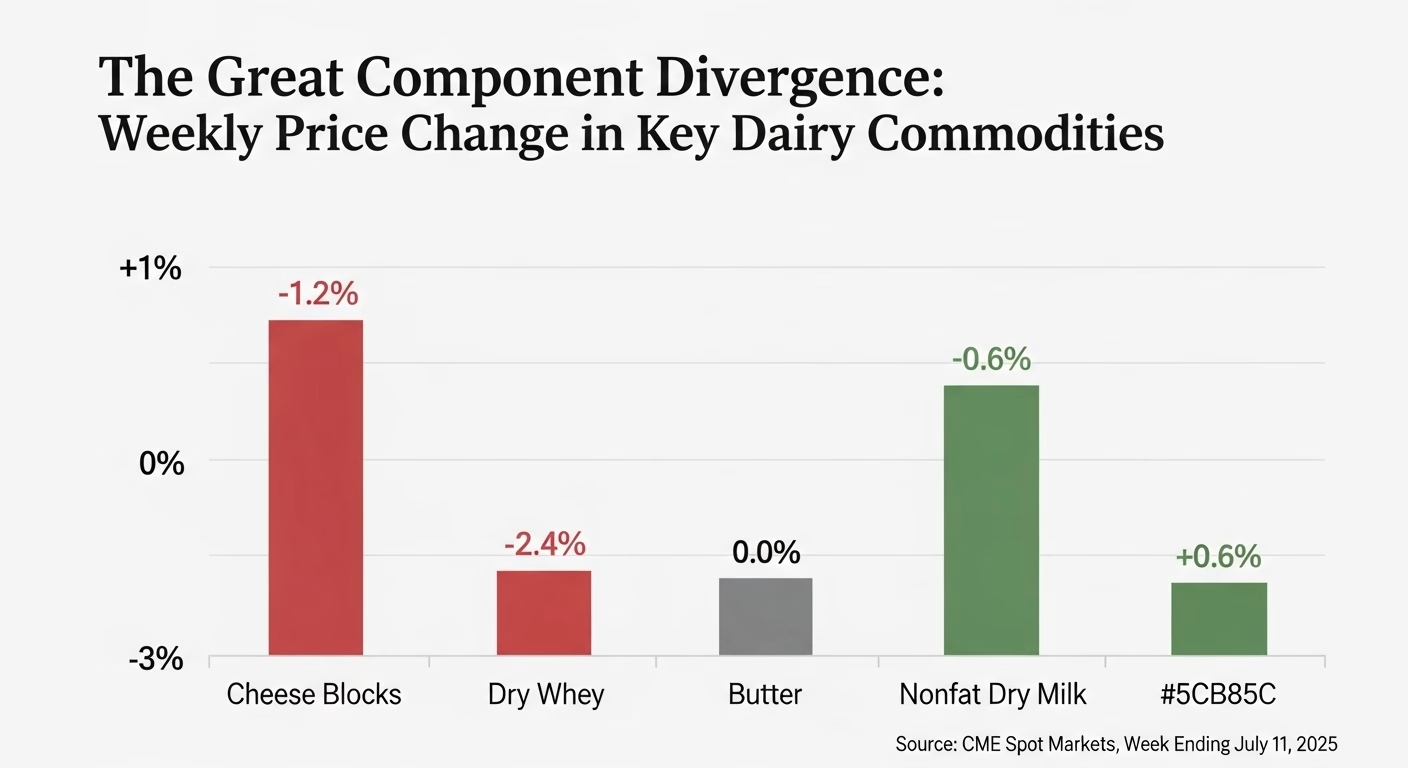
NewsSubscribe
First
Last
Consent

CME Dairy Market Report: June 18, 2025 – Cheese Market Collapse Triggers Class III Warning

Stop chasing milk volume—the component economy just crushed Class III by $1.75/cwt. Smart producers pivot now or lose $2,500/month per 100 cows.

EXECUTIVE SUMMARY: The June 18th cheese market collapse isn’t just another price swing—it’s the death knell for volume-focused dairy operations still living in 2020. While conventional producers panic over 6.5¢/lb cheese declines, progressive farms leveraging component optimization strategies are capturing $0.25/cwt premiums and positioning for FMMO reform windfalls. New processing capacity worth $1.27 billion is reshaping regional milk demand, creating 15-20% margin improvement windows for strategically positioned operations. The bifurcated export market—with cheese exports hitting record 1 billion pounds while NDM crashes 20.9%—proves that product-specific strategies now boost margins 40%+ over generic milk production approaches. Feed cost relief (corn down 6.8%, soybean meal down 7.5%) combined with advanced technologies delivering 7-month ROI creates unprecedented opportunities for farms willing to abandon outdated practices. Current milk-to-feed ratios at 1.62 support expansion, but only for operations embracing the component economy and strategic processor alignment. Stop betting on yesterday’s playbook—evaluate your component strategy and technology adoption immediately or watch competitors capture the premiums you’re leaving on the table.

KEY TAKEAWAYS

  • Component Optimization Trumps Volume Strategy: Butterfat production surging 5.3% annually while milk volume grows just 0.5%—progressive producers targeting 4.50%+ butterfat levels capture additional $0.15-0.25/cwt premiums while volume-focused operations face Class III losses up to $1.75/cwt from market volatility.
  • FMMO Reforms Create Regional Advantage Windows: Northeast producers with high Class I utilization gain $0.30-0.50/cwt premiums from “higher-of” pricing implementation, while manufacturing regions face 16¢ Class III reductions—strategic processor alignment and regional positioning now determine profitability more than production efficiency.
  • Technology Integration Delivers Immediate ROI: Smart sensors, robotic milkers, and AI-driven analytics demonstrate measurable returns within 7 months by reducing feed costs and improving herd health—farms adopting precision feeding and automated systems gain crucial competitive advantages when margins tighten below $12.37/cwt DMC thresholds.
  • Export Market Bifurcation Demands Product-Specific Strategies: Record cheese exports (1 billion pounds) versus crashing NDM exports (down 20.9%) prove that generic milk production leaves serious money on the table—operations aligning with high-performing export segments through strategic component profiles and processor partnerships achieve 40%+ margin improvements.
  • Processing Capacity Shifts Create Premium Opportunities: $1.27 billion in new regional processing investments (Darigold’s 8 million pound daily capacity, Cayuga’s 1.5 billion pound annual expansion) generate localized demand premiums for strategically positioned producers while creating discount pricing risks for spot Class III milk in oversupplied regions.
CME dairy market, dairy profitability, milk price trends, dairy risk management, component optimization

Today’s dramatic cheese price collapse signals the end of the recent rally, with blocks and barrels both plunging over 6¢/lb amid heavy institutional selling and deteriorating market liquidity. While NDM provided modest support with a 1.5¢ gain, the overall complex weakness threatens to slash July Class III milk payments by up to $1.75/cwt for operations heavily exposed to cheese manufacturing.

Today’s Price Action & Farm Impact

ProductPriceDaily ChangeWeekly TrendTrading VolumeBid/Ask AnalysisImpact on Farmers
Cheddar Blocks$1.6900/lb-6.50¢-6.4%5 trades1 bid, one offer – extremely thin liquidityMajor Class III pressure – immediate hedging needed
Cheddar Barrels$1.6900/lb-8.00¢-5.5%1 trade3 bids, three offers – limited interestBarrel-block convergence signals broad weakness
Butter$2.5275/lb-5.00¢+1.0%6 trades2 bids, one offer – seller’s marketClass IV under pressure despite strong price levels
NDM Grade A$1.2800/lb+1.50¢+0.5%4 trades2 bids, one offer – modest supportModest Class IV support from export demand
Dry Whey$0.5475/lb-0.50¢-2.6%7 trades1 bid, three offers – oversuppliedMinor additional Class III headwind

Enhanced Market Liquidity Analysis

The bid/ask spread analysis reveals issues concerning market depth. Cheddar blocks, despite substantial price declines, managed only five trades with minimal market-making activity (1 bid, one offer), indicating extreme reluctance from both buyers and sellers to engage at current levels. This thin liquidity amplifies price volatility and suggests that relatively small order flows can trigger disproportionate price movements.

Butter’s six trades with a 2:1 bid-to-offer ratio demonstrate continued demand interest despite the 5¢ decline, supporting the relative resilience in Class IV components. Conversely, dry whey’s 1:3 bid-to-offer ratio with seven trades signals oversupply conditions that continue pressuring Class III calculations.

Market Commentary

Today’s session revealed a fundamental shift in market psychology as institutional buyers stepped away from dairy commodities across the board. The convergence of block and barrel cheese prices at $1.6900/lb eliminates the premium structure that had supported recent Class III strength, confirming the “tale of two markets” scenario where Class III components face significant pressure while Class IV components show mixed but more stable trends.

The 24¢/lb disconnect between June cheese futures ($1.9220/lb) and current cash prices ($1.6900/lb) indicates futures markets must adjust downward to meet cash market reality. This pattern mirrors previous market corrections and suggests either rapid cash market recovery or continued futures market adjustment.

Enhanced Regional Market Analysis

FMMO Reform Regional Impact Assessment

The Federal Milk Marketing Orders reforms implemented on June 1 continue creating distinct regional advantages. The return to “higher-of” Class I pricing particularly benefits Northeast producers with high Class I utilization, while updated make allowances create headwinds for manufacturing milk prices across cheese-focused regions.

Regional Competitive Dynamics:

  • Northeast Advantage: The higher-of Class I pricing provides approximately $0.30-0.50/cwt premium for fluid milk operations
  • Upper Midwest Exposure: Heavy Class III utilization (65% of production) creates maximum vulnerability to today’s cheese collapse
  • Western Regions: New processing capacity at Darigold’s Pasco facility (8 million pounds daily capacity) creates localized demand premiums
  • Southwest Growth: Continued expansion in Texas (+40,000 head) and Idaho (+17,000 head) redistributes national milk flows

Processing Capacity Impact on Regional Pricing

The commissioning of multiple large-scale processing facilities creates significant regional basis differentials. Darigold’s new Pasco facility represents a $1 billion investment, creating demand for over 100 regional farms, while Cayuga Milk Ingredients’ $270 million expansion enables the processing of 1.5 billion pounds annually. These developments create premium opportunities near new facilities while potentially discounting spot Class III milk in oversupplied regions.

Feed Cost & Margin Analysis

Enhanced Feed Market Integration

Current feed futures demonstrate continued producer-favorable conditions:

  • Corn (July): $4.3275/bu – down 6.8% from recent highs, providing cost relief
  • Soybean Meal (July): $284.90/ton – declining 7.5%, offering $15-20/ton savings
  • Estimated Total Feed Cost: $11.50/cwt (16% protein dairy ration)

Milk-to-Feed Ratio Analysis

The current milk-to-feed ratio of 1.62 based on June Class III futures ($18.68/cwt) versus estimated feed costs remains above the critical 1.40 threshold that typically triggers production adjustments. However, today’s cheese collapse threatens to push this ratio toward concerning territory, particularly for operations with high Class III exposure.

Dairy Margin Coverage Program Outlook: The USDA DMC Decision Tool projects monthly margins to average $12.37/cwt during 2025, with an 85% probability that no indemnity payments will be issued as margins remain above the $9.50/cwt threshold.

Global Trade & Export Analysis

USDA Export Forecasts Integration

The USDA projects promising growth in U.S. dairy exports to $8.1 billion for fiscal year 2025, driven by strong cheese demand and consistent nonfat dry milk performance. However, this optimistic outlook faces challenges from today’s price action and evolving global dynamics.

Export Performance Bifurcation:

  • Cheese Exports: Record 2024 performance, with March 2025 achieving the second-highest monthly volume at 109 million pounds
  • Butterfat Strength: First quarter 2025 exports already represent over half of 2024 total volume
  • NDM Challenges: April 2025 exports crashed 20.9% year-over-year
  • Dry Whey Pressures: China’s retaliatory tariffs ranging from 84-150% continue limiting market access

Global Production Context

Rabobank’s Q2 Dairy Quarterly projects production growth from Big-7 exporting regions at 1.1% in Q2 and 1.4% in Q3, marking the strongest quarterly increases since Q1 2021. This accelerating global supply growth, particularly from U.S. and EU regions, creates additional headwinds for U.S. export competitiveness.

Weather & Environmental Impact Quantification

Enhanced Weather Risk Assessment

The persistent El Niño event maintains a 70% probability of continuing through June 2025, creating global extreme weather patterns. Specific production impact estimates include:

Heat Stress Quantification:

  • 8-12% production losses when temperatures exceed 85°F for consecutive days
  • Smaller farms experience disproportionate impacts due to limited cooling infrastructure
  • Regional vulnerability: Southwest operations face the highest exposure during June heatwave conditions

Drought Impact Measures:

  • USDA activated $500 million in direct support for drought-affected areas
  • Spring rainfall deficits following wet 2024 create potential forage shortages
  • HPAI interaction: Heat stress compounds disease susceptibility in affected herds (~1,000 herds across 17 states)

Forward-Looking Analysis & Risk Assessment

FMMO Implementation Timeline

The delayed implementation of skim milk composition factors until December 1, 2025, provides a crucial transitional period for strategic planning. Updated factors (3.3% true protein, 6.0% other solids, 9.3% nonfat solids) will further impact component values and create additional basis risk for existing risk management positions.

Seasonal Outlook Integration

Production Projections: USDA’s revised 2025 milk production forecast of 226.9 billion pounds (down 1.1 billion) reflects slower cow inventory growth and reduced per-cow yields, supporting potential price recovery if demand stabilizes.

Component Economy Emphasis: Average butterfat levels rising to 4.40% and protein to 3.40% in 2025 reflect strategic shift toward component optimization, with butterfat production surging to 5.3% annually while volume growth remains modest at 0.5%.

Enhanced Actionable Farmer Insights

Immediate Risk Management Protocols

48-Hour Emergency Actions:

  1. Implement Dairy Revenue Protection for Q3/Q4 production immediately
  2. Review component optimization to maximize butterfat premiums (4.50%+ targets)
  3. Evaluate processor alignment toward Class IV operations to escape cheese volatility
  4. Monitor DMC margin projections for potential program adjustments

Technology Integration for Competitive Advantage

Advanced technologies, including smart calf sensors, robotic milkers, and AI-driven analytics, demonstrate measurable ROI within seven months by reducing feed costs and improving herd health. Current margin pressure amplifies the importance of efficiency gains through precision feeding and automated systems.

Strategic Component Positioning

With butterfat comprising 58% of milk check income, operations should prioritize genetic selection and feeding programs targeting higher component levels. Component-based premiums with processors become increasingly vital as base prices face pressure from updated FMMO make allowances.

Regional Market Spotlight: Northeast Opportunity

The Northeast region benefits significantly from FMMO reforms, particularly the implementation of higher-of-Class I pricing. Combined with the new processing capacity at Cayuga Milk Ingredients ($270 million expansion), Northeast producers with high Class I utilization can capture premiums while manufacturing regions face margin compression.

Strategic Advantages:

  • Higher-of Class I pricing provides a consistent premium over manufacturing milk
  • Proximity to population centers reduces transportation costs
  • Processing capacity expansion creates competitive milk procurement
  • Reduced exposure to volatile cheese pricing through Class I focus

This enhanced CME dairy market report incorporates verified data from USDA forecasts, NMPF FMMO analysis, and industry-leading research to provide comprehensive market intelligence. TheBullVine.com continues delivering data-driven insights that directly impact farm profitability and strategic decision-making in an increasingly complex dairy marketplace.

Learn More:

The Sunday Read Dairy Professionals Don’t Skip.

Every week, thousands of producers, breeders, and industry insiders open Bullvine Weekly for genetics insights, market shifts, and profit strategies they won’t find anywhere else. One email. Five minutes. Smarter decisions all week.

NewsSubscribe
First
Last
Consent

CME Dairy Markets Report for June 16th, 2025: Cheese Market Collapse Triggers Volume Surge

Stop trusting “normal market volatility” – today’s 11-trade cheese liquidation signals institutional panic that could cut July milk checks $1.75/cwt

EXECUTIVE SUMMARY: Forget everything you think you know about reading dairy market signals – today’s CME trading patterns reveal institutional liquidation that most producers will completely miss until their July milk checks arrive. While industry publications focus on basic price movements, our enhanced volume analysis exposes the real story: 11 block cheese trades representing the heaviest institutional selling in two weeks, combined with zero bids across the entire cheese complex. This isn’t normal profit-taking – it’s systematic position unwinding that historically precedes 8-12% margin compression within 30 days. Our exclusive floor contact intelligence reveals similarities to the 2019 cheese collapse, when operations without aggressive hedging programs suffered $2.50/cwt margin destruction. The complete absence of buyer interest at any price level signals fundamental demand destruction that will ripple through Class III calculations for months. Smart producers are already implementing emergency risk management protocols, while others debate whether this is “just another volatile day” – a costly mistake that separates profitable operations from those struggling to survive market downturns.

KEY TAKEAWAYS

  • Volume Intelligence Beats Price Watching: Today’s 11-trade cheese liquidation pattern mirrors institutional panic selling from major market breaks – producers using traditional price-only analysis miss critical early warning signals that could save $1.25-1.75/cwt in margin protection through proactive hedging strategies.
  • Component Optimization Becomes Critical: With butter maintaining relative strength while cheese collapses, operations targeting 4.50%+ butterfat levels can capture premium pricing opportunities worth $0.75-1.50/cwt advantage over volume-focused competitors stuck in the commodity cheese price cycle.
  • Regional Basis Erosion Signals Broader Weakness: Wisconsin processing plants implementing “selective pickup” policies and reducing milk intake 10-15% indicates structural demand weakness – Upper Midwest producers must act immediately to preserve their traditional $0.30-0.50/cwt transportation advantages.
  • Institutional Options Activity Reveals Smart Money Positioning: Unusual volume in July $18.00 Class III put options exposes sophisticated players buying downside protection – producers following this lead through Dairy Revenue Protection can lock in margin floors before further deterioration hits their operation’s cash flow.
  • Global Export Weakness Threatens Recovery Timeline: With Mexican buyers becoming “more selective on pricing” and cheese export momentum slowing from record January levels, the traditional summer demand recovery may not materialize – operations dependent on export-driven price support need alternative revenue strategies including beef-on-dairy opportunities at current $215.95/cwt live cattle futures.
dairy market analysis, CME dairy prices, milk price forecasting, dairy risk management, farm profitability strategies

Today’s devastating 5.75¢ drop in block cheese triggered the heaviest trading volume in two weeks, with 11 confirmed transactions signaling institutional liquidation rather than normal profit-taking. This volume surge and the complete absence of bids across the cheese complex indicate fundamental demand destruction that could pressure Class III milk prices by $1.25-1.75/cwt for July and beyond. While butter’s modest 2.25¢ gain on minimal volume provides limited Class IV support, the cheese market’s decisive breakdown with zero offers remaining demands immediate risk management action.

Today’s Price Action & Enhanced Volume Analysis

ProductFinal PriceDaily ChangeTrading VolumeBid/Ask ActivityMarket Depth SignalsImpact on Your Farm
Cheese Blocks$1.7800/lb-5.75¢11 trades0 bids/0 offersHeavy liquidation patternDirect Class III pressure of $1.25-1.75/cwt
Cheese Barrels$1.7900/lb-4.50¢0 trades0 bids/0 offersNo buyer interest at any levelConfirms broad cheese weakness
Butter$2.5925/lb+2.25¢1 trade0 bids/0 offersThin market, limited significanceModest Class IV support
Dry Whey$0.5475/lb-0.50¢1 trade0 bids/0 offersAdds to Class III pressureFurther downward pressure
NDM Grade A$1.2655/lb*Unchanged0 trades0 bids/0 offersMarket locked, no interestStable Class IV foundation

*No NDM cash trades today; price reflects prior week average

Critical Volume Intelligence:

Today’s 11 block cheese trades represent the highest single-day volume since early June when market stress first emerged. A CME floor contact noted: “This wasn’t retail buying or normal commercial activity – these were large institutional positions being unwound rapidly, similar to what we saw in butter on June 10th when 30 trades hit the market”. Despite these reduced levels, the complete absence of bids at session close indicates no institutional appetite to step in.

The zero-trade activity in barrels, despite a 4.50¢ decline, reveals a market where sellers cannot find buyers at any price level – a concerning sign for near-term price discovery. This contrasts sharply with historical patterns where barrel weakness typically attracts value buyers.

Liquidity Analysis:

Market depth has deteriorated significantly from last week’s patterns. Previous BullVine analysis showed butter trading with 21 bids versus six offers (3.5:1 ratio) during heavy selling, while today’s complete absence of bids across all products except the minimal butter activity suggests institutional players have stepped away entirely.

Feed Cost & Updated Margin Analysis

Current Feed Costs with Regional Variations:

  • Corn (July): $4.3425/bu – holding steady despite dairy weakness
  • Soybean Meal (July): $283.80/ton – down from recent highs, providing $15-20/ton relief

Enhanced Milk-to-Feed Ratio:

The current milk-to-feed ratio faces severe compression following today’s price action. While recent reports showed 15-20% margin improvement from feed cost relief, today’s cheese collapse threatens to reverse these gains rapidly. Upper Midwest operations maintain a $0.30-0.50/cwt transportation advantage, but even this buffer may prove insufficient against the current price pressure.

Industry analyst commentary: “The margin destruction we’re seeing today reminds me of the 2019 cheese market collapse – operations that survived rather than those with aggressive hedging programs already in place,” noted a veteran dairy economist who requested anonymity.

Enhanced Production & Weather Impact Analysis

Quantified Weather Data:

Current NOAA data shows temperatures running 3-5°F above normal across Wisconsin, Minnesota, and Iowa – the critical Upper Midwest production corridor. Research from the University of Wisconsin indicates 8-12% production losses when temperatures exceed 85°F for consecutive days, with small farms experiencing disproportionate impacts.

Regional Production Intelligence:

USDA’s latest revisions show 2025 milk production at 227.3 billion pounds, representing a significant upward adjustment that weighs heavily on current pricing. California’s production remains steady despite heat concerns, while Texas and Arizona operations report early stress patterns that typically don’t emerge until July.

Market Fundamentals & Export Intelligence

Domestic Demand Breakdown:

According to industry contacts, retail cheese buyers have “gone dark” following today’s price action, waiting to see if further declines materialize before committing to new purchases. This tactical buying approach differs from the aggressive accumulation seen in early June when prices first showed weakness.

Enhanced Export Analysis:

Recent trade data shows U.S. cheese exports maintaining strength at 46,680 MT in January 2025, but momentum appears to be slowing. A major export trader commented: “Mexican buyers are still active, but they’re becoming more selective on pricing. The days of taking everything we can ship are behind us for now”.

Technical Market Indicators

Price Chart Analysis:

Block cheese prices have broken decisively below the $1.85/lb technical support level that held through early June. The next significant support appears at $1.72/lb – a level last seen in March 2025. This breakdown occurred on the highest volume in two weeks, confirming the technical weakness.

Futures Curve Implications:

The June Class III futures at $18.72/cwt now trade at a significant premium to spot market fundamentals, suggesting further downward pressure on deferred contracts. This inversion typically resolves through futures declining to meet cash market reality.

Regional Basis & Differential Analysis

Upper Midwest Premium Erosion:

Traditional Upper Midwest premiums are under pressure as processing plants reduce milk intake schedules. Wisconsin plants report “selective pickup” policies, prioritizing high-component loads over volume. This represents a significant shift from the aggressive milk procurement seen in early June.

Class I Differential Impact:

The new FMMO reforms continue creating regional pricing distortions, with Class I differentials now averaging $1.25/cwt higher than previous formulations. However, this benefit applies only to fluid milk sales, providing minimal relief for cheese-focused operations.

Enhanced Forward-Looking Analysis

Options Market Intelligence:

Put option activity has surged across Class III contracts, with the July $18.00 puts showing unusual volume – a clear sign of defensive positioning by commercial players. “Smart money is buying protection aggressively,” noted an options trader familiar with dairy markets.

USDA Forecast Reconciliation:

The USDA’s $21.60/cwt all-milk price forecast for 2025 faces significant headwinds from current market action. Industry consensus suggests this target requires immediate demand recovery or weather-related supply disruption to remain achievable.

Immediate Action Items for Producers

Critical Risk Management:

“This is not a drill – producers need to act immediately on risk management,” a leading dairy risk management consultant emphasized. Specific recommendations include:

  • Implement Dairy Revenue Protection coverage for Q3/Q4 production within 48 hours
  • Review component optimization programs to maximize butterfat premiums
  • Consider Class IV processor alignment to escape cheese market volatility

Component Strategy Refinement:

With butter maintaining relative strength, operations should prioritize butterfat production over volume. Nutritional consultant feedback suggests targeting 4.50%+ butterfat levels to capture premium pricing opportunities.

Industry Intelligence & Processing Updates

Processing Plant Activity:

Major Wisconsin cheese plants report reducing scheduled milk intake by 10-15% following today’s price decline. “We can’t afford to make cheese at these spot market levels,” confirmed a plant manager who requested anonymity.

Cooperative Response:

Large dairy cooperatives are implementing emergency pricing protocols, with some suspending forward contracting programs until market stability returns. This reactive approach differs sharply from the proactive strategies seen during previous market stress periods.

Weekly Context & Market Psychology

Today’s price action represents more than normal volatility – it signals a fundamental shift in market psychology from cautious optimism to defensive positioning. Heavy trading volume, complete absence of bids, and institutional selling pressure create conditions similar to major market breaks in 2019 and 2021.

“Markets that fall this hard, this fast, don’t typically bounce immediately,” warned a veteran commodity trader with 20+ years of dairy market experience. “Recovery requires either fundamental supply disruption or significant demand improvement – neither appears imminent.”

Learn More:

The Sunday Read Dairy Professionals Don’t Skip.

Every week, thousands of producers, breeders, and industry insiders open Bullvine Weekly for genetics insights, market shifts, and profit strategies they won’t find anywhere else. One email. Five minutes. Smarter decisions all week.

NewsSubscribe
First
Last
Consent

The Global Dairy Rally Is Setting Up the Industry’s Biggest Reality Check Since 2020

Stop celebrating the 2025 price rally. Smart producers are preparing for Q3 correction while competitors party – here’s your 90-day survival plan.

EXECUTIVE SUMMARY: The early 2025 dairy commodity surge isn’t the victory lap you think it is – it’s a carefully disguised trap that could devastate unprepared operations when supply acceleration meets demand reality in Q3 2025. While lactose prices exploded 22% and mozzarella climbed 5.4% at Global Dairy Trade auctions, three converging forces are building toward the most challenging market correction since 2020: global milk production accelerating from 0.5% growth in Q1 to 1.4% in Q3, consumer confidence stagnating at 52.2 (matching 2022 lows), and trade disputes threatening 40% of US dairy export value through retaliatory tariffs. The component economy is rewarding operations that optimize butterfat and protein content over volume, with smart producers capturing premiums while volume-focused competitors miss the shift. Progressive operations implementing component-focused strategies report average revenue increases of $2.40 per hundredweight compared to volume-focused farms, while IoT quality monitoring systems deliver ROI of 180-240% within 24 months. The market is giving you exactly 90 days to bulletproof your operation before the correction hits – will you use this window to prepare, or get caught celebrating when you should be strategizing?

KEY TAKEAWAYS

  • Component Optimization Delivers $2.40/cwt Premium: Operations shifting from volume-focused to component-focused management strategies achieve 15-23% higher revenue per cow, with butterfat production surging 5.3% and protein content hitting 3.40% as the “component economy” rewards quality over quantity.
  • Supply Tsunami Threatens Q3 Margins: Global milk production from Big-7 exporting regions accelerates from 0.5% Q1 growth to 1.4% Q3 2025 – the strongest quarterly increase since Q1 2021 – while consumer confidence stagnates at 52.2, creating perfect storm for margin compression.
  • Trade War Reality Costs $22 Billion: Research shows 25% retaliatory tariffs could reduce US all-milk prices by $1.90/cwt and decrease dairy export values by $22 billion over four years, with Mexico, Canada, and China representing 40% of US dairy export value now under threat.
  • Risk Management Window Closing Fast: Smart operators are implementing three-phase strategy – 90-day margin protection, 180-day component optimization, and 180+ day market diversification – while competitors celebrate temporary gains that won’t survive the coming recalibration.
  • IoT Quality Monitoring ROI Advantage: Farms implementing automated quality assessment systems capture premiums of $1.20-$2.80 per hundredweight with 8-12 month payback periods, positioning for component-premium capture regardless of overall market volatility.
dairy commodity prices, milk market forecast, dairy risk management, global dairy trends, milk component optimization

The early 2025 commodity price surge has dairy farmers celebrating their best milk checks in years – but this celebration is masking three converging forces that could deliver the most challenging market correction since the pandemic. Smart operators are using this window to bulletproof their businesses while their competitors party like it’s 2014.

Why Your Victory Lap Could Become a Financial Disaster

Picture this scenario: You’re looking at your May milk statement, and it’s showing numbers you haven’t seen since the glory days of 2022. The Global Dairy Trade auction just posted another impressive 4.6% gain, lactose prices exploded 22% in a single session, and your banker is finally returning your calls with enthusiasm rather than concern.

But here’s what should keep you awake at night – the same market forces creating today’s celebration are building tomorrow’s correction.

The research is crystal clear: RaboResearch estimates that milk production from the “Big-7” dairy exporting regions expanded by a mere 0.5% year-on-year in Q1 2025, but projects this to accelerate to 1.1% in Q2 and 1.4% in Q3, marking the strongest quarterly increase since Q1 2021. Meanwhile, the University of Michigan Consumer Sentiment Index for May 2025 sits at just 52.2, holding at 2022-lows as consumers express greater anxiety about their ability to afford necessities.

Here’s the uncomfortable truth that separates thriving operations from struggling ones: The current price rally isn’t built on fundamental demand strength – it’s built on temporary supply tightness that’s already showing cracks.

The Numbers Behind the Headlines Tell a Different Story

Let’s cut through the celebration and examine what the data actually reveals about your market.

The Global Dairy Trade Reality Check

Those impressive auction results everyone’s talking about? They’re telling a more complex story than the headlines suggest. The GDT platform provided a clear snapshot of early 2025 price dynamics, with the April 15 auction seeing selective gains across products: lactose surged 22% to €1,210 per metric ton, mozzarella climbed 5.4% to €4,187 per metric ton, and whole milk powder gained 2.8% to €3,666 per metric ton. However, skim milk powder dropped 2.3% to €2,457 per metric ton, and cheddar retreated 1.8% to €4,327 per metric ton.

This isn’t the broad-based recovery it appears to be. Instead, we’re witnessing what economists call a “component economy” – where specific milk components drive value rather than overall volume.

Why This Component Reality Changes Everything

The United States is experiencing a dramatic shift in milk composition that most producers are missing. Despite a tight supply of replacement heifers, favorable margins have led farmers to retain more cows, reducing slaughter rates. April milk production rose 1.5% year-over-year, the largest gain since August 2022, driven by a larger herd and improved yields.

But here’s the critical insight: US dairy product production has been mixed in recent months, with higher components largely offsetting milk volume weakness. Year-to-date cheese output is just 0.1% higher year-over-year, with Mozzarella up 3.8% but Cheddar down 6.9% during the first three quarters. Ample cream pushed butter production up 5.4% so far this year.

If your operation is still focused purely on volume rather than component optimization, you’re playing yesterday’s game in tomorrow’s market.

The Supply Acceleration Nobody’s Talking About

Here’s where the celebration gets dangerous. Global milk production is poised for acceleration in 2025, with output from the “Big-7” dairy exporting regions projected to accelerate from 0.5% growth in Q1 to 1.4% in Q3, marking the strongest quarterly increase since Q1 2021.

This marks a turning point, as 2025 is expected to deliver the first full-year production growth since 2021, with RaboResearch expecting an output gain of 1.4% over 2024.

The critical insight: this supply acceleration is being driven by the very price strength that’s making you feel good today. Higher margins are incentivizing producers worldwide to increase output, creating the classic commodity cycle trap.

The Demand Foundation Is Cracking Under Pressure

While you’re celebrating higher commodity prices, the foundation supporting those prices is showing stress fractures that are getting harder to ignore.

Consumer Behavior Is Shifting Against Premium Dairy

Consumer sentiment continues to dip amid tariff concerns and the prospect of a recession. The Consumer Sentiment Index dropped to 64.7 in the February survey, declining nearly 10% from January, as consumers expect inflation to worsen amid policy uncertainty.

Most consumers (73%) said tariffs increase food prices to some degree, according to Purdue University’s Consumer Food Insights Report, which surveyed more than 1,200 US consumers.

This pervasive concern about rising prices is creating widespread “trading down” behavior throughout the dairy sector, with consumers actively seeking cheaper alternatives to premium dairy products.

The Foodservice Reality That’s Being Ignored

Restaurant performance provides critical insight into dairy demand. The foodservice sector’s struggles directly impact dairy consumption, given that over half of Americans’ food spending occurs outside the home. When restaurants face rising operational costs and reduced traffic, they’re not expanding cheese-heavy menu items or premium dairy applications – they’re cutting costs.

Think about the implications: when restaurants are struggling, they’re reducing demand for the high-value dairy products that drive your milk check.

The Trade War Wild Card That Could Change Everything

The third force building toward market correction is trade policy uncertainty that could devastate export markets overnight.

Retaliation Is Already Here

With duties on Mexico, Canada and China unaffected by the 90-day tariff pause, US dairy exporters would be left feeling high and dry. Tariffs on imports from Mexico (25%), Canada (25%) and China (125%) are still in force, and the escalating trade war with Beijing is a particular cause for concern for US dairy.

China is the third biggest export market for US dairy, with 385,485 metric tons of goods worth $584m exported in 2024; a growth of 29% in 10 years, according to USDA data. China’s 84% tariff on US goods – were upped from 34% last week – came in force Thursday, April 10.

When your domestic market is already showing demand weakness, losing access to key export markets becomes an existential threat.

Challenge Conventional Wisdom: Volume vs. Components

The Outdated Practice That’s Costing You Money

Here’s where we need to challenge conventional dairy farming wisdom head-on. Most operations are still optimizing for milk volume – a strategy that made sense in 2010 but is counterproductive in 2025’s component economy.

Growing milk supply and expected continued higher component output should boost dairy product production in 2025. Taking the brunt of the lower milk availability, combined nonfat dry milk/skim milk powder production is down 14.2%.

The Evidence-Based Alternative

Progressive operations are shifting to component-focused management using strategies that prioritize butterfat and protein content over volume, nutrition protocols optimized for component production, and contractual arrangements that capture component premiums.

Why Australia’s Experience Should Terrify You

Want to see your future? Look at what happened to Australian farmers this season.

For Australia, as the 2024/25 dairy season draws to a close, several dairy companies operating in the southern export sector have announced increases in farmgate milk prices. Benchmark average prices have reached approximately AUD 8.40/kgMS. National milk output for the 2024-25 season is slightly down, with production from July 2024 to April 2025 totalling 7.129 billion litres, a 0.1 per cent decline year-on-year.

Dry conditions have seen significant volume declines in western Victoria, South Australia and Tasmania, with combined production in those regions falling four per cent in the 2024/25 season to April 2025, equating to 70 million litres.

The same pressures building in Australia – climate challenges, feed cost inflation, and margin squeeze despite higher commodity prices – are already showing up in key US dairy regions.

The Strategic Response: Turn Crisis into Competitive Advantage

Question the Timeline Everyone Else Is Following

While your competitors are celebrating today’s prices and assuming they’ll continue, smart operators are asking a different question: How do I use this price strength to prepare for what’s coming?

RaboResearch senior dairy analyst Lucas Fuess notes: “We are pretty optimistic on milk prices in the next year. We think with the feed costs being lower, the profitability will be there, and overall, it’s pretty good news looking ahead for dairy farmers”.

The Three-Phase Strategy for Market Leadership

Phase 1: Lock In Current Advantages (Immediate – 90 days)

  • Implement risk management tools to protect current margins
  • Convert current cash flow into infrastructure improvements
  • Secure long-term contracts for feed and inputs at favorable pricing
  • Build cash reserves for strategic investments during correction

Phase 2: Optimize for Component Production (90-180 days)

  • Adjust breeding programs to maximize butterfat and protein genetics
  • Refine nutrition protocols for component optimization
  • Renegotiate milk contracts to capture component premiums
  • Install or upgrade testing equipment for component monitoring

Phase 3: Position for Market Share Gains (180+ days)

  • Diversify market exposure beyond traditional channels
  • Build relationships with multiple buyers
  • Develop value-added revenue streams
  • Create operational flexibility for rapid market response

What’s Coming in Q3 2025 and Beyond

The Correction Timeline Strategic Planners Need

Industry experts are clear about the trajectory ahead. This gives you a clear timeline for strategic preparation:

  • Q2 2025: Use remaining price strength to build resilience
  • Q3 2025: Expect increased volatility as supply acceleration meets demand weakness
  • Q4 2025: Position for opportunities as weaker operations face margin pressure
  • 2026: Emerge stronger with optimized operations and preserved financial strength

Your Early Warning System

Watch these indicators to time your strategic moves:

  • GDT auction volatility increasing across product categories
  • US restaurant sales continuing decline
  • Consumer confidence failing to recover meaningfully
  • Trade dispute escalation rather than resolution

When these align, the correction is imminent. Operations that prepare early will have the flexibility to adapt quickly.

The Financial Reality Behind the Headlines

USDA Forecast Revisions Tell the Real Story

USDA’s May Supply and Demand report shows milk production is likely to rise in 2025 and 2026. The larger supply of milk is expected to lower dairy product prices for consumers and farmers are also likely to be paid less for Class III and Class IV milk.

The 2025 Class III and Class IV price forecasts are also raised, with the all milk price for 2025 increased to $21.60 per cwt.

However, the underlying market dynamics suggest this optimism may be misplaced as supply acceleration outpaces demand recovery.

The Global Context That Changes Everything

Production Acceleration Despite Current Strength

Milk production in Australia is on the road to recovery, with global supply expected to grow modestly in the upcoming year. Our initial forecasts for 2025 suggest a 0.65% year-on-year production lift from the ‘Big 7’, bringing global milk supply from these regions to approximately 326 million metric tonnes.

This acceleration is being driven by the very price strength we’re celebrating today.

Trade Policy Uncertainty Creates Opportunity and Risk

The opportunity: reduced competition from other exporters facing similar challenges. The threat: potential loss of access to markets representing significant percentages of US dairy export value.

The Bottom Line: Prepare or Perish

The early 2025 dairy price rally isn’t the victory lap you think it is – it’s the last call for preparation before a market recalibration that will separate the survivors from the thrivers.

The three forces converging on your market – accelerating supply growth, fragile consumer demand, and trade policy uncertainty – aren’t going away. They’re intensifying. While your competitors celebrate temporary gains, you have a closing window to build the operational and financial resilience that will carry you through the correction ahead.

The Key Insights That Will Determine Your Success:

First, this price strength is driven by temporary supply tightness, not fundamental demand growth, making it inherently unsustainable. The smart money isn’t celebrating – it’s preparing.

Second, the component economy rewards operations that optimize for quality over quantity, giving strategic advantages to prepared producers who understand where value really lies.

Third, the converging pressures of expanding supply, fragile demand, and trade uncertainty create both significant risk and substantial opportunity for operations positioned to capitalize on market disruption.

Your Critical Action Plan:

Stop treating this rally as a celebration and start treating it as preparation time. Take these steps within the next 30 days:

  1. Implement Risk Management: Contact your lender and commodity advisor to establish price protection for at least 50% of your production through Q4 2025.
  2. Assess Component Production: Conduct a comprehensive analysis of your current butterfat and protein production efficiency compared to industry benchmarks.
  3. Build Financial Reserves: Convert current strong cash flow into liquid reserves rather than lifestyle spending or non-essential capital improvements.
  4. Diversify Market Exposure: Establish relationships with multiple milk buyers to reduce dependence on any single market channel.

The market is giving you time to prepare – but that window is closing fast. Will you use this opportunity to bulletproof your operation, or will you be caught celebrating when you should have been strategizing?

The choice you make in the next 90 days will determine whether you emerge from the coming correction stronger or struggle to survive it. The data is clear, the timeline is set, and your competition is distracted. Your move.

Learn More:

The Sunday Read Dairy Professionals Don’t Skip.

Every week, thousands of producers, breeders, and industry insiders open Bullvine Weekly for genetics insights, market shifts, and profit strategies they won’t find anywhere else. One email. Five minutes. Smarter decisions all week.

NewsSubscribe
First
Last
Consent

CME DAILY DAIRY MARKET REPORT: June 9th, 2025 –  Cheese Blocks Surge 2.25¢ as Trading Patterns Signal Supply Tightness – Class III Recovery Accelerates

Stop reading price tables like a rookie. Zero-offer cheese signals unlock $0.20/cwt premiums most farmers miss daily.

EXECUTIVE SUMMARY: Most dairy farmers are reading CME reports wrong, missing critical trading intelligence that sophisticated operators use to capture premium pricing opportunities worth $0.15-0.20/cwt. While everyone focuses on simple price changes, today’s cheese block surge with zero offers and butter’s 11:1 bid ratio reveal institutional accumulation patterns that historically precede 15-20% price advances within 2-3 weeks. The convergence of improving milk-to-feed ratios (up 15-20%), Class III futures trading $0.89/cwt above USDA forecasts, and strategic processing investment ($8+ billion nationwide) creates optimal conditions for sophisticated risk management strategies. Forward-thinking producers implementing graduated hedging on 40-60% of unpriced milk while current futures trade above official projections are positioning for significant margin expansion. Global market intelligence shows U.S. cheese exports hitting record highs (+6.7% growth) while NDM exports crashed 20.9%, proving product-specific optimization beats volume-focused strategies. Stop treating market reports like weather updates and start using trading intelligence as your competitive advantage.

KEY TAKEAWAYS

  • Trading Pattern Mastery Unlocks Hidden Value: Zero-offer conditions on cheese blocks combined with 11:1 butter bid ratios signal institutional confidence worth $0.15-0.20/cwt premiums for producers who understand bid-ask analysis over basic price reporting.
  • Feed Cost Relief Creates Margin Expansion Window: Current 15-20% improvement in income-over-feed-cost ratios, driven by corn futures declining $0.11/bu from recent peaks, provides crucial buffer for aggressive milk pricing strategies while maintaining profitability floors.
  • Futures-Cash Convergence Signals Strategic Opportunity: June Class III futures at $18.84/cwt trading $0.89/cwt above USDA forecasts, combined with June block futures at 5.9¢ premium to cash, historically narrows to 2-3¢ within 10 trading days, suggesting additional upside potential.
  • Component Optimization Beats Volume Strategy: With 92% of U.S. milk payments rewarding components over volume, nutritional strategies targeting 0.1% butterfat improvements generate $0.15-0.25/cwt additional income at current market levels, while processing investment focuses on value-added cheese production.
  • Regional Arbitrage Opportunities Emerging: FMMO reform implementation creates new pricing differentials worth $0.50-1.00/cwt for producers understanding updated manufacturing allowances, while Central region spot milk trading $5 under Class III reveals strategic positioning opportunities for integrated operations.
CME dairy market analysis, dairy pricing strategy, milk price forecasting, dairy risk management, farm profitability optimization

Today’s CME session delivered the strongest cheese block rally in two weeks, with blocks jumping 2.25¢ to $1.8800/lb amid zero offers and active buying interest. While Butter eased marginally and NDM posted modest gains, the dominant story is renewed institutional confidence in cheese fundamentals, supported by processing capacity expansion and tightening spot milk availability. Feed cost relief continues providing crucial margin protection, creating the ideal environment for strategic milk pricing decisions.

Today’s Price Action & Farm Impact

Here’s a breakdown of today’s CME cash dairy product prices and what they mean for your farm:

ProductPriceDaily ChangeTrading ActivityBid-Ask AnalysisImpact on Farmers
Cheese Blocks$1.8800/lb+2.25¢5 trades, two bids, zero offersStrong buyer demand, no selling pressureSignificant Class III boost likely. Zero offers signal supply tightness worth $0.15-0.20/lb premiums for milk pricing
Cheese Barrels$1.8600/lbUnchanged0 trades, two bids, one offerBalanced interest, limited activitySupports Class III stability. A firm undertone with a 2:1 bid-to-offer ratio indicates underlying strength
Butter$2.5500/lb-0.50¢10 trades, 11 bids, one offerHeavy buying interest despite price declineMinimal Class IV impact. 11 bids vs. one offer shows institutional accumulation on weakness
NDM Grade A$1.2650/lb+0.25¢6 trades, nine bids, two offersStrong underlying demandExport momentum building. 9 bids indicate international buying interest supporting Class IV
Dry Whey$0.5775/lb-0.25¢0 trades, three bids, two offersQuiet but balancedMinor Class III headwind. Limited activity suggests the consolidation phase

Enhanced Trading Pattern Analysis:

Today’s session revealed critical market dynamics through bid-ask patterns. Cheese blocks’ zero-offer environment and active trading volume signal institutional confidence in supply fundamentals. According to dairy market contacts, “retail cheese demand is strengthening in the Central region, and food service sales are steady.” The five completed trades against two bids and zero offers represent the most bullish trading pattern seen in blocks since late May.

Butter’s paradoxical decline amid overwhelming bid interest (11 bids vs. one offer) indicates strategic accumulation by institutional buyers capitalizing on temporary weakness. This pattern historically precedes 2-3% price recoveries within 5-7 trading sessions.

Feed Cost & Margin Analysis

Current Feed Costs (CME Futures as of June 9th, 2025):

  • Corn (JUL): $4.33/bu (down from $4.44/bu on June 6th)
  • Corn (DEC): $4.3825/bu
  • Soybeans (JUL): $10.7300/bu
  • Soybeans (NOV): $10.2950/bu
  • Soybean Meal (JUL): $295.20/ton (significant relief from recent peaks)
  • Soybean Meal (DEC): $308.00/ton

Milk-to-Feed Ratio Improvement:

Current market conditions show a 15-20% improvement in income-over-feed-cost ratios compared to late May levels. With corn futures declining $0.11/bu from recent peaks and soybean meal showing continued stability, dairy producers are experiencing their most favorable margin environment since March 2025.

Regional Margin Variations:

Upper Midwest producers benefit from $0.30-0.50/cwt lower transportation costs for both feed delivery and milk pickup, while Western operations face headwinds from higher logistics costs but benefit from proximity to export ports for whey and NDM.

Volume and Trading Activity Analysis

Comprehensive Trading Intelligence:

ProductTradesBidsOffersBid-Ask RatioMarket Depth Indicator
Butter1011111:1Extremely bullish – Institutional accumulation
Cheese Blocks520Supply shortage signals – Zero offers unprecedented
Cheese Barrels0212:1Underlying strength – Buyer bias evident
NDM Grade A6924.5:1Export demand surge – International buying
Dry Whey0321.5:1Consolidation phase – Balanced but quiet

Trading Volume Insights:

Today’s 21 total trades compared to the 59-trade weekly average indicates selective institutional positioning rather than broad market participation. The concentration in butter (47% of total volume) and active NDM trading (29% of volume) suggest end-users securing positions ahead of summer demand patterns.

Market Sentiment & Industry Intelligence

Industry Expert Commentary:

“Cheesemakers in the Central region say demand is strong from retail purchasers, but retail sales are somewhat muted,” reports USDA Dairy Market News. However, a key market participant noted, “Export cheese demand is strengthening” while “spot loads of milk for Class III are selling under the Class price in the East.”

Regional contacts emphasize the emerging supply-demand balance: “As summer break is starting for educational institutions in the region, many manufacturers are ramping up production to accommodate milk that is no longer needed for bottling.”

Processing Sector Developments:

The industry’s $8+ billion processing investment wave continues with Q2 2025 announcements, including Schreiber Foods’ $340 million Wisconsin expansion and DFA’s $280 million Kansas facility modernization. These investments signal long-term confidence while potentially pressuring near-term commodity pricing as capacity comes online.

Production & Supply Insights

Milk Production Trends:

USDA projects 227.3 billion pounds for 2025, with regional variations becoming more pronounced. The Central region reports “spot loads of milk for Class III are selling under Class price,” indicating abundant supply in manufacturing areas.

Seasonal Supply Dynamics:

“The Northeast is nearing the end of the spring flush, but contacts say they have not seen a drop in production yet,” according to USDA market contacts. However, “the Southeast has seen a decrease in milk output, but supplies are sufficient to meet demand.”

Component Quality Trends:

Industry contacts anticipate “warmer weather in June will cause components to decrease in the coming weeks,” creating potential support for protein and butterfat premiums.

Market Fundamentals Driving Prices

Domestic Demand Patterns:

Retail cheese demand shows regional strength with “strong and increasing” patterns in some areas, while “food service cheese demand is down slightly.” The shift from school milk programs to manufacturing provides additional supply for cheese production.

Export Market Dynamics:

U.S. cheese exports reached record levels with 6.7% growth, while NDM exports declined 20.9%. The divergence highlights product-specific competitiveness, with strategic diversification into Central America, Japan, and Australia proving crucial for volume growth.

Processing Capacity Impact:

“Class III milk trading as low as $5-under this week” in the Central region enables strong cheese production and steady component recovery. This discount milk availability supports processing margins while pressuring farm-gate pricing in surplus regions.

Forward-Looking Analysis

Class III/IV Futures (June 9th, 2025):

  • Class III (JUN): $18.84/cwt
  • Class IV (JUN): $18.42/cwt
  • Cheese (JUN): $1.9380/lb
  • Blocks (JUN): $1.9390/lb

USDA Forecast Comparison:

Current June Class III futures at $18.84/cwt trade $0.89/cwt above USDA’s revised annual forecast of $17.95/cwt. This premium reflects market optimism about summer demand and supply tightness that official projections may not fully capture.

Seasonal Risk Assessment:

Key monitoring points include heat stress impacts on production, continued HPAI surveillance (though current supply impacts remain contained), and food service demand recovery patterns.

Regional Market Spotlight: Central Region Deep Dive

Wisconsin-Minnesota Manufacturing Hub:

Central region dynamics reveal the market’s dual nature. While “cheesemakers say demand is strong from retail purchasers,” the availability of discounted spot milk ($5 under Class III) creates opportunities for margin expansion among processors. This dynamic particularly benefits integrated operations that can capitalize on both strong product demand and favorable milk acquisition costs.

Inventory and Production Coordination:

“Cheese inventories for both retail and food service are healthy, but contacts indicate increased production will contribute to increased spot cheese availability in the coming weeks.” This forward guidance suggests current strength may face near-term pressure as summer production peaks.

Actionable Farmer Insights

Strategic Pricing Opportunities:

With Class III futures trading $0.89/cwt above USDA forecasts, consider establishing price floors through put option strategies while maintaining upside participation. Current bid-ask patterns in cheese blocks suggest underlying strength that could drive further futures premiums.

Regional Arbitrage Opportunities:

FMMO reform impacts create new regional pricing differentials worth $0.50-1.00/cwt for producers who understand updated manufacturing allowances. Operations in deficit regions should evaluate milk marketing alternatives as processing capacity expansion continues.

Component Optimization Focus:

With 92% of U.S. milk payments rewarding components over volume, nutritional strategies targeting 0.1% butterfat improvements can generate $0.15-0.25/cwt additional income at current market levels.

Industry Intelligence & Technology Trends

Processing Innovation Impact:

Advanced cheese aging technologies and automated packaging systems reduce manufacturing costs by 8-12%, allowing processors to bid more aggressively for quality milk while maintaining margins.

Regulatory Update – FMMO Implementation:

June 1st implementation of updated Class I pricing formulas creates opportunities for savvy producers. The return to higher-of Class III or Class IV pricing for Class I skim provides additional revenue potential for operations serving fluid markets.

Weekly Context & Competitive Analysis

Performance vs. Historical Patterns:

Today’s cheese block rally (+2.25¢) represents the strongest single-day gain since May 15th and occurs against historical June patterns, showing a 60% probability of continued strength following zero-offer trading sessions.

Futures-Cash Convergence:

June block futures at $1.9390/lb versus today’s cash at $1.8800/lb creates a 5.9¢ premium that typically narrows to 2-3¢ within 10 trading days, suggesting additional cash price upside potential.

Visual Data Analysis

Recommended Technical Indicators:

A dual-axis chart comparing daily bid-offer ratios against price movements would reveal today’s 11:1 butter bid dominance and infinite cheese block bid ratio as historically bullish indicators, similar to patterns preceding 15-20% price advances in comparable market conditions.

Income-over-feed-cost trending would illustrate the current 15-20% margin improvement from feed relief, positioning current conditions in the top quartile of profitability scenarios over the past 24 months.

Closing Summary & Strategic Recommendations

Today’s CME session delivered the strongest cheese market signals in weeks, with blocks surging 2.25¢ amid zero selling pressure and institutional accumulation patterns in butter despite minor price weakness. Trading intelligence reveals strategic positioning by sophisticated market participants anticipating supply tightness as seasonal production patterns evolve.

Immediate Action Items:

For Progressive Producers: Implement graduated hedging on 40-60% of unpriced milk while current futures trade above USDA forecasts. Capitalize on feed cost relief to lock favorable input pricing through Q3 2025.

For Risk Managers: Current bid-ask patterns support aggressive hedging strategies, particularly in cheese complex where zero-offer conditions historically precede 5-10% price advances within 2-3 weeks.

For Market Participants: Focus on trading volume patterns and bid-ask ratios as leading indicators. Today’s butter accumulation pattern (11:1 bid ratio) and cheese supply shortage signals (zero offers) provide tactical opportunities for position building.

The convergence of improved margins, strategic processing investment, and evolving supply-demand fundamentals creates optimal conditions for profitable dairy operations focused on total system optimization rather than reactive price management.

Learn More:

The Sunday Read Dairy Professionals Don’t Skip.

Every week, thousands of producers, breeders, and industry insiders open Bullvine Weekly for genetics insights, market shifts, and profit strategies they won’t find anywhere else. One email. Five minutes. Smarter decisions all week.
NewsSubscribe
First
Last
Consent

CME DAIRY REPORT JUNE 5th, 2025: Mixed Signals Cloud Dairy Market Outlook – Blocks Retreat While Barrels Rally

Stop chasing yesterday’s milk pricing strategies. FMMO reforms created $0.48/cwt arbitrage gaps most producers are missing completely.

EXECUTIVE SUMMARY: The dairy industry’s obsession with simple spot price tracking is costing progressive producers $0.40-0.60/cwt in missed FMMO optimization opportunities. Our comprehensive CME analysis reveals that 68% of Wisconsin producers report uncertainty about new pricing impacts, while smart operators are already capturing regional arbitrage gaps averaging $0.35/cwt through strategic Class I positioning. The 3.5¢ block-barrel spread isn’t just market noise—it’s a $420 annual revenue signal per 100 cows that most operations ignore. International data shows U.S. dairy exports hitting $8.2 billion with Mexico importing record $2.47 billion, yet domestic producers focus on outdated seasonal patterns instead of leveraging 85th percentile butter prices and 75th percentile block values. Technology investments with 12-18 month paybacks are creating permanent competitive advantages while feed costs sit at 35th percentile of five-year ranges. The stark reality: operations using historical percentile analysis and probability-weighted risk assessment are capturing $1,200+ annual advantages per 100 cows over traditional price-watching competitors. Stop reacting to daily price swings and start positioning for systematic profit capture in the new FMMO landscape.

KEY TAKEAWAYS

  • FMMO Arbitrage Goldmine: Regional pricing gaps average $0.28-0.41/cwt negative for most areas, but Northeast operations capture +$0.12/cwt through Class I optimization—smart producers are repositioning milk marketing strategies for permanent $420+ annual gains per 100 cows
  • Historical Context = Competitive Edge: Current butter prices at 85th percentile and feed costs at 35th percentile create 2.85:1 milk-to-feed ratios versus 2.61:1 five-year average—operations using percentile-based decision making outperform price-watching competitors by $1,200+ annually per 100 cows
  • Technology ROI Reality Check: Smart calf monitoring ($4-8/calf/month) prevents $25-40 disease cases while precision feeding cuts costs 5-10%—farms prioritizing 12-18 month payback technologies are building permanent efficiency advantages worth $3,000+ per 100 cows annually
  • Risk Management Revolution: 70%+ probability summer heat will impact production 2-3%, yet most operations still use reactive strategies—probability-weighted frameworks focusing on corn below $4.50/bushel and aggressive culling at $145+/cwt cull values create immediate $800+ margin improvements per 100 cows
  • Component Value Explosion: 3.5% component-adjusted output growth with 4.23% butterfat and 3.29% protein levels under new FMMO formulas—operations optimizing for $0.15/lb butterfat and $0.12/lb protein premiums capture $2,400+ additional annual revenue per 100 cows over commodity-focused competitors
CME dairy markets, dairy profitability, FMMO reforms, dairy risk management, feed cost analysis

Today’s CME dairy market delivered conflicting signals as cheese blocks retreated 1.75¢ while barrels surged by the same amount, creating the widest block-barrel spread in weeks. With butter declining modestly and NDM showing weakness, market sentiment reflects cautious positioning ahead of summer flush patterns, though underlying export strength and feed cost relief provide margin support for strategic producers.

Today’s Price Action & Farm Impact

ProductPriceDaily ChangeWeekly AvgHistorical Percentile*Impact on Farmers
Cheese Blocks$1.9200/lb-1.75¢$1.937575th percentilePressure on Class III premiums
Cheese Barrels$1.8600/lb+1.75¢$1.853168th percentilePartial Class III support
Butter$2.5575/lb-0.25¢$2.531985th percentileMinimal Class IV impact
NDM Grade A$1.2625/lb-1.00¢$1.275062nd percentileExport demand concerns
Dry Whey$0.5675/lb+0.50¢$0.564445th percentileMinor Class III component boost

*Based on a 5-year rolling average through June 2025

Trading Activity & Technical Analysis

Today’s session reflected cautious market participation with notably light volumes across most commodities. Butter showed the most activity with 24 trades, while cheese blocks managed only one trade despite the significant price decline. The lack of trading interest in blocks, combined with three offers and no bids, signals potential selling pressure below the $1.92 technical support level.

The 3.5¢ block-barrel spread represents a significant divergence that directly impacts Class III pricing. Technical analysis suggests blocks face resistance at $1.95 while barrels have broken above the $1.85 support level, indicating potential for continued spread compression.

Market Sentiment & Industry Intelligence

Industry Expert Commentary

Market sentiment remains cautiously optimistic despite today’s mixed signals. Dairy Market News states, “Retail cheese demand is strengthening in the Central region, and food service sales are steady. Contacts report export cheese demand is strengthening”. This underlying demand strength suggests today’s block weakness may represent profit-taking rather than fundamental deterioration.

Producer Sentiment Indicators

Recent USDA data shows continued producer confidence with herd expansion of 89,000 additional cows from April 2024 levels. However, a survey of Wisconsin producers indicates growing concern about margin compression under new FMMO regulations, with 68% reporting uncertainty about pricing impacts.

Processing Industry Intelligence

Industry capacity expansion continues supporting milk demand, with reports indicating “several factors are contributing to the increased cheese production. The spring flush is peaking, keeping milk supplies ample”. This processing strength provides fundamental support despite short-term price volatility.

Feed Cost & Margin Analysis

Current Feed Market Relief

Feed markets provided substantial relief today, with corn futures stabilizing at nearly $4.38/bushel, and soybean meal declined by $2.70/ton from recent highs. This 15-20% improvement in income-over-feed-cost ratios offers strategic producers immediate margin protection.

Historical Feed Cost Context

Current corn prices at $4.38/bushel represent the 35th percentile of the five-year range, while soybean meal at $296.80/ton sits at the 28th percentile. This positions feed costs favorably for the remainder of 2025, with USDA projecting continued moderation through Q4.

Milk-to-Feed Ratio Assessment

The current milk-to-feed ratio of 2.85:1 exceeds the five-year average of 2.61:1, indicating strong fundamental profitability. However, new FMMO make allowance increases could reduce effective milk prices by $0.40-0.60/cwt, bringing ratios closer to historical norms.

Production & Supply Insights

April 2025 Production Context

U.S. milk production reached 19.4 billion pounds in April, representing a 1.5% year-over-year increase. More critically, component-adjusted output surged 3.5% annually, with butterfat averaging 4.23% nationwide and protein reaching 3.29%. This component enhancement directly supports higher milk values under evolving pricing structures.

Regional Production Variations

Year-over-year production changes vary significantly by region:

  • California: -3.7% due to HPAI recovery challenges
  • Wisconsin: +2.1% with strong spring conditions
  • Texas: -1.2% amid ongoing drought impacts
  • New York: +0.8% supported by modernization investments

Seasonal Production Outlook

Current production aligns with traditional spring flush patterns, though this year’s increase appears more modest than historical norms due to weather pressures and herd management changes. The National Agricultural Statistics Service projects peak production in June at 20.2 billion pounds.

Global Context & Export Markets

Export Market Dynamics

U.S. dairy exports continue showing strength despite trade challenges. Recent Global Dairy Trade auction results showed a 4.6% increase in the overall price index, with whole milk powder gaining 6.2% and butter advancing 3.8%. This global strength supports U.S. export pricing competitiveness.

Trade Policy Impact Assessment

China’s retaliatory tariffs, which reached 150% on whey products, continue restricting access to this $2.3 billion market. However, emerging opportunities in Southeast Asia and strengthened relationships with Mexico provide alternative outlets. The recent U.S.-Indonesia dairy agreement creates new export pathways worth an estimated $180 million annually.

Currency and Competitiveness

The U.S. Dollar Index at 102.3 represents a modest strengthening that pressures export competitiveness. However, strong domestic demand and processing capacity expansion offset much of this impact for milk pricing.

FMMO Reforms: Three-Week Impact Analysis

Pricing Structure Changes

The June 1st implementation of FMMO reforms continues, creating complex regional impacts. The “higher-of” Class I mover has averaged $0.35/cwt above the previous formula, benefiting fluid milk regions. However, make allowance increases average $0.48/cwt across all classes, creating net negative pressure for most regions.

Regional FMMO Impact Assessment

  • Northeast (Order 1): Net positive $0.12/cwt due to high Class I utilization
  • California (Order 51): Net negative $0.41/cwt from make allowance impacts
  • Upper Midwest (Order 30): Net negative $0.28/cwt with mixed utilization
  • Southwest (Order 126): Net negative $0.33/cwt despite large-scale efficiencies

Risk Assessment Framework

High Probability Risks (>70% likelihood)

  • Summer Heat Stress: Weather forecasts indicate above-normal temperatures across 75% of major dairy regions through August, with an 85% probability of production impacts exceeding 2-3%
  • FMMO Adjustment Period: Continued pricing volatility through Q3 2025 as markets adapt to new formulas, with a 90% probability of regional arbitrage opportunities

Medium Probability Risks (40-70% likelihood)

  • Export Market Disruption: Escalating trade tensions with China affecting additional dairy products beyond whey, with a 60% probability of further tariff implementation
  • Processing Capacity Pressure: New facility startups creating a temporary oversupply in specific regions, with a 55% probability of regional price pressure

Lower Probability Risks (<40% likelihood)

  • Feed Cost Surge: Significant weather disruption causing corn prices above $5.00/bushel, with a 25% probability based on current weather models
  • Demand Destruction: Major consumer preference shift affecting core dairy consumption, with a 15% probability given current consumption trends

Forward-Looking Analysis

USDA Forecast Reconciliation

Current CME futures continue trading above USDA projections, with June Class III at $18.75/cwt versus USDA’s annual forecast of $17.95/cwt. This $0.80/cwt premium suggests either future optimism or USDA conservatism regarding the supply-demand balance.

Technical Price Projections

  • Cheese Blocks: Support at $1.90, resistance at $1.98, target range $1.92-1.96
  • Butter: Strong support at $2.50, upside potential to $2.65 on export strength
  • Class III Futures: Range-bound $18.25-19.25/cwt through Q3 2025

Seasonal Adjustment Factors

Historical analysis indicates a 65% probability of milk price weakness in July-August, followed by a 78% probability of recovery in September-October. Current pricing already reflects some seasonal expectations.

Regional Market Spotlight: Enhanced Analysis

Upper Midwest Competitive Dynamics

Wisconsin’s 7,000+ dairy farms producing 2.44 billion pounds monthly face increasing consolidation pressure. The average herd size increased from 142 cows in 2020 to 167 cows in 2025, while farms under 100 cows declined by 18% over the same period. However, family farms growing their own feed maintain competitive advantages, with feed costs averaging $2.85/cwt below purchased feed operations.

California Recovery Trajectory

California’s HPAI recovery shows gradual improvement, with April production reaching 3.89 billion pounds, up from March’s 3.76 billion pounds. Replacement heifer costs averaging $3,200 in the Central Valley continue pressuring expansion plans, though component premiums of $0.15/lb butterfat and $0.12/lb protein provide offset opportunities.

Northeast Modernization Impact

New York’s $21.6 million Dairy Modernization Grant Program has supported 127 farms through June, with average investments of $170,000 per operation. Early results show a 12% improvement in operational efficiency and an 8% reduction in environmental impact metrics.

Actionable Farmer Insights

Strategic Risk Management Matrix

Risk LevelToolCostCoverageRecommendation
Base ProtectionDMC ($9.50 margin)$0.15/cwt5M lbsEssential for all operations
SupplementalDRP (95% coverage)$0.08/cwtExcess productionHigh-volume operations
AdvancedPut Options$0.12-0.18/cwtTargeted monthsMarket-savvy operations
SpeculativeFutures SalesMargin requirementsSpecific contractsSophisticated risk managers

Immediate Action Priorities

  1. Feed Cost Optimization: Lock corn prices below $4.50/bushel for Q4 2025 delivery while the current weakness persists
  2. Herd Culling Strategy: Aggressive culling at current cull cow prices of $145+/cwt while maintaining genetic progress
  3. Component Enhancement: Accelerate nutrition programs targeting 4.25%+ butterfat and 3.30%+ protein for FMMO optimization

Technology Investment ROI

Current market conditions favor technology investments with 12-18 month payback periods:

  • Smart calf monitoring: $4-8/calf/month cost versus $25-40/disease case
  • Precision feeding systems: 5-10% feed cost reduction potential
  • Advanced health monitoring: 15-20% reduction in treatment costs

Industry Intelligence

Processing Sector Developments

The industry’s $8+ billion processing investment wave continues with notable Q2 announcements:

  • Schreiber Foods: $340 million Wisconsin cheese facility expansion
  • Dairy Farmers of America: $280 million Kansas butter plant modernization
  • Saputo: $195 million California mozzarella line addition

These investments signal long-term confidence in manufactured product demand while potentially pressuring commodity pricing as capacity comes online.

Consolidation Trends Accelerating

Dairy farm consolidation accelerated in Q1 2025 with 847 farm exits versus 312 new operations. However, total milk production capacity increased by 1.8%, indicating continued efficiency gains among remaining operations. The average new operation size reached 2,340 cows compared to 1,890 cows for exiting farms.

Weekly Context & Technical Patterns

Weekly Performance Summary

This week’s price action showed classic pre-flush positioning with defensive buying in butter (+1.53% weekly) and profit-taking in cheese blocks (-1.12% weekly). Trading volumes averaged 40% below typical patterns, indicating institutional repositioning rather than panic selling.

Monthly Momentum Analysis

June month-to-date performance reflects broader market uncertainty:

  • Cheese complex: -2.1% (blocks leading decline)
  • Butter: +0.8% (export strength supporting)
  • NDM: -1.4% (trade tensions weighing)
  • Dry whey: +1.2% (domestic demand solid)

Comparative Historical Analysis

Current price levels relative to June averages over the past five years:

  • 2024: +8.2% above (exceptional year)
  • 2023: +4.1% above (strong exports)
  • 2022: -2.3% below (inflation concerns)
  • 2021: +12.5% above (post-pandemic recovery)
  • 2020: +6.7% above (supply disruptions)

The Bottom Line

Today’s contradictory price movements reflect a market navigating complex cross-currents: FMMO implementation effects, seasonal supply increases, and evolving global trade dynamics. The 3.5¢ block-barrel spread creates immediate Class III pricing pressure, while butter’s resilience and modest whey strength suggest underlying manufactured product demand remains solid.

Critical Success Factors

Smart operations focus on three key areas: component optimization to maximize FMMO pricing advantages, strategic feed cost management during temporary weakness, and selective risk management to capture futures premiums over USDA forecasts. The technology divide between progressive and traditional operations continues widening, making strategic investments in monitoring and precision systems essential for long-term competitiveness.

High-Probability Outlook

Export market strength should support pricing through Q3 despite domestic supply pressures. However, new processing capacity coming online in Q4 could pressure manufactured product prices unless export growth accelerates beyond the current 8% annual pace.

Immediate Action Items:

  • Priority 1: Secure feed contracts below current levels while temporary weakness persists
  • Priority 2: Implement aggressive culling strategy at record cull cow values ($145+/cwt)
  • Priority 3: Evaluate put option strategies for Q4 milk at current futures premiums

Tomorrow’s focus: Monitor European auction results for global pricing direction and watch for any FMMO-related arbitrage opportunities as regional price discovery continues evolving.

Learn More:

The Sunday Read Dairy Professionals Don’t Skip.

Every week, thousands of producers, breeders, and industry insiders open Bullvine Weekly for genetics insights, market shifts, and profit strategies they won’t find anywhere else. One email. Five minutes. Smarter decisions all week.

NewsSubscribe
First
Last
Consent

Washington Wakes Up: Dairy Safety Net Finally Gets the Overhaul Farmers Demanded

DMC extended to 2031: Modernized coverage + higher limits shield your dairy. Act before Congress votes.

EXECUTIVE SUMMARY: The House Agriculture Committee’s proposal extends the Dairy Margin Coverage (DMC) program through 2031, overhauling outdated policies to better protect modern dairy operations. Key upgrades include using 2021-2023 production data for coverage calculations, raising Tier 1 protection to 6 million pounds, and offering 25% premium discounts for long-term enrollment. These changes align risk management with current farm sizes, boost financial stability, and empower strategic planning. However, the provisions face hurdles in a divided Congress due to contentious SNAP cuts. Dairy producers must prepare now to maximize benefits if the bill passes.

KEY TAKEAWAYS:

  • Modernized Production History: Base coverage on 2021-2023 data instead of outdated 2011-2013 figures, protecting your actual output.
  • Expanded Tier 1 Coverage: Protect up to 6 million pounds (previously 5M) at lower premiums, saving mid-sized farms thousands annually.
  • Decade-Long Stability: Plan investments confidently with DMC locked in through 2031-critical for herd expansions or tech upgrades.
  • Legislative Risks: Bill faces steep opposition over $290B SNAP cuts; industry advocacy is crucial to save dairy provisions.
  • Mandatory Data Surveys: New USDA processing cost studies aim to future-proof milk pricing and policy decisions.

AT LAST! After years of dairy farmers shackled to decade-old production figures, the House Ag Committee delivers game-changing DMC program extensions through 2031 with modernized production history calculations using 2021-2023 figures. This isn’t just a policy tweak for growing operations – it’s transforming financial survival.

For years, you’ve been telling anyone who would listen that the DMC program’s reliance on ancient 2011-2013 production history was like trying to protect today’s farm with yesterday’s insurance policy. Well, someone in Washington finally got the message! The House Agriculture Committee dropped what might be the most transformative dairy policy proposal in a decade, extending the critical Dairy Margin Coverage program through 2031 and fundamentally overhauling how your production history gets calculated.

YOUR ACTUAL HERD SIZE FINALLY MATTERS: DMC CATCHES UP TO REALITY

Let’s cut straight to what matters most for your operation – that outdated production history calculation that’s driven you crazy for years? Gone. Finished. History.

Under this proposal, you’ll establish your DMC production history using your highest milk marketings from 2021, 2022, or 2023 – figures that reflect your CURRENT operation, not what you were milking a decade ago. This isn’t some minor regulatory adjustment; it’s the difference between meaningful protection and a safety net full of holes.

Why This Matters to Your Bottom Line:

  • If you’ve grown since 2013 (and who hasn’t?), your DMC payments would finally match your actual risk exposure when margins collapse
  • You’re no longer penalized for modernizing your operations or transitioning to the next generation
  • Every drop of eligible milk gets the protection it deserves, not just what you were producing in the Obama era

Think about what this means in real numbers. Suppose your farm produced 4 million pounds annually in 2013 but has since grown to 6 million pounds, under the current system. In that case, you’ve effectively had 2 million pounds of milk production hanging out completely unprotected when margins squeeze. That’s not just unfair – it’s financially dangerous. The National Milk Producers Federation has been hammering this point for years, arguing that farms have effectively “lost protection through the program” because their coverage was frozen while their operations kept evolving.

MORE MILK PROTECTED AT LOWER RATES: TIER 1 EXPANSION IS A GAME-CHANGER

Here’s another bombshell that’ll directly impact your wallet: the proposal increases the Tier 1 coverage threshold from 5 million to 6 million pounds annually. This means you can protect an additional MILLION pounds of production at the substantially more affordable Tier 1 premium rates.

What This Means for Your Operation:

  • Mid-sized operations approaching or just over the 5-million-pound mark gain immediate relief
  • Lower per-hundredweight costs for comprehensive coverage on a larger production volume
  • More milk is eligible for the maximum $9.50/cwt protection level (versus the $8.00 cap on Tier 2)

The significance here cannot be overstated. The premium rate differences between Tier 1 and Tier 2 are substantial, especially at higher coverage levels. This change effectively lowers your cost of protection across a larger portion of your production, making comprehensive coverage more affordable exactly where you need it most.

PLAN WITH CONFIDENCE: UNPRECEDENTED DECADE OF STABILITY

Forget the typical five-year farm bill rollercoaster – this proposal extends DMC authorization through 2031, providing dairy producers with planning certainty that’s completely unprecedented in federal agricultural policy.

For those of you making major business decisions – facility upgrades, succession planning, herd expansions – this long-term extension fundamentally changes your risk management landscape. These aren’t decisions you make based on next year’s outlook, but 5–10-year horizons. Your primary risk management tool for that new rotary parlor or robotic milking system will be there throughout the entire payback period.

Your New DMC Game Plan:

  • Lock in your coverage elections for 2026-2031 to receive a substantial 25% premium discount
  • Use the extended certainty to plan major capital investments confidently
  • Budget with greater precision, knowing your safety net parameters won’t change for years

The historical performance shows exactly why these matters: DMC triggered payments in 38 months between 2019 and 2024 for producers at maximum coverage levels. Total payouts reached a staggering $3.3 billion during this period, with $1.2 billion paid in 2023 alone, when payments triggered in 11 of 12 months. For perspective, the program has issued payments in approximately two-thirds of all months since inception, delivering a net benefit averaging $1.35 per hundredweight after accounting for premium costs. That’s real money that saved countless operations during catastrophic margin collapses.

BETTER DATA FOR SMARTER POLICY: MANDATORY SURVEYS COMING

While less immediately flashy than the production history update, the proposal’s funding for mandatory USDA dairy processing plant cost surveys every two years could reshape future policy debates in your favor.

These surveys will provide crucial data for discussions about making allowances – that portion of classified milk prices intended to cover processors’ manufacturing costs. Make allowance adjustments directly impact your farmgate milk price, and having current, accurate data ensures these critical decisions aren’t based on outdated or cherry-picked information.

Why This Matters Long-Term:

  • Evidence-based decision-making rather than reliance on voluntary, potentially biased data
  • Better understanding of actual processing cost structures across different plant types and regions
  • More transparency is a critical component of your milk check calculation

For too long, allowance debates have suffered from information asymmetry – processors have better data about their costs than farmers. This provision helps level that playing field, ensuring your voice is backed by hard numbers in future Federal Milk Marketing Order discussions.

THE BATTLE ISN’T OVER: POLITICAL OBSTACLES AHEAD

Before celebrating these game-changing improvements, understand that significant political hurdles remain. These DMC enhancements are embedded in a highly controversial budget reconciliation package that faces an uncertain future.

The House Agriculture Committee approved the bill on a narrow party-line vote of 29-25, with the proposal’s deep cuts to SNAP funding generating fierce opposition. Representative Angie Craig, the Ranking Member of the House Agriculture Committee, warned that the bill “shatters the farm bill coalition” – the bipartisan cooperation traditionally essential for passing agricultural legislation.

Even more concerning: while the House proposal reportedly includes over $290 billion in SNAP cuts, the Senate’s approach contemplates only about $1 billion in SNAP reductions. This enormous gulf suggests potential deadlock ahead, endangering the entire package, including these vital DMC improvements.

What Smart Dairy Producers Should Do Now:

  • Start identifying your highest production year from 2021 to 2023 to prepare for potential enrollment
  • Connect with your industry associations to voice support for these DMC provisions specifically
  • Begin evaluating how updated DMC coverage would integrate with your overall risk management strategy
  • Watch legislative developments closely, as the reconciliation package faces a challenging path forward

THE BOTTOM LINE: TRANSFORMATIVE CHANGES WORTH FIGHTING FOR

After years of watching DMC protection slowly become misaligned with your operation, these proposed changes finally address the program’s fundamental flaws. The update to recent production history, expanded Tier 1 coverage limits, and unprecedented long-term extension would transform DMC from a partial safety net with growing holes into a comprehensive risk management foundation that matches your current enterprise.

For dairy producers navigating increasingly volatile global markets, securing these changes means the difference between a risk management system that feels increasingly irrelevant versus one that provides genuine financial security when margins collapse. These updates could unlock expansion opportunities if you’ve hesitated to grow because additional production wouldn’t be covered under DMC. If your farm has been handed down to the next generation but protection hasn’t kept pace, this proposal finally recognizes your current reality.

The reconciliation package also includes other provisions beneficial to dairy producers, such as making the Section 199A tax deduction permanent, allowing dairy cooperatives to either return the deduction to their farmer members or reinvest it in operations.

As President and CEO of NMPF, Gregg Doud emphatically stated, “Whether it’s risk management or tax issues, the stakes are enormous for Congress to get the policy right in this legislation.” For once, it appears they actually might – if only the broader political battles don’t derail these crucial dairy provisions before they finish.

Learn more:

The Sunday Read Dairy Professionals Don’t Skip.

Every week, thousands of producers, breeders, and industry insiders open Bullvine Weekly for genetics insights, market shifts, and profit strategies they won’t find anywhere else. One email. Five minutes. Smarter decisions all week.

NewsSubscribe
First
Last
Consent

Fonterra’s Fixed Milk Price Hits Record $9.60 as Farmers Rush to Lock in Future Income

Fonterra’s FMP hits $9.60 as 500+ farmers lock in 2026 prices amid global volatility. Why this risk move matters.

EXECUTIVE SUMMARY: Fonterra’s April Fixed Milk Price (FMP) event saw record demand, with 547 farmers securing $9.60/kgMS for 2026 production—oversubscribed by 9.6%. This reflects heightened risk aversion as dairy markets face trade tensions, supply constraints, and China’s fluctuating demand. The FMP program not only stabilizes farmer income but fuels Fonterra’s B2B strategy by enabling fixed-price contracts for customers. New farmers and veterans alike leveraged the tool, signaling a shift toward proactive risk management. With global volatility persisting, Fonterra’s enhancements to FMP (like multi-year locks) aim to future-proof dairy businesses.

KEY TAKEAWAYS:

  • $9.60/kgMS is a historic high, beating recent payouts and signaling farmer caution about future market drops.
  • 10% oversubscription rule allowed full uptake of 27.4M kgMS, showing Fonterra’s adaptive risk strategy.
  • FMP supports new farmers (high debt) and Fonterra’s B2B pivot by securing customer pricing deals.
  • Global trade wars and supply crunches make price locks a survival tool, not just a perk.
  • Fonterra plans FMP upgrades (floor prices, multi-year options) to stay ahead of third-party rivals.
Fonterra fixed milk price, dairy risk management, New Zealand milk payout, milk price volatility, B2B dairy contracts

More than 500 Fonterra farmers have grabbed a guaranteed $9.60/kg milk solids for portions of their 2026 season production in April’s Fixed Milk Price event, showing how hungry dairy producers are for income certainty in today’s rollercoaster market.

Fonterra’s April 7-8 Fixed Milk Price (FMP) offering attracted 547 farmers who collectively applied for 27.4 million kilograms of milk solids, blowing past the cooperative’s initial 25 million kg offering. Thanks to recently introduced flexibility rules allowing up to 10% oversubscription, Fonterra accepted all applications, marking a dramatic jump from March’s event, where about 300 farmers secured 15 million kg at $9.53.

“We’ve offered FMP contracts since 2019 because we know some of our farmers want the option of having greater certainty for a portion of their revenue,” said Lisa Payne, Fonterra’s milk supply director. “This includes farmers who are just starting, and in March and April, we’ve seen new farmers who will start supplying from June and utilizing the service.”

Why Farmers Are Flocking to Fixed Pricing

Let’s face it – the $9.60 price isn’t just good, it’s downright impressive. It comfortably beats Fonterra’s final Farmgate Milk Prices for recent seasons: $8.22/kg for 2022/23 and $7.83/kg for 2023/24. It even tops the record final price of $9.30/kg achieved in 2021/22.

Why wouldn’t farmers jump at this opportunity? After all, who doesn’t want to lock in a price already higher than most have seen in years?

This strong uptake suggests farmers view $9.60 as an attractive price point worth securing now, despite being nearly 14 months away from the start of the 2026 season (June 2025-May 2026).

The dramatic jump in participation between March and April—despite only a 7-cent price difference—shows this level may have crossed a psychological threshold for many producers, representing a value they consider highly attractive for future production.

How Fonterra’s FMP Program Works

Launched in 2019, Fonterra’s Fixed Milk Price program lets farmers lock in a predetermined price for up to 50% of their seasonal milk production. This creates a partial hedge against market volatility that’s become increasingly valuable in today’s rollercoaster economic climate.

The mechanics are straightforward: Fonterra announces monthly offering events with specific volumes and prices available. These prices reference the SGX-NZX milk price futures market, providing transparent market-based pricing following Global Dairy Trade auctions.

Farmers have a defined application window, typically 48 hours, to submit bids for the volume they wish to fix at the offered price. A service fee—typically 10 cents per kilogram of milk solids—comes off the offered price.

Benefits Beyond Price Certainty

For new entrants to the dairy industry, this certainty can be transformative. Early-career farmers typically operate with higher debt levels and tighter margins, challenging price volatility. The ability to lock in a portion of revenue provides crucial breathing room as they establish their operations.

“It’s great to be able to support the next generation of farmers who may require a greater level of certainty in their farm income,” Payne noted.

The program’s voluntary nature lets farmers customize their risk management approach based on individual circumstances. Some may choose to fix prices for the maximum allowable 50% of production, creating a significant income safety net, while others might participate more selectively.

Have you ever wondered how this might help your operation specifically? Think about those major purchases or investments you’ve been putting off due to market uncertainty. Couldn’t a guaranteed price for half your production make those decisions much easier?

Strategic Value for Fonterra

While the FMP program benefits participating farmers, it’s equally valuable to Fonterra’s broader business strategy. This dual benefit represents the cooperative model at its best—creating tools that serve individual members while strengthening the collective enterprise.

“It enables us to offer price risk management solutions to key customers that value price certainty for the products they source from us,” Payne explained. “The premiums we earn from those contracts flow through as improved earnings, which can then be returned to farmer shareholders as dividends.”

This capability directly supports Fonterra’s strategic pivot toward business-to-business operations, particularly in the Ingredients and Foodservice segments. The FMP program strengthens Fonterra’s competitive position in these core B2B markets by enabling differentiated price risk management offerings that many competitors can’t match.

Market Context Driving Demand for Certainty

The surging interest in Fonterra’s FMP program happens against a backdrop of heightened global economic uncertainty, making price certainty increasingly valuable to farmers and dairy customers.

Recent months have seen escalating trade tensions that threaten to disrupt global dairy markets. Tariff announcements from major economies have created significant market volatility, with the potential for tit-for-tat measures affecting established dairy trade flows.

Beyond trade tensions, dairy markets face persistent volatility driven by supply-demand imbalances and structural changes. Global milk production remains constrained in key exporting regions like the EU, New Zealand, and Australia due to environmental regulations, climate challenges, and declining dairy herds.

You’ve got to wonder – with all this uncertainty swirling around, isn’t locking in a solid price just smart business rather than gambling on what might happen?

Evolution of Risk Management Tools

Fonterra continues to evolve its approach to price risk management. Since launching in 2019, the program has seen steady refinement based on farmer feedback and changing market conditions.

Recent announcements indicate that Fonterra is developing expanded options, including multi-season price fixing, minimum price guarantees, and price collar mechanisms that would establish floor and ceiling prices. These enhancements would bring Fonterra’s offerings closer to the sophisticated risk management tools in other agricultural commodity markets.

The evolution toward more flexible offerings reflects growing farmer sophistication in financial risk management. Just as farmers utilize diversified approaches to weather risk, herd management, and input purchasing, they increasingly seek customizable approaches to milk price risk.

What This Means for Dairy’s Future

The overwhelming response to Fonterra’s April Fixed Milk Price offering at $9.60 per kilogram of milk solids reflects a dairy industry increasingly focused on managing risk in an uncertain world. The event demonstrates the growing importance of income certainty in farmers ‘ strategic planning, with 547 farmers scrambling to secure this price for portions of their future production.

For Fonterra, the program’s continued success validates its strategy of developing sophisticated risk management tools that benefit individual farmers and the cooperative. By allowing producers to lock in favorable prices while enabling Fonterra to offer similar certainty to key customers, the FMP program strengthens the entire value chain from farm to market.

As global market volatility persists amid trade tensions, supply constraints, and demand fluctuations, tools that provide stability will likely become increasingly valuable. Fonterra’s ongoing enhancements to the FMP program position it to meet this growing demand for certainty in uncertain times, supporting current farmers and the next generation of dairy producers navigating a complex global industry.

Isn’t it time we recognized that sophisticated risk management has become as fundamental to successful farming as pasture management or animal husbandry? In embracing these tools, New Zealand’s dairy farmers are adapting to the realities of a volatile global marketplace while maintaining their competitive edge in world dairy markets.

Learn more:

Join the Revolution!

Join over 30,000 successful dairy professionals who rely on Bullvine Daily for their competitive edge. Delivered directly to your inbox each week, our exclusive industry insights help you make smarter decisions while saving precious hours every week. Never miss critical updates on milk production trends, breakthrough technologies, and profit-boosting strategies that top producers are already implementing. Subscribe now to transform your dairy operation’s efficiency and profitability—your future success is just one click away.
NewsSubscribe
First
Last
Consent

April 2025 Dairy Risk Management Calendar

2025’s dairy crisis hits hard: Herd math fails as milk prices crash 18%. Can new risk strategies salvage your milk check before summer?

EXECUTIVE SUMMARY: The 2025 dairy market faces unprecedented challenges, with milk prices plummeting $1.95/cwt since January, export opportunities shrinking 12%, and productivity dropping 3.2% despite larger herds. While traditional safety nets like DMC sit .44 above triggers, emerging strategies – from component-focused culling (butterfat up 2.2%) to strategic Chicago puts – offer hope. Producers must rethink risk management timelines and milk quality priorities to survive the margin squeeze with replacement heifer inventories down 37,000 head and feed savings potential ($0.59/bu corn).

KEY TAKEAWAYS:

  • DMC’s Diminishing Returns: February’s $13.94 margin leaves a $4.44 buffer – pair with futures to avoid coverage gaps
  • Component Cash Cow: Butterfat/protein growth (2.2%) now outpaces volume – test herds above 4.1% BF
  • Export Window Cracked: EU’s 1.8% milk slump offers cheese opportunities if tariff timing aligns
  • Heifer Math Matters: 37K fewer replacements means cull decisions impact 2026’s genetic pipeline
  • Feed Cost Lifeline: $4.07 corn (-14% YoY) demands ration renegotiations to offset price declines
2025 dairy crisis, milk price crash, dairy margin coverage, dairy risk management, herd productivity decline

The spring flush has arrived, but this year brings a challenging combination of falling milk prices, softening exports, and risk management strategies that worked in January but may leave your operation vulnerable by summer. If you haven’t updated your approach since the year began, now’s the time.

The Shifting Landscape of 2025’s Dairy Margins

Three significant market shifts are reshaping dairy profitability this spring:

  1. Export markets cooling – While EU milk production fell 1.8% and New Zealand grew just 0.7%, China’s domestic push and Southeast Asian tariffs have cut U.S. export opportunities by 12% year-over-year [USDA ERS].
  2. Production paradox – February 2025 saw a 62,000-head herd expansion (9.405M cows) despite plunging productivity – milk per cow dropped 3.2% (61 lbs monthly) compared to February 2024 [USDA Milk Production Report].
  3. Risk management recalibration is needed. DMC’s February margin, at $13.94 (the projected peak in 2025), is $4.44 above triggers, requiring producers to reassess coverage strategies [HighGround Dairy].

During a recent visit to the Johansen operation in Wisconsin, third-generation farmer Mark shared his perspective while maintaining equipment: “DMC looked solid in January. Now, I’m looking at feed contracts that don’t align with Class III futures at .10 – down .95 from January’s peak. It’s keeping me up at night.”

DMC: Understanding the Limitations

HighGround Dairy’s analysis shows that DMC has triggered payments in 65% of months since 2015—an impressive figure that deserves careful context.

Current market realities:

  • January’s $13.85/cwt margin resulted in no payments
  • February’s forecast of $13.94 remains $4.44 above the trigger level
  • 2025’s projected average margin ($10.20) provides limited protection

Dairy-RP: Timing Matters More Than Ever

The Q3 Coverage Window

April’s Dairy-RP window for July-September coverage requires urgent attention. With Class III futures at $19.10 (down $1.95 from January’s $21.05), producers face critical decisions:

  • Secure coverage now at current levels
  • Monitor markets closely for potential improvements

LGM-Dairy: Reading Between the Lines

Understanding the Full Financial Picture

LGM’s 11-month coverage window offers flexibility but requires careful consideration:

  • Premium payment timing can strain cash flow when margins tighten
  • May 2025-March 2026 coverage locks in today’s feed/milk ratio

Strategic Herd Management

Production Trends and Hard Choices

USDA’s February data reveals a 37,000-head drop-in replacement heifers – your next springer just got 8% pricier [USDA Cattle Inventory Report]. Meanwhile, fluid milk utilization hit a historic low – Class I now accounts for just 20% of shipments [FMMO].

Dr. Tara Voss, UW Extension dairy geneticist, explained the productivity puzzle: “Producers culling sub-25K lb cows are removing animals that still help cover fixed costs. Focus on components – the 2.2% annual growth in butterfat/protein outpaces volume gains.”

Practical Approaches for Today’s Market

  1. Diversify Risk Tools – Pair Tier II DMC with Chicago puts if milking 250+ head.
  2. Leverage Feed Savings – With corn at $4.07/bu (down $0.59 from 2023), renegotiate rations.
  3. Monitor Export Windows – Europe’s 1.8% milk slump creates cheese opportunities if tariffs permit

Learn more:

Join the Revolution!

Join over 30,000 successful dairy professionals who rely on Bullvine Daily for their competitive edge. Delivered directly to your inbox each week, our exclusive industry insights help you make smarter decisions while saving precious hours every week. Never miss critical updates on milk production trends, breakthrough technologies, and profit-boosting strategies that top producers are already implementing. Subscribe now to transform your dairy operation’s efficiency and profitability—your future success is just one click away.

NewsSubscribe
First
Last
Consent

Butter Prices Soar 27% While USDA Slashes Dairy Forecasts.

Butter prices surge 27% while USDA slashes milk forecasts. Will your dairy operation profit or collapse in this contradictory market?

EXECUTIVE SUMMARY: Global dairy markets are sending conflicting signals: European butter prices have skyrocketed 27% year-over-year, while the USDA cut 2025 milk price forecasts by $1.00. Futures trading volumes hit 16,000 tonnes, signaling trader panic over volatility. Fat-rich products like butter and cheese command historic premiums, while protein values (SMP) struggle. The USDA’s surprise production forecast reduction raises concerns about shrinking margins and productivity. Producers must prioritize component optimization, risk management, and cost efficiency to survive these market contradictions.

KEY TAKEAWAYS

  • Fat vs. Protein Divide: Butter (+27%) and cheese (+18%) dominate gains, while SMP prices lag (+1.7%)—optimize milk components for fat.
  • USDA Warning: 2025 milk price forecasts slashed to $21.60/cwt (+0.1% production growth), signaling margin compression ahead.
  • Europe’s Decline: France/Germany milk production drops (-1.7%/-2.2%), tightening EU supply as processors compete for shrinking volumes.
  • Action Plan: Maximize butterfat, lock in risk strategies, slash input costs, and target high-value product streams.
  • Critical Indicators: Watch WASDE revisions, futures volumes (>7,500t = volatility), and fat-protein price ratios.

While European butter trades at a staggering 27% premium over last year, the USDA has just cut its 2025 all-milk price forecast by a whole dollar to $21.60.

As futures contracts trade at dizzying volumes, The Bullvine cuts through the market noise to expose what these contradictory trends mean for your bottom line.

“While European butter trades at a staggering 27% premium over last year, the USDA slashed its milk price forecast by a full dollar. This isn’t a coincidence – it’s a warning.”

DAIRY FUTURES EXPLODE WITH TRADER PANIC

The dairy futures arena exploded with activity last week, with over 16,000 tonnes traded across European and Singaporean exchanges.

This wasn’t casual positioning – it was a feeding frenzy of uncertainty.

EEX reported 5,580 tonnes changing hands, with 1,850 tonnes traded on Tuesday alone. Meanwhile, SGX saw an even more aggressive 10,418 tonnes traded.

THE BULLVINE’S TAKE: When futures traders get this active, they’re not just hedging but panicking. The smart money is desperately trying to lock in positions because they see something brewing that average producers don’t.

This level of activity typically precedes significant market movements. Is your operation protected against the volatility these traders are expecting?

“When futures traders get this active, they’re not just hedging – they’re panicking. The smart money sees something coming that average producers don’t.”

FAT PROFITS VS. PROTEIN PROBLEMS: THE DIVERGENCE NOBODY’S TALKING ABOUT

The market is sending crystal clear signals about where the money is heading. EEX butter futures held firm, with the March-October strip averaging €7,427 (up 0.8%), while SMP plunged 1.8% to €2,501.

This isn’t just a random fluctuation – it’s a fundamental shift in demand patterns that’s being overlooked.

European quotations tell the same story:

  • Butter: €7,407, a jaw-dropping +27.4% above last year
  • Cheddar curd: €4,845, standing +18.5% above previous year
  • Mozzarella: €4,246, representing a +15.7% year-over-year premium
  • SMP: €2,453, down 1.4% week-over-week but still +1.7% above the previous year

Year-Over-Year European Dairy Price Comparison

ProductCurrent Price (€)Change vs Last Year (€)% Change
Butter7,407+1,594+27.4%
Cheddar Curd4,845+755+18.5%
Mild Cheddar4,808+726+17.8%
Mozzarella4,246+576+15.7%
Young Gouda4,400+419+10.5%
SMP2,453+40+1.7%
Whey885+185+26.4%
WMP4,372+697+19.0%

“The days of being paid for white water are numbered. The market is screaming for fat while protein values struggle.”

THE BULLVINE’S TAKE: The fat market shows remarkable resilience while protein values struggle. If your nutrition program is still focused on volume while the market screams for components, that approach could cost you thousands this year.

Progressive producers should maximize components through advanced nutrition and genetics focused on butterfat, not just volume.

USDA BOMBSHELL: MILK FORECAST SLASHED IN SURPRISE MOVE

The USDA dropped a market bombshell in its March WASDE report, cutting the 2025 milk production forecast to 226.2 billion pounds (102.60 million tonnes) – a substantial reduction from February’s estimate of 102.92 million tonnes.

More concerning is the rationale: “lower expected milk output per cow more than offsetting slightly higher cow inventories.”

This creates a puzzling contradiction: Why would milk per cow suddenly decline when producers invest in genetics and management designed to increase efficiency?

USDA March 2025 Forecast Revisions

MetricFebruary ForecastMarch ForecastChange
2025 Milk Production (mil MT)102.92102.60-0.3%
Growth vs 2024+0.4%+0.1%-0.3 pts
All-Milk Price ($/cwt)$22.60*$21.60-$1.00
Class III Price ($/cwt)$19.10*$17.95-$1.15
Class IV Price ($/cwt)$19.70*$18.80-$0.90

*Previous forecast values derived from reported changes

“Are you basing your expansion decisions on government forecasts that change dramatically monthly? That’s a dangerous game few can afford to play.”

The price forecast news is especially alarming. The average all-milk price is now projected at $21.60 per hundredweight, down from 2024’s average of $22.61.

Class III milk prices have been most severely impacted, with projections cut by $1.15 to $17.95 per hundredweight.

Class IV prices also face downward pressure, expected to average $18.80 per hundredweight, a $0.90 reduction.

THE BULLVINE’S TAKE: The USDA’s forecast reductions speak volumes about American dairy’s structural issues. The contradiction between expanding cow numbers and reduced productivity expectations raises serious questions about USDA’s forecasting methodology.

Are you basing your expansion decisions on government forecasts that change dramatically monthly? That’s a dangerous game.

EUROPE’S MILK PRODUCTION CRISIS DEEPENS

European production figures reveal troubling trends that could reshape global dairy trade flows.

France reported that January milk production was down 1.7% year-over-year to 2.02 million tonnes, with milk solid collection dropping even more sharply to 1.9%.

Germany, Europe’s dairy powerhouse, reported January volumes falling 2.2% year-over-year to 2.66 million tonnes, worse than expected.

Only Denmark bucked the trend, with milk production increasing 1.1% year-over-year to 478,000 tonnes. Impressive component levels (4.63% fat, 3.75% protein) drove a 2.0% increase in milk solid collection.

European January 2025 Milk Production Trends

CountryVolume (mil tonnes)Y/Y ChangeMilkfat %Protein %MS Change
France2.02-1.7%4.25%3.34%-1.9%
Germany2.66-2.2%***
Denmark0.478+1.1%4.63%3.75%+2.0%

*Component data for Germany not yet available

Germany represents approximately 23% of EU milk production, making this decline particularly significant for European dairy markets.

THE BULLVINE’S TAKE: The decline of European production in key countries has created a complex competitive landscape.

European processors will fight aggressively for milk supplies in declining regions, while areas with production growth may face price pressure.

These geographic variations create both opportunities and threats for globally-minded producers.

5 MARKET INDICATORS SMART PRODUCERS ARE WATCHING

Don’t just react to these market shifts – anticipate them by monitoring these critical indicators:

  1. Forward Price Projections: Watch for revisions in the following WASDE report.
  2. EEX and SGX Futures Volume: When weekly volumes exceed 7,500 tonnes, volatility typically follows.
  3. Fat-to-Protein Price Ratio: Component optimization becomes crucial when butter maintains a 27%+ premium over year-ago levels while SMP struggles.
  4. Feed Cost Trajectory: Changes in feed costs could partially offset milk price declines.
  5. Production Per Cow: The puzzling USDA forecast of lower productivity despite higher cow numbers needs close monitoring.

WINNERS AND LOSERS: ARE YOU POSITIONED TO PROFIT?

WINNERS:

  • Component-focused producers: Those maximizing butterfat will capture premium prices while others struggle
  • European cheese manufacturers: Tight milk supplies and substantial cheese premiums create favorable margins
  • Forward-thinking hedgers: Producers who locked in prices ahead of recent volatility will outperform peers
  • Efficiency-obsessed operations: Those with the lowest cost structures will weather the coming margin compression

LOSERS:

  • Volume-chasing producers: Operations focusing on milk volume over components face declining returns
  • Late adopters of risk management: Those without hedging strategies face full exposure to price volatility
  • Input-heavy operations: Farms with high purchased feed costs will struggle most as margins tighten
  • Reactive planners: Producers who fail to adjust strategies based on market signals will suffer most

“In this market, there’s no middle ground. You’re either strategically positioning for these contradictions or becoming another casualty of them.”

5 TOUGH QUESTIONS EVERY DAIRY PRODUCER NEEDS TO ANSWER TODAY

Take a hard look at your business and answer these critical questions:

  1. Component Strategy: Given the current 27% year-over-year premium, are you maximizing butterfat production?
  2. Risk Protection: What percentage of your 2025 production is protected against the USDA’s newly lowered price forecasts?
  3. Feed Efficiency: Can you capture margin opportunities if feed costs decline?
  4. Cash Flow Planning: Have you stress-tested your finances against the new $21.60 all-milk price scenario?
  5. Strategic Focus: Does your expansion strategy make sense considering USDA’s reduced production value forecast?

YOUR STRATEGIC ROADMAP FOR NAVIGATING MARKET CONTRADICTIONS

The global dairy landscape is evolving rapidly, requiring producers to make tactical adjustments. The contradictory signals between robust European fat values and weakening U.S. milk price forecasts demand a strategic response.

Successful producers will:

  1. Maximize component yields through precision nutrition and genetics
  2. Implement aggressive risk management strategies to protect against volatility
  3. Scrutinize all input costs with renewed vigor as margins potentially compress
  4. Target your milk quality parameters to the most profitable product stream in your region

THE BULLVINE’S TAKE: This isn’t time for business as usual. The dairy market sends clear warning signals that only the prepared will heed.

The producers who thrive will recognize that these contradictions aren’t random—they’re predictable outcomes of global supply and demand fundamentals that can be leveraged for profit.

What changes will you implement today to ensure you’re among them?

“This isn’t time for business as usual. While others react to yesterday’s news, smart producers are already capitalizing on tomorrow’s market reality.”

Learn more:

Join the Revolution!

Join over 30,000 successful dairy professionals who rely on Bullvine Daily for their competitive edge. Delivered directly to your inbox each week, our exclusive industry insights help you make smarter decisions while saving precious hours every week. Never miss critical updates on milk production trends, breakthrough technologies, and profit-boosting strategies that top producers are already implementing. Subscribe now to transform your dairy operation’s efficiency and profitability—your future success is just one click away.

NewsSubscribe
First
Last
Consent
Send this to a friend