



A 1952 soft-serve window on Boston Street went dark on April 25. Somewhere in the Northeast milk pool, a bulk tank just lost a seasonal account — and that’s a story every New England dairy producer should be reading.
Executive Summary: Salem’s Dairy Witch posted a closing notice on April 25, 2026 after 74 years on Boston Street — and for a 150-cow Essex County herd, a 75¢/cwt squeeze on the over-order premium that follows a seasonal-account loss like this runs about $22,500 a year; at $1.50/cwt, it’s $45,000. The window isn’t the story — the mix plants upstream and the over-order premium coming off your milk check are. Northeast Order 1 Class I utilization sat at just 20.4% of pooled milk in 2024, down from 44% in 2000, and every small seasonal buyer that goes dark thins that stack further. Farm Credit East’s 2024 Northeast Dairy Farm Summary pegged net earnings at 2 per cow last year, with Northeast farm prices typically clearing several dollars/cwt above the .81 Order 1 SUP — that’s the gap that shrinks when handlers lose volume. Stack the 2025 FMMO reforms on top (roughly $0.85–$0.93/cwt off class prices, or $95,000–$115,000 a year on a 500-cow Northeast dairy) and the margin picture gets ugly fast. The 30-day action: run a buyer concentration audit, stress-test your milk check against a $3–$4/cwt downside, and ask your field rep for their 72-hour contingency plan in writing. Read the full piece if any single handler takes more than a third of your volume, or if your over-order premium has slipped two months running.
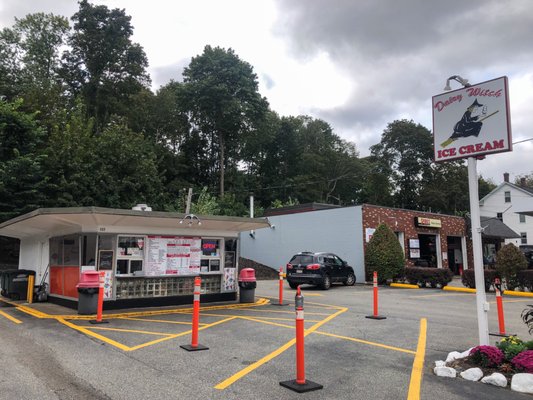
Bea and Pete Polemenako opened a soft-serve window at 117 Boston Street in Salem in 1952. Seventy-four summers later, on April 25, 2026, Dairy Witch posted a closing notice. Owner Marietta Polemenako announced she was retiring after decades behind the window, and no buyer has been named.
That’s the Boston Globe story. The Bullvine story starts roughly 30 miles away, in a bulk tank whose milk — through a long chain of processors, mix plants, and foodservice trucks — helped feed that soft-serve machine every summer.
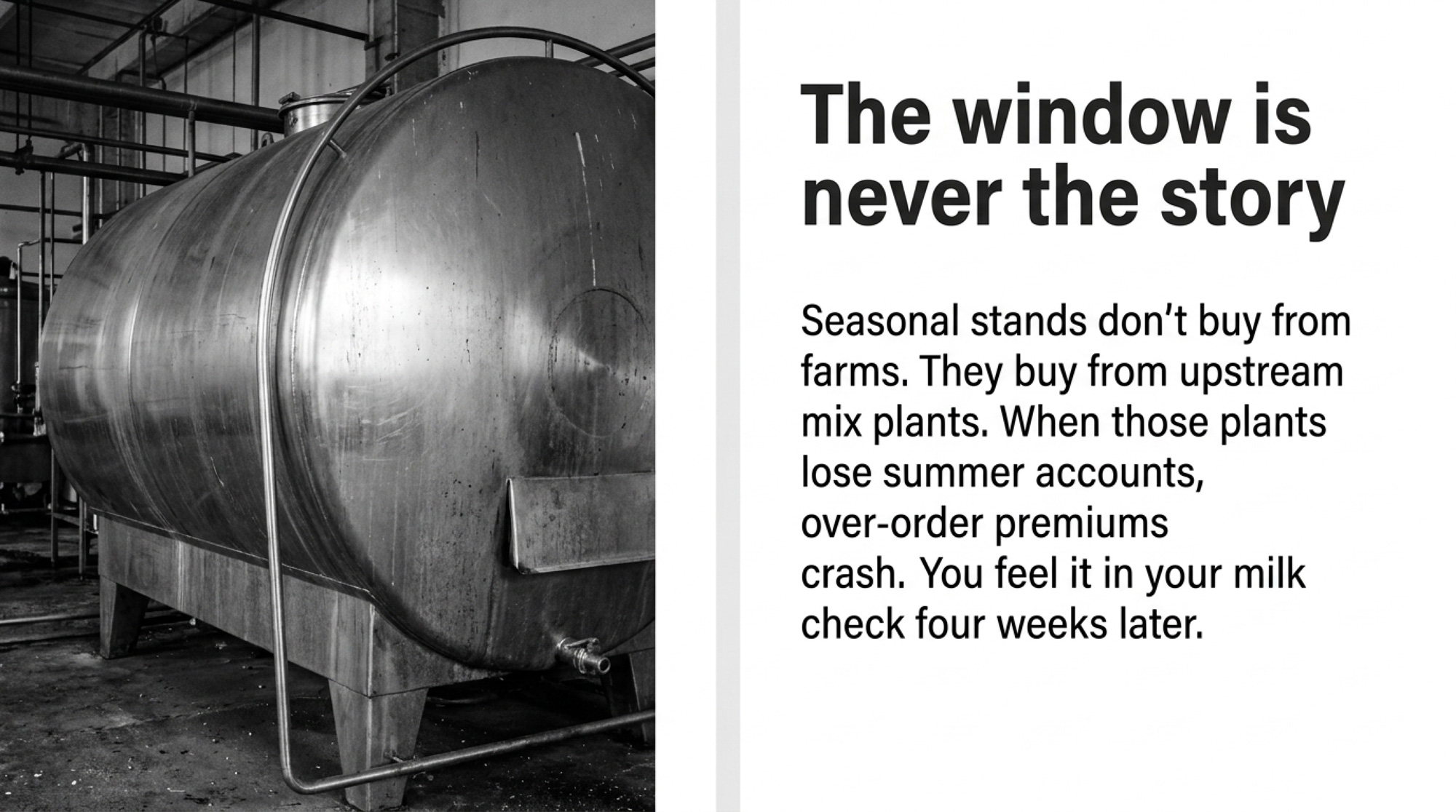
Every small dairy plant closure pulls one more thread out of New England’s Class I premium stack. The threads are thinning fast.
The Window Was Never the Story
Dairy Witch was a walk-up soft-serve stand. Seasonal. Open roughly April through early October. Cones, dips, frappes, the occasional hand-packed pint of Moose Tracks on the side.
It wasn’t a bottler. It wasn’t a creamery. No milk truck pulled into 117 Boston Street at 4 a.m. A window that size runs on pre-made soft-serve mix, delivered by a foodservice distributor from a plant somewhere upstream.
In eastern Massachusetts, that chain has gotten short. The FDA’s Interstate Milk Shippers list shows a handful of active licensed fluid operations in the state, and two names dominate the map: HP Hood in Agawam and DFA/Garelick in Franklin. Both remain the state’s largest fluid processors and show no public signs of closure; the pressure point is the smaller, seasonal, and direct-buy end of the market. Regional soft-serve mix moves through distributors like New England Ice Cream Corporation in Norton and Por-Shun in the Boston area.
So no — you won’t find a named Essex County farm that “lost its Dairy Witch contract.” The impact runs one link upstream. When mix plants lose seasonal accounts, over-order premiums typically come under pressure — a pattern Northeast dairy economists have documented for years. And the farms shipping into those plants feel it in the milk check four to six weeks later.
Before the barn math, know what you’re watching for. The checklist below is generic risk-spotting, not a prediction about any named plant.
How do you spot your local fluid buyer going under?
You don’t get a press release. You get signals. Watch for these:
- Volume calls that stop mentioning seasonal accounts. Ice cream stands, schools, restaurants — if your field rep stops talking about summer pickups, something shifted.
- Over-order premiums slipping two months in a row. One month is weather. Two is a margin problem at the plant.
- Route consolidation notices from your distributor, especially if your pickup gets combined with a farm 40 miles farther out.
- Owner retirement with no named successor. That’s the Dairy Witch pattern. Marietta is retiring; no buyer announced as of press time.
- Lapsed or non-renewed state processor licenses in Massachusetts Department of Agriculture filings. Those are public records. Check them.
What does a dairy farm actually lose when a local buyer closes?
Start with Federal Milk Marketing Order math. Northeast Order 1, with Boston as the base zone, sets a Class I differential of $3.25/cwt on top of the base Class I price. USDA AMS announced the base Class I at $20.15/cwt for May 2026 — up $1.49 from April. That’s the floor.
The real milk check lives above the floor. Analysis of the 2024 Northeast Dairy Farm Summary, released July 2025, reported the average Northeast farm milk price climbed $1.17/cwt in 2024 from 2023 levels, with net earnings of $592 per cow in 2024 versus $292 in 2023. That recovery was driven largely by stronger component prices and a rebound in cheese demand — but it’s still a thin margin for anyone carrying new parlor debt or a recent generational transfer. The weighted-average FMMO Order 1 statistical uniform price was roughly $18.81/cwt for 2023, per USDA AMS’s 2023 Market Summary and Utilization report. Northeast farm prices in 2023 typically cleared several dollars per hundredweight above that floor — over-order premium, quality bonuses, and handler competition all stacked on top.
When a local fluid buyer closes, that stack starts shrinking. Industry commentary and long-standing Pennsylvania Milk Marketing Board testimony puts the over-order premium portion at roughly $0.75–$1.50/cwt in the Northeast, though specific figures vary by handler and year. Either way — it’s real money coming off the check.
| Component | Value ($/cwt) | Source |
|---|---|---|
| Northeast Order 1 Class I differential, Boston zone | 3.25 | USDA AMS, FMMO Order 1 |
| Base Class I price, May 2026 | 20.15 | USDA AMS announcement, May 2026 |
| Order 1 statistical uniform price, 2023 | 18.81 | USDA AMS 2023 Market Summary |
| Northeast over-order premium range | 0.75 – 1.50 | PA Milk Marketing Board testimony; industry commentary |
| 2024 NE farm price increase vs. 2023 | +1.17 | 2024 Northeast Dairy Farm Summary, July 2025 |
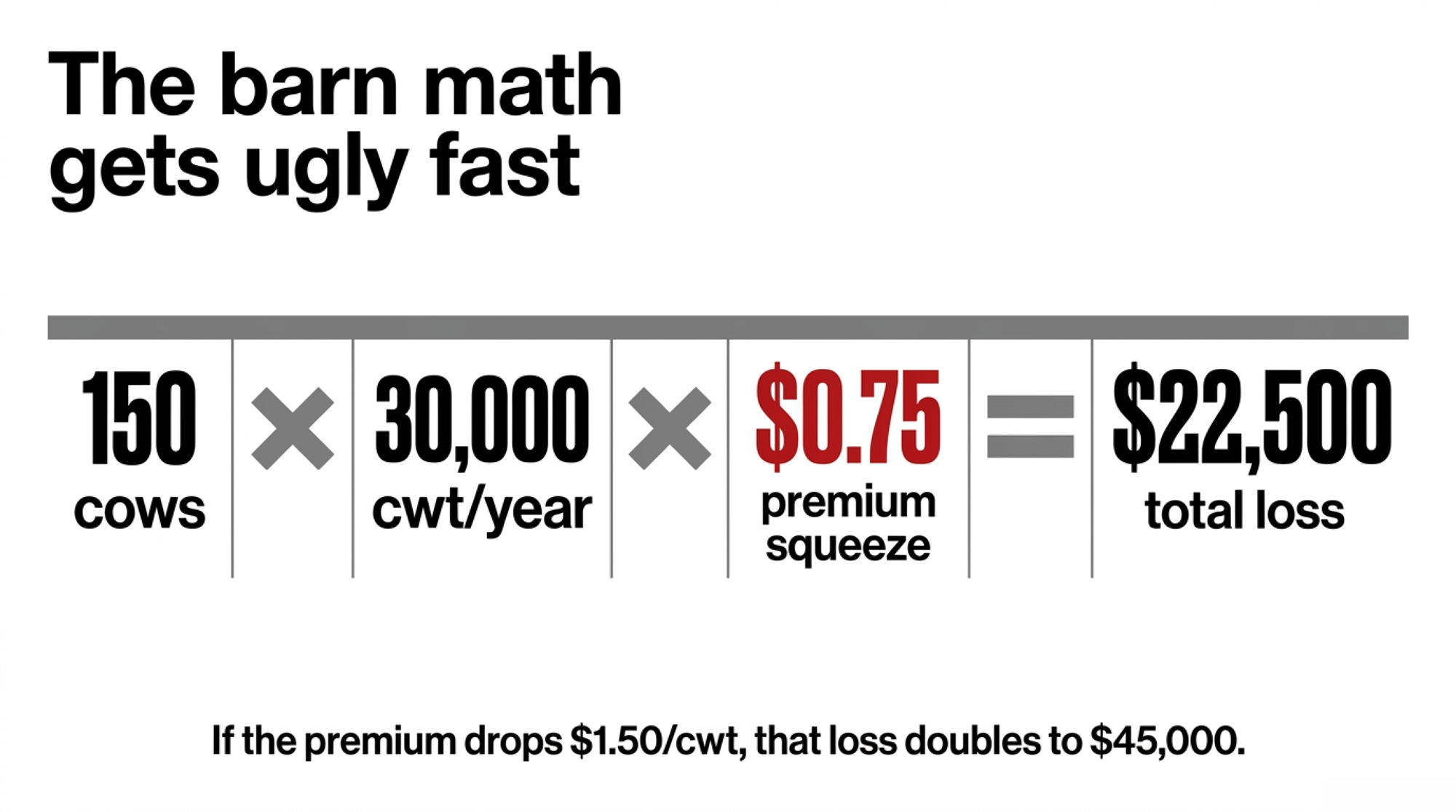
Quick barn math. Take a 150-cow herd in Essex County. Massachusetts averaged 20,000 pounds of milk per cow in 2024, per USDA NASS — that’s 200 cwt per cow per year, or 30,000 cwt across a 150-cow herd. A 75¢/cwt squeeze on the over-order premium costs about $22,500 a year. At $1.50/cwt, it’s $45,000. Plug in your own herd size; the multiplier is brutal either way.
Stack that on top of the 2025 FMMO reforms, which The Bullvine’s April 2026 analysis estimated at roughly $0.85–$0.93/cwt off class prices for a representative 500-cow Northeast dairy — on the order of $95,000 to $115,000 a year depending on per-cow productivity. The math gets ugly in a hurry.
Thomas Dairy, Rutland, 2020 — A Preview You Already Watched
If Salem feels small, look north. In October 2020, Thomas Dairy in Rutland, Vermont — a fifth-generation fluid milk business founded in 1929 — closed. According to VTDigger and Vermont Public reporting, the closure followed the collapse of the company’s restaurant and school accounts during COVID. Supplier farms had to find new handlers ahead of the shutdown. This is a single historical parallel, not a predictive model — but it’s the closest Northeast case of a mid-century named fluid buyer closing on retirement-plus-market pressure, and the supplier farms did have to reshuffle.
Vermont has lost more than 400 dairies in the past decade. Vermont Dairy Delivers tracks the state at roughly 868 farms in 2015 and a current count in the mid-400s, with steady year-over-year exits. Most of those losses were small and mid-size herds — the same operations most dependent on local handlers paying real over-order premiums.
The national backdrop is rougher. USDA’s 2022 Census of Agriculture recorded a drop from 40,336 farms with milk sales in 2017 to 24,470 in 2022 — a 39% decline in five years. USDA’s February 20, 2026 Milk Production report showed another 1,036 licensed dairy operations exited in 2025, about 4% of the national total, bringing the average licensed count to 23,609. Pennsylvania alone accounted for 41% of all U.S. dairy exits last year, losing 320 farms, per February 2026 analysis.
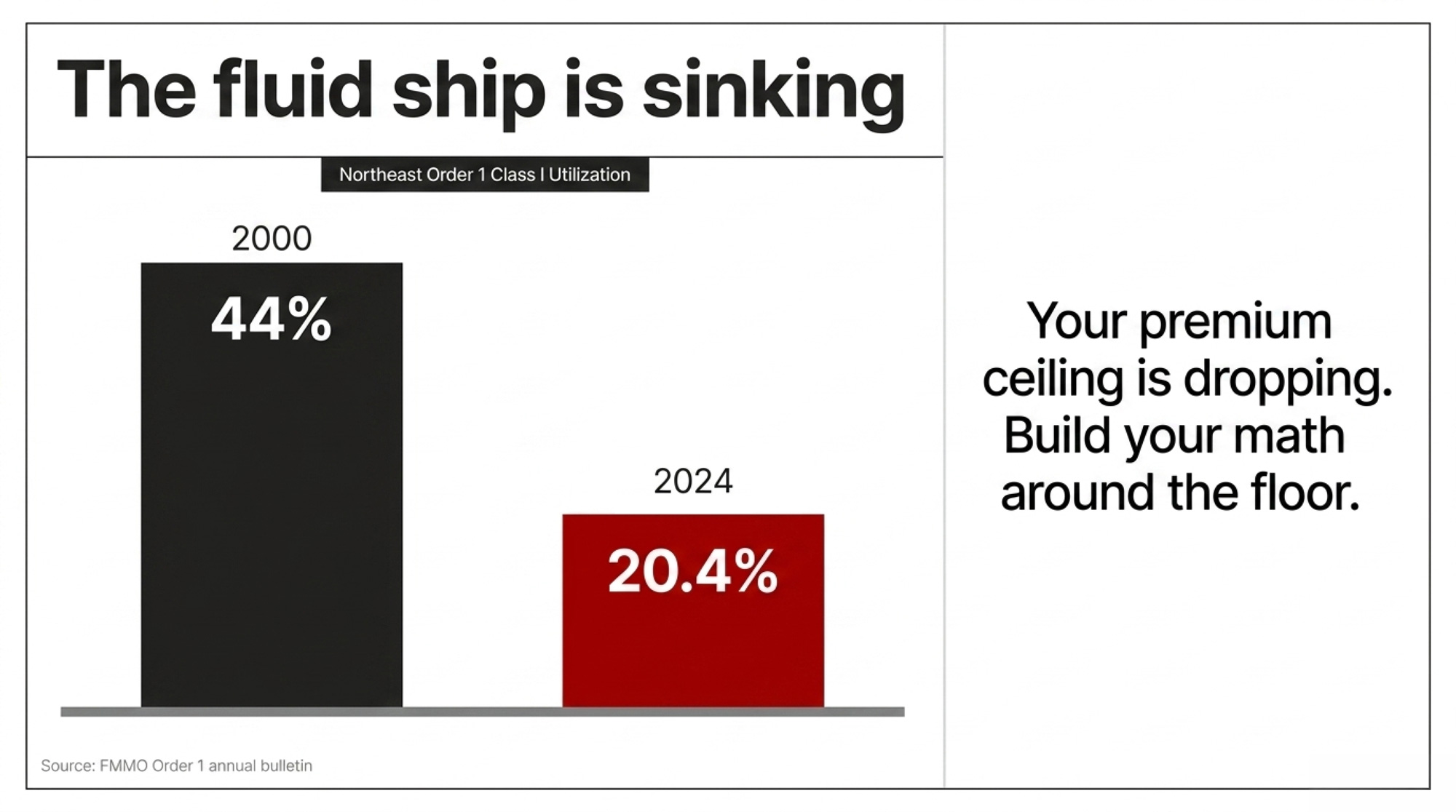
Fluid drinking milk is the slowest part of the ship to sink with you. In Northeast Order 1, Class I utilization averaged just 20.4% of pooled milk in 2024, per the FMMO Order 1 annual bulletin — up 2.4 percentage points from 2023, but still a long way from the 44% Class I share the Order carried in 2000. Every Dairy Witch-scale account that goes quiet pushes that number further down.
What do you do in the next 30 days?
Don’t wait for a closure announcement. Do this before June.
Run a buyer concentration audit. Add up what percentage of your monthly milk volume goes to your top one, two, and three handlers. Any single buyer taking more than a third of your volume is a concentration risk by most Northeast lender and co-op standards. It’s also the fastest diagnostic you can run on a Sunday afternoon.
Stress-test your milk check. Model what next month’s check looks like if your top buyer exits and you drop to the FMMO blend. Use a conservative –/cwt downside — the rough gap between what Northeast farms have cleared in recent years and the Order 1 statistical uniform price. Multiply by your annual cwt. That’s the number that tells you whether you’re making phone calls this week or next quarter.
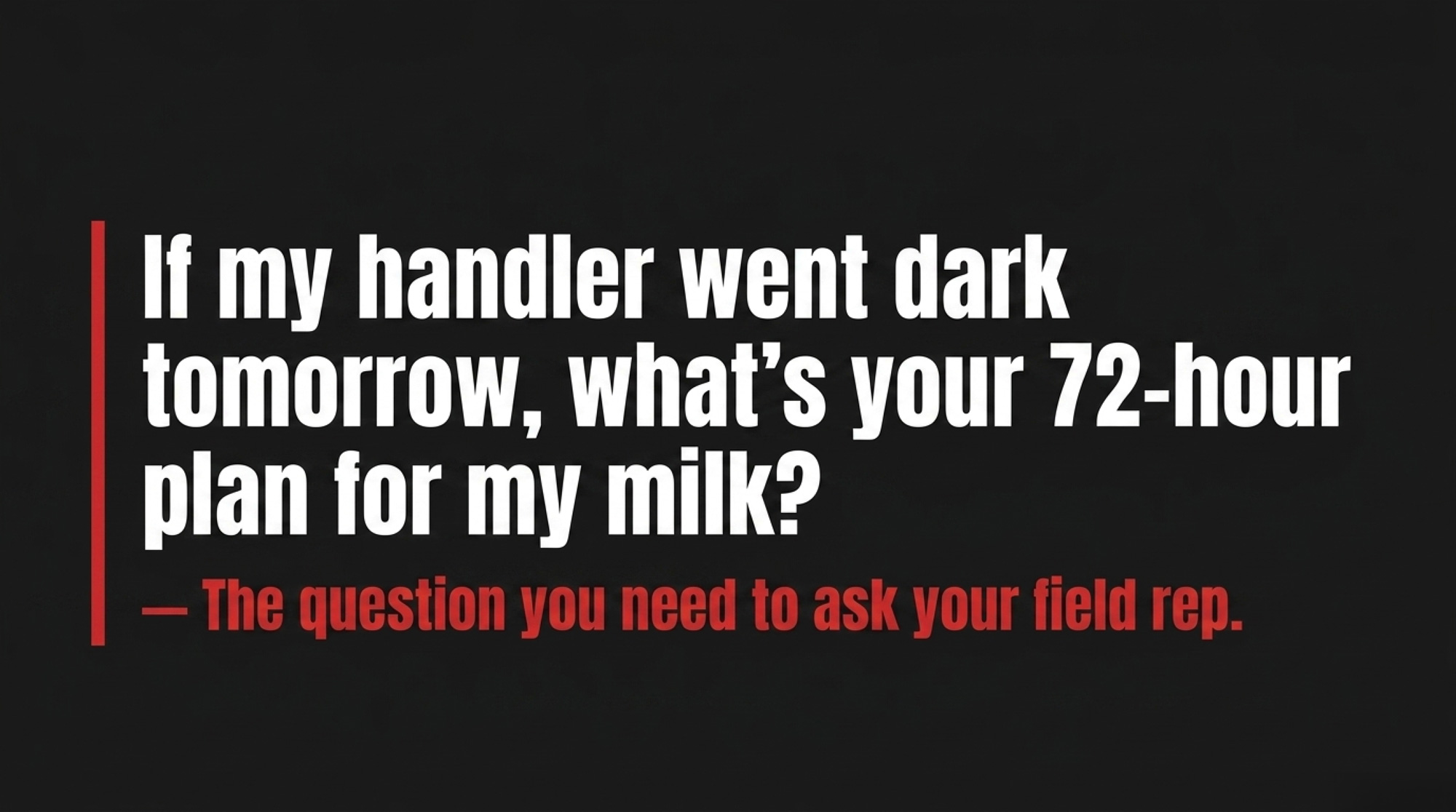
Call your cooperative field rep and ask the ugly question directly. “If my handler went dark tomorrow, what’s your 72-hour plan for my milk?” Any answer that isn’t specific is the answer you needed.
Within 90 days, sit down with your cooperative or handler to review your contract language on handler substitution, force-majeure clauses, and route reassignment rights. Those are the paragraphs nobody reads until the plant closes.
Options and Trade-Offs for Farmers
There’s no one right move. Four realistic paths, each with a bill attached.
| Path | Best fit | Time to execute | Key constraint |
|---|---|---|---|
| Stay with current co-op, chase quality premiums | <300-cow herds with Agri-Mark/DFA/Hood ties | 30–90 days | Caps your over-order upside |
| Switch to specialty / organic handler (e.g., Stonyfield, Organic Valley) | Pasture-ready farms; pay near mid-$40s/cwt in recent years | 3+ years(NOP transition) | 2022 Origin of Livestock rule closed one-time conventional loophole |
| Direct-to-consumer bottling (Shaw Farm, Crescent Ridge model) | Family with retail operator on-site | 12–24 months | 365-day labor + HACCP burden |
| Shared regional co-processing / co-packing | Clusters of 200-cow neighbors on same vulnerable plant | 6–18 months | Governance complexity |
Stay with your current cooperative and diversify quality premiums. Works if your co-op is Agri-Mark, DFA, or Hood-aligned with multiple Northeast plants. You give up the chase for a higher over-order premium elsewhere, but you gain pooling stability and field rep attention. Good fit for farms under 300 cows without the bandwidth to renegotiate.
Switch to a specialty or organic handler. Stonyfield stepped in for some Horizon Organic farms after Danone’s 2022 Northeast exit. Organic Valley offered placements to dozens of Horizon-dropped operations, per coverage at the time. NODPA’s producer pay price tracking has shown organic figures in the mid-$40s/cwt range in recent years. Trade-off: USDA organic transition requires three full years of organic land management before certified organic milk can ship, plus separate herd-transition requirements under the National Organic Program. The regulatory burden isn’t trivial, and the 2022 Origin of Livestock final rule closed the old one-time conventional-to-organic transition loophole for most operations.
Build a direct-to-consumer line. Shaw Farm in Dracut has been bottling its own milk since 1908, running a home-delivery route, an ice cream stand, and a farm store all from the same property about 30 miles from Salem. Crescent Ridge in Sharon has followed a similar playbook for generations. You capture price — glass-bottle retail milk in eastern Massachusetts clears at a multiple of the FMMO blend. You also take on labor, bottling, delivery, retail, HACCP, and a seven-day-a-week foot-traffic business. Only works if your family has someone who actually wants to run a retail business. This is a 365-day decision, not a 30-day fix.
Consolidate with neighbors on shared processing. Regional co-processing or cheese co-packing arrangements have kept some mid-size Northeast farms alive. Governance gets complicated fast. But if your county has two or three 200-cow herds all shipping to the same vulnerable plant, a shared exit strategy beats three separate collapses.
None of these survive if you can’t see the buyer going under. That’s why the 30-day audit matters first.
Key Takeaways
- If a single buyer takes more than a third of your monthly volume, start the alternative-handler conversation this month, not next quarter.
- If your over-order premium drops two months in a row without a market-wide explanation, assume your plant has a margin problem and act accordingly.
- If your handler’s owner announces retirement with no named successor, treat it like a 90-day exit notice whether or not one has been issued.
- If your FMMO’s Class I utilization keeps drifting — Order 1 sat at just 20.4% in 2024 — your over-order-premium ceiling is drifting with it. Build your barn math around the floor, not the five-year average.
- If you’re in a co-op, your 72-hour contingency plan isn’t theoretical. Ask for it in writing.
The Bottom Line
Every direct-buy relationship that dies forces a choice: accept the FMMO floor or build a buyer you can’t easily lose. Neither option is free, and neither one waits.
So here’s the question worth chewing on before your next field rep call: what’s the last small fluid buyer in your county, and how many summers do they have left? Salem lost a soft-serve window this spring. Rutland lost a fifth-generation bottler five summers ago. Somewhere in Aroostook County, or Bennington, or outside Springfield, another retirement conversation is happening at another kitchen table right now — and the question is whether your milk check is ready when that window closes too.
The Bullvine Weekly has the full FMMO reform breakdown and the 500-cow dairy barn math behind the six-figure impact flagged above. If you want the deeper economic model — the one to hand your lender before your next operating note — that’s where it lives.
Methodology note: This article is based on public closure coverage and USDA AMS, USDA NASS, VTDigger, Vermont Public, NODPA, and FMMO Order 1 data available as of April 30, 2026. Named processors and distributors are referenced for industry-structure context only; none are alleged to face closure risk.
Learn More
- What Lactalis’s 270-Farm Cut Really Means for Every Producer — Clarity on your farm’s structural limits is your best defense against equity loss. This breakdown reveals why 89% of dairies over 1,000 cows profit, arming you with the $0.60/cwt professional service math needed to responsibly scale, transition, or sell.
- Surviving the $0.94/cwt Dairy Make Allowance Hit — Exposing the structural federal pricing shifts erasing $105,000 annually from a 400-cow dairy gives you a critical planning advantage. You will master a specific formula to calculate your true All-Milk to mailbox gap and immediately recalibrate break-even metrics.
- Cheese Yield Explosion: How Dairy Farmers Can Reclaim Billions in Lost Component Value — Follow the money on a 12.5% industry-wide leap in cheese yields to dismantle processor narratives about flat pay prices. Secure a distinct negotiating edge by using these specific tactics to demand compensation for the $2.50/cwt in new value generated.
 The Sunday Read Dairy Professionals Don’t Skip.
 The Sunday Read Dairy Professionals Don’t Skip.
Every week, thousands of producers, breeders, and industry insiders open Bullvine Weekly for genetics insights, market shifts, and profit strategies they won’t find anywhere else. One email. Five minutes. Smarter decisions all week.