


Dragons laughed at CATTLEytics’ $12M ask. Ontario wages say your ‘free’ WhatsApp can leak $7,300 a year. Want to see the barn math?
Executive Summary: When CATTLEytics appeared on Dragons’ Den asking $1.2 million for 10%, it looked like a $12 million bet on what sounded like a $120,000 “task app.” Off TV, the numbers are different: founder‑vet Shari van de Pol says CATTLEytics now runs at about $1.4 million in annual recurring revenue, hit profitability in December 2025, carries no debt, and has roughly $1.4 million in Canadian grants plus a $2 million FFAR lameness‑detection partnership behind it. That moves the valuation from a TV‑friendly 100× multiple down to a very normal ~8.6× for profitable SaaS. The real tension isn’t her cap table; it’s your barn math: at Ontario wages near $20/hour, even 1 hour/day lost in “free” WhatsApp coordination is worth about $7,300/year, and 2 hours/day is $14,600/year against a $750 Tier 1 subscription. Top‑managed herds like Summitholm Holsteins are already using CATTLEytics as a data spine across Lely, DeLaval, DairyComp, EzFeed, DairyTrace, and P5 pricing — while CATTLEytics’ own P5 Revenue Impact Calculator shows how the January 2026 shift (T1 protein –14¢/kg, T2 +$3.00/kg) changes optimal SNF targets. This article walks through that barn math, shows where a 19:1 ROI is realistic (and where it isn’t), and gives a 30/90/365‑day checklist to decide whether your current “free” system is actually the most expensive software on your farm.
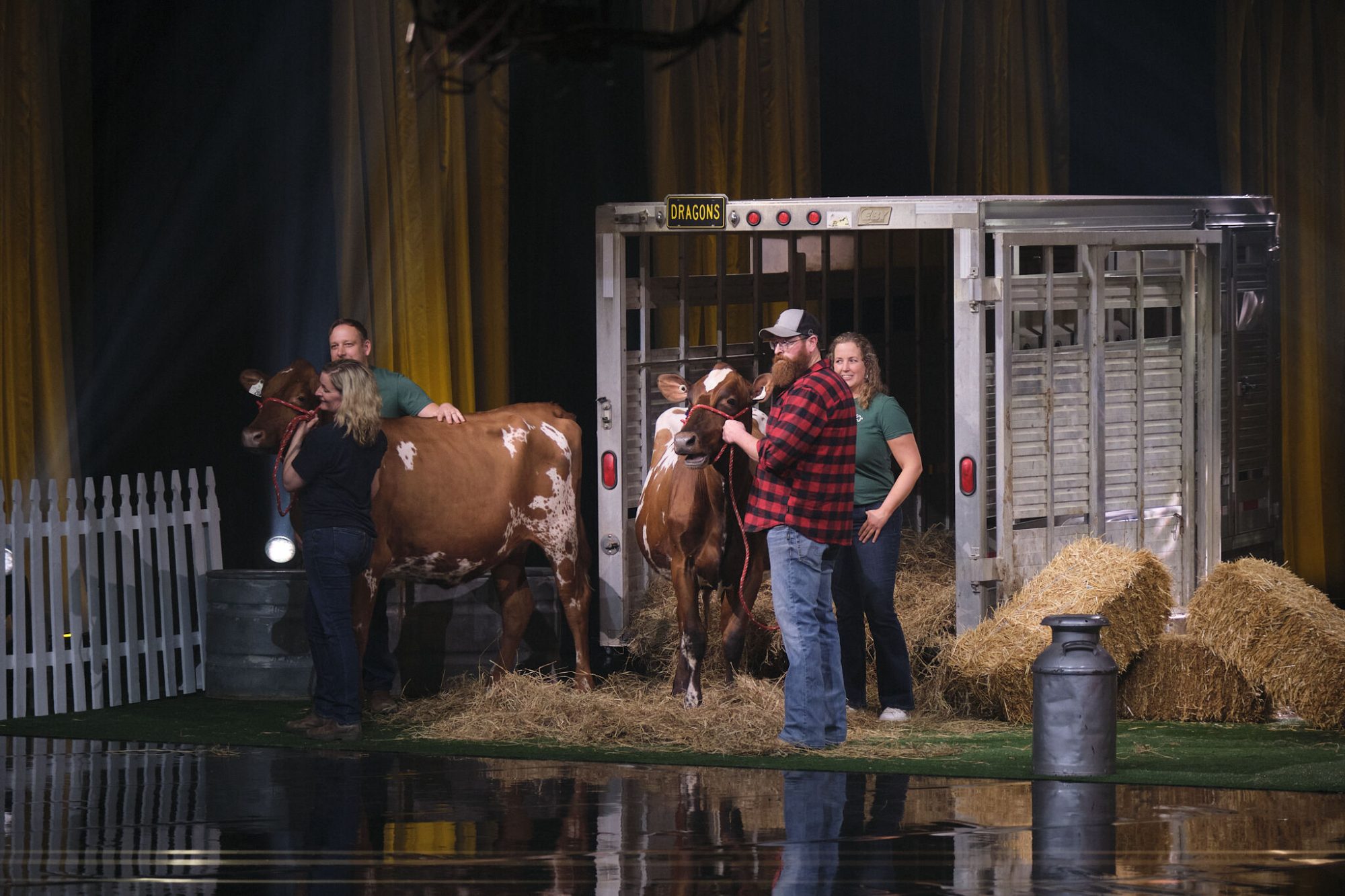
When you saw CATTLEytics on Dragons’ Den asking $1.2 million for 10% — a $12 million valuation on what sounded like $120,000 in revenue — it probably looked like peak startup insanity. A hundred‑times multiple for a “task app”? Come on.
But the numbers that landed in The Bullvine’s inbox tell a different story. We reached out to Dr. Shari van de Pol, founder of CATTLEytics, and she shared a more complete picture: roughly $1.4 million in annual recurring revenue, profitability since December 2025, zero debt, live integrations with Lely, DeLaval, DairyComp, AfiMilk, Beco, EzFeed, and a $2 million FFAR research partnership in the U.S. The TV edit made it look like a 100× bet. The real multiple is closer to 8.6× — boring by SaaS standards.
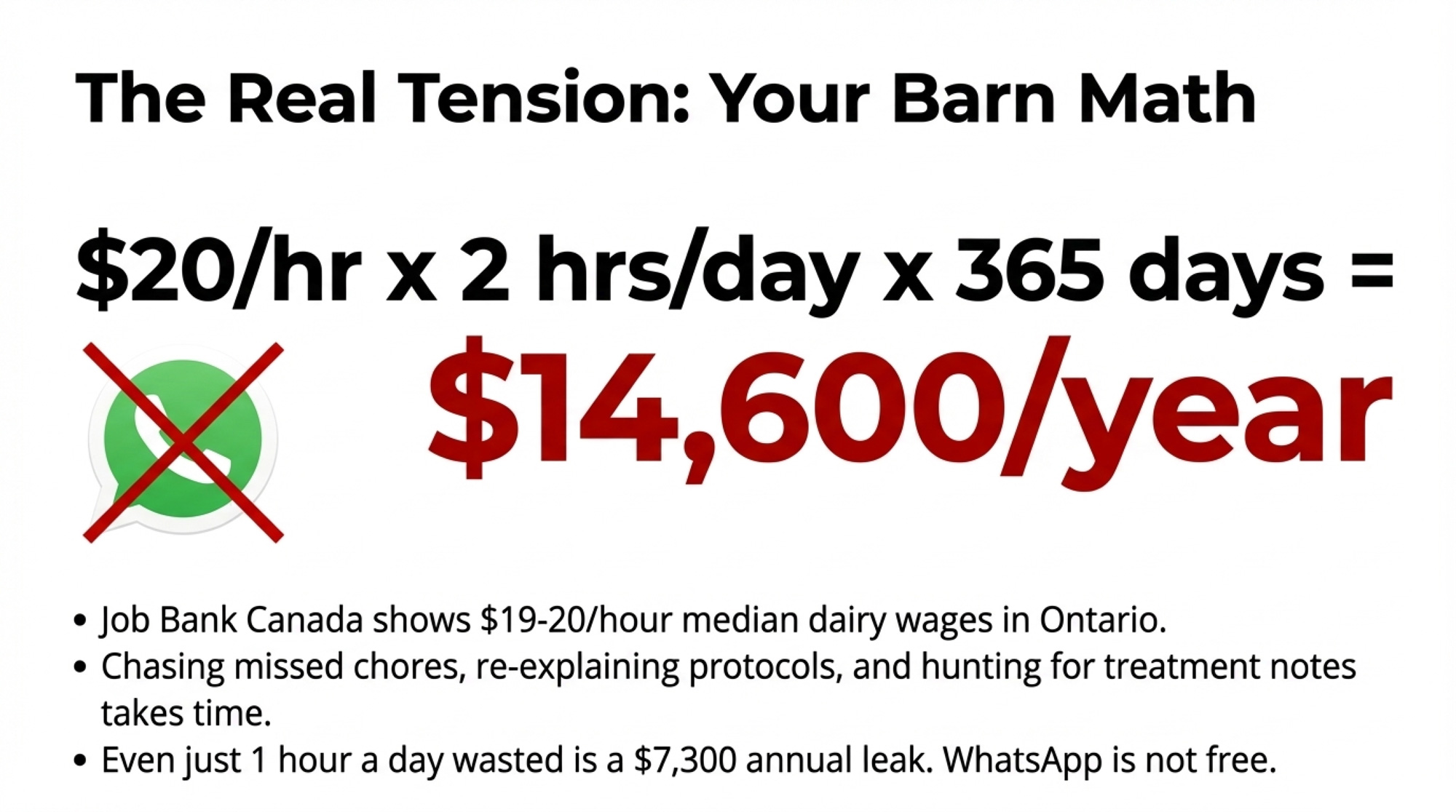
None of that changes the math that matters on your farm: at Ontario wages, even 1 hour/day of wasted coordination time is worth about $7,300/year; 2 hours/day is $14,600/year. You can keep telling yourself WhatsApp is “free”. Or you can put a number on what that chaos costs.
A Vet–Engineer, a Dragons’ Den Stage, and 200,000 Cows’ Worth of Data
Dr. Shari van de Pol isn’t pitching from a co‑working space. She has a computer engineering degree from McMaster, a DVM from the Ontario Veterinary College, and she’s based in Hamilton, Ontario. She founded CATTLEytics in 2014, the year she graduated vet school, after seeing the same pattern on barn after barn: good cow care, systems held together with dusty binders, WhatsApp threads, and herd software that looked like it hadn’t left the 1980s.
On Dragons’ Den, she had about 90 seconds to explain a platform that connects parlour systems, herd records, feed software, economics, and HR into one interface. What came across was the simplest layer: a task and scheduling system, 0/year for farms under 500 cows, with users claiming to save 1–2 hours/day chasing chores and re‑explaining protocols.
The real business she’s running today is bigger than the edit suggested:
- About $1.4 million in annual recurring revenue (ARR) as of early March 2026, per van de Pol’s direct email to The Bullvine.
- Profitability was reached in December 2025.
- Around $1.4 million in non‑dilutive Canadian grants from CAAIN, OAFRI, the National Research Council, and FedDev.
- Nearly $1 million more in matching funds already committed to build out advanced analytics.
- No debt. No outside investors. 100% founder ownership.
- Data flowing on “over 200,000 dairy cows” through the platform.
She also said she went three years without a salary while building the platform’s foundation. That’s not a “build an app in six months and flip it” story. That’s a long, slow bet on dairy data infrastructure.
Why the Real Revenue Multiple Is 8.6×, Not 100×
| Metric | Dragons’ Den Edit (TV) | March 2026 Reality | Why It Matters |
| Annual Revenue | ~$120,000 | $1.4 Million ARR | 11.7× higher than portrayed |
| Valuation Multiple | 100× | 8.6× | Moves from “insane” to boring SaaS standard |
| Debt | Seeking capital | $0 | 100% founder owned, zero leverage |
| Profitability | “Early stage” | Profitable Dec 2025 | Already past the cash-burn valley |
| Grant Backing | Not mentioned | $1.4M received + $1M committed | Non-dilutive capital still flowing |
| Cows on Platform | Not disclosed | 200,000+ | Real scale, not a pilot project |
On TV, the Dragons latched onto a simple equation:
- Revenue: ~$120,000
- Valuation ask: $12,000,000
- Multiple: 100× revenue
With the updated figures, the math shifts:
- Current ARR (2026): ~$1,400,000
- Valuation ask: $12,000,000
- Multiple: $12M ÷ $1.4M ≈ 8.6×
In pure SaaS land, an 8–10× revenue multiple for a profitable, growing, fully founder‑owned company in a niche with real switching costs is nothing special. It’s roughly where a lot of business‑to‑business platforms land once they’ve proven product‑market fit and are scaling.
Van de Pol name‑checked Connecterra — an Amsterdam‑based company founded the same year she launched CATTLEytics — as the closest comparison. Connecterra built Ida, an AI platform that pulls in sensor data and farm records to generate management insights. Over three funding rounds, it raised more than $15 million: a $1.8M seed in 2016, a $4.9M Series A in 2018, and a €7.8M (~$8.76M) Series B in 2020, at that point the largest Series B for any European livestock tech startup.
Investors like ADM Capital, Kersia, and Sistema VC backed it; Danone, Bayer, and ABS Global partnered with it. Against that benchmark, $12 million for a profitable, grant‑backed Canadian platform with $1.4M ARR is not the crazy part of this story.
CATTLEytics’ $1.4 million in ARR doesn’t come purely from farm subscriptions. Van de Pol clarified that the revenue includes custom software development and consulting — including contract work for TELUS Agriculture on beef cattle systems and research partnerships with U.S. clients who’ve asked not to be named publicly. The company also builds custom analytics layers and data integrations for larger clients, leveraging the platform they’ve already built.
That means the simple math — ,400,000 ÷ 200,000 cows = .00/cow — overstates what a typical farm subscriber pays. The real per‑cow cost for a straightforward dairy subscription is lower, though CATTLEytics doesn’t publish current pricing publicly. What we do know: the $750/year Tier 1 price pitched on Dragons’ Den covers herds under 500 cows, and deeper analytics tiers scale from there.
It also means CATTLEytics isn’t just a farm software company. It’s part platform, part consulting shop, part research partner — which is actually how a lot of successful vertical SaaS companies operate. The software creates the data layer; the consulting monetizes the expertise that sits on top.
CATTLEytics doesn’t list its updated tier pricing publicly anymore; access runs through a quiz and contact flow. Van de Pol says that’s deliberate because a similarly named competitor has been copying their screens and positioning. What we do have are the on‑air numbers for Tier 1, the per‑cow ARR signal, and the wage and time‑savings math any Ontario farm can plug into their own budgets.
What Does Two Hours Saved Actually Add Up To?
Forget the valuation for a minute. The claim that really matters on your farm is simple: CATTLEytics Tier 1 users told van de Pol they’re saving about two hours per day on coordination and follow‑up. Not in a controlled study. “Phone your customers and ask.”
Soft data? Yup. But you can still stress‑test it against real wage numbers.
Job Bank Canada’s wage report for dairy farm workers in Ontario, updated December 3, 2024, shows:
- Low: $17.20/hour
- Median: $19.03/hour
- High: $29.00/hour
Regional medians:
- Around $17.50/hour in Hamilton–Niagara
- Around $20.00/hour in Kitchener–Waterloo–Barrie and Stratford–Bruce Peninsula
If you’re trying to keep good people, $20/hour is a realistic working number.
Now run the math on that 2 hours/day claim:
- Time saved: 2 hours/day
- Wage: $20/hour
- Days/year: 365
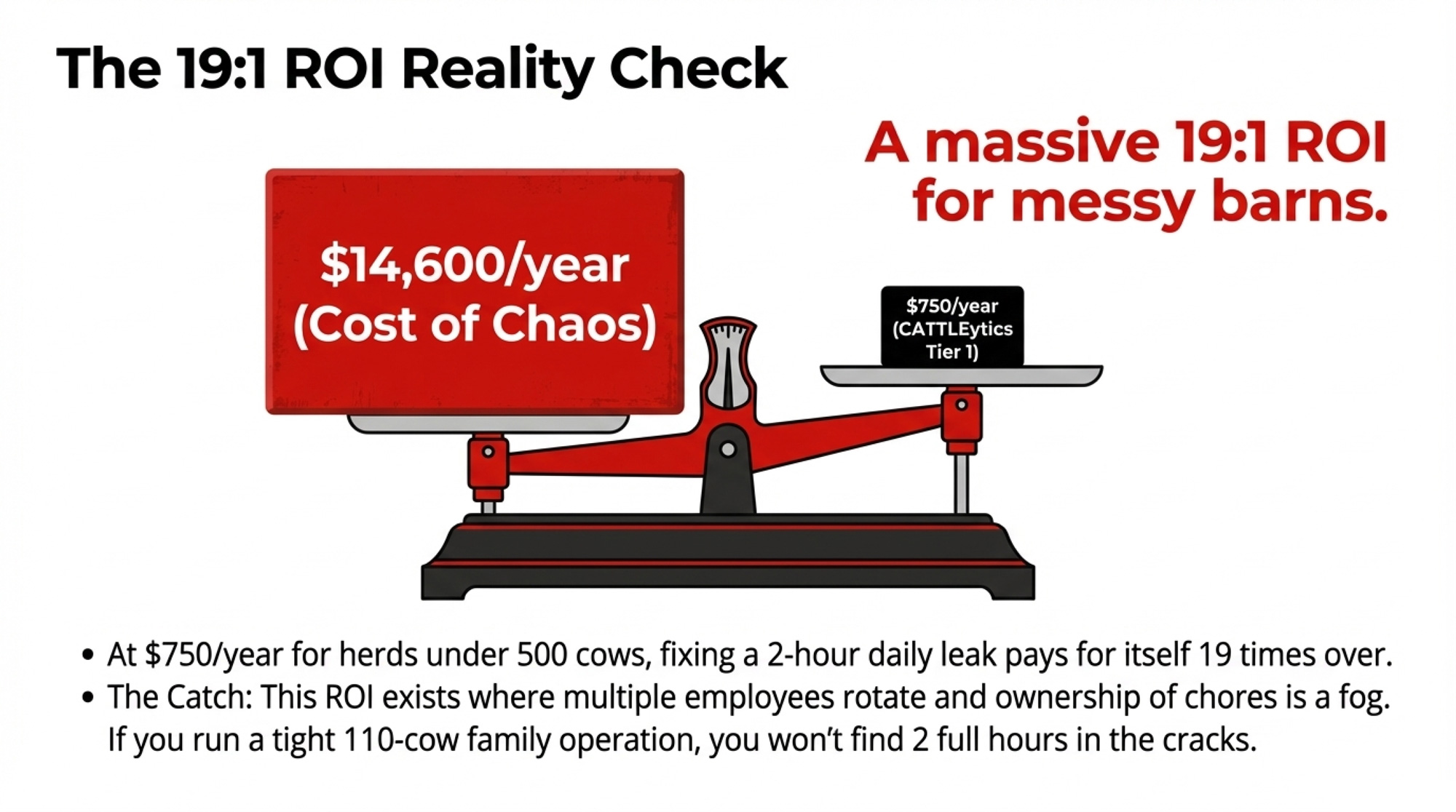
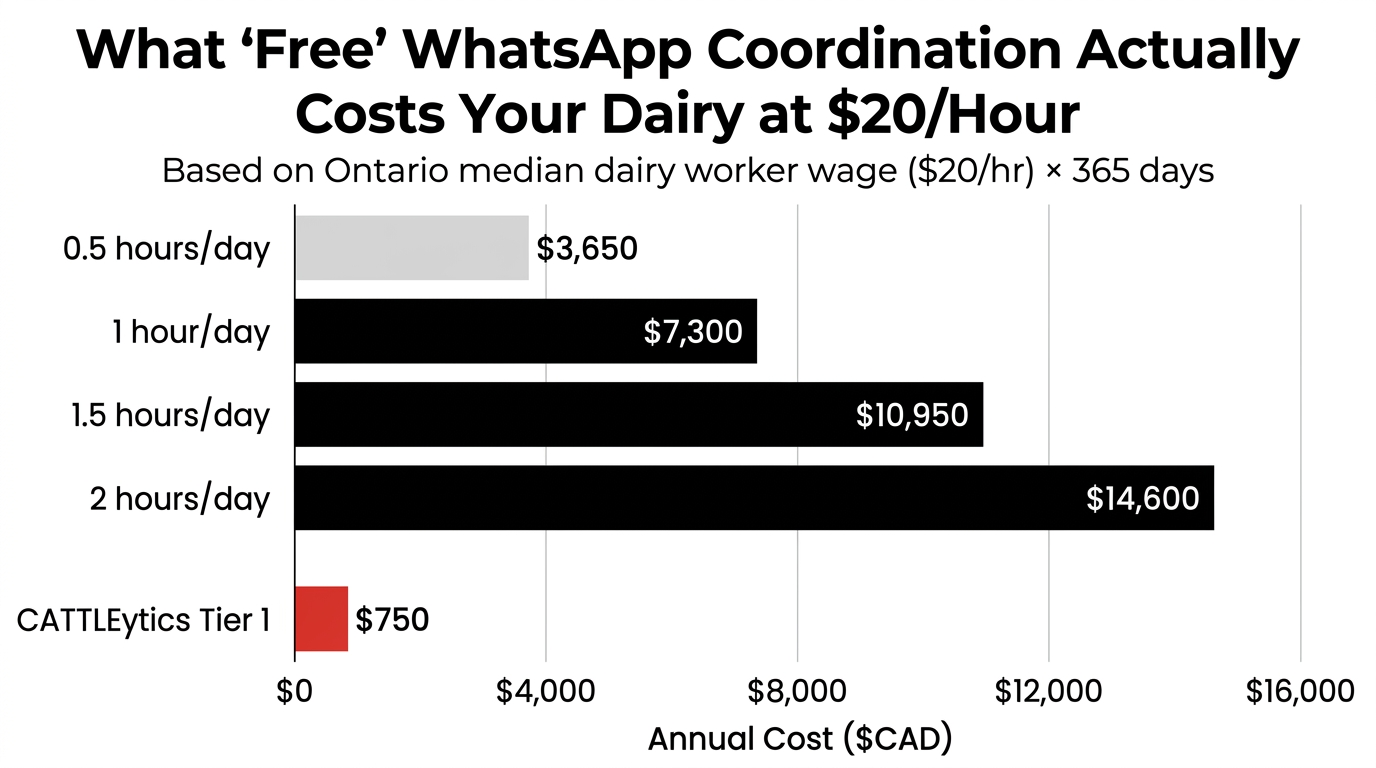
2 × $20 × 365 = $14,600/year
Put that against Tier 1 pricing from the show:
- Tier 1 subscription (under 500 cows): $750/year
- ROI on those self‑reported numbers: $14,600 ÷ $750 ≈ 19:1
Cut it in half — assume the real saving on your place is only 1 hour/day:
- 1 × $20 × 365 = $7,300/year
- $7,300 ÷ $750 ≈ 9.7:1
At current Ontario wages, 1–2 hours/day of cleaner coordination is worth somewhere between $7,300 and $14,600/year. Against a $750 subscription, the ROI is ugly in a good way.
Two qualifiers you shouldn’t gloss over:
- Those hours are self‑reported by current customers, not third‑party time‑and‑motion studies.
- The biggest savings show up on messy barns — multiple employees, rotating staff, WhatsApp chaos, no clear ownership of chores, and a constant fog of “who was supposed to do that?”
If you’re a tight 110‑cow family operation where one person sets protocols and does most of the critical work, you probably won’t find 2 full hours in the cracks. You might find half an hour, or nothing. The more your current system looks like “WhatsApp plus memory”, the more likely that 19:1 math shows up on your ledger.
And then there’s the cost nobody ever puts in the budget: WhatsApp is “free” until a fresh‑cow treatment gets buried in a chat, a withdrawal gets missed, or an updated mastitis protocol never makes it from the binder behind the invoices into the hands of the night guy. At that point, the math isn’t 19:1. It’s whatever one mistake costs you in dumped milk, vet bills, or auditor heat.
Does CATTLEytics Work on a Top‑10 Canadian Herd?
This isn’t just a tool for barns fighting chaos. It’s already running on one of the tightest operations in the country.
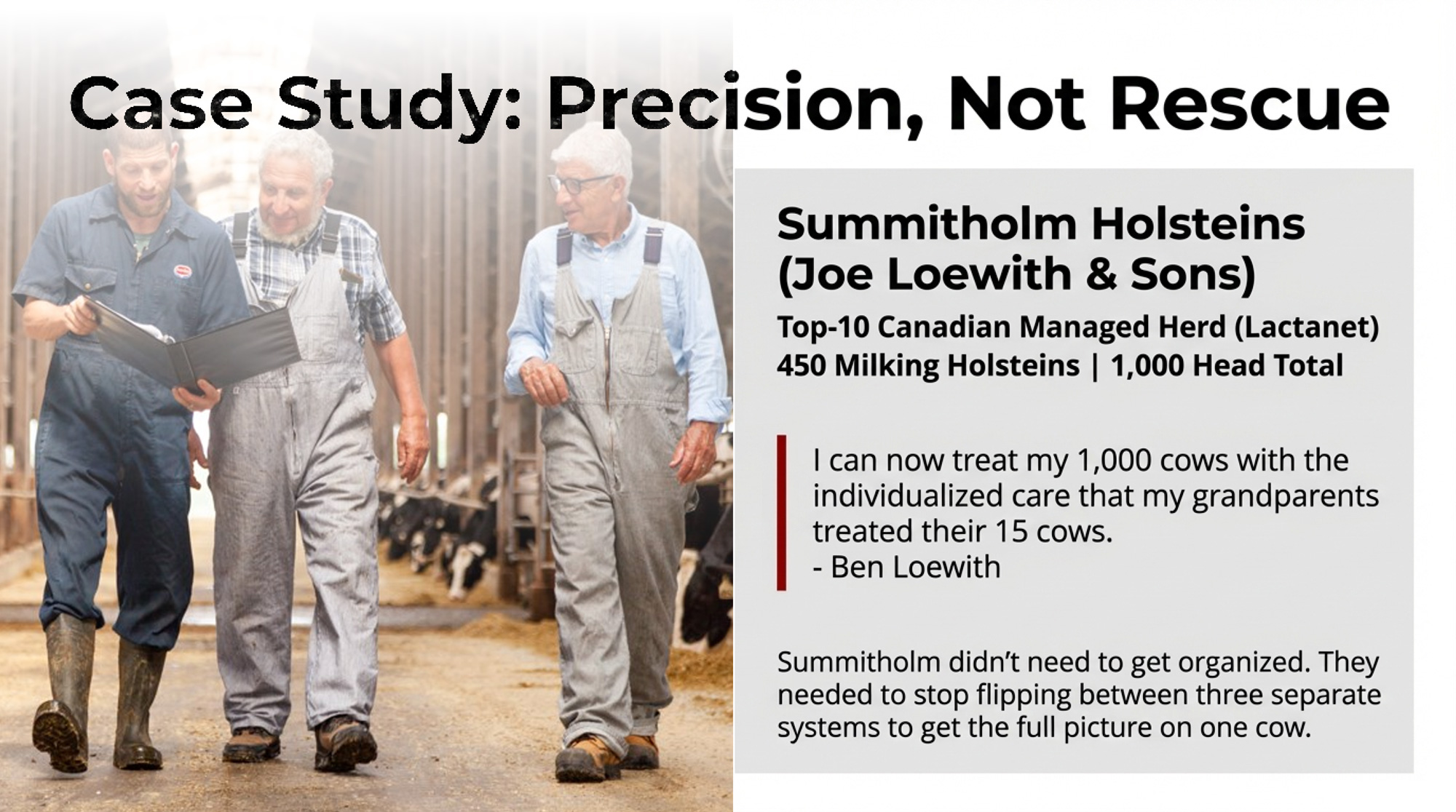
Ben Loewith runs Joe Loewith & Sons — better known as Summitholm Holsteins — just outside Hamilton. Farmers Forum reports that Summitholm milks about 450 Holsteins in a double‑16 parlour and runs roughly 1,000 head total. Lactanet’s Best Managed Dairy Herd program shows Summitholm as a Top 10 Canadian Managed Herd and a five‑time Top 25 award recipient, tied for third among parlour milking systems in the 2025 rankings.
The Bullvine’s own profile, “Growing the Farm Business – The Loewith Family Way,” notes that Summitholm has been the #1 Ontario herd seven times in Lactanet’s managed herd rankings, with 470 milking cows at 44.8 kg/day, 4.55% fat, 3.23% protein, and 133 SCC with a 13‑month calving interval. In other words, this barn already lives and dies by data.
Summitholm isn’t a farm that needed to “get organized.” It was already there.
Loewith is publicly featured on the CATTLEytics site with a line that sums up the real promise of an integration layer better than any pitch deck: “I can now treat my 1,000 cows with the individualized care that my grandparents treated their 15 cows.”
Is that vendor marketing? Sure. It’s on their site. But it’s also a named, visible producer with a serious track record, not a stock photo. For a herd like Summitholm, the sale isn’t “we’ll save you two hours a day wrenching chaos into order.” It’s:
- “We’ll stop you from flipping between three systems to get the full picture on one cow.”
- “We’ll layer real dollars on top of your production and health data — in Canadian prices.”
- “We’ll let you see the effect of that ration tweak or repro protocol change in one place.”
When one of the best‑run herds in the country decides there’s value in another layer of software, that’s a data point worth factoring into your own decision — even if your operation looks very different.
What Does CATTLEytics Actually Do Beyond Task Management?
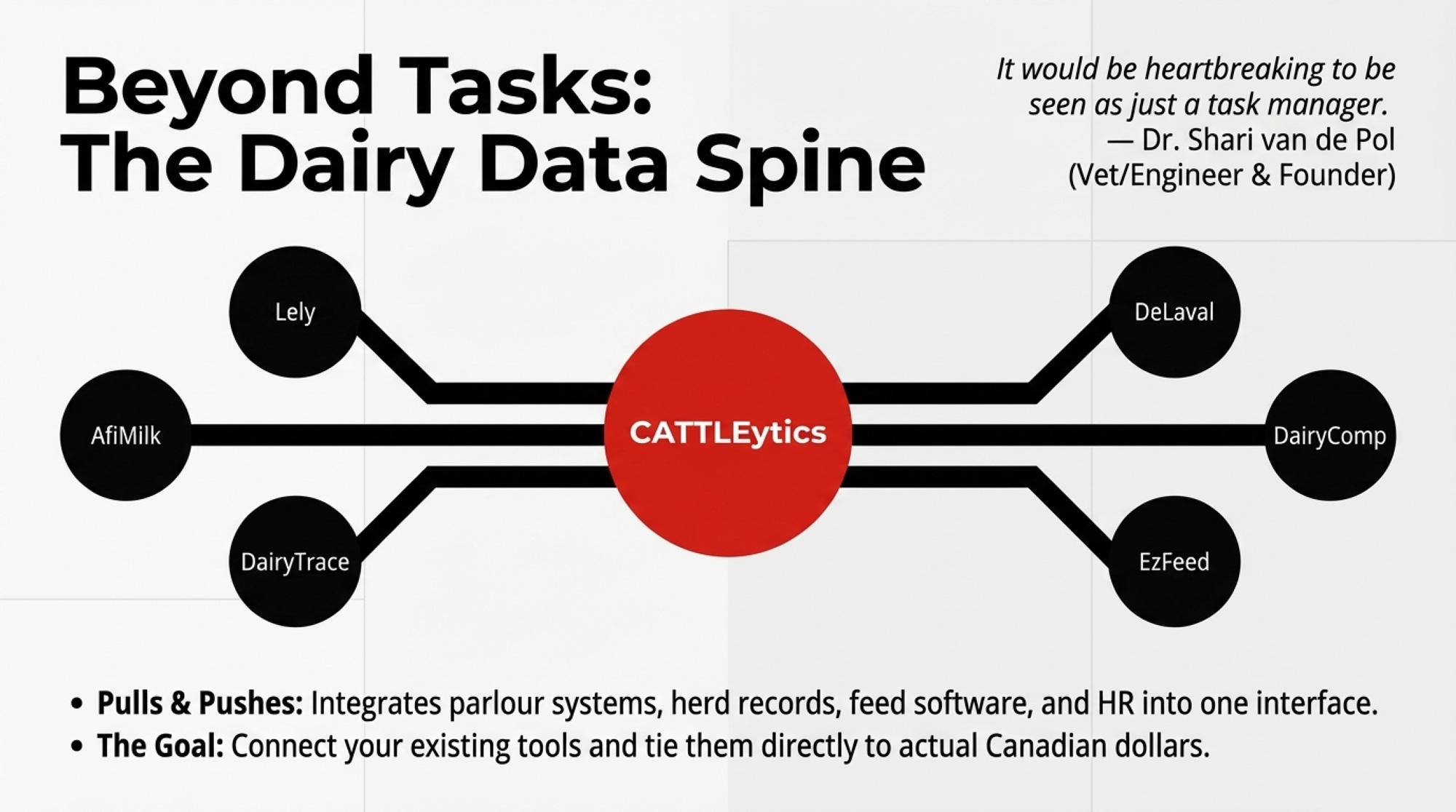
The Dragons’ Den edit made CATTLEytics look like a fancy to‑do list. The demo van de Pol recorded for The Bullvine shows something closer to a data spine for the whole operation.
Key pieces from that demo and the company’s own materials:
- Live integrations with your existing tools
- Parlour and robot systems: DeLaval/DelPro, Lely, AfiMilk, Beco
- Herd records: DairyComp, DHI
- Feeding: EzFeed
- Traceability: can push data to DairyTrace, solving a specific issue for farms on Lely, but not DairyComp, which lost automatic reporting
- Custom dashboards
- Real‑time weather
- Key performance indicators: preg rates, 21‑day submission rates, somatic cell trends
- Canadian dairy prices and P5 components are built into the board
- Click into any widget for lists of the animals behind the number
- Per‑cow financial modeling
- Calculates how much each cow makes this lactation, in dollars
- Compares her to the current herd average
- Uses your milk prices based on where the herd is set up
- Projects her contribution going forward (or why she’s taking up a stall she shouldn’t)
- Event logging with before/after trends
- Log a ration change on December 5th to decrease fat to chase a better SNF ratio.
- Pull before/after charts to see what happened to fat, protein, energy‑corrected milk, and revenue.
- Compare by lactation group, time window, or weather pattern
- Team and HR tools
- Built‑in time clock and time sheets
- Schedules in agenda, month, or swim‑lane view
- Task manager with AI categorization so you can see what work people are actually doing
- Digital protocols linked to QR codes or videos; auto‑translated into staff languages
And it’s not just dairy. CATTLEytics does custom software development for TELUS Agriculture on beef cattle systems — a contract that leverages the same data platform but applies it outside the milking parlour. Van de Pol says other U.S. clients have asked to remain unnamed, but the consulting and custom development work is a meaningful part of the company’s $1.4M revenue base
There’s a research angle too. Van de Pol says CATTLEytics’ research partners — she can’t name all of them publicly — have told her that with the platform handling data collection and integration, they can complete work in weeks that used to take months. CATTLEytics also sells that research capability directly: building custom analytics layers, running deep dives into complex dairy questions, and connecting integrated data to a client’s internal systems. A new U.S. university grant partnership is expected to go public soon.
Van de Pol’s own summary is blunt: it would be “heartbreaking” for the product to be seen as nothing more than a task manager. In her words, it “takes all of your data from across all of your tools and puts it into a place where you can have clear economics.”
That’s why she refers to CATTLEytics as closer to Connecterra than to a simple job-board app. It’s built to sit aboveDairyComp, Lely, DeLaval, AfiMilk, and friends, not replace them, and tie them back to actual dollars.
When a Feed Change Becomes a Five‑Figure Problem
If you’ve ever tweaked a ration and not loved what happened on the bulk tank a few weeks later, this part will feel familiar.
In a Bushels & Bytes episode, van de Pol walks through a herd that saw milk drop hard in October. When she overlaid their production data with management events, the curve lined up almost perfectly with a feed change. The producer took one look at the chart and said, “I know what it is. I changed my feed.”
In the demo, she shows that same capability in a more controlled scenario:
- A herd logs a December ration change to reduce fat and optimize the new P5 SNF payment structure.
- The system tags the event and generates before/after charts.
- The producer can see whether fat actually moved the way they intended — and what that did to the bottom line.
RealAgriculture reports that CATTLEytics’ models have flagged early silage feeding moves that added up to “tens of thousands of dollars in lost milk output” over a season. Another profile cites CATTLEytics modelling showing that feeding silage too early “could cost a farmer $30,000 in lost milk production.”
Those aren’t audited farm financials. They’re modelled scenarios. But they’re built off real data streams — not napkin math.
The pattern is the part that matters:
- A “minor” decision (start that new silage a week earlier, tweak the fat level, stretch a forage)
- Repeated across 300–400 cows
- Playing out for weeks or months before anyone pins it down
That’s how one little change walks straight past a $750 subscription and never looks back.
If you have the data from parlour, DHI, and feed system in three separate silos, you might never see the pattern in time. If they’re all sitting on one board with dollars on top, it’s a different story.
The Valuation the Dragons Got Wrong — and the Advice They Got Right
The TV moment was designed for drama: a $12 million valuation on what sounded like $120,000 in revenue. The Dragons did what you’d expect — they hammered the multiple, called it a “pressure cooker”, and walked from the deal.
With the updated numbers in hand — $1.4M ARR, profitability in December 2025, zero debt, nearly $1M in matching grants already committed — the 100× narrative collapses. An 8.6× multiple on that business profile is boring. Then there’s the $2 million FFAR Seeding Solutions grant on early lameness detection. CATTLEytics is a named partner alongside CattleEye, CDCB, and Kinder Ground — and van de Pol says the consortium was initially rejected without them. They were brought on specifically because the grant reviewers felt the proposal needed stronger analytics and data analysis capabilities. CATTLEytics isn’t just listed on that grant. They were the piece that got it funded.
The reference point van de Pol dropped in her email makes that even clearer: in the same season, the Dragons entertained Innertune, a mindfulness app that speaks affirmations. The founder asked for $1 million for 8%, implying a $12.5 million valuation. At least one Dragon offered to write that cheque.
If the show is happy to put a roughly $12.5M price on a consumer app that whispers nice things at your phone, it’s hard to argue that $12M for a profitable, grant‑backed, integration‑heavy dairy data platform with $1.4M in ARR is somehow offensive.
Where the Dragons actually earned their keep was here:
“I really don’t think you need [the money]. You can bootstrap with the money you’re getting from the government, and this is yours.”
“She’s got this. She’s a smart cookie. She’s got this.”
They may have misread the revenue, but they nailed the lesson on capital structure. When you’ve already got:
- Profitability
- Grant backing
- Zero debt
- Full founder ownership
…selling 10% of the company on national TV is usually the worst time to sell. Every dairy operator who’s been tempted into a pricier expansion or robot install on the back of money they weren’t sure they needed knows that feeling. Just because capital is on the table doesn’t mean you should take it.
Is CATTLEytics the Integration Layer Canadian Dairy Is Missing?
One line in van de Pol’s email hits a bigger issue than any startup valuation:
“We are one of the only dairy software companies in Canada, where most of our farms use foreign‑built software.”
That shows up in a suite of free P5 tools CATTLEytics built and made publicly available — as far as van de Pol knows, the only free P5 calculators available to producers in the region:
P5 Revenue Impact Calculator — models how the January 2026 cascading bucket changes hit your cheque
SNF Optimization Calculator — tests different SNF ratio targets against your herd’s component profile
SNF Visualizer — shows how the “filling buckets” payment system actually works
Farm Credit Canada referenced the tools at the last DFO Annual General Meeting. A software update rolling the P5 calculator into the CATTLEytics platform — along with a profitability component — is expected Tuesday, March 11.
When the P5 region moved to the new cascading bucket system in January 2026 — Tier 1 protein down 14¢/kg, Tier 2 protein up $3.00/kg versus December — a lot of producers defaulted to targeting an SNF ratio of 2.0. The calculator suggests that, for most herds, that leaves money on the table. The sweet spot is closer to 2.16–2.18, leaving a buffer for normal seasonal swings.
That’s a very Canadian problem: specific rules, specific prices. Imported software can’t fake that. Somebody local has to write the math and wire it into the system.
CATTLEytics is trying to be that layer:
- Connect Lely, DeLaval, DairyComp, AfiMilk, Beco, EzFeed, DairyTrace.
- Add Canadian pricing and P5 economics.
- Layer per‑cow and per‑change financials on top.
The “one more login” risk is still real. Any app that doesn’t earn daily use dies by week three. If CATTLEytics doesn’t actually pull from and push to the systems you already live in, it’ll join that pile on your office computer.
But if it does, the decision shifts from “do I want another app?” to “do I want a single place that runs the math on all the systems I already paid for?”
[INTERNAL LINK: dairy-markets/10-000-farms-by-2035-whos-still-milking/] — anchor: “why transformation beats waiting”
What This Means for Your Operation
You don’t have to care about startup valuations. You do have to decide what you’re willing to spend — or lose — on coordination and data.
Here’s how to turn this from TV drama into actual barn math:
- Stop calling WhatsApp “free” without numbers.
Take your real local wage — if you’re in Ontario, working with $19–20/hour is fair — and multiply by the hours per day you or a key employee spend: scheduling, chasing missed chores, re‑explaining protocols, and hunting through group chats for treatment notes. If that lands anywhere near 1 hour/day, you’re in the $7,300/year zone. - Run the 30‑day labour leak audit.
Over the next month, pull your treatment and task records — however you keep them. Pick three random cows. For each one, in under two minutes, answer: Who made each decision? When? Based on which protocol? If the trail runs through someone’s phone or memory, you’ve just found the risk layer. - If you test any coordination app, lock in 90‑ and 365‑day checks.
Don’t pay for vibes. After 90 days, ask: Did coordination time actually drop? Are fewer things falling through the cracks? Is someone still updating the system daily? After 12 months, decide if it deserves a permanent line on your cost‑of‑production sheet, next to milking equipment, DHI, and feed. - Make “What does this pull and push?” your first software question.
Before you sign any software contract — CATTLEytics, DairyComp add‑ons, robot vendor tools — ask: What does this pull from my parlour and herd software? What does it push back? Which of my existing reports can I stop maintaining separately if I buy this? If the answers are fuzzy, assume your herdsman will be back on WhatsApp by week three. - If you’re in P5, actually test the SNF math.
The January 2026 change — T1 protein down 14¢/kg, T2 up $3.00/kg — changed the game. If you’re still targeting 2.0 SNF, you’re probably leaving money on the table. Use CATTLEytics’ P5 calculator or your own spreadsheet and test what 2.16–2.18 does to your cheque under your herd’s component curve. - If you’re already a top‑managed herd, think “precision,” not “rescue.”
If your protocols are tight, CATTLEytics isn’t a magic bullet. It will earn its keep by pulling all your data into one place, putting actual dollars on cows and decisions, and helping your team see feed and repro changes faster. That’s why someone like Ben Loewith signed on. - If your barn is chaotic, be honest about it.
That 19:1 ROI on Tier 1 only exists in barns where coordination is a real leak. If your current system is “WhatsApp plus memory plus a binder,” the subscription fee is probably a rounding error. If you’re already running a tight ship, be more skeptical.
| Checkpoint | Evaluation Question | What You’re Really Testing | Pass/Fail Signal |
|---|---|---|---|
| Day 30 | Can you find the last 5 treatment decisions for 3 random cows in under 2 minutes each? | Data accessibility and completeness | Fail if any search takes >3 min or data is missing |
| Day 30 | Are employees still updating the system daily without being reminded? | User adoption and workflow fit | Fail if you’re chasing updates or data is 2+ days stale |
| Day 90 | Has coordination time actually dropped? (Ask your herdsman directly) | Labour efficiency and ROI | Fail if no measurable time savings reported |
| Day 90 | Are fewer chores falling through the cracks compared to 90 days ago? | Risk reduction and protocol compliance | Fail if missed tasks are same frequency as before |
| Day 365 | Can you retire at least one spreadsheet or duplicate data-entry task because of this system? | Integration value and workflow simplification | Fail if you’re still maintaining parallel records |
| Day 365 | Is the system earning a permanent line on your cost-of-production sheet? | Long-term value justification | Fail if you’re questioning whether to renew |
Key Takeaways
- WhatsApp isn’t free once you do the math. At $20/hour, even 1 hour/day of wasted coordination time is roughly $7,300/year. Compare that to a $750/year Tier 1 subscription as pitched on Dragons’ Den — whether it’s CATTLEytics or another coordination tool.
- The 100× revenue outrage was a TV artifact, not reality. With $1.4M ARR and profitability, CATTLEytics’ real multiple is about 8.6×, in line with other ag‑tech platforms like Connecterra that have raised more outside money for similar ambitions.
- If your data lives in five systems, your risk lives in the gaps between them. The feed‑change example — and the early silage modelling showing tens of thousands of dollars in lost milk — show how quickly a small decision can outrun a $750 subscription when data isn’t integrated.
- Canadian economics and P5 pricing are finally baked into a software stack. Tools like CATTLEytics’ P5 Revenue Impact Calculator — built around the January 2026 cascading bucket change — are the kind of region‑specific math foreign herd software doesn’t handle well.
- The most important software question isn’t “Do I like the interface?” It’s “What can I stop doing because this exists?” If a platform doesn’t let you retire spreadsheets, kill duplicate data entry, or shorten your daily decision loop, it’s just another login.
The Bottom Line
Van de Pol said in her email, “It’s really difficult in television to get across what our product is.” She’s right. You can’t explain 10 years of data plumbing and economic modeling in 90 seconds, and you definitely can’t explain what it’s worth to your barn until you put your own numbers to it.
So the next time you scroll past a treatment instruction buried in a WhatsApp thread at 11 p.m., do yourself one favour: don’t just shake your head and move on. Ask what that moment actually costs — in dollars, not frustration — and whether you’re still okay calling that system “free.”
Complete references and supporting documentation are available upon request by contacting the editorial team at editor@thebullvine.com.
Learn More
- Dairy Tech ROI: The Questions That Separate $50K Wins from $200K Mistakes – Reveals the brutal math of technology adoption, exposing why robots fail below 140 cows while activity monitors deliver 7-month paybacks. It arms you with a scale-based roadmap to stop over-investing in hardware your infrastructure can’t support.
- 2025 Dairy Market Reality Check: Why Everything You Think You Know About This Year’s Outlook is Wrong– Exposes why volume-chasing is dead and how the 2025 component revolution is rewriting your checkbook. It delivers the strategic positioning needed to capitalize on fat and protein premiums while insulating your margin against volatile labor shifts.
- Revolutionizing Dairy Farming: How AI, Robotics, and Blockchain Are Shaping the Future of Agriculture in 2025 – Breaks down the “superpowers” of AI and blockchain, from 99% accurate genetic predictions to udder-to-table traceability that commands 15% premiums. It reveals how integrating Silicon Valley smarts into traditional barns creates a massive, long-term competitive advantage.
 The Sunday Read Dairy Professionals Don’t Skip.
 The Sunday Read Dairy Professionals Don’t Skip.
Every week, thousands of producers, breeders, and industry insiders open Bullvine Weekly for genetics insights, market shifts, and profit strategies they won’t find anywhere else. One email. Five minutes. Smarter decisions all week.