





UW–Madison’s lead drone researcher told a webinar April 27 her study “was not enough.” Marketing’s still quoting 95%. Here’s why 980 acres is the line your rep won’t draw.
Executive Summary: UW–Madison’s lead dairy drone researcher, Dr. Neslihan Akdeniz, told a Badger Dairy Insight webinar on April 27, 2026 that her own study “was not enough” — and her published numbers (83% herd-level accuracy on calves, 70% individual ID) sit 12 to 25 points below the 90–95%+ band currently being marketed by precision-livestock AI vendors. A monitoring-drone Year 1 stack runs roughly $8,285–$10,400 once you add a Mavic 3M, FAA Part 107, $1M SkyWatch.AI liability, and Pix4D or DroneDeploy software. Spray drones are a different animal: University of Missouri Extension G1274 (March 2025) puts owned-vs-custom breakeven at 980 acres a year against a $16/acre custom rate, and 2026 custom-rate compression toward $12–$17/acre may push that line toward 1,100–1,300 acres unless you’re stacking EQIP. At 800 spray acres, the math says $984/year net savings and 20+ years to payback hardware; at 2,000+ acres, it flips to roughly 2-year payback. If you’re a 200–1,500 cow Wisconsin or upper-Midwest operator weighing a Q2 purchase, the call before the sales call is whether your local custom rate, your spray acres, and your agronomist’s existing multispectral coverage actually clear the 980-acre line. Skip this piece only if you’ve already run those three numbers.
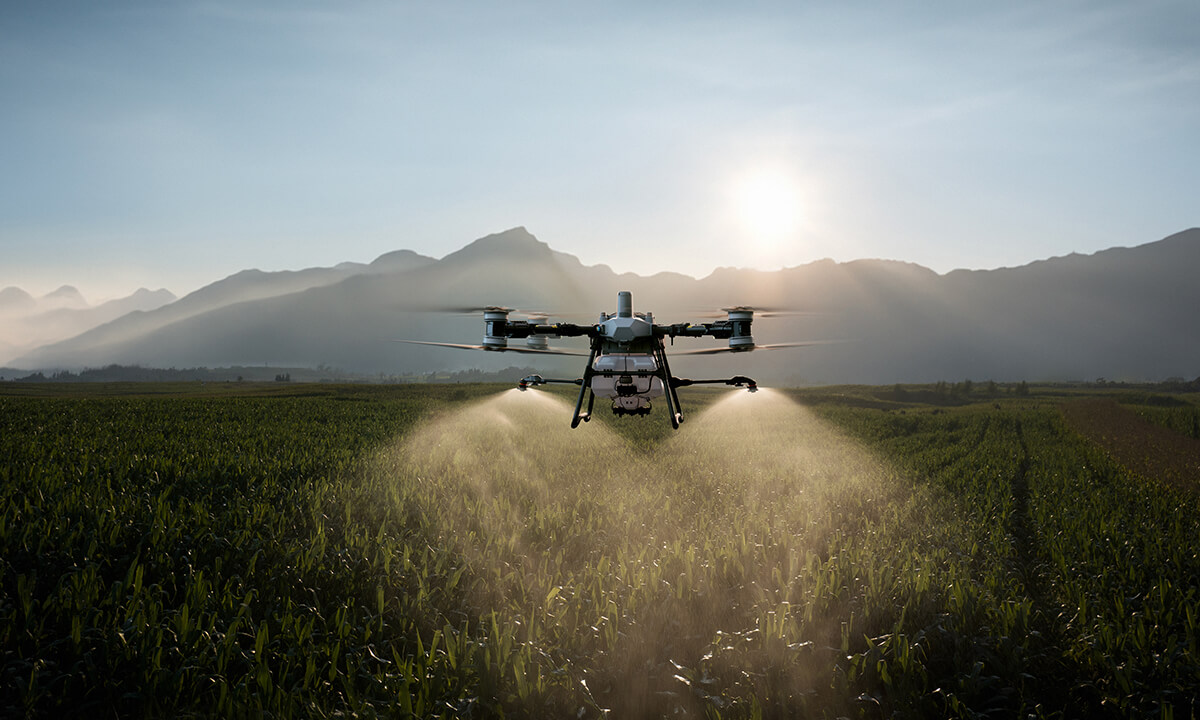
The lead researcher on Wisconsin’s most-cited recent dairy drone study sat in front of a webinar camera on April 27, 2026, and made a candid admission that should change how dairy operators read this Q2’s drone marketing.
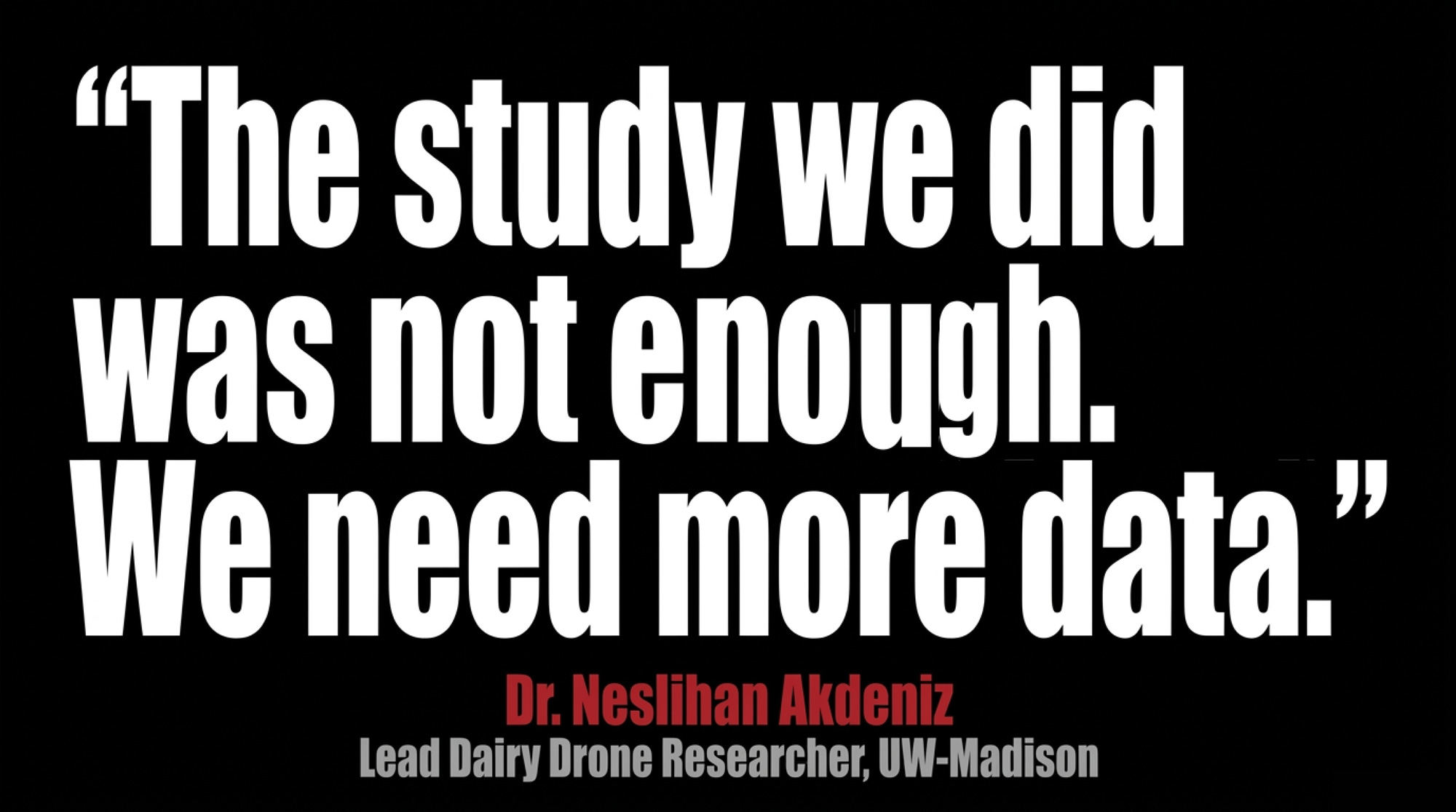
“The study we did was not enough. We had only two dairy pastures, two beef pastures, and one sheep pasture. We need more data.”
That’s Dr. Neslihan Akdeniz, Assistant Professor of Biological Systems Engineering and Extension Specialist at UW–Madison, presenting Drone Tools for Dairy: From Research to Real-World Use at Badger Dairy Insight. She co-presented with Dr. Gustavo Mazon — a former postdoctoral research associate in UW–Madison’s Department of Animal and Dairy Sciences and now Technical Services Nutritionist at Axiota Animal Health, based in Madison. The program said Cabrera. The reality was a candid admission of “not enough data” from the actual presenters. Dr. Victor Cabrera, listed on the program, was traveling and didn’t deliver any portion of the session — a distinction worth flagging, because the program listing alone could be read as if he personally validated the findings. He didn’t.
If you’re pricing a drone this Q2, that admission from the lead researcher is the sentence that should change your math.
What’s Really at Stake This Q2
Two completely different products are being sold to dairy operators under one “drones for dairy farms” headline, and the math couldn’t be more different.
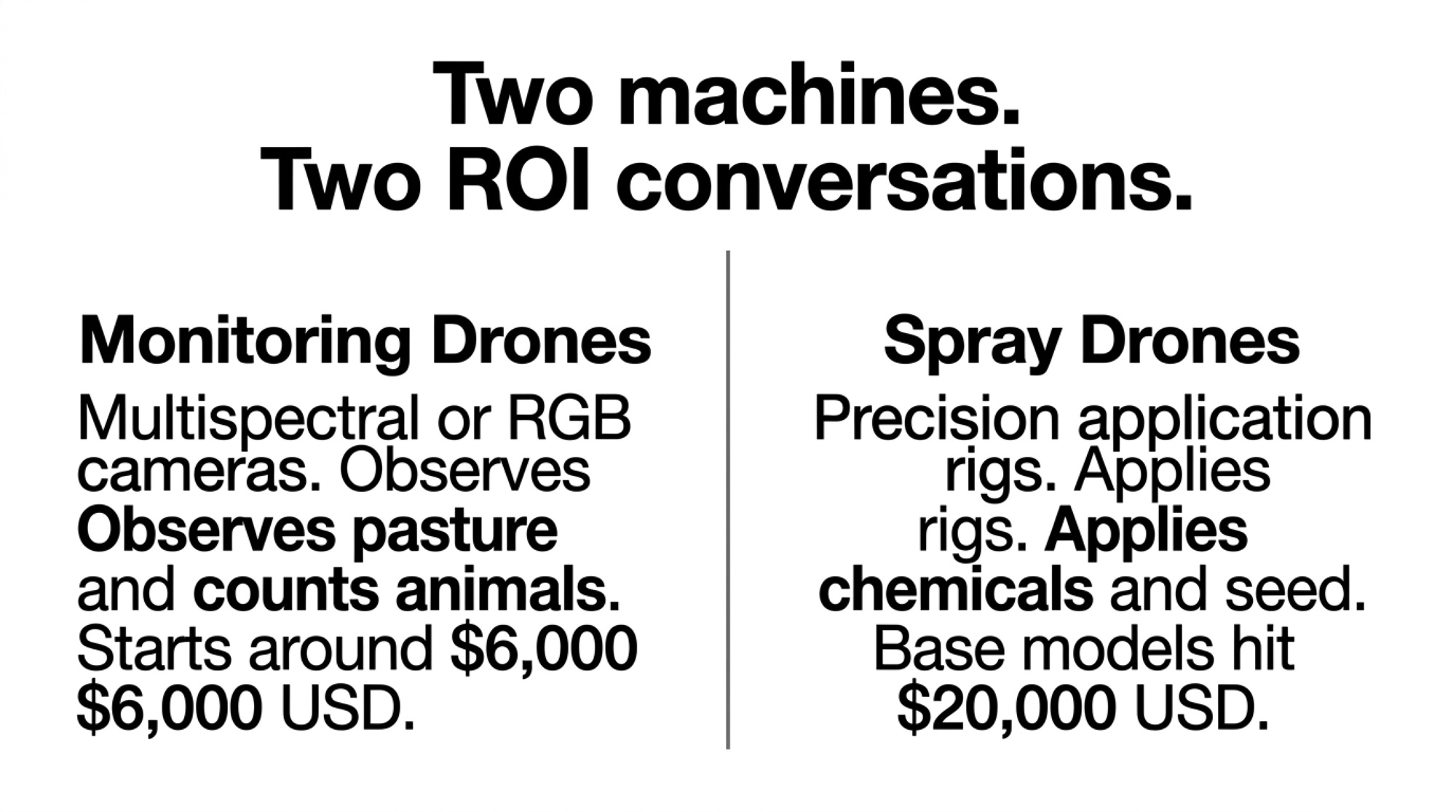
Monitoring drones — multispectral or RGB camera platforms like the DJI Mavic 3 Multispectral — list in the $6,000–$7,000 USD range from major North American ag-drone dealers including Talos Drones, Candrone, and DronePoint, with pricing carrying from late 2024 into 2026. Their job is observation: pasture composition, animal counting, air emissions mapping, calf facility surveillance.
Spray drones — the DJI Agras T40 ready-to-fly kit lists at roughly $36,999 CAD at Canadian dealers like DrDrone.ca, with the base aircraft typically running in the $20,000–$28,000 USD range at U.S. ag-drone retailers depending on configuration — are precision application machines. Two pieces of hardware. Two ROI conversations.
Much of the precision-ag coverage collapses them into one story. That’s where 500-cow Wisconsin operators get hurt, because the conference footage shows the exciting application — the spray drone on a perfect June afternoon — and the headline cost — the cheaper monitoring drone. The hybrid pitch doesn’t hold up under barn-math scrutiny — a pattern Bullvine has flagged before in spray drone coverage.
What Did UW–Madison’s Drone Trial Actually Validate?
Akdeniz’s team built what she called a “flying air analyzer” — a sensor array suspended on an 88-centimeter upwind probe to keep propeller downwash off the inlet. It runs the full ammonia, methane, and CO₂ sweep plus particulate matter from PM1 to PM10. The drone flew systematic grids over five sites, including Arlington Research Station, capturing more than 70 measurements per parameter per flight on 2-acre pastures. Traditional dynamic flux chambers would give her a small handful of data points across that same area.
The CO₂ readings came in at 9.7 ppm overestimation against gas chromatography gold-standard — solid validation. The work was published as Yang, Wang & Akdeniz (2024) in Remote Sensing, 16(16), 3007. Akdeniz claims, on camera, the first published PM1 measurements in a livestock pasture context — a claim attributable to her presentation.
Then she said the sample size wasn’t enough. That’s the part too many marketing slides leave out.
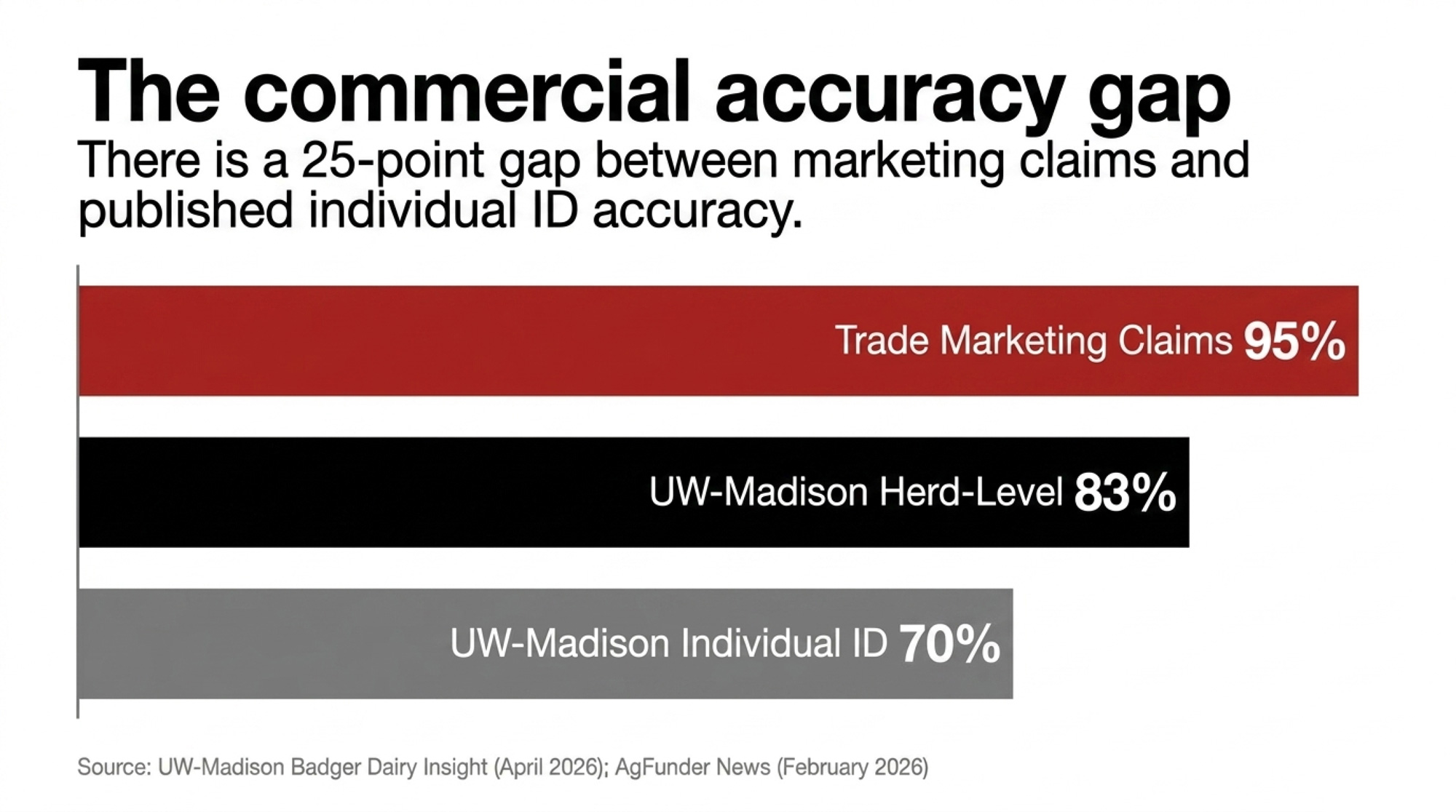
Mazon’s calf monitoring trial flew over a commercial facility housing approximately 800 calves in individual hutches — 60 feet altitude, 5-minute intervals, 7:30 a.m. to 4:30 p.m., six consecutive days, generating tens of thousands of individual calf observations across the dataset. The AI model classified each calf as inside or outside the hutch with 83% herd-level accuracy and approximately 70% individual identification accuracy. Mazon’s own framing on camera at the April 27, 2026 webinar: “We’re still working on that data.”
That number matters because precision-livestock AI marketing in trade press is now routinely featuring drone-and-AI livestock monitoring platforms targeting the 90–95%+ detection accuracy band — AgFunder News coverage in February 2026 of Drone-Hand, an AI-and-drone livestock monitoring platform paid-deployed across Australia, New Zealand, the U.S., and Canada, is one prominent example of that current marketing posture. The precision livestock AI management system market itself was valued at 0 million in 2025 and is projected to reach .32 billion by 2034, with cattle accounting for 37.6% of livestock segment revenue per MarketIntelo’s April 2026 analysis — the commercial pressure to publish strong accuracy numbers is real. The gap between that marketing band and UW–Madison’s published 83% herd-level / 70% individual accuracy is 12 percentage points at the herd level, and 25 points at the individual-animal level. No peer-reviewed dairy paper identified in our research has validated 95%+ for drone-based individual calf ID at commercial scale. The published research sits at 70%.
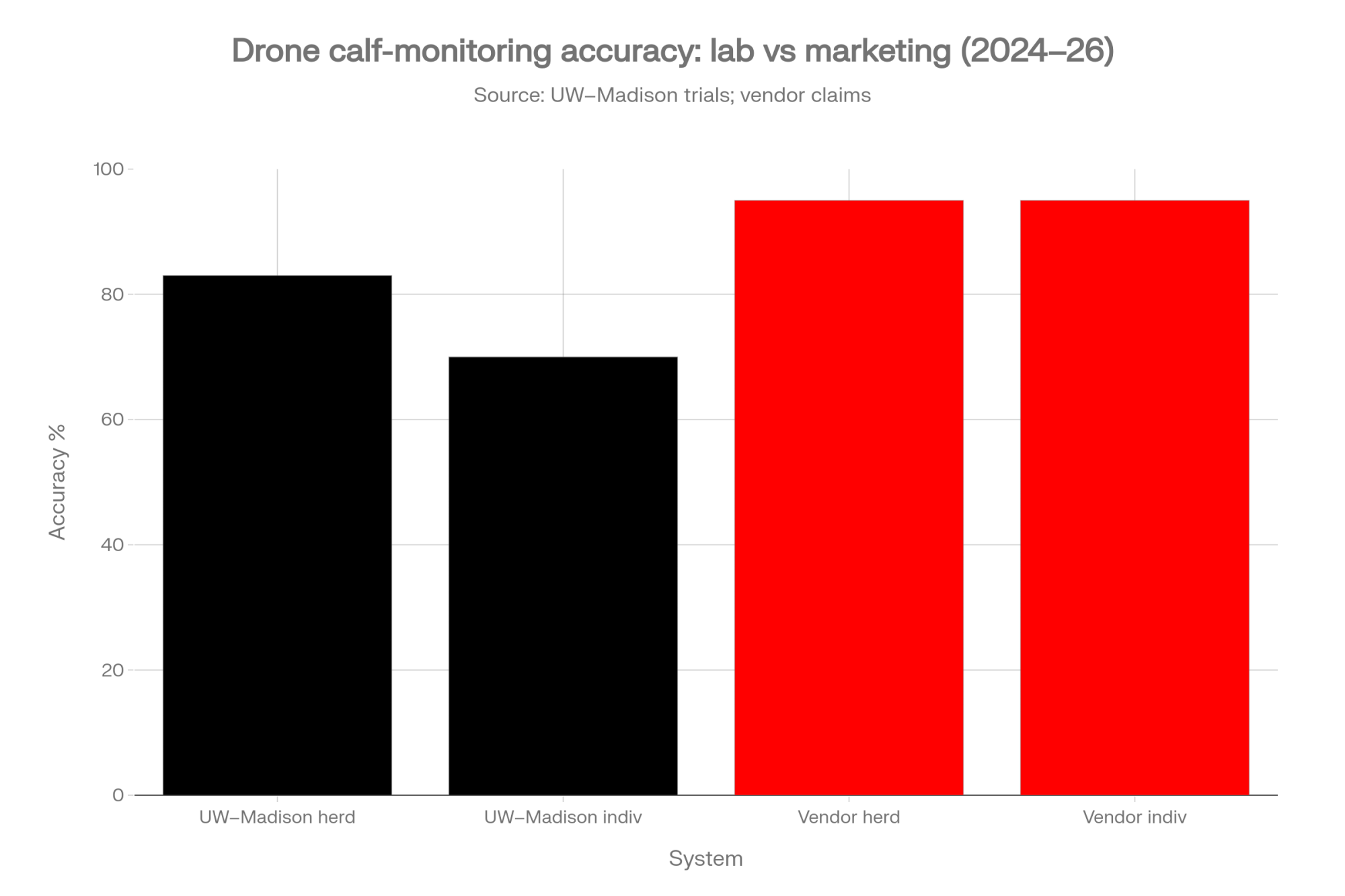
The gap between a research proof of concept on 800 calves at one facility and a commercial detection system you’d build a treatment protocol around is exactly the gap between “interesting” and “actionable.” It’s the same caution Guelph researchers have raised in arguing for human judgment over precision tech when the data isn’t ready to drive treatment.
The pasture work covered 11 Wisconsin farms with multispectral cameras, predicting forage fiber, protein, and energy with high accuracy and biomass at roughly 70% accuracy — useful for trends, not precise dry-matter thresholds. Cow count hit 97%. Body weight estimation reached approximately 90%. All of it, currently, requires post-flight image processing. None of it is a real-time alert system. That distinction weakens the live-alert framing of most vendor pitches.
🚨 BULLVINE READER CHALLENGE: ARE YOU THE MISSING VOICE?
As of this research pull, no commercial Wisconsin or upper-Midwest dairy operator has published drone ROI data in trade media or peer-reviewed literature. That gap is part of the story.
If you’re a Wisconsin, upper-Midwest, or Ontario dairy operator running a DJI Agras T40 or a Mavic 3 Multispectral on your operation, we want your raw ROI data for the franchise follow-up. No marketing fluff — just the hours, the acres, and the reality. What you paid. What you flew. What broke. What you’d buy again.
📧 Email us at editorial@thebullvine.com with subject line “Drone ROI — Your State or Province.” Submissions are confidential by default; we will only attribute by name with your written consent. We do not share contact information with third parties.
Where Does the Drone Math Actually Pencil?
Run the ROI math the research presentation didn’t take on — because that wasn’t its job.
The Year 1 Monitoring Drone Investment
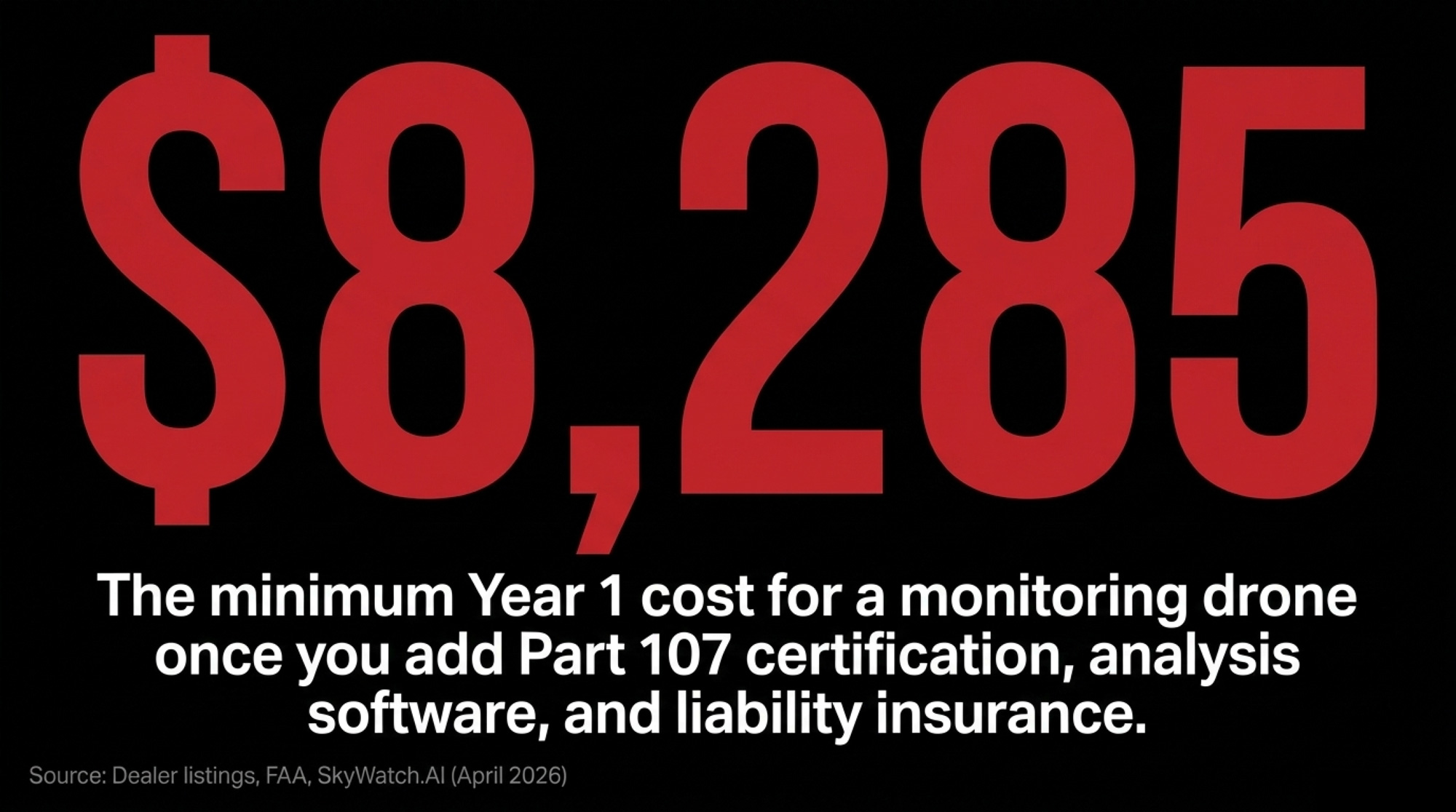
| Item | Cost (Low) | Cost (High) | Notes |
| DJI Mavic 3M Hardware | $6,245 USD | $6,995 USD | Base unit at Talos Drones / Candrone / DronePoint |
| FAA Part 107 / Remote ID | $700 | $700 | Exam ($175), prep materials, Remote ID module |
| Liability Insurance ($1M) | $750 | $800 | Annual SkyWatch.AI policy — confirmed $750 starting rate |
| Analysis Software | $590 | $1,908 | Pix4Dcloud ($49.20/mo × 12) vs DroneDeploy Ag Lite ($159/mo × 12) |
| TOTAL YEAR 1 | ~$8,285 | ~$10,400 | ~$9,000–$9,500 mid-range |
Pricing verified as of April 30, 2026; actual costs vary by region, dealer, and configuration. Verify current rates at vendor sites before purchase.
Year 2 onward runs roughly $1,400–$2,700/year recurring, depending on software tier (Pix4Dcloud at the low end, DroneDeploy Ag Lite at the high end) and insurance configuration. That’s the all-in number before a single acre is flown.
At 300 grazed acres with consistent use, the math can close on a 3–5 year horizon depending on what your agronomist currently charges per acre for multispectral scouting and how many flights per season you’d actually run. Below 150 acres, paying an agronomist for scouting service is cheaper than ownership. The ownership case rests on flight frequency you control and raw-data ownership across multiple seasons — not on capability the contractor doesn’t already provide.
The 980-Acre Kill Switch
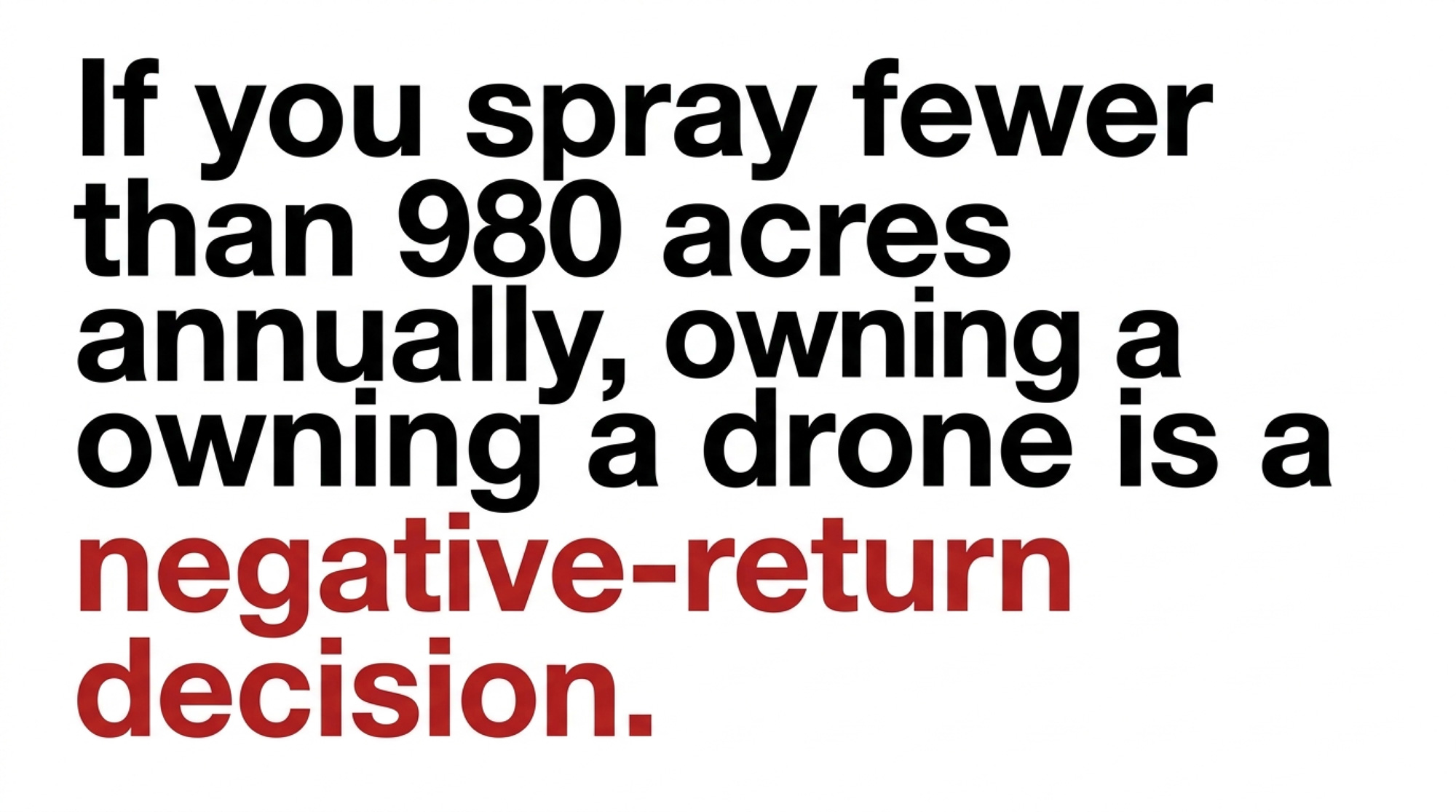
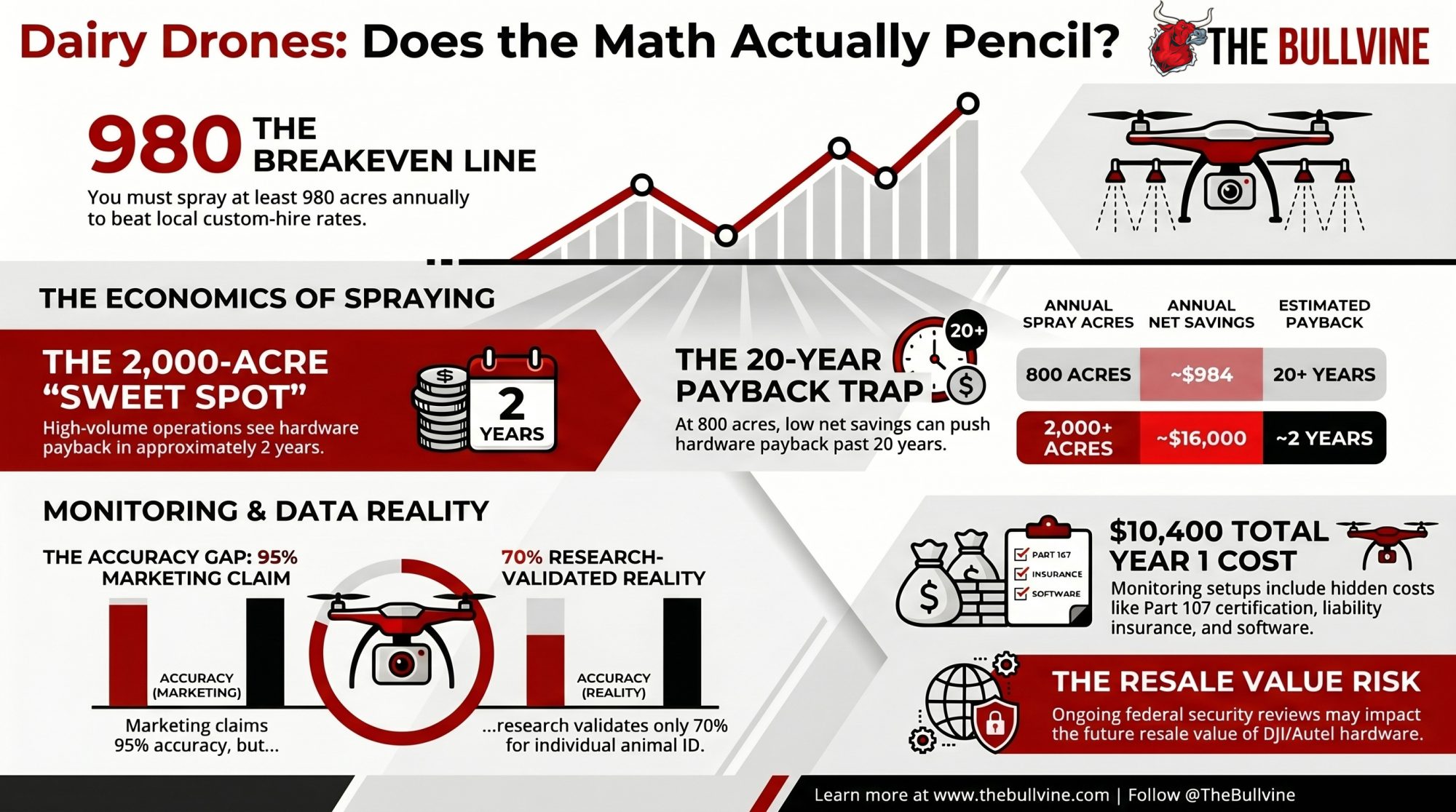
The spray drone math is harsher. The University of Missouri Extension publication G1274, Economics of Drone Ownership for Agricultural Spray Applications, released March 2025, puts the owned-vs-custom breakeven at 980 acres annually, with owned cost at $12.27/acre at 1,000 acres against a $16/acre custom rate — confirmed in the publication itself and in MU’s own coverage.
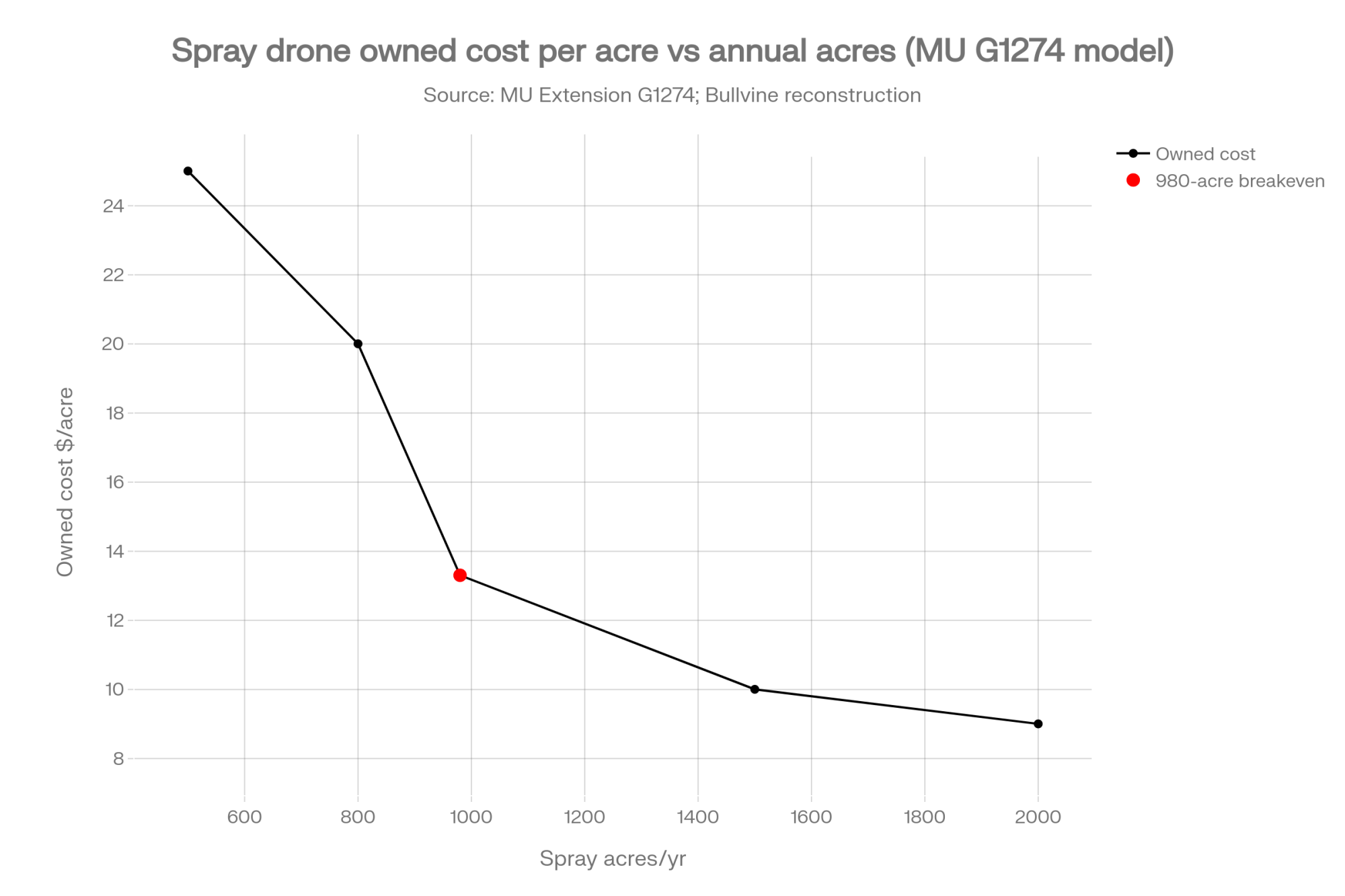
That’s a $3.73/acre savings only available above the 980-acre line. At 500 acres, owned hardware costs roughly double once fixed costs amortize over fewer acres. At 500 spray acres, MU Extension G1274’s framework points to negative ROI on owned spray hardware under the publication’s modeled assumptions. It’s the same payback fragility Bullvine flagged on Cornell-validated retrofits at smaller herd scales.
Worth flagging: a 2026 industry directory analysis observes that custom-hire rates have compressed to $12–$17/acre this year as operator supply has expanded — meaning the 980-acre breakeven calculated against the original $16/acre benchmark may shift upward toward 1,100–1,300 acres at the new rates unless offset by EQIP cost-share. Run your own numbers against your local custom rate, not the 2024 benchmark.
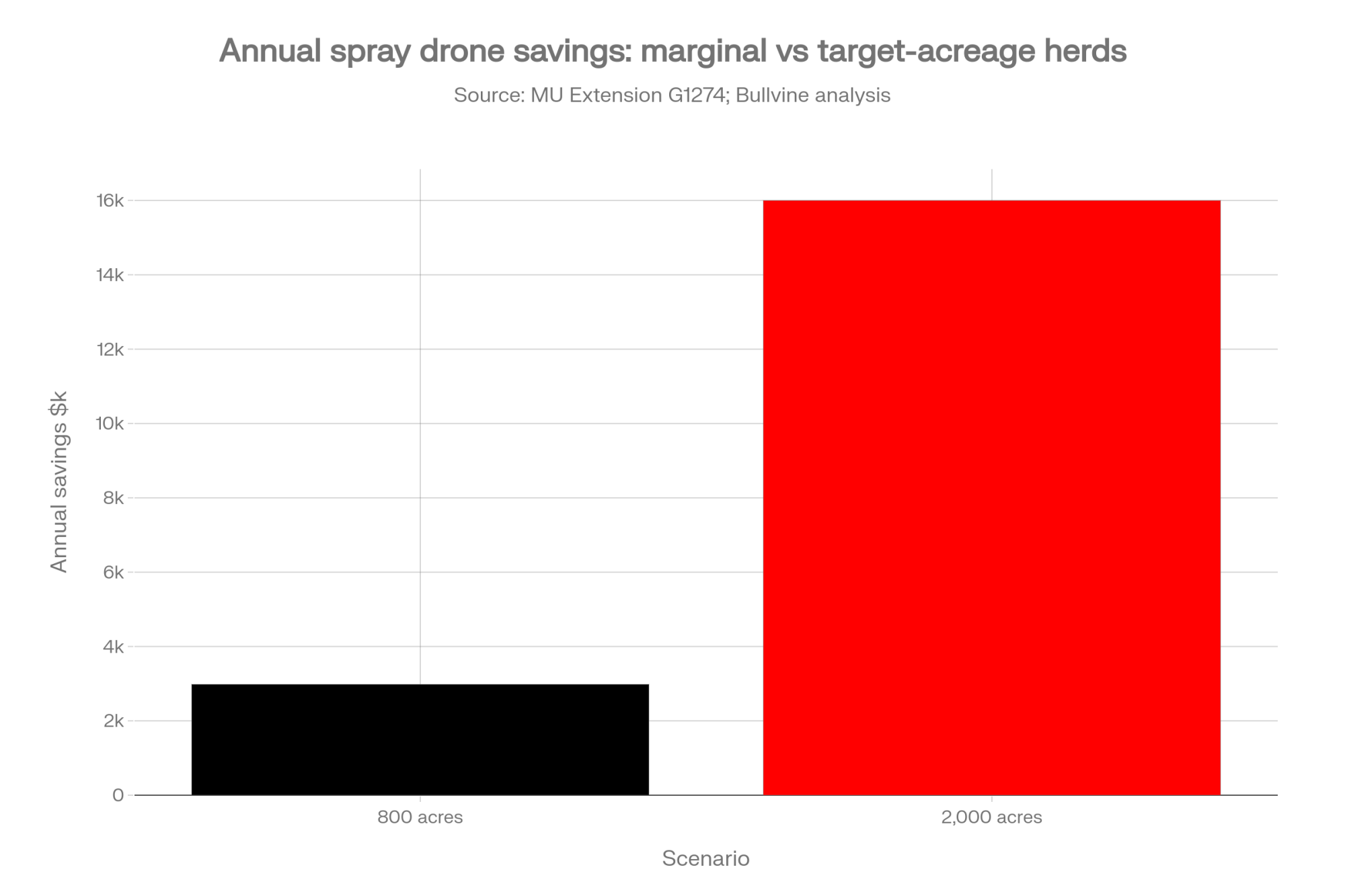
The case opens at 1,500 acres and gets compelling at 2,000+, where MU Extension’s cost curve points to owned cost in the $7–$9/acre range against the $16 custom rate — annual savings of roughly $14,000–$16,000. Payback on a fully-stacked owned setup typically lands at 3–4 years on this acreage.
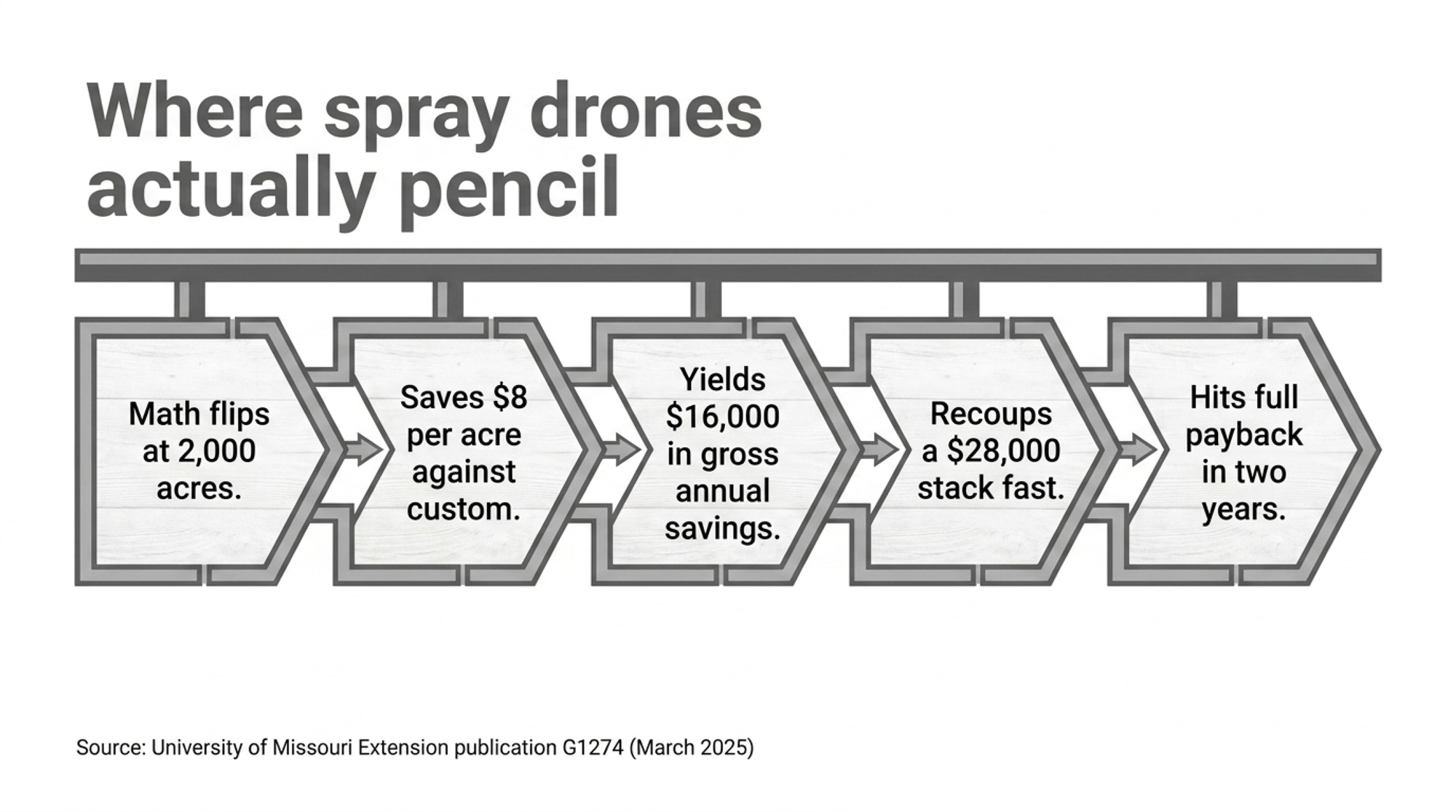
THE 2,000-ACRE CASE THAT ACTUALLY PENCILS $16/acre custom – $8/acre owned = $8/acre savings × 2,000 acres = $16,000/year ÷ $25,000–$28,000 USD fully-equipped T40 stack = 1.6–1.75 yr gross payback Net of recurring compliance: roughly 2 yr full payback.
Run the 1,000-cow worked example at the other end of the curve. At 800 spray acres × $3.73/acre savings against custom rates, that’s $2,984/year in gross savings. The $20,000 USD figure is the base aircraft only; a fully-equipped T40 with batteries, charger, and RTK kit lands closer to $25,000–$28,000 USD out the door. Against the $20,000 base-unit cost alone, payback is 6.7 years before insurance, software, and operator time.
Add roughly $2,000/year recurring compliance and software stack and net annual savings drop to about $984. That pushes hardware payback past 20 years. That’s the operation segment most commonly featured in spray-drone marketing case studies — and it’s the operation where MU Extension G1274’s math is most fragile.
Then there’s the weather, which the research presentation didn’t model — and which sits behind every spray-drone purchase decision. The DJI Agras T40 has a published wind resistance maximum of 13.4 mph (6 m/s); practical spray accuracy requires sub-8 mph conditions. Humidity below 50% causes droplet evaporation. Evening temperature inversions trap spray mid-air. On a typical Wisconsin May morning, viable spray windows are often limited to a few hours before wind picks up — a constraint a custom ground-rig operator largely avoids.
⚠️ RISK FACTOR: THE DJI/AUTEL RESIDUAL-VALUE QUESTION
If you spend $28,000 USD on a DJI Agras T40 today, here’s what the regulatory clock looks like:
- December 19, 2024: The FY25 National Defense Authorization Act mandates a national security determination on DJI and Autel by the end of 2025.
- End of 2025 (now active): If either manufacturer is deemed a national security risk under that review, the FCC can add them to the Covered List — blocking the import and sale of new models in the U.S.
- December 22, 2025: Under the FY24 NDAA’s American Security Drone Act, federal agencies were required to end operations of covered foreign-manufactured drones. In the same April 27, 2026 webinar, Akdeniz confirmed her group is sourcing non-DJI alternatives for USDA-funded research — a constraint that aligns with federally funded research procurement requirements under that Act.
- Private farm use, as of April 2026: Currently not restricted. But a Covered List designation would narrow the secondary resale market for existing hardware.
The math problem: A spray drone purchase priced on a 5-to-7-year payback assumes a residual resale value at year 5. If new DJI sales get blocked, the year-5 resale floor depends on what a non-federally-funded buyer will pay for hardware whose manufacturer support and parts pipeline is in question.
DJI has publicly disputed national security characterizations of its products and continues to argue against Covered List designation in industry forums and on its corporate communications channels. Readers weighing a purchase should track the FCC Covered List process directly rather than rely on either side’s public framing.
DJI’s Agras line has cycled through several generations since 2020 (T20 → T30 → T40 → T50). Build a contingency. Don’t assume a normal depreciation curve.
A Working Wisconsin Drone Lab in Wausau
The Northcentral Technical College Agriculture Center of Excellence operates a 120-acre fully operational dairy farm at 6625 County Road K in Wausau, where students and visiting producers fly drones over grazing cattle as part of regular operations.
NTC offers two dedicated drone courses — Precision Drone Applications and Agriculture Drone Applications — that train operators on remote sensing, overseeding cover crops, and fungicide and herbicide treatments while preparing them for FAA certification. Trevor Frank, NTC’s Crop and Field Operations Program Director, leads the agronomy side of the program.
It’s the closest publicly documented example in Wisconsin of drones in regular use on a teaching dairy footprint — and it’s a free resource for any operator who wants to see the equipment fly before pricing it.
The Decision Matrix: Where Does Your Operation Land?
Three operator profiles. Three different answers.
Path 1 — The 500-cow grazier with 300 grazed acres. The monitoring drone case opens here if forage rotation decisions are the bottleneck and someone on the operation will actually fly consistently. The case closes if your agronomist already runs multispectral as part of an existing contract. Backfire risk: capital tied up in hardware you don’t fly enough to amortize.
Path 2 — The 1,000-cow mixed operation. Spray drones are borderline at 800–1,000 acres, and the corrected math says they’re worse than borderline once compliance costs are stacked. The MU Extension G1274 calculator with your actual numbers settles it. Monitoring drones are clearly viable. Backfire risk: buying both because a vendor bundled them, when only one application closes financially.
Path 3 — The 2,000-cow operation with a centralized calf facility. This is where the research targets honestly land. Spray drone economics close decisively per MU Extension’s 2,000-acre line — the 1.6–1.75 yr gross payback callout is what the rep should be showing you, not the 6.7 yr 1,000-cow scenario. A monitoring drone over the calf hutches gives population-level surveillance at 83% herd-level accuracy — useful for cold-stress and feeding-attendance trend detection, not individual treatment decisions. Backfire risk: confusing aggregate behavioral data with individual animal alerts.
| Operator profile | Spray / grazed acres | Drone that pencils (if any) | Economics signal | Backfire risk (key red flags) |
|---|---|---|---|---|
| 500-cow grazier, 300 grazed acres | ~300 grazed, low spray | Monitoring drone only if you actually fly it often | 3–5 year payback possible on forage decisions | Red: Capital idle if agronomist already flies multi |
| 1,000-cow mixed operation | ~800–1,000 spray | Monitoring drone; spray drone usually negative ROI | Red: ~20+ year payback on T40 at 800 acres | Buying both in a bundle when spray math doesn’t close |
| 2,000-cow with centralized calf facility | 2,000+ spray, large calf site | Spray drone and monitoring drone both viable | ~k/year savings; ~2-year spray payback | Confusing 83% herd-level trends with individual alerts |
| <980-acre spray segment in any herd size | <980 spray | Custom hire only | Red: Owned cost > /acre custom per MU G1274 | Letting “ownership pride” override breakeven math |
Your 30 / 90 / 365-Day Checklist
NEXT 30 DAYS:
- Call your agronomist and ask specifically whether multispectral scouting is already in your service contract.
- Run your actual spray acres through the MU Extension G1274 cost framework against the 980-acre breakeven.
- Email Akdeniz’s UW–Madison Biological Systems Engineering group to ask whether her team is recruiting Wisconsin farms for pasture monitoring research — her on-camera “not enough data” admission suggests an open door.
- Drive to NTC at 6625 County Road K in Wausau and watch the equipment fly before you price it.
NEXT 90 DAYS:
- Document your current forage sampling and pasture scouting costs.
- Quantify what you’re already spending per acre.
- Compare to the monitoring drone Year 1 stack ($8,285–$10,400) before you take a sales call.
- Call your farm insurance broker — confirm whether a commercial drone rider is required.
NEXT 365 DAYS:
- Reassess after the 2026 grazing season.
- Track the FCC Covered List process on DJI/Autel; if the designation lands, your residual-value math breaks.
- Build a contingency: budget for the possibility that a non-DJI domestic platform is your only option by 2027–28. It’s the same calculation discipline that separates robotic milking wins from losses.
What This Means for Your Operation
Before any sales call, run these eight questions. Any single “no” or “I don’t know” stops the purchase conversation.
- At what acreage does the spray drone math actually close on your operation? If you’re under the 980-acre line, MU Extension G1274’s framework points to ownership as a negative-return decision. Run your numbers, not the vendor’s. And if your local custom rate has compressed below $16/acre, the breakeven shifts upward.
- Is your agronomist already flying multispectral over your forage acres? If yes, what does ownership add — flight frequency on your schedule, or a duplicate of a service you already pay for?
- Does someone on your operation have 15–20 hours this calendar year to study for and pass FAA Part 107? The certification isn’t transferable. If your trained operator leaves, the drone is grounded.
- What does your current calf-checker miss that an 83% herd-level surveillance system would catch? If the answer is nothing, drone monitoring is a redundant data layer.
- The single most important question: Is the thing limiting your operation right now the absence of this data, or the absence of acting on the data you already have? The drone won’t fix the second problem.
- Can your existing farm insurance policy cover commercial drone operations, or does it require a separate rider? SkyWatch.AI annual $1M liability starts at $750/year — a manageable line item if you’ve actually called your broker first.
- If your purchase rests on a 5-to-7-year payback, what’s your assumption about residual resale value when DJI’s Agras line has cycled through four product generations since 2020 and the FY25 NDAA security review is active?
- If you spray 2,000+ acres, does the rep’s pitch reflect the 1.6–1.75 yr gross payback that actually applies to your scale — or are they showing you the 1,000-cow scenario that doesn’t?
Key Takeaways
- If you spray fewer than 980 acres annually, MU Extension publication G1274 (March 2025) points to owned spray drone hardware as a negative-return decision under the publication’s modeled assumptions.Stop pricing equipment until you’re past it.
- If you spray 2,000+ acres annually, the math flips hard: $16,000/year savings against a $25,000–$28,000 USD fully-equipped T40 stack pencils at roughly 2-year full payback. That’s the operation the technology was actually designed for.
- If your agronomist already includes multispectral scouting in your service contract, hardware ownership replaces nothing you’re paying for — it adds capital expense without removing operating expense.
- If a marketing pitch quotes 95%+ individual animal alert accuracy on a drone-based system, ask which peer-reviewed dairy paper validates it. UW–Madison’s published work sits at 70% individual ID and 83% herd-level — and the lead researcher said the sample size wasn’t enough.
- If your spray drone payback assumes 5+ years of operation, factor the FY25 NDAA security review trajectory and 2026 custom-rate compression into your residual-value math. The regulatory direction isn’t toward more access, and the custom-rate direction isn’t toward stronger ownership economics.
The Question You’ll Face Before the Sales Call
The drone that pencils for a 2,000-cow grazing operation in southern Wisconsin doesn’t pencil for a 400-cow dry lot in the Northeast. That’s not editorial hedging — it’s the math sitting in MU Extension G1274 and UW–Madison’s research for anyone who reads past the conference deck.
The trade-off is between being on the right side of payback period closing and being the early adopter who funds someone else’s. Which side of that timing decision your capital is on this spring is a choice you make before the sales call, not during it. So when the rep books that visit for May, what’s the one number from your own operation you’re going to put on the table first?
This article draws on the UW–Madison Extension webinar Drone Tools for Dairy: From Research to Real-World Use (April 27, 2026); Yang, Wang & Akdeniz (2024) in Remote Sensing*, 16(16), 3007; University of Missouri Extension publication G1274,* Economics of Drone Ownership for Agricultural Spray Applications (March 2025); the FY25 National Defense Authorization Act (December 19, 2024) and FY24 American Security Drone Act; FAA Part 107 published fees; SkyWatch.AI commercial drone insurance pricing; current dealer listings for the DJI Mavic 3M at Talos Drones, Candrone, and DronePoint; current DJI Agras T40 dealer listings at Talos Drones and DrDrone.ca; the AgFunder News February 2026 coverage of the Drone-Hand AI livestock monitoring platform as one example of current precision-livestock AI marketing posture; the precision livestock AI management system market projection from MarketIntelo, April 2026; the 2026 drone spraying rate analysis from Ag Drone Directory; and confirmed NTC Agriculture Center of Excellence location and acreage detail from The Business News (July 2024) and NTC published materials. The unnamed 800-calf commercial facility in Mazon’s trial is referenced without identification per the source presentation. Bullvine analysis based on these public sources; not investment advice.
Learn More
- Spray Drones on Dairy Farms: Why the Failures Teach Us More Than the Successes — Reveals why custom spray rates crashed 32% in three years and delivers the “problem-solving” math for targeting wet fields that conventional ground rigs can’t touch without causing 15% compaction yield losses.
- Dairy Tech ROI: The Questions That Separate $50K Wins from $200K Mistakes — Exposes the 50% “hidden cost gap” in technology implementation and arms you with a 15% ROI target to justify capital risks in a volatile 4–5% interest rate environment.
- Digital Dairy Detective: How AI-Powered Health Monitoring is Preventing $2,000 Losses Per Cow — Dismantles unproven vendor claims by contrasting the industry’s 5% validation rate against Cornell’s verified 95.6% accuracy for detecting metabolic disorders up to five days before clinical signs appear.
 The Sunday Read Dairy Professionals Don’t Skip.
 The Sunday Read Dairy Professionals Don’t Skip.
Every week, thousands of producers, breeders, and industry insiders open Bullvine Weekly for genetics insights, market shifts, and profit strategies they won’t find anywhere else. One email. Five minutes. Smarter decisions all week.