





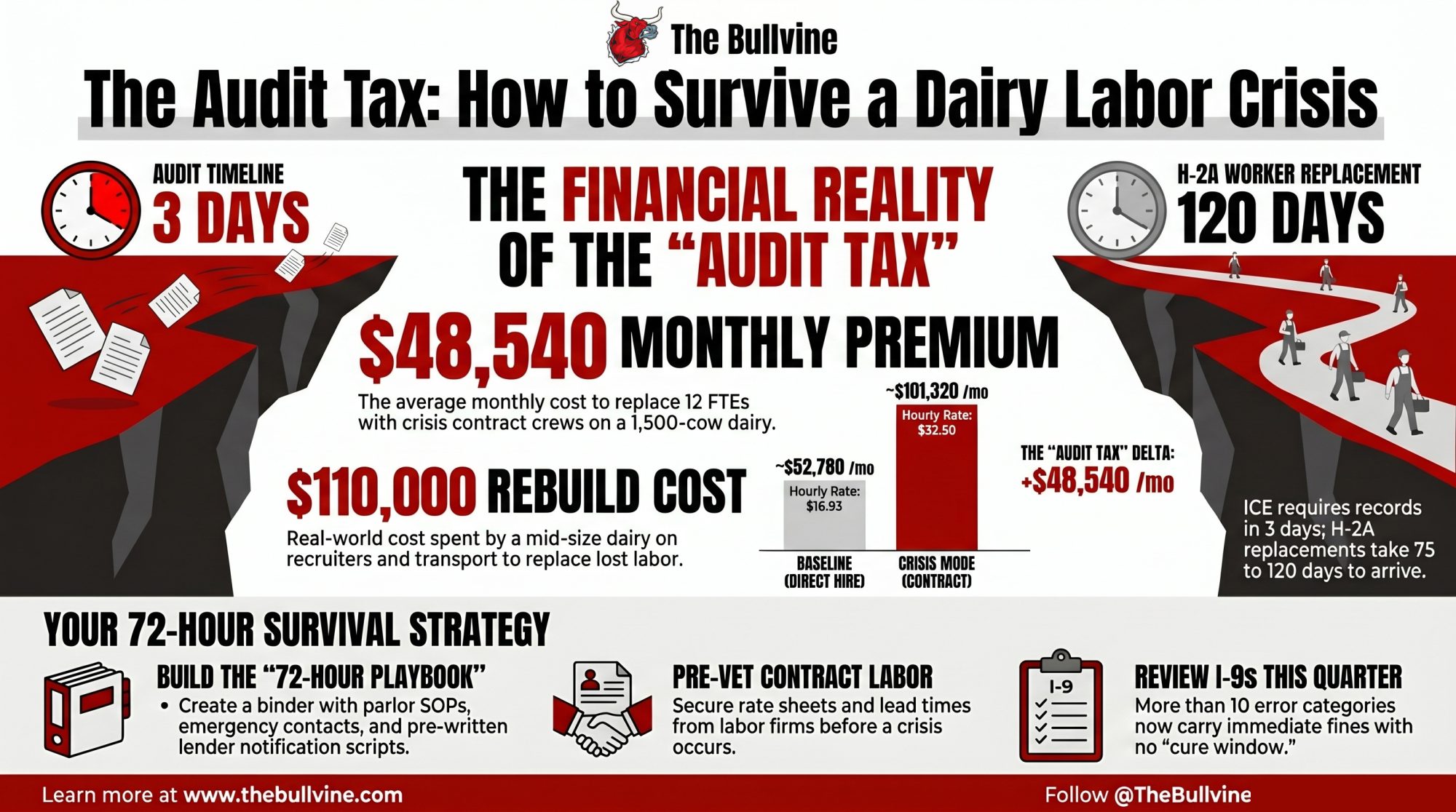
Nine Texas dairies got the envelope in one July weekend. H-2A takes 120 days to deliver a worker. At $14.59 Class III, the contract-crew premium runs $48,540 a month on 1,500 cows — straight off your operating line.
Executive Summary: On June 4, 2025, federal agents arrested 11 workers at Outlook Dairy near Lovington, NM, and 35 of roughly 55 employees were absent the next morning; a month later, at least nine Texas dairies got Notices of Inspection over a single weekend. On a modeled 1,500-cow Panhandle operation, replacing 12 FTE with a crisis contract crew costs roughly ,540 a month above direct-hire baseline — drawn straight off your operating line at .59 Class III. Drumgoon Dairy in South Dakota spent more than $110,000 rebuilding after a DHS I-9 audit pulled 38 of 50 workers; H-2A takes 75 to 120 days to land the first replacement on your parlor floor, and ICE gives you three business days to produce records. The March 16, 2026 ICE Fact Sheet reclassified more than ten I-9 error categories as substantive violations with no cure window, at $288 to $2,861 per form and $716 to $28,619 per worker for knowing-hire. The real failure mode isn’t compliance — it’s liquidity: by Day 90, you’re simultaneously drawing on the operating line and fielding SCC calls from your co-op, and your lender is asking questions you weren’t ready to answer. If your I-9 files haven’t been reviewed by counsel in three years, your SOPs live in your herdsman’s head, and your 72-hour playbook doesn’t exist on paper, those are the three jobs for the next 30 days.
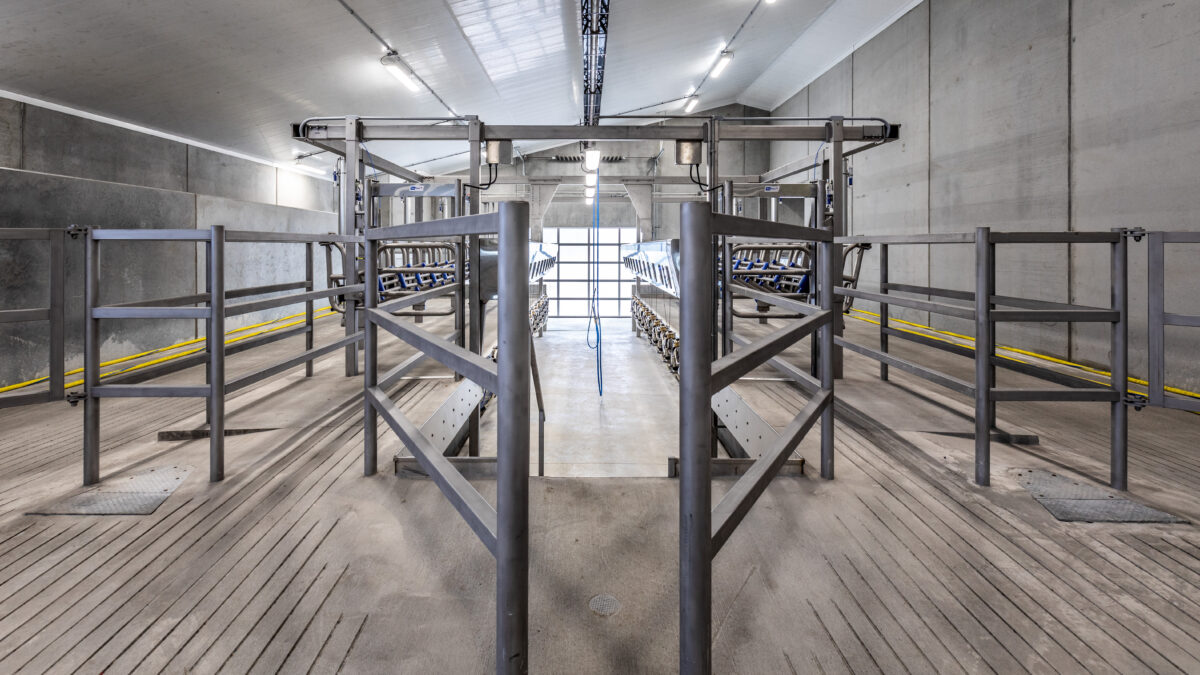
On June 4, 2025, federal agents executed a search warrant at Outlook Dairy near Lovington, New Mexico, and arrested 11 workers at the site, according to nm.news and KOB New Mexico. Thirty-five of Outlook’s roughly fifty-five workers were absent the following morning. Owner Isaak Bos told reporters, “It takes 100% of the labor force, so no day is off right now,” and that the raid left his operation “barely able to keep going” (Ruidoso News, June 18, 2025). Neither Outlook Dairy nor Bos has been publicly charged with any employer-level violation on the public record reviewed for this article as of press time.
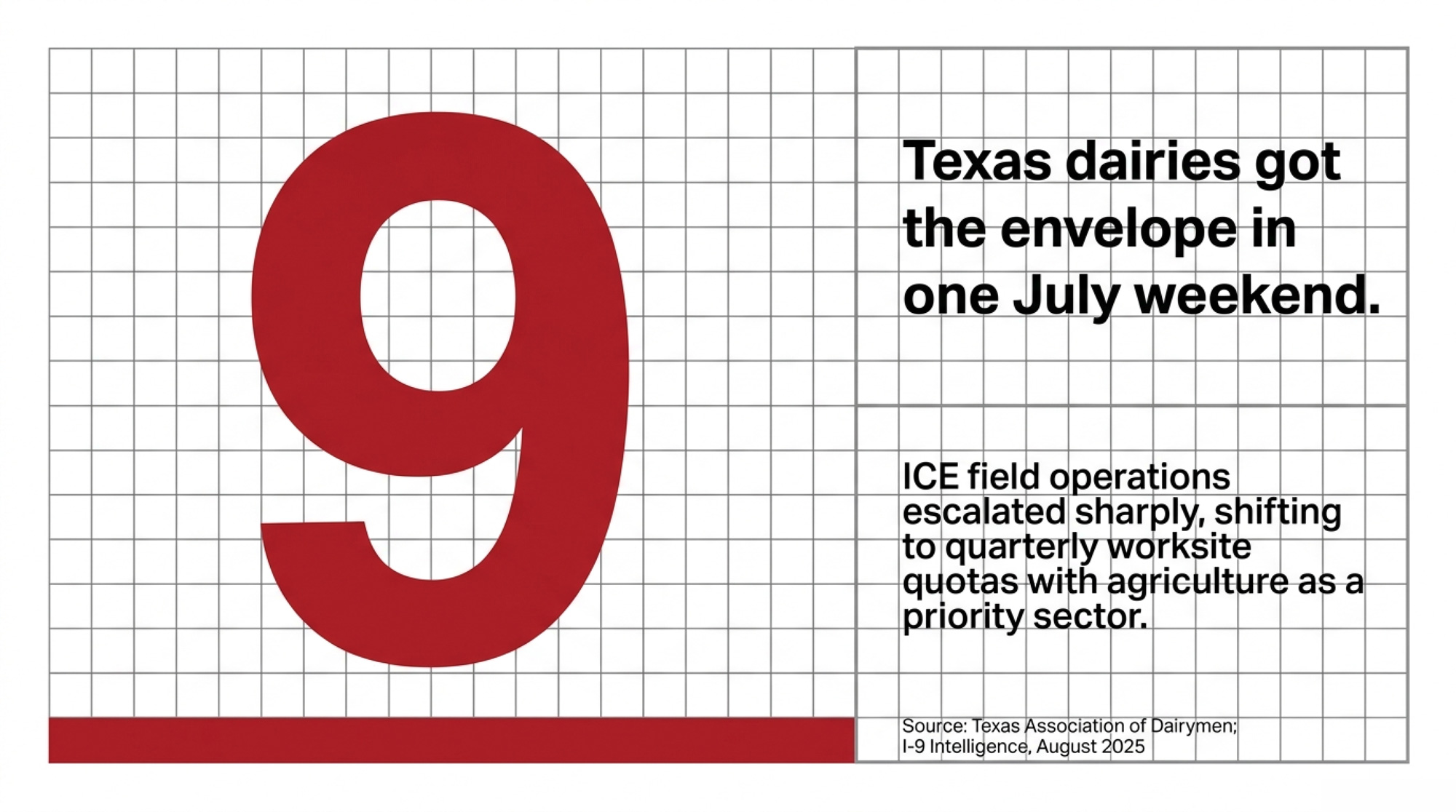
A month later, at least nine Texas dairies two states east received Notices of Inspection over a single weekend — according to Darren Turley, executive director of the Texas Association of Dairymen. The arithmetic that followed — what one worker’s absence costs, what thirty-five absences cost, what three business days to produce I-9 records means when your next H-2A worker is 75 to 120 days away — is the arithmetic every Southwest dairyman has been running since.
You’ve been hearing about this for eleven months. You’ve probably bought something — a compliance platform, a legal retainer, E-Verify enrollment. That’s fine. But the conversation the industry is actually having is solving the wrong problem, and the operators who’ve been through one of these events already know it.
What’s Changed in the Rules
The enforcement picture changed fast and in a specific direction. ICE I-9 audit activity escalated sharply through late 2025 and early 2026. April 2026 client alerts from Holland & Knight, Morgan Lewis, and Fisher Phillips all characterized the current enforcement pace as materially higher than 2024 and the audit stakes as meaningfully raised. Compliance-tracking firm I-9 Intelligence published an August 2025 analysis describing ICE field operations as moving to quarterly worksite inspection quotas with agriculture designated as a priority sector. ICE has not publicly confirmed the quota structure. Nine dairies in one Texas weekend is the scale the industry is now planning around.
The New Reality — I-9 Enforcement, March 2026
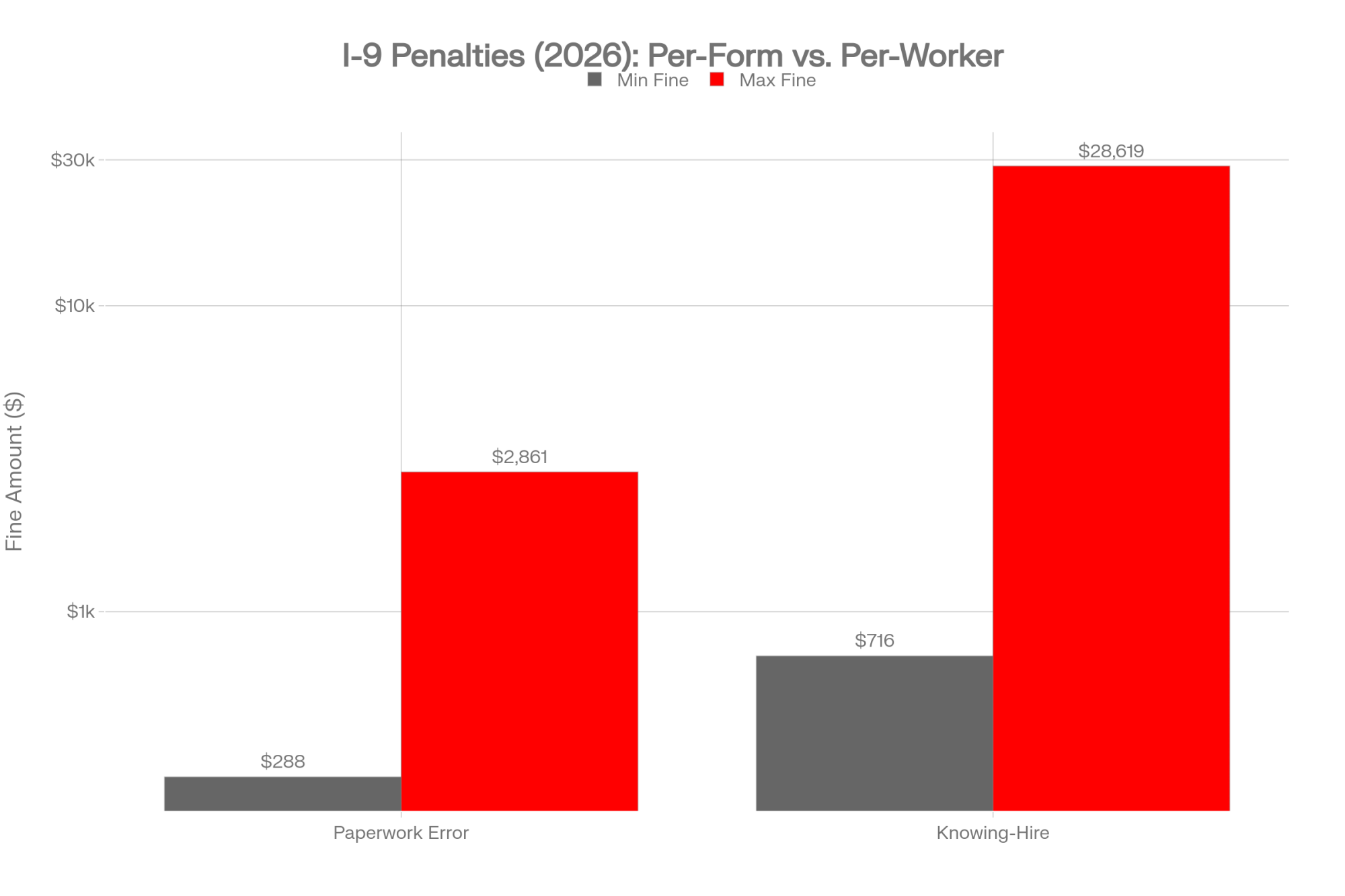
| What Used to Be True | What’s True Now |
| Ten-business-day cure window for technical I-9 errors (1997 Virtue Memorandum). | More than ten error categories reclassified as substantive violations. No cure window. |
| Most paperwork mistakes treated as correctable. | Immediate fines of 8 to ,861 per Form I-9 (January 2025 DHS inflation adjustment, current 2026 schedule). |
| Employer posture: fix on discovery. | Employer posture: fix before discovery, or pay on discovery. |
| Knowing-hire fines largely theoretical for audit-only cases. | 6 to ,619 per worker, scaling with offense number. |
| E-Verify treated as near-sufficient by many operations. | Independent evaluations of E-Verify have documented meaningful false-negative rates when workers present fraudulent documents; no standalone DHS effectiveness study has superseded the earlier Westat work. |
Sources: Morgan Lewis, “ICE Rewrites the Rules on Form I-9 Violations” (April 13, 2026); Holland & Knight, “Quiet Change, Serious Consequences” (April 13, 2026); Fisher Phillips, “ICE Changes I-9 Enforcement Standards” (April 19, 2026). Holland & Knight advised clients to “act promptly to review existing Forms I-9, address deficiencies, and update internal compliance practices before ICE inspections potentially expose them to avoidable penalties.”
These ranges apply to I-9 audits generally, not to any operation named in this article. No public record reviewed here indicates that Outlook Dairy, Drumgoon Dairy, or the nine unnamed Texas dairies received knowing-hire findings. The ranges matter because every operation facing an audit deserves to know what’s at stake financially, regardless of its compliance posture.
How This Plays Out Across the Industry
Drumgoon Dairy in Lake Norden, South Dakota — owned by Rodney and Dorothy Elliott — saw 38 of roughly 50 workers depart following a DHS I-9 audit in late May 2025. Their workforce dropped from over 50 to 16 within days (Bullvine, February 9, 2026; Dairy Herd Management, January 20, 2026). Public reporting has not identified any formal enforcement findings against the farm. Dorothy Elliott told South Dakota Searchlight in October 2025 that the alternative to rebuilding fast was letting cows go unmilked and calves go uncared-for. The Bullvine reached out to Drumgoon Dairy for comment; the operation had not responded at press time. The Elliotts spent more than $110,000 on recruiters and transportation to bring in 22 H-2A workers from Mexico — and still needed 12 local hires, with another 10 to 15 positions open.
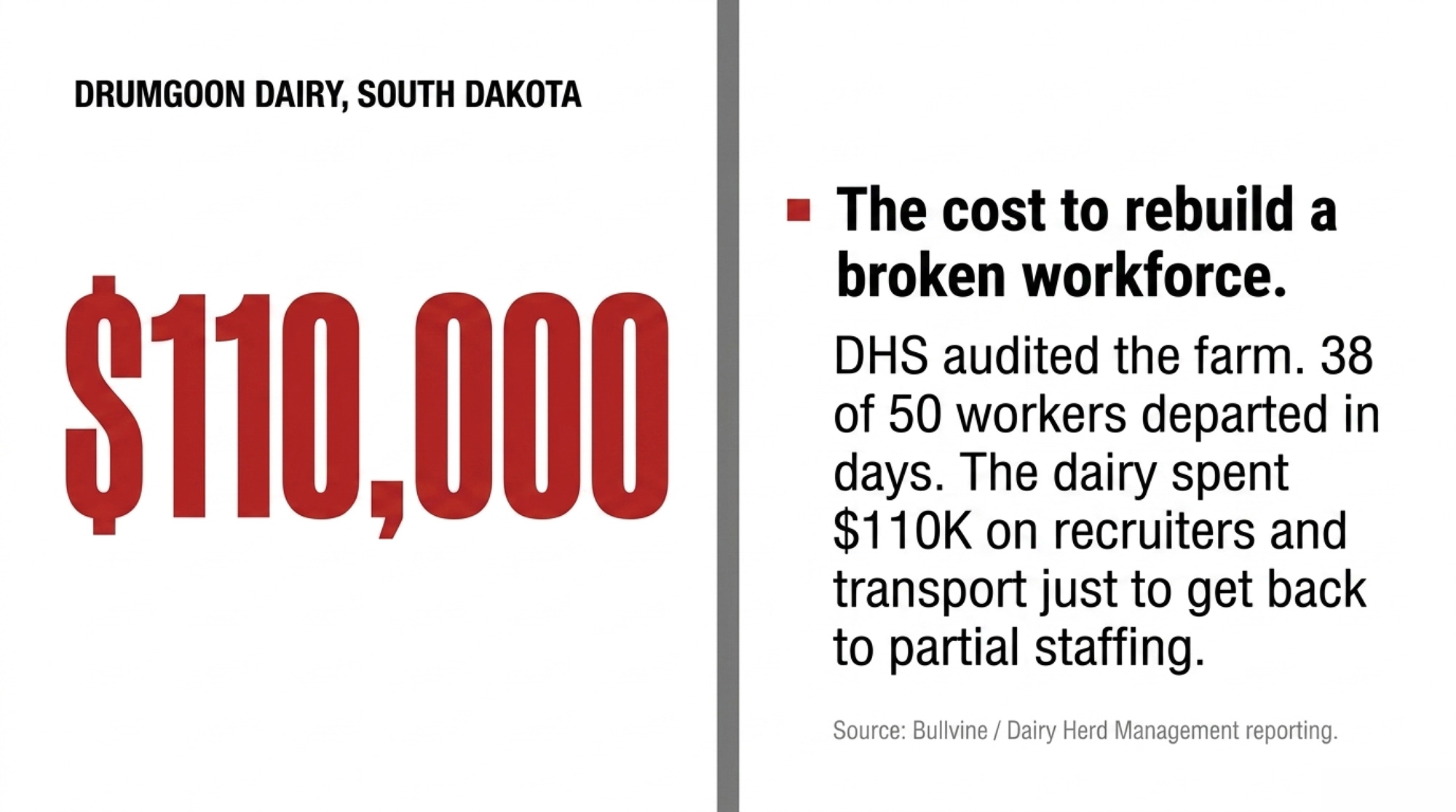
That $110,000 figure is the most specific public data point on actual workforce-replacement cost following an I-9 audit. It’s not hypothetical. It’s what one mid-size dairy spent to get back to roughly full staffing — and it doesn’t include the ongoing hourly premium, the production variance from transitioning crews, or the owner-hours absorbed by recruiting instead of managing.
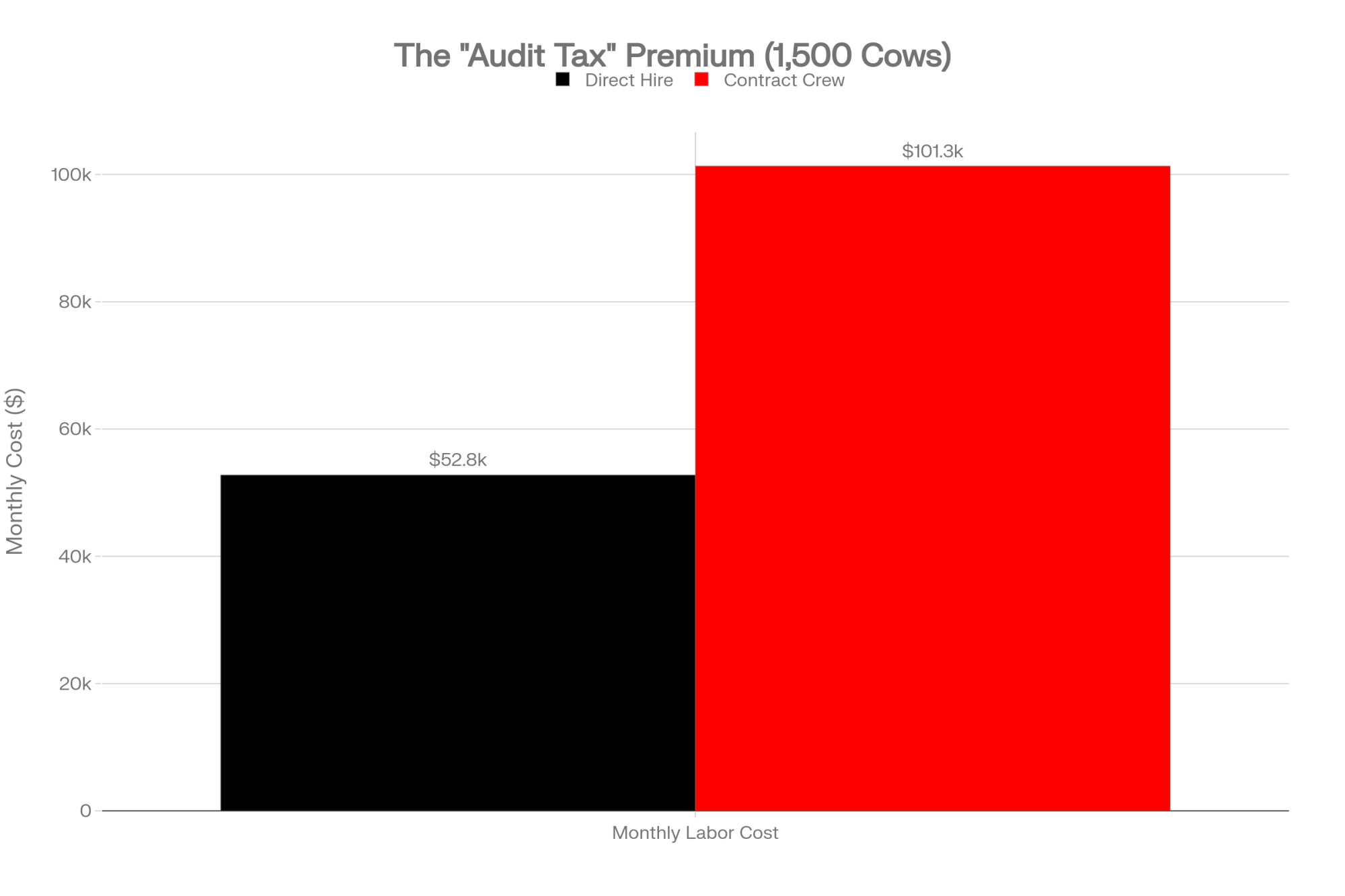
| Metric (12 FTE, 60 hrs/wk) | Baseline (Direct Hire) | Crisis Mode (Contract Crew) | The “Audit Tax” (Delta) |
|---|---|---|---|
| Hourly Rate (all-in) | $16.93 | $32.50 | +$15.57/hr |
| Weekly Labor Cost | $12,190 | $23,400 | +$11,210/wk |
| Monthly Labor Cost | $52,780 | $101,320 | +$48,540/mo |
| 90-Day Liquidity Hit | $158,340 | $303,960 | +$145,620 total |
The Audit Tax — 1,500-Cow Texas Panhandle Modeled Scenario
Modeled scenario using verified cost inputs — not a single reported dairy. Inputs: 12 FTE replaced, 60-hour weeks (720 worker-hours/week), 4.33 weeks/month.
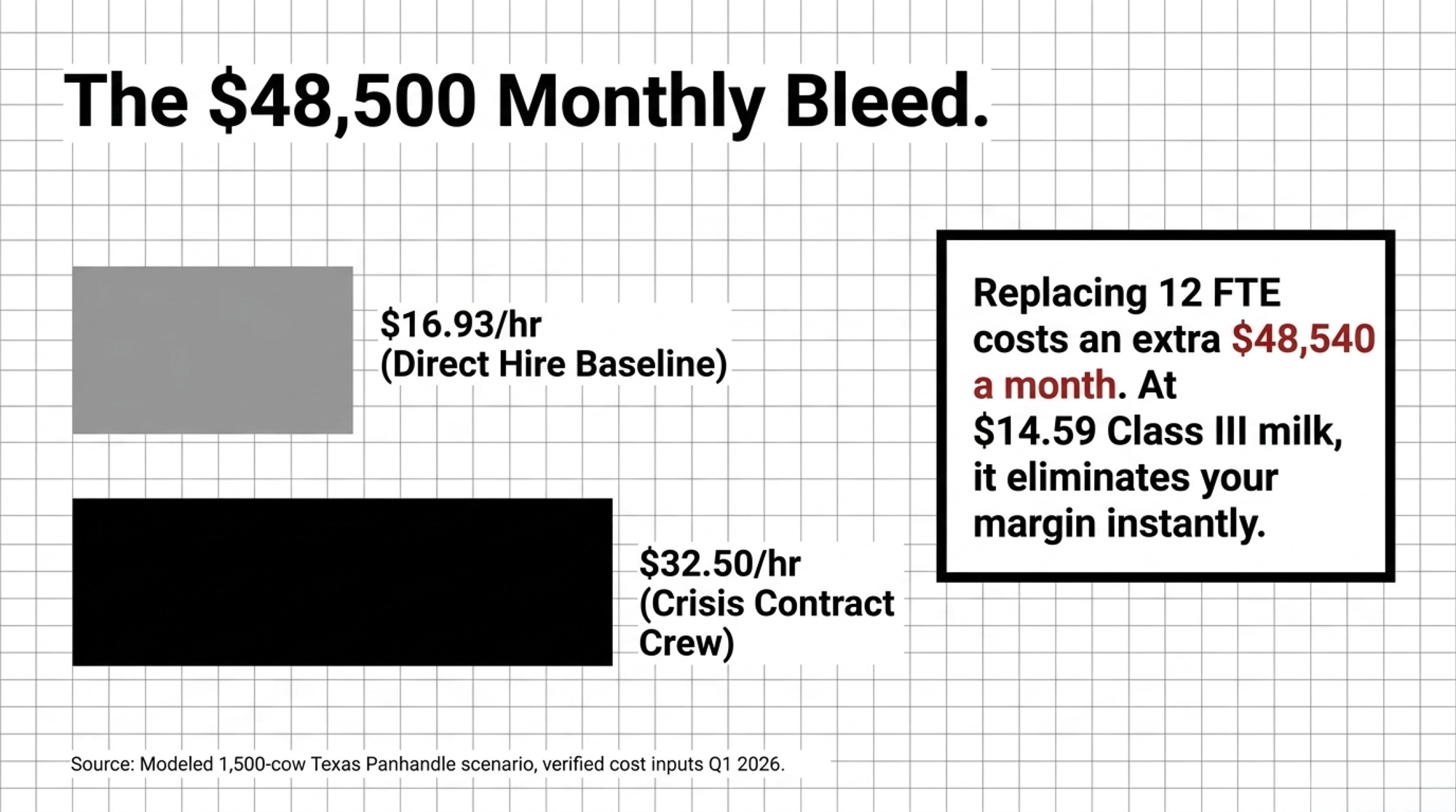
| Metric | Baseline (Direct Hire) | Crisis Mode (Contract Crew) | Delta (The “Audit Tax”) |
| Hourly rate (all-in) | $16.93 | $32.50 (midpoint of $31–$34) | +$15.57/hr |
| Weekly labor cost, 12 FTE × 60 hrs | $12,190 | $23,400 | +$11,210/wk |
| Monthly labor cost | ~$52,780 | ~$101,320 | +$48,540/mo |
Milk price input: .59/cwt (January 2026 first-announced FMMO Class III, down .27 from December and the lowest since July 2023. Texas direct-hire wage: $16.93/hour (ZipRecruiter, Q2 2025). Contract crew range: $31 to $34/hour all-in, rough industry range for crisis-replacement crews.
At $14.59 milk on a 1,500-cow herd, that premium doesn’t compress your margin. It eliminates it. You’re into your operating line by the end of Month 1. None of the public accounts of the Drumgoon and Outlook events describe a written contingency plan in place before the audit. They describe good operators making hard decisions fast.
Why 120 Days Is the Number That Matters
Here’s the structural trap nobody puts on a conference slide.
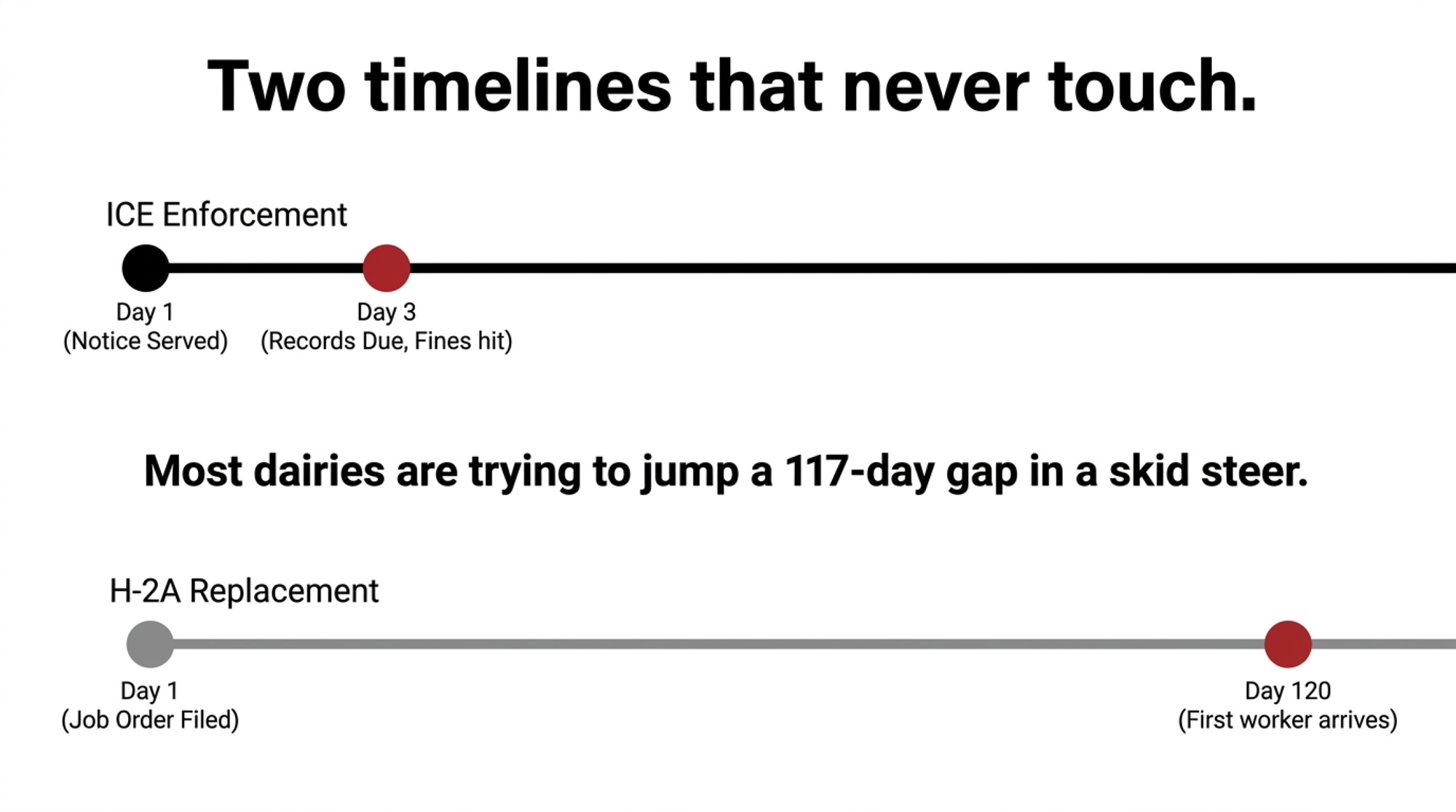
H-2A takes 75 to 120 days minimum from first filing to first worker on your parlor floor, per the Department of Labor’s own application flowchart. That’s the State Workforce Agency job order, the DOL application, the domestic recruitment window, USCIS processing, the consulate appointment, and travel — all chaining cleanly in sequence. An I-9 Notice of Inspection gives you three business days to produce your records.
This isn’t a gap. It’s a canyon — and most dairies are currently trying to jump it in a skid steer.
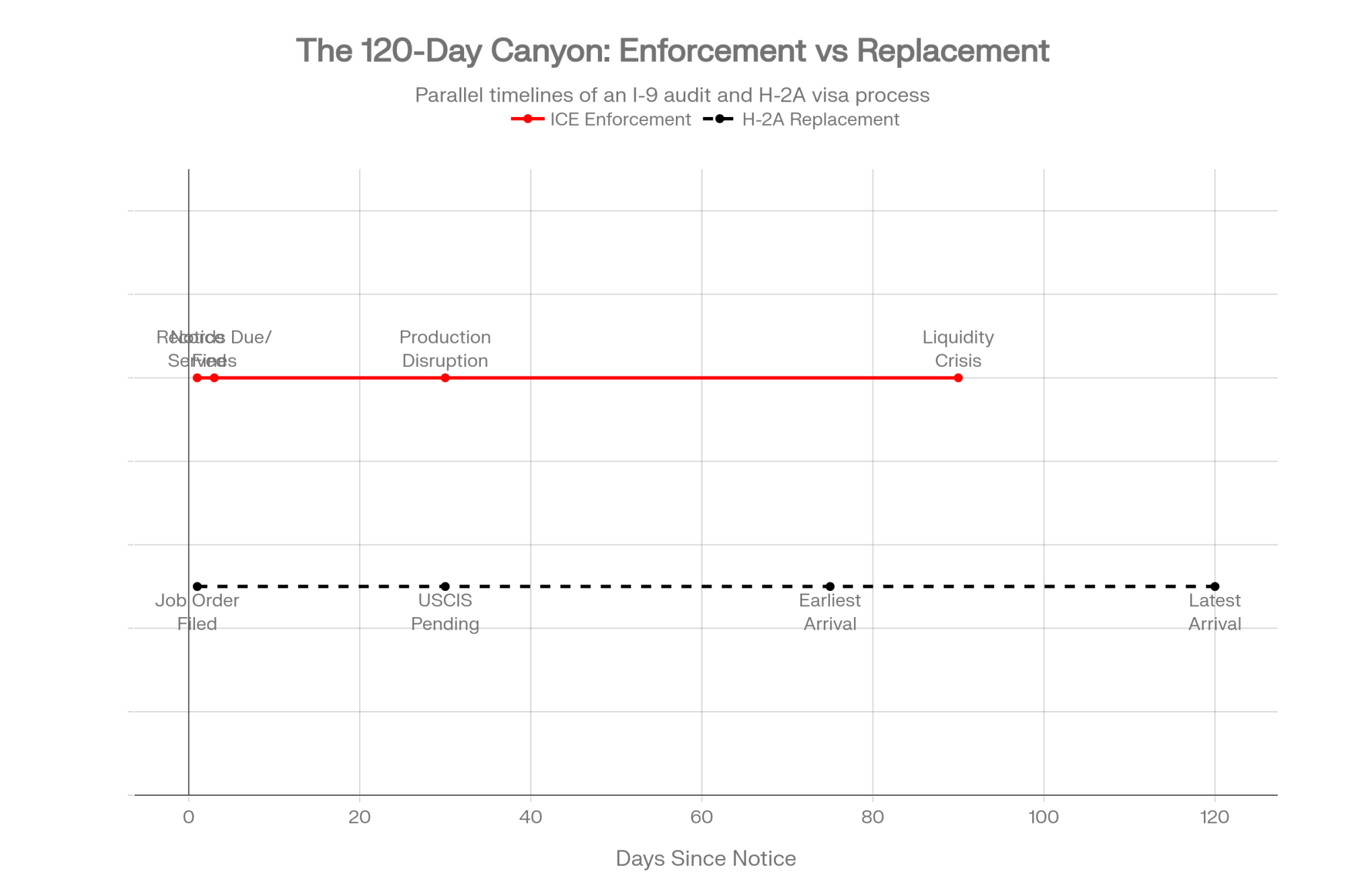
Two Timelines That Never Touch
| Timeline | Day 1 | Day 3 | Day 30 | Day 75–120 |
| ICE enforcement | Notice of Inspection served. | Records due. Substantive violations fine immediately. | Workforce disruption visible in production. | Penalty determinations finalized. |
| H-2A replacement | Job order filed with State Workforce Agency. | Domestic recruitment window opens. | DOL certification pending; USCIS not yet filed. | First worker arrives on parlor floor (earliest case). |
The lines don’t cross. They run parallel across the canyon. Every operator who’s lived it describes the same 60-to-90-day window where the audit clock has already expired and the H-2A clock hasn’t yet delivered anything.
For most Texas Panhandle dairies, H-2A doesn’t even close it. The program only covers seasonal or temporary work — and dairy isn’t either. The Farm Workforce Modernization Act (H.R. 3227) was reintroduced in the 119th Congress on May 15, 2025 by Reps. Zoe Lofgren (D-CA), Dan Newhouse (R-WA), Mike Simpson (R-ID), Jim Costa (D-CA), David Valadao (R-CA), and Adam Gray (D-CA) — the bipartisan coalition that has shepherded the bill through two prior House passes that never cleared the Senate (lofgren.house.gov, May 15, 2025; Citrus Industry, May 14, 2025). The 2025 version currently sits in committee. USDA Secretary Brooke Rollins told the House Agriculture Committee in June 2025 that “significant reform needs to happen” on H-2A and that there’s “a major gap in the labor market for our dairy farmers” (Hoosier Ag Today, June 11, 2025). She’s since called dairy’s H-2A exclusion “particularly broken”. Acknowledging the problem and fixing it are different calendars.
Layer in the October 2, 2025 Interim Final Rule that revised AEWR methodology — projected by the Economic Policy Institute to cut H-2A wage floors to roughly .70/hour for the 92% of workers reclassified as “unskilled,” against a prior average minimum of .43/hour (CalMatters, March 19, 2026; Agroinformacion, April 20, 2026) — and the picture gets more complicated. That rule is currently under challenge in United Farm Workers v. Chavez-DeRemer, Case No. 1:25-cv-01432-JLT-SAB, before Judge Kirk Sherriff in the Eastern District of California, with oral arguments concluded March 18, 2026 and a written ruling expected imminently. On April 26, 2026, the Supreme Court granted review in the parallel DOL case questioning whether Labor Department administrative law judges have constitutional authority to levy H-2A fines at all — a direct extension of SEC v. Jarkesy (Bloomberg Tax, April 26, 2026). Any operator building a 2026 labor budget on the $13.70 figure is budgeting against a number that could reset twice before the first H-2A worker steps off a bus. That’s not an argument against H-2A planning — it’s an argument for building a buffer into the math.
How Much Does Waiting 30 Days Actually Cost?
If you get a Notice of Inspection on a Thursday and don’t have a playbook, here’s how the next 90 days typically go.
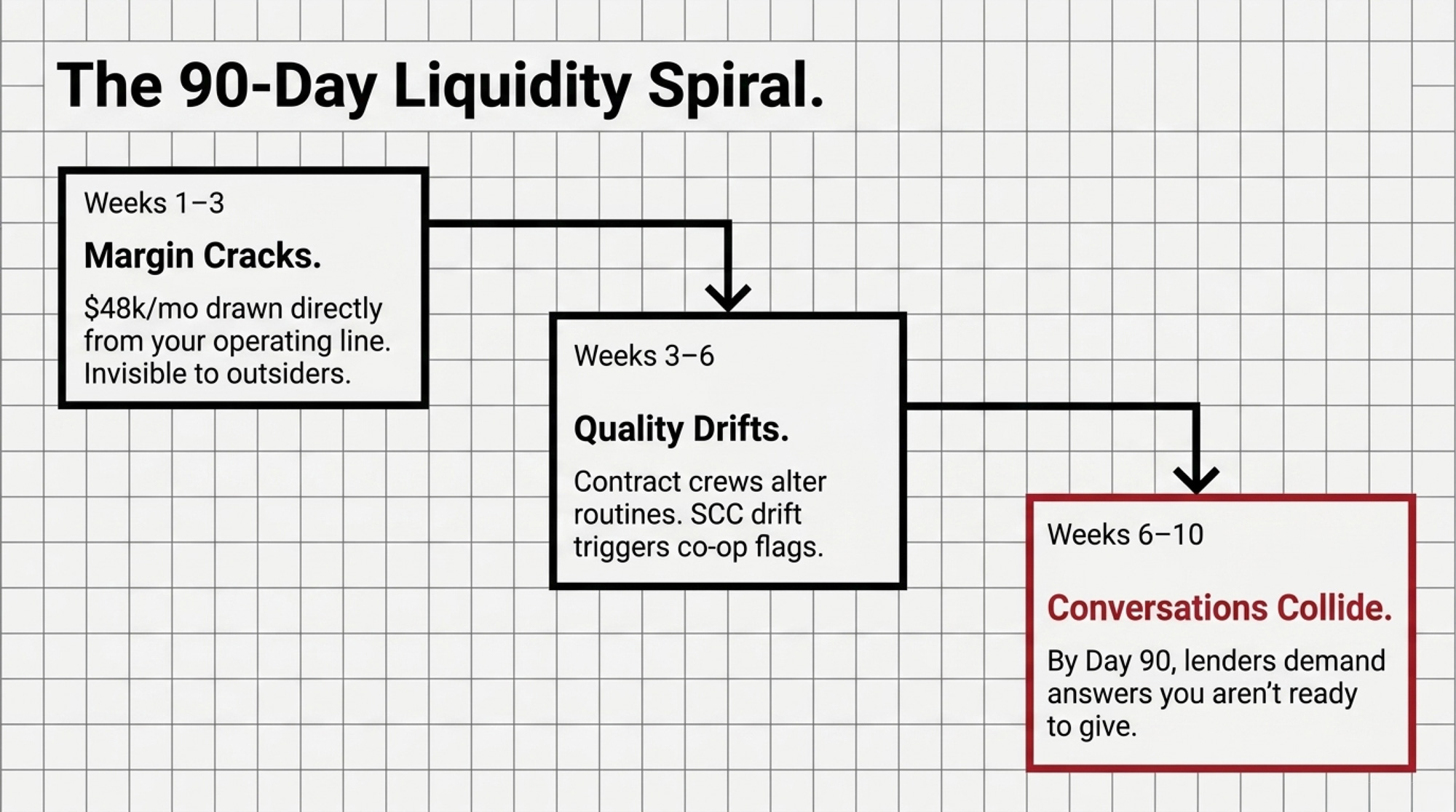
Weeks 1 through 3, the margin structure cracks first. You’re burning roughly $48,000 in incremental labor cost on a 1,500-cow herd, drawn straight from your operating line. This is invisible from the outside — your lender doesn’t know unless you told them. Weeks 3 through 6, milk quality starts drifting. Contract crews running unfamiliar protocols often produce longer milking times and inconsistent teat prep. SCC drift during the transition is a pattern operators commonly report during prolonged crew turnover — rarely across penalty thresholds immediately, but the monthly DHIA pull shows a trend your fieldman will notice and your co-op will flag.
Weeks 6 through 10, the two conversations collide. You’re simultaneously drawing on your operating line and fielding quality calls from your co-op. Neither one alone is fatal. Together, from the outside, they look like an operation losing control. By Day 90 — which falls inside the standard review window on most ag operating lines — your lender is asking questions you weren’t ready to answer. And the ones you already had weren’t the ones that mattered most.
The difference with a written playbook isn’t that the dollars stop moving. They move the same either way. The difference is what the conversations sound like.
Is This a Compliance Problem or a Liquidity Problem?
Here’s the reframe that separates the operators who come through the next 24 months from the ones who don’t.
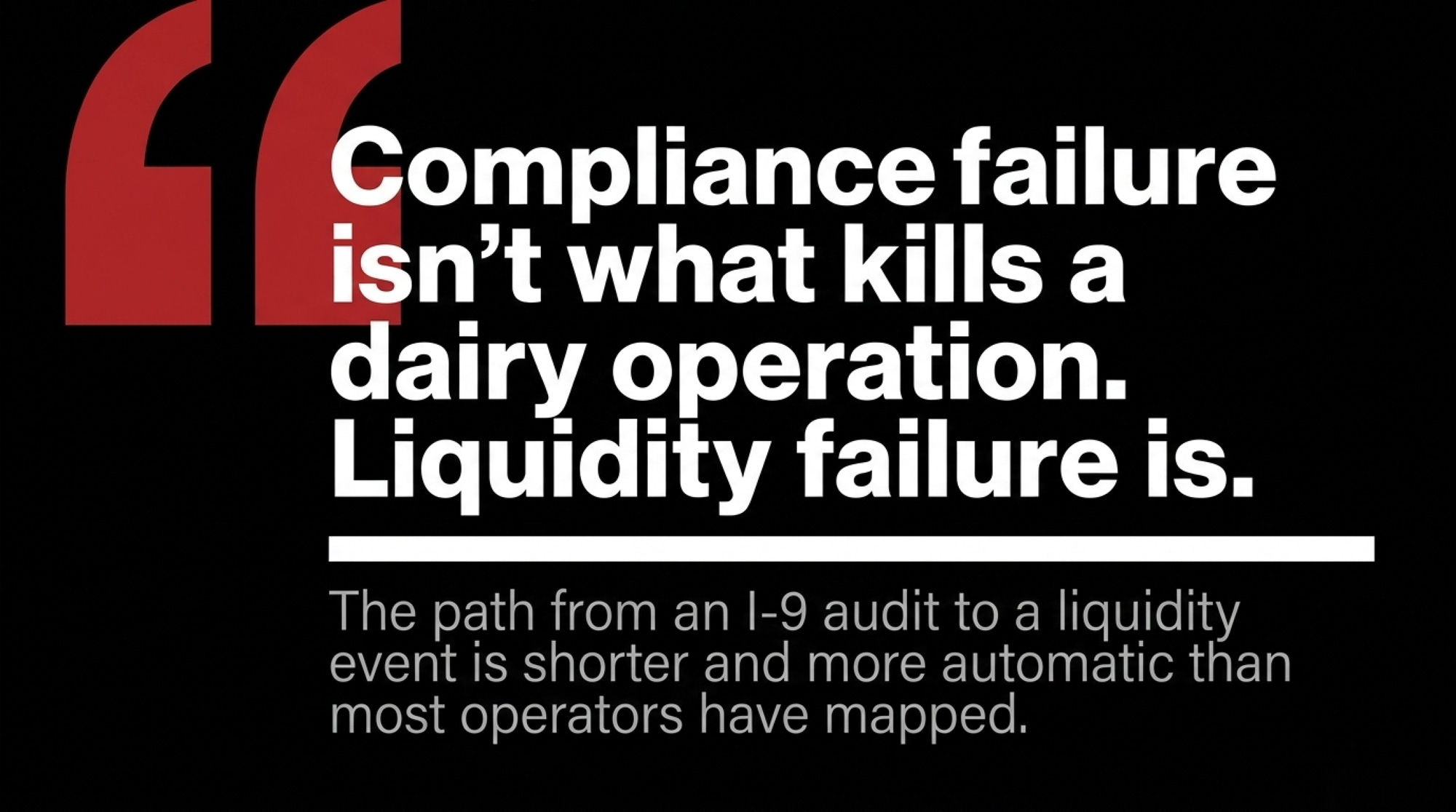
Compliance failure isn’t what kills a dairy operation. Liquidity failure is. The path from an I-9 audit to a liquidity event is shorter and more automatic than most operators have mapped. Every conversation in the industry right now is organized around documentation — I-9 files, E-Verify enrollment, legal retainers. That’s correct as far as it goes. But the probability of experiencing some form of workforce event in the next 24 months is no longer low enough to plan around avoidance alone.
Published evaluations of E-Verify have consistently documented that the system misses a meaningful share of unauthorized workers who present fraudulent documents. No standalone effectiveness study has replaced the earlier DHS-commissioned Westat work, and USCIS monitoring reports have since provided periodic updates without a comprehensive successor evaluation. The practical read for operators is that E-Verify is necessary but not sufficient.
The honest read of the current moment isn’t “I might get audited.” It’s “I’ll probably face something — the question is whether I’ve built for it.” A large Panhandle operation that spoke with The Bullvine on background in July 2025 described spending approximately $18,000 on a compliance platform in the prior year, and said the investment paid for itself by surfacing form-level documentation errors during internal review. That’s one data point, not a guarantee. Good enough to take seriously.
Options and Trade-Offs for Farmers
Path 1: File H-2A for eligible positions anyway. This works for crop-integrated activities, silage, and feed production — not your parlor workforce under current law. It requires housing compliance infrastructure, a legal retainer, and a four-month planning horizon minimum. The trade-off: you get audit-proof documentation on the workers who arrive through the program, but you can’t legally route milkers through H-2A until H.R. 3227 or a similar reform clears the Senate. And with the Fresno ruling pending on the IFR wage floor and the SCOTUS cert grant on DOL H-2A fines authority, you may need to rebuild your cost model mid-cycle. Plan for it; don’t bet the operating line on it.
Path 2: Internal I-9 audit with immigration counsel this quarter. This is the highest-ROI move available to any operation that hasn’t done one in three years — and post–March 2026 ICE guidance makes it more urgent, not less, because the window to self-correct on more than ten error classes has narrowed. The trade-off: some historical errors can no longer be fully rehabilitated through internal correction per the March 2026 Fact Sheet. Finding them early still puts you in a materially better position than finding them during an ICE inspection.
Path 3: Build a written 72-hour playbook. Do this within 30 days. See the Playbook Essentials sidebar below. This costs owner-hours, not capital. Two or three days of concentrated work. The uncomfortable part isn’t the drafting — it’s admitting on paper what happens if you’re not the one answering the phone. The operators who’ve come through recent workforce disruptions describe building these documents afterward. The ones who build before sleep better.
Path 4: Pre-vet a contract labor firm before you need them. Get their I-9 compliance documentation. Get their rate sheet and lead times for 5, 10, and 20 workers. Build the relationship when you’re not in crisis. When you are in crisis, every dairy in your region is calling the same firm on the same Tuesday morning — and availability isn’t guaranteed. The trade-off is modest: some relationship maintenance cost for coverage you hope you never activate.
🔧 Playbook Essentials — What the 72-Hour Binder Contains
Six documents. One three-ring binder in the farm office. Copies laminated and posted in the parlor.
- Workforce vulnerability map: roles by shift, cross-training depth, single-points-of-failure flagged by name.
- First-call contact list: immigration counsel, ag lender loan officer, co-op fieldman, contract labor firm, veterinarian. Names and cell numbers, not generic switchboards.
- Laminated parlor SOP: prep, attach, post-dip, wash-up — written so someone who has never milked on your farm could execute at 4 a.m.
- Production triage decision tree: which pens first, which cows dry off early, which heifers ship, what the once-a-day-milking threshold looks like.
- Pre-written lender notification script: what you call about, what numbers you bring, what draw capacity you’re confirming.
- Pre-written fieldman notification script: quality expectations during the transition window and what you’re doing about SCC drift.
The 30/90/365 At-a-Glance
- 30 days: Write the 72-hour playbook. Call your ag lender. Confirm every current parlor worker is on E-Verify.
- 90 days: Internal I-9 review with immigration counsel. Pre-vet a contract labor firm with rate sheet and lead times for 5, 10, and 20 workers.
- 365 days: File H-2A on the eligible positions you have. Paper-ize every parlor SOP that currently lives in your herdsman’s head.
Key Takeaways
- If your I-9 files haven’t been reviewed by immigration counsel in the last three years, move that review into this quarter. The March 16, 2026 ICE Fact Sheet revision means more than ten error categories that used to be correctable now carry immediate penalty exposure. The review costs less than one fine.
- If you don’t have a written 72-hour playbook — first-call contacts, laminated parlor SOP, pre-written lender script — put it on paper within 30 days. This costs hours, not dollars. It’s the highest-leverage action available to any operation right now regardless of herd size.
- If you’re building a 2026 H-2A budget on the $13.70/hour IFR floor, carry a contingency in the $5,000 to $10,000 per worker range against pre-IFR rates being restored mid-cycle. The low end reflects a roughly $3–$4/hr delta between the IFR floor and prior AEWR averages, conservatively rounded, over 2,080 annual hours; the high end loads in housing, transportation, and legal adjustments. Both the Fresno ruling and the SCOTUS cert grant on DOL fines authority are pending.
- If your operating line assumes normal labor costs, stress-test it against a 90-day scenario in the $240,000 to $255,000 range for a 12-FTE gap — three months of ~$48,500/month contract-crew premium plus an upfront rebuild cost in the $95K–$110K range, consistent with Drumgoon Dairy’s reported $110,000 expenditure. Know your draw capacity before you need it.
- If you haven’t talked to your ag lender about workforce risk in the last six months, schedule that call now.Lenders who hear it from you first respond categorically differently than lenders who read about it elsewhere.
- If your parlor SOPs live in your herdsman’s muscle memory and nowhere on paper, that’s a single point of failure with a friendly face. Write them down. Hand them to someone who’s never milked on your farm and ask if they could follow them at 4 a.m. If the answer is no, they’re not complete.
- If you’ve enrolled in E-Verify and assumed that closes your compliance gap, confirm that your full current parlor workforce is actually on the platform — not just the workers you hired most recently.
The Question Worth Asking This Week
The operators making it through 2026 aren’t the ones waiting for the regulatory environment to stabilize. They’re the ones who decided it’s the weather, not the forecast — and built their operation to produce milk through whatever comes. The compliance platform doesn’t substitute for the liquidity architecture. You need both, and the sequencing matters: the playbook has to exist before the envelope arrives, not after.
So the question isn’t whether you’ve bought the subscription. It’s where your 72-hour plan actually lives right now — in a document anyone on your team could execute, or in your own head on a day you might not be available. Walk out to the farm office after chores tonight. Pull the binder off the shelf. If there isn’t one, that’s the job for the next 30 days.
Next week’s Bullvine Weekly runs the three-scenario H-2A wage model, the contract-crew stress test at different herd sizes, and the compliance ROI math broken out by operation scale. If tonight’s walk to the office turns up a thin binder, that’s where the next layer of numbers is.
Legal note: This article is journalism, not legal advice. I-9 and H-2A rules are changing week by week in 2026. Before acting on any compliance strategy, internal audit, or H-2A filing discussed here, consult qualified immigration counsel and your own ag lender. Figures cited are modeled or drawn from public reporting as noted; your operation’s numbers will differ.
Learn More
- 79% of U.S. Milk Runs on Immigrant Labor. If Yours Vanishes, You Have 72 Hours. — Expose the brutal macroeconomic math behind the latest regional ICE raids. This breakdown reveals how losing half the immigrant workforce wipes out 1.04 million cows, projecting the exact supply chain collapse if local 72-hour contingencies fail.
- The Robotics Revolution: Embracing Technology to Save the Family Dairy Farm — Permanent immunity from the H-2A timeline trap lies in targeted automation. Dismantling objections to high robotic startup costs, this analysis proves operations can secure $44,030 in annual labor savings while capturing a 5-10% milk yield bump.
- How to Attract and Retain Exceptional Labor for Your Dairy Farm — Guarding your operation requires locking down your existing crew before inspectors arrive. Arm yourself with digital scheduling and structured training protocols that directly cut turnover by 10%, fundamentally reducing your vulnerability to sudden staffing wipeouts.
The Sunday Read Dairy Professionals Don’t Skip.

Every week, thousands of producers, breeders, and industry insiders open Bullvine Weekly for genetics insights, market shifts, and profit strategies they won’t find anywhere else. One email. Five minutes. Smarter decisions all week.