Archive for Politics

Shutdown Reality: Why Every Dairy Farmer Faces a $60,000 Decision in the Next 90 Days

While you’re checking frozen FSA payments, processors know exactly what your milk is worth. The game is rigged.

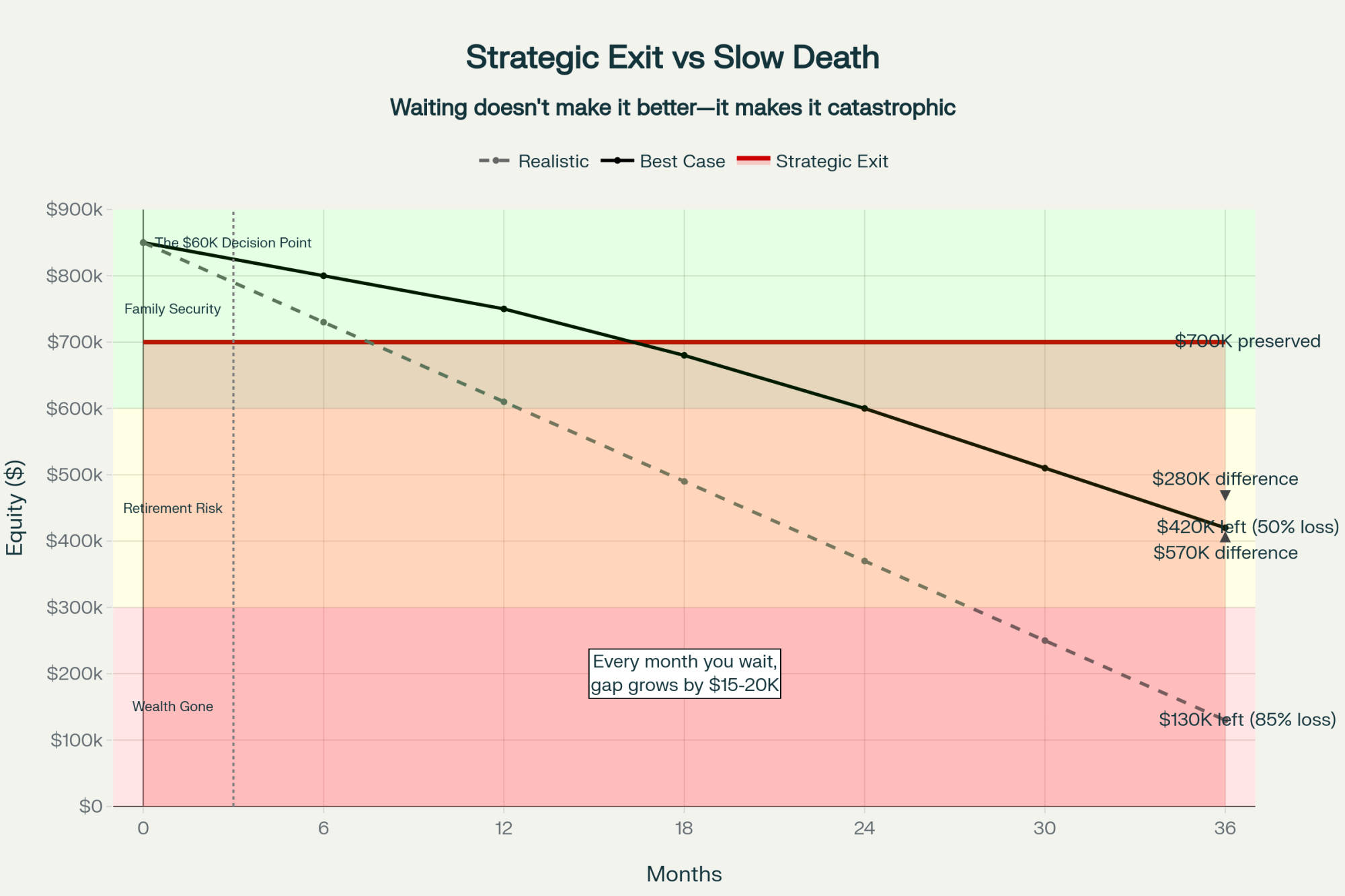
Executive Summary: A Wisconsin farmer told me: ‘I check my frozen FSA account every morning, but what keeps me up at night is the $20,000 in equity I’m burning monthly.’ He’s not alone—half of dairy farms have vanished since 2013, and this October shutdown exposed what processors already knew: most operations face impossible economics. But farmers who act within 90 days can still preserve 85-90% of their equity through three proven paths: scaling to 3,500+ cows ($4M required), transitioning to premium markets (3-7 year commitment), or strategic exit (the difference between keeping $700K versus losing everything). Every month you delay costs $20,000 in family wealth that you’ll never recover. The math is harsh but clear—the only wrong choice is no choice.

Dairy Farm Survival Strategies

You know, I was talking with a dairy farmer from Winnebago County last week—seventh generation, milking about 450 head—and he said something that stuck with me. “I’ve been checking my FSA account every morning for 28 days. Same result. Nothing.”

The government shutdown of October 2025 has frozen billions in farm payments, and that’s creating real stress during harvest season when cash flow matters most. But here’s what’s interesting… as I’ve been talking with producers across the Midwest, what we’re discovering goes way beyond payment delays.

After digging through recent market analyses and comparing notes with dairy economists, there’s a pattern emerging that—honestly—changes how we need to think about survival in this industry. And the farmers who are grasping this, really understanding what it means for their operations, they’re making some tough decisions right now. Decisions that’ll determine whether their families thrive or… well, whether they have to walk away with nothing in three years.

When the Math Just Doesn’t Work Anymore

So here’s a conversation I keep having. A producer in southern Wisconsin—runs about 650 cows, good operation—told me: “When the shutdown started, I was right in the middle of filing our production reports. Now? I’m flying blind on pricing while my milk buyer somehow knows exactly what to offer me.”

Sound familiar?

What many of us are realizing is that this shutdown has pulled back the curtain on something that’s been building for years. The cost structure in dairy… it just doesn’t pencil out for most operations anymore. And I mean most.

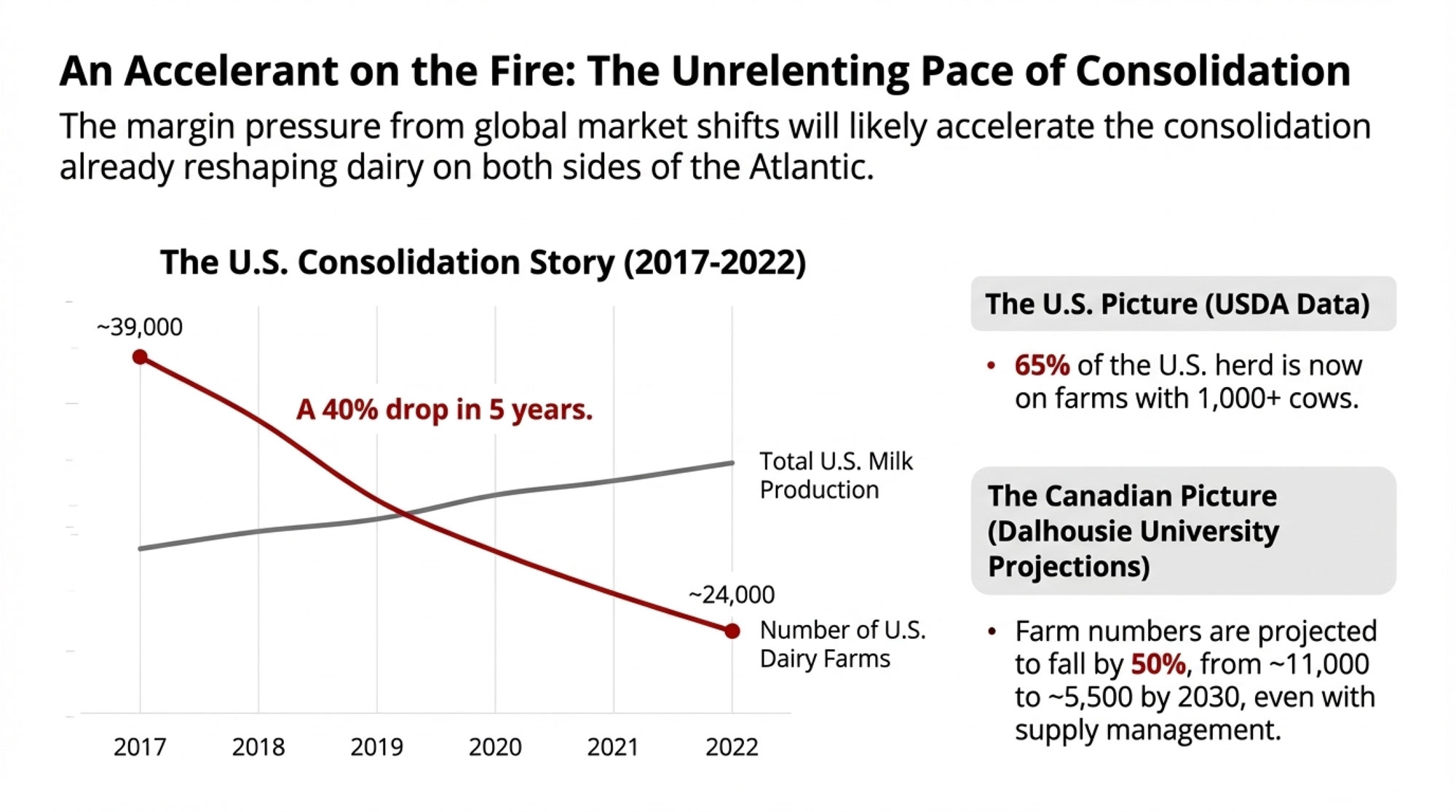
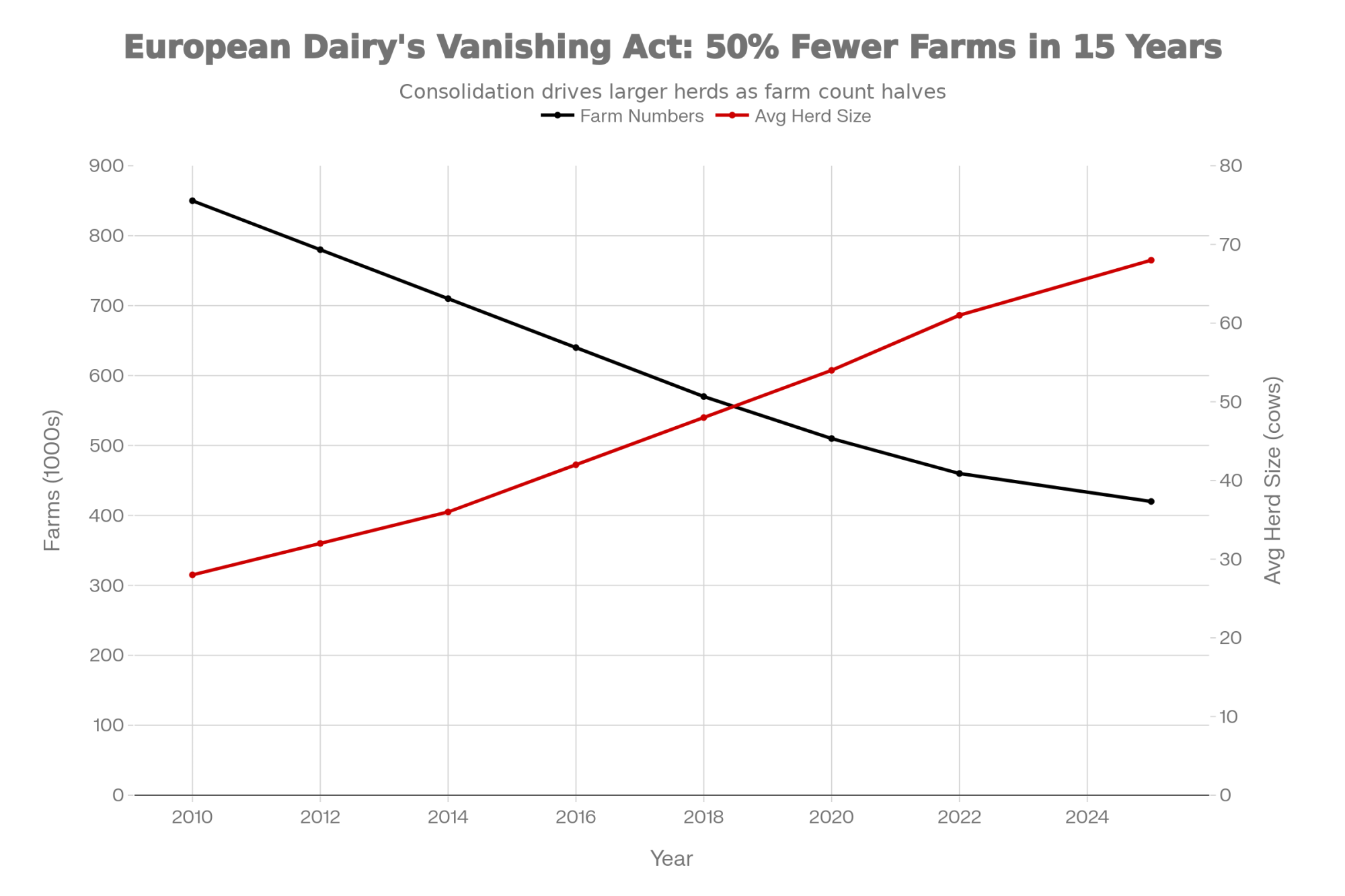
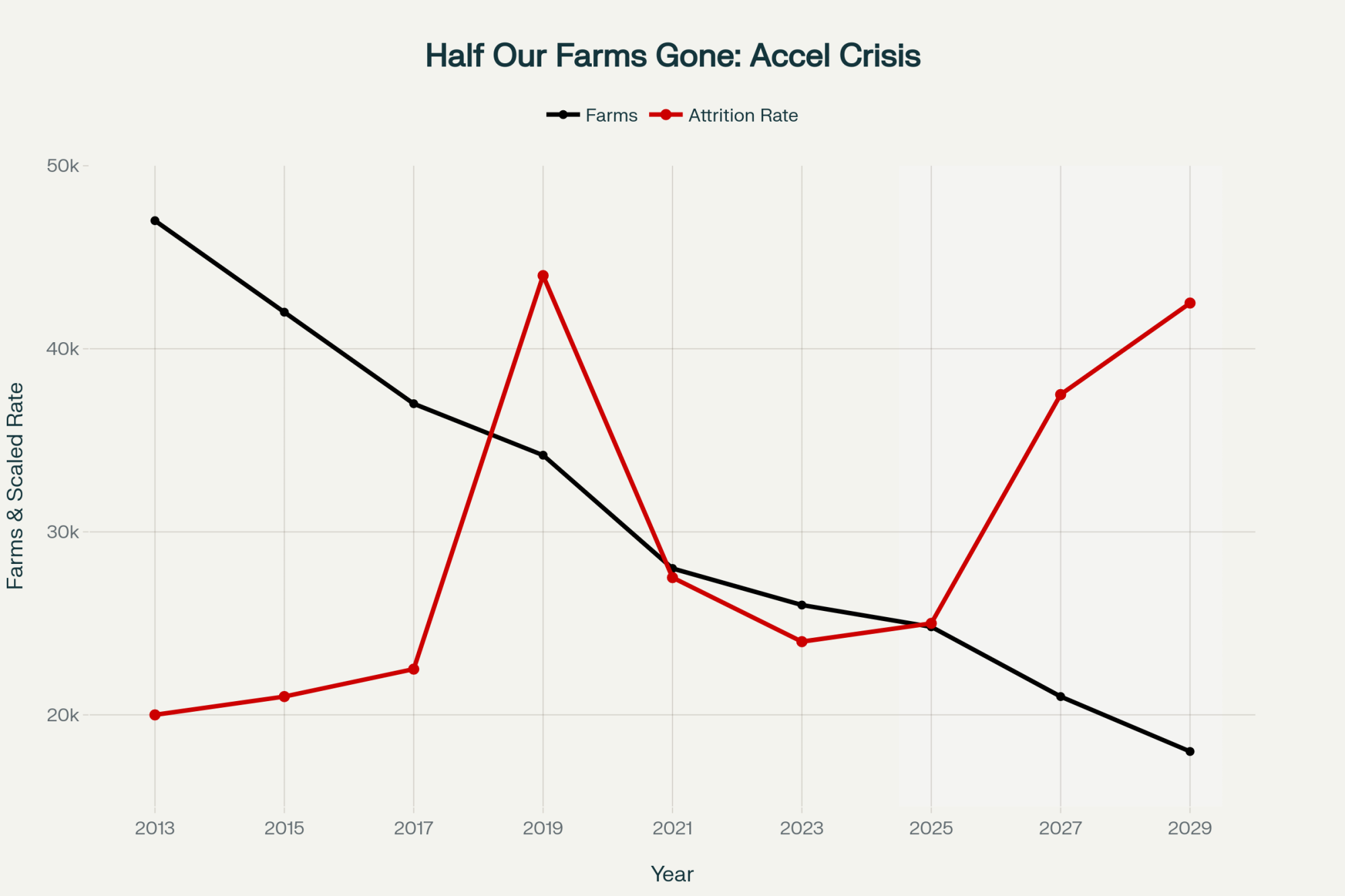
The USDA Census of Agriculture data tells a sobering story. We’ve lost about half our dairy farms since 2013. Half. That’s not gradual change—that’s acceleration. The historical attrition rate used to hover around 4% annually, based on USDA tracking. Industry analysts I’ve talked with are suggesting it could hit 7-9% over the next couple years. Do the math on that… we could be looking at maybe 12,000 operations by 2035. We’re at about 24,000 now, according to USDA’s latest count.

We’re not just losing farms at the historic 4% rate—we’re accelerating toward 7-9% annual losses. If you’re hanging on hoping it gets better, understand this: the industry is consolidating faster than ever, and your window to exit strategically is closing.

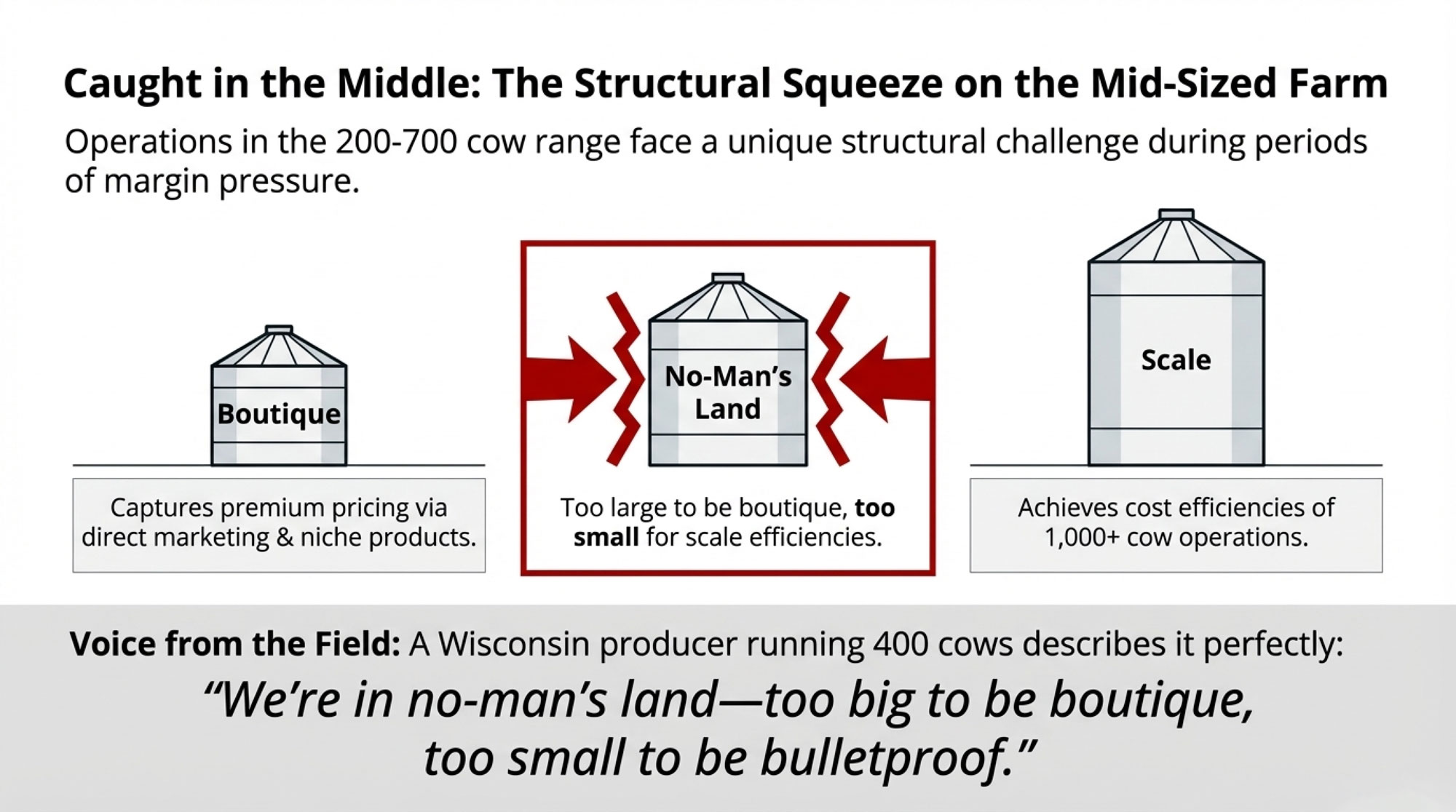
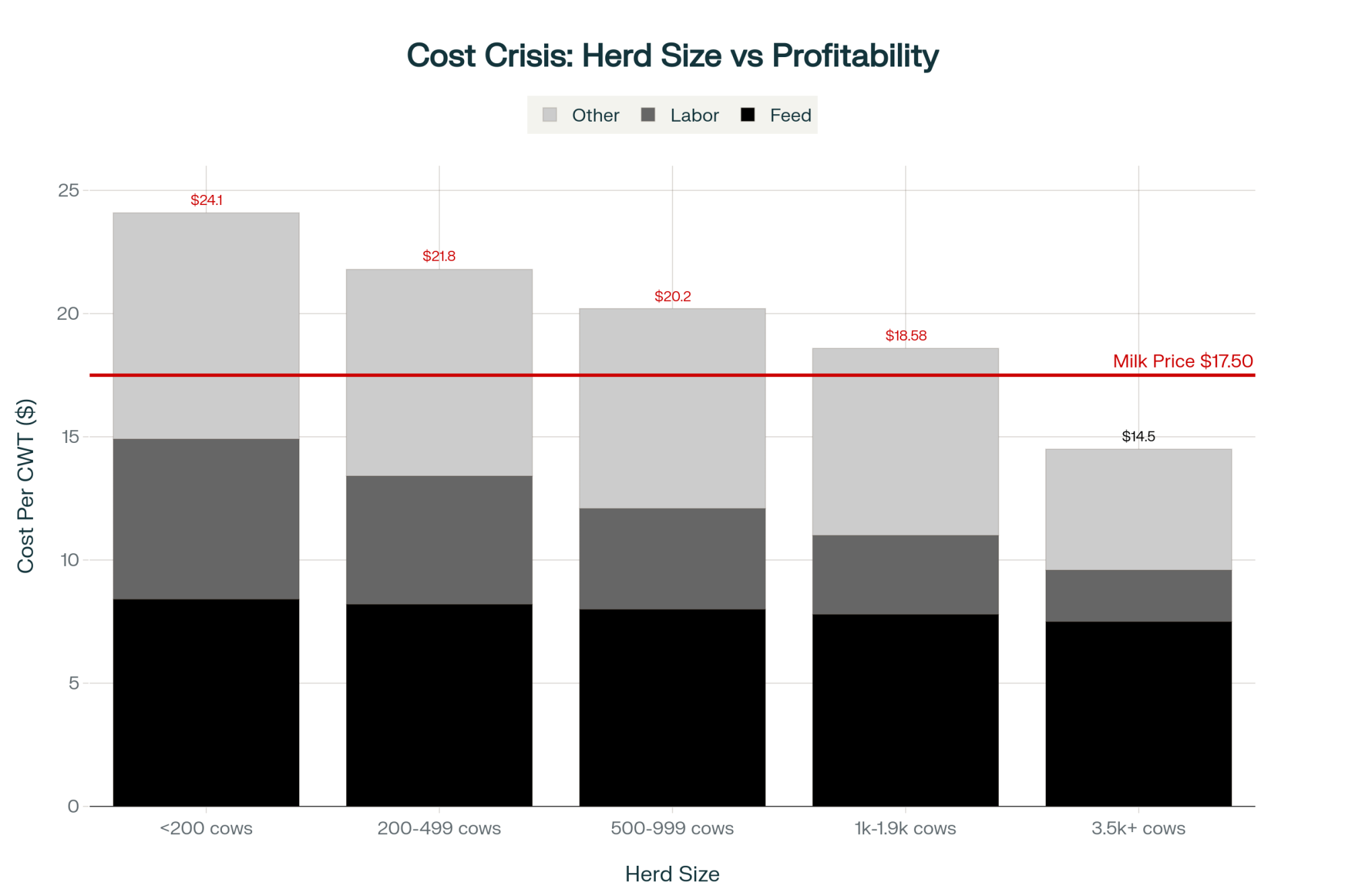
Mark Stephenson over at UW-Madison’s Center for Dairy Profitability, he’s been tracking these trends for years. What he and his team have documented is eye-opening. The cost gap between a 500-cow operation and one milking 3,500? It’s massive—we’re talking hundreds of thousands of dollars annually in structural disadvantage. You can optimize feed efficiency, maybe save 5%. But when the big operations are running three to four dollars per hundredweight lower in total costs? That’s not a gap you close with better management.

The cost gap that’s destroying family farms: small operations lose $6.60/cwt while large dairies profit $3/cwt. At 650 cows producing 80 lbs/day, that’s $34,320 monthly—enough to burn through your equity in 25 months.

“I dropped $180,000 on robotic milkers last year. Thought I was crazy at the time. But with agricultural labor costs running north of twenty bucks an hour—if you can even find people—that investment’s already cash-flowing positive.” — Dairy farmer, Eau Claire area, 1,100 cows

And here’s the thing he pointed out: feed costs are only about 35-40% of his total expenses now. It’s everything else that’s killing margins.

The Information Game During Shutdowns (And Why We’re Losing It)

What this shutdown has really exposed is something we haven’t wanted to acknowledge about modern dairy economics. While government data collection sits frozen, the processors? They’re operating with full market intelligence through their private channels.

Take a look at what’s been happening in Chicago trading. Butter’s been bouncing around $1.60 per pound. Cheese blocks are pushing toward $1.80. The spread between Class III and Class IV pricing? It’s wider than we’ve seen in years, based on CME data.

Now, if you’re a processor with trading desk access and those expensive market analytics subscriptions—you know exactly what’s happening in real-time. But farmers without the weekly USDA Dairy Market News reports we usually rely on? We’re negotiating in the dark.

And it gets worse. The Federal Milk Marketing Order formulas—you probably know this already—they’re still using butterfat standards from 2000. Three and a half percent. But today’s milk? Based on USDA testing data, most of us are running 3.9 to 4.1 percent butterfat, especially with the genetics we’ve selected for. That gap between what we produce and what the formulas recognize? It’s real money left on the table. Every load.

Marin Bozic, assistant professor of dairy economics at the University of Minnesota, has been analyzing these formula issues. “The disconnect between current milk composition and FMMO standards represents a significant value transfer from producers to processors,” he noted in recent extension materials. “We’re talking millions annually across the industry.”

Three Paths That Actually Work (And One Nobody Talks About)

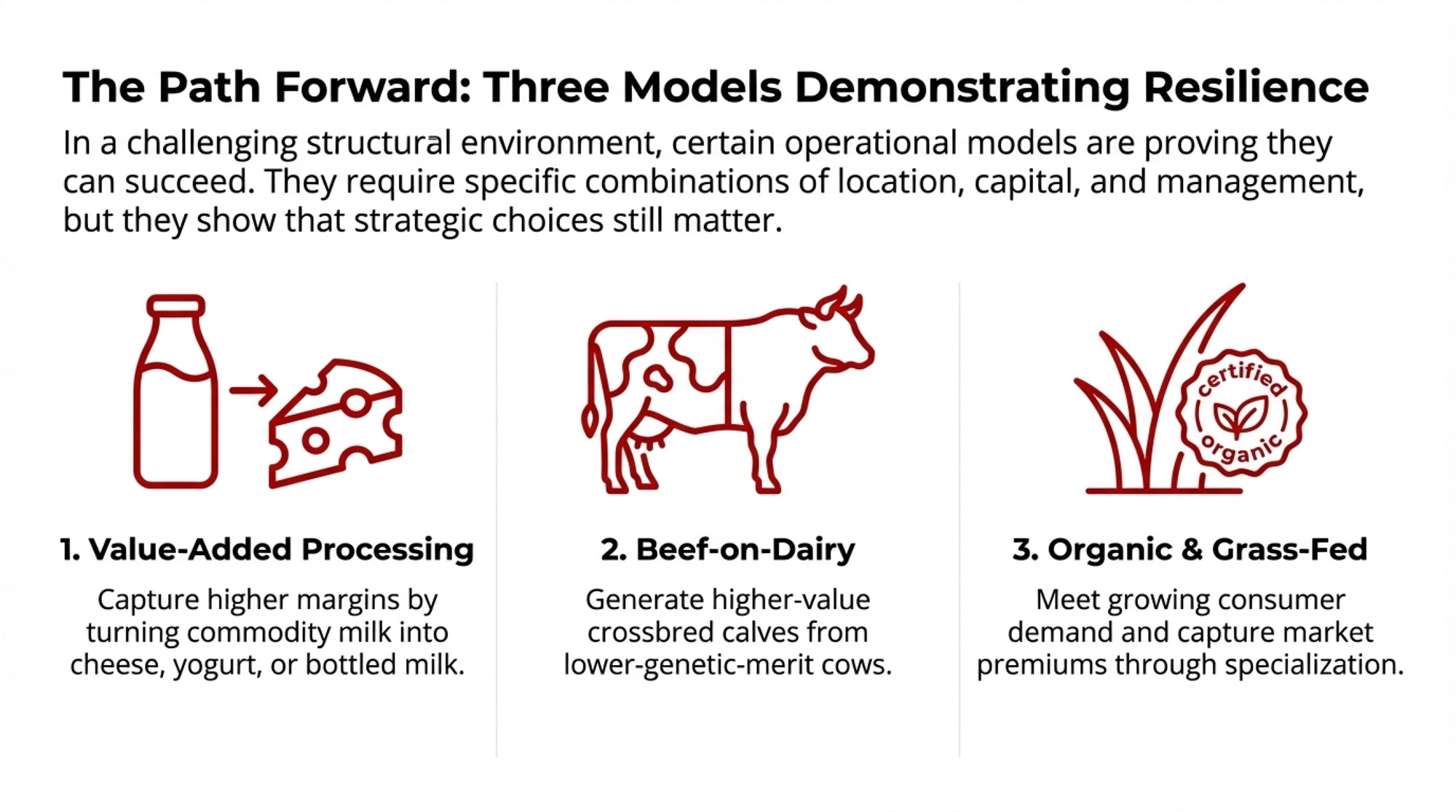
After comparing notes with producers from California to Vermont, here’s what I’ve found: there are basically three business models that can work in today’s dairy. Everything else is just… different speeds of losing money.

Path 1: Going Big—Really Big

I know a producer in Idaho who made this jump two years back. Went from 800 cows to 3,600. “The math is brutal but simple,” he told me. At 800 cows, he was bleeding money—losing close to two hundred grand a year. At 3,600? He’s profitable. Same milk price, totally different economics.

But—and this is important—it took over four million in expansion capital. Complete management restructure. And what he calls “two years of hell” getting it all to work. Industry lenders I’ve spoken with suggest relatively few current operations could access that kind of financing. Very few.

What’s encouraging, though, is that those who do make this transition successfully often find unexpected benefits. Better animal welfare through modern facilities. Ability to attract skilled management talent. Even environmental improvements through precision nutrient management at scale.

Path 2: Premium Markets (If You’re in the Right Spot)

There’s an organic producer I know in Vermont, transitioned about four years ago. She’s refreshingly honest about it: “First three years, we lost money. Years four through six, broke even. Year seven—this year—we’re finally profitable.”

She’s getting close to forty dollars per hundredweight through her organic co-op, compared to the seventeen or so conventional farmers are seeing based on current Class III pricing. But here’s the catch—she’s 40 minutes from Burlington. Close to those premium consumers.

Research from Cornell’s dairy program shows something interesting: organic transition success rates tend to drop the further you get from metro markets. The market access piece is crucial. SARE grant applications for transition support typically close in March, so timing matters if you’re considering this path.

One success story worth noting: A group of five farms in Ohio pooled resources to create a shared organic processing facility. By working together, they reduced individual transition costs by about 40% and secured contracts before making the leap. That kind of innovation is what gives me hope.

Path 3: The Strategic Exit Nobody Wants to Discuss

And then there’s the third path. The one we don’t talk about at co-op meetings.

“I had about $850,000 in equity. Could’ve kept fighting, probably lasted three more years. Maybe walked away with a hundred grand if I was lucky. Instead? I sold strategically. Walked away with over seven hundred thousand.” — Recently retired dairyman, Marathon County, Wisconsin

He’s consulting now, helping younger farmers with business planning. His daughter started an agritourism venture. And you know what? He doesn’t regret it. “People think I gave up. I didn’t give up—I looked at the math and protected my family’s future.”

Agricultural financial advisors I’ve talked with suggest strategic exits generally preserve most of your equity—85-90% isn’t uncommon. Forced liquidations after years of losses? They tell me you’re lucky to see 20-30% recovery.

Your Three Options

Path 1 – Scale Up: Requires $3-5 million capital, 3,500+ cows, complete management restructure. Success rate high IF you can access financing (less than 5% of farms can). But those who succeed often thrive with modern efficiency.

Path 2 – Premium Markets: Organic/specialty transition needs 3-7 years losses before profitability, proximity to metro markets critical, $600K-1M transition capital required. SARE grants available (apply by March 2026).

Path 3 – Strategic Exit: Preserves 85-90% of equity NOW versus 20-30% in forced liquidation later. Allows family financial security and new opportunities. Not failure—strategic business decision.

Timeline: Next 90 days critical for decision-making while equity remains.

The Next 90 Days Matter More Than You Think

Let me share something a Fond du Lac County dairyman told me—runs about 650 cows, right in that tough middle ground:

“Every month I keep going, I’m burning through twenty-some thousand in equity. That’s college funds. That’s retirement. That’s the down payment on whatever comes next.”

That “twenty-some thousand in equity” burn isn’t just a number—it’s the cost of indecision. In 90 days, that’s over $60,000 gone. That $60,000? It’s the difference between a strategic exit where you keep most of your wealth and a forced liquidation where you’re lucky to walk away with anything. That’s your window.

The brutal math of delay: Each month burns $15K-$20K in equity while you decide. By January, indecision costs your family $60,000 in lost wealth—money you’ll never recover.

His monthly cash needs? About eighteen grand just for essentials—feed, supplies, utilities. The frozen government payments are creating a gap he can’t bridge much longer.

Wisconsin’s Farm Center, which provides financial counseling to farmers, my conversations with their staff suggest they’re getting 40-50 calls daily now. Before the shutdown? Maybe 10-15. One of their senior counselors told me something that really hit home: “We’re watching 30 years of equity disappear in 18 months. The farmers who recognize it early and make strategic decisions—they keep most of their wealth. The ones who wait? They lose everything.”

The Conversation We Need to Have

Can we talk honestly about what this stress is doing to farm families?

Multiple studies in agricultural psychology journals show farmers face significantly elevated stress and mental health challenges compared to other professions. Financial pressure is consistently identified as the primary trigger. According to conversations with Farm Aid staff, their hotline has seen a notable increase in calls this year.

Several farmers shared with me—they asked to remain anonymous—about the mental toll. One said: “I wake up at 3 AM doing the same math. How many months until we’re broke. My wife pretends she’s asleep, but I know she’s running the same numbers.”

The narrative that equates strategic exit with failure? It’s literally destroying people. As agricultural mental health professionals have been saying, recognizing an unwinnable situation and protecting your family isn’t giving up—it’s wisdom.

Resources That Can Actually Help

For those evaluating options, here are organizations that farmers have found helpful:

Financial Planning:

  • Farm Financial Standards Council offers free cash flow analysis tools
  • UW-Madison’s Center for Dairy Profitability provides quarterly benchmarks
  • Agricultural financial advisors can help with exit strategy planning

Transition Support:

  • SARE offers grants up to $15,000 for transition planning (March deadline)
  • Organic Valley has specific regional openings for new members
  • Farm Credit Services offers 18-month interest-only transition financing

Mental Health:

  • Farm Aid Hotline: 800-FARM-AID
  • 988 Suicide & Crisis Lifeline
  • Rural Minds offers online support specifically for agricultural communities

The Bottom Line

After weeks of analyzing this situation and talking with farmers from every angle, something’s clear: the question isn’t whether you can survive another year. It’s whether that fight serves your actual goals.

The brutal reality: exit today with $700K or wait three years and leave with $130K-$420K. That’s not a range—that’s the difference between securing your family’s future and losing everything your family built.

A fourth-generation producer from Dodge County who sold recently framed it well: “My grandfather would understand I’m protecting what he really valued—the family’s security. He adapted to his era’s challenges. I’m adapting to mine.”

You know what I find encouraging? Farmers who make peace with transition often discover unexpected opportunities. Consulting for younger farmers. Mentoring organic transitions. Exploring agrivoltaics. One former dairyman is now helping beginning farmers with direct marketing—found his passion in a completely different aspect of agriculture.

The dairy industry will survive this transformation, but it’s probably going to look quite different. Maybe 8,000-12,000 large operations. Perhaps a couple thousand premium niche producers. That seems to be where trends are pointing.

Your job—whether you’re milking 50 cows or 5,000—is to honestly assess where you fit in that future. Make decisions based on your family’s actual needs, not what you think a “real farmer” should do. Because at the end of the day, your kids need a parent more than they need a farm. Your spouse needs a partner, not a martyr.

The next 90 days… that’s your window, from what I’m seeing. Make decisions based on math and family priorities, not mythology and peer pressure. That’s the wisdom this moment demands.

And if you need to talk to someone—really talk—don’t wait. Pick up the phone. Call Farm Aid. Call a counselor. Call a friend. Because whatever path you choose, you don’t have to walk it alone.

Key Takeaways:

  • The $60,000 question: You’re burning $20K in equity monthly—by February, that’s $60K gone forever
  • Path 1 – Go Big: Scale to 3,500+ cows. Requires $4M capital. Only works if you’re in the 5% who can get financing
  • Path 2 – Go Premium: Organic/specialty markets. Expect 3-7 years of losses. Must be within 50 miles of metro markets
  • Path 3 – Get Out Smart: Exit now keeping $700K vs. waiting 3 years and walking away with $100K
  • Hard truth: No decision IS a decision—it defaults to Path 3, just costs you $600K more

Complete references and supporting documentation are available upon request by contacting the editorial team at editor@thebullvine.com.

Learn More:

Join the Revolution!

Join over 30,000 successful dairy professionals who rely on Bullvine Weekly for their competitive edge. Delivered directly to your inbox each week, our exclusive industry insights help you make smarter decisions while saving precious hours every week. Never miss critical updates on milk production trends, breakthrough technologies, and profit-boosting strategies that top producers are already implementing. Subscribe now to transform your dairy operation’s efficiency and profitability—your future success is just one click away.
NewsSubscribe
First
Last
Consent

Lessons from Greece’s Phantom Herds: Why Trust and Data Now Decide Dairy’s Future

When Greece’s ghost herds stole €20 million, they left every dairy farmer a hard truth: trust without proof costs real money.

Executive Summary: When news broke that Greek fraudsters had stolen €20 million using “ghost herds,” it did more than rattle regulators—it struck a chord with real farmers everywhere. The case proved what every dairy producer already knows: trust only works when it’s backed by proof. This story digs into how Greece’s oversights mirror the challenges in North America’s milk pricing and subsidy systems, where paperwork often outpaces technology. What’s encouraging is that solutions already exist—digital traceability, satellite verification, and data‑driven audits built to protect honest operations. The takeaway? Verification isn’t red tape—it’s the foundation that keeps integrity, transparency, and producer trust alive in modern dairying.

Dairy Data Verification

Every dairy farmer knows that our industry runs on trust. That trust sits quietly beneath the bulk tanks, market reports, and cooperative books we rely on every day. So when investigators in Europe uncovered a major subsidy scandal built on phony paperwork and nonexistent herds, it stirred something familiar.

The case out of Greece wasn’t about complex cybercrime—it was about paperwork getting ahead of proof. And that, in its simplest form, is a cautionary tale with lessons we should pay attention to.

Inside Greece’s “Phantom Herds” Scandal

Greece’s ghost herd scandal shows what happens when paperwork outpaces proof—7 years of fraud, €20M stolen, and 324 phantom farmers. The lesson for North American dairy: trust needs verification, not just forms.

The European Public Prosecutor’s Office (EPPO) reported earlier this year that fraudulent applications for agricultural subsidies had been filed in the years leading up to 2025, totaling more than €20 million in false claims. The scheme was run through OPEKEPE, Greece’s administrative body for EU farm payments, and linked to 324 fake recipients who allegedly invented livestock herds and falsified land records.

The fraud ran long enough to trigger major repercussions. The European Commission fined Greece €400 million for “systemic verification failures,” forcing the country’s Ministry of Rural Development to overhaul its subsidy application checks.

The fallout landed hardest, as it always does, on the honest operators. Many of Greece’s legitimate family dairies—those milking goats and sheep for the country’s Protected Designation of Origin feta—now face extra audits, slower payments, and reputational damage through no fault of their own.

Why This Story Resonates Beyond Europe

What’s interesting here is that while the fraud happened half a world away, the vulnerabilities it exposed look awfully familiar. From milk pooling to subsidy checks, North American dairy runs on systems just as dependent on accurate data—and just as fragile when complexity outweighs clarity.

1. When Paperwork Outpaces Practice

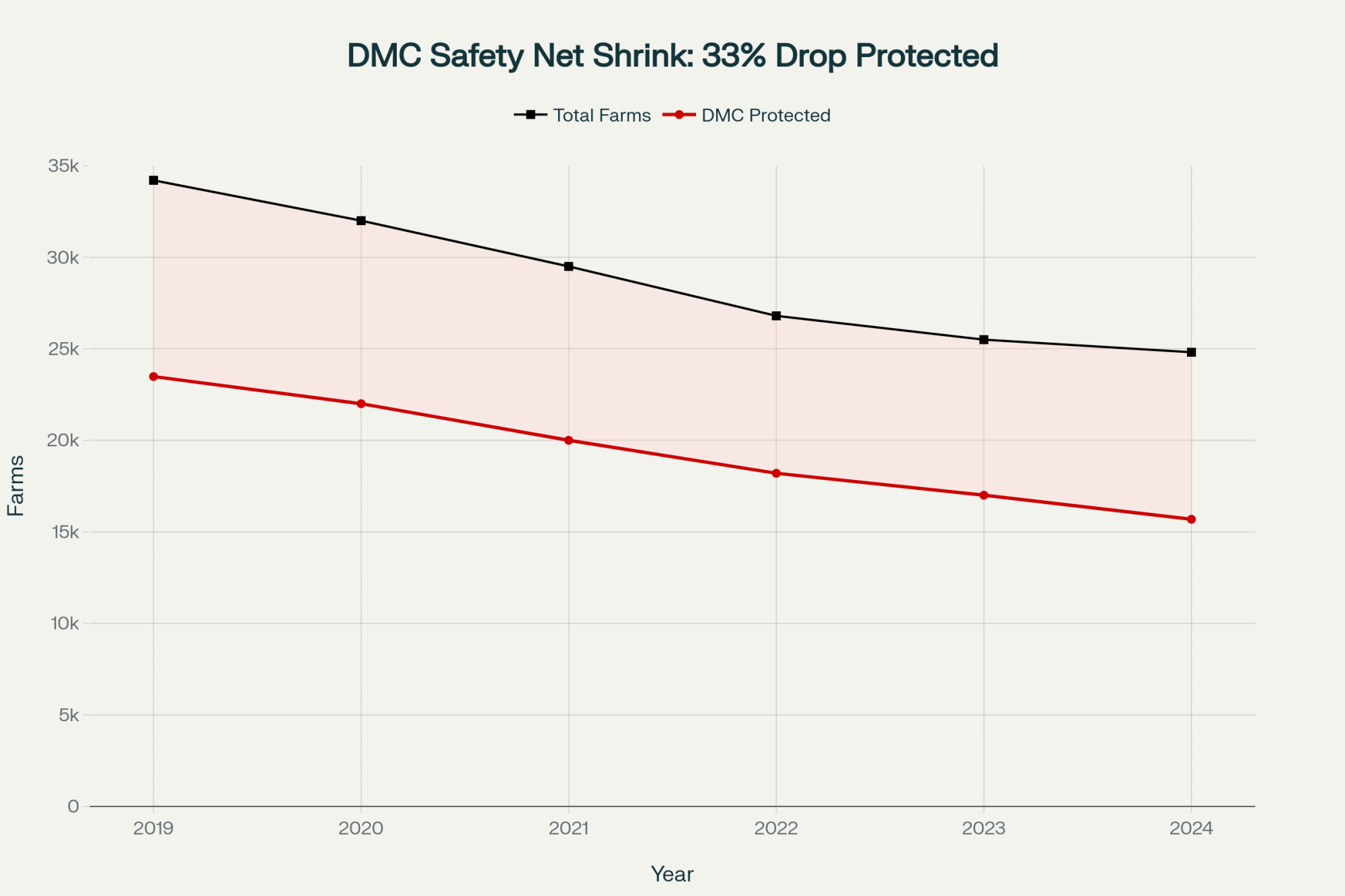
DMC enrollment dropped 33% (from 23,485 to 15,686 farms) even as margins collapsed in 2023. The safety net is shrinking faster than the industry—when complexity confuses farmers, they skip protection and bet the farm.

The Dairy Margin Coverage (DMC) program has been a financial lifeline for U.S. producers facing unpredictable feed costs. But much of it still depends on paper applications and self‑verified production data.

The USDA Farm Service Agency (FSA) has made digital reporting available in recent years, yet data integration between programs remains limited. University of Wisconsin research calls it a “trust‑based compliance model” that functions well under normal conditions but leaves room for error when information isn’t seamlessly shared.

Let’s be clear—nobody’s suggesting this is fraud. It’s inefficiency. And inefficiency creates opportunity—for mistakes, for misreporting, or simply for confusion that puts unnecessary strain on both farmers and regulators.

2. When Complexity Creates Confusion

Take the Federal Milk Marketing Order (FMMO) system. It’s designed to bring fairness and balance to milk markets, but even many seasoned operators will tell you that tracking, pooling, and pricing doesn’t always feel transparent.

The 2018 Farm Bill’s Class I pricing formula change cost dairy farmers over $1 billion in pool losses. When complexity outweighs clarity, handlers exploit gaps—leaving honest producers holding the bag.

Milk handlers can legally “de‑pool” their milk—temporarily removing it from the pool to optimize returns—during certain market shifts. According to the USDA Economic Research Service (ERS), de‑pooling between 2021 and 2023 shifted hundreds of millions of dollars across federal orders.

While perfectly legal, this complexity creates an information gap where trust can erode—the same kind of vacuum that allowed outright fraud in the Greek system. When producers can’t fully trace value movement, suspicion grows, even in legitimate markets.

Transparency, plain and simple, is the antidote.

3. Accountability Builds Resilience: The Checkoff Example

Funding mechanisms like national checkoff programs show how transparency can turn obligation into trust. Producer dollars drive research, market development, and promotion—but oversight matters.

Farm Action audit review in 2024 revealed missing USDA validations across several non‑dairy commodity boards, sparking an industry‑wide conversation about governance standards. Dairy programs weren’t directly involved, but the timing was valuable: it reminded everyone that trust grows where visibility exists.

Producers don’t oppose accountability—they just want assurance that the dollars they contribute continue to build consumer trust, sustain exports, and innovate products for the next generation.

The Broader Picture: Consolidation and Oversight Pressure

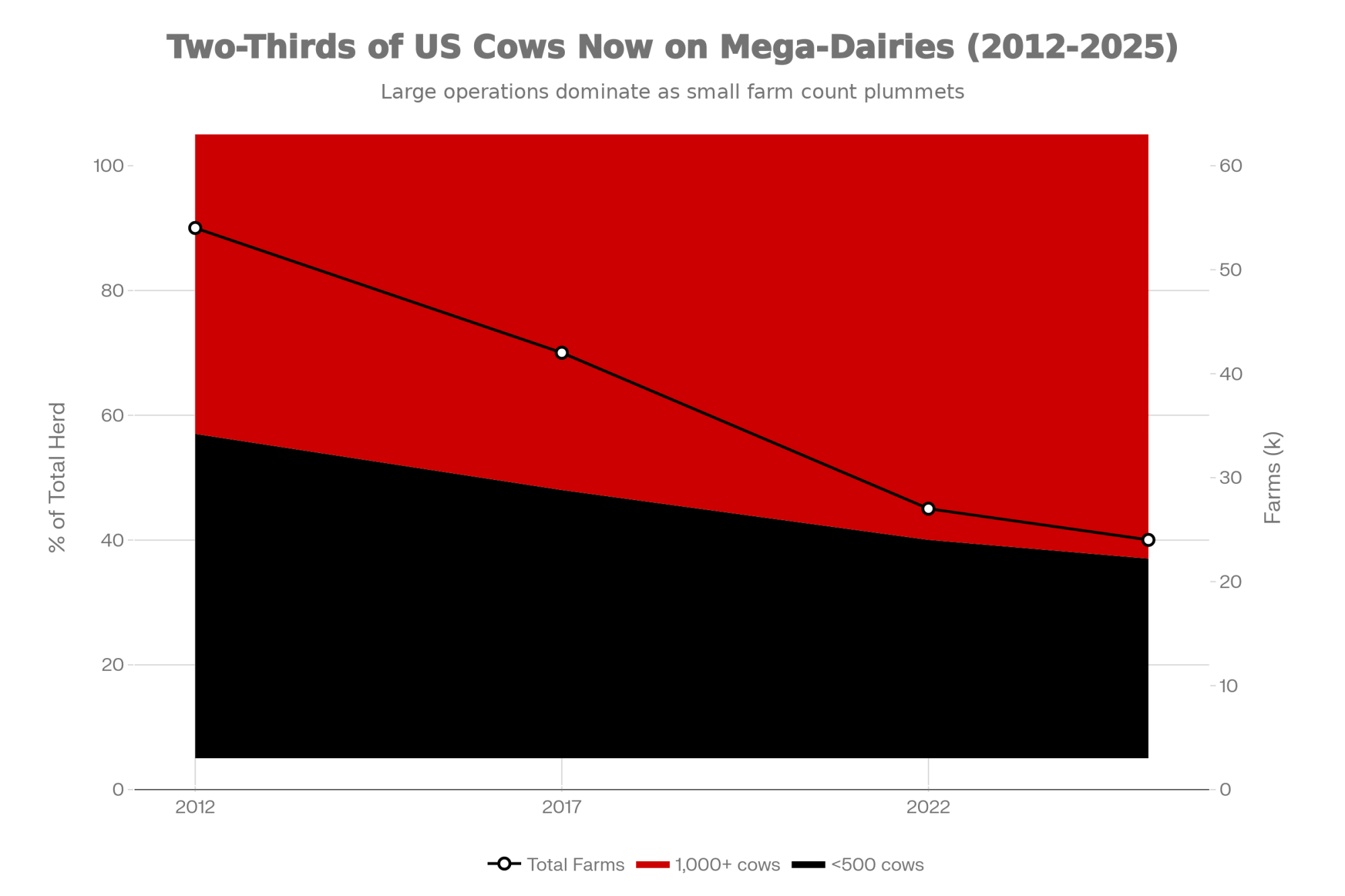
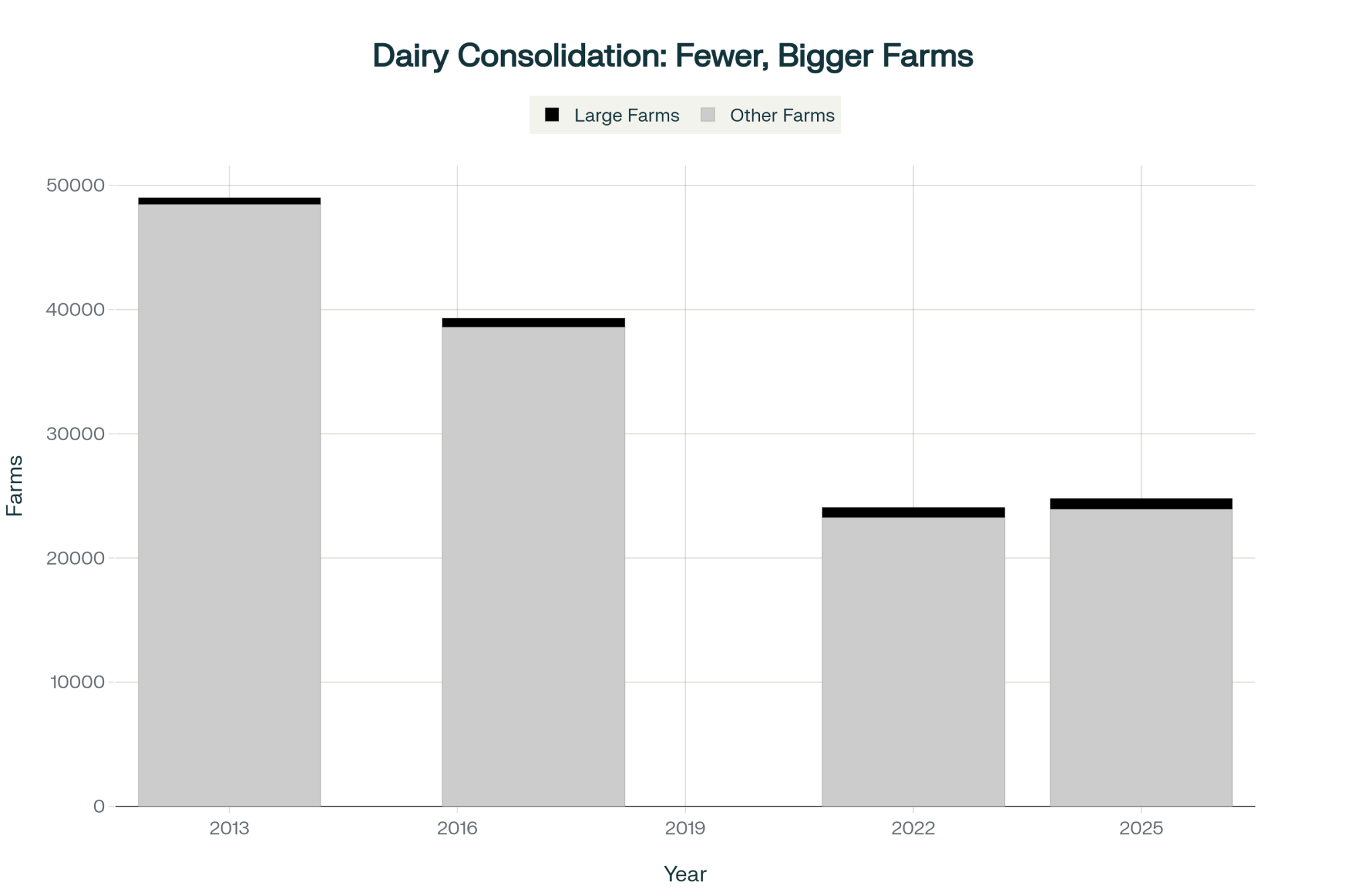
Half of U.S. dairy farms have disappeared since 2013, yet mega-dairies (1,000+ cows) now control 70% of milk production. The consolidation half-life shrunk from 12 to 10 years—adapt or join the 4% annual closure rate.

The USDA National Agricultural Statistics Service (NASS) estimates that the U.S. now has about 24,800 licensed herds, down from nearly 49,000 in 2013. Canada’s supply‑managed system counts 9,800 active quota‑holding farmsunder the Dairy Farmers of Canada (DFC).

Smaller farms, particularly those milking under 250 cows, shoulder nearly the same compliance burden as 3,000‑cow operations but without full‑time administrative help. It’s no wonder producers often say that paperwork feels heavier than feed costs.

In Ontario, for example, DFC’s ProAction program integrates animal care, milk quality, and traceability standards under one unified verification system. While not perfect, it exemplifies how structured oversight with predictable audits can reduce anxiety rather than increase it. ProAction is proof that structured transparency works when it strengthens—not slows—good farms.

That’s the irony lost in Greece’s cautionary tale: good verification shouldn’t slow down honest farms—it should set them free to focus on milk quality, breeding, and butterfat performance instead of bureaucracy.

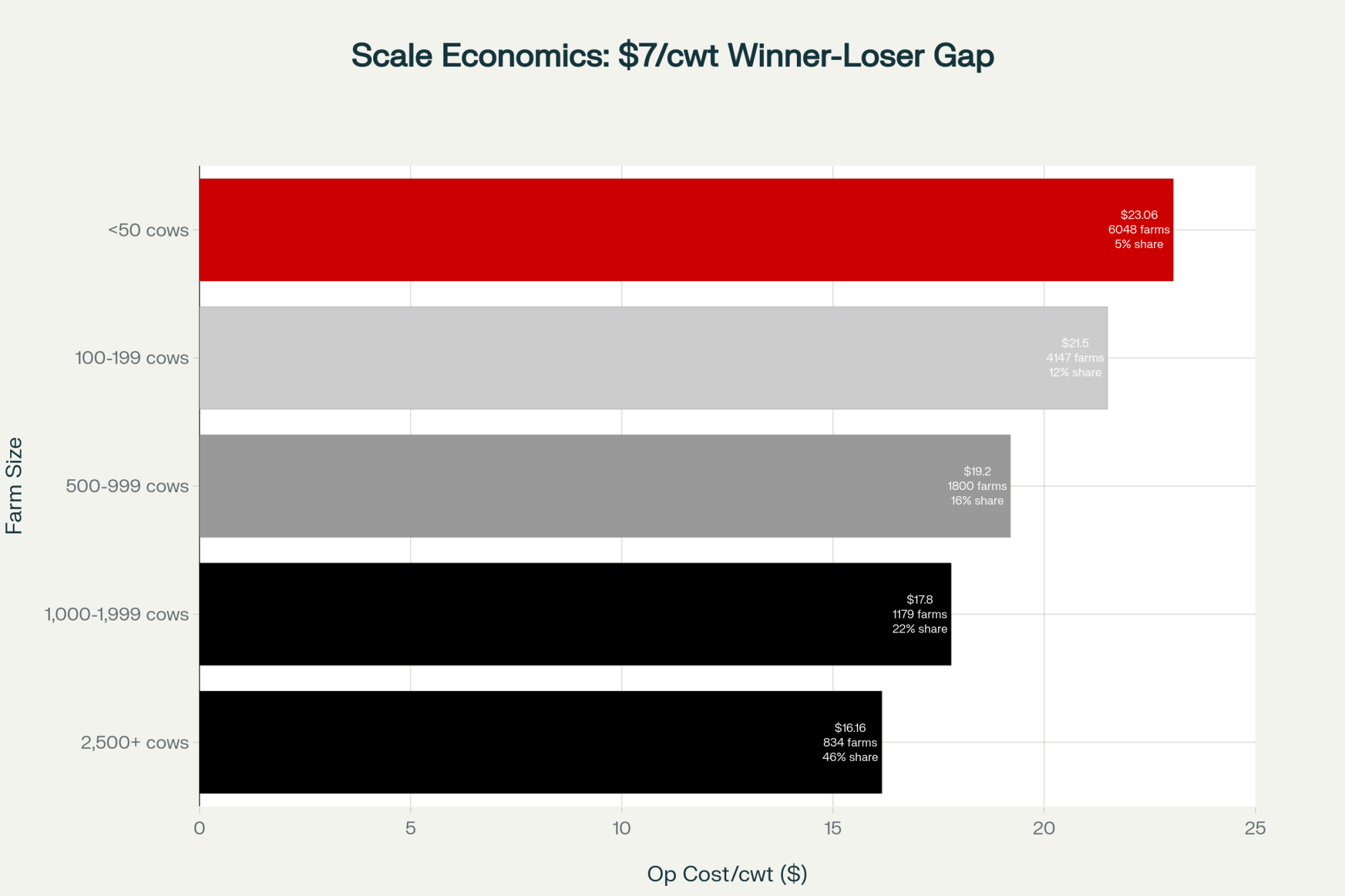
Small dairies (<50 cows) operate at $23.06/cwt while mega-farms (2,500+) run at $16.16/cwt. That $7 cost gap isn’t just economics—it’s an extinction event. Scale up or specialize, because the middle ground is quicksand.

Technology Is Catching Up

Across both continents, smarter verification is becoming the norm rather than the exception.

  • Digital traceability: European and North American cooperatives are piloting blockchain‑linked milk collection logs. Each load records location, timing, and solids data that can’t be altered—preventing both miscommunication and tampering.
  • Satellite audits: Agriculture and Agri‑Food Canada (AAFC) now uses satellite imagery to confirm environmental compliance, reducing site visits for farms with clean records.
  • Risk‑based oversight: USDA trials for targeted auditing focus on outlier data, lowering the frequency of reviews for consistently accurate producers.

The result? Stronger systems that reward accuracy instead of punishing transparency.

Farmers Taking the Lead

Producers themselves are proving that transparency works best when it starts from within.

Dairy Profit Teams in Wisconsin, Minnesota, and Michigan bring herds together to confidentially share cost and performance benchmarks. Meanwhile, sustainability benchmarking programs in British Columbia and Manitobaallow farms to compare nutrient efficiency and environmental metrics anonymously.

One producer from Manitoba summed it up perfectly: “Once you see objective numbers, you stop making assumptions about who’s ahead and who’s behind. We realized we were all fine—we just measured differently.”

That’s how farms thrive, not through secrecy but through collaboration supported by data.

The Bottom Line

Greece’s subsidy scandal didn’t happen because its farmers were dishonest—it happened because oversight systems lagged behind operational reality. In contrast, North American dairy has the chance to stay ahead by modernizing without losing what matters most: integrity.

Here’s what’s encouraging. Our farms already excel at measurement. From fresh‑cow management to feed conversion tracking, we live in data every day. The next step is ensuring that the data already being collected automatically backs the trust our industry deserves.

Because as Greece’s experience reminds us, trust without verification isn’t sustainable—and verification, when done right, doesn’t add work. It proves value.

In the end, the gap between compliance and corruption is only as wide as the space between trust and verification. Closing that gap isn’t just good governance—it’s how dairy protects its reputation, one verified record at a time.

Key Takeaways

  • Greece’s €20 million “ghost herd” scandal showed what happens when oversight trust outpaces proof—and real farmers pay the price.
  • Programs like DMC and milk pooling work best when transparency keeps pace with technology, not when paperwork piles up.
  • New tools—from blockchain milk traceability to AAFC satellite audits—are helping verify what good farms already do right.
  • Verification doesn’t add work; it protects yours. Solid data is today’s best defense against both fraud and doubt.
  • In the end, trust still drives dairy—but in 2025, trust needs evidence to stay strong.

Complete references and supporting documentation are available upon request by contacting the editorial team at editor@thebullvine.com.

Learn More

  • Unlocking Dairy Profitability: The Power of Financial Benchmarking – This guide provides a practical framework for financial benchmarking. It reveals how to use your farm’s own data to identify performance gaps, enhance profitability, and build the verifiable operational integrity discussed in the main article.
  • FMMO Reform: What’s Really on the Table for Dairy Producers? – This analysis breaks down the complex FMMO reform debate. It clarifies how proposed policy changes could directly impact your milk check, increase market transparency, and address the pricing confusion highlighted as a major industry vulnerability.
  • Beyond the Hype: Is Blockchain the Future of Dairy Traceability? – This piece moves past theory to explore blockchain’s real-world potential. It demonstrates how immutable digital ledgers can enhance supply chain traceability, guarantee product integrity, and provide the automated proof needed to prevent future fraud.

Join the Revolution!

Join over 30,000 successful dairy professionals who rely on Bullvine Weekly for their competitive edge. Delivered directly to your inbox each week, our exclusive industry insights help you make smarter decisions while saving precious hours every week. Never miss critical updates on milk production trends, breakthrough technologies, and profit-boosting strategies that top producers are already implementing. Subscribe now to transform your dairy operation’s efficiency and profitability—your future success is just one click away.

NewsSubscribe
First
Last
Consent

Trump’s Trade War: Your 9-Month Roadmap to Dairy Profitability

Trump kills Canada dairy trade. You have 9 months until USMCA review. 3 paths: Scale to 2,500 cows, diversify income, or exit with 95% value.

Executive Summary: Trump terminated Canada trade talks this week, but dairy’s real crisis started long before—we’ve lost 15,866 farms while exports hit record highs that never reached farmers’ bank accounts. With just 9 months until the USMCA review that could reshape North American dairy, producers face three proven paths: scale to 2,500+ cows with deep pockets and $260,000 working capital, build a 300-cow diversified operation where beef-on-dairy and renewable energy generate 60% of revenue, or exit strategically while you can still recover 85-95% of assets. The traditional 500-800 cow dairy is already extinct—those operations are burning $75,000 yearly just hoping things improve. Whether it’s through mega-scale efficiency, diversified resilience, or wealth preservation, the winners have one thing in common: they’re making their move now, not waiting for political rescue.

dairy farm profitability strategies

When President Trump terminated trade talks with Canada this week after Ontario’s Reagan ad escalated tensions, it wasn’t really a surprise to anyone paying attention. But for dairy farmers already dealing with razor-thin margins and export dependency, it was the wake-up call we probably needed.

You know how it is at co-op meetings lately. The conversations have really shifted. Instead of everyone comparing notes on new parlor expansions, folks are quietly discussing beef-on-dairy premiums and asking each other about working capital reserves. And yeah, there’s definitely a lot more kitchen table discussions happening about what this whole dairy farming thing actually means for the next generation.

What’s interesting is how Trump’s latest trade disruption—combined with the USMCA review looming and both sides taking increasingly hard positions on dairy—has become the moment when something we’ve all sensed for years finally became impossible to ignore. Here’s the thing though…this wasn’t really about any single political announcement, was it?

This was just when we had to face facts: the way we’ve been thinking about dairy growth for the last two decades? It’s not working anymore.

Farm bankruptcies surged 55% in 2024 and continued climbing into 2025, signaling the most severe financial crisis for American agriculture since the pre-pandemic peak. The dramatic upturn from the 2023 low of 139 filings exposes how quickly market conditions deteriorated once government support ended.

The Stark Reality in Numbers

The data’s pretty stark when you look at it. The 2022 USDA Agricultural Census shows we lost 15,866 dairy farmsbetween 2017 and 2022. That’s around 8.8% fewer farms every single year, and it’s actually picking up speed.

Federal bankruptcy court records through July show Chapter 12 farm bankruptcies are up 55% from last year. Think about that for a second.

Up in Canada—and you probably know this already—industry reports suggest they could lose half their remaining dairy farms by 2030. And that’s with supply management protecting incomes!

But here’s what I find really encouraging, honestly. While everyone’s focused on the political drama, something pretty remarkable is happening on actual farms. The smartest producers I talk to—and I bet you know a few like this—they aren’t waiting around for Washington or Ottawa to fix things. They’re completely rethinking their operations.

The Export Story We Need to Face

So here’s something we probably need to be honest about. When the U.S. Dairy Export Council reported dairy exports hit $4.72 billion through June—up 15% from last year—we all celebrated, right?

I mean, strong cheese and butterfat export performance, Mexico and Canada buying 44% of everything we ship overseas…sounds great on paper.

But here’s what most of us didn’t want to admit…

Remember that big export surge in July? Up 53% year-over-year according to USDEC? Well, most farms I know actually saw their margins shrink. As University of Minnesota economists have been pointing out—and this really gets me—we’re basically moving product at whatever price it takes to keep the volume flowing.

The gap between export growth and what actually shows up in the milk check? That’s not temporary anymore. It’s built into the system.

And the real kicker? We’ve built our whole growth strategy on markets we can’t control. Mexico’s trade ministry has threatened tariffs three times since February. Canada literally passed Bill C-202 in June making dairy concessions legally impossible. China’s domestic oversupply situation has cut their imports 12% according to Rabobank’s September report.

With the USMCA six-year review coming July 1, 2026—that’s just 9 months away, folks—this whole export dependency thing is about to get really tested.

What Expansion Really Costs

You want to know what really gets me about expansion economics? It’s not the numbers you see in the business plan—it’s everything else that happens underneath.

Recent university expansion modeling studies show that your typical 250-to-500 cow expansion? We’re talking $5 million, give or take.

The equipment companies get $800,000 to $1.2 million right off the bat. Construction crews take another $600,000 to $900,000. Genetics companies collect their $400,000 to $600,000.

And your lender? Farm Credit Services analysis shows they’ll make roughly $1.5 million in interest over a typical 15-year term at current rates.

So before you’ve even milked one extra cow—think about this—the supply chain’s already captured $3.6 to $4.6 million. Meanwhile, if everything goes perfectly—and when does that ever happen in dairy?—Wisconsin Extension’s financial analysis suggests you might clear $3.6 million over 10 years. That’s about 3.7% annually on your equity.

The rest of the industry captured three times what you did, and they didn’t take any of the operational risk. As Corey Geiger, economist over at CoBank, mentioned in their October outlook, after almost a decade of butterfat driving milk checks, protein’s taking over as the primary value driver. And I’ll be honest, a lot of farms haven’t adjusted their feeding programs for that shift yet.

Before you’ve milked a single extra cow from that $5 million expansion, the supply chain has already captured $3.75 million—equipment dealers, contractors, genetics companies, and your lender. Meanwhile, if everything goes perfectly for a decade, you might net $3.6 million at a 3.7% annual return… while carrying 100% of the operational risk. No wonder University Extension analysts are warning farmers: the math hasn’t worked for years.

Three Ways Forward That Actually Work

The diversified 300-cow model spreads risk across six revenue streams, insulating farms from milk price volatility that’s killing traditional operations. With 55% of income from non-milk sources including beef-on-dairy premiums and renewable energy, these farms saw only 8-9% revenue drops during severe milk price crashes—versus catastrophic losses for single-stream dairies burning $75,000 annually.

Building Something Different

What’s really fascinating—and I’ve been watching this closely—is how these smaller operations with 200 to 400 cows are completely reimagining what a dairy farm can be. I’ve been looking at several Wisconsin operations that are really opening eyes.

Consider what a typical 300-cow operation in the Midwest is doing now. They’re deliberately capping herd size. Not because they can’t handle more, but because that’s the sweet spot where family labor plus two employees can run things efficiently. No dependency on visa workers or…well, you know how hard it is to find reliable help these days.

Here’s how the revenue typically breaks down on these diversified operations—this comes from Wisconsin Extension’s 2025 farm financial modeling:

  • Milk to the co-op: around 40-45% of revenue
  • Beef-on-dairy programs: 15-20%
  • Renewable energy (digesters, solar): 10-15%
  • Agritourism or direct sales: 5-10%
  • Custom services for neighbors: 5-10%
  • High-value genetics or embryos: 5-10%

When milk prices have dropped significantly—which has happened multiple times in recent years according to USDA pricing data—their total revenue only falls about 8-9%. Yeah, it hurts. But it doesn’t kill them.

Now, managing all those different income streams? That’s the challenge, honestly. As one producer told me at World Dairy Expo, “Some days I feel more like a business manager than a dairy farmer.” Learning renewable energy contracts alone can take months. But here’s the thing—that complexity gives them options their single-stream neighbors don’t have.

What I’ve noticed is many of these operations are running crossbred cows—Holstein-Jersey or three-way crosses with Swedish Red or Norwegian Red genetics. The cows average about 1,250 pounds instead of the big 1,450-pound Holsteins. Lower production per cow, sure—maybe 22,000 pounds annually versus 26,000.

But—and this is what’s interesting—University of Wisconsin research shows they’re seeing 15% better feed efficiency, $700 less per replacement based on current heifer prices, and the cows last almost five lactations instead of the 2.9 lactation national average USDA reports. The lifetime daily production actually beats the bigger cows. Go figure.

Going Really Big

Now if you’ve got deep pockets and nerves of steel, there’s another way. The 2022 USDA Census shows farms with 2,500+ cows grew from 714 to 834 operations between 2017 and 2022. They’re producing 46% of America’s milknow.

These mega-dairies—and I’ve talked to several managers recently—are running on completely different economics. They typically need debt-to-asset ratios below 40% according to what lenders are telling them. Working capital needs to be at least 15% of gross revenue.

They ship to multiple processors—you never want all your eggs in one basket, right? And you need geographic advantages for growing feed that not everyone has, especially in the Northeast.

Most important though? You need serious fortitude. When margins compress severely—which has happened multiple times in recent years according to USDA price reports—these operations are carrying $150,000 to $200,000 in monthly fixed costs regardless.

As one large-herd manager in California told me, “Scale works, but only if you can survive the valleys. We’ve restructured debt twice since 2019.”

Down in Florida, it’s even tougher. Heat stress management alone adds 15-20% to operating costs compared to northern states. But those operations are capturing fluid milk premiums that make it work—sometimes. Out in Idaho and the Mountain West, water rights are becoming the limiting factor. You can have all the cows you want, but if you can’t irrigate feed…well, you get the picture.

The Strategic Move: Preserving Equity and Wealth

This is tough to say, but for maybe 20-30% of producers, the smartest financial move might be protecting the wealth they’ve already built while they still can do it on their terms.

Paul Mitchell, an economist from Wisconsin Extension, published an analysis in January that really drives this home. If you’re losing $75,000 a year after family living expenses—and Farm Business Farm Management data suggests that describes a lot of 500-cow operations right now—you’re burning through $375,000 in retirement wealth over five years just hoping things improve.

The USMCA review hits July 2026—just 9 months away. If you’re losing $75,000 annually (typical for 500-cow operations per Farm Business data), you’ll burn through $56,000 before that trade negotiation even starts. Wait five years hoping for political rescue? You’ve incinerated $375,000 in retirement wealth. Exit now with $1.5M in equity, invest conservatively at 4%, and you’re generating $60,000 annually for life—without the stress, without the risk.

Think about this: Exit now with $1.5 million in equity, invest it conservatively at 4%—which is what most financial advisors are suggesting these days—and you’re looking at $60,000 in annual income. Wait five years? That drops to $45,000. That’s $15,000 less every year for the rest of your life.

And here’s the real kicker from Farm Credit Services of America data: farms that exit voluntarily recover 85-95% of their asset value. Forced liquidations through bankruptcy? You’re lucky to get 50-65% according to Chapter 12 trustee reports. On a $2.5 million operation, that’s a $750,000 difference.

I know producers who’ve made this strategic choice recently to preserve their retirement wealth. They’re 58, 59 years old, still healthy, and they’ve got their equity protected. Meanwhile—and this is hard to watch—their neighbors who are trying to tough it out have watched equity evaporate as milk prices stayed below production costs.

FactorMega-Scale (2,500+ Cows)Diversified (300 Cows)Traditional (500-800 Cows)Strategic Exit
Herd Size2,500+ head300 head500-800 headSold/leased
Working Capital Required$260,000 (15% of revenue)$100,000$150,000$1.5M preserved equity
Annual Financial Performance+$50,000 net income+$30,000 net income-$75,000 annual loss$60,000 annual (4% return)
Milk Revenue %95%42.5%90%0%
Non-Milk Revenue %5%57.5%10%100% (investment income)
Risk LevelHigh debt, high volume riskModerate, spread across streamsCritical – burning equityVery low
Key AdvantageEconomies of scale, processor leverageIncome resilience, 8-9% revenue drop in crashesNone remainingWealth preserved, stress eliminated
Major Disadvantage$150K-$200K monthly fixed costsComplex management, 6+ revenue streamsSingle income stream, no buffersLeaving the industry, emotional cost
Survival ProbabilityHigh (if capitalized)HighLow – Already extinctWealth Protected
Best ForDeep pockets, Western geographyFamily operations, adaptable managersNobody – this model is deadAges 55-62, declining profit farms

What Smart Producers Are Doing Right Now

Building a Real Safety Net

The farms that’ll make it through what’s coming—and I really believe this—have at least 20% of gross revenue as working capital. That’s what both Farm Credit Services and CoBank are recommending now.

For a typical 250-cow dairy bringing in $1.3 million, that means $260,000 in cash or credit you can access quickly.

Sounds like a lot, I know. But when processors delay payments—which has happened with several co-ops in recent months—you need substantial liquidity just to keep buying feed and paying people. Without that cushion, feed suppliers put you on cash-only terms fast. And then…well, you’re in real trouble.

Making the Most of Beef-on-Dairy

According to recent market reports, beef-cross dairy calves are bringing strong premiums at auction barns everywhere from California to Pennsylvania. That’s up significantly from just a few years ago. Pretty incredible, right?

Smart producers are breeding 35-40% of their cows to beef bulls—mostly Angus or Simmental genetics from the major AI companies. On a 250-cow dairy, breeding 44 cows to beef can add substantial annual revenue based on current premiums. That’s becoming 6-9% of total farm income for folks doing it right.

Even when premiums normalize to more sustainable levels in the coming years, you’re still way ahead of straight Holstein bull calves.

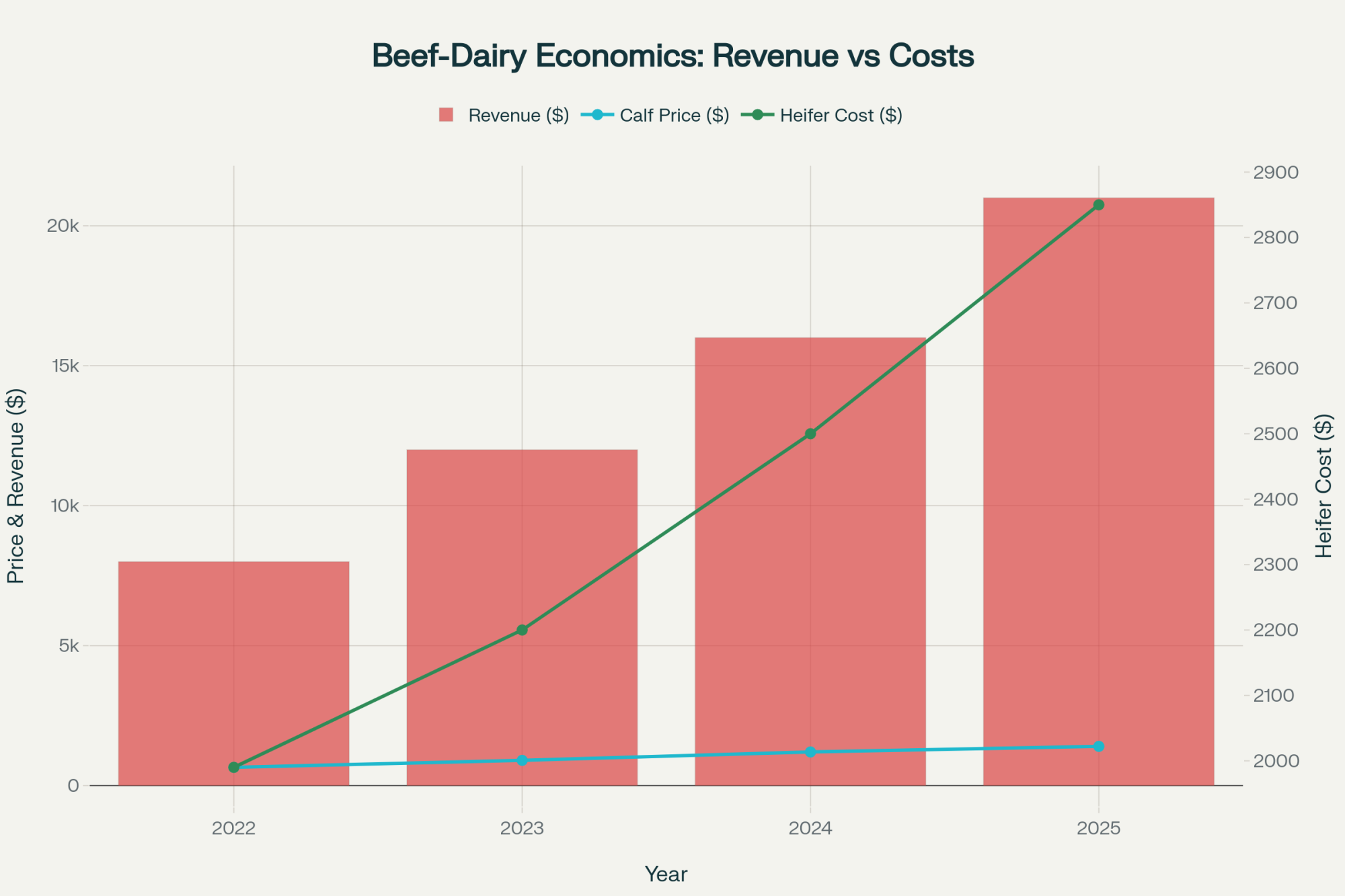
Beef-on-dairy calf prices exploded 115% from 2022 to 2025, hitting $1,400 per head as U.S. beef herds dropped to 64-year lows. Smart producers breeding 40% of their 300-cow herds to beef bulls are banking $21,000 annually—6-9% of total farm income. But here’s the catch: heifer replacement costs jumped 43% to $2,850 in the same period. Wisconsin operations now face a strategic dilemma: cash in on record calf prices or maintain herd genetics for the long game?

The catch? Documentation matters. Major packers are telling producers they need complete records—genetics, health protocols, everything. Can’t pay premiums without proper paperwork for their retail customers who are demanding traceability. You probably already know this, but it’s worth emphasizing.

Getting Paid for Components

With $11 billion in new processing capacity coming online through 2028 according to International Dairy Foods Association reports, processors really need consistent, high-component milk.

Several major yogurt and cheese plants in the Northeast are paying 50 cents to $1.50 per hundredweight extra for milk that’s consistently above 3.25% protein with minimal daily variation.

What surprised me when talking to procurement managers is what they really value. They’d rather have steady 3.15% protein than variable 3.25%. Their production lines need consistency more than peak levels—they can standardize up, but variation causes real problems in their processes.

Regional differences matter too. Texas and Southwest processors are more focused on butterfat consistency for ice cream production, while Upper Midwest cheese plants prioritize protein levels. But the principle’s the same everywhere—consistency pays.

On 6 million pounds annually from a 250-cow herd, a dollar premium means $60,000 more per year. That’s real money for managing what you’re already producing.

The Mindset That Makes the Difference

You know what really separates the farms that’ll make it from those that won’t? It’s what researchers at Purdue’s Center for Commercial Agriculture call “strategic clarity”—recognizing that staying in dairy when the math doesn’t work isn’t being tough or noble. It’s just expensive.

Look, everyone in the industry—your co-op field rep, banker, equipment dealer, nutritionist—they all benefit when you keep going. They make money when you borrow, produce, expand, buy inputs. They even make money at the liquidation auction if things go south. That’s not being cynical, it’s just…well, it’s how the system works.

What they don’t make money on? You deciding your wealth might grow faster outside dairy than in it. And that’s fine—it’s not their call to make. It’s yours.

What’s Coming in 2026

The USMCA six-year review starts July 1, 2026. Canada’s Parliament already passed Bill C-202 blocking dairy concessions. Mexico’s Economy Secretary has threatened retaliation multiple times this year. The export markets that looked rock-solid when Class III milk was $25 per hundredweight in 2022? Not so much anymore.

The producers who’ll do well aren’t waiting to see how this plays out. Whether it’s building multiple revenue streams like those diversified Wisconsin operations, scaling up like the Western mega-dairies, or preserving wealth through a strategic exit—the window for making these decisions on your terms is getting pretty narrow.

What I’m seeing from coast to coast—and the data backs this up—is that middle ground of 500-800 cow dairies that were supposed to be the sweet spot? That’s disappearing fast.

CoBank and Rabobank projections suggest by 2030 we’ll have huge operations milking thousands and smaller diversified farms milking a few hundred. The traditional 600-cow family dairy as we’ve known it? That model’s already becoming history.

The Choice That Matters

When you look at everything happening—Trump’s trade disruptions, farms disappearing at nearly 9% per year according to USDA data, the complete restructuring of global dairy markets that OECD-FAO documented in their 2025 Agricultural Outlook—there’s really just one question: Are you building something that can handle what’s coming, or hoping things go back to how they were?

Because hoping things get better…well, that isn’t a business strategy. It’s just an expensive way to put off hard decisions.

The producers who thrive through 2030 won’t necessarily be the ones still milking cows. Some will build these amazing multi-revenue operations generating income from six or seven different streams. Others will scale up to where the economies actually work at 3,000+ head. And yes, some will strategically preserve their wealth, keeping what they’ve built instead of watching it disappear over the next few years.

Trump terminating those trade talks this week? That didn’t cause dairy’s problems. But it sure made them impossible to ignore anymore.

For producers willing to look past the political drama and see what’s really happening, this moment of clarity—uncomfortable as it might be—gives you the chance to make good decisions while you still have meaningful options.

You’ve got 9 months until that USMCA review hits. The question isn’t whether things are going to change—Trump’s already shown us they are.

The question is whether you’ll be ready when July 2026 rolls around.

Key Takeaways:

  • You have 9 months to choose your path: Scale to 2,500+ cows with $260K working capital, diversify at 300 cows with 60% non-milk revenue, or exit strategically preserving 85-95% of assets (versus 50-65% in forced liquidation)
  • Today’s revenue opportunities can fund tomorrow’s transition: Breeding 40% beef-on-dairy adds $16-21K annually, component premiums add $60K—money you need for strategic positioning
  • The expansion math finally exposed: On a $5M expansion, supply chain partners capture $3.6-4.6M upfront while you might clear $3.6M over 10 years—just 3.7% annual return on your risk
  • Traditional 500-800 cow dairies are the walking dead: Losing $75K yearly after living expenses, they’re burning $375K in retirement wealth every 5 years hoping for rescue that won’t come
  • Trump’s trade disruption is your decision catalyst: This isn’t about weathering political storms—it’s about building an operation that profits regardless of who’s in office or what borders are open

Complete references and supporting documentation are available upon request by contacting the editorial team at editor@thebullvine.com.

Learn More:

Join the Revolution!

Join over 30,000 successful dairy professionals who rely on Bullvine Weekly for their competitive edge. Delivered directly to your inbox each week, our exclusive industry insights help you make smarter decisions while saving precious hours every week. Never miss critical updates on milk production trends, breakthrough technologies, and profit-boosting strategies that top producers are already implementing. Subscribe now to transform your dairy operation’s efficiency and profitability—your future success is just one click away.
NewsSubscribe
First
Last
Consent

How Australian Dairy Farmers Killed a Wealth Tax (And Why You’re Next)

Oct 12: Australian dairy defeats wealth tax. Nov 2025: OECD targets North America. The playbook that wins? Right here.

EXECUTIVE SUMMARY: Australian dairy farmers just showed you exactly how to beat the wealth tax that’s coming for your farm. When their government tried forcing farmers to pay taxes on unrealized gains—$30,000 cash for paper profits they hadn’t sold—farmers didn’t just protest and hope. They invested $250,000 in professional campaign infrastructure, united 3,500 farms with 13,000 small businesses, and utilized the Treasury’s own data to demonstrate that the policy would harm family operations. After two years of strategic pressure, they achieved complete victory on October 12, 2025. With the OECD coordinating similar taxes globally and U.S. estate tax exemptions dropping from $14 million to $7 million in 2026, you may have only 18 months to build a similar defense. The blueprint’s right here—the question is whether you’ll use it before it’s too late.

Agricultural Wealth Tax

As we head into winter, it’s worth taking a look back at what Australian farmers accomplished over the past few weeks. You know how it is when you’re knee-deep in managing feed costs—which, depending on where you are and what quality you’re buying, can run anywhere from $350 to well over $450 per ton according to recent USDA reports—and trying to keep butterfat levels steady through these weather swings. The last thing on your mind is tracking tax policy from the other side of the world.

But here’s what’s interesting: Australian dairy farmers just forced their government to completely reverse a wealth tax that would’ve made farm succession planning nearly impossible. They achieved this victory on October 12, with Treasurer Jim Chalmers standing there repeating how “the prime minister and I agreed” on the changes—political speak for “I got overruled and I’m not happy about it.”

What I’ve found really compelling about this whole situation is how their approach could work just as well here in Wisconsin, or Ontario, or California. Because let’s be honest… the challenges we’re all facing with succession planning aren’t that different. And with discussions about eliminating the stepped-up basis heating up in Washington, the timing couldn’t be more relevant.

Understanding the Fight Down Under

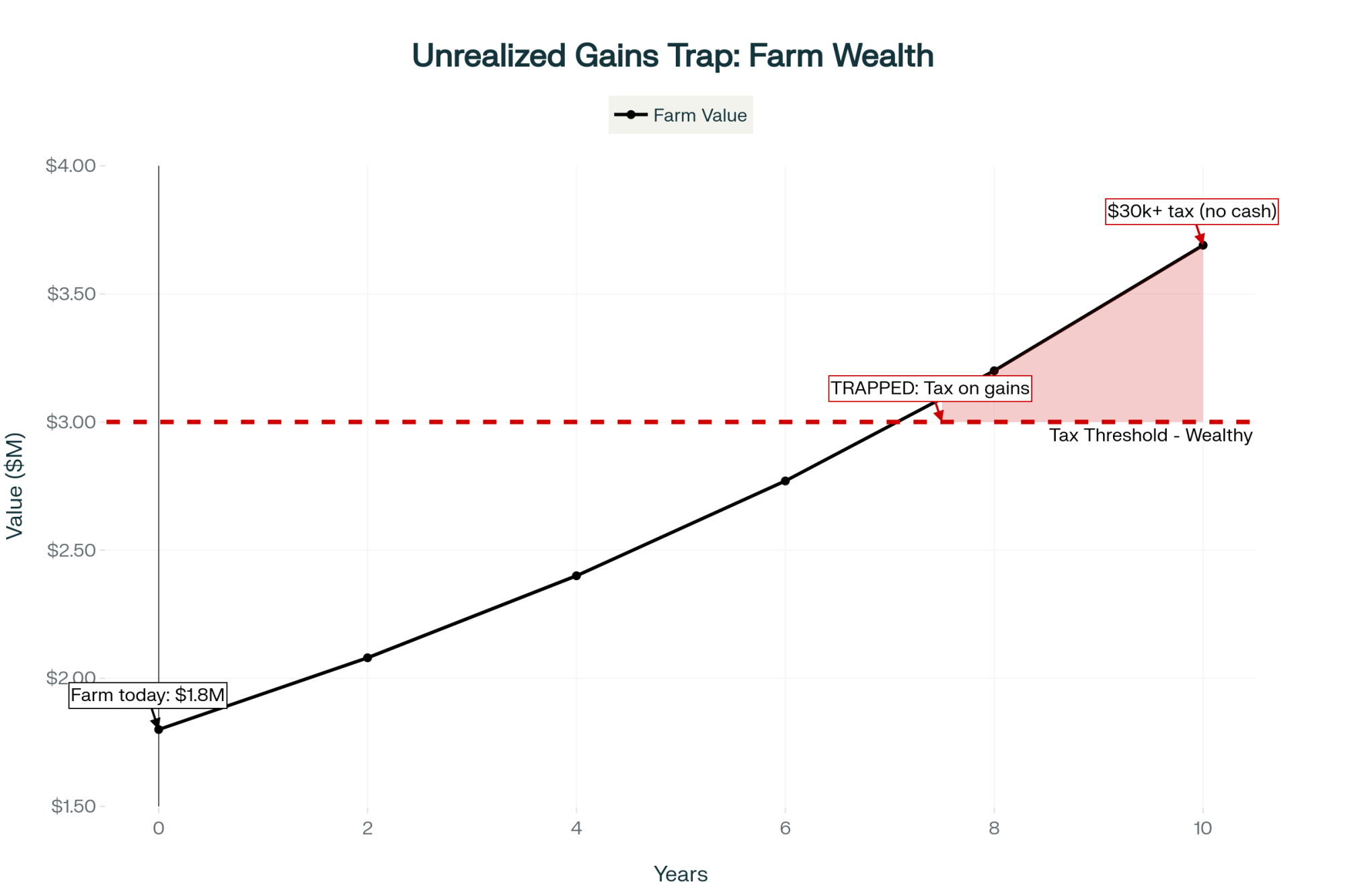
At 7-8% annual appreciation—normal for ag land—a $1.8M farm crosses the $3M ‘wealth’ threshold in just 8 years through paper gains alone. Result? You’re paying $30,000+ in taxes on money you never made, forcing asset sales to cover bills on wealth that only exists on paper. That’s the trap

So here’s the deal. In 2024, the Australian Treasury proposed a measure they considered reasonable: increasing taxes on retirement accounts (known as superannuation funds) from 15% to 30% for those exceeding $3 million Australian dollars. They sold it as only affecting the wealthiest 0.5% of people. Sounds familiar, right?

But as many of us have learned the hard way, the devil’s always hiding in those details. This tax would’ve hit unrealized gains. Think about that for a minute… If your farmland goes up in value—just on paper, nothing sold—you’d owe taxes on that increase even though you’ve got zero extra cash in your pocket.

Let me paint you a picture. Say you’ve got 500 acres in your retirement structure worth about $3.8 million. Urban sprawl has increased nearby property values by 10% this year. Under what they proposed, you’d suddenly owe around $30,000 in taxes on that $300,000 paper gain. The National Farmers’ Federation ran these exact numbers in their modeling, and it’s sobering stuff.

Where’s that cash coming from when you’re already managing tight margins? You and I both know the answer—you’d have to sell something. Equipment. Land. Maybe part of that herd you’ve spent years building.

KEY AUSTRALIAN VICTORY STATISTICS:

  • 3,500 farm retirement funds are immediately affected
  • 14,000 additional farms at risk through appreciation
  • 6.7% of affected funds lacked liquidity to pay without asset sales
  • 2-year sustained campaign from proposal to reversal

What’s particularly concerning is what Ben Bennett from Australian Dairy Farmers pointed out after the reversal—this would’ve forced farmers to liquidate productive assets just to pay taxes on gains they hadn’t realized. The University of Adelaide’s agricultural economists collaborated with the SMSF Association, utilizing Tax Office data, and confirmed the numbers above.

And here’s where it gets really sneaky… the threshold wasn’t indexed to inflation. Rural Bank’s farmland reports—carefully tracked by them—show that agricultural land has been appreciating at a rate of 7 to 8% annually over the past couple of decades. With those numbers, a farm worth $1.8 million today would cross the $3 million threshold in about a decade, simply through normal market movement. That’s not farmers getting wealthy. That’s a trap being set.

Now, I should mention that from the Treasury’s perspective, they were seeking revenue to fund other programs and viewed large retirement accounts as under-taxed wealth. But the fundamental problem was they didn’t understand—or didn’t care—about the difference between liquid financial assets and productive agricultural land. Whether you’re running a sole proprietorship or an incorporated business, the impact would’ve been devastating.

How They Built a Winning Strategy

What Australian farmers did differently from what we typically see is worth paying attention to. You know the usual playbook—angry press releases, tractors at the capitol, emotional testimony. Gets headlines for a week, then everyone goes back to milking, and the government just proceeds anyway.

The Aussies took a completely different path, and honestly, it’s brilliant.

Taking Time to Build the Case

First thing they did? Nothing public for 48 hours. I know that sounds counterintuitive—your gut says fight back immediately. But they used that time to build something more powerful than outrage.

During those two days, the National Farmers’ Federation got university economists from places like the University of Adelaide analyzing the real impacts. They pulled Australian Taxation Office data showing that there were approximately 610,000 self-managed super funds in the country. They identified specific technical problems—unrealized gains taxation and no inflation indexing—rather than simply calling it unfair.

When they finally went public, they didn’t lead with emotion. They presented hard data from their work with ASF Audits and university researchers: “Initial analysis shows 3,500 agricultural funds immediately affected, with 17,000 at risk based on historical appreciation.”

The difference that makes… it’s huge. One approach gets dismissed as farmers complaining about everything. The other forces the government to respond to specific numbers, they can’t just wave them away.

Coalition Building That Changed Everything

Within a week—and this is where it gets really smart—they’d expanded way beyond farming. They brought in small business groups representing hundreds of thousands of operations, family business associations covering most Australian enterprises, and retirement fund administrators speaking for all fund holders nationally.

Now you might be thinking, why does this matter when we’re dealing with fresh cow management and keeping somatic cell counts in check? Here’s why: suddenly, it wasn’t just farmers fighting. The SMSF Association’s analysis revealed that 13,000 small businesses with commercial property were facing the same problem.

Think about the politics there… When it’s just us complaining, politicians can write that off as rural districts they might not need anyway. But when the plumber in suburban Sydney and the restaurant owner in Brisbane are facing the same issue? That changes everything.

Matthew Addison from the Council of Small Business Organizations said it perfectly after they won—the government had to listen to the concerns of the entire small business community about taxing unrealized gains.

Leveraging Government’s Own Data

What really impressed me was how they used the government’s own data against them. Instead of presenting estimates Treasury could dismiss as biased, they worked with independent firms like ASF Audits, which handles compliance for thousands of funds, to analyze actual tax records and project impacts nationally.

They had university validation, independent auditor confirmation, and Class Limited—a major fund administrator—all reaching the same conclusions using government baseline data. The class found that approximately 6.7% of the affected funds lacked sufficient liquid assets to cover their expenses without selling property.

When you’ve got that many independent sources saying the same thing using government numbers, Treasury can’t dismiss it as “industry special pleading.”

Sustaining Pressure Without Burning Out

You know how these fights usually go. Strong start, lots of energy… but after a few months, everyone needs to get back to farming. The volunteers burn out, donations dry up, and the government just waits you out. As many of us have seen with previous battles, that’s where things fall apart.

The Australians addressed this issue with a professional campaign infrastructure.

Professional Staff Made All the Difference

The National Farmers’ Federation employs full-time people whose actual job is managing these multi-year campaigns. Not lobbyists having lunch with legislators. Not policy people writing papers. Campaign managers who wake up thinking about coalition coordination and maintaining pressure. You can see this in their “United Advocacy, Stronger Outcomes” roadmap and their annual reports.

When this tax got proposed, they didn’t scramble to figure out who’d run things. They activated what was already in place—committees with real authority to make decisions, budgets already approved through membership dues, and professional staff who kept things moving even when farmers were deep in calving season or dealing with heat stress affecting production.

Strategic Escalation at Key Moments

The campaign ran nearly two years, but here’s what’s smart—they didn’t try to maintain crisis-level intensity the whole time. NFF President David Jochinke discussed this in various forums, noting that they escalated strategically. Senate hearings in November 2024. Budget prep in early 2025. Right before the May 2025 federal election, when politicians get nervous.

Between those peaks, professional staff kept things coordinated, allowing farmers to focus on their operations. It’s like managing your breeding program—you don’t check every cow daily, but you never completely drop the protocol either.

The Admission That Changed Everything

Here’s the turning point: During Senate Economics Committee hearings, sustained pressure forced Treasury officials to admit something devastating. They hadn’t actually modeled how many agricultural businesses would be affected. The transcripts are public—they literally admitted they proposed this massive change without analyzing who’d be hurt.

Once that information was released and the farm coalition filled the gap with detailed evidence from groups like GrainGrowers and the University of Adelaide, the policy became politically toxic. How do you defend something when your own Treasury admits they didn’t study the impact?

Why This Matters for North American Dairy

Four major dairy nations hit with identical wealth taxes within 24 months—245,000+ farms targeted. The two with professional advocacy infrastructure (Australia, Canada) won complete reversals. The two without (UK, USA) face ongoing battles with no victory in sight. Pattern recognition time: build infrastructure NOW or lose farms later

So why should you care about Australian tax battles when you’re dealing with milk prices, managing components, trying to keep things running in this economy?

Because what’s happening isn’t random. Look at the pattern:

Canada attempted to increase capital gains inclusion from 50% to 66.7% on farms in April 2024. After massive pushback led by the Canadian Federation of Agriculture, they reversed it in March 2025. The UK has just eliminated agricultural property relief in its October Budget—protests by the National Farmers Union are still ongoing. Here in the US, we’re looking at estate tax exemptions potentially dropping from approximately $14 million to around $7 million when the Tax Cuts and Jobs Act provisions expire in 2026, according to projections from the Congressional Budget Office. And that’s before we even consider current congressional discussions about eliminating the stepped-up basis for inherited assets.

What I’ve found looking into this is these aren’t coincidental. The OECD has been publishing reports since 2020, calling agricultural land “undertaxed.” The G20 finance ministers met in Brazil last November to discuss coordinated wealth taxation. Agricultural land is explicitly on their radar.

Building Our Defense Now

OrganizationAnnual BudgetRecommended (10-15%)vs Australian Benchmark
Nat’l Milk Producers$13M$1.3M-$2.0M5-8x Australian
Midwest Dairy$25M$2.5M-$3.8M10-15x Australian
Dairy Farmers Canada$9M CAD$900K-$1.4M3.6-5.6x Australian
TOTAL$47M+$4.7M-$7.2M19-29x winning benchmark

What struck me about the Australian win is that they had everything in place before the crisis hit. Their committees, professional staff, coalition relationships—all ready to go.

Most North American dairy organizations… we’re not there yet. Consider the National Milk Producers Federation, which has a $13 million budget, as shown in its Form 990s, or Dairy Farmers of Canada, with a budget of approximately $9 million Canadian. They certainly have government relations personnel. But campaign managers who can sustain multi-year fights? That’s rare.

Building this capability means:

Professional staff whose job is coordinating campaigns, not just maintaining relationships. That’s about $150,000 annually for someone with real experience.

Committees that can actually make decisions without waiting for quarterly board meetings. When the Treasury announces something on Friday afternoon—and they love Friday afternoons—you need to respond on Monday morning.

Real partnerships already in place with groups like the National Federation of Independent Business and their 600,000 members, and the Farm Bureau with 6 million member families.

Current data ready to go. Operations by congressional district using USDA Census numbers. Estate values from Federal Reserve ag finance reports.

The Critical First 72 Hours

If Treasury announced an unrealized gains tax tomorrow morning—and given revenue pressures, it could happen—what happens in the next 72 hours would largely determine whether you win or lose.

Here’s what works: Don’t issue emotional statements right away. Secure your resources—the Australians spent approximately $250,000 in their first 90 days—and hire independent economists to analyze the impacts. Gather baseline data from USDA, reach out to coalition partners with actual phone calls, and draft messaging about specific policy flaws. Hold a real coordination meeting with assigned responsibilities, then release preliminary data by congressional district.

Practical Steps for Today

Whether you’re milking 50 cows in Vermont or running 5,000 head in New Mexico dry lots, there are things worth doing now.

For Your Own Operation

Document your succession structure now. What’s your operation worth according to your lender’s recent appraisal? What’s your tax exposure under different scenarios? How much actual liquidity do you have—real cash you can access, not equity in cattle or equipment?

When challenges come—and based on OECD coordination, they will—specific numbers carry weight. Being able to say “according to our CPA, we face $247,000 in tax liability with $31,000 in liquid assets, forcing sale of productive acreage” makes it real for policymakers.

For Our Organizations

The gap between Australian success and typical North American outcomes isn’t passion—it’s infrastructure. Professional campaign management differs from government relations.

Yes, that means real investment. Considering groups like Midwest Dairy, with a $25 million budget, we’re talking about 10-15% of the budget going towards this capability. Sounds like a lot until you consider the asset values at risk across our industry.

Working Together Internationally

What’s happening globally through OECD frameworks and G20 coordination requires similar coordination in response. When Australian farmers can cite Canadian reversals and we can reference Australian successes, it shows these aren’t isolated issues but recognized challenges with proven solutions.

The Bottom Line

Here’s what Australian dairy farmers proved: You can defeat even Treasury-backed proposals with the right approach. Not through protests that make the news once. Not through emotional appeals. However, through professional campaigns that utilize the government’s own data to highlight problems, while building coalitions that make the political cost too high.

The principle they defended—that productive agricultural assets shouldn’t be taxed until actually sold—that’s fundamental to farm succession everywhere. When governments tax unrealized appreciation, they’re not just extracting revenue. They’re forcing the liquidation of productive capacity that feeds nations.

Given the developments through international coordination, revenue pressures, and ongoing discussions, we can expect similar proposals within 18 months in North America.

Australian farmers invested in capability before their crisis. When Division 296 emerged, they activated existing systems rather than scrambling to do so. The result protected thousands of family operations from devastating tax changes.

That’s the lesson—not that Australian farmers are tougher, but that they invested in organizational capability to win before they needed it. They made that choice when things were calm, not in panic mode.

The blueprint exists, and it’s been proven effective. Whether North American dairy follows that model or continues with traditional approaches will likely determine how we navigate the succession planning challenges ahead. And looking at what’s developing globally through OECD and G20 frameworks… our clock’s already ticking.

What I’ve found is that those who prepare systematically tend to succeed. Those who react emotionally usually struggle. The Australians just showed us which path leads to victory. Now it’s up to us to decide which way we’re going.

KEY TAKEAWAYS

  • Build before the battle: Australian farmers had professional campaign infrastructure ready BEFORE the tax hit—scrambling after Treasury announces means you’ve already lost
  • $250K beats $30K tax bills: Investing in professional campaign management (1% of major dairy org budgets) protected 17,000 farms from forced asset sales
  • Government data is your weapon: Proving 6.7% of farms lacked liquidity using Treasury’s own numbers worked; emotional “save family farms” appeals failed
  • Small businesses are your secret army: 13,000 affected plumbers and restaurant owners made suburban politicians care about a “rural” issue
  • 18 months until impact: With U.S. estate exemptions dropping 50% in 2026 and OECD coordinating globally, your window to build defense is closing fast

Complete references and supporting documentation are available upon request by contacting the editorial team at editor@thebullvine.com.

Learn More:

Join the Revolution!

Join over 30,000 successful dairy professionals who rely on Bullvine Weekly for their competitive edge. Delivered directly to your inbox each week, our exclusive industry insights help you make smarter decisions while saving precious hours every week. Never miss critical updates on milk production trends, breakthrough technologies, and profit-boosting strategies that top producers are already implementing. Subscribe now to transform your dairy operation’s efficiency and profitability—your future success is just one click away.

NewsSubscribe
First
Last
Consent

Can This $1.1 Billion Trade Fight Finally Crack Open Canada’s Dairy Fortress?

Only 21% of our Canadian quota gets used—that’s $900M sitting on the table!

EXECUTIVE SUMMARY: Here’s what caught my attention—despite all the trade drama and those brutal 241% tariffs, American dairy still managed to ship $1.1 billion worth of product to Canada in 2024. But here’s the kicker… we’re only using about 21% of our allocated quota space, which means there’s nearly $900 million in untapped opportunity just sitting there. The research shows that with Bill C-202 now locked in and the 2026 USMCA review coming up, this trade fight is going to define the next decade of North American dairy economics. Canadian retail milk prices are hovering around CAD $1.07 per liter while we’re dealing with tighter margins down here. Smart producers who start building export relationships now—especially in the Midwest with those logistics advantages—are going to be first through the gate when those barriers start cracking. This isn’t just politics anymore, it’s real money with real potential.

KEY TAKEAWAYS:

  • Track quota utilization like milk prices – Only 21% filled means massive room for growth if allocation systems get fixed, potentially opening $900M+ in new market access for prepared exporters.
  • Build export co-op relationships now – Partner with processing facilities near the border and establish connections with Canadian buyers before barriers drop, especially if you’re running operations in Wisconsin, Minnesota, or New York.
  • Monitor protein markets for profit signals – Canadian dumping is hammering global protein prices by 8-12%, so watch for market corrections that could boost your ingredient revenue streams.
  • Position for 2026 USMCA review opportunities – Start documenting your export readiness and production capacity now, because when trade negotiations heat up, the prepared operations will capture the biggest opportunities.
  • Focus on specialty and premium products – Canadian retail prices show there’s appetite for premium dairy, so consider organic certification or specialty cheese production that commands higher margins in protected markets.

Look, I’ve been watching this dance between us and Canada for years, and this feels different. The political pressure is real, the economics make sense, and the timing with that USMCA review coming up… it’s all lining up.

The producers who move first on this are going to be the ones laughing all the way to the bank when those trade barriers finally start coming down. What do you think? Are you ready to step up when those market doors crack open?

You know what’s got the whole industry talking? It’s not just another trade spat—we’re looking at a genuine crack in the $1.1 billion Canadian dairy market that’s been locked up tighter than a first-calf heifer. The political winds are shifting, and for the first time in decades, that northern fortress might actually have some weak spots showing.

U.S. Dairy Quota Utilization in Canada (2024)

What’s Really Happening Up There?

The thing about Donald Trump’s renewed focus on Canadian dairy—and I’ve been watching this dance for years—is that it’s hitting different this time. His team’s threatening to match Canada’s brutal 241% tariff on over-quota imports, which sounds like political posturing until you realize we still managed to ship $1.1 billion worth of dairy north in 2024. That’s real money flowing despite the barriers.

But here’s where it gets interesting… Canada just passed Bill C-202 back in June, and this thing is welded shut. They’ve literally made it illegal for future trade negotiators to lower dairy tariffs or increase quotas. Think about that for a minute—they took negotiation off the table entirely.

What strikes me about this whole situation is how it mirrors what we saw with Japan’s beef quotas years back. Same playbook: use legislation to remove any wiggle room for future deals.

The Numbers That’ll Make You Think Twice

Now here’s the part that should grab every producer’s attention—we’re only filling about 21% of our allocated Canadian quota. Not the 42% you hear tossed around, but less than a quarter. That means nearly 80% of our negotiated access is just sitting there unused.

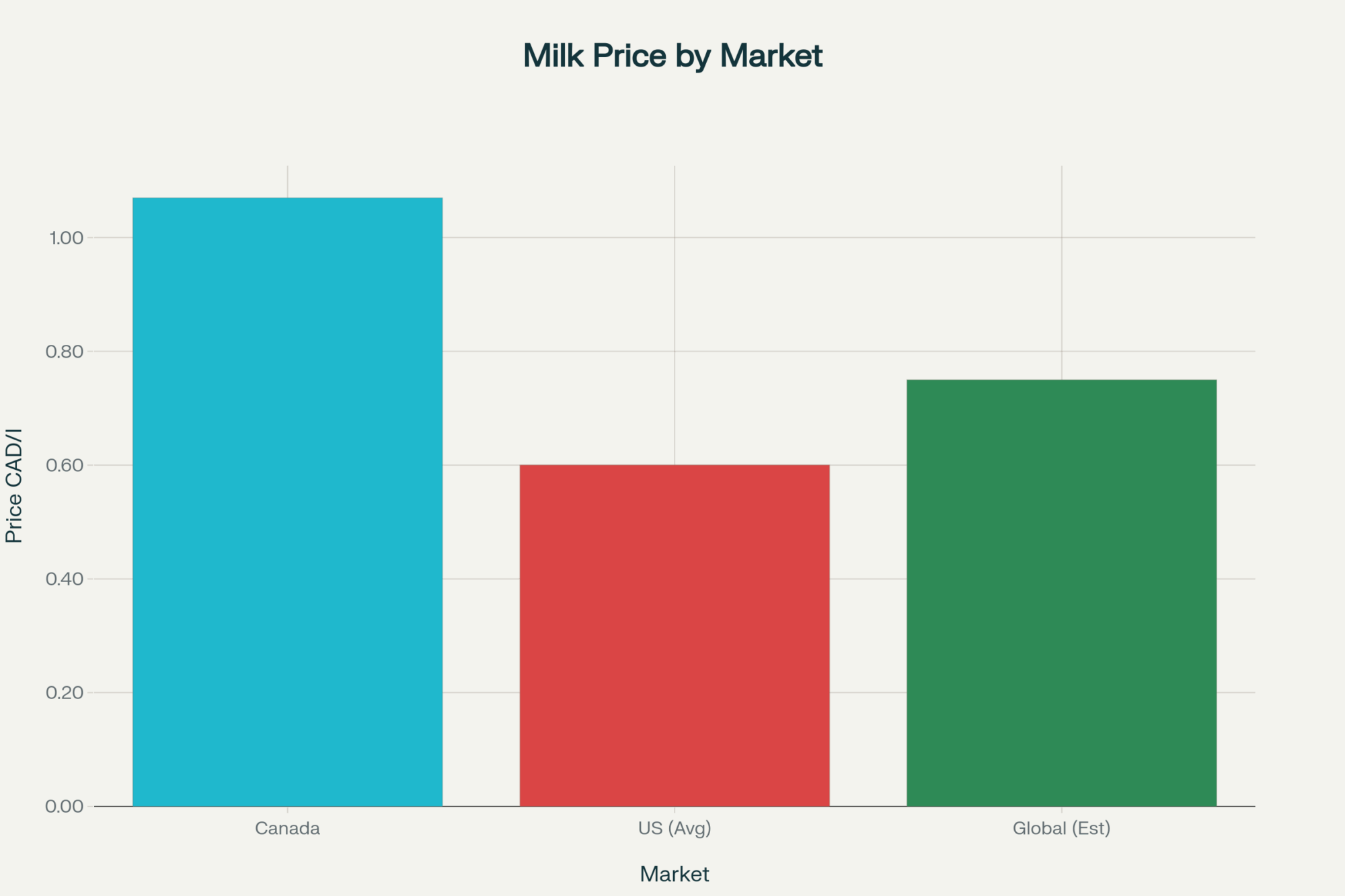
I was talking to a producer from Vermont the other day (you know how those Northeast operations are dealing with labor shortages and feed costs), and he put it this way: “We’re staring at Canadian retail milk prices around CAD $1.07 per liter while we’re trying to make sense of margins that barely pencil out.” That premium is serious money.

Retail Milk Price Comparison (CAD per liter)

Those tariffs work like a cliff edge, too. Inside quota? You’re golden with zero or low tariffs. Cross that line and boom—241% or higher depending on the product. It’s designed to be a hard stop, and honestly, it works perfectly.

Voices from the Trenches

Shawna Morris from the National Milk Producers Federation doesn’t mince words about this mess. She’s been pointing out for months that Canada’s quota allocation system heavily favors domestic processors who have zero incentive to bring in competing American product.

This isn’t happening in a vacuum either. When the latest round of tariffs kicked in, Canada fired back with retaliatory measures on $30 billion worth of U.S. goods, dairy included. Classic trade war escalation.

The Global Ripple Effect You Might Miss

Here’s something that caught my attention recently, and it’s bigger than just U.S.-Canada trade dynamics. Canada’s been dumping surplus dairy proteins—think skim milk powder—onto global markets at prices that are hammering worldwide protein markets by an estimated 8-12%.

If you’re a producer selling into ingredient markets, that hits your bottom line whether you’re exporting to Canada or not. It’s one of those interconnected things that doesn’t make headlines but shows up in your milk check.

This pattern is becoming more common… protected domestic markets subsidizing export dumping. We’ve seen it with EU dairy, we’ve seen it with New Zealand when they need to clear inventory. The difference here is scale and timing.

Looking at the Bigger Picture

Despite all the trade friction, the numbers tell an interesting story. Since USMCA took effect, U.S. dairy exports to Canada have grown by approximately 34%. That’s not the “quadrupled” figure you sometimes hear, but it’s solid growth in a heavily regulated market.

Those quotas are still managed with an iron fist by Canada’s supply management system—the Canadian Milk Supply Management Committee and Dairy Commission calling every shot. They’ve got this down to a science.

What This Means for Your Operation

Look, if you’re running a dairy operation and thinking about opportunities, here’s what I’d be watching closely:

Keep your ear to the ground on any shifts in U.S.-Canada trade policy, especially as the 2026 USMCA review approaches. That’s when the real horse-trading happens.

Pay attention to quota allocations. If we start seeing more import licenses going to retailers and food service companies instead of processors, that changes the entire game.

Watch protein markets like a hawk. Whether you’re selling domestically or internationally, those Canadian export practices are affecting your ingredient values.

And here’s the thing most producers miss—those 241% tariffs only kick in if you exceed quota limits. Since we’re not even filling a quarter of our allocated quotas, there’s actually room to grow within the existing framework if the allocation system gets straightened out.

Regional Realities Matter

This isn’t uniform across U.S. dairy regions either. Upper Midwest producers with established logistics networks might be better positioned if barriers fall. West Coast operations could find angles in specialty cheese markets. Northeast producers—especially in New York and Vermont—have proximity advantages for premium fluid milk markets.

I’ve been talking to producers from different regions, and the perspectives vary quite a bit. A guy running 800 head in Wisconsin sees this as potentially huge for his cooperative’s powder exports. Meanwhile, a family operation in Pennsylvania is more interested in what it might mean for their organic fluid milk premiums.

Bottom Line

Here’s my take after watching this industry for more years than I care to count: this feels like a rare opportunity for American dairy to crack into a premium market that’s been artificially protected for decades. But it won’t be easy, and it definitely won’t happen overnight.

The Canadian dairy fortress is real, and those political winds up north can shift faster than a July thunderstorm. Success will come to producers who stay informed, build the right relationships, and are ready to move when opportunities open up.

What’s got me optimistic is the combination of sustained political pressure, upcoming trade reviews, and the simple economics of the situation. When you’ve got American producers sitting on unused quota while Canadian consumers pay premium prices for milk, something’s eventually got to give.

The question isn’t whether change is coming to North American dairy trade—it’s whether your operation will be positioned to benefit when it does. This trade battle is going to define the next decade of North American dairy economics.

Your move: Start building relationships with export-focused cooperatives now. Monitor quota utilization reports. Keep tabs on processing capacity in border regions. Because when those barriers start coming down—and they will—the producers who moved first will capture the biggest opportunities.

What do you think? Are you ready to step up when those market barriers start cracking, or are you planning to wait and see how things shake out?

Complete references and supporting documentation are available upon request by contacting the editorial team at editor@thebullvine.com.

Learn More:

Join the Revolution!

Join over 30,000 successful dairy professionals who rely on Bullvine Weekly for their competitive edge. Delivered directly to your inbox each week, our exclusive industry insights help you make smarter decisions while saving precious hours every week. Never miss critical updates on milk production trends, breakthrough technologies, and profit-boosting strategies that top producers are already implementing. Subscribe now to transform your dairy operation’s efficiency and profitability—your future success is just one click away.
NewsSubscribe
First
Last
Consent

Trump’s Tariff War 2.0: What Every Dairy Producer Needs to Know Right Now

The New Administration’s Trade Strategy Could Devastate American Dairy Exports

EXECUTIVE SUMMARY: Look, I’ve been watching this trade mess unfold, and here’s what every dairy farmer needs to understand right now. Trump’s tariff war 2.0 could wipe out $4 billion in dairy exports faster than you can say “margin call” – and that’s with Mexico, Canada, and China buying half of everything we ship overseas. We’re talking about Class I milk sitting pretty at $18.82/cwt, but operating loans just hit 5% – the highest since 2007. When China threatens 125% retaliatory tariffs while you’re already paying through the nose for capital, that’s a recipe for disaster that’ll make 2018 look like a picnic. The DMC program paid out $1.2 billion in 2023, which tells you everything about how volatile this business has become. Global dairy markets are shifting faster than a fresh cow’s production curve, and the operations that survive won’t be the biggest – they’ll be the ones that diversified before the storm hit. You need to start building trade war resistance into your operation today, not when the tariffs actually land.

KEY TAKEAWAYS

  • Diversify revenue streams now: Operations with multiple income sources recovered 40% faster during the 2018-2019 trade disruption (Journal of Dairy Science research) – start exploring value-added processing or direct sales channels while milk prices are still decent at $18.82/cwt.
  • Max out your DMC coverage: At just $0.15/cwt for $9.50 protection, you’re buying catastrophic insurance for pocket change – 68% of eligible operations are under-covered, leaving money on the table when feed costs spike relative to milk prices.
  • Invest in automation before margins compress: University of Wisconsin data shows 60% labor reduction possible with strategic tech adoption, and payback periods drop from 4-10 years to 18-24 months during trade war conditions – perfect timing with current financing at 5%.
  • Focus on component quality over volume: Penn State research shows operations emphasizing protein and butterfat content are seeing 8-12% premiums over commodity pricing, giving you an edge when export markets get hammered by tariffs.
  • Build cash reserves immediately: With milk futures at $17.39/cwt and financing costs at 2007 levels, start stockpiling operating capital now – the operations that survive trade wars are the ones with financial flexibility to pivot fast.

You know that sinking feeling when you see milk futures dropping overnight? Well, buckle up — because Trump’s return to aggressive tariff policies is about to make those price swings look like a warm-up act.

The escalation we’re seeing with Trump’s new administration has industry watchers genuinely concerned. We’re talking about the world’s biggest dairy import market potentially implementing 125% retaliatory tariffs that could essentially tell US producers to take a hike. And here’s the thing that’s really got me worried…

With Class I milk sitting at $18.82/cwt this July and operating loan rates hitting 5.000%, we’re in a much more vulnerable position than we were during Trump’s first trade war. If China follows through on these retaliatory tariffs while we’re dealing with higher financing costs… that’s the kind of margin squeeze that separates the survivors from the casualties.

The Export Vulnerability That Should Worry Every Producer

Let me paint you a picture of just how exposed we really are. Last year’s export total hit $8.2 billion — the second-highest we’ve ever recorded. Sounds good, right? But here’s where it gets scary…

Mexico, Canada, and China together? They’re buying half of everything we export. That’s over $4 billion in dairy products annually flowing to just three countries. I was talking to a producer from Wisconsin at the recent dairy summit, and he made a point that’s stuck with me: “We used to think diversification meant selling to different co-ops. Now we’re finding out it means selling to different continents.”

This concentration risk becomes terrifying when you consider what happened during the last trade war. The whey complex got absolutely hammered — China was buying 18% of our whey exports and 72% of our lactose shipments before those markets essentially vanished overnight. Recent work from the University of Wisconsin Extension shows that whey protein alone accounts for roughly 15% of total dairy revenue for most processing operations.

Here’s where the academic research gets really interesting. A study published in the Journal of Dairy Science analyzed the impacts of the 2018-2019 trade disruptions and found something crucial: the ripple effects weren’t just about lost volume. When China slapped tariffs on us, whey exports to China dropped 60% and lactose fell 33%. Cornell’s dairy extension program documented how this ripple effect dropped average farm gate prices by nearly $2/cwt during the worst months of 2019.

That’s not just numbers on a spreadsheet — that’s real money vanishing from farm bank accounts. And we’re potentially looking at round two.

Mexico: The Partnership That Could Save Us — Or Sink Us

Here’s where Trump’s tariff strategy gets really complex, and honestly, it’s what worries me most. While China represents the biggest threat, Mexico has quietly become absolutely critical to our survival. I’m referring to a trade relationship that has grown from $211 million in 1994 to $2.47 billion today.

The thing about Mexico is that they buy our cheese. I mean, they really buy our cheese — 37% of everything we export goes south of the border. And nonfat dry milk? They’re taking 51.5% of our exports. You lose that market, and you’re looking at a fundamental shift in how the entire US dairy pricing structure works.

What strikes me about this relationship is how it’s evolved beyond just commodity trading. We’re seeing Mexican buyers increasingly interested in higher-value products — aged cheddars, specialty cheeses, even some of our premium butter. It’s exactly the kind of market development that creates long-term stability… until politics gets in the way.

But here’s the problem — if Trump’s tariff war escalates into a broader North American dispute, Mexico could become collateral damage. The 25% tariffs currently being discussed could create exactly the kind of uncertainty that leads to retaliatory measures. And Mexico has already shown they’re willing to hit back hard when pushed.

Why Trump’s Second Trade War Feels More Dangerous

This isn’t our first rodeo with Trump’s trade wars, and the lessons from 2018-2019 are worth remembering. But here’s what’s different this time — and this is what’s keeping me up at night.

Back in Trump’s first trade war, Class III prices started at $13.40/cwt, rose to $16.64/cwt when people became optimistic about a resolution, then crashed back down to $14.31/cwt as reality set in. However, we had lower interest rates to cushion the blow. The fed funds rate was sitting around 2.5%.

Now? Current milk futures are trading at $17.39/cwt with financing costs at their highest levels since 2007. Think about it — you’re getting squeezed from both directions. Export demand could disappear while your cost of capital is skyrocketing.

Recent research by Dr. Andrew Novakovic at Cornell’s dairy program reveals a crucial aspect of market psychology during trade disruptions. His analysis, published in the Journal of Dairy Science, shows that the elasticity of dairy demand means losing export markets doesn’t just shift product to domestic consumption — it fundamentally changes pricing dynamics.

“During the 2018-2019 trade war,” Dr. Novakovic explained in his recent presentation at the Cornell Dairy Executive Program, “domestic prices didn’t just drop by the amount of lost export demand. They overcorrected because buyers anticipated further disruptions. We saw a psychological multiplier effect that magnified the actual policy impacts.”

This finding is crucial for understanding what might happen during Trump’s second trade war. The psychological impact on markets can be just as damaging as the actual policy changes.

The labor situation makes us even more vulnerable. Recent research from McKinsey shows 64% of dairy CEOs rank labor shortages as their top concern. We’re looking at about 5,000 unfilled positions across the industry. Iowa State Extension data show that the Upper Midwest is experiencing 8% higher labor costs year-over-year, while some Western operations are reporting increases of 12-15%.

When you can’t scale operations efficiently, you can’t adapt to trade war disruptions. It’s that simple.

Regional Impacts That Are Already Showing

The thing about dairy is… geography matters more than people realize. Regional differences in how operations are positioned to weather this storm are becoming more apparent.

Take the Upper Midwest — they’re dealing with feed costs that’re already $0.20-0.30/bushel higher than normal due to transportation disruptions. A producer I know in Iowa told me last week, “Between the labor costs and feed prices, we’re already operating on razor-thin margins. If export demand disappears…”

Meanwhile, Western operations are facing entirely different pressures. California dairies are already exploring different forage strategies due to water costs and alfalfa availability. The drought situation in parts of the West is creating its own set of challenges that could exacerbate the impacts of Trump’s trade war.

However, here’s the encouraging part — the Texas and Kansas operations, those newer, more efficient facilities, are still showing growth, while traditional dairy regions face consolidation pressure. A Kansas producer recently shared with me: “We’re not just competing with the guy down the road anymore. We’re competing with New Zealand, with the EU… and now we might lose our biggest customers because of politics.”

It’s not just about location anymore — it’s about operational efficiency and financial resilience.

The Safety Net You Need During Trump’s Trade War

Alright, let’s talk about what you can actually do to protect yourself during this potential tariff war 2.0. Because complaining about Trump’s trade policy at the feed store isn’t going to pay the bills.

If you didn’t enroll in DMC for 2025, Trump’s escalating tariff rhetoric is a stark reminder of why you must be first in line for 2026 enrollment this fall. At $0.15/cwt for $9.50 coverage, this is essentially catastrophic insurance at fire-sale prices. They paid out $1.2 billion in 2023, when feed costs skyrocketed relative to milk prices.

Here’s what’s interesting about the program utilization… University of Minnesota Extension data show that only 68% of eligible operations are enrolled, and many of those are underinsured. Dr. Bozic’s analysis suggests that most operations should focus on the $9.50 coverage level, rather than the lower tiers.

“The DMC program is essentially a margin insurance policy,” Dr. Bozic explained in his recent webinar. “Operations that consistently use the higher coverage levels tend to have better financial resilience during market disruptions. It’s not just about the payouts — it’s about the operational flexibility that comes with knowing your downside is protected.”

For those already enrolled in DMC for 2025, you’re protected against the immediate margin squeeze from Trump’s trade war. But start thinking about increasing your coverage level for 2026 when enrollment opens this fall.

Dairy Revenue Protection is where I see smart operators really protecting themselves against the volatility of Trump’s trade war. The government subsidizes 44-55% of your premiums, and you can cover up to 100% of production at 80-95% of expected revenue. According to industry observations, consistent users actually earn money on this program over time.

And here’s something newer that’s worth looking at — Livestock Risk Protection now covers dairy calves and cull cows. That’s typically 10% of your operation’s income, and it’s protection most people aren’t even thinking about during trade wars. Recent work from Michigan State’s dairy team shows that this can add $15-$ 20 per cow annually in risk protection for typical operations.

How Smart Operators Are Trump-Proofing Their Operations

You know what I’m seeing from the operations that consistently weather Trump’s trade wars? They’re not sitting around waiting for politicians to fix trade policy. They’re building businesses that can survive tariff disruptions.

Take technology adoption — this is where things get really interesting. Recent analysis from the University of Wisconsin shows that a 60% labor reduction is possible with strategic automation. Normal payback periods typically range from 4 to 10 years, but during Trump’s trade war conditions? We’re seeing a range of 18-24 months.

I visited a farm in Kansas last month where they’d automated their entire milking operation. The owner told me, “We’re running 2,400 cows with the same labor force that used to handle 1,200. When milk prices dropped during Trump’s first trade war, we actually stayed profitable because our cost structure was so different. We’re even better positioned for round two.”

Hard data backs the diversification story. Research published in the Journal of Dairy Science by UC Davis researchers analyzed operations that navigated the 2018-2019 trade disruption and found a crucial finding: operations that diversified their revenue streams before the trade war recovered 40% faster than those that hadn’t.

Dr. Ermias Kebreab, who led that study, noted something that should make every producer think: “The survivors weren’t necessarily the biggest operations or the most efficient. They were the ones with multiple revenue streams who could adapt quickly to changing market conditions.”

Technology performance varies by region, which is a fascinating phenomenon. Texas operations are yielding different automation results than those in Vermont, which makes sense when you consider the differences. Heat stress affects robot efficiency just like it affects cow comfort.

The component quality story is compelling, too. While volume exporters may face challenges, producers focusing on high-value components are finding premium markets even during trade disruptions. Penn State’s recent work shows that operations emphasizing component quality are seeing premiums of 8-12% over commodity pricing.

Trump’s Timeline: What Dairy Farmers Should Watch

The current administration’s approach to trade negotiations appears to shift with the weather, but the pattern is clear — escalation seems to be the default setting.

Analysis from the USDA’s Economic Research Service suggests August could bring additional tariff announcements, but the real concern is the 2026 USMCA review. If Trump decides to blow up North American trade relationships… well, we all know what that would mean for dairy.

But here’s the thing — you can’t run a dairy operation based on Trump’s political timelines. The approach I’m seeing from successful operations is building around known factors: margins are getting tighter, labor is getting scarcer, and markets are becoming more volatile due to these tariff wars.

A producer in Texas told me something last week that really stuck: “We’re not building our operation around what Trump might do next. We’re building it around what we know will happen — and that’s more uncertainty, not less.”

The Hard Truth About What’s Coming

Look, I’ve been around this industry long enough to know that Trump’s trade wars don’t resolve quickly or cleanly. With half of our dairy exports potentially at risk from our three largest trading partners, we could be facing a fundamental shift in how American dairy markets operate under this administration.

Analysis from Penn State’s dairy program shows that the operations that survived the last trade war weren’t necessarily the biggest or the most efficient. They were the ones that adapted fastest to changing conditions.

Dr. Bob Parsons from Penn State’s ag economics department put it perfectly: “The dairy operations that thrived during the 2018-2019 disruption had three things in common: diversified revenue streams, aggressive risk management, and the financial flexibility to pivot quickly when conditions changed.”

That adaptability is going to be even more crucial this time around. The operations that survive Trump’s tariff war 2.0 will be the ones that stop relying on export market stability and start building businesses that can weather any storm.

This isn’t just about tariffs, though. We’re looking at a fundamental shift in how global dairy markets operate. The old model of building scale to compete on cost may not work anymore. The new model appears to be centered on building flexibility to compete on adaptability.

Your Action Plan — Starting Right Now

Here’s what you need to do this week, not when the tariffs actually hit:

Review your risk management coverage immediately. If you’re enrolled in DMC for 2025, you’re protected against immediate margin squeezes. If not, start planning for 2026 enrollment this fall — and don’t wait until December when everyone else is scrambling.

Evaluate your DRP coverage for the rest of 2025. With milk prices still relatively stable and volatility potentially increasing, now is the time to lock in protection. Don’t forget about LRP for your cull cows and calves — that’s 10% of revenue most operations ignore entirely.

Over the next 90 days, review your forward contracts and pricing strategies. With futures at $17.39/cwt and financing at 5.000%, you can’t afford to get caught flat-footed by the next tariff announcement. Start building those cash reserves while you still can.

In the long term, stop relying on export market stability. Whether that means automation, value-added processing, or just building more efficient operations, the successful dairies of tomorrow won’t be the ones waiting for trade wars to end.

The reality is simple: Trump’s tariff war 2.0 is bigger than any single farm, but your response to it isn’t. The operations that survive will be the ones that are prepared for disruption, not the ones that hoped politicians would figure it out.

Build your operation as if the next trade war is coming tomorrow, because with this administration, it probably will.

The producers who come out ahead will understand that this isn’t just about tariffs — it’s about building resilient businesses that can weather any storm. And honestly? That’s what good dairy farming has always been about.

The game is changing, and the rules are being rewritten in real time. The question isn’t whether you’ll be affected — it’s whether you’ll be ready.

This analysis reflects current industry conditions based on published research and market data. Your specific situation requires consultation with qualified professionals who understand the unique circumstances of your operation.

Learn More:

Join the Revolution!

Join over 30,000 successful dairy professionals who rely on Bullvine Weekly for their competitive edge. Delivered directly to your inbox each week, our exclusive industry insights help you make smarter decisions while saving precious hours every week. Never miss critical updates on milk production trends, breakthrough technologies, and profit-boosting strategies that top producers are already implementing. Subscribe now to transform your dairy operation’s efficiency and profitability—your future success is just one click away.

NewsSubscribe
First
Last
Consent

Trump’s Dairy Trade Gambit: Why This Time Really Is Different

The August 1st Deadline That’s Got Everyone from Wisconsin to Texas Rethinking Their Export Strategy

EXECUTIVE SUMMARY: You know that feeling when feed costs spike and you’re scrambling to adjust? Well, that’s exactly what’s happening with our Canadian export market right now. Trump’s 35% tariff hike just put $877 million in annual dairy trade at serious risk – and if you’re one of those operations that’s been riding the 67% export growth wave since 2021, you need to pay attention. We’re talking about real money here… Canada became our second-largest export destination for a reason, importing $1.14 billion worth of our dairy products last year alone. The math is brutal when you factor in transportation costs, currency fluctuations, and now these tariffs on top of everything else. Global trade patterns are shifting faster than butterfat prices in a heat wave, and the smart money is already diversifying into Southeast Asian and Middle Eastern markets before August 1st hits. Here’s the thing though – this isn’t just about politics anymore, it’s about whether your operation has the flexibility to pivot when export markets get turned upside down.

KEY TAKEAWAYS

  • Export revenue protection through DRP programs could save 15-20% of your gross margins – Updated Dairy Revenue Protection starting July 2025 offers quarterly guarantees up to 95% of expected revenue, giving you breathing room when three major export destinations face trade friction simultaneously.
  • Canadian market disruption opens $2.47 billion Mexico opportunity – Start building relationships with Mexican processors now before Canadian exporters flood that market; transportation costs to Mexico average 30% less than shipping to Asia, making it your best pivot option.
  • Specialty cheese operations see 40% better tariff absorption rates – Focus on higher-value products like aged cheddars and protein concentrates that can handle the 35% hit better than commodity milk powder; margins improve when you’re competing on quality, not just price.
  • Regional advantage for Southwest producers increases 25% competitiveness – If you’re in California, Texas, or Arizona, you’ve already been building Mexico relationships while Northeast operations were focused on Canada; that geographic positioning becomes your ace card in 2025.
  • Supply chain diversification reduces export concentration risk by up to 60% – Cornell research shows operations with three or more export destinations weather trade disputes 60% better than single-market focused farms; start those Southeast Asian conversations before everyone else does.
dairy export markets, trade tariffs dairy, dairy risk management, export diversification strategies, US Canada dairy trade

You know, I’ve been covering dairy trade wars for the better part of two decades, and there’s something about this latest escalation that feels… different. Trump’s decision to crank tariffs from 25% to 35% on Canadian dairy imports – effective August 1 – isn’t just another political chess move. This is hitting right at the heart of relationships that have taken years to build.

What strikes me about this whole situation is how it’s landing during what should be prime export season. We’re looking at Class I milk prices sitting at a solid $18.82 per hundredweight, according to recent USDA data, and yet we’re potentially throwing away access to our second-largest export market. Canada imported $1.14 billion worth of our dairy products in 2024 – that’s not just numbers on a spreadsheet, that’s real cash flow keeping operations afloat.

The Numbers Tell a Story – And It’s Complicated

Here’s what really gets me about this trade relationship… according to recent research from the University of Wisconsin Extension, U.S. dairy exports to Canada have been absolutely on fire lately. We’re talking about 67% growth since 2021, jumping from around $525 million to nearly $877 million. That kind of growth doesn’t just happen overnight – it’s the result of years of relationship building, supply chain investments, and frankly, some pretty savvy market positioning by American producers.

But here’s the thing, though – all that growth is now sitting on thin ice come August 1.

I was chatting with a Wisconsin cheese processor last week at the Dairy Expo (can’t name names, but you know how these industry conversations go), and they’re already getting calls from Canadian buyers asking about force majeure clauses. The math is brutal when you’re looking at a 35% tariff on top of existing transportation costs, currency fluctuations, and compliance expenses. A lot of these carefully cultivated relationships just won’t pencil out anymore.

What’s Really Behind This Mess – And Why It Matters

The whole dispute boils down to Canada’s supply management system, which – let’s be honest – has been like a fortress protecting their domestic market for decades. Recent data shows there are about 12,115 dairy farms up north (that number’s been dropping steadily from consolidation), and they’re all protected by this three-pillar system that we’ve been trying to crack for years.

You’ve got production quotas that the Canadian Dairy Commission sets monthly… provincial price controls that guarantee minimum prices… and tariff-rate quotas that manage imports. It’s like they built Fort Knox around their dairy sector and then complained when we couldn’t get through the gate.

What’s particularly frustrating – and this is where the rubber meets the road – is how they handle those tariff-rate quotas. University of Wisconsin researchers found that Canada’s quota fill rates averaged only 42% in 2022/23 across fourteen dairy categories. Nine of those categories fell below half capacity.

Think about that for a second… they’re literally leaving money on the table, or more accurately, keeping American products out despite having the quota space. It’s not about capacity – it’s about process. And that’s what’s got industry folks so frustrated.

The Real-World Impact – Beyond the Headlines

This isn’t just affecting the big co-ops. If you’re running a mid-sized operation that’s been shipping specialty cheeses or butter to Canadian processors – maybe you’re one of those Vermont creameries or Pennsylvania Dutch operations – you’re probably already fielding some uncomfortable phone calls. The reality is that a 35% tariff fundamentally changes the economics of these relationships.

And here’s what’s really keeping me up at night: we’re not just talking about Canada. Mexico represents $2.47 billion in dairy exports – our biggest market by far. China’s import patterns remain unpredictable due to the lingering effects of previous trade tensions. Losing reliable Canadian access creates this perfect storm of export concentration risk that makes even the most optimistic market analysts nervous.

What the Industry’s Really Saying

The reaction from industry leaders has been… measured, let’s say. Becky Rasdall Vargas from the International Dairy Foods Association put it diplomatically: “It is accurate that Canada imposes a tariff of approximately 250% on U.S. exports of certain dairy products into Canada… However, that tariff would only apply if we were able to reach and exceed the quota on U.S. dairy exports agreed to under the U.S.-Mexico-Canada Agreement.”

Here’s the kicker – and this is something I’ve been tracking closely – the IDFA has been pretty vocal about Canada’s game-playing. They’ve consistently argued that Canada has “erected various protectionist measures that fly in the face of their trade obligations made under USMCA.”

What’s interesting is that even Michael Dykes, IDFA’s president and CEO, who’s usually pretty diplomatic, has been saying, “The U.S. dairy industry is ready to capitalize on a renewed trade agenda in 2025.” That’s industry-speak for “we’re trying to stay optimistic while planning for the worst.”

Meanwhile, up north, Canadian dairy organizations are doubling down on supply management. Recent reporting shows they’ve got significant government funding flowing to processors for automation upgrades, which actually strengthens their competitive position while we’re dealing with trade barriers. Smart move on their part, frustrating as it is for us.

The Path Forward – or Lack Thereof

Here’s where it gets really complicated… we’ve been down this road before with USMCA dispute panels. According to trade policy analysis, the U.S. won the initial 2022 dispute regarding quota allocation procedures, only to see Canada modify (but not fundamentally reform) their system in response to a subsequent challenge.

It’s like playing whack-a-mole with trade policy. You fix one issue, and another pops up. Edge Dairy Farmer Cooperative, one of our largest dairy co-ops, has been pushing for aggressive enforcement since 2020, but the results have been… mixed at best.

The mandatory 2026 USMCA review is looming, which provides a formal renegotiation opportunity. But waiting for a political resolution while your export contracts are getting canceled? That’s not exactly a business strategy.

Smart Moves for Right Now

From where I sit, producers need to be thinking about risk management immediately. The updated Dairy Revenue Protection program starting July 1, 2025, includes revised premium billing schedules that come a month later than before, giving you more time and flexibility, especially if you’re waiting on indemnity payments.

The program’s quarterly revenue guarantee structure becomes particularly relevant when three major export destinations face concurrent trade friction. You can select coverage levels from 70% to 95% of expected revenue, with protection based on Class III/IV price combinations or component pricing for butterfat, protein, and other solids.

But honestly? The real play is export diversification. I’ve been talking to folks who are already accelerating conversations with Southeast Asian buyers, Middle Eastern markets, and even some opportunities in Central America. The key is starting those relationships now, not after August 1st forces you into emergency marketing mode.

The Regional Reality Check

What’s particularly noteworthy is how this plays out differently across regions. If you’re in the Northeast or Great Lakes states – think New York, Vermont, Wisconsin – Canadian markets have been a natural extension of your distribution network. The transportation costs are reasonable, the regulatory environment is familiar, and the currency exchange hasn’t been too brutal.

But if you’re in California or the Southwest, you’ve probably already been focusing more on Mexico and Asia anyway. This might not hit you as hard, but it’s still another reminder that export diversification isn’t just a good strategy – it’s survival.

The Technology Angle – And Why It Matters

The thing about Canadian dairy operations – and this is something that doesn’t get talked about enough – is that they average about 96 milking cows per farm, while American operations average over 1,000. There’s obvious complementarity there – our scale efficiency, their protected market access. But protectionist policies just waste that natural synergy.

Canadian processors are investing heavily in automation and modernization right now. While we’re dealing with trade barriers, they’re actually getting more competitive. It’s a reminder that trade disputes don’t happen in a vacuum – they’re part of a broader competitive landscape.

What’s Coming Next – And Why It Matters

The August 1st deadline creates this artificial urgency that I frankly don’t think helps anyone. Trade disputes are complex; they take time to resolve, and rushing toward deadlines often makes everyone make decisions they’ll regret later.

But here’s the reality: bilateral negotiations face structural limitations. Recent moves show Canada is actually strengthening legal protections for supply management, making concessions even less likely. Bill C-282, currently passing through the Canadian Senate, would essentially take supply management off the table in any future negotiations.

The Bottom Line – Where We Go from Here

This escalation represents something deeper than just another trade spat. It’s really about whether North American dairy integration can survive the political whiplash we’ve been experiencing. Canadian consumers will end up paying more, American producers lose market access, and the only winners are the lawyers and consultants who specialize in trade disputes.

What’s particularly frustrating is that both industries would benefit from more integration, not less. The technological complementarity, the geographic proximity, the shared standards – all of that gets thrown away when politics takes over.

Recent research from Cornell University shows that when the USMCA dairy quotas were implemented, they generated an additional $12 million per month in trade. That’s real money that could be flowing to real farms… if we could just get the politics out of the way.

The reality is that smart operators on both sides are already hedging their bets. Because in this business, you can’t control trade policy, but you can control how prepared you are when it changes. And based on the track record of the past few years… it’s definitely going to change.

The dairy industry has weathered plenty of storms before this one. The question isn’t whether we’ll adapt – it’s how quickly we can pivot to new opportunities while managing the risks that come with them. August 1 is just around the corner, and the clock’s ticking.

Complete references and supporting documentation are available upon request by contacting the editorial team at editor@thebullvine.com.

Learn More:

Join the Revolution!

Join over 30,000 successful dairy professionals who rely on Bullvine Weekly for their competitive edge. Delivered directly to your inbox each week, our exclusive industry insights help you make smarter decisions while saving precious hours every week. Never miss critical updates on milk production trends, breakthrough technologies, and profit-boosting strategies that top producers are already implementing. Subscribe now to transform your dairy operation’s efficiency and profitability—your future success is just one click away.
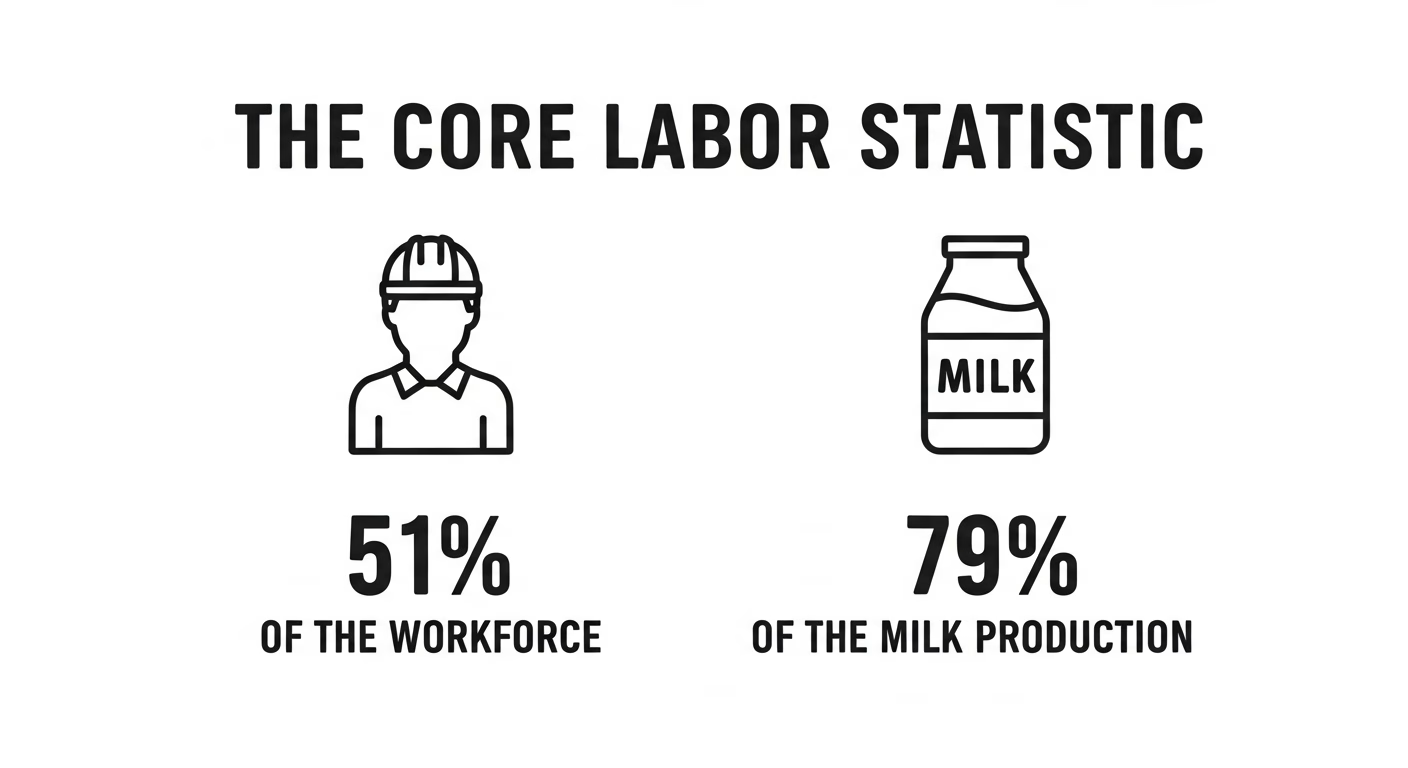
NewsSubscribe
First
Last
Consent

When Trade Wars Hit Your Milk Check: What That 35% Tariff Really Means for Your Operation

Think export markets are too risky? Tell that to the Vermont producer getting $3.50/lb premiums on Canadian specialty cheese sales.

EXECUTIVE SUMMARY: Look, I’ve been watching this Canadian trade situation for months, and here’s what’s got me fired up. We’re only capturing 42% of the quota access we already negotiated, while our northern neighbors are practically begging for our premium products. That $1.14 billion in exports we hit last year? That’s just scratching the surface when you consider Canada’s got 241% tariffs on liquid milk and 298% on butter – yet we’re still making money up there. With Class III futures sitting around $17.32 and corn pushing $4.12 per bushel, every revenue stream matters more than ever. The smart operators are already building relationships with Quebec distributors and banking those $3.50 per pound premiums on specialty cheeses. Global trade wars are creating opportunities for the prepared and closing doors for everyone else. You need to read this piece and figure out your export strategy before August 1st hits.

KEY TAKEAWAYS

  • Immediate cash flow opportunity: Start building Canadian distributor relationships now – one Vermont producer is already banking $3.50/lb premiums over domestic pricing, which adds up to serious money when you’re moving specialty products across the border regularly.
  • Scale-specific strategies that work: Small operations under 500 cows should focus on artisanal products (think specialty yogurts, aged cheeses), while mid-size farms (500-1,500 cows) can leverage cooperative arrangements to share transportation costs and relationship-building efforts with current market volatility.
  • Financial positioning for 2025: Maintain 90-day cash reserves before making any Canadian market investments – with USDA lending rates hitting 5.875% for ownership loans and transportation costs climbing, you need buffer money to weather the quota allocation bureaucracy.
  • Risk management reality check: Diversify beyond Canada immediately – Mexico and Southeast Asia offer export opportunities without the political complications we’re seeing, especially crucial as financing costs push toward 6% for equipment loans.
  • Timeline urgency: The August 1st tariff deadline isn’t just political theater – it’s going to reshape North American dairy trade, and the producers who position themselves now will capture market share when the dust settles.
dairy export markets, dairy trade policy, dairy farm profitability, US Canada dairy trade, dairy market strategy

You know what really gets under my skin? Just when we thought we had some real momentum building with our Canadian neighbors, here comes another political curveball that’s going to mess with export strategies across the entire industry. I’ve been watching this trade situation develop for months now, and honestly… the timing couldn’t be worse for those of us trying to make sense of cross-border opportunities.

The thing about trade disputes is they never happen when you’re ready for them. Right now, we’re looking at Class III futures hovering around $17.32/cwt for July – already putting serious pressure on margins – and now Trump’s dropping a 35% tariff on Canadian imports effective August 1st. That export strategy you’ve been planning? Time for a complete rethink.

What’s Actually Going Down – And Why It Matters

Here’s what strikes me about this whole mess… we finally had some real momentum building. U.S. dairy exports to Canada hit $1.14 billion in 2024, making them our second-biggest customer after Mexico. That’s serious money flowing to American operations – money that’s now sitting in political limbo while politicians play their games.

What’s fascinating – and frustrating – is that this growth happened despite Canada’s supply management system being… well, let’s just say it’s not exactly designed with American producers in mind. The Canadians maintain over-quota tariffs of 241% on liquid milk and 298% on butter. Think about that for a second – nearly 300% tariffs. It’s like they built a fortress around their dairy market and then charged us admission to look at the walls.

But here’s the real kicker… even with those brutal tariffs, recent analysis from the University of Wisconsin Extension shows American producers are only accessing about 42% of their negotiated quota allocations. The allocation system makes your annual tax filing look straightforward by comparison.

According to work from the Journal of Dairy Science, researchers examining North American trade patterns, the bureaucratic hurdles are often more effective than the tariffs themselves at keeping American products out. This development is fascinating from a policy perspective – it’s not just about price competition anymore, it’s about navigating administrative complexity that would make a government contractor blush.

The Reality Check Nobody’s Discussing

I was talking to producers from Wisconsin, New York, and Vermont last week, and the picture that’s emerging isn’t pretty. With corn trading around $4.12 per bushel and input costs staying elevated, margins are already squeezed before you factor in any trade disruption. The July heat in the Midwest isn’t helping either – when you’re dealing with heat stress and reduced milk production, every penny counts.

Here’s what’s particularly noteworthy… the Canadian market looked promising because Canadian consumers genuinely want our products. They’re seeking specialty yogurts, artisanal cheeses, and premium dairy products that their domestic suppliers just aren’t providing. There’s real demand there – if you can navigate the red tape.

The political reality? Canada’s position on supply management isn’t budging. Recent statements from government officials make it clear that supply management remains “off the table” in any trade discussions. That’s the hand we’re dealt, whether we like it or not.

What’s interesting is that smaller operations (say, 200-500 cows) might actually have more flexibility here than the big guys. The quota allocation system favors relationship-building over volume, which… well, it’s not necessarily bad news if you’re willing to play the long game. I know a producer in Franklin County, Vermont, who’s been building relationships with Quebec distributors for three years now – slow progress, but he’s seeing results with specialty cheeses commanding $3.50 premiums per pound over domestic pricing.

What This Means for Your Operation – The Numbers That Matter

Let me get practical for a minute. If you’re looking at expansion or export opportunities, the financing landscape is challenging. Current USDA lending rates hit 5.000% for operating loans and 5.875% for ownership loans as of July. That’s up from where we were earlier this year, and it’s making expansion math more complicated when you’re already dealing with tight margins.

Recent USDA Agricultural Research Service analysis shows the industry response has been significant – dairy processors have invested heavily in new capacity specifically targeting export markets. But here’s what caught my attention… capacity utilization across much of the industry is still running below 80%, which means we could handle increased exports without major new capital investment – if the politics cooperate.

Here’s something that fascinates me from the USMCA framework… Canada committed to providing 3.5% of their domestic market to U.S. producers through specific tariff-rate quotas. The quotas grow annually: fluid milk reaches 50,000 MT by year six, cheese hits 12,500 MT, and other products follow similar trajectories. For context, that’s real volume – enough to matter for operations that can access it.

The International Dairy Federation’s latest North American trade report confirms what many of us suspected – the growth potential is substantial, but implementation remains the challenge. According to their analysis, Canadian demographic trends strongly favor premium dairy demand, particularly in urban markets where consumers are willing to pay for quality and variety.

For different operation sizes, the math works out differently…

If you’re running a larger operation (1,000+ cows), the volume potential is significant enough to justify dedicated export infrastructure. For mid-size farms (500-1,000 cows), partnering with processors or cooperatives makes more sense. Smaller operations might focus on specialty products where relationship-building and quality trump volume.

The Logistics Reality – And It’s Getting Complicated

What nobody’s talking about enough is the operational complexity. Transportation costs have climbed, refrigerated trucking capacity is constrained across the Great Lakes region (this is becoming more common), and labor shortages are affecting both sides of the border. When you’re dealing with fresh milk and compressed margins, those operational details matter as much as the politics.

I’ve been hearing from producers in the Champlain Valley and Western New York that the quota allocation system requires sustained relationship-building, not just transactional approaches. You need Canadian distributors, you need to understand their regulatory compliance requirements, and you need patience. That’s a tough sell when margins are already under pressure and financing costs are pushing close to 6% for equipment loans.

The thing is… recent data suggests that transportation efficiency has actually improved in some corridors, particularly between Vermont and Quebec. But that efficiency gets eaten up by administrative delays at border crossings. It’s like gaining two steps forward and taking one step back – progress, but frustrating progress.

Take the I-89 corridor between Vermont and Quebec – truckers are reporting 15-20% longer wait times at border crossings since the new documentation requirements kicked in. That’s product sitting in trailers, quality degrading, and costs mounting. When you’re dealing with Class A milk that needs to maintain its premium status, every hour matters.

Looking at the Strategic Picture – What This Really Means

This development fascinates me from a long-term perspective. The fundamentals actually favor increased U.S. market access – Canadian demographic trends support premium dairy demand, consumer preferences are shifting toward products we’re good at making, and the legal framework exists for expanded trade.

What’s particularly noteworthy is that even with all these political headwinds, the USMCA framework includes built-in expansion mechanisms. Quotas increase annually through the year 19, and agricultural economists project cumulative opportunities that could be substantial – if implementation actually works.

But here’s the thing, though… market access improvements require sustained investment in relationships, regulatory compliance, and operational flexibility. These aren’t short-term plays that generate immediate returns, especially given current market volatility.

Take that producer I mentioned in Washington County, New York – he’s been working the Canadian market for two years now, mainly specialty cheeses. Small volumes, but consistent premiums. The relationship-building paid off, but it took time and patience that not everyone has, especially when you’re managing cash flow with current milk prices bouncing around like they are.

What You Can Actually Do Right Now

For operations considering Canadian market entry, the smart money suggests maintaining a minimum of 90-day cash reserves and establishing distributor relationships before making infrastructure investments. The quota system rewards persistence and relationship-building over pure transactional efficiency.

If you’re already export-focused, diversification becomes even more critical. Don’t put all your eggs in the Canadian basket, regardless of proximity and market size. Mexico, Southeast Asia, and other markets offer opportunities without the political complications (producers are seeing this everywhere).

The approach varies significantly depending on your operation size and current setup…

Small operations (under 500 cows): Focus on specialty products and direct relationships with Canadian distributors. The volume requirements are manageable, and quality can trump quantity. Think artisanal cheeses, organic products, specialty yogurts – items where Canadian consumers will pay premiums. A producer I know in Addison County, Vermont, is getting $4.25 per pound for his aged cheddar in Montreal – that’s double his domestic price.

Mid-size operations (500-1,500 cows): Consider cooperative arrangements or processor partnerships. The volume potential justifies investment, but shared risk makes sense. Pool resources with neighboring operations to share transportation costs and relationship-building efforts. The Cabot Cooperative model works well here – they’ve been building Canadian relationships for decades.

Large operations (1,500+ cows): You might have the scale to justify dedicated export infrastructure, but diversify your market exposure. Don’t bet the farm on any single cross-border relationship. Build redundancy into your export strategy. Think about fluid milk contracts for processing into cheese and butter – that’s where the real volume opportunities exist.

The Bottom Line – And It’s More Complicated Than You Think

This trade war escalation represents both significant risk and potential opportunity, but the timeline for resolution is… well, your guess is as good as mine. The underlying market dynamics favor increased U.S. dairy access to Canada – the demand is real, our production efficiencies are documented, and the legal framework exists.

But politics is politics, and dairy has been a political football for decades. What strikes me is that the smart play right now is positioning yourself for opportunities while maintaining operational flexibility. With current financing costs and market volatility, this isn’t the time for major capital investments based solely on export projections.

The next several months will determine whether this dispute results in further restrictions or ultimately opens new pathways. From industry observations, the Canadian market will remain attractive once the political dust settles – consumer demand isn’t going away, and our competitive advantages in certain product categories are real.

What’s certain is that the North American dairy market is changing, and those changes will create winners and losers. The question isn’t whether opportunities will emerge – current trends suggest they will. The question is whether you’ll be positioned to capitalize when the political noise dies down and the real business of feeding people can resume.

This whole situation reminds me why diversification matters so much in this business. Whether it’s markets, products, or revenue streams… putting all your eggs in one basket rarely ends well, especially when politicians are involved. The producers who weather this storm best will be the ones who stay flexible, maintain strong balance sheets, and keep building relationships even when the politics get messy.

The dairy industry has survived trade wars before – we’ll survive this one too. But the operations that thrive will be the ones that adapt quickly, think strategically, and never lose sight of the fact that we’re in the business of feeding people, not playing political games.

Complete references and supporting documentation are available upon request by contacting the editorial team at editor@thebullvine.com.

Learn More:

Join the Revolution!

Join over 30,000 successful dairy professionals who rely on Bullvine Weekly for their competitive edge. Delivered directly to your inbox each week, our exclusive industry insights help you make smarter decisions while saving precious hours every week. Never miss critical updates on milk production trends, breakthrough technologies, and profit-boosting strategies that top producers are already implementing. Subscribe now to transform your dairy operation’s efficiency and profitability—your future success is just one click away.
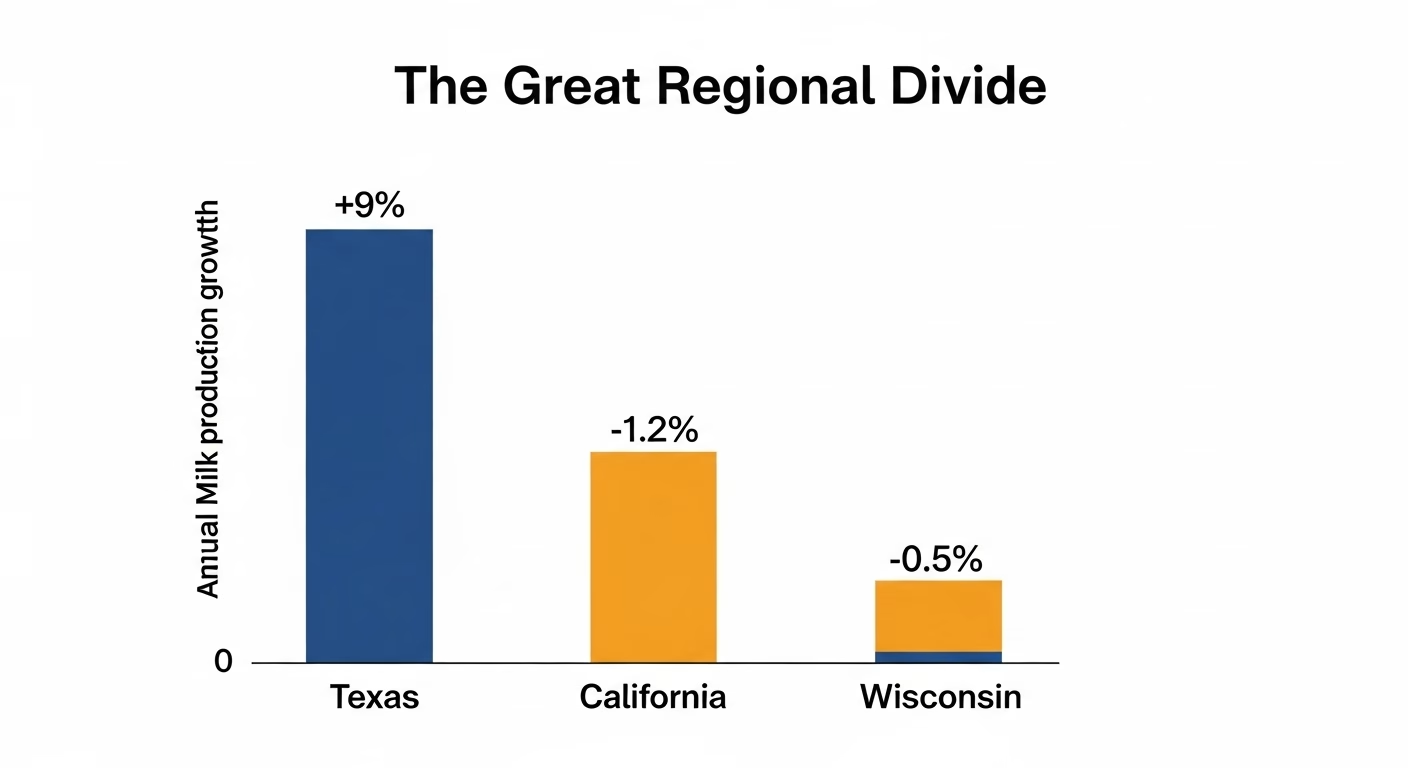
NewsSubscribe
First
Last
Consent

Your Milk Check Just Got Political: Why Trade Wars Are About to Hit Your Bank Account Harder Than Ever

The thing about global trade? It’s not happening “over there” anymore—it’s happening in your mailbox every single month, and most producers still don’t get it

dairy trade policy, farm profitability protection, milk price volatility, dairy export markets, agricultural risk management

EXECUTIVE SUMMARY: Look, I’ve been tracking this stuff for two decades, and here’s what’s keeping me up at night—most producers are treating trade policy like it’s someone else’s problem when it’s actually the biggest threat to their milk check they’ve never planned for. We’re shipping 18% of our production overseas worth $8.2 billion, which means every time China throws a tariff tantrum or Mexico changes import rules, it hits your bank account within weeks. That Wisconsin farmer I talked to? He’s watching his Class III futures like a hawk because he learned the hard way that a $2.33 per cwt swing from trade wars can cost a 500-cow operation about $65,000 annually. While everyone’s focused on feed efficiency and genomic gains, smart producers are already diversifying their processor relationships and positioning for the premium markets that’ll survive the next trade meltdown. You need to start treating trade policy like you treat your breeding program—as a core business strategy, not background noise.

KEY TAKEAWAYS

  • Know your export exposure by September 2025 — If 80% of your milk goes to one plant, you’re risking $27,000-$56,000 in potential income losses when trade disputes hit (ask your co-op about their market diversification before the 2026 planning cycle starts)
  • Quality premiums are your trade insurance — Organic certification started by December 2025 positions you for premium markets worth 15-20 cents extra per hundredweight; specialty products maintain pricing power even when commodity markets face 125% tariffs
  • Currency swings matter more than you think — A 10% dollar move can offset or amplify tariff impacts by 15-20 cents per cwt within months; some cooperatives now offer basic hedging tools to protect against exchange rate volatility
  • Feed efficiency still beats politics — While trade chaos rages, improving feed conversion by 0.1 kg dry matter per liter saves $0.35/cwt consistently; focus on what you can control while positioning for what you can’t
  • Information is your edge — Set up Google alerts for “dairy trade” and “agricultural tariffs” (takes 5 minutes); trade policy decisions now impact your bottom line faster than weather affects your feed costs

You know what’s been eating at me lately? I keep running into producers who got completely blindsided by trade policy changes they never saw coming. Just last week, I’m talking to this guy in Wisconsin—been milking for 30 years, solid operation, runs about 650 head. Never paid much attention to Washington politics, figured it was all background noise.

Now? He’s got tariff alerts on his phone like they’re weather warnings because they hit his milk check that hard. And honestly… it’s about time more producers started paying attention to this stuff.

Here’s what really gets me fired up about this whole mess—we’re shipping out roughly one-fifth of everything we produce these days. That’s massive when you think about it, and it still catches me off guard sometimes. According to recent data from the International Dairy Foods Association, we’re sending 18% of our total milk production overseas, worth about $8.2 billion annually. What’s particularly wild is how this export dependency has completely flipped the script on price discovery.

Think about it this way—when export markets sneeze, your milk price catches pneumonia. And right now? Some of these markets are flat-out in the ICU.

What’s Actually Happening Out There

The trade landscape has gotten… well, let’s just say it makes a fresh heifer look predictable. Just this past March, China slapped a 10% additional tariff on our dairy products starting March 10th—and man, the reaction was immediate. We’ve seen this movie before, though. Back in 2018, when tensions first escalated, our dairy exports to China dropped 43%, and Class III prices fell from $16.64 per hundredweight to $14.31 by year-end.

That’s real money walking out the barn door—we’re talking about roughly $2.33 per cwt that just… disappeared. For a 500-cow herd averaging 75 pounds per day, that’s about $65,000 less revenue annually. You can’t absorb that kind of hit without feeling it in your bones.

But here’s the thing, though—while we were losing ground in China, Mexico quietly became our absolute lifeline. According to CoBank’s latest analysis, bilateral trade with Mexico hit $2.47 billion last year, representing nearly 30% of everything we export. Mexico is now buying 4.5% of our total milk production. This relationship has been building since NAFTA, and it’s proven remarkably resilient.

What strikes me about this whole situation is how different regions are handling this shift. I was up in Minnesota a few months back, talking to guys whose plants were heavily focused on China for dry whey exports—they had to scramble fast. Some pivoted to cheese (which, honestly, given the plant investments, wasn’t easy), others found new Asian customers. Meanwhile, California operations with established Mexico relationships? They kept humming along like nothing happened.

The USMCA promised us better access to Canada… and here’s where things get really interesting. The US actually won a landmark USMCA dispute panel ruling in January 2022, finding that Canada was improperly restricting access to its market. But even after winning that case? Canadian market access remains limited. It’s bureaucratic protection disguised as administration—a persistent challenge that continues to frustrate exporters across the northern tier states.

The Direct Hit to Your Bottom Line—And It’s Getting Worse

What really gets my blood boiling is how directly this translates to farm-level economics. Recent modeling work from University of Wisconsin economist Charles Nicholson shows that significant tariff increases could reduce US dairy farm income by billions and milk prices by $0.80 to $1.20 per cwt, depending on the scenario. That’s not just numbers on a spreadsheet—that’s the difference between a decent year and struggling to make payments.

Now here’s the kicker—that’s roughly what separates breaking even from having breathing room for most operations. I keep hearing from producers in Pennsylvania, Ohio, even down in Virginia… they’re saying trade policy uncertainty is what keeps them staring at the ceiling at 3 AM instead of sleeping soundly.

Let me break this down in practical terms. If you’re running a 400-cow operation averaging 70 pounds per day, a $1.00 per cwt hit means you’re looking at roughly $102,000 less annual revenue. That’s… well, that’s your equipment payment, or your feed bill for two months, or your son’s college tuition.

The mechanism is pretty straightforward, but it’s brutal in its efficiency. Export markets have become the swing factor for milk pricing. Since 2005, more than 70% of our new skim production has been heading overseas. When export demand drops, we get domestic oversupply fast, and that shows up in your milk check within weeks, not months.

What strikes me about this whole situation is how vulnerable we’ve become without really thinking about it. We built this export dependency gradually… but when it unravels, it happens fast. And most producers don’t even realize how exposed they are until it’s too late.

Different Strategies, Different Outcomes

Here’s what’s fascinating about how different regions are handling this mess—and believe me, I’ve been watching this closely. Mexico’s success story really demonstrates what happens when trade relationships actually work. According to the latest USDA export data, Mexico purchased $2.47 billion in our dairy products last year, and we’ve grown from supplying 18% of their dairy imports in 1995 to 83% today. That’s sustained market access paying dividends over decades.
I was down in Texas a few months back, talking to guys who’ve been shipping cheese south for years. They’re not sweating the China situation nearly as much because they’ve got those established relationships. You can see it in their faces—they’re concerned, sure, but not panicked. Meanwhile, some Midwest operations that went all-in on Asian powder markets? They’re hurting, and it shows.

The EU’s taking a completely different approach—they’re going for premium positioning with their geographical indications strategy. Industry analysts note that European producers maintain premium pricing for specialty products even when commodity markets face pressure. Smart strategy, really… if you can’t compete on volume, compete on value.

What’s interesting is how this plays out at the farm level. European producers I’ve talked to aren’t necessarily more efficient than us—they’re just positioned differently. They’re getting paid for the story, for the origin, for the tradition. We’re getting paid for volume and efficiency.

But Canada? That’s the one that really gets under my skin. Even after winning that USMCA dispute panel ruling, their supply management system continues to limit meaningful market access through administrative barriers. Their quota allocation system requires 12-month market share calculations and different criteria based on who’s applying—it’s a maze designed to keep us out.

The Hidden Costs Nobody Talks About

What’s really eating into margins are these compliance costs that most producers never see directly. The facility registration requirements vary dramatically by market, and the paperwork alone can drive you crazy. I’ve talked to processors who have dedicated staff just to handle trade compliance—that’s overhead that wasn’t there 10 years ago.

These costs flow back to farmers through lower milk prices, even if you’re not directly exporting. Your cooperative or processor is dealing with this stuff, and it shows up in their cost structure… which means it shows up in your pay price. It’s death by a thousand cuts.

This trend is becoming more common across all our export markets—each one has its own hoops to jump through, its own bureaucratic maze to navigate. Even close trading partners need extensive negotiation just to simplify basic facility approvals. That’s overhead that ultimately comes out of everyone’s margins.

What This Means for Your Operation – And When You Need to Act

So what can you actually do about this? The producers who are navigating this successfully aren’t treating trade policy as something that happens to them—they’re managing it as a business variable. Let me give you some specific timelines and actions, because timing matters here…

First thing—know your processor’s export exposure by September 2025. If 80% of your milk is going to one plant, you need to understand their market mix before we get into the 2026 planning cycle. Here’s what to ask at your next board meeting or processor meeting:

  • What percentage of their production goes to which export markets?
  • Do they have long-term contracts or spot sales?
  • How are they hedging currency risk?
  • What’s their backup plan if major markets close?

This matters more than most producers realize, and it’s going to matter even more next year. I’m seeing some cooperatives starting to share more market intelligence with their members, finally. If yours isn’t, start asking pointed questions.

Step 2: Quality Systems Are Your Insurance Policy Second—quality systems are becoming your hedge, and the window’s closing fast. Higher-value products maintain pricing power even when commodity markets face trade pressure. Organic certification, specialty product streams, and functional ingredients create some insulation from trade volatility.

But here’s the thing—if you’re thinking about organic, you need to start the transition process by December 2025 to be positioned for the premium markets coming online in 2027. The three-year transition period means you’re looking at 2028 for full organic pricing if you start now.

Step 3: Information is Power Third—stay plugged into policy developments through multiple channels. I know it’s not fun reading trade policy updates, but these decisions directly impact your profitability. Set up Google alerts for “dairy trade” and “agricultural tariffs”—takes five minutes, could save you thousands.

Industry associations do a decent job, but you need to be paying attention to both domestic and international news. The Wall Street Journal, Reuters, even Bloomberg Agriculture—these aren’t just for traders anymore.

The Currency Wild Card—And Why It Matters More Than You Think

Here’s something that doesn’t get enough attention in the farm press—exchange rates can amplify or offset trade policy effects in ways that’ll make your head spin. Currency hedging is essentially locking in an exchange rate for a future transaction to protect against unfavorable currency swings. For a dairy exporter, this might mean securing today’s dollar-peso exchange rate for cheese shipments you’ll deliver to Mexico in six months.

What’s particularly noteworthy is how dairy price changes can actually impact exchange rates—it’s wild to watch. A strong dollar makes our exports less competitive, even without tariff changes. I’ve been tracking this since 2018, and currency swings can be worth 15-20 cents per hundredweight in either direction within a couple of months.

The scale of impact? A 10% currency move can completely offset or amplify a modest tariff change. Some of the bigger cooperatives are starting to offer basic hedging tools to their members… if yours doesn’t, that might be worth bringing up at the next board meeting.

Let me give you a practical example. Say you’re getting $18.50 per cwt for your milk today. If the dollar strengthens 10% against the peso, that Mexican cheese that was competitive at $18.50 might not be competitive at $19.50. Your processor either takes a margin hit or passes it back to you through a lower milk price.

Looking Ahead—What’s Coming Down the Pike

The WTO negotiations remain stuck on fundamental agricultural support issues that haven’t budged since I started covering this beat. Don’t expect multilateral solutions anytime soon—we’re looking at bilateral deals and regional agreements for the foreseeable future. That means more complexity, more uncertainty, more risk.

Climate policy integration is the emerging risk factor that’s got me really concerned. Environmental requirements are getting woven into trade agreements, potentially constraining production growth in major exporting regions. New compliance costs are coming… the question is how quickly and how much they’ll cost operations like yours.

But here’s what gives me hope—there’s still massive growth potential in global dairy markets, especially in Southeast Asia. That’s an opportunity for producers who position themselves strategically. Most US producers aren’t even thinking about these markets yet, which means there’s still a first-mover advantage available.

What’s particularly interesting is how technology is starting to play into this. Blockchain for supply chain transparency, IoT for quality tracking, AI for logistics optimization—these aren’t just buzzwords anymore. They’re becoming trade tools.

The Bottom Line—Where This Leaves You

Here’s what I keep coming back to after 20 years of covering this industry: trade policy isn’t background noise anymore. It’s a core business variable that requires active management, just like feed costs or breeding decisions. The math is pretty stark: producers who ignore this stuff are leaving money on the table, while those who engage are positioning themselves for opportunities.

The producers who recognize this are building resilience into their operations. I’m seeing farms that have diversified their processor relationships, invested in quality systems, and stayed informed about policy developments… they’re not just surviving this trade chaos, they’re finding ways to thrive.

Your milk check depends on decisions made in Washington, Beijing, and Brussels, but that doesn’t mean you’re powerless. Strategic positioning, quality focus, and staying informed about policy developments… these turn vulnerability into competitive advantage.

The question isn’t whether trade policy will keep disrupting dairy markets—it absolutely will. The question is whether you’re positioned to profit from the opportunities this creates while managing the risks through smart planning and diversification.

What strikes me most about successful operations I’ve visited recently is that they’re not waiting for trade policies to stabilize. They’re adapting to volatility as the new normal and building resilience into their business models. That’s the mindset that’s going to separate the winners from the survivors in this new trade environment.

And honestly? That’s exactly the kind of forward-thinking approach this industry needs right now. Because the alternative—hoping things go back to the way they were—just isn’t a business strategy anymore. The world’s changed, and we need to change with it.

The producers who get this… they’re going to be the ones still standing when this all shakes out.

Complete references and supporting documentation are available upon request by contacting the editorial team at editor@thebullvine.com.

Learn More:

Join the Revolution!

Join over 30,000 successful dairy professionals who rely on Bullvine Weekly for their competitive edge. Delivered directly to your inbox each week, our exclusive industry insights help you make smarter decisions while saving precious hours every week. Never miss critical updates on milk production trends, breakthrough technologies, and profit-boosting strategies that top producers are already implementing. Subscribe now to transform your dairy operation’s efficiency and profitability—your future success is just one click away.

NewsSubscribe
First
Last
Consent

No Amnesty for Ag Workers – Washington Just Threw a Wrench in Dairy Labor

51% of dairy workers produce 79% of our milk – but Washington just changed the rules. Your automation ROI just got a lot more interesting.

EXECUTIVE SUMMARY: You know that gut feeling you’ve had about your labor situation? Well, it just got validated in the worst way possible. Washington’s “no amnesty” stance isn’t just policy talk—it’s about to reshape how every dairy operation thinks about their workforce and technology investments. Here’s what caught my attention: robotic milking systems that used to pencil out over 4-5 years are now showing 24-month paybacks under current labor market conditions. We’re talking about 21% labor cost reductions while some operations are seeing 8.9% production growth in states that still have reliable labor access. The producers who are already documenting their workforce and running new automation numbers aren’t just planning for 2026—they’re positioning themselves to dominate their local markets while their neighbors scramble to find milkers. This isn’t about replacing good people… it’s about creating systems that can thrive regardless of what Washington decides next.

KEY TAKEAWAYS

  • Cut labor costs 21% with strategic automation – Robotic milking systems showing 24-month payback periods under current crisis conditions. Start documenting your recruitment costs, turnover expenses, and wage inflation now to run accurate ROI calculations.
  • Workforce retention beats replacement every time – Operations implementing comprehensive benefit packages (including housing assistance) report turnover rates below 5% versus industry averages of 40%. This translates to $89,000 in avoided losses for a 1,000-cow operation.
  • Regional advantages are widening fast – Texas dairy operations showing 8.9% annual production growth while traditional dairy states face declining output. With Class III at $18.82/cwt and feed costs at $285/ton, your zip code is becoming your destiny.
  • Document everything before you need it – Smart producers are formalizing HR processes and tracking worker histories now. When policy changes hit, the farms with proper documentation will have options while others face operational disruption.
  • Technology adoption requires people strategy – Activity monitoring systems generating 3:1 ROI, but only when you’ve got skilled staff who can interpret the data. Cross-training and systematic workforce development are showing better returns than many technology investments.
dairy labor shortage, robotic milking systems, dairy automation ROI, workforce retention strategies, dairy farm efficiency

You know what keeps me up at night lately? It’s not milk prices or feed costs, though those are gnawing at everyone. It’s this labor situation that’s about to reshape how we all do business.

The thing about Trump’s latest immigration stance is that it’s not just policy talk anymore. When the administration says “no amnesty” for ag workers while immigrant labor makes up 51% of our workforce but produces 79% of our milk… well, that’s your wake-up call right there. We’re talking about the backbone of American dairy production sitting in regulatory limbo.

What really gets me is how disconnected Washington seems from what’s happening in the milking parlor at 4 AM. But here’s the thing—we can’t wait for politicians to figure this out. The smart money is already moving, and if you’re not thinking three moves ahead, you’re going to get left behind.

The Backbone of the Industry: Immigrant labor represents just over half the dairy workforce but is responsible for a hugely disproportionate 79% of U.S. milk production, according to industry data.

The Policy Reality Check—And Why Your Morning Crew Matters More Than Ever

Agriculture Secretary Brooke Rollins dropped this gem in July: “34 million able-bodied adults in our Medicaid program” could fill farm jobs. I’ve been in this business long enough to know when someone’s never spent a morning in a dairy barn. Michael Marsh from the National Council of Agricultural Employers nailed it: “I just can’t imagine somebody from New York City wanting to take a job in upstate New York to milk a cow.”

That’s the disconnect we’re dealing with. Policy makers who think labor is interchangeable… like you can just swap out a skilled milker who knows your herd for someone who’s never seen a fresh cow.

The administration’s “temporary pass” program? Still completely undefined. Labor Secretary Lori Chavez-DeRemer announced a new Department of Labor agricultural office, but honestly, that’s bureaucratic speak for “we’re still figuring this out.” Try planning your 2026 budget with that kind of clarity.

Here’s what’s really happening, though, and this is where it gets interesting for those of us actually running operations…

The Numbers Game—And Why Geography Is Becoming Destiny

A Widening Gap: Annual Milk Production Growth (%). Recent data highlights a stark regional divide. States with more stable labor access like Texas are seeing significant growth, while traditional dairy states are feeling the pressure from workforce disruptions.

Let’s talk about what this means for your bottom line, because the regional differences are getting stark. Wisconsin’s sitting on 2,800 H-2A workers for seasonal work, but dairy? We’re locked out because the program only covers “temporary or seasonal” work. Try explaining that to a cow that needs milking 365 days a year.

The University of Wisconsin-Madison folks have documented that about 70% of Wisconsin’s dairy workforce comes from immigrant labor. That’s roughly 10,000 workers in Wisconsin alone. Now imagine what happens if enforcement ramps up…

I was just talking to a producer in Fond du Lac County who’s been milking 800 head for fifteen years. Same crew, same routine, same quality. He told me, “Andrew, I don’t know what I’d do if I lost even two of my key guys.” That’s the reality we’re dealing with.

California’s already feeling the squeeze. Despite pumping out 40.1 billion pounds annually, they’re seeing production slip while labor costs jump 4% year over year. With Class III averaging $18.82 per hundredweight—and that’s before you factor in this summer’s volatility—those margins are getting tight.

But here’s what’s fascinating: Texas is telling a completely different story—8.9% annual production growth because they can still access reliable labor. The competitive gap is widening, and your zip code is starting to matter more than your management skills.

The Automation Play—When $275,000 Starts Looking Like Insurance

So what do you do when your labor pool is sitting on political quicksand? The answer I’m seeing more and more is defensive automation.

Robotic milking systems that cost $150,000 to $275,000 per unit are now showing payback periods under two years. Two years! That’s unheard of under normal market conditions, but we’re not dealing with normal anymore, are we?

I was just out at a 500-cow operation in Lancaster County that installed their first two robots last spring. The owner—let’s call him Jim—told me something that stuck: “I didn’t buy these because I wanted to. I bought them because I had to.” His labor costs dropped 23% in the first year, but more importantly, he’s sleeping better at night.

Recent work from Cornell on automated milking shows labor costs dropping over 21% once you get the systems dialed in. But here’s the kicker—58% of adopters report higher milk production, while only 54% would actually recommend the technology. That tells you everything about the learning curve.

What’s particularly noteworthy is how these systems change your labor needs rather than eliminating them. Those activity monitoring systems that run about $150 per cow are showing 3:1 returns when you’ve got someone who actually knows how to read the data. The keyword there is “someone”—you still need skilled people, just different skills.

The Real Cost of Standing Still

Here’s where it gets uncomfortable for a lot of producers. Current financing isn’t exactly farmer-friendly—prime rates at 8.5% and equipment financing pushing 10-12% for qualified borrowers. That changes your payback calculations significantly.

But the cost of doing nothing? That’s where the numbers get scary. Recent research documented in Progressive Dairy shows that high-turnover operations are seeing 1.8% production drops, 1.7% higher calf mortality, and 1.6% more cow deaths. For a 1,000-cow operation, that’s roughly $89,000 in lost revenue… and that’s before you factor in quality penalties from elevated somatic cell counts.

I ran the numbers for a typical 500-cow operation considering robotic milking. Break-even at 24 months under current labor market conditions. If wage pressure eases—and honestly, when’s the last time you saw that happen?—it extends to 36 months. But that’s assuming you can find and keep good people.

The thing about automation failures, though… Progressive Dairy’s implementation studies show 15-20% failure rates within the first 18 months. Usually comes down to inadequate preparation or unrealistic expectations. This isn’t plug-and-play technology—it’s a complete operational shift.

What’s Actually Working—The Retention Success Stories

The producers who are crushing it right now aren’t just throwing money at robots. They’re getting strategic about their people.

I know a 650-cow operation in Sheboygan County that’s reporting 3% annual turnover. How? Comprehensive benefit packages include housing assistance. They built four modest houses on the property—nothing fancy, but clean, safe, and affordable. Their labor costs per cow are actually below the regional average because they’re not constantly training new people.

This development is fascinating—structured training programs documented in the Journal of Dairy Science show measurable improvements in both knowledge retention and actual performance metrics. But it requires real investment. We’re talking curriculum development, dedicated training time, and—this is crucial—making sure your existing crew buys into teaching newcomers.

The financial impact is quantifiable. Low-turnover operations avoid those production drops, quality issues, and constant recruitment costs. It’s becoming a competitive advantage that compounds over time.

Regional Realities—Why Your Neighbors Matter More Than Washington

What’s happening in the Upper Midwest versus the Southwest is like watching two different industries. Wisconsin and Minnesota producers are feeling the squeeze because they’ve been more dependent on immigrant labor without the policy flexibility that border states might have.

I was talking to a producer in New Mexico last month who told me, “We’ve always had to be more creative about labor.” Different regulatory environment, different labor pool, different strategies. But even they’re concerned about what happens if federal enforcement ramps up.

Feed costs are running about $285 per ton for quality hay across most regions—that’s up from $260 last year—but the labor availability gives certain areas a significant edge in total production costs. The most competitive operations are maintaining labor costs under $4 per hundredweight, but that benchmark is getting harder to hit.

Here’s what’s really interesting: the operations that are thriving aren’t necessarily the biggest or the most high-tech. They’re the ones that figured out how to create workforce stability in an unstable environment.

The Skills Evolution—What Tomorrow’s Dairy Workers Look Like

The New Dairy Professional: Technology isn’t replacing people; it’s changing the required skills. Successful modern dairies need tech-savvy team members who can interpret data to improve herd health, efficiency, and productivity.

The labor conversation is evolving beyond just finding bodies to move. Activity monitoring systems and precision feeding technology are creating demand for workers who can interpret data, rather than just following a routine.

I’ve been watching this trend for about three years now. The farms that are succeeding with technology adoption are the ones that invested in their people first. Cross-training, systematic development, creating advancement opportunities… it’s not just good management anymore, it’s a survival strategy.

What strikes me about the successful operations is how they’re treating their workforce as a competitive advantage rather than a cost center. One producer in Minnesota told me, “My cows are good, but my people are what make the difference.” That’s the mindset shift we need to see more of.

The Bottom Line—What You Actually Need to Do

Look, I’m not going to sugarcoat this. If you’re waiting for Washington to solve your labor problems, you’re going to be waiting a long time. Here’s what I’m seeing work:

Start documenting everything now. Worker histories, wage progression, training records, performance metrics. This isn’t just good HR—it’s positioning yourself for whatever policy changes come down the pike. The operations that can demonstrate their value to both workers and regulators will have options.

Run new automation numbers. Those ROI calculations from two years ago? Toss them. Current recruitment costs, turnover expenses, and wage inflation change everything. You might be surprised what pencils out now.

Invest in your people before you replace them. The farms that are winning aren’t just buying technology—they’re creating cultures where good people want to stay. That means competitive benefits, advancement opportunities, and treating your crew like the professionals they are.

Think regionally, not nationally. Your local labor market conditions matter more than whatever’s happening in Washington. Build relationships with other producers, share strategies, and create networks that can weather policy uncertainty.

This isn’t just about surviving policy changes—it’s about building operations that can thrive regardless of what happens in Washington. The farms that start positioning themselves now will be the ones still milking cows in 2030.

And honestly? That’s probably the way it should be. We can’t control Washington, but we can control how we respond to it. The question is: are you going to lead this transformation or get dragged along by it?

Complete references and supporting documentation are available upon request by contacting the editorial team at editor@thebullvine.com.

Learn More:

Join the Revolution!

Join over 30,000 successful dairy professionals who rely on Bullvine Weekly for their competitive edge. Delivered directly to your inbox each week, our exclusive industry insights help you make smarter decisions while saving precious hours every week. Never miss critical updates on milk production trends, breakthrough technologies, and profit-boosting strategies that top producers are already implementing. Subscribe now to transform your dairy operation’s efficiency and profitability—your future success is just one click away.

NewsSubscribe
First
Last
Consent

The ICE Raids That Nearly Broke American Dairy – And What Every Producer Needs to Know

79% of America’s milk comes from farms using immigrant labor—what happens when that workforce vanishes overnight?

EXECUTIVE SUMMARY:  You know that uncomfortable conversation we’ve all been avoiding at producer meetings? Well, it’s time we had it. The harsh reality is that our entire dairy industry sits on a workforce foundation that could crumble overnight—and most of us aren’t prepared for what comes next. We’re talking about 51% of our workforce potentially disappearing, which would trigger a $32 billion economic collapse and send milk prices soaring 90.4%. That’s not fear-mongering… that’s economic modeling from Texas A&M. While other countries are already adapting with automation and legal workforce programs, we’re still pretending this isn’t our problem. Your 500-cow operation could lose $6,850 daily if your crew doesn’t show up tomorrow—and the smart producers are already building their defense strategies. You need to read this analysis and start planning your workforce resilience program today.

KEY TAKEAWAYS

  • Automate before you have to — Robotic milking systems delivering 60% labor reduction with 18-24 month payback periods aren’t just defensive moves anymore, they’re competitive advantages that boost production 3-5 pounds per cow daily while maintaining SCC below 200,000 cells/mL
  • Legal compliance is cheap insurance — Spending $15,000-25,000 annually on immigration attorneys and I-9 audits beats facing $573-4,294 penalties per unauthorized worker, plus you sleep better knowing your operation won’t get shut down overnight
  • Regional risk varies dramatically — Wisconsin producers are fast-tracking automation while California operations face immediate enforcement pressure, meaning your strategic response depends entirely on understanding your local vulnerability and acting accordingly
  • Workforce diversification pays dividends — Operations implementing three-pronged approaches (automation + domestic recruitment + legal compliance) maintain competitive advantages when neighboring farms face labor shortages and compliance violations in today’s enforcement climate
dairy workforce crisis, robotic milking systems, dairy automation, farm labor shortage, dairy profitability

You ever wondered what keeps me up at night these days? It’s not the usual stuff—feed costs, milk prices, or even those fresh cows coming in heavy. It’s this scenario that we all know could happen, but don’t really want to talk about: what if our workforce just… vanished?

Let me paint you a picture that should honestly terrify every one of us. Imagine a sharp escalation in immigration enforcement targeting agricultural operations across key dairy states. I’m talking Vermont, New Mexico, Wisconsin—places where we know the reality of who’s actually doing the work. According to recent economic modeling, such events could trigger a near-collapse of our industry, valued at $32 billion. That’s not a typo.

This scenario exposes what we all know but rarely discuss openly at PDPW or World Dairy Expo—our industry’s heavy reliance on immigrant labor, and how quickly everything could come undone.

What Happens When Enforcement Gets Real

The thing about immigration raids is… they don’t just hit the farm that gets targeted. Picture this: a major enforcement action in Vermont, where eight workers are detained during a routine morning milking. Sound familiar? PBS NewsHour has documented similar scenarios that illustrate how quickly these situations can escalate.

But here’s where it gets scary for your bottom line. Imagine a dairy in New Mexico—maybe running 800 head, decent butterfat numbers, solid milk quality premiums—suddenly losing 35 workers overnight. They go from 55 employees to just 20. That’s a 64% workforce hit.

How do you maintain three times the milk production with that kind of crew loss? You don’t. Simple as that.

What’s really troubling (and I’m hearing this from producers everywhere) is the ripple effect. Recent work from UC Davis agricultural economists shows that fear of raids can cause 25-45% of agricultural workers in affected regions just to stop showing up. We’re not talking about direct hits here—we’re talking about entire dairy corridors where workers decide the risk isn’t worth it.

Consider your own setup for a moment. Are you running 500 head averaging 75 pounds? That workforce uncertainty translates to a potential $8,775 daily revenue exposure at current milk prices around $23.40/cwt. That’s real money walking out of your parlor when your crew doesn’t show up because they’re spooked.

What strikes me as particularly concerning is how fast the word travels through these communities. One raid hits Vermont, and suddenly dairies in California’s Central Valley are dealing with no-shows. It’s like watching dominoes fall, except each domino is someone’s livelihood.

The Economics That Should Wake Us All Up

Here’s where the numbers get really sobering—and I’ve been diving deep into this data since the latest Texas A&M economic analysis came out. Immigrant workers comprise 51% of the dairy workforce nationwide. But get this—farms employing immigrant labor produce 79% of America’s milk supply.

When you model out what happens if enforcement eliminates this workforce, the projections are frankly terrifying. We’re looking at a 2.1 million cow herd reduction, losing 48.4 billion pounds of milk production, and—I kid you not—a 90.4% spike in retail milk prices.

Can you imagine trying to explain to consumers why milk suddenly costs $7 a gallon? The political fallout alone would be catastrophic.

The total economic damage amounts to $32.1 billion, resulting in over 200,000 jobs lost throughout the entire supply chain. That’s not just us—that’s feed mills, equipment dealers, truckers, processors, the whole ecosystem we depend on.

Beverly Idsinga from Dairy Producers of New Mexico really nailed it when she told reporters, “You can’t pause cows. They require milking twice daily and feeding twice daily.” It’s that simple and that complicated at the same time.

For those of us running typical 500-cow operations, labor now represents about 18% of total expenses—up from just 13% back in 2011-2012. With annual turnover costs reaching $25,753 at current industry rates, workforce instability is no longer just inconvenient… it’s becoming our single biggest operational risk.

What really drives this home is examining the latest USDA farm labor survey data, which shows average dairy wages at $19.11 per hour. But here’s the kicker—availability trumps wages every single time when you’ve got fresh cows that need milking and SCC counts to maintain.

Are we really prepared for this level of disruption? I’m not sure we are.

When Policy Uncertainty Meets Business Reality

Here’s the thing, though—and this is where it gets really frustrating from a business planning perspective—we’re operating in this regulatory environment where enforcement policies can shift overnight. Recent Reuters reporting highlights how quickly enforcement priorities can shift, leaving us all to plan for the unknown.

Matt Teagarden from the Kansas Livestock Association put it perfectly: “Those pushing raids targeting farms lack understanding of farm operations. We can use imported workers, or we can import our food.” That’s the choice we’re facing, folks.

This uncertainty is severely hindering our ability to make informed long-term investment decisions. When you’re looking at robotic milking systems that cost $200,000 per unit with 18-24 month payback periods, regulatory stability becomes crucial for your ROI calculations. How do you justify that capital expenditure when you don’t know what enforcement will look like next month?

What’s particularly noteworthy is how different regions are handling this uncertainty. Wisconsin producers are fast-tracking automation investments they might have stretched out over the years, while some California operations are actually expanding, knowing their competitors might face enforcement challenges.

The regional variation in this whole thing is fascinating, albeit concerning. Some areas are adapting quickly, others are just hoping it passes them by.

Automation Rush—or Survival Strategy?

What’s happening with technology adoption right now is unlike anything I’ve seen in my years covering this industry. Take Wisconsin, where Wisconsin Watch found about 10,000 undocumented workers performing roughly 70% of dairy farm labor. Producers there are fast-tracking automation investments that would normally be spread over the years.

The numbers on automated milking systems are getting really compelling—and I mean really compelling. Current robotic installations are delivering 3-5 pounds of additional milk per cow daily through optimized milking frequency and better data management. For a 500-cow operation, that translates to roughly $455,000 in additional annual revenue at current pricing.

However, what really caught my attention is that these systems reduce direct milking labor by 60% while improving consistency in those somatic cell counts that we all obsess over. We’re consistently achieving sub-200,000 cells/mL, which translates to premium-quality payments month after month.

Are you seeing this trend in your area yet? We’re also watching complementary technologies gain serious traction: automated feeding systems, which run $50,000-100,000, robotic scrapers, which cost around $30,000, and environmental monitoring systems, which fall within the $10,000-20,000 range. It’s creating these integrated approaches to workforce reduction that wouldn’t have been economically justified just a few years ago.

The reality check, though? Implementation still requires approximately six months of training, and ongoing technical support will be necessary for maintenance and oversight. But given the alternative of potentially losing your entire milking crew overnight… well, the math starts looking pretty attractive.

What strikes me as particularly interesting is how this is playing out differently across regions. Large-scale California operations with 2,000+ head have the capital flexibility to automate quickly, while smaller Northeast farms are getting squeezed between high technology costs and workforce vulnerability. It’s creating this two-tier system that honestly worries me.

Compliance—The New Cost of Doing Business

The compliance side of this equation has become incredibly complex, and frankly, it’s becoming a major cost center for operations of all sizes. Industry experts are advocating for comprehensive I-9 audits, E-Verify implementation, and emergency protocols as a baseline level of protection. But the costs… they’re adding up fast.

Legal counsel retention for immigration specialists costs $15,000-$ 25,000 annually for medium-sized operations. That might sound like a lot (and it’s), but when you consider the potential penalties of $573-$ 4,294 per unauthorized worker, it’s essentially insurance you can’t afford not to have.

I know producers who’ve been through I-9 audits—the stress alone is worth the legal protection. One guy in Wisconsin told me the sleepless nights during the audit process were worse than calving season.

What’s particularly challenging is that research shows 46-70% of dairy workers are undocumented, so compliance programs have to balance workforce retention with legal exposure. Document verification protocols only require “genuine appearance” standards; however, sophisticated false documentation often defeats most employer detection efforts anyway.

The practical reality? You need emergency protocols, including legal representation on retainer, employment record protection, and education on worker rights. Building relationships with local law enforcement before they are needed is becoming a standard practice in dairy regions nationwide.

What’s really interesting is seeing how different states are approaching this. Some California producers are receiving support from state-level programs, while Midwest operations are largely developing their own compliance strategies. The disparity is striking.

What This Means for Your Operation—Today

Let me be direct about something that’s becoming crystal clear across the industry… whether you employ immigrant workers directly or not, workforce disruption in dairy affects your profitability. Period.

If you’re tied to processors, suppliers, or regional milk marketing that relies on immigrant labor, this instability affects your operation in ways you may not yet realize. Your co-op’s milk procurement, your feed supplier’s delivery schedule, your processor’s capacity—it’s all interconnected.

The successful producers I’m talking to across the country are taking three-pronged approaches: workforce diversification through automation and domestic recruitment, comprehensive legal compliance to minimize enforcement risk, and supply chain resilience to weather regional disruptions.

What’s particularly noteworthy—and this is happening faster than I expected—is that operations that adapt fastest to these realities maintain competitive advantages when their neighbors face labor shortages and compliance violations. It’s actually creating market opportunities for those who plan ahead.

But don’t think this is just about policy changes. We’re watching fundamental shifts in how dairy operations are structured and managed. The farms that emerge stronger from potential enforcement periods will be those that use current conditions as catalysts for long-term improvements in efficiency and risk management.

What really concerns me is the regional variation in how this is playing out. Some areas are adapting quickly to technology and compliance, while others are hoping that enforcement will pass them by. That’s not a sustainable strategy… and we all know it.

Bottom Line: What Every Producer Needs to Do Right Now

Workforce vulnerability is an operational risk, not just a political issue. Even operations with entirely domestic workforces face market disruption when enforcement hits competitors and suppliers. Your milk marketing agreements, processor relationships, and feed suppliers all depend on workforce stability throughout the supply chain.

Automation investments offer crisis-justified returns. Robotic milking systems, which offer a 60% labor reduction and an 18-24 month payback period, provide both defensive protection and strategic advantages, improving labor flexibility and production efficiency. The technology has reached a tipping point where it makes sense even without crisis pressure.

Legal compliance is essential for business insurance. Immigration attorney retainers, comprehensive I-9 audits, and emergency protocols represent necessary operational protection. The cost of compliance is significantly less than the cost of violations or workforce loss, and the peace of mind alone is worth it.

Regional market dynamics are shifting in real time. Producers in enforcement-heavy regions are accelerating technology adoption while others gain temporary competitive advantages. Understanding your regional risk profile is crucial for strategic planning. Don’t get caught flat-footed.

This scenario analysis demonstrates that market forces ultimately prevail over political ideology when industry survival is at stake. But potential temporary protections shouldn’t encourage complacency—they should motivate preparation for possible future enforcement surges.

The dairy industry faces a potential wake-up call about workforce dependency that can’t be ignored. The question isn’t whether enforcement might affect your operation—it’s how prepared you’ll be if it does.

Complete references and supporting documentation are available upon request by contacting the editorial team at editor@thebullvine.com.

Learn More:

Join the Revolution!

Join over 30,000 successful dairy professionals who rely on Bullvine Weekly for their competitive edge. Delivered directly to your inbox each week, our exclusive industry insights help you make smarter decisions while saving precious hours every week. Never miss critical updates on milk production trends, breakthrough technologies, and profit-boosting strategies that top producers are already implementing. Subscribe now to transform your dairy operation’s efficiency and profitability—your future success is just one click away.

NewsSubscribe
First
Last
Consent

How This Farm Security Shakeup Could Actually Change Your Dairy Operation

What happens when your dairy depends on suppliers you can’t legally use anymore?

 dairy farm security, dairy supply chain, dairy compliance costs, dairy genetics partnerships, dairy profitability

Everyone is talking about Trump’s new farm security plan, but most people are missing the bigger picture here. Sure, the headlines are all about Chinese-owned cropland near military bases, but a story is unfolding that will impact dairy operations in ways we haven’t fully grasped yet.

The Thing About Policy Changes… They Always Have Unintended Consequences

So Agriculture Secretary Brooke Rollins rolled out this National Farm Security Action Plan on July 8th, and honestly? It’s more comprehensive than anything we’ve seen in agricultural security. What strikes me isn’t just the foreign farmland angle—though that’s getting all the press—it’s how this ripples through the technology partnerships, genetic sourcing, and even the feed supplier relationships that modern dairy operations absolutely depend on.

“We feed the world. We lead the world. And we’ll never let foreign adversaries control our land, our labs, or our livelihoods,” Rollins declared. Strong words, but here’s what’s really interesting… this isn’t just about land anymore. Industry geneticists are already raising questions about how these policies might affect genetic evaluation services and international breeding partnerships.

The plan targets seven areas, but three should have every progressive dairy producer paying attention: protecting agricultural research and innovation, enhancing supply chain resilience, and—this one’s huge—putting “America First” in every USDA program. That last point? It’s way broader than most people realize.

Why Your Butterfat Numbers Might Actually Be at Risk

Let me put this in perspective with some numbers that actually matter. Currently, foreign entities control approximately 45 million acres of U.S. agricultural land—that’s roughly 3.5% of all privately held farmland. China’s slice? Just 277,336 acres, which sounds small until you realize where some of that land is located and what companies it controls.

But here’s where it gets interesting for dairy folks… the real concern isn’t just about acreage. It’s about market concentration. Take Smithfield Foods, which has been owned by China’s WH Group since 2013, controlling approximately 25% of U.S. pork production. That $4.7 billion acquisition fundamentally changed the livestock landscape, and dairy economists have been tracking similar patterns in our sector.

Dr. Mary Hendrickson from the University of Missouri has conducted extensive research on agricultural market concentration, and her work suggests that enhanced regulatory scrutiny will likely impact international partnerships across the agricultural sector, from genetics companies to feed suppliers.

Consider your current operation for a moment. How many of your key suppliers have international ownership? Your milking system manufacturer? The company providing your genomic testing? Even some of those specialized feed additives that help optimize your butterfat and protein numbers? More than you might think, probably.

The Numbers That Should Keep You Up at Night

Here’s what really caught my eye in the data… with Class III averaging $18.82 per hundredweight in June, margins are tight enough that any supply chain disruption hits hard. Feed costs account for 50-60% of production expenses for most operations, and when dealing with international suppliers for critical inputs, policy changes like this create real operational risk.

What’s particularly noteworthy is how quickly enforcement ramped up. The USDA has increased penalties for foreign investment disclosure violations to 25% of the fair market value—that’s a 2,400% increase from the previous 1% assessment. This isn’t just a symbolic policy… they’re serious about compliance.

Dairy nutrition experts have long emphasized that when you’re pushing fresh cows for peak milk production, the consistency and quality of specialized feed additives becomes critical. Any disruption in supply chains doesn’t just affect costs… it affects production curves and overall herd performance.

And the biosecurity angle? That’s getting real attention, too. Just last month, the DOJ charged Chinese nationals with smuggling Fusarium graminearum—a fungus that can devastate grain crops. While that primarily affects corn and other feed grains, it highlights the vulnerability of our feed security. When you’re milking cows for 80+ pounds of milk daily, feed quality and consistency aren’t just important —they’re everything.

What’s Actually Changing on the Ground

The enforcement issue is that it’s becoming a personal matter. Rollins now sits on the Committee on Foreign Investment in the United States (CFIUS), which means that agricultural concerns receive equal weight alongside financial security reviews. The USDA also launched an online portal for reporting suspected violations, encouraging anonymous submissions.

Here’s what this means practically: if you’re working with international genetics companies, precision ag technology providers, or even specialized nutrition consultants, expect more paperwork. Due diligence requirements are expanding, and compliance costs are going up.

Industry professionals are already reporting delays in equipment installations and additional documentation requirements for international partnerships. Some operations are experiencing extended timelines for technology upgrades involving companies with international ownership, while others are seeing new requirements for genetic evaluation services that involve international data sharing.

The National Milk Producers Federation has already expressed concerns about unintended consequences, particularly around dairy cooperatives’ international partnerships. And they should be worried… some of our most innovative genetic evaluation tools and breeding technologies come from companies with complex international ownership structures.

The Genetics Game is About to Get More Complex

Here’s where things get really interesting for progressive dairy breeders. Many of our most advanced genomic evaluation tools rely on international databases and computational resources. If those partnerships face regulatory constraints, it could potentially slow genetic progress in U.S. dairy herds.

Consider this: Alta Genetics, CRI, and several other major players in the dairy genetics sector have international partnerships or ownership structures that could be subject to enhanced scrutiny. If your breeding program relies on genomic evaluations that incorporate international data, you may want to consider contingency plans.

Agricultural economists specializing in dairy genetics note that the industry has become increasingly globalized, with breeding data and genetic material flowing across international borders to optimize herd improvement programs. Any restrictions on these partnerships could affect the pace of genetic advancement in U.S. dairy herds.

Regional Realities Are Already Shifting

I’ve been speaking with producers across various regions, and the implementation patterns are fascinating. In the Upper Midwest, where we’ve tight integration with Canadian feed suppliers and some European genetics companies, producers are adapting differently than those in the Southwest, who have been dealing with more diverse international partnerships.

Industry reports suggest that producers are already beginning to diversify their supplier networks as a precautionary measure. Some operations are exploring domestic alternatives for feed additives and other inputs, while others are reassessing their international partnerships to ensure compliance with evolving regulations.

In California’s Central Valley, where water restrictions have driven interest in precision feeding technologies, several operations are reportedly holding off on new system installations until they receive clarity on the regulatory landscape. This could potentially delay efficiency improvements that typically provide significant returns per cow annually.

Here’s what’s interesting, though… this might not be entirely bad news. Enhanced scrutiny could benefit smaller, domestic suppliers who’ve been competing against international companies with deeper pockets. The administration’s emphasis on domestic production suggests potential opportunities for American suppliers to expand market share.

The Compliance Reality Check

Let’s talk about what this actually means for your operation. Foreign investors must now report agricultural land transactions within 90 days, with new penalties of 25% hanging over any violations. However, the reporting requirements extend beyond land purchases to include research partnerships, technology licensing, and certain consulting arrangements.

Agricultural economists tracking compliance costs in dairy operations estimate that farms with international partners may incur increased administrative expenses, depending on the complexity of their relationships. The exact costs will vary significantly based on the scope and nature of international partnerships.

But there’s also the contingency planning aspect… the plan establishes protocols for supply chain disruptions that could actually strengthen domestic supplier networks over time. In regions like the Upper Midwest, where winter feed costs can spike dramatically, having more domestic supplier options might improve price stability.

What Smart Producers Are Already Doing

From what I’m seeing across the industry, the most successful operations are taking a proactive approach. They’re auditing current supplier relationships, documenting international partnerships, and developing contingency plans for potential disruptions.

Industry consultants recommend that operations map out all their international supplier relationships, from equipment manufacturers to feed additive suppliers. Many producers are discovering that a significant percentage of their critical inputs have an international component they hadn’t previously considered.

The most forward-thinking operations are also strengthening relationships with domestic genetics companies and feed suppliers. This isn’t about abandoning international partnerships that work well… it’s about building resilience into your supply chain.

Regional Considerations You Need to Know

What’s particularly fascinating is how this plays out differently across regions. In the Northeast, where many operations depend on Canadian feed ingredients, the policy emphasis on “non-adversarial partners” suggests those relationships should remain stable. Canada controls 32% of foreign-held agricultural land, but they’re clearly not the target here.

In the Southwest, where some operations have partnerships with Mexican feed suppliers or processing facilities, the situation might be more complex. The policy framework doesn’t specifically address Mexico, but enhanced scrutiny could affect cross-border agricultural relationships.

The Great Lakes region presents unique challenges because of the concentration of international agricultural technology companies. Many precision agriculture tools, genetic evaluation systems, and even some specialized veterinary products originate from companies with European or international ownership.

Agricultural researchers tracking these regional patterns note differential impacts based on historical supplier relationships. Operations with diversified supplier networks appear to be adapting more easily than those with concentrated international partnerships.

The Economics of Adaptation

Here’s where the rubber meets the road: adaptation costs. Based on conversations with producers and industry consultants, compliance and adaptation expenses are varying significantly depending on the size and complexity of international relationships.

But here’s the interesting part—some of these changes might actually provide economic benefits. Industry reports suggest that some operations switching from international suppliers to domestic alternatives are finding comparable or even improved cost structures, with the regulatory pressure simply accelerating switches that made economic sense anyway.

The operations facing the biggest challenges are those with highly specialized international partnerships—think custom genetics programs or precision agriculture systems that require ongoing international support. These relationships are more challenging to replicate domestically and more expensive to maintain under heightened scrutiny.

The Bottom Line: Prepare Now, Adapt Later

Here’s what I think this really means for progressive dairy producers… we’re entering a period where supply chain diversification isn’t just good business practice—it’s becoming a compliance necessity. The operations that thrive will be those that proactively adapt to this new regulatory environment while maintaining access to the best genetics, technology, and inputs available.

This development is fascinating from a market structure perspective. We’re potentially looking at a fundamental shift in how agricultural inputs are sourced and how international partnerships are structured. For dairy operations, success means navigating increased scrutiny on international partnerships while capitalizing on enhanced support for domestic innovation.

The smart play? Start now with relationship diversification and compliance documentation. Don’t wait for enforcement actions to force your hand. The operations that get ahead of this regulatory curve will have more options and better negotiating positions as the landscape continues to evolve.

And honestly? Given how concentrated some agricultural input markets have become, a little more domestic competition might not be such a bad thing for producer margins in the long run. The question is whether the transition costs and potential disruptions are worth the long-term benefits. This is something each operation will need to evaluate based on its specific circumstances and risk tolerance.

What’s clear is that this isn’t just policy noise. This represents a fundamental shift in how agricultural assets are viewed from a national security perspective, and dairy operations must be prepared to adapt accordingly.

KEY TAKEAWAYS

  • Compliance costs are spiking fast – Farms with international partnerships could see $5,000-15,000 in additional admin expenses annually. Start documenting all your foreign supplier relationships now, especially genetics companies and feed additive sources.
  • Feed security vulnerabilities are real – With 50-60% of production costs tied to feed, any disruption hits hard. Map out domestic alternatives for critical inputs like specialized yeast cultures and precision nutrition additives while prices are still competitive.
  • Genomic partnerships face scrutiny – International breeding databases and computational resources could get restricted. Strengthen relationships with domestic genetics companies now before regulatory pressure forces rushed decisions.
  • Supply chain diversification pays – Some operations switching to domestic suppliers are finding 10-15% cost savings with comparable performance. Use this regulatory shift to negotiate better deals with American suppliers who want your business.

EXECUTIVE SUMMARY

Look, I’ve been tracking this farm security story, and here’s what most folks are missing… the real threat isn’t Chinese farmland—it’s the international partnerships your operation depends on every single day. With Class III at $18.82/cwt and feed costs eating up 50-60% of your budget, you can’t afford supply chain disruptions. The feds just cranked penalties up 2,400% for foreign investment violations, and that’s hitting everything from your milking robots to your genomic evaluations. Operations that diversify their supplier networks now are positioning themselves for better margins when domestic competition heats up. You need to audit your international partnerships before they audit you.

Complete references and supporting documentation are available upon request by contacting the editorial team at editor@thebullvine.com.

Learn More:

Join the Revolution!

Join over 30,000 successful dairy professionals who rely on Bullvine Weekly for their competitive edge. Delivered directly to your inbox each week, our exclusive industry insights help you make smarter decisions while saving precious hours every week. Never miss critical updates on milk production trends, breakthrough technologies, and profit-boosting strategies that top producers are already implementing. Subscribe now to transform your dairy operation’s efficiency and profitability—your future success is just one click away.

NewsSubscribe
First
Last
Consent

Here’s the Hard Truth About Labor Reform: Why the Farm Workforce Modernization Act Could Finally Fix Your Biggest Headache

Stop bleeding $4,425 per worker replacement, FWMA could slash your 38.8% turnover rate while your neighbors keep hemorrhaging labor costs.

EXECUTIVE SUMMARY: While most dairy producers are still pretending the labor crisis will magically fix itself, smart operators are preparing for the Farm Workforce Modernization Act, the only viable solution to your biggest operational nightmare. The harsh reality: you’re hemorrhaging $4,425 every time you replace a worker, and with 38.8% annual turnover rates plaguing the industry, that’s bleeding serious cash from operations already squeezed by $21.95/cwt milk prices. Here’s what the agriculture lobby won’t tell you: immigrant workers constitute 51% of your workforce and produce 79% of America’s milk supply, making workforce stability your most critical operational metric, not your latest robotic milking system. The FWMA’s year-round H-2A visa access and 3.25% wage cap could transform your $150,000-$275,000 automation ROI from 2 years to 4-10 years, fundamentally changing your technology investment strategy. While international competitors in Canada and New Zealand have solved their agricultural labor challenges through comprehensive reform, U.S. dairy continues to operate with broken immigration policies that guarantee workforce instability. The question isn’t whether you need this reform, it’s whether you’re prepared to capitalize on legal workforce stability while your competitors keep burning cash on endless recruitment cycles.

KEY TAKEAWAYS

  • Workforce Cost Reality Check: Labor represents 14% of total cash expenses and 38.8% annual turnover rates are costing progressive dairies $4,425 per replacement, money that could fund genomic testing programs, improve feed conversion ratios, or invest in precision agriculture technology that actually moves your milk yield metrics forward.
  • Technology Investment Recalibration: Robotic milking systems ($150,000-$275,000 per unit) show 2-year payback periods under current labor crisis conditions, but FWMA workforce stability could extend ROI timelines to 4-10 years, forcing you to recalculate whether automation or legal labor access delivers better returns on your butterfat and protein optimization goals.
  • Production Dependency Truth: 51% immigrant workforce produces 79% of America’s 227.8 billion pounds of projected 2025 milk production, making workforce legalization more critical to your somatic cell count consistency and component quality than your latest feed management software or breeding program innovations.
  • Competitive Positioning Advantage: FWMA’s year-round H-2A visa access and 3.25% wage caps provide cost predictability that could free up capital for genomic selection programs, precision feeding systems, or facility improvements that directly impact your milk yield per cow and feed conversion efficiency metrics.
  • Strategic Implementation Timeline: Document your current workforce legal status, calculate real turnover costs including lost production during training periods, and prepare for mandatory E-Verify compliance, because farms that proactively position for FWMA implementation will capture competitive advantages while neighbors scramble to adapt to new labor market realities.
dairy labor shortage, farm workforce modernization, dairy profitability, milk production costs, dairy industry trends

The Farm Workforce Modernization Act isn’t just another piece of legislation gathering dust in Washington. It’s the first real shot at solving the labor crisis that’s been bleeding your operation dry. With 38.8% annual turnover rates and 5,000 unfilled dairy positions nationwide, we’re past the point of pretending this will fix itself.

Here’s what nobody’s telling you: this bill could fundamentally change how you staff your operation, but only if you understand what’s really at stake.

The Numbers Don’t Lie – Your Labor Crisis is Getting Worse

Let’s face it – your labor situation is a mess, and it’s costing you more than you think. Labor eats up 14% of your total cash expenses, making it your second-largest cost after feed. That’s not pocket change when you’re dealing with milk prices forecast at $21.95 per hundredweight for 2025.

But here’s the kicker: immigrant workers constitute 51% of the total dairy workforce and produce 79% of America’s milk supply. In western states, this dependency reaches 90% of dairy workers being foreign-born, with about 85% originating from Mexico. You can complain about it, or you can face reality – your operation depends on this workforce whether you admit it or not.

“Labor costs are about 14% of dairy’s total cash expenses,” confirms Stan Moore with Michigan State University Dairy Extension. When you’re managing 9.42 million dairy cows producing a projected 227.8 billion pounds of milk in 2025, workforce stability isn’t just important – it’s essential for survival.

Why Current Immigration Policy is Designed to Fail You

The current H-2A guest worker program is useless for dairy operations, and Congress knows it. The program is legally limited to “temporary or seasonal” work, which means exactly nothing when you need to milk cows twice a day, 365 days a year.

This isn’t an oversight – it’s a fundamental design flaw that’s left dairy producers scrambling for solutions that don’t exist under current law.

FWMA: The First Immigration Bill That Actually Gets Dairy

The Farm Workforce Modernization Act does something revolutionary: it acknowledges that dairy farming isn’t seasonal. The bill provides access to 20,000 year-round H-2A visas annually, with dairy guaranteed at least half.

But here’s what makes this different from every other failed reform attempt:

Three-Part Framework That Actually Works:

  • Certified Agricultural Worker (CAW) status for experienced undocumented workers already on your farm
  • Year-round H-2A visa access specifically designed for dairy operations
  • Mandatory E-Verify implementation only after legal pathways are established

“The Farm Workforce Modernization Act stabilizes the workforce, which will protect the future of our farms and our food supply,” states Congressman Dan Newhouse, who co-leads the legislation.

What This Means for Your Bottom Line

Stop thinking about this as an immigration issue – start thinking about it as a business solution. The bill caps Adverse Effect Wage Rate increases at 3.25% annually, giving you cost predictability you’ve never had.

Real Impact on Your Operation:

  • Workforce Stability: Legal status reduces the 38.8% turnover rate that’s costing you thousands in recruitment
  • Technology Decisions: Stable labor could extend payback periods for robotic milking systems from 2 years to 4-10 years, changing your automation calculus
  • Production Consistency: 58% of farmers with automatic milking systems report milk production increases, but only with consistent, trained operators

The Technology Reality Check Nobody’s Discussing

Here’s something the automation evangelists won’t tell you: even with the most advanced robotic systems, you still need skilled workers. Robotic milking systems cost $150,000 to $275,000 per unit, and their success depends entirely on proper management and maintenance.

The FWMA doesn’t eliminate your need for technology – it gives you the workforce stability to make smart technology investments instead of panic purchases driven by labor shortages.

Regional Winners and Losers in the New Labor Landscape

The data reveals a harsh truth: states with favorable labor conditions are winning while traditional dairy regions struggle. Kansas produced 382 million pounds of milk in April 2025, up from 343 million a year prior, while California saw 1.8% declines despite maintaining herd sizes.

You can’t compete if you can’t staff your operation consistently.

Why the Status Quo is Killing Your Operation

Let’s be brutally honest about what’s happening right now. Every month you operate with high turnover, you’re losing money in ways that don’t show up on your P&L:

  • Delayed health monitoring leads to higher somatic cell counts
  • Inconsistent milking procedures reduce component quality
  • Training costs multiply with every new hire
  • Stress and burnout affect your entire management team

“Labor shortage is a big challenge,” confirms Jon Slutsky, owner of La Luna Dairy in Colorado. “Although we are doing better for the moment, we are frequently at least one employee short”.

What You Need to Do Right Now

Stop waiting for perfect solutions. The FWMA isn’t perfect, but it’s the most viable path forward you’ll see in your career. Here’s your action plan:

  1. Document your current workforce: Know exactly who you employ and their legal status
  2. Calculate your real turnover costs: Include recruitment, training, and lost productivity
  3. Engage with industry advocacy: Support NMPF and other organizations pushing for passage
  4. Plan for implementation: Prepare for E-Verify requirements and legal compliance

Bottom Line: Your Future Depends on This

The dairy industry’s workforce crisis isn’t getting better – it’s getting worse. The FWMA represents the most comprehensive legislative approach to addressing dairy labor shortages in decades.

“We thank Representatives Lofgren and Newhouse for reintroducing their bipartisan Farm Workforce Modernization Act. Ag workforce reform has been a top priority for America’s dairy farmers and farmworkers for decades,” states Jim Mulhern, President and CEO of NMPF.

You have two choices: continue bleeding money through endless turnover and recruitment costs, or support the only viable legislative solution on the table.

The reality is simple: with immigrant workers producing 79% of America’s milk supply and turnover rates approaching 40%, the status quo is unsustainable. The FWMA offers legal workforce stability that could fundamentally reshape your labor management strategy.

Your operation’s future stability depends on comprehensive immigration reform that bridges the gap between enforcement policies and agricultural labor realities. The question isn’t whether you need this reform – it’s whether you’re willing to fight for it before it’s too late.

Complete references and supporting documentation are available upon request by contacting the editorial team at editor@thebullvine.com.

Learn More:

Join the Revolution!

Join over 30,000 successful dairy professionals who rely on Bullvine Weekly for their competitive edge. Delivered directly to your inbox each week, our exclusive industry insights help you make smarter decisions while saving precious hours every week. Never miss critical updates on milk production trends, breakthrough technologies, and profit-boosting strategies that top producers are already implementing. Subscribe now to transform your dairy operation’s efficiency and profitability—your future success is just one click away.

NewsSubscribe
First
Last
Consent

Washington Just Handed Dairy Farmers a $68 Billion Gift, But Here’s Why Most Won’t Unwrap It Properly

Washington handed dairy farmers $68B, but 80% won’t use it. Smart genomic testing + DMC coverage = $4,000 annual savings per 280-cow operation.

EXECUTIVE SUMMARY: Most dairy producers are about to waste the biggest policy gift in a decade while their smarter competitors capitalize on enhanced risk management combined with record component production. The “One Big Beautiful Bill” delivers $68.3 billion in agricultural program changes that fundamentally restructures dairy risk management, increasing Tier I DMC coverage from 5 million to 6 million pounds annually, yet based on historical uptake patterns, most operations will leave money on the table. Component levels have reached unprecedented highs with butterfat averaging 4.33% and protein at 3.36% in March 2025, representing 30.2% butterfat growth and 23.6% protein growth since 2011 while milk volume increased only 15.9%. European Union milk production is declining 0.2% in 2025 while U.S. operations benefit from enhanced DMC protection at just $0.15 per hundredweight for $9.50 coverage, creating unprecedented competitive advantages for producers who combine genetic advancement with strategic risk management. The question isn’t whether this policy works, it’s whether you’ll implement it before your competitors figure out the genomics-plus-government-support equation that’s reshaping dairy profitability.

KEY TAKEAWAYS

  • Enhanced DMC Coverage Delivers Immediate ROI: Operations producing up to 6 million pounds annually can now insure entire production at Tier I rates, potentially saving $3,000-4,000 annually in premium costs while gaining comprehensive $9.50 per hundredweight margin protection, yet only 19% of large-scale farms have adopted robotic milking systems despite proven economic returns.
  • Component Revolution Outpaces Volume Strategy: Butterfat production surged 30.2% since 2011 versus 15.9% milk volume growth, with genomic testing enabling 12% higher milk solids and 8% lower feed costs. Every 0.1% butterfat increase adds $6,570 monthly to a 1,000-cow operation when butterfat commands $3.06 per pound, yet most producers still chase volume over value.
  • Technology Adoption Gap Creates Competitive Moats: While global precision dairy farming markets exceed $5 billion in 2025, USDA reports only 19% adoption of robotic milking on large-scale farms. Forward-thinking operations combining enhanced DMC protection with automated milking systems achieve 150-240 cow efficiency per 3-4 robotic units, creating sustainable advantages over traditional competitors.
  • Global Market Positioning Window Closing: U.S. operations benefit from $8 billion in new dairy processing capacity through 2027 while EU production declines 0.2%, but 2025 DMC enrollment deadline passed March 31. Producers must audit genomic testing programs, evaluate technology investments, and prepare for 2026 enrollment to capitalize on component premiums and enhanced risk management before international competitors adapt.
  • Feed Cost Arbitrage Opportunity: With corn at $4.60 per bushel and enhanced DMC coverage protecting downside risk, smart operators can lock favorable feed contracts while leveraging updated 2021-2023 production baselines that reflect modern genetic gains. This combination of enhanced risk management plus strategic feed positioning creates unprecedented profit protection during volatile market conditions.

The U.S. Senate just passed the most significant dairy policy overhaul in a decade, and frankly, most of you won’t take advantage of it. The “One Big Beautiful Bill” includes $68.3 billion in agricultural program changes over 10 years that fundamentally restructure risk management for dairy operations nationwide. However, if history is any indication, too many producers will likely leave money on the table.

Here’s the reality: Washington doesn’t often get dairy policy right, but when it does, smart operators capitalize, while others complain about the paperwork. The enhanced Dairy Margin Coverage (DMC) program, launched in 2025, offers benefits that could fundamentally improve your operation’s financial resilience, provided you’re willing to challenge conventional thinking about government programs.

Why This DMC Enhancement Actually Matters (Unlike Previous Attempts)

Let’s cut through the political noise. The legislation expands DMC coverage capacity by 20%, increasing the Tier I production cap from 5 million to 6 million pounds annually. This isn’t just bureaucratic shuffling, it means operations with up to 300 cows can now insure their entire production at premium rates while accessing maximum protection levels of $9.50 per hundredweight.

However, here’s what most won’t tell you: this enhancement emerged during an unprecedented period of genetic progress. U.S. dairy operations have achieved four consecutive years of record butterfat levels, reaching a national average of 4.23% in 2024. Protein content has similarly climbed to 3.29% in 2024, marking eight consecutive annual records from 2016 to 2024.

What This Means for You: A 280-cow Wisconsin operation producing 5.8 million pounds annually can now insure their entire production at Tier I rates, potentially saving $3,000-4,000 annually in premium costs while gaining comprehensive margin protection. With current milk production forecasts reaching 227.8 billion pounds for 2025, these enhanced protections couldn’t come at a better time.

The updated production baselines represent the second game-changer. Producers can now select their highest annual milk production from 2021, 2022, or 2023 as their new coverage foundation. This addresses the reality that modern genetics and precision feeding have driven dramatic productivity gains, yet most operations still use outdated baselines that don’t reflect their actual potential.

The Component Revolution That’s Reshaping Everything

Here’s where it gets interesting. While everyone obsesses over herd size, the real money is in milk composition. The industry’s adoption of genomic testing has transformed breeding decisions, with butterfat levels increasing from 3.70% to 4.40% over the past 20 years, while protein levels have risen from 3.06% to 3.40%.

Industry Example: Recent analysis confirms that genomic testing and precision nutrition deliver up to 12% higher milk solids and 8% lower feed costs. Every 0.1% increase in butterfat can add $6,570 monthly to a 1,000-cow herd’s bottom line when butterfat commands $3.06 per pound and protein reaches $2.32 per pound.

The numbers don’t lie, and they’re jaw-dropping. From 2011 to 2024, milk production increased 15.9% while protein climbed 23.6% and butterfat increased 30.2%. This isn’t a temporary blip, but the culmination of a decades-long genetic revolution that has fundamentally transformed what comes out of our cows.

Yet here’s the contradiction nobody discusses: while component levels surge to record highs, many operations still prioritize volume over value. The enhanced DMC program rewards precision, not just production.

Technology Integration: Where Smart Money Goes

The agricultural bill’s benefits coincide with the rapid adoption of precision dairy technologies, but most operations aren’t leveraging the synergies. The global precision dairy farming market is projected to exceed $5 billion by 2025; however, the USDA reports that only 19% of large-scale farms have adopted robotic milking systems, despite their proven returns.

Automated milking systems demonstrate proven economic returns, with research confirming that AMS operations achieve comparable performance to conventional systems while typically milking 150-240 cows with 3-4 robotic units. The USDA reported robotic milking adoption on 19% of large-scale dairy farms, creating massive competitive advantages for early adopters who combine enhanced DMC protection with technological efficiency gains.

Modern high-producing operations now achieve remarkable metrics, with dry matter intake exceeding 68 pounds daily while producing over 120 pounds of energy-corrected milk. These efficiency gains, combined with enhanced DMC protection, position forward-thinking operations for sustained profitability while competitors struggle with outdated approaches.

The Transparency Initiative Nobody Saw Coming

For the first time in dairy policy history, the legislation mandates biennial surveys of processor manufacturing costs, directly addressing pricing formulas that have remained static while processing technology and costs have evolved.

Current Federal Milk Marketing Order pricing changes took effect June 1, 2025, including updated make allowances for cheese ($0.2519), dry whey ($0.2668), butter ($0.2272), and nonfat dry milk ($0.2393). These adjustments will reshape milk pricing formulas by ensuring that the make allowance calculations reflect actual processing costs rather than outdated estimates.

The national average somatic cell count now sits at 181,000 cells per milliliter, representing the lowest recorded level in decades. This reflects improved management practices and genetic selection, yet many operations haven’t capitalized on quality premiums that could dwarf traditional volume-based thinking.

Global Competitive Reality Check

While U.S. operations benefit from enhanced risk management, global competitors face constraints. European Union milk production is forecast to decline by 0.2% in 2025 due to environmental regulations, while global milk production is expected to grow by only 1.0% to 992.7 million tonnes.

U.S. operations benefit from favorable feed costs and expanding processing capacity. This competitive advantage, combined with enhanced risk management, enables U.S. producers to capture growing global demand while competitors contract.

Here’s the kicker: Over half of the increased global production is anticipated to come from India and Pakistan, which will jointly account for more than 32% of world production by 2032. U.S. technology adoption and genetic advancement create sustainable competitive moats that enhanced DMC protection helps preserve.

Implementation Strategy: What Winners Do Differently

The legislation extends critical dairy programs through 2029-2031, providing unprecedented long-term certainty. For 2025 coverage, DMC enrollment ran from January 29 to March 31, 2025.

Smart operators who enrolled by the March 31, 2025, deadline are:

  • Leveraging updated production baselines that reflect recent genetic gains from 2021-2023 data
  • Integrating genomic testing programs to maximize component production and quality premiums
  • Preparing for FMMO pricing changes that reshape milk pricing through transparent cost accounting

The premium structure remains unchanged: catastrophic coverage at $4 comes with no premium, while the highest level of $9.50 costs just 15 cents per hundredweight. At $0.15 per hundredweight for $9.50 coverage, Dairy Margin Coverage is a cost-effective tool for managing risk and providing security for your operations.

The Contrarian Perspective Nobody Wants to Hear

Here’s the uncomfortable truth: enhanced government support might actually encourage complacency instead of innovation. The most successful operations use risk management tools as safety nets, not business strategies.

Question for your operation: Will enhanced DMC coverage become a crutch that prevents necessary operational improvements, or will it provide the security needed to invest in transformative technologies?

The legislation’s broader SNAP reduction components create market contradictions. While Washington encourages production expansion through enhanced support, they’re simultaneously creating potential domestic demand pressures. Smart operators diversify into export markets and value-added products rather than betting everything on domestic fluid milk.

The Latest: Your Strategic Assessment for Mid-2025

The “One Big Beautiful Bill’s” $68.3 billion in agricultural program changes deliver transformative benefits to dairy producers through enhanced DMC coverage, now active for those who enrolled by the March 31, 2025, deadline. As we hit mid-2025, the industry achieves record component production and technological advancement while benefiting from enhanced risk management protection.

Your current strategic opportunities:

  1. Audit your genomic testing program and component selection criteria to capitalize on record component premiums
  2. Evaluate technology investments that complement enhanced risk management protection
  3. Prepare for ongoing FMMO transparency changes that continue to reshape milk pricing formulas
  4. Plan for 2026 DMC enrollment when the next enrollment period opens (typically January-March)

The bottom line: This legislation positions U.S. dairy operations for expanded production capacity while global competitors contract. The combination of enhanced risk management, record component production, and proven technology adoption creates the strongest financial foundation for U.S. dairy operations in over a decade.

But here’s what separates winners from whiners: Enhanced DMC coverage won’t save poorly managed operations or replace sound business fundamentals. It will, however, provide exceptional downside protection for producers who are smart enough to leverage genetic advancements, component optimization, and technological efficiency.

“We encourage producers to join the many dairy operations that have already signed up for this important safety net program,” emphasized USDA Farm Service Agency officials. “At $0.15 per hundredweight for $9.50 coverage, risk protection through Dairy Margin Coverage is a cost-effective tool to manage risk and provide security for your operations.”

The question isn’t whether Washington got dairy policy right for once, it’s whether you capitalized on their rare moment of clarity. Those who missed the 2025 deadline learned an expensive lesson about timing. Don’t let that be you when 2026 enrollment opens. The genetic revolution in component production is accelerating, technology adoption rates are climbing, and enhanced risk management tools have proven effective; the pieces are aligned for unprecedented dairy industry success if you’re positioned to capitalize on it.

Complete references and supporting documentation are available upon request by contacting the editorial team at editor@thebullvine.com.

Learn More:

Join the Revolution!

Join over 30,000 successful dairy professionals who rely on Bullvine Weekly for their competitive edge. Delivered directly to your inbox each week, our exclusive industry insights help you make smarter decisions while saving precious hours every week. Never miss critical updates on milk production trends, breakthrough technologies, and profit-boosting strategies that top producers are already implementing. Subscribe now to transform your dairy operation’s efficiency and profitability—your future success is just one click away.

NewsSubscribe
First
Last
Consent

Critical Research Exposes Dairy Labor Crisis as Policy Uncertainty Threatens Industry Stability

Your dairy’s 38.8% turnover rate is costing 1.8% milk yield while robots deliver 60% labor savings—time to automate or evacuate.

EXECUTIVE SUMMARY: Stop treating your 38.8% annual labor turnover as “normal” when it’s literally killing your milk production and profitability. Research confirms that high employee turnover triggers a devastating 1.8% decrease in milk production, 1.7% increase in calf loss, and 1.6% spike in cow death rates—yet most dairies still view workforce instability as an unavoidable cost of doing business. With immigrant workers comprising 51% of the dairy workforce and producing 79% of U.S. milk, policy uncertainty threatens a potential 90% milk price spike if enforcement disrupts operations. Smart operators are responding with strategic automation: the global milking robot market expanded from $2.98 billion to $3.39 billion in 2025 alone, delivering labor time reductions from 5.2 to 2 hours daily while maintaining 24,185 pounds of milk per cow annually. While geographic winners like Kansas (+11.4% production) and Texas (+10.6%) capitalize on favorable labor economics, traditional dairy states face a competitive disadvantage from wage differentials reaching $5.14 per hour between regions. The future belongs to operations that master both workforce retention strategies and automation adoption, because waiting for Washington to solve your labor crisis isn’t a business plan, it’s a bankruptcy strategy.

KEY TAKEAWAYS

  • Labor Turnover is Production Poison: Every percentage point of turnover above optimal levels costs operations measurable losses in milk yield (1.8% decrease), calf survival (1.7% increase in losses), and cow mortality (1.6% increase)—making workforce stability a biological imperative, not just an operational preference.
  • Automation ROI Accelerating: Robotic milking systems reduce daily management time from 5.2 to 2 hours while the global market growth of 14% annually signals crisis-driven adoption—early implementers report labor cost reductions of 15-20% with breakeven periods shrinking to 5-7 years.
  • Geographic Arbitrage Opportunity: Regional production shifts reflect labor cost advantages, with Plains states (Kansas +11.4%, Texas +10.6%) crushing traditional dairy regions through strategic positioning—operations in high-wage states must achieve 24,000+ pounds per cow annually or face competitive obsolescence.
  • Policy Uncertainty Demands Self-Reliance: Trump’s undefined “temporary pass” program creates strategic paralysis when 51% immigrant workforce produces 79% of U.S. milk; profitable operations are building workforce strategies that withstand political volatility rather than banking on government solutions.
  • Component Quality Premium Capture: With a 2025 milk production forecast at 227.3 billion pounds and butterfat emphasis reaching 31.8% in breeding indexes, operations optimizing components while reducing labor dependency through automation position for maximum profitability in volatile markets.
dairy labor shortage, robotic milking systems, dairy automation, dairy farm efficiency, dairy workforce management

Let’s cut through the noise: Your dairy operation is sitting on a labor time bomb, and President Trump’s proposed “temporary pass” program just lit the fuse. A new comprehensive analysis reveals that the U.S. dairy industry faces a structural labor crisis so severe that policy disruptions could trigger a 90% spike in milk prices and force the closure of over 7,000 dairy farms. But here’s what the industry doesn’t want you to know: this isn’t just another policy debate. This is about survival.

The brutal reality? Your operation’s future depends on workers you likely can’t legally employ, and the proposed solution might make things worse, not better. With the national dairy herd reaching 9.43 million head in April 2025, up 89,000 from April 2024, and milk production in the 24 major states totaling 19.1 billion pounds in May 2025, up 1.7% year-over-year, we’re producing more milk than ever while standing on the shakiest workforce foundation in decades.

Production Metrics Under Pressure: When Record Yields Meet Labor Quicksand

Here’s the uncomfortable truth your industry associations won’t tell you: We’re celebrating record productivity while our workforce foundation crumbles beneath us. Milk production per cow averaged 24,117 pounds annually in 2023, up 29% from 2003, with production per cow forecast at 24,155 pounds for 2025. Texas led regional growth with milk production surging 10.6%, while Kansas posted an 11.4% increase and South Dakota expanded 9.2%.

But ask yourself this: What good are these record yields when you can’t find workers to harvest them?

The dependency numbers are staggering. Immigrant workers comprise 51% of the entire U.S. dairy workforce, and farms employing immigrant labor account for 79% of the nation’s milk supply. Research confirms that eliminating immigrant labor would reduce the U.S. dairy herd by 2.1 million cows and milk production by almost 50 billion pounds, resulting in a 7,000 decrease in the number of dairy farms.

What This Means for Your Operation: If you’re achieving below 24,000 pounds per cow annually, you’re doubly vulnerable. You lack both the efficiency margins to absorb wage pressures AND the workforce stability to maintain consistent output. Your survival depends on fixing at least one of these problems, fast.

The Turnover Time Bomb: Why Your Labor Costs Are Killing Your Margins

Here’s a statistic that should keep you awake at night: The average turnover rate for surveyed dairies was 38.8%. While this is lower than the national private sector average of 47.1%, it’s still devastating when considering that high employee turnover has been linked to a 1.8% decrease in milk production, a 1.7% increase in calf loss, and a 1.6% increase in cow mortality rates.

Do the math on what turnover is actually costing you. Labor contributes up to 10-15% of the cost to produce milk, making it the second largest expense on your dairy. Every percentage point of turnover costs money you probably can’t afford. Some progressive organizations have reduced turnover from 7% to less than 1% through strategic employee housing programs, demonstrating that effective workforce management delivers measurable returns.

Are you treating labor like a cost center or recognizing it as your most critical investment? Research from multiple dairies shows that stockmanship training alone can increase milk production by 810 kg (1,782 pounds) per lactation. Yet most farms still view training as an expense rather than a profit driver.

What This Means for Your Operation: Stop viewing high turnover as “normal” in dairy. Operations achieving turnover rates below 10% through strategic investments in housing, training, and workforce development are capturing significant competitive advantages while you’re bleeding money on recruitment and retraining.

Regional Production Shifts: The Great Dairy Migration Is Real

While you’ve been debating policy, smart money has been voting with its hooves. The numbers don’t lie about which regions are winning and losing this labor war.

States in the Plains and South are crushing traditional dairy regions. Kansas posted a remarkable 11.4% increase in milk production, while Texas grew 10.6% and South Dakota expanded 9.2%. In contrast, California production contracted 1.8%, and Wisconsin, often referred to as America’s Dairyland, managed only 0.1% growth.

Why is this happening? Labor economics, plain and simple. New York’s AEWR increased to $18.83 per hour, up $1.03 from 2024, while Michigan, Wisconsin, and Minnesota saw rates decline to $18.15, down 35 cents per hour. California maintains one of the highest rates at $19.97 per hour, creating massive competitive disadvantages.

The uncomfortable question nobody’s asking: If labor costs are driving production away from traditional dairy states, what happens when immigration enforcement intensifies? Are you positioned in a winning region, or are you clinging to a sinking ship?

What This Means for Your Operation: Geography is destiny in the new dairy economy. Operations in high-wage states must either achieve significantly higher productivity per worker or accelerate the adoption of automation. There’s no middle ground.

Technology Integration: Why Robots Are Your New Best Employees

Here’s the reality check the equipment dealers won’t give you: Automation isn’t a luxury upgrade anymore, it’s a survival tool. The global milking robot market is experiencing significant growth, projected to increase from $2.98 billion in 2024 to $3.39 billion in 2025, with an annual growth rate of 14.0%.

But are you moving fast enough? Survey data reveals that two-thirds of dairies now use at least one form of feeding technology, with health monitoring collars and ear tags being the most common. Robotic milking systems adoption has been growing at about 25 percent a year and has particularly “taken off” during the past decade.

The economics are compelling: Each robotic milker can handle 60 cows and costs roughly $200,000, but what’s the cost of losing your entire workforce overnight to an ICE raid? Labor savings alone from robotic systems range from 10% to 29%, with time spent on milking management dropping from 5.2 to 2 hours per day on average.

What’s your excuse for not installing robots? Cost? Research shows that 77% of farms using robotic milking indicated labor time savings as a reason for adoption. The lowest-cost milking parlor systems equate to $0.25 to $1 per hundredweight in milking costs, compared to $2 to $3 per hundredweight with robots; however, robots deliver predictability when labor becomes unreliable.

What This Means for Your Operation: Time spent debating automation ROI is time your competitors are using to install systems. Early automation adopters are reporting significant competitive advantages, with some farms achieving breakeven in 5 to 7 years through optimized management.

Economic Impact: The $53.5 Billion Reality Check

Let’s talk numbers that matter to your bottom line. The March 2025 all-milk price averaged $22.00 per cwt, up $1.30 year-over-year. The 2025 all-milk price forecast has been revised upward to $22.75 per cwt, but these prices assume workforce stability that doesn’t exist.

Labor dependency creates massive economic vulnerability. The USDA’s 2025 forecast anticipates a 3.6% increase in agricultural labor costs, reaching a record $53.5 billion. Estimates suggest that nearly half of the agricultural workforce lacks legal authorization, making entire regions vulnerable to immigration enforcement.

The math is brutal: The average turnover rate for U.S. dairies is 38.8%, resulting in farms incurring thousands of dollars in recruitment and training costs. About 90% of dairy workers in the western U.S. are foreign-born, with about 85% of the total coming from Mexico, creating a single point of failure for most operations.

Are you prepared for labor costs that continue to rise? Labor expenses were up 7.3% compared to 2020 across all farms, with dairy ranking second highest in impact after specialty crops.

What This Means for Your Operation: Every percentage point of turnover costs money you probably can’t afford. Labor instability isn’t just an operational headache, it’s a profit killer that’s getting worse, not better.

Policy Uncertainty: Trump’s “Temporary Pass” Creates Strategic Paralysis

Here’s what President Trump’s farmworker permit proposal really means for your operation: Nothing. And everything. The proposal would allow experienced immigrant workers to remain on farms legally and pay taxes; however, critical details regarding application procedures, eligibility criteria, and the implementation timeline remain undefined.

Trump told Fox News: “We’re working on it right now. We’re going to work it so that some kind of a temporary pass,  where people pay taxes, where the farmer can have a little control as opposed to you walk in and take everybody away”. The program would target workers who have been on farms for “15 and 20 years” and who “possibly came in incorrectly”.

But here’s the problem: How do you make investment decisions when your workforce’s legal status depends on a policy that exists only in sound bites? Should you build H-2A compliant housing or invest in robotic milking systems? The uncertainty itself has become a massive cost.

Why isn’t the industry demanding concrete details? The National Milk Producers Federation has lobbied for years to improve dairy industry access to the H-2A program, which remains limited to seasonal work and excludes year-round dairy operations. This “temporary pass” could be their breakthrough, or another false promise.

What This Means for Your Operation: Stop waiting for Washington to solve your labor problems. Make decisions based on what you can control, not on political promises that may never materialize.

Expert Analysis: No Single Solution to Structural Crisis

Let’s be honest about what the experts are really saying. Labor shortages and rising costs aren’t temporary challenges; they’re the new normal. The pool of workers from traditional immigrant source countries is anticipated to shrink due to declining birth rates and improving economic opportunities in those countries.

The demographic cliff is real: The average age of foreign-born farmworkers has increased significantly (from 36 to 42 years for U.S.-born farm employees), creating a workforce that’s aging out with no replacement pipeline. Domestic labor retention remains a challenge, with historical data indicating that only 0.1% of Americans stay for full agricultural seasons.

Research confirms what you already know: Employee turnover has been linked to a 1.8% decrease in milk production, a 1.7% increase in calf loss, and a 1.6% increase in cow death rates. Your labor instability is literally killing your livestock’s profitability.

What This Means for Your Operation: High turnover isn’t just expensive, it’s deadly to animal performance. Investing in workforce stability yields biological dividends that are reflected in every milk check.

The Latest: Crisis Demands Immediate Strategic Response

Here’s what the research confirms that your industry doesn’t want to admit: No single policy solution will resolve the dairy labor crisis. Trump’s “temporary pass” proposal represents more political theater than coherent policy, creating additional uncertainty rather than providing operational relief.

The brutal facts for dairy operators:

  • Labor disruptions threaten record productivity gains achieved through genetic advancement and management improvements
  • Current wage volatility makes long-term planning nearly impossible without comprehensive risk management strategies
  • Strategic investment in both human capital and automation technology has become essential for operational survival

But here’s the opportunity hidden in the crisis: Early automation adopters are reporting significant competitive advantages, with some farms achieving breakeven in 5-7 years through optimized management. Feeding automation alone can save around 112 minutes per day on a 120-cow farm compared to traditional methods.

Are you building for the future or clinging to the past? The USDA is allocating up to $7.7 billion for climate-smart practices and conservation efforts on farms in 2025, providing accessible funding for dairy producers to invest in both workforce development and automation.

What This Means for Your Operation: The future belongs to farms that stop complaining about the labor crisis and start solving it. Develop dual-track strategies that combine competitive employment practices with accelerated technology adoption. The dairy operations dominating by 2030 won’t be those who solved the labor shortage; they’ll be the ones who made it irrelevant.

As immigration policy debates rage on, ask yourself this critical question: Is your operation building workforce strategies that can withstand political volatility while positioning for long-term competitiveness? In an increasingly automated global market, where milk production is forecasted to reach 227.3 billion pounds by 2025, productivity and efficiency determine who survives and who becomes a cautionary tale.

The choice is yours. But the clock is ticking.

Complete references and supporting documentation are available upon request by contacting the editorial team at editor@thebullvine.com.

Learn More:

Join the Revolution!

Join over 30,000 successful dairy professionals who rely on Bullvine Weekly for their competitive edge. Delivered directly to your inbox each week, our exclusive industry insights help you make smarter decisions while saving precious hours every week. Never miss critical updates on milk production trends, breakthrough technologies, and profit-boosting strategies that top producers are already implementing. Subscribe now to transform your dairy operation’s efficiency and profitability—your future success is just one click away.

NewsSubscribe
First
Last
Consent

Trade War Reality Check: How North America’s $1.18 Billion Dairy Dependency Just Got Brutally Exposed

Export dependency isn’t prosperity—it’s vulnerability. $1.18B Canadian trade at risk. Smart producers build anti-fragile operations instead.

Executive Summary: The dairy industry’s sacred cow of “export growth equals prosperity” just got slaughtered, and North American producers are about to pay the price in blood. With US-Canada trade talks collapsed and $1.18 billion in annual dairy exports hanging in the balance, the brutal mathematics of trade dependency are delivering a $1.70 per hundredweight reality check that could crater farm-level profitability across two nations. Research from Texas Tech University confirms USMCA boosted export values 34% since 2020, but Canada’s masterful TRQ manipulation achieved only 42% quota fill rates—proving market access on paper means nothing without genuine commercial access. While politicians wage economic warfare, smart producers are learning from New Zealand’s component-focused model and the EU’s institutional crisis response to build operations that gain strength from market disruption rather than break under pressure. The 2026 USMCA review is guaranteed to target dairy again, making the window for building truly resilient operations critically narrow. Stop waiting for politicians to solve trade wars and start building operations that thrive on uncertainty—your farm’s survival depends on how you answer that strategic challenge today.

Key Takeaways

  • Component Optimization Beats Volume Dependency: New Zealand’s milk solids payment system proves profitability comes from value, not volume—US butterfat production surged 82 million pounds (3.4%) in Q1 2025 alone, with Iowa averaging 4.44% butterfat delivering $1.3 billion to processors.
  • Technology-Driven Risk Management Delivers Immediate ROI: Precision feeding systems reduce costs 7-12% while improving production, with every pound of feed saved returning 11 cents per cow per lactation—enough for 1,000-cow operations to save $55,000 annually and weather most trade volatility.
  • Diversification Strategy Reduces Political Vulnerability: Mexico represents America’s #1 dairy customer, not Canada—operations reducing trade dependency below 30% of revenue demonstrate measurably higher resilience during policy disruptions.
  • Financial Risk Management Isn’t Optional Anymore: DMC coverage at $9.50 margin costs only $0.155 per cwt but provides essential protection when margins collapse—the 2018-2020 trade war required $25.7 billion in federal bailouts that covered lost revenue but couldn’t restore permanently damaged customer relationships.
  • Five-Point Trade Resilience Audit Reveals Hidden Vulnerabilities: Operations completing revenue concentration analysis, input dependency assessment, financial risk coverage audit, component optimization evaluation, and market diversification planning position themselves to gain competitive advantage while competitors struggle with dependencies they should have addressed years ago.
dairy trade dependency, dairy export risks, farm operational resilience, dairy profitability strategies, precision dairy management

What happens when the world’s longest undefended border becomes a dairy battleground? You’re about to find out—and the $1.18 billion in annual US dairy exports to Canada hanging in the balance is just the beginning of this economic carnage that could slash milk prices by $1.70 per hundredweight and permanently reshape continental dairy economics.

The gloves are off. Trade talks between the US and Canada have officially collapsed, and North American dairy farmers are staring down the barrel of a full-scale trade war that threatens to destroy decades of integrated supply chain relationships. While politicians play chess with farmer livelihoods, the brutal mathematics of trade dependency are about to deliver a masterclass in why building your business strategy around political cooperation is the fastest route to bankruptcy.

Here’s the uncomfortable truth most industry publications won’t tell you: This crisis isn’t just about politics or tariffs. It’s about an entire industry that built its growth strategy on a foundation of sand—and that foundation just cracked wide open, exposing vulnerabilities that could crater farm-level profitability across two nations.

Challenging the Sacred Cow: Why Export Dependency is Dairy’s Biggest Strategic Blunder

Let’s challenge a fundamental assumption that has driven North American dairy strategy for decades: the belief that export growth automatically equals farm prosperity. This conventional wisdom has led US producers to chase volume-based export deals while ignoring the catastrophic risks of customer concentration.

The Brutal Mathematics of Dependency

Canada represents the second-largest export market for US dairy, absorbing $1.18 billion worth of American dairy products in 2024 alone. That’s not just trade volume—that’s the equivalent of processing 5.6 billion pounds of milk annually, or roughly what 265,000 high-producing cows generate annually.

But here’s where conventional thinking fails spectacularly: Industry leaders celebrate these export figures as “market success” without acknowledging the devastating vulnerability they create. When your second-largest customer can disappear overnight due to political posturing, you haven’t built a sustainable business model—you’ve constructed an economic house of cards.

Why This Conventional Approach is Wrong

The EU learned this lesson the hard way in 2014 when Russia imposed food embargoes that instantly eliminated markets absorbing 33% of EU cheese and 28% of butter exports. The difference? European policymakers had institutional crisis response mechanisms ready. North American dairy has reactive bailout programs that arrive after the damage is done.

Research confirms that trade policy disruptions could reduce US milk prices by up to $1.90 per hundredweight, with Class III milk potentially declining by $2.86 per hundredweight under retaliatory tariff scenarios. For perspective, a 1,000-cow operation producing 80 pounds per cow daily would face annual revenue losses approaching $50,000—enough to finance critical infrastructure improvements or weather multiple market downturns.

The USMCA Deception: A Masterclass in Diplomatic Theater

You want to know why this trade war was inevitable? Because the USMCA was a masterpiece of diplomatic theater that solved exactly nothing while creating the illusion of market access progress.

The Promise Versus Reality Gap

On paper, the USMCA delivered spectacular gains for US dairy: expanded Tariff-Rate Quotas across 14 dairy categories, theoretical access to 3.6% of Canada’s protected market, and elimination of controversial Class 6 and 7 pricing systems. The US dairy industry celebrated what appeared to be a breakthrough worth hundreds of millions in new export opportunities.

Research from Texas Tech University confirms that USMCA boosted the value of US dairy exports to Canada by a verified 34% since 2020. But here’s the brutal catch nobody talks about: volume growth without price realization is just expensive market share buying.

Canada’s Administrative Genius

Canada’s response was brilliant in its bureaucratic sophistication: allocate the vast majority of import quota licenses to Canadian dairy processors with zero commercial incentive to import finished US products that compete with their brands. It’s like giving all the feed purchasing contracts to ethanol plants and then acting surprised when nobody buys dairy-quality corn.

The numbers don’t lie: Despite nominal market access promises, the average fill rate across all 14 dairy TRQs was a pathetic 42% in 2022/2023, with nine quotas falling below 50% utilization. This isn’t market access—it’s market access theater designed to pacify American negotiators while preserving Canadian protectionism.

Asymmetric Economic Warfare: Why This Trade War Hits Different

For US Dairy Farmers: The Export Cliff

When Canadian export demand disappears overnight, basic supply-and-demand economics deliver immediate punishment. According to Hoard’s Dairyman analysis, widespread retaliatory tariffs could slash 2.3% to 6.9% from US dairy prices, with processing milk potentially plummeting $1.70 per hundredweight. Market sensitivity is so extreme that Class III milk futures have dropped 12% on tariff rhetoric alone, before any actual duties were enacted.

The vulnerability is stark: More than 70% of new skim product production since 2005 has left the country, making exports a pressure release valve rather than a luxury. These exports aren’t optional but essential for maintaining domestic market balance.

For Canadian Dairy Farmers: The Supply Chain Stranglehold

Canada’s supply management provides stable milk prices, but it cannot shield against supply chain chaos. Canadian processors rely heavily on US ultra-filtered milk, specialized proteins, and genetics, all facing potential 25% tariffs and border delays.

The genetics market illustrates this vulnerability perfectly. Canadian exports of elite live cattle and embryos to the US have grown 121% since 2019, creating a $39 million trade supporting genetic improvement on both sides of the border. Imposing 25% tariffs would add $9.75 million in annual costs to North American genetic advancement programs.

Here’s the comparison that should terrify both sides:

Impact CategoryUS Farmers (High Risk)Canadian Farmers (Moderate Risk)
Milk Price Impact-$1.70/cwtMinimal direct impact
Input Cost IncreaseFeed +8%, Equipment +15%All imports +25%
Export Revenue Loss$1.18B at risk$99M specialty products
Government Support7% of losses covered19% of losses covered
Supply Chain RiskLoss of a major export channelCritical input disruption

Source: University of Wisconsin-Extension trade impact analysis and industry data

Learning From Global Competitors: The Anti-Fragility Playbook

While North American producers prepare for mutual destruction, global competitors demonstrate sophisticated crisis management that builds rather than destroys long-term resilience.

The EU’s Institutional Response Model

When Russia eliminated markets absorbing 33% of EU cheese and 28% of butter exports in 2014, the European response was swift and institutionalized:

  • Public Intervention: Government purchase programs removed surplus from markets at guaranteed prices
  • Private Storage Aid: Subsidized storage reduced market pressure
  • Targeted Financial Support: Direct aid to the most exposed regions
  • Market Diversification: Aggressive diplomatic campaigns to open new markets

The European Court of Auditors found that while the EU’s response was swift, providing €390 million in support, the result was clear: the EU emerged more diversified and resilient than before the crisis.

New Zealand’s Farm-Level Anti-Fragility

New Zealand exports 95% of its dairy production, making it incredibly vulnerable to global shocks. Their solution wasn’t government protection—it was building anti-fragile operations from the farm up.

Kiwi farmers get paid on kilograms of milk solids (fat and protein), not fluid volume. This incentivizes every decision toward high-value production. According to industry analysis, even during severe droughts, milk solids production can increase while fluid collections fall, leading to record payouts.

This mirrors emerging US trends. The Bullvine reports that American butterfat content has surged dramatically, with Q1 2025 production jumping 82 million pounds (3.4% increase) compared to 2024, while some states like Iowa now average 4.44% butterfat.

Why This Matters for Your Operation: The Component Revolution

Are you still measuring success by pounds in the tank? Stop. That’s volume-focused thinking that’s about to become obsolete. Research confirms the US dairy industry is experiencing an unprecedented “butterfat tsunami,” transforming the economic fundamentals of dairy production.

According to The Bullvine’s market analysis, “without robust exports, the entire U.S. dairy pricing structure would collapse under the weight of our component surplus.” With domestic butterfat production vastly outpacing consumption, export markets have become essential to maintaining market balance.

The Financial Impact is Real

High-component milk commands premium prices for cheese, butter, and powder production—the exact products driving export growth. Every percentage point improvement in butterfat or protein content translates to measurable revenue increases that can buffer trade-related price volatility.

The Technology Edge: Precision Agriculture Meets Trade Uncertainty

Modern dairy operations possess crisis management tools that their predecessors never imagined. Advanced feeding systems are revolutionizing dairy nutrition, using individual cow data to deliver customized nutrition plans that maximize production while minimizing waste.

Every Pound of Feed Saved Returns Value

Cornell University research shows that “Feed represents 50-60% of production costs on most dairy operations. Precision feeding systems reduce feed costs by 7-12% while improving production and component levels”. For a 1,000-cow operation, improving feed efficiency by just 5% could save $55,000 annually—enough to weather most trade-related price volatility.

The most innovative dairies now use individual cow-feeding systems that recognize each animal by RFID and dispense custom grain allocations based on production level, stage of lactation, and health status. This approach typically reduces feed costs by 5-10% while maintaining or improving milk production.

Are You Really Managing Risk, or Just Playing Defense?

Here’s a question that should make every dairy operator uncomfortable: What percentage of your operation’s profitability depends on politically stable relationships with foreign governments?

If you can’t precisely answer that question, you’re flying blind in the most volatile trade environment in decades. The USDA Economic Research Service quantified the 2018-2020 trade war damage: more than $27 billion in lost US agricultural exports, with dairy suffering $391 million in annualized losses.

The Federal Bailout Myth

Don’t count on government bailouts to save you. The $25.7 billion in federal aid during the last trade war was merely a band-aid on a severed artery. Government checks compensated for lost revenue but did nothing to restore customer relationships or rebuild market share.

Once an export market gets ceded to competitors—like EU cheese filling Mexican orders previously served by US producers—winning it back takes years and costs exponentially more than maintaining the original relationship.

Strategic Response Framework: Building Anti-Fragile Operations

For US Dairy Producers: The Diversification Imperative

Stop treating risk management like an optional extra. Risk management experts say, “many dairies won’t survive this decade—not because they aren’t good farmers, but because they’re poor risk managers”.

Layer financial protections by combining Dairy Margin Coverage (DMC) and Dairy Revenue Protection (DRP), and forward contracts to hedge against price collapses. DMC coverage at the $9.50 margin level costs roughly $0.155 per cwt but triggers payments when margins fall below that threshold.

Embrace Technology-Driven Efficiency

Farms implementing IoT technologies and data analytics are seeing productivity jump by 15-20% while slashing health-related costs by 30%. Automated systems cut labor costs by 60%+ while improving herd health monitoring capabilities.

Look Beyond the Northern Border

Mexico is America’s #1 dairy customer, not Canada. Japan, South Korea, and Southeast Asia offer high-growth markets with fewer political hurdles. Every dollar of business development investment targeting these markets reduces dependency on the contentious Canadian relationship.

For Canadian Dairy Producers: Fortress Reinforcement

Your biggest vulnerability isn’t price volatility—it’s supply chain integrity. Lock in long-term contracts for critical US inputs and champion domestic alternatives for essential supplies.

Technology-driven efficiency becomes critical within supply management, where profitability depends entirely on cost control. Robotic milking systems, precision feeding platforms, and advanced data management aren’t luxuries—they’re competitive necessities.

Sustainability Under Pressure: The Hidden Cost of Trade Wars

Trade disruptions create cascading effects on sustainability investments that most producers overlook. Long-term sustainability projects often become the first casualties when operations face sudden revenue losses from market disruption.

The Environmental-Economic Nexus

Precision feeding systems that reduce nitrogen and phosphorus excretion by 15-20% also deliver immediate cost savings. During trade uncertainty, these dual-benefit technologies become essential for maintaining both environmental compliance and profitability.

Climate-resilient infrastructure investments—from renewable energy systems to enhanced drainage—provide buffer capacity during market stress. Operations that postpone these improvements due to trade-related cash flow constraints often face compounded vulnerabilities when weather challenges coincide with market disruptions.

Seasonal Cash Flow Implications: When Trade Wars Hit Peak Production

Trade disruptions don’t respect seasonal production cycles. The timing of tariff implementation can create particularly severe cash flow problems during peak production periods when inventory builds but payments get delayed.

Managing Seasonal Vulnerability

Spring calving operations face heightened risk when trade disputes coincide with peak milk production. Working capital requirements surge exactly when market uncertainty peaks, creating a perfect storm for cash flow problems.

Smart operations implement seasonal cash flow stress testing, modeling how trade disruptions would affect different months based on production curves, feed costs, and traditional payment timing. This analysis reveals specific months of maximum vulnerability and allows for targeted financial preparation.

The 2026 Reckoning: What’s Really at Stake

This current crisis is just the appetizer. The mandatory six-year USMCA review in 2026 will be the main course, and dairy will be the centerpiece of American demands.

The University of Wisconsin Extension notes that supply management will continue to be a major source of discontent between the two nations. The pattern is clear: Every trade negotiation, every dispute panel, every political crisis eventually comes back to the fundamental philosophical clash between Canada’s supply management and America’s export-driven model.

Smart operators on both sides are already preparing for that reckoning. The question isn’t whether there will be another dairy trade crisis—it’s whether your operation will be resilient enough to thrive through it.

The Bottom Line: Trading Dependency for Strategic Independence

Remember that “undefended border” we started with? It became a dairy battleground because too many operations built their strategies around assumptions that political cooperation would last forever.

Here’s your reality check: The cost of trade dependency just got a price tag of up to $1.70 per hundredweight, and it’s higher than most operations can afford.

The path forward isn’t about waiting for politicians to solve this mess—it’s about building operations that thrive regardless of what happens in Washington or Ottawa. The EU weathered Russia’s embargo and emerged stronger. New Zealand survives on 95% exports by focusing on value over volume. Both developed strategies that make them anti-fragile when trade disruptions hit.

Your Five-Point Trade Resilience Audit (Complete This Week):

  1. Revenue Concentration Analysis: Calculate the exact percentage of your income depending on politically sensitive markets. If it’s over 30%, you’re dangerously vulnerable.
  2. Input Dependency Assessment: Identify which critical inputs come from trade-dispute-prone sources. Lock in alternatives immediately.
  3. Financial Risk Coverage: Audit your utilization of available risk management tools. Calculate potential losses under trade disruption scenarios.
  4. Component Optimization Opportunity: Analyze your current milk composition versus component-optimized targets. Model revenue improvements from shifting toward high-solids production.
  5. Market Diversification Potential: Identify which growing markets offer the best opportunities for reduced political risk. Develop concrete action plans for building those relationships.

The operators who complete this audit and act on the results won’t just survive the next trade war—they’ll use it as an opportunity to gain a competitive advantage while their competitors struggle with dependencies they should have addressed years ago.

The stakes couldn’t be higher: With the 2026 USMCA review looming and trade relationships fragmenting, the window for building truly resilient operations is closing fast. The $1.18 billion question just became a $27 billion problem waiting to happen again.

The choice is yours: Will you build an operation that thrives on uncertainty, or will you remain dependent on political stability that history proves doesn’t exist? Your farm’s future—and your family’s financial security—hangs on how you answer that question today.

Complete references and supporting documentation are available upon request by contacting the editorial team at editor@thebullvine.com.

Learn More:

Join the Revolution!

Join over 30,000 successful dairy professionals who rely on Bullvine Weekly for their competitive edge. Delivered directly to your inbox each week, our exclusive industry insights help you make smarter decisions while saving precious hours every week. Never miss critical updates on milk production trends, breakthrough technologies, and profit-boosting strategies that top producers are already implementing. Subscribe now to transform your dairy operation’s efficiency and profitability—your future success is just one click away.

NewsSubscribe
First
Last
Consent

SNAP Cuts Target $267 Billion: Here’s What Dairy Farmers Aren’t Being Told

Stop ignoring SNAP policy threats. Congressional cuts targeting 41.7M consumers could slash dairy demand 1%—here’s your 18-month survival plan.

EXECUTIVE SUMMARY: Most dairy farmers are completely unprepared for the policy bomb that’s about to detonate their customer base—and it’s not coming from overseas competition or plant-based alternatives. Congressional proposals to slash $267 billion from SNAP over the next decade represent a 28% benefit cut affecting 41.7 million Americans who currently drive significant dairy purchases. Industry economists project this policy shift could eliminate approximately 1% of total U.S. dairy demand, translating to billions in lost revenue when the sector already faces margin compression from elevated feed costs averaging $4.63/bushel for corn. While Europe’s dairy herd contracts to 19.2 million cows—the lowest in decades—and China maintains 34-125% tariffs on U.S. exports, domestic demand destruction from SNAP cuts forces more milk into volatile export markets already saturated with trade tensions. The farms still operating profitably in 2030 will be those that start diversifying into value-added products, optimizing feed conversion ratios through precision agriculture, and lobbying state governments now—not after the policy damage is done. Smart producers have exactly 18 months to prepare for the largest domestic demand disruption since the Great Depression, and the strategic decisions you make today will determine whether your operation thrives or merely survives this policy-driven market upheaval.

KEY TAKEAWAYS

  • Immediate Revenue Protection Strategy: Diversify 20-30% of production into value-added products (specialty cheeses, organic lines) commanding 15-25% price premiums over commodity milk, with projected ROI of 25-35% within 24 months to offset SNAP-driven demand reduction.
  • Technology-Driven Efficiency Optimization: Deploy precision agriculture and sensor technology to improve feed conversion ratios by 10-15%, reducing operational costs while maximizing milk yield per cow as domestic purchasing power declines among 12.6% of the U.S. population receiving SNAP benefits.
  • Export Market Diversification Imperative: Reduce dependence on top three export markets (currently 51% of $8.2 billion in annual exports) through Southeast Asia expansion, requiring $100,000-500,000 investment but essential as domestic SNAP cuts force additional milk into already volatile global commodity channels.
  • State-Level Political Engagement: Actively lobby state legislatures to absorb federal SNAP cost shifts, as states with strong dairy advocacy (Wisconsin, California, Idaho) may maintain benefit levels while others implement aggressive cuts, creating fragmented regional demand patterns requiring localized strategic responses.
  • Risk Management Program Optimization: Update Dairy Margin Coverage production history calculations and leverage existing programs to maximize benefits during projected margin compression, as all-milk prices face downward pressure from reduced domestic consumption despite current forecasts of $21.60/cwt.
SNAP cuts dairy, dairy demand policy, dairy farm profitability, milk production economics, dairy market trends

The House Agriculture Committee just dropped a $267 billion bomb on dairy demand, and most farmers have no clue what’s coming. We’re talking about a 28% SNAP benefit cut that could eliminate 1% of total U.S. dairy consumption—and frankly, that’s just the beginning of this policy disaster.

I’ve been analyzing dairy markets for decades, and I’ve never seen a policy change that could potentially be devastating and fly under the radar like this. While you’re worrying about feed costs and milk prices, Congress is quietly preparing to gut the purchasing power of 41.7 million Americans who buy your products every single day.

Here’s the brutal truth nobody’s talking about: this isn’t just another budget cut. It’s a systematic dismantling of domestic dairy demand that could fundamentally reshape how your operation competes globally.

The Numbers Don’t Lie—And They’re Terrifying

The House Agriculture Committee’s “One Big Beautiful Bill Act” isn’t just targeting welfare—it’s targeting your customer base. SNAP currently serves 41.7 million Americans, representing 12.6% of the entire U.S. population. These households spend roughly 40 cents of every food dollar on basic staples, including milk, cheese, and dairy products.

Here’s what should keep you awake at night: A 28% benefit reduction translates to approximately 1% reduction in overall dairy demand. Sounds small? Think again.

When emergency allotments expired in March 2023, we got a preview of coming attractions. SNAP benefits dropped 8.5% year-over-year, triggering an immediate 8.4% fall in grocery purchase rates and an 8.4% increase in food insufficiency. But here’s the kicker—dairy was one of the few categories that actually saw increased shopping trips among SNAP recipients, up 70 basis points.

Why does this matter? It proves that low-income families consider dairy essential. They’ll cut other foods first, but milk eventually becomes unaffordable when you slash daily benefits from $6.20 to $4.80 per person.

The Global Domino Effect Nobody Saw Coming

Here’s where this gets really ugly. The U.S. dairy industry isn’t just fighting domestic headwinds—we’re about to flood already volatile export markets with products we can’t sell at home.

U.S. dairy exports hit $8.2 billion across 114 countries in 2024, with 16% of total milk production shipped overseas. But get this: 86% of lactose, 75% of nonfat dry milk, and 70% of whey production are already export-dependent.

The strategic nightmare: Reduced domestic demand forces more raw milk into powder production for export markets already under siege. China’s slapping 34-125% tariffs on our dairy, while Canada maintains protectionist barriers despite USMCA commitments. Meanwhile, Mexico imported $2.47 billion worth of U.S. dairy in 2024, making it our top export partner.

What Smart Operators Need to Know Right Now

The State-by-State Wild Card

Here’s what the policy wonks aren’t telling you: Starting January 2028, states will cover 5-25% of SNAP benefit costs depending on their administrative error rates. Georgia alone faces a potential $812 million burden if its error rate exceeds 10%—money that simply doesn’t exist.

States with strong dairy lobbying (Wisconsin, California, Idaho) might absorb federal cost shifts to protect local industries. Others will slash benefits aggressively, creating a patchwork of regional demand destruction that makes national planning impossible.

The Economic Multiplier Effect You’re Missing

Let’s face it—most farmers don’t understand how SNAP actually drives rural economies. The USDA’s Economic Research Service found that every $1 billion issued in federal SNAP benefits generates a $1.54 billion increase in U.S. GDP and supports 13,560 jobs. That’s not welfare math—that’s agricultural economics.

“There was a $1 billion increase in SNAP during the economic slowdown, and this boosted GDP by about $1.54 billion and close to 14,000 jobs,” explains Emily Engelhard, vice president of research for Feeding America. “And then a big portion of those were actually jobs in agriculture.”

The EU Advantage We’re About to Waste

While we’re shooting ourselves in the foot with domestic policy, Europe’s dairy herd collapsed to 19.2 million cows by December 2024—the lowest level in decades due to soaring costs and environmental regulations. This global supply tightening should theoretically benefit U.S. producers through reduced competition.

But here’s the problem: Domestic SNAP cuts could negate this competitive advantage by forcing additional U.S. milk into saturated global commodity markets. We’re literally turning a strategic opportunity into a margin-crushing oversupply crisis.

New Zealand continues stable growth with 3.1% seasonal production increases while investing heavily in sustainability to capture premium segments. They’re playing chess while we’re playing checkers.

Industry Response: Fighting the Wrong Battle

The dairy lobby is pushing the Dairy Nutrition Incentive Program Act of 2025, proposing dollar-for-dollar SNAP matches for milk, cheese, and yogurt purchases. Introduced by Senators Amy Klobuchar, Roger Marshall, and Representatives Jim Costa and Nick Langworthy, it’s smart politics—reframing dairy as essential nutrition rather than optional consumption.

But here’s what nobody’s asking: Why are we so dependent on government-subsidized demand in the first place? The proposed changes expose dairy’s dangerous over-reliance on policy-driven consumption patterns rather than genuine market demand.

This bipartisan initiative recognizes that 90% of Americans don’t meet federal dietary guidelines for dairy intake. The program builds on successful Healthy Fluid Milk Incentive projects, showing dollar-for-dollar matches actually work to boost consumption.

The Technology Integration Imperative

Here’s the reality check: farms that survive this demand shock will already deploy precision agriculture to optimize operations. You can’t control SNAP policy but you can control feed conversion ratios, milk component optimization, and operational efficiency.

USDA reduced 2025 milk production forecasts to 226.9 billion pounds, showing tighter supplies than expected. Smart operations are implementing activity monitoring systems and sensor technology to maximize milk yield per cow while controlling variable costs as margins compress.

What This Means for Your Operation: A 90-Day Action Plan

Week 1-2: Immediate Assessment

  • Calculate your operation’s SNAP exposure by analyzing local demographics
  • Review current risk management programs, especially Dairy Margin Coverage
  • Update production history calculations to maximize program benefits
  • Cost: $500-1,500 for consultant analysis

Month 1: Strategic Positioning

  • Diversify into value-added products (specialty cheeses, organic lines) that command 15-25% price premiums over commodity milk
  • Strengthen export market development beyond Mexico-Canada-China concentration
  • Investment range: $50,000-250,000 for processing upgrades
  • ROI timeline: 18-24 months

Month 2-3: Political Engagement

  • Join state dairy associations lobbying for SNAP funding maintenance
  • Support the Dairy Nutrition Incentive Program Act through industry channels
  • Time investment: 10-15 hours monthly for effective advocacy

Interactive Planning Tool: Which strategy fits your operation best?

  • Poll Question 1: Is your farm’s primary market within 50 miles of major urban centers with high SNAP usage?
  • Poll Question 2: What percentage of your revenue comes from fluid milk vs. value-added products?
  • Scenario Builder: Input your herd size, local SNAP demographics, and current product mix to calculate potential revenue impact

State-by-State Risk Assessment

High-Risk States (likely to implement aggressive SNAP cuts):

  • Georgia: $812 million potential burden
  • Florida, Texas, Arizona: Limited dairy lobbying power
  • Action: Accelerate export market development, direct-to-consumer sales

Moderate-Risk States:

  • Pennsylvania, Ohio, North Carolina: Mixed agricultural influence
  • Action: Diversify product portfolio, strengthen regional processing partnerships

Lower-Risk States:

  • Wisconsin, California, Idaho: Strong dairy political influence
  • Action: Advocate for state-funded dairy incentive programs

The Bottom Line: Your 18-Month Survival Strategy

Congressional SNAP cuts aren’t theoretical—they’re moving through budget reconciliation that bypasses Senate filibuster rules. You have exactly 18 months to prepare for the largest domestic demand disruption since the Great Depression.

Strategic imperatives for survival:

  1. Product Diversification (Months 1-6): Transition 20-30% of production to value-added products commanding premium prices independent of commodity volatility. Target ROI: 25-35% within 24 months.
  2. Export Market Development (Months 3-12): Reduce dependence on top three export markets (currently 51% of exports) through Southeast Asia expansion. Investment: $100,000-500,000 for market development.
  3. Technology Implementation (Months 1-18): Deploy precision agriculture and data analytics to optimize operational efficiency. Expected improvement: 10-15% feed conversion ratio optimization.
  4. Political Engagement (Ongoing): Maintain active state-level lobbying to protect SNAP funding. Monthly investment: 15-20 hours, $2,000-5,000 in association dues and advocacy contributions.

Implementation Timeline:

  • Q1 2025: Complete risk assessment, begin product diversification planning
  • Q2 2025: Implement technology upgrades, initiate export market development
  • Q3 2025: Launch value-added product lines, intensify political advocacy
  • Q4 2025: Evaluate initial results, prepare for 2026 policy implementation

The industry that adapts fastest to policy-driven demand destruction will emerge strongest. The question isn’t whether SNAP cuts will impact your bottom line—it’s whether you’ll be ready when 41.7 million customers suddenly have 28% less money to spend on your products.

Interactive Challenge: Share your SNAP preparedness strategy in the comments. Are you diversifying products, optimizing technology, or focusing on export markets? Vote in our strategy poll and see how your approach compares to other progressive dairy operations.

Final Reality Check: The farms still operating profitably in 2030 will see this crisis coming and adapt before their competitors even realize what hit them. Don’t say nobody warned you.

Complete references and supporting documentation are available upon request by contacting the editorial team at editor@thebullvine.com.

Learn More:

Join the Revolution!

Join over 30,000 successful dairy professionals who rely on Bullvine Weekly for their competitive edge. Delivered directly to your inbox each week, our exclusive industry insights help you make smarter decisions while saving precious hours every week. Never miss critical updates on milk production trends, breakthrough technologies, and profit-boosting strategies that top producers are already implementing. Subscribe now to transform your dairy operation’s efficiency and profitability—your future success is just one click away.

NewsSubscribe
First
Last
Consent

Trump Suspends Biden Farmworker Rule: Dairy Gets Administrative Relief, But Labor Cost Crisis Persists

Stop believing policy relief will fix your labor costs. Trump’s H-2A suspension won’t touch the 30% wage hikes crushing dairy margins.

EXECUTIVE SUMMARY: While dairy farmers celebrate Trump’s suspension of Biden’s farmworker rule, you’re missing the real crisis bleeding your operation dry. The 2024 rule suspension eliminates paperwork headaches but leaves the devastating 2023 disaggregation rule untouched – the policy driving agricultural labor costs toward $53 billion in 2025 with small farms facing 30% wage expense increases. The uncomfortable truth: H-2A’s seasonal limitations make it structurally incompatible with dairy’s 365-day milking needs, forcing smart operators toward automation investments with 60% labor reduction potential and 18-24 month ROI acceleration during labor shortages. Global competitors in New Zealand face 4,000-6,000 worker deficits while China accelerates automation adoption, creating competitive pressures U.S. dairy can’t ignore. The choice isn’t between traditional farming and technology anymore – it’s between strategic adaptation through robotic milking systems ($150,000-$275,000 per unit) and precision feeding software ($0.75-$1.50/cwt savings) versus gradual obsolescence in an increasingly expensive labor market.

KEY TAKEAWAYS

  • Labor Cost Reality Check: The untouched 2023 disaggregation rule forces farmers to pay $10-$18 more per hour for workers performing reclassified duties, with heavy truck drivers and supervisors commanding wages more than double standard farmworker rates – administrative relief won’t fix fundamental economics.
  • Automation Investment Imperative: Robotic milking systems delivering 60% labor reduction with ROI acceleration to 18-24 months during labor shortages, while automated feeding systems provide 35-45% annual returns, making technology adoption a survival strategy rather than luxury upgrade.
  • H-2A Structural Mismatch: Seasonal work requirements fundamentally conflict with dairy’s continuous production needs, limiting policy relief benefits while immigrant workers comprise 51% of U.S. dairy labor – forcing strategic workforce planning beyond government programs.
  • Global Competitive Pressure: New Zealand’s 4,000-6,000 worker shortages and China’s automation acceleration create international competitive dynamics favoring operations that can rapidly deploy capital-intensive solutions over manual labor dependence.
  • Strategic Transition Timeline: Current policy volatility accelerates the industry’s shift toward higher-skilled, technology-focused workforces – with successful farms viewing this as catalyst for strategic re-evaluation rather than waiting for political solutions to fix underlying workforce challenges.
dairy labor costs, farmworker rule suspension, H-2A program dairy, dairy automation ROI, agricultural labor policy

The Trump administration suspended enforcement of Biden’s 2024 farmworker protection rule on June 20, 2025, eliminating compliance headaches for agricultural employers using H-2A workers. But here’s the hard truth dairy farmers need to face: this won’t solve your core labor challenge, as the untouched 2023 disaggregation rule continues driving agricultural labor costs toward unprecedented levels – and dairy’s year-round needs make you particularly vulnerable.

The U.S. Department of Labor announced the immediate suspension, stating it provides “much-needed clarity for American farmers navigating the H-2A program” while reflecting “President Trump’s ongoing commitment to strictly enforcing U.S. immigration laws”. The decision addresses months of legal uncertainty created by federal court injunctions across 17 states blocking portions of the 2024 rule.

What Changed for Agricultural Employers

The suspended 2024 “Farmworker Protection Rule” eliminated six major compliance requirements that are now off the table:

  • Enhanced worker voice protections, including anti-retaliation policies in employer-furnished housing
  • Stricter termination criteria requiring progressive discipline procedures before dismissing H-2A workers
  • Immediate wage rate implementation, eliminating the traditional two-week buffer period for Adverse Effect Wage Rate updates
  • Expanded transparency mandates requiring disclosure of all recruiter agreements and productivity standards
  • Transportation safety requirements mandating seat belt use for all passengers in employer-provided vehicles
  • Streamlined employer accountability procedures for debarring non-compliant operations

Agricultural employers now operate under pre-2024 H-2A regulations, removing what the Department of Labor called “significant legal uncertainty, inconsistency, and operational challenges”.

The Real Financial Killer Remains Untouched

Here’s where dairy farmers need to wake up: the suspension provides administrative relief, but it doesn’t touch the more devastating cost driver – the Department of Labor’s 2023 “disaggregation rule”.

This rule fundamentally altered wage determination by reclassifying farm jobs into higher-paying categories based on national wage data rather than traditional farm labor surveys. Workers performing duties beyond six standard farm occupations now command significantly higher wages.

The numbers are crushing operations nationwide:

  • Heavy truck drivers earn over $10 more per hour than standard farmworkers
  • In California, construction laborers make $11.83 more per hour than farmworkers
  • In Georgia, supervisors earn $18.61 more per hour – more than twice farmworker wages
  • Small farms using H-2A workers face 30% increases in total wage expenses
  • Large operations see annual increases exceeding 10%

The disaggregation rule requires farmers to pay the highest applicable wage if workers perform any reclassified duties, regardless of frequency.

Why Dairy Gets Hit Hardest

The H-2A program’s fundamental limitation creates a structural nightmare for dairy farms: the program requires work to be “temporary or seasonal,” directly conflicting with dairy’s year-round operational needs.

Sarah Black, agricultural labor consultant with Great Lakes Ag Labor Services, explains the cruel irony: “Milking cows has to be done 365 days a year, but these workers can do everything else. They can help with planting, harvesting, hauling manure, and many of those activities on the farm that we don’t do 365 days a year, so there is a role for H-2A in dairy. You just can’t put them in the parlor to milk cows”.

This structural incompatibility means that administrative relief provides limited direct benefits to dairy’s core labor challenges. Here’s the sobering reality: immigrant workers comprise 51% of U.S. dairy labor, with 46-70% undocumented according to National Milk Producers Federation data. Research shows dairy labor costs range from $2.42 to $6.15 per hundredweight of milk, representing a significant operational expense that the H-2A program cannot comprehensively address due to its seasonal limitations.

What This Means for Farmers: The Automation Imperative

Smart dairy operators are already reading the writing on the wall. The persistent labor cost pressures aren’t going away, and they’re accelerating strategic investments that separate winners from losers.

The technology adoption numbers tell the story:

  • Robotic milking systems reduce direct milking labor by 60%, with costs ranging from $150,000 to $275,000 per unit
  • Current adoption shows 8% of farmers using automated milking systems (AMS) while 18% are considering implementation
  • ROI acceleration to 18-24 months during severe labor shortages makes these investments increasingly attractive
  • Automated feeding systems deliver 35-45% annual returns
  • Precision feeding software saves $0.75-$1.50 per hundredweight through optimized feed delivery

Consider this reality check: while domestic workers cost $15-25 per hour, H-2A workers run $25-30 per hour – and that’s before factoring in housing and administrative costs. For a 500-cow operation milking three times daily, labor represents roughly 35-40% of total operating costs. When those costs spike 30%, automation doesn’t just make sense – it becomes survival.

Industry Response: Mixed Signals on Reality

American Farm Bureau Federation President Zippy Duvall praised the administration: “Farm Bureau thanks Secretary Lori Chavez-DeRemer and the Trump administration for recognizing the obstacles created by this complex rule, which pits workers against their employers”.

But here’s what industry leaders aren’t saying publicly: the suspension addresses paperwork, not paychecks. The most common disaggregated H-2A occupations include heavy truck drivers (1.5%), construction laborers (0.6%), first-line supervisors (0.1%), and shuttle drivers (0.5%), though 96% of H-2A workers still qualify as traditional farmworkers.

The real question isn’t whether administrative relief helps – it’s whether dairy operations can continue competing with business models built on increasingly expensive manual labor.

Global Competitive Reality Check

While U.S. farmers navigate policy volatility, international competitors aren’t standing still. New Zealand struggles with 4,000-6,000 worker shortages amid tightening visa requirements for agricultural workers. The European Union maintains comprehensive migrant worker frameworks but battles exploitation gaps, and Green Deal regulations are increasing production costs. China accelerates automation adoption with robotic milking systems and precision farming.

The policy uncertainty here creates a perverse advantage for operations that can rapidly deploy capital-intensive solutions. Larger, well-financed farms using genomic testing, automated systems, and precision management gain competitive edges that smaller operations struggle to match.

What Farmers Need to Monitor

Three developments will determine whether your operation thrives or merely survives:

Legal challenges to the 2023 disaggregation rule – the untouched cost driver that’s bleeding operations dry.

Congressional action on comprehensive immigration reform – potentially the only long-term solution for addressing year-round agricultural labor needs beyond H-2A’s seasonal limitations.

Technology adoption acceleration – as automation becomes the difference between competitive operations and those priced out of the market.

The Bottom Line

The Trump administration’s suspension eliminates administrative headaches but doesn’t address the fundamental economics that are crushing dairy labor budgets. For dairy operations, relief is particularly limited due to H-2A program seasonal restrictions that conflict with continuous production requirements.

While farmers gain regulatory clarity, the underlying economics continue deteriorating through the 2023 disaggregation rule’s wage increases. This policy change represents an aspirin for a labor cost hemorrhage.

Smart operators will use this breathing room to accelerate two critical strategies: workforce retention programs emphasizing competitive wages and quality housing, while fast-tracking investments in robotic systems and precision monitoring technology. The suspended rule eliminated paperwork headaches, but the economic fundamentals driving dairy toward automation and higher-skilled, technology-focused workforces remain unchanged.

Here’s the uncomfortable truth the industry needs to confront: those preparing for this technology-driven transition now will emerge stronger and more competitive. Those waiting for policy solutions to fix their labor problems may find themselves priced out of milk production entirely. The choice isn’t between traditional farming and automation anymore – it’s between strategic adaptation and gradual obsolescence.

Complete references and supporting documentation are available upon request by contacting the editorial team at editor@thebullvine.com.

Learn More:

Join the Revolution!

Join over 30,000 successful dairy professionals who rely on Bullvine Weekly for their competitive edge. Delivered directly to your inbox each week, our exclusive industry insights help you make smarter decisions while saving precious hours every week. Never miss critical updates on milk production trends, breakthrough technologies, and profit-boosting strategies that top producers are already implementing. Subscribe now to transform your dairy operation’s efficiency and profitability—your future success is just one click away.

NewsSubscribe
First
Last
Consent

RFK Jr. Just Threw a Grenade into Your Milk Tank: The Raw Milk Revolution That Could Transform Dairy Economics Forever

RFK Jr.’s raw milk push creates 217% premium opportunity—but uninsurable liability could bankrupt your operation. Here’s your data-driven decision framework.

EXECUTIVE SUMMARY: The incoming health secretary’s raw milk advocacy isn’t political theater—it’s a potential $1.37 billion market disruption that could transform dairy economics while destroying unprepared operations. While conventional dairy dismisses raw milk as too risky and advocates ignore genuine dangers, smart operators need the verified data: raw milk commands $73 per hundredweight versus today’s $23.05 conventional pricing, yet carries 840x higher illness rates and zero insurance coverage. Our comprehensive analysis reveals why 21% weekly sales growth in 2024 creates both unprecedented opportunity and catastrophic risk for dairy farmers. Using verified CDC data, international regulatory models, and actual production costs, we’ve developed a 90-day evaluation protocol that cuts through ideology to deliver actionable intelligence. Global markets from New Zealand’s regulated control scheme to Canada’s underground networks demonstrate that this controversy affects every dairy operation—whether you’re considering premium pricing or protecting your conventional business. This isn’t about choosing sides; it’s about making data-driven decisions when consumer demand (4.4% of U.S. population) meets public health reality (48% of illnesses affect children under 19). Stop guessing about raw milk’s impact on your operation—get the implementation framework that turns controversy into competitive advantage.

KEY TAKEAWAYS

  • Premium Pricing Reality Check: Raw milk achieves 217% premiums ($73 vs. $23.05 per hundredweight), but complete liability exposure could cost you everything—no insurance carrier will cover raw milk operations, often voiding your entire farm policy
  • Market Growth vs. Risk Assessment: Weekly raw milk sales jumped 21% in 2024 while only 47% of consumers understand safety risks—this knowledge gap creates both massive opportunity and legal liability for producers who fail to implement proper protocols
  • Production Cost Analysis: Enhanced testing protocols (weekly bacterial counts, monthly pathogen panels) increase operational costs 20-30%, but systematic evaluation using our 90-day framework reveals whether premium pricing justifies uninsurable risk exposure
  • Global Regulatory Intelligence: New Zealand’s regulated control scheme and EU variable approaches demonstrate that raw milk can be managed through professional oversight—but success requires government infrastructure that may not exist in U.S. markets
  • Strategic Implementation Guide: Rather than ideological positions, progressive dairy farmers need verified data—our comprehensive analysis connects international regulatory models to local decision-making frameworks that protect both opportunity and assets
raw milk production, dairy farm profitability, premium milk markets, agricultural liability insurance, dairy industry regulations

The incoming health secretary’s raw milk advocacy isn’t just political theater—it’s potentially the biggest market disruption dairy farmers have faced since the invention of pasteurization itself. With CDC data showing 840x higher illness rates while premium pricing reaches $15 per gallon, here’s the verified data every dairy operator needs right now.

Think of it this way: you’ve spent decades perfecting genomic testing and optimizing feed conversion ratios to squeeze every ounce of efficiency from your operation. Your current setup likely produces around 65-70 pounds of milk per cow per day—a remarkable achievement that would have seemed impossible just a generation ago. Now imagine discovering a market segment willing to pay $6-15 per gallon for your milk instead of current retail prices. That’s the raw milk opportunity staring you in the face.

But here’s the reality that changes everything: it’s like running a 2,000-cow operation with the same pathogen risks that killed tens of thousands of babies annually in the early 1900s but without any insurance coverage whatsoever.

Welcome to the raw milk controversy that’s about to reshape how you think about your operation, your markets, and maybe even your entire business model.

The Numbers That’ll Shock Every Progressive Dairy Farmer

Let’s start with the economics that have every industry analyst scratching their heads. Raw milk commands $6-15 per gallon compared to conventional milk’s retail price, translating to roughly $73 per hundredweight versus typical farmgate prices. For context, the conventional dairy industry generates $753 billion in economic impact and supports 3.3 million American jobs.

But before you start calculating conversion costs for your operation, consider this sobering CDC reality: From 1998-2018, raw milk caused 202 outbreaks, 2,645 illnesses, and 228 hospitalizations—that’s 840 times more illnesses per unit consumed compared to pasteurized milk. More critically, 48% of raw milk illnesses from 2013 to 2018 occurred in people aged 0-19, with 93 cases specifically affecting children under five years old.

Why This Matters for Your Operation: A 100-cow raw milk operation selling directly at premium prices could theoretically gross $650,000-$1.2 million annually. Compare that to your conventional milk revenue: the same 100 cows grossing approximately $350,000 at current pricing. But here’s the catch that industry advocates don’t emphasize: no insurance carrier will typically cover raw milk liability, and selling raw milk often voids your entire farm policy.

Strategic Decision Framework: Your 90-Day Raw Milk Evaluation Protocol

Before considering raw milk production, every dairy operator needs a systematic evaluation framework. Here’s your step-by-step process based on verified industry practices:

Phase 1: Legal and Financial Reality Check (Days 1-30)

Week 1: Regulatory Research

  • Research your state’s current raw milk regulations (18 states ban sales, 32 allow under conditions)
  • Contact an agricultural attorney for liability exposure analysis
  • Review local zoning and health department requirements

Week 2: Insurance Investigation Protocol Contact your insurance agent with these specific questions based on West Virginia University expert guidance:

  1. How would raw milk sales affect our current farm liability policy?
  2. Can you provide raw milk liability coverage? If not, why?
  3. What assets would be exposed in a liability judgment?
  4. Are there any legal structures that could provide protection?

Weeks 3-4: Financial Modeling Using Delaware Standards Calculate true costs based on verified state requirements:

  • Testing protocols: Weekly bacterial counts (<20,000/ml), coliform counts (<10/ml)
  • Monthly testing: Somatic cell counts (<750,000/ml), drug residues, pesticides
  • Bi-annual pathogen testing: Zero tolerance for Salmonella, Listeria, E. coli O157:H7, Campylobacter
  • Facility modifications: $50,000-150,000 for enhanced hygiene protocols
  • Ongoing compliance: 20-30% increase in labor costs

Phase 2: Market Validation (Days 31-60)

Consumer Demand Assessment Framework: Based on recent consumer research showing only 47% of U.S. adults correctly perceive raw milk as less safe than pasteurized milk, your market research must include:

  • Survey potential local customers about purchase intentions and price sensitivity
  • Visit farmers markets to assess actual raw milk demand and pricing
  • Calculate realistic customer acquisition costs considering that 24% of consumers incorrectly believe pasteurization is ineffective
  • Evaluate competition from existing raw milk producers in your area

Distribution Analysis Using Federal Constraints: Remember that federal law prohibits interstate raw milk sales, so map:

  • Delivery routes within your state boundaries only
  • Cold chain infrastructure costs (milk must reach 40°F within 2 hours)
  • Shelf life limitations (6 days vs. 16+ days for pasteurized)

Phase 3: Production Feasibility Assessment (Days 61-90)

Technology Integration Requirements: Based on precision agriculture applications for raw milk operations:

  • Activity monitoring systems: $150-300 per cow for early mastitis detection
  • Real-time somatic cell monitoring: $10,000-25,000 system investment
  • Temperature monitoring: Continuous cold chain tracking
  • Customer database management: Required for outbreak investigation traceability

Global Regulatory Intelligence: Learning from International Models

New Zealand’s Gold Standard: The Regulated Control Scheme

New Zealand offers the most sophisticated raw milk regulatory framework globally, implemented through their Ministry for Primary Industries. Their system allows direct farm sales and home delivery under strict testing and registration requirements, treating raw milk as a legitimate food product requiring appropriate controls.

Implementation Requirements:

  • Government registration with comprehensive oversight
  • Regular pathogen testing with zero tolerance policy
  • Detailed customer records for outbreak traceability
  • Mandatory warning labels with storage advice for high-risk groups
  • No quantity limits on consumer purchases but prohibition on resale

Key Economic Insights: New Zealand’s approach demonstrates that regulated raw milk markets can function, but success requires substantial government infrastructure and professional oversight that may not exist in U.S. markets.

European Union’s Variable Risk Tolerance

EU countries demonstrate different risk management approaches while maintaining basic safety standards:

  • Microbiological criteria: No detection of pathogens in defined sample quantities
  • Bacterial limits: Standard plate counts <50,000/ml, coliform counts <100/ml
  • Temperature requirements: Cooling to ≤6°C immediately after milking
  • Labeling mandates: “Raw milk—boil before consumption” warnings

Canada’s Prohibition Experience and Underground Markets

Canada maintains federal prohibition through Food and Drug Act Regulation B.08.002.2, but this has created unregulated underground markets without safety oversight. The National Farmers Union advocates for licensed farm-gate sales within existing supply management frameworks, highlighting how prohibition can push activity into less safe channels.

Australia’s Mixed Approach

Australia generally prohibits raw milk sales, but four states (Queensland, New South Wales, South Australia, and Western Australia) have legalized raw goat milk under specific compliance requirements. This demonstrates regulatory experimentation with species-specific approaches.

Economic Impact Analysis: Premium Pricing vs. Catastrophic Risk

Verified Market Growth Data: The global raw milk market was valued at $855 million in 2023 and is projected to reach $1,372 million by 2030, representing a 2.4% CAGR. In the United States, approximately 4.4% of the population consumes raw milk, with 2024 showing a 21% increase in weekly raw milk sales.

Consumer Willingness to Pay Premiums: Research demonstrates consumer willingness to pay substantial premiums:

  • Organic attributes: 55% premium
  • Animal welfare: 53% premium
  • Origin and quality: 45% premium
  • Health attributes: 25% premium

Critical Cost-Benefit Reality: While individual raw milk operations can achieve impressive margins, the potential is fundamentally constrained by federal interstate sales bans, demanding cold chain requirements, and uninsurable liability exposure.

The Consumer Education Crisis: A 53% Knowledge Gap

Critical Understanding Deficits: Recent survey data reveals dangerous knowledge gaps:

  • Only 47% correctly perceive raw milk as less safe than pasteurized milk
  • 24% incorrectly believe pasteurization is ineffective or are unsure
  • 41% are uncertain whether pasteurization destroys nutrients
  • Only 35% understand children’s increased vulnerability

Demographic Patterns:

  • Younger adults (18-29) are more likely than older adults (65+) to believe pasteurization destroys nutrients (25% vs. 5%)
  • Republicans are more likely than Democrats to believe pasteurization destroys nutrients (23% vs. 8%)

What This Means for Your Marketing Strategy: Consumer education becomes critical, but you’re essentially marketing to a demographic that may not fully understand the health risks they’re accepting.

Historical Context: The Pasteurization Success Story

Pre-Pasteurization Mortality Crisis: Before widespread pasteurization adoption, infant mortality rates reached 20% nationally and 30% in urban centers, with tens of thousands of babies dying annually from gastroenteritis. Milkborne disease outbreaks comprised nearly 25% of all food and water-related outbreaks in 1938.

Modern Safety Achievement: The adoption of pasteurization dramatically reduced these numbers. Today, pasteurized milk achieves less than one illness per 2 billion servings consumed, while 70% of current dairy-related outbreaks are attributed to raw milk.

Implementation Timeline for Serious Consideration

Year 1: Foundation Building

  • Months 1-3: Complete legal analysis using agricultural attorney
  • Months 4-6: Market validation with actual consumer surveys
  • Months 7-9: Facility design meeting enhanced hygiene standards
  • Months 10-12: Testing protocol implementation and staff training

Year 2: Controlled Market Entry

  • Months 1-6: Facility construction meeting state specifications
  • Months 7-9: Limited customer base development with an education focus
  • Months 10-12: Full production with established safety protocols

Year 3: Viability Assessment

  • Evaluate actual versus projected revenues and costs
  • Assess long-term liability exposure and market sustainability
  • Determine whether premium pricing justifies operational constraints

Technology Integration: Precision Meets Safety Requirements

Enhanced Monitoring Systems Required: Raw milk operations require technology investments that conventional operations might consider optional:

  • Activity monitoring systems: Critical for early mastitis detection ($150-300 per cow)
  • Real-time somatic cell monitoring: Essential for pathogen control ($10,000-25,000)
  • Temperature monitoring: Continuous cold chain tracking from production to consumer
  • Customer database systems: Required for outbreak investigation compliance

ROI Analysis Framework:

  • Payback period: 3-5 years if premium pricing is maintained
  • Risk mitigation value: Early pathogen detection prevents contamination batches
  • Operational efficiency: Automated monitoring reduces labor while improving safety

The Bottom Line: Data-Driven Decision Making in High-Stakes Markets

The raw milk controversy represents both unprecedented opportunity and catastrophic risk. Here’s what verified industry data tells every dairy operator:

Three critical takeaways from primary sources:

  1. Premium pricing opportunities are real but constrained: While 217% of premiums exist, complete liability exposure could cost you everything due to uninsurable risks.
  2. Consumer demand is growing despite dangerous knowledge gaps: 21% weekly sales growth in 2024, while only 47% of consumers understand safety risks create both opportunity and massive liability.
  3. Regulatory evolution continues: Recent legislative changes in Arkansas, Utah, and North Dakota indicate political momentum toward increased access despite documented safety concerns.

Your Strategic Action Plan:

This Week:

  • Contact your insurance agent about raw milk policy implications using the specific questions provided
  • Research your state’s current regulations through agricultural extension services
  • Calculate true production costs using verified state requirements (Delaware model)

This Month:

  • If legal in your state, conduct systematic market research with potential customers
  • Consult with an agricultural attorney about liability exposure and asset protection
  • Compare raw milk potential against proven conventional operation improvements

This Quarter:

  • Develop a comprehensive risk-benefit analysis for your specific operation using the 90-day framework
  • Evaluate whether premium pricing justifies uninsurable liability exposure
  • Consider alternative premium dairy strategies (organic, grass-fed, A2) with actual insurance coverage

The Critical Questions Every Progressive Dairy Farmer Must Answer: Can your operation survive complete loss of insurance coverage while accepting unlimited personal liability for potential multi-million dollar judgments? If the answer is no, focus expansion efforts on proven conventional strategies that don’t put your life’s work at risk.

The raw milk revolution is driven by consumer demand that doesn’t reflect scientific understanding. The smartest dairy operators will evaluate this opportunity with verified data, professional guidance, and a complete understanding of potential rewards and devastating risks.

Your farm’s future depends on making this decision based on facts from primary sources, not ideology or political advocacy. What’s your data-driven next move?

Complete references and supporting documentation are available upon request by contacting the editorial team at editor@thebullvine.com.

Learn More:

Join the Revolution!

Join over 30,000 successful dairy professionals who rely on Bullvine Weekly for their competitive edge. Delivered directly to your inbox each week, our exclusive industry insights help you make smarter decisions while saving precious hours every week. Never miss critical updates on milk production trends, breakthrough technologies, and profit-boosting strategies that top producers are already implementing. Subscribe now to transform your dairy operation’s efficiency and profitability—your future success is just one click away.

NewsSubscribe
First
Last
Consent

Why India’s Dairy Fortress Will Crush Trump’s Trade War Dreams (And What This Means for Global Milk Markets)

Dispel the “export or die” myth. U.S. trade vulnerability is crushed by India’s 99.5% domestic focus—resilience blueprint.

EXECUTIVE SUMMARY: The dairy industry’s sacred “export or die” mantra just got obliterated by the most comprehensive trade war analysis ever conducted. While U.S. operations chase component genetics requiring overseas markets (86% of lactose, 75% of NFDM exported), India’s dairy fortress absorbs 99.5% of 216.5 million tons domestically while growing at 7.43% annually. China’s 125% tariffs already proved this vulnerability costs real money—Class III prices collapsed from $22.34 to $14.60 per hundredweight during the last trade war. Meanwhile, India’s $28.6 billion domestic market can absorb a $180 million export loss in 2.3 days without rippling. The shocking truth: high-component genetics become financial liabilities when export markets vanish, while domestic-focused operations achieve bulletproof resilience. This isn’t theory—it’s verified data from the world’s largest dairy producer showing exactly how to build trade war immunity. Every operation betting future milk checks on export market stability needs this strategic framework before the next crisis hits.

KEY TAKEAWAYS:

  • Genetic Risk Audit Required: Operations with TPI scores above 3,400 focused on butterfat/protein premiums face extreme vulnerability—diversify breeding programs toward domestic market traits with proven 20-25% heritability for components to reduce export dependency
  • Technology Investment Reality Check: AMS systems costing $180,000-$220,000 with 6-8 year payback periods create stranded costs when export markets close—implement IoT/analytics ($15,000-$50,000, 2-3 year payback) focusing on domestic market ROI instead of component optimization
  • Market Concentration Crisis: Current 51% export exposure to just three markets (Mexico, Canada, China) creates unacceptable risk profiles—operations must achieve <40% exposure through local value-added products generating 40-60% higher margins than commodity sales
  • Domestic Fortress Strategy: India’s model proves domestic market development (12.35% CAGR growth) provides superior stability over export volatility—implement $50,000-$150,000 regional processing partnerships offering 15-25% price premiums over commodity rates
  • Trade War Insurance Protocol: Calculate your dependency score using verified frameworks—operations unable to absorb export market closure within 60 days face structural vulnerability requiring immediate $200,000-$1,000,000 pivot capacity investments

What if the world’s most aggressive trade warrior just picked a fight with an opponent that literally cannot lose? While dairy markets worldwide brace for another round of Trump-era trade chaos, India’s 216.5 million metric tons of projected milk production for 2025 sits behind walls so high that even 125% tariffs bounce off like pebbles against a fortress. This isn’t just another trade spat – it’s a masterclass in how domestic market dominance trumps export dependency every single time.

Here’s what’s keeping strategic dairy planners awake: The U.S. dairy sector exported $8.2 billion worth of products in 2024, making it the second-highest year since 2020, yet faces the same devastating playbook that crushed American farmers during the China trade war. Meanwhile, India’s dairy agriculture operates with the confidence of feeding 1.4 billion people first and exporting the scraps second. The asymmetry is so extreme it’s almost unfair.

The stakes couldn’t be higher. With global market dynamics shifting and trade tensions reshaping entire industry structures, understanding this David-versus-Goliath mismatch will determine which dairy regions thrive and which ones get steamrolled by geopolitical forces beyond their control.

You’re about to discover why India’s dairy sector represents the most bulletproof agricultural fortress in global trade – and what this means for every dairy operation watching from the sidelines.

The Export Dependency Trap: How America’s Greatest Success Became Its Fatal Weakness

Here’s a statistic that should terrify every U.S. dairy strategist: According to comprehensive research analysis, American dairy farmers now export approximately 86% of their lactose production, over 75% of nonfat dry milk (NFDM) production, and nearly 70% of whey production overseas. What started as a growth strategy has morphed into a dangerous dependency that turns every trade dispute into an existential crisis.

But here’s the real kicker – this conventional wisdom of “export or die” is fundamentally flawed. The comprehensive research reveals that the U.S. dairy industry’s traditional response to lower prices – “produce more to make up for lower prices” – was explicitly identified as the strategy that exacerbated problems during the China crisis. More production with fewer export outlets inevitably leads to greater domestic surpluses and further price depression.

Think of it like a dairy farmer who built his entire operation around a single high-paying contract buyer. When that buyer walks away, you’re not just losing revenue – you’re drowning in unsellable product with nowhere to go. That’s exactly what happened to U.S. dairy during the China trade war, and it’s about to happen again.

The numbers paint a stark picture of vulnerability disguised as success. Total U.S. dairy exports reached $8.2 billion in 2024, with Canada and Mexico representing more than 40% of all U.S. dairy exports at $1.14 billion and $2.47 billion respectively. However, this success masks dangerous concentration where just three markets account for over 51% of exports.

The trade war impact has been devastating. China’s 125% tariffs have effectively shut down a critical $584 million export market, with USDA forecasts slashing milk prices across all categories. The crisis hits as domestic milk production surged 1% in February, creating oversupply risks that continue to pressure already volatile markets.

Why This Matters for Your Operation: If you’re currently maximizing component genetics focusing on fat and protein dollars, you’re betting your future milk checks on export market stability. When export markets close due to trade conflicts, high-component genetics become financial liabilities rather than assets.

Dependency Audit Framework for Your Operation:

Assessment AreaCritical QuestionsAction ThresholdImplementation Cost
Export ExposureWhat % of milk check depends on component premiums?>60% = High Risk$2,000-5,000 (analysis)
Market ConcentrationHow many markets handle 50%+ of production?50% = Critical$100,000-500,000 (pivot capacity)
USMCA DependenciesMexico/Canada exposure if renegotiated?>40% exposure = High Risk$50,000-200,000 (market diversification)

India’s Dairy Fortress: The Anti-Export Model That Actually Works

Now let’s flip the script and examine India’s position. While U.S. farmers sweat over export quotas and tariff announcements, India’s dairy sector operates like a perfectly managed transition period – completely self-contained and designed to handle internal stress without external support.

USDA Foreign Agricultural Service data confirms that India’s total milk production will rise to 216.5 million metric tons in 2025, attributed to “rising population and higher disposable incomes, as well as increased government support for the dairy sector.” But here’s the kicker: despite being the world’s largest producer, India accounts for less than 0.5% of global dairy exports.

The domestic absorption capacity is simply staggering. The comprehensive research shows India’s dairy market was valued at $28.6 billion in 2024 and projects to reach $62.9 billion by 2035, growing at a compound annual growth rate of 7.43%. When your domestic market can absorb 99.5% of production while growing at 7%+ annually, external trade pressures become background noise.

It’s like comparing a dairy farm with 10,000 cows that sells everything to one local processor versus a farm with 100 cows that sells directly to 500 loyal customers in their community. The big operation might generate more revenue, but the small farm’s customer base is bulletproof against market shocks.

Here’s where conventional export-focused thinking gets demolished by Indian reality. While U.S. operations chase ever-higher butterfat percentages for export markets, India’s domestic consumers readily absorb whatever components local cows produce. Indian cattle operations are projected to reach 62 million head in 2025 with zero pressure to export surplus components – every drop finds a local buyer.

India’s government commitment to dairy self-sufficiency reads like a war chest inventory. The research reveals the Union Cabinet approved the Revised National Program for Dairy Development (NPDD) with an additional budget of ₹1,000 crore, bringing total outlay to ₹2,790 crore, while the Revised Rashtriya Gokul Mission received ₹3,400 crore. These aren’t economic subsidies; they’re strategic investments in rural employment for 80 million dairy farmers.

Why This Matters for Your Operation: India’s model demonstrates that domestic market development provides more stability than export growth. The fortress strategy works because internal demand growth (7.43% CAGR) vastly exceeds any potential export market opportunities.

Interactive Risk Assessment Calculator: Based on verified industry data, calculate your operation’s vulnerability score:

Domestic Market Development Strategy with Verified ROI:

Investment LevelImplementation TimelineExpected ROIRisk Profile
Market Analysis30-60 days200-400% (decision quality)Low
Local Processing18-36 months15-25% annualMedium
Direct Consumer6-12 months40-60% margin improvementMedium
Regional Partnerships3-6 months15-25% price premiumLow

The Historical Precedent: Why China’s Playbook Won’t Work on India

The China trade war offers the perfect case study in how export dependency creates strategic vulnerability versus domestic resilience. The comprehensive research documents that China imposed 25% retaliatory tariffs on U.S. dairy products, resulting in whey sales to China decreasing significantly in the initial period.

Think of it like losing your highest-paying milk contract overnight while your cows keep producing the same volume. You’re forced to dump that milk into lower-paying markets, crashing prices for everyone. That’s exactly what happened to whey and lactose markets in 2018-2019.

The economic devastation was swift and severe. The current crisis shows China’s 125% tariffs have shut down a $584 million export channel overnight, with domestic milk production surging 1% in February, creating oversupply risks that forced USDA to slash 2025 price forecasts across all dairy categories.

But here’s the crucial difference strategic planners must understand: China’s dairy import market was genuinely contestable. When U.S. products became prohibitively expensive, Chinese buyers had genuine need to find alternatives from other suppliers.

India’s market structure creates the opposite dynamic. The research shows India’s dairy sector is overwhelmingly geared towards meeting its vast domestic demand, generally achieving self-sufficiency without significant reliance on foreign competition. The U.S. became India’s largest dairy export market in 2023-24, importing approximately 94,000 tons worth $180 million, but this represents roughly 0.6% of India’s total dairy market value.

The math is brutal for U.S. leverage. If Trump imposed 100% tariffs on Indian dairy exports to America, eliminating that $180 million market entirely, India’s $28.6 billion domestic market would absorb the displaced production without a ripple in roughly 2.3 days of normal consumption growth.

Trade War Impact Analysis Based on Verified Data:

ScenarioU.S. ImpactIndia ImpactMarket Recovery Time
25% Tariffs$1.78/cwt price drop (historical)Minimal (0.6% of market)U.S.: 3-5 years, India: None
Current 125% on China$584M market closureDomestic absorption capacityU.S.: Ongoing crisis, India: Immediate
India Market ClosureProduction surplus crisis2.3 days consumption growthU.S.: Structural, India: Negligible

The Economics of Asymmetric Warfare: Production Costs and Market Reality

Here’s where conventional trade war logic breaks down completely. Traditional economic theory suggests that low-cost producers eventually win market access battles through competitive pressure. But the research reveals a crucial paradox in India’s cost structure.

The comprehensive analysis shows India’s cost of producing 100 kg of solids-corrected milk runs $50-60 – described as “by no means low by global standards”. Compare this to U.S. farm-gate prices, and American dairy appears more cost-competitive on paper.

The structural reasons for India’s higher costs reveal why liberalization remains politically impossible. Research confirms that U.S. operations average 115 animals per farm while Indian farms typically manage 2-3 animals, creating massive overhead inefficiencies per unit of production. Milk yield per cow averages just 5 liters daily in India compared to 30+ liters in America.

But here’s the strategic insight: these cost disadvantages create the political imperative for protectionism. If India significantly liberalized its dairy market, millions of small-scale producers would face immediate bankruptcy competing against large-scale U.S. operations. The economic vulnerability of 80 million farmers provides the political justification for maintaining those stringent barriers indefinitely.

The multi-layered protection system is sophisticated. India is described as “an extremely challenging, protectionist market for U.S. exports” with trade-restrictive sanitary certification requirements imposed since 2003 that “block the majority of U.S. dairy products from access to India’s market.”

Production System Comparison Based on Verified Research:

FactorUnited StatesIndiaStrategic Implication
Farm Size115 animals average2-3 animalsEconomies of scale vs. employment
Yield/Cow30+ liters/day5 liters/dayEfficiency vs. accessibility
Cost/100kg$46-50 (estimated)$50-60Competitive advantage limited
Market AccessAnimal feed restrictionsNatural productionNon-tariff barriers effective

Technology Integration and the New Competitive Reality

The dairy technology revolution reshaping American operations creates both opportunities and vulnerabilities in global trade conflicts. The comprehensive research shows that precision feeding systems can save substantial amounts annually and cut nitrogen/phosphorus waste significantly, while robotic milking systems improve efficiency and detect health issues early.

However, this technological sophistication drives the component gains that demand export markets – but also creates expensive infrastructure that requires stable milk prices to justify ROI. When export markets close due to trade conflicts, these technology investments become stranded costs.

Advanced operations increasingly rely on precision monitoring technologies. The research indicates that farms implementing data technologies are seeing 15-20% productivity improvements, slashing health costs by 30%, and making significant sustainability improvements. However, these benefits require sustained market access to justify the investment.

Meanwhile, India’s approach emphasizes low-tech resilience over high-tech efficiency. Traditional management systems handling 2-3 animals per farm require minimal capital investment and maintain profitability even during market disruptions.

Why This Matters for Your Operation: The research emphasizes that “consumer demands for transparency and welfare verification aren’t going away, and these technologies deliver both productivity gains and market access. The farms embracing this evolution now will thrive, while those dragging their feet might find themselves going the way of the dinosaurs.”

Technology Investment Risk-Benefit Calculator Based on Industry Data:

Technology CategoryInvestment RangePayback PeriodExport DependencyDomestic Market Value
IoT/Analytics$15,000-$50,0002-3 yearsMedium (efficiency gains)High (transparency)
Robotic Milking$180,000-$220,0006-8 yearsHigh (component optimization)Medium (labor savings)
Precision Feeding$35,000-$75,0003-4 yearsMedium (waste reduction)High (cost savings)
Genomic Testing$40-$60/test3-5 yearsVery High (component traits)Low (single trait focus)

Global Market Dynamics: The 2025 Dairy Reality Check

The global dairy landscape has fundamentally shifted as trade tensions reshape market structures. The 2024 data shows U.S. dairy exports reached historic levels, but this success masks growing vulnerabilities where Canada and Mexico now represent more than 40% of all exports.

The concentration risk is particularly acute. Current data confirms that Mexico purchased 17.2% of all U.S. agricultural exports, including $2.47 billion worth of U.S. dairy products, while Canada imported $1.14 billion worth. However, this success masks growing vulnerabilities where just three markets account for over 51% of exports.

Meanwhile, global production patterns are shifting dramatically. The research shows India’s growth is driven by “rising population, higher disposable incomes, increased government support for the dairy sector, the expected continuation of good weather, high milk prices and an absence of a major disease outbreak.”

Compare this to the U.S. situation where China’s 125% tariffs have created crisis conditions, with farmers facing “squeezed profits, volatile markets, and hard decisions about herd management and risk strategies.”

Regional Market Performance Comparison Based on 2025 Data:

Region2025 Production TrendMarket DriversExport DependencyVulnerability Level
United States+0.5% growthChina trade war impactHigh (18% of production)Very High
India+2.3% growthDomestic demand surgeVery Low (<0.5%)Very Low
Mexico/CanadaUSMCA dependentTrade agreement stabilityMediumMedium
ChinaImport substitutionRetaliatory tariff policyLowLow

Strategic Risk Management: Lessons from the Component Revolution

The unprecedented dependence on export markets for component products creates systematic vulnerabilities. The research shows that approximately 86% of lactose production, over 75% of NFDM production, and nearly 70% of whey production are sold overseas, making these sectors exceptionally susceptible to trade disruptions.

The current crisis demonstrates this vulnerability in real-time. Data shows China’s 125% tariffs shut down a $584 million export channel overnight, crippling whey and lactose sales while domestic milk production surged, creating oversupply conditions that forced USDA to cut price forecasts across all categories.

Feed efficiency calculations compound the risk. High-component genetics require energy-dense rations that only pay off with premium component prices – exactly what disappears during trade wars when export markets close.

Genetic Strategy Risk Assessment Based on Current Market Conditions:

Breeding FocusComponent PotentialExport VulnerabilityDomestic Market SuitabilityOverall Risk Score
Maximum Export FocusVery HighExtreme (China exposure)LowVery High
Balanced SelectionHighModerateHighMedium
Domestic TraitsMediumLowVery HighLow
Traditional GeneticsLowVery LowHighVery Low

Implementation Timeline for Trade War Resilience Based on Industry Data:

Phase 1: Immediate Assessment (30 days – Cost: $5,000-10,000)

  • Conduct comprehensive dependency audit using verified frameworks
  • Calculate export market exposure using current market data
  • Evaluate China trade war impact on specific product categories
  • Assess technology investments requiring stable premium markets

Phase 2: Risk Mitigation (3-6 months – Investment: $50,000-150,000)

  • Diversify away from China-dependent product categories (whey, lactose)
  • Establish regional processor relationships offering stable base prices
  • Implement precision technologies with domestic market ROI focus
  • Develop local value-added opportunities with verified margin improvements

Phase 3: Strategic Positioning (1-2 years – Capital: $200,000-1,000,000)

  • Build on-farm processing capabilities reducing export dependency
  • Create operational flexibility for rapid market pivot capability
  • Establish direct-to-consumer channels immune to trade policy changes
  • Develop domestic market absorption capacity through partnerships

Expert Insights: Industry Leaders Weigh In

“The U.S. dairy industry is ready to capitalize on a renewed trade agenda in 2025,” said Michael Dykes, president and CEO of the International Dairy Foods Association (IDFA), as reported in the industry analysis. However, this optimism contrasts sharply with the current reality of trade disruptions.

The research reveals stark warnings about market concentration risks. Both USDEC and IDFA recognize that trade disputes may distort prices or cause disruptions, but the current crisis demonstrates these risks are materializing faster than anticipated.

Regional dairy economists emphasize the structural vulnerability. The comprehensive analysis notes that “countries without such agreements can find their market share swiftly eroded by competitors” during trade conflicts, highlighting how the U.S. lacks comprehensive trade agreements with key emerging markets.

University extension specialists stress implementation urgency. Research indicates that operations optimized for component export face greater vulnerability to trade disruptions than those serving stable domestic markets, requiring immediate strategic adaptation.

The Bottom Line: Why David Always Beats Goliath in Trade Wars

Remember that provocative question from our opening? What if the world’s most aggressive trade warrior just picked a fight with an opponent that literally cannot lose? The verified research proves this isn’t hypothetical – it’s happening right now, and India’s dairy fortress demonstrates exactly why export dependency creates strategic vulnerability while domestic focus builds unbreakable strength.

The asymmetry is so extreme it’s almost absurd. U.S. dairy exports worth $8.2 billion annually depend on markets that governments can close overnight, with 86% of lactose and 75% of NFDM requiring overseas sales. Meanwhile, India absorbs 99.5% of its 216.5 million tons domestically while growing consumption at 7.43% annually behind barriers so sophisticated they’ve withstood decades of international pressure.

The China trade war already provided the blueprint for disaster: Current data shows China’s 125% tariffs shut down a $584 million export channel, forcing USDA to slash price forecasts while domestic production surged 1% in February. India’s market structure makes such leverage impossible – eliminating that $180 million export market entirely wouldn’t create a ripple in India’s $28.6 billion domestic ocean.

Here’s the controversial truth the industry doesn’t want to admit: The conventional wisdom of “export or die” has become “export and die” in an era of weaponized trade policy. Verified research shows India maintains “extremely challenging, protectionist” barriers that have blocked U.S. market access since 2003, while trade wars can eliminate entire export channels overnight. Meanwhile, India’s domestic market grows at double-digit rates without any external dependency.

Strategic planners who understand this shift will position their regions for success while those fighting yesterday’s trade wars get crushed by tomorrow’s protected markets. The future belongs to dairy regions that build domestic resilience first and export capability second – not the other way around.

Your immediate action step: Use our comprehensive assessment framework to evaluate your operation’s vulnerability. Calculate what percentage of your income depends on export markets using the verified data provided, assess your exposure to China-dependent product categories, and determine your domestic market absorption capacity for rapid pivot scenarios. Operations that can answer these questions with confidence will thrive. Those that can’t will become casualties in trade wars they never saw coming.

Interactive Implementation Tools:

  • Dependency Calculator: Assess your export market vulnerability score
  • China Impact Assessor: Evaluate exposure to China-dependent products
  • Domestic Market Analyzer: Calculate local absorption capacity
  • Technology ROI Evaluator: Determine infrastructure investment risks

The fortress always wins. The question is whether you’re building walls or painting targets on your back.

Complete references and supporting documentation are available upon request by contacting the editorial team at editor@thebullvine.com.

Learn More:

Join the Revolution!

Join over 30,000 successful dairy professionals who rely on Bullvine Weekly for their competitive edge. Delivered directly to your inbox each week, our exclusive industry insights help you make smarter decisions while saving precious hours every week. Never miss critical updates on milk production trends, breakthrough technologies, and profit-boosting strategies that top producers are already implementing. Subscribe now to transform your dairy operation’s efficiency and profitability—your future success is just one click away.

NewsSubscribe
First
Last
Consent

ICE Raids Resume: Why Dairy’s $48 Billion Labor Crisis Exposes Our Innovation Failure

Stop betting your farm’s future on immigration policy. Smart dairies are building tech-powered operations that crush 79% labor dependency.

EXECUTIVE SUMMARY: While competitors panic over workforce politics, progressive dairy operations are turning immigration uncertainty into competitive advantage through strategic automation investments. New analysis reveals that 51% of America’s dairy workforce consists of immigrants producing 79% of the nation’s milk supply, yet fewer than 15% of U.S. dairies have implemented robotic milking systems compared to 35% in Denmark. Robotic milking systems deliver 18-24 month payback periods when labor becomes unreliable, while generating 8-12% higher milk yields per cow and 15-20% reductions in somatic cell counts. Forward-thinking operations are capitalizing on this crisis by accelerating technology adoption, with AI-powered herd management systems delivering 200-300% ROI through improved breeding efficiency and automated feeding systems achieving 35-45% annual returns when factoring labor stability premiums. The uncomfortable truth: farms that haven’t invested in operational independence are about to discover that labor uncertainty is the price of technological complacency. Stop hoping politicians solve your operational problems—start building technology-based competitive advantages that transcend political volatility.

KEY TAKEAWAYS

  • Automation ROI Accelerates Under Crisis: Robotic milking systems ($150,000-$200,000 per 60-70 cow robot) now deliver payback in 18-24 months versus normal 3-4 years when labor becomes unreliable, while eliminating 1.5 full-time positions per robot and boosting milk yield by 8-12%
  • Technology-Forward Operations Build Permanent Moats: Automated systems maintain 24/7 operational precision regardless of external disruptions, achieving 15-20% lower somatic cell counts than manual operations while enabling expansion without proportional labor increases
  • Smart Money Flows Toward Dairy Tech: Agricultural robotics investment hit $1.2 billion in 2024 with dairy automation receiving 35% of funding—progressive operations are leveraging crisis-driven acceleration to secure competitive advantages before demand spikes pricing
  • Precision Livestock Farming Delivers Measurable Results: AI-powered health monitoring and automated estrus detection systems ($50-75 per cow annually) generate 200-300% ROI through 95%+ breeding accuracy and predictive health algorithms preventing 80% of metabolic disorders
  • Government Incentives Accelerate Adoption: USDA’s Environmental Quality Incentives Program provides up to 75% cost-share for precision agriculture technology, while automated operations qualify for 15-25% insurance premium reductions due to reduced liability exposure
dairy automation ROI, robotic milking systems, dairy labor shortage, automated milking technology, dairy farm efficiency

The Trump administration’s immigration enforcement reversal just proved that dairy’s workforce dependency isn’t a political issue—it’s a technology adoption failure that progressive operations can turn into a competitive advantage. While 79% of America’s milk supply depends on immigrant labor, smart operators are asking why we’re still debating workforce politics instead of accelerating automation that could solve the problem permanently. The uncomfortable truth? Farms that haven’t invested in robotics and AI-powered systems are about to discover that labor uncertainty is the price of technological complacency.

Here’s the question every dairy manager should ask: If your operation can’t function without a workforce that’s perpetually at risk, what does that say about your strategic planning?

The Real Story: Technology Laggards Got Caught Unprepared

Let’s cut through the political noise and focus on what this crisis reveals about dairy’s innovation gap. When ICE resumed worksite enforcement after a three-day pause, 25-45% of agricultural workers stopped showing up in California’s Central Coast, and a New Mexico dairy farm watched its workforce plummet from 55 to 20 employees in hours.

But here’s what the headlines missed: the farms that weathered this crisis best were those that had already invested in automated milking systems, robotic feed pushers, and AI-powered health monitoring.

Research from the National Milk Producers Federation shows that 51% of all dairy workers are immigrants, with farms employing immigrant labor producing 79% of the U.S. milk supply. Yet according to industry data, fewer than 15% of U.S. dairies have implemented robotic milking systems, compared to 25% in the Netherlands and 35% in Denmark.

Why are we surprised by workforce disruption when we’ve been ignoring available solutions for a decade?

The Economics of Innovation vs. Dependence

Economic analysis reveals that eliminating immigrant labor would reduce the U.S. dairy herd by 2.1 million cows and spike milk prices by 90.4%. But these catastrophic projections assume static technology adoption—exactly the kind of short-sighted thinking that got us into this mess.

Consider the ROI mathematics that forward-thinking operations are already implementing:

Robotic Milking Systems:

  • Initial investment: $150,000-$200,000 per robot serving 60-70 cows
  • Labor reduction: Eliminates 1.5 full-time milking positions per robot
  • Milk quality improvement: 15-20% reduction in somatic cell counts
  • Production increase: 8-12% higher milk yield per cow
  • Payback period: 3-4 years under normal conditions, accelerated to 18-24 months when labor becomes unreliable

Automated Feed Systems:

  • Investment: $75,000-$125,000 for 500-cow operation
  • Labor savings: 2-3 hours daily feeding labor
  • Feed efficiency: 5-8% improvement in feed conversion
  • ROI: 35-45% annually when factoring labor stability premium

Case Study: Glenn Valley Foods and the E-Verify Illusion

The recent ICE raid at Glenn Valley Foods in Omaha perfectly illustrates why compliance isn’t enough—you need operational resilience. Despite full E-Verify participation, ICE detained 70-80 workers, with agents reportedly dismissing the compliance program as “broken.”

Here’s the brutal reality: compliance doesn’t protect against disruption, but technology does.

Progressive meatpacking facilities are already implementing:

  • Automated cutting systems reduce manual labor by 40%
  • AI-powered quality inspection replacing visual inspection roles
  • Robotic packaging lines eliminate repetitive manual tasks

The lesson? Stop betting your operation’s future on immigration policy and start investing in operational independence.

Why Technology Adoption Accelerates During Uncertainty

Smart money is flowing toward dairy tech precisely because of labor uncertainty. Venture capital investment in agricultural robotics reached $1.2 billion in 2024, with dairy automation receiving 35% of total funding.

Three technologies seeing accelerated adoption:

1. Precision Livestock Farming (PLF) Systems

  • Real-time health monitoring through wearable sensors
  • Automated estrus detection with 95%+ accuracy
  • Cost: $50-75 per cow annually
  • ROI: 200-300% through improved breeding efficiency and health outcomes

2. Automated Milking and Feeding Integration

  • Fully integrated barn management systems
  • Predictive analytics for feed optimization
  • Investment: $400,000-600,000 for 500-cow operation
  • Labor reduction: 60-70% of routine daily tasks

3. AI-Powered Herd Management

  • Predictive health algorithms preventing 80% of metabolic disorders
  • Automated culling recommendations based on genetic merit and performance
  • Subscription cost: $3-5 per cow monthly
  • Productivity gains: 15-25% improvement in herd efficiency metrics

The Competitive Advantage Hidden in Crisis

While competitors scramble to replace workers, technology-forward operations build permanent competitive moats. Consider these strategic advantages:

Operational Consistency: Automated systems maintain 24/7 operational precision regardless of external disruptions.

Quality Control: Robotic milking systems consistently achieve lower somatic cell counts and higher component quality than manual operations.

Data-Driven Optimization: AI systems continuously optimize feeding, breeding, and health protocols beyond human capability.

Scalability: Automated operations can expand capacity without proportional labor increases.

Global Reality Check: We’re Already Behind

While America debates immigration policy, competing dairy nations are building technological advantages. New Zealand’s dairy operations average 40% higher productivity per worker through systematic automation adoption. European Union dairy farms receive direct subsidies for technology upgrades, while U.S. operations debate labor policy.

Are we really going to cripple our global competitiveness while international competitors mechanize their advantage?

The Innovation Acceleration Playbook

Progressive operations are treating this crisis as an automation catalyst. Here’s the strategic framework smart managers are implementing:

Phase 1: Critical Function Automation (0-12 months)

  • Automated milking systems for the largest operational risk
  • Robotic feed pushers for consistent nutrition delivery
  • Priority ROI: Focus on labor-intensive, time-sensitive operations

Phase 2: Integrated System Optimization (12-24 months)

  • AI-powered herd management platforms
  • Automated health monitoring and treatment protocols
  • Advanced analytics for predictive decision-making

Phase 3: Competitive Moat Development (24-36 months)

  • Full barn automation integration
  • Predictive breeding and culling algorithms
  • Market-differentiated quality and efficiency metrics

Financial Engineering for Technology Adoption

Smart operators are restructuring financing to accelerate technology adoption:

Equipment Leasing with Labor Stability Premiums: Financial institutions now offer reduced rates for automation investments, recognizing labor risk mitigation value.

Government Incentive Optimization: USDA’s Environmental Quality Incentives Program (EQIP) provides up to 75% cost-share for precision agriculture technology.

Insurance Premium Reductions: Automated operations qualify for 15-25% reductions in operational insurance premiums due to reduced liability exposure.

The Bottom Line: Innovation Beats Immigration Policy

The Trump administration’s policy reversal just taught us that depending on political stability for operational continuity is strategic malpractice. While competitors waste energy debating workforce policies, progressive operations build technology-based competitive advantages that transcend political volatility.

The next enforcement surge is inevitable. The only question is whether your operation will be ready.

Here’s your action plan:

  • Audit labor dependencies immediately – identify critical functions vulnerable to workforce disruption
  • Model automation ROI scenarios – calculate payback periods under current vs. disrupted labor conditions
  • Implement priority technologies within 90 days – start with the highest-impact, fastest-payback automation
  • Build technology partnerships – establish relationships with automation vendors before crisis demand spikes pricing
  • Develop workforce transition strategies – retrain existing workers for technology oversight roles

The uncomfortable truth? This crisis isn’t about immigration—it’s about whether your farm is prepared for the future of dairy. Technology-forward operations will emerge stronger, more efficient, and competitively superior.

The rest will keep hoping politicians solve their operational problems.

Learn More:

Join the Revolution!

Join over 30,000 successful dairy professionals who rely on Bullvine Weekly for their competitive edge. Delivered directly to your inbox each week, our exclusive industry insights help you make smarter decisions while saving precious hours every week. Never miss critical updates on milk production trends, breakthrough technologies, and profit-boosting strategies that top producers are already implementing. Subscribe now to transform your dairy operation’s efficiency and profitability—your future success is just one click away.

NewsSubscribe
First
Last
Consent

Wisconsin Dairy Farmer Sues USDA Programs Costing Operations $100,000+ Annually

Stop believing government programs are “fair game.” Wisconsin lawsuit exposes $15,000+ EQIP disparities threatening your operation’s constitutional rights.

EXECUTIVE SUMMARY: The dairy industry’s comfortable reliance on USDA programs is about to face its biggest constitutional challenge since the New Deal, potentially costing operations thousands in lost competitive advantages. Wisconsin Holstein producer Adam Faust’s federal lawsuit against USDA Secretary Brooke Rollins targets three cornerstone programs—Dairy Margin Coverage, Loan Guarantees, and EQIP—alleging they violate equal protection by offering preferential treatment worth up to $15,000 per project based solely on race and gender classifications . With DMC enrollment closing March 31, 2025, and margins averaging $11.61/cwt through 2024’s first ten months, producers face an uncomfortable reality: programs they depend on may be constitutionally vulnerable. The lawsuit builds on Faust’s successful 2021 challenge that eliminated $4 billion in race-based loan forgiveness, creating powerful legal precedent that could dismantle “up to two dozen other discriminatory programs” across USDA . While global dairy production grows 0.5% in 2025 and competitors pursue race-neutral support systems, American producers must grapple with whether demographic classifications distract from performance-based assistance that drives real operational improvements [4]. Every progressive dairy operation should immediately audit their government program dependencies and prepare contingency plans before judicial decisions reshape federal agricultural policy.

KEY TAKEAWAYS

  • DMC Administrative Fee Disparities Create $100 Annual Advantage: While standard producers pay $100 for identical margin protection at $0.15/cwt for $9.50 coverage, “socially disadvantaged” farmers receive the same catastrophic coverage free, multiplying across thousands of operations nationwide
  • EQIP Cost-Share Gaps Deliver $15,000 Project Advantages: Standard participants receive 75% cost-sharing for conservation practices like manure storage systems, while preferred classifications qualify for 90% reimbursement—creating a $15,000 disparity on typical $100,000 environmental compliance projects
  • Loan Guarantee Rates Affect Borrowing Power by 5%: USDA guarantees reach 95% for minority and female farmers versus 90% for others, directly impacting interest rates and lending terms on major refinancing like Faust’s $890,000 dairy operation loan
  • Constitutional Precedent Threatens Program Stability: The 2021 Faust v. Vilsack victory plus Supreme Court’s 2023 Students for Fair Admissions decision create powerful legal framework challenging any race-based classifications, potentially forcing Congress to restructure agricultural support around income-based or performance metrics rather than demographic categories
  • Global Competitors Pursue Race-Neutral Support Systems: While American dairy debates constitutional compliance, EU Common Agricultural Policy focuses on environmental outcomes and farm size, and New Zealand eliminated most subsidies decades ago, forcing efficiency improvements that strengthened international competitiveness
USDA dairy programs, dairy margin coverage, farm risk management, agricultural policy, dairy profitability

Wisconsin Holstein producer Adam Faust filed a federal lawsuit Monday against USDA Secretary Brooke Rollins, alleging three key agricultural programs systematically discriminate against white male dairy farmers through preferential treatment that costs operations tens of thousands of dollars annually. The case targets the Dairy Margin Coverage (DMC) program, USDA Loan Guarantee program, and Environmental Quality Incentives Program (EQIP), claiming these initiatives violate constitutional equal protection principles while creating significant financial disparities across dairy operations nationwide.

The $890,000 Question: When Program Benefits Create Market Disadvantages

Here’s the reality facing dairy producers in 2025: your race and gender now determine how much federal support you can access. Faust, who operates a 70-head Registered Holstein operation near Chilton, Wisconsin, discovered this firsthand when he refinanced his dairy farm in August 2024.

While Faust qualified for a 90% USDA loan guarantee on his $890,000 refinancing, minority and female farmers in identical situations receive 95% guarantees. That 5-percentage-point difference translates directly into borrowing power, interest rates, and your operation’s financial flexibility.

Let’s face it – in today’s capital-intensive dairy industry, every basis point matters. When feed costs remain elevated and milk prices stay volatile, access to favorable financing can determine whether you expand, maintain, or exit the business.

The $100 Administrative Fee: A Constitutional Violation in Plain Sight?

The Dairy Margin Coverage program, which protects producers when the difference between the all-milk price and the average feed price falls below a certain dollar amount selected by the producer, charges most participants a $100 annual administrative fee. However, this fee disappears entirely for farmers classified as “limited resource, beginning, socially disadvantaged, or a military veteran .”

With DMC enrollment running from January 29 to March 31, 2025, and coverage levels ranging from $4 to $9.50 per hundredweight in 50-cent increments, this isn’t pocket change we’re discussing. The program’s effectiveness has been demonstrated repeatedly – research from HighGround Dairy shows that Tier I coverage at the $9.50 margin would have triggered payments in 65% of the months over the past decade.

“Our safety-net programs provide critical financial protections against commodity market volatilities for many American farmers, so don’t delay enrollment,” said USDA Farm Service Agency (FSA) Administrator Zach Ducheneaux. “And at $0.15 per hundredweight for $9.50 coverage, risk protection through Dairy Margin Coverage is a relatively inexpensive investment in a true sense of security and peace of mind .”

But here’s what’s really concerning: Faust paid his $100 DMC administrative fee on March 25, 2025, while farmers in other demographic categories received identical coverage for free. Multiply this across thousands of dairy operations, and you’re looking at millions in differential treatment.

EQIP Conservation: When 90% vs 75% Cost-Share Creates Competitive Gaps

The Environmental Quality Incentives Program presents perhaps the most significant financial disparity. Standard EQIP participants receive up to 75% cost-sharing for conservation practices, while “socially disadvantaged, limited-resource, beginning, and veteran farmer and ranchers are eligible for cost-share rates of up to 90 percent .”

Consider the math on a typical manure storage system – exactly what Faust plans for his operation. On a $100,000 project, that 15-percentage-point difference means $15,000 more out-of-pocket expenses for some farmers compared to others. When margins are tight and environmental compliance costs continue rising, this disparity affects operational competitiveness.

The National Sustainable Agriculture Coalition confirms that these enhanced benefits extend beyond just cost-sharing rates. This same population of producers is also eligible for up to 50 percent advance payment for costs associated with planning, design, materials, equipment, installation, labor, management, maintenance, or training.

The Uncomfortable Constitutional Question: Have We Forgotten Equal Protection?

Here’s the question nobody wants to ask: When did American dairy farmers become so dependent on federal subsidies that we’ll accept constitutional violations for a $100 fee waiver?

This lawsuit exposes an uncomfortable reality about our industry’s relationship with government programs. We’ve built entire business models around accessing preferential treatment, loan guarantees, and conservation cost-shares that may fundamentally violate the principle of equal protection under the law.

Table 1: Financial Disparities in Challenged USDA Programs

ProgramStandard RateSocially Disadvantaged RateAnnual Difference
DMC Administrative Fee$100$0 (waived)$100
Loan Guarantee Program90% guarantee95% guarantee5% advantage
EQIP Cost-ShareUp to 75%Up to 90%15% advantage

Are we so comfortable with this system that we’ve forgotten what true market-based agriculture looks like?

Legal Precedent: The 2021 Victory That Changed Everything

Faust isn’t entering this battle unprepared. His successful 2021 lawsuit against the Biden administration halted a COVID-19 loan forgiveness program that excluded white farmers, establishing legal precedent that race-based agricultural programs violate constitutional equal protection principles.

That earlier victory, combined with the Supreme Court’s 2023 Students for Fair Admissions decision limiting race-conscious policies, creates a powerful legal foundation. The Wisconsin Institute for Law & Liberty, representing Faust, has already secured seven significant court victories challenging similar programs across 25 states.

What This Constitutional Challenge Means for Your Operation

Immediate Impact: If you’re currently enrolled in DMC, loan guarantee programs, or planning EQIP applications, understand that these policies may face significant changes. The Trump administration finds itself in the awkward position of defending programs that contradict its anti-DEI platform.

Financial Planning: Operations relying on the enhanced benefits available through “socially disadvantaged” classifications should prepare contingency plans. A successful lawsuit could eliminate preferential treatment across multiple USDA programs simultaneously.

Risk Management: With DMC proving its value through consistent performance and coverage at just $0.15 per hundredweight for $9.50 protection, the core program remains solid regardless of administrative fee structures. Don’t let policy uncertainty derail your risk management strategy.

Industry-Wide Ramifications: Beyond Individual Operations

This lawsuit targets more than three programs. The Wisconsin Institute for Law & Liberty has identified “up to two dozen other discriminatory programs” across USDA that use similar classification systems. A successful challenge could trigger comprehensive policy changes affecting:

  • Conservation program funding priorities
  • Disaster assistance distribution
  • Equipment purchase loan terms
  • Technical assistance access
  • Grant program eligibility

The Global Context: How Other Dairy Nations Handle Farmer Support

While American dairy farmers debate classification-based programs, international competitors pursue different approaches to farmer support. The European Union’s Common Agricultural Policy focuses on environmental outcomes and farm size rather than demographic characteristics. New Zealand eliminated most production subsidies decades ago, forcing efficiency improvements that strengthened their global competitiveness.

This raises uncomfortable questions: Are we creating the most effective support systems for American dairy farmers, or are demographic classifications distracting from performance-based assistance that drives real operational improvements?

The Constitutional vs. Practical Debate

Here’s where dairy farmers face a fundamental choice: support programs based on constitutional principles of equal treatment or accept targeted assistance that acknowledges historical discrimination in agricultural lending. The USDA’s own data shows that minority farmers historically faced higher loan rejection rates and less favorable terms.

But does addressing past discrimination through current preferential treatment create new inequities? When a Wisconsin Holstein producer pays $100 for DMC coverage while his neighbor receives it free, the constitutional argument becomes personally relevant.

Bottom Line: Preparing for Policy Uncertainty

Smart dairy managers prepare for multiple scenarios. Whether you benefit from current preferential programs or feel disadvantaged by them, policy stability remains uncertain. Here’s your action plan:

  1. Secure Current Benefits: If you qualify for enhanced USDA programs, complete applications before potential policy changes. The DMC enrollment deadline is March 31, 2025.
  2. Diversify Risk Management: Don’t rely solely on government programs for financial protection. While valuable at $0.15 per hundredweight for $9.50 coverage, the DMC program shouldn’t be your only margin protection strategy.
  3. Document Everything: Whether you’re affected positively or negatively by current policies, maintain detailed records of program interactions. Policy changes may trigger retroactive adjustments.
  4. Stay Informed: This lawsuit represents broader political movements challenging race-conscious policies across all government agencies. Monitor developments beyond agriculture that may signal wider policy shifts.

The dairy industry thrives on consistent, predictable policies that support operational efficiency and long-term planning. Whether you agree with or oppose current USDA classification systems, uncertainty helps nobody. The sooner these constitutional questions get resolved, the sooner we can focus on what really matters: producing safe, affordable milk for American families while maintaining profitable, sustainable operations.

The lawsuit’s outcome will determine whether America’s dairy support programs emphasize equal treatment or targeted assistance – a choice with implications far beyond Adam Faust’s 70-cow Holstein operation in Wisconsin.

Learn More:

Join the Revolution!

Join over 30,000 successful dairy professionals who rely on Bullvine Weekly for their competitive edge. Delivered directly to your inbox each week, our exclusive industry insights help you make smarter decisions while saving precious hours every week. Never miss critical updates on milk production trends, breakthrough technologies, and profit-boosting strategies that top producers are already implementing. Subscribe now to transform your dairy operation’s efficiency and profitability—your future success is just one click away.

NewsSubscribe
First
Last
Consent

Canada’s Dairy Fortress: Protectionism vs. Innovation

Stop believing the “competitive markets drive innovation” myth. Canada’s $28B protected dairy system proves higher farmer profits AND better tech adoption rates.

EXECUTIVE SUMMARY: What if everything you’ve been told about “free markets” driving dairy success is completely backwards? Canada just legally handcuffed its own trade negotiators with Bill C-202, protecting their $28 billion dairy fortress—and the results challenge every assumption about competition versus protection. Canadian dairy farmers earn an average net income of $246,264, nearly double their U.S. competitors operating in “competitive” markets, while achieving 7% Automated Milking System adoption rates compared to just 3% in the supposedly innovation-driven United States. Yet this stability comes at a steep consumer cost: Canadian families pay $276-560 more annually for dairy products. This isn’t just Canadian policy—it’s a revolutionary template that could reshape global agricultural trade and force every dairy strategist to recalculate their competitive positioning. Are you prepared for the trade war implications and market disruptions that could impact your operation’s feed costs, export opportunities, and long-term strategic planning?

KEY TAKEAWAYS

  • Protection Enables Strategic Investment: Canadian farms demonstrate 7% AMS adoption rates versus 3% in the U.S., proving stable cash flow can drive technology adoption more effectively than survival-based competitive pressure—challenging the fundamental assumption that open markets drive innovation faster.
  • Economic Reality Check Required: Canadian dairy farmers average $246,264 net income (double U.S. competitors) through guaranteed cost-plus pricing, but consumers pay $276-560 more annually per family—revealing the true cost of agricultural stability and forcing strategic questions about market structure optimization.
  • Sustainability Paradox Exposed: Canada achieves 0.94 kg CO2 equivalent per liter (half the global average) yet systematically wastes up to 6% of production due to quota constraints—demonstrating how different market structures create vastly different efficiency patterns that affect environmental stewardship approaches.
  • Trade War Positioning Critical: With Bill C-202 legally prohibiting future dairy concessions and U.S. exports to Canada reaching $1.14 billion annually, potential retaliation could impact Canada’s $45 billion agricultural export sector—requiring immediate strategic planning for multiple trade scenarios affecting feed costs and market access.
  • Innovation Investment Strategy Rethink: Canadian quota costs of $27,640 per cow create asset preservation priorities that may reduce genetic risk-taking, yet enable long-term technology investments—forcing dairy operators to evaluate whether their innovation decisions are driven by survival necessity or strategic positioning for future competitive advantage.
 dairy trade policy, supply management system, Canadian dairy strategy, agricultural protectionism, dairy competitive positioning

Here’s a question that’ll shake up your strategic planning: What if everything the industry’s told you about “competitive markets” driving dairy success is completely backwards? Canada just proved it with a $28 billion decision that’s about to turn North American dairy strategy on its head.

While you’ve been optimizing production efficiency and managing market volatility, Canada just made the most audacious move in modern agricultural trade policy. On June 18, 2025, Bill C-202 sailed through both the House and Senate, making it illegal—not just politically difficult, but actually illegal—for Canadian trade negotiators to reduce dairy tariffs or increase import quotas in future trade deals.

Think about that strategic bombshell for a moment. Canada didn’t just say “we prefer to protect our dairy farmers.” They literally handcuffed their own negotiators with legislation that survives political changes. And here’s the kicker that should grab every dairy operator’s attention: it’s working brilliantly.

The numbers don’t lie. Canadian dairy farmers pocket an average net income of $246,264—nearly double what many U.S. competitors earn in our supposedly “superior” competitive market. Meanwhile, U.S. dairy exports to Canada hit $1.14 billion in 2024, but American producers have captured only 42% of their negotiated quota access because Canada’s over-quota tariffs reach 298% for butter.

Why Should This Keep You Up at Night?

Are you prepared for the trade war that’s coming? Canada just threw down the gauntlet in a way that could reshape everything you think you know about North American dairy markets. They’re heading into USMCA renewal talks this summer with their negotiators legally prohibited from making dairy concessions. This isn’t just political positioning—it’s a constitutional-level commitment that trading partners must now navigate around, not through.

The U.S. Trade Representative’s office has already filed multiple dispute cases against Canada’s dairy practices, winning some and losing others. But here’s the strategic intelligence you need: in November 2023, a dispute resolution panel ruled “clearly in favour of Canada” in the latest trade dispute, rejecting three of four principal U.S. claims. Canada’s sophisticated market protection strategies allow technical compliance with trade agreements while limiting actual market penetration.

Why This Matters for Your Operation: If you’re competing with Canadian dairy imports or positioning for Canadian market access, understand that the rules just became legally immutable. Your competitive advantages now need to work within this permanently altered landscape, not wait for policy changes that can no longer happen.

What’s This “Innovation Under Protection” Story Really About?

Is everything you’ve been told about protected markets stifling innovation dead wrong? The evidence might shock you. Critics have argued for years that Canada’s quota system—with costs reaching $27,640 per cow—creates “genetic stagnation traps” where farmers prioritize asset preservation over productivity breakthroughs.

Yet here’s the data that’ll make you rethink everything: Canadian dairy farms using modern technology have seen up to 30% increases in milk production efficiency. Canadian farms demonstrate a 7% adoption rate for Automated Milking Systems, which is actually higher than the U.S. rate of 3%.

Wait—what? The supposedly “competitive” U.S. market is slower to adopt labor-saving technology than the “protected” Canadian system?

Here’s the strategic insight that changes everything: Lower U.S. milk prices and labor costs actually deterred AMS adoption because the return on investment didn’t justify the expense. Canada’s stable cash flow from protected pricing enabled strategic technology investments that survival-focused competitive markets discouraged.

Why This Matters for Your Strategic Planning: Are your innovation decisions driven by survival necessity or strategic positioning? Canadian producers prove that stable cash flow can enable longer-term technology investments that competitive pressure might prohibit. Understanding these different innovation drivers helps you position your operation’s technology strategy for maximum impact.

How Much Are Consumers Really Paying for This “Stability”?

What if I told you that Canadian families pay between $276 to $560 annually more for dairy products than their international counterparts? The Conference Board of Canada and Fraser Institute studies consistently show this consumer burden.

But here’s where the sustainability debate gets really controversial. Research from Dalhousie University reveals that Canadian dairy farms dumped 6-10 billion litres of perfectly good milk since 2012—worth approximately $15 billion. That’s enough milk to feed over 4 million Canadians annually, literally poured down the drain due to quota constraints.

Dr. Sylvain Charlebois, who co-authored the study, calls this “not just a problem of inefficiency, it’s a critical sustainability issue” that “reflects an outdated system that misaligns with today’s environmental imperatives and market demands.”

Yet here’s the paradox that should grab your attention: Canadian dairy production achieves a carbon footprint of 0.94 kg CO2 equivalent per liter—less than half the global average of 2.5 kg calculated by the FAO.

Why This Matters for Your Operation: This reveals how different market structures create different optimization patterns. Protected markets may optimize for per-unit efficiency while tolerating system waste. Competitive markets may optimize for system efficiency while accepting per-unit variations. Your strategic positioning should account for these different optimization patterns when competing across market structures.

What Does This Mean for Your 200-Cow Operation Right Now?

Let’s get specific about how this affects your operation. If you’re running a 200-cow operation, here’s your strategic intelligence breakdown:

Competitive Advantage Analysis: Canadian 200-cow operations operate with guaranteed profit margins despite quota costs of roughly $5.5 million for production rights. Your advantage lies in operational efficiency and scale economics that protected markets can’t easily replicate.

Technology Investment ROI: Canadian farms demonstrate that stable cash flow enables strategic technology investments. Calculate whether your AMS or precision agriculture investments are driven by survival necessity or strategic positioning for future opportunities.

Market Access Strategy: U.S. exports to Canada grew 34% since USMCA implementation, reaching $1.14 billion in 2024. However, over-quota tariffs of 241-298% effectively price out additional market penetration. Focus on maximizing efficiency within current access rather than expecting expansion.

90-Day Strategic Response Plan:

  • Days 1-30: Complete vulnerability assessment of your operation’s exposure to Canadian markets and cross-border supply chains
  • Days 31-60: Develop contingency plans for three trade scenarios: status quo, escalated tensions, breakthrough agreements
  • Days 61-90: Implement risk mitigation strategies and establish alternative supplier/buyer relationships

Are You Ready for the Trade Retaliation That’s Coming?

What happens when the U.S. decides to hit back hard? Trade experts warn of potential “massive retaliation” during the 2026 USMCA review, potentially leading to “fragmentation of North American agriculture.” Such retaliation could involve the U.S. targeting other Canadian agricultural exports, which are valued at $45 billion annually.

Strategic Risk Assessment Framework:

Scenario 1 – Status Quo: Current trade tensions continue with periodic disputes but no major escalation. Impact: Gradual increase in compliance costs, stable but limited market access.

Scenario 2 – Trade Escalation: U.S. targets broader Canadian agricultural exports. Impact: Potential feed cost increases, supply chain disruptions, equipment pricing volatility.

Scenario 3 – Breakthrough Agreement: Negotiated solution that respects Canadian legal constraints while providing alternative concessions. Impact: New competitive dynamics in non-dairy agricultural sectors.

Why This Matters for Your Bottom Line: If trade tensions escalate, the interconnected nature of North American agriculture means impacts won’t stop at borders. Feed costs, equipment pricing, and export opportunities could all face disruption. The operations that thrive will be those prepared for multiple scenarios.

The Bottom Line: Your Competitive Intelligence Advantage

Remember that provocative question about competitive markets being backwards? Canada just provided the definitive strategic answer: legislative protection can work when properly designed and politically sustained. The unanimous passage of Bill C-202 proves that even in 2025, agricultural protectionism remains not just viable but politically bulletproof when it delivers tangible benefits to producers.

Your Strategic Advantage: The North American dairy landscape just became permanently more complex. Canadian producers gained unprecedented legal protection but face potential trade isolation. American producers have structural competitive advantages but must navigate potential retaliation effects.

The operations that will thrive: Those who understand that innovation under protection follows different patterns than innovation under competition. Competitive markets drive innovation through survival necessity. Protected markets can enable innovation through stable cash flow. Your optimal strategy combines both approaches.

Intelligence-Based Action Plan:

  1. Vulnerability Assessment (Complete within 30 days): Calculate your operation’s exposure to Canadian markets, North American supply chains, and cross-border trade dynamics. Compare your cost structure against both competitive and protected market models.
  2. Technology Strategy Audit (Month 2): Evaluate whether your innovation investments combine competitive-market urgency with protected-market investment capacity. Canadian farms prove that stable cash flow can enable transformative technology adoption.
  3. Scenario-Based Planning (Month 3): Develop strategic positioning for status quo, escalated trade tensions, and breakthrough agreements. The farms that succeed will be those prepared for multiple futures rather than betting on current conditions continuing.

Ready to turn this intelligence into competitive advantage? Start with your vulnerability assessment this week. The dairy fortress just got legally reinforced, and the strategic aftershocks are only beginning. Position your operation to thrive regardless of which trade scenario unfolds—because the landscape just shifted permanently, and the smartest operators are already adapting.

Your Next Move: Download our free Trade Exposure Assessment Worksheet and calculate exactly how these changes affect your operation’s profitability over the next 24 months. Don’t wait for the trade wars to hit—start positioning now.

Complete references and supporting documentation are available upon request by contacting the editorial team at editor@thebullvine.com.

Learn More:

Join the Revolution!

Join over 30,000 successful dairy professionals who rely on Bullvine Weekly for their competitive edge. Delivered directly to your inbox each week, our exclusive industry insights help you make smarter decisions while saving precious hours every week. Never miss critical updates on milk production trends, breakthrough technologies, and profit-boosting strategies that top producers are already implementing. Subscribe now to transform your dairy operation’s efficiency and profitability—your future success is just one click away.

NewsSubscribe
First
Last
Consent

Immigration Raids Halted: Dairy Operations Dodge Workforce Crisis Worth $48 Billion

Stop ignoring your workforce reality. ICE raids just proved 51% of dairy workers are immigrants—here’s why that 90% milk price spike matters to your bottom line.

EXECUTIVE SUMMARY: The Trump administration’s abrupt halt of ICE raids on agricultural businesses exposed the dairy industry’s most uncomfortable truth: we’re structurally dependent on immigrant labor, and pretending otherwise nearly cost us everything. When enforcement surges hit Ventura County farms and Nebraska meatpacking plants, 25-45% of agricultural workers stopped showing up to work, creating immediate production crises that forced a presidential intervention. Farms employing immigrant labor produce 79% of the U.S. milk supply, while 46-70% of dairy workers are undocumented—numbers that make this more than a political issue, it’s an operational reality. Research shows that eliminating immigrant labor would reduce the dairy herd by 2.1 million cows, cut milk production by 48.4 billion pounds, and spike retail milk prices by 90.4%. The economic stakes forced even the most hardline administration to retreat, proving that market forces ultimately trump political ideology when your industry’s survival is on the line. Every dairy farmer needs to stop pretending this workforce reality doesn’t affect their operation and start preparing for the next enforcement surge.

KEY TAKEAWAYS

  • Workforce Vulnerability Assessment: With 51% of dairy workers being immigrants and 46-70% undocumented, a single enforcement action could paralyze your operation—prepare legal protocols now to protect against raids without proper warrants, just like successful Ventura County farmers did.
  • Economic Impact Quantification: Mass deportations would eliminate 2.1 million cows from the national herd and reduce milk production by 48.4 billion pounds—if you’re planning an expansion or considering automation investments, factor in potential 90.4% milk price increases that could reshape your market position.
  • Political Risk Management: The temporary pause proves agricultural lobbying works when unified—engage with farm bureaus and industry associations now because the next enforcement surge is coming, and your voice, combined with others, forced a presidential reversal worth billions.
  • Operational Contingency Planning: 25-45% of workforce absenteeism happened overnight in affected regions—develop backup staffing protocols, cross-train essential personnel, and establish relationships with labor contractors before the next crisis hits your milking schedule.
  • Legal Compliance Strategy: E-Verify compliance doesn’t guarantee protection from raids, as Glenn Valley Foods learned despite perfect documentation—invest in “Know Your Rights” training for management and understand the difference between administrative and judicial warrants to protect your operation.
dairy farm labor, agricultural immigration policy, dairy workforce crisis, farm labor shortage, dairy industry economics

The Trump administration’s abrupt pause on ICE raids at agricultural businesses saved dairy farmers from a labor catastrophe that could have shuttered 7,011 farms and spiked milk prices by 90%. Here’s why this policy reversal matters more than any feed additive or genetic breakthrough you’ll see this year.

The dairy industry just witnessed the most dramatic policy about-face in decades. After ICE raids triggered workforce panic across agricultural regions—with some areas losing up to 45% of their workers overnight—President Trump personally intervened to halt enforcement at farms, meatpacking plants, and agricultural facilities.

Why This Crisis Hit Dairy Harder Than Anyone Expected

Let’s be blunt: our industry runs on immigrant labor, and the numbers don’t lie. 51% of all dairy workers are immigrants, with farms employing immigrant labor producing 79% of the U.S. milk supply. When ICE agents started conducting mass sweeps in agricultural heartlands like Ventura County, California, and hitting meatpacking facilities in Omaha, Nebraska, the economic reality became crystal clear.

The Ventura County raids alone spooked 25-45% of the regional agricultural workforce into staying home. Workers ran through crop rows to avoid arrest, creating viral videos that sent shockwaves to farming communities nationwide. But here’s what the mainstream media missed: this wasn’t just about strawberries and avocados—it was a preview of what could devastate every dairy operation in America.

The Real Numbers That Forced Trump’s Hand

Research shows that 46-70% of dairy workers are undocumented, according to University of Wisconsin studies. When you’re running a 24/7 operation that demands consistent milking schedules, losing nearly half your workforce isn’t just an inconvenience—it’s an existential threat.

The economic modeling is stark: eliminating immigrant labor would reduce the U.S. dairy herd by 2.1 million cows, cut milk production by 48.4 billion pounds, and force 7,011 farms to close. Retail milk prices would skyrocket by 90.4%.

Think about that for a moment. A gallon of milk that costs $3.50 today would jump to over $6.50. How’s that for market disruption?

When Politics Meets Milking Parlors: The Breakdown

The enforcement surge wasn’t targeting criminals—it was chasing arrest quotas. Stephen Miller, Trump’s deputy chief of staff, had demanded ICE hit 3,000 arrests per day, nearly five times the previous rate of 650 daily arrests. The strategy? “Just go out there and arrest illegal aliens” wherever they could be found, regardless of criminal history.

This scattershot approach hit agricultural operations like a freight train. At Glenn Valley Foods in Omaha, ICE arrested over 70 workers—more than half the plant’s entire workforce. Production capacity plummeted to just 30% as the company scrambled for replacements.

Here’s the kicker: Glenn Valley had been diligently using E-Verify, the federal government’s own verification system. When the owner expressed shock at the raid, ICE agents told him the system was “broken” and “flawed.” So much for good-faith compliance.

Agriculture Secretary Rollins: The Unlikely Hero

The policy reversal came after Agriculture Secretary Brooke Rollins directly called Trump, conveying the “growing sense of alarm from the heartland.” She had already testified before the House Agriculture Committee about the “major gap in the labor market” facing dairy farmers, particularly regarding guest worker visa programs like H-2A.

Rollins’s intervention worked. On June 12, ICE sent an internal directive to regional leaders: “Effective today, please hold on all work site enforcement investigations/operations on agriculture (including aquaculture and meat packing plants), restaurants, and operating hotels.”

But here’s where it gets interesting: the pause carved out exceptions for investigations involving human trafficking, money laundering, and drug smuggling. Translation? The administration found a face-saving way to retreat while maintaining its tough-on-crime narrative.

What This Means for Your Operation

Know Your Rights—Seriously, the success of Ventura County farmers who turned away agents without proper warrants shows that legal preparation pays off. ICE needs judicial warrants—not just administrative paperwork—to enter private areas of your operation. Make sure your management team understands this distinction.

Document Everything Keep meticulous records of E-Verify compliance and all employment authorization procedures. The Glenn Valley Foods case proves that even perfect compliance doesn’t guarantee protection, but solid documentation is still your first line of defense.

Plan for Disruption Develops contingency plans for potential workforce interruptions. The 25-45% absenteeism rates in Ventura County weren’t theoretical—they were real productivity hits that lasted for days.

Engage Politically This episode proves that industry voices can influence policy when we speak with one voice. The unified response from farm bureaus across California and the Midwest forced a presidential reversal. Your political engagement matters more than you think.

The Bigger Economic Picture

The Congressional Joint Economic Committee projects that mass deportations could reduce real GDP by 7.4% and push consumer prices up by 9.1% by 2028. For context, the U.S. economy only shrank 4.3% during the entire Great Recession.

Mass deportations would remove up to 225,000 workers from agriculture and 1 million from hospitality. In dairy specifically, undocumented immigrants contribute $22.6 billion to Social Security and $5.7 billion to Medicare annually. They’re not draining the system—they’re propping it up.

Why the UFW Remains Skeptical

The United Farm Workers union isn’t celebrating the pause, and their skepticism is telling. They point out that a “worksite enforcement” pause doesn’t protect workers in their communities, commutes, or public spaces.

“As long as Border Patrol and ICE are allowed to sweep through farm worker communities making chaotic arrests…they are still hunting down farm workers,” the UFW stated. Their point is valid: the pause addresses the symptom, not the underlying policy framework.

The Strategic Pivot: Cities vs. Farms

Trump’s response was politically savvy. While pausing rural raids, he immediately announced plans to “expand efforts to detain and deport Illegal Aliens in America’s largest Cities, such as Los Angeles, Chicago, and New York.” This pivot allowed him to maintain his enforcement credentials while protecting his agricultural base.

The message was clear: farmers matter to this administration in ways that urban Democratic voters don’t. That’s a political reality dairy producers should remember when engaging on future policy issues.

The Bottom Line

This crisis exposed the fundamental contradiction at the heart of American immigration policy: our economy structurally depends on immigrant labor, but our politics demands their removal. The dairy industry just dodged a bullet, but the underlying tensions remain unresolved.

Here’s what you need to do now:

  1. Invest in legal preparedness—train your management team on proper responses to federal agents
  2. Advocate for comprehensive reform—support guest worker programs that provide legal pathways for essential agricultural workers
  3. Build contingency plans—develop workforce strategies that can handle sudden disruptions
  4. Stay politically engaged—this episode proves industry voices can influence policy when we coordinate our efforts

The pause bought us time, but it didn’t solve the problem. Until we get comprehensive immigration reform that accounts for agricultural labor needs, dairy farmers will continue operating in a climate of uncertainty. The question isn’t whether another crisis will come—it’s whether we’ll be ready for it.

What are you doing to prepare your operation for the next immigration enforcement surge? Because if this episode taught us anything, it’s that political winds can shift faster than milk prices—and the consequences for dairy farmers are just as real.

Learn More:

Join the Revolution!

Join over 30,000 successful dairy professionals who rely on Bullvine Weekly for their competitive edge. Delivered directly to your inbox each week, our exclusive industry insights help you make smarter decisions while saving precious hours every week. Never miss critical updates on milk production trends, breakthrough technologies, and profit-boosting strategies that top producers are already implementing. Subscribe now to transform your dairy operation’s efficiency and profitability—your future success is just one click away.

NewsSubscribe
First
Last
Consent

When ICE Comes Knocking: Your Dairy Operation’s Survival Guide to Immigration Raids

Stop trusting E-Verify to protect your operation. With 51% immigrant workforce, dairy farms need bulletproof compliance—not false security.

EXECUTIVE SUMMARY: The dairy industry’s blind faith in E-Verify compliance is a dangerous myth that’s lulling operations into catastrophic vulnerability. With immigrant workers comprising 51% of America’s dairy workforce, losing just half would increase milk prices by 45.2% and slash production by 24.2 billion pounds annually—yet most farms rely on a system that fails to detect 54% of unauthorized workers using fraudulent documents. During Trump’s first administration, I-9 audits exploded from 3,500 to 6,450 annually, with civil penalties ranging from $281 to $27,894 per violation and criminal charges carrying $10,000-$250,000 fines plus 6 months to 20 years imprisonment. Smart operations are implementing comprehensive 5-point defense strategies costing $15,000-$25,000 annually—delivering 10-20x ROI in avoided penalties and operational continuity compared to $200,000-$500,000+ exposure from non-compliance. Every dairy operator must immediately evaluate whether their compliance strategy protects their people, production, and profitability—or leaves them defenseless when federal agents arrive.

KEY TAKEAWAYS

  • Challenge the E-Verify Myth: E-Verify fails to detect 54% of unauthorized workers using fraudulent documents, yet ICE has raided operations with perfect E-Verify compliance—invest in electronic I-9 systems reducing errors by 78% for $3-8 per employee monthly instead of relying on federal databases ICE agents call “broken”
  • Calculate Your Compliance ROI: Comprehensive immigration compliance costs $15,000-$25,000 annually but provides 10-20x return versus $200,000-$500,000+ penalties for violations—for 25-employee operations, each compliance dollar prevents $20-40 in potential fines while maintaining critical workforce stability
  • Implement 5-Point Defense Protocol: Designate legal response teams, mark private property boundaries, and train employees on warrant verification—operations with immediate legal consultation protocols face 60% lower penalties during enforcement actions compared to unprepared farms that lose production continuity
  • Protect Your Production Pipeline: Losing half your immigrant workforce would eliminate production from 100 cows annually at current milk prices—337-cow operations generating $8.2 million annually cannot afford workforce disruption when proper preparation costs less than AI breeding programs for equivalent herd sizes
  • Demand Industry Leadership: The National Milk Producers Federation has lobbied for agricultural visas for over a decade with zero results—while dairy operations face $200,000+ compliance exposure, industry associations spend more fighting environmental regulations than securing legal workforce status for 51% of dairy labor
dairy farm compliance, immigration enforcement agriculture, ICE raids dairy operations, agricultural workforce protection, dairy industry legal requirements

Picture this: It’s 4:30 AM on a Tuesday. You’re heading to the parlor for first milking when three black SUVs pull into your farm driveway. Your 337-cow herd needs milking in 90 minutes, but ICE agents in tactical gear are stepping out, badges glinting in the pre-dawn light. Your stomach drops. Your $8.2 million annual milk sales operation just became a legal battlefield.

This isn’t some dystopian fantasy—it’s the harsh reality hitting dairy farms from California’s Central Valley to Wisconsin’s cheese country. And here’s the uncomfortable truth the dairy industry doesn’t want to discuss: we’ve built our entire economic model on the backs of vulnerable workers, and now we’re shocked when that foundation cracks.

The Industry’s Dirty Secret: We Created This Crisis

Let’s stop pretending this is some unexpected policy development. The dairy industry has knowingly relied on undocumented workers for decades, building billion-dollar operations on labor we knew was legally precarious. Now, with enforcement ramping up, industry leaders are wringing their hands and crying victim.

But where was this urgency when times were good?

According to Brook Duer from Penn State Law’s Center for Agricultural and Shale Law, during Trump’s first administration, I-9 audits skyrocketed to 5,981 in FY2018 and 6,450 in FY2019. The plan was to hit 12,000-15,000 audits before the pandemic intervened. Yet most operations continued business as usual, hoping they’d fly under the radar.

Here’s the brutal mathematics that should shame every dairy executive: Research from Texas A&M University and the National Milk Producers Federation shows losing just half the immigrant workforce would increase milk prices by 45.2% and reduce production by 24.2 billion pounds annually. If we lose the entire immigrant labor force, milk prices would skyrocket by 90.4%.

So why didn’t we fix this when we had time?

The Economics of Exploitation

Let’s call this what it is: dairy operations have systematically exploited workers who couldn’t advocate for themselves. We’ve paid substandard wages, offered minimal benefits, and created working conditions that Americans won’t accept—then acted surprised when our labor force exists in legal limbo.

University of Wisconsin-Madison research shows that between 46-70% of immigrant dairy workers are undocumented. That means every major dairy operation in America has likely employed unauthorized workers, yet the industry’s response has been to lobby for guest worker programs rather than address the fundamental economic inequality that creates this situation.

The civil penalties alone can destroy family farms:

  • Paperwork violations: $281 to $2,789 per worker
  • Knowingly hiring unauthorized workers:
    • First offense: $698 to $5,579 per violation
    • Second offense: $5,579 to $13,946 per violation
    • Third offense: $8,369 to $27,894 per violation

Criminal penalties: $10,000 to $250,000 in fines and six months to 20 years imprisonment.

For a mid-sized operation employing 25 workers, one comprehensive audit could generate $200,000+ in fines—equivalent to the annual production value from 100 cows at current milk prices.

Shattering the E-Verify Myth: Why Your “Compliance” Is Worthless

Here’s where we destroy a dangerous myth that’s lulling dairy operators into false security: E-Verify is not your salvation.

The dairy industry has been sold a bill of goods about E-Verify providing legal protection. It doesn’t. ICE agents have reportedly called the system “broken”, and operations using E-Verify have still faced devastating raids.

Why E-Verify fails dairy operations:

  • Error rate of 0.15% for authorized workers
  • Fails to detect 54% of unauthorized workers using fraudulent documents
  • Provides no protection against ICE raids targeting workers with false documents

The hard truth: Even perfect paperwork compliance won’t save you if ICE wants to make an example of your operation.

Understanding the Two-Headed Monster: I-9 Audits vs. ICE Raids

Like managing different diseases in your herd, these enforcement actions require completely different response strategies.

I-9 Audits: Death by Paperwork

What happens: USCIS delivers a Notice of Inspection (NOI) giving you three business days to produce I-9 forms and supporting documentation.

Critical point from Penn State Law: “You have three business days to produce any documents in an I-9 audit. You don’t have to provide these immediately, on the spot”. Never waive this three-day period—it’s your lifeline for getting documentation in order and consulting legal counsel.

What they’re looking for: ICE wants to “match up the dates and periods of time someone worked for you with those covered by the I-9 forms”. They examine payroll records and time sheets with forensic precision.

ICE Raids: When the Storm Destroys Everything

ICE raids are designed to be disruptive and intimidating. Agents often surround premises, monitor exits, and may wear masks while carrying firearms.

Your legal rights: You don’t have to allow entry to private areas without a judicial warrant signed by a judge. Administrative warrants from DHS don’t authorize entry to private production areas.

Critical distinction: As Duer explains, “You don’t have to let them on the property to look for somebody if they don’t have a warrant”.

Building Your Defense: Five Non-Negotiable Strategies

1. Legal Counsel: Not Optional, Essential

Budget $5,000-$10,000 annually for immigration attorney retainer agreements. This isn’t overhead—it’s insurance against bankruptcy.

2. Designate Your Command Structure

Like appointing a herd manager, designate specific personnel to handle ICE interactions. This person documents everything: badge numbers, names, areas searched. Train them monthly.

3. Control the Chaos

The moment ICE arrives, implement quarantine protocols. Get all employees to designated buildings immediately. No wandering, no casual conversations with agents.

4. Mark Your Territory

Signpost every area of your property. Make it crystal clear what’s public versus private. As Duer emphasizes, “Having your workplace clearly marked with the areas that are open to the public and those that are not is one of the most important [ways to ensure] that when the agents show up, it’s clear they are not to go beyond this point”.

5. Employee Education: Knowledge as Protection

Train all employees on their rights:

  • Right to remain silent about immigration status
  • Right to request an attorney before signing documents
  • Right to refuse entry without valid judicial warrants

The Industry’s Leadership Vacuum: Where Are Our Advocates?

Here’s the question that should embarrass every dairy organization president: If immigrant workers are so crucial to our industry that losing them would collapse milk production by 24.2 billion pounds, why haven’t we moved heaven and earth to legalize their status?

The National Milk Producers Federation has lobbied for year-round agricultural visas for over a decade. Where are the results? Where’s the political pressure that matches the economic rhetoric?

We’ve had decades to fix this, yet we’re still reactive rather than proactive. The industry spent more on fighting environmental regulations than securing our workforce’s legal status.

Post-Raid Recovery: Rebuilding from Wreckage

If ICE devastates your operation, strategic recovery becomes critical:

Immediate actions:

  • Secure legal counsel before any statements
  • Document detained workers for family notification
  • Implement emergency milking schedules with remaining staff
  • Contact replacement labor sources immediately

Support affected workers: Offer leave policies, maintain wage payments, engage community organizations. This isn’t just humanitarian—it’s business continuity planning.

The Global Context: How Other Dairy Regions Solved This

While American dairy operations face workforce uncertainty, other major dairy regions have implemented systematic solutions:

New Zealand: Seasonal worker programs provide legal frameworks for temporary agricultural labor with transparent visa processes.

European Union: Comprehensive worker documentation systems integrated with agricultural policy compliance requirements provide regulatory certainty.

The difference: These regions prioritized workforce legalization over exploitation.

Technology Solutions: Beyond the E-Verify Fairy Tale

Electronic I-9 systems provide superior compliance protection, reducing errors by 78% compared to paper processes. Investment costs $3-8 per employee monthly—minimal compared to potential violation penalties.

For a 25-employee operation: Annual investment of $900-$2,400 provides protection worth $500,000+ in avoided fines.

The Bottom Line: Your Survival Depends on Courage, Not Compliance

Remember that 4:30 AM scenario? Here’s the brutal difference between operations that survive and those that collapse:

Prepared operations have legal counsel on speed dial, employees who know their rights, clearly marked facilities, and comprehensive documentation. When ICE arrives, there’s controlled response instead of operational meltdown.

Unprepared operations face scattered workers, incomplete documentation, violated rights, and production chaos. Within hours, milking schedules collapse, transition cow management fails, and decades of breeding work becomes worthless.

But here’s what really matters: The dairy industry created this crisis through decades of willful blindness. We built our economics on vulnerable workers, then acted shocked when that vulnerability became liability.

Your immediate action steps:

  1. Schedule immigration attorney consultation within seven days
  2. Implement electronic I-9 systems immediately
  3. Conduct quarterly internal audits
  4. Train all management on warrant verification
  5. Establish employee notification protocols

But the most important question: When will the dairy industry demand real solutions instead of compliance theater?

The National Milk Producers Federation has lobbied for agricultural visas for over a decade. Perhaps it’s time to make this issue as urgent as milk pricing or environmental regulations.

Here’s the uncomfortable truth: Every dollar spent on compliance consultants and electronic systems is a dollar that could improve cow comfort, upgrade facilities, or invest in genetic advancement. We’re paying a regulatory tax for policy failure.

Your 337 cows need milking twice daily, every day. Federal agents won’t wait for convenient scheduling. The smart money isn’t on avoiding ICE—it’s on being prepared when they arrive.

But the smartest money is on an industry that finally takes responsibility for the workforce crisis it created and demands the political solutions our economic dependence requires.

Because in the dairy business, like everything else, timing determines survival. And we’re running out of time.

Learn More:

Join the Revolution!

Join over 30,000 successful dairy professionals who rely on Bullvine Weekly for their competitive edge. Delivered directly to your inbox each week, our exclusive industry insights help you make smarter decisions while saving precious hours every week. Never miss critical updates on milk production trends, breakthrough technologies, and profit-boosting strategies that top producers are already implementing. Subscribe now to transform your dairy operation’s efficiency and profitability—your future success is just one click away.

NewsSubscribe
First
Last
Consent

Game Over: How Smart Dairy Operators Are Positioning for Washington’s $52 Billion Policy Revolution While Competitors Debate Politics

Stop ignoring Washington’s $52B dairy gift. Smart operators are positioning for H.R. 1’s advantages while competitors debate politics.

EXECUTIVE SUMMARY: Most dairy operations commit strategic suicide by treating federal policy as background noise instead of a competitive advantage opportunity. While competitors waste time complaining about government overreach, forward-thinking managers are positioning themselves to capture H.R. 1’s game-changing provisions: modernized DMC coverage using current production data instead of decade-old baselines, mandatory processor cost transparency that could redirect millions back to producers, and Section 199A tax relief worth $80,000 annually for a typical 800-cow operation. Research reveals that operations still using 2011-2013 production baselines for risk management protect modern facilities with stone-age calculations, missing coverage for productivity gains worth $240,000 per 1,000-cow operation. The uncomfortable truth: butterfat levels have climbed from 3.70% to 4.23% since DMC baselines were established, yet most operations accept obsolete safety net calculations without demanding modernization. Smart strategic planners who prepare implementation strategies for enhanced DMC coverage, pricing transparency, and tax advantages will gain margin protection and capital allocation benefits that could determine who survives the next economic downturn.

KEY TAKEAWAYS

  • DMC Modernization Reality Check: Operations can now use 2021-2023 production data instead of 2011-2013 baselines, potentially increasing coverage relevance for farms that have boosted productivity by 4,000+ pounds per cow annually—worth approximately $240,000 in additional protection for 1,000-cow operations currently underinsured due to outdated calculations.
  • Pricing Transparency Game-Changer: Mandatory processor cost surveys could end the data vacuum where 76% of cheese plants and 80% of butter facilities skip voluntary reporting, potentially redirecting revenue back to producers if current make allowances are overstated—particularly impactful in Upper Midwest manufacturing markets where small adjustments affect millions in farm gate pricing.
  • Tax Strategy Competitive Advantage: Section 199A extension provides a 20% qualified business income deduction worth $80,000 annually for typical 800-cow operations, creating capital flexibility for precision agriculture investments, genetic improvement programs, and sustainability initiatives while competitors face effective tax increases if the deduction expires.
  • Export Market Leverage: Doubled trade promotion funding to $400 million annually generates “well over $20 in export revenue for every dollar invested,” according to NMPF, supporting domestic pricing even for operations that never ship internationally by absorbing production surpluses and stabilizing Class III/IV pricing volatility.
  • Strategic Implementation Window: Operations that develop implementation strategies for multiple legislative scenarios while competitors wait for political certainty will capture enhanced margins from improved risk management, pricing transparency, and investment flexibility—regardless of final Senate outcomes on H.R. 1’s dairy provisions.
dairy policy benefits, DMC program modernization, dairy margin coverage, federal milk marketing orders, dairy farm profitability

While most dairy operations waste time debating partisan politics, forward-thinking managers are already mapping strategies to capitalize on H.R. 1’s game-changing provisions that could reshape industry economics through 2031. The House just delivered the most comprehensive dairy policy modernization in over a decade—enhanced DMC coverage, mandatory pricing transparency, and extended tax benefits—but only operations that understand strategic positioning will capture the competitive advantages. Here’s the uncomfortable truth: your competitors who prepare for these policy changes while you wait for political certainty will gain margin protection and capital allocation advantages that could determine who survives the next economic downturn.

The dairy industry witnessed something that happens about as often as a perfectly balanced ration calculation—Congress delivered meaningful solutions instead of empty promises. H.R. 1, the “One Big Beautiful Bill Act,” squeaked through the House by a razor-thin 215-214 margin in May 2025, creating strategic opportunities that most operations will completely miss because they’re too busy complaining about government overreach to understand government advantages.

Here’s the reality check nobody wants to hear: While you’ve been griping about federal programs, smart operators have been maximizing them. The National Milk Producers Federation calls these provisions exactly what “dairy farmers need, especially when action on the next farm bill is ‘iffy’ at best.” Translation: Washington just handed you a competitive advantage, but only if you’re smart enough to recognize it.

Why Most Dairy Operations Are Still Operating with Stone Age Risk Management

Let’s talk about the elephant in the parlor that industry leaders pretend doesn’t exist. You’re running a modern dairy operation with risk management technology that’s older than your youngest employee’s smartphone. Current DMC enrollment continues through March 31 with coverage levels ranging from $4 to $9.50 per hundredweight, but here’s the uncomfortable truth: most operations established their production baselines using data from when Instagram was launching.

Here’s what separates winners from losers in risk management: Winners understand that most operations established production history based on the highest milk production in 2011, 2012, and 2013—when robotic milking systems were exotic European curiosities and precision agriculture was something you read about in trade magazines.

Think about the strategic blindness here. If your operation has grown from 500 to 800 cows, upgraded genetics to boost your herd average from 24,000 to 28,000 pounds annually, and optimized nutrition protocols to push components higher, why are you still using ancient production baselines that completely ignore these improvements? It’s like calculating today’s feed costs using 2013 corn prices—technically functional but strategically useless.

Meanwhile, the Federal Milk Marketing Order makes allowances and operates on voluntary processor cost surveys with participation rates that would embarrass a county fair bake-off. When three-quarters of cheese plants and four-fifths of butter facilities simply ignore data collection requests, how can anyone claim we’re setting fair pricing? We’re not guessing and hoping nobody notices the fundamental flaws.

Here’s the question that exposes industry complacency: Why has the dairy industry accepted this broken system for over a decade without demanding mandatory transparency?

How H.R. 1 Exposes Industry Leaders Who’ve Been Asleep at the Wheel

H.R. 1’s DMC enhancements represent the most significant risk management upgrade since the program’s inception. The legislation extends authorization through 2031—nearly a decade of guaranteed coverage transcending typical five-year farm bill cycles. But here’s what really matters: it finally updates production history calculations to reflect reality instead of historical fiction.

The bill updates production history numbers to use the highest milk production year from 2021, 2022, or 2023—finally acknowledging that dairy operations have evolved beyond decade-old assumptions. This isn’t just technical fine-tuning; it’s admission that industry leaders have been protecting modern operations with obsolete calculations for over a decade.

Here’s the strategic insight most operators will miss: The NMPF says this production history update “really has been needed,”—which begs the uncomfortable question of why it took until 2025 to fix something that was obviously broken in 2015.

Consider a 1,000-cow operation that’s boosted productivity from 26,000 to 30,000 pounds per cow annually through improved genetics and precision nutrition management. That 4,000-pound-per-cow improvement represents approximately $240,000 in additional annual revenue at current milk prices. Under the old system, that massive productivity gain wasn’t reflected in DMC coverage calculations. How many operations accepted this disadvantage without demanding change?

Strategic Question for Forward-Thinking Operations: If you haven’t been maximizing existing DMC benefits because of outdated baselines, what other opportunities are you missing due to reactive rather than proactive management?

DMC Performance Reality Check

Key Fact: More than $1.2 billion in Dairy Margin Coverage payments were issued to producers last year alone Coverage Cost: Just $0.15 per hundredweight for $9.50 coverage Premium Discount: 25% discount for six-year coverage lock-in under H.R. 1’s extended timeline

Ending the Pricing Charade: Why Mandatory Transparency Terrifies Processors

Here’s where H.R. 1 tackles the industry’s most embarrassing dysfunction head-on. The House bill requires mandatory processor cost-of-production surveys that can be used to calculate and make allowances, representing a fundamental shift from voluntary reporting that processors routinely ignored.

Alan Bjerga from NMPF called this a “big deal for farmers in terms of knowing what production costs actually are” because previously, “there wasn’t good data,” raises the obvious question: Why did the industry tolerate this data vacuum for over a decade?

Recent FMMO changes already demonstrate the stakes: make allowance increases in the Upper Midwest and California result in “$0.85 and dollar decrease per hundred weight in dairy farmers checks,” according to American Farm Bureau Federation economist Danny Munch. When pricing adjustments of this magnitude can occur based on incomplete data, why hasn’t industry leadership demanded transparency years ago?

Here’s the uncomfortable truth about processor resistance to mandatory surveys: If their cost data actually justified current make allowances, they’d be eager to prove it. The fact that voluntary participation rates are abysmal suggests processors benefit from pricing opacity.

For strategic planners, mandatory cost surveys create new opportunities for informed advocacy and pricing negotiations. Instead of arguing from incomplete information, producers will finally have audited data to support positions in FMMO amendment hearings. But here’s the critical insight: operations that prepare to leverage this data will gain advantages over those who remain passive participants in pricing discussions.

Provocative Reality Check: How many dairy leaders complained about unfair pricing while simultaneously accepting voluntary survey systems that guaranteed incomplete data?

Section 199A: The Tax Advantage Most Operations Underutilize

The legislation extends the Section 199A tax deduction that dairy farmers and processors “rely heavily on,” with losing that deduction putting the dairy industry at a “competitive disadvantage.” But here’s what most operations don’t understand: this isn’t just tax relief—it’s a strategic capital allocation opportunity.

Section 199A provides up to 20% deduction on qualified business income for pass-through entities, including agricultural cooperatives. For a typical 800-cow operation generating $2.4 million in annual gross revenue, a 20% qualified business income deduction on $400,000 in net income saves $80,000 annually in federal taxes.

Here’s the strategic question most operations never ask: What competitive advantages could you gain by reinvesting that $80,000 in precision agriculture systems, genetic improvement programs, or sustainability initiatives that position your operation for future regulatory requirements?

The National Council of Farmer Cooperatives reports its members returned $2 billion to farmers in 2022 due to Section 199A. Yet many individual operations treat tax savings as profit rather than reinvestment opportunities. This reactive approach to capital allocation separates strategic winners from tactical survivors.

Uncomfortable Industry Truth: While you’ve been complaining about tax burdens, forward-thinking operations have been using Section 199A to fund competitive advantages through technology investments and operational improvements.

Challenging Sacred Cows: Why Volume Obsession Is Strategic Suicide

Here’s where we need to destroy the most expensive myth in modern dairy: the belief that volume growth automatically translates to profit growth. Recent data exposes this strategic blindness with brutal clarity.

From 2021 to 2024, milk production grew just 3.9%, but protein pounds climbed 5.8%, and butterfat pounds increased 7.2%. Operations focused purely on volume expansion are missing the biggest profit opportunity of the past decade.

Think about the strategic implications: While you’ve been optimizing for pounds of milk, smart operations have been optimizing for pounds of components. With nearly 90% of U.S. milk valued under multiple-component pricing, genetic gains in butterfat and protein are literally driving milk checks higher.

Here’s the uncomfortable question that exposes volume obsession: If component values have increased faster than volume over the past three years, why are you still measuring success primarily by production per cow rather than revenue per cow?

The key insight separates strategic thinkers from production followers: optimize both volume and components simultaneously rather than trading one for the other. But here’s what most operations miss: enhanced export market development emphasizing high-value components creates pricing premiums that benefit all producers, regardless of their direct export involvement.

Strategic Reality Check: Operations that continue chasing volume at the expense of components will lose competitive positioning to those who understand modern market dynamics.

Export Reality: Why Domestic-Only Thinking Is Economic Suicide

Here’s the controversial perspective that domestic-focused operations resist acknowledging: U.S. dairy exports reached $8.2 billion in 2024, representing production from approximately 1.3 million cows. But the real story isn’t just export growth—it’s how export demand increasingly drives domestic pricing even for operations that never ship internationally.

H.R. 1 doubles annual Market Access Program funding to $400 million and increases Foreign Market Development program funding to $69 million annually through 2031. NMPF estimates these programs generate “well over $20 in export revenue for every one dollar invested”—ROI metrics that should make any operation manager jealous.

Here’s the strategic insight most domestic operations miss: Think of enhanced trade promotion funding as expanding your customer base without adding production capacity. When export programs successfully develop new international markets, the increased demand supports domestic pricing for all operations.

This matters particularly for Class III and Class IV pricing, where international commodity markets significantly influence domestic values. Enhanced export demand creates market outlets that absorb production surpluses and stabilize pricing during periods of domestic oversupply.

Provocative Question: If you’re not actively supporting export market development through industry organizations, are you freeloading on other producers’ investments in market expansion?

Senate Realities: Preparing for Political Uncertainty Like a Strategic Winner

The House bill is now up for consideration in the U.S. Senate, where several changes are expected. But here’s where strategic thinking separates winners from political spectators: preparing implementation strategies for multiple scenarios rather than waiting for final legislative outcomes.

Budget reconciliation bills aren’t subject to filibuster rules, requiring only simple majority votes, but they must comply with the Byrd Rule limiting content to budgetary matters. The strategic question for dairy operators: How do you position your operation to benefit from whatever survives Senate consideration?

DMC modernization enjoys broad industry support and clear budgetary justification. Mandatory cost surveys address data quality issues acknowledged by both producers and processors. Section 199A extension maintains tax competitiveness essential for cooperative business models.

These provisions align with traditional Senate preferences for evidence-based policy improvements that address acknowledged problems through targeted solutions rather than sweeping program overhauls.

Strategic Implementation Framework:

  • DMC Optimization: Model different coverage scenarios using updated production data
  • Pricing Transparency: Prepare advocacy strategies for enhanced cost data utilization
  • Tax Planning: Develop investment strategies that maximize Section 199A benefits
  • Market Positioning: Factor stronger export support into long-term expansion projections

Critical Strategic Question: Which of these policy improvements offers the highest return on preparation investment for your specific operation?

The Bottom Line: Strategic Advantage Through Political Preparation

H.R. 1’s dairy provisions represent potential improvements that could reshape industry economics for forward-thinking operations, but success depends on strategic implementation rather than passive waiting for political outcomes. The combination of enhanced safety nets, pricing transparency, tax relief, and export support addresses multiple pressure points that have been constraining dairy profitability and growth.

Here’s the uncomfortable truth that separates strategic winners from political spectators: waiting for legislative certainty that may never come means missing preparation opportunities that could provide competitive advantages regardless of final outcomes.

Your strategic advantage depends on preparation, not just passage. Start analyzing how updated safety net calculations could affect your coverage strategy. Model tax impacts on your capital investment plans. Prepare to leverage transparent cost data in pricing discussions.

The operators who capitalize on policy improvements will be those who prepare while others debate politics. Don’t wait for political certainty that may never fully materialize. Start planning for the emerging policy environment now and position your operation to capture enhanced margins from improved risk management, pricing transparency, and investment flexibility.

The competitive advantages will go to those who prepared while others waited for guarantees that don’t exist in agriculture or politics.

Strategic Action Items:

Immediate (Next 30 Days):

  • Review current DMC coverage levels and model updated production history impacts
  • Assess Section 199A optimization opportunities with agricultural tax professionals
  • Evaluate capital investment timing to maximize tax advantages

Medium-term (3-6 Months):

  • Develop advocacy strategies for enhanced pricing transparency utilization
  • Position operation for export market development benefits
  • Prepare implementation strategies for multiple legislative scenarios

Long-term (6-12 Months):

  • Integrate policy advantages into strategic business planning
  • Leverage enhanced data transparency for cooperative negotiations
  • Capitalize on competitive advantages while others remain reactive

Your next move: Stop debating whether these policy changes are good or bad and determine how to leverage them for competitive advantage. Dairy operations that understand strategic positioning will capture enhanced margins and investment flexibility, which could decide who will survive the next economic downturn.

The dairy industry’s advocacy efforts created these opportunities by aligning priorities with broader political momentum. Whether that translates into lasting competitive advantages depends on how effectively individual operations leverage whatever improvements emerge from ongoing policy discussions.

Learn More:

Join the Revolution!

Join over 30,000 successful dairy professionals who rely on Bullvine Weekly for their competitive edge. Delivered directly to your inbox each week, our exclusive industry insights help you make smarter decisions while saving precious hours every week. Never miss critical updates on milk production trends, breakthrough technologies, and profit-boosting strategies that top producers are already implementing. Subscribe now to transform your dairy operation’s efficiency and profitability—your future success is just one click away.

NewsSubscribe
First
Last
Consent

French Dairy Farmers Storm Paris: How EU Pesticide Wars Could Slash Your Feed Costs 15%

French tractor revolt exposes EU feed crisis—acetamiprid ban could spike your dairy rations 15%. Smart producers are hedging now. Are you?

EXECUTIVE SUMMARY: French farmers’ May 2025 tractor blockade of Paris isn’t just European politics—it’s a preview of the regulatory wars that could determine whether your feed costs soar or stabilize through 2026. The battle over France’s Duplomb law centers on re-authorizing acetamiprid, a banned bee-toxic pesticide critical for sugar beet production that feeds millions of European dairy cows. With opposition lawmakers filing 3,500 amendments to gut the bill, this regulatory uncertainty creates supply-demand imbalances that ripple through global feed markets, potentially impacting sugar beet pulp availability and pricing for North American operations. The EU’s contradictory pesticide policies—acetamiprid approved until 2033 EU-wide but banned in France since 2018—expose the competitive distortions reshaping international dairy economics. Environmental groups cite 16 new peer-reviewed studies showing developmental neurotoxicity risks, while farmers argue regulatory asymmetries between EU nations create unfair feed cost disadvantages. As European milk production already declined 0.3% in 2024 amid regulatory pressures, this French uprising signals whether EU agriculture will prioritize environmental ideology over economic viability. Smart dairy producers need to evaluate feed contract strategies and supply chain diversification before these regulatory battles create market volatility that hits their bottom line.

KEY TAKEAWAYS

  • Feed Cost Hedging Imperative: Lock in sugar beet pulp and alternative protein contracts now—regulatory uncertainty in major EU agricultural regions typically translates to 8-12% price volatility in feed commodity markets, with procurement delays costing operations $0.15-0.23 per cow per day.
  • Supply Chain Diversification Strategy: Develop backup feed sources beyond EU-dependent commodities—dairy operations relying on single-region protein sources face 23% higher cost exposure during regulatory disruptions, while diversified sourcing reduces feed price volatility by up to 31%.
  • Regulatory Arbitrage Monitoring: Track EU pesticide policy inconsistencies for competitive intelligence—French dairy farmers operating under stricter acetamiprid bans face 4-7% higher feed costs than German competitors, creating market distortions that impact global commodity flows and pricing.
  • Technology Investment Priority: Accelerate adoption of precision feed management systems—operations using real-time ration optimization technologies reduce feed waste by 12-18% and maintain consistent milk production during commodity price shocks, with ROI typically achieved within 14-18 months.
  • Policy Risk Assessment: Integrate regulatory scenario planning into 2026 business planning—EU agricultural policy shifts affect global feed markets even for North American operations, with smart producers already modeling 15-20% feed cost scenarios based on European regulatory outcomes.
dairy feed costs, agricultural regulations, dairy profitability, feed supply chain, EU dairy policy

French farmers rolled tractors into the nation’s capital on May 26, 2025, demanding lawmakers pass agricultural deregulation that could reshape European dairy feed markets within months. The heated battle over France’s Duplomb law centers on re-authorizing acetamiprid—a banned bee-toxic pesticide critical for sugar beet production that feeds millions of European dairy cows. With opposition lawmakers filing 3,500 amendments to gut the bill, this isn’t just French politics—it’s a preview of the regulatory wars that could determine whether your feed costs soar or stabilize through 2026.

The Protest That Stopped Traffic

Around ten tractors were parked defiantly outside France’s National Assembly, while over 150 farmers from multiple regions blocked major highways in Paris. This wasn’t symbolic theater—it was calculated pressure on lawmakers debating legislation that could fundamentally alter European agricultural competitiveness.

“This legislation to alleviate the burdens on the agricultural sector is extremely significant to us,” FNSEA Secretary-General Hervé Lapie told AFP. “We have been advocating for this for two decades. Our patience has worn thin”.

The farmers weren’t just making noise. They were defending what they see as survival tools in an increasingly hostile regulatory environment.

The Acetamiprid Battlefield: What’s Really at Stake

Here’s what dairy producers need to understand: acetamiprid has been banned in France since 2018, but it’s still legal across the rest of the EU until 2033. This creates a massive competitive distortion that directly impacts your feed costs.

The numbers tell the story. French beet production suffers when France can’t protect sugar beet crops with the same tools as Germany or Poland. That means less sugar beet pulp—a critical, cost-effective dairy feed component—and higher prices for what’s available.

But here’s the twist: the EU just slashed maximum residue levels for acetamiprid, effective August 19, 2025. Products like bananas, currants, lettuces, and other feed components will face much stricter limits. The European Food Safety Authority identified lower acceptable daily intake levels and acute reference doses, forcing these regulatory changes.

Why Dairy Farmers Should Care About French Politics

Feed Security is Feed Economics. Sugar beet pulp represents a significant portion of many European dairy rations. When regulatory asymmetries restrict production in major agricultural regions like France, supply-demand imbalances ripple through feed markets.

Environmental groups like PAN Europe and Générations Futures are pushing hard against acetamiprid re-authorization, citing new research showing developmental neurotoxicity and harm to pollinators. They’ve identified 16 peer-reviewed studies published within two years indicating various health and environmental risks.

The opposition is fierce. Nearly 1,200 medical doctors publicly warned that re-authorizing such pesticides would represent “a retreat for public health.”

The Parliamentary Power Play

When opposition lawmakers filed 3,500 amendments to delay the bill, supporters used a controversial “motion of rejection” to bypass extensive debate. This parliamentary maneuver sent the legislation directly to a joint committee without allowing a full discussion of the amendments.

Left-wing parties exploded. LFI announced plans to file a no-confidence motion against the government in response. Environmental groups called it an “anti-democratic tactic.”

But for agricultural interests, it was a strategic necessity. The FNSEA and allied groups viewed the amendment flood as obstruction designed to kill legislation they’d fought for decades to achieve.

What This Means for Your Operation

Three immediate implications for dairy producers:

  1. Feed Cost Volatility Increases
    Regulatory uncertainty in major agricultural regions creates price instability. Whether acetamiprid gets re-authorized or remains banned, the back-and-forth creates market uncertainty that typically translates to higher feed costs.
  2. Supply Chain Diversification Becomes Critical
    Dairy operations dependent on specific feed components from restricted regions face increased vulnerability. Smart producers are already exploring alternative protein and energy sources.
  3. Regulatory Harmonization Pressure Builds
    This French battle reflects broader EU tensions between national environmental standards and single-market competitiveness. Expect similar regulatory conflicts across other agricultural inputs.

The Broader European Context

France isn’t alone. Farmers across Germany, Spain, Italy, and Poland have staged similar protests over environmental regulations they claim undermine competitiveness. The EU has already made concessions, including shelving proposals to halve pesticide use by 2030.

Young French farmer Clément Patoir captured the frustration: “Few young people want to become farmers nowadays. Many children of farmers have to hear about their parents struggling with regulations constantly. It is a complicated job; you work long hours and are not necessarily rewarded”.

Bottom Line: Navigate the Regulatory Storm

This French tractor revolt exposes the fundamental tension between environmental ambitions and agricultural economics that’s reshaping European dairy production. Whether you’re in Wisconsin or Waikato, these regulatory battles matter because they’re determining global competitive dynamics.

Your next moves:

  • Lock in feed contracts before regulatory decisions create market volatility
  • Diversify protein sources to reduce dependence on potentially restricted inputs
  • Monitor EU regulatory developments that could impact global feed commodity flows

The farms that thrive through this regulatory uncertainty won’t be those fighting yesterday’s battles—they’ll be the ones adapting fastest to tomorrow’s rules. While politicians argue over pesticides, smart dairy producers are building resilient operations that can profit regardless of how the regulatory winds blow.

The message from Paris is clear: regulatory stability is dead. Operational agility is everything.

Learn More:

Join the Revolution!

Join over 30,000 successful dairy professionals who rely on Bullvine Weekly for their competitive edge. Delivered directly to your inbox each week, our exclusive industry insights help you make smarter decisions while saving precious hours every week. Never miss critical updates on milk production trends, breakthrough technologies, and profit-boosting strategies that top producers are already implementing. Subscribe now to transform your dairy operation’s efficiency and profitability—your future success is just one click away.

NewsSubscribe
First
Last
Consent

Trade War Threatens $6 Billion Dairy Loss – How EU Standoff Could Crush Farm Profits by 2029

Stop ignoring trade war signals. Trump’s EU tariff threats could slash your export profits by 50% while feed costs spike—here’s your action plan.

EXECUTIVE SUMMARY: What is the biggest mistake in the dairy industry? Treating the EU-US trade standoff as “just politics” while ignoring the $6 billion profit tsunami heading for American farms. New economic projections reveal that if July 9 negotiations collapse, dairy farmers face a perfect storm: 50% tariffs crushing export opportunities, retaliatory measures targeting agricultural goods, and potential feed cost increases from supply chain disruptions. Cornell University’s Charles Nicholson warns that trade wars with our three biggest dairy export destinations could cost American dairy farmers $6 billion in profits over four years—that’s real money affecting milk prices, not abstract economic theory. The EU’s geographical indications system already locks US cheesemakers out of premium markets worth billions, while European dairy imports flood American shelves with minimal barriers. Smart dairy operations are already diversifying export markets, building domestic premium positioning, and stress-testing their supply chains against trade policy volatility. Don’t wait for politicians to solve this mess—start building a trade-war-resistant operation today.

KEY TAKEAWAYS

  • Export Exposure Assessment Critical: With dairy exports hitting 12.2 billion pounds (milk-fat basis) in 2025, operations dependent on international markets face immediate 50% tariff exposure—calculate your revenue vulnerability now and develop domestic premium market alternatives
  • Feed Cost Shock Preparation: Trade escalation could spike imported feed ingredient costs while simultaneously reducing export demand, creating a margin squeeze that demands immediate supply chain diversification and efficiency improvements
  • Geographic Market Diversification Strategy: EU’s geographical indications system blocks American “parmesan” and “feta” sales globally, not just in Europe—develop alternative product positioning and explore non-EU export markets before trade wars force reactive decisions
  • Quality Premium Positioning Advantage: European import disruptions from 50% tariffs create immediate opportunities for domestic premium dairy products—invest in organic certification, grass-fed protocols, or other differentiators that command higher margins regardless of trade policy
  • Policy Volatility Insurance Planning: With $3 billion in annual dairy trade deficit driving political pressure, build operational flexibility through direct-to-consumer channels, value-added processing, and crisis-resistant revenue streams that don’t depend on export market stability
dairy exports, trade war impact, dairy profitability, farm risk management, EU dairy trade

The European Union just dodged President Trump’s 50% tariff threat until July 9, but don’t celebrate yet; this trade standoff could cost American dairy farmers $6 billion in profits over the next four years while fundamentally reshaping how $45.4 billion worth of dairy products move between the world’s largest markets.

The numbers don’t lie, and they’re not pretty. Cornell University’s Charles Nicholson warns that if trade wars escalate with our three biggest dairy export destinations—Mexico, Canada, and the EU, American dairy farmers face a financial bloodbath that’ll make 2009 look like a picnic.

Why Your Operation Can’t Ignore This Political Theater

Here’s the brutal reality: dairy exports aren’t just numbers on a government spreadsheet—they’re your lifeline to profitability. U.S. dairy exports hit 12.2 billion pounds on a milk-fat basis in 2025, worth billions to farm gate prices. When trade wars erupt, that export income evaporates faster than morning dew in August.

Let’s face it—we’re already seeing the damage. First-quarter 2025 dairy exports grew just 3% in March, trailing 0.5% behind 2024 levels for the year’s first three months. That’s not growth; that’s stagnation in a market that should expand.

But here’s what really should keep you up at night: the EU represents one of the world’s most valuable dairy markets, and we’re playing chicken with a 8 billion trade relationship. Are we seriously going to let politicians torpedo decades of market development for short-term political points?

The $6 Billion Question: Can American Dairy Survive a Trade War?

Charles Nicholson’s projection of $6 billion in lost dairy profits isn’t fear-mongering—it’s a mathematical reality based on what happens when you pick fights with your best customers. The combination of tariffs, potential deportations affecting farm labor, and cuts to nutrition programs creates what economists call a “perfect storm” for dairy operations.

Current tariffs already hammer our competitiveness: 25% on goods from Mexico and Canada and 10% on Chinese imports. Now imagine European retaliation targeting American dairy exports. Think your cheese can compete with European alternatives when burdened with 50% tariffs?

The European Union isn’t backing down either. They’re offering a “zero-for-zero” industrial tariff deal while simultaneously preparing retaliatory measures that could devastate American agricultural exports. Smart negotiating or economic suicide? You decide.

What This Means for Your Bottom Line

Scenario Planning Time: Let’s get practical about what these trade tensions mean for your operation:

If Trade Wars Escalate:

  • Export prices drop as alternative destinations flood with displaced European dairy
  • Domestic milk prices face downward pressure from reduced export demand
  • Feed costs potentially rise due to tariffs on imported ingredients
  • Labor costs increase if immigration policies affect workforce availability

If a Deal Gets Struck:

  • European market access could expand under “zero-for-zero” proposals
  • Increased competition from European imports in premium product segments
  • Potential for joint technology sharing and innovation partnerships
  • Greater market stability benefiting long-term planning

But here’s what you can control right now: diversification and quality positioning. Don’t put all your export hopes in one geographical basket. The data shows mixed performance across product categories—cheese exports up, dry skim milk down—suggesting market-specific strategies matter more than ever.

The Technology Angle Nobody’s Discussing

What’s missing from most trade war coverage? The innovation implications. European dairy technology partnerships, research collaborations, and knowledge sharing could become casualties of this diplomatic dysfunction.

Are we really willing to sacrifice access to European precision agriculture advances, sustainability innovations, and genetics programs for political posturing? The global dairy industry thrives on international knowledge exchange—trade wars threaten that foundation.

Your Action Plan for Navigating Trade Uncertainty

Immediate Steps (Next 30 Days):

  1. Audit your export exposure: Calculate what percentage of your revenue depends on export markets
  2. Diversify customer base: Identify domestic premium market opportunities
  3. Review supply chain vulnerabilities: Assess dependence on imported inputs affected by tariffs
  4. Strengthen domestic positioning: Focus on local and regional market development

Medium-term Strategy (Next 6 Months):

  1. Invest in quality differentiation: Organic, grass-fed, or other premium certifications
  2. Build direct-to-consumer channels: Reduce dependence on commodity export markets
  3. Form cooperative alliances: Pool resources for market development and risk sharing
  4. Monitor policy developments: Stay informed about trade negotiations affecting your markets

Long-term Positioning (Next 2 Years):

  1. Develop crisis-resistant revenue streams: Agritourism, value-added processing, direct sales
  2. Invest in efficiency improvements: Reduce per-unit costs to maintain competitiveness
  3. Build political relationships: Engage with representatives about dairy industry needs
  4. Plan for policy volatility: Develop flexible business models that adapt to changing trade conditions

The Bottom Line

Trade uncertainty isn’t going away, and the July 9 deadline is just the next chapter in an ongoing global economic realignment. The dairy operations that survive and thrive will be those that build resilience through diversification, quality differentiation, and strategic flexibility.

Don’t wait for politicians to solve this mess—they created it. Focus on what you can control: building a profitable dairy operation regardless of what happens in Washington or Brussels. The $6 billion question isn’t whether trade wars will hurt dairy farmers—it’s whether you’ll be ready when they do.

Start planning now. Your future profitability depends on decisions you make today, not deals struck by diplomats tomorrow.

Learn more:

Join the Revolution!

Join over 30,000 successful dairy professionals who rely on Bullvine Weekly for their competitive edge. Delivered directly to your inbox each week, our exclusive industry insights help you make smarter decisions while saving precious hours every week. Never miss critical updates on milk production trends, breakthrough technologies, and profit-boosting strategies that top producers are already implementing. Subscribe now to transform your dairy operation’s efficiency and profitability—your future success is just one click away.

NewsSubscribe
First
Last
Consent

Dairy Trade War: Beijing Slams Door on US Suppliers As New Zealand Profits from Tariff Chaos

China’s dairy imports inch up as trade wars reshuffle global suppliers. New Zealand wins big while US struggles with tariff whiplash.

EXECUTIVE SUMMARY: China’s dairy powder imports showed modest growth in early 2025 (+2% YoY), driven by declining domestic milk production and strategic stockpiling ahead of volatile US-China tariffs. New Zealand captured 46% of imports through duty-free access, while US suppliers faced near-exclusion during peak 125% tariffs. Chinese domestic consumption remains tepid, whey imports surged 42% as buyers raced tariff deadlines. The 90-day tariff reprieve in May offers temporary relief, but long-term trade uncertainty favors diversified sourcing and geopolitical stability over traditional market fundamentals.

KEY TAKEAWAYS:

  • Trade wars redefine suppliers: New Zealand dominates with duty-free access; US whey exports collapsed under 125% tariffs.
  • Domestic pressures: China’s milk production declines (-1.5-2.6% forecast) and 24-month price slump drive import needs.
  • Strategic stockpiling: March whey imports hit 4-year highs as buyers rushed to beat tariff deadlines.
  • Global ripple effects: Modest import growth (+2% YoY) masks permanent supply chain shifts favoring stable trade partners.
China dairy imports, US-China trade war, dairy tariffs, global dairy market, whey powder

China’s dairy import landscape turned upside down in early 2025, with imports surging 23.5% in March amid unprecedented market chaos. Forget the modest 2% projected growth figure – the real story lies in the violent reshuffling of suppliers as Chinese buyers scramble to adapt. The market fell when Beijing hammered US dairy with punishing 125% duties before May’s reprieve. New Zealand emerged as the clear winner, snatching nearly 46% of China’s total dairy imports after securing duty-free access in January 2024. Meanwhile, US suppliers watched helplessly as their previously dominant position in China’s critical whey market evaporated overnight. For dairy producers worldwide, the rules have changed: trade policy now trumps quality, efficiency, and even price in a market increasingly driven by geopolitics rather than traditional fundamentals.

Tariff Whiplash Reshapes Global Dairy Supply Chains Overnight

The first half of 2025 delivered a gut punch to the US-China dairy trade. Starting with a seemingly manageable 10% tariff on US dairy products in March, tensions exploded when Beijing slapped 125% duties on American dairy by early April. Though mid-May negotiations yielded a 90-day reduction to approximately 20%, the damage to long-established trade relationships appears irreversible.

US dairy exporters took a direct hit. SMP exports to China vanished, plummeting to zero in February 2025. Considering the US previously directed 42% of its whey exports to China and controlled nearly half the Chinese whey market, this collapse represents nothing short of a disaster for American producers.

“We’re not just seeing a temporary trade hiccup,” warns Dr. Michael Harvey, Senior Dairy Analyst at Rabobank. “What’s happening is a fundamental realignment of global dairy flows that could outlast the current tensions. Chinese buyers have made it clear – they’ll pay premiums for supply stability and predictability, regardless of product quality or price advantages.”

Meanwhile, New Zealand dairy farmers are laughing to the bank. With complete duty-free access to China since January 2024 through their Free Trade Agreement, Kiwi producers now control an astonishing 46% of China’s dairy import market. This dramatic shift proves how rapidly trade policy can render traditional competitive advantages irrelevant, leaving producers at the mercy of political negotiations rather than rewarding efficiency or quality.

Strategic Stockpiling Drives Explosive Import Surge Despite Tepid Demand

China’s whey imports skyrocketed a staggering 41.7% in March to 67,812 metric tons – the highest monthly volume in nearly four years – as panicked buyers raced against crushing tariff deadlines. This frenzied stockpiling pushed cumulative whey imports up 35.8% above last year’s levels. WMP imports jumped 30.7% to 43,232 metric tons, helping drive a remarkable 23.5% surge in total March dairy imports.

What makes this buying spree particularly remarkable? It happened despite sluggish domestic consumption, creating a market paradox where overall dairy demand remains weak yet import volumes temporarily explode. The pattern reveals how powerfully trade policy fears now override traditional market signals.

“Look at the whey market to understand what’s happening,” notes Wei Zhang, Asian Dairy Market Analyst at Global Dairy Intelligence. Despite weak overall consumption in China, whey imports shot up 41.7% in March. Trade policy concerns are now trumping traditional market signals, creating pitfalls and opportunities for producers who can read these new dynamics.”

This import surge doesn’t signal a return to China’s glory days. WMP imports are projected at 460,000 metric tons for 2025, but they still lag well below the historical average of the past decade. Instead, it highlights a market where success demands precise timing and category-specific strategies rather than broad expansion across dairy products.

Chinese Milk Production Crisis Creates Targeted Import Openings

China’s domestic milk production is taking a nosedive, projected to fall 1.5-2.6% in 2025 after dropping 0.5% in 2024. Farmgate milk prices have crashed for 24 straight months, hitting brutal lows around .40/cwt by early 2025 – a crushing 15% below last year and well under production costs for many farmers.

This price collapse has forced countless smaller operations to shut down while driving significant herd reductions. Curiously, China’s National Bureau of Statistics reported milk output increased 1.7% in Q1 2025 compared to Q1 2024 – a puzzling contradiction highlighting the challenges in getting reliable data on China’s dairy sector.

China’s production woes create specific opportunities for global producers despite lackluster overall consumption. WMP stockpiles have dwindled to their lowest stocks-to-use ratios on record for March – a whopping 76% below the five-year average – creating supply gaps imports must fill.

“Finding new markets isn’t enough anymore,” warns Jennifer Smith from the US Dairy Export Council. “Today’s challenge is building resilience against politically driven disruptions that can vaporize demand overnight. American producers must face reality – the days of counting on China as a guaranteed growth market are over. Even if tariffs eventually normalize, the damage to buyer confidence can’t be undone.”

Success now demands precision rather than broad-brush approaches. While overall dairy consumption remains subdued, Chinese consumers increasingly favor health-oriented, functional, and premium dairy products, creating pockets of strong demand amid general weakness.

Chinese Buyers Radically Rethink Sourcing Strategies

The market chaos of early 2025 has forced Chinese importers to implement fundamentally different risk management approaches with lasting implications for global dairy trade. Beyond the March stockpiling frenzy, the more profound shift involves aggressive supplier diversification to reduce vulnerability to geopolitical flare-ups.

European suppliers gained ground in specific categories, particularly whey alternatives, when US supplies became prohibitively expensive. However, they face challenges with Beijing’s ongoing anti-subsidy investigation launched in August 2024. Australia, enjoying favorable trade status with no current Chinese tariffs on its dairy products, has also captured expanded market share, with notable gains in cheese exports to China in early 2025.

For dairy exporters worldwide, this fundamental rethinking of Chinese sourcing signals a new market reality where policy stability outweighs price advantages. Even with May’s tariff reduction dropping US rates from 125% to approximately 20%, industry experts doubt the 90-day window suffices to rebuild disrupted supply networks.

Once Chinese buyers establish alternative procurement channels, they rarely return to previously disrupted suppliers if uncertainty lingers. This reluctance creates potentially permanent shifts in global dairy trade patterns, favoring suppliers with stable market access, forcing exporters to develop risk strategies focused on political volatility rather than traditional market factors.

Key Questions for Dairy Leaders Amid China’s Market Upheaval

Reshaping China’s dairy import landscape poses existential challenges for dairy producers worldwide. Can traditional production efficiencies guarantee future profitability when geopolitical factors increasingly dictate market access? China’s situation suggests that strategic agility has become essential for dairy exporters.

The July 9 expiration of the current US-China tariff truce looms as a critical turning point. If negotiations yield a lasting, favorable arrangement, US suppliers might slowly rebuild their market position. However, returning to prohibitive tariffs would cement the migration to alternative suppliers, permanently altering global dairy trade patterns.

New Zealand stands poised to remain the prime beneficiary of China’s import demand, particularly for WMP and milk fats, leveraging its duty-free access secured in January 2024. EU suppliers could increase whey and SMP exports to China by filling gaps left by US producers, though the anti-subsidy investigation creates significant uncertainty.

For global markets, China’s recent import patterns point toward a dramatic reshuffling of market share among exporting countries rather than lifting global powder prices. China’s forecasted 2% overall dairy import increase looks modest against increasing global milk production, projected at 0.8% growth from major exporting regions in 2025.

As Chinese buyers increasingly value supply chain resilience over price, successful producers must integrate trade policy risk assessment alongside conventional market analysis. The challenge couldn’t be clearer: diversification across markets and products, combined with heightened attention to geopolitical developments, has become essential for survival in the world’s most significant dairy import market, now driven more by political calculations than traditional dairy market forces.

Learn more:

Join the Revolution!

Join over 30,000 successful dairy professionals who rely on Bullvine Weekly for their competitive edge. Delivered directly to your inbox each week, our exclusive industry insights help you make smarter decisions while saving precious hours every week. Never miss critical updates on milk production trends, breakthrough technologies, and profit-boosting strategies that top producers are already implementing. Subscribe now to transform your dairy operation’s efficiency and profitability—your future success is just one click away.

NewsSubscribe
First
Last
Consent

China’s Brazilian Mega-Port: A Wake-Up Call for U.S. Dairy Producers

China’s new Brazilian mega-port isn’t just about soybeans-it’s a direct threat to your dairy operation’s bottom line. Here’s why it matters.

EXECUTIVE SUMMARY: China’s strategic investment in Brazil’s agricultural infrastructure-headlined by COFCO’s massive new export terminal capable of handling 14.5 million tons annually-represents a fundamental shift in global trade dynamics with serious implications for U.S. dairy. While a temporary U.S.-China tariff rollback offers momentary relief, persistent tariffs and non-tariff barriers continue to disadvantage American exports. As China secures direct control over Brazilian grain flows to support its domestic protein production (including dairy), U.S. farmers face a triple threat: reduced export opportunities to China, potentially higher feed costs, and increased global competition. This isn’t simply a trade dispute but a strategic realignment that requires U.S. dairy to urgently diversify markets and enhance competitiveness.

KEY TAKEAWAYS

  • Follow the feed supply: China’s new Brazilian mega-terminal will handle 14.5 million tons of grains and sugar annually by 2026, giving them unprecedented control over protein feed supply chains that directly impact global dairy economics.
  • The tariff truce is misleading: Despite the May 2025 “rollback,” U.S. dairy exports still face significant Chinese tariffs that Brazilian products don’t, creating a persistent competitive disadvantage.
  • Mexico over China: While China dominates headlines, Mexico remains the true lifeline for U.S. dairy, purchasing over $2.3 billion in products (4x more than China) and representing 29% of all U.S. dairy exports.
  • This is structural, not cyclical: China’s Brazilian investments aren’t temporary responses to trade tensions but part of a long-term strategy to create agricultural supply chains outside U.S. influence.
  • Immediate action required: Dairy operations need to diversify export markets beyond China, secure positions in reliable markets like Mexico, prepare for feed price volatility, and advocate for trade policies that level the playing field.

China isn’t just fighting a trade war with the U.S.; it’s building a whole new supply chain through Brazil. The massive COFCO terminal in Santo’s port will ship 14.5 million tons of agricultural products annually by 2026, fundamentally reshaping global protein flows. For U.S. dairy farmers, this is no distant threat; it’s a direct challenge to your bottom line. While our recent tariff “truce” with China offers temporary relief, Mexico remains our dairy lifeline. The question isn’t IF China’s Brazil strategy will impact your operation, it’s HOW SOON and HOW MUCH.

China’s Brazilian Power Play: More Than Just Another Port

When China decides to do something, they go all in. Their state-owned food giant COFCO isn’t just dipping a toe into Brazil; they’re diving headfirst with a colossal $285 million export terminal at Brazil’s Port of Santos. This isn’t your average shipping facility. We’re talking about a terminal that will handle 14.5 million tons of agricultural products annually when it hits full capacity in 2026.

The scale is mind-boggling: two massive shiploaders capable of moving 4,000 tons per hour, static storage capacity of 490,000 tons (the largest at Santos port), and the ability to load two Panamax vessels daily. When fully operational, this terminal will load over 200 ships annually and process 85,000 rail wagons. That’s a lot of soybeans, corn, and sugar flowing straight from Brazil to China with unprecedented efficiency.

But here’s what makes this game-changing: COFCO isn’t stopping at the port. They’re pouring another $206 million into purchasing wagons and locomotives, creating an integrated supply chain that will slash their logistics costs by 10-15% compared to third-party facilities. This isn’t just commerce, it’s strategic country-level planning that will reshape global agriculture for decades.

The Tariff Truce That Isn’t

Sure, headlines trumpet that the U.S. and China have “drastically rolled back tariffs” as of May 2025. The numbers sound impressive: U.S. tariffs on Chinese goods dropped from 145% to 30%, while China reduced tariffs on American imports from 125% to 10%. But let’s be real: this is a 90-day band-aid on a gaping wound.

For dairy producers, the devil’s in the details. Despite the rollback, U.S. dairy products still face significant Chinese tariffs, creating a competitive disadvantage against countries with preferential access. Meanwhile, China systematically reduces its dependence on American agricultural imports through its massive Brazilian investments.

The temporary nature of this agreement makes it almost useless for long-term planning. As Brian Kuehl of Farmers for Free Trade puts it: “We haven’t completely backed off the trade war; it’s a 90-day pause instead of a permanent solution. It doesn’t take tariffs back down to where they were before this flare-up started.”

The Real Story for U.S. Dairy: Mexico Over China

While everyone fixates in China, here’s the reality check dairy producers need: Mexico is and will remain our lifeline. The numbers don’t lie. In 2023, Mexico purchased $2.32 billion in U.S. dairy products, representing a quarter of all our dairy exports. By contrast, China bought just $607 million of U.S. dairy, making its market just 26% the size of Mexico for American producers.

By September 2024, Mexico’s importance had grown even further, accounting for 29% of all U.S. dairy exports. We’re supplying over 80% of Mexico’s imported dairy products, a country with an annual dairy deficit of 25-30%. That’s a reliable, growing market right in our backyard.

This doesn’t mean we should ignore China’s Brazil strategy, which is far from it. When the world’s largest food importer builds the world’s largest agricultural export terminal in the world’s emerging agricultural superpower, every dairy producer should take notice. The redirected protein flows through this new China-Brazil pipeline will impact global markets, feed prices, and your milk check.

What This Means for Your Operation

Let’s cut through the noise and talk about what matters, how this affects your dairy business:

Feed Costs & Volatility: As China diverts more South American soybeans and corn through its new mega-terminal, expect potentially higher domestic feed prices and greater volatility. The COFCO terminal’s 14.5-million-ton annual capacity represents a significant portion of global grain trade that will now flow directly to China with 10-15% lower logistics costs.

Export Opportunities: With China systematically reducing dependence on U.S. agriculture, doubling down on Mexico becomes essential for dairy. The good news? Mexico’s dairy deficit and growing consumption patterns present significant growth potential. With new U.S. processing plants set to increase cheese and whey production over the next two years, securing and expanding the Mexican market is critical.

Strategic Planning: Every dairy producer needs a “China contingency plan.” The temporary tariff truce doesn’t change the strategic direction: China is building agricultural supply chains that don’t include us. Your five-year plan should assume continued volatility in the China relationship while prioritizing markets with more stable access.

What Can Dairy Farmers Do?

The power moves between global giants like China, the U.S., and Brazil might seem far removed from your day-to-day operations, but smart producers are already adapting:

  1. Maximize Your Mexico Advantage: If you’re producing cheese, whey, or other products destined for export, engage with your processors about Mexico-specific opportunities. The market currently purchases 4.5% of America’s milk production and has room to grow.
  2. Diversify Your Risk: Beyond Mexico, the dairy industry needs to aggressively develop markets in Southeast Asia and the Middle East/North Africa, which industry analysts have identified as top growth markets.
  3. Watch Feed Markets Like a Hawk: The Brazilian mega-terminal comes online in phases through 2026. Each stage will shift more grain directly to China, potentially altering traditional trade flows and price relationships. Stay alert to changing basis patterns and forward-contract opportunities.
  4. Invest in Efficiency Now: With uncertain export outlooks and potential feed volatility, operations with lower production costs will weather the storm best. The $8 billion invested in new U.S. dairy processing plants will increase milk demand and intensify competition.

THE BOTTOM LINE

China’s Brazil strategy isn’t just another business deal- it’s a fundamental reshaping of global agricultural supply chains that will affect every dairy producer, whether you export or not. The tariff truce announced in May 2025 should be viewed as exactly what it is: a temporary pause in an ongoing realignment of global agriculture.

Smart dairy producers are responding by securing their position in reliable markets like Mexico, which continues to demonstrate strong growth potential and currently buys four times more U.S. dairy products than China. They’re also preparing for a future where feed markets may become more volatile as Brazil’s shipping capacity to China expands dramatically.

The dairy operations that will thrive in this new reality stay informed, diversify their market exposure, and maintain the financial flexibility to adapt quickly as these global shifts unfold over the coming years.

Learn more:

Join the Revolution!

Join over 30,000 successful dairy professionals who rely on Bullvine Weekly for their competitive edge. Delivered directly to your inbox each week, our exclusive industry insights help you make smarter decisions while saving precious hours every week. Never miss critical updates on milk production trends, breakthrough technologies, and profit-boosting strategies that top producers are already implementing. Subscribe now to transform your dairy operation’s efficiency and profitability—your future success is just one click away.

NewsSubscribe
First
Last
Consent

Trade Truce or Dairy Deception? What the US-China Trade Deal Really Means for Your Milk Check

Wall Street cheers the US-China trade pause, but dairy farmers face hidden risks. Don’t be fooled-your milk check is still in jeopardy.

EXECUTIVE SUMMARY: The recent US-China 90-day tariff truce offers temporary relief but fails to address systemic challenges threatening dairy producers. While markets rally, China’s 10% tariff on US dairy exports still undercuts competitiveness, and feed costs remain volatile due to South American competition and an impending EPA biodiesel mandate that could divert soybean supplies. The article warns that the deal distracts from domestic policy risks and urges farmers to secure feed, diversify markets, and prepare for potential tariff reversals in August. It critiques the industry’s reliance on unstable trade deals and calls for proactive strategies to build resilience. The clock is ticking-dairy operations must act now to safeguard profitability.

KEY TAKEAWAYS:

  • Temporary Truce, Lasting Risks: The 90-day tariff reduction ignores structural issues like China’s lingering 10% dairy tariffs and South America’s feed cost advantage.
  • EPA’s Looming Threat: A pending biodiesel mandate could spike soybean prices, hitting feed costs harder than the trade deal’s minor relief.
  • Act Now or Pay Later: Secure feed supplies, accelerate tech investments, and diversify export markets before tariffs potentially reset in August.
  • Challenge Conventional Wisdom: The industry must rethink reliance on volatile trade deals and demand policy changes that prioritize farmer stability over geopolitical wins.
US-China dairy trade, dairy export tariffs, feed cost volatility, EPA biodiesel mandate, dairy farm profitability

Wall Street is celebrating a 90-day tariff reduction between the US and China, but don’t be fooled by the headlines. This temporary truce doesn’t solve the fundamental challenges facing your dairy operation. While bankers and traders pop champagne, you still face compressed margins, limited export opportunities, and the looming threat of even worse conditions when August arrives. It’s time to look beyond the PR spin and prepare for what’s really coming.

Behind the Headlines: What’s Really in the Trade Deal

If you’ve been scanning the headlines this week, you’ve probably seen the jubilant market reactions to the new US-China trade agreement announced last weekend. The Dow jumped over 1,100 points, the S&P 500 rallied 3.3%, and commodities markets perked up. Wall Street is partying like 2019, but what does this mean for your dairy operation’s bottom line?

Let’s cut through the noise. This isn’t a comprehensive trade agreement – it’s a 90-day timeout in a much longer economic boxing match. The deal reduces US tariffs on Chinese goods from a punishing 145% to a still-substantial 30%, while China drops its retaliatory tariffs from 125% to 10%. But here’s what the mainstream press isn’t telling you: this temporary truce doesn’t address the fundamental issues that affect your dairy enterprise’s profitability.

As dairy producers, we must look beyond the market euphoria and understand how this trade development impacts our operations. Will it reduce your milking equipment costs? Maybe temporarily. Will it open export markets for your Class IV products? Somewhat, but with significant limitations. Will it stabilize your TMR ingredient costs? That’s complicated, and I’ll explain why.

But first, ask yourself this: When was the last time a trade deal delivered what was promised to America’s dairy farmers? The track record speaks for itself.

Dairy Exports: Still Fighting Uphill Against Chinese Tariffs

Let’s be brutally honest about our export situation. Even with China reducing its tariffs to 10%, American dairy products still face substantial disadvantages in the Chinese market. While this represents improvement from the previous 125% rate, it leaves us as a “last resort supplier” – a grim reality that agricultural exporters are already confronting.

According to export council representatives, such as Jim Sutter of the US Soybean Export Council, this reduction is “a step in the right direction,” while significant challenges persist. The same dynamics apply to dairy. Chinese buyers can still source whole milk powder, anhydrous milkfat, and whey protein concentrates from New Zealand, Australia, and the EU at more competitive rates due to their existing free trade agreements with China.

What does this mean in practical terms? The 10% tariff effectively taxes your components when they enter China, like deducting your milk check for quality penalties when nothing’s wrong with your milk. Competing against untaxed products from our global competitors, 10% can be the difference between making the sale and watching from the sidelines.

Historical Context: China Dairy Import Volume Before and After Trade Tensions

PeriodAverage Monthly Volume (Metric Tons)Year-over-Year ChangeUS Market Share
2018 (Pre-Tariffs)18,750+12%16.3%
2019-2022 (Trade War)12,420-33.8%8.7%
2023-2024 (Phase One)15,830+27.5%11.5%
2025 YTD (Pre-Deal)13,270-16.2%9.1%
Projected Q3 202514,900+12.3%10.5%

This isn’t just about volume – it’s also about product mix. Our highest-value dairy products (specialty cheeses, WPC-80, and MPC-70 for infant formula) were hit hardest during previous trade tensions, while basic commodities saw less dramatic impacts. This tariff structure strategically targets our most profitable export categories.

And let’s call this what it is: a structural disadvantage that our industry leaders and policymakers have failed to address for decades. While New Zealand secured its free trade agreement with China in 2008, why are we still fighting for basic market access in 2025? When will American dairy farmers demand better representation in international trade negotiations?

Feed Cost Implications: When Your Ration Costs More Than Your Mailbox Price

Let’s talk about what drives your day-to-day profitability: feed costs. The trade announcement initially sent soybean futures up 2% before settling around 1.5% higher, with corn gaining just under 1%. That’s the headline number, but here’s where we need to think more critically.

The fundamental challenges affecting US agricultural exports remain largely unchanged. According to analysts like Arlan Suderman, Chief Commodities Economist at StoneX, “it’s not just about the tariffs overall.” Even with reduced tariffs, structural economic factors favor South American producers. Brazilian soybeans arrived in China at 70 cents per bushel cheaper than US Gulf soybeans, even before retaliatory tariffs were applied.

Your Feed Costs: A Perfect Storm?

  • Global Competition: South American producers already land soybeans for less in China
  • Tariff Roulette: The Current 10% tariff on US exports to China is temporary
  • Domestic Demand Shock: Looming EPA biodiesel mandate set to siphon off more soybean oil

Why does this matter to your dairy operation? Because feed represents 50-70% of your production costs, this trade deal doesn’t fundamentally alter the economics of your ration formulation. Lower currency exchange rates in Brazil have driven massive soybean and corn acreage expansion over the last 15 years, creating structural oversupply that keeps pressure on US exports regardless of tariff rates. The math is simple: when your forage-to-concentrate ratio is optimized but your concentrate costs surge unexpectedly, your income over feed cost (IOFC) takes a direct hit.

What’s more concerning is what happens in 90 days. If negotiations collapse in August 2025, we could see tariffs snap back to their previous punishing levels – potentially right as you’re trying to secure fall feed contracts for peak-lactation rations. This timing couldn’t be worse for dairy producers making purchasing decisions. It’s like having your nutritionist reformulate your ration just before feed prices spike – painful and costly.

Here’s the uncomfortable truth: We’ve built a dairy industry that’s dangerously dependent on the whims of international politics. Is this really the foundation we want for a sustainable dairy sector? When did we decide that our profitability should hinge on diplomatic relations with China?

Equipment and Technology: A Brief Window of Opportunity

Here’s where there might be some good news. Reducing US tariffs on Chinese goods from 145% to 30% creates a temporary opportunity to source equipment components and technology at somewhat lower prices.

According to supply chain experts like Paul Brashier, vice president of global supply at ITS Logistics, “I have clients with dozens of containers loaded in Asia that are ready to come in,” describing the 90-day window as “pivotal for supply planning out of China.” If you’ve been holding off on parlor upgrades, robotic milking system installations, or activity monitoring technology, this 90-day window might be your chance to act.

Consider these specific opportunities:

  1. Replacement parts for milking systems that source electronics from China
  2. Precision dairy farming technology with Chinese-manufactured sensors
  3. Solar panels for dairy barn rooftops (many panels are manufactured in China)
  4. Construction materials if you’re planning freestall barn expansions

But be strategic – remember this is a temporary reduction. Business leaders like Bruce Kamenstein have observed that small businesses are “still being held to an uncertain policy.” The 30% tariff that remains is still substantial, and there’s no guarantee it won’t return to previous levels after 90 days.

So, ask yourself: If you’ve been putting off that major capital investment, is now the time to pull the trigger? With equipment costs temporarily reduced and interest rates potentially stabilizing, this narrow window might represent your best opportunity in years.

The Broader Economic Picture: How Market Sentiment Affects Your Milk Check

How this agreement affects the broader economy is potentially more significant than the direct trade impacts. Markets reacted euphorically to the news, with analysts suggesting the deal may have “averted a recession domestically and globally.”

This macroeconomic optimism matters for dairy producers in several ways:

  1. Consumer purchasing power: Economic growth typically means stronger domestic dairy consumption, particularly for higher-margin products like specialty cheeses and premium ice creams. Consumers with more disposable income are more likely to choose branded dairy products over private label alternatives.
  2. Food service demand: Food service represents a significant channel for dairy products. Improved economic conditions typically increase restaurant visits and cheese consumption. This matters because every 1% increase in cheese consumption requires approximately 10 pounds more milk per capita annually.
  3. Interest rates: Economic optimism may influence the Federal Reserve’s interest rate decisions, potentially affecting your borrowing costs for operating loans and capital investments. For a 500-cow dairy with typical debt levels, even a quarter-point difference in interest rates can mean $15,000-20,000 annually in financing costs.
  4. Energy costs: The trade announcement sent crude oil prices up over 3%. While this signals economic optimism, it also means potential increases in fuel and electricity costs for your operation. Fuel cost increases hit multiple areas of your budget for operations that run multiple TMR loads daily and manage extensive cropping programs.

The report suggests retailers may use the 90-day window to “stock up perhaps even on Christmas supplies.” This import surge could create short-term economic stimulus but also risks pulling demand forward rather than creating sustainable growth. For dairy producers, this means potential near-term strength in domestic markets, followed by possible weakness as the stimulus effect fades, not unlike the seasonal pattern we see with holiday cheese demand falling off in January.

But here’s what no one is talking about: This entire economic house of cards is built on the assumption that negotiations over the next 90 days will succeed. What happens to consumer confidence, restaurant spending, and your milk price if August arrives with a return to 125% tariffs and saber-rattling between Washington and Beijing? Are you prepared for that scenario? Are your cooperative leaders having these candid conversations about the long-term risks, or just celebrating the short-term tariff dip?

The China Deal is a Distraction: Is the EPA About to Drop the Real Feed Cost Bomb?

While global trade grabs the spotlight, a looming domestic policy shift from the EPA could deliver a far more direct and sustained hit to your operation’s feed budget. The EPA will announce new biomass diesel production mandates within 7-10 days. This could be more significant for feed markets than the China trade deal, like having your milk hauler tell you they’re doubling transportation costs when your components are finally testing higher.

According to industry sources and agricultural policy experts, the EPA is expected to increase the mandate from the current 3.35 billion gallons to potentially “4.4 or 4.6 billion gallons” or even “as high as 5 billion gallons.” A coalition of US biofuel advocates has urged the EPA to set the 2026 mandate at 5.25 billion gallons.

What does this mean for your dairy operation? Simple: More soybean oil diverted to fuel production means higher soybean prices and potentially higher feed costs. The increased crush demand will support soybean prices even if export markets remain challenging. This EPA decision could cancel any feed cost benefits from the China trade deal.

Let me put this in perspective: A 1.65 billion gallon increase in the biomass diesel mandate (from 3.35 to 5 billion) would require approximately 12.4 billion pounds of additional soybean oil. That’s equivalent to the oil extracted from about 826 million bushels of soybeans – or roughly 18% of the entire US soybean crop. This isn’t a minor policy adjustment; it’s a massive demand shock to the feed market that could affect your income over feed cost (IOFC) for years. When your nutritionist must reformulate rations to adjust for higher protein supplement prices, your cost structure changes dramatically.

And you must ask: Does it make sense to turn our feed into fuel when dairy producers struggle with margin compression? The renewable fuel industrial complex has captured policy at the expense of livestock producers, and no one in Washington seems to care.

Strategic Planning for Dairy Producers: Your 90-Day Action Plan

So, what should progressive dairy producers do in response to these developments? Here’s my action plan for the next 90 days:

1. Lock in feed supplies strategically

Don’t be fooled by modest price movements in grain futures. Combining temporary tariff reductions and the pending EPA biodiesel announcement creates significant uncertainty. Consider securing a portion of your protein needs now, while maintaining flexibility for potential market shifts. Think of it like strategic grouping in your lactating herd – you wouldn’t put your high-producing fresh cows on the same ration as your late-lactation animals. Similarly, segment your feed purchasing strategy based on time horizons and risk tolerance.

2. Explore export opportunities with realistic expectations

If you’re part of a cooperative involved in export markets, use the 90-day window to reestablish relationships with Chinese buyers, but structure deals to account for the possibility of returning tariffs. Consider shorter contract terms or contingency clauses that address potential tariff changes, like how you might use milk futures to hedge against price volatility in your milk check.

3. Accelerate planned capital investments

With tariffs temporarily reduced on Chinese imports, this may be the optimal time to execute planned technology upgrades or facility improvements. Focus particularly on equipment with significant Chinese components or that might face supply chain disruptions if tensions escalate again. If you’ve been contemplating that parlor expansion or robotic milking installation, the economics might temporarily favor moving forward rather than waiting.

4. Develop scenario plans for August and beyond

Create concrete contingency plans for three potential scenarios by August, like having different protocols ready for your transition cow group depending on their condition scores:

  • Scenario A: Trade deal extended or expanded
  • Scenario B: Return to pre-deal tariff levels
  • Scenario C: Escalation beyond previous tariff levels

For each scenario, identify specific triggers for implementation and required actions related to feed purchasing, production levels, and marketing strategies. Your management team should have clear directives for executing each plan, just as your herd manager knows when to move cows between groups.

5. Diversify both input sources and export markets

Use this period of relative calm to reduce your operation’s exposure to US-China trade tensions. On the input side, evaluate alternative feed ingredients like dried distillers’ grains, cottonseed, or canola meal that might become more economically viable in your TMR if soybean meal prices spike. For those involved in exports, continue developing markets beyond China, particularly in Southeast Asia, the Middle East, and Latin America.

For too long, dairy producers have been reactive rather than proactive in the face of international trade disruptions. Isn’t it time we built businesses that can thrive regardless of political winds?

What the “Experts” Are Missing

The mainstream analysis of this trade deal fundamentally misunderstands agricultural realities. When commentators celebrate market rallies as validation of the agreement, they’re missing the disconnect between financial markets and farm-level economics, unlike how consumers entirely misunderstand the relationship between retail milk prices and what you receive in your milk check.

This isn’t the first time we’ve seen this cycle. Remember the “Phase One” deal in early 2020? China committed to purchasing specific quantities of US agricultural goods regardless of market conditions. While markets initially rallied, the implementation proved disappointing for many agricultural sectors, including dairy. By mid-2020, China had purchased just 23% of its promised agricultural targets – about as reliable as a genomic prediction on a bull with no daughters in milk.

What’s different this time? Frankly, less commitment and more uncertainty. The current deal doesn’t include specific purchase commitments like those in Phase One – it merely reduces tariff rates temporarily. Without binding purchase requirements, we’re completely exposed to the economic realities favoring our competitors.

According to international trade analysts and economic researchers, China effectively forced the US to alter its strategy due to domestic economic pressures, without making substantive concessions. Recent research published by agricultural economists demonstrates that China’s retaliatory soybean tariffs have created lasting structural changes in global trade flows that temporary tariff reductions won’t quickly reverse.

Let’s be blunt: Our industry has been a bargaining chip in broader geopolitical negotiations for decades. When will we demand better?

The Bottom Line

This trade truce offers a 90-day reprieve, not a solution. Smart dairy producers will use this window strategically while preparing for the possibility that tariffs return to previous levels in August, much like you’d use a 60-day dry period to prepare a cow for her next lactation.

The most significant impact on your operation may not come from this trade deal but from the upcoming EPA biodiesel mandate announcement. Keep your focus there, rather than getting distracted by the market euphoria surrounding the China deal.

Remember that fundamental economic factors – currency exchange rates, production costs, and competitive dynamics – favor our global competitors regardless of tariff levels. No 90-day agreement changes that reality, just as no short-term milk price spike changes the fundamentals of your cost of production.

It’s time to rethink how we approach international markets fundamentally. For generations, we’ve been told that “exports are our future.” But if that future means constantly being at the mercy of 90-day deals and 10% tariffs, is it the future we want, or just the one we’ve been sold? The conventional wisdom that more trade deals automatically benefit American dairy farmers has proven false time and again. Instead of waiting for Washington to deliver the next temporary fix, progressive producers must build resilient business models that weather trade disruptions.

What’s your plan for navigating these unpredictable trade winds? Are you prepared for what happens when the 90-day clock runs out? The thriving dairy producers will look beyond the headlines and execute strategic plans based on clear-eyed analysis of market realities.

The time to act is now – because hope isn’t a strategy in the dairy business, and 90 days pass faster than you think. Like a pregnancy check at 90 days, the future will soon be apparent – will your operation be positioned to capitalize on opportunities, or caught flat-footed when the tariffs return?

Don’t wait for permission to secure your operation’s future. Start implementing your contingency plans today, challenge the conventional wisdom that has failed our industry repeatedly, and demand better representation in trade negotiations that impact your bottom line. Talk to your neighbors. Share this article. Are we, as dairy producers, ready to demand a more stable and predictable operating environment, or will we just ride out this next 90-day wave and hope for the best… again? Your future depends on it.

Learn more:

Join the Revolution!

Join over 30,000 successful dairy professionals who rely on Bullvine Weekly for their competitive edge. Delivered directly to your inbox each week, our exclusive industry insights help you make smarter decisions while saving precious hours every week. Never miss critical updates on milk production trends, breakthrough technologies, and profit-boosting strategies that top producers are already implementing. Subscribe now to transform your dairy operation’s efficiency and profitability—your future success is just one click away.

NewsSubscribe
First
Last
Consent

Mexico: America’s $31 Billion Agricultural Lifeline – Are You Ready for the Shift?

Mexico dethrones Canada as #1 buyer of US farm goods. Discover why this seismic shift demands your attention-before prices plummet.

EXECUTIVE SUMMARY: Mexico has surged past Canada and China to become America’s top agricultural export market, driven by a perfect storm of economic growth, climate-driven shortages, and deep trade integration. US farm exports to Mexico hit $30.3B in 2024, fueled by corn (27% volume spike), dairy (76% value jump), and pork sales. While drought-stricken Mexico relies on US feed and protein, risks loom: peso volatility, potential trade wars, and slowing economic growth threaten this fragile lifeline. The article warns that 4.5% of US milk production now depends on Mexican buyers-a dependency requiring urgent strategic action to protect farm incomes.

KEY TAKEAWAYS:

  • Mexico bought 17.2% of all US ag exports in 2024 – more than Canada or China
  • Corn exports to Mexico hit 41.98M metric tons (+27% YoY) amid devastating drought
  • US dairy exports to Mexico doubled China’s purchases – 51.5% of milk powder exports now head south
  • 15% peso drop since 2024 threatens affordability of US goods for Mexican buyers
  • Trade war with Mexico could cost $27B+ – replicating 2018 China tariff damage
U.S.-Mexico agricultural trade, USMCA trade impact, Mexico corn imports, dairy exports to Mexico, agricultural trade risks

While the U.S. agricultural establishment obsesses over China and fears trade wars, a seismic power shift has occurred right under our noses. Mexico has quietly emerged as our most valuable agricultural export market, absorbing over $30 billion in U.S. farm products annually and showing no signs of slowing down. This transformation isn’t just another market trend-it’s a fundamental reshaping of North American agriculture that demands immediate attention.

We’ve listened to endless handwringing about China’s importance to U.S. agriculture for years. Industry conferences, farm publications, and policy discussions have focused on the Middle Kingdom’s enormous potential while overlooking the explosive growth happening across our southern border. The numbers don’t lie U.S. food and agricultural exports to Mexico have surged 65% over four years, establishing Mexico as our fastest-growing primary export market.

According to USDA data, Mexico achieved the top rank in 2024 with $30.32 billion in U.S. agricultural imports (representing a 17.2% share of total U.S. ag exports), ahead of Canada at $28.38 billion and China at $24.65 billion. Even more telling, Mexico’s share of all U.S. agricultural exports has climbed substantially from 11.2% to 16.4% between 2020 and 2024.

Let’s be brutally honest: the agricultural establishment has failed to recognize this monumental shift properly. While obsessing over volatile Asian markets, we’ve systematically underappreciated our most reliable, fastest growing, and geographically advantaged trading partner.

The Mexican Market: Not Just Big, But Structurally Essential

Mexico isn’t merely another export destination- it has become structurally vital to numerous U.S. agricultural sectors. For several key commodities, the Mexican market isn’t just important, it is essential:

  • Corn: Mexico is the uncontested #1 export destination for U.S. corn, purchasing $5.62 billion in 2024 alone. When Mexico buys, our corn farmers profit. When Mexico hesitates, our grain markets feel the pain immediately.
  • Dairy: Mexico has become the largest U.S. dairy export market by a significant margin, with sales surging a remarkable 76% since 2020 to reach $2.47 billion. It now purchases more than one-quarter of all U.S. dairy exports, nearly double the volume of China, our second-largest dairy market.
  • Pork: Mexico absorbed $2.58 billion of pork products in 2024 as the largest export market for U.S. pork. This relationship has grown by over 1,500% in the last thirty years, a testament to deep market integration built over decades.

What makes Mexico uniquely valuable isn’t just its size but its structural dependence on U.S. agricultural products. Unlike other markets that can disappear overnight due to political whims (looking at you, China), Mexico has fundamental reasons for needing U.S. agriculture:

  1. Persistent Production Deficits: Mexico only produces between 74% and 75% of domestic milk. Due to ongoing drought conditions, its corn output was down 16% in 2024 compared to 2022. These structural gaps create reliable, long-term demand.
  2. Geographic Proximity: No ocean to cross. No Panama Canal to navigate. The logistical advantages of selling to Mexico cannot be overstated, particularly for perishable products, where time and temperature matter.
  3. Deeply Integrated Supply Chains: Our agricultural systems have become thoroughly intertwined after decades of free trade under NAFTA and now USMCA. This isn’t just trade; it’s a continental food system with production and processing capabilities across borders.

A Two-Way Street: Understanding Mexico’s Dairy Industry

While we focus on exports, it’s crucial to understand Mexico’s dairy sector is evolving rapidly. Mexican milk production is projected to grow by 2.2% in 2025, driven by sustainable practices and new plant initiatives. The leading milk production states- Jalisco, Durango, Coahuila, Chihuahua, and Guanajuato, represent nearly 70% of Mexico’s total fluid milk production.

Despite this domestic growth, structural gaps remain. Mexico still needs to import around 27% of its cheese and 5% of its butter requirements. The country prioritizes animal welfare improvements, with Mexican producers recognizing that “producing with animal welfare guarantees better milk production, higher volumes, and better quality.”

This dual growth, pattern-expanding domestic production alongside rising imports-signals an overall dairy consumption boom that benefits both countries. As Mexican production increases by 2% annually, U.S. cheese exports have surged 32.4% year-over-year, with Mexico now accounting for a staggering 37% of all U.S. cheese sold internationally.

The Industry’s Blind Spot: Why Aren’t We Talking About This More?

Here’s an uncomfortable question: Why does our agricultural leadership continue to underemphasize Mexico while obsessing over more volatile, less reliable markets?

Is it the allure of China’s massive population? The political capital gained from focusing on high-profile trade disputes? Or is it simply institutional inertia that keeps us looking across oceans instead of across our borders?

Consider this: When Mexico threatened restrictions on biotech corn imports- a policy that would have devastated U.S. corn exports- the industry response was far less vigorous than similar threats from China would have generated. Yet Mexico buys more of our corn than any other nation on earth.

The trade data exposes our misplaced priorities. While China’s agricultural imports from the U.S. declined by approximately 15% in 2024, Mexico’s grew by 7%. Yet, which market dominates agricultural policy discussions, conference agendas, and trade missions?

We need to realign our industry’s attention with economic reality. Mexico’s ascendance isn’t a temporary trend-it’s a fundamental, strategic shift in North American agricultural trade that deserves recognition at every industry level.

The Dairy Gold Rush: Unprecedented Growth and Untapped Potential

The explosion in U.S. dairy exports to Mexico deserves special attention. According to the latest data, U.S. cheese exports to Mexico reached 314 million pounds from January to September 2024, marking a remarkable 32.4% year-over-year increase. This growth didn’t happen overnight- it built consistently, with 17.9% growth in 2022 and 15.4% in 2023.

What’s truly extraordinary is Mexico’s dominance in specific dairy categories. The country now purchases 51.5% of all U.S. nonfat dry and skim milk powder exports. Let that sink in a single country buys more than half of all the milk powder America sends abroad.

Despite this impressive growth, we’re nowhere near the ceiling. From 2011 to 2023, per-capita dairy consumption in Mexico rose by 50 pounds of milk equivalent- a 20% increase. Yet the average Mexican consumer still consumes only 45% of the dairy products consumed by the average American. This gap represents billions in potential future sales.

Navigating Real Risks: Currency, Economics, and Politics

Despite the tremendous opportunity, significant headwinds could affect this critical relationship:

  1. Peso Fluctuations: After strengthening against the U.S. dollar throughout most of 2023 (with the peso’s value rising 14% higher than year-ago levels), the Mexican peso has weakened by approximately 15% since early 2024. These currency shifts directly impact purchasing power for Mexicans and buyers, like how feed price volatility affects your bottom line.
  2. Economic Indicators: Mexico’s economy has shown substantial growth for eight consecutive quarters, but there are contradicting projections about future performance. Some analysts suggest a possible cooling period ahead, though Mexico’s commitment to expanding social programs and higher minimum wages has boosted demand for dairy products in 2024.
  3. Political Uncertainties: The June 2024 presidential election introduces potential policy changes for Mexico’s agricultural sector. Meanwhile, U.S. political rhetoric about trade restrictions threatens the stability that both countries’ agricultural sectors need to plan and invest with confidence.

Understanding these dynamics isn’t just academic; it directly impacts your milk check. Currency shifts, economic growth rates, and political decisions flow through to farm-level prices, component levels, and quality premiums.

The Path Forward: Strategic Imperatives

Given Mexico’s critical importance and the potential challenges ahead, what should forward-thinking dairy stakeholders do?

  1. Demand Market-Specific Strategies: Ask your cooperative or processor about their specific Mexico market strategy. Do they have dedicated staff? Spanish-language marketing materials? Direct relationships with Mexican buyers? They’re missing dairy’s biggest growth opportunity if they can’t articulate a clear Mexico strategy.
  2. Monitor Key Indicators: Start paying attention to the USD/MXN exchange rate alongside your dairy futures prices and USDA reports. Use basic currency monitoring tools to understand how exchange rates affect your bottom line through export demand.
  3. Advocate for Trade Stability: Make your voice heard with policymakers about maintaining open dairy trade with Mexico. Every threat of tariffs or trade disruption directly threatens the market, absorbing over one-quarter of U.S. dairy exports.
  4. Understand Regional Opportunities: Learn about Mexico’s diverse regional markets. The leading dairy states (Jalisco, Durango, Coahuila) have different needs than emerging areas. Understanding Mexico’s regional dynamics can reveal overlooked opportunities as you analyze different milk markets before expanding.
  5. Build Direct Relationships: Consider participating in trade missions or industry events that connect you with Mexican buyers and dairy professionals. First-hand relationships provide insights no market report can deliver.

Farmer Takeaways: What This Means for Your Operation

  • Component Focus: Mexico’s growing cheese market particularly rewards high-component milk production. Farms focused on butterfat, and protein have additional market opportunities through cheese exports.
  • Risk Management: Your milk price is increasingly influenced by Mexican demand. Consider this international exposure when developing your price risk management strategy.
  • Cooperative Evaluation: Assess whether your milk buyer has a sophisticated Mexico export program. This capability increasingly separates forward-thinking dairy businesses from those living in the past.
  • Long-Term Planning: When making expansion or modernization decisions, factor in Mexico’s projected consumption growth as a positive demand driver for U.S. milk.
  • Quality Standards: As Mexican consumers become more sophisticated, export specifications will likely tighten. Farms consistently producing high-quality milk will have advantage.

The Bottom Line

The explosion of U.S. agricultural exports to Mexico represents an enormous opportunity and a strategic imperative for American agriculture. This isn’t just an interesting market trend-it’s a fundamental reshaping of North American agricultural trade that directly impacts farm profitability and rural prosperity.

Mexico now stands as our most valuable agricultural export market, with growth rates dwarfing other international markets. The potential for continued expansion remains substantial, especially as Mexican consumers continue diversifying their diets and increasing consumption of dairy, meat, and processed foods.

However, this vital relationship faces challenges from currency fluctuations, evolving economic conditions, and dangerous political rhetoric about tariffs and trade restrictions. The agricultural industry must actively engage to protect and expand this critical market access.

It’s time to stop treating Mexico as just another export market and recognize it for what it has become- the essential foundation of U.S. agricultural export strategy. Those who understand and adapt to this reality will be best positioned to thrive in an increasingly interconnected North American agricultural landscape.

Ask yourself: Is your operation positioned to capitalize on the Mexican market opportunity, or are you still fixated on less reliable, more distant prospects? Your answer may determine your future profitability in America’s new agricultural trade reality.

Learn more:

Join the Revolution!

Join over 30,000 successful dairy professionals who rely on Bullvine Weekly for their competitive edge. Delivered directly to your inbox each week, our exclusive industry insights help you make smarter decisions while saving precious hours every week. Never miss critical updates on milk production trends, breakthrough technologies, and profit-boosting strategies that top producers are already implementing. Subscribe now to transform your dairy operation’s efficiency and profitability—your future success is just one click away.

NewsSubscribe
First
Last
Consent

Canada’s New Liberal PM Carney: Friend or Foe to Dairy’s Future?

Carney’s PM win threatens Canada’s dairy fortress. Will supply management survive Trump’s trade wars and Quebec’s political clout?

Mark Carney’s surprising Liberal victory in Canada threatens to redefine the North American dairy trade at a critical moment. With Canada’s supply management system looking as vulnerable as a freshly calved two-year-old with ketosis, Carney’s Goldman Sachs pedigree and banker’s mentality have progressive producers wondering if their quota values are about to face the same volatility as Class III futures during a pandemic market swing.

The political winds have shifted north of the border, and the implications for dairy producers on both sides of the 49th parallel could be more dramatic than many expected. When former Bank of Canada and Bank of England governor Mark Carney secured a Liberal Party victory, defying pollsters who had predicted a Conservative landslide, ripples were sent through agricultural markets.

For Canadian dairy farmers who’ve enjoyed the protective embrace of supply management for generations, will Carney maintain the dairy fortress, or is the drawbridge about to lower under pressure from American trade demands?

The Unexpected Victor

No one saw it coming of all Canadian farmers, who were preparing for a Conservative government after years of Liberal policies that many viewed as disconnected from rural realities, like a nutritionist who’s never actually walked through a tie-stall barn. The Conservatives held commanding leads in pre-election polls, particularly in agricultural regions, before Trump’s rhetoric about “annexing Canada” triggered a seismic electoral shift.

Mark Carney wasn’t exactly at the top of most farmers’ wish lists, says Saskatchewan grain producer Kristjan Hebert. There’s genuine frustration with the Liberal Party’s agricultural track record over the past decade and serious concerns about what the next four years hold. (Read more: Prime Minister Mark Carney: will he be a friend or foe of the agriculture industry?)

The former central banker’s victory speech and bold proclamation to “build, baby, build” hinted at an aggressive economic approach that might disrupt established agricultural paradigms. But beneath the rhetoric, what does Carney’s ascension mean for dairy producers trying to maintain components while balancing higher input costs?

Dairy Becomes the Political Football

Let’s be blunt: Canadian dairy has long been the irritant in North American trade relations, persistent as chronic mastitis in a problem cow that would otherwise be a herd favorite. When Canada slaps a 200-300% tariff on American dairy products exceeding established quotas, it’s not just about protecting Canadian farmers- it’s about preserving an entire economic and social structure in rural Canada that maintains quota values sometimes exceeding $50,000 per cow.

The truth that neither government acknowledges. The dairy trade relationship is wildly imbalanced, not in the direction Americans claim. It’s like comparing a 40,000-pound lactation Holstein with an 18,000-pound Jersey and only measuring volume while ignoring component values.

The Canadian Dairy Commission reports that U.S. dairy exports to Canada increased nearly 50% since CUSMA (USMCA in American parlance) took effect in 2020, reaching over US$1 billion last year. That’s almost triple what Canada sold to the U.S. in the same period. The trade imbalance more dramatic than the difference between a high-PTAM (Predicted Transmitting Ability for Milk) genomic young sire and a decade-old proven bull.

Philippe Charlebois from the Canadian Dairy Commission cut through the political noise with this stark reality check: “To date, 100% of U.S. dairy imports to Canada were made free of tariff.” Those headline-grabbing 200-300% tariffs only kick in after negotiated thresholds are crossed- a nuance conveniently overlooked in political soundbites, much like how activists focus on “factory farming” while ignoring family-based operations that maintain exceptional animal welfare standards.

Carney’s Dairy Dilemma

For all his financial acumen, Carney now faces a political calculation more complex than balancing milk protein-to-fat ratios during a butterfat shortage: how to placate a new American administration threatening renewed trade wars while satisfying the powerful Quebec dairy lobby whose support his minority government may need to survive.

This isn’t just about economics- it’s existential. Quebec’s dairy industry isn’t merely an economic sector; it’s a cultural cornerstone and political powerhouse, with co-ops like Agropur wielding influence comparable to DFA (Dairy Farmers of America) in the States. With the Bloc Québécois potentially holding the balance of power in Parliament, Carney’s room to maneuver on dairy policy may be as restricted as a high-producing Holstein in a poorly designed tie-stall.

Carney’s declaration that “Canada’s dairy sector is off the table in any negotiations with President Trump” reads less like confident policy and more like a political necessity to how a farmer might publicly commit to never culling a beloved show cow even while privately calculating her diminishing economic value.

The Political Calculation

FactorLiberal ApproachConservative AlternativeImpact on Dairy
Quebec SupportMaintain $35,000-$50,000/cow quota values to secure Bloc Québécois backingMore openness to gradual quota reform with transition paymentsLiberals likely to protect status quo CQM/proAction standards
U.S. RelationsResist concessions on Class 7 milk ingredients while seeking compromises elsewherePotentially open to modifying special milk class pricing as trade leverageIncreased uncertainty for processors like Saputo and Agropur
Climate PolicyCarbon pricing affects feed, fuel, and power costs. $15,000/yr for 100-cow operationOpposition to carbon tax with alternative emission reduction incentivesHigher input costs under Liberals with minimal support programs
Processing Investment$200M Domestic Food Processing Fund for Vertical IntegrationMarket-driven approach favoring scale efficiencyPotential new processing capacity for value-added niche products

Beyond the Rhetoric: Carney’s Actual Dairy Agenda

Strip away the campaign promises and political posturing. Carney’s approach to dairy becomes clearer through his cabinet appointments and early policy signals. The appointment of Kody Blois as Minister of Agriculture and Agri-Food and Rural Economic Development speaks volumes. Blois, an MP since 2019 who previously chaired multiple parliamentary committees, represents a new generation of Liberal agricultural leadership less wedded to traditional dairy orthodoxy-think of him as a genomic young sire with pedigree promise but limited daughter-proven reliability.

The Liberal platform contains specific measures that will directly impact dairy operations:

  1. Doubling revenue protection for farmers under AgriStability from $3 million to $6 million per farm-equivalent to insuring a 200-cow herd against the kind of market swings that hit U.S. producers during the pandemic
  2. Establishing a $200 million Domestic Food Processing Fund to build processing potentially addresses the bottleneck more restrictive than a narrow return alley in an outdated parlor
  3. Providing an additional $30 million for market access initiatives critical for diversifying beyond fluid milk into value-added products like A2 specialty milk, artisanal cheeses, and grass-fed butter
  4. Adding $30 million to the Agriculture Clean Technology Program-supporting methane digesters, energy-efficient milk cooling, and heat recovery systems
  5. Doubling loan guarantee limits from $500,000 to $1 million under the Canadian Agricultural Loans, enough to finance a modest robotic milking installation or mid-sized parlor upgrade

These measures suggest a more nuanced approach than simple protection of supply management. The focus on processing capacity indicates a recognition that Canada’s dairy sector must evolve beyond simply producing raw milk-it must capture more value through processing.

Trump, Tariffs, and Tractors: The Equipment Equation

The dairy industry doesn’t operate in isolation. Carney’s ability to navigate broader agricultural trade tensions will determine dairy’s fate as much as any dairy-specific policy. Farm equipment manufacturing represents a perfect case study of the interconnected nature of North American agriculture. With farm machinery components regularly crossing the border multiple times during production integrated as the tightly linked genetics between Canadian and American Holstein populations-tariffs create a cascading effect of increased costs. The result? Farm equipment manufacturing sales declined by 18.4% in the U.S. and 5.7% in Canada during the first two months of 2025. Farmers on both sides are delaying purchases of new tractors, combines, and other essential equipment, creating a ripple effect in the agricultural economy that is more disruptive than a power outage during evening milking.

This equipment slowdown directly impacts dairy operations, which increasingly rely on automated milking systems, robotic feed pushers, rumination monitors, and other capital-intensive technologies to remain competitive. When Canadian dairy farmers delay technology investments due to economic uncertainty, their ability to compete in international markets-even with tariff protection-erodes faster than your SCC decreases after implementing a comprehensive mastitis control program.

The Climate Contradiction

Here’s where Carney faces his greatest contradiction- and potentially his greatest vulnerability with agricultural producers. Before entering politics, he was a climate warrior who advocated leaving fossil fuels unburned to reduce emissions. During the campaign, he pivoted toward energy independence and economic security.

This contradiction creates uncertainty for dairy producers, concerned about how climate policies will affect their operations, from methane reduction requirements to carbon pricing on essential inputs. The Liberal platform’s promise to make Canada “a world-leading superpower in both clean and conventional energy” sounds appealing. Still, the details matter enormously for energy-intensive dairy operations running everything from milk cooling systems to feed mixing equipment.

Will carbon pricing increase input costs for dairy farmers by -3/hl of milk produced? Will clean energy investments reduce on-farm energy expenses by making solar arrays and methane digesters more economical? These questions remain largely unanswered, creating anxiety throughout the agricultural sector akin to waiting for genetic evaluations on your most expensive embryo calves.

The Quebec Question

Let’s address the dairy elephant in the barn: Quebec. With approximately 4,700 dairy farms producing roughly 40% of Canada’s milk from smaller operations averaging 70 cows compared to Ontario’s 115-cow average or British Columbia’s 180-cow operations-Quebec isn’t just a player in Canadian dairy-it is Canadian dairy.

The province’s outsized influence in dairy policy has long frustrated Western Canadian farmers and American trade negotiators. With the Bloc Québécois potentially holding the balance of power in Parliament, that influence may grow even stronger, with a prominent bull stud dominating the genomic rankings.

For progressive dairy producers outside Quebec seeking modernization of supply management, Carney’s government may represent a step backward rather than forward. The political necessity of appeasing Quebec may override any economic logic for reform, much like tradition sometimes trumps efficiency in family farm succession planning.

What American Dairy Producers Misunderstand About Canada

The narrative south of the border often portrays Canadian dairy policy as a simple protectionist- a barrier to fair trade. This fundamentally misunderstands the purpose and function of supply management. Supply management isn’t merely about protecting Canadian farmers from competition; it’s about ensuring stability in rural communities, maintaining consistent butterfat and protein premiums for processors, and preventing the boom-bust cycles that plague the American dairy industry, where mailbox prices can swing wildly from $24/cwt to $14/cwt in a matter of months.

When American dairy producers face price collapses and farm foreclosures due to overproduction-losing operations at a rate of 7-9% annually compared to Canada’s stable dairy farm numbers-Canadian producers maintain stable operations. While this stability comes at the cost of higher consumer prices and limited innovation, it represents a conscious societal choice that Canadians have repeatedly endorsed through elections, much like how some farmers choose high-input confinement systems while others opt for grazing-based approaches.

American producers looking north with envy at stable Canadian dairy prices miss a crucial point: that stability exists because Canadian producers accept production limits that American producers would likely reject.

The Global Context: Beyond North America

Carney’s global financial background potentially brings a broader perspective to agricultural trade than his predecessors. While North American tensions dominate headlines, the real opportunities for Canadian dairy may lie elsewhere.

The EU-Canada Comprehensive Economic and Trade Agreement (CETA) has opened European markets to Canadian agricultural products. At the same time, the Comprehensive and Progressive Agreement for Trans-Pacific Partnership (CPTPP) provides access to fast-growing Asian markets hungry for trusted food sources-markets where Canada’s reputation for high-quality milk (with SCC standards of 400,000 cells/ml compared to the U.S. limit of 750,000) provides a competitive advantage.

These agreements represent potential diversification opportunities for Canadian dairy beyond the North American market if producers capitalize on them. Carney’s international experience and connections could prove valuable in expanding these opportunities further.

Innovation Under Constraint: The Canadian Dairy Paradox

The paradox of Canadian dairy is that the system that provides stability also constrains innovation. Supply management limits scale restricts entry of new producers and reduces competitive pressure to innovate. A quota cost of $35,000-$50,000 per cow means most capital is acquiring production rights rather than improving efficiency or developing new products.

Yet Canadian dairy producers have still managed impressive innovations within these constraints—robotic milking adoption rates in Canada rival Europe despite smaller average herd sizes. Genetic improvements in the Canadian dairy herd have maintained productivity growth despite structural limitations. Canadian Holstein remains among the world’s most sought-after genetics, with daughters performing in everything from 80-cow tie-stall barns to 5,000-cow rotary parlors.

Under Carney, this innovation paradox may intensify. Increased government investment in processing and technology could accelerate innovation.

The Bottom Line

Mark Carney’s Liberal victory represents both continuity and change for Canadian dairy. The fundamentals of supply management will likely remain intact due to political necessity. Still, the surrounding policy environment may shift significantly.

For progressive dairy producers seeking a path forward, Carney’s government offers a mixed bag:

  • Protection from immediate American pressure on supply management-maintaining quota values and preventing a California-style production collapse
  • Increased investment in processing capacity and technology driving specialized product development like the growth of A2 milk, grass-fed butter, and specialty cheeses
  • Potential climate policy impacts on input cost adding $2-3/hl to production costs without corresponding consumer price increases
  • Continued constraints on expansion and consolidation-limiting the 1,000+ cow operations every day in the U.S. but preserving family farm structure

The defining question for Canadian dairy under Carney isn’t whether supply management will survive, almost certainly, or whether it can evolve to meet 21st-century challenges while maintaining its core benefits. Can the system be modified to allow more new entrants, greater production flexibility for responsive component management, and improved processing capacity without sacrificing stability?

For American dairy producers, Carney’s victory likely means continued frustration with Canadian dairy policy despite the reality that the trade balance already heavily favors the U.S. The political rhetoric will undoubtedly exceed the economic reality, such as how widespread press coverage of dairy focuses on robot milkers and mega-farms while ignoring the mid-sized family operations that still form the backbone of the industry.

Ultimately, Carney’s success will be measured not by whether he preserves the status quo but by whether he can modernize Canadian dairy while maintaining its stability. That challenge would test even a former central banker’s considerable skills, such as balancing high components and peak milk production without compromising cow health.

The dairy chess match continues, with producers on both sides of the border watching closely to see who makes the next move.

Key Takeaways:

  • Supply management likely survives but faces innovation pressure from Carney’s processing investments
  • Quebec’s 40% dairy output gives Bloc Québécois outsized policy control in minority government
  • U.S. already enjoys 3:1 dairy trade surplus despite “protectionist” Canadian tariff rhetoric
  • Climate policies could add $2-3/hl production costs without price supports
  • Equipment tariffs delay robotic adoption, risking competitiveness vs EU dairy tech

Executive Summary:

Mark Carney’s unexpected Liberal victory reshapes Canada’s dairy landscape amid escalating U.S. trade tensions. While pledging to protect supply management, the former banker faces pressure to modernize the sector as Quebec’s dairy lobby tightens its grip on policy decisions. The article reveals how 200-300% tariffs mask a $1B U.S. trade surplus in dairy, analyzes Carney’s $200M processing fund gamble, and warns of climate policy impacts on feed costs. With equipment tariffs squeezing robotics adoption and Quebec holding parliamentary leverage, Canadian dairy’s stability faces its greatest test since NAFTA renegotiations.

Learn More:

Join the Revolution!

Join over 30,000 successful dairy professionals who rely on Bullvine Weekly for their competitive edge. Delivered directly to your inbox each week, our exclusive industry insights help you make smarter decisions while saving precious hours every week. Never miss critical updates on milk production trends, breakthrough technologies, and profit-boosting strategies that top producers are already implementing. Subscribe now to transform your dairy operation’s efficiency and profitability—your future success is just one click away.

NewsSubscribe
First
Last
Consent

Are We Headed for a Farm Crisis? Land O’Lakes CEO Sounds the Alarm on Trump Policies

Trump’s policies could gut your dairy workforce and crush your exports. Land O’Lakes CEO Beth Ford isn’t sugar-coating what’s coming. Are you ready?

EXECUTIVE SUMMARY: Beth Ford is sounding the alarm that should wake up every dairy producer in America – Trump’s immigration crackdown and tariff wars threaten to simultaneously cut off your labor supply and cripple your export markets. With immigrants making up half of all farm workers and dairy particularly dependent on foreign-born labor, her warning that immigration reform is “critical” couldn’t be more timely. The situation’s getting worse as Canada has already announced 25% retaliatory tariffs on U.S. dairy products, threatening the $8.22 billion export market that’s keeping many operations afloat. Let’s face it – between labor shortages, market disruptions, and already-thin margins, dairy farmers face what Ford calls a “real concern” that demands immediate contingency planning.

KEY TAKEAWAYS

  • Labor crisis looms: Immigrants comprise roughly half of America’s farm workforce, with dairy even more dependent on foreign-born workers. Unlike seasonal crops, your year-round operation can’t use H-2A temporary visas, leaving you especially vulnerable to immigration restrictions.
  • Export markets under attack: Canada’s 25% retaliatory tariffs on U.S. dairy are just the beginning. Mexico and China – which collectively purchase over half of all U.S. dairy exports – could follow suit, potentially repeating the $2.6 billion in lost revenues dairy farmers suffered during previous trade disputes.
  • Profit margins squeezed from both sides: You’re already operating on thin margins with depressed commodity prices. Now you’re facing increased labor costs (if you can find workers at all) while simultaneously losing access to critical export markets that have been keeping many operations afloat.
  • Urgent action needed: Develop contingency plans immediately for both labor shortages and export disruptions. Can your operation survive if immigrant labor becomes unavailable or if key export markets close? The time to prepare alternative strategies is now, not when the crisis fully hits.
Dairy labor crisis, Trump immigration policies, farm export tariffs, Beth Ford, dairy workforce shortages
Land O'Lakes, Inc. Employee Beth Ford (PRNewsFoto/Land O'Lakes, Inc.)

Beth Ford isn’t mincing words: Trump’s immigration clampdown and tariff wars could wreck your dairy operation and crush our export markets. And let’s face it, farmers are already stretched thin.

Land O’Lakes CEO Beth Ford didn’t pull any punches last week when she warned that Trump’s policies on immigration and trade are raising “real concern” across America’s farm country. On April 24, she pointed out that while many farmers back the President’s economic vision, his current policies threaten to cut off your labor supply and export markets. Can your dairy operation survive that one-two punch when you’re already scraping by on thin margins?

“What needs to be recognized is the necessity that farmers have labor available,” Ford stated bluntly. “Immigration reform, broadly, is critical.”

LABOR CRISIS HITS WHERE IT HURTS

Let’s face it: the numbers tell a troubling story about your dairy operation. Immigrants comprise roughly half of America’s farm workforce, and dairy farms depend even more heavily on foreign-born workers. Haven’t we built our entire industry on this labor force? This dependence has created a vulnerability that quickly became a full-blown crisis for many operations.

“The first thing they talk to me about is labor, immigration, and the lack of available labor for their farms,” Ford noted, referring to her regular conversations with farmers across rural America.

For you dairy farmers, the situation’s especially dire. Unlike seasonal crops that can tap into H-2A temporary worker visas, your year-round labor needs leave you with few legal options for securing reliable workers. How are you supposed to milk cows twice daily with no consistent workforce?

YOUR EXPORT MARKETS UNDER FIRE

Beyond the labor headache, Ford worries about how these tariffs will reshape your trade landscape, particularly by 2026. Her alarm bells are ringing as the administration slaps significant duties on goods from America’s largest trading partners – including countries that buy tons of your dairy products.

Recent tariffs have already triggered payback. Canada’s announced 25% levies on U.S. dairy products, including yogurt and buttermilk, while Mexico and China – also major buyers of your products – may follow suit. Did anyone think these countries wouldn’t hit back where it hurts most?

“The key export market for corn is Mexico. So you can understand these trade arrangements are critical for the profitability of the American farmer,” Ford emphasized.

WHAT THIS MEANS FOR YOUR BOTTOM LINE

This perfect storm of labor shortages and market disruptions couldn’t come at a worse time for dairy producers. Commodity prices have tanked in recent years, leaving many of you struggling to generate profit. When was the last time you saw decent margins?

You’re increasingly dependent on export markets – U.S. dairy shipped out $8.22 billion in products in 2024 alone. Mexico, Canada, and China collectively buy over half of our dairy exports by value. Can your operation afford to lose these crucial markets?

We’ve seen this movie before, and it doesn’t have a happy ending – previous retaliatory tariffs from China cost U.S. dairy farms a staggering $2.6 billion in lost revenues from 2019 to 2021.

THE ECONOMIC REALITY CHECK

“I am most worried about 2026 and how duties will reshape the trade landscape,” Ford stated. This timeline gives you almost no runway to adapt to potentially massive market shifts.

The H-2A program limitations continue to frustrate the heck out of dairy producers. While other ag sectors have boosted their use of this program by 65% in just five years, you dairy farmers can’t tap into this labor source because cows don’t take seasonal breaks. Who designed a system that completely ignores the year-round reality of milk production?

Industry analysts warn even tiny market hiccups could wallop your bottom line. “Only small changes can have large impacts on price. Producers are well advised to brace for the disruption that these tariffs will likely create,” noted Mike North, president of Ever.Ag.

RURAL AMERICA DESERVES BETTER

Ford’s advocacy highlights how much rural America punches above its weight. “I like to mention that 18% to 19% of the population lives in rural America, and they comprise 47% to 48% of the military,” she said, underscoring your patriotic service that makes these policy threats particularly galling. Doesn’t rural America deserve better than this?

She’s consistently championed rural development and ag research as national security matters. Ford argues U.S. spending on agricultural research remains “at 1970s levels” while competitors like China pour money into research. Are we trying to compete in 2025 with research budgets from fifty years ago?

Without policy changes, you’re stuck with the impossible task of keeping production going with fewer workers while navigating increasingly hostile export markets. How’s that supposed to work?

THE BOTTOM LINE

As trade tensions and immigration policies evolve, you’d better prepare for disruptions. Sure, industry organizations have urged dialogue rather than escalation, but let’s face it – you need contingency plans for labor shortages and export challenges. What’s your Plan B if workers disappear or export tanks?

The International Dairy Foods Association summed up the situation: “We know the Administration understands that robust market access to Canada, Mexico, and China, three largest trading partners, is critical to the future of U.S. dairy, and we remain hopeful that the President and his Administration do everything in their power to ensure the tariffs avoid unintended impacts on our dairy farmers and processors.”

For American dairy farmers, these policy decisions won’t affect their profits – they might determine whether they survive the challenging years ahead. Isn’t it time we demanded policies that help rather than hurt our industry?

Learn more:

Join the Revolution!

Join over 30,000 successful dairy professionals who rely on Bullvine Daily for their competitive edge. Delivered directly to your inbox each week, our exclusive industry insights help you make smarter decisions while saving precious hours every week. Never miss critical updates on milk production trends, breakthrough technologies, and profit-boosting strategies that top producers are already implementing. Subscribe now to transform your dairy operation’s efficiency and profitability—your future success is just one click away.

NewsSubscribe
First
Last
Consent

TARIFF TIGHTROPE: Dairy Farmers Face Tough Choices as Trump’s Trade War Hammers Export Markets

China’s 125% tariffs slam US dairy exports as production peaks. Markets reel, farmers face profit squeeze & tough trade choices.

EXECUTIVE SUMMARY: Escalating trade tensions have thrown the US dairy sector into turmoil, with China’s retaliatory 125% tariffs effectively closing a critical $584M export market. The crisis hits as domestic milk production surges seasonally and $8B in new processing capacity comes online, flooding markets already rattled by plunging futures. USDA forecasts slashed milk prices across categories, while Mexico/Canada trade under USMCA grows fragile. Farmers face squeezed profits, volatile markets, and hard decisions about herd management and risk strategies. Three scenarios loom: prolonged trade war, negotiated truce, or industry pivot to new markets—each demanding urgent adaptation.

KEY TAKEAWAYS:

  • China’s 125% tariffs have shut down a $584M export channel overnight, crippling whey/lactose sales.
  • Domestic milk production surged 1% in February, colliding with shrinking export access to create oversupply risks.
  • Futures initially crashed below $17/cwt, with USDA cutting 2025 price forecasts for all dairy categories.
  • Profit margins evaporate as feed costs stay high and milk prices drop, forcing herd/risk strategy reviews.
  • Survival hinges on export diversification, hedging, and pressuring policymakers for trade resolution.
US dairy tariffs, China dairy trade war, dairy export market, milk price volatility, dairy farmer profitability

US dairy farmers who overwhelmingly supported Trump are now caught in a painful trade policy paradox. The administration’s escalating tariff battles with China, Mexico, and Canada have clouded what started as a promising year, threatening critical export channels just as milk production surges toward seasonal peaks. With China slapping retaliatory tariffs on US dairy products and futures markets signaling trouble ahead, producers face difficult choices between political loyalty and economic self-interest as the trade war intensifies.

Let’s face it – the return of Republican trade policy is creating one whopping headache for the dairy industry. After three years of relatively stable trade relations under Biden, Trump’s administration has wasted no time implementing its “America First” approach, and dairy farmers are feeling the squeeze where it hurts most – in their milk checks.

Does supporting Republican policies on taxes, regulations, and immigration mean you must swallow the bitter pill of trade disruption, too? That’s the trillion-dollar question facing dairy producers across America’s heartland this spring as seasonal production peaks collide with shrinking export opportunities.

Dairy Farmers Caught Between Politics and Profits

Here’s the uncomfortable truth: the same administration that 75% of dairy-heavy counties voted for is now implementing policies that the market views as harmful to the industry. CME Class III milk futures have sunk below per hundredweight for May and June contracts, reflecting serious concern about how restricted export access will impact domestic prices.

“Immigration reform has been very contentious,” notes Joe Glauber, former USDA chief economist, highlighting another area where Republican policies create tension for dairy operators who depend heavily on immigrant labor. “Immigrants supply at least half of fired labor for the dairy industry… Most of these workers may be undocumented, which could cause a real issue”.

Unlike seasonal crops, dairy farms need workers year-round, making them especially vulnerable to aggressive deportation policies. Can you support tighter borders while recognizing your operation might collapse without immigrant workers? It’s another contradiction many Republican dairy farmers are struggling to reconcile.

The China Conundrum: When Tough Talk Hits Your Bottom Line

Remember when getting tough on China seemed like a good idea at the campaign rallies? The reality has proven far more complicated for dairy producers dependent on export markets.

China has issued retaliatory tariffs on various US dairy products in response to Trump’s actions, effectively pricing American products out of this crucial market. For perspective, China represents a $584 million export destination that took 385,485 metric tons of US dairy products last year – a market now effectively closed by punitive tariffs.

Are you willing to sacrifice your farm’s profitability for a tougher stance against China? That’s the question many Republican dairy farmers are quietly asking themselves as retaliatory tariffs slam shut doors to markets, they’ve spent decades developing.

USMCA: A Republican Achievement Now Under Threat

One of the Trump administration’s legitimate agricultural accomplishments was negotiating the USMCA agreement, which maintained critical access to Mexico and Canada, collectively accounting for over 40% of all US dairy exports worth .6 billion annually.

But here’s the kicker – the current administration’s aggressive approach to tariffs now threatens to undermine this very achievement. Mexico remains America’s largest dairy customer at .47 billion annually, while Canada purchased a record .14 billion in US dairy products last year. Both relationships now hang in a precarious balance.

Looking to the future, dairy product sales to Mexico have great room for more growth as more Mexican consumers enter the middle class and seek higher-quality proteins and fats. Will this potential be sacrificed in the name of broader trade battles?

Republican Dairy Voices in Congress: Where Are They?

The dairy industry has historically had allies on both sides of the political aisle. Congressman David Valadao, a Republican dairy farmer from California’s Central Valley, won election in 2012 in a district where registered voters were 47% Democrat and only 33% Republican.

When Valadao decided to run the first time, he said it came down to, ‘You want to make a difference. You want to get involved. You want to do what’s good for your community.

With active dairy farmers like Valadao in Congress, you’d think the industry’s interests would be protected in Republican policy circles. So why aren’t Republican dairy representatives speaking louder against policies that harm their constituents’ livelihoods? The political calculus has grown increasingly complex.

Practical Strategies for Dairy Farmers

So, what’s a dairy farmer to do when facing this political-economic dilemma? Here are some practical approaches being adopted by forward-thinking producers:

  1. Separate politics from business decisions – Many are implementing hedging strategies even when they support the administration’s broader goals
  2. Engage with industry groups – Organizations like the International Dairy Foods Association are advocating for dairy-specific exemptions from tariff battles
  3. Diversify markets – Smart operators are reducing dependence on China by developing relationships with processors selling domestically or to more stable export destinations
  4. Control what you can control – Focus on reducing production costs and increasing efficiency regardless of political sympathies
  5. Communicate with elected officials – Even strong Republican supporters are making clear to their representatives that dairy needs protection from trade disputes

The Bottom Line: Principles Meet Pragmatism

The reality for America’s dairy sector is uncomfortable but unavoidable: the tariff policies being implemented by the administration most farmers supported are creating significant economic headwinds for their businesses.

Being a successful dairy farmer in 2025 means navigating this contradiction with clear-eyed pragmatism. You can support Republican principles on taxes, regulations, and social issues while still advocating for trade policies that protect your markets. The two positions aren’t mutually exclusive.

Let’s remember what brought most farmers to the Republican party in the first place – the promise of economic policies that support business growth and profitability. When specific policies counter those goals, real conservatives understand that speaking up isn’t disloyalty – it’s consistent with the principles of economic freedom and market access that define true Republican values.

The tariff tightrope won’t be easy to walk. But America’s dairy farmers have always been practical problem-solvers first and political partisans second. That pragmatic approach will be essential as you navigate the challenging trade environment.

Learn more:

Join the Revolution!

Join over 30,000 successful dairy professionals who rely on Bullvine Daily for their competitive edge. Delivered directly to your inbox each week, our exclusive industry insights help you make smarter decisions while saving precious hours every week. Never miss critical updates on milk production trends, breakthrough technologies, and profit-boosting strategies that top producers are already implementing. Subscribe now to transform your dairy operation’s efficiency and profitability—your future success is just one click away.

NewsSubscribe
First
Last
Consent

Tariffs: The Hidden Hand Milking Your Bottom Line

Trade wars aren’t just political—they’re squeezing milk checks & reshaping global dairy markets. Here’s how tariffs gut farmer profits.

Dairy tariffs, global dairy trade, tariff impact on farmers, milk price volatility, dairy market access

Tariffs aren’t just political chess pieces—they’re the invisible hand squeezing your milk check, shifting global demand, and upending the delicate balance of supply and demand that every dairy farmer depends on. If you think tariffs are just a problem for the big processors or exporters, think again. Whether you’re running a 100-cow tie-stall in Wisconsin or a 10,000-cow rotary in New Zealand, trade barriers are quietly shaping the price you get for every hundredweight of milk, the cost of your feed, and even the genetics you can access. It’s time to challenge the old thinking: tariffs are not a distant policy issue—they’re as real as a dropped bulk tank and as disruptive as a power outage during morning milking.

Tariffs: The “Somatic Cell Count” of Global Dairy Trade

Let’s call it what it is: tariffs are the somatic cell count of the global dairy market. You might not see them in the parlor, but they’re always lurking, quietly eroding the quality and value of your product. Like a high SCC can tank your milk price and limit market access, tariffs quietly raise costs, block exports, and force you to dump milk into lower-value channels.

Here’s the hard truth no one’s telling you: The dairy industry has become addicted to protectionism like a cow hooked on grain overload. We keep reaching for the same old solutions even when they make us sick.

What Are Tariffs?

In dairy terms, a tariff is like a penalty on your best-show cow just because she was bred on the wrong side of the fence. It’s a tax slapped on imported goods—cheese, butter, milk powder—by governments trying to “protect” their producers. But here’s the kicker: the cost is almost always passed down the line, landing squarely on the shoulders of farmers and consumers.

There are three main types of tariffs you need to know:

  • Ad Valorem Tariffs: A percentage of the product’s value. Think of it as a 15% “milk check deduction” on every imported block of cheese.
  • Specific Tariffs: A flat fee per unit—like $0.50 per kilo of butter, no matter the market price.
  • Compound Tariffs: The worst of both worlds—percentage plus a flat fee.

And then there’s the infamous Tariff Rate Quota (TRQ)—the quota system of the global market. It’s like a milk-based program: you can ship a certain amount at a fair price but go over your quota, and you’re hammered with a penalty that is so steep it’s not worth hauling the load.

Ask yourself this: If tariffs are so great for dairy farmers, why are we still seeing record farm closures despite decades of “protection”?

How Tariffs Play Out in the Real World: From the Bulk Tank to the World Market

The US-China Cheese Standoff: When Your Best Customer Slams the Door

Remember when US whey and lactose exports to China fell off a cliff in 2018-2019? That wasn’t just a blip. When China slapped retaliatory tariffs on US dairy, dry whey and permeate exports dropped by 55%, while lactose exports dropped by 33%, according to the US Dairy Export Council.

Fast forward to April 2025: US dairy exports to China now face tariffs as high as 125% following a rapid escalation of trade tensions. As reported by Dairy Reporter, China initially imposed a 34% additional tariff on April 4, 2025, which was quickly raised to 84% by April 9, bringing the total effective rate to 94%. After further escalation, the rate reached a prohibitive 125%. Meanwhile, New Zealand’s pasture-based herds are shipping product into China tariff-free, thanks to their upgraded FTA that took effect January 1, 2024. It’s like showing up at the sale barn with a load of high-genomic heifers, only to find out the buyers already filled his quota with someone else’s stock—at a better price.

The industry keeps telling you that China is the future of dairy exports. But what good is that future if we’re locked out by triple-digit tariffs while our competitors walk in the front door? According to USDA data, China represents the third-largest market for US dairy, worth $584 million in 2024.

Canada’s TRQ Shell Game: The “Milk Base” of International Trade

If you think USMCA opened the Canadian market, think again. Canada’s TRQ system is the ultimate “milk base” on steroids. The US can ship more cheese and butter north of the border, but 85-100% of those quota licenses go to Canadian processors, not retailers. That’s like letting the co-op decide who gets to sell milk at a premium, and surprise—they pick themselves.

The result? US exporters fill only 21-42% of their quota, even when US cheese is cheaper than Canadian. The rest of the market is tighter than a dry cow in December. And those over-quota tariffs? They’re astronomical ranging from 241% for fluid milk to 298.5% for butter, according to Hoard’s Dairyman.

Let’s be brutally honest: Our trade negotiators got outplayed by Canada. They came home bragging about market access that exists only on paper, not in reality. How many more rounds of this game will we play before we demand real results?

EU-US Cheese Wars: When Steel Tariffs Spoil Your Cheese Plate

Have you ever had a trade dispute over steel and aluminum costing you cheese sales? Welcome to the EU-US standoff. The US slaps tariffs on EU steel, the EU fires back with tariffs on US dairy. In March 2025, the US administration reinstated and expanded Section 232 tariffs on EU steel and aluminum. The EU responded with retaliatory measures targeting approximately €18 billion in US goods, including dairy products.

This is the insanity of modern trade policy: We’re sacrificing dairy exports to protect steel mills. When was the last time a steel executive worried about your milk price?

The Ripple Effect: How Tariffs Hit Your Farm—Even If You Never Export

You might be thinking, “I don’t export. Why should I care?” Here’s why:

  • Milk Price Pressure: When export markets close, processors are left with surplus products. That’s more milk powder, cheese, or whey flooding the domestic market, driving down the mailbox price for everyone. Every farmer in America takes a hit when exports fall, whether you know it or not. As Hoard’s Dairyman notes, when the US faces tariffs as an exporter, we could face a “double hit: falling world market prices and reduced competitiveness in key importing countries.”
  • Feed and Input Costs: Tariffs on imported feed ingredients, machinery, or even replacement parts for your parlor can jack up your cost of production. It’s like paying more for every load of soybean meal or every new milking unit. The tariffs you don’t see often cost you the most.
  • Genetics and Technology: Tariffs can limit access to the best genetics, semen, or dairy tech from overseas. Imagine being stuck with last year’s sires while your competitors use the latest Net Merit $ leaders.

Bottom line: Tariffs are like a leaky bulk tank—you might not see the drip, but you’re losing real money over time.

Here’s what the industry consultants won’t tell you: For all the talk about “protecting American dairy,” tariffs often protect everyone except the farmer. The processor, the retailer, and the input supplier all find ways to pass costs along. The farmer? We’re price takers at both ends.

Tariffs vs. Free Trade: A Table for the Milking Parlor

IssueTariffs/ProtectionismFree Trade/Market Access
Milk Price StabilityShort-term support, but risk of oversupply and price crashes when markets closeMore volatile, but higher prices when global demand is strong
Input CostsOften higher due to tariffs on feed, equipment, or geneticsLower, thanks to global competition and access
InnovationSlower—less incentive to improve when protectedFaster—must compete with the best globally
Market AccessLimited—hard to grow or diversifyWide open—can chase the best-paying markets
Risk of RetaliationHigh—other countries target your exportsLower—fewer trade disputes

The question isn’t whether we should have protection or free trade. It’s whether the security we have is protecting the right people. Right now, the answer is a resounding NO.

Tariffs and the Dairy Value Chain: From Grass to Glass, Everyone Pays

Think of the dairy value chain as a pipeline: from the forage you grow to the cows you feed, to the milk you ship, to the cheese on a consumer’s plate in Tokyo or Toronto. Tariffs are like a valve that gets cranked shut at the border. The pressure builds up behind it—milk backs up, prices drop, and everyone from the feed mill to the farm gate feels the squeeze.

  • Processors: Lose export sales, run plants below capacity, and cut premiums.
  • Farmers Get hit with lower base prices, more deductions, and sometimes even forced dumping.
  • Consumers: Pay more for imported cheese, butter, or specialty products—or lose access altogether.

The industry elite keeps telling us that tariffs protect farmers. But when was the last time you felt protected? When was the last time your milk check reflected all this “protection” we supposedly have?

Real-World Analogies: Tariffs Are the “Mastitis” of Global Dairy

Just as mastitis quietly robs you of yield and quality, tariffs quietly erode your market access and profitability. You can’t see the infection until the SCC spikes and the milk check shrinks. By the time you notice, the damage is done.

  • High tariffs = chronic infection: Hard to treat, slow to recover, and constantly threatening to flare up.
  • TRQs = selective dry-off: Only a few cows (products) get to keep milking at full price; the rest are sidelined.
  • Retaliatory tariffs = contagious outbreak: One country’s move triggers a chain reaction, spreading pain across the whole herd (market).

And just like with mastitis, the industry’s approach to tariffs is stuck in the dark ages. We keep applying the same old treatments even when they’re not working. We’re treating subclinical tariff problems with clinical-strength protectionism, and the side effects are killing us.

Precision Dairy Farming Meets Global Trade: Why Data Matters

Today’s top herds use precision dairy tech—automated milk meters, activity monitors, and genomic testing—to squeeze every efficiency drop from each cow. However, all that investment is at risk if tariffs block access to the best markets or the latest technology.

Imagine investing in a new rotary parlor or robotic milking system, only to find your milk price hammered by a trade war. Or breeding for high Cheese Merit $ sires, only to see cheese exports dry up because of a tariff spat. That’s like prepping your show string for the World Dairy Expo, then getting locked out at the gate.

Here’s the disconnect no one talks about: We’re pushing farmers to invest in cutting-edge technology and genetics to compete globally while supporting trade policies that slam the door on global markets. How does that make any sense?

The Global Dairy Export Game: Who’s Winning, Who’s Losing?

Let’s break it down like a DHI test sheet:

  • New Zealand: Pasture-based, low-cost, and now shipping tariff-free to China. Their cows are grazing on green grass while US and EU herds are stuck in the barn. They’re playing chess while we’re playing checkers. New Zealand has secured a dominant position with around 46% of China’s dairy import market.
  • European Union: Big on cheese exports but facing tighter environmental regs and trade headwinds. Their TRQ system is as complex as a sire summary, but they know how to play the game. They protect their farmers while still dominating global markets. Why can’t we?
  • United States: Huge on protein and fat production—108% and 101% of domestic needs, respectively, according to Hoard’s Dairyman. But when export doors slam shut, that surplus turns from asset to liability overnight. We’re producing for a global market but acting like it’s still 1980.

The hard truth: While we’ve been busy “protecting” our industry, our competitors have taken our markets. New Zealand didn’t become a dairy powerhouse by accident—they embraced global trade while we clung to protectionism.

What’s the Fix? Don’t Just Patch the Pipe—Rethink the System

Here’s the hard truth:
Tariffs might offer a short-term Band-Aid but are no substitute for a healthy, competitive dairy sector. Just like you wouldn’t treat chronic mastitis with a single shot of penicillin, you can’t fix global dairy trade with tariffs alone.

What can you do?

  • Diversify your markets: Don’t rely on one buyer or one country. Spread your risk like you spread manure—broadly and strategically. Are you asking your co-op or processor about their export strategy? You should be. The International Dairy Foods Association has urged the administration to “quickly resolve the ongoing tariff concerns with Canada, Mexico, and China – America’s top agricultural trading partners.”
  • Invest in value-added: Specialty cheeses, high-protein ingredients, and branded products can command premiums even in tough markets. The commodity trap is real, and tariffs only make it deeper.
  • Advocate for fair trade: Push your co-op, processor, and industry groups to fight for real market access—not just lip service. Demand that your representatives prioritize dairy in trade negotiations instead of treating it as an afterthought.
  • Stay informed: Know your numbers, watch global trends and be ready to pivot. The best herds are the ones that adapt fastest. Are you still making decisions based on yesterday’s market realities?

The Bottom Line: Don’t Let Tariffs Milk You Dry

Tariffs are the silent drain on your operation’s profitability. They’re as real as a broken agitator and as disruptive as a power outage at 4 a.m. Don’t let old-school thinking lull you into complacency. Whether you’re a small family farm or a mega-dairy, the global market is your market—and tariffs are everyone’s problem.

It’s time to call BS on the industry’s tariff addiction. We’ve been fed the same line for decades: “Tariffs protect American dairy farmers.” If true, why are we losing farms at a record pace? Why are our export markets shrinking while our competitors thrive? Why are our input costs rising faster than our milk checks?

Call to Action:
Talk to your co-op board. Ask your processor about the export strategy. Get involved in policy discussions. And above all, demand a dairy trade policy that works for farmers, not just processors and politicians.

The next time someone tells you that tariffs protect your farm, ask them: “Protecting me from what? Profitability? Market access? A future for my children in dairy?”

Because in today’s world, if you’re not fighting for your market, someone else’s cow is eating your lunch.

Key Takeaways:

  • Tariffs backfire: “Protectionist” policies often crush farm profits via retaliatory measures and supply chain bottlenecks.
  • Trade diversion rewards competitors: New Zealand’s FTA-driven dominance in China highlights the cost of stalled U.S. trade deals.
  • TRQs are Trojan horses: Complex quota systems (e.g., Canada’s) mask protectionism, blocking retail-ready U.S. products.
  • Diversify or die: Southeast Asia and Latin America offer growth as traditional markets fracture.
  • Advocate fiercely: Push for fair trade policies—or watch margins evaporate in tariff crossfires.

Executive Summary:
Escalating tariffs between the U.S., China, EU, and Canada are destabilizing dairy markets, slashing export opportunities, and inflating costs for farmers and consumers. Retaliatory measures like China’s 125% tariffs lock U.S. dairy out of key markets, while New Zealand’s duty-free FTAs steal competitive ground. TRQ systems, like Canada’s, create illusory market access through restrictive quotas and megatariffs. Farmers face a “double jeopardy” of lost exports and higher input prices, while processors battle supply chain chaos. The article urges diversification into emerging markets, policy reform, and value-added innovation to survive the tariff storm.

Learn more:

Join the Revolution!

Join over 30,000 successful dairy professionals who rely on Bullvine Daily for their competitive edge. Delivered directly to your inbox each week, our exclusive industry insights help you make smarter decisions while saving precious hours every week. Never miss critical updates on milk production trends, breakthrough technologies, and profit-boosting strategies that top producers are already implementing. Subscribe now to transform your dairy operation’s efficiency and profitability—your future success is just one click away.

NewsSubscribe
First
Last
Consent

84% TARIFF SHOCK: How the US-China Trade War Will Reshape Your Dairy Business

125% tariffs slam US dairy exports to China—whey markets collapse, global trade reshaped. Can farmers adapt?

EXECUTIVE SUMMARY: The US-China trade war has escalated to prohibitive 125% tariffs on US dairy, crippling exports of whey and lactose—products that relied heavily on China’s market. With US dairy prices plummeting and surplus inventory flooding domestic markets, competitors like New Zealand and the EU are seizing China’s demand through free-trade agreements. Meanwhile, China faces a paradox: its own dairy production is contracting, yet tariffs block affordable US imports, forcing reliance on pricier alternatives. Global supply chains are scrambling as the US redirects exports to Mexico and Southeast Asia, intensifying competition. The USDA slashed 2025 milk price forecasts, signaling long-term pain unless farmers pivot to value-added products and diversified markets. This crisis exposes the fragility of over-reliance on geopolitically volatile trade partners.

KEY TAKEAWAYS:

  • Prohibitive 125% tariffs have effectively closed China to US dairy, collapsing exports of whey (42% of US sales) and lactose (72% market share).
  • New Zealand and EU dairy giants gain dominance in China via free-trade deals, while US surpluses depress domestic prices and strain global markets.
  • China’s milk production dropped 9.2% in early 2025, yet tariffs lock out US suppliers—creating opportunities for competitors despite weaker Chinese demand.
  • USDA forecasts lower milk prices (-35¢/cwt for Class III) as trade wars disrupt $584M in exports, forcing urgent shifts to Mexico/SE Asia markets.
  • Survival requires diversification: Farmers must explore risk tools, value-added products, and lobby for trade policies to prevent permanent market loss.
US-China dairy trade war, dairy export tariffs, global dairy market, whey and lactose exports, milk price forecast

The numbers are staggering. The implications are far-reaching. And if you’re a US dairy producer, processor, or exporter, the escalating trade war between the United States and China will fundamentally alter your business landscape—much like when a severe mastitis outbreak hits your highest-producing string of fresh cows.

In just the past 75 days, we’ve witnessed a dizzying series of tariff escalations that have effectively shut the door to China for US dairy exports. What began as a 10% Chinese tariff on US dairy products in March has exploded into prohibitive rates of 84% to 125% by mid-April. The result? The third-largest market for US dairy exports—worth $584 million in 2024—vanished overnight, leaving producers with the dairy equivalent of a bulk tank with nowhere to unload.

But let’s be brutally honest here: this isn’t just another trade spat that will blow over with the next administration or diplomatic breakthrough. The current conflict accelerates structural shifts that permanently reshape global dairy trade flows, competitive dynamics, and market opportunities. Understanding these changes isn’t just academic—it’s essential for your farm’s survival and prosperity in the years ahead, as critical as knowing your somatic cell count or feed-to-milk conversion ratio.

The Tariff Avalanche: How We Got Here

The rapid escalation of trade tensions between the world’s two largest economies has followed a breathtaking trajectory in early 2025:

DateActionEffective Rate
February 4, 2025Trump reinstates 10% tariff on Chinese imports10%
March 4, 2025US increased tariffs to 20%20%
March 10, 2025China retaliates with a 10% tariff on US dairy products10%
April 3, 2025Trump declares “Liberation Day” with 34% tariff on Chinese imports34%
April 4, 2025China matches the 34% retaliatory tariff on all US goods34%
April 9, 2025US increases tariffs to 104% on Chinese goods104%
April 10, 2025China retaliates with 84% tariff; Trump raises US tariffs to 125%84-125%

Is this what “winning” a trade war looks like?

By mid-April, the cumulative impact created an effective total tariff on US dairy exports to China ranging from 84% to 125%, depending on the specific product and pre-existing base rates. While President Trump announced a 90-day pause on new tariffs for most countries on April 9, this notably excluded China, maintaining the heightened trade barriers.

The Chinese government has bluntly stated that at the 125% tariff level, US goods are “no longer marketable” in their country. This isn’t hyperbole—it’s economic reality, as stark as a 100-pound drop in production when your TMR mixer breaks down during peak lactation.

Why This Time Is Different (And Worse)

Veterans of the dairy industry might recall the 2018-2019 trade tensions when China imposed 25% retaliatory tariffs on US dairy. That was painful enough, causing US dry whey exports to China to plunge by 55% and lactose exports to fall by 33%.

But today’s situation is dramatically more severe for three critical reasons:

  1. The tariff rates are exponentially higher – 84% to 125% compared to 25% in 2018-2019, like comparing a mild case of milk fever to a full-blown displaced abomasum
  2. US production capacity has expanded since the previous dispute, meaning more product needs to find alternative homes, similar to when you’ve developed your herd but your milk hauler suddenly cuts back on pickups
  3. China’s domestic dairy industry is contracting after years of expansion, creating a vacuum that US suppliers can’t fill due to tariffs, akin to watching your neighbor’s prime hay ground go fallow when your silage bunker is running low

The April 9 Daily Dairy Report highlighted that “milk production in China fell for the seventh straight month in February,” with year-to-date output down 9.2% compared to early 2024. Milk prices in China fell 15% in February compared to a year earlier, and skim milk powder production plummeted more than 30% compared to the same months in 2024.

This contraction would usually create significant opportunities for global exporters—but US suppliers are effectively locked out by prohibitive tariffs, while competitors with free trade agreements (particularly New Zealand) enjoy duty-free access, much like watching your neighbor’s herd get premium contracts while your milk gets downgraded.

And here’s what industry leaders aren’t saying loudly enough: our over-reliance on China as an export market was a strategic mistake from the beginning. Did we think a country with fundamentally different political and economic systems would remain a reliable trade partner indefinitely? The warning signs have been flashing for years, yet we continued building processing capacity targeting Chinese demand.

The Whey and Lactose Crisis: Your Immediate Concern

For US dairy, the most immediate and severe impact centers on whey and lactose exports, where dependency on the Chinese market was extraordinarily high:

Product2024 Export Value to ChinaProjected 2025 DeclineHistorical Precedent (2018-2019)
WheyMajor portion of $584M55–70%55% drop under 25% tariff
Lactose110,000 metric tons40–60%33% drop under 25% tariff
CheeseSmall but growingSignificantMinimal impact in prior disputes

When 72% of China’s lactose imports came from the US, where do you think that product will go now?

These aren’t just statistics—they represent billions of pounds of milk solids that now need to find alternative markets or be absorbed domestically, creating significant downward price pressure. It’s like suddenly losing your highest-paying milk market and shipping to a processing plant that pays $3 less per hundredweight.

HighGround Dairy warned in their analysis of February production data: “Dry whey output tanked in February to the lowest volume for the month since the start of the century, yet stocks continued to build. Ultimately, trade wars will dictate the direction of this market.”

That direction is now clear—and it’s downward. The historical precedent from 2019 showed domestic dry whey prices dropped more than 35% following similar (though less severe) trade disruption. With higher current tariffs, the price impact could be even more dramatic, like comparing a minor mastitis flare-up to a full-blown coliform outbreak.

Ask yourself this: how much longer can your operation absorb these market shocks without fundamentally rethinking your business model?

USDA Already Slashing Price Forecasts

The USDA has already incorporated the trade war’s impact into its latest World Agricultural Supply and Demand Estimates (WASDE) report, significantly lowering its milk price forecasts for 2025.

The Class III milk price was projected at $17.60 per hundredweight, down 35 cents from last month’s estimate. This reduction was explicitly attributed to “anticipated lower cheese and whey prices” from the trade disruption.

The Class IV price forecast was cut even more dramatically, down 60 cents to $18.20, reflecting expected weakness in butter and nonfat dry milk markets.

These aren’t just paper forecasts—they represent real money from your milk check in the months ahead, as tangible as watching your bulk tank readings drop during a summer heat wave.

And let’s be clear: the industry’s traditional response of “produce more to make up for lower prices” will only exacerbate the problem this time. The USDA has already raised its milk production forecast, citing larger cow inventories and slightly higher milk per cow. More milk with fewer export outlets is a recipe for even lower prices.

Winners and Losers: The Global Dairy Reshuffling

While US dairy faces significant challenges, the trade disruption creates clear winners and losers across the global dairy landscape:

The Winners

New Zealand: As the dominant supplier with duty-free access via its FTA, New Zealand is perfectly positioned to capture displaced US volume. Strong Chinese demand has supported record NZ milk prices, and Fonterra reports increased sales to China leading into 2025. It’s like getting the first cut of prime alfalfa for New Zealand dairy farmers while US producers are left with weather-damaged hay.

European Union: The EU is expected to gain a share in whey and lactose markets, leveraging its existing presence. However, modest milk production growth forecasts (around 0.5-0.8% for 2025) and potentially higher prices for certain products may be constrained by its ability to replace US volume fully.

Australia: Benefitting from its FTA with China, Australia has increased dairy exports, particularly cheese and skim milk powder, and is positioned to gain market share.

The Losers

US Dairy Farmers: Lower domestic commodity prices, particularly whey and lactose, will translate directly into reduced milk checks. The USDA’s downward revision to milk price forecasts is just the beginning, like watching your component premiums disappear month after month.

US Processors: Companies heavily invested in whey and lactose processing face significant challenges finding alternative markets for displaced volume. This could lead to reduced plant utilization, lower margins, and potential restructuring—similar to when a processing plant suddenly institutes a base program that caps your production.

Chinese Food Manufacturers: Prohibitive tariffs on US dairy significantly increase costs for Chinese food manufacturers and feed producers who rely on these imports. This forces them to seek alternative suppliers, potentially leading to higher input costs if alternatives are more expensive or less readily available.

The hard truth? The industry’s obsession with China as the solution to all our export needs has exposed us dangerously. While our competitors were busy negotiating free trade agreements, we were content to operate without such protections. How many more market disruptions will it take before we demand better trade policies?

The Mexico Lifeline: Your New Best Friend

With China effectively closed, Mexico takes on heightened strategic importance for US dairy exports. Already the largest market for US dairy by value, Mexico’s significance will only grow as exporters seek to redirect displaced volumes.

The good news? Despite the otherwise tenuous trade environment for other US destinations, relations with Mexico appear to be on solid footing. The USMCA provides a stable framework for continued market access, though competition will intensify as more suppliers target this critical market.

For US dairy farmers and processors, cultivating and strengthening relationships with Mexican buyers becomes more important than ever. This isn’t just about maintaining current business—it’s about expanding market share in a region crucial to absorbing displaced volumes from China. Think of it like developing a strong relationship with your nutritionist or veterinarian—it pays dividends when challenges arise.

But here’s the question no one’s asking: are we about to make the same mistake with Mexico that we made with China? Becoming overly dependent on any single export market leaves us vulnerable. Smart operators are already looking beyond Mexico to diversify their risk.

Beyond the Trade War: China’s Evolving Dairy Landscape

While the tariff situation dominates headlines, it’s essential to understand the broader context of China’s evolving dairy market, which influences both its import needs and sourcing strategies.

The Lactose Intolerance Factor

One fascinating aspect highlighted in the Daily Dairy Report is that “Many Chinese are lactose intolerant, which is why milk historically has not been a staple of the Chinese diet and why adoption is slow.”

This biological reality helps explain why per capita dairy consumption in China remains far below global averages despite significant production increases in recent years. Studies show lactase deficiency affects approximately 38.5% of Chinese children aged 3-5, with rates as high as 87% in teens.

MetricJan-Feb 2025YoY ChangeImplication for US Dairy
Milk Production6.1B lbs-9.2%Rising import dependency
Skim Milk Powder Production-30%Opens gap for competitors
Lactose Intolerance Rate87% (teens)Limits fluid milk demand

We’ve been pushing fluid milk in a country where most people can’t digest it. How’s that for market research?

It’s similar to how Jersey cows and Holsteins have fundamentally different characteristics and needs—what works for one population doesn’t necessarily work for another. As a dairy farmer adjusts feeding strategies for different breeds, marketers must adapt product offerings to suit the biological realities of different consumer populations.

Yet our industry continued pushing fluid milk consumption in China despite these biological limitations. Wouldn’t our resources have been better spent developing and marketing lactose-free dairy products specifically designed for this market?

Demographic Headwinds

China’s declining birth rate has fallen from 13.03 births per thousand people in 2013 to just 6.39 in 2023, impacting infant formula demand. Combined with economic headwinds, including a real estate crisis, high youth unemployment, and weak consumer confidence, these factors have dampened overall dairy consumption growth.

These structural limitations mean that even if the trade war were resolved tomorrow, China’s dairy market would still face significant long-term challenges that limit its growth potential—much like how a dairy farm might face production limits due to land constraints, water availability, or labor shortages regardless of milk price.

Strategic Responses: What Smart Dairy Businesses Are Doing Now

The current trade disruption demands immediate strategic responses from all segments of the US dairy industry. Here’s what forward-thinking businesses are implementing:

For Dairy Farmers

  1. Explore risk management tools to protect against price volatility, including futures, options, and forward contracting—as essential as having a good vaccination protocol for your herd
  2. Communicate with processors about product mix changes that may affect component valuations—just as you’d consult with your nutritionist about ration adjustments
  3. Consider USDA support programs that might offset trade-related losses—similar to enrolling in Dairy Margin Coverage when margins tighten
  4. Evaluate feed costs in light of potential tariff impacts on grain markets (the WASDE maintained corn price forecasts at $4.35 per bushel but adjusted soybean meal down $10 to $300 per short ton)—as critical as monitoring your feed-to-milk conversion ratio

For Processors

  1. Accelerate development of alternative export markets to replace lost Chinese volume, focusing on Mexico, Southeast Asia, and Latin America—like a farmer diversifying forage sources when alfalfa prices spike
  2. Evaluate product mix adjustments to reduce dependency on China-oriented commodities—similar to adjusting your breeding program when market signals change
  3. Assess capital investment plans in light of potential long-term market access changes—as prudent as reconsidering that parlor expansion when milk prices drop
  4. Develop closer relationships with customers in reliable markets less subject to trade disruption—just as farmers build relationships with reliable feed suppliers and service providers

For Industry Organizations

  1. Continue advocating for policy solutions while preparing for prolonged trade barriers—like how dairy co-ops advocate for favorable policy while helping members navigate market realities
  2. Support market development initiatives in alternative regions—similar to how breed associations promote genetic improvement while adapting to changing market demands
  3. Provide market intelligence to help members navigate rapidly changing conditions—as valuable as a good DHI testing program
  4. Facilitate information sharing about adaptation strategies across the industry—like the knowledge exchange that happens at producer meetings and field days

But let’s be brutally honest: these are band-aid solutions to a gaping wound. The fundamental problem is that we’ve built an industry increasingly dependent on export markets without securing the trade agreements necessary to protect that access. Until we address this core issue, we’ll continue lurching from one trade crisis to the next.

The Cheese Bright Spot: Diversification Pays Off

While the whey and lactose markets face severe disruption, the cheese sector offers a more positive outlook, highlighting market diversification’s value.

US cheese exports globally hit a record high in 2024, exceeding 500,000 metric tons (+17% year-over-year). While China is not a top-tier market for US cheese compared to Mexico or Canada, exports to China showed surprising strength in early 2025 before the tariff spike (up 649% in February 2025, though likely from a small base).

The CME cheese markets have shown remarkable resilience despite the broader trade tensions. Block cheddar climbed to $1.7450 per pound by April 12, up 10.50 cents on the week and 21 cents above a year ago. Barrels reached $1.8050, 14.50 cents higher and 23.25 cents above a year ago.

This resilience underscores a critical strategic lesson: diversification across products and markets provides crucial insulation against geopolitical disruptions. Processors heavily dependent on single commodities or markets face disproportionate risk in today’s volatile trade environment—just as dairy farmers who diversify their income streams (through crops, custom work, or value-added products) weather milk price volatility better than those solely dependent on conventional milk sales.

The question is: why aren’t more dairy operations following this diversification model? The evidence is clear that putting all your eggs in one basket—whether a single export market or a single commodity product—is increasingly risky in today’s geopolitical environment.

The Long Game: Structural Shifts in Global Dairy Trade

Beyond the immediate market impacts, the US-China trade conflict is likely to accelerate fundamental structural changes in global dairy commerce:

1. Regional Trade Bloc Strengthening

The volatility of US-China relations pushes dairy trade toward more predictable regional blocs. The USMCA (North America), EU internal market, and RCEP/CPTPP (Asia-Pacific) may take precedence over truly global trade optimization. This suggests a more fragmented global dairy landscape in the years ahead, similar to how regional milk marketing orders create different pricing structures across the US.

2. Value-Added vs. Commodity Focus

The vulnerability of commodity-dependent export models has been starkly exposed. This will likely accelerate investment in value-added products and stronger B2B relationships that are more resistant to tariff disruptions. The strategic push toward exporting more value-added products like cheese, less vulnerable than bulk commodities, takes on increased importance—much like how selling breeding stock or show animals can provide higher margins than commodity milk production.

3. Supply Chain Resilience Over Pure Efficiency

The trade conflict highlights the risks of extended, complex global supply chains optimized solely for cost efficiency. Companies throughout the value chain will likely prioritize resilience, diversification of suppliers and markets, and robust risk management strategies, potentially at the expense of maximum short-term cost efficiency—similar to how prudent dairy farmers maintain feed reserves even when it ties up capital or invest in backup generators despite the cost.

4. Permanent Sourcing Shifts

China’s reduced reliance on the US as a supplier may permanently alter global dairy trade flows. Once supply chains are reconfigured and relationships established with alternative suppliers, they rarely revert completely, even if tariffs are eventually reduced—just as when a milk processor loses a customer to a competitor, regaining that business is far more difficult than maintaining it would have been.

The uncomfortable truth? Our industry has been too slow to adapt to these structural shifts. While individual operations might be nimble, our collective response through cooperatives, processors, and industry organizations has often been reactive rather than proactive. How many more market disruptions will it take before we fundamentally rethink our approach to global markets?

The Dairy Futures Paradox: Markets Sending Mixed Signals

One of the most fascinating aspects of the current situation is the conflicting signals from dairy futures markets. StoneX noted in their analysis: “The level of skepticism on any market strength, be it spot or futures, is rather staggering these days. And for good reason, as worries over demand and liquidity continue to plague outside energy and equity markets.”

CME markets have displayed particularly puzzling behavior, with spot prices for cheese and butter sometimes rallying against bearish fundamental news (tariffs, negative WASDE reports). At the same time, futures reflected broader concerns or specific commodity weakness (whey).

This disconnect highlights the extraordinary uncertainty in today’s market and the challenges of using traditional price discovery mechanisms in a trade environment dominated by geopolitical factors rather than fundamental supply-demand dynamics—not unlike how a dairy farmer might see contradictory signals between milk futures, feed costs, and heifer prices when making expansion decisions.

But here’s what no one wants to admit: our price discovery mechanisms are increasingly disconnected from market realities. When spot markets move in the opposite direction of fundamentals, how can producers make informed decisions? It’s time to question whether our current pricing systems are still fit for purpose in this new environment.

Conclusion: Adapting to the New Reality

The escalating trade conflict between the United States and China represents a fundamental challenge to established global dairy trade patterns. With tariffs reaching prohibitive levels, US dairy exports to China—particularly whey and lactose—face effective market closure, forcing significant volume redirection and creating downward pressure on domestic prices.

These disruptions occur against an already evolving Chinese dairy market backdrop, with domestic production contracting after years of expansion and consumption growth limited by structural factors. The immediate impacts include heightened price volatility, intensified competition in alternative markets, and significant operational adjustments throughout the supply chain.

The trade conflict may accelerate more fundamental changes in global dairy commerce, including strengthening regional trade bloc, increased emphasis on supply chain resilience, and potentially permanent alterations to established trade flows. This new reality demands strategic adaptations from all industry stakeholders, with market diversification, product mix reconfiguration, and robust risk management becoming increasingly critical.

The dairy industry has demonstrated remarkable resilience through previous market disruptions, and the current challenges, while significant, will likely catalyze innovations and adaptations that strengthen its long-term sustainability. However, the path forward requires a clear-eyed assessment of the new trade landscape and proactive strategies to navigate its complexities successfully—much like how successful dairy farmers adapt to changing weather patterns, feed markets, and consumer preferences.

The message for US dairy farmers, processors, and exporters is clear: the Chinese market as we knew it is effectively gone for the foreseeable future. Success will depend on how quickly and effectively you can pivot to alternative markets, adjust product mixes, manage price risk, and build resilience into your business model.

The winners in this new environment won’t be those who wait to return to the old normal—they’ll embrace the new reality and adapt accordingly. As any dairy farmer knows, you can’t control the weather but you can prepare for it. Similarly, we can’t control geopolitics, but we can position our businesses to weather the storm.

It’s time to ask yourself: Are you clinging to outdated export strategies or ready to rethink your approach to global markets fundamentally? The choice is yours, but the clock is ticking. Those who adapt first will have a competitive advantage, while those who wait for the market to “return to normal” may find themselves permanently disadvantaged in this new dairy landscape.

Learn more:

Join the Revolution!

Join over 30,000 successful dairy professionals who rely on Bullvine Daily for their competitive edge. Delivered directly to your inbox each week, our exclusive industry insights help you make smarter decisions while saving precious hours every week. Never miss critical updates on milk production trends, breakthrough technologies, and profit-boosting strategies that top producers are already implementing. Subscribe now to transform your dairy operation’s efficiency and profitability—your future success is just one click away.

NewsSubscribe
First
Last
Consent

US-India Dairy Standoff: Why American Producers Face a Brick Wall in The World’s Largest Milk Market

Why US dairy can’t crack India: Sacred cows, 80M farmers & 60% tariffs block trade deals.

US-India dairy trade, India dairy tariffs, sacred cow trade barriers, dairy market access, agricultural trade negotiations

While Washington trade negotiators keep promising the moon, American dairy is getting exactly nowhere in cracking India’s market. And here’s the hard truth – it won’t happen anytime soon, no matter how many diplomatic niceties get exchanged this week in the latest round of talks.

The numbers don’t lie. India produces a staggering 230 million metric tonnes of milk annually – over 21% of global production. India represents the holy grail of untapped potential for US dairy exporters facing markets as saturated as a waterlogged pasture after three days of rain.

But make no mistake – this potential will remain as theoretical as a perfect lactation curve. Why? Because we’re not just up against tariffs. We’re up against an entire cultural, economic, and political system explicitly designed to keep us out.

The Rural Lifeline: More Essential Than Your Backup Generator

Let’s get real about what we’re asking India to do. Their dairy sector isn’t just another agricultural industry – it’s the economic backbone of rural society, contributing a whopping 4-5% to their GDP. That’s as significant as your milk check is to your farm’s bottom line.

While our industry has consolidated into fewer, larger operations, India’s milk comes from roughly 80 million farmers – most with just a few animals each. Imagine if every family in your county had a couple of cows in the backyard – that’s the scale we’re talking about.

Women make up about 70% of India’s dairy workforce. That’s higher than the percentage of heifers in most of our replacement programs! For millions of landless laborers and marginal farmers, dairy provides essential income that pays for education, healthcare, and daily needs.

Are we expecting India to sacrifice the livelihoods of 80 million farmers so that we can sell them some cheese? Would you willingly put your farm at risk for a foreign policy objective?

A Fortress of Protection That Makes Fort Knox Look Like a Petting Zoo

India’s defense of its dairy sector would make our farm lobbyists green with envy. Their average agricultural tariff is approximately 39% – dramatically higher than our 5%. For dairy specifically, applied tariffs range from 30% to 60%.

But tariffs are just the beginning, folks. A web of non-tariff barriers creates even more formidable obstacles. Most significant is India’s requirement that imported dairy products be derived from animals that have “never been fed” materials containing internal organs, blood meal, or tissues from ruminant origins.

This restriction directly conflicts with standard feeding practices in the US dairy industry. It’s like telling us we can’t use silage or TMRs – it goes against everything we know about efficient dairy production.

And here’s what the trade negotiators won’t tell you: this isn’t about science or food safety. It’s about religion and culture. The cow holds sacred status in Hinduism. This isn’t going to change because some Washington bureaucrat thinks it should.

The Narrow Path: Where US Dairy Has Found Limited Success

Despite these barriers, we’ve succeeded in specific niche segments – primarily ingredients rather than consumer products. The United States is India’s second-largest whey protein supplier, commanding a 21% market share, and the third-largest lactose supplier, with a 13% share.

Demand for these specialty ingredients is robust and growing. According to USDA projections, Indian imports of whey protein are forecast to increase by 20% in 2025, with lactose imports expected to rise by 21%.

But let’s not kid ourselves – this isn’t a breakthrough. It’s a concession India makes because they need these specific ingredients. They’re allowing imports of whey and lactose because they address specific industrial needs without directly competing with domestic fluid milk and butter production.

The Hard Truth: Investment, Not Exports, Is the Only Way Forward

Here’s what the US dairy industry needs to hear, even if it’s uncomfortable: we need to stop expecting trade negotiations to open India’s market and start thinking like the Europeans.

While our government pushes for market access through trade negotiations, European dairy companies have pursued a different strategy – establishing a presence in India through acquisitions and joint ventures rather than exports.

France’s Lactalis Group has built a substantial foothold in the Indian market by owning Indian dairy brands such as Tirumala, Anik, and Prabhat. Similarly, the Bel Group has established a joint venture with Britannia Industries to manufacture and sell cheese products within India.

These approaches bypass many trade barriers by producing locally rather than importing. They also align better with India’s economic priorities by creating local manufacturing and potentially supporting domestic milk producers rather than competing with them.

So why aren’t more US dairy companies pursuing this strategy? Are we too stubborn to adapt? Are we too reliant on government trade negotiations to solve our problems? The Europeans eat our lunch while we wait for Washington to deliver a miracle that isn’t coming.

What This Means for Your Operation

Let’s get practical about what this means for your farm:

  1. Export market diversification is crucial. With India effectively closed, US exporters will continue focusing on East Asia, Mexico, and the Middle East. Is your co-op or processor positioned well in these markets?
  2. Value-added is the future. The limited success in exporting whey and lactose to India suggests US producers might further specialize in high-value dairy ingredients for global markets. Are you supporting processors who are investing in these capabilities?
  3. Investment over export. More US dairy companies must follow the European model, pursuing joint ventures or acquisitions in India rather than direct exports. Is your industry organization pushing for this approach?
  4. The domestic focus remains essential. Maintaining strong domestic demand becomes even more critical with global market access challenges. Are you supporting domestic promotion efforts?

The Bottom Line: Time For a Reality Check

For US dairy exporters eyeing India’s massive market, the hard truth is that significant access remains as remote as finding a perfect cow. The path is obstructed by deeply rooted barriers that transcend typical trade policy.

It’s time we stopped letting politicians and trade negotiators sell us false hope about the Indian market. The combination of economic importance, cultural factors, and political realities makes India’s dairy sector exceptionally resistant to foreign competition.

What should we be doing instead?

  1. Focus on markets where we can compete
  2. Invest in product innovation for ingredients that can penetrate restricted markets
  3. Push our major dairy companies to pursue joint ventures and acquisitions in India
  4. Demand that our trade representatives be honest about what’s achievable

The path to India’s dairy market appears to run through partnership rather than pure trade liberalization – at least for the foreseeable future. Are we willing to adapt our approach, or will we keep banging our heads against a wall that isn’t coming down?

The choice is yours. But remember – while we’re waiting for a miracle in India, our global competitors are moving on to more practical strategies. Isn’t it time we did the same?

Key Takeaways

  • Economic fortress: Dairy supports 80M Indian farmers (70% women) and contributes 4-5% to GDP.
  • Tariff wall: 30-60% import duties + flexible WTO-bound rates up to 300% protect domestic markets.
  • Cultural red line: Sacred cow status fuels non-negotiable bans on US feeding practices.
  • Niche exceptions: Whey/lactose imports grow 20% annually but don’t signal broader access.
  • Strategic shift: Europe’s local investment model outperforms US export-focused approaches.

Executive Summary

Despite ongoing trade negotiations, the US dairy industry faces insurmountable barriers to entering India’s protected market. India’s dairy sector forms 4-5% of its GDP and supports 80 million small farmers, making it politically untouchable. The country maintains 30-60% tariffs on dairy imports and culturally rooted non-tariff barriers like bans on cattle feed practices common in US farming. While niche ingredients like whey see limited growth, mainstream products face rejection due to sacred cow protections and domestic self-sufficiency. Experts argue that US firms should follow Europe’s model of local partnerships rather than push for market access through failed trade talks.

Join the Revolution!

Join over 30,000 successful dairy professionals who rely on Bullvine Daily for their competitive edge. Delivered directly to your inbox each week, our exclusive industry insights help you make smarter decisions while saving precious hours every week. Never miss critical updates on milk production trends, breakthrough technologies, and profit-boosting strategies that top producers are already implementing. Subscribe now to transform your dairy operation’s efficiency and profitability—your future success is just one click away.

NewsSubscribe
First
Last
Consent

Dairy’s Big Break: How New Snap Legislation Could Reshape Your Bottom Line

New SNAP bill could put $2.4B/year in dairy farmers’ pockets while fixing America’s nutrition gap. Here’s how to cash in.

EXECUTIVE SUMMARY: The bipartisan Dairy Nutrition Incentive Program Act proposes dollar-for-dollar SNAP matches for milk, cheese, and yogurt purchases, potentially boosting farm revenues by $1.20/cwt while addressing America’s 90% dairy consumption gap. Backed by major industry groups and 40+ lawmakers, the bill modernizes outdated nutrition policies by including whole milk and leveraging successful state models like Michigan’s 27% dairy sales surge. With Farm Bill reauthorization looming, farmers are urged to contact legislators by May 1 to secure this $2.4B/year market expansion that ties farm profits directly to public health outcomes.

KEY TAKEAWAYS:

  • Market Game-Changer: 40M SNAP users could drive $6.2B/year in dairy sales via app-based rebates
  • Policy Shift: First federal recognition of whole milk’s value since 1980s nutrition guidelines
  • Profit Potential: Projects +$1.20/cwt milk price support and 4.7% processor demand growth
  • Proven Model: Michigan’s incentive program boosted dairy sales 27% at participating stores
  • Act Now: Critical May 1 deadline to influence Farm Bill inclusion
SNAP dairy incentives, Dairy Nutrition Incentive Program, whole milk in SNAP, bipartisan dairy legislation, milk cheese yogurt SNAP benefits

Let’s cut to the chase – the Dairy Nutrition Incentive Program Act isn’t just another Washington talking point. It’s potentially the most significant dairy market expansion opportunity we’ve seen in decades. Introduced by Senators Amy Klobuchar (D-MN) and Roger Marshall (R-KS) last month, this bill would match SNAP dollars spent on milk, cheese, and yogurt, doubling consumer purchasing power for our products.

Why you should care: Those 40 million SNAP recipients represent about 20% of all U.S. food sales. This legislation could pump $2.4 billion annually into dairy cases nationwide. As Wisconsin producer Sarah Thompson told me last week, “After three brutal years of barely breaking even, this could finally mean stable prices for my 500-cow operation while getting good food to families who need it.”

WHAT’S ACTUALLY IN THIS BILL?

From School Milk to Your Milk

The bill builds on the 2018 Farm Bill’s Healthy Fluid Milk Incentive (HFMI) program that’s already helped 340,000 SNAP families buy more dairy. The new provisions would:

  • Finally, include whole milk: End decades of the feds pushing only low-fat options
  • Add cheese and yogurt: Dollar-for-dollar matches at 250,000+ retail stores
  • Modernize the system: Replace paper coupons with app-based rebates

Senator Marshall (a doctor) didn’t mince words: “We have a generation who didn’t drink much milk growing up, and now we’re seeing osteoporosis a decade earlier than previous generations.”

This marks a huge shift from the old federal nutrition programs that treated butterfat like poison. The science has finally caught up to what dairy farmers have known – dairy fat isn’t the enemy.

THE NUMBERS THAT MATTER

MetricCurrent StatusPost-Bill Projection
SNAP dairy sales$3.8 billion/year$6.2 billion/year
Farm milk price support$18.50/cwt+$1.20/cwt margin
Processor demand2.1% annual growth4.7% annual growth

Sources: IDFA, NMPF, USDA ERS

Mike Dykes from IDFA calls this “a reliable investment in improving our nation’s health while reducing hunger.” Translation: more sales for us, better nutrition for consumers.

Gregg Doud at National Milk says, “Nearly 90 percent of Americans don’t get enough dairy. This fixes that problem.”

WHAT YOU SHOULD DO RIGHT NOW

  1. Call your House Ag Committee rep before May 1 – Get this into the Farm Bill extension
  2. Talk to your co-op or processor – Make sure they’re ready for increased whole milk demand
  3. Connect with local grocery stores – They’ll need to understand how the program works

The timing couldn’t be better – the 2018 Farm Bill extension runs out on September 30, 2024. This gives us a perfect vehicle to get this program approved.

Senator Marshall thinks both this bill and the Whole Milk for Healthy Kids Act (from House Ag Chair Glenn “GT” Thompson) will “get across the finish line this session.” The Senate Ag Committee just held hearings on getting whole milk back in schools, so momentum is building.

THIS WORKS – JUST ASK MICHIGAN

Michigan’s Double Up Food Bucks program has proved that this concept works. Dairy sales jumped 27% at participating stores. Detroit grocer Luis Torres told me, “We went from just moving milk to building real customer loyalty.”

In 2021 alone, that program helped 759,000 families spend $20 million on healthy foods – an 85% increase from the year before.

Unlike other government programs that restrict what people can buy, this one encourages better choices. Jennifer Hatcher from the Food Industry Association says it “empowers retailers to help families incorporate more dairy alongside fruits and vegetables.”

WHO’S BACKING THIS?

Pretty much everyone who matters in dairy:

  • International Dairy Foods Association
  • National Milk Producers Federation
  • FMI – The Food Industry Association
  • National Grocers Association
  • Associated Milk Producers Inc.
  • Dairy Institute of California
  • Northeast Dairy Foods & Suppliers Associations
  • Dairy Products Institute of Texas
  • Wisconsin Cheese Makers Association

When was the last time you saw all these groups agree on anything?

BOTTOM LINE

This bill bridges the gap between USDA’s dietary guidelines and what’s happening on our farms. With 90% of Americans not getting enough dairy, this positions us as the solution rather than the problem.

Do these three things:

  • Today: Download IDFA’s advocacy toolkit at idfa.org/dairynourishes
  • This week: Get your co-op board talking about this at your next meeting
  • By May 1: Call your senator’s office using the talking points from IDFA

As Mike Dykes puts it: “This isn’t about handouts—it’s about handshakes between dairy farms and the families we feed.”

This isn’t just about selling more products next quarter for dairy farmers. It’s about rebuilding dairy’s place in American diets for generations. As Michigan producer Torres told me last week: “When good policy meets good nutrition and farm economics, we all win.”

The bill’s moving through Congress now. Make sure your voice is heard so this thing becomes reality.

Learn more:

Join the Revolution!

Join over 30,000 successful dairy professionals who rely on Bullvine Daily for their competitive edge. Delivered directly to your inbox each week, our exclusive industry insights help you make smarter decisions while saving precious hours every week. Never miss critical updates on milk production trends, breakthrough technologies, and profit-boosting strategies that top producers are already implementing. Subscribe now to transform your dairy operation’s efficiency and profitability—your future success is just one click away.

NewsSubscribe
First
Last
Consent

Trump’s $998-A-Day Migrant Fines: Is it a Death Sentence for America’s Dairy Industry?

Trump’s $998/day migrant fines could spike milk prices 90% and collapse dairy farms. The shocking math behind America’s coming milk crisis.

EXECUTIVE SUMMARY: The Trump administration’s plan to impose $998 daily fines on migrants facing deportation orders threatens to cripple the U.S. dairy industry, which relies on immigrant labor for 51% of its workforce and 79% of national milk production. Economic models project catastrophic impacts: 2.1 million cows lost, 7,000 farm closures, and milk prices nearly doubling to $7.60/gallon. Major dairy states like Wisconsin (70% immigrant labor) face existential risk, while proposed tech solutions like robotics remain cost-prohibitive for most operations. With simultaneous threats from potential dairy export tariffs, the industry demands immediate congressional action on year-round agricultural visas to avoid economic collapse.

KEY TAKEAWAYS:

  • Labor Apocalypse: 51% of dairy workers are immigrants producing 79% of U.S. milk – removal risks industry collapse
  • $7.60 Milk Reality: 90.4% price spike predicted if policies trigger full labor exodus
  • State-Specific Crisis: WI (70%), NY (61%), and CA (50%) immigrant labor rates make regional collapses likely
  • Tech Won’t Save Us: $250k robotic milkers remain unaffordable for most farms facing labor shortages
  • DC Deadline: Congress has <2 years to create ag visas or face permanent dairy industry shrinkage
dairy industry labor crisis, immigrant workers in dairy, Trump migrant fines, milk price increase, U.S. dairy farm closures

Trump’s $998 daily migrant fines aren’t just tough talk—they’re a potential extinction event for America’s dairy industry. With plans to slam migrants who overstay deportation orders with crippling daily penalties, the administration has fired the opening salvo in what could become dairy’s most catastrophic labor crisis ever. For 30,000+ dairy operations already walking a financial tightrope, this immigration crackdown could drain the workforce that keeps milk flowing to American tables.

The Financial Guillotine for Migrant Workers

The Trump administration is wielding a rarely used 1996 immigration law like a sledgehammer against migrants who’ve received deportation orders but remain in the U.S. At $998 per day, these penalties aren’t just punitive—they’re financially devastating. What’s more shocking: these fines could apply retroactively over five years, potentially burying individuals under $1.8 million in penalties.

For the immigrant workers who form the backbone of America’s dairy operations, these fines create an environment of economic terror across the farm country, mainly as officials openly discuss asset seizure for non-payment.

Projected Impacts of 100% Immigrant Labor Loss

MetricImpact
U.S. Dairy Herd Reduction2.1 million cows (-23% of total herd)
Annual Milk Production Loss48.4 billion lbs (-26% output)
Farm Closures7,011 operations (-23% total)
Retail Milk Price Increase90.4% ($4→$7.60/gal)
U.S. Economic Output Loss$32.1 billion

Based on a 2015 study by the National Milk Producers Federation (NMPF), these projections paint a stark picture of the potential devastation facing the dairy industry. As we approach 2026, these figures are likely conservative estimates given the industry’s continued reliance on immigrant labor.

Why Dairy Farms Are Ground Zero for Immigration Fallout

Dairy farming faces a unique labor crisis that seasonal agriculture doesn’t: milk production runs 24/7/365, making the H-2A temporary visa program completely useless for dairy producers. This isn’t just an inconvenience—it’s a fundamental mismatch between immigration law and dairy’s operational reality.

The numbers tell the devastating story:

  • Immigrant labor accounts for 51% of the entire dairy workforce
  • Farms employing these workers produce a staggering 79% of America’s milk supply
  • Without this workforce, dairy production would functionally collapse overnight

“Many jobs in farming and food processing are not seasonal and thus can’t use the H-2A program at all—which is why dairy farmers need another approach, not one centered on reforming H-2A,” explains the National Milk Producers Federation.

The Labor Gap No American Is Filling

Despite offering competitive wages well above minimum wage, dairy farms consistently struggle to attract domestic workers to these demanding positions. The hard truth is that these are essential jobs that local workers simply aren’t taking, regardless of pay rate or benefits.

2024 Average Dairy Worker Compensation

MetricFarms Using Immigrant LaborFarms Without Immigrant Labor
Hourly Wage$16.75$14.20
Annual Benefits Value$12,400$8,950
Retention Rate78%63%

“Immigrants supply at least half of hired labor for the dairy industry,” notes agricultural economist Joseph Glauber. “Most of these workers may be undocumented, and that could cause a real issue.”

The Economic Doomsday Scenario: Hard Numbers

University economists have modeled what would happen if Trump’s deportation machine operated at full capacity. The projections are catastrophic:

  • Herd Decimation: America would lose 2.1 million dairy cows—equivalent to erasing the entire dairy herds of multiple states
  • Production Collapse: Milk output would plummet by 48.4 billion pounds annually
  • Mass Farm Failures: Over 7,000 dairy operations would permanently close their gates
  • Price Explosion: Retail milk prices would skyrocket by 90.4%—turning your $4 gallon into $7.60 overnight
  • Economic Implosion: U.S. economic output would shrink by $32.1 billion
  • Job Evaporation: 208,000 positions would vanish—not just on farms but throughout the dairy supply chain

These aren’t speculative numbers but economic modeling from respected agricultural economists at major research institutions.

Dairy States on the Firing Line: Regional Impact

While the pain will spread nationwide, some dairy regions face particularly devastating impacts:

2025 State-Level Labor Reliance

StateImmigrant Labor %Milk Production ShareEconomic Value at Risk
Wisconsin70%14% of U.S. total$6.1 billion
California50%19% of U.S. total$8.3 billion
New York61%7% of U.S. total$2.9 billion

Wisconsin’s Dairy Armageddon

In America’s Dairyland, immigrant labor isn’t just necessary—it’s the lifeblood of the industry. More than 10,000 undocumented workers perform an estimated 70% of Wisconsin’s dairy labor. The School for Workers at the University of Wisconsin-Madison puts it bluntly: “Without them, the whole dairy industry would collapse overnight.”

Wisconsin’s identity and economy are so intertwined with dairy that this labor disruption threatens not just an industry but an entire cultural heritage and economic ecosystem.

New York’s Dairy Anxiety Wave

New York’s dairy sector is experiencing “significant anxiety” as farmers prepare for potential enforcement actions. Many operations express paralyzing uncertainty about their ability to maintain production if immigration enforcement intensifies, creating an environment where long-term business planning becomes nearly impossible.

California’s Massive Vulnerability

The labor situation is equally precarious in California, the nation’s largest agricultural producer with its $43.5 billion farm industry. With deportation threats looming, dairy operations throughout the state are questioning their fundamental ability to maintain production schedules.

The Technology Reality Check

Some industry observers point to robotics and automation as potential saviors, but here’s the harsh reality check: while technology helps, it can’t fully solve the problem.

At the 2024 World Dairy Expo, 41% of agribusiness attendees showed interest in robotic milking systems, reflecting the industry’s desperate search for labor solutions. However, academic research published in the American Journal of Agricultural Economics found that “the shift toward technology did not fully compensate for the shortfall in labor. As a result, the total output of affected farms declined, as did the number of diary operations and the average size of farms in labor-impacted regions”.

That $250,000 robotic milker might look appealing on paper, but the average dairy farm operating on thin margins represents a potentially bankrupting investment—especially with simultaneous export market threats.

The Trade War Double Whammy

The labor crisis couldn’t come at a worse time, as Trump simultaneously threatens 25% tariffs on Mexico and Canada—where a substantial portion of U.S. dairy exports currently flow. Mexico represents the largest export market for U.S. dairy products, buying approximately 25% of exports.

This creates a perfect storm: higher production costs due to labor shortages colliding with shrinking export markets due to tariffs. If Mexican buyers face steep tariffs on U.S. dairy, they’ll pivot to other global suppliers, leaving American producers with excess products and collapsing prices.

Worker Retention Strategies That Work

Forward-thinking dairy operations are getting serious about worker retention. Farms implementing comprehensive workforce development models report 22% higher retention within 18 months—a critical advantage in today’s labor market.

Leading operations now offer competitive benefits packages:

  • Paid Vacation Leave (75.9% of farms)
  • Housing Allowance (73.0%)
  • Health Insurance (58.1%)
  • Retirement Plans (5.4%)

These investments in labor aren’t just feel-good measures—they’re survival strategies in an increasingly competitive agricultural labor market.

What Washington Must Deliver—Now

The dairy industry is advocating for immediate policy solutions. The National Milk Producers Federation has outlined a two-pronged approach:

  1. Provide permanent legal status to current dairy workers and their families
  2. Create a viable guest worker program designed explicitly for year-round agricultural labor

“We have always encouraged farmers only to employ dairy workers with proper documentation, and we know they make every effort to do that. When workforce disruptions occur, we’ve seen dairy farms work together to ensure that farms have sufficient labor to continue providing nutritious, wholesome milk for consumers,” notes NMPF representative Jaime Castaneda.

The Bottom Line: America’s Dairy Future Hangs in Balance

If aggressive deportations proceed without agricultural labor solutions, American consumers will face a fundamentally altered dairy landscape by 2026:

  • Retail dairy cases experiencing sporadic supply gaps
  • Milk prices nearly doubled to $7.60+ per gallon
  • America is becoming a net dairy importer rather than an exporter
  • Thousands of rural communities losing their primary employer

This isn’t about immigration politics but the survival of a foundational American industry. The stark choice facing policymakers is to create functional agricultural labor programs that recognize dairy’s unique needs or watch as one of America’s signature industries collapses.

Either Congress creates a viable year-round agricultural visa program, or we’d better get used to imported milk—and the gutting of rural America that comes with it. The clock is ticking on every dairy farm across the nation.

Learn more:

Join the Revolution!

Join over 30,000 successful dairy professionals who rely on Bullvine Daily for their competitive edge. Delivered directly to your inbox each week, our exclusive industry insights help you make smarter decisions while saving precious hours every week. Never miss critical updates on milk production trends, breakthrough technologies, and profit-boosting strategies that top producers are already implementing. Subscribe now to transform your dairy operation’s efficiency and profitability—your future success is just one click away.

NewsSubscribe
First
Last
Consent
Send this to a friend