




Archive for dairy farm modernization

Travis Tranel Killed Wisconsin’s $20 Million Zero-Interest Dairy Loan – 233 Family Herds Disappeared Anyway.

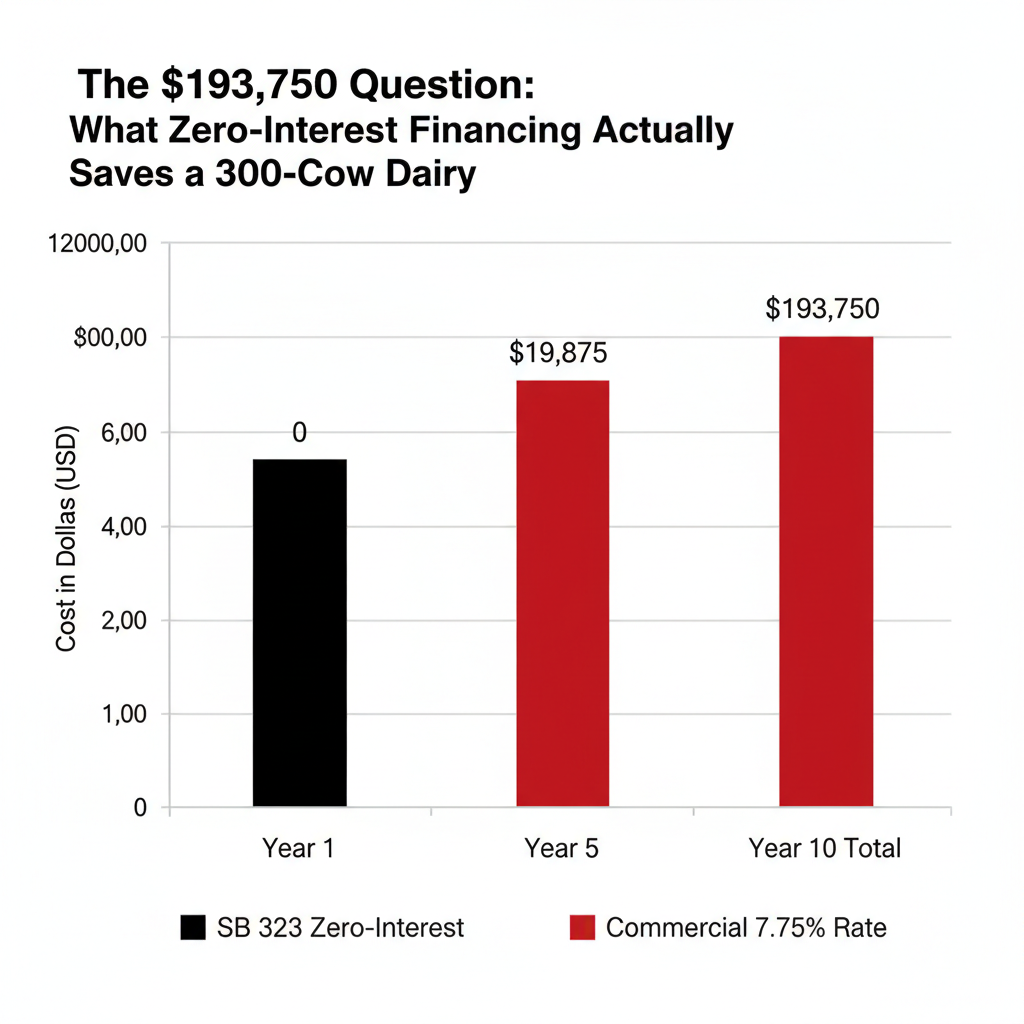
Travis Tranel killed a $20M zero‑interest dairy loan. Our barn math shows a 300-cow farm could have saved $193,750 in interest. How far behind does that put you?

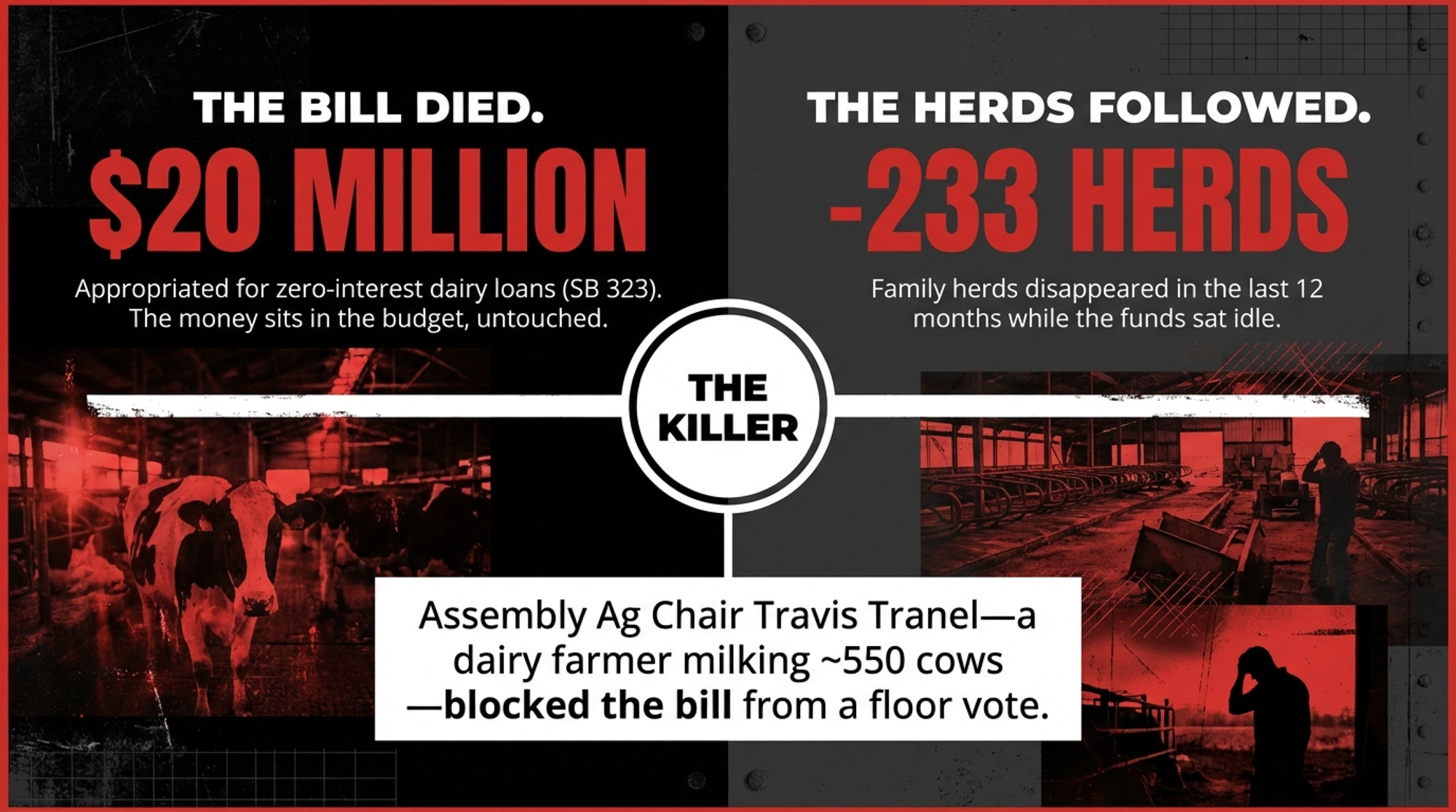
Executive Summary: Wisconsin set aside $20 million for zero‑interest dairy loans to help 50–714 cow herds upgrade equipment, but the program never launched because SB 323 died in the Assembly. The kill shot came from Assembly Ag Chair Travis Tranel — a dairy farmer milking around 550 cows who would have qualified for the loans himself. While that money sits idle, the state starts 2026 with 5,115 licensed herds, 233 fewer than a year ago, even as 1.28 million cows keep turning out record milk through consolidation. Our barn math shows a 300‑cow farm financing a $250,000 upgrade at today’s commercial rates pays about $19,375 a year in interest, or $193,750 over 10 years, instead of zero under SB 323. Meanwhile, states like South Dakota and Idaho are writing $5–55 million checks in bonds, grants, and tax credits to recruit the very cows Wisconsin is losing. This piece unpacks how that policy gap hits your balance sheet and lays out a 30/90/365‑day playbook for pressing lawmakers, rethinking capital plans, or asking if Wisconsin is still the right place for your herd to grow.

Wisconsin’s $20 million Dairy Cattle Innovation Program is dead. SB 323 passed the state Senate 18-15 on January 21, 2026. It never got a floor vote in the Assembly before the session ended on February 21. That same month, the state’s licensed dairy herd count sat at 5,115 — down from 5,348 just a year earlier, according to USDA NASS and Wisconsin DATCP. 

The man who didn’t bring the bill forward? Assembly Agriculture Committee Chair Travis Tranel, a sixth-generation dairy farmer who milks around 550 cows near Cuba City in Grant County, is currently serving his eighth term. A dairy farmer killed a bill to modernize dairy farms. That’s the part nobody’s talking about. 
What Did Wisconsin’s $20 Million Dairy Loan Program Fund?

Be specific about what died, because there’s been some confusion. This wasn’t a research bill. Wisconsin already spends $7.8 million a year on dairy research through the Dairy Innovation Hub across UW-Madison, UW-Platteville, and UW-River Falls. That money is still flowing. 

SB 323 was a zero-interest revolving loan program — up to $500,000 per farm — for dairy operations with 50 to 714 milking cows. The money was earmarked for on-farm equipment upgrades, technologies that improve milk production efficiency, animal health improvements, manure management systems, and labor-efficiency tools. The robots, the precision feeders, the methane digesters, and the parlor upgrades that farms with fewer than 700 cows can’t finance at competitive rates. 

Sen. Rob Stafsholt, the New Richmond Republican who authored the bill, put it bluntly: “Some of the technology that can make farmers as efficient as possible and would help the smaller guys to compete with the bigger guys is often financially out of reach for our small and medium farms”. 

The $20 million was already in the state budget. It was appropriated in the July 2025 biennial budget, passed by both chambers, and signed by Governor Evers. The money existed. It just needed a deployment program. 

Read more: what happens when the milk truck stops coming to one more Wisconsin yard.

How the Bill Got Killed by Its Own Committee Chair

SB 323 cleared the Senate Agriculture and Revenue Committee 8-0. It passed the full Senate 18-15. In a legislature where dairy bills rarely see that level of bipartisan support, this one had momentum. 

Then it reached the Assembly.

Tranel amended the bill to split the funding — $10 million for dairy cattle loans and $10 million for beef cattle. His reasoning: beef prices are high, supply is low, and Wisconsin should invest in both sectors. “We should have recognized, and we had a substitute amendment that acknowledged beef prices are high and beef supply is low,” Tranel told Brownfield Ag News. 
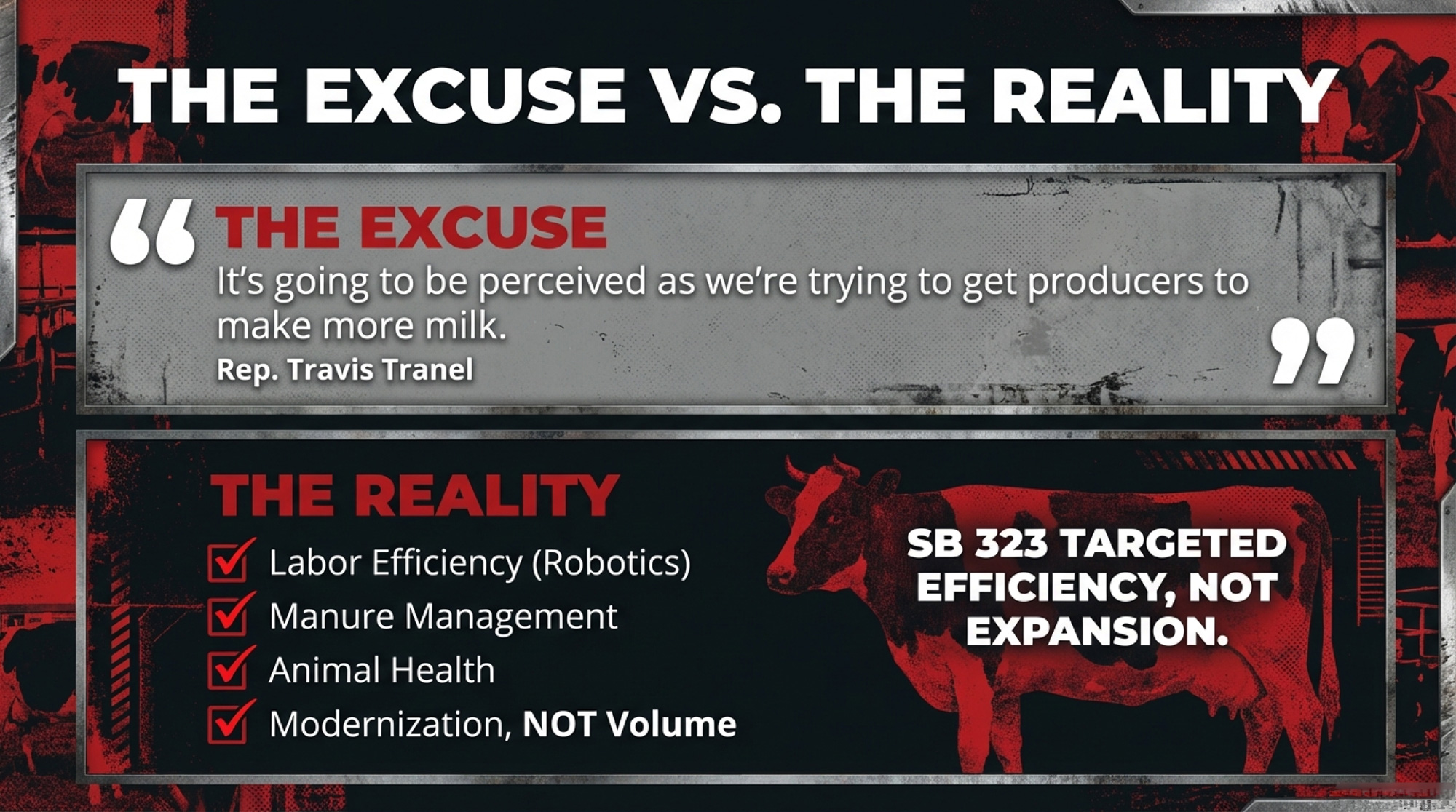
But there was a deeper philosophical objection.. “It doesn’t necessarily look good on the government when we’re pumping more money into the system, and it’s going to be perceived as we’re trying to get producers to make more milk,” he said. 

Read that again. The chair of the Assembly Agriculture Committee — a man who milks around 550 cows and holds degrees in economics and finance from Loras College — argued against helping dairy farmers modernize because it might look like the state is encouraging milk production. 

The amended bill never reached a floor vote. The session ended. The $20 million will likely return to the general fund, according to Tranel himself. 

The Fight That Fractured the Coalition

The bill didn’t just die from Tranel’s hesitation. It was caught in a genuine policy tug-of-war over who deserves the money.
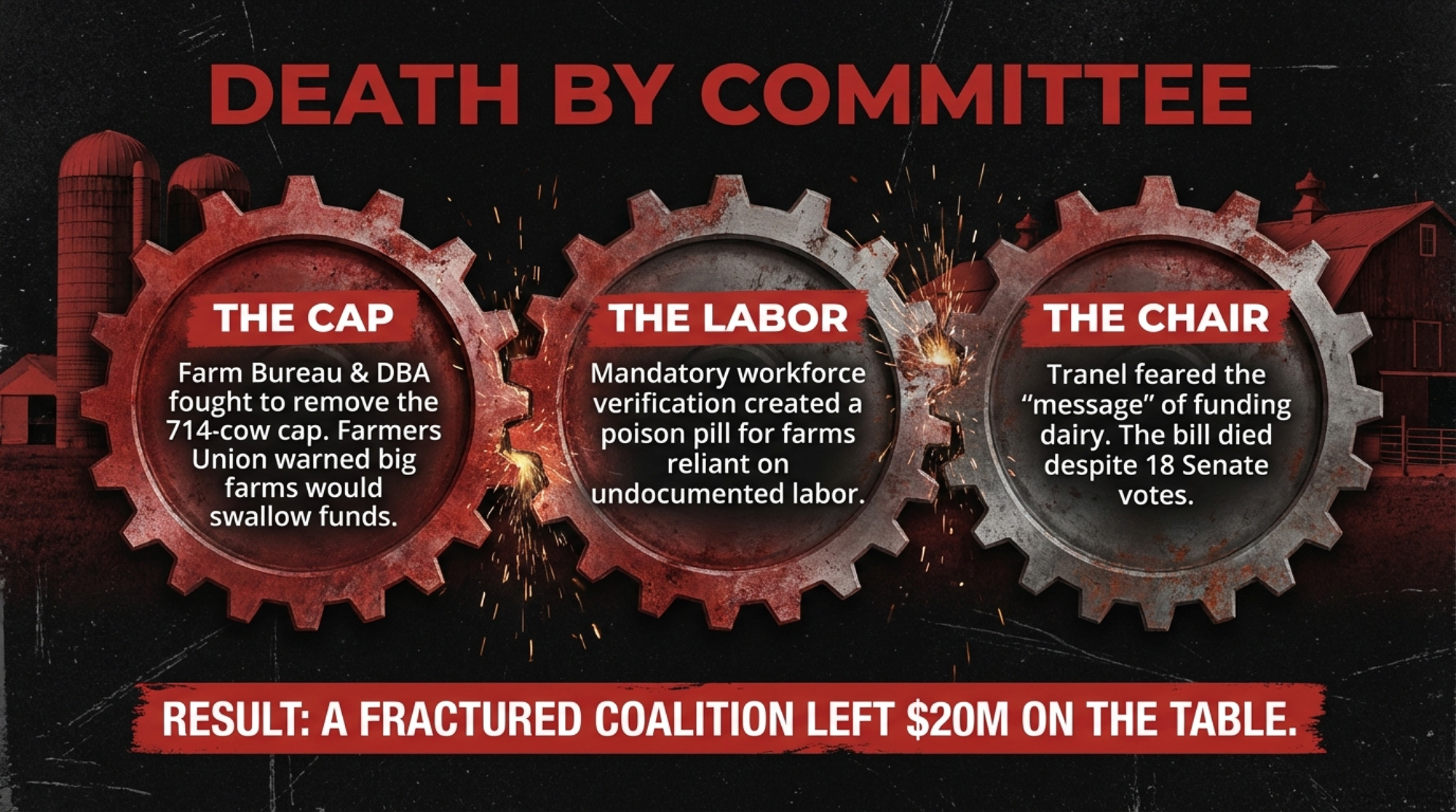
The original bill capped eligibility at 999 animal units — roughly 714 dairy cattle. That was by design. Stafsholt intended the program for small and mid-size operations, the farms disappearing fastest. 

The Wisconsin Farm Bureau and the Dairy Business Association both pushed to remove the cap. DBA lobbyists met with bill authors in June 2025, shortly after the bill text circulated. Rep. Clint Moses’ office even shared an early draft amendment with DBA lobbyists in August — before the public saw it. 

On the other side, Darin Von Ruden, president of the Wisconsin Farmers Union, defended the cap: “The dollars that are available there could be easily swallowed up by two or three of the biggest farms in the state, and then nobody else will be able to be a part of that process”. 

Then there’s the labor provision. SB 323 required participating farms to employ only workers legally authorized to work in Wisconsin. With an estimated 70% of the state’s dairy workforce undocumented, that provision alone could have disqualified a substantial share of otherwise eligible farms. Wisconsin Farm Bureau and DBA initially objected, but Farm Bureau lobbyist Jason Mugnaini told Investigate Midwest the organizations ultimately stopped pushing on it. 

Big-farm groups wanted the cap removed. Labor-dependent operations worried about the verification provision. The Assembly Ag chair thought the whole thing sent the wrong message. And a bill with 18 Senate votes died in committee.

How Much Does Zero-Interest Financing Save a 300-Cow Wisconsin Dairy?

The legislature’s math doesn’t hold up.
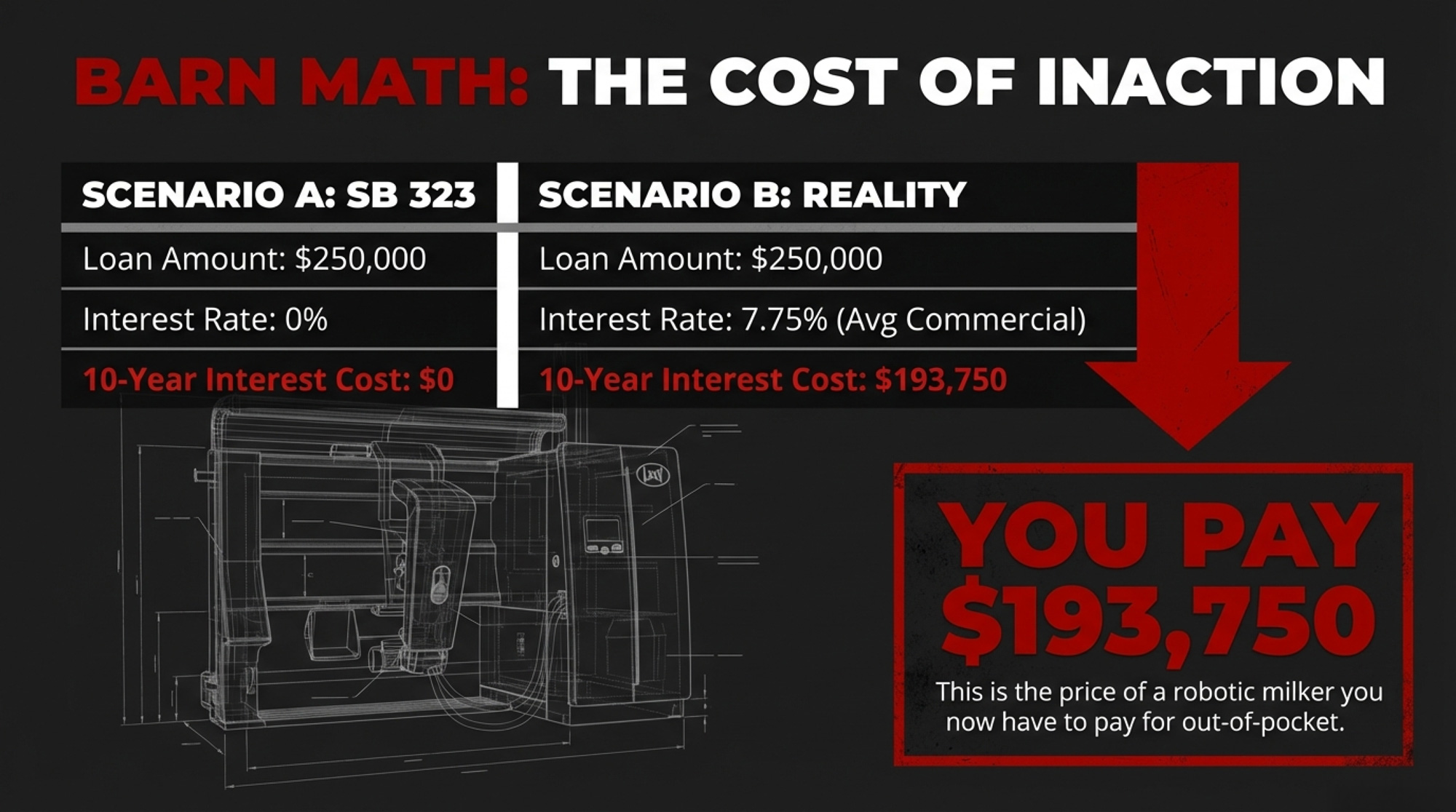
Take a 300-cow Wisconsin dairy considering a $250,000 equipment upgrade — a used robotic milking system, a precision feeding setup, or a manure management overhaul. Under SB 323, that’s a zero-interest loan repaid over up to 10 years.

Commercial ag equipment loans currently range from 7.25% to 8.25%, depending on the borrower’s profile and lender. Q4 2024 averages across Federal Reserve agricultural districts were 7.99% variable and 8.12% fixed (Progressive Dairy, March 2025). Even FSA direct farm ownership loans — the cheapest government option available — carry a 5.75% rate as of February 2026. 

At 7.75% (midpoint of the current commercial range), that $250,000 loan costs roughly $19,375 per year in interest alone — or $193,750 in total interest over a decade. At the $500,000 maximum, you’re looking at $38,750 per year, for a total of $387,500 over 10 years

On a 300-cow operation, an extra $19,375 in annual interest is the difference between reinvesting in the herd and falling further behind. On a commodity operation where margins routinely sit in single digits, that’s not a rounding error. That’s the next piece of equipment you don’t buy.

The $20 million revolving fund could have financed 40 to 80 farms in the first cycle, depending on loan size. And because it revolves — as farms repay, the money re-lends — the program would have compounded over time, potentially reaching hundreds of operations across multiple cycles.

All of it for 0.038% of Wisconsin’s $52.8 billion dairy economy (DATCP). The rounding error on a rounding error. 

Tim Fiocchi at the Wisconsin Farm Bureau nailed it: “You have farmers and business people out there making investment decisions in real time, and even if it’s just a delay, delays have consequences”. 

Read more: the real math of on-farm equipment ROI

5,115 Herds Left — And the Bleeding Is Accelerating

Steven Deller, agricultural economist at UW-Madison, described the dynamic bluntly to WPR: “If you’re in your mid-60s, it just doesn’t make sense to be operating a dairy farm with 150 cows. That’s demanding work, that’s really hard labor, and you just say, ‘I can’t do this anymore'”. 

The question SB 323 tried to answer: what if you could make that 150-cow farm efficient enough to hand to your kid? Zero-interest financing for a robotic milker or a precision feeder was one way to get there. That option is gone for at least another year.

Wisconsin’s dairy farm count tells the story the legislature apparently doesn’t want to read:
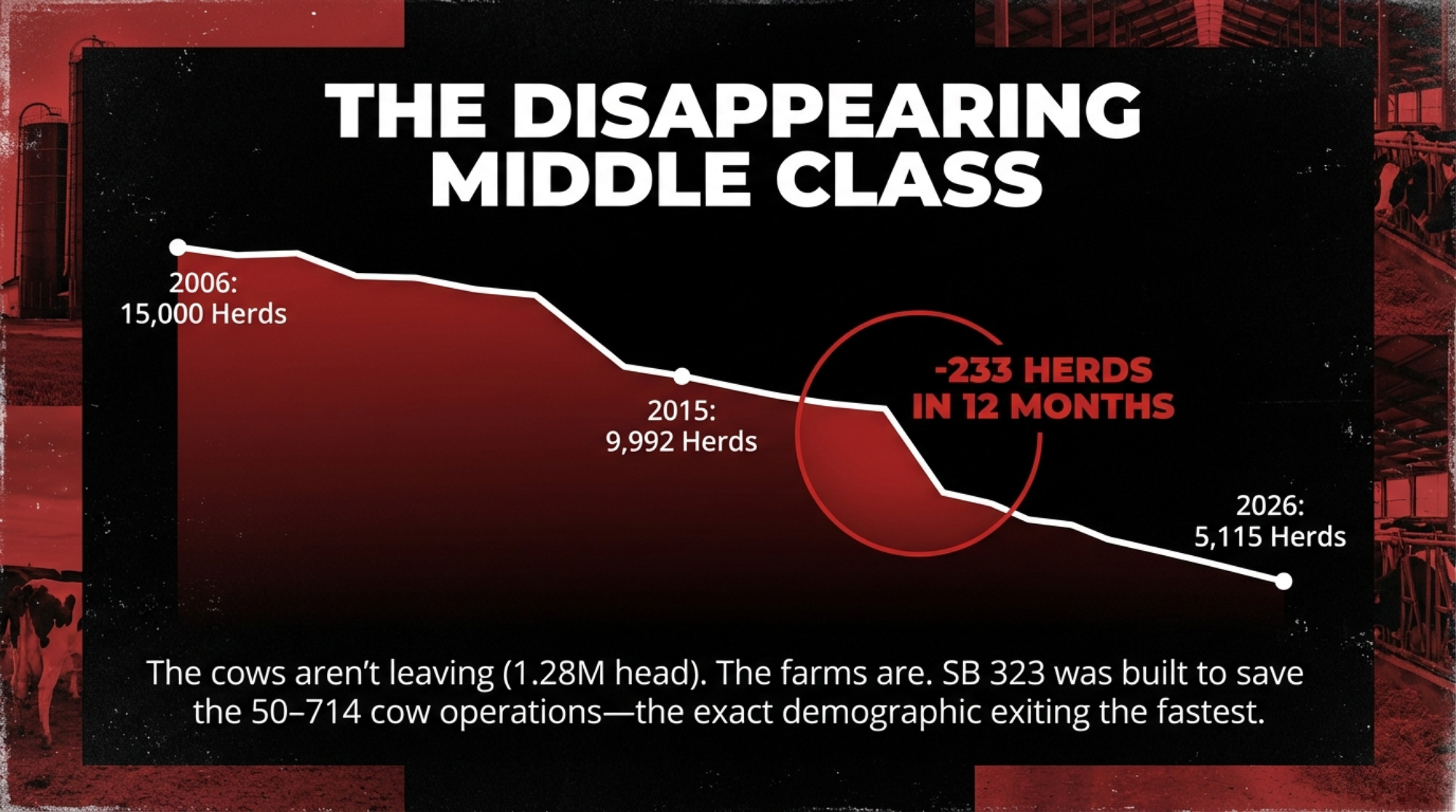
YearLicensed Dairy HerdsChange
~2006~15,000
2015~9,992–5,000 in ~9 years
2022~6,350–3,642 in 7 years
Jan 20245,661–689 in 2 years
Jan 20255,348–313 in 1 year
Jan 20265,115–233 in 1 year

Farms with fewer than 500 cattle — the exact operations SB 323 was designed to help — have decreased 67% since 2002. Operating costs have nearly doubled in the last decade while milk prices have fallen 15% over the same period, according to USDA data. 

The cows haven’t left. Wisconsin still milks 1.28 million head (DATCP, 2026). Production hit record highs. What’s left is fewer, bigger operations, and a disappearing middle class of dairy farms that SB 323 was specifically built to serve. 

Read more: who’s still milking by 2035

What Other States Are Spending to Recruit Your Cows

While Wisconsin’s $20 million sat in limbo, other states were writing checks.
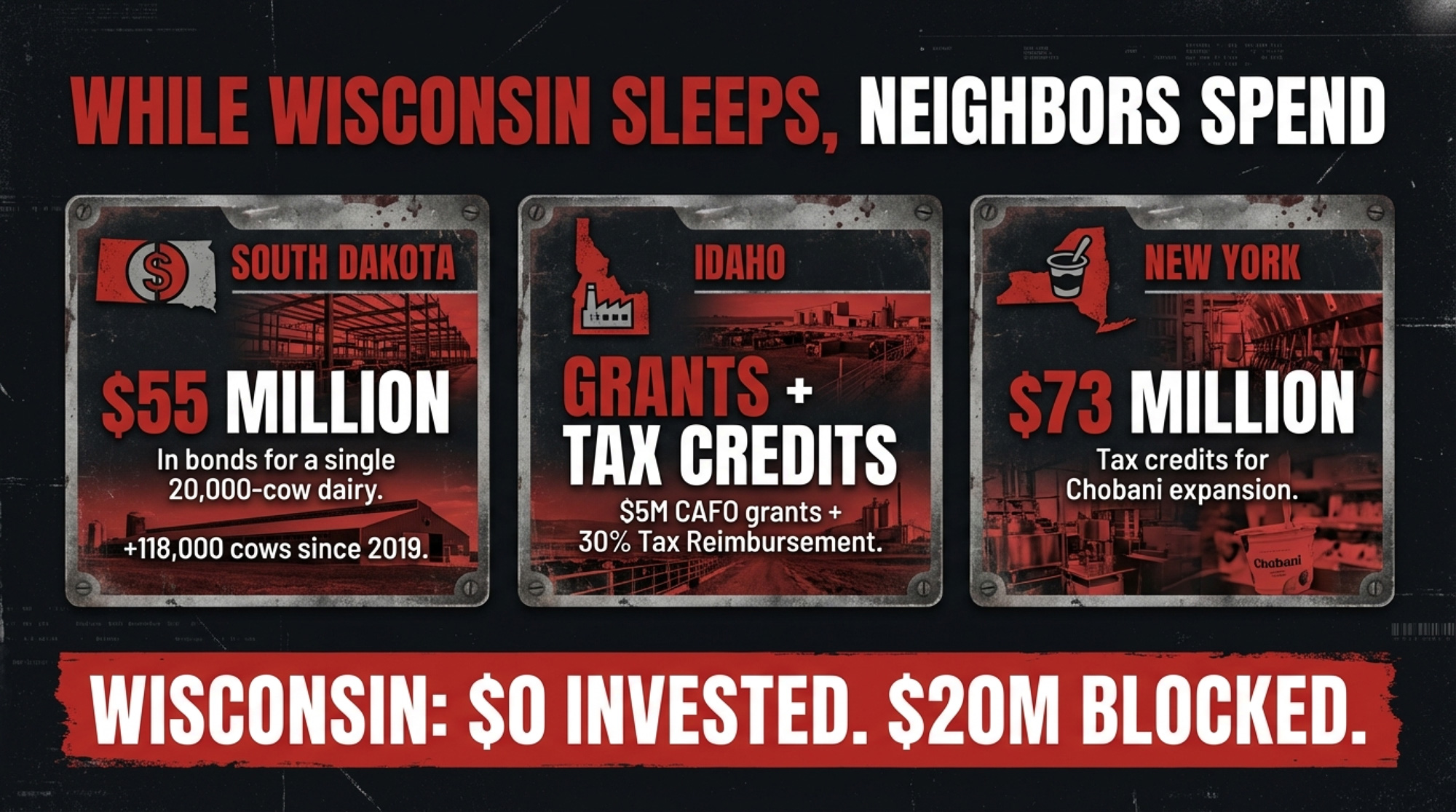
South Dakota grew its dairy herd 70.5% from 2019 to January 2024, adding 118,000 cows to reach 208,000. That wasn’t luck. In a single month — March 2024 — the Governor’s Office of Economic Development approved $17 million in incentives, most of it for dairy. In April, the state’s Economic Development Finance Authority approved a $55 million tax-exempt bond for Riverview LLP to build a 15,000-to-20,000-cow dairy in Kingsbury County. GOED Commissioner Chris Schilken said those 118,000 new cows represent “nearly $4 billion annually” in economic impact. 

Idaho passed House Bill 559, creating a $5 million CAFO Improvement Fund — grants, not loans — for environmental and manure-management improvements. The state also offers a Tax Reimbursement Incentive of up to 30% on new state tax revenues for up to 15 years for expanding businesses. When Glanbia Foods expanded $82 million in southern Idaho, the company received a 23% tax credit for 10 years, plus a local property tax exemption. 

New York handed Chobani $73 million in state tax credits over 10 years, plus a $22 million Fast NY grant toward a $1.2 billion plant expansion. 

Wisconsin offered $20 million in zero-interest loans to farms under 700 cows — and couldn’t get it through its own Ag Committee. South Dakota approved $55 million in bonds for a single 20,000-cow mega-dairy. That’s the competitive math right now.

StateInvestment TypeTotal Investment Deployed (2024–2026)Dairy Herd Growth / Impact
South Dakota$55M tax-exempt bond (single 20K-cow dairy) + $17M incentives (March 2024)$72 million+118,000 cows (+70.5%) from 2019–2024; ~$4B annual economic impact
Idaho$5M CAFO Improvement Fund (grants) + 30% Tax Reimbursement Incentive (15-year)$5M+ grants; 23–30% tax credits for expansionsGlanbia: $82M expansion, 23% tax credit + property tax exemption
New York$73M state tax credits (10-year) + $22M Fast NY grant for Chobani$95 million$1.2B Chobani plant expansion secured
Wisconsin$20M zero-interest loan fund (appropriated, never deployed)$0–233 herds (Jan 2025–Jan 2026); program killed in Assembly committee

The Tranel Contradiction

Travis Tranel is not a Madison politician who’s never touched a bulk tank. His family has farmed in Grant County since before Wisconsin was a state. He took over the family operation in 2002 when his father became ill, while Tranel was still in high school. He custom-bales hay for 40 farms in southwest Wisconsin and northwest Illinois. He holds degrees in economics and finance. He’s been in the legislature since 2010 and has chaired the Ag Committee since 2023. 

His own operation — at around 550 cows — would have been eligible for SB 323 funding. He’s well below the 714-cow cap.

And his stated objection — that financing equipment modernization “is going to be perceived as we’re trying to get producers to make more milk” — doesn’t survive contact with the bill text. SB 323’s priority criteria emphasized labor efficiency, manure management, reduced environmental impact, and animal health. Production volume wasn’t a stated goal. Efficiency was. 

Tranel has championed other dairy-related legislation. He authored food labeling bills, pushed the heavier dairy tanker weight bill that became law, and secured dairy processor grant funding in the 2025 state budget. He’s not anti-dairy. 

But when it came to directly financing equipment upgrades for the small and mid-size farms in his district — farms smaller than his — he decided it sent the wrong message. The man whose official biography says he “takes great pride in being able to keep small family dairies alive and viable” let the small family dairy bill die. 

CategorySB 323 Program RequirementTravis Tranel’s Operation
Herd Size Eligibility50–714 milking cows~550 cows (eligible ✓)
Loan TermsUp to $500,000 at 0% interest, 10-year repaymentWould qualify for $250K–$500K at 0%
Program PurposeEquipment upgrades, labor efficiency, manure management, animal health—not production volumeOperates equipment-dependent 550-cow dairy with custom hay operation
Personal Interest Savings (10-year, $250K loan)Zero interest = $0 cost<span style=”color: #CC0000;”>$193,750 in commercial interest avoided</span>
Stated ObjectionN/A“It doesn’t necessarily look good on the government when we’re pumping more money into the system, and it’s going to be perceived as we’re trying to get producers to make more milk.”
OutcomeBill died in Assembly Ag Committee (no floor vote)Tranel chose not to move bill forward despite chairing the committee

Nine months earlier, Tranel told Brownfield something that reads differently now: “Sometimes I think, as farmers, we maybe rely too heavily on farm organizations and just assume that they are doing our bidding for us, and that’s not necessarily always the case”. 

Turns out that applies to farmer-legislators too.

What This Means for Your Operation
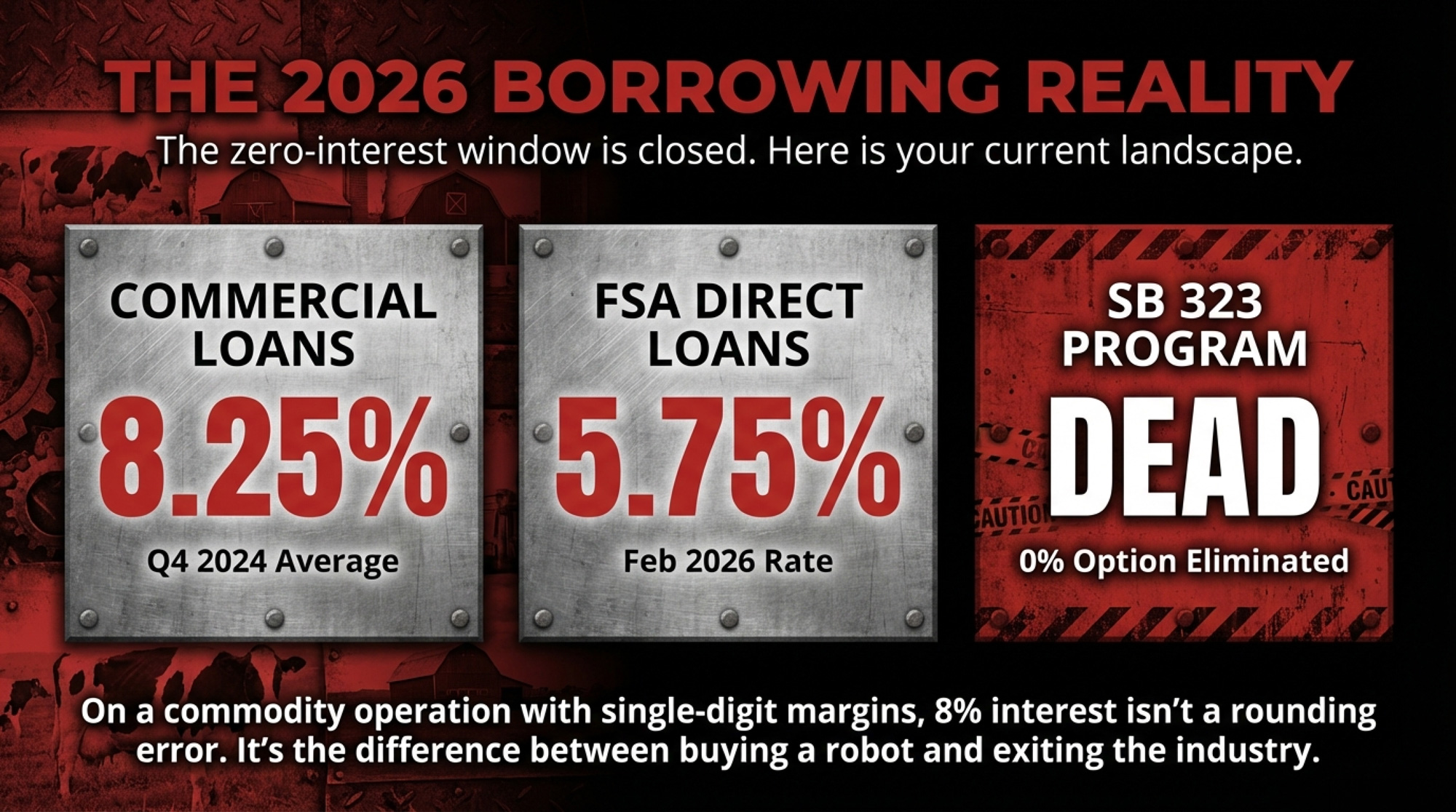
If you run 50–714 cows in Wisconsin, the zero-interest financing isn’t coming in 2026. Any equipment decisions you’re making this year need to pencil out at commercial rates — 7.25% to 8.25% as of this month. On a $250,000 upgrade, you’re paying roughly $19,375 a year in interest that SB 323 would have eliminated. 

Loan AmountFinancing TypeAnnual Interest CostTotal Interest Cost (10 Years)
$100,000SB 323 Zero-Interest$0$0
$100,000Commercial 7.75%$7,750$77,500
$250,000SB 323 Zero-Interest$0$0
$250,000Commercial 7.75%$19,375$193,750
$500,000SB 323 Zero-Interest$0$0
$500,000Commercial 7.75%$38,750$387,500

If you’re planning capital improvements: Don’t wait for SB 323’s return. FSA direct farm ownership loans are at 5.75% as of February 2026 — not zero, but better than commercial. USDA REAP grants cover energy efficiency improvements. NRCS EQIP can fund manure management. The federal programs won’t match zero-interest terms, but they exist now. 

If you’re a Wisconsin Farm Bureau member: Ask your county organization why the state-level lobby pushed to remove the CAFO cap instead of pushing harder for a floor vote. The cap debate distracted from the bigger fight.

If your operation is above 714 cows, SB 323 was never for you. But the industry benefits from having viable 200–500 cow operations in your milk shed. When your neighbors exit, your hauling costs go up, your processor’s supply volatility increases, and the political will to defend dairy in Madison erodes further.
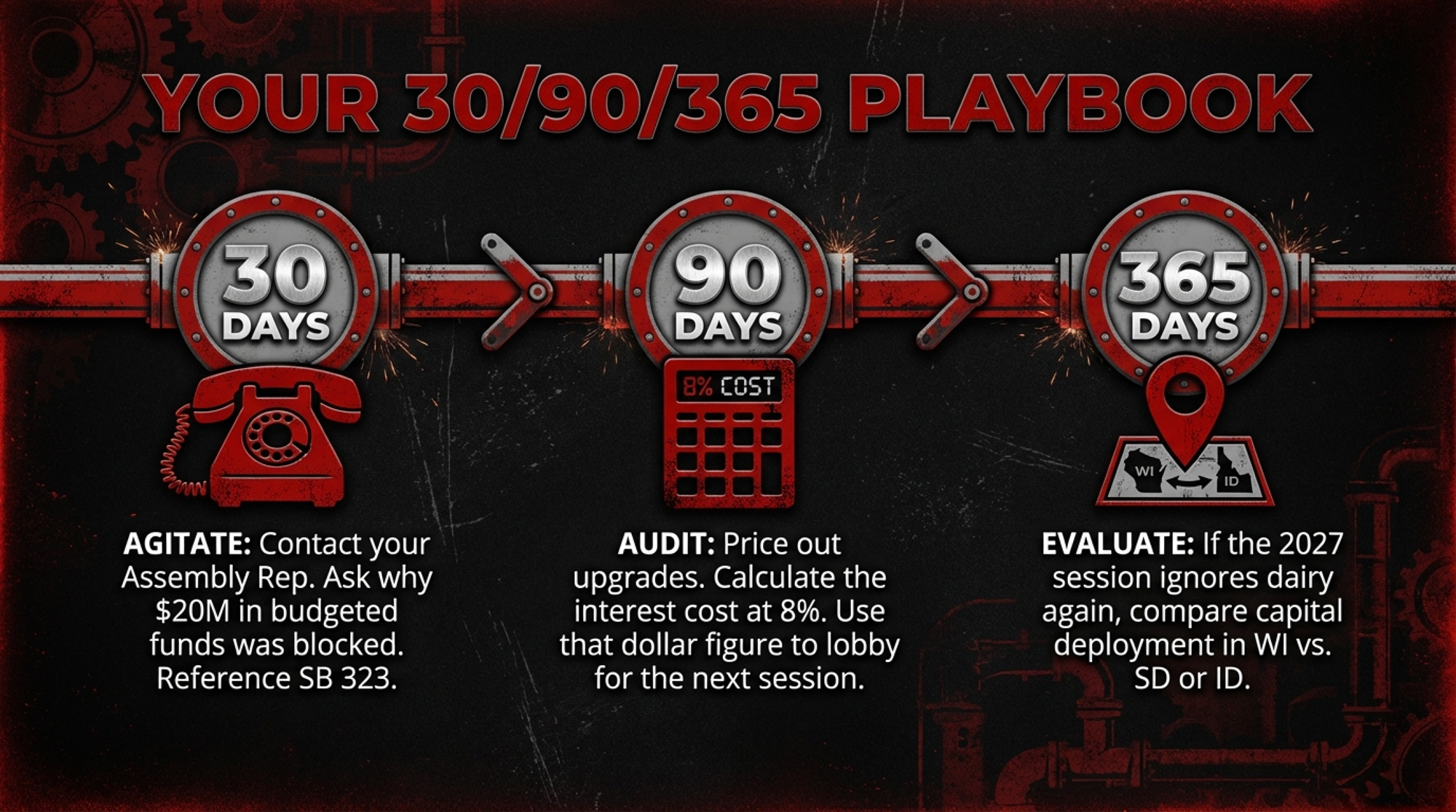
Run the 30/90/365 check:

  • 30 days: Contact your state Assembly member. Reference SB 323 / AB 363. Ask specifically: why didn’t this bill get a floor vote? The $20 million was already budgeted.
  • 90 days: Audit your own equipment needs. Price out the upgrades you’d have financed at zero interest. Calculate the annual interest cost at your current rate. That number is your argument for the next session.
  • 365 days: If the bill doesn’t return when the legislature reconvenes in January 2027, seriously evaluate whether Wisconsin’s policy environment still supports your operation in the long term. South Dakota approved $55 million in bonds for a single dairy last year. Idaho is handing out CAFO improvement grants. Other states are making investment decisions in real time — and some of them are investing in your competitors. 

Read more: transform your dairy before consolidation decides for you
Key Takeaways:

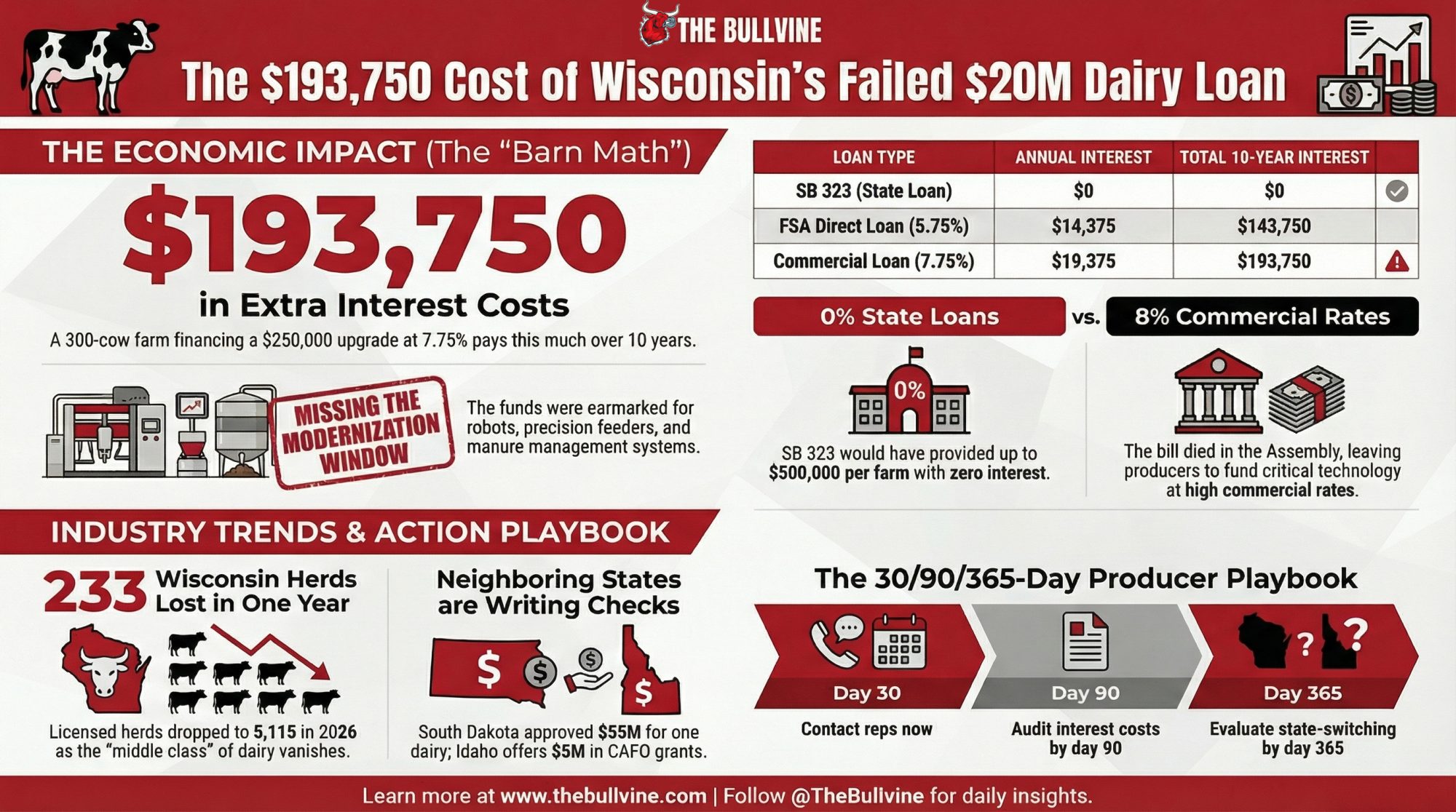
  • Wisconsin already parked $20 million in the budget for zero‑interest dairy loans to 50–714 cow herds — SB 323’s failure means that money doesn’t hit your balance sheet in 2026.
  • Assembly Ag Chair Travis Tranel, a dairy farmer milking around 550 cows who would have qualified for the program, chose not to move the bill, saying it sent the wrong signal about “making more milk.”
  • At current commercial rates, a 300‑cow farm financing a $250,000 upgrade is writing roughly $19,375 a year in interest checks — $193,750 over 10 years that zero‑interest state money could have erased.
  • Wisconsin sits at 5,115 herds, down 233 in a year, while states like South Dakota and Idaho are stacking $5–55 million in bonds, grants, and tax credits to attract the very cows Wisconsin is losing.
  • If you’re under 714 cows in Wisconsin, you now need to decide whether to delay upgrades, pay commercial rates, chase federal programs, or start asking if your next major investment should even be in this state.

The Bottom Line

Pull up your last equipment loan statement. Calculate what zero percent over 10 years would save you versus what you’re paying now. That number — the one sitting right there on your desk — is what the Wisconsin Assembly left on the table when the session clock ran out. Travis Tranel knows those numbers. He runs them on his own 550 cows.

Complete references and supporting documentation are available upon request by contacting the editorial team at editor@thebullvine.com.

Learn More

The Sunday Read Dairy Professionals Don’t Skip.

Every week, thousands of producers, breeders, and industry insiders open Bullvine Weekly for genetics insights, market shifts, and profit strategies they won’t find anywhere else. One email. Five minutes. Smarter decisions all week.

NewsSubscribe
First
Last
Consent

The Empire State’s Dairy Revolution: Why New York’s $2.4 Billion Processing Boom Will Force You to Rethink the Industry’s Future

$2.4B dairy revolution challenges Western states’ dominance. Big processing, bigger implications for farmers.

EXECUTIVE SUMMARY: New York is reshaping America’s dairy map with $2.4B+ investments in cutting-edge processing plants by Chobani, Fairlife, and Great Lakes Cheese. These mega-facilities leverage the state’s strategic location near East Coast markets, existing dairy infrastructure, and aggressive government incentives to focus on high-value products like yogurt and ultrafiltered milk. While promising economic growth and job creation, the boom raises challenges: environmental pressures from manure management, infrastructure strain, labor shortages, and market volatility. The shift from raw milk volume to value-added processing positions New York as a disruptive force-forcing farmers to modernize or risk being left behind.

KEY TAKEAWAYS:

  • $2.4B+ invested in state-of-the-art plants processing 21M+ lbs of milk daily, demanding modernization from local farms.
  • Geographic goldmine: Proximity to 100M consumers gives NY a logistical edge over Western states.
  • Value over volume: Focus on premium products (yogurt, protein shakes, specialty cheese) captures higher margins than commodity milk.
  • Environmental hurdles: Manure management and CLCPA compliance could throttle growth without tech adoption.
  • Adapt or lose: Smaller farms face consolidation; tech-savvy operations gain contracts with processors.
New York dairy processing, dairy industry innovation, value-added dairy products, dairy farm modernization, dairy sustainability

Forget everything you thought you knew about dairy’s future. While everyone’s been obsessing over 5,000-cow operations in South Dakota and Texas, New York has quietly executed the industry’s most strategic power play in decades—investing billions in cutting-edge processing that will shift the balance of dairy power eastward. This isn’t just about new factories—it’s a fundamental reshaping of America’s dairy landscape that could leave conventional producers wondering what hit them.

Let’s be brutally honest: When most industry folks talk dairy expansion, the conversation inevitably gravitates westward—South Dakota’s explosive 76% production jump since 2019, Texas’s relentless push toward milk dominance, and Idaho’s steady climb up the production rankings. The conventional wisdom has been clear: Go west, build big, and focus on volume.

But what if the smartest players in dairy have been zigging while everyone else zags?

Something extraordinary is unfolding in the East. New York State—the supposedly over-regulated, high-cost, union-dominated Empire State—is orchestrating a dairy revolution that should be setting off alarm bells for producers nationwide. A staggering $2.4+ billion is being poured into three massive, technology-packed processing facilities that will fundamentally reshape how and where dairy value is created.

And if you’re still thinking bigger barns and more cows are the path to dairy prosperity, you’re already behind the curve.

THE GAME-CHANGERS: THREE INVESTMENTS THAT WILL REWRITE THE RULES

Chobani: The $1.2 Billion Monster That Changes Everything

When Hamdi Ulukaya announced plans for a sprawling $1.2 billion facility in Rome, NY, industry veterans weren’t just impressed—they were stunned. This isn’t another incremental plant expansion—it’s 1.4 million square feet of processing domination across 150 acres that will eventually consume milk from roughly 100,000 cows.

Let that sink in. A single facility that will require more milk than the entire dairy herd of Massachusetts, Rhode Island, New Hampshire, and Connecticut combined. If you’re milking a 500-cow herd averaging 85 pounds per day, Chobani would need 240 farms exactly like yours just to keep this one plant running.

“When you invest in people, in local communities, you’re not just building a business—you’re building a future,” declared Ulukaya at the groundbreaking. It’s a beautiful sentiment, but what he’s building is a processing fortress that will dominate the eastern dairy landscape for decades to come.

For perspective, Chobani’s investment in this single plant exceeds the combined annual farm-level capital spending of multiple dairy states. It’s like announcing you’re building a new milking parlor, but instead of a double-24 parallel, you’re erecting something the size of Madison Square Garden. Construction begins later this year, with completion targeted for late 2026, bringing 1,000+ new jobs to the region.

Fairlife: Coca-Cola’s Protein-Powered Cash Machine

Not to be outdone, Coca-Cola’s ultrafiltered milk brand Fairlife broke ground in April 2024 on a 0 million state-of-the-art facility in Webster, NY. This 750,000-square-foot plant—the largest dairy processing facility in the Northeast—will transform roughly 5 million pounds of milk daily into high-protein, low-sugar dairy products that command premium prices.

While you’ve been focused on milk volume and component percentages, Fairlife has been redefining milk’s value proposition entirely. Their ultrafiltered products strip out water and lactose while concentrating protein—essentially paying for components rather than volume, generating products consumers willingly pay premium prices for.

The plant features a nine-story fully automated warehouse with robots and cranes handling product movement. Sophisticated control systems, including Siemens S7 PLCs and variable frequency drives, will maximize efficiency while minimizing labor needs—the industrial equivalent of going from tie-stall with bucket milkers to a fully automated robotic facility overnight.

This isn’t your grandfather’s milk plant. It’s a technological marvel designed to extract maximum value from what many conventional processors still treat as commodities.

Great Lakes Cheese: The Quiet Giant

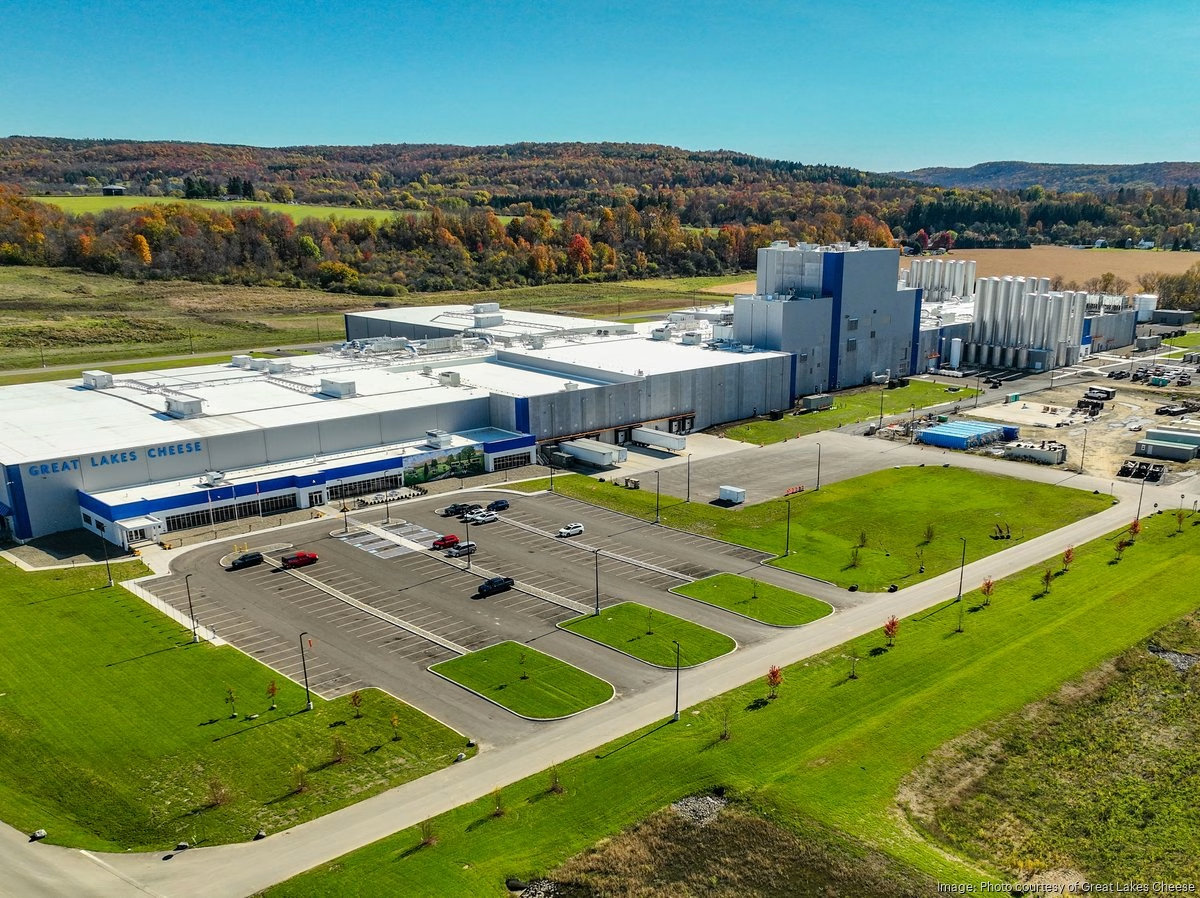
While Chobani and Fairlife grab headlines, Great Lakes Cheese has quietly invested over $700 million (up from an initially announced $500 million) in a massive cheese manufacturing and packaging facility south of Buffalo. The nearly 500,000-square-foot plant will double milk purchases to 4.8 million gallons daily—milk from approximately 60,000 cows.

What’s particularly notable is the company’s integration of environmental sustainability into the facility’s design, including an on-site wastewater treatment plant with anaerobic digestion to minimize ecological impact. While many producers complain about environmental regulations, Great Lakes Cheese turns potential liabilities into assets.

These three facilities represent a daily processing capacity increase of 21+ million pounds—more than New York’s milk production growth over several years. That’s equivalent to adding a new 240,000-cow milk shed overnight.

WHY THIS MATTERS: THE STRATEGIC GAMBLE THAT TURNS CONVENTIONAL WISDOM ON ITS HEAD

Here’s where the industry’s groupthink needs challenging: While western states compete primarily on milk volume and production efficiency, New York’s bet on processing represents a fundamentally different strategy—one focused on extracting maximum value rather than just pumping out more commodity milk.

This approach addresses several critical issues simultaneously:

1. Capturing Value That Usually Leaves the Farm Gate

Let’s face it—most dairy farmers are price-takers, vulnerable to commodity markets and distant processing decisions. You’re busting your tail to hit SCC under 100,000, pushing components to 4.0% fat and 3.2% protein, and maintaining reproduction numbers that would make your neighbors jealous—yet your mailbox price swings wildly based on decisions made by people who’ve never set foot in a parlor.

New York keeps more dollars circulating within its dairy economy by massively expanding in-state processing capacity for value-added products.

A gallon of milk transformed into premium yogurt or ultrafiltered protein products can generate 3-5 times the revenue of the raw milk itself. The farmers supplying these plants gain potential price stability through direct supply agreements and proximity to their end markets.

It’s like selling finished cattle directly to consumers instead of shipping them to the sale barn—you’re capturing retail margins instead of just farm-gate prices.

2. Leveraging Geographic Advantage

Location matters more than most producers want to admit. With roughly 100 million consumers within a day’s drive, New York processors can efficiently distribute fresh dairy products throughout the Northeast corridor.

Fairlife executives noted when selecting Webster that the Rochester region sits within 500 miles of one-third of the U.S. and Canadian population—a crucial advantage for perishable products requiring refrigerated transportation.

Western states can produce milk cheaper but never overcome this geographic reality. Every mile adds cost when products need refrigeration—the equivalent of running your bulk tank compressor at maximum capacity in July versus January. The energy expenditure and risk grow with distance.

3. Addressing Industry-Wide Processing Bottlenecks

The COVID-19 pandemic brutally exposed America’s processing vulnerabilities. While cows kept producing (they don’t exactly respond to “time off” requests), processing limitations led to devastating milk dumping across the Northeast.

It was the dairy equivalent of having a full free stall barn but only half a parlor working—the cows are ready, but you can’t get the milk out fast enough. These new investments add critical redundancy and flexibility to the regional dairy system. When the next crisis hits—whether pandemic, weather disaster, or cyber-attack—New York’s expanded processing capacity provides a crucial buffer against having to dump milk down the drain.

THE UNCOMFORTABLE TRUTH: WHO WINS AND WHO LOSES

Let’s cut through the industry platitudes and PR statements. This processing revolution creates clear winners and losers:

The Winners:

  1. Forward-thinking midsize to large dairies willing to invest in modernization and efficiency improvements. The processing boom creates significant demand for farms that consistently supply quality milk in volume, particularly those within 50-75 miles of the new plants. Operations with 500+ cows and sound management practices will find themselves in high demand, potentially able to negotiate favorable supply agreements.
  2. Tech-savvy operators who leverage automation, data analytics, and precision farming to maximize efficiency while minimizing labor dependencies. Farms using robotic milking systems, automated feed management, activity monitoring, and integrated herd management software will consistently meet processors’ demands while controlling costs despite labor challenges.
  3. Farms with strong environmental credentials that can meet processors’ increasingly stringent sustainability requirements. Operations implementing methane digesters, precision feeding to reduce nitrogen excretion, covered manure storage with flaring systems, and other advanced environmental practices will gain preferential status as processors face pressure to reduce scope three emissions under New York’s Climate Leadership and Community Protection Act.

The Losers:

  1. Small operations without differentiation that can’t achieve the scale efficiencies processors increasingly demand. The hard truth is that a 75-cow tie stall producing milk with average components and quality metrics will struggle to compete unless it finds a specialty niche or premium market position.
  2. Technology laggards clinging to outdated practices in an industry rapidly embracing automation and data-driven decision-making. Suppose you keep breeding records in a pocket notebook instead of using synch protocols and management software. In that case, you’re fighting against operations achieving 32% pregnancy rates through systematic reproductive management.
  3. Smaller regional processors unable to compete with the efficiency and scale of these new mega-facilities. As one analyst noted, “We don’t have enough animals to make all the milk to supply all the plants in the U.S. This is a good problem. So, we will likely see some inefficient plants close and some not run at 100% capacity.”

THE CHALLENGES NOBODY WANTS TO TALK ABOUT

While industry cheerleaders focus on the economic benefits, serious challenges threaten to derail this dairy renaissance if not addressed head-on:

The Environmental Reality Check

Let’s do the math: The new processing capacity will require milk from approximately 220,000 additional cows, each producing roughly 100 pounds of manure daily. That’s 22 million pounds of additional manure daily—over 4 billion pounds annually.

When was the last time you heard a processor or politician talk about where all that manure will go?

In a state with watersheds feeding major population centers, including New York City, managing this waste sustainably presents a significant challenge. New York’s Climate Leadership and Community Protection Act mandates ambitious statewide GHG reductions, putting pressure on dairy operations to reduce methane emissions.

While the state has implemented programs like the CAFO Enhanced Nutrient and Methane Management Program, providing funding for advanced manure handling systems, the sheer volume increase required by these new plants will intensify the need for widespread adoption of technologies that many farms struggle to afford.

The Infrastructure Time Bomb

The processing boom demands significant infrastructure improvements beyond the plants themselves. Wastewater systems, transportation networks, and energy supplies require upgrades to support these massive facilities.

Fairlife’s projected wastewater impact (equivalent to 9,000 homes) necessitated a $20 million state grant to help Webster upgrade its treatment plant. Great Lakes Cheese built its on-site treatment facility.

It’s like suddenly adding 5,000 cows to your existing operation. Still, trying to use the same manure storage, free stalls, and milking facility—the supporting infrastructure becomes the bottleneck, not the cows themselves.

Statewide, New York faces a substantial wastewater infrastructure deficit, estimated at $36.2 billion over 20 years, with many systems aging and needing upgrades. Roads, bridges, and power supplies in rural areas also face significant strain.

The Labor Crisis No One Has Solved

Perhaps the most significant challenge is securing a sufficient skilled workforce. With over 1,500 direct jobs being created, companies must develop robust recruitment and training pipelines in a tight labor market.

Dairy farmers understand this challenge all too well. An estimated 41-50% of farm labor is foreign-born, with many workers potentially undocumented. Federal immigration policy uncertainties create significant risks for the milk supply.

Finding reliable parlor and herd managers is like finding a needle in a haystack—most operations know the value of a dependable 3 a.m. milker who shows up consistently and handles cows correctly. The new processing plants will compete for this limited labor pool, potentially driving up wages and making it even harder for farms to attract and retain quality employees.

The uncomfortable question: Where will these thousands of new workers come from when farms struggle to fill positions?

The Market Reality Check

The sheer scale of the new processing capacity raises concerns about potential milk oversupply within the state or region, especially if farm-level production ramps up faster than market demand absorb the finished products.

Historically, the NY dairy sector has experienced cycles of expansion leading to oversupply and price depression. While current processing investments are driven by demand for value-added products, ensuring sufficient markets for billions of pounds of additional yogurt, cheese, and specialized milk is critical.

Some analysts predict potential closures of less efficient plants as new capacity comes online. Are we just reshuffling the deck chairs rather than expanding the ship?

WHAT THIS MEANS FOR YOUR OPERATION: POSITIONING FOR SUCCESS

Forget the happy talk. Here’s what savvy producers need to do to capitalize on this transformation:

Size Matters, But Strategy Matters More

The processing expansion favors larger operations that can provide consistent volume. Don Mayer with DeLaval reports significant equipment sales in New York: “We have several large projects sold in New York and are actively working on several other projects. They cover the spectrum, rotary, in-line parlors, and robots.”

However, smaller operations can still thrive by focusing on efficiency, consistency, and strategic positioning within processor supply chains. The key is viewing your operation from the processor’s perspective—what makes you a valuable milk supplier beyond just volume?

Think about it this way: A 3,000-cow dairy-producing milk with erratic components, high SCC, or unpredictable volumes creates headaches for yogurt and UF milk producers who need consistent inputs. A more minor 200-cow operation delivering rock-solid components, minimal bacteria count, and reliable daily production might be more valuable per hundredweight.

Technology Investment is Non-Negotiable

Regardless of size, technology adoption is becoming essential, driven by labor challenges and efficiency goals. New York’s dairy modernization grant program offered over $20 million in grants for critical technology and infrastructure that will improve storage solutions and avoid milk dumping during emergency events.

Robotics, automated milking systems, and precision feeding technologies aren’t just fancy toys—they’re becoming fundamental business necessities in this evolving landscape. Just as switching from manual to automated identification systems revolutionized herd management two decades ago, the current wave of automation is transforming daily operations.

When labor costs hit $18-20/hour with overtime regulations kicking in after 40 hours, the ROI calculation for robotics shifts dramatically. Farms that resist technology adoption will find themselves at an increasing cost disadvantage compared to more automated operations.

Contract Positioning Will Be Critical

As these plants ramp production, their milk procurement strategies will reshape regional markets. While details remain scarce, securing favorable supply agreements with these major processors could provide critical stability in an otherwise volatile market.

It’s like locking in corn futures when prices are favorable hedging your position to reduce risk. Forward-thinking producers should explore opportunities to lock in supply relationships before full production begins.

Some questions you should be asking:

  • Will processors offer volume premiums?
  • Are component bonuses available for higher protein and solids?
  • Can your secure transportation subsidies if you’re within a certain radius?
  • What about quality incentives beyond standard premiums?
  • Are there sustainability incentives for implementing specific practices?

Sustainability as a Competitive Advantage

With processors increasingly focused on environmental metrics and carbon footprints, farms that adopt sustainable practices gain a competitive advantage. Manure digesters, renewable energy production, water recycling systems, and feed efficiency technologies are evolving from “nice-to-have” to essential business investments.

It’s like how the industry shifted on animal welfare—what was once considered beyond basic requirements is now standard practice, expected by processors, retailers, and consumers alike.

New York has proactively addressed these concerns through programs like the CAFO Enhanced Nutrient and Methane Management Program, which provides funding to help permitted operations implement advanced manure management systems.

Farms implementing innovative approaches like injecting manure rather than surface application, calibrating nutrient management based on the NY P-Index, or adding methane-reducing feed additives like 3-NOP are positioning themselves ahead of inevitable regulatory requirements while potentially gaining access to premium markets and incentive payments.

THE BOTTOM LINE: ARE YOU READY FOR THE NEW DAIRY REALITY?

New York’s emerging status as a modern dairy processing hub represents more than factory construction—it signals a fundamental reshaping of America’s dairy landscape. While Western states have attracted attention for production growth, New York positions itself at the value-added forefront with multi-billion-dollar investments in cutting-edge facilities.

For dairy farmers across the Northeast, these developments represent both challenge and opportunity. The surge in milk demand creates market potential, but capturing it requires modernization, efficiency improvements, and adaptation to evolving processor requirements.

Those who view these changes through the lens of opportunity rather than a threat—who invest in technology, sustainability, and strategic positioning—stand to thrive in this new dairy reality. Those clinging to outdated business models may find themselves increasingly marginalized, like trying to compete in today’s market with a herd of 15,000-pound Holsteins when everyone else has moved to 30,000-pound genetics.

The dairy revolution underway in New York isn’t just changing the state’s agricultural landscape—it’s positioning New York to lead America’s dairy industry into its next era. The question isn’t whether this transformation will happen but who will position themselves to benefit from it.

Ask yourself these critical questions:

  • Are you making capital improvements that align with processor needs?
  • Implementing management practices that boost component production?
  • Adopting technologies that improve efficiency and consistency?
  • Building relationships with the new processing players?

Like transitioning from pen-based record-keeping to computerized herd management, this industry-wide shift won’t wait for the reluctant to catch up. The future belongs to those who recognize and adapt to the new dairy reality emerging in the Empire State.

The dairy industry is splitting into two camps: those who see the writing on the wall and are positioning for the value-added future and those still clinging to the commodity volume game of the past. Which side are you on?

Learn more:

Join the Revolution!

Join over 30,000 successful dairy professionals who rely on Bullvine Daily for their competitive edge. Delivered directly to your inbox each week, our exclusive industry insights help you make smarter decisions while saving precious hours every week. Never miss critical updates on milk production trends, breakthrough technologies, and profit-boosting strategies that top producers are already implementing. Subscribe now to transform your dairy operation’s efficiency and profitability—your future success is just one click away.

NewsSubscribe
First
Last
Consent

Send this to a friend