




Archive for 2026 Farm Bill

The $16,600 DMC Farm Bill “Win” vs a 0.9x DSCR: The 2026 Decision for 400‑Cow Herds

Your 400‑cow herd can “win” $16,600 on DMC in 2026 and still sit at 0.9x DSCR the minute your banker deletes those dollars from the cash‑flow.

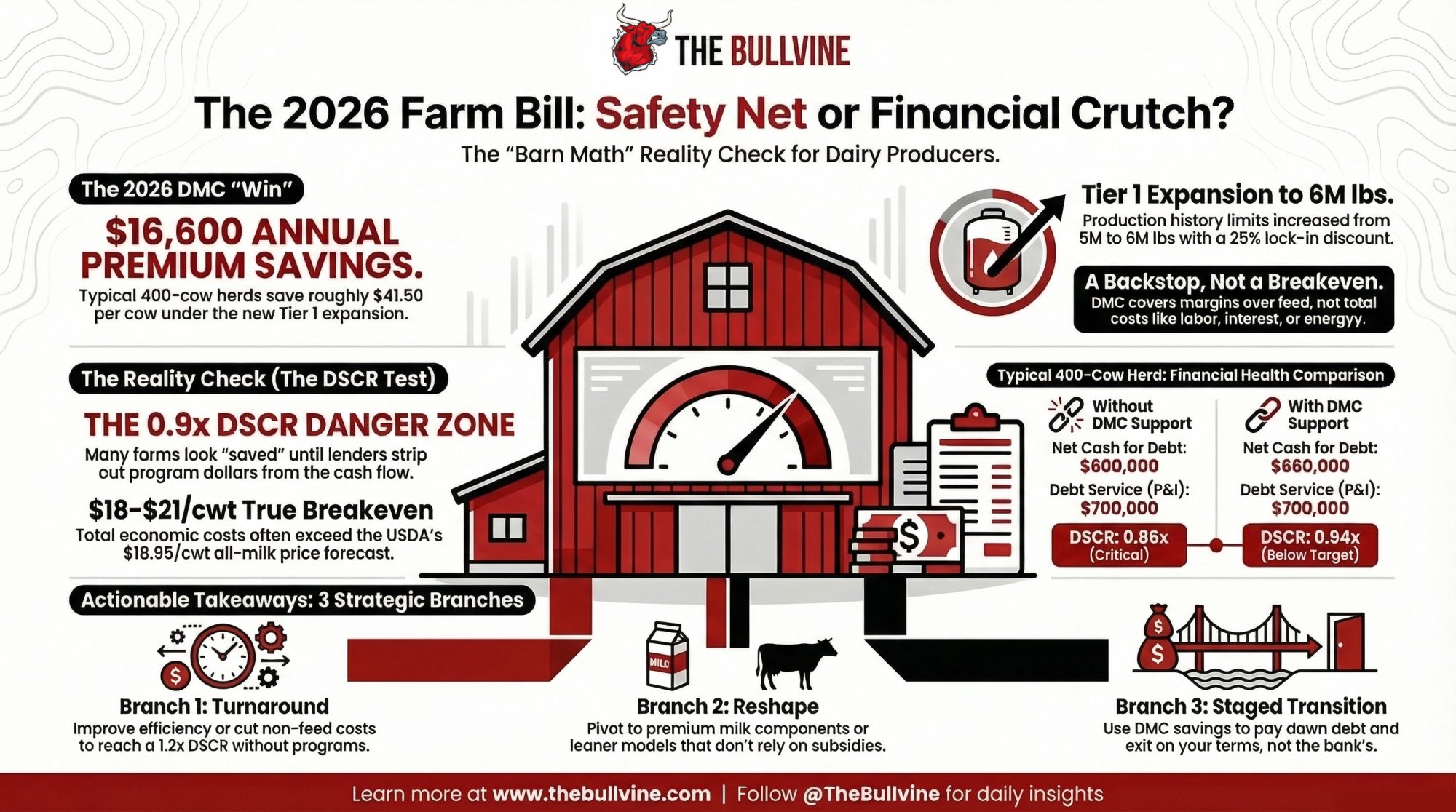
Executive Summary: In 2026, a typical 400‑cow U.S. herd can save about $16,600 in DMC premiums on 6 million pounds — roughly $41.50 per cow — and still sit at 0.9x debt‑service coverage once the banker removes DMC and other program dollars from the cash‑flow. The piece shows the barn math step‑by‑step: $1.66/cwt DMC premium savings, $18.95/cwt all‑milk outlook, and $18–21/cwt true breakeven costs that leave many mid‑size herds below the 1.15–1.25x DSCR comfort band lenders want. It argues that when DSCR clears only 1.0–1.1x with DMC included, DMC has shifted from a safety net to a crutch for a business model that doesn’t pencil. From there, it outlines three realistic branches for 300–500‑cow herds: a turnaround to get “no‑program” DSCR above 1.2x, a reshape into a leaner or premium model, or a staged transition that uses DMC, FSA, and EQIP to protect equity and control timing instead of waiting for the bank to decide. The article also shows which farm‑bill tools actually move your cheque, showing where FSA loan limit increases, EQIP/methane funding, DNIP, and school milk changes genuinely move your milk cheque” or “your margins. It closes with a simple test every operator can run over the next 30 days: calculate DSCR with and without DMC, and ask whether your lender would continue financing the version that stands on its own.
2026 Farm Bill Trap

A lot of 400‑cow U.S. dairies look “saved” by the 2026 farm bill on paper. Strip out DMC and other program dollars, and some of those same farms are sitting at about 0.9x debt‑service coverage — not generating enough cash to cover principal and interest on their own.

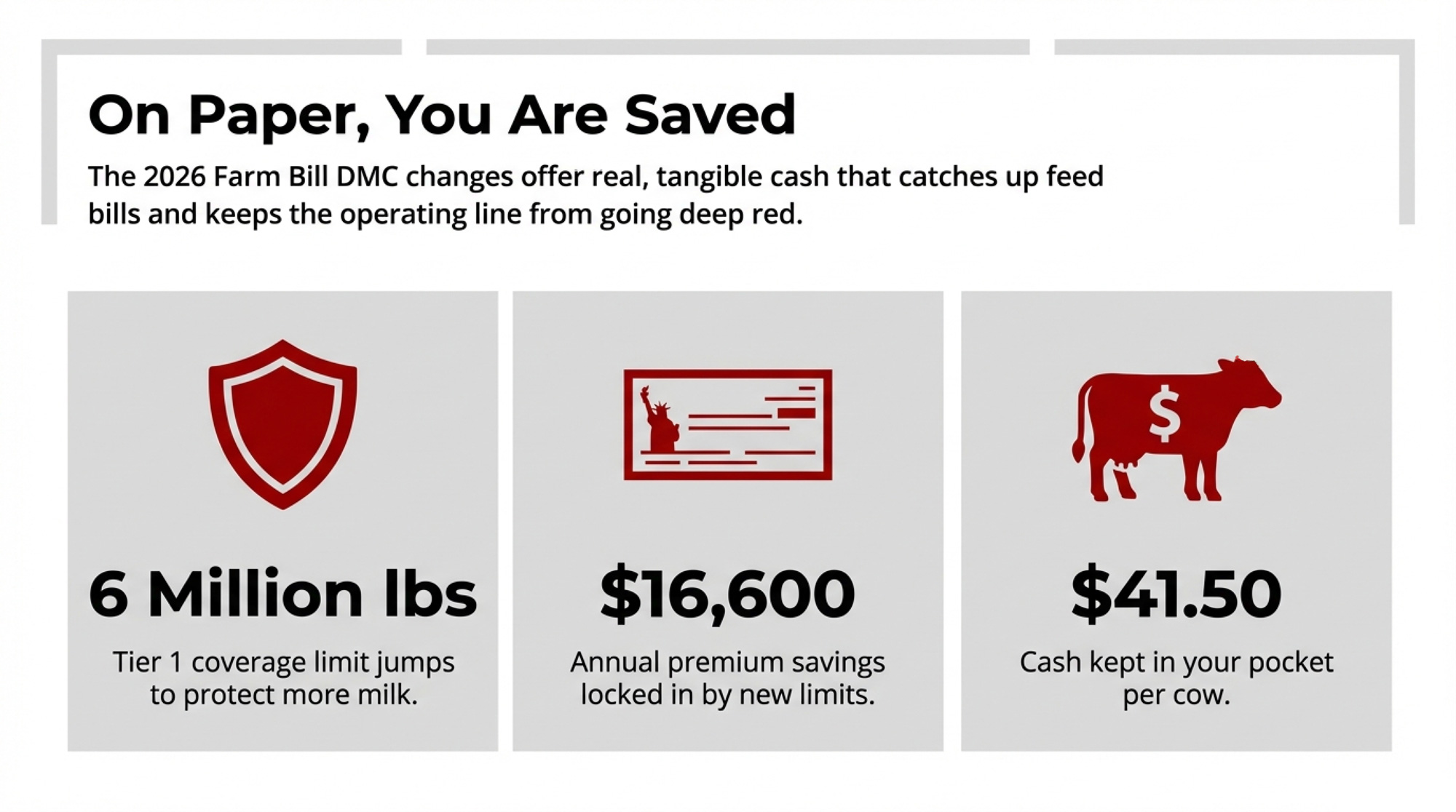
That’s exactly where a composite 400‑cow freestall operator we’ll call ‘Mark’ lands in 2026. His freestall saves roughly $16,600 a year on Dairy Margin Coverage premiums thanks to the new Tier 1 expansion — about $41.50 per cow. Early‑2026 Extension analysis suggests several months of $1‑plus/cwt DMC indemnities on covered milk if margins track the 2019–2023 pattern at the kitchen table, that looks like protection.
Across the lender’s desk, once his banker, Julie, pulls DMC and other program dollars out of the cash flow, the number is simple: around 0.9x DSCR. Without government support, the cash flow doesn’t fully cover annual debt service.

All numbers and policy tools in this piece refer to U.S. non‑quota herds operating under federal programs (DMC, FSA, EQIP, DNIP).

Composite scenario built from producer and lender patterns, Extension data, and ag‑lending benchmarks — not a single real named farm.

“The Farm Bill Saved Us”… Or Did It?

Mark looks a lot like many mid‑size family dairies in 2026. He milks 400 cows, ships about 11 million lbs/year — roughly 110,000 cwt. Two capital projects sit behind him: a parlour upgrade and manure system work, both financed when rates were low and now reset to higher levels. His labour mix mirrors the broader industry — a 2015 Texas A&M/National Milk Producers Federation study estimated immigrant workers account for roughly 51% of U.S. dairy labour and produce close to 79% of the nation’s milk.

On the policy side, he’s done everything right in the new farm‑bill world:

  • Maxed Tier 1 DMC at $9.50/cwt on the expanded 6 million lbs production history limit, after USDA raised Tier 1 from 5 to 6 million pounds and allowed history updates to each farm’s highest year from 2021–2023.
  • Locked in the six‑year DMC commitment with a 25% premium discount on Tier 1 premiums from 2026 to 2031.
  • Layered revenue protection on part of his milk to catch the downside that the DMC formula doesn’t see.

On paper, that’s a safety‑net success story. The deeper math tells a different story.

DMC history between 2019 and 2023 shows the margin trigger paying indemnities in roughly half the months at $9.50 Tier 1 coverage, per Farm Bureau and Extension DMC analyses. But in months where the official DMC margin sat near $12/cwt, many farms were still unprofitable once non‑feed costs were layered in. USDA ERS 2021 ARMS data puts the full economic cost of production at roughly $20.54/cwt for 500–999‑cow U.S. herds and $19.14/cwt for herds of 1,000+. Multi‑state Extension work — including UW–Madison benchmarks for mid‑size Wisconsin dairies — lands full costs around –19/cwt.

For Mark, the picture snaps into focus:

  • A realistic, fully loaded breakeven in the high‑teens to low‑$20s/cwt.
  • A DMC margin trigger that calls the farm “covered” as long as income over standardized national feed costsstays above $9.50/cwt — with no view of labour, interest, energy, or family draw.

The comfortable story in a lot of 2026 farm‑bill coverage: “With the new DMC and FSA tools, mid‑size dairies are finally protected.”

The minute Mark’s scenario hits a DSCR calculator, that story flips.

What Does the 2026 DMC Expansion Really Do for a 400‑Cow Herd?

Four changes matter most for a herd like Mark’s:

  • Tier 1 coverage jumps to 6 million lbs of production history, up from 5 million.
  • Production history can be updated to the farm’s highest annual marketings from 2021, 2022, or 2023.
  • six‑year lock‑in offers a 25% discount on Tier 1 premiums if you enroll in the same coverage from 2026 to 2031.
  • Tier 1 premiums for $9.50 coverage: $0.15/cwt (before the lock‑in discount).

The Premium Math: Where $16,600 Comes From

Swap in your own production numbers:

  • Extra milk moving from Tier 2 to Tier 1: 1,000,000 lbs (the new 6M minus the old 5M cap).
  • Old Tier 2 premium at $8.00 coverage (comparable risk level): $1.81/cwt.
  • New Tier 1 premium at $9.50 coverage: $0.15/cwt.
  • Per‑cwt savings: $1.81 − $0.15 = $1.66/cwt.
  • Annual premium savings: 10,000 cwt × $1.66 = $16,600/year.
  • Per cow: $16,600 ÷ 400 = $41.50/cow/year.

That’s money you keep whether DMC pays a dime in indemnities. If 2026 margins track the 2019–2023 pattern, total indemnities could add tens of thousands more, depending on how long margins remain below the $9.50 trigger.
Real cash. The kind that catches up feed bills and keeps the operating line from going deep red.

But the catch is what DMC pays on. It’s the margin over the standardized feed, not the full cost of production. Farm Bureau’s March 2026 analysis calls it a “vital backstop showing its limits” for exactly this reason — it never sees the gap between a $9.50 margin and a $20‑plus all‑in cost on many farms.

So when Julie runs 2026 projections on Mark’s herd, she does it two ways:

  1. With DMC and other program income in the numerator.
  2. Without any program income at all.

That’s where the 0.9x shows up.

What Does a 0.9x DSCR Really Mean for a 400‑Cow Herd?

Here’s the barn math a lot of 400‑cow producers and their lenders are walking through right now.
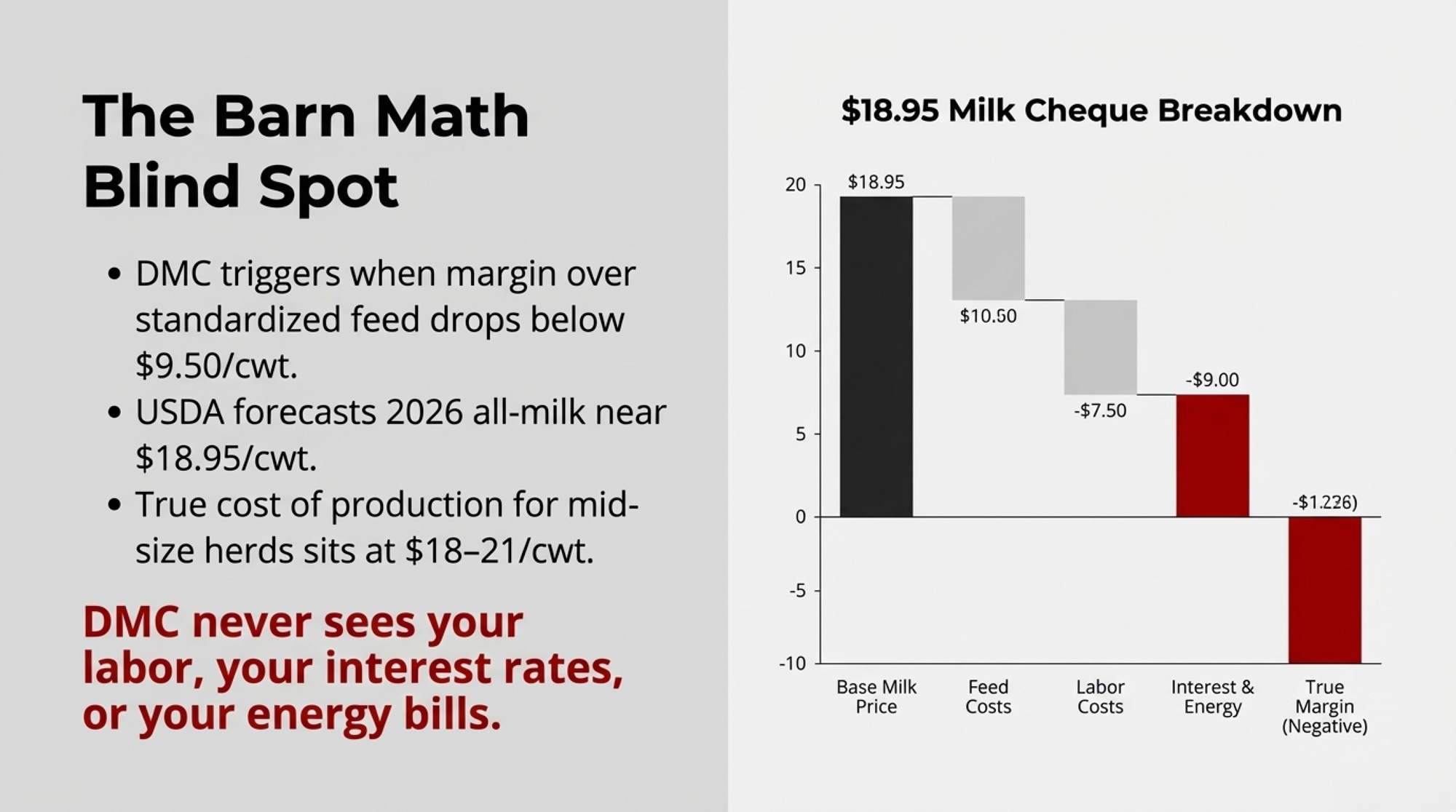
Assumptions (national outlooks + farm‑level benchmarks):

  • Herd: 400 milking cows, ~27,500 lbs/cow/year → 11 million lbs, or 110,000 cwt.
  • Milk price scenario: USDA’s February 2026 WASDE puts the annual all‑milk forecast near $18.95/cwt. Once basis and component adjustments hit the cheque, the realized price can land several dollars lower.
  • Full cost of production: $18–21/cwt depending on herd size, efficiency, and region (USDA ERS 2021 ARMS; UW Extension mid‑size Wisconsin benchmarks).
  • Annual debt service: In this composite, Mark carries $600,000–900,000 in annual P&I — roughly $1,500–2,250 per cow. That’s not a national average; it’s a realistic range from lender examples and recent mid‑size capital projects.

For DSCR, lenders go back to basics:

(Milk and other income − cash expenses) ÷ annual principal and interest.

The Lender’s Circle

Julie slides the printout across the desk and circles two numbers:
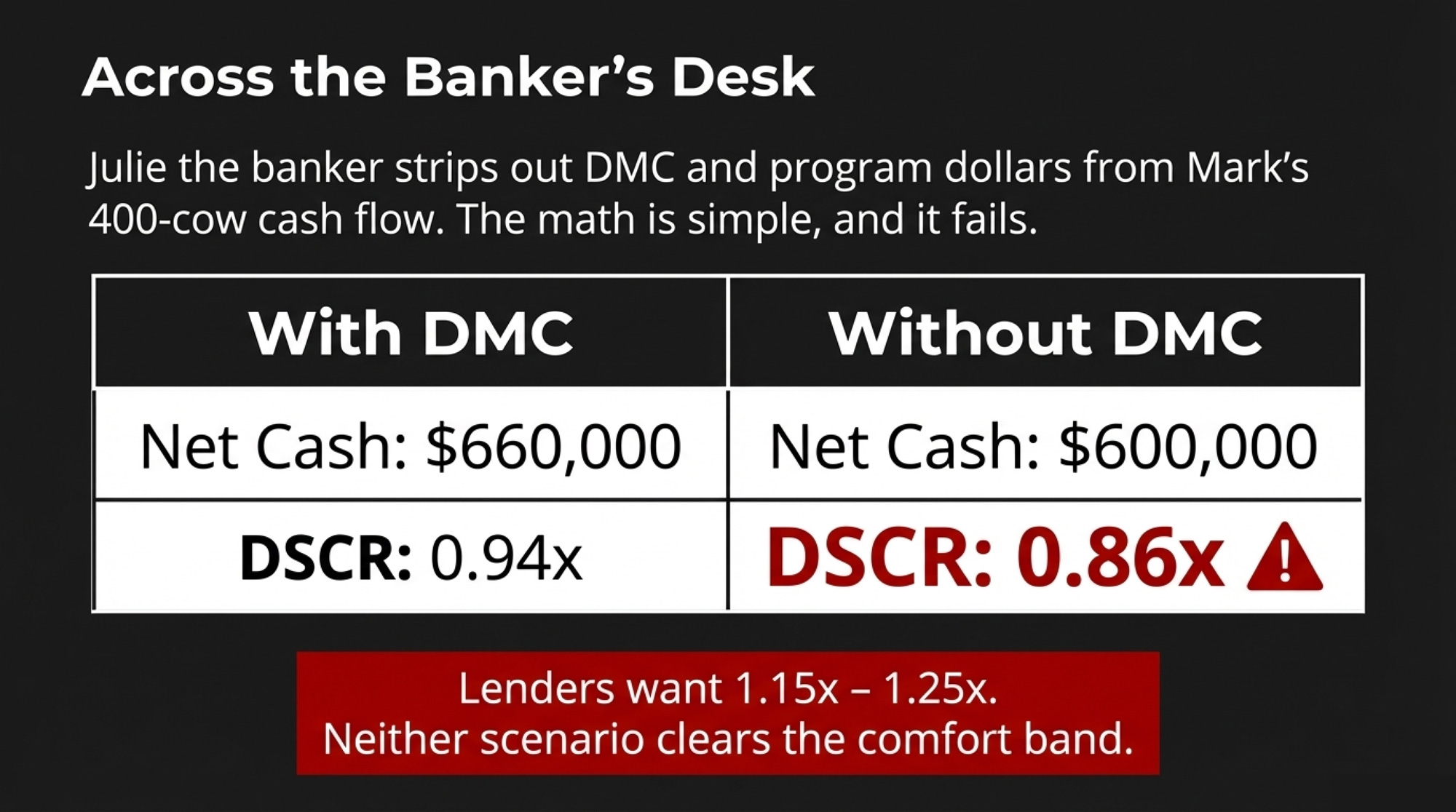
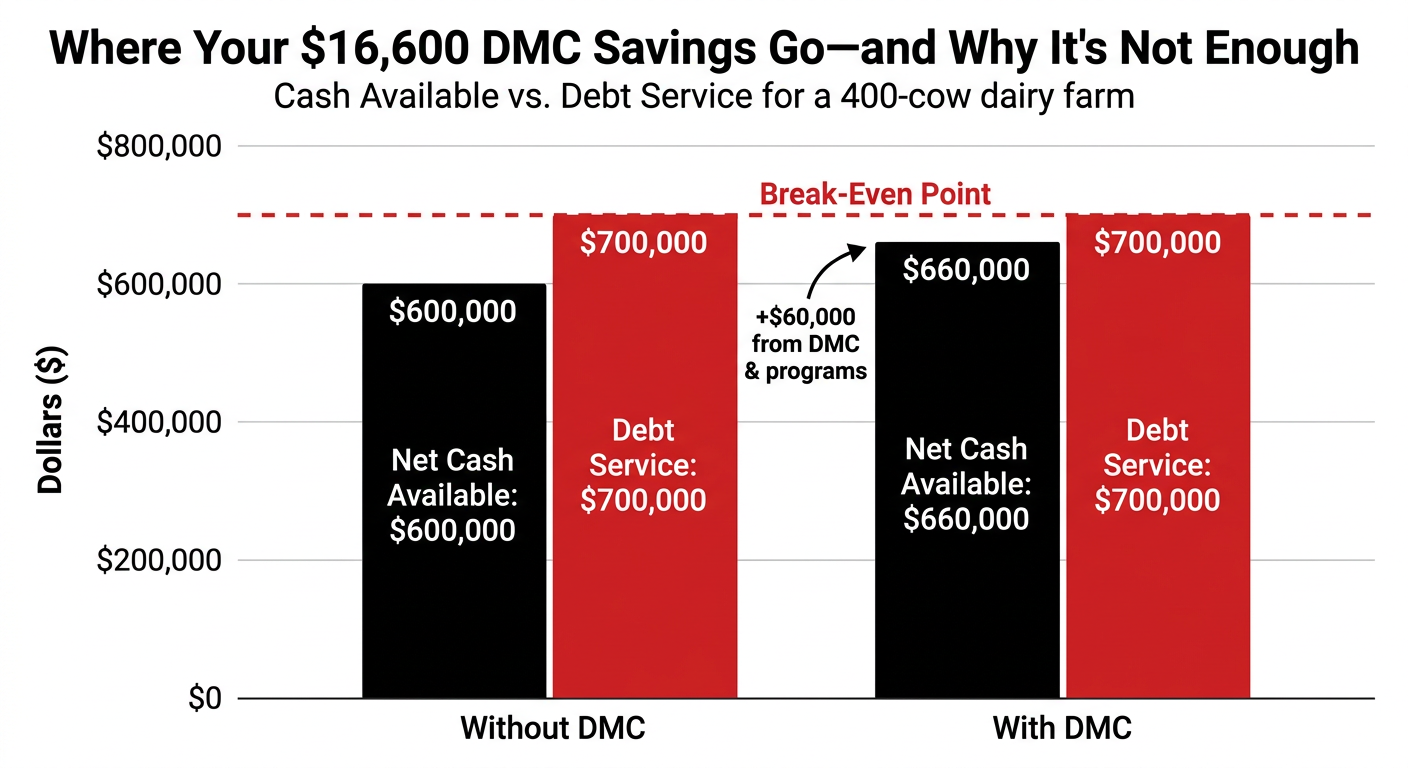
MetricWithout DMC & ProgramsWith DMC & Programs
Annual Milk Sales (110,000 cwt @ $18.95/cwt)$2,084,500$2,084,500
DMC Premium Savings$0$16,600
Other Cash Expenses$1,484,500$1,484,500
Net Cash Available for Debt Service$600,000$660,000
Annual Debt Service (P&I)$700,000$700,000
DSCR0.86x0.94x
Lender Comfort Zone1.15–1.25x1.15–1.25x

Adjust a few assumptions — slightly higher net cash, slightly lower debt service — and you can push the “with DMC” number just north of 1.1x. Without DMC, it sags back toward 0.9x.

Most ag‑lenders treat a DSCR of roughly 1.15–1.25x as their comfort zone. Anything under 1.0x signals cash‑flow that can’t service its own debt without outside help.

Neither number in that table clears the band. One looks less alarming.

The Turn: Is DMC Your Backstop or Your Business Model?

That question is Mark’s turn, and for a lot of 300–500‑cow operations, reading the same headlines.

The comfortable narrative has sounded like this: DMC is stronger and cheaper. FSA operating and ownership loan limits are higher. Conservation and methane dollars are flowing. Farm Credit and the American Bankers Association have pushed for FSA to raise guaranteed operating loan limits toward $3 million, arguing lenders need those levels to keep financing modern farms.

For a dairy with a solid DSCR, that’s true — higher guaranteed limits unlock better terms and responsible restructures. For a 0.9x herd like Mark’s, the math goes another way:
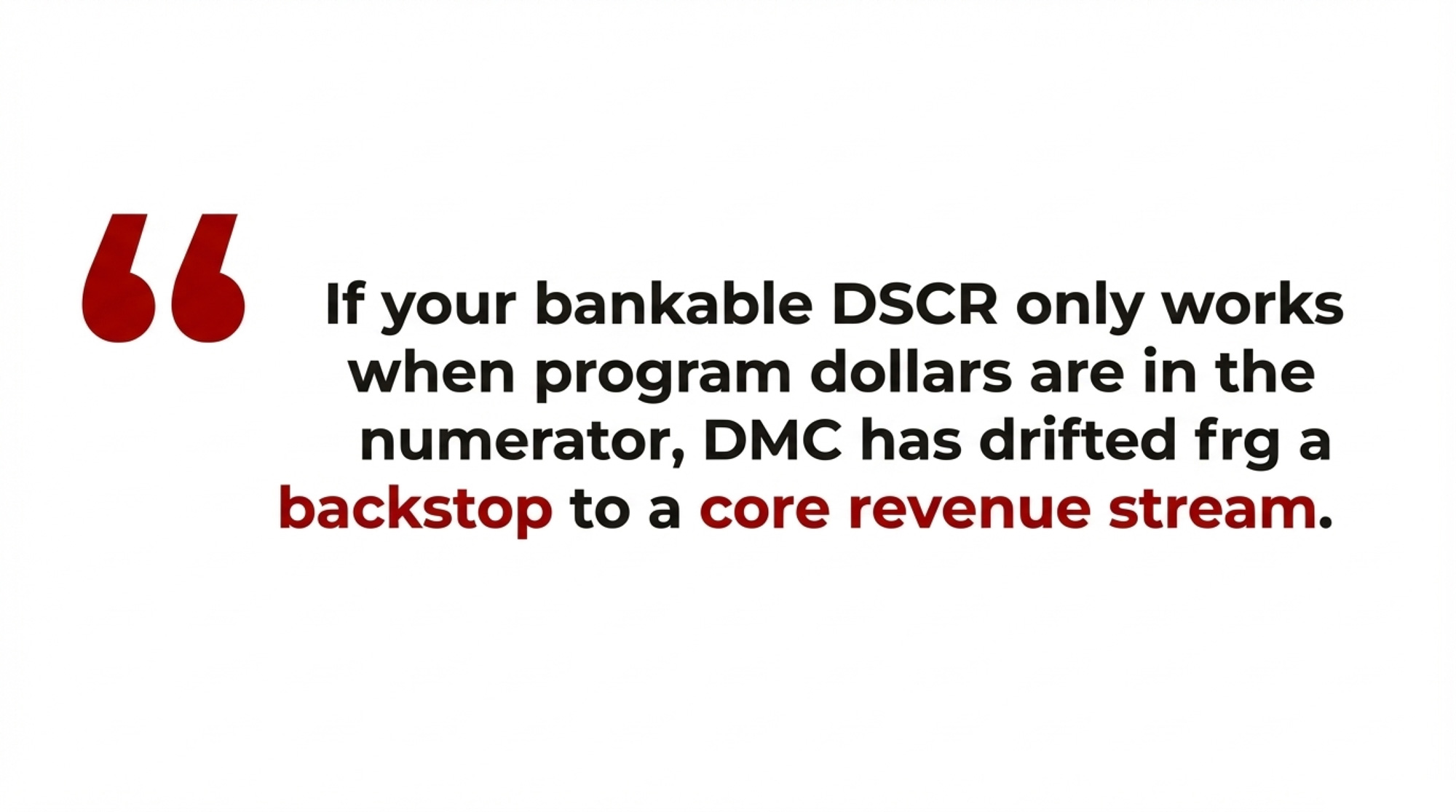
If your bankable DSCR only works when program dollars are in the numerator, DMC has drifted from being a backstop to a core revenue stream.

Rolling the operating line for another year isn’t risk management at that point. It’s a timing decision on when — and how — the operation changes or exits.

Three Branches — None Start with “Hope DMC Keeps Paying”

Once the math is on paper, most 400‑cow herds in this band end up with three branches.
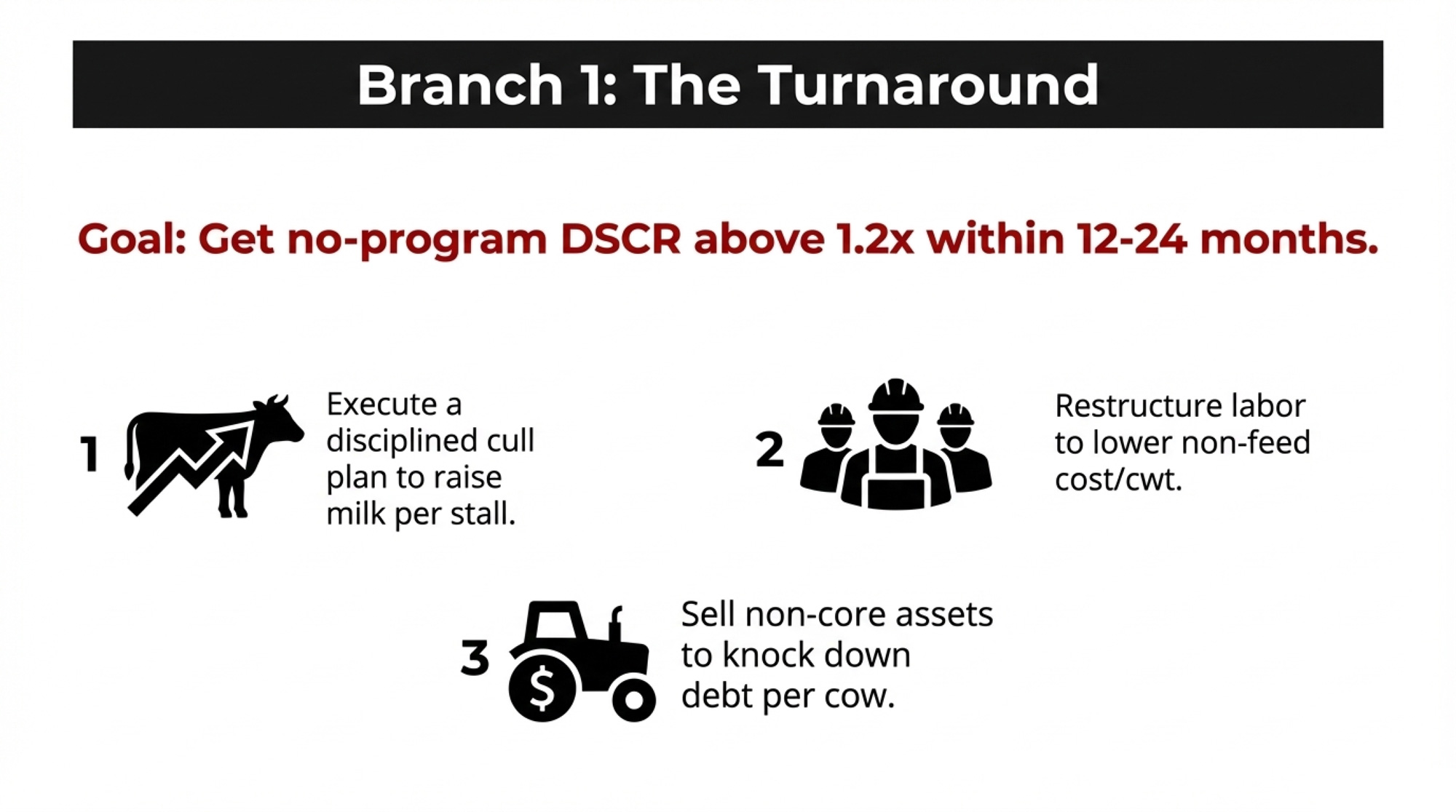
Branch 1: Turnaround — Get DSCR Above 1.2x Without Programs

Mark’s in this lane if “no‑program” DSCR can realistically climb to ≥1.2x within 12–24 months through specific moves: a disciplined cull plan that raises milk per stall; a concrete labour change that lowers non‑feed cost/cwt; selling non‑core assets to knock down debt per cow. In that world, DMC works as designed — a floor under feed‑margin risk, not a permanent revenue line.
Branch 2: Reshape — Change What the Cows Produce

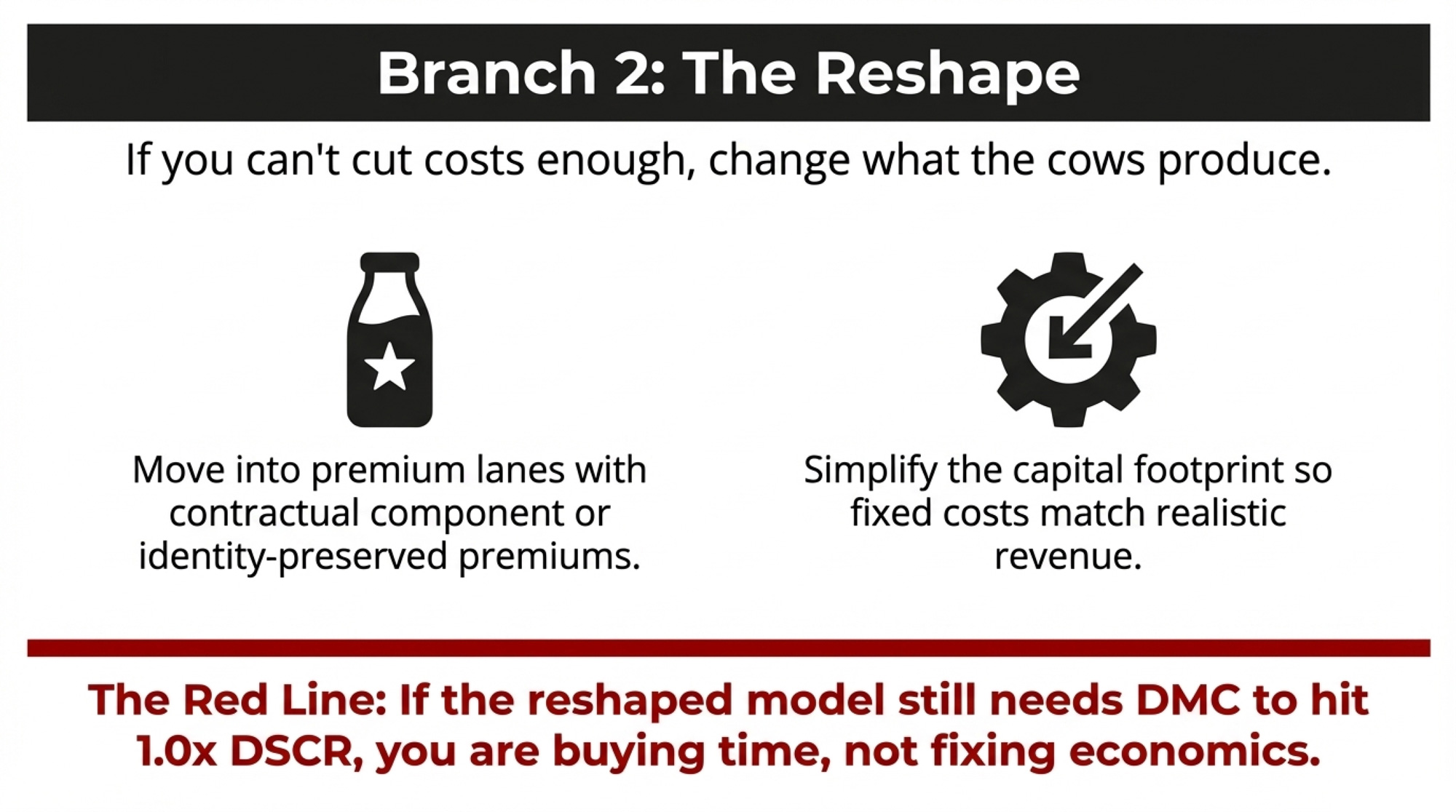
If Mark can’t get there on cost cuts alone, he may still change the model: move into a premium lane with documented, contractual component or identity‑preserved premiums that actually show up on the cheque; simplify the capital footprint so fixed costs match realistic revenue.

The red line stays put: if the reshaped model still needs DMC to get DSCR to 1.0x, that usually looks more like buying time than fixing core economics.
Branch 3: Use the Tools to Stage a Stronger Exit

The hardest conclusion. For many families — Mark’s included — this isn’t spreadsheet math. It’s a barn your grandfather built, and it’s where your kids learned to drive a skid steer.

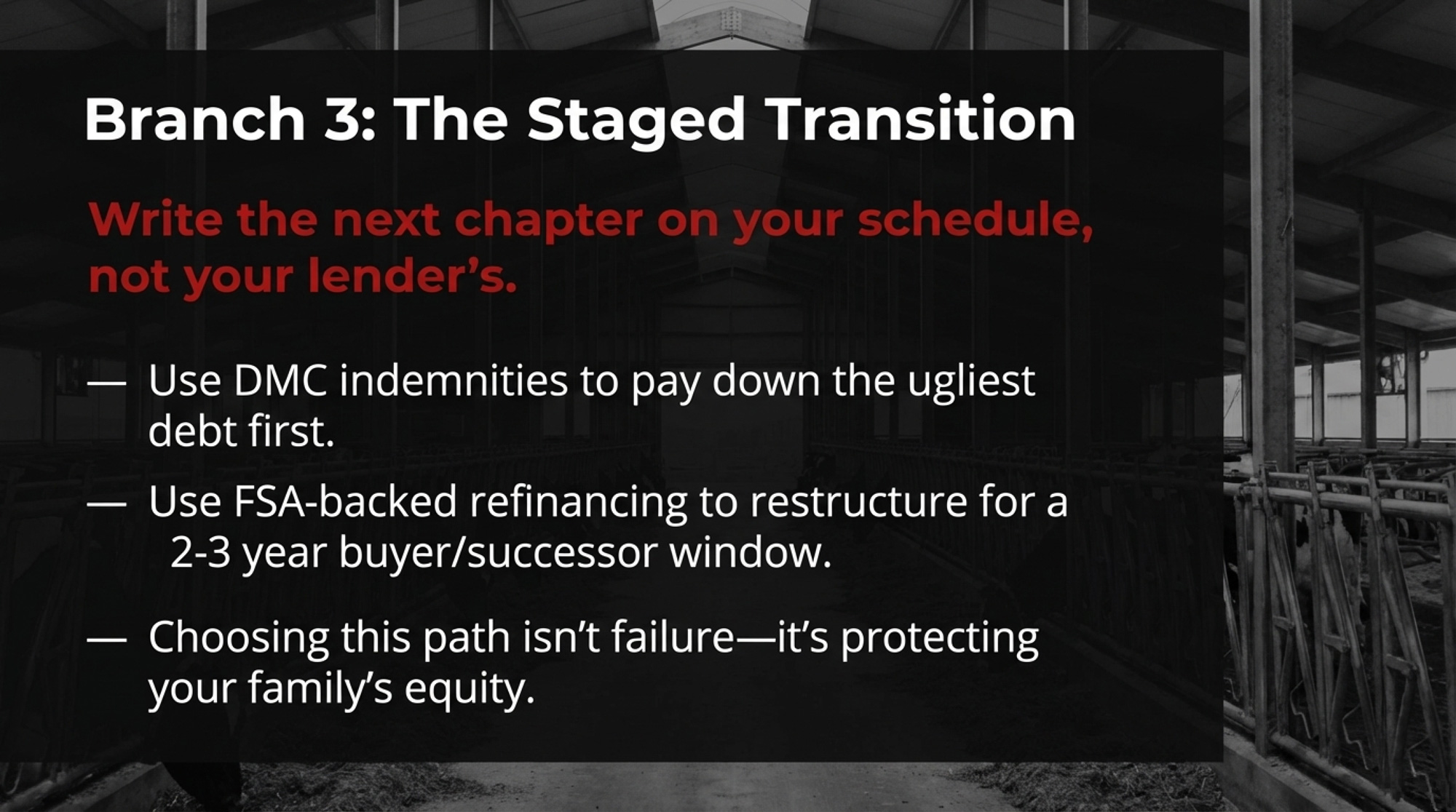
But the farm‑bill tools aren’t about keeping a struggling model alive indefinitely. They’re about choosing the timing, the terms, and the shape of what comes next on your schedule, not your lender’s:

  • Use DMC indemnities and premium savings to pay down the ugliest debt first.
  • Use FSA‑backed refinancing to restructure into a form that works for a buyer, successor, or landlord in a 2–3 year window.
  • Consider EQIP/energy projects only if they raise resale or lease value without adding obligations the next operator won’t want.

Choosing this path isn’t failure. It means you’re writing the next chapter, not waiting for the bank to write it for you.

What This Means for Your Operation

If you’re in the 300–500‑cow band and this feels uncomfortably close:

  • Within 30 days, run the “no‑program” DSCR test. Bring your last 12 months of milk cheques, a full cost‑of‑production breakdown (including labour at replacement cost), and your P&I schedule. Calculate DSCR with and without DMC. If it’s below 1.0x without programs, you’re looking at a business‑model question, not just a rough year.
  • Use the next 90 days to decide which branch you’re really on. If no combination of realistic cost cuts and genuine premiums gets DSCR to ≥1.2x without programs, you’re in “reshape or transition” territory. Better to name that now than let the bank name it in 18 months.
  • Treat DMC as protection, not entitlement. Max out Tier 1 and lock in the six‑year discount. Then ask: “Does this business stand on its own if DMC pays nothing for two years?”
  • Handle FSA like a scalpel, not a shovel. Model what happens to DSCR if you only restructure existing debtversus if you add new principal. If a new loan doesn’t improve your no‑program DSCR, it’s not expansion money — it’s extra risk.
  • Pick EQIP and energy projects that move cost per cwt. Plate coolers, VFDs, targeted manure improvements — cost‑share can cover 50–75% on smaller projects in some states. Full‑scale digesters mostly belong to herds with thousands of cows and corporate advisory teams. If a project doesn’t clearly lower $/cwt or raise asset value within three years, it’s probably not your project.
  • Build your risk plan around your own cheque. DNIP and school whole‑milk rules are demand‑side tailwinds. Most of those program dollars flow through retailers and processors first, touching your milk cheque only indirectly.
  • Make labour your first policy response. Immigration isn’t fixed in this farm bill, but it’ll decide more 400‑cow futures than any DMC tweak. Hang on to your core crew and keep compliance tight.
Farm Bill ToolDirect Impact on Your ChequeAction for 400-Cow Herds
DMC Tier 1 expansion$41.50/cow/year premium savingsMax out immediately. Lock in 6-year discount.
DMC indemnities (when triggered)$15–30/cow (varies by margin)Enroll at $9.50 coverage. Don’t count on it as income.
FSA operating loan limit increasesIndirect (better terms if DSCR ≥1.2x)⚠️ Use to restructure, not to add debt if sub-1.0x DSCR.
EQIP cost-share (plate coolers, VFDs)$5–15/cow (one-time savings on projects)Take it if project lowers $/cwt within 3 years.
DNIP & school milk programs$0 direct (flows through processors)Demand-side tailwind. Doesn’t change your cheque in 2026.
Full-scale anaerobic digesters$50–200/cow (only for 1,000+ cow herds)Skip. Needs corporate advisory team, not 400-cow scale.
Methane funding (small projects)$8–20/cow (manure improvements)⚠️ Consider if resale value increases. Not for survival cash.

Key Takeaways

  • If your DSCR sits below 1.0x without DMC, you’re past a rough‑year problem. You’re looking at a business‑model question the 2026 farm bill can’t fix on its own.
  • DMC’s ~$16,600 in premium savings ($41.50/cow) and likely 2026 indemnities are real — but they’re a backstop on margin over feed, not on total cost per cwt. Use them to buy time for decisions, not as a permanent source of income.
  • Higher FSA loan limits only win if they lower your no‑program DSCR or make a future sale/transfer cleaner. If they increase total debt on a sub‑1.0x operation, they accelerate an exit.
  • Choosing to transition isn’t choosing to fail. If no credible scenario gets your no‑program DSCR above 1.0x, the farm‑bill tools let you control timing, protect your family’s equity, and hand over something cleaner than a foreclosure.
The Bottom Line

At the end of a meeting like this, Julie slides the printout back across the desk and circles the two DSCR numbers. One with DMC, one without.

If DMC went away tomorrow and 2026 milk stayed near the USDA’s $18.95/cwt all‑milk forecast, what would your own DSCR be — and would your bank still lend into that model?

Complete references and supporting documentation are available upon request by contacting the editorial team at editor@thebullvine.com.

Learn More

The Sunday Read Dairy Professionals Don’t Skip.

Every week, thousands of producers, breeders, and industry insiders open Bullvine Weekly for genetics insights, market shifts, and profit strategies they won’t find anywhere else. One email. Five minutes. Smarter decisions all week.
NewsSubscribe
First
Last
Consent

GT Thompson’s 2026 Farm Bill Math: DMC Pays Your 200‑Cow Dairy $1,800, Make Allowances Cut $42,240 – a 23 to 1 Hit

Your 200-cow dairy gets $1,800 from the 2026 Farm Bill — and loses $42,240 to make allowances. Ready to see the 23‑to‑1 hit hiding in your milk check?

Executive Summary: The House Agriculture Committee’s 2026 Farm Bill draft — released February 13 by Chairman GT Thompson — gives a 200-cow dairy roughly $1,800 a year in improved DMC payments. Make allowance increases that took effect on June 1, 2025, have already cost that same herd $42,240 annually. That’s a 23-to-1 gap, and AFBF economist Danny Munch has tracked $337 million in pool losses from the formula change alone in its first 90 days. The bill’s sharpest tool is Section 1006: permanent mandatory processor cost surveys — the only mechanism that could eventually push make allowances back down. But the FMMO hearing process has never reduced make allowances, and Munch’s own timeline puts the earliest possible relief at 2028, with a more realistic read closer to 2031. Markup starts on February 23, DMC enrollment closes on February 26, and Lolly Lesher at Way-Har Farms in Pennsylvania — who testified before the committee — is one of the producers watching to see whether Section 1006 gets real teeth or stays symbolic. Two deadlines, one structural gap, and a formula that’s never been adjusted in the farmer’s direction.

2026 Farm Bill math

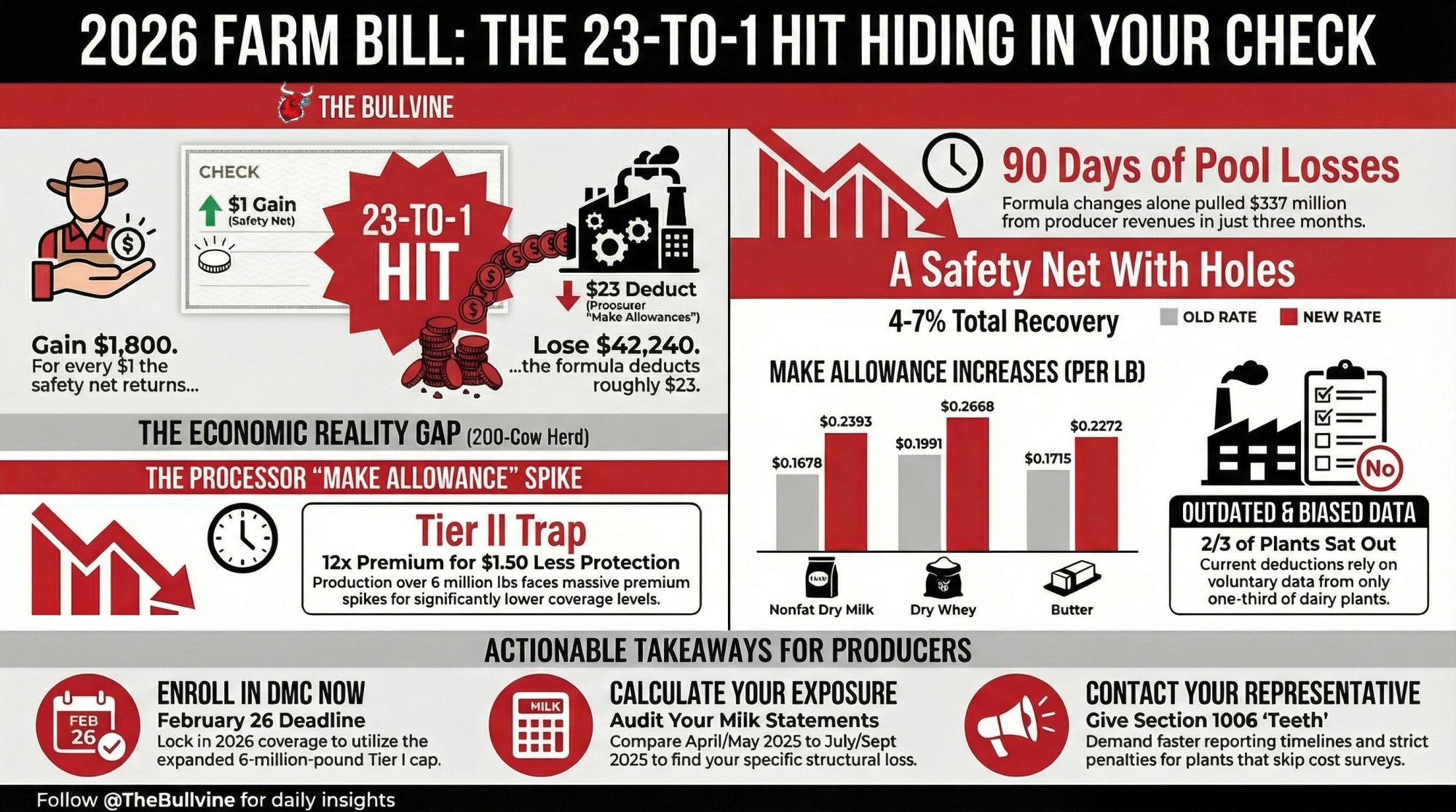
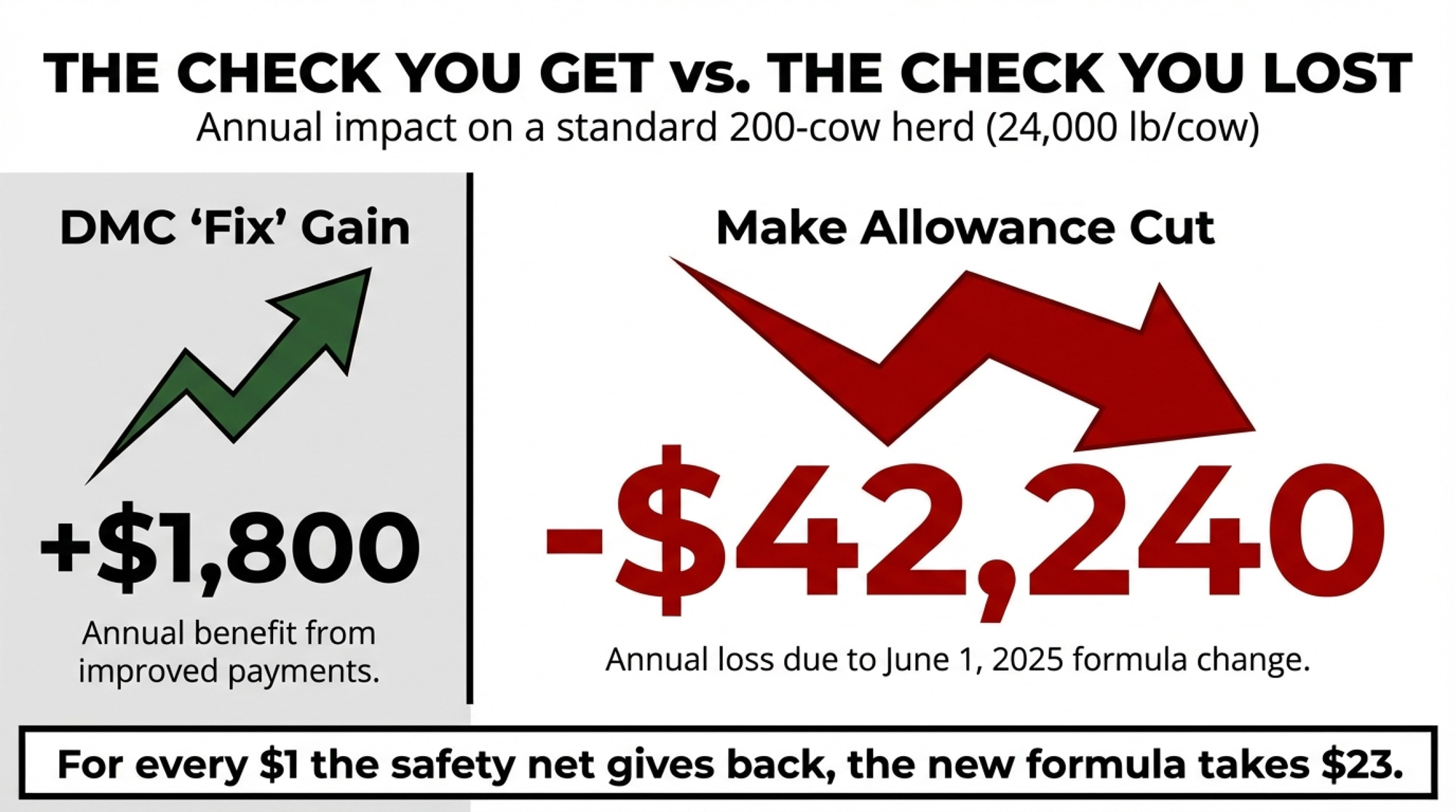
The House Agriculture Committee’s 2026 Farm Bill draft improves your Dairy Margin Coverage payment by roughly $1,800 a year on a 200-cow herd. The make allowance increases that took effect June 1, 2025, have already cost that same herd about $42,240 a year. That’s a 23-to-1 gap. For every dollar the safety net gives back, the formula takes twenty-three.

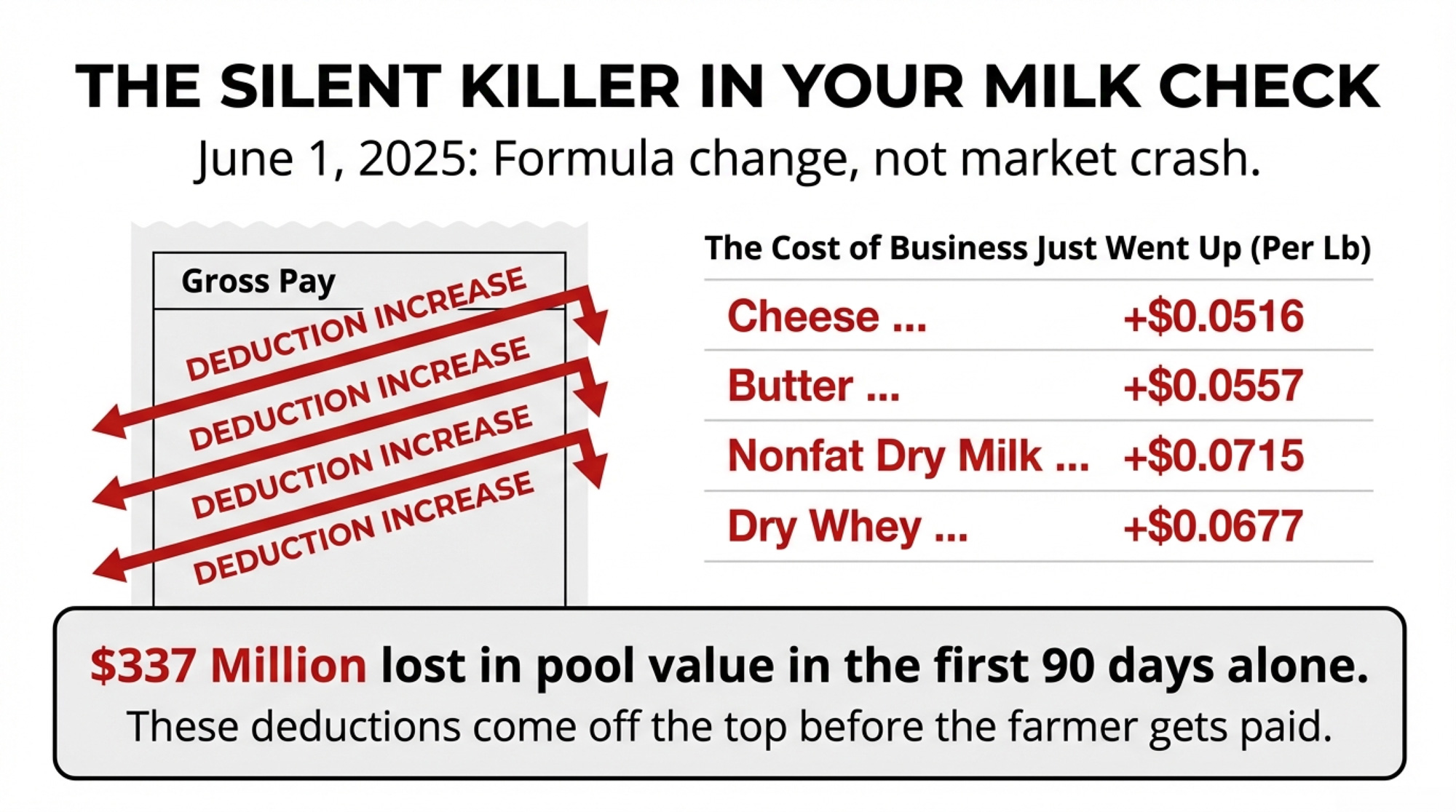
Those make allowance increases pulled $337 million out of producer pool revenues in their first 90 days, per AFBF’s September 2025 Market Intel analysis — not from a market crash, but from the formula change alone. It hit every FMMO-pooled dairy in America the same month Lolly Lesher at Way-Har Farms in Bernville, Pennsylvania, was bottling milk and scooping 90 flavors of ice cream alongside her milking herd of about 260 cows.

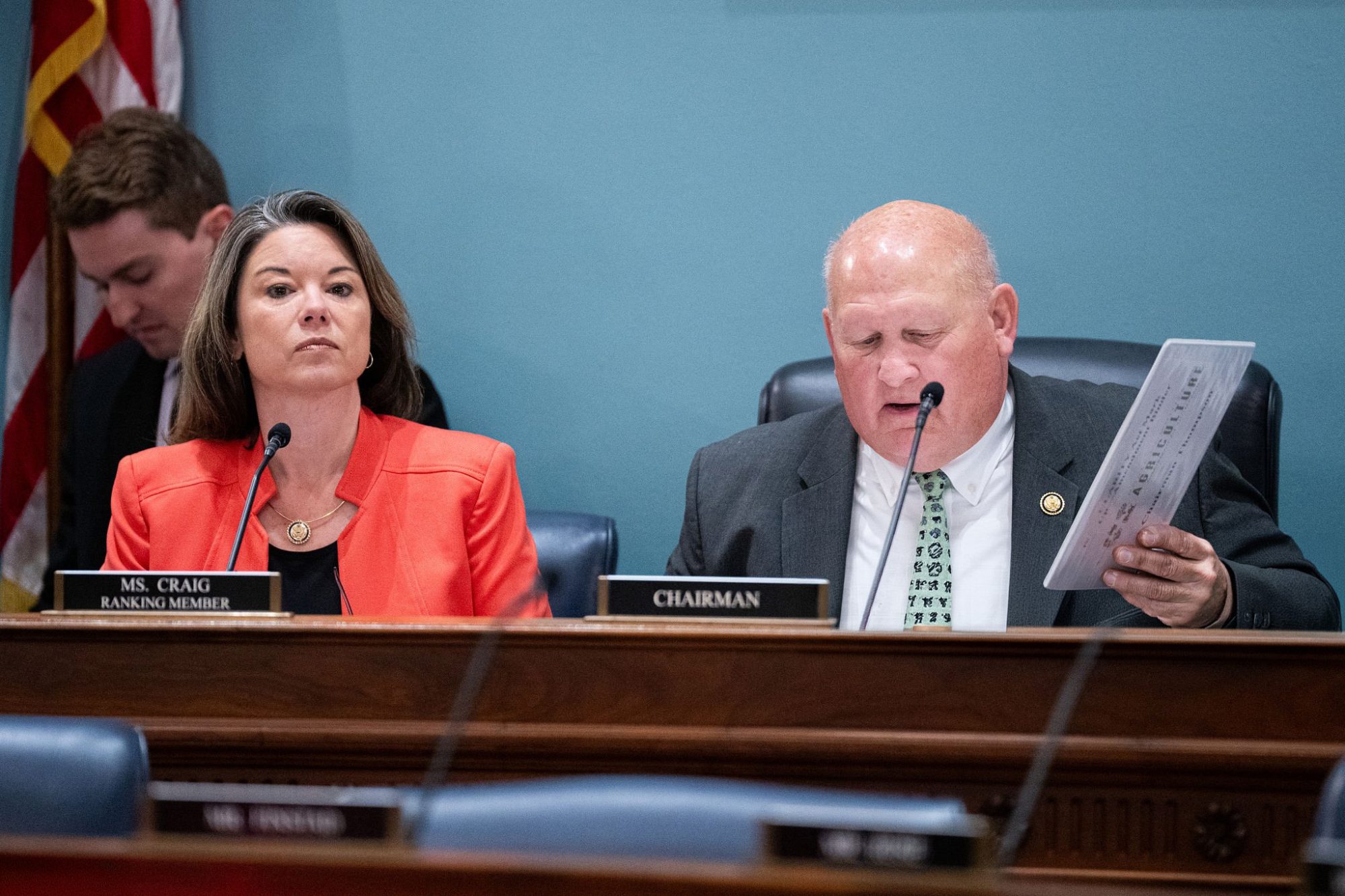
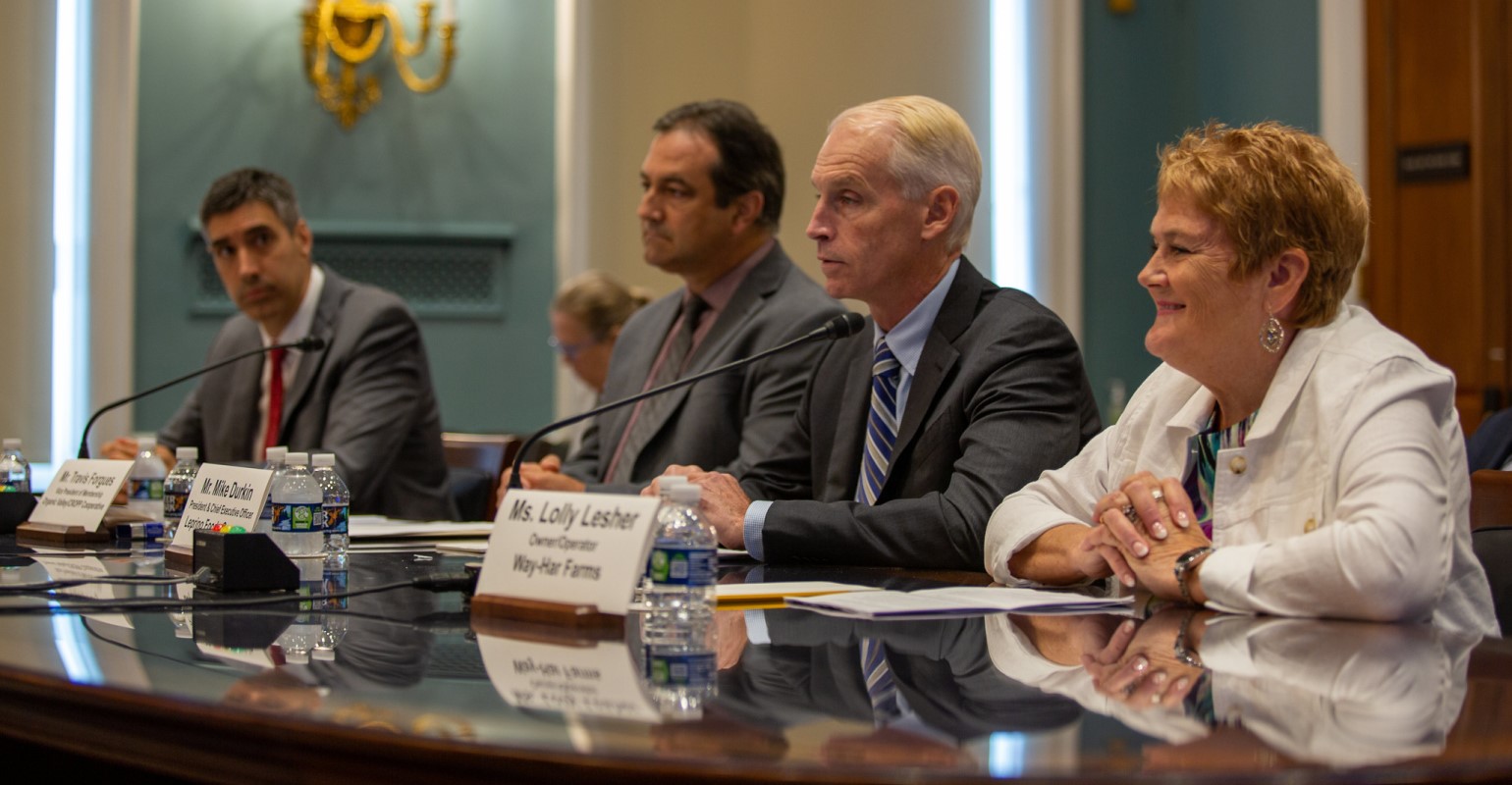
Pennsylvania dairy farmer Lolly Lesher (right), owner of the 300-cow Way-Har Farms in Berks County, testified before the House Agriculture Committee on behalf of NMPF and Dairy Farmers of America on June 22, 2022 — urging Congress to update DMC production history limits and fix the Class I mover formula she said cost producers over $750 million. Beside her (left to right): University of Minnesota ag economist Marin Bozic, Organic Valley VP of Membership Travis Forgues, and Leprino Foods CEO Mike Durkin. Photo: House Agriculture Committee / Flickr

Lesher has talked publicly about what pricing instability means for multi-generational dairy families. She and her family expanded from 80 cows to over 200 when her daughter returned to the operation — because, as Lesher has discussed on the Lancaster Farming FarmHouse podcast, the economics of an 80-cow operation couldn’t stretch to support multiple family members coming back to the farm. “When milk prices flip-flop up and down so much,” she told the podcast, “you need to be well-versed in planning and how to handle the debt and the payments.” That planning just got harder. And the bill that’s supposed to help? It recovers somewhere between 4 and 7 cents of every dollar the formula already took.

Where Did $337 Million Go?

The make allowance increases weren’t part of this Farm Bill. They came through USDA’s FMMO modernization package, finalized in November 2024, approved by producer referendum in all 11 orders, and implemented on June 1, 2025. Make allowances — the per-pound deductions covering processor manufacturing costs, subtracted before farmers get paid — jumped across all four product categories:

ProductOld Rate ($/lb)New Rate ($/lb)Increase ($/lb)% Change
Cheese$0.2003$0.2519+$0.0516+25.8%
Butter$0.1715$0.2272+$0.0557+32.5%
Nonfat dry milk$0.1678$0.2393+$0.0715+42.6%
Dry whey$0.1991$0.2668+$0.0677+34.0%

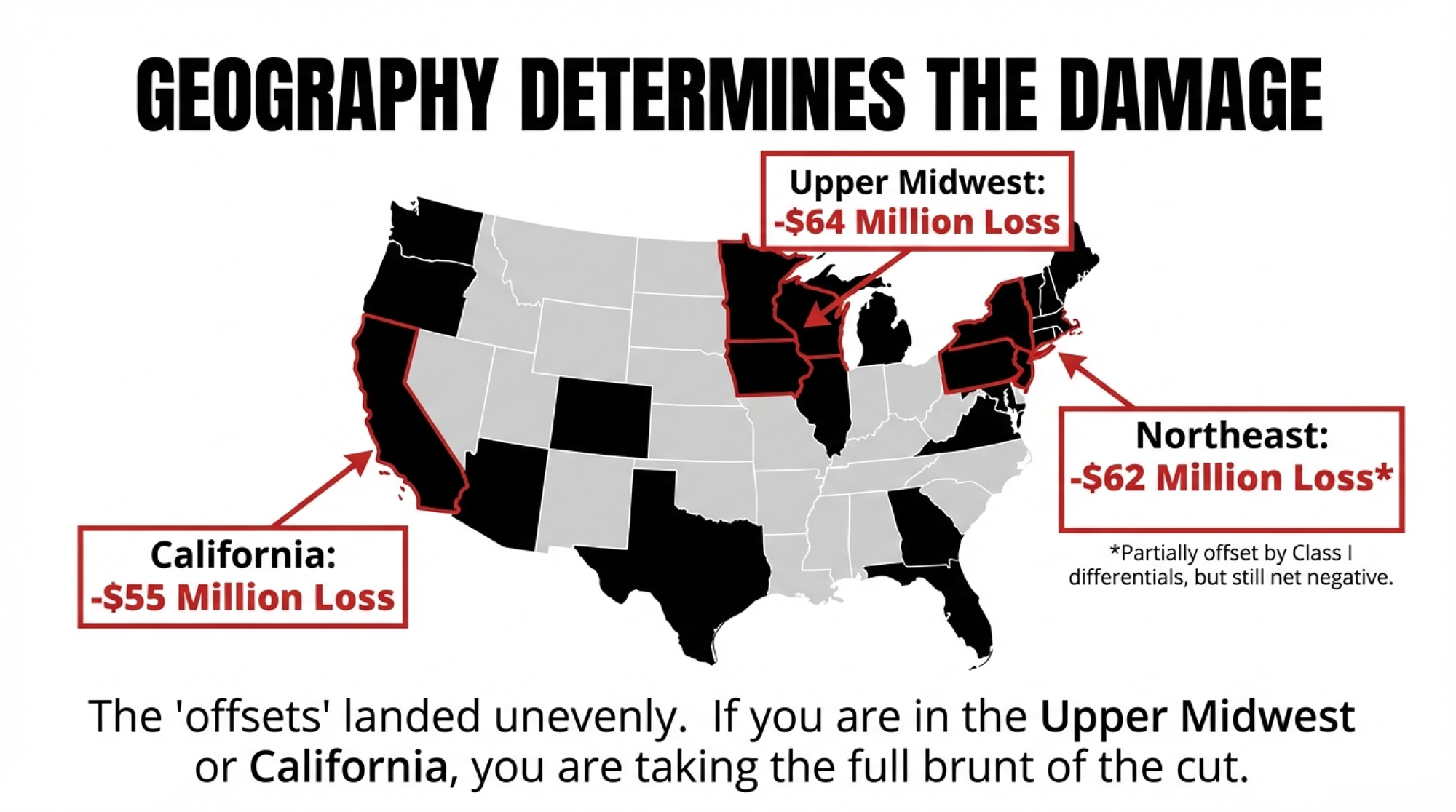
AFBF economist Danny Munch tracked what those increases did to pool values. Average Class I prices dropped $0.89/cwt. Class II fell $0.85. Class III lost $0.92. Class IV, $0.85 — a 4 to 5% cut across the board attributable solely to higher make allowances. The Upper Midwest order alone lost $64 million in pool value over those first three months. The Northeast lost $62 million. California, $55 million.

The FMMO amendments weren’t all one-directional, though. Higher Class I differentials — also part of the modernization package — added an estimated $137 million back to pool values in the same period, led by the Northeast (+$34 million) and Mideast (+$30 million), per the same AFBF analysis. The net total pool revenue decline from all FMMO amendments combined was roughly $232 million. But the offsets landed unevenly: California and the Upper Midwest — the two hardest-hit orders from make allowances — gained only $6 to $8 million each from higher differentials. If you’re pooled in the Upper Midwest, the differential cushion barely registers.

Processors had their own math. Christian Edmiston, VP of Procurement at Land O’Lakes, testified at the 2023 FMMO hearing that make allowances hadn’t been updated since 2008 and that manufacturing costs at LOL’s plants had risen substantially. He acknowledged the proposed increases “would not fully offset the increases in manufacturing costs” since 2008, but argued they “offer a balance between the producer price impact from raising make allowances and the processor cost impact.”

University of Minnesota dairy economist Marin Bozic told Brownfield in January 2025 that he expects higher allowances will eventually pull more milk back into pools: “As make allowances increase, that means that the processors have stronger incentives to bring that milk to the pool to try to get a piece of the producer price differential and forward that to their patrons.”

The short version of Bozic’s argument: when regulated minimum prices don’t reflect real processor economics, processors pull their milk out of the pool. Under the old make allowances, the regulated Class III price didn’t reflect where the market actually was, as Bozic put it — the gap between minimum regulated prices and processors’ real-world economics was wide enough to distort pooling behavior. That squeezed processor margins within the pool and pushed them to de-pool. Bozic told Brownfield the old system “manifested as a declining and then disappearing premium and more and more milk being depooled.” With higher make allowances, regulated minimums drop closer to market reality, reducing the misalignment that triggers de-pooling. More pooled milk means more revenue stays in the pool — and Bozic expects over-order premiums to return as a result. But “eventually” doesn’t help the check that’s already been issued.

[Read more: We mapped where those pool dollars went, region by region]

How Does the 2026 Farm Bill Change Your DMC Payment?

The barn math on the make allowance side is straightforward. Take a 200-cow Holstein herd producing 24,000 pounds per cow annually:

  • 200 cows × 24,000 lb = 4,800,000 lb/year = 48,000 cwt
  • AFBF’s class price reductions range from $0.85 to $0.92/cwt, depending on class utilization
  • Using $0.88 as an approximate midpoint: 48,000 × $0.88 = $42,240 per year

Scale it up. At 500 cows: $105,600. At 1,000 cows: $211,200. Your actual number depends on your order’s class utilization — a herd pooled mostly in Class III (Upper Midwest) takes a hit closer to $0.92/cwt, while heavier Class I utilization lands nearer $0.89. And if you’re in an order with strong differential gains (Northeast, Mideast), part of that loss is offset by higher Class I values — pull your actual milk statements to see the net.

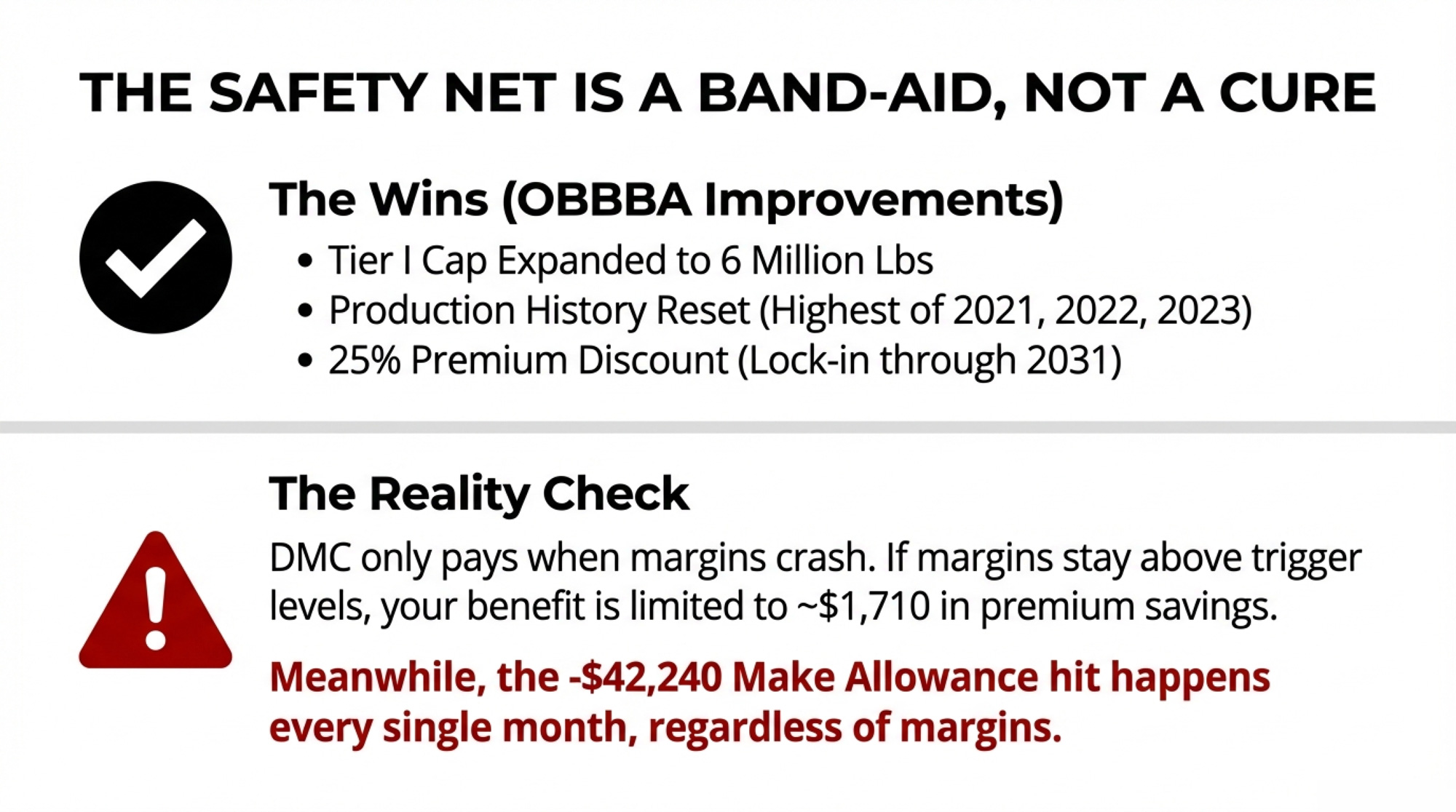
Now the safety-net side. The One Big Beautiful Bill Act (OBBBA) — the 2025 budget reconciliation package signed into law July 4, 2025 — delivered genuine DMC improvements: Tier I expanded from 5 million to 6 million pounds, production history resets to the highest of 2021, 2022, or 2023 marketings, and a 25% premium discount kicks in for producers who lock coverage through 2031. Premium rates under both Tier I and Tier II are unchanged from the 2018 Farm Bill structure.

Run it for the same 200-cow herd at $9.50 Tier I coverage, 95% enrollment:

  • 4,800,000 lb × 0.95 = 4,560,000 lb covered = 45,600 cwt
  • Premium at $0.15/cwt = $6,840/year at full rate
  • With 25% lock-in discount: $5,130/year — saving roughly $1,710 annually
  • In a year where DMC triggers for three to six months, additional indemnity payments could add $600 to $1,600

Total realistic DMC benefit in a tight-margin year: approximately $1,800 to $3,000. Against $42,240 in structural pool losses, that recovers between 4 and 7 cents per dollar.

The Quick Math for a 200-Cow Herd:

  • Loss (Make Allowances): −$42,240/year
  • Gain (DMC Fixes): +$1,800 to $3,000/year
  • Net Structural Gap: −$39,240 to −$40,440

The 500-Cow Tier II Trap

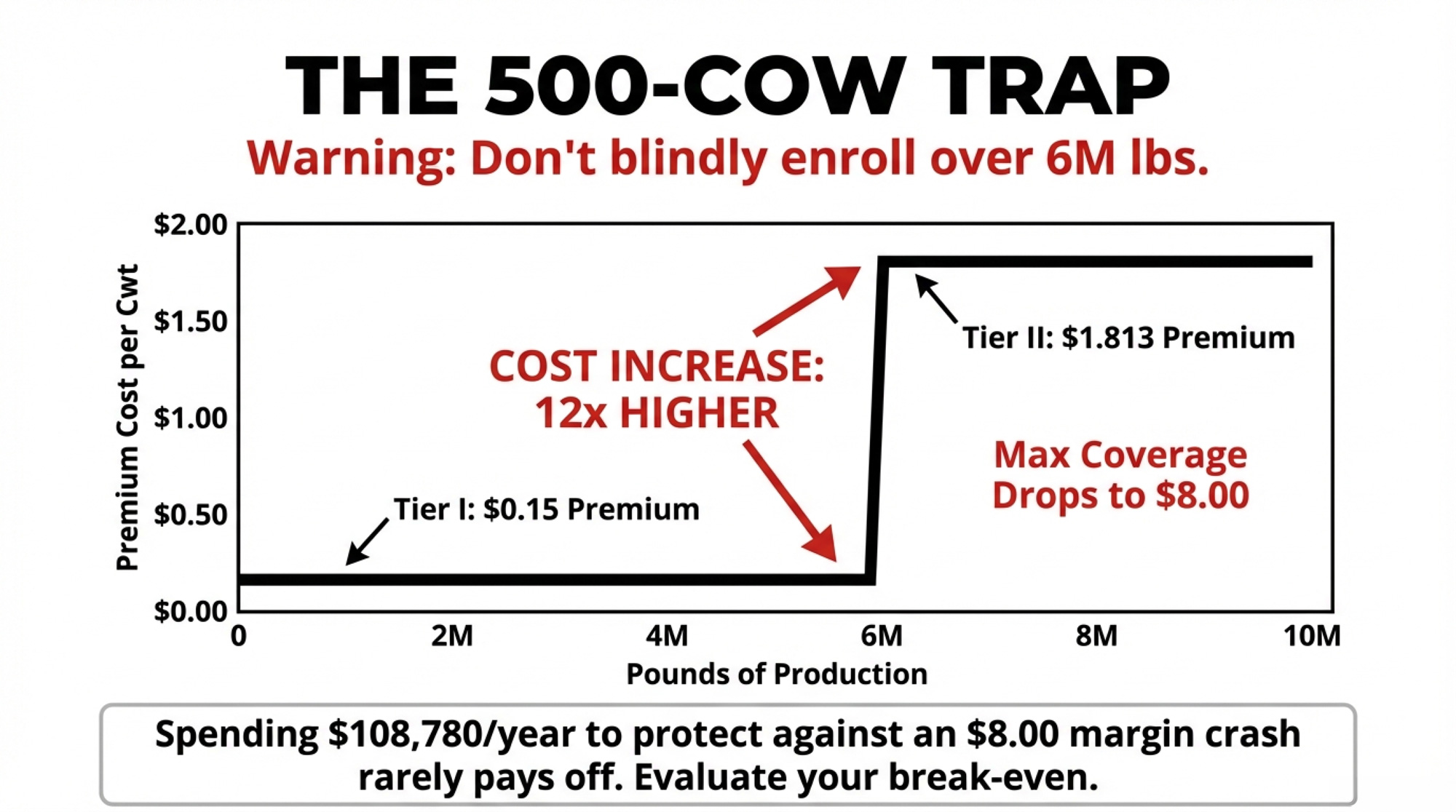
Bigger herds hit a wall. At 500 cows producing 24,000 lb/cow, you’re generating 12 million pounds a year. Under the new Tier I cap, the first 6 million pounds qualifies for Tier I. The remaining 6 million drops into Tier II — and the economics shift sharply:

  • Tier I (first 6 million lb): Max coverage = $9.50/cwt. Premium at $9.50 = $0.15/cwt.
  • Tier II (remaining 6 million lb): Max coverage drops to $8.00/cwt. Premium at $8.00 = $1.813/cwt — a 12x increase for $1.50 less protection.
  • Tier II annual premium math: 6,000,000 lb ÷ 100 = 60,000 cwt × $1.813 = $108,780/year at the $8.00 ceiling.
  • And here’s what you’d get back: If the margin drops to $7.00 for three months, Tier II indemnity on 60,000 cwt = $1.00 × 60,000 × 3/12 = $15,000 — against $108,780 in annual premium.
  • Meanwhile, the make allowance hit on 500 cows: $105,600/year, and that lands regardless of your DMC election.

Most large-herd advisors, including Mike North at Ever.ag, counsel producers to carefully evaluate Tier II against the frequency with which margins actually fall below $8.00. If your breakeven sits well above $9.00, Tier II may not be worth the premium.

Coverage TierCoverage CeilingAnnual PremiumIndemnity (3 mo @ $7.00)Net CostWorth It?
Tier I (first 6M lb)$9.50/cwt$9,000$37,500+$28,500Yes
Tier II (next 6M lb)$8.00/cwt$108,780$15,000-$93,780Rarely
Tier I + Tier II combinedMixed$117,780$52,500-$65,280No

How Two-Thirds of Processors Sat Out and Shaped Your Check

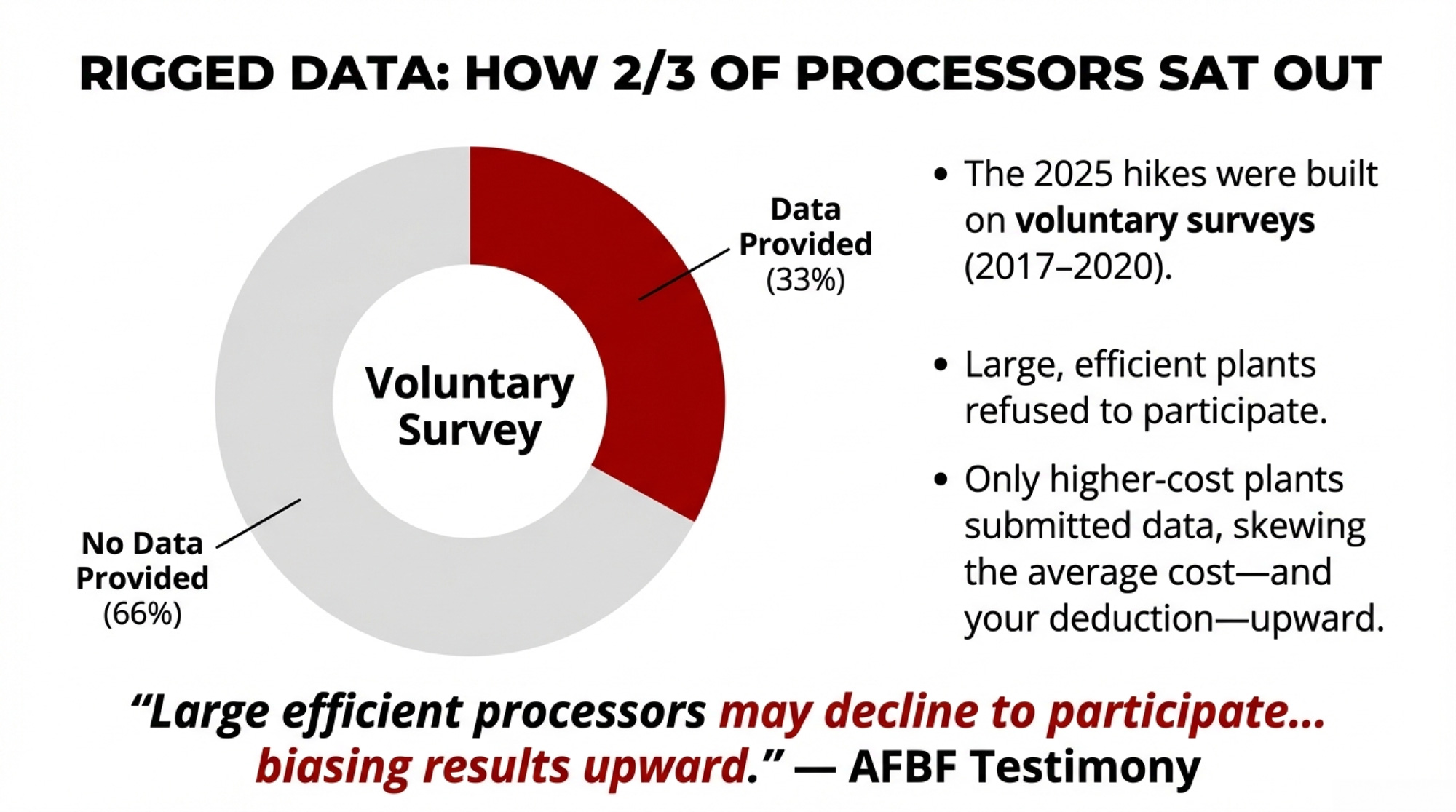
Munch has been sounding this alarm for two years. When Brownfield covered AFBF’s concerns at World Dairy Expo in October 2024, he laid out the numbers: “76% of cheddar cheese plants, 80% of butter plants, 40% of nonfat dry milk plants” skipped the voluntary cost surveys entirely. The cheese survey covered about 43 million pounds in total, but Stephenson’s sample captured only 6 to 7 million. The joint AFBF/NMPF petition to USDA put an even finer point on it: roughly two-thirds of dairy manufacturing plants provided no cost data at all.

Product TypeParticipation Rate (%)
Cheese24%
Butter20%
Nonfat Dry Milk60%
Dry Whey~30%

The survey, conducted by University of Wisconsin economist Mark Stephenson, gathered data from October 2017 through December 2020. So the make allowance increases, hitting your 2025 checks, were built on cost data that’s largely 5 to 8 years old, from a voluntary sample that skewed toward higher-cost operations.

The structural incentive isn’t subtle. Plants that benefit from higher make allowances were the same ones deciding whether to supply cost data. Big, modern facilities running at scale — with the lowest per-unit costs — had every reason to sit out. As AFBF wrote in its hearing testimony: “large efficient processors may decline to participate, which would bias the cost survey results upward.” Even Edmiston at Land O’Lakes acknowledged in his testimony that “the ideal data that a mandatory and audited survey would provide does not exist today.”

And there’s a historical pattern here. Allowances have been raised twice in the modern FMMO era — once in 2008 and again in 2025 — since the current formula structure was established during the 2000 order consolidation. They’ve never been reduced. The ratchet turns one direction.

[Read more: The U.S./Canada dairy comparison that puts domestic pricing reform in a continental context]

Will Section 1006 Actually Change Anything?

Here’s where it gets interesting. Section 1006 of the Farm, Food, and National Security Act of 2026 — titled “Mandatory reporting of dairy product processing costs” in the bill’s table of contents — makes permanent the mandatory biennial cost surveys initially authorized and funded at $9 million in the OBBBA (the 2025 reconciliation package).

NMPF President Gregg Doud said it plainly in the organization’s February 13, 2026, statement: “NMPF thanks Chairman Thompson, House Agriculture Committee members, and their staffs for working to put together a farm bill that will bring greater certainty to producers at a difficult time.” IDFA’s Michael Dykes called it “a permanent authorization for Mandatory Cost Surveys that will ensure make allowances in the Federal Milk Marketing Orders accurately reflect the cost of manufacturing dairy products.”

Kevin Krentz, Wisconsin Farm Bureau president and owner of a 600-cow dairy near Berlin, Wisconsin, has been a consistent voice for this reform — testifying at the 2023 FMMO hearing and at Farm Bill listening sessions that make allowance changes need mandatory, verifiable data behind them.

Lesher has walked that same path. She testified before the House Ag Committee and told Lancaster Farming that she received more questions from representatives than from the economists and professors in the room. “If I don’t tell our story,” Lesher said, “somebody else is going to tell a story. And it may not be as accurate.”

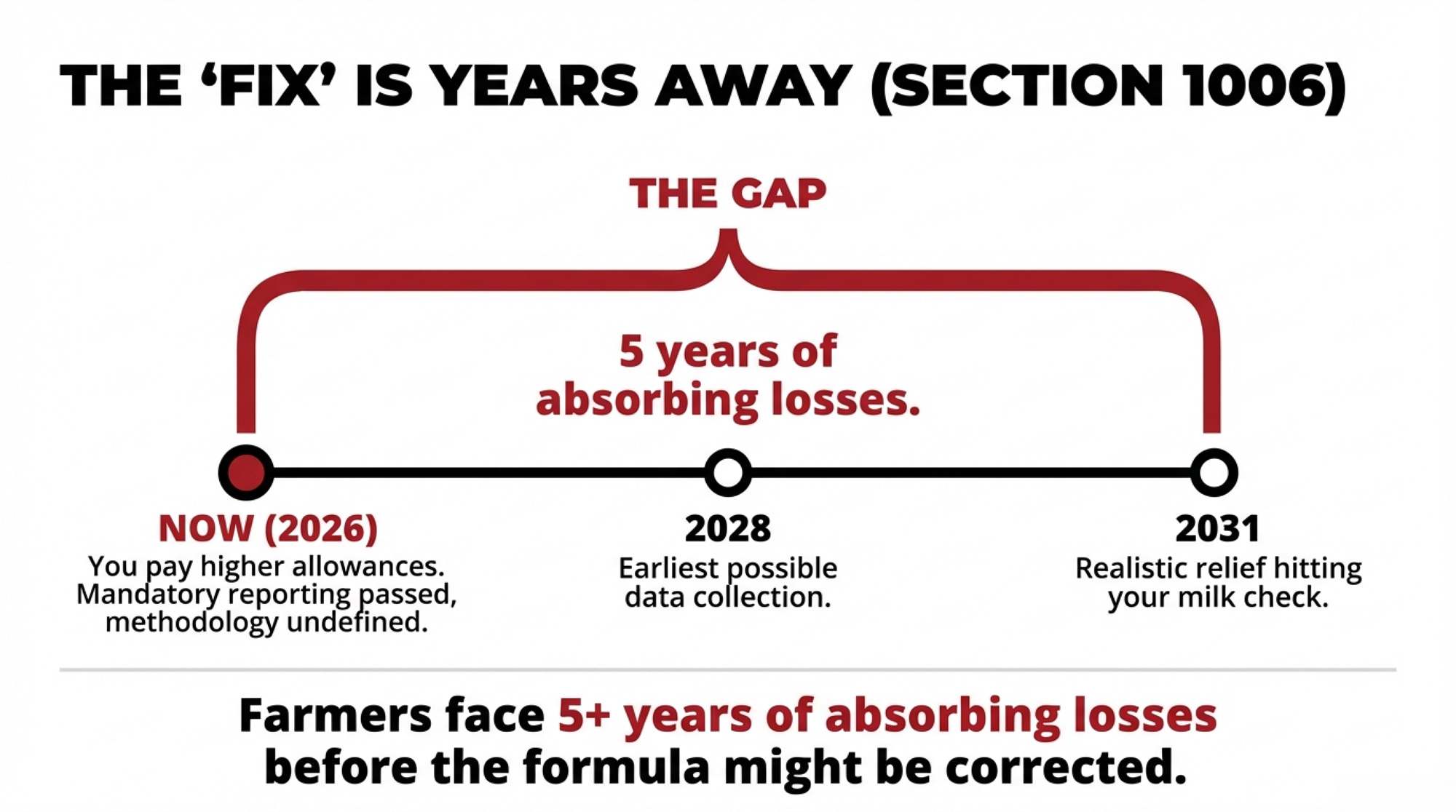
But Section 1006 doesn’t automatically adjust make allowances when new data arrives. Munch told Brownfield in October 2025 — after the OBBBA passed — that this is a common misconception: “That’s not the case. There’s still the traditional federal milk marketing order hearing process in place to make those amendments, so we would have to have a dairy industry stakeholder claim that there’s a problem, mention that problem, and initiate a whole other hearing.” And even getting the surveys running is on hold. “They’re going to have to set up a methodology. They’re going to have to have staff and researchers set aside for this,” Munch said, adding that government shutdowns have already caused delays.

There’s also a scenario nobody’s talking about. Mandatory surveys could confirm that processor costs genuinely rose as much as the voluntary data suggested. Edmiston’s own testimony showed that Land O’Lakes’ manufacturing costs at their Tulare, Carlisle, and Kiel plants all increased since 2008. If mandatory data backs that up, the reform argument shifts from “lower make allowances” to “at least now we know.” Either way, verified data beats unaudited self-reporting from one-third of plants.

Munch has been clear on the timeline: “any resulting formula adjustments remains unclear, with changes unlikely to reach milk checks before 2028.” That’s Munch’s floor. A more conservative read based on the full FMMO hearing track record: AMS builds survey methodology through 2027–2028, first mandatory report around 2029, then add two to three years if stakeholders petition for an adjustment. Possible relief in the 2031–2032 range.

Five to six years of absorbing $42,240 annually on a 200-cow herd before make allowances might come down. “Might” is doing heavy lifting.

[Read more: When the financial pressure is structural, not cyclical, the playbook has to change]

What Canadian Producers Should Watch

Bullvine readers north of the border: this isn’t just an American story. When U.S. FMMO pool prices drop structurally — not due to a bad market but to a formula change — it depresses the price at which American dairy enters the USMCA tariff-rate quota system. Lower U.S. pool prices mean American milk crosses into the TRQ window at a wider discount relative to Canadian cost-of-production pricing, shifting the competitive dynamics Canadian producers face under supply management. And there’s a sharper edge: if Section 1006 ultimately fails to lower make allowances, sustained U.S. price depression could widen the gap between what American and Canadian producers receive for comparable components — a gap that already sparks political friction on both sides of the border.

If you’re tracking your quota value against cross-border pricing, this formula change affects the spread. We’ll break down the Canadian math when the Senate version drops.

[Read more: We compared what’s happening to U.S. farms vs. Canadian quota holders]

Four Moves Before Markup

Chairman Thompson confirmed the House Ag Committee will begin markup the week of February 23. Here’s what you can do between now and then.

This month:

  • Lock in your 2026 DMC coverage by February 26. That’s the enrollment deadline. At $9.50 Tier I with the 25% six-year discount, a 200-cow herd pays ~$5,130 vs. ~$6,840 at the full rate. The trade-off: you’re committed through 2031. If margins run strong over those six years, you can’t adjust coverage until the next cycle. Here’s the threshold: if your margin has dropped below $9.50 in any month since June 2025, the $9.50 level is likely worth the premium. If it hasn’t, model the savings at $8.50 and $9.00 coverage before locking into $9.50 through 2031 — the premium savings at lower levels may outweigh the indemnity probability over a six-year window.
  • Call your representative with two specific asks on Section 1006. First, compress the timeline for the first mandatory cost report—if AMS already audits prices weekly under NDPSR, cost data shouldn’t take years to collect. Second: add explicit penalties for non-compliance. Roughly two-thirds of plants sat out the voluntary surveys. Mandatory only works with teeth. Thompson’s DC office: (202) 225-5121.

Within 90 days:

  • Calculate your make allowance exposure. Pull your milk statements from April–May 2025 (pre-FMMO change) and compare blended price per cwt to July–September 2025 (post-change). Your annual hundredweight × that difference = your structural loss from the formula shift, separate from any market-driven movement. That number strengthens every conversation with your lender, your co-op board rep, and your congressman.
  • Check EQIP eligibility if you’re planning capex. USDA removed EQIP payment limits for 2025 — the previous $450,000 five-year cap is gone. The Farm Bill draft supports conservation “with a continued designation of conservation funds for livestock producers and a directive for states to prioritize methane-reducing practices,” per NMPF’s analysis. With no cap, larger manure-handling or precision-feeding projects now qualify. But EQIP is competitive — uncapped funding attracts bigger operations too — and most state batching deadlines fall in March through April. Contact your local NRCS office this week if you want to be in the spring cycle.

Within 12 months:

  • Watch for AMS’s announcement of the mandatory cost survey methodology. Once AMS publishes how they’ll collect data under Section 1006, the clock starts on when new make allowance data could inform a hearing. That announcement is your signal for whether the 2028 floor or the 2031 ceiling is more realistic.
ActionDeadlineUrgencyWhat to DoWhy It Matters
Enroll in DMCFeb 26, 2026HIGHLock $9.50 Tier I with 25% 6-year discount; model Tier II carefully$1,710/year savings on 200-cow herd; production history reset to highest of 2021–2023
Call your rep on Section 1006Feb 23, 2026 (before markup)HIGHAsk for faster reporting timeline + penalties for non-complianceMandatory surveys are only mechanism to lower make allowances; voluntary surveys had 2/3 non-response
Calculate your exposureWithin 90 daysMEDIUMCompare April–May 2025 vs. July–Sept 2025 milk statementsSeparates formula loss from market loss; strengthens lender/co-op conversations
Check EQIP eligibilityMarch–April 2026 (state batching deadlines)MEDIUMContact NRCS for methane/manure projects; no payment capUncapped funding but competitive; larger projects now qualify
Watch for AMS methodology announcementWithin 12 monthsLOWMonitor when AMS publishes Section 1006 survey designSignals whether 2028 floor or 2031 ceiling is realistic for relief

When the financial pressure is this structural — baked into the formula, not driven by the market — the hardest call isn’t to your congressman. [If you or someone on your operation is feeling the weight of it, read this.]

[Read more: How your balance sheet tells the story before your milk check does]

What This Means for Your Operation

  • The make allowance hit is permanent and automatic. It lands on every hundredweight of pooled milk, every month, regardless of your DMC enrollment or conservation participation. You don’t choose this deduction. It’s already in the formula.
  • The offset is real but uneven. Higher Class I differentials added $137 million to pool values nationwide — but the gains concentrated in the Northeast and the Mideast. If you’re in the Upper Midwest or California, the differential cushion covers a fraction of your make allowance loss.
  • DMC improvements are conditional. You only see indemnity payments when the margin drops below your coverage level. In a year where DMC never triggers, the benefit is limited to the premium discount — about $1,710 for a 200-cow herd at $9.50 Tier I with the six-year lock-in.
  • If your operation crosses 250 cows, you’re now likely within Tier I under the expanded 6-million-pound cap. Run your numbers at Tier I rates before assuming you need Tier II — the premium jump from $0.15/cwt to $1.813/cwt on production above 6 million pounds is steep, the coverage ceiling drops from $9.50 to $8.00, and the indemnity math rarely justifies the premium.
  • Section 1006 is the only mechanism in this bill that could eventually reduce make allowances. But the FMMO hearing process has never produced a downward adjustment. The regulatory timeline suggests 2031–2032 at best. Necessary, not sufficient.
  • Bozic’s pooling argument is worth watching. If higher make allowances genuinely pull more milk back into pools — by reducing the price misalignment that incentivizes processors to de-pool — that could partially offset class price reductions through restored over-order premiums. “Partially” is the key word, and the offset depends on your region’s pooling dynamics.
  • The gap frames your advocacy. For every $1 the safety net returns, the formula deducts roughly $14 to $23 from the same check, depending on whether DMC triggers and how often it does so. That imbalance doesn’t change until mandatory cost data forces a reckoning.

Key Takeaways

  • Enroll in DMC before February 26 — the production history reset and higher Tier I cap may change your optimal coverage level. Don’t default to last year’s election.
  • Calculate your per-cwt make allowance exposure by comparing pre-June and post-June 2025 blended prices on your actual milk statements. That’s your starting point for every financial conversation this year.
  • Contact your House rep before the February 23 markup with specific asks on Section 1006: a faster reporting timeline and enforcement penalties for non-participating plants.
  • If you milk 500+ cows, model the Tier I/Tier II split carefully before locking in coverage. The expanded 6-million-pound Tier I cap helps mid-size operations, but the Tier II premium and coverage ceiling haven’t changed—and the $8.00 Tier II indemnity-to-premium ratio is brutal.

The Bottom Line

Pull your April 2025 and September 2025 milk statements. Look at the blended price. That gap isn’t all market. A meaningful piece of it is structural — baked into a formula built on voluntary data from roughly one-third of plants, through make allowances that have never been adjusted downward. Section 1006 gives producers like Lesher — who expanded her herd, built a farm market, and testified before Congress — the first real tool to challenge that pattern with mandatory data instead of hunches. Whether it works depends on what happens between now and markup, and whether enough dairy farmers make the call.

When the committee marks this up, we’ll re-run every number. Bookmark this page.

Complete references and supporting documentation are available upon request by contacting the editorial team at editor@thebullvine.com.

Learn More

The Sunday Read Dairy Professionals Don’t Skip.

Every week, thousands of producers, breeders, and industry insiders open Bullvine Weekly for genetics insights, market shifts, and profit strategies they won’t find anywhere else. One email. Five minutes. Smarter decisions all week.
NewsSubscribe
First
Last
Consent
Send this to a friend