




Archive for make allowances

GT Thompson’s 2026 Farm Bill Math: DMC Pays Your 200‑Cow Dairy $1,800, Make Allowances Cut $42,240 – a 23 to 1 Hit

Your 200-cow dairy gets $1,800 from the 2026 Farm Bill — and loses $42,240 to make allowances. Ready to see the 23‑to‑1 hit hiding in your milk check?

Executive Summary: The House Agriculture Committee’s 2026 Farm Bill draft — released February 13 by Chairman GT Thompson — gives a 200-cow dairy roughly $1,800 a year in improved DMC payments. Make allowance increases that took effect on June 1, 2025, have already cost that same herd $42,240 annually. That’s a 23-to-1 gap, and AFBF economist Danny Munch has tracked $337 million in pool losses from the formula change alone in its first 90 days. The bill’s sharpest tool is Section 1006: permanent mandatory processor cost surveys — the only mechanism that could eventually push make allowances back down. But the FMMO hearing process has never reduced make allowances, and Munch’s own timeline puts the earliest possible relief at 2028, with a more realistic read closer to 2031. Markup starts on February 23, DMC enrollment closes on February 26, and Lolly Lesher at Way-Har Farms in Pennsylvania — who testified before the committee — is one of the producers watching to see whether Section 1006 gets real teeth or stays symbolic. Two deadlines, one structural gap, and a formula that’s never been adjusted in the farmer’s direction.
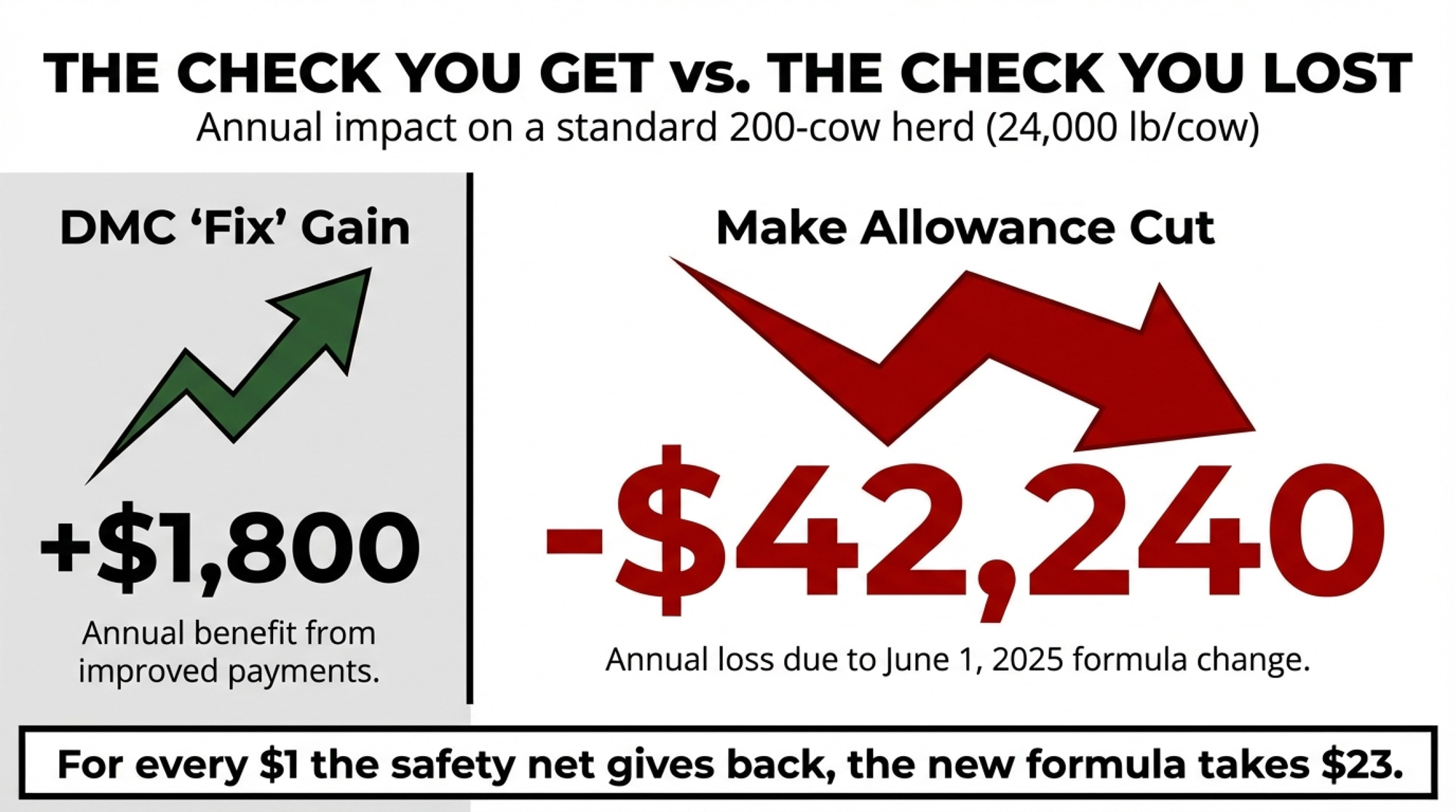
2026 Farm Bill math

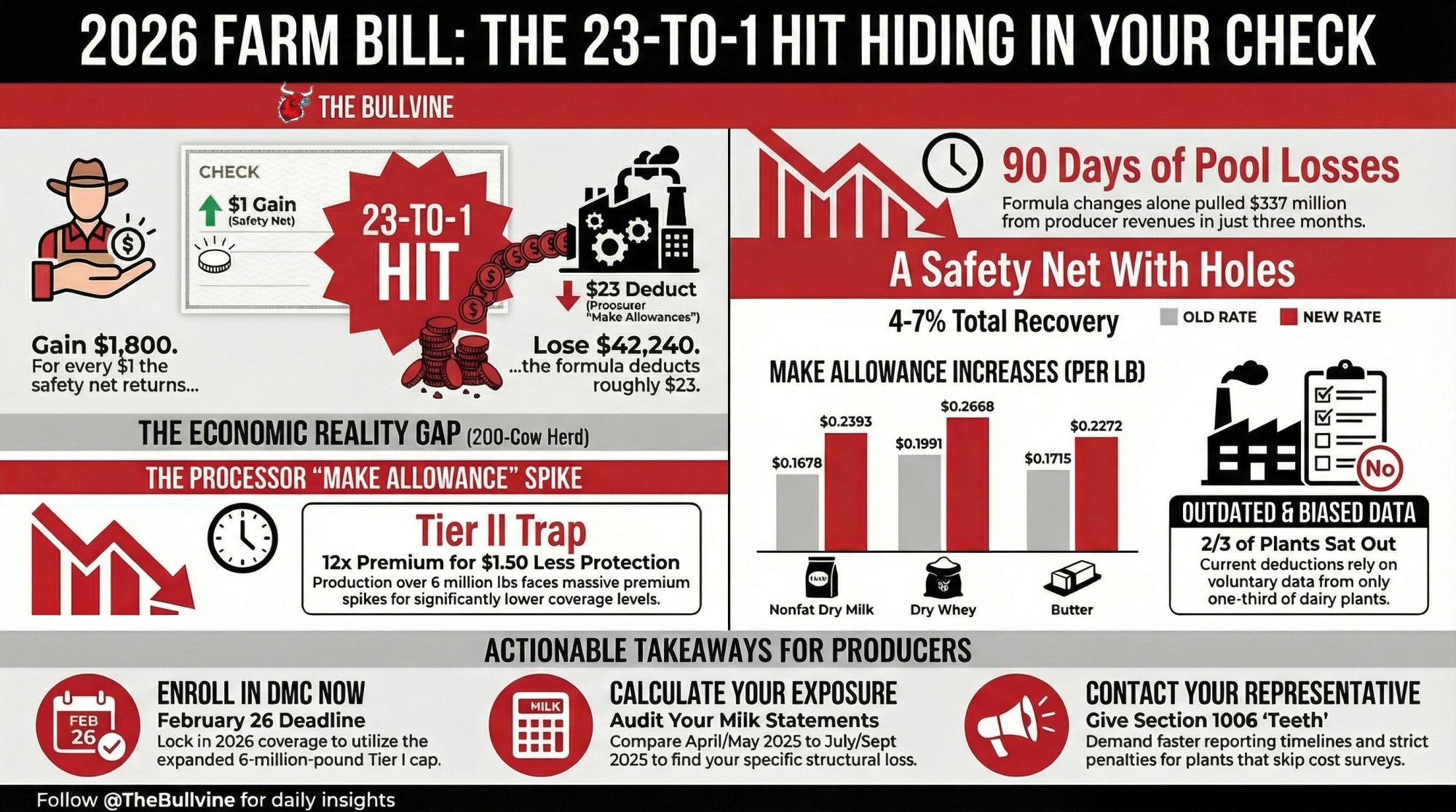
The House Agriculture Committee’s 2026 Farm Bill draft improves your Dairy Margin Coverage payment by roughly $1,800 a year on a 200-cow herd. The make allowance increases that took effect June 1, 2025, have already cost that same herd about $42,240 a year. That’s a 23-to-1 gap. For every dollar the safety net gives back, the formula takes twenty-three.
Those make allowance increases pulled $337 million out of producer pool revenues in their first 90 days, per AFBF’s September 2025 Market Intel analysis — not from a market crash, but from the formula change alone. It hit every FMMO-pooled dairy in America the same month Lolly Lesher at Way-Har Farms in Bernville, Pennsylvania, was bottling milk and scooping 90 flavors of ice cream alongside her milking herd of about 260 cows.
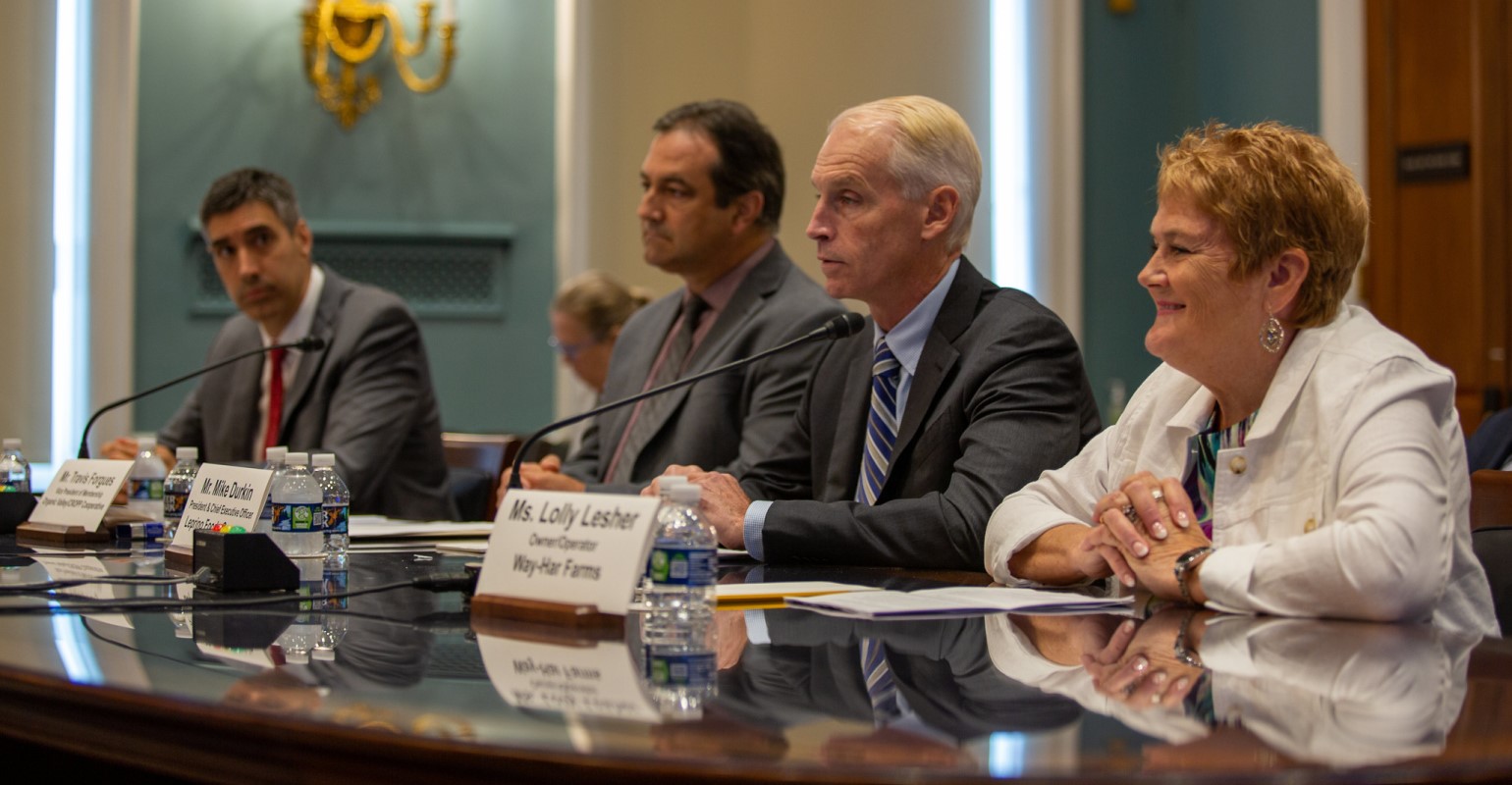
Pennsylvania dairy farmer Lolly Lesher (right), owner of the 300-cow Way-Har Farms in Berks County, testified before the House Agriculture Committee on behalf of NMPF and Dairy Farmers of America on June 22, 2022 — urging Congress to update DMC production history limits and fix the Class I mover formula she said cost producers over $750 million. Beside her (left to right): University of Minnesota ag economist Marin Bozic, Organic Valley VP of Membership Travis Forgues, and Leprino Foods CEO Mike Durkin. Photo: House Agriculture Committee / Flickr

Lesher has talked publicly about what pricing instability means for multi-generational dairy families. She and her family expanded from 80 cows to over 200 when her daughter returned to the operation — because, as Lesher has discussed on the Lancaster Farming FarmHouse podcast, the economics of an 80-cow operation couldn’t stretch to support multiple family members coming back to the farm. “When milk prices flip-flop up and down so much,” she told the podcast, “you need to be well-versed in planning and how to handle the debt and the payments.” That planning just got harder. And the bill that’s supposed to help? It recovers somewhere between 4 and 7 cents of every dollar the formula already took.

Where Did $337 Million Go?
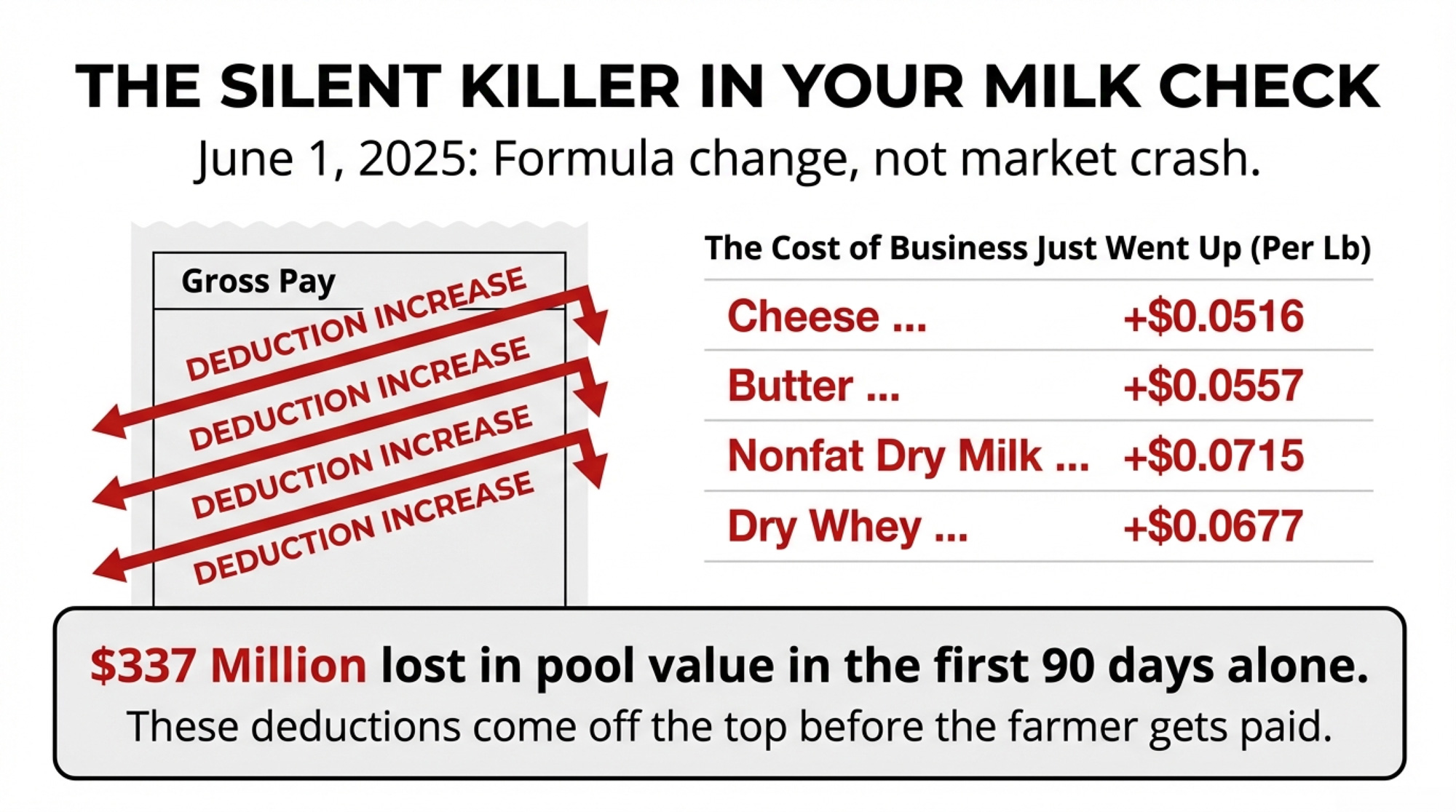
The make allowance increases weren’t part of this Farm Bill. They came through USDA’s FMMO modernization package, finalized in November 2024, approved by producer referendum in all 11 orders, and implemented on June 1, 2025. Make allowances — the per-pound deductions covering processor manufacturing costs, subtracted before farmers get paid — jumped across all four product categories:

ProductOld Rate ($/lb)New Rate ($/lb)Increase ($/lb)% Change
Cheese$0.2003$0.2519+$0.0516+25.8%
Butter$0.1715$0.2272+$0.0557+32.5%
Nonfat dry milk$0.1678$0.2393+$0.0715+42.6%
Dry whey$0.1991$0.2668+$0.0677+34.0%

AFBF economist Danny Munch tracked what those increases did to pool values. Average Class I prices dropped $0.89/cwt. Class II fell $0.85. Class III lost $0.92. Class IV, $0.85 — a 4 to 5% cut across the board attributable solely to higher make allowances. The Upper Midwest order alone lost $64 million in pool value over those first three months. The Northeast lost $62 million. California, $55 million.
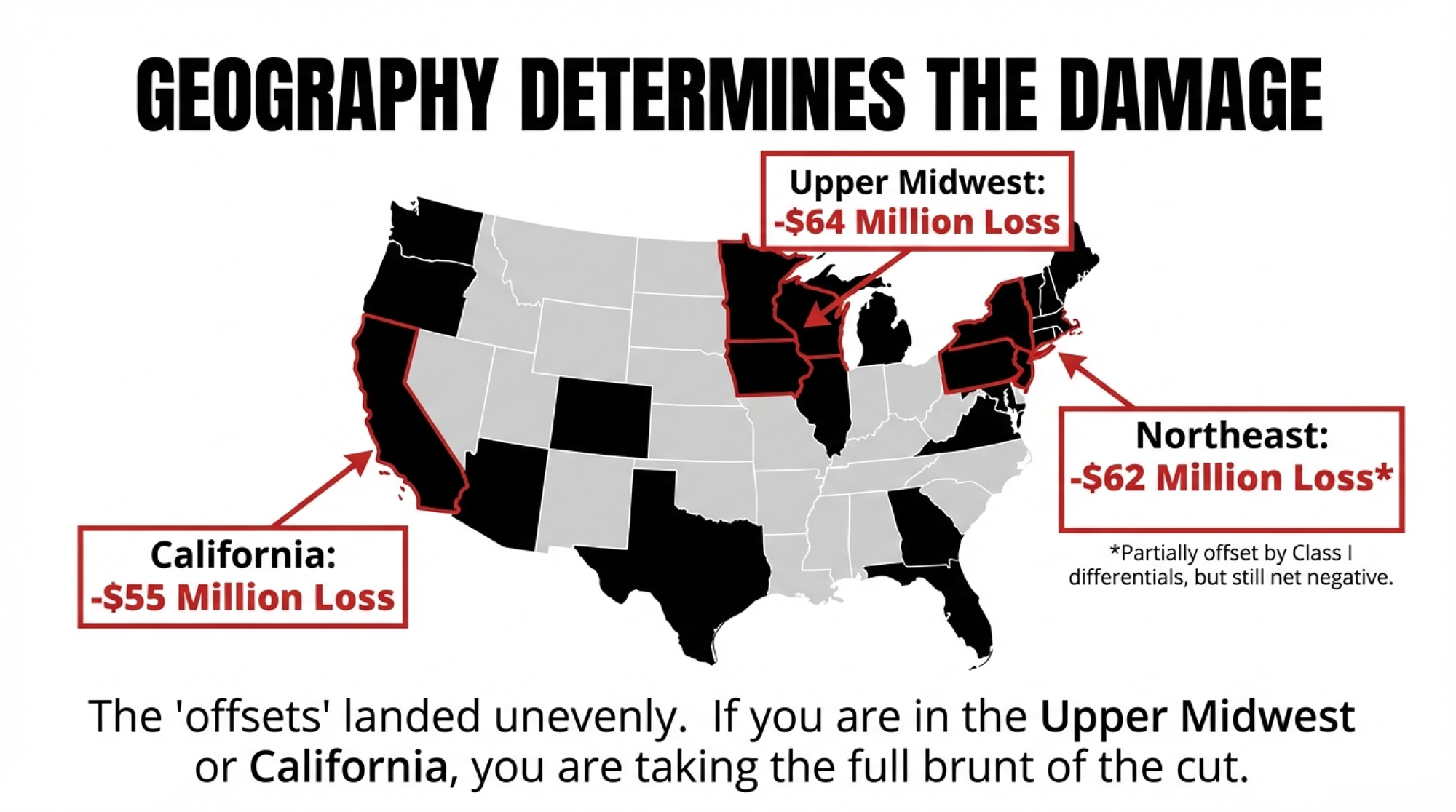
The FMMO amendments weren’t all one-directional, though. Higher Class I differentials — also part of the modernization package — added an estimated $137 million back to pool values in the same period, led by the Northeast (+$34 million) and Mideast (+$30 million), per the same AFBF analysis. The net total pool revenue decline from all FMMO amendments combined was roughly $232 million. But the offsets landed unevenly: California and the Upper Midwest — the two hardest-hit orders from make allowances — gained only $6 to $8 million each from higher differentials. If you’re pooled in the Upper Midwest, the differential cushion barely registers.

Processors had their own math. Christian Edmiston, VP of Procurement at Land O’Lakes, testified at the 2023 FMMO hearing that make allowances hadn’t been updated since 2008 and that manufacturing costs at LOL’s plants had risen substantially. He acknowledged the proposed increases “would not fully offset the increases in manufacturing costs” since 2008, but argued they “offer a balance between the producer price impact from raising make allowances and the processor cost impact.”

University of Minnesota dairy economist Marin Bozic told Brownfield in January 2025 that he expects higher allowances will eventually pull more milk back into pools: “As make allowances increase, that means that the processors have stronger incentives to bring that milk to the pool to try to get a piece of the producer price differential and forward that to their patrons.”

The short version of Bozic’s argument: when regulated minimum prices don’t reflect real processor economics, processors pull their milk out of the pool. Under the old make allowances, the regulated Class III price didn’t reflect where the market actually was, as Bozic put it — the gap between minimum regulated prices and processors’ real-world economics was wide enough to distort pooling behavior. That squeezed processor margins within the pool and pushed them to de-pool. Bozic told Brownfield the old system “manifested as a declining and then disappearing premium and more and more milk being depooled.” With higher make allowances, regulated minimums drop closer to market reality, reducing the misalignment that triggers de-pooling. More pooled milk means more revenue stays in the pool — and Bozic expects over-order premiums to return as a result. But “eventually” doesn’t help the check that’s already been issued.

[Read more: We mapped where those pool dollars went, region by region]

How Does the 2026 Farm Bill Change Your DMC Payment?
The barn math on the make allowance side is straightforward. Take a 200-cow Holstein herd producing 24,000 pounds per cow annually:

  • 200 cows × 24,000 lb = 4,800,000 lb/year = 48,000 cwt
  • AFBF’s class price reductions range from $0.85 to $0.92/cwt, depending on class utilization
  • Using $0.88 as an approximate midpoint: 48,000 × $0.88 = $42,240 per year

Scale it up. At 500 cows: $105,600. At 1,000 cows: $211,200. Your actual number depends on your order’s class utilization — a herd pooled mostly in Class III (Upper Midwest) takes a hit closer to $0.92/cwt, while heavier Class I utilization lands nearer $0.89. And if you’re in an order with strong differential gains (Northeast, Mideast), part of that loss is offset by higher Class I values — pull your actual milk statements to see the net.
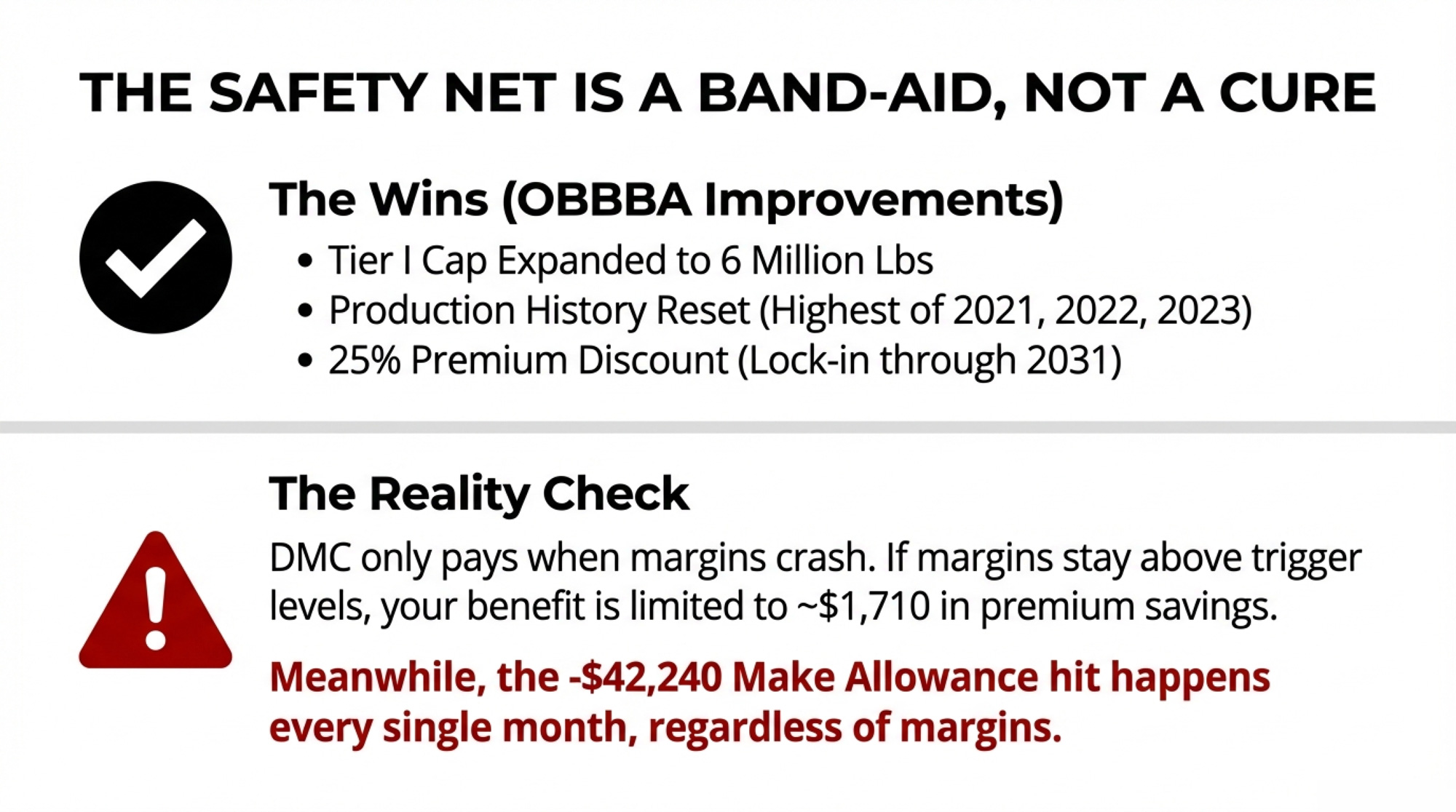
Now the safety-net side. The One Big Beautiful Bill Act (OBBBA) — the 2025 budget reconciliation package signed into law July 4, 2025 — delivered genuine DMC improvements: Tier I expanded from 5 million to 6 million pounds, production history resets to the highest of 2021, 2022, or 2023 marketings, and a 25% premium discount kicks in for producers who lock coverage through 2031. Premium rates under both Tier I and Tier II are unchanged from the 2018 Farm Bill structure.

Run it for the same 200-cow herd at $9.50 Tier I coverage, 95% enrollment:

  • 4,800,000 lb × 0.95 = 4,560,000 lb covered = 45,600 cwt
  • Premium at $0.15/cwt = $6,840/year at full rate
  • With 25% lock-in discount: $5,130/year — saving roughly $1,710 annually
  • In a year where DMC triggers for three to six months, additional indemnity payments could add $600 to $1,600

Total realistic DMC benefit in a tight-margin year: approximately $1,800 to $3,000. Against $42,240 in structural pool losses, that recovers between 4 and 7 cents per dollar.

The Quick Math for a 200-Cow Herd:

  • Loss (Make Allowances): −$42,240/year
  • Gain (DMC Fixes): +$1,800 to $3,000/year
  • Net Structural Gap: −$39,240 to −$40,440

The 500-Cow Tier II Trap

Bigger herds hit a wall. At 500 cows producing 24,000 lb/cow, you’re generating 12 million pounds a year. Under the new Tier I cap, the first 6 million pounds qualifies for Tier I. The remaining 6 million drops into Tier II — and the economics shift sharply:

  • Tier I (first 6 million lb): Max coverage = $9.50/cwt. Premium at $9.50 = $0.15/cwt.
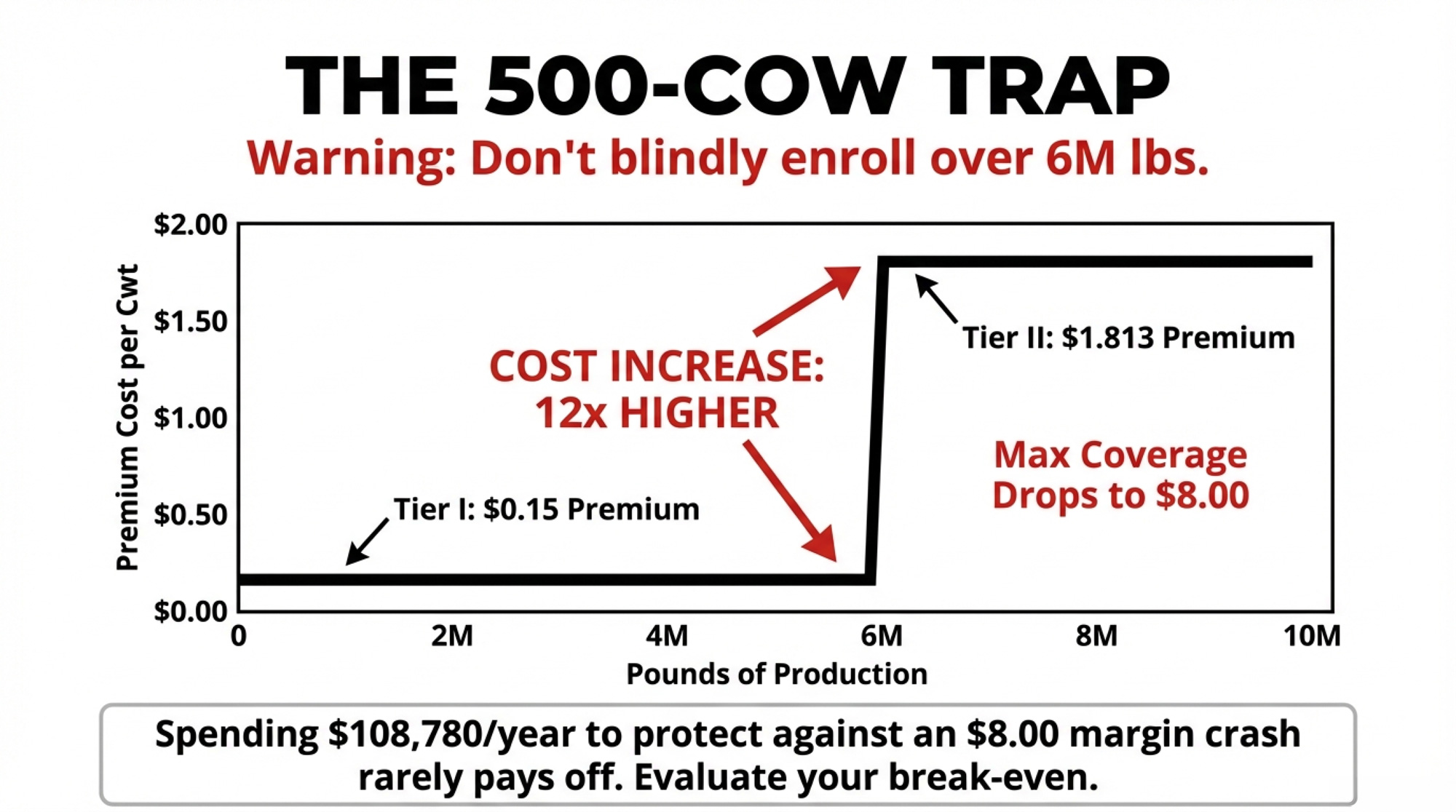
  • Tier II (remaining 6 million lb): Max coverage drops to $8.00/cwt. Premium at $8.00 = $1.813/cwt — a 12x increase for $1.50 less protection.
  • Tier II annual premium math: 6,000,000 lb ÷ 100 = 60,000 cwt × $1.813 = $108,780/year at the $8.00 ceiling.
  • And here’s what you’d get back: If the margin drops to $7.00 for three months, Tier II indemnity on 60,000 cwt = $1.00 × 60,000 × 3/12 = $15,000 — against $108,780 in annual premium.
  • Meanwhile, the make allowance hit on 500 cows: $105,600/year, and that lands regardless of your DMC election.

Most large-herd advisors, including Mike North at Ever.ag, counsel producers to carefully evaluate Tier II against the frequency with which margins actually fall below $8.00. If your breakeven sits well above $9.00, Tier II may not be worth the premium.

Coverage TierCoverage CeilingAnnual PremiumIndemnity (3 mo @ $7.00)Net CostWorth It?
Tier I (first 6M lb)$9.50/cwt$9,000$37,500+$28,500Yes
Tier II (next 6M lb)$8.00/cwt$108,780$15,000-$93,780Rarely
Tier I + Tier II combinedMixed$117,780$52,500-$65,280No

How Two-Thirds of Processors Sat Out and Shaped Your Check

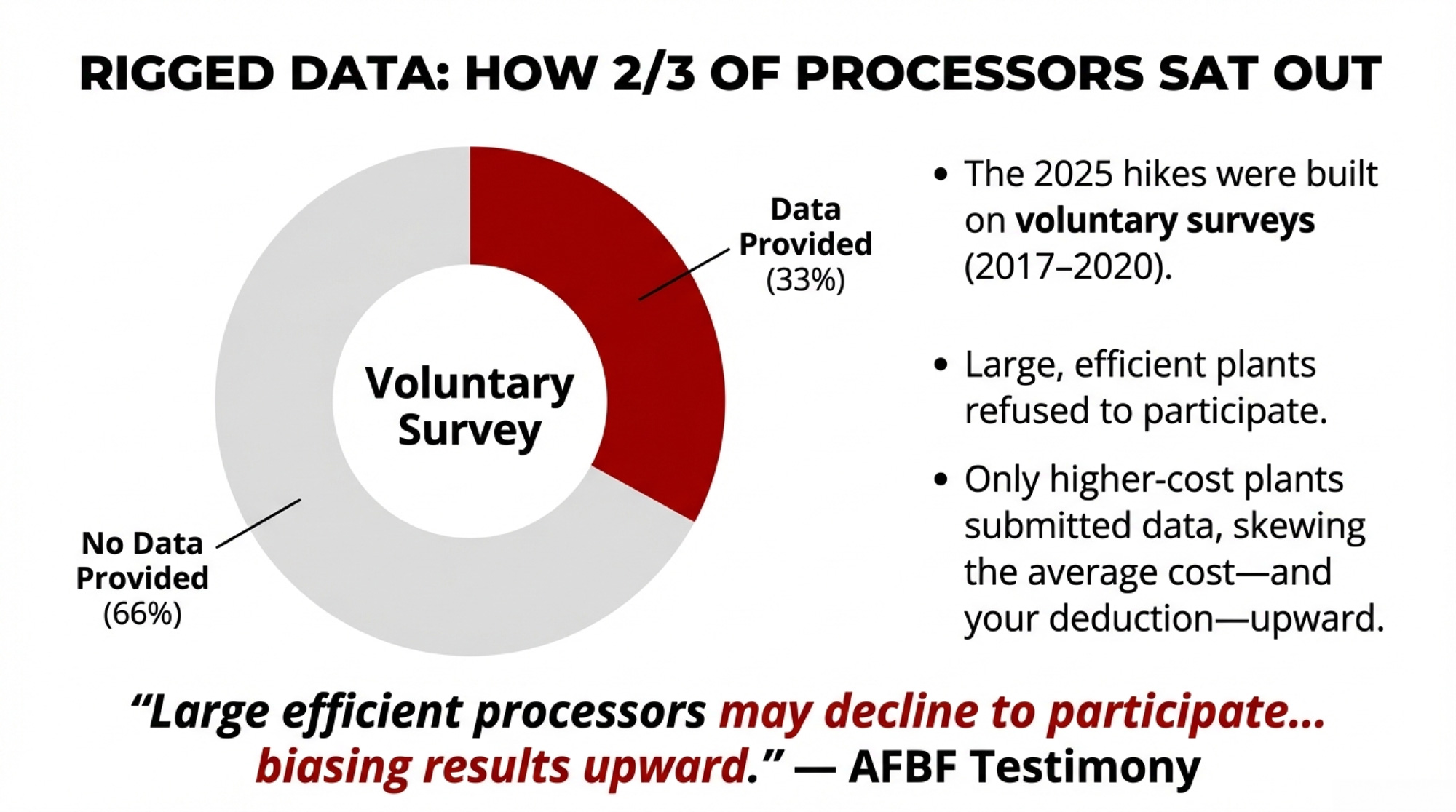
Munch has been sounding this alarm for two years. When Brownfield covered AFBF’s concerns at World Dairy Expo in October 2024, he laid out the numbers: “76% of cheddar cheese plants, 80% of butter plants, 40% of nonfat dry milk plants” skipped the voluntary cost surveys entirely. The cheese survey covered about 43 million pounds in total, but Stephenson’s sample captured only 6 to 7 million. The joint AFBF/NMPF petition to USDA put an even finer point on it: roughly two-thirds of dairy manufacturing plants provided no cost data at all.
Product TypeParticipation Rate (%)
Cheese24%
Butter20%
Nonfat Dry Milk60%
Dry Whey~30%

The survey, conducted by University of Wisconsin economist Mark Stephenson, gathered data from October 2017 through December 2020. So the make allowance increases, hitting your 2025 checks, were built on cost data that’s largely 5 to 8 years old, from a voluntary sample that skewed toward higher-cost operations.

The structural incentive isn’t subtle. Plants that benefit from higher make allowances were the same ones deciding whether to supply cost data. Big, modern facilities running at scale — with the lowest per-unit costs — had every reason to sit out. As AFBF wrote in its hearing testimony: “large efficient processors may decline to participate, which would bias the cost survey results upward.” Even Edmiston at Land O’Lakes acknowledged in his testimony that “the ideal data that a mandatory and audited survey would provide does not exist today.”

And there’s a historical pattern here. Allowances have been raised twice in the modern FMMO era — once in 2008 and again in 2025 — since the current formula structure was established during the 2000 order consolidation. They’ve never been reduced. The ratchet turns one direction.

[Read more: The U.S./Canada dairy comparison that puts domestic pricing reform in a continental context]

Will Section 1006 Actually Change Anything?

Here’s where it gets interesting. Section 1006 of the Farm, Food, and National Security Act of 2026 — titled “Mandatory reporting of dairy product processing costs” in the bill’s table of contents — makes permanent the mandatory biennial cost surveys initially authorized and funded at $9 million in the OBBBA (the 2025 reconciliation package).

NMPF President Gregg Doud said it plainly in the organization’s February 13, 2026, statement: “NMPF thanks Chairman Thompson, House Agriculture Committee members, and their staffs for working to put together a farm bill that will bring greater certainty to producers at a difficult time.” IDFA’s Michael Dykes called it “a permanent authorization for Mandatory Cost Surveys that will ensure make allowances in the Federal Milk Marketing Orders accurately reflect the cost of manufacturing dairy products.”

Kevin Krentz, Wisconsin Farm Bureau president and owner of a 600-cow dairy near Berlin, Wisconsin, has been a consistent voice for this reform — testifying at the 2023 FMMO hearing and at Farm Bill listening sessions that make allowance changes need mandatory, verifiable data behind them.

Lesher has walked that same path. She testified before the House Ag Committee and told Lancaster Farming that she received more questions from representatives than from the economists and professors in the room. “If I don’t tell our story,” Lesher said, “somebody else is going to tell a story. And it may not be as accurate.”

But Section 1006 doesn’t automatically adjust make allowances when new data arrives. Munch told Brownfield in October 2025 — after the OBBBA passed — that this is a common misconception: “That’s not the case. There’s still the traditional federal milk marketing order hearing process in place to make those amendments, so we would have to have a dairy industry stakeholder claim that there’s a problem, mention that problem, and initiate a whole other hearing.” And even getting the surveys running is on hold. “They’re going to have to set up a methodology. They’re going to have to have staff and researchers set aside for this,” Munch said, adding that government shutdowns have already caused delays.

There’s also a scenario nobody’s talking about. Mandatory surveys could confirm that processor costs genuinely rose as much as the voluntary data suggested. Edmiston’s own testimony showed that Land O’Lakes’ manufacturing costs at their Tulare, Carlisle, and Kiel plants all increased since 2008. If mandatory data backs that up, the reform argument shifts from “lower make allowances” to “at least now we know.” Either way, verified data beats unaudited self-reporting from one-third of plants.
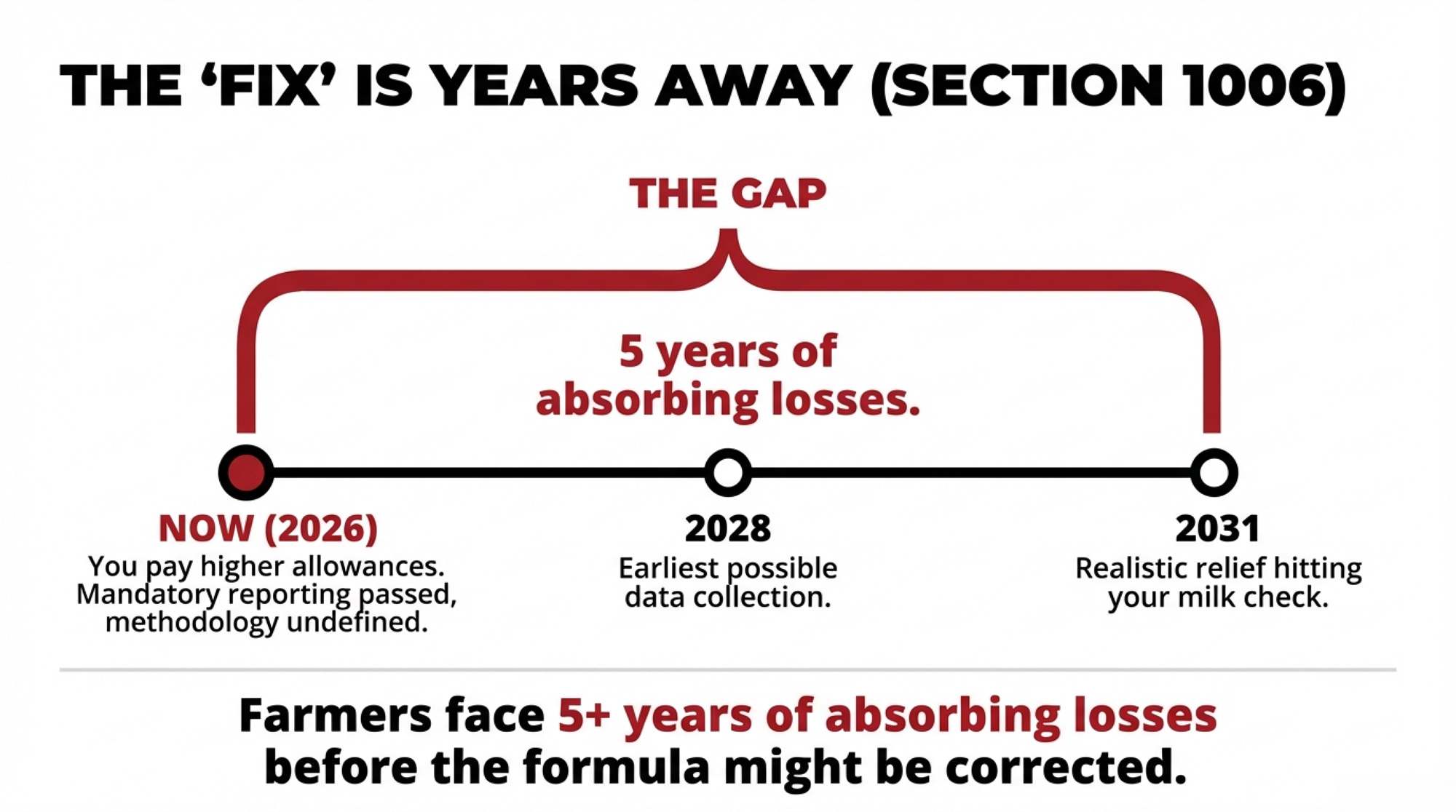
Munch has been clear on the timeline: “any resulting formula adjustments remains unclear, with changes unlikely to reach milk checks before 2028.” That’s Munch’s floor. A more conservative read based on the full FMMO hearing track record: AMS builds survey methodology through 2027–2028, first mandatory report around 2029, then add two to three years if stakeholders petition for an adjustment. Possible relief in the 2031–2032 range.

Five to six years of absorbing $42,240 annually on a 200-cow herd before make allowances might come down. “Might” is doing heavy lifting.

[Read more: When the financial pressure is structural, not cyclical, the playbook has to change]

What Canadian Producers Should Watch

Bullvine readers north of the border: this isn’t just an American story. When U.S. FMMO pool prices drop structurally — not due to a bad market but to a formula change — it depresses the price at which American dairy enters the USMCA tariff-rate quota system. Lower U.S. pool prices mean American milk crosses into the TRQ window at a wider discount relative to Canadian cost-of-production pricing, shifting the competitive dynamics Canadian producers face under supply management. And there’s a sharper edge: if Section 1006 ultimately fails to lower make allowances, sustained U.S. price depression could widen the gap between what American and Canadian producers receive for comparable components — a gap that already sparks political friction on both sides of the border.

If you’re tracking your quota value against cross-border pricing, this formula change affects the spread. We’ll break down the Canadian math when the Senate version drops.

[Read more: We compared what’s happening to U.S. farms vs. Canadian quota holders]

Four Moves Before Markup

Chairman Thompson confirmed the House Ag Committee will begin markup the week of February 23. Here’s what you can do between now and then.

This month:

  • Lock in your 2026 DMC coverage by February 26. That’s the enrollment deadline. At $9.50 Tier I with the 25% six-year discount, a 200-cow herd pays ~$5,130 vs. ~$6,840 at the full rate. The trade-off: you’re committed through 2031. If margins run strong over those six years, you can’t adjust coverage until the next cycle. Here’s the threshold: if your margin has dropped below $9.50 in any month since June 2025, the $9.50 level is likely worth the premium. If it hasn’t, model the savings at $8.50 and $9.00 coverage before locking into $9.50 through 2031 — the premium savings at lower levels may outweigh the indemnity probability over a six-year window.
  • Call your representative with two specific asks on Section 1006. First, compress the timeline for the first mandatory cost report—if AMS already audits prices weekly under NDPSR, cost data shouldn’t take years to collect. Second: add explicit penalties for non-compliance. Roughly two-thirds of plants sat out the voluntary surveys. Mandatory only works with teeth. Thompson’s DC office: (202) 225-5121.

Within 90 days:

  • Calculate your make allowance exposure. Pull your milk statements from April–May 2025 (pre-FMMO change) and compare blended price per cwt to July–September 2025 (post-change). Your annual hundredweight × that difference = your structural loss from the formula shift, separate from any market-driven movement. That number strengthens every conversation with your lender, your co-op board rep, and your congressman.
  • Check EQIP eligibility if you’re planning capex. USDA removed EQIP payment limits for 2025 — the previous $450,000 five-year cap is gone. The Farm Bill draft supports conservation “with a continued designation of conservation funds for livestock producers and a directive for states to prioritize methane-reducing practices,” per NMPF’s analysis. With no cap, larger manure-handling or precision-feeding projects now qualify. But EQIP is competitive — uncapped funding attracts bigger operations too — and most state batching deadlines fall in March through April. Contact your local NRCS office this week if you want to be in the spring cycle.

Within 12 months:

  • Watch for AMS’s announcement of the mandatory cost survey methodology. Once AMS publishes how they’ll collect data under Section 1006, the clock starts on when new make allowance data could inform a hearing. That announcement is your signal for whether the 2028 floor or the 2031 ceiling is more realistic.
ActionDeadlineUrgencyWhat to DoWhy It Matters
Enroll in DMCFeb 26, 2026HIGHLock $9.50 Tier I with 25% 6-year discount; model Tier II carefully$1,710/year savings on 200-cow herd; production history reset to highest of 2021–2023
Call your rep on Section 1006Feb 23, 2026 (before markup)HIGHAsk for faster reporting timeline + penalties for non-complianceMandatory surveys are only mechanism to lower make allowances; voluntary surveys had 2/3 non-response
Calculate your exposureWithin 90 daysMEDIUMCompare April–May 2025 vs. July–Sept 2025 milk statementsSeparates formula loss from market loss; strengthens lender/co-op conversations
Check EQIP eligibilityMarch–April 2026 (state batching deadlines)MEDIUMContact NRCS for methane/manure projects; no payment capUncapped funding but competitive; larger projects now qualify
Watch for AMS methodology announcementWithin 12 monthsLOWMonitor when AMS publishes Section 1006 survey designSignals whether 2028 floor or 2031 ceiling is realistic for relief

When the financial pressure is this structural — baked into the formula, not driven by the market — the hardest call isn’t to your congressman. [If you or someone on your operation is feeling the weight of it, read this.]

[Read more: How your balance sheet tells the story before your milk check does]

What This Means for Your Operation

  • The make allowance hit is permanent and automatic. It lands on every hundredweight of pooled milk, every month, regardless of your DMC enrollment or conservation participation. You don’t choose this deduction. It’s already in the formula.
  • The offset is real but uneven. Higher Class I differentials added $137 million to pool values nationwide — but the gains concentrated in the Northeast and the Mideast. If you’re in the Upper Midwest or California, the differential cushion covers a fraction of your make allowance loss.
  • DMC improvements are conditional. You only see indemnity payments when the margin drops below your coverage level. In a year where DMC never triggers, the benefit is limited to the premium discount — about $1,710 for a 200-cow herd at $9.50 Tier I with the six-year lock-in.
  • If your operation crosses 250 cows, you’re now likely within Tier I under the expanded 6-million-pound cap. Run your numbers at Tier I rates before assuming you need Tier II — the premium jump from $0.15/cwt to $1.813/cwt on production above 6 million pounds is steep, the coverage ceiling drops from $9.50 to $8.00, and the indemnity math rarely justifies the premium.
  • Section 1006 is the only mechanism in this bill that could eventually reduce make allowances. But the FMMO hearing process has never produced a downward adjustment. The regulatory timeline suggests 2031–2032 at best. Necessary, not sufficient.
  • Bozic’s pooling argument is worth watching. If higher make allowances genuinely pull more milk back into pools — by reducing the price misalignment that incentivizes processors to de-pool — that could partially offset class price reductions through restored over-order premiums. “Partially” is the key word, and the offset depends on your region’s pooling dynamics.
  • The gap frames your advocacy. For every $1 the safety net returns, the formula deducts roughly $14 to $23 from the same check, depending on whether DMC triggers and how often it does so. That imbalance doesn’t change until mandatory cost data forces a reckoning.
Key Takeaways

  • Enroll in DMC before February 26 — the production history reset and higher Tier I cap may change your optimal coverage level. Don’t default to last year’s election.
  • Calculate your per-cwt make allowance exposure by comparing pre-June and post-June 2025 blended prices on your actual milk statements. That’s your starting point for every financial conversation this year.
  • Contact your House rep before the February 23 markup with specific asks on Section 1006: a faster reporting timeline and enforcement penalties for non-participating plants.
  • If you milk 500+ cows, model the Tier I/Tier II split carefully before locking in coverage. The expanded 6-million-pound Tier I cap helps mid-size operations, but the Tier II premium and coverage ceiling haven’t changed—and the $8.00 Tier II indemnity-to-premium ratio is brutal.

The Bottom Line

Pull your April 2025 and September 2025 milk statements. Look at the blended price. That gap isn’t all market. A meaningful piece of it is structural — baked into a formula built on voluntary data from roughly one-third of plants, through make allowances that have never been adjusted downward. Section 1006 gives producers like Lesher — who expanded her herd, built a farm market, and testified before Congress — the first real tool to challenge that pattern with mandatory data instead of hunches. Whether it works depends on what happens between now and markup, and whether enough dairy farmers make the call.

When the committee marks this up, we’ll re-run every number. Bookmark this page.

Complete references and supporting documentation are available upon request by contacting the editorial team at editor@thebullvine.com.

Learn More

The Sunday Read Dairy Professionals Don’t Skip.

Every week, thousands of producers, breeders, and industry insiders open Bullvine Weekly for genetics insights, market shifts, and profit strategies they won’t find anywhere else. One email. Five minutes. Smarter decisions all week.

NewsSubscribe
First
Last
Consent

Federal Milk Marketing Order Reform: What Every Dairy Farmer Needs to Know Now

Are you ready for the USDA’s new Federal Milk Marketing Order reforms? Find out how these changes could impact your dairy farm. Stay prepared for what’s coming!

Imagine waking up to a world where the regulations governing your milk prices have changed, and you only have a few days to voice your concerns. This is the reality for dairy producers in the United States. The USDA has proposed new Federal Milk Marketing Order (FMMO) pricing formulae, a decision that could reshape the dairy industry’s future. Understanding the potential impact is not just important; it’s crucial. ‘Any dairy farmer who feels these changes might affect them should consider what they mean—not just in terms of price fluctuations but also the potential unintended consequences,’ stated a representative from the USDA. The 60-day public feedback period ends on September 13, 2024. This is your chance to make your voice heard. Don’t miss the opportunity to influence a decision shaping your future. So, what does this mean for you? Let’s delve into the details.

The Future of Milk Pricing: Your Voice Matters as USDA’s Deadline Approaches

The USDA has recently unveiled its recommended judgment on the new Federal Milk Marketing Order (FMMO) pricing formulae. This crucial information has sparked widespread interest in the dairy business. As we approach theSeptember 13, 2024 deadline, stakeholders have a unique opportunity to shape the future. This public comment phase is not just important; it’s pivotal. It empowers industry participants to influence the final decision, whether it becomes part of government directives or operates independently. After reviewing these comments, the USDA will determine the changes to the milk price environment. Your voice matters. Your input can make a difference.

Brace Yourself! Significant Changes to Milk Pricing Ahead 

The proposed reforms carry significant direct implications for the sector. These early effects will primarily manifest in price changes, potentially impacting producers and handlers pooled under the FMMO system. The potential impact of these changes cannot be overstated.

  • Increased Milk Prices
    Updating the milk composition parameters will increase milk pricing in specified orders. Higher expected component levels in skim milk, such as 3.1% protein, 5.9% other solids, and 9% nonfat solids, will raise costs by 3.3%, 6%, and 9.3%, respectively. This mainly helps farmers by increasing the price of their milk.
  • Elimination of Cheddar Barrel Price
    Removing the 500-pound barrel cheddar cheese price from the protein pricing calculation might raise the Class III milk price. If barrels had not been included in the calculation, the average Class III price would have been 47 cents higher during the last five years.
  • Decreased Milk Prices Due to Allowance Adjustments
    Increasing the make allowances reduces milk pricing. If the new USDA-recommended making allowances had been in force from 2019 to 2023, the average Class III milk price would have been 89 cents per hundredweight (cwt) cheaper, while Class IV would have been 74 cents per cwt lower.
  • Higher Base Class I Skim Milk Prices
    Reverting to the “higher of” technique for calculating introductory Class I skim milk pricing will likely raise prices. Over the last five years, this proposed regulation would have resulted in a Class I pricing 21 cents more per cwt than the present “average of” scheme.
  • Impact of Class I Differentials
    Modifying the Class I differential map increases complexity. While it may initially raise milk costs, the extent and effect differ by farm and county. Changes to the difference map may affect where milk is exported, causing additional milk production and driving down prices.

These fundamental consequences, whether higher or lower milk prices, will elicit a wave of reactions from farmers and processors, making it critical to keep aware and active in this changing market.

The Underrated Consequence: Beyond Immediate Price Shifts 

The objective complexity stems from the secondary impacts of the USDA’s proposed adjustments.

To grasp the possible hazards and rewards, go beyond the immediate price changes and study the more significant effects.

The broader ramifications include: 

  • Inconsistent milk flows due to skewed Class I differential maps.
  • Poor investment decisions in processing are driven by fluctuating make allowances.
  • Lower incentives for increasing protein and solids production in specific orders.
  • Persistently high prices that hurt global competitiveness.

These consequences have the potential to drastically change the dairy business environment, influencing everything from milk prices to worldwide competitiveness. As a result, while assessing the new pricing formulae, carefully consider these possible collateral impacts. This insight might be the difference between successful change and unexpected consequences.

Decoding USDA’s Proposed Changes

  • Milk Composition Factors
    The USDA advises changing the milk composition variables to 3.3% natural protein, 6% other solids, and 9.3% nonfat solids. This adjustment addresses the increasing trend in milk component levels. This change will cause increased milk prices in locations where payments are based on fixed assumptions about these characteristics. While this benefits cheese makers by allowing them to create more cheese from high-component raw milk, fluid milk producers may struggle to pass on these costs due to the nature of liquid milk production.
  • Surveyed Commodity Products
    The USDA suggests eliminating the 500-pound barrel cheddar cheese price from calculations and instead relying entirely on the 40-pound block cheddar price. Historically, decreased barrel prices have often reduced the protein price of Class III milk. Eliminating barrels from the equation will likely hike Class III pricing, with an average rise of 47 cents over the last five years.
  • Class III and Class IV Formula Factors
    The USDA’s new formula components include higher make allowances for cheese, butter, nonfat dry milk, and dry whey, as well as a minor rise in butterfat recovery and yield. This significant step accommodates growing production costs while lowering milk payouts. If these concessions had been in effect from 2019 to 2023, the Class III pricing would have been 89 cents cheaper, while the Class IV price would have been 74 cents lower per hundredweight. This update supports dairy groups’ suggestions while balancing conflicting ideas.
  • Base Class, I Skim Milk Price
    The “higher of” method for determining the introductory Class I skim milk price, along with a Class I extended shelf life (ESL) adjustment, is intended to assure higher pricing during times of price divergence between Class III and Class IV. Historically, employing the “higher of” approach would have raised Class I pricing by 21 cents in the last five years. The innovative ESL adjustment aims to lessen price volatility and better correlate it with ESL milk market realities.
  • Class I and Class II Differentials
    The USDA advocates for an updated Class I differential map that reflects current market conditions and milk-producing areas. This would give more meaningful incentives for efficient milk movement from surplus to deficit areas while avoiding excessive hardship for regions dealing with rising production prices. The USDA expects the dairy market to become more balanced and responsive by updating these maps.

A 2019 Lesson: When ‘Well-Intentioned’ Goes Awry 

Consider the 2019 Class I milk price formula modification from a real-world perspective. Initially, the adjustment seemed simple: switch from the “higher” price to the “average of” Class III and IV skim milk pricing, with a 74-cent increase. It was supposed to stabilize and make prices more accessible to hedgers, but it did not work out as expected.

The unanticipated market disruptions caused by COVID-19 put a kink in this otherwise well-intended adjustment. Strong price fluctuations and a significant gap between Class III and IV resulted in extraordinary volatility. The result? Producers’ pay rates are far lower than they would have earned under the prior arrangement.

For example, Class IV prices fell at the height of the pandemic, although Class III prices rose owing to increased demand for cheese and butter over fluid milk. The “average of” calculation, tied to trailing Class IV prices, produced smaller rewards than the “higher of” approach. Unintended repercussions resulted in an average deficit, considerably affecting manufacturers’ bottom lines.

This historical lesson emphasizes a vital point: changes to the FMMO may have long-term consequences that affect market stability and producer livelihoods. These instances highlight the significance of carefully considering possible secondary consequences alongside fundamental price swings.

Real-world examples demonstrate that well-intentioned regulatory changes may occasionally result in less-than-ideal consequences, emphasizing the need for thorough study and feedback during decision-making.

Ripple Effects: How Federal Order Changes Could Reshape the Dairy Landscape 

When evaluating the impact of changes to Federal Milk Marketing Orders (FMMOs), it is critical to examine the ripple effects. For example, changing the Class I differential map might affect milk flow between areas. Suppose particular places become more appealing owing to increasing differentials. In that case, milk distribution may alter in ways not justified by actual demand or production capacity. This might result in inefficiencies, with milk being delivered farther than required, raising costs and environmental implications.

Investment in processing facilities is another primary sector impacted by these developments. Adjusting allowances to reflect current production costs may encourage processors to invest in new technologies and facilities. On the other hand, if these allowances do not keep up with actual expenses, investment may stall, possibly impeding industry innovation and development. This balance is critical for sustaining a dynamic and adaptive processing industry.

Global competitiveness is the most significant strategic factor. The US dairy sector’s capacity to compete worldwide depends on competitive pricing structures in international markets. If our milk costs are artificially increased, our goods will become less appealing to overseas customers. On the other hand, competitive pricing can open up new markets while expanding current ones, boosting economic development and industry stability. The fragile balance has significant consequences for the future of dairy production and processing in the United States.

Are You Ready to Make Your Voice Heard? 

The USDA’s public comment period is your opportunity to affect the future of milk prices. This is a critical moment to speak out and share your thoughts. Whether you’re a producer, processor, or just interested in dairy, speaking out now may help influence the ultimate decision. Remember that the deadline is September 13. Please don’t pass up this chance to significantly affect the future of our industry.

The Bottom Line

As we navigate these revolutionary times in the dairy sector, it is critical to remember the larger picture. The USDA’s proposed revisions are intended to modernize the Federal Milk Marketing Order (FMMO) system, update critical formulae, and remove previously undetected inefficiencies. While the main price effects may seem insignificant, we must consider the indirect consequences. These may significantly impact anything from milk flow and processing investment to worldwide competitiveness and overall market health.

Finding a balance is essential to solving the problem. We must guarantee that changes promote a fair, efficient market for farmers, processors, and consumers. The secondary impacts, albeit more difficult to forecast, will substantially impact the industry’s long-term survival. By carefully evaluating these possible consequences, we can build a future in which the US dairy sector flourishes and successfully fulfills local and global demands.

So, as you prepare to speak out during the public comment period, examine the more significant implications of these proposed changes. A thoughtful approach to modernization may pave the way for long-term prosperity and stability in our sector. Your contribution is crucial to ensuring that the future of dairy farming is as solid and resilient as the hardworking people who power it.

Key Takeaways:

  • The USDA has released new FMMO price formulas; feedback is due by September 13.
  • Changes affect more than just milk prices—they impact milk flow, plant investment, and global competitiveness.
  • Updates include new milk composition parameters and removing 500-pound barrel cheddar cheese from pricing calculations.
  • Reverting to the “higher of” method could raise Class I skim milk prices and influence exports and production costs.
  • Careful evaluation of these changes is essential for the U.S. dairy industry’s growth and ability to meet local and global demands.

Summary: 

Significant changes are on the horizon, and it’s time to pay attention. The USDA has released new recommendations for Federal Milk Marketing Order (FMMO) price formulas, and the impact goes far beyond just a bump or drop in milk prices. With a deadline of September 13 for public feedback, now is your chance to voice your concerns and shape the future of milk pricing. This isn’t just about immediate price shifts—long-term consequences could affect everything from milk flow and plant investment to global competitiveness. The proposed reforms include updating milk composition parameters, increasing milk pricing in specified orders, and removing 500-pound barrel cheddar cheese from the protein price calculation. The new USDA-recommended make allowances could have significantly altered Class III and IV milk prices. Reverting to the “higher of” method for calculating introductory Class I skim milk pricing could raise prices, potentially affecting milk exports, causing additional milk production, and driving down prices. By carefully evaluating these possible consequences, the US dairy sector can flourish and fulfill local and global demands. Ready to dive in and make your voice heard?

Learn more:

Join the Revolution!

Bullvine Daily is your essential e-zine for staying ahead in the dairy industry. With over 30,000 subscribers, we bring you the week’s top news, helping you manage tasks efficiently. Stay informed about milk production, tech adoption, and more, so you can concentrate on your dairy operations. 

NewsSubscribe
First
Last
Consent

Proposed Federal Milk Marketing Order (FMO) Update “Make Allowances” Could Drastically Cut Dairy Farmers’ Profits

How will the new USDA rule on milk processing allowances affect your dairy farm profits? Are you ready for changes in milk prices?

Summary: As the USDA proposes to adjust the ‘make allowances’ under Federal Order 30, dairy farmers might see lower milk prices. This change aims to help processors cover their increased manufacturing costs but risks cutting farmers’ margins. The interconnectedness of dairy producers, processors, and consumers makes this balance crucial. Federal Milk Marketing Orders have historically played a key role in stabilizing the industry, ensuring fair prices for all parties to sustain the future of dairy farming. According to the National Milk Producers Federation, processing milk costs have risen by 50% since 2008. Processors argue that the current allowances do not match today’s economic conditions and need updating. If processors get more funds to cover expenses, farmers might get less for their raw milk, putting pressure on farmers juggling fluctuating milk prices and sustainability issues. Lower earnings could hinder their ability to invest in better equipment or sustainable practices.

  • USDA’s proposed adjustment to ‘make allowances’ could lower milk prices for dairy farmers.
  • This change is intended to aid processors in covering escalating manufacturing costs.
  • Balance between dairy producers and processors is essential for fair profit distribution in the industry.
  • Federal Milk Marketing Orders have historically stabilized the dairy industry, ensuring fair pricing.
  • Milk processing costs have surged by 50% since 2008, according to the National Milk Producers Federation.
  • Updating make allowances could burden farmers, impacting their ability to invest in equipment and sustainable practices.
USDA regulation, dairy farmers, earnings, milk processors, make allowances, increased production costs, raw milk, National Milk Producers Federation, processing milk, economic reality, financial impact, milk prices, sustainability, product offerings, energy efficiency, milk quality, federal milk marketing orders, industry developments, fair future.

Are you a dairy farmer trying to make ends meet? Brace yourself since a new USDA regulation may reduce your hard-earned earnings. This directive seeks to increase milk processors’ make allowances.’ But how does this affect you? Why should you care? Let us break it down. Let’s discuss what these planned changes imply for you, the dairy industry’s heart and soul. We’ll look at whether the new ‘ make allowances’ under Federal Order 30 protects the interests of processors at the cost of farmers. Does this approach result in cheaper milk costs for you? The critical point here is fairness—whether this shift disproportionately advantages one side of the business. We’ll talk about the logic behind the additional allowances, the financial burden farmers may experience, and the significant consequences for the dairy industry. 

Now, Let’s Break Down What ‘Make Allowances’ Actually Are 

Now, let’s define ‘ make accommodations.’ In layman’s words, make allowances are the expenditures that processors pay while turning raw milk into various products such as cheese, yogurt, and other dairy goods. Consider it the amount they charge for their services. This price covers a variety of expenditures associated with raw milk processing, such as personnel, equipment, and other operational costs. The plan intends to provide processors greater latitude in covering increased production costs by raising these allowances. However, this might imply that less money is available for the farmers who supply the raw milk in the first place.

According to the USDA, existing make allowances have not been adjusted in over a decade despite increased production costs. Processors are trying to balance the books as market prices fluctuate and overheads—such as energy, labor, and transportation—increase. According to the National Milk Producers Federation’s research, the cost of processing milk has grown by about 50% since 2008. With these rising costs, processors claim that the present limits no longer reflect economic reality, requiring the suggested changes.

Are you feeling a Bit Anxious About What These Changes Could Mean for Your Bottom Line? 

Of course, you’re right to be concerned. Any change in make allowances directly impacts the bottom line. Let’s talk numbers. According to the USDA, the proposed changes would increase the make allowances for cheese by $0.10 per pound, butter by $0.15 per pound, and nonfat dry milk by $0.10 per pound. What does that mean for you? Essentially, the processor’s cut increases for every hundredweight (cwt) of milk, which could decrease the amount you get paid by an estimated $0.70 to $1.10 per cwt. That’s not pocket change, especially when dealing with already thin margins. 

It’s worth noting that the average dairy farm, according to recent data, produces about 23,000 pounds of milk per cow per year. So, for a herd of 100 cows, you’re looking at potential annual losses ranging from $16,100 to $25,300. Can you absorb that hit without making some tough choices?

So, What Does All This Mean for You, the Dairy Farmer? 

Whether the make allowances are altered favorably or adversely, the financial rippling impact cannot be overlooked. You may receive less if milk processors get more of the pie to pay their expenses. Yes, we are talking about farmers possibly receiving reduced raw milk prices.

But who bears the burden if processors begin to take a larger share to pay these costs? Often, it is you. This might imply tightening an already tight budget. The real challenge for farmers is balancing this added pressure while already contending with fluctuating milk prices and sustainability considerations  . The potential impact on the dairy industry’s sustainability is a crucial aspect to consider in this discussion.

Consider this: if you’re paid less for your milk, how does that affect your capacity to invest back into your farm, maybe in better equipment or more sustainable practices? Every dollar matters, and with a modified make allowance, those dollars may be fewer and further between.

You’re Not Alone. Here’s How to Prepare for This Possible Shake-Up. 

You are not alone. But don’t fear; there are things you can do to prepare for this possible shake-up.

First, have you considered broadening your product offerings? Consider going beyond milk. Cheese, yogurt, and milk-based drinks may provide additional income streams and reduce your reliance on raw milk costs.

Another wise decision is to decrease expenditures intelligently. Could you improve the energy efficiency of your operations? Invest in technology to lower labor expenses. Sometimes, modest changes might result in huge savings.

It is also critical to be informed and engaged with industry associations. Connect with your local cooperative or industry organization. These groups may provide crucial assistance and campaign for fair treatment on your behalf.

Are you optimizing milk quality? Higher-quality milk may attract higher prices, offsetting the effect of lower base pricing. Quality testing and upgrades may be direct-return investments.

Remember: information is power. The more proactive and prepared you are, the more able you will be to deal with these changes. So, have you considered what measures to take next?

The Historical Backbone: How FMMOs Shaped Dairy Farming Into What It Is Today

The Agricultural Marketing Agreement Act 1937 introduced federal milk marketing orders (FMMOs). Their primary goal was to keep milk prices stable for producers while providing customers with an adequate supply of fresh milk. Over time, these directives have established minimum rates that processors must pay dairy farmers for their milk depending on how it will be utilized, such as in fluid products or processed items like cheese and yogurt. This pricing system seeks to balance the interests of both farmers and processors by reducing the volatility that has long plagued the dairy business.

These orders help farmers plan their activities by establishing a floor price that protects against market price fluctuations. They also provide a more reliable milk supply that meets customer demand across several locations. However, the system is sometimes criticized for its complexity, especially by smaller farmers who may lack the means to traverse price algorithms. Fixed pricing may not accurately represent current market circumstances, resulting in inefficiencies.

Understanding this history explains why modifications to make accommodations are so crucial. Adjusting these allowances might disrupt the delicate balance that FMMOs strive to maintain, thereby complicating life for dairy producers under economic challenges.

The Bottom Line

The adoption of Federal Order 30 intends to increase the ‘ make allowances’ for processors, possibly lowering the prices farmers get for milk. Despite the presence of several specialists and farmers at the proposed hearings, the subject remains controversial. The discussion over fair pricing, profitability, and dairy farming’s sustainability is constantly developing. Farmers must be aware and involved in industry developments to fight for their interests and ensure a fair future. The issue remains: how will you change to maintain your profits?

Learn more:

USDA Proposes Major Changes to Federal Milk Marketing Order: Key Updates and Stakeholder Reactions

Learn about the USDA’s proposed changes to the Federal Milk Marketing Order. What do these updates mean for dairy farmers and the industry? Check out key insights and reactions below.

Imagine a sector where little legislative changes affect millions of customers and producers. This is the domain of dairy. Recent suggestions for the Federal Milk Marketing Order (FMMO) system by the USDA have attracted much attention. A pivotal hearing in Indiana in late autumn and early winter covered many dairy industry issues. The USDA’s new 600-page proposal calls for changes to modernize the FMMO. This paper dissects these important suggestions and their possible influence on the dairy sector. Why is this relevant to you? These developments could impact milk prices and marketing in the United States, influencing processors, farmers, and the dairy products you buy. Still under examination are several industry players like the American Farm Bureau Federation and the American Dairy Coalition. Knowing these developments helps one have an insightful analysis of the dairy industry’s direction.

Navigating Dairy’s Bedrock: The Evolution of the Federal Milk Marketing Order System 

Since the 1930s, the Federal Milk Marketing Order (FMMO) system has been a pillar of the US dairy sector. Designed under the Agricultural Marketing Agreement Act of 1937, it sought to guarantee fair prices for dairy farmers and balance milk markets. It helps to create a transparent and stable milk market even as it develops to meet new demands.

At first, FMMOs set minimum milk prices depending on use, creating controlled settings to protect consumers and farmers from price volatility. This guaranteed fair returns for farmers and a consistent milk supply for processors. This arrangement has helped control underproduction and overproduction, preventing sharp price changes.

By controlling the supply chain from farm to table and promoting economic stability in the agricultural sector, FMMOs help regional markets. Fair milk pricing across different locations helps to minimize inequalities and guarantees that even less competitive places are still fit for dairy production.

Efforts to modernize FMMOs continue to update them to meet technical developments in dairy production and present issues. FMMOs are vital in maintaining the financial viability of the dairy industry by improving milk composition standards and pricing policies.

The USDA’s Proposed Updates Aim for Modernization and Fairness 

The USDA’s proposed changes aim to modernize the Federal Milk Marketing Order (FMMO) system, ensuring it stays fair and relevant for today’s dairy market. Here are the fundamental changes: 

  • Milk Composition: Adjust protein levels from 3.1% to 3.3%, other solids from 5.9% to 6.0%, and nonfat solids from 9.0% to 9.3%.
  • Cheese Price Reporting: Remove 500-pound barrel cheese prices from the Dairy Products Mandatory Reporting Program survey.
  • Make Allowances: Increase allowances for cheese, butter, nonfat dry milk, dry whey, and butterfat recovery.

Stakeholders’ Initial Reactions: Weighing in on USDA’s FMMO Proposals

Stakeholders are reviewing the USDA’s proposed Federal Milk Marketing Order system revisions. Before speaking, critical organizations such as the American Farm Bureau Federation, Wisconsin Farm Bureau, and American Dairy Coalition give much thought to the plan. Laurie Fischer of the American Dairy Coalition raised a significant issue: the possible vote exclusion of sure farmers.

Edge Dairy Farmer Cooperative and the National Milk Producers Federation both recognize the work behind the initiative. Leaders like Tim Trotter value the thorough attention paid to market studies, written replies, and testimonies. Stakeholders are evaluating the suggested changes’ overall possible effects and fairness.

Voices in the Balance: Voting Eligibility and Representation Concerns 

One issue is voting eligibility for the ultimate package. American Dairy Coalition member Laurie Fischer worries that farmers whose milk isn’t pooled under the federal decree won’t be allowed to vote. This regulation raises questions about fairness and might silence numerous producers.

Tim Trotter, CEO of Edge Dairy Farmer Cooperative, shared these same worries. He underlined the necessity of a few days to review the report carefully. He questioned the present voting rules, highlighting the importance of inclusive decision-making.

One must carefully balance thorough representation with a simplified voting system. Organizations like the Wisconsin Farm Bureau and the American Farm Bureau Federation are currently evaluating the ideas; voting rights will probably remain a major topic of debate.

Industry Reactions: Diverse Opinions and Appreciations on USDA’s Proposed Changes

“This rule would bar producers from voting unless their milk is pooled in the federal order, raising fair representation issues for farmers,” Laurie Fischer from the American Dairy Coalition said of voting eligibility.

Edge Dairy Farmer Cooperative CEO Tim Trotter said, “We need a few days to review the report thoroughly, but appreciate the AMS team’s extensive effort in compiling all testimony, responses, and market analysis.”

These points of view reflect the many perspectives in the dairy sector, the need for thorough analysis, and the involvement of stakeholders as the USDA implements its recommendations.

National Milk Producers Federation Embraces USDA’s FMMO Updates with Cautious Optimism

The proposed USDA amendments excite the National Milk Producers Federation (NMPF). With his optimistic view, NMPF President and CEO Gregg Doud honored the diligence behind these suggestions. “We are glad to see much of what we suggested included in the USDA’s Federal Milk Marketing Order modernization plan,” Doud added. This answer shows that NMPF is dedicated to a fair and contemporary FMMO that advances the dairy industry.

USDA’s Proposals: A Comprehensive Overhaul with Potential Industry-Wide Impacts 

The suggested modifications by the USDA will affect the whole dairy sector.

Refined milk composition elements would help manufacturers improve milk quality and value. However, issues about voting rights might cause more small, non-pooled producers to be overlooked.

Processors may respond differently. Eliminating 500-pound barrel cheese pricing from surveys would streamline reporting, but more allowances translate into more running expenses. Until retail prices increase or efficiency improves, this might strain profits.

Higher manufacturing costs might cause dairy product consumers to pay a premium. However, they could savor more nutrient-dense and better-tasting milk options.

Seeking justice and openness, these suggested improvements seek to modernize the Federal Milk Marketing Order system. The influence will rely on the balance of healthy interests among several sectors.

The Bottom Line

The USDA’s suggested modifications to the Federal Milk Marketing Order system, which address the technical and democratic sides of the dairy supply chain, are a significant step towards modernizing dairy sector rules and guaranteeing a fair market. These adjustments include adjusting milk composition parameters, changing allowances, and considering voting exclusions.

Reactions among stakeholders are varied. While some value the careful study, others worry about farmer representation and voting eligibility. Reflecting years of policy discussion and testimony, these improvements are not just regulatory changes but might also change the dairy business’s economic environment.

The USDA seeks to establish a more open and effective system that benefits consumers and farmers. All industry views must be listened to to guarantee that the final regulation serves the larger society. Stay active, provide comments, and get in touch with your neighborhood dairy groups. Your participation depends on writing a sustainable future for dairy farming.

Key Takeaways:

  • The USDA has proposed changes to the Federal Milk Marketing Order system aiming to modernize and ensure fairness.
  • Adjustments include changes in milk composition factors and an increase in make allowances for Class III and Class IV dairy products.
  • Removal of 500-pound barrel cheese prices from the Dairy Product Mandatory Reporting Program survey is proposed.
  • Stakeholders, including major dairy organizations, are still reviewing the recommendations before commenting.
  • Voting eligibility concerns arise, particularly around the rule barring producers from voting unless their milk is pooled in the federal order.
  • The National Milk Producers Federation shows hope, reflecting the results from extensive policy development and stakeholder input.
  • This overhaul could have significant and wide-ranging impacts across the dairy industry.

Summary:

The USDA has released its recommendations for changes to the Federal Milk Marketing Order system, which includes adjustments to milk composition factors such as protein, other solids, and nonfat solids. The document also proposes removing 500-pound barrel cheese prices from the Dairy Product Mandatory Reporting Program survey and raising Class III and Class IV make allowances for cheese, butter, nonfat dry milk, dry whey, and butterfat recovery. Many dairy stakeholders, including the American Farm Bureau Federation, Wisconsin Farm Bureau, and the American Dairy Coalition, are still reviewing the proposals before commenting. One concern is the question of who farmers will get to vote on the final package, as the rule would bar producers from voting unless their milk is pooled in the federal order. The National Milk Producers Federation President and CEO Gregg Doud expressed hope that much of their proposed changes will be reflected in the USDA’s recommended Federal Milk Marketing Order modernization plan.

Learn more:

Send this to a friend