Archive for 2013 – Page 6

Reality Check – Who is Really Controlling the Dairy Breeding Industry?

Often I find as an industry we are guilty of living in a bubble.  While sometimes that has served us well, other times there are situations where it for sure has hurt the dairy breeding industry as a whole.  However, like all bubbles, this will have to burst in order for the industry to advance, otherwise the dairy cattle breeding industry will become irrelevant.

There is no question that the dairy breeding industry is going through times of great change.  Genomics has had a massive effect on not only how we prove bulls, but also on the sources of revenue and the focus of many breeding programs.  There has been great discussion about what the changes in April will have on the industry (Read more: How Genomics is Killing the Dairy Cattle Industry).  There are some far greater issues that many breeders need to think about.

Some Big Hitters Are Coming To the Plate

One such issue is the entry of Pfizer/Zoetis into the animal genetics game.  There is no question that companies like Pfizer have the resources and the experience to come into industries and dominate.  When you compare the size and revenue of the Animal Health market to that of the dairy cattle breeding industry, you really have to wonder why Pfizer would even bother.  There is no question that DNA testing is a very cool science, but companies like Pfizer don’t do things because they think that it is cool.  They do it because they know they can make money.

When you step back and look at this from a 50,000-foot view, I start to think, is this Pfizer wanting to come and take over dairy cattle breeding?  On the other hand, is it that Pfizer sees how they can protect their much larger revenue source, animal health?  Walk with me on this one.  If it is possible to understand genomics to such an extent that we can breed a better cow, does that not include a cow that is more resistant to disease, parasites, and bacteria? Now we’re talking about core revenue sources for Pfizer animal health, now called Zeotis.

That is why when I first saw the announcement from Pfizer in May 2012 about how Canadian Dairy Network, Holstein Canada, Pfizer Animal Health, The Semex Alliance and its owners are going to partner to support delivery of genetic services to the Canadian dairy industry it really got me thinking about is this a good thing or should we be concerned?  While the public relations side of this looked all great with the message that the alliance gives dairy producers access to new genetic testing services, I could not help but think what does this mean if Pfizer/Zoetis now has direct access to all the genomic information not only in Canada but also indirectly for the world?

Also of interest about this move was that instead of being signed by all the members of the industry it was done very selectively.  Instead of being signed by say Canadian Livestock Genetics Association it was done exclusively with the Semex Alliance.  Is there a partnership between Semex and Pfizer that we are not aware of?  Have we as an industry, or our representatives, on our behalf made decisions that we may all regret?  While I am sure from first glance this agreement looked pretty basic, I can’t help but wonder if there are much greater ramifications that have not really been thought through.

Information is Power, But who controls the information?

With these questions about genetic evaluations and genomics, you can’t help but think about the heated discussion around the Council on Dairy Cattle Breeding (CDCB) and who controls genetic evaluations in the US (Read more: Council On Dairy Cattle Breeding: Land of the Free and Home of the Brave?).  The Cooperative Agreement with the USDA Agricultural Research Service (ARS) pertaining to the transfer of the USDA-­‐ARS dairy genetic evaluation service to the CDCB has certainly had many asking who does have control?

While the Bullvine has request several times to do an interview with CDCB officers , Ole Meland, (Chair), Jay Mattison (Vice Chair), Becky Payne (Secretary) and  Gordon Doak (Recording Secretary), we have still not yet been granted the opportunity.

No Demand Means No Market

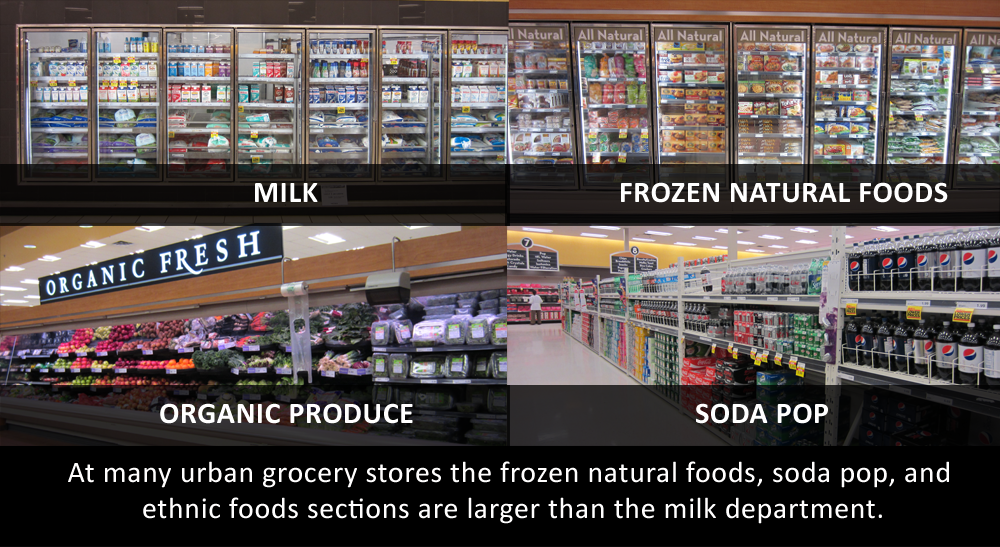
Of course there is a much bigger issue I think every breeder needs to think about.  While in Canada most breeders are pretty immune to having to think about market demand, you only have to look at the US and Australia to see what happens when market demand goes south.  If consumers are not drinking milk, it does not take long for the industry to dry up.

Worldwide milk consumption in relation to population growth is falling.  While yes total consumption is increasing, we are not keeping pace with other beverages.

With greater international supply and less demand, it doesn’t take long to drive price and revenue down (Read more: Why the Future of the North American Dairy Industry Depends on Supply and Demand). There is no question that breeders and the industry as a whole, needs to pay greater attention to consumer demand as it will have the greatest impact on our future.

The Bullvine Bottom Line

There is no question the world is changing.  It always is and always will.  The question becomes are you ahead of the change or behind it?  If we continue to operate in a bubble or stick our heads in the sand, we will not be the ones driving our own future, but instead will be handed the scraps from the future decided by others.  That is why it is important to know who is controlling the dairy breeding industry?



Get original “Bullvine” content sent straight to your email inbox for free.


[related-posts-thumbnails]

12 Sires to Use in Order to Reduce Inbreeding

top13of2013Inbreeding, and more importantly its consequences, has long been a concern of breeders as it reduces production, lowers fertility, results in more stillbirths and leads to fewer days in the herd.  When genomics was first introduced, the theory was that it could help limit the amount of inbreeding in Holsteins.  In reality it has done the exact opposite.  Research indicates that relationships within respective breeds could be accelerating even faster since genomics’ introduction five years ago and there is also evidence that genetic diversity, another factor of inbreeding, is shrinking.

When you look at the sires of the top 100 genomic young sires lists, you notice a decent variety of sires with 30 bulls siring the top 100 sires.  However, a pedigree analysis on only the paternal side reveals that 90 percent of the bulls either have Oman, Planet or Shottle represented as the sire or grandsire.  The remaining 10 bulls represent genetic diversity.  However, the list needs further refining because 3 of the 10 remaining bulls have Oman’s sire or Shottle’s sire in the pedigree.  That leaves seven bulls with unique sires among the Holstein breed’s elite.

To help guide breeders in dealing with this inbreeding issue, we decided to look for outcross sires either proven or genomic tested sires that would offer breeders the near maximum genetic gain while providing needed diversity.  The word outcross or what constitutes an outcross sire can be tricky depending on where you are located.  For our purposes, we are calling an outcross sire to be one that does not have Oman, Goldwyn, Planet, and Shottle anywhere in the 1st, 2nd or 3rd generation of their pedigree.

Balanced Overall Performance Improvement

When looking for the sire that will help improve your herd across the board, we looked for sires that have a balance of production and longevity.  We also wanted great health and fertility traits that will deliver a low maintenance cow (Read more – Fact vs. Fantasy: A realistic approach to sire selection).  Here are our top three.

  • CO-OP BOSSIDE MASSEY
    MASCOL x PECKENSTEIN FORM BRET x HA-HO CUBBY MANFRED
    Massey is a popular sire of sons combining elite indexes with a great outcross opportunity.  Massey daughters are snug uddered with strong attachments.  Though they should be protected for rump angle (high) and dairy strength, his low somatic cell score, high herd life/productive life and strong fertility make Massey a great sire for your breeding program.
  • COYNE-FARMS DORCY
    SANDY-VALLEY BOLTON X PECKENSTEIN FORM BRET x STARTMORE RUDOLPH
    Look for Dorcy to sire balanced dairy cattle that have great udders and very good feet & legs, though he will need to be protected for dairy strength, fat percent and specifically his body depth and chest width.  While his productive life and low somatic cell score make Dorcy very strong longevity sire, you will want to use him wisely  on virgin heifers as he is not a calving ease sire.
  • CO-OP BOOKEM YUXI
    DE-SU 521 BOOKEM x END-ROAD PVF BOLIVER x PECKENSTEIN FORM BRET
    Yuxi is a great sire for feed efficiency, based on his strong milk production from smaller framed and stature cattle (Read more:  30 Sires That Will Produce Feed Efficient Cows).  While he needs to be protected on loin strength and body depth, his high productive life, low somatic cell score and great calving ease will have his daughters producing milk in your herd for a long time.

Production Improvement

It might be easy to just take the top milk lists or combine the fat plus protein and say those sires are the best for overall production.  We here at the Bullvine would not want to totally forgo type as well as health and fertility, so we are looking for the sires that give you the maximum production gain, without sacrificing everything to get it.

  • KINGS-RANSOM B RUBLE
    SANDY-VALLEY BOLTON x END-ROAD PVF BOLIVER x B-Y-U MANDEL BOMBAY
    A proven sire that maybe has not caught the eye of many breeders, Ruble offers outstanding production improvement from solid type.  While certainly not a calving ease sire, Ruble will greatly increase production from strong uddered cows that have good feet and legs.
  • OCONNORS JAY
    SANDY-VALLEY BOLTON x REGANCREST ELTON DURHAM x HENKESEEN MARCIS MARVELOUS
    Coming from a strong maternal line (Read more: The Bloom is on Oconnors Goldwyn Jasmine) Jay offers great component improvement from solid production.  He also has the ability to improve overall type, especially udder attachments and texture, but should be protected on pin setting.
  • CO-OP MASTER GENO
    BOSSIDE MASSEY MASTER x BADGER-BLUFF FANNY FREDDIE x JOSE
    Talk about a challenge.  In order to find a genomic sire that met our requirements we had to go the 95th sire on our list of production improvement genomic sires.  Much like Yuxi, Geno will also produce feed efficient daughters (Read more:  30 Sires That Will Produce Feed Efficient Cows).  His strong components, especially fat, combined with great udders and strong health and fertility makes Geno a great sire to look at for a solid outcross sire.

Longevity Improvement

For those of you that are looking to breed cattle that stay around  lactation after lactation or maybe you are  having problems with your 2 year olds not coming back for a 2nd lactation, we recommend the following outcross sires, in addition to Dorcy mentioned earlier:

  • SILDAHL JETT AIR
    EMERALD-ACR-SA T-BAXTER x MARA-THON BW MARSHALL x HA-HO CUBBY MANFRED
    This outcross sire offers great longevity improvement combined with strong health and fertility.  While he does need to be protected on protein and milking speed, his great feet and legs, udders and health and fertility, make him an outcross sire you don’t want to miss.
  • BERTAIOLA MINCIO
    SANDY-VALLEY BOLTON x BOSS IRON x CAROL PRELUDE MTOTO
    With  Boss Iron daughters such as Decrausaz Iron O’Kalibra catching the eyes of the world in the show ring (Read more: The All European Champion Show: The Greatest Show On Earth), there are also Iron daughters that are getting the job done as bull mothers.  A great example of this is BEL IRON IRENE, the dam of Mincio.  This high fertility Bolton son combines high type with great production, which is resulting in outstanding results in his current daughter performance.  Watch for MINCIO to sire great udders and feet & legs though you may want to watch him on somatic cell score.
  • RONELEE DORCY DELIGENT
    COYNE-FARMS DORCY x END-ROAD PVF BOLIVER x COMESTAR OUTSIDE
    This outcross genomic sire just spells longevity.  Deligent was bred to deliver long lasting daughters.  With outstanding Herd Life/Productive Life, breed leading mammary systems scores and strong Feet and Legs scores, Deligent is a longevity specialist, though he does need to be somewhat protected for dairy strength.  Look for DELIGENT to combine this longevity with strong production and type numbers.

Health and Fertility Improvement

One area that is not getting enough attention from most breeders is health and fertility.  While there is no question that every breeder knows that more pregnancies equals more profits many of the top ranking sires actually have negative values for health and fertility.  The following are some outcross specialist sires that should help you change that:

  • PENN-ENGLAND STOCKTON
    PURSUIT SEPTEMBER STORM x FUSTEAD EMORY BLITZ x PEN-COL DUSTER
    While you certainly would not use Stockton as a production improvement sire.  His high daughter pregnancy rate, productive life and low somatic cell make Stockton the perfect sire for that high production cow you are looking to breed some health and fertility traits into.
  • CERVI PHONIC
    LATUCH ROLEX x OLMO PRELUDE TUGOLO x SHEN-VAL NV LM FORMATION
    While not a name that most breeders know, Phonic is certainly going to get some attention from breeders looking to breed to where the industry is headed.  With extremely low SCS and high daughter fertility combined with functional type and above average production, Phonic is leaving daughters that are extremely low maintenance.  Tracing back to the great Italian brood cow Cervi FIRESTONE, this family has produced such sires as BUXON, WOODSTOCK and PADERNUS.  Given his high rump angle, it is interesting that he is such a good calving ease sire.
  • BLUMENFELD LEWIS TRUE
    LATUCH FREDDIE LEWIS x LEIF x RAMOS
    Similar to finding an overall performance improver on the top genomic lists, finding a health and fertility genomic sire had us going to number 55 on our list.  Look for True to sire outstanding udders with strong feet and legs.  He will need to be protected on loin strength.

The Bullvine Bottom Line

Choosing the correct sire can be challenging enough.  Finding a sire that also offers an outcross from the main Goldwyn, Planet, Shottle and Oman can be almost impossible.  That is why we compiled these 12 sires to bring to light some outcross pedigrees that many breeders may not have heard of.  It is, certainly worth taking a look at many of these sires, when looking to combat inbreeding in your herd.


The Dairy Breeders No BS Guide to Genomics


Not sure what all this hype about genomics is all about?

Want to learn what it is and what it means to your breeding program?

Download this free guide.


[related-posts-thumbnails]


Luck-E Holsteins: The Harder they work, the Luck-E-r they get!

Brothers Joe and Matt Engel and their parents, Dennis and Beth, have the obvious good fortune to own and operate Luck-E Holsteins of Hampshire, Illinois. The really fortunate part is that their luck is not just in the name but in their achievements too!

Talk About Luck-E

Luck-E Holsteins have bred or developed hundreds of Excellent cows (260+ homebred) including 5 EX-95, set national production records, bred 15+ All-American nominations. That is outstanding and Joe Engel gives further updates. “For years the average score of the dams of all cows in the herd has been EX-91 or EX-92. I think the biggest accomplishment is developing our four main cow families that transmit so consistently every generation our ‘goal cow’.” So obviously it isn’t just an accident.  But where did their Luck begin?  The Engel brothers explain.

Luck-E Goldwyn Aaliyah VG-89-2yr Dam is Luck-E Outside Anxious 3E-93 x 2E-90 x 3E-93 x 2E-94

Luck-E Goldwyn Aaliyah VG-89-2yr
Dam is Luck-E Outside Anxious 3E-93 x 2E-90 x 3E-93 x 2E-94

Luck-E Start

“Our parents grew up on Angus farms. Our dad bought the farm we are at today and started milking 38 grade cows. Our parents married in ’68 and bought their first registered cow. From then on all purchased animals were registered. When getting ready to register the first calf, they realized they needed a prefix. After seeking advice from an established breeder, they were told you want something short, positive and easy to remember. Take the Y off Lucky and put E for Engel and the Luck-E name was born. When the first of us five boys started 4-H so did going to the county fair and district show which led to State Show and then to National shows.”

What Luck-E Holsteins Looks Like

Currently the Engels are milking 150 cows in 38 stall barn with 19 machines; all cows are housed in sand freestalls and feed a one group TMR. Calves are raised in hutches for about 80-85 days and then to loose housing bedded with straw. Bred heifers, milk cows, and dry cows have access to pasture about 8 months a year. The two brothers and their parents all play an active role in the everyday operation of the farm.

 Luck-E Advent Atlanta EX-92 3yr Max Score Atlanta is a full sister to the dam of 200H6450 Adonis-Red.

Luck-E Advent Atlanta EX-92 3yr Max Score
Atlanta is a full sister to the dam of 200H6450 Adonis-Red.

Making Their Own Luck

When it comes to cattle breeding they have a well prepared plan. “We want a truly well balanced cow; wide from her muzzle to her pins with a silky well attached udder and high protein. A cow needs to be able to calve, go right out to the freestalls, be healthy, have the capacity to make a lot of milk from forage and last. Chest width is the building block for all of that.  Proven cow families on both sides of the pedigree are important. We want to develop and work with families that hit every time. It is just as important how good the worst sister is as the best one. It costs just as much to make and feed a bad one as a good one. Duds are too expensive. Protein makes a huge difference on the milk check and marketing.” Obviously they feel that the harder they work on their goals the better the results will be.

Loving All Their Luck-E Stars, Including the Red Ones!

Luck-E Holsteins have had so many great cows they feel it is hard to narrow down the list of favorites says Joe. “I can’t pick one. However Luck-E Blitz Australia and Luck-E Rubens Kaylie” stand out for him. He describes these two “*RC. Australia was built just the way we like with tremendous dairy strength and perfect udder attachments. She was the high index Blitz for a long time when Blitz was hot. She is the cow that started bringing international visitors to the farm. She has our kind of pedigree, production and type. She has had three daughters max out at EX-92 2nd calf. We are very excited about how they are starting to transmit including Asia’s in demand son Luck-E Adonis-Red.”

Luck-E Advent Kandie-Red EX-92-95-MS 2yr Daughter of LUCK-E RUBENS KAYLIE *RC EX-92

Luck-E Advent Kandie-Red EX-92-95-MS 3yr
Daughter of LUCK-E RUBENS KAYLIE *RC EX-92

Then their attention turns to Kaylie and an outline of her strengths. “Kaylie *RC is a Rubens from two generations EX-94. She was the first virgin heifer we ever flushed. She was the kind of heifer you just wanted to breed from. Wide chest, tremendous rump, straight lines, and *RC (like good Triple Threat). We flushed her to the first available semen from a red bull out of a really nice young Durham with a great pedigree. That flush yielded what we believe to be the first milking All-American Advent Luck-E Advent Kite-Red, the first EX-92 Advent Luck-E Advent Kalotta (first to win at a National show milking) and the first EX Advent son Luck-E Advantage. Their full sister is Luck-E Advent Kandie –Red EX-92 MS95 3yr. Kalotta’s daughter Luck-E Talent Kiwi EX-92 (max) is following the families mold with great type protein.”

Building on Luck

The plan is working well for the Engels. “We aim for consistent performance every generation. Luck-E Advent Asia EX-92, Luck-E Advent Atlanta EX-92, Luck-E Advent Kandie-Red EX-92, Luck-E Talent Kiwi EX-92, and Luck-E Goldwyn Aaliyah VG-89 2yr. are all cows built the way we like with maximum scores, and most importantly from proven cow families that seem to always transmit.

Luck-E Advent Asia EX-92 2yr Max Score 1st 2-year-old Futurity, IL Championship Show 2010 Daughter of LUCK-E BLITZ AUSTRALIA VG-87 2YR

Luck-E Advent Asia EX-92 2yr Max Score
1st 2-year-old Futurity, IL Championship Show 2010
Daughter of LUCK-E BLITZ AUSTRALIA VG-87 2YR


Luck-E Matches Strength to Strength

Joe outlines how clearly they build the exact mating for each Luck-E Holstein. “Despite the opportunity to fill index contracts, we flushed Australia (dam of Asia & Atlanta) to Advent because we thought it would make a beautifully balanced cow and *RC is appealing. Kaylie we did to Advent to make Kandie because of the success of her first Advents. We mated Kaylie to Advent originally because of Advent’s cow family and sire stack. Kiwi we made because Talent and Advent makes sense. Talent just needs to be used on strength; a Talent from Kalotta is going to have that. Aaliyah’s dam we did to Goldwyn because of her tremendous frame (98 Dairy Strength) and Goldwyn’s style.”

Luck-E Talent Kiwi-ETS  *RC EX-92 93-MS 3yr Dam LUCK-E ADVENT KALOTTA EX-92

Luck-E Talent Kiwi-ETS *RC EX-92 93-MS 3yr
Dam LUCK-E ADVENT KALOTTA EX-92

Spreading the Good Luck

Adonis, Absolute, Acme, Armani, Baltimor, Braxton and Buxton are some of the current service sires at Luck-E. “The Adonis- cow family is our ideal.” Joe affirms his confidence in cow families asking, “Do Altitude or Barbie ever disappoint?” He then goes on, “I would add that the Bolton blood in Buxton is a nice shot of milk where needed. Like Blitz in Guthrie and Windbrook we used previously.” He sums up their marketing goals, “We try to take a well rounded approach to marketing. Nothing is better than word of mouth and the best way to get that is happy customers. That is the most important. We think it’s also important to get out and see people at sales and shows whether it’s here, Canada or across the ocean. We try to spread our advertising around to reach more markets. Of course our website is important and the center of our advertising. Facebook is a nice way to compliment those things.” For the Engels there is one important target, “We aim to stay in touch with people and get updates out fast.”

Learning How to be Lucky

Joe gives credit to those who have contributed to his and Matt’s success. “Our parents taught us how to work, how to live, how to farm.” Others have shared lessons too. “Bill Berghorn (former herdsman of Hartman Farms) was at our first classification and almost every one since. He helped us catch the ‘show bug’ and taught us everyday cow sense. Jim Hipel helped us purchase hundreds of cows from Canada.” He wraps up the list with glowing praise.” Of course there is Barb Royle- Master Breeder of the Bardholm herd we purchased in ’99. Anyone who can breed cows like that can teach you something.”

Luck-E Braxton Maeve VG-89 EX-MS 2yr Sr 2 for 2013!

Luck-E Braxton Maeve VG-89 EX-MS
2yr Sr 2 for 2013!

Genomics On Demand

Everyone is aware of today’s changing marketplace and Matt and Joe Engel pinpoint two particular areas. “Genomics and shifts in the market resulting from them and the tightening in dairy margins that have made an efficient, long lasting cow more important than ever no matter what path you take to breed her.” In typical style they know how to deal with this. “Genomics has not had a large affect on how we manage our herd. The young sires we are using are selected because of their maternal line and sire stack. An example would be when we used Braxton and Baltimor initially. We bought a lot of semen before their genomics came out because we loved Barbie and her daughters.” The more prepared you are the luckier you get.  Matt continues discussing market demand. “Demand does seem to have made a shift from embryos to live animals. And the higher the level of animal the more demand has increased.” They both feel there is future in “polled”.

The Bullvine Bottom Line

The Engels don’t attribute success to any single method.  “There is no question there are more ways than one to breed cows and be successful.” The next step is important too. “Whether you want the highest genomics, elite type or just a herd full of balanced cows, always follow your goal with each bloodline.” say these two brothers. Joe sums their philosophy with feeling and, in doing so, gives away the secret of their exceptional success “The reason we try to breed the kind of cow we do, the way we do, is because that’s what we love doing.”  Luck-E indeed!


Get original “Bullvine” content sent straight to your email inbox for free.


[related-posts-thumbnails]
 

Genomic Young Sires vs. Daughter Proven Sires: Which one is best for Reliable Genetic Gain?

The Bullvine is often asked, “How can using genomic sires be better, if the genomic sire’s reliabilities are not as high as those for proven sires?” So in typical Bullvine style we set out to answer that question.  The following is our answer…

Single Trait – Fat

Bullvine wanted to keep this comparison as simple as possible.  To do this we used one trait, in this case fat yield, knowing that breeders do not select for one trait only. The results apply to all traits.

Females in Your Barn

You have a virgin heifer and a seven year old cow that are both indexed at 100 kgs for fat yield.  Both have been genomically tested and the cow is milking in her fourth lactation.  The heifer’s index is 67% Rel.  and the cow is 82% Rel.

TABLE 1: Females

Born Fat Index % Rel Regressed Fat Index
Heifer 2012 Jan 10 100 67 67
Cow 2005 Jan 16 100 82 82


Sires

Three sires you might consider using for breeding these females could be:

TABLE 2: Sires

Born Fat Index (kgs) % Rel Regressed Fat Index
Oman March 08, 1998 82 99 81
Supersire Dec 28, 2010 116 67 78
Pride January 27, 2012 135 69 93


Index of Calves

What will be the fat indexes for the resulting calves? (Add parents together and divide by two)

TABLE 3: Regressed Fat Indexes for Calves (kgs)

DAMS SIRES
OMAN SUPERSIRE PRIDE
Heifer 74 72.5 80
Cow 81.5 80 87.5

These values are the expected average fat indexes.  And, yes, there will be less variation amongst the progeny for Oman and the cow.  The most variability amongst the progeny can be expected for the heifer when mated to Supersire or Pride.

Therefore, the short answer for which bull to use, is Pride. Pride will maximize the calf’s fat yield index.

Rate of Genetic Gain

Determining genetic gain is a principle taught to all college genetic students.  The formula is:

Let’s simplify this:

Accuracy                              =             Reliability

Selection Intensity          =             Determined by where the animal ranks in the population (all these animals are in the top 1% of the population so their selection intensity is identical)

Genetic Variation             =             Standard Deviation of fat yield indexes (common for all the animals in the example)

Generation Interval        =             The average time between the birth of the parents and the birth of the calf.

Generation Interval is the place where the numbers for the heifer and the sires, Supersire and Pride, are much smaller (in years) than those for the cow and Oman.

TABLE 4: Generation Interval (years)

DAMS SIRES
OMAN SUPERSIRE PRIDE
Heifer 8.5 2.5 2.0
Cow 11.5 5.5 5.0

Since the numbers for fat index in TABLE 3 are all similar, dividing them by a larger vs. a smaller generation interval greatly affects the outcome for genetic gain.

For the cow and Oman dividing 81.5 (Fat Index) by 11.5 (Generation Interval) gives a much smaller gain than for the heifer and Pride (80 divided by 2.0).  In fact it is much different 7.9 compared to 40.

That’s the reason turning generations more quickly, using genomics, gives the faster rates of annual genetic gain. (Read more: The Genomic Advancement Race – The Battle for Genetic Supremacy)

The Bullvine Bottomline

Genomics gives you more speed.  No question.  If you’re worried about speed being dangerous, spread the risk by using multiple (not one) high indexing genomic sires where you might have only used one or two proven sires in the past.


Get original “Bullvine” content sent straight to your email inbox for free.


[related-posts-thumbnails]
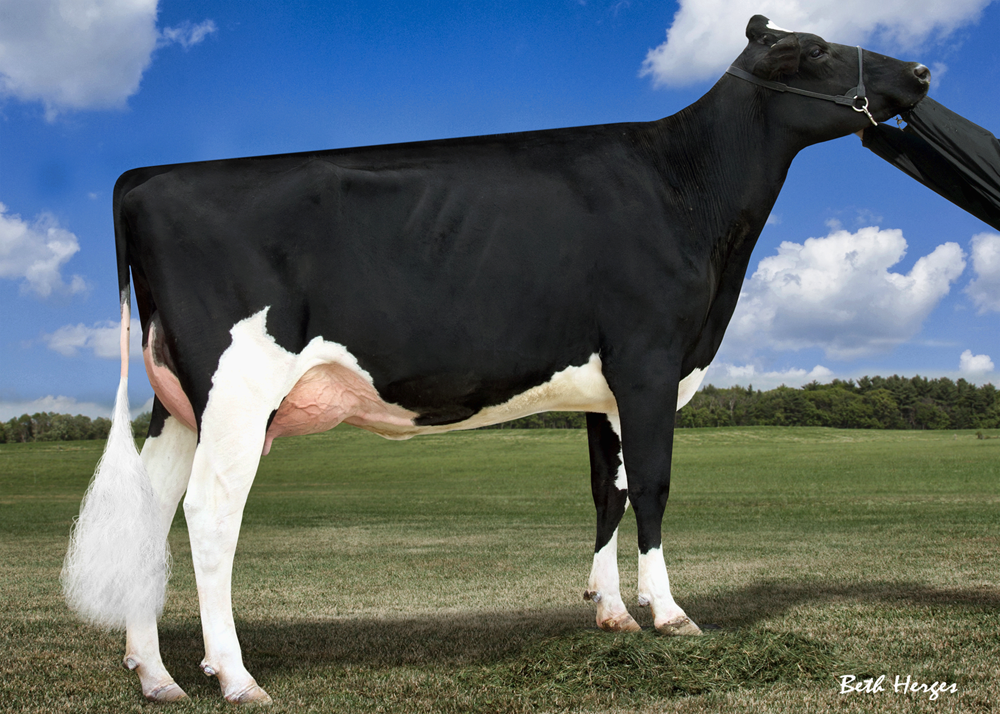
Dairy Cattle Pregnancy Rates: A CSI Investigation

When you’re looking for money on your dairy farm, pregnant is where it’s at!  The person, team or tools responsible for success in this area, rank up there with the best investments you will ever make.  What is it worth?  A lot!  The Bullvine did some CSI investigation – Cow Scene Investigation into the numbers.

measure up preg rates

Face the Facts. Who’s to Blame?

According to researchers at the University of Wisconsin, 96 percent of the variation in conception rate comes from management factors.  Only the last 4 percent is related to the individual cow and service bull’s genetics.

Less is More $$$

Even though we are looking for more there are four lesser values that will help us make those dollars:  fewer non-productive cow and heifer days; fewer breedings and therefore less semen used; fewer vet expenses and, last but not least, less labor for observing, caring and feeding.

These four will make you big money.  And, one more, in fifth place that may be hard to get your head around. You may have to be willing to sacrifice 2 to 5 pounds of milk per day for the sake of reproduction. It appears to be on the negative side of the ledger because of the immediate reduction in the milk check.  However, the other savings could far outweigh this apparent deficit.  Don’t forget more calves are born and there is less culling of non-pregnant cows and heifers.

If you require more incentive, one anecdotal story reports on a herd that has a 25% pregnancy rate and the breeder projects that “over the next seven years I can double the size of my herd through internal growth alone.”

Where Has All Your Money Gone?

$- A missed heat cycle can cost as much as $29

$$- A missed pregnancy costs an average of $450

$$$ – Further economic analysis shows that each percentage point increase in pregnancy rate is equal to a saving of $35 per cow per year. So going from the average pregnancy rate of 14% to the top of 22% there is a savings of $280. It is entirely possible that considering all factors and both cows and heifers that a farm of 250 cows could save $75,000 which is $300 per cow per year.


At these levels of return, it’s easy to see how improving your reproductive performance pays off.  If you save $75,000 or even $50,000 (2/3 savings), you could hire an employee dedicated only to reproduction protocols and improvements.

When DIM is delayed because cows do not become pregnant on time, it’s not unusual to see a reduction of 10 pounds of milk of more per cow per day. This too adds up quickly.  This milk is not down the drain.  It never even made it to the bucket!

Take Advantage of Your Team

There are many experts who can bring something to your team:  A.I. staff, veterinarians, nutritionists, extension workers and other breeders. With these consultants don’t shy away from mistakes.  Once you know and admit where the problem is, you are half way to solving it. Once the problems are identified you have the opportunity to put solutions in place and make more money.

Invest in Cow Catchers

Heat detection is the easiest of the parameters to influence with training and management attention. The lower your current reproduction record is, the larger opportunity you have to improve it. One hour per week invested in training (i.e. heat detections) at $10 an hour will recover a tenfold or higher return from improved reproductive performance over a year.  Make sure the eyes on your cows know how to find cows in estrus.  Upgrade staff skill sets for managing reproduction and breeding for a pregnancy. Take a course or have staff take a refresher in insemination techniques.  Spend a little to save or make a lot.

Genetics is Where Every Little Bit Counts!

Although genetics only accounts for 5 to 10% of reproductive performance there are opportunities to improve here as well.

  1. Use higher conception semen
  2. Use semen with more sperm per dose
  3. If available, use semen that has a longer viability after insemination
  4. Only use sires that have 107+ Daughter Fertility or DPR 1.2+
  5. Avoid bulls that are over 2.85 SCS, cows more susceptible to mastitis do not conceive easily.

Step Up Your Game. Get off to a Good Start

  • Increase observations and monitoring (at least 3x per 24 hours)
  • Increase observations of bred animals until they are confirmed pregnant
  • Maintain accurate and complete records for access by all staff
  • Pregnancy check between 28 and 35 days post breeding
  • Cull any female that requires a 4th service

Take Advantage of Cash Cow Tools

  • Use a synchronization program for cows or heifers for which a heat is not seen
  • Use the reproduction part of your herd management software. Examples: REPRO MONEY is free of charge to Wisconsin dairy producers and is expanding to additional states in the future.  Other states, milk recording agencies and universities have similar programs.
  • Use activity monitors for loose housed animals
  • Investigate using transition cow and rumination software programs.

THE BULLVINE BOTTOM LINE:

You can’t reverse financial challenges such as high feed prices and items beyond your control. However improving poor reproduction is your responsibility.  Getting it right will significantly drive your profitability at the best of times and see you through the challenging ones!


Get original “Bullvine” content sent straight to your email inbox for free.


[related-posts-thumbnails]
Don’t Hate The Playa, Hate the Game!

I know you have heard the phrase, “Don’t hate the player, hate the game”.  If you haven’t heard it, live a little longer and you will.  What it means is:  “Do not fault the successful participant in a flawed system, instead try to discern and rebuke that aspect of its organization that allows or even encourages the behavior that has provoked your displeasure”.  This definition also holds true for many of the complaints that we hear from our Bullvine readers about various aspects of the dairy industry.

Since we started the Bullvine, just over a year ago, we have always tried to listen to the frustrations of our readers and do what we can to help.  Whether that is explaining different aspects of genomics (Read more: Old School Dairy Breeders – Stop Pissing On Genomics, How Genomics Is Killing The Dairy Cattle Breeding Industry, and Is The Genomic System Really Working) or suggesting ways to increase your genetic sales (Read more: 6 Ways To Invest $50,000 In Dairy Cattle Genetics, Times Have Changed. Why Hasn’t The Way You Market Your Dairy Cattle, and Who Killed The Market For Good Dairy Cattle) or helping to bring clarity to many other issues, we have always tried to help find a solution.  However there are problems where the solution does not lie within what you do on your own farm, but rather the solution needs to come from changes in the industry itself.

While we all love to get on a high horse and gripe and complain about things, Bullvine included, that is not going to change anything.  It’s more important to use that frustration to bring about change.  In looking back over the past year, some major areas that we see that need this are:

The Bullvine Bottom Line

The Bullvine lives by the motto  “Lead, follow, or get out of the way” (Read more: Lead, Follow, Or get out of the way!!!).  Since we have started the Bullvine we have gotten out of the way of no one (Read more: The Bullvine – The Party is Over!), followed no one (Read more: I’m Sorry, But I’ve Had Just About Enough of…), and have tried to lead even when it put us under fire (Read more: The Bullvine – Under Fire).  These are values we will never change as we look to tackle tough issues that have breeders concerned about the future.  At the Bullvine we don’t hate the “playas” in the industry, we actually love all members of the industry.  What we are looking to do is help change the game.


Get original “Bullvine” content sent straight to your email inbox for free.


[related-posts-thumbnails]
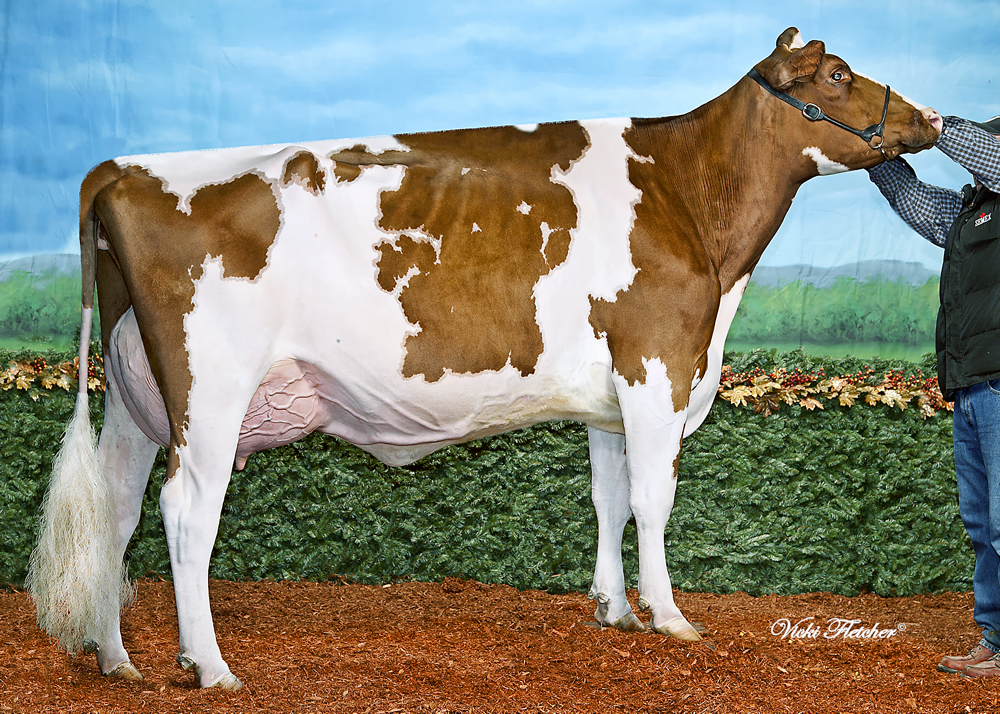
SHAKE, SIZZLE and FRY! – Social Media in Agriculture is Heating Up!

Several years ago, the marketing team I worked with was led by a gentleman who loved to use the quote, “When you’re selling, don’t sell the steak sell the sizzle.” Although celebrity Chef Lynn Crawford was a keynote speaker at Canadian Dairy Xpo, the Dairy Classroom got cooking early with Billy Frey’s on-farm social media presentation. The dynamic Frey is the Senior Vice President of Alltech Ag Network and he really knows how to sell the sizzle. He grabbed attention early with on-line streaming of his presentation and one-liners like, “What happens in Vegas stays on Facebook” which caught and held the attention of the standing room only audience.

Lyons, TVs and Broadcasts – Oh My!

Alltech Ag Network, as envisioned by its founder, Dr. Pearse Lyons, has always been a company built on relationships explains Billy.  “We knew if we could build a relationship, we could learn of someone’s problems.  Once we knew the problem, we could find a solution.  About 2 years ago, we spoke with our friend Jim Host.  Jim is known as the grandfather of sports marketing for the programs he and his company (Host Communications) put together for the NCAA.  In fact, Jim was just inducted into the College Basketball Hall of Fame, not for his play, but for his contributions to the game, principally setting up the NCAA corporate partner program.” This dream team was primed for what was about to happen.

It’s iHigh Time for Ag

Frey outlines the serendipity. “Jim Host had started a new company called iHigh.com.  This was an online TV company that broadcast high school sporting events.  The idea was simple:  iHigh put the Production Truck that you see at major sporting events into a computer and let the schools broadcast their own games.  The schools could generate revenue through advertising, which proved quite profitable.  Jim and Dr. Lyons thought “Why not agriculture?”  That was the first step and then “Alltech bought the rights to agriculture and began engaging Ag groups (FFA, rodeo organizations, horse shows, etc) to broadcast their events on iHigh.” This was a key and very logical piece according to Frey, “Agriculture has such a great story to tell, and who better to tell it than the participants themselves?”

A Communication Cover-All for Ag

As with any great idea once the pieces start coming together the momentum builds.  Frey shares this synopsis of events. “Shortly thereafter we entered into discussions with RFD-TV.  Patrick Gottsch, the founder of RFD-TV had been ‘telling ag’s story” for many years and he was looking to move into the online world.  Once he met with Jim Host and Pearse Lyons and learned about the technology, a partnership was formed.  Now, all RFD-TV content can be found online by going to MYRURALTV.com.  Patrick and RFD-TV have given a voice to the smaller events that might not be on network television.  Not only do they provide great coverage to their 65 million subscribers, but they also direct them to MYRURALTV.com whereby fans of RFD-TV can watch even more Ag content online.” Social media was on the move and the potential it was facing, meant a lot to Billy Frey.

Frey Gets Plugged In

billy-frey-ipad_jpg-400x286[1]The timing was right for Frey who had graduated from Centre College in 1998 with a degree in International Economics. He outlines his career path, “From there I worked in a bank.  The banking business didn’t enthuse me so I applied for a job with this international animal health company called Alltech.  I had never heard of it, but after interviewing, seeing the marketing philosophy, etc, I realized that this is something that I could get into.  I’ve been with Alltech for 14 years.  When I started we were an $85M company with about 500 people.  Now, we should hit about $800M in annual sales with 3000 employees.”

Computer Traffic Increase on the Information Highway

To date we have more than 300 organizations or groups broadcasting live events online.  Our traffic continues to grow, as people watch signature events like the FFA National Convention, the National HS Rodeo Finals, and more online.  With the world, in particular the world’s youth, watching video online we have seen a 4-fold increase in traffic online.”

Watch! It`s Alive!

Frey confirms that the online Ag content that will be provided by the partnership between Alltech and RFD-TV, utilizing the iHigh.com technology, will continue to grow.  “Last year 12 state FFA conventions were broadcast live online.  This year, we expect 30 state conventions to be broadcast online.  We expect more rodeos, more equestrian competitions, and of course, all the same great RFD-TV content to be available online.  No longer does mom and dad have to wonder what’s going on at the FFA Convention.  They can tune in.  No longer does Grandma and Grandpa have to look at pictures of their grandchild win an award or compete in a rodeo…they can watch it live.”

Technology is Smokin’

As an observer of change Frey joins the rest of us in awe at the rapidly changing social media scene, “The rise and adoption of technology has been first and foremost of the changes I’ve witnessed.  The world is at our fingertips, so that leads to infinite possibilities.  Consumer attitudes have shifted.  Globally we’re taking an interest in what’s in our food and how is it produced.  Look at what’s happening in Europe right now with the horse meat situation.  People want to know what’s in their food and when they’re duped, they revolt.  Along with oxygen and water, it’s one of the three most important things in life.”

Family Matters. They’ve Got Freys with That!

Speaking of important things in life Frey affirms his appreciation for the Alltech philosophy of marketing through education and, he adds, “our goal of helping to feed the world while at the same time educating people as to where their food comes from”.  Frey admits  that his  current role  as Senior Vice President of the Alltech Ag Network is his biggest challenge to date but then, in his branded positive style adds,” Like most great challenges, it’s the most rewarding.” Nevertheless it isn’t Frey’s biggest success story, “Personally, in the past 5 years I’ve met the love of my life, gotten married, and last June, became a father to a beautiful baby girl.  That’s definitely the best thing I’ve ever done.”

It’s Fast. It’s Instant. It’s Ready to Serve.

There’s another old saying, “If you can’t stand the heat, get out of the kitchen!” However, everyone knows that’s where the action is. A few minutes of listening to Billy Frey confirms that social media is the kitchen and you become a believer that this company has also found the “secret ingredient”. Frey looks into the future for us. “I see traceability and value added products coming to the forefront.  I want to know who produced this milk I’m drinking and what went into the ice cream or the cheese I’m eating (too much of by the way).  Why can’t I just use my phone, scan the carton and see the farmer?  I’m in agriculture so I trust those who provide me food.  Most people don’t have the good fortune of working in our industry, so they don’t know how milk is made.  When they don’t know, they do two things:  find out for themselves or assume the worst.  Since the internet has given us instant information, people trust whatever comes up first on a Google search.  People want to know where their milk comes from, so let’s tell them.  We have every reason to do it and zero reasons not to.” The recipe for success!

BULLVINE BOTTOM LINE

Thanks to our look at marketing through the eyes of “Shake Sizzle and Frey” we have learned that, social media is the means whereby, the farm, the farmer and agriculture are no longer anonymous.  People are eager to get to know and like who is growing their food.  The Bullvine thinks that Alltech is one of the first companies to turn up the heat on Ag sizzle. If you are still waiting for a taste test, you could not only miss the heat, but the entire kitchen altogether.  Go where the action is.  “Social Media in Agriculture is Heating Up!”


To learn how to get your farm on Facebook download this free guide.


[related-posts-thumbnails]

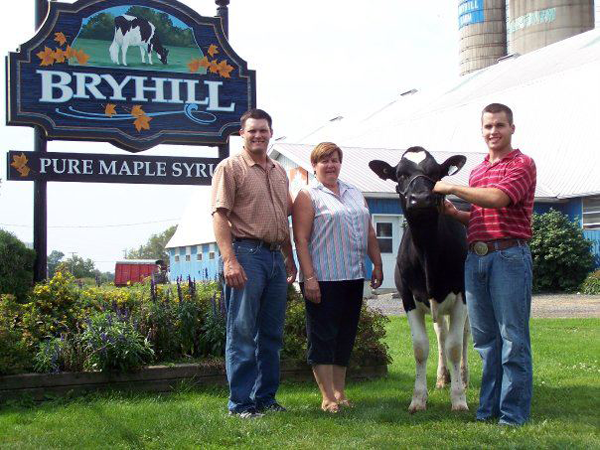
Bryhill International Genetics: 10 BIG Steps to Following Their Dream

The Bryson family of Ormstown, Quebec are following their dream of growing Bryhill International Genetics into a leading dairy breeding operation.

Of course, expanding a farm and growing a family business can be both rewarding and challenging at the same time. Matthew and David Bryson take a moment to look back and consider how far they have come. “The past 6 years have led us to change our breeding philosophy completely, while gearing up for a large commercial dairy environment.” As the Brysons share how they made the necessary changes, Bullvine readers have a perfect opportunity to look at 10 big steps taken by Bryhill International Genetics as they follow their dream.

1. THE FOUNDATION:  Start with the Right Team

The principle of building on the foundation of a great team is the basis of success for sports and business. The team members at Bryhill are Lynn, David, Stacey, Matt, and Sarah. Jason Bryson, a cousin, is also a very important employee involved throughout the farm activities and specifically the nursery where the new calves and high end genetics get their start. A brother, Alan, helps analyze breeding decisions and investments for future genetic orientations. It takes commitment and a shared vision for the future.

David, Lynn and Matthew Bryson at the original homestead

David, Lynn and Matthew Bryson at the original homestead

2. LEADING EDGE IDEA. Make it Work.

David and Matt Bryson describe the motivation behind Bryhill International Genetics. As a founding member of Trans America Genetics, “B.I.G. was used to set focus and aim at identifying, acquiring and merchandising breed leading genetics with a specific focus in mind. The move to a large freestall, the need to adapt to the changing technology (genomics) and the need to be more efficient, means that every decision we have made has led to aggressive moves so as to be better positioned for the future in order to have a business that would move easily into the next generation.” A successful, sustainable family dairy business.

3. FAMILY MATTERS. That’s Where We’re Going.

Every big dream starts with little steps.  There are many variables that impact decisions.  This was definitely the situation facing the Bryson family. “The expansion was prompted by a few different things. First, the business needed to support two families. Second, the previous site had limitations due to highway, rivers and town in close proximity. Third we wanted to offer a working environment that facilitated high volumes using efficient methods therefore allowing quality time with our families and preparing ourselves better for the future.”

4. GROWTH IS A GIVEN.  Build More.

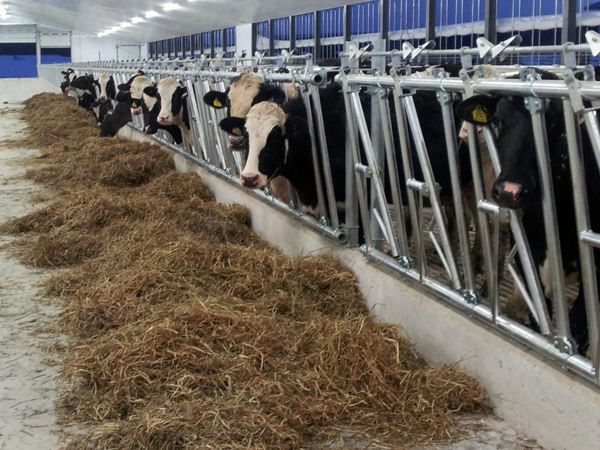
With growing clarity on where they needed to be, Bryhill got down to the actual building. Matt says, “The latest expansion is now complete. There are now two main dairy barns of 105’ x 475’ and a hospital, close-up barn of 75’ x 250’.The milking parlour is a double 16 allowing for more expansion and high flow as well as a calf barn with automatic feeding, just off the milking parlour. We currently milk 300 head and plan to keep growing the herd with the most efficient genetics possible.”

Innaugural feeding in Bryhill's new facility

Inaugural feeding in Bryhill’s new facility

5. A WORLD VIEW: Key in On It

Great product and facilities would be nothing, if it wasn’t meeting the demands of the marketplace.  Dave clarifies the Bryhill philosophy. “We have identified the high GTPI, NM, Polled segments as our key markets. These are to us the markets which shall develop the highest demand for the commercial dairy farm and meet over 95% of world market needs.”

The number one GTPI polled heifer of the breed, Bryhill One Sassy P. Potentially the best heifer ever bred at BIG.

The number one GTPI polled heifer of the breed, Bryhill One Sassy P. Potentially the best heifer ever bred at BIG.

6. MAKE THE COWS MAKE THE DIFFERENCE.  Make it Fast

Growing a successful dairy business always boils down to the cows that produce the milk, the genetics, the buyer interest and the bottom line financial success.  The Brysons share which families they have introduced, “The cow families that we are working with are Sizzle P, Planet Lucia, Chart Topper,  Shottle May, Converse Judy, Allen Dragonfly, Brocade, Baxter Carmel, Cosmopolitan,  Adeen, and Dreary.” Here too there is a great deal of thought that has gone into the selections. “These are all cow families that have proven their abilities to make extremes. Breed changers we like to call them.” BIG changers!!

7. GENOMICS. Go for it NOW.  

There is no hesitation at Bryhill International Genetics when it comes to using Genomics. “The top sires we are using are 100% genomic. Leading genomic sires will remain among the top of the breed regardless of rank.” That is important to the Brysons. “This gives us an advantage over the longer run as we shorten generation intervals and increase genetic gain.” Again it is no surprise to hear them say, “We aim to remain among the forerunners.”

8. GENOMICS. The Game Changer.

When you’re developing an international company that is relevant and sustainable you have to evolve with the modern marketplace.  David recognizes the impact of genomics. “Genomics has significantly changed the way we do business. It has made us realize the value of cattle and breeding. While we still enjoy solid conformation, it has created more objectivity in our decisions and, we look more at what that individual will potentially transmit. We take pride in making these top females available and in fact it has also helped our merchandising.  New progeny become recognized on objective, public top lists that are accessible to all. This has led to great contacts and marketing opportunities.”

9. CHANGE IS HERE. Be Part of it 

Matt confirms this viewpoint. “The marketplace will change according to changes in market demand and technology. Consumers will play a huge impact and animal welfare will play a part too.” Dave highlights another game changer. “The polled gene has been a big part of our change as we see this becoming a standard!”

De-Su 199 Chart Topper" In partnership with TAG, Bryhil purchased Chart Toppers 1st Choice Numero Uno daughter for $79,000 at World Classic Sale 2011

De-Su 199 Chart Topper
In partnership with TAG, Bryhill purchased Chart Toppers 1st Choice Numero Uno daughter for $79,000 at World Classic Sale 2011. Chart topper is a Watson x Pine-Tree Missy Oman Miranda VG-86 x Wesswood-HC Rudy Missy EX-92 3E GMD DOM x EX-90 GMD DOM x VG-87

10. GET GOOD ADVICE. Grow With It

Despite their relative youth, the Bryhill team knows the value of good mentors. “ TAG has been an influential entity in our genetic development,” say the Brysons. They admit it is tough to offer advice to others but know that their experience could help others who are interested in expanding their genetic marketing strategies. “Two things come to mind.” say the Bryhill team. “It’s hard to go wrong with high genomics from top cow families.”” Try to identify where the market is going.” “This is not easy but it is doable.”

THE BULLVINE BOTTOM LINE

When you want to know what makes the BIG difference, it really is clear what is working for the Bryson family and Bryhill International Genetics.  They take many small steps consistently and persistently. They are following their dream and obviously are ready to make a mountain out of Bryhill.  That’s the B.I.G. difference.


Get original “Bullvine” content sent straight to your email inbox for free.


[related-posts-thumbnails]
CANADIAN BULL PROOFS – You’ve Got to Prove It to Use It!

No one likes paying upfront fees for anything.  After all, what’s the point of paying for something you haven’t received yet?  But there are some situations where paying upfront totally makes sense. Getting genetic information is one of those times.  You give up your money first and it translates into rewards later.

The Pieces are Put Together to Pull Together

Twenty years ago in Canada the dairy industry was faced with a challenge.  Government said it would fund research and development but not genetic evaluation services.  The goal was to shrink the cost and size of government.  The industry said these reports are valuable so we are going to have to get involved and that is what happened.

logo_cdn2_0[2]Canadian Dairy Network (CDN) was established in May 1995.  General Manager, Brian Van Doormaal, has been with CDN since its inception and summarizes the general details. “CDN is governed by a Board of Directors that primarily consists of breeders who are elected as representatives from four categories of member organizations, namely Breed Associations, DHI Agencies, A.I. organizations and Dairy Farmers of Canada.

The Canadian Dairy Network provides five major services:

  • Genetic Evaluation Services
  • Research and Development Projects
  • Industry Standards
  • Maintains the National Dairy Data Base
  • Operates the Data Exchange amongst the industry partners

It`s Fully Integrated and Always Moving

In the simplest terms, all the relevant information is shared by those who contribute.  Examples are:  Breed pedigrees go to CDN; CDN shares them with everyone who is a partner; DHI records go to CDN and are shared with partners.  These and more types of information are available to all users at all times via the Internet.  Everything can be found at the CDN website AT NO CHARGE for lookups.

The Dollar Division

Van Doormaal updates the funding process behind CDN. “All activities of CDN are financed by the industry organizations that are its members and for this reason the CDN Board of Directors has established an equitable service fee structure.” He further breaks out the pay structure. “80% is paid by AI and 20% by breed associations and milk recording provide their information at no charge to CDN.”

FEES: Fearsome Hurdle or Forward Thinking?

When there is a 79% cost increase (effective April 2013), there are going to be questions. Namely, “How did CDN determine the cost of $7500 to prove a bull in Canada?”  Previously the fee was $4200. The same fee has been set on a per bull basis for privately owned genotyped bulls, starting April 2013.  CDN does not have any other fees so this is an all-inclusive rate that gives the bull owners access to various services associated with genetic and genomic evaluations.”

Van Doormaal further clarifies. “With the arrival of genomic evaluations in 2009, operational costs have risen due to increased staffing needs and computer power while the number of young bulls with semen released in Canada each year has almost halved.”  Obviously, the plan is three-fold:  provide more research; more development and, at the same time, cover costs into the future.

Everybody Pays!

Van Doormaal stresses that, “In one way or another, all people and organizations will be paying fees to receive genetic and genomic evaluation services from CDN for bulls. While the mechanism for paying differs for breeders compared to A.I. organizations that are members of CDN, the level of payment is equivalent.  On the female side, no fees are applied on an animal basis since the breed associations contribute to funding CDN activities on behalf of their members.”

Brian Van Doormaal, CDN Speaking at the 2012 China-Canada Dairy Conference

Brian Van Doormaal, CDN
Speaking at the 2012 China-Canada Dairy Conference

What’s Up in Other Countries?

Van Doormaal knows the international scene and explains, “While there are other countries like Canada for which the genetic evaluation services are financed completely by industry stakeholders, as opposed to government, each country inevitably ends up with its own funding formula and mechanism.” He speaks of the American situation.  “In the US, the mechanism proposed for financing its genetic and genomic evaluation services includes some level of fee applied to every male and female for which a genomic evaluation is to be calculated.”

Proving Your Own Bull

When asked about advice for breeders looking to prove their own sires, Van Doormaal urges. “Genotyping young bull calves shortly after birth makes as much sense for breeders as the genotyping of their newborn heifers.  Once the genomic evaluations are available to the breeder, better decisions can be made about the bull’s future.  Owners (AI or breeders) of bulls with outstanding results can then pay the CDN fee to make results official and have the young bull ranked among others available in Canada.”

LPI Formula Changing

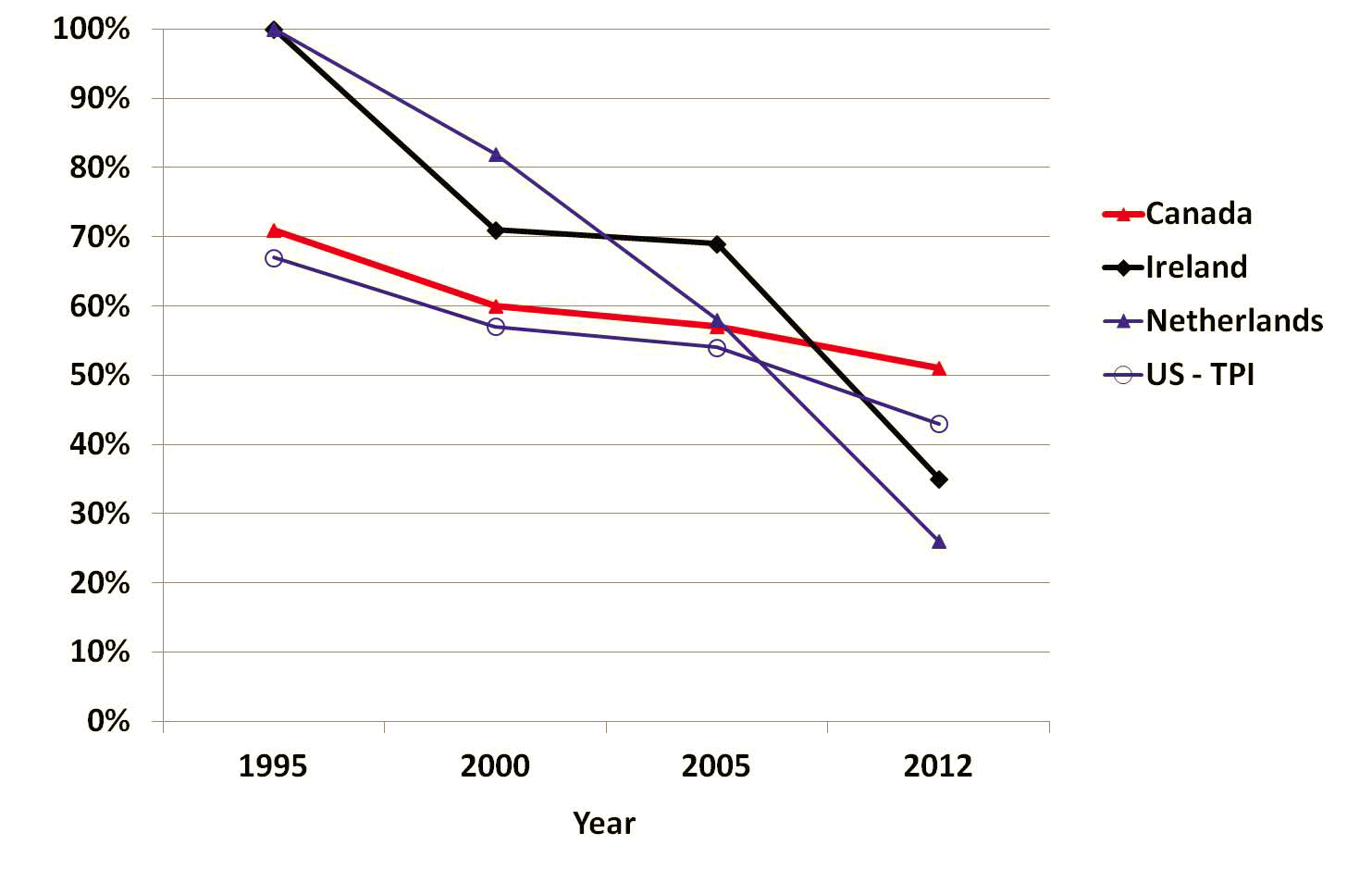
Van Doormaal reports “The LPI for Holsteins in Canada currently has a range in values of approximately -3000 to +3000, which is three times bigger than the TPI in the United States and over 50 times bigger than national indexes used in most other countries.

The CDN Board of Directors decided, after consulting all stakeholders, that the LPI scale should be halved.  To achieve this objective while maintaining the current level of LPI values for the highest progeny proven bulls, it was decided to add a “constant” value to the LPI formula in a manner similar to what the United States has done for years with its TPI formula. Conversion from current LPI values to the proposed new scale is simply done by dividing the current LPI in half and then adding the constant of 1700.”

LPI Formula Give and Take

Another adjustment Van Doormaal expects to happen to the LPI formula relates to the specific traits included and the relative emphasis placed on each.  Analysis of various options and discussion will proceed through 2013 with a likely implementation of an updated formula in April 2014. Based on feedback received from a cross-section of breeders, there seems to be a general interest to increase the overall emphasis on longevity, fertility and disease resistance in the formula. Of course, once the emphasis is increased on some traits, there also has to be other traits losing emphasis.

Future CDN Genetic Evaluation Evolution

In December 2012, CDN introduced Body Condition Score as a newly evaluated trait for all breeds, which can be used as an indicator for fertility, disease resistance and longevity.  The release in December 2013 will include the first official genetic evaluations for Mastitis Resistance in all breeds which should be followed by Resistance to Metabolic Disorders in 2014.  Other traits on the planning horizon within the next five years include desirable fatty acids and other components of milk, hoof health and feed efficiency.

Changing Gears for Genomics

Van Doormaal provides updates resulting from the introduction of Genomics. “Prior to 2009, CDN had six different genetic evaluation systems, which were run monthly to evaluate over 60 traits including production, type, longevity, female fertility, calving performance and milking speed/temperament. With the arrival of genomics, a new system was developed and implemented, which estimates Direct Genomic Values (DGVs) for all traits and combines them with traditional evaluations to produce the published genomic evaluations.  This new system is also run monthly and also required the establishment of a national database to process and store all genotypes, which now totals over 310,000 across all breeds. Operationally, these new services that are highly valued by the industry organizations and breeders, have required additional geneticists and new web site development as well as investments in advanced computer equipment and processing power.”

CDN: Providing Global Genetics and Genomics

Looking to the future, Van Doormaal gives an overview. “The era of genomics is still in its embryonic stages.  It is difficult to predict the extent to which it will continue to impact the dairy cattle industry over the next 10 or 20 years.  One thing for certain is that the world of genetics will continue to shrink at an increasing rate since it is so easy to collect DNA from any animal in the world and assess its genomic evaluation on numerous country scales.”

CDN:  Fine-Tuning

CDN will dedicate much time and effort in the coming years to fine-tuning existing traditional genetic evaluation systems and methods for estimating genomic evaluations. Van Doormaal is realistic about the possibilities. “The shift towards a higher market share held by genomic young sires compared to progeny proven sires will likely experience some pendulum swings, eventually reaching stabilized proportions as breeders and industry gain experience in the coming year.”

After 25 years working and educating in the Canadian proving system, Van Doormaal is proud of the achievements. “We are fortunate in Canada to have many geneticists and research scientists who realize that the ‘practice’ of genetic selection and mating is not the same as the ‘science’.  Both sides need to continue to respect and listen to the knowledge and experience of the other. The most progress is made by incorporating the ‘science’ of genetic improvement into a solid, practical breeding program.”

BULLVINE BOTTOM LINE:

Recognizing the potential of responding to changes in the industry, in technology and from science, CDN is focused on the future on behalf of breeders.


Get original “Bullvine” content sent straight to your email inbox for free.


[related-posts-thumbnails]
The All European Championship Show: The Greatest SHOW on Earth

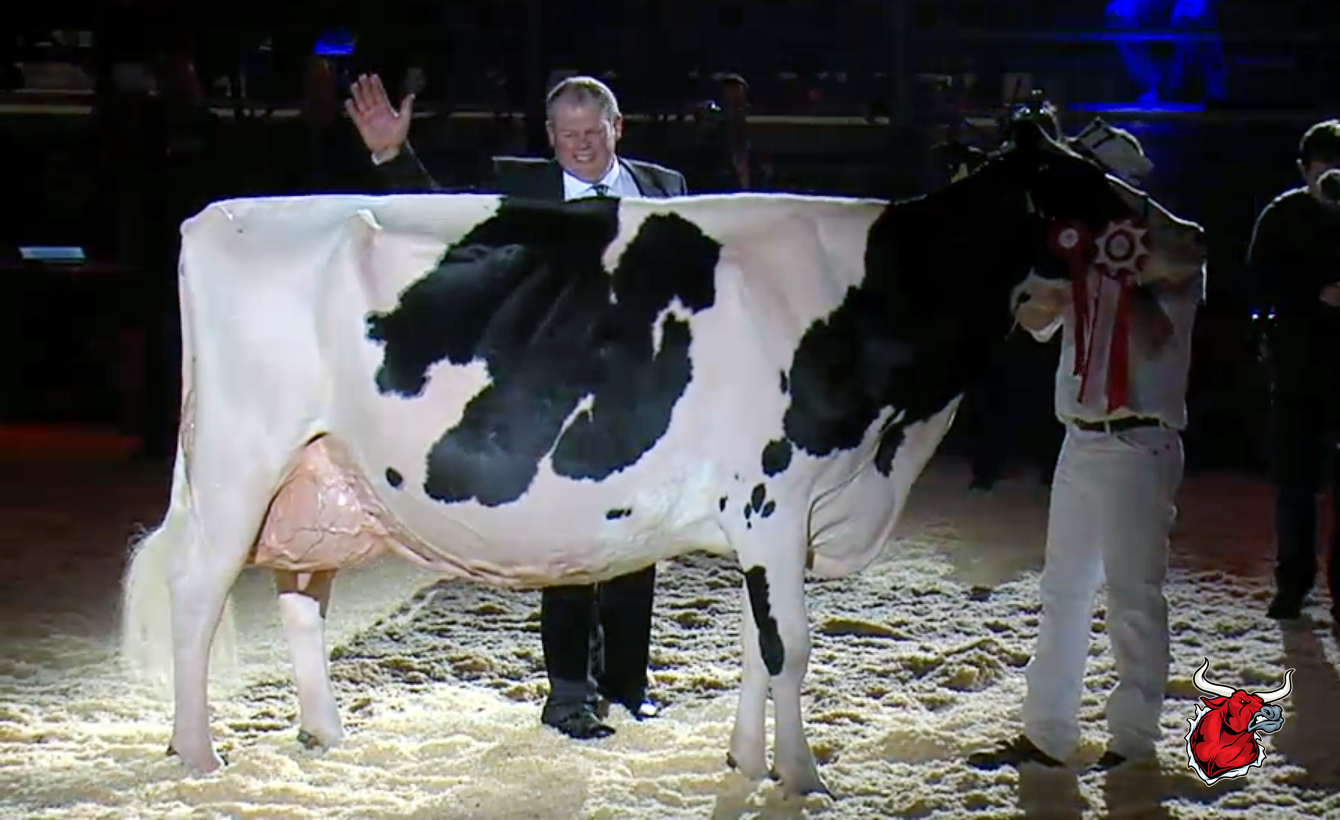
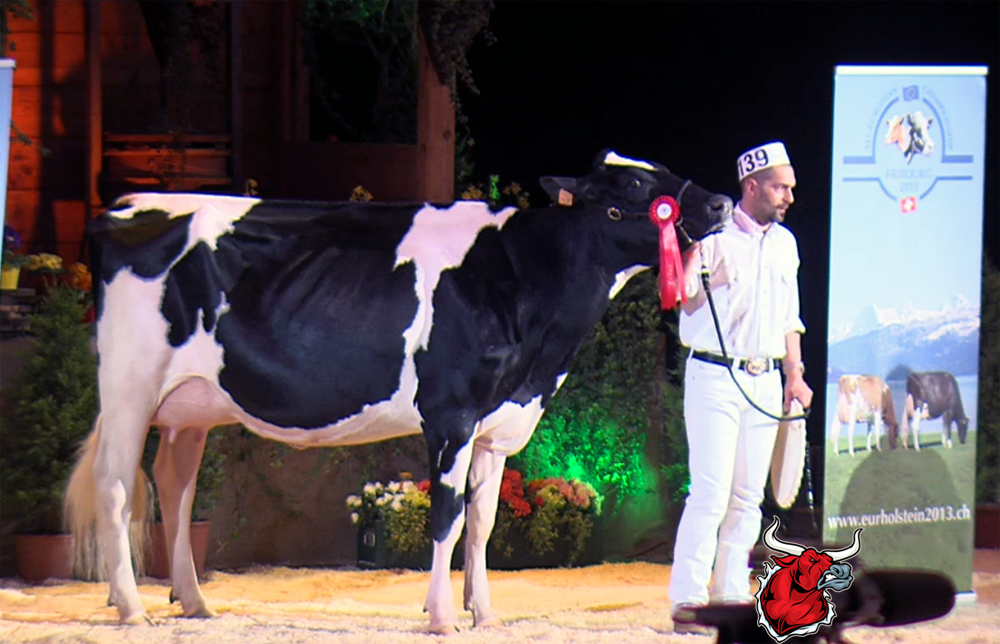
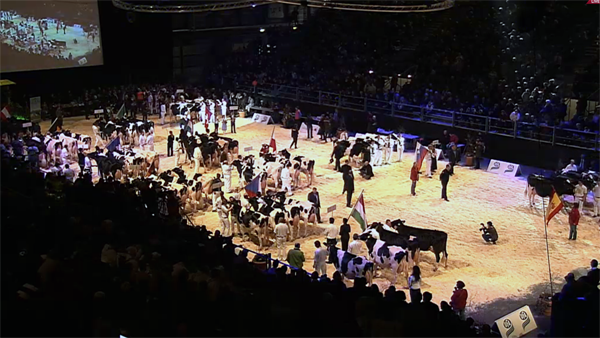
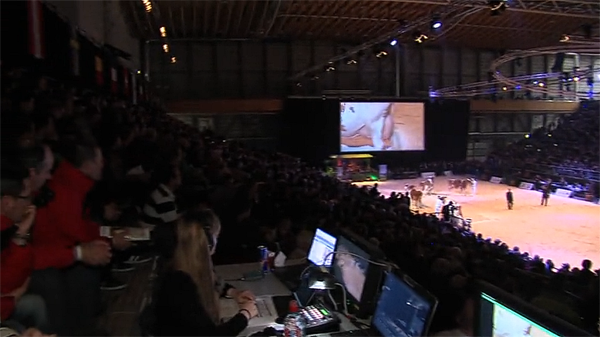
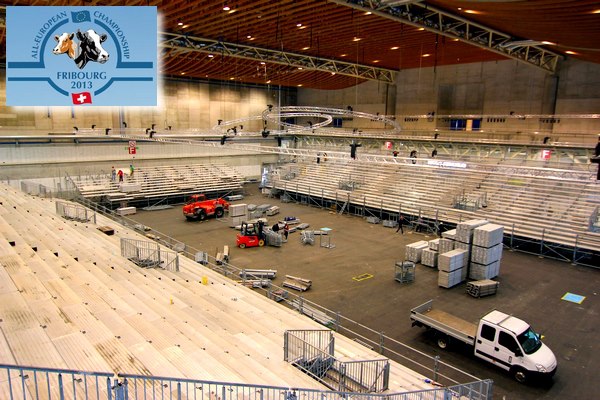
This past weekend Switzerland hosted the 2013 All European Championship Show and sent a clear message to the world that NO ONE puts on a better SHOW than  Europe.  Think of it as the Olympics meets Cirque to Soleil and you have the 2013 All European Championships.  From the outstanding cattle to the amazing production the 2013 All European Champion truly was the GREATEST Dairy SHOW on earth in 2013.

The Winners

Similar to the greatly anticipated battle at the 2012 World Dairy Expo between the great Harvue Roy Frosty and RF Goldwyn Hailey (Read more: World Dairy Expo 2012 Holstein Show: A battle for the ages), the 2013 All European Championship Show had its own much anticipated battle between DECRAUSAZ IRON O’KALIBRA EX-94 from Switzerland and ASHYLYN VRAY EX-94 from Spain.  It didn’t disappoint.   As  predicted the Grand Championship came down to these two great cows with O’Kalibra taking Grand and Vray taking Reserve.

Decrausaz Iron O'Kalibra  Class 9 winner, Sr & Grand Champion - 2013 All European Championship

Decrausaz Iron O’Kalibra
Class 9 winner, Sr & Grand Champion – 2013 All European Championship

In his reasons Judge David Boyd from Ireland commented that he thought O’Kalibra, exhibited by GS Alliance and Pat Conroy, could walk in any show ring in the world and compete.   Many show experts agree 100% with his declaration. Two separate polls on Facebook  demonstrated that the world agrees with him.  O’Kalibra certainly would give the great RF Goldwyn Hailey a run for her money.  With her outstanding fore udder, sweep of rib and strength of pastern she would certainly make it a very interesting class  competing  with Hailey’s outstanding balance, size and dairyness throughout.  (Watch for more to come on this topic or click here to participate in our Facebook poll)

Decrausaz Iron O'Kalibra  Class 9 winner, Sr & Grand Champion - 2013 All European Championship

Decrausaz Iron O’Kalibra
Class 9 winner, Sr & Grand Champion – 2013 All European Championship

LLERA ARIEL GOLDWYN (SPAIN) Class 8 winner - 2013 All European Championship

LLERA ARIEL GOLDWYN (SPAIN)
Class 8 winner – 2013 All European Championship

Another show favorite that caught the eye of  cattlemen was LLERA ARIEL GOLDWYN.  For many she is the definition of the modern Holstein cow with her dairyness through the front end and snuggly attached udder that is high and wide. She certainly won  many fans at the show.  Also getting a lot of attention from Spain, who went on to win the much-coveted top country class, was HUDDLESFORD DUPLEX MEDORA.  This silky black Duplex daughter rose  to be Intermediate Champion over some outstanding young cows from  Ponderosa Farms of  Spain (Watch for our upcoming feature article with Ponderosa who had 5 Top 5 placing animals).

Huddlesford Duplex Medora (Spain) Class 6 Winner and Int. Champion - 2013 All European Championship

Huddlesford Duplex Medora (Spain)
Class 6 Winner and Int. Champion – 2013 All European Championship

A young cow with a very bright future is the Junior Champion C.M.E GOLDWYN VANITY (Note for North American readers at this show ALL animals are in milking form so Junior Champion is more like a 1st or 2nd calf cow).  This young cow had the X factor that Judge Boyd was looking for. He loved her depth of fore rib over her classmate and Reserve Junior Champion SOUTHLAND ALEX CAROLA 11.

Complete 2013 All European Championship Show Holstein Results

C.M.E. GOLDWYN VANITY (Italy) Jr Champion Holstein - 2013 All European Championship

C.M.E. GOLDWYN VANITY (Italy)
Jr Champion Holstein – 2013 All European Championship

Suard-Red Jordan Irene - Grand Champion 2013 All European Championship

Suard-Red Jordan Irene
Grand Champion 2013 All European Championship

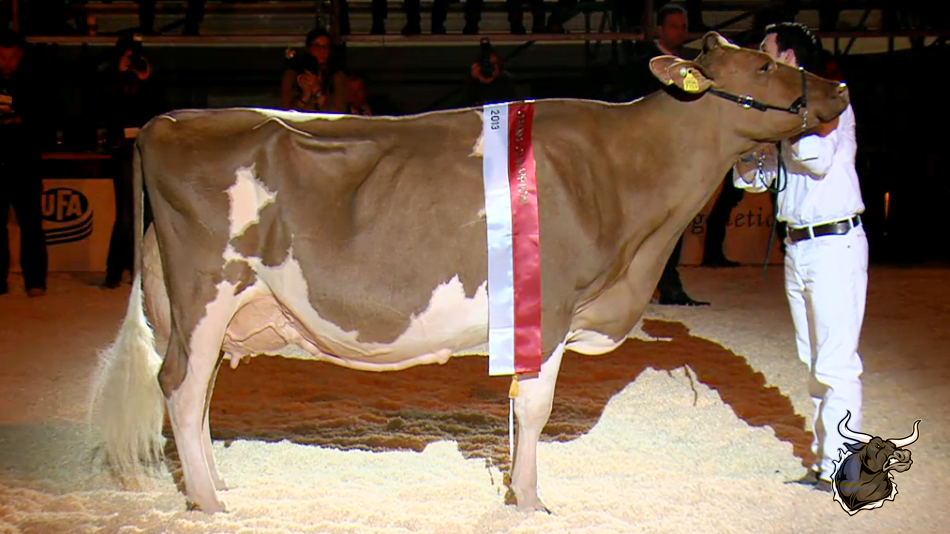
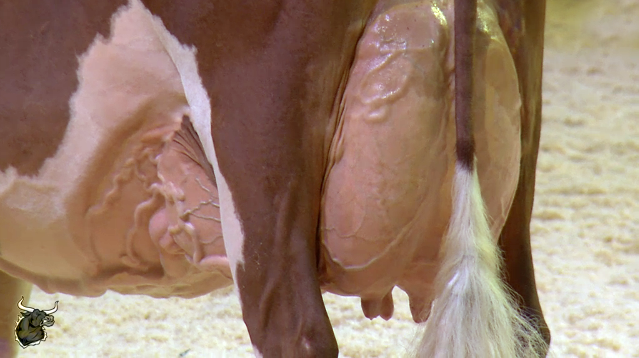
The Red Holstein Show was very much dominated by the host country Switzerland with SUARD-RED JORDAN IRENE taking Grand Champion honors.  This great Ja-Bob Jordan daughter used the power of her outstanding mammary system to take top honors in a show that featured many outstanding young cows.

Suard-Red Jordan Irene - Grand Champion 2013 All European Championship

Suard-Red Jordan Irene – Grand Champion 2013 All European Championship

Complete 2013 All European Championship Show Red Holstein Results

The Show

While some would argue that even the winners of some of these classes would not sit top five at World Dairy Expo or the Royal, one thing that this show does dominate over North America is the entertainment production value that  even the emotional story of Ebyholme Goldwyn Marcia winning reserve at the Royal could not compete with (Read more: The 2012 Royal Winter Fair Holstein Show: One of the greatest stories ever told!).

From the ring environment that is custom developed for this show to the passion the breeders in Europe have for this show, the whole experience is was like something you would expect at an expensive production like Cirque to Soleil or the closing ceremonies of the Olympics.

From the ring environment that is custom developed for this show to the passion the breeders in Europe have for this show, the whole experience is was like something you would expect at an expensive production like Cirque to Soleil or the closing ceremonies of the Olympics.

From the ring environment that is custom developed for this show to the passion the breeders in Europe have for this show, the whole experience is was like something you would expect at an expensive production like Cirque to Soleil or the closing ceremonies of the Olympics.  At times the final class for champion country (a walk in class in EU compared to a points class in North American competitions) with appreciation presentations and flag passing ceremonies to the next host France in 2014  seemed to take a very long time.  However, a lively ring announcer and a suspenseful environment made even that an enjoyable experience for the over capacity crowd.  That same enthusiastic crowd went on to show the world how well they can party late into the night. Where no fewer than 2,000 people taking part in a typical Swiss dish: the fondue and some fine refreshments.

From the great camera angles combined with the very professional in ring cameras combined with the outstanding music and exceptional ring announcer the experience was riveting for all.

From the great camera angles combined with the very professional in ring cameras combined with the outstanding music and exceptional ring announcer the experience was riveting for all.

Not only was the experience outstanding for those in attendance but also for those who watched online.  With a limited capacity of 2000 viewers (1500 on the Bullvine alone) streaming online the show did an amazing job showcasing itself to the world.  From the great camera angles combined with the very professional in ring cameras combined with the outstanding music and exceptional ring announcer the experience was riveting for all.  At one  point that we had over 200 people on our website who were not able to watch, constantly hitting refresh hoping to get a chance to see this amazing event. (Click here to watch the highlight video)

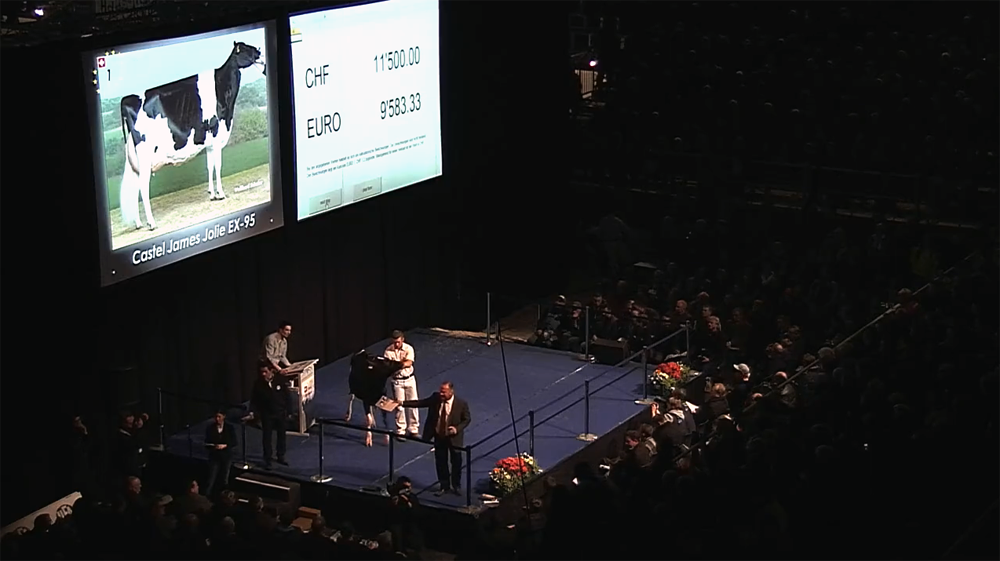
A capacity crowd was on hand for the 2013 Swiss European Sale. Sale highlights include: 14,700 – Morsan Showdon Red, the daughter of the Goldbull Christian is a granddaughter of Blondin Redman Seisme and is the only female descendant of Seisme in Europe.

A capacity crowd was on hand for the 2013 Swiss European Sale. Sale highlights include: 14,700 – Morsan Showdon Red, the daughter of the Goldbull Christian is a granddaughter of Blondin Redman Seisme and is the only female descendant of Seisme in Europe.

The Bottom Line

With the 2013 edition of the All European Championship show now complete Europe has sent a clear message to the rest of the world and specifically North America.  They are a serious force on the world scene.    All who attended or  watched online saw high quality cattle and an amazing production. There is no question, from a presentation stand point, that the 2013 All European Championship Show was certainly “the greatest dairy show on earth”


Get original “Bullvine” content sent straight to your email inbox for free.


[related-posts-thumbnails]
10 Reasons Why or Why Not To Get Rid of the Sr. /Fall Yearling Class Once and For All

For years there has been great discussion about how show type is different from functional type.  Show cattle are bred to be taller, deeper and to have level rumps where functional cattle are bred for maximum feed conversion and sloping rumps (Read more: From Fantasy to Reality – Top Sires to Address Herd Culling Problems).  For the most part, the show ring has always been an exhibition stage for genetic advancement.  However, more recently there has been rising debate about whether the show ring is still achieving this.  For the most part this conversation is centered around the need for a non-milking SR./Fall yearling class at the major fall shows.  You see, by fall shows most of the animals in this class are over 2 years of age and, compared to the average calving age, are behind the majority of their other young cow peers.  With the cancellation of the non-milking Sr./Fall yearling class for Ayrshires (Read more: A Letter to the Editor From US Ayrshire President in Regards to Fall Yearling Class Cancellation ) this discussion has heated up even more.  To get to the bottom of this, the Bullvine decided to look at both sides of the argument.

5 Reasons for keeping the class:

  • Non-Milking Sr./Fall Yearlings  represent about 6-10% of the animals exhibited at each show
  • They show all summer at an age that is under two, and if these shows are to be the championships for the year, should there be a class that animals have competed in all summer.
  • You need to look at the timing of the shows.  Since Madison is in early October and only 1/3 of the yearlings should have calved by then, it doesn’t make sense to cancel the class there.
  • The show ring is about breed promotion, so why not show off as many great animals as possible?
  • There have been some interesting points made about how calving them in early can lead to cows burning out later in life.  A case could be made for this.  When you look at the All-Canadian Mature Cows and 5 year olds over the past 2 years, NONE were nominated in milking form as a yearling.
R-E-W HAPPY GO LUCKY VG-89-2YR

R-E-W HAPPY GO LUCKY VG-89-2YR

5 Reasons for cancelling the class:

  • The quality of the milking yearling class has probably shown the greatest rate of advancement over the past 20 years, compared to any other class.  Yes some of the summer calves are pretty large and cut right, and the 150,000 lbs. class is amazing to see with the great longevity of these animals.  However, if you look at the whole class, from top to bottom and consider the rate of change, none of these highlights compare to that of the milking yearling class.
  • Over the past 5 years more animals have gone on to success in Milking form from the Milking Sr./Fall Yearling class than that of the non-milking class (Read more: Do All-Canadian Heifers Make All-Canadian Cows?)  A great example of this is Valleyville Rae Lynn who was 2nd at the Royal this year as a 2nd calf Milking Senior 2yr old and now has the ability to flush, develop and compete in 2014 as a 3rd calf 4 yr. old.  Just imagine how impressive she will be.  This is also the plan for the very popular and unanimous All-Canadian and All-American Milking Yearling, R-E-W Goldwyn Happy Go Lucky. In fact the two most recent animals to convert heifer success into milking success where CRAIGCREST RUBIES GOLD REJOICE and T-TRIPLE-T GOLD PRIZE where both Winter/Intermediate Yearlings.
  • The Royal is in November when more than 2/3 of the class should have calved and, as a result, it really doesn’t make sense to have the class.  When looking at the non-milking SR. yearling class at the Royal, one of the biggest challenges that is consistent throughout the class is the dairyness or lack thereof throughout the class.  It is very hard to keep these animals clean and dairy.  Jerseys have been well ahead on this from both a breed advancement and a show ring perspective and, as a result, their average age at 1st calving is low and they DO NOT have a Senior Yearling class at the Royal.  (Please note they do have a Fall Yearling class at World Dairy Expo).
  • I have heard the argument that some animals are just not big enough or developed enough to calve that young and I can totally understand that.  Nevertheless, should these animals be rewarded for being behind in their development, when compared to others?  Remember, Dry Cow classes were dropped because they did not showcase milking udders and production ability.  Two major functions of dairy cattle profitability.
  • The dairy cattle industry is a business and dairy cows don’t become profitable until after they calve.  Shouldn’t we be showcasing profitable animals instead of those that are still costing money?  Remember the dairy farming is a business and everyone needs to appease the banker.  The banker is like an undertaker and eventually everyone has to pay the price.
VALLEYVILLE RAE LYNN VG-89-2YR-CAN

VALLEYVILLE RAE LYNN VG-89-2YR-CAN

The Bullvine Bottom Line

While there are many great points on both sides of this argument, if the show ring truly wants to stay relevant and represent the best the breed has to offer than there is no question it needs to be ahead of the curve and not behind it.  That means it should be leading the charge not following it.  The one thing both sides can agree on is this is an issue the breeders need to decided together in order to ensure that dairy cattle showing stays relevant going into the future.  Since the breeders who show at the national level really are a niche group, they need to make sure they stay market relevant or become irrelevant very fast in the eyes of most producers and the breed associations as a whole.

What do you think?  Take our Facebook poll.


Get original “Bullvine” content sent straight to your email inbox for free.


[related-posts-thumbnails]

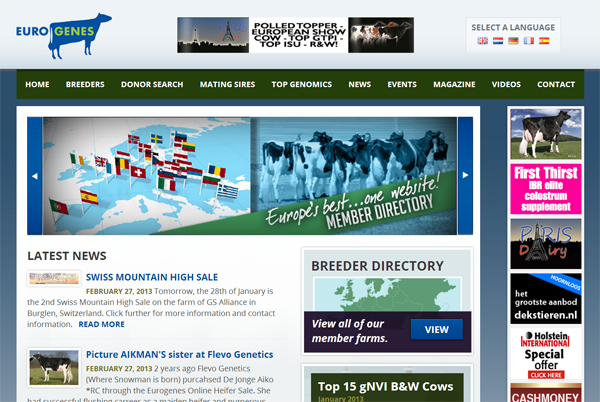
EUROGENES: You Love It. They List It!

Today Jan de Vries and Arjan van der Vlis keep their cattle connections productive through  Eurogenes the Netherlands based online cattle auction service.  Looking back, it`s easy to pinpoint their early interest in cows. Jan says, “Since I was a little child I have been working on farms. During holidays I always spend time on farms. I always had a special interest for breeding and mating sires.” Arjan too had a cattle connection. “Got my interest in cattle through my father with buying cows, he is a butcher and we searched for the cattle ourselves. Later on I became more interested in dairy cattle and in the breeding of them. Through practical training and family I got my extreme interest in dairy cattle breeding.” No doubt their joint enthusiasm for cattle led them to keep open minds regarding ways to be involved with the business.

Eurogenes - website

Eurogenes Means E(asy) Commerce

In 2000 Alex Arkink, a cow photographer started Eurogenes. Both Jan and Arjan were involved in managing the Eurogenes Sales. After four years Jan ws ready to take the next step with Lammert Hielema. The two of them who own Genetics Consolidated went forward. “In 2004 we purchased all shares from Alex Arkink.” Arjan is the Business Unit manager for Eurogenes. They were excited at the possibilities presented by this young company. “Eurogenes was among the first companies in cattle breeding to really use internet as its main marketing gateway.” Jan confirms their belief in this idea. “We have always felt the simple concept of having members consign embryos, calves and now also bulls to sales is a very strong one.”

Buy, Buy Bovines

Eurogenes is part of Genetics Consolidated B.V. This group of companies also includes Diamond Genetics, Holstein Plaza, AI Total, Holstein Select and more.  In a little over ten years there has been significant growth. “Eurogenes currently has 150 members from across Europe. Once a month there is an embryo sale and 2x per year there is a heifer sale. The next sale is in March.” Everything works smoothly.  They explain. “The Heifer sales work according to the Dutch Auction system, in which an animal starts with a start price and then goes down each day until a buyer decides to take it for that price.” They are pleased with the interest and report that embryos have been exported to 25 different countries.

Holland Masters Sale 2012

Holland Masters Sale 2012
Managed by Eurogenes and had the highest sale average ever in Europe with EUR 15.809

Eurogenes has Sell-A-Bulls … and cows.. and heifers… and embryos

On line cattle sales are proving to be dynamic for Eurogenes. “Current cow families that get a lot of trade done are the Atlee’s, the Roxy’s, the Ralma’s, the Barbie’s, the Altitude’s. Then there are always some specific cow families from a specific country like the Denmire Marie’s from the UK, the Rita’s from Holland, the WEH Janna family from Germany which can get a lot trade done.” The sales inventory has something for everybody.  Arjan gives examples. “Eurogenes stand for offering a wide range of Holstein Genetics, from top genomic females to show type animals to good families that a lot of cow lovers would like to work with in their barns at home.”

magazine-hotspots-covers[1]Eurogenes: E(asy) Commerce

Filling a niche and providing breeders with what they want is only part of Eurogenes success. “Eurogenes has been the first in the industry to start selling heifers on line and still has all the online record in Europe for sale averages. Eurogenes and Holstein Plaza together make the Hotspots magazine. This magazine gives you a perfect insight into what is going on on the main  breeding farms and what cow families are being actively worked with.” Jan and Arjan explain why they are on the leading edge. “Eurogenes is still the first company in the world to host online bull sales with bulls for AI companies. Inventing new things and keep going forward always looking for improvement is probably our biggest accomplishment.”

Don’t stall. Get off the Auction Block.  Just start.

With any new business there are new lessons. Both men feel that they are learning something every day. Having said that, they feel that you have to make the leap and learn some lessons as you go. “Our biggest lesson is probably that you learn by doing. If you have an idea, if you want to do something you have to do it and see if it works and then keep improving.”  There is always more to learn so Eurogenes is always learning and trying new things.  For example, Eurogenes is organizing a big live sale each year. Jan provides this update. “This year the sale will be on the farm of Eurogenes members JK Eder Holsteins on May 25th 2013.” They proudly point out that, “This sale will contain 100% Eurogenes member consignments.”

Genomics is Spreading the Opportunities

One of the biggest learning curves for any 21st Century cattle breeding business is the one presented by Genomics. This new tool is impacting every part of the industry. Everybody has new opportunities.  Jan explains, “Part of our business that is driven to make the bulls for AI companies has changed with genomics, since the world is more transparent. Embryo buyers in other countries than the former main suppliers of AI bulls suddenly have just as much chance to get a high bull that the AI companies want.” This is exciting for everyone. “People who want to are able to bring in embryos or a heifer to improve their herd. They can use genomics as a tool to make a better selection and make better matings.”

Genomics and Technology – 2013

The Eurogenes team points out that April 2013 is going to be interesting with the opening up of genomics. “It is going to be interesting how many things will settle out after this; how is the European Consortium going to respond, what will Interbull’s role be, who is in favour the big multionational AI company or the small flexible AI company.”  At the same time that this is happening, technology will continue to evolve and impact the marketplace. “Then we will see new things coming after Facebook. There will be new and better applications. The technology on pc’s, smart phones and I-pads will keep developing.” Beyond these tools, the trading word is changing as well. “The world wide growing demand for milk will create new Holstein countries.” Far from being overwhelmed these entrepreneurs are excited.”There are always more things that we do not even know about.”

The BULLVINE Bottom Line

The last decade has seen tremendous changes in the selling of cattle internationally.  Not everybody has the ability to manage a website themselves and attract visitors. Jan and Arjan have the expertise. “Eurogenes is doing all the work.  Visitors from around the world will see your top genetics with a great presentation. “ Today the sales logistics whenever you want to buy or sell are as simple as a few clicks on a keyboard.  If you are ready to consider marketing genetics internationally, Jan and Arjan have one final piece of advice, “Eurogenes is open 24/7 to advertise your genetics.” Don’t just love it.  List it!


Get original “Bullvine” content sent straight to your email inbox for free.


[related-posts-thumbnails]
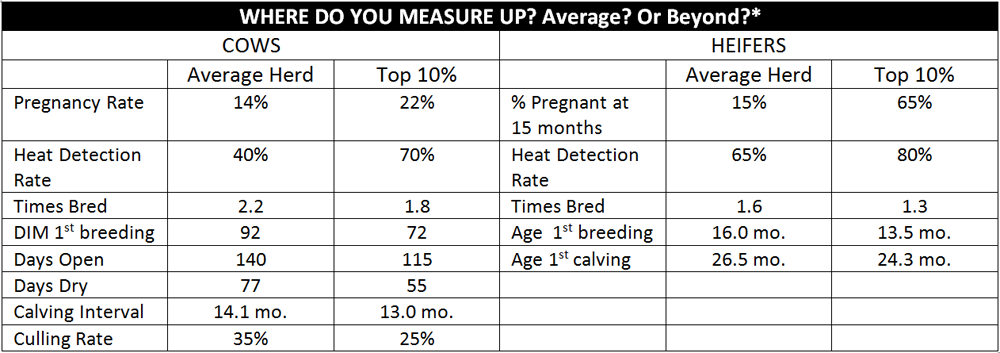
The Genetic Genius of Darwin, Mendel and Hunt – Genetic Transmission and the Holstein Cow

There is no question that when it comes to understanding what cows will transmit and what cows will not, it is an enigma wrapped in a conundrum.  There is much that we don’t know and some would argue it is not meant to be known.  The problem is, for those of us with a passion for breeding great dairy cattle, we want to know it all.  For that I turn to the three greatest genetic geniuses in the history of the world, Darwin, Mendel and Hunt (No they are not a law firm).

Charles Robert Darwin He established that all species of life have descended over time from common ancestors, and proposed the scientific theory that this branching pattern of evolution resulted from a process that he called natural selection, in which the struggle for existence has a similar effect to the artificial selection involved in selective breeding.

Charles Darwin

Ask anyone in the world to name a geneticist and the first name that comes to mind has to be Charles Darwin.  No better demonstration of Darwin’s theory of evolution exists in the world than in dairy cattle breeding.  While there is no question that artificial selection and selective breeding exist on a daily basis, a cow’s ability to reproduce and produce milk leads to a natural level of selection that epitomizes Darwin’s theory.  “The laws governing inheritance,” Darwin wrote, “are for the most part unknown.”  Moreover, while many modern geneticists have theories about the tendencies of the modern Holstein cow, their genetic transmission pathways in large part remain a mystery to this day.

Gregor Mendel

Gregor Mendel

Then along came Gregor Mendel who introduced the concept of “genes” to explain heritability.  Mendel changed the whole way we look at breeding when he introduced the theory that the chromosome is the carrier of genetic traits.  He also explained why a trait can disappear in one generation and reappear in the next and why these traits occur in a three-to-one ratio.  One of Mendel’s disciples, three quarters of a century later, was Thomas B. Macaulay.  Macaulay conducted his own studies, on his Mount Victoria Farms (Read more: Mount Victoria Farms – The art and science of great breeding).

Thomas Hunt Morgan

Thomas Hunt Morgan

Then along came Hunt. Well, more specifically, Thomas Hunt Morgan, but my ego wouldn’t let this go as my name is Andrew Morgan Hunt (Read more about my ego: I’m Sorry But I’ve Had Just About Enough Of… ).  In research that is now reproduced by grade 9 science students around the world, Morgan introduced the concept of X and Y-chromosomes.  Morgan concluded that a female has two X chromosomes and that males have both X and Y-chromosomes.  He also posited that the male of the species, because of the presence of the Y chromosome, transmits differently than the female.

To get a better understanding of this, let’s look at this from both sides of the story.

His side of the story (XY)

If you look at Holstein bulls throughout history you find four distinct patterns:

  1. Great daughters but no legacy sons
    These are the bulls that sired amazing brood cows but none of their sons were able to continue their genetic legacy.  Examples are Hanover-Hill Triple Threat, Carlin-M Ivanhoe Bell, and Braedale Goldwyn.  They all were able to sire brood cow daughters beyond compare, but no real sons to advance that genetic legacy.  Why did these sires seem to produce better on the female side than that of the male?  For that we need to turn to Morgan and his X and Y chromosome theory.  Since the Y chromosome is the only one that is inherited solely via the paternal  line, this leads  some geneticists to believe that it carries little genetic information, and as a result  a great sires genetic legacy rest more with his daughters than with his sons.  Therefore, with this first group of sires it is thought that much of their genetics were transmitted on the X chromosome rather than the Y.
  2. Great sons but not as many brood cows
    Bulls that sired outstanding sons but never produced a top daughter.  A couple of great examples of this are Montvic Rag Apple Sovereign, Maizefield Bellwood and O-Bee Manfred Justice.  All of these sires have left outstanding sons, but are not found as often in the maternal sire stack of the great sires.  There is no question as to their genetic contribution to the breed, but it was more as a sire of sons than their ability to leave an equal number of brood cows.
  3. Sons and daughters both extraordinary
    These are the sires that have gone down in history as the all-time greats.  Sires like Johanna Rag Apple Pabst, Governor of Carnation, Montvic Chieftain, Wisconsin Admiral Burke Lad, A.B.C. Reflection Sovereign, Round Oak Rag Apple Elevation, Pawnee Farm Alrinda Chief, Walkway Chief Mark, Hanoverhill Starbuck, Madawaska Aerostar and Maughlin Storm.  These are the bulls that not only displayed personal greatness but were also able to transmit both outstanding brood cows as well as legacy sons.
  4. Sons and daughters that were inferior
    Sons and daughters that are both below average.  These bulls left inferior daughters and as a result were never even given the chance to produce sons.  Bulls in this category are too numerous to mention and loads of their daughters go to the slaughterhouses every day.  No explanation necessary other than a lack of genetic merit and here enters the need for genomics (Read more: The Truth About Genomic Indexes – “Show Me” That They Work).

Her side the story (XX)

The female side of the story uses the same four distinct groups.

  1. Great daughters but no legacy sons
    These are cows with outstanding female descendants but undistinguished males.  Great examples of these are the cow families of Hanover Hill Papoose, Krull Broker Elegance and Plunshanski Chief Faith.  They all were able to leave outstanding female descendants generation after generation, but were never really able to accomplish the same feat on the male side of the story.
  2. Great sons but not as many brood cows
    These are the cows with potent transmitting sons, but daughters who didn’t outperform the average.  Examples of these are Wylamyna Tidy Kathleen (dam of Sir Bess Tidy and Sir Bess Ormsby Tidy Fobes) Lakefield Fobes Delight (dam of Lakefield Fond Hope, Lakefield Fond Delight Fobes and Carnation Royal Master) and Pawnee Farm Glenvue Beauty (dam of Pawnee Farm Arlinda Chief).  All of these cows had outstanding maternal lines but for some reason were just not able to transmit that legacy through their daughters.
  3. Sons and daughters both extraordinary
    Among the females in this category are Glenridge Citation Roxy, Mil-R-Mor Roxette, Comestar Laurie Sheik, Braedale Gypsy Grand and Snow-N Denises Dellia.
  4. Sons and daughters that were inferior
    Cows who, in terms of influence, failed to produce anything worthwhile.  Blame it on lack of genetics, bad breeding, improper management, or just bad luck, these cows just didn’t influence the breed. We have all seen examples.

The Bullvine Bottom Line

There has never been a clear explanation of why some bloodlines seem to transmit better through maternal lines, others through the paternal, and still others do well in both.  Even genomics does not answer this.  There are high genomic animals that still have these same tendencies.  Maybe if we could genomic test the genes on each chromosome we might find the answers?  Until then Genetic Transmission in the Holstein Cow will remain a mystery.

To read more about this get a copy of The Holstein History by Edward Morwick and read the chapter on Inheritance Patterns.


The Dairy Breeders No BS Guide to Genomics


Not sure what all this hype about genomics is all about?

Want to learn what it is and what it means to your breeding program?

Download this free guide.


[related-posts-thumbnails]

The 2013 All-European Championship Preview

It’s like the soccer World Cup but for Dairy Cows.  The European Championships are organized by the European Holstein & Red Holstein Confederation every two years and this year 16 countries (Austria, Belgium, Croatia, Czech Republic, France, Germany, Great Britain, Hungary, Italy, Luxemburg, Netherlands, Poland, Slovenia, Spain, Sweden and Switzerland) will be participating in this outstanding event.

Great News!!!  The Bullvine will be LIVE streaming the show.

Host city Fribourg

Host city Fribourg

In 2013, the event is being held in Fribourg, a city located at the cultural border between the German and French speaking parts of Switzerland.  Fribourg 2013 is going to be something special, since Switzerland itself represents one of Europe’s countries in the show ring.

Setup has already begun.

Setup has already begun.

The Schedule

Tuesday 26 February
08:00 onwards Arrival of the animals

Friday 1 March
08:00 – 16:00 Farms visits
16:00 – 17:30 Showmanship: young breeders final
18:30 – 20:00 Opening ceremony
20:30 onwards Swiss European Sale

Saturday 2 March
9:30 – 11:30 Red Holstein championship: “Individual” / “National Groups”
13:00 – 16:00 Holstein championship: “Individual”
16:00 – 18:00 Holstein championship: “National Groups”
18:00 – 19:00 Prize‐giving ceremony
20:00 onwards Breeders’ fondue party

Sunday 3 March
8:00 onwards Departure of the animals
8:00 – 16:00 Farms visits

The Classes

Different from the standard classes many North Americans would be accustomed to, the classes for the All-European Championships for Holstein and Red Holstein are as follows:

  • Junior category: only 1st lactation cows, having calved, up to 32 months.
  •  Intermediate category: only cows having calved twice, up to 60 months as at 1 March 2013 (born 1 March 2008 or later).
  • Senior category: only cows having calved three times or more (at least two completed lactations).

In addition:

  • 1st Lactation cows must make up at least 20% of a country’s contingent.  The same applies to cows having calved twice.
  • All cows must have been born in Europe and must have been recorded in the herdbook of the participating country since 1 March 2012 or before (subject to milk testing).  All the cows and reserve cows must be registered by 25 January 2013 at the latest.

The Judges

Presiding over the Holstein classes will be David Boyd from Glaslough Holsteins in Ireland whilst the Red classes will take place under the watchful eye of Niels Erik Haahr of Anderstrup Holsteins, Denmark.

Holstein show judge David Boyd from Glaslough Holsteins

Holstein show judge David Boyd from Glaslough Holsteins

David Boyd is an Irish breeder who runs a dairy farm with his brother in Glaslough.  There are 50 dairy cows and 80 heifers in their Glaslough Holsteins herd.  The average output is 10,300 kg of milk over 305 days at 3.69% fat and 3.29% protein.  There are 14 EX cows and 33 VG ones in the herd.  In 2011, 20 first-calf heifers were classified VG, with two of these receiving a VG88 classification.  David has enjoyed a great deal of success at shows.  In particular, he was named the Best Breeder and the Best Exhibitor at the Irish National Show in 2011.  David has been accredited as a judge by the Irish Holstein Friesian Association for more than 20 years and he is also a member of the IHFA board.  He has judged at a large number of shows in Ireland, the UK, Portugal and Italy.  He has also taken part in the last four workshops for European judges.

Niels Erik Haahr of Anderstrup Holsteins Red Holstein Show Judge

Niels Erik Haahr of Anderstrup Holsteins Red Holstein Show Judge

Niels Erik Haahr is a Danish breeder whose family owns the Anderstrup Holsteins dairy herd.  They have 300 cows with an average output over 365 days of 14,600 kg of milk.  They have developed an intensive Anderstrup Holsteins breeding program, with more than 200 calves per year resulting from embryo transfers.  The scheme produces numerous bulls for AI centers in Denmark and Germany.  Anderstrup Holsteins is also heavily involved in competitions and it has already won 25 awards at the National Show.  Niels Erik Haahr has been judging since the age of 16 and he is now an accredited judge.  He has performed judging duties at many important regional shows in Denmark and at the National Show on four occasions.


The Contenders

From the host nation, Switzerland, comes one of the strongest contenders Decrausaz Iron O’Kalibra EX-94, who many of the North American experts say could walk on the colored shavings at Madison and give the North American cows a run for their money.

Decrausaz Iron O'Kalibra EX-94 1st 5yr old, Champion Udder, Grand & Supreme Champion- Swiss Expo, Lausanne 2012 1st 4yr old and Res. Champion Udder and HM Grand Champion- Swiss Expo, Lausanne 2011 1st 4yr old and Reserve Grand Champion- Expo Bulle 2011  (from the same family as Dudoc Mr. Burns and Granduc Tribute)

Decrausaz Iron O’Kalibra EX-94
1st 5yr old, Champion Udder, Grand & Supreme Champion- Swiss Expo, Lausanne 2012
1st 4yr old and Res. Champion Udder and HM Grand Champion- Swiss Expo, Lausanne 2011
1st 4yr old and Reserve Grand Champion- Expo Bulle 2011
(from the same family as Dudoc Mr. Burns and Granduc Tribute)

However, there are many other cows to watch for including:

Ashlyn Vray EX-94-ES

Ashlyn Vray EX-94-ES

M.E.DAL STORMATIC ILMA 2010 European Intermediate Champion

M.E.DAL STORMATIC ILMA
2010 European Intermediate Champion

Ptit Coeur Iron Dirona EX-96-SW

Ptit Coeur Iron Dirona EX-96-SW

Lavenham Adeen EX-92 Daughter of MS KINGSTEAD CHIEF ADEEN EX-94

Lavenham Adeen EX-92
Daughter of MS KINGSTEAD CHIEF ADEEN EX-94

Riverdane Talented Ashlyn VG88 EX90-MS 2YR Nominated Intermediate Heifer in Milk All Britain 2012 1st Milking Heifer & Supreme Champion Holstein & Best Udder Cheshire County Show 2012  1st Junior 2yr & Reserve Champion Holstein Heifer Great Yorkshire Show 2012

Riverdane Talented Ashlyn VG88 EX90-MS 2YR
Nominated Intermediate Heifer in Milk All Britain 2012
1st Milking Heifer & Supreme Champion Holstein & Best Udder Cheshire County Show 2012
1st Junior 2yr & Reserve Champion Holstein Heifer Great Yorkshire Show 2012


The Past Champions

CASTEL JAMES JOLIE 2010 European Senior and Grand Champion

CASTEL JAMES JOLIE
2010 European Senior and Grand Champion

M.E.DAL STORMATIC ILMA 2010 European Intermediate Champion

M.E.DAL STORMATIC ILMA
2010 European Intermediate Champion

PESS FARM GOLDWYN NEVIL 2010 European Junior Champion

PESS FARM GOLDWYN NEVIL
2010 European Junior Champion

PEPITA 2010 Junior Champion & Grand Champion Red

PEPITA
2010 Junior Champion & Grand Champion Red

Festive events and a specialist trade fair

The focus of attention of the 5,000‐plus visitors from Switzerland and the whole of Europe will, of course, be the championship itself, which will be held in the ring.  However, other aspects of breeding will also be presented to the public during the two days of the event.  A competitive showing exclusively for young breeders, a cattle auction and two gala evenings will foster relations between the delegations within a pleasant and festive atmosphere, while a specialist trade fair will bring together commercial exhibitors from areas relating to breeding and agriculture, thereby promoting friendly, professional contacts between the various Swiss and European participants.

No EXPO Bulle in 2013

The organizers of EXPO Bulle have declared that due to the exceptional circumstances, the show will miss a year in 2013.  Event manager Jean‐Charles Philipona stressed that: “This was a difficult decision to take because breeders are very attached to EXPO Bulle.  However, we know what an event like the European Championship represents in terms of human and financial resources.  Since the majority of our partners are involved in both events, we will work closely with the federations and pool our strength.  Holding the European Championship is an exceptional occurrence that merited an exceptional decision.” EXPO Bulle, which celebrated its 40th anniversary last year, nevertheless confirms that this year’s show will not go ahead as planned on 24 and 25 March 2013.

The Bullvine Bottom Line

While maybe not as well known to many North American breeders, the All-European Championship is certainly one of the best exhibitions of dairy cattle in the world.  With past winners who could walk on the colored shavings in North America and the potential for this year’s winner to give the great RF Goldwyn Hailey a run for her money, Fribourg 2013 is certainly going to be an event many breeders should be watching with a careful eye.

Check out the following team pre-selections:


Get original “Bullvine” content sent straight to your email inbox for free.


[related-posts-thumbnails]

GERMAN PRE-SELECTION FOR EUROPEAN SHOW

Read More at www.thebullvine.com/news/german-pre-selection-european-show/ © The Bullvine

The Bullvine – The Past, The Present & The Future

WOW hard to believe that it has been 1 year already since we started The Bullvine.  What started as a desire to write about something that we were passionate about has grown into the largest daily digital readership in the dairy breeding industry.  Reaching over 20,000 breeders a day!

The Past

Along the way we have a shared our clean side that highlights thought provoking articles and tools to help you make your dairy cattle breeding programs more profitable.  However, we also have an edgy side that has not been afraid to talk about those issues the others do not touch.

Over the past year we have published over 280 feature articles (Four times more than any other digital or print dairy publication).  Some of the highlights include:

  • 7 SIRES TO USE IN ORDER TO BREED THE NEXT WORLD DAIRY EXPO CHAMPION
    Everyone loves winning.  No one enters a competition to finish last.  Regardless of who you are every purebred dairy breeder dreams of winning supreme champion at World Dairy Expo.  Your dream of walking in the spotlight, on the colored shavings, with everyone applauding you, starts with choosing the right sires. (Read more)
  • THE 2012 ROYAL WINTER FAIR HOLSTEIN SHOW – ONE OF THE GREATEST STORIES EVER TOLD!
    From an outsider looking in, the 2012 Royal Winter Fair Holstein Show may appear to be somewhat  boring.  The winners were pretty much the same as, and for all intents and purposes the results whereas per expectation.  Yet in my mind, the 2012 Royal Winter Fair Holstein Show will go down in history as one of the greatest stories ever told. (Read more)
  • SELECT SIRES VS. SEMEX – A CONTRAST IN COOPERATIVES
    While many would think that all farmer-owned cooperatives would have the same challenges and the same mandates, there could be no greater contrast than the approaches taken by Select Sires and Semex.  Select Sires is a federation of nine farmer-owned-and-controlled cooperative and Semex is a partnership of three breeder owned cooperatives.  So structurally they are quite similar with perhaps some significant differences in mandates.  However these two artificial insemination companies are headed in very different directions when it comes to approaches to communications and product development. (Read more)
  • $10,000 A DOSE POLLED SEMEN
    First it was LIQUID GOLD that caught everyone’s attention when GenerVations released him and his brothers in a limited offering for $750 and $500.  That gave all breeders the chance to have equal access to early release semen, instead of playing favorites with preferred herds or contract mattings.  Now it’s GOLDEN PP, Kulp-Dale Golden PP-Red that is getting everyone’s attention.  When his first five units of semen sold for $50,000, it generated heaps of discussion around the industry. (Read more)
  • $750 DOLLAR SEMEN! ARE YOU CRAZY
    When you first read the recent Limited Offering  from GenerVations for Liquid Gold, Fuzion and Gizmo priced at $750 and $500 and $500 respectively, I am sure some breeders will think: “Are the bulls dead? Are these guys crazy?  Are they expecting to get rich?  Who the heck will buy that semen?” (Read more)
  • TOP TEN MOST INFLUENTIAL HOLSTEIN BREEDERS OF ALL-TIME
    The great thing about the North American dairy breeding industry is how passionate breeders are about what they do.  This is what makes most dairy farmers get up in the morning to do hard work that many would not.  Over the years there have been many great breeders that have dedicated their lives to advancing the breed.  The following is our top 10 list of the ones who the Bullvine feels have had the biggest impact on the North American Holstein industry. (Read more)
  • THE TOP 12 HOLSTEIN GENOMIC YOUNG SIRES TO USE FOR MAXIMUM GAIN
    Confused on what group of genomic young sires to use for your breeding program?  Not sure which sires are the real deals and which ones are just smoke and mirrors (read The Hot House Effect on Sire Sampling)?  We decided to take a closer look at the top 100 genomic young sires from around the world to determine just which ones are worth using and which ones you are better forgetting. (Read more)
  • WORLD DAIRY EXPO 2012 HOLSTEIN SHOW – A BATTLE FOR THE AGES
    Pre-billed as being one of the greatest shows in history the 2012 World Dairy Expo Holstein Show was one for the record books.  There was the battle of two EX-97 point cows ….the Rejoice vs. Monique battle … and there was the bull stud battle.  (Read more)
  • THE 8 GREATEST NORTH AMERICAN SHOW COWS OF ALL-TIME
    Coming off what might have been one of the greatest World Dairy Expo’s of All-Time there seems to be great debate about how some cows stack up in the All-Time rankings.  To help determine how we would rank the greatest North American Holstein show cows of all time, we looked at their head to head match ups as well as overall accomplishments and dominance in their era and developed the following list (Read more)
  • THE WINNERS OF THE 2012 BREEDER’S CHOICE AWARDS
    Forget the  Vince Lombardi Trophy award to the Baltimore Ravens for winning the Super Bowl last night, it is now time to hand out the 2012 Breeder’s Choice Awards.  After the month long vote and announcement this past Monday of the winners of the Tanbark Trail Edition, over 3000 dairy breeders cast almost 8000 votes in a one week period for their favorites in 21 different categories.  Without any further ado, here are the winners. (Read more)
  • MILK MARKETING: HOW “GOT MILK?” BECAME “GOT LOST”
    It’s just eight days into a New Year and already I’m thinking about the ‘good ol’ days!”.  Remember when the dairy industry was at the top of the agricultural sustainable list, milk was the “perfect food” and milk moustaches were seen on celebrities and sports stars? Hmmm. Where has all the glory gone? In 2013, the dairy industry is fighting to stay alive, the North American diet, including milk, is under attack as obesity from babes to the elderly is out of control and, when all is said and done, milk is a slipping way down on the favorite beverage list! (Read more)

The Present

Today we are doing so much more.  We now post 5-10 Breeder relevant news items a day in our Dairy News Section.  The Bullvine now has amazing daily content and conversations taking place on our Facebook page.  These dynamic interactions have led to our Facebook page setting a new world record for engagement for a dairy page.

new world record3

This past week alone saw these posts going viral:

Just a cow

Reached over 166,000 people in its first day and shared 1,500 times in under 24 hours

You act like you were raised in a barn

Reached over 118,000 people in 1 day and liked and shared 2,000 times

Seen by over 100,000 people in 1 day and liked or shared over 1,000 times.

Seen by over 100,000 people in 1 day and liked or shared over 1,000 times.

In addition, our T-Shirts are in demand by many dairy enthusiasts.

Shirts-1000

The Future

When we first set out to launch The Bullvine, I decided that for the 1st year we would not take any advertisers on our website.  I wanted to first build The Bullvine community and not be influenced or biased by who spent the most money with us.

Now that we are turning two, we are going to start to monetize The Bullvine.  However, we will not be doing so in the traditional way.  Instead of having breeders pay for ineffective ads, we are going to use the Google proven Ad platform model that is based on pay by performance.  As part of Google’s platform we will have no control over whose ads are displayed, and hence will not be influenced by who advertises with us. , We will need to make sure that we keep generating great content that breeders want to read.

We will also be introducing some great new contests and bylines from some of the leading experts and companies in the dairy industry.  This will not only enrich the articles and guides that we have already been  producing but will also provide you the reader with even more opportunities to get free stuff from us here at The Bullvine, including a chance to win a trip to World Dairy Expo.


The Bullvine Bottom Line

The first year has been an amazing experience for all of us here at the Bullvine.  We appreciate all the support we have received from breeders from around the world.  The Bullvine community has grown much larger and much faster than we could have ever imagined.  We are even more excited about the great things to come in Year 2.  Once again, thanks to all the breeders who have made The Bullvine the largest and most read digital daily dairy publication. Gandhi once said “First they ignore you, then they laugh at you, then they fight you, then you win!” A pattern we have seen perfectly since starting the Bullvine one year ago.


Get original “Bullvine” content sent straight to your email inbox for free.


[related-posts-thumbnails]

I’m Sorry, But I’ve Had Just About Enough Of…

top13of2013I like to believe that I am someone who sees the best in people.  Even if someone might rub me the wrong way at first, I try my hardest to give that person the benefit of the doubt. That being said, if I’m being completely honest, there is one person out there that I’m really at my wits’ end with. I’d even go as far as to say this person sometimes has taken things too far.  That person is….Me!

Look, somebody has to say it: I’m arrogant, I’m abrasive and to top it all off, I’m down right aggravating. Okay, sure, I can be a nice enough guy every now and again, but haven’t you noticed that seconds later I’m back to being a complete jerk who is harshly judgmental about anything anyone does?

Most of all, I never want to hear any more of my pitiful excuses for my behavior. I’m done listening to me trying to explain any of the aggravating things I do seem to do on a daily basis. When it comes right down to it, I’ve been a pain in the butt for as long as I can remember, and I for one just don’t think I’m ever going to change.

Why Do I Do It?

misinterpretSo why do I behave the way I do.  Is it ’cause have a vendetta against people? Nope.  Is it because I am jealous of others?  Nope. Is it because I love to cause trouble?  Well maybe.  But the real reason I do what I do is because someone has to speak up and lead change.  And I am just the person who is narcissistic enough to do so. You see change is not easy.  And leading change is even harder.
In my own defense, I have been bred and raised to be this way.  Maybe it’s genetic. My father’s motto was “Lead, Follow, or Get Out of the Way” and there is no way that I am going to follow or get out of the way.   Maybe it was how I was raised.  I am from the video game generation where I could play games and pretend that I was an Olympian, Formula 1 driver, rock star or secret agent. Maybe it’s a sign of the times.  You see on Facebook, you can fool yourself into thinking you have hundreds or thousands of “friends.” You can delete unflattering comments (but, I don’t I love them). You can block anyone who disagrees with you or pokes holes in your inflated self-esteem (but I don’t, ’cause I love that too). You can choose to show the world only flattering, sexy or funny photographs of yourself (which I do, after I have airbrushed them of course).

But then again maybe it’s the dairy industry that has made me this way.  No, I have not judged the Royal or Madison.  No, I have not bought or sold a Supreme Champion.  However, what I did get is worth far more than any of these things.  It gave me the confidence to be heard, the ability to know what I am talking about, and the skills to defend my position. These three things have served me extremely well. (Read more – How Dairy Cattle Judging Made Me Rich)

What I do know is I am not alone!  Since starting the Bullvine almost 1 year ago, I have learned that my cry for change is not going unheard.  In fact we now have the most engaged audience in the world.

Learning from the greats!

I would love to say I have modeled myself after some of the greatest leaders of all time.  Gandhi, Nelson Mandela, and George Washington were all great leaders.  But I haven’t modeled myself after them unfortunately.  Even my mentor Ken Blanchard is a great leader, but I wouldn’t say I have followed in his exact footsteps.

What I have done is looked at some modern day leaders.  A mixture between the great Don Cherry, Bob McCown and Howard Stern.  Don Cherry is famous hockey broadcaster who is well known for his outspoken manner, flamboyant dress, and staunch Canadian nationalism.  Three things I have been accused of many times.  Bob McCown runs Canada’s most listened to talk show.  My favorite quote of his is one where he is sitting at the Rogers Center (where the Toronto Blue Jays play) and he says “I’ve been told, that there are people out there who don’t like me, so I’d like to invite them all down to the Rogers Centre. Unfortunately, it only holds 50,000.” Something since starting the Bullvine I am well on my way to. And of course Howard Stern, because sometimes I do tend to have a little “shock jock” in what we do.

The Bullvine Bottom Line

Gandhi once said “First they ignore you, then they laugh at you, then they fight you, then you win!”  A pattern I have seen perfectly since starting the Bullvine.  When we first started many ignored us.  After a little while they started to laugh at us.  And now more recently they have started to fight us.  Guess that means………

P.S. For those of you who are concerned I AM seeing a psychiatrist.  I married her.


Get original “Bullvine” content sent straight to your email inbox for free.


[related-posts-thumbnails]

The Notorious Jack Stookey

By all accounts Jack Stookey came from good stock.  His parents were hard working folks that were well respected by the community.  Little did they know that their youngest child would have such an illustrious career that would see Jack Stookey go down in the history books as one of the most notorious in the history of the Dairy Industry.

While Jack’s oldest brother, Dr. George Stookey, discovered fluoristan, the substance in toothpaste that prevents cavities and sold his patent to Proctor & Gamble and made a fortune in royalties, Jack was destined for a very different future.  As is typical with the youngest child, Jack could do no wrong in his mother Mary Stookey’s eyes.  He was the golden boy that, when his first wife didn’t meet up to his mother’s expectations, she urged a divorce and Jack went along with her request.

Fortunately he got it right with his second wife, Darla, and she helped straighten him out.  You see it all started out great.  Jack had followed a successful career path from the start.  He had graduated high school where he was a track and field star and as a result had received a scholarship to Wayland Baptist University, where he set athletic records.  However, it’s after university where Jack’s true love for excitement started to show.  He began to indulge in his passion for auto racing.  Before long he was designing his own cars, building them from scratch and driving them in races.  It was here where wife Darla put her foot down and protested his love of racing.  So Jack quit the car racing business and went back to the family farm.

Jack’s parents Emra and Mary had started with very little and built their farm into a 1,500-acre show place.  The Holstein herd was one of the best in the state and by 1980 there were 31 Excellent and 33 Very Good females.  At the urging of son Jack, Emra sold the herd at its peak and the farm auction averaged $4,381.00 on 124 head with a top price of $21,000 for VT-Pond-View Bootmaker Lassi (EX).  Six head sold for five figure prices.

Jack’s New Vision

The dispersal was promoted by Jack’s newfound vision. He wanted to start an investment herd.  You see the US government had introduced Section 46 of the Internal Revenue Code that allowed for an investment credit which held interest for individuals earning $500,000 a year and upwards.  Section 46 created a frenzy of activity the likes of which the industry had never seen before.  It introduced an investment purchase credit, a tax write-off which permitted a taxpayer to offset against personal income the costs of investment in certain classes of livestock.  A participating individual could purchase a beef or dairy animal by making a nominal down payment and then take a promissory note to pay the balance off over a specified time, usually three years.  The tax credits received during that period would cover the cost of the cow.  Accountants, lawyers, and other rich individuals were quick to act.  Jack Stookey saw this as his opportunity to assemble a group of the best Holsteins that North America had to offer and gave him the opportunity to make a ton of money.

Continental Scarlet-Red EX-95-3E (USA)

Continental Scarlet-Red
EX-95-3E (USA)

The first cow Stookey bought was Georgian Quality Pat EX-96-4E @ 5-09 (USA) who he purchased from Charlie Auger, who was a 3X All-American Nominee in Milking Form.  To publicize his purchase Jack began showing at the major shows.  Success was almost instant. In 1983 he took home the Premier Exhibitor banner at Central National Show and come very close to doing it at the Eastern and Western Nationals as well.  One of the corner stones to his show string was Continental Scarlet-Red (EX) who he had seen the year earlier at the Royal where Scarlet had won her place in the history books as the only cow ever to defeat the greatest show cow in history, Brookview Tony Charity, who was reserve grand to Scarlet’s grand championship.  However, Scarlet didn’t beat Charity in class, as Charity was a 4yr old and Scarlet was a 5yr old at the time.  Another great red cow that Jack had purchased from David Brown (and only made the first payment on) was Nandette TT Speckle-Red (EX) giving Jack two of the greatest Red and White cows of the 1980’s.

Enter the IRS

Then as is always the case, the Internal Revenue Service (IRS) came calling.  They didn’t approve of these cattle investment tax shelters and in the early 1980’s they had started doing audits.  Clearly in their sights was Jack Stookey. Once you are in their sights life becomes very challenging.  They disallowed many of his tax loss claims and asked him to make good on his back taxes.  The claim which was in the six figures caused a great problem for Jack as he didn’t have the money and had no prospects of getting it.  The flow of investor money was slowing and his herd wasn’t generating much revenue.

Jack had hit the bottom.  On a winter’s day in 1985 Jack couldn’t even pay his hired help.  Therefore, he instructed them to take all the bull calves to the slaughterhouse in order to get some money.  Among them were three sons of Scarlet by Roybrook Telstar, that had been scheduled to be sampled by AI units.  Then there was his neighbor Mr. Van Forest and his son.  Due to friendships with Jack’s parents, when Jack asked them to take care of 80 bred heifers, he agreed.  After a year of feeding, time and trouble all Van Forest received was a worn-out semen tank.  He lost his farm over the deal.  To make matters even worse, during a blizzard in 1985   a hundred Stookey calf hutches were buried in the snow.  They didn’t get the calves dug out in time and they all suffocated.  Included were 18 calves by Enhancer from Scarlet.

It was at this time that the rumors really started.  Rumors such as that Stookey had purchased a bunch of high priced cattle from Canadian breeders and when they discovered that their checks were no good, they stopped the cattle at the border.  Another very tasty rumor was that a disgruntled investor had dynamited the porch off Stookey’s house.  That’s when the world really started to cave in for Jack.  The IRS filed a lien for back taxes forcing Jack to file bankruptcy.  The bankruptcy trustee took possession of Stookey’s assets and this caused some more legal issues for Jack.  Because Jack had only made the first payment on a number of the cattle, the breeders of these cattle were claiming their animals still belonged to them.  Even though these breeders had some pretty tightly worded contracts, the bankruptcy trustee decided that this claim came after that of the unpaid vendors’ liens and hence the breeders never saw the rest of their money.

Wasted Potential

Seeing all this happening and deploring the waste of all these superior genetics, Louis Prange of Elm Park Farms, made a deal with the trustee whereby he took a couple of dozen Stookey cows and put them on a flush program.  Prange was to receive one-third of the sale revenue from the resulting calves, the trustee was to receive a third, and Stookey the remaining third.  This turned out to be a great move as one of the donors was Nandette TT Speckle, whom he flushed to Blackstar, resulting in one of the greatest type-breeding cows in history Stookey Elm Park Blackrose.

Stookey Elm Park Blackrose

Stookey Elm Park Blackrose EX-96 3E GMD DOM
• All-Time All-American Jr 2-Yr & Jr 3-Yr-Old Cow
• Res All-American 5-Yr-Old Cow 1995
• All-American Jr 3-Yr-Old Cow 1993
• All-American Jr 2-Yr-Old Cow 1992
• Grand Champion, Royal Winter Fair 1995
• Over 30 Excellent Sons and Daughters!

Another would be participant in salvaging what was left was Randy Frasier.  You see Jack maintained that he still owned the family farm and he undertook selling it to Randy for his Elmvue herd.  Frasier invested $85,000 in fixing the buildings and whatnot and when he was told all was for naught –Frasier was left with nothing for his efforts.

The Bullvine Bottom Line

Jack Stookey’s investor business lasted just about four years between 1980 and 1984, but man was it an eventful time.  The investment tax credit was repealed in 1986, but that was not the downfall for Stookey.  It was Jack himself that led to his own demise.  When Jack was convicted of fraud and embezzlement, the Judge let him serve his sentence on weekends.

However, it didn’t end there.  In 20074an article appeared in one of the Indiana farm papers about Jack Stookey’s recent suicide.  Then all sorts of rumors started to fly.  One such rumor was that Jack was involved with Colombian drug traffickers and was behind in his payments, so they gave him an ultimatum, he could either pull the trigger himself, or they would do it for him.  It seems more likely that it was just that, a suicide.  You see the IRS had never lost sight of Jack and in 2004, the year he died, they were ready to pounce.  They had a tax arrears claim that came to $1.5 million.  They ran the man to the earth and then they started their prosecution.  It was more than a reasonable man could be expected to take.  Though there were many interesting events throughout Jack’s career, this is for sure one of them.  Jack Stookey can take credit for the two best animals to come out of the investment era, Stookey Elm Park Blackrose and Stookey Fagin Scarlet, the first red and white cow to make 50,000 lbs of milk.  If there was ever to be an action drama movie to be made about the Dairy Industry, Jack Stookey’s life story might be the basis for it.

To find out more about Jack and other great stories from the past check out Edward Morwick’s latest book “The Holstein History” click here.


[related-posts-thumbnails]

How Irish Dairy Farmers are Using On Farm Data to Increase Profitability

Loving one’s work is a nice thing to have but in the end work without reward does not equate to being in business for the long term. Every day we read about the dairy industry’s viability and sustainability but on an individual farm basis it comes down to having total revenue exceed total expenses. Some new revenue sources are possible on some farms, like the sale of embryos from top cows or heifers, but on most dairy farms revenue means the milk cheque. So having a successful dairy farm is all about maximizing milk revenue and keeping costs under control. And that takes careful management. Profit can generally only be had by careful management.

Herd Size Determines Management Style

Herds under 50-60 cows are frequently managed by recording and analysis using hard copy records with DHIA handling the production and SCC side of the information. But once over 100 milking cows the manager needs an electronic way to record or capture the on-farm events and information. At the present time that means the purchase of herd management software and someone entering the data for medium sized herds or the parlour electronics capturing the data at milking time in larger herds where the capital investment in an automated parlour can be justified. Of course on farms with robots the data is captured by the system and is available for the manager to address the exceptions or situations requiring attention. But for all herds the same rule applies – you can not manage without having the data.

Ireland took a Bold Step.

In 2001 the Irish Cattle Breeding Federation decided that farmers needed access to all the data from their farms in order to give them the opportunity be progressive and profitable. With public support from the National Development Plan (Transforming Ireland) the federation decided to bring together eight AI companies, nine regional milk recording agencies, the breed herdbooks, the department of the Irish government responsible for calf identification and animal movement and several farmer organizations to form one central database system. That was a major undertaking. The figure below provides the partners coming to the initiative in 2001.

A2 Downing-3

Dairy Farming in Ireland

Ireland has a pasture based, spring calving dairy industry. Cows must calve when the grass begins to grow each and every year. Cows not able to calve again on time for the spring are not retained at drying off time. As it would be too costly to overwinter a cow that would only have a short milking period in the subsequent year. Cow fertility is important in that system of dairying. In fact over the decade leading up to 2001, considerable emphasis had been placed on increasing milk yield much to the detriment of cow fertility and farmers were faced with the major cost of having to raise extra herd replacements for cows that may have produced more milk but were not able to get in calf. Something had to be done and 2002 was the year to get it done.

Irish Success

The theme chosen for the initiative was “Less Paper – More Profit (2002)”.  By 2006 the new data system was in place. There is “once only” recording of information or events and all data goes to the central database from farms, AI technicians, milk recording supervisors, veterinarians and many other organizations that touch Irish livestock farms. The figure below shows the many groups and individuals that provide data to the central database from Irish dairy and beef farms.  Data is entered via online entry from farms, handheld devices, mobile phones and third party data providers. Congratulations to the Irish Cattle Breeding Federation (ICBF.com) for bringing all the players to the table.

A2 Downing-6

What do Farmers and their Service Providers Get?

HerdPlus® Dairy provides users with a suite of reports and online services. Some of those products include:

Key HerdPlus® Reports

  • Calving Report – due dates, births, calving intervals, abnormal calvings, calf identification
  • Key Performance Reports – fertility, production, udder health, inseminations
  • Milk Co-op Performance Report – shipment details and milk quality by month and year

Key HerdPlus® Online Services       

  • Sire Advice – recommends sires according to producer’s goals including considering Inbreeding Checker
  • Catalogue Maker – for breeding stock sales
  • Stocking Rate & Nitrates Reports – for environmental reporting purposes
  • Discussion Group Reports – farmers can talk online to their fellow group members and compare results

Education Service

  • Young farmer training now includes a HerdPlus® training module
  • Farm service providers including economic advisors learn from the results, comparisons and benchmarks

Government

  • More informed and aware of industry performance and challenges
  • Can focus where to provide assistance with research and development

Successes Everywhere

This success story was presented at the September 2012 ICAR meetings and can be found at http://www.icar.org/Cork_2012/index.htm (K Downing – Using an integrated database to increase profitability on dairy farms).

A synopsis of the benchmarks of successes that have come about by having the integrated database as reported by Kevin Downing include:

At the Farm Level

  • Over 6050 farms participating by 2012 with focused goals and objectives (increasing at 9% per year)
  • 86% of the farms use the service online (14% use postal)
  • It is an excellent value at 60 euros per year (less than $US100)
  • Breeders are using superior sires through AI
  • Fertility performance has turned the corner and is improving

Beyond the Farm Level

  • Accurate nationwide benchmarks are now available for use by everyone
  • Both fertility and production per cow for the national herd are making significant improvement
  • Farm advisors, including veterinarians, now have all the facts when they advise the farmer
  • Farmers and their organizations have a national system that covers animal traceability, food safety and biosecurity

The Bullvine Bottomline

The Irish Cattle Breeding Federation central database has been a great move forward for farmers and the dairy industry in Ireland. Definitely the goal of “Data & Knowledge = Profit” has been achieved. It makes us all think about the big benefit there is to having all the facts in order make the best decisions possible. Managing for profit makes for a long rewarding and successful career in dairy farming.


Get original “Bullvine” content sent straight to your email inbox for free.


[related-posts-thumbnails]


No Cow Is Perfect – Not Even in Pictures

top13of2013The other day I read a comment that basically asked, “If steroids are illegal for athletes then shouldn’t Photoshop be illegal for models?”  This got me thinking about the implications for dairy cattle marketing as well.  As the Bullvine approaches the one-year mark, it reminds me of one of our initial articles, Has Photo Enhancement gone too far?  In that article we first addressed this taboo subject questioning how programs like Adobe Photoshop lets designers create anything the client wants.  Our goal in publishing that article was to spur change (Read more: Dairy Cattle Photography: Ethics and Copyright).  Similar to the way that Jose Canseco’s book “Juiced: Wild Times, Rampant ‘Roids, Smash Hits, and How Baseball Got Big” exposed steroid use in Baseball, we wanted to spur change in the dairy cattle photography industry (Read more: The Big Bad Wolf of the Dairy Industry). The reality is that no cow is perfect, not even in pictures (Read more: The Perfect Holstein Cow).

The Bullvine Holstein Mature Model Cow Read More at www.thebullvine.com/the-bullvine/perfect-holstein-cow/

The Bullvine Holstein Mature Model Cow
Read More at www.thebullvine.com/the-bullvine/perfect-holstein-cow/

If foreign substances are illegal for show cows, then shouldn’t they be illegal for cow pictures as well?

Like major league baseball the show ring has had a transformation in its perspective on drugs and ethics (Read more: The Code: The Unwritten Rules of Dairy Cattle Show Ethics).  However,  similar to the world of cycling, the dairy cattle marketing world has yet to see this transformation (Read more: Lance Armstrong, Drugs and the Dairy Industry) That really got me thinking that, if foreign substances are illegal for show cows, then shouldn’t they be illegal for cow ads as well?

Toplines that have had “hair” added, udder texture that has been enhanced and teat placement that has been corrected, all seem to be more prevalent than ever.  Don’t even get me started about how some photographers have single handedly solved many breeder’s challenges of getting clean long necked cattle.  Even the basics of getting good lighting seem to have gone out the window.  Photoshop has made it too easy and more profitable for photographers to do it in post production than making sure the animal was the real deal to start.

model retouch

With Great Expectations Comes Great Disappointment

In an industry that already has unreal expectations about real beauty, the use of Photoshop in the fashion-modeling world has made for even greater unrealistic expectations of appropriate body image – especially among impressionable children and adolescents.  But there is one big difference between the photo retouching of fashion models and photo retouching of cattle images – The models are not the product that people are buying.

Right there is the big issue that I think many people are missing in this whole debate.  While we have all become complacent about fashion models whose appearance has been retouched, we have also become complacent about dairy cattle photos that have been retouched.  It has come to the point where most don’t even look at photos anymore to gage a sire’s potential  (Check out our recent Facebook poll).

I can remember when we first marketed Calbrett-I HH Champion and we put a lineup of 10 VG 2YR test sire daughters photo’s together – the first in the industry to do so.  But I am sure with genomic sires being used on such high caliber animals it will happen again soon.  It sold semen like none other.  Today when a new proven sire comes out, you are lucky to get two or three daughter shots and that’s about it.  For genomic sires you are often lucky to get a picture of the sire himself let alone a picture of his dam (often it is a heifer picture as she was contracted and flushed at such a young age).

This has me thinking whether there is value in picturing anymore?  I realized that while pictures today may not directly sell semen or embryos, they do a great job of generating hype.  While everyone likes to bash some livestock photographers about the ethics of their photos, there is no question that you can share a great shot of a show-winning cow on Facebook and the thing goes Viral.

So what is the average ethical breeder to do when they don’t have some great show-winning cow but wants to market their cattle?

In thinking about this challenging question, I remembered what Unilever did with their Dove line of products when facing a very similar challenge.  In 2004 they released The Dove Campaign for Real Beauty.  The principle behind the campaign is to celebrate the natural physical variation embodied by all women and inspire them to have the confidence to be comfortable with themselves.

In the dairy industry three great ways I can see for this to be done are as follows:

  • Roy - ABS Global

    Show all the angles
    Instead of just a boring side shot, try to get different angles of your cattle.  Three quarter rear shots are great at grabbing attention.  Show multiple angles of your cow, in order to gain maximum attention.  It is also hard to fake a shot when you see all sides of the animal as any changes would be amplified when comparing angles.  (Read more: 5 Tips to Make Your Next Dairy Magazine Ad the Best Ever and All Talk and No Action)

  • Leverage the Power of Video
    There is nothing better than video to help you sell and promote your cattle.  It does not have to be some big costly production.  In fact, it can be much cheaper than having a professional photographer come in.  You can simply use your hand held blackberry or smartphone and snap some quick snippets to share with potential buyers on Facebook or on your website.  Even good quality digital video cameras can be picked up at your local Best-Buy or Wal-Mart.  Many even come with some basic software so that you can add your own titles, images, and music.  (Read more: Nothing Sells Like Video)
  • Share it on Facebook
    It’s really pretty simple.  Set up your own Facebook page or a Facebook Fan page for your farm.  Tell your story.  Did you have a great classification round and want to let the world know?  Share it on Facebook.  Had a great flush and want to sell the embryos from it?  Share it on Facebook.  Your friends will spread the word and before you know it, you too will start to have a loyal following. (Read more: 7 Reasons Why Your Dairy Farm Needs to be on Facebook and The Fakebook – Our secret is exposed)

The Bullvine Bottom Line

Yes!  There are certainly photographers who have held true to their ethics, however, it seems that they are now in the minority rather than the majority.  I understand that Photoshop, a program that I love to use, makes life easier for all.  There comes a point, however, where ease should not outweigh ethics, especially when you are editing the appearance of the very genetic product that you are selling. The reality is that no cow is perfect, not even in pictures


To learn how to get your farm on Facebook download this free guide.


[related-posts-thumbnails]

Han Hopman: Shooting Straight at Holstein International

Dairy breeding is about putting the right pairings together. It is also the formula for success that has worked more than once for photographer Han Hopman, one of the founders of Holstein International.  He explains the beginning of his dual interests. “With my parents I always went on vacation to a dairy farmer. He always took me with him for milking and feeding the cows. I loved them. Back home in town again I missed them dearly. When I became 10 years old I asked for a camera to take pictures of the cows and glue them into a book. From that time I wanted to be a cow photographer.”  Cameras and cows. Han can’t have one without the other.

Han Hopman has captured some of the great bull shots in history, including this one of Ensenada Taboo Planet

Han Hopman has captured some of the greatest bull shots in history, including this one of Ensenada Taboo Planet

Mission Possible:  Write On!  Great pics!  From Cover to Cover

Han’s passion for cows was later enhanced by collaboration with Jan Bierma. “We were already making articles for several magazines like Holstein World, Holstein Journal, Typex in France, Bianco Nero in Italy and Veeteelt in the Netherlands and a few more. In Holstein World we had the Euroworld section. We published in that section information about bulls and genetics from Europe. When we had to stop that because of political reasons, we decided to start our own international magazine.” In 1994 they founded Holstein International in the Netherlands. Because of their professions Jan Bierma took on the editorial part of the magazine while Han took over the photography. Another great pairing.

Special presentation by Han Hopman (holding camera) and Jan Bierma (left) to Barry Slack and Charlie Will of Select Sires.

Quantum of Success

Hopman and Bierma already shared the bonds of friendship and commitment to Holsteins and it soon became obvious how well their words and pictures would continue the complementary relationship. “We have made Holstein International as it is now. One of the most important and leading Holstein Magazines in the World. The only independent unbiased magazine in the world, which is published in six different languages in over 60 countries. And all the information so up to date!” They have come a long way as Han marvels, “I didn’t foresee this when we started in 1994.”

The Incredible Shrinking World – Cows Unlimited  

During the nineteen years spanned by their publication, Holstein dairy breeding has gone from primarily a country-by-country breeding focus to a global panorama where the Holstein breed is international in every way. “When we started HI, global breeding was just beginning. Every country was on its own. Now days you can use almost every bull you want and use every cow family you like – from anywhere in the world. The breeding world has become one big country. I think this is the biggest change I have seen. It has helped the industry a lot.” Han is happy with these changes and proudly affirms, “I am sure Holstein International did a good job to speed up this process!”

Han Hopman has captured some of the most iconic images in the dairy industry. Including this shot of the great Harvue Roy Frosty.

Genomics Isn’t a ‘Point and Shoot’ Solution

Han urges caution when incorporating new and exciting changes such as the ones coming about with Genomics. He advises. “Genomics is a good tool for a breeder. But only a few parts are known.” It is the unknown that concerns him. “What is the influence of linking genes? We don’t know yet but we act as if we know everything about it.” He has concerns for the future. “We have to take care that we do not destroy our breed by using genomic bulls on daughters of genomic bulls who don’t have a daughter-proof yet. It is a pity if we destroy what breeders like Pete Heffering, Frank Reagan and others like them have built up for us.” The worst case scenario for Han would be, “Mating purely on genomics (because that) has nothing to do with breeding any more. It is multiplying the ‘highest bull with the highest heifer’. A pity.”

Always catching the moment this is a great teamwork shot by Han Hopman.

The “BIG” Picture is Changing Focus

Han anticipates that other changes will also be coming into view. “In the long run I think that small farms cannot survive and that there will be more and bigger farms.” These evolving changes will be impacted by many other things as Han points out “Land will be expensive and also the costs of transporting food will increase.” He foresees major changes ahead for the cows he loves.  “Genetics technology will have a big influence on our Holstein population. Genomics in the future will have more and more reliability. If that is true, then you will see a larger difference between farms who have cows to produce milk and farms who produce the animals for the next generation. So the whole set up of the industry will change when genomics becomes more reliable.”

Han Hopman’s great passion is catching dairy cattle in their natural state.

Shooting Stars – Naturally

From the very beginning Han has enjoyed taking pictures of cows in a natural setting. “I started as a side shot photographer but my passion is to picture them as relaxed as possible. It is nice to make a natural shot of a cow. To picture her in a way that you can see from the picture that she is happy or at least fully herself. If you can catch that moment, it gives me a happy feeling. And it is nice that I have my own magazine, which is a beautiful podium to publish these kinds of pictures.”

Han Hopman always get’s his shot including this one of Eastside Lewisdale Goldwyn Missy & RF Goldwyn Hailey, Grand Champion and Reserve Grand Champion at Royal Winter Fair 2011.

You Only Love Once – Get It on Film

Han loves his work and has advice for others. “Do what you like and love. You only live once! I loved cows as a child and got homesick when I wasn’t with them. Now I have the best job in the world. I have my own cow magazine and travel a lot around the world to visit the most important herds of the world and see the most beautiful cows.”

Han Hopman pictured To-Mar Blackstar pictured a few weeks before Blackstar died.

Han Hopman pictured To-Mar Blackstar pictured a few weeks before Blackstar died.

Photographic memory: Once More with Feeling

Such enthusiasm and dedication has undoubtedly produced a huge portfolio of images. Han has an evolving list of favorites.  He says, “For a long time it was the picture of Blackstar. I pictured him a few weeks before he died in his box. He was my first important American bull that I pictured. I was so proud that I got the opportunity to do that. Charley Will from Select Sires made it happen for me and I am still thankful for that.” New pictures are always rising up his list. “At the moment it is the picture of Planet. In the picture you can see who he is. And such an important bull at the moment!” Han speaks emotionally of a picture he took last year at Omaha Beach. “Just a cow with a beautiful girl. It was the place where D-day started and you could still feel the atmosphere of the awful things that happened there. So many young people killed. The picture is very serene. And the interaction between the woman and the cow was so special. It looks as if they are alone in the world.  A great moment which I never will forget!”

Omaha Beach

The Bullvine Bottom Line: Aim High

Han has discovered much wisdom from his chosen breed and chosen career. “There are so many small lessons I have learned through the years. The biggest one is that it is better to cooperate with your competitors than to compete with them.” That’s a lesson we can all benefit from. However Han feels his greatest life lessons are owed to his friend. “Jan Bierma, taught me what friendship means and from him I learned the passion to make a magazine.”  As they head into their third successful decade, we thank Han for sharing with the Bullvine.  “All the best as you continue to aim HI.”


headerBanner1[1]
Get a free copy of Holstein International.


[related-posts-thumbnails]

Why the Future of the North American Dairy Industry Depends On Supply And Demand

With the recent announcements about both Canada and the US entering significant trade negotiations with the European Union (EU), there has been a great deal of discussion by breeders on both sides of the border about what this means to the future of the North American Dairy Industry (Read more:  A Nation Held Hostage By Dairy Cows and Dairy Groups Welcome Launch of U.S.-EU Negotiations).  One thing I learned in my microeconomics class is that in any competitive marketplace the price is determined by supply and demand.   As we enter into a more competitive global marketplace there is no question that the dairy industry will  depend on this economic model to determine its future.

The Future of Supply Management

It’s really pretty simple. In any industry you need a buyer and a seller.  If you have more buyers (demand) than you do sellers (supply) the price goes up.  If you have more sellers than you do buyers then price goes down.  Well, unless you are in Canada, where there is supply management and then that is  a completely different story.  In Canada the 12,700 dairy farms have been protected from this economic model because of the supply management system. It  blocks foreign competition from coming into Canada by placing elevated tariffs on milk and milk products thus making it impossible for imports to compete. Only about 5% of the Canadian dairy marketplace is supplied by imported products.  It has also controlled the level of production domestically (Quota) so that there is not an oversupply in the marketplace. This protects the price of milk so that dairy producers in Canada have been able to enjoy a stable milk price and consistent predictable revenue.

The challenge with this is that the world is very quickly moving to a global marketplace.  In addition, one of the global requirements is that there is “fair” and equal trade in all industries.  This means that systems like supply management are being removed in many countries and certainly are key issues in international trade negotiations.  Many Canadian producers have millions of dollars tied up in quota. Compare this to the $12 billion a year trade negotiations Canada is having with the EU and you can see why there is concern about  the future of supply management.  While I totally can see the benefits to Canadian farmers from the system, you simply cannot deny the benefits of world trade to the whole country. Hence you can see why these programs are severely at risk.

Canadian dairy farmers simply need to look south of the border to see what life without supply management is like.  Dairy operations have to operate very differently when sale price and production is not set by a managed system.  There you are forced to run your farm more like a corporate organization, with detailed analysis of profit and loss and all decisions dependent on the effect it will have on the bottom line instead of on emotion.  Yes it makes dairy farming more of a business than a way of life, but that is the future. The other is the past.

It also means that the marketplace will determine who stays in business and who goes under.  If there is an over production of milk, milk price will go down.  Those organizations that are having challenges will go under.  It’s simple business.  Run a good business you will succeed. Run a poor business and you will fail.  Notice how I said business and not farm.   Dairy farmers have to start looking at things differently.  Dairy farmers need to be business persons first and farmers second.  This could be a  change that many farmers are not able to make.

Demand the Other Side of the Equation

The  second part that I learned in my long and boring microeconomics class is that if you want to increase milk price and cannot decrease supply, then you need to increase demand.  According to estimates, the world population is set to reach 9.3 billion by 2100.  Much of this growth is set to come from countries like China, South America and Africa.  Very impressive numbers for sure, but let’s look at milk consumption in those regions.  China averages 28.7 kg/capita/year, most African countries average less than 50 kg/capita/year, and most South American countries average around 100 kg/capita/year.  That is nowhere near the 253.8 kg/capita/year that Americans consume, 206.83 kg/capita/year for Canadians and over 225 kg/capita/year for most EU countries.
Current Worldwide Total Milk Consumption per capita

Therefore, if population growth alone is not going to help significantly increase demand for dairy products, we then need to look at how milk and dairy products compete for market share.  As we highlighted in our recent article, Milk Marketing: How “Got Milk?” became “Got Lost”, the land of milk and money is gone.  As an industry we  forgot about the consumer, we  forgot about the product, and we forgot how to innovate!

demand variety

A simple trip to the local grocery store reveals that while products like organic foods, international foods and soft drinks are always innovating and battling for market share. Milk, for the most part, has not done anything.  Look at these pictures that show the amount of shelf space (key in driving sales) these other products have compared to milk.  We can no longer rest on our milk stools.  We have to compete for the marketplace with all the old beverages … and countless innovative new ones.  That may seem to be a daunting task but it can no longer be ignored!

The Bullvine Bottom Line

The world is changing, old systems and production models are being eliminated and new ones are being established daily.  Those that sit and try to battle to keep the old will be left behind.  We need to look to the future instead of fighting for the past.  Consumer demand is the most serious issue impacting  the future of the dairy industry.  We need to understand what the consumer wants instead of fighting for what we used to have. If you want to be part of the future, think about SUPPLY and DEMAND. There are good reasons why it is NOT called The Law of Supply and PROTECT!!


Get original “Bullvine” content sent straight to your email inbox for free.


[related-posts-thumbnails]

RAELAND LEDUC WILHELMINA: 2012 Canadain Cow of the Year Nominee

The story of RAELAND LEDUC WILHELMINA’s Excellent Adventure began in Ontario where she was bred and owned by Rae and Concetta Stadder of Raeland Holsteins. They enthusiastically believed in improving genetics and made the sire choices that laid the groundwork that would come to fruition for Wilhelmina more than 2000 miles to the west at RockyMountain Holsteins of Alberta.

RAELAND LEDUC WILHELMINA EX-92-2E-CAN 5*

RAELAND LEDUC WILHELMINA EX-92-2E-CAN 5*
RES. ALL-CANADIAN JR.3-YR 2004
GRAND CALGARY SPRING 2005

In true Cinderella story fashion, the family behind Wilhelmina started at the commercial level. Her dam was RAELAND R MARKER WINNIE VG 87 2*, followed by VG85 and a VG85 2*. With each succeeding generation the family got better due to breeding for conformation.  Her entire Sire Stack is at least Superior Type: Leduc x Red Marker x Lincoln x Unique x Ned.

Beautiful Wilhelmina, as a yearling heifer, attracted attention and soon she was off to the west to become a great show cow.

Goldwyn-ing Ways

If Wilhelmina is the Cinderella of this fairy tale, then Goldwyn is Prince Charming. To date there are nine Goldwyn daughters with seven in lactation classifying EX94, VG89, VG88 (2 yr), 2 VG86 (2yr) and 2 GP (2yr).  It’s not too surprising that Wilhelmina would have show ring successes in 2011-2012 seeing that she carries frame and capacity and Goldwyn added the udder and refinement.

ROCKYMOUNTAIN GOLD WINTER EX-94-CAN

ROCKYMOUNTAIN GOLD WINTER EX-94-CAN
NOM. ALL-CANADIAN SR.3-YR 2011
HM. ALL-QUEBEC SR.3-YR 2011

Wilhelmina’s Significant Udder

Right from the start Wilhelmina’s type placed her in the top 1% of first lactation cows. By the time she was in her fourth lactation, Wilhelmina was in the top 0.1%!  Here’s how she did it:

1st Lactation  (106 days in milk)       VG85                    Mammary System VG85

2nd Lactation (152 days in milk)       VG89 max            Mammary System EX90

3rd Lactation (19 days in milk)           EX92 max            Mammary System EX90

4th lactation  2E

While type is what has distinguished Wilhelmina, her production ability should not be ignored. She grew into a great production cow as well.  Her two Superior Lactation records stand out.  Her three year old record (305D) was 13,135 kgs with 4.7% Fat and 3.2% Protein.  Then at four years of age she produced (305D) 15,746 kgs with 4.7% Fat and 3.2% Protein.  In four lactations she produced 5,975 pounds of butterfat. Wilhelmina’s production records, especially for butterfat, put her at the top for Red Carriers and cows nominated for “Cow of the Year”.

Wilhelmina Sends the Family to Make History at the Royal 2012 Ball

Years of observation and experience, would lead any judicious cattle fan to conclude that one cow cannot produce a winning Breeder’s Herd all on her own. Especially at a show of the quality of The Royal. At least, that’s what you would have said until November 2012. The RockyMountain Breeder’s herd that was 5th at the Royal Winter Fair 2012 and was nominated for All-Canadian was made up of 3 milking Goldwyn daughters of Wilhelmina.  This was the first time in the history of the Royal and All-Canadian contest that 3 full sisters made up a Breeder’s Herd.

Wilhelmina daughters part of the Rocky Mountain breeders herd at the 2012 RAWF

Wilhelmina’s three Goldwyn daughters RockyMountain breeders herd at the 2012 RAWF

Wilhelmina`s Daughters are True to Type

As a brood cow Wilhelmina really shines.  Her sixteen daughters, none over 6 years of age, score 63% Very Good or better and 50% VG 86 or better. No wonder she is a Five Star Brood Cow. There are 8 more that were born in 2011 and 2012 sired by Fever, Goldwyn, Atwood, Braxton and Dempsey.  Her daughter popularity has seen 24 of her daughters owned in 21 herds.

ROCKYMOUNTAIN GOLDWYN WINNIE VG-88-2YR-CAN

ROCKYMOUNTAIN GOLDWYN WINNIE VG-88-2YR-CAN
HM. ALL-WEST JR.1-YR 2011
3RD JR.2-YR ROYAL 2012

Some are already making their presence felt.

  • Rocky Mountain Gold Winter Ex94 was nominated All-Canadian Senior 3 Year Old 2011.
  • Rocky Mountain Gold Wishes VG89 2yr was Intermediate Champion at Quebec Spring Show 2012.
  • Rocky Mountain Goldwyn Winnie VG88 2yr was 3rd Junior 2 Year Old and Best Udder in Class at the 2012 Royal and was nominated for All-Canadian.

Internationally, another Goldwyn daughter of Wilhelmina was Junior Champion at the Northern Expo and Champion Calf at the Lancashire Calf Show in 2012 in the UK.

ROCKYMOUNTAIN GOLD WISHES VG-89-2YR-CAN

ROCKYMOUNTAIN GOLD WISHES VG-89-2YR-CAN
HM. ALL-QUEBEC JR.2-YR 2011
2ND JR.2-YR QC INTERNATIONAL 2011

Happily Ever After

From relative obscurity to international recognition, Wilhelmina has garnered attention as a winning example of a show matriarch.  Her consistent transmitting qualities are the magic wand that will guarantee that Wilhelmina`s influence is felt in breeding programs both near and far. Many look forward to happy-ever-after results from 2012 Canadian Cow of the Year Nominee, Raeland Leduc Wilhelmina EX 92 2E.

Make Your Vote Count

Over the next few days we will be profiling the nominees and encourage you to get your vote in before the deadline.  There are 4 ways of voting— Voting options for Holstein Canada members include mail in ballot; faxing your ballot; emailing your vote to cowoftheyear@holstein.ca; or voting online through your Holstein Canada account. Also share this on Facebook to make sure your fellow breeders get out and vote.


Get original “Bullvine” content sent straight to your email inbox for free.


[related-posts-thumbnails]

GEN-I-BEQ SHOTTLE BARBI: 2012 Canadian Cow of the Year Nominee

Bred and owned by Syndicate Gen-I-Beq, GEN-I-BEQ SHOTTLE BARBI EX-92-CAN 5* takes the spotlight to reveal the complete package of pedigree, performance and type.  She fulfils the pedigree behind her, has excelled in her own right and she has produced progeny that are high achievers as well.

GEN-I-BEQ SHOTTLE BARBI EX-92-CAN      5*

GEN-I-BEQ SHOTTLE BARBI EX-92-CAN 5*
Potential 3rd Generation Canadian Cow of the Year

BARBI’S BEAUTY IS IN HER STAR FILLED GENES

Barbie’s sire stack, Shottle x Champion x Storm x Grand x Aerostar, is without question one that is highly balanced and pleasing to the most discerning of breeders.  Barbie’s sire, Picston Shottle, is famous for producing daughters that are the balanced Canadian kind of cow.  His credits do not stop there however.  Shottle has produced many highly proven sons in many countries.

On the maternal side, Barbi ensures the continued success of a deep and prolific Gypsy Grand cow family.  Her dam is the solid 4 Star Brood Cow, Gen-I-Beq Champion Bambi Ex 90, whose daughters include 1 EX, 6 VG, 3 GP and 1 G daughter.  Two of her daughters are multiple star Brood Cows.

GEN-I-BEQ CHAMPION BALLY

GEN-I-BEQ CHAMPION BALLY EX-95-CAN 4*
RES. ALL-CANADIAN JR.3-YR 2007
ALL-ONTARIO JR.3-YR 2007
Full sister to dam of Barbi

Behind Bambi is Barbi’s second dam, 33 Star Baler Twine, 2007 Cow of the Year, 2008 Global Cow and the dam of Goldwyn! (Read more: Durham vs. Goldwyn: A Clash of the Titans and  Braedale Goldwyn: Is he the greatest type sire ever?) Baler Twine also has two other Extra sons!!

BRAEDALE BALER TWINE

BRAEDALE BALER TWINE VG-86-2YR-CAN 33*
Holstein Canada Cow of the Year – 2007
2nd dam of Barbi

Of course, Barbi’s next dam is none other than Gypsy Grand 37*, the foundation of this great family. She has no less than five extra sons

In the four generations immediately behind Barbi, every sire is Extra or Gold Metal and the dams on her female side have earned 112 Stars.  That in itself is amazing!

BRAVO BARBI

Barbi has earned 1 Superior Lactation Award, is high in components and in three lactations has produced as follows:

2-00  (305D)    11,602 kgs  4.3%F   3.4%P
4-11  (305D)       12,917 kgs  4.5%F   3.5%P
6-06 (305D)        13,520  kgs  4.7%F  3.4%P
3 lactations  45,283 kgs 4.5%F  3.5%P BCA’s 268-324-292 +9 +55 +36

Her Mammary System is Barbi’s strong point in her conformation.

1st Lactation  (59 days in milk)            VG87                     Mammary System VG88
2nd Lactation (61 days in milk)              VG88                    Mammary System EX91
3rd Lactation (112 days in milk)   EX92                              Mammary System EX95

BARBI IS A DOLL ON PAPER TOO!

In addition to the previously mentioned 1 Superior Lactation Award, Barbi has placed well on the gLPI cow listing.  In fact in August 2009 Barbi was #13 with a gLPI of +2832.

Currently daughter Bibi (Man-O-Man) is the #21 gLPI cow excelling in fat, protein, components and conformation (Read more: Man-O-Man Will He Turn Platinum?).  Daughter Bellita (Man-O-Man) is the #51 gLPI cow. But it does not stop there.

GEN-I-BEQ MANOMAN BIBI

GEN-I-BEQ MANOMAN BIBI VG-85-2YR-CAN
Man-O-Man from Barbi
#21 gLPI Cow in Canada

Granddaughters Bermuda (Snowman x Bibi) has a DGV gLPI +3862 and Bindy (Lexor x Bibi) has a DGV gLPI +3152.  The Barbi family is putting up the numbers!

GENERATION NEXT:  Barbi’s Sons and Daughters

Barbi follows in the footsteps of her model forebears/ the model brood cows ahead of her.

She has produced 52 registered offspring: 29 heifers and 23 bulls. Barbi’s embryos have sold around the world and she has daughters in Germany, Italy, USA, France and Argentina.

Her offspring follow Barbi’s pattern excelling in both type and production. Four daughters are classified Very Good, 10 Good Plus and 1 Good. Her daughters’ first lactation performances in Canada include:

Berthe    (Baxter)   VG 87   2-01 (305D)   11,068 kgs     4.3%F    3.3%P

Britany  (Baxter)             VG87    2-01 (305D)   13,548 kgs     4.3%F   3.1%P

Bibi       (Man-O-Man)    VG86    2-03 (305D)   13,705 kgs     4.1%F   3.4%P

GEN-I-BEQ BAXTER BERTHE

GEN-I-BEQ BAXTER BERTHE VG-87-2YR-CAN
Barbi’s Baxter Daughter
Full sister to BRAWLER

Berthe and Britany are full sisters to Brawler and AltaBuzzer. Bibi is the dam of the #1 Fat and Protein heifer in the world.

HER SONS SHINE ON THE BARBI BILLBOARD

Barbi has 8 sons in Canadian AI studs. Two are proven and six are awaiting proofs.

Barbi has a son, Brawler, who received his first official proof in August 2012 and immediately was designated as Class Extra coming in at #1 Canadian proven LPI sire at +2368 (Read more: A Closer Look at the August 2012 New Release Sires).

GEN-I-BEQ BRAWLER

GEN-I-BEQ BRAWLER VG-87-4YR-CAN EXTRA’12
Barbi’s Baxter Son
Former #1 gLPI sire in Canada

He had very good genomic numbers, even though he was sampled before genomics was on the scene.  Brawler has been used as a sire of sons by many AI organizations. Not far behind Brawler, is his full brother AltaBuzzer gLPI +2148.

BANK ON BARBI

Investing in Barbi has provided good return on investment. Sales results from the 2012 Genetics By Design Sale show that Barbi daughter Bibi sold for $83,000 and Bibi daughters had great sales:  $124,000 (Oconnors Snowman Bermuda – DGV LPI +3862); $44,000 (choice female by Ladd P from Bibi) and $18,000 (Mapel Wood Epic Believe in ME – DGV LPI +3107). (Read more: Genetics By Design – Crosses the $4,000,000 Mark)

THE BARBI EFFECT:

Barbie will have global influence through both her sons and her daughters.  The family produces progeny with high genomic numbers and comes through with high sire proofs, high cow indexes and solid performance in the barn.  Barbi`s family are the kind that every breeder wants to milk!

Make Your Vote Count

Over the next few days we will be profiling the nominees and encourage you to get your vote in before the deadline.  There are 4 ways of voting— Voting options for Holstein Canada members include mail in ballot; faxing your ballot; emailing your vote to cowoftheyear@holstein.ca; or voting online through your Holstein Canada account. Also share this on Facebook to make sure your fellow breeders get out and vote.


Get original “Bullvine” content sent straight to your email inbox for free.


[related-posts-thumbnails]

EASTSIDE LEWISDALE GOLD MISSY: 2012 Canadian Cow of the Year Nominee

Eastside Lewisdale Gold Missy EX 95 bred by the Thompsons and Lewis’s of Eastside and Lewisdale was bought 3 weeks prior to freshening on April 01, 2008 by Morsan Farms Ltd. Ponoka, Alberta from Frizzells Valleyville Farm Inc., Hunter River, PEI. Valleyville had purchased Missy as an embryo (Read more: Morsan Farms – Money Well Spent and Eastside Holsteins- Where Modern Marketing Rises to the Challenge). Missy has had a dominant career in the North American show ring. She and her offspring are moving the Holstein breeding industry forward. In 2009, Missy sold for $1.2 million in the Road to the Royal Sale.

EASTSIDE LEWISDALE GOLD MISSY EX-95-CAN  ALL-AMERICAN 5-YR,JR.3-YR,JR.2-YR ALL-CANADIAN 5-YR,JR.2-YR GRAND ROYAL 2011 GRAND MADISON 2011 RES.INT. MADISON 2009

EASTSIDE LEWISDALE GOLD MISSY EX-95-CAN
ALL-AMERICAN 5-YR,JR.3-YR,JR.2-YR
ALL-CANADIAN 5-YR,JR.2-YR
GRAND ROYAL 2011
GRAND MADISON 2011
RES.INT. MADISON 2009

Missy’s Gold Bearing Pedigree

Missy expresses the best that can be derived from her sire stack of Goldwyn x Outside x Progress x Southwind x He-Man. She has dairy strength, production and show ring prowess. Of course, she sparkles with that pure vein of gold derived from Braedale Goldwyn  Extra ’05 and Gold Metal ’12 (USA). Missy also has the example set by her dam Stadacona Outside Abel VG 88 who hits all the right numbers too (Read more: Stadacona Outside Abel: 2011 Canadian Cow of the Year Nominee) .  With 1 Superior Lactation and 29* on 35 milking daughters,  Abel has produced 5 EX and 28 Very Good daughters and was Honorable Mention All-Atlantic Intermediate Yearling in 2001. Missy has 7 VG full sisters. 3 EX Champion sisters and 3 full sisters yet to calve (Read more: You Can Bank on Amaze to Pump Up the Volume).

STADACONA OUTSIDE ABEL VG-88-4YR-CAN      29* 2011 Canadian Cow of the Year Finalist Dam of Missy

STADACONA OUTSIDE ABEL VG-88-4YR-CAN 29*
2011 Canadian Cow of the Year Finalist
Dam of Missy

Missy Is ALL Gold in the Show Ring Too

It seems like Missy has won everything. The following is the long list of show accomplishments that have made Missy a household name in show circles (Read more: Do All-Canadian Heifers Make All-Canadian Cows?).  Note that there are no less than seven major titles.

  • All-Atlantic 4H Jr Yr – 2007
  • All-Can  Jr 2 yr – 2008
  • All-American Jr 2 yr – 2008
  • All-American Jr 3 yr – 2009
  • All-Can 5 yr – 2011
  • All-American 5 yr – 2011
  • Supreme Champ WDE & Royal  2011

Missy Madison 2011

The plan is for Missy to continue writing her story in the show ring. She is due to calve in April 2013 (at 7-00 years) and hopefully will be back on the fall show circuit this year.

Missy Is Setting the Gold Standards

Only the best will do for Missy.  When it comes to posting conformation scores, during her 1st lactation (152 days in milk) she received VG89 and Mammary System VG 89. Both maximum scores possible! During Missy’s 3rd lactation (82 days in milk) she scored EX 95.

Missy’s production records are also sky high.  Missy has 1 Super3 and 3 Superior Lactation Awards.
2-00  (305D)        10,673 kgs  4.5%F   3.2%P
3-01  (305D)    14,331 kgs  4.4%F   3.2%P
5-00 (305D)      16,208  kgs  4.2%F  3.2%P
3 lactations  48,379 kgs 4.4%F  3.3%P  BCA’s 306-363-310 +58 +114 +62

On the Canadian gLPI Cow List, Missy has been as high as #86 gLPI cow.

Daughters of the Divine Miss “M”

In Missy`s biography the “M” will stand for mother.  A star in her own right, this famous mother has produced 52 fabulous daughters. Imagine the impact they will have as they take their turns in front of the classifier.  One daughter is in Germany and the remaining 51 are in North America: 15 were born in 2012 and 27 were born in 2011. Five daughters are VG 2 year olds (none lower) with four of these sired by Man-O-Man. Obviously the daughters are as eye-catching as their role model mother.


Missy’s oldest daughter, Valleyville Dolman Missy VG89, is just completing her second Superior Lactation. An interesting fact is that four of Missy’s five lactating daughters are currently projected to be making Superior Lactations. Missy’s highest gLPI daughter is a Numero Uno daughter, Morsan Miss Alined.  She has 2425 gTPI and +3061 DGV PA gLPI with +16 for Conformation (Read more: Does Genomics Belong in the Show Ring?).

Some of the more popular mates in producing Missy daughters have been – Damion (9), Hero (7), Numero Uno (6), Man-O-Man (5), Sid (4), Snowman (4) and Shamrock (4).

MORSAN MISS CONGENIALITY VG-86-2YR-CAN Man-O-Man daughter of Missy

MORSAN MISS CONGENIALITY VG-86-2YR-CAN
Man-O-Man daughter of Missy

Missy daughters are in demand at sales. In 2011 eighteen daughters changed ownership and in 2012, twelve went to new homes. Everyone wants a Missy!!!

Far and Near Missy Sons

Missy’s transmitting power is expected to continue with her sons. To date, her sons haven’t embarked on their proven careers. Seven sons are in AI by Man-O-Man, Showman, Shamrock and Shottle. Her highest PA gLPI son (+2818), sired by Man-O-Man, is in Germany. Her highest DGV PA gCONF son (+15), Morsan MR Snow Business (Snowman) is currently in his sampling period. Obviously, the Missy lineup is rapidly expanding and marked for success.

Missy Leads the Way to a Gold Mine

Missy is a definite hit! Dominant in the North American show ring, Missy has fulfilled her great pedigree, performed at the highest levels and is set to transmit both production and conformation to her progeny. Clearly Eastside Lewisdale Gold Missy, 2012 Canadian Cow of the Year Nominee, is ready to go for the gold!

Make Your Vote Count

Over the next few days we will be profiling the nominees and encourage you to get your vote in before the deadline.  There are 4 ways of voting— Voting options for Holstein Canada members include mail in ballot; faxing your ballot; emailing your vote to cowoftheyear@holstein.ca; or voting online through your Holstein Canada account. Also share this on Facebook to make sure your fellow breeders get out and vote.


Get original “Bullvine” content sent straight to your email inbox for free.


[related-posts-thumbnails]

COMESTAR GOLDWYN LILAC: 2012 Canadian Cow of the Year Nominee

“It was a very good year.” can be the opening lyrics for a song or the lyrical description of a remarkable year in the life of Comestar Goldwyn Lilac.  In 2012 Lilac had daughters and granddaughters command high prices at sales.  Her progeny became list toppers during the year.  Owned by Genervations Inc., Mapel Wood Farms and O’Connor Land & Cattle Co., of Jerseyville, Ontario, Lilac was flushed in 2012 to add polled and red to the family.  On all sides she expressed what a complete cow she had become:  pedigree + performance + progeny. As her owners confirmed, “Lilac, from the Lila Z family, was great to work with in developing and marketing elite genetics.”

COMESTAR GOLDWYN LILAC VG-89-5YR-CAN      3* ALL-ONTARIO SR.2-YR 2008 NOM. ALL-CANADIAN SR.2-YR 2008 2ND SR.2-YR ON SUMMER 2008 1ST SR.2-YR AUTUMN OPP. 2008

COMESTAR GOLDWYN LILAC VG-89-5YR-CAN 3*
ALL-ONTARIO SR.2-YR 2008
NOM. ALL-CANADIAN SR.2-YR 2008
2ND SR.2-YR ON SUMMER 2008
1ST SR.2-YR AUTUMN OPP. 2008

There are Many High Lights in Lilac’s Pedigree

An amazing year doesn’t happen just out of the blue it has to be supported by a great foundation. The sires behind Lilac read like a who’s who of highly proven, well-respected sires:  Goldwyn x Durham x Formation x Starbuck x Astro Jet.  Now that is a formula for success! And that’s just the sire side. High is more than just a word commonly used with Goldwyn who has high scoring, high producing and high genomic sons and daughters.  He has re-written the book on daughters winning at shows.

Let’s take a look back at Lilac’s dam and you face the dazzling resume of Lylehaven Lila Z  EX-94, 9* (Read more: LYLEHAVEN LILA Z – 2012 Golden Dam Finalist) .  She, herself, has two generations of EX 94 cows with high production preceding her. The Million Dollar Cow was living at Comestar, when she was flushed to Goldwyn to produce several full Goldwyn sisters, including Lilac (Read more: Lylehaven Lila Z : Was She Really Worth $1.15 Million?). They all carry high type, high production and high index. Like Lilac the other daughters have also placed bulls in A.I. and have had global demand for their embryos. Now Lilac carries on the strong transmitting potential she got from this great pedigree.

LYLEHAVEN LILA Z EX-94-CAN 14* Dam of Lilac ALL-CANADIAN JR.2-YR,JR.1-YR HM. ALL-CANADIAN 5-YR,4-YR HM.INT. ROYAL 2004 1ST JR.2-YR ROYAL 2004

LYLEHAVEN LILA Z EX-94-CAN 14*
Dam of Lilac
ALL-CANADIAN JR.2-YR,JR.1-YR
HM. ALL-CANADIAN 5-YR,4-YR
HM.INT. ROYAL 2004
1ST JR.2-YR ROYAL 2004

The Limelight Loves Lilac

“It never rains but it pours” could be applied to the showers of accolades that fell on Lilac in 2012. Not only was she in the top four for 2012 Cow of the Year but she topped a field of six finalists, Comestar Goldwyn Lilac was named Holstein World’s Favorite Goldwyn Daughter.

Lilac Blooms in the Spotlight

Even though 2012 was a peak year for Lilac, it merely marked the next step on a path filled with a considerable list of achievements. Over two lactations Lilac produced 53,569 kgs at 4.6% Fat and 3.6% protein.  She has garnered two superior lactation awards with records of 2-03  (305D)   14,556 kgs  4.6%F   3.7%P and 4-06  (305D)    19,612 kgs  4.6%F   3.4%P.  In addition in 2008, Lilac was named All-Ontario Senior 2 year old and in her second lactation lit up with a VG89 classification score – the maximum possible. Lilac has been competitive on the index list as well.  She has placed as high as #6 LPI cow but, even more amazing, is that she has placed in the top 16 on the LPI list no less than 9 consecutive times.  That’s blooming great no matter how you look at it.

OCONNORS PLANET LUCIA VG-86-2YR-CAN Daughter of Lilac #1 LPI Cow in Canada

OCONNORS PLANET LUCIA VG-86-2YR-CAN
Daughter of Lilac
#1 LPI Cow in Canada

Shining Lilac Reflects on her Neon Offspring

This is one family whose reputation has only been enhanced with the arrival of genomics. Lilac’s high indexing sons and daughters are set to follow in her red-carpet footsteps. Her daughters’ star power stands at 3 stars led by Lucia and Lucy.  She has 17 classified daughters: 13 Very Good and 4 Good Plus. Nothing lower!  Taking a closer look at Planet daughter Lucia, we see she was the #1 LPI Cow in August and December 2012. Lilac’s MOM daughter, Lucy, is her highest DVG LPI daughter. Another special note is that Lilac’s Brewmaster daughter Lauren 3210 DVG LPI has an unheard of +1.15% Fat and 0.40% Protein.

MAPEL WOOD M O M LUCY GP-84-2YR-CAN Lilac's highest DGV daughter by Man-O-Man

MAPEL WOOD M O M LUCY
Lilac’s highest DGV daughter by Man-O-Man

No doubt this seemingly magical transmitting ability will continue with her sons who are too young yet for official proofs. Having said that Lexor was once the #1 PA gLPI Bull and Latimer (Freddie) has been high on the PA gTPI Bull List. As well as her grandsons Willpower, Liquid Gold, Fuzion and Gizmo also topping the lists (Read more: $750 Dollar Semen! Are You Crazy?)

Lilac Also Transmits the Scent of Money

Lilac’s daughter, Lucia, sold for $410,000 in the Genetics By Design Sale. She and her progeny sold for more than $2.1 Million in that November 2012 sale (Read more:Genetics by Design – Crosses the $4,000,000 Mark).  Lucy had a Sudan daughter sell for over $150,000 in 2012 at the International Intrigue Sale, as well as selling for $77,000 herself in the Genetics by Design Sale. All told, Lilac’s family accounted for approximately 66% of the Genetics By Design Sale’s total! As well, son Lexor had many high selling daughters in the November 2012 sales.

BAXTER LILAC Z VG-88-2YR Baxter Daughter of Lilac in Germany

BAXTER LILAC Z VG-88-2YR
Baxter Daughter of Lilac in The Netherlands

Lilac’s Growing Legacy

With the tremendous highs of 2012, came the ultimate heartbreak.  In July, Lilac suddenly died. Nevertheless, Lilac and the family around her, are in high demand whether for females or semen from sons. The impact of the Lilac family is spreading through numerous herds in many countries. One such daughter is Baxter Lilac Z VG-88-2yr owned by  Soureth Holsteins in The Netherlands.  Now other breeders will enjoy the sweet smell of success from 2012 Cow of the Year Nominee Comestar Goldwyn Lilac.

Make Your Vote Count

Over the next few days we will be profiling the nominees and encourage you to get your vote in before the deadline.  There are 4 ways of voting— Voting options for Holstein Canada members include mail in ballot; faxing your ballot; emailing your vote to cowoftheyear@holstein.ca; or voting online through your Holstein Canada account. Also share this on Facebook to make sure your fellow breeders get out and vote.


Get original “Bullvine” content sent straight to your email inbox for free.


[related-posts-thumbnails]

The fakebook – Our Secret is Exposed

For those who don’t understand social media, which tends to be the gray-haired generation, they like to say that Facebook is just a bunch of college kids spouting off about things that don’t apply to them.  Furthermore, many say that there is no need to get involved in social media because it’s not where the “buyers” are.  In actual fact, both statements could not be further from the truth.  The first thing breeders need to understand about Facebook and the other social media platforms is that they are simply stories.  Instead of breeders sharing stories in the milk house, or at ringside, they are happening online.  It’s that change of location that is the first hurdle.  Many are afraid of change.  It is easier to pan it and accuse Facebook of being a fake than it is to adjust to the change.

There`s an even bigger difference.  Instead of  it being a one on one chat in your barn with a few people discussing  who is the greatest show cow  of all time (Read more: The 8 Greatest North American Show Cows of All-Time and Who would you vote for as the greatest Holstein show cow of All-Time?) or the best type sire ever (Read more: Braedale Goldwyn: Is he the greatest type sire ever?  and Who would you vote for as the greatest type sire ever?)  now it is  happening online with thousands from around the world.  This allows all breeders to tell their story to thousands of people, cheaper, and easier than ever before.

It’s all about telling a Story

Before Facebook, to get your story out there you needed to be fortunate enough to get one of the major print publications to do an article about your farm.  Or you had to spend thousands in advertising to get your message out there.  With tools like Facebook breeders can tell their story at relatively no cost to thousands of potential customers.

Now I know what you’re thinking, “Are there really thousands of dairy breeders online?”  The answer is “Yes.  Yes. Yes.”.  Despite the fact that some publications like to buy followers from nondairy markets in order to pad their numbers, there really are breeders who are having amazing conversations online.

Facebook competitor

Take for example the recent Breeder’s Choice Awards from the Bullvine (Read more: The Winners of the 2012 Breeder’s Choice Awards are…).  In a one-week period we had over 3,000 Dairy Breeders cast more than 8,000 votes.  Now I know the next comment will be that those are a bunch of college kids.  Well actually our Facebook page reports that 50% are over the age of 25.  Moreover, 31.6% of our followers are male over the age of 25.  That’s 2897 followers that are male over the age of 25.  That’s more than most dairy publications readership, male or female, any age. So they are not only college kids.  In fact I have conversations with dairy breeders of all ages.  Breeders who you would never have thought would spend so much time online, are actually following the conversation.  In fact our Facebook page reaches over 125,000 people on a weekly basis.  That is more than the COMBINED total subscribership of the major dairy breeder print publications in the world!

The Bullvine likes demographics

Think about that for a minute. On Facebook you can reach more people at next to no cost, than you can reach offline even when you’re spending thousands of dollars.  Why is that?  Well it’s simple, Facebook is today’s most effective tool for finding entertainment and information.  How you ask?  It’s simple.  In your Facebook stream your friends comment, share and like photos, articles, videos or other types of content.  By doing so, people who have similar interests to you (your Facebook friends) are in effect narrowing down all the content that is out there in the world, to what you’re most likely to want to read or watch.

social proofFor us here at the Bullvine Facebook has been one of the greatest sources for finding new readers.  One of our current subscribers reads something on our website, finds it interesting enough to share it or make a comment about it on Facebook, and then their friends come to the Bullvine and read it as well.  That is why you find many of our articles having hundreds of shares on Facebook, instead of donuts like the other online publications.  We don’t only publish all the same boring new releases that every other publication puts out, but rather, on a daily basis, we are producing thought provoking original content.  Instead of just bragging that we get thousands of visitors to a website a day, we have the trackable social proof from Facebook that people are engaging in our community.  Moreover, it’s the reason many breeders, who don’t always agree with us, keep coming back to the Bullvine.  Think about it, over the past year, what articles, events or content has driven the most conversation?  You don’t need to be told where the conversation is at. As a dairy breeder you are part of the conversation and already know where it`s going on.
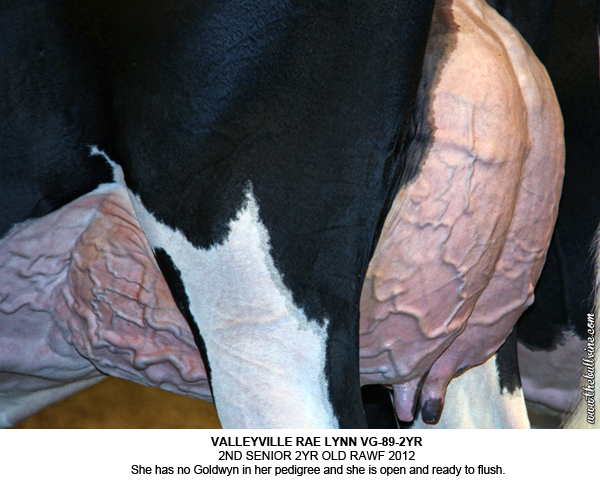
So how does this apply to the average breeder?

It’s really pretty simple.  Set up your own Facebook page or a Facebook Fan page for your farm.  Tell your story.  Did you have a great classification round and want to let the world know?  Share it on Facebook.  Had a great flush and want to sell the embryos from it?  Share it on Facebook.  Your friends will spread the word and before you know it, you too will start to have a loyal following.

VALLEYVILLE RAE LYNN-udder-web2

A few things to remember.  Just like that first date with that hot dairy princess, it will go better if you don’t make it all about you.  On our Facebook page we make sure for every story we share of ours, we share someone else’s story.  That is one of the major reasons many breeders check out our feed on a daily basis.  We are sharing content that we find interesting as a dairy breeder and, as a result, other dairy breeders typically find it interesting as well.  That is also why almost 70% of the breeders who follow our page share, like or comment on the information and entertainment we are sharing on a weekly basis.  Now 70% sounds like a big number and it is. On a weekly basis that is over 6000 people engaging in the conversation, that is almost 3 times as many as any other publication.  The thing that these other publications don’t get is that instead of just sharing a pretty picture each day, we are sharing interesting articles from around the world.  We are asking questions.  We are joining the conversation.  That’s because we get it.  We are breeders first and love being part of the breeder community.  We are not trying to drive traffic to our website, so we can justify the high expense to advertise on our site.  We are joining in with and, often times, starting the conversation.

engagement

A great example of this is that recently we shared an advertisement from a sale manager for an upcoming sale.  We were impressed with their list of consignments, so we shared it with our readers.  That advertisement was seen by more people on our Facebook page, than in the major print publication that they had spent thousands of dollars on.

The Bullvine Bottom Line

Now I know change can be hard.  And for those who have been successful through traditional methods, it can be even harder to adjust to these changes.  But the world has already changed. Either you adjust to live within or it will move on without you.  Facebook is not Fakebook.  It is real people, real stories and real connections.  If you don’t learn to leverage the power of it, the only thing that is going to be fake is the money in your wallet.


To learn how to get your farm on Facebook download this free guide.


[related-posts-thumbnails]

Edward Young Morwick – Country Roads to Law Office

Edward Young Morwick

Edward Young Morwick

Edward Young Morwick, author, cattle breeder and lawyer, was born in 1945 on the Holstein dairy farm of his father, Hugh G. Morwick. Impressions from those childhood days have had a tremendous impact on his journey through life. He recalls, “One of my first memories involves my mother carrying me in her arms down the aisle in front of the cows.  She would stop in front of each cow, and I would lean over and pat the cow on the muzzle.” This is a familiar beginning for many country boys but then the picture changes. “My father died when I was six years of age and my mother Jean went back to teaching school.” No doubt there were hard turns ahead, however, Edward’s connection to Holsteins had already been forged.  He clarifies the process. “I bought my first Holstein calf in 1953 when I was seven years of age.  I have owned Holsteins ever since, except for a period in the late 1960’s to mid-1970 when I was attending university and law school.”

It’s Relative To His Case

From a very early age, Edward was interested in the lineage of both cattle and family. The connections were strong ones. “My maternal grandfather was William Young who bred the Ingleneuk Holsteins at Alberton, Ontario.  He had one of the better Holstein farms of the era.  He sold a bull to Lady Eaton named Ingleneuk King Hengerveld.  Lady Eaton sold one of his daughters to Mrs. Edith Dilworth and she became the fifth dam in the maternal line of Osborndale Ivanhoe.”

Morwick’s uncle, James R. Henderson of Strathaven Farm in Kingston, Ontario made significant contributions to cattle breeding as is noted in Edward’s book, “The Chosen Breed.” Edward expands on the list of achievements of this well-respected cattle Judge and Master Breeder. “Uncle Jim bred Strathaven Top Grade, the sire of Glenvue Nettie Jemima (EX-13*).  He also bred Inka Supreme Reflection, who was a Rosafe herd sire.  “Nettie Jemima” was dam of Rosafe Magician and Rosafe Citation R. who set records for siring All-American gets of sire.  Also, Inka Supreme Reflection is behind both Pawnee Farm Arlinda Chief and Round Oak Rag Apple Elevation.” A wonderful resume pointed to with pride. “My Uncle Jim Henderson is one of the few Canadians who bred an animal in Elevation’s pedigree.  Also, he bred the sires of dams back in the tenth to twelfth generations of the pedigree of Braedale Goldwyn.”

And The Law Won

With such solid role models, you know there has to be a story to explain Edward’s choice of law as a career. “I ended up becoming a lawyer as follows:  I entered University of Guelph in 1968.  It was my intention to be a journalist.  My ultimate goal was to be a columnist on either the New York Times or Chicago Tribune.  In my second year at university, it became apparent that I would win the Gold Medal in English Literature.  At that point I received an invitation from Osgoode Hall Law School to enroll there, in spite of the fact that I had not completed my Bachelor of Arts.  When I entered Osgoode Hall in the fall of 1970 I was one of four students out of a beginning class of 306 who did not have a bachelor’s degree.

In my first year at law school, I ended up second in a class of 306.  That fact, plus my entire academic record at law school, led to my being hired by Fasken & Calvin, a Bay Street law firm in Toronto.”

Weighing the Pros and Cons

The story continues. “I chose a career in law in preference to one that would involve teaching English Literature at the high school or college level because I thought the practice of law would be much less restrictive and would give me an opportunity to meet a lot of interesting people.  Also, the practice of law requires a great deal of writing, which satisfied my compulsion to write. However, it was my wish to practise criminal law so I set up my own practise in Hamilton in February of 1975.  I started in Hamilton because it was close to my home at Jerseyville, and also was a “hot-bed” of crime, so I knew I would be busy.” One wonders if Mr. Morwick will pen a legal book at some point in the future.

Mount Victoria 600

Morwick’s book’s The Chosen Breed and  The Holstein History are must reads for those wanting to learn more about just who and how the North American Holstein breed has developed (Digital Painting of Mount Victoria Farms with Hanover Hill Starbuck standing in front)


Penned For Posterity

It took ten years for Edward to write the highly praised book “The Chosen Breed”. He uses very few words when referring to his inspiration. “The reasons I wrote The Chosen Breed and The Holstein History can be summed up in the words recognition, remembrance and gratitude.  Further, I love to write and I love the Holstein breed and the people who support it.” A wonderful opening statement which he expands on in the book itself.  Those who have read his writing go beyond the author’s reticence. Richard Keene, of Keeneland Farms in Gilbertsville, N.Y. exclaims, ““Wow!  What a great history.  Certainly an enjoyable must read for the real student of the breed.” Dallas Burton of Berryton, Kansas supports that motion. “Tremendous job.  Thank you for taking the time and the remarkable effort in accounting these 125 years of our history.” And Richard McNamara of Stratford sums it up saying “I’m surprised you could produce this book in only ten years with all that it takes to get it done.  Really enjoyed the human interest and humour.”

 Misty Springs Shottle Satin VG-86-2YR-CAN  former #1 GLPI Cow of the Breed

Misty Springs Shottle Satin VG-86-2YR-CAN
former #1 GLPI Cow of the Breed

A Jury of His Peers

“In dealing with the greatest sires in history, you need to focus on eras.” says Edward.  Before elaborating, he admits a personal favorite.  “One of my personal favorites is Picston Shottle as he sired my cow, Misty Springs Shottle Satin, who was No. 1 genotype cow when the designation was first introduced in 2009.” Having said that, he gives a brief for consideration. “The student should not ask ‘Who was the greater bull, Johanna Rag Apple Pabst or Hanoverhill Starbuck?’  Starbuck obviously sired offspring who were superior to those of J.R.A.P., but fifty years later.  The proper way to frame the question would be to ask ‘Was Starbuck as great and as influential a sire in his era as J.R.A.P. was in his?’  And the answer would be a resounding ‘No!’”. Lest the Jury be confused, lawyer Morwick presents his arguments. “In the early period, the great sires were Netherland Prince, Billy Boelyn, Mooie and Conqueror.  Come forward three decades to Sir Pietertje Ormsby Mercedes.  And after him came Pontiac Korndyke and Hengerveld DeKol.  In the 1920’s you had Johanna Rag Apple Pabst, one of the great sires of all-time, some say the greatest; and in the same period was Sir Bess Ormsby Fobes, who left remarkable sons.  And then there was Wisconsin Admiral Burke Lad and his descendant, Wis Burke Ideal.  Important bulls in the 1950’s were A.B.C. Reflection Sovereign and Osborndale Ivanhoe.  In the modern era, the most influential bulls were Pawnee Farm Arlinda Chief and Round Oak Rag Apple Elevation.  Carlin-M Ivanhoe Bell also cast a broad influence, as did To-Mar Blackstar, Walkway Chief Mark, S-W-D Valiant and O-Bee Manfred Justice.  In the recent past, among the best bulls were Regancrest Elton Durham, Picston Shottle and Braedale Goldwyn.” The defense rests.

Raising The Bar

Are there actually role models for authors who are also lawyers? Edward says his were available early on. “In high school years I worked on the farm of my neighbor, Richard Schleissner, and also for Agro Brothers, doing the usual farm work and also helping to take out their show herds. The biggest influences on my life were the dairy farmers who lived in the community where I grew up, among whom I could name Douglas Lovering, Joe Loewith and Lloyd Hunter.  I worked for all of them.  They taught me the value of hard work.  None of them would undertake a job unless perfectly prepared to complete it to the very best of his ability.” This set the foundation which was built upon with Edward’s legal career. “In later years, the biggest influence on my life was Angelo Agro of Agro Bros. Ltd., for whom I acted as attorney for a period in excess of 20 years.  He taught me that you could be an honest businessman and still make a lot of money.  He was an extremely hard worker, a brilliant strategist and possibly the best judge of human character I ever knew.  Mr. Agro had the ability to talk for two or three minutes to a man he’d never met before, and he could pretty well tell you, quite accurately, what kind of man he was.” These are also excellent skills for a lawyer as well. It’s no surprise that his mentor also considered Edward to be exceptional.

The Bullvine Bottom Line

It’s Bovine Legal  – Edward Y. Morwick has taken a one-of-a-kind journey from those visits to the barn as a baby.  He credits his mother with teaching him a key lesson, “She taught me very early on that a person can accomplish pretty well anything he sets his mind to, if he tries hard enough.” Edward has done that.  His legacy – book and bovine – will stand beyond a reasonable doubt!

To find out how you can get a copy of Edward’s latest book “The Holstein History” click here.


[related-posts-thumbnails]

Genomics: Think Big Not Small

Even though we are still in the early stages of genomic indexes, certain trends are already apparent.  One issue that I have noticed is that too many breeders are using genomics to narrow down their sire usage to a few sires at the very top instead of using genomics to discover what sires not to use.  Everyone likes to look at the top of the list to see what sires hold their rankings, however, the real power of genomics is actually in pointing out what sires not to use.

While there is no question that genomics has changed the way we look at indexes, there is one major issue that we are all guilty of.  We focus only on those sires that are in the top 10 or so to make our sire selection decisions.

So let’s take a look at the current top 10 genomic sires and their TPI Scores:

  1. Supersire 2530
  2. Jabir 2515
  3. Numero Uno 2497
  4. Jacey 2493
  5. Predestine 2491
  6. Chevrolet 2490
  7. Hunger 2488
  8. Jetset 2484
  9. Balisto 2483
  10. Willpower 2476

You will notice that all these sires are within 54 TPI points of each other.  That is a difference of less than 2%.  The issue with this is that, according to CDN research, 95% of the time sires can vary by up to 20%,  when comparing their genomic index to their eventual daughter proven evaluations (Read more: The truth about genomic indexes – “Show Me” They Work!).  Applying  that to the current list of sires and instead of looking at the top 10 sires you would instead need to look at all sires within 20% of the top sire, Supersire.  Since Supersire is +2530 gPA TPI that means your short list would include all sires over 2000 TPI.  Instead of 10 sires this means looking at the 1000 current sires.

Furthermore, genomics is not as much about identifying the top few sires you should be using, as it is about identifying the sires you should not be using.  When you are looking at two full brothers and trying to decide which one to use or sample, if they are greater than 500 gTPI points apart you are better to use/sample the higher one.  Or, if you can only afford to sample one of them then genomics would be a strong indicator of which one to sample.  However, when they are much closer, genomics alone cannot make this decision with great accuracy.

For sires that are less than say 300 gTPI points apart you really cannot use their genomic total merit index numbers alone to make that mating decision.  You are better to make a short list of sires that are within the 300 TPI points and then look for the sire that is the best corrective mating on your animal.  Given how much sires change and how little difference there is in the top sires these days, you are far better making corrective mating your number one requirement and only using genomics to help determine your shortlist.

The Bullvine Bottom Line

Genomics is only as good as the way it is used.  If we begin thinking that the top short list is the be all and end all for mating decisions, we start to muddy the waters.  You cannot use the top 10 gPA TPI sires alone for your mating programs.  Instead you are better to look at the top 1000 sires and find the sire that is the best corrective mating.

Everyone l points to the few select top genomic sires and then bemoans how much they change with each proof round and eventually to their daughter proof.  Genomics works best on the macro level and not at the micro level.  Due to current 65% reliabilities and a limited differential between top sires, a genomic total merit index cannot be relied upon for the final answer.  Genomics is a Macro level tool and not a Micro tool. If you are limiting your mating decisions to the top few sires, you are also limiting your genetic improvement program.

Think big.  Find the genomic sires that will deliver the specific improvements that your cows need!


The Dairy Breeders No BS Guide to Genomics


Not sure what all this hype about genomics is all about?

Want to learn what it is and what it means to your breeding program?

Download this free guide.


[related-posts-thumbnails]

GARY SAUDER: The Muse in His Studio

Gary Sauder-picHave you seen any beautiful cows lately?  If you know of artist Gary Sauder you can quickly answer, “Yes!” Gary’s detailed paintings make you feel as if you are actually there viewing the animal on the farm or over a fence.  His chosen technique of super-realism reflects the pride he takes in accurate portrayals of the cattle who are his subjects. He goes beyond photographic to artistic and many clients feel that owning his work is very special. Alta Mae Core shares her experience. “We have had the privilege to work with Gary on several occasions.  The first being a pencil drawing of our farm favorite KCJF Regency Treasure.  Since then he has done numerous other paintings of several of our cows both past and present.  I think his extraordinary talent stems from his knowledge and passion for ‘cows’ in general.  When you combine that knowledge and passion with his god given gift, it is easy to see why his work is truly one of a kind.
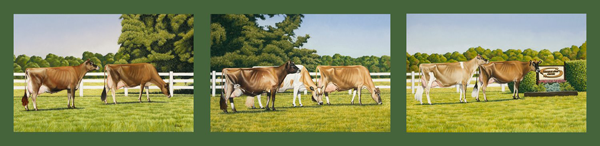
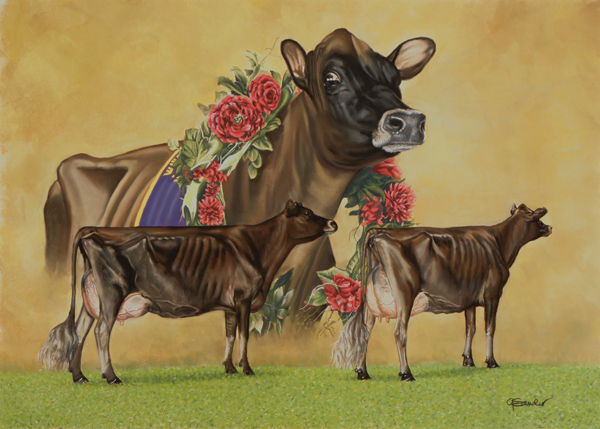
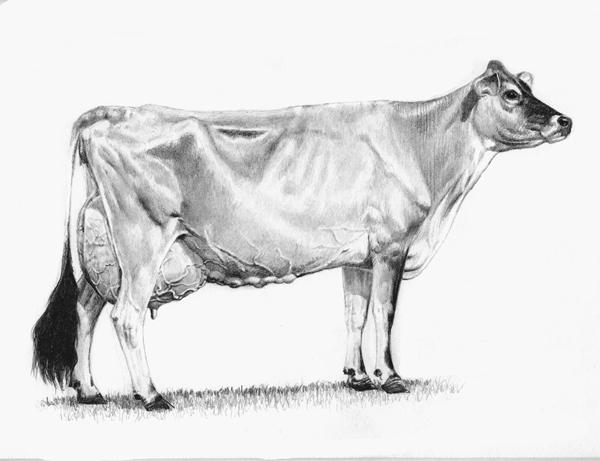
Gary Sauder-Keightly Core Tryptich

Keightly Core

From Farming to Framing

Gary Sauder grew up showing registered Jersey cows from a small farm in Sonoma Country, California.  During his last 4-H year, he exhibited the Grand Champion Jersey at every show he entered, including the Jr. Grand National at the Cow Palace and the California State Fair.  At the same shows, he was the dairy showmanship champion as well as the Round Robin Master Showmanship Champion.  He earned the Paul Jackson Scholarship that same year.  After college, Gary took a position caring for and exhibiting cattle for then, Meadow Glen Farms of Orland California.  It was about this time that he made the exciting leap into the realm of painting.

Puttin on the Ritzy

Puttin on the Ritzy

A Love for All Things Bovine

Sauder’s work has been juried into many exhibitions.  He is resident artist at the Healdsburg Center for the Arts.  Gary loves capturing the beauty and character of the cows he paints but he has just as much passion and concern for the dairy breeders themselves and for the generations to come. While he finds it difficult to pick a favorite from his work he does rise to the challenge. “If I had to choose one it would be my painting “The Jersey Cow.” He explains his choice. “This painting was the culmination of my Jersey experiences throughout my life and brought into play elements of many of my favorite cows that I had seen and admired from afar, as well as having had the great fortune to work with. Cows like Generators Sweet Dreams, KCJF Regency Treasure, Huronia Centurion Veronica, Lloyn Jude Griffen, Generators Topsy, Generators Imp, and Sunset Canyon MBSB Anthem and cows like that.  After that I like the painting I did of my own cattle entitled “Jersey Fields” and that is for purely sentimental reasons.  The next few are all special and I like the newest one for Brady Core of “Ritzy” and I really like the painting of “Kit Kat” that I did for George Colpetzer.

Capturing the Ideal Bovine on Canvas

Gary is a perfectionist and renowned for his ultra-realistic portrayals that some people think are photos.  “I take that as a compliment” he says and adds, “Even though I am not trying to create a photo, I am trying to show how I see and how I want to communicate to the viewer.” Of course his photos are not done in Photoshop – “I don’t get the Photoshop question” – but he goes on to explain. “I do use Photoshop myself in order to help build compositions and correct colors for reproduction and Internet promotion. It is a valuable tool and I use it as such.”  Gary has produced five “ideal” cows in his artistic repertoire: Jersey; Holstein; Brown Swiss; Milking Shorthorn and Red & White.

Mentors From Both the Barn and the Gallery

Sunset Canyon MBSB Anthem drawing

Sunset Canyon MBSB Anthem drawing

Gary acknowledges that there are quite a few in the art world that have had an effect on him.  “Most of them are from the wildlife/animal art world and they include Carl Brenders, Terry Isaac, Leslie Harrison and the great portrait artist Daniel E. Greene.” On the dairy side, Gary feels that it was his great good fortune to grow up around “some of the giants in the industry.” His list has many familiar names. “Local dairymen such as Henry Lafranchi, George, Tom and Marvin Nunes, Jim Pappas, John McKitrick and Doug Maddox.” He goes on. “These men used to judge our local county fairs and, when there, I got to compete with Cheryl LaFranchi, Hank Van Excel and John Rowe.” He speaks with the enthusiasm of a true dairyman, “ I showed Jerseys and always admired the cattle that were shown against me and the ones that stood out where the cattle with the MG prefix that were bred by Harlan Askeland and of course the Stardust cattle. Our county Fair always put on quite an Open Jersey Show with such renowned breeders as Harlan Askeland, Bob Bignami, Jack Snell, Phil Nyberg and John Giacomini. If you wanted to learn about quality Jerseys, there was no better show to watch.” Gary obviously learned from these leaders as he reports, “Later I had the privilege of working with the Askeland-Bignami herd and got to work with some great cattle like Generators Sweet Dreams, MG Tradition Robyette, Empire Amelia Beacon, and MG Master MC Lou.”  Sauder not only watched the cows he watched the competitors and he shares this interesting side note. “During the last couple of years that I showed as a junior I kept noticing and talking to a very energetic and quite enthusiastic young exhibitor who seemed to know more about Jerseys, breeders and pedigrees than anyone in the barns.  It is no surprise to me that he has grown up to be what I think is the most influential Jersey breeder of our time and I am talking about Eric Silva of Sunset Canyon Jerseys.”

Sunset Canyon Wall of Fame

Sunset Canyon Wall of Fame

Pencil, Police and Pastels 

In looking back, Gary reports that he had been drawing as long as he could remember but says, “I had grown bored with drawing in graphite and hadn’t done it for a long time.” Then one movie changed everything. “I saw a movie about a sketch artist for the police and he was using colored pencils and I decided to find out more about them. I got some books on the medium and I conquered my fear of color and shortly thereafter I graduated to pastel and even water color and oils.” A momentous change and he confirms, “I enjoy them all but I prefer to paint in pastel.”

Gary Sauder-Generationsfor web

Facebook Extends the Artist’s Reach

No matter what career path you’re on, there are going to be changes.  This has been true for Gary Sauder as well.  “The biggest changes for me are two completely different things that came about at different times for me.  The first was my discovery of coloured pencils and the second was the digital camera. The camera helps me not waste as much time and money on photographing my reference material.” But there are other tools that have made changes in Gary’s work. “Right now the two most profound things to affect my business are the new pastel product called Pan Pastel and the surface PastelMat and Facebook.” He is emphatic, “Without Facebook I would not be able to reach as many people as I do now and it really reaches my target audience.”

Passionate about Breeders, Breed Promotion and Paternity

Gary, like many artists, considers every finished painting an accomplishment.  He modestly leaves it up to the viewer to determine if that is a great accomplishment or not. For himself he ranks “becoming a father last year” at the top of the list. This fits very nicely with his commitment to the future of the dairy industry.  “I have donated a painting to the Ayrshire Junior Youth Fund and a really nice painting called “Generations” to the AJCA for their Jersey Youth Academy”.  Gary is definitely putting the positive reaction to his work to a valuable purpose.

Gary Sauder - Something in the Ayr

Something in the Ayr

No Shortcuts

Having admired the honesty of his own mentors, Gary strives to be the same. “I have always believed in the honest cow and having showed and milked many of those kinds of cattle I have always thought that I could portray that quality in a painting.  To that end I prefer to work from “casual” pictures taken by mew or a client and, if you look at my paintings of “Anthem” and “KitKat” you can really see that influence.” I also believe in no shortcuts in creating a painting and by that I mean doing a drawing first to perfect the pose or setting and then using that drawing as the basis for the painting.” As in any high calling, there is no “easy” way says Gary the encouraging mentor. “It’s going to take about a hundred paintings, before you get really good and consistent and develop a style” It is really important to learn to draw, before you learn to paint.” And, above all, “Never give up!”

Gary Sauder - Xanadu Brendan Kit Kat

Xanadu Brendan Kit Kat

Balance, Line and Proportion

Speaking of never giving up, the ultimate goal of every purebred dairy breeder is to bring all the best parts of the dairy cow together in one animal.  Gary Sauder has a parallel artistic vision and Russell Gammon, former General Manager of Jersey Canada and now Jersey Program Manager at Semex Canada, applauds Gary’s work and explains why he personally has expectations of a “Mona Lisa Jersey painting”. “Gary Sauder’s artwork fills a niche in the dairy industry. Given his long term passion for dairy cows and dairy cow conformation (especially that of the Jersey breed) he nails proportions and the small details perfectly. I’ve seen some of the cows he has painted and he captures them perfectly on canvas.”

The Bullvine Bottom Line – “Follow Your Moos”

There is no doubt that Gary Sauder, the muse in his gallery, will always follow his “Moos”.  And, as long as he does so, there will be a growing following in the dairy/art world who will agree with Gammon’s praise of his mastery, “Call Gary Sauder the Renoir, the Picasso, the Da Vinci of the Dairy World!”

To order some of Gary’s fine art work visit Cow Art and More.


Get original “Bullvine” content sent straight to your email inbox for free.


[related-posts-thumbnails]

The Winners of the 2012 Breeder’s Choice Awards Are…

top13of2013Forget the  Vince Lombardi Trophy award to the Baltimore Ravens for winning the Super Bowl last night, it is now time to hand out the 2012 Breeder’s Choice Awards.  After the month long vote and announcement this past Monday of the winners of the Tanbark Trail Edition (Read More: The 2012 Breeder’s Choice Awards – The Tanbark Trail Edition), over 3000 dairy breeders cast almost 8000 votes in a one week period for their favorites in 21 different categories.  Without any further ado, here are the winners.

Large A.I. Company

2012 Breeders Choice - Large AI

https://www.facebook.com/questions/327170977393781/

With what became a two horse race between  the top two vote getters, Select Sires ended up winning over Semex by 10% of the popular vote, leaving   the next largest A.I. vote getter ABS Global some 19% behind these two.  To read more about these two A.I. centers and their different approaches check out Select Sires vs. Semex – A Contrast in Cooperatives.

Small-Medium A.I. Company

Breeders Choice 2012- Small-Medium AI Company

https://www.facebook.com/questions/327187584058787/

In what was close race from  the start, St. Jacobs ABC used their strong market presence in the type market to edge out GenerVations.   Trans America Genetics (TAG) earned a solid 3rd spot.  (Read more: The Judge’s Choice – Investment Advice from Tim Abbott)

Dairy Print Magazine

2012 Breeders Choice - Dairy Print Publication

https://www.facebook.com/questions/327213437389535/

This category presented  an outstanding showing with  the team at Cowsmopolitan giving the much larger publication Holstein International a run for its money.  Only 2% separated these two fine publications (Watch for our interview with Holstein International and outstanding photographer Hans Hopman coming soon)

Dairy Digital Publication or Website

Dairy Digital Publication or Website

https://www.facebook.com/questions/327215320722680/

It would have looked scary for us here at The Bullvine, if we could not win our own poll. We appreciate all the support and great comments from our readers.

Dairy Cattle Photographer

Dairy Livestock Photographer

https://www.facebook.com/questions/327560577354821/

In what came down to a battle between mentor Patty Jones and mentee Cybil Fisher, the mentee took the win with only 4% separating the top two great photographers.  (Read more about what it takes to get the perfect picture with our interview with Patty Jones – Patty Jones: Picture Perfect!)

Dairy Cattle Showman

Dairy Cattle Showman

https://www.facebook.com/questions/327640120680200/

In a category that we were concerned would become an ego nightmare, the contest ended up being not even close, with Donald Dubois running away with 48% of the popular vote.

Dairy Celebrity

2012 Breeders Choice - Dairy Celebrity

https://www.facebook.com/questions/327636224013923/

Obviously having judged the Royal or World Dairy Expo this past year didn’t hurt in this category.  With 2012 Royal Winter Fair Judge Callum McKinven edging out 2012 World Dairy Expo, Mike “Air” Heath.  (Read more World Dairy Expo 2012 Holstein Show – A battle for the ages and The 2012 Royal Winter Fair Holstein Show – One of the greatest stories ever told!)

Dairy Cattle Fitter

2012 Breeders Choice - Dairy Cattle Fitter

https://www.facebook.com/questions/327640120680200/

Many an ego might be hurt with the results of this category, but not those of our winner Pat Conroy and runner up Joel Phoenix, who were in the closest battle of all, with only two votes separating these two great fitters.  (Watch for our upcoming article with Pat Conroy about the great Swiss show cow Decrausaz Iron O’Kalibra).

Dairy Cowman

Dairy Cowman/Herdsman

https://www.facebook.com/questions/327640120680200/

In a category whose titles confused some, as we wanted to call it more than just the people behind the scenes at the shows (Herdsman), the winner in a close battle was Gerald Coughlin over Ernie Kueffner.  In a group that is an honor to  be listed among, check out our interview with 4th place finisher and 2012 Curtis Clark award winner Don Schwartz: “Love what you do and do the best you can!”

Dairy Cattle Industry Legends

2012 Breeders Choice - Dairy Legend

https://www.facebook.com/questions/327654344012111/

This was  a category that was never in doubt, not in disrespect to the others in the class, but rather in respect to the outstanding contribution made by Peter Heffering who earned 80% of the popular vote.  (Read more: Hanover Hill Holsteins: Peter Heffering 1931-2012)

Holstein Herd Legends

Holstein Herd Legends

https://www.facebook.com/questions/330287433748802/

Continuing his dominance, this time teaming up with his longtime partner Ken Trevena, Hanover Hill Holsteins earned almost 70% more votes than 2nd place Mount Victoria Farms.  (Read more: Mount Victoria Farms: The art and science of great breeding)

Holstein Show Herds

2012 Breeders Choice - Holstein Show Herds

https://www.facebook.com/questions/330291093748436/

In what became a great debate about breeding versus exhibiting, Ferme Jacobs rose to the top over  Budjon Farms.  Check out our interview with Ferme Jacobs: Success is all in the family, also be sure to check out Quality Holsteins and their now record 8th All-Canadian breeders herd award.

Genetic Impact Herds

2012 Breeders Choice - Genetic Impact Herds

https://www.facebook.com/questions/330296767081202/

In a list of herds that reads like a who’s who of the young sire and proven sire lists, Regancrest Farms dominated on the power of such great sons as  Durham and Dundee and popular daughters Regancrest PR Barbie and Regancrest S Chassity both 2012 Golden Dam finalists.

Colored Breed Herds

2012 Breeders Choice - Colored Breed Herd

https://www.facebook.com/questions/330301733747372/

In a category that was tough  to narrow down to just 10, and next year will probably be split by breed, Arethusa Farm Dairy ran away with the vote getting over 41% of the popular vote.  Strong showings from Brown Swiss herd Jo-Dee Swiss and Ayrshire herd Deer Hill showed this was not just a Jersey category.  (Read more about Deer Hill and their great Ayrshire show cow Sweet Pepper Black Francesca)

Genetic Index or Mating Tool

Genetic Index or Mating Tool

https://www.facebook.com/questions/330650453712500/

While there has been great debate about what genetic index is the best, there is no question that our Facebook readers are very type focused with the Conformation index from Canada getting over 41% of the votes.  (Read more: Everything You Need to Know about TPI and LPI)

Greatest Type Sire Ever

Greatest type

https://www.facebook.com/questions/330654520378760/

Now we arrive at the much  debated competition for greatest type sire ever between Braedale Goldwyn and Regancrest Elton Durham (Read more: Durham vs. Goldwyn: A clash of two titans), with Goldwyn taking the popular vote.  Goldwyn  has certainly been extremely popular and well used (Read more: Braedale Goldwyn: Is he the greatest type sire ever)

Next Great Type Sire

2012 Breeders Choice Awards - Next Great Type Sire

https://www.facebook.com/questions/330656387045240/

In the search for the next Goldwyn, many chose his son Maple-Downs-I G Atwood.  (Read more: Breeding the next show winners and 7 Sires to use to breed the next world dairy expo champion)

Holstein Index Sire

2012 Breeders Choice - Holstein Index Sire

https://www.facebook.com/questions/330660470378165/

In an inclusion that may have seemed odd to some, Lirr Drew Dempsey rode his high health and fertility numbers and outstanding conformation to victory over Man-O-Man with a strongly type oriented Facebook audience.  (Read more: Man-O-Man Will He Turn Platinum and Is Man-O-Man going to be a sire of sons?)

Genomic Index Sires

2012 Breeders Choice - Genomic Index Sires

https://www.facebook.com/questions/330682993709246/

In a list that seems to change almost monthly, it is interesting to see the long-standing TPI list topper Amighetti Numero Uno dominate this category.  (Read more about Numero Uno daughters with his high selling daughters: Genetics By Design – Crosses the $4,000,000 Mark and Genomic Stars Shine at Sale of Stars).

Greatest Holstein Show Cow of All-Time

2012 Breeders Choice - Greatest Holstein Show Cow of All-Time

https://www.facebook.com/questions/330692190374993/

In a category that many would have expected Brookview Tony Charity to absolutely run away with, Thrulane James Rose gave Charity a run for her money.  But ultimately it was Charity taking the title.  (Read more: The 8 Greatest North American Show Cows of All-Time)

Greatest Colored Breed Show Cow of All-Time

2012 Breeders Choice - Greatest Colored Breed Show Cow of All-Time

https://www.facebook.com/questions/330693853708160/

In a category that could have easily been dominated by Jerseys, it’s not surprising that Huronia Centurion Veronica 20J edged out Brown Swiss great Old Mill E Snickerdoodle OCS.  What was surprising was Ayrshire great Sweet-Pepper Black Francesca making a strong showing in 3rd place.  (Read more: The 12 Greatest North American Colored Breed Show Cattle of All-Time).

The Bullvine Bottom Line

On behalf of the whole team here at the Bullvine, I  want to say thanks to all those who voted and made this inaugural competition such a success.  To those who won, congratulations you have earned it.  Keep up the great work.


Get original “Bullvine” content sent straight to your email inbox for free.


[related-posts-thumbnails]

Is There Still Going To Be A Market For Purebred Dairy Cattle In 10 Years?

People are starting to realize that the old market for purebred cattle, if not dead, is definitely endangered.  Why is this once “healthiest” of marketplaces facing the current flat line?

The basic assumption has always been that there is a premium for purebreds that is paid back on sale day.  Ever since there have been purebred cattle there has been a movement to convince commercial operators of the value of owning purebreds and registering their cattle.  For about the past 20 years the focus has gone from educating the commercial producer on the increased value of purebred cattle to making the process and the system a better fit for the commercial producer.  While the intentions were great, this change in philosophy has ultimately led to the demise of the premium received for purebred cattle.

Industry vs. Breeders – Whose Fault Is It?

For years I have heard both sides of this discussion.  Seed stock cattle breeders complain that industry executives in organizations like milk recording and A.I., as well as geneticists, would not know a good cow if one kicked them in the head.  I have also heard the other side of this argument where these geneticists and officials complain that purebred seed stock breeders don’t know how to see the bigger picture and the two sides have batted heads at the board level all along the way.

The part that many people don’t understand is that these industry officials did not set out to harm seed stock breeders.  Neither were they looking to discriminate against them.  Rather they saw this group as a niche segment of the market place and thought they needed to serve the bigger picture instead of catering to this small, but vocal group.

For many years the only organizations that seemed to hear the cry of the seed stock breeders were the breed associations.  Initially, the breed associations were great about trying to build new marketplaces, as well as trying to help educate commercial producers on why they should pay a premium for these purebred cattle.  They also educated commercial producers that by registering their cattle they too would receive a premium when they went to sell these cattle.  Ironically, all that changed when breed associations started to try to become a greater service provider to commercial producers, instead of building the marketplace for purebreds.  This shift in emphasis from worldwide market potential to bottom line domestic cattle and membership numbers, as much as anything, killed the premium paid for purebreds.

It Started Slowly, but Got Rolling Quickly

In the beginning the changes were small.  They simply made it easier for commercial operations to register their cattle.  Then came subtle (and necessary) changes to the classification systems to target a more commercial friendly cow.  Followed by significant changes where breed associations stopped being a marketplace developer and focused on being a service organization to the commercial producer.

While this helped increase registrations and showed that the breed as a whole was growing, the objective set out by our breeder boards, it started to have a small but significant side effect.  As the system changed to be more commercial friendly, the premiums commercial producers were expecting to receive for selling purebred animals disappeared.  Take a look at many of the sale barns today and compare the price of a grade fresh heifer to that of a registered one.  There is not as much difference as there once was.  There is certainly not enough for many commercial producers to justify the cost and effort of registration and type classification.  Add to that the fact that in many regions and with certain high end sires, there are no longer semen incentives for young sire usage, semen cost for young sires is almost as expensive as proven, and commercial producers ask, “If it doesn’t make financial sense, why do it?”

Without that premium selling price, many producers will stop registering their cattle.  With less herds registering, that means that costs for the programs will fall on the niche group of seed stock breeders.  Breeders who already have less income from fresh animal sales, and like all milk producers are battling the increased cost of production and the decreased milk sale price.  It certainly isn’t a time to take back additional expenses.

Yes, your top 0.1% index seed stock breeder is seeing greater prices than ever.  In addition, there is certainly still value in consistent generation after generation breeding families that provide a stable investment (more on that to come next week) but we are talking your average every day purebred breeder.  They have certainly seen the prices for fresh heifers go down.  Many have attributed that to the introduction of sexed semen and genomics.  I would contend it was more accurately due to the fact that the cost of milk production went up, milk prices worldwide went down, and commercial producers, the buyers of these animals, no longer see the need for the extra investment in the purebred pedigree they once did.

The Bullvine Bottom Line

By making that small shift from building the marketplace for purebred cattle, to trying to woo the commercial producers into registering their cattle, the industry as a whole has, in a sense, contributed to its own demise.  Now all sides need to find a way to work together, before it’s too late.

Has the heart of the industry stopped? Is there time for resuscitation? Who knows marketplace CPR?


Get original “Bullvine” content sent straight to your email inbox for free.


[related-posts-thumbnails]

The Truth About Genomic Indexes – “show me” that they work!

Genomic indexes have created both excitement and concern in the dairy industry.  Some accept the science and the results while others are saying ‘Not so fast please! How can the accuracy be checked out?’ In the history of the dairy industry there has been 3 key issues that breeders took a strong stance for or against, artificial insemination, genetic indexes and now Genomics. With new traits being introduced and the world becoming more global there has certainly been loads of debate. While there has been many anecdotal comments about how and if it is working.  In an effort to further answer this question (Read more – Is The Genomic System Really Working), the Bullvine went searching for information on how genomics is performing outside of North America and also how it is performing for health and fertility traits.

The German Genomic Experience

Dr Stephan Rensing from VIT (Genetic Evaluation & Research Centre) in Verden reported on genomics in dairy in German at the September 2102 ICAR Meeting (Read more – What the Experts Will Tell You About Who Is Winning The Genetic Improvement Race). His presentation was entitled “Two years of experience with genomics – how well does it work?”   In Germany, like elsewhere, about 50% of the AI services are to young sires with both parent averages and genomic results.

In his report he mentions that with genomics results, known early in life, it totally changes the practices that breeders and A.I. organizations follow in selecting animals. Instead of selecting based on parent averages with low reliabilities followed by sampling, evaluating and then selecting the very best, both breeders and AI can now relatively accurately make selection decisions well before an animal is reproductively mature. He strongly recommends that selection be made based on all the information that is available on an animal at any point in time. That can be parent averages and genomic indexes or indexes that include parent averages, genomic evaluations and progeny performance data. Breeders have a new tool to increase accuracy and speed up the decision making.

The bottom line for Dr Rensing is that genomics is working very well in Germany.

In God We Trust, All others must bring data

Dr Rensing included in his study the 199 bulls in Germany that received their first official daughter proof in April 2011. He compared their December 2010 genomic indexes to their April 2012 proofs. The reason April 2012 (the 4th proof run for the bulls) was chosen was because it allowed for more daughters, more data from each daughter and for daughters to be in their second lactation. Or in short, provided for more accuracy. Dr Rensing studied  the correlations between the two sets of indexes and also how the very best sires performed. The very best sires are important as they are the ones returned to active AI service and used as the sires of sons.

12-2010 genomic proofs vs. 04-2012 daughter based proofs

12-2010 genomic proofs vs. 04-2012 daughter based proofs

For total merit (RZG) 95% of the bulls have an official daughter proven index within 0.6 standard deviation of their genomic index. That is very good. Much better than had been the case when bulls only had pedigree indexes when entered into A.I.. Note that the top 10% (twenty) of the bulls perform in a similar manner to all the other bulls.  Showing that even the extreme sires had the same expected performance reliability as all the others sires.  Something anecdotal comments in the past thought to be not true.


12-2010 genomic proofs vs.04-2012 daughter based proofs

12-2010 genomic proofs vs.04-2012 daughter based proofs

When looking at production indexes (above) and conformation traits (below), again 95% of the bulls have a combined April 2012 index within 0.6 standard deviations of their December 2010 genomic index for both production and conformation. More evidence that there is a good relationship between genomic and official progeny proven indexes.

12-2010 genomic proofs vs.04-2012 daughter based proofs

12-2010 genomic proofs vs.04-2012 daughter based proofs

The results from health traits (below) surprise to me. I had thought that there would be greater variation between genomic indexes and official progeny proven indexes for these lowly heritable traits. However it is less, almost half as much variation. After thinking about it, it stands to reason that for traits of lower heritability the genomic indexes are a giant step forward and will greatly assist in breeding for mastitis resistance, fertility and length of productive life. Since the Holstein breeding world is moving to breeding for these traits (Read more – Fact vs. Fantasy: A realistic approach to sire selection and From Fantasy to Reality: Top sires to address herd culling problems) genomic indexes will make that almost impossible job possible.

12-2010 genomic proofs vs. 04-2012 daughter based proofs

12-2010 genomic proofs vs. 04-2012 daughter based proofs


Comparing Top Canadian Genomic Bulls

To take this article one step further The Bullvine decided to study the current top five gLPI and compare them to each other.

NameLPIProtConfSCSDF
MR LOOKOUT P ENFORCER-ET383789152.81109
GENERVATIONS LIQUID GOLD360787142.84102
MR CHARTROI ELOQUENT-ET350791132.8197
MR LOOKOUT P EMBARGO-ET346771162.85105
DE-SU DISTINCTION 11130-ET344774142.79104

To start with we must say that these five bulls are all 99% Rank. Enforcer is the best for LPI and daughter fertility. However each other bull has his strength – for protein yield Eloquant is the best, for conformation Embargo is the best and for SCS score Distinction is the best. If you are using any or all of these bulls, first make sure they are strong where your herd needs improvement and then use corrective mating.

More CDN Research Underway

CDN is currently conducting research into confidence limits around the individual trait genomic indexes. Some time ago CDN did publish that for genomically evaluated bulls with 65% reliable gLPIs, breeders can except 95% of the time that their official proof will be within 670 LPI points (within about 18-20%).  Meaning that we can be 95% sure that Enforcer will be higher than +3167 LPI once he has his official progeny proven index that is over 90% reliable.  That would mean that at least 95% of the time Enforcer would end up with an official proof that would rank him #2 in Canada.  That is the worst case.

Apply this to your breeding programs when looking at a genomic young sire you can take 670 LPI points or approximately 455 TPI points off their predicted index and they will achieve that number or higher 95% of the time. For example, take the #1 gPA TPI sire, Seagull-Bay Supersire, who has a current gPA TPI of +2530, you can be 95% certain that his daughter proof that is over 90% reliable will be at least +2075.  That would place him in the top 43 sires in the US (220 points behind current proven leader Freddie).  Remember that is 95% of the time he would be there at least.  Not a bad worst case scenario.

The Bullvine Bottomline

Genomic indexes are a great tool that allows breeders around the world to more accurately select from within the animals that do not have an official sire proof or cow index. It is true they are not as accurate as indexes that include actual cow or progeny performance information for production and conformation traits. However they are significantly better than parent averages and a great addition to the breeder’s tool kit when it comes to selecting for health and fertility. They are here to stay, they will be used by discerning breeders and yes they will be improved on over time.


The Dairy Breeders No BS Guide to Genomics


Not sure what all this hype about genomics is all about?

Want to learn what it is and what it means to your breeding program?

Download this free guide.


[related-posts-thumbnails]

Mount Victoria Farms: The Art and Science of Great Breeding

With the recent announcement that the iconic red barns of Mount Victoria Farms on top of Macaulay Hill are to be razed in the next two months to make way for a planned residential subdivision, a monument of Holstein history, unrivaled by any other, will be destroyed.  The invincible blood that pumped through the veins of Thomas Basset Macaulay led to the Mount Victoria herd influencing cattle populations in every land under the sun.  No Holstein exists in this world that is not a descendant of the great Johanna Rag Apple Pabst,  T.B. Macaulay`s foundation sire for Mount Victoria.

mount victoria key shot

To understand how one herd could have such a profound impact on the world of dairy cattle, you first have to understand the man behind the herd.  TB Macaulay, accomplishments would rival those of the late great Peter Heffering (Read more: HANOVER HILL HOLSTEINS: PETER HEFFERING 1931-2012).  Macaulay wasn’t born on a farm.  He wasn’t raised on a farm and, in fact, didn’t own his first Holstein until he was 66.  However, during an 18-year period he would change the Holstein world forever.

mount victoria tb plaque

Macaulay was actually a wealthy insurance executive who got into farming more by chance than by design.  Towards the end of a very successful career he was looking to invest in other areas.  When he discovered the farm he had purchased was more of a sand pile than great cropland, he started purchasing livestock to start building up the soil.  This ultimately led to him buying his first Holstein in 1924, and the start of a very distinct bloodline.  You see Macaulay had very definite ideas on the subject of genetics.  His studies in corn breeding were more advanced than any that had been made at that time.  This all traces back to his insurance career where he was an actuary.  Actuaries are the people who compile and analyze statistics and use them to calculate insurance risks and premiums.  It’s this love of mathematical theory that Macaulay would transpose into his breeding program at Mount Victoria.

Purifying the Bloodline

Inbreeding and line breeding work, when done correctly, because it involves concentrating the exceptional genes of the ancestors in the pedigree.  As Edward Morwick points out in his book The Chosen Breed, “It is essentially a mathematical process and a discipline in which an actuary’s training would stand him in good stead.  Through the lessons learned as an actuary which were cross-applied to the study of genetics, Macaulay became convinced of his ability to develop a strain of Holstein cattle pure for sound type, good udders and four percent test.” There is never ending debate about whether breeding great cattle is an art form or a science?  Macaulay’s favorite saying from Beattie sums it up “What cannot art and industry perform, When science plans the progress of their toil!”

mount victoria door

Macaulay would study the dairy publications of the time to get a better understanding of what bloodlines were transmitting the ideals he was looking for.  Specifically he was looking to breed four percent butterfat with heavy milk production and a high standard of type.

The Big Six

In his research Macaulay identified the Prince Colanthis Abbekerk bloodlines of Oxford County in Ontario to have what he needed and made trips in 1924 and 1925 to purchase the seed stock he needed.  This lead to many purchases highlighted by what was coined by William Prescott of Holstein-Friesian World as “The Big Six”.  They were Oakhurst Colantha Abbekerk, Ingleside Pietje Posh, Dixie Colantha Hartog, Lady Meg Posch and Bonheur Abberkerk Posch 2nd.
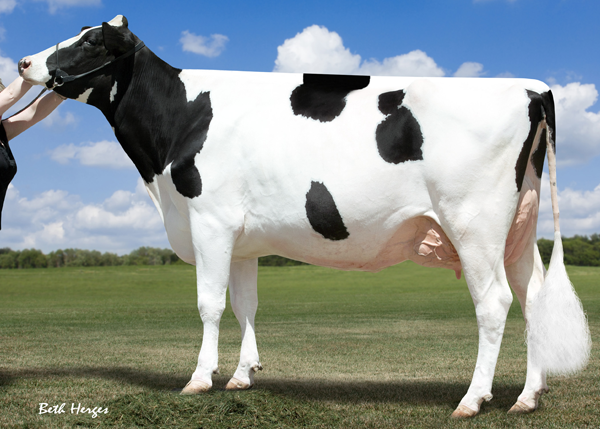
The Foundation Sire

He also needed a herd sire.  Searching the Holstein-Friesian World, he found “The One” in Johanna Rag Apple Pabst.  The bull that become the center of Macaulay’s line breeding vision.  A vision that included using all the tools – testing, classifying, showing, culling and advertising would be utilized and outcross sires would be used sparingly when needed.
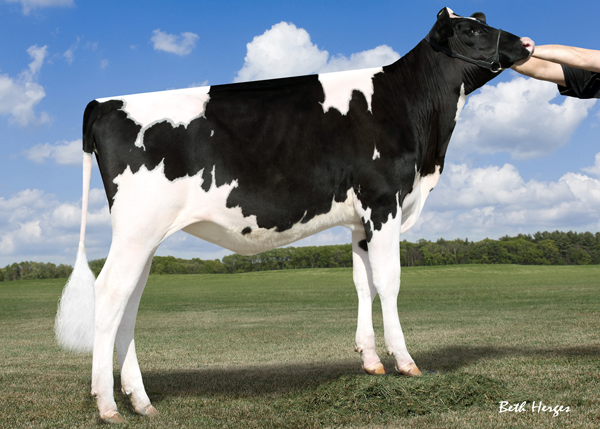
Johanna Rag Apple Pabst combined with the Mount Victoria foundation cows to create the Rag Apple bloodline.  His progeny from the Posch-Abbekerk cows handpicked from Oxford County would go on to change the Holstein world.
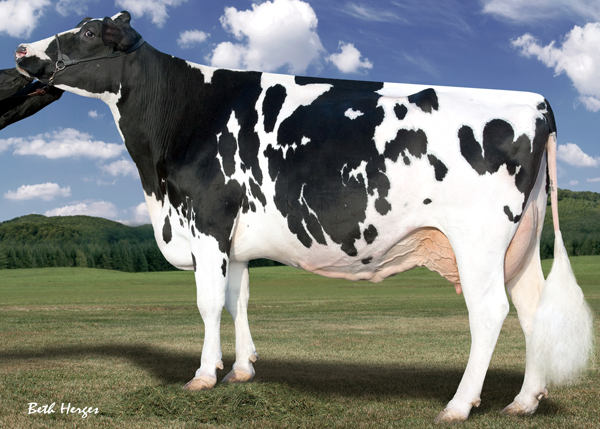
Johanna Rag Apple Pabst sired three All-American Get of Sires and two reserve gets.  51 daughters with 100 completed records averaged 15,753 lbs. milk, 626 lbs. and 4.0% Fat.  Realizing the dream that Macaulay had set out to achieve.

Famous Pabst daughters include:

  • Montvic Rag Apple Colantha Abbekerk (EX-11*)
    The highest producing daughter with a world 3X record of 1,263 lbs of fat
  • Montvic Rag Apple Bonheur (GM)
    A four time All-American
  • Montvic Rag Apple Bonheur Abbekerk (EX)
    Fat production of 1,047 lbs.
  • Montvic Rag Apple Pietje (GM)
    Produced 1,043 lbs. fat, 22,980 lbs milk, 4.54% as a three-year old

Highlights of his sons include:

  • Montvic Rag Apple Paul (Extra)
    Pabst’s only Class Extra son.
  • Montvic Rag Apple Baron
    Sire of Montvic Rag Apple Baron 2nd, foundation sire of the Texal family.
  • Montvic Rag Apple DeKol
    Out of Pauline Dandelion DeKol.  One of Western Canada’s biggest impact sires.  Sired show stock.
  • Montvic Rag Apple Hartog
    A show bull.  Sired Hays Supreme.
  • Montvic Posch Rag Apple.
    Out of Lady Meg Posch.  Tyler Farms Posch Letha,  his daughter, was the dam of Osborndale Ty Vic (EX-GM), sire of Osborndale Ivanhoe (EX-GM)
  • Montvic Pabst Rag Apple
    Lady Meg Posch son.  Daughters provided part of the foundation of the Glenafton herd.
  • Montvic Rag Apple Dandy
    Line bred, a son sired Rosehill Fayne Wayne (EX), three times All-American aged cow.
  • Montvic Chieftain
    Son of Triune Papoose Piebe, and the sire of the Pathfinder, who in 1962 when the All-Time All-American’s where selected all four milking aged females where Pathfinder daughters.

The Bullvine Bottom Line

Mount Victoria has produced eight Class Extra sires.  This is something only surpassed by Hanover Hill and more recently Ferme Gillette.  Unlike the other two, Mount Victoria did not have the aid of embryo transfer or artificial insemination to spread their bloodlines.  One could easily make the case that T.B. Macaulay and his use of mathematics to develop a line bred bloodline was the greatest cattle breeder of all time.  His outstanding collection of Holstein cattle pushed the boundaries of what was considered possible.  Macaulay stretched the limits of what was thought achievable.  All this from an actuary who loved the artful science of animal breeding!

Special thanks to Sheila Sundborg for the great shots.  Read more about Sheila and the great donation she made to the Friends of Andrea Crowe Fundraiser that raised over $83,000 for one of the brightest lights in the dairy industry.

For a full history of the Canadian Holstein breed check out “The Chosen Breed” by Edward Young Morwick and watch for our interview next week with him.

[related-posts-thumbnails]

Larcrest Juror Chanel: Perfect Holstein Harmony In the Key of C

One of the fun family parts of raising Holsteins comes with naming them.  Larcrest Holsteins of Minnesota not only does a great job with the names of their herd (most of which start with “C”) but those names have earned worldwide recognition for one cow family based on the descendants of Larcrest Juror Chanel EX-93 3E GMD DOM. Jon and Ann Larson and their son Tyler own and operate Larcrest Holsteins and, even without the signature “C” names, they are building an impressive reputation as hard-working, honest Holstein Breeders.  A noteworthy group all around!

Larcrest Juror Chanel 3E-93 GMD DOM

Larcrest Juror Chanel 3E-93 GMD DOM

GOOD TIMING: 8 to the Barn

As the second generation at Larcrest, Jon and Ann continue to build. “We currently milk 120 cows and farm approximately 500 acres.” says Ann. “The dairy was started in 1960 by Jon’s parents, David and Raymona Larson. When they started their family, Raymona used her teacher’s retirement savings to purchase 8 registered Holstein heifers. Most of the registered Holsteins at Larcrest have descended from the original 8 heifers.” A great opening number for the herd.  Positive dynamics have happened on the family side as well. Today Jon`s sister, Linda, and her children, Chase, Bridget and Lydia are an active part of the team.

Larcrest Crimson-ET EX-91 93-MS GMD DOM

Larcrest Crimson-ET EX-91 93-MS GMD DOM
Daughter of Cosmopolitan
Grand daughter of Champagne
Great grand daughter of Chanel
#4 GTPI Female on Locator List (12/12)

LARCREST DREAM:  The Complete Cow

At Larcrest everybody is on the same page, or to continue the musical analogy, they sing the same breeding philosophy tune. They explain their goals. “We very much strive to breed a complete cow. We have always appreciated cows with high type and longevity. Each corrective mating is important to us. Now with more modern tools we are more accurately able to identify each cow’s strengths and weaknesses. Health traits are gaining importance and service sires are screened for them.”  Such harmony in goal setting has meant that Larcrest Holsteins is recognized for “outstanding type, modern health traits and high components.”

Larcrest Chima-ETS VG-88 DOM

Larcrest Chima-ETS VG-88 DOM
Planet x Crimson
#25 GTPI Cow on the Locator List (12/12)

STRONG COW FAMILY:  Hitting the High “C’s”

Much is written, talked about and attempted in the breeding of great cow families.  With Juror Chanel, Ann and Jon got started on the right note and haven`t been off-key since. Chanel, Champagne, Cosmopolitan, Crimson, and Chenoa are making records for Larcrest. Ànn and Jon provide this update, “Our breeding and ET programs are based on the members of the Chanel family. Great Granddaughter Crimson and her daughters are the current focus. We are presently quite excited about 2 of Crimson’s daughter to calve this spring. Cale by Observer is due in March and Cordial by Atwood is due in June. Crimson and her 3 Planet daughters now rank as 4 of the top 26 CTPI cows of the breed. Larcrest Cardigan (2634 GTPI Cale x Numero Uno # 6 GTPI of the breed) and Larcrest Charmed (2590 GTPI Crimson x Numero Uno # 10 GTPI of the breed) as well as Larcrest Crayon (2512 GTPI Crimson x Mogul) show much promise in the calf pens.

LARCREST CALE Observer x Crimson GTPI+2379 +771NM$ PTAT+3.18

LARCREST CALE
Observer x Crimson
GTPI+2379 +771NM$ PTAT+3.18

LARCREST:  A Chorus of Praise — Lucky Notes

Even a brief look at Larcrest leaves a strong impression of the achievements of Jon, Ann and Tyler. Theirs is the unique situation of a high index cow family that has many generations of home breeding.  “A lot of credit for the generations of success can be given to our good friend and mentor, Dr. Marv Johnson who has done our embryo transfer work from the beginning.” Says Jon and he and Ann agree, “Breeding cows and seeing the next generation improve is something that we truly enjoy.”  From the outside it’s hard to imagine such easy harmony but that too is practiced.  “Patience and focus have produced the kind of cattle that we want to work with. We have some luck along the way… Chanel was nearly lost on first calving and Champagne was twin to a bull.” Nevertheless, everything reached a positive resolution. “Fertility and aggressiveness have also helped the cow family to thrive.”

Larcrest Oside Champagne-TW VG-88 EX-MS GMD DOM

Larcrest Oside Champagne-TW VG-88 EX-MS GMD DOM
Dam of Cosmopolitan
2nd dam of Crimson
Daughter of Chanel

Key Changes Come with Genomics

Whether you consider it as the previously mentioned aggressive or put it down to natural cow sense, Jon and Ann have moved with the times. “The use of genomics has changed our breeding program. It has shaped the decisions on which members of the family to concentrate our focus on. It has encouraged the use of more young sires. We still like to use daughter proven bulls when possible, especially on intriguing matings.” They definitely like the finer details of cattle breeding, “On the genetics end the biggest change has been the shortening of the generation interval with genomics. We feel that this has both positives and negatives. The positives would include the rapid increase in genetic potential. The negative would be increased inbreeding and higher risks for holes in the pedigree. We feel that the greatest animals are the proven cattle, both male and female, sired by daughter proven bulls that can still compete with the younger generations genetics-wise.”

Larcrest Cosmopolitan VG-87 VG-MS DOM

Larcrest Cosmopolitan VG-87 VG-MS DOM
Daughter of Champagne
Dam of O-Cosmopolitan (the #1 Planet son in the world)

In the Spotlight:  And Now Here’s Cosmopolitan

When it comes to long- running performances, Cosmopolitan, the Shottle granddaughter of Chanel, steals the show.  Her progeny have been sought after by many breeders, many in embryo form, by breeders in North America and Europe.  The spotlight is held by her top son O-Cosmopolitan, the #1 Planet son in the world.  He is being used heavily in Europe.  One of his full sisters is #2 gTPI Planet in Europe. The bright lights continue to shine for Cosmopolitan progeny and the continuous production of embryos since she was flushed to top bulls for Net Merit, TPI and PTAT.

Marketing:  It Takes Perfect Pitch

Marketing elite cattle when you are not the dairy heartland can be very challenging. For Larcrest Holsteins they take advantage of all available tools to get it right. Says Ann, “We use Holstein Plaza, website on Holstein World, Facebook, ads in Hotspots, Cowsmopolitan, Holstein World, Cattle Connection, and Holstein International.” She admits that it takes great work behind the scenes as well. “I think that the best marketing that we can do is through having good people that know the family inside and out. The performance of the cattle plus the representation of this group of people have been key to our success.”

Larcrest Chenoa-ETS VG-87 DOM

Larcrest Chenoa-ETS VG-87 DOM
Planet x Crimson
Dam of Chevrolet GTPI+2490, #1 Freddie son of the breed and #6 GTPI sire worldwide

SOUND ADVICE: Practice Makes Perfect

Such resounding success doesn’t come by accident.  From day one Jon and Ann have stuck to their values. “If we were to give any advice it would be to be honest with yourself about what you have or don’t have. Accurate representation of your cattle both positive and negative in the long run will pay dividends

THE BULLVINE BOTTOM LINE: The Key to Success

And so the curtain continues to rise on Larcrest Holsteins with years of great performance and headliners to come. The stage is set for Larcrest’s outstanding home bred high index cow family to remain in the spotlight. As they pay attention right down to the smallest details of name selection, there is little doubt that genetic stars from Larcrest Holsteins will be hitting all the right notes! Encore!  Bravo!!


Get original “Bullvine” content sent straight to your email inbox for free.


[related-posts-thumbnails]

The 2012 Breeder’s Choice Awards – The Tanbark Trail Edition

Breeders Choice Awards 2012-300In the age of American Idol, Dancing with the Stars and countless other franchises where the fans decide the outcome, it’s about time for Dairy Breeders to join the decision-making fun..  That is why the Bullvine has created the Breeder’s Choice Awards.  The Breeder’s Choice Awards celebrates fan favorites in the show ring, index cows, sires and dairy celebrities.  It stands alone as the only major award where real people – not industry insiders – determine the winners.
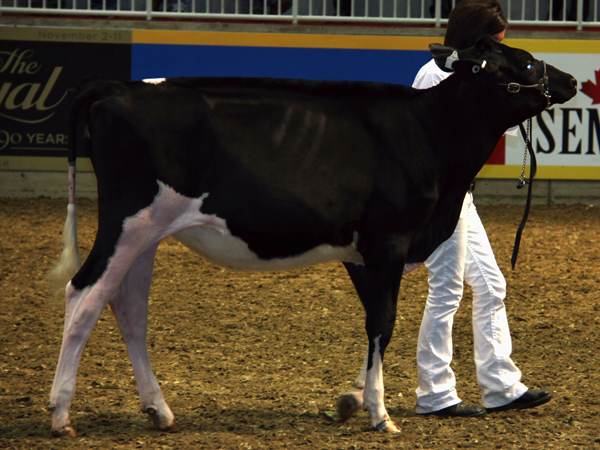
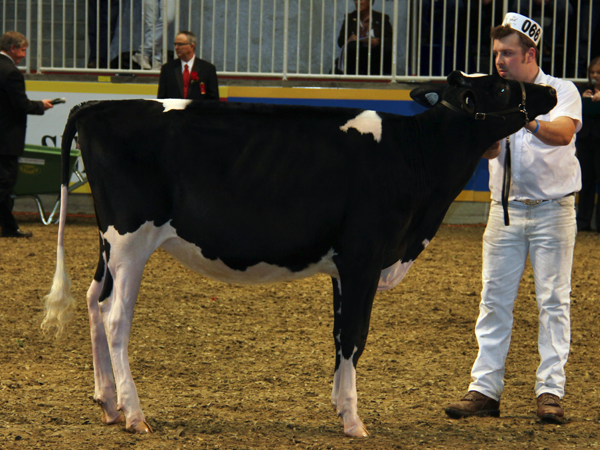
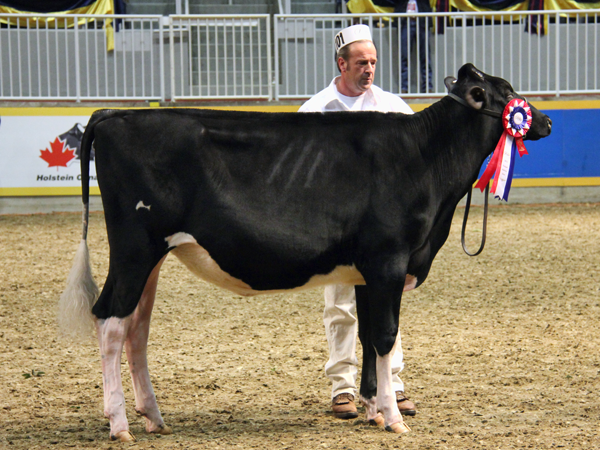
The Winners are?

Over the past month The Bullvine has been conducting surveys on our Facebook page to see exactly  who the fans would choose as the top Holstein show cattle in North America for 2012.  To qualify the animals in each class needed to place in the top five spots at either World Dairy Expo or the Royal (Read more: World Dairy Expo 2012 Holstein Show: A Battle for the Ages and The 2012 Royal Winter Fair Holstein Show – One of the Greatest Stories Evert Told ). After thousands of votes here are the winners:

COBEQUID GOLDWYN DANNY - 2012 Breeder's Choice Spring Heifer Calf

COBEQUID GOLDWYN DANNY – 2012 Breeder’s Choice Spring Heifer Calf

Spring Heifer Calf

  1. Cobequid Goldwyn Danny
    (Read more: Who’s The Next Great One?)
  2. Siemers Gwyn Glam Thisup
  3. Cherry Crest Lavanguard
PETITCLERC GOLDWYN SIDNEY - 2012 Breeder's Choice Winter Heifer Calf

PETITCLERC GOLDWYN SIDNEY – 2012 Breeder’s Choice Winter Heifer Calf

Winter Heifer Calf

  1. Petitclerc  Goldwyn Sidney
    (Read more: Who’s The Next Great One?)
  2. Kingsway Lauthority All In
  3. Sunspark Windbrook Extra
MD-DUN-LOAFIN LAUTH ELLI- 2012 Breeder's Choice Fall Heifer Calf

MD-DUN-LOAFIN LAUTH ELLI- 2012 Breeder’s Choice Fall Heifer Calf

Fall Heifer Calf

  1. MD-Dun Loafin Lauth Elli
    (Read more: Who’s The Next Great One?)
  2. Idee Goldwyn Livia
  3. Siemers Dstry Sunraygal
CO-VALE FEVER CAMILA - 2012 Breeder's Choice Summer Yearling Heifer

CO-VALE FEVER CAMILA – 2012 Breeder’s Choice Summer Yearling Heifer

Summer Yearling Heifer

  1. Co-Vale Fever Camila
    (Read more: Who’s The Next Great One?)
  2. Belfast Goldwyn Lasenza
  3. Bismer Damion Jasmine
JACOBS ATWOOD LILLY BOY - 2012 Breeder's Choice Spring Yearling Heifer

JACOBS ATWOOD LILLY BOY – 2012 Breeder’s Choice Spring Yearling Heifer

Spring Yearling Heifer

  1. Jacobs Atwood Lily Boy
    (Read more: Who’s The Next Great One? and Breeding The Next Show Winners)
  2. Crestbrooke Gap Torrie
  3. Sharp Acres ST Jessy
Lafontaine Aftershock Arrie - 2012 Breeder's Choice Winter Yearling Heifer

Lafontaine Aftershock Arrie – 2012 Breeder’s Choice Winter Yearling Heifer

Winter Yearling Heifer

  1. Lafontaine Aftershock Arrie
    (Read more: Breeding The Next Show Winners)
  2. Springway Sassy Rae
  3. Kingsway Sanchez Armadillo
Kingsway Goldwyn Artichoke - 2012 Breeder's Choice Fall Yearling Heifer

Kingsway Goldwyn Artichoke – 2012 Breeder’s Choice Fall Yearling Heifer

 Fall Yearling Heifer

  1. Kingsway Goldwyn Artichoke
  2. Kingsway Sanchez Magician
  3. Crovalley Knowledge Akika

Junior Champion – MD-Dun Loafin Lauth Elli

R-E-W Happy Go Lucky - 2012 Breeder's Choice Fall Yearling In Milk

R-E-W Happy Go Lucky – 2012 Breeder’s Choice Fall Yearling In Milk

Fall Yearling in Milk

  1. R-E-W Happy Go Lucky
    (Read more: World Dairy Expo Winners: Investment Worthy and Exciting Times for Butlerview)
  2. Dougal Lea Goldwyn Danita
  3. Blondin Alexander Mariska
BVK ATWOOD ABRIANNA - 2012 Breeder's Choice Jr. 2yr old

BVK ATWOOD ARIANNA – 2012 Breeder’s Choice Jr. 2yr old

Jr. 2 year old

  1. BVK Atwood Arianna
    (Read more: World Dairy Expo Winners: Investment Worthy)
  2. Joleanna Gold Pourinrain
  3. Jacobs Atwood Melody
Valleyville Rae Lynn - 2012 Breeder's Choice Sr. 2yr old

Valleyville Rae Lynn – 2012 Breeder’s Choice Sr. 2yr old

Sr. 2 year old

  1. Valleyville Rae Lynn
    (Read more: Quality Cattle Look Good Evert Day,  Don Shwartz: Love what you do and do the best you can! and Quality Holsteins – Well Deserved Congratulations)
  2. Butz-Butler Gold Barbara
  3. Crate Indiana Goldwyn
Robrook Goldwyn Cameron - 2012 Breeder's Choice Jr. 3yr old

Robrook Goldwyn Cameron – 2012 Breeder’s Choice Jr. 3yr old

Jr. 3 year old

  1. Robrook Goldwyn Cameron
  2. Cobequid Goldwyn Leno
  3. Arethusa Jasper Velour
Cookview Goldwyn Monique - 2012 Breeder's Choice Sr. 3yr old

Cookview Goldwyn Monique – 2012 Breeder’s Choice Sr. 3yr old

Sr. 3 year old

  1. Cookview Goldwyn Monique
    (Read more: Exciting Times for Butlerview, RF Goldwyn Hailey: Cash Cow or Cash Hog and International Intrigue – The Secret is Exposed!)
  2. Debeau Jasper December
  3. Quality Gold Danzi

Intermediate Champion  – Cookview Goldwyn Monique

Macpes Fortune Koquine - 2012 Breeder's Choice 4 yr old

Macpes Fortune Koquine – 2012 Breeder’s Choice 4 yr old

4 year old

  1. Macpes Fortune Koquine
    (Read more: Durham vs. Goldwyn: A Clash of Two Titans)
  2. T-Triple-T Gold Prize
  3. Bourgival Goldwyn Oriel
Wendon Goldwyn Allie - 2012 Breeder's Choice 5 yr old

Wendon Goldwyn Allie – 2012 Breeder’s Choice 5 yr old

5 year old

  1. Wendon Goldwyn Allie
  2. Scientific Gold Dana Rae
  3. Rockymountain Talent Licorice
RF Goldwyn Hailey - 2012 Breeder's Choice Mature cow

RF Goldwyn Hailey – 2012 Breeder’s Choice Mature cow

Mature Cow

  1. RF Goldwyn Hailey
    (Read more: World Dairy Expo Winners: Investment Worthy and The Story Behind How Two Full Sisters Dominated Expo Quebec)
  2. Ebyholme Goldwyn Maricia
  3. Harvue Roy Frosty
Starbrite Lyster Lyndsay - 2012 Breeder's Choice Lifetime Production Cow

Starbrite Lyster Lyndsay – 2012 Breeder’s Choice Lifetime Production Cow

Lifetime Production

  1. Starbrite Lyster Lyndsay
  2. Goldenflo Lheros Bubble Gum
  3. Savage-Leigh Leona

Senior & Grand Champion – RF Goldwyn Hailey


The Bullvine Bottom Line

While cows like R-E-W Happy Go Lucky, Cookview Goldwyn Monique and RF Goldwyn Hailey rode their almost cult like followings to dominant victories,  it was really interesting to see the classes where there were different winners than at the Royal or  Madison (Spring Calf, Winter Heifer Calf, Fall Heifer Calf, Spring Yearling, Winter Yearling, Fall Yearling, Junior 3 year old and 4 year old).  Particularly surprising  was that  in two of these classes (Spring Calf and Spring Yearling) the winner was not a class winner at either the Royal or Madison.  The biggest shocker of all has to be Royal and Madison Sr. 2 year old winner, Butz-Butler Gold Barbara, falling to Valleyville Rae Lynn.   It was also interesting to see the battle between Madison Junior Champion, Lafontaine Aftershock Arrie, and Royal Junior Champion, MD-Dun Loafin Lauth Elli, going head to head as they did  both did not attend both  shows.   Elli was the Breeder’s Choice.

What’s next

Continuing in our Breeder’s Choice competition, over the next few weeks we will be conducting polls on Facebook in the following categories:

So be sure to “like” our Facebook page and Click on “Show” in the News feed as Facebook now only shows you about 20% of posts on pages you like. Don’t miss any of the great polls and great conversation.

[related-posts-thumbnails]

Empty Chairs at Empty Tables

Since the beginning, the Bullvine has been committed to talking about the issues that others run from.  It’s not surprising that this has provoked a lot of discussion.  From both sides.  Adding to everything is the power of the internet and social media, which is the biggest megaphone the world has ever known.  There is no question that the Bullvine has taken the dairy industry by storm.

Do You Hear the People Singing?

For years I have stood in barns and at cattle picturing sessions and listened to some of the most passionate people in the industry complain that change is needed.  Hearing that cry inspired   us to start the Bullvine and give a voice to that call for change.  From A.I. organizations to photo and show ethics and hothouse herds we have faced the issues.  (Read –  Dairy Cattle Photography: Ethics and Copyright, Business Ethics and Marketing Dairy Cattle Genetics, Has Photo Enhancement Gone Too Far?, The Hot House Effect on Sire Sampling, Select Sires vs. Semex – A Contrast in Cooperatives)

At the Bullvine we did not enter this with the delusional belief that we thought it would be easy. Having been involved at various levels in this industry for many years, the team here at the Bullvine knew that this would not come quickly.  The parties on both sides of these issues are very passionate and see the virtue in what they are doing.

Whenever you raise discussion about touchy issues in an industry as passionate as the dairy industry, you know that it’s going to get personal.  That is what makes the dairy industry so amazing.  For all those involved it’s more than just a job.  It’s a livelihood. It’s a way of life.  It’s that passion that drives the need for change.  If the dairy industry was like some industries, people just wouldn’t care.  It wouldn’t matter.  In the dairy industry, it’s because we all care so much that we want to help drive change.

Turning

When you take a leadership position, you put yourself in the direct line of fire.  While some like to lead from the rear, that has never been our style (Read more: What the Dairy Industry can Learn From The Firing of Brian Burke).  When my mother and father saw the need to cut costs, redundancy and could see that the Canadian A.I. companies did not want to work together on the world markets, they led the dissolution of the company they were passionate about (The Canadian Association of Animal Breeders).  They faced putting themselves out of work rather than quietly watch that organization become nothing more than a bureaucracy and logistics organization (Canadian Livestock Genetics Association).  Likewise, my brother saw the need to further maximize breeders’ investment in the industry and led the charge for the merger of Holstein Canada and Canadian Dairy Network (CDN).  Our family has never been afraid to face change.

While I have no doubt that others share that same passion, the challenge is always finding a way to see the vision through to the end.  Change is never easy.  There are those that would rather fight than risk change.  I get that.  Therefore, it’s only natural for those who are afraid to start firing bullets at those who push for change.  The part that has always got me is that how when these bullets start firing that many run for the hills instead of picking of the flag and supporting the charge.  Those same people that talked the talk in the barns, at the cow shows and during the picture sessions now find themselves running for the hills.  While the reasons are many, for the most part it comes down to the fact that they are afraid, just like those that are firing the bullets.

Upon These Stones

A funny thing happened on the way to change. The call that was started by some of the biggest names in the industry, that have now abandoned the charge, is now supported by the average breeder.  The groundswell of support that we have received from our readers has been insane!  Upon the stones first laid by those turncoats the banner has now been taken up by those who have felt that they never had a voice.  And that too has changed the voice of the Bullvine.  What started as a voice for education in the marketplace has now become a megaphone for the marketplace to educate its leaders on the need for change.  What started as a new way to market, sell and breed dairy cattle, has now become a rallying cry for those who never had their voices heard.

I want to say thank you to those who first started with us and laid the stones for what has now grown into the most talked about and relevant community in the dairy industry.  Even though it sometimes feels like that there is no one coming to support the battle and it makes you question if the fight is worth it?  Is it worth straining or losing relationships that have been built over the years? Tough question. But then at least 2 or 3 times every day, we receive messages of great appreciation for what we do from people that we have never known or would not have expected to hear from.  This support recharges our conviction and helps us fight that much harder.

In this time when many breeder organizations are having their annual meetings, I ask these new leaders to think about stepping up and taking positions on these boards.  It is time to help those who have already started the call for change to help bring it about.  We have all heard complaints about the direction that these organizations are head in.  Well the only way to bring about change is to step up and be heard.  Otherwise, the positions are filled but, sadly,we are left with empty chairs at empty tables.

The Bullvine Bottom Line

Sometimes when we look back at the original group that helped us start the Bullvine, it feels like we are left sitting at an empty table with empty chairs.  However, we are no longer sitting at a small table but rather we are standing with a much larger community.  This one has been built on passion not for dollar signs, but rather built around a vision for tomorrow that is far greater.  This community is not afraid of change but rather demands it.  New leaders have emerged and great new friendships have started.  Voices we never expected now inspire us on a daily basis.  Does this make standing on the front line easy?  No.  However, it does make it worthwhile.  Here at the Bullvine that’s all we need.


Get original “Bullvine” content sent straight to your email inbox for free.


[related-posts-thumbnails]

HALTER, PEN and GAVEL. That’s Just the Norm.

Norman Nabholz22013ectWhen you look back from the mid-point of a rewarding career, it is sometimes easier to see the tools that made success possible.  In the case of Norman Nabholz of West Union Iowa there are three tools that stand out:  Halter, Pen and Gavel. Norm has used all three of these tools to carve out a unique career spanning the show ring, the written word and as a sale promoter. However, like many of his peers, this 1989 Klussendorf Trophy Winner finds it impossible to talk about himself. He states simply that he “was born into dairying” and is emphatic that “cows have been my life from day one.”

Norman Nabholz of West Union, Iowa owns and operates Nabholz Farm that has owned or sold 16 Grand Champion Jerseys at World Dairy Expo, including two Supreme Champions.  Nabholz has also owned two All-American Grand Champions, two Royal Winter Fair Grand Champions and five Jersey Jug winners.  The farm has earned Premier Breeder and Exhibitor awards at World Dairy Expo and Premier Exhibitor at the NAILE in Louisville. Norm has served as Official Judge three times at World Dairy Expo and three times at the Royal Winter Fair.  He has judged in more than 30 states, four Canadian provinces, Argentina, Australia, Ecuador and Mexico. In 1976, Norm started Nabholz Sales Company and has since managed or co-managed the highest selling Jersey dispersal of all time and several of the highest selling sales in history. Three of the breed’s 10 highest-selling females of all times have been sold through the Field of Dreams sales, managed by Nabholz.
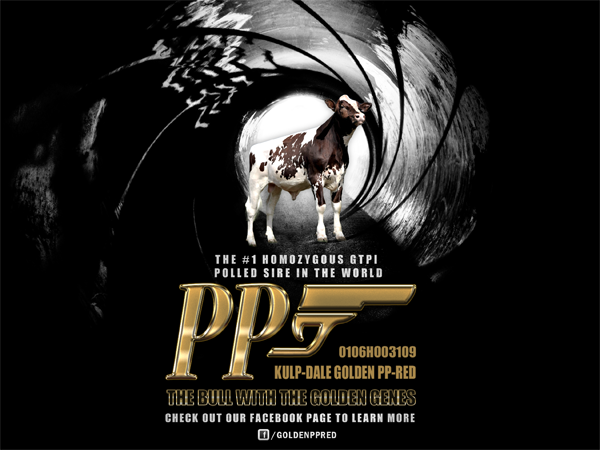
Despite these achievements, Norm deflects praise regarding his breeding philosophies. “As I look at my office wall I don’t see a lot Premier Breeder Banners.  If I did breed a good one it was pure luck.  For that question I would turn to somebody like Darin Meyer or Frank Regan or Jeff and Alta Mae Core.  I find it amusing all the people that talk about breeding cows and breeding philosophies and the ones that do the talking are not the ones that have bred great herds like De Su or Regancrest or Keightley Core”.

Great Mentors, Great Minds and Great Stories

He has definite opinions about those who have influenced him saying, “My parents and then several including Max Gordon, Lew Porter and, in later years, David Younger and Peter Heffering (Read more – Hanover Hill Holsteins: Peter Heffering 1931-2012).  My dad and mom started with nothing and worked harder than anybody I have ever seen.  My dad was as good a cowman as I have ever been around.  Max Gordon was a genius and such a class act.  Lew Porter taught me attention to detail.  I was blessed to have considered Dave Younger and Peter Heffering personal friends and would talk to them on a weekly basis and, toward the end, more often.  I learned so much from them.  Not to offend but “they don’t make ‘em like those anymore”.

REGANCREST JUROR BRINA EX-92-4YR-USA GMD

REGANCREST JUROR BRINA EX-92-4YR-USA GMD

Norm’s PEN Pals in the Barn

Norm looks for value in people and has favorites in the barn as well. Frank Regan’s Dellias and Barbies are Norm’s choices for a cow family that has had the greatest impact on the breed. “”I have had the great opportunity to have lived close to them and watched their remarkable progress.  I worked with the first daughters of Durham and Barbie’s dam “Brina” and believe she was one of the all time great show cows EVER.  These two cow families breed so true that they are as close to sure things as there are in this business.  I must say, in the Jerseys, Duncan Belle and Veronica have set the bar very high.”

Taraley Astro Sherry EX-97-2E

Taraley Astro Sherry EX-97-2E
ALL-CANADIAN MATURE COW,4-YR
ALL-AMERICAN MATURE COW 1998,1996

Norm’s strong feelings don’t stop with his own cows although he avoids naming a favorite saying, “This would be like me asking a parent which of their kids is the greatest?  I have a few that are special.  Gil-Bar Unique Bonnie who was supreme champion at Madison, Taraley Astro Sherry (owned her for 2 days but she helped my confidence level a bit.) Quality Ridge Stormi Hazel (what a doll).  Response Wonder, was a Jersey we owned for a month that might have been the greatest show cow I ever saw including the previous mentioned three cows.”

Norm with PEN in Hand

Since Norm’s first visit to the National Dairy Cattle Congress, he has been drawn to such dairy showplaces and returned every year. “I was captivated by it,” Nabholz said. “I remember everything, from the smells to the sights, sounds, and the people.  It’s why I’m in the business that I’m in today”

Millionaires in the Cornfield:  The Glory Days of the National Cairy Cattle Congress

Millionaires in the Cornfield: The Glory Days of the National Dairy Cattle Congress

In time for the 100th anniversary of the fall tradition, Norm penned a book recalling those days and “some of the greatest cows God created.”  He wrote “Millionaires in the Cornfield:  The Glory Days of the National Dairy Cattle Congress.” (To order the book contact Nabholz Farm) Nabholz said he wrote the book because the last great show at the Cattle congress was in 1965, and he wanted to record the stories of the people who were there before that generation passed”. Not only a record keeper, Norm is also an active admirer, “For days I’d just live in the past, remembering,” he said. “The millionaires of the cornfield were my idols, my rock stars.”

With GAVEL in Hand:  From Show Ring to Auction Sale

While admiring those men and women around him, Norm Nabholz quietly established himself as a respected cow man as well.  Today he sells cattle ranging from commercial animals for people who milk to show cattle.  He also shows and judges dairy cattle and reads pedigrees.  A simple resume that covers the facts of his career in the show ring as showman and judge, and in the sale box, as pedigree announcer or auctioneer.  The facts but not the fine points of his attention to detail, eye for type, love for cattle and day-to-day passion for the dairy industry.  Nabholz Sales Company — biannual Field of Dreams Sale which celebrated Sale VI in 2011. Whether he’s reviewing past successes or working with a team to present the best of today, Norm takes great pleasure in working hard and doing a good job at whatever he turns his hand to and then, diverting the praise to everyone else.

Change is Normal.  Love is the Key.

Clone of the Million Dollar Apple! She sold for $30,100

Clone of the Million Dollar Apple! She sold for $30,100

Whether looking back or looking ahead, Norm is well aware that the only sure thing is that change is going to happen.  “So many changes have occurred, some good, and some not.   Technology has done so many great things to help with the care of cows and farming in general but perhaps has not helped create a new generation of cow people.  The last generation spent more time with their cattle and that meant they learned what made them tick.  Knowing a cows weaknesses made it easier to improve on them.” Considering technology somewhat further he makes two predictions and voices a concern. “Robotic milking will become the norm.  Efficiency will be a word used more often than it is now.  Something will have to be done with milk marketing in the U.S. The world will get smaller and smaller when it comes to genetics.” For someone starting out, Norm looks back at his decades in dairying and points out a truth he has learned. “You have to love this business to survive.  It will give you the highest of highs and the lowest of lows.  Being able to handle both will dictate how you survive.”

Norm says, “The cows are second to the people.”

Norm has no problem when facing difficult questions or situations.  When asked, “If you could learn to do anything in an hour, what would it be?” he answers in a flash. “Learn the art of political correctness.”  The dairy business – especially for those with a pen in their hand — can be quite challenging from that point of view. However, in Norm’s case, it goes without saying that he is driven by the best motivations and has been quoted as saying that “If you think the cows are impressive” you’re going to be amazed when you look at the people behind them.  “The cows are second to the people.”  He has a clear idea of the people he enjoys (everybody!) however if he had to narrow it down to few on an island he has a quick plan ready in response. “I have been told that I am not a very good vacation person, so being on an island, without the conveniences I so enjoy, would be tough.  But if I had to be there, it would be fun to have Ray Brubacher, Bill Fetherstone, Bob Morrell and a couple of bottles (maybe more than that).” Like his halter, pen and gavel, Norm knows that it’s important to have the right kit at the right time. He concludes, “We would laugh and wouldn’t the stories be cool?”

The Bullvine Bottom Line

There is no doubt that Norman Nabholz has already left a strong influence on those near and far, who are privileged to have known him. He is a gifted thinker, talented cowman and a sincere ambassador of all  that is great about the characters and cows that are building on the past to move the dairy business forward.  For this dairy man “Exceptional” is the every day “NORM”.  Thank you Norman Nabholz.


Get original “Bullvine” content sent straight to your email inbox for free.


[related-posts-thumbnails]

What the Experts Will Tell You about Who Is Winning the Genetic Improvement Race

Every country loves to tell you that they have the best Genetics in the world and that their cattle are superior to any others.  At a recent International Committee for Animal Breeding (ICAR) Session in Cork Ireland, a group of leading geneticists got together to discuss lots of highly scientific and many mind boggling things.  Tables upon tables of stats and graphs that look more like maps of the solar system and would make most people’s heads spin.  However, from that session there were some really interesting presentations about genetic improvement around the world that just needed to be “translated” into dairy speak.  The following is the Bullvine’s attempt to de-nerd the nerdy.

Look Who`s Talking

Canadian Dairy Network Researchers, along with an associate, presented a paper entitled “Genetic improvement: a major component of increased dairy farm profitability’.  To be totally honest it was the ‘profitability’ word that first drew our attention but on reading the paper, studying the power point presentation and listening to the video of the presentation on the Internet (http://www.icar.org/Cork_2012/index.htm) we garnered many interesting facts about the genetic merit of bulls and genetic trends by year for many traits in seventeen countries for the time period 1997 to 2006.  Sixteen of the seventeen countries studied were sampling more than 200 dairy bulls per year and in the USA both the TPI™ and Net Merit were included in the analysis since both are widely used total merit indexes.

Genetic Progress –Which Countries are winning the genetic race?

Are breeders in these 17 countries making genetic progress?  Definitely yes!  It is difficult to compare across countries given the multitude of ways of expressing sire proofs for traits across countries.  Therefore, the researchers converted the expression to standard deviation units (SD unit) and summarized the results in the accompanying graph comparing the time periods 1997-2001 to 2002-2006.

Yearly genetic progress by country and trait

Yearly genetic progress by country and trait (bulls born 2002‐’06)

It is interesting to see that while many of the major genetic markets in the world are advancing at similar rates, the Nordic countries are giving the United States a run for their money and the Canada was the sixth fastest advancing country, almost 18% behind the genetic advancement rate of the US and the Nordic Countries.

Canada`s NOT First

So I am sure many of my fellow Canadians are saying that we are ahead in the race, others may be gaining on us, but we still have the best cattle there are.  Well folks I hate to burst your bubble but as the following chart shows, for bulls born in 2005-2006, it’s actually the United States that are out ahead followed by France and Italy.  Canada comes in sixth, behind the Nordic regions and the Netherlands.

Average EBV of bulls born 2005‐'06 'for the 17 country average index

Average EBV of bulls born 2005‐’06 ‘for the 17 country average index

Genetic Progress by Trait – The Leaders and the ‘Also Rans’.

  • Protein Yield: Increasing rates of genetic gain have been achieved by all countries except for Ireland and New Zealand where progress has been flat lined due to the major selection emphasis being on fertility and other management traits.  The leaders for the increased genetic progress in protein yield are France, Nordic Countries and the Netherlands.
  • Overall Udder: The rate of genetic progress for udder is also building at an increase rate with the leaders being Italy, Canada and the USA.  Selection for udder improvement was not part of the breeding strategy in New Zealand and Ireland and no genetic progress was made for udders in those countries.
  • Longevity: Very significant progress was made for longevity in all countries with the leaders being Ireland, Italy, New Zealand and the USA with France following behind the rest of the pack.
  • Somatic Cell Score:  No genetic gain was made in any country from 1997-2001 for SCS.  However that turned around after 2001 and all countries made progress with the leaders for genetic progress being the USA, the Nordic Countries and Canada.
  • Calving to First Service: Ireland and New Zealand have made progress since 1999 and are significantly out in front of all other countries.  For the other countries there was negative progress until about 2003.  Since then all countries have started to give attention to this trait and the tide has turned to where slight progress was being made by 2006.  After Ireland and New Zealand, The Nordic Countries are leading the other countries in increasing their rate of genetic progress for this fertility trait.

So what happened to production?

There is Reduced Emphasis on Production. By way of example the researchers provided a graph (below) showing how The Netherlands and Ireland have gone from 100% emphasis on production traits in their total merit index in 1995 to approximately 30-35% in 2012.  While the USA and Canada have been more moderate in their reduced emphasis on production traits, from 70% to 45-50% in their 2012 total merit indexes.  There is more to breeding than all out selection for production but it is still an important component in the total scheme of things.


Relative emphasis in national selection indices

Relative emphasis in national selection indices

What Traits are Driving Progress?

When you take a look at the average genetic progress by trait across countries (graph below) you  see that the rate of genetic advancement in each area reflects the relative weighting change in each country`s  major index.  With the rate of genetic gain on longevity, health and fertility greatly improving and that for the production trait (protein) actually showing a slightly slower rate of genetic gain.  It is interesting to note that in the period of 1997-2001 the primary emphasis on protein improvement actually had a negative impact on the rate of improvement for fertility.


Average genetic progress by trait across countries

Average genetic progress by trait across countries

Different Strokes for Different Folks

As the chart below indicates, the relative weights each country put on each trait in their national indexes has a huge impact on the rate of genetic gain for those traits.  We understand that not every country dairy’s under the same circumstances.  Hence why for Japan places 72% of the emphasis on protein, fat and milk while the Netherlands places 26% of the emphasis on protein and fat yield.  Ireland and then the Nordic countries place the most emphasis on Health, Fertility and other management traits.  South Africa then USA (TPI™), Spain, The Netherland and Canada place the most emphasis on overall type.  Italy places the most emphasis on udders.  In addition, the USA (Net Merit) places the most emphasis on longevity.

Relative weighting of selection indices worldwide

Relative weighting of selection indices worldwide

The 2012 average weights placed on the various components in the 18 indexes are:

  • Production 48%
  • Type 17%
  • Longevity 11%
  • Fertility 11%
  • Udder Health  8%
  • Other  5%

Increased emphasis on functional traits in most countries has resulted in more genetic progress for these traits.  These advances were achieved without a reduction in the rate of progress for key production and conformation traits and without the use of genomic selection, since that new tool was not yet available. As genomic genetic evaluations were not occurring from 1997 to 2006, it will be interesting to see the trends for the five and ten years following 2006 when extensive use of gnomically evaluated bulls has occurred.

The Bullvine Bottom-line

Neither the art nor the science of dairy cattle breeding is dead.  In fact it can likely be said that rates of genetic improvement are about to accelerate.  Are we ready to keep up?


Get original “Bullvine” content sent straight to your email inbox for free.


[related-posts-thumbnails]

XTRA! XTRA! Don’t Miss the Canadian Dairy Xpo!

CDX LOGO - exhibitor“X” marks the spot for dairy lovers this February.  The inaugural Canadian Dairy XPO is being held at the Stratford Rotary Complex on February 6th and 7th, 2013.  CDX is the realization of a dream conceived by CDX founders, Jordon Underhill and Talo Tamminga, who felt passionately about providing a platform for the Canadian dairy industry, its people and its possibilities.

Lineup of “X”perts!

Day one of the two day event starts with Andrew Dellava, Marketing Manager of Hoard’s Dairyman Magazine.  This knowledgeable Master of Ceremonies will welcome everyone to an “x”citing dairy classroom education program, which includes several internationally recognized experts.  The program is designed to give you tons of content you can use from key people in the dairy industry.  This is where you get to have your questions answered on the following topics:

  • Genetic Advancement HIR trait
    • Brad Sayles, Semex Alliance – Canada
    • Dr. Bonnie Mallard, University of Guelph
  • Technology and Social Media
    • Billy Frey, Alltech Ag Network – USA
  • Nutrition
    • Dr. Charles Swab,  University of New Hampshire –USA
  • Global Dairy Summit Meeting
    • 5 dairymen from USA, UK, Hungary, Poland, Brazil and of course Canada
  • Economics and Animal Welfare
    • Joep Driessen, CowSignals, Netherlands
  • Consumer Connection
    • Lynn Crawford, Celebrity Chef Toronto, Ontario

“X”po Recognizes Female “X”pertise

The full spectrum of agricultural opportunities and leadership will be highlighted over the two-day program.  Three women who are making their mark in diverse areas of the dairy business are recognized by CDX.  Vicky Morrison, of Bally Bright Farms in Bright, Ontario is originally from Northern Ireland and now milks around 100 cows with her husband Mark.  They have recently installed two robots and she is keen to share her experiences and says she is “grateful to have worked with some wonderful people in research, extension and practical agriculture.”  Like Vicky, Kathryn Kyle, General Manager of Jersey Canada, encourages “all women passionate about the industry to step forward and take advantage of the countless opportunities our rapidly progressing industry has to offer.”  Kathryn is looking forward to face-to-face time with breeders who visit the exhibition halls.  Dr. Bonnie Mallard, Professor of Immunogenetics at the University of Guelph is one of those who is enjoying a career that grew from her lifelong connection with farming.  Her career journey has provided the opportunity to focus on learning about genetic regulation of the immune system and its impact on dairy health.  Her talks will highlight how these new genetic tools are ways to improve animal health and well-being as well as food quality and safety.

Excited to Explore

From the complimentary pancake breakfast that will start each morning to the demonstrations, exhibitions, genetics showcase, robotic showcase and extensive seminars, there is something for everybody at this showcase of dairy innovation.  Attendees will get to evaluate the latest tools and technology for growing their dairy business.  They will learn about initiatives and all that is dear to the heart of dairy cattle breeders and industry stakeholders.  Three tradeshow halls and the Britespan Cow Coliseum (itself a massive 65 ft x 300 ft structure) will guarantee that everything is bright, light and right at hand for spectators to discover.

Real Know-How and Real X-amples

Everyone knows that the best part of attending seminars is the one-on-one opportunity to ask questions, get answers and learn from the best in the industry.  The opportunity to get up close and personal with the leading technology will be a definite highlight of CDX.  Three demonstrations will be feature twice daily in the Britespan Cow Coliseum.

  • Real Time Somatic Cell Count Testing Using An iPhone
    Milk GuardianTM using patents pending technology From Dairy Quality Inc. will demonstrate how after a sample is drawn, the device scans the milk, an image is captured and analyzed and displayed on the iPhone seconds later.  The cell activity will then be shown to spectators on a TV screen.
  • Live Colostrum Management/Feeding Demo
    The unique aspect of the ColoQuick system is a hygienic way of handling and storing colostrum without de-naturing it.  The demonstrations will show how pasteurized colostrum can be taken from frozen to feeding in less than 15 minutes and immediately fed to newborn calves.
  • Live Demonstration of Tranfaunation Using the Rumen
    Transfaunation involves the removal of rumen fluid from a healthy herd mate that is then drenched into a sick cow.  In addition to treating sick cows, research at Cornell University also shows the benefit of using this rumen fluid to greatly reduce scours in calves’ first 14 days of life.  Should every producer have a healthy fistulated cow on farm?  Come see for yourself!

As well there will be four simulated milking robot demos LIVE under one roof!

Canadian Dairy Xpo

Buildings are already being constructed.

Event organize enthusiastically proclaim that these robot demos are “first for the world!”  As the technology expands CDX is providing a showcase for dairy producers to see and compare the latest in robotic milking excellence.  They report: “In the last 15 years, milking robotics and on-farm automation have gone from expensive curiosities to redefining the dairy industry.  The growing use of robotics on Canadian dairy farms demonstrates that this technology is not only proven, but that there isn’t just one approach to farming anymore.”

X” tras  Make the Xpo Experience “X”ceptional!

It goes without saying that you will want to see Celebrity Chef Lynn Crawford who will be cooking with 4-H kids and photo opportunities with the TV star will be available.

Genervations will be selling tickets on four high genomic Holstein heifers that will be showcased in the Cow Coliseum as part of their dairy daughter showcase.  Not only an eye-full but also potentially a winning opportunity!  Tickets available to 4-H’ers at the XPO and a draw at the end of the XPO where one lucky youth will get choice of the 4 heifers for their 2013 4-H project…WOW!

Dave Carson Auctions will present an Elite Embryo LIVE auction with 100% of the sale commission proceeds going to 4-H. Support for 4-H and our future dairy industry is a recurring theme throughout the event.

The Bullvine Bottom Line

The Canadian Dairy XPO hopes to inspire both the current generation and the tech-savvy next generation.  Of course, the CDX TEAM has put their hearts into this event and are confident in saying to dairy lovers everywhere “We trust you will find this a rewarding experience!”.

Click here for a $10 off Admission Coupon

[related-posts-thumbnails]

All Talk and NO Action

Magazine ads promoting your herd cost a lot of money. So why are you wasting all that hard earned cash with no results? The ads that get the most attention are the ones that are eye catching, keep it simple and, most importantly, have a clear call to action.
Roy - ABS Global

You Can’t Have a Great Ad without a Great Photo

There is no question that dairy breeders love looking at great pictures of cattle. Instead of just a boring side shot, try to get different angles of your cattle. Three quarter rear shots are great at grabbing attention. Show multiple angles of your cow, in order to gain maximum attention.

The best ads use images that are interesting and large! As a general rule, your graphics should take up at least a quarter of your available space and can go up from there. Small graphics are distracting to your readers and do not have enough interest to draw a reader into the ad. (To learn more check out our interview with the best in the business, Patty Jones, about how to get the perfect picture).

Does it catch the readers Eye?

Tha Magic of Francesca

Read more about “The Magic of Francesca

Once you`ve got good photos! Make sure you get an eye-catching ad developed to go with them.  Print ads must be eye-catching and attractive to draw the viewer’s attention.  As Pam Nunes, the designer behind the great Ocean View Genetics ads says, “Remember…the purpose of an ad is to attract the reader’s eye enough to get them to read it…and want more.” (Read more – Ocean View Genetics: The Fine Art of Marketing Great Breeding).

There is no substitute for creativity.  Yes it takes more time and effort! However, it’s required in order to stand out from the crowd.  With the major dairy cattle magazines awash with ad after ad, and row after row, of cattle pictures, you need to make sure you stand out from the crowd.  The best way to do this is to think about the reason why you are doing the ad in the first place.  Who is the animal? What is the message that you want everyone to remember?

The”cow” is the center of your story.  If the best part of your cow, or the point you want to make is your cow family’s ability to produce great udders, then make the whole ad one large shot of her udder.  Keep your ad simple and put the detailed information on your website. Remember you want to accentuate how your animal is different and why they would want to buy your genetics.

Don’t Forget Your Call to Action

Probably my biggest pet peeve in all dairy cattle advertising happens when there is no call to action.  What is the point of spending all that money?  Exactly!  You want them to take action.  That is why the best ads make it very clear what that action needs to be.

In today’s age of the internet and social media there is no need to try and tell an animal’s entire history in the ad.  Instead make a clear call to action that brings them to your website or, better yet.  your Facebook page to get further information.  On those two sites you can have more daughter pictures and the rest of the story.  Breeders love big pictures so why try to squeeze so many shots into a small ad?  Instead give them one good eye catching image, with a clear call to action to come to your Facebook page to see more.

Facebook really can add a great dimension to your magazine advertising.  Recently I saw the following ad by Posal Farms that really get’s it.  It has two great cattle shots, not too much text and a definite call to action.  Posal is really leveraging the power of Facebook and is running a contest where you can vote for your favorite (Posal Daughter Contest).  In their ad, dead center and clear to all who read it, is the call for the reader to visit their Facebook page where they can be the judge.

 The Bullvine Bottom Line

Magazine advertising represents a large portion of many breeders’ promotional budgets. It is no longer enough merely to post an ad.  To attract the buyers you’re seeking, your ad must stand out and get attention.  Most of all it has to have a clear call to action.  An ad that is all talk and no action, results in no revenue.

Want to take your marketing to the next level, download our free guide “The Dairy Breeders Guide to Facebook“.

Want to take your ad’s to the next level, check out our dairy ad design services.

[related-posts-thumbnails]


Send this to a friend