Archive for market volatility

2026 Dairy Rally Or Dead-Cat Bounce? The Risk and Margin Math Behind Today’s Wall of Milk

Milk prices are up, but the world’s awash in milk. Have you actually run the 2026 risk math on your own herd yet?

Executive Summary: Early‑2026 dairy markets finally show some life, with GDT and CME prices moving higher, but global milk production is still expanding in the US, EU, New Zealand, and South America. That leaves us in a classic “relief rally” sitting on top of a wall of milk, as USDA forecasts more US output in 2026 and European and South American exports keep pressure on world prices. Cheaper feed has helped, yet many herds remain just one dollar per hundredweight away from losing—or gaining—six‑figure income, especially at 400–600 cows. This feature turns that big‑picture tension into simple margin math and walks you through what to do next: how much milk to lock in, how to rethink your cull list, and why components and fresh cow management matter more than ever. It doesn’t promise a magic fix; instead, it gives owners and managers a realistic playbook to de‑risk 2026 while keeping long‑term genetics and herd strategy in mind. If you want to stop guessing and start making deliberate moves in this rally, this is the article you read before your next marketing and herd meeting.

2026 dairy market rally

You know that feeling when the market finally throws you a bone, and you’re not sure whether to trust it? That’s exactly where dairy is sitting as we get into 2026.

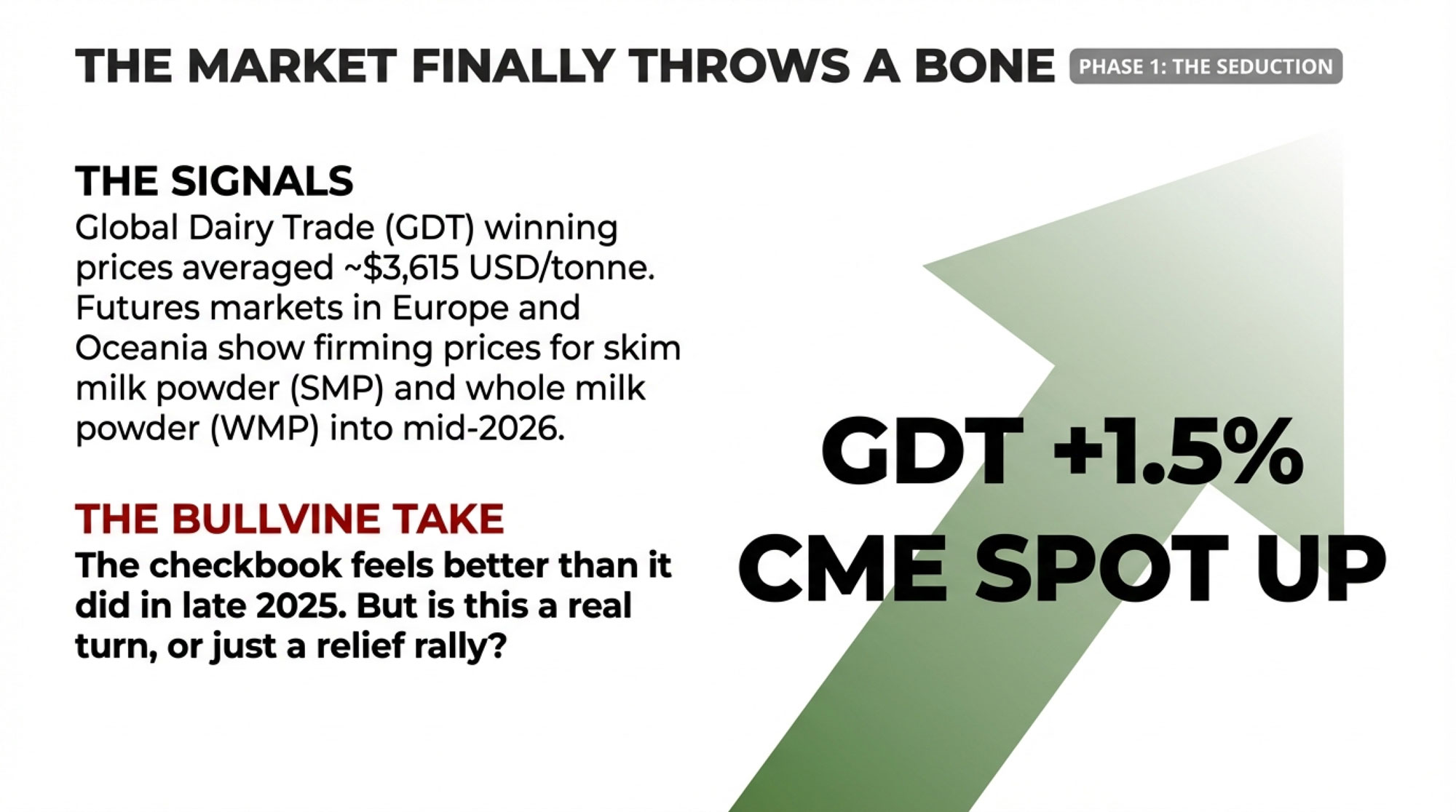
The Global Dairy Trade (GDT) index has just put together back‑to‑back gains. At the January 20, 2026, auction, market reports from Trading Economics show the GDT Price Index up 1.5%, with the average winning price around 3,615 US dollars per tonne, building on a 6.3% jump at the previous event.  CME spot prices have turned green as well, with recent coverage highlighting higher butter, nonfat dry milk, and cheddar block values compared to late 2025. 
RegionJan 2025Apr 2025Jul 2025Oct 2025Jan 2026 (Forecast)Apr 2026 (Forecast)Jul 2026 (Forecast)Oct 2026 (Forecast)
US19,20019,60020,10020,40020,70021,00021,40021,600
EU8,1008,2008,3008,2508,3008,3508,4008,380
New Zealand2,8002,9502,7502,6002,6802,8502,9002,750
South America1,4001,4501,4801,5101,5501,6001,6301,660

What’s interesting here is that this little rally is showing up while both USDA and global analysts are still talking about milk supply outpacing demand through at least early 2026. USDA’s January outlook, as reported by Dairy Star, puts 2026 US milk production at about 234.3 billion pounds—roughly 1.4% above 2025.  A summary of global conditions bluntly warned that milk supply is set to outpace demand in early 2026, echoing similar concerns in other industry outlooks. 

So the real question a lot of you are quietly asking—whether it’s in a freestall in Wisconsin or a tie‑stall barn in Quebec—is simple: is this a real turn, or just a dead‑cat bounce in a still‑oversupplied world?

Let’s frame the stakes. On a 500‑cow herd, a one‑dollar‑per‑hundredweight swing in milk price moves annual revenue by roughly 100,000 dollars. That simple math comes straight from basic revenue calculations: price times hundredweight sold. It’s the kind of back‑of‑the‑envelope number that dairy economists and extension folks often use when they talk about income risk per herd.  That’s why getting this call even roughly right matters a lot more than just the color on your market screen. 

A Quick Snapshot Of Where We’re At

Looking at the latest numbers:

At that January 20 GDT event, official summaries show whole milk powder up about 1%, skim milk powder up roughly 2.2%, butter gaining about 2.1%, and anhydrous milkfat (AMF) up around 3%. Total volume sold was just under 28,000 tonnes, with more than 160 bidders active.  That’s a decent mix of product strength and participation. 

On the supply side, USDA and industry outlets like Dairy Star report that US milk output has been trending higher into late 2025, and the 2026 production forecast of 234.3 billion pounds confirms that they expect more, not less, milk in the system.  Coverage of Europe and Oceania points to year‑on‑year growth in milk collections in many key exporting regions, too. 

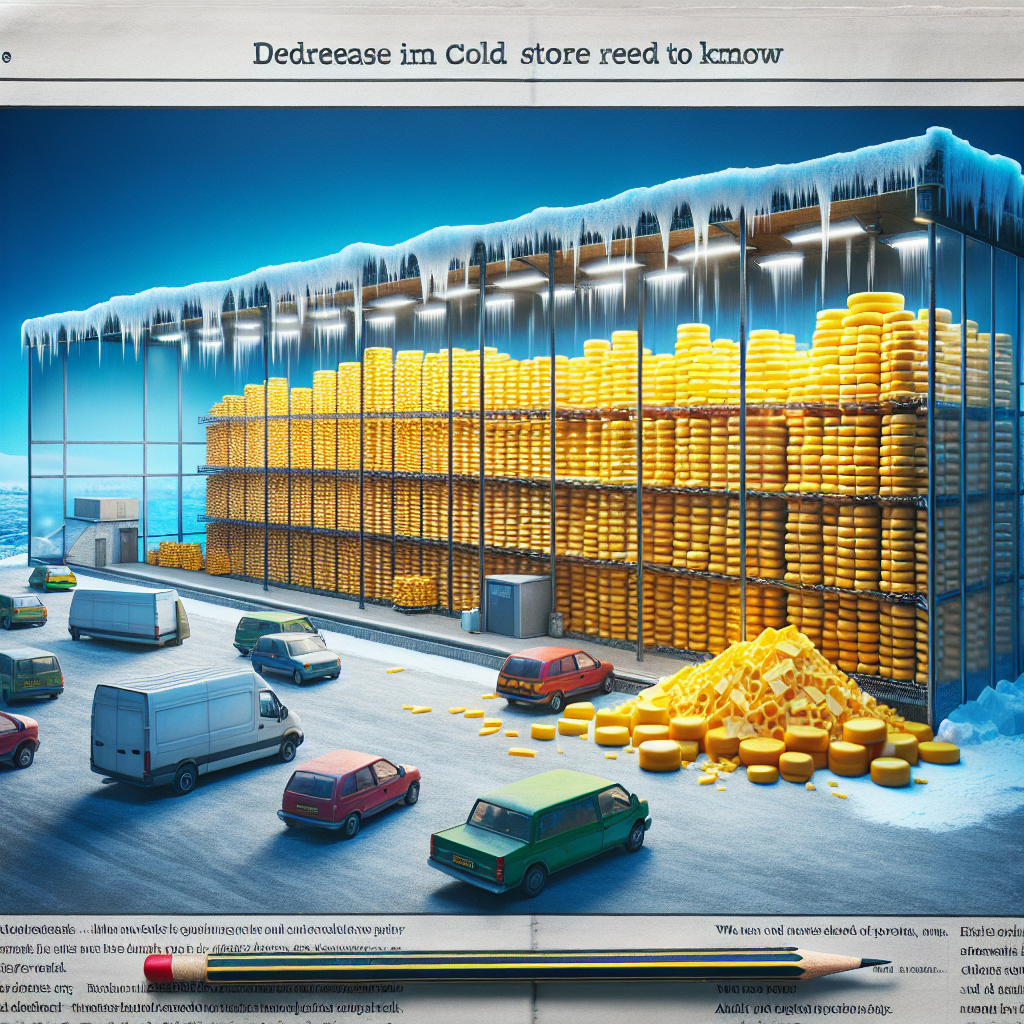
And then there’s storage. Reports that at the end of 2025, butter stocks sat around 199.3 million pounds in US cold storage—roughly 7% lower than a year earlier—but cheese inventories were higher than mid‑year levels, reflecting strong production but also resilient export demand. 

So yes, prices are better than they were in late 2025. But the wall of milk hasn’t magically disappeared.

ProductLate 2025 LowJan 20, 2026 (GDT)2024 Average% Gain (Late 2025 → Jan 2026)
Butter ($/tonne)3,4003,6704,200+7.9%
Skim Milk Powder ($/tonne)2,1002,1502,850+2.4%
Cheddar ($/lb)1.621.681.95+3.7%

GDT’s “Less Product, Higher Price” Moment

What farmers are finding is that the tone at GDT finally feels different than it did in the second half of 2025. A Cheese Reporter summary notes that the January 20 auction saw the GDT Price Index rise 1.5%, with fats and powders mostly stronger.  Earlier coverage flagged a shift in late 2025 toward fewer products offered at auction, which often puts upward pressure on prices even if underlying demand is only steady. 

Here’s what I think is worth noting: this isn’t just buyers suddenly waking up hungry. Put it plainly in a feature called “Global Dairy Trade: Less Product, Higher Price”—exporters have been trimming offer volumes and tightening how much skim they dry into powders.  That supply‑side adjustment is a big part of what’s lifting GDT, alongside stable—rather than booming—demand. 

Rabobank’s global dairy commentary, summarized in several industry interviews and articles, has been consistent: they see global supply still running slightly ahead of demand through at least mid‑2026, particularly in the US and EU, which limits the upside of these early‑year price moves.  So the rally is real, but it’s growing on a pretty thin root system. 

Futures: Hope With A Side Of Caution

If you look at how people are betting with real money, European and Singapore futures markets tell a similar story. Reporting in Dairy Global and other trade outlets notes that SMP and WMP strips on European and Oceania exchanges have firmed several percent for the first half of 2026, while butter values have been slower to move or even softened slightly in some contract periods. 

To me, this development suggests two things at once:

  • Markets are willing to pay a bit more for powder and fat into mid‑2026 than they were in late 2025.
  • At the same time, the more muted response in butter curves underscores that traders don’t believe the oversupply problem is solved.

For those of you whose milk cheques are influenced by European or Oceania references—either directly or through export pools—those curves are an early warning light. They’re signaling opportunity, but they are not signaling “party like it’s 2014.”
Europe: Cheaper Butter, Plenty Of Milk

Looking at this trend in Europe, price and volume aren’t exactly moving in the same direction.

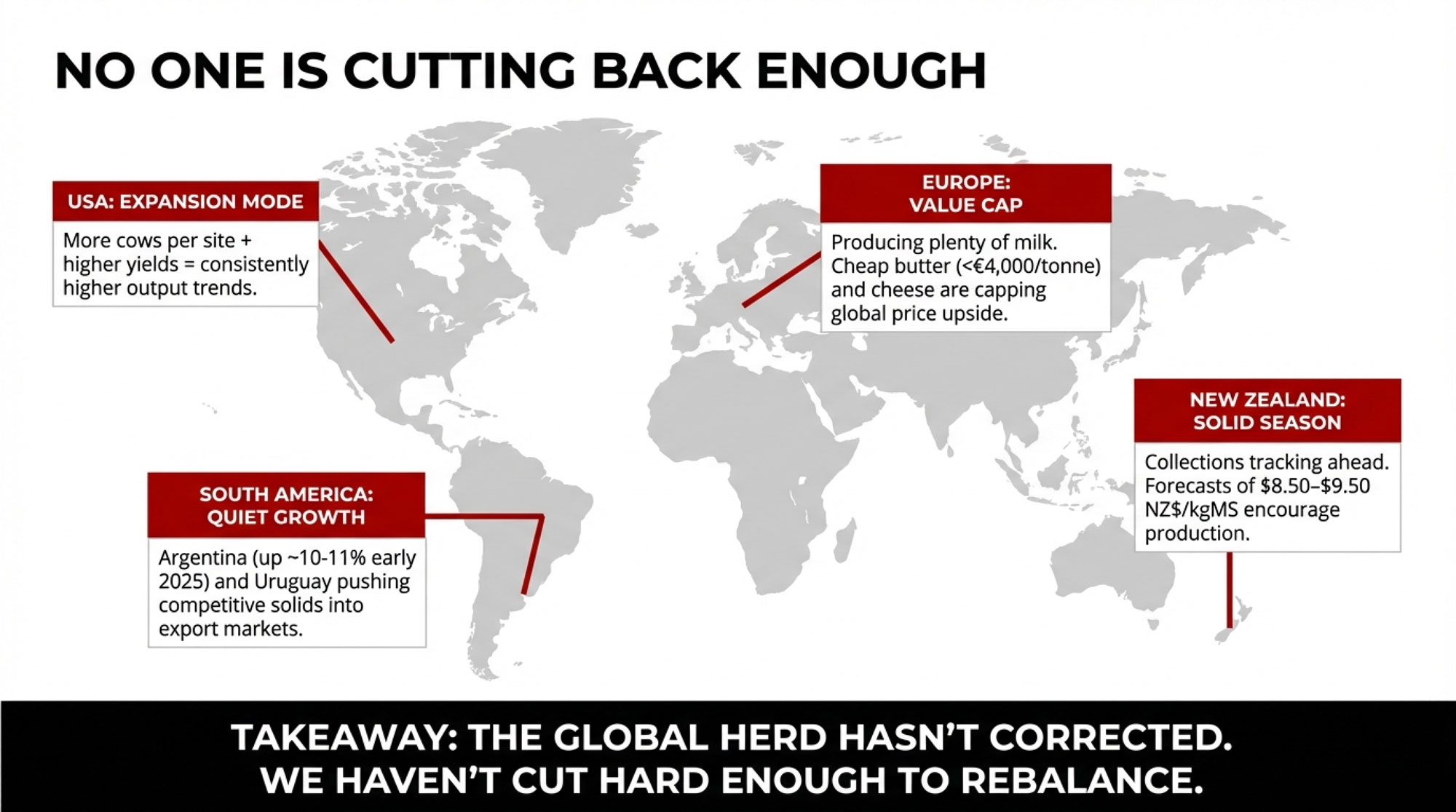
Reports show that European butter prices were heading toward or even dipping below 4,000 euros per tonne as 2025 wound down and 2026 began, a sharp drop from the higher levels seen a year earlier.  Skim milk powder prices have stabilized somewhat from their lows but remain notably lower than 2024 values. Cheese values in Europe—cheddar, gouda, and mozzarella—have also been trading at discounts to year‑ago levels, according to EU market summaries and price transmission studies on the UK dairy market. 

On the volume side, AHDB and EU‑focused market reports show that milk deliveries across Western Europe, including key producers like the Netherlands and the UK, have been running ahead of 2024 levels, helped by relatively favorable weather and stable herd sizes.  An AHDB beef market update also notes a forecast of tighter Irish cattle numbers down the road, which reflects some structural shifts, but doesn’t suggest a dramatic collapse in dairy cow numbers in the short term. 

In plain terms, Europe is still putting a lot of milk through butter and cheese plants even as prices have eased. That cheap European cheese and butter is exactly the kind of competition that caps how far US and Oceania values can go before buyers in import regions switch to a different origin.

US, NZ, South America, Australia: Where The Milk Is Coming From

United States: More Cows, More Milk

On the US side, USDA and market summaries make it pretty clear: milk production has been trending higher into 2025, and the 2026 forecast of 234.3 billion pounds reflects an expectation of continued growth. Coverage of monthly production reports show repeated year‑over‑year gains in milk output through late 2025. 

It’s worth noting that USDA commentary captured in pieces like “USDA Expects More Cows, More Milk, More Dairy Products” points to both herd expansion and strong yield per cow as drivers of that growth.  That aligns with what many of us have seen visiting freestalls in the Midwest—more cows per site, better genetics and management, and higher pounds. 

At the same time, milk supply is on track to outpace demand in early 2026, which suggests that, collectively, we haven’t cut hard enough to rebalance.  Cull cow data and packer commentary through 2024 suggest slaughter has not spiked the way it did in some earlier margin squeezes, in part because strong beef prices have helped cash flow and encouraged some herds to hang on to marginal cows a bit longer. 

From what I’ve seen sitting at kitchen tables in Wisconsin and New York, it’s that emotional tug—“give her one more lactation”—that often keeps the bottom of the herd fatter than the balance sheet can support.

New Zealand: Solid Season, Tight Margins

Down in the New Zealand market, trend coverage shows that national milk collections were running a couple of percent ahead of the previous season as 2025 wrapped up, with both volume and milk solids up year-on-year. 

At the same time, Fonterra has updated its 2025/26 farmgate milk price forecast range more than once. In a September 2025 agribusiness note, Rabobank’s Australia/New Zealand team referenced Fonterra’s mid‑range forecast near 9.00 NZ$/kgMS after some adjustments. Reuters and other market outlets have also reported a revised forecast band around 8.50–9.50 NZ$/kgMS in late 2025.

What producers are finding in pasture‑based systems—whether that’s Canterbury or Taranaki—is that this mix of slightly higher production and a decent but not spectacular payout puts more pressure on butterfat performance, pasture utilisation, and fresh cow management. University of Waikato and DairyNZ extension pieces have shown that smart grouping, effective transition period management, and mitigating heat stress can increase milk solids per hectare without massive capital investment. 

South America: Quiet But Growing

In South America, Argentina is a good example of a region that’s not huge on its own but matters at the margins. A 2025 summary from Tridge, based on Argentina’s official dairy statistics, shows milk production up roughly 10–11% in early 2025 compared with the same period a year earlier, with especially strong growth in March.  Dairy Global has similarly reported improved performance in Argentina’s dairy sector, driven by better margins and stronger management. 

Uruguay has been posting sustained increases in milk production as pasture conditions improved and prices encouraged expansion.  All of that adds another flow of competitively priced solids into the world powder and cheese markets. 

Australia: Modest Recovery, No Surge

Australia, as Rabobank and FCC’s dairy outlook work emphasize, has not recovered to its historical production peaks.  Years of drought, high water costs, and herd reduction have shrunk the base. Current forecasts see only modest growth into 2026—more of a crawl upward than a surge. 

Australia still matters in certain niches, especially for some cheese and ingredient trade into Asia, but it’s no longer large enough to be the swing producer that rebalances the global market on its own.

China: Resilient Demand, But Not A Bottomless Sink

No matter where you milk cows, China is still a critical piece of your milk cheque.

Reports show that China has cut back on some categories of dairy imports in recent years, especially lower-value powders, as domestic production increased, but has continued to bring in substantial volumes of butter, cheese, whey, and other high‑value products.  A 2023 study on China’s milk and import markets in Cogent Economics & Finance also showed that rising imports of milk powders and dairy ingredients have significant impacts on domestic price dynamics, underlining how intertwined China is with world dairy markets. 

USDA and AHDB estimates place Chinese raw milk production in the low‑40‑million‑tonne range in recent years—up sharply from a decade ago as they’ve invested heavily in domestic herd expansion and modernisation.  So China remains a big, important buyer, but it’s no longer the bottomless sink it once seemed when domestic production was far smaller. 

On the policy side, industry news through 2024–2025 has highlighted growing trade friction between China and several trading partners, including the EU, across a range of ag products.  Some coverage has raised the possibility of additional duties on certain dairy categories, although precise tariff levels and timing remain uncertain. If those duties materialize, buyers may pivot more toward Oceania, the US, and South America, while EU exporters push more cheese and fats into other markets. 

For producers under quota in Ontario or Quebec, the take‑home isn’t “ship more litres because China’s there.” It’s to keep a close eye on butterfat and protein tests, over‑quota penalties, transport charges, and any changes to pooling as processors juggle export and domestic opportunities in response to this shifting trade landscape.

US Spot Markets: Butter Leads, Powders Catch Up

Back in Chicago, CME spot markets finally gave producers something positive to look at in early 2026. Market watchers reported that butter moved sharply higher in early January, with nonfat dry milk and cheddar blocks also gaining ground from late‑2025 lows. 

Cold storage coverage shows that at the end of 2025, US butter stocks sat around 199.3 million pounds, about 7% lower than in December 2024.  That’s not an emergency, but it does mean the butter pipeline isn’t bloated. When stocks are relatively lean, a bit of extra domestic retail demand or export buying can push prices around in a hurry. 

On the powder side, US production data indicate that nonfat dry milk and skim milk powder output has been somewhat lighter than in some past years, as more skim is diverted into cheese and higher‑value protein products.  That tighter dryer balance is one of the reasons NDM can rise even as national milk production grows. 

Cheese stocks, according to the same cold storage reports, ended 2025 higher than mid‑year levels but not at record extremes.  Solid US cheese exports to markets like Mexico have helped offset softer domestic foodservice demand.  So cheese isn’t tight, but it’s not disastrously long either. 

Margins: Cheaper Feed, But Not Enough Milk Price

Here’s where things get uncomfortable.
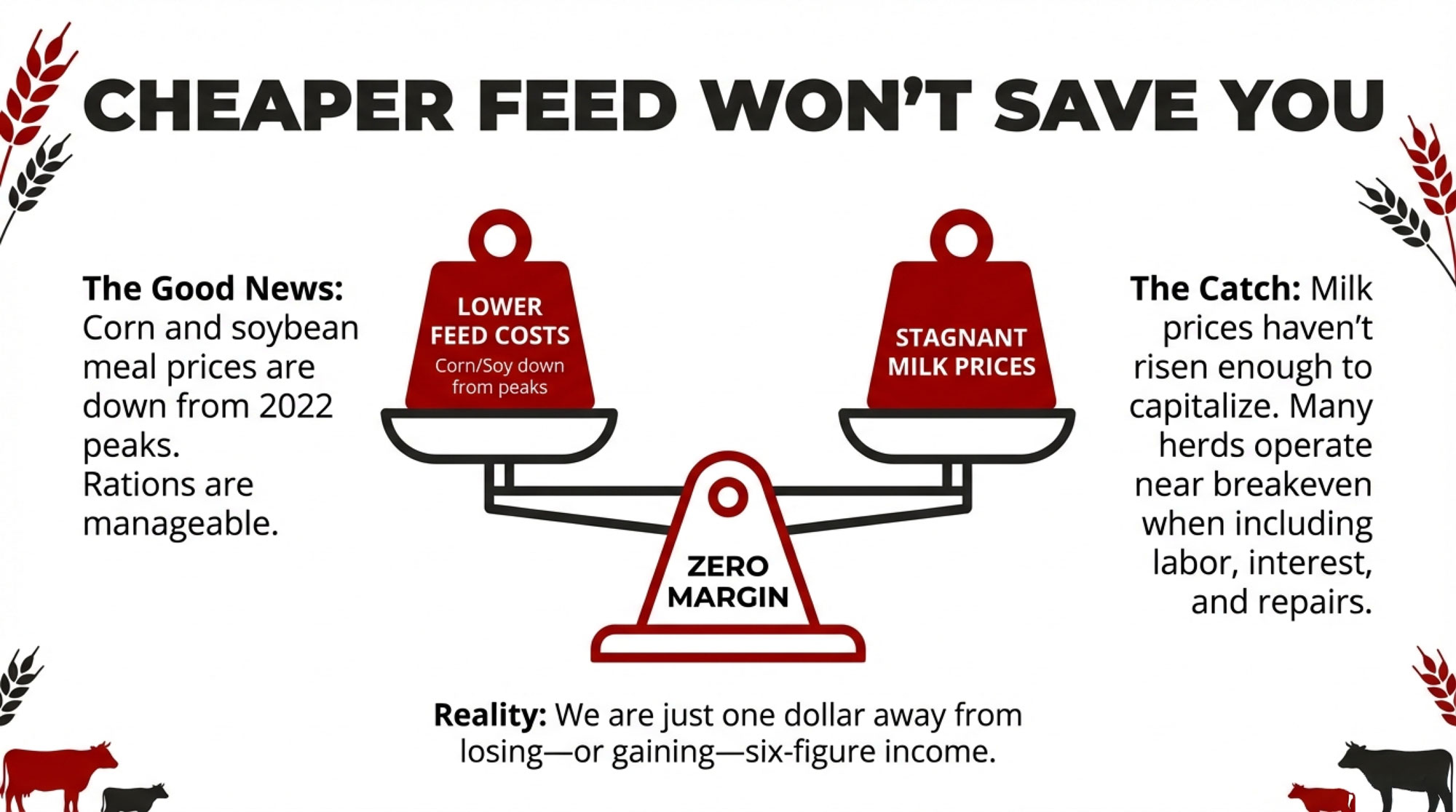
Feed costs are, thankfully, not where they were in 2021–2022. Corn and soybean meal prices have come off their peaks, a trend highlighted in several 2023–2025 dairy outlooks from FCC.  Many of you in the Midwest have told me that ration costs feel “manageable again” compared to a couple of years ago. 

The problem is that milk prices haven’t risen enough to turn those cheaper inputs into healthy margins for most operations. FCC’s dairy sector outlook and US‑focused extensions of that thinking suggest that many herds are still operating near breakeven once full costs—labor, interest, repairs, and a reasonable return on capital—are factored in.  USDA projections point to all‑milk prices in 2026 that are better than the worst of 2023 but still not generous. 

To make that more concrete, let’s walk through some simple example of math. Take a 200‑cow freestall averaging 24,000 pounds per cow. That’s 4.8 million pounds, or 48,000 hundredweight, of milk sold. At 18.50 dollars per hundredweight, you’re looking at about 888,000 dollars in milk revenue. If your true cost is 19.00—including feed, labor, interest, repairs, and basic reinvestment—that turns into roughly a 24,000‑dollar loss before family labor or any return on equity.

Now scale that up to 500 cows, and a one‑dollar‑per‑hundredweight gap can easily translate into a six‑figure swing in annual income. That’s the kind of gap you don’t fix by squeezing another kilo of milk out of the bottom tail of the herd.

Margin risk remains real even as headline prices improve.  That’s why risk tools like Dairy Margin Coverage (for smaller US herds), Dairy Revenue Protection, and forward contracting are still front‑of‑mind in a lot of conversations with producers and advisors. 

Herd SizeMilk PriceAnnual Milk Output (lbs)Gross Revenue
200 cows @ 24k lbs/cow
$17.50/cwt4,800,000$840,000
$18.50/cwt4,800,000$888,000
$19.50/cwt4,800,000$936,000
350 cows @ 24.5k lbs/cow
$17.50/cwt8,575,000$1,500,625
$18.50/cwt8,575,000$1,586,375
$19.50/cwt8,575,000$1,672,125
500 cows @ 25k lbs/cow
$17.50/cwt12,500,000$2,187,500
$18.50/cwt12,500,000$2,312,500
$19.50/cwt12,500,000$2,437,500

The Playbook: How To Use This Rally Before It Turns On You

So what do you actually do with all of this? Let’s get practical.

1. Use The Rally To Take Some Risk Off The Table

Right now, you’ve got:

  • A couple of GDT events are showing higher prices across key commodities. 
  • CME spot markets that have climbed off their lows in butter, NDM, and cheddar. 
  • A global outlook from the USDA are still warning that supply could outpace demand in early to mid-2026. 

So instead of asking “how high can this go?”, the more profitable question might be “how much of my risk can I reasonably take off the table here?”

That often looks like:

  • Sitting down with your buyer or risk advisor and discussing whether to lock in 20–30% of your expected spring and summer milk at today’s levels if the basis works for you. This is the kind of partial coverage that FCC and extension economists often recommend when margins are fragile but not catastrophic. 
  • If your milk cheque is heavily influenced by Class IV, using this stronger butter and NDM environment to revisit DRP coverage or processor contracts that give you some downside protection. 
  • For quota herds, watching over‑quota penalties and transport charges just as closely as headline pay price, since those can erase the benefit of chasing a rally with extra volume.

The goal isn’t to guess the top. It’s to make sure you won’t be exposed if this turns out to be a bounce, not a bull run.

2. Be Brutally Honest About Your Herd List

I’ve noticed that in just about every downcycle, there’s a point where the spreadsheets say “ship some cows,” but the heart says “she’s been good to us, one more lactation.” That’s human. But the current margin environment doesn’t have a lot of room for sentiment at the very bottom of the list.

Analysts tracking slaughter and coverage from beef and dairy outlets suggest that culling has been lighter than some past squeezes, even as milk output keeps growing.  That’s exactly the behavior that makes supply‑demand imbalances linger. 

Metric2023 (Normal Cycle)2025 (Actual)2026 (Supply-Balanced Target)
Starting Inventory (Jan)9.35M9.42M9.42M
Cows Needed for Production9.10M9.20M8.95M
Surplus (Over-herd)0.25M0.22M0.47M
Actual Culls (year)0.18M0.15M
Culls Needed (Supply Balance)0.20M0.27M0.47M
Culling Shortfall-0.02M-0.12M

So it’s worth sitting down with your vet, nutritionist, or trusted advisor and asking some pointed questions:

  • Which cows actually generate a positive margin once we charge them for feed, labor, stall space, and the opportunity cost of not having a younger cow in that spot?
  • Which fresh cows aren’t hitting their targets for milk and components, even with good fresh cow management in transition?
  • Is the bottom 10–15% of the herd dragging down average butterfat and protein enough to cost you more in lost premiums than they bring in on gross volume?

A 2024 systematic review in the journal Dairy on milk quality and economic sustainability underscored how subclinical mastitis, lameness, and other health issues hit both yield and component quality, and how strongly that feeds into farm profitability.  Another 2024 paper on mastitis risk modeling reinforced the importance of key transition-period management to prevent costly hits.  You don’t need those papers to tell you what you already know—but they confirm that this isn’t just a “nice to have” detail. It’s real money. 

Every system—tie‑stall, freestall, robotic milking setups, dry lot systems—will make different decisions about which cows stay and which ones go. But the global picture shows that, at a macro level, we’ve collectively kept more cows than the market wants.

Bulk Tank ProfileButterfat %Protein %Monthly Milk Cheque (Est. 300-cow, 72k lbs/month)
Below Average3.5%2.85%$18,720
Average (Regional Benchmark)3.7%3.0%$19,440
Above Average3.9%3.15%$20,808
Premium (Top 15%)4.1%3.25%$22,176
Bulk Tank ProfileMonthly $ vs. AverageAnnual $ vs. Average
Below Average-$720-$8,640/year
Average$0$0
Above Average+$1,368+$16,416/year
Premium+$2,736+$32,832/year

3. Follow The Protein Story, Not Just Butter Headlines

Butter tends to get all the attention. But what’s been growing for years is demand for dairy protein—whey, milk protein, and specialty fractions—both in sports nutrition and in the healthy aging markets. Reviews on protein markets and functional dairy ingredients, along with industry investment in membrane and fractionation facilities, confirm that trend. 

For your farm, that usually shows up in three ways:

  • Component‑based payment structures that put more dollars on protein and fat, not simply volume. That evolution has been documented in price transmission research on the UK and other markets, as well as in economic analyses of milk quality. 
  • Genomic proofs and breeding strategies that place more emphasis on components, health, and fertility traits (Net Merit, Pro$, LPI-type indexes) that better reflect long‑term profitability than just raw milk yield. 
  • The realisation that diseases like subclinical mastitis and lameness don’t just nick your bulk tank—they hit the more valuable parts of the cheque.

What I’ve found is that one of the most useful reality checks is simply tracking kilograms or pounds of protein sold per cow per day and comparing that to extension or milk board benchmarks for your region. If you’re below the pack, the fix isn’t always “buy more expensive feed.” Sometimes it’s cow comfort, stall design, milking routine, or getting more aggressive about removing chronic low‑component cows from the herd.

So…Is This Rally Real Or Not?

Here’s my straight answer.

The rally is real in the sense that prices at GDT, CME, and on the futures boards are higher than they were in the second half of 2025. What’s encouraging is that demand, especially for higher‑value fats and proteins, has held up reasonably well despite all the economic noise. 

At the same time, USDA and most media are all singing from roughly the same choirbook on one big point: unless something changes, milk supply is likely to outpace demand into early‑to‑mid 2026.  That doesn’t mean disaster, but it does mean the room for error is small. 

From where I sit, this looks and feels like a relief rally, not the start of a multi‑year bull run. That doesn’t make it any less useful—if you use it.

In the last few cycles—2009, 2016, 2020—the herds that came out stronger weren’t the ones that magically picked the top of the market. They were the ones that:

  • Used every rally to take a bit of price risk off the table.
  • Used every downturn to get more honest about their cow list, cost structure, and genetics strategy.

As we head into spring flush, your job isn’t to predict the exact GDT index three months from now. It’s to make sure you’re not naked if this bounce runs out of steam.

That means knowing your breakeven to the penny. It means deciding how much milk you’re willing to lock in if the market gives you a shot. And it means making a conscious decision on herd size and culling based on math and long‑term strategy, not habit or pride.

The wall of milk is still there. But the market is at least starting to respect good product again. You can’t control what Europe does, or how many containers China books this quarter. You can control how exposed your farm is if this rally turns out to be shorter than we’d all like.

And in 2026, that might be the most profitable decision you make.
Key Takeaways

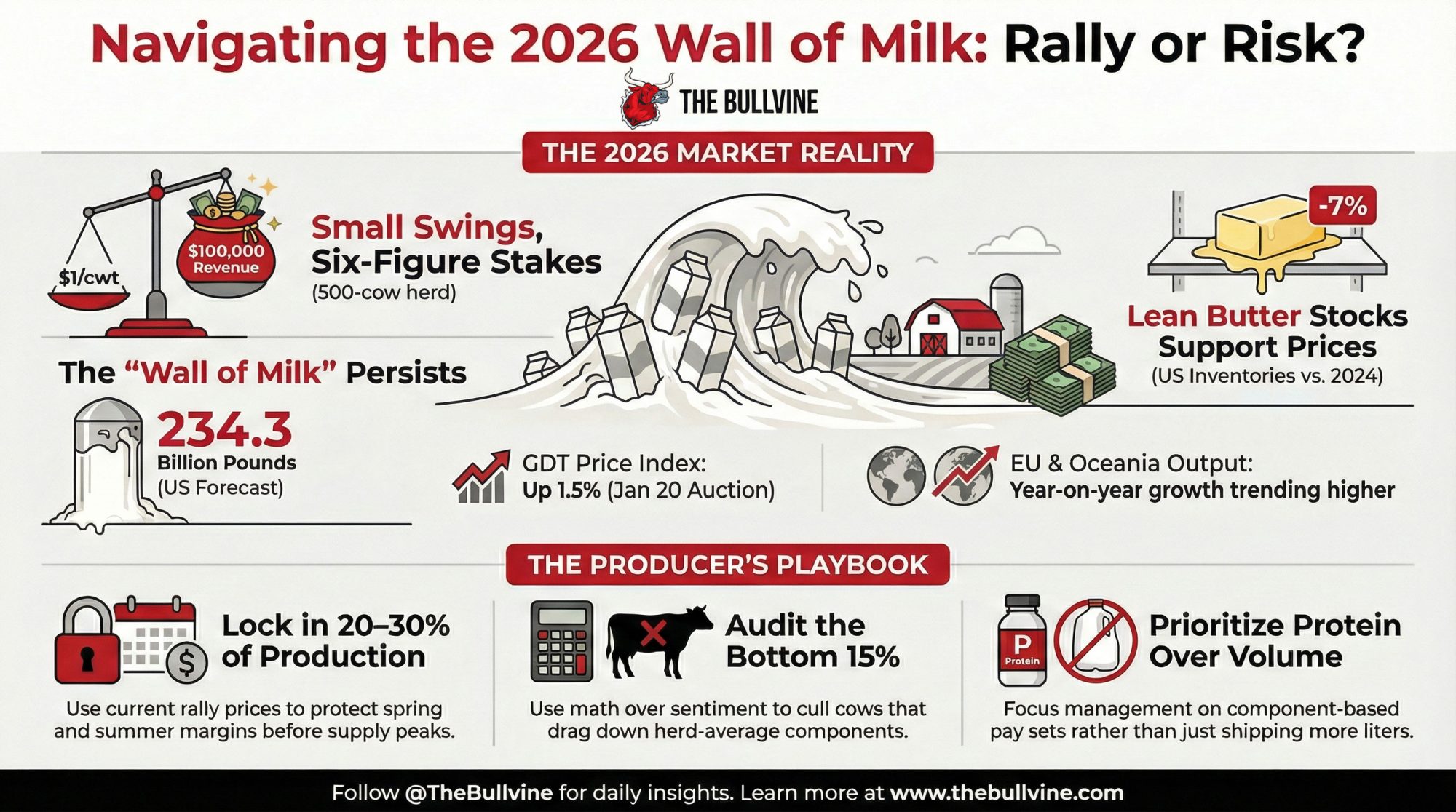
  • Rally is real, but fragile: GDT and CME prices are up in early 2026, yet global milk supply keeps growing—analysts call this a relief rally sitting on a wall of milk.
  • Supply isn’t slowing: USDA forecasts US milk output up 1.4% in 2026; EU, NZ, and South America are all still adding volume to world markets.
  • Margins are razor-thin: A 1 dollar per cwt swing moves roughly 100,000 dollars on a 500-cow herd—there’s almost no room for error.
  • De-risk now, not later: Lock in 20–30% of expected production, revisit Class IV coverage, and audit your cull list before spring flush hits.
  • Components beat volume: Shift breeding and management toward protein and butterfat performance—that’s where processor money is heading long-term.

Complete references and supporting documentation are available upon request by contacting the editorial team at editor@thebullvine.com.

Learn More

Join the Revolution!

Join over 30,000 successful dairy professionals who rely on Bullvine Weekly for their competitive edge. Delivered directly to your inbox each week, our exclusive industry insights help you make smarter decisions while saving precious hours every week. Never miss critical updates on milk production trends, breakthrough technologies, and profit-boosting strategies that top producers are already implementing. Subscribe now to transform your dairy operation’s efficiency and profitability—your future success is just one click away.
NewsSubscribe
First
Last
Consent

$90K Less Margin, 214K More Cows: Beef‑on‑Dairy, Calf Checks and Your 2026 Survival Playbook

Class III in the mid‑$16s, feed cheap, margins tight. The real test in 2026 is whether calf checks and components close your gap.

2026 dairy market outlook

Executive Summary: USDA’s latest Milk Production report shows November 2025 output up 4.7% in the 24 major states, with 214,000 more cows on line, even as 2026 all‑milk prices are forecast about $1.80/cwt lower—leaving a typical 300‑cow herd roughly $90,000–$100,000 short on milk income. This article explains why that expansion still pencils out for many farms once you put $1,400 beef‑on‑dairy calves, strong cull checks, and record U.S. cheese and butterfat exports into the equation. It shows how calf checks, better butterfat and protein performance, and DMC’s new 6‑million‑pound Tier 1 coverage can add $2–$3/cwt back into margins on efficient herds, while highlighting why high‑cost or heavily leveraged operations—especially in the Southeast, New England, and some Western dry‑lot systems—are under far more stress. From there, you get a straight‑talk 2026 playbook: know your true breakeven, use beef‑on‑dairy and components intentionally, lock in smart DMC/DRP protection, and be honest about scale, succession, and exit timing while calf and cull values are still on your side. It closes with three simple markers—Class III futures, cheese export volumes, and national cow numbers—to help you decide when this downcycle is finally turning instead of guessing from headlines.

Component2025 (at $21.05/cwt)2026 Forecast (at $19.25/cwt)Year-Over-Year Change
Gross Milk Revenue$1,452,450$1,328,250–$124,200
Beef-on-Dairy/Cull Income (est.)$32,000$42,000+$10,000
Net Revenue After Offsets$1,484,450$1,370,250–$114,200

You know, here’s what doesn’t quite add up when you look at where we’re starting 2026.

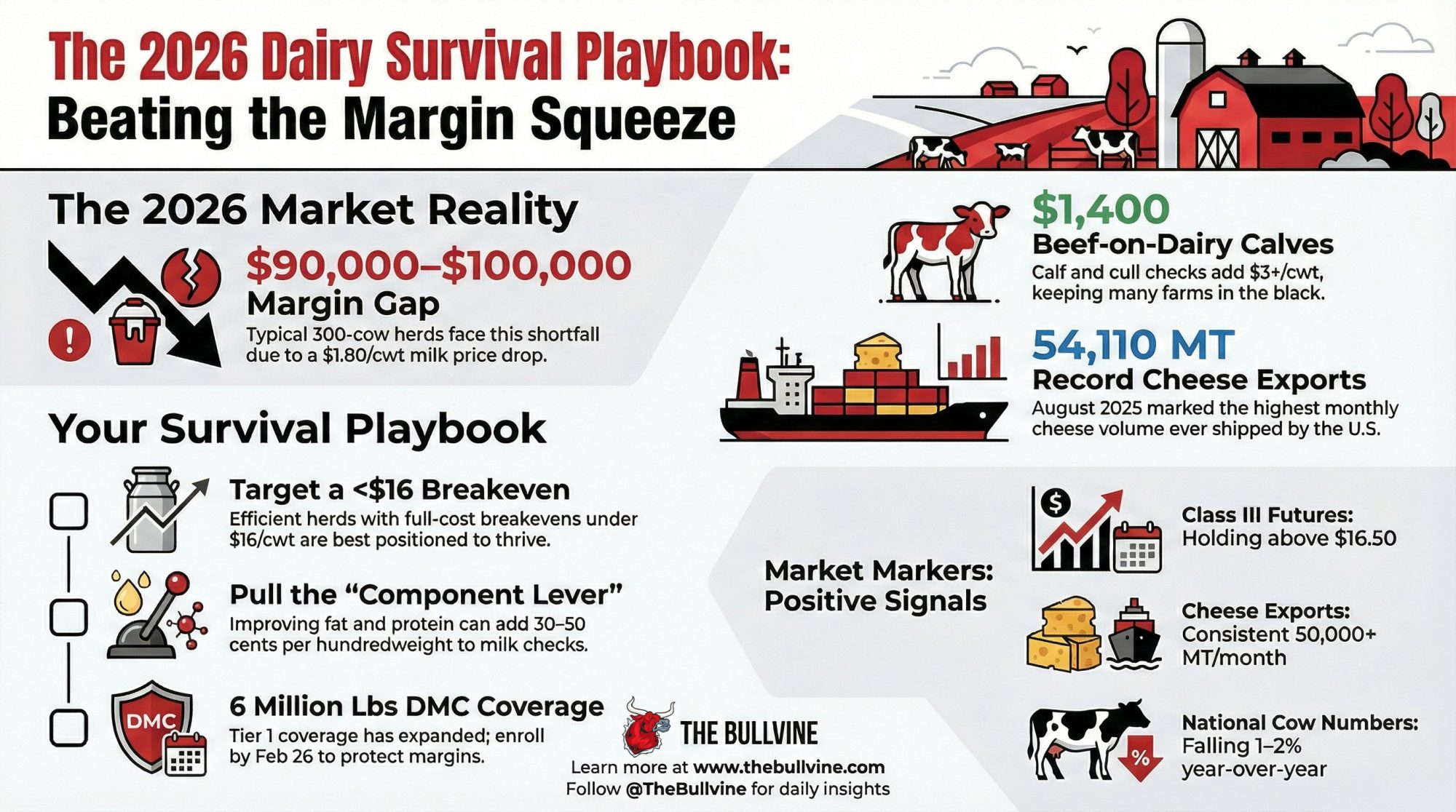
Most mid‑size herds are staring at roughly $90,000 to $100,000 less operating margin this year than they had in 2025, based on USDA’s all‑milk price forecasts and some pretty basic herd‑level math. USDA’s November 2025 Milk Production report put output in the 24 major states at 18.1 billion pounds, up 4.7% from November 2024, with total U.S. production at 18.8 billion pounds, up 4.5% year‑over‑year. That same report shows the milking herd in those 24 states at 9.13 million cows—214,000 more than a year earlier and even 1,000 head more than October.

So milk keeps coming, even as margins tighten to levels a lot of us haven’t had to stomach for a while.

On the face of it, that feels backward. But once you dig into the beef‑on‑dairy economics, the regional realities, and the way risk management and exports are behaving, the picture starts to come into focus.

Beef‑on‑Dairy: The Calf Check That’s Quietly Rewriting the Math

Looking at this trend, what farmers are finding is that beef‑on‑dairy has quietly become a major stabilizer in an otherwise stressful year.

Laurence Williams, who leads dairy‑beef cross development at Purina, reported in late 2025 that day‑old beef‑on‑dairy calves are now commonly bringing around $1,400 a head, compared to roughly $650 just three years earlier. Analysts ran the numbers and found that the combination of beef‑on‑dairy calves, cull cows, and related cattle sales has added $3.00 or more per hundredweight to the bottom line on many participating herds.

Revenue Stream2022 (Before B×D Surge)2025 (Beef-on-Dairy Established)Dollar Increase% of Total Revenue
Milk Revenue (Gross)$1,452,450$1,452,45087%
Beef-on-Dairy Calf Income$8,000 (dairy calves @ $650 ea)$35,000 (B×D @ $1,400 ea)+$27,0002.1%
Cull Cow Sales$18,000$22,000+$4,0001.3%
Component Premiums (fat/protein)$15,000$28,000+$13,0001.7%
TOTAL REVENUE$1,493,450$1,537,450+$44,000100%

That’s not a nice little bonus. That’s often the difference between red ink and black ink.

In barn after barn, what I’ve noticed is that producers are increasingly thinking of each cow as a two‑part enterprise: milk plus calf. If her butterfat performance and protein hold up reasonably well and she throws a high‑value beef cross calf, the calculus for one more lactation shifts. It’s no longer just, “Is she paying for her feed on milk alone?” It becomes, “Does her milk plus calf check more than cover her costs?”

CattleFax analysts have been pointing out that the U.S. beef cow herd is at its lowest level since the 1960s. That’s a structural shortage in the beef pipeline, not just a one‑season hiccup. In recent outlook presentations, CattleFax has said they expect beef and dairy‑beef calf prices to stay historically strong through 2026 and likely into the first half of 2027, because the beef herd just isn’t rebuilding quickly.

So when someone asks, “Why aren’t we seeing deeper herd cuts with these milk prices?” one honest answer is: because the calf checks and cull checks are doing a lot of heavy lifting right now, especially on farms that have leaned into beef‑on‑dairy in a disciplined way.

Global Milk Supply: Everyone Turned on the Taps at Once

Now, zooming out, here’s where it gets tricky. The U.S. isn’t expanding in a vacuum.

USDA’s Foreign Agricultural Service outlooks for 2025–2026 suggest that European Union milk production is holding near the high‑140‑million‑tonne range. Cow numbers in several EU countries are slowly declining, but productivity per cow continues to climb thanks to advances in genetics, feeding, and management documented in recent European dairy research. So you’ve still got a lot of European milk behind a very export‑oriented processing system.

In New Zealand, Fonterra cut its farmgate milk price forecast to around NZ$9.50 per kilogram of milk solids for the 2025–26 season. DairyNZ’s economic trackers show that at that level, many Kiwi farms are running on slender margins. But Fonterra’s seasonal updates have still shown collections heading into the Southern Hemisphere spring flush running ahead of the previous year across much of the country.

In South America, USDA attaché reports dindicate thatArgentina and Uruguay pare osting meaningful production gains over 2024 levels. While they’re smaller players than the EU or New Zealand, they add to the global pool of exportable milk solids and keep price presthe sure on whole milk powder amilk powder nd skim markets.

Australia is the one major exporter clearly constrained, with drought and water allocation issues limiting out,put in key dairy regions according to Australian government and industry reports. But Australia’s volumes by themselves aren’t big enough to offset Europe, New Zealand, and South America all pushing harder at once.

The bottom line on global supply is straightforward: multiple major exporting regions turned the taps up in the second half of 2025, and they’re all chasing a limited set of buyers. In that kind of environment, it doesn’t take much extra milk to lean hard on world prices.

Spot Markets and GDT: Trying to Find a Floor, Not a Rocket Ship

What’s interesting is that even in this heavy‑supply environment, the markets aren’t behaving like they d,id in some past downturns where everything fell off a cliff at once.

Take butter. USDA’s Cold Storage report released in late January 2026 shows U.S. butter inventories at the end of 2025 running about 7% below the year‑earlier level. That’s not wh,at most of us would expect given all the extra milk. But when you add in strong domestic demand for fat through the holiday season and the fact that U.S. butter has often been priced below European and New Zealand butter, it starts to add up.

Traders have responded to that combination with a firmer butter market than many had penciled in. That doesn’t mean prices are great, but it does mean there’s a recognizable floor.

Skim‑side products have been more volatile, but there ar,e some positive signs there too. At the Global Dairy Trade auctions in early January 2026, the overall price index climbed 6.3% at the first event of the year and another 1.5% at the next. Skim milk powder rose a little over 2% at the most recent auction, with butter and anhydrous milk fat also moving higher. Whole milk powder gained about 1%.

Analysts at AHDB in the U.K. and other market trackers have noted that these gains were broad‑based rather than driven by a single dominant buyer. Middle Eastern importers stepped up their participation to the highest share in roughly two years, and Chinese buyers returned to the platform more actively than they had in late 2024, even as China continues pushing its own domestic dairy expansion.

So are prices “back”? No. But they might be trying to carve out a base instead of sliding endlessly lower, and that’s worth watching.

U.S. Cheese Exports: The Quiet Workhorse in the Background

If there’s one bright spot that doesn’t get enough credit, it’s cheese exports.

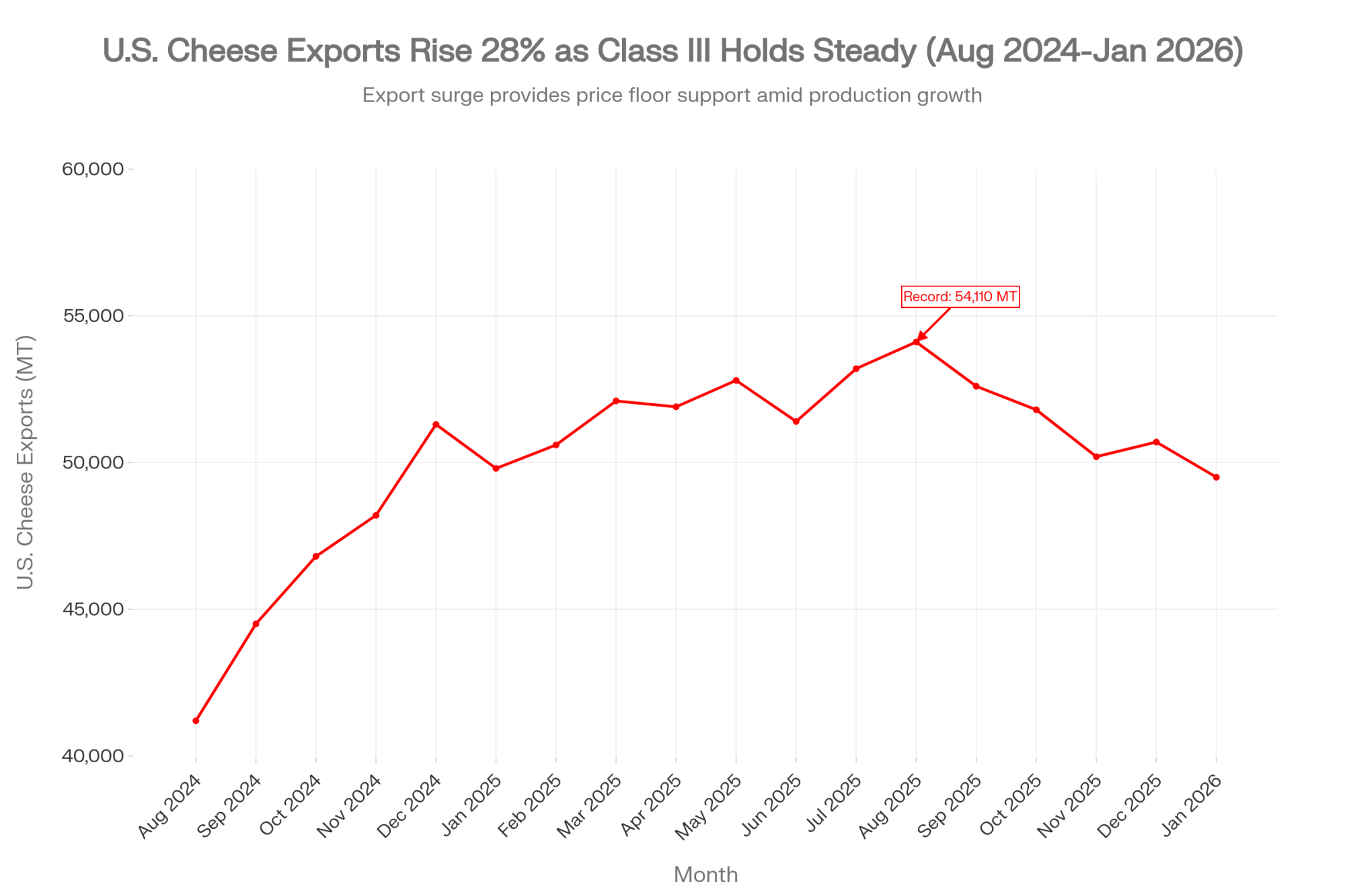
The U.S. Dairy Export Council’s November 2025 report highlighted that August cheese exports hit 54,110 metric tons, up 28% year‑over‑year and the highest monthly cheese volume the U.S. has ever shipped. August was also the fourth straight month where U.S. cheese exports topped 50,000 metric tons—a milestone that had never been reached before May 2025.

Analysts pointed out that South Korea’s cheese imports from the U.S. were up 84% compared to the previous year. Mexico, Central America, Japan, and Australia all booked sizable gains as well. Butterfat exports nearly tripled year‑over‑year, with butter and anhydrous milkfat shipments up close to 190–200% in some categories, as foreign buyers took advantage of relatively cheap U.S. fat.

A big driver is price. USDEC and several commodity risk firms have noted that U.S. cheese—especially cheddar and mozzarella‑type products—has been priced below comparable European and Oceania offerings for much of 2025. That discount, combined with new cheese plants in the central U.S., has given buyers reasons to shift more volume to U.S. suppliers.

Without that export engine—in both cheese and butterfat—we’d likely be staring at much bigger inventories and even lower domestic prices.

Feed Costs: A Tailwind That Still Can’t Outrun the Headwinds

Now, let’s slide over to the cost side of the ledger.

USDA crop reports for 2025 confirmed a big U.S. corn harvest and solid soybean production. That’s kept corn futures trading in the low‑to‑mid $4 per bushel range and soybean meal at relatively manageable levels compared to the spike years we all remember too well. When you plug these feed prices into the Dairy Margin Coverage formula, the feed‑cost component drops to some of the lowest levels we’ve seen since late 2020.

Land‑grant economists and extension dairy specialists have been pointing out that, at least on paper, this should be a “feed‑friendly” year.

But here’s where the math still bites: USDA’s outlook, as summarized by Southeast Ag Net and other ag media, has the 2026 all‑milk price averaging around $19.25 per hundredweight, down from about $21.05 in 2025. That’s a drop of roughly $1.80 per hundredweight. So even if feed costs trim 35 to 50 cents per hundredweight off your expense line, the net margin still narrows uncomfortably.

I’ve seen some herds with exceptionally strong forage programs and careful fresh cow management insulate themselves a bit more—they’re getting more milk per unit of feed, which helps. But nobody’s describing this as an “easy‑money” year.

How the 2026 Margin Squeeze Lands on Different Farms

Let’s put some real numbers to this.

Region / Herd ProfileTypical Herd SizeFull-Cost Breakeven ($/cwt)2026 Forecast Price ($/cwt)Margin/(Loss) at ForecastKey Headwinds
Upper Midwest (WI, MN)300–500$16.50–$17.00$19.25+$2.25–$2.75None acute; feed-friendly; strong components help
Texas Panhandle2,000–5,000$17.00–$18.00$19.25+$1.25–$2.25High debt from recent expansion; interest rate exposure
California Central Valley2,000–8,000$16.50–$17.50$19.25+$1.75–$2.75Water restrictions; regulatory costs; high land value
Southeast (Federal Order 7)150–300$19.00–$20.50$19.25–$0.25 to +$0.25Class I premium erosion; heat stress; long hauls to plant
New England100–250$20.00–$21.50$19.25–$0.75 to –$2.25High land, labor, & regulatory costs; insufficient scale
Upper Midwest (< 100 cows)40–100$22.00–$25.00$19.25–$2.75 to –$5.75Can’t spread fixed costs; limited premium market access
Mid-Size Growth (500–1,000)500–1,000$17.50–$18.50$19.25+$0.75–$1.75Debt servicing; succession clarity required

Imagine a 300‑cow herd shipping about 23,000 pounds per cow annually—roughly 69,000 hundredweight per year. At a $1.80 per hundredweight drop in milk price, you’re looking at about $124,000 less top‑line milk revenue. If beef‑on‑dairy calves and components are adding extra income, that might bring the net hit closer to that $90,000 to $100,000 range, but it still stings.

USDA’s Economic Research Service breaks milk cost of production down by herd size, and while the exact numbers vary year to year, the pattern is consistent. Small herds under 50 cows often end up with total economic costs—once you price in family labor, depreciation, and interest—well over $40 per hundredweight. Mid‑size herds from 100 to 500 cows commonly sit somewhere in the low‑to‑mid twenties. Large herds, especially those above 2,000 cows with efficient layouts and strong management, can get their full costs into the upper teens or around $20.

In Wisconsin and much of the Upper Midwest, extension educators tell me that herds with a true full‑cost breakeven under about $16 per hundredweight are generally okay at these forecasted prices, especially if they’re capturing strong component premiums and calf/cull income. Once that breakeven climbs into the $18–20 range, the stress shows up quickly in lender meetings.

In California’s Central Valley and the Texas Panhandle, a lot of the big modern facilities have very competitive operating costs on a per‑hundredweight basis but also carry significant debt from recent expansions. When interest rates sit where they are and all‑milk prices back up, those principal and interest payments can start to drive decisions just as much as feed bills.

The Southeast is fighting a different battle. Federal Order 7, along with Order 5 in parts of the Appalachian region, has long relied on Class I fluid milk premiums to keep blend prices workable. University of Kentucky and other regional economists have been documenting how declining beverage milk consumption reduces Class I utilization and erodes that premium. Combine that with higher heat‑stress mitigation costs, more challenging forage conditions, and long hauls to processing plants, and many Southeast producers describe 2025–2026 as one of the toughest stretches they’ve faced.

In New England, the story centers on high land values, strict environmental regulations, and costly labor. Even with excellent butterfat performance and strong protein, some mid‑size herds simply can’t spread those fixed costs across enough hundredweight to make the numbers work at a sub‑$20 all‑milk price.

So when you look at the national average projections, it’s worth reminding yourself: there really is no single “U.S. dairy market.” Your reality depends on your region, your herd size, your debt structure, and how you manage forage, cows, and risk.

What DMC and Risk Management Can—and Can’t—Do This Year

Given all that, it makes sense that Dairy Margin Coverage is back on a lot of producers’ radar.

For the 2026 program year, USDA’s Farm Service Agency expanded Tier 1 coverage from 5 million to 6 million pounds of milk. That’s a big deal for herds in the 250–300‑cow range, because more of their production now fits under the lower Tier 1 premium schedule. Penn State Extension, Texas Farm Bureau, and several other groups have all been reminding producers that enrollment opened January 12 and runs through February 26, 2026.

Risk‑management specialists like Katie Burgess, director of risk management at Ever.Ag, has been quoted as saying that their models point to DMC payments exceeding $1 per hundredweight for at least the first few months of 2026, with smaller payments likely into mid‑year if current price and feed forecasts hold. That lines up with what many margin calculators were showing as we came into January.

It’s worth noting that DMC is designed as a margin program, not a price program. So it’s the combination of feed cost and milk price that matters. In a year like this, where feed is relatively cheap but milk has dropped more, it can still provide meaningful support.

Beyond DMC, Dairy Revenue Protection (DRP) and Livestock Gross Margin for Dairy (LGM) remain important tools. Extension economists at universities like Wisconsin, Minnesota, and Cornell keep stressing a simple point: the farms that seem to manage volatility best are the ones that decide ahead of time what prices they’ll lock in and how much volume they’ll protect, rather than trying to chase the market in real time.

Practical Playbook: Questions to Take to Your Lender and Nutritionist

If we were sitting at your kitchen table with a pot of coffee and your last 12 months of milk statements, here are the areas I’d want to talk through.

1. Know Your Real Breakeven, Not Just a Guess

You probably know this already, but in a year like 2026, guessing at your cost of production is dangerous.

That means:

  • Putting real numbers on family labor (what you’d have to pay someone else to do those jobs)
  • Including depreciation on equipment and facilities, not just current payments
  • Accounting for land costs honestly, whether you own or rent

Once you’ve got that full‑cost breakeven per hundredweight, compare it to what you can reasonably expect for the next 12 months, using both the USDA all‑milk forecast and current Class III/IV futures as guides. If your breakeven is $17 and you can add a couple of dollars from beef‑on‑dairy calves and solid components, you’re in a very different position than if your breakeven is $22 and you’re light on calf income.

2. Use Beef‑on‑Dairy as a Strategy, Not Just a Trend

Beef‑on‑dairy works best when it’s planned, not just sprinkled around.

The herds making it pay are typically:

  • Using sexed dairy semen on their best cows and heifers to generate high‑quality replacements
  • Breeding the bottom half—or more—of the herd to carefully chosen beef sires to maximize calf value
  • Building relationships with buyers, feedlots, or finishers who know how to handle dairy‑beef crosses

Several auction reports have all documented beef‑on‑dairy calves bringing $800–$1,000 per head in many markets, with some sales reporting over $1,600 for particularly strong day‑old crossbreds. When those prices are combined with the right breeding plan, you’re not just “having fun with a fad”—you’re rewiring your revenue model.

3. Treat Butterfat and Protein as Margin Levers

In a lot of federal orders and cooperative pay schedules, components are where the real action is.

Risk‑management columns from organizations like the Center for Dairy Excellence and multiple land‑grant extension dairy programs have shown that moving from, say, 3.7% fat and 3.0% protein toward something closer to 3.9% fat and 3.2% protein can often add 30–50 cents per hundredweight to the milk check in strong component markets. Across a 300‑cow herd shipping 23,000 pounds per cow, that can easily translate to $20,000–$30,000 per year.

Getting there usually isn’t about one magic bullet. It’s the combination of:

  • Consistent, high‑quality forages
  • Attention to detail in the transition period so fresh cows hit lactation strong
  • Careful ration balancing with your nutritionist
  • Stable cow comfort and feed access, especially in hot weather

As many of us have seen, the herds that are fanatical about feed delivery, bunk management, and minimizing up‑and‑down swings in dry matter intake tend to be the same herds that quietly add 0.1–0.2% fat and a bit more protein without spending much extra per cow.

4. Decide What “Scale” Means for Your Family, Not Just Your Neighbors

This is the hardest part of the conversation, but it’s one we can’t dodge.

If you’re under 500 cows and don’t have a clear edge—either by being ultra‑efficient, having reliable premium markets, or running a strong direct‑to‑consumer business—the structural headwinds have been intensifying for a decade. Consolidation in the U.S. dairy sector is well documented in USDA and industry analyses.

That doesn’t mean small and mid‑size herds are doomed. It does mean that, in many regions, they need one or more of the following to thrive:

  • A truly low cost of production and low debt load
  • A solid premium market (organics, grass‑fed, A2, or strong local brand)
  • An intentional plan to partner, merge, or exit before pressure forces a fire sale

The one thing that’s clear from both economic data and real farm stories is that making the tough calls while calf and cull prices are still strong usually works out better than waiting until lender pressure makes the decision for you.

What Could Actually Turn This Market Around?

So, with all of that on the table, what would it take for 2027 to feel meaningfully better than 2026?

1. A Real Supply Response

USDA’s late‑2025 Livestock, Dairy, and Poultry outlook pointed to ongoing herd expansion through much of 2025. For margins to really heal, we eventually need either stronger demand or slower growth in milk.

A meaningful supply response would look like:

  • National cow numbers falling 1–2% from their recent peaks
  • Noticeable herd dispersals in high‑cost regions
  • Replacement heifer prices easing as fewer people expand

Right now, beef‑on‑dairy is slowing that process because cull and calf values are so attractive. But if milk stays soft long enough, history says the herd will respond.

2. Sustained Export Strength

Export performance has a huge say in how quickly things improve at home.

If U.S. cheese exports can consistently stay in that 50,000‑metric‑ton‑plus range month after month, and butterfat exports hold onto their recent gains, that continues to siphon product off the domestic market and support both Class III and Class IV values. USDEC’s 2025 reports make it clear that strong export demand is the reason we’ve been able to move record volumes of cheese without drowning in inventory.

Watching Global Dairy Trade auctions, USDEC’s monthly updates, and export coverage is a good way to sense whether that engine is still running or starting to sputter.

3. Class III and All‑Milk Prices Converging on Something Livable

One simple rule of thumb several risk‑management folks use is this: if Class III futures can hold above about $16.50 for several consecutive contract months and you simultaneously see herd contraction, the worst of the downcycle is probably behind you.

Right now, USDA’s all‑milk forecast sits in the $19s for 2026, while Class III futures tend to be in the mid‑$15s to mid‑$16s in many months, based on early‑January price sheets. That gap is a big reason analysts keep warning producers to build budgets off realistic Class III/Class IV numbers, not just the all‑milk headline.

Three Markers Worth Checking Every Month in 2026

If we boil everything down, here are three things I’d personally watch as the year unfolds:

  1. Class III Futures: Are several 2026 contracts holding above roughly $16.50, or are they stuck in the mid‑$15s?
  2. Cheese Exports: Are U.S. cheese exports still at or above 50,000 metric tons per month, or have they slipped back? USDEC’s monthly summaries are a good quick read here.
  3. Herd Size: Are national cow numbers finally dropping 1–2% from a year earlier, as reflected in USDA’s Milk Production reports, or are we still adding cows?

If, by late summer, we can honestly say “yes” to at least two of those being in the “improving” camp, there’s a good chance 2027 looks more forgiving than 2026.

Signal / Metric2026 Breakeven TargetCurrent Status (Jan 2026)What “Improving” Looks LikeYour Action
Class III FuturesHold >$16.50 for 3+ consecutive contract monthsMid-$15s to $16.20 rangeSeveral 2026 contracts trending toward $16.50+Monitor CME futures daily; lock protection at $16.50+
U.S. Cheese ExportsSustain 50,000+ MT per monthAugust peak 54,110 MT; December ~50,700 MT; still strongConsistent 50K+ MT/month through Q2 2026Check USDEC monthly reports; if slipping below 48K MT, watch for domestic price weakness
National Cow NumbersDown 1–2% from year-earlier levelUp 214,000 cows YoY (9.13M in 24 states)Herd numbers plateau or decline 1–2% in Milk Production reportsIf two of three signals are improving by late summer, cycle is likely turning; consider less aggressive risk management in 2027
DECISION POINT (Late Summer 2026)Two of three signals in “improving” columnTBD – Check back August 2026If YES → 2027 likely more forgiving; if NO → Tighten controls furtherRevisit break-even, debt, and succession plans with lender & advisor

Bringing It Back to Your Farm

At the end of the day, the big charts and global data are useful, but they’re just the backdrop. The real work is in your own ledger, your own barns, your own conversations with family and lenders.

If there’s one thing this cycle is forcing on all of us, it’s clarity. Clarity about what our true costs are. Clarity about which cows and acres are really paying their way. Clarity about how much risk we’re willing to carry—and for how long.

The farms that come through this stretch in good shape tend to:

  • Know their cost of production down to a realistic dollars‑per‑hundredweight number
  • Use tools like DMC, DRP, and LGM on purpose—not as an afterthought
  • Treat beef‑on‑dairy and components as serious margin levers, not side projects
  • Keep fresh cow management and the transition period tight, so they’re not quietly bleeding money on sick cows and lost milk
  • Are honest about scale, succession, and what “success” looks like for their family

If 2026 feels tight for you, you’re not alone. Many of us are staring at the same spreadsheets and having the same conversations.

What’s encouraging is that the long‑term demand story for dairy still looks solid. USDEC data shows U.S. dairy exports hitting record volumes. USDA consumption statistics show Americans eating more cheese and using more dairy ingredients than ever. There’s been billions of dollars invested in new processing capacity across the country in the past few years—companies don’t make those bets if they think the category is dying.

The trick is getting from here to there without burning through more financial and emotional capital than you can afford.

And that’s where open, honest conversations—at meetings, in vet trucks, over coffee at the kitchen table—about the real math on our farms might be one of the most valuable tools we’ve got in 2026.

Key Takeaways 

  • $90K–$100K less milk income for a 300‑cow herd: USDA’s 2026 all‑milk price is forecast $1.80/cwt below 2025. At 69,000 cwt shipped, that’s a six‑figure revenue gap before calf and cull checks help close it.
  • Beef‑on‑dairy is why cow numbers keep climbing: $1,400 day‑old crossbred calves (vs. $650 three years ago) plus strong cull values add $3+/cwt to participating herds, according analysts, enough to justify keeping cows that would’ve been culled in 2022.
  • Record exports are quietly backstopping the market: August 2025 cheese exports hit 54,110 MT (+28% YoY); butterfat exports nearly tripled. Without that demand pulling product offshore, domestic prices would be far uglier.
  • DMC Tier 1 now covers 6M lbs—enrollment closes Feb 26: That fits a 250–300‑cow herd. Analysts project payouts above $1/cwt early in 2026. If you haven’t enrolled, you’re leaving real money on the table.
  • Know your breakeven, use components as a margin lever, and watch three signals: Herds under $16/cwt full cost and capturing strong butterfat/protein premiums are in far better shape. Track Class III futures (>$16.50), cheese exports (50K+ MT/month), and national cow numbers (down 1–2% YoY)—when two of three turn positive, the cycle is likely shifting.

Editor’s Note: The numbers in this article draw on USDA’s November 2025 Milk Production report, USDA Economic Research Service cost-of-production data, USDA Farm Service Agency announcements on Dairy Margin Coverage, CME Group market reports, Global Dairy Trade auction results, and industry analysis from the U.S. Dairy Export Council, and land‑grant university extension programs. Comments on beef‑on‑dairy and export trends reflect 2024–2025 data and interviews with credentialed industry experts, including analysts at CattleFax and risk‑management professionals working with dairy producers.

Learn More

Join the Revolution!

Join over 30,000 successful dairy professionals who rely on Bullvine Weekly for their competitive edge. Delivered directly to your inbox each week, our exclusive industry insights help you make smarter decisions while saving precious hours every week. Never miss critical updates on milk production trends, breakthrough technologies, and profit-boosting strategies that top producers are already implementing. Subscribe now to transform your dairy operation’s efficiency and profitability—your future success is just one click away.
NewsSubscribe
First
Last
Consent

$14 Milk, $4 Corn, and the Cows Nobody Will Cull: This Week’s Global Dairy Reckoning

Cheap feed is a trap. Every cow that should’ve been culled is still milking—and $14 Class III is the price we’re all paying.

Global dairy market reckoning

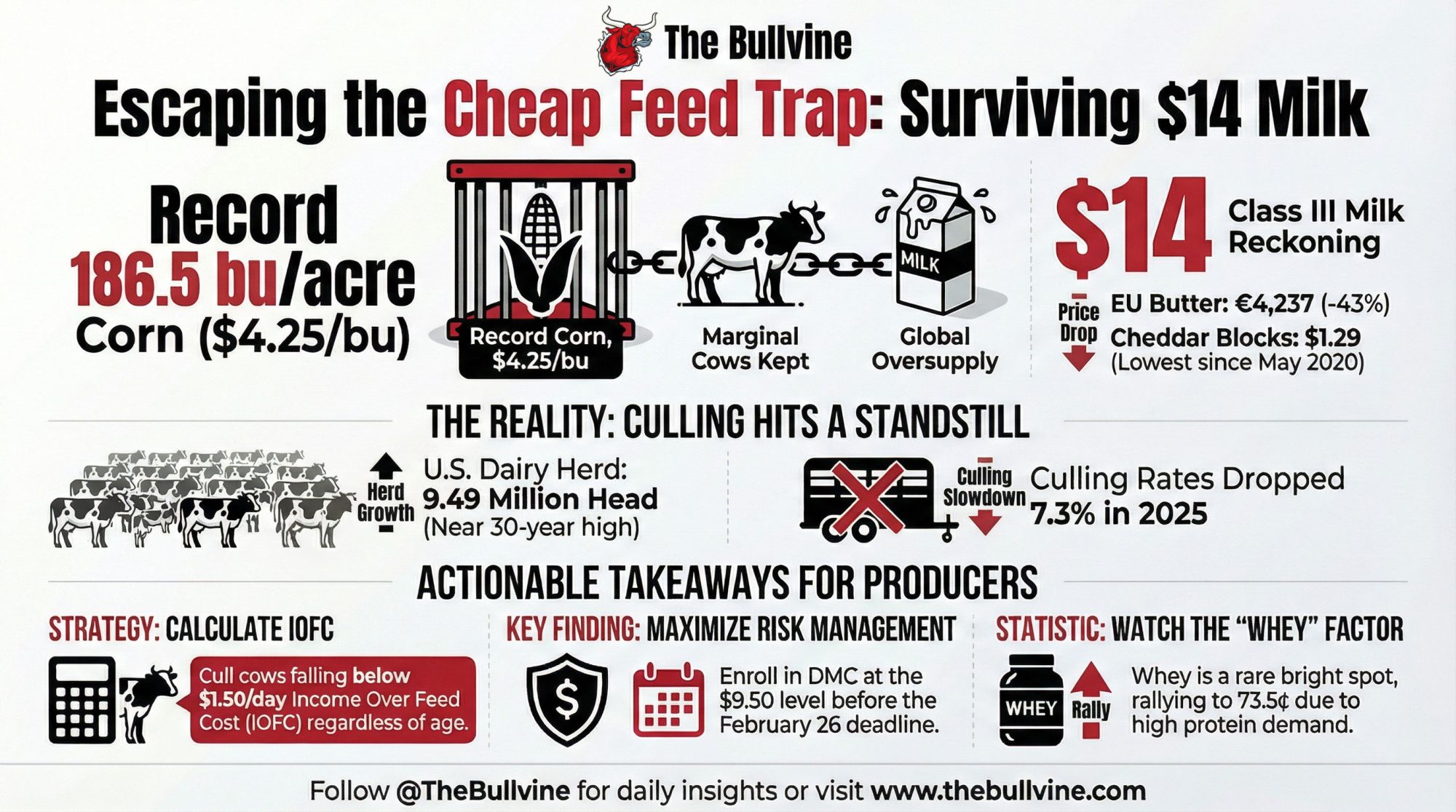
EXECUTIVE SUMMARY: Class III is testing $14. EU butter crashed 43% year-over-year. Cheddar blocks hit $1.29—their lowest since May 2020. Welcome to synchronized oversupply: EU-27+UK November milk surged 4.6%, the U.S. dairy herd is near a 30-year high, and cull rates are at historic lows because $4.25 corn makes even marginal cows cash-flow positive. That’s the trap—cheap feed was supposed to ease the pain, but it’s keeping underperforming cows in barns across the industry and delaying the correction prices desperately need. GDT Pulse finally showed signs of life Sunday (WMP +1.0%, SMP +2.1%), but until someone starts culling, $14 milk isn’t going anywhere.

Futures Markets: Still Searching for a Floor

The futures boards told a grim story last week—and frankly, nobody’s quite sure where the bottom is yet.

EEX European Futures moved 4,550 tonnes (910 lots), with Wednesday posting the busiest session at 1,905 tonnes. Butter futures took the worst of it. The Jan26-Aug26 strip dropped 4.5% to average €4,199. SMP held up better, down just 0.2% to €2,200, while whey slipped 0.7% to €1,021.

Over on the SGX Asia-Pacific exchange, volume ran heavier at 15,116 lots—dominated by WMP at 12,287 lots. The Jan26-Aug26 curves tell you pretty much everything about current sentiment:

ProductAverage PriceWeekly Change
WMP$3,359–1.2%
SMP$2,703–0.8%
AMF$5,821–1.4%
Butter$5,278–0.1%

What’s particularly notable on the CME is how Class III futures tested sub-$14 territory multiple times last week. January through May contracts all notched life-of-contract lows before bouncing slightly Friday. February settled at $15.05—down a dime on the week. Class IV fared worse, with February closing at a brutal $13.86, down a nickel.

For producers who don’t actively trade futures, here’s why those life-of-contract lows matter: they signal that professional traders—people who make a living betting on where milk prices are headed—see no near-term catalyst for recovery. When the market establishes new lows across multiple contract months simultaneously, it’s pricing in an extended period of pain.

What this means for your operation: If you’re not already penciling out cash flow at $15 Class III and $14 Class IV through mid-year, you’re planning with the wrong numbers. DMC payments look increasingly likely for January through at least April, according to analysts at Ever.Ag.

European Quotations: The Butter Collapse Continues

The weekly EU quotations released January 14 painted a picture of a market still trying to find its footing after months of oversupply pressure.

Butter took another beating. The index dropped €171 (–3.9%) to €4,237. French butter got hit hardest—down €513 (–10.6%) to €4,310 in a single week. German and Dutch butter held steadier at €4,300 and €4,100 respectively.

Here’s the number that should grab your attention: EU butter is now down €3,176 (–42.8%) year-over-year. That’s not a correction. That’s a fundamental repricing of European milkfat. I’ve been covering dairy markets for years, and you rarely see a commodity give back nearly half its value in twelve months without some structural shift underneath.

SMP actually showed some strength—climbing €38 (+1.9%) to €2,085. German SMP rose €45 to €2,085, Dutch jumped €100 to €2,100, while French slipped €30 to €2,070. Still, SMP sits 17.3% below year-ago levels, so “strength” is relative here.

Whey eased €5 (–0.5%) to €996, though it’s actually up €123 (+14.1%) year-over-year. That makes whey one of the few genuine bright spots in European dairy commodity markets right now.

Cheese indices were mixed:

CommodityCurrent PriceWeekly ΔY/Y ΔMarket StatusStrategic Note
EU Butter€4,237/100kg–3.9%🔴 –42.8%CRISISDemand collapse
Class III (CME)$13.95/cwt–0.7%🔴 –32.0%CRISISLife-of-contract lows
Cheddar Block$1.29/lb–1.9%🔴 –27.5%WEAKMulti-year lows
SMP (EU)€2,085/100kg+1.9%🟡 –17.3%WEAKAlgeria returning
WMP (GDT)$3,359/MT–1.2%🟡 –18.5%WEAKPulse bounce +1.0%
Nonfat Dry Milk$1.255/lb–0.8%🟡 –14.2%STABLEMexico demand OK
Whey (CME)73.5¢/lb+4.8%🟢 +14.1%STRENGTHProtein demand high
Milk Price (U.S. avg)$14.05/cwt–0.7%🔴 –30.5%CRISISFeed savings insufficient
Corn (March)$4.25/bu–4.5%🟢 –52.0%STRENGTHRecord crop relief

USDA’s Dairy Market News describes European conditions as “orderly” and “measured”—values are cautiously higher to start the year after what can only be called the bloodbath of Q4 2025.

GDT Pulse: Finally, a Sign of Life

Sunday’s GDT Pulse Auction (PA098) delivered the first meaningful uptick we’ve seen in months (Global Dairy Trade, January 18, 2026).

Fonterra Regular C2 WMP won at $3,395—up $35 (+1.0%) from the last full GDT event and up $240 (+9.0%) from the previous pulse auction. That’s a real move, not just noise.

Fonterra SMP Medium Heat – NZ came in at $2,660, up $55 (+2.1%) from the last GDT and up $165 (+8.4%) from pulse.

Arla SMP Medium Heat – EU hit $2,485, up $95 (+4.0%) from the last GDT.

Total volume was modest at 2,358 tonnes with 54 bidders participating. The question everyone’s asking: genuine trend change, or dead cat bounce?

Tomorrow’s GDT Event TE396 will be the real test. Fonterra’s offered volumes:

ProductVolume (MT)
WMP15,588
SMP5,630
Butter1,920
AMF2,680
Cheddar540

Butter and AMF volumes were adjusted for Cream Group Flex at 15% applied to C1 and C2, while total milkfat supplied remains unchanged on the forecast. What I’ll be watching closely is whether the buying interest that showed up Sunday sticks around when larger volumes hit the auction block.

U.S. Spot Markets: Whey Holds While Everything Else Sinks

CME spot trading told a mixed story last week.

  • Butter bounced off multi-year lows, climbing 5.5¢ to $1.355 per pound. That’s still near the basement, but at least the bleeding stopped for now.
  • Cheddar blocks kept sinking, down 2.5¢ to $1.29—a level we haven’t seen since May 2020. Twenty loads traded, bringing the YTD total to 63 loads—a record for early January. When you see that kind of spot volume combined with falling prices, people are desperate to move product. That’s not a healthy market dynamic.
  • Nonfat dry milk slipped a penny to $1.255. Demand from Mexico is improving, and inventories are “tight” according to USDA’s Dairy Market News, but it wasn’t enough to hold the line.
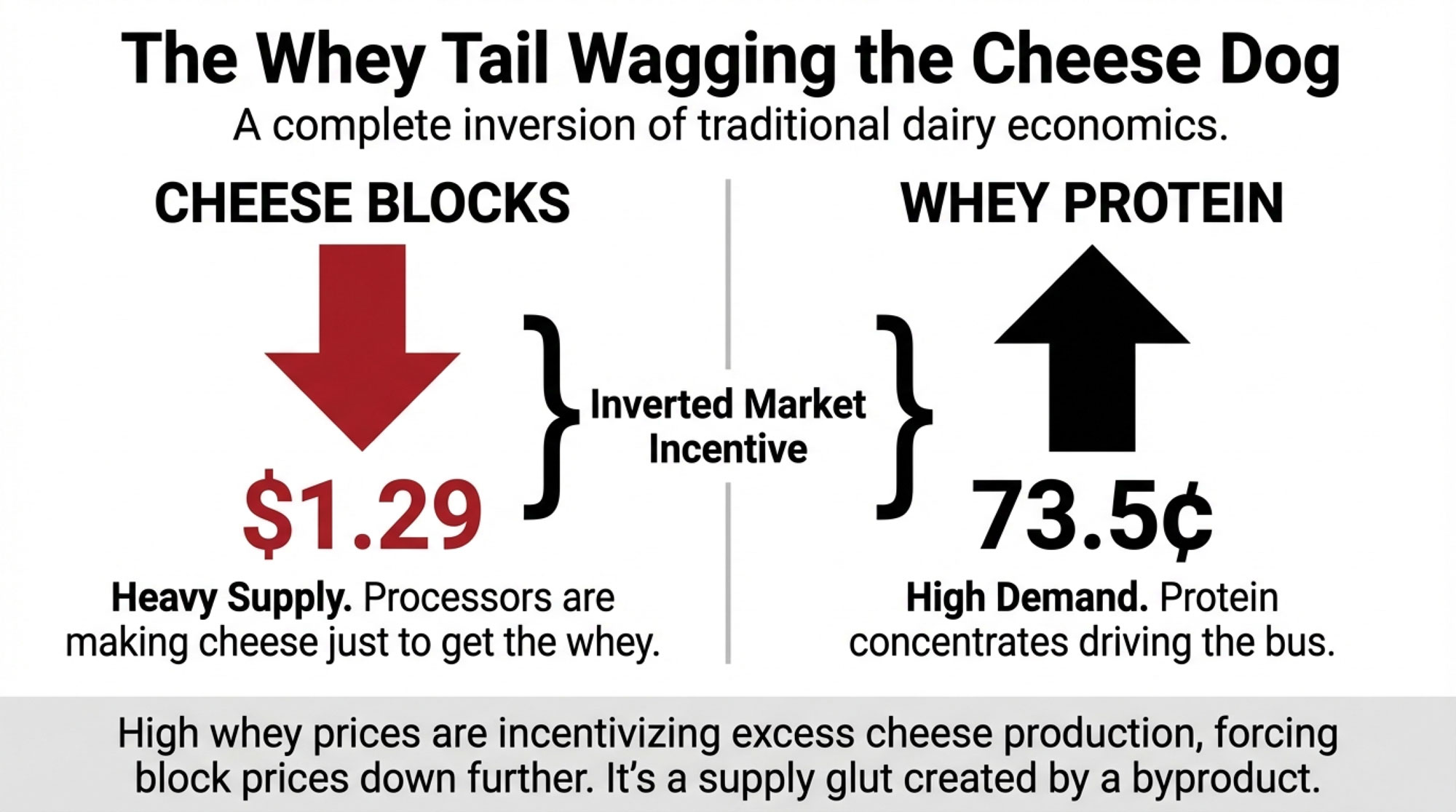
  • Whey was the standout, rallying 3.5¢ to 73.5¢. Strong demand for whey protein concentrates is driving this—Dairy Market News reports some cheese processors are actually ramping up production “ultimately to produce more whey as prices and demand of whey protein concentrates remain high.”

Let that sink in for a moment: they’re making cheese not because cheese demand is strong, but because they need the whey. That’s a complete inversion of traditional dairy economics, and it tells you something important about where the real demand growth is happening right now.

The Culling Connection: Why Cheap Feed Is Delaying Recovery

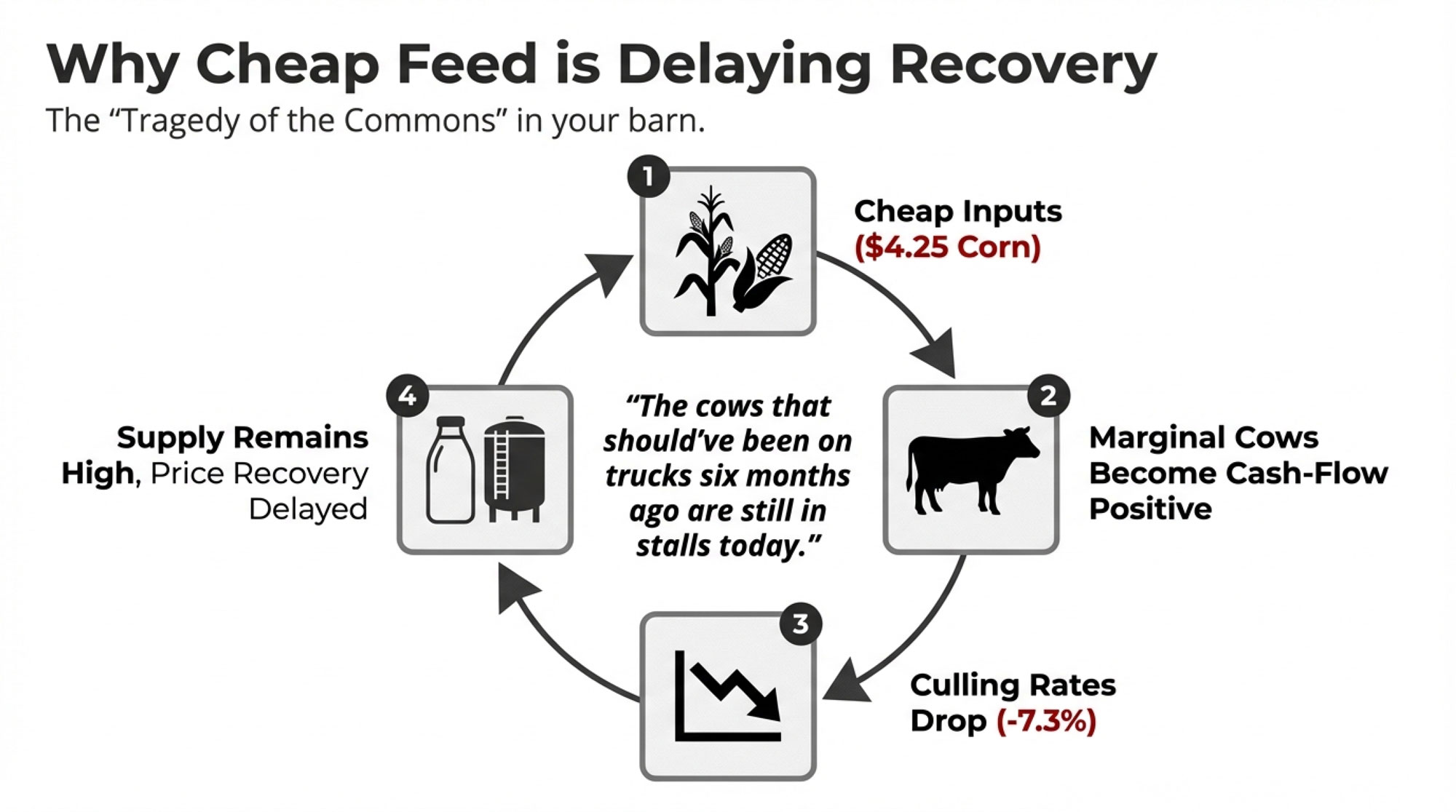
Cheap corn isn’t just helping your margins—it’s keeping marginal cows in the herd longer and delaying the supply correction that would help prices recover.

The numbers are stark. Dairy cow culling dropped to historic lows through the first half of 2025, down 7.3% from the same period in 2024 (Southern Ag Today, January 13, 2026). The seven-month total through July was the lowest since 2008 (eDairy News, August 2025). Even as milk prices slid through the fall, weekly dairy cow slaughter through the last four weeks of 2025 was only slightly above year-earlier levels (USDA Livestock, Dairy, and Poultry Outlook, January 2026).

Why aren’t producers culling more aggressively?

Two factors, and they’re both working against a price recovery:

  • First, cheap feed makes borderline cows profitable enough to keep. When corn was running $6+, and soybean meal was north of $400, that seven-year-old cow giving 60 pounds was bleeding money. At $4.25 corn and $290 meal, she’s suddenly cash-flow positive—barely. So she stays. Multiply that decision across thousands of operations, and you’ve got an oversupply situation that won’t self-correct.
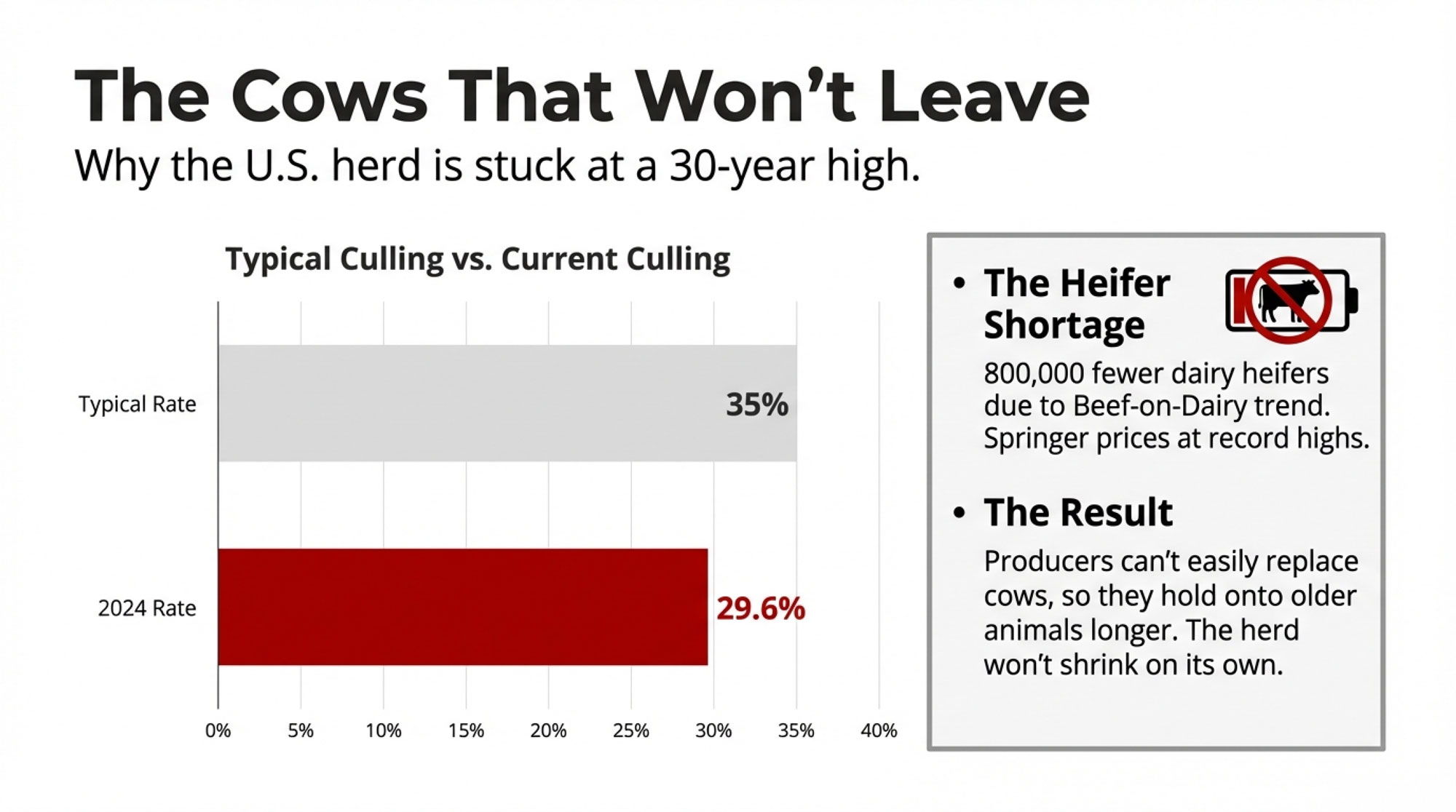
  • Second, the heifer shortage makes replacement expensive. Beef-on-dairy economics have drained the replacement pipeline. Springer heifer prices are at or near records, and with 800,000+ fewer dairy heifers in the system (Dairy Herd Management, November 2025), producers can’t easily replace culled cows even if they wanted to. Cull rates dropped to 29.6% in 2024—well below the typical 35-37% turnover that supports strategic herd improvement (Dairy Herd Management, August 2025).

The U.S. dairy herd now sits at approximately 9.49 million head—near the highest level since the early 1990s. USDA’s January Livestock, Dairy, and Poultry Outlook revised the annual dairy cow inventory to 9.490 million head and projects the herd will remain large well into 2026.

What’s interesting here is the game theory at play. Every individual producer benefits from keeping their cows in milk when feed is cheap. But collectively, those decisions are extending the timeline for everyone’s price recovery. It’s a classic tragedy of the commons, playing out in real-time across American dairy barns.

The strategic response some progressive operations are taking: Rather than culling primarily based on age or reproductive metrics, they’re calculating income over feed cost (IOFC) for each cow and moving out animals consistently below $1.50 per cow per day (The Bullvine, December 2025). That’s the math-based approach that makes sense when feed is cheap, but margins are thin.

Cow ProfileProd’n (lbs)BF/ProteinDaily RevenueDaily FeedDaily IOFCDecision
Cow A: 4yr, 75# prime753.8% / 3.2%$10.50$8.20$2.30✅ KEEP
Cow B: 6yr, 65# good653.7% / 3.1%$9.10$7.80$1.30🔶 BORDERLINE
Cow C: 7yr, 55# fading553.6% / 3.0%$7.70$7.40$0.30🔴 CULL
Cow D: 5yr, 70# solid703.8% / 3.2%$9.80$8.00$1.80✅ KEEP
Cow E: 8yr, 48# poor483.5% / 2.9%$6.72$7.10–$0.38🔴 CULL
Cow F: 3yr, 82# premium823.9% / 3.3%$11.48$8.40$3.08✅ KEEP

Don’t expect a supply-side correction to rescue prices anytime soon. The cows that would have been on trucks six months ago, when feed was expensive, are still in stalls today. That’s good for individual cash flow in the short term, but it’s extending the pain for everyone.

The Production Surge: Why This Is Happening

November milk collections confirm what the futures already priced in—global oversupply is real and accelerating.

European Production Explosion

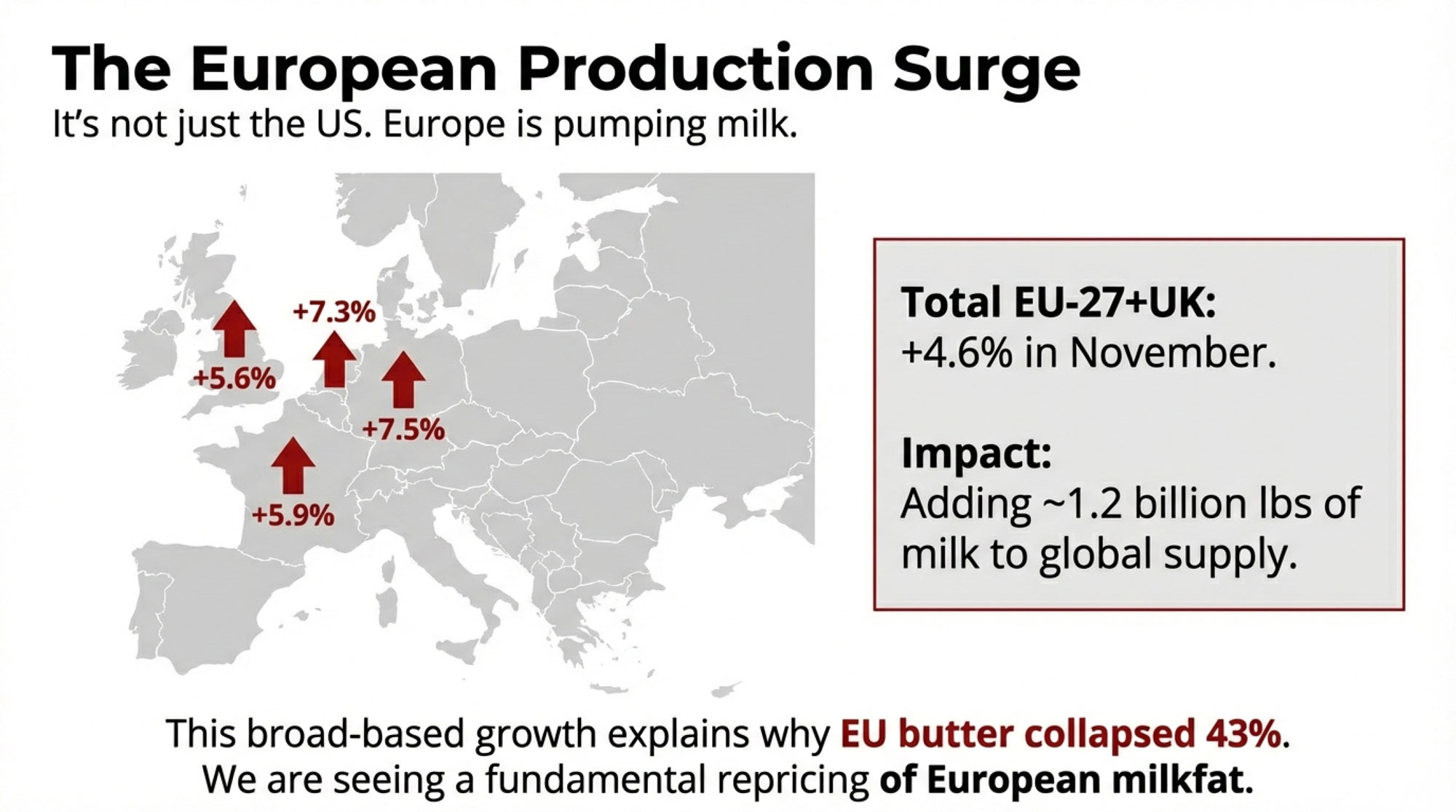
EU-27+UK pumped out 12.94 million tonnes in November, up 4.6% year-over-year. To put that in perspective, that’s nearly 1.2 billion pounds more milk than November 2024—equivalent to adding all of Michigan’s November production to the global supply, plus change.

CountryNov 2025 Production (kt)Y/Y GrowthKey Signal
Germany2,643+7.5%🔴 Highest absolute growth
France1,954+5.9%Steady surge
UK1,329+5.6%Post-Brexit stabilization
Netherlands1,145+7.3%🔴 Second-highest % growth
Poland1,089+5.3%Eastern EU leading
Belgium375+10.1%🔴 Highest % growth—warning sign
Denmark449+0.7%Only modest growth
EU-27+UK TOTAL12,940+4.6%1.2B lbs MORE than Nov 2024

Cumulative EU-27+UK production through November hit 150.75 million tonnes, up 1.9% year-over-year after adjusting for the leap year. Milksolid collections were up 5.2% in November alone, which tells you butterfat and protein content are running strong across European herds.

French milksolids jumped 6.6% in November, with cumulative 2025 collections at 1.63 million tonnes (+1.5% y/y). French butter production hit 28.3kt in November (+0.8% y/y), with YTD production up 5.2% to 337.6kt.

Danish milksolids were up 1.5% in November, with cumulative collections at 431kt (+2.7% y/y).

What I find notable is how broadly based this European production surge is. It’s not just one country driving the numbers—Germany, France, the Netherlands, Poland, and the UK are all posting substantial gains. That kind of synchronized growth is rare, and it explains why European commodity prices have fallen so hard.

U.S. Production Outlook

USDA kept their 2025 forecast unchanged at 115.70 million tonnes in the January WASDE—a 2.4% increase over 2024. But they raised the 2026 forecast, citing “higher production per cow” as the primary driver (USDA WASDE, January 2026). If realized, that’s another 1.3% increase on top of an already elevated base.

Spot milk loads traded as much as $4 under Class III last week (Dairy Market News). When processors are paying that far below class price for spot loads, it tells you they have all the contracted milk they need—and then some.

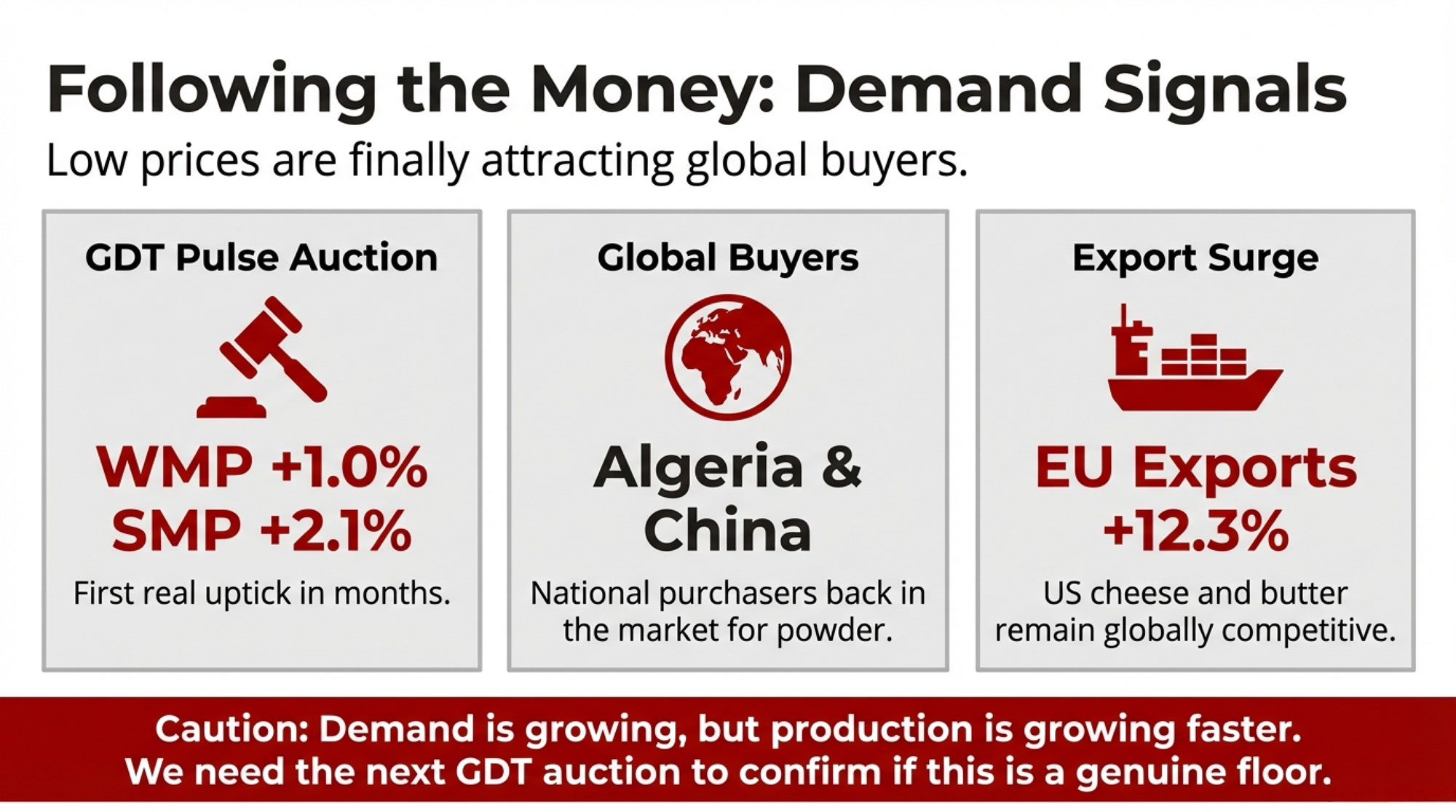
Where’s the Demand? Following the Money

The good news: low prices are finally attracting buyers. The bad news: it’s not enough yet.

Algeria is back in the market. ONIL, their national dairy purchase program, is bidding for milk powder again. That’s significant—Algeria is historically one of the world’s largest SMP importers, and their return to active purchasing is exactly what you’d expect when global prices fall this far.

Chinese buyers are consistently attending GDT auctions. Chinese SMP inventories dropped to a one-year low in November, so merchants may need to step up purchases even though domestic consumption remains soft. It’s worth noting that Chinese dairy demand has been disappointing for nearly two years now, so I’d want to see sustained buying before getting too optimistic.

EU exports surged 12.3% in November:

ProductY/Y ChangeKey Destinations
SMP+39.6%Algeria, Egypt, Saudi Arabia, Morocco
Butter+14.9%Most destinations except S. Korea, China
Cheese+8.9%Japan, Korea, and China improved
WMP+33.2%
Casein+66.8%

U.S. exports are holding firm. The U.S. is currently the least-expensive global supplier for cheese and butter, shipping enough product abroad to keep inventories in check despite record output (Dairy Market News). For cheese, domestic demand is “solid,” and export demand is “strengthening.” For butter, Dairy Market News reports that “interest from international buyers is keeping domestic bulk butter spot loads tight.”

This is actually one of the more encouraging aspects of the current market. Demand isn’t collapsing—it’s growing. The problem is that production is growing faste than it isr.

Feed Markets: The One Bright Spot

USDA’s January WASDE dropped a bombshell on corn markets (USDA WASDE, January 13, 2026).

Corn yield came in at a record-shattering 186.5 bushels per acre—half a bushel higher than December estimates. Total production hit 17.021 billion bushels, smashing the previous record by 11%.

Ending stocks jumped to 2.227 billion bushels, on par with stockpiles from 2016-2019 when corn averaged roughly $3.50 per bushel. That historical comparison gives you a sense of where corn prices might be headed if demand doesn’t materialize.

March corn dropped 20¢ on the week to settle at $4.25 (CME Group). March soybean meal closed at $290 per ton, down $13.70.

What this means for your operation: Feed costs are genuinely cheap—the lowest since October 2020 on a DMC basis (Ever.Ag). But here’s the math problem that keeps coming up: milk prices are dropping faster than feed costs are falling. A 35-50¢ per cwt feed savings doesn’t offset a $1.80 drop in the all-milk price.

The record corn crop is a real relief for your feed bill. But if you’re counting on cheap feed to save your margins while milk stays at $14-15, rerun those numbers.

ProductSunday Pulse PA098Previous GDTY/Y (Jan 2025)TE396 Watch
WMP (C2)$3,395 (+1.0%)$3,360$3,155 (+7.6% y/y)Needs to hold $3,350+
SMP (MH)$2,660 (+2.1%)$2,605$2,495 (+6.6% y/y)Needs to hold $2,600+
Butter$5,395 (est.)$5,150$5,820 (–7.3% y/y)Watch for $5,200 support
Cheddar$3,270 (est.)$3,310$3,760 (–13.0% y/y)Critical: Hold above $3,200

The Week Ahead: What to Watch

Tuesday, January 20: GDT Event TE396 results. This is the auction that matters. If WMP and SMP can hold or extend Sunday’s gains with larger volumes on offer, we might actually be seeing a floor form. If they give it all back, buckle up for more pain.

The GDT Floor Test — What to Look For on Tuesday, Jan 21

🔴 FLOOR FAILURE SCENARIO:
• WMP falls below $3,350 (gives back Sun gain + more)
• SMP drops below $2,600 (momentum breaks)
• Volume is weak (less than 2,000 MT total)
→ Result: Expect further selling; $14 milk locks in

🟢 FLOOR HOLDING SCENARIO:
• WMP holds $3,350–$3,400 (sustains Pulse momentum)
• SMP holds $2,600–$2,650 (shows buying interest)
• Volume is healthy (2,500+ MT; strong participation)
→ Result: Floor forming; recovery narrative begins

🟡 CRITICAL THRESHOLD:
If Butter holds $5,200–$5,300 on larger volumes (TE396
has 1,920 MT offered), that signals structural demand
at lower price levels—a genuine floor signal.

Key data releases this week:

  • New Zealand December milk collections — Will signal if Fonterra’s production growth is moderating heading into the back half of their season
  • U.S. December milk collections — Confirms whether the herd expansion continued through year-end
  • Chinese December dairy imports — Tests whether inventory drawdowns are translating to actual purchases

The Bullvine Bottom Line

Tomorrow’s GDT auction is the market’s next referendum. If WMP and SMP hold Sunday’s gains, we might have found a floor. If they give it back, prepare for $14 Class III to stick around through spring.

Here’s the uncomfortable reality that this week’s data makes clear: cheap feed is keeping this market oversupplied longer than it otherwise would be. Every producer making the individually rational decision to keep marginal cows in milk is collectively extending everyone’s price recovery timeline. It’s nobody’s fault exactly, but it’s everybody’s problem.

The strategic question for your operation isn’t whether to keep milking—it’s whether you’re keeping the right cows milking. Run those IOFC calculations. That seven-year-old giving 45 pounds might be cash-flow positive at $4.25 corn, but she’s dragging down your herd average and, in a small way, dragging down everyone’s milk price too.

Watch the GDT numbers on Tuesday. And if you haven’t maxed out your DMC coverage at $9.50 for 2026, the enrollment deadline is February 26. Based on where futures are trading, those payments are looking increasingly likely through at least mid-year.

Key Takeaways

  • Pandemic-level prices are back: Class III testing $14. Cheddar blocks at $1.29. EU butter down 43% y/y. This is what three continents overproducing at once looks like.
  • Cheap corn is the problem, not the solution: At $4.25/bu, even marginal cows stay cash-flow positive. Every cow that should’ve been culled months ago is still milking—and that’s delaying the correction we all need.
  • The herd won’t shrink on its own: U.S. dairy cows near a 30-year high. Cull rates are at historic lows. Springer heifers are too expensive to replace aggressively. Until that changes, oversupply persists.
  • GDT finally has a pulse: WMP +1.0%, SMP +2.1% on Sunday’s Pulse auction. Tomorrow’s TE396 is the real test—if it holds, we might have found a floor.
  • Your move: Budget $15 Class III through Q2. Max out DMC at $9.50 before the Feb 26 deadline. And calculate IOFC on every cow in your barn—because $4 corn doesn’t make a 45-lb cow worth her stall.

Complete references and supporting documentation are available upon request by contacting the editorial team at editor@thebullvine.com.

Learn More

Join the Revolution!

Join over 30,000 successful dairy professionals who rely on Bullvine Weekly for their competitive edge. Delivered directly to your inbox each week, our exclusive industry insights help you make smarter decisions while saving precious hours every week. Never miss critical updates on milk production trends, breakthrough technologies, and profit-boosting strategies that top producers are already implementing. Subscribe now to transform your dairy operation’s efficiency and profitability—your future success is just one click away.

NewsSubscribe
First
Last
Consent

Countdown to 2024 Election: Will the Toss-Up Race Between Trump and Harris Tip the Scales?

Discover the tight 2024 race between Trump and Harris. Can swing states decide it? Expert insights and impacts on dairy farmers await.

Summary:

The 2024 presidential race between Donald Trump and Kamala Harris is intensely unpredictable, described as a “pure toss-up,” with Trump holding a slight edge at 51.5%. The decisive battlegrounds of Georgia, North Carolina, Pennsylvania, Wisconsin, Michigan, Arizona, and Nevada are pivotal. Both candidates present contrasting policies with significant implications for industries, including agriculture, and potential global economic ramifications, especially concerning China. Trump’s fiery rhetoric contrasts with Harris’s unifying discourse as they campaign vigorously. Control of Congress also adds tension to the election landscape, making the outcome uncertain and impactful beyond U.S. borders.

Key Takeaways:

  • The 2024 presidential race remains highly competitive, with analysts labeling it a “pure toss-up” due to the narrow polling margins between Trump and Harris.
  • David Wasserman notes Trump’s recent inflammatory statements have tightened the race, although he remains a slight favorite.
  • Polling data from crucial swing states will be critical indicators of which party may prevail, emphasizing the importance of North Carolina and Georgia.
  • Both candidates actively engage voters in critical regions, with Harris focusing on unity and Trump rallying his base provocatively.
  • The election’s outcome could substantially impact economic policies, influencing factors like corporate tax rates and tariffs, affecting dairy industry markets and consumer prices.
  • Overseas American voters have gained attention in the tight race due to low past voter turnout, making their participation potentially significant.
  • Security measures in Washington, D.C., are heightened in anticipation of potential post-election unrest, with businesses preparing for disruption.
  • Market indicators like the dollar index and stock futures reflect investors’ reactions to potential election outcomes, highlighting economic uncertainties.
  • Control of the U.S. Senate is contentious, with Republicans favored, but possible Democratic victories could alter this dynamic.
2024 presidential race, Trump vs Harris, battleground states, swing states election, voter mobilization strategies, economic impact election, pro-business policies, global trade tensions, market volatility, Fed rate policy

The clock is ticking down to one of the most unpredictable elections in U.S. history, with the 2024 presidential race a true ‘pure toss-up,’ as former President Donald Trump and Vice President Kamala Harris are locked in a battle that could tip either way. This razor-thin contest does more than determine the next leader of the free world; it holds critical implications for sectors like dairy farming, which are at stake. Policy decisions made in the days and years ahead will ripple through marketplaces to the very land where dairy farmers labor each day. From trade policies affecting exports to potential environmental regulations, the outcome of this election could change the landscape in which you operate. As elections have consequences stretching beyond immediate politics and into America’s heartland, understanding the nuances of these policies isn’t just important—it’s essential.


Polling Paradox: The 2024 Presidential Race Balancing on a Knife’s Edge

The current polling landscape for the 2024 presidential race presents an intriguing picture of a contest teetering on the edge of unpredictability. In his razor-thin forecast, renowned analyst Nate Silver assigns only a marginal advantage to former President Donald Trump, with a 51.5% likelihood of clinching the Electoral College, versus Vice President Kamala Harris at 48.1%. Similarly, David Wasserman of the Cook Political Report underscores this tenuous balance, acknowledging how recent missteps by Trump have tightened what once seemed to be his advantage. 

Adding to the complexity, the latest Des Moines Register poll findings have injected a jolt into the political betting markets. It revealed a surprising three-point lead for Harris in a state that many had presumed favored Trump. This unexpected turn has roiled market expectations, triggering a visible shift in prediction platforms such as Polymarket. Just days ago, Trump’s odds peaked at 67% as of Wednesday, yet they tumbled to 58% following the poll’s release, illustrating the market’s sensitivity to new data. 

The fluctuating odds and volatile market responses signal an election far from decided. Silver and Wasserman’s analyses reflect that the voters’ leanings in crucial swing states remain fluid, and even minor developments could tip the scales as election day approaches. The battleground states are poised to play a decisive role, and both campaign teams will likely intensify their efforts to sway those still contemplating their choice. 

The Decisive Seven: Swing States that Could Swing the Nation

The 2024 presidential election hinges on the outcomes in seven pivotal swing states: Georgia, North Carolina, Pennsylvania, Wisconsin, Michigan, Arizona, and Nevada. These states collectively hold the power to shape the electoral landscape due to their history of fluctuating political allegiances and diverse voter demographics. Both Trump and Harris strategize heavily on these battlegrounds, aware that winning a majority here could tip the scales decisively. 

Georgia and North Carolina emerge as particularly significant. Both states, representing the broader Sun Belt region, carry substantial electoral votes that can influence the overall outcome. Early results from these states offer crucial insights into the evening’s direction. A strong performance by Trump here might signal an underestimation of his support in other battleground states, prompting a reevaluation of Harris’s prospects. Conversely, if Harris gains ground or secures victories in these states, it could indicate a shift toward Democratic favor, reflecting changing demographics and increasing urbanization. 

In contrast, the Rust Belt states of Pennsylvania, Wisconsin, and Michigan are essential for building a winning coalition, given their significant electoral votes. Historically known for their swing nature, these states are critical for either candidate’s path to 270 electoral votes. A sweep by Harris in this region could effectively counterbalance Trump’s potential gains in the Sun Belt, reaffirming the Democratic hold on these vital industrial areas. 

Meanwhile, Arizona and Nevada augment their critical roles, emerging as bellwether states due to their growing and diversifying populations. Close attention to their outcomes is warranted, as victories here could serve as early warnings or confirmations of national trends. 

Ultimately, the intersection of these seven states encapsulates the election’s essence—a contest not solely of national prominence but of strategic victories within specific state borders. As results unfold on election night, all eyes will follow North Carolina and Georgia, serving as the initial barometers of either candidate’s electoral strength and the night’s overarching narrative.

Quiet Undercurrents: Overseas Americans Could Tip the Scale

The influence of overseas American voters often resembles an undercurrent, quietly weaving beneath the surface of more overt election forces. Numbering over 4 million, their potential impact is significant even as turnout historically hovers around 7.8%. Recognizing this untapped reservoir, both parties have intensified efforts to mobilize these voters, emphasizing digital outreach and localized campaign strategies. 

Foreign policy stands out as a resonant chord in this outreach, as those living abroad keenly feel the repercussions of U.S. strategies on international diplomacy, trade agreements, and military presence. These issues are abstract concepts and factors directly influencing their daily lives in host countries. 

Another pivotal issue is the taxation framework applied to expatriates. The dual-tax system, often called “double taxation,” remains a rare point of bipartisan interest. Overseas Americans face the unique burden of filing taxes in both the U.S. and their country of residence, a situation both Democrats and Republicans are capitalizing on to sway this voter demographic. 

For Republicans, Trump’s pledge to alleviate overseas tax filing burdens offers a point of attraction, potentially drawing in those frustrated by current regulations. Meanwhile, Democrats are highlighting broader foreign policy stances that emphasize international cooperation, seeking to appeal to progressive values among expatriates. As these efforts unfold, the overseas vote emerges as a compelling wildcard, a demographic whose impact on the tight 2024 presidential race is yet to be fully realized.

Contrasting Campaign Chronicles: Trump’s Fiery Fervor vs. Harris’s Harmonious Hope

In the feverish run-up to Election Day, the campaign trails of Donald Trump and Kamala Harris offer a striking study in contrasts. Both camps are laser-focused on the pivotal swing states that could ultimately decide the presidency. Trump storms key battlegrounds with fervor, utilizing an aggressive rhetoric that seeks to energize and mobilize his base. His campaign rallies resonate with fiery critiques of his opponents and evocative declarations aimed at reigniting the fervor of past victories. His speeches in crucial states like Pennsylvania and Michigan are marked by combative tones and controversial claims, reflecting his strategy to dominate the narrative and seize the spotlight through bold proclamations and media-baiting tactics. 

Conversely, Kamala Harris charts a different course. Her campaign strategy zeroes in on uniting a divided electorate. As she graces the stages in Michigan and Pennsylvania, her addresses weave a narrative of hope and reconciliation. Harris endeavors to transcend partisan divides by focusing on positive, uplifting discourse. Her message offers a distinct alternative to Trump’s approach — reaching out to independents and disillusioned conservatives, promising a future anchored in cooperation and empathy. 

Both candidates understand the stakes in these final days, yet their paths diverge in method and tone. Where Trump’s approach rides on confrontation and stark contrasts, Harris’s is a call to collective action and harmony. These varying strategies reflect broader themes each candidate hopes will resonate with voters in the crucible of the swing states, ultimately proving decisive in shaping the outcome of this tightly contested race.

Financial Fortunes and Dairy Dilemmas: The 2024 Election’s Economic Impact

The unfolding 2024 presidential election holds significant implications for financial markets and economic policies. Each candidate’s victory likely will dictate divergent trajectories for the U.S. economy. The equity and bond markets are keenly poised, anticipating either Kamala Harris or Donald Trump shaping interest rate decisions and broader fiscal policies. 

Financial Markets and Interest Rates: Should Trump reclaim the presidency, markets might expect a continuation or enhancement of pro-business, low-tax policies, potentially buoying corporate earnings and investor sentiment. However, Trump’s aggressive stance on tariffs, mainly targeting China, could ignite global trade tensions. Such measures might induce market volatility, forcing the Fed to reassess its rate policy paths, possibly stalling or reversing rate-cutting plans. 

Conversely, a Harris administration would likely prioritize environmental and social governance, balanced federal spending, and increased taxes on corporations and high-income earners. This may result in initial market pressure, as investors anticipate lower profit margins dampening stock valuations. However, Harris’ approach to stabilizing foreign trade relationships might appeal to the bond market, with expectations of reduced global economic friction. 

Impact on the Dairy Industry: The election results could usher in poignant outcomes for dairy farmers and related industries. Trump’s proposed tax cuts might translate into reduced operational costs for large agricultural enterprises, but his tariff policies could hike input prices for feed and equipment, affecting profitability. His stance on immigration could also impact labor supply, which is crucial for the dairy sector. 

On the other hand, Harris’s tax policy aimed at higher-income brackets could prove challenging for large dairy operations falling within these thresholds. However, her push to combat price gouging and regulate market fluctuations could stabilize consumer costs. Harris’s infrastructure plans, including transportation improvements, could enhance supply chain efficiency, benefiting the dairy industry long-term. 

The dairy sector is at an economic crossroads as election day draws near. Each candidate offers potential benefits and pitfalls, urging farmers to consider how these political shifts could ripple through their livelihoods.

Congressional Crossroads: The Power Struggle and Its Agricultural Fallout

As the 2024 election unfolds, the battle for control of Congress is as fiercely contested as the presidential race. The Senate landscape offers a possible shift in control favoring the Republicans, who are predicted to gain a majority. The Cook Political Report anticipates the GOP securing 51 to 54 seats, a shift that could dramatically alter legislative priorities. Such a majority could empower Republicans to advance their agenda more decisively, impacting everything from tax policy to regulatory approaches. 

This potential shift poses significant implications for agricultural policies critical to dairy farmers. With a Republican majority, legislative efforts might swing towards deregulation, which could benefit the agriculture sector by reducing compliance costs. However, these changes might also mean less government intervention in agricultural subsidies, directly affecting farm income stability. 

In contrast, the House races are more unpredictable. Described as a “jump ball,” both parties have plausible pathways to securing control. The competitive nature of these contests heightens their significance, as the House’s composition will critically influence the next administration’s legislative agenda. A Republican-controlled House paired with a Republican Senate would facilitate the passage of more conservative economic policies, potentially fostering a tax-friendly environment for businesses. On the other hand, a Democratic House could act as a check on conservative legislative initiatives, pushing for continued investment in environmental and infrastructure projects, which could benefit rural communities and farming operations. 

The results will have far-reaching implications for the dairy industry stakeholders monitoring these dynamics. The congressional makeup will define policy directions affecting agricultural trade, environmental regulations, and farm support programs, which are crucial for strategic planning and long-term business viability.

Global Ripples: The World Holds Its Breath as the U.S. Election Approaches

As the 2024 U.S. presidential election looms, international stakeholders brace for its far-reaching effects. Particularly concerned is China, monitoring the race with heightened interest. The potential for the Trump administration’s steep tariffs on Chinese imports looms large, threatening to disrupt economic balances. This specter has catalyzed preemptive discussions within China’s legislative circles, where economic stimulus measures are actively being considered. The outcome of these deliberations could dictate China’s fiscal strategies, potentially recalibrating investment channels and trade policies to offset anticipated economic turbulence. 

Further afield, global markets display a cautious stance, underscored by fluctuating indices as the possibility of policy shifts looms. While the Trump scenarios project a more tumultuous trade landscape, Kamala Harris’s focus on diplomacy could herald different international engagements. Yet, both campaigns leave little room for complacency among foreign governments, prompting preparatory adjustments to safeguard economic interests. As election day draws near, the world waits, watches, and strategizes, underscoring the global interconnectedness of political tides.

The Bottom Line

The final stretch of the 2024 presidential race underscores a landscape rife with uncertainty. With polls and prediction markets swaying like a pendulum, there is no clear frontrunner between Donald Trump and Kamala Harris. The implications for dairy farmers and stakeholders are vast—whether in taxation, international trade, or economic policies. As swing states play a pivotal role, their decision could dictate the presidency and the regulatory and economic environment that frames your day-to-day operations. 

As the election nears, it’s crucial to ponder: how will either administration’s policies ripple through the dairy sector, affecting everything from pricing to international trade agreements? What strategies should you consider to safeguard and potentially capitalize on the shifts in the political landscape? The future of your business might hinge more than ever on the choices made at the ballot box.

Learn more:

Join the Revolution!

Bullvine Daily is your essential e-zine for staying ahead in the dairy industry. With over 30,000 subscribers, we bring you the week’s top news, helping you manage tasks efficiently. Stay informed about milk production, tech adoption, and more, so you can concentrate on your dairy operations. 

NewsSubscribe
First
Last
Consent

Is the Beef-on-Dairy Trend Losing Its Steam? An Industry Shift in the Making

Has the beef-on-dairy trend run its course? Industry changes may be the harbinger of what’s to come for dairy farmers. How prepared are you for these shifts?

Summary:

In recent years, the fusion of dairy and beef industries, known as the beef-on-dairy trend, has garnered attention from agricultural professionals and dairy farmers. Initially, a strategic financial move, it has become an industry cornerstone, adapting to changing demands. However, speculation about its peak raises questions about its decline. This approach, a response to fluctuating markets, has diversified dairy producers’ income streams. Yet, as of late 2024, the beef and dairy markets present challenges, with fluctuating prices and rising costs impacting profitability. The industry faces increased production costs and labor shortages, prompting exploration of alternative strategies. The sustainability of beef-on-dairy operations hinges on prudence and adaptability amidst these dynamics. Is this trend just a flash in the pan, or does it have sustainable longevity?

Key Takeaways:

  • The peak of the beef-on-dairy trend may have been reached, indicating potential changes in both beef and dairy markets.
  • Increasing production costs could challenge the viability of beef-on-dairy operations for some farmers.
  • There may be opportunities to diversify and innovate within the beef-on-dairy sector despite challenges.
  • Monitoring market developments and trends is crucial for dairy producers to adapt effectively.
  • Republican viewpoints suggest a focus on economic efficiency and market resilience in future strategies.
  • Industry experts provide insights into potential shifts and strategic considerations for sustaining profitability.

Is the beef-on-dairy boom beginning to fade? This innovative crossbreeding trend has reshaped milk and beef production in recent years. It’s sparked a lively debate among farmers about its long-term impact. By merging strengths from both sectors, dairy producers have expanded into beef, creating significant benefits for both markets. Yet, we might have seen the peak of this trend and could be on the verge of a shift in market dynamics, potentially indicating a strategic re-evaluation.  Let’s delve deeper and explore what implications this holds for the future of our sectors.

A Bold Blend: Navigating Market Waves with Beef-on-Dairy Innovations 

Over the past decade, the beef-on-dairy trend has emerged as an innovative response to fluctuating markets. Traditionally focused on milk supply, dairy producers have strategically integrated beef production operations to diversify revenue streams. This shift positions them as significant beef suppliers, leveraging the dual utility of their herds. 

The primary driver of this trend is economic viability. Dairy farmers , with their resilience and adaptability, mitigate financial risks by tapping into beef markets when milk profits wane. Rising feed, labor, and operations costs force farmers to seek alternative income avenues. Crossing dairy cows with beef bulls results in offspring that yield more lucrative beef cuts, creating a profitable byproduct from the dairy enterprise. 

Furthermore, evolving consumer preferences contribute to this shift. With heightened demand for high-quality beef, dairy farms capitalize by adjusting breeding programs to optimize beef attributes. This model is no longer just a trend; it reflects adaptability in an ever-changing agricultural landscape.

The Evolution of Beef-On-Dairy: From a Financial Strategy to Industry Staple

The beef-on-dairy trend has been a fascinating evolution within the agricultural sector. Historically, integrating beef cattle genetics into dairy herds wasn’t a novel concept, but it gained significant traction around the mid-2010s. This trend, driven by economic efficiencies and market demands, is a testament to the industry’s strategic thinking and adaptability. As dairy farmers began grappling with volatile milk prices and increasing operational costs, diversifying income through beef production emerged as a pragmatic solution. It wasn’t long before this strategy evolved from a mere contingency plan into a mainstay component of dairy farm operations. 

Several factors contributed to the rise of this trend. For one, advances in breeding technologies allowed for more strategic crossbreeding, leading to calves that were not only profitable but also met market specifications for beef quality. Additionally, beef cattle genetics introduced into dairy breeds enhanced feed efficiency and carcass weights, making the beef output from these operations quite competitive against traditional beef operations. Another driver was the fluctuating beef market, which occasionally presented more lucrative opportunities than the persistent challenges of milk production. By 2022, it was reported that beef produced from dairy-origin cattle accounted for approximately 10.9% of the U.S. beef supply, a testament to its growing significance in the industry. 

Moreover, the global market’s appetite for high-quality beef, combined with consumer preferences for genetic transparency and sustainability, played into the trend’s hands, as beef-on-dairy presented a narrative of efficiency and enhanced resource use. At the same time, it seemed like a match made in cattle heaven, driven not just by market conditions but underpinned by scientific and technological advances; understanding this historical trajectory is crucial for unpacking the present dynamics that suggest a plateau or possible decline in interest. As we dissect these elements, it poses the question: Are we indeed witnessing the end of beef-on-dairy’s golden age, or is it simply entering a new phase?

Are Beef-On-Dairy’s Glory Days Behind Us?

As of late 2024, the beef and dairy markets demonstrate intriguing dynamics that could signal a change in the ongoing beef-on-dairy trend. The beef market has experienced considerable fluctuations, with prices increasing slightly in mid-2023, driven by heightened demand and global supply challenges. However, recent reports suggest a stabilization, with signs of a potential downturn as consumer behaviors adjust post-pandemic. This stabilization could have significant implications for the beef-on-dairy trend, potentially leading to a decrease in the profitability of beef production from dairy-origin cattle. Indeed, data from the USDA highlights a 3% increase in beef production that might outpace consumption rates in coming quarters, pressuring prices downward [USDA Beef 2024 Outlook]. 

Simultaneously, the dairy sector is navigating its challenges and opportunities. The dairy market is observing a notable uptick in production costs, primarily driven by rising feed prices and labor shortages. These factors are compressing margins and causing dairy operators to reassess their beef-on-dairy strategies. The cyclical nature of dairy’s supply-demand equilibrium can often lead to abrupt shifts, as witnessed in past cycles. This cyclical nature could potentially lead to a decrease in the profitability of beef production from dairy-origin cattle, as dairy farmers may shift their focus back to milk production during periods of high demand. For instance, the 2016 dairy glut remains a fresh memory, reminding producers of the potential volatility [Dairy Industry Margin Pressures 2024]. 

One must recognize the broader economic indicators influencing these sectors. Persistent inflationary pressures are causing shifts in consumer spending patterns, often opting for more economically viable dairy alternatives and budget-conscious beef cuts. This could also imply an impending recalibration in production focus, potentially incentivizing a divergence away from the beef-on-dairy model in favor of more traditional operational paradigms. 

The intersections between cyclical trends in beef and dairy markets have profound implications for farm operators and agro-commodity strategists alike. As producers continue to explore innovative approaches within the beef-on-dairy framework, the emerging economic signals suggest that prudence and adaptability will be critical. This potential for future innovation and adaptability should inspire hope for the industry’s continued evolution. Are we witnessing the beginning of the end for beef-on-dairy dominance or merely a period of recalibration? 

The Economic Ballet: Navigating Costs and Demands in the Beef and Dairy Markets 

The interplay of economic factors that influence the beef and dairy markets is a complex dance of cost, demand, and market trends. For starters, beef prices have experienced fluctuations that might have dairy producers rethinking their strategies. According to recent statistics, the beef market has experienced a steep climb, with prices rising by around 8.5% since July 2023. This increase can be tied to various factors, including feed costs and the cost of maintaining livestock (Agriculture.com). 

Production costs have also been rising on the dairy side. According to a recent analysis, feed prices surged by approximately 10.9% in 2022, a direct consequence of global supply chain disruptions and inflationary pressures. These increased costs inevitably squeeze profit margins for dairy producers who rely on beef as a supplemental revenue source (Dairy Herd Report). 

Consumer demand further complicates the picture. Both beef and dairy markets have seen shifts in consumer preferences, with a noticeable uptick in demand for alternative proteins and plant-based dairy options. This shift reflects broader dietary trends, with consumers becoming more health-conscious and environmentally aware. This shift in consumer preferences could potentially reduce the demand for beef and dairy products, impacting the profitability of beef production from dairy-origin cattle. This could lead to a decrease in the profitability of beef production from dairy-origin cattle, as dairy farmers may need to adjust their production to meet changing consumer demands (Consumer Reports). 

Economic indicators show the challenges facing the beef-on-dairy trend, and these dynamics signal that its popularity has begun to wane. With rising costs and changing consumer demands, dairy producers must weigh the benefits against the rising risks. As a Republican voice in the industry might suggest, it’s a matter of adapting to the market or watching profits evaporate—an enviable position for some but a reality check for many of our nation’s dairy entrepreneurs. 

Challenges and Opportunities in Beef-On-Dairy Operations

While the beef-on-dairy model is innovative, it presents dairy farmers with various challenges. Key among these is the increased complexity of herd management. Dairy farmers who are well-versed in milk production may find the shift to beef production—which requires different expertise and resources—daunting. There’s also the question of feed costs, which can rise as farmers adjust their feed formulas to suit beef cattle needs. 

Labor is another concern. As beef-on-dairy operations expand, so do labor requirements. This could mean increased personnel costs, which may impact overall profitability. Moreover, market volatility is always a looming challenge. Dairy farmers venturing into beef markets must navigate fluctuating beef prices, a realm they may be less familiar with. 

However, with challenges come opportunities. There’s room for innovation as we consider a potential shift in this trend. If farmers can leverage premium beef products, diversifying farm operations could significantly increase revenue streams. Additionally, exploring alternative markets or even niche products like organic or grass-fed beef might offer avenues for growth. 

Ultimately, the potential trend shift invites a strategic re-evaluation. How can dairy farms adapt to remain agile and profitable? Are there new technologies or partnerships that could be leveraged? Dairy farmers are encouraged to weigh these factors, evaluate their long-term strategies, and remain proactive in adjusting their business models to new market realities. How do you see these changes affecting your operations? Feel free to share your thoughts in the comments below.

The Bottom Line

The beef-on-dairy trend has seen its fair share of acclaim and skepticism, particularly regarding its implications for dairy producers. As we dove into the intricacies, it’s clear that while this integration has offered certain economic advantages, the evolving cycles within the beef and dairy markets suggest a potential shift. The big question is whether the beef-on-dairy strategies that once seemed promising will continue to hold their ground or face a downturn. As a member of this pivotal industry, it’s crucial to examine your current methodologies and consider potential adjustments to your operational strategies. Are you prepared for these impending changes? We invite you to share your insights and experiences in the comments. Let’s get a conversation going—feel free to share this article with peers or debate its implications within your network. Let’s shape the future of dairy farming together.


Download “The Ultimate Dairy Breeders Guide to Beef on Dairy Integration” Now!

Are you eager to discover the benefits of integrating beef genetics into your dairy herd? “The Ultimate Dairy Breeders Guide to Beef on Dairy Integration” is your key to enhancing productivity and profitability. This guide is explicitly designed for progressive dairy breeders, from choosing the best beef breeds for dairy integration to advanced genetic selection tips. Get practical management practices to elevate your breeding program. Understand the use of proven beef sires, from selection to offspring performance. Gain actionable insights through expert advice and real-world case studies. Learn about marketing, financial planning, and market assessment to maximize profitability. Dive into the world of beef-on-dairy integration. Leverage the latest genetic tools and technologies to enhance your livestock quality. By the end of this guide, you’ll make informed decisions, boost farm efficiency, and effectively diversify your business. Embark on this journey with us and unlock the full potential of your dairy herd with beef-on-dairy integration. Get Started!

Learn more:

October 2024 Global Dairy Futures: Expert Commentary and Conservative Insights

Delve into October 2024 dairy futures: milk, feed, and margins. How will EU and U.S. market changes affect your farm’s profit? Find insights here.

Summary:

October 17, 2024, dairy futures highlight the complexities and changing landscape facing dairy farmers due to milk production fluctuations, feed costs, and market margins. With German and Dutch statistics affecting EU27+UK totals, the industry experiences unpredictable shifts, notably a dip in German output and a surge of Dutch cheese exports to emerging markets. Across the Atlantic, the volatile nature of U.S. and EU dairy product prices—marked by early-week declines and end-of-week rallies—reflects the urgent need for strategic margin management. Embracing data accuracy, understanding market realities, and leveraging strategic opportunities are vital for adapting to these dynamics. By challenging statistics’ credibility and preparing for market roller coasters in cheese, butter, and powder, industry players can pivot towards stockpiling strategies, possibly augmenting profits. In managing margins, milk prices and feed costs remain critical. Dairy producers could benefit by staying informed through educational workshops and financial tools and engaging in industry forums, bolstering financial literacy and market analysis acumen.

Key Takeaways:

  • EU27+UK milk production shows a slight decrease, with Germany significantly impacting regional aggregates due to lower outputs.
  • Dutch cheese exports are booming, particularly to unconventional markets like Vietnam and Bangladesh.
  • U.S. and EU cheese and butter prices faced a downturn but found some recovery opportunities by the week’s end.
  • Lactose and whey prices in the U.S. experienced an upward trend, indicating potential margin management challenges for dairy farmers.
  • The dairy futures market displayed volatility but suggested stabilization towards the week’s conclusion.
dairy farming, milk futures, feed costs, market volatility, Eurostat statistics, cheese prices, powder market, margin management, financial software for farmers, agricultural education workshops

As October 2024 approaches, the dairy farming scene is evolving and speeding. Understanding milk, feed, and margin futures is advantageous and critical for guiding your firm to success. Current market dynamics indicate a season of volatility and opportunity, with output falling in critical locations such as the EU27+UK and mixed market signals. Dairy producers must be proactive in staying informed to navigate these unknown seas; ‘the more informed you are about market trends, the better equipped you’ll be to maximize your margins.’ This month provides a delicate balancing act in which every action is essential, from feed purchases to comprehending export statistics. Are you ready to navigate this financial maelstrom?

What’s Stirring in the EU27+UK Dairy Corridor? 

Let’s examine what’s heating the EU27+UK dairy scenario. You’ve undoubtedly seen a ripple across the pond regarding milk production patterns. According to Eurostat, German manufacturing unexpectedly fell by 5.4% in August. You may be wondering what this means for you.

This is when things get interesting. When a major player, such as Germany, coughs, the market suffers. As output declines, supply dynamics alter, possibly impacting everything from farmgate pricing to export choices. Now, hold that thinking. Consider how dependent we have become on enormous databases like Eurostat for our daily bread—err, milk. Can we always believe these numbers at face value?

Accuracy in data interpretation is more than just a sophisticated journalistic issue. In the dairy industry, this translates into making sound business choices. Mistakes here result in missing market indications and, eventually, possible losses. You must go deeper into the data sources while analyzing the market.

While this may seem dull, market positioning is all about perception. If German manufacturing patterns determine the future, isn’t it more important to understand what’s going on than to rely solely on statistics? In essence, keeping ahead requires a suspicious mindset. Each percentage decline is more than just a figure; it reflects market reality. As intimidating as it may seem, challenging data accuracy is part of protecting margins.

Unpacking the Dutch Dilemma: Is Cheese Leading a New Export Trajectory?

Despite the general stability of EU27+UK milk equivalent exports, which climbed by just 0.1% year on year in August, it is critical to dig deeper. The tale is based on unusual statistics from nations such as the Netherlands.

Consider the massive increase in Dutch cheese exports, with amounts flowing to unexpected locations such as Vietnam, Colombia, Chile, and Bangladesh. What is behind this abrupt export surge? Is it a purposeful market expansion or a response to changing demand patterns?

Such atypical export dynamics demand critical reflection on global market perspectives. For starters, they may raise concerns about the credibility of Eurostat statistics, implying possible anomalies or data reporting errors. As traders and market experts worldwide, we need to discuss whether these data correctly represent market reality or are only a blip.

Furthermore, inconsistencies in the presented data influence market expectations and price volatility. If the actual statistics diverge significantly, markets will respond with more volatility or excessive caution. As a result, these export data are significant for the EU27+UK area and worldwide, impacting dairy market patterns.

The Dairy Market Roller Coaster: Navigating Cheese, Butter, and Powder Fluctuations 

The recent roller coaster in the cheese, butter, and powder markets warrants a closer study. Prices began the week in the United States and the European Union. However, the markets found support at the close of the week. What may be causing the fluctuations? It could be a combination of supply challenges and shifting demand environments.

For cheese, end customers rushing for year-end coverage may buffer the decline. When cheese prices fall from their highs, you may question how this impacts your business. If prices stabilize, expanding cheese output may be in the future, providing a lifeline to margins that are being squeezed at every step. These fluctuations could be due to supply challenges such as weather-related disruptions or shifting demand environments like changes in consumer preferences or dietary trends.

Butter prices fell first in the United States and the European Union but then stabilized. This provides a silver lining. With the EU27+UK’s butter output down 6.8% year on year in August, scarcity might be your greatest friend, possibly driving up prices and, as a result, your profits.

Powder costs were also initially lower. However, like their dairy counterparts, they gained support throughout the week. The EU’s weaker-than-expected powder output, down 4.5% year on year in August, and rising dry whey and lactose prices in the United States paint a mixed but positive picture. Could this be a chance for strategic stockpiling to weather the waves of uncertainty? Strategic stockpiling involves storing surplus products at low prices to sell when prices rise, potentially increasing profits and providing a buffer against market volatility.

These pricing changes result from a complicated interplay between regional production data and end-user behaviors. It is critical to monitor these factors closely. As is usually the case, the details matter, and your ability to navigate these turbulent waters with agility might influence your farm’s profits. How will you change to take advantage of the current market dynamics?

The Feed Frenzy: Are You Managing Your Margins or Are They Managing You?

Have you observed how feed prices affect your dairy farm margins lately? It’s no secret that feed has long been a significant component of agricultural spending. Things have become more complicated with the futures market in play. How do these data affect your bottom line?

Let’s break it down. Futures markets are providing some insight into the direction of feed prices. In October, the trend advised us to expect varying expenses in the future months. It’s a heads-up, but what can you do about it? Understanding these tendencies can help your strategy. It is about remaining one step ahead.

Feed prices account for around 50% of a dairy farm’s overall expenditures, so any increase may dramatically reduce profit margins. Futures show probable price increases or decreases, so plan your purchases appropriately and consider forward contracting to lock in current pricing.

But how can you make this work to your advantage? Think about what your financial buffer looks like. Do you have space to withstand cost shocks, or is it time to look at other feed sources that provide high-quality nutrition at a cheaper cost? Another approach might be to optimize feed efficiency. Can simple changes in how you feed animals result in higher yields without raising costs?

Ultimately, navigating these turbulent financial seas demands insight and adaptability. Monitor the future, adapt strategy, and communicate freely with suppliers and consultants. Remember that although the dairy market might be unexpected, your approach to controlling feed costs does not have to be.

Weathering the Tides: Insights from the Ebb and Flow of Dairy Futures 

Dairy producers have seen significant ebbs and flows in milk, feed, and margin futures. Historically, milk prices have followed cyclical patterns affected by global supply-demand dynamics and seasonality. Milk futures, for example, often trend upward during periods of lower output or increasing end-of-year demand, only to fall back when new-year supply levels off.

Feed prices are volatile, driven mainly by the maize and soy markets. Weather, political circumstances, and biofuel demand all significantly impact these variables. Drought conditions in critical agricultural regions have increased feed prices, reducing dairy producers’ profit margins.

Margins have a robust negative link to milk prices and feed costs. When feed prices grow dramatically, margins narrow unless covered by similar milk price increases. Many dairy farmers use forward contracts to lock in feed costs, making margin management a strategic exercise.

Understanding these past undercurrents may help you manage the future’s tides more effectively. Are you utilizing all available methods to protect your firm from these fluctuations?

Actionable Tips 

  • Stay Informed with Educational Workshops: Attend workshops or webinars on financial management. Organizations like Extension offer programs tailored to agricultural professionals.
  • Utilize Financial Software: Invest in financial management software like QuickBooks or Farmers Edge. These tools simplify budgeting, tracking, and forecasting by providing real-time insights into your farm’s finances.
  • Leverage Ag-Specific Financial Advisors: Consider consulting with a financial advisor specializing in agriculture. They can offer tailored advice on futures markets and help you construct a profitable strategy.
  • Engage with Futures Market Platforms: Platforms like CME Group offer resources and tools that aid in understanding and utilizing futures markets effectively. Regularly engage with these platforms to stay updated on market trends.
  • Join Industry Forums and Discussion Groups: Participate in forums like Milkhouse or relevant LinkedIn groups. These spaces can connect you with peers and experts to share insights and strategies for financial management.
  • Review Financial Statements Regularly: Examine your financial statements regularly. Focus on cash flow, profit margins, and budget variances to keep your business on track.
  • Tap into Online Courses: Take advantage of online courses on financial literacy and market analysis offered by institutions like Coursera or edX. Many of these courses are designed for flexible, self-paced learning.

The Bottom Line

As we analyze these market moves, it’s critical to consider what’s next for your dairy company. The shifting tides in milk output, fueled by unusual German and Dutch statistics, demonstrate unpredictability at its peak—a reminder that market attentiveness pays off. Although grain prices may fluctuate fast, knowing their trend helps you make operational choices.

Consider riding the dairy market roller coaster, where cheese, butter, and powders vary more than a seesaw. Prices have just found support, but will it hold? This uncertainty calls for a planned strategy. Are your margins adequately secured, or are they sliding through the cracks? Evaluating each element, from supply patterns to export dynamics, may provide you with significant insight.

Being proactive is essential in this industry. Begin by reassessing your present tactics. Are there any possibilities that you need to take advantage of? Is it time to switch up your hedging strategy? Staying aware and anticipating developments can put you in a better position to profit in favorable situations while protecting against downturns. Keep an eye on the horizon, and let these insights help you build a more resilient and prosperous dairy farm in the coming months.

Learn more:

Join the Revolution!

Bullvine Daily is your essential e-zine for staying ahead in the dairy industry. With over 30,000 subscribers, we bring you the week’s top news, helping you manage tasks efficiently. Stay informed about milk production, tech adoption, and more, so you can concentrate on your dairy operations. 

NewsSubscribe
First
Last
Consent

Essential Dairy Market Insights: What’s Driving Cheese, Butter, and Powder Prices on September 13th, 2024

Get the inside scoop on the dairy market for September 13th, 2024. Find out what’s driving cheese, butter, and powder prices, and see how these trends could impact your dairy business. Read on for the latest insights.

Summary:

Global Dairy Trade (GDT) market trends and futures indicate a robust upcoming GDT event, hinting at favorable conditions. Concurrently, U.S. cheese, butter, and powder productions have exceeded expectations for July, supported by increased domestic and export demand. Cheese and butter saw significant increases in domestic disappearance rates, reflecting strong market absorption. As we dive deeper into the details, the overall production boost and fluctuating inventories are pivotal in shaping the current and future market landscape. The rise in cheese output in the U.S. suggests that more excellent supply puts downward pressure on pricing, but increasing demand in the U.S. and overseas markets has offset this impact. Industry analysts are monitoring changes in domestic consumption patterns, export dynamics, or unforeseen advances in production. The cheese industry will remain strong soon, but prices may stabilize. However, volatility is predicted as market participants react to supply and demand swings. Finally, the E.U. butter and Skim Milk Powder (SMP) market has reached record highs due to the Bluetongue virus.

Key Takeaways:

  • Unexpected U.S. cheese production and domestic demand strength support a bullish market outlook.
  • Despite higher production, lower-than-forecast cheese inventories indicate robust consumption and export dynamics.
  • The butter market faces pressure from high production, but upcoming holidays might elevate prices.
  • NFDM prices have increased, reflecting supply concerns and international price trends.
  • The impact of the Bluetongue virus on EU milk production may be less severe than initially feared.
  • EU butter prices remain high with tight supplies, but a seasonal sell-off is expected eventually.
  • Supply anxieties and more robust U.S. and New Zealand markets drive firm EU SMP prices.
dairy industry growth, cheese prices, butter prices, milk output, CME spot prices, domestic consumption patterns, export dynamics, Skim Milk Powder market, market volatility, dairy production optimization

The dairy business, a resilient industry, is thriving, and keeping an eye on the constantly changing trends in cheese, butter, and powder costs is critical. In July, U.S. cheese, butter, and powder output exceeded expectations, with domestic disappearance rates for cheese and butter increasing significantly. Despite early pessimistic forecasts, CME spot cheese prices rose to 12-month highs, fueled by robust local and export demand. Butter prices may increase before Christmas due to cheese production adjustments, but NFDM has stabilized at $1.40 this week. These insights are more than data; they are critical performance indicators that help you make educated choices and strengthen your short- and long-term strategy.

Cheese Prices Soar: What’s Driving the Market? 

The recent increase in CME spot cheese prices has attracted the industry’s attention. We’re seeing prices reach fresh 12-month highs. Several variables contribute to the rally. First, cheese output in the United States rose by 1.9% in July, above forecasts. While this increase may indicate a possible excess, the reverse occurred. Robust domestic demand, up 0.8%, combined with a significant 10% gain in exports, resulted in a 5.8% fall in cheese stockpiles.

What does this signify for the cheese industry in the future? Higher-than-expected output suggests that more excellent supply puts downward pressure on pricing. However, increasing demand in the U.S. and overseas markets has offset this impact. As inventories fall, upward pressure on prices may persist if demand stays flat or increases.

Looking forward, industry analysts are carefully monitoring a few issues. Changes in domestic consumption patterns, changes in export dynamics, or unforeseen advances in production might all impact the present trend. However, given the available data and patterns, the cheese industry will remain strong, at least in the near term. Prices may stabilize, but volatility is predicted as market participants react to supply and demand swings.

Butter Producers Face Squeeze, But Holiday Demand May Offer Reprieve

Butter producers have lately faced a strain, with CME spot butter prices under pressure last Thursday. The fundamental cause of this slump is rising output. While initially favorable, this boom in production has resulted in increased inventory levels, overwhelming the market and putting downward pressure on pricing. However, this situation is not fixed in stone. A significant shift in milk output toward cheese is projected in the coming months, potentially transforming the landscape.

Milk going to cheese necessarily equals less milk available for butter manufacturing. This redirection might reduce production, so supply is tightened. As the year-end holidays approach, demand increases, paving the way for a price bounce. As customers prepare for Christmas baking and cooking, market demand should increase prices, perhaps offering a year-end bonus to producers who have survived recent difficulties.

Powder Prices Spike: What’s Fueling the Surge? 

The powder market has received considerable attention, particularly with the recent increase in CME spot NFDM prices, which reached $1.40 this week. What’s causing this rise? Concerns about supply and rising pricing in the U.S. and New Zealand are vital factors.

First, let us consider supply concerns. Persistent worries about milk powder shortages have prompted speculators and purchasers to exercise caution. While inventories are not dangerously low at the present moment, market sentiment predicts that supply will tighten in the following months. Buyers may overestimate their requirements, leading to price inflation.

On the international front, powder prices have risen in New Zealand, one of the world’s largest dairy producers. Similarly, the U.S. market is enjoying an increase. When two large dairy sector participants demonstrate more aggressive pricing, global market patterns are unavoidably influenced.

What can we anticipate in the future? The market’s cautious position will likely remain relatively high unless there is a significant change in supply dynamics or international trade policy. If you’re looking for NFDM, the present costs might soon be a forerunner of significantly higher rates. As we near the end of the year, seasonal influences may magnify these tendencies. So, keep your plans flexible and keep updated with weekly market information.

E.U. Butter and SMP Market

Initially, we expected the Bluetongue virus to reduce milk output by roughly 2.5% in the Netherlands, Germany, and Belgium and by 1.5% in France. However, after interacting with many industry professionals and experts, the effect will be less severe than previously feared. The E.U. butter market has reached record highs and has been very volatile. Despite this, it is evident that supplies are minimal. This shortage should keep prices high for a long, but a seasonal sell-off may occur later this year. The market for Skim Milk Powder (SMP) in the E.U. is not as tight, but prices are rising due to supply worries and higher costs in the United States and New Zealand. This delicate balance keeps everyone in the sector on their toes, so it is critical to be vigilant.

Navigating Market Volatility: Your Playbook for Success

With the current market conditions presenting both challenges and opportunities, here are some practical strategies to consider: 

  • Optimize Production Focus: Given the recent increase in cheese prices, consider changing milk output to cheesemaking. The strong local demand and expanding export markets may be a profitable opportunity.
  • Monitor Butter Inventories: While butter production has been strong, keep an eye on inventory levels, as the anticipated move back to cheese production may limit butter supply. Preparing for this change may assist in maintaining balanced output while also capitalizing on higher butter prices throughout the Christmas season.
  • Stay Agile with Powdered Milk Products: Pricing Non-Fat Dry Milk (NFDM) demands a flexible strategy. Monitor both the U.S. and New Zealand markets, as supply concerns may cause prices to rise further. Adjusting inventory levels and manufacturing schedules might help you capitalize on price increases.
  • Prepare for EU Market Volatility: The European butter market is turbulent yet crucial. Stay current with market circumstances and the possible effects of the Bluetongue virus on milk output. Diversifying product offerings and having flexible production plans may reduce the risks associated with this instability.
  • Leverage Market Insights: To acquire the most recent information, attend industry conferences, and speak with market analysts. Recent talks at the EU Market Outlook conference emphasized the need to be updated about local and international market circumstances.

Making well-informed decisions by leveraging these strategies can help dairy farmers and industry professionals effectively navigate the current market conditions. Stay proactive, adaptable, and informed to capitalize on potential opportunities in this evolving landscape.

The Bottom Line

To summarize our discussion, cheese prices have risen due to greater output, robust local demand, and outstanding export numbers. While confronting present pressures, butter producers may find comfort over the next Christmas season. Powder prices have risen sharply, reflecting market dynamics and supply concerns, notably in the E.U. The E.U. market for butter and SMP remains tight and unpredictable, demanding careful monitoring.

Staying up to date on these trends is not only practical but also critical to your business operations. The market’s ebb and flow might influence your profitability and strategy. So, watch these trends and take proactive steps to adapt.

As we proceed, consider how you will use this market data to strengthen your company plan. Stay current on the newest trends, and don’t be caught off guard by market changes. Your proactive attitude may be the key to managing these turbulent times effectively.

Learn more: 

Join the Revolution!

Bullvine Daily is your essential e-zine for staying ahead in the dairy industry. With over 30,000 subscribers, we bring you the week’s top news, helping you manage tasks efficiently. Stay informed about milk production, tech adoption, and more, so you can concentrate on your dairy operations. 

NewsSubscribe
First
Last
Consent

Harris vs. Trump: Who Will Better Serve Dairy Farmers and the Industry?

Who’s better for dairy farmers: Harris, with her focus on sustainability, or Trump, with his deregulation and trade deals? Our expert analysis digs in.

The dairy business plays a significant role in the American agricultural economy and is strongly rooted in rural communities. With the 2024 presidential election approaching, dairy experts, ranging from farmers to business executives, are keenly monitoring the contenders and actively participating in the discourse. The stakes are high—decisions taken now about market stability, environmental laws, and trade policies will directly influence the lives and futures of individuals who support this critical business. Will it be Harris, with her emphasis on sustainability and worker rights, or Trump, with his history of deregulation and trade deals? The importance of making informed decisions cannot be emphasized.

IssueKamala HarrisDonald Trump
Environmental RegulationsFocus on stringent environmental regulations to reduce methane emissions and combat climate change. Supports the Green New Deal, which could increase operational costs for farmers.Emphasis on deregulation, rolling back many environmental protections to lower costs for farmers. Prioritizes immediate economic concerns over long-term environmental impacts.
Labor LawsAdvocates for higher minimum wages and stronger labor protections, which could raise labor costs for dairy farmers but improve worker conditions.Supports deregulation of labor laws to maintain lower costs for farmers. Focuses on reducing undocumented immigration, affecting labor availability for the dairy sector.
Trade PoliciesAdvocates fair trade practices with stringent labor and environmental standards. Emphasizes multilateral agreements, focusing on long-term stability.Aggressively renegotiates trade deals to benefit American farmers, as seen with USMCA. Focuses on opening markets quickly, but at the risk of trade volatility.
Financial SupportTargeted subsidies for adopting sustainable practices. Promotes financial aid for organic farming and complying with environmental regulations.Broad financial relief measures like the Market Facilitation Program to offset trade impacts. Advocates tax cuts and reduced regulatory burdens.
Rural SupportSupports infrastructure improvements and sustainable development programs in rural areas. Focuses on long-term investment in rural resilience.Emphasizes immediate support through programs like the Farmers to Families Food Box Program. Advocates for expanding broadband and rural development funding.

Dairy Strongholds: Critical Swing States in 2024’s High-Stakes Election

As we approach the approaching election, it is critical to understand the strategic value of dairy farm communities in swing states. States such as Wisconsin, Pennsylvania, and Michigan are not just political battlegrounds but also home to large dairy farms. Wisconsin, frequently termed “America’s Dairyland,” significantly impacts local and national markets, producing more than 30 billion pounds of milk annually. Pennsylvania and Michigan have sizable dairy industries, contributing billions to their respective economies and sustaining thousands of employment.

Dairy producers in these states are at a crossroads regarding policy consequences from both candidates. Given their dire economic situation, their voting decisions have the potential to tip the balance in this close election. Historically, rural and agricultural populations have played critical roles in swing states, with their participation often reflecting the overall state result. The interests and preferences of dairy farmers in these areas surely increase their political relevance, making them crucial campaign targets as both candidates compete for their support.

Navigating the Milk Price Roller Coaster and Trade Turbulence: Challenges in Dairy Farming 

The dairy sector, a pillar of the American agricultural economy, confronts several severe difficulties that jeopardize its road to stability and expansion. Despite these challenges, the industry has shown remarkable resilience, instilling hope and optimism. Market volatility, a significant problem, is driven by shifting milk prices and uncertain demand. According to the USDA, dairy producers have seen substantial price fluctuations. Class III milk prices have shifted considerably in recent years, resulting in a roller-coaster impact on farm profits (USDA Report).

Trade disruptions worsen the problem. Tariffs and international trade agreements significantly impact the fortunes of dairy producers. For example, the reworking of NAFTA into the USMCA provided some respite, but persistent trade conflicts, notably with China, continue to create uncertainty. According to the International Dairy Foods Association, export tariffs may reduce US dairy exports by up to 15%, directly affecting farmers’ bottom lines (IDFA Study).

Labor shortages exacerbate the issues. Dairy production is labor-intensive, and many farms struggle to find enough workers, a challenge exacerbated by tighter immigration rules. According to the American Dairy Coalition, foreign workers account for more than half of all dairy labor, and workforce shortages threaten to reduce production efficiency and raise operating costs.

These challenges often create a ripple effect across the sector. For instance, market volatility may strain financial resources, making it harder to retain employees. Conversely, restrictive trade policies may limit market prospects, increasing economic stress and complicating labor management. In the face of these issues, dairy farmers and industry stakeholders must take the lead in strategic planning and proactive solutions. By assuming control and preparing proactively, the industry can overcome these problems and emerge stronger.

Kamala Harris’s Multidimensional Policy Impact on Dairy Farming: An In-Depth Look 

Kamala Harris’ dairy-related policies are complex, emphasizing environmental objectives, labor legislation, and trade policy. Let us break them down to understand how they could affect dairy producers.

Environmental Goals: Striking a Tough Balance 

Harris is dedicated to robust climate action, campaigning for steps that would drastically cut greenhouse gas emissions. Her support for ideas like the Green New Deal aims to enact broad environmental improvements. This means stricter methane emissions, water consumption, and waste management restrictions for dairy farms.

While such actions may enhance long-term sustainability, they provide immediate financial concerns. Compliance with these requirements is likely to raise operating expenses. Farmers may need to invest in new technology or change existing processes, which may be expensive and time-consuming. However, there are potential benefits: these regulations may create new income sources via government incentives for adopting green technology or sustainable agricultural techniques, instilling a sense of optimism about the future.

Labor Laws: A Double-Edged Sword 

Harris favors stricter labor legislation, such as increasing the federal minimum wage and guaranteeing safer working conditions. This position may benefit farm workers, who comprise a sizable chunk of the dairy farm workforce. However, dairy producers face a double-edged sword.

Improved labor regulations may force farmers to pay higher salaries and provide more extensive benefits. While this might result in a more steady and committed staff, it also raises operating expenses. These additional costs may pressure profit margins, particularly for small—to mid-sized dairy enterprises that rely primarily on human labor. As a result, farm owners would need to weigh these expenditures against possible increases in production and labor pleasure.

Trade Policies: Navigating New Waters 

Harris promotes fair trade policies, which include strict labor and environmental requirements. Her strategy is to expand markets for American goods while safeguarding domestic interests. This might boost the dairy business by leveling the playing field with overseas rivals who may face fewer regulations.

However, renegotiating trade treaties to integrate these norms may result in times of uncertainty. Transitional periods may restrict market access until new agreements are firmly in place, temporarily reducing export volumes. However, if appropriately implemented, Harris’s fair trade proposals might stabilize and grow market prospects for American dairy producers long-term, instilling hope about future market prospects.

To summarize, Kamala Harris’ ideas bring immediate obstacles and possible long-term advantages. Dairy producers must carefully balance the effects of higher regulatory and labor expenses with the potential for long-term sustainability and fairer trading practices. As we approach this election, we must analyze how her ideas may connect with your operations and future objectives.

The Dairy Industry Under Trump: Trade Triumphs, Deregulation, and Rural Support 

Donald Trump’s experience with the dairy business provides a powerful case study on the effects of trade agreements, deregulation, and rural support. Let’s examine how these rules have influenced the sector and what they signify for dairy producers.

First and foremost, Trump’s most significant major victory in trade agreements has been reworking NAFTA into the USMCA. This deal improved market access to Canada, previously a bone of contention for American dairy producers. The revised conditions were described as a “massive win” for the sector, promising stability and new export potential [Reuters]. The Dairy Farmers of America hailed this decision, citing the much-needed market stability it provided [Dairy Farmers of America].

Deregulation has been another defining feature of Trump’s presidency. Rolling down environmental rules has been a two-edged sword. On the one hand, cutting red tape has provided dairy producers with more operational freedom and cheaper expenses. However, some opponents contend that these changes may jeopardize long-term viability. Tom Vilsack, CEO of the United States Dairy Export Council, underlined that lower rules enable farmers to innovate while remaining internationally competitive [U.S. Dairy Export Council].

Support for rural areas has also been a priority. Trump hoped to stimulate rural economies by extending internet access and boosting agricultural R&D investment. The Farmers to Household Food Box Program, a COVID-19 relief tool, helped farmers and vulnerable households by redistributing unsold dairy products. While not without practical obstacles, many saw this campaign as a vital lifeline during the epidemic.

Trump’s initiatives immediately affected dairy farmers, creating a business-friendly climate suited to their specific needs and interests. Reduced restrictions and freshly negotiated trade agreements helped to calm turbulent markets, providing much-needed respite. However, the long-term implications raise concerns about sustainability and environmental health. Balancing economic viability and sustainability practices remains difficult as farmers adopt fewer regulatory restraints.

Overall, Trump’s policies have matched dairy farmers’ immediate demands well, prioritizing profitability, market access, and lower operating costs. These actions have created a favorable climate, but the consequences for long-term sustainability must be carefully considered as the sector progresses.

Understanding Historical Context: Harris vs. Trump on Agriculture and Dairy Farming 

Understanding the historical background of Harris’ and Trump’s previous acts and policies in agriculture and dairy farming is critical for projecting their future influence on the sector. Let us review their records to get a better idea.

While Kamala Harris has no direct experience with agriculture, she has been outspoken about her environmental attitude. During her term in the Senate, she co-sponsored the Green New Deal, which seeks to combat climate change via broad economic and ecological changes (Congress.gov). This emphasis on sustainability may cause tension with conventional farming techniques, which depend significantly on present environmental rules. Her support for these initiatives shows that she may emphasize ecological issues, which might lead to harsher dairy sector regulations.

In contrast, Donald Trump has a well-documented track record of promoting agriculture via deregulation and trade policies. His government repealed various environmental restrictions, stating they were costly to farmers (WhiteHouse.gov). Trump’s renegotiation of NAFTA, now known as USMCA, featured dairy measures that benefited American farmers and expanded export potential (USTR.gov). These policies reflect a more industry-friendly approach, focusing on profitability and less government intrusion.

We can see how each contender could oversee the dairy industry by examining their backgrounds. Harris’ support for environmental changes creates both chances and hazards, while Trump’s past term constantly emphasizes deregulation and trade gains. These circumstances pave the way for a tight and effective campaign on behalf of dairy producers. Remember these concepts as we look at how they could affect your livelihood and the dairy business as a whole.

Policy Showdown: Harris’s Environmental Ambitions vs. Trump’s Farmer-Friendly Regulations

When we examine Kamala Harris and Donald Trump’s ideas, we see significant discrepancies, notably in dairy farming. Harris has often highlighted environmental sustainability, which aligns with larger climate aims. However, her emphasis on strict ecological standards may result in additional expenditures for dairy producers. Her support for the Green New Deal, for example, promises to cut greenhouse gas emissions while potentially increasing farmers’ operating expenses due to rising energy prices and compliance costs.

On the other hand, Trump’s policies have been more beneficial to farmers. His administration’s attempts to reduce regulatory barriers have benefitted the agriculture industry, namely dairy farming. The repeal of WOTUS (Waters of the United States) is a classic example of lowering compliance costs while providing farmers more control over their property. Furthermore, his trade policies, notably the USMCA (United States-Mexico-Canada Agreement), have expanded dairy producers’ market access. This is critical for bolstering dairy exports, which have grown dramatically during Trump’s leadership.

Furthermore, Harris’ dedication to shifting away from fossil fuels may put transition costs on farmers, who depend significantly on fuel for machines. In contrast, Trump’s policy to preserve low energy prices has benefited these farmers by assuring reduced operating expenses.

In short, whereas Harris’ environmental emphasis reflects long-term sustainability aims, Trump’s plans meet dairy farmers’ urgent economic demands. Trump aligns with the industry’s present requirements by lowering restrictions and promoting trade, making him a more appealing choice for dairy producers seeking quick relief and expansion potential.

Trump’s Legacy vs. Harris’s Vision: Navigating Dairy’s Complex Future

Under Trump’s administration, the dairy business saw both obstacles and development. The USDA reported a 1.3% yearly growth in milk output from 2017 to 2020 [USDA]. During this period, the Dairy Margin Protection Program was reorganized, which helped many farmers by providing improved risk management tools. Furthermore, the United States-Mexico-Canada Agreement (USMCA) opened up new markets, notably in Canada, which was a massive success for dairy producers, resulting in almost 25% more exports in 2020 [International Dairy Foods Association].

In contrast, Harris’ suggested policies emphasize serious climate action, which might substantially affect the dairy business. For example, according to the Dairy Producers of America, her ideas for severe methane emission laws might raise operating expenses for dairy producers, possibly increasing production costs by 5-10%. Her focus on plant-based alternatives can potentially reduce dairy consumption by 3-5% in the next decade (USDA forecasts).

These numbers present a clear picture: although Trump’s term had mixed outcomes, with significant benefits from trade deals and policy restructuring, Harris’s plans may face significant hurdles due to increased environmental restrictions and market upheavals. The issue for dairy producers ultimately comes down to evaluating immediate rewards against long-term sustainability implications.

The Regulatory Crossroads: Navigating Harris’s Sustainability and Trump’s Deregulation 

Understanding each candidate’s attitude on regulation allows us to forecast how they will impact the dairy industry’s future. Environmental restrictions are a significant problem.

Kamala Harris promotes environmental sustainability, which might lead to harsher dairy farm regulations. Increased controls on greenhouse gas emissions, water consumption, and waste management may result in more extraordinary operating expenses. While these efforts promote environmental friendliness, they may burden already low business margins. However, adopting sustainable methods may result in incentives and subsidies to encourage green technology, placing wise farmers for long-term success.

Donald Trump’s strategy relies primarily on deregulation. Trump hopes to minimize compliance costs by reducing environmental regulations, giving dairy producers greater operational freedom. Critics fear this strategy might cause long-term ecological damage, reducing agricultural yield. Nonetheless, reducing red tape in the near term implies cheaper expenses and perhaps increased profitability.

Harris favors stricter labor rules, including increasing the federal minimum wage. While this approach benefits workers, it may entail more significant labor costs for dairy producers, further reducing margins. However, improved working conditions may result in a more dependable and productive staff.

Trump’s track record demonstrates a willingness to ease labor restrictions, which may help lower expenses. However, his strict immigration policies may restrict the supply of migrant labor, on which the dairy sector is strongly reliant. As a consequence, manpower shortages may arise, reducing manufacturing efficiency.

Trade agreements are another critical area of regulatory effect. Harris promotes fair trade policies, which may open new markets and include transitional risks to exporters. Her diplomatic strategy promotes global accords prioritizing labor and environmental norms, perhaps leading to more steady, if slower, market development.

Trump’s aggressive trade renegotiations, represented by the USMCA, are intended to improve American dairy export conditions. His administration’s emphasis on bilateral agreements seeks instant rewards but often results in volatility and retaliatory levies that disrupt markets. Nonetheless, his prompt measures may immediately improve market access in essential areas.

The regulatory climate under each candidate confronts dairy producers with a trade-off between immediate assistance and long-term stability. As the election approaches, choosing which course best meets your farm’s requirements and ideals is critical.

Financial Uplift: Harris’s Sustainability Focus vs. Trump’s Immediate Relief 

Both candidates have distinct perspectives on subsidies and financial assistance. Kamala Harris’ strategy focuses on targeted incentives for sustainable practices and encouraging smaller, more diverse farms. Her programs include financial assistance for farmers transitioning to organic techniques or installing environmentally friendly measures and tax breaks for those that follow more rigid environmental rules. This is consistent with her overall environmental and climatic aims, but it may face opposition from larger-scale dairy operations who want more immediate and comprehensive help.

In contrast, Donald Trump has consistently supported more excellent financial relief and deregulation. During his presidency, he increased help for dairy producers harmed by tariffs and trade disputes via programs like the Market Facilitation Program (MFP), which gave direct financial aid. In addition, Trump’s administration argued for considerable tax cuts to help larger tax-sensitive enterprises. There is also a strong emphasis on removing regulatory barriers, which supposedly reduces expenses and operational overhead for dairy producers.

Which strategy seems to be more robust? If you’re a dairy farmer who prefers rapid financial relief over regulatory action, Trump’s program is most likely in your best interests. His record of direct subsidy programs and tax breaks protects against market volatility and operating expenses. While Harris’ policies are forward-thinking and sustainability-focused, they may be more helpful in the long term but need a change in operating techniques and likely higher upfront expenses.

Trade Tactics: Trump’s Aggression vs. Harris’s Diplomacy

International trade policies are critical to the dairy business. They may make the difference between the sector’s success and failure. So, how do Trump’s trade agreements compare to Harris’ approach to international relations?

During his administration, Trump made substantial changes to international commerce. He renegotiated NAFTA to create the USMCA, which improved circumstances for American dairy farmers by expanding Canadian markets and strengthening connections with Mexico. His firm position in China paid off, with China agreeing to buy more U.S. dairy goods under trade accords [Agriculture.com]. However, these trade conflicts introduced unpredictability and retribution, occasionally harming farmers.

Harris, on the other hand, views international affairs through the lens of diplomacy and multilateral accords. Think about how this affects dairy exports. While less aggressive, this method may result in gradual, more consistent earnings rather than sudden, high-stakes victories and losses. For example, a Harris administration may concentrate on forming coalitions to eliminate minor trade obstacles, sometimes taking time and significant international effort.

Dairy producers may prefer Trump’s bold, high-risk, high-reward techniques to Harris’s steady diplomatic approach. Which method will best benefit your farm in the long run?

The Bottom Line

In conclusion, both Kamala Harris and Donald Trump provide unique benefits and difficulties for the dairy business. Harris stresses environmental sustainability via initiatives that may result in long-term advantages but may have current costs. Her position on labor rights seeks to enhance working conditions while perhaps increasing farmers’ operating costs. In contrast, Trump’s track record includes deregulation and trade deals such as the USMCA, which have offered immediate relief and expanded market prospects for dairy exporters. His initiatives have aimed to decrease regulatory burdens and provide financial assistance closely aligned with dairy producers’ urgent needs.

Dairy producers face a vital decision: temporary alleviation against long-term viability. Harris provides a forward-looking vision that necessitates changes and investments in green technology and labor standards but promises long-term advantages. Conversely, Trump takes a more realistic and business-friendly approach, addressing farmers’ short-term financial and regulatory concerns.

As the election approaches, dairy producers must carefully evaluate these issues. Consider your present problems and future goals. Which candidate’s policies are most aligned with your values and goals? Your choice will affect not just your livelihood but also the future of the dairy sector.

Key Takeaways:

  • Dairy farmers face complex challenges, including market volatility, trade disruptions, and labor shortages.
  • Harris’s policies focus on environmental sustainability, which could lead to stricter regulations and higher operational costs.
  • Harris’s support for stronger labor protections might increase labor costs but could improve worker conditions and retention.
  • Trump’s trade negotiations, such as USMCA, have provided dairy exports better market access and stability.
  • Trump’s deregulation efforts aim to reduce costs and boost operational flexibility for dairy farmers.
  • The historical context shows that Harris prioritizes environmental reforms while Trump focuses on deregulation and trade benefits.
  • Subsidies and financial support differ significantly, with Harris promoting sustainable practices and Trump offering more immediate monetary relief.
  • International trade strategies vary, with Trump’s aggressive and high-risk approach, while Harris’s emphasizes diplomatic diplomacy.
  • The decision for dairy farmers hinges on balancing immediate economic viability with long-term sustainability.

Summary:

The 2024 presidential election presents a crucial decision for dairy farmers as they weigh the immediate economic relief promised by Donald Trump’s deregulation and aggressive trade policies against Kamala Harris’s long-term vision for sustainability and environmental responsibility. While Trump offers a track record of quick, impactful changes benefiting rural communities and dairy exports, Harris’s approach insists on balancing economic viability with stringent climate action and fair labor practices. Each path carries distinct implications for the dairy industry’s future, demanding careful consideration from professionals as they navigate these complex and heavily consequential choices.

Learn more:

Join the Revolution!

Bullvine Daily is your essential e-zine for staying ahead in the dairy industry. With over 30,000 subscribers, we bring you the week’s top news, helping you manage tasks efficiently. Stay informed about milk production, tech adoption, and more, so you can concentrate on your dairy operations. 

NewsSubscribe
First
Last
Consent

Navigating Tighter Milk Supplies: How Dairy Farmers Can Stay Competitive Amidst Rising Challenges

How can dairy farmers stay competitive with tighter milk supplies and new challenges? Are you ready for the evolving dairy market?

Summary: The dairy industry faces tighter milk supplies and lower milk solids output, leading to heightened competition among processors. Recent data shows a significant drop in nonfat dry milk and skim milk powder production, contrasting with a surge in exports, especially to Mexico and the Philippines. Global stockpiles are also feeling the pinch, with European inventory levels shrinking and prices rising across the board. As a dairy farmer, staying informed and adaptable in these dynamic market conditions is crucial. Understanding these trends, you can better navigate the challenges and opportunities ahead. “Milk powder output is 14.6% behind the 2023 pace, marking the slowest start since 2013.” 

  • Data shows a significant drop in nonfat dry and skim milk powder production.
  • Exports are surging, especially to key markets like Mexico and the Philippines.
  • Global stockpiles of skim milk powder are shrinking, driving up prices.
  • Dairy farmers must stay informed and adaptable to dynamic market conditions.
  • Understanding these industry trends can help tackle future challenges and seize opportunities.
dairy industry challenges, milk supply, milk solids production, nonfat dry milk, skim milk powder, decreased supply, bluetongue illness, NDM exports, competitive environment, rising prices, constrained supply, strong demand, Global Dairy Trade, SMP prices, China, WMP stockpile, financial impact, CME spot prices, market volatility, feed costs

Do you feel the pinch in the dairy industry? You are not alone. A tighter milk supply and decreased milk solids production present challenges, but you, as dairy farmers and processors, have shown resilience in the face of adversity. In July, the combined output of nonfat dry milk (NDM) and skim milk powder (SMP) fell to 184 million pounds, a 10.6% decrease from the previous year. With such significant declines in productivity, it’s evident that we’re all up against unprecedented obstacles. How are you going to navigate these rough waters?

Facing the Reality: The Dairy Market’s Tightening Grip 

Let’s take a look at the present dairy market. It’s no news that milk supplies are tightening, and milk solids yield is declining. This year, the combined output of nonfat dry milk (NDM) and skim milk powder (SMP) fell by 10.6% in July, reaching just 184 million pounds compared to the previous year. In the first half of 2024, milk powder output fell 14.6%, the weakest start since 2013.

This drop in output has created a very competitive environment for dairy processors. And this is not simply a local problem but a global concern. For example, the USDA’s Dairy Market News reports that Europe’s SMP supplies are “thin,” spurred by fears of decreased supply owing to bluetongue illness.

Meanwhile, competition heated up as NDM exports rose 10.3% in July compared to the previous year. Key countries like Mexico witnessed a 20% rise in shipments, while exports to the Philippines, our second-largest market, increased by an astonishing 79%. Despite these prominent export figures, manufacturers’ NDM supplies are tight, with 269.7 million pounds recorded as of July—down marginally from June but up 0.4% from last July.

Prices are also rising owing to constrained supply and strong demand. For example, during a recent Global Dairy Trade (GDT) auction, SMP prices rose by 4.5%, hitting their highest since June.

The Global Squeeze: Europe’s Tight Dairy Market 

Let us take a step back and look at the bigger picture. Europe, a traditional dairy industry powerhouse, is under pressure. According to the USDA’s Dairy Market News, SMP stockpiles are ‘thin,’ causing purchasers to scramble to obtain items. This shortage is exacerbated by bluetongue illness, which threatens to severely reduce SMP output. This ‘Global Squeeze’ is not simply a European issue but a global concern that could impact the U.S. dairy industry by increasing competition and potentially raising prices.

As stocks deplete, prices rise. At the most recent Global Dairy Trade (GDT) auction, SMP prices increased by 4.5%, reaching their highest point since June. Interestingly, although whole milk powder (WMP) witnessed a tiny decrease, there is a silver lining. China stepped up, purchasing substantial amounts for the third consecutive auction. This is an optimistic indicator that China’s massive WMP stockpile would eventually decline after years of low imports.

How Do These Trends Impact You, the U.S. Dairy Farmer?

Lower milk solids yield, and tighter milk supply have a direct impact on your financial line. With CME spot prices for nonfat dry milk (NDM) at $1.365 per pound, the highest since late 2022, you may find some respite if you can demand these higher prices. However, with avian influenza in central California, there is a genuine potential for future disruptions.

  • Avian Influenza: This is not simply a bird issue. When it affects a significant dairy-producing region, such as central California, it raises concerns about further limits on milk supply. Any decrease in production will increase prices, impacting your sales and profit margins. The avian influenza outbreak in central California can potentially disrupt the dairy industry by limiting milk supply, leading to increased prices and impacting sales and profit margins.
  • Cheddar blocks reached a multi-year high of $2.27 per pound, while butter prices of $3.175 per pound highlight the market’s robust demand. While increased pricing may seem appealing, they may also result in more extraordinary input expenses for feed and supplies, reducing your profits.
  • Whey Powder and Protein Isolates:  With whey powder production at its lowest level since 1984, while whey protein isolates outperformed last year’s volumes by 30-34%, you’re probably experiencing a change in demand for higher-value goods. If you’re in the whey manufacturing business, this may be a profitable niche to enter. Despite the challenges, there are opportunities for profit in the current market conditions.
  • Market Volatility: Despite high spot dairy product prices on the CME, milk futures have not followed pace. September Class III milk futures increased marginally to $22.77 per cwt., but most other futures fell 20 to 30 cents. This unpredictability might make it difficult to plan long-term investments or growth. We understand the challenges you face in navigating this market volatility.
  • Feed Costs: While silage yields seem fair, worldwide concerns, such as dry weather in Brazil, may influence future grain prices. Any rise in feed prices directly impacts operating expenditures, stressing the need for effective feed management measures.

These shifts provide both possibilities and problems. Higher spot prices may increase income, but the danger of disease outbreaks and fluctuating feed costs needs careful planning. Stay adaptive, and you can economically traverse these challenging times.

Cheese & Butter: The Heavyweights of the Dairy Market 

Cheese and butter are at the forefront of the dairy industry, with high demand and pricing.CME spot Cheddar blocks hit a multi-year high, rising to $2.27 per pound. Despite plentiful cheese production exceeding last year’s volumes by 1.9%, cheddar output declined 5.8%, the lowest since 2019. So far this year, U.S. cheddar production is behind by 7.2%, reducing supply and increasing prices. Nonetheless, U.S. cheese exports remained strong, reaching roughly 89 million pounds in July, the most significant number ever.

The butter market continues to be robust, with output rising to 162 million pounds in July, a 2.2% rise over July 2023, and a new monthly record. However, strong demand kept prices rising, with CME spot butter reaching $3.175. Despite the higher churn, high prices indicate a large draw from the market, confirming the strong demand for butter products.

Whey: From Powder to Protein Powerhouse 

Whey powder production has dropped significantly, reaching its lowest level since 1984, as producers focus more on high-protein whey concentrates and isolates. Whey protein isolate output increased by 34% in June and 30% in July. This shift in production objectives considerably impacts the supply and demand dynamics of the whey market.

As more whey is diverted into high-protein products, the availability of classic whey powder has decreased. This dip in whey powder manufacturing maintains stockpiles low, as indicated by a 27.7% fall over the previous year, reaching levels not seen since 2012. Prices have increased, with CME spot whey reaching 58.75¢ per pound.

What’s causing this shift? Consumer demand. Americans are becoming more health-conscious, increasing their intake of high-protein food. This isn’t a fad but rather a significant commercial change, resulting in a feedback cycle in which increased demand for protein isolates limits the supply of ordinary whey powder, pushing up costs.

As a consequence, the market rewards those that are fast to adjust. If you are a dairy farmer, this might imply more significant whey product margins and more difficult choices about where to focus your production efforts. Navigating these changes successfully may help you remain afloat and grow in this fast-changing environment.

Mixed Fortunes in Dairy and Feed Markets: Opportunities Amidst Uncertainty 

Milk futures seem unable to keep up with dairy markets’ rapid growth. Despite new cheese price highs, which pushed September Class III to a high of $22.77 a cwt., the rest of the Class III and Class IV futures did not follow. This week, most contracts dropped between 20˼ and 30ɼ. The gap emphasizes an important point: although cheese prices impact Class III futures, maintaining upward momentum is difficult without strong demand.

We notice a mix of good and warning indicators in the feed markets. Silage choppers are in operation, and yields are encouraging. Expect robust grain and soybean crops, which will restrict margins as prices attract new demand. Ethanol output rose 3.3% yearly in July and August, suggesting more significant activity in connected markets.

Furthermore, beef output is robust, with cattle grown to record weights, and the United States remains the most economical market for maize and soybeans. Despite a period of low sales, the market is waking up. However, fears remain over Brazil’s dry period. Persistent dryness may delay planting and limit production potential, impacting market behavior. This week, December corn increased by 5 cents to $4.0625 per bushel, while November soybeans rose a few cents to $10.02. Soybean meal remained solid at $324 per ton, up $11.

Although the dairy market is mixed for milk futures, the feed markets provide both possibilities and hazards. As you navigate these stormy seas, watch demand changes and external variables, such as weather conditions, which impact worldwide supply.

Stay Agile: Mastering Global Market Dynamics 

Understanding global market dynamics is critical to keeping ahead. International trade rules, tariffs, and worldwide events considerably impact the local dairy industry. Tariffs, for example, may raise the cost of dairy exports, lowering profit margins and restricting market access. Disease outbreaks and political instability may disrupt supply networks and drive up costs.

To reduce these effects, consider remaining up to speed on current trade regulations and foreign market developments. Diversifying your market base might also be beneficial. If one market is experiencing a decline, another may have steady or growing demand. Building strong connections with local and foreign customers may offer a buffer against market changes. Furthermore, boosting productivity and lowering farm expenses make your goods more competitive, even when global circumstances are challenging.

Adapting to These Market Shifts Requires Forward-Thinking Strategies 

Adapting to these market shifts requires forward-thinking strategies. Here are some practical tips for staying ahead: 

  • Diversify Your Product Line
    If you haven’t already, this is an excellent moment to explore diversifying your product offering. Introducing new goods such as flavored milk, yogurts, and gourmet cheeses may help you enter niche markets. According to the USDA, value-added items often command higher pricing, making your business more robust to market swings [USDA].
  • Improve Operational Efficiency
    In tight marketplaces, you must streamline your processes. Consider investing in devices that will increase milk output and feed efficiency. Automated milking methods, for example, save labor expenses while increasing production. Programs such as Dairy Margin Coverage (DMC) may offer financial safety nets [FSA].
  • Explore New Markets
    Global marketplaces are developing, and there are chances to broaden your reach. Exports to nations like Mexico and the Philippines have increased, indicating good opportunities for American dairy producers. Keep an eye on foreign trade rules and consider creating collaborations with export organizations to help you traverse these markets more efficiently.
  • Adapt to Consumer Trends
    Consumers are increasingly seeking responsibly produced and organic items. You can enter this booming market by implementing sustainable practices and obtaining organic certifications. Not only does this command a higher price, but it also boosts your brand’s reputation.
  • Leverage Data and Analytics
    Use data analytics to make sound judgments. Tools that gather and analyze data on feed efficiency, milk output, and herd health may provide valuable insights for optimizing your operations. Implementing predictive analytics may help you anticipate milk production patterns and make proactive modifications.

Embracing these methods will help your dairy farm prosper in the face of market pressures. Remember that long-term sustainability requires flexibility and proactive behavior.

The Bottom Line

The dairy market is undergoing considerable changes. Lower milk solid production and tighter supply have increased competition and pricing. While the worldwide market is under pressure due to low inventory levels and external factors such as illnesses, U.S. exports remain reasonably robust. The cheese, butter, and whey markets exhibit various patterns, which affect supply and demand in multiple ways. Meanwhile, shifting feed and grain prices provide both obstacles and possibilities for dairy producers.

As you manage these complicated dynamics, examine how you may adapt your strategy to survive and succeed in this changing market. Stay alert, knowledgeable, and proactive to capitalize on new possibilities and prevent threats.

Learn more: 

Join the Revolution!

Bullvine Daily is your essential e-zine for staying ahead in the dairy industry. With over 30,000 subscribers, we bring you the week’s top news, helping you manage tasks efficiently. Stay informed about milk production, tech adoption, and more, so you can concentrate on your dairy operations. 

NewsSubscribe
First
Last
Consent

Central Asia: The Surprising New Powerhouse in the Global Dairy Industry

Central Asia is rising in the global dairy scene. Could these nations become the new dairy leaders? Find out more.

Summary: Have you ever wondered where the next big player in the dairy industry might be? Look no further than Central Asia. According to Dou Ming, Chief Analyst at Beijing Orient Agribusiness Consultant, Ltd., Central Asia is on the brink of becoming a significant force in the global dairy sector. Central Asia is set for a transformation thanks to technological advancements, increased productivity, and a closer partnership with China’s growing dairy industry. The region could soon rival traditional dairy giants with abundant resources and lower production costs.  Central Asia’s average milk yield per cow is similar to China’s 20 years ago, indicating colossal growth potential. Factors contributing to this growth include cost advantages, natural resources, and learning from neighboring markets like China. While China’s dairy sector has modernized with cutting-edge technology, challenges like market volatility and structural separations persist. Central Asia can leverage China’s dairy farming skills and automation and precision farming breakthroughs to boost production and efficiency. Lower production costs in Central Asia mean high-quality dairy products at competitive prices, positioning the region to meet China’s growing demand.

  • Central Asia is poised to become a significant player in the global dairy industry.
  • Technological advancements and increased productivity are key drivers of growth.
  • Central Asia benefits from abundant resources and lower production costs.
  • The region’s average milk yield per cow suggests significant growth potential.
  • China’s dairy sector has modernized but faces challenges like market volatility.
  • Central Asia can learn from China’s dairy farming techniques and technology advancements.
  • Lower production costs in Central Asia allow for competitive pricing of high-quality dairy products.
  • Central Asia is well-positioned to meet China’s growing demand for dairy products.
Central Asia, global dairy market, abundant natural resources, low production costs, milk yield per cow, potential for growth, cost advantage, learning from neighboring markets, China's dairy industry, transformation, herd size, per-cow production, cutting-edge technology, automated milking equipment, precision farming, market volatility, structural separation, stability, predictability, dairy farming skills, technical breakthroughs, increased production, improved efficiency, herd genetics, lower production costs, high-quality dairy products, competitive pricing, key supplier, alliance, consistent supply, cheaper supply, future of global dairy markets, expanded supply, developed nations, manufacturing costs, dairy exports, significant suppliers, knowledge exchange, collaborations, manufacturing efficiency, global standards, strategic stance, development, partnership, vital player.

Did you know Central Asia is poised to become a significant player in the global dairy market? It’s not just a possibility; it’s a promising reality! Central Asia, often overshadowed by dairy giants like the United States and New Zealand, is rapidly gaining recognition for its remarkable growth and potential. With its abundant natural resources and cost-effective production, this region is set to revolutionize the dairy sector. Central Asia is on the brink of becoming the new star of the global dairy market, and dairy producers worldwide should be excited about this burgeoning opportunity.

Breaking Down the Numbers 

Let’s look at some eye-opening data. Kazakhstan, for example, produces over 6.5 million tons of dairy products yearly. Uzbekistan produces 12 million tons, while Turkmenistan provides around 2.4 million tons. In terms of herd size, these countries have always had access to enough grazing pasture and feed supplies, providing them a significant competitive advantage.

It’s not just about the current statistics; it’s about the growth potential. Central Asia’s average milk yield per cow is comparable to what China achieved over 20 years ago, indicating a vast opportunity for development. This growth potential makes Central Asia an attractive prospect for dairy producers worldwide.

Why the Growth? 

Several factors are fueling this impressive rise: 

  • Cost Advantage: Central Asia benefits from relatively low production costs, especially land and forage.
  • Natural Resources: Abundant grazing land and rich feed resources make healthier, more productive herds.
  • Learning from Neighbors: There’s potential for significant knowledge-sharing and collaboration with more advanced dairy markets like China.

From Modest Beginnings to Milk Giants: China’s Dairy Revolution Explained! 

Over the last two decades, China’s dairy business has seen significant transformation. Imagine this: 2000 China produced around 9 million tons of milk yearly. Fast-forward to 2023, and that quantity has risen to 42 million tons annually! How did they make this leap? A single word: transformation.

First, let us speak about cows. Twenty years ago, China had around 5 million cows. Today, the herd has increased to almost 10 million. This includes both specialist dairy cows and those raised for other uses. In addition, per-cow production has increased significantly. Average milk output has increased from 2.5 tons per cow to around 9.4 tons. This is over four times more milk from the same number of cows!

So, what drove this extraordinary growth? Technology and large-scale agriculture had critical roles. Modern dairy farms in China have adopted cutting-edge technology such as automated milking equipment and precision farming methods. These advances have boosted efficiency, output, and even animal welfare.

But it isn’t just about technology. The industry’s transition from small, traditional dairy farms to substantial commercial operations has allowed for mass production at cheaper costs. Improved herd genetics also had a considerable impact. The number of High-yield Holstein cows increased from around 2 million to 7 million.

In short, concerted technological, farm management, and genetic development efforts have made China’s dairy industry a productivity and efficiency powerhouse.

What’s Holding Back China’s Dairy Industry? 

So, what’s slowing China’s dairy industry? Let us break it down. First, there’s the matter of market volatility. The milk price in China swings like a pendulum, varying not just seasonally but also monthly. How does this affect dairy farmers? It’s simple: predictability declines. How can you prepare for next month when you don’t know what you’ll earn today?

Then, there’s the structural separation between dairy farms and processors. In regions like Europe, processors often own farms, resulting in a seamless supply chain. However, this is different in China. Farms and processors operate autonomously in this location. Farmers sell their milk to processors, but here’s the kicker: processors have the power. They determine the buying price, and farmers often find themselves on the losing end of the bargaining table. This gap renders farmers vulnerable as they struggle to secure fair pricing for their hard-earned milk.

These variables combine to produce an unpredictable and frequently dangerous situation for China’s dairy farmers. They must negotiate not just market fluctuations but also unfavorable power dynamics. So, what is the endgame? Once these challenges are overcome,  Chinese dairy producers can achieve stability and predictability.

Central Asia’s Dairy Revolution: Powered by Chinese Know-How

Central Asia is on the cusp of a dairy revolution, and it doesn’t have to navigate this transformation alone. Central Asian nations can leverage China’s advanced dairy farming techniques and technical innovations to propel their dairy businesses to new heights. Collaboration with China is not just a possibility; it’s a promising opportunity that could significantly boost Central Asia’s dairy industry.

Consider using automated milking systems, precision farming, and improved herd genetics. These developments helped drive China’s dairy sector to where it is now. Central Asian nations may significantly increase production and efficiency by using comparable strategies, closing the milk output difference per cow.

So, what’s in it for Central Asia? A lot! Let us remember the economic rewards. Lower production costs in Central Asia provide an opportunity to create high-quality dairy products at a more competitive pricing. This alliance can make Central Asia a key supplier for China’s ever-increasing dairy demand.

The rewards are reciprocal. While Central Asian farmers improve their techniques, Chinese companies may get a more consistent and cheaper supply of dairy goods. These connections may take several forms, including industry conferences, study group exchanges, and on-site training sessions.

By cultivating a collaborative culture, China and Central Asia may unleash enormous potential, laying the groundwork for the region’s thriving dairy sector. The stars are aligned; all that remains is to grasp the chance!

Unleashing the Power of Innovation: China’s Dairy Tech Meets Central Asia 

Central Asia is on the verge of a dairy revolution but does not have to do it alone. Central Asian nations may use China’s dairy farming skills and technical breakthroughs to propel their dairy businesses to new heights.

Consider using automated milking systems, precision farming, and improved herd genetics. These developments helped drive China’s dairy sector to where it is now. Central Asian nations may significantly increase production and efficiency by using comparable strategies, closing the milk output difference per cow.

So, what’s in it for Central Asia? A lot! Lower production costs in Central Asia present a unique opportunity to produce high-quality dairy products at a more competitive price. This alliance has the potential to position Central Asia as a critical supplier for China’s ever-growing dairy demand, promising significant economic rewards for the region.

The rewards are reciprocal. While Central Asian farmers improve their techniques, Chinese companies may get a more consistent and cheaper supply of dairy goods. These connections may take several forms, including industry conferences, study group exchanges, and on-site training sessions.

By cultivating a collaborative culture, China and Central Asia may unleash enormous potential, laying the groundwork for the region’s thriving dairy sector. The stars are aligned; all that remains is to grasp the chance!

Understanding the Future of Global Dairy Markets: Trends and Dynamics 

Understanding the global dairy industry’s future requires examining existing trends and dynamics. Global demand for dairy products is continually expanding, driven by increased consumption in developed and developing countries. This poses obstacles and possibilities for significant powers, including China and Central Asia.

Increasing Demand and Supply

Recent consultations with industry experts have shown a consensus: as global dairy demand rises, so will the need for expanded supply. Developed nations with high manufacturing costs may need help to meet growing demand. Central Asia is ripe for opportunity.

With its extensive resources and cheap manufacturing costs, Central Asia has the potential to close this increasing gap. Countries in the area, such as Kazakhstan and Uzbekistan, have the potential to improve their dairy exports, becoming significant suppliers worldwide considerably. This is not just guesswork but a strategic prognosis based on resource availability and competitive production costs.

The China Connection

China, a significant participant in the dairy industry, now covers around 70% of its dairy demands via local production, with the remaining 30% coming from imports. As China’s population expands, so does its need for dairy, implying that it will continue to be a significant importer of dairy goods. This steady demand bodes well for Central Asian manufacturers looking to enter the Chinese market by taking advantage of cheaper production costs.

China’s success in ramping up dairy production via technical advancements might serve as a model for Central Asia. Knowledge exchange and collaborations might help Central Asian nations improve their manufacturing efficiency, ensuring they match global standards and needs.

A promising future.

Central Asia’s involvement in the global dairy business has become more critical. The region’s potential for growth is well aligned with the worldwide trend of shifting industrial dynamics owing to cost restrictions in more affluent countries. In turn, China will continue to play an essential role in balancing its production with significant import requirements.

As global dairy demand rises, Central Asia’s strategic stance might usher in a new era of development and partnership, making it a vital player worldwide.

The Bottom Line

Reflecting on the information presented during our meeting, it is evident that China and Central Asia have several potentials in the global dairy business. China’s spectacular increase in milk output, technical innovations, and efficiency gains demonstrate a dynamic and fast-changing industry. Simultaneously, Central Asia, with its enormous natural resources and cheap manufacturing costs, is ready to capitalize on these advantages to become a significant participant in the world arena.

Market instability, structural issues in China, and the need for more innovation uptake in Central Asia all pose obstacles that may be solved via cooperation and information exchange. With enhanced collaboration, these areas may learn from one another’s accomplishments, resulting in a more integrated and efficient dairy business that benefits all stakeholders.

Imagine a future in which Central Asia emerges as a global dairy market leader, propelled by innovation and innovative collaborations with its neighbors. This ideal is achievable only if we keep informed and actively engage in current changes. Stay tuned to see how these rising developments impact the dairy industry.

Learn more: 

Class III Milk Futures Explained

Unlock profits with Class III milk futures. Ready to boost your dairy farm‘s earnings? Discover top tips and strategies in our ultimate guide.

Summary: Class III milk futures can be a game-changer for dairy farmers looking to stabilize their income. They offer a reliable way to predict and protect future earnings, secure wages, and achieve financial stability by locking in milk pricing before production, ensuring consistent income despite market volatility. A University of Wisconsin study found that using futures contracts can stabilize income by up to 20%. To dive into Class III milk futures, find a reliable broker, understand market trends, develop a trading strategy, and follow industry experts and news outlets.

  • Class III milk futures help dairy farmers stabilize income and predict future earnings.
  • These futures lock in milk pricing before production, ensuring consistent income despite market fluctuations.
  • A University of Wisconsin study indicates futures contracts can stabilize income by up to 20%.
  • Steps to get started: find a reliable broker, understand market trends, develop a trading strategy, and stay updated with industry news.
Dairy farming, milk costs, Class III milk futures, dairy producers, secure wages, save for the future, financial stability, contracts, lock in milk pricing, consistent income, market volatility, University of Wisconsin research study, stabilize income, risk management, market swings, trading strategy, managing a dairy farm, controlling risks, successful future, reliable broker, market trends, trading selections, industry news, GDT Insight subscription, market assessments, sound trading selections, stabilizing dairy farming businesses, step-by-step guide, reputable broker, market patterns, solid trading strategy, common pitfalls.

Are you weary of variable milk costs reducing your profits? Dairy farming is difficult enough without the added concern of shifting pricing. But what if there was a method to secure your wages, save for the future, and attain financial stability? Understanding Class III milk futures may transform your company. Integrating these futures into your plan allows you to lock in pricing while mitigating the risks associated with market volatility. Imagine having the ability to anticipate your income months in advance. This information not only helps you make better business choices, but it may also lead to significantly higher profits. Many dairy producers have employed this method successfully. So, why offer your farm an equal advantage? Knowing Class III milk futures might benefit your dairy company.

What Are Class III Milk Futures? 

Have you ever wondered how dairy farmers shield themselves from the unpredictable nature of milk prices? The answer lies in Class III milk futures, a financial tool that’s more than just a safety net.

Class III milk futures are financial contracts that help to stabilize your income. They allow dairy producers like you to lock in milk pricing before production. In this manner, you can ensure a consistent income, regardless of how volatile the market becomes.

Here’s how they work: you commit to selling a specific milk volume at a predetermined price. This agreement enables you to hedge against future price declines and provides a sense of security and stability. Locking in future pricing allows you to escape the worry of market volatility, giving you a more predictable income.

So, why should you care? These contracts provide peace of mind. When milk costs fall, you are protected. You receive the price you locked in, even if the market falls. However, if prices rise, you may lose out on increased earnings. However, many farmers value consistency, particularly in a volatile market.

Understanding Class 3 milk futures may be a game changer for those in the dairy sector. It’s a tool that allows you to control your financial situation.

Unlocking Financial Stability with Class III Milk Futures

Trading Class III Milk Futures is one of the most effective strategies for managing a dairy farm. Why? They provide several advantages that might dramatically improve your bottom line.

First and foremost, Class III Milk Futures enable you to lock in pricing. Imagine not having to worry about unexpected dips in milk costs. With these futures, you can lock in a guaranteed price for your milk regardless of market volatility. A University of Wisconsin research study found that utilizing futures contracts may help stabilize income by up to 20%.

Risk management is another significant benefit. Dairy farming is unpredictable. A variety of variables, like changing feed prices and unexpected weather, might have an impact on your earnings. Class III milk futures provide a safety net. Setting a price in advance reduces the danger of market swings. According to one industry analyst, “Futures contracts work like an insurance policy for farmers.”

To summarize, trading Class III Milk Futures allows you to lock in pricing, control risks, and prepare for a successful future. Isn’t that a possibility to consider?

Ready to Dive Into Class III Milk Futures? Here’s Your Step-by-Step Guide!

So you’ve chosen to invest in Class III milk futures—an excellent pick! Let’s divide this into simple stages. Ready? Let’s go!

Step 1: Find a Reliable Broker

Your first move? It would be ideal if you had a competent broker. Do your homework. Look for brokers with good reputations and expertise in agricultural commodities. Consult your other dairy producers for advice. Trust is essential here.

  • Verify the broker’s credentials. Are they registered with the Commodity Futures Trading Commission (CFTC)?
  • Inquire about their prices and commissions. You don’t want hidden expenses reducing your profitability.
  • Consider their trading platform. Is it user-friendly? Does it provide real-time data and analytics?

Step 2: Understand Market Trends

Now, let’s discuss numbers. It would be excellent if you kept up with market trends. Keep up with USDA reports and industry news. Familiarize yourself with CME data on Class III futures. Scroll through the agriculture forums. You would be shocked at how much you can pick up!

Step 3: Develop a Trading Strategy

A solid plan can make all the difference. Here’s a simple framework to get you started:

  1. Define Your Goals: Are you hedging against price volatility or looking to make a profit?
  2. Risk Management: Decide how much risk you can tolerate. Never invest more than you’re willing to lose.
  3. Set Entry and Exit Points: Know the prices you’ll buy and sell at, and stick to your plan.
  4. Use Stop-Loss Orders to protect yourself from significant losses. A stop-loss order will help you sell automatically if prices fall too low.
  5. Review Periodically: Assess your strategy regularly. Be flexible and adjust to new market trends.

Have you got all of that? Great. You are now ready to start trading Class III milk futures. Remember that successful trading requires study, discipline, and patience. Happy trading!

Mistakes to Avoid When Trading Class III Milk Futures

  • Skipping Research: One of the most common blunders is jumping in without sufficient investigation. Always be aware of market developments and economic data that impact milk pricing. Use sites like GDT Insight to acquire the most recent changes.
  • Ignoring Market Trends: Never trade on assumptions. Pay careful attention to market patterns and seasonality. For example, knowing that US milk output in 2023 stayed constant but imports climbed by 1.0% might give helpful information.
  • Failing to Set a Budget: Like any other investment, trading milk futures carries certain risks. Set a trading budget and stick to it. This will help you handle any losses and keep your money in order.
  • Over-Trading: It’s tempting to get caught up in the enthusiasm and make a lot of deals. This might result in avoidable losses. Stick to your trading approach, and don’t overtrade.
  • Not Using a Reliable Broker: Select a reputable broker who knows the dairy sector. A skilled broker can provide helpful guidance and insight.
  • Neglecting Margin Requirements: Monitor margin needs, such as the $1,320 margin maintenance. Ensure you have sufficient cash to satisfy these criteria and prevent liquidation.
  • Ignoring the Financial Calendar: Major reports and data releases may substantially influence milk prices. Always keep track of impending news and plan your transactions appropriately.
  • Lack of Diversification: Do not put all your eggs in one basket. Diversify your assets to mitigate risk. Consider additional dairy-related assets to help balance your portfolio.

Expert Tips

Think you’ve got the fundamentals down? Great! Now, let’s look at some advanced suggestions and best practices for making the most of Class 3 milk futures. You’ve gone this far, so why not become a professional?

Leverage Seasonal Trends

Did you know that milk output increases in the spring and summer? This is related to cows’ natural breeding cycles. Use this to your advantage. Look for contracts that mirror these seasonal tendencies to make better trading selections. Purchasing futures before the peak production months might help you lock in cheaper pricing.

Diversify Your Portfolio

Do not put all your eggs in one basket (or all your milk in one tank). Diversify your bets in dairy futures markets. Consider researching alternative types of milk or even related commodities such as cheese futures. This method reduces risk while also providing several profit opportunities. Diversification is crucial for risk management and capitalizing on different market possibilities.

Stay Updated with Market News

Timely information is critical in the dairy futures market. Subscribe to industry magazines, newsletters, or GDT Insight for real-time market information. A rapid shift in milk exports or a new government policy might influence pricing. Staying informed allows you to respond swiftly and make sound judgments. In today’s fast-paced economy, information is power.

Use Technical Analysis

If you haven’t yet done so, now is the moment to get started with technical analysis. Use charts, candlesticks, and indicators to comprehend price fluctuations better. Historical data patterns help predict future developments. Many effective traders get an advantage by combining technical analysis with a solid grasp of market fundamentals.

Engage in Regular Review and Adjustment

Your trading approach should be active. Regularly evaluate your trading performance and alter techniques based on what works and what doesn’t. Do you continually need significant market moves? Or is your timing wrong? Analyzing your trading record might reveal areas for improvement.

FAQ

What exactly are Class III Milk Futures?

Class III Milk Futures are financial contracts that enable you to purchase or sell milk at a set price on a future date. Consider locking in a price now to protect yourself against market volatility.

How can Class III Milk Futures benefit my dairy farm?

You may use these futures to control risk while also stabilizing income. By hedging against unfavorable price changes, businesses may preserve profitability and pay expenses even when market prices decline.

What do I need to start trading Class III Milk Futures?

First, look for a broker that knows the dairy sector and these particular futures contracts. You’ll also need to understand market trends and devise a robust trading plan for your farm’s requirements.

Is there a lot of risk involved in trading these futures?

While there is some danger, as with any financial instrument, a well-planned approach may help to limit it. The goal is to be educated and base your judgments on facts and industry trends.

How do I keep up with market trends for Class III Milk?

Stay informed by subscribing to industry news, reports, and market assessments. Use tools like the GDT Insight subscription to get accurate and timely data. Being knowledgeable is essential for making sound trading selections.

Can I start trading Class III Milk Futures on my own?

While it is feasible, it is advised to get expert advice first. Engage with a reputable broker and begin trading in modest increments to acquire a feel for the market before plunging in ultimately.

Want to Dive Deeper? Boost Your Knowledge with These Resources!

The Bottom Line

This article discusses Class 3 milk futures and how they may help stabilize dairy farming businesses. We’ve created a step-by-step guide to help you get started, including locating a reputable broker, recognizing market patterns, and establishing a solid trading strategy. We also highlighted common pitfalls to avoid and provided professional advice on harnessing seasonal patterns, diversifying your portfolio, getting up to date on market news, using technical analysis, and constantly assessing your tactics. Trading Class 3 milk futures may buffer against market volatility by locking in pricing and protecting your income. The issue is: Are you prepared to take charge of your dairy farm’s financial future?

Learn more:

Dairy Prices Surge: GDT Index Jumps 5.5%

Find out how the 5.5% jump in the GDT index affects your farm’s profits and planning. Why is it important? Keep reading to learn more.

Summary: The Global Dairy Trade (GDT) index experienced a significant 5.5% increase, marking its third consecutive rise following a sharp decline in July. The recent GDT auction saw 181 bidders participating, resulting in an average winning price of $3,920 per metric tonne. Despite a slight drop in cheddar prices, other dairy products like whole milk powder, mozzarella, and anhydrous milk fat saw notable price increases. This price surge comes amid global milk supply challenges, with forecasts indicating only a marginal increase in the coming months. Dairy processors like Dairygold and Tirlán have responded by encouraging suppliers to maximize milk production to meet rising demand.

  • The GDT index has increased for the third consecutive time, recovering from a significant drop in July.
  • The latest auction saw active participation with 181 bidders, leading to an average winning price of $3,920 per metric tonne.
  • Most dairy products saw price increases, except for a slight decrease in cheddar prices.
  • Global milk supply faces challenges with only a marginal increase expected in the near term.
  • Dairy processors like Dairygold and Tirlán are urging suppliers to boost milk production due to rising demand.
Global Dairy Trade, pricing index, increase, consecutive gain, trading activities, minor gains, steady recovery, GDT trading event, players, dairy products, metric tonnes, winning bidders, average winning price, uptick, promising trend, dairy farmers, maximize returns, forthcoming auctions, opportunity, dairy producers, higher pricing, financial rewards, milk, invest, business, update equipment, boost feed quality, global milk supply, grow, southern hemisphere, seasonal production boom, total supply, consistent, prior year, global milk supply projection, slight increase, output, small growth, weather fluctuation, feed quality, economic demands, significant issues, seasonal production ramp-ups, southern hemisphere, New Zealand, Australia, market dynamics, monitor variables, market volatility, capitalize on opportunities, mitigate risks.

The Global Dairy Trade (GDT) pricing index rose an impressive 5.5%, marking the third consecutive gain. You are not alone if you’re scratching your head and wondering what this implies for your dairy farm. This surge may have far-reaching consequences for your business. How will this impact your bottom line? What tactics should you use to optimize your gains? Let’s examine these questions to guarantee you don’t fall behind in this fast-changing industry.

Market Springs Back: GDT Index Climbs 5.5%, Signals Strong Recovery

The Global Dairy Trade (GDT) pricing index is up 5.5%, indicating the third straight gain in recent trading activities. This significant increase comes after minor gains on July 16 and August 6, indicating a steady recovery. It’s worth noting that the index fell over 7% on July 2, so this new rally strongly reflects market resilience and confidence.

Bidding Frenzy: 181 Players Compete for Nearly 35,000MT of Dairy Products

The latest GDT trading event showcased an impressive level of activity and competition. One hundred eighty-one bidders participated in the auction, which spanned 18 bidding rounds and lasted almost three hours. By the end of the event, 34,916 metric tonnes (MT) of dairy products were sold to 112 winning bidders. The average winning price reached $3,920 per metric tonne (MT), reflecting a notable increase of 6.5% compared to the previous auction on August 6. This uptick signals a promising trend for dairy farmers looking to maximize their returns in forthcoming auctions. 

Resilient Comeback: GDT Index Bounces Back Following July’s Sharp Decline

The GDT index has recovered well after a severe plunge of over 7% on July 2. Since then, the index has made consistent, if tiny, advances in the two successive auctions conducted on July 16 and August 6. These little rises pave the way for a massive jump in the most recent trading event. Specifically, the small increases in July and early August established the groundwork for recovery, indicating market steadiness and increased trader confidence. This gradual progress culminated in a robust 5.5% increase, indicating a good recovery trajectory for the GDT index. Resilience in dairy markets may indicate a steady prognosis in the coming months.

Navigating the Price Surge

The recent increase in the GDT price index is more than just a number; it represents an opportunity for dairy producers. After months of instability, a 5.5% gain indicates a market rebound that every farmer should pay attention to. But what does this imply on the ground?

For starters, higher pricing implies more financial rewards for your milk. This allows you to invest in your business by updating equipment or boosting feed quality. Tirlán chair John Murphy notes the issue: “Butter and cream prices have risen significantly in recent weeks due to scarcity.”

The global milk supply is expected to grow, mainly due to the southern hemisphere’s forthcoming seasonal production boom. However, the total supply is predicted to be consistent with the prior year. Given the existing scenario, the main message for dairy producers is to improve production methods and continuously monitor component levels. The market is primed for growth, and taking early actions might help you optimize your gains during this optimistic moment.

Global Milk Supply: Modest Uptick Amid Challenges and Opportunities

Looking forward, the global milk supply projection shows a slight increase in output. However, the growth is projected to be small. Weather fluctuation, feed quality, and economic demands remain significant issues. In Europe, severe weather and feeding circumstances have influenced milk component levels, notably butterfat.

Seasonal production ramp-ups in the southern hemisphere, particularly in New Zealand and Australia, will significantly impact market dynamics. Historically, this era witnessed a boom in milk production, which might substantially impact global supply systems. According to industry analysts, this increase in supply may sustain present prices or apply downward pressure if supply increases faster than demand.

But let’s not forget about the other essential aspects. Global demand is strong, fueled by both consumer requirements and industrial uses. Any disruptions in supply networks or significant demand increases might tip the balance, increasing prices. Furthermore, geopolitical factors, economic policies, and international treaties will impact the environment.

Finally, dairy producers must constantly watch these variables in the coming months to handle market volatility. As the global dairy industry develops, being aware and agile can help you capitalize on opportunities while mitigating risks.

The Bottom Line

The latest Global Dairy Trade event shows a positive resurgence, with the index up 5.5% and most dairy product prices rising. This increasing trend is a relief following the last dip in July, caused by an intense bidding climate and increased product demand. Despite the decline in cheddar prices, overall market signs indicate a solid rebound, aided by constrained supply and growing demand. The fluctuating dynamics of global milk supply and seasonal production fluctuations in the southern hemisphere can affect market patterns considerably. This time emphasizes the significance of being informed and carefully modifying your activities to maximize rewards. Use these market updates to fine-tune your strategy, ensuring you remain ahead in this competitive marketplace.

Learn more: 

Dairy Future Markets Start the Week Higher at the CME

How will this week’s dairy price surge impact your farm? Are you ready for changes in milk futures and crop conditions? Keep reading to stay informed.

Summary: The dairy market saw steady to higher cash prices on the Chicago Mercantile Exchange (CME) with butter and nonfat dry milk seeing minor increases while cheese prices stayed steady. The September Class III futures contract rose by 39 cents to $22.30 per hundredweight, and crop conditions for corn and soybeans remain favorable, holding above the five-year average. Despite these improvements, margins for dairy farms remain tight. Regular updates on market conditions and industry developments are crucial for farmers to stay informed. The CME reported a significant increase in milk futures and cash dairy prices, with butter prices hitting a new year-to-date high. These changes affect profit margins and strategic planning for dairy farmers, highlighting the importance of capitalizing on opportunities and navigating risks to stay profitable.

  • Cash dairy prices were generally higher on the CME, with notable increases in butter and nonfat dry milk prices.
  • September Class III futures contract saw a significant rise, reaching $22.30 per hundredweight.
  • Crop conditions for corn and soybeans remain favorable, well above the five-year average.
  • Despite market improvements, dairy farmers continue to face tight margins.
  • Strategic planning and regular updates on market conditions are essential for navigating risks and capitalizing on opportunities.
  • Butter prices hit a new year-to-date high, reflecting positive market momentum.
Chicago Mercantile Exchange, CME, milk futures, cash dairy prices, butter prices, year-to-date high, September Class III futures contract, dry whey, cheese blocks, cheese barrels, Nonfat Dry Milk, NDM prices, dairy farmers, profit margins, strategic planning, revenue, stable cheese prices, higher Class III futures, cost management, export opportunities, favorable crop conditions, market volatility, reduced herd sizes, hedging strategies, market variations, price strategy, dairy futures, options, price volatility, dairy pricing, bottom line, market news, industry professionals, farm objectives, caution, strong crop conditions, dynamic industry, risk of loss, commodity futures, financial situation.

The Chicago Mercantile Exchange (CME) showed a significant increase in milk futures, and cash dairy prices also witnessed strong action to begin the week, with butter prices reaching a new year-to-date high. Consider what these implications are for your profit margins and strategic planning! The September Class III futures contract climbed 39 cents to $22.30 per hundredweight. Dry whey remained stable at $0.55, forty-pound cheese blocks at $2.10, cheese barrels at $2.2550, butter at $3.1850, and nonfat dry milk at $1.2650. With concerns about higher crop conditions adding another layer to the market environment, staying current is more critical than ever. Staying educated isn’t only good for dairy farmers; it’s also necessary for success in a competitive market.

Bullish Butter and Nonfat Dry Milk: Market Trends You Can’t Ignore

  • Dry Whey: Prices held steady at $0.55 with no market activity recorded, indicating stability in this segment.
  • Cheese Blocks: Remained unchanged at $2.10. This lack of movement highlights a period of price stability. No transactions were reported, signifying a balanced supply and demand.
  • Cheese Barrels: They are similarly stable, maintaining their price at $2.2550. The absence of sales confirms market equilibrium.
  • Butter: Saw a modest increase of $0.0050, reaching $3.1850, with six transactions recorded between $3.1850 and $3.2025. This rise sets a new year-to-date high, showing a promising trend.
  • Nonfat Dry Milk (NDM): Prices rose by $0.01 to $1.2650, with three sales reported, ranging from $1.26 to $1.2650. This minor uptick also represents a new year-to-date high, reflecting growing demand.

It is worth noting that both butter and NDM have reached their top prices for the year, indicating critical market trends for both products. Market players should keep a careful eye on these developments since they might signify more significant swings in supply and demand.

For more context on the dairy market trends, you can explore our detailed US Dairy Farmers’ Revenue and Expenditure Rise Slightly in March and stay updated with the latest Big Milk Checks and Low Feed Costs stories.

The Ripple Effect of Recent Market Movements on Dairy Farming 

The recent market movements have significant implications for dairy farmers. Let’s break down the potential benefits and challenges: 

  • Increased Revenue: With butter and nonfat dry milk reaching new year-to-date highs, farmers can capitalize on higher market prices.
  • Stable Cheese Prices: While cheese prices have remained unchanged, stability can provide a predictable source of income for those heavily invested in cheese production.
  • Higher Class III Futures: The rise in Class III futures suggests an optimistic outlook for milk prices, potentially leading to better contract deals for farmers.
  • Managing Costs: As market prices rise, feed and other inputs may also increase. Effective cost management becomes crucial to maintaining profitability.
  • Export Opportunities: With cheese exports up by 20.5% from the previous year, there’s potential to explore international markets, enhancing revenue streams.
  • Crop Conditions: Favorable crop conditions for corn and soybeans could mean more affordable feed options, positively impacting profit margins.
  • Market Volatility: Despite the current highs, market volatility is a constant challenge. Farmers need to stay informed and possibly use hedging strategies to mitigate risks.
  • Reduced Herd Sizes: The reduction in the U.S. dairy herd could lead to less competition in the market but may also reflect broader economic pressures on farmers.

Ultimately, these market trends offer both opportunities and challenges. Staying agile and informed will be vital to navigating this dynamic landscape.

The Bottom Line

Recent changes in dairy pricing, notably for butter and nonfat dry milk, indicate crucial adjustments that may affect your bottom line. While spot market activity remained reasonably consistent, the rise in Class III futures and strong crop conditions highlight the importance of caution. As margins remain tight despite increased milk prices and lower feed costs, market dynamics provide both possibilities and problems.

Consider how these movements will impact your agriculture. Proactively monitoring your price strategy and keeping up with market variations may make a significant impact. Mechanisms such as dairy futures and options may help limit price volatility, although their applicability will vary based on your unique business.

It’s crucial not to navigate these market changes alone. Keep abreast of the latest market news and engage with industry professionals to develop plans that align with your farm’s objectives. Your next steps could be the key to success in this dynamic industry. Stay informed, stay active, and seize the opportunities that come your way.

The risk of loss in trading commodity futures and options is significant. Investors must evaluate these risks considering their financial situation. While the information is deemed reliable, it has not been independently verified. The views expressed are solely those of the author and do not necessarily reflect those of The Bullvine. This content is meant for solicitation purposes. Remember, past performance doesn’t guarantee future results.

Learn more:

Low Confidence Freezes Irish Dairy Farmers’ Investments

Why are Irish dairy farmers stopping investments? What does this mean for the future of dairy farming in Ireland? Find out here.

Summary: Irish dairy farmers face a tough climate, with low confidence affecting dairy sector investment. Weather events and market conditions contribute to hesitancy. Social media reactions, like those from Lee in Darlington, highlight consumer concerns over dairy consumption. Despite these challenges, family-driven farms demonstrate resilience, balancing tradition with modern demands. Low market confidence and volatility have led to a stall in investment. The unstable economic situation, including fluctuating milk prices and rising costs, has made farmers hesitant to invest. A poll by the Irish Producers Journal found over 60% of dairy producers have postponed or canceled investments due to uncertainty. Farmers in County Cork are particularly worried about long-term impacts. Without new investments, farms may struggle to maintain production and efficiency, decreasing milk output and affecting the supply chain. Lack of investment in sustainable techniques may hinder environmental progress in dairy production. Experts call for immediate government action and financial incentives to restore confidence and encourage investment.

  • Irish dairy farmers are currently experiencing low confidence in the dairy sector, halting key investments.
  • Weather events and market conditions significantly contribute to this investment hesitancy.
  • Social media backlash from consumers is impacting dairy consumption and farmer sentiment.
  • Despite the challenges, many family-driven farms are showing resilience due to their balance of tradition with modern demands.
  • Over 60% of dairy producers have postponed or canceled their investments due to economic uncertainties, as per a poll by the Irish Producers Journal.
  • Farmers in County Cork are particularly worried about the long-term impacts of stalled investments on production and efficiency.
  • Lack of investment in sustainable farming techniques could hinder progress in environmentally-friendly dairy production.
  • Experts are calling for immediate government action and financial incentives to restore investment confidence.

Irish dairy producers are struggling as poor market confidence has slowed investment. This troubling trend severely influences the dairy business, leaving many farmers concerned about the future. The situation deteriorated in 2023 due to economic difficulties and market volatility, making it difficult for farmers to commit to new company investments.

The primary reason for this pause in investments is the unstable economic situation, which includes changing milk prices and rising feed and equipment expenses. Dairy producers fail to forecast future revenues, prompting a more conservative expenditure strategy. According to a recent poll conducted by the Irish Producers Journal, more than 60% of dairy producers have postponed or canceled planned investments due to this uncertainty.

A dairy farmer from County Cork shared his concerns: “We used to invest in new technology and equipment regularly to be competitive, but it’s now too hazardous. The market’s instability has rendered it unaffordable. Many in the sector are concerned about the long-term effects of discontinuing investing.

Tom O’Leary, a dairy farmer in County Cork, highlighted his concerns: “We used to update our technology and equipment every few years to stay up, but it’s now too hazardous. “The market’s uncertainty is simply too high.” Farmers are particularly concerned about the long-term consequences of discontinuing investments.

The scope of this situation is vast. Without new investments, farms may struggle to maintain production and efficiency levels. This might decrease milk output, impacting the whole supply chain, from processors to merchants. Furthermore, a lack of investment in sustainable techniques may hinder attempts to reduce the environmental impact of dairy production.

Experts are advocating immediate action to address this issue. They believe government assistance and financial incentives might restore trust and encourage farmers to invest in their enterprises. ‘A concerted effort is needed to stabilize the market and provide farmers with the tools they need to flourish,’ said Dr. John Murphy, an agricultural economist from University College Dublin.

To summarize, the present situation in the Irish dairy business requires a quick response. The stop in farmer investments reflects deeper economic issues that must be addressed for the dairy industry to survive. As the sector confronts these problematic circumstances, coordination among stakeholders is critical in developing ways to assist farmers and ensure the future of Irish dairy farming.

Learn more: 

Why US Dairy Farmers Should Pay Attention to Global Dairy Trade Reports

Learn why global dairy trade reports are crucial for US dairy farmers and how international trends impact your business competitiveness.

Summary: Global Dairy Trade (GDT) reports play a pivotal role in providing U.S. dairy farmers with critical insights into international market dynamics, aiding in strategic decision-making, pricing optimization, risk management, and benchmarking against global competitors. By understanding and navigating the complex landscape of international trade policies, regulations, and emerging trends, including climate change, technology, and evolving consumer preferences, U.S. dairy farmers can better position themselves in the global market. These reports offer a strategic advantage in staying competitive and making informed choices that align with the rapidly changing global dairy industry. Moreover, GDT reports impact decisions like feed pricing and cheese demand by providing a comprehensive understanding of market trends, enabling US dairy producers to anticipate potential surpluses or shortages, plan production, and set competitive rates for dairy products.

  • GDT reports provide critical insights into international market dynamics for U.S. dairy farmers.
  • They aid in strategic decision-making, pricing optimization, risk management, and benchmarking.
  • Understanding global trade policies and regulations helps in navigating the complex market landscape.
  • Emerging trends such as climate change, technology, and consumer preferences are crucial.
  • GDT reports offer a strategic advantage to stay competitive in the global dairy industry.
  • These reports help in making informed decisions regarding feed pricing and cheese demand.
  • They enable U.S. dairy producers to anticipate market trends and plan production accordingly.

Did you realize that changes in global dairy markets might affect your bottom line as a US dairy farmer? Discuss why Global Dairy Trade (GDT) reports are essential. You could question, “Why should I care about markets halfway around the world?” The solution is straightforward: interconnectivity. Global dynamics impact your choice, ranging from feed pricing to cheese demand. Understanding these reports is a need, not a luxury. Ignoring the GDT reports is like driving with closed eyes; you’ll soon strike a wall. Join us as we walk you through GDT reports, providing insights into their influence on you. Discover how global trends impact your local economy, including milk pricing and export potential.

The Crucial Role of Global Dairy Trade Reports in Understanding Market Dynamics 

Global dairy trade reports are crucial for comprehending the dairy market’s complex dynamics. These papers contain thorough information about the worldwide dairy industry’s trade activity, pricing patterns, and supply-demand situations. Significantly, they come from a variety of reliable sources.

One of the primary sources is the Global Dairy Trade (GDT) platform. GDT holds frequent trade events to auction dairy items such as milk powder, butter, and cheese. The outcomes of these events are thoroughly recorded and often referenced by industry players.

USDA reports are another vital resource. The United States Department of Agriculture publishes extensive studies on many areas of the dairy industry, such as production, export statistics, and domestic consumption trends. These reports are highly respected due to their depth and correctness.

International market assessments done by different research institutes and consultancies significantly add to the dairy trade report corpus. These evaluations often include macroeconomic views, trade policy implications, and future market projections, allowing stakeholders to make educated choices.

These sources provide a comprehensive understanding of the worldwide dairy market, which is critical for farmers, dealers, and policymakers.

Harnessing Global Dairy Trade Reports for Strategic Decision-Making in U.S. Dairy Farming 

Monitoring global dairy trade data is critical for acquiring a complete understanding of market trends, which have a direct influence on US dairy producers’ strategic choices. These papers thoroughly examine supply and demand dynamics, emphasizing changes that may affect local and worldwide market circumstances. Understanding these trends enables you to anticipate possible surpluses or shortages, allowing you to plan your production and marketing plans better.

Price changes are another critical issue highlighted by these publications. You’ll discover information on how global events, seasonal fluctuations, and changes in consumer behavior influence dairy prices. For example, information from events such as the TE-369 and TE-373 give a history of price patterns across consecutive periods, allowing you to identify critical movements and, more precisely, anticipate future prices.

Furthermore, these studies give insight into new markets, pinpointing areas where demand for dairy products is increasing. Staying up-to-date on industry trends allows you to identify new possibilities and customize goods to changing customer tastes. Events like TE-365 and TE-377 showcase these developing trends, providing vital information that may help you diversify and broaden your market presence.

Importance of Market Trends: Discuss how global dairy trade reports give information on supply and demand dynamics, price volatility, and growing markets.

Strategically Pricing Your Dairy Products

Understanding global dairy prices may significantly influence pricing tactics. Monitoring these worldwide reports gives insight into patterns and changes in foreign marketplaces. Analyzing data from events such as the Global Dairy Trade Trading Event TE-373 and TE-378 allows you to determine the supply and demand balance influencing pricing.

This information allows you to establish competitive rates for dairy products that are neither too expensive to dissuade prospective customers nor too cheap to jeopardize profitability. In essence, this strategic strategy helps you maximize your profits.

Furthermore, it enables you to change your manufacturing and marketing strategy in response to real-time market circumstances. For example, if worldwide prices rise, you may delay selling your goods to profit from higher future pricing. If an overstock is expected, you might act swiftly to sell at present levels before prices fall.

Finally, remaining informed with global dairy trade reports allows you to make data-driven choices, which boosts both short-term income and long-term performance in the competitive dairy industry.

Mastering Risk Management with Global Dairy Trade Reports 

Robust risk management solutions are required while navigating the dairy industry’s turbulent seas. Global Dairy Trade (GDT) reports might be helpful in this situation. Analyzing these data thoroughly might provide insights into industry patterns and anticipated price variations. This lets you predict future market volatility and proactively change your production levels and investment plans, protecting your bottom line.

For example, examining historical data and GDT events’ current patterns might warn you of potential supply and demand adjustments. If recent GDT results indicate that global cheese prices may climb, you may consider increasing your cheese production to take advantage of rising pricing. If a slump is expected, you may reduce spending to avoid losses. This foresight is critical in allowing you to make educated choices that will stabilize your operations and secure long-term profitability.

Moreover, GDT reports may help you diversify your investing portfolio. Understanding market trends allows you to invest smartly in equipment, technology, or even new dairy products that will likely provide better profits. In essence, these reports are more than data points; they are strategic tools that can help you handle market unpredictability confidently and accurately.

Benchmarking with Global Industry Leaders

By reviewing Global Dairy Trade (GDT) statistics, you may compare critical indicators such as production costs, profit margins, and market trends to those of foreign rivals. This benchmarking shows you where you stand on a worldwide scale. Are the manufacturing expenses much more significant than those in Europe or New Zealand? The research shows such differences, shedding light on possible areas for cost-cutting and operational improvements.

Furthermore, GDT publications highlight new trends and creative techniques global industry leaders use. For example, if statistics indicate increased demand for organic dairy products in Australia, you may consider extending your organic goods to reach new market groups. Identifying these patterns early will help you stay ahead of the curve, keeping your farm competitive in a constantly changing market.

By incorporating best practices and creative techniques from top-performing nations, you may improve your operations and position yourself as a forward-thinking leader in the US dairy business. So, use these reports to identify shortcomings, capitalize on strengths, and promote continual development and innovation.

Navigating the Complex Landscape of International Trade Policies and Regulations 

Understanding international trade rules and regulations is essential for successful dairy farming businesses. Global Dairy Trade Reports provide information on tariffs, trade obstacles, and global policy changes. For example, these reports often emphasize any changes in import duties by major dairy-consuming nations that may impair the competitiveness of US exports. They can give insights into new trade agreements or changes in current restrictions, allowing you to adjust your approach accordingly.

With these detailed studies, you’ll better manage the complex web of global dairy trade regulations. For example, understanding policy changes in the European Union or China might help you forecast market swings and appropriately alter your production plans. By remaining updated via these reports, you may reduce the risks connected with regulatory changes while capitalizing on possibilities created by new trade agreements, ensuring that your operations remain robust and competitive in the global market.

Navigating Future Global Dairy Trade Trends: Embracing Climate Change, Technology, and Consumer Preferences

Climate change, technological developments, and changing consumer tastes are all expected to influence global dairy trade patterns. For example, rising demand for plant-based alternatives may impact the dairy market, encouraging conventional dairy producers to diversify. Furthermore, technological developments like precision farming and blockchain for supply chain transparency may become more common, allowing farmers to improve efficiency and product traceability.

U.S. dairy producers should consider adopting sustainability techniques to appeal to environmentally sensitive customers and keep ahead of the competition. Keeping up with technology changes and using solutions to increase operational efficiency will also be critical. Participating in cooperative enterprises may bring helpful market insights and a more powerful negotiating stance. Furthermore, continuously following Global Dairy Trade data will give farmers a competitive advantage, allowing them to anticipate market changes and make educated choices.

By being proactive and adaptive, US dairy farmers can manage the challenges of the growing global dairy market and guarantee their position in the future.

The Bottom Line

The importance of Global Dairy Trade (GDT) studies in giving practical data to US dairy producers cannot be emphasized. Integrating the richness of information included in GDT reports into your business strategy enables you to make better-educated choices that will position your farm for success. Consider this: How can you use the most recent market trends to better your operations and remain ahead of the curve? Embracing these ideas may be the key to surviving and prospering in an increasingly complicated global economy. So, take action, read these reports, and let the facts lead you to success.

Learn more:

Why 80% of U.S. Dairy Farms Are Struggling: An Insider’s Look at the Unseen Challenges

Find out why 80% of U.S. dairy farms are facing tough times. Learn the hidden challenges and get tips to help your farm succeed. Ready to make a change?

Summary: This article dives deep into the crazy rollercoaster of challenges and opportunities modern dairy farmers face today, from labor shortages and regulatory headaches to the mind-blowing tech that’s shaking up our barns. It also covers the logistical nightmares of getting your milk to market and the vital importance of mental health in dealing with the emotional ups and downs of farm life. Tailored specifically for middle-aged male dairy farmers, this piece serves up practical advice and hard stats to help power and sustain your farming operation well into the future. The U.S. dairy industry is in a bit of a tight squeeze, with a whopping 80% of farmers struggling just to keep the lights on. What’s causing all this stress? You guessed it—unexpected bills, yo-yoing milk prices, and some seriously unpredictable weather. Economic pressures are hitting our rural communities hard, making it urgent to pinpoint the root of the problems and whip up some solid solutions. Milk prices have been on a wild ride over the last decade. We saw the average milk price drop from $18.83 per cwt in 2014 all the way down to $16.92 per cwt in 2018. And let’s not forget about input costs, which make up nearly 50% of dairy production expenses. These costs have shot up thanks to higher prices for corn and soybean meal. Market volatility, international trade policies, shifting consumer tastes, and climatic events all add to the mix, messing with our profitability. Knowing these economic pressures inside out and tweaking your strategies can help you dodge some of these curveballs, slash input costs, and ramp up productivity.

  • Labor shortages pose significant challenges for dairy farm operations.
  • Regulatory compliance adds complexity but is crucial for sustaining your farm’s future.
  • High-tech dairy farming offers both opportunities and potential overload in operations.
  • Logistics of getting milk to market can feel overwhelming.
  • Mental health is critical in managing the emotional demands of farm life.
  • 80% of U.S. dairy farmers are struggling with financial stability.
  • Market volatility and fluctuating milk prices impact profitability.
  • Input costs, such as corn and soybean meal, comprise nearly 50% of production expenses and are rising.
  • Adapting strategies to economic pressures can help slash costs and boost productivity.

It’s no secret that the dairy business is experiencing difficulties, with 80% of U.S. dairy farmers failing to make ends meet. Many variables contribute to this issue, ranging from unexpected expenditures, changing milk prices, and unpredictable weather to economic pressures that result in losses (USDA ERS, 2021). This is more than simply economics; the dairy business’s viability directly influences the fabric of our rural communities. The closure of dairy farms has far-reaching consequences, making it necessary to identify underlying difficulties and create effective solutions.

This Shocking Truth About Dairy Farming Will Keep You Up at Night

As a dairy farmer, you’re no stranger to the economic pressures that affect your bottom line. The fluctuating milk prices, rising input costs, and unpredictable market conditions can make even the most seasoned dairy operator anxious. 

According to the USDA Economic Research Service, milk prices have shown significant volatility over the past decade. For instance, the average milk price dropped from $18.83 per cwt in 2014 to $16.92 per cwt in 2018, showing how unstable this revenue stream can be. 

Input costs are another critical economic pressure. Feed costs alone constitute nearly 50% of the total cost of dairy production. In recent years, these costs have escalated due to higher prices for corn and soybean meal, essential components of cattle feed. 

Moreover, market volatility is a persistent challenge. International trade policies, changes in consumer preferences, and climatic events can all impact your profitability. The USDA reports that the U.S. dairy export market is susceptible to global trade policies, which has been especially evident during trade disputes that affect tariff rates on dairy exports. 

Understanding these economic pressures and adapting your strategies can help you mitigate risks. Keep a close eye on market trends and consider diversifying your income streams. It might also be worth exploring new technologies and sustainable practices to reduce input costs and boost productivity. Remember, knowledge is power, and staying informed can help you navigate these choppy economic waters. 

Labor Shortages: Are You Preparing Your Farm for the Future? 

Labor shortages are a severe concern for dairy farms. Many farms depend on a steady and trained crew to sustain output, so labor shortages may significantly affect everyday operations. The National Milk Producers Federation reported in 2014 that around 51% of dairy farm workers in the United States are immigrants. However, stricter immigration rules make recruiting and keeping these critical personnel difficult. 

Another critical concern is the availability of trained personnel. More is needed to fill jobs; personnel must also comprehend the nuances of dairy farm operations. According to a 2020 assessment by Texas A&M University, the U.S. dairy sector faces a 20% manpower shortfall, resulting in financial losses and lower production. 

Because of the labor shortage, many farms must run at half capacity or spend extensively training new, less experienced staff. Consequently, many dairy farmers have resorted to automation and technology such as MilkingCloud to help them deal with workforce shortages. While these solutions are beneficial to some degree, they come with their issues and costs, requiring a considerable initial investment.

Regulatory Challenges: Your Ultimate Survival Guide 

Dairy producers face ongoing regulatory obstacles. Let us break it down: 

Environmental Regulations: You are probably all too acquainted with the Clean Water Act implemented by the Environmental Protection Agency (EPA). This regulation mandates cautious control of manure and nutrient runoff. Furthermore, several states have even stronger municipal environmental restrictions that may result in significant penalties for noncompliance. California, for example, has strong air quality rules to decrease methane emissions from cattle (California Air Resources Board). 

Animal Welfare Standards: The Animal Welfare Act (AWA) establishes the animal treatment standard. However, several governments and even grocery corporations have implemented harsher limits. You may be required to meet these additional criteria to sell your milk in some marketplaces. For example, the American Humane Certified program requires stringent welfare criteria, including living conditions and veterinarian treatment. 

Food Safety Requirements: The Food Safety Modernization Act (FSMA) mandates that dairy farms verify that their products are safe for consumption. This includes preventative measures, adequate documentation, and scheduled inspections. The FDA enforces the Grade “A” Pasteurized Milk Ordinance (PMO). It requires testing for somatic cell counts and bacteria, necessitating ongoing monitoring to achieve the norms. 

Compliance with these standards incurs financial costs and requires ongoing adaptation and learning. It’s rugged terrain, but remaining educated may help you successfully navigate it.

The Shocking Truth About High-Tech Dairy Farming: Opportunity or Overload? 

Technology in contemporary dairy production is a two-edged sword. On the one hand, new technology like automated milking systems, precision feeding, and health monitoring can potentially increase production and significantly improve animal well-being. Studies have proven that automated milking devices enhance milk output by 10-15% (Jones et al., 2022), resulting in greater farm profitability

These prospects, however, are with their obstacles. The initial costs of implementing such technology might be prohibitively expensive. According to USDA studies, an automated milking system may cost anywhere from $150,000 to $200,000 per unit (USDA, 2023). This is not a pocket coin and may put significant financial pressure on many mid-sized dairy farms. 

In addition to the financial load, there is also a steep learning curve. You must do more than install and expect a new system to work well. Teaching yourself and your employees to utilize these technologies properly takes time. According to a Dairy Farmers of America survey, farms that implemented new technology required an average of six months to a year to achieve ideal performance levels (DFA, 2023). 

Furthermore, switching to high-tech solutions frequently entails becoming more technologically aware. That might be unsafe if you’re used to conventional agricultural practices. Don’t worry; many organizations provide training classes and tools to help you get up to speed. For example, the Dairy Learning Center offers online courses to help dairy producers adapt to new technology (DLC, 2023). 

So, although technology has the potential to enhance efficiency and production dramatically, it is critical to assess the costs and carefully plan for the shift. After all, a seamless transition is only possible if you are entirely aware and willing to accept the change.

Have you ever felt like David Facing Goliath When It Comes to Getting Your Milk to Market? You’re Not Alone. 

Have you ever felt like David taking on Goliath when bringing your milk to market? You are not alone. Large dairy firms dominate the sector due to their vast resources and established supply networks, making it difficult for small and medium-sized farmers to carve out their niche. These major businesses have a sizable market share, with the top 10% of farms providing more than 60% of the country’s milk production (USDA, 2022). 

But there are other problems. Alternative milk products such as almond, soy, and oat milk are gaining market share yearly. In 2021, plant-based alternatives accounted for over 15% of the global retail milk market. This expansion is driven by increased customers seeking non-dairy alternatives owing to health concerns, lactose intolerance, or environmental causes. 

Breaking past these hurdles is a war that small and medium-sized dairy producers must wage with strategic thinking and flexibility. Some approaches to regaining your share of the pie include diversifying your product range, concentrating on local markets, and even becoming organic. It’s a difficult journey, but understanding the terrain is the first step toward effectively navigating.

Surviving the Emotional Rollercoaster: How to Protect Your Mental Health on the Dairy Farm

When dealing with dairy farmers’ mental health and well-being, it’s critical to acknowledge their specific concerns. Financial stress, long work hours, and social isolation are daily in this sector. It’s not just about cows; it’s about juggling many obligations that may significantly influence your mental health. 

Statistics provide a dismal picture. According to the Centers for Disease Control and Prevention (CDC), farmers have a higher suicide incidence than other occupations (CDC, 2017). Furthermore, a poll done by the University of Iowa discovered that 30% of farmers fit the criteria for clinical depression (University of Iowa, 2018). 

Expert viewpoints underline the need for focused mental health care in farming. According to Dr. Rosmann, a top psychologist specializing in agricultural mental health, the rural lifestyle may be lonely, with limited access to mental health care. This makes it critical for farmers to seek help when feeling overwhelmed. 

Addressing these difficulties demands awareness and proactive measures to guarantee mental health. Many groups are now focusing on mental health first aid training and developing support networks for farmers.

The Bottom Line

The dairy business faces numerous challenges, from labor shortages and regulatory hurdles to the emotional toll on farmers. However, these issues present opportunities for growth, innovation, and resilience. Key strategies include planning for future labor shortages via automation, ensuring regulatory compliance for sustainability, embracing technology improvements without being overwhelmed, and prioritizing mental wellness. Solutions range from regulatory reforms and community support to leveraging modern technology like machine learning and precision farming for increased efficiency. Staying informed, connected, and proactive by participating in local agricultural clubs and seminars can equip you to tackle these challenges. Embrace innovation, seek support, and maintain a long-term vision to help your farm thrive in a robust dairy sector.

Learn more: 

Decrease in Cold Storage Cheese: What You Need to Know

Find out how the drop in cold storage cheese affects you. Are you ready for the changes? Learn more now.

Understanding the market dynamics, particularly the trend of diminishing cold-storage cheese stockpiles, is crucial for dairy professionals. Given the prospective price and production implications for dairy farmers and industry experts, this understanding allows for informed decisions and strategic adaptations. Cold storage levels serve as a supply and demand barometer, providing early insights into changes. A drop in these levels often signals increased customer demand or decreasing output, presenting distinct challenges. The impact of rising consumer demand, production challenges, and changes in export markets and trade rules on this decreasing trend underscores the need for vigilance. By monitoring these inventories, you can stay ahead of the competition, effectively manage market shifts, and make sound operational choices.

Cheese Inventories in Cold Storage: Navigating Complex Dynamics 

MonthTotal Cheese Inventory (Million lbs)Change from Previous Month (%)Change from Previous Year (%)
January 20231,400-1.5%-3.0%
February 20231,385-1.1%-2.8%
March 20231,375-0.7%-2.5%
April 20231,360-1.1%-2.0%
May 20231,350-0.7%-1.8%

Cheese stockpiles in cold storage have lately seen significant changes. According to the most recent estimates, total cheese inventory has reached 1.44 billion pounds, an increase of 5.9 million pounds since November. However, this beneficial rise conceals underlying complications that influence the industry’s dynamics.

The fluctuating demand for cheese is a significant contributor to changes in inventory. Current cheese demand varies from higher-than-average to levels commensurate with past years. This changing demand influences how much cheese ends up in cold storage.

Furthermore, changes in warehouse investment patterns affect inventory levels. Investors had previously projected a gap of 150 to 250 basis points over ambient warehouse cap rates, which has now narrowed almost wholly. This move mirrors a more significant trend of increased warehouse automation. By 2027, more than one in every four warehouses will have some automation. Automated methods improve efficiency while also requiring substantial changes in inventory management.

MonthButter Price (per lb)
January 2024$2.50
February 2024$2.53
March 2024$2.57
April 2024$2.60
May 2024$2.62
June 2024$2.65

Another aspect is the butter market, where butter prices recently closed at $2.76 per pound, their highest level since November 8, 2023. Fluctuations in related dairy product markets may impact cheese stocks as producers and storage facilities react to variations in demand and pricing in the overall dairy industry.

Understanding the characteristics of the changing cheese inventory landscape is not enough. Dairy professionals must adapt their strategies to stay competitive in the dairy market. They can better manage the changing cheese storage and distribution environment by focusing on demand patterns, investment adjustments, and other market moves.

Adjusting to Shifts in Cheese Inventories: Strategic Adaptations for Dairy Farmers

Reducing cheese inventory significantly influences dairy producers’ milk demand, price, and production plans. When stocks fall, it indicates strong market demand, which might lead to higher milk prices. This increase in income might help your business, but you must remain adaptive.

One essential tactic is to stay abreast of market changes and collaborate with milk processors regularly. This proactive approach, coupled with managing supply based on processing demands, empowers you to modify production numbers without overwhelming the market. Furthermore, increasing the butterfat content of your milk, which is currently at record levels, might increase its value, given current trends preferring more significant component premiums.

Consider embracing developments in cold storage technologies. With increased automation and the emergence of third-party logistics providers, there is a potential to expedite distribution, decrease waste, and optimize storage costs. Engaging with updated warehouses that utilize these technologies may result in improved storage solutions and distribution efficiency, fostering a sense of optimism and forward-thinking in the industry.

Finally, while U.S. cheese stays internationally competitive, maintaining high-quality manufacturing standards may lead to more export potential. Diversifying your market reach helps protect against domestic changes, resulting in a more reliable revenue stream.

Understanding these factors and taking preemptive actions will allow you to negotiate the complexity of lower cheese inventories while continuing to prosper in the new dairy industry.

Strategic Implications for Processors, Distributors, and Retailers

The repercussions for industry experts are numerous, impacting processors, distributors, and retailers. Processors must prepare for anticipated adjustments in production schedules since changes in cheese stockpiles might influence demand predictions. Efficient cooperation with distributors is even more critical in mitigating possible obstacles. The changing environment may force distributors to reconsider their logistics strategy because more than one in every four warehouses is expected to embrace automation by 2027. Streamlined procedures and technical developments may provide a competitive advantage.

On the other hand, merchants must maintain flexibility in their pricing and inventory management techniques. Since American cheese is now the most cheap in the world, there is a chance to capitalize on this price advantage in the worldwide market. However, fluctuations in domestic stocks and production dynamics may strain the ability to sustain stable supply. Retailers may need to design more flexible inventory systems with real-time data analytics to keep ahead of market trends.

Understanding the complex dynamics of the dairy business landscape is one thing, but proactively adapting tactics will be critical for all stakeholders. This proactive approach is essential for navigating the present and future dairy business landscapes.

Decreased Cheese Inventories Bring a Mixed Bag of Economic Ramifications for the Dairy Sector 

Decreased cheese inventories have conflicting economic consequences for the dairy industry. On the one hand, smaller stocks may increase demand and even raise cheese prices, boosting your short-term profitability. However, this circumstance also causes market volatility. Price rises may cause consumers to switch to alternative items, undermining market stability.

From an investment viewpoint, changing cheese stockpiles may cause you and other industry experts to rethink or postpone capital investments. The diminishing gap between ambient warehouse cap rates and cold storage investments has almost vanished, suggesting a changing scenario. More predictable markets often see a spread of 150 to 250 basis points over ambient warehouse cap rates. Still, recent trends indicate that this gap has narrowed to almost nil, confounding investment considerations.

Furthermore, the likelihood of increased automation in cold storage facilities—expected to be present in more than one of every four warehouses by 2027—adds another degree of complexity. Automation can potentially increase productivity and reduce costs but requires a considerable initial investment. Careful study and strategic planning will be needed as these improvements progress.

Lower cheese inventories need a multifaceted approach to economic planning. By being educated and adaptive, you’ll be better equipped to handle these changes and make sound choices that will benefit company operations in the long term.

Emerging Trends and Strategic Innovations in Cheese Inventory Management 

Looking forward, the cheese inventory and management landscape is set to change significantly. With technology improvements, especially in automation, forecasts show that more than one in every four warehouses will have some automation by 2027. This change might simplify operations, save costs, and alleviate labor shortages, giving dairy processors and distributors a competitive advantage.

Furthermore, the present high butterfat percentage of U.S. milk, which hit an all-time high of 4.28% in November, plays a significant influence. Enhanced milk components may boost cheese production, thereby balancing inventory levels despite fluctuations in demand. This provides an opportunity for processors to innovate and adapt to a variety of customer preferences.

Another element to examine is worldwide market dynamics. With US cheese now the most cheap in the world, there is an excellent chance of additional export possibilities. Improved global positioning might reduce domestic inventory demands while maintaining industry stability.

However, the economic implications must be addressed. The shrinking gap between ambient and cold storage facility cap rates may reduce profit margins for businesses investing in cold storage infrastructure. Navigating these economic issues will need innovative thinking and inventive ways.

While the future contains many obstacles, advances in automation, high butterfat content, and worldwide affordability of American cheese provide intriguing opportunities for expansion and adaptability. Staying adaptable and sensitive to these changing dynamics will be critical for dairy farmers and industry experts.

The Bottom Line

The changing environment of cheese inventory and cold storage highlights the importance of education and adaptability. As cheese stockpiles vary, dairy farmers and industry experts must be alert and responsive to market changes. Investing in education and encouraging teamwork will be critical to managing these changes successfully. Staying ahead of the curve and adopting new methods helps guarantee resilience and long-term success in the ever-changing dairy sector.

Key Takeaways:

  • Current cheese inventories have decreased, impacting supply dynamics.
  • Market prices are experiencing fluctuations due to lower stock levels.
  • Dairy farmers may need to adjust production rates accordingly.
  • Processors and distributors should anticipate potential shifts in demand.
  • Strategic planning and innovation are crucial to navigating these changes.

Summary: 

The dairy sector is experiencing a decline in cold-storage cheese stockpiles, which could impact market dynamics, price, and production implications. Rising consumer demand, production challenges, and changes in export markets and trade rules influence this trend. The total cheese inventory has reached 1.44 billion pounds, an increase of 5.9 million pounds since November. However, this growth also reveals underlying issues, such as fluctuating demand for cheese and changes in warehouse investment patterns. Automated methods can improve efficiency but require substantial changes in inventory management. The butter market has also experienced fluctuations, impacting cheese stocks as producers and storage facilities react to variations in demand and pricing. To stay competitive, dairy professionals must adapt to shifts in cheese inventories, collaborate with milk processors, and increase the butterfat content of milk. Developments in cold storage technologies can expedite distribution, decrease waste, and optimize storage costs. However, reduced cheese inventories may increase demand and prices, causing market volatility.

Learn more:

Declining Grain Prices Offer Major Financial Relief for Dairy Producers

Uncover how falling grain prices are alleviating financial pressures for dairy farms. Could reduced feed expenses enhance the profitability of the dairy sector? Find out more.

The agricultural sector is rife with anxiety as plummeting grain prices disrupt farming communities. While crop producers bear the brunt, a glimmer of hope shines in the dairy industry. Here, reduced grain prices mean cheaper feed, offering dairy producers a significant opportunity to enhance their profit margins.   Falling grain prices have varying impacts on the diverse agricultural landscape. For dairy producers, low-cost feed is a boon, alleviating expenses that can consume up to 50% of income. Each farm must assess feed costs based on specific needs and forage quality.   This scenario showcases a divided world in agriculture. Grain growers scramble to maintain profitability, yet dairy farmers benefit from reduced operational costs.

The Feed Puzzle: A Crucial Component in Dairy Farm Economics 

In dairy farming, feed expenses are significant outlays that affect financial sustainability. Depending on internal feed production, these expenses could account for 20% to 45% of a dairy farm’s total revenue. Dairy finance expert Gary Sipiorski points out that purchasing all feed may drive this cost to almost 50% of the milk check, underscoring the critical requirement of innovative feed management to preserve profitability. You play an essential part in this process.

MonthFeed Cost ($/cwt)Year-over-Year Change (%)
January10.50-5%
February10.30-6%
March10.00-8%
April9.80-9%
May9.50-11%

Grain Price Declines: A Financial Boon for the Dairy Sector 

Lower grain prices have brought financial comfort to dairy farmers by lowering a significant outlay and increasing profitability.Ag Insights president Phil Plourd notes this pattern, pointing to the concurrent cost drop and increase in milk futures. This double benefit makes margins more appealing than in the prior two years. Although Plourd warns that the circumstances may change, the present financial status of the dairy sector is bright. 

Driven by reduced feed costs and robust milk futures, Plourd notes a good profit increase for dairy farmers. Although theoretical models point to favorable circumstances, actual complexity, like erratic weather and market volatility, might skew this view. Producers should so approach the matter with strategic preparation and cautious hope.

Strategic Steps for Capitalizing on Declining Grain Prices

Jay Matthews is Ever’s vice president in the feed and dairy producer segment.Ag emphasizes the long-term advantages of lowering grain prices for dairy farmers. Given consistent milk prices, margins are right now rather appealing. Especially if waiting for improved base values on maize and protein, Matthews advises growers to enter fresh crop physical purchases and have hedges in place. However, He advises against complacency, given that erratic weather and seasonal variations might compromise these benefits. He emphasizes the danger of managed money covering their net short position in the summer, mainly depending on unfavorable weather. Protecting profits and maximizing profitability among market volatility and environmental uncertainty depend on deliberately controlling feed cost risk.

The dairy industry has to be alert about possible hazards even if dropping grain prices indicates a promising future. Jay Matthews emphasizes the importance of a proactive strategy, as erratic weather and seasonal variations might undermine existing benefits. Managed money covering net-short positions in lousy weather could set off quick changes in the market. Mainly maize and protein, dairy farmers should create robust risk management plans involving hedging for new crop holdings and tracking basis levels. Dairy farmers may better negotiate uncertainty and maintain profitability by being ready.

Historical Trends Highlight Substantial Decrease in Feed Costs

Analyst Monica Ganely of the Daily Dairy Report and Quarterra founder notes a significant decrease in feed expenses. May’s feed costs were about $3 per cwt. Less than last year, the most significant drop since 2021. This drop gives dairy companies substantial financial benefits that help them maintain good profit margins.

The Bottom Line

For dairy farmers, the declining trend in grain prices provides a significant benefit regarding feed expense reduction. This financial relief improves profit margins and gives the dairy industry fresh hope—a rare occurrence given more general agricultural difficulties. To fully enjoy these economic advantages, producers have to be proactive. This covers planned feed purchases and readiness for weather and market changes. Using hedging techniques and being alert helps dairy farmers protect their margins against volatility. Producers should keep educated, review their financial plans often, and be ready to react quickly to developments. This time of low feed prices should be both a call to action and a possibility to guarantee a strong future for dairy farming.

Key Takeaways:

  • Lower grain prices are reducing feed costs for dairy producers, which can take up a substantial portion of a dairy farm’s gross income.
  • Independent consultant Gary Sipiorski estimates feed costs to range between 20% to 45% of gross income, depending on farm specifics.
  • Phil Plourd from Ever.Ag Insights highlights concurrent decreases in feed costs and high milk futures, resulting in strong prospective margins.
  • Ever.Ag’s Jay Matthews advises dairy producers to secure new crop physical purchases and hedges amid favorable margins and current market conditions.
  • Analyst Monica Ganely provides data showing May’s feed costs significantly lower than last year, delivering the lowest levels since 2021.
  • Producers are urged to stay cautious of market volatility and environmental changes that could affect these gains.

Summary:

The agricultural sector faces a crisis due to falling grain prices, disrupting farming communities. However, the dairy industry has seen a bright spot as reduced grain prices mean cheaper feed, offering a significant opportunity to enhance profit margins. Low-cost feed can alleviate expenses that consume up to 50% of a dairy farm’s income. In dairy farming, feed expenses are significant outlays that affect financial sustainability, accounting for 20% to 45% of a farm’s total revenue. Dairy finance expert Gary Sipiorski points out that purchasing all feed may drive this cost to almost 50% of the milk check, underscoring the critical requirement of innovative feed management to preserve profitability. Lower grain prices have brought financial comfort to dairy farmers by lowering a significant outlay and increasing profitability. However, actual complexity, like erratic weather and market volatility, might skew this view. Producers should approach the matter with strategic preparation and cautious hope. Historical trends show a significant decrease in feed costs, with May’s feed costs being about $3 per cwt, the most significant drop since 2021.

Learn more:

New Zealand Exports to U.S. Hit Record $5.4 Billion Amid Strong Demand and Kiwi Dollar Decline

Uncover the dynamics behind New Zealand’s record $5.4 billion in exports to the U.S. Delve into the factors driving this growth, from robust demand to the depreciation of the kiwi dollar.

With an 8.9% rise from the year before, New Zealand’s exports to the United States have jumped to an extraordinary NZ$8.8 billion ($5.4 billion). High demand for New Zealand’s goods and a reasonable exchange rate—the Kiwi currency dropping 3.3% versus the US dollar—drive this increase. “The strong market demand and currency shifts have bolstered New Zealand’s export potential,” said an expert from Statistics New Zealand. American customers have looked for goods like meat, dairy products, and wine. On the other hand, relationships with other vital allies like Australia have displayed different patterns.

Shifting Horizons: New Zealand’s Strategic Diversification in Global Trade 

Geographic remoteness and great agricultural and marine resources have dramatically influenced New Zealand’s export scene. Originally primarily dependent on the British market, the country today boasts a varied export portfolio, including China, Australia, the United States, Japan, and the European Union, and engages essential trade partners.

Driven by strong demand for dairy, beef, and lumber, China has become New Zealand’s top export destination. With exports topping NZ$10 billion by 2018, the 2008 free-trade deal between New Zealand and China, which eliminated tariffs on many goods, spurred this expansion.

Australia is still a critical economic partner because of the Closer Economic Relations (CER) trade deal signed in 1983. Notwithstanding current volatility, which includes [specific examples of volatility], the geographical closeness and bilateral solid relations guarantee continuous commerce in food items, manufactured goods, and equipment.

From the 1980s to the late 2010s, trade with the United States has changed progressively. However, a recent trend shows growing demand for New Zealand’s luxury food and beverage exports, especially wine, dairy, and meat.

New Zealand constantly changes its export plans to maintain economic resilience and reduce market volatility. This is particularly clear in the global financial crisis when diversification has proven essential. The increase in U.S. exports highlights a calculated attempt to enter the American solid market at advantageous exchange rates, which involved proactive engagement with American buyers, leveraging favorable trade agreements, and capitalizing on the consumer demand for premium-quality products. 

Economic Catalysts: The U.S. Market’s Robust Demand and Kiwi Dollar Depreciation 

Many economic factors have spurred the rise in New Zealand’s exports to the United States. Most importantly, the strength of the American economy has contributed to this. Over the last year, the United States has enjoyed rising consumer expenditures, industrial expansion, and a strong employment market, driving demand for premium imports like those from New Zealand.

Furthermore, the devaluation of the New Zealand currency has improved its export competitiveness. With the Kiwi currency depreciating 3.3% versus the US dollar, New Zealand products have been more reasonably priced for US consumers, increasing demand.

The attraction of New Zealand’s primary export goods—wine, dairy, and meat—has produced a welcoming trading climate. This synergy between a robust U.S. market and advantageous exchange rates shows New Zealand’s export performance.

Contrasting Fortunes: U.S. Growth, Australian Decline, and China’s Dominance

The image of New Zealand’s exports shows complexity. Thanks to American robust demand and the devaluation of the Kiwi currency, exports to the United States reached a record NZ$8.8 billion, an 8.9% rise over last year. By contrast, exports to Australia dropped 2.4%, falling from a mid-year record of NZ$9.1 billion to NZ$8.7 billion, mainly owing to lower demand for industrial items such as mechanical gear. With sales of NZ$17.9 billion, China still ranks New Zealand’s biggest export market. This varied export performance emphasizes how urgently strategic adaptability is needed in New Zealand’s trade strategies.

Quality Drives Demand: Wine, Dairy, and Meat Propel New Zealand’s Record-Breaking U.S. Exports

New Zealand’s record exports to the U.S. are powered mainly by high demand for winedairy products, and meat. These products align well with U.S. consumer preferences and market needs. 

Wine exports have surged by 38% over the past year. New Zealand’s Sauvignon Blanc and Pinot Noir are highly acclaimed for their quality, benefiting from the country’s unique climate and soil, which appeal to discerning U.S. consumers. 

Dairy products have seen increased demand due to their high quality and nutritional value. New Zealand’s grass-fed dairy aligns with the preferences of health-conscious and organic-seeking U.S. consumers. The country’s strict farming practices ensure the purity of its products. 

Meat exports are thriving thanks to U.S. demand for premium lamb and beef. New Zealand’s free-range, grass-fed livestock practices produce flavorful, ethically, and sustainably sourced meat that appeals to American consumers. 

The Kiwi dollar’s decline against the U.S. dollar boosts New Zealand’s export competitiveness, making its quality products more affordable for American buyers.

Seasonal Synergy: The Summer Surge Behind New Zealand’s Export Peaks

Given the particular environment of the southern hemisphere, New Zealand’s export numbers are much shaped by seasonal elements. From December to February, the summer of New Zealand marks the maximum fruit and vegetable harvest. May has become a vital export month, falling after harvest and the beginning of the world shipping season. This scheduling guarantees that exports such as apples and kiwifruit arrive at markets fresh, increasing quantities and value. The summer also improves crop quality, which appeals to foreign consumers of New Zealand’s goods.

Beyond agriculture, summer supports viticulture, among other industries. Strong grape yields and ideal harvesting circumstances in the summer months help the wine business. Therefore, May observed a boom in wine exports, which helped explain the increase in exports. Although the summer temperature less affects dairy and meat products, the favorable agricultural surroundings increase general production and effect. The record-breaking export numbers in May reflect this seasonal synergy, which emphasizes the critical part seasonal elements play in the export dynamics of New Zealand.

The Bottom Line

The record NZ$8.8 billion exports to the United States best captures New Zealand’s nimble trade approach. Driven by American steady demand and the devaluation of the Kiwi currency versus the U.S. dollar, this milestone emphasizes New Zealand’s capacity to exploit economic circumstances. Premium wine, dairy, and meat goods from New Zealand appeal especially to American consumers. On the other hand, declining Australian consumption and China’s relentless supremacy expose changing patterns in New Zealand’s export markets.

New Zealand is poised to profit from its strong trade links and quality products. Particularly in the southern hemisphere summer, seasonal maxima will keep increasing export quantities. Maintaining competitiveness, however, will depend on being alert about changing consumer tastes in essential areas such as China, Australia, and the United States, as well as monetary change. Stressing quality and strategic orientation will also be crucial to maintaining and surpassing these record export levels.

Key Takeaways:

  • New Zealand’s exports to the United States reached a record NZ$8.8 billion ($5.4 billion) in the 12 months through May, marking an 8.9% increase from the previous year.
  • While the U.S. market surged, exports to Australia experienced a decline of 2.4% year-over-year to NZ$8.7 billion.
  • China maintains its position as New Zealand’s largest export market, with NZ$17.9 billion in sales, accounting for 26% of total exports.
  • The usability of the kiwi dollar played a crucial role, as its 3.3% decline against the U.S. dollar enhanced the competitiveness of New Zealand goods in the American market.
  • May alone witnessed record-breaking exports of NZ$7.2 billion, with the U.S. accounting for NZ$1.02 billion due to high demand for wine, dairy products, and meat.
  • New Zealand’s export numbers typically peak in May, aligning with the end of the southern hemisphere summer and the height of the fruit and vegetable season.

Summary: 

New Zealand’s exports to the United States have reached an impressive NZ$8.8 billion ($5.4 billion), driven by high demand for its goods and a reasonable exchange rate. This growth is attributed to strong market demand and currency shifts, as American customers are seeking meat, dairy products, and wine. New Zealand’s strategic diversification in global trade is influenced by its geographical remoteness and great agricultural and marine resources. The country has a diverse export portfolio, including China, Australia, the United States, Japan, and the European Union, and engages essential trade partners. China has become New Zealand’s top export destination due to strong demand for dairy, beef, and lumber. Australia remains a critical economic partner due to the Closer Economic Relations (CER) trade deal signed in 1983. New Zealand constantly changes its export plans to maintain economic resilience and reduce market volatility, particularly during the global financial crisis when diversification is essential.

Learn more:

Saputo Inc. to Close Six U.S. Plants Amid Strategic Restructuring Plan

Learn why Saputo Inc. is closing six U.S. plants as part of its strategic changes. What does this mean for the dairy industry and their future growth?

Reviewing its 2024 fiscal performance, Canadian dairy company Saputo Inc. announced strategic decisions, including the intention to eliminate six American plants. This move, along with the closure of factories in Lancaster, Wis., Green Bay, Wis., Tulare, Calif., and South Gate, Calif., underscores our top priority in the US sector-changing our cheese network. Saputo said that its operations in Belmont, Wis., and Big Stone, SD, are already shuttered, further demonstrating our commitment to strategic planning and long-term vision.

As part of our US strategy, Saputo Inc. is ramping up its automated cut-and-wrap plant in Franklin, Wis. This move is a testament to our commitment to innovation and growth as we strengthen our innovation pipeline, produce new products, continue to build brands, and boost volume ‘with key customers.’ Our financial report highlights these goals, instilling optimism about our future prospects in the US sector.

Chair of the board, president, and chief executive officer Lino A. Saputo acknowledged the firm’s ‘solid performance’ in the fourth quarter of 2024. Despite this, the company faced a ‘negative $61 million impact from USA market conditions, specifically related to ongoing market volatility, and $15 million of duplicate operational expenses due to the network optimization initiatives aimed at increasing the operational efficiency and capacity utilization of the company’s USA sector.

These duplicate operational costs were incurred as part of their strategic efforts to transform their cheese network. By closing multiple facilities and ramping up automated processes, they temporarily faced extra costs from running parallel operations during the transition period. 

Specifically, the efforts involved: 

  • Streamlining and modernizing production lines across different plants.
  • Integrating advanced automation systems to improve productivity.
  • Managing logistical challenges in shifting production capacities efficiently.

These initiatives, although costly in the short term, are expected to pay off by significantly enhancing the company’s operational framework in the long run. 

Key Takeaways:

  • Saputo Inc. plans to close six facilities in the U.S., part of their strategy to transform their cheese network.
  • The company aims to ramp up its automated cut-and-wrap facility in Franklin, Wisconsin.
  • Saputo reported a solid Q4 2024 despite facing market challenges and duplicate operational costs in the U.S.
  • Fiscal 2024 revenues increased by 1.7%, reaching $4.545 billion.
  • The company is optimistic about fiscal year 2025, citing improvements in dairy commodities.
  • Major capital projects are expected to deliver greater benefits through FY25 and accelerate in FY26.

Summary: Canadian dairy company Saputo Inc. has announced strategic decisions to eliminate six American plants, along with the closure of factories in Lancaster, Wis., Green Bay, Wis., Tulare, Calif., and South Gate, Calif., as part of its 2024 fiscal performance. The move aims to change the company’s cheese network in the US sector. Operations in Belmont, Wis., and Big Stone, SD, have already been shuttered, demonstrating Saputo’s commitment to strategic planning and long-term vision. The company is also ramping up its automated cut-and-wrap plant in Franklin, Wis., as part of its US strategy. The company acknowledged its’solid performance’ in the fourth quarter of 2024, but faced a negative $61 million impact from market conditions and $15 million of duplicate operational expenses due to network optimization initiatives. These costs were incurred as part of their strategic efforts to transform their cheese network, including streamlining and modernizing production lines, integrating advanced automation systems, and managing logistical challenges. These initiatives are expected to pay off in the long run by significantly enhancing the company’s operational framework.

Poland’s Dairy Industry Undergoes Major Consolidation Amid Financial Struggles

Learn how Poland’s dairy industry is changing with big mergers and acquisitions due to financial challenges. What impact will this have on local and international markets?

Flag of Poland.Teil der Serie.

Amidst significant financial difficulties, the Polish dairy sector has demonstrated remarkable resilience. As companies unite under economic constraints, the industry dynamics are being reshaped by a surge in acquisition agreements. This strategic response underscores the industry’s adaptability and strength, prompting stakeholders to reevaluate their partnerships and strategies with a sense of confidence.

“The present situation in the dairy market is difficult; the gradual concentration of production and processing means that the dairy sector needs transformation more than ever,” said Dariusz Sapiński, head of the Mlekovita Group.

The growing German interest in Polish dairy assets, as evidenced by DMK Deutsches Milchkontor’s planned acquisition of Mlekoma Dairy, is a strategic move. This calculated action, along with Mlekovita Group’s recent acquisition of KaMu Dairy Cooperative, vividly illustrates the industry’s drive towards consolidation. As the landscape shifts, smaller participants and business leaders must adapt, fostering a sense of being informed and involved in the changing scene of the Polish dairy sector.

Cross-Border Consolidation: DMK Deutsches Milchkontor’s Strategic Acquisition of Mlekoma Dairy Highlights Sectoral Shift 

A significant event in the Polish dairy sector is the German company DMK Deutsches Milchkontor’s intended purchase of Mlekoma Dairy. This agreement emphasizes not only the growing cross-border interest but also the strategic actions businesses are doing to negotiate the challenges of the present market.

The Polish Office of Competition and Consumer Protection reviews this purchase to ensure it does not compromise consumer interests or market competitiveness. Their choice will critically determine whether the transaction can proceed.

As businesses negotiate a challenging financial environment, the deliberate actions and corporate activity in the Polish dairy sector—best shown by the DMK-Mlekoma deal—are becoming more frequent. This phase of increased corporate activity and strategy changes guides and interacts with the audience, including them in the changing scene of the business.

Mlekoma Dairy: A Pillar of Innovation and Production in Central Poland

Mlekoma Dairy is a significant participant in the Polish dairy market, manufacturing skimmed milk, whey, and cream powder. The firm has two modern operations in Przasnysz and Brzeziny, effectively managing logistics and distribution. With an annual output capacity of 42,000 tons, Mlekoma dramatically influences the local and national dairy markets.

German Investors Eye Polish Dairy Sector: DMK’s Acquisition of Mlekoma Dairy Marks a Pivotal Move

Local news source Money claimed increasing German interest in Polish dairy assets, most notably the acquisition of Mlekoma Dairy by DMK Deutsches Milchkontor. This tendency draws attention to Poland’s dairy industry as appealing to international investors, mainly from Germany, who find local dairy enterprises amid market consolidation promising.

The Mlekovita Group’s deliberate purchase of KaMu Dairy Cooperative mirrors the general tendencies in consolidation in the Polish dairy sector. With this combination, Mlekovita’s position as the top dairy producer in Central and Eastern Europe is strengthened, and its footprint is now very remarkable—26 dairy facilities.

For Mlekovita, this purchase is about integration and aligning KaMu’s regional reputation and product lines with its large supply network. This synergy will maximize logistics and manufacturing, therefore improving brand awareness and market reach.

President of the Mlekovita Group, Dariusz Sapiński, pointed out that present economic difficulties call for such changes. Consolidating will help Mlekovita increase its processing capacity and market potential, strengthening its operations’ stability and resilience.

This purchase exposes a notable trend in the Polish dairy industry: competitive constraints and financial difficulties drive consolidation. Mlekovita’s operating efficiency and market presence in these difficult times depend on KaMus’s acquisition.

Strategic Synergy: Enhancing Market Presence and Processing Capabilities through the Mlekovita-KaMos Merger

The merger between Mlekovita and KaMos is a significant step in the consolidation trend of the Polish dairy sector. This strategic move enhances Mlekovita’s processing capacity and market penetration. With control over 26 dairy facilities, Mlekovita’s economies of scale strengthen its supply chain and logistics system. By incorporating KaMos’ regional knowledge, Mlekovita can expand its market reach and access local markets. This merger aims to reduce manufacturing costs, increase efficiency, and enhance the merged company’s ability to withstand market volatility and competitive challenges.

Navigating Financial Strain: Mergers and Acquisitions as Lifelines for Polish Dairy Companies 

In the face of financial struggles, mergers and acquisitions (M&A) have become a crucial survival and growth strategy for the Polish dairy sector. Dariusz Sapiński, President of Mlekovita Group, underscores the urgent need for transformation in the industry. Consolidation is not just a survival tactic, but a necessary step for future development.

Unstable finances have driven companies looking for M&A more aggressively. From 79% last year to only 49.5%, the Polish Chamber of Milk notes a substantial decline in profitable dairy companies. This has accelerated the consolidation designed to increase process efficiency and competitiveness.

Using M&A, companies like Mlekovita might exploit synergies to boost efficiency and open more markets. Both parties benefit from these arrangements; acquired businesses may enter new markets utilizing the larger firm’s supply chain, reducing costs and raising production. Consolidation is starting to emerge as the ideal approach to guaranteeing the future of Poland’s dairy sector in this tough environment.

The Multifaceted Advantages of Consolidation in the Polish Dairy Industry

Consolidation in the Polish dairy sector offers a wide range of benefits, extending beyond financial gains. By combining operations, businesses can optimize manufacturing and logistics costs, streamline supply chains, and achieve economies of scale. This increased efficiency boosts overall productivity and helps save costs, contributing to the sector’s sustainability.

Consolidation also helps localized goods be more well-known. Joining more prominent companies gives smaller enterprises access more extensive marketing tools and distribution channels. Their greater reach enables them to compete nationally and even worldwide, guaranteeing local delicacies the respect they deserve.

More prominent integrated companies also have more market negotiating strength. They may spend more on research and development and negotiate better terms with distributors and vendors, encouraging innovation and improved goods.

The wave of consolidation in the Polish dairy sector not only offers financial stability but also fosters a more robust and competitive market. By pooling resources and knowledge, businesses can pave the way for the continued growth of their sector. This emphasis on the positive outcomes of consolidation can instill a sense of optimism in the stakeholders about the future of the Polish dairy sector.

The Bottom Line

The Polish dairy industry’s extreme financial difficulties call for a tsunami of mergers and acquisitions. Leading corporations pushing this consolidation include DMK Deutsches Milchkontor and Mlekovita Group. These calculated actions seek to increase market presence, simplify manufacturing, and provide relief to financially strapped companies. The industry needs this tendency to be stabilized and given life. These mergers try to solve present problems and guarantee the sector’s future viability by using synergies and increasing capacity.

Key Takeaways:

  • Rising Consolidation Wave: The Polish dairy sector is experiencing a surge in mergers and acquisitions as companies seek to enhance their market position and operational efficiency.
  • High-Profile Acquisitions: German dairy giant DMK Deutsches Milchkontor plans to acquire the Warsaw-based Mlekoma Dairy, highlighting the growing interest of foreign investors in Polish dairy assets.
  • Mlekovita’s Strategic Merger: Mlekovita Group, already a dominant player in the region, has finalized its acquisition of KaMos Dairy Cooperative, further consolidating its leadership in Central and Eastern Europe.
  • Financial Strain: The Polish dairy market is facing challenging financial conditions, with less than half of the dairy companies generating profit in the past year.
  • Optimizing Costs and Operations: The mergers are aimed at reducing production and logistics costs, optimizing supply chains, and gaining market share.
  • Regulatory Scrutiny: The planned acquisitions are subject to approval by the Polish Office of Competition and Consumer Protection to ensure fair competition and protect consumer interests.

Summary: The Polish dairy sector has demonstrated resilience despite financial challenges, with companies uniting under economic constraints. This resilience has led to stakeholders reevaluating their partnerships and strategies. German interest in Polish dairy assets, such as DMK Deutsches Milchkontor’s planned acquisition of Mlekoma Dairy and Mlekovita Group’s acquisition of KaMu Dairy Cooperative, exemplifies the industry’s drive towards consolidation. Mlekoma Dairy, a significant participant in the Polish dairy market, manufactures skimmed milk, whey, and cream powder. The Polish Office of Competition and Consumer Protection reviews this purchase to ensure consumer interests and market competitiveness. The merger between Mlekovita and KaMos is a significant step in consolidating the sector, enhancing Mlekovita’s processing capacity and market penetration. This merger aims to reduce manufacturing costs, increase efficiency, and withstand market volatility and competitive challenges. Consolidation in the Polish dairy sector offers numerous benefits, including optimizing manufacturing and logistics costs, streamlining supply chains, and achieving economies of scale.

Secure Your Family Farm’s Future: Top 5 Essential Elements for a Successful Transition Plan

Secure your family farm’s future. Discover the 5 essential elements for a successful transition plan. Ready to ensure your farm thrives for the next generation?

Preserving your family farm for the next generation is a necessity. A well-designed transition plan ensures long-term stability and preserves your family’s legacy. It’s not just about transferring land; it’s about passing on values, knowledge, and purpose. Clear solutions enhance resilience, ensuring the farm remains a cherished family legacy and providing security and confidence. 

To achieve this, the article will cover five essential elements necessary for a successful farm transition: 

  1. Succession Planning: Embedding future leadership for long-term farm viability.
  2. Business Planning: Strategic planning to ensure sustainable family farms.
  3. Risk Management: Implementing robust strategies for future security.
  4. Financial Independence: Ensuring a seamless transition and financial stability for retiring farmers.
  5. Estate Planning: Crafting comprehensive plans to preserve family heritage.

This roadmap provides a structured approach, equipping you with the knowledge to secure your farm’s future and its enduring legacy.

Mastering the Legacy: Essential Elements for a Successful Farm Transition 

Transitioning a family farm to the next generation is a complex process that requires careful attention to five essential elements: succession planning, business planning, risk management, financial independence, and estate planning services. These areas ensure that the farm’s legacy and seamless operation continue. Whether you’re a family member or a professional advisor, understanding these elements is crucial for guiding the farm’s transition. 

Succession Planning: Identify and prepare potential successors early. Include all family members in discussions to align expectations and prevent conflicts. 

Business Planning: Develop a comprehensive plan outlining current operations, financial health, and future goals. This serves as a roadmap for maintaining and growing the business post-transition. 

Risk Management: Implement strategies to mitigate risks related to market volatility, weather conditions, and policy changes. Ensure adequate insurance coverage and diversify to protect the farm from unforeseen events. 

Financial Independence: Ensure the economic stability of both retiring owners and the new generation. Assess the farm’s profitability and explore income diversification to maintain a solid financial foundation during and after the transition. 

Estate Planning Services: Secure the farm’s assets and clarify property division among heirs with effective estate planning. Establish wills, trusts, and other legal instruments to prevent disputes and facilitate a seamless transfer of ownership.

Embedding Future Leadership: Succession Planning for Long-Term Farm Viability 

Succession planning is not just a process; it’s a commitment to the farm’s longevity, ensuring that the dedication invested over generations continues. It begins with identifying potential family leaders who have the desire and capability to manage the farm’s operations. This involves evaluating each family member’s skills, experiences, and commitment to farming. By emphasizing the role of the next generation in upholding the farm’s legacy, we inspire and motivate them to take on this responsibility with pride and dedication. 

Once potential successors are identified, targeted preparation becomes vital. This goes beyond daily farm operations to include management, finance, and strategic planning training. Such preparation ensures that the next generation can handle modern agricultural challenges through formal education, internships, or professional workshops. 

Transparent and ongoing communication within the family is not just important, it’s crucial. Succession planning can reveal underlying tensions or unspoken expectations. Therefore, regular family meetings should be held to clarify each member’s goals and concerns, fostering an environment of open dialogue. This ensures that every family member feels valued and integral to the process, enhancing the effectiveness of the farm transition planning. 

Defining roles and responsibilities is crucial to prevent confusion and conflicts. Documenting these roles formally reinforces accountability, ensuring that everyone knows their duties. This structured approach provides a smoother transition, maintaining operational continuity and family harmony. 

Consider consulting a farm transition advisor for an objective perspective and tailored strategies. Succession planning is not just an operational handover; it’s a deliberate process that prepares the next generation to uphold and enhance the family’s agricultural legacy.

Ensuring Farm Legacy: Strategic Business Planning for Sustainable Family Farms 

Effective business planning fortifies a successful farm transition, securing the family’s agricultural legacy for future generations. Evaluating farm profitability and long-term viability is essential as it impacts income during and after the transition phase. Key elements such as commodity productivity, farm efficiencies, and debt structure warrant detailed analysis. 

Commodity productivity is critical in determining revenue streams. Assessing crop yields, livestock performance, and market trends reveals the most profitable and sustainable commodities. This evaluation guides decisions on diversification, crop rotation, and resource allocation, enhancing profitability. 

Farm efficiencies are equally important. Streamlining operations, adopting advanced technologies, and optimizing resource use boost productivity and reduce costs. Efficient practices such as precision farming, improved irrigation techniques, and sustainable land use improve yields and ensure competitiveness in a dynamic agricultural landscape

Managing debt structure is crucial for financial stability. Analyzing debts, repayment schedules, and interest rates helps develop strategies to mitigate financial burdens. Debt management might involve refinancing, government assistance, or loan consolidation for better terms. Controlling debt ensures the farm withstands economic fluctuations while supporting multiple generations. 

comprehensive approach to business planning—including commodity productivity, farm efficiencies, and debt management—creates a resilient, profitable operation. This groundwork enables a smooth transition, ensuring the farm’s legacy prospers well into the future. 

Fortifying the Future: Implementing Robust Risk Management for Farm Transition Success

Risk management is key to a successful farm transition. It equips farms to handle unforeseen challenges and secure their future. Its importance can’t be overstated, as it helps mitigate risks that threaten viability. Key strategies include insurance, diversification, and contingency planning. 

Insurance protects against risks that could devastate operations. Crop and liability insurance safeguards against variable weather, legal claims, natural disasters, market volatility, and unexpected incidents, ensuring financial stability. 

Diversification reduces reliance on a single revenue source, tempering the impact of downturns in any sector. Growing various crops, integrating livestock, and exploring agritourism spread financial risk, providing a buffer against market fluctuations and environmental challenges. 

Contingency planning prepares for unexpected events by identifying risks and developing plans to address them. Drought response strategies, financial reserves, and operational disruption plans enable swift, effective responses. Regular updates enhance their effectiveness. 

A solid risk management strategy protects against immediate threats and ensures long-term success. Integrating insurance, diversification, and contingency planning into the transition plan secures a stable, resilient legacy for future generations.

Securing the Future: Achieving Financial Independence for a Graceful Retirement and a Thriving Farm 

Financial independence is a pillar in any solid farm transition plan, enabling the retiring generation to step down without imposing on the farm’s finances. It recognizes the importance of diversifying income and building solid savings and investment strategies for lasting security. This duality ensures personal financial stability and prevents the farm from being financially strained. 

A thorough retirement plan is essential to start. The first step is setting clear goals and understanding how much needs to be saved. Consistently contributing to retirement accounts, such as IRAs or 401(k)s, can be highly beneficial due to tax advantages and compound growth. Automating these contributions helps maintain discipline in saving. 

Beyond retirement accounts, having a savings cushion is critical. An emergency fund covering 6 to 12 months of expenses offers protection against unexpected events. This fund should be inaccessible accounts like high-yield savings for easy liquidity. 

Investment diversification is also crucial to financial independence. Spreading investments across stocks, bonds, real estate, and possibly alternative assets can mitigate risks and create multiple income streams. Tailoring this strategy to individual risk tolerance and retirement goals, ideally with professional advice, ensures a balanced approach. 

Reaching financial independence requires proactive and informed decisions focused on both immediate needs and long-term aspirations. With intelligent retirement planning, a sturdy savings foundation, and diversified investments, the current generation can retire peacefully, ensuring the farm remains robust for future generations.

Preserving the Heritage: Crafting Comprehensive Estate Plans for Seamless Farm Transitions 

Transitioning the family farm to the next generation requires meticulous Estate Planning Services. Key components include creating wills, establishing trusts, and documenting asset distribution. These elements help minimize conflicts and legal issues during the transition. 

Wills are essential for expressing the owner’s final wishes and detailing who inherits what will reduce uncertainties and disputes among family members. Keeping the will updated to reflect changes in assets or personal desires is crucial. 

Trusts provide another layer of protection and flexibility, often offering tax benefits. For instance, a revocable living trust lets the owner control farm assets during their lifetime while ensuring a smooth transition to heirs after their passing. 

To execute these documents correctly and comply with state laws, working with estate planning professionals is advisable. Legal experts in agricultural estate planning can guide you through tax liabilities, deed transfers, and succession laws. At the same time, financial planners can help optimize asset growth and preservation. 

In short, a well-crafted estate plan, created with professional advice, is critical to avoiding legal pitfalls and ensuring the farm remains a cherished family asset. By addressing these elements, farm owners can proactively secure their legacy for future generations.

Unity Through Dialogue: The Power of Open Communication and Inclusive Family Engagement in Effective Farm Transition Planning

Effective communication and family involvement are vital to a strong farm transition plan. Regular family meetings offer a chance to discuss the transition, set expectations, and address sensitive issues. Including off-farm siblings ensures transparency and unity, helping to manage potential conflicts and align everyone’s vision for the farm’s future.

The Bottom Line

Ensuring your family farm’s future depends on a well-crafted transition plan. This includes succession planning, business planning, risk management, financial independence, and estate planning services. You can secure your farm’s legacy for future generations by taking proactive steps. Engaging your entire family in these discussions, addressing potential conflicts, and fostering transparent dialogue is crucial. Seek professional advice to navigate the complexities of agricultural profitability and transition planning. Remember, this is not just about transferring land; it’s about preserving a legacy.

Key Takeaways:

  • Succession Planning: Identify and prepare future farm leaders early to ensure a smooth transition.
  • Business Planning: Develop a comprehensive business plan outlining current operations, financial health, and future goals.
  • Risk Management: Implement strategies to mitigate risks such as market volatility, adverse weather conditions, and policy changes.
  • Financial Independence: Secure economic stability for retiring owners and provide financial support for the new generation.
  • Estate Planning Services: Create detailed estate plans to secure the farm’s assets and clarify property division among heirs.
  • Family Communication: Maintain open and inclusive dialogue among all family members, including off-farm siblings to prevent conflicts and misunderstandings.

Summary: A well-designed transition plan is essential for preserving a family farm’s legacy and long-term stability. It involves passing on values, knowledge, and purpose, ensuring the farm remains a cherished family legacy. Five essential elements for a successful farm transition include succession planning, business planning, risk management, financial independence, and estate planning services. Succession planning involves early identification of potential successors, including all family members in discussions to prevent conflicts. Business planning involves developing a comprehensive plan outlining current operations, financial health, and future goals. Risk management involves implementing strategies to mitigate risks related to market volatility, weather conditions, and policy changes. Financial independence ensures the economic stability of retiring owners and the new generation, while estate planning services secure the farm’s assets and clarify property division among heirs.

Butter Prices Surge and Plummet: A Wild Week in Dairy Markets

Discover the rollercoaster ride of butter prices this week. Why did they surge and then plummet? Dive into the latest trends and market insights in dairy.

Get ready for a wild ride in the dairy marketButter prices hit a spring high last Friday but plunged early this week, causing traders and buyers to wonder if such price jumps are sustainable. 

“Butter values plunged early this week after hitting a new high last Friday. Traders spent the long weekend debating if prices should surpass previous years when today’s production, imports, and stocks are all higher than in 2022 and 2023,” noted market analysts. 

This butter price rollercoaster impacts the broader dairy industry. From cheese to whole milk powder and whey, these price shifts affect other dairy products. In this article, we explore the latest trends and key factors shaping the dairy market’s present and future.

Dairy ProductAvg PriceQuantity Traded (4 wk Trend)
Butter$3.02449
Cheese Blocks$1.823114
Cheese Barrels$1.95508
Non-Fat Dry Milk$1.16759
Whey$0.403111

Butter Prices Tumble After New Spring High, Sending Shockwaves Through Dairy Market

After notching a new spring high last Friday, butter values plunged early this week. Buyers, driven by fears of tighter supplies and higher fall prices, initially pushed the market to new heights. However, despite strong domestic consumption and increased international demand, the current production, imports, and stocks are higher than in previous years. 

The anticipated spring flush in milk production failed to alleviate supply chain issues, adding to market volatility. Traders spent the long weekend debating whether current prices justified the recent highs. This resulted in a steep selloff on Tuesday morning as traders rushed to offload holdings, causing a brief but sharp decline in butter prices.

By Thursday, butter buyers showed renewed enthusiasm, aiming to avoid higher costs in the fall. Their robust willingness to pay $3 or more per pound lifted spot butter prices close to last Friday’s peak. Ultimately, spot butter closed the week at $3.09, reflecting strategic foresight in securing their dairy needs early.

Cheese Market Adjusts as Domestic Demand and Export Dynamics Shape Pricing Trends

The cheese market faced a notable pullback this week, driven by shifts in domestic demand and export dynamics. Retailers have boosted domestic interest by promoting lower-priced cheese bought earlier in the year, moving significant volumes. However, the balancing act between competitive pricing and strong export sales remains delicate. 

Early 2024 saw strong export activity, especially in February and March, helping to keep inventories in check. Yet, fears are growing that $2 cheese could deter future international buyers, pushing the market to find a sustainable and fluid price point. As a result, cheese is expected to stay above January through April levels, despite recent corrections. 

This week, CME spot Cheddar blocks fell 6 cents to $1.81, and barrels dropped 4 cents to $1.94, marking the market’s ongoing efforts to effectively balance supply and demand.

Mixed Results at Global Dairy Trade Pulse Auction Highlight Market Divergence

The Global Dairy Trade (GDT) Pulse auction showed mixed results. Whole milk powder (WMP) prices climbed to their highest since October 2022. Meanwhile, skim milk powder (SMP) prices dipped after last week’s gains. This highlights differing trends within the dairy sector.

Nonfat Dry Milk Prices Show Slight Dip Amid Bullish Futures Market Projections

This week, nonfat dry milk (NDM) prices dipped slightly, with CME spot NDM falling 0.75ȼ to $1.1675. Futures, however, remain bullish. June contracts hover around $1.17, but fourth-quarter futures trade in the mid-$1.20s, targeting $1.30 by early 2025. The market anticipates tighter milk supplies and reduced output, awaiting a demand-driven rally to intensify the upward trend.

Whey Market Defies Dairy Commodity Downtrend with Robust Performance and Rising Prices

Amidst a general decline in dairy commodities, the whey market has shown striking resilience. CME spot whey powder rose by 1.5ȼ this week to 41.5ȼ, hitting a two-month high. This surge is driven by robust domestic demand for high-protein whey products. Processors are focusing on these segments, reducing whey for drying and tightening supply, thereby lifting prices across the whey market.

Class IV and Class III Futures Reflect Dynamic Dairy Market Shifts and Supply Concerns

This week saw noticeable shifts in Class IV and Class III futures, driven by changes in the cheese market and broader dairy supply concerns. Class IV futures dropped, with most contracts ending about 60ȼ lower since last Friday, putting May and June contracts in the high $20s per cwt, and July to December above $21 per cwt. 

In contrast, Class III futures showed mixed results. The June Class III fell by 41ȼ to $19.47 per cwt, still an improvement for dairy producers after months of low revenues. Meanwhile, July through October contracts increased by 20 to 60ȼ, indicating market expectations for $20 milk. 

Cheese market trends are key here. Domestic demand is up, driven by retail promotions, and exports remain strong, keeping inventories stable. Yet, there’s concern about maintaining export momentum with potential $2 cheese prices. Finding a balanced price to keep products moving is critical. 

For dairy producers, these developments offer cautious optimism. Near-term futures show slight adjustments, but expectations of tighter milk supplies and higher cheese demand provide a promising outlook. The rise in Class III contracts suggests a favorable environment, backed by strong cheese demand and strategic pricing for exports.

Spring Flush and Seasonal Dynamics Raise Concerns Over Future Milk Supply Tightness

The spring flush, holiday weekend, and drop-off in school milk orders have resulted in ample milk for processors. However, higher prices signal concerns about potential rapid supply tightening. According to USDA’s Dairy Market News, milk was spread thin last summer with more tankers moving south, and a similar situation is expected in summer 2024, although overall milk access has been lighter this year than in the first half of 2023. This suggests that immediate milk abundance might be quickly offset by long-term supply constraints.

Bird Flu, Heifer Shortage, and Herd Dynamics Pose Multifaceted Challenges for 2024 Milk Production

The dairy industry is grappling with several critical issues that could disrupt milk production for the rest of the year. Key among these is the persistent bird flu, which continues to affect herds in major milk-producing states like Idaho and Michigan and is now spreading into the Northern Plains. 

Compounding the problem is the ongoing heifer shortage. Dairy producers are finding it increasingly difficult to keep their barns and bulk tanks full due to limited availability of replacement heifers. The high demand has driven up prices, leading some producers to sell any extra heifers they have, though this only temporarily eases the shortage. 

At the same time, dairy cow slaughter volumes have plummeted as producers retain low-production milk cows to maintain or grow herd sizes. While this strategy aims to increase milk output, it involves keeping less efficient cows longer, which could hinder overall growth. These challenges together create an uncertain outlook for milk production in the months ahead.

Farmers Navigate Weather Challenges to Meet Corn Planting Goals Amid Future Market Volatility

Intermittent sunshine gave farmers just enough time to catch up with the average corn planting pace. As they dodge showers and storms, some in fringe areas may switch crops, while others might opt for prevented planting insurance rather than risk fields for sub-$5 corn. The trade remains cautious, gauging the wet spring’s impact on yield and acreage. However, the moisture might be welcome as we approach a potentially hot, dry La Niña summer. Consequently, July corn futures dropped nearly 20ȼ to $4.46 per bushel, and soybean meal plummeted $21 to $364.70 per ton.

The Bottom Line

This week, the dairy market experienced significant shifts, with butter prices dropping sharply before partially recovering, reflecting ongoing volatility. Cheese prices also declined, although strong domestic demand and exports helped stabilize the market. Interestingly, whey prices bucked the trend, driven by robust demand for high-protein products. 

Looking forward, the dairy market is set for continued fluctuations. The spring flush and current weather conditions are creating short-term abundance, but concerns over milk supply tightness are already influencing pricing. The combined effects of bird flu, heifer shortages, and keeping lower-yield cows highlight the challenges for dairy producers. As these issues evolve, they will shape market dynamics throughout 2024. Stakeholders must remain vigilant and adaptable, as milk production constraints and demand pressures could test the market’s resilience.

Key Takeaways:

  • Butter prices experienced a sharp decline early in the week, following a new spring high last Friday, leading to market reassessment and volatility.
  • Cheese prices retreated due to shifts in domestic demand and concerns over the sustainability of export sales at higher price points.
  • Mixed results at the Global Dairy Trade Pulse auction highlighted market divergence, with whole milk powder values increasing and skim milk powder prices retreating.
  • Despite a slight dip in nonfat dry milk prices, futures market projections remain bullish, anticipating a rise in values due to tighter milk supplies.
  • The whey market outperformed other dairy commodities, showing robust demand and rising prices amidst an industry downtrend.
  • Class IV and Class III futures markets reflected the dynamic dairy market shifts, with fluctuations in pricing due to current supply concerns.
  • Seasonal dynamics and spring flush raised concerns over future milk supplies, as high temperatures and declining school orders impact availability.
  • Challenges such as the bird flu and heifer shortage continue to pressure 2024 milk production, complicating the supply chain and market equilibrium.
  • Farmers navigated adverse weather conditions to meet corn planting goals, reflecting broader agricultural market volatility and future crop yields’ uncertainty.
  • Overall, dairy markets faced significant price fluctuations and supply chain challenges, underlining the importance of strategic planning and market adaptation.

Summary: Butter prices reached a new spring high last Friday, but plummeted early this week, raising concerns about the sustainability of these prices. Current production, imports, and stocks are higher than in 2022 and 2023, posing challenges for dairy producers. The anticipated spring flush in milk production failed to alleviate supply chain issues, adding to market volatility. Butter buyers showed renewed enthusiasm to avoid higher costs in the fall. Spot butter closed the week at $3.09, reflecting strategic foresight in securing dairy needs early. The cheese market faced a pullback this week due to shifts in domestic demand and export dynamics. Retailers promoted lower-priced cheese bought earlier in the year, moving significant volumes. Balancing competitive pricing and strong export sales remains delicate, and fears that $2 cheese could deter future international buyers push the market to find a sustainable price point.

Top 10 Best Places to Farm in the U.S. Revealed by 20-Year USDA Study

Uncover the top 10 farming counties in the U.S., meticulously ranked from a 20-year USDA study. Where does your county stand? Delve into the best farming hotspots and uncover what makes them thrive.

top farming, Best Places to Farm, financial performance, farms, economic viability, profitability, weighted ranks, return on assets, profit margins, asset turnover, extensive land, high-grade land, superior soil quality, larger plots, economies of scale, exceptional farming locations, weather patterns, market dynamics, agricultural output, livestock health, calamities, droughts, floods, market prices, expansive plots, fertile plots, weather conditions, market volatility, climatic challenges, strategic investments, efficient machinery, infrastructure, best practices, crop management, livestock management, market demands, climatic conditions

The ‘Best Places to Farm’ report stands out as a unique source of comprehensive analysis. It’s not just a compilation of data, but a sophisticated blend of proprietary information and the USDA’s 2022 Census of Agriculture. This distinctive approach provides a deep understanding of the financial performance of 3,056 counties across the United States over two decades, offering insights that are unparalleled in their depth and breadth. 

By averaging weighted ranks across three pivotal financial ratios—return on assets, profit margins, and asset turnover—this report delineates the economic vigor and profitability of farms within each county with meticulous precision. The methodology incorporates critical financial metrics, ensuring an exhaustive and nuanced understanding of the constituents of agricultural success. 

This report’s rigorous approach isn’t just about academic analysis. It’s about providing practical insights for farmers, policymakers, and stakeholders. It’s about offering actionable intelligence that’s essential for navigating the volatile modern farming landscape. This article will delve into the factors that shape the best places to farm in the U.S., exploring financial performance, environmental conditions, and market dynamics in a way that’s directly applicable to your own agricultural endeavors. 

What Defines a Great Farming Location?

The core of an exceptional farming location hinges on extensive, high-grade land. Superior soil quality amplifies crop yields, minimizing fertilizer costs. Larger plots allow for economies of scale, distributing costs across increased production volumes. 

Nevertheless, the quality of land alone doesn’t guarantee profits. Weather patterns and market dynamics are pivotal. Favorable conditions enhance agricultural output and livestock health, whereas calamities such as droughts and floods can obliterate even the most robust operations. Market prices can dramatically sway profit margins, inflating or causing rapid contractions. 

Insights from Farm Futures’ comprehensive 20-year analysis underscore these complexities. The study demonstrates that while expansive, fertile plots generally provide higher returns, the capriciousness of weather and market prices ultimately determines profitability. Counties proficient in navigating extreme weather conditions and leveraging advantageous markets consistently rise to the top. Regions with robust investments in resilient industries such as poultry and dairy showcase strong financial results, thus underlining the intricate elements contributing to agricultural success.

Discover the Top Farming Counties in the U.S.

The top 10 best places to farm have demonstrated remarkable resilience and profitability, achieving superior financial performance even amidst market volatility and climatic challenges. These counties, with their exceptional return on assets, profit margins, and asset turnover, serve as inspiring benchmarks for agricultural success, showing what can be achieved with the right strategies and conditions.  

The leading counties in the 2022 rankings include:  

RankCountyStateKey ProductsNotable Factors
1Kershaw CountySouth CarolinaPoultryHigh efficiency in poultry production
2Moultrie CountyIllinoisCorn, SoybeansHigh return on assets, strong crop yields
3Moniteau CountyMissouriCorn, PoultryBalanced crop and poultry industries
4Sanpete CountyUtahDairy, PoultryStrong dairy prices, efficient production
5Pike CountyAlabamaPoultry, CottonDiverse agricultural products, strategic locations
6Hamlin CountySouth DakotaCorn, SoybeansStrong asset turnover, high efficiency
7Putnam CountyGeorgiaPoultry, DairyResilient dairy market, efficient asset use
8Decatur CountyIowaCorn, SoybeansStrong financial ratios, resilient crop yields
9Hertford CountyNorth CarolinaPork, PoultryHigh efficiency in livestock production
10Rockingham CountyVirginiaPoultry, DairyEfficient production, diverse farming portfolio

These countries excel in financial metrics and illustrate the diverse nature of successful farming practices across the United States. From crop-centric regions dominating the Midwest to livestock-heavy areas in the South, these top performers highlight the various paths to agricultural profitability.  

In a detailed analysis of these top-performing counties, common factors emerge that define their success. These include strategic investments in efficient machinery and infrastructure, adoption of best practices in crop and livestock management, and responsiveness to market demands and climatic conditions. Each county has leveraged its unique geographical and economic context to optimize performance, reflecting a tailored approach to farming that maximizes resource use and reduces waste.  

Case Study: Kershaw County, S.C.  

Kershaw County, the top-ranked location in this year’s Best Places to Farm report, exemplifies agricultural innovation and economic prudence. Despite its relatively modest farm sizes, averaging about 175 acres, Kershaw’s focus on poultry production has set it apart. Poultry, accounting for 97% of the county’s agricultural sales, has fueled its wealth, making it a leader in state and national contexts.  

Unlike many large-scale agricultural operations, Kershaw’s farms capitalize on the high turnover and lower land costs associated with poultry farming. This specialization has allowed farmers to achieve remarkable rates of return on assets and superior profit margins, insulating them from some of the volatility faced by crop farmers subject to unpredictable weather conditions and fluctuating market prices.  

The county’s strategic focus on poultry, efficient farm management practices , and favorable market environment have enabled Kershaw to thrive despite challenges from other regions. This case study underscores how localized agricultural strategies, tailored to specific economic and geographic conditions, can yield outsized benefits and provide a model for other counties aiming to improve their farming performance.

Challenges and Triumphs: The 2022 Agricultural Landscape

Farm financial performance is shaped by various factors that determine profitability and sustainability. 

  • Factors Influencing Financial Performance
  • Land quality, local infrastructure, farm size, access to technology, and market conditions significantly impact a farm’s bottom line. Additionally, government policies and subsidies play crucial roles.
  • Role of Commodity Prices
  • Commodity prices are critical to farm profitability. High prices, as seen with record corn prices in 2022, can boost income. Low prices, however, can devastate efficient operations, necessitating robust risk management strategies.
  • Impact of Weather Events
  • Weather extremes play a substantial role in agricultural success. Droughts, hurricanes, and other natural disasters can devastate seasons, making weather risk mitigation crucial for farmers.
  • Regional Differences in Profitability
  • Geographic location greatly influences financial performance. The Midwest benefits from fertile soil and infrastructure, while the Southeast excels in cost-effective poultry production. Each region’s climate, soil, and market access contribute to agricultural success or challenges.
  • Case Studies on Regional Performance 
  • Examining counties like Kershaw County, S.C., and Rockland County, N.Y., shows diverse agricultural challenges and triumphs. Success in agriculture depends on numerous factors beyond size and scale.

Unexpected Champions: Diverse Regions Navigating the Agricultural Maze

The ‘Best Places to Farm’ report is structured around the examination of vital financial ratios. Each ratio provides unique insights into farm profitability and operational efficiency. These metrics form the basis of the rankings and deliver a comprehensive perspective on a farm’s financial robustness. This clear structure allows you to easily navigate the report and understand the key factors that contribute to agricultural success. 

Return on Assets (ROA): This metric juxtaposes farm income against asset value, encompassing land, equipment, and livestock. It is a barometer of efficiency, demonstrating how adeptly a farm converts its resources into profit. An elevated ROA indicates superior profitability and financial resilience. 

Profit Margin: This ratio quantifies the proportion of income retained post-expense deductions from sales. It is instrumental in assessing expense management relative to generated revenue. Sustaining a sound profit margin is vital for enduring market volatility. 

Asset Turnover: This metric gauges the efficacy of a farm’s assets in producing revenue. A high asset turnover rate signifies robust operational efficacy, illustrating the farm’s capability to generate substantial income relative to its size and capital base. 

Together, these financial ratios furnish a detailed portrait of a farm’s performance, driving the rankings in the Best Places to Farm report.

Comparison with Corn Belt and Midwest 

Interrogating the Corn Belt and Midwest exposes a labyrinth of financial nuances. Historically, these heartlands have pivoted their profitability around robust grain production, albeit marked by significant volatility. 

In the Corn Belt, the fecund soils and pivotal crops such as corn and soybeans form the bedrock of profitability. Yet, the relentless surge in land prices has started to inflate balance sheets, positively influencing debt-to-asset ratios while exerting pressure on return on assets and asset turnover. 

The Midwest, renowned for its fertile grounds and cutting-edge agricultural technology, equally contends with volatile commodity prices and soaring input costs. Unpredictable weather patterns further amplify the challenges tied to yields and income. 

Skyrocketing land prices intensify entry barriers, consolidating influence within larger farming enterprises and making it arduous for smaller operations to stay competitive, compressing profit margins. 

Despite the intrinsic advantages of the Corn Belt and Midwest, the undeniable impact of high land prices on overall profitability necessitates farmers traverse these complexities with shrewd strategic insight.

Consolidation and Adaptation: The Evolving Landscape of U.S. Farms

In California, the devastating impacts of wildfires and water scarcity have taken a toll on agriculture, particularly in wine country, where the state’s share of U.S. wine production dipped below 80%. These environmental hardships have destabilized long-established agricultural sectors, posing formidable challenges. 

Conversely, the dairy industry demonstrated remarkable resilience. Even amid soaring feed and labor costs, record butter prices propelled the all-milk benchmark to unprecedented heights, illustrating how some sectors can withstand and thrive amidst broader economic upheavals.  

From 2017 to 2022, the agricultural landscape underwent consolidation, with a 6.1% reduction in farming operations, primarily impacting smaller farms. This shift underscores small-scale farmers’ mounting obstacles in an era marked by relentless consolidation.  

Nevertheless, Rockland County, N.Y., emerged as an outlier. With total agricultural sales reaching $4 million in 2022 and few farms surpassing $100,000 annually, its advantageous position near New York City enabled small-scale operations to secure a staggering 45% profit margin through farm-to-table foods and direct-to-consumer sales. This example underscores how strategic location and market engagement can drive exceptional profitability for smaller farms.

Performance Comparison: 2022, 2017, and 2012

The financial terrain of U.S. agriculture has undergone profound shifts over the past decade. In 2012, elevated grain prices, buoyed by ethanol production and robust international demand from powerhouse markets like China, invigorated profits across the Corn Belt and Prairies. Yet, the stability provided by these gains was soon unraveled by adverse weather conditions. 

By 2017, crop incomes plummeted, battered by unfavorable weather and surplus inventories. Escalating input costs compounded the strain on profit margins, particularly in traditional grain-focused regions. Nevertheless, poultry operations in the Southeast exemplified resilience, leveraging efficient returns on assets to sustain economic viability. 

Historical data underscores the pivotal role of geographical and sector-specific dynamics in determining financial outcomes. Counties that excel typically integrate crop production with livestock operations to buffer against economic volatility, underscoring the imperative for adaptability within the agricultural sector.

The Bottom Line

As we delve into the financial arenas that define America’s agricultural prospects, it becomes clear that the future of farming will be shaped by a complex interplay of factors that extend well beyond the conventional parameters of land acreage and harvest volumes. The volatility of 2022 highlights the imperative for adaptive strategies encompassing technological innovations, pioneering agricultural practices, and robust supply chains. Environmental challenges and economic uncertainties will persist, making it clear that future success will depend on agility and diversification. Regions capable of balancing these elements while sustaining profitability will set the standard for the future of U.S. farming. In the end, the resilience and creativity of farmers will be crucial in navigating the multifaceted challenges that lie ahead.

The “Best Places to Farm” report provides a comprehensive analysis of farm profitability across 3,056 counties in the U.S., revealing insights into the key factors that drive successful farming operations. The study underscores the importance of extensive, high-grade land, but also emphasizes the impact of weather patterns and market dynamics on profitability. 

“While expansive, fertile plots generally yield higher returns, the capriciousness of weather and market prices ultimately determines profitability.”

  • Critical Metrics: Return on assets, profit margins, and asset turnover are pivotal in assessing farm financial health.
  • Weather Impact: Extreme weather conditions, such as droughts and floods, significantly affect agricultural output and profitability.
  • Market Dynamics: Commodity prices and market demand fluctuations heavily influence profit margins.
  • Resilient Counties: The top-performing counties demonstrate resilience through strategic investments, best practices, and adaptive responses to market and climatic conditions.
  • Regional Variations: Poultry production in the Southeast and dairy farming in the Upper Midwest highlight regional strengths and adaptive strategies.

Summary: The ‘Best Places to Farm’ report is a 20-year analysis of the financial performance of 3,056 counties in the United States. It focuses on the economic viability and profitability of farms by averaging weighted ranks across three key financial ratios: return on assets, profit margins, and asset turnover. The report highlights the importance of extensive, high-grade land, superior soil quality, and larger plots for economies of scale in exceptional farming locations. However, weather patterns and market dynamics also play a crucial role. Favorable conditions enhance agricultural output and livestock health, while calamities like droughts and floods can obliterate operations. Market prices can significantly impact profit margins. The study reveals that while expansive, fertile plots generally yield higher returns, the capriciousness of weather and market prices determines profitability. Counties adept at navigating extreme weather conditions and leveraging advantageous markets consistently achieve top results. The top 10 best places to farm in the U.S. demonstrate remarkable resilience and profitability, despite market volatility and climatic challenges. Common factors include strategic investments in efficient machinery and infrastructure, adoption of best practices in crop and livestock management, and responsiveness to market demands and climatic conditions.

Send this to a friend