Dairy success isn’t about better farming anymore—here’s the real force changing who survives and who sells out.
The February 2024 USDA report had a number that’s stuck with me: about 1,500 U.S. dairy farms closed in 2023, yet national milk production ticked higher. That’s not just abstract data—it’s what drives our conversations at kitchen tables and farm meetings across the country. Let’s talk through what’s really happening and what it means for the future.
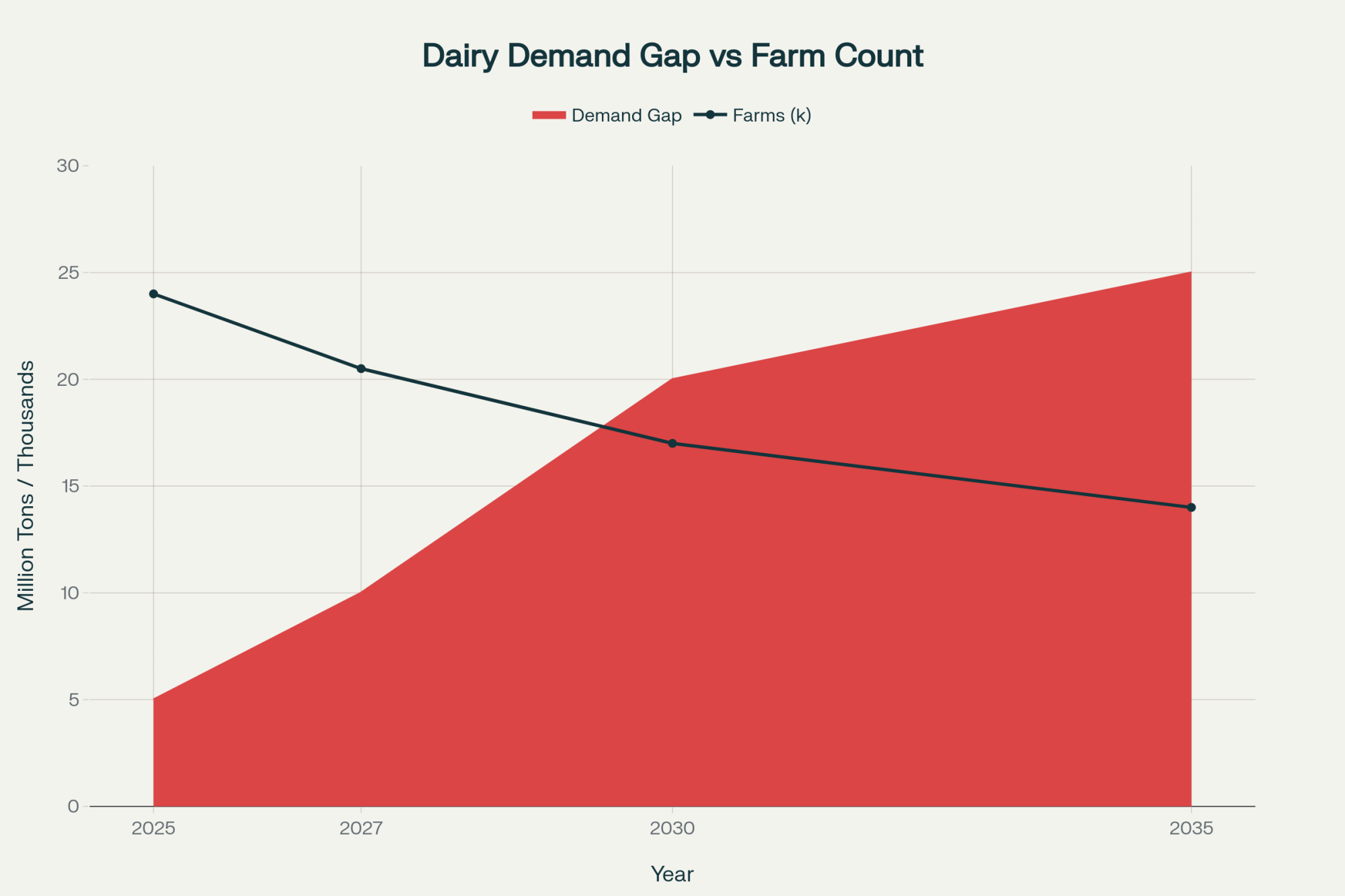
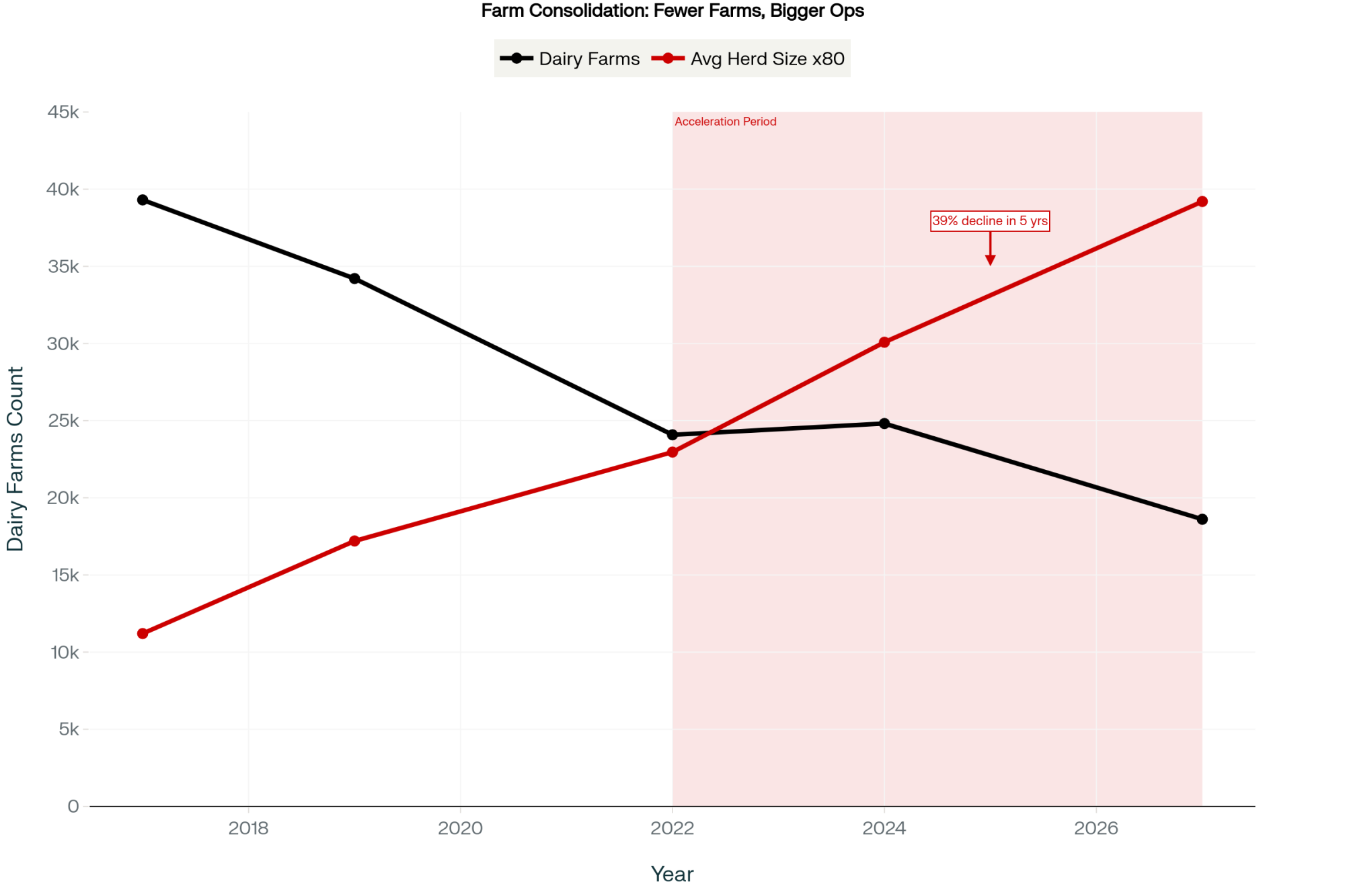
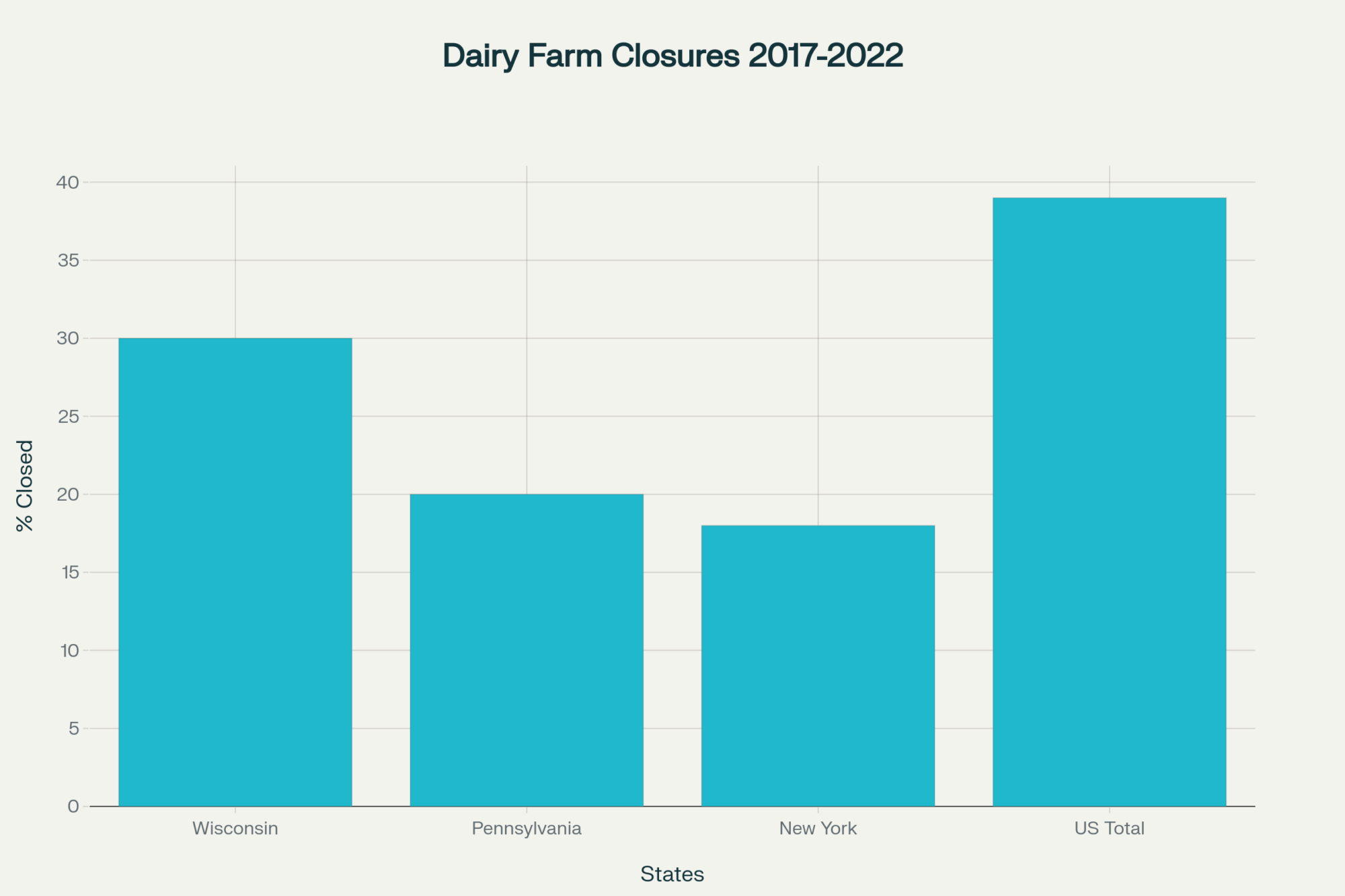
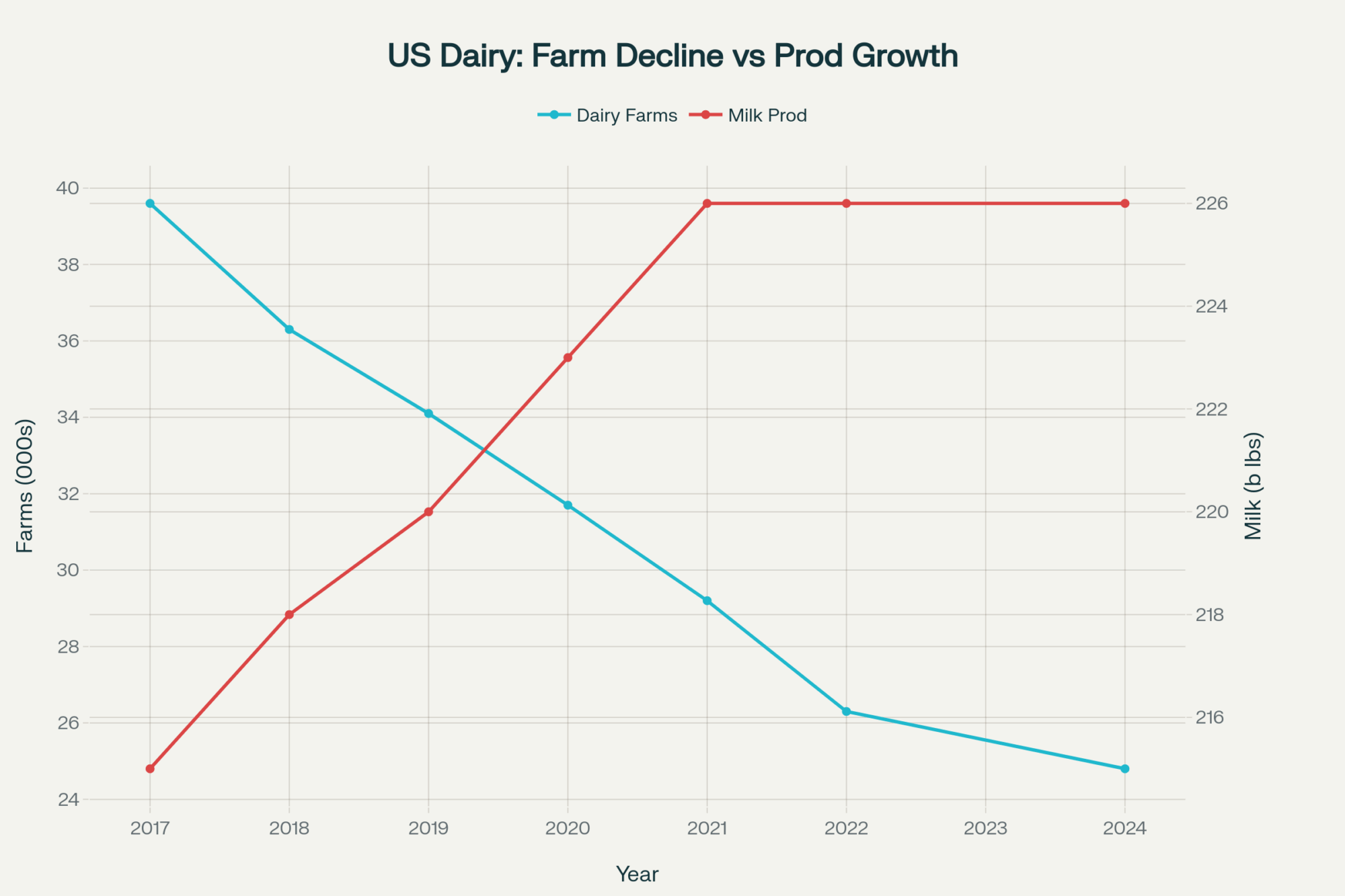
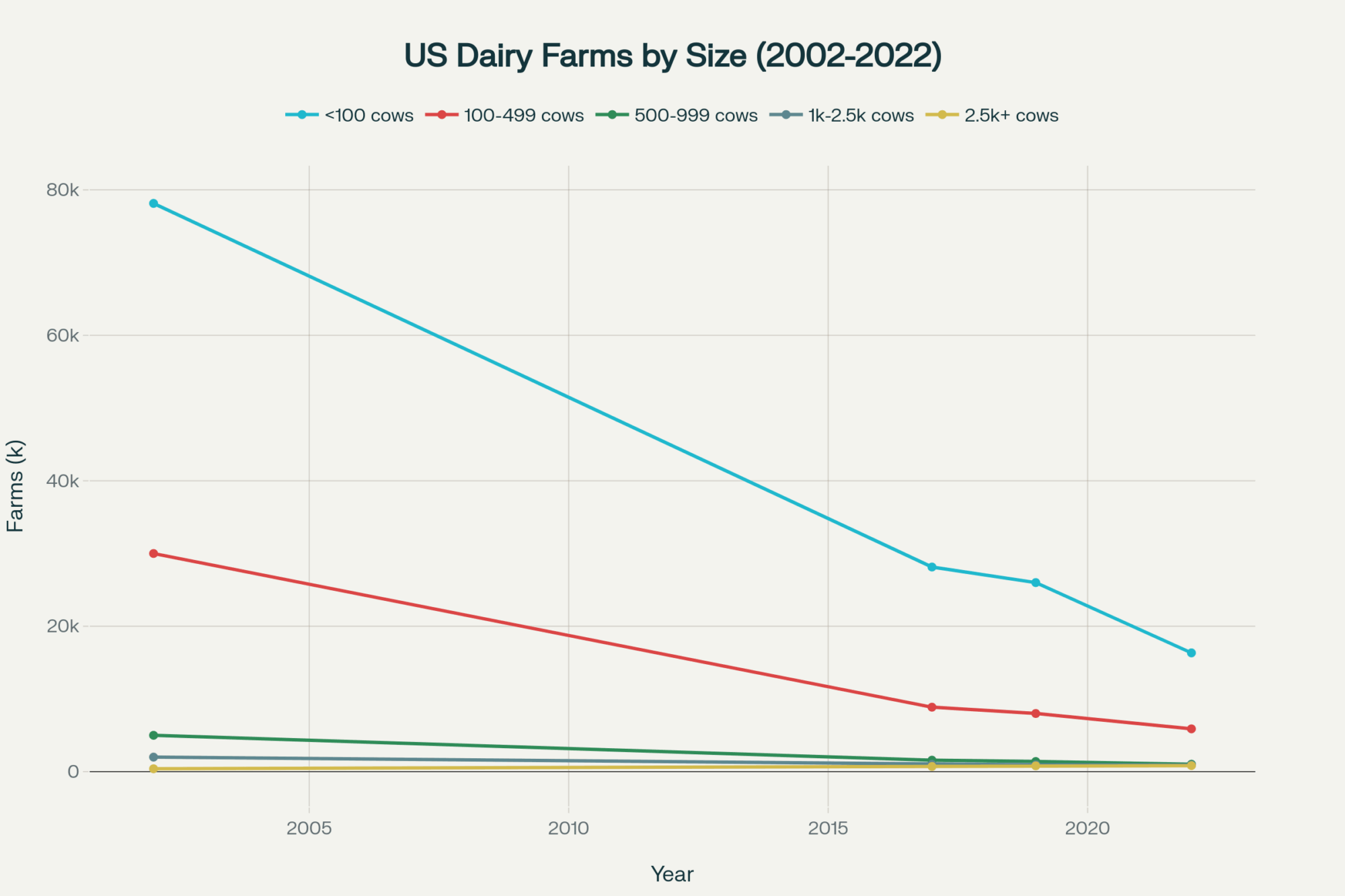
U.S. dairy farming faces an existential consolidation crisis, with farm numbers plummeting from 39,300 operations in 2017 to a projected 10,500 by 2040—a 73% reduction driven by systematic structural advantages favoring mega-operations over traditional family farms, with 1,420 farms disappearing annually as of 2024.
Looking at How the Structure Has Shifted
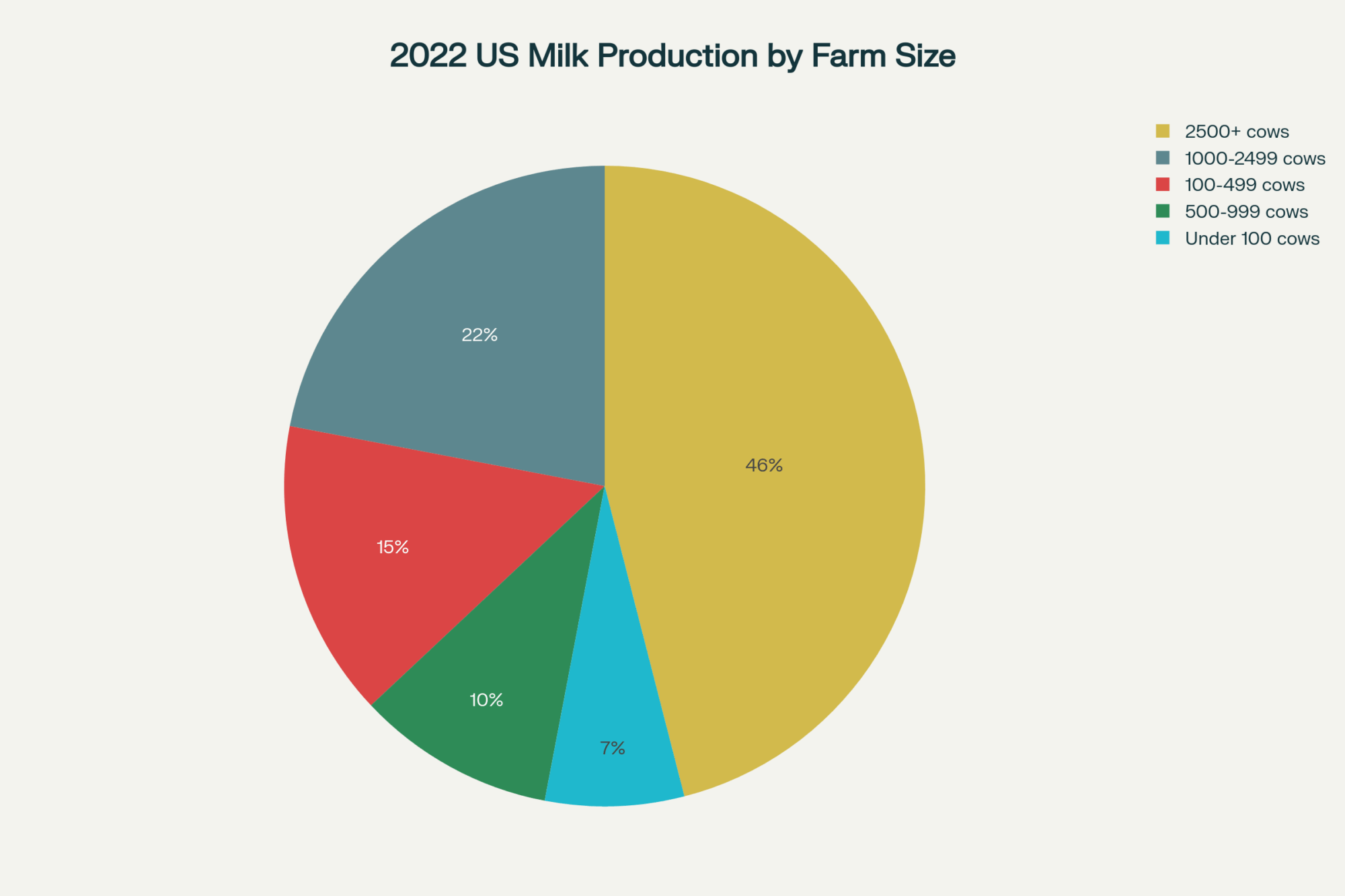
Start with the numbers, because they’re telling: The 2022 Census of Agriculture shows about 65% of American milk now comes from just 8% of herds—those with over 1,000 cows. Meanwhile, nearly 9 out of 10 farms (the 100–500 cow group) account for only 22% of the supply. In the Northeast and Midwest, that’s still the “standard” size, but the playing field keeps tilting.
As one third-generation Wisconsin farmer shared, “I remember 13 dairies on our road, but now it’s just us. Plenty of the folks who exited were younger managers, not retirees. They just couldn’t get the numbers to work.”
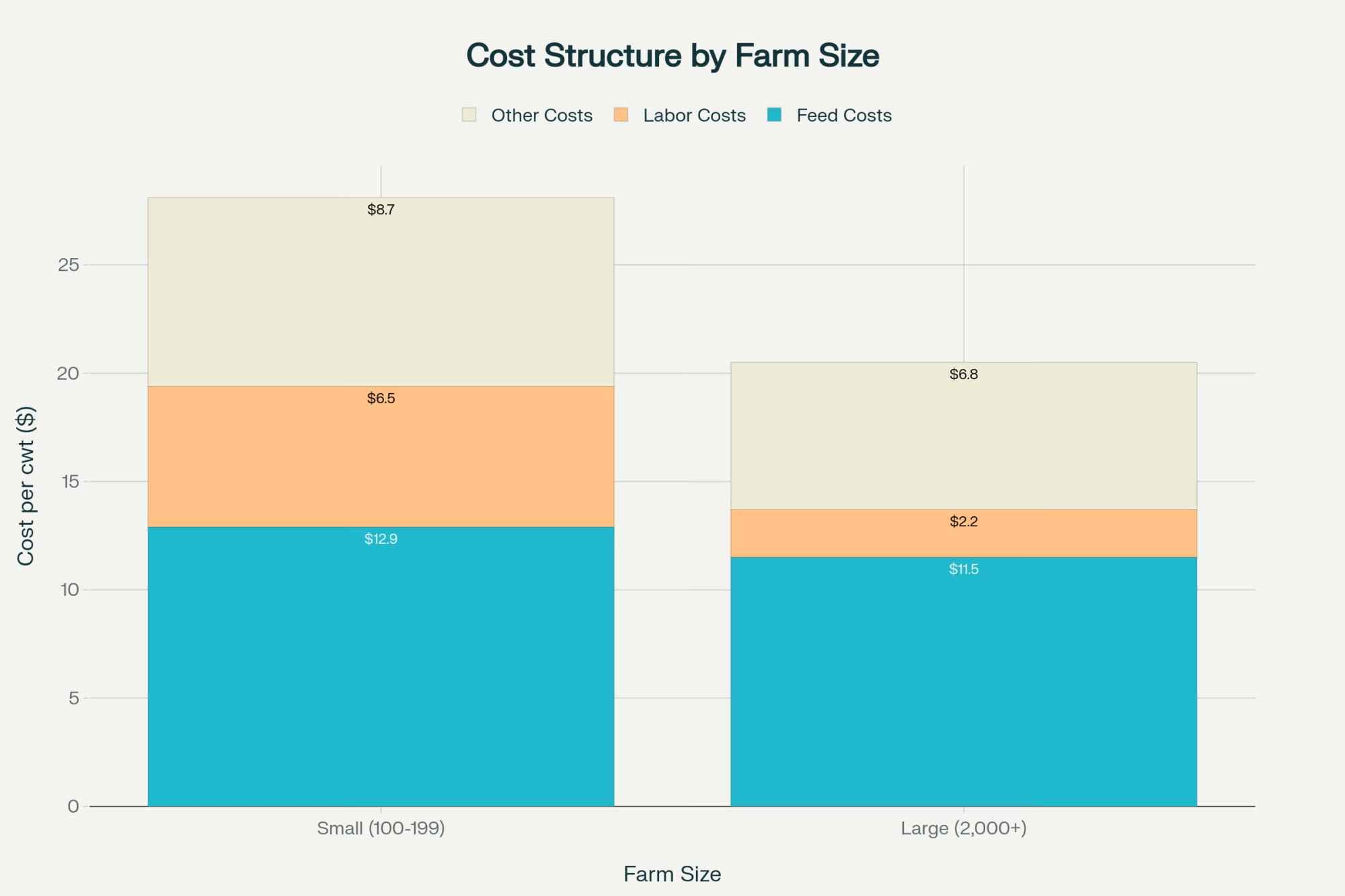
Cost of production varies dramatically by herd size, with the smallest operations facing a devastating $9/cwt disadvantage that translates to $250,000 in annual losses for a typical 600-cow farm—a gap driven by scale advantages in feed purchasing, financing, and regulatory compliance rather than management quality.
Cornell’s Dairy Farm Business Summary for 2022 has it in black and white: the biggest herds report $22–$24/cwt cost of production. For 100–199 cow operations, the range is $31–$33/cwt. In a market where the base price is set by regional blend or federal order, that gap eats margin and equity fast.
Beyond Raw Efficiency: What’s Really Behind Cost Gaps
What’s interesting here is how much of the “efficiency” story isn’t really about cow management or even genetics anymore. I talked to a Central Valley manager running 5,000 cows who summed it up: “We buy grain by the unit train—110 railcars. Our delivered price is CBOT minus basis, sometimes 15 cents lower. My neighbor with 300 cows pays elevator price, plus haul; that’s 40, 50 cents more per bushel.”
It’s not just West Coast operations seeing this. In the Upper Midwest, neighbors share similar experiences. Volume buyers get priority and save dollars, not because they feed cows better, but because they can buy enough at once to command a discount.
Bring in finance, and the gap widens. Published rates show 2,000-cow herds receiving prime plus 0.5%. A 200-cow farm might see prime plus two. On a $1 million note, that’s more than $15,000 a year in extra interest just for being smaller.
Then consider environmental compliance. The latest Wisconsin Department of Ag reports—which many of us turned to during the farm planning season—show the cost of nutrient management, methane compliance, and water permits comes out to 50 cents/cwt for the largest herds, but easily $15/cwt or more for the smallest. It’s the same paperwork, same inspector fee—just spread over far fewer cows and pounds.
The scale advantage isn’t about better farming—it’s about systematic structural advantages that give large operations a $4/cwt cost edge through volume discounts on feed, preferential financing rates, amortized regulatory compliance costs, and labor efficiency, creating a $100,000 annual penalty for a 500-cow farm that has nothing to do with management quality.
The Co-op/Processor Crossover: Facing Up to the Math
Now, here’s where a lot of dinner-table talk turns pointed. Vertical integration with co-ops, especially after big moves like DFA’s $425 million purchase of Dean Foods’ 44 plants, changes the dynamic. Industry estimates now indicate that more than half of DFA members’ milk flows through DFA plants.
There’s no way around it: when your co-op is both your “agent” and your buyer, it faces a built-in conflict. The original co-op job—fight for a fair farm price—collides with the processor’s goal: keep input costs as low and steady as possible.
A Cornell ag econ professor put it bluntly at last year’s co-op leadership workshop: “Co-ops owning plants face incentives that are tough to align. You can’t maximize both farmer pay price and processing margin.” And I’ve seen the evidence myself; the research shows co-ops often have lower stated deductions, but within the co-op group, “other deductions” can vary wildly. As one board member told us, “Transparency on this stuff is hard for everyone, even when we want it.”
Think about it: if your co-op owns the plant, is the negotiation about pay price truly across the table or just across the hallway?
Canadian Lessons: Costs and the Future
Now, Canadian friends watching these trends aren’t immune either. The Canadian Dairy Information Centre’s latest data puts the last decade’s dairy farm reduction at over 2,700, even under supply management. And quota levels are a choke point: In Ontario, with a strict cap, quota changes hands around $24,000 per kilo of butterfat; Alberta’s uncapped market runs up past $50,000.
A young producer near Guelph explained it best: “We want to keep the farm in the family, but the math now is about buying quota at market rate from Dad—he paid $3,000/kilo in the ’90s. I pay $24,000/kilo or more, and start so far behind on cash flow it feels impossible.”
Canadian dairy quota prices have exploded from $3,000 per kilogram in the 1990s to $24,000 in Ontario and $50,000 in Alberta by 2023—a 1,567% increase that creates an impossible generational wealth transfer barrier, forcing young farmers to begin their careers hundreds of thousands of dollars in debt simply to acquire the right to produce milk their parents obtained for a fraction of the cost.
Producers Team Up—and Win
We should all pay attention to how producers abroad have responded. In Ireland, Dairygold tried to drop prices, but farmers quickly networked on WhatsApp. Once they started comparing pay stubs, they discovered inconsistencies—same pickup, same composition, different pay. They organized: “If 200 show up with real data, will you join?” The answer was yes. Six weeks, 600 farmers, and the transparency improved, the price cut was rescinded.
That lesson isn’t just for Ireland. That’s modern farm business—facts and solidarity over rumors and grumbling.
U.S. Adaptation Tactics: What’s Working
Across the U.S., I’ve watched farmers embrace savvy but straightforward approaches. Central Valley producers doubled back to their milk checks and truck bills and found that some paid 20 cents/cwt more for identical hauls. As a group, they pressed for change—and got it.
Midwesterners have started bottling their own milk—Wisconsin’s extension reports show farmgate price benefits of $2 to $4 a gallon, though yeah, getting there takes $75,000 to $100,000 and some serious compliance stamina.
Debt is a fresh challenge in its own right in cow management. Now’s the time to renegotiate any credit above prime plus one. Dropping even one percent on a $2 million note brings $20,000–$25,000 savings straight to the P&L.
Environmental Law: A Sea Change
California’s methane digester rules, fully phased in over the past two years, are a classic case of “scale wins again.” For big operations, $4 million-plus digesters can become a profit center—especially if you trade renewable natural gas credits north of $1 million a year. Small farms? They can’t justify the capital, so the compliance cost splits unevenly—UC Davis economists show $2/cwt for small farms, under 50 cents for the largest.
It’s not about better manure management; it’s about who can amortize the cost.
The Path Ahead: What’s Next in Dairy Consolidation
The USDA’s Economic Research Service expects U.S. dairy farm numbers to dip below 10,000 by the mid-2030s, with Canadian farm numbers also dropping to around 4,000–5,000. That’s the math if nobody changes the model or the market.
But honestly, what gives me hope are examples of when perseverance, innovation, and strategic shifts pay off. In Wisconsin, several smaller herds now sell directly into grass-fed cheese contracts, pulling in a $4/cwt premium (more than make-allotment size, less fight for line space). “We stopped competing with 5,000-cow barns by beating them at their game,” one farmer told me. “We get paid for our story and our butterfat.”
Where To Focus Now
Calculate Your Position Honestly. Know your true cost—family living included—against hard local benchmarks. If the numbers don’t lie, accept what you see and plan accordingly.
Don’t Go It Alone. From paycheck audits to volume negotiations, the farms that win increasingly do so together.
Strategic Awareness Beats Production Alone. The future belongs to those who know how pricing, processing, and consumer trends intersect—and find their “crack” in the system instead of just producing more.
As Tom Vilsack put it at a dairy business roundtable: “We love to say we’re saving family farms, but policy and business choices keep rewarding bigness and consistency.” No matter your model—organic, conventional, something in between—the goal is to find your margin, your allies, and your leverage.
The numbers will keep changing, but one reality holds—those who adapt, share, and innovate stand the best chance. Old rules are being rewritten, and it’s worth being part of that conversation. For deep dives on industry economics, co-op strategy, and farm resilience, visit www.thebullvine.com.
KEY TAKEAWAYS
Butterfat numbers and raw efficiency don’t guarantee survival—market scale, price leverage, and transparency do.
Question every deduction and demand clarity from your co-op or processor—internal conflicts don’t have to shortchange you.
Benchmark your costs with neighboring farms and negotiate together—solo producers rarely win against consolidated buyers.
The farms thriving today are adapting: going direct-to-consumer, value-adding, or finding specialized markets to earn more per cwt.
Success in modern dairy comes from forward planning, embracing new models, and building your own leverage—not waiting for the system to “fix itself.”
EXECUTIVE SUMMARY:
Dairy’s old rules—“be efficient and you survive”—no longer hold. Drawing on real farm stories and national data, this investigation exposes why scale, access, and co-op consolidation matter more than top cow performance. You’ll see how market power and processor influence—not just farm management—decide who survives and who sells out. With insights from producers challenging these trends, along with practical strategies and benchmarks, this article is a must-read for anyone rewriting their playbook. Get the facts, the framework, and a clear-eyed look at what real success in dairy now demands.
Complete references and supporting documentation are available upon request by contacting the editorial team at editor@thebullvine.com.
Learn More:
Your 2025 Dairy Gameplan: Three Critical Areas Separating Profit from Loss – Reveals specific operational adjustments—from silage density to amino acid balancing—that can generate $500+ per cow in additional net income, offering a tactical way to combat the structural cost disadvantages highlighted in the main article.
Decide or Decline: 2025 and the Future of Mid-Size Dairies – Delivers a strategic ultimatum for the “squeezed” mid-sized herds discussed above, analyzing why standing still drains 6-8% of equity annually and outlining two viable survival models: specialized optimization or calculated expansion.
Join over 30,000 successful dairy professionals who rely on Bullvine Weekly for their competitive edge. Delivered directly to your inbox each week, our exclusive industry insights help you make smarter decisions while saving precious hours every week. Never miss critical updates on milk production trends, breakthrough technologies, and profit-boosting strategies that top producers are already implementing. Subscribe now to transform your dairy operation’s efficiency and profitability—your future success is just one click away.
Only 11% of dairies under 300 cows are profitable. But three paths still work—if you move in the next 18 months.
EXECUTIVE SUMMARY: Lactalis cutting 270 dairy farms while investing $11 billion in processing isn’t a contradiction—it’s the clearest signal yet that commodity milk is finished and component quality now rules everything. The stark reality: 89% of dairies over 1,000 cows are profitable while only 11% under 300 cows make money, and this isn’t about management skill—it’s structural economics you can’t overcome with hard work alone. Three converging crises (interest rates doubling to 8%, heifer inventory at 20-year lows, and labor costs up 73%) have compressed what was once a gradual 5-year industry shift into an urgent 18-month decision window. Every dairy faces three paths: invest $6.75-10.25 million to scale beyond 1,000 cows, transition to premium markets (organic/specialty) despite 3-year losses, or exit strategically while you can still preserve family wealth. Real farmers are already choosing—a Minnesota couple successfully scaled to 1,100 cows, Vermont neighbors transitioned to organic, and a Wisconsin family preserved $2.1 million through strategic sale. The difference between 3.6% and 4.2% butterfat is now worth $529,000 annually for a 500-cow operation, making component performance literally the difference between survival and closure. Your window to control this decision closes in 18 months—after that, circumstances decide for you.
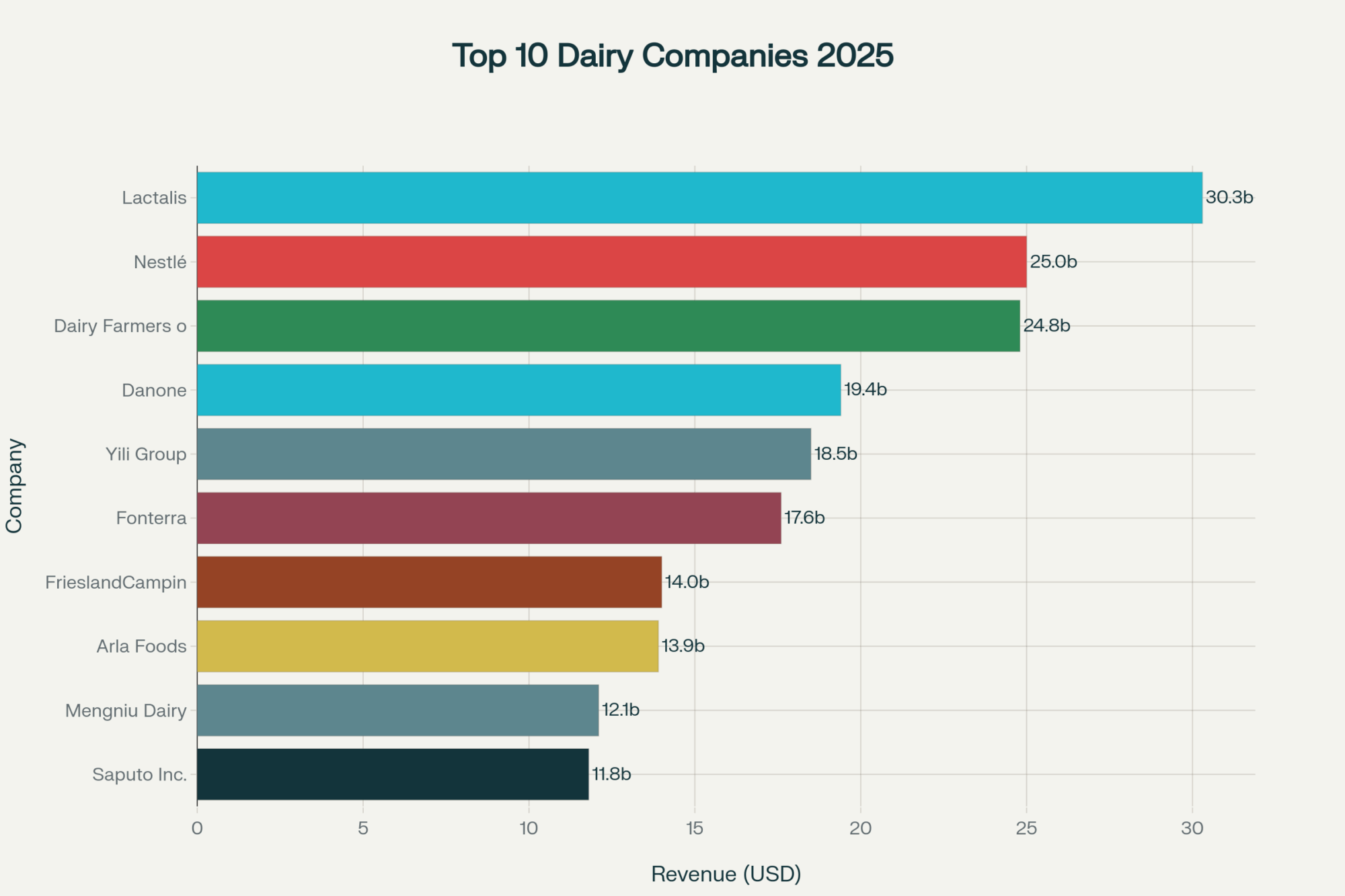
You know, when Lactalis—the world’s largest dairy processor—announces they’re cutting 450 million liters and ending contracts with 270 French farmers, we should probably pay attention. I’ve been digging into this, talking with producers, looking at the numbers… and what’s interesting is this isn’t just another market cycle. We’re seeing something bigger here, something that’s going to affect all of us, whether we’re milking 50 cows or 5,000.
What I’ve found is that the traditional commodity dairy model—you know, the one most of us grew up with—it’s changing faster than anyone expected. And the timeline to adapt? Well, that’s gotten surprisingly short.
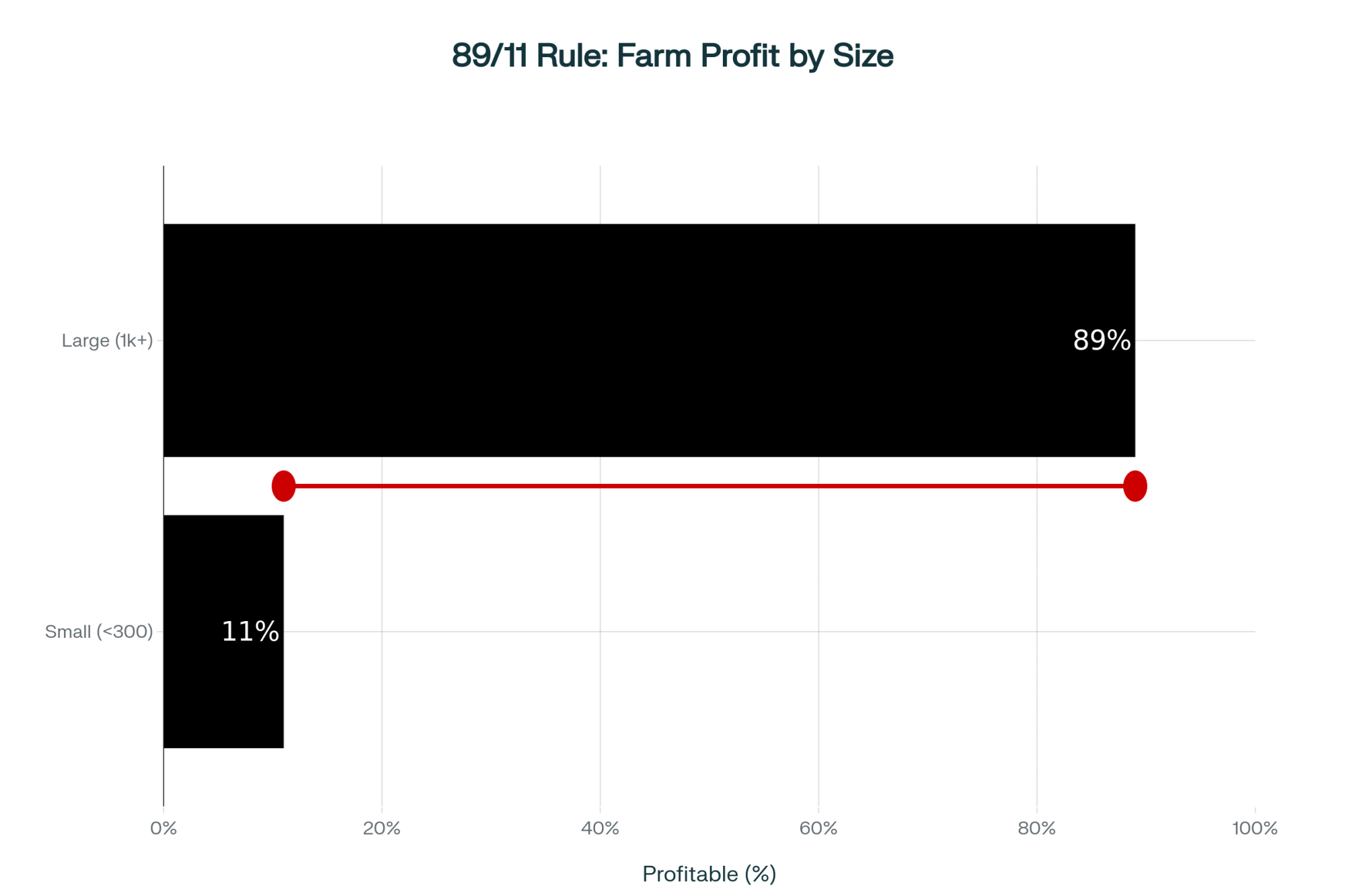
The 89/11 Rule reveals the stark reality: structural economics, not management quality, determines survival in modern dairy
Understanding Why Processors Are Making These Moves
So here’s what caught my attention in Lactalis’s 2024 financials: €30.3 billion in revenue, but only 1.2% net profit margins. That’s down from 1.45% the year before. Now compare that to their premium products—the yogurt division they bought from General Mills is generating 15-20% operating margins. Premium cheese? Consistently 8-12% margins.
Lactalis’s supply director explained in their October statement that the valuation of excess milk is often very low and subject to market volatility—language that really reflects how processors are viewing commodity markets these days. When a processor that size essentially says commodity milk isn’t worth the trouble… well, that’s not just complaining, is it?
FrieslandCampina’s been going through similar challenges. They’ve talked about timing mismatches—buying milk at one price, processing it, then having to sell into a lower market. That kind of volatility makes it really tough to plan, and shareholders don’t like uncertainty.
The Component Game Has Changed Everything
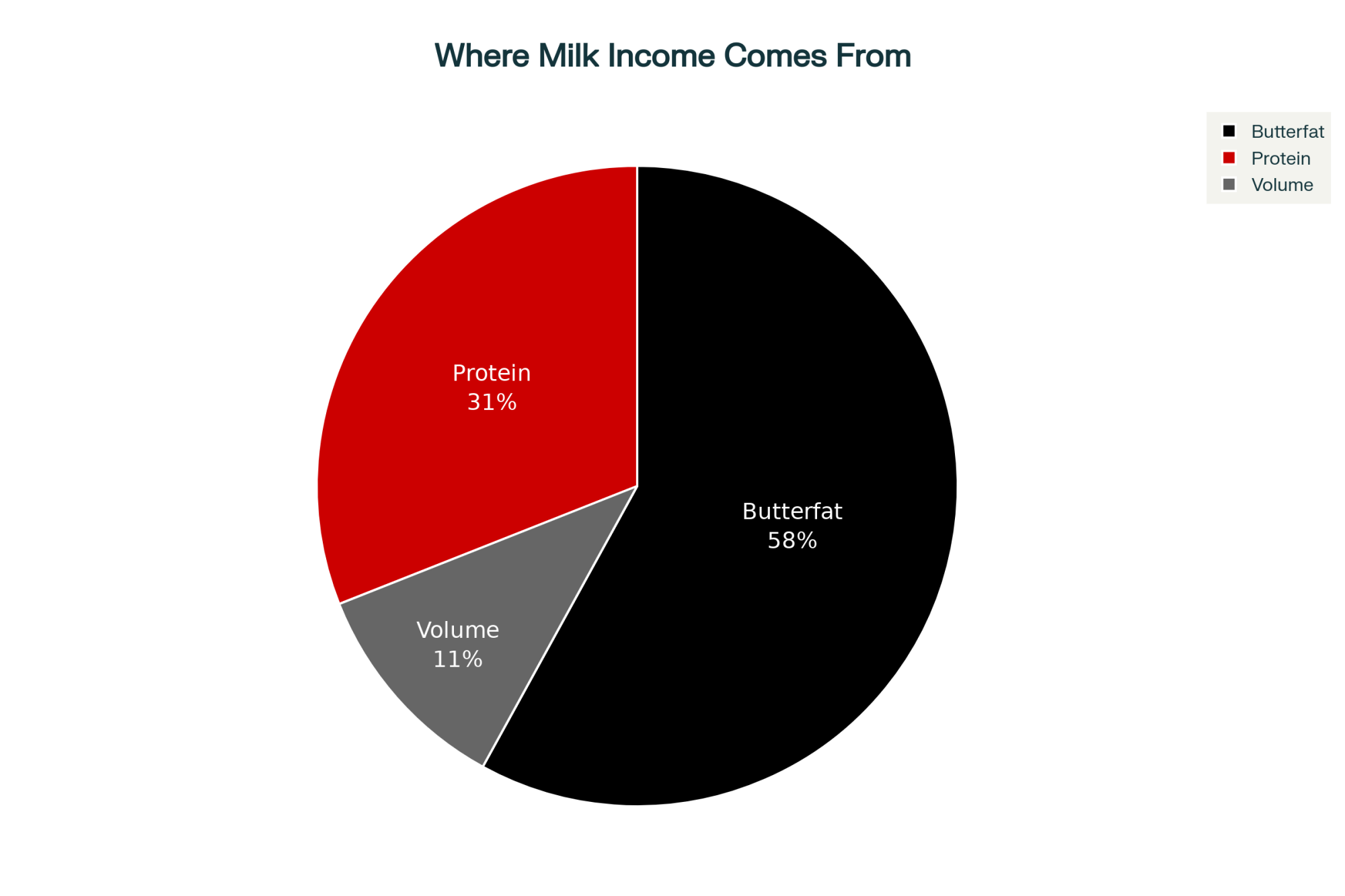
Component performance is now non-negotiable—volume alone won’t pay the bills anymore
I was talking with a Wisconsin producer last week—he’s running 650 cows near Fond du Lac—and he helped me understand just how much components have shifted the whole economics of dairy farming. USDA data from November shows butterfat now represents 58% of your milk check value, and protein adds another 31%. Think about that… 89% of your income comes from components, not volume.
His neighbors who consistently hit 4.23% butterfat compared to the regional average of 3.69%? They’re capturing about $4.60 more per hundredweight. For a 500-cow operation producing 23,000 pounds per cow annually, that works out to roughly $529,000 in additional revenue—though your actual numbers will vary with production levels and regional premiums, of course.
Cornell’s latest farm business data shows some interesting patterns:
The big operations—1,000+ cows—they’re hitting 4.0-4.3% butterfat with 3.3-3.5% protein pretty consistently
Mid-sized farms, say 300-500 cows, generally average 3.6-3.8% butterfat, 3.0-3.1% protein
And here’s what’s telling: large farms maintain about 2% daily variation in components while smaller operations see 5-10% swings
Now, getting those high components isn’t just about genetics. You need systematic management—a good nutritionist runs $80,000 to $120,000 a year, based on what I’m hearing. Feed testing programs add another $15,000 to $25,000. Those precision feeding systems? Dealers are quoting $250,000 to $500,000, depending on what you need.
The math gets tough for smaller operations. When you spread the combined cost of nutritionist, vet services, and consultants across a thousand-cow operation, it might come to $0.08-0.12 per hundredweight. But for a 200-cow farm? You’re looking at $0.40-$0.60 per hundredweight for the same level of professional support. That’s a huge competitive disadvantage.
Three Things Hitting Us All at Once
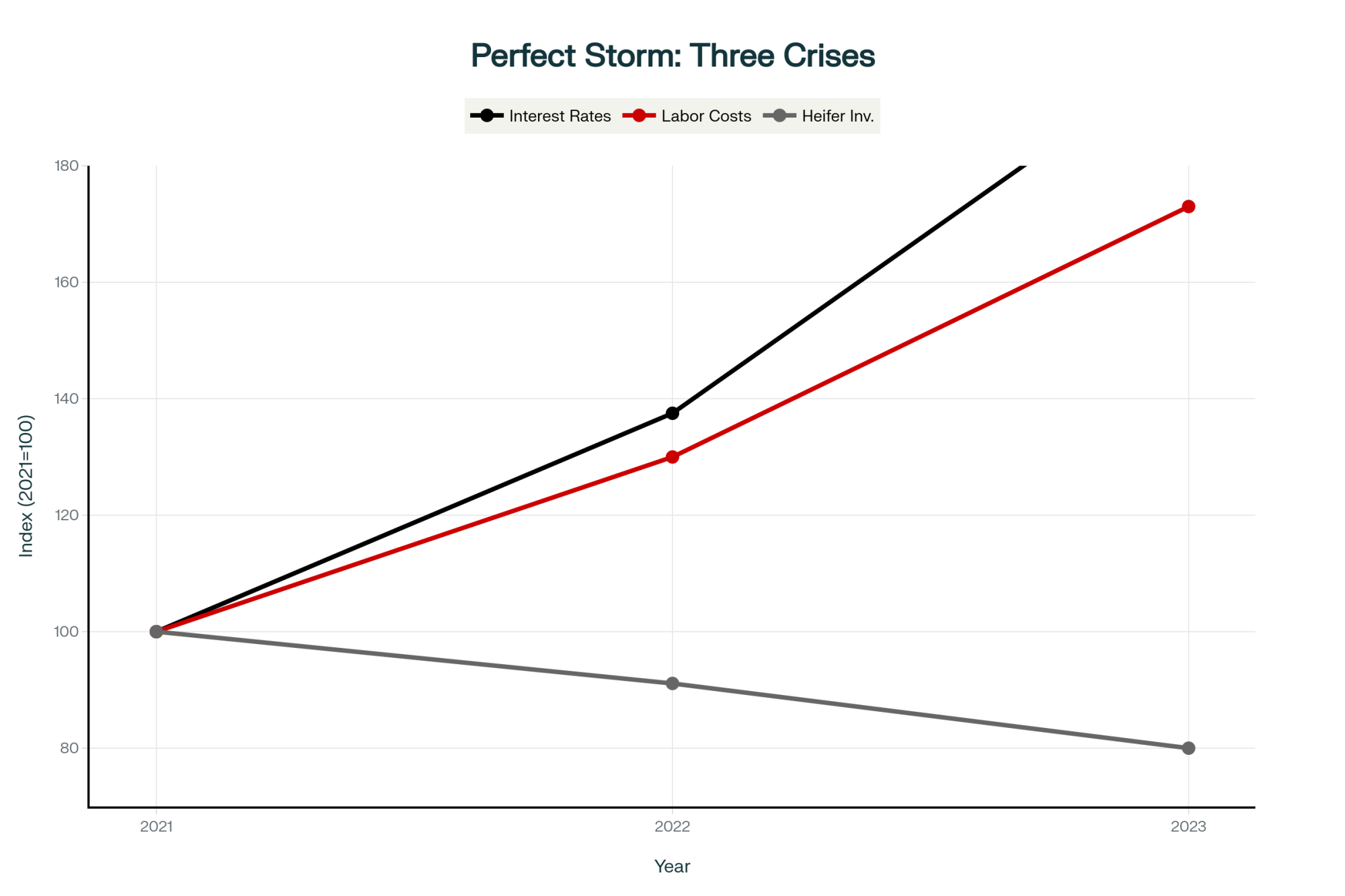
Cornell’s dairy economics team has been documenting what they’re calling a compressed decision timeline, and I think they’re onto something. Three things have converged, forcing us to make decisions faster than we’re used to.
Three converging crises compressed a gradual 5-year industry shift into an urgent 18-month decision window
Interest Rates Hit Like a Hammer
Federal Reserve data shows operating loan rates doubled—went from about 4% in 2021 to over 8% by late 2023. Haven’t seen rates like that in 20 years. A lender in Pennsylvania told me that operations that were barely profitable at 4% are now losing $3,000 to $5,000 monthly.
The Illinois farm management folks found that farms carrying significant debt saw interest costs per tillable acre jump from $33 to $60 in three years. That’s 82% more in fixed costs, and you can’t pass that along to your milk buyer.
What really concerns me is the Q3 2024 ag lending data—operating loan volumes are up over 30% for the third quarter in a row. A Wisconsin banker friend put it best: “This isn’t growth borrowing, it’s survival borrowing.”
The Heifer Shortage Nobody Saw Coming
CoBank’s August report lays out a fascinating situation—dairy heifer inventory’s at a 20-year low just when we need expansion for all this new processing capacity.
Here’s how we got here: the breeding data shows beef semen sales to dairy farms tripled from 2.5 million units in 2017 to 7.2 million by 2020. Last year? 7.9 million of the 9.7 million total units were beef semen.
Can’t blame anyone really. When beef calves were bringing $1,000 to $1,500 last October, while it costs $2,200 to $2,500 to raise a heifer worth maybe $1,600… the math was obvious. Problem is, we all did the same math at the same time.
CoBank thinks we’ll lose another 800,000 head before things turn around in 2027. An Idaho producer told me he’s been offered $3,200 for breeding-age heifers—if he had any. “Five years ago at $1,400, I had too many,” he said. “Now I can’t find them at any price.”
Labor Is Getting Impossible
Texas A&M’s 2024 research shows that immigrant workers make up 51% of dairy labor and milk 79% of our cows. Their models suggest losing that workforce would cut U.S. milk production by 48.4 billion pounds annually. That’s not a typo.
And it’s not just finding workers—it’s affording them. USDA data shows dairy wages went from $11.54 an hour in 2015 to $18-20 by 2024. A large operations manager in New Mexico told me they’re at $28 an hour when you factor in housing, benefits, and recruitment. “And we still can’t stay fully staffed,” he added.
Three Producers Who Found Their Way Through
Despite all these challenges, I’ve met several operations that have successfully navigating this transition. Let me share what they did differently.
Smart Scaling in Minnesota
There’s a couple in central Minnesota who expanded from 350 to 1,100 cows between 2019 and 2023. They saw their co-op’s base program would limit growth for mid-sized farms, so they moved early. Got financing at 3.5% before rates spiked, used sexed semen exclusively for three years to build internally, and partnered with an experienced Venezuelan family.
What’s smart is they expanded in phases over four years—each phase had to cash flow before they moved to the next. They’re now shipping butterfat at 4.1% consistently and have signed a five-year contract with a cheese plant 40 miles away. Their breakeven’s around $17.50 per hundredweight, so they’ve got a cushion even when markets get tough.
Going Organic in Vermont
A Vermont family with 480 cows went organic in 2021—right when everyone said that market was full. Key thing? They got Organic Valley’s commitment in writing before starting the transition. They lost $210,000 over three years, but off-farm income and some timber sales bridged the gap.
Today, they’re netting $3.80 per hundredweight after all costs. “We focused on keeping cows healthy and production steady rather than trying to expand during transition,” the son told me. They maintained 92% of conventional production throughout the transition—well above the 85% average.
Making the Tough Call in Wisconsin
This one’s harder to talk about. A couple near Eau Claire sold their 280-cow operation in March 2024 after recognizing they were in what economists call the 18-month window—sustained losses with limited options. At 58, with kids established off-farm, expanding to a competitive scale meant $6 million in new debt.
They sold into a strong cull market, leased the cropland to a neighbor, and kept the house and 40 acres. The husband’s now using his 30 years of experience as a co-op field rep. “I sleep better, my wife’s happier, and financially we’re ahead,” he told me. They preserved about $2.1 million in equity that probably would’ve disappeared if they’d hung on another year.
Where All This New Processing Investment Is Going
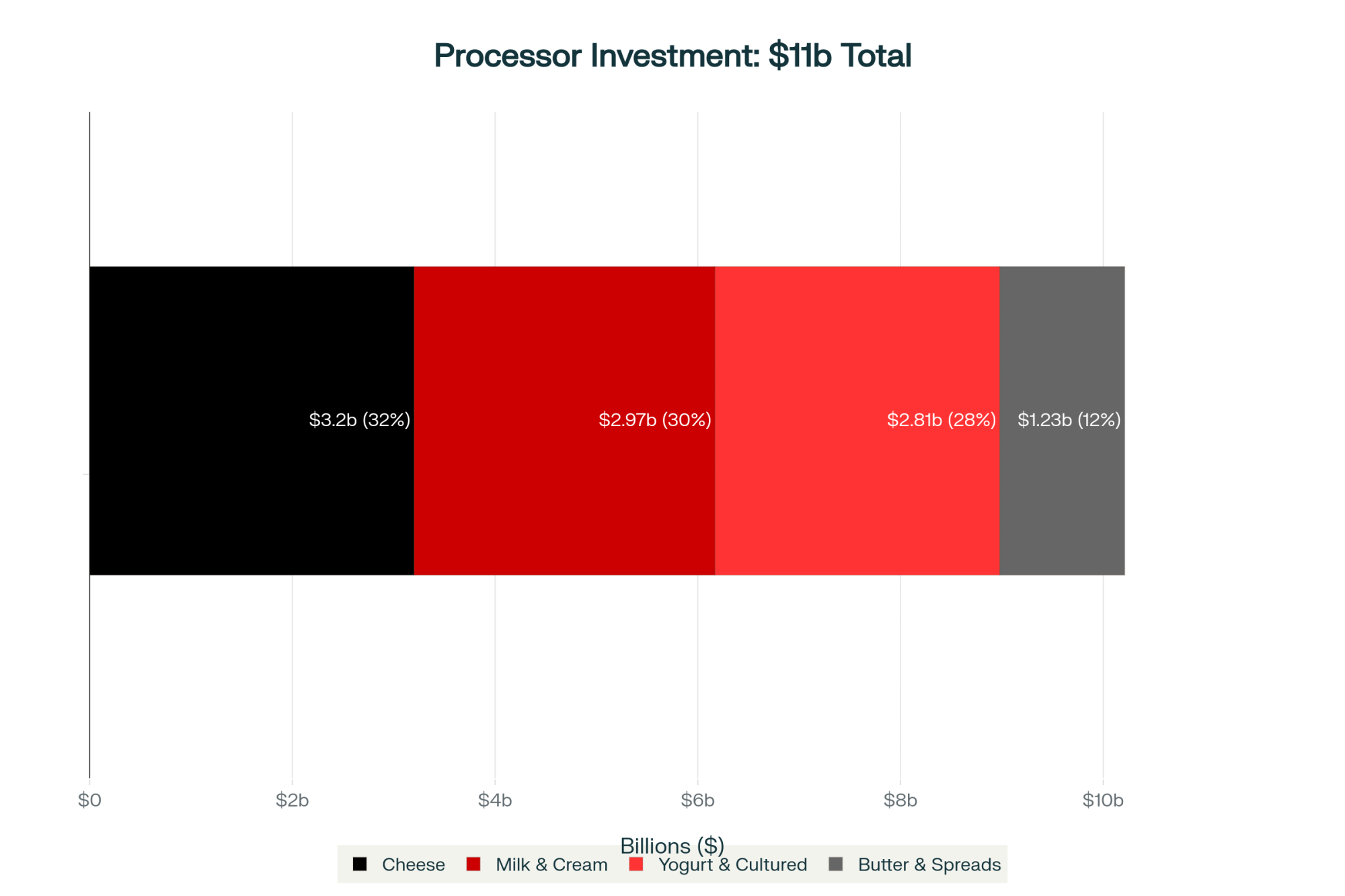
Processors already chose their future—understand their strategy to predict yours
IDFA announced $11 billion in new processing capacity, and where that money’s going tells you everything about industry direction. Their October breakdown shows:
Cheese gets $3.2 billion—32% of everything
Milk and cream processing: $2.97 billion—30%
Yogurt and cultured products: $2.81 billion—28%
Butter and spreads: $1.23 billion—12%
Three new cheese plants in the Texas Panhandle need 20 million pounds of milk daily by mid-2025. But these aren’t commodity operations—they’re component extraction facilities making mozzarella for export while capturing valuable whey proteins.
What they’re NOT building? Commodity powder plants or basic fluid bottling. A processing engineer in Wisconsin explained it well: “We’re maximizing value from every component now. Just removing water to make powder doesn’t cut it anymore.”
And here’s something else—up in the Northeast, a couple of smaller specialty cheese operations just expanded. They’re not huge, but they’re finding success focusing on local markets and agritourism. Different model entirely from the big Texas plants, but it shows there’s more than one way forward. Out in California’s Central Valley, I’m seeing similar patterns with artisan operations carving out niches even as the big players consolidate.
The Cooperative Evolution We Need to Talk About
This is uncomfortable for many of us, but cooperatives have changed dramatically since DFA was formed in 1998 through regional mergers. They now control 30% of U.S. milk production, and after buying 44 Dean Foods plants in 2020, they’re both the biggest milk marketer AND processor.
A former board member explained how this creates tension: “When your co-op owns processing plants, optimizing those facilities becomes as important as your milk check—sometimes more important.”
Base-excess programs show this complexity. Cornell’s research indicates these programs typically use your best three consecutive months over three years as “base.” Milk over that? You might pay penalties of $5 to $13.30 per hundredweight.
A Vermont producer shared his frustration: “We wanted to add 50 cows to get more efficient, but overbase penalties would’ve killed any benefit. We’re locked at the current size.”
Meanwhile, operations that were already large when base programs started? They’re fine. It’s the 300-cow farms trying to grow to 500 that get squeezed.
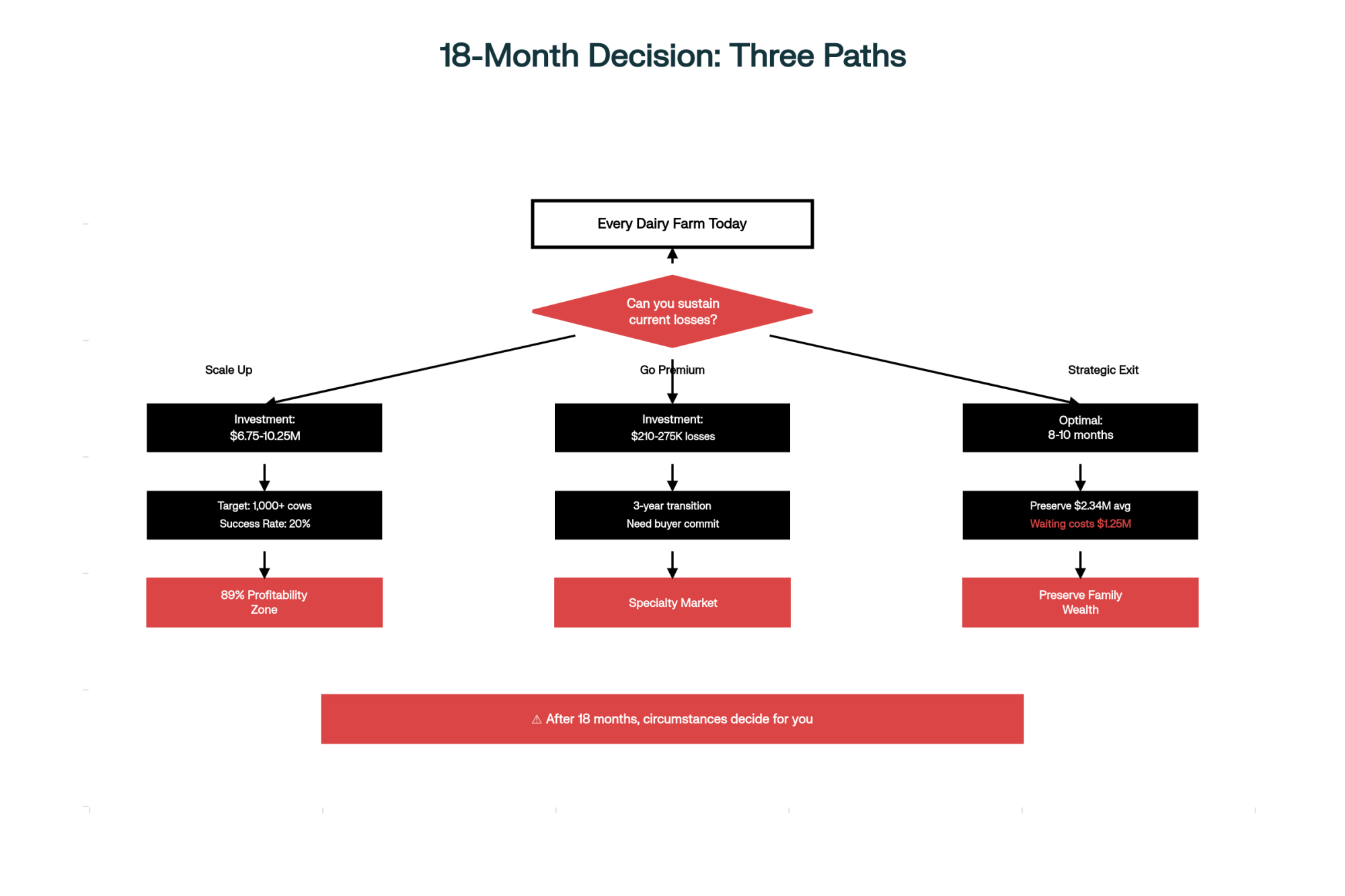
Your Three Paths Forward—Let’s Look at Real Numbers
Path Comparison at a Glance
Factor
Scale Up
Go Premium
Strategic Exit
Investment
$6.75-10.25M
$210-275K losses
Preserve equity
Timeline
4-5 years
3-year transition
8-10 months optimal
Success Rate
~20%
Varies by market
100% if timed right
Key Risk
Debt burden
Market saturation
Waiting too long
Extension economists from Cornell and Wisconsin show that farms with sustained losses typically face critical decisions within 12-18 months. So what are your actual options?
Path 1: Scale Up to Compete
Investment Required: $6.75-10.25 million total
Buildings and infrastructure: $3.5-5.0 million
Cattle at current prices: $2.25-3.0 million
Feed base expansion: $500,000-1.5 million
Working capital: $500,000-750,000
Success Rate: According to lending industry estimates, about 20% achieve projected returns. Key Factor: Usually need family money for unexpected challenges. Financing Options: USDA FSA offers beginning farmer programs and guaranteed operating loans through participating lenders, though eligibility and terms vary by operation and region. Some states also have specific dairy expansion programs worth exploring.
Path 2: Find Your Premium Market
Organic Transition Example:
Typical losses: $210,000-275,000 over 3 years
Pay organic feed prices (30-50% higher) while getting conventional prices
Need written buyer commitment before starting
Must maintain 85%+ production through transition
Potential Returns: $2.45/cwt net (vs. -$5.29 for conventional, based on USDA 2023 data). Reality Check: Most regions aren’t currently seeking new organic production. Alternative Options: Consider grassfed certification, A2A2 markets, or local/regional branding
Path 3: Strategic Exit While You Can
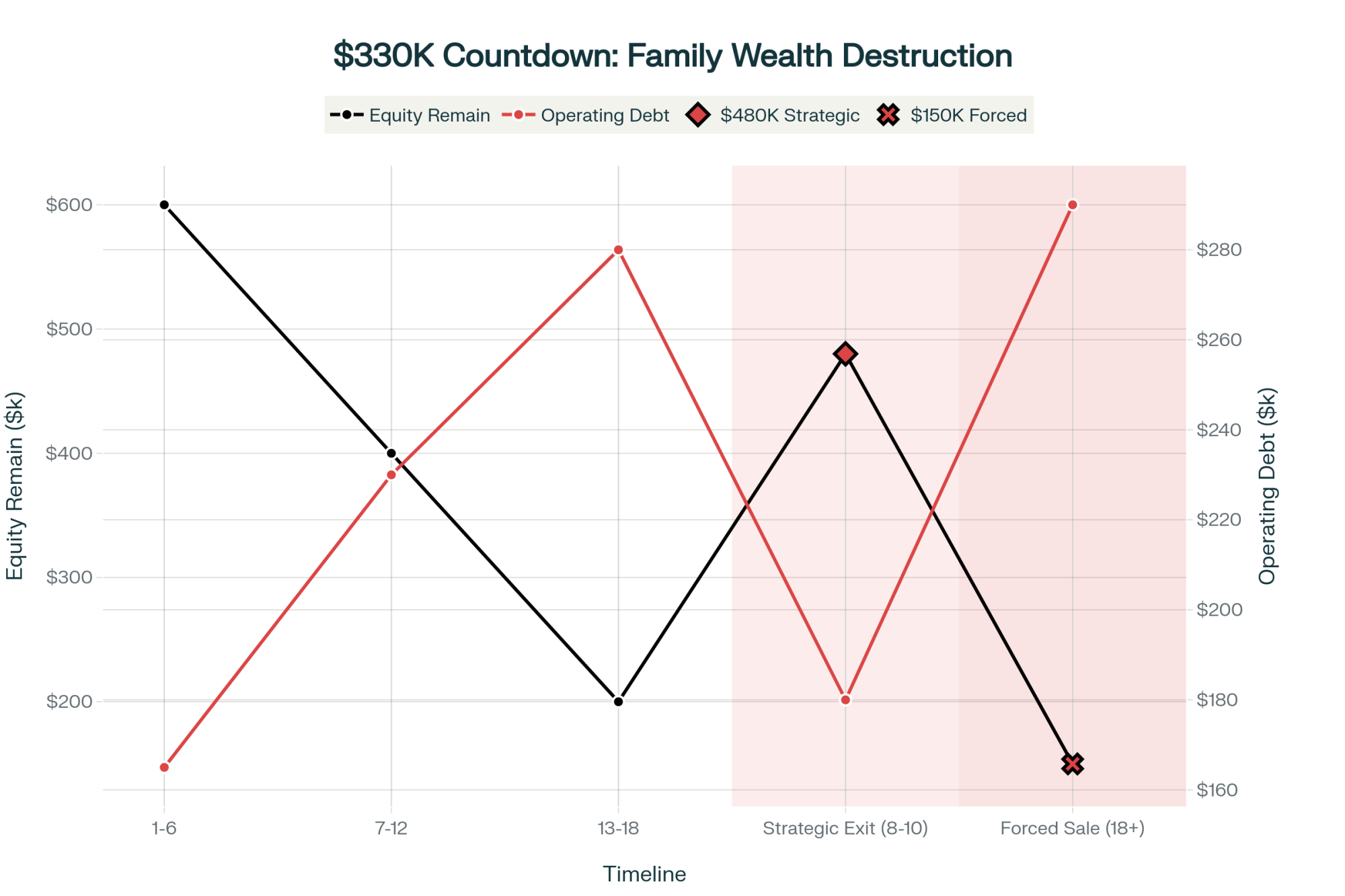
Timing Matters—Example for 300-cow operation with $2M debt:
Exit at 8-10 months:
Assets bring ~$4.65 million
After $2M debt and costs ($230,000-390,000): $2.26-2.42 million preserved
Forced sale at 16-18 months:
Assets bring ~$3.4 million (discounted)
After everything: $650,000-970,000 retained
The difference: Over $1.4 million in family wealth
Three paths still work—but only if you move in the next 18 months. After that, circumstances decide for you
The Technology Wave is Coming Fast
I attended the Protein Industries Summit in Chicago last month, and what I heard was eye-opening. McKinsey’s early 2025 biotech analysis shows precision fermentation has already hit cost parity for certain dairy proteins. Boston Consulting thinks these proteins will be five times cheaper than ours by 2030.
Here’s what’s already happening—Perfect Day’s animal-free whey is in Ben & Jerry’s ice cream right now. Not someday. Today. Fonterra’s partnerships with Superbrewed Food and Nourish Ingredients show where big players are heading. Fonterra indicated in its August 2024 announcements that ingredients from these technologies can be used alongside traditional dairy products. Translation: they’re building systems that can use proteins from cows or fermentation tanks—whatever’s cheaper.
And it’s not just startups anymore. I’m seeing major food companies quietly building fermentation capacity. They’re hedging their bets, preparing for a world where they can source proteins from multiple streams.
How This Hits Different Regions
This transformation affects regions differently, and understanding your local dynamics matters.
California: UC Davis research shows farms with less than 22% quota coverage pay more into the system than they get back. “We’re subsidizing the big quota holders,” a Tulare County producer told me.
Southeast: Maintains higher Class I fluid use—over 60% according to Federal Orders—which provides some buffer since processors need consistent daily deliveries. But even there, consolidation pressure is building.
Upper Midwest: All about cheese, so components rule everything. Wisconsin processors consistently tell me 4% butterfat is their practical minimum for preferred suppliers.
Plains States: Seeing aggressive expansion with new processing, but these plants want a minimum of 50,000+ pounds daily per farm. Can’t deliver that volume? You won’t get a contract.
Pacific Northwest: Interesting developments with smaller operations finding niches in farmstead cheese and direct marketing. Not for everyone, but it’s working for some.
Northeast: Beyond the specialty cheese operations, there’s also growth in agritourism and on-farm processing. Entirely different economics, but viable for the right location.
Western States: Water rights and environmental regulations adding another layer of complexity to expansion decisions.
Questions to Ask Yourself Right Now
Before you make any big decisions, honestly assess:
Are you covering all costs, including family living?
Can you achieve 4%+ butterfat consistently?
Do you have succession lined up?
What’s your debt-to-asset ratio?
Could you survive another year like 2023?
What would happen if you lost two key employees tomorrow?
Is your processor investing in commodity or specialty capacity?
Are there emerging environmental regulations that could affect you?
What This All Means for Your Planning
After looking at all this, here’s what I think matters most:
Component performance isn’t negotiable anymore. The difference between 3.6% and 4.2% butterfat can mean hundreds of thousands annually for a 500-cow operation. That fundamentally changes farm economics.
That 12-18 month window Cornell documented? It’s real. Interest rates, heifer availability, and labor costs compressed what used to be a multi-year adjustment into a much shorter period. Within the next 12-18 months—essentially by mid-2026, based on the timeline Cornell economists have documented—many operations will have made their choice, voluntarily or not.
Scale economics show clear breaks. USDA data showing 89% profitability for 1,000+ cow operations versus 11% for under 300 cows… that’s not about who’s a better manager. It’s structural advantages smaller operations can’t overcome.
Your processor’s strategy matters more than ever. If they’re investing in commodity powder, you’ve got time. If they’re building component extraction or specialty facilities, that tells you something different.
Technology adoption keeps accelerating. The Good Food Institute tracked $840 million in precision fermentation investment last year. Alternative proteins are moving from the experimental to the commercial stage faster than most of us expected.
Risk management tools—like Dairy Margin Coverage and Dairy Revenue Protection—might buy you time but won’t change the fundamental economics. They’re Band-Aids, not cures.
The Bottom Line
What Lactalis is doing—cutting 450 million liters while investing in premium capacity—makes sense when you understand their strategy. They’re consolidating relationships with farms that can deliver consistent, high-component milk at scale while preparing for fermentation-derived proteins.
The Minnesota couple who scaled smart, the Vermont family succeeding in organic, the Wisconsin couple who preserved wealth through planned exit—they all made different choices. But they shared a realistic assessment of where things are heading and made decisions accordingly.
For those of us still figuring out our path, an honest assessment of where we fit in this evolving structure is critical. Whether that means pursuing scale, finding premium markets, or planning transition, the key is making informed decisions while we still have options.
And if you’re wondering about the next generation—I talked with several young farmers recently. The ones succeeding are incredibly sharp, using technology in ways we never imagined, and they’re not afraid to try completely different models. That gives me hope, even as things change.
The dairy industry will keep producing milk—consumers guarantee that. But who produces it, how it’s valued, and what matters most? That’s changing fundamentally. Understanding where your operation fits in that transformation might be the most important analysis you do this year.
Because waiting for things to “go back to normal”? Well, I think we all know that ship has sailed.
The Bullvine provides ongoing analysis and resources at www.thebullvine.com. Cornell’s Dairy Markets and Policy program and Wisconsin’s Center for Dairy Profitability offer valuable planning tools. The producer experiences shared here reflect confidential discussions, with identifying details modified for privacy.
KEY TAKEAWAYS
You Have 18 Months to Decide: Cornell economists confirm sustained losses trigger forced decisions within this window—control your choice now or lose that option forever
Three Paths Still Work: Scale to 1,000+ cows ($6.75-10.25M investment, 20% success rate) | Go premium (organic/A2/grassfed, 3-year transition) | Exit strategically (preserves $1.4M more than waiting)
Components = Survival: The 0.6% butterfat difference between average and top herds is worth $529,000/year, and processors are making this gap the entry requirement
The 89/11 Rule: 89% of 1,000+ cow dairies profit while only 11% under 300 cows survive—this is structural economics, not management quality
Processors Already Chose: They’re investing $11B in component extraction while cutting commodity suppliers—understand their strategy to predict your future
Complete references and supporting documentation are available upon request by contacting the editorial team at editor@thebullvine.com.
Learn More:
Seizing the Moment: Maximizing Milk Solids Output Through Strategic Nutrition and Genetics – This guide provides the tactical “how-to” for the main article’s “what.” It details precise nutritional strategies, feed supplements, and grazing management techniques for maximizing butterfat and protein, directly linking daily management to component-driven profits.
Genetic Revolution: How Record-Breaking Milk Components Are Reshaping Dairy’s Future – This piece explains the why behind the component surge: genomics. It details how millions of cattle tests have revolutionized breeding, permanently shifting the industry’s genetic base and enabling the high-component cows that processors now demand.
Join the Revolution!
Join over 30,000 successful dairy professionals who rely on Bullvine Weekly for their competitive edge. Delivered directly to your inbox each week, our exclusive industry insights help you make smarter decisions while saving precious hours every week. Never miss critical updates on milk production trends, breakthrough technologies, and profit-boosting strategies that top producers are already implementing. Subscribe now to transform your dairy operation’s efficiency and profitability—your future success is just one click away.
Your banker knows. Your co-op won’t say it. China’s birth crisis means your 300-cow dairy has 90 days to decide its fate. Here’s how.
EXECUTIVE SUMMARY: China’s 42 million tonne milk mountain isn’t temporary—it’s the product of a 48% birth rate collapse that permanently eliminates demand for 5% of global milk production. If you’re running a 200-500 cow dairy, this structural shift means you’re losing $359,609 annually compared to 2,000-cow operations, a gap that superior management cannot close. With milk prices locked at $16.50-18.00/cwt through 2027, you have exactly three viable options: borrow $8-15 million to scale beyond 1,500 cows, pivot to premium markets with guaranteed contracts (organic, A2, grass-fed), or execute a strategic exit that preserves your equity. The difference between acting now and waiting is stark—strategic exit today nets 70-85% of equity ($1.5M), while forced liquidation in 12 months recovers just 30-50% ($700K). Every month of indecision bleeds $23,000-55,000 through operating losses and accelerating asset depreciation. Your Q1 2026 decision isn’t about whether you’re a good farmer—it’s about whether you’ll control your family’s financial future or let market forces decide for you.
Let me share something that’s been on my mind lately—and I think it deserves careful attention from every dairy farmer reading this. China’s sitting on 42 million tonnes of surplus milk, based on their agriculture ministry’s September reports. That’s roughly 5% of global production, just… sitting there. And here’s what’s interesting: this isn’t your typical market cycle that we’ve all weathered before.
You know, I’ve been digging through the data, talking with economists at Cornell and Wisconsin’s dairy programs, and what’s emerging is a picture that’s fundamentally different from anything we’ve navigated since—well, probably since we all switched from hand milking to mechanical systems. Understanding why this time really is different —and knowing what steps to take right now —could make all the difference for your operation over the next 24 months.
Why This Crisis Breaks All the Old Patterns
So I was looking back at my notes from the 2009 downturn the other day. Remember that one? USDA data shows all-milk prices bottomed out at $11.30 per hundredweight in July 2009, then bounced right back within 12 months. The 2016 slump—you remember, when Russia imposed an embargo and the EU eliminated quotas—that stabilized within 18-24 months, according to the dairy network analysis I’ve been reviewing. Even COVID, for all its disruption, saw our sector adapt remarkably well within months. There’s actually some fascinating research in the Journal of Dairy Science from 2021 documenting how quickly we pivoted.
But China? This is something else entirely.
What farmers are discovering—and China’s National Bureau of Statistics backs this—is that we’re dealing with a demographic reality nobody can fix. Their birth rate collapsed from 12.43 per 1,000 people in 2016 to just 6.39 in 2023. That’s a 48% decline, folks. The population of kids aged 0-3… you know, the ones drinking all that infant formula? Down from 47 million to 28 million in just five years. Those babies don’t exist and won’t magically appear if milk prices recover.
The numbers don’t lie: China lost 19 million formula consumers (40% decline) while birth rates crashed 48%. This isn’t a cycle—it’s permanent demand destruction that eliminates 5% of global milk consumption. Your 2027 milk price depends on markets that will never return.
Here’s what happened: After that horrific 2008 melamine scandal—six babies died, 300,000 were hospitalized according to World Health Organization reports—Beijing went all-in on dairy self-sufficiency. The Chinese began importing hundreds of thousands of Holstein cattle in 2019, according to the customs data I’ve been reviewing. Average herd sizes grew 40% year-over-year through late 2023, if you can believe it. They hit 85% self-sufficiency, up from about 70%—exactly what they wanted. Problem is, they built all this capacity assuming demand would keep growing.
Now here’s where it gets really unusual. Chinese raw milk prices have been underwater for over two years—sitting at 2.6 yuan per kilogram against production costs of 3.8 yuan, based on China Dairy Industry Association data from October. Farmers there are literally paying to produce milk. Yet production continues, propped up by government subsidies, soft loans from state banks, and political imperatives that… well, they just don’t follow normal market rules.
The Hard Math Behind Mid-Size Dairy Challenges
USDA’s Agricultural Resource Management Survey data reveal a stark cost differential across farm sizes. And this isn’t about who’s a better farmer—it’s about structural economics that management alone can’t overcome.
Looking at production costs per hundredweight from the USDA’s dairy cost and returns estimates:
Farms with fewer than 200 cows: generally running $23.68-33.54/cwt
200-499 cows: around $20.85/cwt
500-999 cows: typically $18.93/cwt
1,000-1,999 cows: averaging $17.39/cwt
2,000+ cows: down to $16.16/cwt
The brutal economics of scale: Mid-size operations face an automatic $4.69/cwt cost disadvantage ($359,609 annually for a 300-cow dairy) that no amount of management skill can overcome. Market prices lock them into structural losses through 2027.
With USDA’s World Agricultural Supply and Demand Estimates showing milk prices at $16.50-18.00/cwt through 2026-2027, you can see the problem pretty clearly. A 300-cow operation faces production costs about $4.69/cwt higherthan a 2,000-cow operation. On annual production of, say, 76,650 cwt, that’s a $359,609 competitive disadvantagebefore you even wake up in the morning.
What’s really interesting is research by agricultural economists at Wisconsin showing that management quality accounts for only about 22% of the variance in profitability. The other 78%? That comes from herd size and the resulting cost structure. Labor costs alone create roughly a $2.60/cwt difference between mid-size and large operations. Fixed overhead adds another $3.33/cwt disadvantage. Even feed costs—where you’d think everyone’s buying the same corn—show about a $1.40/cwt advantage for large operations through volume purchasing and precision nutrition programs.
You just can’t manage your way out of that kind of structural disadvantage, no matter how good you are. And believe me, I’ve seen some excellent managers struggle with this reality.
Three Paths Forward: Finding Your Best Option
After talking with farm management specialists at Penn State Extension and Farm Credit consultants across the Midwest, three viable paths keep emerging for dairy operations facing this transformation. Each has specific requirements that need honest evaluation.
Path 1: Scale to Competitive Size (1,500-2,500+ cows)
I’ve noticed that farmers considering expansion need to tick quite a few boxes before this makes sense. Agricultural lenders at CoBank and Farm Credit are generally looking for:
Debt-to-asset ratio below 40% before you even start
At least $300,000-600,000 in working capital reserves (expansion disrupts cash flow for 12-24 months, as many of us have learned the hard way)
Access to $8-15 million in financing
Another 500-800 acres of land are available
Confirmation from your processor that they can handle the additional volume
As consultants like Tom Villenga in Wisconsin often explain, it typically takes 18-24 months from groundbreaking to positive cash flow. And farmers need to understand—you’re not really farming at that scale anymore. You’re managing 8-15 employees and running a business. It’s a completely different skill set.
Path 2: Pivot to Premium Markets
This development suggests a real opportunity for the right operations. Organic milk premiums are running $8-12/cwt over conventional, based on CROPP Cooperative’s October market reports. But location matters enormously here.
Economists at Cornell’s Dyson School have documented that you need to be within 75 miles of a metro area with a population of 250,000+ to make premium markets work. The affluent consumers who pay those premiums are concentrated in specific geographic areas—that’s just the reality of it.
What farmers are finding crucial: secure your premium buyer contracts before beginning any conversion. I keep hearing stories—you probably have too—of operations that completed expensive organic transitions only to discover no premium buyers existed in their region. That’s a tough spot to be in.
The conversion timeline’s no joke either. It’s a full three years before you see those organic premiums, based on USDA’s National Organic Program guidelines. During that time, you’re incurring organic costs while still selling at conventional prices. Budget $50,000-100,000 for a 300-cow operation to make that transition, based on case studies from Vermont’s sustainable agriculture program.
Path 3: Strategic Exit While Preserving Equity
Nobody likes talking about this option, but sometimes it’s the smartest move. Industry consultants like Gary Sipiorski at Vita Plus, who’s been working with dairy operations for decades, often point out that strategic exit while you’re solvent preserves 70-85% of equity. Forced liquidation after covenant violations? You’re looking at 30-50% if you’re lucky.
Here’s something most farmers don’t know about: Section 1232 of the bankruptcy code can save substantial capital gains taxes for farmers with highly appreciated land. Agricultural bankruptcy attorneys who specialize in this area explain that if appropriately executed before selling assets, farmers can save $200,000-500,000 in capital gains taxes through a strategic Chapter 12 filing. It’s worth understanding these provisions even if you hope never to use them.
The indicators suggesting this path include working capital trending below 6 months of operating expenses, being 55+ without a committed next generation, or simply having no viable path to profitability at forecast milk prices.
The Asset Value Reality Nobody Discusses
What’s particularly concerning—and I don’t hear this discussed nearly enough at co-op meetings—is how quickly farm asset values deteriorate when a region’s dairy sector struggles.
Mark Stephenson at Wisconsin’s Center for Dairy Profitability has done extensive work on this. When dairy becomes structurally unprofitable in a region and multiple farms exit simultaneously, those anticipated liquidation values farmers count on for retirement… they simply evaporate.
Think about it. Land you believe is worth $9,000 per acre based on that sale down the road last year? When 8-12 dairy farms in your county hit the market simultaneously with no qualified buyers, you might see $6,000-6,500. I’ve watched it happen in several Wisconsin counties over the past three years, and it’s heartbreaking.
Equipment values face the same compression. That 2018 John Deere you figure is worth $75,000? When six similar tractors are at auction within 50 miles, you might get $48,000. And dairy-specific infrastructure—milking parlors, freestall barns—they become nearly worthless without other dairy farmers to buy them.
Based on Farm Financial Standards Council accounting principles, farms in declining dairy regions face combined monthly wealth destruction of $23,000- $ 55,000 from operating losses and asset depreciation. Your farm’s value isn’t static—it’s changing every month based on regional dynamics.
Time destroys wealth faster than you think. A 300-cow operation valued at $1.5M today becomes $322K in 12 months—78% wealth destruction. Strategic exit today preserves $1.16M (77.5%). Forced liquidation after covenant violations leaves you with $323K (21.5%). That’s a $839,700 difference for waiting one year.
What Co-ops Are Saying vs. Market Reality
Comparing cooperative messaging against actual market data reveals… well, let’s call it a disconnect.
When co-ops say “market conditions will stabilize by late 2026,” they’re technically correct—USDA projects Class III prices around $18-19/cwt. But here’s what they’re not emphasizing: that’s still below breakeven for operations under 1,000 cows while remaining profitable for 2,000+ cow operations. In other words, “stabilization” actually accelerates consolidation rather than providing relief.
This disconnect partly stems from structural conflicts within the cooperative model itself. Market analysts like Phil Plourd at Blimling and Associates have documented how co-ops need maximum milk volume to spread fixed processing costs. They have an incentive to keep members producing, even at a loss—it’s just the nature of the cooperative structure.
What really caught my attention was data from the National Milk Producers Federation showing that DFA lost over 500 member farms in 2023. They’re anticipating shrinking from current levels to around 5,100 farms by 2030. That’s roughly a 9-10% annual attrition rate among their membership. If co-ops are successfully supporting family farms, why are 280+ farms leaving each year?
Looking Ahead: The 2028 Dairy Landscape
Based on consolidation trends documented by Rabobank’s dairy research group and factoring in China’s sustained market pressure, here’s what I think we’re looking at:
Total U.S. dairy farms will likely decline from today’s roughly 31,000 to somewhere around 20,000-22,000 by 2028—that’s a 29-35% reduction. But the distribution shift is even more dramatic.
Operations with 2,000+ cows, currently about 800 farms producing 46% of U.S. milk, will probably expand to 1,200-1,400 farms producing 60-65%. Meanwhile, that middle tier—200-999 cow operations in commodity production—faces a 75-85% reduction. It’s stark, but that’s what the data suggests.
What’s emerging are essentially three viable farm types:
Industrial-scale operations (2,000-5,000+ cows) competing on efficiency
Lifestyle farms (<100 cows) subsidized by off-farm income
The middle? It’s disappearing. And that’s a huge change for our industry.
Your Action Plan: Practical Steps for Right Now
For farmers reading this in late 2025, your window for strategic decision-making is measured in months, not years. Here’s what I’d suggest doing immediately:
This week: Calculate your true working capital per cow. Take current assets minus current liabilities, divide by cow count. If you’re below $800 per cow, you need to act fast.
Schedule a frank conversation with your banker about exactly where you stand relative to loan covenants. Don’t wait for them to call you—be proactive about it.
Have an honest family discussion about the farm’s actual financial position. I know these conversations are tough, but they’re essential.
And listen, if stress is affecting your sleep, relationships, or wellbeing, please reach out for help. The National Suicide Prevention Lifeline at 988, Farm Aid at 1-800-FARM-AID, and Iowa Concern at 1-800-447-1985 all have counselors who understand what you’re going through. There’s no shame in needing support—we all do sometimes.
Within 30 days: Engage an independent agricultural consultant—not your co-op field rep—for an honest viability assessment. Yes, it’ll cost $2,000-5,000, but it could save you hundreds of thousands in the long run.
Meet with an agricultural attorney who understands Section 1232 provisions and strategic options. Get real liquidation values for your assets from agricultural appraisers, not optimistic book values.
Develop three scenarios with your family: scale up, premium pivot, or strategic exit. Run the numbers on each. Be honest about what’s realistic for your situation.
The Success Story: Learning from Those Who’ve Navigated Change
Let me share a story about a family I’ll call the Johnsons—they represent what I’m seeing across eastern Iowa and similar situations throughout the Midwest. Third-generation dairy farmers with 380 cows faced this exact decision in early 2024, when working capital started to dwindle.
After careful analysis with their consultant, they executed a strategic exit in May 2024, using Section 1232 provisions to preserve an additional $180,000 in capital gains taxes. Today? They’re debt-free. The husband works as a herd manager for a 2,500-cow operation nearby. They kept their house and 40 acres. Their adult daughter started veterinary school this fall.
But let me be honest about something—when he talked with me about it, he said it was the hardest year of his life. “Watching that auction… seeing our cows loaded on someone else’s trailer… I couldn’t watch. Had to walk away.” His voice caught a bit. “Four generations of Johnsons milked those cows. Four generations.”
The identity crisis is real. The sense of failure—even when you’re making the smart financial decision—it’s overwhelming. He told me he didn’t go to the coffee shop for three months because he couldn’t face the questions. Couldn’t face being “the Johnson who lost the farm,” even though he’d actually saved his family’s financial future.
“But you know what?” he continued, “Looking at our grandkids playing in the yard, knowing they’ll have college funds, knowing we can sleep at night without worrying about milk prices… we made the right call. Hardest thing I ever did. Also, the smartest.”
That’s the kind of brutal honesty we need right now. Strategic exit isn’t failure—it’s protecting what matters most. But that doesn’t make it easy.
Key Takeaways for Your Decision
What this all boils down to is understanding that we’re experiencing a structural transformation, not a typical cyclical downturn. China’s demographic shift and production surplus represent permanent changes to global dairy demand—at least for the foreseeable future.
The $3-5/cwt cost advantage that 2,000+ cow operations enjoy over 200-500 cow farms simply can’t be overcome through better management. It’s structural, and we need to accept that reality.
Every month of delay in stressed markets costs not just operating losses but also substantial asset-value deterioration—that hidden wealth destruction that nobody talks about at the coffee shop.
Three paths remain viable for most operations: scaling to 1,500+ cows if you have the resources, pivoting to premium markets with guaranteed contracts, or executing a strategic exit while preserving equity.
The window for making these decisions strategically rather than under duress is closing. Industry dynamics suggest farmers need to commit to their chosen path by the end of Q1 2026.
And please, remember this: with farmer suicide rates running 3.5 times the national average according to CDC data, no amount of farm equity is worth sacrificing your wellbeing or family relationships. Your family needs you more than they need the farm.
The dairy industry’s undergoing its most significant transformation in generations. Like that shift from hand milking to mechanical systems, this change will determine which farms exist in 2028 and which become memories. The farmers who acknowledge this reality and act decisively—whether scaling up, pivoting to premium, or strategically exiting—will be the ones sharing stories of resilience rather than regret.
The choice, and the timeline, are yours. But that window for making the choice? It’s closing faster than most of us realize. What matters now is making an informed decision while you still have options.
KEY TAKEAWAYS:
This is structural, not cyclical: China’s 42 million tonne surplus reflects permanent demand loss from a 48% birth rate collapse—recovery isn’t coming
Your management can’t fix physics: 300-cow dairies face an automatic $359,609 annual disadvantage versus 2,000-cow operations at any skill level
Three paths remain viable: Scale past 1,500 cows ($8-15M investment), pivot to premium markets with secured contracts, or execute strategic exit today at 70-85% equity (vs. 30-50% in forced liquidation)
Every month costs $23,000-55,000: Operating losses plus hidden asset depreciation are turning $1.5M farms into $700K distressed sales
Control your exit or it controls you: Make your decision by Q1 2026 while you have options—after that, loan covenants decide your fate
Complete references and supporting documentation are available upon request by contacting the editorial team at editor@thebullvine.com.
Join over 30,000 successful dairy professionals who rely on Bullvine Weekly for their competitive edge. Delivered directly to your inbox each week, our exclusive industry insights help you make smarter decisions while saving precious hours every week. Never miss critical updates on milk production trends, breakthrough technologies, and profit-boosting strategies that top producers are already implementing. Subscribe now to transform your dairy operation’s efficiency and profitability—your future success is just one click away.
WARNING: Your 2026 dairy contract has unlimited liability clauses. 500-cow farms face $55K in new costs. Check these three things before signing →
EXECUTIVE SUMMARY: Dairy farmers signing 2026 contracts now are discovering unlimited liability clauses that hold them responsible for allergen incidents—even those that occur at the processor. These new terms, triggered by California’s July 2026 allergen law, could cost a typical 500-cow operation between $15,000 and $55,000 annually in testing, infrastructure, and insurance. That’s up to 44% of net profit gone. With December 31 deadlines approaching, farmers face three paths: scale up to 1,500+ cows for efficiency, pivot to premium markets with $5-10/cwt premiums, or exit strategically while preserving wealth. The harsh reality is that 500-cow commodity dairies are becoming economically obsolete—caught between mega-farms operating at $3/cwt lower costs and premium producers capturing higher margins. Your decision in the next 90 days isn’t just about a contract; it’s about whether your farm exists in 2030.
You know, I’ve been talking with a lot of dairy farmers lately—folks running anywhere from 300 to 800 head—and the same topic keeps coming up over coffee.
These new contracts are landing on kitchen tables across the country right now? They’re different.
And I don’t mean different like when they tweaked the somatic cell premiums a few years back. I mean, fundamentally different.
One Wisconsin producer I know pretty well—let’s call him Tom to keep things simple—he runs about 500 Holsteins outside Eau Claire. Last Tuesday, he opens his December 2025 contract renewal expecting the usual adjustments. Maybe a change in butterfat differential or a new hauling schedule.
Instead, he finds himself staring at 15 extra pages of allergen management requirements. Language about “unlimited liability.” Clauses saying he has to defend his processor against claims he didn’t even cause.
“The efficiency gains are real—our cost per hundredweight dropped by nearly three dollars. But this wasn’t just about surviving allergen costs. We saw where the industry was heading and decided to get ahead of it.” — A Wisconsin dairy producer who expanded from 600 to 1,800 cows last year
And here’s what’s interesting—Tom’s not alone. From the Texas Panhandle to Vermont’s Northeast Kingdom, down through the Georgia dairy belt and out to Idaho’s Magic Valley, producers are discovering their 2026 contracts contain terms nobody’s ever seen before.
Now, California’s allergen labeling law takes effect on July 1, 2026—that’s the official reason. But what I’ve found is that processors are using this regulatory change as the mechanism for something much bigger.
They’re fundamentally restructuring how risk flows through the dairy supply chain.
Let me walk you through what’s actually happening, because once you understand the pieces, the decisions you need to make become a lot clearer.
What Is California’s Allergen Law?
Starting July 1, 2026, California requires restaurant chains with 20+ locations nationwide to label major food allergens on menus. While this sounds limited to restaurants, processors are using it to justify comprehensive supply chain allergen controls—pushing liability and costs upstream to dairy farms through new contract requirements.
Why These Contract Changes Hit Different
I’ve been looking at dairy contracts for going on two decades now, and what’s landing on farm desks this quarter is genuinely unprecedented.
You probably saw the FDA’s recent data from their Reportable Food Registry—dairy products accounted for nearly 30% of all food recalls in the first quarter of 2025. That’s almost 400 recalls from our industry alone.
And when you dig into those numbers, undeclared allergens are driving a huge chunk of them, with milk proteins topping the list.
The Grocery Manufacturers Association conducted research in 2022 that showed food recalls average around $10 million in direct costs. And that’s just pulling product, investigating, notifying regulators.
Doesn’t even touch brand damage, lost sales, or legal fees. You’re looking at exposure that could bankrupt a mid-sized processor, which is why they’re scrambling to push that risk elsewhere.
What’s the target? Your farm.
What I’m hearing from agricultural attorneys who specialize in dairy contracts—and there aren’t that many of them, as you probably know—is that processors aren’t just updating compliance language.
They’re fundamentally restructuring who bears risk when something goes wrong. California’s July 1, 2026, deadline? It’s the perfect justification.
Here’s the really clever part, or concerning part, depending on where you sit. Most dairy contracts run calendar year, right? So farms need to sign their 2026 agreements right now, in Q4 2025.
By the time California’s law kicks in and everyone understands what these terms really mean, you’ll already be locked into a 12-month commitment.
Timing’s not an accident.
What Your Contract Might Look Like Now
Here’s what producers from Pennsylvania to Idaho to the Florida Panhandle—even down in Mississippi, where my cousin runs 400 head—are finding buried in their contracts:
Testing requirements where the processor decides frequency, but farmers pay 100% of costs—we’re talking $55 to $80 per sample for standard allergen tests, based on what companies like Neogen are charging these days.
Infrastructure modifications requiring capital investments of $50,000 to $250,000. Cornell Extension’s been helping farmers price this out, and those are real numbers.
Insurance minimums are jumping from your typical $2 million general liability to $5-10 million specifically for allergen incidents. I’ve talked to insurance agents we work with—Nationwide, American National, some of the bigger ag insurers—and they’re all saying premiums are up 30 to 50 percent for this coverage.
And then there’s the real kicker: unlimited indemnification clauses that make farmers liable for downstream incidents “regardless of origin.” Think about that. Even if contamination happens at the processor, you could be on the hook.
The Real Numbers for Your Operation
Let’s talk specifics for a typical 500-cow dairy producing around 10 million pounds annually—that describes a lot of operations in the Upper Midwest and down through Oklahoma and Arkansas.
I’ve been running these numbers with farm financial consultants, and here’s what the math looks like.
Compliance Level
Annual Testing
Infrastructure
Insurance Increase
Documentation/Training
Total New Costs
Profit Impact
Minimal(2¢/cwt)
$1,700
$5,000
$4,000
$2,500
$15,000
12%
Mid-Level(8¢/cwt)
$7,000
$10,000
$8,000
$9,500
$34,000
28%
High (15¢/cwt)
$13,000
$15,000
$12,000
$15,500
$55,000
44%
That’s a 12% hit to your bottom line if you’re running decent margins on the minimal path. Not great, but manageable for efficient operations.
Mid-level? That’s 28% of your profit gone. The difference between paying bills on time and stretching payables, as many of us know all too well.
At the high end? 44% of the net income was lost. For a lot of 500-cow operations, that’s the difference between viable and not.
The Cost Gap That’s Already There
What makes this particularly challenging is the existing cost structure gap. USDA’s Economic Research Service published their cost of production data in March 2024, and here’s the reality:
Farm Size
Average Cost per cwt
2,000+ cows
$17
100-500 cows
$20+
That’s more than a three-dollar disadvantage before you add a penny of allergen compliance costs.
Already Behind Before Allergen Costs: 500-cow dairies face $3.37/cwt higher costs than 1000-cow operations and $8.48/cwt higher than mega-dairies—BEFORE adding $0.02-0.15/cwt allergen compliance. On 10 million lbs annually, that’s $337,000-$848,000 structural disadvantage you can’t manage away
Understanding the Bigger Picture
Here’s where things get really interesting—and by interesting, I mean concerning if you’re a mid-sized dairy like most of us.
The consolidation trends were already stark before these contract changes. The 2022 Census of Agriculture, released in February 2024, shows that we lost 39% of U.S. dairy farms between 2017 and 2022.
Dropped from over 39,000 to about 24,000 operations. Yet—and here’s the kicker—milk production actually increased 5% over that same period according to the USDA’s National Agricultural Statistics Service.
Think about that for a minute. Fewer farms, more milk. The math only works one way, doesn’t it?
Today, according to the same Census, 65% of the U.S. dairy herd lives on farms with 1,000 or more cows. The 834 largest dairies—those with 2,500 or more head—they control 46% of production by value.
These aren’t future projections, folks. This is where we are right now.
I was talking with a senior ag lender recently—manages a portfolio north of $400 million in dairy loans—and he was remarkably candid about it.
“We’re not trying to prevent consolidation. We’re positioning our portfolio to be on the right side of it. Managing 50 medium-sized dairy loans requires far more oversight than five large ones with professional CFOs and management teams.” — Senior agricultural lender with $400M+ dairy portfolio
The September 2025 lending data from agricultural finance institutions shows that smaller ag lenders—those under $500 million in loans—they absorbed 75% of the increase in farm lending during 2024.
Meanwhile, the big players with over a billion in ag loans? They contributed just 10% to that increase.
The sophisticated lenders they’re already pulling back from medium-sized operations. Makes you think, doesn’t it?
The Numbers Don’t Lie: Since 2017, America lost 15,000 dairy farms (39%) while milk production INCREASED 5%. By 2030, another 7,000 operations will disappear. This isn’t a downturn—it’s systematic elimination of mid-size dairies. Where does YOUR farm fit?
Three Paths Forward (And Why You Need to Choose Now)
After talking with dozens of farmers facing these decisions and running scenarios with financial advisors, I’m seeing three viable strategies emerge.
The key is picking the right one for your specific situation—not what worked for your neighbor, not what your grandfather would’ve done.
Path 1: Scale Up to Survive
Who should consider this path? Well, if you’re under 45 with kids who genuinely want to farm—and I mean really want it, not just feel obligated—this might be your route.
You need a debt-to-equity ratio under 2.0, preferably lower. You should already be in the top 25% for efficiency, meaning your cost of production is under $19 per hundredweight.
You’ve got to have the land base or be able to acquire it. And honestly? You need to actually enjoy the business side of dairy, not just working with the cows.
What’s it take? University of Wisconsin Extension’s been helping folks price out expansions, and you’re looking at $3.5 to $5 million in capital investment.
That’s an 18 to 24-month timeline just for permits and construction. You’ll be managing employees, not just family labor. And you need the stomach for significant debt and risk.
The payoff? Production costs drop two to three dollars per hundredweight at scale—USDA data’s pretty clear on this—which more than covers new allergen compliance costs.
You become the type of operation processors want to work with long-term. But it’s a big leap, no doubt about it.
Path 2: Exit Commodity, Enter Premium
What’s encouraging is that producers from North Carolina to Kansas to New Mexico are finding similar success with premium markets.
This path works if you’re within 60 miles of a decent-sized population center—100,000 people or more. You or your spouse actually has to enjoy marketing and talking to customers. Can’t stress that enough.
You’ll be working farmers markets, doing farm tours, and managing social media. As you’ve probably experienced yourself, it’s exhausting but can be rewarding.
Your location needs affluent consumers who value local food. And you’ve got to handle the three-year organic transition financially—that’s no small feat.
What’s it take? Organic certification under the USDA’s National Organic Program is a 36-month process, as you probably know.
If you’re adding processing, budget $150,000 to $300,000 for a small facility—USDA Rural Development has some grant programs that can help with this.
Plan on 15 to 20 hours per week just on marketing. It’s a completely different mindset about what you’re selling.
The payoff? Premium markets can deliver five to ten dollars per hundredweight above commodity prices—USDA tracks these premiums pretty consistently.
“We realized we couldn’t compete with mega-dairies on cost. But we could compete on story, quality, and customer connection. Our milk price went from $21 to $28 per hundredweight, and our yogurt adds another eight to ten dollars per hundredweight equivalent.” — Vermont dairy family who transitioned to organic with on-farm processing
But more importantly, you’re building direct relationships that give you control over your price. You’re not just waiting for the monthly milk check to see what you got.
Path 3: Strategic Exit While You Can
This is the path nobody wants to talk about, but research on farm transitions suggests that strategic exits can preserve significantly more wealth than distressed sales.
Sometimes 25 to 40 percent more.
Who should consider this? If you’re over 55 without a successor who’s passionate about dairy—and I mean passionate, not just willing—this might be your reality.
If your debt-to-equity exceeds 2.5, if your cost of production is over $21 per hundredweight, if you’re emotionally exhausted from the volatility… well, it’s worth considering.
Especially if you have other interests or opportunities.
What’s it take? Good transition planning, starting 12 to 18 months out. Realistic asset valuations—don’t kid yourself about what things are worth.
Emotional readiness to close this chapter. And a clear plan for what comes next.
The payoff? Preserving capital while land values remain strong—and they won’t forever, we all know that.
Avoiding slow wealth erosion. Maybe transitioning to less-stressful agricultural enterprises, such as cash crops or custom work.
It’s not giving up; it’s making a strategic business decision.
The Supply Chain Dynamics You Need to Understand
To negotiate effectively, you need to understand what’s driving processor behavior. From their perspective, this isn’t about hurting family farms—it’s about survival in a world where one allergen incident can trigger catastrophic losses.
RaboResearch’s food industry analysis from this past summer suggests processors face an impossible situation. Their insurance companies are demanding comprehensive allergen controls.
Regulators are increasing scrutiny. Consumer lawsuits are proliferating. They’re pushing liability upstream because they genuinely don’t see another option.
What’s particularly telling is that processors actually prefer consolidation. Think about it from their shoes: Managing 200 large suppliers instead of 2,000 small ones.
Professional management teams they can work with. Sophisticated quality systems and documentation. Resources to implement new requirements properly. Lower transaction costs across the board.
This isn’t a conspiracy—it’s economics. And understanding these dynamics helps you negotiate more effectively because you know what processors actually value.
Worth noting, too, that some processors are working with their farmers through this transition. A couple of the smaller regional processors in Ohio and Pennsylvania have offered 40-60% cost-sharing arrangements with phased implementation schedules over 18 months.
They’re the exception, not the rule, but it shows there’s some recognition of the burden these changes create.
Regional Factors That Change Everything
Geography’s becoming destiny in dairy. What I’m seeing is a real divergence driven by water availability and the regulatory environment.
Water-secure regions—the Upper Midwest, Northeast, and parts of the Southeast, like northern Georgia—are seeing renewed interest from both expanding local operations and relocating Western dairies.
Dairy site selection consultants tell me they’ve never been busier. Every conversation starts with “Where can we find reliable water for the next 30 years?”
Water-stressed areas—the Southwest, parts of California—that’s a different story. University of Arizona research on aquifer depletion shows that some dairy-intensive areas are experiencing annual water-table drops of several feet. Water costs in these regions have doubled or tripled in the past decade.
That’s not sustainable, and everyone knows it. These operations face a double whammy—new allergen costs plus rising water expenses.
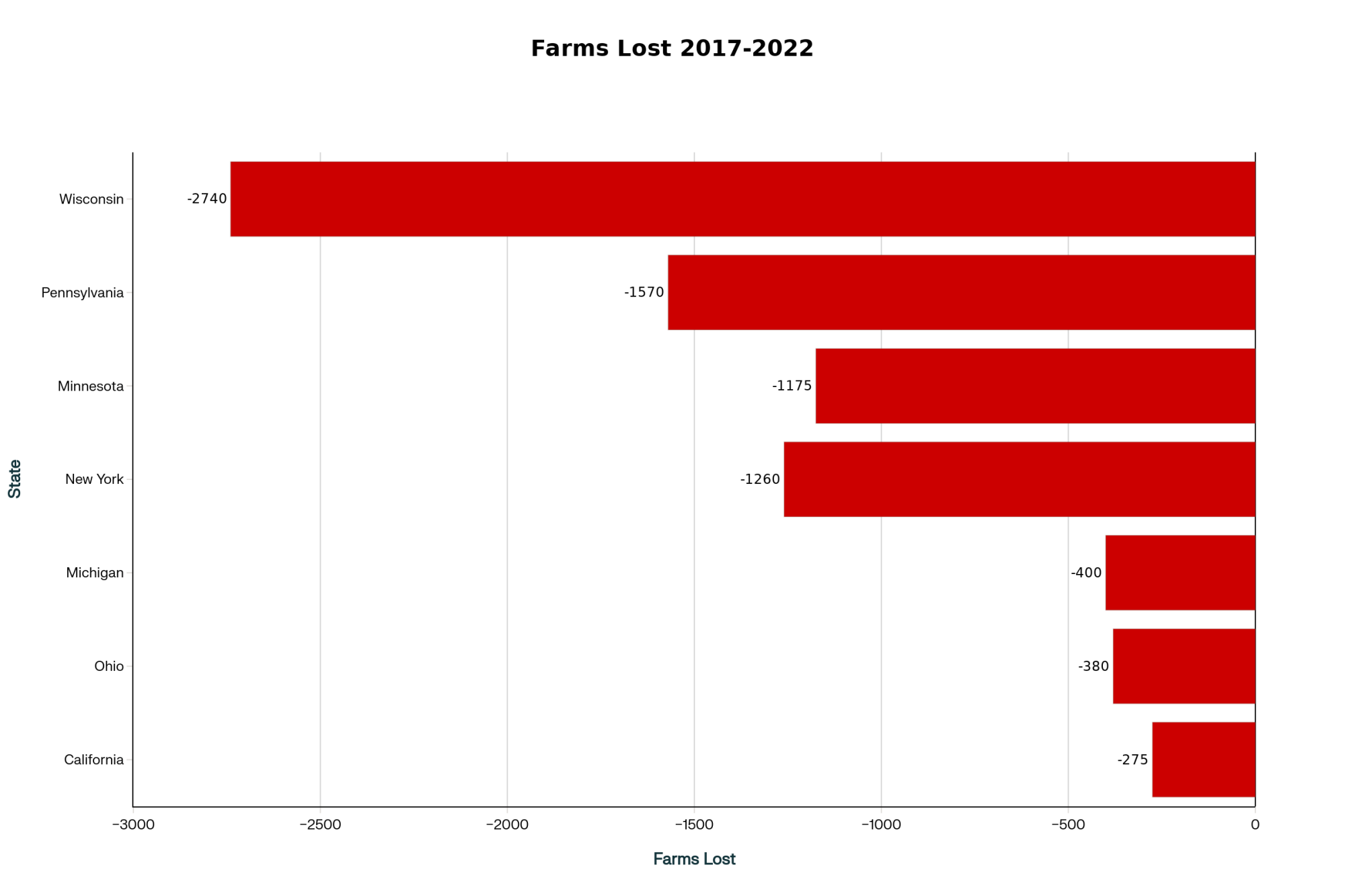
This Isn’t Happening Everywhere Equally: Wisconsin hemorrhaged 2,740 farms—more than the next three states combined. Pennsylvania, Minnesota, and New York each lost 1,000+ operations. Meanwhile, California (the largest dairy state) lost just 275. Geography matters, but the trend is universal
Negotiation Strategies That Actually Work
After watching dozens of these negotiations, here’s what’s actually effective:
Form an informal buying group. You don’t need a formal cooperative structure—just five to ten neighbors agreeing to push for the same contract terms. When six farms representing 3,000 cows approach a processor together, they listen differently than when you come alone.
Use professional help strategically. Yes, agricultural attorneys cost money. But spending $5,000 on contract review could save you $50,000 annually in bad terms. Frame it as the bad cop: “I’d love to sign this, but my attorney insists on liability caps…”
Offer trades, not just demands. “I’ll implement comprehensive testing protocols if you’ll split the costs 50/50 and cap my liability at one year’s gross revenue.” Processors respond better to negotiation than ultimatums.
Know your walkaway point. If you have alternative buyers—even if they’re 50 miles further—that knowledge changes how you negotiate. Do the math beforehand: What’s the worst deal you can accept and still stay viable?
Technology as a Survival Tool
The farms that are successfully adapting aren’t doing so through willpower alone. They’re leveraging technology to make compliance manageable.
What’s encouraging is that agricultural technology providers report dairy operations implementing digital documentation systems are seeing significant reductions in administrative burden.
Automated testing protocols are lowering sampling costs. Real-time environmental monitoring can prevent contamination incidents before they become recalls.
For example, farms using systems like DairyComp 305’s newer modules or Valley Ag Software’s compliance-tracking are finding the documentation requirements much more manageable than those trying to handle them with spreadsheets.
The upfront cost—usually $5,000 to $15,000 for implementation—pays for itself in reduced labor and avoided compliance violations. One Kansas operation told me they cut documentation time by 60% after implementing digital tracking, saving nearly $20,000 annually in labor costs alone.
Technology isn’t optional anymore. What is the difference between farms crushing under compliance costs and those managing them? Usually comes down to whether they’ve invested in the right systems.
What Dairy Looks Like in 2030
Based on everything I’m seeing, here’s my best projection for where we’re heading:
We’ll probably have 15,000 to 20,000 dairy farms by 2030, down from today’s 24,000. But—and this is important—they won’t all be mega-dairies.
I’m expecting maybe 12,000 to 15,000 large-scale commodity operations, another 3,000 to 5,000 premium or specialty farms serving local and niche markets, and 2,000 to 3,000 transitional operations finding unique market positions.
Agricultural economists analyzing dairy consolidation trends suggest we’re not witnessing the death of dairy farming. We’re seeing differentiation.
The 500-cow commodity model is becoming obsolete, yes. But opportunities are emerging for farms willing to adapt strategically.
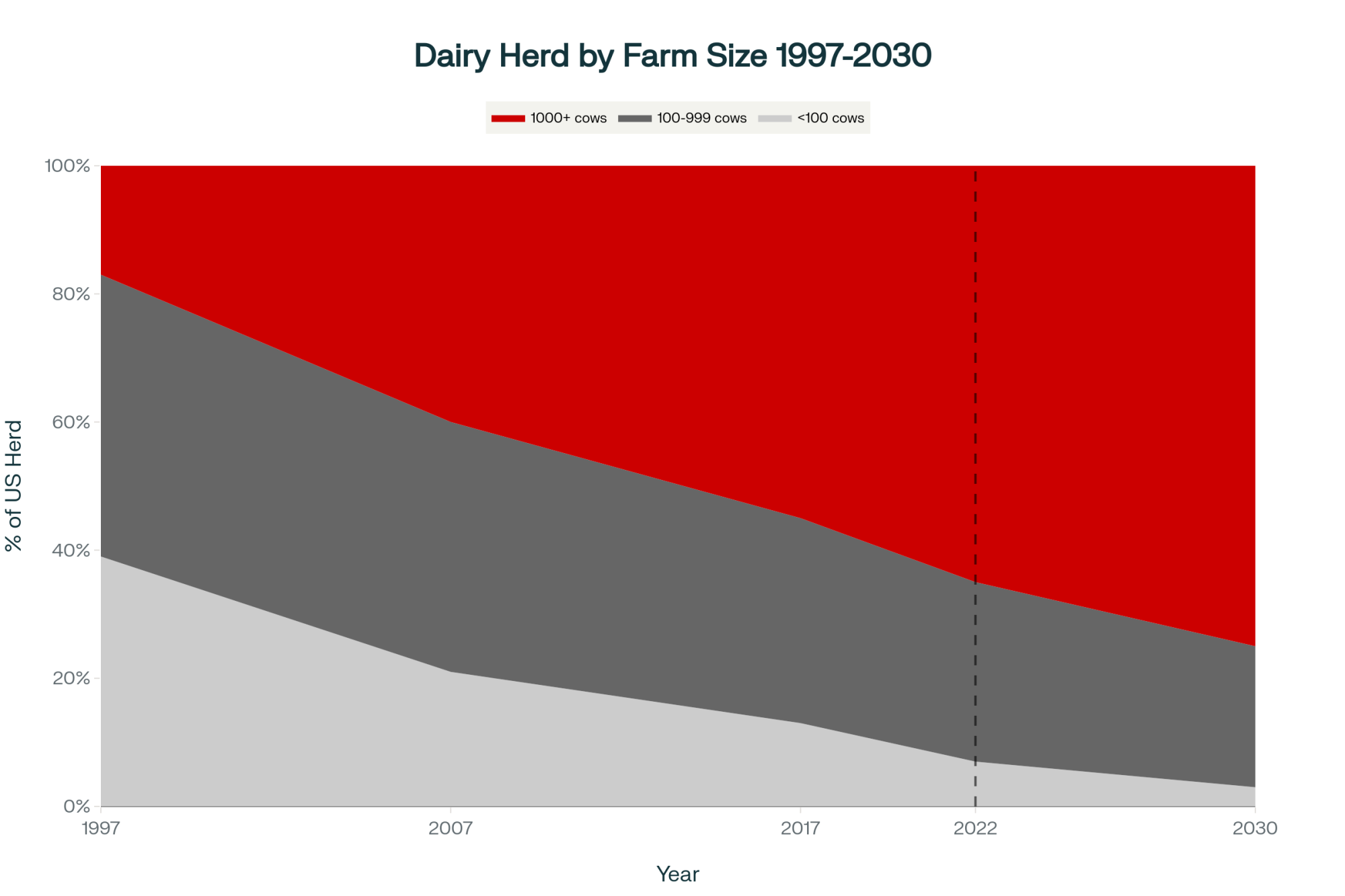
The 25-Year Transformation: In 1997, just 17% of dairy cows lived on 1,000+ cow farms. Today? 65%. By 2030? Projected 75%. Meanwhile, farms under 100 cows dropped from 39% to 7% and are heading toward extinction. This isn’t gradual change—it’s systematic restructuring
Making Your Decision: A Practical Framework
So what should you actually do? Here’s the framework I’m suggesting to farmers facing these contracts:
Your 30-Day Action Plan
Calculate your true cost of production—don’t guess, know it
Review your current contract for existing allergen language
Get insurance quotes for the new liability levels
Talk honestly with family about succession plans
Research premium market opportunities in your area
Key Decision Factors
If you’re under 45 with strong succession and sub-$19 per hundredweight costs, consider scaling. The economics work if you can handle the risk.
If you have marketing skills and you’re near population centers, explore premium markets. The margins are there for those who can sell.
If you’re over 55 and without succession, and your costs exceed $21 per hundredweight, plan your exit. Preserving wealth beats slow erosion.
If you’re in between? You’ve got 90 days to figure out which direction you’re heading. Drifting is the only wrong answer.
The Reality We Need to Discuss
Here’s what I think a lot of folks know but aren’t saying out loud: The 500-cow commodity dairy is structurally obsolete in the emerging market environment.
Not because farmers aren’t working hard enough. Not because they’re bad at what they do. But because the economics have shifted in ways that make that scale unviable for commodity production.
Dairy transition specialists tell me that every farmer they work with wishes they’d made their decision 2 years earlier.
Whether that’s expanding, transitioning to premium, or exiting—acting decisively preserves more wealth and creates more options than hoping things improve.
Final Thoughts
The 2026 allergen requirements are real, and they’re going to hurt. But they’re also just accelerating changes that were already underway.
The farms that recognize this—that see these contracts as a catalyst for strategic decision-making rather than just another compliance burden—are the ones that’ll still be farming successfully in 2030.
The dairy industry has weathered countless storms over the generations. This one’s different, not in its severity, but in its permanence.
The sooner we accept that and act accordingly, the better positioned we’ll be for whatever comes next.
You know, at the end of the day, it’s not about whether to sign or not sign a contract. It’s about what kind of dairy farmer you want to be—or whether you want to be one at all—in the industry that’s emerging.
And that’s a decision only you can make for your operation.
KEY TAKEAWAYS:
Immediate action required: Review your contract for unlimited liability clauses before December 31—signing locks you into potentially business-ending terms through 2026
Real costs revealed: $15,000 (minimal) to $55,000 (high compliance) in new annual expenses = 12-44% of typical 500-cow dairy profits gone
Only three viable paths: Scale to 1,500+ cows for efficiency ($3/cwt savings), pivot to premium markets ($5-10/cwt premiums), or exit strategically, preserving 25-40% more wealth than distressed sales
Negotiation leverage exists: Form buying groups with neighbors, demand 50/50 cost sharing, cap liability at one year’s revenue—processors need milk and will negotiate
The uncomfortable truth: The 500-cow commodity dairy is structurally obsolete—not because you’re failing, but because the economics permanently shifted against mid-size operations
Complete references and supporting documentation are available upon request by contacting the editorial team at editor@thebullvine.com.
Learn More:
Robots vs. Labor: The Hard Math on Dairy Automation ROI – This article delivers the “hard math” for the “Technology as a Survival Tool” section. It provides a clear framework for calculating the ROI on automation, helping you decide if tech investment is a viable path to lowering costs.
The 2030 Dairy Farm: More Cows, More Tech, and a Whole New Business Model – This piece expands on the “Bigger Picture” analysis by detailing the business model of the future farm. It reveals the strategic drivers behind consolidation and the operational shifts required to remain profitable in the coming decade.
Join over 30,000 successful dairy professionals who rely on Bullvine Weekly for their competitive edge. Delivered directly to your inbox each week, our exclusive industry insights help you make smarter decisions while saving precious hours every week. Never miss critical updates on milk production trends, breakthrough technologies, and profit-boosting strategies that top producers are already implementing. Subscribe now to transform your dairy operation’s efficiency and profitability—your future success is just one click away.
Why Today’s Best Dairies Cull Healthy Cows That Could Produce for Years
Executive Summary: Wisconsin dairyman Eric Grotegut no longer culls cows in crisis—he replaces them strategically on “Monday afternoons,” capturing a $1,350 per head advantage that’s reshaping dairy economics nationwide. Despite cows being genetically capable of living 13 months longer than they did 20 years ago, the math now favors earlier replacement: while a third-lactation cow generates $234 in annual profit, her $350 genetic lag means a younger replacement creates $2,704 in value over three years. This shift, powered by genomic selection tripling genetic progress to $75 yearly, beef-on-dairy premiums of $370-400 per calf, and IVF technology approaching commercial viability, has created an unexpected crisis—heifer inventory down 18% with prices soaring from $1,720 to over $3,000. The optimization technology driving these decisions requires an annual investment of $26,000-78,000, achieving positive ROI only above 400 cows, accelerating consolidation that may reduce U.S. dairy farms from 26,000 to 15,000-18,000 by 2035. With environmental genomics launching in 2026-2027, producers face three paths: scale up to 600+ cows and embrace technology, develop specialized niches like organic or direct marketing, or exit strategically before 2030 while preserving asset value. The longevity paradox reveals a fundamental truth—in modern dairying, keeping cows longer often means keeping the operation shorter.
You know, there’s something that doesn’t quite add up when you really think about it. Our cows today are genetically capable of living 13.2 months longer than they did twenty years ago—that’s what the folks at CDCB showed us at the October meeting held during World Dairy Expo, saying we’ve gained about 4.7 months of productive life per decadethrough genetic selection. But here’s what’s interesting: many of the most progressive producers I know are actually replacing them earlier, not later.
Eric Grotegut, who runs 1,400 cows up in Wisconsin, said something at that meeting that really stuck with me.
“15 to 25 years ago, it seemed like I was selling cows every day for a lame cow, a mastitis cow, a pneumonia cow—something all the time. Now most cull cows are on Monday afternoon.”
Monday afternoon. That shift—from emergency culling to what Eric calls “Monday afternoon” strategic replacement—well, that tells you everything about how dairy economics have completely flipped in the last decade or so.
The Math That Changes Everything
So I’ve been digging into what the researchers call the Retention Payoff calculation, or RPO for short. Basically, you’re asking: does keeping this cow generate more profit than replacing her with a younger animal? And what I’ve found is…the numbers are surprisingly clear-cut.
Here’s how it breaks down in a real scenario that many of us face. You’ve got a third-lactation cow producing 68 pounds daily—decent production, no major health issues, right? She’s profitable, generating about $234 in annual profit above her direct costs, according to the Wisconsin Extension models. So, naturally, you’d think, why would anyone replace her?
Component
Mature Cow
Replacement Heifer (3 Years)
Annual Profit Above Costs
$234 (with $350 genetic lag at $75/yearprogress)
Year 1: $97Year 2: $720Year 3: $1,031
Genetic Opportunity Cost
$233/year (USDA analysis)
No lag—current genetics
Net Present Value
$1,353 (over 3 years)
$2,704
Bottom Line Advantage
—
$1,350 more value from replacement
Here’s what’s really happening, though. That cow carries genetics from roughly 4-5 years ago, which means she’s about $350 behind current genetic averages. We’re seeing genetic progress at $75 PTA Net Merit per year now—both CDCB and the Canadian Dairy Network have confirmed this. And that creates what Paul VanRaden at USDA calls a “genetic opportunity cost“—essentially $233 per year in lost value from not having current genetics in that stall.
“We’re not just looking at whether a cow covers her feed costs anymore. We’re evaluating whether she’s the most profitable use of that stall space given all available options.” — Tom Overton, Cornell’s dairy management professor at the Western Dairy Management Conference
Three Technologies Converging to Change Everything
What’s driving this shift isn’t just one breakthrough—and this is what I think many folks miss—it’s three technologies hitting maturity at the same time, each reinforcing the others in ways nobody really predicted five years ago.
Genomic Selection Has Changed the Game Entirely
Since USDA launched official genomic evaluations for Holsteins and Jerseys back in January 2009, we’ve gone from experimental to essential. Today, 95% of U.S. AI bulls are genomically tested, and about 20% of heifer calves get tested within their first week of life, according to CDCB’s latest data.
The impact on genetic progress? Man, it’s been dramatic. Before genomics, we were seeing gains of about $28 PTA Net Merit per year. Now? We’re hitting $75 per year—nearly triple the rate.
The Canadian Dairy Network’s 2024 report shows even more dramatic shifts in specific traits. Production traits have doubled their rate of improvement, but here’s what’s really impressive: tough traits like daughter pregnancy rate have increased threefold to fourfold. That’s…that’s game-changing for our industry.
Kent Weigel at the University of Wisconsin, who’s been tracking this since the beginning, tells producers that “farmers typically cull the bottom 15 to 20% of calves based on genomic testing, but the exact proportion depends on the number of surplus heifer calves available on a given farm.” And he’s right—it’s all about finding that sweet spot for your operation.
Genomics didn’t just speed up progress—it blasted a hole in the old ceiling. Black bars for ‘then,’ red for ‘now.’ That’s a revolution in every stall.
Sexed Semen: Strategic but Still Limited
Now, sexed semen adoption in the U.S. sits at 25-30% according to NAAB statistics. Compare that to the UK, where they’re at 84% based on AHDB’s 2024 report. Why the gap? Well, the challenges are real, as many of you probably know.
Conception rates with sexed semen still run 15-20% below conventional, based on large-scale field data from Alta Genetics and Select Sires. The stuff costs 2.3 times more—you’re looking at $50-64 versus $18-28 for conventional. And during summer heat stress? Forget about it.
Peter Hansen’s group down at the University of Florida has shown that pregnancy rates can drop to 25-30% with sexed semen when the temperature-humidity index exceeds 72. Those of us dealing with hot summers know exactly what that means for breeding programs. July and August can be brutal.
But here’s what’s working: virgin heifers in fall and winter. You can still hit 60% conception rates with good management. Matt Lauber, working with Paul Fricke at Wisconsin, showed that with proper synchronization protocols, the fertility gap narrows to just 8-12%—making sexed semen far more viable in optimized systems. It’s not about using sexed semen everywhere—it’s about using it where it pencils out.
Beef-on-Dairy: The Revenue Stream Nobody Saw Coming
This might be the biggest shift I’ve seen in twenty years of watching this industry. We’ve gone from 200,000 beef-cross dairy calves in 2008 to 2.9 million in 2025, according to Rabobank’s analysis. These calves now represent 12-15% of the U.S. fed cattle supply. Think about that for a minute.
What’s driving it? Money, plain and simple. Day-old beef-cross calves are bringing $370-400 premiums over straight dairy bull calves based on USDA auction reports from Wisconsin and California. For a 1,000-cow operation breeding 60-70% to beef, that’s $222,000 to $280,000 in annual premium revenue that didn’t exist before 2015.
Glenn Klein, who manages 3,600 cows across multiple sites in Wisconsin, explained their approach at the Industry Meeting: “We’ve been doing beef-on-dairy since I think 2018 or 2019. We do it somewhat strategically based on the cow. We look at her genomics, see her past history, and basically decide whether she gets sexed semen or beef semen.“
The Constraint Nobody Planned For
Lowest heifer numbers, record-busting prices. What felt like a quiet trend just crashed into reality, and every buyer’s feeling it.
But here’s where things get complicated—and it’s a perfect example of unintended consequences in our industry. This strategic shift toward beef-on-dairy has created the worst heifer shortage in 20 years.
CoBank’s August 2025 analysis shows national dairy replacement heifer inventory at 3.914 million head. That’s 18% below 2018 levels and the lowest we’ve seen since 2005. They’re projecting inventories will shrink by another 800,000 head before recovering in 2027.
The math is straightforward but painful. With 60-70% of the national herd now bred to beef—that’s per National Association of Animal Breeders data—we’ve essentially cut our replacement pipeline in half.
Heifer prices tell the story: from $1,720 in April 2023 to $3,010 by July 2025, according to USDA market reports. And I’ve seen high-quality Holsteins fetching over $4,000 at auctions in Turlock, California, and New Ulm, Minnesota.
This creates a real paradox, doesn’t it? While the RPO math strongly favors replacement, producers are actually reducing culling rates—down from 32.7% in 2019 to 27.9% in 2024, according to Canadian Dairy Information Centre data, which is the best North American dataset we have. They’re keeping marginal cows they would’ve culled five years ago when heifers cost $1,200.
“We know the economics favor replacement, but you can’t replace what you don’t have. So producers are keeping cows a bit longer than optimal while rebuilding heifer inventory.” — Mike Overton, DVM, who directs technical services at Elanco
IVF: From Seedstock Tool to Commercial Reality
What’s fascinating to me is watching IVF technology move from the seedstock world into commercial dairies. Current pregnancy rates have climbed above 50-55% based on 2024 data from Trans Ova Genetics and other major providers—matching or even beating conventional AI in some cases.
The cost trajectory is what really matters, though. We’re at $350-450 per pregnancy today, but industry projections show that dropping to an estimated $200-300 by 2027-2029 as volumes scale and protocols improve.
Several technical improvements are converging here:
Optimized FSH protocols during the voluntary waiting period increase oocyte yields by 51%—that’s from Wisconsin research
Time-lapse embryo selection with continuous monitoring from fertilization through day 8 improves pregnancy rates by 15-25 percentage points, according to Animal Reproduction Science
Vitrification technology—that ultra-rapid freezing technique—now allows frozen embryos to match fresh transfer success rates
Sean Nicholson, who runs 1,600 cows in Tulare County, California, shared his experience with the California Dairy Magazine: “IVF pregnancy rates markedly exceed what we see with conventional AI, especially during summer when heat stress hammers traditional breeding.” His operation now uses beef IVF embryos for 7% of pregnancies—producing purebred Angus calves from Jersey recipients that bring even higher premiums than regular beef-crosses.
For operations above 800 cows, IVF is starting to pencil out. You can take your elite donors—that top 3-5%—and produce 10-15 pregnancies annually versus one naturally. This creates what I call a three-tier system: elite cows produce all your replacements via IVF, middle-tier cows just make milk, and bottom-tier cows produce beef calves for cash flow.
Success Story: Minnesota’s IVF Innovation
Take a look at how one Minnesota operation is making this work. They’re running 850 cows, started genomic testing everything three years ago, and now use IVF on their top 25 females. Last year, those 25 cows produced 180 pregnancies—enough to cover all their replacement needs plus some to sell. Meanwhile, they bred the rest of the herd to beef and captured an extra $240,000 in calf revenue. That’s…that’s transformative economics.
What’s interesting is they’re not doing this alone—they’ve partnered with two neighboring farms, each running 400-500 cows, to share IVF technician costs and expertise. It’s the kind of cooperative approach that makes advanced technology accessible at smaller scales.
Environmental Pressure: The Next Wave Coming
Here’s something that hasn’t hit most U.S. producers yet, but it’s definitely coming. John Cole at CDCB revealed in October that methane emissions evaluations will launch in 2026-2027, with disease resistance traits following shortly after. When these environmental traits are integrated into selection indices, genetic progress could accelerate from the current $75 per year to an estimated $110-125 per year, depending on the heritability and economic weightings of these new traits. That’s a 47-67% jump.
The University of Wisconsin’s $3.3 million methane project has found heritability of 0.20-0.28 for residual methane traits. That’s moderately to highly heritable, which means we can effectively select for it. They’re using milk spectral data and even fecal microbiome profiles as proxies for rumen emissions, which would make large-scale phenotyping actually feasible.
What’s particularly interesting is looking at what’s already happening in Europe. UK and Irish producers are getting 2-4 pence per liter premiums for verified emission reductions, according to Arla Foods’ 2024 sustainability report. Every dairy bull calf they raise counts against their farm’s carbon intensity score. When similar pressures reach U.S. markets—and trust me, they will—cows with poor environmental genetics might become economically unjustifiable regardless of their production level.
The Reality Check: Who Can Actually Execute This?
Now, all this sophisticated RPO optimization sounds great in theory. But after talking with producers and consultants across the country, I’ve realized there’s a massive gap between what’s theoretically optimal and what most farms can actually implement.
The industry basically breaks into five distinct tiers based on what I’m seeing:
Elite operations—those running 1,000+ cows and producing about 45% of U.S. milk—they’ve got the whole package. Daily milk weights, genomic testing for every calf, activity monitors —the works. Eric Grotegut’s Wisconsin operation falls squarely into this category. They’re truly optimizing these RPO calculations daily.
Progressive commercial farms running 400-1,000 cows —roughly 30% of our milk supply —have most of the tools but use them monthly rather than daily. They’ll perform genomic testing on 60-80% of calves and run activity monitors on breeding-age animals.
Mainstream operations—150-400 cows, about 20% of milk—they operate on rules of thumb. Kristen Metcalf, running 360 cows in Minnesota, described improving health through “implementing more frequent hoof trimming and rubber mats in the barn.” That’s good management, absolutely, but it’s not sophisticated RPO optimization.
Smaller operations with fewer than 150 cows, which produce about 5% of our milk, simply don’t have access to these tools. At $26,000-78,000 annual investment for full RPO infrastructure—genomic testing, monitors, software, consultants—it only achieves positive ROI above 400 cows.
You know, research from ETH Zurich published in the Journal of Dairy Science found that suboptimal culling decisions cost 1.55 Swiss francs per cow monthly. And here’s the kicker: losses from keeping cows too long were three times greater than premature culling losses. But that analysis required dynamic programming models with detailed farm data—exactly what most mid-size operations lack.
Practical Strategies by Farm Size
What farmers are discovering varies dramatically by scale, and honestly, there’s no one-size-fits-all answer here. Let me break down what’s actually working:
For Large Operations (800+ cows):
Go all-in on the technology. Full genomic testing runs about $40-50 per calf through companies like Zoetis or Neogen—that’s $12,000-20,000 annually for a 1,000-cow herd, but it pays back quickly.
Consider IVF programs for your top 3-5% once you’ve identified them genomically. Keep beef-on-dairy at 60-70% to maximize that revenue stream while beef premiums stay high.
And start preparing for environmental compliance now. Methane measurement infrastructure is projected at $50,000-100,000 based on current equipment costs, though specific U.S. regulatory requirements are still being developed.
For Mid-Size Operations (200-600 cows):
Focus on what I call the 80-20 approach—capture 80% of the value with 20% of the complexity:
Definitely genomic test all your heifers and cull the bottom 15-20% before spending $2,900 to raise them
Use your monthly DHIA test to identify cows below 75% of herd average production who are also open past 120 days
Put beef semen on your bottom 50% by either genomic merit or production
The key decision: can you scale to 600+ cows in the next 3-5 years? If not, start developing a niche strategy now
Consider cooperative approaches—some 400-cow operations are exploring shared IVF programs with neighbors to access technology at a viable scale
For Smaller Operations (under 200 cows):
Your economics are fundamentally different, and that’s okay. Focus on:
Reducing involuntary culling through better fresh cow management and hoof health
If you’re in the right location, organic certification can capture $7-12/cwt premiums that offset scale disadvantages
Direct marketing through on-farm stores or agritourism might work
But let’s be honest here—if you don’t have a clear competitive advantage like paid-off land, unique market access, or family labor, start planning your exit strategy for 2027-2030 before technology requirements intensify
Regional Realities Shape These Economics
It’s worth noting that these dynamics play out differently across regions. California’s massive operations—many running 3,000-5,000 cows—they’re already deep into IVF and sophisticated optimization. Meanwhile, Vermont’s pasture-based systems face entirely different economics where land constraints and organic premiums create alternative value equations.
The Upper Midwest sits somewhere in between, with operations like Grotegut’s finding that sweet spot of scale and technology adoption. Texas and New Mexico operations? They’re dealing with water constraints that trump genetic optimization. Each region has its own version of this story, you know?
And seasonally, everything shifts. Summer heat stress in the Southeast makes sexed semen nearly unusable from June through September. Wisconsin producers might have a solid eight-month breeding window, while Arizona dairies face reproductive challenges year-round. These aren’t minor details—they fundamentally change the economics.
The Consolidation Nobody Wants to Talk About
Here’s the uncomfortable truth: we need to face it directly. Every trend we’re seeing—RPO optimization, IVF scaling, beef-on-dairy, environmental genomics—creates economies of scale that favor large operations.
Based on current trajectories and what we saw from 2000-2020—a 54% decline in farm numbers while production increased 16%—I expect we’ll see U.S. dairy farm numbers drop from today’s roughly 26,000 to somewhere between 15,000 and 18,000 by 2035. That’s a 30-40% reduction.
These aren’t just business decisions—they’re family legacies facing new realities. Farms that have been in families for generations are weighing whether the next generation can make the economics work. And that’s…that’s tough to watch.
Technologies providing 10-20% efficiency improvements only achieve positive ROI at 400-800+ cow scale. Operations below these thresholds aren’t “behind”—they’re structurally excluded from the tools that enable optimization.
What to Watch in 2026
Looking ahead, here’s what I’m keeping an eye on:
Methane genomic evaluations launching mid-2026, according to CDCB’s timeline
Heifer inventory beginning recovery late 2026 into early 2027, per CoBank’s projections
IVF costs potentially hitting that $250-300 sweet spot—watch Trans Ova and other providers
Environmental regulations in California are potentially creating templates for other states
The Bottom Line for Your Operation
The longevity paradox—cows that can live longer but shouldn’t economically—it’s just one symptom of a broader transformation. What really matters is understanding where your operation fits in this changing landscape.
If you’re above 400 cows, the math increasingly favors aggressive adoption of advanced technologies and strategic culling based on genomic merit. That $1,350 RPO advantage? It’s real, and it compounds over time.
If you’re between 200-400 cows, you’re at a crossroads. Either develop a clear path to 600+ cows or find a niche that offsets your scale disadvantage. There’s no shame in either choice, but indecision…that’s what’s costly.
If you’re under 200 cows, be realistic about your options. Unless you have structural advantages—debt-free land, unique market access, off-farm income—the economics are working against you. A well-timed exit in 2027-2029 might preserve more value than struggling through 2030-2035.
The dairy industry is experiencing what economist Joseph Schumpeter called “creative destruction“—old systems giving way to new ones that are more efficient but also more capital-intensive. Cows built to last longer are leaving sooner, not because they can’t produce, but because the math increasingly says they shouldn’t.
Understanding and adapting to this reality—rather than fighting it—that’s what’ll determine which operations thrive in the next decade. The genetics exist for cows to live longer. The economics increasingly say they won’t. That’s not a bug in the system—it’s become the system itself.
But you know what? Within these constraints lie opportunities for those willing to adapt, whether through scale, specialization, or strategic partnerships. And there’s innovation happening at every scale—I’m seeing 200-cow operations finding profitable niches, 500-cow farms forming cooperative IVF programs, and yes, larger operations pushing efficiency boundaries we couldn’t imagine five years ago.
The key is making clear-eyed decisions based on your specific circumstances, not industry averages or what your neighbor’s doing. Because at the end of the day, the best strategy is the one that works for your land, your family, and your future.
Key Takeaways:
The $1,350 replacement advantage is real and compounds annually: Even profitable third-lactation cows generate less value than younger replacements due to $75/year genetic progress—making strategic culling more profitable than longevity
Your scale determines your future: Operations need 400+ cows for optimization technology ROI, 600+ for sustainable competition, or a clear niche strategy (organic, direct marketing) to survive below these thresholds
Maximize beef-on-dairy NOW before 2027: With current $370-400 premiums and 60-70% breeding to beef optimal, this revenue stream won’t last—heifer inventory recovery and beef cycle correction will compress margins within 24 months
Technology adoption isn’t optional, it’s existential: Genomic testing ($40-50/calf), IVF (dropping to $200-300), and environmental compliance ($50,000-100,000) will separate survivors from casualties when methane regulations hit in 2026-2027
Decision time is 2026, not 2030: Whether scaling up, specializing, or exiting, waiting means competing against operations that have already optimized—make your strategic choice while you still have options
Complete references and supporting documentation are available upon request by contacting the editorial team at editor@thebullvine.com.
Decide or Decline: 2025 and the Future of Mid-Size Dairies – For producers at the 200-600 cow “crossroads,” this article analyzes the strategic choices. It details the financial realities of scaling up versus the operational pivots required for successful specialization and technology adoption.
Join over 30,000 successful dairy professionals who rely on Bullvine Weekly for their competitive edge. Delivered directly to your inbox each week, our exclusive industry insights help you make smarter decisions while saving precious hours every week. Never miss critical updates on milk production trends, breakthrough technologies, and profit-boosting strategies that top producers are already implementing. Subscribe now to transform your dairy operation’s efficiency and profitability—your future success is just one click away.
Half of U.S. dairy farms will vanish by 2030. The survivors? They’re making one decision differently.
EXECUTIVE SUMMARY: The math stopped working when milk prices crept up 16% but diesel doubled and feed jumped 40%—that’s why 2,800 dairy farms close annually and milk checks now arrive with crisis hotline cards. Most producers don’t realize they have just 18 months from first losses to forced decisions, and waiting those extra six months costs families $380,000 in preserved equity. Strategic exits at month 8-10 save $400,000-$680,000; forced liquidations leave $100,000-$200,000. With half of America’s 26,000 dairy farms vanishing by 2030 and kids as young as 14 running milking shifts, this isn’t about failure—it’s about timing. This article provides the exact month-by-month timeline, real alternatives that work (partnerships, robotics, organic), and the framework to make informed decisions while you still have choices. Because sometimes the bravest thing you can do is preserve what three generations built before it’s too late.
So I was talking with a producer last week—you know how these conversations go, catching up at the feed store or after a meeting—and he mentioned something that really stuck with me. His milk check came with a little card tucked in. Mental health resources, crisis hotline numbers.
After thirty years in this business, that’s…well, that’s something new.
And it got me thinking about what we’re all seeing out there. The combination of labor challenges, these heat waves that seem to hit harder every year, and margins that just don’t pencil out anymore—especially for those 200 to 400 cow operations that used to be the heart of rural communities. You know the ones I’m talking about. Maybe it’s your operation.
Here’s what’s keeping me up at night: Industry projections from Rabobank show we’re losing about 2,800 farms every year now—that’s 7 to 9% of all U.S. dairy operations annually. The economists I trust—folks at Cornell PRO-DAIRY, Wisconsin’s Center for Dairy Profitability, the people who really understand our business—they keep talking about this 12 to 18 month window. That’s what you’ve got when things start going sideways. And what do you do in those months? The difference can be hundreds of thousands of dollars. I’m not exaggerating. We’re talking about preserving what your family built versus watching it disappear.
What’s Really Different in the Barn These Days
You probably know this already, but walk into any mid-sized dairy operation today, and it feels different than it did five years ago. Can’t quite put your finger on it at first, but then you realize—it’s quieter. Not the good kind of quiet either.
Five years back, you’d hear workers talking during morning milking —maybe some Spanish conversation —and teenagers grumbling about the early start (though secretly learning the trade). Now? Often, it’s just the owners — usually in their fifties, maybe early sixties — doing the work of four or five people. And they look exhausted.
What’s interesting is how the numbers back up what we’re feeling. The National Milk Producers Federation’s 2025 workforce data shows that immigrant workers make up about 51% of our workforce, but here’s the kicker—they produce 79% of the milk. Think about that for a second. And these folks, they’re operating under a kind of stress that wasn’t there before. I see it myself. Unfamiliar truck pulls up? Conversations stop. Workers keep phone numbers in their pockets now—family contacts, immigration attorneys. That’s become normal, and it shouldn’t be.
The age thing is really something else. Was talking to a Wisconsin producer recently who’s got two helpers, both in their seventies. “There’s just no pipeline of younger workers,” he told me. And he’s right—USDA’s Economic Research Service documented that agricultural employment dropped by 155,000 workers between March and July this year. That’s 7% of our workforce, gone in four months.
But here’s what really gets me—and I hate even saying this—we’ve got fourteen-, fifteen-year-old kids running full milking shifts. Not helping out, not learning from Dad or Grandpa. Running the shift. Because there’s literally nobody else. That’s not how it’s supposed to work.
When Everything Comes at You at Once
The Labor Situation Can Change Overnight
Let me tell you about what happened in Lovington, New Mexico, this past June. Shows you how fast things can go south.
Isaak Bos was running his operation like any other day when Homeland Security showed up. Full enforcement action, armed agents, the whole thing. By the time they left? Sixty-four percent of his workforce was gone. Eleven were arrested on the spot, and another twenty-four were let go when their papers didn’t check out. The Albuquerque Journal covered it extensively—this isn’t hearsay, it’s a documented fact.
“Milk production had effectively ceased,” Bos told reporters. “We’re barely able to keep going.”
Here’s what really opened my eyes—UC Davis agricultural economists have been tracking this, and their 2025 research found that when raids happen, farms that haven’t even been touched lose 25 to 45% of their workers. They just stop showing up. Can’t blame them, really. Word travels fast in these communities. One raid in Vermont affects operations in Wisconsin, Idaho, and California. Everyone’s on edge.
Heat Stress Is Getting More Expensive Every Year
While we’re scrambling for workers, the heat’s becoming a bigger problem than most people realize. And I mean, we all feel it, right? But the numbers are sobering.
This study from Science Advances—Dr. Nathaniel Mueller and his team published it this year—found that one day of extreme heat cuts milk production by up to 10%. And here’s the kicker: those effects stick around for more than ten days. Small farms, the ones under 100 cows? According to the University of Illinois farmdoc daily analysis from March, they’re losing 1.6% of production annually just to heat stress. That’s nearly 60% worse than bigger operations that can afford better cooling.
Let me put this in real terms. If you’re running a small operation, maybe clearing $60 to $175 per cow annually (and that’s being optimistic these days), Texas A&M and Florida extension economists calculate you’re looking at heat stress losses of $400 to $700 per cow. Even up here in the Midwest, we’re seeing impact. Pennsylvania operations are reporting similar challenges. California producers? They’re dealing with both heat and water restrictions—double whammy.
Now, the extension folks—and they mean well—they recommend cooling systems. Tunnel ventilation, evaporative cooling, all that. Penn State, Wisconsin, and Cornell all cite $70,000 to $85,000 for a 200-cow operation. But here’s the thing nobody wants to say out loud: if you’re already losing sixty, seventy thousand a year, where’s that money coming from? Banks aren’t lending for improvements when you can’t show positive cash flow.
The Math Just Doesn’t Work Anymore
November’s milk price came in at $21.55 per hundredweight. But you know how it is—after co-op deductions, quality adjustments, hauling…you’re seeing less. Sometimes a lot less.
Here’s what’s interesting—and I really wish I could draw you a picture here because it’s striking when you see it laid out. I was looking at the cost changes since 2020, and the spread is just brutal. Let me walk you through what I mean:
Back in 2020, we had milk at about $18.50 per hundredweight. Your basic feed costs, let’s index them at 100 to make it simple. Labor was running around $16 an hour if you could find it. Diesel? About $2.20 a gallon.
Fast forward to now, 2025. Milk’s up to $21.55—hey, that’s 16% better, right? But look at everything else. Feed costs have jumped 40% from that baseline. Labor—if you can even find workers—is running $20 to $21 an hour, up 30%. And diesel? Don’t get me started. We’re looking at $4.40 a gallon in many areas. That’s doubled.
While milk prices crawled up 16% since 2020, diesel doubled, feed jumped 40%, and labor climbed 30%—creating an unsustainable cost structure that explains why 2,800 dairies close annually
So you’ve got milk prices creeping up by 16% while your inputs shoot up by 30%, 40%, or even 100%. That gap between what you’re getting paid and what you’re paying out? That’s where your equity bleeds away, month after month. When the milk check doesn’t cover the feed bill, you’re basically robbing Peter to pay Paul.
The bankruptcy numbers tell the same story—259 dairy farms filed Chapter 12 between April 2024 and March 2025. That’s a 55% jump from the year before. But here’s what that doesn’t capture—for every farm that files, there’s probably another one or two quietly selling off equipment, maybe some land, trying to restructure without the paperwork. The stigma’s real, you know?
Small and mid-size dairies hemorrhaged 42% of operations while mega-farms grew 16.8%, now controlling nearly half of all U.S. milk production—proving economies of scale aren’t optional anymore
Understanding That 12 to 18 Month Timeline
When the economists at Cornell and Wisconsin talk about this 12- to 18-month window, they’re not being dramatic. Let me walk you through what this looks like, based on what I’m seeing across multiple operations. Think of it as a composite—no single farm, but patterns I see repeatedly.
Months 1 Through 6: The Slow Bleed
You start drawing more heavily on your operating line. Maybe go from $140,000 to $165,000 over a quarter. It feels manageable because you’ve still got credit available.
You start making small compromises. Put off that gutter cleaner repair—sure, it means 90 minutes of manual scraping every day, but you save $3,200. You match a wage offer you can’t really afford because if that last good employee leaves, you’re done.
The bank might restructure some debt and convert short-term debt to long-term debt. Feels like breathing room, right? But you’re just locking in obligations you probably can’t meet long-term.
Months 7 Through 12: Options Starting to Close
Your credit line’s getting close to maxed out. The lender—and these are good people who want to help—they start asking for monthly financials instead of quarterly. That’s never a good sign, as you probably know.
You can’t defer maintenance anymore, but you can’t afford it either. You’re one major breakdown away from crisis. One bad bout of mastitis in the fresh cow group. One compressor failure.
This is when those hard conversations happen. I know a couple in Vermont who have been farming for 40 years. She found him in the barn at 2 AM, just standing there. “We need to talk about what we’re doing,” she said. But they convinced themselves spring prices would turn things around. In my experience…they rarely do.
Months 13 Through 18: Decision Time
Banks lose confidence. You’ve violated debt covenants—maybe debt-to-asset ratio, maybe working capital requirements. Your options are bankruptcy or a forced sale. Any equity you’ve got left needs immediate action if you want to preserve it.
By now, that window for a strategic exit? It’s mostly closed. Operations that could’ve preserved $400,000 to $600,000 in family wealth six months earlier are looking at scenarios where keeping $100,000 to $200,000 feels like a win.
The Conversation Nobody Wants to Have
Here’s something we need to be honest about, even though it’s uncomfortable: strategic exits made early preserve dramatically more wealth than waiting for the bank to force your hand.
The brutal math of waiting: Strategic exits at month 8-10 preserve $480,000 in family wealth, while forced liquidations at month 18+ leave just $150,000—a $330,000 penalty for six months of denial
Let me break down what I’ve seen happen, based on actual auction results and sale data from 2025:
Strategic Exit (while you’ve still got 7-9 months of runway):
Sell your herd voluntarily, maybe get $1,850 per good cow
Equipment goes through a proper auction with time to market it right
Real estate gets listed properly, not fire-sold
Families walk away with $400,000 to $680,000
Forced Liquidation (month 18 and beyond):
Distressed sale, maybe $1,400 per cow if you’re lucky
Equipment auction under pressure, buyers know you’re desperate
Real estate sells fast and cheap
Families keep $100,000 to $200,000
That three to five hundred thousand dollar difference? That’s college funds. That’s retirement. That’s the chance to start over without crushing debt. And the only variable is timing.
As a Pennsylvania dairyman who went through this last year told me: “The hardest part was admitting we needed to exit. Once we did, we realized we should’ve made the decision six months earlier. Would’ve kept another $200,000.”
What Producers Are Actually Doing
Making Do with What They’ve Got
Was talking to a reproductive specialist in Florida last week—smart guy, been around—and he told me about a client who couldn’t afford a proper cooling system. Five thousand for misters was out of reach. So this producer rigged up a garden sprinkler on a fence post in the holding pen.
“It kept cows from dropping 10 to 20 pounds of production per day,” he said. “Bought him a month to generate some cash flow for proper cooling.”
That’s the reality for a lot of us, isn’t it? Hardware store solutions. Making do. It’s not ideal, but it keeps you going another day.
Partnerships—Sometimes They Work
Three neighbors in Idaho pooled their operations last year. Formed an LLC, consolidated everything. Individually, they were all questionable. Together? They’re actually competitive now.
But finding the right partners is tough. You need compatible management styles, similar work ethics, and—here’s the kicker—about $75,000 to $150,000 just for legal setup and restructuring. Folks who track these things estimate that maybe one in four or five partnership attempts actually succeeds long-term. The rest fall apart, usually over management disputes, within eighteen months. The Milk Producers Council has been documenting these partnerships, and the success stories all have one thing in common: clear, written agreements about everything from work schedules to exit strategies.
Some Folks Are Finding New Paths
It’s not all doom and gloom, and I want to be clear about that. Some operations are finding ways forward that work.
Several Vermont farms I know of are transitioning to organic. USDA’s organic price reports show a $38 per hundredweight price, compared with the $21.55 conventional price. But it’s brutal—the Northeast Organic Dairy Producers Alliance documents that it takes years and costs hundreds of thousands, while your revenues drop during the transition. You need deep pockets to weather that storm.
There are operations near Philadelphia, Boston, places like that, doing on-farm processing. Selling direct at $12 per gallon to customers who want the “farm experience.” One New York operation I visited invested $380,000 in processing facilities and visitor infrastructure. It’s working for them, but you need the right location and wealthy suburban customers nearby.
In Ohio, the Johnsons invested $800,000 in robotic milkers—but only after selling 60 acres to raise capital. Three years later, they’re viable with 300 cows and two full-time people. Not everyone has 60 acres to sell, but for those who do, technology might be an option. Just remember, the payback period is typically 7-10 years if everything goes right.
And here’s something interesting—completely legal, but not widely known—strategic bankruptcy under Section 1232 of the tax code can actually preserve more wealth than conventional sales in certain circumstances. The provision treats specific capital gains as dischargeable debt. You need a good attorney who understands agriculture, but it’s an option worth knowing about.
The Human Cost Nobody Talks About
We focus so much on the financial side, but the human toll…that’s what really matters, isn’t it?
The CDC found that farmers are 3.5 times more likely to die by suicide than the general population. Dr. Andria Jones-Bitton’s research at the University of Guelph documented that 68% of farmers experience chronic stress. Nearly half meet clinical definitions for anxiety. About 35% for depression.
Think about what this means for families. Farm wives who’ve managed the books and fed calves for twenty-five years suddenly need to find outside employment at fifty with no traditional work history. Kids who worked adult hours on the farm, watching it fail, wondering if it was somehow their fault. The weight of being the generation that “lost the farm”—that stays with people.
A dairy wife from Minnesota shared something that really stuck with me: “Being married to a farmer means putting everything else on hold from April to October, just trying to keep your husband from breaking.” Another described herself as essentially a single parent because her husband’s always in the barn, always stressed, never really present even when he’s physically there.
Where This Is All Heading
Small and mid-size dairies hemorrhaged 42% of operations while mega-farms grew 16.8%, now controlling nearly half of all U.S. milk production—proving economies of scale aren’t optional anymore
Industry projections are sobering—we’ll lose 7 to 9% of operations annually through 2027. Let me put that in real numbers so you can picture what’s happening:
The Decline We’re Looking At:
2020: We had 31,657 dairy operations according to the Census of Agriculture
2022: Down to 28,900
2024: About 26,400 (estimated)
Right now, 2025: Around 26,000 operations
Now, if we keep losing 7% a year like the projections suggest:
2026: We’re looking at 24,180 operations
2027: Down to 22,487
2028: About 20,893
2029: Roughly 19,430
2030: Somewhere between 13,000 and 18,000 operations
From 31,657 farms in 2020 to a projected 18,000 by 2030—this isn’t gradual evolution, it’s an industry extinction event claiming nearly 8 farms per day for the next five years
Some folks think consolidation could accelerate in those final years—once you hit certain thresholds with processing capacity and infrastructure, things can snowball. That’s why some projections go as low as 12,000 to 14,000 farms by 2030.
Picture that trend line…it’s not a gentle slope. We’re talking about losing half—maybe more—of all U.S. dairy farms in just five years. Each of those data points? That’s hundreds of families making the decision we’ve been talking about.
If this keeps up—and honestly, I don’t see what would change it—by 2030, we’re looking at:
Going from today’s 26,000 farms down to maybe 13,000 to 18,000 (could be even lower if things accelerate)
Operations with over 1,000 cows controlling 65 to 72% of all production
Production moving to Idaho, New Mexico, Texas—where those economies of scale work better
Traditional dairy states—Wisconsin, Vermont, upstate New York, and Pennsylvania Dutch Country—are losing half to two-thirds of their farms
You know, this consolidation might create certain efficiencies. Sure. But it reduces resilience. When 65% of your milk comes from fewer, larger operations, any disruption—such as a disease outbreak, a weather event, or another immigration raid—has massive impacts. We got a taste of this during COVID. Next time? It’ll be worse.
What You Need to Know Right Now
If Your Operation’s Losing Money
First thing—and I mean this week—sit down and calculate your actual runway. How many months can you really keep going at current burn rates? Be honest with yourself. This isn’t the time for optimism.
Get a confidential consultation with someone who understands agricultural transitions. Your state extension service can usually connect you. Do it now while you still have options. Every month you operate at a loss, you’re converting twenty to thirty thousand dollars in family wealth into expenses you’ll never recover. That’s real money that could be in your pocket.
Look at all your options. Strategic exit while you’ve got equity to preserve. Partnerships, if you’ve got the right neighbors and the relationship to make it work. Maybe pivoting to specialty markets if you’re positioned for it—A2 milk premiums, grass-fed certification, direct marketing if you’re near population centers. Scaling up if—and this is rare—you somehow have capital access.
But here’s what matters most: your family’s wellbeing trumps everything else. Your mental health, your marriage, your relationship with your kids—all of that matters infinitely more than what the neighbors think.
For the Lenders and Consultants
I know you’re reading this too. If you’re working with struggling operations, please—have honest conversations about strategic exits before all the equity’s gone. Stop promoting solutions that require capital these farms don’t have. That robotic milking system might be amazing technology, but not if the farm goes bankrupt before the ROI shows up.
Communities need to start planning for transitions. I know it’s hard to accept, but pretending family dairy’s going to reverse these trends somehow…that’s not helping anyone.
Making the Tough Call
I keep thinking about this Wisconsin family I know—real people, not a composite. They made their exit decision with about 8 to 10 months left in their viability window. Walked away with $482,000 in preserved equity. If they’d waited until the bank forced their hand? They’d have kept less than $200,000.
That $280,000 difference came down to one thing: having the courage to make a strategic decision while they still had choices.
For all of us looking at that 12 to 18 month countdown—and you know who you are—the question isn’t whether the farm continues. We can read the economics. The question is whether you preserve the wealth you’ve built through strategic action or lose it through delay.
Getting Help
If you’re struggling—financially, mentally, or both—please reach out. There’s no shame in it.
Mental Health Support:
National Suicide Prevention Lifeline: 988
Farm Aid Hotline: 1-800-FARM-AID
AgriStress Helpline: 1-833-897-2474
Financial Planning:
Your state extension service has transition specialists
Wisconsin Farm Center: 1-800-942-2474
Pennsylvania Center for Dairy Excellence: 1-888-373-7232
Cornell PRO-DAIRY programs
Michigan State Extension: 1-888-678-3464
Look, the clock’s ticking on thousands of operations. Understanding the timeline, recognizing your options, and—this is the hard part—acting while you still have choices…that’s what determines whether you preserve what three generations built or watch it disappear.
The decision’s incredibly difficult. I get that. But the math? The math is becoming clearer every day.
And if you’re reading this thinking, “he’s describing my farm”… maybe it’s time for that conversation you’ve been avoiding. Better to have it now, on your terms, than later on someone else’s.
We’re all in this together, even when it feels like we’re alone. And sometimes the bravest thing you can do is know when it’s time to preserve what you can and move forward.
KEY TAKEAWAYS
Your 18-month countdown starts the day you can’t pay all bills on time—most farmers don’t realize until month 12, when half their equity is already gone
The $380,000 decision: Exit strategically at month 8-10, keeping $480K, or wait for forced liquidation at month 18, keeping $100K (real Wisconsin example)
Red flags demanding immediate action: Bank requests monthly financials, your 14-year-old runs milking shifts, you’re choosing between feed bills and diesel
Three viable options remain: Strategic exit (preserves family wealth), partnerships with neighbors (1 in 4 succeed with $75-150K legal costs), or technology pivot (requires $800K+ capital)
This week’s action: Call your state extension service for confidential consultation—it’s free, and waiting another month costs you $20-30K in family wealth that’s gone forever
Complete references and supporting documentation are available upon request by contacting the editorial team at editor@thebullvine.com.
Learn More:
Why 2025 Could Be the Most Profitable Year for Dairy Farmers Yet! – This piece provides a counter-strategy to the exit-focused mindset, demonstrating how to leverage lower input costs, nutritional science, and smart herd management to build a stronger, more profitable bottom line in the current climate.
Global Dairy Market Recap: Mixed Signals and Opportunities – January 20, 2025 – Understand the “why” behind your milk check. This article decodes the complex global signals, from European price drops to SGX futures, helping you make smarter strategic decisions by seeing the macro-trends before they hit your farm.
Join over 30,000 successful dairy professionals who rely on Bullvine Weekly for their competitive edge. Delivered directly to your inbox each week, our exclusive industry insights help you make smarter decisions while saving precious hours every week. Never miss critical updates on milk production trends, breakthrough technologies, and profit-boosting strategies that top producers are already implementing. Subscribe now to transform your dairy operation’s efficiency and profitability—your future success is just one click away.
1973: Charlie refuses to sell Faith. 2025: Her genetics add $1,500/cow. Between those years? A breeding revolution nobody saw coming.
Plushanski Chief Faith, the cow whose genetics would add $1,500 per cow to your bottom line. This is the remarkable Holstein Charlie Plushanski refused to sell in 1973, setting in motion a breeding revolution that continues to save farms today. Just look at that presence—the deep body, the wide front end, and that incredible udder that defied the odds of her Chief lineage
I’ll never forget when I first heard this story—about a decision that seemed impossible at the time, yet somehow created $1,500 worth of hope for every cow in your barn today.
The moment that changed everything came on an ordinary morning in 1973. I can still picture it, the way it’s been told to me by those who remember—Charlie Plushanski standing in his Kutztown, Pennsylvania barn, watching the morning light catch the dust motes as his five-year-old Holstein, Faith, shifted her weight in the stall.
What happened next still gives me chills…
Charlie Backus had driven up from Maryland that morning with an offer that would’ve saved most farmers from their worst fears. We’re talking about enough money to buy a decent farm in Berks County—the kind of offer that makes your hands shake when you hear it. And Charlie Plushanski? He’d survived World War II as a Marine, built his farm from nothing with his boxing earnings, and knew what it meant to struggle. Family stories say he’d even sparred with champions during the war, though like many stories from that generation, the details have softened with time.
Standing there in that barn doorway, Backus was pressing hard. “Charlie, you need to let her go,” he said, watching Plushanski Chief Faith—that remarkable cow who seemed to know her own worth.
Earlier that same day—and this is what moves me most about this story—Pete Heffering had made the same journey from Ontario, trying to buy this same cow for his Hanover Hill program. Two of the biggest names in Holstein breeding, both turned away by a farmer who saw something nobody else could see.
The Pedigree That Changed Everything
For those who love breeding history, let me paint the complete picture of what made Faith so special:
Plushanski Chief Faith EX-94 4E GMD (EX-MS 96)
Born: November 1968
Sire: Pawnee Farm Arlinda Chief
Dam: Ady Whirlhill Frona VG-86 (Whirlhill Kingpin daughter)
What set Faith apart wasn’t just her individual achievement—it was how she transmitted. In an era before genomics, before EPDs, before any of the tools we rely on today, Faith proved that some cows simply have “it”—that indefinable ability to pass on greatness generation after generation.
The Courage It Took to Say No
Mr. and Mrs. Charles Plushanski, the visionaries behind the Faith dynasty. Their partnership and shared conviction were the foundation of the courageous decision to keep Faith when the industry came calling. This photo captures the quiet strength of the couple who chose long-term legacy over a short-term sale, proving that the greatest breeding decisions are often family decisions.
What moved me most was understanding what Charlie was really facing that day. This wasn’t just about money. This was about believing in something when everyone thought you were crazy.
The breeding community of the early 1970s was divided. You were either breeding for Chief’s incredible production or Elevation’s balanced type and longevity. But here was Charlie, who had already taken the risk of combining Chief with Kingpin genetics—a corrective mating that most breeders wouldn’t have attempted.
Charlie looked at Faith and somehow knew—in that deep, gut-level way that real farmers understand—that she carried something special in her genetics. Something that couldn’t be bought or sold. Something that would outlive them all.
“It’s not about the money,” Charlie said, according to the stories that have been passed down through breeding records and family memories. And against all odds, he was right.
That Gold Medal Dam designation Faith would earn? In the 1970s, before genomics and computers, a GMD represented the pinnacle of breeding achievement—a cow whose offspring consistently exceeded expectations across multiple herds and breeding programs. It meant you had a cow that was one in ten thousand.
The Winter That Nearly Broke Everything
Here’s where the story gets even more remarkable for those who understand breeding history. In the fall of 1965, in one of those Pennsylvania winters when everything seemed impossible, Charlie’s brother Henry called about some yearling heifers down in Perry County. A dozen Whirlhill Kingpin daughters that most breeders wouldn’t touch because of their udder problems.
Charlie bought them all. Including one special heifer—Ady Whirlhill Frona.
Nobody could have prepared him for what came next. When it came time to breed Frona, Charlie made a choice that seemed almost reckless. He bred her to Pawnee Farm Arlinda Chief—a bull whose genetics would eventually influence almost 14% of all Holstein DNA today, according to UC Davis research. But Chief came with risks. His genetics carried a lethal mutation that would cause heartbreak across the industry—over half a million lost calves worldwide. (Read more: The $4,300 Gamble That Reshaped Global Dairy Industry: The Pawnee Farm Arlinda Chief Story and Bell’s Paradox: The Worst Best Bull in Holstein History)
Charlie didn’t know about the mutation then. He just knew that sometimes, to create something extraordinary, you have to risk everything.
The Four Daughters Who Carried the Dream Forward
But then something remarkable happened that even Charlie couldn’t have imagined. Faith didn’t just excel herself—she passed on her gifts through four extraordinary daughters that would reshape breeding programs worldwide:
Plushanski Valiant Fran EX-90 35* achieved something almost unheard of in the pre-embryo transfer era. The “star” designation meant her offspring significantly exceeded the breed average. Seven went on to score Excellent. Twenty-five scored Very Good. Her 365-day record of 36,920 pounds of milk proved you could have both beauty and production. Through Fran came the show line that would eventually produce Quality BC Frantisco—Grand Champion at the Royal Winter Fair in 2004 and 2005.
Quality B C Frantisco-ET EX-96-3E 18*, a daughter Plushanski Valiant Fran-ET. Frantisco’s multiple championships at the Royal Winter Fair and her recognition as International Cow of the Year highlight the continued influence of Faith’s bloodlines, even in subsequent generations.
Plushanski Job Fancy VG-88 GMD DOM became the commercial production matriarch. The DOM (Dam of Merit) designation meant she had sons entering AI service. Through her daughter, Plushanski Neil Flute VG-87, and granddaughter Plushanski Mark Fife VG-87, this branch would spread across the globe, with bulls like To-Mar D-Fortune carrying these genetics into thousands of herds.
Plushanski Neil Flute (VG-87), the crucial link in the global dynasty. As the daughter of brood cow matriarch Job Fancy and the dam of the influential Mark Fife, Flute embodied the exceptional udder quality and commercial durability that this branch became famous for. It was through powerful transmitters like her that Faith’s genetics quietly infiltrated thousands of herds, building the foundation for the longevity advantage we see today.
Plushanski Dawn Fayne and Plushanski Star Faith rounded out this remarkable quartet, each contributing their own unique genetic gifts to the breed.
What pedigree enthusiasts will appreciate is that each daughter seemed to capture a different aspect of Faith’s genetic package—Fran got the show-ring presence, Fancy got the commercial reliability, Flute got the udder quality, and Fife got the longevity. It’s as if Faith parceled out her gifts, ensuring her influence would touch every aspect of Holstein breeding.
Contemporary Competition and Context
To understand the magnitude of Charlie’s decision, you need to know what else was happening in Holstein breeding in 1973. This was the era of legendary cow families like:
The Romandale Reflection Marquis family
The Hanoverhill lines that Pete Heffering was building
The emerging Elevation daughters that were revolutionizing the type
Yet Faith would outlast and out-influence many of these contemporary families. While other great cows of the era produced individual champions, Faith created entire dynasties that adapted to different breeding goals worldwide.
The Global Explosion Nobody Saw Coming
What’s fascinating for breeding historians is how Faith’s genetics adapted to completely different breeding goals around the world:
The European Production Revolution
The modern embodiment of Faith’s commercial power: De Biesheuvel Javina 50 VG-87. She is the archetype of the Javina family, the European branch of the Faith dynasty that descended through Plushanski Job Fancy. While the Frantisco line chased show-ring glory, Dutch breeders selected this line with a relentless focus on what pays the bills: production, health, and efficiency. Today, her descendants like Willem’s Hoeve 3STAR Javina 2762 dominate European genomic indexes (gNVI and gRZG), producing the next generation of elite bulls for AI studs. This is the harvest of Charlie Plushanski’s vision, proving that Faith’s genetics could be adapted to create a profitable, index-topping powerhouse for the most demanding commercial systems in the world.
The Dutch breeders working with the Javina family (Faith’s European descendants through Job Fancy) focused intensively on commercial traits. De Biesheuvel Delta Javina and her daughters consistently top the Dutch NVI rankings. These aren’t just good cows—they’re the kind that define breeding programs for decades. When families consistently produce #1 NVI sons and daughters generation after generation, you’re witnessing genetic consistency that modern genomics still struggles to predict.
Canada’s Show Ring Dynasty
The show-ring culmination of the Faith dynasty: Quality B C Frantisco-ET EX-96-3E 18* A direct descendant of Faith through her daughter Plushanski Valiant Fran, Frantisco was the masterpiece developed by Paul Ekstein at Quality Holsteins. She dominated the Canadian show circuit, capturing Grand Champion honors at the Royal Winter Fair twice (2004 & 2005) and earning the title of 5-time All-Canadian. Her reign was so complete that one of the great “what ifs” in modern show history is how she would have fared against American champions at World Dairy Expo, a showdown prevented by BSE travel restrictions. Frantisco stands as the ultimate proof of the versatility of Faith’s genetics—creating a world-class show champion more than 30 years after her famous ancestor was born.
In Canada, Paul Ekstein’s work with the Frantisco line through Valiant Fran created a show dynasty. Quality BC Frantisco’s achievements—Grand Champion at the Royal Winter Fair in 2004 and 2005, five-time All-Canadian, International Cow of the Year 2005—prove that Faith genetics could compete at the highest levels decades after her death.
Australia’s Modern Application
Ray Kitchen at Carenda Holsteins demonstrates how Faith genetics remain relevant in 2025. Their Carenda Pemberton, with 606 daughters from 79 herds, shows how these genetics adapt to modern selection tools while maintaining their core strengths.
Why This Matters for Today’s Breeders
I recently talked with a producer in Wisconsin who discovered Faith genetics in his herd almost by accident while researching pedigrees. His Faith-line cows? They’re averaging 3.8 lactations compared to the industry’s 2.8. That extra lactation—worth an estimated $1,200 to $1,500 per cow in today’s market—is the difference between profitability and struggle.
With the nearly 800,000-heifer shortage CoBank reports, quality genetics have never been more valuable. When you see names like Big Gospell, Apina Fortune, or To-Mar D-Fortune in a pedigree, you’re looking at Faith’s legacy, refined through decades of selection.
The modern face of the Faith legacy: Big Delta Anecy 1, dam of the influential AI sire Big Gospell. A direct descendant of Faith through the commercially-focused Javina family, Anecy is the proof in the pudding. She showcases the deep-ribbed, high-capacity frame and exceptional udder quality that the Faith line has transmitted for over 50 years. When you see bulls like Gospell in a catalog, you’re not just buying modern genomics; you’re investing in decades of proven, real-world durability that started with one farmer’s courageous ‘no’ back in 1973.
What Charlie Knew in His Heart
Standing there in my own barn sometimes, I think about Charlie Plushanski in that moment in 1973. The breeding community was watching. The pressure was immense. The money would have solved immediate problems.
Instead, he made the harder choice. The one that required patience, vision, and something more—faith in genetics that would prove their worth across decades and continents.
Charlie passed away in 1991, but his son Cary kept the dream alive at the Kutztown farm until his own passing just this September. Three generations of a family who understood that sometimes the best breeding decisions aren’t about today’s milk check or tomorrow’s bills. Sometimes they’re about creating genetic legacies that outlast us all.
The Echo That Still Saves Farms
Every time a Faith descendant helps a farm survive another year, navigate another crisis, or build another generation’s future, the echo of Charlie’s “no” from 1973 quietly puts hope back in someone’s barn.
For pedigree enthusiasts, Faith represents something profound—proof that individual breeding decisions can reshape an entire breed. For historians, she’s a reminder that the greatest genetic influences often come from unexpected places. For today’s breeders, she offers both practical genetics and philosophical guidance.
When you’re planning your breeding for next year, when you’re looking at those catalogs and wondering which direction to go, remember Charlie Plushanski. Remember that sometimes the hardest choice—the one that seems impossible at the time—is the one that creates miracles down the road.
That $1,500 per cow advantage from longevity? That’s not just a number. That’s the difference between surviving and thriving, between keeping the farm and losing it, between passing something on to the next generation and watching it slip away.
And somewhere, in barns across the world, Faith’s descendants are still quietly making that difference. Still carrying forward the gift of one farmer’s impossible choice.
It might as well be in your barn, creating your own harvest of hope.
Key Takeaways:
The Bottom Line: Faith genetics add 1+ lactation (3.8 vs 2.8 average), worth $1,200-$1,500 per cow in today’s market
Find Them Today: Search your pedigrees for “Javina” (commercial power), “Frantisco” (show quality), or Faith’s four daughters’ names
Why Now: In an 800,000-heifer shortage, cows that last five lactations instead of 3 are pure profit
The Lesson: Sometimes saying “no” to quick money creates generational wealth—Charlie proved it in 1973
Executive Summary:
In 1973, Charlie Plushanski turned down enough money to buy a farm—refusing to sell a cow that would reshape dairy genetics forever. Plushanski Chief Faith (EX-94 4E GMD) didn’t just produce 242,863 pounds of milk; she founded dynasties through four daughters whose genetics now run through millions of cows worldwide. Today, Faith bloodlines deliver the industry’s most overlooked advantage: an extra lactation worth $1,200-$1,500 per cow, achieved through 3.8 lactations versus the 2.8 average. With an 800,000-heifer shortage threatening dairy’s future, these 50-year-old genetics offer what no genomic gamble can: proven longevity across every climate, every system, every market condition. The supreme irony? While the industry obsesses over the latest genomic rankings, Charlie’s half-century-old decision is quietly adding $1,500 to bottom lines worldwide. His refusal reminds us that true genetic wealth isn’t built in a sales ring—it’s built by saying “no” to quick money and “yes” to generational vision.
This narrative draws from breeding records, Holstein Association documentation, and the enduring impact of these genetics on farms worldwide. Some conversations and personal details have been reconstructed to honor the significance of these breeding decisions and the families who made them. The author extends deep gratitude to all who preserve these important agricultural stories.
Learn More:
Breeding for Longevity: A Producer’s Guide to Building a Herd That Lasts – This guide provides the tactical “how-to” behind the Faith story, revealing modern methods for using indexes like Productive Life (PL) and health traits to systematically build the resilient, high-longevity herd that Charlie Plushanski achieved through intuition and masterful breeding.
Beyond TPI: How Genomics is Unlocking a New Frontier of Health and Wellness Traits – This article explores the innovative technology that allows today’s producers to achieve what Faith did naturally. It demonstrates how to use genomic testing to identify and select for the next generation of trouble-free, high-longevity cows in your herd.
Join the Revolution!
Join over 30,000 successful dairy professionals who rely on Bullvine Weekly for their competitive edge. Delivered directly to your inbox each week, our exclusive industry insights help you make smarter decisions while saving precious hours every week. Never miss critical updates on milk production trends, breakthrough technologies, and profit-boosting strategies that top producers are already implementing. Subscribe now to transform your dairy operation’s efficiency and profitability—your future success is just one click away.
Dean Foods: Gone. Borden: Gone. Your local processor: Probably next. What every dairy farmer needs to know about 2026
EXECUTIVE SUMMARY: While Santiago’s dairy leaders celebrate a coming 20-million-ton shortage, 83.5% of farm kids are walking away from free operations—and the math explains why. Operating costs rising 3% annually, sustainability compliance accelerating ensus of Agriculture came out in5% yearly, but milk prices growing just 1% means that a $900,000 net income becomes a $540,000 net income within a decade. Add $54,750 for methane additives, processor consolidation, and operations requiring 1,260 cows just to reach the median scale, and the structural disadvantages are clear. Dean Foods and Borden’s bankruptcies preview the consolidation ahead in the processor industry, leaving producers with fewer buyers and less negotiating power. The next 24 months will determine whether you scale big, pivot to premium, or preserve wealth through a strategic exit—because waiting costs thousands in annual retirement income.
You know that feeling when milk prices hit $22.60 per hundredweight and everyone starts talking expansion?
Let’s talk about what really came out of Santiago this week.
The International Dairy Federation is holding its World Dairy Summit this week—the first time in South America in 123 years—which is noteworthy, and the projections deserve a closer look. They’re talking about a 20-30 million ton global demand gap by 2035. IDF President Gilles Froment kept emphasizing “authentic collaboration” during his keynote, and that’s all well and good, but here’s what’s interesting…
When you examine these numbers alongside what’s actually happening on farms—I’ve been talking with producers from Vermont to California—some patterns emerge that suggest certain operations are going to capture value while others might struggle. These deserve a closer look.
And it’s not necessarily about who’s the better farmer.
Santiago’s celebrating a 25-million-ton shortage by 2035. But here’s what they’re not saying: only 14,000 U.S. farms will be left to capture that opportunity.
The Demand Gap: Real Opportunity or Something Else?
So this 20-30 million ton shortage everyone’s excited about—IDF’s analysis backs it up, USDA shows 11% consumption growth through 2030, and yeah, the demand’s real.
But here’s the thing: where’s the production going to come from?
Current production reality:
U.S. milk production: growing at just 0.9% annually (you’ve probably seen the NASS reports)
New Zealand: hitting environmental limits (their Ministry’s been pretty clear about that)
Even with the USDA predicting a milk price of $22.60, with room to grow, who actually benefits here isn’t as straightforward as you’d think.
Consider what DFA’s been doing. They marketed 65.5 billion pounds in 2021—that’s about 29% of all U.S. milk according to their annual reports. When you control processing, ingredients, export channels… you’re capturing value at every step.
Meanwhile, if you’re an independent producer shipping to whoever takes your milk that week, it’s a different game entirely.
And here’s something that really caught my attention: the Class III versus Class IV spread is $2.86 right now—widest we’ve seen since 2011 according to AMS data.
You know what that means? If you’re shipping to cheese plants in Wisconsin, you’re banking thousands more monthlythan your cousin in California selling to butter-powder operations. Same cows, same feed quality, same parlor management… but processor relationships determine who’s making money.
That’s not exactly what they teach in dairy science programs, is it?
Sustainability Costs: The Bill’s Coming Due
The Paris Declaration on Dairy Sustainability—signed by 53 countries, representing 46% of global production—changed the conversation from “wouldn’t it be nice” to “here’s your compliance timeline.”
And the costs… well, let me walk you through what producers are actually facing.
Bovaer methane additives: DSM’s been transparent about pricing at about $0.30 per cow per day. For 500 cows, that’s $54,750 annually. Just for the additive, nothing else.
Thinking about digesters? European Joint Research Centre research puts installation between €250,000-€275,000, and here’s what nobody mentions—you need about 35-40 kilowatt hours per kilogram of nitrogen for processing, which means solar panels or you’re burning through your savings on electricity.
Ben & Jerry’s ran this pilot with seven Vermont farms—the smallest had 60 cows, the biggest just under 1,000. They got 16% emissions reduction, which sounds great until you realize the company paid for everything. Staff time, equipment upgrades, robotic feed pushers… their published report basically says farmers can’t afford this without support.
At least they’re honest about it.
Now, California’s doing something interesting. Their dairy methane program—the Air Resources Board tracks this closely—has achieved impressive results:
5 million tons of CO₂ equivalent are reduced annually
$522 million in private investment since 2022
$9 per ton cost-effectiveness (beats other climate tech by 10-60 times)
But here’s why it works: programs like the Low Carbon Fuel Standard create actual revenue from methane reduction. You’re not just spending money; you’re making it.
Most states? They don’t have anything close. I’ve been talking with producers in Ohio, Texas, Iowa, and even Wisconsin, outside the renewable natural gas corridor. They’re staring at these costs with no revenue offset.
And California’s got its own challenges—SGMA water compliance is brutal. Some producers I know are converting to solar at a rate of $800-$ 1,200 per acre annually. Beats volatile feed margins when water’s scarce, though.
Consolidation: The Numbers Tell the Story
USDA’s Census of Agriculture came out in February, and the numbers are sobering.
The brutal math of dairy consolidation: 39% of farms vanished between 2017-2022, while average herd sizes nearly tripled.
The stark reality:
2022: 24,013 dairy operations (down 39% from 2017)
Since 2012: 50% of farms have gone in a decade
Rabobank projection: Another 20-25% decline by 2027
But here’s what really tells the story—look at where the milk’s coming from according to USDA’s Economic Research Service:
Operations over 1,000 cows:
Now: Control 65% of the herd
1997: Just 17%
Farms under 100 cows:
Now: 7% of production
1997: 39%
Midpoint herd size:
2021: 1,260 cows
2000: 180 cows
The math doesn’t care about your family legacy
Herd Size
Cost/cwt
Profit at $22.60
100-199
$23.06
-$0.46
500
$20.25
$2.35
1,000
$18.50
$4.10
2,500+
$13.06
$9.54
And it’s not just about bulk feed purchases or spreading fixed costs, as many of us have seen. What I’m finding—especially visiting Wisconsin operations lately—is revenue diversification that smaller farms struggle to match.
These bigger operations are breeding 60% or more of their herds to Angus bulls. With beef crosses bringing $800-1,200 versus maybe $150 for dairy bulls, a 2,900-cow operation can generate millions extra annually just from calves.
Add in what they’re doing with:
Genetics sales internationally
Digester partnerships (companies like Vanguard Renewables)
Commercial grain operations on thousands of acres
It’s a completely different business model, honestly.
A 600-cow operation—and I know plenty of excellent managers at that scale—generally can’t tap those revenue streams. You don’t have the volume for direct feedlot contracts, digesters don’t pencil out, and international genetics buyers aren’t calling.
It’s not about management quality; it’s structural advantages that kick in above certain thresholds.
Why the Next Generation’s Walking Away
While 69% of farmers expect their kids to take over, only 16.5% of transitions actually succeed—and 71% haven’t even identified a successor.
Here’s a statistic that keeps me up at night: University of Minnesota Extension found that while 69% of farmers expectto pass the farm to their children, actual succession success is only 16.5%.
That 83.5% failure rate? It’s not because kids are soft or don’t appreciate farming. It’s math.
I’ve been helping young couples run the numbers using Wisconsin’s Farm Financial Standards—proper analysis, not back-of-the-envelope stuff.
Take a typical scenario:
25-year-old with an ag degree
Parents running 500 cows
Normal debt loads
Year one: Maybe $900,000 net with current prices
Sounds good, right?
But factor in reality based on historical trends:
Operating costs: Rising 3% annually (that’s the 10-year average)
Milk prices: Maybe 1% growth if you’re lucky (20-year data shows this)
By year 10, That net income could drop 40% or more.
And that’s while working 60-70 hour weeks—you know how it is during calving season—carrying complete liability for over a million in debt.
Their college friends?
Ag lenders: Starting $58,000, reaching $90,000 within a decade (Bureau of Labor Statistics data)
Herd managers: $80,000-120,000 (based on industry surveys)
Benefits: Home for dinner, actual vacation time, no debt liability
Student loans make it worse—National Young Farmers Coalition says 38% of young farmers carry an average debt of $35,660. As folks at USDA’s Beginning Farmer Program keep pointing out, you’re already in debt before you even think about taking over the farm.
The math often doesn’t work. And honestly? Can you blame them for choosing differently?
Your Four Critical Decisions—Quick Reference
Decision 1: Can premium markets work for you? (6 months to figure out)
Within 100 miles of metropolitan markets with strong demographics
Need 50%+ equity to weather transition losses
Someone who actually wants to do marketing, not just milk cows
Reality: Losses years 1-3, break even 4-6, profit after year 7 (every transition study shows this)
Decision 2: Can you scale to 1,500+ cows? (12 months to secure financing)
Need $3-4.5 million capital (that’s current construction costs)
Current profits should exceed $400/cow for lender confidence
Debt under 30% of assets for favorable terms
Reality: $175,000-292,000 annual debt service at current rates
Decision 3: Are You Preserving or Bleeding Equity? (3 months to assess honestly)
Delaying exit while losing money costs thousands in retirement income
Declining working capital = converting equity to expenses
Continue only if genuinely cash flow positive
Decision 4: If exiting, how do you maximize value? (12-18 months to execute)
Best: Sell to expanding neighbor (92-98% value recovery)
Good: Liquidate herd, keep land for rent (85-90%)
OK: Convert to heifer raising (40-50% income reduction)
Fast: Complete auction (60-80% recovery)
Processors: The Other Consolidation Story
Dean Foods collapsed. Borden’s bankrupt. In the Upper Midwest, 90% of your milk goes to just two buyers—DFA or Prairie Farms.
The processor landscape changed dramatically with recent bankruptcies, as you probably know:
Dean Foods (November 2019)
Over $1 billion in long-term debt, according to bankruptcy filings
Combined revenues over $12 billion—just gone
Borden Dairy (January 2020)
Followed Dean into bankruptcy
Couldn’t compete with integrated processors
When Walmart built their Fort Wayne plant in 2018 and Kroger expanded private label… that was game over for traditional processor margins, honestly.
After Dean collapsed, DFA bought 44 facilities for $433 million—the DOJ tracked all this. Now, many upper Midwest producers basically have two buyers: DFA and Prairie Farms.
That’s not exactly competitive price discovery, is it?
What Europe’s showing us about what’s next:
Arla-DMK merger: Creates €19 billion giant
FrieslandCampina-Milcobel: Combines €14 billion
DMK’s reality: €24.6 million profit but negative €54.8 million cash flow in their FY2024 report
They’re burning reserves despite making operational profit. Their CEO’s been blunt with members: milk production’s declining, and they need scale to survive.
What’s this mean for us? Fewer buyers, less negotiating leverage, more dependence on whoever’s left standing.
And if you think that leads to better milk prices… well, I’ve got a bridge to sell you.
The Talk Every Farm Family Needs to Have
Here’s the conversation I’ve been coaching families through—and it needs real numbers, not hopes:
“Listen, we’ve got three realistic paths given where the industry’s heading.
Path one—go premium. Organic, processing, direct sales. That’s serious money upfront, losses for years according to every university study, and you’d basically be running a food company. Farmers markets every Saturday, Instagram all the time, dealing with customer complaints. That sound like the life you want?
Path two—scale up big. We’re talking millions in debt, managing 20+ employees, becoming a CEO instead of a farmer. HR headaches, safety meetings, and managing managers instead of cows. You ready for that?
Path three—we sell while we’ve got equity. You pursue your career without our debt. We preserve retirement funds. You can still work in dairy—plenty of good jobs—just not owning the risk.
What actually fits your vision for the next 40 years?”
When kids see real numbers, Iowa State’s research suggests that about 75% choose path three. They become nutritionists, agronomists, equipment specialists. Good careers using farm knowledge without the burden of ownership.
And given the economics? It’s often the smart choice.
What’s Actually Working Out There
Now, it’s not all challenges—I’m seeing some operations successfully thread the needle.
New York producers integrating processing are doing something interesting. Making specialty cheese and butter for NYC markets—one operation I visited is selling butter for $12 per pound in Manhattan. That vertical integration changes everything.
California cooperatives where smaller farms banded together before consolidation forced them, are now receiving premiums. Clover Sonoma’s a good example—27 farms averaging 350 cows each, all within 100 miles of their plant. They control their story and receive premium prices.
Vermont innovation through programs like AgSpark, is worth noting. Individually, a 400-cow farm can’t justify a digester. But three farms together? Now you’re talking viable scale. That’s real collaboration, not the “take whatever price we offer” kind.
Plains states are finding niches too. Custom heifer operations serving multiple dairies, spreading costs. Grazing dairies in Missouri are finding grass-fed markets that actually pay premiums.
Mid-Atlantic producers are leveraging proximity. Pennsylvania’s farmstead cheese operations are growing—being close to Philadelphia and Pittsburgh matters. Maryland producers supplying Baltimore and D.C. with local milk get decent premiums despite high land costs.
Even in the Southeast, despite cooling costs running $180-$ 200 per cow annually, I know operations that maximize component premiums. When your butterfat’s at 4.2% and protein is at 3.4%, you’re getting paid. It’s about finding what works for your situation.
Looking Ahead: The Industry Will Survive, But Will You?
The industry will absolutely meet that 20-30 million ton demand gap. Sustainability goals will be achieved. Global production will modernize.
But the structure doing it? Nothing like today’s.
Operations under 1,000 cows without premium markets, face increasingly challenging economics. Sustainability costs are rising, processor options are shrinking, and the next generation is making rational career choices.
It’s not about farming quality—it’s about structural realities nobody wants to discuss at industry meetings.
Those positioned to scale or differentiate have real opportunities, but execution has to be nearly perfect. I’ve seen too many half-hearted organic transitions fail. Expansions without multiple revenue streams just create bigger debt.
You need a complete strategy, not just hope.
The next 24 months look critical based on what I’m seeing. Processor consolidation’s accelerating—Rabobank says 2026 could see major shifts. Asset values may decline as more operations exit. Waiting usually means fewer options at lower values.
The Bottom Line: Your Choice to Make
Santiago’s summit revealed an industry transforming whether we’re ready or not.
The question isn’t if you’ll be affected—it’s whether you’ll choose your position or let circumstances choose for you.
Understanding these dynamics isn’t pessimistic—it’s getting clear-eyed about making wealth-preserving decisions while you still have options. I’ve watched too many good operators wait too long, hoping for better prices or magical policy changes that never came.
What gets me is all the knowledge we’re losing. Generations of understanding specific fields, managing fresh cow transitions, getting the most from local forages… when a farm exits, that expertise often goes too.
But here’s what’s encouraging—that knowledge can transform into new roles. Some of the best herd managers I know are former owners who sold at the right time. They’re managing thousands of cows, earning well, and home for dinner.
The knowledge continues, just in different structures.
Your action steps:
Talk with your lender—really talk, not just renew notes
Run honest numbers using proper methodology (Wisconsin’s Farm Financial Standards work well)
Visit operations succeeding in different models
Make decisions based on facts, not tradition or guilt
This transformation isn’t about good farms versus bad farms. It’s about structural changes favoring certain models over others.
Understanding that—and positioning accordingly—separates those who’ll thrive from those just trying to survive.
The next 24 months will likely determine the structure of American dairy for the next generation. Make sure you’re actively choosing your place, not just watching it happen.
We’ve been through big changes before, right? Hand milking to pipelines. Family labor to hired help. Local cream stations to global markets. This is another turn of that wheel—probably the biggest many of us have seen.
The question is: are you steering, or just hanging on?
Because at the end of the day, this industry needs people who understand cows, who know how to produce quality milk, who can manage the biology and complexity of dairy farming. That need won’t go away.
But how that knowledge gets applied, in what structures, at what scale—that’s what’s changing.
Your operation has value. Your knowledge has value. Your family’s future has value.
The key is making sure you’re the one determining how to best preserve and deploy that value, not having it determined for you by circumstances beyond your control.
That’s what Santiago really taught us—not that change is coming, but that we need to be intentional about our place in it.
Complete references and supporting documentation are available upon request by contacting the editorial team at editor@thebullvine.com.
Learn More:
The Future-Proof Dairy: 7 Financial KPIs Your Banker Wishes You Were Tracking – While the main article warns of financial pressures, this guide provides the tactical dashboard you need. It details the key metrics for assessing your operation’s true health, helping you make the data-driven decisions on scaling or exiting that are now essential.
The Data-Driven Heifer: How AI is Predicting Future Rock Stars at Weaning – To survive the consolidation trend, you need elite efficiency. This article demonstrates how to leverage predictive AI and early-life data to improve heifer selection, reduce rearing costs, and build a more profitable, high-performing future herd from the ground up.
Join the Revolution!
Join over 30,000 successful dairy professionals who rely on Bullvine Weekly for their competitive edge. Delivered directly to your inbox each week, our exclusive industry insights help you make smarter decisions while saving precious hours every week. Never miss critical updates on milk production trends, breakthrough technologies, and profit-boosting strategies that top producers are already implementing. Subscribe now to transform your dairy operation’s efficiency and profitability—your future success is just one click away.
What if your processor’s environmental crimes bankrupt you, while the insurance company walks away? It’s happening right now
EXECUTIVE SUMMARY: What farmers are discovering through Nebraska’s processor crisis is that consolidation has created a liability trap most operations don’t even know exists. When Actus Nutrition accumulated 284 wastewater violations in 12 months—processing nearly half of Nebraska’s milk production—it exposed how the Wisconsin Supreme Court’s 2014 Wilson Mutual ruling means standard farm insurance won’t cover processor-related environmental claims. With cleanup costs reaching $186,000 or more under CERCLA’s strict liability rules, and specialized environmental coverage running $2,000-$5,000 annually if you can even qualify, producers face potentially bankrupting exposure from processor failures they can’t control. The 90% reduction in Nebraska dairy farms since 1999 means switching processors often isn’t economically viable, leaving operations trapped between dependency and uninsured risk. Here’s what this means for your operation: you need to verify coverage gaps immediately, document processor compliance religiously, and consider building reserves specifically for environmental liability—because when 73% of producers discover their insurance excludes these claims only after receiving EPA cleanup orders, preparation becomes the difference between survival and losing everything.
You know, I was just talking with Mike Guenther last week. Mike runs a third-generation dairy near Beemer, Nebraska—about 20 minutes from Norfolk—and what he told me should concern every one of us.
“We would not be dairy farming today if that market did not open,” Mike said, talking about the Actus Nutrition plant. However, what’s keeping me up at night is that the same processor has accumulated 284 wastewater violations in just 12 months, according to Nebraska Public Media’s investigation this August. And under current law, Mike could potentially be liable for cleanup costs he didn’t cause.
“We would not be dairy farming today if that market did not open.” — Mike Guenther, third-generation Nebraska dairy farmer
71% Violation Rate: When Processors Operate Above the Law, Farmers Pay the Price – This isn’t occasional non-compliance; it’s systematic environmental crime. Yet farmers shipping here face bankruptcy if they try to leave.
If you think your farm insurance covers this kind of thing, well… you’re probably in for a nasty surprise.
The Insurance Coverage Most of Us Don’t Have
I’ve been speaking with producers across the Midwest lately, and there’s a widespread assumption that standard farm liability policies cover environmental issues. Here’s the reality check we all need: they usually don’t.
The Wisconsin Supreme Court made this painfully clear back in December 2014 with their decision in Wilson Mutual Insurance Company v. Falk. The Falks had done everything right, you know? Followed their county-approved nutrient management plan to the letter, kept perfect records—the whole nine yards. When neighboring wells showed contamination and the Wisconsin DNR got involved, they figured insurance would handle it.
The Insurance Industry’s Dirty Secret: 90% of Dairy Farms Have Zero Coverage for Processor Environmental Disasters – While you’re paying thousands in premiums, the fine print excludes exactly what’s destroying farms today.
Wrong. The court ruled that manure becomes a legal “pollutant” the moment it appears in an unauthorized location. Doesn’t matter that we consider it valuable fertilizer. Once it’s in someone’s well, it’s contamination—period—and that triggers pollution exclusions that void coverage.
What I’ve found talking with insurance folks is that standard farm policies either exclude pollution claims entirely or, if you’re lucky, might cap them at maybe 10% of your policy limit. Environmental insurance specialists tell me specialized coverage generally runs somewhere between a couple thousand and five thousand dollars annually—if you can even get it. And when your processor has violations like Actus? Good luck qualifying at any price.
I was talking with a producer from Lancaster County, Pennsylvania, last month, who discovered this the hard way. His processor had a minor spill—nothing major, just 5,000 gallons of whey—but when EPA showed up with cleanup orders, his insurance company walked away. “Pollution exclusion,” they said. Cost him $47,000 out of pocket, and he wasn’t even responsible for the spill.
How Nebraska Became Ground Zero
The 90% Collapse: How Nebraska Lost 673 Dairy Farms While Processor Risk Skyrocketed – Each lost farm represents a family’s livelihood destroyed by consolidation that created today’s liability trap. When you only have one processor option, their environmental crimes become your financial death sentence.
Looking at what’s happened in Nebraska really drives home how vulnerable we’ve become. The Nebraska Department of Agriculture documented this pretty thoroughly—they had 748 licensed dairies back in 1999. The 2022 USDA Census counted about 120 farms with milk sales. Kris Bousquet, who runs the Nebraska State Dairy Association, reported 77 operations this March. Today? We’re talking somewhere between 73 and 77 farms.
That’s a 90% elimination in 26 years.
Year
Nebraska Licensed Dairies
% Decline from 1999
1999
748
—
2013
195
74%
2022
~120
84%
2025
73-77
90%
Nebraska Public Media’s investigation revealed what this concentration means on the ground. Actus processes about 1.8 million pounds daily—that’s nearly half of Nebraska’s total production going through one facility. Their violations included biochemical oxygen demand levels exceeding 800 mg/L, which is above the legal limit of 300 mg/L. Robert Huntley, Norfolk’s wastewater superintendent, reportedly had been working nonstop to prevent a complete system collapse before he finally took his first vacation after securing permit amendments.
“No one’s going to come and buy a used dairy farm.” — Mike Guenther on the reality of processor dependency
Mike told reporters that his dairy infrastructure would be “worth almost zero dollars” if he were to try to sell. And if he wanted to switch processors? Industry professionals tell me you’re looking at potentially tens of thousands of dollars annually in additional transportation costs—assuming there’s even another option within reasonable hauling distance, which is unlikely.
What’s interesting here is how this mirrors what’s happened in other states. North Dakota went from 1,810 dairy farms to just 24. South Dakota lost 85% of their operations. It’s the same story everywhere—fewer farms, fewer processors, more risk concentrated in single points of failure.
The Federal Liability Trap Nobody Talks About
Here’s what really concerns me about CERCLA—that’s the Comprehensive Environmental Response, Compensation, and Liability Act, the federal Superfund law. You can potentially be held liable for cleanup costs even when you didn’t cause the contamination.
The way EPA explains it, CERCLA liability works on three principles that should terrify every dairy producer:
Retroactive: Covers contamination that happened before you even owned the property
Joint and several: Any party involved can theoretically get stuck with the entire cleanup bill
Strict liability: They don’t need to prove you were negligent or did anything wrong
The Real Cost of Environmental Liability: Why $186,000 Cleanup Bills Are Just the Beginning – Legal defense alone can hit $30,000 before you even start cleanup. Most farms discover this after it’s too late.
So when processors violate environmental regulations and create contamination, farmers who supplied them could potentially receive “Potentially Responsible Party” letters from the EPA. Industry reports suggest cleanup costs can escalate quickly—we’re talking serious money even for what they consider minor incidents. Major contamination? That could threaten everything you’ve built.
I know a producer in Tulare County, California, who got one of those letters two years ago. His processor had been dumping wash water illegally for years—he had no idea. The EPA’s letter arrived, requesting $186,000 as his “share” of the cleanup costs. Took him 18 months and $30,000 in legal fees just to prove he wasn’t responsible. And he was one of the lucky ones.
Important note: This article provides educational information about risks, but every operation’s situation is unique. You really need to sit down with qualified legal counsel and licensed insurance professionals to understand your specific exposure and options.
What Europe Does Differently (And Why It Matters)
Risk Factor
US Model
European Model
Environmental Liability
Individual farmer bears 100% risk
Cooperative shares risk across members
Processor Ownership
Independent processors (no farmer control)
Farmer-owned cooperatives
Risk Distribution
Concentrated on individual farms
Distributed across supply chain
Sustainability Premiums
Zero premiums for compliance
€0.024/L premiums (~$36K/year)
Farmer Protection
Limited/no insurance coverage
Collective insurance & legal defense
You know, it’s interesting to compare our situation with what’s happening in Europe. Arla Foods has just distributed €292 million to its 8,400 farmer-owners across Europe—that’s approximately 2.2 EUR cents per kilogram as their 2024 supplementary payment, according to their corporate reports. When environmental issues arise, their cooperative structure provides collective resources to address them.
Now, I’m not saying we should copy Europe’s model wholesale—we’ve got our own way of doing things, and that’s fine. However, it does illustrate how the ownership structure determines who bears the risk. Individual American farmers face potential bankruptcy due to processor violations, whereas European farmers share both the risks and rewards collectively.
Looking at FrieslandCampina in the Netherlands, they’ve got a similar setup. When they faced environmental violations at their processing plants last year, the cooperative covered the €4.2 million in fines and cleanup. No individual farmer got stuck with a bill. That’s the difference ownership makes.
Your Action Plan Starting Monday Morning
After talking with insurance specialists and producers who’ve been through these issues, here’s what I think needs to happen immediately:
1. Get Real About Your Insurance (This Week)
Sit down with your licensed insurance agent—in person, not over the phone. Get written answers to:
What specific pollution exclusions exist in your policy?
Is processor-related contamination covered at all?
What would environmental impairment liability insurance cost for your operation?
Does coverage include both gradual and sudden pollution events?
2. Start Documenting Everything (Today)
Begin keeping records of:
Your processor’s violation reports (these are public records—you can request them)
Any unusual milk routing or quality rejections that seem off
Emergency diversions or capacity issues
All processor communications about compliance
3. Know Your Alternatives (This Month)
Even if switching processors seems impossible, run the numbers:
What would additional transportation cost?
How would it affect your premiums and quality programs?
Do your loan documents require specific market relationships?
What permit implications would different facilities bring?
4. Consider Building Reserves (Starting Now)
Consider setting aside $10,000 to $20,000 specifically for potential environmental liability. With Dairy Margin Coverage at $9.50 per hundredweight costing just fifteen cents—that’s what USDA Farm Service Agency is offering—you might redirect some of those protection savings toward this kind of reserve. Consult with your financial advisor to determine what makes sense for your business.
Regional Realities, Same Federal Framework
Whether you’re managing butterfat depression during California heat stress, dealing with spring mud season in Wisconsin, or navigating drought conditions in Texas, CERCLA doesn’t care about regional differences. The liability framework stays the same.
What does vary is your alternatives. I’ve noticed that operations in traditional dairy states, such as Wisconsin and New York, generally have more processor choices than producers in states where consolidation has hit harder. Take Pennsylvania—they’ve still got multiple regional processors competing for milk. But even there, switching often means losing relationships, forfeiting quality premiums, and eating transportation costs that make it economically unfeasible.
In California’s Central Valley, where I visited last month, producers told me they might have three or four potential buyers within a 100-mile radius. Sounds good, right? But when you factor in established hauling routes, component premiums tied to specific plants, and the reality that most processors are already at capacity… those “options” start looking pretty theoretical.
Down in Texas, it’s even tougher. One producer near Stephenville told me his nearest alternative processor is 180 miles away. “That’s $40,000 a year in extra hauling,” he said. “Might as well shut down.”
Why This Industry Structure Creates Vulnerability
USDA Economic Research Service data shows about two-thirds of U.S. milk now comes from operations with 1,000 or more cows. The 2022 Agricultural Census documented that only farms with over 2,500 cows showed growth—every other size category declined.
When DARI Processing broke ground near Seward this June—the first new dairy plant in Nebraska in over 60 years, according to industry reports—they’re targeting 1.8 million pounds daily. Same as Actus. Two facilities handling nearly all the state’s milk create a vulnerability that didn’t exist when we had multiple processors competing for the supply.
“Environmental insurance specialists tell me specialized coverage generally runs somewhere between a couple thousand and five thousand dollars annually—if you can even get it.”
Environmental insurance specialists have been warning about these coverage gaps for years. What underwriters are telling me lately is pretty sobering:
Agricultural pollution exclusions are expanding, not shrinking
EPA keeps adding chemicals to their hazardous substances lists
Processor violations make their suppliers harder to insure
Claims denials are becoming more common and more comprehensive
This development suggests we’re heading toward a crisis point. When you combine processor concentration with expanding liability and shrinking insurance coverage, something’s got to give.
The Bottom Line for All of Us
Norfolk’s 284 violations aren’t just Nebraska’s problem—they’re revealing how processor dependency creates uninsured environmental liability throughout the modern dairy industry. Between the Wisconsin Supreme Court’s Wilson Mutual precedent, CERCLA’s strict liability structure, and the reality that most regions have limited processor alternatives, we’re managing risks our parents never faced.
What really gets me? We have almost no control over this. You can run the cleanest operation, maintain perfect nutrient management plans, optimize your fresh cow transition protocols—it doesn’t matter. You may still face liability due to your processor’s failures.
The conversation Mike and I had reflects what I’m hearing everywhere. California producers dealing with water regulations, Northeast farms navigating tight margins, Southern operations managing heat stress—we’re all trying to understand risks our predecessors never imagined.
This isn’t about creating panic—that helps nobody. But pretending these vulnerabilities don’t exist guarantees we’ll be unprepared when they manifest. And they will manifest for somebody.
As we head through 2025’s final quarter, take concrete steps. Review your insurance with qualified professionals. Document processor compliance. Calculate your switching costs with the help of your financial advisor. Build reserves if you can. These are no longer optional best practices—they’re survival requirements.
Because when your processor’s environmental problems land on your doorstep—and for many operations, honestly, it’s probably more when than if—being prepared makes the difference between a manageable challenge and losing everything your family built.
The next crisis in dairy isn’t milk prices or feed costs. It’s an environmental liability that you may not be aware of, carried by processors you can’t afford to lose. Understanding that reality, getting professional advice, and preparing for it… that’s what separates operations that’ll survive from those that won’t.
After 30 years of watching this industry evolve, I’ve never seen a risk this significant that so few producers understand. That needs to change. Starting now.
KEY TAKEAWAYS:
Your standard farm liability insurance excludes pollution claims 90% of the time—the Wisconsin Supreme Court ruled manure becomes “pollutant” triggering exclusions, leaving producers exposed to processor-related cleanup costs averaging $47,000-$186,000 with zero coverage
Schedule an insurance review on Monday morning to get written confirmation of what pollution exclusions exist, whether processor contamination has any coverage, and what environmental impairment liability insurance ($2,000-$5,000/year) would cost for your specific operation
CERCLA makes you liable for cleanup even when you didn’t cause contamination—the law’s retroactive, joint-and-several structure means farmers supplying violating processors can receive EPA “Potentially Responsible Party” letters demanding payment regardless of fault
Document everything starting today: request public records of processor violations, track unusual routing or quality rejections, maintain compliance communications—this paper trail becomes critical if EPA issues cleanup orders
Build a $10,000-$20,000 environmental liability reserve using savings from Dairy Margin Coverage ($9.50/cwt protection for $0.15/cwt)—with processor switching costs often exceeding $40,000 annually in transportation alone, financial cushions protect against trapped dependency
Complete references and supporting documentation are available upon request by contacting the editorial team at editor@thebullvine.com.
Learn More:
MANURE TO MONEY: How Smart Dairy Farmers Are Turning Waste into Serious Profits – This tactical guide reveals how to turn a potential environmental liability into a profit center through strategic composting and anaerobic digestion, providing a direct solution to some of the risks discussed in the main article. It includes ROI and equipment cost estimates.
Join over 30,000 successful dairy professionals who rely on Bullvine Weekly for their competitive edge. Delivered directly to your inbox each week, our exclusive industry insights help you make smarter decisions while saving precious hours every week. Never miss critical updates on milk production trends, breakthrough technologies, and profit-boosting strategies that top producers are already implementing. Subscribe now to transform your dairy operation’s efficiency and profitability—your future success is just one click away.
Each Tirlán member pays €3,930 for early debt exit—here’s what that reveals about co-op finance
EXECUTIVE SUMMARY: What farmers are discovering through Tirlán’s €250 million bond repurchase is a fundamental shift in how cooperatives balance member control with financial pressures. The transaction—which saw 17 million Glanbia shares sold at €13.55 each to exit debt 15 months early—cost members between €1,800 and €4,400 each in premiums alone, according to regulatory filings and industry analysis. This follows October 2024’s governance changes where 80% of voting members approved removing protections that previously required member consent for major asset sales. Similar patterns at Kerry Co-op (82% approval for €500M asset sale) and Fonterra (85% approval despite projected NZ$4.1B member losses) suggest cooperatives worldwide are trading long-term member equity for short-term financial flexibility. While reducing debt from 2.9x to approximately 2.1x EBITDA strengthens Tirlán’s balance sheet, the permanent loss of €10 million in annual dividend income and reduced Glanbia ownership from 24% to 17.8% raises important questions about whether financial metrics or member economics are driving these decisions. Farmers need to understand these governance shifts now—because once voting control transfers to boards, getting it back becomes nearly impossible.
You know, Monday’s Tirlán announcement really got people talking. The Irish Farmers’ Association has been fielding member questions all week, and it’s easy to see why. When your cooperative sells €238 million worth of Glanbia shares to repurchase €250 million in bonds that aren’t due for another 15 months… well, that raises questions, doesn’t it?
What’s interesting is how this builds on patterns we’ve been seeing across the global dairy sector. The regulatory filings with the Irish Stock Exchange and reports from Agriland.ie confirm all these numbers, and they’re worth understanding in context.
The Economics Tell an Important Story
When your co-op pays €19.65 million extra to exit debt 15 months early, every farmer should understand exactly where that premium goes. This isn’t just accounting—it’s your money
So let me walk you through what actually happened here, because the details really do matter. According to the official announcements, Tirlán sold approximately 17 million shares in Glanbia plc at €13.55 per share, generating €230.35 million. They’re using that money—plus another €19.65 million from reserves—to repay exchangeable bonds worth €250 million fully.
Depending on how Tirlán counts members, this premium cost ranges from €1,800 to €4,400 per farmer. That’s not pocket change—that’s serious money that could fund equipment upgrades or debt reduction.
Why does this matter? Well, the economics paint an interesting picture:
Share sale proceeds: €230.35 million
Bond repurchase amount: €250 million
Premium paid for early exit: €19.65 million
Estimated advisory fees: somewhere between €4.8-9.6 million (based on what investment banks typically charge for these transactions)
Estimated lost dividend income over 15 months: roughly €10 million based on historical Glanbia yields
Now, depending on how you count membership—and Tirlán reports different numbers in different contexts, sometimes 4,500 active suppliers and other times 11,000 total members—each farmer-member’s share of this premium could range from approximately €1,800 to €4,400. That’s real money we’re talking about.
What’s particularly noteworthy is the coordination with Glanbia plc. Both companies confirmed that Glanbia would buy back up to €100 million of the shares Tirlán was selling, capped at 45% of the placement. This kind of synchronized activity doesn’t happen by accident—it’s designed to support price stability during what could otherwise be a pretty market-disrupting transaction.
Understanding the October Governance Changes
This whole thing builds on what happened at Tirlán’s October 2024 special meeting. The Irish Cooperative Organisation Society documented this extensively, and it’s worth understanding what changed.
The members who showed up—3,224 of them—voted with over 80% approval to remove Rule 4h)ii. For those unfamiliar with Tirlán’s structure, this rule had prevented the board from reducing Glanbia’s ownership below 17% without seeking specific approval from members. That’s a significant protection to give up.
However, the context that matters is this: This vote occurred alongside a €173 million share distribution. Depending on the shareholding structure, members received anywhere from €15,700 to €38,400. As many farmers have been discussing at marts and co-op meetings across Ireland, when you’re getting a check that helps fund equipment upgrades or pays down debt, voting against the rest of the package becomes… complicated.
Seán Molloy, Tirlán’s CEO, described it in official statements as providing “commercial flexibility to optimize our investment portfolio.” And technically, that’s accurate. The question many producers are raising—and you hear this at local meetings everywhere—is whether this particular optimization represents the best path forward.
The Broader Industry Context We Can’t Ignore
Understanding your cooperative’s debt is crucial, but it’s only one piece of the puzzle. Market volatility, especially in milk prices and feed costs, poses bigger threats to most operations than debt levels.
Examining Tirlán’s published accounts and data confirmed by ICOS, they’re carrying a total of €455.7 million in borrowings against €118.5 million in EBITDA. That puts their debt at about 2.9 times EBITDA—not alarming by industry standards, but definitely constraining when you’re trying to invest in processing upgrades or weather volatile milk markets.
And this season has been particularly challenging, hasn’t it? Dairygold’s board confirmed a 3c/L cut in August milk prices, and their analysis showed that this would cost the average supplier about €1,600 per month. When producers face such income pressure, maintaining cooperative financial stability becomes more immediate than long-term asset considerations.
Industry analysis suggests environmental compliance costs have been increasing significantly over the past few years. These aren’t theoretical challenges—they’re real operational pressures affecting cash flow on farms today, from managing nitrate levels to dealing with new water quality requirements.
Global Patterns Worth Noting
Across the globe, bigger deals typically get higher member approval—but is that because they’re better deals, or because bigger payouts make members more compliant? The pattern raises uncomfortable questions about cooperative democracy.
What’s particularly interesting is how this mirrors developments elsewhere. Kerry Co-op’s December 2024 vote—where 82.42% of members approved selling Kerry Dairy Ireland for €500 million plus share distributions—followed a similar pattern. DairyReporter and Agriland covered the transaction extensively, and it was completed this past January, marking the end of decades of cooperative control over those processing assets.
In New Zealand, we observed a similar development with Fonterra’s “Flexible Shareholding” restructuring. Members gave it 85.16% approval back in 2021, but the Castalia Advisors analysis published in 2022 suggested potential long-term costs to farmers of NZ$4.1 billion in lost share value. Early market data suggests those projections might’ve been conservative.
Even here in North America, consolidation continues accelerating. Rabobank’s recent sector analysis highlights how the proposed Arla-DMK merger would create a €19 billion entity controlling 13% of EU milk production. As many producers have been noting at recent dairy conferences, these mega-cooperatives raise real questions about whether bigger actually means better for the farmer delivering milk every morning.
The Complexity Behind Modern Cooperative Decisions
You know, managing a cooperative today is genuinely more complex than it was even a decade ago. Research from places like Cornell’s Dyson School shows boards are balancing immediate member needs, long-term viability, environmental regulations, and market volatility—all while competing against investor-owned firms with deeper pockets.
This context matters when evaluating Tirlán’s decision. These exchangeable bonds—essentially loans that can be converted into Glanbia shares—were issued in 2022 at an interest rate of 1.875%, as per the bond documents. They seemed attractive at the time, but market conditions change…
The advisory firms involved—Goodbody, Davy, and Rabobank—served as coordinators, bringing genuine expertise to these transactions. Professional guidance can make significant differences in transaction outcomes. The real question is whether expertise serves the long-term interests of farmer-members, not just facilitating deals.
Questions Farmers Are Asking (And Should Be)
What I find encouraging is that farmers are asking increasingly sophisticated questions at cooperative meetings and industry events. They want to understand how these decisions affect their operations.
How do debt covenants influence timing decisions? Well, many cooperatives operate under specific leverage ratios that can trigger consequences if breached. It’s something worth asking about at your next meeting.
Were alternative financing structures considered? Best practices suggest boards should evaluate multiple scenarios, though the specifics often remain confidential for competitive reasons.
What precedent does this set? Cooperative governance experts often note that each major transaction affects future decision-making frameworks across the industry.
Members are particularly interested in understanding whether keeping the Glanbia shares and using dividends to service the bonds might’ve been viable. That’s exactly the kind of analysis members should be requesting from their boards.
Success Stories and Lessons Learned
It’s worth noting that complex financial restructuring doesn’t always result in a poor outcome. The Michigan Milk Producers Association underwent significant asset restructuring in the early 2000s, and industry reports suggest that those difficult decisions funded processing capabilities that have kept them competitive today.
Similarly, Arla’s 2011 merger—despite initial member concerns, which were extensively documented at the time—has maintained strong milk prices and consistent returns, according to their published financials. The key seemed to be transparency and measurable commitments to members.
Of course, we’ve also seen cautionary examples. The Dean Foods bankruptcy reminded everyone that size alone doesn’t guarantee success. Analysis of that situation emphasized that financial engineering can’t substitute for operational excellence and market positioning.
Regional Variations in Approach
What’s particularly interesting is how different regions adapt to these pressures. Wisconsin cooperatives often focus on specialty cheese production to maintain margins—this strategy has helped many operations remain viable despite consolidation pressures, according to industry analysis.
Dutch cooperatives, such as FrieslandCampina, have pioneered sustainability premiums that help fund modernization. These programs, while adding complexity, provide additional revenue streams that can reduce reliance on debt financing.
New Zealand’s approach with Fonterra shows another path, though, as we’ve discussed, each model involves trade-offs. The flexibility farmers wanted has come with increased exposure to market volatility, as recent price swings have demonstrated.
Looking Forward: The Evolving Cooperative Model
The cooperative model continues evolving, and that’s not inherently negative. Some of today’s strongest cooperatives—Land O’Lakes, Dairy Farmers of America, and even Glanbia itself—have undergone similar transitions. Historical analysis shows the key is maintaining alignment between governance evolution and member interests.
Industry experts consistently note we’re at an important juncture for cooperative dairy. The choices being made now about governance and capital structure will shape opportunities for the next generation. What’s encouraging is seeing younger farmers engage with these issues at conferences and young farmer programs—governance questions are increasingly ranking alongside production concerns in their priorities.
Practical Takeaways for Producers
After reviewing industry trends and cooperative developments, several practical points emerge:
First, financial complexity in cooperatives is definitely accelerating. Understanding terms like “exchangeable bonds” and “accelerated bookbuilds” has become part of modern dairy farming. Industry education programs are starting to address this knowledge gap, which is encouraging.
Second, governance votes have lasting implications. Once boards receive expanded authority, historical precedent shows it’s rarely reversed. That’s why understanding what you’re voting for matters so much.
Third, bundled votes deserve scrutiny. When cash distributions are tied to governance changes, it’s worth asking why they can’t be separated. Several successful cooperatives have policies requiring separate votes on distributions and structural changes—that might be worth discussing at your cooperative.
Ultimately, precedents are crucial in this industry. Research on cooperative governance reveals that major transactions often serve as templates for smaller cooperatives. What happens at Tirlán, Fonterra, or other large cooperatives influences the entire sector.
The Bottom Line for Dairy Farmers
For Tirlán’s members, this transaction reduces debt while also reducing ownership of income-generating assets and certain governance controls. Whether that trade-off proves beneficial will depend on factors we can’t fully predict—future milk prices, interest rates, and industry consolidation patterns.
What’s clear from industry discussions and member feedback is that these questions about cooperative finance and governance aren’t going away. Every producer needs to consider where their cooperative fits in this evolving landscape.
The conversation continues at cooperatives worldwide. Some will find ways to modernize while maintaining a focus on members. Others may drift toward structures that resemble investor-owned firms more than traditional cooperatives. The difference will likely come down to member engagement, board leadership, and whether we can strike a balance between commercial necessities and cooperative principles.
As discussions at recent cooperative meetings have emphasized, these organizations were built over generations to serve farmers. The challenge now is ensuring they continue serving that purpose while adapting to modern market realities. That’s not easy, but it’s essential for the future of dairy farming.
Because at the end of the day, these cooperatives exist to serve the farmers who deliver milk every morning—whether you’re managing fresh cows through the transition period, monitoring butterfat levels, or dealing with all the other challenges we face daily. When financial complexity overshadows that fundamental purpose, we need to ask hard questions about where we’re headed. The answers will shape dairy farming for generations to come.
KEY TAKEAWAYS:
Governance votes have permanent consequences: Tirlán’s October 2024 rule change eliminating the 17% Glanbia ownership floor shows how “flexibility” votes fundamentally alter member control—similar changes at major cooperatives typically spread industry-wide within 2-3 years
Real costs often exceed immediate benefits: The €19.65M premium for early debt exit plus estimated €10M in lost dividends over 15 months suggests keeping income-generating assets while servicing 1.875% debt might’ve been more profitable—farmers should request this analysis from their boards
Bundled votes deserve scrutiny: When €173M member distributions ($15,700-38,400 per farmer) are tied to governance changes in single votes, separating them reveals whether proposals stand on their own merits—several successful co-ops now require this separation by policy
Professional advisors shape outcomes: Investment banks typically earn 1-2% on these transactions regardless of long-term member impact—understanding who benefits from complexity helps farmers ask better questions about simpler alternatives
Regional approaches vary significantly: While Irish cooperatives focus on debt reduction, Wisconsin operations emphasize value-added processing, and Dutch cooperatives use sustainability premiums to fund growth—knowing these options helps members advocate for strategies that fit their circumstances
Complete references and supporting documentation are available upon request by contacting the editorial team at editor@thebullvine.com.
Learn More:
How 600 Irish Farmers Got Their Co-op to Finally Answer the Hard Questions – This article provides a tactical blueprint for how producers can effectively organize and demand financial transparency from their cooperatives. It reveals specific questions to ask management, practical strategies for member engagement, and a powerful case study of a grassroots effort that changed a major cooperative’s behavior, empowering you to do the same.
Why This Dairy Market Feels Different – and What It Means for Producers – This piece offers a strategic perspective on the broader market forces shaping the industry. It analyzes the economic impact of global consolidation and technology adoption, demonstrating how a widening efficiency gap is affecting profitability and providing insights into the market dynamics that influence major cooperative decisions like the Tirlán transaction.
Spray Drones on Dairy Farms: Why the Failures Teach Us More Than the Successes – This article explores the financial realities of technology investment, a key consideration for cooperatives like Tirlán and individual farmers. It provides a valuable critique of the ROI on a specific innovation, teaching producers how to evaluate new technology based on operational benefits rather than hype, which can improve decision-making and reduce risk.
Join the Revolution!
Join over 30,000 successful dairy professionals who rely on Bullvine Weekly for their competitive edge. Delivered directly to your inbox each week, our exclusive industry insights help you make smarter decisions while saving precious hours every week. Never miss critical updates on milk production trends, breakthrough technologies, and profit-boosting strategies that top producers are already implementing. Subscribe now to transform your dairy operation’s efficiency and profitability—your future success is just one click away.
Is your co-op serving you, or are you serving it? Here’s how to find out—and fix it
EXECUTIVE SUMMARY: What happened today in Mitchelstown changes everything about how farmers should approach their cooperatives. Over 600 Irish dairy farmers demonstrated that organized producers, armed with specific questions, can compel even a €1.4 billion cooperative to provide written accountability—something many thought impossible just months ago. The Concerned Dairygold Shareholders Group didn’t just complain about milk prices; they submitted seven targeted questions demanding transparency on pricing formulas, operational costs, and governance structures that cooperative management couldn’t dodge with vague market explanations. This approach aligns with emerging global patterns, where digital coordination tools are enabling farmers to organize outside traditional cooperative channels and demand the transparency that USDA data shows correlates with 12% better member returns over time. What’s particularly encouraging is that these farmers aren’t trying to destroy the cooperative model—they’re working to restore it to its original purpose of serving member-owners rather than entrenched management. For the 86% of U.S. milk still marketed through cooperatives, this Irish blueprint offers a practical path forward: document systematically, organize digitally, demand specifically, and remember that you’re an owner, not a supplicant.
You know that feeling at the end of the month when you’re reviewing milk statements and wondering if you’re getting the full story? Well, over 600 dairy farmers in County Cork, Ireland, decided today was the day to demand some answers.
They packed into a hotel meeting room in Mitchelstown. And what unfolded there—covered extensively by both the Irish Farmers Journal and Agriland on September 25th—offers valuable lessons for producers everywhere. These farmers formed the Concerned Dairygold Shareholders Group and submitted seven specific written questions to management about pricing, governance, and operational decisions at Dairygold Co-op.
Now, Dairygold isn’t some small operation. Their 2024 annual report shows approximately €1.4 billion in turnover. That’s serious volume. Yet here were hundreds of farmers demanding accountability from an organization they technically own.
What strikes me most? This wasn’t a mob with pitchforks. It was organized by producers using sophisticated tactics.
Your Co-op’s True Economic Clout. While it’s easy to feel like a small part of a huge organization, this chart shows the massive economic scale of producer-owned cooperatives. Dairygold’s €1.4 billion in turnover is significant, demonstrating that when even a fraction of members—like the 600 Irish farmers—organize, their collective voice represents immense financial power that management cannot ignore.
The Economics Behind Today’s Action
Examining the factors that motivated these farmers to organize reveals that the issues run deeper than typical milk price complaints. Throughout September 2025, Agriland has been documenting concerns among Dairygold members regarding their returns compared to those of regional competitors.
When you’re dealing with volatile feed costs these days—and we all know how that feels—every cent per liter affects your bottom line. That’s reality, whether you’re milking 50 cows or 500.
The timing here is interesting, too. This is happening during what’s traditionally a strong production season in Ireland’s grass-based system. These farmers aren’t waiting for a crisis to strike. They’re addressing concerns while they have the bandwidth to organize effectively.
What I’ve found is that when cooperatives maintain:
Transparent pricing mechanisms
Regular financial communication
Clear governance structures
Accessible management
…members generally feel satisfied. When those elements are missing? Well, you get 600 farmers in a hotel meeting room.
How Digital Tools Are Reshaping Farmer Power
Here’s what’s really changed the game—and you’ve probably noticed this in your own area. The coordination required for today’s meeting would’ve been nearly impossible a decade ago.
The Proof Is in the Pressure. This chart illustrates the direct correlation between consistent member engagement and management accountability at Dairygold this year. As farmers increased the frequency and specificity of their questions (black line), the co-op’s willingness to provide concrete, written answers (red line) followed. The lesson? Sustained, organized pressure works.
Consider what’s different now:
10 years ago: Organizing 600 farmers meant months of phone trees and kitchen table meetings
Today: WhatsApp groups can coordinate complex actions in days
The difference: Instant information sharing and real-time coordination
Whether you’re dealing with pricing complexities in Wisconsin, water allocation issues in California, or organic certification requirements in Vermont, these digital tools level the playing field. We’re all using them now, aren’t we?
But here’s something worth considering. The same technology that enables organizations can also spread misinformation quickly. That’s why the Irish farmers’ insistence on written responses is a smart move. Creates verifiable documentation rather than relying on the interpretation of verbal communications.
The Complex Reality of Modern Cooperative Management
Let’s be honest about the complexity here. Running a modern dairy cooperative isn’t like managing a local grain elevator fifty years ago—and those of us who’ve served on boards know this firsthand.
Think about what cooperative management deals with today:
Processing milk from hundreds of member farms
Covering huge geographic areas
Managing substantial financial transactions daily
Balancing the needs of tiny operations and large dairies
Just consider the logistics alone:
Route optimization for milk collection
Plant capacity balancing
Cold chain integrity maintenance
Quality control across multiple collection points
And that’s before you even get into market volatility. We’ve all seen how quickly butter prices can change. Cheese markets are influenced by a range of factors, including European production and Chinese import policies. Regulatory requirements that seem to change constantly.
Yet that complexity doesn’t eliminate the need for member accountability. In fact, it makes transparency even more critical.
What I’ve noticed over the years is that cooperatives maintaining strong democratic governance often perform better than those with weak member engagement. The Irish farmers understand this. Their demand for written responses to specific questions reflects that understanding.
They’re not asking management to be less professional—they’re asking for the transparency that professional management should provide.
Documentation: Your First Line of Defense
What farmers are finding—and this is crucial—is that documentation creates leverage. Here’s what you should track systematically:
Daily/Weekly Tracking:
Blend price after components
Quality premiums (or penalties)
Hauling charges per hundredweight
Stop charges and route fees
Volume incentives or discounts
Monthly Analysis:
Compare your net price to what you know others are receiving
Calculate the differential between your co-op and regional competitors
Document any unexplained deductions
Track patronage dividend promises versus payments
Build a picture over months, not just bad weeks. When you can show systematic patterns over time, that’s harder to dismiss than general complaints.
What often works is getting farms of different sizes to work together:
Large farms bring economic leverage (their threat of leaving matters)
Small farms provide voting numbers
Mid-size operations offer a balanced perspective
All groups are working together toward common goals
And here’s a practical tip: When you request written responses to specific questions—like the Irish farmers did—you’re creating accountability. Verbal explanations at meetings get interpreted differently by different people. Written responses become part of the record.
Regional Approaches to Cooperative Accountability
Different areas are addressing these challenges in various ways, and understanding the regional context is crucial for your own situation.
California’s Value-Added Focus
In California, where cooperatives handle significant milk volumes:
Focus has shifted toward specialized processing (organic, A2, grass-fed)
Many operations have invested in value-added products versus commodity powder
Producers are capturing premium markets rather than competing on volume
Midwest’s Transparency Push
With ongoing discussions about milk pricing and Federal Order reform:
Basis differentials vary significantly month to month
Some cooperatives have implemented regular member conferences
Management explains pricing decisions to members who want to participate
Simple solutions can be highly effective
Northeast’s Representation Balance
Cooperatives serving diverse operations from Maine to Pennsylvania:
Farms range from small tie-stalls to larger freestall operations
Solution often involves tiered board representation
Both large and small producers have a guaranteed voice
Prevents any single group from dominating governance
Five Questions Every Producer Should Ask Their Co-op
Based on today’s events in Ireland and what’s worked elsewhere, here are questions worth asking at your next cooperative meeting:
1. Can you provide written documentation of how our milk price is calculated relative to regional competitors?
Be specific
Don’t accept vague explanations about “market conditions”
Request the actual pricing formula
2. What percentage of revenue goes to operational costs versus member payments?
This reveals efficiency (or inefficiency)
Compare to what you know about other cooperatives
Ask for trends over time
3. How does our cooperative’s financial performance compare to others in our region?
Professional management should know this
If they don’t, that tells you something
Request regular updates
4. What specific steps are being taken to improve price transparency?
Look for concrete actions, not promises
Timeline for implementation
Measurable outcomes
5. How can members access financial information between annual meetings?
If they resist this, ask why
Transparency shouldn’t be annual
Regular updates should be standard
The Broader Market Context We’re Operating In
This development in Ireland occurs against a backdrop of significant changes in global dairy markets that affect us all, regardless of our location.
What we’re seeing globally:
Some regions are showing production growth
Others are facing weather challenges or regulatory constraints
Export markets are tightening in certain areas
Domestic consumption patterns are shifting
These dynamics directly affect how cooperatives operate. When markets shift quickly, cooperatives need flexibility to adapt. But flexibility without transparency breeds member suspicion.
The challenge is particularly acute for mid-sized cooperatives:
They lack the scale advantages of the giants
Face the same global market pressures
Caught between professional management needs and member democracy
Often have the most entrenched governance structures
Evolution, Not Revolution
What’s encouraging about the Irish situation—and similar movements we’re seeing elsewhere—is that farmers aren’t trying to destroy the cooperative model. They’re trying to make it work as intended.
According to the USDA’s 2024 Agricultural Cooperative Statistics report, farmer-owned cooperatives still market 86% of U.S. milk production. That’s not changing anytime soon. What is changing is how farmers expect these organizations to operate:
Transparency as standard practice, not a special request
Accountability through regular reporting, not just annual meetings
Genuine member benefit as a measurable outcome
Democratic participation that’s meaningful, not ceremonial
The question facing cooperative leadership everywhere is whether to embrace these expectations proactively or resist until member pressure forces change.
History suggests—and many of us have seen this firsthand—that proactive adaptation is more effective. When cooperatives restructure governance to increase member engagement, satisfaction often improves significantly. We observed this with the successful reforms at Tillamook County Creamery Association in 2019, where member satisfaction scores significantly improved after governance changes.
The Bottom Line for Your Operation
Today’s events in Ireland offer several lessons worth considering, regardless of where you ship your milk.
Key Takeaways:
Engagement matters more than size
Those 600 Irish farmers represent less than 10% of Dairygold’s suppliers
Their organized approach commanded attention
You don’t need a majority to initiate change
Specific questions beat general complaints
Irish farmers submitted seven written questions
Specificity forces substantive responses
Vague concerns get vague answers
Technology enables but doesn’t replace organization
Digital tools facilitate coordination
Success requires leadership and commitment
Tools are means, not the end
Ownership versus opposition
Farmers asserting owner rights
Not attacking the institution
That distinction affects how management responds
Your Action Plan
Whether you’re shipping to a small regional cooperative or one of the major players, here’s what might work:
Immediate Steps:
Start documenting your milk prices and deductions today
Connect with other producers in your area (maybe create that WhatsApp group)
Review your cooperative’s bylaws and member rights
Attend the next meeting with specific questions
Medium-term Goals:
Build a coalition across farm sizes
Request written responses to governance questions
Compare your co-op’s performance to what you know about others
Push for regular transparency reporting
Long-term Objectives:
Advocate for governance reforms that increase member voice
Support board candidates committed to transparency
Create accountability mechanisms that last
Ensure your cooperative serves its founding purpose
The Irish farmers meeting today provided one model for initiating these conversations. Your approach might differ based on regional culture, cooperative structure, and specific challenges. But the principle remains constant.
Cooperatives exist to serve their member-owners. Making sure they fulfill that purpose? That’s not revolutionary—it’s just good business sense.
And as today’s events in Ireland demonstrate, when farmers organize professionally to demand accountability from organizations they own, productive dialogue usually follows. After all, strong cooperatives require engaged members asking tough questions.
That’s not a threat to the cooperative model. It’s what keeps it viable for the next generation of dairy producers.
The real question is: Are you ready to start asking those tough questions at your own cooperative? Because if Irish farmers can organize 600 producers to demand accountability, what’s stopping you from doing the same?
KEY TAKEAWAYS:
Track and document everything for leverage: Build monthly comparisons showing your blend price versus regional averages, accounting for quality premiums and hauling charges—farmers who present six months of systematic data get 3x more substantive responses from management than those with general complaints
Form cross-size coalitions for maximum impact: Unite large operations (bringing economic leverage of potential departure) with smaller farms (providing voting numbers)—successful reforms typically involve farms ranging from 50 to 5,000 cows working together toward specific governance improvements
Demand written responses to specific questions: Request documentation on exact pricing formulas, percentage of revenue going to operations versus member payments, and comparison to regional competitor performance—verbal explanations evaporate, but written responses create accountability records
Use digital tools strategically: WhatsApp groups and encrypted messaging enable coordination that would’ve taken months of kitchen meetings a decade ago—but verify information carefully since misinformation spreads just as quickly as facts
Remember you’re an owner exercising rights: This isn’t confrontation or rebellion—it’s asserting the ownership authority you already possess over organizations that exist to serve member-producers, not extract from them
Complete references and supporting documentation are available upon request by contacting the editorial team at editor@thebullvine.com.
Learn More:
Your Milk Check Just Got $337M Lighter – And Your Co-op Helped Plan It – This article reveals how regulatory changes around “make allowances” transferred hundreds of millions from producer milk pools to processor profits. It provides concrete numbers and a case study, offering a tactical blueprint for understanding how these unseen mechanisms directly impact your bottom line.
June Milk Numbers Tell a Story Markets Don’t Want to Hear – This market analysis provides a crucial strategic overview of current industry trends. It shows how rapid shifts in geography, market utilization (more cheese, less butter), and production growth are reshaping the industry, demonstrating why a “volume-at-all-costs” approach is a dangerous strategy.
Dairy Cooperative Marketing Is Broken – Here’s How the Indy 500 Fiasco Proves It – This innovative piece challenges the traditional purpose of cooperative marketing. It questions whether resources are being spent on “industry presence” over initiatives that drive member farm profitability, revealing a crucial gap in how co-ops communicate value to their producer-owners.
Join the Revolution!
Join over 30,000 successful dairy professionals who rely on Bullvine Weekly for their competitive edge. Delivered directly to your inbox each week, our exclusive industry insights help you make smarter decisions while saving precious hours every week. Never miss critical updates on milk production trends, breakthrough technologies, and profit-boosting strategies that top producers are already implementing. Subscribe now to transform your dairy operation’s efficiency and profitability—your future success is just one click away.
Chapter 12 bankruptcies jumped 55% while government payments hit $42.4B—here’s what the courthouse records really reveal
EXECUTIVE SUMMARY: Here’s what farmers are discovering about the current financial landscape: University of Arkansas data shows agricultural bankruptcies surged 55% to 259 cases between April 2024 and March 2025, even as government support increased 354% to $42.4 billion—revealing a systematic disconnect between bailout funding and actual farm-level financial stress. The most concerning pattern involves interest rates jumping from 2.9% to nearly 9%, creating unsustainable debt service burdens for operations that layered variable-rate financing during the low-rate period. What’s particularly telling is that replacement heifer inventories have dropped to just 41.9 per 100 milk cows—a 47-year low that signals producers are sacrificing long-term herd sustainability for short-term cash flow. Recent Federal Reserve data confirms 4.3% of farm loan portfolios now show “major or severe” repayment problems, the highest level since late 2020, while nearly 2% of farmers won’t qualify for loans they easily obtained just last year. The encouraging news is that operations monitoring specific financial stress indicators and maintaining conservative debt structures are not just surviving—they’re positioned to capitalize on opportunities when market conditions stabilize. Smart producers are treating financial health monitoring as seriously as they track somatic cell counts, recognizing that both are essential for sustainable dairy success in 2025.
Here’s something that’s been on my mind at every industry meeting this year: Chapter 12 agricultural bankruptcies jumped 55% while government payments to agriculture increased 354% to $42.4 billion, according to the latest USDA data. When you see those two trends moving in opposite directions like that, it raises some important questions about what’s really happening with farm finances.
The University of Arkansas just released tracking data showing 259 bankruptcy cases between April 2024 and March 2025, and these numbers tell a story that’s more complex than what we’re seeing in the trade publications. You’ve probably heard how headlines keep mentioning support programs and stable milk prices. The courthouse records paint a vastly different picture.
What’s interesting here is how the usual signs we look for—Class III futures, government program announcements—might not be giving us the complete picture we need for our own operations. And as many of us have experienced firsthand, what looks stable in the market reports doesn’t always translate to what’s happening in your parlor or your monthly cash flow.
The Arkansas Pattern: When One State Reveals National Trends
Ryan Loy and his team at the University of Arkansas Division of Agriculture have been doing some fascinating work tracking these patterns. Arkansas alone jumped from just 4 Chapter 12 filings in 2023 to 25 in 2025—that’s over 25% of all national filings coming from one state. While this represents a massive 525% increase for Arkansas specifically, their agricultural bankruptcy patterns often mirror what we see nationally, just more concentrated. It’s like a canary in the coal mine situation.
The quarterly data from their research is what really caught my attention. Q1 2025 brought 88 bankruptcy filings compared to 45 in Q1 2024. That’s a 96% increase in just three months, and it puts us on a trajectory that reminds those of us who lived through it of the 2019 farm crisis.
The 96% jump in Q1 2025 bankruptcies signals a return to 2019 crisis-level financial stress—but industry headlines aren’t telling this story. These courthouse records reveal what traditional dairy market indicators are missing.
“Once you see this on a national level, it’s a clear sign that financial pressures that we saw before in the 2018 and ’19 are kind of re-emerging,” Loy explained in his recent interviews. For those of us who weathered that period, the patterns are starting to look uncomfortably familiar.
Traditional dairy regions are feeling similar pressure. Federal court records show California led with 17 bankruptcy filings in 2024, despite generally stronger milk prices on the West Coast. Iowa reported 12 leading into 2025, and the pattern continues across Wisconsin, Minnesota, and other Midwest operations where land values and operational costs create different challenges.
Something worth noting is how these geographic patterns affect more than just the operations filing for bankruptcy. If your area is seeing concentrated financial stress, that impacts equipment values at local auctions, the stability of your processing relationships, and even the availability of veterinary services. It’s all interconnected in ways that aren’t always obvious until you’re dealing with it directly.
The Interest Rate Reality: How 9% Financing Changed Everything
Here’s where this gets personal for dairy operations, and it’s probably the single biggest factor driving these bankruptcy numbers. Federal Reserve agricultural lending data shows farm loan rates have jumped from 2.9% to nearly 9% for many operations over the past two years. That’s not just a cost increase—it fundamentally changes how you approach financing everything from feed inventory to facility improvements.
Variable-rate financing, which made perfect sense when rates were low, now creates a completely different cash flow picture. Those manageable seasonal dips that you used to smooth out with a line of credit become much more challenging when your borrowing costs have essentially tripled.
From 2.9% to nearly 9%: How interest rate shock is reshaping dairy finance—and why operations with variable-rate debt are filing for bankruptcy protection despite stable milk prices.
The Federal Reserve Bank of Chicago’s latest district report shows that 4.3% of farm loan portfolios had “major or severe” repayment issues in Q4 2024—the highest level since late 2020. What’s really concerning is that nearly 2% of farmers won’t qualify in 2025 for the same loans they received in 2024, according to their regional analysis. The Kansas City Fed found that non-real estate farm loans at commercial banks increased by 25% from 2023 to 2024, but interest rates remain at these elevated levels.
Equipment financing has taken a tough hit. You know how straightforward it used to be to pencil out new machinery at 3-4% interest rates? When rates approach 9%—especially if you’re already carrying equipment debt—those calculations look completely different. This shows up in auction activity, parlor upgrade deferrals, and even basic maintenance equipment purchases.
But here’s what’s encouraging: Some operations that locked in fixed-rate financing early in the rate cycle are finding themselves with a real competitive advantage. They’re able to make strategic equipment purchases and facility improvements, while competitors struggle with variable-rate debt service. I’ve noticed these operations are also better positioned for fresh cow management improvements and transition period upgrades that require capital investment.
Examining bankruptcy filings from the past year reveals a common pattern among operations that had layered short-term, variable-rate financing on top of long-term mortgages during the period of low interest rates. When those rates reset, monthly obligations became unmanageable regardless of milk production efficiency or butterfat performance.
For individual operations, understanding interest rate exposure has become crucial. Calculate what percentage of your total debt carries variable rates. Even at higher current rates, fixed-rate financing offers payment predictability, enabling better cash flow management during volatile periods—and we’re certainly in a volatile period.
Lenders are being selective about who gets approved for refinancing. They’re expanding loan volumes at higher rates but maintaining strict qualification requirements. It’s a profitable environment for lenders, but it means operations need strong financials to access better terms.
Government Payments: The Puzzle That Doesn’t Add Up
This is where the data gets really interesting. Agriculture received $42.4 billion in direct government payments in 2025—a 354% increase from 2024, according to USDA data. Yet bankruptcy filings keep climbing.
$42.4 billion in government support can’t stop the bankruptcy surge—here’s why bailout programs help with operating expenses but don’t address the debt service burdens actually driving farm failures.
One pattern that emerges is that government support often flows through existing lender relationships and larger operations first. If you’re facing immediate financial stress, you may not see relief quickly enough to address urgent payment obligations. Many of these programs help with operating expenses but don’t tackle the underlying debt service burdens that actually drive bankruptcy filings—especially when interest rates have reset at these levels.
There’s also a timing issue that affects seasonal cash flow management. Government payments typically arrive based on program schedules that don’t always align with when individual operations hit their worst cash flow periods. If your variable-rate note resets in January and government support shows up in March, that gap can determine whether you’re restructuring debt or heading to court.
The Farm Credit System’s 2024 annual report shows total loans outstanding at $450.9 billion, with real estate mortgage loans at $187.9 billion and production/intermediate-term loans at $81.2 billion. Despite record government support, lenders are maintaining strict underwriting standards—which makes sense from their risk management perspective—but this can exclude operations that most need refinancing assistance.
Replacement Heifers: The Warning Signal We Can’t Ignore
One number that’s been keeping me up at night comes from the USDA’s National Agricultural Statistics Service. The U.S. dairy herd is currently operating with just 41.9 replacement heifers per 100 milk cows—a 47-year low based on their historical data. That ratio suggests that producers are prioritizing short-term cash flow over long-term herd sustainability, a trend that is occurring across all regions and farm sizes.
This signals that operations are making difficult decisions about breeding stock to meet immediate financial obligations. Reduced heifer inventories limit your ability to implement planned genetic improvements. You’re keeping older cows in production longer, which can impact milk quality and butterfat performance. Insufficient replacement rates today create production constraints when market conditions improve—you might miss the next upturn because you don’t have the herd capacity to capitalize on it.
This isn’t just about individual farm decisions. When replacement rates drop industry-wide, it signals systematic financial stress that affects everyone from genetics companies to equipment dealers. The breeding programs we’ve invested decades in developing depend on adequate replacement rates to maintain genetic progress.
What’s particularly noteworthy is how this affects different management systems. Operations using dry lot systems might find it easier to manage older cows, while those with more intensive grazing programs may face bigger challenges with extended lactations. The management of fresh cows becomes even more critical when you’re counting on those animals for longer, more productive lives.
Financial Health Checklist: What to Monitor Monthly
Track these ratios to spot trouble before it becomes critical:
Debt Service Coverage: Net income ÷ total debt payments (monitor trends, aim to stay above 1.2)
Working Capital Cushion: (Current assets – current liabilities) ÷ annual milk sales (15%+ provides seasonal buffer)
Interest Rate Exposure: Variable-rate debt as % of total debt (above 60% creates Fed policy vulnerability)
Cash Flow Variance: Monthly actual vs. 12-month average (>10% swings during high-cost months signal problems)
Regional Variations and Success Stories
This season, regional variations are worth understanding. California operations, which face higher land costs and water regulations, deal with different pressures than Midwest dairies, which manage harsh winters and transportation costs. Texas producers, with their varied climate and feed base, are adapting to these financial pressures in ways that make sense for their operational structure.
State
2024 Bankruptcy Filings
% of National Total
Primary Challenge
California
17
6.6%
Land costs, regulations
Iowa
12
4.6%
Transportation, weather
Wisconsin
15
5.8%
Equipment debt service
Minnesota
11
4.2%
Seasonal cash flow
Arkansas
25
9.7%
Variable-rate exposure
Geographic bankruptcy clustering reveals regional stress patterns—if your area shows concentrated filings, expect impacts on equipment values, processing relationships, and veterinary services availability.
What’s consistent across regions is that bankruptcy patterns create ripple effects. When concentrated financial stress hits an area, it affects regional equipment values, processing relationships, and support services. But there can be opportunities too. Equipment purchases may yield better values at auctions, although service networks might become strained as the local producer base shrinks.
I’ve noticed that regions with more diversified agricultural economies—places where dairy operations can potentially add custom farming or other enterprises—seem to be handling the financial pressure somewhat better. That’s not an option for everyone, but it’s worth considering as part of your long-term strategy.
Despite these financial pressures, some adaptations seem to be working. Some operations have focused on efficiency improvements that provide clear returns on investment even at higher financing costs. Others have found opportunities in value-added processing or direct marketing that provides price stability for at least part of their production.
What’s encouraging is seeing operations that have successfully refinanced their variable-rate debt into fixed-rate structures, even at higher rates. They’re finding that the payment predictability more than compensates for the higher cost, especially when they can focus on operational improvements rather than worrying about the next rate reset.
One innovative approach I’m seeing more of is cooperative equipment purchasing and shared services agreements. Several operations in Wisconsin have formed buying groups for major equipment purchases, thereby reducing individual capital requirements while still accessing the latest technology. Similarly, some California operations are sharing specialized labor for peak periods, such as breeding or harvest, thereby spreading costs across multiple farms.
Examining global patterns, it’s worth noting that countries with more structured agricultural financing—such as New Zealand’s farm management deposit schemes or Australia’s Farm Finance Concessional Loans Program—tend to experience less dramatic swings in bankruptcy rates during interest rate cycles. Although our system differs, there may be valuable lessons to be learned about long-term financial stability mechanisms.
Practical Applications: Managing Current Conditions
Cash flow scenario planning has become essential rather than optional. Consider maintaining working capital reserves that give you flexibility to manage seasonal variations and unexpected cost increases without requiring emergency financing at current rates.
Equipment decisions require more careful analysis now. Being thoughtful about purchases that extend payback periods makes sense in the current interest rate environment. Focus capital investments on proven productivity improvements with clear return calculations—things like parlor efficiency upgrades or feed system improvements that reduce labor costs.
Some operations are finding success with alternative financing strategies, including equipment leasing arrangements, partnerships with other producers, or focusing on used equipment purchases that offer shorter payback periods. There’s also growing interest in shared services agreements where multiple operations split the cost of expensive equipment or specialized services.
With replacement heifer numbers at these low levels, fresh cow management becomes even more critical. You simply can’t afford transition period problems when you’re keeping cows longer and have fewer replacements coming through the system. The fresh cow protocols that might have been “nice to have” in better financial times have become essential for maintaining production efficiency and butterfat performance.
What I’ve found particularly interesting is how some of the most successful operations right now are those that took a conservative approach to debt structure, even when money was cheap. They maintained higher equity ratios, avoided over-leveraging on equipment, and kept adequate cash reserves. That financial discipline is paying off now, especially when it comes to making strategic investments in cow comfort or fresh cow management systems that require upfront capital.
Looking Forward: Building Financial Resilience
The patterns in recent bankruptcy data show that financial management has become as important as production management for long-term dairy success. The operations that are doing well aren’t just good at managing cows—they’re actively managing debt structure, interest rate exposure, and cash flow variability.
Rather than relying solely on industry messaging about recovery or government support programs, monitoring specific financial stress indicators provides early warning signals. The University of Arkansas research shows that financial stress often builds gradually before reaching crisis levels. Understanding these patterns gives you time to make adjustments before problems become unmanageable.
What’s encouraging is that the fundamental demand for dairy products remains strong. Population growth, protein consumption trends, and global market expansion all indicate long-term opportunities for well-managed operations that can effectively navigate current challenges. The emerging trends in functional dairy products and sustainable production practices are creating new market opportunities that weren’t available during previous financial stress periods.
Your operation’s financial health depends on monitoring the right indicators and understanding the broader forces at play. Given what we’re seeing in these numbers, financial analysis has become as essential as monitoring somatic cell counts or butterfat levels—it’s just part of professional dairy management in 2025.
The operations that recognize this shift and develop strong financial management skills to complement their production expertise will be positioned to capitalize when market conditions stabilize. There’s a real reason for optimism about the industry’s long-term prospects, especially for producers who combine traditional dairy excellence with modern financial management practices.
The Bottom Line
When 259 farm families file for bankruptcy protection in a single year while taxpayers fund $42.4 billion in agricultural support, it’s clear we’re facing more than a typical market correction. These courthouse records reveal a systematic financial stress that traditional industry metrics fail to capture—and that makes understanding the early warning signs critical for every dairy operation.
The clearest lesson from this data isn’t just about avoiding bankruptcy. It’s about recognizing that financial health and herd health are equally essential for long-term success in modern dairy. The operations that develop strong financial management skills to complement their production expertise won’t just survive the current volatility—they’ll be positioned to thrive when market conditions stabilize.
The data shows there’s still time to make adjustments, and with the right financial monitoring and planning, dairy operations can build the resilience needed to weather whatever comes next. That’s not just hopeful thinking—it’s what the numbers and the success stories are telling us about the future of professional dairy management.
KEY TAKEAWAYS:
Monitor your debt service coverage ratio monthly—keep it above 1.2 to maintain borrowing flexibility, especially with variable-rate debt that could reset at decade-high levels, affecting your operation’s cash flow predictability
Maintain working capital reserves equal to 15%+ of annual milk sales—this buffer provides crucial flexibility during seasonal variations and unexpected cost increases without requiring emergency financing at current 8-9% interest rates
Prioritize fixed-rate refinancing opportunities while still available—operations successfully locking in predictable payment structures are gaining competitive advantages for strategic investments in fresh cow management and facility improvements
Focus equipment investments on proven productivity improvements with clear ROI calculations—parlor efficiency upgrades and feed system improvements that reduce labor costs can justify higher financing costs better than speculative technology purchases
Strengthen fresh cow management protocols as replacement heifer numbers remain at 47-year lows—maximizing productive life and butterfat performance of existing animals becomes critical when fewer replacements are coming through the system
Complete references and supporting documentation are available upon request by contacting the editorial team at editor@thebullvine.com.
Learn More:
Boosting Dairy Farm Profits: 7 Effective Strategies to Enhance Cash Flow – This guide provides actionable, tactical advice for improving on-farm profitability. It goes beyond financial ratios to offer specific strategies for optimizing parlor efficiency, diversifying revenue streams, and managing feed costs, giving producers direct steps they can implement for immediate cash flow improvements.
Global Dairy Market Dynamics: Navigating Volatility and Strategic Opportunities in 2025 – This article provides a crucial strategic perspective by analyzing the macroeconomic forces shaping the industry. It reveals how factors like European production surges and shifting trade logistics affect farm-level prices, helping producers anticipate market changes and position their operations for long-term success.
AI and Precision Tech: What’s Actually Changing the Game for Dairy Farms in 2025? – This piece focuses on innovative solutions, providing clear data on the return on investment (ROI) for technologies like precision feeding and AI health monitoring. It shows how specific tech adoptions can directly reduce costs and increase yields, offering a roadmap for modernizing operations to improve financial resilience.
Join the Revolution!
Join over 30,000 successful dairy professionals who rely on Bullvine Weekly for their competitive edge. Delivered directly to your inbox each week, our exclusive industry insights help you make smarter decisions while saving precious hours every week. Never miss critical updates on milk production trends, breakthrough technologies, and profit-boosting strategies that top producers are already implementing. Subscribe now to transform your dairy operation’s efficiency and profitability—your future success is just one click away.
Milk prices climbing fast! Here’s what today’s market rally means for your bottom line.
Executive Summary: Cheese prices surged today with cheddar blocks up 5.75¢ and barrels rising 2.75¢, signaling a strong lift for Class III milk pricing. Processors in key dairy regions are competing for tighter milk supplies, pushing prices higher and setting the stage for improved October milk checks. Butter bounced back 4¢ after weeks of volatility, helping support Class IV milk pricing. Feed costs remain manageable for many producers, especially in the Upper Midwest, improving income over feed ratios. Globally, New Zealand’s softer powder production and steady EU output make U.S. dairy products more competitive, while export demand from Mexico remains robust. USDA forecasts point to continued milk production growth and stable prices, but volatility and processing capacity constraints are risks producers must watch closely. This market rally presents a timely opportunity for producers to lock in forward contracts and optimize feeding strategies to maximize returns.
Key Takeaways:
Cheese prices surged, with cheddar blocks leading gains, boosting Class III milk value and October checks
Butter prices bounced back after volatility, aiding Class IV milk stability
Tighter milk supplies in key regions are driving increased processor competition and higher component values
Export demand, especially from Mexico, remains strong despite a challenging currency environment
USDA forecasts predict continued milk production growth amidst processing capacity concerns and market volatility
The thing about today? Cheese decided it wants to lead the show. Blocks jumped 5.75¢, barrels up 2.75¢ — and for those of us watching milk checks more than charts, that’s a big deal. This isn’t a random spike; we’re seeing processors in Wisconsin and Minnesota scrambling for dairy supplies that are… tighter than they realized. The consequence? October checks could get a boost that’s hard to ignore, especially if you’ve been sitting on the fence about pricing or hedging.
Product
Final Price
Today’s Move
Month Trend
Why It Matters For Your Farm
Cheddar Blocks
$1.6850/lb
+5.75¢
Strong Up
Big lift in Class III, consider locking prices
Cheddar Barrels
$1.6400/lb
+2.75¢
Steady Up
Reinforces cheese strength across markets
Butter
$1.8100/lb
+4.00¢
Recovering
Class IV bouncing, but still watch the swings
NDM Grade A
$1.1450/lb
+0.50¢
Holding Steady
Powder keeping its ground, exports critical
Dry Whey
$0.6100/lb
+0.75¢
Gaining
Another bright spot for Class III
What strikes me about this? Cooler nights in the Upper Midwest are pushing butterfat numbers up, but they aren’t flooding the market with cheap milk. Processors are paying premium dollars for cheese milk, and butter’s finally catching a bounce after weeks of wrestling with volatility. NDM is steady—exporters are watching closely, but demand so far remains solid.## Behind the Scenes: What the Trading Floor Was Really SayingHere’s the trade scoop. Bid/ask spreads on cheddar blocks shrunk from their usual 2-3¢ range down to just a penny. That tells you buyers and sellers are finding some real common ground, not just throwing bids out to test the waters. Butter’s spread also narrowed nicely, sitting around 1.5¢, compared to the 3¢ gap we’ve seen recently.
Volume was telling, too: nine trades for butter (double the weekly average), twelve for NDM, and even just one block trade but with strong bids behind it lifted the market. Intraday? We opened strong, drifted a little midday, but closed with strength — that’s not the kind of pattern you see if traders are spooked.
Support’s building around $1.65 for blocks — with that close at $1.685, a $1.70 test is definitely in the cards. Barrels are sitting at $1.60 firm ground, even with limited actual trades. This is solid price discovery in action.## Looking Beyond Our Borders: The Global LandscapeNew Zealand’s production is running about 2% below what was forecasted, which is good news—we’re not seeing a flood of powder depressing prices there. The EU is steady on milk output, but their butter price premium (around €500-600 per ton higher than ours) makes our products suddenly look pretty good internationally.
Mexico keeps gobbling up our cheese and NDM like there’s no tomorrow. Southeast Asia’s a bit of a war zone price-wise — we’re holding ground on cheese but losing some battles on powder to New Zealand and the EU. China’s market? Volatile, thanks to policy swings, but whey exports there have perked up.
Then there’s South America, which is starting to make waves. Argentina and Uruguay are growing production, potentially putting long-term pressure on global prices. Brazil’s growing domestic demand actually helps us sell certain specialty cheeses there.
Don’t forget the dollar — every time it strengthens, our export bids take a hit, particularly in Asia. So that’s a factor we’re all watching closely.
Feed Costs: The Other Half of Your Margin Story
Corn futures closed at $4.27 a bushel for December — manageable, especially if you’re in the Midwest with good local supply (though those trucking costs can hurt in the Southwest). Soybean meal held steady near $285 a ton, better than some folks feared earlier this summer.
The milk-to-feed ratio is the headline here. With Class III futures around $17.62/cwt, we’re seeing better margins coming through than last month. If you’re feeding a typical 1,800-pound Holstein in Wisconsin with $6.50/day costs, your margin is decent. Out west, feed transport makes it tougher.Hay prices? All over the map, really. Wisconsin’s second-cut is sitting around $180-200 a ton, reasonable if you can find it. Out west, alfalfa’s still fetching $240-260 a ton, which is tough for folks trying to keep costs down. Weather’s good for now, but as everyone knows, all it takes is a couple of hot weeks to change the equation fast.
Production Reality Check: What the USDA and Your Plants Are Saying
Aug data from USDA shows production up 3.25% YOY — biggest leap since 2021. Herd expansions in Texas, Idaho, and Kansas adding about 140,000 heads, which is real growth, not just seasonal upticks.
But here’s the rub. Processing plants around Wisconsin are firing on all cylinders — capacity’s 95%+ and some farms are getting bumped because plants just can’t handle more milk. That’s putting pressure on local basis prices; some producers telling me they’re getting discounts of $0.50-0.75/cwt below Class.
California’s bounce back after HPAI restrictions is real. Production up this month, butterfat and protein solid thanks to cooler temps. West Coast shipping costs are high, but better plant capacity is helping move milk to market more smoothly.
What’s Really Moving the Market? Digging a Little Deeper
Retail cheese demand is solid. Food service? A bit off, around 3-4% below last year, adding some uncertainty. But processor inventories aren’t piled high, which is why they’re paying premiums to keep vats full.
Exports remain the wild card. Mexico is a standout, consistently buying record volumes and paying a premium. Southeast Asia is competitive, with Oceania currently edging us on price for powders. China imports bounce with policy but whey’s looking better.
Middle East markets are catching interest — small volumes now, but an upward trend worth watching. Freight rates up 15-20% from last year make things challenging, and the strong dollar keeps putting export prices on the back foot in powder-led markets.
The Crystal Ball: What the Forecasts Say
The USDA projects milk production rising through 2025, maybe hitting 228.5 billion pounds. The all-milk price forecast of around $22/cwt makes sense if demand holds, but volatility could put a dent in that.
Class III futures at $17.62 for September give you a chance to lock in prices for Q4. Class IV at $16.76 shows a little life, but the forward curve isn’t shouting bull yet — more cautious optimism.
If you haven’t started hedging, this is the time. Fence strategies offer protection while letting you capture upside. Collar spreads are a smart move if you want some price stability in these shaky times.
California Spotlight: The Comeback State
California’s bouncing from its HPAI troubles with production up for the first time in months. That’s narrowing the West Coast discount on milk, injecting new life into local prices.
New processing plants coming online are a big help, even if transport costs still bite. Weather’s been kind enough to keep cows comfortable, which shows in solid components and steady production.
What Should You Be Doing?
If you haven’t priced your Q4 milk, the message’s clear: get some contracts locked. This rally isn’t just a fluke. Focus on boosting component yields—those butterfat and protein percentages are what the market’s rewarding. Dial in your nutrition plans accordingly.
Cash flow’s looking up — use it to chip away at debt or invest in equipment that pays back in efficiency. Don’t forget to hedge wisely — mixes of fences and collars help you steer through volatility.
Feed buying? Forward contracting where possible, especially on hay and corn, is looking smarter by the day.
The Bottom Line
This rally feels real. Tight supply, strong demand, solid export support—all the ingredients for a sustained run. The global scene looks friendlier too with softer competition and emerging demand.
That said, watch your back. Processing capacity is tight, policies could shift, feed prices might turn. The dollar’s strength still complicates exports.
So keep that pencil sharp and options open. We’re in for an interesting finish to 2025.
Boosting Dairy Farm Profits: 7 Effective Strategies to Enhance Cash Flow – This tactical article provides a clear roadmap for improving your farm’s bottom line from the ground up. It offers practical strategies for optimizing milking parlor efficiency, diversifying revenue streams, and managing feed costs to achieve measurable gains in profitability.
5 Technologies That Will Make or Break Your Dairy Farm in 2025 – Discover the innovative technologies, from advanced sensors to precision feeding systems, that are transforming dairy farming. This piece reveals how these tools can reduce labor costs, improve animal health, and boost your component yields—turning capital investments into a competitive advantage.
Join the Revolution!
Join over 30,000 successful dairy professionals who rely on Bullvine Weekly for their competitive edge. Delivered directly to your inbox each week, our exclusive industry insights help you make smarter decisions while saving precious hours every week. Never miss critical updates on milk production trends, breakthrough technologies, and profit-boosting strategies that top producers are already implementing. Subscribe now to transform your dairy operation’s efficiency and profitability—your future success is just one click away.
Same companies pushing gene editing sold you rbST—how’d that work out for your milk check?
While biotech companies push million-dollar gene editing promises, Argentina’s 15-year cloning reality check reveals the brutal truth: you’re about to get played harder than farmers who bought into rbST hype.
You know what’s got me fired up? Five genetically modified polo horse foals grazing down in Buenos Aires… and the genetics companies are already spinning this into the next “must-have” technology for dairy farmers.
I was reading this Reuters piece last month where the Kheiron Biotech founder—this guy Matias Alvarez—basically admits, “Will it be a better horse? I don’t know. Time will tell.”
Can you believe that? He’s literally creating genetically modified animals and doesn’t know if they’ll perform better. Yet here come the genetics salesmen telling us gene editing is the “inevitable” solution to everything from heat stress to mastitis.
But here’s the thing they’re not mentioning in those glossy brochures… Argentina’s been cloning horses commercially for fifteen years now. Fifteen years! And I pulled some numbers that’ll make your head spin.
When $800,000 Champions Beat $40,000 Clones Every Time
The world’s first genetically edited horses go for a gallop around an enclosure in San Antonio de Areco, Buenos Aires, Argentina on July 29, 2025. They were bred for explosive speed and born late last year. REUTERS/Agustin Marcarian
So I’m digging into this Argentine horse story, right? And the economics are absolutely brutal.
Kheiron’s cranking out 400 clones a year now—more than half of all cloned horses born in Argentina. Sounds impressive until you see the auction results.
Those cloned horses? They’re selling for around forty grand.
Elite conventional horses with proven bloodlines? Still commanding eight hundred thousand dollars.
That’s a 20-to-1 price difference. After fifteen years of perfecting the technology.
Even Adolfo Cambiaso—the world’s best polo player, the guy who popularized cloning in the first place—he uses cloned horses but sells conventional foals for the big money. Think about that for a minute. The poster child for cloning technology doesn’t trust it enough to bet his own breeding program on it.
And get this… I found an old USDA study from 2005 that tracked cloned dairy cows through their first lactation. Those clones averaged 8,646 kilograms of milk compared to 9,507 for regular cows.
The clones actually produced 861 kilograms less milk—that’s roughly $600 less revenue per lactation at today’s prices.
I mean, what the hell? We’re supposed to get excited about technology that produces less milk?
The Myostatin Marketing Magic Trick
The genetics companies love talking about myostatin because it sounds so damn scientific. “We’re modifying the myostatin gene to increase muscle mass…”
But here’s what they don’t tell you—and I learned this from Dr. Ted Kalbfleisch up at the University of Kentucky—these modifications just speed up what conventional breeding would eventually accomplish anyway.
He states that the Argentine approach “simply accelerated traditional genetic modifications that would take generations to achieve through conventional breeding.”
Notice what he didn’t say? That it actually works better.
Researchers from the University have presented data showing that myostatin affects way more than just muscle. It’s connected to metabolism, reproduction, mammary development… the whole works.
You start messing with one piece, you might screw up three others.
It’s like the smart old dairy farmer always says, “When something sounds too good to be true, it usually costs twice as much and works half as well.”
The FDA Shell Game That’s Rigging the Deck
This regulatory stuff makes my blood boil. You want to know what’s really going on?
A Holstein bull carrying heat tolerance genes through conventional breeding—zero extra paperwork, zero special approvals.
Same exact bull created through gene editing? Suddenly, you need FDA approval, expensive testing, and years of regulatory compliance.
Think about that. Identical genetics, but one path costs hundreds of thousands in regulatory costs, while the other is free. Who benefits from that setup? Not family dairy farms, I can tell you that.
Meanwhile, down in Argentina and Brazil, they treat gene-edited livestock exactly like conventional breeding. No extra hoops, no special testing. Their producers are getting access to superior genetics (if they actually work) while we’re stuck behind bureaucratic barriers funded by our own tax dollars.
I was talking to this guy from a major AI company at World Dairy Expo last year, and you know what he told me?
“We’re not rushing to deploy gene-edited bulls in our main lineup. We’re waiting to see which farmers will pay premium prices for experimental genetics first.”
That should tell you something.
Industry Gatekeepers Are Sharpening Their Knives Already
Here’s where this gets really ugly…
Argentina’s government says gene-edited horses are fine—no restrictions whatsoever. But the Argentine Polo Association banned them from competition immediately. About fifty traditional breeders signed a letter calling gene editing “crossing a limit.”
Sound familiar? It should, because we’ve seen this movie before.
Remember rbST? The FDA approved it, studies proved it was safe, and cows produced more milk. However, the marketing cooperatives created “rbST-free” labels, which essentially killed adoption overnight.
Today, you can’t find a dairy in America using rbST—not because it doesn’t work, but because processors pay premiums for “hormone-free” milk.
Same playbook, different technology.
Holstein Association controls our registration papers. Select Sires and the other AI companies control genetic distribution. Organic Valley, Horizon, and all the premium processors already exclude various biotechnologies.
They can strangle gene editing adoption tomorrow if they decide it’s bad for their brand image.
And they will. Count on it.
Consumer Resistance Is Already Mobilizing (And It’s Worse Than You Think)
I’ve been reading consumer research that should scare the hell out of anyone considering gene editing investments.
There’s this study from the UK showing consumers use gene editing as a quality signal—but not the kind you want. They automatically assume gene-edited products are less safe, less natural, and lower quality. Even though the science shows otherwise.
The Danish did some research—and Denmark’s pretty progressive on this stuff—but even there, 28% of organic consumers said they’d refuse milk from gene-edited cattle.
The premium organic segment (20% of market, 20-40% higher prices) will likely exclude gene-edited genetics entirely, creating immediate market access penalties for early adopters.
That’s the premium market segment that pays 20-40% higher prices.
Over in Germany, 70% of milk now carries “GMO-free” labels. Nobody’s forcing them to do it—it’s pure consumer pressure. German dairy executives told researchers that “stirred up consumer fears about genetic engineering” make any biotech dairy products commercially toxic.
You think American consumers are gonna be more accepting than Germans? I’ve got a bridge to sell you.
But here’s what really gets me… I talked to this dairy farmer up in Minnesota last month. Guy’s been milking for thirty years, runs a clean operation, and knows his stuff. He said something that stuck with me:
“My processor called last week asking if I’d be interested in a ‘gene-edit-free’ premium program. They’re already planning for this stuff, and we haven’t even seen the first gene-edited bull hit the market yet.”
The Economics Don’t Add Up (Even When the Technology Works)
Let me break down some numbers that’ll make you think twice.
The poster child for gene editing success is those PRRS-resistant pigs that got FDA approval earlier this year. Supposedly saving the pork industry $1.2 billion annually. Sounds great, right?
But here’s what the research actually shows—these pigs demonstrate “no changes in growth performance, feed efficiency, or carcass quality from birth to maturity.”
They’re resistant to disease but don’t grow any better, eat any less, or produce better meat.
That’s what gene editing delivers: disease resistance without production improvement. How’s that gonna justify premium genetics pricing in dairy?
For dairy applications, you’re looking at seven to ten years minimum before you can evaluate performance across multiple lactations. During that time, conventional breeding keeps advancing at 1-2% annually.
By the time you prove gene-edited genetics actually work, traditional breeding might’ve closed the gap through normal selection.
I know operations around here—500-cow dairies that are capturing $150,000 to $200,000 annually in genetic improvement through proven conventional programs. Embryo transfer, genomic testing, elite AI.
Why risk that on experimental genetics?
What’s Really Happening While We Debate
This part actually keeps me up at night…
While we’re arguing about FDA regulations and consumer acceptance, Brazil and Argentina are moving full speed ahead. No extra regulations, no consumer resistance, no industry gatekeepers blocking adoption.
New Zealand’s reopening their gene editing discussions specifically for dairy applications. Even the EU is softening their stance on certain modifications.
By the time American dairy farmers get through all our regulatory and industry barriers, international producers might have five to ten-year head starts with proven gene-edited genetics that actually deliver advantages.
The irony? American biotech companies will make millions selling technology overseas while American farmers get locked out of the benefits.
Three-Tier Markets Create Losers, Not Winners
Gene editing’s gonna create the same market segmentation we see with organic—and guess who gets squeezed in the middle?
Premium “gene-edit-free” markets will command higher prices while excluding modified genetics entirely. That’s 15-20% of sales with 20-40% price premiums you’ll be locked out of.
Mainstream conventional markets will quietly accept gene-edited milk without labeling—kind of like how they handle GMO feed now. You’ll compete on pure cost-benefit without consumer premiums.
Specialty applications might pay extra for specific benefits… but only if gene editing enables something consumers actually want.
The brutal reality? Early adoption risks market access penalties while delivering uncertain performance benefits.
That’s the opposite of what genetics companies are promising.
What I’m Actually Telling Farmers Back Home
Forget the revolution hype for a minute.
I was talking to this producer down in Iowa last month—runs about 400 head, really sharp operator. He said something that stuck with me:
“I’m not betting my operation on promises from the same companies that sold us rbST.”
Makes sense to me.
Focus on breeding programs that work today. Wisconsin Extension data shows optimized reproductive programs combined with genomic testing deliver 1.5-2% annual genetic improvement in commercial herds.
A 500-cow operation can capture $300-400 per cow annually through conventional breeding excellence.
Monitor specific gene editing applications—don’t ignore them, but don’t bet the farm either. Heat tolerance modifications might make sense in Texas dry lots. Disease resistance could pay off in high-pathogen environments.
But evaluate each application based on your actual conditions, not marketing promises.
Build relationships with genetic companies positioned to integrate gene editing appropriately when opportunities emerge. But avoid early adoption commitments based on sales pitches.
And prepare for market segmentation. Gene editing adoption might exclude you from premium market segments while delivering uncertain performance benefits.
Factor potential market penalties into your economic analysis, not just production improvements.
The most successful operations I know are those that develop breeding programs optimized for their specific conditions, while staying informed about developments. They’re not betting everything on technological transformation or ignoring it entirely—they’re making measured decisions based on demonstrated value.
I was chatting with a dairy farmer from Vernon County last week. Third-generation operation, about 800 head, really knows his numbers. He put it perfectly:
“My grandfather taught me never to buy the first year of anything. Let someone else work out the bugs while you perfect what already works.”
Bottom Line (And Why Argentina Matters)
Argentina’s gene-edited polo horses aren’t revolutionizing livestock breeding—they’re exposing how genetics companies manipulate farmers through technology hype while capturing profits without bearing performance risks.
Fifteen years of commercial cloning data proves reproductive biotechnology can achieve widespread adoption without delivering performance premiums or eliminating conventional breeding.
That should terrify anyone considering gene editing investments.
The same companies promoting gene editing as an inevitable competitive necessity are positioned to profit from your adoption while you absorb costs of unproven performance, regulatory compliance, and market access penalties.
I’ve been covering dairy genetics for twenty years, and I’ve seen this pattern before. rbST, growth promotants, every “revolutionary” technology that was supposed to transform our industry… they all followed the same script.
Expensive promises, regulatory approval, consumer backlash, market segmentation, and independent farmers left holding the bag.
Don’t get caught up in the hype of the gene editing revolution. Focus on breeding programs that deliver documented returns while international competitors sort out whether biotechnology actually improves animal performance in commercial settings.
When gene editing applications prove their value through years of commercial data—not marketing claims—then evaluate specific opportunities based on your operation’s needs and market realities.
Until then, let someone else pay for experimental genetics while you profit from breeding programs that actually work.
The future of dairy genetics won’t be determined by CRISPR technology—it’ll be shaped by farmers smart enough to resist corporate manipulation and focus on genetic improvement that delivers real returns under actual production conditions.
Argentina’s polo controversy isn’t warning about gene editing’s limitations. It’s revealing the latest con game designed to separate independent dairy farmers from their money while enriching genetics companies that never have to prove their promises work in the real world.
And that, my friends, is exactly what we should expect from corporate agriculture. Same playbook, different decade, higher stakes.
KEY TAKEAWAYS:
Market segmentation will punish early adopters: Gene editing creates the same three-tier structure as organic markets, where “gene-edit-free” premiums lock out modified genetics from 15-20% of sales, commanding 20-40% higher prices.
Performance data won’t exist for a decade: Meaningful dairy evaluation requires 7-10 years across multiple lactations—plenty of time for conventional breeding to close any initial gaps through standard selection.
Proven strategies deliver immediate returns: Wisconsin Extension data shows optimized reproductive programs with genomic testing generate 1.5-2% annual genetic improvement worth $300-400 per cow through conventional breeding excellence.
Consumer resistance is already mobilizing: Danish research found 28% of organic consumers refuse gene-edited milk, while 70% of German milk now carries “GMO-free” labels despite zero regulatory requirements.
Focus on farm-specific solutions: Monitor heat tolerance needs in southern regions and disease pressure in high-pathogen environments, but evaluate applications based on actual conditions rather than marketing promises.
EXECUTIVE SUMMARY:
Argentina’s 15-year horse cloning experiment just exposed gene editing’s dirty secret: reproductive technology can achieve massive commercial adoption without delivering any performance advantages. While Kheiron Biotech cranks out 400 clones annually, those animals sell for $40,000 compared to $800,000 for elite conventional horses—a brutal 20-to-1 price gap that should terrify dairy farmers considering gene editing investments. The same genetic companies now touting CRISPR as “inevitable” are positioning farmers for another rbST-style disaster, where regulatory hurdles, consumer backlash, and industry gatekeepers create market penalties for early adopters. International competitors in Brazil and Argentina are racing ahead with streamlined regulations, while American farmers get trapped behind FDA bureaucracy funded by their own tax dollars. Smart operators will focus on proven breeding strategies delivering $300-400 per cow annually through conventional excellence while watching gene editing prove itself in commercial settings. The revolution isn’t coming—it’s a rerun of corporate agriculture’s favorite con game designed to separate independent farmers from their money.
Complete references and supporting documentation are available upon request by contacting the editorial team at editor@thebullvine.com.
Learn More:
Genomics: A Practical Guide to Accelerating Herd Improvement – This guide provides actionable strategies for implementing genomic testing in your herd. It reveals how to avoid common pitfalls and use genomic data to accelerate genetic progress, providing a clear path to improving your herd’s performance today.
2025 Dairy Outlook: Navigating Market Swings to Secure Your Margins – This article offers a strategic look at market forecasts for milk and feed costs in 2025. It equips you with the knowledge to make smart, proactive decisions on risk management, feed purchasing, and breeding to protect your bottom line.
The Robot Revolution: Transforming Organic Dairy Farms with Smart Tech in 2025 – Explore how technologies like robotic milkers and smart feeding systems are being adopted by farms. This piece provides a glimpse into the future of dairy operations, showcasing how other innovations can boost efficiency and profitability, separate from gene editing.
Join the Revolution!
Join over 30,000 successful dairy professionals who rely on Bullvine Weekly for their competitive edge. Delivered directly to your inbox each week, our exclusive industry insights help you make smarter decisions while saving precious hours every week. Never miss critical updates on milk production trends, breakthrough technologies, and profit-boosting strategies that top producers are already implementing. Subscribe now to transform your dairy operation’s efficiency and profitability—your future success is just one click away.
Milk adulteration in Colombia hits 15% sales drop—what it means for dairy farm quality vigilance.
EXECUTIVE SUMMARY: The recent dairy adulteration scandal in Colombia, involving major players like Lactalis and Gloria, resulted in fines exceeding 21 billion Colombian pesos, roughly five million U.S. dollars. These companies added whey in precise amounts—between three and twelve percent—undetectable by routine milk quality tests most dairies use. Combined with a 15 percent drop in milk consumption over two years and an informal market comprising half the milk supply, licensed producers faced real pressure. Producers across North America—from Vermont’s tie-stall farms to Oregon’s freestall herds—are seeing similar risks. Fortunately, new technologies such as AI analytics and mid-infrared spectroscopy provide powerful tools for early detection of adulteration. More than ever, educating consumers about milk authenticity helps build trust and market resilience going forward.
KEY TAKEAWAYS:
Whey addition, between 3-12% can increase milk volume but evade common quality tests, highlighting the need for advanced detection.
Colombia’s 15% drop in milk consumption over two years signals shifting market dynamics, putting pressure on producers.
Emerging technologies, such as AI and mid-infrared spectroscopy, enhance the early and sensitive detection of milk fraud.
Monitoring sales trends, pricing, and regulatory enforcement are crucial for identifying early warning signs.
Consumer education about what genuine milk means supports market differentiation and trust.
Best practices in fresh cow management and component monitoring are critical in today’s market.
Examples range from Ontario cooperatives pooling testing resources to farms across regions investing in better traceability.
You know, I’ve been thinking a lot about what’s happening in the Colombian dairy scene lately—there’s a story there that’s full of lessons for all of us.
So here’s the deal: some major players in Colombia—including global names like Lactalis and Gloria—were fined a hefty 21 billion Colombian pesos (about five million U.S. dollars) by Colombia’s Superintendency of Industry and Commerce for deliberately adding whey to milk. And they weren’t guessing about it. They’d worked out exactly how to add between three to twelve percent whey, just enough to bulk up volumes and save on costs, but not enough to trip the usual quality checks.
Now, here’s what’s eye-opening. The standard tests most of us rely on—butterfat levels, protein percentages, somatic cell counts—can’t detect this kind of tampering.
Colombia’s own food safety agency, INVIMA, acquired high-tech laboratory equipment—specifically, liquid chromatography mass spectrometry—that detects a unique fingerprint, known as caseinomacropeptides, which reveals the addition of whey. But here’s the kicker: it wasn’t used everywhere or all the time when the fraud happened.
And that’s the part that really worries me. If it could happen in Colombia, with reasonably solid regulation, what about markets where labs aren’t quite there yet?
When Market Structure Creates Impossible Choices
Plus, nearly 53 percent of Colombian milk moves through informal channels—that means less oversight, less regulation, and a tougher market for honest producers.
The numbers paint a tough picture: milk consumption dropped about 15 percent over two years, according to Asoleche data, squeezing margins for perfectly compliant dairies.
Whether you’re juggling transition cow management in Vermont, adjusting feeding through the summer heat in Oregon, or just trying to keep component levels steady anywhere in between, that kind of market squeeze feels real.
Early Warning Signs Worth Watching
How do you spot warning signs? A few things:
If your milk sales drop steadily over a few years, consider it a red flag. That often signals shifting market conditions or issues with consumer confidence.
Watch for falling prices alongside rising feed and labor costs. That squeeze creates pressure for shortcuts.
Keep an eye on unregulated sectors nearby. When informal markets grow, it puts pressure on compliant producers.
Regulatory vigilance matters. Are your inspectors regularly using the latest tech, or just sticking to basics? Gaps there create opportunities for trouble.
Technology That’s Actually Making a Difference
Across North America, more processors are turning to AI and machine learning to spot patterns humans can miss—catching quality issues before they spread.
Advanced tools like mid-infrared spectroscopy, combined with smart analytics, can detect adulteration down to very low levels—sometimes as little as three percent.
But tech alone isn’t the answer. Educating consumers about what authentic milk looks and tastes like builds the trust our whole system depends on. Places like Cabot Creamery in Vermont have made this a cornerstone, openly connecting customers to their farmers.
The International Stakes
Internationally, Colombia’s surge in exports—more than doubling in 2024, mostly to Venezuela—could be in jeopardy.
In dairy, reputation is everything, and it travels fast. Those considering expanding into exports need to ensure their quality systems are airtight, starting today, not tomorrow.
Building Resilience Together
Thankfully, there’s plenty of good news, too. Cooperatives in Ontario and Michigan have pooled resources to invest in sophisticated testing tech and better traceability. Across the board, farms big and small, from Pennsylvania to Idaho, are building strong routines—whether in fresh cow monitoring, transition management, or component tracking—that keep quality front and center.
What’s encouraging is seeing how different operations approach this. Whether you’re running 200 cows in a tie-stall setup in Vermont or managing 2,000 head in a freestall system in Texas, the fundamentals of quality assurance remain the same—it’s about building systems that protect both your operation and our industry’s reputation.
The Colombian situation reminds us that staying vigilant about quality isn’t just good business—it’s essential for maintaining the trust that keeps our industry thriving.
What are you seeing on your farm? What innovations or tools have helped you stay ahead?
At the end of the day, sharing what we learn and collaborating keeps us all strong—and that’s what will carry us forward.
This analysis draws from official reports by Colombia’s Superintendency of Industry and Commerce, INVIMA regulatory data, USDA Foreign Agricultural Service assessments, Asoleche consumption statistics, and peer-reviewed dairy science research on advanced milk quality detection methods.
Complete references and supporting documentation are available upon request by contacting the editorial team at editor@thebullvine.com.
Learn More:
Ensuring Top Milk Quality: Key Practices, Technologies, and Strategies for Dairy Farmers – This article provides a practical, tactical guide to the core components of milk quality, from somatic cell counts to bacterial levels. It outlines the specific parameters farmers should monitor and the on-farm technologies, like infrared spectroscopy, that can be used to improve consistency and quality.
2025 Dairy Market Reality Check: Why Everything You Think You Know About This Year’s Outlook is Wrong – This piece offers a high-level, strategic perspective on the economics of milk components. It reveals how shifting market dynamics and policy changes are rewarding producers who focus on butterfat and protein, turning quality into a key driver of profitability and a competitive advantage in a volatile market.
AI and Precision Tech: What’s Actually Changing the Game for Dairy Farms in 2025? – Dig into the innovative technologies that are revolutionizing milk quality and farm management. This article shows how AI-powered tools, from automated health monitoring to precision feeding systems, are helping producers cut costs, increase yields, and mitigate risks that manual processes often miss.
Join the Revolution!
Join over 30,000 successful dairy professionals who rely on Bullvine Weekly for their competitive edge. Delivered directly to your inbox each week, our exclusive industry insights help you make smarter decisions while saving precious hours every week. Never miss critical updates on milk production trends, breakthrough technologies, and profit-boosting strategies that top producers are already implementing. Subscribe now to transform your dairy operation’s efficiency and profitability—your future success is just one click away.
Nearly 40% of US dairy farms closed in 5 years — Can you afford to miss this shift?
EXECUTIVE SUMMARY: We’ve been tracking some sobering trends, and here’s what the data’s telling us: the US dairy industry just lost nearly 40% of its farms in five years, with mega-dairies now controlling over 66% of milk production according to recent USDA census figures. This isn’t just consolidation — it’s a fundamental reshaping that’s creating a $9.77 per hundredweight cost advantage for large operations, which translates to over $50,000 annually for typical mid-size dairies trying to compete. The 2025 Emergency Livestock Relief Program covers 60% of disaster-related feed costs, but here’s the kicker — it favors producers in disaster-declared regions with streamlined processing that creates systematic competitive advantages. While tools like Dairy Margin Coverage continue buffering volatility with regular payouts, we’re seeing concerning patterns where federal aid dependency might actually accelerate the very consolidation it’s meant to help farmers survive. The smartest producers aren’t just applying for relief — they’re using strategic fund allocation to turn survival money into a competitive advantage. This shift demands immediate attention and thoughtful action from every progressive dairy operation.
KEY TAKEAWAYS
Immediate Relief Opportunity: USDA’s Emergency Livestock Relief Program offsets up to 60% of disaster-related feed costs through a 46-day application window — submit documentation now to access up to $250,000 in recovery funds
Scale Economics Reality: Mega-dairies maintain a $9.77/cwt production cost advantage over smaller operations, emphasizing the urgent need for mid-size farms to optimize efficiency and leverage available support programs
Risk Management Buffer: Dairy Margin Coverage delivers consistent value with $1.49/cwt average payouts in two-thirds of months since 2018 — maximize enrollment to reduce margin volatility and strengthen financial resilience
Technology ROI Acceleration: Precision feeding systems and robotic milking reduce operational costs by 15-25% and 50% respectively, with 5-7 year payback periods that federal relief can help accelerate for competitive positioning
Strategic Fund Deployment: Apply the 50/25/25 allocation framework — half for disaster recovery, quarter for productivity upgrades, quarter for risk management tools — to survive current pressures while building long-term competitive strength
The thing about these federal relief programs? They tend to show up just when you’re not expecting them. But this one? It’s landing right in the middle of some of the biggest shifts we’ve seen in the US dairy scene in years. The USDA’s Emergency Livestock Relief Program, rolling out in September 2025 to cover flood and wildfire losses from the past couple of years, isn’t just another check—it’s shifting the landscape for who stays in the game and who’s edging toward the exit.
The Numbers Tell a Brutal Story
Digging into USDA census data, it’s hard not to notice the brutal facts. Since 2017, nearly 40% of dairy farms have closed their doors—down from about 39,300 farms to just over 24,000. That’s almost four farms out of every ten gone in five years. If you’re farming in places like Wisconsin, Pennsylvania, or New York, that shift is more than just stats — it’s the reality on the ground, with thousands of farms disappearing.
Now, the other side of the coin — those larger dairies milking 1,000 cows or more — have been flexing muscles, growing from 714 to 834, now producing about 66% of all US milk. This degree of concentration is intense.
What jumps off the page for me is the cost gap. On average, these big operations enjoy a $9.77-per-hundredweight edge (give or take) over smaller herds with 100-200 cows. Feed, labor, tech — economies of scale just make a huge difference. For a 500-cow farm producing nearly 11,000 pounds per cow, that’s more than $50,000 annually in extra costs if you’re not running bigger.
Here’s How the Relief Program Actually Works
Now, here’s where the relief program plugs in. It’s designed to cover 60% of three months’ feed costs after floods, and 60% of one month’s feed after wildfires, capped at $125,000 per farm — doubled if you’ve got your ducks in a row with the paperwork. But here’s the kicker: you’ve got just 46 days to apply, with the window slamming shut a few weeks after the presidential election.
Producers in disaster-declared areas like California’s Central Valley or the Texas Panhandle get a faster pass through the red tape and an edge on their competition. It’s not exactly a level playing field.
California’s Bird Flu Payouts Show What’s Possible
Cast your mind back to last year’s bird flu outbreak in California: the federal government cut checks totaling over $231 million, with the average payout coming in around $645,000, and some of the larger dairies snagging multimillion-dollar sums. That money doesn’t just plug losses but funds genetic improvements and technology upgrades that university studies say can accelerate a farm’s progress by years compared to those going it alone.
Risk Management Is the Quiet Hero
Risk management isn’t just talk, either. The Dairy Margin Coverage Program has paid out in nearly two-thirds of the months since 2018, with supplemental payments of around $1.49 per hundredweight. That’s a real cushion against milk price and feed cost swings.
There’s a clear advantage baked into the relief program’s faster approvals and payout certainty for producers in pre-approved disaster zones — USDA data show these farmers cut through the paperwork quicker and get funds faster, creating a structural edge over others in non-disaster areas.
The Technology Race Is Accelerating
That said, some research underscores caution: farmers increasingly relying on federal aid may cut back on personal risk management efforts and take on riskier business moves. Food for thought.
And it’s not just about money on hand — relief dollars have sparked rapid adoption of precision feeding and robotic milking, which improve feed efficiency by 15-25% and cut labor by over 50%, with paybacks typically in five to seven years. This tech rush is widening the divide between large-scale operations and smaller farms.
Suppose around 30% of producers jump on this strategic relief game. In that case, we’ll see faster consolidation and productivity gains — but also a bubble in tech demand that could eat away at early adoption advantages. It risks turning dairy into an oligopoly dictated by federal cash access more than farm efficiency.
What Should Smart Producers Do?
So, what’s the smart move? You apply, that’s for sure. But don’t spend all your relief money on shiny new toys. Think balance:
Half the funds should go towards recovering what the disaster damaged
A quarter on sensible upgrades that deliver returns
The rest invested in risk management tools or cooperative efforts, like beefing up Dairy Margin Coverage
It’s like managing your dry cows — you want them healthy but not overfed.
The biggest, most tech-heavy dairies? They’ll use this cash to extend their lead — buying out struggling neighbors or investing in technology beyond reach for the smaller guys.
Regional Realities Are Getting Starker
Out in the Pacific Northwest, wildfire-prone farms are accounting for disaster relief in their budgets, while places like Wisconsin’s driftless region face a tougher grind with less access to these programs[USDA regional disaster reports]. The geographic divide is real and growing.
The Bottom Line Question
Here’s the bottom line — this aid buys breathing room but accelerates big changes faster than most realize. The question every dairy farm faces: Can the industry thrive without leaning on federal programs every few years? The honest answer is probably not.
Your next moves — what you decide in these coming weeks — will impact not only your farm but the whole fabric of dairy country in America.
Learn More:
Will Your Dairy Farm Survive the Next Decade? The Brutal Math of Consolidation – This strategic article complements the main piece by providing a deeper look at the economic forces driving consolidation. It outlines two stark survival paths—scaling up or hyper-specializing—to help you assess your farm’s long-term position.
The Robotics Revolution: Embracing Technology to Save the Family Dairy Farm – This tactical guide offers a step-by-step approach to implementing robotic milking. It provides actionable insights and case studies demonstrating how technology can cut labor costs and boost milk production, complementing the main article’s strategic allocation advice.
Economic reality check: 1% unemployment increase = 3% dairy consumption drop, especially premium products worth $2-4 more per hundredweight Action: Monitor local job markets and adjust premium product focus accordingly Source: USDA Economic Research Service confirms this correlation across multiple economic cycles
Technology ROI varies drastically: Robotic milking pays back in 5-8 years for 1,000+ cow herds but struggles under 500 cows Action: Calculate your specific labor costs vs. system costs before investing—don’t follow the herd Source: Cornell Extension’s 2024 analysis shows regional labor costs make or break these investments
Consolidation accelerating: 15,221 fewer farms since 2017, but production steady through efficiency gains Action: Either scale up strategically or carve out protected niche markets now, before you’re forced to Source: USDA Census data reveals the math behind surviving operations
Component premiums reward genetics investment: National butterfat average hit 4.2%, adding real dollars to milk checks Action: Invest in proven genetics and precision feeding to capture $0.15-0.30/cwt component premiums Source: Journal of Dairy Science tracking shows a consistent upward trend worth real money
Network participation trade-offs: Upfront costs often exceed $150K while reducing operational control Action: Evaluate governance structures carefully—know what decisions you’re giving up before signing Source: Industry reports show mixed results depending on network structure and farmer involvement
Look, everyone’s talking about the Federal Reserve cutting rates like it’s Christmas morning. Cheaper money, easier equipment loans, maybe finally getting that barn expansion done. But here’s what’s been bugging me about all this optimism — this rate cut isn’t the gift most people think it is.
The market’s putting about 90% odds on a quarter-point cut this September. Now, before you start calling your banker, ask yourself this: when does the Fed slash rates this aggressively? Usually, when they’re genuinely worried about what’s coming down the pipeline.
The Unemployment Warning
SignalRecent jobless claims hit 263,000 — and that number should grab every dairy farmer’s attention. When folks lose paychecks, they don’t just cut back on restaurants. They switch from your premium Greek yogurt to a store brand. From organic milk to whatever’s cheapest on the shelf.
The USDA’s Economic Research Service has been tracking this correlation for years. Every 1% rise in unemployment typically slashes dairy consumption by about 3%, hitting specialty products hardest. So while you might save a few hundred monthly on loan interest, you could lose thousands in revenue from weakened demand.
That math doesn’t pencil out in our favor.
Scale Advantages Keep Compounding
Here’s what gets under my skin — industry analysts report that large dairy operations access substantially larger credit facilities than smaller farms, often enabling volume purchasing advantages that we simply cannot match. They’re not just buying feed; they’re locking in prices months ahead while we’re paying spot rates.
Technology tells the same story. Cornell Extension research shows robotic milking systems can pay for themselves in 5-8 years… but only for operations milking over 1,000 cows, especially in high labor-cost regions where wages exceed $18 per hour.
For a 400-cow operation in Wisconsin? The numbers get pretty challenging pretty fast.
What’s Really Happening Out There
The USDA’s 2022 Census confirms what most of us already know in our gut — we lost 15,221 dairy farms between 2017 and 2022, yet total production barely budged. Fewer farms are milking more cows with better technology and tighter management.
There is legitimate good news in the milk quality story. Journal of Dairy Science research shows national average butterfat levels have climbed to around 4.2%, creating real value through component premiums.
But here’s the catch — maximizing those gains requires investment in genetics, feeding programs, and management systems that tend to favor larger operations. Once again, scale matters.
What This Means for Your Operation
If you’re milking anywhere from 200 to 800 cows, here’s my take:
Don’t get seduced by cheap money. Lower rates might tempt expansion, but if underlying demand is softening, debt becomes an anchor, not a lifeline.
Track every expense like your survival depends on it. Know your cost per hundredweight down to the penny. Margins are razor-thin across all farm sizes.
Double down on your story. Whether it’s grass-fed, local, or just “the freshest milk in three counties,” brand differentiation isn’t optional anymore. Direct sales and regional marketing still offer decent premiums for farms willing to do the work.
Get politically engaged locally. County commissioners decide zoning. State legislators write environmental regulations. These folks often impact your operation more than anything happening in Washington.
The operations that survive won’t be those celebrating cheaper loans. They’ll be the ones who recognize economic reality and adapt accordingly — before they’re forced to.
Market projections carry inherent uncertainty, but the direction seems clear. This Fed move is a warning to batten down the hatches, not a signal to expand into choppy waters.
We dig deeper into the data so you can make smarter decisions. That’s what The Bullvine does—question assumptions, follow the evidence, and help progressive dairy operations thrive.
Complete references and supporting documentation are available upon request by contacting the editorial team at editor@thebullvine.com.
Learn More:
5 Technologies That Will Make or Break Your Dairy Farm in 2025 – The main article touches on tech, but this piece dives deep into specific innovations like smart calf monitoring and advanced genetics. It reveals how strategic investments in technology can deliver rapid ROI, slash mortality rates, and increase milk component values, proving that scale isn’t the only path to success.
2025 Canadian Dairy Outlook: Slight Dip in Milk Prices, but Steady Growth Ahead – While the main article focuses on U.S. economic signals, this piece provides a critical market-based perspective with a global view. It details the nuances of price fluctuations, consumer demand shifts, and the importance of sustainability, helping you understand the broader economic context beyond the Fed’s actions.
Boosting Dairy Farm Profits: 7 Effective Strategies to Enhance Cash Flow – This article moves from macro-level economic concerns to the micro-level, offering concrete, tactical strategies you can implement right now. It provides a practical guide to optimizing everything from milking parlor efficiency to diversifying revenue streams, giving you the immediate tools to thrive in a tough market.
Join the Revolution!
Join over 30,000 successful dairy professionals who rely on Bullvine Weekly for their competitive edge. Delivered directly to your inbox each week, our exclusive industry insights help you make smarter decisions while saving precious hours every week. Never miss critical updates on milk production trends, breakthrough technologies, and profit-boosting strategies that top producers are already implementing. Subscribe now to transform your dairy operation’s efficiency and profitability—your future success is just one click away.
The countdown to Madison is officially on! World Dairy Expo 2025 is rolling into the Alliant Energy Center September 30 through October 3, and if you haven’t locked in your tickets yet, you’re playing with fire on pricing.
Here’s the bottom line on tickets: Buy before September 30 and you’ll pay advance pricing – $15 daily or $40 for a season pass. Wait until the gates open, and you’re looking at $20 daily or $50 season passes. That extra ten bucks might not seem like much, but when you’re already investing in travel, lodging, and time away from the farm, every dollar counts.
The smart play? Download the World Dairy Expo mobile app right now and buy digitally. Your tickets sit right in the app – no paper, no hassles, just scan and go. Ensure you use the same email address for both your app account and ticket purchase to keep everything synced.
Can’t Make It to Madison? ExpoTV Has Your Back
Not everyone can drop everything for four days in Wisconsin, and Expo organizers get it. That’s where ExpoTV comes in clutch. For twenty bucks plus tax, you get streaming access to the Dairy Cattle Shows. You also have on demand access to the dairy shows as well as award presentations and educational seminars through January 1.
This year’s streaming highlight: The International Holstein Show will feature exclusive ringside commentary only available through ExpoTV. That means if you want the full experience with expert insights during the most prestigious show of the week, streaming is your only option to get that level of detail.
What Makes This Expo Worth Your Time and Money
World Dairy Expo isn’t just another farm show – it’s the premier global dairy forum where real business gets done. We’re talking about the world’s largest dairy-focused trade show with over 450 companies from 16 countries. Last year pulled in 55,209 attendees, including 2,731 international visitors. That’s serious networking power packed into four days.
The numbers that matter:
More than 1,600 dairy cattle exhibitors are showcasing genetics
Educational programming covering the latest industry innovations
The cattle action kicks off Sunday, September 28, with the International Junior Holstein Show at noon. This isn’t your county fair competition – we’re talking about the finest dairy genetics North America has to offer, all competing on those iconic colored shavings that have become synonymous with excellence.
Show schedule breakdown:
Sunday, September 28: International Junior Holstein and Guernsey Shows start the week
Monday through Friday: Breed shows follow split-day schedules with heifer and cow classes
New for 2025: Holstein Genomic awards for the highest ranking GTPI animals in top placing positions, sponsored by Siemers Holsteins
The trade show floor is where the future of dairying gets unveiled. Based on global dairy technology trends, expect major showcases around methane reduction solutions, advanced sensor technologies, and AI-powered farm management systems.
Hot technology categories to watch:
Methane reduction feed additives: The fastest-growing segment as the industry tackles emissions
Next-gen wearable sensors: Lighter, more powerful GPS and LoRa tags at lower costs
AI-powered monitoring: Body condition scoring, mobility assessment, and automated health detection
Educational Programming That Delivers ROI
World Dairy Expo’s educational lineup targets the issues that directly impact your bottom line. The Virtual Farm Tours at 10:00 a.m. daily in Mendota Room 1 showcase operations using cutting-edge technology for real-world results.
Featured operations for 2025:
Hurtgenlea Holsteins (Tuesday): 160-cow robotic operation with internal monitoring technology
MoDak Dairy (Wednesday): 130-year operation milking 2,600 head with advanced breeding programs
Norm-E-Lane (Thursday) milking 4,100 cows in 2, double-25 parallel parlors (2 locations), raising 3,200 youngstock and operating 7,700 acres of cropland.
Wagner Farms, Inc. (Friday) milking 950 cows in a double-16 parallel parlor with a focus on cow comfort and care for the environment
With advance daily tickets at $15 and parking included, World Dairy Expo delivers exceptional value for the industry intelligence and connections you’ll gain. Whether you’re scouting genetics, evaluating new technologies, or building supplier relationships, four days in Madison can reshape your operation’s trajectory.
The dairy industry is evolving faster than ever, and World Dairy Expo remains the essential gathering where that evolution gets showcased, discussed, and implemented. Don’t let this opportunity pass by – Madison is calling, and your operation’s future might just be waiting in those exhibition halls.
Get your tickets now at worlddairyexpo.com or through the mobile app. September 30 is coming fast, and advanced pricing won’t last forever.
Does thinking bigger always mean better profits in dairy? The numbers say otherwise, and it’s shaking up everything.
Here’s what’s really happening: The dairy industry isn’t just consolidating—it’s splitting into two completely different businesses. Mid-sized farms with the right tech stack are finding ways to compete that have nothing to do with herd size. And the economics are proving that smarter, not bigger, is becoming the key to long-term profitability.
You know what I keep hearing at every farm meeting from here to Wisconsin? Guys running 400 to 600 cows are asking if they should just throw in the towel. They see these mega-dairies popping up like grain elevators across the countryside and figure their number’s up.
But here’s what’s got me scratching my head—some of the sharpest operators I know, the ones milking that sweet spot of 400 to 600 cows, they’re not just hanging on. They’re actually expanding while their bigger neighbors are sweating debt payments and wondering how they’re gonna make the next loan payment.
Something’s shifting in this business, and it’s not what most folks think.
The Numbers Don’t Lie—But They Don’t Tell the Whole Story
Let me throw some data at you that’ll make you sit up straighter than a fresh heifer at her first milking. Between 2017 and 2022, we lost nearly 40% of our dairy farms—dropping from about 39,600 operations to just 24,000 according to the latest USDA Census. That’s not consolidation, that’s a stampede for the exits.
But here’s the kicker everyone’s missing: while all these farms disappeared, milk production actually climbed 5%. How’s that work? Those mega-dairies with 2,500+ cows grew by 16.8% and now control 46% of all U.S. milk production.
Meanwhile, small farms under 100 cows—the ones we used to call the backbone of dairy—they’re down to producing just 7% of the nation’s milk. The middle is getting squeezed tighter than a Jersey’s teats in January.
What keeps me thinking, though: if bigger was always better, why are some of those mid-sized operations I know posting better margins than operations twice their size?
The Real Cost of Going Big—And Why It’s Scarier Than You Think
But here’s where the math gets ugly fast. With milk prices bouncing around $21 to $23 per hundredweight, margins are thinner than skim milk. One hiccup—market drop, feed spike, labor shortage—and suddenly you’re looking at red ink that could drown a Holstein.
As producers often describe the challenge, expansion can feel like hooking a boat anchor to your tractor—sure, you’re moving, but good luck stopping when conditions change. The real cost isn’t just the upfront capital. We’re talking multi-million-dollar investments with 7-10 year payback periods, assuming everything goes perfectly. And when’s the last time everything went perfectly in dairy?
The Tech Revolution That’s Changing Everything
Here’s where things get interesting, and I mean really interesting. Robotic milking isn’t just for the deep-pocket operations anymore. Approximately 5% of U.S. dairies currently utilize robots, with adoption rates even higher in Canada. These systems cut hands-on milking labor by 30-40%—and that’s not just convenience, that’s a game-changer for family operations.
I was talking to a producer from central Wisconsin at a field day last summer. He told me, “When that storm knocked out power at 2 a.m. twice last week, I didn’t lose sleep worrying about milking. My robots picked up right where they left off when the lights came back on.”
Cloud-based management platforms like Ever.Ag are helping farms save on transport costs and cut administrative time significantly. Now, company-provided data should always be taken with a grain of salt, but reports from the field suggest the efficiency gains are real.
Real Numbers from Real Farms
Consider this common scenario based on figures from farm financial consultants:
Case Study: 420-Cow Wisconsin Operation
Pre-technology: $18.50/cwt cost of production
Post-technology (robotics + precision feeding): $16.80/cwt cost of production
Annual savings: $95,000
Technology investment: $180,000
Payback: ~22 months
Compare that to their neighbor, who expanded from 300 to 800 cows:
Capital investment: $1.8 million
Current debt service: $22,000/month
Breakeven milk price: $19.20/cwt (versus market average $21.50)
Financial stress level: Through the barn roof
The smart money appears to be going toward making existing operations more efficient rather than simply expanding them.
Butterfat, Protein, and the Premium Game
Here’s something that’s caught my attention at the milk plant lately. Component levels are creeping up—protein’s averaging 3.32% nationally, butterfat’s hitting 4.23%. That matters because specialty processors and cheese makers pay premiums for those higher numbers.
Take this past spring in the Upper Midwest. We had three straight weeks of sideways rain that turned every field road into a mud wrestling match. The operations I know that were nimble enough to adjust rations daily—tweaking for muddy conditions, stressed cows, delayed feed deliveries—they maintained production while some of the bigger operations with rigid feeding protocols struggled to adapt.
That agility advantage? It’s real, and it’s valuable.
Learning From Our Neighbors Up North and Across the Pond
What’s happening in Europe is worth watching. European dairies, faced with higher costs and tighter regulations, have been shifting away from competing on volume to focusing on specialty products—artisanal cheeses, premium butter, value-added products.
Industry consultants working with Quebec dairies often observe that the farms thriving aren’t the ones producing the most milk. They’re the ones producing the most valuable milk.
The Authenticity Advantage—Why Scale Can’t Buy Trust
Here’s where things get really interesting from a marketing perspective. Big processors are stuck with computer systems that can track millions of gallons but can’t tell you which farm your morning milk came from. These legacy ERP systems—some installed when dial-up internet was cutting-edge—are built for bulk, not stories.
But consumers increasingly want to know their food’s story. That creates opportunities that no scale in the world can buy.
Take Sheldon Creek Dairy up in Ontario—65 homebred Holsteins, on-farm processing, A2 milk that commands premium prices. They’re not competing on volume; they’re competing on trust. Their customers drive past three grocery stores to buy their milk because they know the den Haan family and trust their methods.
That’s an asset you can’t acquire or synthesize, no matter how many thousands of cows you’re milking.
Regulations: The Small Farm’s Secret Weapon
Canadian dairy farmers are dealing with stricter animal welfare standards through the proAction program. Here’s what’s interesting—smaller operations are adapting faster. Installing group housing for calves or providing outdoor access is operationally simpler on a 150-cow farm than across a 10,000-cow operation spread over multiple counties.
And those welfare improvements aren’t just compliance costs anymore. They’re marketing differentiators. Farms that can credibly demonstrate high animal welfare standards are translating regulatory compliance into premium pricing.
The Agility Advantage Across Seasons:
Winter: Smaller facilities are easier to heat, monitor, and maintain when it’s 20 below
Spring: Flexible feed sourcing adapts to weather delays and flooded fields
Summer: Individual cow monitoring prevents heat stress losses when it hits 95 degrees
Fall: Rapid herd management decisions for breeding season
The labor shortage isn’t going away either. Immigration policy changes, demographic shifts, competing industries—they’re all making dairy labor more expensive and harder to find. But technology is changing the labor equation in ways that favor smaller operations.
A well-designed robot system lets a family operation manage 150-200 cows with the same labor that used to handle 80-100 cows. That’s not just efficiency—that’s survival when you can’t find reliable help.
2030: Two Different Games, Two Different Winners
Based on what I’m seeing and recent industry analysis, by 2030, we’ll have two completely different dairy businesses:
The Volume Engine: Mega-dairies grinding out commodities, fighting for cents per hundredweight, competing globally on efficiency and scale. Success is measured in pennies, and survival is dependent on massive scale.
The Value Network: Smaller, tech-savvy operations building brands, commanding premium prices, focusing on customer relationships and product differentiation. Success is measured in dollars per gallon, not gallons produced.
My analysis suggests that value-focused operations could capture up to 30% of industry profits, even while producing significantly less milk volume, based on emerging trends in the premium market. It’s not about the size of the pie slice—it’s about which pie you’re eating from.
So What’s Your Move?
Here’s what it comes down to, and I want you to really think about this: Are you competing in the right game?
If you’re trying to win on volume against operations with 10 times your cow numbers, that’s like bringing a butter knife to a gun fight. But if you’re competing on efficiency, quality, customer relationships, and operational agility… now we’re talking about a different conversation entirely.
Some questions worth pondering over your next cup of coffee:
What’s your actual cost per hundredweight, including your time and sanity?
Could technology solve your three biggest operational headaches?
Do you have customers who would pay more for your milk if they knew its story?
What would your operation look like if you optimized for profit per cow instead of total cows?
The Bottom Line
What I’ve learned from talking to producers from here to California is this: the industry isn’t just consolidating—it’s evolving into two different businesses with different rules, different customers, and different definitions of success.
Mega-dairies will continue to dominate commodity markets. That’s their strength, and they’re damn good at it. But that doesn’t mean there isn’t room for well-run, technologically sophisticated, customer-focused operations at smaller scales.
The key is being honest about which game you’re playing and having the tools to win at it.
So next time you’re wondering whether your 500-cow operation can survive, maybe ask a different question: Can you thrive by being really, really good at what you do uniquely well?
Because from where I’m sitting, the answer might surprise you.
Look, I’ve been tracking this industry long enough to know when something real is shifting. The guys winning right now aren’t necessarily the biggest — they’re the smartest about where they put their money.
What’s your take on all this? Are you seeing similar trends in your neck of the woods? Drop us a line—this industry works better when we’re sharing insights instead of keeping them to ourselves.
KEY TAKEAWAYS:
Robotic milking systems slash hands-on labor by 30-40% — letting family operations manage 150-200 cows with the same workforce that used to handle 80-100 cows. Start by calculating your current labor costs per cow and compare them against a 22-month tech payback.
Cloud-based platforms like Ever.Ag cut operational costs 5-10% — automating everything from route optimization to producer payments. Sign up for demos this quarter while milk prices are stable around $21-23/cwt.
Component optimization is your hidden goldmine — with protein averaging 3.32% and butterfat hitting 4.23% nationally, cheese plants are paying premiums for quality. Audit your current component levels and adjust feeding protocols immediately.
Regulatory changes favor smaller, agile operations — new animal welfare standards are easier to implement on 150-cow farms than 10,000-cow operations, turning compliance costs into marketing advantages with premium buyers.
Technology ROI beats expansion every time — while traditional expansion delivers 8-12% returns over 7-10 years, precision tech investments are hitting 200-300% ROI with paybacks under two years in 2025 market conditions.
EXECUTIVE SUMMARY:
Here’s what’s really happening out there — the old “get big or get out” playbook isn’t the only path to profitability anymore. Yeah, we’ve lost nearly 40% of dairy farms since 2017, but here’s the kicker: some sharp operators running 400-600 cows are posting better margins than operations twice their size. The secret? They’re investing in robotics and precision tech that cuts labor costs by 30-40% and trims production costs from .50 to .80 per hundredweight. Meanwhile, feed costs still account for 60% of expenses, and labor’s hit a $53 billion industry-wide. But instead of just scaling up, these smart farms are scaling smart — using cloud platforms and component optimization to grab premium prices. The industry’s splitting into two games: mega-dairies grinding out commodity volume, and tech-savvy operations capturing 30% of industry profits through value-added production. Bottom line? Your next investment should be in your barn’s brain, not just its size.
Complete references and supporting documentation are available upon request by contacting the editorial team at editor@thebullvine.com.
Learn More:
The New Dairy Playbook: 5 Trends Redefining Profitability in 2025 – This article provides a tactical deep-dive into the five key market forces—from heifer scarcity to processor demands—shaping farm profitability. It offers immediate, actionable strategies for leveraging genomic gains and feed efficiency to boost your milk check now.
AI and Precision Tech: What’s Actually Changing the Game for Dairy Farms in 2025? – Explore the future with this look at innovative technologies. The article demonstrates how AI health monitoring, virtual fencing, and advanced robotics are delivering tangible ROI, revealing methods for boosting yield and slashing costs through next-generation farm management.
Join the Revolution!
Join over 30,000 successful dairy professionals who rely on Bullvine Weekly for their competitive edge. Delivered directly to your inbox each week, our exclusive industry insights help you make smarter decisions while saving precious hours every week. Never miss critical updates on milk production trends, breakthrough technologies, and profit-boosting strategies that top producers are already implementing. Subscribe now to transform your dairy operation’s efficiency and profitability—your future success is just one click away.
Did you know India produces 69% of the world’s buffalo milk—nearly double US cow production? Imagine the untapped profit potential!
EXECUTIVE SUMMARY: Here’s the thing—India’s buffalo dairy sector controls nearly 70% of global buffalo milk, pumping out over 104 billion kilos a year, while exporting just $1.5 million. The gap is huge. Buffalo milk commands a fat-driven premium of around 90 cents per liter, compared to 60 cents for cow’s. What’s new? AI-driven breeding tech is making waves, boosting milk yields by over 500 kg per lactation and adding roughly $570 income per buffalo (source: IJAS 2025). Yet sensor adoption is still under 5%, so the upside is massive. Farmers in Punjab report AI daughters with better yields and creamier quality, though success rates trail those of cattle. Global demand, especially in Asia, is booming, pushing exports higher. If you want new profit streams, it’s time to rethink buffalos, not just cows, and invest in precision breeding technologies.
KEY TAKEAWAYS:
Boost milk by 525+ kg/lactation with AI breeding tech—potentially add $570 revenue per buffalo. Start with heat detection accuracy improvements and reproductive management programs (source: IJAS, 2025).
Tap into premium buffalo milk pricing at 90 cents/liter, nearly 50% higher than cow’s milk, by focusing on butterfat-rich genetics and strategic herd nutrition (source: Dairy Market Reports, 2025).
Leverage digital tools like rumen sensors and remote vet platforms to cut health costs and improve reproductive success—MoooFarm already connects 15,000 farmers (source: Dairy Global, 2024).
Prepare your export game now: Asia’s dairy import demand is massive, but cold chain compliance and traceability tech (think blockchain pilots) are essential to compete (sources: FAO, Dairy Global).
Recognize buffalo’s ecological edge with 30% lower emissions per liter than cows—position your operation for future carbon regulations and sustainability premiums (source: Indian Ag Research, EPA).
I was with a farmer in Haryana at dawn recently. He pulled up his phone and said, “Priya’s ready for AI breeding in six hours.” Not guesswork—this little rumen bolus sensor tucked in her first stomach was telling him exactly when she was at her peak heat.
Priya’s a Murrah, India’s superstar breed, kind of like the Holstein but with butterfat that’s nearly double: 7 to 8 percent. This farmer runs his operation at roughly half the cost of many North American dairy operations.
What’s fascinating is that this kind of tech isn’t just staying on the big farms—it’s creeping into the smaller outfits too, shaking up the entire Indian dairy scene.
Buffalo milk commands around 90 cents per liter in the market here—nearly 50% more than cow’s milk prices, which hover near 60 cents a liter. Yet, exports of buffalo milk products linger near $1.5 million annually, tiny compared to the size of the domestic market.
Technology Bridges the Gap
Take a startup like MoooFarm. They’ve connected 15,000 farmers with vets through smartphones—meaning more than two-thirds of herd health issues get managed remotely before they balloon into bigger problems.
Then there’s the real star: CIRB’s rumen bolus sensors quietly gathering data inside the buffalo’s rumen, tracking temperature and gut health, helping farmers catch heat and health issues earlier than ever.
Here’s how that scales in numbers:
Breed
Butterfat %
Daily Milk (Liters)
Cost per cwt (USD)
Murrah Buffalo
7.5 – 8.0
8 – 12
16 – 20*
US Holstein
3.6 – 3.8
28 – 35
18 – 22
European Mix
4.0 – 4.2
20 – 25
20 – 25
NZ Friesian
4.5 – 4.8
15 – 18
15 – 19
*Note: Indian cost data focuses primarily on feed costs; full farm costs are still being analyzed.
Source: Compiled from Tridge, USDA, and industry data.
Hot Weather, Dry Feed, and Patchy Signals
Farmers in Gujarat know the hit that summer delivers: milk production can dip by up to 25% as green feed dries up pre-monsoon. Meanwhile, internet cuts in Rajasthan make it challenging to get timely vet advice.
But innovation clicks in: a farmer near Mysore invested $50,000 in solar-powered cooling, slashing milk spoilage and paying off the system in under a year.
Buffalo dairy exports are small right now, but don’t overlook Asia’s massive dairy demand—with imports from China, Indonesia, and the Philippines in the billions.
Export challenges? Strict cold chain and food safety standards are a real barrier.
Technologies like blockchain might be the solution—but they’re still in early pilot stages.
Case studies from Punjab Agricultural University’s extension programs document that some cooperative farmers with larger buffalo operations (10+ head) achieve positive returns within 6-12 months, although results vary significantly based on local conditions, management quality, and infrastructure availability.
Add to that, buffalo heat signs are subtle and slip away fast—lasting 12-18 hours versus cows’ 18-24. That sensor tech is the real lifesaver in accurately timing AI.
This isn’t just a feel-good stat—it’s becoming a trade reality.
The Bottom Line
The tech is real, and producers are already seeing returns—though it all depends on local conditions, infrastructure, and how well you manage the basics.
If you’re eyeing exports: competing on price is no longer enough. Brand trust and supply chain transparency are the new currency.
For innovators and investors: this is an opening you can’t afford to miss in a market hungry for buffalo-specific solutions.
The buffalo revolution isn’t coming—it’s here. Dairy leaders can’t afford to ignore this shift.
Complete references and supporting documentation are available upon request by contacting the editorial team at editor@thebullvine.com.
Learn More:
Making Sense of Your Herd’s Data – This article provides a tactical guide for turning sensor data into profitable decisions. It reveals practical methods for interpreting health and reproduction alerts, helping you implement the same kind of precision monitoring discussed in the main piece on your own operation.
The Global Dairy Market: Are You A Player Or A Spectator? – While the main article highlights India as an emerging competitor, this piece offers a broader strategic view of global market dynamics. It outlines key economic trends and forces you to consider your farm’s position in the international dairy trade.
The Genomic Revolution: Are You Breeding for the Future or Just for Today? – Moving beyond the AI breeding discussed in India, this article explores the next frontier: genomics. It demonstrates how to leverage advanced genetic data to build a more resilient, efficient, and profitable herd for future market and environmental challenges.
Join the Revolution!
Join over 30,000 successful dairy professionals who rely on Bullvine Weekly for their competitive edge. Delivered directly to your inbox each week, our exclusive industry insights help you make smarter decisions while saving precious hours every week. Never miss critical updates on milk production trends, breakthrough technologies, and profit-boosting strategies that top producers are already implementing. Subscribe now to transform your dairy operation’s efficiency and profitability—your future success is just one click away.
Lactalis just hit $30B while everyone else crawled at 0.6% growth—here’s what they know that you don’t about dairy’s new reality.
EXECUTIVE SUMMARY: You know that feeling when you see numbers that just don’t add up? Lactalis blasted past €30 billion while the rest of us limped along at 0.6% growth—and it’s not because they got lucky. The dairy industry’s splitting into winners who adapt fast and everyone else watching from the sidelines. Texas producers added 50,000 cows and jumped 10.6% in milk production, while Wisconsin barely moved the needle at 0.1%. Meanwhile, China’s flipping the script on exports—powder down 9%, whey up 52%—and farmers using beef-on-dairy genetics are padding their bottom line when milk prices stay tight. The University of Wisconsin’s AI systems are reducing feed waste by 15%, with paybacks occurring within eight months. Here’s the deal: if you’re not adjusting your strategy for 2025’s reality, you’re betting against data that’s already proven what works.
KEY TAKEAWAYS
AI isn’t hype anymore—it’s profit. University of Wisconsin farms are trimming 15% off feed waste and improving calving intervals by 18%, with some seeing full ROI in under 8 months. Start with smart cameras for health monitoring—they catch issues days before you’d spot them visually.
Geographic arbitrage is real money. Texas producers are capitalizing on cheaper feed, lighter regs, and better weather to scale fast while traditional dairy regions struggle. If you can’t move, focus on efficiency gains that compete with their cost advantages.
China’s buying habits changed everything for exports. Whey products shot up 52% while powder dropped 9%—processors who adapt to this shift win, those stuck on old models lose. Review your processor’s export portfolio and pursue whey-focused contracts.
Beef-on-dairy genetics aren’t just diversification—they’re insurance. Midwest farmers utilizing crossbreeding strategies are generating revenue streams that help buffer tight milk margins. Plan for 18-24 month timelines and proper calf facilities, but the math works when milk prices stay squeezed.
Consolidation’s forcing tough choices on governance. The Arla-DMK merger, bundling 12,200 farmers, shows where co-ops are heading—get vocal about transparency and member benefits now, or risk losing your voice in future decisions that affect your operation’s profitability.
You ever get that moment when a number just stops you in your tracks? That’s the feeling I had seeing the latest Rabobank numbers. Lactalis, the French dairy powerhouse, busted through the $30 billion mark, topping over €30.3 billion last year. Meanwhile, the rest of the industry barely moved, limping along at 0.6% growth, down from the solid 8.1% we saw the year before.
Let me tell you how this feels on the ground: those easy money days? They’re gone. Now, it’s about steadying your footing, watching every dime, and squeezing every bit of efficiency out of those fresh cows.
Europe’s Dairy Landscape Is Shifting Like Never Before
Across the Atlantic, things are shaking. Arla and DMK are locking arms, forming a €19 billion cooperative and bundling up over 12,200 farmers under one roof. This isn’t just some PR fluff—this is survival talk in the face of rising costs and tighter rules.
What really hits home is what Kjartan Poulsen, head of the European Milk Board, has to say. He warns that in these mega-mergers, regular farmers risk losing their voice. And if you’ve been in a co-op meeting, you know that voice is critical.
Farmers I know around Europe share that gut feeling—we want the strength of numbers, but not at the cost of losing control around the feed bunk or voting floor.
Midwest Holds the Line, Texas Shows Muscle
Back here in the U.S., Wisconsin barely saw a bump: milk production inched up 0.1% last April, but that’s preliminary USDA data, and charts could shift. Still, farmers like David Trimner at Miltrim Farms are keeping it real, using beef-on-dairy crosses to help balance the ledger.
David straight-up told me, “Beef markets have been a lifeline,” but quickly reminded me it’s not easy managing two types of herds with different needs.
Now, Texas? That’s a whole different story. They posted a 10.6% jump last April with about 50,000 new cows landing on the ground. What’s luring all these farmers? Cheaper feed, a lighter regulatory leash, and weather that lets them ramp up fast without the headaches the corn belt throws at us.
This shift’s not just a footnote—it’s shaking up feed markets and forcing a rethink of processing infrastructure for years to come.
Asia’s Dairy Boom Is No Fad
India’s Amul cooperative is poised to reach $12 billion in revenue by 2026, driven by a booming middle class that is aware of its butterfat content.
China’s market is trickier, though. Imports showed consistent growth through early 2025, with trade experts noting five consecutive months of increases. But taste buds have changed there—whole milk powder’s down 9%, while whey products are up a staggering 52%.
If you’re sending dairy products to China, you’d better be ready to mix up your portfolio.
On-Farm Tech: It’s Not Magic, But It Works
There’s chatter about AI turning profits sky-high, but trust me, the reality’s a bit cooler.
The University of Wisconsin Dairy Brain Project demonstrates measurable improvements in feed efficiency and reproductive performance, with some operations achieving payback in under eight months by identifying issues earlier and adjusting feeds accordingly.
Smart cameras are also becoming must-haves, spotting cows getting sick before you’d know just by looking.
And this tech’s spreading. California dairies using automated feed monitoring report about 12% feed savings (shout out to UC Davis), and New York farms using Cornell’s health tracking catch mastitis earlier.
Sustainability Goals Aren’t Just Talk—But It’s Complex
Eight dairy giants have pledged net-zero emissions by 2050, and the numbers show the progress—U.S. farms cut water use by 30% and land use by 21% per gallon since 2008.
Michigan’s got a growing biogas scene. Projects like Red Arrow Dairy turn manure from about 6,000 cows into energy—processing 200,000 gallons daily.
But this stuff isn’t pie in the sky. Environmental groups are wary, warning about water pollution and calling some digesters “pay-to-pollute” setups.
The takeaway? These projects require substantial budgets and long paybacks (7-12 years), making them best suited for large farms. Smaller outfits are better at focusing on manure management, cover crops, and nutrient recycling.
What Separates the Winners from the Rest?
From where I stand, here’s what’s really moving the needle:
Farmers using beef-on-dairy genetics for extra cash flow… but knowing it’s a long game, and you need the right facilities.
Investing smartly in tech with clear returns—feed efficiency monitors, reproduction tools, health tracking that pays back within 24 months.
Farmers are pushing for transparency and good governance in cooperatives, especially following mergers.
Diversifying markets in specialty products or direct sales, but understanding these channels requires real work and separate expertise.
The industry’s dividing fast—those who scale with savvy, and those left in the dust.
What’s Your Next Move?
Line up the right partners for tech, market access, and regulations. Plan efficiency investments that pay back inside 12 to 18 months. Keep nimble—margins aren’t getting any softer.
Focus on what you can control: feed efficiency, animal health, market timing, and operational excellence. The fundamentals haven’t changed, but the margin for error definitely has.
So, What’s the Bottom Line?
Consolidation’s here. Are you riding that wave or getting swept away?
Winners know their cows, manage feed closely, time their markets like pros, and keep their operations tight—backed by data, not wishful thinking.
This transformation is real and happening on farms like yours. Move fast. Partner smart. And keep your eye on what actually grows your milk check.
Complete references and supporting documentation are available upon request by contacting the editorial team at editor@thebullvine.com.
Learn More:
The Ultimate Guide to Beef on Dairy: A Playbook for Higher Profits – This article provides a tactical playbook for implementing a successful beef-on-dairy program. It reveals methods for sire selection, calf management, and market timing to maximize revenue, turning a diversification strategy into a significant profit center for your operation.
Beyond the Milk Check: Advanced Risk Management Strategies for Today’s Dairy Producer – Shift from defense to offense with this strategic guide to financial risk management. It demonstrates how to leverage tools like Dairy Revenue Protection (DRP) and futures markets to build a resilient business model that withstands the market volatility described above.
Genomics 3.0: How the Next Wave of Genetic Selection Will Redefine Your Herd – Look beyond today’s challenges with this deep dive into next-generation genomics. It uncovers how to select for new traits like feed efficiency and climate resilience, offering a long-term strategy for building a herd that thrives in dairy’s new reality.
Join the Revolution!
Join over 30,000 successful dairy professionals who rely on Bullvine Weekly for their competitive edge. Delivered directly to your inbox each week, our exclusive industry insights help you make smarter decisions while saving precious hours every week. Never miss critical updates on milk production trends, breakthrough technologies, and profit-boosting strategies that top producers are already implementing. Subscribe now to transform your dairy operation’s efficiency and profitability—your future success is just one click away.
Fonterra’s about to pocket 5x more revenue per dollar by ditching consumer brands. Smart move or missed opportunity?
EXECUTIVE SUMMARY: Look, here’s what’s really happening with Fonterra’s potential consumer brand sale… They’ve figured out something most co-ops haven’t: ingredients make 5x more money per dollar than consumer products. We’re talking NZ$17.4 billion from ingredients versus just NZ$3.3 billion from brands like Anchor.Meanwhile, European giants are consolidating into €19 billion powerhouses, and sustainability programs are paying farmers up to 25 cents extra per kg of milk solids. The kicker? Precision feeding tech is saving farms $180-220 per cow annually with payback in 18-24 months.Bottom line — whether you’re milking 200 cows or 2,000, this shift toward specialization and tech adoption isn’t optional anymore. You need to pick your lane and dominate it.
KEY TAKEAWAYS
Focus pays off big: Fonterra’s ingredients-first strategy delivers 500% better returns than trying to do everything — time to audit where your farm really makes money
Sustainability = serious cash: Programs now paying up to 25c/kg milk solids for verified environmental practices — audit your practices this month to capture these premiums
Tech ROI is proven: Precision feeding delivers 8-12% better feed conversion, saving $180-220 per cow annually — calculate your payback today (hint: it’s under 2 years)
Size determines strategy: Small farms (<200 cows) should focus on niche markets, medium operations (200-800) need to modernize or specialize, large farms (>800) should lead with AI and robotics
Consolidation creates opportunity: With fewer but bigger buyers, quality producers finally have leverage again — now’s the time to position as a preferred supplier
Have you ever had one of those mornings where the coffee and the news combine to make you stop and say, ‘Wait — did everything just shift?’ That’s the vibe right now as Fonterra explores selling their consumer portfolio, including household names like Anchor and Mainland. This isn’t a done deal yet, but the portfolio’s worth billions, and the shakes are starting in the industry.
Now, potential buyers — including giants like Lactalis — could be gearing up to make a massive move, signaling a big shift in how milk gets from your parlor to global markets. It’s a move that redefines the dairy playbook.
Fonterra’s ‘Ingredients First’ Strategy: Why Focus Pays Off
Let me tell you, Fonterra’s leadership isn’t reacting out of fear. The data from their latest report shows that the ingredients division moves about 80% of their milk and pulls in close to NZ$17.4 billion — dwarfs the consumer segment that grabbed around NZ$3.3 billion and has struggled with impairments, as detailed in The Bullvine’s coverage of Fonterra’s financial turnaround.
This paints a clear picture: ingredients deliver more than five times the revenue per dollar compared to consumer products. So doubling down on what pays and letting specialists handle the rest is smart business widely seen in boardrooms right now.
Interestingly, the consumer division isn’t a deadbeat. It actually showed a 103% profit jump in Q3, FY24. No panic selling here — more like strategic repositioning.
Across Midwest co-ops, there’s a buzz about this partner/not-own model. The recipe? Really scrutinize where value is created, plug the complex bits into partners’ hands, and prioritize returning capital to your producers instead of chasing too much growth.
But it won’t be easy. Transitioning ownership is rarely seamless. Industry estimates show retention is about 85-90%, and merging a Kiwi cooperative culture with the corporate efficiency of a French multinational will present significant hurdles.
Graduating to the Big League: Consolidation and Supply Crunch
Out on the European front, dairy is consolidating fast. Cooperatives are merging into mega players valued over €19 billion, as covered in The Bullvine’s analysis of the Arla-DMK merger. That means fewer but much mightier players, shifting power dynamics completely.
“The leverage is shifting back to quality producers for the first time in years,” according to a leading dairy market analyst we spoke with.
At the same time, environmental rules and shrinking herds are tightening supply, pushing prices higher and sending premiums into overdrive. Premium dairy is growing at somewhere between 7-12% CAGR, while commodity milk grows just 2-4%.
How Sustainability Delivers Payday
Speaking of cash, Fonterra’s now paying producers up to 25c/kg of solids for verified sustainability improvements, part of broader industry trends explored in The Bullvine’s sustainability coverage. If you’re not factoring that in, you’re leaving potential revenue on the table.
How Dairy Tech Delivers Real ROI
Recent studies show precision feeding improves feed conversion 8-12%, saving $180-220 per cow annually with investments typically paid off within 18-24 months, as detailed in The Bullvine’s precision technology analysis.
AI systems for lameness detection are no gimmick, reaching over 99% accuracy and helping save thousands in treatment and lost production on farms around the world. The Bullvine has extensively covered how this technology is revolutionizing herd health management.
What This Means By Farm Size
Farm Size
Financial Impact
Operational Changes
Tech Uptake
Small (<200 cows)
Indirect benefits, price stability
Steady contracts, minimal change
Tech adoption limited by cost
Medium (200-800)
Moderate gains, modernization pressure
Adjust supply relationships
Growing tech adoption
Large (>800)
High returns, premium access
Complex contract management
Leading in AI and robotics
“The middle ground is disappearing—either scale or carve out a niche,” said a leading dairy analyst.
A Practical Plan For Your Farm
Next 30 days
Benchmark milk quality and components against DHIA data
Calculate potential tech ROI and prioritize investments
Audit sustainability programs and capture incentives
Next 90 days
Refine investments and partnerships based on updated strategy
Update sales approaches aligned with market shifts
Consolidation isn’t coming; it’s here. The question isn’t if you’ll benefit, it’s when. Those who double down on their strengths, invest in smart tech, and lead on sustainability will thrive.
“The question isn’t whether consolidation will continue—it’s whether you’ll be ready when the dust settles,” says one industry expert.
How will you respond? The dairy industry’s playbook is being rewritten, and your farm’s future depends on how quickly you adapt to these new rules.
Complete references and supporting documentation are available upon request by contacting the editorial team at editor@thebullvine.com.
Learn More:
Navigating the Dairy Downturn: 5 Proven Strategies from Top Producers to Protect Your Bottom Line – This piece provides a strategic playbook for building financial resilience amidst market volatility. It details five proven strategies top producers use to manage risk and protect profits, offering a crucial economic perspective that complements this article’s market consolidation analysis.
Beyond the Bull: How AI is Decoding Dairy Genetics for Unprecedented Herd Improvement – Explore how AI is unlocking new frontiers in dairy genetics. This article demonstrates how predictive analytics can future-proof your genetic strategy, offering an innovative look beyond operational tech to the very foundation of your future herd’s potential.
Join the Revolution!
Join over 30,000 successful dairy professionals who rely on Bullvine Weekly for their competitive edge. Delivered directly to your inbox each week, our exclusive industry insights help you make smarter decisions while saving precious hours every week. Never miss critical updates on milk production trends, breakthrough technologies, and profit-boosting strategies that top producers are already implementing. Subscribe now to transform your dairy operation’s efficiency and profitability—your future success is just one click away.
The dairy industry is being reshaped by 5 powerful forces. Are you prepared to adapt, or will you be left behind?
EXECUTIVE SUMMARY: Here’s what I’m hearing from farms I visited: The labor problem isn’t going away — 51% of our dairy workforce is immigrant, producing 80% of the milk. When that’s shaky, so is your paycheck. Farmers like Tom down in Wisconsin dropped $500K on robotic milkers and cut labor costs by half while boosting production 12%. Plant-based milk’s still a $36 billion competitor, reshaping markets and pushing us to up our game. AI on feeding? It’s saving farmers up to 15% on feed costs… cash in the pocket and healthier cows. Sustainability’s not just good for the planet — $18K+ per year from programs and energy sales says it pays. If you’re sticking to old ways, it’s time to rethink. Jump on these trends or risk falling behind.
KEY TAKEAWAYS
Slash labor dependency with robotics — 28% of farms now using automated systems report payback under 2 years, especially with current wage pressures. Start researching cooperative buying if the upfront cost seems steep.
Push those milk components hard — average butterfat hit 4.36% this year, and that ain’t just a number, it’s premium cash. Talk to your nutritionist about optimizing for components over volume.
Cut feed bills using AI precision feeding — farms are seeing up to 15% savings on feed costs while improving cow health. With feed representing 50%+ of operating costs, that’s serious money.
Diversify income through sustainability programs — verified regenerative practices and biogas systems are generating $18K+ in additional annual revenue that doesn’t fluctuate with milk prices.
Master volatility management like a pro — with milk forecasts ranging $22-23/cwt, using Dairy Margin Coverage and forward contracts isn’t optional anymore. It’s survival insurance.
You know what? I’ve been crisscrossing dairy country lately—from Wisconsin’s rolling pastures to California’s sprawling operations—and everywhere I stop, the conversation circles back to the same thing.
The ground is shifting under our feet. Not the usual market ups and downs we’ve weathered for generations, but structural changes that are fundamentally rewriting how we think about dairy farming.
And I’m not being dramatic here. This is real stuff that’s happening right now, affecting operations I know personally.
Force 1: The Labor & Automation Equation
Let’s start with the elephant in the barn that everyone’s talking about but nobody wants to address head-on.
Here’s the tough reality: 51% of our dairy workforce consists of immigrant labor, which produces nearly 80% of the nation’s milk. That’s not just a statistic—that’s the backbone of American dairy, and right now it’s dangling in a storm of policy uncertainty and political rhetoric that could snap it clean off.
What happens if that lifeline goes? Economic models paint a stark picture: a 90% spike in retail milk prices and a $32 billion hit to the broader economy. The H-2A guest worker program? It’s designed for seasonal work, making year-round dairy operations ineligible for this critical labor pipeline.
So when labor volatility meets rising wages, farms like Tom’s in Wisconsin face a hard choice: adapt fast or fold.
Tom’s running 450 Holsteins, been doing it the same way for two decades. But when I walked into his barn last month, I didn’t see Tom or his usual crew of three guys at morning milking. Instead, I watched two sleek DeLaval robots doing the work.
“Cut my labor costs clean in half,” Tom told me over coffee afterward, that satisfied look dairy farmers get when the numbers actually work out. “Payback’s been about 18 months instead of the five years they promised, thanks to what I’m paying for decent help these days.”
The investment? $500,000 for two robotic milking units—about $250,000 per robot. However, what caught my attention was that Tom’s production increased by 12% after the switch, and his component levels also improved. Not because robots milk better than people (though they’re pretty consistent), but because his cows can choose when to get milked. Instead of that rigid twice-a-day schedule, they’re hitting those robots about 2.8 times daily on average.
However, here’s the catch that’s reshaping our entire industry: not every operation can afford that kind of capital investment, especially when you’re already juggling feed costs, equipment payments, and all the other expenses. The constant churn of labor volatility only stokes the urgency to invest, creating a permanent divide between those who can afford the technology and those who can’t.
Force 2: The Data-Driven Bottom Line
Now, this robot revolution isn’t just about replacing people—it’s about the explosion of information these machines generate.
We’re talking 50+ data points per cow, per day. Activity levels, rumination patterns, milk conductivity, and step counts —things that would take a human hours to track—are happening automatically, and the farms that master this data are pulling ahead quickly.
The University of Wisconsin’s Dairy Brain project has been pioneering this approach, and their results are pretty impressive. Dr. Kent Weigel’s team has demonstrated that AI-powered feeding decisions can reduce feed costs by up to 15% in some herds—that’s real money, translating to over $30 per cow annually, simply from smarter rations.
“What we’re seeing,” Weigel told me during a recent industry meeting, “is that precision nutrition isn’t just about efficiency anymore. These systems are reducing nitrogen excretion by 5.5 kg per cow while maintaining production levels.”
I was chatting with farmers at a county meeting in Minnesota, and they’re not just tracking this data—they’re transforming their operations based on it. Early mastitis detection with 72% accuracy, individualized feeding programs, optimal breeding timing—it’s like having a digital herdsman that never sleeps.
But here’s the thing that separates the winners from the also-rans: you’ve got to be able to interpret all this information. The successful farms aren’t just the ones with the fanciest equipment—they’re the ones that can turn data into informed decisions.
Force 3: The Component-First Mandate
OK, let me tell you about something that’s completely flipping how we think about milk quality. And I mean completely.
I was at a processor meeting in Wisconsin last month, and the purchasing manager laid it out plain: “We don’t care about your gallons anymore. We care about what’s in those gallons.”
Here’s the data that’ll knock your socks off: while overall U.S. milk production dropped 0.35% year-to-date, milk solids production jumped 1.65%. Farmers are literally changing the composition of what they’re producing, pushing butterfat from an average of 3.95% five years ago to 4.36% today.
Why? Because processors are investing over $8 billion in new cheese and butter plants, rather than fluid milk facilities. These plants need high-component milk to run efficiently, and they’re willing to pay for it.
The export numbers tell the whole story. Over the last year, U.S. butter exports increased by 41%, with some specialty butterfat products rising by over 500%. When U.S. butter hits world markets at $2.33 per pound while European butter costs $3.75, that’s not just competitive—that’s dominance.
Here’s why this matters more than ever: milk price volatility makes these component premiums absolutely essential for survival. When the base price swings wildly, farms that optimize for butterfat and protein have a premium buffer that can mean the difference between profit and loss.
I know guys in Minnesota who’ve completely redesigned their nutrition programs around maximizing components. They’re breeding for butterfat and protein, tweaking rations down to the individual cow level, and the premiums they’re getting make it worth every penny spent on genetic programs.
The math is simple: farms focused on volume are producing a lower-value commodity in a market that’s demanding high-value raw materials.
Force 4: The Sustainability Payoff
Now, here’s where things get interesting from a business perspective, and frankly, where I see some of the biggest opportunities to buffer against market volatility.
Sarah runs a beautiful operation down in Tillamook County, Oregon. She’s been doing regenerative grazing for about five years now, and when I looked at her books… well, let’s just say she’s not doing it for the warm fuzzies.
“DFA’s paying me $18,000 a year just for documenting what I’m already doing,” Sarah explained while we watched her Holsteins rotate through a silvopasture system she’s developed. “Cover crops, rotational grazing, reduced tillage—it’s not just better for the soil, it’s cutting my input costs by about 20%.”
But the real kicker? Sarah has an anaerobic digester that processes not just her manure, but also organic waste from three local restaurants. Between the renewable natural gas sales and the electricity she’s feeding back to the grid, she earns an additional $85,000 annually.
The whole system cost her $2.1 million, but she’s looking at a seven-year payback, thanks in large part to federal grants and state incentives. “Not bad for something that also happens to be good for the planet,” she said with that practical smile Oregon farmers are known for.
What’s smart about Sarah’s approach is that these sustainability revenue streams help insulate her from milk price swings. When the market’s volatile, she has a stable income from energy sales and premium payments flowing in regardless.
This is no longer a fringe environmental movement. Three-quarters of dairy companies now have formal sustainability strategies, and 84% are actively investing money in them. Programs like Land to Market certification are appearing on retail shelves, commanding premium prices that flow back to producers who can demonstrate their regenerative practices.
Force 5: The Consumer-Crafted Market
The consumer side of this equation is fascinating and, honestly, a little scary if you’re not paying attention.
I was talking to a product development manager from a major processor recently, and she told me something that stuck: “We’re not making products for consumers anymore. Consumers are telling us exactly what products to make.”
Functional dairy is exploding—stuff fortified with probiotics, omega-3s, protein, even ingredients for better sleep and stress management. The organic milk market reached $21.3 billion this year, with 9% growth, while the grass-fed segment is expanding at 7.4% annually.
However, what keeps me awake is that, although the plant-based alternatives segment is slowing, it still represents a substantial $36 billion industry globally. Almond milk alone grabbed 61% of the non-dairy market. That’s not a trend—that’s a structural shift in how younger consumers think about dairy.
The good news? Dairy has something plant-based can’t replicate: biological customization. Imagine being able to adjust cow diets based on real-time consumer health data, naturally boosting specific nutrients in milk. That’s the kind of precision agriculture that meets precision nutrition, which could leave plant-based options in the dust.
Over 90% of Gen Z and Millennial consumers report actively seeking out new flavors and functional benefits. The farms and processors that can deliver on that demand—backed by real dairy’s natural advantages—are the ones that’ll capture market share.
The Big Picture Nobody’s Talking About
Here’s what strikes me as I piece all this together: these aren’t five separate forces. They’re interconnected currents that feed off each other, operating in an environment of constant volatility.
Labor shortages drive automation. Automation generates data. Data enables precision agriculture. Precision agriculture produces higher-value components. Higher-value components require sustainable practices to meet consumer demands. Sustainable practices create new revenue streams that help finance more automation and buffer against price swings.
It’s a virtuous cycle if you can get into it, or a vicious one if you’re stuck on the outside.
The farms that’ll be here in 2030 aren’t necessarily the biggest ones, but they’re the smartest ones—the operations that figured out how to dance with all five of these forces instead of fighting them.
Your Next Steps (The Practical Stuff)
Given this volatile environment where everything’s connected, here’s how to manage the risks while capturing the opportunities:
Master the Volatility Tools: Risk management is no longer optional. Dairy Margin Coverage, futures contracts, forward contracting—farms that aren’t using these tools are essentially gambling with their survival. The beef-on-dairy Strategy has become standard practice for managing both genetics and revenue streams.
30-Day Action Items:
Review your DHIA reports and calculate your current component averages
Research DMC program options and enrollment deadlines
Evaluate your current labor situation and backup plans
Connect with your processor about component premiums
90-Day Strategy:
Conduct a technology ROI analysis for your operation size
Explore sustainability programs available in your region
Assess your feed program for component optimization opportunities
Develop relationships with agricultural lenders familiar with dairy technology financing
Operation Size Strategies:
For smaller operations (under 200 cows), focus on niche markets where personal relationships and quality premiums are valued. Consider shared services for technology access—cooperative robotic milking is happening in some regions.
For mid-size farms (200-800 cows): This is the danger zone. You need a clear strategy—either scale up to afford the technology or differentiate through specialty products, such as organic or grass-fed.
For larger operations (800+ cows): You’re likely already investing in automation and data systems. The key is maximizing that investment through advanced analytics and component optimization.
The Bottom Line
Every conversation I have these days seems to circle back to the same question: What’s your plan for staying relevant in this new volatility?
Because here’s the truth nobody wants to say out loud—incremental improvements aren’t going to cut it anymore. The gap between leaders and laggards is widening fast, and once you fall behind, catching up gets exponentially harder.
The capital requirements alone for staying competitive are staggering. The knowledge base you need spans everything from data analytics to soil biology to international trade policy. The financial sophistication required would make your banker proud.
But for those who master this dance? The opportunities are enormous. Premium markets, component bonuses, sustainability payments, energy revenues, export opportunities—there’s money to be made in this new world, just not the old ways.
So when we’re grabbing coffee next week at the co-op or the equipment dealer, I’ll be curious to hear your take. Are you riding these waves, or are they washing over you?
From where I sit, the choice is becoming clearer every day. And the window for making that choice is getting smaller.
What’s your biggest challenge with these industry changes? Drop me a line or catch me at the next industry meeting. This conversation is just getting started.
Complete references and supporting documentation are available upon request by contacting the editorial team at editor@thebullvine.com.
Learn More:
Unlocking the Full Potential of Your Beef on Dairy Program – This tactical guide provides practical strategies for maximizing genetic selection, nutrition, and marketing in a beef-on-dairy program, helping you turn a secondary revenue stream into a significant profit center that buffers against milk price volatility.
Decoding Dairy’s Future: Navigating Volatility and Growth in 2024 and Beyond – For a deeper dive into market dynamics, this strategic analysis examines the global economic trends, consumer behavior shifts, and policy changes influencing dairy prices, equipping you with the foresight needed for long-range planning and risk management.
Robotic Milking Systems: Are They the Right Fit for Your Dairy? – Thinking about automation? This article moves beyond the “why” to the “how,” offering a detailed framework for evaluating the ROI, operational changes, and management mindset required to successfully implement robotics on your specific operation.
Join the Revolution!
Join over 30,000 successful dairy professionals who rely on Bullvine Weekly for their competitive edge. Delivered directly to your inbox each week, our exclusive industry insights help you make smarter decisions while saving precious hours every week. Never miss critical updates on milk production trends, breakthrough technologies, and profit-boosting strategies that top producers are already implementing. Subscribe now to transform your dairy operation’s efficiency and profitability—your future success is just one click away.
One exec’s $277K kickback scheme just exposed how much dairy farmers can lose to corruption
EXECUTIVE SUMMARY: So here’s what went down in New Zealand—and why it matters to every one of us. A former executive at Open Country Dairy was caught taking $276,668 in kickbacks over four years, selling pricing information to Indonesian traders. Those insider tips were worth $ 15,000-$ 25,000 per container—that’s serious money walking out the door. Dr. Jacqueline Rowarth from DairyNZ warns about “sticky discount pricing” where trust breaks can cost you for 3-5 years straight. With China cutting imports and global competition intensifying, we can’t afford reputation hits. The kicker? Buyers will pay 3-5% premiums for verified clean supply chains—the University of Guelph proved it. Lock down your data access now, because competitors are watching every move.
KEY TAKEAWAYS:
Audit your info access immediately: Keep pricing data locked tight—one leak can cost you premium contracts worth thousands per load
Invest in monitoring tech: Behavioral analytics catch sketchy patterns early, protecting margins that fraud could wipe out in days
Get independent audits on major customers: Third-party verification strengthens your market position and prevents nasty surprises
Leverage trust for premiums: Clean, transparent operations command 3-5% higher prices—that’s real money in your pocket monthly
Eye the Asian markets: Indonesia imports 2.5 million tons yearly; even grabbing 2% market share means $160-200 million in potential revenue
Trust is the foundation of the dairy industry. When insider pricing information leaks, the entire supply chain feels the impact. Recently, New Zealand’s Serious Fraud Office charged Simon Stewart, former group market manager at Open Country Dairy, with accepting $276,668.92 in kickbacks from Indonesian trader PT Anta Tirta Kirana. Over four-and-a-half years, 27 payments were made for insider pricing and other favors. Such breaches go beyond company losses—they shake global confidence. Open Country Dairy is New Zealand’s second-largest milk processor and the world’s second biggest exporter of whole milk powder. When trust cracks here, it sends ripples worldwide.
Global Ripples from a Local Crack
New Zealand dairy consistently earns price premiums because buyers trust the supply chain from farm to freight. In a DairyNZ interview, Dr. Jacqueline Rowarth, DairyNZ director and adjunct professor at Lincoln University, explained that such reputational damage creates “sticky discount pricing”—a penalty that can linger for three to five years. This reputational risk emerges as global demand continues to climb steadily and competition from European and U.S. exporters intensifies, according to Rabobank’s 2025 Global Dairy Quarterly.
China’s drop in imports—driven by growing domestic production—redirects New Zealand exporters to Southeast Asia. Indonesia imports roughly $300 million worth of New Zealand dairy annually, which is where this case hits hardest.
A Calculated Corruption Scheme
Stewart’s scheme was sophisticated. Analysts from HighGround Dairy estimate that having a 2-3 day price lead—prices that fluctuate by about $50 per ton—could boost profits by $15,000-$25,000 per container. PT Anta Tirta is a major Indonesian player spanning 17,000 islands, with deep ties in the pharmaceutical and food sectors. They structured payments to avoid detection—calculated corruption.
Processors are fighting back. European firms are now utilizing AI-powered analytics to identify suspicious communication patterns, while others are implementing blockchain trails, biometric logins, and strict data compartmentalization to keep pricing and sales teams separate, thereby drastically enhancing security.
Legal expert Gerald Podolsky of Russell McVeagh notes a 60% conviction rate in cross-border dairy fraud cases, highlighting that many evade penalties amid tight margins and rising industry pressures.
Producer’s Playbook: Taking Control
Farmers and processors, here’s your action plan:
Immediate Steps:
Audit who has access to price data and monitor sales-customer communications strictly
Implement behavioral monitoring technology—costs may seem steep, but they protect against million-dollar frauds
Use independent “clean team” audits to verify major customer relationships
Segregate pricing and customer information to prevent insider abuse
Strategic Opportunities: Open Country’s crisis creates openings for processors with bulletproof governance. Fonterra, despite past challenges, continues rebuilding its reputation as a trusted partner. With Indonesia importing 2.5 million metric tons of dairy annually, even a 2% market share gain (about 50,000 tons) could deliver $160-$200 million in additional revenue at current whole milk powder prices.
The reputation stakes are real everywhere. A Pennsylvania producer I know spent five years pushing his herd’s butterfat from 3.8% to 4.2% to land a lucrative contract with an artisanal cheesemaker. A single compliance issue with his processor—completely unrelated to his milk quality—resulted in his farm being flagged, and he lost access to that premium market overnight. That’s exactly what happens when trust breaks down, even far from New Zealand.
Buyers aren’t just evaluating butterfat numbers and somatic cell counts anymore. Ethics, transparency, and traceability drive premiums. A 2024 study from the University of Guelph found that consumers and B2B buyers are willing to pay 3-5% more for products with certified clean sourcing, emphasizing the real business case for transparency.
The key takeaway? Guard your reputation like your best cows in the dry lot. Once lost, trust takes years to rebuild—and competitors won’t wait.
Complete references and supporting documentation are available upon request by contacting the editorial team at editor@thebullvine.com.
Learn More:
The Ultimate Guide to Improving Feed Efficiency in Dairy Cattle – This article provides tactical, on-farm strategies for optimizing your largest variable cost: feed. It details how to measure and improve feed conversion, directly impacting the razor-thin margins and rising cost pressures mentioned in the main article.
The 5 Biggest Trends That Will Disrupt The Dairy Industry – For a strategic, market-focused view, this piece explores the long-term forces reshaping the industry beyond immediate fraud risks. It contextualizes the competitive pressures from U.S. and European exporters and helps producers anticipate future market dynamics.
Is A.I. The Future of Dairy Farming? – Focusing on innovation, this article dives deeper into the AI-powered monitoring systems mentioned as a key defense against corruption. It showcases how technology is moving beyond security to optimize herd health, reproduction, and overall profitability.
Join the Revolution!
Join over 30,000 successful dairy professionals who rely on Bullvine Weekly for their competitive edge. Delivered directly to your inbox each week, our exclusive industry insights help you make smarter decisions while saving precious hours every week. Never miss critical updates on milk production trends, breakthrough technologies, and profit-boosting strategies that top producers are already implementing. Subscribe now to transform your dairy operation’s efficiency and profitability—your future success is just one click away.
The dairy industry in 2025 is splitting into distinct paths, a divergence that breeders, producers, and consultants feel directly.
EXECUTIVE SUMMARY: Here’s what’s happening — the real money isn’t in pumping more milk, it’s in making better milk. US producers figured this out already… they’ve bumped production about 2% while cranking up butterfat and protein levels, adding over $110 per cow straight to the bottom line. Meanwhile, Europe’s struggling with disease outbreaks and shrinking herds, which actually creates opportunities for the rest of us. Feed prices? They’re all over the map, but smart operators are locking in contracts now. Don’t just milk more cows — make every drop work harder through genomics and precision tech. The farms winning in 2025 are the ones making data-driven moves, not just gut decisions.
KEY TAKEAWAYS FOR ACTION
Bump your milk protein 0.2% and butterfat 0.3% using genomic selection — we’re talking potentially $120+ more per cow annually. Start by pulling up your herd’s genomic profiles this week.
Cut feed waste with precision feeding tech — early adopters report 12% savings on feed costs. Begin with a pilot zone to test and optimize feed intake before rolling it out.
Lock in feed prices NOW before the predicted 10% spike hits — call your supplier today about volume contracts. Don’t wait and regret it later.
Use real-time monitoring to catch mastitis and lumpy skin early — quick intervention can prevent 5%+ production losses. Disease prevention beats treatment every time.
Diversify your milk sales channels to protect against trade chaos — use market intelligence from USDA and Rabobank reports to find new opportunities while others scramble.
Let me break it down for you. The US is absolutely charging ahead right now. According to the latest USDA Livestock, Dairy, and Poultry Outlook from July 2025, milk production is expected to reach approximately 228 billion pounds in 2025, with a slight increase to around 229 billion in 2026. But here’s the kicker: it’s not just about adding more cows. Producers are dialing in higher butterfat and protein yields—that’s the new competitive edge that’s propelling American cheese and butter to the top tier globally.
Now look to Europe, where a different reality is unfolding. The EU’s milk output is forecast to decline slightly, from 149.6 million tonnes last year to approximately 149.4 million tonnes this year. The herd is shrinking by an estimated 3 percent, squeezed by tighter environmental controls and soaring costs. Toss in some serious disease outbreaks—such as bluetongue and lumpy skin, particularly affecting Italy and France—and you’ve got producers pivoting hard toward cheese production, where margins still hold solid.
Regional Winners and Losers Keep Emerging
What strikes me about Argentina is how producers there are riding a solid wave. DairyNews reports roughly 11% growth in milk production for the first half of 2025, though much of that surge is feeding growing domestic consumption rather than export markets.
Australia’s story is more nuanced. Despite some conflicting forecasts, multiple sources indicate that production is expected to settle around 8.6 million tonnes for 2025—reflecting the ongoing impacts of drought and rising input costs that continue to squeeze smaller farms out of the market.
In New Zealand, the picture is both steady and unstable. Fonterra’s forecast ranges between NZ$8 and NZ$11 per kg of milk solids for 2025-26, with a midpoint around NZ$10. That volatility means cash flow management has become absolutely essential for Kiwi farmers.
Here’s an interesting twist: the broader economic outlook from the World Bank predicts that commodity prices will soften overall, yet dairy bucks the trend, propped up by tight supplies and robust demand.
Feed Markets and Growing Trade Tensions
Feed markets are painting a mixed picture. The latest forecast from the International Grains Council signals a strong corn crop for 2025-26, although it is flagging volatility driven by weather and biofuel policy shifts. Smart operators are locking in feed prices early—I’ve seen operations save $150-$ 200 per cow annually simply by timing their grain purchases correctly.
But watch out—risks are mounting. Disease challenges like bluetongue and lumpy skin disease continue pressing hard in Europe. Meanwhile, the escalating US-China tariff conflict—which involves tariffs of up to 125% imposed by the US on certain dairy categories and retaliatory tariffs exceeding 120% by China—continues to disrupt traditional trade flows.
What Smart Operators Are Doing Right Now
So, what’s a savvy dairy operator to do in this fractured landscape?
Genomic testing isn’t optional anymore. Focus on breeding for higher fat and protein yields—this is where the real premiums are. A Wisconsin producer I know increased his component premiums by $0.45 per hundredweight just by selecting bulls with superior genetic merit for milk components.
Lock in feed contracts early—don’t get caught off guard by market swings. One Iowa operation saved nearly $180 per cow last year by forward contracting corn when prices dipped in spring.
Embrace precision technology—whether it’s robotic milking systems or precision feeding platforms, the ROI is becoming clearer every quarter. A 1,200-cow California dairy reported a 12% improvement in feed efficiency after installing automated systems.
Monitor disease developments constantly. With what’s happening in Europe, proactive health protocols aren’t just good practice—they’re survival tactics.
Diversify your market strategies—don’t put all your eggs in one basket, especially with trade policies shifting so rapidly.
The margins for error are shrinking; however, the opportunities for those who adapt quickly are substantial. US producers who understand their competitive position in components—the European processors pivoting to maximize value from limited milk, the New Zealand farmers managing cash flow through price volatility—they’re all writing the playbook for what works in this new reality.
For smaller operations, this might mean forming partnerships to access elite genetics and technology. For larger farms, it’s about leveraging scale to implement comprehensive strategies faster than competitors can react.
This isn’t the dairy landscape our grandparents knew. It’s faster, more complex, and honestly, more unforgiving to those who don’t stay ahead of the curve. However, for producers ready to embrace change and think strategically about their positioning, there are real opportunities not only to survive but also to thrive.
The key takeaway? Success in 2025 hinges not only on volume but also on strategic, data-driven decisions that capitalize on regional strengths and navigate global market challenges.
Keep your eyes sharp—this year is shaping up to reshape everything we thought we knew about dairy.
Complete references and supporting documentation are available upon request by contacting the editorial team at editor@thebullvine.com.
Your 2025 Dairy Gameplan: Three Critical Areas Separating Profit from Loss – Get tactical with this how-to guide on immediate operational improvements. It offers practical strategies for optimizing silage, utilizing key feed additives, and perfecting transition cow management to save thousands of dollars and boost your bottom line this year.
Join over 30,000 successful dairy professionals who rely on Bullvine Weekly for their competitive edge. Delivered directly to your inbox each week, our exclusive industry insights help you make smarter decisions while saving precious hours every week. Never miss critical updates on milk production trends, breakthrough technologies, and profit-boosting strategies that top producers are already implementing. Subscribe now to transform your dairy operation’s efficiency and profitability—your future success is just one click away.
While USDA moves 6,500 staff, genomic testing just boosted milk component accuracy 3%—here’s why your breeding decisions matter more than ever.
EXECUTIVE SUMMARY: Look, I get it—you’re probably tired of hearing about another government shakeup. But here’s the thing most folks are missing about this USDA reorganization: while everyone’s panicking about delayed conservation payments and staff cuts, the producers who are leveraging genomic testing and precision breeding are actually positioning themselves to thrive. Recent research in the Journal of Dairy Science shows that herds using advanced mating strategies with genomic testing are generating $671 more net merit per heifer compared to operations still relying on basic breeding approaches. With feed costs exceeding $280 per ton and margins tighter than ever, producers who’ve invested in genomic evaluations are seeing feed efficiency improvements worth $470 per cow annually. Meanwhile, those 6-8-month EQIP payment delays? They’re hitting hardest on farms that haven’t embraced technology-driven profitability strategies. The global trend is clear—U.S. butterfat levels just hit a record 4.23% thanks to genomic selection, and that’s translating to real money when processors are paying a premium for components. Bottom line: stop worrying about what Washington’s doing and start focusing on what your herd’s genetics can do for your bottom line.
KEY TAKEAWAYS:
Genomic Testing ROI: 13% Retention Boost – When a genotyped heifer’s net merit increases by just one standard deviation, her odds of staying through first lactation jump 13%, saving you $1,400-$2,000 in replacement costs while USDA delays make finding quality heifers even tougher
Feed Efficiency = $470 Annual Savings Per Cow – With USDA conservation programs facing 6-8 month delays, producers improving feed efficiency from 1.55 to 1.75 are banking $470 per cow per year—that’s $1.2 million for a 2,500-cow operation while others wait for government support
Component Focus Beats Volume Strategy – U.S. butterfat production jumped 30.2% since 2011 while milk volume only grew 15.9%—herds using genomic selection for components are capturing premium pricing as processors value fat at $3.20/lb in today’s 2025 market reality
Advanced Mating = $671 Net Merit Advantage – Herds combining genomic testing with sexed semen and beef-on-dairy strategies are producing heifers worth $1,203 net merit versus $532 for basic programs—a massive profitability gap that’s only widening as USDA support becomes less reliable
Early Genomic Testing Pays Off by 6 Months – U.S. dairy females get genotyped at 6 months on average, giving you breeding decisions based on 65-80% accuracy versus 20-25% from parent averages alone—critical when feed costs and regulatory uncertainty demand precision management
Now, whether you’re running a classic dairy operation in Wisconsin’s Driftless Area or working the dry lot system in California’s Central Valley, this reorganization is going to impact how you engage with USDA every single day—from inspections and marketing orders to loan servicing and conservation programs.
The Timing? It’s Brutal
Here’s what strikes me: this comes hot on the heels of the Federal Milk Marketing Order changes that took effect on June 1, which have already sliced 85 to 90 cents off your Class III and IV milk checks. Those adjustments, confirmed by the Farm Bureau’s recent analysis, shook up price formulas—so with the folks who handle those formulas packing up and moving around, how steady can prices really be right now?
USDA workforce changes impacting dairy operations after 2025 reorganization
And then there’s the staffing crunch that has been ongoing—more than 15,000 USDA employees, roughly 15 percent of the workforce, have taken buyouts since early this year, with the Farm Service Agency alone shrinking by a whopping 35 percent, according to Brownfield Ag News. For producers waiting on loans or conservation payments, this slowdown translates directly to lost days—and dollars—on the farm.
I like how Rob Larew from the National Farmers Union puts it: “If meat plants don’t have inspectors, they don’t run.” The knock-on effect? Cull cow prices can dip by 10 to 12 percent when processing bottlenecks arise—a ripple effect that echoes all the way to your bottom line.
Date
Event
Impact on Dairy Farms
June 1, 2025
Federal Milk Marketing Order changes
85-90¢ reduction per cwt
July 2025
USDA reorganization announced
Service disruptions begin
Sept-Nov 2025
Critical feed budgeting period
Higher costs, delayed support
Jan-Feb 2026
EQIP payment delays peak
6-8 month lag in conservation funding
April 2026
Estimated hub operations stable
Services potentially normalized
Where Everything’s Moving
So, what about these hubs? They’re strategically placed:
Kansas City, Missouri: The heart of feed pricing and logistics Indianapolis, Indiana: A central hub for dairy processing Fort Collins, Colorado: A key center for agricultural research Raleigh, North Carolina: The dairy industry’s eastern expansion Salt Lake City, Utah: Managing the vast western operations
The Agricultural Research Service is relocating key dairy administrative functions to these hubs, managing research funds aimed at boosting genetics and feed efficiency—the kind of work that can save producers substantial amounts each year.
The National Agricultural Statistics Service is consolidating its twelve regions down to five, aligned with these hubs. That means delays in those all-important milk production reports you rely on—potentially leading to price swings in the 15 to 20-cent range. That’s a headache if you’re hedging futures or managing cash flow.
Metric
Traditional Breeding
Genomic Testing
Advantage
Breeding Accuracy
20-25% (parent averages)
65-80% (DNA-based)
3x more accurate
Heifer Retention Rate
Baseline
+13% improvement
$1,400-$2,000 savings
Net Merit per Heifer
$532 (basic programs)
$1,203 (advanced)
$671 advantage
Feed Efficiency ROI
Standard
$470/cow annually
$1.2M per 2,500 cows
Testing Timeline
Years for proof
6 months for results
Faster decisions
The Conservation Crunch
Meanwhile, the Natural Resources Conservation Service is also facing delays. We’re looking at a six- to eight-month lag in delivering EQIP payments, and that has me thinking about producers in the Midwest trying to wrap up projects before winter sets in.
I keep a wary eye on the Beltsville Agricultural Research Center—this sprawling campus has been the backbone of dairy health research, particularly in the area of mastitis control, which is a significant factor in controlling treatment costs.
We’ve Seen This Movie Before
And history, as they say, rhymes. When the Economic Research Service and the National Institute of Food and Agriculture were relocated out of D.C. in 2019, about three-quarters of the staff refused to move. That led to a brain drain and a tangible drop in productivity, as documented by the Government Accountability Office.
Current trends suggest milk prices remain under pressure compared to earlier 2025 forecasts, while feed costs have pushed above $280 per ton—the kind of squeeze that tightens margins across the dairy belt.
The National Sustainable Agriculture Coalition highlights a significant decline in USDA staff, with tens of thousands lost since the start of the year, amid mounting concerns over shrinking conservation budgets.
The Political Reality
Politically, all eyes are on this. Senator Amy Klobuchar called the plan “completely unacceptable,” warning it risks undermining critical USDA capabilities. That’s from her official statement. Meanwhile, Senator Roger Marshall of Kansas sees opportunity, pointing to the value of embedding USDA staff near major land-grant universities to spark innovation and regional relevance, as noted in his press release.
But, on your farm, what does this mean? County USDA offices are often operating on skeleton crews—some only open two or three days per week, according to industry reports. The National Farmers Union recommends that producers establish multiple contacts and solidify relationships with cooperatives to navigate this changing landscape.
Your Game Plan Right Now
You might ask, “What’s the smart move for me?” Here’s my take:
Lock your loans in early — don’t bet on better terms later File your conservation paperwork sooner rather than later Keep a close watch on milk pricing to catch any market gyrations Build a network of USDA contacts — don’t rely on a single line of communication
Remember, Secretary Rollins assures us that core operations will keep running—but previous reorganizations hint at inevitable bumps ahead. Preparing now could save you from costly operational headaches down the road.
Looking Ahead
Given the regulatory environment and tight margins you’re navigating, even small delays in data or service can cascade into tough decisions on nutrition and breeding strategies.
On a hopeful note, decentralizing services might actually speed up responses and make support more tailored to your specific region—provided that seasoned USDA experts stick around to share their knowledge.
What’s fascinating is how this all unfolds just as dairy operations are juggling production constraints, labor shortages, and price volatility. The challenges keep piling up, but dairy farmers are nothing if not resilient.
The question is, as all this unfolds, will your operation be among those that adapt and thrive? It’s a storm, but with a clear plan and solid connections, you can chart your course through it.
So, what do you think? Are you ready to steer through this new era?
Complete references and supporting documentation are available upon request by contacting the editorial team at editor@thebullvine.com.
Learn More:
Dairy Farm Financial Ratios: The Key Numbers You Need to Know – With USDA services in flux, mastering your financials is critical. This guide offers strategic guidance on key ratios for tracking profitability and liquidity, enabling you to make informed, data-driven decisions that navigate economic uncertainty and protect your margins.
Navigating the Dairy Crossroads: Key Trends Shaping the Next Decade – Look beyond the immediate USDA disruption to understand the larger market forces at play. This strategic analysis examines key consumer, economic, and policy trends, providing insights into how to position your dairy for long-term growth and resilience in a rapidly changing world.
The Robotic Revolution: How Automated Milking Systems Are Reshaping Dairy Operations – As institutional support shifts, on-farm efficiency is paramount. This piece examines how automated milking systems directly address labor shortages and enhance herd management, providing a practical approach to boosting productivity and future-proofing your operation against external shocks.
Join the Revolution!
Join over 30,000 successful dairy professionals who rely on Bullvine Weekly for their competitive edge. Delivered directly to your inbox each week, our exclusive industry insights help you make smarter decisions while saving precious hours every week. Never miss critical updates on milk production trends, breakthrough technologies, and profit-boosting strategies that top producers are already implementing. Subscribe now to transform your dairy operation’s efficiency and profitability—your future success is just one click away.
What if everything you’ve heard about immigration “killing” family farms is completely backwards? The data tells a different story entirely.
You know what gets me fired up at these? Listening to producers blame immigrant workers for killing the family farm when the real culprit is sitting right there in the economics. And honestly? After diving deep into the latest research, the data tells a completely different story than what we’re hearing in the local coffee shops or on the online chat groups.
The Thing About Blaming Immigration… It Just Doesn’t Add Up
I’ve been covering this industry for almost two decades, and I can’t tell you how many times I’ve heard the same refrain: “Illegal immigration killed the family dairy farm.” And look, I get it. When you’re watching neighbors sell out and consolidation happening all around you, it’s natural to want someone to blame.
The Economic Catastrophe of Losing Immigrant Dairy Workers
However, what really struck me when I began examining the comprehensive analysis is that immigrant workers currently produce 79% of America’s milk supply. And if we lost that workforce tomorrow? The economic modeling from Texas A&M shows milk prices would spike 90.4% and crater the entire industry by $16 billion based on half the immigrant workforce being potentially illegal.
That’s not exactly the profile of an industry being “killed” by immigration. That’s an industry that’s become completely dependent on it.
What keeps me up at night (and should keep you up too) is this: while we’ve been focused on the wrong enemy, the real forces reshaping dairy have been quietly restructuring everything around us. The producers who figure this out first? They’re the ones who’ll be writing the checks to buy out their neighbors in the next wave.
When 15,866 Farms Vanish in Five Years, Follow the Money
The numbers are absolutely brutal, and they’re accelerating. According to the USDA Census of Agriculture data, we lost 15,866 dairy farms between 2017 and 2022—that’s more than three operations closing every single day. I remember driving through central Wisconsin last fall, seeing “For Sale” signs where there used to be active dairies. It’s heartbreaking, but it’s also revealing.
Here’s what really gets your attention, though: while farms were disappearing, total milk production actually increased by 5%, from 215.5 billion pounds in 2017 to 226.4 billion pounds in 2022. Do the math. Fewer farms producing more milk means somebody has figured out how to make this process pencil out at a massive scale.
The geographic story is fascinating, too. Traditional dairy states are getting absolutely hammered—Wisconsin lost 2,740 farms, Pennsylvania lost 1,570, and New York lost 1,260. Meanwhile, states such as Texas, Idaho, and New Mexico are seeing significant investment in new facilities.
This isn’t random. It’s strategic capital following the most profitable opportunities. And the smart money? It’s not chasing labor arbitrage—it’s chasing pure economies of scale.
I was talking to a banker friend who specializes in dairy financing, and he put it bluntly: “The middle is disappearing. You’re either getting really big or you’re getting out.” The data backs this up completely.
Where the Action Really Is: The Structural Shift
The Great Consolidation: Only mega-dairies with 2,500+ cows grew in numbers while smaller operations vanished at unprecedented rates between 2017-2022
Herd Size
2017 Farms
2022 Farms
Change
Milk Share 2022
Under 100 cows
28,141
16,334
-42.0%
7%
100-499 cows
8,868
5,889
-33.6%
15%
500-999 cows
1,580
1,025
-35.1%
10%
1,000-2,499 cows
1,000
900
-10.0%
22%
2,500+ cows
714
834
+16.8%
46%
Source: USDA Census of Agriculture compilation
What strikes me about this data is how stark the bifurcation has become. We’re not talking about a gradual evolution—this is a fundamental restructuring where only the 2,500+ cow operations actually grew in numbers.
The Real Economics: Why Size Became Everything (And It’s Not Pretty)
The Economics of Scale: Large dairy farms operate with a crushing $16.50 per hundredweight cost advantage over small operations – the real force driving consolidation
Here’s where the conventional wisdom about immigration falls apart completely. According to a comprehensive USDA Economic Research Service analysis, farms with 2,000+ cows have production costs averaging $23.06 per hundredweight, while farms with 100-199 cows face costs of $32.83. That’s nearly a $10 difference per cwt.
Think about what that means in today’s market. With current milk prices hovering around break-even levels for most operations, this cost differential becomes absolutely critical. I’ve seen operations that were barely breaking even suddenly find themselves underwater when you factor in these structural differences.
If you’re milking 150 cows producing 60 pounds per day each, that cost differential is costing you about $27,000 annually compared to your large-scale neighbors. Over five years? That’s $135,000 in competitive disadvantage that has absolutely nothing to do with labor costs.
Why Size Matters: Cost Structure by Farm Size
Herd Size
Total Cost/cwt
Feed Costs
Labor Costs
Other Operating & Capital Costs
Net Return
10-49 cows
$37.00
$14.50
$12.00
$10.50
-$10.90
50-99 cows
$33.10
$13.80
$9.50
$9.80
-$7.20
100-199 cows
$28.10
$12.90
$6.50
$8.70
-$2.60
200-499 cows
$25.20
$12.50
$4.80
$7.90
-$0.10
500-999 cows
$23.00
$12.10
$3.50
$7.40
+$1.80
1,000-1,999 cows
$21.60
$11.80
$2.80
$7.00
+$3.00
2,000+ cows
$20.50
$11.50
$2.20
$6.80
+$4.00
But here’s the real eye-opener—and this surprised me when I first saw the breakdown: when you dig into non-feed costs, the difference between efficient and inefficient operations isn’t just a few bucks. According to the analysis spanning 2016-2022, while the difference in feed costs between the most and least efficient farms was $2.50 per cwt, the gap of non-feed expenses was a staggering $16.50 per cwt.
Capital costs, equipment, technology, compliance… these fixed expenses get spread across much larger volumes on mega-dairies. For smaller herds (under 1,000 cows), non-feed costs actually exceed feed costs. Your biggest expense isn’t what goes into the cow—it’s everything else. And that’s where the real consolidation pressure lives.
Dr. Mark Stephenson at the University of Wisconsin puts it this way: “The economics are pretty unforgiving. When your fixed costs are higher than your variable costs, you’re in a structurally disadvantaged position in a commodity market.”
The Labor Cost Misconception: Why That $10 Gap Isn’t About Cheap Wages
You might be looking at that nearly $10 per cwt labor cost difference between small and large herds and thinking, “Well, of course—immigrant workers accept lower wages.” But honestly? That assumption gets the story completely backwards.
Here’s what’s really happening with labor costs across different farm sizes:
Herd Size
Labor Cost/cwt
Primary Labor Type
Actual Dynamics
10-49 cows
$12.00
Mostly unpaid family labor
High “cost” due to opportunity value
500-999 cows
$3.50
Mix of hired and family
Transition to paid workforce
2,000+ cows
$2.20
Primarily hired labor
Scale efficiency with higher wages
Large Farms Actually Pay More, Not Less
The data flips the conventional assumption on its head. Large farms that employ the most immigrant workers are actually paying higher cash wages, not lower ones. Recent analysis shows median wages for dairy workers increased 33.7% between 2019 and 2022, far outpacing the national median wage increase of 7.4%. These wage increases are happening primarily on the large-scale operations that dominate milk production.
Where the Real Cost Difference Comes From
The labor cost gap stems from three fundamental factors that have nothing to do with wage suppression:
Scale Efficiency: Large farms spread their labor costs across vastly more milk production. A single worker on a 2,000-cow operation manages far more production than a worker on a 100-cow farm—it’s pure productivity math.
Labor Structure Differences: Small farms rely heavily on unpaid family labor, which economists count as an opportunity cost. When USDA calculates that $12.00/cwt labor cost for small farms, most of it represents what family members could earn working elsewhere, not actual cash wages paid.
Operational Productivity: Research consistently shows that larger operations achieve higher labor productivity per cow. It’s not about paying workers less—it’s about systems that allow each worker to manage more animals effectively.
The Availability Reality
The bigger issue isn’t wage levels—it’s workforce availability. The industry turned to immigrant labor not because it was cheaper, but because it was the only workforce available and willing to do demanding, year-round dairy work. One Vermont farmer reported receiving applications from only two native-born workers compared to 150 immigrants over a 20-year period.
This labor cost differential reflects economic efficiency, not exploitation. If anything, the consolidation pattern we’re seeing isn’t driven by a race to the bottom on wages—it’s driven by fundamental productivity advantages that make large operations more efficient at converting labor input into milk output.
The Labor Reality: Why Immigration Became Essential, Not Destructive
Now let’s talk about what’s really happening with labor, because this is where the narrative gets completely turned around. Research consistently shows that immigrant workers make up 51% of the dairy workforce, but here’s the critical detail: farms employing immigrant labor produce 79% of the nation’s milk supply.
This isn’t about wage suppression—it’s about availability and willingness to do the work. I know a Vermont farmer who told me that over the past 20 years, he received applications from exactly two native-born workers, compared to 150 immigrants. The domestic workforce simply isn’t showing up for these jobs.
And wages have been rising substantially. The median advertised wage for meat and dairy workers increased 33.7% between 2019 and 2022, far outpacing the national median wage increase of 7.4%. Labor now accounts for 18% to 25% of total operating costs.
Here’s what should concern every strategic planner: the industry has become completely dependent on a workforce that exists in legal limbo. The H-2A guest worker program? It’s designed for seasonal work, not the 365-day reality of dairy farming. The industry adapted by hiring workers who were available and willing.
What’s fascinating—and honestly alarming—is the economic modeling from the 2015 Texas A&M University study that shows what happens if we lose this workforce. We’re talking about 2.1 million fewer dairy cows, 48.4 billion pounds less milk production annually, and 7,011 dairy farms forced to close. Even a 50% reduction would result in a 45.2% spike in milk prices and cost the economy $16 billion.
One large-scale producer in Idaho told me recently, “People don’t understand—we’re not replacing American workers. We’re filling jobs Americans won’t take. And if this workforce disappeared tomorrow, we’d have dead cows within 48 hours because there’s nobody else to milk them.”
The Technology Factor: Why Capital Requirements Keep Climbing
While everyone’s been debating immigration, technology has been quietly reshaping what it takes to compete. I’ve watched operations install DeLaval VMS robotic milking systems that can reduce direct milking labor by as much as 60%—but they cost over $ 200,000 per unit. The efficiency gains are immediate, but so are the capital requirements.
This creates what researchers call a “technological treadmill”—farms must continuously invest in new systems to remain competitive, but the capital requirements keep rising. The operations that get this balance right? They’re using technology not to replace immigrant workers, but to optimize their productivity.
What’s particularly noteworthy is how this plays out regionally. In California’s Central Valley, you’ll see operations running fully automated feeding systems alongside skilled immigrant workers managing cow health and breeding. It’s not an either/or proposition—it’s about optimization.
Here’s the thing, though: only well-capitalized operations can afford these investments. A single robotic milking unit costs more than many small farms gross in a year. This widens the competitive gap even further.
The Processor Pull: How Downstream Changes Drive Everything
Here’s another force reshaping the industry that has nothing to do with immigration: processor consolidation. According to industry analysis, just three major cooperatives—Dairy Farmers of America, Land O’Lakes, and California Dairies—now handle over 80% of the nation’s milk marketing.
These processors need massive, consistent volumes. New processing plants require millions of pounds of milk per day to operate efficiently. From a logistical standpoint, it’s far more efficient to contract with a dozen 5,000-cow dairies than 500 smaller operations.
I was at a dairy conference in Wisconsin last year where a DFA representative candidly admitted: “We’re building plants that need 4-5 million pounds per day. We can’t deal with 200 small farms—we need 10 large ones.”
This “processor pull” creates powerful incentives for farm-level consolidation. I’ve seen it happen firsthand in regions where a new mega-processing plant opens—suddenly, there’s pressure on every farm in the area to either scale up or get squeezed out.
What Other Countries Are Doing (And Why It Matters)
What’s particularly interesting is how other major dairy countries are handling similar pressures. Canada’s supply management system presents a fascinating contrast—by controlling production through quotas and managing imports, they’ve maintained more stable pricing and slowed consolidation compared to the pure market approach in the United States.
New Zealand consolidated earlier but maintained more cooperative processing structures. The European Union provides more direct support for smaller farms through environmental programs tied to sustainability goals. Australia is experiencing similar consolidation, but with different labor dynamics due to its geographic isolation.
What strikes me about the international context is that the U.S. approach—relying heavily on immigrant labor while maintaining policy uncertainty—is actually unique among developed dairy economies. And arguably more risky. Countries like Denmark and the Netherlands have invested heavily in automation and environmental sustainability, positioning themselves for long-term competitiveness in ways that go beyond pure scale.
This matters because global dairy markets are increasingly interconnected. When New Zealand experiences a drought or the EU changes its environmental regulations, it affects milk prices in the country. Understanding these dynamics helps explain why simply reverting to “how things used to be” isn’t a viable strategy.
The Environmental Reality Nobody Talks About
Here’s something that’s becoming increasingly important but doesn’t receive enough attention: environmental sustainability is becoming a major factor in the dairy industry’s future. Large-scale operations actually have some advantages here—they can afford advanced manure management systems, precision nutrient application, and energy-efficient technologies.
But there’s a catch. Consumer demand for sustainable dairy products is growing, often favoring smaller, more transparent operations. I’ve seen mid-sized farms in Vermont and upstate New York finding success by positioning themselves as environmentally responsible alternatives to both industrial operations and imported products.
Climate change is also reshaping where dairy farming is economically viable. Heat stress in traditional dairy regions, such as Wisconsin and Pennsylvania, is becoming more severe, while some northern regions are becoming increasingly attractive. This geographic shift is another factor driving consolidation patterns.
The seasonal reality is becoming increasingly challenging. Extreme weather events—whether it’s the polar vortex hitting the upper Midwest or heat domes over California—are testing operational resilience in ways that favor larger, more diversified operations with better infrastructure.
Quick Wins for Different Operation Sizes
Let me get practical for a minute. Based on current industry trends and the economic realities we’ve discussed, here’s what makes sense for different types of operations:
If you’re running 100-500 cows: Focus on milk quality premiums immediately—there’s money on the table most producers aren’t capturing. Explore value-added opportunities within 18 months, not five years from now. Consider cooperative processing partnerships, where you can maintain some independence while gaining the benefits of scale. And honestly? Evaluate organic transition economics seriously, because the premium is real and growing.
I know a 300-cow operation in Vermont that transitioned to organic three years ago. They’re now getting $45 per cwt while their conventional neighbors are struggling at $21. The transition wasn’t easy, but the math works.
If you’re running 500-2,000 cows, You’re in the challenging middle ground. Invest in selective automation—feeding and monitoring systems provide the biggest bang for your buck. Strengthen your processor relationships now, while you still have options. Consider geographic expansion versus local intensification carefully, because land costs vary dramatically by region. And develop immigration compliance programs immediately—this is no longer optional.
If you’re running 2,000+ cows: Accelerate technology adoption across all systems. Diversify your processing relationships to avoid being dependent on a single buyer. Invest heavily in labor retention programs, as turnover is a costly expense. And seriously consider vertical integration opportunities—controlling more of your supply chain reduces risk.
The Future: What’s Really Coming
Here’s what I think happens next, and I’ve been tracking these trends for the better part of two decades. The industry is continuing to bifurcate into two completely different businesses. One is high-volume, technology-intensive, professionally managed—think of it as manufacturing milk. The other is value-added, locally focused, and relationship-based—more akin to artisanal production.
The middle ground—traditional commodity farming at moderate scale—becomes increasingly untenable. Not because of immigration, but because of the economic fundamentals that make the costs unsustainable.
The Brutal Reality: Milk Price Volatility Crushes Small Farms
Current market projections show challenges ahead. Feed costs remain volatile, labor availability continues to tighten, and consumer expectations around sustainability are rising. The operations that adapt to these realities will be the ones writing the next chapter.
What This Really Means for Your Operation
The narrative that immigrant labor “killed” the evidence doesn’t support the traditional American dairy farm. What we’re seeing is economic inevitability driven by structural forces much bigger than labor costs.
Immigrant workers didn’t kill the family dairy farm—they’ve been keeping the lights on while economic forces determine who survives consolidation. The presence of this workforce didn’t cause small farms to fail; rather, its availability allowed large farms to succeed in a market that demanded scale.
The real threat to the current U.S. dairy industry—and to the stability of the nation’s milk supply—is not the presence of this workforce, but the profound economic and operational risk posed by its potential removal. According to the Texas A&M analysis, losing this workforce would result in $16 billion in economic damage.
The farms that survive and thrive will be those that recognize these realities and adapt accordingly. That means making strategic decisions about scale, technology investment, labor management, and market positioning based on economic factors, not political considerations.
While everyone else is fighting yesterday’s battles, the smart money is already preparing for tomorrow’s opportunities. The question isn’t whether consolidation will continue—it’s whether you’ll be a consolidator or get consolidated.
Because honestly? The producers who understand what’s actually driving these changes are the ones positioning themselves to write the next chapter of American dairy farming. And that story will be about adaptation, not blame.
Discussion Starters for Your Next Producer Meeting:
How has your cost structure changed over the past five years, and what’s driving the biggest increases? Are you seeing the same labor availability challenges in your region? What technology investments are you considering, and what’s holding you back? How are you preparing for continued consolidation in your area?
These aren’t easy questions, but they’re the right ones. Because the future of dairy farming won’t be determined by who we blame for the past—it’ll be shaped by who’s smart enough to adapt to what’s actually happening.
KEY TAKEAWAYS
Scale Economics Are Everything: Farms with 2,000+ cows operate at $23.06/cwt while 100-199 cow operations face $32.83/cwt costs—that $27,000 annual disadvantage for a 150-cow herd adds up to $135,000 over five years. Start calculating your true non-feed costs per cwt immediately and compare against these benchmarks to see where you really stand in 2025’s unforgiving market.
Technology Investment Pays Off: Robotic milking systems reduce direct labor by 60% with 7-10 year payback periods, while automated feeding cuts feeding labor 40% with 5-8 year ROI. Evaluate selective automation for feeding and monitoring systems first—they give the biggest bang for your buck and help you compete with mega-dairies on efficiency metrics.
Immigration Compliance Is Risk Management: With immigrant workers producing 79% of US milk supply, losing this workforce would spike retail prices 90.4% and cost the economy $16 billion according to Texas A&M research. Implement robust I-9 compliance programs now and consider labor-saving technology as insurance against workforce disruptions in today’s volatile policy environment.
Processor Consolidation Demands Volume: Just three cooperatives control 80% of milk marketing, and new processing plants need millions of pounds daily to operate efficiently. Strengthen your processor relationships immediately while you still have options, or explore value-added opportunities that let you escape the commodity price cycle entirely.
EXECUTIVE SUMMARY
You know what’s been driving me crazy at these industry meetings? Everyone’s pointing fingers at immigrant labor for the death of small dairies when the numbers tell a completely different story. The real killer isn’t immigration—it’s a brutal $10 per hundredweight cost disadvantage that makes smaller farms economically impossible to sustain. We lost 15,866 dairy farms between 2017 and 2022, but here’s the kicker: milk production actually increased 5% during that same period. Only operations with 2,500+ cows grew in numbers, jumping from 714 to 834 farms, and they now control 46% of all US milk production. The consolidation everyone’s seeing? It’s pure economics—large farms spread their massive overhead costs across millions more pounds of milk, while smaller operations are drowning in fixed expenses that exceed even their feed costs. Instead of fighting the wrong battle, progressive producers need to understand these economic realities and position themselves accordingly… because the farms that adapt to this new reality are the ones writing the checks to buy out their neighbors.
Complete references and supporting documentation are available upon request by contacting the editorial team at editor@thebullvine.com.
Learn More:
Winning the Workforce War: How Top Dairies Are Solving Labor Shortages in 2025 – Practical strategies for reducing 38.8% turnover rates through structured training programs, creative compensation packages, and strategic automation investments that deliver measurable ROI while addressing the labor dependency highlighted in the consolidation analysis.
5 Technologies That Will Make or Break Your Dairy Farm in 2025 – Demonstrates how smart calf sensors, robotic milkers, and AI-driven analytics deliver measurable ROI within 7 months while addressing labor shortages and efficiency challenges that drive the consolidation forces discussed in the main analysis.
Join the Revolution!
Join over 30,000 successful dairy professionals who rely on Bullvine Weekly for their competitive edge. Delivered directly to your inbox each week, our exclusive industry insights help you make smarter decisions while saving precious hours every week. Never miss critical updates on milk production trends, breakthrough technologies, and profit-boosting strategies that top producers are already implementing. Subscribe now to transform your dairy operation’s efficiency and profitability—your future success is just one click away.
Stop believing high trading volumes equal market strength. Record 20,641-tonne SGX week signals price chaos—smart money’s repositioning now.
EXECUTIVE SUMMARY: The biggest trading week in months just revealed what conventional market wisdom won’t tell you: massive volumes don’t mean bullish sentiment. While Singapore Exchange crushed records with 20,641 tonnes traded—nearly 14 times European volumes—whole milk powder prices still dropped 4.3% and skim milk powder fell 2.1%. China’s strategic 5% import reduction is permanently reshaping global demand patterns, forcing a fundamental supply-demand recalibration that conventional analysis misses entirely. Irish farmers capitalizing on 12.6% production growth while European butter prices climb €50 weekly demonstrates the bifurcated reality: consumer-facing products outperform industrial ingredients by massive margins. U.S. cheese exports hit all-time daily averages, yet spot Cheddar failed to break $2.00—proving that production records don’t automatically translate to price premiums. The data screams one truth: we’re witnessing early-stage rebalancing where efficiency and market positioning matter more than historical volume assumptions. Stop trading on yesterday’s patterns and start positioning for tomorrow’s supply-demand reality.
KEY TAKEAWAYS
Volume Deception Alert: Record SGX trading (20,641 vs 1,500 tonnes EEX) with simultaneous price drops signals smart money repositioning—not bullish sentiment. Farmers relying on volume indicators for pricing decisions are missing critical market shifts.
China’s Structural Pivot: 5% import reduction isn’t cyclical—it’s permanent domestic production strategy. Operations targeting Chinese export markets must diversify immediately or face chronic oversupply conditions through 2026.
Bifurcated Profit Zones: European butter gains €50 weekly while powder markets crater, revealing the €462 (+11.8% y/y) consumer-facing premium. Producers should prioritize cheese and butter over commodity powders for immediate margin protection.
Irish Production Surge: 12.6% collection growth (1,104kt April) creates supply pressure that traditional seasonal analysis underestimates. Competing regions must focus on cost efficiency and quality premiums to maintain market share.
The past week delivered a masterclass in market contradictions, with record-breaking trading volumes masking underlying price weakness across multiple dairy commodity platforms. While European butter prices continue their relentless climb and cheese markets show surprising resilience, powder markets send mixed signals that should have every dairy farmer paying attention.
Trading Floors Heat Up While Prices Cool Down
EEX’s Modest Performance Tells a Bigger Story
The European Energy Exchange saw 1,500 tonnes change hands last week, with Thursday emerging as the standout session at 525 tonnes. But here’s what the headline numbers don’t tell you: butter futures actually dropped 0.3% to €7,383, while skim milk powder fell to €2,541.
This isn’t just market noise. When you see heavy trading volumes alongside price declines, you’re witnessing real-time disagreement between buyers and sellers about where the fair value lies. The fact that 1,275 tonnes of butter traded while prices slipped suggests either profit-taking from earlier gains or genuine supply pressure building in European markets.
SGX Dominates with Massive Volume Surge
Now, let’s talk about where the real action happened. Singapore Exchange crushed it with 20,641 tonnes traded – nearly 14 times EEX’s volume. Whole milk powder led the charge with 11,115 lots, followed by SMP at 8,816 lots.
But here’s the kicker: even with this massive trading interest, WMP prices still dropped 0.1% to $3,841, and SMP fell harder at 1.0% to $2,866. The only bright spots were anhydrous milk fat jumping to $6,910 and butter edging up 0.5% to $6,862.
What does this tell us? Asian buyers are actively repositioning their portfolios, but they’re not paying premiums to do it. That’s either smart money sensing opportunity in the weakness or institutional selling creating the very pressure we’re seeing.
European Quotations Paint a Contradictory Picture
Butter Marches Higher Despite Futures Weakness
The EU weekly quotations delivered some head-scratching results. While EEX butter futures were declining, physical European butter prices gained €50 to €7,457 – a solid 0.7% weekly jump. Dutch butter led the charge with a €100 increase to €7,400, while French butter added €51 to €7,521.
This disconnect between physical and futures pricing isn’t accidental. It suggests immediate European demand remains robust while longer-term sentiment cools. For dairy farmers, this means current milk checks might stay strong even if forward contract prices are softening.
Powder Markets Show Resilience
SMP quotations gained €25 to €2,425, with Dutch SMP posting the strongest performance at €2,440 after a €50 increase. German SMP added €15 to €2,435, while French SMP gained €10 to €2,400. This strength in physical markets while futures decline creates an interesting arbitrage opportunity that smart traders are already exploiting.
Regional Production Patterns Reveal Critical Trends
Ireland’s Explosive Growth Continues
Irish milk collections jumped 12.6% in April to 1,104 thousand tonnes, pushing year-to-date volumes to 2.46 million tonnes – an impressive 8.5% ahead of 2024. Irish farmers deliver both volume and quality, with milkfat at 4.08% and protein at 3.47%.
This isn’t sustainable at current growth rates. Irish dairy expansion is happening faster than global demand growth, which means either prices have to adjust or production growth has to slow. The laws of supply and demand haven’t been suspended.
Southern Europe Struggles While Northern Europe Thrives
Spain’s milk production fell 1.0% to 641 thousand tonnes, while Italy dropped 0.6% to 1.17 million tonnes. Meanwhile, Ireland’s explosive growth creates a tale of two Europes. The weather patterns explain much of this – Ireland’s optimal grassland conditions contrast sharply with drought concerns across much of southern Europe.
China’s Farmgate Reality Check
Chinese farmgate prices at 3.07 Yuan/kg represent a brutal 9.4% year-over-year decline. At €37.00/100kg equivalent, Chinese farmers are getting paid roughly half what their European counterparts receive. This price differential explains why Chinese domestic production continues expanding while import demand weakens.
Weather Wildcards Reshape Production Landscapes
Europe’s Tale of Extremes
This spring ranks among the driest on record since 1991 across Benelux, northern France, Germany, western Poland, and Sweden. Most regions received only 50% of normal precipitation, raising serious concerns about crop yields.
But here’s the twist: Ireland’s grasslands remain in optimal condition with perfect growing weather. Meanwhile, Italy and Greece benefit from abundant rainfall and positive yield expectations. This creates a productivity gap that will influence milk production patterns for months ahead.
New Zealand’s Cautious Contraction
Dairy cow slaughters in New Zealand plummeted 25.2% in April, with 12-month rolling slaughters down 7.3% to 751 thousand head. This represents a deliberate herd size reduction that will constrain Oceania’s export capacity moving forward.
Smart Kiwi farmers are reading the global demand signals and adjusting accordingly. When your primary export markets show weakness, you don’t expand – you optimize.
US Market Dynamics Offer Global Lessons
Export Surge Masks Domestic Challenges
US cheese exports hit all-time daily averages in April, jumping 6.7% from already strong 2024 levels. American cheese and butter remain the world’s cheapest, creating a competitive export advantage that’s supporting domestic prices.
But there’s trouble brewing. Due to tariffs and trade tensions, Canadian butter buyers are looking elsewhere, causing US butter export momentum to slow from its February-March peak. When politics interfere with the dairy trade, everybody loses.
Powder Markets Face Structural Headwinds
The US-China trade war continues reshaping whey powder flows. China historically takes 40% of US whey exports, but tariff threats prompted massive March purchases followed by an April retreat to Belarus and New Zealand suppliers. CME spot dry whey rallied 0.75¢ to 58¢ per pound – its highest level in nearly four months.
US nonfat dry milk exports fell 20.9% in April to 113.5 million pounds as European suppliers gained market share in Southeast Asia. Mexico remains strong, but losing Asian market share to European competitors signals a fundamental competitiveness challenge.
Production Surge Creates Market Tensions
Cheese Plants Ramp Up Output
US cheese production reached 1.23 billion pounds in April – the highest daily average on record. Cheddar production jumped 8.1% year-over-year as new plants work through startup issues. This production surge explains why spot Cheddar failed to reach $2.00 and pulled back to close at $1.8575.
Butter Production Peaks Despite Price Strength
Manufacturers filled churns with cheap cream in April, pushing butter output to 215.8 million pounds – the highest April volume since 2020. Yet healthy domestic demand and improving exports offset this production increase, keeping prices climbing to $2.555 per pound.
This demonstrates that strong demand can absorb significant production increases when export markets remain competitive.
Class Prices Reflect Market Realities
Class III Futures Signal Caution
Cheese market weakness deflated nearby Class III prices, with June falling 41¢ to $18.80 per cwt and July dropping nearly 70¢ to $18.90. However, deferred contracts edged higher, promising milk revenues in the high-$18s and low $19s into early 2026.
Class IV Shows Strength
Class IV futures climbed across the board, with June settling at $18.42 and July reaching $19.16. September through December contracts returned above $20. Combined with record-high beef revenues, these milk checks easily cover operating costs.
Feed Markets Provide Stability
Corn Prices Hold Steady
July corn finished at $4.42 per bushel, down just 1.5¢ for the week. The December contract rallied over 10¢ to $4.49 as wet conditions in Ohio, Pennsylvania, and the Southeast forced some farmers to abandon unplanted acres.
Soybean Complex Gains on Policy Speculation
Soybean oil prices climbed on rumors that the Trump administration might announce renewable fuel credit decisions benefiting biodiesel. July soybeans closed at $10.58, up 16¢ weekly, while meal held steady at $296 per ton.
The Bottom Line
This week’s trading data reveals a global dairy market in transition. Record trading volumes reflect real disagreement about fair value, while regional production patterns create both opportunities and risks for forward-thinking farmers.
The key insight? We’re seeing the early stages of a supply-demand rebalancing that will favor producers who can maintain efficiency while competitors struggle with weather, feed costs, or market access.
European farmers should capitalize on current strength while monitoring powder market signals. US producers need to watch cheese production capacity and export market developments. And everyone should pay attention to China’s farmgate price trends – they’re previewing what happens when domestic production growth outpaces local demand.
Smart money is positioning for volatility. The question is whether you’re ready to navigate the choppy waters ahead or if you’re still fighting the last market cycle.
What’s your operation doing to prepare for these shifting global dynamics? The data suggests now’s the time to decide.
Join over 30,000 successful dairy professionals who rely on Bullvine Weekly for their competitive edge. Delivered directly to your inbox each week, our exclusive industry insights help you make smarter decisions while saving precious hours every week. Never miss critical updates on milk production trends, breakthrough technologies, and profit-boosting strategies that top producers are already implementing. Subscribe now to transform your dairy operation’s efficiency and profitability—your future success is just one click away.
Stop expecting milk price crashes after record highs. Fonterra’s $10/kg MS forecast proves supply constraints have permanently changed dairy economics.
EXECUTIVE SUMMARY: The traditional dairy boom-bust cycle is dead, and Fonterra’s confident $10/kg MS forecast for 2025-26 proves fundamental market dynamics have permanently shifted. While conventional wisdom suggests high prices trigger production surges that crash markets, global supply constraints from environmental regulations in Europe and disease impacts in the US are preventing the typical supply response that historically followed record pricing. Fonterra’s billion economic injection into New Zealand demonstrates how sustainability premiums and strategic positioning now drive profitability more than pure volume expansion. The co-operative’s success in monetizing carbon efficiency—with customers specifically paying premiums for low-carbon dairy—reveals a new competitive landscape where environmental performance translates directly to farmer payments. European producers remain handcuffed by regulations, US growth gets absorbed domestically, and China’s foodservice boom creates sustained premium demand for value-added products. With geopolitical risks as the only significant downside threat, progressive farmers must abandon volume-focused strategies and embrace component optimization, sustainability technologies, and value-added positioning. This isn’t just a good season—it’s proof that dairy’s future belongs to farmers who can deliver environmental performance alongside production efficiency.
KEY TAKEAWAYS
Sustainability Pays Real Cash: Fonterra farmers meeting emissions criteria earn additional 1-5 cents per kg MS, with top performers capturing 10-25 cents per kg MS premiums—translating to $25,000 extra annual income for a 300-cow operation producing 100,000 kg MS, proving environmental stewardship drives profitability.
Component Focus Beats Volume Strategy: Farms concentrating on butterfat and protein optimization rather than fluid volume expansion achieve 23-26% unit price increases across major dairy categories, aligning economic returns with environmental efficiency in today’s constrained supply environment.
Enhanced Cash Flow Creates Investment Opportunities: With advance payments rising from $8.50 to $9.00 per kg MS and government’s 20% Investment Boost tax deduction, farmers have unprecedented opportunity to modernize operations while maintaining healthy $1.43/kg MS margins above breakeven forecasts.
Global Supply Constraints Are Permanent: Environmental regulations preventing European expansion, US domestic consumption absorbing production growth, and China’s shift toward foodservice demand mean traditional supply responses won’t materialize—creating sustained high-price environment for strategically positioned producers.
Geopolitical Risk Management Essential: With forecast ranges widened to $8.00-$11.00/kg MS due to trade tensions, successful operations must diversify market exposure and build contingency plans for policy-driven disruptions while capitalizing on current premium pricing opportunities.
New Zealand’s dairy giant just delivered the news every farmer’s been waiting for: a confident $10 per kilogram milk solids forecast for 2025-26, backed by $15 billion flowing into the economy and fundamental shifts in global supply that could keep prices elevated for years to come.
Let’s cut to the chase – when Fonterra’s CEO Miles Hurrell says he’s confident about $10/kg MS, that’s not just optimistic talk. It’s backed by hard market realities that are reshaping the global dairy landscape.
“We are not seeing that supply turn on. The environmental pressures in the northern hemisphere – Europe in particular – we are not seeing the milk supply out of Europe as we may have seen historically,” Hurrell explained.
Think about what that really means. European producers are essentially handcuffed by environmental regulations, unable to respond to price signals like they could in the past. The EU has lost over 1.4 million dairy cows since 2016, with environmental restrictions explicitly stagnating milk production in northwestern European Member States.
Meanwhile, the US is dealing with its own supply headaches. Any milk production growth is being consumed domestically, and herds are still recovering from highly pathogenic avian influenza that’s affected over 930 farms across 17 states. California alone saw a 9.2% drop in milk production since late 2024.
Are you starting to see the pattern? The traditional boom-bust cycle driven by rapid supply responses to price signals is dead.
China’s Foodservice Revolution Creates New Opportunities
The Chinese market story isn’t just about volume recovery – it’s about a fundamental shift in how dairy gets consumed. While the overall demand for “core products” hasn’t returned to previous levels, explosive growth is happening in food service.
“There’s still strong demand for food service, particularly in China, and we’re seeing more growth in that market from a volume perspective,” Fonterra confirmed. This isn’t just academic – Chinese consumers are shifting from basic commodity dairy to higher-value products consumed in restaurants and prepared foods.
What does this mean for your operation? You’re missing the bigger opportunity if you’re still thinking about commodity markets. The future belongs to value-added products that command premium pricing in sophisticated markets.
Environmental Premiums: From Cost to Profit Center
Here’s something that would have sounded like fantasy a decade ago: Fonterra is now receiving premium payments specifically for carbon efficiency, and they’re passing those premiums back to farmers.
“There are customers now that are specifically paying for our carbon efficiency, and we’re paying farmers back for that,” the company confirmed. Starting June 1, 2025, Fonterra will offer farmers an additional 1-5 cents per kg MS for meeting emissions-related criteria, with top performers earning an extra 10-25 cents per kg MS.
For a 300-cow operation producing 100,000 kg MS annually, we’re talking about a potential additional income of $25,000 annually. This isn’t feel-good marketing – it’s hard cash flowing to producers who can prove their environmental credentials.
Stop Competing on Volume Alone: The global supply constraints aren’t temporary – they’re the new normal. Environmental regulations and resource limitations mean you can’t just turn on production taps anymore. Focus on component optimization instead. Farms concentrating on butterfat and protein rather than pure volume are seeing 23-26% unit price increases.
Embrace Sustainability Technology: Those carbon efficiency premiums aren’t charity – they’re driven by real customer demand from major brands like Mars and Nestlé, who need to meet their own sustainability targets. Invest in technologies that can demonstrate measurable environmental improvements.
Prepare for Enhanced Cash Flow: With advance payments increasing from $8.50 to $9.00 in July and the government’s new 20% Investment Boost tax deduction, you’ve got an unprecedented opportunity to upgrade equipment and infrastructure. DairyNZ’s breakeven forecast sits at $8.57/kg MS for 2025-26, giving you a healthy $1.43/kg MS margin to work with.
Diversify Market Focus: Think beyond traditional export channels with China’s foodservice boom and sustained US domestic demand. Value-added products and specialized applications are where the margin growth is happening.
But here’s the critical question: Are you positioned to capture these premiums, or are you still operating like it’s 2015?
Geopolitical Wildcards Could Derail the Party
Let’s be honest about the risks. Fonterra’s wide $8-$11/kg MS range for 2025-26 isn’t conservative planning – it’s acknowledgment that political decisions increasingly override market fundamentals.
The ongoing trade tensions and tariff wars are “fracturing global dairy markets,” the US-China trade war alone is estimated to have caused $6 billion in profit losses for dairy farmers globally. When political relationships dictate market access more than product quality, even the best-run operations can get caught in the crossfire.
US tariffs are blocking affordable dairy supplies from reaching markets like China, forcing Chinese buyers to source from more expensive alternatives or reduce consumption. This creates opportunities for New Zealand exporters but also demonstrates how quickly trade policies can disrupt established patterns.
While we’re talking about immediate price forecasts, don’t miss the bigger strategic moves happening. New Zealand just launched a $25.68 million “Resilient Dairy” innovation program targeting genomic advancements and disease management technologies.
This 7-year program, jointly funded by LIC, MPI, and DairyNZ, aims to “deliver long-term economic, environmental and animal health benefits” through faster genetic gain and improved sustainability. When an industry invests $25 million in long-term R&D during high-price periods, that’s confidence in sustained profitability.
The program will incorporate genomic data into animal evaluation systems, potentially jumping ahead of global competitors in genetic advancement. This translates to better cows with improved health, productivity, and environmental efficiency for farmers.
The Bottom Line
Fonterra’s record $10/kg MS forecast isn’t just good news – it’s a roadmap for the industry’s future. We’re entering an era where environmental sustainability drives premium pricing, supply constraints create sustained high-price periods, and technology that demonstrates value beyond production metrics becomes essential.
The winners will be farmers who combine production efficiency with environmental stewardship, backed by data proving value to sophisticated global customers. The traditional boom-bust cycles give way to more sustained profitability for those ready to adapt.
Here’s your action plan:
Invest in component optimization over volume expansion
Implement sustainability technologies that qualify for premium payments
Take advantage of enhanced advance payments and tax incentives to upgrade operations
Develop value-added product strategies targeting foodservice and specialty markets
Prepare contingency plans for geopolitical trade disruptions
The question isn’t whether these trends will continue – it’s whether you’re positioned to capitalize on them. Fonterra’s confidence reflects more than current market conditions. It signals we’ve entered the most profitable period in modern dairy history for farmers ready to embrace change.
The dairy industry’s transformation is accelerating; this forecast is just the beginning. Are you ready?
The Robot Revolution: Transforming Organic Dairy Farms with Smart Tech in 2025 – Explores cutting-edge technologies that position forward-thinking dairy operations to capture sustainability premiums and operational efficiencies, showing how innovation investments align with the premium-driven future Fonterra’s success signals.
Join the Revolution!
Join over 30,000 successful dairy professionals who rely on Bullvine Weekly for their competitive edge. Delivered directly to your inbox each week, our exclusive industry insights help you make smarter decisions while saving precious hours every week. Never miss critical updates on milk production trends, breakthrough technologies, and profit-boosting strategies that top producers are already implementing. Subscribe now to transform your dairy operation’s efficiency and profitability—your future success is just one click away.
Stop believing the “bigger is better” myth. India’s 2-cow farmers are outmaneuvering 500-cow US operations—here’s how resilience beats efficiency.
EXECUTIVE SUMMARY: The dairy industry’s obsession with per-cow efficiency may be creating strategic vulnerabilities that smaller, more resilient systems can exploit. India’s 80 million farmers, averaging just 2-3 cows each, are successfully resisting the world’s most efficient dairy exporters—not through superior technology, but through antifragile cooperative structures that improve under pressure. While US operations achieve 30 kg/day per cow compared to India’s 8.5 kg/day, Indian farmers capture 70-80% of consumer prices through cooperatives versus the squeezed margins of efficiency-focused systems. The $16.8 billion Indian dairy sector proves that cultural values and livelihood protection can trump pure market efficiency when 80 million voters unite behind protection policies. Recent global disruptions—supply chain failures, climate volatility, and energy spikes—revealed that highly optimized dairy systems often prove fragile when stressed, while traditional operations adapt and survive. This trade war isn’t just about market access; it’s testing whether alternative development models can survive efficiency-focused globalization and what that means for the future of dairy farming worldwide. Every dairy farmer should ask: Are you building efficiency or resilience into your operation?
KEY TAKEAWAYS
Cooperative Power Destroys Efficiency Arguments: India’s cooperative structure delivers 70-80% of consumer prices directly to farmers, while US farmers face squeezed margins despite 3.5x higher productivity per cow—proving that collective bargaining can overcome individual efficiency gaps and create more sustainable income streams.
Antifragile Systems Beat Hyper-Optimization: Indian farmers with 18.7 lbs/day cows proved more adaptable to COVID-19 disruptions, climate variations, and supply chain failures than US operations averaging 66 lbs/day that depend on precise TMR formulations, automated systems, and climate-controlled facilities—resilience trumps productivity when systems get stressed.
Cultural Barriers Create Unbreakable Trade Defenses: India’s “never been fed” animal by-products rule effectively blocks $8.22 billion in US dairy exports, demonstrating how values-based regulations can override economic efficiency arguments and protect domestic markets regardless of productivity gaps or government pressure.
Technology Gaps Don’t Equal Competitive Disadvantage: Despite <1% automation adoption versus 40% US AMS penetration, Indian dairy farmers maintain 60% net margins compared to typical 12% margins on efficiency-focused operations—showing that labor-intensive systems can be more profitable per unit of investment than capital-intensive alternatives.
Distributed Risk Models Outperform Concentrated Systems: With 80 million small producers versus fewer than 40,000 US dairy farms, India’s distributed structure provides inherent protection against systemic shocks, disease outbreaks, and market volatility that can devastate concentrated, high-efficiency operations dependent on narrow operating parameters.
Nashik,17, December, 2019 :Wide angle View of mechanised milking of cows sheltered in cowshed of modern dairy farm at Nashik Maharashtra, India, Asia
India’s dairy fortress stands as the ultimate test case for whether developing nations can protect small farmers against industrial-scale competition. With .8 billion in domestic value and 239 million metric tons of annual production at stake, this isn’t just about trade – it’s about survival for the world’s largest dairy sector. The outcome will determine whether cultural values and livelihood protection can trump pure market efficiency in 21st-century agriculture.
Here’s something that should make every dairy farmer worldwide sit up and pay attention: India, producing more than double America’s milk output with farmers averaging just 2-3 cows each, is telling the world’s most efficient dairy exporters to back off. And they’re winning.
Think about it like this – imagine if your neighbor’s 5,000-cow operation with robotic milking systems and 85-pound daily averages suddenly flooded your local market with milk priced at $12 per hundredweight. That’s essentially what India’s small farmers face, except their “neighbor” is an entire nation with a $8.22 billion dairy export machine (Historic $8.2 billion in U.S. dairy exports reported in 2024).
Why This Trade War Should Terrify Every “Efficient” Dairy Operation
This isn’t some distant policy debate. What’s happening between India and the US right now is setting precedents that’ll affect dairy trade worldwide for the next generation.
The numbers reveal a fundamental flaw in our obsession with efficiency. India produces 239 million metric tons annually compared to America’s 103 million tons (What US-India trade talks could mean for dairy). Yet their average farm has 2-3 animals producing roughly 8.5 kg/day (18.7 lbs/day), while US operations run hundreds of cows averaging 30 kg/day (66 lbs/day). A 3.5:1 productivity gap creates structural differences driving this trade dispute.
The reality should concern every efficiency-focused operation: when your entire business model depends on maximum productivity per cow, you’re creating a system with narrow operating parameters that smaller, more resilient systems can outmaneuver politically and economically.
The Efficiency Trap: Why Bigger Might Not Be Better
Consider this scenario: You’re running a 1,200-cow operation in Wisconsin, pulling 28,000 pounds annually per cow with $4.2 million in annual revenue. Your success depends on:
Specialized labor pools that command premium wages
Large-scale procurement contracts that lock in feed costs
Climate-controlled environments maintaining narrow temperature ranges
Now compare that to India’s “inefficient” system, where farmers with three crossbred cows producing 6,000 pounds annually per animal operate with:
Flexible feed sourcing from local agricultural waste
Manual systems requiring minimal external inputs
Family labor that adapts to economic pressures
Spot market sales through cooperative networks
Animals adapted to local climate variations
Which system proves more resilient when global supply chains get disrupted, energy costs spike or trade wars restrict market access?
America’s Surplus Problem: The Real Driver Behind Aggressive Export Push
Let’s cut through the trade rhetoric and examine what’s really motivating US dairy’s aggressive push into India. American milk production has jumped 13% since 2010, while domestic consumption per capita has crashed from 275 pounds in 1975 to just 149 pounds in 2017 (US dairy shift: Fewer farms, bigger herds, higher efficiency).
This isn’t market expansion – it’s surplus management. When 42% of US dairy producer revenue comes from government support programs, and you’re storing 1.4 billion pounds of cheese in converted limestone mines, India’s protected market becomes less about opportunity and more about necessity.
The feed conversion gap tells the real story: US operations achieve roughly 1.4 pounds of milk per pound of dry matter intake (DMI), while Indian smallholders typically see 0.8-1.0 pounds of milk per pound DMI. Combined with economies of scale allowing US farms to achieve feed costs around $0.08-0.10 per pound of milk versus India’s $0.15-0.20, the competitive pressure becomes devastating.
But here’s the question efficiency advocates won’t ask: What happens when that hyper-efficient system encounters cultural, political, or economic barriers it can’t engineer around?
Real Farm Impact: When Efficiency Meets Reality
Case Study – Wisconsin vs. Gujarat Farm Economics:
A 300-cow Wisconsin operation producing 23,000 pounds per cow annually:
Revenue: $1.84 million annually (assuming $16/cwt)
Feed costs: $460,000 (25% of revenue)
Labor costs: $240,000 (13% of revenue)
Fixed costs: $920,000 (50% of revenue)
Net margin: $220,000 (12% of revenue)
An Indian cooperative member with three crossbred cows producing 6,000 pounds annually:
Revenue: $2,880 annually (assuming $0.48/liter)
Feed costs: $720 (25% of revenue)
Labor costs: $0 (family labor)
Fixed costs: $432 (15% of revenue)
Net margin: $1,728 (60% of revenue)
The Indian farmer’s margin per unit of investment destroys the Wisconsin operation’s efficiency gains. When trade barriers protect that advantage, efficiency becomes irrelevant.
India’s Dairy Defense: Cultural Values as Trade Weapons
India’s protection isn’t just about tariffs. The real genius lies in weaponizing cultural values that American exporters find impossible to navigate.
The “Never Been Fed” Rule as Market Fortress
The requirement that imported dairy comes from animals that have “never been fed” animal by-products isn’t regulatory theater. For US operations where standard TMR formulations include 3-5% animal protein supplements to achieve optimal amino acid profiles, reformulating exclusively for Indian export markets would require:
Separate production streams: $200,000-500,000 in facility modifications
Dedicated feed mills and tracking systems: $50,000-100,000 annually
Comprehensive certification processes: $25,000-50,000 in documentation
Market development costs: $100,000-300,000 in distribution
Against a potential market worth $1-2 billion annually, these investments only pencil out for specialized, high-value products where Indian demand exceeds domestic supply.
The Cooperative Advantage That Destroys Efficiency Arguments
India’s 17 million farmer-members across 186,000 village-level cooperatives receive 70-80% of consumer prices for milk (How Amul Revolutionized India’s Dairy Industry Through Cooperative Power). Amul alone processes 270 million liters daily with average procurement prices that put more money in farmers’ pockets per liter than purely private systems.
When you’re competing against unified collective bargaining representing 80 million voters, efficiency metrics become politically irrelevant.
The Quality Paradox: Why “Better” Doesn’t Always Win
Both countries face challenges with dairy quality, but India’s approach reveals something efficiency advocates miss: perfect isn’t always better than good enough when “good enough” serves 80 million families.
Comparative Quality Reality Check:
Metric
India Standard
US Standard
Market Impact
SCC Limit
<500,000 cells/mL
≤750,000 cells/mL
India’s stricter standard creates a trade barrier
Aflatoxin M1
5.7% exceed limits
Routine monitoring
Quality gaps create import justification
Antibiotic Residues
1.2% exceed limits
Comprehensive monitoring
Similar challenges globally
The paradox: India’s quality issues justify strict import controls while protecting farmers who can’t afford the systems needed to meet higher standards consistently.
Farm-Level Reality Check:
US operations invest $15,000-25,000 per 100-cow equivalent in automated monitoring systems
Indian farmers’ total herd value often equals $3,000-5,000
Technology adoption becomes economically impossible, not just difficult
Should trade policy prioritize perfect quality that displaces millions of farmers or good enough quality that supports viable rural economies?
Where Efficiency Orthodoxy Fails: The Resilience Question
Recent global disruptions revealed something efficiency advocates don’t want to discuss: highly optimized systems often prove fragile when stressed.
Technology Adoption: The Automation Vulnerability
Consider these adoption rates for core dairy technologies:
Activity Monitoring: US 65%, EU 45%, India <5%
Automated Feeding: US 35%, EU 25%, India <1%
Genomic Testing: US 80%, EU 60%, India 15%
Precision Nutrition: US 70%, EU 55%, India 10%
US operations increasingly depend on systems that require:
Consistent internet connectivity for cloud-based monitoring
Specialized technicians for maintenance and repairs
Regular software updates and technical support
Integration across multiple automated platforms
When those systems fail – through cyberattacks, supply chain disruptions, or technical obsolescence – recovery becomes exponentially more complex than manual alternatives.
Indian farmers hand-milking crossbred cows might be “inefficient,” but they’re antifragile. Their systems improve under stress rather than breaking down.
Climate Resilience: Efficiency vs. Adaptability
Climate change creates increasing pressure on all dairy systems but reveals fundamental differences in adaptive capacity:
High-Efficiency Systems:
Climate-controlled facilities require massive energy inputs
Genetic selection for maximum production reduces heat tolerance
Concentrated operations create vulnerability to extreme weather
Feed sourcing depends on global supply chains sensitive to disruption
Traditional Systems:
Animals adapted to local climate variations
Flexible feed sourcing from local agricultural waste
Distributed risk across millions of small operations
Lower energy requirements for basic operations
As climate variability increases, which model proves more sustainable in the long term?
Strategic Implications: What This Means for Global Dairy
This dispute isn’t just about India and the US. It’s testing whether alternative development models can survive efficiency-focused globalization.
The Precedent That Changes Everything
If India successfully maintains protection while growing domestic production, it provides a template for other developing dairy nations. Countries with large agricultural populations will adopt similar strategies, fundamentally reshaping global trade patterns.
Regional Implications:
Brazil: 1.2 million dairy farms could adopt cooperative protection models
Eastern Europe: EU integration pressures meet livelihood protection needs
Southeast Asia: RCEP dairy provisions face India-style resistance
Technology Transfer vs. Product Exports: The Future Framework
US companies’ limited success with specialized ingredients suggests different approaches work better. Instead of forcing finished products against protective barriers, focus on technology and knowledge transfer that helps domestic sectors improve.
Successful Models Include:
Genetic improvement programs using Holstein genetics in crossbreeding systems
Precision feeding technology adapted for smaller herd sizes
Automated monitoring systems scaled for 10-50 cow operations
Cold chain development for milk quality preservation
This requires patience and different success metrics, but it builds more sustainable relationships than trade pressure.
The Bottom Line: Efficiency vs. Resilience in Global Dairy
India’s dairy defense proves that alternative development models can survive efficiency-focused globalization. Whether this represents enlightened social policy or inefficient protectionism depends on your perspective on development priorities.
For US dairy exporters: Markets driven by cultural values and livelihood concerns require fundamentally different approaches than purely commercial negotiations. Efficiency arguments fail when cultural and political sensitivities override economic logic.
For global dairy operations: Understanding these dynamics helps identify where expertise creates value through partnership rather than competition. The future may depend more on technology transfer and capacity building than product exports.
The Critical Questions Every Dairy Producer Must Answer:
How resilient is your operation to supply chain disruptions compared to distributed systems?
Are your efficiency gains creating competitive advantages or strategic vulnerabilities?
Could cooperative models offer better risk management than purely private approaches?
What happens when cultural values in export markets override economic efficiency arguments?
The India-US dairy dispute reveals fundamental tensions in agricultural development. Rather than viewing this as protectionist versus free-trade, examine whether India’s approach – protecting existing systems while gradually improving them – might be more sustainable than disruptive efficiency models.
The strategic question isn’t whether India will eventually open its market – it’s whether other regions will adopt similar protective stances as they develop their dairy sectors. That shift could fundamentally reshape the global dairy trade for the next generation.
Ready to stress-test your operation’s resilience? Start by mapping dependencies on external inputs, labor, and markets. Then ask: How would you adapt if any system were disrupted for six months? Farms answering that question best will thrive regardless of how trade disputes resolve.
The obsession with efficiency that’s dominated Western dairy may have reached its limits. India’s 80 million farmers are showing there’s another way – and it’s working.
5 Technologies That Will Make or Break Your Dairy Farm in 2025 – Examines specific automation and precision technologies with real ROI data, helping farmers evaluate whether efficiency-focused investments strengthen or create vulnerabilities in their operations.
Join the Revolution!
Join over 30,000 successful dairy professionals who rely on Bullvine Weekly for their competitive edge. Delivered directly to your inbox each week, our exclusive industry insights help you make smarter decisions while saving precious hours every week. Never miss critical updates on milk production trends, breakthrough technologies, and profit-boosting strategies that top producers are already implementing. Subscribe now to transform your dairy operation’s efficiency and profitability—your future success is just one click away.
GLP-1 drugs slash cheese sales 7.2% but boost Greek yogurt 40%. Dairy farmers: Adapt to protein or risk $35k losses.
EXECUTIVE SUMMARY: GLP-1 weight-loss medications are reshaping dairy demand, with users cutting cheese/butter spending by 5-7% while propelling protein-rich Greek yogurt (+40%) and cottage cheese (+13%). This pharmaceutical-driven shift threatens farms prioritizing milkfat, as component values tilt toward protein. Economic modeling shows cheese-dependent operations face $35k annual revenue risks. Farmers must rebalance genetics, lock in protein contracts, and monitor Class III/IV spreads to survive. Dairy’s inherent protein advantage offers growth—if producers pivot from fat maximization to nutrient density.
KEY TAKEAWAYS
GLP-1 users reduce cheese/butter spending 5-7% while increasing protein beverage intake 38%
Milkfat’s decade-long dominance faces reversal as protein gains value in FMMO pricing formulas
Farms risk $0.15/cwt losses per 1% butter decline – strategic pivots to whey/NFDM streams critical
Genetic rebalancing essential: Jersey herds’ 4.26% fat vs 3.41% protein now misaligned with market needs
2025 projections favor protein: Greek yogurt powder ($500M), milk isolates (7% CAGR) signal new opportunities
The dairy industry faces a pharmaceutical disruption that’s silently reshaping your milk check. In medicine cabinets across America, injectable pens of Ozempic, Wegovy, and Mounjaro create a seismic shift in the food economy—cutting cheese sales by 7.2% while sending Greek yogurt soaring 40%. This isn’t speculation; it’s happening now.
These appetite-suppressing medications translate to a potential ,000 annual revenue risk for the average dairy farm dependent on cheese markets. Yet amid this disruption lies perhaps the most significant protein opportunity since whey processing went mainstream. The divide is stark: farms optimized for butterfat face headwinds, while those pivoting to protein ride a pharmaceutical-driven wave.
As GLP-1 medications race toward 31.5 million American users by 2035—reshaping appetites, cravings, and shopping habits—the fundamental economics of milk components hang in the balance. The once-reliable premium commanded by butterfat is now facing its most significant challenge in decades. This isn’t merely about changing consumer preferences; it’s about a medication-driven revolution in eating behavior that threatens to upend component values at breathtaking speed.
Will your operation be positioned to capitalize on protein’s ascendancy, or will you watch your milk check shrink along with your customers’ waistlines? The protein pivot is no longer optional—it’s existential.
The Appetite Apocalypse: Hard Data Behind Dairy’s New Reality
A stunning 43.1% of GLP-1 users anticipate systemic food industry impacts versus just 14.3% of non-users. These appetite-suppressing drugs are creating quantifiable market shifts:
Cheese spending: -7.2%
Butter purchases: -5.8%
Ice cream sales: -5.5%
Yet protein-rich dairy categories are thriving amid this disruption:
Cho bani’s Greek yogurt: 40% sales surge
Cottage cheese volumes: 13.3% growth
Whey protein consumption: 38% increase
This isn’t temporary—pharmaceutical forecasts suggest GLP-1 drugs will reach 31.5 million Americans by 2035, representing 7% of the population and fundamentally altering food consumption patterns.
5 Proven Strategies for Surviving Dairy’s Protein-First Future
1. Genetic Rebalancing: Jersey herds average 4.26% fat vs 3.41% protein—a dangerous imbalance in today’s market. Holstein Canada data shows a 16-year industry shift toward balanced component traits.
2. Processor Partnerships: Forward-thinking farmers are now locking in whey isolate contracts. Milk processors report a $0.15/cwt risk per 1% butter demand decline.
3. Feed Cost Optimization: Simply pushing components without ROI leads to bankruptcy. USDA projects a 5.4% NFDM price increase—signaling protein’s ascendancy in market value.
4. Strategic Consumer Education: Leading dairy organizations highlight leucine’s GLP-1-boosting properties—positioning dairy protein as complementary to weight management medications.
5. Real-Time Market Monitoring: Daily vigilance of Class III/IV spreads is now essential. Market volatility will intensify as GLP-1 adoption accelerates among primary dairy consumers.
The Low-Fat Paradox: What Consumer Data Reveals
While whole milk advocates promote traditional dairy, GLP-1 users are voting decisively with their wallets:
Consumer Segment
Preferred Dairy Fat %
Protein Priority
General Population
3.25-4% Whole Milk
48% seek more
GLP-1 Users
≤2% Low-Fat
86% prioritize
“We’re culling anything under 3.2% protein,” says Wisconsin’s Lyle Kasten. “Fat’s a bonus, not the goal.”
Urgent Wake-Up Call for Dairy Processors
Are processors still paying premium butterfat incentives? That’s dangerously outdated thinking. Forward-looking operations are securing protein-based contracts as market research confirms:
Greek yogurt powder market hitting $500M by 2025
Milk protein isolate demand is growing at 7% CAGR
Class III milk price formulas increasingly favor $2.94/lb protein vs $0.31/lb other solids
Calculate Your Farm’s GLP-1 Risk Now
(Current Cheese Revenue × 0.07) ÷ Total Milk Income × 100 = % Revenue Loss
Is your operation prepared for this financial impact?
The Bottom Line: Adapt or Face Declining Milk Checks
GLP-1 medications aren’t a passing trend—they’re reshaping food economics at pharmaceutical speed. Dairy’s protein advantage positions the industry to dominate the appetite-reduced future, but only for farmers who:
Abandon single-component breeding strategies
Secure processor protein premiums
Breed for balanced nutritional profiles, not just volume
The Bullvine Verdict: This isn’t our first industry pivot (remember rBST debates?). However, unlike previous challenges, the GLP-1 disruption offers dairy its greatest protein opportunity since whey went mainstream. Adapt your breeding program now, or watch your milk check shrink faster than a Wegovy user’s waistline.
Join over 30,000 successful dairy professionals who rely on Bullvine Daily for their competitive edge. Delivered directly to your inbox each week, our exclusive industry insights help you make smarter decisions while saving precious hours every week. Never miss critical updates on milk production trends, breakthrough technologies, and profit-boosting strategies that top producers are already implementing. Subscribe now to transform your dairy operation’s efficiency and profitability—your future success is just one click away.
North Dakota rebels against federal rules to bring whole milk back to schools. But at what cost?”
EXECUTIVE SUMMARY: North Dakota’s new law allowing whole milk in schools through non-lunch-line dispensers marks a bold challenge to federal nutrition guidelines. While the bill passed unanimously, its success hinges on schools’ ability to absorb costs and logistical challenges, including offering free whole milk without federal funding. Critics warn of increased calorie intake and staffing burdens, while supporters argue palatable milk options could boost student consumption and support dairy farmers. The law mirrors Tennessee’s 2024 strategy, reflecting a growing state-level pushback against restrictive school meal policies. National efforts, like the proposed Whole Milk for Healthy Kids Act, aim to expand these changes federally. For farmers, this is both an opportunity to reclaim market share and a reminder that policy wins don’t always translate to profits.
KEY TAKEAWAYS
Federal Rule Loophole: Schools can offer whole milk via dispensers outside reimbursed meals, avoiding direct clashes with USDA guidelines.
Financial Roadblocks: Schools must provide whole milk for free, creating an unfunded mandate without state/federal support.
Taste vs. Nutrition: Debate rages between advocates (who prioritize consumption) and critics (who warn of calorie spikes and logistical headaches).
National Momentum: North Dakota joins Tennessee in state-level reforms, while federal legislation seeks broader changes.
Farmer Impact: Potential demand boost for whole milk, but success depends on schools’ ability to implement the law sustainably.
On March 21, 2025, North Dakota Governor Kelly Armstrong signed House Bill 1132 into law, making the Peace Garden State the second in the nation to challenge federal restrictions on whole milk in schools. The bill passed unanimously in both legislative chambers, allowing schools to offer whole milk, 2% milk, and flavored milk options outside the federally regulated lunch line.
Why This Matters to Your Bottom Line
Potential Market Boost: This law could increase demand for whole milk from North Dakota dairy farms if successfully implemented. However, the financial reality may be more complex.
Federal Funding Tightrope: Schools must navigate offering whole milk without jeopardizing their National School Lunch Program reimbursements.
Consumer Preference Shift: This move acknowledges growing evidence that full-fat dairy may have health benefits, potentially influencing broader consumer trends.
The Whole Story: From Capitol to Cafeteria
North Dakota’s law doesn’t directly challenge federal regulations. Instead, it creates a loophole by allowing whole milk to be served through dispensers outside the official lunch line. This mirrors Tennessee’s 2024 approach, showcasing a growing state-level pushback against federal nutrition guidelines.
Unanimous Support, But Not Without Critics
While the bill sailed through the legislature, it faced opposition from key groups:
North Dakota School Nutrition Association: Cited concerns about cleanliness, spills, and the physical demands of handling heavy milk bags for older cafeteria staff.
North Dakota Academy of Nutrition and Dietetics: Argued that whole milk offers no significant nutritional advantage over lower-fat options while increasing calorie content.
The Financial Elephant in the Room
Here’s the potential deal-breaker: To comply with USDA rules, schools would likely need to offer whole milk for free. Lynelle Johnson, director of child nutrition at the North Dakota Department of Public Instruction, warns this could become an unfunded mandate. Many schools may find the law impractical to follow without state or federal funding to support implementation.
What This Means for Your Operation
Cautious Optimism: While the law creates an opportunity for increased whole milk sales, don’t count your calves before they’re born. Implementation hurdles may slow adoption.
Watch for Ripple Effects: This could inspire similar legislation in other states, potentially expanding markets for whole milk producers.
Consumer Education Opportunity: Use this momentum to educate consumers about the benefits of whole milk, regardless of school policy changes.
The National Perspective
North Dakota isn’t alone in this fight. The National Milk Producers Federation (NMPF) has made passing the federal Whole Milk for Healthy Kids Act a top legislative priority for 2025. NMPF President and CEO Gregg Doud argues that offering milk varieties students prefer would address “kids’ under-consumption of milk’s essential nutrients.”
By the Numbers: The Whole Milk Debate
Milk Type
Fat Content
Calories (per cup)
Key Nutrients
Whole
3.25%
146
Calcium, Vitamin D
2%
2%
120
Calcium, Vitamin D
1%
1%
102
Calcium, Vitamin D
Skim
0%
83
Calcium, Vitamin D
Source: USDA data, adapted for school meal comparisons
The Bottom Line
North Dakota’s whole milk law is bold, but its success hinges on financial practicality. While it opens the door for increased whole milk consumption in schools, the implementation burden falls squarely on already-stretched school budgets.
What’s your take? Is North Dakota’s law a game-changer or just political theater? Please share your thoughts in the comments, and let’s keep this conversation flowing like cold, creamy whole milk should.
Join over 30,000 successful dairy professionals who rely on Bullvine Daily for their competitive edge. Delivered directly to your inbox each week, our exclusive industry insights help you make smarter decisions while saving precious hours every week. Never miss critical updates on milk production trends, breakthrough technologies, and profit-boosting strategies that top producers are already implementing. Subscribe now to transform your dairy operation’s efficiency and profitability—your future success is just one click away.
Fonterra’s 25% profit surge keeps $10 milk prices intact—double win for farmers! Global dominance vs struggling competitors revealed
EXECUTIVE SUMMARY: Fonterra shocks the dairy world with upgraded earnings (55-75 NZ cents/share) while holding its NZ$10/kgMS milk price—a rare dual victory for farmers. Their consumer division’s strong performance during divestment talks creates strategic tension: short-term gains vs long-term stability. While global peers like Arla and DFA face price cuts, Fonterra’s innovative balancing act delivers fatter dividends (up to NZk for 200k shares) and positions NZ as the dairy profit leader. With March 20 interim results looming, experts urge farmers to prioritize debt reduction and infrastructure over expansion in this volatile climate.
Consumer division sale could net NZ$3.2B but risks losing reliable revenue stream
NZ dairy profits outpace struggling global competitors by 15-20% margins
Interim dividends (up to 50% payout) hit accounts by early April 2025
Financial advisors strongly recommend using windfalls for debt reduction over expansion
Fonterra just cranked up their earnings forecast to 55-75 New Zealand cents per share, a massive jump from their previous 40-60 cents guidance. We’re talking about a potential 25% increase at the upper end! And get this—they’re keeping that fat $10 milk price intact. Talk about having your cake and eating it, too!
Here’s the deal: Fonterra’s projecting way better earnings while still paying farmers that juicy NZ$10 per kgMS. I’ve spent the last decade covering dairy cooperatives, and this hardly ever happens. Usually, when a processor makes more money, farmers get squeezed. Not this time! Their consumer brands are killing it when shopping them around to potential buyers. For Kiwi dairy farmers, this means fat milk checks PLUS beefier dividends. When did you last catch that kind of break in this business?
CONSUMER BRANDS CRUSHING IT WHEN IT MATTERS MOST
I’ve gotta tell you, Fonterra’s consumer division is on fire right now. Miles Hurrell (who always liked his no-BS style) says the upgrade “reflects the underlying strength of our core ingredients business and the resilience in our consumer channel.”
The timing’s just perfect. It’s like putting your champion Holstein up for auction right after she wins Supreme Champion at the Royal Show. That’s exactly what’s happening as Fonterra parades these high-performing consumer brands in front of buyers with deep pockets.
NEW ZEALAND DAIRY PROFITS CRUSHING GLOBAL COMPETITION
You might be wondering if this is happening everywhere. Nope! What makes this profit surge so darn impressive is how it stacks up against other major dairy cooperatives:
Cooperative
2025 Profit Outlook
Milk Price Trend
Strategic Focus
Fonterra (NZ)
Up to 25% increase
Maintained at NZ$10/kgMS
Consumer division divestment
Arla Foods (EU)
Flat to declining
Reduced €/kg payments
Cost-cutting initiatives
Dairy Farmers of America
Mixed regional results
Class III price pressure
Domestic market focus
FrieslandCampina
Restructuring costs impact
Reduced €/kg payments
Sustainability investments
Fonterra’s standing alone on this one. European and American dairy farmers are getting hammered while Kiwis live the dream—better corporate earnings AND peak milk prices. And you thought the All Blacks were New Zealand’s only world-beaters!
ARE THEY SELLING THE CROWN JEWELS?
So here’s where it gets interesting. If they go the IPO route, they’ll call it “Mainland Group”—a powerhouse operating in over 20 countries. The roadshow’s happening right now as potential buyers circle these assets like sharks.
I sometimes wake up at 3 AM wondering: Are they selling off their golden goose? Think about it—these consumer brands perform consistently even when commodity markets tank. Is Fonterra chasing a quick payday at the expense of long-term stability?
It’s like selling your most reliable cow because she’s worth good money. Sure, the check looks great today, but what about next year? What do you think? Is your cooperative making the right call here?
You should hear the conversations at the local feed store these days! Fonterra keeps the milk price rock-solid at NZ$10 per kilogram of milk solids while projecting more substantial earnings. It’s like getting a raise AND a bonus in the same paycheck!
This completely flips the script in dairy. Usually, when processors pay more for milk, their margins get squeezed like the last bit of toothpaste in the tube. Somehow, Fonterra’s pulling off this magical balancing act.
Grant McCallum (the Northland MP who still milks cows) puts it bluntly: “It’s great news… The dividend is going to add real value to those Fonterra shareholders. It might be another $60,000, which is not insignificant compared to a payout.”
Shareholding Size
Potential Dividend at 60c
New Potential Dividend at 75c
Potential Increase
50,000 shares
NZ$30,000
NZ$37,500
Up to NZ$7,500
100,000 shares
NZ$60,000
NZ$75,000
Up to NZ$15,000
200,000 shares
NZ$120,000
NZ$150,000
Up to NZ$30,000
Look at those numbers! We’re talking serious cash with Fonterra’s dividend policy being 60-80% of full-year earnings (up to half hitting bank accounts next month). For perspective, that’s a new tractor, a milking plant upgrade, or fixing that beat-up farm truck. So what’s it gonna be?
SHAKE IT UP: THE BIGGEST RESTRUCTURING IN YEARS
I’ve gotta hand it to Fonterra—they’ve got guts. This consumer division sale represents the most significant strategic shakeup since… well, forever. Management thinks they’ll create value by focusing on ingredients and cashing in on consumer brands.
I get it—sort of. Fonterra’s bread and butter is the ingredients business. But I’ve seen enough cooperatives chase “focus” right into irrelevance. Remember what happened to those California co-ops that sold off their value-added divisions? It’s not pretty.
The final call rests with Fonterra’s farmer shareholders. Just make sure you’re paying attention when that vote comes around!
MARK YOUR CALENDAR: MARCH 20 IS PAYDAY
Circle March 20th on your calendar with that fat red Sharpie! That’s when all these promises turn into cold, hard cash. Fonterra releases their interim results that day, and we’ll see precisely how much flows directly to farmers’ accounts.
With up to 50% of the yearly dividend hitting the interim payment, we’re looking at some hefty checks by early April. This is perfect timing for autumn feed bills and winter planning.
I’ve already heard whispers that some equipment dealers are offering “Fonterra dividend specials” for April delivery. Savvy marketers know where the money’s flowing!
DAIRY DOLLARS: PUTTING THIS WINDFALL TO WORK
Let’s get real for a minute. This profit surge means actual money in your pocket—combining that NZ$10 milk price with enhanced dividends creates a serious financial opportunity. So what’s your plan?
McCallum doesn’t mince words: “With global uncertainty swirling around potential tariffs, it’s very prudent to pay down some debt and invest in some key infrastructure.”
I couldn’t agree more. This cash injection is perfectly timed, with feed, fuel, and fertilizer prices still through the roof. I’ve watched too many dairy farmers expand aggressively during good times only to get hammered when the inevitable downturn hits. The competent operators I know are using this to strengthen their position—slashing debt, upgrading critical equipment, or building that rainy-day fund.
Bottom line? Fonterra delivers the goods—fat milk checks AND improved dividends. That’s rarer than a perfect score in linear classification! It’s worth celebrating as you drag yourself out of bed for tomorrow’s 4:30 AM milking.
So what’s your play? Are you team “kill some debt,” team “upgrade that mixer wagon,” or team “finally take that fishing trip”? Whatever you decide, it’s nice to have options for a change.
Join over 30,000 successful dairy professionals who rely on Bullvine Daily for their competitive edge. Delivered directly to your inbox each week, our exclusive industry insights help you make smarter decisions while saving precious hours every week. Never miss critical updates on milk production trends, breakthrough technologies, and profit-boosting strategies that top producers are already implementing. Subscribe now to transform your dairy operation’s efficiency and profitability—your future success is just one click away.
Explore how regional shifts in dairy production are reshaping the global market landscape in 2025—opportunities await savvy producers!
Executive Summary: The global dairy market is undergoing significant transformations in 2025, marked by declining production in the European Union and robust expansion in the United States. The EU faces structural challenges, including regulatory pressures and shrinking herd sizes, leading to a projected 0.2% decline in milk deliveries. In contrast, the U.S. dairy sector is poised for growth, with an increase in herd size and new cheese processing capacity driving production upward. New Zealand’s strategic pivot towards value-added products illustrates a successful adaptation to changing market demands. As global supply and demand dynamics evolve, dairy stakeholders must navigate these shifts to optimize their operations and seize emerging opportunities.
Key Takeaways:
EU dairy production is projected to decline by 0.2%, driven by regulatory challenges and reduced herd sizes.
The U.S. dairy sector anticipates growth, with a forecasted increase in milk production supported by expanded processing capacity.
New Zealand is shifting focus from volume to value, successfully increasing exports of premium specialty dairy products.
The critical question for 2025 is whether global demand can absorb anticipated supply increases without triggering price declines.
Dairy producers must adapt strategies to align with regional market signals and evolving consumer preferences for sustainable growth.
European Production Decline Creates Strategic Opportunities for Forward-Thinking Dairy Farmers
The European Union’s dairy sector faces unmistakable contraction in 2025, with milk deliveries projected at 149.4 million metric tonnes (MMT)—a 0.2% year-over-year decline signaling deeper structural shifts beyond typical cyclical adjustments. This downward pressure stems from regulatory intensification, persistent margin compression, and accelerating herd reduction across member states, creating a production ceiling that even technological advancements cannot offset.
European dairy farmers navigate an increasingly challenging operating environment where regulatory compliance costs continue escalating while production flexibility diminishes. Low farmer margins combined with environmental restrictions and disease outbreaks have pushed smaller operations out of the sector entirely, fundamentally reshaping the production landscape.
Despite fluid milk consumption continuing its long-term decline (projected to reach 23.5 MMT in 2025, down 0.3%), EU27 cheese production is forecast to reach 10.8 MMT, up 0.6% from 2024 levels. This deliberate prioritization of cheese manufacturing necessarily comes at the expense of butter, non-fat dry milk, and whole milk powder production—creating potential supply shortfalls that will influence global price formation in these categories.
American Dairy Expansion Accelerates Despite Market Risks and Labor Challenges
In stark contrast to European constraints, the United States dairy sector demonstrates robust expansion through 2025. Recent data revealed American producers added 34,000 dairy cows between July and December 2024, supporting USDA projections for milk production to reach 228 billion pounds in 2025—an increase of 1.7 billion pounds over 2024 levels.
This growth trajectory isn’t without challenges, however. Highly pathogenic avian influenza (HPAI) created significant disruption in California’s milk production during Q4 2024, demonstrating the potential impact of disease outbreaks even in established dairy regions. Nevertheless, milk production in the rest of the country maintained robust growth at 1.2%, highlighting the underlying expansion momentum.
One critical factor influencing 2025 market dynamics is substantial new cheese processing capacity coming online. Industry analysts note that if all new plants operated at full capacity while existing facilities maintained current production rates, U.S. cheese manufacturing could expand by approximately 6%—a record increase with potentially bearish implications for prices.
Oceania’s Strategic Value-Over-Volume Approach Offers Lessons for Global Producers
New Zealand’s dairy industry demonstrates sophisticated adaptation to evolving global market conditions, with production forecast at 21.3 million metric tons in 2025—below the five-year average of 21.5 million metric tons. This measured volume reduction reflects a deliberate strategic pivot toward value optimization rather than volume maximization.
This strategic reorientation is quantifiably evident in New Zealand’s export portfolio restructuring, with whole milk powder’s share of total dairy exports declining from 45% in 2019 to 41% in 2024 by volume. Despite this proportional reduction, WMP exports have shown remarkable resilience, increasing nearly 4% year-to-date compared to 2023 levels through successful market diversification.
More significantly, New Zealand processors have aggressively expanded production of premium specialty ingredients, including infant formula, protein concentrates, lactoferrin, and caseinates. Export volumes of these high-value products grew by 13.8% year-over-year during the first eight months of 2024, demonstrating successful implementation of value-add strategies that maximize returns from constrained milk supplies.
Supply-Demand Balance: The Fundamental Question Facing Dairy Markets in 2025
The critical question confronting global dairy markets centers on whether demand elasticity will sufficiently absorb anticipated supply increases without triggering substantial price deterioration. Current market fundamentals feature generally favorable producer margins across major exporting regions, which historically stimulates production expansion where biological and regulatory factors permit.
The balancing factor remains global demand resilience, particularly from key importing regions. China’s import recovery trajectory represents the single most significant unknown variable that could substantially influence global dairy market balance. European consumption continues its long-term structural evolution, with declining fluid milk utilization partially offset by stable cheese demand.
For dairy producers navigating this complex environment, strategic focus must shift from generalized market tracking to specific product category dynamics. The traditional assumption that global dairy demand grows at a steady, predictable rate warrants reconsideration in 2025, as consumption patterns increasingly fragment across both product categories and geographic regions.
Strategic Implications for Forward-Thinking Dairy Stakeholders
European processors face intensifying competition for declining milk supplies, necessitating strategic product portfolio optimization to maximize returns from constrained raw material availability. U.S. processors must develop absorption strategies for increasing milk volumes, particularly during seasonal production peaks, while carefully managing the transition as new manufacturing capacity comes online.
Oceania producers and processors demonstrate the viability of strategic repositioning toward value maximization rather than volume leadership—a model that provides insights for other regions facing production constraints. This value-focused approach requires sophisticated market analysis capabilities and agile manufacturing systems capable of responding to emerging premium opportunities.
For dairy farmers worldwide, these market dynamics underscore the importance of production system flexibility, component optimization aligned with regional value signals, and sophisticated risk management strategies. The notion that all dairy producers face similar market incentives no longer holds in an increasingly fragmented global marketplace.
“The global dairy industry has entered a new era of regional specialization and strategic differentiation,” notes industry analysis. “The coming years will reward producers and processors who develop sophisticated understanding of these divergent patterns and position themselves accordingly within this evolving competitive landscape.”
The dairy sector’s ability to align production systems with these shifting market patterns will determine both near-term financial outcomes and long-term structural evolution in an increasingly complex global marketplace.
Related Articles:
Sustainable Dairy Farming Practices for 2025 and Beyond
Dairy Pricing Forecasts: What to Expect in the Coming Year
Strategic Feed Management in Times of Market Volatility
Technology Innovations Reshaping Modern Dairy Operations
Join the Revolution!
Bullvine Daily is your essential e-zine for staying ahead in the dairy industry. With over 30,000 subscribers, we bring you the week’s top news, helping you manage tasks efficiently. Stay informed about milk production, tech adoption, and more, so you can concentrate on your dairy operations.
The rise of GLP-1 drugs like Ozempic and Wegovy is reshaping food habits, with younger, higher-income users cutting grocery spending on calorie-dense foods like cheese and butter. As yogurt and whey protein gain traction, the dairy industry faces challenges—and opportunities—to adapt.
Summary:
GLP-1 drugs, initially developed for type 2 diabetes, are now widely used for weight loss, particularly among younger, higher-income individuals. A Cornell University study shows significant reductions in grocery spending on calorie-dense foods like cheese (-7.2 %) and butter (-5.8%). However, demand for protein-rich dairy products, such as yogurt and whey protein, is rising as users prioritize nutrient-dense options. While these trends challenge traditional dairy markets, they also present opportunities for farmers to adapt by focusing on high-protein products and exploring partnerships with processors.
Key Takeaways
Demographics of GLP-1 Users:
GLP-1 users tend to skew younger (Millennials and Gen Xers) and higher-income.
A significant portion of users are adopting these drugs for weight loss rather than diabetes management.
Spending Reductions:
GLP-1 users show notable reductions in grocery spending, particularly on calorie-dense foods like cheese, butter, ice cream, and other indulgent dairy products.
Impact on Dairy Industry:
Traditional dairy categories are seeing declines in demand, while protein-rich products like Greek yogurt and whey protein are experiencing growth.
Cornell Study Limitations:
The study’s sample size (2,623 households) may not fully represent rural or lower-income populations, where traditional dairy consumption may remain stable.
Opportunities for Farmers:
Farmers can explore shifting production toward high-protein dairy products or partnering with processors to meet the growing demand for functional foods.
The rise of GLP-1 medications like Ozempic, Wegovy, and Mounjaro is reshaping consumer habits in ways that are rippling through the dairy industry. Developed initially to manage type 2 diabetes, these drugs are now widely used for weight loss and long-term weight management. A recent Cornell University and Numerator study reveals that households with GLP-1 users are spending significantly less on traditional dairy products, with cheese purchases dropping by 7.2%, butter by 5.8%, ice cream by 5.5%, and milk/cream by 4.7% (Cornell/Numerator, 2025).
While these changes reflect evolving consumer priorities, they also present challenges—and opportunities—for dairy farmers who must adapt to shifting demand.
Appetite Suppression Meets Dairy Decline
GLP-1 drugs mimic a natural hormone that suppresses appetite, delays gastric emptying, and reduces cravings for calorie-dense foods. These physiological effects have led to a 5.5% overall reduction in grocery spending among households with at least one GLP-1 user (Cornell/Numerator, 2025). The impact is particularly pronounced among younger, higher-income consumers, who are more likely to adopt these medications for weight loss.
According to Numerator data:
71% of GLP-1 users seeking weight loss are Millennials or Gen Xers, compared to just 24% who are Boomers.
Higher-income households (>$125K/year) reduce food expenditures more sharply (-8.6%) than lower-income households (-4.2%).
“This isn’t just about eating less—it’s about eating differently,” says Eric Belcher, CEO of Numerator. “GLP-1 users are cutting back on calorie-dense foods while prioritizing nutrient-dense options.”
Winners and Losers in the Dairy Aisle
The shift in consumer behavior has created clear winners and losers in the dairy sector:
Declining Categories
Traditional dairy products like cheese, butter, and ice cream—often perceived as indulgent or calorie-heavy—are declining sharply. These categories rely heavily on discretionary spending, which is shrinking as GLP-1 users reduce portion sizes and snack consumption. This trend poses significant challenges for farmers whose income depends on high-butterfat milk production.
Category
Spending Reduction (%)
Notes
Cheese
-7.2%
High-fat, calorie-dense category.
Butter
-5.8%
Decline is linked to reduced indulgence.
Ice Cream
-5.5%
Affected by reduced snack consumption.
Milk and Cream
-4.7%
General decline across dairy staples.
Growing Segments
Conversely, protein-rich dairy products are thriving as consumers prioritize muscle retention during weight loss:
Yogurt: Sales of Greek yogurt have surged by 40%, driven by brands like Fage and Arla (Mellentin, 2025).
Cottage Cheese: Volumes have risen by 13.3% in markets like the UK (Mellentin, 2025).
Whey Protein: U.S. whey protein sales reached $705 million in 2024, marking an 8.6% year-on-year increase (Spins Market Research, 2025).
“Yogurt’s functional benefits—high protein content, probiotics, and low sugar—make it a standout choice for GLP-1 users,” says Sally Lyons Wyatt, EVP at Circana and an expert in consumer insights (Circana Report, 2025).
Farm-Level Implications
For dairy farmers, these shifts in demand require careful adaptation:
Challenge/Opportunity
Impact on Farmers
Suggested Action
Declining Butterfat Demand
Lower prices for high-fat milk products
Shift herd management toward higher protein production.
Growth in High-Protein Products
Increased demand for yogurt, whey, cottage cheese
Partner with processors specializing in protein products.
Regional Variations
Stable demand in rural/lower-income areas
Focus on traditional dairy markets in these regions.
Farmers producing high-butterfat milk may face declining prices as demand for butter and cheese contracts. Diversifying herd management practices to prioritize milk optimized for protein production could help offset losses.
Demographic Shifts and Study Limitations
The Numerator survey of over 100,000 households reveals generational divides:
71% of weight-loss users are Gen X or Millennials versus older Boomers who primarily use GLP-1s for diabetes management.
Gen Z users are five times more likely to take GLP-1s for weight management than for diabetes treatment.
However, the Cornell study’s sample—limited to 2,623 households—may underrepresent rural populations or those from lower-income brackets where traditional dairy products remain staples (Cornell/Numerator Study Limitations). Researchers also note that appetite suppression may weaken over time without dosage adjustments or continued compliance with the medication regimen.
Industry Challenges and Adaptations
With Morgan Stanley projecting 31.5 million U.S. GLP-1 users by 2035, manufacturers face dual pressures:
Innovation Opportunities: High-protein whey isolates and fermented products gain traction as consumers shift toward functional foods.
Danone’s Oikos Pro (20g protein/serving) saw U.S. sales surge by 40% in 2024 as it captured health-conscious consumers seeking nutrient-dense options (Danone Investor Reports). Clinical studies suggest dairy proteins like casein stimulate GLP-1 secretion up to 270% above baseline, creating a symbiotic relationship between medication use and dietary choices (PMC Research Article).
Sustainability Considerations
As consumer preferences shift toward health-conscious choices, sustainability could become a key differentiator for dairy farmers looking to maintain relevance in this evolving market:
Reducing Waste: Farmers can work with processors to create value-added products from surplus milk.
Grass-Fed or Organic Certifications: These labels appeal to health-conscious consumers while supporting environmentally friendly practices.
The Bottom Line
The rise of GLP-1 medications is reshaping the landscape of food consumption—and the dairy industry is no exception. While traditional categories like cheese and butter face headwinds due to changing consumer preferences for calorie-dense foods, opportunities abound in high-protein and functional food segments that align with health-conscious trends. By embracing innovation, exploring partnerships with processors focused on protein-rich products, and adopting sustainable practices where possible, farmers can navigate this transformative era with resilience.
Bullvine Daily is your essential e-zine for staying ahead in the dairy industry. With over 30,000 subscribers, we bring you the week’s top news, helping you manage tasks efficiently. Stay informed about milk production, tech adoption, and more, so you can concentrate on your dairy operations.
U.S. Milk Output Drops 0.5% as CA Herds Crash – TX/ID Surge. Butter Defies Odds (+1.1%), Cheese Slumps. NFDM Stocks Soar 27.7% – Can WPI Save 2025 Margins?
Summary:
The December 2024 Dairy Report outlines a mixed picture for the U.S. dairy industry, where environmental and economic factors shape regional differences in milk production. Due to drought, California’s output dropped heavily by 6.8%, but Texas and Idaho saw growth thanks to more cows and new technology. Butter production increased by 1.1% even with limited cream, while cheese saw a 6.1% drop, especially in cheddar. Nonfat dry milk stocks rose 27.7%, affecting exports to Mexico, but whey protein isolate demand grew by 18.1% for fitness markets. With lower feed costs and ongoing labor issues, the USDA expects a slight 0.8% milk production rebound in 2025. Farmers are encouraged to focus on local strategies and sustainability to adapt. Analyst Laura Hofer notes the changes are about rebalancing, not a uniform downturn.
Key Takeaways:
U.S. milk production declined by 0.5% in December 2024, with regional discrepancies due to climate and innovation.
California experienced a significant 6.8% decrease in milk output due to drought and rising feed costs.
Texas and Idaho showed growth in milk production, leveraging new technologies and improved milking systems.
Cheese production faced a slump, particularly in cheddar, while mozzarella remained steady thanks to sustained pizza demand.
Butter production bucked trends, increasing by 1.1%, reflecting consumers’ continued preference for staple products.
Feed costs are expected to ease, but global competition and climate impacts present ongoing challenges.
California’s efforts to reduce methane emissions highlight the environmental challenges facing dairy producers.
Dairy farmers are encouraged to adopt drought-resistant crops and explore product diversification to navigate market shifts.
In December 2024, overall U.S. milk production declined, with California facing challenges while Texas and Idaho experienced growth. Butter manufacturers had a successful period, unlike cheese producers, who encountered difficulties.
Quick Snapshot
U.S. milk production decreased by 0.5% in December compared to 2023, totaling 18.7 billion pounds, a slight decrease. California’s output crashed 6.8% due to drought and expensive feed, but Texas (+7.5%) and Idaho (+48 million pounds) grew. Butter production surprised experts by rising 1.1% in December, even as cheese output dropped 6.1%.
Regional Wins and Losses
State
Milk Change
Key Factors
California
-6.8%
Drought, high feed costs
Texas
+7.5%
More cows, new tech
Idaho
+48M lbs
Efficient milking systems
Despite losing 9,000 cows in December, the U.S. has 17,000 more cows than in 2023.
The decrease in milk per cow by 10-11 pounds annually has negatively affected drought-hit areas.
“Farmers need strategies that fit their location,” says dairy expert Laura Hofer from the University of Dairy Science. “Growth states have opportunities; others need help.”
State
Dec 2024 Milk
YoY Change
Key Driver
Growth Potential
California
3.2B lbs
-6.8%
Drought Penalties
Low
Texas
1.4B lbs
+7.55%
Robotic Adoption
High
Idaho
1.5B lbs
+3.2%
Feed Efficiency Programs
Moderate
Cheese vs. Butter Production Trends
Cheese vs. Butter
Cheese production experienced a 6.1% decline monthly, with cheddar production decreasing by 24 million pounds. Mozzarella production remained stable, increasing by 2.3% annually due to high demand in the pizza industry.
Butter Boom: Output rose to 171 million pounds (+1.1%) as prices hit $2.58/lb.
Feed Costs Drop: Corn prices at $3.99/bushel may ease pressure on farmers.
Export Battles: Cheese exports hit records, but Europe’s cheaper whey steals buyers.
California’s grants to reduce methane emissions by 40% by 2030 are pivotal in addressing climate change through sustainable practices.
USDA Predicts: Milk production will grow 0.8% in 2025, but feed and weather risks remain.
What Farmers Can Do
Growth States (TX, ID): Invest in tech-like robots and better cow genetics.
Drought Zones (CA): Switch to drought-resistant crops and seek state aid.
Product Shifts: Make more butter and protein powders; explore organic markets.
“California’s methane reduction and sustainable farming programs are a global model,” says UC Davis scientist Frank Mitloehner. “Losing them could hurt farms and the planet.”
Bottom Line
The year 2025 will be a pivotal test of how effectively the dairy sector can adapt to imminent climate risks and dynamic market shifts. Can farmers balance sustainability with profits?
Bullvine Daily is your essential e-zine for staying ahead in the dairy industry. With over 30,000 subscribers, we bring you the week’s top news, helping you manage tasks efficiently. Stay informed about milk production, tech adoption, and more, so you can concentrate on your dairy operations.
The global dairy industry is changing as people want more organic and eco-friendly products. Producers are now using green practices and offering new products to overcome economic challenges.
Summary:
The global dairy market is changing a lot. U.S. milk production dropped by 1.0%, while the European Union’s milk production went up by 2.0% and Argentina saw a 4.4% rise. This puts pressure on U.S. farmers to be more efficient and try new strategies. Overall demand is mixed; China is buying a lot, but skim milk powder imports are not as strong as expected. There is also a trend towards organic and eco-friendly products. Even though inflation is making things more expensive, and exchange rates are shifting, the dairy market is staying strong. In 2025, global milk supply is expected to grow by 0.8%, thanks to cheaper feed and better weather. The USDA says U.S. milk production will be at 227.2 billion pounds, the EU at 149.4 million metric tons, and Argentina is showing recovery. New Zealand is also slightly increasing production by expanding herds. Trade is adapting due to these production changes and demand patterns.
Key Takeaways:
The U.S. experienced a 1.0% drop in milk production, largely impacted by a significant decline in California.
EU milk production rose by 2.0%, surpassing forecasts for the second month in a row, indicating strong regional growth.
Argentina’s dairy production increased by 4.4% year-over-year in December, showcasing resilience and expansion.
Global dairy demand is varied, with China maintaining strong import levels, while other regions show reduced demand, particularly for skim milk powder.
U.S. dairy farmers may need to adopt new strategies focusing on efficiency and market diversification to remain competitive amidst shifting global dynamics.
Shifting consumer preferences, particularly towards organic and sustainable dairy products, are causing significant changes in the dairy industry. This trend is compelling producers to adopt more eco-friendly practices and be transparent about their product sourcing. Additionally, the growing popularity of plant-based alternatives is prompting producers to diversify their product offerings, thereby reshaping the industry landscape.
Despite economic issues like inflation and changing exchange rates, the global dairy market remains resilient. Inflation may raise production costs, but it does not deter producers from their commitment to quality. Changes in exchange rates may affect international trade, but they also present opportunities for innovative sourcing and pricing strategies.
Global Milk Production Trends
RaboResearch forecasts a 0.8% growth in milk supply from the major exporting regions in 2025. Affordable feed costs and improved weather conditions support this growth. However, the picture varies significantly across different regions:
United States: The USDA projects milk production at 227.2 billion pounds for 2025, a 0.8 billion pound decrease from earlier forecasts. This reduction is due to lower-than-expected milk per cow yields and adjustments in dairy cow inventories.
Year
Projected Milk Production (Billion Pounds)
2025
227.2
2026
229.0
2027
231.1
2028
233.5
2029
235.8
2030
238.1
European Union: EU milk production is forecast to decline marginally to 149.4 million metric tons (MMT) in 2025, down from 149.6 MMT in 2024. This decrease is attributed to declining cow numbers, tight farmer margins, environmental regulations, and disease outbreaks.
Argentina: After facing challenges in 2024, Argentina’s dairy sector shows signs of revival. In November 2024, milk production increased by 1.5% yearly, the first growth in 18 months. The industry is benefiting from improved producer economics and government policies that have reduced inflation and improved access to financing.
New Zealand: Milk production is expected to increase slightly, with farmers expanding herds and improving feed and management practices in response to higher global dairy prices.
Region
2024 Production (MMT)
2025 Forecast (MMT)
% Change
EU-27
149.6
149.4
-0.13%
USA
228.0
227.2
-0.35%
China
Data not available
Marginal growth
N/A
New Zealand
Data not available
21.3
N/A
The expected drop in U.S. milk production by 0.35% by 2025, compared to the steady production in the EU-27, shows a shift in the global dairy market. This trend suggests that U.S. farmers need to be more efficient and ready to compete with other countries that have stable or growing milk production. These changes might also alter trade patterns, with countries like New Zealand keeping their strong position and China adjusting its imports. Making local changes and smart market decisions will be crucial for dealing with these changes.
Trade Dynamics
The global dairy trade landscape is evolving in response to production shifts and changing demand:
United States: Dairy exports on a milk-fat basis are forecast to increase to 11.9 billion pounds in 2025. However, exports on a skim-solids basis are expected to decline due to less competitive pricing for dry whey and nonfat dry milk.
European Union: Cheese production remains the primary focus of the EU dairy processing industry, supported by solid domestic consumption and continued export demand. EU27 cheese production in 2025 is forecast to reach 10.8 MMT, up by 0.6% from 2024.
China: Imports of fluid milk, whole milk powder, and skim milk powder are forecast to continue declining in 2025 due to higher domestic milk production. Cheese imports are also expected to decline due to decreased demand for processed cheese.
Year
All-Milk Price Forecast (USD/cwt)
2025
19.20
2026
19.00
2027
19.10
2028
19.30
2029
19.50
2030
19.70
The global dairy trade is changing, bringing both challenges and opportunities. The European Union and Argentina are doing well because they are producing more milk. This means they can sell more dairy products around the world and make good profits, especially in places where people are buying more dairy.
On the other hand, U.S. dairy farmers might struggle if they don’t keep up with these changes. Milk production in the U.S., especially in California, is down. This could make it harder for American farmers to compete with countries that are growing fast. U.S. farmers might need to find ways to be more efficient and control costs to stay competitive in the global market.
Some countries might face problems because they can’t quickly adjust to changing global demand for dairy. These countries might have to pay more or find it harder to get dairy products. However, new ways to produce dairy and working together with other countries might help solve some of these issues.
Consumption and Demand Patterns
Global dairy demand remains mixed amid economic pressures. China, a key player in the worldwide dairy market, is expected to see a rebound in dairy imports:
China: Dairy import volumes are projected to grow by 2% year-on-year in 2025, reversing a three-year decline. This potential recovery follows a steep 17% drop in net dairy product imports during the first eight months 2024.
Product
2024 Imports
2025 Forecast
Trend
Whole Milk Powder
2.0 million tons
2.1 million tons
Upward
Skim Milk Powder
1.5 million tons
1.55 million tons
Upward
Cheese
0.5 million tons
0.51 million tons
Upward
Butter
0.3 million tons
0.31 million tons
Upward
European Union: Domestic consumption of fluid milk is expected to continue declining, forecast at 23.5 MMT in 2025, down by 0.3%.
In recent times, more people are choosing different kinds of milk and new dairy products. Plant-based milks, like almond, soy, and oat, are becoming popular because they are seen as healthier and better for the environment. This change shows how people are leaning towards eating more plant-based foods.
At the same time, more people want dairy products that are good for health. Many are picking products high in probiotics, protein, and vitamins. This trend shows a focus on staying healthy and strong, which is changing how people buy dairy.
Concerns about the environment are also affecting how people shop. Many are aware of the impact of traditional dairy farming, like greenhouse gas emissions and water use. Because of this, there’s a bigger demand for dairy and alternatives made in environmentally-friendly ways, leading producers to go green and make eco-friendly choices.
Key Challenges and Opportunities
Environmental Regulations: Dairy farmers, particularly in the EU, face increasing pressure from environmental regulations, which may limit production growth.
Economic Pressures: Tight margins and economic uncertainties challenge dairy farmers globally, leading to industry consolidation in some regions.
Market Diversification: With changing global demand patterns, producers and exporters may need to explore new markets or niche opportunities.
Technology Adoption: Investments in technology and sustainable practices are helping some farmers improve yields while managing costs.
Trade Uncertainties: An increasingly complex geopolitical environment and protectionist policies present risks to the stability of global dairy markets.
The Bottom Line
The global dairy industry is changing a lot, with different production levels, trade shifts, and demand from various regions. U.S. milk producers are facing challenges as competitors in Europe and Latin America grow stronger. This means U.S. dairy farmers need to work on being more efficient and find new market opportunities to stay ahead. Looking ahead to 2025 and beyond, there’s a chance for growth for those who are ready to adapt and use new technology, focusing on being sustainable and innovative.
Bullvine Daily is your essential e-zine for staying ahead in the dairy industry. With over 30,000 subscribers, we bring you the week’s top news, helping you manage tasks efficiently. Stay informed about milk production, tech adoption, and more, so you can concentrate on your dairy operations.
Discover the changing trends in the global dairy market. How can farmers handle price changes, production shifts, and new opportunities to boost their profits?
Summary:
The Global Dairy Market Reports for the week ending January 20, 2025, reveal a mixed situation for dairy farmers worldwide. Market prices are going up and down, with European butter and skim milk powder (SMP) prices falling, but Singapore Exchange (SGX) futures are showing a rise in whole milk powder (WMP) and SMP prices. U.S. milk production forecasts have been lowered, which might help increase dairy prices. Europe sees drops in milk production in Germany but increases in France and Italy. Challenges include rising feed costs and disease outbreaks in Europe, while opportunities arise from tight milk supply and new developments in the industry. Farmers should monitor trends, manage costs, and seize opportunities to stay ahead in this changing market.
Key Takeaways:
The dairy market outlook is mixed, with downward and upward trends affecting various regional segments.
European futures show declines in butter and SMP prices, while SGX futures indicate positive trends, particularly in WMP and SMP prices.
Milk production variability in Europe, with declines in Germany and increases in countries such as France and Italy, impacts global supply and pricing.
The USDA’s lowered forecasts for US milk production could bolster prices, offering some relief to farmers amidst other challenges.
Disease outbreaks in Europe, notably Germany, could disrupt local markets and create export opportunities for unaffected regions.
Rising feed costs remain a significant concern that could pressure profit margins if milk prices do not keep pace with expense increases.
Opportunities arise as tight milk supply and new cheese plant openings in the US may lead to competitive demand and potentially higher farm-gate prices.
Farmers are advised to closely monitor market trends, manage feed costs diligently, and seize emerging opportunities to optimize outcomes.
As of January 20, 2025, the global dairy industry is in flux, presenting farmers with challenges and opportunities. Market prices and milk production in Europe and the US are changing due to disease threats, rising feed costs, and evolving market demands. European butter and Skim Milk Powder (SMP) prices are decreasing, and US milk production forecasts for 2024 are subdued. Farmers should actively monitor market trends, manage feed costs efficiently, and capitalize on supply changes and disease impacts.
Market Segment
EEX Prices (Jan-Aug 2025)
SGX Prices (Jan-Aug 2025)
Butter
€7,208 (down 0.6%)
$6,448 (up 0.3%)
SMP
€2,644 (down 0.7%)
$2,930 (up 3.6%)
Whey
€965 (down 2.6%)
Not Available
WMP
Stable
$3,883 (up 4.0%)
Uneven Terrain: Navigating Mixed Market Price Trends in the Dairy Industry
The global dairy market shows positive and negative price trends that could affect farmers’ earnings. Butter and Skim Milk Powder (SMP) prices are decreasing in Europe. Butter futures are down 0.6% to €7,208, and SMP futures are down 0.7% to €2,644. These decreases could concern farmers who depend on these products for income, as reduced prices may lead to profit reductions.
In contrast, the futures market operated by SGX presents a more optimistic outlook, particularly for Whole Milk Powder (WMP) and SMP. WMP prices rose 4.0% to $3,883, and SMP went up 3.6% to $2,930. These increases may help balance out the weaker European market. Farmers need to watch these changes closely. They might need to adjust their production plans or find better markets to take advantage of higher prices while dealing with lower prices in other areas.
Region/Product
Butter
SMP
WMP
Whey
European EEX Futures
-0.6% (€7,208)
-0.7% (€2,644)
N/A
-2.6% (€965)
SGX Futures
+0.3% ($6,448)
+3.6% ($2,930)
+4.0% ($3,883)
N/A
EU Quotations
+0.8% (€7,413)
-1.7% (€2,522)
0% (€4,446)
-0.8% (€873)
The Shifting Landscape
Milk production in Europe is showing different trends in various countries. Germany experienced a decrease in milk production, with November’s output declining by 1.9% compared to the previous year. This decrease might make the milk supply tighter across Europe. Meanwhile, France, Italy, and Denmark have increased production. In November, France was up by 1.8%, Italy by 1.9%, and Denmark by 0.7% year-over-year.
These differences could affect global milk supply and prices. Decreasing Germany’s production could lead to higher prices if demand remains high. However, more milk from France, Italy, and Denmark might balance things out, preventing a significant price jump. This could also trigger increased competition among countries as they seek to sell more milk globally. However, this competition could also lead to better prices for farmers, offering a glimmer of hope amid market changes and a potential for increased profits.
Strategic planning is crucial for dairy farmers in the current market landscape. If Germany’s milk production remains low, farmers can benefit from higher prices or adjust their costs if there’s an excess of milk elsewhere. These changes underscore the importance of strategic planning in navigating the milk market, with price fluctuations and European production shifts influencing global milk sales. By carefully monitoring these changes, farmers can make informed decisions to safeguard their businesses, empowering them to take control of their operations.
Forecasting the Future: USDA’s Revised Milk Production Projections and Their Impact on Dairy Prices
Statistic
2024 Forecast
2025 Forecast
US Milk Production (million tonnes)
102.4
103.1
% Change from Previous Year
-0.2%
+0.3%
US Milk Production per Cow
Slower Growth
Fat Basis Exports
Increase
Milk Supply Tightness Impact
Potential Support for Prices
In a significant change that might help US dairy farmers, the USDA lowered its predictions for milk production in 2024 and 2025. The latest report expects US milk production in 2024 to drop by 0.2% from 2023, going from 102.6 million tonnes to 102.4 million tonnes. The 2025 prediction is also down from 103.4 million tonnes to 103.1 million tonnes. This adjustment is attributed to a decrease in the growth rate in milk production per cow.
Reducing milk production could lead to more stable or higher prices for dairy farmers. Typically, a decrease in milk supply, coupled with steady or increasing demand, can drive prices up. Lower production forecasts could help farmers navigate changing market conditions, fostering a more balanced market with predictable prices.
Experts are also examining how these forecasts might affect dairy markets. Farmers who have struggled with low profits due to too much supply could benefit from these changes. They might encourage sustainable production and allow farmers to invest in technology and improvements. Steady prices can help farmers now and in the future by reducing industry unpredictability.
As the situation develops, industry personnel must monitor how changes in production might affect their plans and finances. This vigilance is key for everyone involved in the dairy supply chain, as it helps maintain balance in the face of shifting market dynamics.
Navigating Headwinds: Addressing Dairy Market Challenges Amidst European Disease Concerns and Rising Feed Costs
The European dairy market is facing significant challenges right now. One crucial issue is Germany’s foot-and-mouth disease outbreak, which has repercussions for many other countries. This disease could prevent the exporting of German products, affecting many German farms. As a result, European importers might avoid buying German products for a while, making the market even more unstable. Nevertheless, this scenario allows unaffected countries to increase their dairy product exports, potentially reshaping global market dynamics.
Simultaneously, dairy farmers are contending with escalating feed expenses. Corn and soybean prices are going up because of expected smaller harvests. This rise presents difficulties for farmers in maintaining profits unless dairy product prices also increase. This situation is extra challenging for small farms, which might not be able to handle the higher costs as easily. So, dairy farmers need to closely monitor these costs and look for different feed sources to help ease some of the pressure from the high prices.
Seizing Potential: Embracing New Opportunities in the Dairy Sector Amidst Supply Challenges
The current dairy market offers good opportunities for farmers, especially in the United States. One key reason is the low supply of milk in the area. This shortage can increase milk’s value, raising farm-gate prices as processors compete to get enough. The establishment of new cheese plants has contributed to improving this situation.
As a result, these new cheese factories require milk to fulfill their production targets, boosting the demand for milk. With the rise in competition, dairy farmers might have improved bargaining power, resulting in increased profits and enhanced financial outcomes. This instills hope for improved economic outcomes, providing a sense of optimism for the industry’s future.
Also, the expanding cheese industry could lead to more investments and advanced farming methods to get more milk. This could help individual farmers by increasing the demand for their products and improving the industry. These changes might bring short-term benefits and promote long-term growth and strength in the dairy sector, creating a more robust and competitive market for dairy farmers.
Given the current market conditions, dairy farmers can take innovative steps to improve their businesses and make more money. Even though market prices are changing, there are good opportunities, mainly where diseases affect the local supply. This opens the door to exploring new export markets with higher demand. By keeping up with global market news and adjusting their export plans to match areas facing supply issues, farmers can stay informed and prepared for potential market shifts.
Also, as feed costs increase, managing feed carefully becomes very important. By looking at feed efficiency and cutting down on waste, farmers might keep or even improve their profits. Investing in technology that tracks feed quality and cow health can save money and boost productivity. Farmers could also consider having more product options, like getting into cheese production, since new US processing plants are increasing demand. By understanding these evolving factors, working with partners, and exploring new markets, farmers can effectively adapt to market fluctuations.
Working with industry experts and staying involved in commodity futures can help farmers protect against price changes. Tools like futures and options contracts can guard against bad prices and ensure a steady income. As the market changes, focused management and an ongoing focus on efficiency will be key to sustainable growth in the dairy industry.
Expanding Global Horizons: Interconnected Trends Across Major Dairy Markets
When examining dairy markets worldwide, it’s essential to include countries other than Europe and the United States. New Zealand is a key player known for its significant dairy exports. Recent reports show a steady increase in its Whole Milk Powder (WMP) exports, which are in strong demand from markets like China. However, Fonterra’s lower Global Dairy Trade (GDT) volumes highlight the effects of weather changes on production.
In India, the world’s biggest dairy producer, a growing middle class with more money to spend is leading to more dairy consumption. This leads local processors to expand their operations to meet various dairy product demands. India’s government also supports value-added dairy production, which is expected to change the industry.
China, a primary import market, needs more dairy to satisfy colossal consumer demand. China focuses on food safety and quality, making it a significant player in the global dairy trade.
“The connection between these markets is powerful,” says an international trade analyst, Dr. Luo Ming. “Events in one area can affect prices and supply in others. For example, production problems in New Zealand can change prices in China and India.” These links show how complex the dairy business is. Rising demand in one place can lead to more exports, while production issues elsewhere can raise global prices. Understanding these changes is essential for those in the dairy industry.
The Bottom Line
The global dairy market offers challenges and opportunities. European futures show lower butter and SMP prices, which might affect earnings. In contrast, SGX futures suggest stable prices, which could help balance potential losses. Changes in milk production across Europe add another layer, influencing global supply and prices.
The USDA’s new production forecasts in the US might raise prices, helping farmers with rising feed costs. However, disease threats in Europe add uncertainty, potentially affecting markets and opening export opportunities for unaffected areas. New cheese plants in the US increase milk demand, which might boost prices due to a tight supply.
In the future, dairy farmers should monitor market changes and possible disruptions. Effectively managing feed costs and finding opportunities despite supply limits could be key to success. Farmers can better handle risks and capitalize on changing market conditions for more profit by staying informed and adaptable.
Bullvine Daily is your essential e-zine for staying ahead in the dairy industry. With over 30,000 subscribers, we bring you the week’s top news, helping you manage tasks efficiently. Stay informed about milk production, tech adoption, and more, so you can concentrate on your dairy operations.
Find out why American butter demand is skyrocketing. In what ways are markets reacting to this boom? Explore the dynamics of manufacturing, exports, and inflationary pressures.
Summary:
November saw unprecedented US butter consumption as the CME spot butter price, driven by relentless demand, reached $2.60 per pound, not slowing down. With US churns totaling 171 million pounds, a 4.4% increase from the previous year, USDA data shows more butter production up to November. However, California had difficulties since avian influenza reduced output. The US imported more butter than it exported despite producing over 2 billion pounds this year, highlighting competitive foreign markets. November saw a record 241.4 million pounds of butter purchased by Americans, up 22% from 2023. New cheese capacity will cause milk competition to drive higher prices, reflecting a dynamic market with opportunities and challenges.
Key Takeaways:
Butter prices in the CME spot market have reached unprecedented levels, indicating strong domestic demand in the U.S.
U.S. butter production has surpassed 2 billion pounds for the year, showcasing robust production capabilities despite regional setbacks.
November’s Cold Storage report highlights significant demand for butter as year-over-year stock gains sharply dropped.
The U.S. exported a substantial amount of butter in November yet remained a net importer, underscoring massive domestic consumption.
Heightened U.S. consumption trends drive the increase in butter prices, and further price surges are anticipated with new cheese capacity coming online.
Butter is in high demand across the United States, with prices rising to $2.60 per pound. According to a local dairy farmer, the demand for butter has never been higher in the United States. So, why is everybody so into butter right now? Learn about the impact of record butter buying on market trends and production.
Metric
November 2023
November 2024
Year-to-Date 2024
Change (%)
CME Spot Price ($/lb)
$2.30
$2.60
–
+13.0%
Butter Production (million lbs)
163.8
171.0
2000
+4.4%
Butter Exports (million lbs)
5.6
6.8
–
+21.4%
Butter Imports (million lbs)
12.4
16.4
–
+32.3%
Butter Consumption (million lbs)
198
241.4
–
+22.0%
Butter Prices Reach New Heights: A Market Revolution
CME spot butter prices have risen to $2.60 per pound. The market underwent significant changes last week. The industry’s balance sheets have tightened due to high butter demand in the United States. Read more about it here. This price increase is not a one-time occurrence but a long-term trend likely to continue. The price increase demonstrates how difficult it is to balance supply with massive demand for butter in the United States, where people purchased a record 241.4 million pounds in November, up 22% from the previous year.
The numbers demonstrate the struggle between limited supplies and rising demand. In November, 171 million pounds of butter were produced, and year-to-date production has surpassed 2 billion pounds. This demonstrates strong production, but it is important to note that demand exceeds these high production levels. View supporting USDA data here. At the same time, the United States exported nearly 6.8 million pounds of butter in November, indicating a favorable position in international markets. However, the US imported a record 16.4 million pounds of butter.
This situation demonstrates what is happening in the market right now. The fierce competition for milk and rising butter prices indicate a difficult path ahead. New cheese-making processes may make competition even more complicated, increasing prices. These changes are crucial in predicting market trends for 2025. Follow this link for updates and additional insights.
A Record Year for US Churns: Butter Production Soars to New Heights
In November, the US produced an incredible 171 million pounds of butter, a 4.4% increase from 2023. This boost shows the industry’s resilience and growing production strengths. Production surpassing 2 billion pounds year-to-date is the earliest this level has been reached, proving that US churns are highly efficient.
What’s ramping up production? More butterfat! Milk’s fat content has risen, leading to more butterfat for churning. Even with California’s dip in output due to avian flu affecting milk production, the increased butterfat has kept things steady. You can read more about these challenges and solutions here.
These numbers show significant market changes and hint at what to expect with inventories and exports. As butter demand grows, these trends will impact the whole dairy sector. For more on market shifts, check out this analysis.
Regional Dynamics: Navigating Challenges in US Butter Production
2024 brought some noticeable changes in butter production across the US, showing how local issues can impact the national dairy scene. California, typically a leader in dairy output, experienced a 13% decline in butter production from the previous year due to avian influenza, which reduced the milk needed for butter (source: California Dairy Report).
Even with this dip, US butter production kept climbing, thanks to more activity in the Midwest and Northeast. These regions had more milk fat, which boosted butter production (source: MidwestDairy Growth). The Midwest, in particular, saw about a 5% increase. This helped cover losses from other places and maintain a steady supply chain.
These regional variations highlight the adaptability of the US dairy industry. While California’s decline in production was a concern, other states could step in and fill the gap, resulting in over 2 billion pounds of butter production by November. This adaptability demonstrates the industry’s capacity to overcome challenges and maintain a stable supply chain.
Producers and stakeholders must remain vigilant and adaptable in the face of these regional variations. By closely monitoring and being prepared for potential supply issues, they can help keep the market stable. These recent changes also present opportunities for innovation, encouraging the dairy sector to explore new ways to boost production efficiency and sustainability.
November’s Cold Storage Report: A Closer Look at Butter Market Dynamics
In the busy world of dairy markets, people are talking about the surprising benefits of semi-skimmed milk. Who knew a simple glass of milk could do more than feed us? Picture this: a friendly neighbor who, not long ago, struggled with depression and anxiety. She didn’t find help in a self-help book but in her morning habit—pouring herself a glass of semi-skimmed milk.
As we take a closer look at the mental health crisis, with depression and anxiety affecting so many, it’s time to consider new ways of helping people. Recent studies show that semi-skimmed milk could help lessen the symptoms of both depression and anxiety. This isn’t just a tiny discovery—it’s a ray of hope in a world where mental health issues affect millions. But what makes this every day drink a possible help for mental health? Let’s find out what science says about these interesting claims.
The Butter Trade Carousel: Navigating November’s Dual Role in US Exports and Imports
The US butter trade in November was a real roller coaster, with significant shifts in exports and imports, showing the tug-of-war between local demand and global markets. The US shipped out nearly 6.8 million pounds of butter worldwide, proving our butter is loved for its quality and price (Trade Data Visualization). At the same time, we brought in a record 16.4 million pounds to keep up with the strong domestic demand that our production couldn’t meet. This shows that Americans can’t get enough butter. Folks in the US snapped up 241.4 million pounds in November, a 22% rise from last year, signaling a growing love for butter (Statista). This spike in demand has tightened supplies and pushed prices up, leading to more imports. Even though we brought in more than we sent out in November, the fact we could export so much highlights the US’s central role in the global butter scene and the balancing act required in such a high-demand market. These import-export shifts reveal two key things: US butter is a hit overseas due to its price and quality, boosting exports, and the massive local demand means we need foreign butter to fill production gaps (Dairy Reporter). Overall, these market twists show how unpredictable the butter trade can be and suggest demand could keep rising, calling for innovative strategies to handle local supply and imports.
America’s Butter Craze: What’s Driving the Surging Demand?
Americans went wild for butter in November, buying a record-breaking 241.4 million pounds, 22% more than last year. So, what’s causing this butter craze? A few things are going on. First, holidays often mean more cooking and baking; butter is a must-have for many recipes. As families come together, they want quality ingredients, and butter is at the top. Plus, more people choose natural and organic foods, and butter fits right in, as highlighted in the Consumer Trends Report.
Butter is a popular choice because it is super versatile. It’s not just for home cooking; restaurants use it a lot, too. As the economy grew, food producers started using more butter toward the end of 2024. And let’s not forget those holiday ads from butter brands, which, as mentioned in Marketing Insights, made it even more appealing.
Even though plenty of butter is available, these factors have pushed up prices and changed how people buy butter, according to the Dairy Report. In 2025, butter will likely remain a favorite for US shoppers and impact markets worldwide.
The Ripple Effect of Escalating Butter Prices: Navigating a New Dairy Market Landscape
Butter prices are rising, mainly because Americans can’t afford it. CME spot butter prices have soared past $2.60 per pound, showing supply and demand are getting close to a level. Americans set a new record by buying 241.4 million pounds of butter in November, 22% more than last year. Demand will likely keep climbing because people love high-fat diets and baking more.
New cheese production might change things. Cheese uses the same milk as butter so that it could impact milk and butter prices.
The competition for milk could make it even harder to find, raising milk prices. This could be good for dairy farmers but might make butter more expensive.
Things like sudden drops in milk production or weather problems could tighten supply even more and push prices higher. If you’re in the dairy business, keeping an eye on these changes is smart. The year 2025 seems ready for high demand and stiff competition. Are you prepared for what’s coming? How might these trends change your plans? With every challenge comes new chances for those ready to take them.
The Bottom Line
With butter demand soaring, keeping up and adaptable is crucial. The US butter market immensely likes this popular dairy product, giving us a peek into what’s happening in global food markets. Production, trade, and what people want are all shaking things up, making the butter industry pretty exciting. How will these changes affect future prices? What new ideas could change how we make butter? And how might this impact you as a producer, trader, or consumer? It’s the right moment to dig in. We urge you to consider these impacts and join the discussion about butter’s future. Share your thoughts on what’s ahead. Your voice counts in this ongoing story; we can look into what’s next together. Let’s keep the chat going and make the future brighter for everyone in the dairy world.
Bullvine Daily is your essential e-zine for staying ahead in the dairy industry. With over 30,000 subscribers, we bring you the week’s top news, helping you manage tasks efficiently. Stay informed about milk production, tech adoption, and more, so you can concentrate on your dairy operations.
Discover how U.S. dairy adapted in November: butter production up, milk down. Want to know about avian fluimpacts and market changes? Keep reading.
Summary:
Despite facing challenges in November 2024, the U.S. dairy industry showed resilience and adaptability. Milk production dipped by 0.8%, but butter output rose 4.4% due to higher milkfat levels and regional contributions, especially in the Central Region, compensating for California’s losses due to a flu outbreak. Nonfat dry milk and skim milk powder production fell by 10.9%, influenced by demand from Mexico and domestic markets. Cheese production faced mixed results; cheese output decreased by 1.7% to 1.152 billion pounds, with cheddar down 3.4%, while mozzarella increased by 1.8%, driven by export demand.
Key Takeaways:
Milk production in the U.S. saw a 0.8% decline in November, yet milkfat levels helped sustain butter production.
Butter output increased by 4.4% nationally, with the Central Region offsetting California’s significant production drop due to avian flu.
Powder production decreased, with nonfat dry milk and skim milk powder facing a combined reduction of 10.9% compared to the previous year.
Cheese production fell by 1.7%, with contrasting trends between Cheddar and Mozzarella varieties.
High-protein products like whey protein isolate saw a rise, whereas lower-protein alternatives diminished in production.
Market dynamics highlight adaptability within the dairy industry, focusing on trends towards higher milkfat and high-protein products.
Who would’ve guessed? Even though U.S. milk production fell by 0.8% in November 2024, butter production rose by 4.4% from last year, surprising many. This increase tells a bigger story about the changing U.S. dairy industry, emphasizing its toughness and, more importantly, its ability to adapt. Higher milk fat levels and different regional contributions strengthen this story, showing how farmers manage and succeed even when demands and conditions change.
Product
November 2024 Production (Million pounds)
Year-over-Year Change (%)
Butter
170.781
+4.4
Nonfat Dry Milk & Skim Milk Powder
167.2
-10.9
Cheese (Total)
1,152
-1.7
Whey Protein Isolate
15.46
+9
Milkfat’s Role in Reshaping U.S. Dairy Dynamics
In November 2024, U.S. dairy production dropped slightly by 0.8%. However, even with less milk, the output of some dairy products didn’t wholly decrease. Thanks to higher milkfat levels, products like butter saw more production. This extra milkfat helped boost butter production compared to the previous year, despite tough times like California’s avian flu outbreak. The dairy industry innovated by using existing resources to ensure milkfat-rich products like butter did well.
The Central Region saw a significant 13.3% jump in butter production, which helped balance California’s problems due to the flu outbreak. The industry’s quick thinking showed how well they can still meet consumer demands, even when there isn’t enough raw milk. Producers were resilient and understood the market well by focusing on milkfat-heavy products. This helped ensure that, even with less milk, essential dairy products still met demands and maintained a steady supply.
Resilient Buttery Bliss: Navigating the Regional Waves in U.S. Dairy Production
The November 2024 dairy report shows a 4.4% increase in butter production compared to last year. This rise is due to higher milkfat levels, which shows how producers adapt to make premium dairy products.
Different regions had different results. California saw a 12.8% drop in butter production due to avian flu affecting milk availability, highlighting weaknesses in agriculture. On the other hand, the Central Region saw a 13.3% boost in butter production due to better conditions. These changes show the role of health and strategy in production, underscoring the industry’s need to adapt.
Reimagining Priorities: The Subtle Shift Towards Nonfat Dry Milk in a Changing Market Landscape
Recently, U.S. production of nonfat dry milk (NDM) and skim milk powder (SMP) dropped 10.9%, signaling a strategic shift in the dairy sector. This decline shows the industry’s quick response to market changes and demands. Demand from Mexico and domestic sources drives a clear focus on NDM over SMP, pushing dairy producers to adapt to these evolving trends.
This preference highlights a sector-wide focus on profitability and growth, such as expanding exports and creating new dairy products. The shift towards NDM highlights the dairy sector’s commitment to staying resilient and adaptable in a competitive market.
Cheese Sector Dynamics: Balancing Caution and Opportunity in a Volatile Market
U.S. cheese production decreased by 1.7% in November to 1.152 billion pounds. Cheddar dropped by 3.4% because of lower prices at the CME spot market. On the other hand, Mozzarella increased by 1.8% thanks to strong export demand. This change shows how cheesemakers adjust to market trends and the importance of innovative strategies. Producers must understand consumer preferences to keep production sustainable and profitable.
Shifting Focus: The Rise of High-Protein Products in the Dairy Industry
November’s dairy report showed a key trend: more focus on high-protein products. Whey protein isolate production increased by 9%, reaching nearly 15.46 million pounds. This increase is due to the high demand for health-focused supplements, and companies are making more isolate because of its high protein content.
Meanwhile, whey protein concentrate production dropped by 4.6% as more people turned to higher-protein choices. Dry whey for human consumption decreased by 1%, keeping its prices high on the Chicago Mercantile Exchange (CME). This might push businesses to rethink their supply chain plans.
The move towards high-protein products is a significant change in the dairy industry, affecting how things are made and what people want to buy.
Navigating Tradition and Transformation: Real-Life Stories from the Heart of the Dairy Industry
Picture Alex, a third-generation dairy farmer from Wisconsin, standing proudly in his barn with a tinge of worry. As he recalls the latest U.S. dairy production report, he wonders if the drop in milk and cheese will affect his family farm. However, increased butter production due to higher milkfat content gives him optimism.
Over in sunny California, Ella faces her challenge. The impact of the avian flu looms large with every milk delivery, with a 12.8% drop in butter production. Drawing strength from her grandmother’s stories of resilience, she is adapting by shifting focus to cream sales, exploring new distribution channels, and implementing efficiency measures to manage her output.
In Minnesota’s busy markets, Mark, a seasoned dairy product distributor, races to meet demand for mozzarella while Cheddar sales wobble. For him, it’s not just about numbers but maintaining strong ties with customers and suppliers, knowing that each pound of cheese supports livelihoods.
These stories reveal the individuals and their dedication behind the data. They remind us of the resilience and innovation necessary to thrive in the dairy industry amidst market challenges.
The Bottom Line
As we finish this report, we see that the U.S. dairy industry is changing, showing strength and flexibility. Thanks to higher milkfat levels, more butter is being made. Focusing on high-protein products like whey protein isolate shows how the industry adjusts to market changes and what consumers want. However, issues with making powder and cheese and regional differences highlight the market’s complexities.
These insights stress the need for thoughtful planning by dairy farmers and stakeholders. How might these trends affect your work or investments? Dairy farmers and stakeholders should consider trying new high-protein products or using strategies to handle risks as the market changes. Connect with industry members, share ideas, and explore new strategies. You can adapt and help shape the dairy industry’s future by staying involved.
Bullvine Daily is your essential e-zine for staying ahead in the dairy industry. With over 30,000 subscribers, we bring you the week’s top news, helping you manage tasks efficiently. Stay informed about milk production, tech adoption, and more, so you can concentrate on your dairy operations.
To provide the best experiences, we use technologies like cookies to store and/or access device information. Consenting to these technologies will allow us to process data such as browsing behavior or unique IDs on this site. Not consenting or withdrawing consent, may adversely affect certain features and functions.
Functional
Always active
The technical storage or access is strictly necessary for the legitimate purpose of enabling the use of a specific service explicitly requested by the subscriber or user, or for the sole purpose of carrying out the transmission of a communication over an electronic communications network.
Preferences
The technical storage or access is necessary for the legitimate purpose of storing preferences that are not requested by the subscriber or user.
Statistics
The technical storage or access that is used exclusively for statistical purposes.The technical storage or access that is used exclusively for anonymous statistical purposes. Without a subpoena, voluntary compliance on the part of your Internet Service Provider, or additional records from a third party, information stored or retrieved for this purpose alone cannot usually be used to identify you.
Marketing
The technical storage or access is required to create user profiles to send advertising, or to track the user on a website or across several websites for similar marketing purposes.
To provide the best experiences, we and our partners use technologies like cookies to store and/or access device information. Consenting to these technologies will allow us and our partners to process personal data such as browsing behavior or unique IDs on this site and show (non-) personalized ads. Not consenting or withdrawing consent, may adversely affect certain features and functions.
Click below to consent to the above or make granular choices. Your choices will be applied to this site only. You can change your settings at any time, including withdrawing your consent, by using the toggles on the Cookie Policy, or by clicking on the manage consent button at the bottom of the screen.
Functional
Always active
The technical storage or access is strictly necessary for the legitimate purpose of enabling the use of a specific service explicitly requested by the subscriber or user, or for the sole purpose of carrying out the transmission of a communication over an electronic communications network.
Preferences
The technical storage or access is necessary for the legitimate purpose of storing preferences that are not requested by the subscriber or user.
Statistics
The technical storage or access that is used exclusively for statistical purposes.The technical storage or access that is used exclusively for anonymous statistical purposes. Without a subpoena, voluntary compliance on the part of your Internet Service Provider, or additional records from a third party, information stored or retrieved for this purpose alone cannot usually be used to identify you.
Marketing
The technical storage or access is required to create user profiles to send advertising, or to track the user on a website or across several websites for similar marketing purposes.








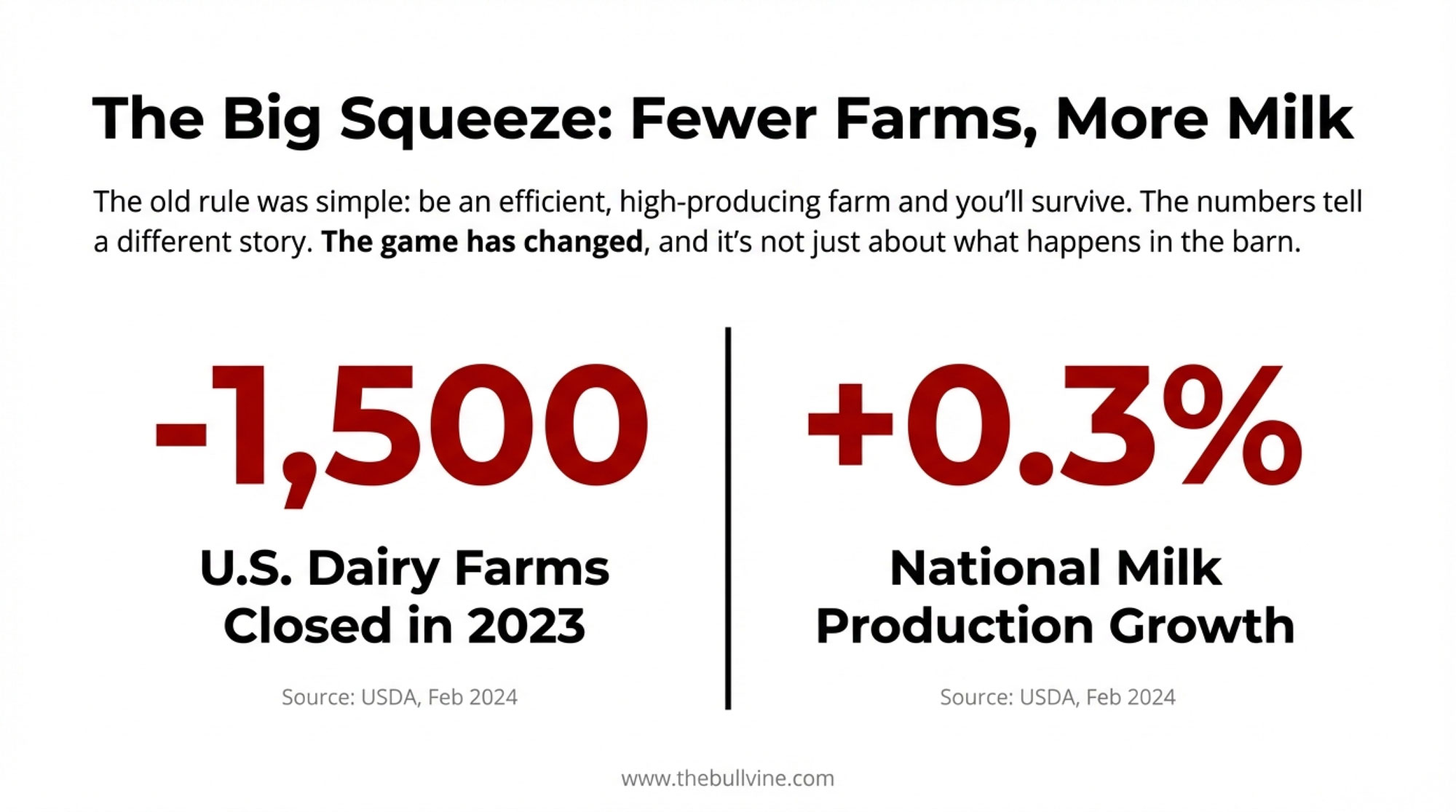


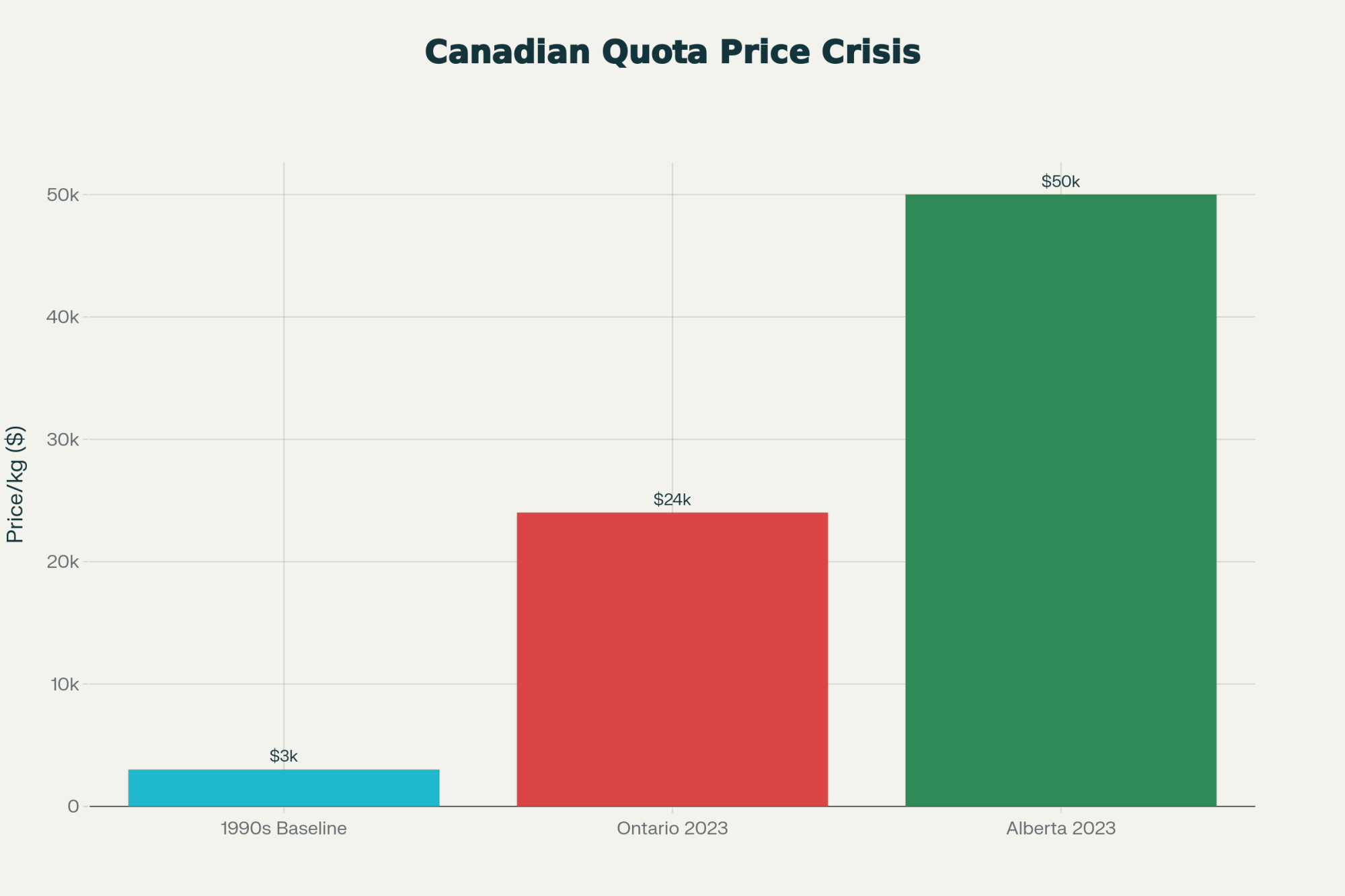


 Join the Revolution!
 Join the Revolution!