




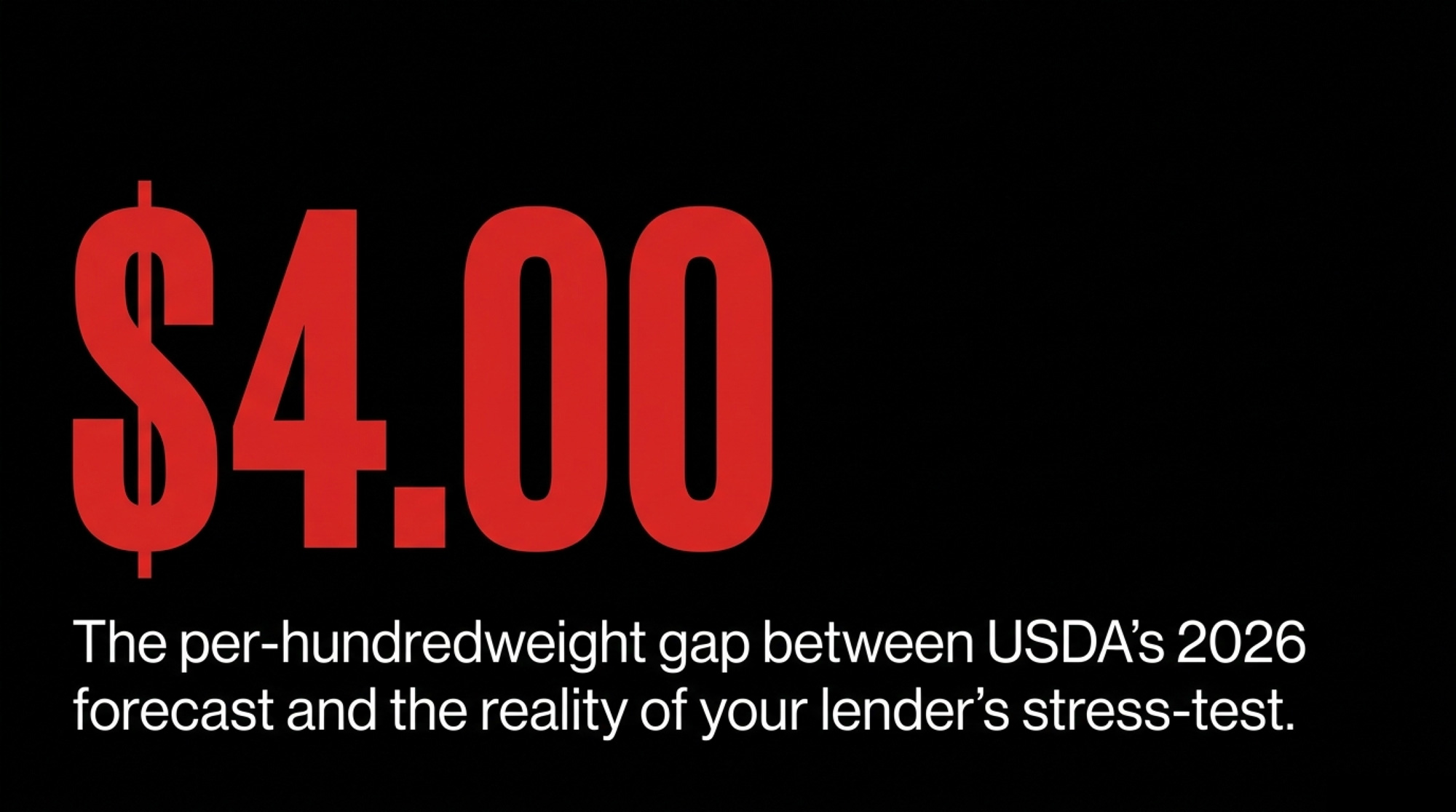
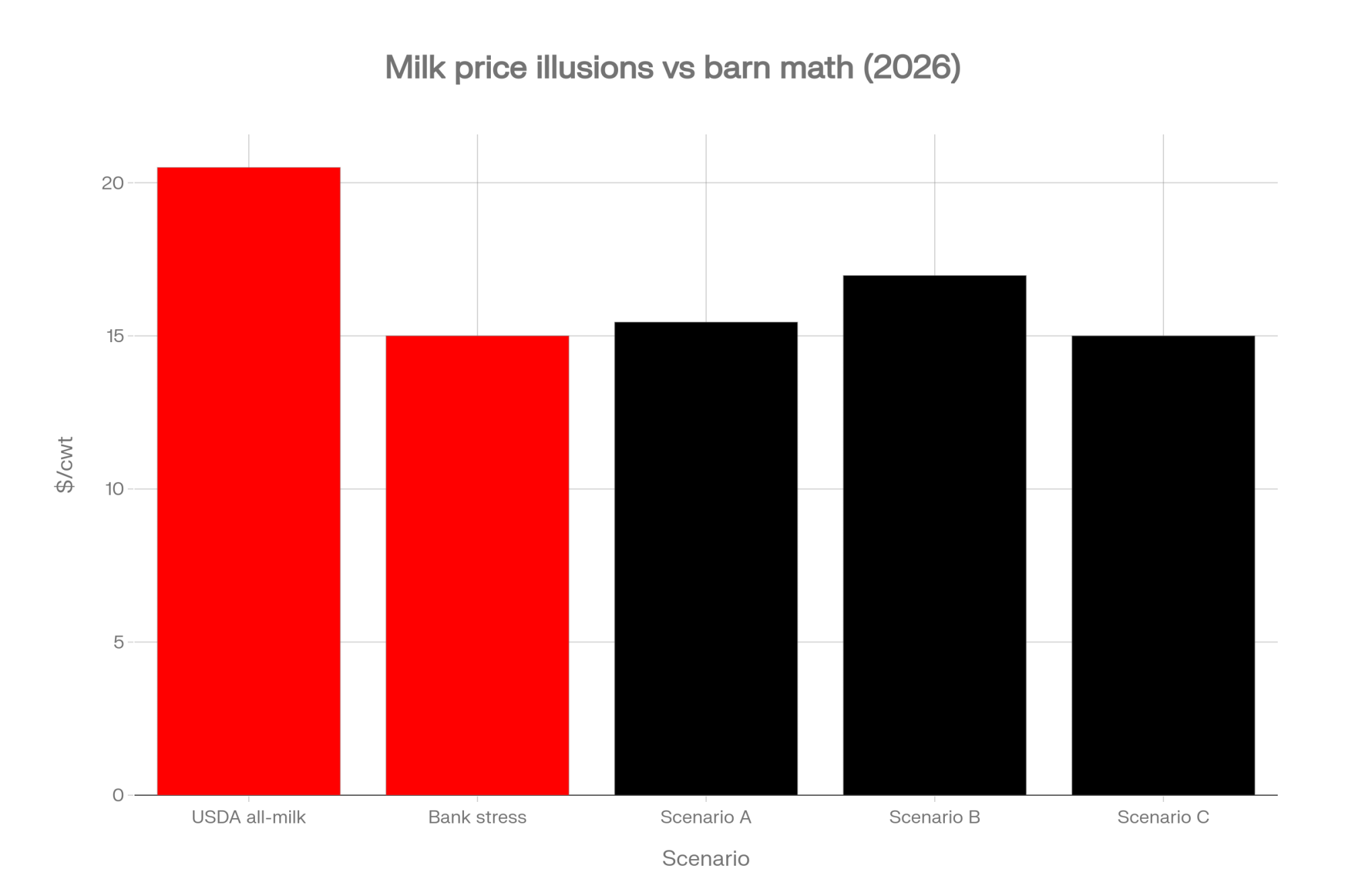
USDA printed $20.50 milk. His lender stress‑tested at $15. His basis had narrowed a quarter. The 400‑cow barn died on the kitchen table — and the $4/cwt gap is why.
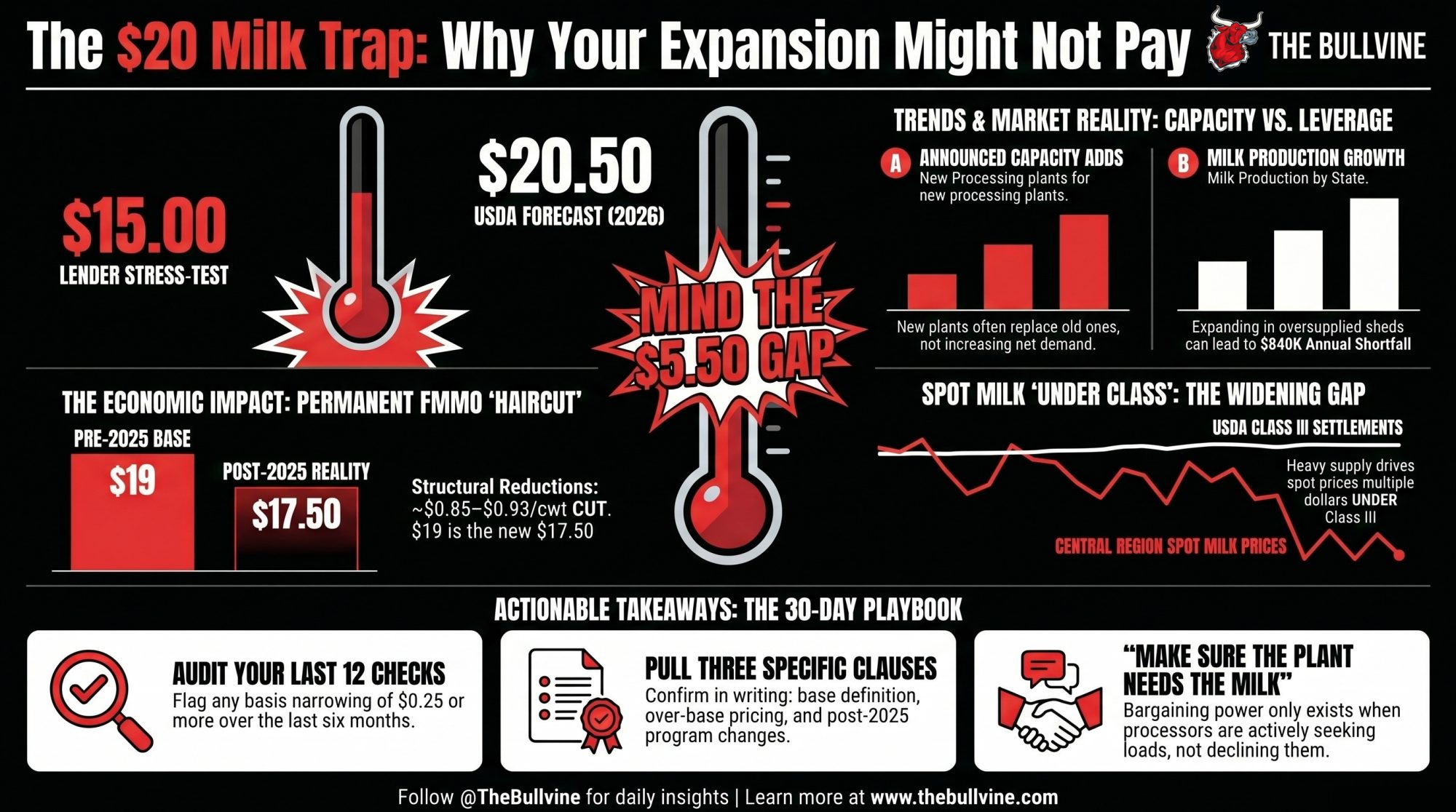
Executive Summary: USDA ERS is printing $20.50/cwt all‑milk for 2026, but the lender stress case under every expansion conversation right now sits at $15. That $4/cwt gap is where this year’s basis‑risk story lives. When Leprino opened Lubbock, it closed Lemoore East — capacity moved, it didn’t stack — and USDA DMN Central the week of April 16 described spot milk as readily available, running multiple dollars under Class III. The June 1, 2025, FMMO amendments permanently cut class prices by roughly $0.85–$0.93/cwt, so a $19 pro forma is really the new $17.50 before basis or premiums. A composite 1,000‑cow Central‑region Midwest dairy ran the numbers on a 400‑cow barn add and walked: Scenario C pencils at ~$15.00/cwt realized against a $19–$20+/cwt full‑cost range for larger U.S. operations — a $672K–$840K+ annual shortfall before new debt service. Diversifying 40,000 cwt to a second buyer adds ~$182K/year without a shovel in the ground. Before you sign a construction loan, pull the three clauses — how base is defined, how over‑base is priced this period, and what changed post‑June 1, 2025.
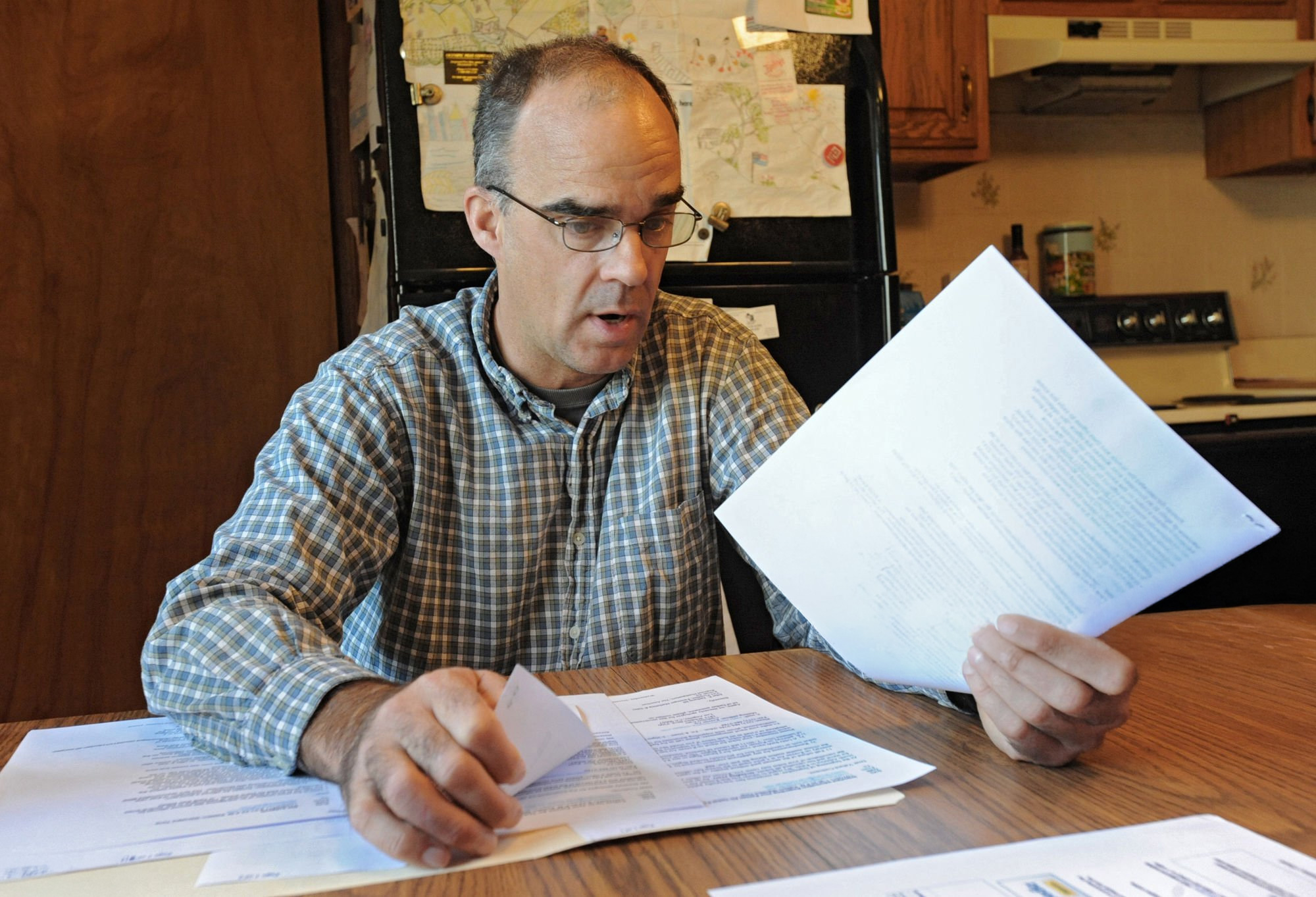
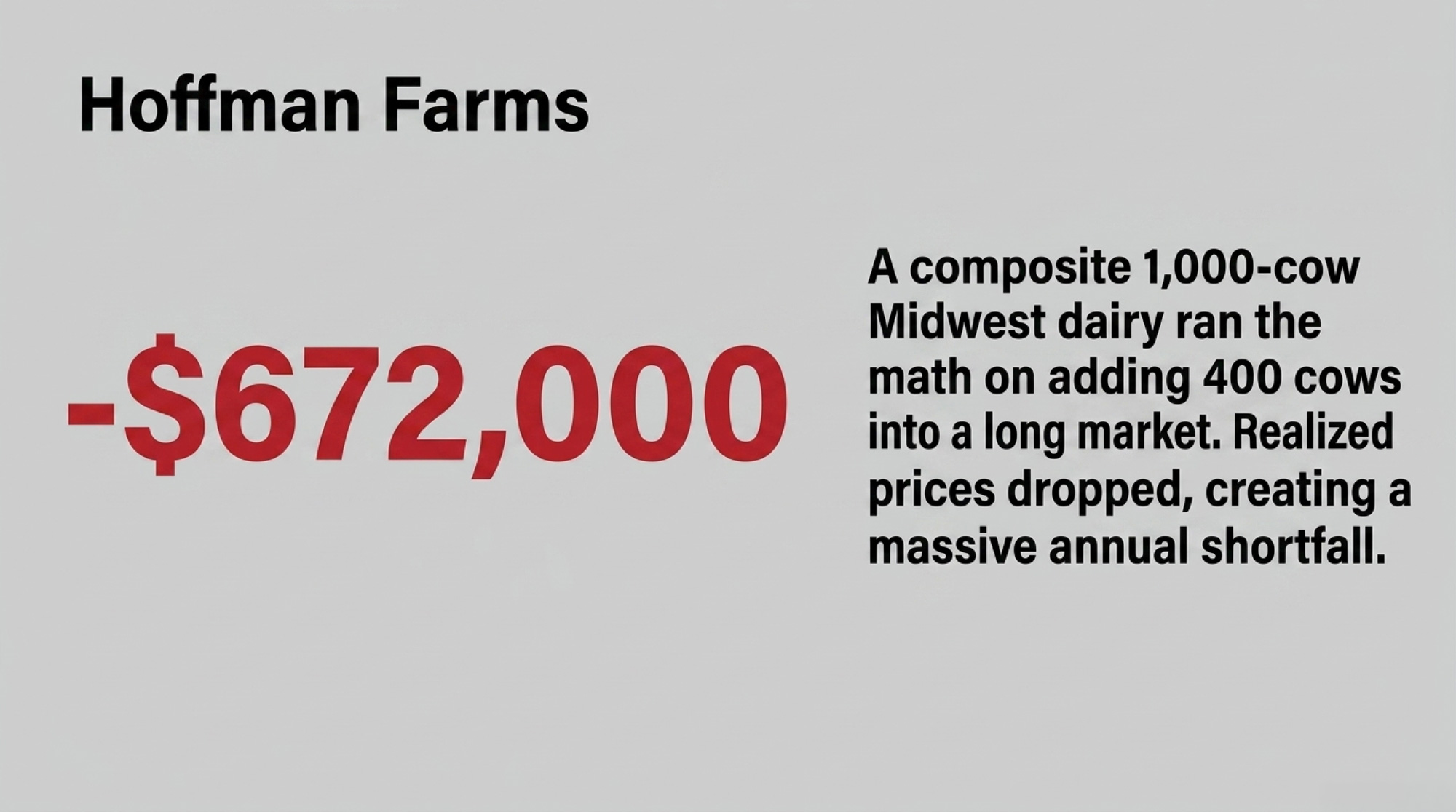
A $19/cwt pro forma sat on one side of the kitchen table. A $15/cwt stress case sat on the other. The operator of a 1,000‑cow Central‑region Midwest dairy we’ll call Hoffman Farms — a composite built from documented 2026 USDA, HighGround Dairy, and Ever.Ag data — pulled his last twelve milk checks and ran the math himself.
His realized $/cwt minus Class III had drifted the wrong way through the back half of 2025 and into Q1 2026, exactly while the trade press celebrated roughly $11 billion in new U.S. processing capacity. His basis to Class III had narrowed by more than a quarter over six months — a working threshold some advisors flag as shed‑level pressure. USDA ERS’s April 2026 Livestock, Dairy, and Poultry Outlook was printing $20.50/cwt all‑milk, $16.90 Class III, $18.60 Class IV. His lender’s 400‑cow barn‑add pro forma came in at $19. The stress case came in at $15.
He walked away from the 400 cows.
Hoffman Farms is a composite — a stand‑in for a 1,000‑cow Midwest operation sitting inside USDA Dairy Market News’ Central reporting region. The math, the contract questions, and the decision triggers are real and sourced. The farm is not. A full methodology note sits at the bottom of this piece.
The $4/cwt gap between USDA’s headline and the lender stress case is where the 2026 dairy basis risk story actually lives. This isn’t a piece about where Class III settles. It’s about bargaining power — whether your plant needs your milk badly enough that a $20‑handle actually lands in your mailbox, or whether you’ve quietly become the balancing tank for a shed that already has more milk than it needs.
Bullvine’s “$19 Milk Trap” analysis from April 6, 2026, walked through the covenant‑pressure sequence in detail. This piece picks up where that one ended: what happens when the pro forma and the stress case sit $4 apart, and the 400 cows are your decision.
The $11 Billion Capacity Story vs. What USDA DMN Actually Said in April 2026
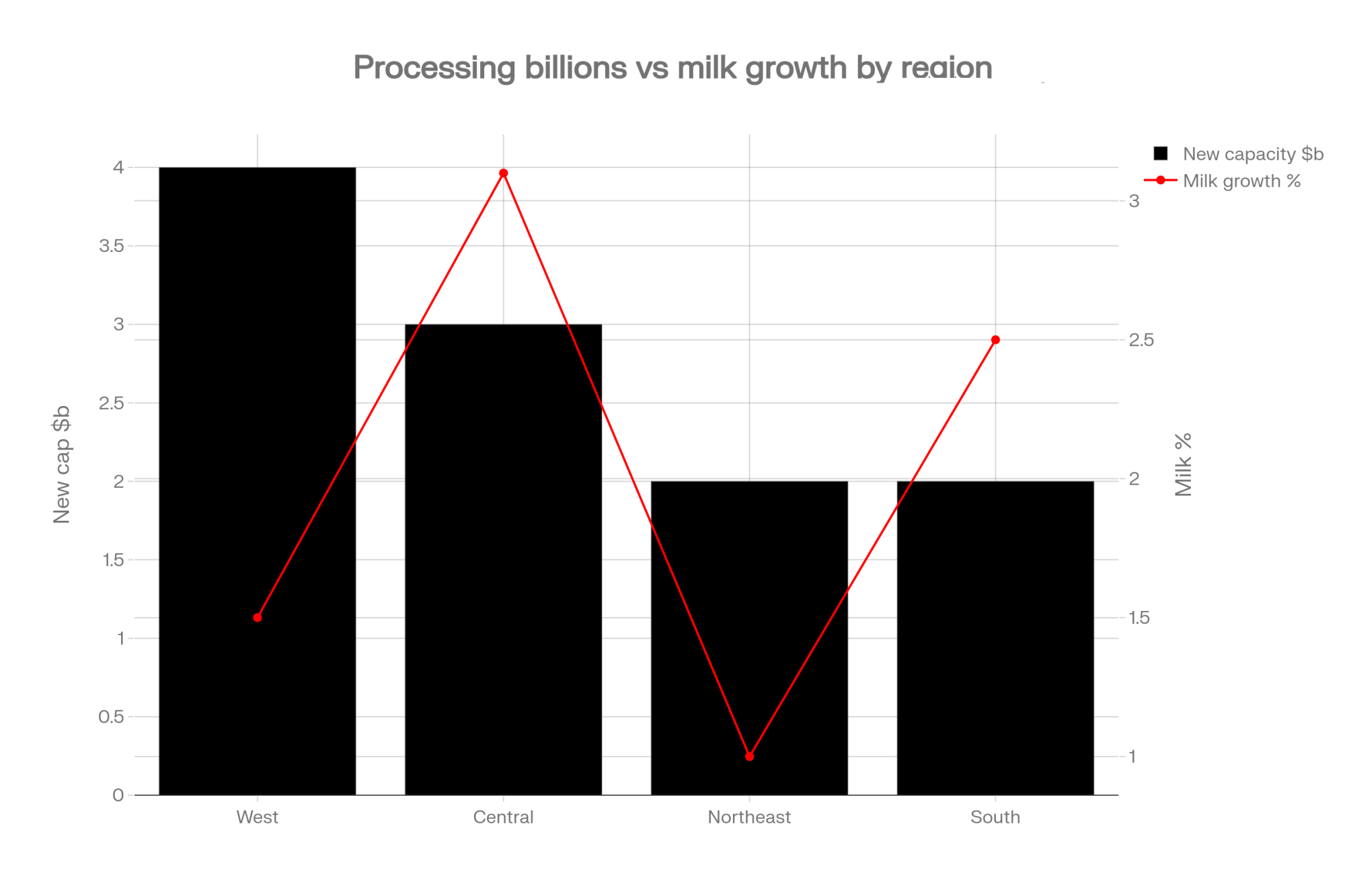
Everyone assumed more capacity meant better leverage for growing Midwest herds. The numbers looked right on the surface. Roughly $11 billion in announced U.S. processing capacity across more than 50 projects running through 2028, based on IDFA‑tracked project lists compiled by HART Design as of October 2025. Named plants, real commitments — Leprino’s Lubbock, Texas facility, Hilmar’s Dodge City, Kansas build, Darigold’s Pasco, Washington expansion, Chobani’s Twin Falls project.
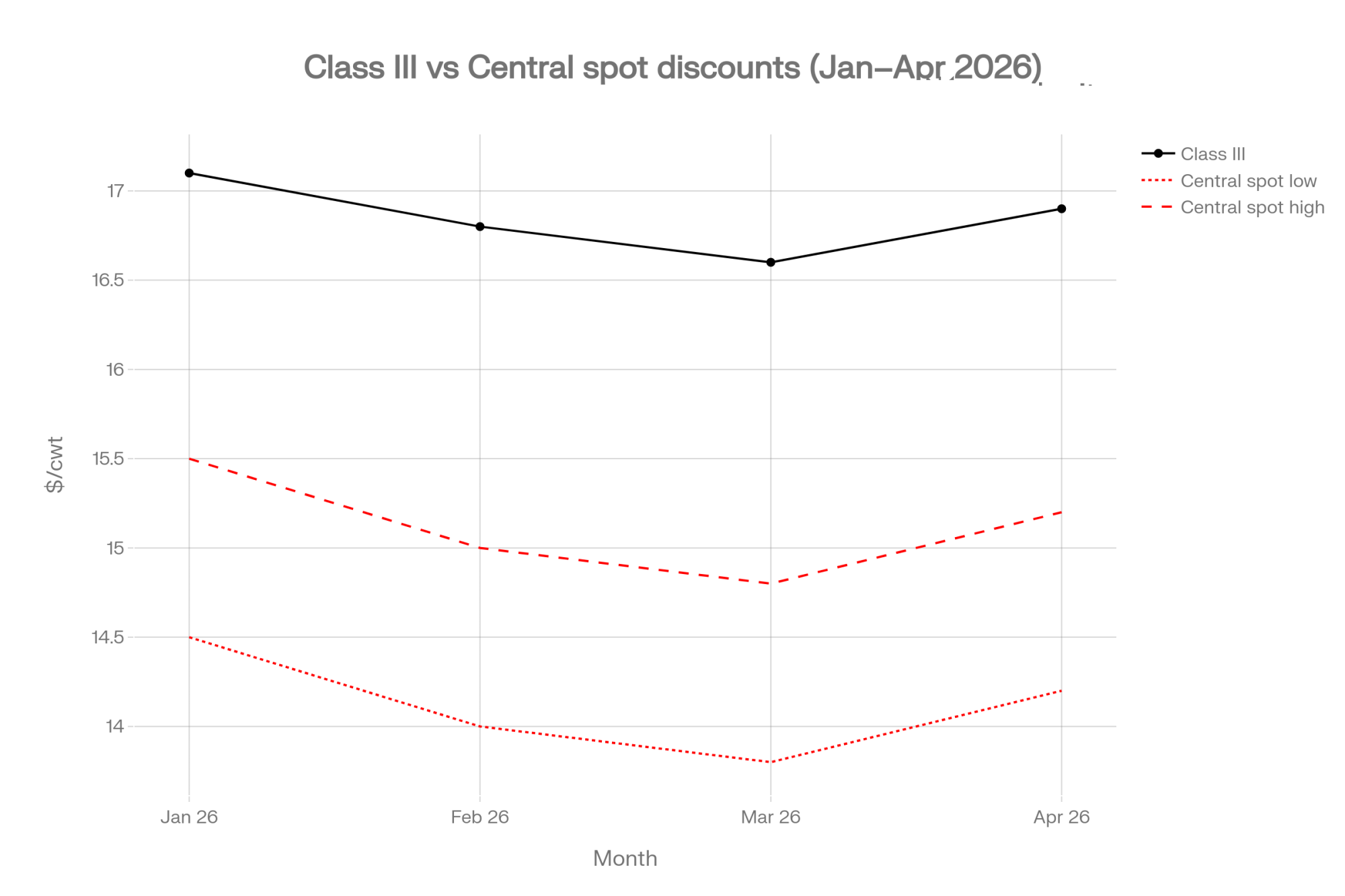
Open USDA Dairy Market News for the week of April 16, 2026, and the story changes. Central region commentary describes spot milk as readily available, with Class III spot pricing running multiple dollars under Class across recent weeks. Ever.Ag’s Milk Premiums report from the same date echoes it: Central Valley manufacturers reporting ample milk, buyers declining incoming loads because hauling distances had become uneconomic.
In reporting by the Fresno Bee in December 2025 and KMPH in November 2025, Leprino cited added capacity from its new Lubbock plant among the reasons for the late‑2025 Lemoore East closure. Capacity didn’t stack on top of California demand. It moved. The milk moved with it. Some California producers who had been shipping into Lemoore East found out the hard way that a capacity announcement somewhere else isn’t the same thing as capacity in their shed.
USDA NASS Milk Production for February 2026 sets the backdrop. U.S. milk up 2.9% year‑over‑year nationally, 3.1% in the 24 major states, with roughly 217,000 more cows than a year earlier. More plants opened. More milk is flowing. Whether the second is outrunning the first in your region is the only question that matters for your check.
What Does Your Lender’s Spreadsheet Actually Say for 2026?
Lenders aren’t being pessimistic. They’re being arithmetic.
Recent industry analysis framed the year around volatility and margin pressure. HighGround Dairy’s Q1 2026 Producer Market Update talks in margin percentiles rather than a single price, flagging H2 2026 as screening in an upper percentile band and urging coverage while it’s on the table. Dairy Herd Management’s May 2025 summary of USDA’s forward outlook captured the sentence lenders internalized for 2026: higher milk output, softer prices. The stress case running through most ag‑lending desks dips into the mid‑teens for six to twelve months.
Hoffman’s co‑op field rep’s tone had shifted over the same stretch — from growth‑friendly language toward supply‑discipline framing. Ever.Ag’s 2026 Milk Premiums weekly reports describe that kind of shift as a leading indicator. It lands before premiums tighten and base/excess programs get enforced more strictly.
When the banker’s stress case and your expansion pro forma disagree by $4/cwt, the equity risk doesn’t split evenly. The bank structured covenants around its number. You structured loan repayment around yours.
The Hidden Haircut: Why Your $19 Pro Forma Is Really the New $17.50
Every 2026 number carries a structural reduction that wasn’t there three years ago.
The June 1, 2025, FMMO amendments permanently reset the make‑allowance formulas. USDA AMS’s Timeline for Changes to Price Announcements (January 2025) set the new rates: cheese at $0.2519/lb, butter at $0.2272/lb, NFDM at $0.2393/lb, dry whey at $0.2668/lb. American Farm Bureau Federation’s Market Intel (September 23, 2025) tallied the first three months under the new rules at roughly $337 million in lost producer pool value — class prices reduced by approximately $0.85–$0.93/cwt. That haircut doesn’t move with the market. It’s baked in.
In 2026, a $19.00 pro forma is the new $17.50 once you stack the 2025 make‑allowance hit on top of modest realized basis erosion in a long‑milk shed. That’s illustrative, not a single‑line subtraction. The ~$0.85–$0.93/cwt class‑price reduction lands before basis, before premiums, before a single load of spot milk gets discounted. The haircut is structural. It doesn’t disappear when Class III recovers.
When the lender stresses at , they’re modeling a year in which that structural cut and a demand softening show up at the same time. That scenario is well inside the range current 2026 lender framing uses. Covenant pressure arrives before the market resolves the question.
What Does “Overflow Tank Milk” Actually Cost Per Hundredweight?
Everyone in the capacity conversation assumed a $20‑handle all‑milk forecast plus $11 billion in new plants equaled bargaining power for a growing Midwest herd. April 2026 contract mechanics tell a different story.
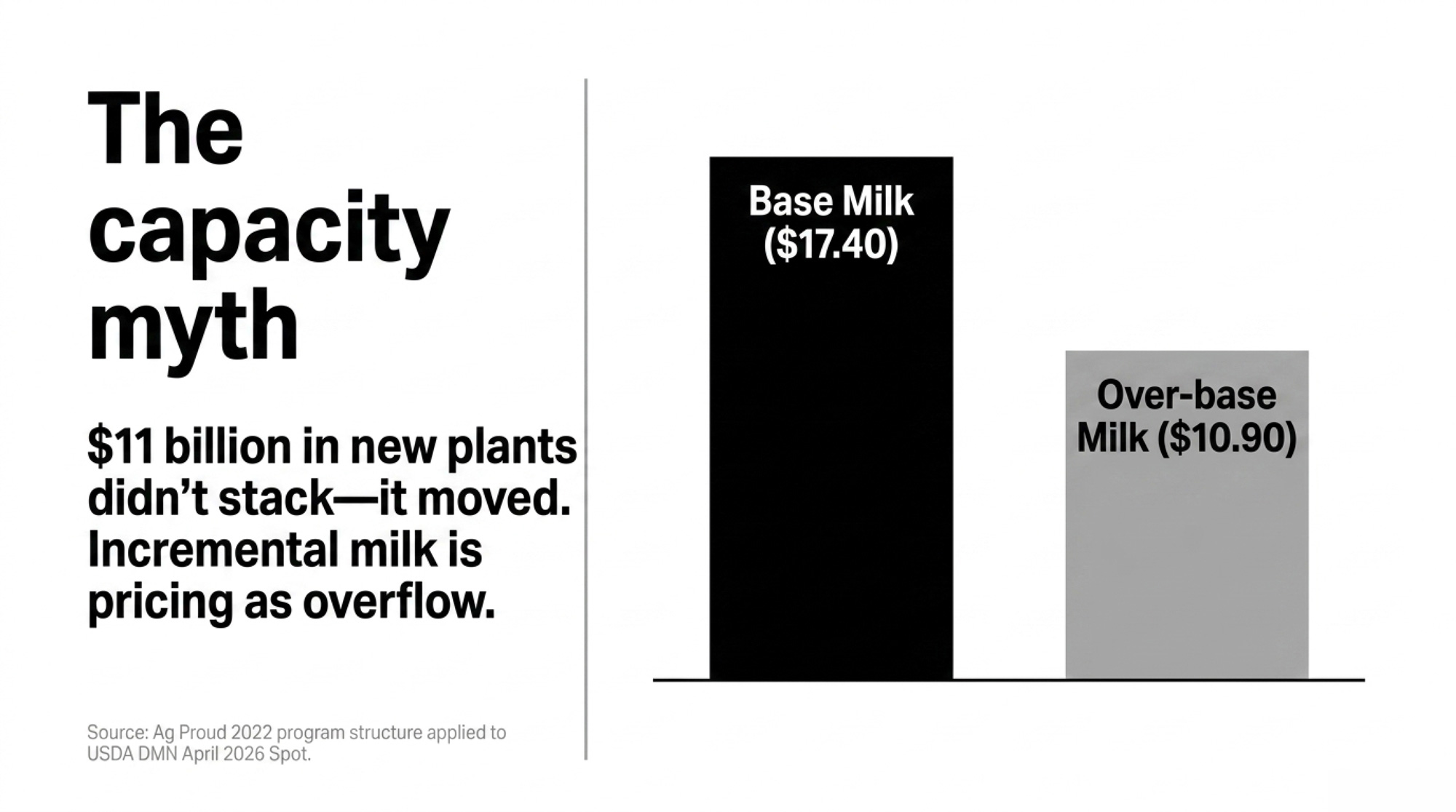
Western base/excess programs have historically priced over‑base milk at the monthly spot average minus a hauling assessment. In heavy months, that produces meaningful $/cwt drag. One publicly documented example from 2022 — an Ag Proud webinar recap describing one co‑op’s program structure of that era — placed the assessment around $1/cwt and the total drag against contract on the order of $5/cwt. Current co‑op terms vary materially between contract cycles and regions. Verify your own agreement before applying any of those numbers as a hard reference.
Layer April 16, 2026, Central spot milk running multiple dollars under Class III on top of that kind of program structure, per USDA DMN and Ever.Ag, and a mailbox that looks stable on the Class III headline diverges sharply the moment a meaningful share of your volume is priced like overflow rather than base.
The contract question worth asking in writing — not over coffee with the field rep: if you add 400 cows, does that new volume get recognized as base within a defined timeframe, at what terms, starting when? An answer that leaves new milk pegged to monthly spot in a shed already running multiple dollars under Class III is a no. It just doesn’t look like one until the check arrives.
Running the Numbers: Hoffman Farms in Three Scenarios
Three illustrative scenarios for a composite 1,000‑cow Midwest operation shipping ~120,000 cwt/year (expansion case: 1,400 cows, ~168,000 cwt/year). All inputs shown. Substitute your own cwt shipped per cow, your own base/over‑base split, your own contract terms.
April 2026 price anchors (USDA ERS, April 2026 Livestock, Dairy, and Poultry Outlook):
- Class III: $16.90/cwt
- All‑milk: $20.50/cwt
- AFBF make‑allowance hit range: ~$0.85–$0.93/cwt (midpoint $0.90/cwt used for scaling)
| Scenario | Cows | cwt Shipped | Realized $/cwt | Annual Gross | The Decision |
| A: Single Buyer, Long Shed | 1,000 | 120,000 | $15.45 | $1,854,000 | Basis eroding |
| B: Diversified — Two Buyers | 1,000 | 120,000 | $16.97 | $2,036,000 | +$182K vs. A |
| C: Expand Into a Long Shed | 1,400 | 168,000 | $15.00 | $2,520,000 | $672K–$840K+ below full cost |
Scenario A — Single buyer, long shed:
- 70% of volume (84,000 cwt) at base: Class III $16.90 + $0.50 illustrative basis = $17.40/cwt
- 30% of volume (36,000 cwt) at over‑base: Class III $16.90 − $5.00 program drag − $1.00 hauling = $10.90/cwt
- Weighted average: (84,000 × $17.40 + 36,000 × $10.90) ÷ 120,000 = $15.45/cwt
- Annual gross: 120,000 × $15.45 = $1,854,000
Scenario B — Two buyers, split volume:
- 80,000 cwt to Buyer 1 at Class III + $0.25 premium = $17.15/cwt
- 40,000 cwt to Buyer 2 at Class III − $0.30 extra hauling = $16.60/cwt
- Weighted average: (80,000 × $17.15 + 40,000 × $16.60) ÷ 120,000 = $16.97/cwt
- Annual gross: $2,036,000. Gain vs. Scenario A: $1.52/cwt × 120,000 cwt = $182,400/year
Scenario C — Expand into a long market:
- 168,000 cwt × $15.00 realized = $2,520,000 gross
- Full‑cost range for larger U.S. dairy operations: $19–$20+/cwt, drawn from Bullvine’s February 2026 cost analysis referencing USDA ERS data for larger U.S. dairy cohorts. Verify the applicable range against your own confirmed cost of production before applying.
- Total cost: $19.00 × 168,000 = $3,192,000 to $20.00+ × 168,000 = $3,360,000+
- Shortfall before new expansion debt service: $672,000–$840,000+
| Scenario | Cows | cwt shipped/year | Realized price ($/cwt) | Annual gross revenue ($) | Position vs full cost ($19–$20/cwt) |
| A – Single buyer, long shed | 1,000 | 120,000 | 15.45 | 1,854,000 | ≈$420k–$540k short |
| B – Diversified, two buyers | 1,000 | 120,000 | 16.97 | 2,036,400 | ≈$304k–$484k short |
| C – Expand into long shed (1,400 cows) | 1,400 | 168,000 | 15.00 | 2,520,000 | ≈$672k–$840k short |
| USDA ERS 2026 all‑milk headline | – | – | 20.50 | – | Looks solvent on paper only |
Bullvine’s April 13, 2026, analysis on a ~$3M dairy expansion showed fixed debt service adding meaningful $/cwt drag at a 500‑cow scale. A Hoffman‑scale expansion produces a different absolute number. The direction doesn’t change.
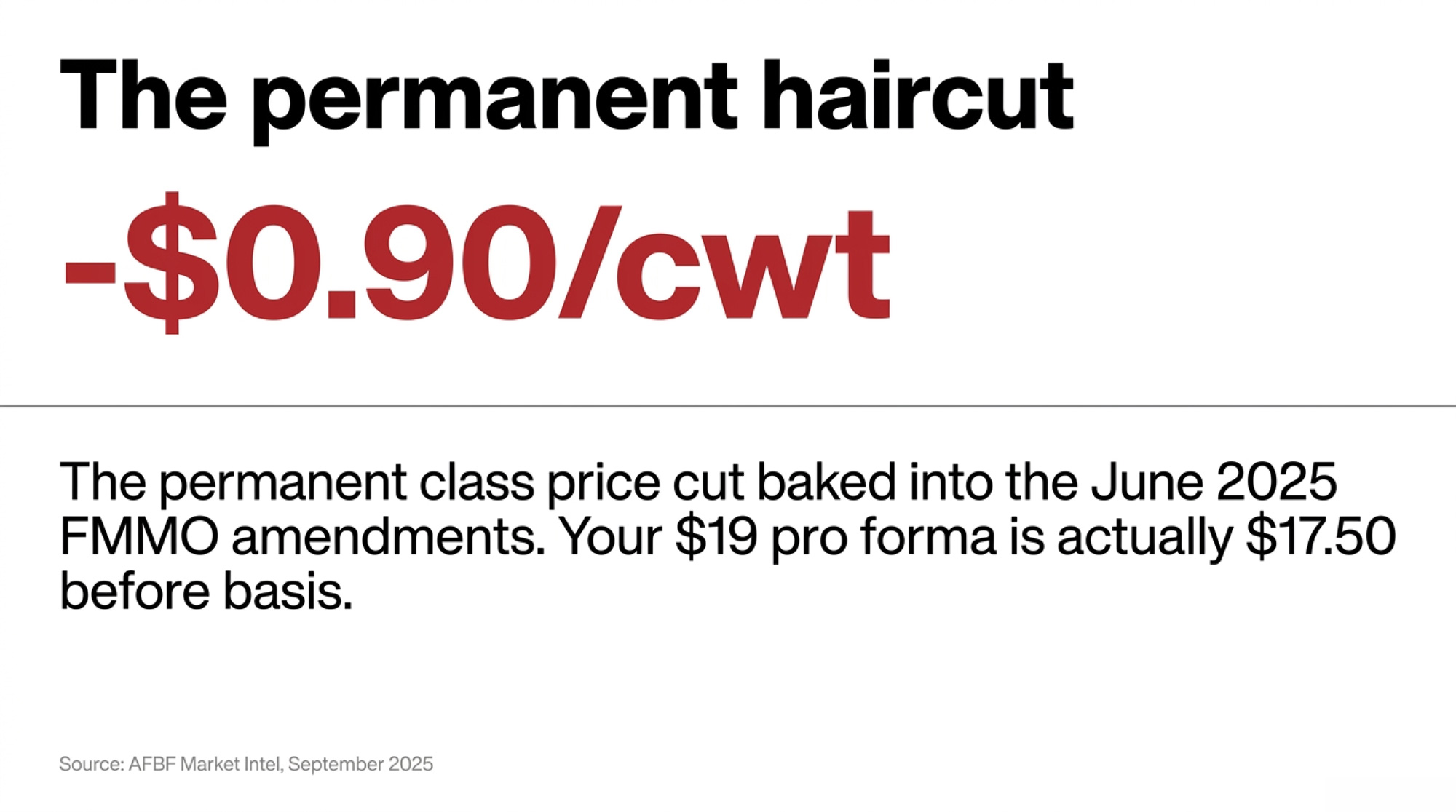
FMMO make‑allowance hit scaled to smaller herds (AFBF range midpoint of ~$0.90/cwt; substitute your realized per‑cwt impact from recent settlements):
- 300 cows × ~220 cwt/cow/year ≈ 66,000 cwt × $0.90 = $59,400/year
- 500 cows × ~220 cwt/cow/year ≈ 110,000 cwt × $0.90 = $99,000/year
Plug in your own cwt shipped per cow from your last 12 months of checks to size it to your barn.
Why Protein Wins and Your Commodity Plant Might Not
Merrick Capital (June 2025) and Dairy News Today (December 2025) describe the same sector pattern: processors closing older commodity facilities while investing in higher‑margin specialty product lines. McKinsey’s April 19, 2026, dairy industry analysis framed the 2026 processor playbook as protecting margins while pursuing growth. Farm Credit Canada’s February 2026 outlook identified protein as the forward pay driver. Dairy Reporter’s March 2026 coverage of the 2026 global supply situation made the split explicit: protein and specialty hold value; generic commodity milk in an oversupplied shed loses negotiating position.
In the composite Hoffman scenario, the plant sits on the commodity side of that split — a profile that fits a meaningful share of Central‑region facilities, though not all. Adding 400 cows into a long shed tied to a plant with no visible premium‑product trajectory isn’t growth. It’s volunteering to be the region’s balancing supply at the worst moment in the cycle to be the marginal hundredweight.
The equity risk doesn’t split evenly. When your pro forma and your lender’s stress case disagree by $4/cwt, that gap lands entirely in your equity column. Readers who want the lived version of this math — a multi‑generation family dairy that chose consolidation over expansion — can follow Bullvine’s legacy‑family features for the human side of the decision.
The 30/90/365‑Day Playbook for Herds Like Hoffman’s
30 Days — Do These Before Any Other Expansion Conversation
- Audit your last 12 milk checks. Calculate realized $/cwt minus Class III, month by month. Requires: 12 months of settlement statements and an hour. Threshold: basis to Class III narrowing $0.25/cwt or more over six months while national capacity headlines grew is a yellow flag on your shed position. Backfire watch: a single month’s component swing distorts a short window — use the full 12.
- Pull USDA Dairy Market News for your region. Read the actual language, not the headline price. If commentary describes spot loads available with buyers selective on hauling distance, that’s your plant’s real signal — not USDA ERS’s national all‑milk number. Threshold: language indicating buyers declining loads on distance grounds is a yellow flag on your over‑base exposure.
- Ask your co‑op or processor in writing: how is base defined this contract period, how is over‑base priced, and what changed in programs or premiums after the June 1, 2025, FMMO amendments? Requires: a written request. Verbal answers from field reps aren’t binding. Backfire watch: assuming last cycle’s terms still apply.
- Red‑flag trigger: if your DSCR has been under 1.2 for three consecutive months using your lender’s or CPA’s method, stop expansion conversations and move this list to the front of the stack.
90 Days — Structural Moves That Require Planning
- Stress‑test your DSCR at $15 milk against your current debt load and cost structure. Share results with your lender and ask directly: which scenario are your covenants built on? Requires: 12 months of checks, a verified cost of production that includes family living and deferred maintenance, a meeting with your lender or CPA. Backfire watch: a cost estimate that excludes those lines produces a number that looks better than your bank’s.
- Price a realistic second‑buyer option for 20–40% of your volume. Get written hauling quotes from two carriers and a written term sheet from a second buyer before comparing. If incremental hauling comes back in the low‑cents‑per‑cwt range and your current over‑base penalty is $1/cwt or more, diversification pencils before sentiment enters the math. Bullvine’s prior processor bidding‑war and milk‑routing analysis carries the negotiation framework. Backfire watch: hauling quotes that don’t hold through winter, or a second buyer equally long on milk.
- Lock a written risk‑management policy — what percentage of milk you’ll cover via Dairy Revenue Protection or options, and at what margin triggers. HighGround Dairy’s Q1 2026 framing of H2 2026 margins in an upper percentile band is a timing reference, not a ceiling. Backfire watch: coverage structured without reference to your verified cost of production.
365 Days — Positioning for the Next Cycle
- Decide whether your operation competes on cost, components, or both. Farm Credit Canada’s February 2026 outlook and other recent analysis point to protein as the forward pay driver. Bullvine’s component‑focused sire selection and herd management coverage is the right companion for this decision. Backfire watch: investing in component genetics without a plant that pays a meaningful protein premium in writing.
- Evaluate beef‑on‑dairy as a line item in your margin math, not a bonus. Recent commentary flagged beef‑on‑dairy adding $5/cwt or more in some Northeast operations. Midwest and Western calf markets price differently and seasonally. Use your own local auction data, not a regional average from a different geography. Backfire watch: beef‑on‑dairy income masking a structurally weak milk contract underneath.
- Opportunity signal: if your basis to Class III re‑widens to a 12‑month high while your mailbox stays above your verified full cost for two consecutive quarters, your plant is telling you it needs your milk. That’s the window to renegotiate base volume, premiums, and hauling terms — not when everyone else in the shed is asking the same question. Backfire watch: confusing a seasonal demand flush with a structural capacity shift; check USDA DMN language for your region before moving.
When Does the 400‑Cow Add Still Pencil in 2026?
Not every expansion is the wrong call this year. Three conditions have to line up at once.
First: a capacity‑short shed where USDA DMN language reads as processors actively seeking loads, not spot loads available — the opposite of what Central region commentary showed the week of April 16, 2026. Second: a plant tied to a premium‑product line — growth cheese, high‑protein ingredients, specialty formats — with a track record of paying for it, consistent with McKinsey’s April 2026 and Farm Credit Canada’s February 2026 framing of where processor margins are actually coming from. Third: a co‑op willing to move new volume into base at full contract terms inside a defined timeframe, in writing, not verbally.
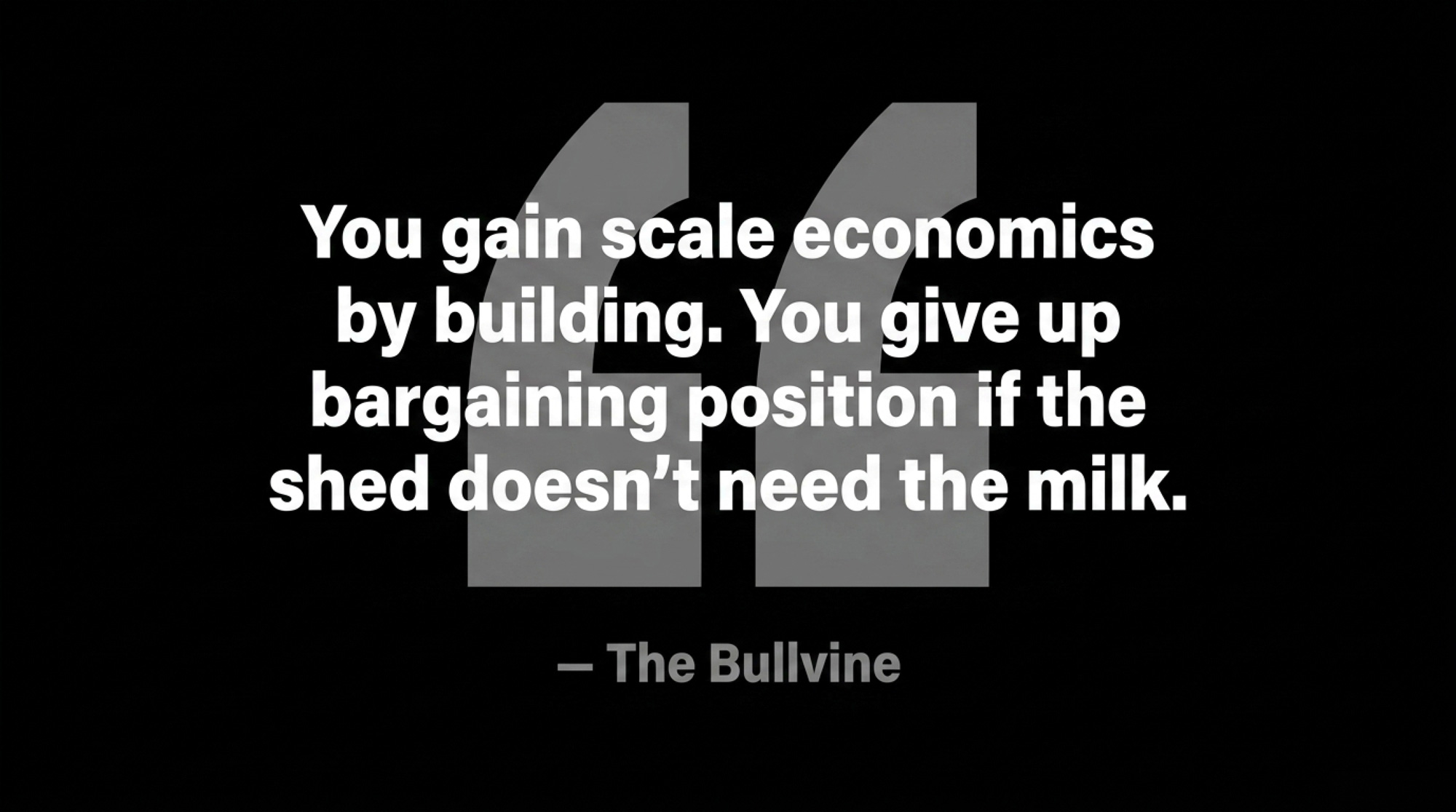
Fail any one of those three tests and your expansion math isn’t wrong because of your operation. It’s wrong because you’re borrowing leverage from a shed that hasn’t given it to you yet. You gain scale economics by building. You give up the bargaining position you currently hold if the shed doesn’t need the milk.
The Contract Check That Should End Every 2026 Expansion Meeting
In the composite Hoffman scenario, the 400 cows didn’t die forever. They died at this price, in this shed, with this contract.
The operator’s agreement would have treated new milk as over‑base, priced off monthly spot. April 2026 Central spot ran multiple dollars under Class III on bad weeks, per USDA DMN and Ever.Ag. The lender’s stress case was $15. USDA’s headline was $20.50. Those four numbers don’t reconcile on paper. So the barn doesn’t get built.
Before your next contract renewal or expansion meeting, pull the document and find three specific clauses: how base is defined, how over‑base is priced in the current contract period, and what programs or assessments changed after June 1, 2025. If you can’t answer all three from the written document before you sign a construction loan, you don’t actually know your own 2026 milk price. You know someone else’s projection.
| Clause to pull in writing | Low‑risk answer (build‑worthy) | High‑risk answer (treat as red flag) |
| How base volume is defined | Current volume plus planned 400 cows added as base within 6–12 months under written terms | New 400 cows treated as over‑base indefinitely with no written path to base |
| How over‑base milk is priced | Over‑base tied close to Class III with modest hauling adjustment (≤$1/cwt drag) | Over‑base pegged to monthly spot minus program drag and hauling in a long shed |
| Changes after June 1, 2025 | Make‑allowance impact acknowledged and premiums adjusted to partially offset haircut | Programs tightened, premiums trimmed, make‑allowance cut passed straight through |
| Lender’s stress‑test assumption | Covenants modeled at or below your own verified stress number (≈$15/cwt) | Bank underwriting at $15 while your pro forma assumes $19–$20 with no basis adjustment |
The bottom line: In 2026, the most profitable move isn’t building a bigger tank. It’s making sure your plant actually needs the milk already in it.
Scale economics favor building. Bargaining power doesn’t — not in a shed that’s already long.
What does your current processor contract actually say about how your next 400 cows get paid when your plant is already long on milk — and whose stress‑test number is your equity riding on, yours or your lender’s?
Key Takeaways
- A $20.50 USDA headline and a $15 lender stress case don’t reconcile. If your expansion pro forma lives in the middle, the $4/cwt gap lands entirely in your equity, not the bank’s.
- Capacity moved, it didn’t stack. Read USDA DMN language for your shed before you read the national price — if buyers are declining loads on hauling distance, your incremental milk is overflow, not growth.
- The June 1, 2025, FMMO amendments cut class prices by roughly $0.85–$0.93/cwt, and that haircut is permanent. A $19 pro forma is really the new $17.50 before basis or premiums.
- Before you sign a construction loan, pull three clauses in writing: how base is defined, how over‑base is priced this period, and what changed post‑June 1, 2025. If you can’t answer all three, you don’t know your own 2026 milk price.
Methodology note: Hoffman Farms, his plant, his co‑op field rep, and his lender are composites constructed from documented 2026 sources: USDA ERS, USDA NASS, USDA AMS, USDA DMN, AFBF Market Intel, HighGround Dairy, Ever.Ag, McKinsey, Farm Credit Canada, Dairy Herd Management, Merrick Capital, Fresno Bee, KMPH, IDFA/HART Design, and Bullvine analysis. The math, contract questions, and decision triggers apply to real operations of this profile; the specific farm does not exist. Scenario inputs use USDA ERS April 2026 Livestock, Dairy, and Poultry Outlook prices ($20.50 all‑milk, $16.90 Class III, $18.60 Class IV), USDA AMS January 2025 make‑allowance figures (cheese $0.2519/lb, butter $0.2272/lb, NFDM $0.2393/lb, dry whey $0.2668/lb), USDA DMN and Ever.Ag April 16, 2026 Central and Central Valley spot milk commentary, and program‑structure context from an Ag Proud April 2022 webinar recap describing one co‑op’s program structure of that era. The $19–$20+/cwt full‑cost range used in Scenario C is drawn from Bullvine’s February 2026 cost analysis referencing USDA ERS data for larger U.S. dairy cohorts; verify the applicable range against your own operation’s confirmed cost of production before use. Co‑op program terms evolve — verify current contract language against your own agreement before applying scenario numbers to your operation.
Learn More
- Surviving Dairy Farm Overtime Laws: Robots vs. People — Arms you with the ROI math to choose between $2.4 million in robot debt or skyrocketing overtime bills. Breaks down the $3.50/cwt labor threshold and identifies the exact moment a milker walking away kills your margin.
- The $19 Milk Trap: How 2026 Prices Quietly Drain a 400‑Cow Dairy’s Equity — Exposes the dangerous “no man’s land” for mid-sized herds stuck between consumer scale and mega-dairy leverage. Delivers a 90-day playbook to stress-test your balance sheet before equity bleed turns a voluntary pivot into a forced exit.
- 211,000 More Dairy Cows. Bleeding Margins. The 2026 Math That Won’t Wait. — Reveals how $1,400 beef-on-dairy calf premiums are short-circuiting the culling math and flooding the market. Dismantles the “wait and see” strategy by proving why keeping genetically weak cows in the barn is destroying the replacement pipeline.
The Sunday Read Dairy Professionals Don’t Skip.

Every week, thousands of producers, breeders, and industry insiders open Bullvine Weekly for genetics insights, market shifts, and profit strategies they won’t find anywhere else. One email. Five minutes. Smarter decisions all week.