





Cornell’s Teaching Dairy and SwissLane’s Oesch family built their sand-separator success inside facilities designed around the system. For a 400-cow retrofit, the same $85K quote carries a very different set of risks — including one Klebsiella cow you can’t afford to lose.
Executive Summary: The McLanahan SMS12 quote says 2.5-year payback on $85K — the honest math on a 400-cow retrofit says 4.5, once you put depreciation back in and haircut recovery from 90% to 78%. Cornell’s Teaching Dairy hits 93% separation because the facility was built around the system; SwissLane’s Oesch family hits 90% because they’ve got the scale and internal labor to run it right. Your retrofit, with a shared-duty feeder running behind by 7 a.m., isn’t either of those. A 20,000 cells/mL SCC drift on commissioning costs a 400-cow herd roughly $25,550/year in lost quality premium — larger than the stressed-case net savings — and one preventable Klebsiella cull on a pedigree cow in Month 3 erases a full year of separator savings before her daughters are counted. In the Midwest at $12–15/ton contract sand this is an ROI play; in the Northeast at $18+/ton with single-supplier exposure, it’s an insurance play against a trajectory that SARE already documented rising 70% in real dollars between 2003 and 2013. Read the full piece if you’re re-bedding this year, staring at a dealer quote, or if your 400-cow herd carries any pedigree value you can’t afford to lose in commissioning.
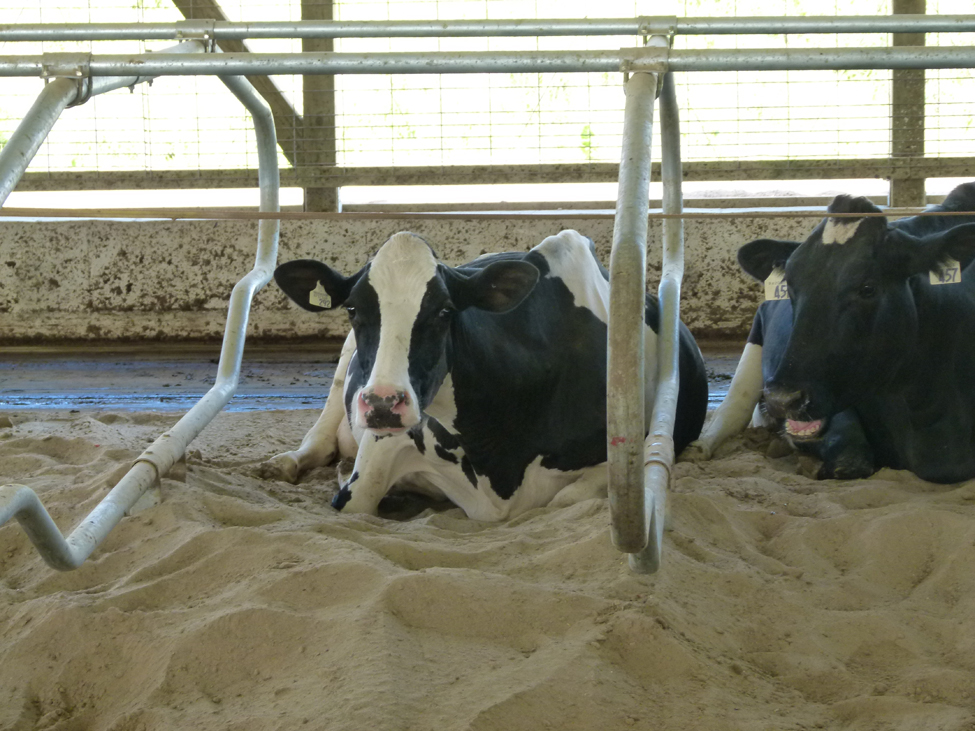
It’s mid-April. Coffee going cold on the kitchen table, an iPad open beside a paper dealer quote, the parlor pump cycling steady in the background. The producer staring at the McLanahan SMS12 quote could be in Lancaster County, Clinton County, or Addison County — this decision is on 400-cow kitchen tables across three regions right now — and the quote says 2.5-year payback in base-case spreadsheet optimism.
McLanahan engineered the SMS12 for dairies with 500 or fewer cows. Using the company’s own published 500-cow example — 50 lbs of sand per cow per day, $12/ton delivered, electricity at $0.07/kWhr — the pre-separator sand bill runs $54,750, and the system claims to cut roughly $40,000 a year off that bill while recovering more than 90% of the bedding. Base-case projections are standard practice across dairy capital equipment, from robotic milkers to heat recovery. The question isn’t whether the base case is optimistic. It’s how it holds up against your barn, your labor, and the cow in stall 47.
Figures in this article are illustrative, drawn from published case studies and model inputs. Actual costs, savings, and payback periods depend on herd size, regional sand pricing, barn design, labor, and site conditions.
What Cornell’s Teaching Barn Actually Proved — and What It Didn’t
Cornell University’s Teaching Dairy Barn in Ithaca, New York — a 150-cow facility built around best-practice demonstration — installed the SMS12 and published its results through McLanahan’s February 2025 case study. Their stated goal was 90% sand separation. The long-term average has come in at roughly 93%. Weeks hitting 97% or better happen regularly.
“One of the nice surprises we’ve had is how well it does the sand separation for us,” Jennette, the Teaching Dairy’s manager, said in McLanahan’s published Cornell case study. Before installation, the Teaching Dairy was trucking in about 30 tons of new sand every week. Today they buy a few tons at a time.
That’s a legitimate success story. But it’s a ceiling, not a benchmark. The Teaching Dairy Barn was purpose-built around the system, staffed by people whose primary job is to manage and document it. Institutional backing. No shared-duty labor problem. A 400-cow retrofit with two hired hands and a feeder who’s already running behind by 7 a.m. is a different animal entirely.
Scale up and the same tension shows up in a different form.
SwissLane Dairy in Alto, Michigan — a 2,000-cow, fourth-generation operation under the Oesch family — ran headlong into the real-world version of that gap before McLanahan solved it mechanically for them. Per McLanahan’s SwissLane case study, switching to sand bedding added roughly 8 lbs/cow/day to the herd average, and SwissLane cows now produce around 90 lbs/cow. Sand-laden manure was wrecking equipment, compacting fields, and stacking maintenance bills. Their McLanahan Sand-Manure Separation System now recovers up to 90% of the sand depending on sand size and water quality. “We are recycling up to 90 percent of the sand, which cuts back on our need for new sand,” Matt Oesch, the fourth-generation financial controller, said in that same case study. “Also, there is much less wear and tear on our equipment.”
Both systems work, but for different reasons. Cornell’s works because it was purpose-designed. SwissLane’s works because the Oesches have the scale and internal infrastructure to run it properly. That variable is missing from the base-case model — and it’s exactly the variable a 400-cow retrofit is most exposed to.
| System / Herd Type | Design & Labor Reality | Risk if Copied to 400‑Cow Retrofit |
| Cornell Teaching Dairy | 150 cows; barn purpose-built around SMS12; dedicated staff tracking sand daily | 93% recovery becomes 75–80% when shared-duty labor replaces dedicated ops |
| SwissLane (2,000+ cows) | Large-herd scale; in-house maintenance; strong internal infrastructure | Assumes capital, infrastructure, and uptime most 400‑cow barns don’t have |
| 400‑Cow Retrofit (spec) | Existing barn geometry; limited fall; 2–3 hired hands with full chore lists | Design constraints and labor load push recovery below spec by 10–15 points |
| 400‑Cow Retrofit (drift) | Shared-duty “separator manager”; protocols erode after 90 days; reactive maintenance | Klebsiella or SCC drift can erase a full year of savings in Month 3 |
What a Klebsiella Event Actually Costs You on a Pedigree Cow
The payback math assumes a commissioning SCC event is a one-time quality-premium hit. It isn’t — not in a Bullvine reader’s barn.
Rowbotham and Ruegg’s 2016 Journal of Dairy Science study (“Bacterial counts on teat skin and in new sand, recycled sand, and recycled manure solids used as bedding in freestalls”) documented that primiparous Holsteins bedded on new sand had longer survival times to first culture-positive subclinical mastitis case than cows on recycled sand. Read “survival time” as what it actually is on a breeder’s herd: the difference between a second-lactation EX classification and a cull tag at Day 95.
Commissioning drift on a recycled-sand system opens the door specifically to environmental coliforms — Klebsiella, E. coli, Enterobacter — the organisms Leite et al. tied in a 2023 Pathogens study to higher clinical mastitis incidence when bedding moisture and coliform counts climbed. A Klebsiella mastitis case on a high-genomic or deep-pedigree cow isn’t a $250 treatment bill. It’s a cow you lose.
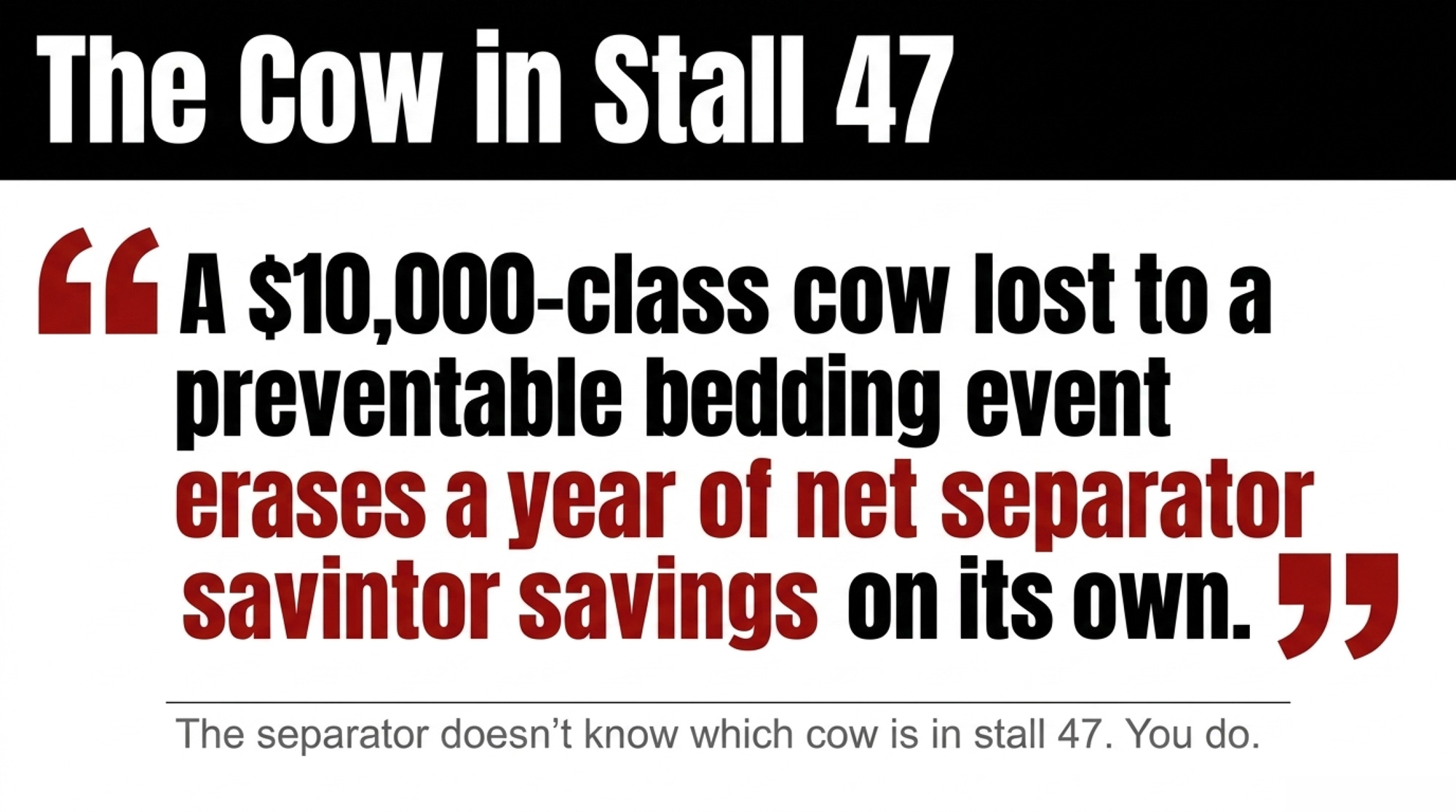
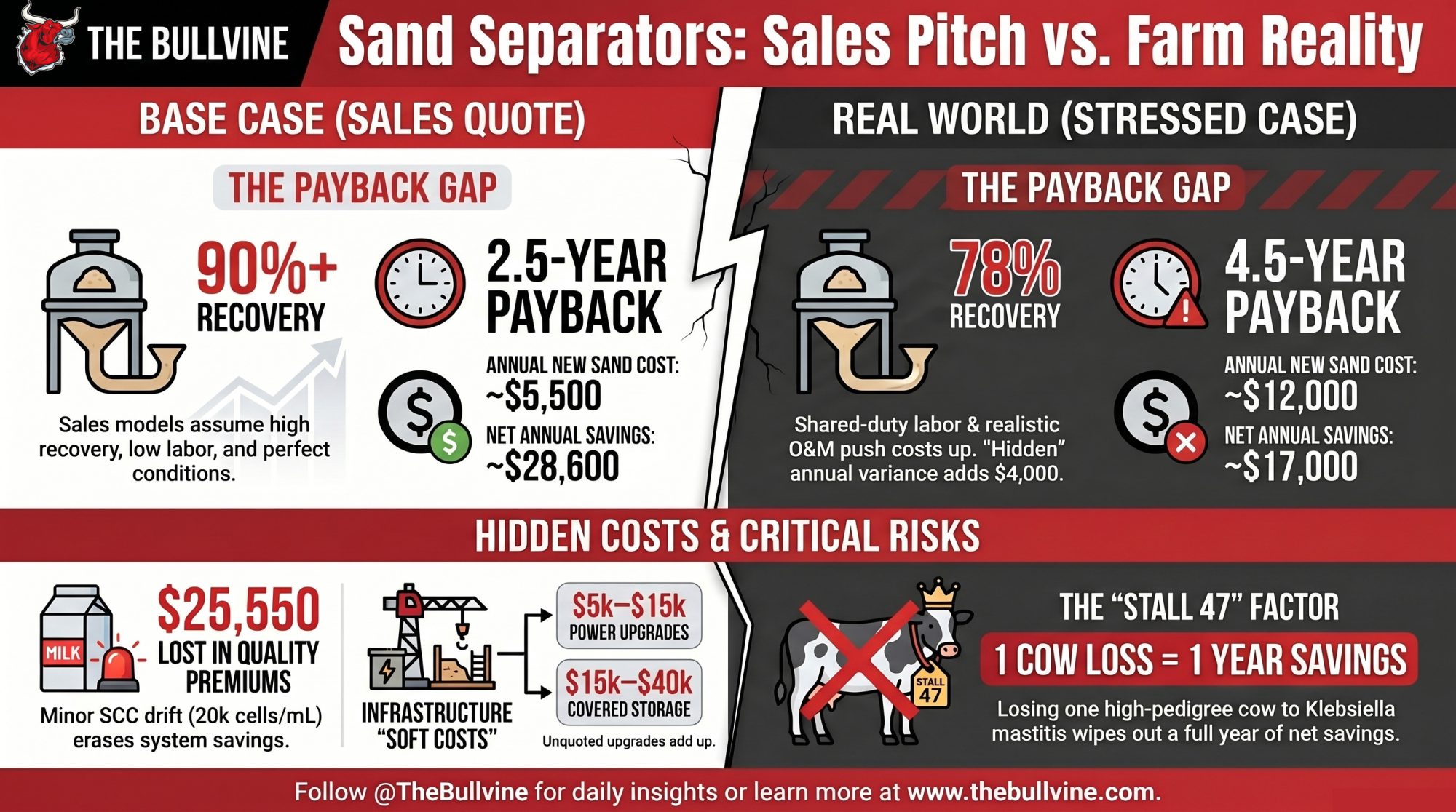
On a 400-cow herd carrying even a small nucleus of breeder-value animals, the 4.5-year payback math flips the moment one of those cows goes down in Month 3. A $10,000-class cow lost to a preventable bedding event erases a year of net separator savings on its own — before you count what her daughters were supposed to contribute. The separator doesn’t know which cow is in stall 47. You do.
Can a 400-Cow Retrofit Hit Spec When Cornell and SwissLane Were Purpose-Built for It?
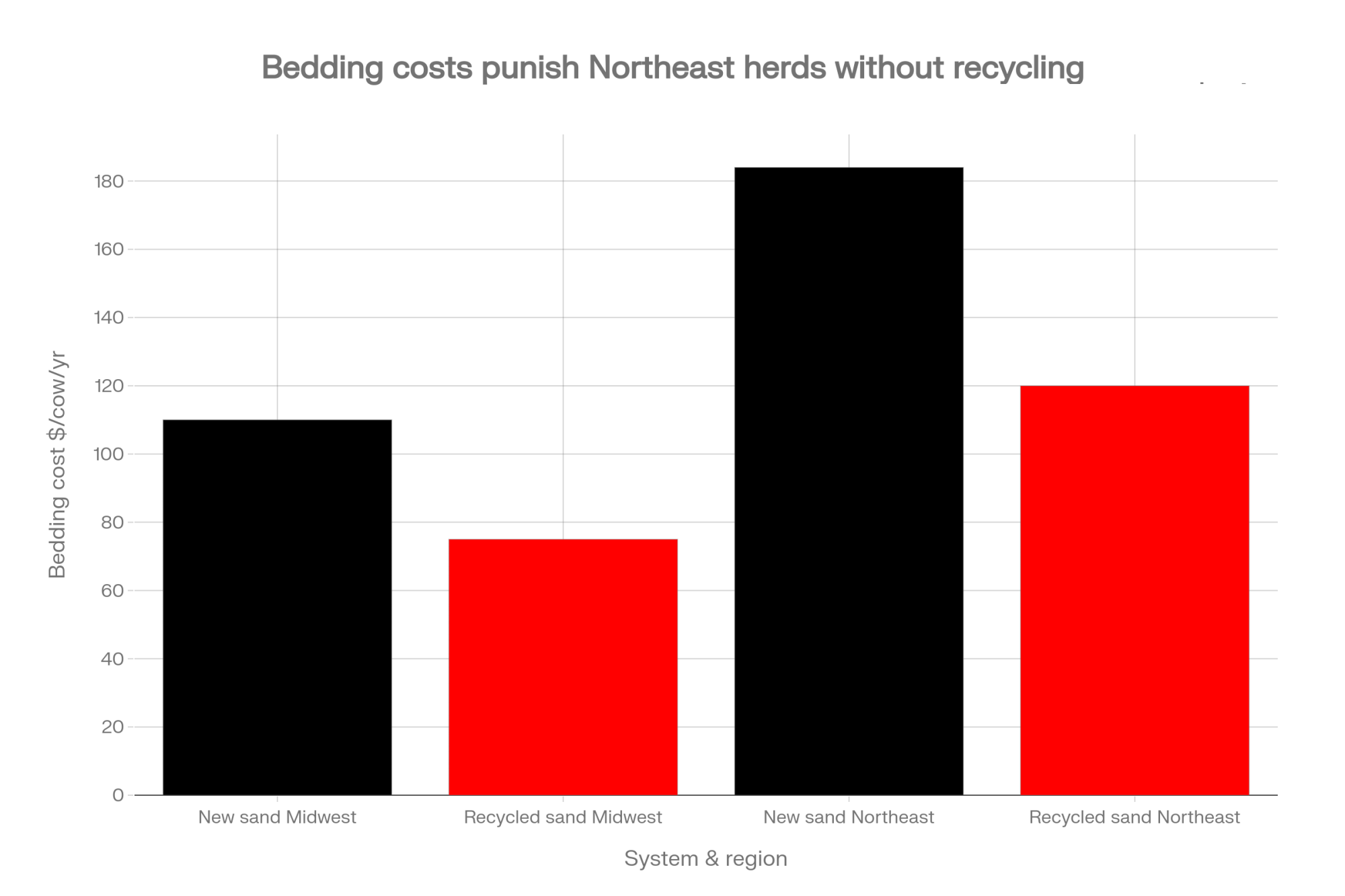
Run the barn math honestly. A 400-cow herd at 50 lbs of sand per cow per day burns through about 3,650 tons of sand a year. At $15/ton delivered — a reasonable 2025 Midwest contract band, though regional pricing varies by supplier — that’s $54,750 in new sand, or roughly $137 per cow per year in bedding alone.
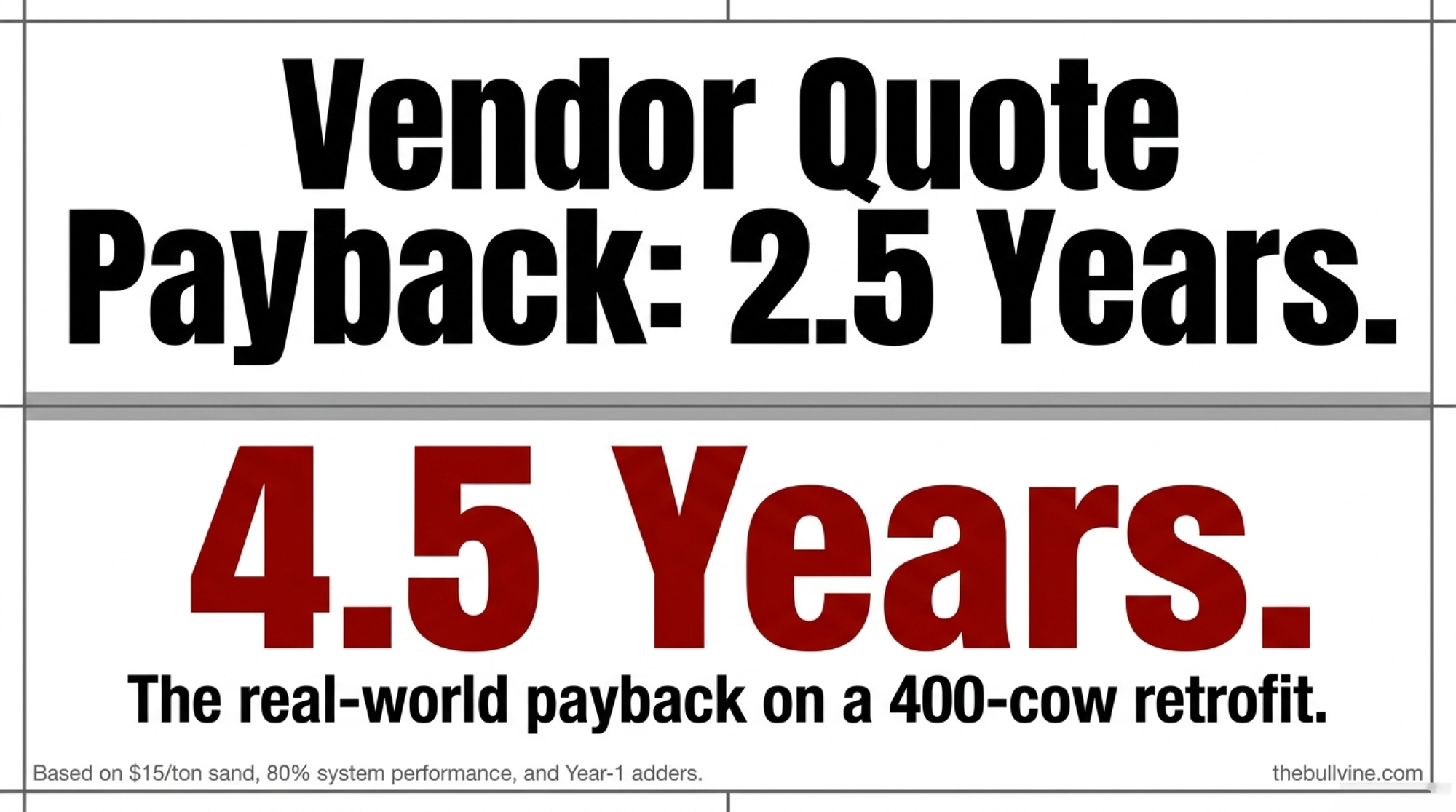
Run the design-spec math honestly. Makeup sand at 10% of 3,650 tons ($5,475), O&M at $15,000, and straight-line depreciation on $85,000 of capital over 15 years ($5,667/yr) totals about $26,000 all-in. That’s $65/cow. Gross cash savings against the all-new baseline — new sand avoided minus O&M — come to $34,275. That’s the number the dealer spreadsheet divides into $85,000 to get its 2.5-year payback. Put depreciation back into the denominator, and simple payback stretches to roughly 3 years even at design spec. Add interest on the loan ($3,000–$5,000/year, depending on term), and the headline number softens more.
Now haircut it. Recovery drifts from 90% to 78%. Makeup sand climbs toward 22% of pre-separator volume — about $12,000. O&M runs $4,000 over projection, a routine Year-1 variance on any new dairy capital equipment. Tack on one Year-1 commissioning SCC event ($3,000–$5,000) and one mid-range mechanical intervention ($7,500), amortized into Year 1 rather than buried. Net savings compress to roughly $17,000. Simple payback stretches to roughly 4.5 years. Still positive. Just no longer a runaway case.
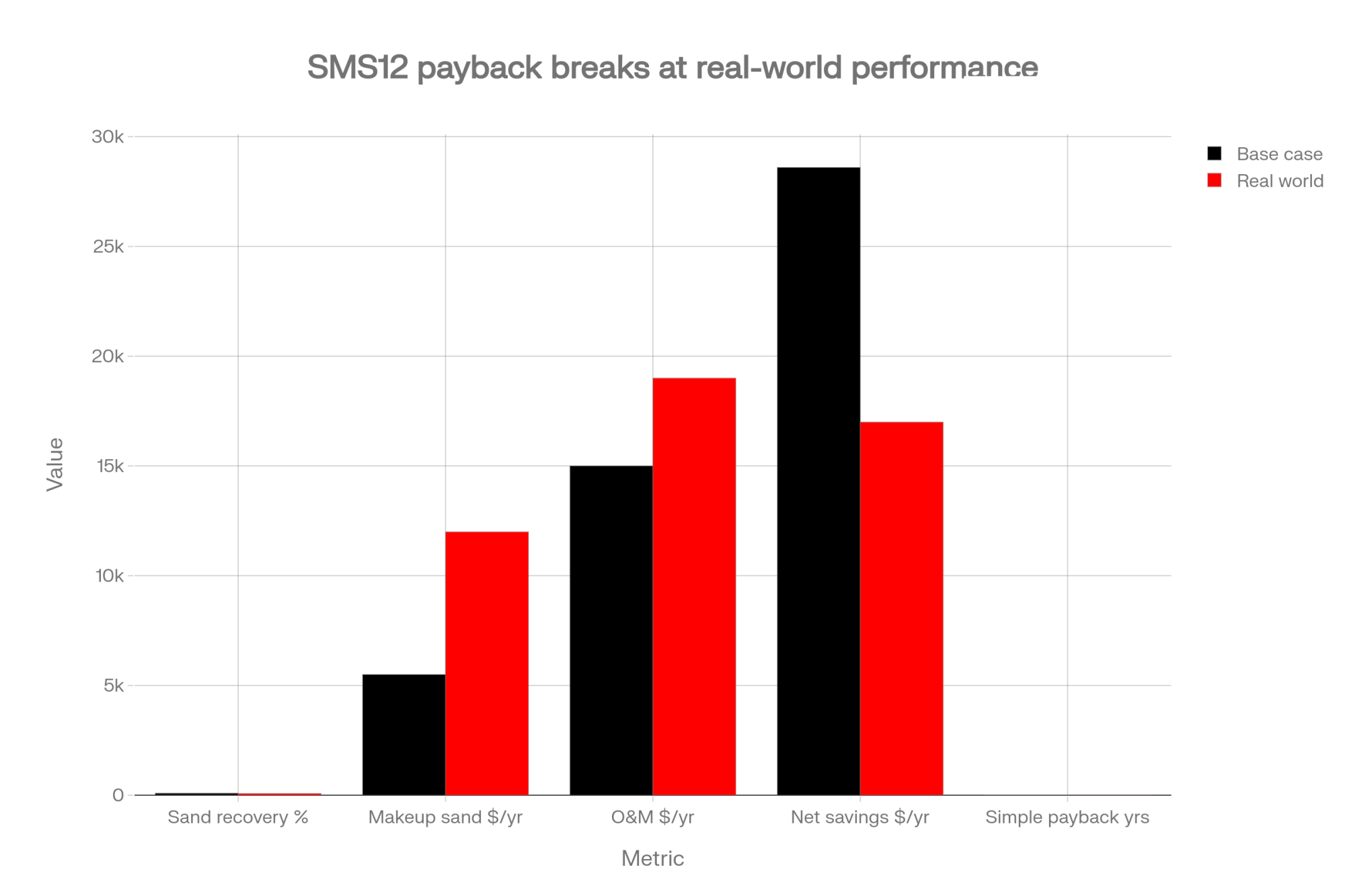
Base Case vs. 80% Performance — 400-Cow Herd, $15/Ton Sand
| Metric | Base Case (100%) | Real World (80% + Year-1 Adders) |
| Sand Recovery | 90% | 78% |
| Annual New Sand Cost (makeup) | ~$5,500 | ~$12,000 |
| Annual O&M | $15,000 | $19,000 |
| Net Annual Savings | ~$28,600 | ~$17,000 |
| Simple Payback | 2.5 yrs (3.0 with depreciation) | 4.5 yrs |
The Year-1 column amortizes one commissioning SCC event ($3,000–$5,000) and one mid-range mechanical intervention ($7,500) into the first operating year; recurring O&M is shown separately.
On a 400-cow operation with working capital and a stable milk-quality baseline, a 4.5-year payback is manageable. On a 250-cow operation at $12/ton sand — the number McLanahan itself runs for the SMS12 — it’s tighter. The fixed-cost burden doesn’t scale down the way gross savings do. That’s why McLanahan positions the SMS12 “for dairies with 500 cows or less” but emphasizes site design requirements right alongside herd size.
The $85K Lie: What the Dealer Quote Actually Leaves Off
The $85,000 capital figure is the illustrative anchor for a 400-cow-class SMS12 installation. On most retrofits, it’s also the number that dies first.
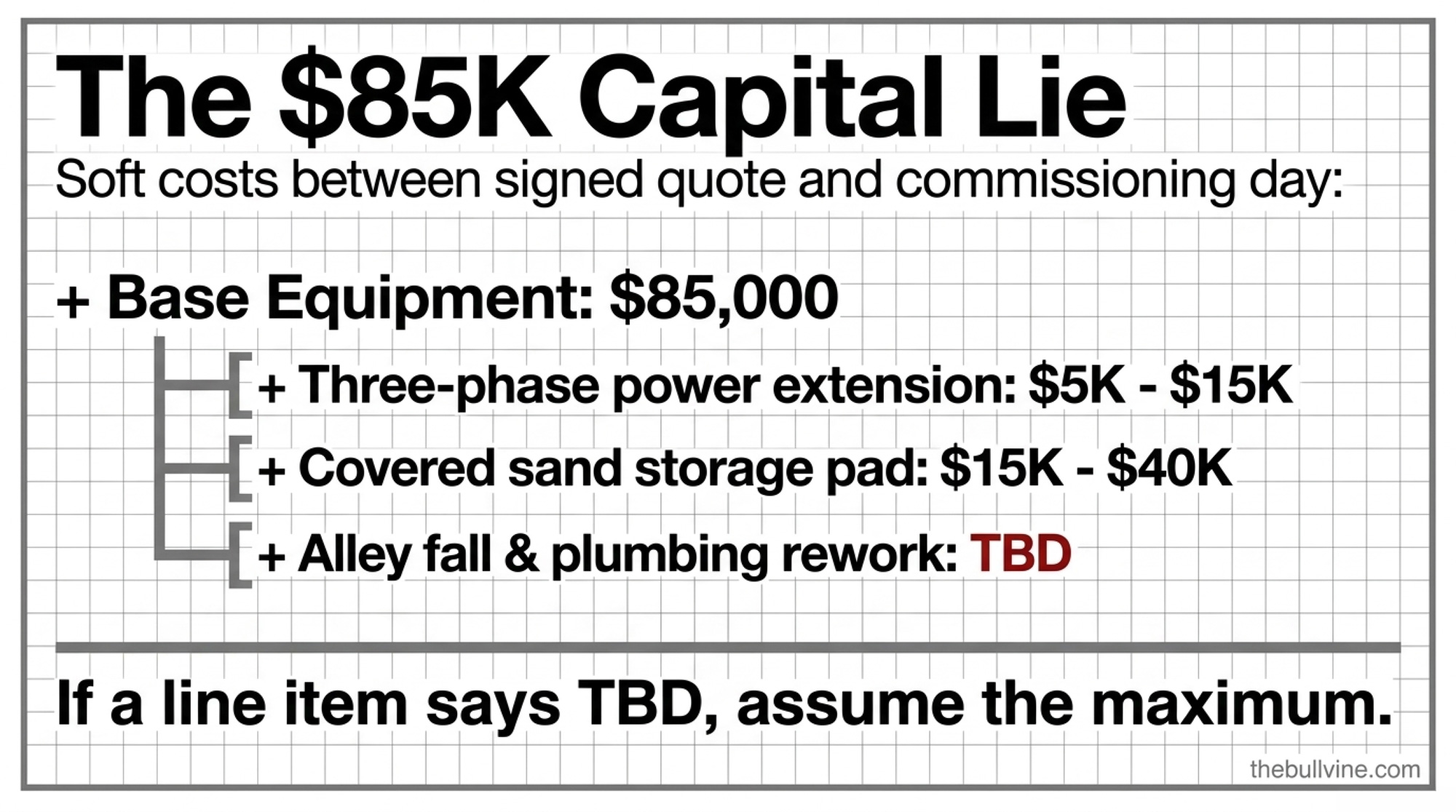
Separator quotes cover the unit and often the dewatering screen. They frequently don’t cover the things that let the unit actually run. On a 400-cow retrofit, the soft costs that show up between “signed quote” and “commissioning day” routinely include:
- Three-phase power at the manure stack. Single-phase service at that end of the yard means either a rotary phase converter or a utility line extension. Realistic band: $5,000–$15,000, site-dependent.
- Covered sand storage. The 12% moisture target McLanahan specs after the dewatering screen doesn’t hold if the stockpile sits under an open sky through a wet October. A roof and pad for recovered sand storage runs roughly $15,000–$40,000 depending on footprint and whether an existing commodity bay can be repurposed.
- Alley fall and gravity conveyance modifications. Systems designed around four feet of fall need exactly that. Retrofits into flatter barns may require a reception pit, transfer pump, or plumbing rework.
- Water supply for the sand-lane flush cycle. On farms already running at well capacity in August, this is a real engineering conversation, not a line item.
- Electrical panel upgrade. A dewatering screen, transfer pumps, and the separator can push an older service past rated capacity.
- Permits, engineering, and nutrient management plan updates. State rules vary. A separator changes manure-solids chemistry, which can trigger plan revisions before it triggers anything in the bulk tank.
A realistic “all-in” anchor for a 400-cow retrofit isn’t $85,000. It’s $85,000 plus whatever your site needs to actually run the equipment. Anchor your lender model to a live, anonymized vendor quote that prices electrical, storage, and civil work separately. If any of those lines come back as “TBD,” treat “TBD” as the upper end of the ranges above until proven otherwise.
Should You Switch From New Sand to Recycled Sand on a 400-Cow Herd?
Rowbotham and Ruegg’s 2016 work also documented that new sand generally carries fewer Gram-negative bacteria than recycled sand, and that clinical mastitis incidence rates across bedding types didn’t differ significantly — at least when management held steady.
That “when management held steady” clause is doing a lot of work.
What “In Spec” Actually Looks Like vs. What “Drifted” Looks Like
McLanahan’s own dewatering screen specifications give you a concrete measuring stick.
| Parameter | Raw Recycled Sand (Pre-Screen) | In-Spec After Dewatering Screen | Drifted / Red-Flag |
| Moisture content | ~20% | ~12% | >15% |
| Organic matter content | Elevated | <1% | >1.5% |
| Visible character | Damp, darker, organic fines | Granular, lighter, sand-like | Pack-y, stains the hand, sour smell |
| Stall behavior | Compacts, holds moisture | Grooms like new sand | Cows bed short, rear legs stay wet |
The in-spec column is what the equipment can deliver. The drifted column is what shared-duty labor often delivers three months in. The middle column isn’t automatic. It’s the output of someone owning the process.
A 2021 Wisconsin microbiota study in Animals (“Assessing the microbiota of recycled bedding sand on a Wisconsin dairy farm”) found bacterial community composition in recycled sand shifts significantly with both season and recycling stage. Leite et al. tied bedding moisture to clinical mastitis incidence and coliform counts to subclinical mastitis prevalence.
When moisture rises and organic content climbs, the bacterial envelope in the stall shifts with it. The separator’s still working. The auger still turns, sand still comes out. Working and working correctly are not the same thing — and a 400-cow operation running shared-duty labor is the most exposed to the gap between them.
What a 20,000 Cells/mL SCC Drift Actually Costs You
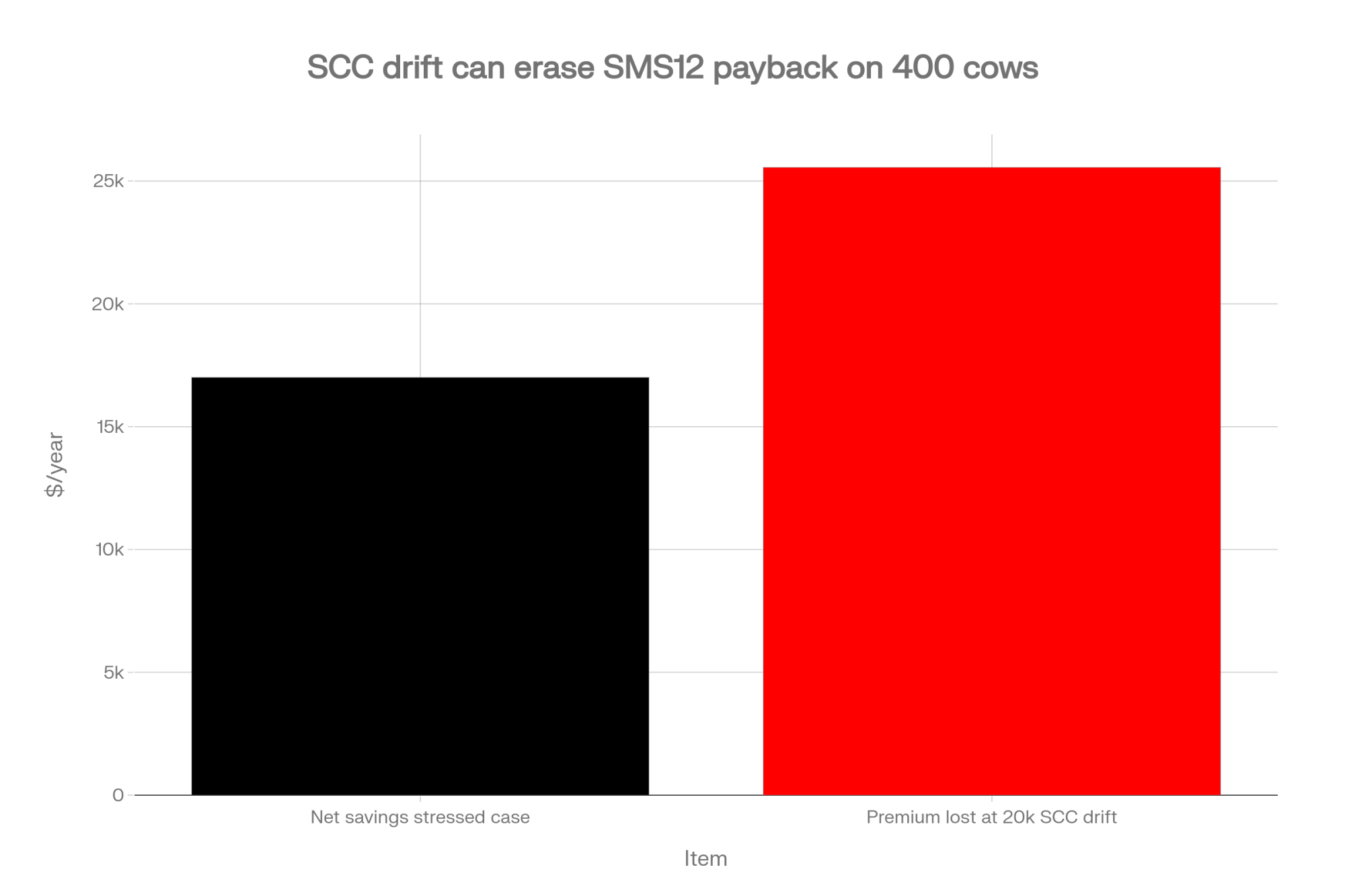
The Day 90 commissioning check specifies bulk-tank SCC staying within about 20,000 cells/mL of the pre-commissioning baseline. That sounds small. On a 400-cow herd, it isn’t.
Working with round but honest inputs: 400 cows averaging roughly 87.5 lbs/day ships 35,000 lbs (350 cwt) of milk per day. If an SCC drift costs that herd a $0.20/cwt quality premium step on a processor’s tiered schedule — a common band in published mailbox premium — the arithmetic is direct:
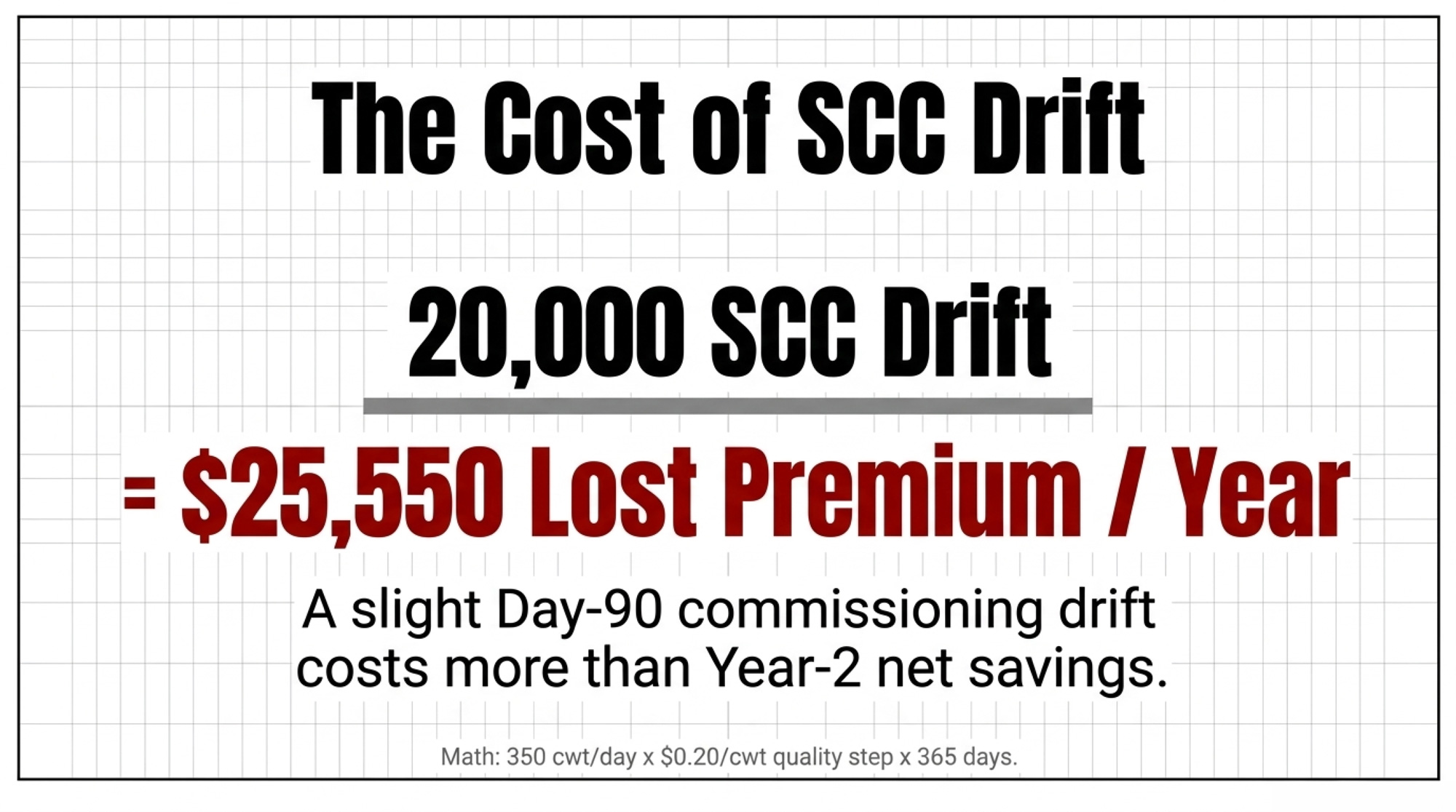
That’s $25,550 of premium lost, every year the drift persists — against a stressed-case net savings of roughly $17,000. The lost premium alone is larger than the Year-2 net savings. It doesn’t just stretch the payback period. It inverts it.
And that’s before a single Klebsiella cow goes down, before a single treatment cost, before a single withheld-milk day.
Plug in your own $/cwt step when you run this for your operation. The arithmetic doesn’t change. What changes is how quickly the separator stops being an asset on your balance sheet.
Is This an ROI Play — or an Insurance Play?
That’s the framing shift Northeast producers have to make before they run the same math a Midwest operation does.
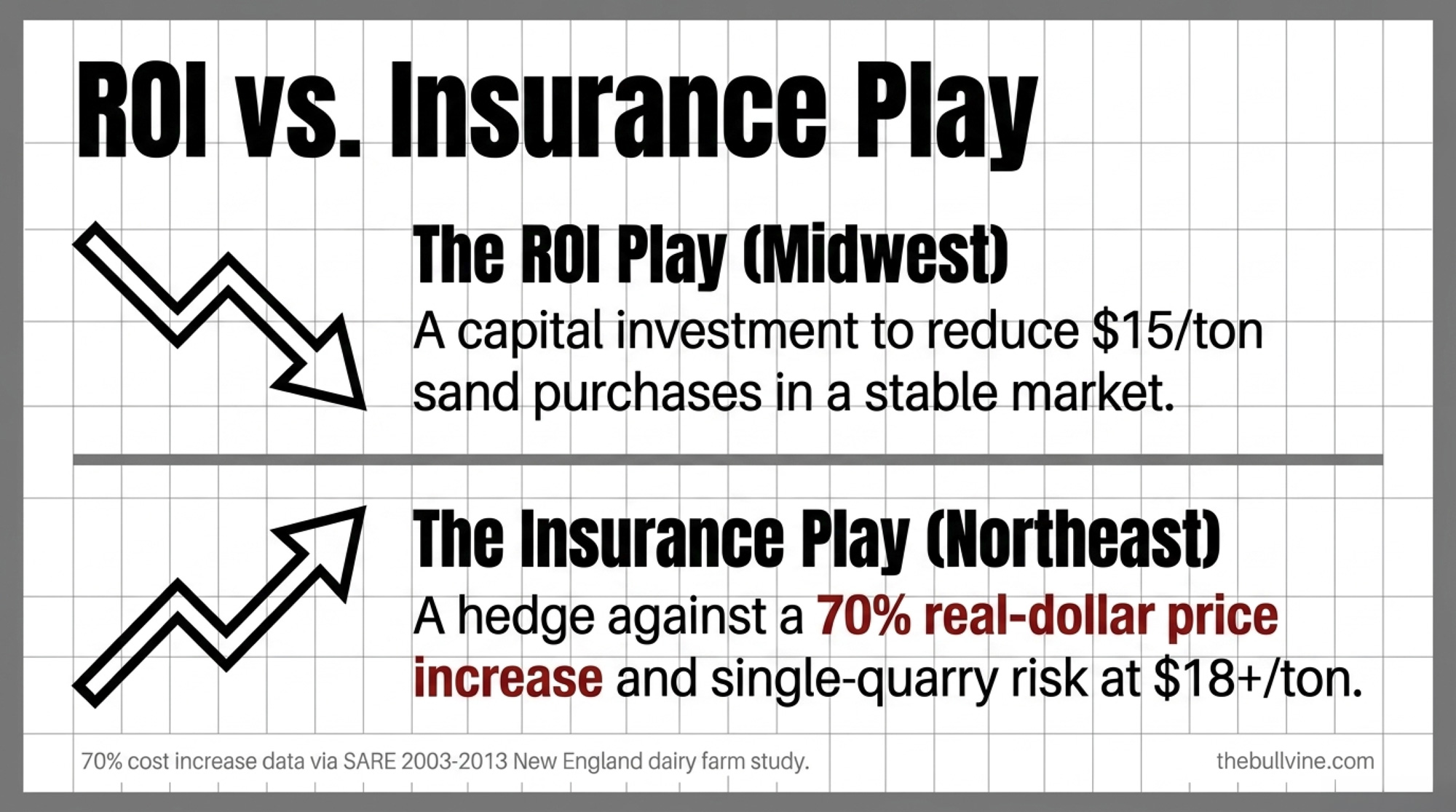
In the Midwest, the SMS12 is usually an ROI play: a capital investment that pays back through reduced new-sand purchases, evaluated against a relatively stable regional sand market. In the Northeast, it’s increasingly an insurance play: capital that hedges a structural supply problem, evaluated against a rising input price trajectory. Same equipment. Different thesis. Different lender conversation.
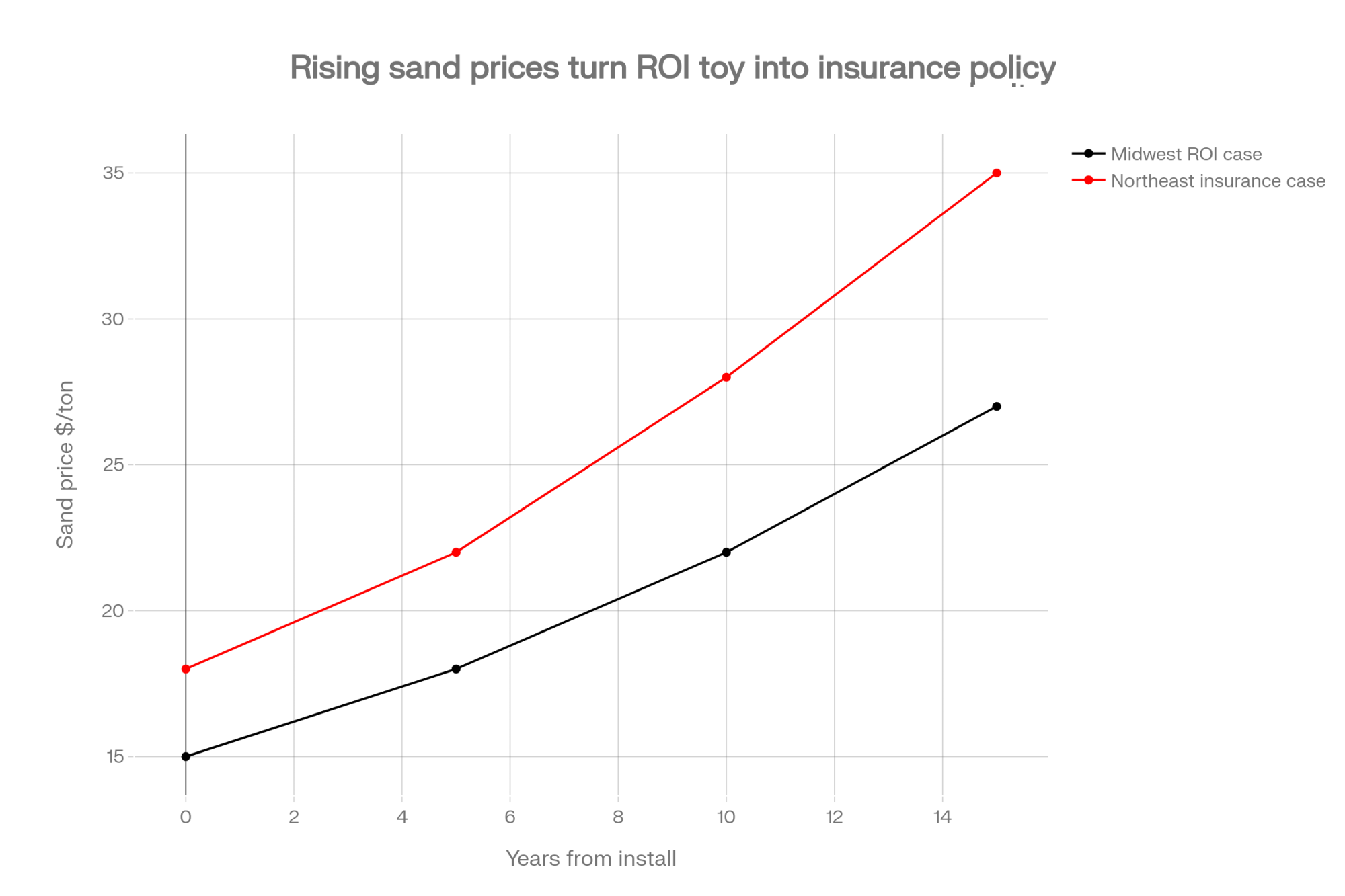
The 2017 SARE-funded bedding study by Smith, Simms, and Aber (“Case Study: Animal bedding cost and somatic cell count across New England dairy farms”) surveyed 129 producers and documented a 70% real-dollar increase in bedding costs between 2003 and 2013 — conventional dairy costs rose from /cow/year to 4/cow/year, and organic operations from to 5. That trajectory hasn’t reversed. Quarry consolidation, construction demand, and 30×50 silica sand specifications keep pinching supply.
Some Northeast producers find themselves dependent on a single quarry relationship, and a closure or disruption pushes them quickly into the spot band.
Against a conservative 4% annual sand-price inflation from $18/ton — and the SARE numbers are anything but alarmist by that standard — the separator’s Year 10 economics shift sharply in its favor. That case has to be made explicitly to the lender. A base-case payback model isn’t built to carry a 15-year rising-input assumption. If you can’t justify the SMS12 as an ROI play at today’s contract prices, you may still be able to justify it as an insurance play against the next decade of them.
THE HARD TRUTH
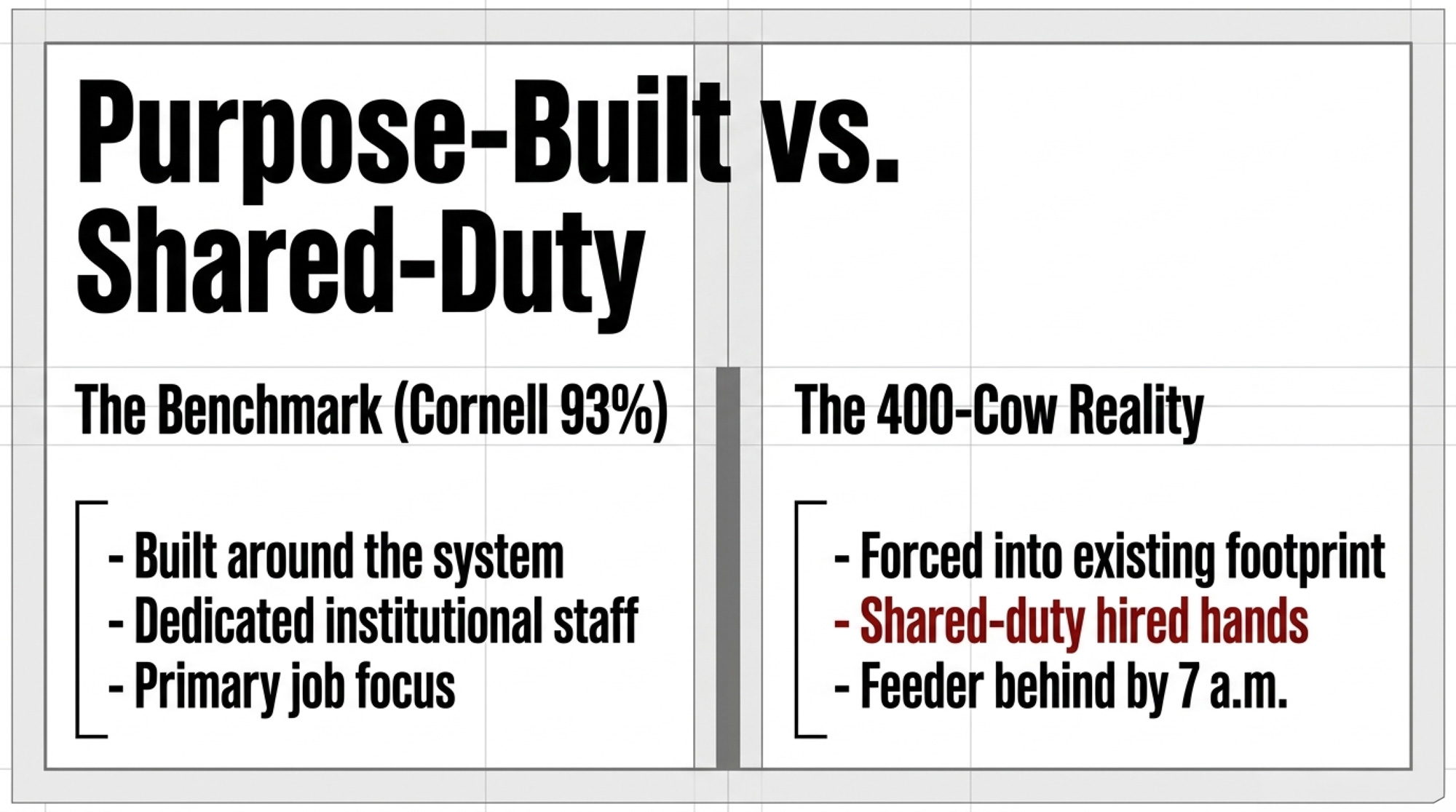
If your morning feeder is also your “Separator Manager,” your recovery rate is 75%, not 93%. The machine is automated. The consistency isn’t. If you don’t have someone on the payroll who treats sand dryness like a religion, stay with new sand.
The 30/90/365 Commissioning Playbook
Every separator investment should come with three audit dates baked into the loan conversation before commissioning day. Not after.
Day 30 — Is the Machine Working?
Three cheap measurements. None requiring a consultant.
- Dry matter of recovered sand: target 35–40%
- Organic matter content: target below 1.5%; McLanahan’s spec with a dewatering screen is below 1%
- Sand recovery rate: target 90–95%, per NRCS Practice Standard 632
Day 90 — Is the System Working?
This is where commissioning drift shows up in the data.
- Bacterial counts on fresh recovered sand and on used bedding from the back third of occupied stalls. Extension management guidance and Cornell field research point to a 300,000 cfu/g target and a 1,000,000 cfu/g red-flag line.
- Testing cost (2025 Cornell AHDC): BEDID1 environmental bacterial quantification at $48 per sample plus an $8 accession fee — roughly $50–$75 per sample all-in.
- Bulk tank SCC check: within about 20,000 cells/mL of the pre-commissioning baseline. Drift beyond that at Day 90 is a management or mechanical signal, not a commissioning artifact — and on a 400-cow herd, it’s the $25,550/year problem from the section above until you fix it.
Day 365 — Is the Investment Working?
This is the conversation you want with your lender — not a surprise at refinancing.
- Reconcile actual new sand purchased, actual O&M costs, and actual milk quality premium capture against the loan application projections.
- Within 15% of projection: healthy; stay the course.
- Shortfall of 25% or more: systematic problem requiring management intervention, not an assumption that Year 2 will be better on its own.
Operations that only run Day 30 informally tend to miss the drift that shows up between months three and six. That’s where the gap between projection and reality opens up. Cornell’s long-term performance came out of a facility where the system was the dedicated focus of staff. On a shared-duty operation, that focus erodes in inches.
Four Paths and What They Each Actually Cost You
| Path / Strategy | When It Actually Works | Typical Bedding Cost Band ($/cow/yr) | Red-Flag Situation (Don’t Do This) |
| New sand, optimize what you have | Delivered sand under ~$12/ton; barn not designed for recycling; tight labor | ~80–110 | Installing SMS12 just to “keep up with neighbors” |
| Recycled sand, purpose-designed system | 400+ cows; $16+/ton sand; dedicated separator operator and good ventilation | ~65–90 | Retrofits with <4 ft fall or no covered storage |
| Recycled sand as supply hedge | Northeast herds at $18–24/ton with single quarry dependence | ~90–120 | Treating it as a 2.5‑year ROI play instead of insurance |
| Wait, stay on new sand until renovation | Current barn geometry wrong; renovation or expansion already on the horizon | ~100–140 | Sinking capex into separator before fixing the barn design |
Path 1: New sand, optimize what you have. Works when delivered sand is under $12/ton, the barn lacks adequate fall or ventilation for recycling, or the labor structure can’t absorb a dedicated daily protocol. If you’re already under $100/cow in bedding, separator capex probably doesn’t survive honest stress-testing.
Path 2: Recycled sand, purpose-designed integration. Works when sand is $16+/ton, herd size is 400+, and you can assign dedicated operator time — not bolt it onto someone’s morning route. Requires written daily protocols, monthly bacterial testing at Cornell AHDC 2025 rates, and a backup supplier relationship locked in before commissioning day. Where it backfires: retrofits into barns with under four feet of fall, curtain-sided structures with weak summer ventilation, and indoor covered sand storage that traps moisture in the pile.
Path 3: Recycled sand as a supply hedge, not a cost savings play. The Northeast case. At $18–24/ton with single-supplier risk, evaluate the separator as a 15-year input supply investment, with the math running against a rising price trajectory rather than today’s contract price.
Path 4: Keep buying new sand until the barn catches up. Works when current infrastructure isn’t suited to recycling but a renovation or expansion is already on the horizon. Cornell’s 93% came from a facility designed around the system, not retrofitted into one. Waiting, doing the renovation right, and then buying the separator isn’t a failure of ambition. Sometimes it’s the sharper capital sequence.
Your Next 30 Days
Pull your sand delivery invoices for the last 24 months and calculate your actual per-cow bedding cost. Compare it to the $110–$137 band typical at $12–15/ton delivered. Then pull your last two bulk-tank SCC reports and your last DHI cull reason summary, and mark the cows in stalls 1–10 that you cannot afford to lose to a bedding event. That single hour tells you which of the four paths is yours before a dealer sets foot on the place.
What This Means for Your Operation
- Before you call a dealer: if this system runs at 80% of projected performance for two years, can your operation absorb that financially and still say yes? If the answer makes you flinch, the more defensible decision is to stay with new sand and harden your supplier relationships.
- Run your actual delivered sand price against the threshold bands: under $10/ton, almost certainly no; $10–14/ton, only with dedicated labor and a strong milk quality premium structure; $16+/ton, the economics work if the barn supports it.
- Audit three fixed barn factors before any other conversation: alley fall, ventilation design, and covered storage location. These predetermine the bacterial envelope your recycled sand lives inside before the operator ever touches it.
- Price the soft costs separately: three-phase power, covered storage, alley fall modifications, permits, panel capacity. If any sit on “TBD,” assume the upper end of published ranges in your lender model.
- Price the genetic exposure separately: a single Klebsiella cull on a high-pedigree cow in Month 3 can cost more than the first year of net separator savings. Account for it in your stressed case, not your base case.
- Build the lender conversation around a stressed-case cash flow model — 78% recovery, one commissioning SCC event, $4,000 O&M overage — not the base case. Post-2020 agricultural lending practice has tightened DSCR floors and rate-sensitivity assumptions; confirm specifics with your Farm Credit branch or equivalent before signing.
- If separator management will be an “added duty” rather than a primary assignment, haircut your projected net savings by 20% before comparing payback.
Key Takeaways
- If delivered sand is under $12/ton and your barn wasn’t designed for recycling, the separator probably doesn’t pencil honestly — regardless of what the base case says.
- If you’re in the Northeast at $18+/ton with single-supplier risk, evaluate the SMS12 as an insurance play, not an ROI play. The SARE 2003–2013 data already showed a 70% real-dollar cost increase. Nothing about the last decade suggests that direction has changed.
- If your barn has under four feet of fall, curtain-sided summer ventilation, or indoor covered sand storage, fix the barn first. Cornell’s 93% and SwissLane’s 90% both came from facilities designed to support the system. No operator skill compensates for the wrong infrastructure.
- If separator operation will be an added duty on top of an existing workload, haircut projected savings by 20% in your own model. It’s not pessimism — it’s what the commissioning record shows.
- If your 400-cow herd carries a pedigree nucleus, one preventable Klebsiella cull in commissioning can erase a full year of separator savings — and the genetic progress behind the cow you just put on the trailer.
- If you can’t answer the 80% question with a clear yes, keep the $85,000 and buy three years of new sand instead. Sometimes that’s the sharper capital decision.
The spreadsheet on your kitchen table shows the base case. Cornell’s team didn’t just run the base case — they built the system, staffed it, measured it at 30 days, 90 days, and every week for years. That’s why their long-term average is 93%. The question for your operation isn’t whether McLanahan builds a system that performs. They do. The question is whether your barn, your labor, and your balance sheet are set up to capture that performance — and what happens to your milk cheque, and the cow in stall 47, in Year 1 if they aren’t. Does your current payback model have a cell for that answer?
This article draws on McLanahan’s published Cornell and SwissLane case studies, the cited peer-reviewed research, and public technical material. McLanahan, Cornell Teaching Dairy Barn, and SwissLane Dairy were not interviewed directly for this piece.
Learn More
- What Type of Bedding is Best for Cows? — Evaluate the microbial thresholds and cost-per-cow shifts that signal it is time to pivot your bedding strategy. Arms you with the benchmarks to decide if sand still pencils against rising regional commodity prices.
- Why Cow Comfort is a Competitive Advantage — Position your dairy for the next decade by leveraging stall environment as a strategic production asset. Exposes how superior comfort secures cow longevity and maximizes the genetic potential of your elite herd.
- How to Make Sand Bedding Work in Your Robotic Dairy — Bridge the gap between sand comfort and robotic milking hardware without risking machine downtime. Delivers the technical blueprints for managing silica’s abrasive wear while maintaining the gold standard in cow cleanliness.
 The Sunday Read Dairy Professionals Don’t Skip.
 The Sunday Read Dairy Professionals Don’t Skip.
Every week, thousands of producers, breeders, and industry insiders open Bullvine Weekly for genetics insights, market shifts, and profit strategies they won’t find anywhere else. One email. Five minutes. Smarter decisions all week.