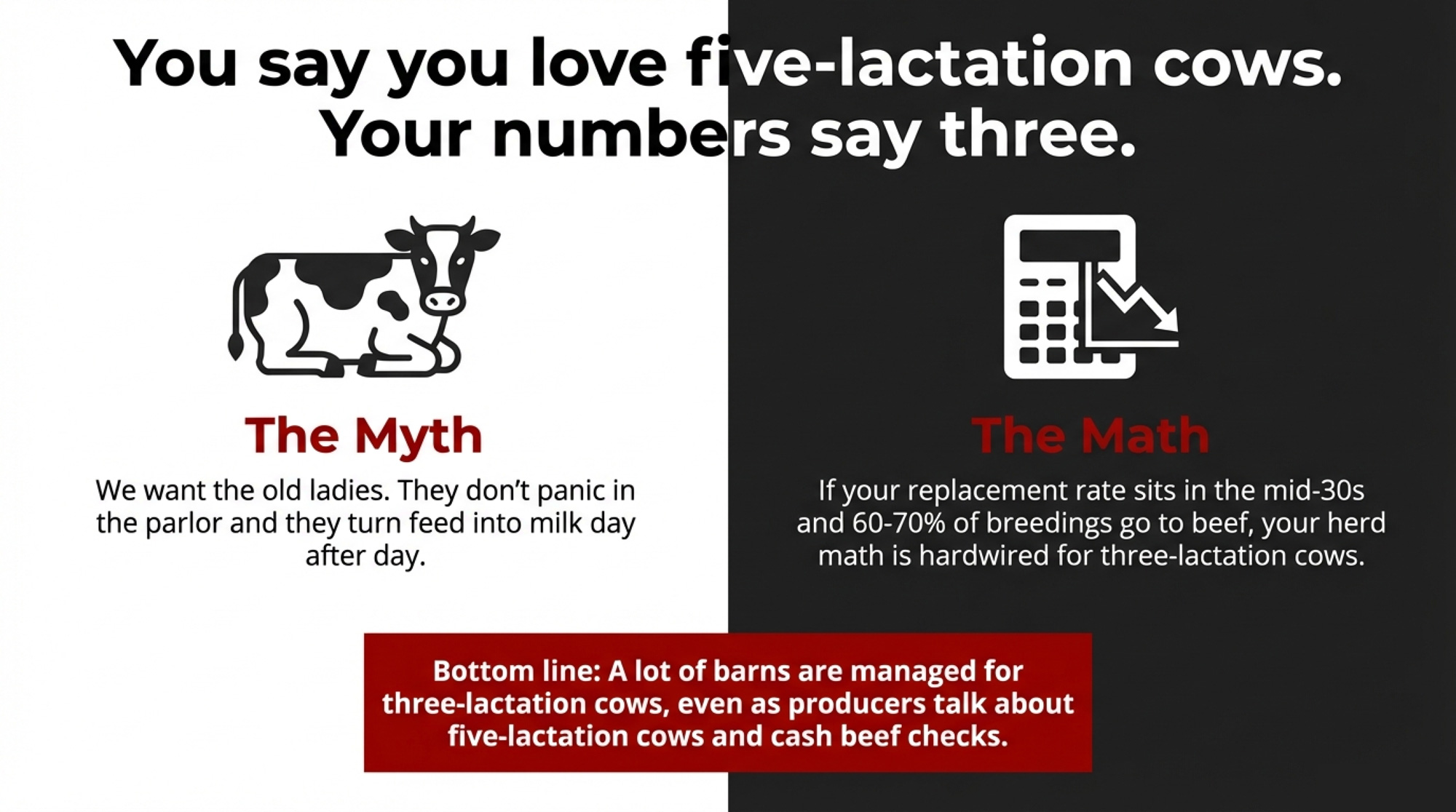
You say you love five‑lactation cows. Your numbers say three. Is your beef‑on‑dairy program and pen crowding killing your “old ladies” before they ever get there?
| Metric | 3-Lactation System | 5-Lactation System | Impact |
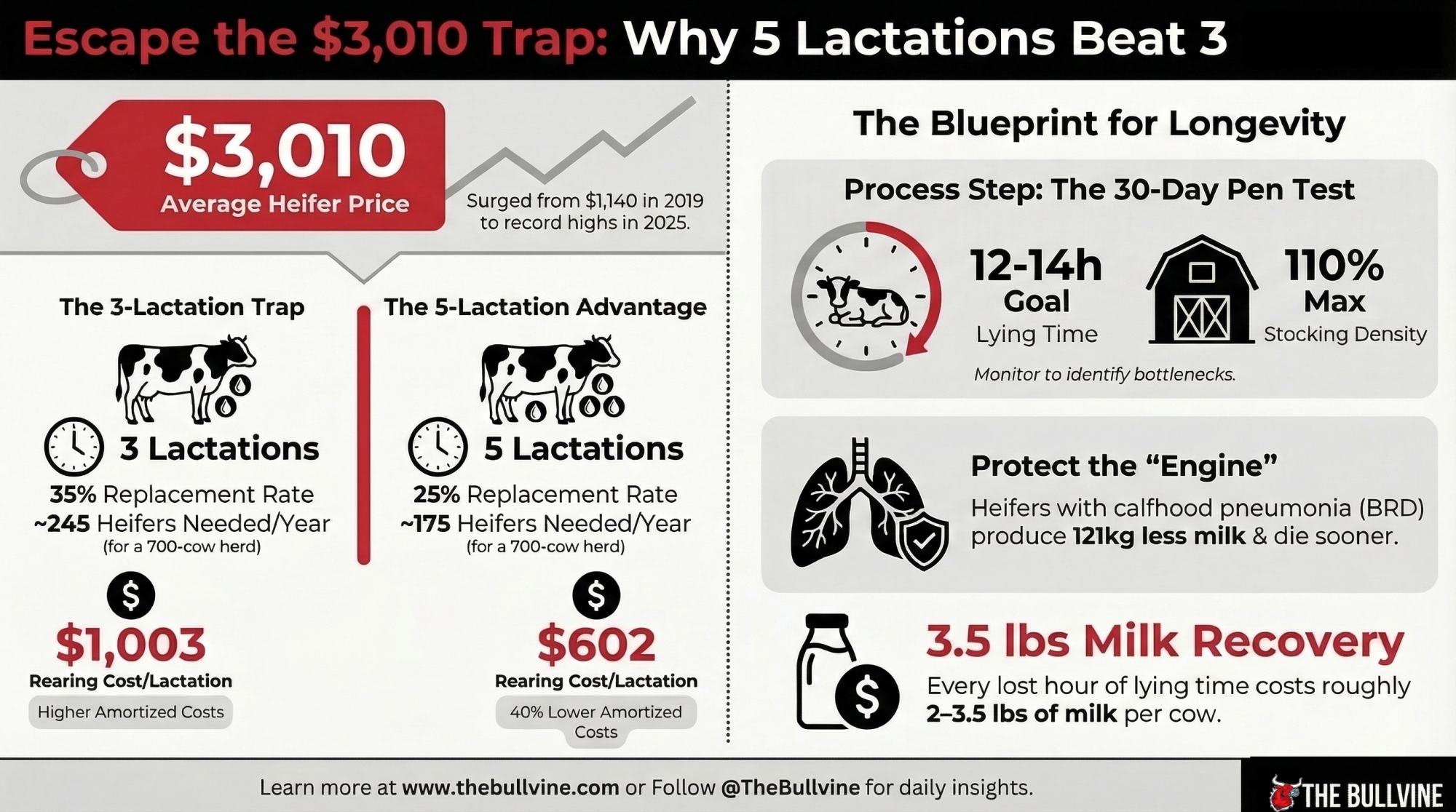
| Rearing cost per heifer | $3,010 | $3,010 | Same upfront investment |
| Amortized cost per lactation | $1,003 | $602 | $401 less per lactation |
| Annual heifer needs (700 cows) | 245 heifers/year | 175 heifers/year | 70 fewer heifers |
| Total annual rearing cost | $737,450 | $526,750 | $210,700 savings |
| Beef semen usage (typical) | 70% of breedings | ~35% of breedings | More internal replacements |
At Glacier Edge Dairy in Wisconsin, Kristen Metaf will tell you her favorite cows are the “old ladies” on their fifth or sixth lactation — the ones that don’t panic in the parlor and turn feed into milk, day after day. She says those fifth‑lactation cows are her moneymakers because they know the routine and don’t waste energy. She runs a herd that, like a lot of progressive dairies, breeds heavily to beef, lung‑scans calves at three to five weeks, and trims hooves three times a year to keep cows on their feet.
On that same World Dairy Expo panel, Pennsylvania herd manager Eric Grodigette shared that cameras over his pens showed fresh cows were spending more time out of the pen than he realized — a few “extra” minutes in the holding area, three times a day, added up to hours of lost rest and more third‑calvers heading to the cull string. Both of them say they want five‑ and six‑lactation cows. But like a lot of U.S. herds, they’re having to make those decisions in an industry where USDA’s January 2025 cattle report counted just 3.914 million dairy replacement heifers over 500 pounds — the lowest since 1978 — and CoBank projects roughly 800,000 fewer heifers over 2025–26 before numbers start to rebound closer to 2027. By mid‑2025, the national average replacement heifer price sat around $3,010 per head, up sharply from about $1,140 in 2019, with top springers in some Western and Upper Midwest auctions topping $4,000.

Bullvine’s analysis of NAAB’s 2024 semen report estimates that about 7.9 million units of beef semen were used in U.S. dairy herds, while NAAB’s own summary shows 9.9 million units of gender‑selected dairy semen, up 17.9% from 2023. Beef‑on‑dairy now supplies an estimated 2.6 million calves to U.S. feedlots, up from roughly 410,000 in 2018. Put bluntly: a lot of barns are managed for three‑lactation cows, even as producers talk about five‑lactation cows and cash beef checks.
What’s Changed — And Why It Hits You Now
For years, the default answer was simple: raise more heifers, milk more cows, keep the parlor full. Heifers were relatively cheap, custom‑grower slots were open, and processors wanted volume.
That world’s gone. USDA’s January 1, 2025, inventory pegged dairy replacements over 500 pounds at 3.914 million, down from 3.951 million the year before and the lowest since USDA reported 3.886 million in 1978. CoBank’s August 2025 outlook says those heifer numbers will shrink by roughly 800,000 head over 2025 and 2026, even as about $10 billion in new U.S. dairy processing capacity comes online through 2027 — all of it needing more milk and components.
Heifer values tell the same story. Hoard’s Dairyman and other market summaries show quarterly U.S. replacement prices around $1,140 per head in 2019, then climbing to the $2,800–3,010 range by mid‑2025. In Wisconsin, USDA and regional reports indicate replacement costs climbed about 69% from late 2023 to late 2024, landing in the mid‑$2,000s, while top springers in some California and Minnesota sales cleared $4,000.
On the calf side, beef‑on‑dairy keeps roaring. NAAB’s 2024 summary recorded 9.9 million units of gender‑selected dairy semen, up 17.9% from 2023, alongside very strong beef‑semen sales. Ever.Ag’s Mike North told Brownfield that newborn beef‑cross calves in early 2025 were “bringing as much as $1,000” in some markets, while Holstein bull calves often traded in the $500–1,000 band — a few‑hundred‑dollar per‑head premium for beef‑cross in many barns.
Now add cow time to the mix. Freestall work across North America and summaries from Wisconsin’s Dairyland Initiative show that when cows have roughly one usable stall per head and spend no more than about 3–3.5 hours per day out of the pen for milking and lock‑ups, they typically lie down 12–14 hours/day. Push stocking density into the 120–140% range and let time out of pen creep past 4 hours/day, and lying time commonly drops by 45–120 minutes/day, with more lameness, lower milk yield, softer components, and higher somatic cell counts. Miner Institute and related field work boil this into a simple rule: each lost hour of lying time is associated with roughly 2–3.5 pounds less milk per cow per day.
When herds run replacement rates in the mid‑30s, breed 60–70% of cows to beef, and crowd pens until cows only get 9–10 hours of rest — and a chunk of that is drowsy standing, not real lying — they’re effectively betting more of their future on expensive purchased heifers and very optimistic IVF performance. That’s the 3‑lactation trap.
What Happens When a 700‑Cow Herd Chases Beef and Longevity at the Same Time?
Busy producers think in pictures and quick comparisons. So let’s put the 700‑cow scenario you’re probably already running in your head into a simple table.
Rearing Payback: 3‑Lactation vs 5‑Lactation System (700‑Cow Herd)
| Metric | 3‑Lactation System | 5‑Lactation System | Impact |
| Rearing cost (est.) | $3,010/heifer | $3,010/heifer | Same base investment |
| Amortized cost per lactation | ~$1,003 ($3,010 ÷ 3) | ~$602 ($3,010 ÷ 5) | About $401 less rearing cost per lactation |
| Heifer needs (700 cows) | 700 × 0.35 = 245/year | 700 × 0.25 = 175/year | 70 fewer heifers to raise or buy |
| Beef semen usage (typical) | High (70% beef matings) | Moderate (~40% beef) | More beef cash vs more internal replacements |
Heifer inventory work from Michael Overton and others suggests many U.S. herds still sit in the low‑to‑mid 30% replacement band, even when owners say “about 30%.” At 35%, a 700‑cow herd needs 245 cows entering the parlor each year to hold head count. Factor in a realistic 15% loss from abortions, stillbirths, and pre‑fresh culls, and you actually need 245 ÷ 0.85 ≈ 288 dairy heifer calves born annually to stand still.
Now plug in a breeding pattern that’s become very common:
- 70% of breedings to beef semen.
- 30% to dairy semen (mix of sexed and conventional).
- About a 50:50 bull‑to‑heifer ratio on dairy conceptions.
On roughly 700 conceptions per year:
- 700 × 0.70 = 490 beef‑cross calves.
- 700 × 0.30 = 210 dairy calves, about 105 heifers, and 105 bulls.
You need 288 dairy heifer calves; you’re only making about 105 from conventional dairy breedings. IVF embryos and sexed semen on your top end have to supply the other 180‑plus, or you have to buy heifers at $3,000–4,000 a head. And if IVF comes up short, conception dips, or a respiratory bug hits your “elite” heifer group, you’re forced into the market or into keeping cows and heifers you’d normally ship.
If a herd’s replacement rate slides toward 25% and average lactations move toward five, the math flips. You now need around 175 new cows a year, so 175 ÷ 0.85 ≈ 206 dairy heifer calves born — that’s roughly 82 fewer heifer calves per year compared to the 35% scenario. You can still run some beef, maybe 30–40% of matings, but you’re not mathematically forced into the heifer market or heavy IVF to replace early exits. Longevity and internal growth are finally pulling in the same direction.
That’s why the beef cap matters. In many replacement‑rate scenarios, holding beef semen usage in roughly the 20–35% band is a practical range for internal growth when your replacement rate is coming down, and your calf program is solid. At 70% beef, you’re essentially stating that you will buy heifers or lean heavily on expensive IVF to maintain herd size. There’s no way around the numbers.
The Mechanics Behind the Trap
When you strip the buzzwords away, three choices set the ceiling on average lactations: who you raise, how hard you push beef semen, and what you ask stalls and time budgets to carry.

Calves, Lungs, and the “Ollivett Effect”
Terri Ollivett at the University of Wisconsin–Madison has helped turn lung ultrasonography into a practical on‑farm tool and popularized the #WeanClean mindset — calves should arrive at weaning with healthy lungs, not just acceptable weight gains. Her extrapolation from USDA’s 2014 NAHMS survey is blunt: about 9.5% of U.S. dairy calves show clinical pneumonia, and for every clinical case, there are roughly two to four subclinical cases you only see on ultrasound. That puts preweaning BRD — clinical and subclinical — in the 30–50% range for many herds. North American studies report subclinical BRD prevalence between 23% and 67%, depending on farm and timing.
A 2021 systematic review and meta‑analysis found that heifers diagnosed with calfhood BRD had 2.85 times higher odds of dying and 2.3 times higher odds of herd removal before first calving, plus about 0.067 kg/day lower average daily gain and 121 kg less milk in their first lactation. Progressive Dairy and veterinary summaries add that chronic BRD cases often lead to heifers with limited lung capacity and decreased longevity. That’s the biological core of the longevity story: scar the lungs, and you shrink the “engine.” Those animals can still freshen and produce, but the data show they’re more likely to leave early and produce less, which makes it nearly impossible for them to reach the kind of fourth‑ or fifth‑lactation peaks you bred them for.
| Outcome | Healthy Heifers (Baseline) | BRD-Diagnosed Heifers |
| Odds of death before first calving | 1.0× (baseline) | 2.85× higher |
| Odds of herd removal before first calving | 1.0× (baseline) | 2.3× higher |
| Average daily gain (kg/day) | Baseline | -0.067 kg/day slower |
| First-lactation milk production | Baseline | -121 kg (approx. -267 lb) |
At Glacier Edge, every calf gets a 0–5 lung score at 3–5 weeks; larger or repeated lesions get aggressive treatment. That’s smart. But scanning without changing who you raise is just adding cost. The BRD meta‑analysis and Ollivett’s field work point in the same direction — calves with significant BRD damage are much more likely to die, to be culled before first calving, and to give less milk when they do freshen. The only way lung ultrasound really supports longevity is if you’re willing to say, “A calf with a score of 4 and two BRD treatments is never a replacement in this herd,” even when her pedigree looks great.
Genomics belongs in that same “decide who never gets a ticket” bucket. DWP, mastitis PTAs, lameness, and fertility traits give you a durability preview years before a cow hits the parlor. Glenn Klene has 13 years of genomic data at Yun Farms behind him and has seen high‑health‑index home‑breds outlast bought‑ins. But if low‑health‑index heifers with poor calf records still get raised as replacements, you’re paying for information you won’t act on.
What Happens to Your Numbers If You Actually Change?
You can rewrite a protocol in a week. You can’t rewrite your herd’s age structure in one turn of the calendar.
On a 700‑cow herd that truly commits — culling harder on weak young stock, dialing beef usage into that 20–35% range, and protecting rest time — you’re realistically signing up for a multi‑year project.
Year 1 — You change a lot, the numbers don’t
You:
- Start lung‑scoring calves and mark some as “never replacements.”
- Cap beef semen in the 20–35% range, aim sexed dairy only at truly top cows and heifers.
- Pull your worst overstocked pen back toward 105–110% of stalls and keep time out of the pen under 3.5 hours/day.
- Move from two to three hoof trims a year on higher‑risk pens.
You feel:
- Short on heifers.
- Like pens and heifer barns are “too empty.”
- Pressure from partners or lenders who only see fewer cows in the parlor.
On paper, replacement rate and average lactations barely budge. You’re still milking cows bred and raised under the old rules.
Years 2–3 — The first “new rules” heifers hit second and third lactation
Now you start milking animals that never had wrecked lungs as calves, come from higher‑health genomic matings, and lived in slightly less crowded pens.
You see:
- Fewer lame, open second‑calvers.
- Fewer early mastitis train wrecks.
- Replacement rate drifting from, say, 36% toward 30–32%, because fewer young cows fall out.
Average lactations might move from 3.0 to 3.3–3.5. That’s progress, but it still doesn’t “look” like a five‑lactation herd. And this is exactly where many herds quietly increase beef use again, cram pens back to 130%, or ease up on calf culls.
Years 4–5 — The herd actually looks different
Herds that stay the course usually report more 4th‑ and 5th‑lactation cows, fewer first‑lactation culls, and replacement rates in the 25–30% range. Average lactation at cull inches into the 3.8–4.2 area, with a meaningful tail of fifth and sixth-lactation cows. The payoff is both biological and financial: your “engines” are bigger because you protected lungs and legs early, and your rearing cost per lactation is hundreds of dollars lower because you spread that $3,010 over five lactations instead of three.
The question isn’t whether cows can get there. It’s whether you’ll still be running the hard rules when those years finally show up on your DHIA printout.
Is One Pen Stealing All Your Lactations?
You don’t need a five‑year plan to learn something useful this month. Start with one group.
Field work on time budgets and cow comfort suggests that when cows average around 12–14 hours of lying time per day and spend only about 3–3.5 hours out of the pen for milking and lock‑ups, they produce more milk and stay sound longer. Miner Institute research, echoed in multiple comfort case studies, puts a number on it: each lost hour of lying time is associated with roughly 2–3.5 pounds less milk per cow per day.
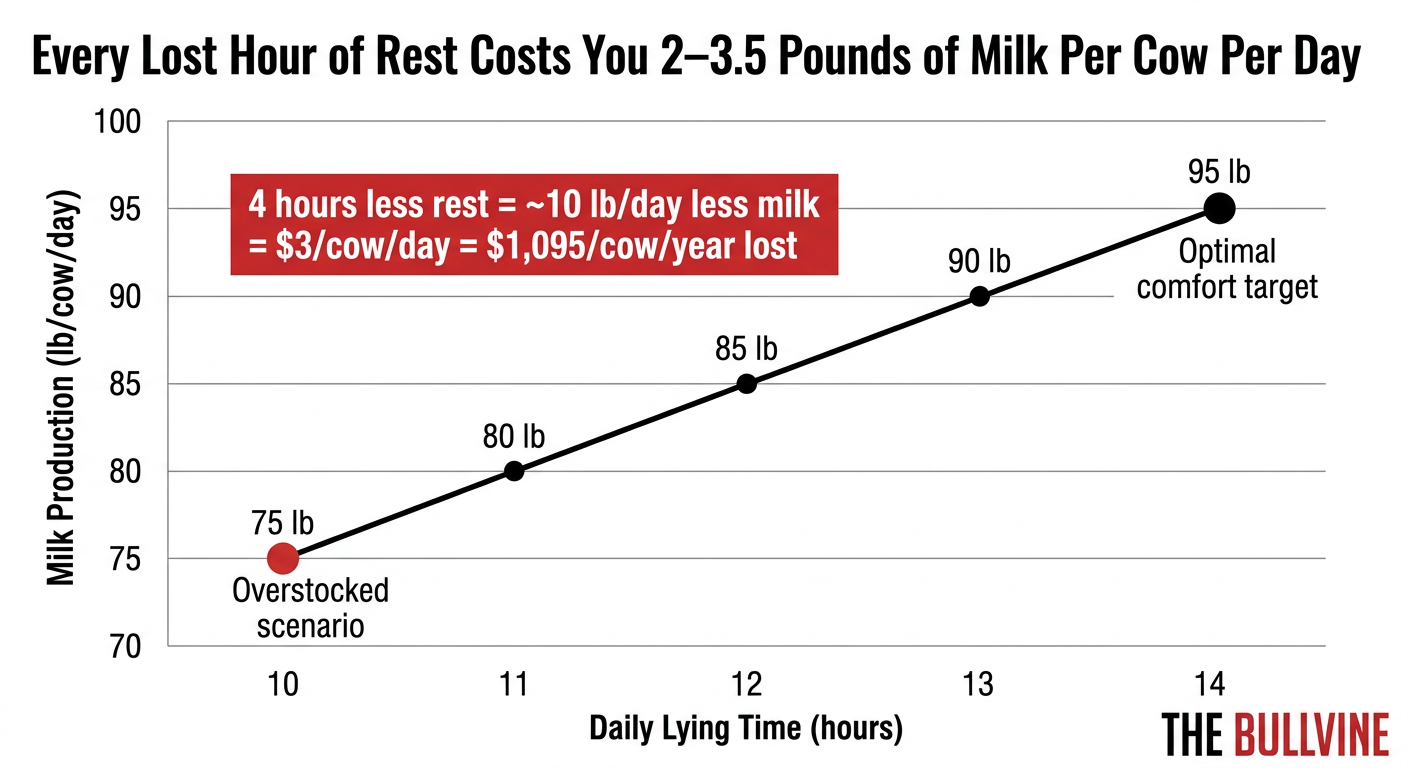
At Grodigette’s farm, cameras showed that fresh cows were being pulled to the holding area just a little too early for each milking — that “little” added up to 30 minutes or more of lost lying time a day and more standing on concrete. When they moved that group’s slot 10 minutes later three times a day and retrained movers, the lying time recovered. Using the Miner Institute rule, that kind of rest recovery represents roughly 3–5 pounds of previously “hidden” milk per cow per day that had been sacrificed to standing fatigue. They also saw fewer lame, open third‑calvers coming out of that pen.

Overstocking adds another layer. Work from the Dairyland Initiative, Michigan State, and others shows that stocking freestall pens much above 100–110% leads to more competition, less lying time, higher lameness, lower rumination, and reduced milk yield. When bunk space gets tight in an overstocked pen, cows tend to eat fewer, larger meals — classic slug feeding — which increases the risk of SARA, lower fat test, and laminitis‑type lameness. Those cows might still hit half‑decent first‑lactation numbers, but repeated bouts of SARA and sore feet keep chipping away at longevity. That’s the management face of the 3‑lactation trap.
30‑Day Pen Test: Is This Group Built for Three Lactations or Five?
Within the next 30 days, pick one pen — fresh, high, or the one you complain about the most. For 30–60 days, track:
- Average lying time per cow per day (collars, cameras, or structured spot checks).
- Total hours per day that the group spends out of the pen (walk, holding, lock‑ups).
- Cows per usable stall.
If you see:
- Lying time under 11.5 hours/day, or
- Time out of pen over 3.5 hours/day, or
- Stocking density over 110% of stalls,
treat it like a mastitis outbreak. Within 14 days:
- Adjust milking order and lock‑up schedules until time out of the pen is ≤3.5 hours/day.
- Move or ship enough cows to get that pen to about 100–110% of stalls.
Then run those conditions for 60 days and watch: lameness treatments from that pen, “low and open” culls, and milk per stall — not just per cow. If nothing changes, your bottleneck is probably stall design, bedding, or nutrition. If things improve, you’ve just proven with your own cows that overstocking and time budgets were quietly stealing cow years and milk checks.
Options and Trade‑Offs for Farmers
You don’t have to pick the “perfect” path. You do need to admit which game you’re actually playing.
| Decision Factor | Longevity-First | Beef-Led Cash Flow | Hybrid with Guardrails |
| Beef semen usage | 20–35% of breedings | 60–70% of breedings | 30–50% (data-driven) |
| Replacement rate target | 25–28% | 33–36% | 28–32% |
| Average lactations (expected) | 4.2–5.0 | 3.0–3.3 | 3.5–4.2 |
| Primary risk | Empty pens, partner pressure | Heifer market squeeze, price spikes | IVF/sexed semen underperformance |
| Heifer source | Internal + selective purchase | Heavy purchase or contract growers | Internal + IVF + selective purchase |
| What you’re betting on | BRD control, rest time, genomics | Beef calf premiums, available heifers | Genomic accuracy, IVF success |
| Discomfort you accept | Fewer cows, slower growth | High heifer costs, market volatility | Complex breeding rules, constant monitoring |
Longevity First: Fewer Replacements, More Lactations
When it makes sense: You feel the heifer squeeze, you’re not keen on bidding $3,000–4,000 for replacements, and you’d rather cut replacement risk than chase every last beef‑calf premium.
What it requires:
- Hold beef semen usage in that 20–35% band until your replacement math says you can push higher. At current prices and heifer inventories, 70% beef is basically a commitment to buying heifers or leaning heavily on IVF.
- Use genomic health indexes and Ollivett‑style lung scores as disqualifiers: repeated BRD or high lung scores mean “never a replacement,” not “we’ll see how she does.”
- Hard‑wire rest: “No lactating pen stays under 11.5 hours lying time for more than a week; if it does, we get stocking to ≤110% and time out of the pen to ≤3.5 hours/day within 14 days.”
- Accept a 2–3 year lag before average lactations really move.
Risks and limits: The heifer barn and some pens will look “too empty” for a while. You may have some hard conversations with your banker about why you’re chasing fewer, older cows instead of more, younger cows.
Beef‑Led Cash Flow: Volume and Calf Checks First
When it makes sense: You’re expanding or heavily leveraged, beef‑cross calves in your area reliably bring strong checks, and you’ve got solid access to custom growers or purchased replacements.
What it requires:
- A clear‑eyed acceptance that your herd will probably sit near 3.0–3.3 average lactations and mid‑30% replacement for the foreseeable future.
- Firm relationships or contracts that secure enough replacement capacity before you need it, because both heifers and grower space are tight, and CoBank doesn’t see inventories rebounding before 2027.
- A budget that can handle heifer price spikes beyond $3,010; that number isn’t guaranteed to hold.
Risks and limits: You’re exposed in two markets — beef calf and heifer — so policy, trade, or health hits can double up on you. Longevity stays mostly a story, not a driver of profit. This path isn’t automatically wrong. It just carries different risks than the longevity‑first play.
Hybrid With Guardrails: Beef and Longevity Under One Roof
When it makes sense: You want those beef checks, but you’re willing to let data — not habit — decide who gets beef versus dairy.
What it requires:
- Broad genomic testing plus good calf and heifer records.
- A written breeding rule; for example, top 30–40% on DWP + production + health get sexed dairy and IVF consideration; bottom 60–70% get beef semen every time.
- A simple monthly replacement calculator: heifer calves needed = milking cows × target replacement rate ÷ 0.85. If projected dairy heifer calves (sexed + conventional) fall short, the next breeding round’s beef percentage comes down.
Risks and limits: It depends on IVF and sexed semen performing close to conservative conception assumptions, not the best‑case number in a brochure. And if calf health isn’t tight, even “elite” heifers can carry scarred lungs and fragile legs; your rules must let you bump them to the beef side without blowing up your replacement pipeline.
The 30‑Day Pen Test: A No‑Regrets Start
If you do nothing else in the next month, run that 30‑day pen test. It costs time and honesty, not capital.

When it makes sense: Pretty much always, any herd can learn something from it, whether you’re a 100‑cow tie‑stall or a 2,000‑cow freestall.
What it requires (within 30 days): Pick one pen: fresh, high, or the obvious lameness hot spot. Measure lying time, time‑out‑of‑pen, and stocking density for 30 days. If lying time <11.5 hours/day, time‑out‑of‑pen >3.5 hours/day, or stocking >110%, adjust stocking and schedules inside 14 days and hold that line for at least 60 days.
Risks and limits: You’ll likely move or ship a small group sooner than planned, and it might look “inefficient” on a whiteboard. If results don’t improve, your next step is to look at stalls, bedding, or ration — not to shrug and go back to 130% stocking.
What you gain: Hard numbers from your own barn about whether overstocking, lock‑up, and slug feeding are quietly stealing cow years and 3–5 lb of milk per cow per day. And a story you can tell to partners and lenders when you argue that fewer, better‑rested cows beat more, exhausted cows.
Key Takeaways
- If your true replacement rate is well above 30%, pull 12 months of cull data and count how many cows are left in first or second lactation for lameness, mastitis, or reproduction. That’s where your “we love old cows” story leaks — and those early exits are exactly the animals BRD and SARA hit hardest.
- If any lactation pen averages less than 11.5 hours of lying time for a week, treat it like any other health problem: within 14 days, get stocking down toward 100–110% of stalls and total time out of the pen under 3.5 hours/day, then watch lameness, SARA signs, and “low and open” culls from that group.
- If you’re breeding more than about 35% of cows to beef semen without clear health and genomic cut‑offs,sit down and run the replacement math on paper. With CoBank projecting about 800,000 fewer heifers over 2025–26 and average heifers already at $3,010, heavy beef usage basically commits you to buying heifers or leaning hard on IVF.
- If you’re lung‑scanning calves but still raising almost all heifers as replacements, add one written rule: lung score ≥4 or two BRD treatments = never a replacement here. The data suggest those heifers are much poorer candidates for five‑lactation careers.
- If your average lactations haven’t moved in two years despite new tech, stop buying tools and change one structural decision instead — stocking density in one pen, beef percentage, or young‑stock cull thresholds — and give it long enough to show up on your DHIA printout.
- If you’re serious about five‑lactation cows, pick one number — average lactations, replacement rate, or lying time — and agree that when it looks bad, you’ll change rules, not just stories.
Which Discomfort Are You Willing to Live With?
In the next 30 days, you can pick one pen and find out whether your barn is built for three‑lactation cows or five. In the next 90 days, you can write one non‑negotiable rule — about calves, beef usage, or rest time — and stick with it even when the heifer barn looks too empty. Over the next few years, you’ll see whether you’ve actually built a five‑lactation herd or just told yourself you had one.
Because the cows can do it, the question is whether you’d rather feel the discomfort of culling a few more weak calves and over‑conditioned third‑calvers now, or keep writing checks for an extra 40‑plus heifers a year at roughly $3,010 a head while overstocked, slug‑fed, BRD‑scarred cows quietly age out at three lactations.
Complete references and supporting documentation are available upon request by contacting the editorial team at editor@thebullvine.com.
Learn More
- $3,010 Per Heifer. 800,000 Short. Your Beef-on-Dairy Bill Is Due. – You’ll gain concrete decision rules for rebalancing your breeding sheet before the next semen order. It delivers the specific pregnancy rate and culling thresholds required to stop your beef-on-dairy program from cannibalizing your future herd size.
- Biology Repriced Dairy: $4,000 Heifers Created a 90-Day Window When You Have Leverage, Not Processors– This breakdown reveals how to turn the heifer shortage into negotiating power with processors desperate for milk flow. It arms you with a five-year roadmap to transition from a captive buyer to a self-sufficient, high-leverage operation.
- Genetic Correlations Upended: Why Sticking with Old Breeding Indices Could Cost Your Dairy $486 Per Cow – And What the Data Really Proves – You’ll discover how the 2025 genetic base change creates a massive profit gap between volume-chasers and component-focused herds. It exposes why traditional selection indices fail today and delivers a blueprint for capturing immediate genetic ROI.
 The Sunday Read Dairy Professionals Don’t Skip.
 The Sunday Read Dairy Professionals Don’t Skip.
Every week, thousands of producers, breeders, and industry insiders open Bullvine Weekly for genetics insights, market shifts, and profit strategies they won’t find anywhere else. One email. Five minutes. Smarter decisions all week.