




What They Don’t Want You to Know About This “Sustainability” Money Grab
So I’m sitting at a cow show about a month back, right? Having a drink with this producer from Pennsylvania, Andy, and he starts telling me about these carbon credit guys and methane-reducing feed additive salesmen that keep showing up at his place.
And I’m thinking… this sounds familiar. Too familiar.
Look, I’ve been tracking this sustainability stuff for months now—not because I wanted to, honestly, but because the numbers weren’t adding up. You know how DSM-Firmenich keeps pushing this Bovaer feed additive? Marketing says it’s gonna save the planet and put money in your pocket?
Well, Andy tried it. Cost him somewhere between 93 and 105 bucks per cow every year—and you know what he got for that investment?
Not a damn extra pound of milk.
He told me straight up: “It doesn’t seem like the payback is worth the effort at this point.” And when I started digging into why he was saying that… well, that’s when things got interesting.
See, down in Wisconsin, they’ve got this researcher at the university—Dr. Horacio Aguirre-Villegas—who’s been studying organic dairy operations for years. Found something pretty remarkable. These farms were already achieving 24% lower greenhouse gas emissions just through pasture-based systems and composted manure.
No monthly bills to multinational companies. No corporate dependencies. Just… good farming.
Made me wonder… why aren’t we hearing more about what farmers are already accomplishing?
You Wanna Know What Really Gets Under My Skin?
The math on these carbon credit programs. Holy cow.
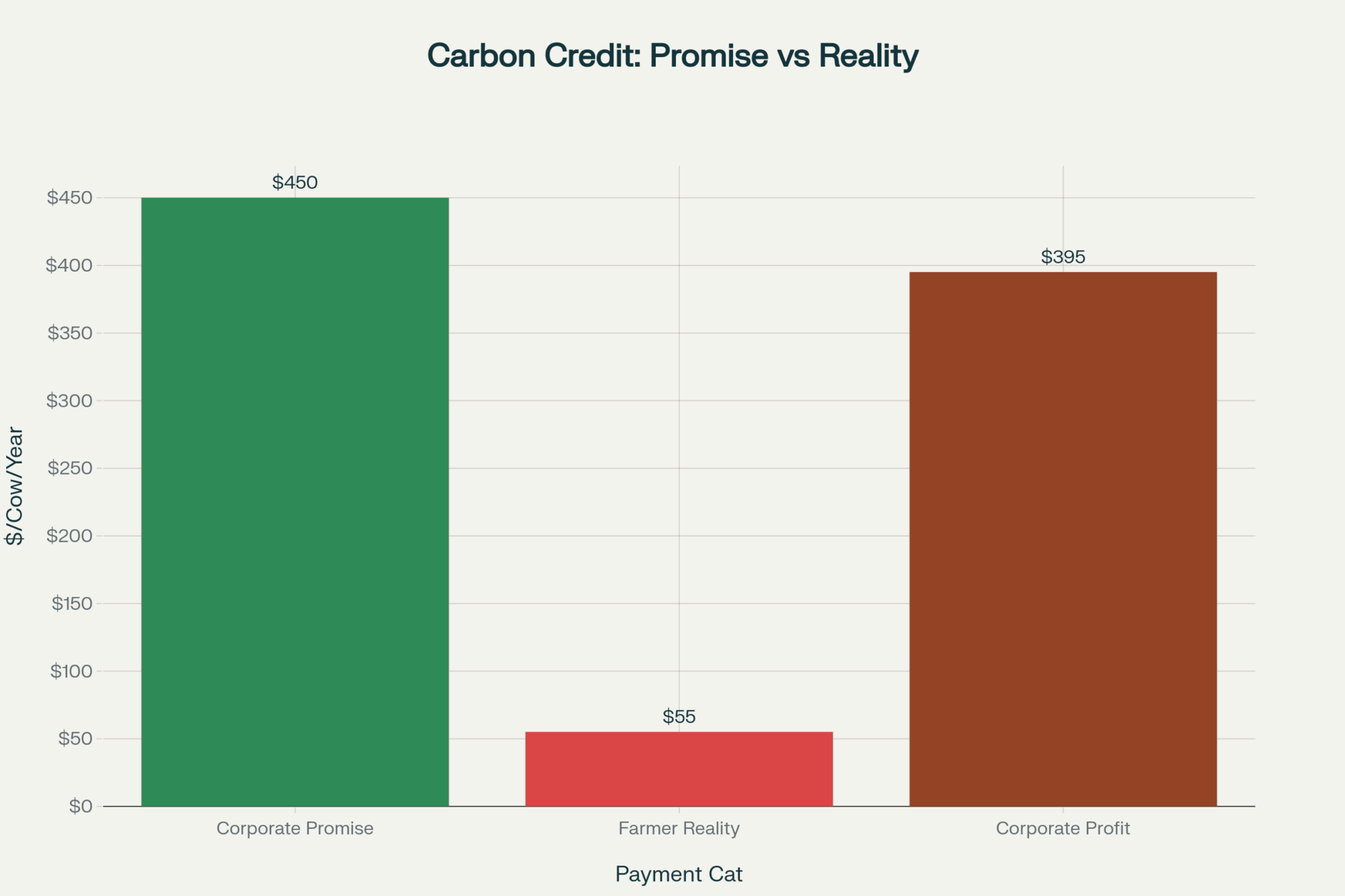
So these sales reps are running around promising farmers 400 to 450 bucks per cow in carbon revenue. Sounds pretty good when you’re dealing with feed costs through the roof and milk prices that are… well, you know how that’s been going.
But when I actually talked to farmers who signed up—not the poster children they parade around at industry meetings, but regular guys like Andy—they’re getting maybe 55 bucks per cow after all the verification costs and corporate transaction fees get deducted.
The rest just… disappears into the system somehow.
Meanwhile—and this is what kills me—I found research from those Dutch guys at Wageningen University. They discovered you can cut methane emissions by 25 to 30 percent just by feeding younger, more digestible grass.
Cost to implement? Changing when you mow. That’s it.
I was talking to this Wisconsin producer last spring—during breeding season, actually—and he’s like, “I’ve been doing rotational grazing for fifteen years. My pastures are healthier, my fresh cows are healthier, and my feed costs are lower. Now they want me to pay some corporation a hundred bucks per cow to maybe get the same emission reductions I’m already getting?”
Makes no sense to me. But then again… you can’t patent rotational grazing.
Wait—There’s Something Else That’s Really Bothering Me
| Organization | Member Organizations | Global Milk Production Control | Current Test Program Location | Test Program Investment | Test Program Participants | Scaling Timeline |
| Global Dairy Platform | 200+ | 40% | East Africa | $358 million | 2.5 million farmers | Post-2025 global rollout |
This whole corporate coordination thing. And I mean this literally—there’s actually an organization called the Global Dairy Platform that’s coordinating over 200 organizations representing about 40% of global milk production.
Their executive director, Donald Moore, said something in an interview that made my antenna go up. He talked about how this whole thing “provides a model that can now rapidly be scaled up and replicated across other countries and regions.”
Now, when corporate executives start talking about “scaling up and replicating,” that usually means they’re testing something somewhere else before they bring it to your backyard.
No kidding, they’re beta-testing a 358 million dollar program on 2.5 million farmers in East Africa right now.
But here’s what kills me… the same consulting companies writing agricultural policy for governments—like McKinsey—are also advising the corporations that profit from those policies. It’s like having your insurance agent also be the guy who inspects your barn for fire hazards. You see the problem with that?
I mean, come on. During corn harvest last fall, I was talking to this farmer in Iowa, and he’s telling me about all these new “environmental requirements” showing up. The bank wants sustainability reporting for the loan renewal. His feed supplier’s pushing methane reducers harder than usual. His processor’s hinting about new carbon compliance stuff coming down the pipeline.
Different players, same playbook. And honestly? It’s starting to feel coordinated.
And Another Thing That Pisses Me Off

You can’t patent rotational grazing. Can’t charge licensing fees for cover crops. Can’t create recurring revenue streams from composted manure systems.
But you know what you can do? Sell feed additives that farmers have to buy every month… forever.
I was at this Holstein meeting up in Vermont last summer—beautiful country up there, by the way—and this organic producer was telling me about his emission reductions. Fifteen to 25 percent lower through rotational grazing. Feed costs actually went down. Soil health improved. Carbon sequestration happened naturally.
Canadian farmers I’ve talked to are getting 10 to 20 percent reductions with cover crops for maybe 800 to 2,500 bucks annually for their entire operation.
So, let me get this straight… natural methods that actually save money and improve the farm versus corporate additives that create permanent dependencies and cost over $100 per cow per year.
Which one do you think they’re promoting? Yeah, exactly.
Speaking of Getting Screwed Over…
Let’s talk about what’s happening in Europe, because that’s where this is all heading.
I came across a Dutch farmer, Jan Dirk, whose family has been working the same ground for generations. He told reporters: “The farmers are the victims of this whole system. And the agri-industry is earning the money.”
Here’s a guy who implemented natural soil health practices that actually help with nitrogen issues, but he gets no credit while corporate nitrogen credit developers profit from the crisis his stewardship helped prevent.
The Dutch government is pushing for a 50% nitrogen reduction by 2030. Sounds reasonable, right? Until you realize it’s only achievable by shutting down farms. Massive farm shutdowns.
Table Formatting
| Policy Requirement | Current Status/Impact | Effect on Dairy Sector |
| Nitrogen Reduction Target | 50% reduction by 2030 (now 2035) | Only large operations can afford compliance |
| Farm Closure Rate (current) | 6% annually | Systematic elimination of small farms |
| Average Herd Size Increase | 219 cows average (up from ~180) | Consolidation favoring industrial scale |
| Government Buyout Budget | €8 billion voluntary program | Low uptake – scheme unpopular |
| Court-Ordered Penalties | €10 million if targets missed | Government defying court orders |
| BBB Party Electoral Success | 16 Senate seats (largest party 2023) | Political resistance organized |
Another Dutch producer, Trienke Elshof, nailed what’s really happening: “It feels like they want to get rid of all the farmers in the Netherlands.” Her son was studying agricultural science, planning to take over the farm. Now he’s “rethinking his lifelong plan to become a farmer.”
That’s not climate action. That’s destroying agricultural communities.
And it’s not just the Netherlands. Poland’s dealing with 50% pesticide reduction requirements, while retail chains are starting to require corporate sustainability certification just to access markets. In Canada, they’re mandating a 50% fertilizer reduction while handing 8.5 million dollars to cricket protein facilities.
Cricket protein facilities. I kid you not.
The same pattern everywhere—impossible requirements that favor corporate consolidation over family farming.
You Know What Really Gets Me?
Corporate greenwashing. The fake environmental claims that sound good in press releases but fall apart when you look at actual data.
There was this massive investigation into Arla Foods—supposedly the poster child for dairy sustainability. A hundred-page report found that despite all their marketing claims, Arla only achieved 8.4% actual emission reductions, while methane still accounts for 56% of their total greenhouse gas output.
Alma Castrejon-Davila from Changing Markets Foundation, the group that did the investigation, didn’t mince words: “Arla has been selling us a fairytale for far too long.”
The report showed Arla has “undemocratic structures and incentives that benefit the larger, more industrial farms,” while smaller operations face “substantial investment in infrastructure and compliance.”
But wait—it gets better. Researchers in Brazil employed machine learning to identify corporate environmental claims and discovered a “paradoxical positive correlation between environmental discourse and emissions.”
Translation? Companies with the highest sustainability scores were actually producing more pollution.
So much for trusting the marketing materials.
Oh, and Get This—The Technology Scam…
These technologies promise something too good to be true. Because they usually are.
Like this Ambient Carbon technology claiming 90% methane destruction. Sounds amazing, right? Until you dig into it and find out their entire global validation comes from one 250-cow trial in Denmark.
One farm. In Denmark. But Danone’s already funding a system that’s “30 times larger” for North America.
The company co-founder, Matthew Johnson, admits farmers would need “a separate unit for every 500 cows or so.” For a 2,000-cow operation, that’s 20 units of unproven technology at… well, they won’t say what it costs. And we all know what that usually means.
I’ve seen this movie before, you know? Remember when robotic milking was gonna revolutionize everything? Had a neighbor who bet the farm on first-generation robotic systems. Cost him about 200 grand more than he planned, and half the time he was fixing the damn things instead of milking cows.
Early adoption’s expensive. Especially when corporations won’t tell you the real costs upfront.
| Approach/Technology | Cost per Cow/Year | Revenue/Savings per Cow/Year | Implementation Timeline | Scalability |
| Bovaer Feed Additive | $93-$110 | Zero milk production gain | 30 days | All farm sizes |
| Rotational Grazing | Low/Zero ongoing | 15-25% feed cost reduction | 6 months – 2 years | Small-medium preferred |
| Organic Pasture Systems | Zero ongoing | 24% lower emissions baseline | Immediate if already organic | Small-medium preferred |
| Anaerobic Digestion (Large) | $2,000-$4,000 | $400-$450 | 18-36 months | 2,500+ cows required |
| Anaerobic Digestion (Medium) | $1,000-$2,500 | $250-$350 | 12-24 months | 1,000-2,500 cows |
| Cover Crops | $3-$10 per acre | Soil health + modest carbon credits | 1 season | All farm sizes |
| Carbon Credits (Promised) | Zero | $400-$450 | Varies by program | Varies |
| Carbon Credits (Actual Payout) | Zero | $55 | Varies by program | Varies |
| Ambient Carbon Technology | Undisclosed | Claims 90% methane reduction | Unknown | 500 cow minimum units |
| Agolin Feed Additive | $55-$110 | $35-$160 | 30 days | All farm sizes |
Here’s Where Your Tax Dollars Really Go
About government funding. Where it actually goes.
Canada just invested $7.18 million in Ontario dairy processing projects. Processing. Not farms.
Meanwhile, here in the States, USDA climate-smart agriculture funding can disappear overnight when administrations change. I’ve seen more government programs come and go than I’ve had hot dinners—seriously.
The pattern’s always the same: corporations and research institutions get stable, long-term funding. Farmers get temporary programs that vanish with political changes.
Even Jayne Sebright at Pennsylvania’s Center for Dairy Excellence—and she’s usually pretty optimistic about these programs—admits: “The jury’s still out on the carbon market and how lucrative it’ll be for farmers.”
But you know what? The jury’s not out on who’s making money from the programs themselves. That part’s crystal clear.
But Here’s What Actually Gives Me Hope
Some producers saw this coming and built alternatives before the crisis hit their operations.
Take Tracy Stauffer. Smart woman. Built an on-farm creamery while still supplying Darigold. When Darigold started hitting farmers with 4-dollar deductions that made it “impossible to cash flow,” she had options.
In Australia, producers doing direct marketing are achieving premium pricing of 15 to 30 percent while building customer loyalty that withstands market downturns. Coles—that’s like their Walmart—started buying directly from 60 dairy farms, cutting out the traditional processors entirely.
And in the Netherlands? Remember those farmer protests with tractors blocking highways? Well, the BBB—that’s the Farmers-Citizens Movement—went from being founded in 2019 to winning provincial elections in 2023.
When farmers organize politically, they can actually shake up the corporate-political establishment. For real.
This Time of Year, You Start Seeing the Signs
If you’re wondering whether this sustainability stuff is coming to your area… here’s what to watch for:
Carbon credit salesmen are showing up at your farm. I’ve had three different companies contact me in the last two months.
Your bank mentions “green financing” or sustainability loans during your annual review. They’re calling it “sustainability-linked financing” now.
Your processor is sending letters about new environmental requirements coming down the pipeline. Usually starts with “voluntary participation” language.
Feed companies are pushing methane-reducing additives harder than usual. My nutritionist’s getting calls every week from these guys.
Local cooperatives are announcing management changes or “strategic partnerships” with sustainability consulting firms.
Processing facilities in your region are closing or consolidating—creating fewer buyer options.
If you’re seeing three or four of these… you’re probably already in their crosshairs.
But wait—I Almost Forgot the Worst Part
The traps they set up to lock you in permanently.
First, these are carbon credit contracts. Typically run 10 to 20 years. Transfer your data ownership to corporations. Create dependency relationships that are harder to get out of than a bad marriage.
Had a farmer in Pennsylvania tell me that getting out of his carbon contract would cost more than his annual milk check. That’s not a business partnership—that’s economic hostage-taking.
Second trap’s feed additives like Bovaer. Once your cows’ health depends on it, you’re looking at 93 to 110 bucks per cow every year… forever. No exit strategy. It’s like a subscription service, except it’s your livestock that becomes dependent.
Third trap’s sustainability-linked financing. Gives banks control over your management decisions. Compliance requirements that change over time. Default triggers tied to environmental metrics you might not even understand yet.
Here’s the deal with these programs—they start voluntarily. “Market-driven,” they call it. But once enough farms sign up, processors start requiring participation from everyone.
Same playbook they used with organic certification, milk quality standards, animal welfare audits… starts optional, becomes mandatory through market pressure.
You Know What I Keep Thinking About?
Two completely different futures are heading toward us like freight trains.
In one scenario, medium-sized operations—500 to 2,000 cows—are thriving through regional cooperatives that actually control significant market share. Distributed processing networks give farmers real bargaining power instead of just taking whatever price they’re offered. Rural towns have economic vitality again because the wealth stays local instead of flowing to distant corporate headquarters.
Farmers control their own renewable energy systems, manage their own emission reductions through methods that actually improve profitability—you know, stuff that makes sense. They achieve 25 to 30 percent emission reductions at a fraction of what these corporate programs cost.
And farmer political movements—like what happened in the Netherlands—actually influence agricultural policy instead of just getting steamrolled by corporate lobbyists.
In the other scenario… maybe 200 mega-dairies controlling 10,000-plus cows each dominate production. Five multinational corporations control everything from genetics to grocery shelves. Farmers become technology serfs paying perpetual licensing fees, or contract producers on corporate-owned land, or they exit agriculture entirely.
The tipping point’s coming fast. Probably between 2026 and 2028. Either farmer resistance builds enough alternatives to maintain independence, or corporate consolidation becomes irreversible.
I know which future I’d rather see. Question is, what are we gonna do about it?
Look, Here’s What I’d Do If I Were You
And I mean this week, not next month when you get around to it.
Map out every corporate relationship you’ve got. Processor, feed suppliers, bank, insurance, inputs, and technology vendors. What alternatives exist within 200 miles? Because that milk truck’s only gonna drive so far, and freight costs matter.
Document your current practices with photos. Emission reduction methods, soil health practices, and energy systems. These corporate programs will try to claim credit for improvements you’ve already made. Trust me on this one—happened to three farmers I know personally.
Start connecting with other producers in your area. Discover who else is being approached by carbon credit salesmen. Build mutual support networks before crisis forces desperate cooperation. The Dutch farmers who successfully organized? They started in 2021, before the regulations hit hard. Early preparation made the difference.
Research your direct market options. Food co-ops, farmers markets, and on-farm processing possibilities. Talk to producers who’ve already made that transition. What were the real startup costs versus the promised benefits? What were the actual challenges nobody talks about in the success stories?
And here’s the big one—reject new corporate contracts. When any sustainability salesman shows up with an “opportunity,” use the 72-hour rule. Tell them: “I need 72 hours to discuss this with my advisors.”
Use those 72 hours to research the real costs and long-term dependencies. Talk to farmers already in similar programs—not the ones they use as references, but farmers you actually know and trust.
Default answer after 72 hours? No.
Remember, legitimate business deals don’t have artificial urgency. If it expires in 24 hours or they need an answer today… that’s a red flag bigger than a barn door.
Bottom Line—And I Mean This
I’ve been covering this industry long enough to smell BS from three counties away. This sustainability push isn’t about the environment. It’s about reshaping who controls food production in this country.
The math doesn’t work for independent producers. The coordination between corporations and government agencies is too convenient. The solutions that actually work—and cost less—are being systematically ignored or undermined.
Corporate sustainability programs promise farmer benefits while creating systems designed to eliminate farmers. The evidence is overwhelming if you look past the marketing materials and talk to actual producers who’ve been through these programs.
Smart farmers are building alternatives now—direct markets, regional cooperatives, on-farm processing, political organization—while they still have resources and options.
Farmers waiting for corporate fairness or government salvation are going to discover that their alternatives have been systematically eliminated while they were hoping for the best.
You’ve got 18 to 24 months before your options get permanently limited by this consolidation push. The producers who understand what’s really happening and act on it have a fighting chance.
Those who don’t? They’re already part of somebody else’s business plan.
Stop waiting for fairness from companies that view independent farmers as obstacles to efficient market control. Start building farmer independence now.
Your family’s farming future depends on decisions you make in the next few months, not promises from corporate executives about programs that benefit them way more than they’ll ever benefit you.
Share this with every independent producer you know. The corporate sustainability machine depends on farmers not understanding the real economics behind their own elimination.
KEY TAKEAWAYS:
- Natural methods outperform corporate solutions: Rotational grazing delivers 15-25% emission reductions while reducing feed costs, versus Bovaer’s $93-110 annual per-cow expense with zero production gains
- 72-hour rule saves farms: When sustainability reps offer “opportunities,” demand 72 hours to research—legitimate deals don’t expire, scams do
- Document everything now: Photograph current emission reduction practices, soil health methods, and energy systems before corporate programs claim credit for your existing improvements
- Build alternatives before crisis: Successful producers like Tracy Stauffer developed on-farm processing and direct markets while still profitable—waiting until corporate dependency locks in eliminates escape routes
- Political organization works: Netherlands’ BBB party went from 2019 startup to 2023 provincial election victory, proving organized farmer resistance can challenge corporate-government coordination
EXECUTIVE SUMMARY:
Here’s what we discovered after months of tracking corporate sustainability programs: farmers are getting played. While DSM-Firmenich collects $93-110 per cow annually for Bovaer feed additives, Wisconsin organic producers already achieve 24% lower emissions through pasture management—at zero ongoing cost. The Global Dairy Platform coordinates 200+ organizations controlling 40% of milk production, beta-testing a $358 million program on 2.5 million East African farmers before scaling globally. Carbon credit schemes promise $400-450 per cow but deliver $55 after corporate fees, while Dutch nitrogen policies force 50% reductions that only mega-operations can afford. Corporate greenwashing investigations reveal companies with the highest sustainability scores actually produce more pollution. This isn’t climate action—it’s systematic wealth extraction disguised as environmental progress, targeting independent producers for elimination while multinational corporations capture both the problem and the solution.
Complete references and supporting documentation are available upon request by contacting the editorial team at editor@thebullvine.com.
Learn More:
- Verified Strategies for Navigating 2025’s Dairy Price Squeeze – This article provides a crucial tactical perspective on defending your bottom line against market volatility. It offers actionable strategies like locking in feed costs and maximizing component premiums, giving you control over profitability in a soft market.
- Profit and Planning: 5 Key Trends Shaping Dairy Farms in 2025 – While the main article exposes corporate influence, this piece offers a strategic look at broader industry trends. It reveals how to leverage feed efficiency and genetics to stay ahead and why monitoring processor relationships is critical for long-term survival.
- Embracing the Future: The Latest Innovations in Dairy Technology and their Impact on the Industry – This article provides a complementary view of technology. Instead of focusing on unproven additives, it explores proven innovations like manure management systems and wearable tech that genuinely improve efficiency, reduce costs, and create new revenue streams.
 The Sunday Read Dairy Professionals Don’t Skip.
 The Sunday Read Dairy Professionals Don’t Skip.
Every week, thousands of producers, breeders, and industry insiders open Bullvine Weekly for genetics insights, market shifts, and profit strategies they won’t find anywhere else. One email. Five minutes. Smarter decisions all week.