




Holstein USA widened the stature scale. Most barns didn’t. Here’s the milk you’re leaving on the lunge box.
Kip Law didn’t have a genetics problem. He had a concrete problem.
The stalls in his 70‑cow tiestall in Sherburne, New York, were — in his words — “too small for Holsteins.” More cows than stall spaces, six hours to milk, and a steady stream of animals scrambling in and out of beds that didn’t fit them. Nothing on a proof sheet would’ve told you that.

That disconnect — between what genetics are building and what concrete can carry — is quietly bleeding milk and culling cows from progressive Holstein herds across North America. In late 2024, Holstein Association USA revised its stature linear scale from 51–61 inches to 55–65 inches because the breed had physically outgrown the old range. It was Dr. Jeffrey Bewley’s 2023 cow measurement project that exposed the discrepancy — Holsteins had become too tall for the existing scale. Many freestall barns poured during the expansion years of the late 1990s and 2000s are still sitting at roughly 45–46 inches of stall width. The cows standing in them pay for that gap every time they try to rest.
How Big Is the Stall Gap, Really?
Start with the frame. Holstein USA’s Body Size Composite and Stature PTA have trended toward larger cows for years. Stack a couple of points of stature over multiple generations, and you end up milking daughters that carry hundreds of pounds more live weight than the cows your barn was designed around.
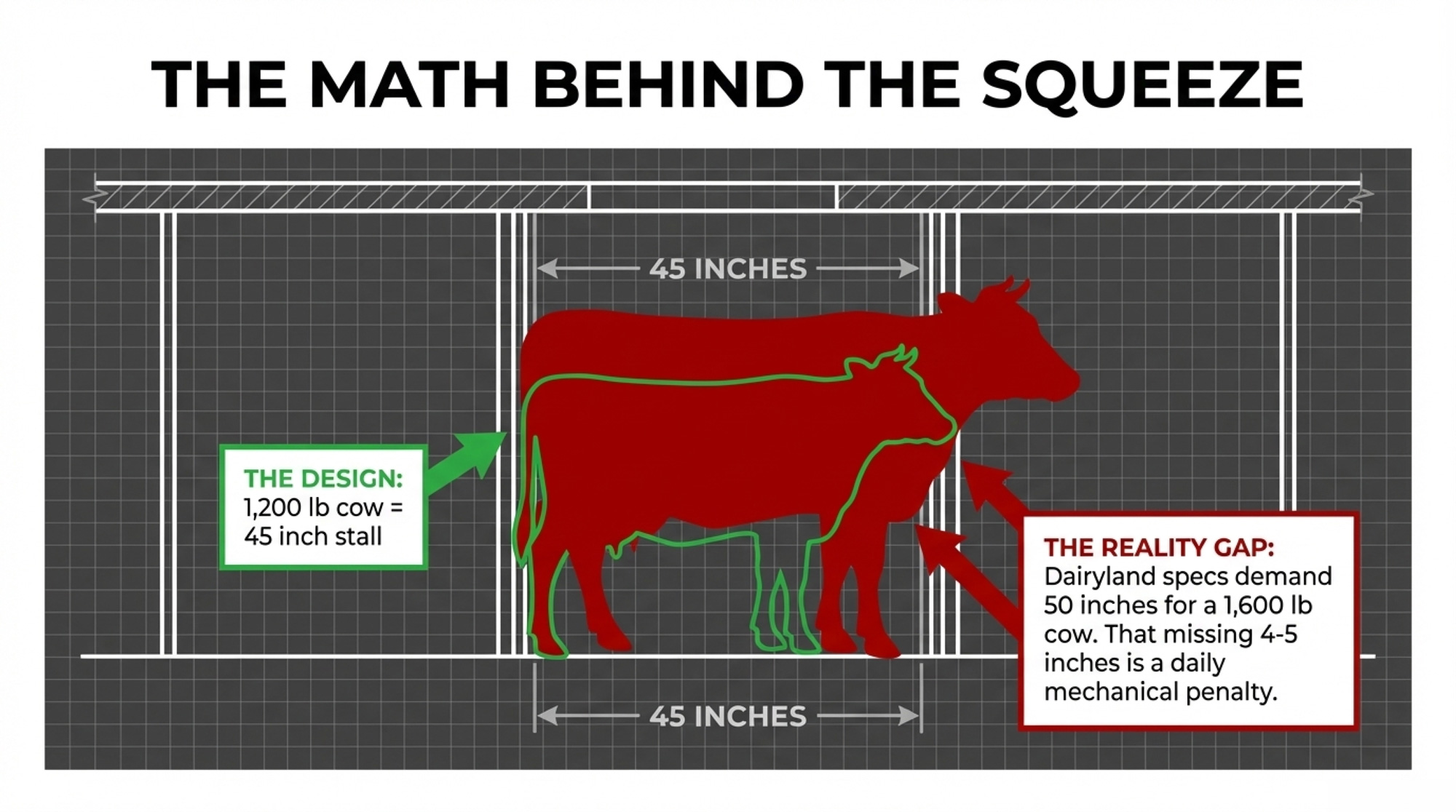
Nigel Cook and the University of Wisconsin’s Dairyland Initiative turned that reality into barn specs. Their current freestall design table sizes stalls by cow body weight for adult Holsteins:
- Around 1,200 lb: recommended stall width (divider spacing) is 45 inches.
- Around 1,400 lb: 48 inches.
- Around 1,600 lb: 50 inches.
- Around 1,800 lb: 54 inches.
A lot of older barns were built on 45‑inch centres because they were designed around smaller cows or heifers. When your cows grow, and your concrete doesn’t, you create a mechanical penalty every time a big cow tries to lie down or get up.
Visualizing the Stall Fit Gap
Based on the Dairyland Initiative’s freestall dimension table for adult Holsteins:
| Cow size (approx. weight) | Recommended stall width | Common 2000s stall width | The “gap” |
| ~1,200–1,400 lb | 45–48 in (45 in @ 1,200 lb; 48 in @ 1,400 lb) | 45–46 in | 0–3 in depending on actual cow weight |
| ~1,600 lb | 50 in | 45–46 in | 4–5 in |
| ~1,800 lb | 54 in | 45–46 in | 8–9 in |

Imprint width defines minimum stall space—the lateral distance from hock to abdomen when resting narrow. For mature Holsteins, that’s about 132 cm (52 in.). Your 45-inch stalls? They’re forcing cows to compress into a space 7 inches narrower than their resting posture. That’s not comfort—that’s forced perching.” (Source: Ontario Ministry of Agriculture, Food and Rural Affairs
Cook’s team notes that, in most situations, a 48‑inch‑wide stall is already an improvement over a 45‑inch stall for mature Holstein cows. For a lot of modern +stature cows in older barns, that missing 3–9 inches is exactly what your time‑budget and lameness numbers are screaming about.
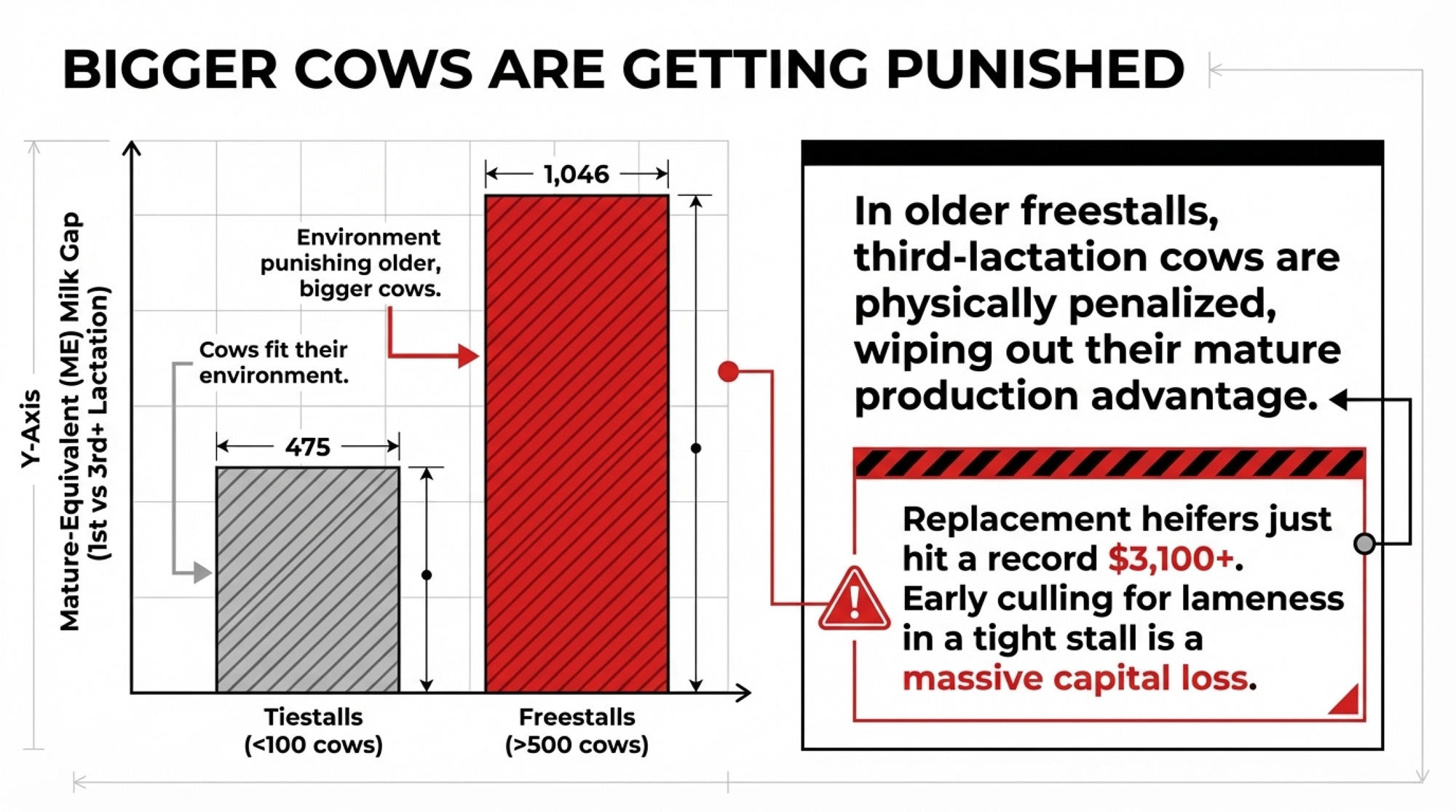
Cook’s analysis of AgSource DHIA data from April 2008 puts production numbers on top of that picture. In herds with more than 500 cows — mostly freestall operations — the mature‑equivalent milk (ME) gap between first‑lactation and third‑or‑greater‑lactation cows averaged 1,046 kg. In herds under 100 cows — predominantly tiestalls — the same gap was just 475 kg. The freestall environment was disproportionately punishing older, bigger cows, not genetics, suddenly “quitting.” In remodels where stalls were widened and surfaces improved, that gap shrank dramatically — in some herds, it essentially disappeared.
That’s not “bad feet and legs genetics.” That’s the barn punishing the frame those genetics created.
Why Did Holsteins Outgrow Their Stalls?
At the 130th National Holstein Convention in 2015, Nate Zwald, with Alta at the time, put numbers on something a lot of breeders already felt. He reported a genetic correlation of about 0.50 between stature and the udder composite, and highlighted how strongly PTAT is associated with stature in the U.S. Holstein population. In plain language: when you chase UDC and FLC through type, you drag stature along for the ride.
“We think we are selecting for better UDC and FLC, but the unintended effect is that we are also making bigger cows,” Zwald told the crowd.
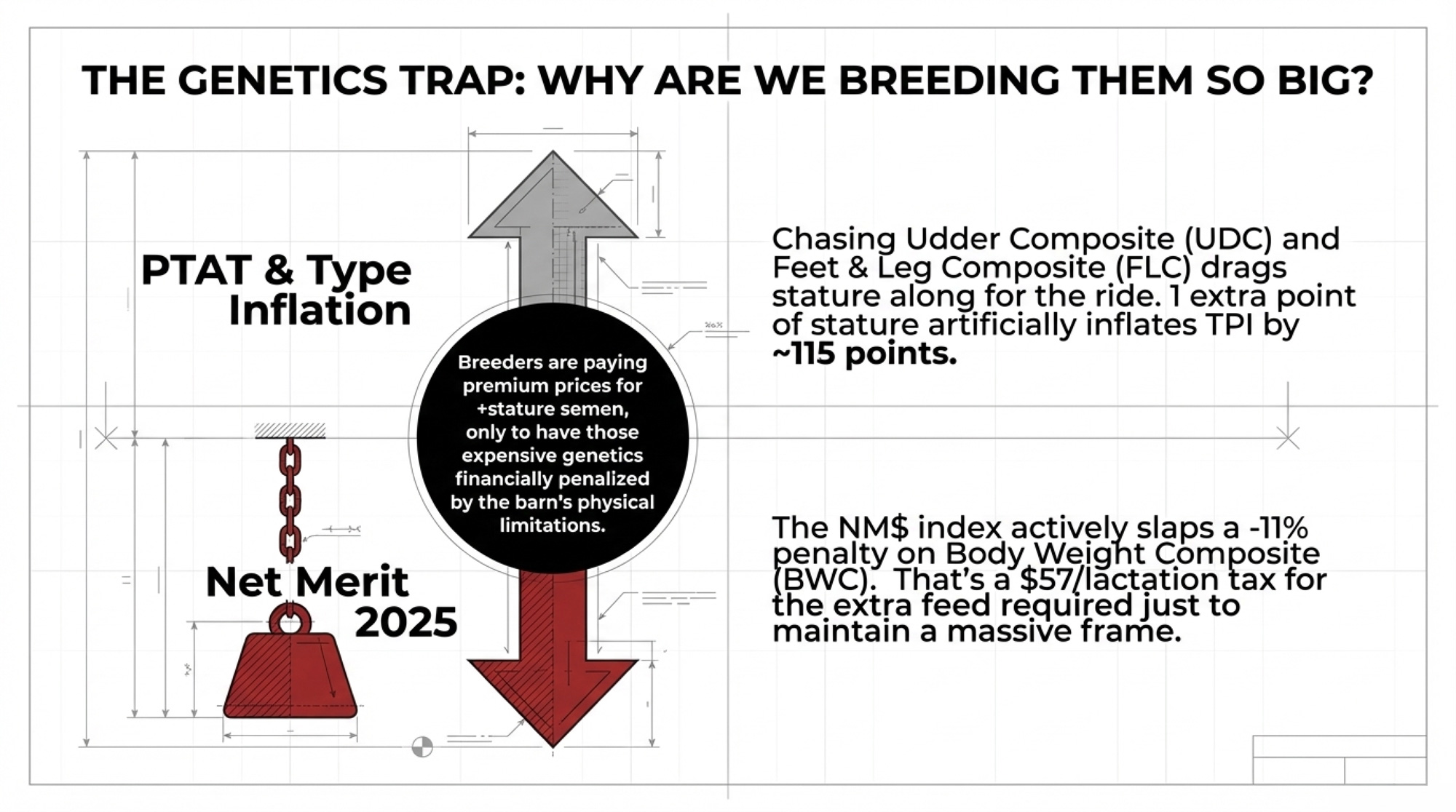
He built the case with three hypothetical bulls. Same production, same health traits — the only difference was about one point each on type, feet and legs, and udders. The tallest bull landed around 4th on TPI. The moderate bull sat near 100th. The smallest slid toward 1,000th. That type inflation, driven heavily by stature, was worth roughly 115 TPI points for the tall bull compared to the moderate one — enough to earn elite flushes and heavy semen demand, even though the mid‑ranked bull had more than enough type for commercial freestalls.
| Bull Profile | Production | Health Traits | Type/UDC/FLC | Approx. TPI Rank |
| Tall Bull (+Stature, +PTAT) | Same | Same | High | ~4th |
| Moderate Bull (0.0 Stature) | Same | Same | Moderate | ~100th |
| Small Bull (−Stature) | Same | Same | Lower Type | ~1,000th |
| TPI Gap (Tall vs. Moderate) | — | — | — | ~115 TPI points |
Breeders often keep chasing those bulls for a simple economic reason: high‑TPI and high‑PTAT animals can command higher sale prices for cattle and embryos, even when they’re harder to keep efficient in a crowded commercial stall. That’s the conflict a lot of herds live with — proofs that look great on paper but quietly work against the barn you already own.
Holstein USA lists stature as one of the more heritable linear traits, with heritability estimates commonly in the low‑to‑mid 0.4 range in U.S. Holstein evaluations. When you select for tall, you reliably get tall. Research and breeding work have shown that larger body size and higher stature are unfavorably associated with longevity and fertility — cows bred for size tend to have shorter productive lives and poorer reproductive performance.
Work from Ontario, Guelph, and the USDA has established a clear economic relationship between body size and feed efficiency: genetically larger cows consume more energy for maintenance and tend to produce milk less efficiently once you account for that overhead. That’s why the 2021 Net Merit revision put stronger negative economic weight on Body Weight Composite and added a new Feed Saved component, explicitly rewarding breeders who select for more efficient, moderate‑sized cows. By the 2025 NM$ update, BWC emphasis had reached −11%, and total Feed Saved emphasis hit 17.8% — the index actively penalizes every extra pound of body weight at roughly 5.5 lbs of DMI per lactation.
The Indexes Caught On. Did Your Mating Plan?
AHDB geneticist Marco Winters has seen the same paradox in UK data. “Everywhere I go, farmers tell me they don’t want bigger cows,” he’s said, “but all the genetic trends tell us that’s what they’re breeding.” AHDB figures show average Holstein body weight is climbing, and UK indexes have responded with more emphasis on maintenance and efficiency.
Holstein USA’s stature scale change in 2024 and classification’s tighter eye on extreme size are another signal. The math in the national indexes has already turned against huge frames. The question is whether your mating plan has followed — or whether you’re still penciling in +stature sires into a barn that was poured around smaller Holsteins.
The genetics drifted. The concrete stayed put.
When Stall Width and Holstein Size Collide
Cassandra Tucker’s group at the University of British Columbia has spent years watching what big Holstein cows actually do in undersized stalls. In one set of studies, cows averaging roughly 1,600 pounds were housed in stalls 44, 48, and 52 inches wide. Lying time increased when the stall width increased from 44 to 48 inches, with smaller gains between 48 and 52 inches. In the narrow stalls, cows spent more time perching — front feet on the bed, rear feet in the alley — exactly the posture you see in mature pens that are too tight for the cows living there.
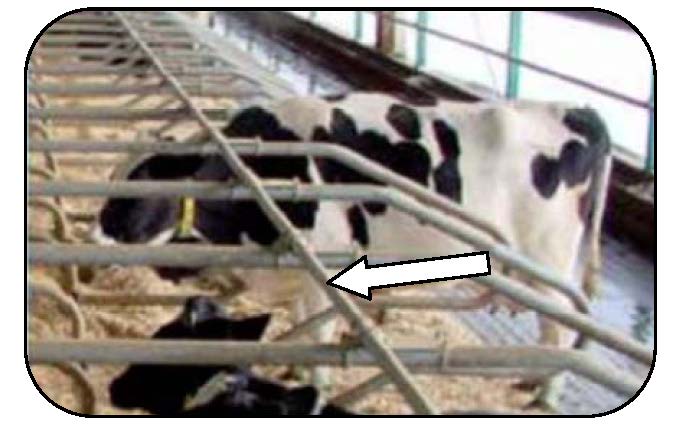
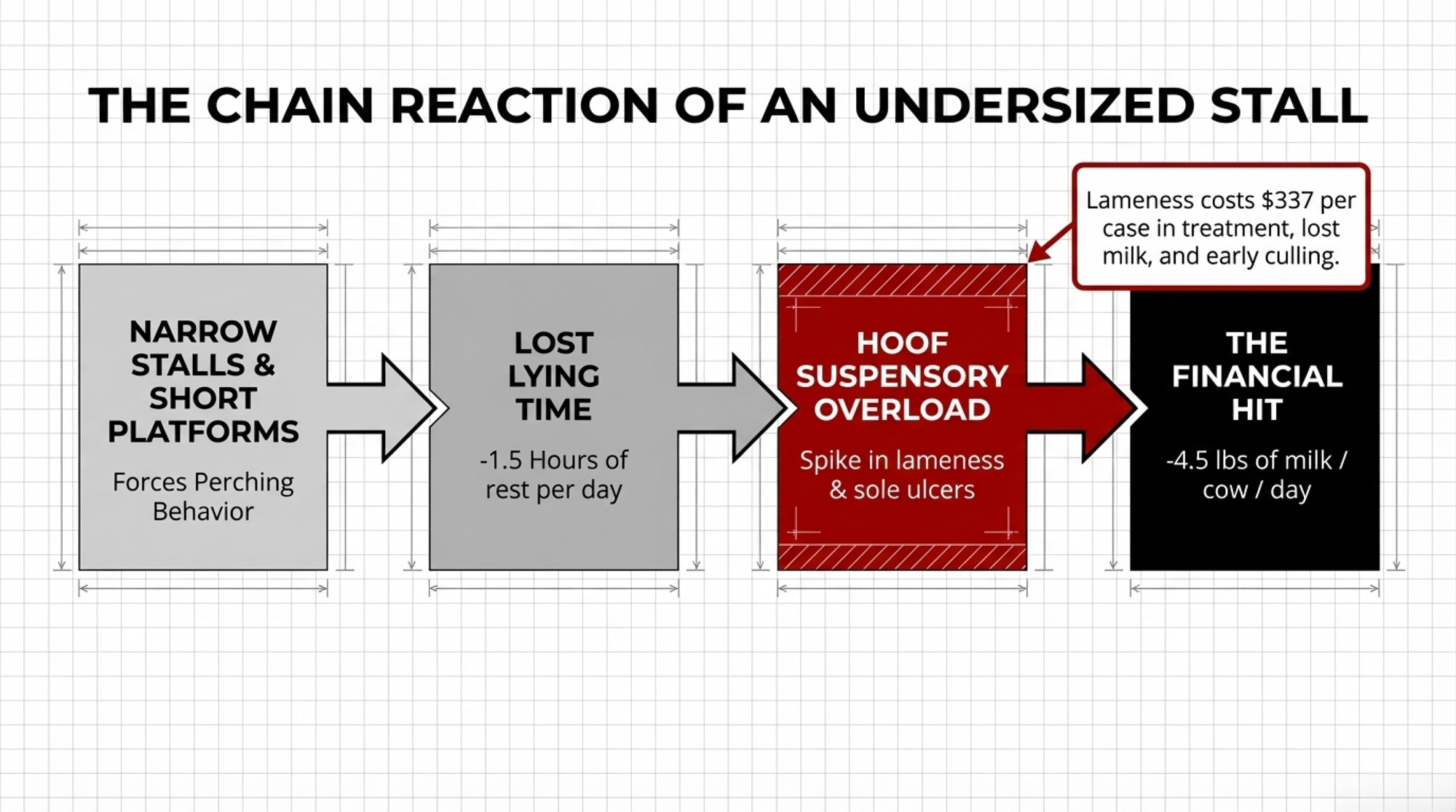
Perching isn’t just ugly. It’s the first step in a cascade. Longer standing bouts overload the claw’s suspensory apparatus, driving more sole hemorrhage and ulcers. Once those structural changes happen inside the hoof, you don’t “fix” them; you manage around them until the cow leaves.
Rick Grant at the Miner Institute translated that behavior into milk. His work suggests each lost hour of lying time is associated with roughly 2–3.5 lb less milk. Cook’s freestall time‑budget data from 17 Wisconsin barns found that cows averaged about 11.3 hours, with a range of 2.8 to 17.6 hours. The worst‑off cows weren’t just a bit behind. They were living in a completely different reality.
Stall Width Is Only Half the Story: The Lunge Box
As cows get taller, they don’t just need a wider bed. They need somewhere to put their head when they get up.
The Dairyland Initiative’s adult freestall dimensions specify that a mature Holstein needs about 10 feet of stall length against a wall to allow a full forward lunge, and about 17 feet on a head‑to‑head platform so cows can lunge without colliding with the cow across from them. They treat 16 feet as a minimum platform length; going shorter forces cows to lunge to the side and lie diagonally, which drives perching and bed contamination.
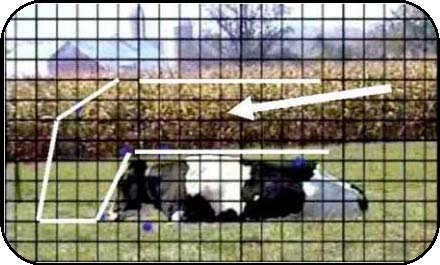
In many older barns, head‑to‑head platforms were built around that minimum 16‑foot length from earlier design recommendations, rather than the 17 feet now preferred for mature Holsteins. That might have been acceptable for smaller 1,200–1,400‑lb cows. Push stature toward the top end of Holstein’s new 65‑inch scale, and the nose‑to‑tail length and lunge arc increase — but the concrete doesn’t. The result: more side‑lunging, more diagonal lying, and more stall‑use frustration you can see in any overgrown pen.
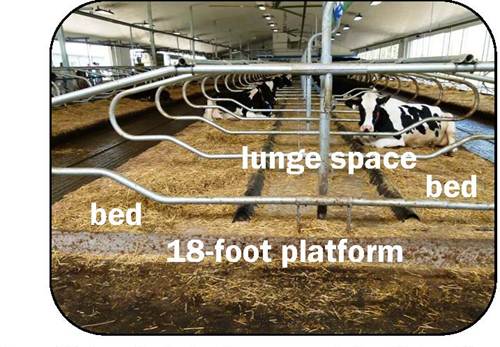
Kip Law’s herd was living that reality before he built his new barn.
Kip Law’s 8‑lb‑a‑Day Concrete Fix
Law’s old setup was a classic Northeast tiestall: a 70‑cow pipeline arrangement with more cows than stalls, Holsteins that had outgrown their beds, and milking that took roughly six hours because cows had to be rotated in and out. “It was taking us about six hours to milk,” he told Progressive Dairy. Stalls were “too small for Holsteins,” and the facility no longer fit the herd.
He didn’t start by rewriting a mating program. He started by changing the barn.
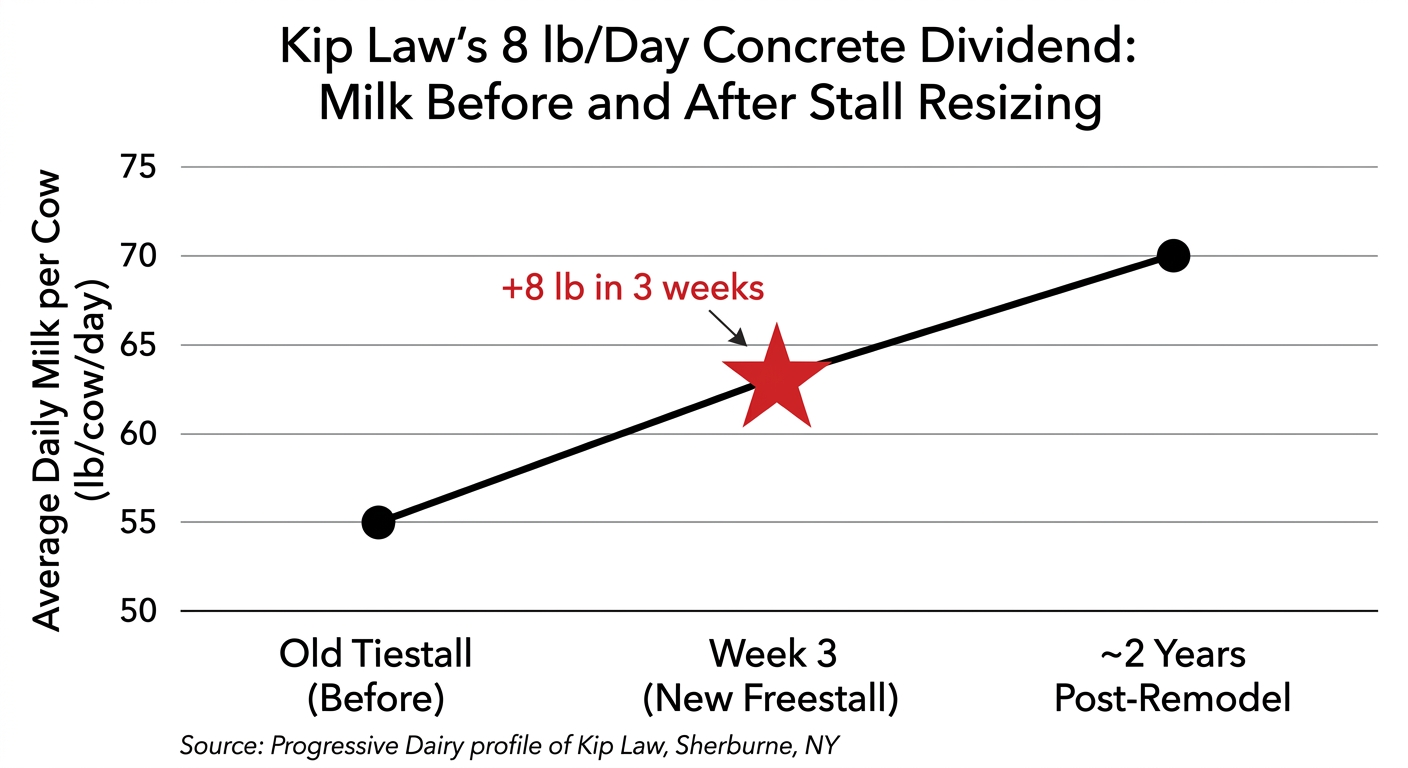
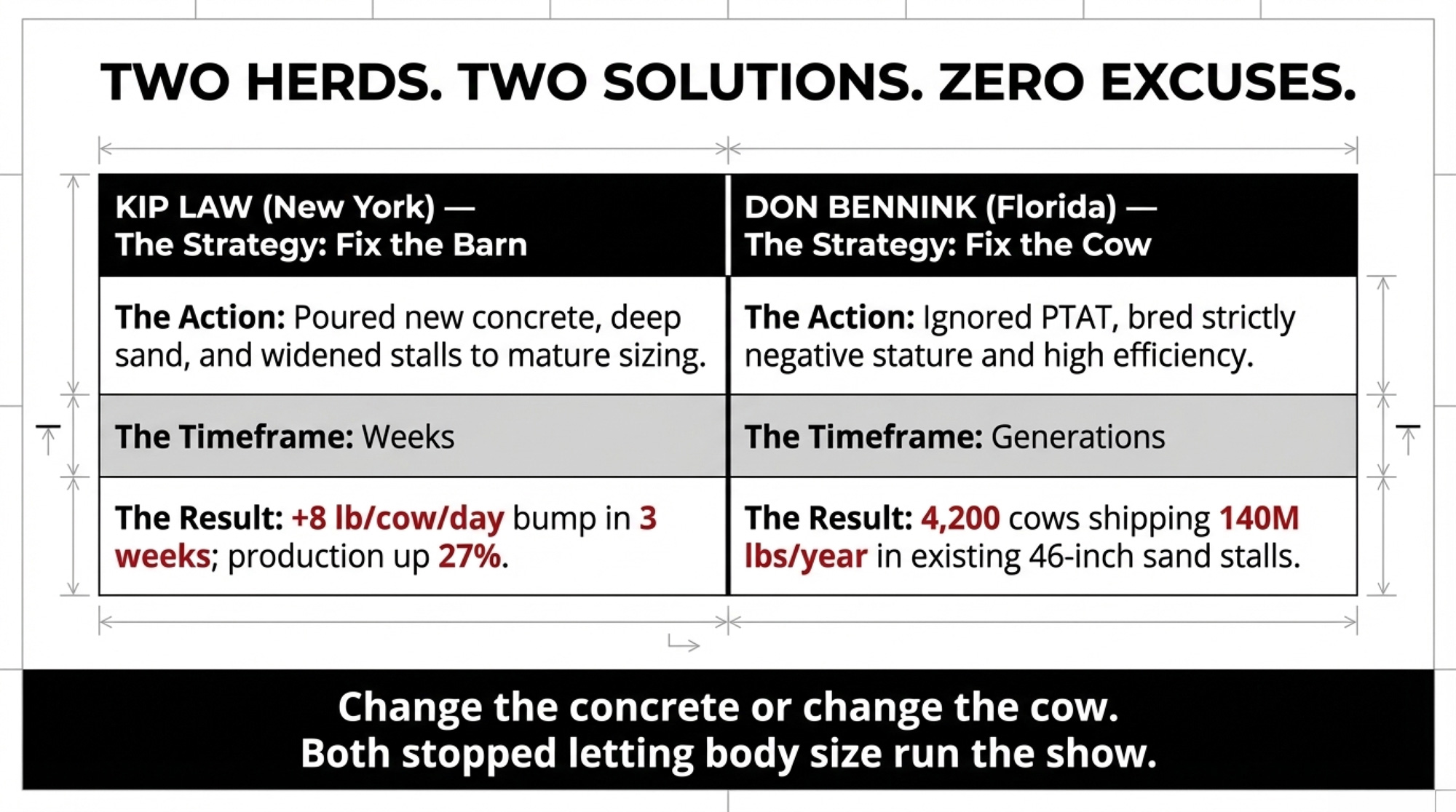
Law built a new freestall with a double‑eight parlor, deep sand bedding, proper lunge space, and stalls sized for mature Holsteins. Within three weeks, milk jumped about 8 lb per cow per day. Over roughly two years, his average daily production climbed from about 55 lb to 70 lb per cow — a 27% increase. The milking herd grew from about 80 to 130 cows, and overall milk production doubled. Somatic cell count dropped to about 100,000.
“The overall herd health is a lot better. Our cows are a lot calmer than they used to be,” Law said. “In two years, it’s a completely different herd.”
Same cows. Same genetics. New concrete.
The Barn Math on Missing Milk
To get a feel for what’s at stake, take a simple example. Say 50 of the biggest cows in a 200‑cow freestall herd — mostly third‑lactation and older — lose just 1.5 hours of lying time per day because stalls are too narrow. Using Grant’s mid‑range estimate of 3 lb per lost hour, that’s:
- 1.5 hours × 3 lb = 4.5 lb per cow per day.
- 4.5 lb × 50 cows = 225 lb per day.
- 225 lb × 305 days = 68,625 lb of milk in a lactation.
That’s barn math, not Law’s actual numbers — but it lives in the same neighbourhood as what he saw when he fixed stall fit and watched milk move.
Cook’s freestall remodels show the same pattern: widen stalls and improve surfaces, and the 1,046 kg ME gap between first‑calvers and older cows starts to shrink. In some herds, it disappears.
Change concrete, milk moves. Change the sire selection, milk moves differently.
Bennink’s Opposite Bet: Breed Smaller, Ship More
In Florida, Don Bennink took the opposite route and ended up in a similar place — cows that fit their environment.
In a 2017 profile, North Florida Holsteins in Bell, Florida, was milking about 4,200 cows at any one time, with roughly 4,800 cows on the farm and around 10,000 head on site. They were shipping approximately 140 million pounds of milk per year with a rolling herd average of 29,357 lb at 3.6% fat and 3.0% protein on 3× milking, all through about 4,000 sand‑bedded freestalls in a mix of tunnel‑ventilated and naturally ventilated barns. Bennink moved his herd from western New York to Florida in 1980 and built the operation from there — figuring out quickly that hot, humid conditions and a Northern European breed demanded relentless attention to comfort, cooling, and housing. (Read more: NORTH FLORIDA HOLSTEINS. Aggressive, Progressive, and Profitable!!)
“High production, strong health traits and feed efficiency,” Bennink said in that profile. “They are the bywords for breeding profitable cows.” He doesn’t mince words about what profitable doesn’t look like. The taller, more angular cow favoured in the show ring, the classification system, or the current PTAT formula is “so far removed from what most milk producers want that it is irrelevant to the majority of dairy operations,” he argued.
The results back up the philosophy. Between 1981 and 2021, more than 200 bulls carrying the NO‑FLA prefix were enrolled with the National Association of Animal Breeders. Bennink bred the dam of Mr. T‑Spruce Frazz LIONEL‑ET — NO‑FLA Montross 42446‑ET — who topped the TPI list in April 2022, tracing back at least five generations of North Florida breeding. NO‑FLA MATRIARCH sits in the top 20 all‑time among proven bulls with a PTA Productive Life of 7.3. The farm has produced 55 dams of merit awardees, 11 gold-medal dams, 9 94‑point animals, and 15 93‑point animals. In 2024, the National Dairy Shrine honored Bennink as Distinguished Dairy Cattle Breeder — recognition built squarely on functional trait selection and profitability, not show‑ring aesthetics.
He built his own North Florida Index around pounds of protein shipped, health traits, daughter fertility, and calving ease. Stature and sharpness don’t enter the equation. He actively selects bulls that are negative for stature, even as many breeders still chase high PTAT and lofty frames.
If you’re breeding for Madison or the Royal, you’re playing a different game with different priorities. If your milk cheque comes from a 46‑inch freestall, Bennink’s math may be closer to what your barn needs than the TPI top‑ten list.
He didn’t widen stalls to keep up with ever‑taller cows. He bred cows that work in the freestalls he already had. The trade‑off is real: go too far shrinking stature without watching udder and locomotion traits, and you can sacrifice udder height or rear‑leg structure, which is why Bennink leans hard on individual udder and leg traits instead of chasing overall type composites.
Two herds, two different levers. Both stopped letting body size run the show.
The “Stop the Growth” Breeding Manifesto (Month 0–3)
You can stop making the mismatch worse this week without spending a dollar on concrete.
- Hard cap: Stature PTA ≤ 0.0. Net Merit 2021 and subsequent updates have already placed a negative economic weight on the larger Body Weight Composite due to higher maintenance costs — by 2025, BWC emphasis in NM$ hit −11%. There’s no financial case for adding more frame in a tight barn.
- Weight tax: Body Weight Composite ≤ 0.0. Larger‑bodied cows eat more just to maintain themselves. USDA research behind the NM$ formula estimates that each extra unit of BWC costs roughly 5.5 lbs of DMI per lactation.
- The real “type”: Prioritize Productive Life (PL), Daughter Pregnancy Rate, and the individual locomotion traits (rear legs rear view, locomotion, foot angle) instead of chasing PTAT points that are heavily tied to stature.
- The goal: A moderate, efficient cow that fits the stall and lasts — not a frame race. The exact weight and production numbers vary by region and system; the point is to stop rewarding size for its own sake in a barn that can’t carry it.
Write it down as a farm rule: “No sires over 0.0 Stature or positive BWC until mature‑cow stalls are at least at Dairyland’s recommendation for our cow size.” That one line keeps you honest the next time a glossy proof sheet lands on the desk.
Concrete and Comfort: Sequencing the Physical Fix (Month 0–24)
Chase the Cheap Cow Comfort Wins (Month 0–6)
Concrete can wait a year. Behavior and time budgets can’t.
- Drop effective stocking density in the fresh and high‑cow groups below about 110% of stalls where you can.
- Tighten bedding management: more bedding, more often, with level, well‑groomed beds — especially if you’re on mats or mattresses.
- Walk pens with a simple anemometer. If air speed at cow level runs under about 1 m/s in high‑risk pens, you’re leaving heat‑stress risk on the table.
- Score locomotion monthly in the fresh and high groups. Treat and block score‑3+ cows quickly and give them the best stalls you have — because a 2022 University of Wisconsin study pegged lameness cases at about $337each in lost milk, treatment, and culling.
These moves cost time and operating money, not six figures. They can still deliver a few pounds per cow per day and peel points off your lameness rate inside the first six to nine months.
Pilot Stall Widening Where It Pays Fastest (Month 6–18)
Instead of waiting until you can redo the entire barn, fix one pen.
Pick the highest‑value group — fresh cows or your top production string. Widen those stalls by moving or replacing divider loops. Using Dairyland’s table, if your average mature cow weighs around 1,600 lb, you should aim for about 50‑inch centres, not 45–46. Get as close as your building will let you, even if it temporarily reduces stall count in that pen.
Then track milk, lying behavior, and lameness scores in that pen against unchanged pens. Cook’s Western Canadian Dairy Seminar work was blunt: after stall-surface changes, increasing stall width for large, mature Holstein cows was the second most important improvement in both sand and mattress facilities. Your pilot pen becomes proof of that in your own herd — and evidence for your lender.
Use the Extra Milk to Fund the Concrete (Month 12–24)
If the combination of a genetic freeze and comfort fixes adds even 4 lb/cow/day across 200 cows, that’s 800 lb/day. Over a full lactation, you’re looking at roughly 244,000 lb of additional milk. The exact margin depends on your component price and feed cost, but that kind of volume moves the needle in a loan conversation.
Instead of walking into the bank saying, “I read I should widen stalls,” you walk in with a year’s worth of herd data showing that better stall fit in one pen produced real milk. That’s a fundamentally different conversation.
What rarely works: still using high‑stature bulls because they rank on the elite lists, and relying on more frequent hoof trimming to outrun the concrete.
Your 5‑Minute Barn Audit
Use this as a quick pass before you ask your breeding rep to bring another batch of +stature proofs.
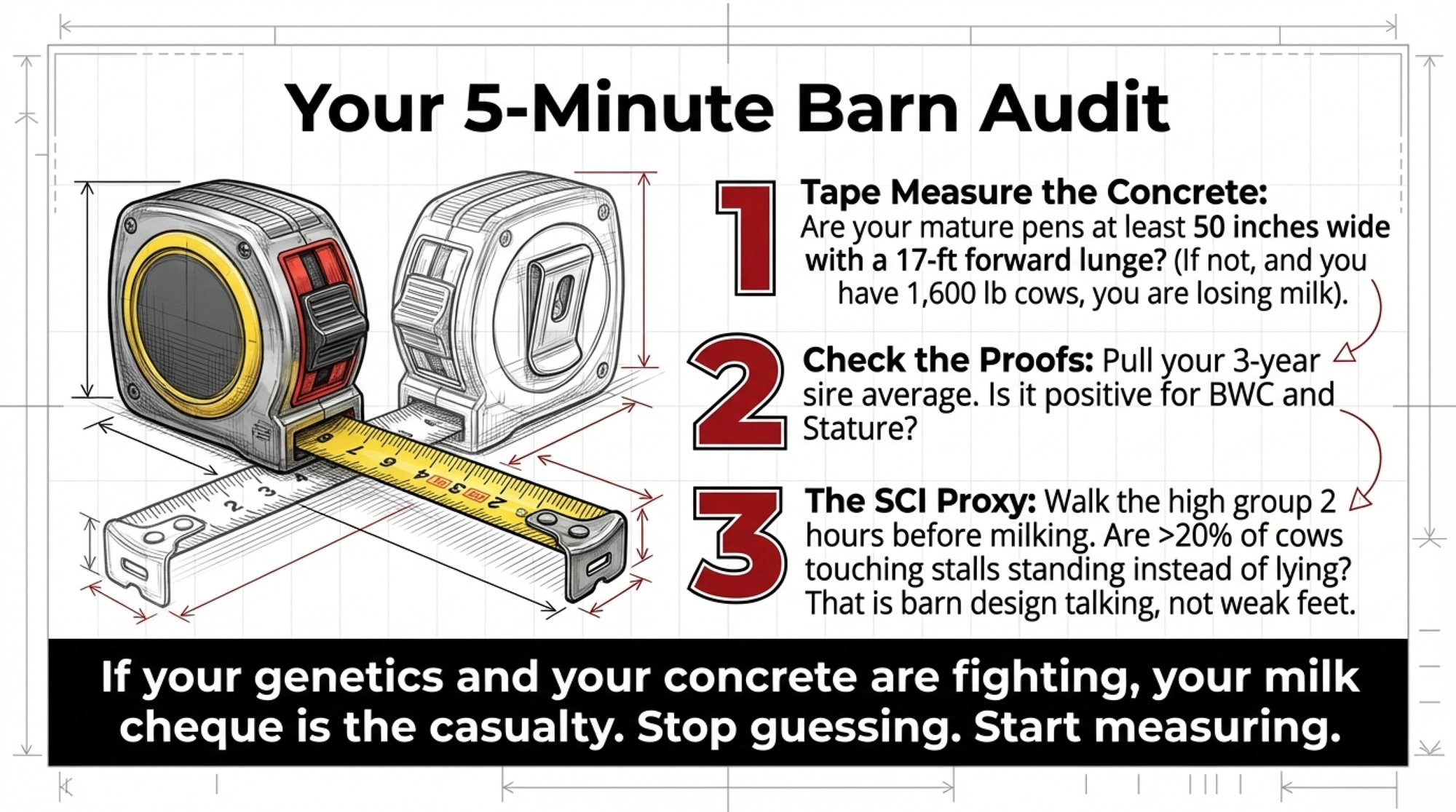
- Stall width vs cow size. Tape‑measure at least five stalls in your mature‑cow pen. Check your average mature cow weight from Lactanet or your nutritionist’s records. If you’re milking roughly 1,600‑lb cows in 45‑inch stalls, Dairyland says you’re 4–5 inches short.
- Platform length and lunge. Measure your head‑to‑head platform. Anything under 16 feet is below Dairyland’s minimum recommendation for forward lunge for mature Holsteins. Short plus wide forces side‑lunging and diagonal lying.
- Lameness and locomotion check. Score 20 mature cows on a 1–5 locomotion scale. If more than about 20% land has a score of 2 or worse, you likely have more lameness than you think — and stall design is almost always part of that story.
- Stall Comfort Index proxy. Walk your high group two hours before milking. If more than 20% of cows touching a stall are standing idle instead of lying, your SCI is giving you a clear warning sign — regardless of what your Feet & Legs composites say.
- Genetic pressure. Pull the last three years of sire BWC and Stature values. If your average is positive on BWC and above zero on Stature, you’re still breeding cows that are bigger than the ones that built your barn.
- Breeding rep reality check. Ask, “Given my stall width and cow size, what’s the maximum Stature PTA you’d be comfortable using here?” If that number is lower than what’s on your current sire list — or they can’t answer — you’ve just found the DNA of your facilities‑genetics mismatch.
- 30‑day action. In the next 30 days, pull the BWC and Stature values on every active sire in your lineup and cross‑check them against your stall tape. Any bull that doesn’t fit both your index and your concrete comes off the mating list first.
What This Means for Your Operation
- If your three‑year average sire BWC is positive and your mature‑cow stalls are under 48 inches, your mating program and your barn are pulling in opposite directions. You don’t fix that with more hoof‑trimming visits.
- Cook’s Wisconsin data showed a 1,046 kg ME gap between first‑lactation and third‑or‑greater‑lactation cows in large freestall herds — more than double the 475 kg gap in tie-stall herds. That’s the environment punishing bigger, older cows, not genetics suddenly “quitting.”
- Law’s herd gained 8 lb/cow/day in three weeks — not by changing sires, but by giving them stalls that actually fit. Over two years, daily milk increased by 27%, and SCC fell to about 100,000, despite the same genetics.
- Bennink ships about 140 million pounds a year (as of 2017) by selecting smaller, tougher cows and ignoring stature‑heavy PTAT — running them through sand‑bedded freestalls he already had. That’s breeding for the barn you have, not the one on the semen catalogue cover.
- The 2021 Net Merit revision began the turn against body size; by 2025, BWC emphasis in NM$ hit −11%, and total Feed Saved emphasis reached 17.8%. Holstein USA’s updated stature scale and classification changes reinforce that same direction. The math in the indexes has already turned against huge frames.
- Replacement heifers are expensive — and getting more so. USDA Ag Prices data show U.S. dairy replacement values climbing from about $2,140 per head in April 2024 to around $2,660 by early 2025, reaching a record$3,110 in October 2025 before easing to $2,860 in January 2026, with top lots in California and Minnesota still clearing north of $4,000. Every cow you cull early because she can’t stay sound in an undersized stall is a capital loss, not just a hoof‑trimmer bill.
Key Takeaways
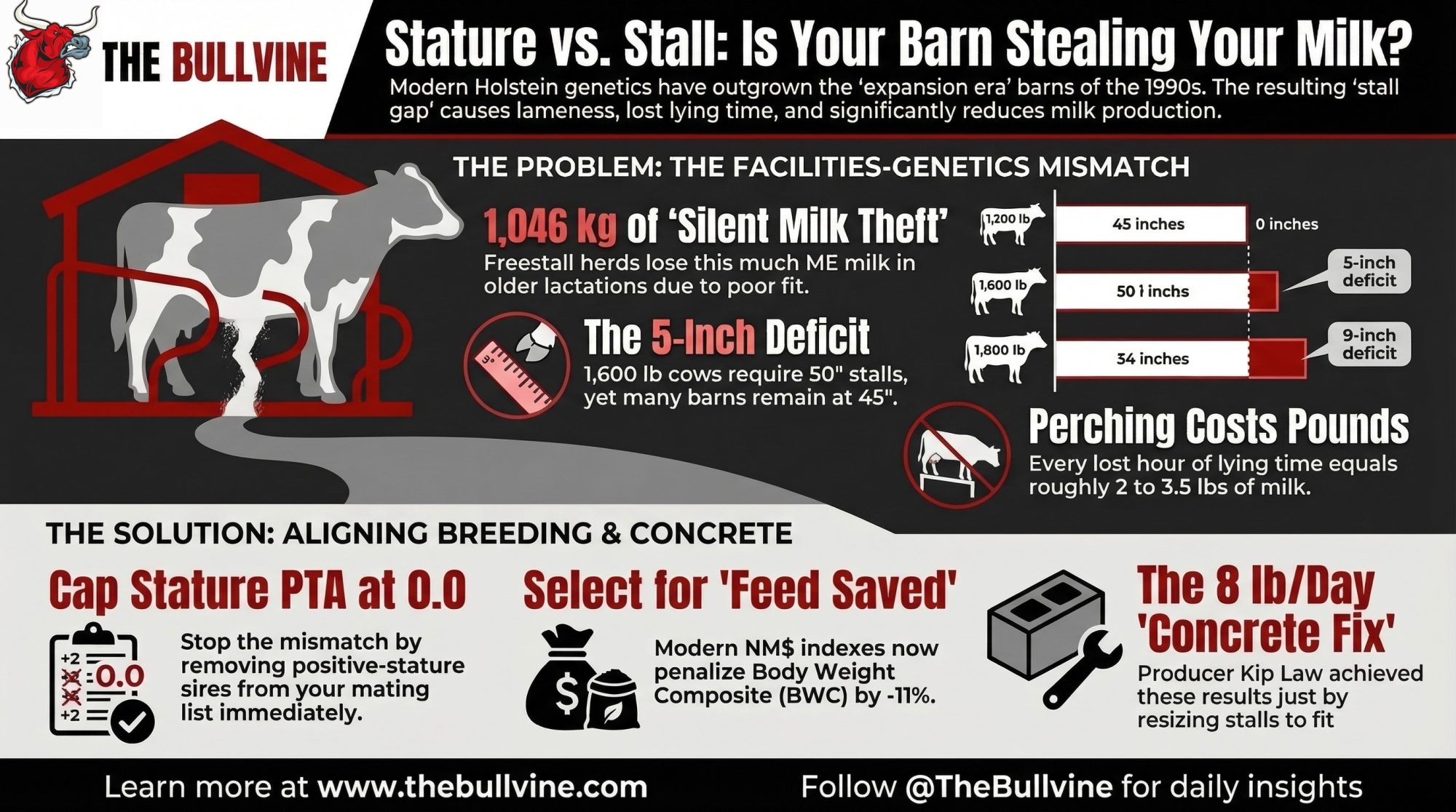
- If your average sire BWC is positive and your stalls are built for smaller cows, cap Stature and BWC at 0.0 on your mating list until your concrete catches up. That alone stops the facilities‑genetics mismatch from getting worse.
- If your mature‑cow stalls measure 45–46 inches and your average cow is in the 1,600‑lb range, you’re 4–5 inches short of Dairyland’s recommendation. Expect more perching, more lameness, and a bigger ME gap in older cows until that changes.
- If more than 20% of cows touching stalls are standing instead of lying two hours before milking, treat it as a red‑alert comfort problem, not a personality flaw in your cows. That’s barn design talking, not “weak feet.”
- If your herd is already built on big, sharp cows, you don’t have to choose between genetics and concrete.Freeze height and body size now, chase cheap comfort and ventilation wins, then use the extra milk to justify stall and platform upgrades.
The Bottom Line
If you walked your barn this afternoon with a tape measure in one hand and your last proof run in the other, would they tell the same story — or would they argue with each other all the way down the alley?
Complete references and supporting documentation are available upon request by contacting the editorial team at editor@thebullvine.com.
Learn More
- Net Merit 2025 | The Bullvine – This implementation guide reveals how to stop Net Merit 2025’s new $57-per-point “weight tax” from working against you. It arms you with non-negotiable filters for Feed Saved, ensuring your sire stack generates margin rather than just frame.
- $3,010 Per Heifer. 800,000 Short. Your Beef-on-Dairy Bill Is Due. – This strategic deep dive exposes the massive capital risk hiding in today’s record-high $3,000+ replacement market. It delivers a 90-day blueprint to rebalance your breeding and secure your 2028 pipeline against inventory fragility.
- Robotic Milking Revolution: Why These Money Machines Are Crushing Traditional Parlors – This innovation brief breaks down how automated systems recover the “hidden hours” lost to parlor routines. You’ll gain a 13% average net return advantage by leveraging precision data to finally match milking frequency with each cow’s biological potential.
 The Sunday Read Dairy Professionals Don’t Skip.
 The Sunday Read Dairy Professionals Don’t Skip.
Every week, thousands of producers, breeders, and industry insiders open Bullvine Weekly for genetics insights, market shifts, and profit strategies they won’t find anywhere else. One email. Five minutes. Smarter decisions all week.