Archive for Beef on Dairy

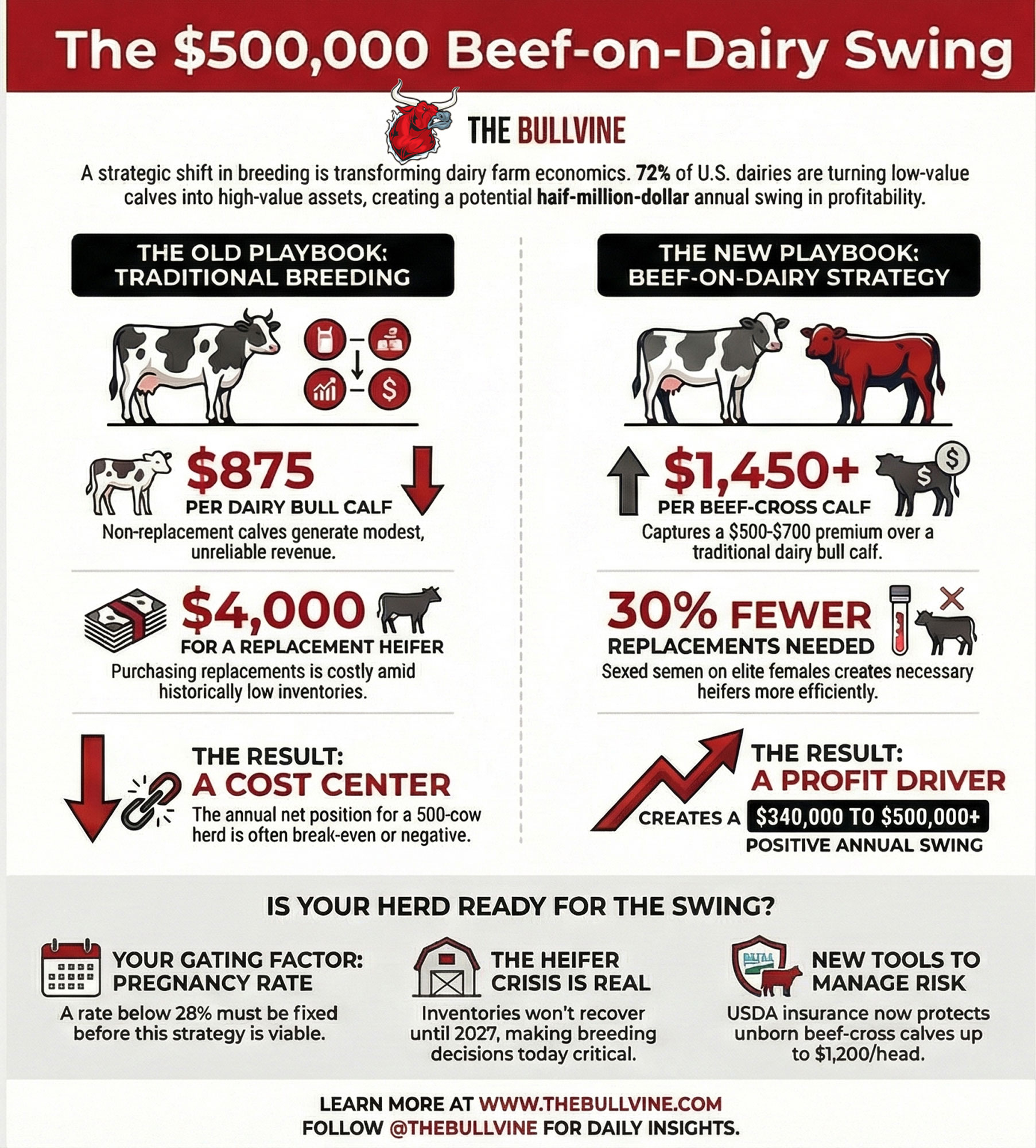
Beef-on-Dairy’s $6,215 Secret: Why 72% of Herds Are Playing It Wrong

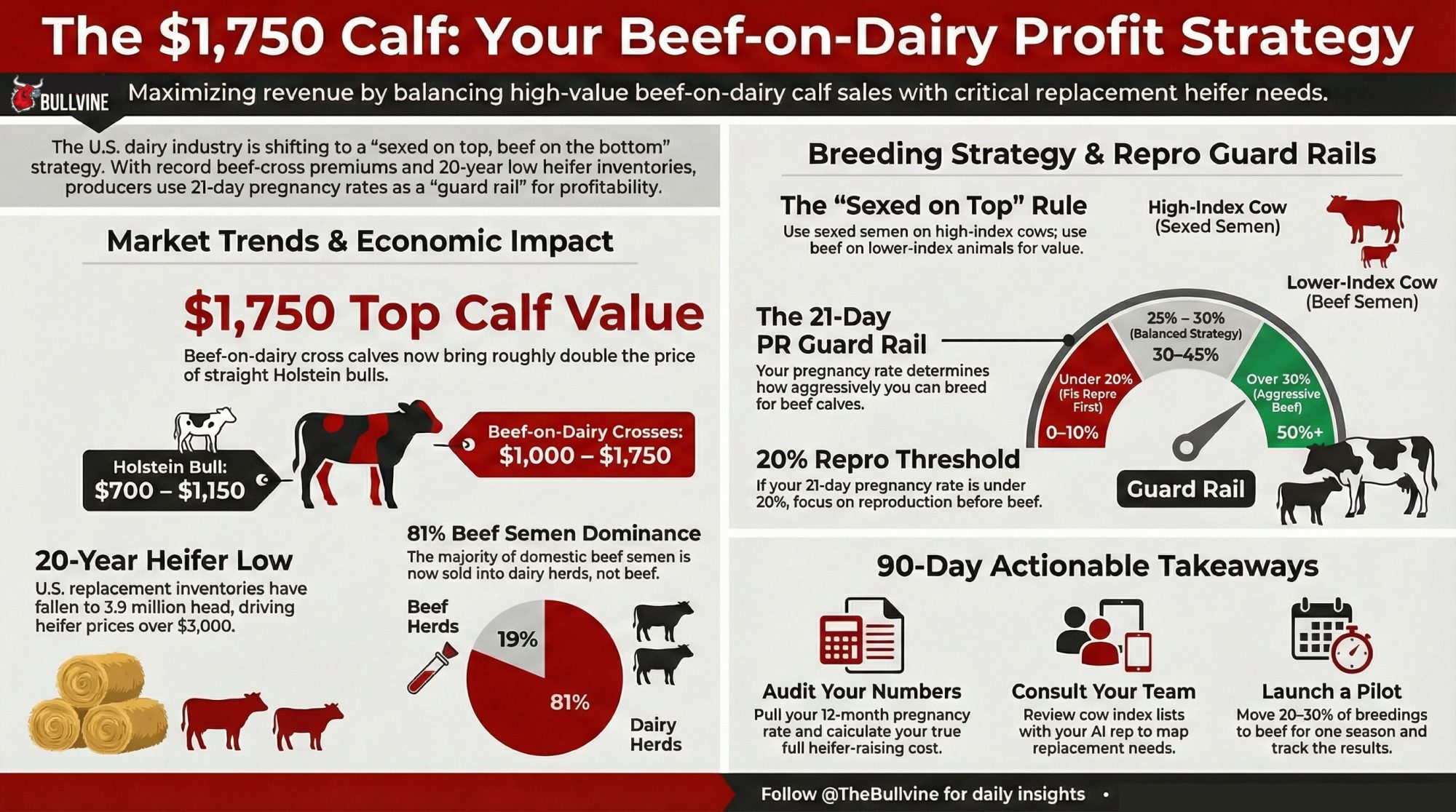
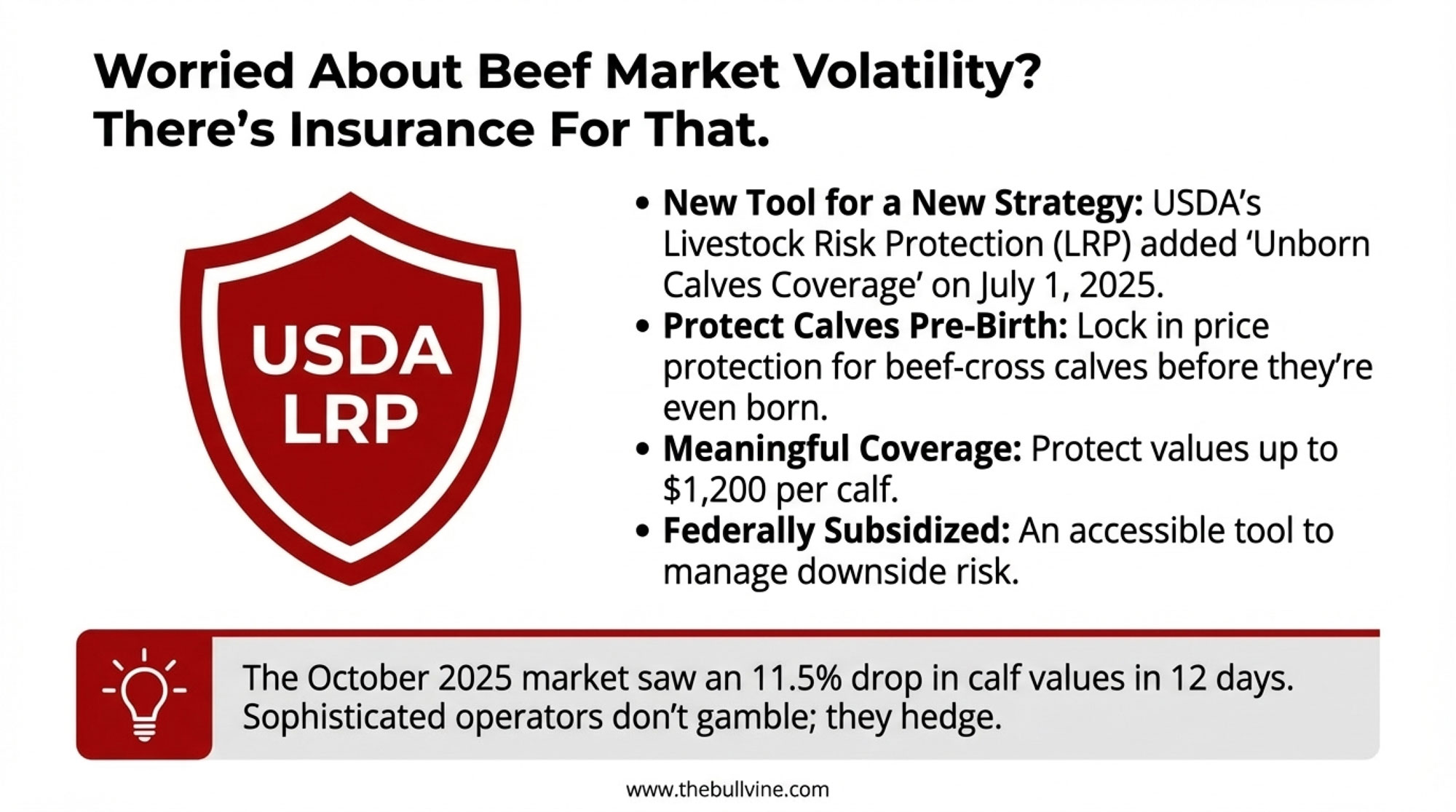
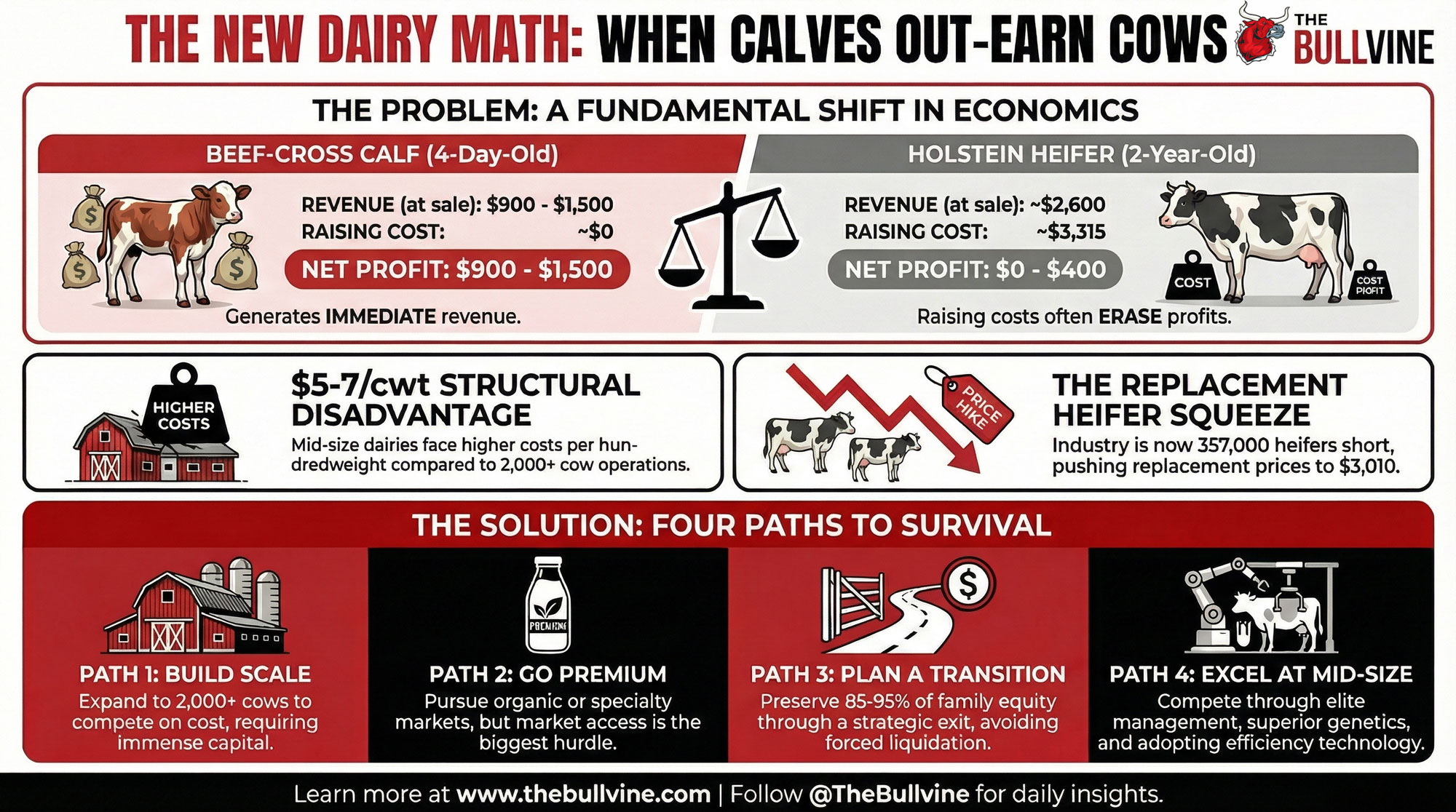
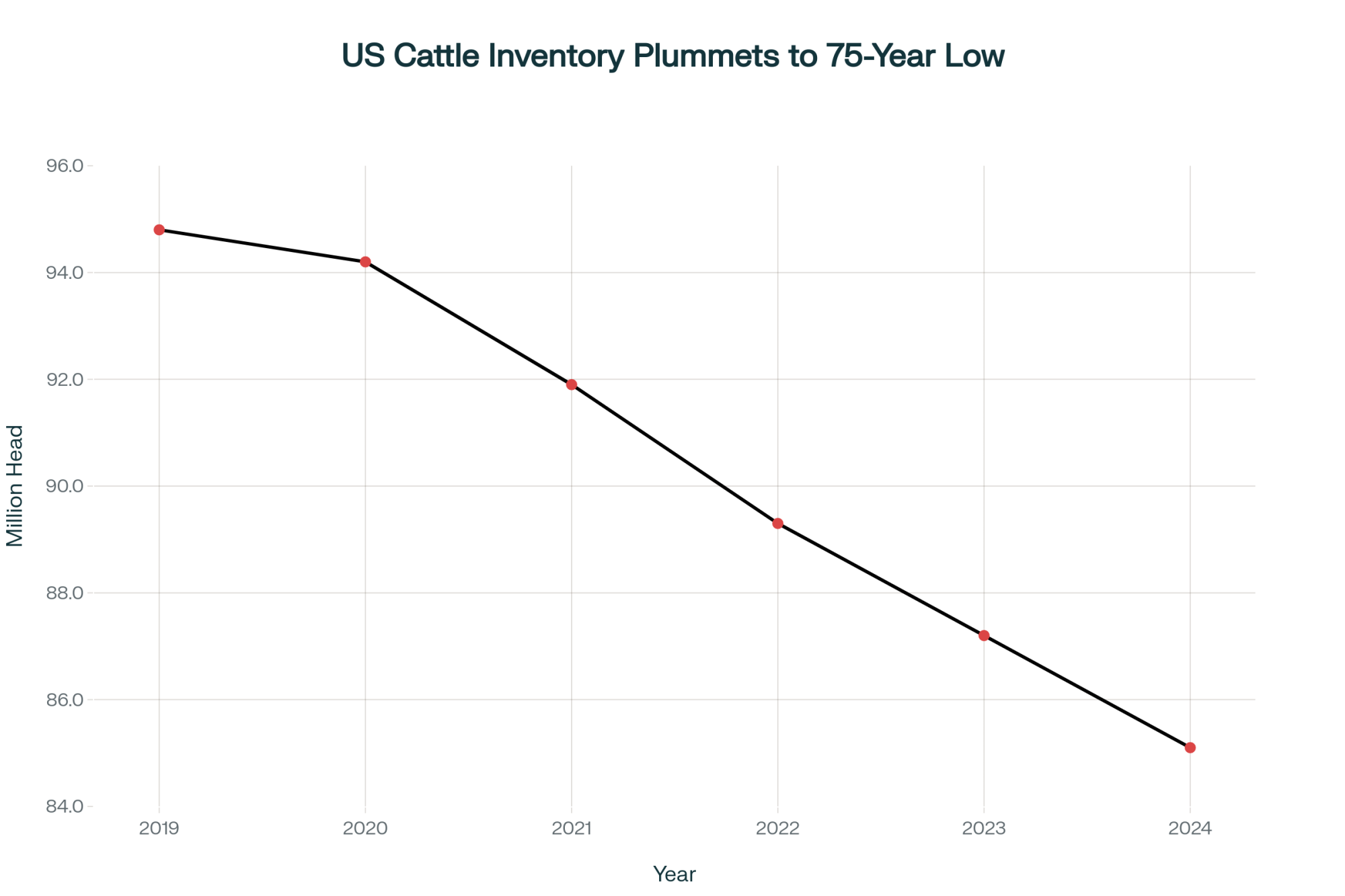
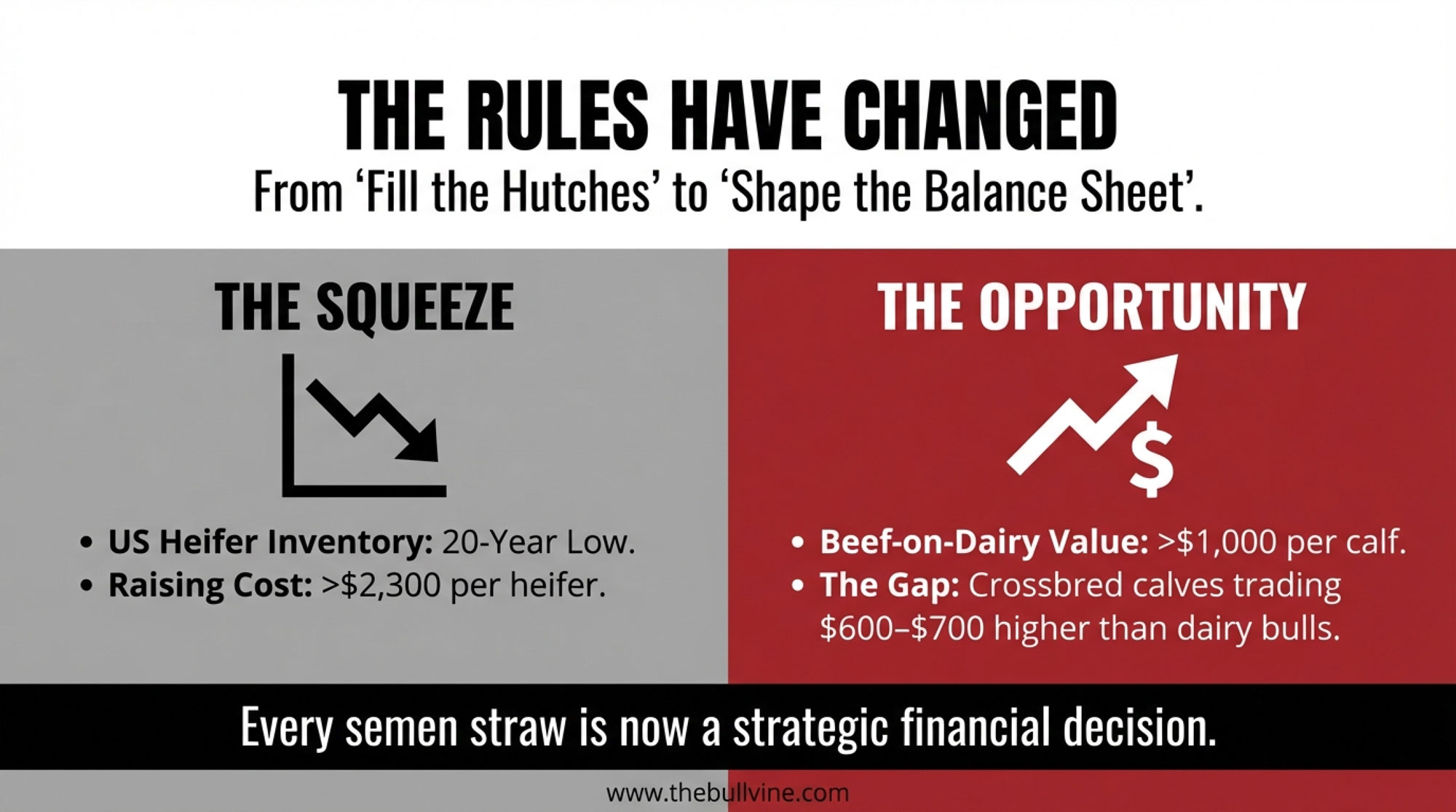
64-year low in beef cows. $1,100 dairy-cross calves. 2.5 million replacement heifers. Do the math.

You know how these conversations unfold at producer meetings. Walk into a barn office in Jefferson County, Wisconsin, and somebody’s showing you a $1,100 average on their Angus cross calves. Drive an hour north, and another producer’s working through why he came up short on replacement heifers last spring.

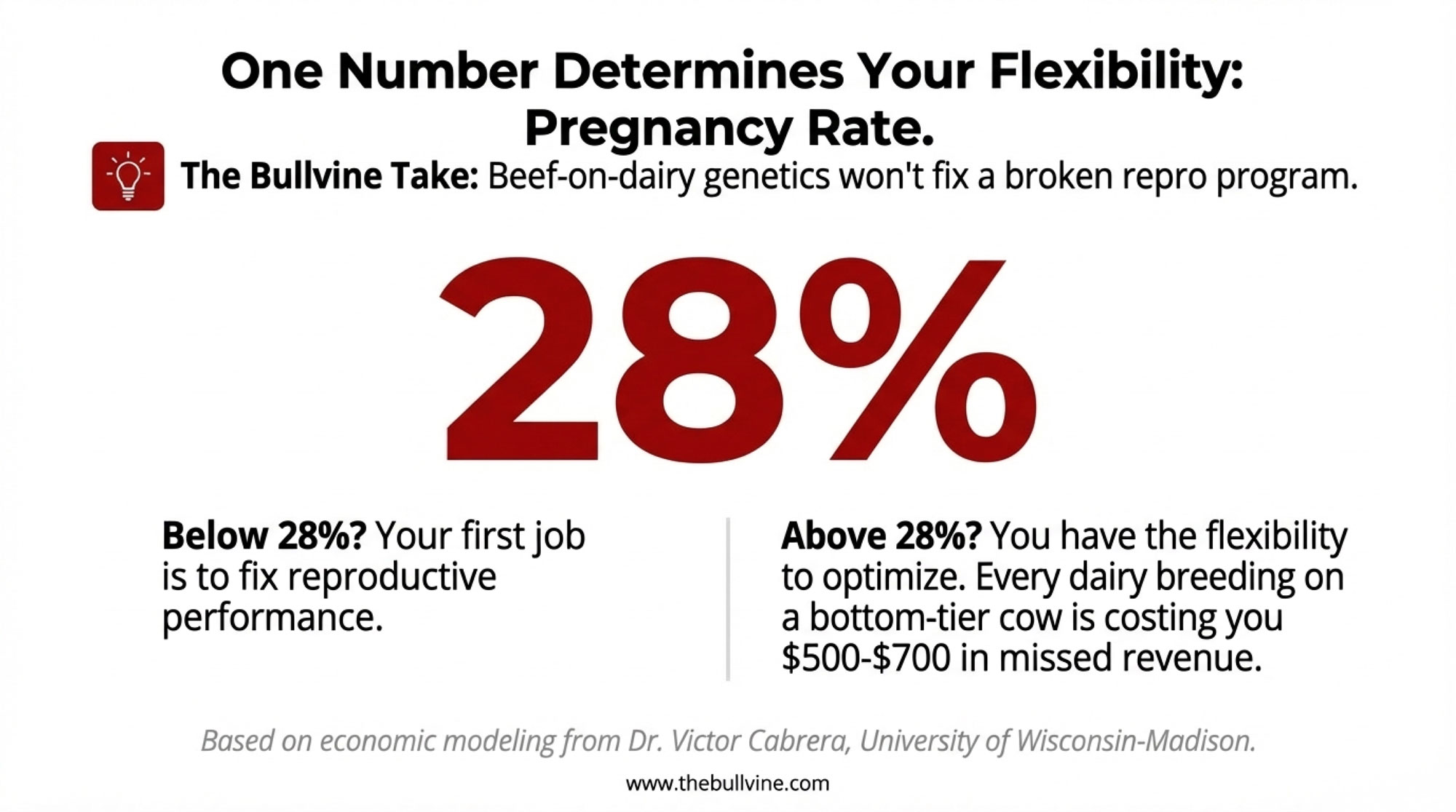
The difference between those two outcomes usually comes down to whether the breeding strategy actually fits the herd’s reproductive performance. That’s precisely what Dr. Victor Cabrera and his team at the University of Wisconsin-Madison have been quantifying—and more recent industry data confirms just how significant this opportunity has become for operations that approach it thoughtfully.

What the Wisconsin Research Reveals

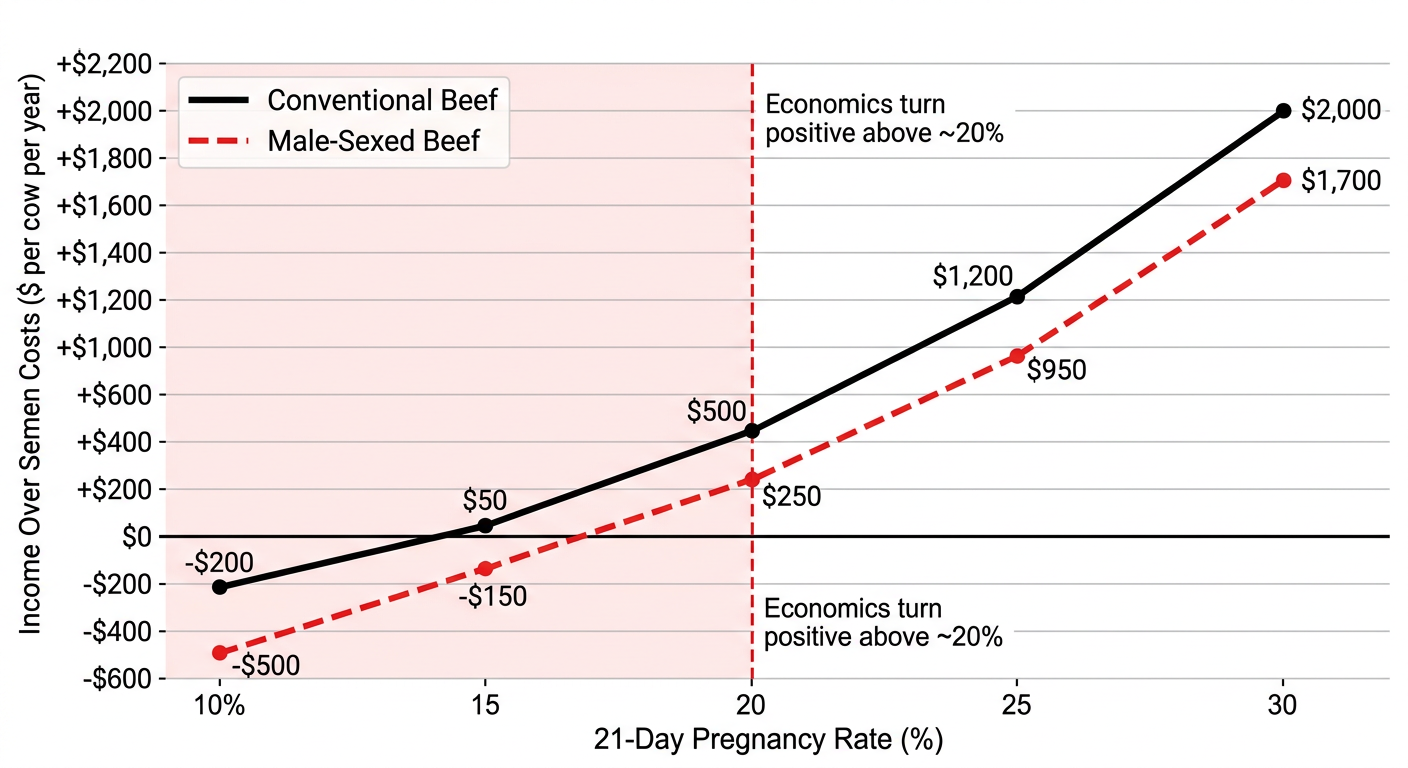
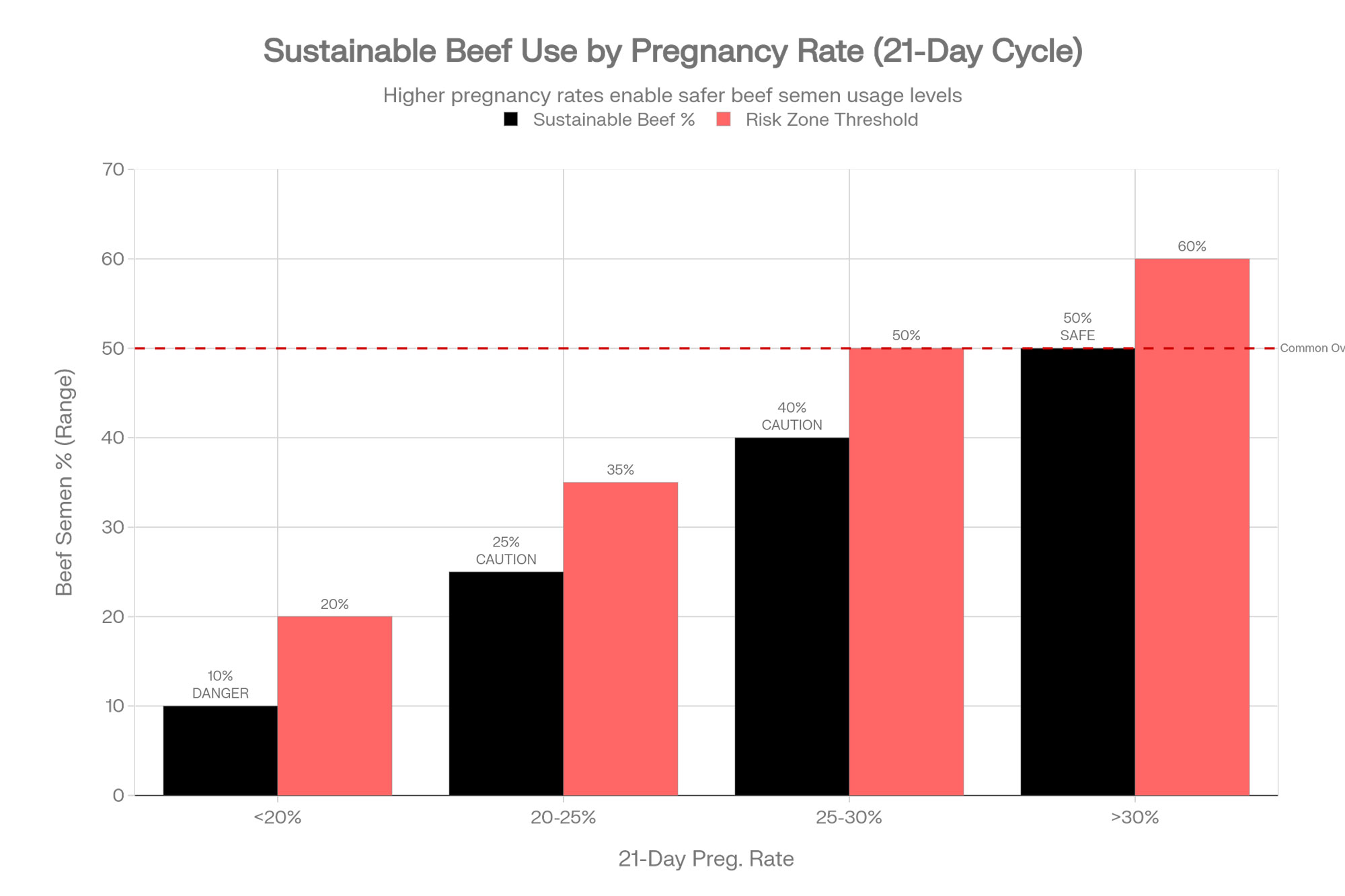
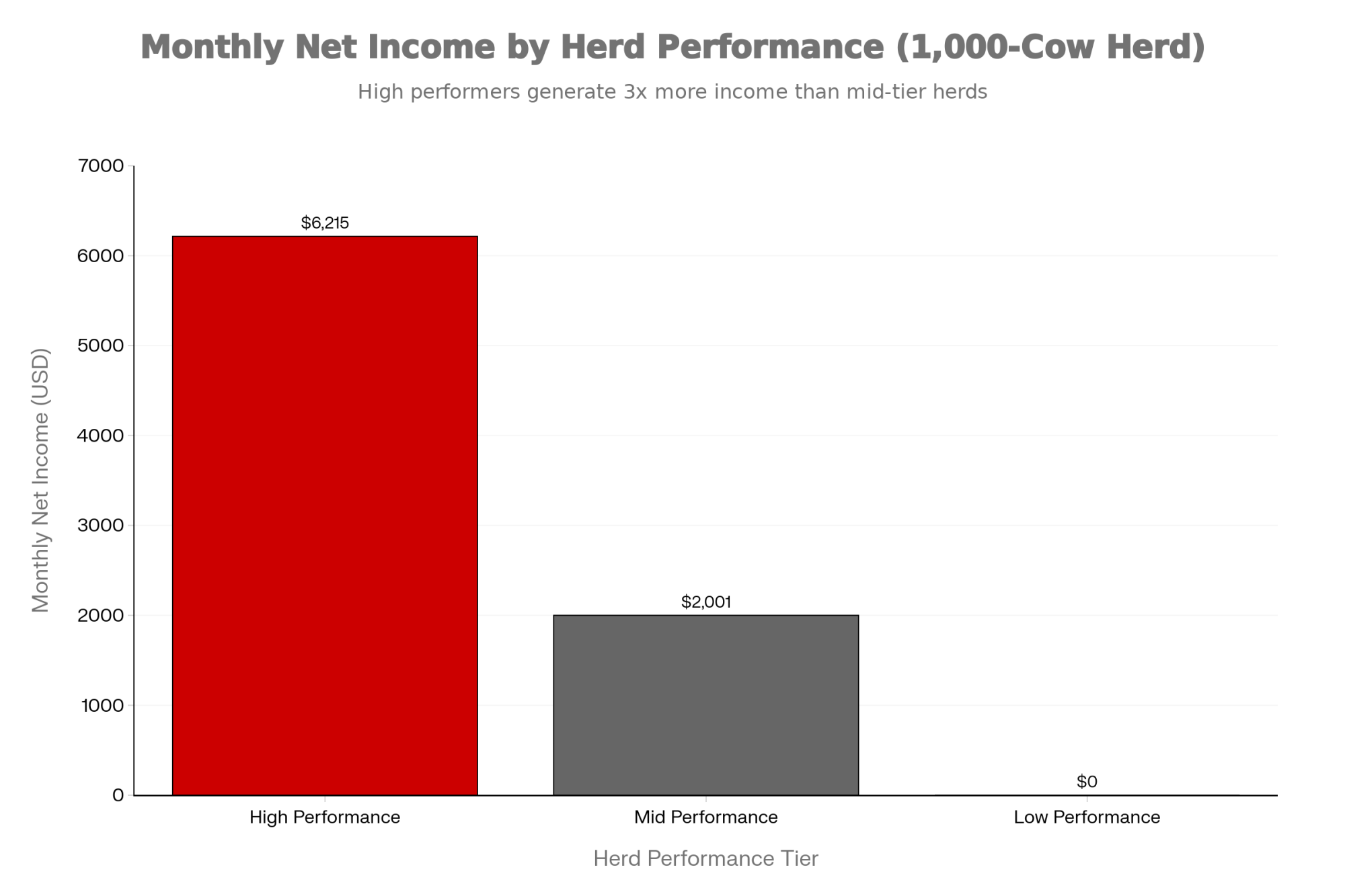
Dr. Cabrera published foundational research in JDS Communications that developed a decision-support model to calculate what he calls “income from calves over semen costs.” His team tested 30 different breeding strategies across three levels of reproductive performance. The results tell you exactly where your herd stands:

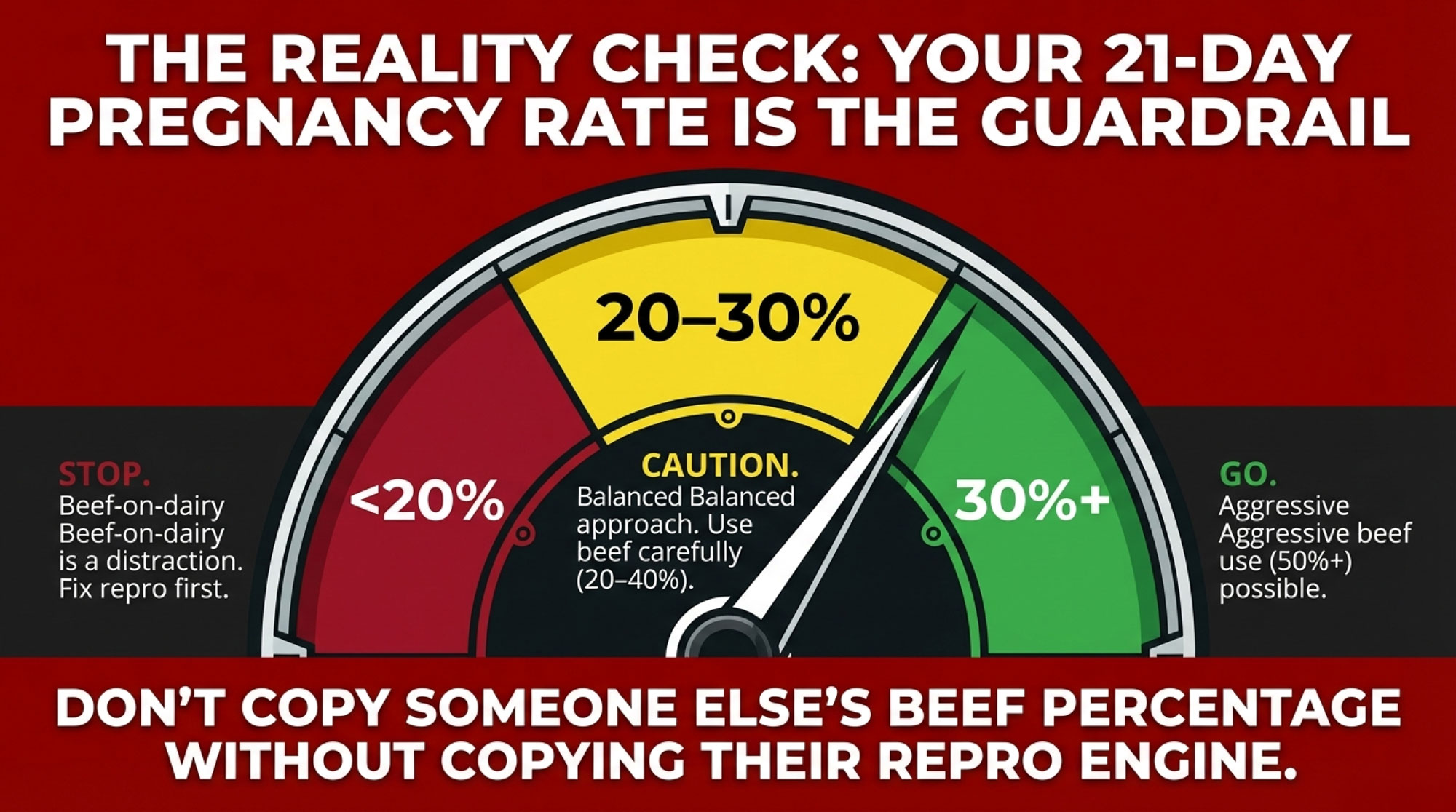
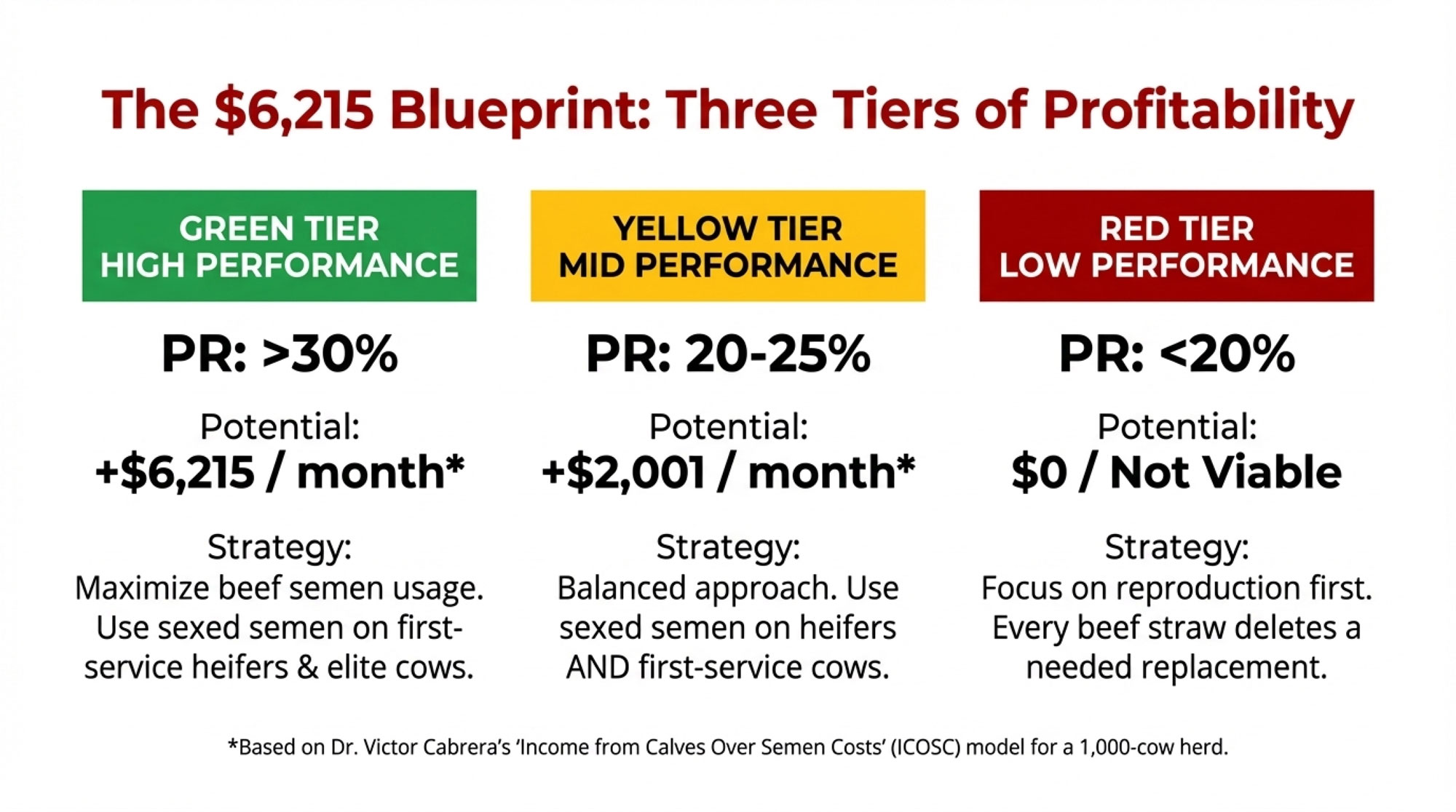
  • High Performance (~30% pregnancy rate): $6,215/month Using sexed semen on first-service heifers, then beef semen on adult cows. Produces adequate replacements while generating substantial calf income for a 1,000-cow herd.
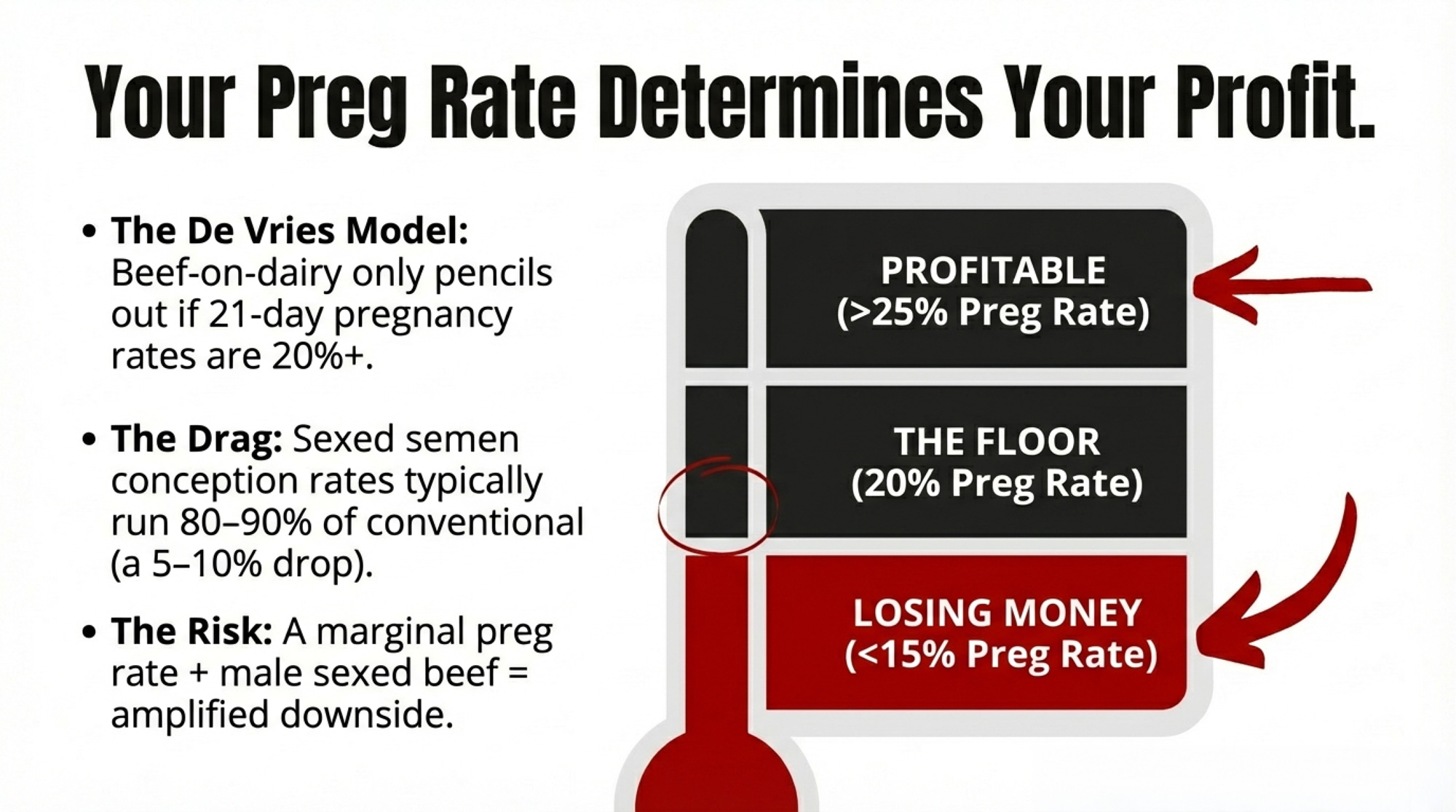
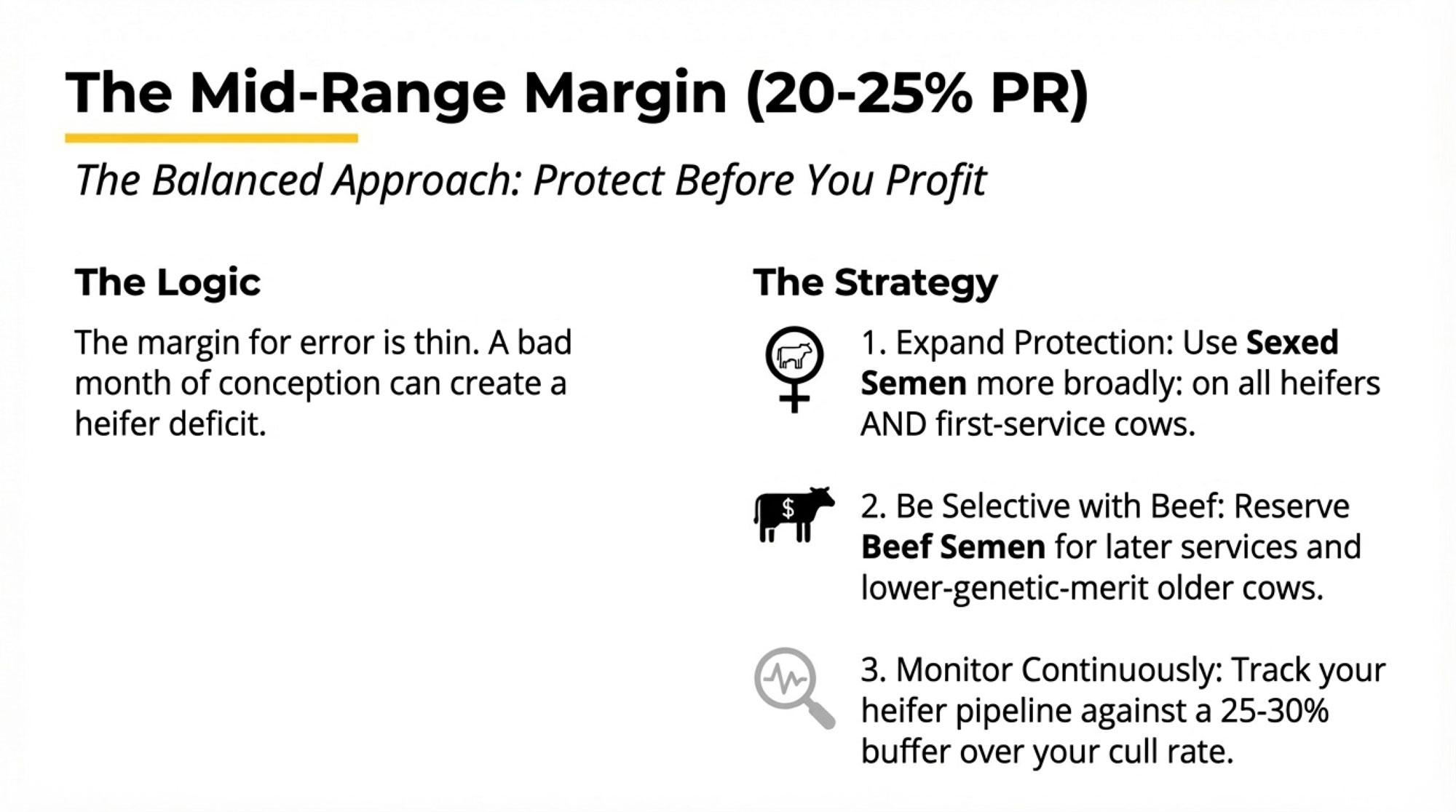
  • Mid Performance (~20% pregnancy rate): $2,001/month. Requires more sexed semen deployment—on heifers and first-service primiparous cows—before safely shifting to beef semen elsewhere. Still meaningful, but the economics shift considerably.
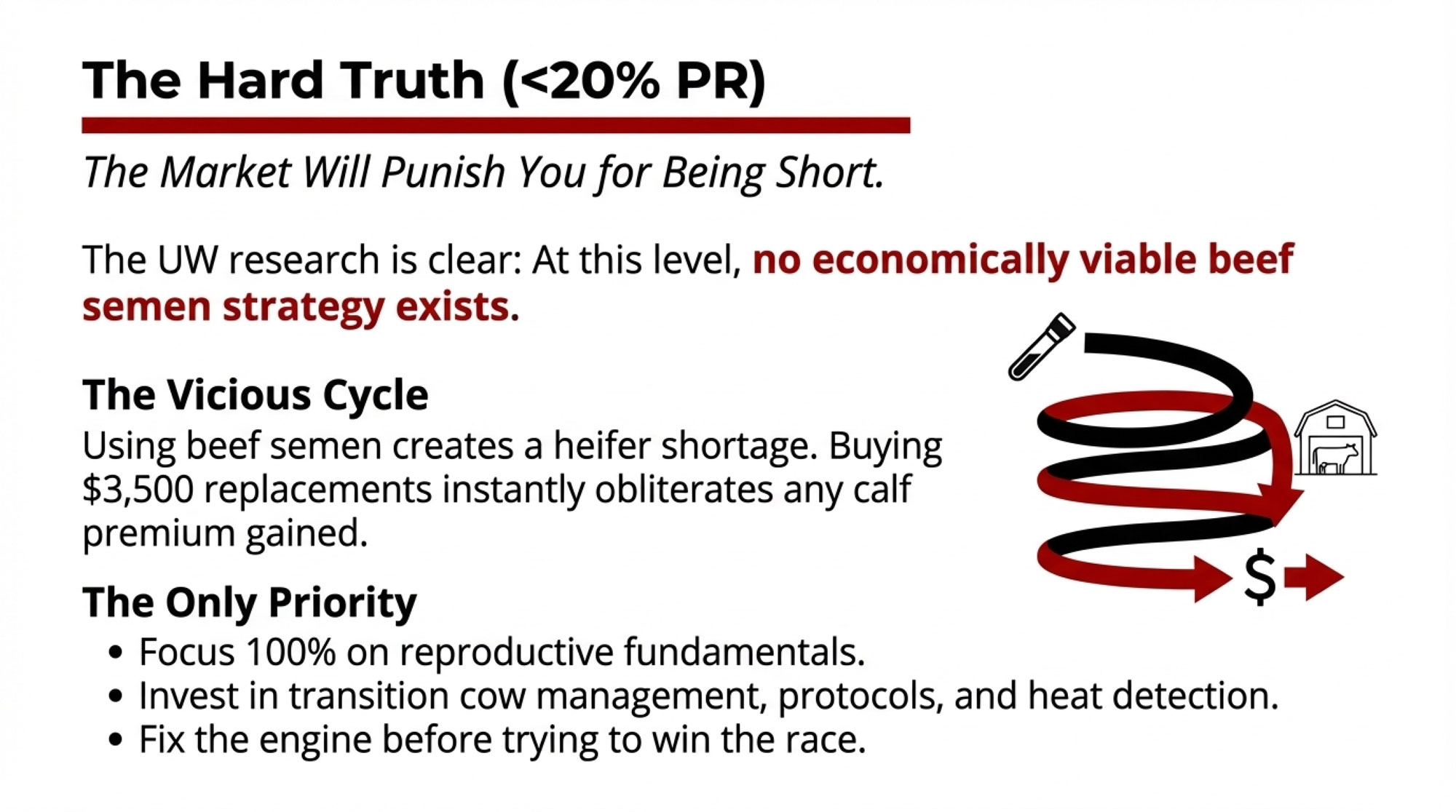
  • Low Performance (<20% pregnancy rate): $0 — Not Viable. No economically viable strategy for the use of beef semen exists at this level. These herds struggle to produce enough replacements even under conventional breeding.
The $6,215 performance gap: Wisconsin research reveals high-performing herds (30%+ pregnancy rate) generate 3x more monthly beef-dairy income than mid-tier operations—while low performers can’t viably deploy beef semen at all

That last finding doesn’t get enough attention. It’s not meant to discourage lower-performing herds—it points toward where to focus first. Reproductive fundamentals lay the foundation for beef-on-dairy strategies.

How Widespread Has Adoption Become?

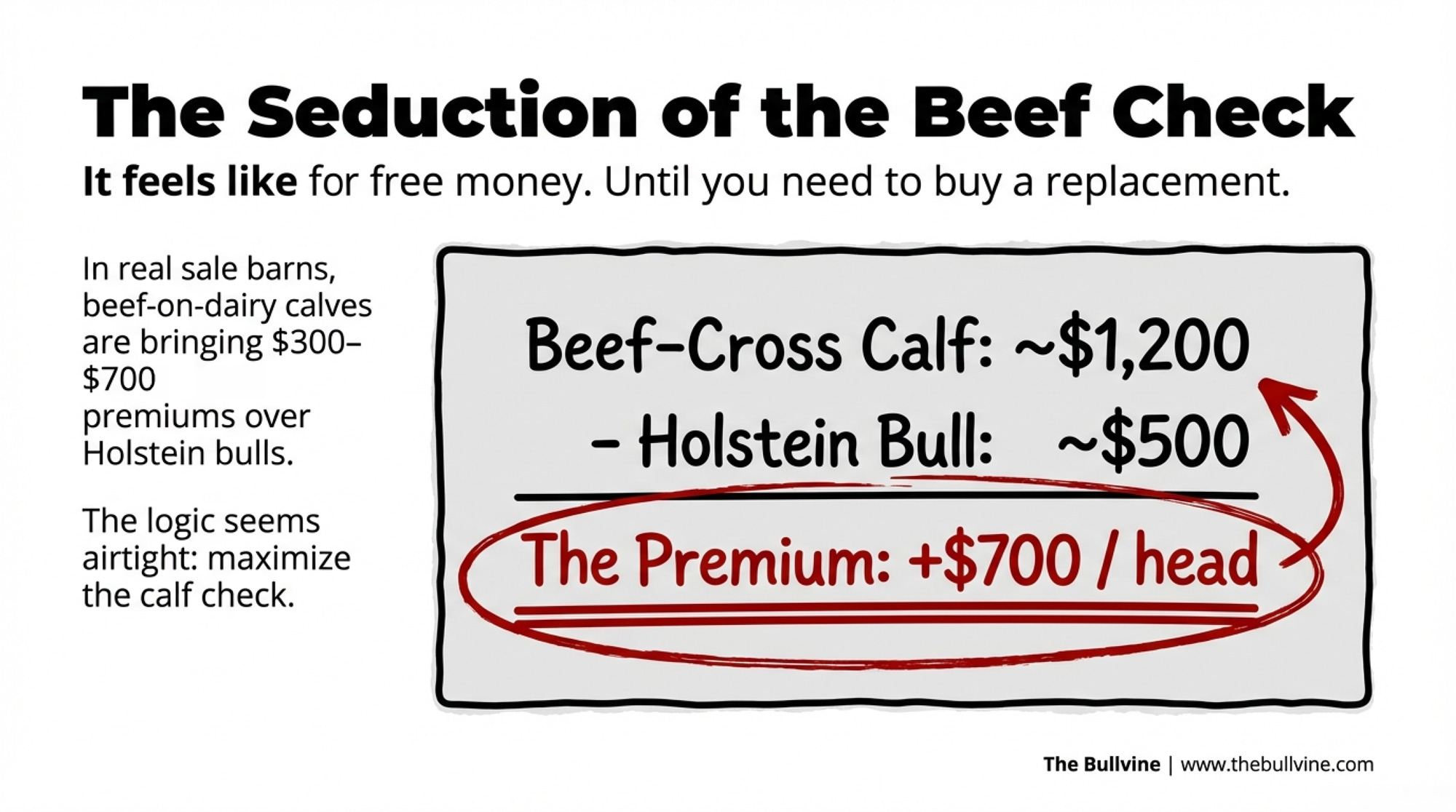
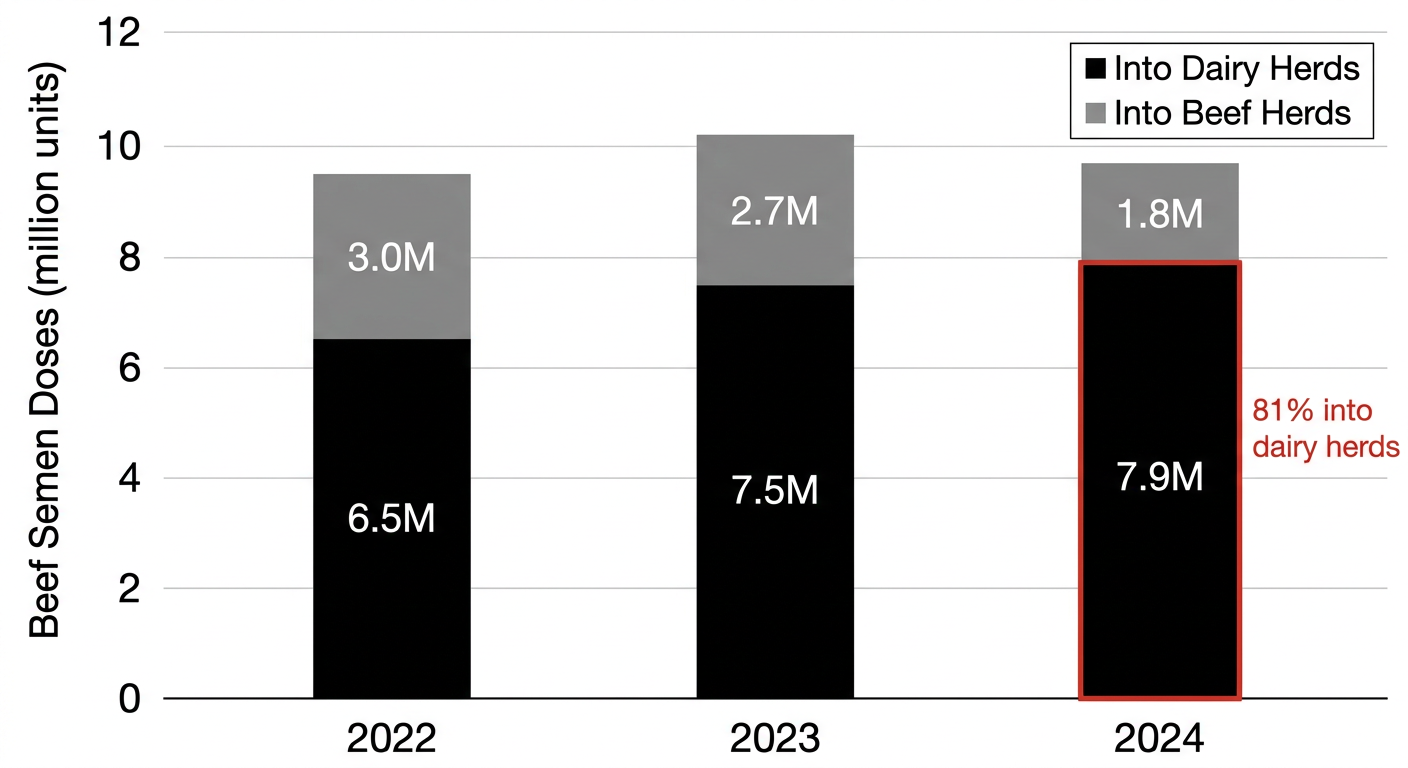
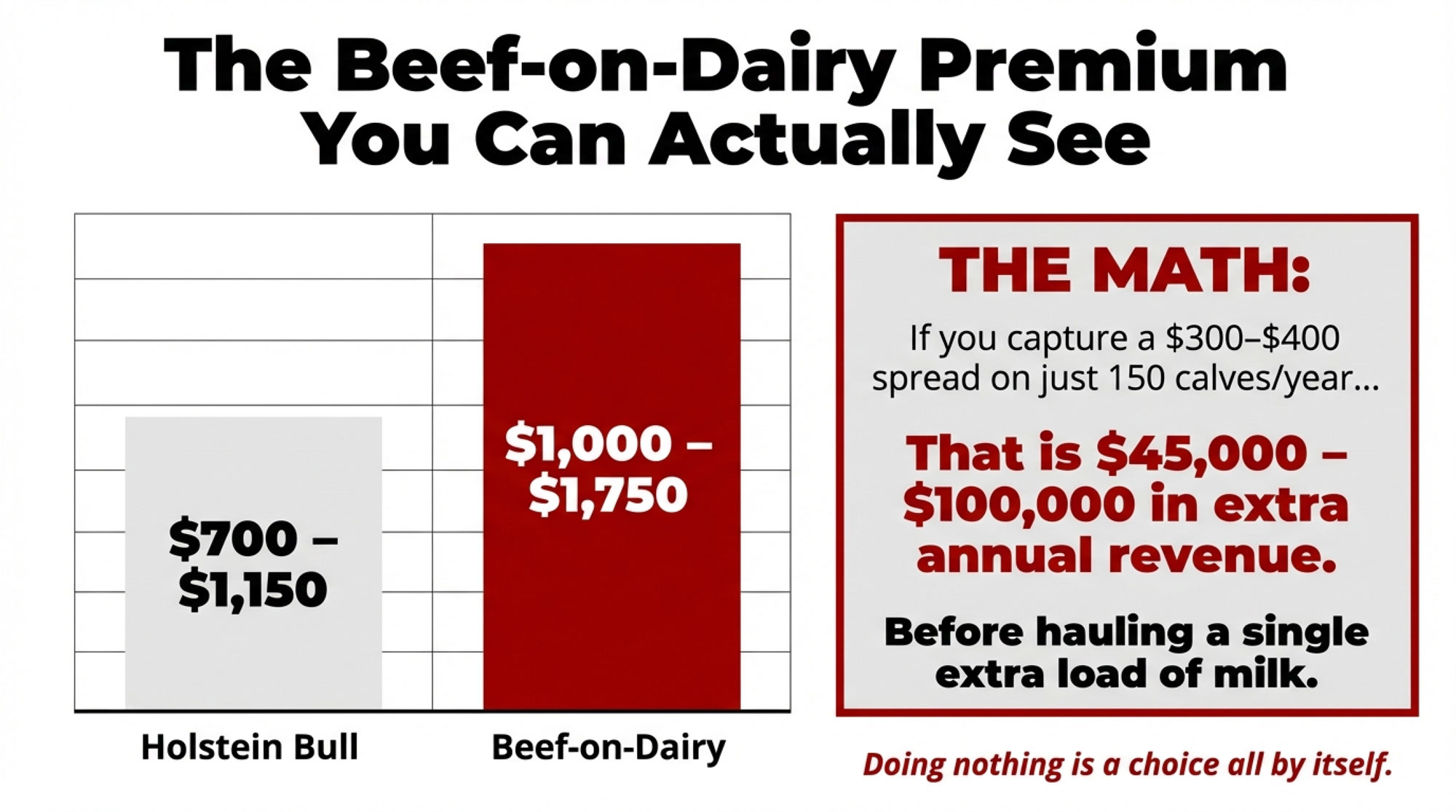
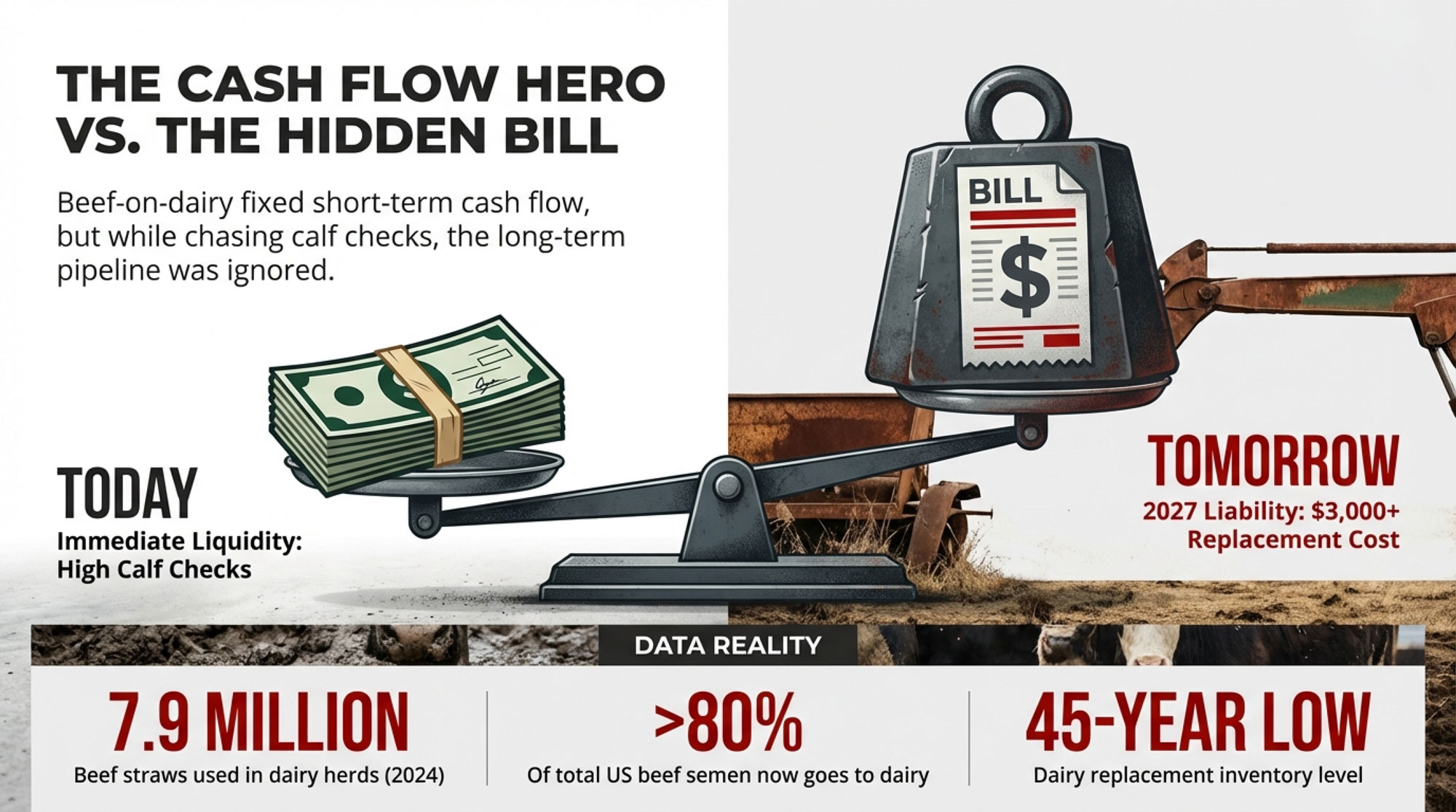
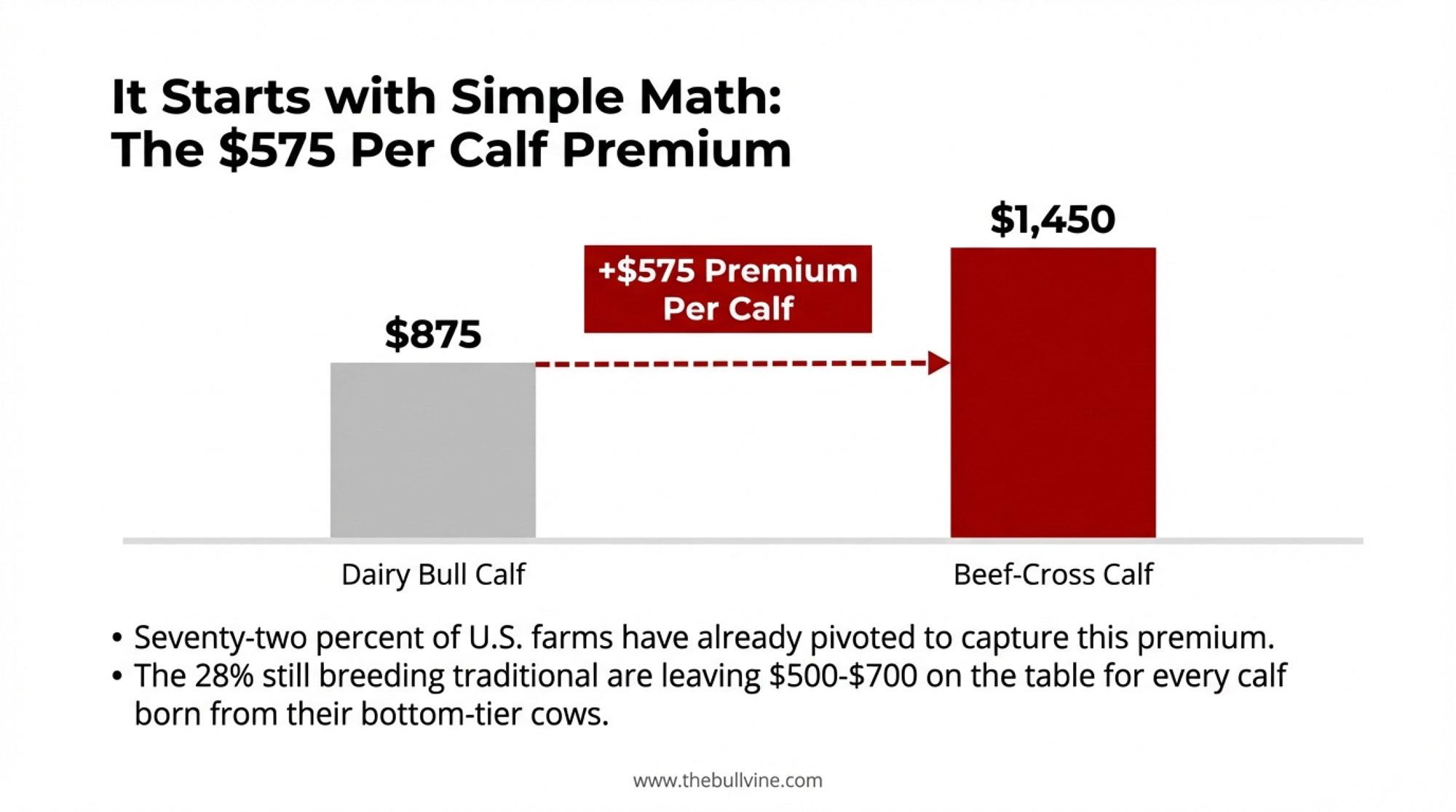
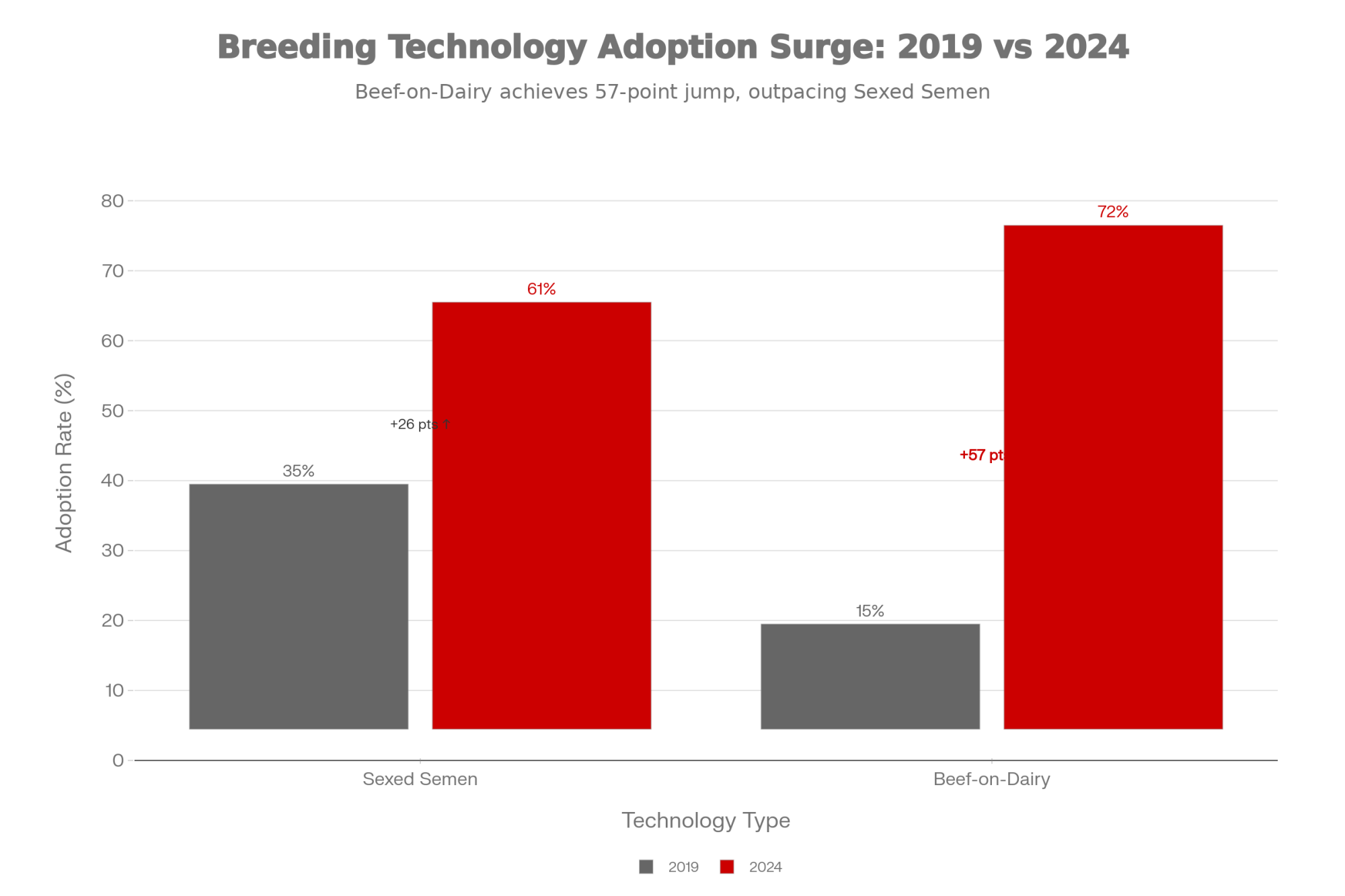
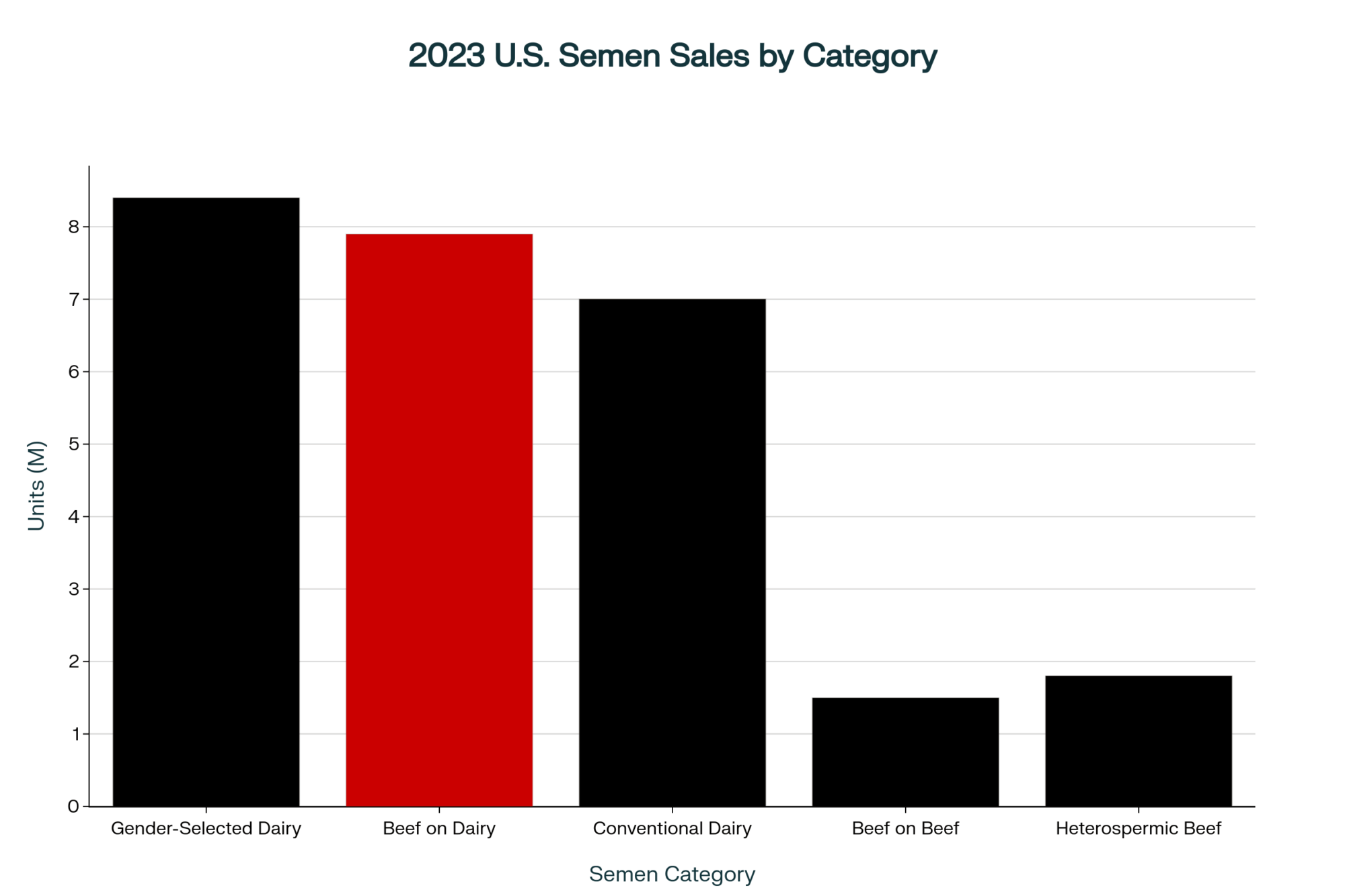
The pace of change since that 2021 research has been remarkable. According to the National Association of Animal Breeders data, domestic beef semen sales to dairy operations reached 7.9 million units in 2023—representing 31% of total semen sales to dairy. A 2024 survey conducted by Purina found that 80% of dairy farmers now receive a premium for beef-on-dairy calves, with reported revenues of $350 to $700 per head above purebred dairy calves.

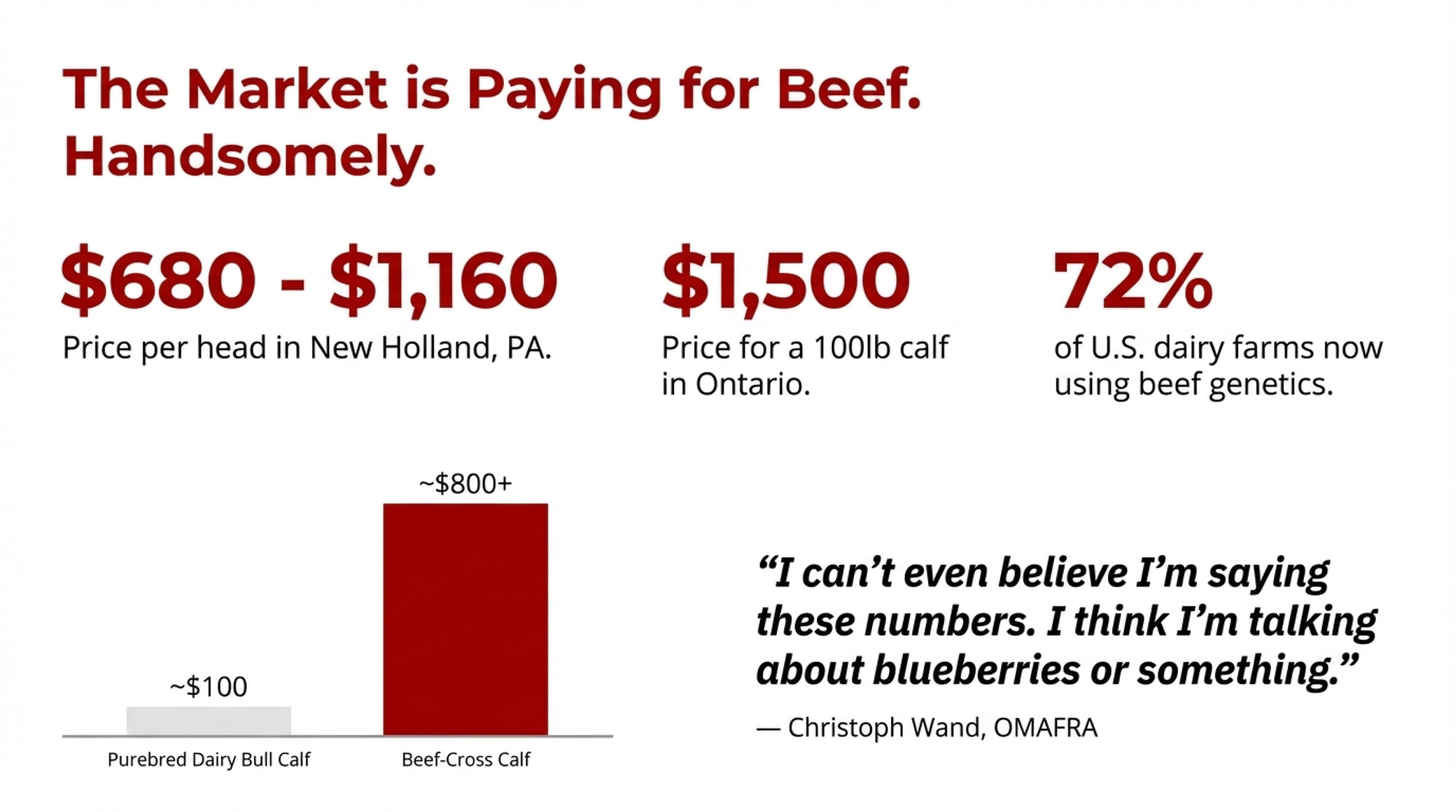
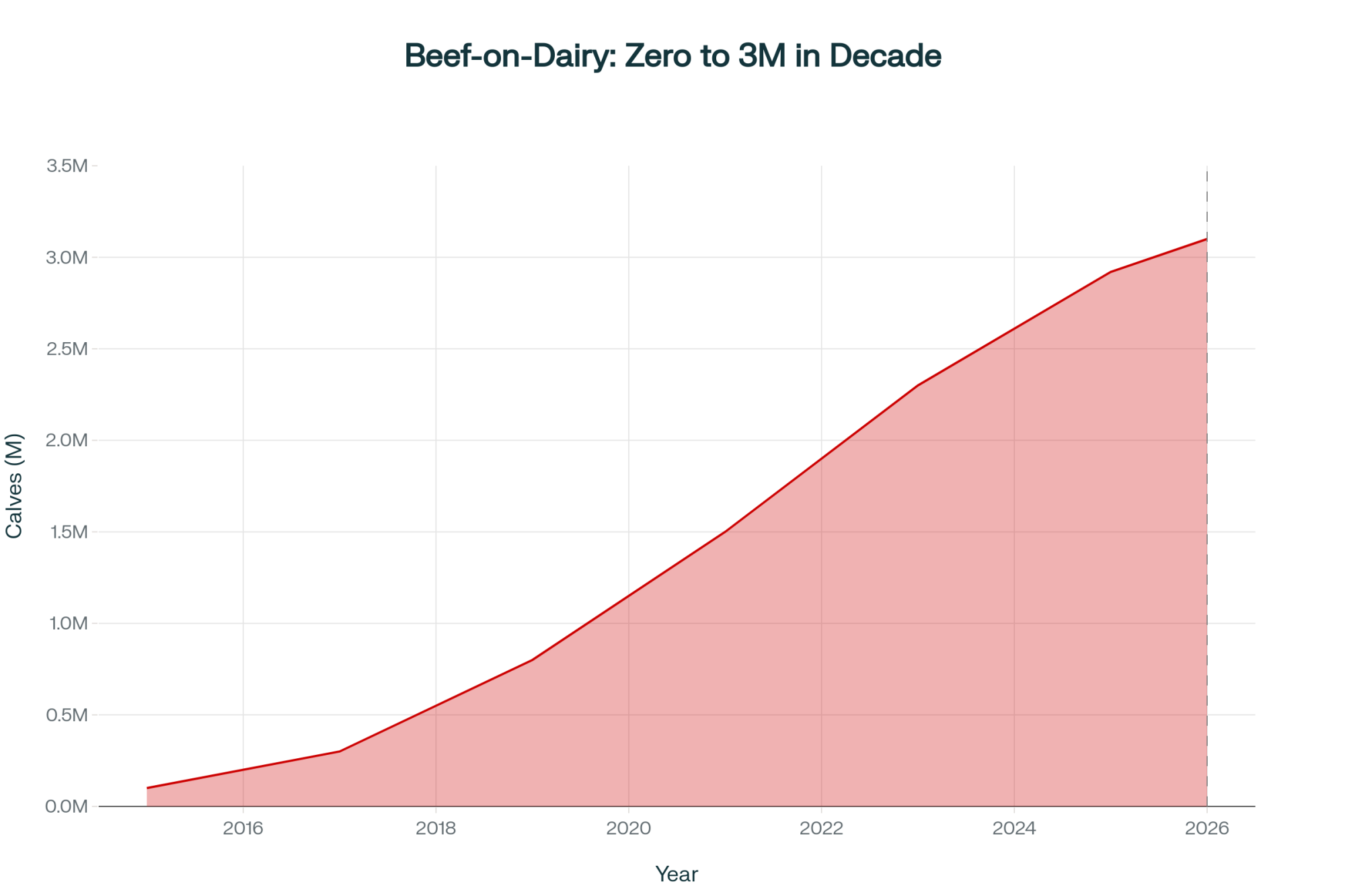
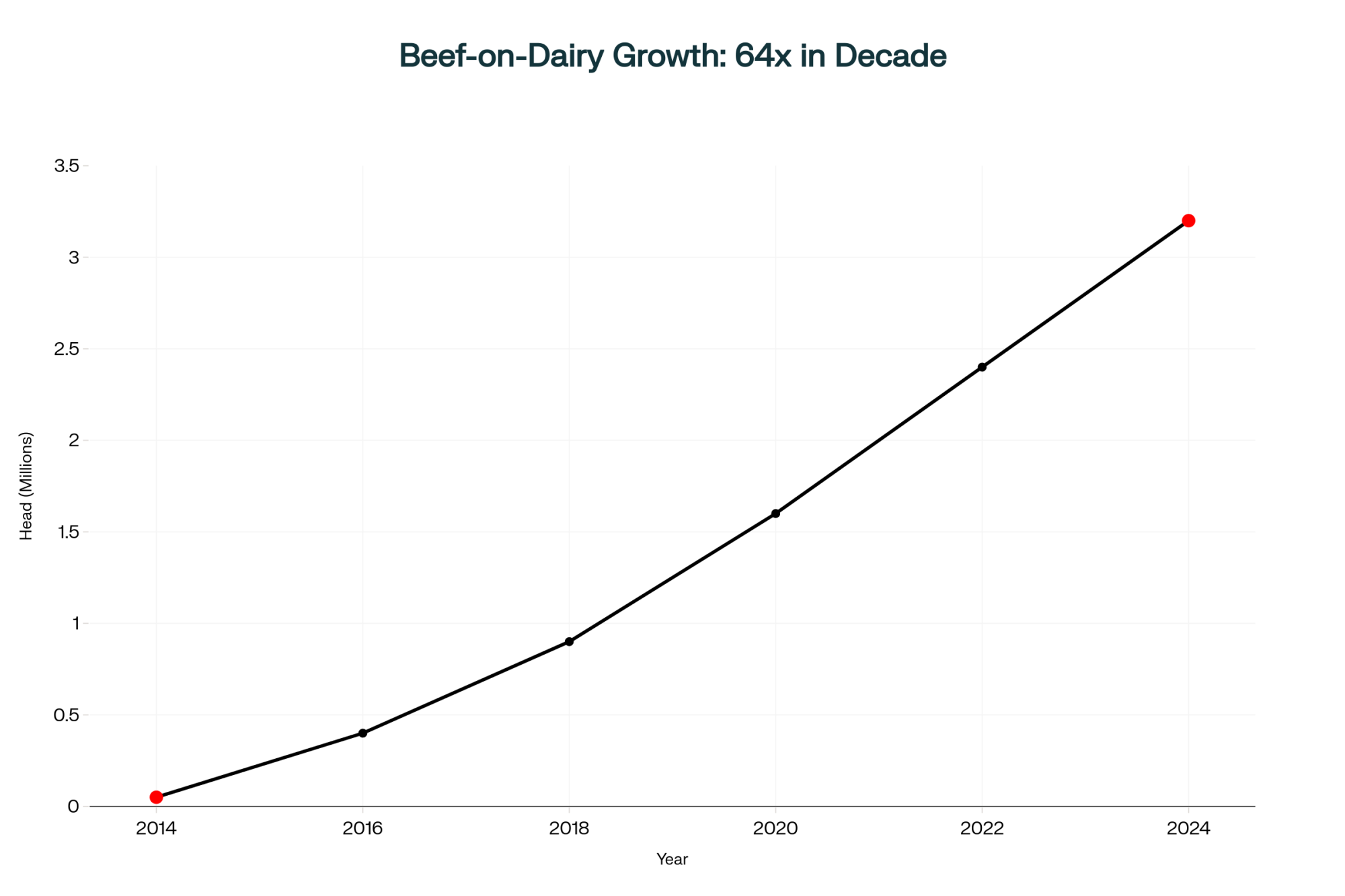
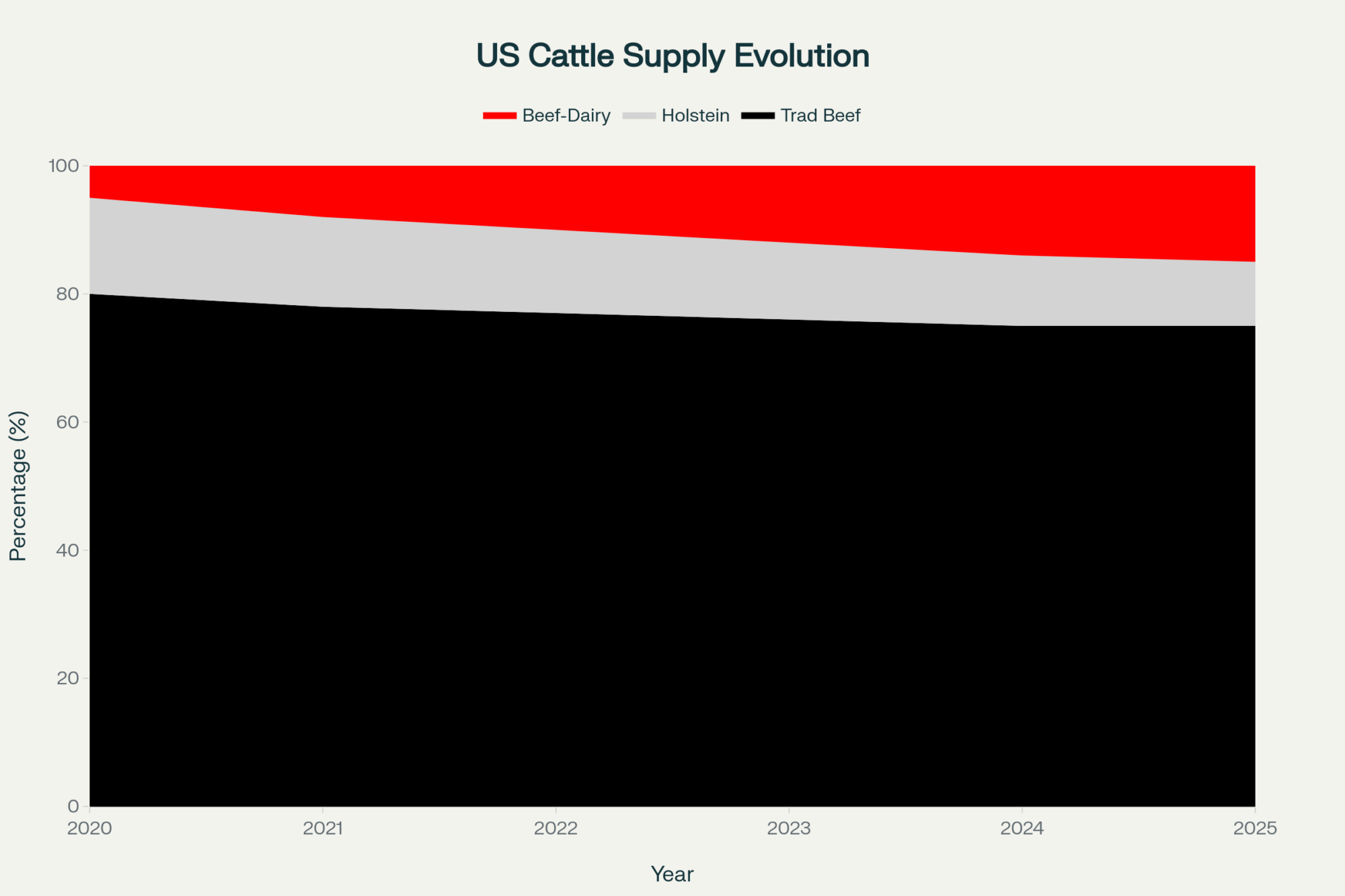
Farm Bureau data indicates that 72% of dairy farms are now using beef genetics on at least part of their herd—a dramatic shift from just a few years ago. Ohio State University economists estimate that beef-on-dairy could account for 15% of total cattle slaughter by 2026, up from essentially zero a decade ago.

What’s interesting is how this has evolved from an experimental strategy into standard practice for many operations. The question isn’t really whether to participate anymore—it’s how to do it without compromising your replacement pipeline.

Current Market Context

What’s shifted dramatically since the foundational research is the magnitude of the calf price premium. Dr. Cabrera’s original model used a baseline of $225 for beef-cross calves. Current conditions look quite different.

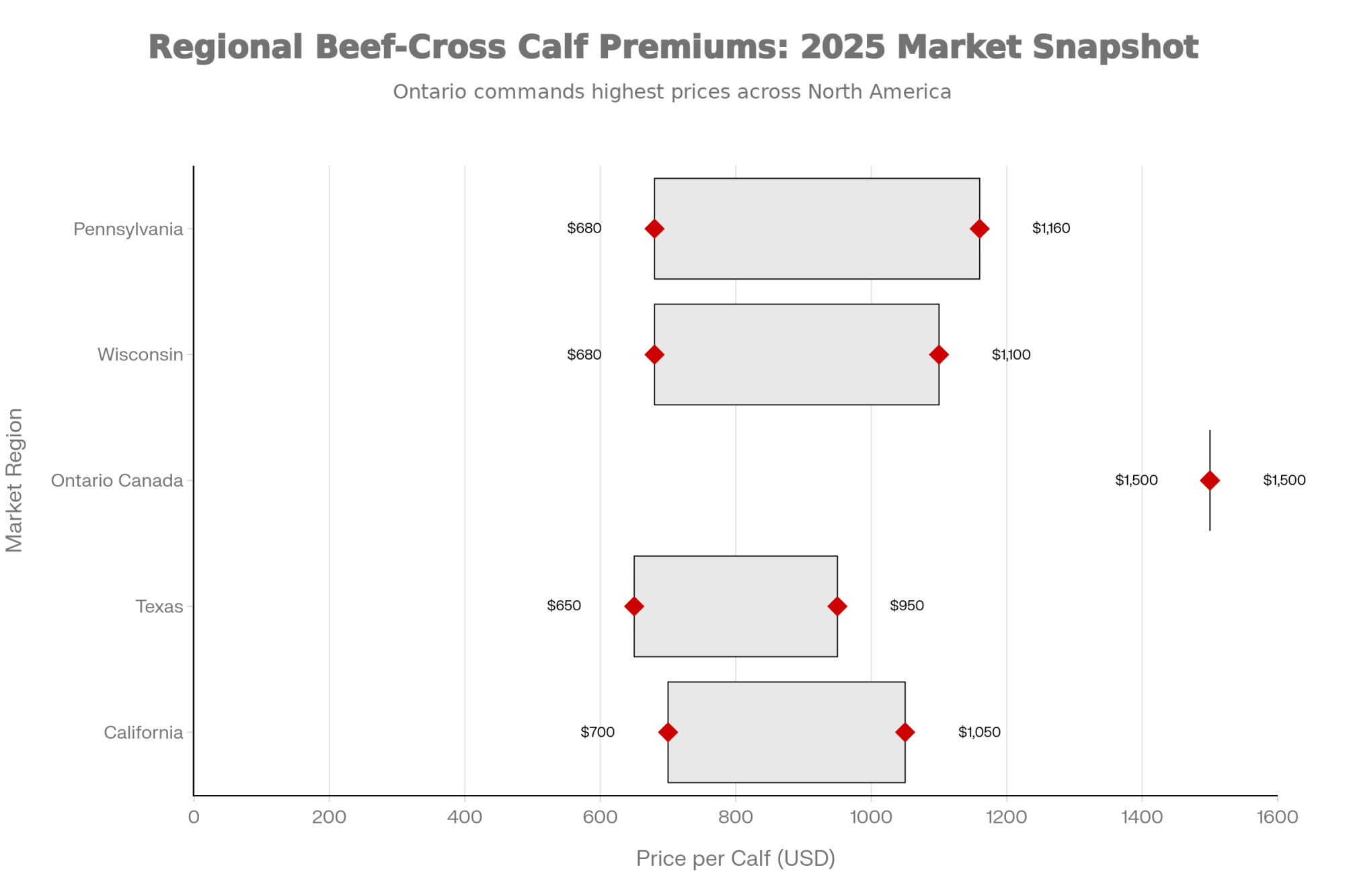
  • New Holland (PA): $680 to $1,160 per head for beef-cross calves at 60-100 pounds, according to USDA-verified auction reports.
  • Wisconsin markets: $680 to $1,100 per head for comparable calves.
  • Ontario: approximately $15 per pound—or $1,500 for a 100-pound calf, as reported by Christoph Wand, OMAFRA’s Livestock Sustainability Specialist, at Ontario Dairy Days earlier this year.

“I can’t even believe I’m saying these numbers,” Wand remarked. “I think I’m talking about blueberries or something.”

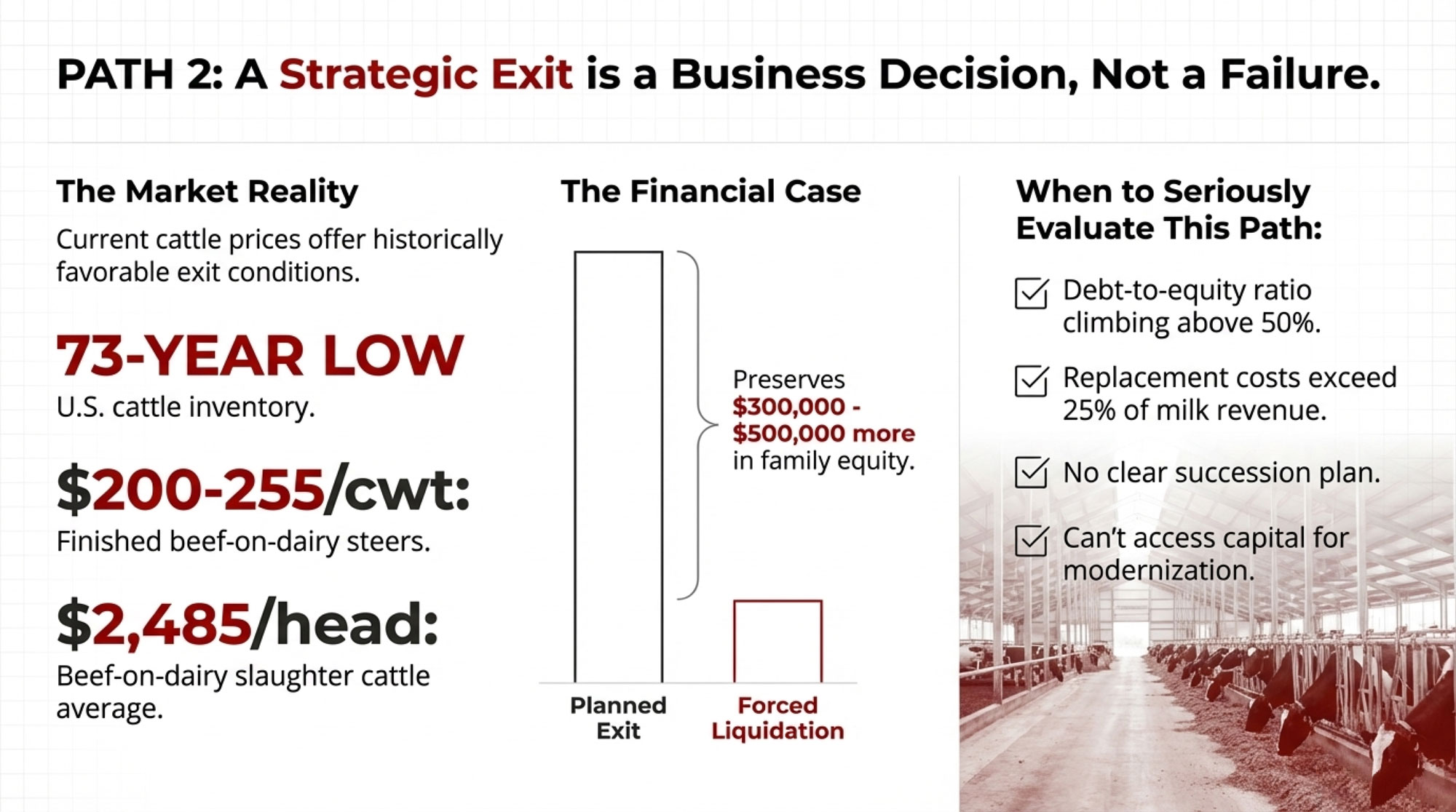
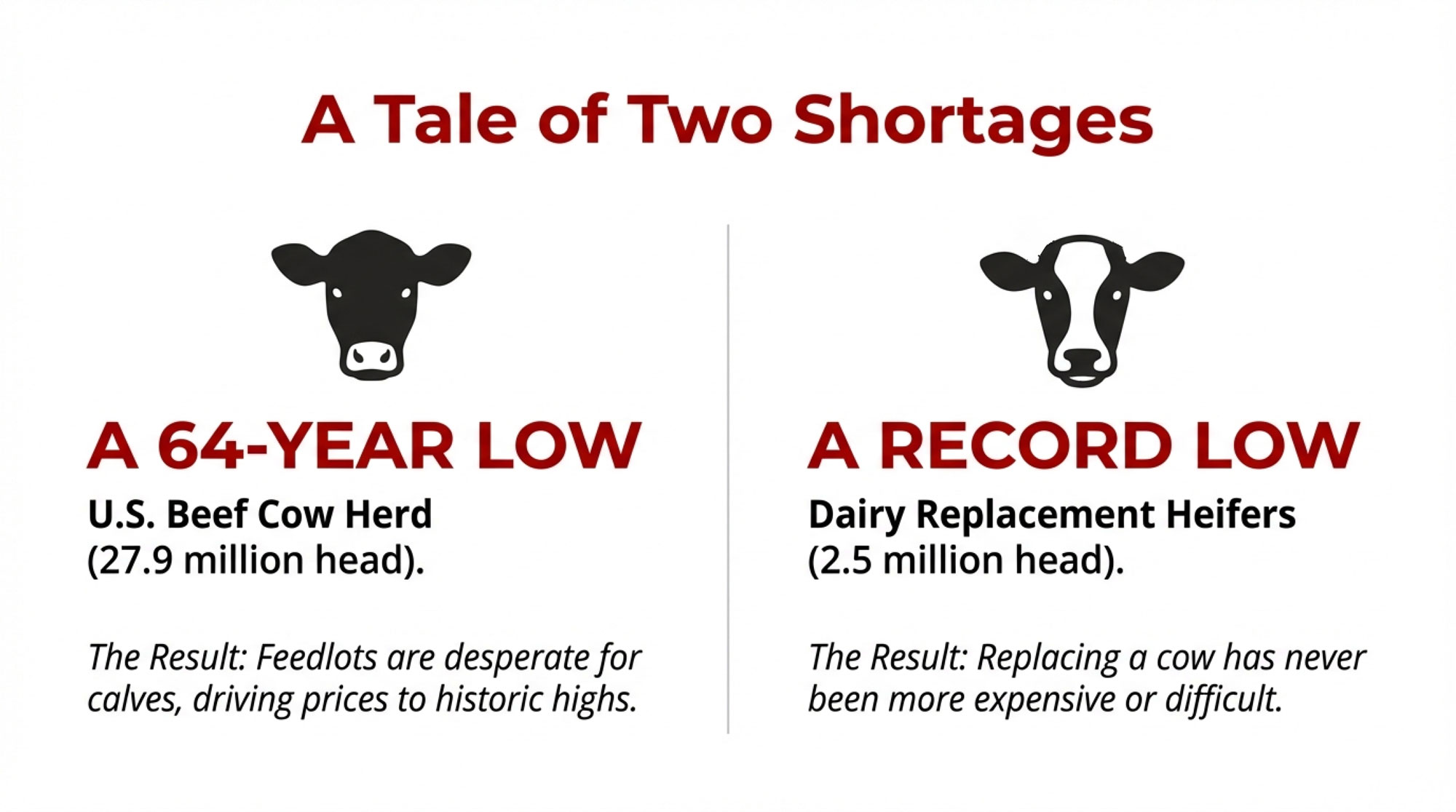
Why such strong premiums? The U.S. beef cow herd hit a 64-year low in early 2025 according to USDA data, and industry analysts don’t expect a meaningful recovery before 2028. Feedlots need calves, and beef-on-dairy crossbreds are filling that supply gap.

A recent analysis in Choices Magazine notes that crossbred calves achieve higher quality grades than traditional dairy steers, increasing profitability at the feedlot level and supporting premium pricing for dairy producers.

Markets cycle. These premiums won’t last forever. But the structural dynamics—a multi-year timeline for beef herd rebuilding—suggest the opportunity window remains open for operations ready to act on it.

The Replacement Question

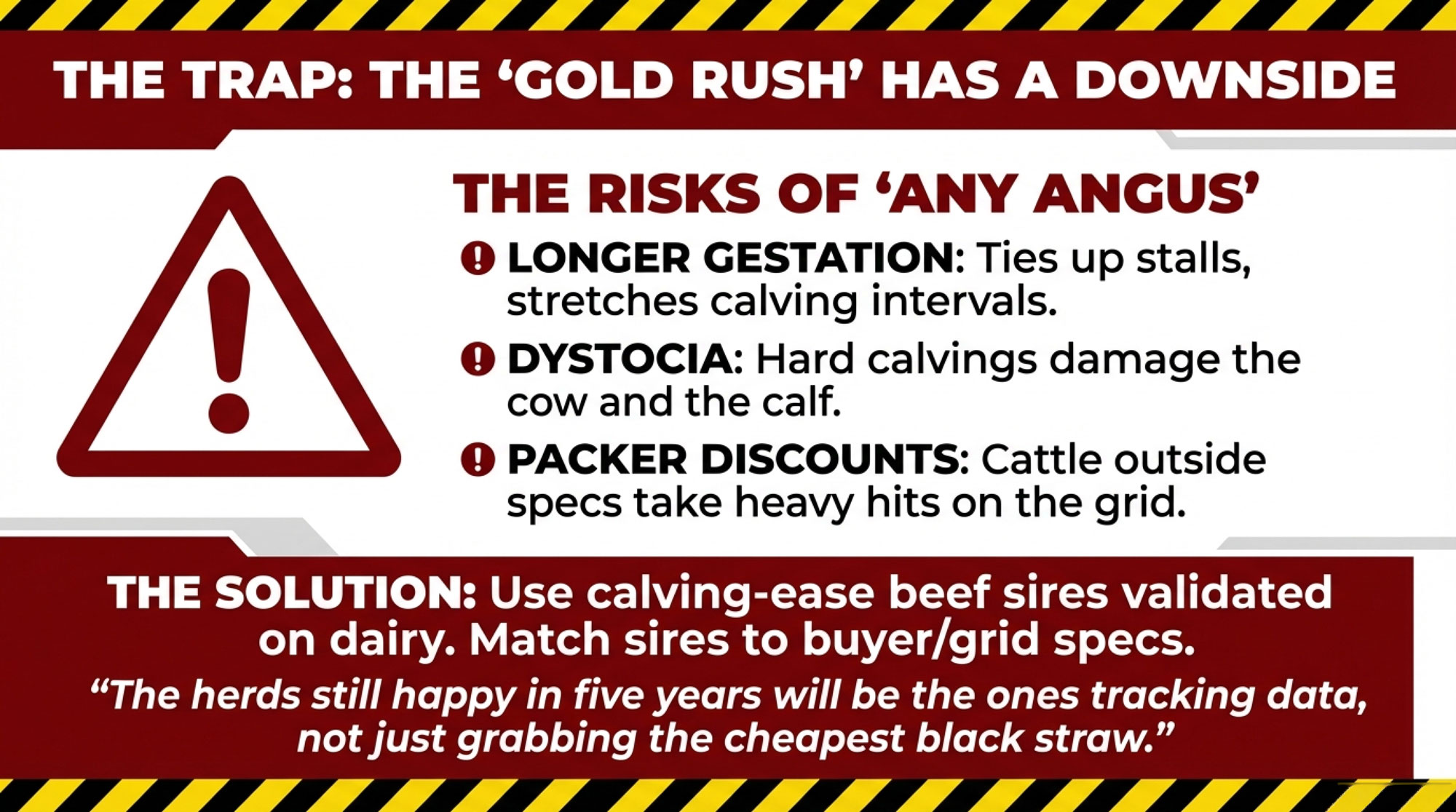
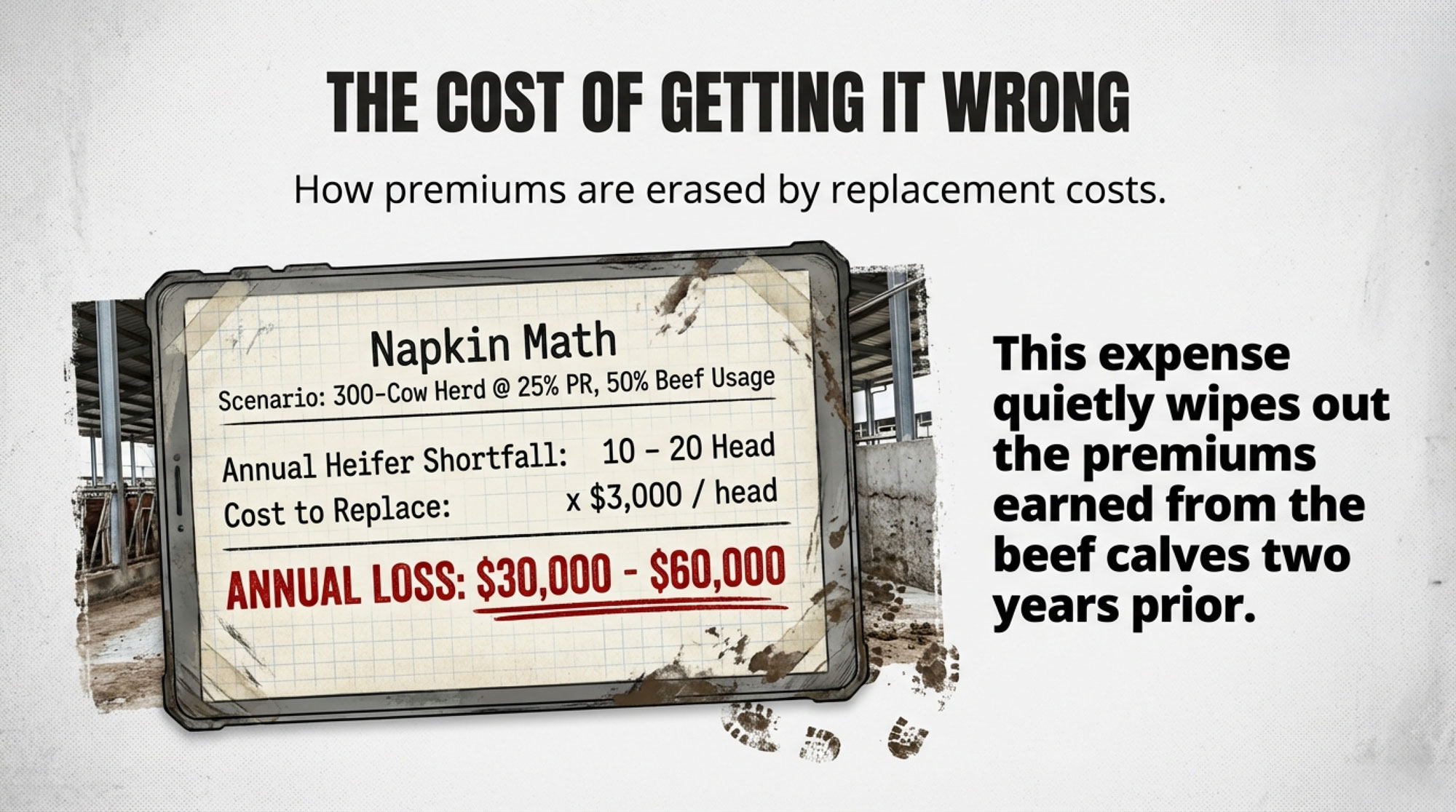
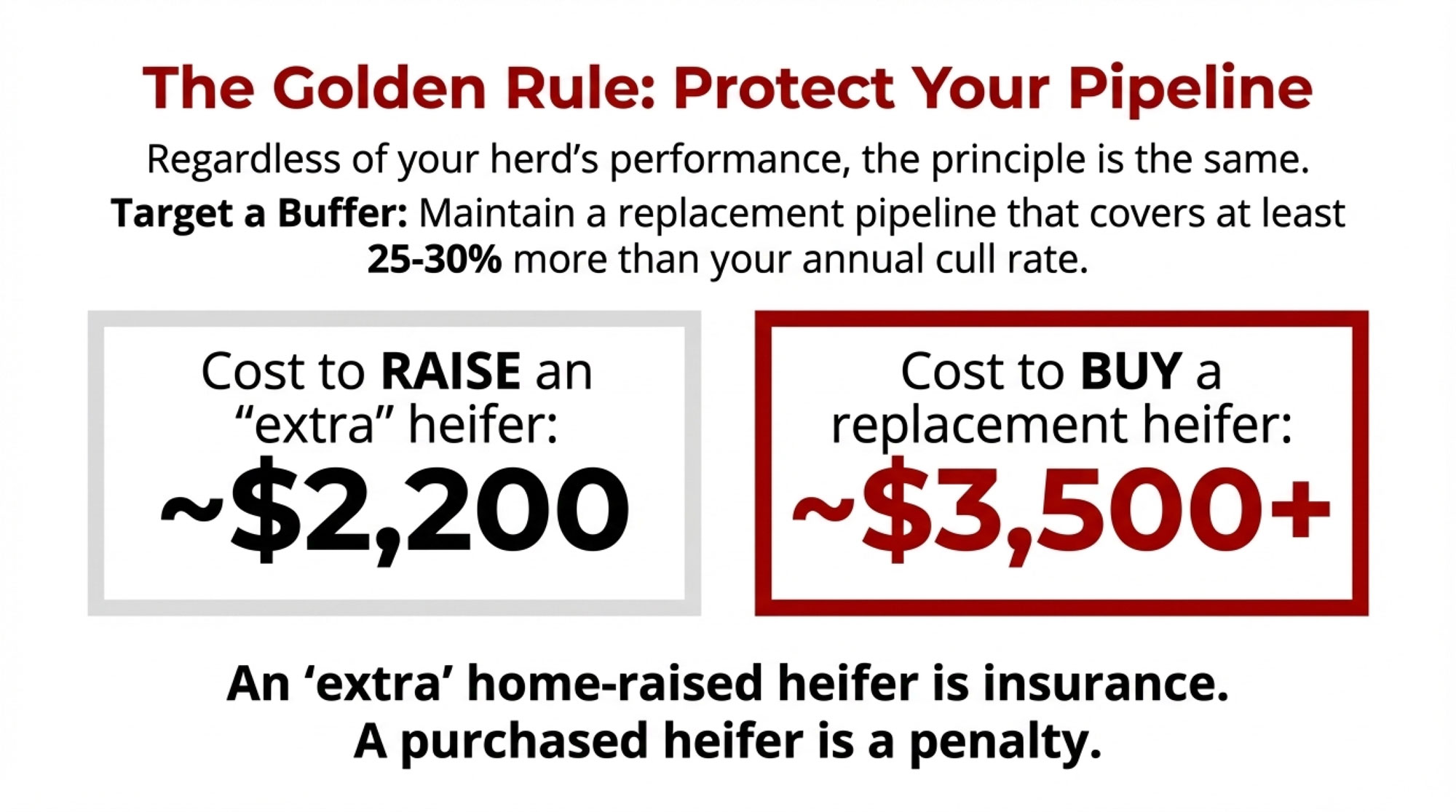
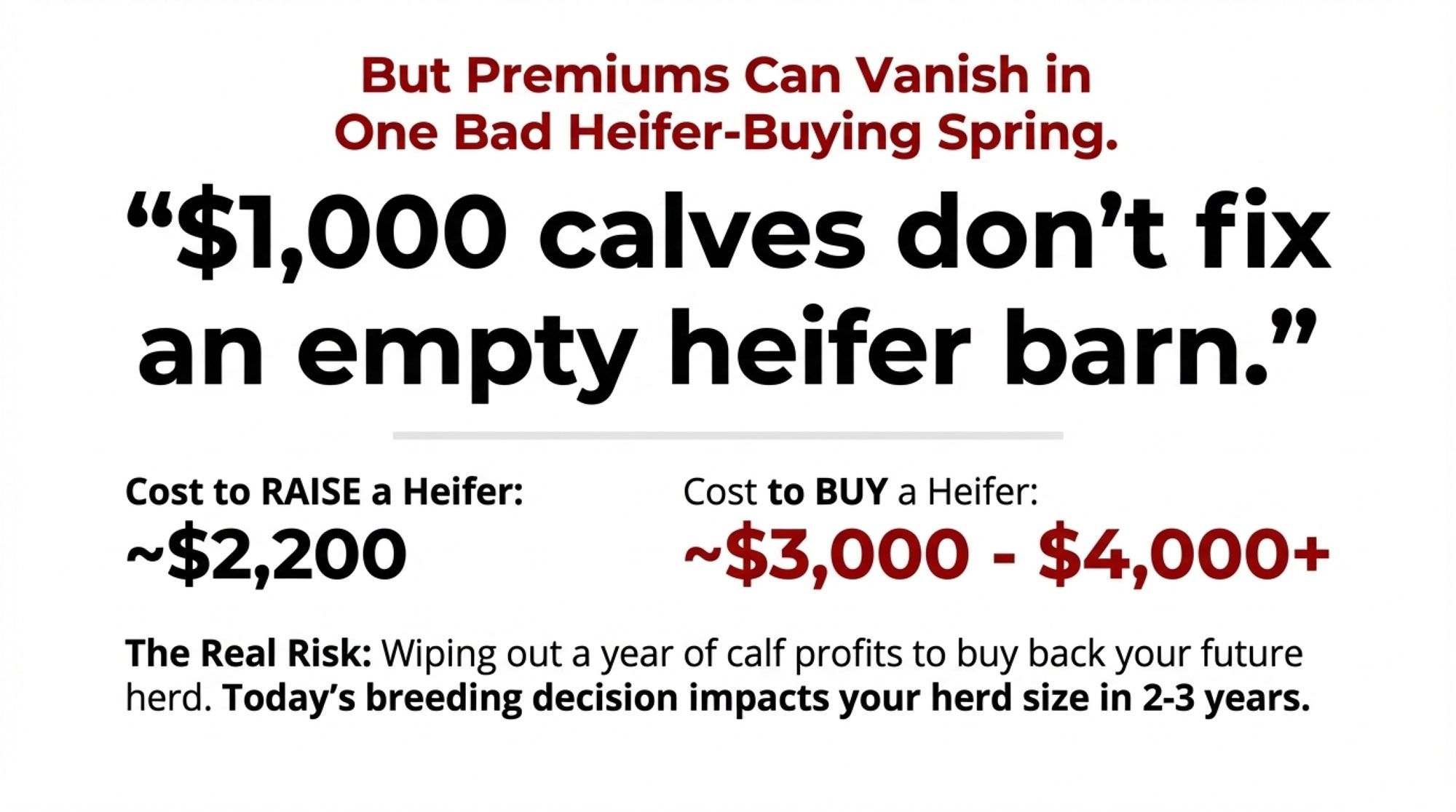
This is where thoughtful planning separates sustainable programs from cautionary tales. A Wisconsin producer who’s been running beef-on-dairy for three years now shared an observation that stuck with me: “The premiums are great, but you can give it all back in one bad heifer-buying spring.”

The Wisconsin model calculated that under optimal conditions (high reproductive performance with strategic sexed-beef deployment), a 1,000-cow herd produces just one extra replacement heifer per month beyond what’s needed to maintain herd size. That’s not much cushion.

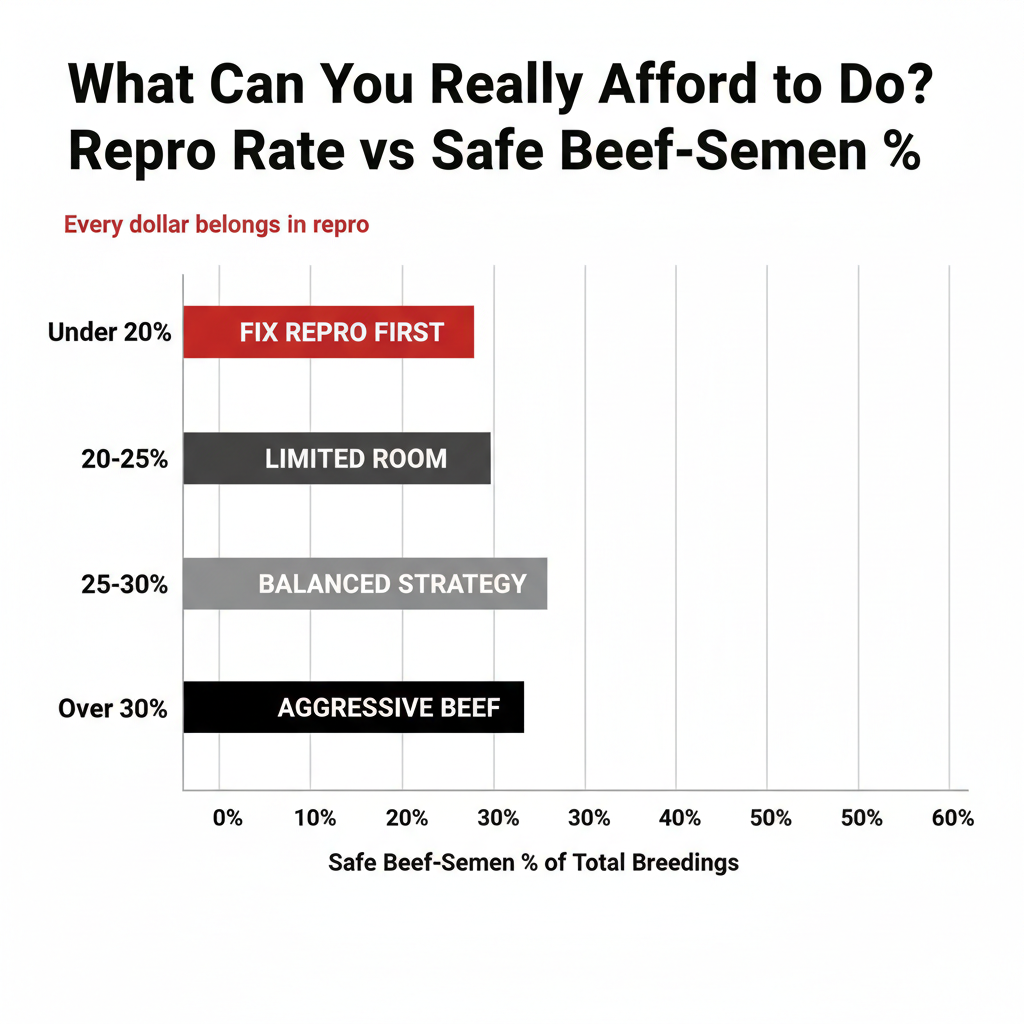
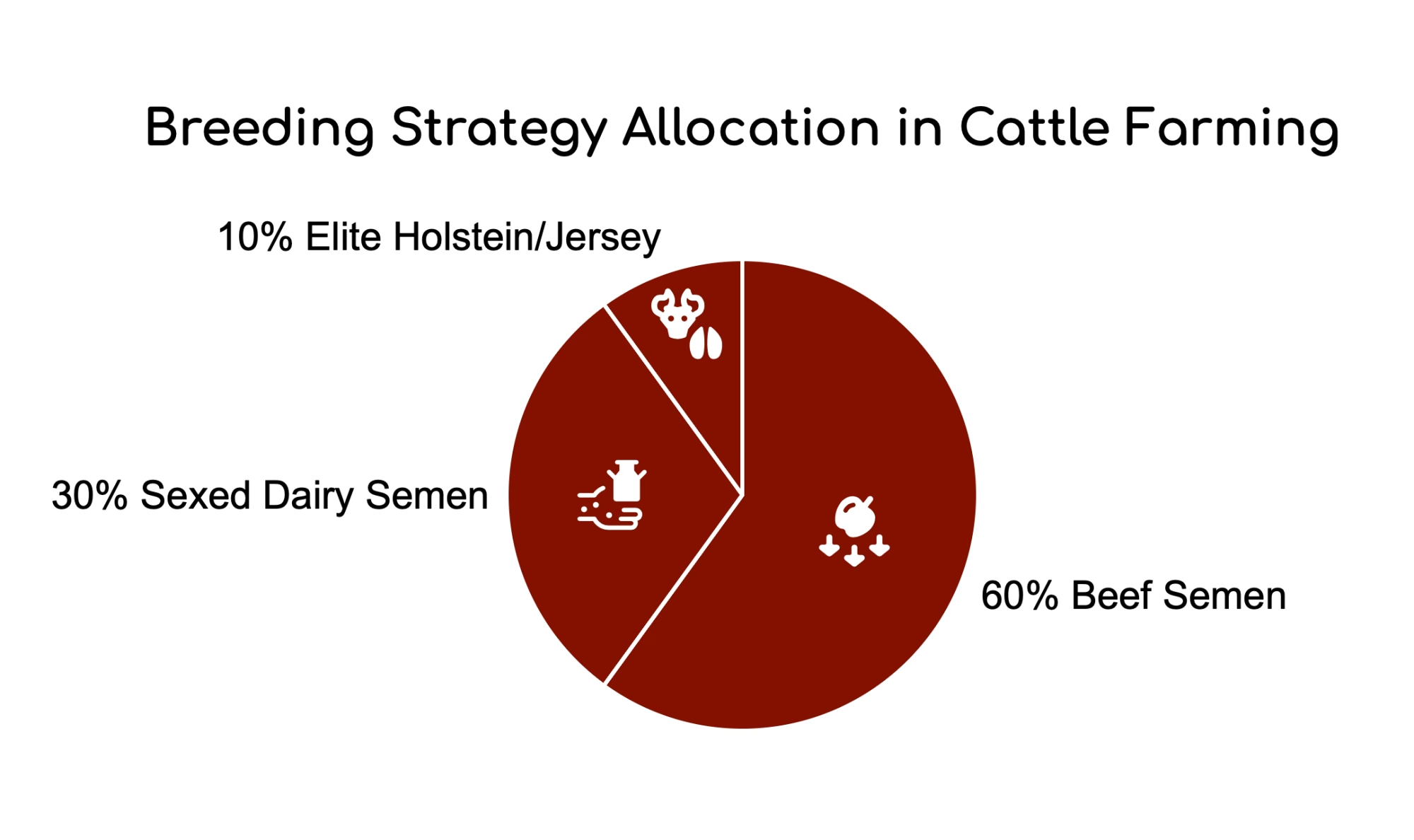
Industry consultants generally recommend keeping at least 25-30% of breedings allocated to replacement production. The specific number depends on your culling rate, heifer survival, and how much risk you’re comfortable managing. But the principle holds: protecting your replacement pipeline matters more than maximizing beef-cross production in any single year.

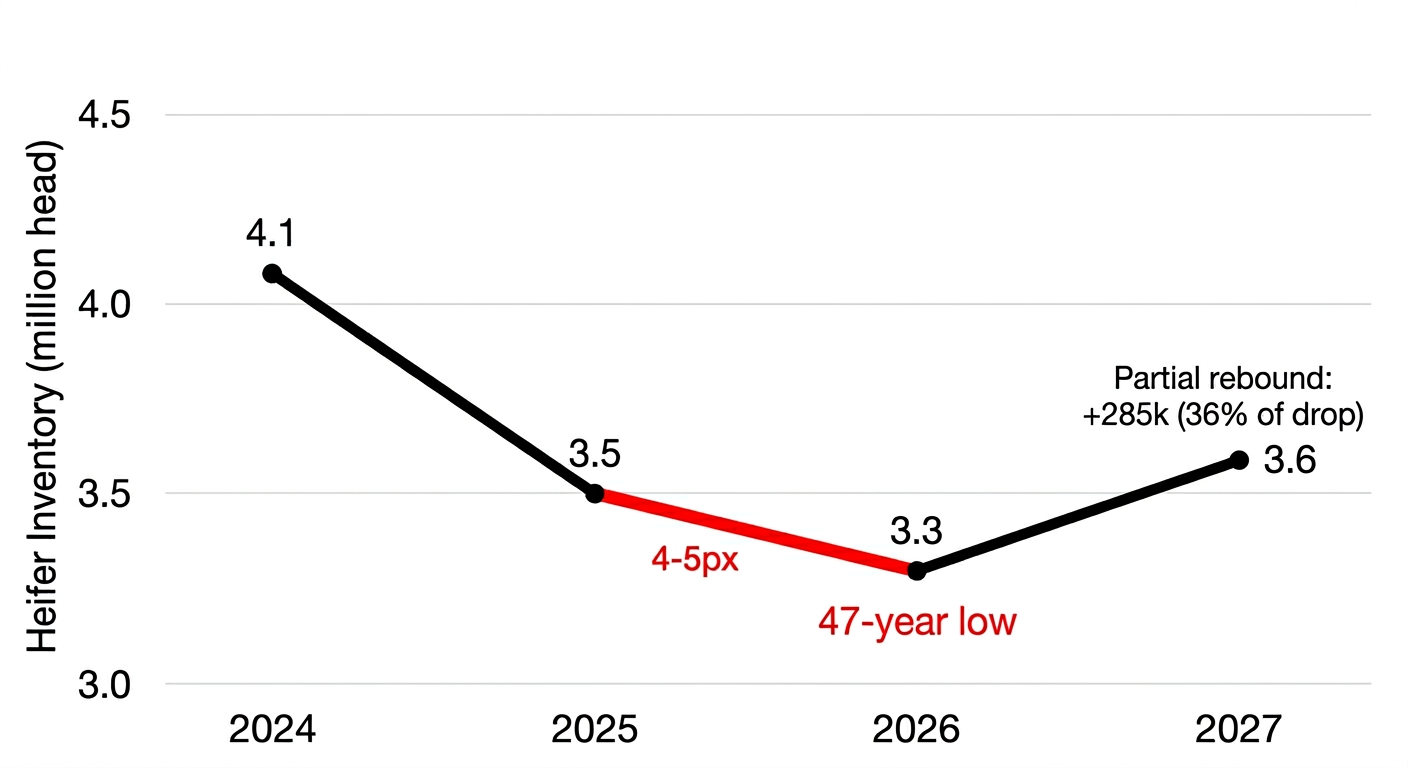
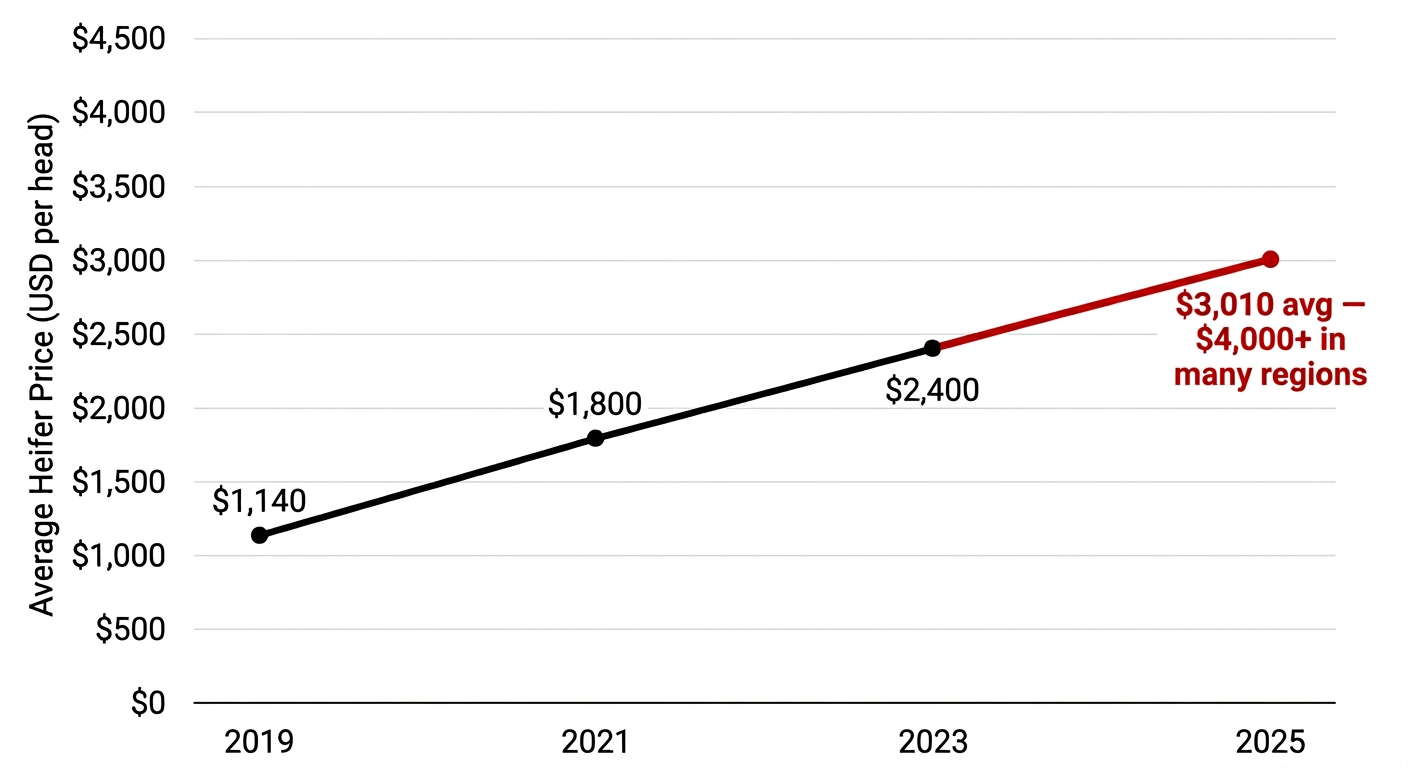
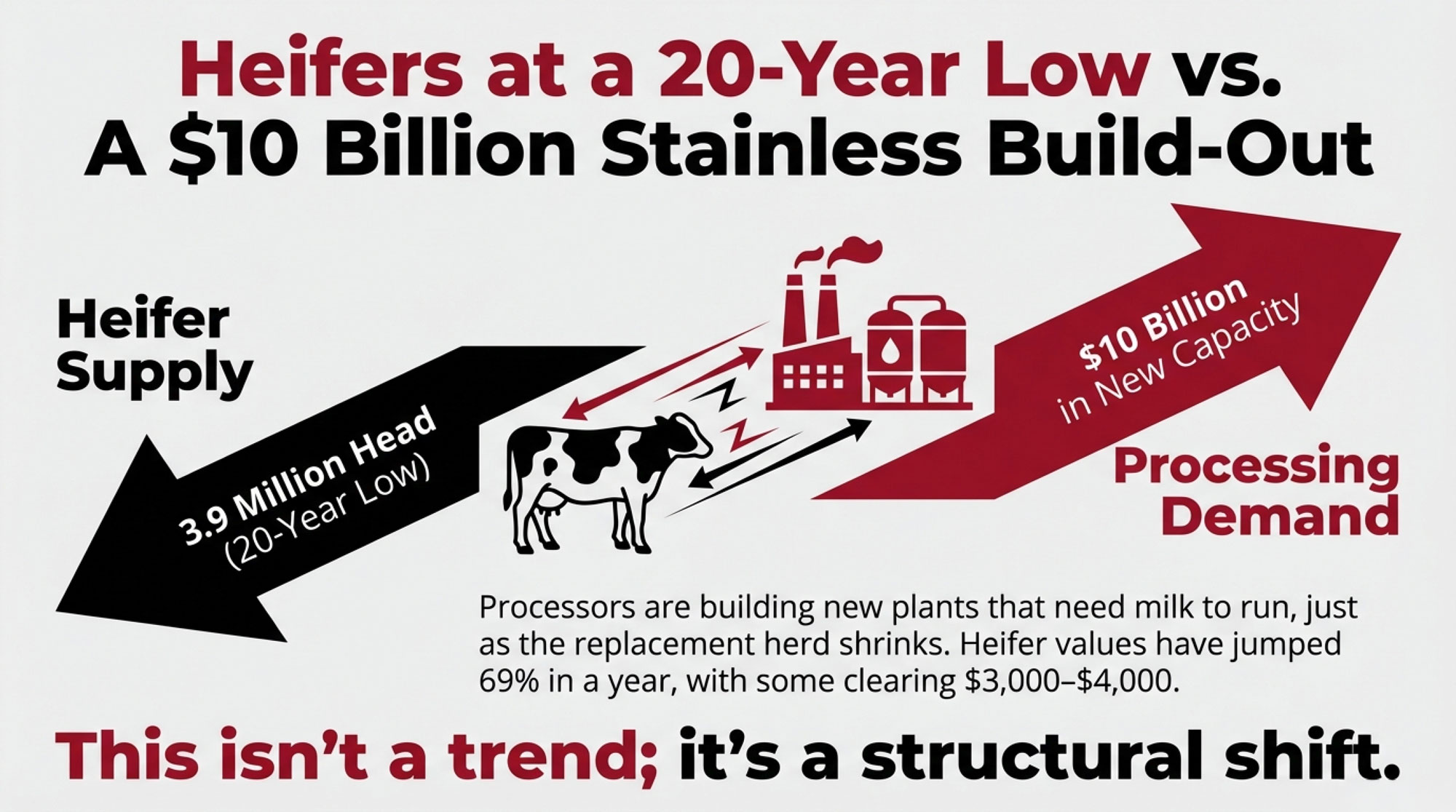
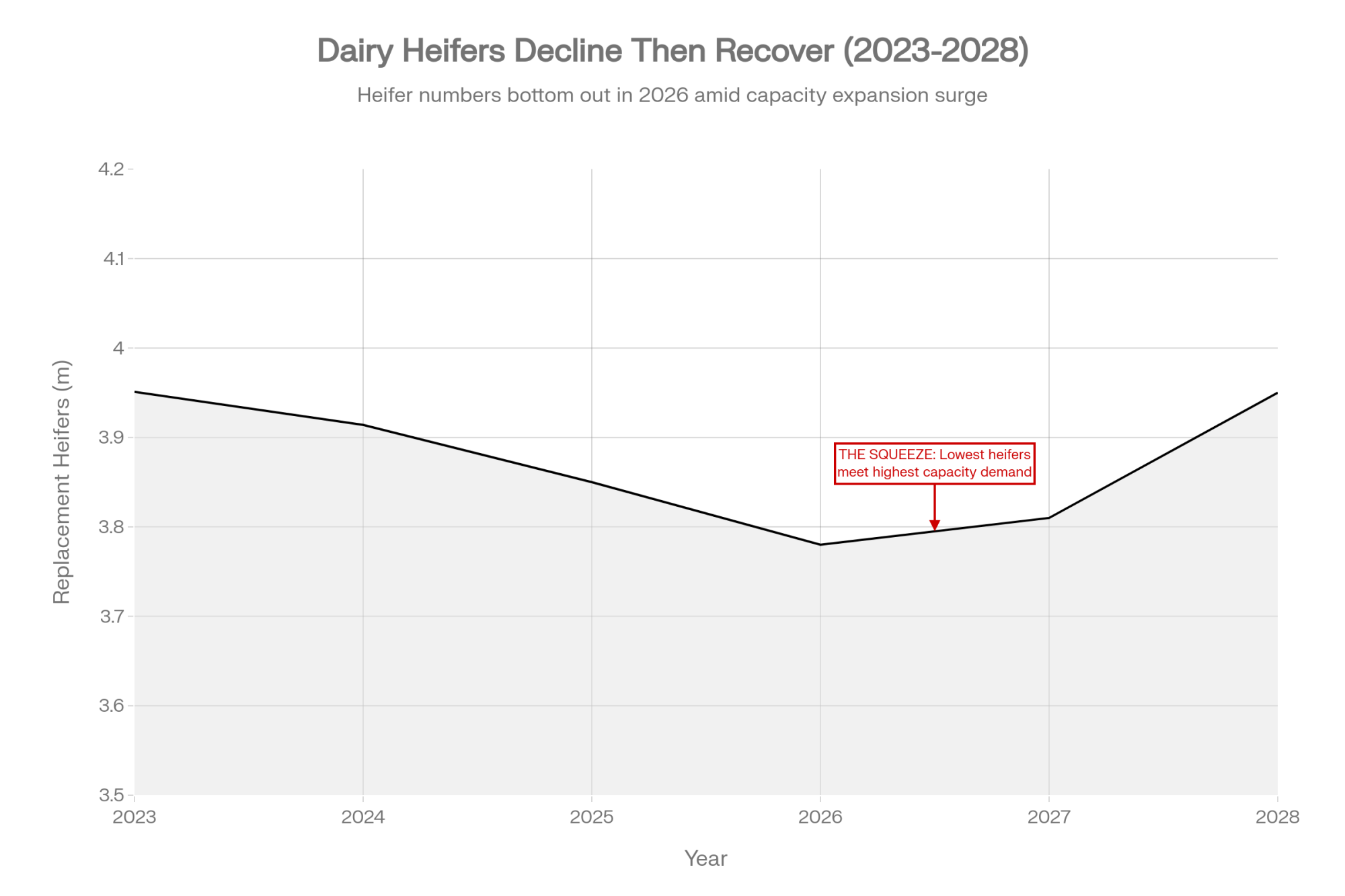
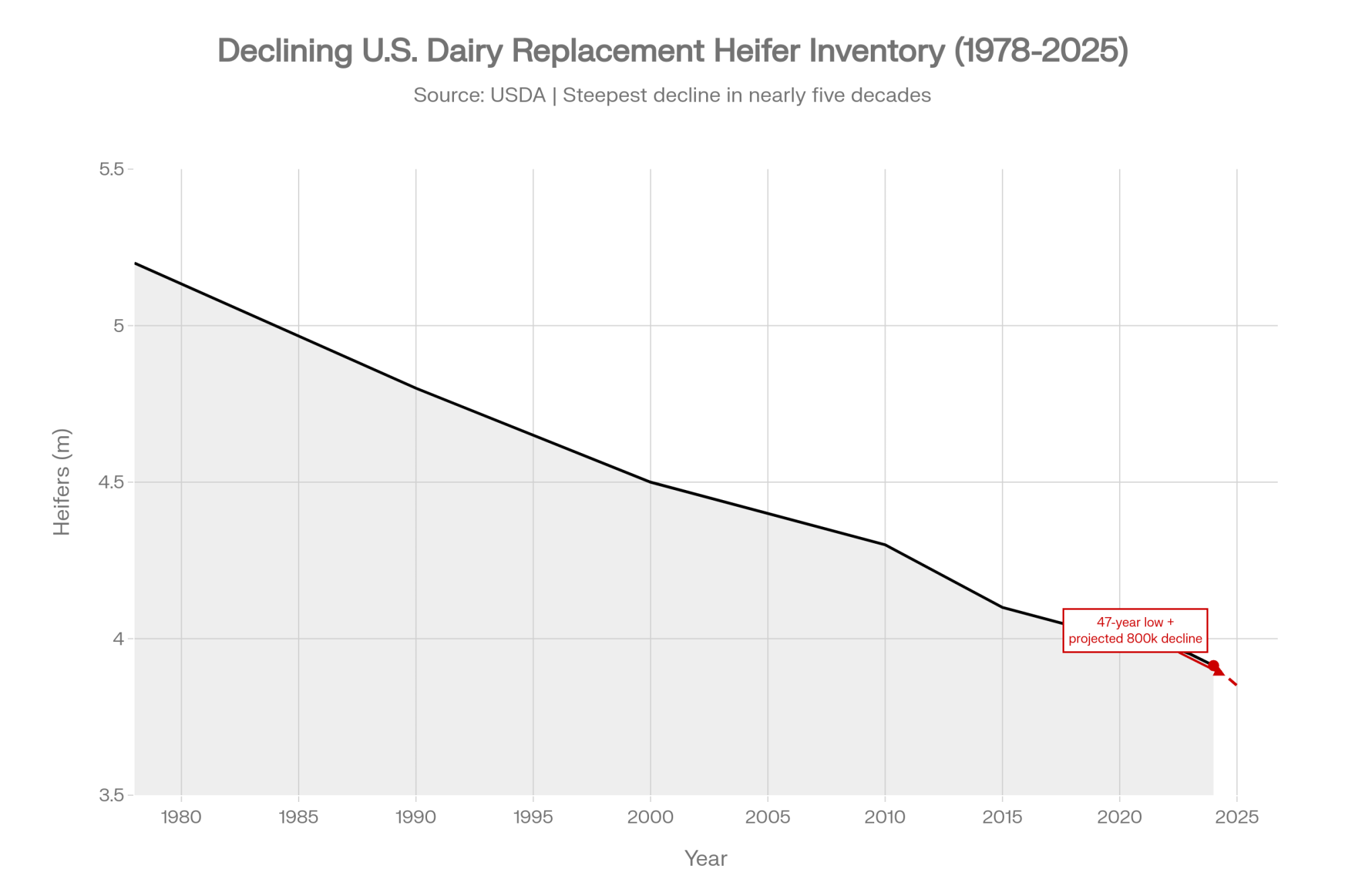
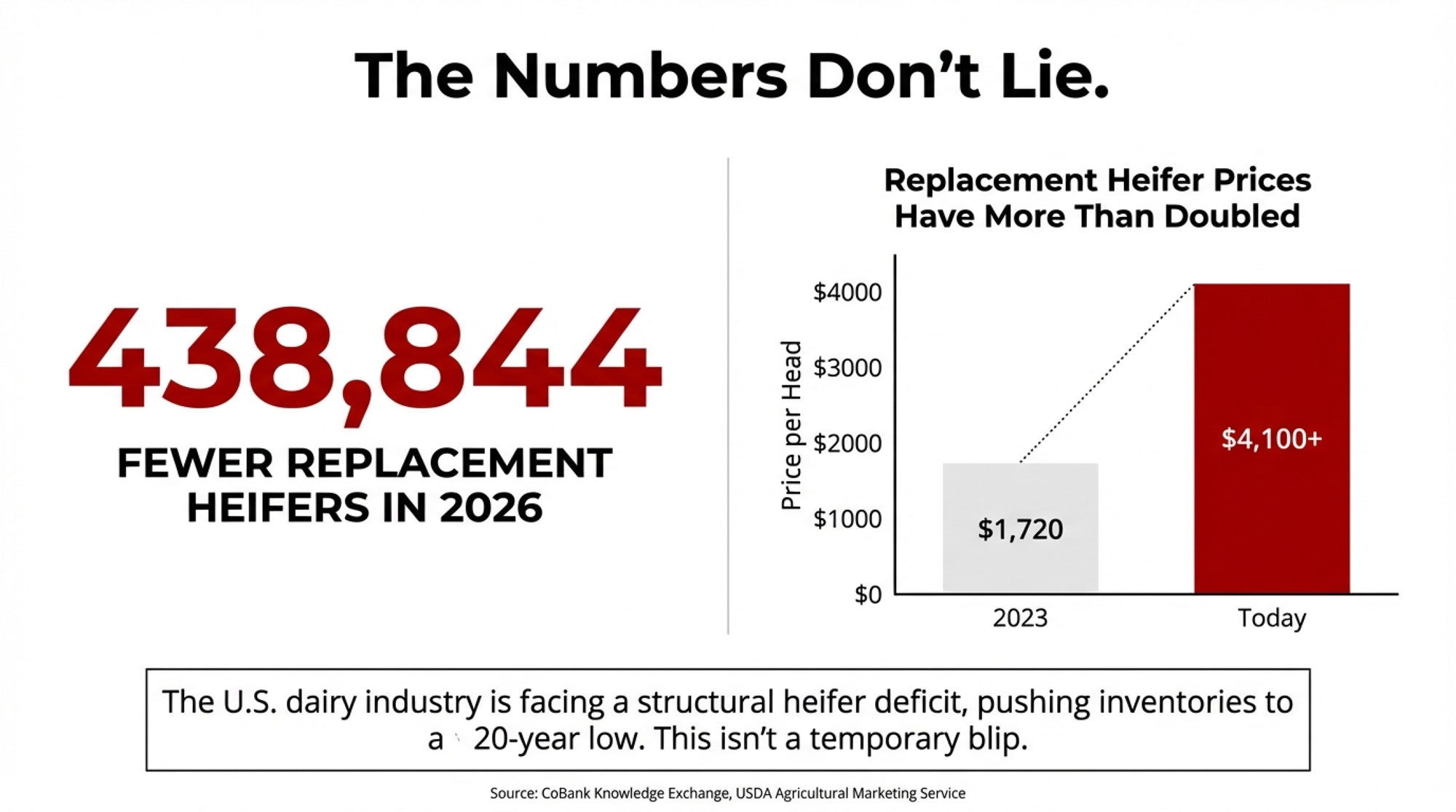
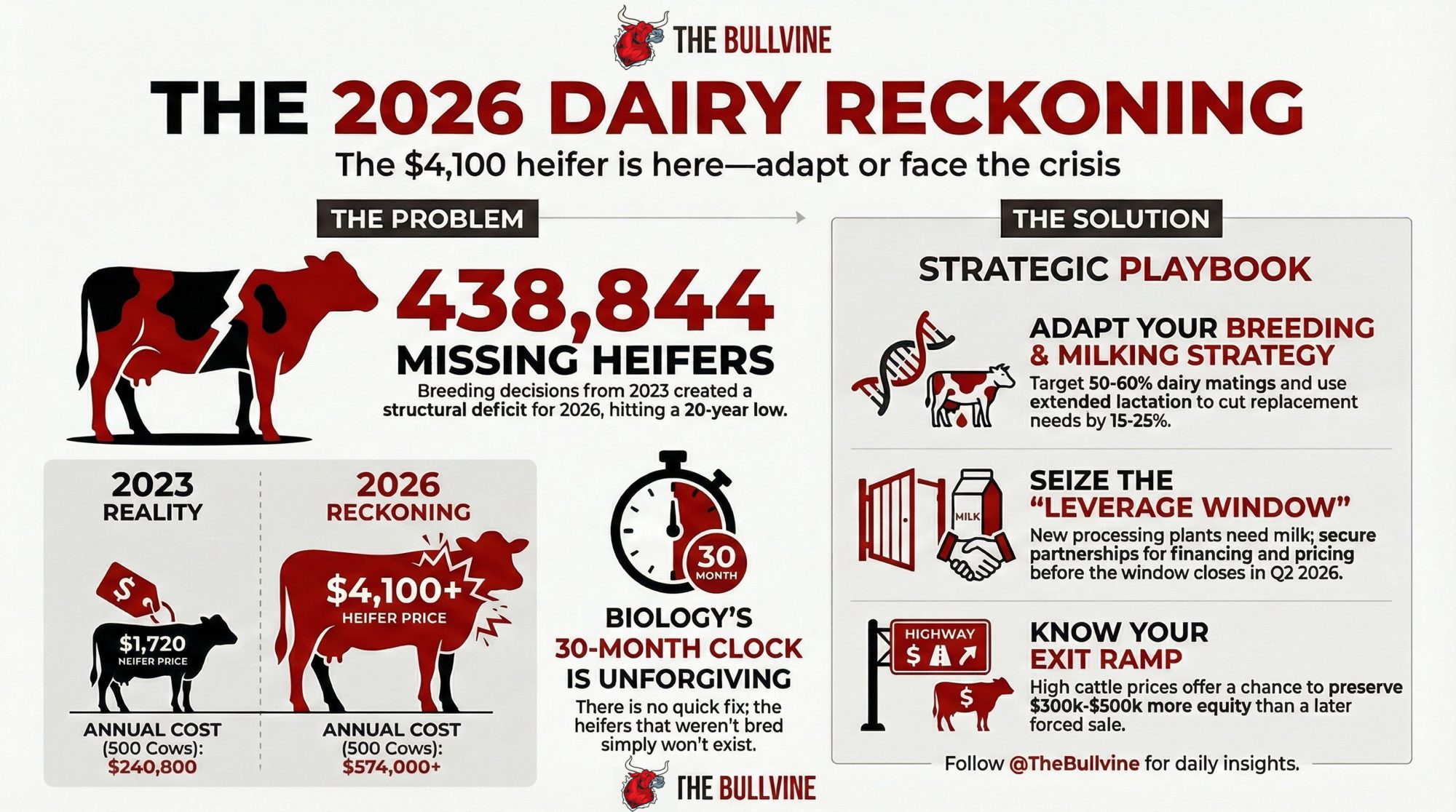
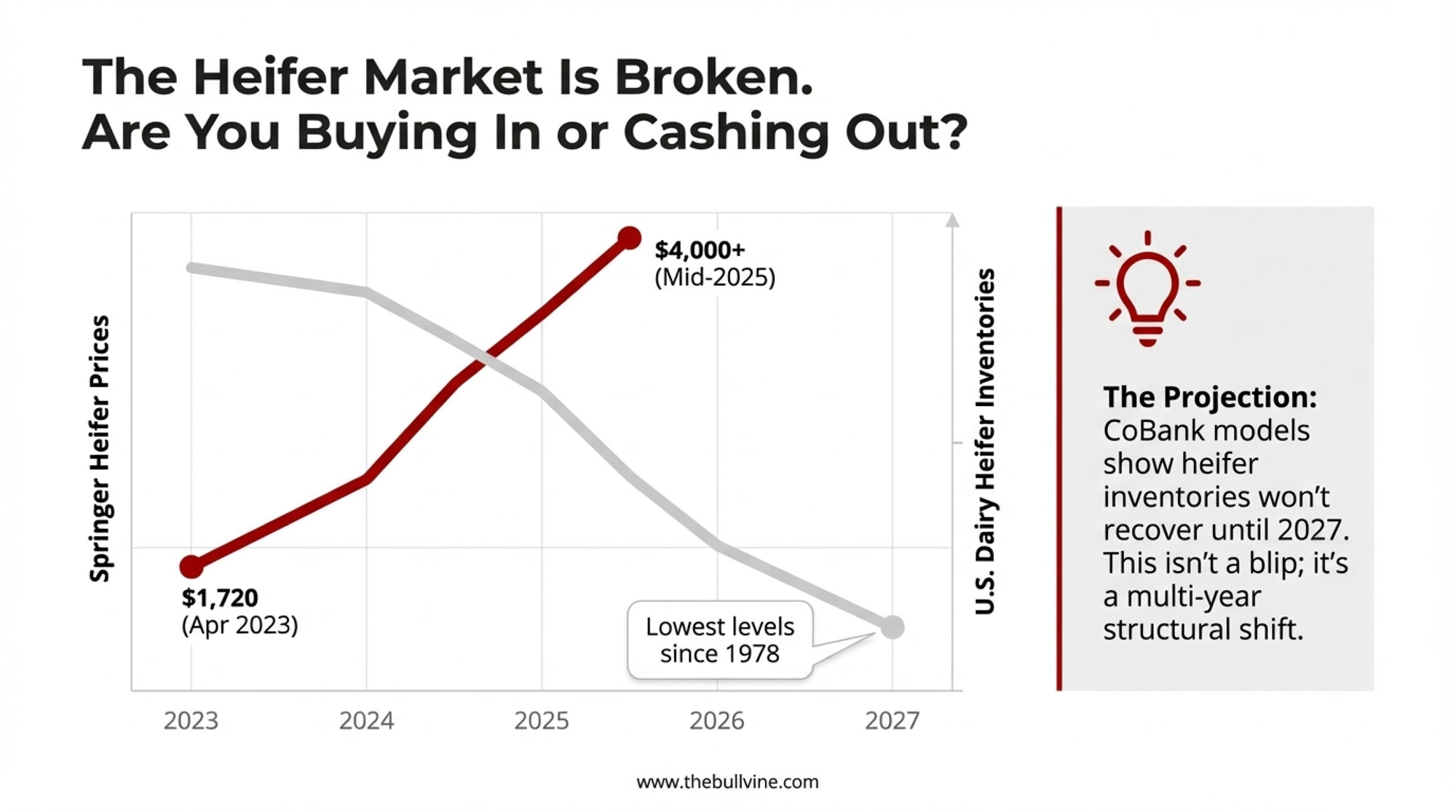
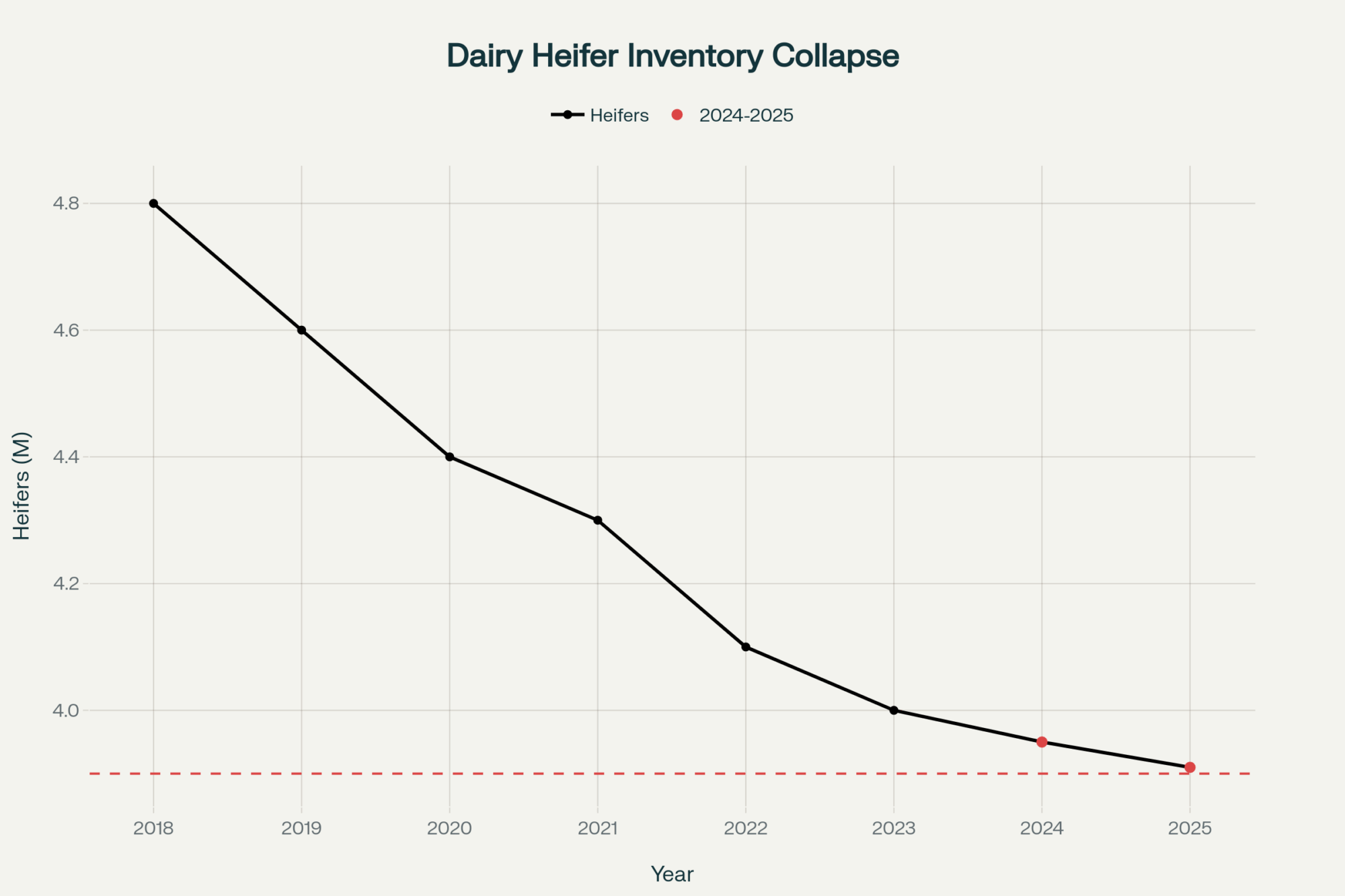
The heifer situation is already critical. USDA data shows dairy heifer inventories expected to calve dropped to 2.5 million head as of January 2025—the lowest level since the agency began tracking this metric. That tightening supply makes the replacement question even more consequential.

One example shared in industry coverage illustrates the risk. A tie-stall operation reportedly shifted too heavily toward beef breedings without accounting for their actual replacement needs. When spring arrived, and heifer prices spiked, the cost to maintain herd size ate significantly into their calf premium gains.

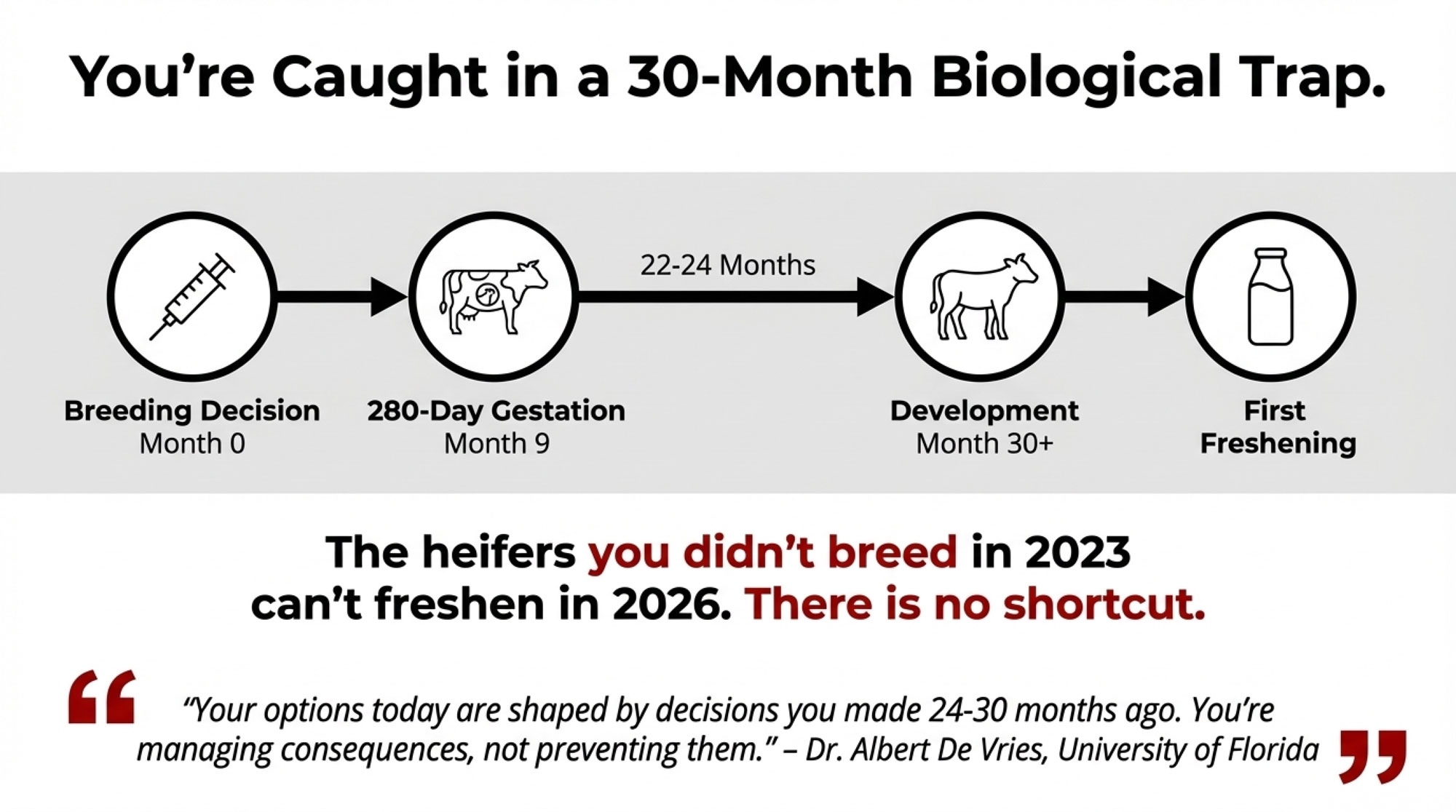
It’s a mistake that’s understandable when you’re looking at $1,000 calves. But the replacement pipeline operates on an 18-24 month lag, and that timeline catches operations who haven’t planned ahead.

Matching Strategy to Your Operation

What makes the Wisconsin research particularly valuable is its recognition that different herds need different approaches. This isn’t one-size-fits-all guidance.

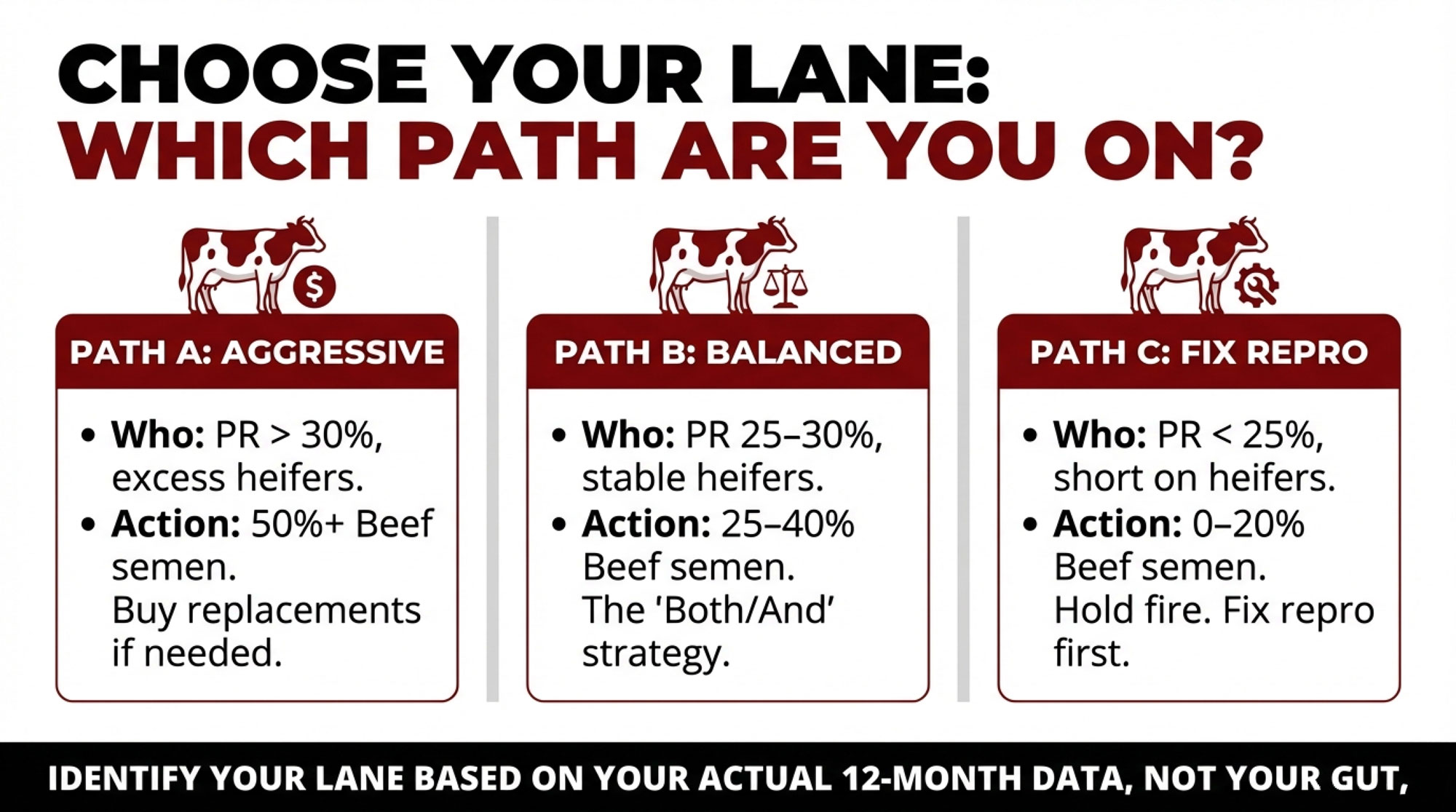
For Higher-Performing Herds (30%+ Pregnancy Rate)

Operations at this level have the most flexibility. The research indicates you can deploy beef semen on most adult cow breedings after using sexed semen on first-service heifers, and you’ll still produce adequate replacements.

Here’s the underlying logic: high reproductive performance typically means you’re already producing surplus dairy heifers under conventional breeding. Many producers in this category know the feeling of watching heifer inventory accumulate or selling springers at less-than-ideal prices. Strategic sexed-beef deployment redirects that surplus into premium beef-cross calves.

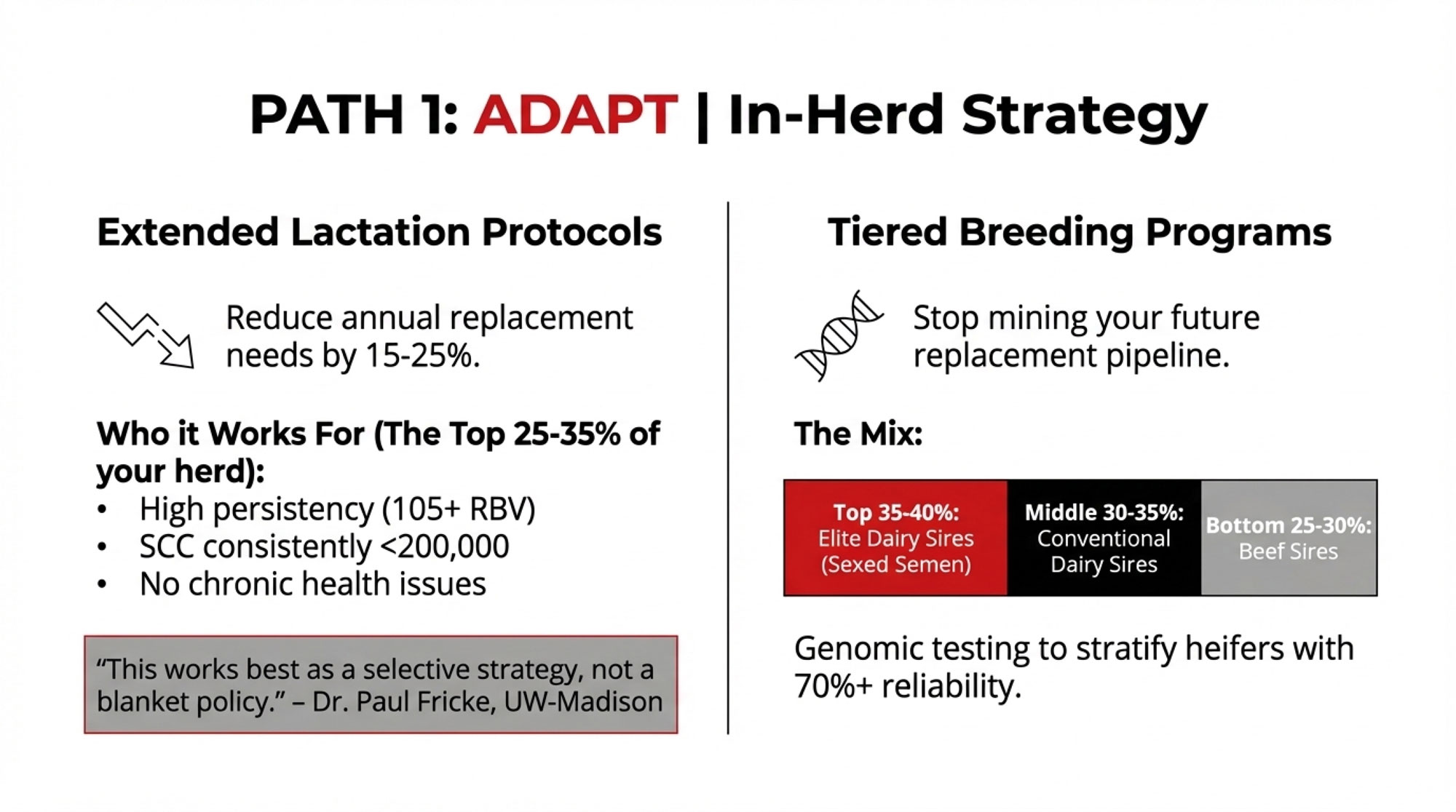
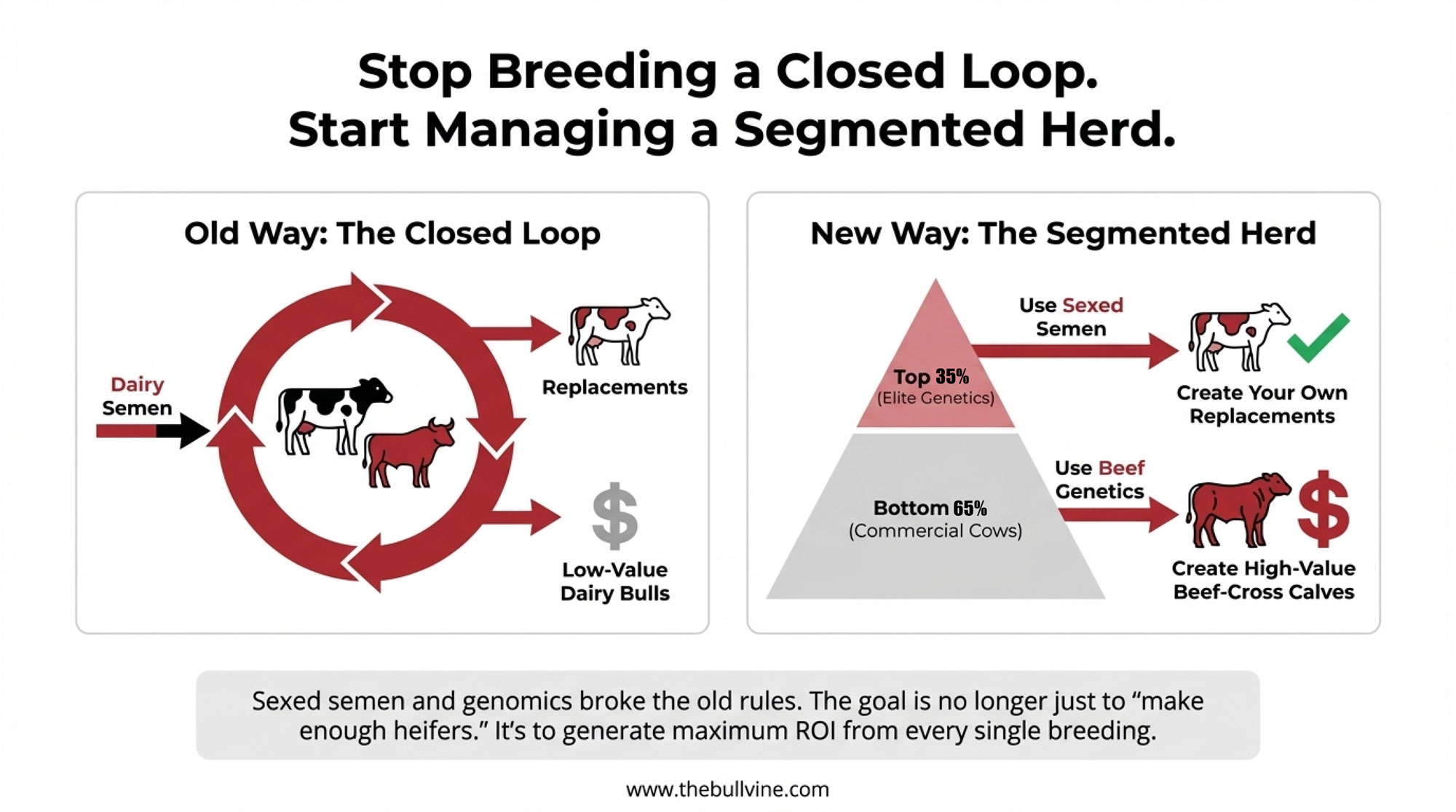
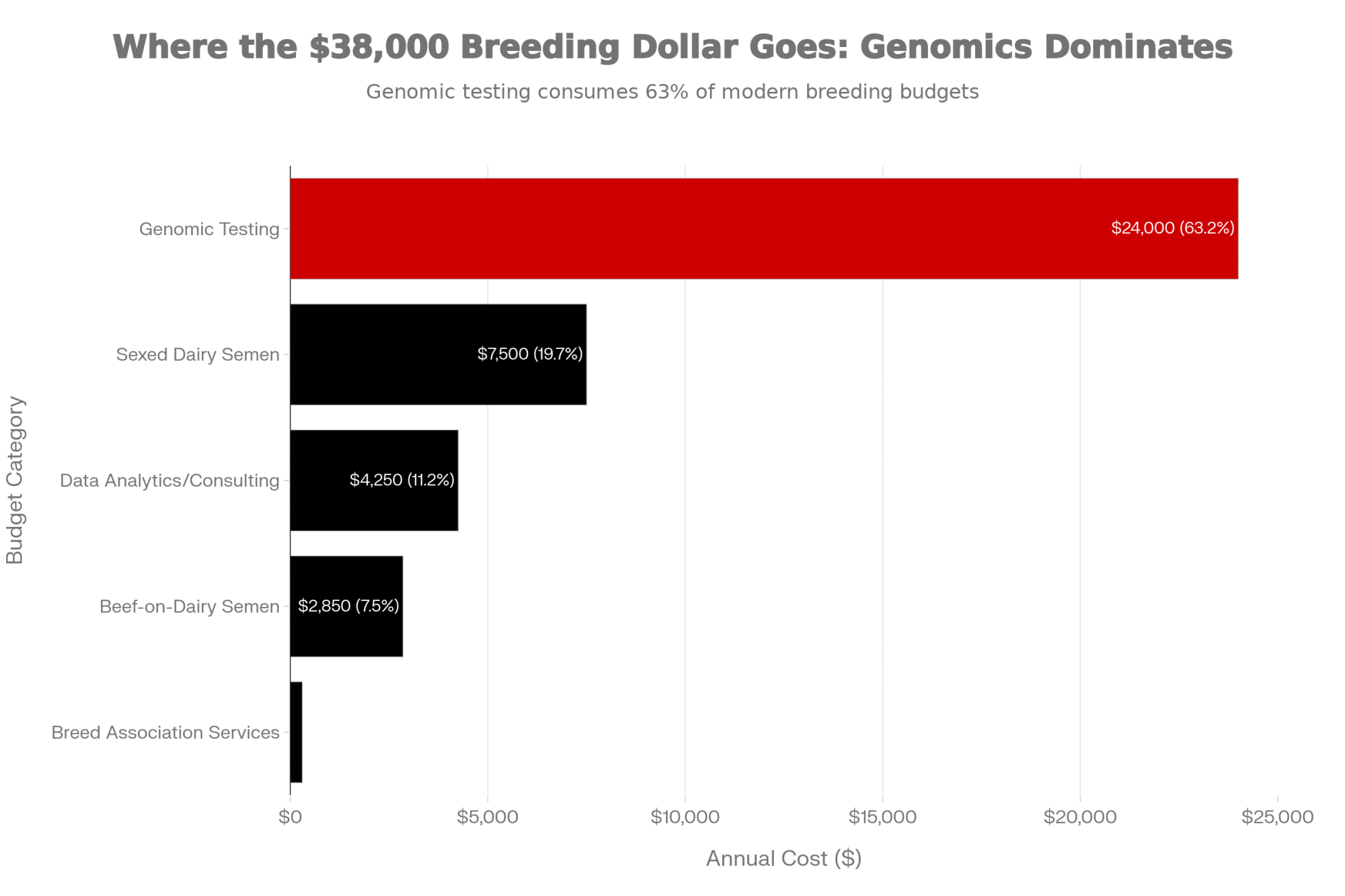
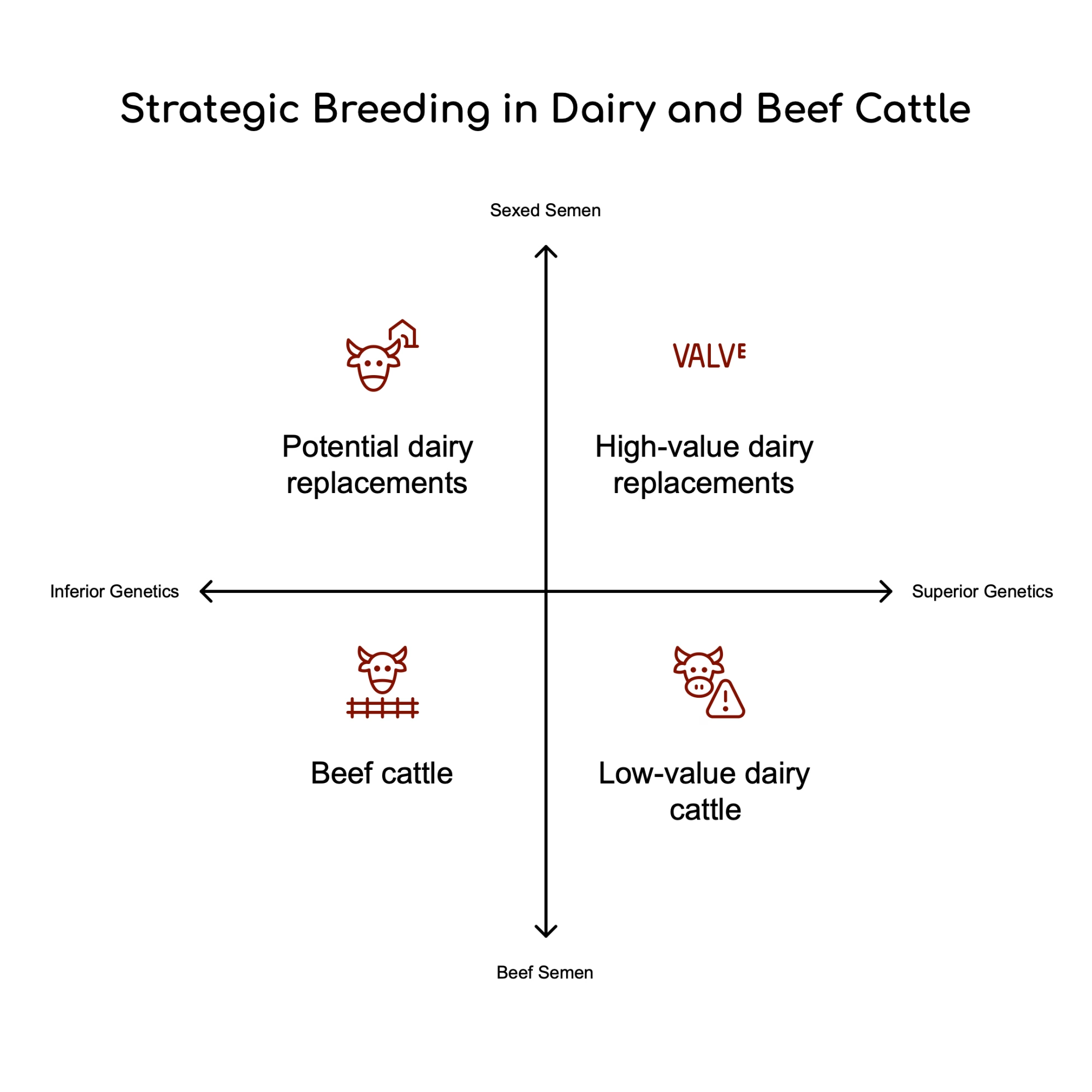
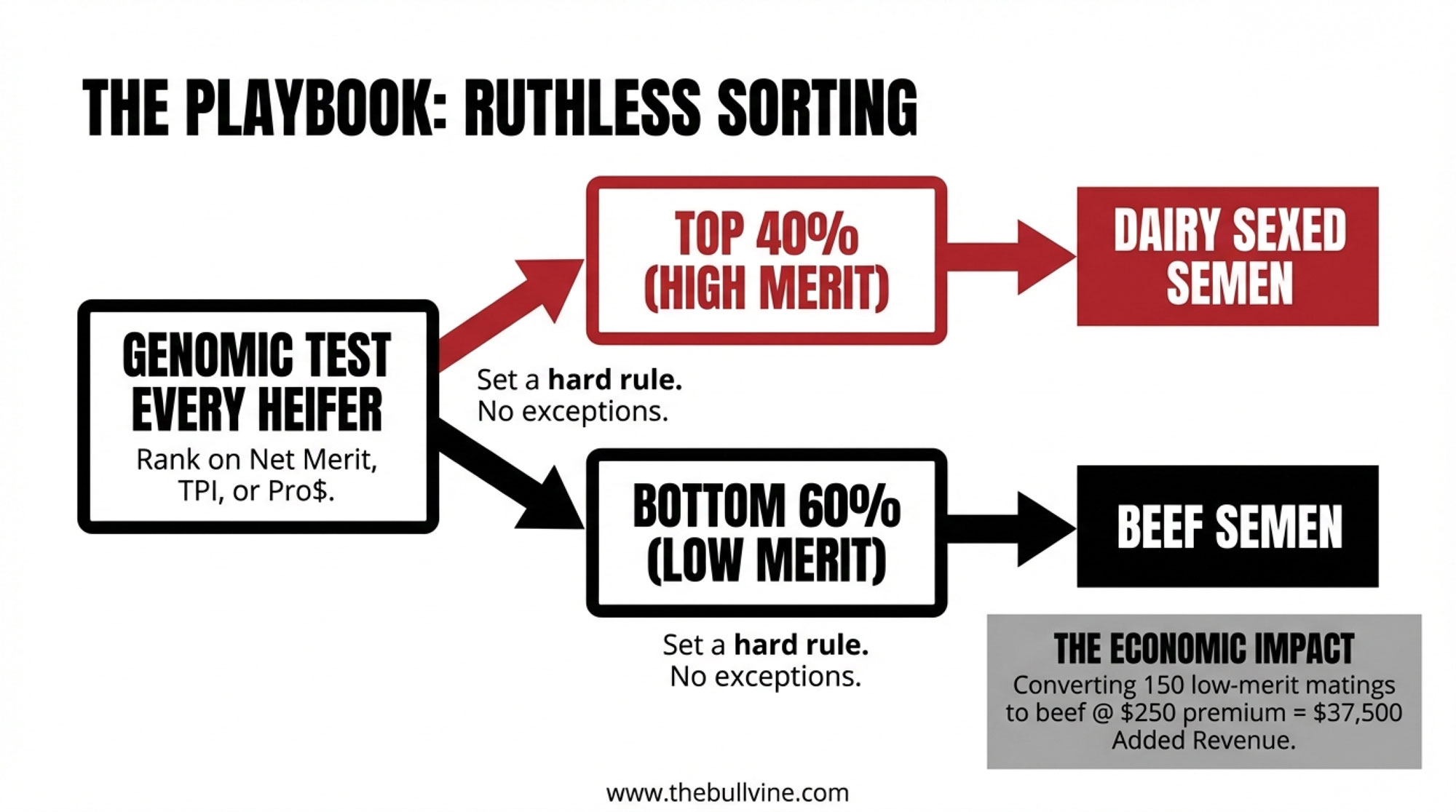
This is also where genomic testing—running about $40-50 per head—starts paying dividends. You can identify lower-genetic-merit animals for beef breedings while keeping your best genetics in the replacement pool. Some operations have built this into their standard protocol, and the ROI makes sense when you’re already managing tight replacement margins.

For Mid-Range Herds (20-25% Pregnancy Rate)

A more measured approach makes sense here. The Wisconsin model suggests you’ll need sexed semen on heifers and first-service primiparous cows before shifting later services to beef.

This is where many solid operations sit—not struggling, but without the reproductive cushion that allows aggressive beef semen deployment. Worth remembering that sexed semen typically achieves about 80% of conventional conception rates, so the fertility trade-off factors into replacement planning.

For Herds Working on Fundamentals (Below 20% Pregnancy Rate)

The research points toward a different priority: improving reproductive efficiency first. Each percentage point of improvement in the pregnancy rate expands future opportunities to capture beef-cross premiums.

This is really about sequencing. Focus on transition cow management, fresh cow protocols, and reproductive fundamentals. The beef-on-dairy opportunity will still be there once the herd performance supports it.

Strategy ComponentHigh Performance (30%+ PR)Mid Performance (20-25% PR)Low Performance (<20% PR)
Sexed semen on heifers (1st service)YesYesFocus on reproduction first
Sexed semen on primiparous cowsNo – can skipYes (1st service)Focus on reproduction first
Beef semen on adult cowsYes – most breedingsYes – later services onlyNot viable
Replacement allocation minimum25-30%30-35%All breedings
Genomic testing ROIHigh – target low-meritModerate – selective useNot priority
Monthly net calf income (1000-cow herd)$6,215$2,001$0

What’s Working in Practice

Several patterns keep emerging in conversations with producers successfully implementing these strategies.

Genomic-guided breeding decisions have become increasingly common. At $40-50 per head, genomic testing provides concrete data for targeting beef breedings rather than guessing about genetic merit. One producer described it as “taking the emotion out of breeding decisions”—and there’s something to that.

Protocol consistency matters more than protocol sophistication. Operations that capture full premiums aren’t necessarily complicated—they do the same thing every week. Written protocols, consistent execution, and regular review.

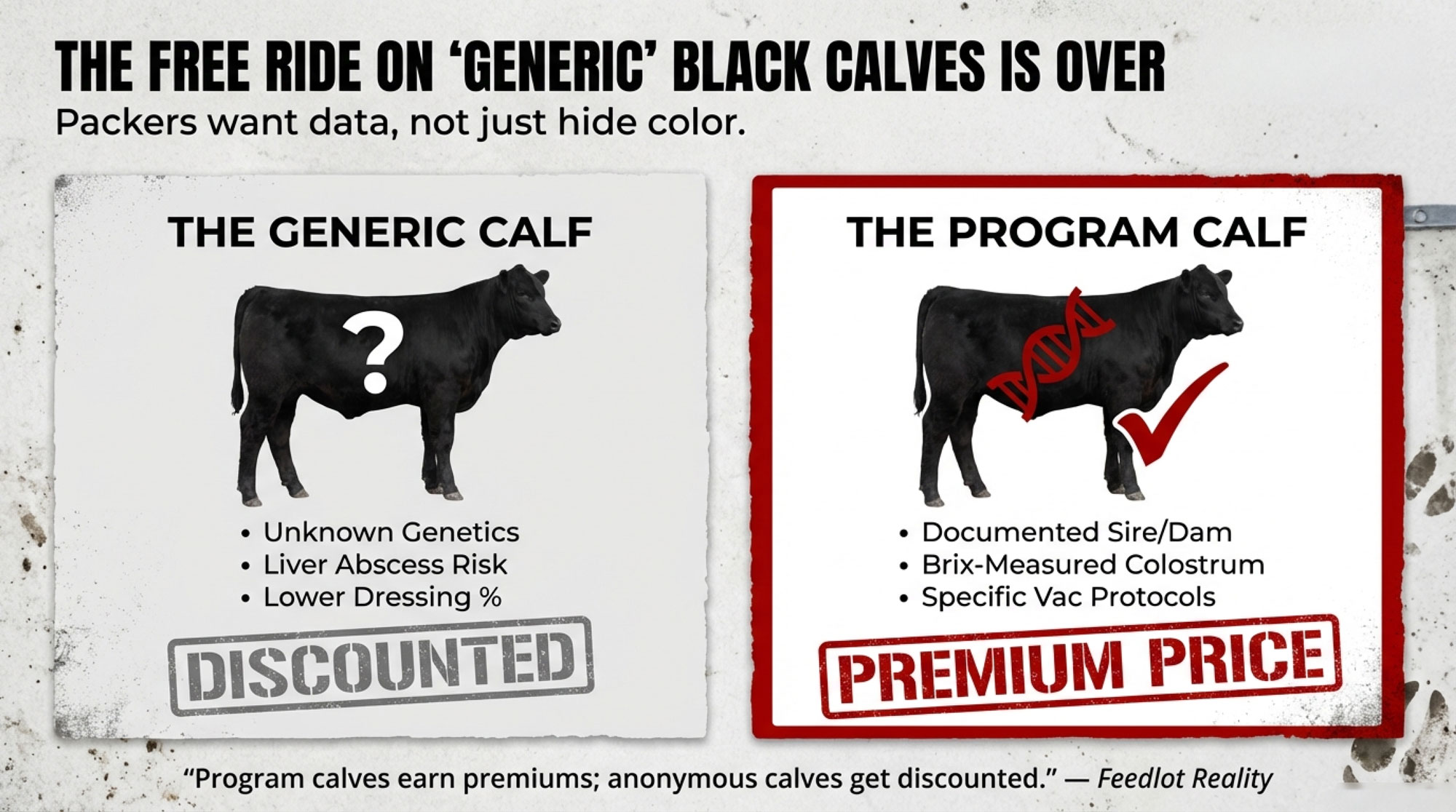
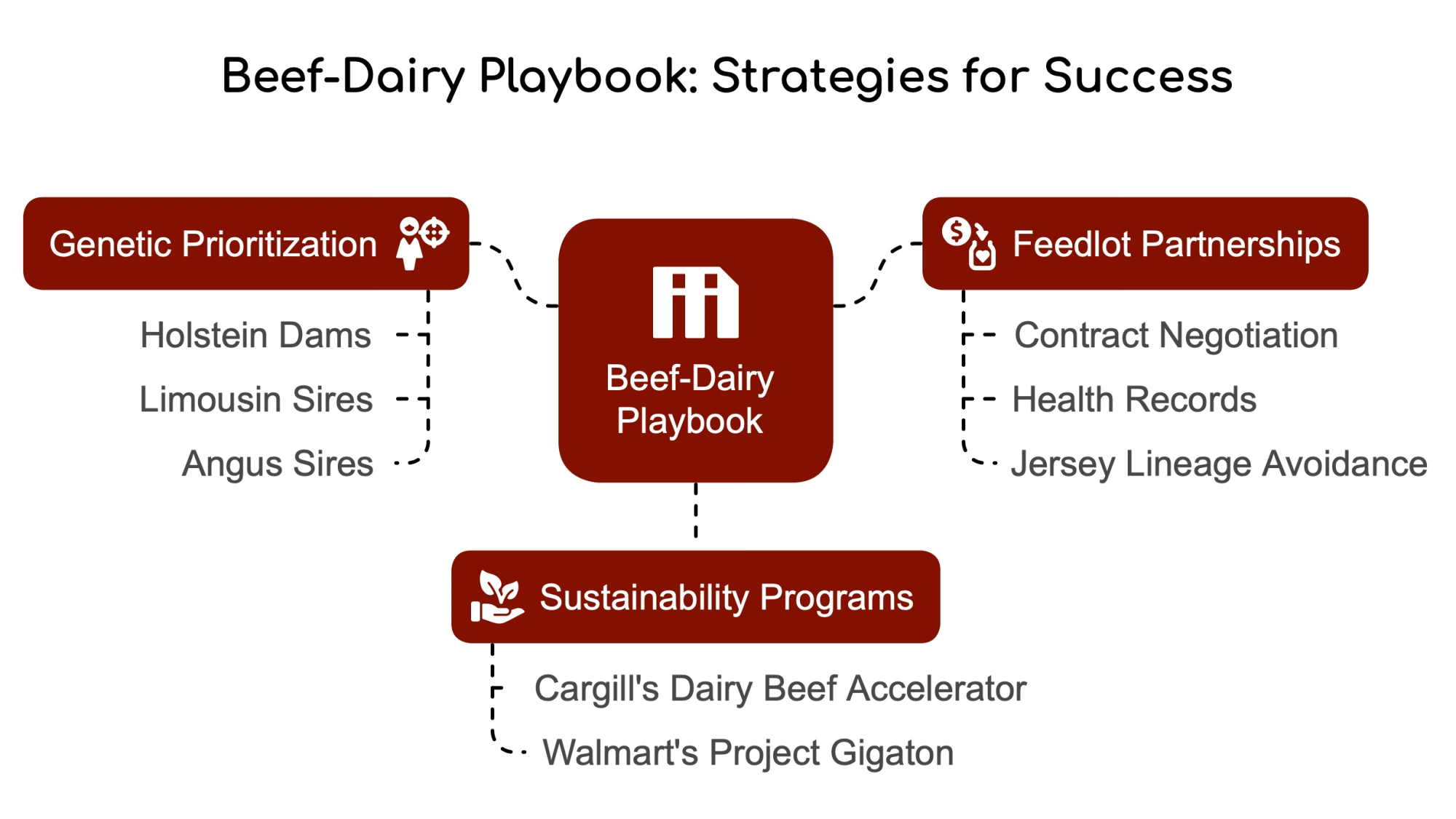
Buyer relationships are evolving. Packers and feedlots increasingly want traceable genetics and documented health records, paying premium prices. Operations that provide vaccination records, colostrum protocols, and weight documentation are building relationships that hold value when markets tighten.

Regional Considerations

Market premiums vary by region, and that variation affects strategy. Pennsylvania’s New Holland market shows some of the strongest beef-cross prices, driven partly by veal demand and feedlot connections. Upper Midwest markets in Wisconsin and Minnesota have been solid but show more week-to-week variability.

California operations have also seen significant adoption, with California Dairy Magazine recently covering emerging data on the value beef-dairy crossbreds bring to the supply chain. The state’s large-scale operations have been early adopters of systematic breeding protocols.

Texas has been particularly notable—according to Texas A&M AgriLife and USDA data, the state recently added 50,000 dairy cows, with complementary beef-on-dairy programs contributing to strong production gains. The Southwest’s integration with regional feedlot infrastructure creates natural marketing channels.

Producers closer to feedlot concentrations in the Central Plains sometimes see slightly lower premiums but more consistent demand. If you’re running a smaller operation, understanding your local market dynamics helps calibrate how aggressively to deploy beef semen.

Geography matters: Ontario leads at $1,500 per calf, while Pennsylvania’s New Holland market delivers the widest U.S. range ($680-$1,160)—regional feedlot connections and veal demand drive the spread

Putting the Numbers in Perspective

Under 2021 baseline prices ($225 beef-cross calves), the Wisconsin model showed breakeven prices of just $69 per head for high-performing herds and $100 per head for medium-performance herds. Current prices running $700-1,100 sit well above those thresholds.

That margin provides some comfort. Even if beef-cross premiums decline by 50% from current levels, the economics still favor strategic use of beef semen in herds with adequate reproductive performance.

The research team’s sensitivity analysis found that optimal strategies remained consistent across most feasible market scenarios. What changes isn’t whether to use beef semen, but how much and on which animals.

Before Your Next Breeding Cycle

Critical Decision PointWhat 72% Are DoingWhat Wisconsin Research SaysThe Gap
Pregnancy rate baselineGuessing or using targetsActual rolling 12-month 21-day PRMost overestimate by 5-8%
Replacement allocation15-20% of breedings25-30% minimum to protect pipelineLeaves zero margin for error
Beef semen deployment“As much as possible”Strategic by service number & cow typeBurn through replacements
Calf pricing strategyTake spot market priceBuild feedlot/packer relationshipsLeave $150-$300/head on table
Genomic testingSkip it – too expensive$40-50/head pays dividends at scaleMiss precision breeding gains
Breakeven awarenessAssume current premiums lastKnow exact threshold ($69-$100)Vulnerable to market cycles
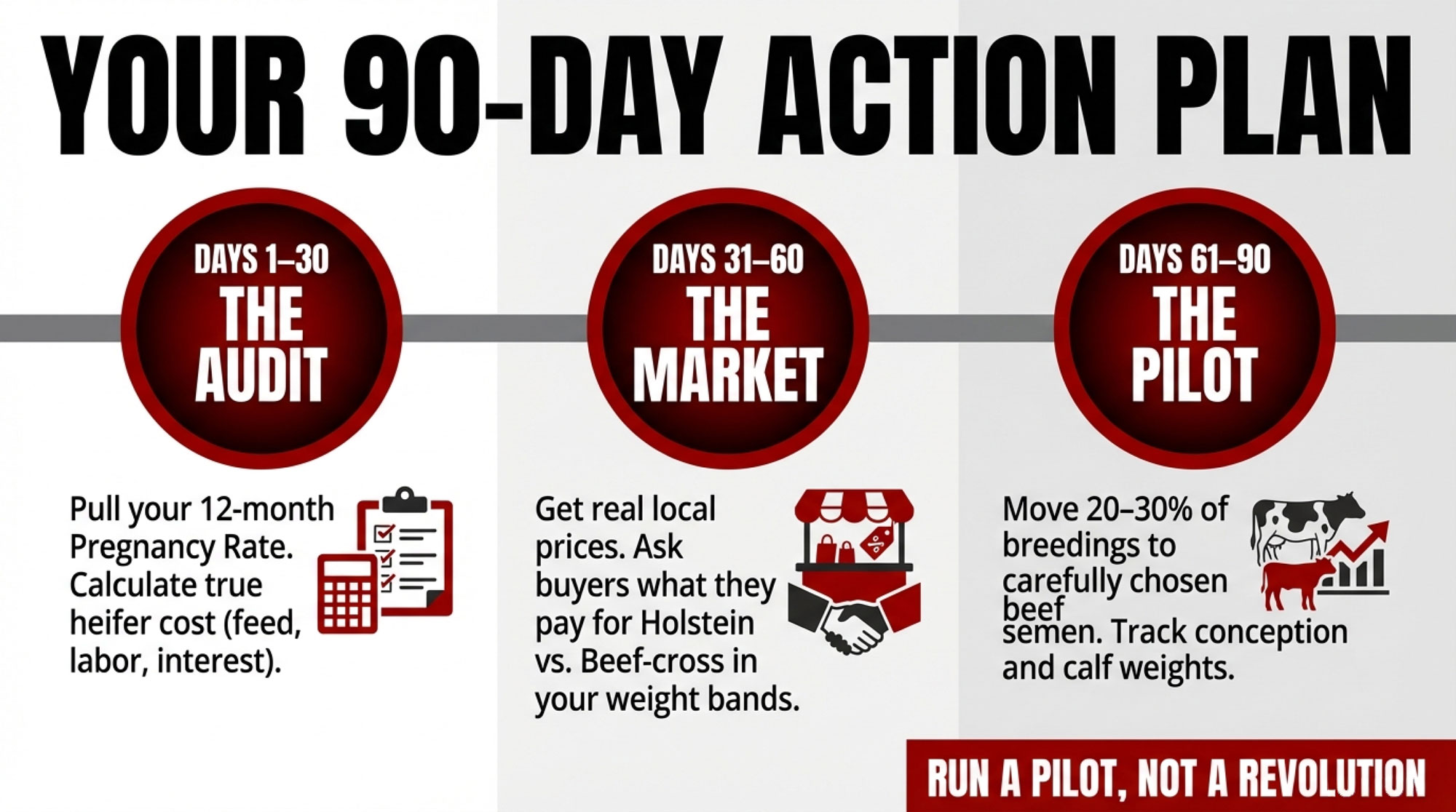
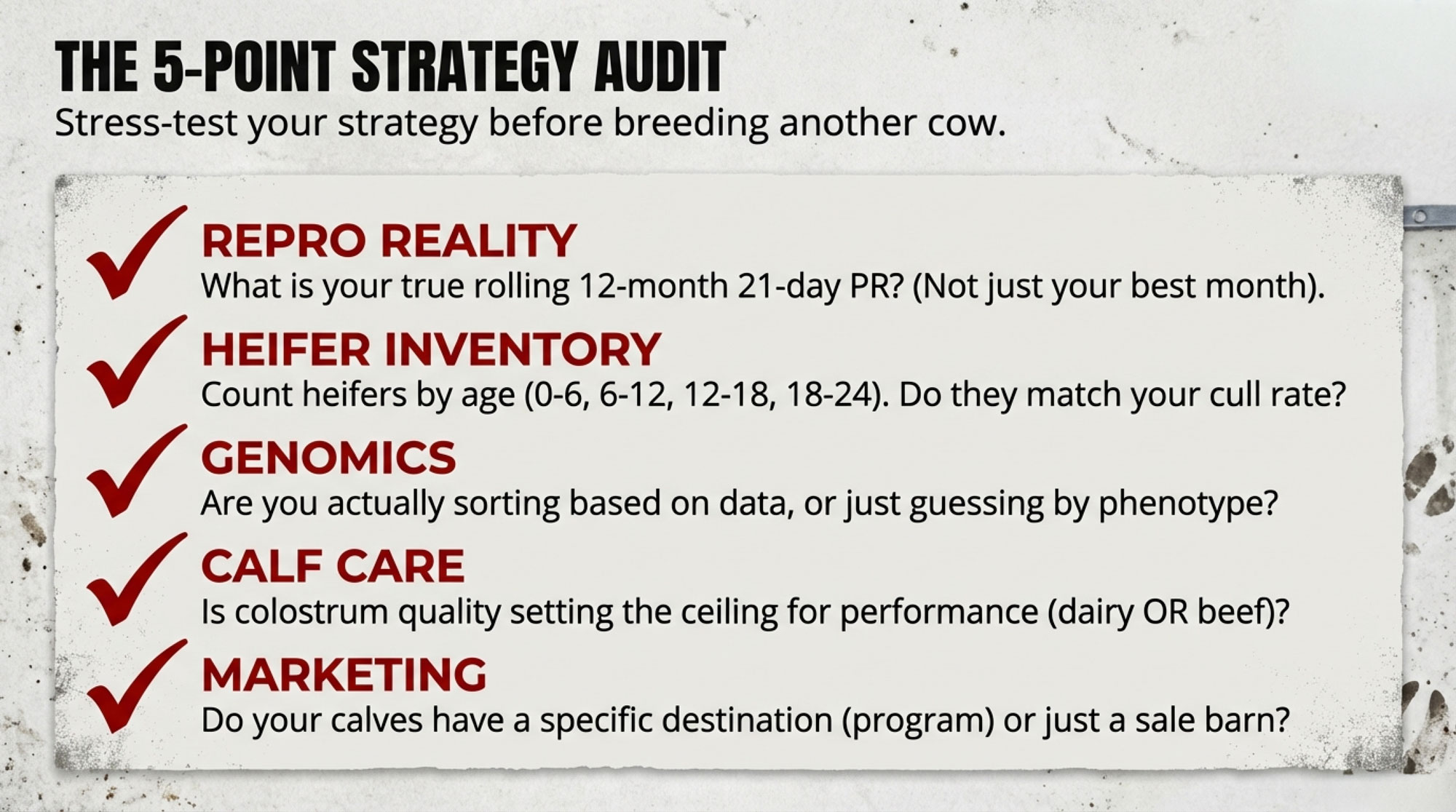
  • Review your actual calf sale data. What premium are you actually receiving for beef-cross versus straight dairy? If it’s below $350 per head, it’s worth investigating whether it’s pricing, timing, or buyer relationships.
  • Calculate your current pregnancy rate honestly. Use your actual rolling 12-month 21-day pregnancy rate—not your target. This single number largely determines which strategies fit your operation.
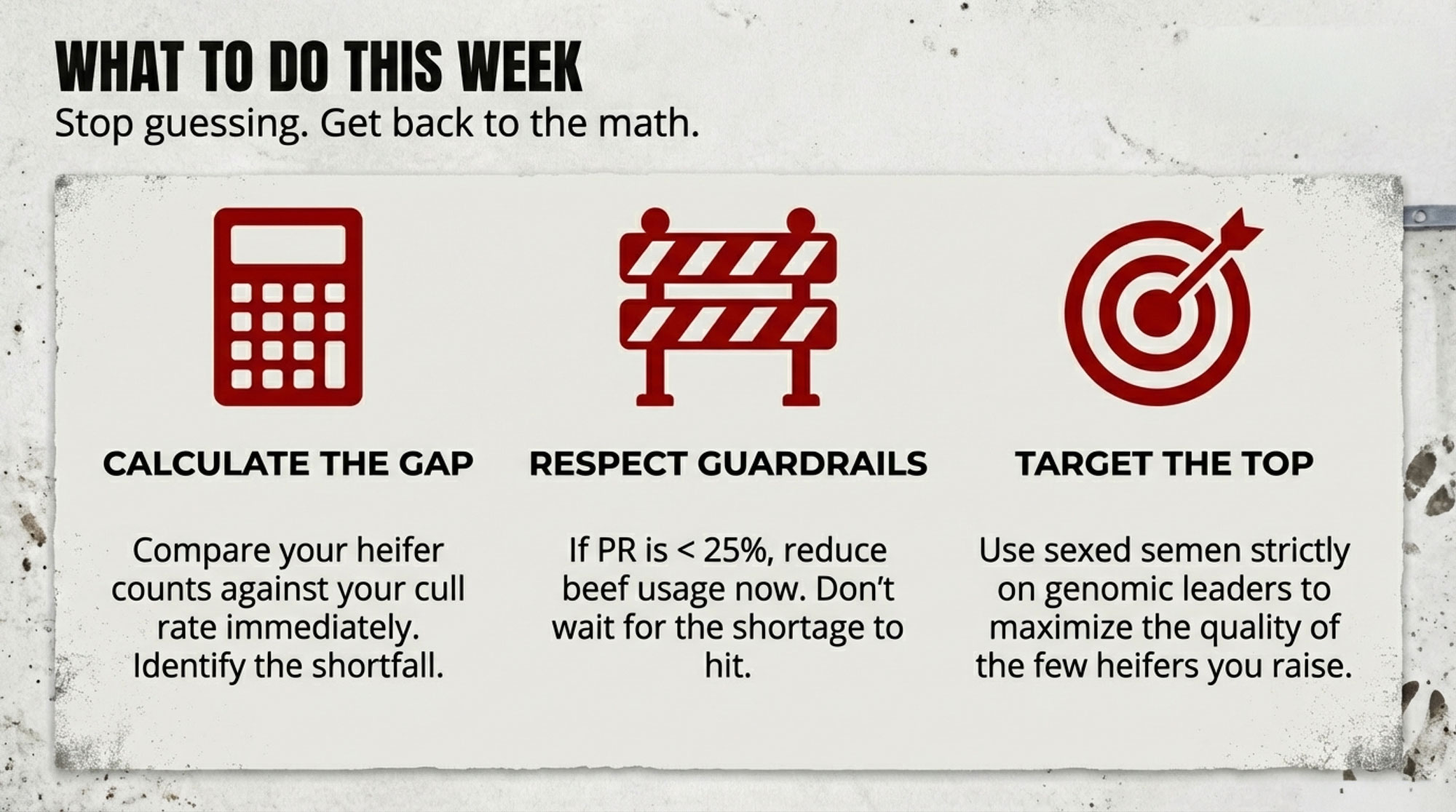
  • Run your replacement pipeline numbers. Count heifers by age group and compare against your culling rate. Are you producing 25-30% more replacements than you need? If not, be conservative on beef semen deployment.

With 72% of dairy farms now using beef genetics, according to Farm Bureau data, the practice has shifted from innovative to expected. Current premiums reflect a beef supply situation that won’t resolve quickly—the smallest cow herd in 64 years doesn’t rebuild overnight.

The producers succeeding with beef-on-dairy share a common approach: they matched their strategy to their actual reproductive performance, protected their replacement pipeline, and built buyer relationships that hold value beyond the current premium cycle.

The market is paying you to be smart, but it will punish you for being short. Run your numbers through the DairyMGT.info calculator before your next breeding setup—because $1,000 calves don’t fix an empty heifer barn.

Key Takeaways

  • Know your tier. Wisconsin research tested 30 strategies: 30%+ pregnancy rate = $6,215/month. 20-25% = $2,001/month. Below 20% = not viable.
  • Protect the pipeline. Heifer inventories are at record lows (2.5M head). Keep 25-30% for replacements—$1,000 calves don’t fix an empty heifer barn.
  • Margins are historic—for now. Beef-cross calves are selling for $680-$1,160, vs. a breakeven of $69-$100. Even a 50% price drop works for high performers.
  • Three numbers determine your strategy: the actual 21-day pregnancy rate. Replacement allocation (25-30%). Genomic cutoff for beef breedings ($40-50/test).

Run the math. Free DairyMGT.info calculator shows which strategy fits your herd before you commit.

EXECUTIVE SUMMARY

Beef-cross calves are selling for $680-$1,160, and 72% of dairy farms have jumped into beef-on-dairy, but University of Wisconsin research reveals most are flying blind. Dr. Victor Cabrera’s team tested 30 breeding strategies and found the economics split sharply: herds at 30%+ pregnancy rate can generate $6,215 monthly in net calf income, while herds below 20% pregnancy rate have no viable beef semen strategy at all. The margin for error is vanishing. The U.S. beef cow herd sits at a 64-year low, dairy heifer inventories hit a record low of 2.5 million head, and one aggressive breeding cycle can erase a year of calf premiums in a single heifer-buying spring. The research points to one approach: know your pregnancy rate, protect your replacement pipeline, and run your numbers through the free DairyMGT.info calculator before your next setup. The market is paying for precision—$1,000 calves don’t fix an empty heifer barn.

The underlying research (Cabrera, 2021) was published in JDS Communications and is available through PubMed Central.

Complete references and supporting documentation are available upon request by contacting the editorial team at editor@thebullvine.com.

Learn More:

Join the Revolution!

Join over 30,000 successful dairy professionals who rely on Bullvine Weekly for their competitive edge. Delivered directly to your inbox each week, our exclusive industry insights help you make smarter decisions while saving precious hours every week. Never miss critical updates on milk production trends, breakthrough technologies, and profit-boosting strategies that top producers are already implementing. Subscribe now to transform your dairy operation’s efficiency and profitability—your future success is just one click away.

NewsSubscribe
First
Last
Consent

The Hidden Cost of Every $1,200 Beef Calf: A $4,000 Heifer Bill

The 60-day pregnancy check is becoming the most terrifying day on the dairy calendar.

EXECUTIVE SUMMARY: You’ve been breeding 35% to beef, banking $1,200 per calf while dairy bulls bring just $200—the math seemed obvious until June’s pregnancy check reveals you’re 150 heifers short. With dairy heifer inventory at its lowest since 1978 and replacements costing ,000 each, this “profitable” strategy has just created a 0,000 problem that will take two years to fix. The culprit: not tracking what percentage of pregnancies are dairy versus beef, the single metric that predicts replacement availability 18 months out. Successful operations monitor this number weekly—when it drops below 45%, they immediately increase sexed dairy semen usage, trading $520 in monthly semen costs to avoid a six-figure crisis. The entire monitoring system takes 30 minutes weekly, yet most producers don’t discover the problem until it’s biologically impossible to fix. The difference between thriving and crisis isn’t luck—it’s whether you’re tracking one number that takes five minutes to calculate.

beef on dairy strategy

You look at the ultrasound monitor as the technician calls out the results. Bull. Bull. Bull. Heifer. Bull. Your stomach drops. You’ve been breeding 35% to beef, following the plan you set in January. The math was perfect on paper—$1,200 beef calves versus $200 dairy bulls. But now you’re staring at a 120-heifer shortage for next year, and replacement heifers are selling for $3,500 to $4,000 each.

How did this happen? You followed your breeding plan to the letter.

Here’s what’s interesting—the answer lies in a calculation that deserves more attention: the forward-looking replacement inventory formula. The beef-on-dairy movement has certainly delivered valuable calf revenue when we’ve needed it most. Lord knows, those $1,200 beef calves have kept many of us afloat. At the same time, it’s creating what CoBank economists describe as a significant structural adjustment period for operations whose monitoring systems haven’t evolved alongside their breeding strategies.

The New Economics Reshaping Dairy Breeding

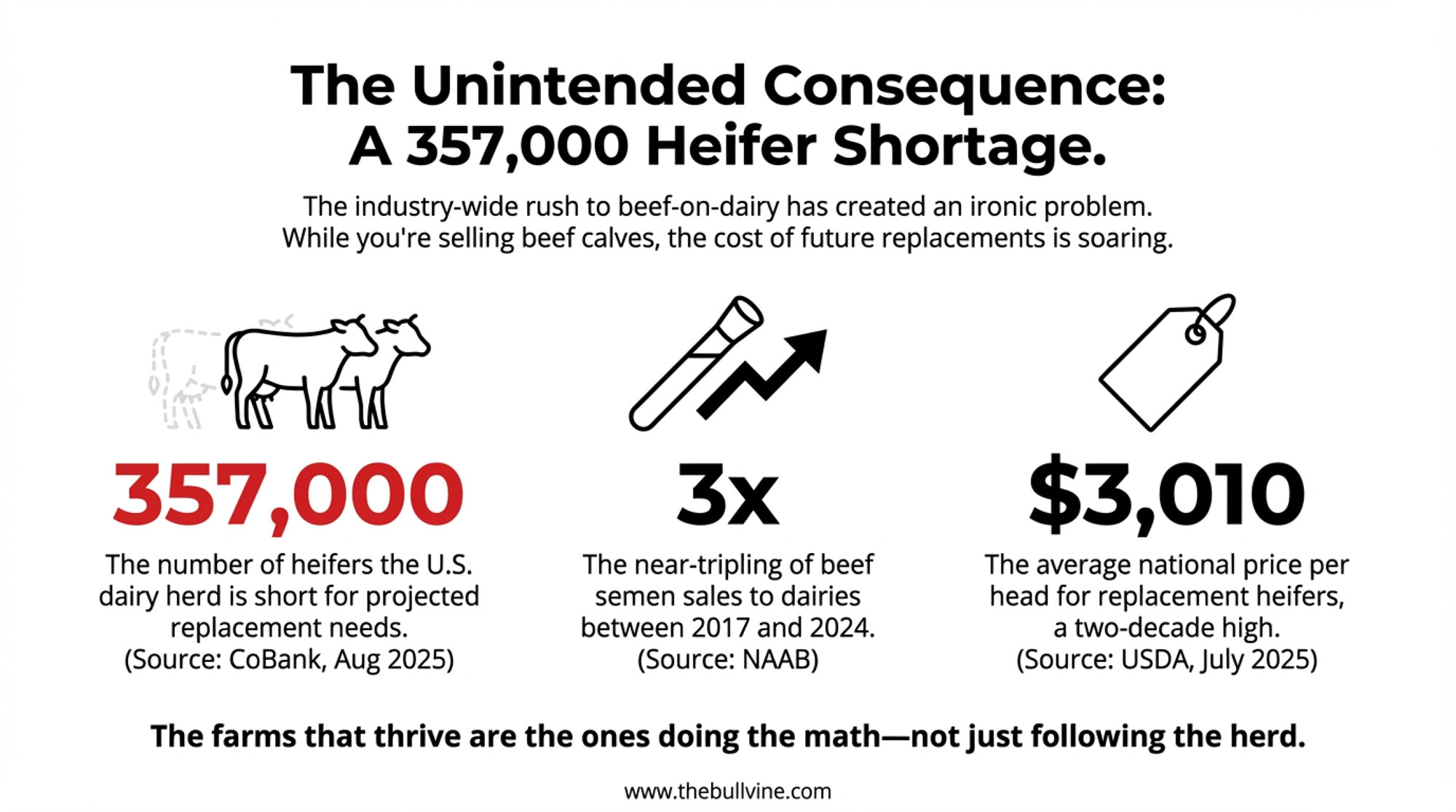
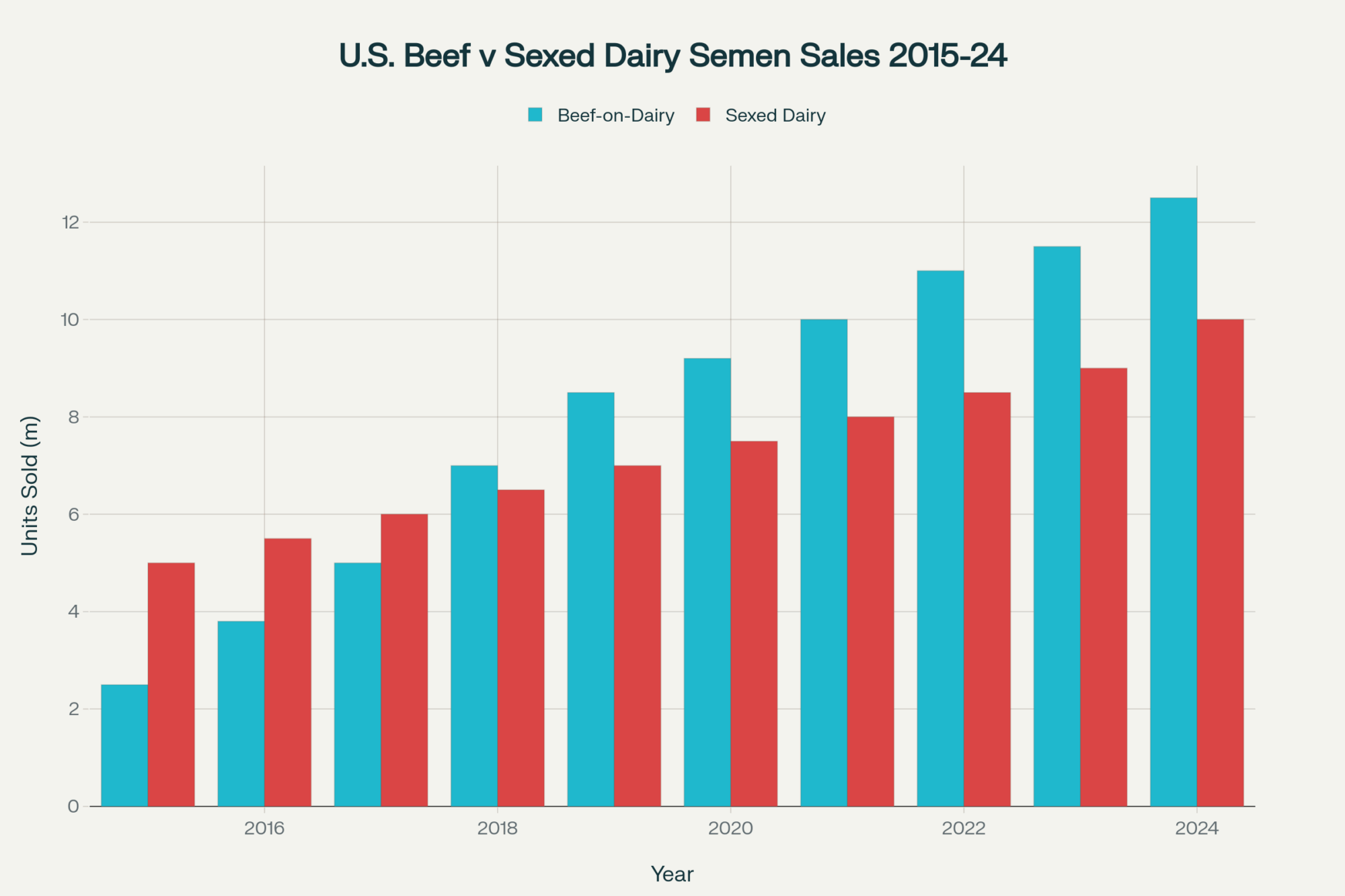
You know, the numbers tell a compelling story about where we are as an industry. The National Association of Animal Breeders reports that beef semen sales to dairy operations climbed from 2.5 million units in 2017 to 7.9 million units in 2024—a 216% increase that reflects fundamental changes in how we think about calf value.

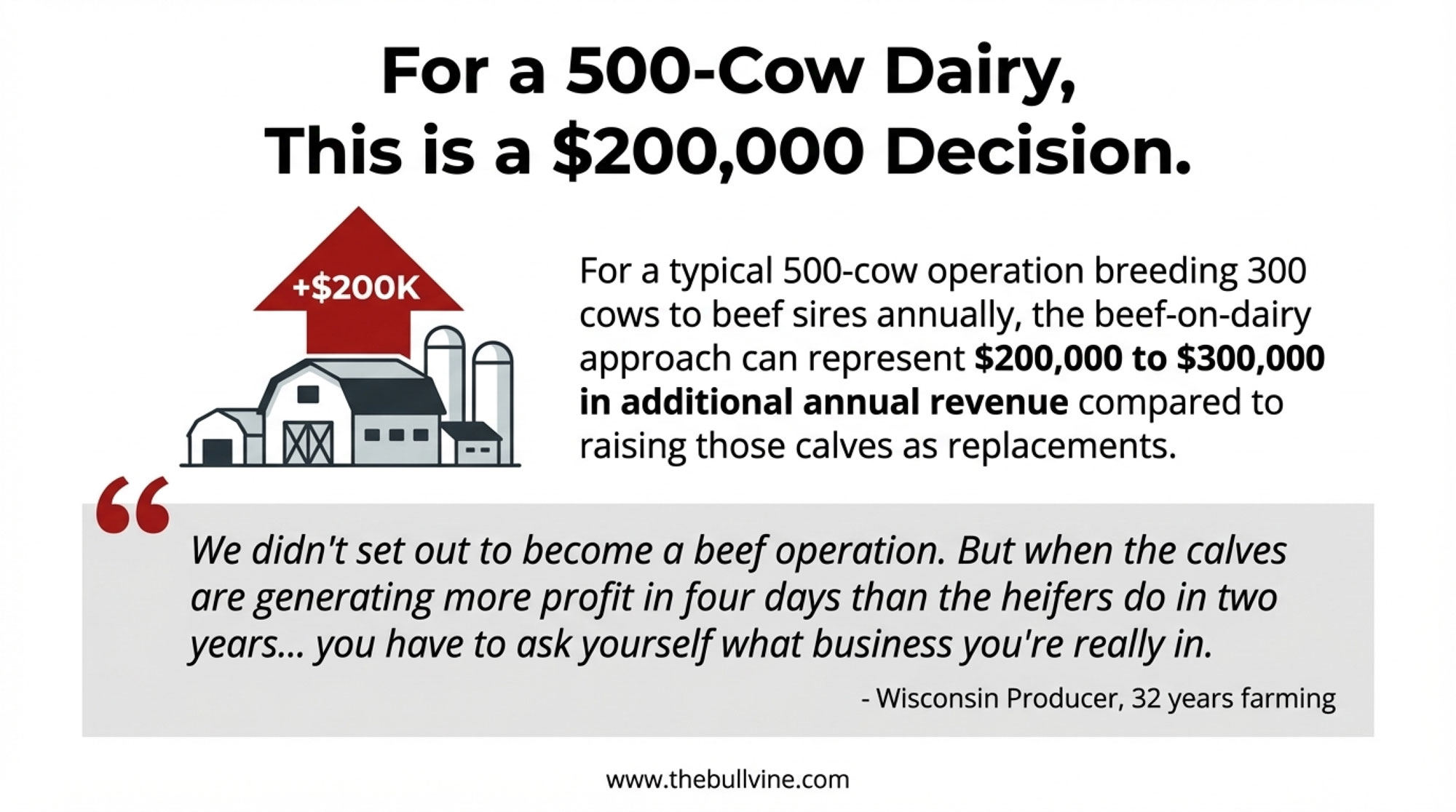
Day-old beef-cross calves now command $1,000 to $1,400. Dairy bull calves? You’re lucky to get $100 to $200, and that’s if you can find a buyer. For a 1,000-cow operation breeding 35% to beef, that’s approximately $210,000 to $245,000 in additional annual calf revenue. That’s real money when you’re dealing with volatile milk prices and input costs that just won’t quit.

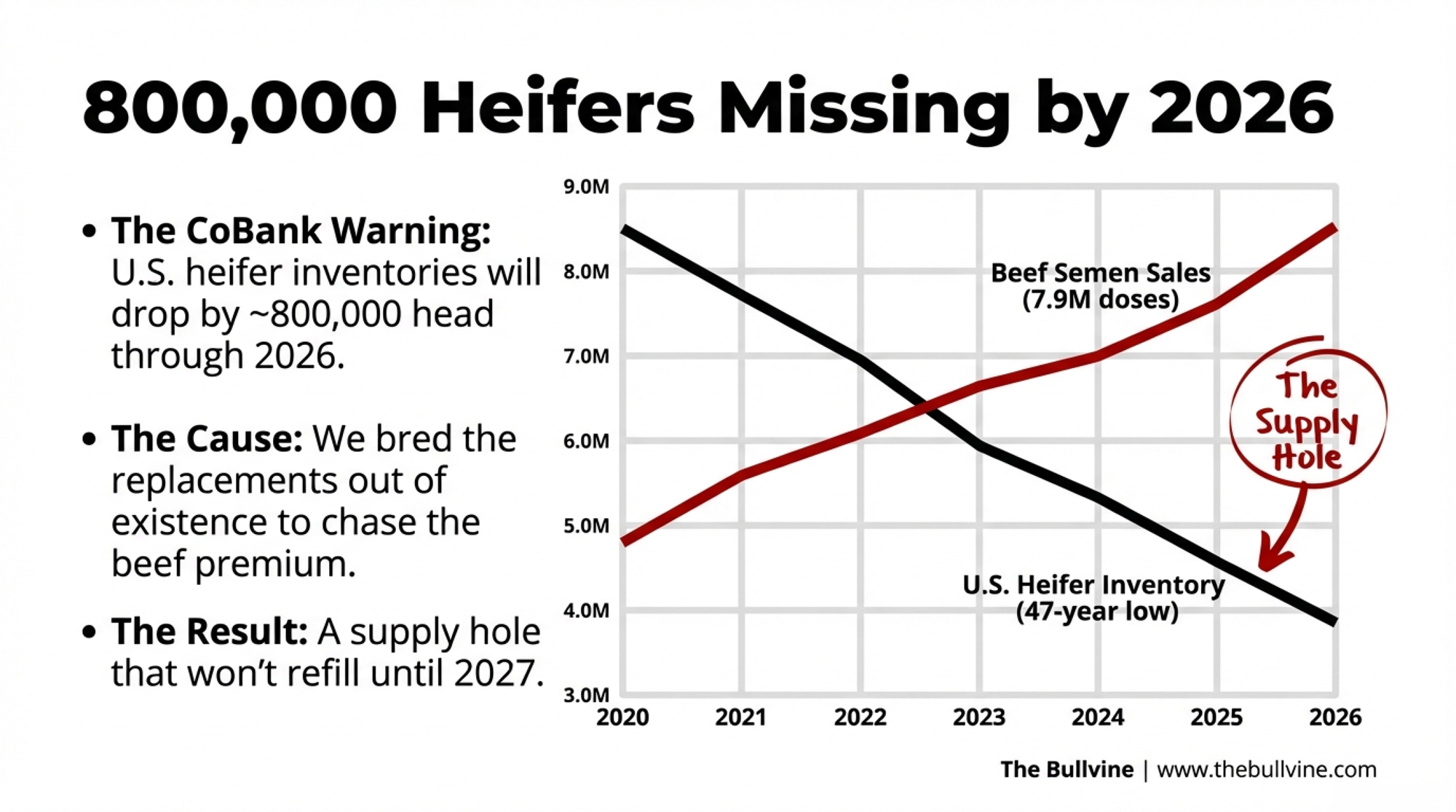
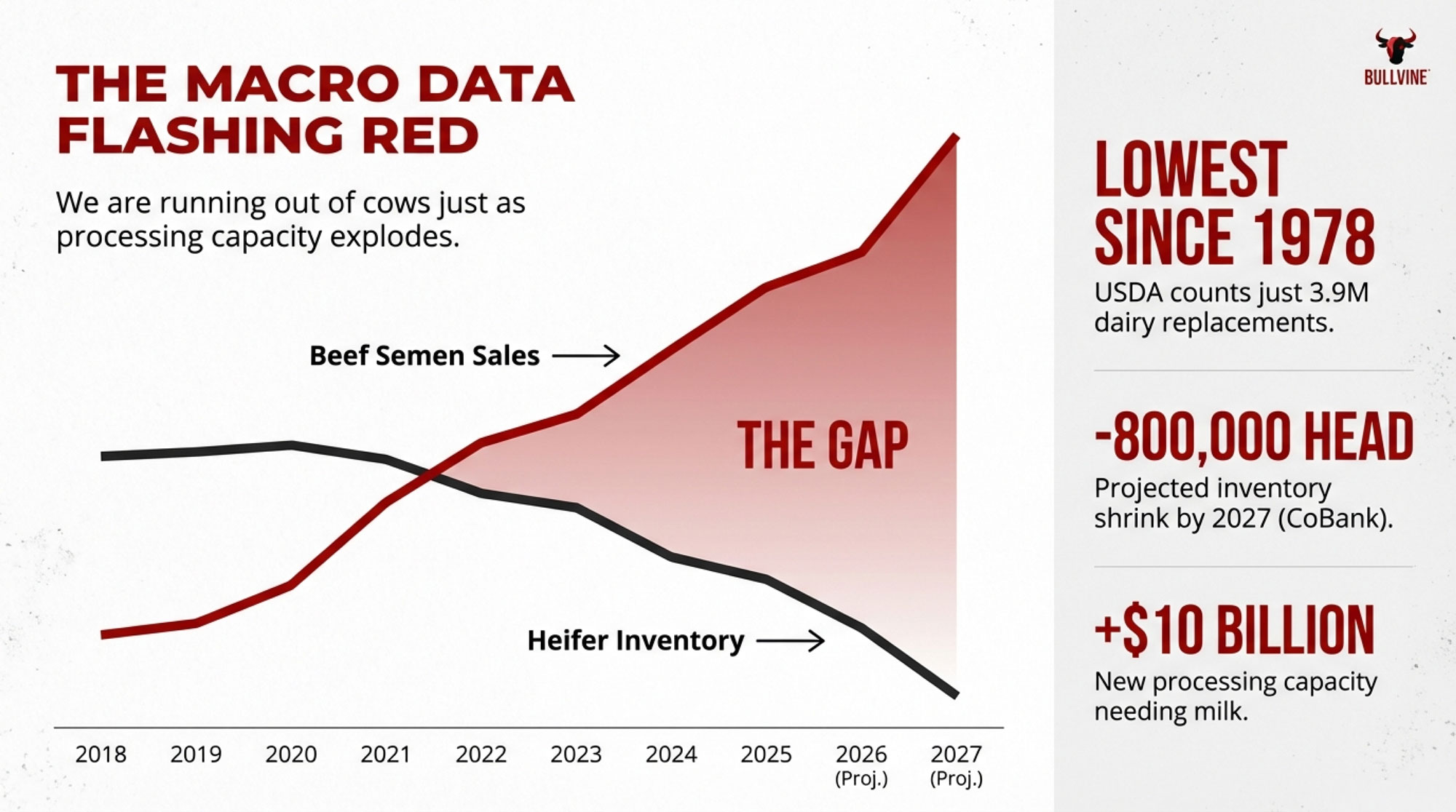
But here’s what’s particularly concerning—and what many of us are just starting to realize. The Holstein Association has documented that each percentage-point shift toward beef breeding removes approximately 95,000 dairy heifers from the national pipeline each year. The USDA’s January cattle inventory report reveals our dairy heifer inventory has declined to 3.914 million head. That’s a level we haven’t seen since 1978, when we were milking very different cows in very different systems.

CoBank’s dairy quarterly analysis from August makes this clear: we’re facing an 800,000-head decline in dairy heifer inventory before any meaningful recovery begins in 2027. This replacement shortage is becoming increasingly apparent to anyone who’s tried to buy heifers lately. They’re simply not available—at any price in some regions.

What’s worth noting is how this plays out differently across borders. Canadian producers navigating supply management face unique constraints when beef revenue opportunities conflict with quota requirements. European operations are balancing beef-on-dairy opportunities with stricter environmental regulations and different subsidy structures. Australian and New Zealand producers, with their seasonal calving systems, face entirely different timing pressures. But the fundamental challenge—balancing today’s revenue with tomorrow’s replacements—that’s universal.

The Critical Calculation Most Operations Miss

Let me share something that I’ve found most operations overlook:

The Forward Replacement Inventory Formula:

Herd Size × (Age at First Calving ÷ 24) × Cull Rate × (1 + Heifer Non-Completion Rate) = Annual Replacements Needed

ScenarioDairy Pregnancies %Annual Heifer ShortageReplacement CostCrisis Total
Unmonitored Herd (No Weekly Tracking)35%-150$3,500-$4,000$525,000-$600,000
Target Range (Disciplined Monitoring)45-55%On targetN/A$0 (Averted)
Early Warning (April Detection)42-45%-50$3,500-$4,000$175,000-$200,000
Sexed Semen Response50%+ recovery-25$520/month semen$6,240
annual
Late Detection (June Preg Check)35%-120+$3,800-$4,200$456,000-$504,000

Based on conversations with producers across the country—and I talk to a lot of them—most operations make at least one of three common miscalculations that can really bite you later:

First, we tend to be optimistic about heifer completion rates. Many of us plan with the assumption that 90-95% of heifer calves will eventually enter the milking herd. But research from folks at Elanco, based on extensive herd monitoring, shows actual rates are 75-80% on well-managed operations. That 15-20 point gap? It compounds annually, and suddenly you’re wondering where your heifers went.

Second: Age at first calving matters more than we think. Penn State Extension research shows that each month beyond 24 months increases replacement needs by approximately 4%. Push from 24 to 26 months—maybe because your heifer grower had a tough winter or you had some respiratory issues—and a 1,000-cow operation needs 33 additional heifers annually just to maintain herd size.

Third: And this is the one that really catches people—not tracking dairy versus beef pregnancy percentages. Research from UW-Madison identifies this as a critical predictive metric for future replacement availability. You probably know your overall pregnancy rate, but do you know what percentage of those pregnancies are dairy versus beef?

When Reality Hits: The 60-Day Moment of Truth

Here’s how it typically unfolds. You set your breeding plan in January, usually over coffee at the kitchen table or during that annual meeting with your nutritionist and vet. Execute it faithfully through spring. Everything looks fine on paper. Then June arrives with 60-day pregnancy checks and fetal sexing capability.

The ultrasound technician begins: “Heifer, bull, bull, bull, heifer, bull…”

Your expression changes as you realize the sex ratio isn’t what you expected. And here’s the kicker—five months of breeding decisions are now locked into 280-day gestations. A shortage of 120 to 150 replacement heifers is mathematically inevitable. You can’t unbred those cows.

What happens next? Well, I’ve watched this play out too many times:

  • July: You’re calling every heifer dealer in 200 miles
  • August: Prices climb from $3,000 to $3,600 per head
  • September-October: Crisis pricing hits—$3,800 to $4,200
  • November: You either write massive checks or keep those arthritic fifth-lactation cows another year

The Weekly Metric That Changes Everything

What successful operations are doing differently—and this really surprised me when I first learned about it—is monitoring dairy pregnancies as a percentage of total pregnancies weekly. Not monthly. Not quarterly. Weekly.

Your Decision Tree:

  • Dairy % between 45-55%: ✓ Continue current strategy
  • Dairy % at 42-45%: ⚠ CAUTION – Monitor closely next week
  • Dairy % below 42% or declining 3 weeks straight: 🔴 ACTION – Adjust immediately

This 5-minute habit can save you six figures. Think about that for a second. Identifying trends in April or May allows correction before June’s breedings lock in. Waiting for a 60-day pregnancy confirmation means the opportunity has passed. The biology is already set.

The Sexed Semen Solution That Surprises Producers

When dairy pregnancy percentages decline, here’s what seems counterintuitive: increase sexed semen usage despite lower conception rates. But look at the math:

Semen TypeConception RateFemale %Result per 100 Breedings
Conventional40%50%20 female calves
Sexed33%90%30 female calves

Despite an 18% conception penalty, sexed semen generates 50% more females. The cost difference? About $520 monthly in additional semen cost versus $3,500-4,000 per replacement heifer. That’s a no-brainer when you run the numbers.

The 30-Minute Weekly System That Works

Here’s what you need—and you probably already have most of it:

  • Your existing herd management software
  • A basic spreadsheet (or, honestly, even a notebook works)
  • 30 minutes weekly

Track five simple data points:

  1. Week number
  2. Total pregnancies confirmed
  3. Dairy pregnancies
  4. Beef pregnancies
  5. Dairy percentage (calculated)

Veterinarians I work with report that producers have avoided $400,000 replacement crises with nothing more than disciplined weekly monitoring. That’s it. Thirty minutes that could save you from financial disaster.

What Successful Producers Do Differently

They adjust breeding strategies based on real-time data rather than annual projections. When dairy pregnancy percentages drift, they respond within weeks, not quarters. No committee meetings, no analysis paralysis—just adjustments based on data.

They monitor conception rates by semen type. One California producer who asked not to be named noticed a problem when dairy conception was running at 38% while beef was at 44%. Overall, it looked fine at 41%, but the divergence signaled specific dairy bull fertility issues that needed to be addressed immediately.

They plan realistic completion rates. A Pennsylvania producer shared this experience: “We assumed 90% of heifer calves would reach the milking parlor. Reality was 76%. That 14% gap over three years? 180-heifer shortage.” That’s a lesson learned the hard way.

And perhaps most importantly, they resist market timing. When beef prices surge—and they will again, markets are cyclical—disciplined operations maintain their breeding allocation rather than chase short-term revenue.

The Industry Dynamics Creating This Challenge

Several factors are converging that make this more complex than it was even five years ago.

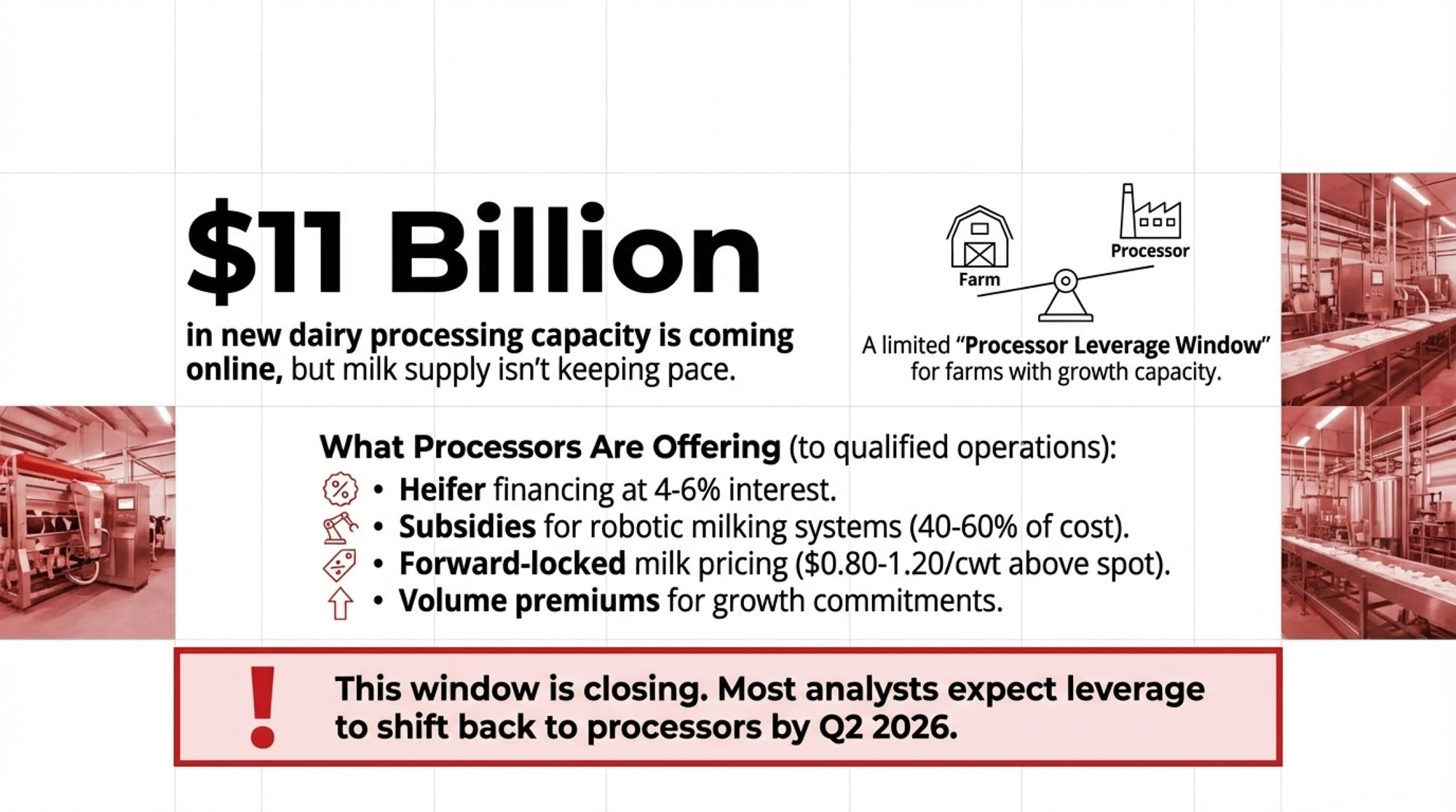
Rabobank identifies $10 billion in new processing capacity requiring 2-3% annual production growth. That milk has to come from somewhere—either more cows or higher production per cow, both requiring careful replacement planning.

Research from UW-Madison shows that keeping older, lower-genetic cows costs several hundred dollars per lactation in unrealized genetic potential. It’s a hidden cost that adds up quickly when you’re holding onto cows past their prime.

CME data confirms we’re seeing unprecedented spreads between beef-cross and dairy bull values. That economic pressure to breed beef is real and it’s intense.

And here’s what makes it tough—once beef-on-dairy revenue reaches a significant portion of farm income, as industry analysis suggests is happening for many operations, returning to previous breeding strategies becomes financially challenging, even when replacement needs suggest you should.

These industry pressures aren’t just numbers on a spreadsheet—they’re reshaping how we make decisions every single day on our farms.

Practical Lessons from the Field

Looking at how these dynamics play out in real operations, the patterns become clear.

One California producer managing 1,500 cows, who preferred to remain anonymous, shared this sobering experience: “We bred 40% to beef without weekly monitoring. By July, we were 180 heifers short. Cost us $650,000 in purchased replacements plus another $80,000 in health and adaptation challenges. Now we monitor weekly—takes 20 minutes, prevents million-dollar mistakes.”

A Pennsylvania operation with 800 cows reported better results: “When our dairy percentage dropped to 43% in April, we immediately increased sexed semen usage. That early adjustment means we’re actually ahead on replacements now.”

And from the other side of the equation, a Minnesota custom heifer raiser tells me: “Three years ago, I had excess capacity. Today, I’m declining inquiries weekly. The offers I’m getting—$500 per head premiums just to accept calves, before any feeding costs—show how desperate the situation has become. But biological realities mean these animals require two years regardless of how urgent the need.”

Looking Ahead: What This Means for Your Operation

The beef-on-dairy opportunity has provided crucial revenue during challenging economic periods—I’m not arguing against it. As replacement availability tightens and prices reach historic levels, though, success will belong to operations that balance opportunity with disciplined management.

This isn’t really about choosing between beef revenue and dairy replacements. It’s about implementing systems that enable real-time response rather than hoping annual projections prove accurate. These principles apply whether you’re managing 3,000 cows in an Arizona dry lot or 200 cows on a Missouri pasture—the mathematics remain consistent, only the scale varies.

So here’s the question that matters: Are you monitoring the right metrics weekly, or are you waiting for problems to become crises?

Tracking dairy pregnancies as a percentage of total pregnancies requires just 30 minutes weekly. The cost of not monitoring? Producers nationwide are discovering it can easily exceed $400,000 when replacement shortages force them to make desperate purchasing decisions.

The beef-on-dairy opportunity remains valuable—genuinely so. But like all agricultural opportunities, it rewards those who measure, monitor, and adjust based on data—not those who set plans in January and hope for the best.

As we approach 2026, your dairy pregnancy percentage might be the most critical metric on your farm. The encouraging news? The tools and knowledge exist to navigate this successfully. It simply requires discipline and perhaps a shift in how we think about breeding management—from annual planning to continuous optimization.

Don’t know your current Dairy Pregnancy %? Go check your herd management software right now. If it’s below 42%, call your breeding advisor today.

KEY TAKEAWAYS

  • Your dairy pregnancy percentage predicts your future: Below 45% means you’re heading for a 150-heifer shortage worth $600,000—monitor it weekly, not annually
  • Timing is everything: Problems discovered in April can be fixed with breeding adjustments; problems discovered at June’s 60-day check are locked in for two years
  • Sexed semen is cheaper than panic: $520/month extra for sexed semen generates 50% more heifers and beats paying $3,500-4,000 per replacement
  • The 30-minute solution: Weekly monitoring of one metric (dairy pregnancies ÷ total pregnancies) has prevented $400,000 crises for disciplined producers
  • Action required today: Check your dairy pregnancy percentage now—if it’s below 42%, increase sexed dairy semen usage immediately

Complete references and supporting documentation are available upon request by contacting the editorial team at editor@thebullvine.com.

Learn More:

Join the Revolution!

Join over 30,000 successful dairy professionals who rely on Bullvine Weekly for their competitive edge. Delivered directly to your inbox each week, our exclusive industry insights help you make smarter decisions while saving precious hours every week. Never miss critical updates on milk production trends, breakthrough technologies, and profit-boosting strategies that top producers are already implementing. Subscribe now to transform your dairy operation’s efficiency and profitability—your future success is just one click away.
NewsSubscribe
First
Last
Consent

Dairy Wins, Beef Loses: Inside the 18-Month Window Where $1,400 Calves Meet Record Component Premiums

Plot twist: Dairy farms now produce more beef profit than beef ranches. $1,400/calf vs. their $800. The math is devastating.

EXECUTIVE SUMMARY: Dairy has stumbled into the opportunity of a generation: we’re producing 230 billion pounds of milk while simultaneously filling the void left by beef’s collapse to 1961 lows—effectively owning both markets. Three strategies are generating $600-770K in additional annual revenue for progressive operations: beef-on-dairy genetics transforming worthless bull calves into $1,400 assets; component optimization capturing $84,000 from butterfat premiums; and export positioning, as China and India desperately need our proteins. The proof is compelling—producers investing $70,000 are returning $200,000 in year one, with 60% efficiency. Here’s the urgency: only 28% have moved while premiums are maximum; by 2027, when adoption hits 70%, the window closes. Make no mistake—this isn’t about incremental improvement, it’s about who survives the next decade.

beef on dairy profitability

I was reviewing the November USDA reports, and something remarkable jumped out that deserves our attention. The latest WASDE data shows dairy production surging to 230 billion pounds, while beef production drops by 70 million pounds and pork production falls by 80 million pounds. What’s particularly noteworthy is how few producers have fully grasped the implications of this shift.

This development builds on what we’ve been seeing across the industry—not just another typical market cycle, but what appears to be a fundamental restructuring of North American protein production. Several economists I’ve spoken with are describing this as an 18-month window of genuine opportunity, and the more I analyze the data and talk with producers, the clearer the pattern becomes.

The consumption trends align with this narrative. USDA’s Economic Research Service shows Americans consuming record levels of dairy products, reaching historic highs that would have seemed impossible just five years ago. Globally, the milk protein market continues its substantial growth trajectory, with multiple analyses projecting sustained expansion through 2032. This coincides with the beef cow herd dropping to approximately 28 million head—USDA data confirms this represents the lowest level since the early 1960s.

In recent conversations with producers from various regions—Wisconsin cooperatives, California independents, Texas operations—those experiencing the most success share a common trait: they’re adapting now, even if imperfectly, recognizing that this convergence of factors presents opportunities we haven’t encountered in decades.

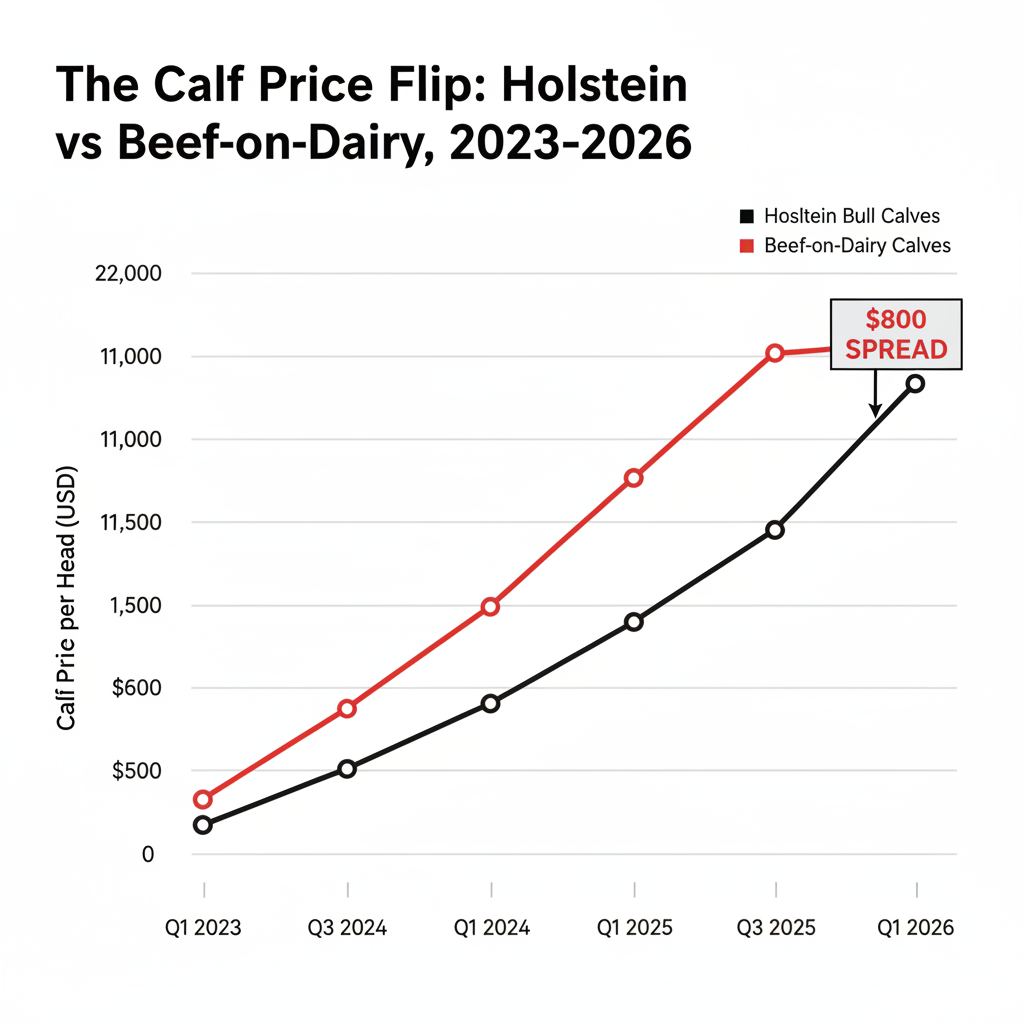
Beef-on-dairy calf prices have surged from $225 to $1,439 in under three years—a 540% increase—while Holstein bull calves remain virtually worthless at $50. This $1,389 price gap represents the single largest profit opportunity in modern dairy history

The Beef-on-Dairy Revolution: From Liability to Asset

How Forward-Thinking Farms Discovered the Formula

Here’s what’s happening on farms across the country. Producers are telling me they used to essentially give away Holstein bull calves—some mentioned getting as little as five dollars for two calves just a few years back. Today, according to USDA Agricultural Marketing Service data this fall, those same genetics bred to carefully selected beef sires are commanding $1,200 to $1,400 each.

For perspective, a large dairy operation implementing this strategy could potentially generate $600,000 to $770,000 in additional annual revenue, depending on their size and execution. Same facilities, same management team, fundamentally different economics.

What’s particularly interesting—and this has been confirmed through discussions with extension specialists at both Cornell and Wisconsin—is how beef genetics on dairy has evolved beyond simple calf value. It’s reshaping our entire approach to genetic progress and herd optimization.

The Strategic Framework That Makes It Work

The most successful implementations I’ve observed, from California’s Central Valley to New York’s traditional dairy regions, share common elements that go well beyond basic crossbreeding.

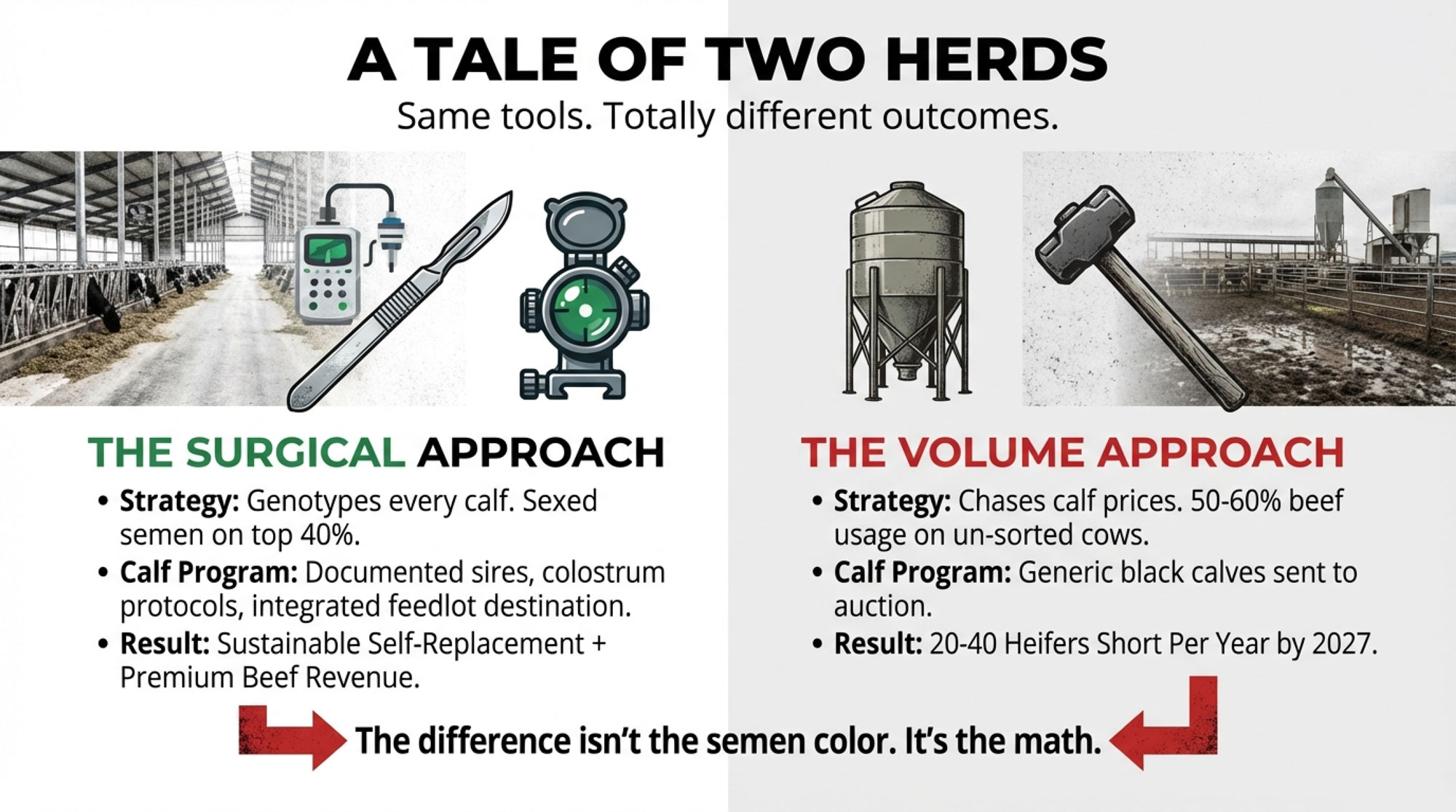
Progressive producers are walking me through their approach: genomic testing of the entire herd at approximately forty dollars per animal, creating a precise roadmap of genetic potential. This allows targeted breeding decisions—sexed semen (at a fifteen to twenty-five dollar premium per breeding) on the top 40 to 50 percent of cows, while the remainder are bred to proven beef sires.

The sire companies report Angus and SimAngus dominating these selections, and for good reason—the calving ease and growth characteristics align well with dairy operations. University of Wisconsin research continues to validate this approach, showing consistent economic advantages.

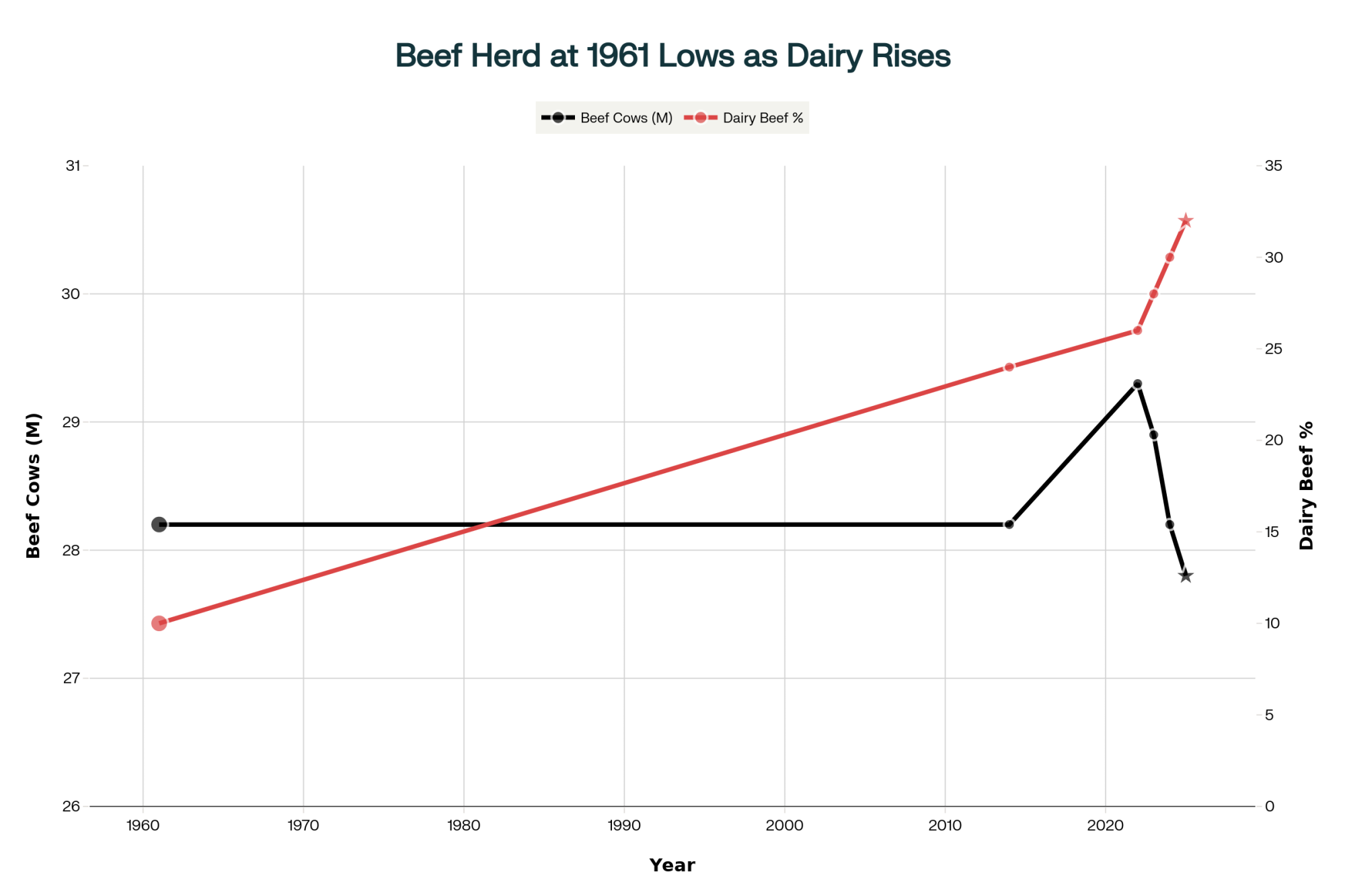
The beef cow herd has crashed to 27.8 million head—matching 1961 levels—while dairy’s contribution to the beef supply has surged from 10% to 32%. Dairy isn’t supplementing beef production anymore; it’s becoming the backbone of the entire protein system

Current industry data indicates dairy contributes approximately 28 percent of the total U.S. calf crop, compared to roughly 24 percent in the mid-1990s. Given beef cow rebuilding timelines—typically five to six years minimum based on historical cattle cycles—this percentage could realistically reach 32 to 35 percent by 2027.

The math is brutal: as adoption rates surge from 28% today to 70% by 2027, beef-cross calf premiums will collapse from $1,400 to $800. Early movers capture maximum value; late adopters fight for scraps. The 18-month window isn’t marketing hype—it’s market mechanics

Component Optimization: The Hidden Value in Every Tank

Why Volume-Based Production Is Becoming Obsolete

Producers in California have been showing me compelling comparisons of their milk checks from 2023 versus the current year. The transformation in how milk is valued has been striking.

When Federal Order changes took effect this summer, the entire pricing dynamic shifted. California pricing announcements show butterfat reaching $2.62 per pound, making component optimization increasingly critical. The economics are straightforward yet powerful—every 0.1 percent increase in butterfat adds approximately thirty-five cents per hundredweight in additional revenue.

Component premiums reward precision nutrition: a 0.2% butterfat improvement from 4.1% to 4.3% delivers $61,320 in additional annual revenue for a mid-sized operation, with zero additional cows or facilities. It’s not glamorous, but it’s pure margin expansion

For a typical herd producing 24,000 pounds daily, improving from 4.1 to 4.3 percent butterfat could translate to roughly $84,000 in additional annual revenue under optimal conditions.

These aren’t just theoretical projections—producers are seeing real improvements in their milk checks.

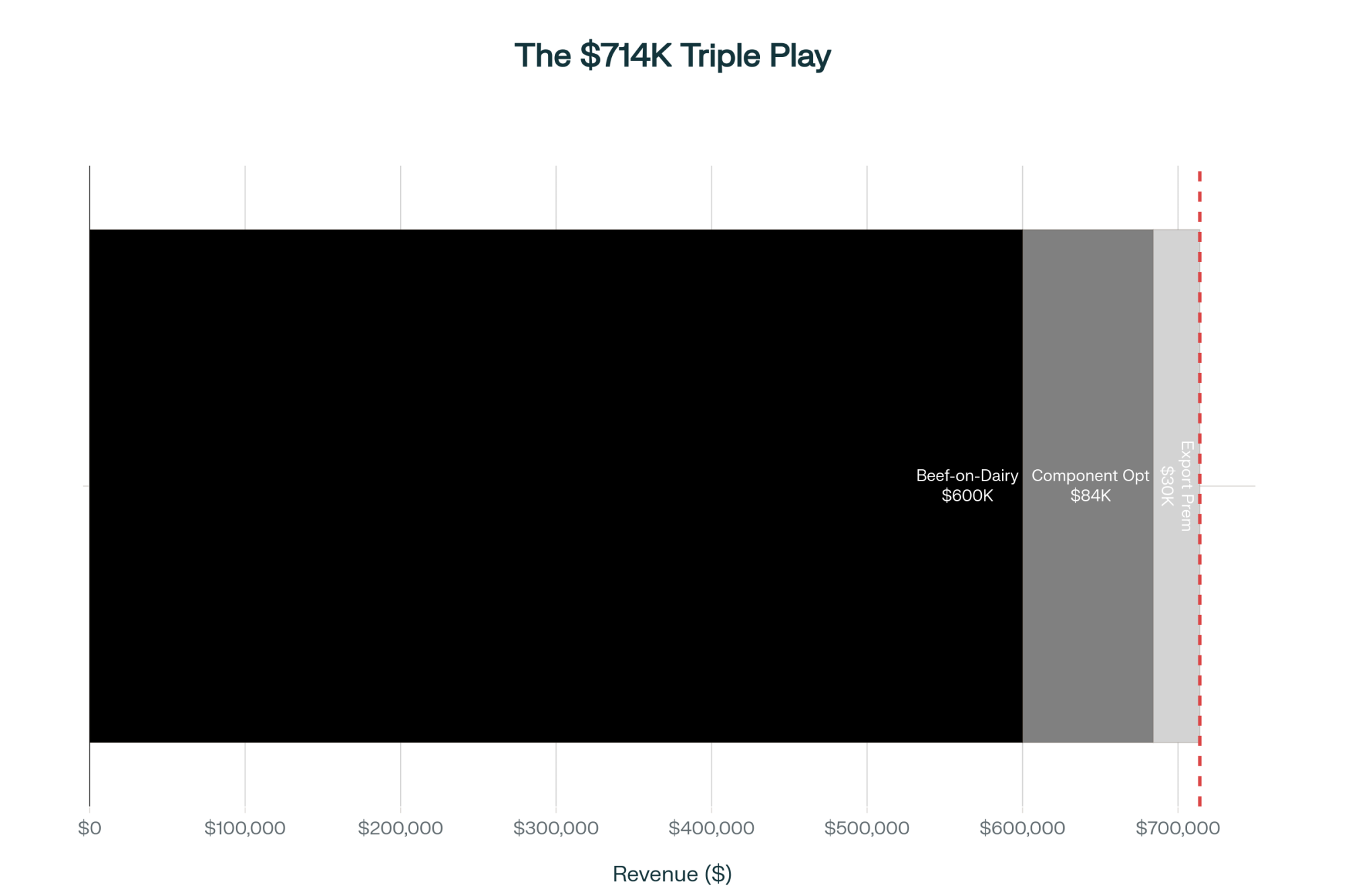
Progressive dairy operations are stacking three distinct revenue streams—beef-on-dairy genetics ($600K), butterfat optimization ($84K), and export premiums ($30K)—to generate over $714,000 in additional annual revenue without adding a single cow to the milking herd

The Genetic Revolution Driving Component Gains

The April genetic base change data from the Council on Dairy Cattle Breeding revealed something significant—a 45-pound rollback in butterfat Estimated Breeding Values, representing substantial industry-wide genetic progress.

During a recent genetics conference, specialists characterized this as unprecedented selection intensity for components. The practical impact? Producers selecting bulls with plus-50 pounds butterfat and plus-40 pounds protein are creating meaningful competitive advantages over operations using industry-average sires.

Nutritionists working with herds across Wisconsin are sharing their evolving approach: precise rumen pH management, maintaining a pH of 6.0 to 6.2 for optimal fat synthesis, and transitioning from generic bypass fats to targeted palmitic acid supplements at 200 to 250 grams per cow daily. University research from this past spring demonstrates that this can increase butterfat by 0.2 percent within 30 days—seemingly modest yet economically significant across an entire herd.

The Export Opportunity: Beyond Domestic Markets

China’s Strategic Shift Creates Targeted Opportunities

While the U.S. Trade Representative confirms 135 percent tariffs on many dairy products to China, the underlying trade dynamics tell a more nuanced story. USDA Foreign Agricultural Service data from this fall reveals interesting patterns in China’s import behavior.

According to trade data, imports of sweet whey powder have been growing significantly year over year, even as imports of commodity milk powder have declined. The driver appears to be specialized demand for swine feed ingredients and infant formula components rather than bulk commodities.

Producers shipping to export-oriented processors are reporting premiums of approximately forty cents per hundredweight for high-protein milk that yields better in whey extraction. For a mid-sized operation, that could translate to meaningful additional annual revenue—we’re talking potentially $25,000 to $30,000 for a 600-cow herd.

India’s Protein Crisis Opens New Channels

The opportunity in India may be even more significant, based on USDA attaché reports from New Delhi. Given that 70 to 80 percent of Indians do not meet daily protein requirements, according to the Medical Research Council, the government has launched a revised National Program for Dairy Development with substantial funding for fortification initiatives.

The tariff structure clearly reveals the opportunity. India applies approximately 30 to 60 percent tariffs on fluid milk and cheese imports, yet only around 8 percent on whey protein and 5 percent on lactose—reflecting limited domestic production capacity for these specialized ingredients.

European Market Dynamics

What’s also developing—and this hasn’t received much attention—is the European Union’s shifting protein strategy. With increasing pressure on their livestock sector from environmental regulations, industry reports suggest EU imports of specialized dairy proteins have been growing substantially since 2023. U.S. producers meeting specific sustainability metrics are finding opportunities for premium access to these markets.

The Operations at Risk: Recognizing Warning Signs

Who Faces the Greatest Challenges

We need to acknowledge candidly that not all operations are positioned to capture these opportunities. USDA’s Agricultural Resource Management Survey data from recent years indicates that operations with fewer than 200 cows face average production costs of around $20.93 per hundredweight, compared to $16.50 for operations with more than 1,000 cows.

Producers who’ve recently exited the industry have shared their experiences. When cooperatives announce infrastructure deductions—like the documented four-dollar-per-hundredweight case with Darigold in May—smaller operations can face thousands of dollars in additional monthly costs. For a 150-cow operation, that could mean over $7,000 in additional monthly expenses, creating immediate cash-flow challenges.

Studies suggest the majority of recent dairy exits have involved smaller operations with single-processor relationships and limited value-added strategies. While difficult to discuss, understanding these dynamics is essential for informed decision-making.

Regional Variations Matter

The strategies that succeed in Wisconsin may face challenges in Georgia—regional context matters tremendously. University of Florida dairy specialists have documented that Southeast operations often face production costs per hundredweight that are 2 to 3 dollars higher due to heat-stress management and feed procurement requirements.

Conversely, Texas Panhandle operations benefit from proximity advantages. Producers there report capturing an additional hundred to hundred-fifty dollars per calf on dairy-beef crosses compared to operations shipping longer distances, simply because of their location near multiple beef feedlots.

Technology Adoption Patterns

What’s interesting is how technology adoption varies by operation size. Research suggests operations between 500-1,000 cows often show strong adoption rates for genomic testing and precision feeding—they seem to hit a sweet spot of having adequate resources while maintaining operational flexibility.

Practical Implementation: Learning from Those Who’ve Done It

The Measured Approach That Works

Producers who’ve successfully transitioned share common timelines and approaches. They typically start with genomic testing—investing approximately $40-50 per animal for a comprehensive herd evaluation. This provides the genetic roadmap.

Within a few months, they’re implementing sexed semen on superior genetics. Then comes beef sire selection tailored to their facilities—calving ease often proves critical, especially in older barn configurations. By the following fall, they’re seeing the first beef-cross calves arriving.

“Year one, we captured perhaps 60 to 70 percent of the potential while learning the system. Even at that efficiency level, we generated substantial additional revenue on essentially unchanged feed costs.” — Minnesota dairy producer

Investment Reality Check

Based on producer experiences and consulting firm analyses, here’s the realistic investment framework:

  • Genomic testing: $40-50 per animal (one-time investment)
  • Sexed semen: $15-25 premium per breeding above conventional
  • Nutritionist consultation: $2,000-5,000 monthly, depending on service level
  • Component feed adjustments: Approximately $0.50 per cow daily
  • Data management software: $200-500 monthly for quality tracking systems

For a representative mid-sized operation, year-one implementation might total $60,000 to $80,000. However, combining beef-calf premiums with component improvements could potentially generate substantial additional revenue. While results vary, the fundamentals of economics generally favor well-managed operations.

Sustainability Considerations

What’s encouraging for long-term viability is how these strategies align with sustainability goals. The genetic improvements that reduce days to market for beef-cross calves can translate into lower lifetime emissions per pound of protein produced. Several processors are beginning to consider these metrics—something worth monitoring as carbon markets develop.

Looking Ahead: The Questions That Matter

Is This Sustainable or Another Bubble?

In discussions with agricultural economists and market analysts, the consensus suggests solid fundamentals underpin current conditions. Beef cow herd rebuilding faces structural constraints, with projections indicating a return to pre-drought inventory levels at the earliest in 2030. Global protein demand maintains 2 to 3 percent annual growth,according to FAO data—this reflects structural rather than cyclical factors.

However, appropriate caution is warranted. As beef-on-dairy adoption increases—already substantial in certain regions—some premium compression is likely. Markets are already seeing variation, with premiums ranging from $1,000 to $1,400 depending on genetics, location, and buyer relationships.

The indicator I’m monitoring most closely? USDA’s quarterly Cattle on Feed reports tracking dairy replacement heifer inventories, currently at approximately 1.88 million head—the lowest since the late 1970s, according to NASS data. Continued decline through 2026 would suggest structural transformation; recovery above 2.1 million might indicate temporary market dynamics.

What About Farmers Who Can’t or Won’t Change?

I’ve spoken with veteran producers approaching retirement who’ve made the conscious choice to maintain current practices rather than implementing new strategies. With paid-off operations and no succession plans, this approach has validity.

Industry observers suggest a significant portion of current operations may exit within the next decade, regardless of market conditions—due to demographic realities rather than economic failure. For these producers, operational stability may appropriately outweigh optimization opportunities.

Key Takeaways for Your Operation

After extensive data analysis, producer conversations, and expert consultation, several key insights emerge.

The opportunity window exists, but it continues to narrow. Early adopters captured the highest premiums with limited competition. Current implementers are seeing good returns, though not quite at early-adopter levels. By 2027, returns may normalize further, though they will remain profitable for efficient operations.

Geography influences profitability more than scale—surprising but documented. A strategically located, smaller dairy near beef infrastructure can perform well compared to larger operations that face logistical challenges. Understanding your regional advantages and constraints proves essential.

Processor relationships have evolved from customer-vendor to strategic partnerships. If your processor cannot articulate clear export strategies or component valuation methods, opportunities may remain unexploited. Business alignment now matters as much as traditional loyalty considerations.

Experience teaches that perfection often impedes progress. Producers achieving partial efficiency in year one while generating meaningful profits demonstrate that imperfect action often surpasses perfect planning.

Your Next Steps

Looking at actionable items for interested producers:

  1. Request genomic testing information from your breed association or genetics provider—understanding costs and logistics is the first step
  2. Schedule a conversation with your nutritionist about component optimization potential in your current ration
  3. Contact your processor to understand their component pricing structure and export market positioning
  4. Reach out to beef breed associations for information on dairy-appropriate sires and local calf buyer networks
  5. Connect with producers who’ve already made transitions—their practical experience proves invaluable

As we consider the industry landscape this November, dairy isn’t declining—it’s transforming. Producers who recognize the shift from commodity milk production to strategic protein business models position themselves for success. Those awaiting return to historical norms may discover that “normal” has fundamentally changed.

The data supports action. Strategies have proven effective. Progressive neighbors are already implementing changes. The question has evolved from whether to adapt to how rapidly you can position your operation for emerging opportunities.

KEY TAKEAWAYS

  • The $1,400 Reality Check: Your Holstein bull calves are worth $1,400 to smart producers, $50 to you—the difference is three breeding decisions and genetics testing
  • Triple Revenue Stream, Same Cows: Beef-on-dairy ($600K) + butterfat optimization ($84K) + export premiums ($30K) = $700K+ additional annual revenue without adding a single cow
  • The 18-Month Countdown: Today, only 28% have adapted; when it hits 70% by 2027, premiums crash from $1,400 to $800—early movers win, others consolidate
  • Proven ROI Formula: Invest $70K (genetics + nutrition + consulting) → Return $200K year one, even at 60% efficiency—this isn’t theory, it’s what producers are doing now

Complete references and supporting documentation are available upon request by contacting the editorial team at editor@thebullvine.com.

Learn More:

Join the Revolution!

Join over 30,000 successful dairy professionals who rely on Bullvine Weekly for their competitive edge. Delivered directly to your inbox each week, our exclusive industry insights help you make smarter decisions while saving precious hours every week. Never miss critical updates on milk production trends, breakthrough technologies, and profit-boosting strategies that top producers are already implementing. Subscribe now to transform your dairy operation’s efficiency and profitability—your future success is just one click away.
NewsSubscribe
First
Last
Consent

Matching the Feed to the Calf: Birth to 120 Days – Practical Science for Dairy-Beef Calves

Consistency isn’t a suggestion—it’s biology. Same time, same temp, same quality = 2.6 lb ADG and $100+ more per calf.

Good calf growth starts with steady habits—consistent feeding, clean water, and careful observation. From birth through 120 days, the calf’s diet and environment change rapidly, and how those changes are managed determines strength, health, and efficiency later on. Success comes from small, repeated actions done right every day.

Philosophy in Practice

Calves grow on consistency. Steady feeding times, clean water, dry air, and no sudden ration changes are the foundation of every good calf program.

Consistency Drives Growth

  • Feed at the same times every day
  • Keep milk solids and milk temperature consistent
  • Replace the starter daily so it smells clean and fresh
  • Make ration changes gradually over 4–7 days

Quick Start Essentials: 

□ Buy Brix refractometer ($30) 
□ Buy digital thermometer ($12) 
□ Set feeding times and stick to them 
□ Test first colostrum batch today 
□ Check milk temperature at next feeding

Birth to Day 3 — Immunity and Metabolic Activation

A newborn calf is born without immune protection in its bloodstream. All early protection comes from colostrum, which provides antibodies (IgG) and energy for warmth and early growth. If the calf doesn’t receive enough high-quality colostrum quickly, long-term health and gain are compromised.

What must happen in the first 24 hours:

  • Feed at least 4 quarts of clean, high-quality colostrum (Brix 24 or higher) within 2 hours of birth or 8.5%-10% of body weight
  • Provide another 2 quarts in the next 8–12 hours
  • Aim for 200+ grams of IgG total. A quick check is a Brix reading of 24% or higher
  • Dip the navel and provide deep, dry bedding
  • Offer warm water between liquid feedings
  • Keep calf temperature above 100°F

Research confirms that colostrum quality varies significantly between cows, with IgG concentrations ranging from less than 50 g/L to over 150 g/L. Using a Brix refractometer to test colostrum is now standard practice; readings of 22% or higher indicate good quality, and readings below 18% suggest the colostrum should not be used as the first meal. The 2024 National Animal Health Monitoring System (NAHMS) dairy study found that 29% of colostrum samples tested below minimum quality thresholds, while producers estimated only 8% was of poor quality.

Why Water Matters

  • Water and milk are not the same in the calf’s gut
  • Free-choice water helps rumen microbes begin developing early
  • No water equals weak fermentation, which equals slow rumen growth
  • Dump, clean, and refill water buckets daily

Water consumption is critical even in the first days of life. Unlike milk, which bypasses the rumen through the esophageal groove, drinking water enters the rumen directly and supports bacterial establishment and fermentation.

Days 3–21 — Rumen Initiation and Microbial Establishment

By day 3, the rumen is waking up. A good calf starter stimulates chewing and microbial activity. When microbes ferment starch, they produce volatile fatty acids (VFAs), especially butyrate, which signals the rumen lining to grow papillae—the structures that absorb energy later in life.

Feeding goals for this stage:

  • Feed milk replacer (20–24% CP, 20–22% fat) twice daily at consistent solids and temperature
  • Introduce textured starter by day 5 and keep it fresh
  • Starter formulation: 20–23% CP, 3–5% fat, 6–8% fiber
  • Provide clean, room-temperature water at all times
  • Maintain dry bedding and good airflow

Research demonstrates that VFA production, particularly butyrate and propionate, drives papillae development in young calves. Calves fed corn-based starters show improved rumen development compared to those fed barley or oats, with corn providing superior energy density and fermentability. Dr. Jud Heinrichs from Penn State, who’s been studying calf nutrition for 4 decades, emphasizes that these early days set the stage for lifelong digestive capacity.

Temperature consistency matters more than most realize. Research from Virginia Tech shows that milk temperature variations from 88 to 122°F within a single facility cause 40-65% more nutritional scours and 0.25-0.33 pounds of slower daily growth.

Temperature Consistency Drives Lifetime Value: Temperature swings from 88-122°F reduce ADG by 27% and cost $100+ per calf

Days 21–49 — Transition, Frame Growth, and Stable Fermentation

By week 3, calves transition from monogastric to ruminant digestion. Microbes multiply rapidly, and fermentation patterns shift toward propionate and butyrate production. These VFAs fuel lean growth and the development of rumen papillae.

Targets for this stage:

  • Starter intake: 1.5–3.0 lbs/day by week 6
  • Starter formulation: 18–23% CP, 3–5% fat, 6–8% fiber
  • Maintain uniform texture to prevent sorting
  • Watch manure consistency for early feedback on rumen health

Studies show that calves consuming adequate starter during this period develop larger, more functional rumens with greater papillae surface area. The relationship between starter intake and rumen pH becomes more pronounced as calves increase dry feed consumption, though young calves appear more tolerant of lower pH than adult cattle.

Sponsored Post

Days 49–70 — The Weaning Window

Wean by intake, not age. Calves are ready for weaning when they consistently eat 3 lb of starter per day for three consecutive days and drink water freely. A premature milk pull can cause growth slumps that can take weeks to recover from.

Best practices for weaning:

  • Taper milk gradually over 5–7 days
  • Keep the same starter ration during taper and for 10–14 days after full wean
  • Ensure dry housing, strong airflow, and adequate bunk space
  • Calves should be at least 8 weeks old before weaning is completed

Research consistently shows that weaning based on starter intake (minimum 3 lbs for three consecutive days) rather than age alone reduces stress and maintains growth momentum. Dr. Emily Miller-Cushon at Florida found that calves weaned before adequate intake show 180-280% increases in muscle breakdown markers, literally catabolizing their own tissue to survive the energy deficit.

Days 70–120 — Early Grower Phase for Dairy-Beef Calves

Three Biological Windows Programming Lifetime Value: Each missed critical period creates permanent deficits that cascade through production

Once fully weaned, calves function as true ruminants. The goal now is frame and muscle growth without digestive upset. A balanced grower with moderate starch, digestible fiber, and proper minerals supports this phase.

Key management points:

  • Target ADG of 2.4–2.6 lbs/day
  • Maintain 12–15% NDF from digestible fiber
  • Keep feed fresh and bunks clean
  • Manage heat with shade and airflow

Research on dairy-beef crossbred calves shows they can achieve exceptional growth rates when appropriately managed, with some studies reporting ADG exceeding 5.5 lbs/day on high-energy diets post-weaning. The optimal NDF level for starter diets appears to be in the range of 12-20%, with higher levels (above 27%) potentially reducing intake and growth.

This period is critical for marbling development. Research from South Dakota State shows that marbling adipocytes—the cells that determine quality grade—primarily form between days 70 and 120. Miss this window with inadequate nutrition, and those cells simply don’t form, costing 16.2 percentage points in Choice grading at harvest.

Common Mistakes and How to Avoid Them

  • Weaning by age instead of intake
  • Changing feed and pulling milk in the same week
  • Letting water get dirty—calves notice first
  • Feeding dusty or inconsistent starter
  • Overcrowding pens and limiting bunk space

Feeding Benchmarks by Stage

StageMilk Replacer (lb./day) 13.5% SolidsCalf Starter (lb/day)Water (qt/day)Target ADG (lb/day)
Birth–3 days1.12 – 1.682–40.8–1.0
3–21 days1.68 (6 quarts)0.25–1.04–61.2–1.6
21–49 days1.68 (6 quarts)1.5–3.06–81.6–2.0
49–70 days (wean)5.0–6.08–102.0–2.4
70–120 days6.0–8.0 (grower)8–122.4–2.6

Use these benchmarks as general guides. If calves fall below expectations, check water, environment, and feed freshness before adjusting the ration.

Nutritional Specifications by Stage

StageCP (%)Fat (%)NDF (%)Notes
Birth–3 daysColostrum quality (Brix ≥24%), warmth, hydration
3–21 days20–2318–20<5Starter + water drive rumen start-up
21–49 days18–203–56–8Uniform texture; watch manure form
49–70 days16–183–48–10Wean by intake; avoid new feeds during taper
70–120 days15–173–412–15Manage heat, bunk space, and cleanliness

The Economic Impact

Morbidity Collapse: Precision Feeding Reduces Pre-weaning Disease by 60%

While high milk replacer programs promise rapid early gains, the economics tell a different story. Operations using this starter-focused, consistency-based approach typically see:

  • 22% to 9% reduction in pre-weaning morbidity
  • 26 kg heavier weaning weights
  • 20 percentage point improvement in Choice grading
  • $100+ per calf additional value at harvest

The investment? A $30 Brix refractometer for colostrum testing, a $12 thermometer for milk temperature, and attention to daily details. These simple tools prevent the cascading failures that cost producers thousands in lost performance.


Economic Cascade: How Precision Practices Build $100+ Value Per Calf

Regional Considerations

Northeast operations dealing with harsh winters need insulated transport containers and pre-warmed feeding equipment when temperatures drop below zero.

Southwest producers face the opposite challenge—preventing milk from overheating when ambient temperatures exceed 100°F. Cooling systems and shaded feeding areas become essential.

Southeast operations must manage humidity’s impact on both heat stress and feed stability, requiring more frequent starter replacement and enhanced ventilation.

Putting It All Together

Healthy calves grow on predictability. If intakes or gains stall, start by checking basics: water, air, bedding, and space. When these fundamentals are right, calves stay on feed, develop strong rumens, and finish efficiently later in life.

The transition from colostrum-dependent newborn to functional ruminant represents one of the most critical developmental periods in a calf’s life. Research consistently demonstrates that calves receiving optimal early nutrition—including timely, high-quality colostrum, gradual increases in starter intake, and consistent access to clean water—show improved first-lactation milk production, reduced morbidity, and enhanced lifetime productivity.

For dairy-beef crossbred calves specifically, proper early management becomes even more critical as these animals represent an increasingly important segment of beef production. USDA data shows the dairy-beef sector expanded approximately 23% from 2021 to 2024. When managed with attention to the physiological transitions outlined here, dairy-beef calves can achieve growth rates and feed efficiencies that rival or exceed those of traditional beef calves while producing high-quality carcasses.

The key is consistency—the same times, same temperatures, same quality, every single day. Biology operates on its own schedule. Our job is to support that schedule with predictable, quality nutrition and management. Miss these critical windows in the first 120 days, and no feeding program can fully recover what’s been lost.

KEY TAKEAWAYS: 

  • Consistency Drives Everything: Feed same time, same temp (102-105°F), same quality daily—variation of just 14°F causes 60% more scours and 0.3 lb/day slower growth
  • Three Windows Program Forever: Immunity (0-3 days), rumen development (3-21 days), marbling formation (70-120 days)—miss any window and lose 16% Choice grade permanently
  • Water From Day 3 Changes the Game: Clean, fresh water drives rumen microbes; no water = weak fermentation = compromised lifetime efficiency
  • Wean by Intake, Not Calendar: 3 lbs starter/day for three consecutive days signals readiness—force it at 8 weeks and watch calves cannibalize their own muscle
  • $42 Tools Prevent $100 Losses: Brix refractometer ($30) catches bad colostrum that looks good; thermometer ($12) prevents temperature swings killing performance

EXECUTIVE SUMMARY: The first 120 days determine everything—calves grow on consistency, not complexity —and missing critical windows creates permanent deficits that no feeding program can fix. From birth through weaning, success requires unwavering precision: colostrum within 2 hours (Brix ≥24%), milk at 102-105°F (not the 88-122°F range common on farms), clean water from day 3, and weaning based on intake (3 lbs/day), not calendar. Three biological windows program lifetime performance: immunity (days 0-3), rumen development (days 3-21), and marbling formation (days 70-120)—miss any one and lose 16% Choice grade, 500 kg lifetime milk equivalent, or worse. This guide provides exact feeding benchmarks and nutritional specifications for each stage, showing how to achieve 2.4-2.6 lb daily gains while reducing morbidity by 60%. The tools are simple ($30 refractometer, $12 thermometer), the schedule is specific, and the payoff is clear: $100+ more per calf through better health, heavier weights, and superior carcass quality.

Complete references and supporting documentation are available upon request by contacting the editorial team at editor@thebullvine.com.

Learn More:

Join the Revolution!

Join over 30,000 successful dairy professionals who rely on Bullvine Weekly for their competitive edge. Delivered directly to your inbox each week, our exclusive industry insights help you make smarter decisions while saving precious hours every week. Never miss critical updates on milk production trends, breakthrough technologies, and profit-boosting strategies that top producers are already implementing. Subscribe now to transform your dairy operation’s efficiency and profitability—your future success is just one click away.

NewsSubscribe
First
Last
Consent

Beef-Cross Alert: Early BRD Cuts Marbling 7% Even After Full Recovery

36% of your calves fail passive transfer. Each one loses marbling potential worth $200-300—permanently.

EXECUTIVE SUMMARY: That healthy-looking beef-cross calf that recovered from early sickness? It’s already lost $200-300 in value—permanently. Penn State’s new research tracking 143 calves proves early BRD reduces marbling by 7%, even after complete weight recovery. The stark reality: zero BRD calves achieved Prime grade, compared with seven healthy calves. The damage occurs during days 150-250 of life when marbling cells form; miss this window, and no amount of feeding can fix it. With 36% of calves failing passive transfer and beef-cross revenue reaching six figures annually, these hidden losses demand attention. Three simple interventions—$100 colostrum testing, holding calves for 7-10 days before shipping, and enhanced early nutrition—can save $5,000-7,500 per 100 calves per year.

Beef-on-dairy profitability

You know that relief when a sick calf turns the corner—starts eating again, brightens up, begins gaining weight like nothing happened? It’s one of those moments that reminds us why we do what we do. But here’s what’s interesting: emerging research suggests these apparent recoveries might not tell the whole story.

I recently had the opportunity to review preliminary findings from Penn State University that made me rethink respiratory disease in beef-cross calves. Graduate student Ingrid Fernandes and her team tracked 143 calves from two Pennsylvania dairies all the way through to slaughter. What they found—presented at the 2024 American Dairy Science Association meeting and currently undergoing peer review—was that calves with early respiratory disease showed about 7% lower marbling scores at slaughter, even though they’d completely recovered their weight.

Now, I’ll be honest—this specific research is still awaiting publication. But what struck me is how it aligns with what we already know about inflammatory responses and fat cell development from decades of established science. The biological mechanisms make sense, and that’s worth considering as we think about managing these increasingly valuable calves.

The Current Reality with Beef-Cross Calves

Let’s talk about what’s happening on farms right now. If you’re like most producers I speak with—whether in California’s Central Valley or here in Wisconsin—beef-cross calves have become a pretty significant revenue stream. The transformation over the past five years has been remarkable.

According to industry reports, beef semen sales to dairy farms are up substantially year-over-year. Some regions are seeing beef semen used in 35% to 50% of breedings, with progressive operations pushing even higher. That’s a huge shift from where we were just a few years ago.

Beef-on-dairy has exploded from a $100 afterthought to a $1,400 revenue driver—but only producers with quality management capture top premiums

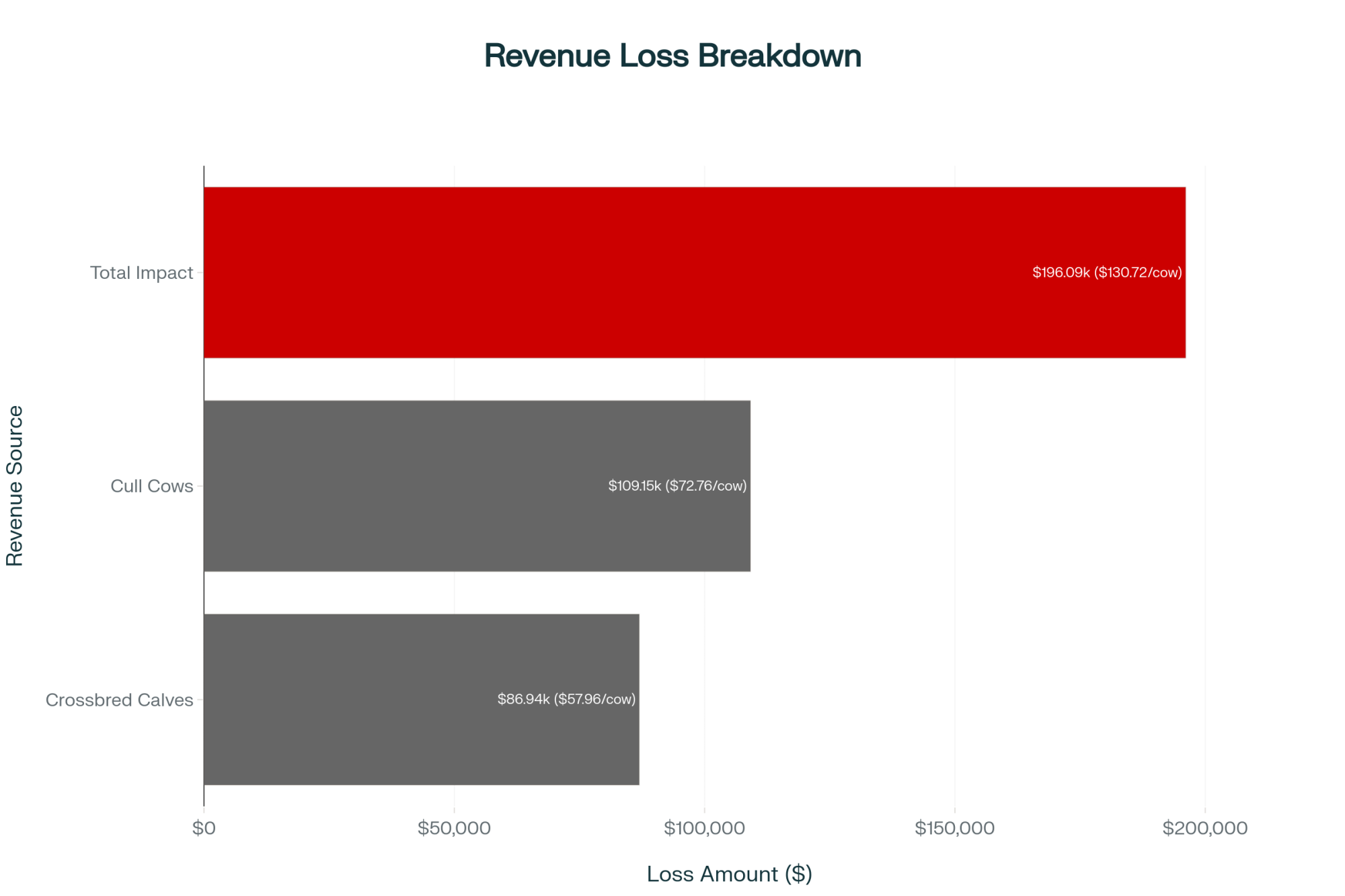
Think about it this way: a 500-cow dairy breeding 40% to beef generates roughly 100 crossbred calves annually. At current market values—and you know these prices better than anyone—we’re talking about revenue streams often reaching six figures. That’s meaningful money when margins are tight.

What concerns me is the potential for hidden losses we can’t see. The National Animal Health Monitoring System’s most recent dairy study shows respiratory disease affects somewhere between 22% and 37% of calves, depending on management and region. These percentages can vary significantly—operations in dry climates may see lower baseline BRD rates, while humid regions often struggle more.

With more than one in three calves failing passive transfer, dairy producers are unknowingly hemorrhaging thousands in hidden marbling losses before calves even leave the farm

When you combine that with emerging research on the impacts of marbling… well, the numbers add up quickly.

ECONOMIC IMPACT AT A GLANCE Based on Penn State preliminary findings and current market conditions:

For a 100-Calf Operation:

  • Assume 25% BRD incidence (25 calves affected)
  • Potential marbling loss: $200-300 per affected calf
  • Annual hidden loss: $5,000-7,500

Comprehensive Management Investment:

  • Enhanced colostrum protocols: $5/calf
  • Extended pre-transport holding: $40/calf
  • Improved nutrition program: $30-35/calf
  • Total investment: $7,500-8,000 per 100 calves

Break-even point: Preventing BRD in just 20-30% of at-risk calves

What We Know About the Biology

Here’s where the science gets interesting—and actually pretty well-established. Researchers like Dr. Min Du at Washington State University have spent years documenting how fat cells develop in cattle muscle. There’s this critical window, roughly 150 to 250 days of age, when intramuscular adipocytes—those are the fat cells that create marbling—are actually forming.

The marbling window (days 150-250) is beef-cross calves’ one shot at forming intramuscular fat cells—BRD during this period causes permanent, unfixable damage

After that window closes? You can make existing fat cells bigger through feeding, but you can’t create new ones. It’s a one-shot deal.

Now, what happens when a calf gets respiratory disease during this window? The inflammatory response—all those cytokines the immune system produces to fight infection—essentially shuts down fat cell formation. Even after the calf recovers, gains weight normally, looks perfect… those fat cells that should’ve formed during the illness just aren’t there.

The Penn State team documented exactly this pattern. Their BRD-affected calves initially lost about a third of a pound per day in growth through 80 days of age. Nothing surprising there. But by 238 days? They’d caught entirely up, actually weighed slightly more than healthy calves.

Every measure we use on-farm suggested complete recovery.

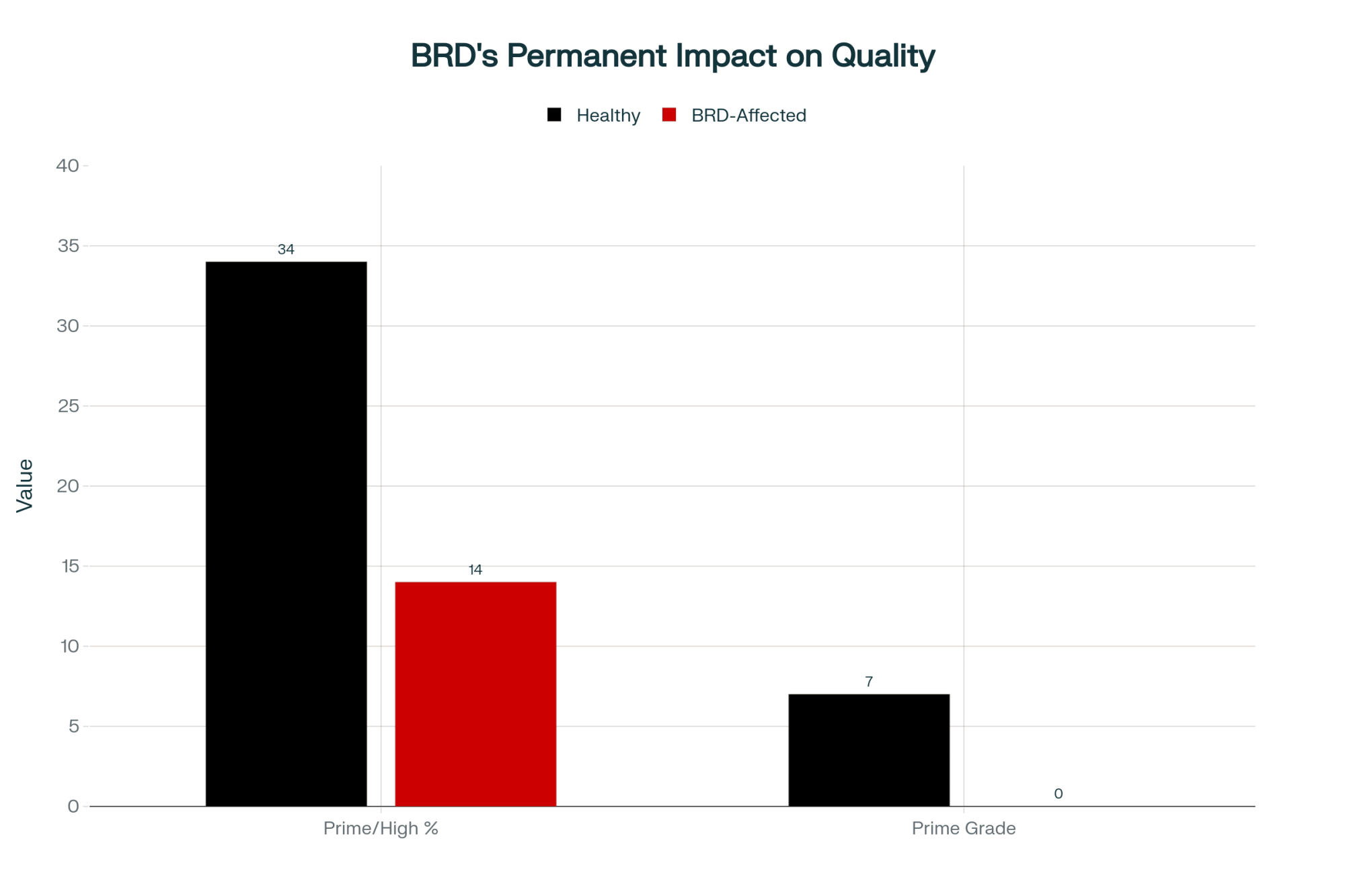
Yet at slaughter, 34% of healthy calves graded High Choice or Prime, while only 14% of BRD calves hit those grades. Seven healthy calves made Prime. Zero BRD calves achieved Prime. Not one.

Even after full weight recovery, BRD-affected beef-cross calves show devastating marbling losses—zero achieved Prime grade vs. seven healthy calves in Penn State study

The Technology That Could Help (But Mostly Isn’t)

What really caught my attention in the Penn State work was their use of thoracic ultrasound. They were finding lung consolidation in calves that looked perfectly healthy—no fever, eating fine, acting normal.

Dr. Theresa Ollivett and her team at the University of Wisconsin-Madison have been pioneering this approach for years. The same portable ultrasound that many vets already use for preg checks can scan lungs in under a minute. The accuracy is impressive—we’re talking about 88% to 94% sensitivity in published studies.

I understand the hesitation, though. Another technology, another investment, and right now the market isn’t paying premiums for “ultrasound-verified healthy” calves.

A portable unit runs $5,000 to $8,000, and scanning adds a few dollars per calf when you factor in time. Without clear economic returns, it’s a tough sell.

I realize many of you are dealing with labor shortages that make extra protocols challenging. But here’s what I’m seeing: some progressive operations are using it anyway, just to understand what’s really happening in their calf barns. One veterinarian in central Pennsylvania told me she’s finding subclinical lung lesions in about 30% of calves that would otherwise have gone undetected.

That’s… significant.

Management Approaches Worth Considering

So what can we actually do with this information? I’ve been talking with producers, trying different approaches, and a few things keep coming up.


Intervention
Investment per 100 CalvesImmediate OutcomeReturn on Investment
Colostrum Testing (Brix Refractometer)$100 (one-time equipment)90% passive transfer successPrevents 16+ FPT cases
Hold Calves 7-10 Days Pre-Shipping$4,000-6,000 (holding costs)Mortality drops from 4% to 2%Saves 2 calves @ $1,000+ each
Enhanced Early Nutrition (High-Protein MR)$3,000-3,500 ($30-35/calf)Protects marbling development$100-150 return per calf at harvest

Transportation Timing Matters More Than We Thought

Research from Dr. David Renaud’s group at the University of Guelph has been eye-opening. Calves transported at 7 to 19 days old consistently show better health outcomes than those moved at 2 to 6 days. Each extra day on the source farm seems to help.

Now, I get it—holding calves costs money. Extension budgets suggest about $5 to $6 per day. For a farm shipping 100 beef-cross calves annually, holding each an extra week adds up to real money.

But here’s what’s interesting: producers who’ve made the switch are seeing enough reductions in mortality and treatment costs to offset holding expenses nearly.

One Minnesota producer told me that going to a 10-day minimum shipping age dropped his mortality from over 4% to under 2%. Treatment costs fell by about $15 per calf. Not quite breaking even on the holding costs, but getting close.

And if there really is a long-term impact on marbling? That changes the math completely.

Getting Serious About Colostrum

This feels almost too basic to mention, but the data keeps pointing back to it. The NAHMS Dairy 2022 study found that 36.5% of calves don’t achieve adequate passive transfer. That’s more than a third of calves starting life immunologically compromised.

Testing colostrum with a Brix refractometer—you can get one for about $100—takes seconds. Operations that have implemented systematic testing and adjusted protocols based on results are seeing dramatic improvements.

One Pennsylvania dairy improved their passive transfer success rate from 75% to over 90%. Treatment costs dropped by a third in the first year.

What’s encouraging is that this pays off regardless of any future marbling considerations. Healthier calves that need fewer treatments… that’s immediate economic benefit.

Nutrition During the Critical Window

There’s growing interest in how pre-weaning nutrition might influence marbling development. The thinking—and it makes biological sense—is that adequate nutrition during that 150 to 250-day window when fat cells are forming could make a difference.

Some operations are moving to higher planes of nutrition, feeding 20% to 22% protein milk replacer at higher rates. It costs an extra $30 to $35 per calf, which isn’t trivial.

But producers implementing these programs are documenting everything. They’re thinking that when the market eventually recognizes quality differences, they’ll have the data to prove their approach works.

THE MARBLING WINDOW: CRITICAL TIMING FOR INTERVENTIONS

Days 0-100: Foundation Phase

  • Colostrum quality determines immune competence
  • Early BRD has maximum impact on future marbling
  • Focus: Disease prevention, early detection

Days 100-250: Active Development Phase

  • Intramuscular fat cells are actively forming
  • Nutrition becomes critical
  • Focus: Adequate protein/energy, minimize stress

Days 250+: Maturation Phase

  • Fat cell numbers fixed
  • Only size can increase
  • Focus: Traditional feeding for finish

Where This Is All Heading

You know, this situation reminds me of how Certified Angus Beef developed. When CAB launched in 1978, most people thought it was just marketing. We’ve all seen “revolutionary” programs come and go, but CAB was different.

Within a decade, CAB cattle were commanding clear premiums—ranging from $5 to $8 per hundredweight and rising to current levels of $15 to $20 per hundredweight. Today, it’s a massive program moving over 2 billion pounds annually.

I think we’re at a similar inflection point with beef-cross calves. The biology shows there are quality differences based on early management. Technology exists to verify and track health. What’s missing—but starting to develop—is a market structure that rewards better management.

As many extension specialists are noting in recent meetings, the beef industry’s increasing focus on quality grades will inevitably influence how beef-cross calves are valued. We’re moving toward a system where documentation matters, where operations that can prove their management practices will capture premiums.

Dr. Tara Felix, beef specialist at Penn State Extension, recently emphasized this shift at a producer meeting: “The packers are already tracking quality variation in beef-cross cattle. It’s only a matter of time before that information flows back to calf pricing.”

Industry sources indicate that AI organizations and major beef companies are reportedly working on programs to recognize quality in health management. The direction seems clear: documentation and quality management will eventually influence value.

The question isn’t really whether this happens, but when and how quickly it happens.

Practical Thoughts for Different Operations

What makes sense for your operation really depends on where you’re at currently.

If you’re just starting to think about this, maybe begin with documentation. Track colostrum quality, health events, and when calves ship. Even without changing management, having baseline data positions you well.

If you’re ready to make changes, pick one or two that fit your resources. Maybe it’s implementing colostrum testing, or holding calves a few extra days, or adjusting nutrition. The key is choosing what works within your constraints.

For those already doing advanced calf management, consider building relationships with buyers who value quality. As markets evolve, operations with documented quality management will likely capture early premiums.

The investment—potentially $60 to $80 per calf for comprehensive changes—doesn’t have guaranteed returns today. But if the biological mechanisms are real (and the science strongly suggests they are), we’re already experiencing hidden losses from respiratory disease.

The question becomes whether to address them proactively or wait for market signals.

Looking Forward

The beef-on-dairy story has been one of the real successes in our industry recently. But this emerging understanding about respiratory disease impacts adds an important dimension. Managing for things we can’t immediately see—subclinical disease, cellular-level development, long-term quality—might prove just as important as the metrics we track daily.

What strikes me is that this isn’t really about the Penn State study specifically, though their work is valuable. It’s about recognizing that the biological mechanisms underlying hidden-quality impacts are real and documented across multiple species and decades of research.

Whether their specific 7% marbling reduction holds up in peer review almost doesn’t matter—the underlying biology tells us there’s something here worth paying attention to.

I’ve noticed operations making even small changes—better colostrum management, holding calves a bit longer—are seeing health improvements that justify the effort regardless of future quality premiums. Maybe that’s where we start: doing things that make sense today while positioning ourselves for whatever market structures develop tomorrow.

What excites me is that even small improvements we make now could position us perfectly when markets evolve. The dairy industry has always been about continuous improvement, finding marginal gains that add up over time.

This might be another one of those opportunities—not revolutionary, but important enough to consider as we manage these valuable beef-cross calves.

We’re in an interesting position right now. The science is telling us something important about the hidden impacts of quality. The market hasn’t caught up yet, but history suggests it will. Those who start adapting now—even with small steps—will likely be glad they did.

Every operation is different. Work with your veterinarian and nutritionist to develop protocols that fit your facilities, labor, and markets. What works great in one situation might need adjusting for another. Regional differences matter too—what makes sense in Wisconsin might need tweaking for operations in New Mexico or Idaho.

KEY TAKEAWAYS 

  • The Hidden Loss “Recovered” BRD calves permanently lose 7% marbling worth $200-300 per head—damage is invisible until slaughter
  • The 150-Day Window Marbling cells form ONLY between days 150-250; respiratory disease during this period causes irreversible damage
  • Your Current Risk: With 36% passive transfer failure rates, a 100-calf operation is likely losing $5,000-7,500 annually right now
  • Three Simple Solutions: Test colostrum with $100 refractometer (90% success rate achievable)
  • Hold calves 7-10 days before shipping (cuts mortality 50%)
  • Enhance early nutrition for $30/calf (protects marbling development)
  • Future Opportunity Start documenting health management today—quality premiums similar to CAB’s $15-20/cwt are coming within 2-3 years

Complete references and supporting documentation are available upon request by contacting the editorial team at editor@thebullvine.com.

Learn More:

Join the Revolution!

Join over 30,000 successful dairy professionals who rely on Bullvine Weekly for their competitive edge. Delivered directly to your inbox each week, our exclusive industry insights help you make smarter decisions while saving precious hours every week. Never miss critical updates on milk production trends, breakthrough technologies, and profit-boosting strategies that top producers are already implementing. Subscribe now to transform your dairy operation’s efficiency and profitability—your future success is just one click away.

NewsSubscribe
First
Last
Consent

What Separates Top Beef-on-Dairy Programs from Average Ones

New data: 80% of dairy producers optimize beef sires for convenience, not value. It’s costing them $300/calf.

EXECUTIVE SUMMARY: Your beef-cross calves should be worth $1,400. If you’re getting $700, you’re not alone—but you’re fixable. After analyzing operations from Wisconsin to California, the pattern is clear: successful beef-on-dairy programs aren’t built on superior genetics but on three systematic differences—documentation protocols that add $300 per head, early nutrition investments that return 4:1, and buyer feedback loops that enable continuous improvement. The data is compelling: 20% of beef bulls that excel on beef cows fail on dairy, high-protein milk replacer ($25-40 investment) delivers $100-150 at harvest, and managing liver abscesses (50-60% in dairy crosses vs 30% in native beef) through adjusted feeding saves $50 per head. But here’s the critical warning: replacement heifers now cost $3,800-4,000, meaning over-aggressive beef breeding creates a three-year financial time bomb. This guide provides the exact 90-day implementation framework and performance benchmarks that separate operations earning $200,000+ annually from those barely covering costs.


I recently visited two dairy operations in south-central Wisconsin, both breeding beef-on-dairy calves, both using similar Angus genetics, both selling day-old calves. The first operation consistently receives $1,400 per calf. The second? They’re fortunate to clear $700—barely above straight Holstein bull prices.

This $700 gap has become one of the most discussed topics at producer meetings this year. After analyzing operations from the Central Valley to the Northeast, talking with feedlot buyers from Texas to Nebraska, and reviewing university research on crossbred performance, a pattern emerges. The operations capturing premiums approach to beef-on-dairy views it as a data-driven enterprise. Those settling for commodity prices treat it as a convenient alternative for breeding.

Understanding Today’s Beef-on-Dairy Market Dynamics

The Beef-on-Dairy Market Explosion charts a 3,000% growth trajectory from barely 100,000 calves in 2015 to 3.1 million projected for 2026, now representing 15% of fed cattle as the beef cow herd shrinks to 1960s levels—a fundamental industry transformation

The landscape for dairy-beef crosses has shifted dramatically. According to the USDA’s latest cattle inventory analysis, we’re producing 2.92 million dairy-beef calves in 2025, with industry projections suggesting continued strong growth exceeding 3 million by 2026. What’s particularly noteworthy is these animals now represent 12% to 15% of annual fed cattle slaughter—a remarkable transformation from virtually nothing a decade ago.

This growth coincides with historically low beef cow inventories. USDA’s National Agricultural Statistics Service reports the smallest beef herd since the early 1960s, while Rabobank’s global beef outlook indicates a roughly 1% decline in global beef supply this year. The beef industry needs these dairy-origin cattle to maintain supply.

Yet despite strong demand, price variation for seemingly comparable calves regularly exceeds 100%. At a recent Pennsylvania auction, I observed crossbred calves from different operations sell for $650 and $1,350 within the same hour. Why such disparity? The answer lies in documentation quality, genetic verification, and established performance history.

It’s also worth noting that seasonal patterns affect pricing. Spring calves typically command premiums of $50 to $100 over fall-born animals due to feedlot timing preferences. Gender matters too—steers generally bring $50 to $100 more than heifers in most markets, something to consider when using sorted semen.

Quick Reference: Key Numbers at a Glance

Premium Targets:

  • Beef calf premium: $700-900 per head
  • Revenue per cwt milk: $4.00-5.50
  • Beef income goal: 15-20% of total farm revenue

Investment Guidelines:

  • High-protein milk replacer (27-30%): +$25-40 per calf
  • Genomic testing: $40-60 per animal
  • Expected return on nutrition: $100-150 at harvest

Performance Benchmarks:

  • Difficult calvings: <3%
  • Pre-weaning mortality: <3%
  • Liver abscess target: 30-35% (down from 50-60%)
  • Documentation completion: >95%

Sire Selection: Where Value Creation Begins

Michigan State University’s October 2024 beef-on-dairy survey reveals an interesting disconnect. Most dairy producers prioritize conception rate (78% of respondents), calving ease (67%), and semen cost (58%) when selecting beef sires. These are certainly important considerations for dairy management. But the traits that create downstream value—ribeye area, marbling score, frame size, growth rate—receive far less attention. Only 22% consider the ribeye area. Just 14% evaluate marbling potential.

This focus on convenience over calf value represents a fundamental misalignment. As Wisconsin dairy specialists often observe, many producers are optimizing for dairy operational efficiency rather than beef chain requirements. That disconnect typically costs $200 to $300 per calf in lost premiums.

ABS Global’s Real World Data program, which analyzed over 50,000 beef-on-dairy calvings, uncovered something every producer should understand: approximately 20% of bulls performing well for calving ease in beef herds fail to meet acceptable thresholds when bred to dairy cows. The biological differences between beef and dairy females—particularly pelvic structure and gestation length—make dairy-specific performance data essential.

I spoke with a Central Valley dairyman who learned this lesson expensively. He’d selected an Angus bull with excellent traditional EPDs and strong calving ease predictions. After losing three Holstein heifers to calving difficulty within a month, he pulled that bull from the rotation. Those weren’t just calf losses—those were future productive cows eliminated from the herd.

The most successful beef-on-dairy programs I’ve studied work exclusively with AI organizations offering dairy-validated sire data. Companies including Select Sires (NxGEN program), Alta Genetics (BULLSEYE platform), and Semex (XSire portfolio) maintain databases tracking the actual performance of beef bulls on dairy females. This distinction matters more than many producers realize.

What’s encouraging is that beef breed associations are increasingly recognizing this need, developing dairy-specific EPDs and working with AI companies to validate performance on dairy females. This industry-wide collaboration benefits everyone. Some producers are also experimenting with SimAngus and even Charolais crosses for specific markets, though Angus remains the predominant choice for good reason—market acceptance and predictable performance.

Regional Market Variations Shape Opportunities

What works in California’s integrated systems may not translate directly to Midwest cooperative structures or Northeast family operations. Understanding these regional dynamics is crucial for program success.

California’s Central Valley features vertical integration, with established calf ranches maintaining direct relationships with dairies. These operations know their genetic preferences and pay accordingly for documented quality. Wisconsin and Minnesota producers often market through cooperative structures where calves are pooled. In these systems, individual documentation becomes even more critical for capturing premiums above pool averages.

Texas presents yet another model. Major feedlots, including Friona Industries and Cactus Feeders, operate procurement programs that contract directly with dairies, sometimes months before calves are born. These arrangements often specify genetic requirements and health protocols in exchange for premium pricing.

Smaller dairy regions—Vermont’s hillside farms, Idaho’s Magic Valley operations, New Mexico’s desert dairies—each face unique challenges. Vermont producers might focus on grass-finished programs for local markets. Idaho operations often integrate with nearby feedlots. New Mexico dairies face water constraints that affect their feeding strategies. Each region requires adapted approaches.

Even within regions, smaller operations are finding success. A 60-cow organic farm in Vermont recently told me they’re getting $1,200 for grass-fed beef-cross calves sold to local finishers—not quite the $1,400 conventional premium, but exceptional for their scale and market.

The Critical First Eight Months

Every calf has an 8-week biological window that closes permanently. Feed high-protein milk replacer ($40 extra cost) during this period and you’ve locked in 4.8 extra pounds that compound to 50-100 additional pounds at harvest—worth $100-150. Miss this window with standard nutrition and no amount of expensive finishing ration recovers the loss. Yet 80% of operations still feed beef-cross calves like unwanted Holstein bulls.

Here’s a biological reality that fundamentally shapes beef-on-dairy economics: muscle fiber numbers and intramuscular fat cell populations are established during the first eight months of life. After this developmental window closes, you’re working with what you’ve got. No amount of superior finishing nutrition can compensate for deficiencies during this critical period.

When beef-cross calves receive standard 20% to 22% protein dairy heifer milk replacer—the formulation most farms already stock—they’re being nutritionally shortchanged. Research from Texas Tech University’s animal science department demonstrates that calves fed 27% to 30% protein milk replacers gain an additional 4.8 pounds by eight weeks and develop 14% larger muscle fiber cross-sectional area. While 4.8 pounds may seem modest, this advantage compounds throughout the feeding period, translating to 50 to 100 pounds of additional carcass weight at harvest.

The economics are compelling. Higher-protein milk replacer costs approximately $25 to $40 more per calf based on current industry pricing from major manufacturers. Feedlot performance data suggests returns of $100 to $150 per head from improved muscling and marbling development—a strong return on investment.

Yet university surveys indicate only about 20% of operations use 28% or higher protein formulations for beef-cross calves. Most producers inadvertently limit genetic potential during the most critical developmental phase.

I should note that several successful operations achieve excellent results with standard protein levels by compensating through higher feeding rates (8 quarts daily vs. the standard 6), superior colostrum management, and comprehensive stress-reduction protocols. A Jersey operation in Oregon feeds standard protein but delivers 10 quarts daily in three feedings, achieving exceptional growth rates. Multiple pathways can lead to success, but the biological principle remains constant: early nutrition establishes lifetime performance potential.

Addressing the Liver Abscess Challenge

The Liver Abscess Crisis exposes dairy-beef crosses’ 55% abscess rate versus 30% in native beef—costing operations $45,000 annually per 1,000 head and risking $3,000-per-minute processing shutdowns until Kansas State research proved 45% forage diets solve the problem without sacrificing gains

Liver abscess incidence presents a significant yet often overlooked challenge in beef-on-dairy production. Dr. T.G. Nagaraja from Kansas State, with four decades of research in this area, reports native beef cattle typically show 30% abscess rates, while dairy-beef crosses reach 50% to 60%. Some operations experience rates approaching 70%.

Beyond direct economic losses from condemned organs and reduced performance (approximately $30 to $50 per head based on packer data from National Beef and Cargill), there’s operational risk at processing facilities. A ruptured abscess can contaminate equipment, requiring line shutdown and intensive cleaning. Based on industry estimates from multiple major processors, these stoppages cost approximately $3,000 per minute in lost throughput. The Packers remember which cattle sources cause these disruptions.

Recent findings from the USDA Agricultural Research Service’s Lubbock Livestock Issues Research Unit reveal that bacterial colonization pathways are more complex than previously understood. Dairy-influenced cattle appear particularly susceptible, possibly due to inherited differences in gut architecture—larger digestive capacity from Holstein genetics combined with lifetime exposure to high-concentrate diets.

Progressive feedlots have adapted their protocols accordingly. Rather than pushing traditional 90% concentrate rations to maximize gains, they’re incorporating 20% to 45% forage. They’re limiting starch to 45% to 55% rather than 60% or higher. They’re ensuring consistent provision of 10% to 12% effective fiber.

Kansas State research demonstrates that increasing corn silage from 15% to 45% of the ration significantly reduces abscess incidence without compromising performance—same daily gains, equivalent feed efficiency, healthier livers. This builds on what we’ve learned about the unique nutritional requirements of dairy-beef crosses.

External factors can complicate management, too. Drought conditions affecting forage quality, international trade disruptions impacting grain prices, and even weather extremes during the feeding period—all influence liver health outcomes. Successful operations build flexibility into their feeding programs to adapt to these variables.

Looking ahead, some operations are exploring carbon credit opportunities for efficiently raised beef-on-dairy cattle, particularly those with lower methane emissions from optimized feeding strategies. While still developing, this could add another revenue stream for well-managed programs.

The Replacement Heifer Cost Consideration

The Replacement Heifer Crisis shows how heifer costs exploded 164% from $1,140 to $3,900 while beef calf values declined, creating a devastating $2,860 per-head margin collapse that transformed profitable programs into financial disasters

Perhaps no factor has surprised more producers than replacement heifer economics. Many operations that aggressively shifted to beef breeding in 2022-2023, motivated by $1,400 crossbred calves and $1,140 replacement costs, now face what economists term a “replacement inventory crisis.”

USDA’s January data shows national heifer inventory at 3.914 million head—the lowest since 1978. California’s major auction markets, including Producers Livestock in Tulare and Overland Stockyards in Fresno, report springer heifer prices of $3,800 to $4,000. That represents a 164% increase over three years—a change few operations anticipated in their financial modeling.

I’ve worked with several 500-cow Midwest operations facing this reality. They projected $700 premiums per beef-cross calf with 65% of the herd bred to beef, assuming $2,200 replacement costs based on 2023 prices. They anticipated $210,000 in additional annual revenue.

Current reality? Replacement heifers at $3,800 represent an additional $1,600 per head. For 150 annual replacements, that’s $240,000 in unplanned expense. Net result: negative $29,000 rather than the projected profit.

Dr. Victor Cabrera from Wisconsin’s Center for Dairy Profitability recommends limiting beef revenue to 10% of total farm income, maintaining strategic heifer inventory through balanced breeding (typically 35% to 40% dairy genetics, 60% to 65% beef), and utilizing the USDA’s Livestock Risk Protection insurance now available for beef-on-dairy calves.

International factors add complexity. Export demand for U.S. beef, Mexican cattle import policies, and even global grain markets influence both beef calf values and replacement heifer costs. Producers must consider these macro factors when planning breeding strategies.

Building Performance Feedback Systems

What truly distinguishes operations capturing consistent premiums is their commitment to performance tracking and continuous improvement. These producers document comprehensive data from birth through harvest, share information with buyers to build premium relationships, and—critically—obtain feedlot and carcass performance data to refine their programs.

Consider Cogent’s UK Beef Breeding Programme, which partners with Pathway Farming to track calves from birth through retail placement. With over 318,000 data points collected since 2021, they’ve achieved remarkable results: average days to slaughter of 512 (versus 580+ UK average), 87.4% achieving target fat grades, and 97% meeting conformation standards. The program produced the top 11 Angus bulls for intramuscular fat in recent UK breed evaluations—all through systematic data collection and analysis.

Most U.S. operations lack this feedback loop. They breed, sell, and move forward without learning whether their genetic selections performed, which bulls consistently underperform, or why their calves command different prices than neighboring operations.

A Practical 90-Day Implementation Framework

For producers initiating or refining beef-on-dairy programs, the first 90 days establish the foundation for long-term success. Here’s what I’ve seen work across different operation sizes and regions.

Days 1-30: Strategic Planning

Begin with replacement heifer modeling. A 500-cow operation with 30% annual turnover requires 150 replacements. Calculate backwards to determine sustainable beef breeding percentages without creating future heifer shortages. Remember to factor in conception rate differences—beef semen typically runs 8% to 12% below conventional dairy semen.

Model financial scenarios, including worst-case projections. What happens if beef prices decline to $1,000 while heifer costs reach $4,500? Build sufficient financial reserves to weather market volatility. Consider the impacts of drought on feed costs, potential trade disruptions, and even local packing plant closures.

Establish buyer relationships before breeding. One California producer I know invested three weeks contacting calf ranches and feedlots, securing written pricing commitments from two buyers before ordering beef semen. When calves arrived nine months later, marketing was predetermined.

Complete genomic testing if it has not already been implemented. At $40 to $60 per animal through providers like Zoetis CLARIFIDE or Neogen Igenity, this investment identifies which females should produce replacements versus beef calves. Using top genetic females for beef production because they didn’t conceive to dairy semen reverses proper selection logic.

Days 31-60: Infrastructure Development

Source appropriate milk replacer formulations for beef-cross calves. The 27% to 30% protein products cost more but deliver measurable returns through improved muscle development—unless you’ve developed proven compensatory management systems.

Implement documentation systems, whether through existing software like DairyComp 305 or simple spreadsheets. Track sire identity, dam information, birth metrics, colostrum quality (invest in a Brix refractometer if you don’t have one), health interventions, and growth measurements. An Oregon producer recently showed me three years of data revealing conception rates, calving ease scores, and buyer feedback for every sire used.

Develop buyer documentation packages. Providing genetic background, health protocols, and performance data transforms commodity calves into documented products that command premiums of $200 to $300, according to Kansas State agricultural economics research.

Days 61-90: Strategic Execution

Select sires using dairy-validated performance data. Target bulls in the top third for calving ease (verified on dairy, not beef females), top 70% for marbling, positive ribeye area EPDs, and moderate frame scores. Consider seasonal breeding patterns—some producers use different sires for spring versus fall calvings based on anticipated marketing conditions.

Monitor all metrics systematically. Track conception rates by sire, document calving ease, and identify patterns. When bulls consistently underperform despite favorable EPDs, remove them from rotation. Your herd’s actual performance supersedes population predictions.

Benchmarks for Year Three Success

Well-executed programs demonstrate clear performance indicators by year three:

Financial metrics include consistent $700 to $900 calf premiums regardless of market cycles, $4.00 to $5.50 revenue per hundredweight of milk produced, beef income representing 15% to 20% of total farm revenue (enough to matter without creating dangerous dependency), and twelve months of operating reserves accumulated.

Production achievements show difficult calvings below 3% (versus 5% to 8% industry average per the National Association of Animal Breeders), pre-weaning mortality under 3%, quality grades of 80% to 85% Choice or better when receiving carcass data, and liver abscess rates reduced to 30% to 35% from initial 50% to 60% levels.

Operational excellence is demonstrated by 95% complete documentation for all calves, carcass performance data received for 80% of animals sold, and 60% to 80% of production committed through established buyer relationships.

The resilience test came in October 2025, when beef markets declined 7% following new tariff-rate quotas on Argentine beef imports, as reported by DTN livestock analyst ShayLe Hayes and confirmed by Farm Bureau reporting. Well-managed programs absorbed $30,000 to $50,000 impacts while continuing operations. Poorly positioned operations incurred substantial losses, casting doubt on the program’s viability.

Essential Principles for Success

Several key insights emerge from analyzing successful beef-on-dairy enterprises across diverse operational contexts:

Documentation creates more value than genetics alone. Average genetics with complete documentation consistently outsell superior genetics lacking paperwork by $300 per head. Every time.

Early nutrition establishes lifetime potential. The first eight weeks prove especially critical. Biological development windows close permanently—feed beef-cross calves as the premium products they represent, not as unwanted byproducts.

Liver abscesses respond to adjusted feeding strategies. Dairy-beef crosses require more forage, moderate starch levels, and gradual transitions. This reflects biological differences, not management preferences.

Replacement heifer planning cannot be deferred. Problems arise not from selecting incorrect sires but from overcommitting to beef breeding without modeling future replacement needs. The three-year lag between breeding decisions and heifer availability catches many operations unprepared.

Performance feedback enables continuous improvement. Each breeding cycle without carcass data represents a missed opportunity for refinement. Today’s leading programs resulted from three years of systematic improvement based on actual performance data, not theoretical projections.

Success requires adopting a beef producer mindset while maintaining dairy operational excellence. This shift from viewing calves as byproducts to managing them as products transforms every decision from genetics through marketing.

Looking Forward

The $700 premium gap between successful and struggling beef-on-dairy programs reflects systematic execution differences, not market luck. These crossbred animals require specialized management acknowledging their unique biology—neither purely dairy nor purely beef.

With beef cattle inventories at historic lows and dairy-origin cattle becoming a foundational part of the U.S. beef supply—exceeding 3 million head annually per USDA Economic Research Service projections—the opportunity remains substantial. However, easy premiums have disappeared. As more producers enter this market and buyers become increasingly selective, only operations with documented genetics, proven health protocols, optimized nutrition, and continuous improvement systems will capture maximum value.

The path forward is clear: invest 90 days building proper infrastructure before breeding, or spend three years wondering why neighbors receive double your calf prices. Having observed both approaches across numerous operations from small Vermont hillside farms to large New Mexico desert dairies, the successful path is evident.

Markets compensate documented, predictable, continuously improving performance—not good intentions or fortunate genetics. Producers understanding this principle generate $200,000 or more annually from beef-on-dairy enterprises. Others barely cover costs while blaming market conditions.

The framework exists. Research from land-grant universities supports it. Successful examples multiply monthly across every dairy region. As you plan next season’s breeding strategy, consider which approach aligns with your operational goals and risk tolerance.

Because ultimately, this isn’t about choosing between dairy and beef production—it’s about optimizing both within your unique operational context. The producers who understand this are building sustainable, profitable enterprises that strengthen both their operations and the broader beef supply chain.

KEY TAKEAWAYS

  • Documentation > Genetics: Complete health and breeding records add $300/head to any calf—superior genetics without paperwork sell at commodity prices
  • Invest $40 in the first 8 weeks, harvest $150 in value: High-protein milk replacer (27-30%) during early development creates permanent muscle and marbling advantages
  • Liver abscesses aren’t inevitable: Increase forage from 15% to 45% in finishing rations—same gains, 50% fewer condemned livers
  • The 65% Rule: Never breed more than 65% of your herd to beef—replacement heifers at $3,800-4,000 will destroy three years of premiums
  • No feedback = No improvement: Top operations track performance from birth to harvest and adjust quarterly; average operations repeat the same mistakes annually

Complete references and supporting documentation are available upon request by contacting the editorial team at editor@thebullvine.com.

Learn More:

Join the Revolution!

Join over 30,000 successful dairy professionals who rely on Bullvine Weekly for their competitive edge. Delivered directly to your inbox each week, our exclusive industry insights help you make smarter decisions while saving precious hours every week. Never miss critical updates on milk production trends, breakthrough technologies, and profit-boosting strategies that top producers are already implementing. Subscribe now to transform your dairy operation’s efficiency and profitability—your future success is just one click away.

NewsSubscribe
First
Last
Consent

Beef-on-Dairy Lost $196,000 Per Farm in October- Here’s How to Protect Your 2026 Revenue

Your beef-on-dairy revenue just dropped $196K. But producers who saw this coming lost only $27K. The difference? One strategy.

Executive Summary: October’s 11.5% cattle crash proved that beef-on-dairy isn’t the risk diversification producers thought it was—it’s a $196,000 lesson in modern market volatility. In just twelve days, political intervention aimed at consumer prices overwhelmed market fundamentals, dropping crossbred calf values from $1,400 to $1,239. Dairy operations with 40% beef breeding lost the equivalent of $0.54/cwt on their milk price, while Class IV simultaneously dropped $2.99. The immediate threat: Mexican cattle imports resuming could push prices down another $89 per head to $1,150. But producers who kept beef breeding at 30-35% and maintained 12-month operating reserves are weathering this storm with manageable losses. The new playbook is clear: cap beef revenue at 10% of total income, hedge everything you can’t afford to lose, and build financial reserves that assume policy shocks are when, not if.

beef-on-dairy profitability

When feeder cattle futures dropped 11.5% between October 16 and 27, Tim Clifton from Oklahoma City called it “a slap in the face” in his interview with Brownfield Ag News. That phrase keeps coming up in conversations across the dairy community. What started as this promising approach—breeding dairy cows to beef bulls to produce those valuable crossbred calves—has turned into quite an education on modern market dynamics.

Here’s what’s interesting. A typical scenario involves a 1,500-cow operation in central Wisconsin that was counting on $1,400 per crossbred calf based on late-summer conditions. Today? Those same calves are bringing $1,239 if they’re lucky. The USDA Economic Research Service has been tracking this, and we’re talking about roughly $196,088 in lost annual revenue for an operation that size. That’s basically like taking a $ 0.54-per-hundredweight hit on milk prices.

And it’s not happening in isolation. Class IV milk prices dropped $2.99 between September and October—from $19.16 down to $16.17, according to Federal Milk Marketing Order reports. So operations that thought they’d diversified their risk are discovering they’ve actually concentrated it in ways nobody really anticipated.

How Multiple Forces Converged in Twelve Days

October 16-27: The Timeline That Changed Everything

  • Oct 16: Trump announces beef prices “coming down” – futures begin dropping
  • Oct 22: Presidential social media post targets cattle prices directly
  • Oct 23-25: Argentine quota expansion announced (20,000 to 80,000 MT)
  • Oct 27: December live cattle down to $227.17 from $248.88

Let me walk through what actually happened, because the timeline reveals how several factors created this challenging situation. On October 16, President Trump announced that beef prices would be “coming down pretty soon.” The Chicago Mercantile Exchange December live cattle futures—trading at $248.875 per hundredweight that morning—started dropping immediately.

The 12-day cattle price collapse that transformed beef-on-dairy from diversification strategy to concentrated risk. Political intervention met managed money liquidation, proving policy beats fundamentals every time.

But here’s where multiple factors created this perfect storm. That same period, the latest USDA Cattle on Feed reports had been showing consistently lower placements—August placements were down 10% year-over-year according to USDA data, continuing a pattern that began when Mexican cattle imports stopped in May. This actually should have been supportive for prices, but the market was already spooked.

Meanwhile, the Conference Board’s Consumer Confidence Index had declined to 94.6 in October, down from September’s 95.6, reflecting broader economic concerns that could affect beef demand ahead. USDA Foreign Agricultural Service data shows mixed export performance, with weekly fluctuations in sales to key markets such as Japan and South Korea, adding to the uncertainty.

Then came October 22. The President posted on social media: “The Cattle Ranchers, who I love, don’t understand that the only reason they are doing so well…is because I put Tariffs on cattle coming into the United States…they also have to get their prices down, because the consumer is a very big factor in my thinking.”

CME Group data from October 27 shows December live cattle futures had fallen to $227.175—a $21.70 drop in less than two weeks. November feeder cattle contracts hit the expanded daily limit of $13.75 down. Some contracts were “locked limit down,” meaning there were sellers everywhere but no buyers at any price within the trading limits.

Austin Schroeder from Brugler Marketing & Analytics explained it perfectly: “Managed money has a huge net long in the cattle market. With all the headlines over the last week and a half, there is just some general risk-off. Everybody is wanting out, and the door is only so big.”

What made this crash particularly severe was the convergence of:

  • Political intervention signals that spooked speculative money
  • Uncertainty from conflicting supply signals—fewer cattle placed, but policy pressure ahead
  • Weakening consumer confidence affecting demand projections
  • Southern feedlots are reducing purchases after Mexican import restrictions (stopped since May 2025 due to screwworm)
  • The announcement expanding Argentine beef quotas from 20,000 to 80,000 metric tons annually
  • Managed money funds liquidating large long positions per the Commodity Futures Trading Commission reports

You know what’s worth noting? Even smaller regional processors got caught in this. They depend on a steady local cattle supply, and when auction prices went haywire, some had to reduce processing days temporarily. That ripple effect hit local producers who’d built relationships with these smaller plants.

Understanding What This Really Costs

The anatomy of a $196K hit—crossbred calves lost $87K, cull cows another $109K. That’s $130.72 per cow, or roughly what a $0.54/cwt milk price drop would cost. Diversification just became concentration.

Quick Numbers for Your Planning

  • Average annual beef revenue decline: $196,088
  • Per-cow impact: $130.72
  • Where beef breeding probably should be: 30-35% (down from 40-50%)
  • Operating reserves you need now: 12+ months (not the old 3-6 months)
  • Crossbred calf price drop: From $1,400 to $1,239 (-11.5%)

The National Agricultural Statistics Service has documented how cattle sales grew from 4% of dairy farm revenue in 2019 to 9% by 2024. That’s a share of many operations built right into financial planning—debt service, expansion plans, everything.

Take a representative Midwest operation with 40% of the herd bred to beef, producing about 540 crossbred calves annually:

Crossbred calf revenue:

  • What you planned on (at $1,400/head): $756,000
  • What you’re getting now (at $1,239/head): $669,060
  • That’s a difference of: $86,940

Plus cull cow sales—typically about 525 head at a 35% culling rate. The USDA Agricultural Marketing Service reports from late October show:

Cull cow revenue:

  • What you expected (at $165/cwt): $1,212,750
  • What you’re seeing now (at $150.15/cwt): $1,103,602
  • That’s another: $109,148 gone

Combined: $196,088 in reduced beef revenue annually, or about $130.72 per cow in the milking herd.

The breeding decisions that created these calves were made between January and March 2025, when everything looked promising. Those cows can’t be unbred. The calves entering the market from November through February will sell at whatever the market offers.

Regional differences add another layer. Border state operations have typically managed import competition differently, with many maintaining more conservative beef breeding percentages and purchasing additional risk management coverage when import restrictions created temporary market support. But the speed at which prices adjusted everywhere caught even experienced producers off guard.

What I’ve noticed is that organic and grass-fed dairy operations face a different challenge. Their premium milk markets help offset some beef revenue loss, but their crossbred calves from grass-based systems sometimes don’t fit conventional feeding programs as well. They’re having to work harder to find the right buyers who value those genetics.

The Mexican Import Question

Mexican Import Timeline – What to Expect

  • Phase 1 (Announcement): 3-5% price drop within days of reopening news
  • Phase 2 (30-60 days): Additional 2-4% decline as cattle reach U.S. feedlots
  • Phase 3 (3-6 months): Prices stabilize around $1,150/head with full integration
  • Supply gap: 855,000 head currently missing from the normal annual flow

Mexican Agricultural Minister Julio Berdegué is meeting this week with Secretary of Agriculture Brooke Rollins about reopening protocols. According to USDA Animal and Plant Health Inspection Service data, Mexico historically sends about 1.25 million cattle annually to the U.S.—worth over $1 billion. Those imports stopped in May 2025 when New World Screwworm was detected.

Through July, only about 230,000 head crossed the border according to USDA trade statistics. That leaves a supply gap of roughly 855,000 head, which has been supporting prices all year.

Mexican import resumption isn’t speculation—it’s math. 855,000 missing head means $89/calf is coming off prices in three predictable phases. Phase 1 hits within days of announcement. Most producers aren’t hedged for this.

CattleFax projections and agricultural economists suggest the reopening could play out in three distinct phases we need to prepare for.

Market Structure Lessons


Metric
September 2025October 2025DeclineRisk Status
Crossbred Calf Price$1,400/head$1,239/head-11.5%🔴 High
Class IV Milk Price$19.16/cwt$16.17/cwt-15.6%🔴 High
Combined Per-Cow Impact$0.00$130.72 lossCatastrophic🔴 Concentrated

Here’s something revealing. On October 27, while feeder cattle were locked limit down, wholesale boxed beef prices actually increased. USDA Agricultural Marketing Service data shows Choice gained $2.12 to hit $377.88 per hundredweight, and Select jumped $3.69.

One analyst noted bluntly: “Maybe the President should have attacked the packing industry for the excessively high prices they’re getting for beef.”

According to the USDA Economic Research Service’s 2024 analysis, four firms control about 85% of beef processing capacity. During disruptions, they can manage the spread between what they pay producers and what they charge retailers. For those accustomed to Federal Milk Marketing Order price transparency, this has been educational.

Strategic Response: What Successful Operations Are Doing

After extensive conversations with producers, consultants, and lenders over the past two weeks, clear patterns are emerging among operations weathering this crisis successfully.

Immediate Breeding Adjustments Operations are reducing November-December beef breeding from 40-45% down to 30-35%. As one California producer explained, “I’d rather leave $27,000 on the table than risk another $148,000 loss.” This conservative approach reflects hard-learned lessons from October’s volatility.

Looking at this trend, what farmers are finding is that flexibility matters more than maximizing any single revenue stream. Those who kept some dairy bulls for replacements are glad they did—replacement heifer prices from beef-on-dairy matings are getting expensive when you need to rebuild.

Risk Management Implementation USDA Risk Management Agency data shows LRP insurance enrollment for 2026 calf sales has increased significantly. Despite elevated premiums, setting floor prices at $1,150-$1,200 provides catastrophic loss protection. Penn State Extension’s March 2024 research demonstrates that direct relationships with feeders can yield $50-100 per-head premiums while reducing volatility exposure.

Capital Structure Reinforcement: Financial consultants at Farm Credit Services report that operations that successfully navigated this period generally maintained 9-12 months of operating capital, versus the typical 3-6 months. Agricultural lenders at CoBank are advising clients to build toward 12-month reserves. As one banker explained, “Future survivors will be distinguished by liquidity, not just production efficiency.”

Revenue Concentration Limits: If beef revenue exceeds 10% of total farm income, most consultants suggest reducing exposure to beef. Traditional cattle cycles based on biology might be less reliable as policy interventions become more common. Building operational flexibility matters more than ever.

Generational Transition Adjustments The 2022 Census of Agriculture shows the average farmer age at 58 years. Many operations built beef-on-dairy revenue into succession financing. With $196,000 in annual revenue gone, those carefully planned transitions need reassessment. Mark Stephenson, Director of Dairy Policy Analysis at the University of Wisconsin-Madison, observed in recent market commentary: “Policy-driven volatility during generational transition periods can force ownership changes that wouldn’t happen under stable conditions.”

Historical Context and Future Outlook

The Inter-American Development Bank documented Argentina’s 2005-2008 experience, in which government price controls led to a 9% decline in the national herd over three years, ultimately resulting in higher prices than the intervention was meant to prevent.

Based on CattleFax projections and agricultural economist consensus, the likely U.S. trajectory:

2026: Lower prices discourage expansion
2027: Supplies tighten, prices start recovering
2028: Possible supply shortage, crossbred calves could hit $1,800-2,200
2029: If prices reach politically sensitive levels, intervention might recur

Traditional cattle cycles followed biology—breed more when prices rise, contract when they fall. Now policy intervention creates artificial volatility. 2028’s projected $1,950 peak invites 2029 intervention. Your breeding decisions need political risk assessment now.

This policy-driven cycle differs from traditional biological cattle cycles. When you consider it, breeding decisions once focused primarily on butterfat performance and calving ease. Now they incorporate political risk assessment. That’s quite a shift.

Moving Forward with Perspective

October’s market adjustment doesn’t eliminate beef-on-dairy as a viable strategy. At $1,150-1,200 per calf, meaningful supplemental revenue remains. What’s changed is our understanding of the risk profile.

Tom Miller, operating 2,100 cows near Turlock, California, shared a valuable perspective: “My grandfather dealt with the Depression, my father with the 1980s farm crisis, and now we’re dealing with policy volatility. Every generation faces challenges that the previous one didn’t see coming. The key is adapting fast enough.”

What’s encouraging is how producers are treating this as education rather than disaster. They’re right-sizing programs, implementing risk management, and building operations that can handle volatility while capturing opportunities. Whether you’re managing transition periods with fresh cows, working through heat-stress challenges in the Southeast, or running drylot systems out West, the fundamentals still matter—we just layer risk management on top now.

This development suggests we need to think differently about diversification. It’s not just about adding revenue streams within agriculture anymore. Some operations are looking at solar leases, carbon credits, or agritourism. Others are focusing on value-added products that aren’t as exposed to commodity price swings.

October has been an expensive education. But it’s taught us something important about modern agricultural markets. Success going forward requires not just production excellence and cost management—though those remain essential—but recognizing changed market structures and adjusting accordingly.

The cattle market crash was costly tuition. The question now is whether we apply these lessons before the next cycle emerges. Because these past two weeks have made clear there will be a next time. As many have learned, being prepared makes all the difference.

Key Takeaways:

  • Beef breeding above 35% is now high-risk: October’s crash cost 40% operations $196,088—reduce to 30-35% immediately
  • Policy beats fundamentals: 12 days, one presidential tweet, 11.5% price drop—this is the new market reality
  • Cash reserves are survival: Operations with 12-month reserves survived; those with 3-6 months are scrambling
  • $1,150 calves are coming: Mexican import resumption (decision imminent) will drop prices another 7% from the current $1,239
  • The 10% rule: Successful operations cap beef revenue at 10% of total income—true diversification means multiple sectors

Complete references and supporting documentation are available upon request by contacting the editorial team at editor@thebullvine.com.

Learn More:

Join the Revolution!

Join over 30,000 successful dairy professionals who rely on Bullvine Weekly for their competitive edge. Delivered directly to your inbox each week, our exclusive industry insights help you make smarter decisions while saving precious hours every week. Never miss critical updates on milk production trends, breakthrough technologies, and profit-boosting strategies that top producers are already implementing. Subscribe now to transform your dairy operation’s efficiency and profitability—your future success is just one click away.

NewsSubscribe
First
Last
Consent

Argentina Beef Imports: The Immediate Stakes for Your Dairy Operation

Imports are rising. Futures are falling. Here’s what every dairy herd should know before the market moves again.

Executive Summary: A plan to import more Argentine beef may seem distant, but it’s already reshaping U.S. agriculture. The proposal to quadruple import quotas to 80,000 metric tons has dropped cattle futures nearly $100 per head and sparked tough conversations for dairies that now rely on beef‑on‑dairy calves for revenue. With 70 percent of large herds breeding to beef, and an average $250,000 in annual calf income at stake, every shift in the beef market touches the milk check. Farmers remember 1986 and 2020—years when fast policy moves caused lasting pain. What’s interesting now is how calmly producers are responding: adjusting breeding ratios, locking in forward contracts, and fine‑tuning rations instead of panicking. The broader reminder? Real stability in both beef and milk still starts in the barn, not the import ledger.

Beef on Dairy

Every so often, a government policy hits the headlines and you can almost feel it ripple across the countryside. The latest is a proposed White House plan to quadruple Argentine beef imports—from about 20,000 to 80,000 metric tons.

At first, that might sound like a beef industry story, but it’s quickly becoming a dairy conversation. The reason is simple: our operations are tied together through the beef‑on‑dairy market more than ever before. And as many farmers are noticing, market decisions made in Washington—or Buenos Aires—have a way of showing up in the calf barn faster than you’d expect.

11,000% Growth Story Dairy Can’t Ignore — From backyard experiment to industry game-changer: beef-on-dairy exploded from 50,000 head to potentially 5.5 million by 2026, reshaping American beef production forever.

Looking at What’s Behind the Policy

According to the USDA’s October Livestock, Dairy & Poultry Outlook, the U.S. cattle inventory now sits at its lowest level in 75 years. The causes aren’t new—multi‑year drought, high feed prices, and slower herd rebuilding across the Plains and West.

Crisis in Numbers: America’s Cattle Vanish — The steepest herd liquidation since World War II puts every dairy farm’s beef-on-dairy income at risk as supply fundamentals reshape decades of agricultural stability.

To ease those supply pressures, the administration is considering expanded beef imports to steady retail prices, which hit a record $6.30 per pound for ground beef this fall (Bureau of Labor Statistics).

On paper, that makes basic economic sense. But markets always react before the first kilogram of product moves. Just a week after the announcement, CME Group data showed futures prices down roughly $100 per head—or about 3 percent.

As Dr. Derrell Peel, livestock economist with Oklahoma State University Extension, put it: “You can’t rebuild a herd—or confidence—in a single policy cycle.”

And confidence is what sustains both cow‑calf ranches and dairies that depend on steady cross‑market signals.

The Beef‑on‑Dairy Link That’s Now Essential

Looking at this trend, it’s remarkable how fast beef‑on‑dairy has become a cornerstone of herd economics. In 2024, University of Wisconsin–Madison Extension researchers reported that nearly 70 percent of large dairies bred a portion of their cows to beef bulls.

The strategy significantly increased the average calf value. USDA AMS market data shows beef‑cross calves bringing $1,200 to $1,400 at birth, compared with $150 to $250 for pure Holstein bulls.

For a 1,500‑cow dairy breeding 40 percent to beef, that’s $240,000–260,000 in additional annual income. It’s the sort of capital that pays for genomic testing, sand bedding replacements, or that new holding pen upgrade.

A producer milking 1,200 cows in eastern Wisconsin told me recently, “Those beef calves have carried our barn loan for two years running. If prices fall much, we’ll need to rethink replacement plans.”

That’s real money—and real vulnerability—tied directly to policy decisions made thousands of miles from the farm.

What History Tells Us: The 1986 Buyout

What’s particularly interesting here is how this mirrors an earlier moment in ag policy—the 1986 Dairy Termination Program. Back then, USDA spent $1.8 billion to eliminate milk surpluses, buying out 14,000 farms and taking 1.5 million dairy cows off the grid.

It achieved its short‑term goal—but the cascade stunned markets. Surplus cows hit beef channels at once, and prices plunged 10–15 percent. Within two years, milk output had rebounded while much of the infrastructure serving small dairies had not.

The lesson still resonates today: market interventions can change prices quickly, but they rarely rebuild capacity at the same pace.

Psychology Trumps Physics in Cattle Markets — Import volumes climbed steadily while prices soared until policy psychology triggered the $7/cwt reality check, validating Andrew’s thesis about market sentiment over supply fundamentals

2020’s Big Reminder: When Efficiency Becomes Fragility

If 1986 was about overcorrection, then 2020 was about over‑efficiency. During the first months of COVID‑19, International Dairy Foods Association data showed 450–460 million pounds of milk dumped in April alone, while USDA ERS recorded beef and pork processing down more than 25 percent after plant shutdowns.

That period revealed how vulnerable “just‑in‑time” logistics can be. When processors or ports stall, milk and beef lose nearly all momentum.

Increasing reliance on imports—without parallel investment in domestic resilience—carries a similar risk. Once local capacity is allowed to wither, it’s slow and costly to bring back.

How Farmers Are Adjusting Already

Here’s what many Extension specialists and lenders are seeing so far:

  • Breeding Ratios Are Shifting. Herds that were 60 percent beef are easing down toward 35–40 percent to maintain heifer pipelines.
  • Feedlot Contracts Are Narrowing. Where buyers offered $1,300 per crossbred calf last spring, they’re now closer to $1,000 (USDA AMS Feeder Cattle Summary, October 2025). Forward contracting remains a critical stability tool.
  • Genomic Programs Are Staying Put.Dr. Heather Huson, associate professor of animal genomics at Cornell University, warns that cutting testing “saves pennies now but costs years of progress in herd performance and butterfat output.”
  • Ration Formulas Are Being Fine‑tuned. Nutritionists are rebalancing energy‑dense transition diets to maintain reproductive stability and milk components without increasing feed costs.

What’s encouraging is the tone—measured, thoughtful, and proactive. Dairies aren’t panicking; they’re preparing.

Regional Strategies, Shared Outlooks

Across the U.S., adaptation looks different but points to the same principle—resilience:

  • Western dry‑lot systems, stretched by feed and water constraints, are leaning back toward dairy genetics to maintain replacements.
  • Upper Midwest co‑ops, long integrated with beef‑on‑dairy programs, are renegotiating calf contracts to lock in 2026 pricing.
  • Northeast fluid dairies balancing organic quotas and beef‑cross sales are prioritizing efficiency rather than retreating from diversification.

Different regions, same balancing act—protect cash flow today while safeguarding production capacity tomorrow.

The Bigger Question: Can We Stay Self‑Sufficient?

The U.S. currently produces about 83 percent of its own beef supply, according to USDA ERS Trade Data (2025).Economists caution that, if herd recovery stays slow while imports increase, that number could slide toward 70 percent within ten years.

That’s not about politics—it’s about security. Kansas State University Extension specialists remind us that “food sovereignty” doesn’t mean cutting trade; it means keeping enough domestic capability to respond when global systems falter.

For dairy, the same applies. Once cull markets, local plants, or skilled herd labor disappear, rebuilding them isn’t a quick turnaround—it’s generational work.

Signs of Progress Worth Watching

The good news is, practical resilience efforts are underway. Wisconsin’s Dairy Innovation Hub and USDA’s Regional Food Business Centers are channeling new funding into herd research, small processor support, and cold‑chain infrastructure.

As Dr. Mark Stephenson, director of UW–Madison’s Center for Dairy Profitability, said during a recent producer panel, “Resilience isn’t about size—it’s about diversity. The more ways we move milk and beef through our systems, the better we weather volatility.”

The Bottom Line

What’s interesting here is that every generation faces its own version of policy shockwaves. This one just happens to merge global trade with a cow management strategy.

Markets shift overnight. Herds don’t. Successful farms are the ones that use these moments not to retreat, but to reinforce what already works.

If history has taught us anything—from 1986’s buyout to 2020’s pandemic fallout—it’s that capacity equals security.Protect the cows, the genetics, and the local systems, and the rest finds its balance.

Progress in agriculture has always moved at the cow’s pace—and that’s still the pace that feeds the world.

Key Takeaways:

  • A policy shift abroad can hit your milk check at home. Rising beef imports risk lowering calf values just as beef‑on‑dairy becomes vital to dairy income.
  • With 70% of dairies breeding to beef and nearly $250,000 a year on the line per farm, small price swings now carry outsized impact.
  • History is warning us: quick policy fixes in 1986 and 2020 show how capacity lost early takes decades to recover.
  • Smart dairies are preparing now—tweaking breeding ratios, securing forward contracts, and tightening transition nutrition to stay profitable.
  • Resilience beats reaction. Protect herd quality, diversify markets, and collaborate locally to keep your dairy strong through shifting trade winds.

Complete references and supporting documentation are available upon request by contacting the editorial team at editor@thebullvine.com.

Learn More:

Join the Revolution!

Join over 30,000 successful dairy professionals who rely on Bullvine Weekly for their competitive edge. Delivered directly to your inbox each week, our exclusive industry insights help you make smarter decisions while saving precious hours every week. Never miss critical updates on milk production trends, breakthrough technologies, and profit-boosting strategies that top producers are already implementing. Subscribe now to transform your dairy operation’s efficiency and profitability—your future success is just one click away.

NewsSubscribe
First
Last
Consent

From $275 to $1,475 in Five Years: Argentine Beef Imports Now Threaten Dairy’s $500K Beef-Cross Revolution

Five years ago, these calves paid for groceries. Today, they pay for college. Tomorrow? That’s up to us.

EXECUTIVE SUMMARY: Remember when dairy bull calves brought $50 and you practically paid someone to take them? Fast forward five years: those same genetics crossed with Angus now bring $1,475, generating $360,000-500,000 annually for operations like yours. But here’s what changed this week—the Trump administration announced a potential doubling of Argentine beef imports, threatening to slash your calf values by 40% and costing you $288,000 per year. Markets immediately reacted (CME futures dropped 2.4%), and producers are running scared, with calculations showing that $1,200 calves could be worth just $720 by next year. Add in foot-and-mouth disease risks from a country vaccinating 53 million cattle twice yearly, plus four packers controlling 80% of processing who can source beef globally, and you’ve got a perfect storm threatening dairy’s most successful innovation. Wisconsin operations breeding 50% to beef face maximum exposure, while even premium local markets won’t escape commodity price pressure. The bottom line: that beef-cross revenue keeping your farm profitable and your kids interested in taking over? It’s now on Washington’s negotiating table.

beef-on-dairy risk

You know, I was talking with a Pennsylvania producer last week who showed me his auction results on his phone—$1,475 gross for his Angus-cross calves. Impressive numbers that would make anyone smile. But then he said something that’s been on my mind ever since: “Five years ago, these same calves brought maybe $275 at the sale barn. Today, they’re covering college tuition and keeping us financially stable. But with these potential Argentine beef imports? The whole economics could shift.”

Here’s what’s interesting—and honestly, what’s keeping a lot of us up at night. This October, we’re watching international trade discussions intersect with our most successful revenue diversification strategy in ways nobody really anticipated. The speed of it all is remarkable… from the October 14th White House meeting to today’s market uncertainty, we’re talking about fundamental shifts in just over a week.

Five-year transformation showing beef-cross calf values surging from $275 to $1,475 while Holstein bulls lag far behind—illustrating the dairy industry’s most successful revenue diversification in decades

When Innovation Transformed Our Operations

Looking back at how beef-on-dairy took off, it’s one of those success stories we don’t see often in agriculture. The National Association of Animal Breeders tracked this transformation—beef semen sales to dairy farms grew from about 50,000 units in 2014 to over 3.2 million recently. That’s not just growth, that’s a complete rethinking of how we approach genetics and revenue.

Explosive growth: beef-on-dairy breeding surged 64-fold in just ten years, from 50,000 head to 3.22 million—transforming from niche experiment to mainstream profit strategy for dairy farmers nationwide

What I’ve found particularly encouraging is how this has played out financially. Farm Credit East’s profitability work shows cattle sales now contribute nearly 6% of total dairy farm revenue, up from 2% just three years back. For a typical 1,200-cow operation breeding 40% to beef—and many of you are probably in this range—we’re talking about $360,000 to $500,000 in additional annual profit. Real profit, after accounting for semen costs and those replacement heifers you’re not raising.

The elegance of this system, as many of us have discovered, is that your lower-genetic-merit cows—you know, those animals ranking in the bottom third for Net Merit, typically below , or falling under breed average for Dairy Wellness Profit Index—can produce beef-cross calves that bring $1,200 to $1,600 gross at auction. Meanwhile, you concentrate elite dairy genetics on your best animals. You’re actually improving herd quality while diversifying income.

Even smaller operations with 300-500 cows are seeing benefits, though the approach differs slightly. As a Vermont producer told me, “We can’t always get the volume premiums larger farms negotiate, but our local buyers appreciate the consistency of our beef-cross calves.”

How We’ve Made This Work

You probably know this already, but it’s worth reviewing what’s made this so successful. Most operations genomic test their herds and identify that bottom 30-40% based on genetic indexes—we’re usually looking at cows with Net Merit below $400 or Cheese Merit under $350, depending on your milk market. Then you use sexed dairy semen on your top performers for replacements, while breeding the rest to quality beef bulls—typically Angus, SimAngus, or Charolais.

The math is compelling and real-world, not theoretical. A Holstein bull calf might bring $50 to $150 gross at auction these days. That same cow bred to a good Angus bull? You’re looking at $800 to $1,600 gross for that calf. Even after the $30-35 semen cost, you’re ahead $700 or more per animal before considering marketing costs.

Quick Reference: Revenue Impact Scenarios

The financial reality: a 40% price decline from Argentine imports could slash your beef-cross profits by $288,000 annually—turning a revenue revolution into a survival challenge

Current Market (Baseline)

  • Gross auction price: $1,200/calf
  • 600 calves = $720,000 gross
  • Net profit after all costs: $507,000

20% Price Decline

  • Gross auction price: $960/calf
  • 600 calves = $576,000 gross
  • Net profit: $363,000 (-$144,000)

40% Price Decline

  • Gross auction price: $720/calf
  • 600 calves = $432,000 gross
  • Net profit: $219,000 (-$288,000)

All calculations include semen costs, foregone heifer value, and 8% marketing expenses

The Trade Development That Changed Everything

So here’s where things get complicated. On October 14th, President Trump welcomed Argentine President Milei to the White House and announced a $20 billion financial support package for Argentina. Within a week—and this is what caught many of us off guard—Agriculture Secretary Rollins confirmed on CNBC that they’re exploring expanded beef imports from Argentina.

The existing trade relationship tells an interesting story. USDA’s Foreign Agricultural Service has tracked this—Argentina exports about $801 million in beef to us, while we send them roughly $7 million. That’s a massive imbalance reflecting their various import barriers.

The paradox: Argentine imports represent less than 1% of U.S. beef consumption, yet the 4x expansion to 80,000 tons triggered immediate futures crashes—proving markets react to signals, not just volume

Currently, Argentina ships about 44,000 metric tons annually under existing agreements. Word from the National Cattlemen’s Beef Association and others is that the administration is considering doubling this. And while that’s less than 1% of total U.S. consumption, as Derrell Peel at Oklahoma State’s Extension service has noted, markets react to signals as much as actual volumes.

Looking at history, this isn’t our first experience with expanded beef imports affecting prices. Back in 2003-2004, when BSE closed Canadian beef exports temporarily, U.S. cattle prices jumped 20-30%. When trade resumed in 2005, prices adjusted downward almost as quickly.

Understanding How These Trade Deals Work

Let me walk you through the mechanics here, because it matters for your operation. Argentina can currently ship 20,000 metric tons at minimal tariffs—we’re talking pennies per kilogram. Everything above that faces 26.4% tariffs according to USDA trade data. If they expand that low-tariff quota to, say, 80,000 tons, that fundamentally changes the competitive landscape.

Here’s the key point: Lower tariffs mean Argentine beef can undercut our prices while still being profitable for them. That pricing pressure flows straight back to what feedlots pay for your calves at auction. It’s not abstract; it’s direct cause and effect.

How Markets Are Already Responding

I’ve noticed that CME futures tell the story before anything else. When the Argentine import news broke on October 19th, live cattle futures dropped over 2% in one session. CME Group data shows that translates to about $100 less per finished steer.

Immediate impact: CME live cattle futures dropped $10/cwt in just nine days following Trump’s Argentine beef import announcement, with a brutal 2.6% single-day plunge showing how fast policy talk becomes market reality

A trader I’ve known for years explained it simply: “Feedlots buy dairy-beef calves based on what they expect 18-22 months out. When futures signal lower prices ahead, that immediately affects what they’ll bid at today’s auction.” Makes perfect sense, doesn’t it?

I’ve been tracking sales at Pennsylvania’s Belleville market, Wisconsin’s Equity locations, and Texas auctions—beef-cross dairy calves are bringing anywhere from $800 to $1,700 gross, depending on genetics and condition. Those premium Angus crosses with good frame scores, they’re getting top dollar. But that premium exists because beef supplies sit at just 28.7 million head, according to USDA’s July inventory—the lowest since 1961.

The Disease Risk We Can’t Ignore

Secretary Rollins acknowledged during her October 22nd CNBC interview that Argentina faces the threat of foot-and-mouth disease. This deserves our attention because the implications are serious.

The World Organization for Animal Health classifies Argentina’s main regions as “FMD-free with vaccination.” They vaccinate 53 million cattle twice yearly, according to SENASA, Argentina’s animal health service, because the disease remains endemic in neighboring countries. They haven’t had an outbreak since 2006, which is good, but those vaccination programs continue because the risk persists.

We haven’t seen FMD since 1929. We don’t vaccinate because the disease simply doesn’t exist here. USDA-APHIS’s 2024 analysis suggests an outbreak could cost between $2 billion and over $200 billion, depending on how it spreads.

For dairy operations specifically? An outbreak means movement stops. No shipping calves, no culling, potential depopulation. The UK’s 2001 experience—6 million animals destroyed, £12 billion in economic damage according to their National Audit Office—happened despite their response plans.

Who Controls the Market Matters

You probably already sense this, but the concentration in beef processing affects everything. USDA’s Packers and Stockyards Division data from 2024 shows four companies—JBS, Tyson, Cargill, and National Beef—control over 80% of processing capacity.

Market concentration reality: Just four companies—JBS, Tyson, Cargill, and National Beef—control 80% of U.S. beef processing, giving them massive leverage over what you’ll get paid for those beef-cross calves

JBS runs nine major U.S. plants while maintaining Argentine operations. Cargill’s been in Argentina since 1947 and, according to their own corporate statements, imports more products from there than anyone else. When you’ve got that flexibility, you source cattle wherever economics work best.

Brian Perkins at Kansas State’s ag econ department has observed what we all know intuitively—packers manage regardless of cattle origin. It’s producers who face the price pressure. What’s particularly interesting is that JBS announced $200 million in U.S. expansion in February 2025, despite reporting losses. Why expand when you’re losing money? Unless you expect cheaper cattle ahead…

Regional Differences Tell Different Stories

RegionAdoption RateAvg Herd SizeCurrent Calf ValueAnnual Risk 40 DropExposure Level
Wisconsin50%450$1,285$116KHigh
Minnesota48%750$1,300$176KHigh
Idaho42%1800$1,250$378KVery High
Pennsylvania40%320$1,475$61KMedium
California38%5200$1,350$996KExtreme
New York38%280$1,400$47KMedium
Texas35%850$1,285$178KHigh

The impact varies dramatically by region, and understanding these differences is crucial.

Down in Texas and the Southwest, they’re already dealing with the screwworm situation that closed Mexican imports. That removed nearly a million feeder cattle, according to the Texas Cattle Feeders Association October report. Producers breeding heavily to beef report current gross auction premiums around $1,285 per calf. Add Argentine imports? As one told me, “It’s a one-two punch we didn’t see coming.”

Wisconsin and Minnesota really embraced beef-on-dairy. Extension specialists at UW-Madison report that most operations use beef semen, with many breeding 40-50% of their herds. A third-generation farmer near River Falls told me, “We went all-in because the economics were compelling. But we’re also more exposed if prices drop.”

Pennsylvania and New York operations often sell into local premium programs, which might provide some buffer. The Center for Dairy Excellence notes that many beef-cross calves stay regional. Still, even premium markets feel pressure when commodity prices shift.

California’s large operations—those with 5,000-plus cows—have financial depth but maximum exposure. When you’re breeding 38-40% to beef and generating $425 per cow in additional revenue, according to California Department of Food and Agriculture data, half-million-dollar swings become very real.

Out in Idaho, where operations average 1,800 cows, the infrastructure investment concerns me. As one Treasure Valley dairyman explained, “We built calf barns specifically for beef-cross programs. That’s capital we can’t easily redeploy.”

And let’s not forget the Southeast—Georgia, Florida, North Carolina operations. They’re dealing with heat-stress challenges but have found that beef-cross calves handle the climate better than pure Holsteins. Different market, same concerns about import pressure.

What Producers Are Doing Right Now

I’ve been talking with farmers across the country this week. Are you considering any of these strategies?

Many are accelerating breeding programs. If you planned 35% beef breeding and can push to 45% immediately, that might capture an extra $40,000-60,000 in gross revenue before markets shift. Yes, fewer replacements later, but with bred heifers at $2,800-3,200 according to Holstein Association USA October reports, you can buy them if needed.

Forward contracting’s getting serious attention. Some feedlots—Cactus Feeders in Texas, Five Rivers Cattle Feeding in Colorado—offer 6-12 month locks. As an Ohio producer with 900 cows told me, “I’d rather lock $1,100 gross now than risk $800 next fall.”

Others are reassessing everything. If the beef premium over dairy calves shrinks from $400 to $100, the math changes completely. An Illinois producer running 1,100 cows explained: “At $100 premium, I’m better breeding everything dairy and raising replacements.”

The Next Generation’s Decision

Here’s something not showing in projections but could reshape everything—succession planning.

A Minnesota producer I know well has an 850-cow operation. His daughter just finished her dairy science degree at the University of Minnesota, works full-time on the farm. But as he told me, “She’s looking at milk prices projected weak through 2026 by USDA, rising costs, potentially losing beef-cross revenue… and asking if this is viable long-term.”

When beef-cross programs generate $300,000-500,000 annually, that’s the difference between an operation worth inheriting and a marginal business. Remove that income, and that college graduate with options—she could make $65,000 starting at a dairy cooperative—reconsiders her future.

Christopher Wolf at Cornell’s Dyson School emphasizes we’re not just talking current economics. We’re discussing whether the next generation sees opportunity or a trap.

Practical Risk Management Today

For those reading this between milkings, here’s what needs attention:

Run scenarios at current gross prices, 20% lower, 40% lower. Know when pressure becomes critical. If 30% lower for 18 months creates problems, you need plans now.

Talk to your lender immediately. Discuss how beef-cross revenue affects debt coverage. Better to address issues using the available options.

Document your calf quality. Premium genetics and health protocols may maintain differentials even if commodity prices soften. Make sure buyers understand your value.

Consider risk tools seriously. Livestock Risk Protection insurance through USDA-RMA provides price floors. On 500-pound calves valued at $1,000, coverage might cost $40-80 per head for 6-month protection, depending on coverage level. CME futures work for operations selling 50-plus calves monthly. Some feedlots are exploring shared-risk models where price changes are split 50-50.

Connect with other producers. Through cooperatives, associations, or coffee shop conversations, collective voices matter.

Getting Your Voice Heard

Key organizations coordinating producer response include the National Cattlemen’s Beef Association at 303-694-0305, American Farm Bureau Federation at 202-406-3600, National Milk Producers Federation at 703-243-6111, and your state associations.

When calling representatives, be specific: employment numbers, local economic contribution, and exact revenue projections carry more weight than general concerns.

Where We Go from Here

Looking at this situation comprehensively, it demonstrates the complexity of modern dairy. We successfully innovated, creating revenue through genetics and smart adaptation. We invested in infrastructure, relationships, and profitable programs.

Now international trade and corporate dynamics threaten that progress. Not because we failed, but because Washington decisions could alter market fundamentals.

The Argentine discussion evolves daily. Producer organizations stay engaged, political pressure builds—especially in Nebraska and South Dakota—and the administration weighs factors. The implementation timeline remains uncertain, with some sources suggesting Q1 2026 and others suggesting it could move faster.

For those who’ve built successful beef-on-dairy programs, the immediate future requires navigating between protecting current revenue and preparing for shifts. Operations that’ll thrive maintain flexibility, strengthen relationships, and stay informed.

One thing’s certain—integrating dairy and beef through crossbreeding permanently changed resource utilization and profitability. Whatever happens with imports, that innovation won’t reverse. The question is whether American dairy farmers capture full value, or whether trade politics redirects benefits elsewhere.

As that Pennsylvania producer told me while we looked at his operation, “We’ll figure it out—we always do. But it would be nice if policy helped us succeed instead of making it harder.”

Watching the sun set over the hills here, thinking about all of you checking futures tonight, calculating scenarios, navigating another challenge… We’ll adapt, as we always have. The real $360,000 question isn’t just the money—it’s what it represents: our ability to innovate, diversify, and build sustainable operations for the next generation. That’s what’s truly at stake.

KEY TAKEAWAYS 

  • Your Bottom Line: That $360,000-500,000 you’re making from beef-cross? A 40% price drop means losing $144,000-288,000 annually—run your numbers at $1,200, $960, and $720 per calf
  • Market Signal Already Sent: CME futures dropped 2.4% within days of announcement; feedlots adjusting bids now based on expected 2026-27 prices, not today’s market
  • The Risk Nobody’s Discussing: Argentina vaccinates 53 million cattle twice yearly for foot-and-mouth disease—importing from them gambles our FMD-free status maintained since 1929
  • Window Closing Fast: Forward contract locks available at $1,100 today vs. potential $800 spot prices tomorrow; LRP insurance still affordable at $40-80/head, but premiums will spike
  • Your Voice Matters: Specific calls work—tell representatives your employee count, local economic impact, and exact revenue loss (generic complaints get ignored)

Complete references and supporting documentation are available upon request by contacting the editorial team at editor@thebullvine.com.

Learn More:

Join the Revolution!

Join over 30,000 successful dairy professionals who rely on Bullvine Weekly for their competitive edge. Delivered directly to your inbox each week, our exclusive industry insights help you make smarter decisions while saving precious hours every week. Never miss critical updates on milk production trends, breakthrough technologies, and profit-boosting strategies that top producers are already implementing. Subscribe now to transform your dairy operation’s efficiency and profitability—your future success is just one click away.

NewsSubscribe
First
Last
Consent

Feed Quality and the Hidden Economics of Beef-on-Dairy Programs

The Beef-on-Dairy Paradox: Why Spending More Per Calf Can Earn You More.

You know what’s been keeping me up lately? The price spreads we’re seeing between Holstein bulls and beef-dairy crosses at sale barns across the Midwest. Market reports indicate these spreads have widened considerably, and it’s got everyone talking.

However, what’s interesting—and this is something industry observers are starting to notice—is that not everyone running beef-on-dairy programs is actually making money. Some operations are doing worse than their neighbors who’ve stuck with straight Holsteins. How’s that possible with these market premiums? That’s a question worth exploring.

Different Philosophies, Different Outcomes

The Profit Paradox: Operations investing $150+ per calf in quality nutrition and genetics generate 40-50% higher net returns than cost-cutting approaches

Examining the data that’s emerging, we’re seeing significantly different approaches out there. And honestly, the outcomes are all over the map.

Some folks are understandably focused on keeping costs as low as possible. Makes sense, right? They’re trying to capture beef premiums without spending much extra—using their regular feeding programs, choosing lower-cost genetic options, basically treating beef crosses like slightly different Holstein calves. However, available data indicate that many of these operations capture only a fraction of the available quality premiums. Their net benefit might be positive, but it is often barely so.

It reminds me of that old saying—you can’t starve a profit out of cattle. Yet when feed costs climb, we all feel that temptation, don’t we?

Then you’ve got operations taking more measured steps. They’re investing in better calf nutrition, selecting proven beef genetics, and developing basic tracking systems. Nothing fancy, just steady improvements. Industry patterns suggest that these individuals generally capture most of the available premiums and exhibit reliable positive returns. Good old-fashioned blocking and tackling.

This development suggests something counterintuitive—operations spending the most per calf often generate the highest net returns. Seems backward at first. But when you think about it… they’re the ones with comprehensive data systems, precision feeding, and systematic breeding strategies. All the information we hear about at the winter meetings, but we wonder if it’s really worth it. Turns out, sometimes it really is.

Strategic Implementation Timeline: Building Your Program

Now, I know what you’re thinking—not everyone can transform their operation overnight. Most of us can’t, frankly. So what farmers are finding is a more practical path forward, especially when timing is critical.

Industry patterns suggest successful approaches tend to be gradual. You might start with foundation work—genomic testing on your best cows. Most operations implementing this staged approach report positive cash flow within 18 to 24 months. The $50 per head testing cost typically pays for itself within the first calf crop through better breeding decisions. Select proven beef sires with documented performance records. Nothing experimental, just reliable genetics that work.

The Long Game Wins: Quality-focused beef-on-dairy programs achieve 30% grade improvements by Year 3, while cost-cutting approaches stall at 12%—creating an 18-point performance gap that compounds annually in market premiums.

Industry data shows operations following systematic approaches typically see grade improvements of 20-30% over three-year periods. Start small, keep good records, and adjust as you learn.

And here’s something crucial that dairy nutrition research consistently demonstrates: consistency in calf nutrition matters more than many of us realize. When operations upgrade nutrition for all calves—not just the crosses—it appears to create that stable environment where genetics can really express themselves. The Beef Quality Assurance program, offered through state extension services, provides free resources on this topic. Makes sense when you stop and think about it.

The timing piece is critical here. If you’re considering a more serious commitment to beef and dairy, the biological clock doesn’t wait for our decision-making process, does it? Good breeding decisions made in the coming months should produce calves that hit the market while premiums remain attractive. Every breeding opportunity missed now is one less quality calf when you need it. That’s the unforgiving math of cattle production—nine months of gestation plus feeding time means today’s decisions create opportunities almost two years in the future.

As comfort levels increase, folks scale what’s working. More beef breeding, better feeding systems, stronger market relationships. But it’s gradual. Nobody’s revolutionizing their whole operation in one season.

That three-phase approach typically spans 24-36 months, from the first genomic test to an optimized program: foundation building (6 months), scaling what works (12 months), and then optimization based on actual results (12 months). The timeline matters because breeding decisions made today affect calves that won’t hit the market for nearly two years.

Some opportunities have already passed, honestly. The earliest adoption advantages, those first-mover processor relationships—those ships have sailed. That’s just reality. But industry indicators suggest there’s still a meaningful opportunity here. Regional processors are still developing programs, seeking consistent suppliers who can meet their quality specifications.

The Feed Quality Factor Nobody Talks About

I’ve noticed that when we discuss beef-on-dairy economics, feed quality rarely comes up for discussion. We’re always focused on feed costs, right? But when corn’s relatively affordable, having consistent feed quality might matter even more than the price per ton.

Take molasses, for instance. Most of us never give it a second thought. However, research from university trials on feed quality reveals that the sugar content in generic molasses can vary significantly—documented research shows it ranging from 39.2% to 67.3% in cane molasses samples. That kind of swing can reduce starter intake by up to 18% according to controlled feeding studies. Think about that for a minute… you’re trying to get these valuable crossbred calves off to a strong start, and inconsistent molasses is working against you.

Quality feed companies, such as Kalmbach Feeds, have responded by implementing strict quality standards. Their documentation indicates that they maintain a minimum specification of  Total Sugars in their molasses, along with controlled mineral levels and consistent Brix readings. That’s not just marketing talk—it’s measurable consistency that translates to calf performance.

The research backing this is compelling. When molasses quality varies, it affects not only palatability but also other factors as well. It alters rumen fermentation patterns, volatile fatty acid production, and ultimately, how well those expensive beef genetics can be expressed. Recent rumen development research indicates that consistent, quality-controlled molasses can increase butyrate production—and butyrate is crucial for rumen papillae development in young calves.

I understand the appeal of mixing your own rations when ingredients are reasonable. Some operations do it really well. But consider everything involved—mixer maintenance, storage losses, labor time, quality testing, and yeah, that occasional batch that doesn’t turn out quite right. Operations implementing these consistency improvements often report significant performance gains—some seeing a 10-15% improvement in feed efficiency—that more than offset the investment.

Sponsored Post

Regional Differences Matter More Than You’d Think

What farmers are finding is that this beef-on-dairy opportunity plays out really differently depending on where you farm.

In Wisconsin and Minnesota, processor density helps, but those winters… crossbred calves require different management when it’s twenty degrees below zero. Extra bedding, draft protection, maybe some building modifications. Many producers report budgeting extra for winter housing adjustments—it adds up. Consider that heifers may require different housing than steers as well.

Out East—Pennsylvania, New York—it’s a different game. Fewer processors mean every relationship matters more. Programs like National Beef’s AngusLink, Tyson’s Progressive Beef initiatives, or regional programs through American Foods Group offer structured premium opportunities; however, you must consistently meet their specific requirements. The humidity, though… some practitioners report respiratory challenges seem more common with crosses during those muggy summers.

And out West? California and Idaho operations face different challenges altogether. Scale requirements can be daunting—some processors want to see serious volume before they’ll even talk to you. But year-round feeding conditions? That’s a real advantage compared to the Midwest’s weather swings. Additionally, proximity to major feedlots offers various marketing options.

Extension services and breed associations often offer free consultation on genetic selection and program development—resources that many producers don’t realize are available. Some states even offer cost-share programs for genetic improvement. Check with your local extension office about what’s available in your area.

Reading the Market Tea Leaves

Looking at adoption patterns, beef-on-dairy breeding appears to be expanding rapidly across the industry. These premiums we’re seeing will probably hold for a while. But markets being markets, they’ll likely moderate as more producers adopt the practice. Once beef crosses become common enough in the supply chain, that scarcity premium starts to soften—we’ve seen it before with other trends.

The beef cow herd will rebuild eventually—it always does when calf prices stay attractive long enough. There is apparently a new packing capacity in development that should alleviate some current bottlenecks. These things take time, though. Years, not months.

This development suggests that operations building quality-focused programs now might maintain good margins even after scarcity premiums fade. Quality differentiation, operational efficiency, and perhaps some technological advantages—these create value that doesn’t depend entirely on tight supplies.

Let’s Be Honest About Risk

We should discuss potential pitfalls, because things do go wrong in this business.

Crossbred calves may present different management needs. Some practitioners report that they may respond differently to standard protocols, although research in this area is still in its early stages of development. What works for Holsteins doesn’t always translate directly to other breeds. Your vet can provide insights on what they’re seeing locally—it seems to vary quite a bit by region. Labor requirements may also increase, particularly during the critical first 60 days.

Markets shift—we’ve all lived through cycles. If you’re borrowing to expand beef-on-dairy programs, keeping debt conservative makes sense. Financial advisors often recommend maintaining a reasonable debt-to-asset ratio when making long-term commitments.

And processor relationships can change. Plant modifications, ownership transitions, program changes—they happen. Having alternatives, even if they’re not your first choice, provides important flexibility.

Finding Your Own Path

For smaller operations with fewer than 200 cows, success often stems from excellence in basics rather than technology. Good genetics, consistent nutrition, and simple but effective tracking. Consider partnering with service providers for expertise rather than trying to develop everything internally. Operations implementing basic improvements often see meaningful returns when they focus on consistency over complexity.

Mid-sized operations (200-500 cows) often do well with staged approaches. Spreading investments over time, testing at a smaller scale before expanding, leveraging cooperative resources where available. It’s about balancing risk and opportunity, right? These operations typically see the best return on investment when they focus on gradual system improvements rather than dramatic overhauls.

Larger operations face clearer but harder choices. Partial implementation rarely seems to work well at scale. Either build comprehensive systems for long-term positioning or maintain flexibility to adjust as markets evolve.

The Bigger Picture

I’ve noticed that beef-on-dairy reflects broader patterns we’ve seen in agriculture before. When commodity markets experience structural changes, operations that build capabilities and systems often maintain advantages even after initial premiums moderate. We saw it with the adoption of rbST, again with genomic testing, and now with beef-on-dairy.

The operations struggling aren’t necessarily doing anything wrong—they’re optimizing for different constraints. If capital or management bandwidth is limited, focusing on cost control makes perfect sense. But recognizing that this approach may limit access to emerging premiums helps with realistic planning.

Industry consolidation patterns suggest market transitions create both opportunities and challenges. Operations that adapt thoughtfully, building on their strengths while addressing market needs, generally emerge in good shape. Those that either resist change entirely or chase every trend without focus… well, that tends to be harder.

Feed quality consistency—like the molasses example we discussed—genetic selection, and systematic management create value beyond market cycles. Operations investing here position themselves not just for today’s premiums but for whatever comes next.

As we make breeding decisions for calves that won’t reach market for almost two years, thinking about where the industry might be heading matters as much as reacting to today’s prices. The biological lag in cattle production means today’s decisions create tomorrow’s reality—for better or worse.

The beef-on-dairy opportunity seems real, but it’s not uniform or guaranteed. Success likely requires matching strategy to your specific resources, capabilities, and regional context. And, perhaps most importantly, it requires recognizing that in evolving markets, what works today might not work tomorrow.

That’s the challenge—and opportunity—we’re all navigating together. What’s your take on it?

FINAL KEY TAKEAWAYS

  • The Profit Paradox: The most profitable beef-on-dairy programs often have higher per-calf costs. Their success comes from strategic investment in nutrition and genetics, which generates net returns that significantly outperform low-cost, minimum-effort approaches.
  • Feed Consistency Trumps Cost: Inconsistent ingredients are a hidden profit killer. Generic molasses, for example, can vary from 39% to 67% sugar, a swing shown to cut calf starter intake by up to 18% and undermine genetic potential. Paying for quality-controlled feed delivers more predictable performance.
  • Your Strategic Roadmap: Lasting success is built over 24-36 months, not one season. Start with a strong foundation (like genomic testing your best cows), gradually scale what works for your operation, and then optimize using your own carcass data—not industry averages.
  • Biology Doesn’t Wait: Breeding decisions made today create the calves that will hit the market in late 2027. To build a program that remains profitable even after current premiums soften, the time to invest in quality and consistency is now.

EXECUTIVE SUMMARY 

While market premiums for beef-on-dairy calves are strong, profitability varies wildly from farm to farm. The crucial difference isn’t luck; it’s strategy. Industry patterns reveal that producers who strategically invest in superior nutrition, genetics, and management consistently achieve higher net returns than neighbors focused solely on cutting costs. The hidden killer for many programs is feed inconsistency—for instance, when variable sugar content in molasses cuts starter intake by 18%, it sabotages the very genetic potential you’ve invested in. Real success requires a deliberate 24-36 month journey: building a foundation with tools like genomic testing, scaling up proven practices, and optimizing based on your own results. With today’s breeding decisions creating your 2027 market calves, the window is closing to build a quality-driven program that can thrive long-term. In this evolving market, the cost of inaction is proving far greater than the cost of strategic investment.

Complete references and supporting documentation are available upon request by contacting the editorial team at editor@thebullvine.com.

Learn More:

Join the Revolution!

Join over 30,000 successful dairy professionals who rely on Bullvine Weekly for their competitive edge. Delivered directly to your inbox each week, our exclusive industry insights help you make smarter decisions while saving precious hours every week. Never miss critical updates on milk production trends, breakthrough technologies, and profit-boosting strategies that top producers are already implementing. Subscribe now to transform your dairy operation’s efficiency and profitability—your future success is just one click away.

NewsSubscribe
First
Last
Consent

Building a Beef-on-Dairy System: Capturing $360,000 in Annual Farm Profit

What farmers are discovering: beef-on-dairy breeding jumped from 50K to 3.2M head, boosting calf revenue from 2% to nearly 6% of total farm income

EXECUTIVE SUMMARY: What farmers are discovering is that beef-on-dairy breeding has surged from around 50,000 head in 2014 to over 3.2 million in 2024, driving calf revenue from 2% to nearly 6% of total farm income (NAAB 2024; UW Center 2025). Recent research shows that targeting sires in the top 15% for calving ease and top 20% for marbling can yield $100–$200 more per calf, translating to over $360,000 additional annual profit on a 1,500-cow dairy (Penn State 2024; K-State Extension 2025). This development suggests that building a systematic beef-on-dairy program—complete with rigorous colostrum Brix monitoring and detailed health protocols—will remain profitable even if calf prices normalize to $700 by 2028 (USDA WASDE 2025). Across regions from Pennsylvania to California, securing direct feedlot relationships can command $1,200–$1,250 per calf versus $950 at auction, enhancing cash flow and fresh cow management (UW-Madison 2025). While market cycles will fluctuate, adopting documented genetics evaluation and buyer partnerships today positions farms to thrive through changing conditions. Here’s what this means for your operation: build sustainable systems now to secure lasting profitability.

Beef on Dairy

I recently spoke with a producer outside Dodge City whose operation tells a remarkable story about what’s happening in our industry. Nearly half his total farm revenue—not a supplement to milk income, but half—now comes from selling beef-cross calves. Three years ago, those same bull calves brought maybe $250 on a good day.

The National Association of Animal Breeders documented this transformation in their spring report, showing beef-on-dairy breeding has grown from roughly 50,000 head in 2014 to over 3.2 million today. For those making breeding decisions this week for next spring’s calf crop, understanding what’s really driving this shift has become essential.

The beef-on-dairy revolution in numbers: from backyard experiment to mainstream strategy, jumping from 50,000 head to 3.2 million in just ten years—transforming dairy calf economics forever.

What’s particularly noteworthy is what I’ve observed visiting operations from Pennsylvania to Wisconsin recently. The most successful producers aren’t simply riding today’s high prices. They’re building systems that remain profitable even when—but it’ll be when—beef calf values return to more historical levels.

Understanding the Supply Dynamics

Looking at this trend, the numbers tell a big part of the story. USDA’s July cattle inventory report revealed the U.S. beef cow herd at about 28.7 million head—the lowest level since 1961. That’s a generational shift.

Drought from 2020 through last year devastated many cow-calf operations in Texas, Oklahoma, and Kansas. When pastures dried up and feed costs skyrocketed, producers had to liquidate. Now we have about 3.7 million replacement heifers according to the USDA’s latest count, down 3% from two years earlier.

Even with perfect weather tomorrow (which Western Kansas certainly isn’t seeing yet), the biological realities remain unchanged. A heifer bred today won’t calve for nine months, and that calf requires another 18–20 months to hit market weight. That points toward beef supply normalization not before late 2027 or early 2028.

Here’s what’s fascinating: dairy farms have stepped in to fill that gap. NAAB’s data from March shows dairy operations now purchase 84% of all beef semen sold domestically—five times more than traditional beef ranchers. That reversal of historical patterns underscores a major shift.

Fed cattle prices hovering around $214 per hundredweight on the CME are historic. USDA’s World Agricultural Supply and Demand Estimates project we could see $249 next year, with most analysts keeping prices elevated through 2027.

The Genetics Investment That Pays Dividends

What farmers are finding is that sire selection matters more than ever. Many assume that any Angus bull improves on Holstein genetics for beef production. While technically true, practically, that oversimplification can cost hundreds per head.

Penn State’s breed comparison published in the Journal of Animal Science this year shows Angus crosses finish in about 121 days with gains of over 4 pounds daily. Strong. But Limousin crosses require 152 days with gains just over 3 pounds daily—that extra month of feeding means additional costs and lower feedlot bids.

The genetics reality check: Angus and Simmental finish in 121-122 days with 4+ pound daily gains, while Limousin drags an extra month costing you feed and opportunity. Not all beef semen delivers equal value.

What caught my attention was Simmental: 122-day finish with nearly 4 pounds daily gain, matching Angus performance. Yet many operations haven’t considered this breed simply because Angus has become the default choice.

Michigan State’s Translational Animal Science research shows beef-dairy crosses finish roughly 21 days faster than straight Holsteins, with 20% larger ribeyes and superior yield grades. But—and this is crucial—those gains only materialize with the right genetics.

Wisconsin Extension notes Limousin pregnancies typically last 285–287 days compared to Holstein’s 279 days. Those extra days in the close-up pen, eating expensive pre-fresh rations but not producing milk, can cost $40–$50 per cow. Across 400 breedings, that adds up fast.

Superior Livestock’s auction summaries, compiled by Kansas State Extension this August, indicate the premium for superior genetics versus average bulls at $100–$200 per calf. On 100 calves, saving $6 on semen while losing $100 at sale just doesn’t pencil out.

Regional Market Dynamics and Opportunities

Farmers are also finding huge regional price gaps. New Holland’s Monday sale in Pennsylvania, according to their October reports, sees 75-pound beef-cross calves bringing $1,400–$1,725 per hundredweight. That same calf at Equity Livestock in Stratford, Wisconsin, brings $900–$1,200.

Why the difference? Pennsylvania sits at the heart of America’s veal industry. USDA data shows about 133,000 formula-fed calves processed annually in that region, with Lancaster County a major hub and generations of family-run operations creating steady demand.

Penn State Extension specialists explain that New Holland’s market structure—sales on Monday, Thursday, and Wednesday—creates exceptional liquidity. When veal buyers and feedlot buyers compete, prices naturally rise.

What’s encouraging for producers outside Pennsylvania is the chance to capture similar value through direct feedlot relationships. The University of Wisconsin’s Center for Dairy Profitability reports Wisconsin dairies shipping calves to Kansas earn $1,200–$1,250 when local auctions pay $950.

Location determines your check: Pennsylvania’s veal market competition drives calves to $1,562 while generic auctions settle at $950. Smart producers are building direct feedlot relationships to capture that $250-$600 premium.

I recently visited a Wisconsin operation near River Falls that ships about 200 calves annually to a Kansas feedlot. The producer told me, “They pay us a premium because we provide documented genetics, health records, and consistent quality. It’s well worth the extra coordination.”

California dairies facing water and regulatory challenges, and Texas operations dealing with heat stress in transition periods, are also finding beef-dairy diversification boosts cash flow when milk prices are tight.

Financial Realities: A 1,500-Cow Example

Beef calf prices will normalize as supply rebuilds. Operations built on $1,300 calves will struggle when—not if—markets hit $700. The winners are designing systems today that profit at both extremes

Let’s break down what this means for a 1,500-cow dairy breeding 40% to beef:

2022 Baseline (All Dairy Breeding)

  • Holstein bull calves: 612 annually
  • Revenue at $250 each: $153,000
  • Semen costs: $78,000
  • Net calf income: $60,000

2025 With 40% Beef Breeding

  • Beef crosses: 285 at $1,300 = $370,500
  • Holstein bulls: 229 at $600 (reflecting the elevated overall cattle market) = $137,400
  • Total calf revenue: $508,200
  • Semen costs: $76,000 (as premium conventional beef semen often replaces more costly sexed dairy semen)
  • Net profit from calves: $420,000

That’s an improvement of $360,000 annually—profit, not revenue.

The University of Wisconsin’s dairy profitability reports show calf sales jump from 2% to nearly 6% of total revenue. Producers breeding 50–60% to beef are seeing calves represent 8–12% of revenue. That diversification is a welcome buffer when milk prices drop.

The diversification story nobody saw coming: calves jumped from throwaway income at 2% to a legitimate revenue pillar at 6-10% of total farm earnings. That’s a business model transformation, not a price spike.

Planning for Market Normalization

Nobody expects these prices to last forever. CoBank’s dairy quarterly outlook suggests gradual moderation as supply recovers, though timing remains uncertain.

Economists modeling historical patterns and current fundamentals anticipate:

  • 2026: Beef calves near $1,250
  • 2027: Approximately $1,100
  • 2028: Potentially $950 (base case)

The bear-case scenario—if Mexican imports resume in force, beef herds rebuild quickly, and dairy-beef calves flood the market—could see $700 calves by 2028.

Even at $700, beef-dairy remains more profitable than Holstein bulls alone. The break-even point where beef-dairy loses its edge sits around $145 per calf. Historical prices have never approached that level, even during the 2008–2009 economic downturn.

Cornell’s dairy management specialists caution against expansion decisions based on peak prices. Farms that factored $1,300 calf revenue into projections risk financial stress if markets normalize rapidly.

Implementation Strategies That Work

From visiting dozens of operations, I’ve noticed successful programs share certain practices:

Genetics Evaluation: Review breeding records and consult breed association EPD databases. Bulls outside the top 15% for calving ease and the top 20% for marbling need revaluation.

Feedlot Partnerships: Build relationships with three feedlots within shipping distance. Phone calls often create stronger commitments than emails. Buyers prioritize documented genetics and health records.

Documentation Systems: Recording data at birth takes minutes:

  • Birth date and weight
  • Dam ID and sire genetics
  • Colostrum management (Brix readings >22%)
  • Health protocols and treatments
  • Sale weight and age

Premium Genetics Investment: Spending $18–$25 on beef semen instead of $10–$12 often earns $100–$200 per calf premium at auction or on contract.

Trial Shipments: Start with batches of 10–20 documented calves. Feedlots track health, average daily gain, and feed conversion, then share that data so dairies can refine protocols.

Documented standard operating procedures—breeding protocols, calf care standards, health programs—ensure consistency. Regular check-ins with buyers build relationships that drive premiums. As Dairy Herd Management noted this September, “Producers earning top prices aren’t just selling cattle—they’re selling confidence through consistent quality.”

The 2030 Outlook

By 2030, analysts expect two distinct tiers in the beef-dairy market:

  • Top 15–20% of producers, with systematic quality programs and relationships, commanding $900–$1,100 per calf
  • Remaining producers selling commodity calves for $600–$750, facing typical market swings

University of Illinois consultants predict the quality premium will widen from $300–$400 today to $500–$700. Quality will move from an important differentiator to the primary driver of value.

Technology adoption—genomic testing to allocate dairy vs. beef breeding—continues accelerating. While sophisticated, these data-driven approaches deliver tangible returns.

The quality-commodity divide is about to explode. Today’s $350 premium grows to $500-$700 by 2030 as buyers demand documented genetics and health protocols. Commodity producers will be fighting for scraps while quality systems command sustainable premiums.

Quick Implementation Reference

Key Genetic Thresholds:

  • Calving ease: Top 15% of the breed
  • Marbling: Top 20% of breed
  • Birth weight: Below breed average
  • Ribeye area: Above breed average

Financial Break-Even Points:

  • Current beef-cross value: $1,300
  • Projected 2028 base case: $950
  • Projected 2028 bear case: $700
  • Mathematical break-even: $145

Documentation Essentials:

  • Birth date and weight
  • Dam ID and sire genetics
  • Colostrum management (Brix >22%)
  • Health protocols and treatments
  • Sale weight and age

Timeline Considerations:

  • Beef supply recovery: 2027–2028
  • Market normalization: 2026–2027
  • Quality premium expansion: Through 2030

The Bottom Line

As you consider breeding strategies, ask yourself:

  • Does your program remain viable at $700 calves? If not, you’re speculating, not building a system.
  • Are you building documented quality systems or chasing today’s highs? Systems endure cycles.
  • Does beef-dairy complement your dairy operation or add complexity? UW-Madison specialists emphasize that it should boost butterfat performance and fresh cow management, not distract from core milk production.

What we’re witnessing transcends temporary price spikes. The dairy industry is discovering systematic value creation from calves that once had minimal worth. But long-term success rewards disciplined, sustainable approaches over opportunistic plays.

For operations willing to invest in quality genetics, develop robust documentation, and cultivate real buyer partnerships, beef-dairy can generate $200,000 to $400,000 in additional annual profit. That’s transformational for most dairies.

Those simply riding current market waves without building sustainable systems may find 2027 to 2028 challenging.

The opportunity is genuine. The transformation is occurring now. How each operation responds will determine its role in this evolving market dynamic.

KEY TAKEAWAYS

  • Beef-on-dairy breeding lifted calf revenue from 2% to nearly 6% of total farm income, adding $360,000 net annually for a 1,500-cow herd (NAAB 2024; UW Center 2025).
  • Use top 15% calving-ease and top 20% marbling sires to capture $100–$200 premium per calf, offsetting extended dry-period costs (Penn State 2024; K-State Extension 2025).
  • Establish direct feedlot contracts to earn $1,200–$1,250 per calf vs. $950 at auction, smoothing cash flow and supporting butterfat performance in 2025 markets (UW-Madison 2025).
  • Implement calf documentation—colostrum Brix >22%, health and treatment records—to boost buyer confidence, improve fresh cow management, and command relationship premiums.
  • Monitor USDA heifer inventory and fed cattle futures to adjust breeding rates strategically, ensuring profitability even if calf prices fall to $700 by 2028.

Complete references and supporting documentation are available upon request by contacting the editorial team at editor@thebullvine.com.

Learn More:

Join the Revolution!

Join over 30,000 successful dairy professionals who rely on Bullvine Weekly for their competitive edge. Delivered directly to your inbox each week, our exclusive industry insights help you make smarter decisions while saving precious hours every week. Never miss critical updates on milk production trends, breakthrough technologies, and profit-boosting strategies that top producers are already implementing. Subscribe now to transform your dairy operation’s efficiency and profitability—your future success is just one click away.

NewsSubscribe
First
Last
Consent

$200 Holstein Bulls to $1,400 Beef Crosses: The $150 Fix Your $7,000 Consultant Won’t Tell You

84% of beef semen goes to dairy farms now. However, the extension agent requires still requires 6 months of planning first. Wonder why?

Look, I don’t know about you, but I’m tired of watching this happen…

Was at the sale barn last week, and I’m watching these beef-dairy crosses roll through.

Fourteen hundred. Thirteen fifty.

Hell, saw one nice Angus-cross heifer calf bring fifteen seventy-five.

Meanwhile, straight Holstein bulls? One ninety. Two ten if the buyers are feeling generous.

So here’s what’s eating at me…

USDA’s market reports from October 15th—they put these out every Tuesday from their Agricultural Marketing Service—are showing this same pattern across every Midwest auction. Beef crosses pulling twelve to fourteen hundred. Holstein bulls are barely breaking two hundred.

Seven times the money. Same barn. Same buyers. Different semen.

And the crazy part?

The difference between farmers banking fourteen hundred and farmers stuck at two hundred isn’t what you’d think. It’s not education or fancy genetics or herd size. Hell, it’s not even having a computer.

It’s whether they actually started or whether they’re still planning to start.

The Thing Extension Won’t Say Out Loud

You know what kills me about these beef-on-dairy workshops?

Every. Single. One. Same script.

Genomic testing first. Build your breeding hierarchy. Optimize your genetic selection matrix. Plan, plan, plan.

But here’s what the research actually shows—and I’m talking about real peer-reviewed stuff in the Agricultural Systems journal from March 2024, not marketing fluff—farmers who just jump in, who start immediately with their obvious cull cows? They’ve got way better sustained adoption rates than the ones sitting through six months of planning meetings.

I mean… think about it.

Guy I know near Fond du Lac—runs about 280 head, old tie-stall barn, been struggling with these milk prices—started breeding his worst cows to beef eighteen months ago—no genomic testing. No consultant. Just picked the obvious culls and started.

Banked an extra $68,000 last year.

Meanwhile, his neighbor’s still “developing a comprehensive strategy” with some consultant from Madison.

The behavioral economics research on this stuff is fascinating. They call it “implementation intention gap.” Basically, the longer you wait between deciding to do something and actually doing it, the less likely you are to ever do it.

And what’s extension pushing? Six months of planning before you breed your first cow.

Meanwhile—get this—NAAB’s 2024 annual report shows beef semen sales to dairy operations hit 7.9 million units. That’s eighty-four percent of all beef semen going to dairy farms.

Beef-on-dairy doses now rival gender-selected dairy semen—proof the industry has already moved while consultants keep preaching patience.

Most of those operations? They didn’t have comprehensive plans. They just… started.

What Nobody Talks About at The Co-op Meeting

Alright, so consultants.

I’ve been asking around about what these beef-on-dairy implementation consultants are actually charging. And… Jesus.

Industry pricing runs anywhere from five hundred to eight hundred just for the initial farm visit. Then they want genomic testing on everything—that’s forty bucks a cow plus coordination fees. Then monthly check-ins, implementation support, all that jazz.

Consultant consultants: $7K before a single calf. Beef semen: $150 today. Which pays the bills this month?

For a hundred-cow operation? You’re easily looking at six, seven thousand dollars.

Before you’ve bred a single cow.

Seven grand!

And for what? The actual difference—I mean the actual, physical difference—is using twenty-five-dollar beef semen instead of dairy semen. That’s it. That’s the whole “technology” we’re talking about here.

You know what else seven grand buys?

  • About 600 round bales at current prices
  • Winter feed for forty cows
  • A decent used TMR mixer
  • Half a year’s worth of sawdust bedding

But somehow, we’ve built this whole consulting industrial complex around what amounts to ordering different straws from your Select Sires guy.

Who’s Actually at The Sale Barn These Days

Here’s something I’ve been noticing…

And this is especially bad now with corn harvest wrapping up and guys trying to get winter rye in before it freezes…

Have you ever really look around at who’s still showing up to the weekly auctions? I mean, really look?

It’s maybe thirty, forty percent of the dairy farms that used to come. Maybe.

The rest? They’re not there. And it’s not because they don’t care about calf prices.

They can’t get away from the farm. Simple as that.

The research on farmer stress—there’s good stuff from those 2023 Canadian parliamentary hearings on farmer mental health—basically confirms what we all know but don’t talk about. When farms get in real trouble, farmers withdraw. Stop going to auctions. Stop attending meetings.

They’re home, trying to keep the wheels from falling off.

And where’s extension holding their beef-on-dairy workshops?

The Holiday Inn conference room. Tuesday at ten. Right during morning milking.

I actually saw some research in the Journal of Extension from their April 2024 issue about how extension professionals get evaluated. You know what matters for their performance reviews?

Workshop attendance. Satisfaction scores from participants.

Not whether anyone actually implements anything. Not whether farmers make money.

Just… did people show up and were they happy.

What Your Banker Sees That Your Extension Agent Doesn’t

This is where it gets interesting…

Agricultural lenders—and I’m talking about the ones who actually work with dairy, not the kid fresh out of college who thinks TMR is a texting abbreviation—they see this completely different.

When you’re sitting across from your banker trying to restructure debt, drowning basically, they’re looking at cash flow.

And the math is simple. Brutally simple.

Fifty Holstein bull calves at two hundred bucks? That’s ten thousand dollars.

Those same fifty calves as beef crosses—based on current USDA pricing—that’s sixty, seventy thousand.

Fifty to sixty thousand in additional revenue. No capital investment. No new facilities. No extra labor.

Just different breeding decisions.

Had an ag lender tell me—off the record—”We see higher beef-on-dairy implementation rates when farmers are desperate than when they’re comfortable. Crisis clarifies priorities.”

And here’s what’s wild…

Behavioral economics research published in Agricultural Systems shows that these crisis-moment interventions? Where are you’re desperate and need something that works right now? Way higher implementation rates than educational workshops when times are good.

Because when you’re drowning, you grab the life preserver. You don’t sign up for swimming lessons.

Red Flags Your Consultant’s Full of Crap

After watching this industry for twenty-something years, here’s what I’ve learned to watch for:

They want comprehensive testing before anything

Genomic testing is cool. Science-y. Makes you feel sophisticated.

But research on how farmers actually make decisions—they call it “satisficing strategies”—shows we identify our cull cows pretty damn accurately just by looking at them.

That three-teater in pen four? The one that’s been open since last Christmas? The chronic mastitis case that’s cost you two grand in treatment this year?

You really need a DNA test to know she should get bred to beef?

Equipment before you have calves

Had a guy tell me last week his consultant wanted him to install twelve thousand dollars in calf monitoring sensors.

Before his first beef calf was even born. Twelve grand!

Meanwhile, university research from Wisconsin, Minnesota, and Cornell shows that proper colostrum management—four quarts in two hours—and actually checking your calves twice a day prevents most mortality.

That’s a thirty-dollar Brix refractometer and paying attention. Not twelve thousand in sensors.

National averages instead of neighbor results

“The industry average ROI is four hundred percent!”

Great. But what about Tom down the road with the same size herd as me? What about operations in my milk shed, dealing with Lake Michigan effect snow, and my feed costs?

Some massive operation in Texas getting four hundred percent ROI doesn’t help me make decisions for my tie-stall barn in Wisconsin when it’s twenty below, the waterers are frozen, and I’m feeding $280 hay because drought killed our second cutting.

The Planning Trap Nobody Calculates

So here’s the thing about all this planning…

Research on implementation—behavioral economists love studying this stuff—shows that in agriculture, the gap between deciding to do something and actually doing it is enormous.

And every week you delay? The probability of ever starting drops.

Think about the math here.

Every month you’re sitting in planning meetings, reviewing genomic reports, optimizing breeding strategies… that’s a month you’re not generating that extra twelve hundred per calf.

Ten calves a month? That’s twelve thousand in lost opportunity.

But we don’t calculate opportunity cost. We’re too busy calculating theoretical genetic improvement metrics that don’t mean much when you’re getting two hundred for bull calves and your milk check barely covers feed costs.

Why Time’s Running Out on This

And this is what really gets me…

The big ag finance outfits—Rabobank’s Q3 2024 report just came out on October 10th, CoBank released theirs on October 8th—they’re all documenting the same trend.

Processor consolidation in the beef-dairy supply chain is accelerating. Fast.

The major packers—Tyson, JBS, Cargill—want predictable supply from operations they can depend on. Which means what?

Exclusive contracts with big operations. Multi-year deals. Guaranteed premiums for guaranteed volume.

Meanwhile, small and mid-size farms are still “developing comprehensive implementation strategies.”

Industry source at one of the big three packers told me last month: “By the end of 2026, we expect seventy percent of beef-dairy supply under contract. The spot market will be whatever’s left.”

Another processor—different company, same message—said they’re already turning away small suppliers. “We need consistent weekly volume. Can’t build a supply chain on guys bringing five calves one week, none the next.”

By the time you’re ready with your perfect genomic plan? The contracts are gone.

You’ll be selling at auction—taking whatever you can get—while the five-thousand-cow dairy down the highway has a three-year exclusive at fourteen fifty a head.

What Actually Works (And It’s Stupidly Simple)

Look, here’s what I’m seeing actually work. And I mean actually work, not theoretically work.

Producers just… start. Small. Messy. But immediately.

They pick their obvious culls—we all have them—and breed them to beef. No genomic testing. No consultant. Just twenty-five-dollar straws of Angus or SimAngus or whatever your AI guy has in the tank.

Three weeks later at preg check?

If things are settling normally—and beef semen settles the same as dairy—they breed a few more. Then a few more. Scale based on what’s actually happening, not what some spreadsheet says should happen.

Universities Want Millions While the Answer Costs Twenty-Five Bucks

You know what really burns me?

Every land-grant university in the Midwest is after state funding for new facilities. Millions of dollars.

Wisconsin wants new research barns—sixteen million in their latest budget request. Michigan’s building some temple to dairy science. Minnesota’s got plans for… I don’t even know what.

Meanwhile, beef-on-dairy implementation is literally just using different semen. Twenty-five, thirty bucks a straw.

The money they’re asking for? Could buy enough beef semen to convert every Holstein bull calf in their state for the next decade. Every. Single. One.

But that doesn’t generate research grants. Doesn’t justify graduate programs. Doesn’t get anyone tenure.

So instead, we get million-dollar facilities to study something that basically amounts to ordering different semen.

Here’s Your Bottom Line

Look, I’ve watched enough “revolutions” in this industry to know most are garbage.

Remember when everybody was gonna get rich on organic? Or when robots were gonna solve all our labor problems?

But this beef-on-dairy thing? The math actually works.

USDA market reports prove it every week. Seven times the revenue for the same calf. Same feed. Same labor. Same facilities.

Just different genetics.

The problem isn’t the concept. It’s the planning-consulting-optimization industrial complex we’ve built around something that should be dead simple.

THE STUPIDLY SIMPLE ACTION PLAN

From phone call to $1,400 calf in seven boxes—no genomic PhD required.

TODAY (Right Now):

→ Call your AI tech
Tell them to bring beef semen on their next visit

TOMORROW (Next AI Visit):

→ Pick your six worst cows

  • That chronic mastitis case
  • The one that’s been open 200+ days
  • The three-teater
  • You know which ones

→ Breed them to beef
Cost: $150 in semen (that’s it)

THREE WEEKS LATER (Preg Check):

→ If 4-5 settled, breed 15 more
Cost: Another $450

SIX WEEKS OUT:

→ Scale to 30-40 head if working
Still no genomic testing needed

SEVEN MONTHS:

→ First calves born
NOW you can think about optimization—but you’re already banking $1,400 instead of $200

No consultants. No genomic testing. No seven-thousand-dollar planning process.

Just different semen in the same cows you’re breeding anyway.

Because while you’re sitting through another workshop on genomic optimization matrices, your neighbor’s already twelve months into this. Banking fourteen hundred per calf. Every month.

And that neighbor?

They don’t have genomic testing. Don’t have a consultant. Don’t have a comprehensive plan.

They just have fourteen-hundred-dollar calf checks instead of two-hundred-dollar ones.

Seven times the money. Same cow. Different semen.

Tell me again why this needs to be complicated?

Key Takeaways:

  • You’re Losing $1,200 Per Calf Right Now. Holstein bulls bring $200. Beef crosses bring $1,400. Same cow, different semen. That’s $60,000 extra on 50 calves—with zero capital investment.
  • The $7,000 Planning Scam vs. The $150 Solution Consultants want genomic testing and six months of meetings. Meanwhile, your neighbor just ordered $150 in beef semen and banked $68,000 extra last year.
  • Extension’s Evaluation Scandal: They get rewarded for workshop attendance, NOT your profitability. While you’re in meetings, processors are locking exclusive contracts with mega-dairies.
  • The 2026 Deadline Nobody’s Discussing. Major packers will control 70% of the beef-dairy supply through exclusive contracts by the end of 2026. After that? You’re fighting for scraps at auction.
  • Tomorrow’s Action (Not Next Month’s Plan) Call your AI tech TODAY. Breed your six worst cows. $150 investment. No genomics. No consultant. First $1,400 check in 7 months.

Executive Summary:

Your Holstein bulls are worth $200. Beef crosses bring $1,400. It’s the same cow, same feed, same labor—just different semen that costs $25 more per straw. This seven-fold price difference should be every dairy’s easiest decision, yet the extension-consultant complex has weaponized it into a $7,000 “comprehensive planning process” that behavioral economics research proves actually prevents farmers from starting. While consultants push genomic testing and extension runs workshops (they’re evaluated on attendance, not whether you make money), major processors are quietly locking up 70% of beef-dairy supply through exclusive contracts with mega-dairies—by 2026, you’ll be fighting for auction scraps. The farmers making money didn’t plan; they just started breeding their worst cows to beef and figured it out as they went—one neighbor banked $68,000 extra last year with zero genomics, zero consultants, just $150 in different semen. Every month you spend planning instead of breeding costs you $12,000 in lost revenue, and the contract window is slamming shut.

Complete references and supporting documentation are available upon request by contacting the editorial team at editor@thebullvine.com.

Learn More:

  • Download “The Ultimate Dairy Breeders Guide to Beef on Dairy Integration” Now! – This guide provides actionable steps and best practices for implementing a beef-on-dairy program, covering everything from sire selection to calf management and marketing strategies. It gives you a tactical roadmap to maximize your profits beyond the initial breeding decision.
  • Beef-on-Dairy: Real Talk on Turning Calves into Serious Profit – This article expands on the market dynamics driving the trend, revealing how beef crosses fundamentally change your farm’s profitability. It provides data on feed savings and market size to help you understand the strategic value of diversifying your income beyond milk prices.
  • The Beef-on-Dairy Wake-Up Call: What Some Farms Are Still Missing – This piece offers a different perspective on the role of technology, explaining how genomic selection can be a powerful tool for strategically identifying which cows to breed to beef. It provides data-backed insights on how to optimize your herd and maximize genetic progress.

Join the Revolution!

Join over 30,000 successful dairy professionals who rely on Bullvine Weekly for their competitive edge. Delivered directly to your inbox each week, our exclusive industry insights help you make smarter decisions while saving precious hours every week. Never miss critical updates on milk production trends, breakthrough technologies, and profit-boosting strategies that top producers are already implementing. Subscribe now to transform your dairy operation’s efficiency and profitability—your future success is just one click away.

NewsSubscribe
First
Last
Consent

From $200 Holstein Bulls to $1,400 Beef Crosses: Your 3-Week Implementation Guide

Why do some dairies bank $100K+ from beef crosses while neighbors get $200 for Holstein bulls?

EXECUTIVE SUMMARY: What farmers are discovering through real-world experience is remarkable—beef-cross calves now bring around $1,370 at Pennsylvania auctions while Holstein bulls fetch maybe $200, according to recent USDA market reports. This seven-fold premium stems from three converging factors: beef cow inventory hitting its lowest point since 1961 (27.9 million head per USDA’s January report), sexed semen technology achieving 70-80% of conventional conception rates, and research from the Journal of Animal Science confirming crossbreds demonstrate superior feed conversion and carcass quality versus straight dairy steers. Nearly three-quarters of dairy operations now engage in some beef-on-dairy breeding, with leading farms, such as McCarty Family Dairy in Kansas, reporting that cattle sales represent roughly half of their monthly revenue during strong markets. Economic modeling from UW-Madison indicates profitability holds as long as crossbreds maintain at least double the value of Holstein bulls—suggesting a practical floor around $450-500 even after inevitable market corrections. Here’s what this means for your operation: implementing a conservative approach with just 15% of your herd could generate $25,000-40,000 in additional annual revenue without betting the farm. The opportunity remains open for producers willing to act with measured optimism and proper risk awareness.

beef on dairy

I recently spoke with a producer from Pennsylvania who mentioned something that stopped me in my tracks. His beef-cross calves just brought around $1,370 at the New Holland auction, according to recent USDA market reports from September. Meanwhile, his neighbor, located in the same region and operating similarly, continues to receive roughly $200 for straight Holstein bulls on a good day.

What’s interesting here is that this isn’t just a Pennsylvania story. I’m hearing similar accounts from Wisconsin to California, Texas to Vermont, and it raises questions worth exploring. Some operations are capturing an additional $100,000 or more annually through strategic breeding decisions, while others continue with traditional approaches. The difference isn’t simply about access to information—it’s about recognizing and acting on converging opportunities.

Ken McCarty from McCarty Family Dairy in Kansas offered a particularly compelling perspective at the recent World Dairy Expo. You know what stuck with me? He recalled attempting to sell Holstein bull calves years ago, describing them as “two for $5,” with no takers. Today, as he explained to the audience, cattle sales have transformed from a budget afterthought to representing approximately half of monthly revenue during strong markets. That’s more than incremental improvement. It’s a fundamental business transformation.

I’ve noticed similar stories emerging from diverse operations lately. An Ohio producer described an identical trajectory last month—from essentially giving away bull calves to generating significant revenue through beef crosses. Then there’s this Wisconsin dairyman who runs 300 cows and became one of his region’s early adopters. Down in Georgia, a 600-cow operation told me they’re now banking an extra $120,000 annually. These aren’t isolated success stories; they represent something broader worth understanding.

When Three Industry Trends Converged

From Afterthought to Game-Changer: How 7.9 Million Units of Beef Semen Rewrote Dairy Economics

Looking at this trend, what’s particularly noteworthy is how this opportunity emerged from the convergence of three independent developments. Understanding each component helps explain why some producers captured value while others missed the signals.

The current situation of the beef industry provides essential context. USDA’s January 2025 cattle report documented approximately 27.9 million beef cows nationally—the lowest level recorded since the early 1960s. Total cattle inventory decreased to 86.7 million head, reflecting sustained pressure on beef production capacity. Three consecutive years of drought across the Great Plains forced substantial herd liquidations.

Driving through Nebraska last summer, I observed pastures that typically support cow-calf operations standing empty—a clear reminder of supply constraints affecting the entire beef complex. A rancher near North Platte told me he’d sold his entire herd rather than buy $300 hay. Can’t blame him.

Simultaneously—and this is where it gets interesting—sexed semen technology reached practical viability. By the mid-2010s, conception rates improved substantially. Under good management protocols, sexed semen often achieves 70-80% of conventional rates, according to various university studies and extension reports. While this advancement didn’t make headlines, it fundamentally altered replacement strategies. What farmers are finding is they can now generate adequate replacements from their top-performing animals—perhaps 30% of the herd—while directing remaining breedings toward terminal crosses.

The third development surprised even experienced cattle feeders. Research from the Journal of Animal Science and multiple land-grant universities documented that beef-dairy crossbreds weren’t merely “improved Holstein steers.” They demonstrated measurably superior performance—better growth rates, improved feed conversion, enhanced carcass quality. Major processors report acceptance rates for these crosses now exceed 95%, with many achieving Choice grade or better. The kind of performance that makes feeding operations genuinely interested, if you know what I mean.

FactorCurrent StatusHistorical ContextImpact
Beef Cattle Inv27.9m headLowest ’61Supply shortage
Sexed Semen Tech70-80% conceptPrev impactEfficient strat
Crossbred PerfSuperior convBetter Holstein95% acceptance

Early Adopters: Different Thinking, Strategic Implementation

I’ve been thinking about what separated these pioneers who began beef-on-dairy breeding around 2015-2016 from their peers. It wasn’t necessarily farm size or capital resources. They approached risk and opportunity differently, somehow.

Their typical strategy involved measured experimentation rather than wholesale conversion. They’d identify maybe 50 to 75 lower-performing animals—you know, third-lactation cows with conception challenges, candidates for culling regardless. The economics were straightforward enough: with Holstein bulls bringing $50 and beef crosses potentially fetching $250 or more, even modest success rates justified the marginally higher semen costs.

What I find particularly clever about their approach was the trial design. They selected proven, easy-calving Angus genetics rather than exotic breeds. Maintained existing AI service providers. And—this is crucial—they secured buyer commitments before initiating breeding programs. Having confirmed market access before breeding decisions proved pivotal to consistent returns.

A producer in Idaho shared his early experience: “We started with 60 cows in 2016. Nothing fancy. Just wanted to see if this beef-cross thing was real. That first group of calves generated an additional $18,000. Not huge money, but enough to know we were onto something.”

Now, not every operation found immediate success. A producer in New Mexico attempted the same approach but initially struggled with buyer acceptance. “Our local market wasn’t ready for crossbreds yet,” he explained. “Took us a year to find the right buyers who understood what we were producing.” That’s an important reminder—market development varies by region. Even within Arizona, producers in Phoenix-area markets report premiums 15-20% higher than those near Tucson, reflecting different buyer bases.

Evolution from Experiment to Core Strategy

The adoption pattern followed remarkably consistent phases across different regions and operation sizes, which I find fascinating.

During the initial phase—let’s say 2015 through 2017—farms allocated 10-15% of breedings to beef bulls, typically focusing on problem breeders. Revenue impact remained modest, perhaps 2-3% of total farm income. But the learning value? That proved substantial. Which sires performed best? What specifications did buyers prefer? How should calf management protocols adapt?

The scaling phase (2018-2020) saw operations expand to 25-35% beef breeding as data accumulated and buyer relationships developed. This is when sexed semen integration became crucial. Top-tier genetics received sexed dairy semen for replacement purposes, while lower-performing animals were bred for beef production. Revenue contribution increased to 5-8% of farm income—becoming materially significant.

Current adoption reflects industry-wide recognition. Recent industry reporting indicates that a large majority—nearly three-quarters—of dairy operations now use some beef semen, according to the latest data from Farm Journal. For operations like McCarty’s, cattle sales can represent substantial monthly revenue during favorable market conditions. We’re talking about a complete business model evolution from a decade ago.

Labor Challenges: The Under-Discussed Constraint

Here’s something that concerns me, and I think we should discuss it more openly. Premium calf values come with management requirements that deserve careful consideration.

Crossbred calves require different protocols than traditional dairy calves, particularly during the critical first 30 days when respiratory challenges are more common. Achieving the growth rates buyers expect demands precise feeding management. And unlike Holstein bulls, which are typically marketed through single channels, beef crosses require evaluation and sorting for multiple programs.

This intensified management intersects with broader labor challenges we’re all aware of. A Texas A&M AgriLife analysis estimated that about half of the U.S. dairy workforce are immigrants, producing close to four-fifths of the nation’s milk. Current immigration uncertainties create operational risks that many producers are experiencing firsthand.

I’m hearing similar concerns from producers across multiple states. Wisconsin operations describe workers hesitant to report following nearby enforcement actions. Arizona and Idaho dairies face challenges in retaining experienced calf managers. Vermont producers express similar concerns. Even down in Florida, where you might not expect it, labor availability is constraining expansion plans. The H-2A program, while valuable for seasonal agriculture, doesn’t address year-round dairy labor needs—as we all know too well.

What worries me is that the skills required for premium calf production—health assessment, nutritional management, market timing—require experience that takes years to develop. A calf buyer recently explained that management quality can create $200-300 per head value differences. That margin? That’s the entire profit opportunity for many operations.

Understanding Market Premiums: The Hide Color Reality

Let’s address something that generates understandable frustration among producers—the $100-200 premium for black-hided calves. I know, it seems arbitrary. But the economics reflect market realities worth examining.

Analysis from organizations, including the American Angus Association, indicates black cattle demonstrate statistical advantages in marbling consistency and feed efficiency. More significantly—and this is key—black hides provide access to branded beef programs, such as Certified Angus Beef, that command harvest premiums. Although not every qualifying animal naturally achieves program standards. Recent processor data shows these programs can add substantial value at harvest.

Markets frequently pay several dollars per hundredweight more for black-hided groups, which can translate to roughly $100-200 per head on typical feeder weights. Feedlot managers consistently acknowledge this price impact.

Is this pricing structure optimal? Well… maybe not from a pure performance perspective. A Nebraska feedlot manager recently offered practical insight: “I understand a red Angus cross might perform equally well, but when I’m evaluating 300 head in 10 minutes, I rely on proven indicators.” Hard to argue with that logic. Until individual genetic data become standard for every calf, visual characteristics will continue to influence rapid market decisions.

A producer in South Dakota put it bluntly: “I don’t like that my red-hided calves bring less money. But I can complain about it, or I can breed black bulls and bank the difference. Guess which one pays better?”

Industry Disruption in Real Time: How Dairy Operations Became America’s Fastest-Growing Beef Producers

Anticipating Market Evolution

Looking ahead—and I’ve been through enough cycles to know this—current premium levels will moderate. The question isn’t whether adjustment occurs, but rather its timing and magnitude.

Early indicators already emerge. Industry reports suggest that beef-on-dairy breeding decreased slightly in 2024 as operations addressed concerns about heifer inventory. Improved pasture conditions across traditional beef regions may enable herd rebuilding, though this process typically requires multiple years. We’ve seen this before.

This development suggests something important, though. Economic modeling from UW-Madison indicates profitability generally holds when beef-on-dairy calves bring at least twice the value of straight Holstein bull calves, given common assumptions. That’s the key threshold right there.

Consider potential scenarios here. If beef prices decline to $700—that’s down from current highs—while Holstein bulls remain at $250, that still represents nearly three times the value. Well above that 2x profitability threshold. Using this guideline and common Holstein bull values of around $200, viability tends to weaken if beef cross-calf values fall below the mid-$400s. That’s probably your practical floor.

Practical Implementation for October 2025

For operations currently receiving $200 for Holstein bulls, here’s what I’d suggest as a measured approach to capturing available premiums.

This week: Contact three calf buyers—your current purchaser plus two specializing in beef crosses. Start with your local livestock auction markets, which often maintain buyer lists for specialty calves. Your county extension office can provide contacts for regional beef-cross buyers. Most AI companies now maintain buyer networks specifically for their beef-on-dairy customers, and the National Association of Animal Breeders offers a directory of approved calf buyers by region. Obtain specific pricing for the October delivery of 80-100 pound black crossbred calves. Understand health protocols, volume preferences, and payment terms. Many Holstein buyers don’t purchase beef-on-dairy calves, so confirming markets in advance prevents misalignment.

Next week: Identify 50-75 lower-tier breeding candidates. You know the ones—older animals that require multiple services, typically those in the bottom quartile of producers. Source proven, easy-calving Angus genetics with birth weight EPDs around -2.0 or better. Extension sources consistently recommend choosing these mainstream genetics over exotic alternatives for better market acceptance.

Week three: Calculate replacement needs precisely. A 500-cow operation typically requires 100-110 annual replacements, with some variation. Implement sexed dairy semen on superior genetics to ensure adequate replacements while allocating remaining breedings to beef. This balance is critical for long-term sustainability. And don’t forget to factor in your typical cull rates and any expansion plans you may have. Also worth considering is that many operations now insure higher-value calves for the first 30-60 days, typically costing $15-25 per head but protecting an investment of $ 1,000 or more.

This conservative approach—involving just 15% of your herd—could generate approximately $25,000 to $ 40,000 in additional annual revenue at current premium levels. That’s meaningful income without excessive risk concentration.

Strategic Lessons for Long-Term Success

What I think distinguishes operations that will thrive versus those facing challenges involves how they treat beef-cross revenue.

Successful producers I know use these premiums strategically—paying down debt, building reserves, addressing deferred maintenance while maintaining focus on sustainable milk production. They treat beef-cross income as a bonus, not a baseline. The operations at risk are restructuring entire business models around current calf values, taking on debt, and expanding facilities based on peak pricing.

Agricultural lenders commonly caution against structuring long-term debt service around peak calf prices. A banker friend in Minnesota captured this perfectly: “The dairy operations that worry me aren’t the ones doing beef-on-dairy. It’s the ones borrowing against $1,400 calves like that’s permanent. When markets moderate—and they always do—those fixed costs won’t adjust with them.”

This pattern echoes previous agricultural cycles, doesn’t it? The ethanol-driven corn boom rewarded producers who banked profits while challenging those who built operations around $7 corn. The organic milk premium cycle followed similar dynamics. A producer in Vermont who lived through the organic boom told me, “Same story, different product. The ones who survive are the ones who remember it’s a cycle.”

The Sustainable Future of Beef-on-Dairy

Despite inevitable market adjustments, several structural changes appear permanent. The efficiency of producing replacements from elite genetics, while maximizing terminal cross value, will not reverse simply because prices moderate. Established infrastructure—buyer networks, marketing channels, quality programs—will persist even as margins compress. And those documented performance advantages of crossbred cattle in feeding operations remain regardless of price levels.

For producers evaluating current opportunities, perspective matters. The exceptional margins of recent years won’t persist indefinitely—we all know that. However, even at more sustainable levels—perhaps $600-$ 800 per head—beef-on-dairy offers meaningful revenue diversification for operations prepared to manage the added complexity.

The opportunity window remains open, but it continues to narrow. Producers acting now with appropriate risk awareness can still capture value. Those awaiting perfect conditions will likely miss participation entirely.

A Nebraska dairyman recently offered a valuable perspective that resonates with me: “We accepted for 20 years that bull calves had negligible value. The only worthless element was that assumption itself.”

Sometimes significant opportunities exist in plain sight, waiting for the convergence of technology, market conditions, and strategic thinking to reveal their value. For dairy producers willing to thoughtfully evaluate and act on current conditions, beef-on-dairy represents exactly such an opportunity—one where understanding both potential and limitations determines success.

What farmers are finding is that this isn’t just about catching a market trend; it’s about cultivating a lasting relationship. It’s about fundamentally rethinking what each pregnancy on your farm represents. Whether you’re in Pennsylvania, Wisconsin, or anywhere in between, the beef-on-dairy opportunity is real. But it requires clear eyes about both the potential and the pitfalls. Those who approach it with measured optimism and conservative implementation will likely find success. That shift in thinking might be the most valuable change of all.

KEY TAKEAWAYS

  • Start conservatively with 15% of your herd (50-75 lower-performing cows) to capture $25,000-$ 40,000 in additional annual revenue while maintaining operational flexibility. This approach minimizes risk and proves the concept works for your specific situation.
  • Secure buyers before breeding decisions by contacting local auction markets for specialty calf lists, your county extension office for regional beef-cross buyers, and AI company networks—many Holstein buyers don’t purchase crossbreds, so market confirmation prevents costly misalignment.
  • Target proven, easy-calving Angus genetics with birth weight EPDs around -2.0 or better, as extension sources consistently show mainstream black-hided genetics bring $100-200 premiums per head due to branded beef program access and feedlot preferences.
  • Calculate replacement needs precisely before expanding—a 500-cow operation typically requires 100-110 annual replacements, so implement sexed dairy semen on your top 30% while allocating bottom-tier cows to beef to maintain herd sustainability.
  • Treat beef-cross income as windfall profit, not baseline revenue—agricultural lenders caution that operations borrowing against $1,400 calf values face serious risk when markets moderate to the sustainable $600-800 range that economic models predict.

Complete references and supporting documentation are available upon request by contacting the editorial team at editor@thebullvine.com.

Learn More:

Join the Revolution!

Join over 30,000 successful dairy professionals who rely on Bullvine Weekly for their competitive edge. Delivered directly to your inbox each week, our exclusive industry insights help you make smarter decisions while saving precious hours every week. Never miss critical updates on milk production trends, breakthrough technologies, and profit-boosting strategies that top producers are already implementing. Subscribe now to transform your dairy operation’s efficiency and profitability—your future success is just one click away.

NewsSubscribe
First
Last
Consent

The $3,800 Heifer Problem: How Smart Dairies Are Adapting When Beef Premiums Don’t Cover Replacement Costs

What if the beef-on-dairy strategy that made sense at $2,200 heifers is now costing you $280K yearly?

EXECUTIVE SUMMARY: What farmers are discovering about today’s replacement market fundamentally challenges the beef-on-dairy strategies that seemed bulletproof just two years ago. With springer heifers commanding $3,800 to $4,000 across most regions — a 73% jump from 2023’s $2,200 average — while actual beef-cross premiums hover around $20-30 after all costs, the economics have completely inverted. Research from Penn State’s dairy team and Wisconsin’s Center for Dairy Profitability confirms what producers are experiencing firsthand: operations that shifted to aggressive 65% beef breeding are now facing an additional $200,000 to $280,000 annually in replacement costs. Here’s what this means for your operation — the traditional 70/30 dairy-to-beef ratio is making a comeback, but with strategic twists like genomic testing every animal and tiered breeding programs that maximize both genetic progress and cash flow. Forward-thinking producers are already locking in 2026-2027 heifer contracts at today’s prices, essentially buying insurance against further market volatility. The path forward isn’t about abandoning beef-on-dairy entirely… it’s about finding the sweet spot where replacement security meets revenue opportunity, and that calculation looks different for every farm.

 dairy breeding strategy

Let me share what’s been on my mind lately. You know something’s fundamentally different when processing plants appear to have capacity while replacement heifers are commanding historically high prices across the country. It’s not following the patterns we’ve come to expect, is it? And if you’re trying to figure out when to ship cull cows or whether that beef-on-dairy program is actually paying for itself… well, these dynamics matter more than most of us initially realized.

What’s particularly noteworthy is how these patterns are playing out differently across regions. Industry reports suggest California’s vertically integrated systems are seeing different market signals than what’s emerging in Wisconsin’s co-op model or the grazing-based operations down South. This builds on what we’ve been observing since spring 2024 — a fundamental shift in how breeding strategies and replacement economics interact.

As we head into winter feeding season, these decisions become even more critical.

What Current Market Observations Are Telling Us

So here’s what’s interesting about the conditions we’re seeing. The beef processing industry generally runs facilities at high utilization rates when everything’s functioning properly — that’s basic industrial economics. In normal times, we’d expect to see something around 95% capacity utilization. But recent industry observations suggest we’re nowhere near that level.

Kevin Grier, that Canadian economist who’s been tracking North American beef markets for decades through his Market Analysis and Consulting firm, has been documenting this fascinating disconnect between available processing capacity and actual cattle throughput. Why is this significant? The economics suggest patterns that go beyond simple supply and demand.

Producers across Wisconsin and other dairy states are reporting similar experiences — cattle ready to ship, processing capacity theoretically available, yet prices that don’t reflect what we’d expect from those conditions. The math doesn’t seem to add up.

This pattern — and this is what’s really caught the attention of many observers — isn’t isolated to one region. Whether you’re looking at traditional dairy states like Wisconsin and New York with their smaller family operations, the larger feedlot-integrated systems in Texas and New Mexico, or even California with its unique market dynamics… similar patterns keep emerging. Dr. Derrell Peel from Oklahoma State’s agricultural economics department, one of the respected voices in livestock market analysis, suggests in his recent Extension publications that these patterns indicate something beyond typical market cycles.

The Beef-on-Dairy Reality Check

Geography determines survival: Minnesota premiums hit $3,850 while Texas stays ‘only’ $2,900 – but even the cheapest market doubled in two years, proving Andrew’s point that this is a structural, not cyclical, shift.

Remember those genetic company presentations from 2022 and 2023? The promise of significant premiums for beef-cross calves seemed like a genuine opportunity to diversify revenue streams. And conceptually, it made perfect sense — capture premium markets, reduce exposure to volatile dairy calf prices, improve cash flow.

But here’s where reality has diverged from projection. Industry reports and producer feedback across multiple states suggest that actual returns often fall significantly short of initial projections. After accounting for transportation costs (and with diesel prices where they’ve been), shrink at sale barns, and various marketing fees, many operations are finding net premiums considerably lower than anticipated.

What Extension services across Pennsylvania, Wisconsin, Minnesota and other states have been observing reveals that real-world returns can differ dramatically from those PowerPoint projections we all saw. Penn State’s dairy team, Wisconsin’s Center for Dairy Profitability, and Minnesota’s Extension dairy program all report similar findings — the gap between projected and actual returns is substantial.

I’ve noticed operations that are making beef-on-dairy work really well tend to have specific advantages — direct marketing relationships with particular buyers, consistent quality that commands loyalty, or local markets that value certain attributes. Success often comes down to matching your operation’s strengths with specific market opportunities.

And then there’s the replacement heifer situation…

Multiple market sources, including reports from the National Association of Animal Breeders and various regional heifer grower associations, confirm what producers across the country are experiencing — springer heifer prices have reached levels that fundamentally alter breeding economics. Custom heifer growers in traditional dairy regions report being booked solid through mid-2026, with waiting lists growing.

Consider what this means for a typical 500-cow operation that shifted from a traditional 70-30 breeding strategy (70% dairy, 30% beef) to a more aggressive 35-65 approach. You’re potentially purchasing significantly more replacements at these elevated prices. The financial implications can run into hundreds of thousands of dollars annually in additional replacement costs. One Wisconsin producer recently calculated his operation’s additional replacement cost at nearly $280,000 annually — enough to make anyone reconsider their breeding strategy.

Understanding the Replacement Market Dynamics

So what’s driving these unprecedented heifer prices? It’s really a convergence of factors, and while market data is still developing on some aspects, the pattern is becoming clearer.

There’s the supply situation — when the industry collectively shifted breeding strategies over a relatively short period, it created replacement availability challenges. Dr. Jeffrey Bewley at Holstein Association USA, who analyzes breeding data extensively, points out in his industry presentations that different breeding strategies have compounding effects over time. Research published in the Journal of Dairy Science consistently shows beef semen generally has lower conception rates than conventional dairy semen — often running 8-12 percentage points lower depending on management and season — and those differences accumulate in ways that weren’t immediately obvious.

Then consider milk price dynamics. When Class III futures trade at relatively attractive levels, as they have periodically through 2025, producers naturally want to maintain or expand cow numbers. But when replacement availability is constrained… well, basic economics takes over.

What’s particularly interesting is the regional variation we’re observing. Larger operations in the West sometimes have different market dynamics than smaller farms in traditional dairy areas. California’s integrated systems might negotiate directly with heifer growers, while Midwest operations often compete on the open market. They might have scale advantages in negotiating, but they’re also competing with each other for limited replacements.

Industry economists, including those at agricultural lenders like CoBank and Farm Credit who track these markets closely in their quarterly dairy outlooks, suggest these inventory dynamics aren’t likely to shift dramatically in the near term. This appears to be more structural than cyclical — a distinction that matters for long-term planning.

Strategies Emerging Across the Industry

What’s encouraging is observing how different operations are adapting. There are some genuinely innovative approaches emerging across various regions.

Many operations are restructuring their breeding programs entirely. Some are using genomic testing more strategically — and the economics are interesting here. With genomic tests running around $35-45 per animal through major breed associations, operations are testing their entire herd to make targeted breeding decisions. Bottom-tier genetics might receive beef semen, solid performers get conventional dairy semen, and top genetics receive sexed semen (which typically runs $15-30 premium per unit over conventional). Yes, it costs more upfront, but it helps maintain that replacement pipeline while still capturing some beef revenue.

This development suggests producers are thinking more strategically about genetic progress and cash flow simultaneously. It’s not just about maximizing one or the other anymore.

What’s also emerging is renewed interest in contract heifer growing arrangements. Some operations are securing replacements eighteen to twenty-four months in advance. The prices might include a premium for certainty — think of it like buying insurance — but as many producers note, you can plan around known costs. It’s the unknowns that create problems.

The Contract Market Many Don’t Consider

Here’s something worth noting — custom heifer growers, particularly in traditional dairy regions like eastern Wisconsin, Minnesota, and upstate New York, are often interested in longer-term commitments. These arrangements typically involve predetermined pricing and delivery schedules over multiple years.

Both parties can benefit from these arrangements. Growers get predictable cash flow (which lenders appreciate when it comes to operating loans), and dairy operations get cost certainty. The challenge, naturally, is that many producers hope for price improvements. But what if prices don’t drop? Or what if they actually increase? That’s the risk-reward calculation each operation needs to make.

New Processing Capacity — Context Matters

The vanishing herd: 900,000 heifers disappeared as the industry chased short-term beef profits and ignored long-term replacement needs.

You’ve probably heard about new processing facilities being developed. Recent industry reports, including those from Rabobank’s North American beef quarterly and CattleFax market updates, indicate several major projects underway, each with different capacity targets and business models.

What distinguishes many of these new operations is their structure. Unlike traditional commodity plants that buy on the spot market, many feature integrated supply chains or specific retail partnerships. Their procurement models often involve contracting cattle well in advance with specific quality parameters — think Certified Angus Beef specifications or natural program requirements.

The question worth considering is why new capacity is being built when existing facilities aren’t maximizing utilization. Various theories exist among market analysts, but it suggests these new plants might be operating under fundamentally different business assumptions than traditional facilities. Are they positioning for future supply? Creating regional competition? Building branded programs? The answer probably varies by project.

Global Factors Adding Complexity

International beef markets increasingly influence our domestic situation. USDA’s Foreign Agricultural Service October 2025 Livestock and Poultry report tracks significant production shifts in countries like Brazil and Australia. When Brazilian exports increase substantially (up 15% year-over-year according to their latest data) or Australia recovers from drought-induced liquidation, it affects global beef flows.

Major processors operate internationally, and their strategies reflect global opportunities. Companies like JBS, Tyson, and Cargill balance operations across continents. When operations in different regions show varying profitability patterns, it influences domestic investment and operational decisions.

For U.S. dairy producers, these international factors contribute to price volatility in ways that weren’t as pronounced even five years ago. Global beef trade essentially influences domestic price ceilings — when imported product can fill demand at certain price points, our cull cow values face pressure.

Canadian producers, despite their different regulatory framework providing some buffer through supply management, are experiencing similar dynamics with beef-on-dairy economics. The fundamentals transcend borders, as recent reports from the Canadian Cattlemen’s Association indicate.

Practical Considerations for Current Conditions

After observing various operational approaches this season, here are some considerations worth discussing:

It’s crucial to track actual returns versus projections. Many land-grant universities have developed tools for this purpose — Wisconsin’s Center for Dairy Profitability has spreadsheets, Penn State offers decision tools, Cornell’s PRO-DAIRY program provides calculators. These resources can reveal important gaps between expectations and reality. Success metrics vary, but operations reporting improved cash flow often see 15-20% better performance when they track actual versus projected returns closely.

When calculating replacement costs, remember it extends beyond purchase price. There’s financing (and with interest rates where they are, that matters), transportation (fuel costs add up quickly), and that transition period when fresh heifers adjust to your system — different water, new TMR, group dynamics. University research, including work from Michigan State and Cornell, suggests these additional costs can add 10-15% to the sticker price.

If you’re committed to a particular breeding strategy, explore risk management tools. The Livestock Risk Protection for Dairy (LRP-Dairy) program offers price floor protection. Forward contracting through organizations like DFA or your local co-op might provide stability. Various hedging products exist through the CME — they all have costs, certainly, but weigh those against the risks you’re managing.

The optimal breeding strategy varies by operation. Your conception rates (which vary seasonally and by management), voluntary culling patterns, facilities (tie-stall versus freestall versus robotic), available labor — they all factor in. What works for a 2,000-cow operation with its own feed mill won’t necessarily translate to a 200-cow grazing operation. And that’s okay — diversity has always been one of dairy’s strengths.

Market timing has become increasingly complex. Those traditional seasonal patterns we relied on for decades — shipping cull cows before grass cattle hit the market, buying replacements in spring — they’re less predictable now. Price swings within monthly periods can be substantial. Local and regional market intelligence has become more valuable than ever.

Maintaining Perspective in Uncertain Times

Markets evolve — sometimes gradually, sometimes surprisingly quickly. What functions in one region might not translate to another. What makes sense for a large, integrated operation might not pencil out for a traditional family farm. And that’s the diversity that’s always characterized our industry.

Before implementing significant changes, consultation with your advisory team becomes crucial. Your nutritionist sees things from the feed efficiency and production angle. Your veterinarian considers herd health and reproduction implications. Your lender evaluates cash flow and debt service coverage. Each perspective contributes to better decision-making.

And let’s acknowledge — some operations are finding genuine success with various strategies. Direct marketing relationships with specific buyers who value consistency. Genetic programs that command buyer loyalty. Local markets that pay premiums for specific attributes. These successes remind us that opportunities exist even in challenging markets. Success often comes down to matching your operation’s strengths with market opportunities.

Looking Forward Together

This market environment certainly isn’t what any of us anticipated back in 2023 when beef-on-dairy really took off. The interaction between processing capacity, replacement availability, and breeding economics has created unprecedented challenges.

But what’s encouraging is how producers are adapting. Whether through adjusted breeding strategies, innovative contracting arrangements, or collaborative marketing efforts (like the producer groups forming in several states to pool beef-cross calves for better marketing leverage), paths forward exist. The dairy industry has weathered significant challenges over the decades — the 1980s farm crisis, the 2009 collapse, the 2020 pandemic disruptions. This situation, while unique in certain aspects, represents another test of our collective resilience.

The fundamentals remain constant: understand your actual costs (not what you hope they are or what someone projected they’d be), know your markets (both what you’re selling into and buying from), and base decisions on real data rather than projections. Every farm faces unique circumstances — facilities, labor availability, local markets, financial position. But understanding broader patterns helps inform better individual decisions.

We really are navigating this together. The conversations at co-op meetings, information shared at winter dairy conferences, neighbor-to-neighbor discussions over fence lines or at the feed store — that’s how our industry has always moved forward. Whether you’re milking 50 cows or 5,000, whether you’re in Vermont or California, we all face these markets together.

These are certainly interesting times. But with solid information, realistic planning, and thoughtful adaptation, operations will find their way through. That’s what we do, isn’t it? We observe, we adapt, we support each other, and we keep moving forward.

Always have. Always will.

KEY TAKEAWAYS:

  • Contract heifer growing arrangements can reduce replacement uncertainty by 100% while typically costing 20-25% less than panic buying on spot markets — Wisconsin and Minnesota growers report strong interest in 18-24 month contracts at $2,800-$3,200 delivered, providing both parties predictable cash flow
  • Strategic genomic testing at $35-45 per animal enables precision breeding that maintains genetic progress while capturing beef revenue — bottom 20% get beef semen, middle 50% conventional dairy, top 30% sexed semen, optimizing both cash flow and herd improvement
  • Regional market variations create opportunities smart operators are exploiting — California’s integrated systems negotiate direct contracts while Midwest co-ops pool beef-cross calves for 15-20% better premiums than individual marketing
  • Risk management tools like LRP-Dairy provide price floor protection that costs $15-25 per head but prevents catastrophic losses when replacement markets spike or cull values crash — essentially disaster insurance for volatile times
  • The optimal breeding ratio depends on your conception rates, culling patterns, and local markets — 60/40 might work with excellent reproduction, but operations with challenges find 70/30 provides essential cushion against today’s $3,800 replacement reality

Complete references and supporting documentation are available upon request by contacting the editorial team at editor@thebullvine.com.

Learn More:

Join the Revolution!

Join over 30,000 successful dairy professionals who rely on Bullvine Weekly for their competitive edge. Delivered directly to your inbox each week, our exclusive industry insights help you make smarter decisions while saving precious hours every week. Never miss critical updates on milk production trends, breakthrough technologies, and profit-boosting strategies that top producers are already implementing. Subscribe now to transform your dairy operation’s efficiency and profitability—your future success is just one click away.

NewsSubscribe
First
Last
Consent

The Beef-on-Dairy Wake-Up Call: What Some Farms Are Still Missing

Your neighbor’s beef-cross calves just hit $1,000. Your Holsteins? $400. How long can you afford to wait?

EXECUTIVE SUMMARY: Here’s what we discovered: While the 2024 NAAB report shows 7.9 million beef semen doses flowing to U.S. dairies—over 80% of all beef semen sales—about 20% of farms are still holding onto pure Holstein breeding like it’s some sacred tradition. The numbers don’t lie: beef-cross calves are consistently pulling $900 to $1,000 per head at regional auctions while straight dairy bulls struggle to hit $400. Penn State’s genomic research proves what progressive farmers already know—genomic selection gives you substantially better accuracy than old-school pedigree guessing, letting you pinpoint which cows deserve premium dairy semen and which should get beef genetics. Extension programs play it safe with $100K to $150K annual income projections for 1,000-cow operations, but producers living this reality often see double or triple those returns when you factor in fewer replacements, hybrid vigor, and lower calf mortality. With USDA cattle inventories sitting at 94.2 million head—near historic lows—and consolidation pressuring farms harder than ever, this isn’t just an opportunity anymore. It’s become an economic survival strategy for independent farmers who refuse to get squeezed out by the mega-operations.

KEY TAKEAWAYS

  • Start with genomic testing on your bottom 20-30% of cows at $40-$100 per head to identify which animals deserve beef semen versus premium dairy genetics—strategic breeding beats shotgun approaches every time.
  • Build buyer relationships before you breed your first beef bull to avoid getting stuck with crossbred calves and no premium market access when they hit the ground 283 days later.
  • Factor in the management differences: beef-sired calves run 4 days longer gestation than Holsteins, which can affect butterfat test day results, and need fresh cow protocols adjusted accordingly.
  • Regional markets matter big time—from Minnesota’s brutal winters affecting shipping costs to California’s drought impacting feed prices, tailor your beef-on-dairy strategy to your local realities.
  • Ignore the conservative extension projections—real producers commonly report 2-3X higher returns through reduced replacement costs, better feed efficiency, and premium calf prices that extension models can’t capture.
dairy profitability, beef-on-dairy, dairy farming, genomic testing, farm management

You know what’s been eating at me lately? I keep running into these dairy guys—good farmers, been at it for decades—who are watching their neighbors cash $900, sometimes over $1,000 checks for beef-cross calves while they’re… well, they’re lucky to get $300, maybe $400 for their Holstein bulls.

And I’m thinking… honestly, how long can you afford to ignore that kind of math?

Look, the National Association of Animal Breeders just dropped their 2024 numbers back in March, and get this—7.9 million doses of beef semen went to US dairies last year. That’s compared to just 1.8 million doses going to actual beef operations. So if you’re still sitting there thinking this is some passing fad… well, I mean, that train’s not just left the station, it’s halfway across the state by now.

But here’s what really gets me fired up. There’s still this chunk of operations—surveys suggest maybe 20% or so—holding tight to pure Holstein bloodlines like it’s some kind of… I’m not sure, something like sacred tradition, perhaps. Meanwhile, the market’s literally screaming at them to wake up.

The Holstein Purity Thing That’s… Well, Bleeding Money

The thing is—and guys like Chad Dechow up at Penn State have been hammering this point for years now—genomic selection gives you way better accuracy than the old pedigree guessing game. We’re talking substantially higher accuracy, though the exact multiplier varies depending on which study you’re looking at.

I mean, we’re talking about identifying which cows in your herd are actually worth breeding to expensive dairy semen and which ones… well, which ones should be getting bred to Angus bulls instead.

But what do I see when I visit farms? Linear classification sheets are still pinned to office walls like they’re gospel. Old-school thinking that’s bleeding real money.

What strikes me is how many producers are still making breeding decisions like every cow’s gonna be the next great matriarch when—honestly—the genomic data often shows maybe 70% of most herds aren’t really moving the genetic needle forward. That’s not being harsh; that’s just math from the Council on Dairy Cattle Breeding evaluations.

I was talking to this producer recently… He runs about 1,100 cows and has been farming since his dad handed him the keys. Third-generation operation, beautiful facilities down in central Wisconsin. And he says to me, “Should’ve started this beef thing three years ago. My cash flow’s tighter than a new boot right now, especially with feed costs where they are.”

What strikes me about conversations like that is the regret. This wasn’t some weekend warrior. This was a sharp operator who just… waited too long.

Extension’s Playing It Way Too Safe (And Farmers Are Paying For It)

Here’s where it gets frustrating—and this is something corporate ag publications won’t tell you. The extension continues to produce highly conservative economic models. Maybe you’ll see an extra $100K, $150K annually from a beef program on a 1,000-cow operation, they’ll say.

Except every producer I talk to who’s actually doing this? They’re often hitting double, sometimes triple those numbers when you factor in everything. Better conception rates with beef semen on your problem breeders during heat stress, fewer replacement heifers needed, lower calf mortality, improved feed conversion on the crossbreds…

The Journal of Dairy Science published research back in 2021 showing the economics make real sense when crossbred calf prices consistently double what straight dairy calves bring—which they do. But extension models often don’t capture all that value because they can’t afford to overpromise.

And here’s what they really don’t want you to know… I’ve been to barn meetings where producers are talking about their recent calf sales. Over $900 for a beef-cross? Most hands go up. Over $1,000? Still a good chunk of the room. Regional auction data from places like Turlock, California, and Lomira, Wisconsin, back this up—beef-cross calves hitting $900 to nearly $1,000 per head consistently.

Those aren’t projections from some university model—those are real checks hitting real bank accounts.

The Tech Trap That’s Burning Through Cash

Now here’s a mistake I see way too often… farmers panic about falling behind, so they throw money at every piece of shiny new technology. Genomic testing for the whole herd, fancy monitoring systems, automated this and automated that.

You know what happened to this one operation I know—beautiful setup, runs close to 1,000 cows—dropped maybe $180K on tech upgrades in one season? Genomic testing across the board, AI equipment upgrades, and automated heat detection systems. First-year returns? Barely budged.

It’s like buying a $300,000 combine and then realizing you don’t know which field to start with.

Strategy first, gadgets second. Every damn time.

Start with genomic testing on your bottom performers—maybe 20, 30% of the herd. Usually runs $40 to $100 per head, depending on what lab you use and how many you’re testing. Figure out which cows deserve premium dairy semen and which ones should get beef. Build relationships with calf buyers before you breed your first cow to a beef bull.

Then—and only then—layer in technology that actually fits how you manage your dry lot operations, your fresh cow protocols, your butterfat test day schedule.

Small Farms Getting Creative While Others Get Bought Out

Small operations are feeling this squeeze the hardest. Genomic testing costs, shipping logistics… man, they can eat up a third of your premiums if you’re not careful.

But you know what I’m seeing? Smart, smaller guys are finding ways to make it work. This producer I know up in northern Minnesota—runs about 450 cows, mostly Holsteins with some Jersey crosses—partnered with three neighboring farms to bulk their crossbred calf shipments. Now they’ve got enough volume to get decent transport rates, and everybody wins.

Because here’s the brutal reality—and the 2022 Census of Agriculture backs this up—we’re seeing consolidation like never before. The USDA Economic Research Service reports show nearly two-thirds of dairy cows are now on farms with over 1,000 head. Between 2017 and 2022, we lost over 15,000 dairy operations. Fifteen thousand.

The farms that are left? They’re either getting bigger or they’re getting creative with stuff like beef-on-dairy programs. There’s not much middle ground anymore.

The Numbers That Keep Me Up at Night

USDA’s July cattle inventory report—first one we’ve seen since they brought it back this year—shows 94.2 million head nationwide. Down from 95.4 million, where we were two years ago. Replacement heifer inventories are shrinking, calf crops getting smaller at 33.1 million head.

And this trend makes me wonder… are we heading toward an even tighter supply situation? When beef supply gets tight, those premiums for crossbred calves get bigger.

But what really bothers me is that while these market fundamentals are lining up perfectly for beef-on-dairy adoption, I still run into producers who are frozen by the decision. You know, that innovation paralysis thing—knowing you need to move but being afraid you’ll pick the wrong direction.

Look, I get it. Change is uncomfortable, especially when you’re dealing with family traditions and generational farming practices.

Your Path Forward (Before It’s Too Late)

Here’s my take, and I don’t say this lightly—start small, but start now.

Get genomic testing done on your problem cows. The ones with poor conception rates, the ones whose daughters never seem to milk as well as you’d hope. Use that data to figure out which animals get beef semen and which ones still deserve your best dairy genetics.

Build buyer relationships early. Don’t wait till you’ve got crossbred calves on the ground to figure out where they’re going.

Pay attention to the management stuff that matters—beef-sired calves run about 283 days of gestation versus 279 for Holstein, so plan your breeding calendar accordingly. Watch your butterfat test day results because some beef genetics can affect milk composition. Ensure your fresh cow protocols can accommodate any differences in calving ease.

Technology comes last. One piece at a time. Make sure each investment actually serves your goals instead of just impressing the neighbors at the coffee shop.

What Corporate Ag Won’t Tell You About Extension Programs

Here’s something that’ll make you think… those extension estimates I mentioned earlier? They’re conservative by design because extension can’t afford to have farmers lose money following their recommendations. But are private consultants and the producers actually running these programs?

Man, they’re commonly reporting returns that make extension projections look like worst-case scenarios.

Research from places like Texas Tech’s Dairy Beef Accelerator program documents several clear benefits—better feed efficiency, improved carcass quality, and higher grading percentages. But you won’t see that data highlighted in most corporate industry magazines because it challenges too many assumptions about how we’ve always done things.

The Bottom Line Nobody Wants to Say Out Loud

We’re in the middle of one of the biggest shifts in dairy breeding strategy most of us will see in our careers. The early adopters are banking serious profits. The fence-sitters are missing opportunities that… well, they might not come around again.

Consolidation pressure isn’t going away—if anything, it’s accelerating based on what we’re seeing in the USDA data. Feed costs aren’t getting cheaper. But operations that diversify revenue streams, improve genetics strategically, and build strong market relationships? Those are the ones writing success stories that their kids will inherit.

The beef-on-dairy train is rolling. 94.2 million cattle is near the lowest inventory we’ve seen in decades, according to USDA NASS. Feed costs keep climbing. But farms that act now—using real genomic data, building real buyer relationships, making real operational improvements—they’ll be the ones still farming when their neighbors are selling out to the next expansion-minded operation down the road.

So as we sit here talking about our farms and our futures… the question isn’t whether this trend will continue. The question is whether you’ll be part of it or watching from the sidelines while someone else cashes those $1,000 calf checks.

Me? I’m betting on the ones who stop waiting and start acting.

This conversation’s just getting started. But the clock’s ticking.

Complete references and supporting documentation are available upon request by contacting the editorial team at editor@thebullvine.com.

Learn More:

Join the Revolution!

Join over 30,000 successful dairy professionals who rely on Bullvine Weekly for their competitive edge. Delivered directly to your inbox each week, our exclusive industry insights help you make smarter decisions while saving precious hours every week. Never miss critical updates on milk production trends, breakthrough technologies, and profit-boosting strategies that top producers are already implementing. Subscribe now to transform your dairy operation’s efficiency and profitability—your future success is just one click away.

NewsSubscribe
First
Last
Consent

Beef-on-Dairy: Real Talk on Turning Calves into Serious Profit

Did you know? Dairy herds now supply nearly 20% of the US beef market — that’s a game changer for your farm’s bottom line.

EXECUTIVE SUMMARY: Beef-on-dairy programs have completely transformed dairy profitability. This isn’t just about selling expensive calves — it’s about fundamentally changing how we think about revenue streams. Dairy herds now contribute around 20% of the US beef supply, and producers are banking an extra $90,000 to $100,000 annually on 1,000-cow operations by breeding smart. Research shows that these beef crosses grow 15-20% faster and save nearly a month on feed, which translates to real money when corn’s priced at $3.88 a bushel and milk futures keep fluctuating. This trend is going global too — from European markets to Canadian operations, everyone’s figuring out that diversified income beats putting all your eggs in the milk price basket. If you’re serious about staying profitable while others struggle with volatile markets, this strategy deserves a hard look.

KEY TAKEAWAYS

  • Beef crosses deliver serious feed savings — up to 20% faster growth and 26 fewer days on feed means roughly $90 saved per calf. Start genomic testing your herd today to identify which cows should get beef semen.
  • Smart breeding means smart money — Use sexed semen on your top 30-40% genetic merit cows for replacements, then breed the rest to beef bulls. With 2025’s tight cattle supplies, those crossbreds are gold.
  • Phase it right to manage cash flow — Begin with just 10-15% of your breeding decisions going to beef. The 18-24 month lag between breeding and premium checks won’t hurt as much if you scale gradually.
  • Direct marketing beats auctions every time — Build relationships with local feedlots now while everyone else is still figuring this out. Pennsylvania producers are seeing premiums of $ 200 or more per hundredweight over Holsteins.
  • Feed those crosses right and watch them grow — Bump up protein and energy in your starter feeds by $15-25 per calf. With current feed prices, that small investment typically boosts weaning weights 8-12%.
beef on dairy, dairy profitability, herd management, genomic testing, farm efficiency

Beef-on-dairy programs are completely reshaping how producers think about calf income. Once, Holstein bull calves sold for roughly $150 to $250, depending on market conditions. Today, these beef crosses command a significant premium, potentially adding over $100,000 in annual revenue for a 1,000-cow operation with a dialed-in breeding program.

Here’s what’s really driving this shift in our industry. The US cattle herd reached its smallest size since 1951, creating significant demand for high-quality beef genetics (USDA, 2024). To illustrate, the National Association of Animal Breeders (NAAB) reports beef semen sales to dairies have absolutely exploded—going from 2.5 million units in 2017 to nearly 8 million in 2024. That’s not just a trend; that’s a fundamental change in how we manage our herds.

A 2025 analysis from CoBank projects that dairy-origin cattle will account for nearly 20% of the total US beef supply. When you’re supplying one-fifth of the nation’s beef from dairy herds, that’s not going away anytime soon.

Beyond Calf Prices: Where the Real Money Lives

Research out of Texas Tech shows these crosses grow 15-20% faster and spend up to a month less on feed—that adds up to roughly $3.50 saved every single day (Texas Tech, 2023). Conversations with producers reveal a critical insight:

For example, one operator from central Pennsylvania noted in Progressive Dairyman that genomic testing was a game-changer for him. “We’re maintaining our genetic progress on milk while adding this whole new income stream from beef calves,” he said. Smart approach.

However, as Wisconsin dairy consultant Sarah Mitchell cautions, “Too many producers think this is a quick flip. It’s not.” You’re looking at 18-24 months from insemination to premium calf checks, plus genomic testing, which costs $ 10,000-$ 15,000 annually for mid-sized herds (Penn State, 2024).

With corn sitting around $3.88 a bushel and milk futures bouncing between $17-19 per hundredweight, that beef income becomes a real lifeline when milk checks get ugly.

The Strategy That Actually Works

A University of Wisconsin analysis identified the financial sweet spot: using sexed semen on your top 30-40% genetically merit cows to maintain replacements, then breeding the rest to beef bulls (UW, 2024). Their “Income from Calves Over Semen Costs” calculation demonstrates profitability when crossbred calves sell for at least double what dairy calves do.

The challenge, however, is that an estimated 30% of programs fail to hit their financial projections. Why? It usually comes down to three things: sloppy genetic evaluation, inconsistent breeding protocols, or underestimating the working capital required upfront.

“I see operations crash and burn because they didn’t track their genetics properly or they tried to cheap out on genomic testing,” says Tom Anderson, an extension specialist in Wisconsin who’s worked with dozens of these programs. “When you fail, you’re stuck with sunk costs for semen, testing, and specialized feed—but no premium calves to show for it.”

Breed selection has also become quite targeted. Angus bulls for marbling, Limousin and Charolais for feed efficiency and growth. Furthermore, the use of heterospermic semen (packing multiple sires into one dose) has more than doubled, as it is shown to boost conception rates, according to the NAAB.

The Nutrition Reality Check

These crossbred calves need different starter protocols—higher protein, energy-dense feeds that add $15-25 per head but improve weaning weights by 8-12%. It’s not rocket science, but it’s money you need to budget for.

The good news? Penn State’s massive study on nearly 40,000 cows shows that beef crossbreeding does not increase dystocia rates or harm subsequent milk production, although some producers experience temporary dips in breeding efficiency during the program rollout (Penn State, 2024).

Making the Market Work for You

Auction barns have their place, but direct relationships with feedlots and packers who understand genetics pay better. Pennsylvania auctions are seeing beef-on-dairy crosses sell for $197-220 per hundredweight, significantly above Holstein prices (Farm Progress, 2024).

Market dynamics also vary significantly by region. One Minnesota producer reports their local buyers are paying $180-200, while California operations with established feedlot contracts are seeing $220-250. Location matters, and so do your relationships.

Financial analysts suggest a herd needs to produce 180-200 crossbred calves annually to break even on investment and operational costs. Below that threshold, the economics get shaky fast.

Common Mistakes (And How to Avoid Them)

Cornell Extension recommends starting slowly—perhaps initially allocating 10-15% of your breeding decisions to beef bulls. Get your systems right, build those market relationships, then scale based on actual results, not projections.

The pitfalls I see most often include rushing implementation without securing buyer contracts first, skipping rigorous genetic evaluation (genomic testing isn’t optional), underestimating working capital requirements, not tracking conception rates closely enough, and assuming all beef breeds will work the same in your management system.

“Start small, measure everything, and be patient,” advises Dr. Jennifer Walsh from Cornell. “The producers making real money didn’t get there overnight.”

Looking Ahead

CoBank projects continued growth through at least 2028 as cattle supplies stay tight (CoBank, 2025). This creates an opportunity for producers who can execute with discipline, but it’s not a guarantee of success.

Ultimately, this strategy provides a valuable hedge against milk price volatility while improving overall herd efficiency. But success demands careful planning, sound genetics, and the patience to let programs mature properly.

For those ready to invest in the systems and discipline required, beef-on-dairy represents one of the most compelling profit opportunities in today’s dairy industry. Just don’t expect it to be simple—the best opportunities rarely are.

Your First Steps: Start by genomically testing your herd to identify breeding candidates, connect with local feedlots to understand their genetic and weight preferences, and develop a comprehensive budget to manage the 18-24 month cash flow gap. Small steps, but they’ll set you up for success when you’re ready to scale.


Download “The Ultimate Dairy Breeders Guide to Beef on Dairy Integration” Now!

Are you eager to discover the benefits of integrating beef genetics into your dairy herd? “The Ultimate Dairy Breeders Guide to Beef on Dairy Integration” is your key to enhancing productivity and profitability.  This guide is explicitly designed for progressive dairy breeders, from choosing the best beef breeds for dairy integration to advanced genetic selection tips. Get practical management practices to elevate your breeding program.  Understand the use of proven beef sires, from selection to offspring performance. Gain actionable insights through expert advice and real-world case studies. Learn about marketing, financial planning, and market assessment to maximize profitability.  Dive into the world of beef-on-dairy integration. Leverage the latest genetic tools and technologies to enhance your livestock quality. By the end of this guide, you’ll make informed decisions, boost farm efficiency, and effectively diversify your business.  Embark on this journey with us and unlock the full potential of your dairy herd with beef-on-dairy integration. Get Started!

Learn More:

Join the Revolution!

Join over 30,000 successful dairy professionals who rely on Bullvine Weekly for their competitive edge. Delivered directly to your inbox each week, our exclusive industry insights help you make smarter decisions while saving precious hours every week. Never miss critical updates on milk production trends, breakthrough technologies, and profit-boosting strategies that top producers are already implementing. Subscribe now to transform your dairy operation’s efficiency and profitability—your future success is just one click away.

NewsSubscribe
First
Last
Consent

Beef-on-Dairy in 2025: Turning Calf Premiums into Real Profit (Without Blowing Up Your Herd)

Last year, beef-on-dairy cross calves brought in over $370 more than straight Holsteins. That changes the math on every breeding plan.

EXECUTIVE SUMMARY: You want real numbers? Here’s the headline: switching just 35% of your herd to beef semen can net you $480 a head on cross calves—that’s nearly $370 more than your Holsteins. Talk about feed efficiency—these calves are finishing 10–15% faster, burning less corn and stacking up profits where milk prices aren’t. Genomic testing used to sound fancy, but now it’s about $40 a head and the only way I’m picking which cows to cross. UW Extension spells it out: the old “breed every cow to Holstein” play is costing you real dollars. Markets are tight, premiums are up, and buyers want paperwork and health records they can trust. Bottom line? Take a look at your last calf check—if you’re not seeing numbers like that, maybe it’s time to shake up the system. There’s never been a better year to try it.

KEY TAKEAWAYS

  • $350–$500 premium: Switching your bottom 35% to beef semen has brought Midwest herds $370 more per head on cross calves this spring—sort your DHI reports right now and flag candidates for next cycle.
  • 10–15% feed boost: Crossbred beef-dairy calves are finishing quicker and saving starter, especially with corn above 5 bucks—review Penn State Extension’s latest on real-world feed gains before you re-order feeds.
  • $40 genomic investment pays off: Cheap DNA tests mean you can target beef breedings on your true low producers—ask your co-op rep about on-farm genomics kits before next breeding window.
  • Buyer contracts need discipline: Packers and buyers want traceable genetics and clear paperwork—check their premium spec sheets and start logging calving and health info with your phone (not just on paper).
  • Don’t short your replacements: UW Extension’s 25–30% rule is gospel—before loading more beef straws, double-check your replacement pipeline or risk a wallet-busting spring heifer buy.
beef on dairy, dairy profitability, replacement heifer strategy, genomic testing, dairy herd management

The thing about beef-on-dairy this year? It’s not just buzz at trade shows or a milk-hauler rumor. You walk into any barn office out here in the upper Midwest, and somebody’s already pulling up their phone to show you the latest Angus cross price at the sale barn. Back in January, a chart from Drovers was already screaming about the tightest U.S. cattle herd in over 70 years. Real producers are cashing real checks, and the difference shows up plain as day in their records.

But for every producer bragging about a $400 or $500 beef cross calf, there’s another looking over his shoulder at next year’s replacement pen and breaking into a sweat. Ask around: some guys have learned the hard way—go too heavy on beef and you might get blindsided by a spring heifer shortage.

What Auctions Are Paying Now

Want a hard number? At Place Dairy, a freestall outfit in Jefferson County running 550 cows, breeding the bottom 35% with Angus semen meant this spring’s bull calves averaged $480—nearly $370 more than Holsteins in the same barn, month for month (Wisconsin DATCP, April–June 2025 market report). It wasn’t magic. It was sticking to their sorting plan—top 30% kept for replacements, bottom 10% to high-gen sires. Anyone reading auction sheets from Wisconsin, western New York, or Iowa lately sees similar beef-on-dairy premiums… when the paperwork and protocols show up right.

What’s interesting is buyers in some pockets—like out in the Finger Lakes—will even pay a little extra for documented Simmental or Limousin contracts, especially if a packer’s on board. But for many herds, Angus remains the “easy button”—offering a reliable combination of high premiums, proven calving ease, and a deep, liquid market.

Protocols That Stand Up

Here’s what strikes me, and it’s a trend you can spot in both big parlor herds and fifty-stall tie-barns: discipline is the great divider. According to recent work from The Bullvine, beef cross strategies that work are the ones with protocols written down and followed every week—no winging it after holidays or when the A.I. rep reschedules. Many operations are using a “60-30-10 plan”, as covered in Bullvine’s practical beef-on-dairy management features: 60% bred to beef, 30% to sexed dairy, remaining 10% to bulls with top genomic numbers. For us—the plan’s as important as the product.

Costs? Genomic tests run $40–$50, sometimes less on a subscription or as co-op add-ons, which nips excuses in the bud (see your co-op or vendor sheet). Real farms these days are sorting DHI results every month and making beef decisions off those, not gut feel.

Replacement Gaps and How to Dodge Them

Here’s the part the hype-mongers leave out—replacements. In Clark County, I talked to a family running a tie-stall who was doing everything by the book: switched to beef on bottom 40%, kept replacements at 20%, figured buying open heifers from the neighbor would fill the gap. Then March hit, prices spiked, and they shelled out $8,000 more than expected on springers just to keep up.

“Burned my profit, lesson learned.”

That quote stuck with me.

That’s why The Bullvine and every regional consultant pushes the 25-30% rule: keep at least a quarter of breedings for homegrown heifers, unless you like handing your beef premiums right back at the next replacement sale.

Keeping Buyers Happy

What’s particularly noteworthy as this “beef-on-dairy” tide keeps rising? Buyers are tightening specs. This spring, several Midwest sales consultants were already hammering requirements like traceable genetics, health records, and even third-party breed certifications for top contracts. Herds that update buyers weekly with weights, paperwork, and shots don’t just bank premiums—they get called first when orders come up. I’ve noticed more producers texting sale details or health updates; it’s becoming as natural as milking time.

Practical Actions Before Next Month’s Breeding

Here’s my real-world checklist—straight from the barn office, not a Zoom slide deck.

  • Review Your Calf Sales: Pull average prices for beef crosses vs. Holstein for the last 12 months. If it’s not at least $350/head difference, flag the weak link—price, paperwork, or pen health. Do this before Friday.
  • Fix Your Replacement Pipeline: Run last month’s breeding records by hand or computer. Are at least 25% still marked for replacements? Plan to adjust before you open the next tank of beef semen.
  • Track Buyer Demand: Call, text, or email your main calf buyer or sale barn for updated premium specs. Do this by midweek.
  • Use Your Test Results: Flag your next breed cycle—for 600-cow herds, that means sorting 240 for beef based on DHI, not “feeling lucky.”
  • Audit Your Calf Barn: Walk the pens and check feeder/health logs. Book your service or cleaning before next week’s cold snap.

Lessons from the Barn

To wrap up: beef-on-dairy this year isn’t about finding a golden ticket—it’s about consistency, real price records, and planning ahead. The “winners” are the herds that stick to their sort plans, check every record, and stay in front of buyer requirements year-round, not just when beef prices are hot. The best tip I got this year? Forecast your calf crop and premium for the next 12 months—and remember, that’s next year’s profit or next year’s headache, depending on who’s paying attention.

Markets turn, margins tighten, and neighbor talk never stops—but your numbers don’t lie. Put your plan on paper, double-check your replacement slots, and stay in the buyer’s good graces. You’ll miss a calf or two now and then—just don’t miss the lesson.

That’s what’s working this year. What’s your next move?

Complete references and supporting documentation are available upon request by contacting the editorial team at editor@thebullvine.com.

Learn More

  • Genomic Testing: A Practical Guide for Commercial Herds – This article provides a step-by-step framework for implementing genomic testing in your commercial herd. It reveals practical methods for sorting cows effectively, helping you maximize the profitability of your beef-on-dairy strategy and improve long-term genetic gain.
  • Navigating the Tides: A Strategic Look at the 2025 Dairy Market – Go beyond calf premiums with this market analysis. This piece breaks down the key economic forces shaping dairy profitability in 2025, allowing you to develop a resilient long-term strategy and better anticipate shifts in feed and replacement costs.
  • Beyond the Straw: How Precision Breeding Technology is Reshaping Dairy Herds – Explore the next frontier of genetic improvement. This article demonstrates how emerging precision breeding technologies and data analytics are creating new opportunities for herd optimization, giving you a competitive edge and preparing your operation for the future of dairy.

Join the Revolution!

Join over 30,000 successful dairy professionals who rely on Bullvine Weekly for their competitive edge. Delivered directly to your inbox each week, our exclusive industry insights help you make smarter decisions while saving precious hours every week. Never miss critical updates on milk production trends, breakthrough technologies, and profit-boosting strategies that top producers are already implementing. Subscribe now to transform your dairy operation’s efficiency and profitability—your future success is just one click away.

NewsSubscribe
First
Last
Consent

The $800 Calf vs. The $4,000 Mistake: Real-World Lessons from Dairy’s Beef Gambit

Milk yields are up, but did you know using beef-on-dairy strategies could boost your calf check by $400–$800 per head this year?

EXECUTIVE SUMMARY: Alright, let’s cut to it over this coffee. The old “breed everything for the parlor” playbook doesn’t pencil out in 2025. We’re sitting in a year where using beef semen on the bottom 60% of your cows—while protecting your genomics up top—can turn a $200 calf into an $800 windfall if you nail the timing and the market. The numbers are right there: this year’s bred replacements are averaging $2,660 a head, and some are clearing $4,000 at select Midwest barns. Meanwhile, global herd efficiency is tightening—herds that invest in sexed semen and genomic testing are shaving breeding costs and pulling ahead in ROI. Every market move from Ontario to Oklahoma says the same thing: if you’re not flexing with these tools, you’re losing ground. Give this strategy a hard look. It’s not just new—it’s smart, and it’s making some neighbors quietly profitable.

KEY TAKEAWAYS

  • Boost per-calf revenue up to $800:
    Start breeding lower-merit cows with Angus or SimAngus beef semen. Track market demand—2025 beef cross premiums are strong, especially when regional feeders are short.
  • Cut replacement costs by 20%:
    Roll out genomic testing (like Clarifide) and reserve sexed semen for your top 30–40% cows. Fewer home-grown replacements, but higher quality and less cash bled on average heifers.
  • Improve feed efficiency by $30–$45/head:
    Target beef-on-dairy calves for feedlot—Texas Tech and USDA numbers say these crosses gain faster and finish with better feed-to-gain than straight Holstein steers.
  • Use herd monitors (CowManager, Afimilk) for faster ROI:
    Tighten up open days and hit better conception with AI—smart heat detection is the easiest thing you’ll do this year for more predictable calf crops.
  • Plan for price swings and replacements:
    Don’t get caught chasing auction highs—model worst-case heifer shortages so your beef breeding never comes back to haunt you when the next drought zaps the market.

The thing about running numbers on a July night—long after the last fresh cow’s been checked and while tomorrow’s ration is still running through your mind—is you realize just how easily the whole game can tilt. One extra beef calf on the truck might mean an $800 check at Saturday’s sale… or leave you scrambling for a replacement heifer and wondering which one hurts worse: missing genetics or missing cash.

Mid-Thought, Mid-Shift: How the Beef-on-Dairy Boom Is Rewriting the Old Playbook

So, what’s really happening out here, across barns from the Texas Panhandle to upstate New York? The latest NAAB data shows U.S. dairies snapped up about 7.9 million units of beef-on-dairy semen in 2024—yep, another record, and it’s not some flash-in-the-pan. From what Hoard’s Dairyman and regional summaries are flagging, herds with 120 cows and 2,500 cows are both picking—and betting—on the same fork in the road. The truth is, whether you’re at the Michigan Milk Producers meeting or a WhatsApp group with Mennonite neighbors, the question is no longer “should we do beef-on-dairy?” anymore. It’s “how much beef, how fast, and on which end of the herd?”

Since overtaking sexed dairy in 2018, beef-on-dairy semen sales have skyrocketed, highlighting a fundamental strategic shift in U.S. dairy breeding priorities aimed at capturing new revenue streams.

What the Numbers—and the Auction Barn—Are Really Telling Us

This development is fascinating, precisely because it’s rooted in both economics and genetics. Recent USDA and Hoard’s Dairyman calf market data confirm regular $200–$400 premiums for beef crosses over straight dairy bull calves. At the better barn sales, that premium climbs—$600, sometimes even $800—for crossbred calves out of Holstein cows on a standard ration, especially with the right Angus or SimAngus bulls in the mix. But be careful: those numbers spike mostly when regional feedlot buyers jump in for supply. For most of us, the average falls lower.

What strikes me is how quickly individual auction highs can tempt an operation into risky territory. That’s classic “don’t bet the farm on a neighbor’s best day” stuff.

Meanwhile, heifer prices have become a true pain point. USDA’s spring report shows bred replacements average $2,660 and higher nationally, and $3,500 isn’t unusual in Ontario sales or California’s most competitive barns. Midwest producers are feeling the pain, and Canadian operators are taking note. Some springers—particularly if they have the genomics and look—have been going for $4,000. Is that sustainable? Probably not forever, but nobody expects a collapse soon.

This growing divergence between calf value and replacement cost is the core economic driver of the entire trend. The data from the last several years makes the math undeniable:

Comparison of U.S. Replacement Heifer Prices and Beef-on-Dairy Calf Premiums (2018–2025)

YearReplacement Heifer Price ($/head)Beef-on-Dairy Calf Premium ($/head)
20181,200150
20191,450200
20201,800300
20212,300400
20222,500500
20232,700600
20242,800650
20252,900700

The widening gap between soaring replacement heifer costs and rising crossbred calf premiums illustrates the powerful economic engine driving the beef-on-dairy strategy across North America.

Cutting to the Chase: Who Gets Bred to What (and Why)

Here’s how the best operations are acting, from what I see and hear. Genomic testing (Clarifide and similar) now sorts the top 30–40% for sexed dairy semen; the rest of the string typically receives proven calving-ease beef, often from Angus or Simmental breeds. Limousin? That’s popping up in some Western Canada barns this summer, too.

However, I must bring some nuance to this. There is no single playbook. A South Dakota dry lot might approach replacement math differently than a Wisconsin tie-stall or a New Mexico freestyle that can pivot to raise more young stock. Feed costs, labor availability, proximity to a progressive feeder—all of it matters.

Where real value shows up is in precision management. Herds using CowManager or Afimilk, or even just loyal pedometer tags, are shaving off open days, boosting conception rates, and matching cross-calves to premium buyers rather than just flooding the local calf market. One Vermont operation reported that they trimmed replacement costs by 20% in one spring simply by linking heat detection to more targeted breeding. That seems to be the trend everywhere—flexibility pays, not blanket strategy.

Data Meets Packing Plant: The Carcass Analysis Nobody Saw Coming

If you’d asked me in 2020 whether packers—or even feeders—would care about beef-on-dairy genetic lines, I’d have been skeptical. Now, conversations at packing plants often involve marbling, color, and dressing percentage—sometimes even ahead of component tests. According to recent work by Dr. Dale Woerner at Texas Tech, crosses are often graded Choice or better, up to 95% of the time, and the number hitting Prime is inching higher each year.

Want proof? USDA and Kansas State feedout analysis shows that crossbred steers often save $30–$45 in feed compared to Holstein peers, although local price swings and ration costs can alter that number. The feed-to-gain advantage? That’s what makes these calves easier to place; current trends suggest that crossbreds pencil out cleaner than straight Holstein steers without sacrificing much in daily gain, although results vary by region and season.

And as more herds adopt the Feed Saved trait, you’re not only chasing beef premiums but reducing feed cost per cwt of gain—good for the wallet and sustainability numbers.

The Downside: Genetics, Starvation, and Chasing Your Own Tail

Here’s where things turn dicey. Some folks get too excited about beef premiums, and the replacement pipeline dries up quickly. Suddenly, it’s a $4,000 invoice—or worse, settling for lower-genetic heifers that don’t boost production.

As Dr. Mark Stephenson of UW-Madison has warned, skipping in-house replacements means paying more and losing ground. Your milk yield, fertility, and even animal health can decline, and the genetic deficit can persist for years. That’s not just an American story. Canadian herd advisors echo the same thing: preserve elite genetics for the next generation, crossbreed only those cows unlikely to move your herd forward, and know your market backward and forward before that next breeding season.

What’s Brewing North of the Border?

Don’t overlook what’s unfolding up north. In Ontario and Quebec, barn space is tight, and the local veal market sets a high floor for crossbred calf prices. Semex’s Beef Up program is prevalent in those provinces, with some special sales reaching C$1,100–1,200 per top calf—although most prices are lower if supply surges.

Alberta, Manitoba, Saskatchewan? They’re betting on enough Holstein replacements but swinging hard on beef crosses heading for U.S. and Alberta lots. However, here’s the curveball: currency volatility, uncertainty among feeder buyers, and demands for traceability. Each province’s playbook is tailored to its specific market, not the national average.

RegionStrategy FocusTop Beef SiresTypical Calf Premium ($)
Midwest U.S.Replacement shortage, beef crossAngus, SimAngus600–800
Ontario/QuebecVeal, tight barn spaceAngus, Simmental900–1,200 CAD
Western CanadaExport markets, traceabilityLimousin, Angus500–900 CAD
Texas/West U.S.Feedlot linkage, heat toleranceAngus, Beefmaster500–700

Bottom Line Box: Don’t Let the Premiums Blind You

Here’s the take-home, no matter where you milk:

Genomic test and prioritize your best cows—keep your replacements coming, don’t just chase beef checks.
Use beef on the bottom cows only if you can place every calf with a buyer you trust.
Run the numbers—include the ugly scenarios too. Don’t rely on a few standout sales to support your budget.
Monitoring tools are a force multiplier, but nothing beats a sharp herdsman who knows the pen and the market calendar.
Pay attention to shifts in both local and cross-border premiums; Canadian feeder play and Midwest calf demand can rapidly fluctuate prices.
Count on averages, not outliers—don’t chase unicorns.
Plan for tight spots: if replacements get scarce, your only “golden calf” might be an invoice.

This trend isn’t going away. The herds that keep their heads—wide awake to the risks, but willing to flex as markets and genetics shift—are the ones writing the new rules.

What strikes me about all this? We’re living through a real-time rewrite of dairy economics. Ten years ago, the “bull calf problem” was just a cost of milking cows; now, the right crossbred can write a check—even as the wrong math can bounce the next year’s herd into trouble.

So, keep probing, keep running your own numbers, and stay skeptical of quick fixes. Because in this business, adaptability and discipline—not trends—pay the bills.

Complete references and supporting documentation are available upon request by contacting the editorial team at editor@thebullvine.com.

Learn More:

  • Beef on Dairy: More Than Just a Black Calf – Go beyond just picking a black bull. This tactical guide breaks down the critical EPDs—from calving ease to carcass merit—to help you select beef sires that truly boost profitability without compromising the health of your dairy herd.
  • Don’t Let Short-Term Gains Ruin Your Long-Term Genetic Strategy – Before you go all-in on beef, read this. It outlines a strategic framework for protecting your dairy herd’s long-term genetic progress and profitability, ensuring today’s beef premium doesn’t become tomorrow’s genetic and financial deficit.
  • The Genomic Revolution: Are You Making Data-Driven Culling Decisions? – Maximize the value of your beef-on-dairy strategy with this deep dive into applied genomics. Learn how to precisely identify your lowest-ranking animals for beef breeding, improving overall herd efficiency and ensuring only elite genetics create your next generation.

Join the Revolution!

Join over 30,000 successful dairy professionals who rely on Bullvine Weekly for their competitive edge. Delivered directly to your inbox each week, our exclusive industry insights help you make smarter decisions while saving precious hours every week. Never miss critical updates on milk production trends, breakthrough technologies, and profit-boosting strategies that top producers are already implementing. Subscribe now to transform your dairy operation’s efficiency and profitability—your future success is just one click away.

NewsSubscribe
First
Last
Consent

Dairy’s Golden Calf Rush: $1,000+ Crossbreds Reshape Farm Economics

$1,000+ calves rewrite dairy profits! Why beef shortage means YOUR herd is now a goldmine.

EXECUTIVE SUMMARY: Record-high calf prices ($1,000+/head) are reshaping dairy economics as U.S. beef herds hit 64-year lows. A perfect storm of drought-driven herd liquidation, critically low heifer retention, and booming beef demand has feedlots scrambling for calves – especially beef-on-dairy crossbreds. Pennsylvania auctions command premium prices ($1,375/cwt) due to regional demand and infrastructure. While tariffs and feed costs loom as risks, experts predict 2-3 more years of sky-high returns. Dairy farmers leveraging beef genetics are banking unprecedented profits while redefining cattle’s dual-purpose value.

KEY TAKEAWAYS

  • Beef shortage locks in high prices: Cattle herds won’t rebound before 2028, keeping calf demand fierce
  • Beef-on-dairy = profit turbocharge: Crossbred calves now outvalue pure dairy by 50-100% at auction
  • PA’s $1,075 secret: Regional premiums from veal demand + Midwest feedlot pipelines
  • Trade war threat: New tariffs could spike feed costs 25%, eroding margins
  • Act now: Window to maximize $1,000+ calves closes in 24 months as herd rebuilding begins
beef-on-dairy calves, record calf prices 2025, dairy farm profits, U.S. cattle shortage, dairy-beef crossbred market

Look, I’m not going to sugarcoat it – we’re living through something I never thought I’d see in my lifetime. Baby calves from dairy farms hitting $1,000+ at auction? Five years ago, you’d have laughed me off the farm for suggesting it. But here we are in 2025, watching beef-on-dairy crossbreds command prices that make your eyes water.

This isn’t just another market blip that’ll disappear next month. We’re talking about a fundamental shift putting serious money in dairy farmers’ pockets – and it’s not ending anytime soon.

WHY CALF PRICES ARE THROUGH THE ROOF

The numbers tell the story. America’s cattle herd has shrunk to levels we haven’t seen since your grandpa milked cows. USDA’s January count showed just 86.7 million total cattle – down another 1% from last year and continuing a slide that started in 2019.

The beef cow herd? Down to 27.9 million heads – smallest since 1961. That’s right since JFK was president.

Three things are driving this train:

First, that brutal drought hammered cattle country and forced ranchers to sell off cows they couldn’t feed. Even now, 43% of cattle in the country still deal with dry conditions.

Second, beef producers are selling heifers to feedlots instead of keeping them for breeding, with feeder prices so darn high. When you can get $274/cwt for a feeder today versus waiting two years for a return on a breeding heifer, the math is simple.

Third, we’re stuck in a nasty cycle. The January report showed 38.7% of feedlot cattle are heifers – way above the 32-33% level needed to rebuild herds. As Tara Felix from Penn State puts it: “We’re a good two, possibly three years out before we can even start to see a turnaround.”

Meanwhile, folks are still eating beef like there’s no tomorrow, even with grocery prices up. That’s creating a feeding frenzy for any available calves.

THE BEEF-ON-DAIRY REVOLUTION

Smart dairy farmers aren’t just sitting back and enjoying the ride – they’re actively capitalizing on this market. About 72% of dairy farms use beef semen on some of their cows.

The economics are a no-brainer. At New Holland’s auction in late March, beef-on-dairy calves hit $1,375/cwt, with even straight Holstein calves breaking $1,000/cwt. The sale averaged $858 per head across 615 calves.

Ryan Kolb at New Holland puts it perfectly: “If you buy a good springing heifer for $2,000 bred to an Angus bull, you could get a $1,000 bull calf. Now you have a brand-new fresh cow for $1,000.”

That’s changing how we think about dairy economics. Those bull calves that used to be practically worthless? They’re now a serious profit center.

PENNSYLVANIA’S PREMIUM MARKET

While prices are strong nationwide, Pennsylvania’s auctions are flat-out smoking hot. Beef cross calves (60-100 lbs) fetch $931-$1,075 per head in New Holland, compared to $690-$945 in Wisconsin and $700-$985 in Minnesota.

Why the premium? Pennsylvania’s dense dairy industry, established auction markets, direct pipelines to Midwest feedlots, and even some demand from the Philadelphia veal market.

If you’re shipping calves to auction, it pays to know where the hot markets are.

HOW THIS CHANGES YOUR OPERATION

This isn’t just about getting better calf checks. The beef-on-dairy boom is reshaping everything about dairy farming:

  1. Those calf checks provide a crucial buffer when milk prices tank.
  2. Cull cows now fetch $2,500 or more, making you more aggressive about culling problem animals.
  3. Replacement heifers have nearly doubled in price since 2018, from $823 to over $1,600 per head.
  4. With fewer dairy heifers in the pipeline (hitting a 47-year low of 3.91 million head in January), the industry can’t expand milk production as quickly when prices rise.

WHAT’S AHEAD: OPPORTUNITY AND RISKS

The tight supply isn’t ending anytime soon. USDA projects cattle numbers will bottom out this year, with beef prices likely peaking in 2026. Even if ranchers started rebuilding herds today, the biological reality is we’re looking at years before supplies recover.

But there are storm clouds on the horizon:

Those new tariffs on Canada, Mexico, and China could be a real problem. They account for nearly 37% of our ag exports; retaliation could hurt. Plus, tariffs on Canadian fertilizer could drive up your input costs.

Feed costs look decent now (corn projected at $4.20/bushel for 2025), but that could change quickly if trade wars escalate.

And let’s not forget we’re running a record $49 billion agricultural trade deficit this year, with beef imports exceeding exports by 1.8 billion pounds – the largest gap since 2006.

MAKING THE MOST OF THIS MARKET

So, what’s a smart dairy farmer to do? Here’s my take:

  1. Get your breeding strategy dialed in. Balance beef-on-dairy breeding with maintaining enough replacements. With heifers scarce and expensive, run the numbers on raising versus buying.
  2. Focus on quality. Not all beef-on-dairy calves are created equal. Select beef sires that complement your cows’ genetics for optimal crossbred performance. Those premium calves will command top dollar.
  3. Lock in feed costs while they’re favorable. With corn prices projected to lower in 2025, consider forward contracting to protect against potential tariff-driven increases.
  4. Keep an eye on trade developments. Watch what happens with Canada (the source of 75% of U.S. canola meal) and Mexico (a key dairy export market).

The clock is ticking on this unprecedented opportunity. Those who adapt quickly will maximize profits in this new era where dairy cows are finally getting respect as dual-purpose animals.

Bottom line: We’re not going back to the days when a Holstein bull calf was worth next to nothing. This is the new normal – at least for the next few years. Make the most of it.


Download “The Ultimate Dairy Breeders Guide to Beef on Dairy Integration” Now!

Are you eager to discover the benefits of integrating beef genetics into your dairy herd? “The Ultimate Dairy Breeders Guide to Beef on Dairy Integration” is your key to enhancing productivity and profitability.  This guide is explicitly designed for progressive dairy breeders, from choosing the best beef breeds for dairy integration to advanced genetic selection tips. Get practical management practices to elevate your breeding program.  Understand the use of proven beef sires, from selection to offspring performance. Gain actionable insights through expert advice and real-world case studies. Learn about marketing, financial planning, and market assessment to maximize profitability.  Dive into the world of beef-on-dairy integration. Leverage the latest genetic tools and technologies to enhance your livestock quality. By the end of this guide, you’ll make informed decisions, boost farm efficiency, and effectively diversify your business.  Embark on this journey with us and unlock the full potential of your dairy herd with beef-on-dairy integration. Get Started!

Learn more:

Join the Revolution!

Join over 30,000 successful dairy professionals who rely on Bullvine Daily for their competitive edge. Delivered directly to your inbox each week, our exclusive industry insights help you make smarter decisions while saving precious hours every week. Never miss critical updates on milk production trends, breakthrough technologies, and profit-boosting strategies that top producers are already implementing. Subscribe now to transform your dairy operation’s efficiency and profitability—your future success is just one click away.

NewsSubscribe
First
Last
Consent

BLACK HIDE BLINDNESS: Why Breeding Only for Color is Destroying Your Dairy-Beef Profits

Black hide obsession is costing you thousands. Those cheap Angus straws? Economic suicide. Discover why color alone won’t save your beef-on-dairy profits.

You’re riding a fading trend, and your bottom line will pay the price. Since 2017, US beef semen sales have skyrocketed by 6.5 million units, while Holstein semen sales plummeted by 6.3 million units.

This massive shift has created a temporary market advantage, but those cheap black-hided beef semen straws aren’t the bargain you think they are.

While you’re patting yourself on the back for those black calves in the pen, the harsh truth remains: beef-on-dairy crosses that don’t deliver performance are just “Holstein steers in disguise,” and the premium you’re enjoying today could vanish faster than milk prices during a surplus.

MARKET REALITY: The Beef-on-Dairy Premium You’re About to Lose

The beef-on-dairy breeding trend exploded when three primary packers quit harvesting Holstein steers in 2017-2018, drastically devaluing the Holstein steer market.

From 2017 to 2022, beef-on-dairy cross calves replaced 70% of Holstein steers in the fed cattle harvest mix. Like moths to a flame, dairy producers flocked to what seemed easy money—breed for black calves and collect premium checks.

“It’s not likely you tell your semen rep, ‘Just give me Holstein semen that’s cheap,’ yet that’s what’s happening with a lot of beef-on-dairy breeding right now. We need to aim for more than just a black calf.”

Market Value Comparison (2023-2024 Data)

Calf TypeNewborn ValueFeeder Value (500-600 lbs)Discount vs. Beef
Holstein Bull$25-50$40/cwt below beef$200-240/head
Generic Black Cross$150-200$15-20/cwt below beef$75-120/head
Premium Beef Cross$225-250$5-12/cwt below beef$25-72/head

This stark economic reality shows why crossbred genetics matter. Holstein bull calves sell for little compared to beef-on-dairy cross calves, which can fetch four to six times more—up to $250 per head.

At 500-600 pounds feeder weights, beef-on-dairy crosses sell at only $12-15/cwt below straight beef calves, while Holstein steers lag far behind at $40/cwt below comparable weights.

The global market reflects this reality, too, with European auction data from 2021-2023 showing that beef × dairy calves are valued at 50%–200% more per kilogram than purebred Holstein or Brown Swiss calves.

“We love those calves. Their genetics have improved considerably in the past few years. They grade well and are a consistent, steady feeder cattle supply.”

Note: Market values fluctuate seasonally and regionally. Check with your local livestock markets for current pricing in your area.

HEALTH & WELFARE CONSIDERATIONS: Beyond Just Genetics

While this article focuses primarily on genetic selection, it’s critical to understand that quality beef-dairy crosses need proper health management to reach their potential. Respiratory disease is the second leading cause of death in beef-dairy calves during the first 60 days and the leading cause after 60 days.

“Just one respiratory episode can potentially damage a young calf’s lung capacity for life. Research by the beef industry shows these calves with lung damage have a lower carcass finished weight and quality grades than their non-affected pen mates.”

The increasing focus on beef-on-dairy breeding brings welfare considerations worth noting. A 2023 scientific review published in PMC found that certain beef breeds used on dairy cows can increase gestation length, dystocia (difficult calving), and stillbirth rates.

Recent research examining 75,256 lactations across 10 dairy herds from 2010-2023 found that calves sired by crossbred beef bulls had a higher probability of stillbirth (5%) than Holstein-sired calves (2%). All beef-sired calves increased gestation length compared to Holstein-sired (277 days), with Limousin (282 days) and Wagyu-sired calves (285 days) resulting in the most prolonged gestations.

These factors highlight why sire selection must go beyond black hide color to include calving ease traits, especially when breeding heifers.

THE PERFORMANCE GAP: Your Black Calves vs. True Beef Crossbreds

Let’s get brutally honest: many of today’s dairy-beef crosses are essentially “black Holsteins” with dairy frame characteristics that feedlots and packers don’t want.

The research doesn’t lie—dairy-type cattle typically have reduced feed efficiency, muscling, and dressing percentage compared to beef-type cattle. The premium crossbreds command exists because properly selected crosses dramatically outperform straight Holsteins:

“If you’re going to breed just for color, you might as well produce Holstein steers because at least there is a specific market for them. The tall, black crossbreds don’t fit well into any production or marketing system.”

Performance TraitHolstein BaselineQuality Beef CrossbredsEconomic Impact
Average Daily Gain1.40-1.50 kg/d1.62-1.76 kg/d8-25% improvement
Days on FeedBaseline5-26 fewer days$3.50/day/head savings
Dressing Percentage*<60%>61%Improved red meat yield
Feed EfficiencyBaselineSignificantly betterLower cost of gain
Grading PerformanceLower15-25% higher Prime/ChoiceSubstantial premium

*Dressing percentage: The percentage of carcass weight relative to the live animal weight, directly affecting the value packers receive from each animal.

These aren’t minor differences—they’re profit multipliers throughout the production chain.

Dairy-type carcasses receive more discounts than beef-type steers due to their reduced red meat yield. Your black calves might look different on the outside, but they need the right genetics underneath to deliver these performance gains.

BREED SELECTION: Choosing Bulls That Deliver Real Performance

When selecting beef genetics for your dairy herd, the data shows dramatic performance differences between breeds:

Beef Sire BreedAverage Daily GainDays on FeedDressing %Key Considerations
Angus1.76 kg/dFewest>61%Excellent marbling, moderate frame
Charolais1.73 kg/dLow>61%Superior muscling, larger frame
Simmental1.68 kg/dLow>61%Good growth, moderate frame
Limousin1.65 kg/dModerate>61%Excellent muscling, longest gestation

Research from Penn State University published in the Journal of Animal Science confirms that Angus-, Charolais-, and Simmental-sired beef-Holstein steers demonstrated the most significant average daily gain and spent the fewest days on feed compared to other crosses.

Recent scientific studies indicate that while all beef sires increase gestation length compared to Holstein-sired calves, Limousin crosses had among the most extended gestation periods, potentially increasing economic losses by $3-5 per day of extended gestation.

These aren’t theoretical numbers—they’re your profit potential in black and white.

“This is an amazing challenge to produce, in the F1 generation, progeny that meets the Certified Angus Beef standards. That’s a huge challenge in one generation.”

NEW RESEARCH: Data-Driven Breeding Decisions for Maximum Returns

Are you aware that groundbreaking research is being conducted that could reshape your breeding strategy right now?

The Iowa Beef Industry Council funded a comprehensive three-part project through the Iowa Beef Center that’s directly addressing the beef-on-dairy knowledge gap.

This project isn’t just theoretical—it’s tracking real animals from birth to harvest:

“The cattle portion of this project involves feeding three groups of beef x dairy calves from birth to harvest through the Iowa State Feed Intake Monitoring System by recording daily intakes, measuring growth and performance, and collecting carcass data,” explains the research team.

“Beef on dairy is such a new space, and we constantly learn new things. This resource will allow us to quickly provide the best and most current information to producers and allied industry as it becomes available.”

The first group of calves has already reached the finishing stage at the Armstrong Research Farm and should be marketed by now (as of March 2025), with two more groups in the pipeline for summer and fall harvest.

Meanwhile, other countries are developing specialized breeding indexes specifically for beef-on-dairy selection. Ireland has created a BoD index that ranks breeding bulls based on economic output from calves, emphasizing calving difficulty and carcass characteristics. Similarly, Scandinavian countries (Denmark, Sweden, and Finland) have introduced the Nordic Beef-on-Dairy Index (NBDI), which includes seven traits focused on calving difficulty, stillbirth, and carcass traits.

BALANCING COMPLEXITY: When Simpler Approaches Make Sense

While comprehensive genetic selection delivers optimal results, more straightforward approaches may work in specific situations:

When Just Color Works: For operations with minimal time/resources to evaluate complex genetic criteria, selecting reputable Angus genetics with essential calving ease is better than random black-hided bulls.

For Smaller Herds: If you’re breeding fewer than 25 cows to beef sires annually, the investment return in detailed genetic analysis may be limited. Focus on 2-3 key traits with a single, well-proven bull source.

Implementation Budget Reality: Comprehensive genetic strategies typically require $5-15 more per straw than budget black-hided options. For operations with severe cash flow limitations, phasing in better genetics gradually may make economic sense.

“We started small, breeding just our bottom quartile Holsteins to beef. Initially, we just used whatever Angus straws were on sale. The premium over straight Holsteins was nice, but when we switched to selecting specifically for moderate frame and superior muscling, our feeder calf prices jumped another $35-45 per head. The return on that $8 premium per straw is a no-brainer.”

PROFIT STRATEGIES: How Forward-Thinking Producers Are Winning

Knowledge Is Profit

Innovative producers are turning to new resources created explicitly for beef-on-dairy crossbreeding. The Iowa Beef Industry Council funded a comprehensive web resource library, now available through the Iowa Beef Center and Iowa State University Dairy Team websites.

Unlike generic breeding advice, “this resource list is specific to the beef on dairy crossbred and includes everything from simple fact sheets to major research results from all across the country,” according to Denise Schwab.

Expert Selection Criteria

Instead of asking your semen rep for “anything black and cheap,” demand genetic packages that address the following:

Genetic Selection Criteria for Beef-on-Dairy Sires

Selection TraitTarget EPD/PercentileImpact on Crossbred Calves
Calving EaseTop 30-50%Reduces calving difficulties
Birth WeightBottom 50%Manages calf size at birth
Weaning/Yearling WtTop 40-60%Balanced growth without excess frame
Ribeye AreaTop 25%Improves muscling & yield grade
MarblingTop 20-25%Enhances quality grade potential
BackfatModerate to lowReduces yield grade discounts

EPDs (Expected Progeny Differences): Genetic predictions estimate how a bull’s future calves will perform for specific traits compared to other animals in the same breed.

This table provides specific, actionable selection criteria that producers can immediately apply when purchasing semen. It transforms general advice into concrete targets while explaining why each trait matters economically.

GENETIC SELECTION TERMINOLOGY SIMPLIFIED

Key Terms for Beef-on-Dairy Success:

  • Frame Score: Numerical measurement (1-9) of skeletal size. Lower numbers (4-6) are preferable for beef-dairy crosses to avoid excessively tall animals.
  • Ribeye Area (REA): Measurement of the ribeye muscle between the 12th and 13th ribs. A larger REA indicates better muscling and meat yield.
  • Marbling Score: Measure of intramuscular fat that determines quality grade (Select, Choice, Prime). Higher marbling increases value.
  • Yield Grade: USDA system (1-5) measuring the amount of usable meat. Lower numbers (1-3) indicate higher yield and less waste.
  • Dressing Percentage: The carcass weight is divided by live weight and expressed as a percentage. Higher percentages mean more saleable meat per animal.
  • Dystocia: Difficult calving that may require assistance increases health risks for dams and calves.

GLOBAL TRENDS: International Lessons for Higher Crossbred Value

This isn’t just a North American trend. European dairy sectors show auction records from Italy with beef × dairy calves valued 50%–200% more per kilogram than purebred Holstein or Brown Swiss calves.

Meanwhile, New Zealand and Australian dairies have developed advanced genomic selection systems integrating beef breeding decisions with overall herd improvement strategies.

Canadian auction data indicate beef × dairy bull calves sold for $140 more than various dairy breed bull calves, depending on the dairy breed.

This international market alignment suggests robust regional demand transcending border differences, creating consistent marketing opportunities regardless of location.

A 2023 scientific review in PMC confirms that “meat from BoD crossbreds can be marketed along with meat from traditional beef breeds due to similar aesthetic and eating qualities.” The same study found that BoD animals produce “slightly less marketable meat quantity than beef breeds but were significantly higher than dairy animals.”

ADDRESSING HEALTH AND MARKETING CHALLENGES

Beyond Genetics: Health Considerations
Maximizing the potential of beef-dairy crosses requires excellent health management. Research shows that respiratory disease is the second leading cause of death in the first 60 days and the number one cause after 60 days. To protect your investment, focus on quality colostrum delivery, proper nutrition, and appropriate vaccination protocols.

“If anybody needs good quality colostrum, the calves leave the dairy. They’re the ones that will be the most challenged by respiratory disease and other potential health problems.”

“It’s too complicated.”
The learning curve may seem steep, but the economic benefit is substantial. Start with the essential selection criteria table and expand your knowledge gradually. Most major AI companies now offer specific beef-on-dairy genetic packages that have done the selection work for you.

“The premium semen costs too much.”
Consider the lifetime value difference when comparing a $15 random black bull straw versus a $25-30 straw for superior beef-on-dairy genetics. With a potential $35-75 premium per finished animal, the ROI on that extra $10-15 investment is substantial.

“My current program works fine.”
Current premiums for generic black calves may seem adequate, but market signals show increasing buyer sophistication. As more poor-quality crosses flood the market, price differentiation between generic black calves and premium crosses will widen further.

YOUR DECISION: Strategic Breeding or Shrinking Premiums?

The data is precise: from 2017 to 2022, beef-on-dairy cross calves replaced 70% of Holstein steers in the fed cattle harvest mix. This isn’t just a trend—it’s a fundamental market shift.

You can continue the shortsighted approach of breeding solely for black calves and watch your premiums gradually disappear, or you can implement comprehensive genetic selection strategies that create truly valuable crossbreds.

The research shows crossbred animals with the right genetics can achieve:

  • 8-25% improvement in average daily gain
  • 5-26 fewer days on feed
  • Significantly better dressing percentages
  • 15-25% higher quality grades than straight Holsteins

These aren’t minor differences—they’re the foundation of sustainable profit in the beef-on-dairy space.

Disclaimer: Market premiums for beef-on-dairy crosses vary by region and are subject to market fluctuations. While the general trend shows sustained premium values for quality crosses, producers should monitor local market conditions and adjust breeding strategies accordingly.

Ask yourself: Are you producing the next generation of problem calves that nobody wants, or are you creating crossbreds that will command premiums for years to come?

The semen catalog is open, and your next breeding decision will answer that question. Choose wisely—your future profitability depends on it.

Key Takeaways

  • Genetic selection matters: Quality beef crosses achieve 8-25% better daily gain, 5-26 fewer days on feed, and 15-25% higher quality grades than generic black crosses.
  • Target specific traits: Select beef sires in the top 25% for ribeye area, top 20-25% for marbling, and with moderate frame scores to maximize crossbred value
  • Health management is critical. Respiratory disease is the leading cause of death after 60 days, and quality colostrum and proper vaccination are essential for realizing genetic potential.
  • Economic reality: An additional $10-15 investment per straw for premium genetics can return $35-75 per animal in improved market value
  • Market evolution: As more poor-quality crosses flood the market, the price gap between generic black calves and premium crosses will continue to widen

Executive Summary

The widespread “black calf syndrome” — where dairy farmers select beef sires based solely on hide color — creates a generation of poor-performing crossbreds that threaten current market premiums. While properly selected beef-on-dairy crosses can command $175-200 more than Holstein calves, generic “black Holsteins” significantly underperform in crucial metrics like daily gain (8-25% less), feed efficiency, and dressing percentage. Performance data confirms that strategic sire selection focusing on moderate frame size, superior muscling, and carcass traits delivers substantial economic advantages throughout the production chain. International markets show similar patterns, with premium crosses commanding 50-200% higher values than dairy calves. As buyer sophistication increases, dairy farmers must transition from simplistic color-based selection to comprehensive genetic strategies to maintain long-term profitability in the beef-on-dairy space.


Download “The Ultimate Dairy Breeders Guide to Beef on Dairy Integration” Now!

Are you eager to discover the benefits of integrating beef genetics into your dairy herd? “The Ultimate Dairy Breeders Guide to Beef on Dairy Integration” is your key to enhancing productivity and profitability. This guide is explicitly designed for progressive dairy breeders, from choosing the best beef breeds for dairy integration to advanced genetic selection tips. Get practical management practices to elevate your breeding program. Understand the use of proven beef sires, from selection to offspring performance. Gain actionable insights through expert advice and real-world case studies. Learn about marketing, financial planning, and market assessment to maximize profitability. Dive into the world of beef-on-dairy integration. Leverage the latest genetic tools and technologies to enhance your livestock quality. By the end of this guide, you’ll make informed decisions, boost farm efficiency, and effectively diversify your business. Embark on this journey with us and unlock the full potential of your dairy herd with beef-on-dairy integration. Get Started!

Learn more

Join the Revolution!

Join over 30,000 successful dairy professionals who rely on Bullvine Daily for their competitive edge. Delivered directly to your inbox each week, our exclusive industry insights help you make smarter decisions while saving precious hours every week. Never miss critical updates on milk production trends, breakthrough technologies, and profit-boosting strategies that top producers are already implementing. Subscribe now to transform your dairy operation’s efficiency and profitability—your future success is just one click away.

NewsSubscribe
First
Last
Consent

Beef-Dairy Crossbreds: The Feed Efficiency Revolution Rewriting Dairy Costs

Dairy farms slash $457/head costs via beef-cross breeding: 20% faster growth, 37% methane cuts, and $900+/calf premiums. The feed revolution is here.

EXECUTIVE SUMMARY: Dairy producers are leveraging beef-on-dairy crossbreeding to combat soaring feed costs, with crossbred calves finishing 20% faster than pure Holsteins and delivering $457/head in feed savings. Backed by Texas Tech research and global precedents like the Netherlands’ methane-efficient programs, this strategy boosts sustainability through reduced emissions and unlocks premium pricing via quality carcasses. However, risks like extended Wagyu-cross gestations and genetic diversity loss require balanced breeding via the 60/30/10 rule. With 7.9 million beef semen units sold to dairies in 2024, the approach is reshaping profitability while aligning with climate-smart incentives.

KEY TAKEAWAYS:

  • Feed efficiency pays: Crossbreds cut feed costs by $457/head with 7:1 conversion ratios vs. Holsteins’ 8:1.
  • Global proof: Dutch operations achieve 19.8% lower feed costs; NZ crosses hit 57.8% dressing percentages.
  • Strategic balance: The 60/30/10 rule (60% beef semen, 30% sexed dairy, 10% elite dams) safeguards herd genetics.
  • Sustainability premium: $20/head carbon credits and Prime-grade beef growth (9.6% of production) boost ROI.
  • Mitigate risks: Manage gestational trade-offs and genetic diversity through targeted Limousin/Angus pairings.

The dairy industry’s shift toward beef-on-dairy crossbreeding has unlocked unprecedented feed efficiency gains, slashing costs and reshaping profitability. With 7.9 million beef semen units sold to dairies in 2024 – nearly tripling since 2017 – this strategy is proving a game-changer for producers navigating volatile feed markets. Let’s dissect the verified science driving this transformation.

FEED EFFICIENCY: THE $457/HEAD ADVANTAGE

Beef-on-dairy crossbreds outperform pure Holsteins across key metrics, delivering measurable savings for dairy farms. The numbers tell a compelling story: while Holstein steers typically require 407 days to reach slaughter weight, their beef-cross counterparts finish in just 326 days – a 20% faster timeline, dramatically reducing feed inputs. This accelerated growth translates to improved feed conversion ratios of 7:1 compared to the Holstein standard of 8:1, representing a 12.5% efficiency gain that compounds throughout the feeding period.

The financial impact is substantial. With crossbreds consuming 3,807 fewer pounds of feed per animal, operations save approximately $457 per head at current feed prices of $0.12 per pound. Texas Tech research confirms these advantages, documenting average daily gains of 1.82 kg for crossbreds versus 1.50 kg for Holsteins – a 21% improvement that creates cascading benefits throughout the production cycle.

This efficiency revolution isn’t limited to American operations. The Netherlands’ “Double Dairy Beef” programs demonstrate real-world success, with 38% of dairy births now using beef genetics, focusing mainly on methane-efficient Limousin crosses. Dutch producers report 19.8% lower feed costs per kilogram of beef produced than pure Holstein steers. Similarly, New Zealand’s pasture-based systems achieve 57.8% dressing percentages from Piedmontese x Friesian calves, outperforming native beef breeds by 3.8 percentage points.

COST IMPACT: BEYOND THE FEED BUNK

The economic advantages extend well beyond direct feed savings. Dairy producers implementing crossbreeding strategies report significant labor and overhead reductions. Due to their hardier constitutions, crossbred animals require 5.3 fewer hours per head in health management. This translates to approximately 14% lower veterinary costs from reduced stress-related issues typically plaguing purebred dairy steers.

Sustainability premiums represent another growing revenue stream. Cargill’s RegenConnect program offers $20 per head in carbon credits for qualifying crossbred operations, while research documents a 37% methane reduction per pound of gain compared to pure dairy systems. These environmental benefits create marketable advantages as consumers and retailers increasingly prioritize climate-friendly production methods.

Carcass quality improvements further enhance the value proposition. Beef-dairy crosses demonstrate 24-hour more extended color stability in retail cases, improving shelf life and reducing waste throughout the supply chain. This quality advantage has contributed to the remarkable growth in Prime-grade carcasses, which now constitute 9.6% of U.S. beef production – more than double the 4.4% seen in 2014.

THE COUNTERARGUMENT: FEED EFFICIENCY TRADE-OFFS

Despite these advantages, it’s essential to acknowledge that crossbreds aren’t universally superior to straightbred beef genetics. Purebred beef cattle still demonstrate marginally better feed efficiency metrics when adjusted for mature size. They also produce more consistent carcasses with predictable frame sizes, which can simplify processing and marketing.

Texas Tech research reveals an interesting fact: straight-bred beef calves from dairy dams via IVF technology outperform crossbreds in feed efficiency when adjusted for mature size. This suggests that as reproductive technologies advance, the advantages of crossbreeding may evolve. However, the current economic reality still strongly favors the crossbred approach for most commercial dairy operations seeking to maximize returns on non-replacement animals.

The days-on-feed advantage remains firmly with crossbreds, which typically finish 20% faster than their straightbred counterparts. This accelerated timeline creates operational flexibility and reduces exposure to feed price volatility – critical considerations in today’s uncertain agricultural markets.

BREEDING STRATEGY: THE 60/30/10 RULE

Strategic sire selection maximizes efficiency gains while maintaining herd integrity. Industry leaders recommend allocating 60% of breeding decisions to beef semen, prioritizing Continental breeds like Limousin and Charolais for feed efficiency and red meat yield while incorporating Angus genetics to enhance marbling potential. This approach has demonstrated a 12% higher likelihood of achieving Prime grade at slaughter.

The remaining breeding decisions should be carefully balanced, with 30% dedicated to sexed dairy semen used exclusively on the top genetic merit cows to maintain replacement heifer supplies. Genomic testing helps identify marbling gene carriers and other desirable traits complementing the crossbreeding program. The final 10% should preserve elite Holstein or Jersey cows with superior fertility and milk solids production to safeguard the herd’s genetic foundation.

This balanced approach prevents the common pitfall of over-aggressive crossbreeding, which can lead to replacement heifer shortages and force operations to purchase $3,000+ replacements on the open market. Producers create a self-sustaining system that captures crossbreeding benefits without compromising long-term herd development by maintaining sufficient purebred dairy genetics.

THE SUSTAINABILITY DIVIDEND

Crossbreds deliver substantial environmental benefits that increasingly translate to market premiums. The reduced greenhouse gas emissions from shorter feeding periods represent a quantifiable climate advantage, while lower water usage per pound of beef produced enhances the resource efficiency narrative. These environmental credentials are increasingly valuable as consumers and retailers prioritize sustainability metrics.

The economic upside is equally compelling. Midwest feedlots now pay $900+ premiums for Angus x Holstein calves with ribeye measurements exceeding 14.5 square inches. These premiums reflect the superior performance and carcass characteristics these animals deliver. Additionally, USDA Climate-Smart Commodity grants are increasingly available to operations demonstrating methane-efficient production methods.

The social dimension completes the triple-bottom-line advantage. Dairy’s robust recordkeeping systems provide unparalleled traceability throughout the production chain, addressing growing consumer demands for transparency. The high-touch calf management typical in dairy operations also aligns with welfare expectations, creating a compelling narrative for retailers and consumers.

CRITICAL RISKS TO MITIGATE

Despite the compelling advantages, several risks require careful management. Gestational trade-offs can impact operational efficiency, particularly with certain breeds. While delivering exceptional marbling, Wagyu crosses typically extend pregnancies by 8 days, increasing dam feed costs by $18-22 per gestation. Similarly, premium Continental breed semen costs $12-18 more per straw than conventional options, requiring careful cost-benefit analysis.

Genetic diversity represents another consideration. Over-emphasizing feed efficiency metrics may inadvertently reduce fertility resilience and other valuable traits. This is particularly evident in Jersey-dam crossbreds, which face approximately 14% carcass discounts at slaughter due to their smaller frames and lighter finished weights.

Market consistency challenges also exist. The variable size distribution between crossbreds can complicate feedlot pen uniformity, potentially reducing overall system efficiency. The current market dominance of Holstein x Angus calves limits breed diversity, potentially constraining genetic progress and creating vulnerability to disease or market shifts.

THE BEEF-DAIRY PLAYBOOK

Successful implementation requires a comprehensive approach. Depending on market signals and operation goals, genetic prioritization should focus on Holstein dams with marbling EPDs exceeding +1.0, paired strategically with Limousin sires for yield or Angus for marbling. This targeted approach maximizes the value of each breeding decision.

Feedlot partnerships represent a critical success factor. Forward-thinking dairy operations negotiate $900+ contracts for their crossbred calves by guaranteeing minimum birth weights of 84 pounds, providing complete health records, and avoiding Jersey lineage that might compromise carcass value. These partnerships create predictable revenue streams and reduce market volatility.

Enrollment in sustainability programs completes the strategy. Cargill’s Dairy Beef Accelerator offers premium pricing for operations meeting specific quality and environmental metrics, while Walmart’s Project Gigaton provides carbon credit opportunities for documented methane reductions. These programs transform environmental performance into tangible financial returns.

CONCLUSION: FEED EFFICIENCY MEETS FARMER REALITY

Beef-on-dairy crossbreeding isn’t a trend – it’s necessary for dairy farms facing $8+ per bushel corn and volatile milk markets. The economic case is compelling, with verified savings exceeding $500,000 annually for 1,000-cow operations and growing sustainability premiums. As Texas Tech’s Dr. Dale Woerner notes: “This isn’t better nutrition – it’s metabolic reengineering.”

The path forward requires thoughtful implementation. Producers should consult nutritionists to model breed-specific feed plans that maximize efficiency advantages. Regular audits of replacement need to prevent costly heifer shortages, while proactive engagement with feedlot partners secures premium pricing for crossbred calves. Dairy operations can transform feed efficiency into sustained profitability by balancing these considerations.

The feed efficiency revolution represents a rare win-win in modern agriculture – better environmental outcomes, improved animal performance, and enhanced farm profitability. Strategic crossbreeding offers a proven path to resilience and growth for dairy producers navigating challenging economic conditions.


Download “The Ultimate Dairy Breeders Guide to Beef on Dairy Integration” Now!

Are you eager to discover the benefits of integrating beef genetics into your dairy herd? “The Ultimate Dairy Breeders Guide to Beef on Dairy Integration” is your key to enhancing productivity and profitability.  This guide is explicitly designed for progressive dairy breeders, from choosing the best beef breeds for dairy integration to advanced genetic selection tips. Get practical management practices to elevate your breeding program.  Understand the use of proven beef sires, from selection to offspring performance. Gain actionable insights through expert advice and real-world case studies. Learn about marketing, financial planning, and market assessment to maximize profitability.  Dive into the world of beef-on-dairy integration. Leverage the latest genetic tools and technologies to enhance your livestock quality. By the end of this guide, you’ll make informed decisions, boost farm efficiency, and effectively diversify your business.  Embark on this journey with us and unlock the full potential of your dairy herd with beef-on-dairy integration. Get Started!

Learn more:

Join the Revolution!

Join over 30,000 successful dairy professionals who rely on Bullvine Daily for their competitive edge. Delivered directly to your inbox each week, our exclusive industry insights help you make smarter decisions while saving precious hours every week. Never miss critical updates on milk production trends, breakthrough technologies, and profit-boosting strategies that top producers are already implementing. Subscribe now to transform your dairy operation’s efficiency and profitability—your future success is just one click away.

NewsSubscribe
First
Last
Consent

BEEF-ON-DAIRY REVOLUTION: Former Dairy Farmers Finding Gold in the Beef Market Corporate Giants Overlooked

While mega-dairies grabbed headlines, small farmers quietly hijacked beef genetics – creating a stealth revolution corporate giants never saw coming.

The dairy establishment missed it completely. While industry leaders were busy building mega-dairies and multinational processing plants, America’s dairy farmers quietly changed the genetic foundation of their industry. In just five years, beef-on-dairy has exploded to 7.9 million semen units annually – now breathing down the neck of gender-selected dairy semen as the dominant breeding choice in U.S. dairy herds. This isn’t just a breeding trend; it’s an agricultural insurgency creating an unexpected lifeline for the family farms that industry consolidation was supposed to eliminate.

BREEDING BOMBSHELL: 7.9 Million Reasons Small Farmers Are Winning

The scale of this transformation is undeniable. According to the National Association of Animal Breeders (NAAB), domestic beef semen sales hit a new high of 9.4 million in 2023, marking the sixth year of record sales. Of those, 7.9 million units were used in dairy herds – up nearly 1 million from the previous year.

“In just five years, beef-on-dairy has exploded from a niche practice to 7.9 million semen units annually – representing a fundamental shift in how America’s dairy farmers approach breeding decisions.”

This represents a complete reshaping of dairy breeding practices.

Semen Category2023 Units (millions)Market PositionTrend
Gender-Selected Dairy8.4#1 PositionStable leader
Beef-on-Dairy7.9#2 Position↑ 1 million units from previous year
Conventional Dairy7.0#3 PositionDeclining
Heterospermic Beef*1.8 (1.3 domestic)#2 Among beef breedsEmerging category

*Second largest ‘breed’ of beef semen sold, following only Angus

Gender-selected dairy semen now leads with 8.4 million units, followed closely by beef-on-dairy at 7.9 million units, with conventional dairy semen falling to third place at 7 million units. Less than a decade ago, in 2015, the all-time high for beef semen sales was just 2.5 million units.

Perhaps most telling is the emergence of heterospermic beef products – a mixture of multiple sires in a single straw – which has become the second largest “breed” of beef semen sold at 1.8 million units (with 1.3 million domestic sales), trailing only Angus. This innovative approach allows producers to maximize genetic diversity while maintaining the beef-on-dairy advantage.

FROM PARLOR TO PROFIT: The Edenfield Family’s Successful Transition

Logan Edenfield knows firsthand the challenges and opportunities of transitioning from dairy to beef. He grew up on a 50-cow dairy operation in Ohio that successfully made the switch to beef production. Edenfield now shares his expertise with Equity Livestock in Stratford.

“Farmers exiting dairy and going into beef must change their thinking,” Edenfield explains. His family’s approach focused on strategic breeding decisions that maximized calf value while creating a clear timeline for the transition. “Those still milking cows and looking to retire should breed everything to an Angus bull, which will result in black-hided calves that tend to be worth the most,” he advises. “Then, you automatically have put a date on when you won’t have replacement heifers. It gives you a deadline and, in the meantime, gets you more value out of the calves you are selling.”

The Edenfield family discovered that timing is everything. “Sell those calves at 3 to 5 days of age to reap the most benefit,” Logan recommends based on his family’s experience. This approach minimizes input costs while capitalizing on the significant price premium for beef-cross calves. While conventional Holstein bull calves might bring just $60 at the market, black beef-cross calves from Holstein dams can command $100 to $300 – a value proposition transforming his family’s operation during the transition period.

SMALL FARM REVENGE: Outflanking Corporate Giants With Crossbred Efficiency

The performance metrics of beef-on-dairy crosses create the perfect foundation for former dairy farmers to establish profitable, small-scale finishing operations. Texas Tech University research confirms that the average daily gain and feed-to-gain ratio of crossbreds is significantly better than that of Holsteins and is similar to that of conventional beef cattle.

For small-scale producers, these efficiency gains translate directly to profitability. Crossbred finishing times are about 20% faster than Holsteins, which means these animals produce the same beef in a shorter timeframe and on less total feed. This efficiency creates the perfect scenario for former dairy farmers with limited facilities and labor.

“Crossbred finishing times that are about 20% faster than Holsteins create the perfect scenario for former dairy farmers with limited facilities and labor – delivering the same beef in less time with lower input costs.”

What makes these crossbreds particularly suited for minor operations is their temperament. Having been bottle-raised in the dairy system, beef-on-dairy calves are typically docile and easy to handle – eliminating the need for extensive handling facilities or specialized equipment. For retired farmers or those balancing off-farm employment with farming, this management reality is dramatically different from conventional beef production.

ECONOMIC REALITY CHECK: The Numbers Behind The Transition

Understanding the financial implications is essential for dairy farmers considering a transition to beef production. A comparative analysis of continuing dairy production versus transitioning to beef-on-dairy reveals compelling differences:

FactorStaying in DairyTransitioning to Beef-on-Dairy
Initial InvestmentOngoing facility upgrades ($500-1,500 per stall)Minimal conversion costs ($100-300 per head capacity)
Labor Requirements40-60 hours/week (50-cow herd)10-15 hours/week (same facilities)
Return TimelineImmediate but thin margins12-18 months to first finished cattle
Profit Margin Potential$1.50-$2.50/cwt milk$300-$600/head (direct marketed)

According to farm financial consultants at Cornell PRO-DAIRY program, transitioning dairy facilities to beef production typically requires minimal investment when existing infrastructure is utilized. Their analysis suggests that the decreased labor requirements alone can make the transition attractive for farmers nearing retirement or seeking off-farm employment.

The University of Wisconsin Center for Dairy Profitability notes that while dairy provides immediate cash flow, beef production offers significantly reduced stress levels and labor flexibility that many former dairy farmers find equally valuable. Their research indicates that the lower input costs and facilities investment required for beef production can deliver higher returns on assets, particularly for small-scale operations that develop direct marketing channels.

EXTENSION EXPERTISE: What The Specialists Are Saying

The growing interest in beef-on-dairy has caught the attention of agricultural extension services. Ryan Sterry, UW-Extension agriculture agent for St. Croix County, has observed the trend firsthand. “It’s getting to be a more popular topic for us,” Sterry notes, pointing to increasing attendance at workshops titled “So You Want to Raise Beef?” in dairy-heavy regions.

Scott Ellevold of NorthStar Select Sires, who also raises beef cattle north of New Richmond, has witnessed this shift from the genetic supplier side. “Not only are more people breeding their whole herd over to beef as they exit dairy altogether, but many dairy farmers are breeding their best cows with sexed semen to increase their odds of getting heifer calves that will grow into replacement animals and their lower-end cows to beef bulls,” Ellevold explains.

This strategic approach – using genomic testing to identify superior heifers for dairy replacements while applying beef semen to genetically inferior animals – maximizes the value of each pregnancy. It contradicts traditional advice but accelerates genetic progress by ensuring only top genomic animals produce dairy replacements.

PROFIT PIPELINE: How Small Producers Cut Out Middlemen

While large industry players chase incremental efficiency improvements, former dairy farmers around urban centers sell beef directly to consumers at premiums that would make a corporate accountant’s head spin. These producers aren’t competing on efficiency but on story, transparency, and relationship.

The direct-marketing model typically involves consumers purchasing a whole, half, or quarter animal, which is then processed at a small local slaughterhouse. This approach eliminates multiple intermediaries, allowing producers to capture a significantly higher percentage of the end consumer dollar while delivering what consumers increasingly demand: knowing exactly how their food was raised.

This vertical integration model – from calf to consumer – represents the antithesis of the industry’s push toward specialized, fragmented production models. Family farmers are discovering they can generate higher margins with fewer animals by controlling more of the value chain.

REGIONAL OPPORTUNITIES: Location Matters In The Beef-on-Dairy Game

The beef-on-dairy opportunity isn’t distributed equally across all regions. According to data from the USDA’s Economic Research Service and the Niche Meat Processor Assistance Network, certain areas offer distinct advantages for farmers pursuing this transition:

Northeast & Mid-Atlantic

These regions benefit from the country’s highest concentration of small USDA-inspected processors, with New York, Pennsylvania, and Vermont leading in facilities per capita. Additionally, the Northeast features densely populated urban areas with high consumer incomes and strong interest in local food, creating premium direct marketing opportunities. According to Cornell Cooperative Extension research, direct-marketed beef commands 15-30% higher prices in this region than conventional channels.

Upper Midwest

Wisconsin, Minnesota, and Michigan combine strong processing infrastructure with dairy farming expertise. The University of Wisconsin Center for Dairy Profitability highlights that these states have maintained more small to mid-sized slaughter facilities than other regions. The Wisconsin Farmers Union notes that the cultural heritage of meat processing in these areas creates infrastructure and consumer awareness advantages for small-scale beef producers.

Challenges in Other Regions

Western and Plains states face significant processing bottlenecks, with USDA data showing fewer small-scale processors per cattle producer. According to University of Georgia research, Southern states generally have lower direct marketing premiums, though urban markets like Atlanta, Nashville, and Charlotte buck this trend with strong local food movements.

PREMIUM ADVANTAGE: The Quality Edge Big Beef Can’t Match

Initial research by Texas Tech University indicates hybrid cattle produce more and higher-quality beef products without impacting milk production efficiency compared to purebred dairy calves. This quality advantage creates a compelling narrative for direct marketing: premium eating experiences from small-scale, locally raised animals.

Lisa Pederson, North Dakota State University beef quality assurance specialist, notes that “dairy steers are well known for their ability to produce the highest quality grades of beef (Prime and High Choice).” This quality potential gives former dairy farmers a significant marketing advantage when positioning their beef-on-dairy crosses in premium direct markets.

These aren’t just marketing claims – beef-on-dairy crosses deliver superior meat quality in critical consumer metrics. The research shows these crossbreds appear to inherit their Holstein ancestors’ marbling capability but finish faster, creating the perfect foundation for premium marketing messages that small producers can leverage in direct-to-consumer channels.

DAVID VS. GOLIATH: The Economic Numbers Don’t Lie

For former dairy farmers, the economics present a stark contrast to conventional commodity production:

Production ModelAdvantagesEconomic Impact
Conventional CommodityScale efficiencyThin margins, high volume required
Beef-on-Dairy Direct20% faster finishing
Lower capital requirements
Premium direct marketing
Higher margins
Viable at smaller scale
Control of value chain

When marketed directly to consumers, these producers can capture premiums that commodity channels cannot match. This approach transforms a marginal enterprise in conventional marketing channels into a highly profitable specialty business.

CORPORATE SCRAMBLE: Industry Giants Playing Catch-Up

The remarkable success of this grassroots movement hasn’t gone unnoticed forever. Industry giants scramble to understand and capitalize on what small producers have already discovered. Cargill has launched a three-year “Dairy Beef Accelerator” program in collaboration with industry partners, including Nestlé, to research the benefits of cattle crossbreeding.

Initial research from this corporate-led initiative confirms what small producers already know: “beef on dairy” calves exhibit greater feed efficiency, which lowers greenhouse gas emissions while producing more and higher-quality beef products.

“Achieving the most from the valuable resources used in beef production is a key part of Cargill’s BeefUp Sustainability initiative,” notes the company – an implicit acknowledgment that this model represents a fundamental shift in how beef production can be structured.

The question is whether small producers can establish their market position before corporate interests attempt to scale and commoditize the approach.

“While corporate agriculture spent decades telling small farmers to ‘get big or get out,’ those same farmers discovered a market opportunity that big players missed entirely – and now industry giants are scrambling to understand what small producers already know.”

NAVIGATING REAL CHALLENGES: Beyond The Hype

Despite its promise, this model faces several significant challenges that farmers must address:

1. Processing Access Bottleneck

Small-scale beef producers face a critical infrastructure challenge: limited access to USDA-inspected slaughter facilities. The consolidation of meat processing has left many rural areas without local plants capable of handling direct-to-consumer orders. This bottleneck can create scheduling delays of 6-12 months at some facilities, making consistent supply difficult for producers selling directly to consumers.

2. Residue Management Requires Vigilance

Lisa Pederson of North Dakota State University warns that residue management requires particular attention when transitioning dairy animals to beef production. “Dairy cows had a residue violation rate nine times higher than beef cows,” she notes, highlighting that about 20% of violating dairy carcasses tested positive for more than one product residue. Former dairy farmers must implement strict withdrawal protocols and maintain meticulous records to avoid costly violations.

3. Market Saturation Concerns

As more dairy operations adopt beef-on-dairy breeding strategies, the market could become saturated with crossbred animals. This potential oversupply could erode the price advantage enjoyed by beef-cross calves, which Edenfield noted was $100-300 versus just $60 for straight Holstein calves. Producers entering this space must develop marketing strategies differentiating their product beyond simply being a beef-dairy cross.

4. Consumer Price Sensitivity

While direct marketing offers premium prices, consumer willingness to pay these premiums may fluctuate with economic conditions. Direct marketers must constantly demonstrate value through quality, storytelling, and relationship-building to maintain price points that make their business model viable. This requires marketing skills and customer service that differ significantly from conventional dairy production.

5. Capital Requirements For Transition

Adapting existing dairy facilities for beef finishing often requires capital investments at a time when many existing dairy farmers face financial constraints. Strategic phasing of the transition and carefully selecting which modifications to prioritize are essential for managing this challenge.

SUSTAINABILITY DOUBLE WIN: Economic and Environmental Gains

Recent research on beef-on-dairy systems reveals a compelling sustainability story beyond economics. A 2024 case study published in Semantic Scholar titled “Beef on dairy: A case study of sustainable animal protein production” highlights how these production systems provide both economic sustainability for producers and environmental benefits for society.

“Human society has evolved over thousands of years, but in the last 35 years, we have gained access to multiple advanced technologies that can change how animal protein is produced,” the researchers note. “For the producers of animal protein, it is the economic sustainability of the farmer producers. For the consumers of animal proteins, it is the production of that protein in a manner that derives in a highly nutritious product produced in an environmentally friendly system.”

This dual sustainability – supporting farmer livelihoods while improving environmental performance – creates a powerful narrative for positioning beef-on-dairy products in today’s values-driven marketplace.

THE TIME IS NOW: Your Roadmap to Beef-on-Dairy Success

The beef-on-dairy revolution is happening with or without you. For former dairy farmers or those considering an exit from dairy production, the window of opportunity won’t remain open indefinitely. Here’s how to determine if this path is right for your operation and how to get started:

Action Steps for Dairy Farmers:

  • Contact your regional extension office about beef production workshops – University extension services across dairy states are responding to increased interest with targeted education programs
  • Research local processing options and their waitlists – Secure processing access before investing in finishing facilities by contacting USDA-inspected processors in your area
  • Consider genomic testing to identify lowest-merit dairy animals – Strategically apply beef semen to animals with lower genetic merit for dairy traits.
  • Connect with direct marketing networks in your region – Resources like the National Farmers Market Directory can help identify local marketing opportunities.
  • Investigate USDA Value-Added Producer Grants – These programs fund farmers transitioning to value-added enterprises like direct-marketed beef.

Questions to Ask Before You Start:

  1. Processing Access: Are USDA-inspected facilities available within a reasonable distance?
  2. Market Potential: Is there sufficient local demand for direct-marketed beef?
  3. Facility Adaptability: How easily can existing dairy facilities be adapted for beef production?
  4. Cash Flow Bridge: Can you manage the transition period before beef income begins?
  5. Marketing Skills: Do you have the skills or partnerships needed for direct marketing?

The rise of beef-on-dairy represents more than just a profitable niche – it’s a potential pathway to resurrect thousands of small family farms pushed out of dairy production by consolidation. While industry giants fixate on massive production systems, the humble crossbred steer quietly creates an alternative path that leverages America’s former dairy farmers’ knowledge, facilities, and grit.

The question isn’t whether this model works – the data clearly shows it does. The question is whether enough former dairy farmers will seize the opportunity before corporate interests attempt to scale and commoditize the approach. For those who do, it represents perhaps the most promising pathway to resurrect small-scale livestock production in an era of relentless consolidation – and reclaim their place in an industry that once left them behind.

Key Takeaways

  • Strategic breeding decisions create clear transition paths – breeding lower-genetic-merit dairy animals to beef bulls captures immediate calf value premiums ($100-300 vs $60 for Holstein bulls) while establishing a timeline for a complete transition out of dairy.
  • Regional advantages matter. The Northeast and Upper Midwest regions offer superior processing infrastructure and stronger direct-marketing opportunities, with processing access being the critical factor in a successful transition.
  • Minimal investment, maximum leverage – Existing dairy facilities can be adapted for beef production at 1/5 the cost of new construction, with labor requirements reduced from 40-60 hours weekly to just 10-15 hours for comparable herd sizes.
  • Docility creates management advantages – Beef-on-dairy crosses retain the temperament of bottle-raised dairy calves, eliminating the need for specialized handling equipment while providing quality grades that frequently reach Prime and High Choice.
  • Direct marketing captures the premium – By selling directly to consumers through whole, half, or quarter animal purchases, former dairy farmers can maintain viable margins on smaller herds while telling a compelling local food story.

Executive Summary

America’s dairy farmers have orchestrated a remarkable shift in breeding practices, with beef-on-dairy semen usage skyrocketing to 7.9 million units annually and becoming the second most common breeding choice in U.S. dairy herds. This transition offers former dairy farmers a unique opportunity to leverage existing facilities and expertise with minimal modifications while benefiting from crossbreds that finish 20% faster than purebred Holsteins and produce higher-quality beef. By selling directly to consumers, small producers can capture premium prices that commodity channels cannot match, particularly in regions with strong processing infrastructure like the Northeast and Upper Midwest. The economic advantages are compelling – reduced labor requirements, lower capital investment, and potentially higher margins than conventional dairy – but the window of opportunity may narrow as corporate interests catch up to what small farmers discovered first. For dairy farmers considering exit strategies or diversification, beef-on-dairy represents a proven pathway to resurrect small family farms pushed aside by industry consolidation.


Download “The Ultimate Dairy Breeders Guide to Beef on Dairy Integration” Now!

Are you eager to discover the benefits of integrating beef genetics into your dairy herd? “The Ultimate Dairy Breeders Guide to Beef on Dairy Integration” is your key to enhancing productivity and profitability.  This guide is explicitly designed for progressive dairy breeders, from choosing the best beef breeds for dairy integration to advanced genetic selection tips. Get practical management practices to elevate your breeding program.  Understand the use of proven beef sires, from selection to offspring performance. Gain actionable insights through expert advice and real-world case studies. Learn about marketing, financial planning, and market assessment to maximize profitability.  Dive into the world of beef-on-dairy integration. Leverage the latest genetic tools and technologies to enhance your livestock quality. By the end of this guide, you’ll make informed decisions, boost farm efficiency, and effectively diversify your business.  Embark on this journey with us and unlock the full potential of your dairy herd with beef-on-dairy integration. Get Started!

Learn More

Join the Revolution!

Join over 30,000 successful dairy professionals who rely on Bullvine Daily for their competitive edge. Delivered directly to your inbox each week, our exclusive industry insights help you make smarter decisions while saving precious hours every week. Never miss critical updates on milk production trends, breakthrough technologies, and profit-boosting strategies that top producers are already implementing. Subscribe now to transform your dairy operation’s efficiency and profitability—your future success is just one click away.

NewsSubscribe
First
Last
Consent

The $1,200 Heifer Paradox: Why Your Healthiest Cows May Produce Your Worst Replacements

Healthy cows ≠ are the best replacements. Discover the $1,200 paradox reshaping heifer selection with heat-stressed dams and genomic breakthroughs.

EXECUTIVE SUMMARY: Record prices for dairy-beef calves demand more brilliant replacement heifer strategies. New research reveals daughters of first-lactation cows and heat-stressed dams outperform traditional picks, challenging conventional culling wisdom. With genomic tools and updated genetic evaluations, producers must balance beef-on-dairy profits against long-term herd potential. Key factors like maternal age, dry-period cooling, and breed-specific responses now dictate ROI, as heat stress costs U.S. dairies $245M annually. This analysis provides actionable tools—including an ROI calculator and audit checklist—to optimize replacement programs amid 2025’s genetic base changes.

KEY TAKEAWAYS:

  • Health Paradox: Offspring from dams with pregnancy health challenges show 10% greater disease resilience than those from “healthy” cows
  • Multi-Gen Impact: Heat-stressed dry cows reduce milk yield by 5 lbs/day across three generations of offspring
  • ROI Shift: First-lactation dam focus + genomic testing can cut replacement costs by $1.87/cwt
  • 2025 Essentials: New CDCB genetic weights demand updated selection criteria to avoid $147K losses in 500-cow herds
  • Action Now: Implement the 5-minute audit checklist to align with heat stress maps and beef-on-dairy market shifts

The current dairy landscape presents producers with both challenges and opportunities regarding replacement heifer decisions. With record prices for dairy-beef crossbred calves and rising costs for quality replacements, today’s dairy farmers need to be more strategic than ever about which heifers they develop and which they market. The following analysis examines the latest research and expert recommendations for making critical investment decisions that directly impact herd genetics, production efficiency, and your bottom line.

The Economics of Replacement Decisions

The dairy industry is experiencing a notable shift in heifer management strategies, primarily driven by economic forces. Record prices for dairy-beef crossbred calves have made using beef genetics on lower-ranking dairy females increasingly attractive, creating a valuable cash flow opportunity. This trend has gained significant momentum across the country.

This market reality requires producers to think more carefully about which females will become the mothers of the next generation of replacement heifers. The decision is no longer just about producing enough replacements but ensuring they are genetically superior and worth the investment to raise them to first lactation.

The Financial Stakes

The financial aspects of replacement decisions extend beyond simply meeting inventory needs. With the exceptional market value of steers and heifers in the current climate, dairy producers must carefully evaluate the economic impact of their replacement strategies. Each heifer retained for breeding represents the direct costs of raising her to production age and the opportunity cost of not selling her into a favorable market.

According to a 2024 study by CanFax, the cost of raising replacement heifers varies significantly across farms. Low-cost producers spend an average of $866 per heifer, while high-cost producers invest up to $1,028. This difference in development costs can lead to dramatically different payback periods. Low-cost producers may see their investment recovered in as little as 5 years, while high-cost producers might struggle to recoup their investment within the heifer’s productive lifespan.

Any delay past 24 months in age at first calving will add an additional $2.50 or more per day to the cost of raising replacements and require more heifers to meet the herd’s replacement needs. This economic reality has pushed producers to become more disciplined in their selection process, focusing on identifying and developing only those heifers that truly represent genetic advancement for their herds.

The Science-Based Selection Process

Creating an effective replacement strategy begins with a systematic evaluation of potential dams and the resulting heifer calves. This multifaceted approach combines genetic assessment with critical health and developmental factors.

Genetic Ranking as the Foundation

The cornerstone of any successful replacement program is a comprehensive genetic ranking of the herd. This crucial step identifies which cows should become the mothers of future replacements. Modern dairy producers have access to sophisticated genomic tools that can predict with increasing accuracy which females will contribute the most valuable genetic traits to the next generation.

A 2025 study in New Zealand demonstrated the power of genomic selection (GS) in identifying superior cows. Implementing GS and using sex-selected semen on top-ranked cows led to significant genetic gains. The Balanced Performance Index (BPI) of heifers increased from 136 to 184 between 2021 and 2023, corresponding to a financial gain of NZD 17.53 per animal per year. The study projects that in 2026, the BPI could reach 384, resulting in a potential economic gain of NZD 72.96 per animal.

The benefits of genomic selection for replacement heifers are substantial, especially when more heifers are available than needed. Research shows that genomic selection is beneficial in most scenarios for current genotyping prices, provided at least two more heifers are available than needed.

Critical Health Factors Beyond Genetics

While genetics provides the foundation, health factors significantly impact a heifer’s development and future productivity. Even heifers with excellent genetic potential will be limited if they don’t receive adequate and timely colostrum. This first nutritional milestone establishes immune function that will influence health throughout the animal’s life.

Respiratory health is another critical factor in selection decisions. Heifers with recurring respiratory problems typically show compromised performance throughout their lives, making them prime candidates for strategic marketing rather than retention as replacements.

Research-Backed Selection Insights

Recent research studies provide valuable guidance for making more informed replacement decisions. These findings offer evidence-based criteria that go beyond traditional selection approaches.

Dam Age and Lactation Status Effects

A 2021 New Zealand study revealed that daughters of older dams (at least 9 years old) produced less milk than those from younger cows. This finding aligns with the understanding that genetic progress continues generation by generation, making younger animals genetically superior to older ones in most herds.

Perhaps more surprisingly, a 2020 University of Florida study found significant advantages for daughters of first-lactation (primiparous) cows. These advantages included lower death loss rates during the heifer rearing period, earlier pregnancy, reduced pregnancy loss (about 5% less), earlier calving, and lower incidence of clinical diseases during first lactation.

Maternal Health Effects on Offspring Resilience

The same University of Florida study produced a counterintuitive finding regarding maternal health during pregnancy. Daughters of cows that experienced clinical diseases during pregnancy showed greater resilience to health challenges as heifers and first-lactation cows. These offspring experienced a lower incidence of clinical disease than daughters of healthy cows, with researchers theorizing that altered uterine conditions during pregnancy may have enhanced these animals’ ability to withstand health challenges later in life.

This research suggests that replacements from first-lactation cows and from older cows that experienced health challenges during pregnancy may be preferable to those from healthy, older cows.

Heat Stress Implications Across Generations

Heat stress during the dry period has significant and lasting consequences across generations. Research from the University of Florida revealed that daughters of heat-stressed dry cows produced approximately 5 pounds less milk per day, on average, during their first three lactations compared to heifers from properly cooled dams. Even more remarkably, this production deficit extended to granddaughters of heat-stressed cows.

This trans-generational effect suggests that heifers born to cows that experienced significant heat stress during their dry periods should be considered candidates for culling when inventory adjustments are needed. The long-term production impact makes these animals less valuable as replacements despite what might otherwise be favorable genetics.

A 2025 study from the University of Illinois Urbana-Champaign confirms that heat stress leads to a 1% annual decline in milk yield across U.S. dairy farms. This translates to approximately 1.4 billion pounds of milk lost over five years, amounting to roughly $245 million in revenue losses. Smaller farms with fewer than 100 cows experience the most significant impact, losing an average of 1.6% of their annual milk yield.

Modern Approaches to Heifer Development

Beyond selection criteria, how heifers are developed significantly impacts their future productivity and the return on investment they provide.

Targeted Growth and Body Condition Management

Research on heifer development emphasizes targeting optimal growth rates. Studies have demonstrated that increasing nutrient intake in pre-weaned calves increases lactation milk yield. Calves fed for more significant pre-weaned average daily gain (ADG) were twice as likely to have greater milk yield in the first lactation. For every one pound of pre-weaning ADG, the first lactation cow milk yield increased by 1,550 pounds.

First, lactation cows who weighed 94% of the herd’s mature body weight at 30 days in milk (DIM) produced 11 to 12 pounds more milk per cow per day than lighter first lactation cows weighing 75% of the herd’s mature body weight. This is particularly significant considering that first-lactation cows account for 38-40% of the milking herd, and many cows complete three or fewer lactations.

Age Considerations in Breeding Decisions

Age remains a significant factor in breeding success. Older heifers typically reach puberty earlier, increasing their likelihood of experiencing multiple estrus cycles before the breeding season begins. These additional cycles improve first-service conception rates and lifetime productivity.

Numerous studies recommend the optimal age at first calving (AFC) is 22-25 months. When sorting through replacement candidates, age should be considered alongside genetic merit and health history as part of a comprehensive evaluation.

Strategic Implementation for Today’s Dairy Operations

Implementing these research findings requires a systematic approach tailored to individual farm goals and market conditions.

Setting Clear Herd Replacement Targets

The foundation of effective replacement management is establishing clear targets for the number of new animals needed to maintain an ideal herd inventory. This calculation must account for voluntary and involuntary culling rates while considering genetic advancement goals. With these targets in mind, producers can more strategically allocate beef and dairy genetics across the herd.

Balancing Beef-on-Dairy Opportunities

The beef-on-dairy trend continues to gain momentum, with producers becoming increasingly sophisticated in their approach. This thoughtfulness includes selecting beef sires based on specific market demands and regional expectations.

The financial benefits of beef-on-dairy breeding have been significant, with producers generally satisfied with the premiums received for crossbred calves. However, there’s growing recognition that maintaining these premiums requires attention to beef industry expectations regarding carcass quality and consistency.

Aligning with 2025 Genetic Evaluation Changes

The April 2025 genetic base change will significantly impact producers’ evaluation of potential replacements. According to the Council on Dairy Cattle Breeding (CDCB), the Holstein base will roll back 51 pounds for butterfat and 36 pounds for protein. This represents a dramatic acceleration compared to earlier periods—in 2015, the Holstein base rolled back just 17 pounds for butterfat and 12 pounds for protein.

These changes reflect current market conditions and production economics. Producers who maintain rigid selection thresholds without adapting to these changes risk significant economic losses—potentially up to $147,000 over five years for a 500-cow herd. Additionally, excessive inbreeding due to narrow selection criteria costs approximately $23 per cow yearly for each 1% increase in relatedness.

Breed-Specific Considerations

Research from the University of Wisconsin demonstrates that Holstein and Jersey breeds respond differently to maternal factors. While heat stress reduces milk production in both breeds, Jerseys show approximately 15% less production loss than Holsteins under similar conditions. However, Jersey offspring from first-lactation dams show a more pronounced advantage (7% higher lifetime production) than Holstein counterparts (4% advantage).

A 2024 study comparing Holstein and Jersey breeds found that Jersey cows produced milk with significantly higher fat content (23.85% higher), protein content (26.03% higher), and casein content (26.32% higher) compared to Holstein cows. However, Holstein cows produced a higher volume of milk, with an average daily production of 34.52 kg compared to 24.78 kilograms of Jersey cows.

Real-World Success: Willow Creek Dairy

Wisconsin’s Willow Creek Dairy implemented these research-based selection strategies in 2021, reducing its replacement inventory by 22% while maintaining production levels. Owner Mark Jensen reports: “By focusing on daughters from first-lactation cows and implementing aggressive heat abatement for our dry cows, we’ve seen a $1.87 per hundredweight improvement in our production costs. The genomic testing investment pays for itself many times over.”

Challenging Convention: The Health Paradox

While conventional wisdom suggests that healthy dams produce the best replacements, recent research challenges this assumption. Dr. Sarah Thompson, a leading dairy geneticist, argues, “Our studies show that offspring from cows that experienced health challenges during pregnancy often display enhanced resilience to various stressors throughout their lives. This ‘health paradox’ forces us to reconsider traditional culling criteria.”

However, a prominent veterinarian, Dr. John Anderson, cautions, “While the data on offspring resilience is intriguing, we must balance this against the dam’s immediate welfare and production concerns. Healthy cows remain crucial for overall herd performance and longevity.”

The Bottom Line

The economics of replacement heifer investment have never been more complex or consequential for dairy operations. Today’s market realities—including record prices for replacements and dairy-beef crossbreds—demand a more strategic and data-driven approach to heifer selection and development.

While genetic ranking remains the foundation of replacement decisions, research increasingly demonstrates the importance of factors beyond genetics. Maternal age, lactation number, health during pregnancy, and environmental conditions like heat stress significantly impact a heifer’s future productivity and value as a replacement.

For dairy producers navigating these decisions, the goal should be to create a balanced strategy that maintains genetic progress while capitalizing on alternative market opportunities. By implementing the selection criteria and management practices outlined in this analysis, producers can ensure they’re investing in replacement heifers that genuinely represent value for their operations, both genetically and economically.

Why This Matters For Your Operation

With first-lactation cows representing nearly 40% of your milking herd and many animals completing three or fewer lactations, the quality of your replacement program directly impacts half your herd’s productive life. The decisions you make today about which heifers to develop will shape your operation’s genetic progress, production efficiency, and profitability for years to come.

As we approach the 2025 genetic base change, now is the time to audit your replacement selection criteria and adapt your strategies to align with changing economic realities and genetic evaluations. The most successful operations will be those that balance genetic advancement with market opportunities, using evidence-based selection criteria to identify valuable replacements while capitalizing on strong markets for animals that don’t meet increasingly stringent selection standards.

5-Minute Replacement Program Audit Checklist

To help you quickly assess and improve your current replacement program, use this 5-minute audit checklist:

  1. Genetic Evaluation:
    □ Are you using genomic testing to identify top genetic merit heifers?
    □ Have you updated your selection criteria to align with the 2025 genetic base changes?
  2. Health and Development:
    □ Do you have protocols to ensure adequate colostrum intake for all calves?
    □ Are you tracking and addressing recurring respiratory issues in your heifers?
  3. Growth Targets:
    □ Are your heifers reaching 94% of mature body weight by 30 days in milk?
    □ Is your average age at first calving between 22-25 months?
  4. Heat Stress Mitigation:
    □ Do you have effective cooling systems in place for dry cows?
    □ Are you considering the heat stress history of dams when selecting replacements?
  5. Economic Analysis:
     □ Have you calculated your actual cost of raising replacements recently?
    □ Are you regularly evaluating the opportunity cost of retaining vs. selling heifers?

By regularly reviewing and updating your replacement program using this checklist, you can ensure that your strategy remains aligned with the dairy industry’s latest research and economic realities.


Download “The Ultimate Dairy Breeders Guide to Beef on Dairy Integration” Now!

Are you eager to discover the benefits of integrating beef genetics into your dairy herd? “The Ultimate Dairy Breeders Guide to Beef on Dairy Integration” is your key to enhancing productivity and profitability.  This guide is explicitly designed for progressive dairy breeders, from choosing the best beef breeds for dairy integration to advanced genetic selection tips. Get practical management practices to elevate your breeding program.  Understand the use of proven beef sires, from selection to offspring performance. Gain actionable insights through expert advice and real-world case studies. Learn about marketing, financial planning, and market assessment to maximize profitability.  Dive into the world of beef-on-dairy integration. Leverage the latest genetic tools and technologies to enhance your livestock quality. By the end of this guide, you’ll make informed decisions, boost farm efficiency, and effectively diversify your business.  Embark on this journey with us and unlock the full potential of your dairy herd with beef-on-dairy integration. Get Started!

Read more:

Join the Revolution!

Join over 30,000 successful dairy professionals who rely on Bullvine Daily for their competitive edge. Delivered directly to your inbox each week, our exclusive industry insights help you make smarter decisions while saving precious hours every week. Never miss critical updates on milk production trends, breakthrough technologies, and profit-boosting strategies that top producers are already implementing. Subscribe now to transform your dairy operation’s efficiency and profitability—your future success is just one click away.

NewsSubscribe
First
Last
Consent

Transform Your Dairy Economics: How Beef-on-Dairy Crossbreeding Delivers 200% ROI

Turn bull calves into profit: Beef-on-dairy crossbreeding delivers 200%+ ROI through strategic breeding. Capitalize on historic cattle shortages now!

With 72% of progressive dairies now strategically breeding beef sires and crossbred calves commanding premiums of $350-$700 per head, your breeding program represents a massive untapped profit center in today’s market. As U.S. cattle inventory sits at a 73-year low and beef prices maintain historic strength, implementing a data-driven crossbreeding strategy could be your operation’s financial game-changer in 2025.

Why Most Dairy Farmers Are Leaving Money on the Table

For decades, many have viewed male dairy calves as unfortunate by-products rather than profit opportunities. The collective sigh when another bull calf hits the ground has been practically an industry ritual. But that outdated thinking is costing your operation thousands in potential revenue.

The dairy landscape has fundamentally changed. With U.S. cattle inventory at its lowest level in 73 years and replacement dairy heifer numbers plummeting to levels not seen since 1978, the market dynamics couldn’t be more favorable for strategic beef-on-dairy programs. Yet most producers make the same critical mistake — jumping into crossbreeding without calculating their specific operation’s precise return on investment.

I’ve watched countless dairy farmers smile when selling their first load of crossbred calves — that feeling when the check is double or triple what you expected is pretty hard to beat. But those initial wins are just scratching the surface of what’s possible with a data-driven approach. The difference between a mediocre and exceptional beef-on-dairy program often comes down to precision in both planning and execution.

What percentage of your herd is earning its genetic keep? When was the last time you calculated the lifetime contribution of your bottom quartile cows? These questions reveal the untapped potential sitting in your breeding program right now.

How Conventional ROI Calculations Undervalue Crossbreeding Potential

The standard approach to beef-on-dairy economics — simply multiplying crossbred calves by the price premium — drastically undervalues the true financial impact. This simplistic math ignores multiple profit centers and operational efficiencies that compound over time.

A comprehensive ROI calculator must capture three interdependent financial impact categories most farmers overlook. Each category represents a distinct profit center with measurable returns that compound across your operation, creating synergies that transform your dairy’s economics far beyond simple calf sale premiums.

Why Your Breeding Program Impacts Every Aspect of Your Operation

Crossbreeding economics begin with fundamental management decisions that ripple throughout your operation. Most calculators consider only the percentage of your herd designated for beef semen (typically 30-70% in successful programs) and semen costs. This barely scratches the surface of the actual economic impact.

Are you accounting for the reproductive performance differences between beef and dairy semen in your lower-fertility cow groups? Research from the Journal of Dairy Science consistently shows improved conception rates when using beef semen on specific cow segments, particularly those struggling with heat stress or aging reproductive tracts. This improvement alone can substantially impact your breeding program efficiency.

What about calving interval impacts? University extension data demonstrates that some operations report 5-15 day reductions in days open when strategically matching certain beef sires with specific cow groups. For a 1,000-cow dairy, even a modest 5-day improvement in calving interval translates to $17,500 in annual savings ($3.50 per cow per day open). Are you capturing this value in your crossbreeding calculations?

Most critically, your calculator must dynamically adjust to your herd’s unique age structure, culling rate, and genetic advancement goals. The optimal beef-on-dairy ratio isn’t a static number — it’s a moving target influenced by milk prices, replacement costs, and your genetic strategy.

The Global Market Transformation Driving Beef-on-Dairy Economics

The current market dynamics couldn’t be more favorable for beef-on-dairy programs. With U.S. cattle inventory reaching a 73-year low and 2025 beef production forecast to drop 6% from 2024 to 25.12 billion pounds (the lowest since 2015), beef prices remain strong while demand for quality carcasses continues to grow. Simultaneously, dairy producers face persistent margin challenges, making additional revenue streams attractive and necessary for long-term viability.

YearBeef-on-Dairy Crossbred Production (head)Domestic Beef Semen Sales (million units)% Used in Dairy Cattle
201450,0003.765%
20191.5 million6.478%
20232.92 million9.084%
20243.22 million (projected)9.484% (7.9 million units)

This dramatic growth, documented by CattleFax and industry sources, reflects how quickly beef-on-dairy has transformed from an experimental concept to an industry standard. What’s driving this explosive adoption? Economics is pure and simple.

The trend extends far beyond North America. European dairy sectors are experiencing a similar transformation, with auction records from Italy showing beef × dairy calves valued 50%–200% more per kilogram than purebred Holstein or Brown Swiss calves. This price differential reflects the global recognition of crossbred value. Meanwhile, New Zealand and Australian dairies have developed advanced genomic selection systems that integrate beef breeding decisions with overall herd improvement strategies, creating models that North American producers can adapt with regional modifications.

Canadian auction data indicates beef × dairy bull calves sold for $30-CAD 140 more than various dairy breed bull calves, depending on the dairy breed. This North American market alignment suggests robust regional demand that transcends border differences, creating consistent marketing opportunities regardless of your proximity to significant beef production regions.

The economic benefits extend far beyond simple calf sale premiums. Research from the Journal of Animal Science consistently demonstrates that crossbred beef × dairy cattle achieve more significant average daily gains and convert feed to gain more efficiently than dairy steers. A Penn State University study published in the Journal of Dairy Science found that Angus-, Charolais-, and Simmental-sired beef-Holstein steers had the most significant average daily gain (ADG) and spent the fewest days on feed compared to other crosses. When your calculator correctly accounts for these efficiency gains, the ROI picture changes dramatically.

The Performance Metrics That Drive Crossbred Value Throughout the Supply Chain

The value proposition of beef-on-dairy crosses extends far beyond simple sale price premiums. Your calculator must quantify multiple revenue streams throughout the production chain to capture the full economic impact of your breeding decisions.

Performance TraitHolstein BaselineCommon Beef CrossbredsEconomic Impact
Average Daily Gain1.40-1.50 kg/d1.62-1.76 kg/d8-25% improvement
Days on FeedBaseline5-26 fewer days$3.50/day/head savings
Dressing Percentage<60%>61%Improved red meat yield
Feed EfficiencyBaselineSignificantly betterLower environmental footprint
Grading PerformanceLower15-25% higher Prime/ChoiceSubstantial premium

This performance differential, documented in multiple peer-reviewed studies, creates cascading value throughout the beef production chain. Each performance metric represents an abstract improvement and translates directly to the economic value that sophisticated marketing programs can capture.

Market access and buyer relationships dramatically influence calf premiums. According to a 2024 Purina survey, 80% of dairy farmers receive significant premiums for beef-on-dairy calves, with some reporting additional revenues of $350-$700 per head compared to straight dairy calves. What’s your premium target, and have you developed the marketing relationships to achieve it?

Are you measuring health outcomes and early vigor? Penn State University research indicates crossbred calves often demonstrate improved disease resistance, with most beef-dairy hybrid calves displaying heartier constitutions than purebreds. This translates to reduced mortality rates of 2-4% for crossbred calves — a financial gain that compounds with every calf crop.

For those retaining ownership through finishing, the financial implications multiply. Research published in the Journal of Animal Science found that crossbred animals consistently achieve 15-25% higher Prime/Choice grading rates, commanding significant premiums at harvest. Texas Tech University researchers found that “beef-on-dairy cattle produce carcasses with greater red meat yield than conventional Holstein steers and high-yielding beef-on-dairy cattle can yield as high or higher than conventional beef cattle.” Have you calculated how these downstream quality improvements could transform your revenue model?

The Economic Interconnections Beyond Calf Prices

A superficial ROI calculation looks only at the immediate calf sale premium. A comprehensive calculator captures broader financial impacts that transform your entire operation’s economics through interconnected systems and capital allocation opportunities.

Are you accounting for the current replacement heifer market? With Holstein springers now reaching up to $2,300 per head during this 47-year low in replacement heifer numbers, the opportunity cost of producing replacement heifers versus crossbred beef calves has dramatically shifted. When breeding decisions release capital from heifer raising, where else could you deploy those resources?

How does your calculator handle the complex interplay between culling decisions and crossbreeding strategy? Strategic crossbreeding allows genetically inferior mature cows that still produce at profitable levels to remain in the herd longer. At the same time, their crossbred offspring bring premium prices compared to straight dairy calves. This creates a compounding financial benefit that most calculators miss entirely.

Environmental sustainability metrics are also a factor in modern ROI calculations. Research from the University of California-Davis demonstrates that beef-on-dairy crossbreeding can reduce the ecological footprint per pound of beef produced by leveraging the efficiency of the dairy system for part of the production cycle. This environmental efficiency increasingly translates to market premiums as consumers and processors prioritize sustainability credentials.

The Comprehensive ROI Formula That Changes Everything

When we integrate these multilayered financial impacts, the true ROI picture emerges. Here’s the formula that captures the full spectrum of crossbreeding economics:

Net Profit = (Additional Revenue + Operational Savings + Opportunity Gains) – Implementation Costs

Let’s break this down with concrete numbers based on verified industry data from university extension services and peer-reviewed research:

The Revenue Drivers Transforming Dairy Economics

The primary revenue boost comes from direct calf premiums. According to National Association of Animal Breeders data, domestic beef semen sales have skyrocketed from 3.7 million units in 2014 to 9.4 million units in 2024, indicating that the market has clearly recognized this value. A 1,000-cow dairy with 30% of the herd bred to beef bulls and a conservative $300 per calf premium generates $90,000 in additional annual revenue.

Enhancing carcass quality creates another revenue stream for operations that retain ownership through finishing. Crossbreds achieving higher Prime/Choice grading rates on 800 lb carcasses based on USDA quality grade data add approximately $120 per head to your bottom line. Are you capturing this downstream value?

The Operational Efficiencies Creating Compound Returns

The improved conception rates with beef semen (particularly in heat-stressed or lower-fertility cows) mean fewer semen doses and breeding interventions. According to University of Wisconsin-Madison Dairy Science Department calculations, even a modest 5% conception rate improvement on 300 cows (30% of a 1,000-cow herd) saves approximately $4,500 annually in breeding costs and labor.

Health savings represent another significant benefit. Penn State researchers published in the Journal of Dairy Science that “crossbred beef-dairy calves display heartier constitutions than purebreds.” With average calf treatment costs running $42 per episode according to the USDA and crossbreds showing 10-15% lower morbidity rates based on field studies, this adds another $1,260-$1,890 to your bottom line.

Strategic Capital Redeployment: The Hidden ROI Multiplier

Here’s where traditional ROI calculations fail. By strategically breeding 30% of your herd to beef sires, you redirect resources from heifer raising to more profitable enterprises.

With the cost to raise a heifer to calve exceeding $2,000 according to Cornell University’s PRO-DAIRY program, a 1,000-cow dairy breeding 30% to beef sires liberates $600,000 in capital over a complete replacement cycle. Deployed elsewhere in your operation at even a modest 8% return, this creates $48,000 in annual opportunity gains completely missed by simplistic ROI models.

Strategic Implementation: Transforming Concept to Profitable Reality

A strategic beef-on-dairy program can deliver first-year ROIs exceeding 150% while advancing your dairy genetics when adequately implemented. However, successful implementation requires precision across multiple areas that most farmers overlook.

Genetic Selection Science: The Foundation of Crossbreeding Success

Not all beef genetics perform equally in crossbreeding programs. Your selection strategy must prioritize calving ease (particularly for heifers), early growth traits, carcass quality, and feed efficiency. The most successful programs use different beef bulls for various segments of the dairy herd based on genetic merit and production status.

Beef Sire BreedAverage Daily GainDays on FeedDressing %Key Considerations
Angus1.76 kg/dFewest>61%Excellent marbling, moderate frame
Charolais1.73 kg/dLow>61%Superior muscling, larger frame
Simmental1.68 kg/dLow>61%Good growth, moderate frame
Limousin1.55 kg/dModerate>61%Excellent muscling, feed efficient
Red Angus1.62 kg/dModerate>61%Good marbling, moderate frame
Wagyu1.39 kg/d5-26 more>61%Superior marbling, slower growth

This breed comparison is based on Penn State University’s multi-year feedlot study published in the Journal of Animal Science, which investigated the optimal genetics for beef-on-dairy crossbreds. Angus, Charolais, and Simmental-sired steers consistently demonstrated superior average daily gain and spent fewer days on feed, directly impacting feedlot profitability.

Here’s what your implementation timeline should look like:

MonthImplementation StepKey Actions
1Establish BaselineDocument current breeding costs, conception rates, and calf values
2Genetic SegmentationAnalyze genomic data to identify ideal candidates for beef breeding
3Sire SelectionChoose appropriate beef sires for different cow segments
4Marketing DevelopmentEstablish buyer relationships and value documentation systems
5Program LaunchImplement strategic breeding with consistent documentation
6First Calf Crop EvaluationAnalyze birth data, calf vigor, and market premiums

This structured approach ensures your program builds on solid foundations with continuous improvement through data-driven decision-making.

Genomic Integration: Accelerating Genetic Progress While Producing Crossbreds

The most sophisticated operations integrate genomic testing to drive beef-on-dairy decisions. This approach, supported by American Dairy Science Association research, allows you to identify genetically superior heifers and cows for dairy replacements, use sexed semen on top genetic merit animals, and apply beef semen on genetically inferior animals to maximize crossbred value.

Despite what traditional advisors might tell you, breeding fewer replacement heifers often accelerates genetic progress. When only your top genomic animals produce replacements (using sexed semen), you can increase your herd’s genetic merit while producing fewer total heifers. This counterintuitive finding, supported by research published in the Journal of Dairy Science, transforms how we think about replacement strategies.

A Danish model published in the Journal of Dairy Science demonstrated that the proportion of beef semen incorporated into dairy mating programs increased—from 0% to 33%, from 33% to 60%, and from 60% to 70%—the net return per cow increased accordingly. The same study found that net returns increased as the cost of raising heifers increased, making the economics even more compelling in today’s high-cost environment.

Marketing Strategy Development: Creating Premium Value Perception

The premium you receive depends mainly on established marketing relationships. According to USDA Market News Service data, the difference between “commodity” and “premium” crossbred calves can exceed $100 per head—a difference directly attributable to the marketing approach.

Consider building direct relationships with calf raisers or feedlots, participating in verified source programs, creating consistent calf groups through synchronized breeding, and documenting health protocols to enhance buyer confidence. Your ROI calculator should quantify the financial impact of different marketing strategies to guide these decisions.

Implementation Strategies Compared: From Basic to Advanced

Let’s examine how different implementation approaches translate to real-world outcomes through three operation profiles based on data compiled from university extension services and field trials:

Economic FactorBasic ImplementationStrategic ImplementationAdvanced Program
Herd Size500500500
% Bred to Beef20% (100 cows)35% (175 cows)50% (250 cows)
Breeding StrategyRandom lower producersGenomic-guided selectionIntegrated genomic + sexed strategy
Calf Premium$200/head$350/head$500/head
Marketing ApproachSale barnDirect buyer relationshipValue-added program
Annual Additional Revenue$20,000$61,250$125,000
Reproductive Savings$1,900$4,725$7,500
Health & Efficiency Gains$3,000$6,650$11,250
First-Year ROI97%167%201%

These examples demonstrate that implementation strategy dramatically influences returns, even for identically sized operations. The difference between basic and advanced implementation represents over $100,000 in annual revenue — money left without strategic planning.

What separates the highest-performing operations is their systematic approach to implementation, continuous refinement based on performance data, and integration of the beef-on-dairy program with an overall herd improvement strategy rather than treating it as a separate enterprise.

Three Critical Implementation Errors Undermining Your Potential Returns

After working with hundreds of dairies implementing crossbreeding programs, I’ve identified three critical mistakes that consistently undermine potential returns:

Are You Breeding the Wrong Cows to Beef Sires?

Random selection of cows for beef breeding destroys potential genetic progress and limits revenue. Instead, genomic testing should identify precisely which animals should produce replacements and terminal crossbreds. This data-driven approach optimizes both genetic advancement and crossbred revenue.

The highest-performing operations use sophisticated genetic selection indices that incorporate production traits and economic weights to identify optimal candidates for beef breeding. Research from the Journal of Dairy Science demonstrates that this approach can simultaneously increase genetic progress in the dairy herd while maximizing crossbred calf value.

Have You Developed Direct Marketing Relationships Yet?

Selling crossbred calves through traditional auction channels captures only a fraction of their potential value. Direct relationships with specific calf raisers or feedlots who understand the value proposition of your genetics can increase premiums by 30-50%, according to USDA Market News data. Documentation of health protocols, genetic background, and consistent groups adds significant value most producers never capture.

Progressive operations implement sophisticated marketing programs that include detailed documentation, consistent group formation, and continuous communication with buyers about genetic improvements and health protocols. This marketing sophistication transforms commodity calves into branded, premium products.

What’s Your Strategy for Mitigating Genetic Risks?

Not all beef-on-dairy crosses deliver positive outcomes. Research from the Journal of Dairy Science indicates that the strategy can lead to unintentional negative impacts, including increased gestation length, dystocia, and stillbirth rates if sires are improperly selected. Your calculator must account for these potential downsides and guide selection to minimize risks.

Leading operations implement genetic risk management strategies, including calving ease sire selection for heifers, avoidance of high birth weight bulls, and continuous monitoring of calving performance metrics to refine sire selection criteria based on actual performance in their specific herds.

Cross-Regional Applications: Adapting Global Best Practices

The beef-on-dairy revolution is global, with innovations emerging across major dairy regions. New Zealand has pioneered integrated genomic selection models that simultaneously optimize dairy genetic progress and beef crossbred value. European producers have developed sophisticated marketing cooperatives that capture premium values through coordinated group marketing of consistent, high-quality crossbred calves.

These international approaches can be adapted for North American implementation with appropriate modifications for market differences and production systems. The core principles—genomic selection, targeted breeding, and value-based marketing—translate effectively across borders and create opportunities to accelerate program development through international knowledge exchange.

The Bottom Line: Your Action Plan for Crossbreeding Success

The beef-on-dairy revolution has rapidly evolved from an innovative concept to an industry standard, with 72% of dairy farms now incorporating beef genetics into their breeding programs. However, the standard doesn’t mean standardized—the financial outcomes vary dramatically based on the implementation strategy.

With the USDA reporting replacement dairy heifer numbers at a 47-year low, Holstein springers reaching historical highs, and domestic beef semen sales exceeding 9.4 million units, the market fundamentals supporting beef-on-dairy strategies have never been stronger. With 2025 beef production projected to drop 6% from 2024 levels, reaching the lowest point since 2015, these favorable market conditions appear positioned to continue.

Are you breeding your entire herd for replacements despite only needing 25-30% to maintain herd size? Are you making breeding decisions without genomic data to guide which animals should produce replacements versus terminal crosses? Are you selling calves without the documentation and relationships needed to capture whole market premiums?

The question isn’t whether to adopt beef-on-dairy strategies — you’re likely already there. The real question is whether you maximize returns through precise implementation based on data-driven decisions. A comprehensive ROI calculator allows you to shift this industry from a general trend to a tailored profit center custom-fitted to your operation’s unique circumstances. Because in today’s dairy industry, with cattle inventory at 73-year lows and replacement heifer numbers falling to levels not seen since 1978, every breeding decision must be measured in genetic progress and in dollars and cents.

Key Takeaways

  • 200% ROI Potential: Crossbred calves command $350-$700 premiums plus savings from improved conception rates and reduced heifer costs
  • Data-Driven Breeding: Genomic testing identifies optimal cows for beef breeding while accelerating dairy genetic progress
  • Market Smarter: Direct buyer relationships and documentation boost premiums by 30-50% vs auction sales
  • Avoid Pitfalls: Poor sire selection risks calving difficulties; balance Angus benefits with continental breeds’ efficiency
  • Global Playbook: Adapt strategies from EU marketing cooperatives and NZ’s integrated genomic models

Executive Summary

With U.S. cattle inventory at a 73-year low and replacement heifer costs soaring, dairy farmers are transforming “break-even” bull calves into premium revenue streams through beef crossbreeding. This article reveals how strategic breeding programs leveraging genomic data and targeted sire selection can unlock 150-200% ROI by capturing $350-$700/head calf premiums, improving feed efficiency, and redirecting heifer-raising capital. Backed by verified market trends and global case studies, it provides actionable implementation steps—from genetic risk management to direct marketing relationships—while warning of critical mistakes like improper sire selection. The data-driven ROI calculator enables producers to turn industry disruption into tailored profitability.


Download “The Ultimate Dairy Breeders Guide to Beef on Dairy Integration” Now!

Are you eager to discover the benefits of integrating beef genetics into your dairy herd? “The Ultimate Dairy Breeders Guide to Beef on Dairy Integration” is your key to enhancing productivity and profitability. This guide is explicitly designed for progressive dairy breeders, from choosing the best beef breeds for dairy integration to advanced genetic selection tips. Get practical management practices to elevate your breeding program. Understand the use of proven beef sires, from selection to offspring performance. Gain actionable insights through expert advice and real-world case studies. Learn about marketing, financial planning, and market assessment to maximize profitability. Dive into the world of beef-on-dairy integration. Leverage the latest genetic tools and technologies to enhance your livestock quality. By the end of this guide, you’ll make informed decisions, boost farm efficiency, and effectively diversify your business. Embark on this journey with us and unlock the full potential of your dairy herd with beef-on-dairy integration. Get Started!

Learn more:

Join the Revolution!

Join over 30,000 successful dairy professionals who rely on Bullvine Daily for their competitive edge. Delivered directly to your inbox each week, our exclusive industry insights help you make smarter decisions while saving precious hours every week. Never miss critical updates on milk production trends, breakthrough technologies, and profit-boosting strategies that top producers are already implementing. Subscribe now to transform your dairy operation’s efficiency and profitability—your future success is just one click away.

NewsSubscribe
First
Last
Consent

Belgian Blue: The Genetic Powerhouse Transforming Dairy Farm Profits

Discover how Belgian Blue Genetics revolutionizes dairy farming, turning low-value calves into premium beef while boosting profits and sustainability.

Executive Summary

The Belgian Blue breed is reshaping the beef-on-dairy market with its unique myostatin mutation, which drives explosive muscle growth in crossbred calves. This genetic advantage has transformed dairy farming economics by significantly increasing the value of non-replacement calves, offering returns up to 300% higher than conventional dairy bull calves. With advancements in breeding programs focusing on calving ease, feed efficiency, and methane emissions, Belgian Blue Genetics aligns with profitability and sustainability goals. The breed’s exceptional carcass yield and feed conversion efficiency make it a top choice for farmers seeking to maximize returns while addressing environmental concerns. Regional adoption varies across Europe and the U.S. However, Belgian Blue’s influence grows as producers integrate beef-on-dairy strategies into their operations.

Key Takeaways

  • Genetic Advantage: Belgian Blue’s myostatin mutation creates double-muscling, delivering superior growth and carcass yields in crossbred calves.
  • Economic Impact: Crossbred Belgian Blue calves can command up to three times the value of conventional dairy bull calves, transforming farm profitability.
  • Sustainability Focus: Research shows that Belgian Blues produce lower methane emissions per unit of meat, which aligns with climate-smart farming initiatives.
  • Breeding Innovations: Programs like Viking Genetics’ Nordic Beef on Dairy Index emphasize calving ease, youngstock survival, and feed efficiency.
  • Global Adoption: Beef-on-dairy strategies are growing worldwide, with Belgian Blue Genetics maximizing returns from dairy herds.
Belgian Blue genetics, beef-on-dairy crossbreeding, myostatin mutation, dairy farm profitability, sustainable beef production

The specialized nature of modern dairy farming has created a persistent challenge: how to maximize returns from male calves and surplus females not needed for herd replacements. The Belgian Blue breed has emerged as the solution, turning what were once low-value byproducts into premium beef animals. With explosive early muscle development and exceptional carcass yields, this breed has revolutionized beef-on-dairy programs across Europe and increasingly worldwide, demonstrating remarkable growth in adoption rates.

The Million-Dollar Mutation: How One Genetic Change Created a Breed Unlike Any Other

The Belgian Blue’s extraordinary muscle development isn’t merely the result of conventional selective breeding—it represents one of the most fascinating examples of a natural genetic mutation transforming agricultural production. Researchers identified in 1985 that the breed’s distinctive double-muscling results from a specific mutation in the myostatin gene, fundamentally altering muscle development from the earliest stages of life.

Scientific research published in the Proceedings of the National Academy of Sciences revealed the precise nature of this mutation: an 11-nucleotide deletion in the third exon of the myostatin gene causing a frameshift that eliminates virtually all of the mature, active protein region. This mutation was found in alleles of all whole-blood Belgian Blue cattle examined in the study, confirming its fixation within the breed. Unlike natural myostatin, which limits muscle growth (the term “myo” means muscle, and “statin” means stop), the mutated gene in Belgian Blues cannot perform this regulatory function.

This genetic distinction creates profound developmental differences beginning in utero. Belgian Blue calves develop approximately twice the number of muscle fibers compared to conventional calves, explaining why even first-generation crossbred calves display enhanced muscling from birth. When crossed with dairy breeds, this genetic advantage creates calves with visibly improved muscle development that continues throughout growth, dramatically increasing their value for veal and beef production.

Beef-on-Dairy Revolution: The Numbers Don’t Lie

The strategic use of Belgian Blue genetics in dairy herds has accelerated dramatically in recent years, reflecting a global shift in dairy production economics. In the Netherlands alone, the use of beef-on-dairy bulls has grown from a modest 9% to almost 27% in just the last decade, with no indication this trend is slowing. Similar patterns are emerging across major dairy regions globally, with the United States seeing beef semen usage in dairy herds increasing by millions of straws annually.

U.S. Semen Sales & Beef-on-Dairy Market (2023)Statistics
Total beef semen sales9.4 million units
Beef semen sold to dairy farmers7.9 million units (84%)
Conventional dairy semen sales7.0 million units
Gender-selected dairy semen sales8.4 million units (54% of dairy semen)
Typical crossbred calf value$800-$950
Premium crossbred calf value$900-$1,000+

Source: National Association of Animal Breeders data reported by Farm Progress, April 2024

This market transformation reflects a fundamental rethinking of dairy economics. While traditional dairy breeding focused almost exclusively on milk production traits, forward-thinking producers now recognize that strategic beef crossbreeding can significantly enhance farm profitability. The Belgian Blue’s unique ability to transmit explosive muscle development to crossbred offspring positions it advantageously in this growing market segment, particularly for dairy operations seeking to maximize returns from non-replacement animals.

“The economic impact of implementing a strategic beef-on-dairy program with Belgian Blue genetics can transform what was once a cost center into a profit driver,” explains a leading genetic consultant. “When you compare the market value of a conventional dairy bull calf against a well-muscled Belgian Blue cross, the difference often exceeds 300% in favor of the crossbred calf.”

From Farm Animal to Genetic Marvel: The Evolution of Belgian Blue

While today’s Belgian Blue is synonymous with exceptional muscle development, its original purpose was considerably more balanced. The breed originated in the early 19th century in Belgium and developed from local cattle mixed with British Shorthorn cattle imported during the latter half of the 19th century. Initially, breeders sought to create dual-purpose animals that could excel in milk and meat production, serving the diverse needs of Belgian agriculture.

The pivotal transformation of the breed occurred after World War II when selection began focusing intensively on animals exhibiting enhanced muscle development. This shift from dual-purpose to specialized beef production reflected Belgium’s changing agricultural landscape during the post-war recovery. By the early 1950s, Belgian government agricultural initiatives challenged experts to maximize retail meat production from the country’s limited resources, accelerating selection for muscle development.

Though initially called “Race de la Moyenne et Haute Belgique” (Cattle of Middle and High Belgium), the breed was officially renamed the Belgian Blue in 1973, coinciding with establishing a formal herd book. This marked the transition from a regional cattle type to an internationally recognized breed with standardized characteristics and breeding objectives.

The Genetic Elite: Who’s Driving Belgian Blue Innovation?

Several key organizations have emerged as leaders in advancing Belgian Blue genetics for crossbreeding applications. K.I.Samen has established itself as a major provider of Belgian Blue genetics, focusing specifically on beef-on-dairy applications. Their breeding program—the largest for Belgian Blue beef-on-dairy bulls in the Netherlands—emphasizes calving ease and shorter gestation periods, two critical factors for successful integration in dairy herds.

This focus on calving ease addresses one of the historical challenges with purebred Belgian Blues—the potential for calving difficulties due to enhanced muscle development. By selecting rigorously for natural calving ability while maintaining muscle development characteristics, breeding organizations have created specialized lines that better meet the practical needs of commercial dairy producers.

In the Nordic countries, Viking Genetics has become a significant player in the beef-on-dairy market. It utilizes the Nordic Beef on Dairy Index (NBDI) to evaluate beef sires. This sophisticated index includes traits such as calving ease, calf survival, daily carcass gain, carcass conformation, carcass fat score, and, most recently, youngstock survival.

Beyond Calving Ease: The Profit Traits You’re Probably Ignoring

The industry’s historical focus on calving ease as the primary selection criterion for beef-on-dairy bulls overlooks critical economic factors that impact producer profitability. Recent Nordic Beef on Dairy Index data reveals that youngstock survival between 31 and 200 days significantly affects overall returns yet receives far less attention in sire selection decisions.

This narrow focus represents a missed opportunity for dairy producers. While calving ease remains essential, progressive farmers are now selecting for a more comprehensive suite of traits, including feed efficiency, growth rates, and carcass characteristics. The data suggests that bulls ranking highest for calving ease alone often underperform in these economically critical post-birth traits, potentially costing producers significant revenue over time.

The dramatic regional variation in beef breed preferences—Danish farmers prefer Belgian Blue derivatives, Finnish producers lean toward Blonde d’Aquitaine, and Swedish farmers utilize a broader spectrum of breeds—raises important questions about whether these choices reflect optimal economic decisions or merely cultural farming traditions. Economic analysis suggests regional preferences may cost some producers significantly in unrealized genetic potential.

Climate-Smart Cattle? Belgian Blue’s Surprising Environmental Edge

As the livestock industry faces mounting pressure to reduce environmental impacts, the Belgian Blue breed presents both challenges and opportunities from a sustainability perspective. Research comparing Holstein Friesian and double-muscled Belgian Blue heifers revealed surprising differences in environmental impact patterns.

Breed ComparisonHolstein FriesianDouble-Muscled Belgian Blue
Average Weight558 ± 39 kg594 ± 42 kg
Average Age23.3 ± 1.5 months23.3 ± 1.5 months
Absolute Enteric Methane EmissionsSignificantly higherLower
Dry Matter Intake (DMI)Significantly higherLower
Energy IntakeSignificantly higherLower
Methane Yield per DMINo significant differenceNo significant difference
CH₄:CO₂ RatioHigherSignificantly lower

Source: Belgian research study comparing Holstein Friesian and Belgian Blue heifers, Dairy Global 2021

This efficiency advantage creates a sustainability paradox, which few in the industry are discussing: While Belgian Blue Crosses potentially reduce the carbon footprint per pound of beef produced through superior feed efficiency, maximizing this advantage often requires concentrated feeding systems that may increase overall environmental impact. Progressive producers are navigating this tension through innovative hybrid production models that balance efficiency with ecological considerations.

Recent research on methane emissions in cattle is particularly relevant given the increasing recognition of methane’s potent impact on climate change. Methane is over 80 times more powerful than carbon dioxide in trapping heat (though with a shorter atmospheric lifespan of about 12 years), so even modest reductions in cattle emissions could yield significant climate benefits. However, despite available solutions for reducing these emissions in dairy production, the EU has yet to address agricultural methane emissions in policy meaningfully.

Profit Revolution: Transforming Dairy Calves from Cost to Capital

Belgian Blue crossbreeding represents more than an incremental improvement in calf values—it fundamentally transforms how dairy enterprises conceptualize value creation. The industry’s traditional focus on milk production metrics has created a blind spot regarding the economic potential of non-replacement calves. Forward-thinking dairy managers are now incorporating beef-on-dairy strategies as core components of their business models rather than afterthoughts.

This shift requires reimagining breeding decisions through an enterprise-wide economic lens. While genomic selection has revolutionized dairy genetics, its application in beef-on-dairy programs remains underutilized. The Belgian Blue Group’s genomic selection program offers new opportunities for industrial crossbreeding, allowing more precise selection for traits that matter in crossbred performance.

Dairy producers evaluating beef-on-dairy strategies must decide not whether to implement these programs but how to optimize them for specific production environments and market conditions. The Belgian Blue’s unique genetic advantage in transmitting muscle development and breeding organization efforts to address historical challenges make it a compelling option for dairy producers seeking to maximize returns from every animal in their herds.

Future-Focused: What’s Next for Belgian Blue in Dairy Systems?

As dairy farming continues to specialize and improve efficiency, the strategic use of beef genetics in dairy cows will likely accelerate. The Belgian Blue’s unique muscle-development traits position it advantageously in this evolving landscape, particularly as breeding organizations continue refining lines specifically for crossbreeding applications.

Environmental considerations will increasingly influence breeding decisions, with the Belgian Blue’s demonstrated advantages in feed efficiency potentially aligning with sustainability objectives. Research efforts exploring methane emissions and carbon footprint will further clarify how different genetics contribute to environmental performance, potentially creating new selection criteria for future breeding programs.

The transformation of once low-value dairy bull calves into premium beef animals represents a financial opportunity for dairy producers and more efficient use of resources within the broader cattle industry. As beef-on-dairy adoption continues to increase across global dairy regions, Belgian Blue’s influence on both sectors seems poised for continued growth.

We challenge readers to calculate their potential return on investment from implementing a strategic Belgian Blue crossbreeding program in their dairy herds. What percentage of your herd could benefit from beef-on-dairy breeding while maintaining sufficient replacement animals? How would this affect your operation’s overall profitability? The answers might be more dramatic than expected— potentially transformative for your dairy business.


Download “The Ultimate Dairy Breeders Guide to Beef on Dairy Integration” Now!

Are you eager to discover the benefits of integrating beef genetics into your dairy herd? “The Ultimate Dairy Breeders Guide to Beef on Dairy Integration” is your key to enhancing productivity and profitability. This guide is explicitly designed for progressive dairy breeders, from choosing the best

Learn More

Join the Revolution!

Bullvine Daily is your essential e-zine for staying ahead in the dairy industry. With over 30,000 subscribers, we bring you the week’s top news, helping you manage tasks efficiently. Stay informed about milk production, tech adoption, and more, so you can concentrate on your dairy operations.

NewsSubscribe
First
Last
Consent

The Angus Advantage: Revolutionizing Dairy Profitability Through Strategic Beef Crossbreeding

Revolutionize your dairy farm’s profitability with the Angus advantage. Discover how beef-on-dairy crossbreeding transforms the industry, offering premiums up to $300 per calf. With the U.S. cattle inventory at a 73-year low, learn why savvy producers are capitalizing on this game-changing strategy.

Summary

The beef-on-dairy revolution, spearheaded by Angus Genetics, is reshaping the economics of dairy farming across North America. As the U.S. cattle inventory reaches a 73-year low, dairy producers leverage beef crossbreeding programs to capitalize on premium prices while advancing their dairy herd genetics. This strategic approach involves using sexed semen on superior dairy cows for replacements while breeding lower genetic merit cows to Angus bulls. The resulting crossbred calves command $100-$300 premiums over purebred dairy calves, creating a significant new revenue stream. Recent data from USDA and CoBank highlight a dramatic shift towards higher-quality beef production, aligning perfectly with the strengths of Angus-Holstein crosses. With improved calving ease, superior growth rates, and enhanced carcass quality, beef-on-dairy programs offer a dual-income model yielding annual benefits of approximately $300,000 for a 1,500-cow dairy operation. This paradigm shift boosts profitability and addresses efficiency and sustainability challenges in the dairy and beef sectors.

Key Takeaways:

  • Beef-on-dairy crossbreeding, particularly with Angus genetics, is transforming dairy economics.
  • Crossbred calves command $100-$300 premiums over purebred dairy calves.
  • The latest USDA data shows continued contraction in the U.S. cattle inventory, which has created favorable market conditions.
  • Angus-Holstein crosses consistently outperform other breeds in key economic traits.
  • Implementing beef-on-dairy programs can yield annual benefits of ~$300,000 for a 1,500-cow dairy operation.
beef-on-dairy, angus-holstein crosses, dairy farm profitability, beef genetics, dairy-beef crossbreeding

The beef-on-dairy revolution has fundamentally transformed dairy economics across North America, with Angus Genetics emerging as the undisputed leader in this strategic breeding approach. As U.S. cattle inventory has plummeted to its lowest level in 73 years, dairy producers implementing beef crossbreeding programs are capitalizing on premium prices while advancing genetic progress in their dairy herds. This creates a powerful dual-income model that traditional dairy operations cannot match.

This breeding approach, which involves strategically mating dairy cows to beef bulls—predominantly Angus—has created unprecedented economic opportunities for forward-thinking dairy producers while addressing several long-standing industry challenges.

The concept is straightforward: Dairy farmers use sexed semen from their genetically superior cows to produce replacement heifers while breeding lower genetic merit cows to beef bulls. The resulting crossbred calves command substantially higher premiums than purebred dairy calves, creating a valuable revenue stream that directly counters milk price volatility. According to the latest industry data, day-old beef-on-dairy crossbred calves entering the beef supply chain sell for $100-$300 more than their 100% dairy-bred counterparts—an immediate revenue boost requiring zero additional infrastructure investment.

Why Angus Dominates: The Numbers Don’t Lie

Among the various beef breeds used in dairy crossbreeding programs, Angus has emerged as the overwhelming favorite, particularly in North America. This dominance isn’t accidental or merely fashionable—it reflects complex economic realities documented through rigorous research comparing breed performance in commercial settings.

According to industry surveys, Angus is the most popular beef semen in beef-on-dairy programs. This preference for Angus genetics is based on several key advantages benefiting dairy producers’ bottom lines, not vague marketing claims.

The increasing availability of carcass data on dairy-beef animals has reinforced Angus’s popularity. As more performance records become available, the evidence supporting Angus as the optimal beef breed for dairy crossbreeding has only strengthened. This trend is particularly significant given the current state of the U.S. cattle industry.

According to the latest U.S. Department of Agriculture Cattle Inventory Report released on January 31, 2025, the total cattle and calf inventory stood at 86.7 million head as of January 1, 2025, down 1% from the previous year and continuing a multi-year contraction. The beef cow population expressly declined by 1% to 27.9 million head. This ongoing reduction in the national herd has created a seller’s market for quality beef animals, with beef-on-dairy crosses positioned perfectly to help fill the supply gap.

Furthermore, a February 25, 2025, report from CoBank reveals that U.S. beef quality has dramatically transformed over the past decade. Prime beef production has increased by 140%, reaching more than 2 billion pounds annually. Production of Choice grade beef, which now comprises over three-quarters of the market, grew by 20%, with nearly 16 billion pounds produced in 2024. Meanwhile, lower-grade meat like Select has decreased by 37% since 2014, landing at 3.17 billion pounds in 2024.

This shift towards higher-quality beef production aligns perfectly with the strengths of Angus-Holstein crosses, which are known for their superior marbling and meat quality. The CoBank report also notes that emerging data from USDA Agricultural Marketing Service shows beef-on-dairy cattle maintaining “the largest proportion of their value from feeder price to slaughter cattle auction price on a per hundredweight basis.” This value retention throughout the production chain is a critical economic advantage that ensures consistent demand for these animals at every growth stage.

These latest statistics underscore the economic opportunity that beef-on-dairy programs, particularly those utilizing Angus genetics, represent for dairy producers in the current market environment.

First and foremost, Angus bulls are renowned for calving ease—a critical consideration when breeding dairy cows. Angus cattle have moderate birth weights, which is excellent for calving ease. They also have lower gestation lengths, so you can get cows milking quicker and back in calf sooner. The Angus gestation length can be seven to 10 days shorter than some continental breeds.

This reduced gestation length provides a significant operational advantage for dairy farmers, allowing cows to return to production more quickly and potentially improving overall herd fertility by getting cows back in breeding condition sooner. The shorter interval between calvings can translate to more lactation days over a cow’s productive lifetime—a benefit that compounds the initial value of the crossbred calf.

Beyond calving traits, Angus’s genetics contribute to early maturity and superior marbling in the meat—qualities highly valued in the beef industry and translating to premium prices for finished animals. This advantage is bolstered by the inherent marbling capability already present in Holstein genetics.

“Holstein cattle tend to marble extremely well, themselves. The crosses are grading better now, which is a testament to the better selection of beef semen,” explains Jonathon Beckett, a feedlot nutrition consultant cited in Farm Progress. This complementary genetic combination creates a crossbred animal that captures the best attributes of both parent breeds.

Table 1: Performance Comparison of Different Beef Breeds Crossed with Holstein (Penn State, 2023)

Performance MetricAngusCharolaisHerefordLimousinRed AngusSimmental
Initial Weight (lbs)1,0661,0491,0131,0091,0031,131
Final Weight (lbs)1,5551,494*1,431*1,389*1,437*1,572
Average Daily Gain (lbs)4.03*3.83*3.61*3.133.60*3.93*
Days on Feed121*122*129*152130*122*
Hot Carcass Weight (lbs)999*946*891865896972*
Rib Eye Area (sq. in)14.5*13.713.113.113.514.3*
% Yield Grade 2 or 3100%100%61%80%80%80%

*Values within rows with different superscripts significantly differ at P < 0.05. Source: Penn State Extension, 2023 Beef Sired Progeny from Dairy Cows

Table 1 demonstrates that Angus-sired calves consistently outperform other beef crosses in key economic traits, including hot carcass weight, ribeye area, and yield grade consistency. These objective measurements explain why dairy producers overwhelmingly choose Angus when implementing beef-on-dairy programs.

Premium Profits: How Beef-on-Dairy Boosts Your Bottom Line

The economic advantages of Angus-dairy crossbreeding extend well beyond the initial sale of the calf, creating value at every stage of the production chain. For dairy farmers, the immediate benefit comes from the substantially higher prices these crossbred calves command compared to purebred dairy bull calves.

Table 2: Calf Value Comparison: Dairy vs. Beef-Dairy Crossbred

Calf TypePrice RangePremium Over Dairy
Purebred Dairy Calves$35-$100
Beef-Dairy Crossbred$128-$330$93-$230
Net Premium per Crossbred$276 averageUp to 840% increase

Source: World Wildlife Fund & Michigan State University Report, 2023

As Table 2 illustrates, crossbred calves command substantially higher prices in the marketplace, with an average premium of $276 per head over Holstein calves. This premium pricing represents a significant opportunity for dairy operations to enhance revenue without increasing milk production or overhead costs.

“On average, day-old beef and dairy crossbred calves entering the beef supply chain sell for $100-$300 more than their 100% dairy-bred counterparts,” according to recent industry reports. This substantial price differential can translate to dramatic income improvements, particularly for more extensive operations.

Recent data confirms that “beef-on-dairy cattle maintained the largest proportion of their value from feeder price to slaughter cattle auction price on a per hundredweight basis.” This value retention throughout the production chain is a critical economic advantage that ensures consistent demand for these animals at every growth stage.

Industry consultants confirm this market reality: “The premium in the marketplace is down to quality and evidence that the calf is sired by a registered Aberdeen-Angus bull.” This emphasis on documented genetics highlights the importance of using registered Angus bulls with strong genetic backgrounds rather than any black bull—a critical distinction savvy producers recognize.

For calf raisers and feedlot operators who purchase these crossbred calves, the economic benefits continue to accrue through superior growth rates, feed efficiency, and, ultimately, higher-value carcasses. “One of the advantages of the Angus-Holstein cross, however, is that you may get 50 to 70% of them qualify for Certified Angus Beef premiums,” according to Farm Progress. These premium qualification rates represent significant added value that flows back through the supply chain.

The most recent data reveals a dramatic quality transformation in the U.S. beef supply, with significant increases in Prime and Choice beef production in recent years. This quality revolution parallels the rise of beef-on-dairy programs, creating perfect market timing for producers implementing these breeding strategies.

Table 3: U.S. Beef Quality Transformation (Recent Years)

Quality GradeProduction ChangeMarket Share Trend
PrimeSignificant IncreaseIncreasing
ChoiceModerate IncreaseDominant (>75%)
SelectDecreasingDeclining

Source: Industry ReportsTable 3: U.S. Beef Quality Transformation (Recent Years)

Quality GradeProduction ChangeMarket Share Trend
PrimeSignificant IncreaseIncreasing
ChoiceModerate IncreaseDominant (>75%)
SelectDecreasingDeclining

Source: Industry Reports

Table 3 demonstrates the dramatic shift toward higher-quality beef production, creating robust demand for animals that can consistently grade in the upper-quality tiers—precisely what well-bred Angus-Holstein crosses can deliver.

Furthermore, the consistent supply of crossbred calves from dairy operations helps stabilize the beef pipeline, addressing one of the beef industry’s perennial challenges. “Due to the nature of milk production, dairy operations can offer a consistent, year-round supply of calves. Additionally, dairy dams offer highly consistent genetics, so when crossed with sires selected for complementing traits, we can provide U.S. packers with a consistent animal and supply, delivering ease of processing and helping stabilize the market.”

This year-round consistency contrasts with the seasonal calving patterns typical in traditional beef operations and represents a significant logistical advantage for processors seeking to maintain steady production schedules. Supply timing and animal quality predictability create efficiencies throughout the processing and marketing chain that pure beef or pure dairy systems cannot match.

Performance Advantages: Beyond the Hype

Can dairy producers afford NOT to implement beef-on-dairy strategies in today’s market? The performance data suggests they cannot. These crossbred animals effectively bridge the gap between purebred dairy steers (which often suffer from poor feed conversion and excessive frame) and conventional beef animals, delivering measurable advantages documented through rigorous research.

“Although beef-on-dairy calves cannot boast as high dressing percentage as conventional beef cattle, they offer distinct carcass advantages over their dairy cousins. Their increased muscularity and smaller skeletal size lend to a higher lean red meat yield and lower bone percentage,” state industry reports. This improved yield efficiency directly impacts processing profitability and explains why packers are willing to pay premiums for these animals.

Research has documented several benefits throughout the production chain: “Compared to purebred dairy calves, beef-on-dairy calves can provide higher-quality beef products without impacting current milk production efficiencies.” The same research found that “beef-on-dairy calves show greater feed efficiency, which lowers the environmental footprint from their production.”

Table 4: Feed Efficiency Comparison by Animal Type

MetricCrossbred SteerHolstein SteerBeef Steer
Days on feed174.3289143.4
Feed cost ($/day)0.900.900.90
Total feed costs ($)157260129
Feed costs saved vs. Holstein$103/head$131/head
Feed savings (1,500 head)$77,102$97,857

Source: Industry Research Data

Table 4 reveals dramatic differences in feed efficiency. Crossbred steers require 115 fewer days on feed than purebred Holstein steers. These efficiency gains translate to substantial cost savings—$77,10 annually for a 1,500-head dairy operation—while reducing beef production’s environmental footprint.

The quality grade advantage is equally significant. “Beef-on-dairy calves can be expected to grade like conventional beef animals with a majority grading Choice or higher. They are a true intermediate between conventional beef and purebred dairy animals, inheriting the muscularity from the sire and superior marbling from the dam.” This balanced genetic contribution results in carcasses that excel in quality and yield grades, which maximizes value in the current beef grading system.

Jonathon Beckett’s observations from the feedlot sector confirm these advantages: “The quality of these crossbreds has improved dramatically. When dairies first started doing this, they used any readily available Angus semen, and the quality of the calves was not consistent. Now they have a better idea of what matches well with Holsteins.” This evolution in the breeding approach has led to significant improvements in feedlot performance and carcass merit.

Beckett further notes that “Feedlot performance and carcass traits have improved. The cattle are marbling better, have improved rib-eye area, and have better muscling. This helps the packers. I’ve had several lots of cattle that were 30% to 40% Prime, which is outstanding.” These Prime grading percentages far exceed industry averages and demonstrate the exceptional quality potential of well-bred Angus-Holstein crosses.

Research also suggests that beef-dairy crossbred calves have higher survivability rates than those sired by other breeds commonly used in dairy herds. Once the calves are on the ground, they offer attractive growth rates. This improved survivability represents a significant economic advantage, as calf mortality directly impacts the bottom line for dairy farmers and calf raisers.

Challenging Conventional Dairy Wisdom

The notion that dairy farms should focus exclusively on milk production belongs in the past century. Today’s most profitable operations view themselves as protein producers, with milk and meat contributing to the bottom line. This paradigm shift represents more than an incremental change; it fundamentally restructures how progressive dairy operations view their business model.

Are purebred dairy bull calves becoming an economic liability rather than a byproduct? The market signals indeed suggest so. With beef-on-dairy calves selling for 4-6 times the value of straight Holstein calves in some markets, continuing to produce low-value dairy bull calves represents a massive opportunity cost that few operations can justify.

By breeding your best dairy cows for heifer replacements, you can increase the selection intensity and speed up genetic progress in your dairy herd—creating a dual advantage many producers don’t fully appreciate. This means you’re simultaneously improving both beef calf value and dairy genetics. Rather than diluting your focus, this approach accelerates genetic improvement in your dairy operation while adding a profitable income stream.

The rise of beef-on-dairy crossbreeding may also significantly affect milk price dynamics. This breeding approach could help stabilize milk prices by naturally curbing replacement heifer production during low milk prices (as more cows are bred to beef) and increasing replacement production when prices improve.


Download “The Ultimate Dairy Breeders Guide to Beef on Dairy Integration” Now!

Are you eager to discover the benefits of integrating beef genetics into your dairy herd? “The Ultimate Dairy Breeders Guide to Beef on Dairy Integration” is your key to enhancing productivity and profitability. This guide is explicitly designed for progressive dairy breeders, from choosing the best

Learn More

Boosting Dairy Farm Profits: Using Embryo Transfer and Male-Sexed Beef Semen

Boost profits, accelerate genetic gains, and produce valuable calves with embryo transfer and male-sexed beef semen. Learn how to revolutionize your dairy farm!

Summary:

This article looks at how embryo transfer with IVF and male-sexed beef semen are transforming dairy farming. These new methods help farmers improve cattle genetics and increase calf value, even though they cost more at first. Smart planning and modern techniques can lead to big profits and give farmers an edge in the market. With more accurate genetic testing, these strategies are set to shape the future of smart dairy farms.

Key Takeaways

  • Embryo transfer and male-sexed beef semen are cutting-edge technologies that can significantly boost dairy farm profitability.
  • Implementing these methods requires strategic planning and careful selection of donor and recipient cows.
  • The economic benefits include substantial returns on investment, improving herd genetics and milk production.
  • Dairy farmers must navigate challenges such as initial costs and market demand fluctuations.
  • As genomic testing advances, these breeding strategies are expected to become more widely adopted.
  • Progressive dairy farms leveraging these technologies could gain a significant competitive edge.
dairy farming, embryo transfer, male-sexed beef semen, genetic improvement, environmental benefits

Profitability and efficiency are crucial in today’s changing dairy farming industry. Innovative farmers are leveraging advanced tools to overcome these challenges. Two innovative technologies, embryo transfer, and male-sexed beef semen, are gaining traction in the dairy industry due to their potential to revolutionize dairy breeding. 

The Power of Precision Breeding 

Embryo Transfer: Accelerating Genetic Progress 

Embryo transfer, especially in vitro fertilization (IVF), is an excellent way for dairy farmers to improve their herd’s genetics quickly. This method helps increase top-quality cow genetics, boosting the herd’s overall quality. 

Key Benefits of Embryo Transfer: 

  • Faster genetic improvements
  • More uniform herd quality
  • Fewer twin births
  • Better conception in hot months
  • Greater lifetime earnings from the herd

Even though embryo transfer costs more than regular artificial insemination, the long-term gains can be much more significant. 

Male-Sexed Beef Semen: Optimizing Calf Value 

Male-sexed beef semen is another innovative tool for dairy farmers. It helps create high-value beef calves, especially steers, that are popular in the beef market.

Advantages of Male-Sexed Beef Semen: 

  • More valuable beef calves
  • Better growth and feed use
  • Chance for higher prices from unique markets
  • More choices for managing and breeding the herd

Implementing Advanced Breeding Strategies 

Embryo Transfer Best Practices 

To get the most from embryo transfer, dairy farmers should follow these steps: 

  1. Choose donor cows with superior genetics to guarantee the birth of healthy and robust calves.
  2. Pick fit recipient cows with good health to improve the chances of successful pregnancies.
  3. Work with skilled veterinarians or experts to ensure the transfer process is done correctly.
  4. Keep detailed records of transfers and pregnancies to improve future breeding choices.
  5. Consider doing genomic tests on embryos to pick the best traits for your herd.

Effective Use of Male-Sexed Beef Semen 

Here are some tips for using male-sexed beef semen effectively: 

  1. Healthy cows are not needed to improve beef calf quality for breeding replacements.
  2. Focus on young cows for first and second breeding attempts to increase success rates.
  3. Handle semen carefully to keep it effective during insemination.
  4. Consider raising the calves to make more money from beef sales.

Breed-Specific Considerations

Different dairy breeds respond differently to embryo transfer and male-sexed beef semen: 

  • Holsteins: They generally respond well to embryo transfer. Studies show that Holsteins have a moderate potential for improving embryo numbers and quality traits.
  • Jerseys often have better conception rates than Holsteins. Studies in the Western US show Jerseys’ conception rates are around 37.5% with regular semen and 35.5% with sexed semen, compared to about 34% for Holsteins.
  • Crossbreeds: Due to their hybrid vigor, crossbreed calves may benefit most from male-sexed beef semen. They can also add significant value, fetching 50% to 200% more per kg at auctions than purebred calves.

Understanding these breed-specific traits is crucial for farmers to select the most effective breeding strategies for their herds strategically.

Real-World Success Stories

Case Study: Easom & Sons, Broom House Farm 

The Easom family manages a 340-cow Holstein herd near Buxton, known for its dairy farming heritage. They’ve had success using male-sexed semen. Eric Easom says, “We use British Blue sexed semen on our cows and Limousin on heifers. British Blue bulls at 12 months make approximately $305 more than Holstein bulls, boosting our profits.” 

Testimonial: Talfan Farm, South Wales 

Kevin Jones and his son Steffan from Talfan Farm have used sexed semen since 2013 with excellent results. They have a 170-cow herd. Kevin shares, “We switched to Cogent sexed semen for its benefits. Our conception rates are the same as regular semen, and our Cullard Charolais X beef calves sell for more than Holstein bulls, raising our profits.” 

This should motivate dairy farmers to consider these technologies for their operations.

Economic Considerations 

TechnologyInitial Cost ($)Annual ROI (%)Payback Period (Years)
Embryo Transfer1,000-1,50015-203-5
Sexed Semen20-40 per dose10-152-3
Genomic Testing40-100 per animal25-301-2

Return on Investment 

While embryo transfer and male-sexed beef semen necessitate an initial investment, they can yield substantial returns. A recent study revealed that herds employing embryo transfer experienced a 15% enhancement in genetic quality over five years, leading to increased milk production and improved health traits.

Herd SizeEstimated ROI for Embryo Transfer (5-year period)Estimated ROI for Male-Sexed Beef Semen (annual)
100 cows120%35%
500 cows150%40%
1000+ cows180%45%

Note: ROI figures are estimates based on industry averages and may vary depending on individual farm management and market conditions.

Cost Breakdown 

When thinking about using embryo transfer and male-sexed beef semen, knowing the costs is key: 

Embryo Transfer Costs (per donor cow) 

  • Superovulation drugs: $232-$330
  • Veterinary services: $280-$462
  • Embryo freezing (if needed): $23-$33 per embryo
  • Recipient cow synchronization: $18-$28 per cow

Male-Sexed Beef Semen Costs 

  • Semen straw: $18-$37 (compared to $14-$23 for normal semen)
  • Extra insemination cost: $5-$10 per cow due to lower conception rates

These costs give a better idea of the upfront money for both methods. Although these costs seem high, they should be compared to the possible long-term gains and better profits mentioned earlier. 

It’s important to remember that costs vary depending on herd size, location, and service providers. However, with careful planning and expert advice, dairy farmers can make informed decisions about these technologies.

Challenges and Considerations 

Although embryo transfer and male-sexed beef semen offer numerous benefits, they also present challenges: 

  • High Initial Costs: Embryo transfer costs can range from $500 to $1500 per donor cow. This includes medications, vet services, and handling embryos.
  • Technical Expertise: These methods require special skills. Embryo transfer may require hiring an expert or extensively training farm staff.
  • Variable Success Rates: Success rates for embryo transfer vary from 30% to 70%. Factors include embryo quality and the quality and management of the recipient cows.
  • Increased Management Intensity: These technologies need precise management. For embryo transfer, recipient cows need close synchronization and monitoring.
  • Market Volatility: The value of male beef calves can change with market prices, affecting returns from using male-sexed beef semen.

Labor and Training Requirements

Using embryo transfer and male-sexed beef semen often needs more work and training: 

  • Embryo Transfer:
    • Staff may need special training or professional help.
    • Each donor cow adds 1-2 extra work hours.
    • Training covers hormone treatments and monitoring cow health.
    • Courses can cost between $650-$1,300 per person.
  • Male-Sexed Beef Semen:
    • You might need extra training in heat detection and AI techniques.
    • Plan for 10-15% more time for breeding tasks.
    • Timing is vital since sexed semen needs precise insemination.
    • Consider buying heat detection tools like monitors or tail paint.
  • Keeping Records: Both methods need careful record-keeping. Staff might need training on software or apps for tracking breeding and pregnancy.
  • Ongoing Learning: Cattle breeding changes frequently. Budget for training to stay current with the latest practices.

Although these extra labor and training efforts are an investment, they are key to maximizing the benefits of these breeding methods. Farmers should consider these costs and efforts when planning to use them.

The Future of Dairy Breeding 

YearGenetic Potential (kg/year)Actual Milk Yield (kg/year)
20058,0009,500
20159,50010,800
202511,00012,500 (projected)

The future of dairy breeding is changing as genomic testing becomes more straightforward and accurate. This helps farmers make smarter decisions about their animals, improving productivity and profits. 

Embryo transfer with male-sexed beef semen marks a new level of precision in breeding. These methods are expected to become common soon in top dairy farms. The genetic improvements from embryo transfer, along with the higher-value calves from sexed semen, offer a balanced approach for quick financial gains and long-term benefits. 

Dairy farmers who embrace these innovative techniques early have a promising future. They will gain a competitive edge and build a strong foundation for ongoing success in the dairy world. 

As more data from genomic testing becomes available, it will help improve breeding strategies even further, pushing the limits for farmers who want to be industry leaders. 

Environmental Considerations

Breeding MethodMethane Reduction (%)Land Use Efficiency (%)
Traditional0 (baseline)0 (baseline)
Embryo Transfer5-1010-15
Sexed Semen3-78-12
Combined Approach8-1515-20

Adopting advanced breeding technologies like embryo transfer and male-sexed beef semen can significantly help the environment: 

  • Reduced Carbon Footprint: Better genetics and productivity mean fewer cows are needed to make the same amount of milk, cutting methane emissions. To illustrate, beef from dairy calves emits 29% fewer greenhouse gases per kilogram than conventional beef.
  • Resource Efficiency: Crossbred calves made with male-sexed beef semen eat less for the same weight gain. These calves grow faster and are ready for market in 15 months, using resources more efficiently than purebred dairy calves.
  • Methane Reduction: Fewer unproductive cows mean less methane and less land needed. Good breeding can lower methane by over 1% each year.
  • Land Use Optimization: More efficient dairy and beef production requires less land, allowing for sustainable land practices.
  • Biodiversity Considerations: Maintaining genetic diversity is essential to realize these environmental benefits. Careful breeding management is key to protecting diversity in the future.

These environmental benefits show how advanced breeding can lead to more sustainable dairy farming, supporting efforts to lower the livestock industry’s environmental impact.

Quick Facts 

  • Embryo transfer can increase genetic gain by up to 300% compared to traditional breeding methods.
  • Male-sexed beef semen typically results in 90% male calves.
  • The global embryo transfer market is expected to grow at a CAGR of 7.8% from 2021 to 2028.
  • In some markets, beef x dairy crossbred calves can command a 20-30% premium.
  • Over 70% of large dairy operations in the US now use some form of sexed semen or embryo transfer.

The Bottom Line

Combining embryo transfer and male-sexed beef semen is a smart choice for dairy farmers who want to keep up in a changing industry. These tools help improve genetics and produce valuable calves while assisting farmers in meeting market demands. Farmers must plan carefully to use these technologies well, focusing on future goals and current benefits. Expert advice and careful planning are crucial to overcoming challenges and achieving results. As the industry changes, those who adopt these tools can gain an advantage and improve their farm’s financial success. 


Download “The Ultimate Dairy Breeders Guide to Beef on Dairy Integration” Now!

Are you eager to discover the benefits of integrating beef genetics into your dairy herd? “The Ultimate Dairy Breeders Guide to Beef on Dairy Integration” is your key to enhancing productivity and profitability. This guide is explicitly designed for progressive dairy breeders, from choosing the best beef breeds for dairy integration to advanced genetic selection tips. Get practical management practices to elevate your breeding program. Understand the use of proven beef sires, from selection to offspring performance. Gain actionable insights through expert advice and real-world case studies. Learn about marketing, financial planning, and market assessment to maximize profitability. Dive into the world of beef-on-dairy integration. Leverage the latest genetic tools and technologies to enhance your livestock quality. By the end of this guide, you’ll make informed decisions, boost farm efficiency, and effectively diversify your business. Embark on this journey with us and unlock the full potential of your dairy herd with beef-on-dairy integration. Get Started!

Learn more:

Nebraska’s New Beef-on-Dairy Feedlot: Innovation and Impact Unveiled

Nebraska’s new beef-on-dairy feedlot is transforming cattle farming. Can it balance the environment and economy?

Summary:

The Blackshirt Feeders project in Nebraska marks a significant milestone in cattle farming by merging innovation, sustainability, and data-centric methods. Spearheaded by Canadian veterinarians, it’s poised to be among the largest feedlots nationwide, focusing on the expanding beef-on-dairy trend. By incorporating technologies like biodigesters and advanced data analysis, the project aims to set new benchmarks for efficiency and sustainability while promising economic benefits and job opportunities for local communities. Using beef-on-dairy cattle enhances meat quality and facilitates performance tracking, improving the supply chain’s efficiency. Despite potential environmental and community impact concerns, the project represents a crucial shift towards modern, sustainable cattle farming with implications for the broader beef industry.

Key Takeaways:

  • The Blackshirt Feeders project is set to become one of the largest feedlots in the United States, with a capacity to house up to 150,000 cattle.
  • The feedlot features a rolled, compacted concrete base, promoting superior sanitation and protection for ground and surface water.
  • Advanced technologies aim to enhance environmental sustainability by using biodigesters to convert manure into methane.
  • The facility integrates the “beef-on-dairy” cattle approach, which enhances meat quality and provides valuable data for performance tracking and genetic improvement.
  • The project is expected to create over 120 jobs, contributing to the economic revitalization of the local area.
  • There is a balance of skepticism and support within the community regarding the project’s environmental and social impacts.
  • The implementation of a closed-loop system links semen providers, dairies, and feedlots, offering a model for enhanced efficiency and traceability in cattle farming.
  • Data collection and analysis are crucial to optimizing production processes and achieving scale in the beef-on-dairy sector.
cattle farming innovation, Blackshirt Feeders, beef-on-dairy cattle, high-quality beef production, sustainable cattle practices, Nebraska feedlot project, advanced data analysis in agriculture, integrated supply chain in beef industry, environmental impact of cattle farming, dairy farmer profitability

Agriculture is changing dramatically in the quiet, rural part of southwest Nebraska. Picture a feedlot so advanced and extensive that it’s set to transform beef-on-dairy operations nationwide. Blackshirt Feeders, soon to be one of the largest beef-on-dairy feedlots in the U.S., isn’t just another addition to the area—it’s a significant change in cattle farming. This project is a big step forward for dairy farmers and cattle feeders, offering new ways to be more efficient and innovative. 

“We’ve always dreamed of such a system,” says Lee Leachman, CEO of Leachman Cattle. “This feedlot will bridge gaps in the cattle supply chain, bringing together dairies and seed stock providers in an unprecedented closed-loop system.”

This new venture, which can hold up to 150,000 cattle, promises to boost dairy farmers’ profits by taking advantage of the growing trend of beef-on-dairy cattle. Thanks to high-tech features like biodigesters and rolled concrete bases, this approach offers opportunities for higher-quality beef and fits with environmental goals. This feedlot isn’t just a local story; it’s a big step for the agricultural community, showing a path to more integrated and eco-friendly cattle farming.

Revolutionizing Cattle Farming: The Rise of Beef-on-Dairy Innovation

The beef-on-dairy method is changing the cattle industry by blending the strengths of the beef and dairy sectors. By using beef genetics, it boosts meat quality to meet consumer needs. This method improves the quality of beef products and simplifies data collection processes. Using robust animal ID systems, beef-on-dairy programs meticulously track each calf’s genetic lineage, health history, and performance metrics from birth until slaughter. Facilities such as Blackshirt Feeders strategically use beef-on-dairy cattle, utilizing genetic data to produce high-quality beef. This efficiency stems from a monitoring system of cattle life, reducing beef production’s environmental impact. By linking semen providers, dairies, and feedlots, the industry benefits from improved information flow and innovation. 

This beef-on-dairy trend creates a more integrated supply chain. Beef producers in these data-driven supply chains gain new opportunities, maximizing their inputs for profitability and growth. This model inspires collaboration and advancement in cattle production. Each calf is tracked from birth in this system, and data helps farmers make informed breeding decisions. Tracking enhances product quality and offers farmers an edge. 

This strategy involves data collection, production improvements, and a more sustainable farming ecosystem, linking dairy closely with beef production. As the industry faces pressure to be sustainable, the beef-on-dairy trend uses resources efficiently and reduces environmental impact. This method offers economic benefits, improved animal welfare, and environmental conservation, underscoring its increasing importance in the industry.

The Blackshirt Feeders Project: Revolutionizing Nebraska’s Cattle Industry

The Blackshirt Feeders project in the far southwest corner of Nebraska marks a significant change in cattle farming in the United States. Near Haigler, this feedlot is not only the biggest in Nebraska but also one of the largest in the country. It clearly shows the country’s move towards more significant livestock management operations.

What’s unique about this feedlot is its new way of doing things. A key feature is the use of a rolled, compacted concrete base. This choice helps lower the environmental impact by reducing bad smells and flies, making it easier to clean, and protecting groundwater from pollution. Plus, it uses biodigesters to turn manure into methane gas, showing a commitment to energy efficiency and reducing waste—setting it apart from traditional feedlots.

The experts leading this project are mainly Canadian veterinarians Kee Jim, Calvin Booker, and Eric Behlke. Their deep experience in the feedlot business supports Blackshirt Feeders’ big plans. They don’t just want to run a large facility; they aim to make cattle farming more scientific and eco-friendly. Their dedication to using advanced technology and new methods shows that they want Blackshirt Feeders to be a leader in sustainable cattle farming in the area.

Pioneering Environmental Sustainability: Innovative Technologies at the Forefront

The feedlot incorporates cutting-edge technology to improve environmental sustainability and efficiency. One key feature is its rolled, compacted concrete base, which differs from traditional feedlots. This concrete pad helps manage cattle waste better and prevents harmful nutrients from leaking into the groundwater. This solid surface also keeps the area cleaner by reducing bad smells and flies, which helps lower the operation’s environmental impact. 

Another innovation is using biodigesters, which turn a large amount of manure into methane, a type of renewable energy. This solves the waste problem and helps produce energy, potentially reducing the feedlot’s use of non-renewable energy. By turning waste into a valuable resource, the biodigesters demonstrate a sustainable approach to waste management. 

Together, these technologies are committed to reducing environmental impact and improving cattle management efficiency. By keeping operations cleaner and more efficient, the feedlot sets a new standard for sustainable agriculture practices, showing how innovation can drive progress in both economic and environmental areas.

Economic Revitalization and Environmental Challenges: The Blackshirt Feeder’s Impact 

The launch of the Blackshirt Feeders project in Nebraska isn’t just a new addition to the cattle industry; it’s a significant change with considerable effects on local economies. The feedlot is projected to generate more than 120 jobs in an area that has experienced a population decline over the past decade. With a projected annual payroll of $25 million, this income could impact local businesses, from housing to retail. 

As new housing developments are planned, local merchants, such as grocery and hardware stores, can expect more business. However, not only retail businesses will benefit. Farmers will also see a rise in demand for corn and other feed grains, offering local suppliers to meet the feedlot’s significant needs. 

However, this economic benefit comes with challenges. Residents are concerned that the feedlot’s work will cause more traffic, especially after a tragic accident involving a semi-truck driver at the railroad crossing. Improving infrastructure, like enhancing the railroad crossing, will be essential to address these concerns. 

Water usage is another issue. The plan requires shutting down some irrigation systems to compensate for the feedlot’s water use. Careful planning is needed to protect the aquifer in an area already short on water. 

Environmental concerns are a priority. New methods, such as rolled concrete pads and lined ponds, to reduce environmental risks are skeptically viewed. Residents and environmental advocates will watch closely to see if Blackshirt Feeders can deliver on its promise to be the “most environmentally friendly feedlot on the planet.” While technological innovations offer possible solutions, long-term environmental impacts need ongoing monitoring and adaptation. 

The introduction of Blackshirt Feeders signals economic revitalization amid understandable concerns. Balancing economic benefits with the need for sustainable practices will ensure the feedlot’s success doesn’t harm the local environment or the community’s quality of life.

Proactive Measures for Long-Term Environmental Sustainability 

Solving environmental issues needs careful planning and the use of new technology to make projects like Blackshirt Feeders sustainable in the long run. They focus on protecting local water and managing waste smartly. 

Blackshirt Feeders’ dedication to the environment shows in their construction. A big part of this is using high-density polyethylene (HDPE) liners. These liners are put in every pond to prevent harmful substances from leaking into nearby waters. They are tough and keep runoff in check, ensuring it’s handled greenly. 

Also, Blackshirt Feeders works with local farmers to manage manure, showing its commitment to eco-friendly methods. The idea is simple: turn potential waste into a functional product. By teaming up with nearby farms, they turn manure into fertilizer, benefiting local farms. This not only reduces waste but also helps local agriculture. 

Overall, Blackshirt Feeders’ careful approach shows its commitment to being green. By leveraging technology and collaborating with the community, it strives to pioneer sustainable cattle farming, harmonizing business prosperity with environmental conservation.

Balancing Innovation with Community Concerns: The Blackshirt Feeders Dilemma

The Blackshirt Feeders project is ambitious and exciting, causing excitement and concern in the local community and among industry experts. People are concerned mainly because of the operation’s size and the new technology it plans to use. Local folks fear this big venture might make it hard for small feedlots to keep up, threatening their survival. 

Experts in the field see potential benefits but doubt the project’s new technology and infrastructure. They doubt the feasibility of implementing biodigesters for waste management as intended. Jonathan Leo, an environmental lawyer, points out that past agricultural projects with big promises often face unexpected hurdles that prevent them from reaching their goals. 

John Hansen, president of the Nebraska Farmers Union, points out that big feedlots like this can have complicated financial and environmental impacts. Economically, there’s a concern that profits may not benefit the local area much because the project’s owners mostly don’t live nearby. This raises questions about how such significant operations fit into the local economy

Despite these worries, the project’s Canadian veterinarians and business supporters try to reassure people, highlighting their experience and dedication to making the project successful. They talk about their thoughtful choice of location and environmental protections designed to manage any adverse effects. 

This combination of optimism and doubt underscores the necessity of meticulous management to ensure that the project’s innovations benefit the industry without disadvantaging smaller stakeholders. 

Data-Driven Efficiency: The Future of Cattle Production

The beef-on-dairy model is poised to revolutionize the cattle industry, bringing about substantial changes in breeding, processing, and sales practices. This model blends modern technology with traditional methods to create lasting effects. It is growing in popularity and may change how cattle are bred, raised, processed, and sold. The key to this transformation is using data and closed-loop systems to make cattle farming more efficient and responsible. 

Closed-loop systems track cattle throughout their lives, using data to improve decisions, achieve better outcomes, and reduce waste. They’re a crucial connection between dairy farms and feedlots, helping producers enhance the process. By knowing which genetics and methods create the best beef and the healthiest animals, farmers can improve quality and sustainability. 

Advanced data analysis further boosts efficiency by revealing helpful patterns. These insights could lead to better breeding programs, feeding strategies, and animal care, all of which contribute to higher yields and better resource use. With data at the helm, the beef-on-dairy model can inspire innovation and efficiency in other agricultural sectors

This increased transparency builds trust with consumers, helping them make informed beef choices. With growing concerns about sustainability and ethical farming practices, having reliable data at every stage is crucial and can change consumer expectations. 

The beef-on-dairy model is set to fundamentally reshape the cattle industry, leading to profound changes in operational efficiency and sustainability practices. As it grows and technology advances, production should become more efficient, with improved labor, resources, and management. The beef-on-dairy model isn’t just about bettering today’s industry; it’s about keeping it strong and relevant for the future. 

The Bottom Line

The Blackshirt Feeders project significantly advances cattle farming, combining new technology with traditional agricultural methods. This feedlot seeks efficiency with less environmental impact, using innovations like beef-on-dairy cattle and eco-friendly practices such as biodigesters and concrete surfaces. However, it also raises important issues about resource use and how it affects nearby communities. 

This project showcases the crucial balance between implementing cutting-edge concepts and preserving long-standing agricultural traditions, emphasizing the need for harmony between innovation and heritage. As technology advances in agriculture, how do we ensure that these changes respect the farming heritage that has existed for so long? How might farmers and ranchers benefit from adopting these new methods and integrating eco-friendly practices into their current approaches? 

We welcome you to share your thoughts in the comments below. How do you see these innovations changing the farming industry? Will they change how cattle farms operate or work alongside the traditional ways? If you haven’t yet, subscribe to get more updates on exciting new developments in farming. Please take a moment to contemplate the far-reaching implications of these changes on all of us.

Learn more:


Download “The Ultimate Dairy Breeders Guide to Beef on Dairy Integration” Now!

Are you eager to discover the benefits of integrating beef genetics into your dairy herd? “The Ultimate Dairy Breeders Guide to Beef on Dairy Integration” is your key to enhancing productivity and profitability. This guide is explicitly designed for progressive dairy breeders, from choosing the best beef breeds for dairy integration to advanced genetic selection tips. Get practical management practices to elevate your breeding program. Understand the use of proven beef sires, from selection to offspring performance. Gain actionable insights through expert advice and real-world case studies. Learn about marketing, financial planning, and market assessment to maximize profitability. Dive into the world of beef-on-dairy integration. Leverage the latest genetic tools and technologies to enhance your livestock quality. By the end of this guide, you’ll make informed decisions, boost farm efficiency, and effectively diversify your business. Embark on this journey with us and unlock the full potential of your dairy herd with beef-on-dairy integration. Get Started!

Are White Ear Tags Costing You Money on Beef-on-Dairy Calves?

Do DairyTrace tags cut into your beef-on-dairy calf earnings? Uncover the effects on market pricing and your financial outcomes.

Summary:

The intersection of dairy and beef markets has spawned new challenges for Canadian farmers, particularly concerning traceability systems and ear tag policies. Recent DairyTrace tagging changes have incited worries that beef-on-dairy calves tagged with white DairyTrace tags are at a market disadvantage compared to those with yellow Canadian Cattle Identification Agency (CCIA) tags, typically used for beef cattle. Despite these concerns, intended studies to assess these impacts on auction prices faced cancellation due to a lack of participant interest, reflecting a split in farmer perspectives. While producers like Derek Westeringh claim white-tagged calves earn 10 to 15 percent less, others, such as Alberta Milk researcher Kira Hames, highlight strong market demand that sustains satisfactory pricing for crossbred animals. Intertwined with economic pressures, the tagging system debate requires attention to traceability alignment and a reexamination of dairy-beef strategies, aiming for balanced regulation and market sustainability.

Key Takeaways:

  • The study aimed to assess the economic impact of white DairyTrace tags on beef-on-dairy calves but was discontinued due to low participation from dairy producers.
  • The traceability systems for dairy (DairyTrace) and beef (CCIA) have communication gaps, making crossbreed identification challenging.
  • There is a market perception that white-tagged calves may be undervalued compared to yellow-tagged beef calves, potentially affecting sale prices.
  • Producers are divided on whether there is a significant price difference; some are satisfied with current market prices, while others report a bias against white-tagged calves.
  • Dairy producers have expressed interest in reversing DairyTrace’s 2023 policy changes to allow yellow tags for beef-on-dairy calves.
  • Beef-on-dairy crossbreeds are increasingly financially significant to Canadian dairy farmers as a supplementary revenue source amid static dairy prices.
  • Enhanced collaboration and integration between beef and dairy traceability systems are beneficial for market clarity and economic efficiency.
beef-on-dairy cattle, dairy farmers concerns, mixed-breed cattle pricing, beef cattle genetics, DairyTrace system, CCIA ear tag issues, market biases in cattle, crossbreeding benefits, livestock tracking regulations, sustainable farming practices

Picture taking a top calf to auction only to have its value drop because of its ear tag color. This isn’t just a made-up situation; it’s a real worry for dairy farmers selling beef-on-dairy calves. With the rule that all calves on dairy farms must wear white ear tags from DairyTrace, the question is: Are these tags unfairly lowering the prices of beef-on-dairy calves? 

This problem is essential for industry people and farmers because a mix of beef and dairy cattle can make good money when dairy prices aren’t going up. However, if these calves are priced too low at auction, they can diminish those benefits and lead to big talks about the tag system. 

“The changes made in September 2023, which now say all dairy calves need a white DairyTrace tag, have caused worry. Farmers are wondering if these white tags make their calves look worth less, like pure dairy breeds, even though beef crosses grow and sell better,” says Kira Hames, a researcher at Alberta Milk.

Upon closer examination, we determine whether these tagging regulations are insignificant details or if they significantly impact the value of calves in the current market. 

Hybrid Value: Harnessing Beef-Dairy Synergy 

The dairy industry is changing, and beef-on-dairy crossbreeding is becoming more popular. This change is due to economic and genetic reasons that make these crossbreeds appealing. Beef-on-dairy crossbreeding involves using beef cattle genetics in dairy farms, a strategy quickly becoming popular because of its many benefits. 

One main benefit of beef-on-dairy crossbreeding is better feed efficiency. Typically, beef genetics require fewer resources, enabling these animals to achieve market weight with reduced input compared to pure dairy cattle. This efficiency reduces costs and fits with sustainability goals, which is essential as the agricultural sector faces more environmental pressure. 

Also, beef-on-dairy cross calves produce more meat, which makes dairy farmers more money. These crossbreeds usually have carcasses that better meet market needs than traditional dairy breeds, bringing better sales prices. The demand for these crossbred animals is apparent in market trends as buyers look for meat efficiency and quality from these hybrids. 

This trend holds substantial significance for the dairy industry, indicating a notable shift towards integrated farming practices. With pressure on traditional dairy income, beef-on-dairy crossbreeding offers a practical extra income. It acts as a financial safety net, helping farmers deal with changing market conditions and challenges from trade agreements and regulations. 

The trend also indicates a significant shift towards integrated farming, where outcomes are enhanced through strategic genetic utilization. Farmers who use the advantages of beef and dairy genetics diversify their farms and protect their businesses against the risks of relying only on dairy income.

Tagging Dilemmas: Navigating the Maze of Livestock Traceability 

Canada’s livestock tracking uses the DairyTrace and Canadian Cattle Identification Agency (CCIA) ear tag systems. DairyTrace is for the dairy industry and uses white ear tags. These tags are required for dairy farms to help track an animal’s origin from birth. On the other hand, the CCIA uses yellow radio-frequency identification (RFID) ear tags for beef cattle, which helps track these cattle specifically for the beef industry. 

The primary distinction between these systems lies in the tags’ colors and respective purposes. Under DairyTrace, white tags are for Canadian dairy farms, while yellow tags are for beef cattle. These tags help with feedlot management and slaughter. 

Both systems try to improve livestock tracking to ensure food safety. However, there are problems with how these systems communicate, especially when it comes to beef-on-dairy calves. These animals, which can be very efficient, might not get their actual value because the tag color can confuse buyers about their breeding. 

White tags might unintentionally imply they have less preferred Holstein genetics for crossbred calves, affecting buyers’ opinions and the price they might pay. The information doesn’t quickly move between DairyTrace and CCIA, worsening these issues and leading to challenges in getting the best prices and managing risks at auctions.

Color Counts: The Market Perception Puzzle in Beef-on-Dairy Calves 

Within the intricate realm of livestock sales, individuals’ perceptions play a pivotal role in influencing prices, particularly concerning beef-on-dairy calves. The difference in ear tag colors—white versus yellow—has stirred up debates about whether there are market biases, mixing findings from studies with farmers’ personal experiences. 

The market’s perception of white-tagged beef-on-dairy calves is problematic due to the negative connotations attached to the DairyTrace tags. Many in the industry believe these white tags mistakenly tie these calves to their dairy roots, possibly hiding the better traits they get from beef sires. 

A study in Eastern Canada examines these details, showing a clear difference in auction prices between calves with white and yellow tags. Although the study mentions price differences, it doesn’t explore other factors that might explain why beef-on-dairy calves perform differently. This leaves questions about whether the price gaps are due to the tag color or other market factors [Study Citation Needed]

Stories from farmers like Derek Westeringh highlight these worries about market bias. Westering and others talk about real monetary impacts, saying that white-tagged calves often sell for 10 to 15 percent less at auctions than yellow-tagged ones. This indicates a mismatch between what the market thinks and the actual value of beef-on-dairy calves. Westeringh has spoken up about changing tag rules to show the true worth of these mixed-breed animals [Westeringh, 2024]

The auction market stresses these issues, which genuinely reflect market trends, but some producers avoid them altogether. By selling directly to buyers or keeping calves for further growth, they can get better prices and avoid the potential downside of having a white tag. 

As the debate about tagging continues, all stakeholders must determine whether the lower prices for white-tagged calves are temporary or a more profound problem. Establishing a fair market perception for these calves, regardless of their tag color, is essential to ensure their actual value is recognized. 

Producers’ Perspectives: Divergent Views on DairyTrace’s Impact

In Western Canada, the end of a study examining how white tags affect the price of beef-on-dairy calves shows the mixed opinions of dairy producers. Many producers think the white tags are a non-issue. Kira Hames, an Alberta Milk researcher and project leader, says that stopping the study suggests most producers don’t think it’s worth their time. She explains, “This likely indicates to us as the industry that it’s not enough of an issue for most of our producers to participate and put in the extra time.” This shows that some producers feel the current market is good and tags don’t hurt their profits. 

However, not everyone agrees. Derek Westeringh, a dairy farmer from Warman, Saskatchewan, believes white DairyTrace tags hurt the market value of beef-on-dairy calves. He says these calves could earn 10 to 15 percent less than those with beef tags. He thinks DairyTrace needs to address this problem because beef-on-dairy is a key income source for many Canadian farmers. Westeringh says, “We’ve addressed this with our boards, and we’re hoping to get this issue or this mandate reversed by the ProAction committee.” 

But Hames also hears from other producers who are satisfied with their prices, saying, “They’re pleased with the price they’re getting from their buyers. The market’s been good for beef-on-dairy right now. Buyers want their animals.” This feedback shows different opinions on how tagging affects market prices

Some producers choose to sell their calves directly, avoiding auctions. This way, they don’t worry about market biases and feel confident in their animals’ quality and prices. 

Recent rule changes, like the 2023 requirement for DairyTrace tags for all dairy farm calves, add complexity to how dairy and beef systems communicate about traceability. This might make producers reluctant to join studies if they think they won’t change the rules to their benefit. 

This conversation about DairyTrace tagging highlights the tension between complying with regulations and optimizing financial gains. Industry players want traceability systems to work together to achieve the best market outcomes without harming current supply chain efforts. 

Bridging the Divide: Economic Imperatives and Traceability Alignment in Beef-on-Dairy Crossbreeding

The money concerns about the current ear tag rules are a big deal for dairy farmers who depend on beef-on-dairy calves to boost their income. Farmers seem worried about using the mandatory white DairyTrace tags for these calves. They fear these tags make their crossbred calves seem less valuable at auctions because people think white tags mean they’re not as good. According to some farmers, this belief, even though not based on facts, can have real money impacts, possibly cutting earnings by 10 to 15 percent. 

Given the slow increase in dairy prices, strategic beef breeding with dairy cows is crucial for farmers to generate income. By using strong beef genetics, farmers get better results and access a more profitable market due to the high demand for beef. This crossbreeding helps protect farmers from changing dairy prices, allowing them to maintain financial stability despite trade pressures like those from the Comprehensive Economic and Trade Agreement (CETA) and laws like Bill C-282. 

The financial significance of beef-on-dairy crossbreeding underscores the necessity to align ear tags and traceability regulations with market requirements. Creating a better system that shows the actual value of these calves can support sustainable farming and help dairy farms stay strong. Bringing these mixed cattle into regular beef markets boosts individual farm profits and strengthens the dairy industry. Fixing the ear tag issue is more than a small task; it’s about ensuring dairy farming competes globally. 

Many dairy farmers and industry groups request changes to the DairyTrace policies from 2023. Farmers like Derek Westeringh feel that the current system makes it hard to get fair prices for their crossbred calves because of the white ear tags. They believe that changing these rules back could help farmers earn more money. 

Reassessing the DairyTrace Tags: Beyond Monetary Gains 

The benefits of changing the DairyTrace rules go beyond making more money. It could also solve problems caused by having two different tag systems for beef and dairy. If the rules were the same, beef-on-dairy calves could be valued correctly instead of treated like regular dairy calves, which usually sell for less. 

Some industry groups want the two systems to work together better. Combining traceability systems could make things more straightforward and transparent. This change would make managing livestock easier and make the food supply chain more transparent and dependable, helping farmers and consumers. 

Talks are ongoing with the ProAction committee, which is essential in deciding policy changes. People involved hope that by working together, they can make the industry more united and profitable. Cooperation between beef and dairy systems could improve the market and animal well-being, leading to more sustainable farming. 

The Bottom Line

The article explores the potential impact of ear tags on the pricing of beef-on-dairy calves. It discusses how DairyTrace uses white tags that don’t match the usual yellow tags for beef. This scenario could result in buyers paying less for these calves, potentially harming dairy farmers who crossbreed cattle. We need one system that works well for the dairy and beef industries. Farmers have different views on whether these rules help or hurt them, so there’s still much discussion. 

As the cattle industry moves forward, we must consider what’s most important when we tag livestock. How can measures be implemented to ensure these tags support fair pricing for everyone and enable efficient animal tracking? Collaboration within the industry is essential to address these challenges in beef-dairy markets. The objective is to establish a fair and efficient market for all stakeholders.


Download “The Ultimate Dairy Breeders Guide to Beef on Dairy Integration” Now!

Are you eager to discover the benefits of integrating beef genetics into your dairy herd? “The Ultimate Dairy Breeders Guide to Beef on Dairy Integration” is your key to enhancing productivity and profitability. This guide is explicitly designed for progressive dairy breeders, from choosing the best beef breeds for dairy integration to advanced genetic selection tips. Get practical management practices to elevate your breeding program. Understand the use of proven beef sires, from selection to offspring performance. Gain actionable insights through expert advice and real-world case studies. Learn about marketing, financial planning, and market assessment to maximize profitability. Dive into the world of beef-on-dairy integration. Leverage the latest genetic tools and technologies to enhance your livestock quality. By the end of this guide, you’ll make informed decisions, boost farm efficiency, and effectively diversify your business. Embark on this journey with us and unlock the full potential of your dairy herd with beef-on-dairy integration. Get Started!

Learn more:

How Dairy Farmers Profit from Strong Beef Prices Amid Historic Highs

Explore how dairy farmers benefit from high beef prices. Are you optimizing profits with crossbred calves? Discover strategies to enhance your income.

Are you ready to deal with the unpredictable changes in the price of beef? Recently, the price of live cattle went over $190/cwt, which is a level that has only been reached a few times since 2024. This economic trend significantly affects dairy farmers who breed their cows with beef bulls to make crossbred calves valuable assets. In addition to the money that can be made immediately, this trend affects the supply of heifers and the interest rates on loans based on the assets’ value. These changes show how important it is for dairy businesses to change their plans as the markets change. Find out why these price changes are significant and what they mean for the future of dairy businesses.

MonthPrice ($/cwt)Historical Comparison (%)
January175+15%
February180+10%
March185+12%
April190+18%
May192+20%
June189+17%
July191+22%
August193+25%
September195+28%
October197+30%
November198+29%
December190+26%


Beef Market Surge: Navigating Through Supply Shortages and Unyielding Demand

Recently, beef prices have been higher than ever before. This is primarily because of a lack of supply and strong demand. According to the industry’s most industry data, prices in the area have reached an all-time high, almost reaching the critical mark of $190 per hundredweight—a level only seen five times this year [USDA Reports, 2024].

The supply side is currently limited because of a long period of herd liquidation. This trend is a direct result of the previous drought, which forced cattle farmers to reduce their herds, which meant fewer animals were available for slaughter. Recent studies show that the number of beef cows on hand has dropped to its lowest level in almost ten years [National Cattlemen’s Beef Association, 2024]. This is supported by the fact that the number of cows has dropped 89% from its peak. Because of the lack of supply, prices have gone through the roof, a fundamental economic principle called supply and demand.

From the demand side, the situation is extreme. People are still hungry for beef, which is helped by higher incomes and a renewed interest in protein-rich foods. In the United States alone, people have eaten about 2% more beef per person over the past year, showing a steady growth trend [Economic Research Service, USDA, 2024]. Also, international demand has been significant. Even though supply has decreased, exports have increased because key markets like Japan and South Korea still prefer U.S. beef for its quality and safety.

According to experts’ studies, these trends will likely continue in the next few to five years. Currently, it’s a seller’s market, a term used to describe a market where the demand exceeds the supply, giving sellers an advantage. Since fewer cattle are coming to market, prices are staying the same. However, if demand continues to rise, they could go up.

This situation creates unique operational challenges and lucrative chances for people involved in beef production and related fields. As the market changes, producers and observers stay alert, navigating a world where supplies are limited and consumer demand is always high.

Strategic Crossbreeding: Dairy Farmers’ Savvy Shift to Beef Bulls 

The interplay between dairy farming and the beef industry has evolved into an intelligent financial strategy for many astute dairy producers. As they pivot towards breeding their dairy cows with beef bulls, this strategic shift, which involves a calculated response to capitalize on the robust beef market, is more than an experiment; it’s a well-thought-out business move. Farmers are increasingly seeing the economic advantages of this practice, as reflected by the noteworthy calf prices. 

Consider this: calf prices at the New Holland Livestock Auction have significantly increased. A crossbred beef bull calf now fetches between $810 and $910 per head, while a Holstein bull calf is priced at $550 to $650. To put this into perspective, these prices represent an increase of $250 per head compared to the previous year. This significant uptick underscores the burgeoning profitability of crossbreeding strategies

For dairy producers, the economics are compelling. Crossbred calves demand fewer resources than replacement heifers, which require extensive feeding, housing, and veterinary care over two years before joining the milking herd. In 2023, these hybrid sales emerged as vital contributors to non-milk income for many dairies. Reports from industry analysts highlight a more than 10% increase in revenue from non-milk avenues in pivotal dairy states like California, Texas, and New Mexico between 2022 and 2023. This financial boon often translated into an additional income exceeding $1 per hundredweight (cwt) of milk production

This strategic maneuver boosts immediate cash flows and fortifies balance sheets. With calf values continuing to rise, the decision to breed dairy cows with beef bulls positions producers to leverage market conditions effectively, providing a buffer and potential growth amidst the volatile landscape of agricultural economics.

Harnessing Beef Boom: Redefining Dairy Profitability with Strategic Crossbreeding 

The growing beef market presents many business opportunities, instilling a renewed sense of profitability among dairy farmers. The additional income from beef calves alleviates financial pressures and reshapes the economic landscape of dairy farming. This supplementary income source is gaining significance as regular milk prices fluctuate and costs escalate. Dairy farmers in California, Texas, and New Mexico are reaping substantial profits by incorporating beef cattle genetics into their operations, paving the way for a promising future.

One compelling example is California, where dairy farms, traditionally grappling with financial challenges due to high costs and regulations, are now experiencing a financial upturn courtesy of beef calf sales. Industry data reveals that these additional earnings have surpassed expectations, significantly covering non-milk-related costs in their budgets. A similar trend is observed in Texas and New Mexico, where beef calf sales are reported to boost non-milk income streams by more than 10% annually. This is a testament to the strategic economic shift reshaping the dairy industry, inspiring others to follow suit.

These states show how using crossbred calves for beef can improve cash flow and make it easier to manage cash flow. For example, Texas dairy farms have benefited directly from having more cash, allowing them to invest more in farm infrastructure. These farms have also been able to invest in new technologies like automated milking systems because they are making more money. These technologies will help them be more efficient and productive in the long run. The dairy industry’s strategic shift toward crossbreeding isn’t just a short-term way to make more money; it’s a long-term model changing how profits are made.

Crossbreeding Pitfalls: Weighing Long-Term Costs Amid Beef Market Gains 

While dairy producers are capitalizing on the beef market surge, there are critical considerations regarding long-term sustainability. The shift towards breeding beef calves reduces the number of heifer calves available, contributing to the current shortage of replacement heifers. Consequently, the costs for these animals have escalated, posing significant financial challenges for operations reliant on expanding or sustaining their milking herd. “When the supply of heifers is tight, prices can skyrocket. Higher costs for replacement heifers are problematic because they increase production costs,” argues a leading dairy economist. This reality could eventually erode the economic advantage crossbreeding for beef currently provides. 

Moreover, the strategy leans heavily on the assumption that beef prices will remain buoyant. However, unforeseen market fluctuations driven by changes in consumer demand, international trade policies, or global economic downturns could weaken this assumption, leaving operations financially exposed. Reduced genetic diversity from continued use of beef sires may impact herd resilience, affecting milk yield and animal health in the long term. 

Dairy farmers must carefully consider their genetic management strategies. Diversification might be key to mitigating risks, ensuring the sustainability of their herds, and keeping a stake in the lucrative beef market.

Rising Asset Valuations: Unlocking Financial Resilience and Growth in Dairy Farming

The sustained rise in dairy cow values alongside young stock prices extends far beyond the immediate gains from calf sales. As dairy cow values climb, producers are experiencing a favorable shift in their farm balance sheets. This change results in a more robust financial foundation through increased asset valuations. The enhanced worth of dairy cows translates into a more significant overall net worth for farmers, which bankers and financial institutions closely evaluate when assessing creditworthiness and determining lending rates. 

Higher cow values benefit dairy farmers when negotiating terms with lenders. The increased valuation acts as improved collateral, offering farmers better capital access. This access is crucial for financing various farm operations, including expansion plans or technological upgrades, often necessary to maintain competitiveness in a dynamic agricultural landscape

A solid balance sheet also instills confidence among stakeholders, including investors and potential partners, presenting attractive investment opportunities. Consequently, this enhanced financial position gives dairy farmers the leverage necessary to navigate market fluctuations more effectively, ensuring sustainability and growth in an industry subject to frequent economic cycles. Thus, the amplified values of dairy cows not only elevate direct profits but also fortify the long-term financial health and resilience of dairy operations.

Shifting Financial Paradigms: The Ripple Effect of Rising Beef Prices on Dairy Economics

The story of rising beef prices goes far beyond the immediate sale of calves. It weaves through the complicated web of farm economics and capital valuation. The rise in the prices of hybrid calves has had a noticeable effect on the values of dairy cows. This change results from market forces and a significant shift in how dairy farms make money.

If the value of a dairy cow goes up, it means that other assets on the farm are also worth more. This is good for dairy farmers in several short-term and long-term ways. To begin, higher cow values raise the value of a farm’s assets. In terms of money, this increase strengthens the farm’s equity, which results in a stronger balance sheet. A farmer’s relationship with banks can be significantly affected by how strong their balance sheet is. As part of their risk assessment process, lenders often look at the value of real estate. Because of this, higher asset values make better collateral and may make lenders see the farm as less of a risk.

This increase in collateral can lead to better terms for borrowing money. Farmers may get better loan terms, like lower interest rates or longer terms for paying them back. Access to more credit facilities is also a real benefit because it gives farmers the cash to invest in projects that improve their farms or help them grow. In a world where getting capital is always challenging, the rising value of dairy assets opens up new opportunities to drive innovation and long-term growth in the dairy sector.

Ultimately, the rising value of dairy cows is integral to a farmer’s overall financial plan. It shows how important it is for the dairy industry to manage its assets, especially when the market is unstable. This dynamic protects farmers from possible downturns and gives them the power to make strategic decisions with an eye toward the future, making their businesses more financially stable.

Revolutionizing Agri-Markets: A Fusion of Innovation and Sustainability

Economic, environmental, and technological factors will likely change the beef and dairy markets in the coming years. The limited supply drives the beef price, which could continue if the number of heifers stays low. This lack of supply will only go away for a while, which means that the beef and dairy markets could keep prices high. But predicting future economic conditions isn’t always easy. Feed costs, changes in consumer demand, and possible policy changes about animal welfare and sustainable farming could all significantly affect the markets.

As we look to the future, the continued demand for crossbred beef calves gives dairy farmers a chance to make more money. But there is a risk in this. As dairy farms focus more on genetics that make beef, they must also be ready for changes in market demand, which could be caused by new consumer trends that favor lab-grown or plant-based proteins. Having a strategy that can be changed as needed is very important. This means incorporating new breeding technologies while keeping business models flexible so that they can change if needed.

Environmental concerns and the growing focus on eco-friendly methods will likely significantly impact the industry. More efficient farming methods are likely needed because of issues like water use, greenhouse gas emissions, and land management. Adopting cutting-edge technologies like genetic engineering and precision agriculture could be very important for increasing productivity while reducing environmental damage.

So, dairy farmers and beef producers should consider expanding their businesses, investing money into environmentally friendly methods, and keeping up with new technologies. Making decisions based on data and building strong market alliances could be the keys to successfully navigating the unknowns of the future. Ultimately, who does best will depend on how well they can use new ideas while managing their resources, ensuring their businesses stay open and grow in this changing world.

The Bottom Line

The study shows that dairy farmers have a dynamic and likely profitable chance to profit while beef prices are high because fewer beef cattle are available. Producers who want to profit have smartly switched to strategic crossbreeding, taking advantage of higher prices for beef genetics to boost income and asset values on their farms. However, these gains mean fewer heifer calves are available, which drives up the cost of replacements and makes it take longer for heifer numbers to recover.

Farmers must balance the short-term financial benefits with the possible long-term effects on their businesses. Their current choices could change how their businesses make money for years.

As dairy farmers struggle through this challenging but profitable terrain, now is the time to rethink and adapt their strategies to capitalize on the changing market. Do you produce dairy products? Are you ready to adapt to meet these new needs while protecting the future of your business?

Key Takeaways:

  • Live cattle prices are high, driven by tight beef cattle supplies.
  • Dairy producers capitalize on high prices by crossbreeding dairy cows with beef bulls, selling calves at premium rates.
  • The crossbreeding trend increases dairy profitability but leads to fewer heifer calves, raising replacement costs and impacting heifer numbers.
  • The strong beef market boosts dairy cow values, improving farmers’ financial standing and lending conditions.
  • A shift towards breeding for the beef market may delay recovery in heifer numbers for several years.
  • Higher revenues from beef calf sales contribute significantly to dairy farm income, potentially exceeding $1/cwt. Of milk production.

Summary:

Live cattle prices have soared to nearly $190 per hundredweight due to limited beef cattle supplies, compelling dairy farmers to breed cows with beef bulls and sell crossbred calves at premium prices. While this boosts profitability, it produces fewer heifer calves, leading to higher replacement costs and shortages. Market dynamics, driven by prolonged herd liquidation, have dropped beef cow numbers to their lowest point in nearly a decade, while strong consumer demand persists domestically and internationally. This trend bolstered dairy farmers’ asset values, aiding potential farm expansions and impacting the overall dairy economic landscape, with expectations for these conditions to persist over the coming years.


Download “The Ultimate Dairy Breeders Guide to Beef on Dairy Integration” Now!

Are you eager to discover the benefits of integrating beef genetics into your dairy herd? “The Ultimate Dairy Breeders Guide to Beef on Dairy Integration” is your key to enhancing productivity and profitability. This guide is explicitly designed for progressive dairy breeders, from choosing the best beef breeds for dairy integration to advanced genetic selection tips. Get practical management practices to elevate your breeding program. Understand the use of proven beef sires, from selection to offspring performance. Gain actionable insights through expert advice and real-world case studies. Learn about marketing, financial planning, and market assessment to maximize profitability. Dive into the world of beef-on-dairy integration. Leverage the latest genetic tools and technologies to enhance your livestock quality. By the end of this guide, you’ll make informed decisions, boost farm efficiency, and effectively diversify your business. Embark on this journey with us and unlock the full potential of your dairy herd with beef-on-dairy integration. Get Started!

Learn more:

Why Reduced Culling is Inflating Heifer Prices

Discover the effects of reduced culling on the US dairy herd, which has aged by 5% and led to increased heifer prices. Is your dairy farm ready to handle these changes?

Summary:

In a rapidly evolving dairy landscape, reduced culling has inadvertently bolstered the U.S. dairy herd by 5%, creating a unique set of challenges and opportunities. Older cows continue to occupy barns due to a drastic decrease in culling, affecting the industry with skyrocketing heifer prices and pressuring farmers to make crucial decisions shaping their herd’s future. Advances in genetics have contributed to longer productive lives for cows, but accompanying health challenges raise sustainability questions. Over 499,000 fewer cows have been culled since Labor Day 2023, impacting herd renewal and raising sustainability concerns. The USDA’s October 2024 Milk Production report counts 9.365 million cows, reflecting a stable number but a shift towards older cows due to fewer being culled. Older cows produce more milk, butterfat, and protein but face health issues, especially during calving.

Key Takeaways:

  • The U.S. dairy industry faces a significant shortfall of nearly 500,000 dairy replacements, intensifying heifer sale values.
  • Dairy farmers have reduced culling, maintaining herd numbers but leading to an aging herd with heightened health risks.
  • Genetic advancements improve cow longevity, but older cows face increased health challenges, particularly during calving.
  • High calf value from beef-dairy crossbreeds offers immediate financial benefits, affecting long-term herd replacement strategy.
  • The current market trends suggest a potential decline in milk cow replacement numbers, posing challenges for future supply.
  • Dairy farmers must strategically plan for replacements, considering three-year lead times to mitigate the crunch in supply.
U.S. dairy industry, dairy herd management, culling reduction impact, milk production challenges, older cows health issues, USDA Milk Production report, dairy farming genetics, sustainable dairy practices, economic relief in dairy, herd productivity concerns

The U.S. dairy industry is currently at a crucial juncture due to a significant decision to reduce culling. This move has led to a 5% increase in the national herd, providing short-term economic relief. However, it also brings forth challenges, particularly in the context of older cows impacting milk production and herd health. Since Labor Day 2023, over 499,000 fewer cows have been culled—a historic drop significantly influencing the herd’s natural renewal. This shift raises essential questions about this approach’s sustainability and future productivity.

YearTotal Dairy Herd (in millions)Heifers Sold (in thousands)Average Heifer Price (in USD)Total Culling (in thousands)
20229.365300$1,8001,500
20239.365350$2,5001,200
20249.365400$3,5001,000

Aging Herd, Stable Numbers: The Double-Edged Sword 

The current state of the U.S. dairy herd shows a complicated relationship between stable numbers and a rise in the average age. The USDA’s October 2024 Milk Production report says that there are 9.365 million cows in the U.S. dairy herd across all 50 states. This number stability, however, hides a shift in the population toward older cows, which is caused by fewer cows being culled.

Over 65 weeks, dairy farmers significantly reduced the number of cows killed, sending 499,110 fewer cows to slaughter. This decrease creates a key situation: older cows produce more milk, butterfat, and protein, but as they age, they also face more health problems, especially when it’s time to give birth.

These numbers show how important it is to find a balance between using the productivity of older cows and managing the health problems that can come with an aging herd. According to USDA reports, this less frequent culling may temporarily stabilize the number of cows in the herd. Still, it also makes the cows older, which means that future replacements and health management must be planned.

The Economics of Reduced Culling: Navigating a Financial Tightrope 

The economics of reducing culling in dairy herds are detailed. Numbers on a balance sheet can affect decisions that can change the lives of both farmers and animals. High beef prices are a significant factor in these decisions. Strangely, this forces dairy farmers to rethink how they typically kill animals. When beef prices increase, each dairy cow sent to the slaughterhouse is paid a lot of money. This makes farmers want to send older or less productive cows to be killed more quickly.

However, in places where the cost of replacing heifers can go over $3,000 to $4,000 each, the equation gets more complicated. Farmers must consider their options because raising a replacement heifer from birth to milking age costs a lot—it takes two years of work. Would keeping older cows and dealing with their health and maintenance issues be more profitable, or would it be better to take on the financial responsibility of caring for young heifers?

Because of this, farmers have to carefully plan their paths through these options because they need to make money. They prefer the quick cash flow from beef over the bigger dairy yields that younger cows promise in the future. From a different point of view, less culling can help with short-term finances because less capital is spent on replacements. However, more than this short-term relief may be needed to keep milk production going in the long term, which could slow market growth and development.

The effects of the reduced culling decision are felt across the market. The cattle supply is getting tighter because fewer dairy cows are being replaced. This is leading to an overall increase in livestock prices. Additionally, stakeholders in the supply chain of the dairy industry—from feed suppliers to veterinary services—need to be flexible and aware of how these changes will affect others. When production costs compete with the gains in commodities, it is essential to be smart about money. This planning includes keeping profit margins safe and ensuring that whole dairy operations remain open even when the market is uncertain.

Genetic Progress: The Double-Edged Sword of Dairy Advancements

Genetic progress has undoubtedly changed dairy farming by giving farmers tools to make dairy cows work longer. Through selective breeding, more muscular genetic lines have been created. This has led to improvements in traits like “Productive Life,” which directly affects the longevity and efficiency of the dairy herd.

Because of these improvements, older cows can now produce more milk, butterfat, and protein, which makes them very useful to farmers. This higher productivity means that each cow produces more, raising the farm yield. But having older cows isn’t just better because there are more. They usually have more stable production cycles and can show how productive a genetic line will be in the long run. This is essential information for making decisions about future breeding.

But along with these benefits come big problems. Cows are more likely to get sick as they age, especially during critical times like giving birth. Conditions like mastitis, lameness, and reproductive problems may worsen, which could cancel out any gains in milk production by making it more expensive and time-consuming to manage and treat the animals.

Dairy farmers must find a way to use the genetic advantages of older cows while minimizing the health risks associated with their aging. This problem highlights the importance of using genetic selection and good herd management to maintain a productive and long-lasting herd.

The Heifer Supply Crunch: Navigating Unprecedented Price Surges

There has been a significant change in the way the market works in the U.S. dairy industry lately, mostly because fewer cows are being culled. Because of this, more demand for heifers has pushed their prices to all-time highs. Because of a strategic pullback on culling, there aren’t many replacements, so the supply of heifers has gotten much tighter. Farmers who raise dairy are in a tough spot because the market reacts strongly to this imbalance.

Let’s examine the current market prices to put things in perspective. These days, heifers usually sell for more than $3,000 each, and sometimes, they can go as high as $4,000. This massive price increase reflects their value and signifies that supply will be strained because fewer young cows are being brought in to replace older ones retiring.

The effects are enormous for farmers who want to increase the size of their herds. The higher price of buying heifers is a big problem for the economy. Investing in new heifers now requires a well-thought-out long-term plan considering both short-term costs and expected milk yields. Also, the high prices might accidentally stop plans to grow, forcing some farmers to think of other ways to increase productivity, like raising replacements or looking for other ways to lower costs.

This price increase shows that the U.S. dairy industry is at a critical point. How farmers deal with these problems will affect not only the long-term health of their businesses but also the production and supply of milk in the years to come. As long as the demand for heifers is higher than the supply, it will be hard to overcome this situation without developing new ideas and keeping a close eye on market trends.

Turning the Tide: Navigating the Aging Herd and Supply Challenge for a Sustainable Future

The current trend of fewer culls and an older dairy herd makes it very hard for the U.S. dairy industry to stay in business in the long term. Farmers may have to deal with increasing health problems in their older cows, which could affect the quality and quantity of milk they produce. Vet bills could go up, and older cows may need to be stronger when they give birth, which could put a financial strain on operations and significantly smaller farms.

Also, as the price difference between beef sire-dairy dam calves and replacement heifers grows, the desire for quick cash may become more potent than long-term planning for restocking the herd. A bottleneck could occur if there aren’t enough younger replacements, stopping the herd from growing and resulting in milk production. Addressing this situation could make it easier for the U.S. to meet the needs of both domestic and international dairy product buyers.

Dairy farmers must be able to adapt strategically to overcome these problems. New genetic selections could be key to making herds live longer and healthier so cows can keep working longer. Farmers could also look into other breeding programs that use a mix of dairy and beef genetics to get the most out of each calf without affecting the need to replace the herd in the future.

Collaboration and cooperative strategies also help ease the financial strain of high replacement costs. Buying heifers as a group or breeding them together may lead to economies of scale that make the project more financially viable. Investing in technology and precision farming could help monitor the herd’s health closely, lowering the costs of treating health problems that older cows often have.

Ultimately, U.S. dairy farmers need to find a way to balance the current economic pressures with creative changes to help their herds stay healthy long-term. The industry can turn problems into growth opportunities by embracing genetic progress, working together to save money, and combining different types of technology.

The Bottom Line

The U.S. dairy industry is at a crossroads. It has to deal with an aging cow population that has kept herd numbers stable even though culling has slowed down a lot. Herd sizes have grown because fewer animals are being killed, but this has not come without costs. Even though genetic improvements and longer lives are good things, they also cause problems because older cows are more likely to get sick. The economics of managing a herd change as farmers weigh the short-term cash gains from selling calves against the long-term need for new cows to replace old ones. This tension will likely worsen as the price of heifers goes up, forcing dairy farms to plan far into the future. The question still stands: will the U.S. dairy industry get past these problems and keep milk production growing, or will the need for quick profits change the industry’s long-term plans? Considering this critical moment, consider how your decisions today will shape dairy farming in the United States tomorrow.


Download “The Ultimate Dairy Breeders Guide to Beef on Dairy Integration” Now!

Are you eager to discover the benefits of integrating beef genetics into your dairy herd? “The Ultimate Dairy Breeders Guide to Beef on Dairy Integration” is your key to enhancing productivity and profitability. This guide is explicitly designed for progressive dairy breeders, from choosing the best beef breeds for dairy integration to advanced genetic selection tips. Get practical management practices to elevate your breeding program. Understand the use of proven beef sires, from selection to offspring performance. Gain actionable insights through expert advice and real-world case studies. Learn about marketing, financial planning, and market assessment to maximize profitability. Dive into the world of beef-on-dairy integration. Leverage the latest genetic tools and technologies to enhance your livestock quality. By the end of this guide, you’ll make informed decisions, boost farm efficiency, and effectively diversify your business. Embark on this journey with us and unlock the full potential of your dairy herd with beef-on-dairy integration. Get Started!

Learn more:

How Beef Semen is Revolutionizing Dairy Farming: Boosting Profitability and Genetics

Is beef semen boosting your dairy herd’s genetics and profits?

The dairy aisle is getting a shake-up, but it’s not coming from the cartons you see on the shelves; it starts in the herd. Around the world, dairy farmers are tapping into a powerful tool that’s reshaping their herds, and this year’s buzzword? Beef semen. It’s revolutionizing breeding strategies not just for diversification but because it holds the key to an era of calculated genetic enhancement and profitability that few saw coming. This shift marries the science of genomics with strategic breeding decisions, optimizing reproductive efficiency and the market value of hybrid calves. Beef semen use isn’t just a trend; it’s a movement driving a reevaluation of profitable and efficient dairy farming in today’s competitive landscape. The advantages are clear: a breeding portfolio that maximizes returns. “By 2025, we envisage 50% of conventional dairy inseminations switching to beef, transforming herd genetics as we know them,” shared Dairy Industry Report. As we delve deeper into this transformative strategy, explore how beef semen options can unlock doors to increased revenues and showcase the industry’s shift towards purposeful genetic selection.

A Strategic Shift: From Novelty to Necessity in Dairy Farming 

Incorporating beef semen in dairy farming is no longer a simple novelty or fleeting experiment. Many dairy producers make it a strategic choice to improve efficiency, profitability, and herd genetics. Historically, the use of beef semen in dairy herds was minimal, often seen as a specialized or situational alternative rather than a primary choice. However, this perspective has shifted dramatically over recent years. 

In the early 2000s, the application of beef semen in dairy herds was uncommon and largely experimental. During the past decade, however, this practice has gained significant traction. As of 2022, reports indicate that approximately 60% of dairy producers have introduced beef bulls into their breeding programs—a figure that has doubled since 2000. This marked increase is a testament to its growing acceptance as a viable method for optimizing dairy operations. 

Statistics illustrate a compelling rise in the use of beef semen across significant dairy breeds. For instance, in Canada, 39% of Ayrshire, 29% of Holstein, and 25% of Jersey females were inseminated with beef semen by 2023. The rise in these figures indicates the economic and genetic motivations driving this choice. 

The shift towards beef semen in dairy herds is primarily driven by its clear economic benefits. The beef market offers higher sale prices for crossbred calves, significantly boosting a producer’s income compared to selling surplus dairy bull calves. This economic incentive and genetic advantages make beef semen a strategic choice for dairy operations, promising increased profitability and improved herd performance. 

Furthermore, beef semen bypasses specific challenges associated with dairy genetics, such as lower calving ease and varied birth weights. Bulls like Angus present shortened gestation periods and favorable birth conditions, making them attractive options for dairy operations looking to balance breeding schedules and ensure ease in calving. 

In conclusion, the rise of beef semen in dairy herds is underpinned by robust economic benefits and strategic genetic improvements. As the dairy industry continues to evolve, this crossbreeding strategy appears poised to become an integral component of modern dairy management, supporting improved herd performance and increased profitability. 

Genomic Innovations and Strategic Breeding: Revolutionizing Dairy Production

Advancements in genomics and the application of sexed semen have significantly reshaped the breeding landscape within the dairy industry. These technological breakthroughs provide a robust foundation for assessing the genetic potential of dairy herds with remarkable precision, enabling more informed and strategic breeding decisions. By leveraging genomics, dairy producers can identify and select high-potential females earlier and more accurately. This precision helps ensure that only the top-tier performers in a herd are bred, thus maximizing future generations’ genetic advancement and productivity. 

Sexed semen, in particular, is crucial to this strategy. It increases farmers’ likelihood of birthing female calves, which isvital for future milk production and herd continuation. By predominantly breeding high-performing females with sexed semen, farmers guarantee that their best genetics are passed on, optimizing subsequent generations’ quality and performance. 

In this carefully orchestrated breeding ecosystem, beef semen complements genomics and sexed semen by offering a pragmatic solution for managing lower-tier females. When cows do not meet the selection criteria for dairy replacement heifers, beef semen produces calves intended for beef markets, effectively monetizing these animals. This strategy enhances the economic viability of dairy operations and aids in maintaining a leaner, more efficient herd focused on milk production excellence.

Financial Savvy Breeding: Unleashing Cost Efficiency with Beef Semen 

  • Cost Reduction in Replacement Heifers: Using beef semen significantly reduces the financial burden of purchasing replacement heifers. This approach reduces reliance on external heifer sources, slashing associated costs and health risks. A study by Lactanet highlights that farms utilizing beef semen recorded a 35% reduction in annual replacement costs compared to traditional practices, demonstrating the potential for significant financial savings.Minimized Disease Risk: By decreasing external heifer purchases, farms drastically lower the risk of introducing infectious diseases into the herd. Diseases can devastate a herd financially and health-wise, leading to enormous financial losses. With nearly 60% of dairy farms embracing at least one beef bull by 2022, the dairy industry is reaping benefits from this safer breeding alternative.
  • Increased Sale Value of Crossbred Calves: Crossbred calves from beef semen tend to hold better market value. They are often sought after for superior beef quality traits. According to an Agriculture North 2023 report, farms witnessed an average 25% increase in revenue from crossbred calves. These results contribute to enhanced profitability and open new revenue streams.

The swift adoption of beef semen in dairy herds underscores a change driven by economic pragmatism and genetic strategy. It demonstrates the industry’s ability to adapt, harnessing genetics for sustainability and heightened profitability.

Strategic Semen Selection: Balancing Genetics and Economics in Dairy Herds

The decision to utilize dairy or beef semen in a herd is significantly influenced by the age and reproductive history of the cows, namely the number of lactations and inseminations each animal has undergone. Younger cows, typically those experiencing their first lactation, are often inseminated with dairy semen. This strategic choice enhances genetic traits and secures high-quality replacement heifers. As lactation numbers increase, however, the strategic advantage shifts, prompting a rise in the use of beef semen for older or less genetically elite animals. 

Economically, this decision hinges on several financial factors. Dairy semen, with its higher cost due to genomic advancements, demands a judicious application to minimize expenses while maximizing returns through improved herd genetics. Conversely, beef semen presents a cost-effective alternative, especially for older cows with a lower likelihood of producing superior progeny. By redirecting investment from high-cost dairy semen, producers can capitalize on the beef market, tapping into additional revenue streams without significant genetic loss. 

Thus, optimizing breeding strategies involves a nuanced approach wherein producers assess herd dynamics and market conditions to guide semen choice. Embracing data-driven decisions, informed by genetic evaluations and economic forecasts, allows for the harmonization of dairy and beef production within a single operation. Ultimately, this balanced approach enhances herd profitability and prepares producers to navigate the evolving landscape of dairy farming adeptly.

Choosing Your Champion: Selecting the Perfect Beef Bull for Dairy Herd Success 

Choosing the right beef bull for your dairy herd goes beyond simply picking a popular breed; it involves careful consideration of your herd’s objectives and the specific traits that will help you achieve them. Angus bulls remain a favored choice, primarily due to their short gestation period, which averages 279 days when crossed with Holstein cows. They offer attributes like low birth weight, good marbling, and high carcass weight that align with efficient production and marketability objectives. However, the benefits of other breeds should not be overlooked. 

For instance, the Limousin breed is noteworthy for its excellence in feed efficiency and the quality of sirloin cuts, making it a viable option for herds aiming to boost carcass grading. Meanwhile, Simmental cattle provide a generous ribeye surface area, typically resulting in smaller calves with an average gestation length of 281 days. Their 84% rate of unassisted births in crossbreeding scenarios also ensures smoother calving operations. Each beef breed presents unique strengths that can be strategically matched with dairy herd goals. 

Genetic evaluations and Expected Progeny Differences (EPDs) are equally crucial to breed selection to make data-driven sire decisions. EPDs offer projections of a bull’s progeny’s potential performance relative to others based on specific characteristics like ribeye area. When available, incorporating Enhanced Genomic EPDs (EG-EPDs) further sharpens accuracy, empowering you to make selections that enhance conception rates, calving ease, and birth weight management. 

Ultimately, aligning the choice of a beef bull with the objective traits desired for your terminal progeny—be it carcass quality or efficiency—can significantly impact profitability and herd performance. As dairy producers increasingly pivot towards beef crosses to capitalize on a thriving beef-dairy calf market, informed and strategic sire selection becomes an invaluable tool for maximizing gains.

Dairy’s Digital Revolution: Pioneering Tools and Collaborative Innovation

As the dairy sector evolves, so do the tools available to producers, shaping a future where innovation drives decision-making. Among these advancements is the introduction of the “Beef to Milk Search” tool, a groundbreaking collaboration between Lactanet, Angus Genetics Inc (AGI), and the Canadian Angus Association. This tool aims to empower dairy farmers with the capability to utilize sophisticated data for breeding decisions. Producers can precisely refine their selection of beef sires by providing access to the extensive genetic evaluations and Expected Progeny Differences (EPDs) conducted by AGI. These evaluations go beyond the standard, incorporating Enhanced Genomic EPDs (EG-EPDs) to improve accuracy for essential traits such as calving ease and carcass quality. 

The role of organizations like Angus Genetics Inc. cannot be overstated. As pioneers in the field, AGI calculates and publishes EPDs for North America and globally, ensuring producers have unparalleled resources. The Canadian Angus Association complements this by contributing vital insights specific to the Canadian dairy context, enhancing these tools’ cultural relevance and applicability. Together, their contributions form the backbone of a data-driven approach to breeding that addresses both the rigors of dairy production and the demands of the beef market. 

The “Beef to Milk Search” tool is a testament to this progress, poised to revolutionize how dairy farmers approach sire selection. With its impending release, it promises to streamline the integration of beef traits into dairy herds, ultimately leading to improved economic outcomes. As the industry embraces these innovations, the decision-making processes become more sophisticated and more lucrative, adapting seamlessly to the ever-changing landscape of dairy farming.

The Bottom Line

Integrating beef semen into dairy herds signifies a pivotal shift in the dairy industry, reshaping herd management and enhancing economic sustainability. This strategic incorporation, underpinned by genomic advancements, allows producers to optimize genetic outcomes and improve profitability efficiently. As beef-dairy calves gain market prominence, choosing the right beef bull becomes critical in ensuring success. By harnessing cutting-edge tools like Enhanced Genomic EPDs and collaborative initiatives, dairy farmers can make informed breeding decisions that align with market demands. The future of dairy farming lies in the seamless fusion of beef-dairy genetics, driving innovation and growth. How will you adapt to these transformative shifts in the agricultural landscape to remain competitive?

Key Takeaways:

  • The utilization of beef semen in dairy breeding has significantly transformed genetic strategies in the dairy industry.
  • Increasing usage of sexed semen optimizes the genetic quality of replacements, while beef semen boosts calf sale value.
  • Angus bulls dominate beef inseminations due to favorable traits such as shorter gestation and superior meat quality.
  • Diverse beef breeds offer unique strengths, providing opportunities to optimize herd performance and cater to market demands.
  • The development of advanced genomic tools enhances breeding decisions, allowing for tailored genetic and economic outcomes.

Summary:

Integrating beef semen into dairy breeding programs has ushered in a transformative era for the dairy industry, challenging conventional breeding practices. Driven by genomics and the rising costs of dairy semen, this strategic choice is more than a decision—it’s a catalyst for enhanced herd performance. Angus beef semen, favored for its advantages in gestation periods and carcass quality, is a popular choice among producers. Collaborations, such as those between Lactanet and genetic organizations, are developing tools that support precision breeding, ensuring that herds align with both performance and economic goals. As beef-dairy calf markets expand, leveraging genetic solutions becomes essential. With the dual forces of genomics and sexed semen, producers can make informed breeding choices that optimize reproductive efficiency and the market value of crossbred calves. By 2025, projections show that 50% of conventional dairy inseminations may convert to beef, revolutionizing herd genetics while yielding economic benefits like higher crossbred calf sale prices. Such advancements are critical as they provide opportunities to maximize genetic progress and reduce the financial burden associated with purchasing replacement heifers.


Download “The Ultimate Dairy Breeders Guide to Beef on Dairy Integration” Now!

Are you eager to discover the benefits of integrating beef genetics into your dairy herd? “The Ultimate Dairy Breeders Guide to Beef on Dairy Integration” is your key to enhancing productivity and profitability. This guide is explicitly designed for progressive dairy breeders, from choosing the best beef breeds for dairy integration to advanced genetic selection tips. Get practical management practices to elevate your breeding program. Understand the use of proven beef sires, from selection to offspring performance. Gain actionable insights through expert advice and real-world case studies. Learn about marketing, financial planning, and market assessment to maximize profitability. Dive into the world of beef-on-dairy integration. Leverage the latest genetic tools and technologies to enhance your livestock quality. By the end of this guide, you’ll make informed decisions, boost farm efficiency, and effectively diversify your business. Embark on this journey with us and unlock the full potential of your dairy herd with beef-on-dairy integration. Get Started!

Learn more:

Beef Prices Soar: How Dairy Farmers Are Rethinking Breeding Strategies

Explore how high beef prices are changing daily strategies. Are crossbred calves the future? Uncover the changing landscape of the industry.

The escalation in beef prices has rippled across the agricultural scene, permanently shifting the dynamics for dairy producers. The USDA’s record-setting fresh beef retail price of $8.21 per pound in September 2024 marks an extraordinary spike, striking at the financial foundations of dairy operations. Dairy producers are reconsidering their breeding approaches in response to these economic challenges. One key strategy that has emerged is ‘beef-on-dairy crossbreeding, ‘which involves breeding dairy cows with beef bulls to produce calves with dairy and beef characteristics, tapping into the booming beef sector. The National Association of Animal Breeders (NAAB) reported a 4% drop in domestic dairy semen sales in 2023, contrasted by a surge of 1 million units in beef semen sales for dairies.’ Once dependent solely on dairy genetics, dairy producers are now increasingly opting for beef influences, a strategic shift born from necessity yet laden with long-term implications. As they tread this new path, these choices are molding their everyday procedures and forging the future of dairy production.

Why Are Beef Prices Swimming with the Big Fish Right Now? 

Why are beef prices swimming with the big fish right now? Two words: supply and cost. The national beef herd has taken quite a hit, shrinking to its smallest size in over seven decades. Why? Farmers and ranchers are battling against persistent droughts and climbing operational costs. It’s a tough gig out there! The USDA’s Economic Research Service reported that these relentless hardships have nudged many to cut down on their herd sizes, inevitably pushing beef prices up, up, and away! 

Last year alone, beef retail values hit an astounding $8.21 per pound—talk about sticker shock! This represents the highest they’ve ever been, with prices inching up five cents from the previous month and soaring by nearly 39¢ compared to last year [USDA Economic Research Service]. However, it’s not just beef producers who are feeling the pinch. With beef prices scaling new heights, dairy farmers are also realigning their strategies to navigate this price storm.

Moo-ving Beyond Milk: Embracing Beef Genetics in Dairy Breeding

The surge in beef prices has prompted dairy farmers to reevaluate their breeding strategies, seeking avenues to capitalize on profitable opportunities presented by the beef market. Traditionally, dairy operations have prioritized breeding with dairy bulls, focusing solely on the continuity and expansion of their milk-producing herds. However, with beef prices climbing to unprecedented levels, many dairy farmers are venturing into previously uncharted territory by integrating beef genetics into their breeding programs

This strategic pivot primarily involves substituting a portion of the breeding with beef bulls instead of dairy bulls. The result? A crossbred calf that is significantly more valuable in the current market landscape. This shift not only presents a lucrative path for boosting income by selling these crossbred calves to beef feedlots but also necessitates careful planning to ensure the sustainability of dairy operations

By embracing the integration of beef bulls, dairy farmers create a dual-purpose herd that accommodates milk production and beef calve sales. With their robust beef traits, these crossbred calves fetch a competitive price, supplementing the farmers’ revenue streams. However, the decision to divert from pure dairy breeding poses challenges, chief among them being the restricted availability of heifers, young female cattle that have not yet borne a calf, needed to replenish and grow the dairy herd.

Navigating New Financial Pastures: The Economic Gains of Selling Crossbred Calves

Let’s delve into the economic implications of dairy farmers selling crossbred calves to feedlots. With beef prices hitting unprecedented highs, many dairy producers have found a silver lining by integrating beef genetics into their herds. This strategic shift towards producing crossbred calves has proven financially rewarding for many. According to the National Association of Animal Breeders (NAAB), there is a significant trend: domestic sales of dairy semen dropped by 4% in 2023, with a parallel increase of 1 million units in beef semen sold to dairies. Remarkably, 84% of all beef semen was sold to dairies, underscoring this strategic pivot. The financial benefits of this shift are clear, offering a promising future income for dairy farmers. 

What does this mean in dollars and cents? These beef-dairy crossbred calves often command premium prices when sold to feedlots. They are valuable for their meat potential and offer a diversification strategy that bolsters dairy operations’ cash flow. Increased income from these calves can provide dairy farms with the financial cushion needed amidst fluctuating milk prices and operational costs. 

This trend highlights a new financial landscape in which dairy farmers are no longer just milk producers but strategically position themselves within the beef market. While this shift presents a welcome opportunity to maximize revenue, it also requires careful herd management to balance the number of crossbred and dairy replacement heifers. This emphasis on careful management underscores dairy farmers’ crucial role in the industry, making them feel valued and integral to its success. 

The Cost of Diversification: Weighing Short-Term Profits Against Long-Term Viability

However, as with any strategic decision, there are trade-offs involved. The switch to breeding with beef bulls, while lucrative in the short term, has restricted the pool of purebred dairy replacement heifers. A limited number of these heifers means farmers can’t grow their dairy operations even when the financial environment is otherwise favorable. 

This shortage imposes a bottleneck on dairy herd expansion. Without enough heifers to replenish the herd, dairy producers are left in a quandary: How can they increase milk production when they can’t increase herd size? This problem affects today’s operations and casts a shadow on future planning. 

The scenario leads to a complex balancing act. On one hand, the lure of immediate profits from beef crossbred calves is tough to resist. Conversely, the long-term ramifications of a constrained supply of replacement heifers should be considered. The dilemma raises a pertinent question for dairy farmers: is the short-term gain worth the potential long-term pain? This conundrum looms as the industry navigates these turbulent waters, prompting deliberation and innovation.

Crossroads Ahead: The Growing Interdependency of Dairy and Beef Markets 

As we look toward the horizon, the dairy industry’s future intertwines more with the beef market than ever. The current trajectory of breeding dairy cattle with beef genetics isn’t just a temporary strategy; it’s a seismic shift that might redefine the industry. The economics driving it are hard to ignore, as dairy producers see immediate financial benefits in the form of higher-value calves. These gains, however, come with their own set of trade-offs. 

On the one hand, we see an opportunity—crossbred calves have opened a revenue stream that supports dairy farmers amid fluctuating milk prices. But this raises a question: at what cost does this short-term gain come to traditional dairy operations? With fewer purebred dairy heifers being raised, the potential for expanding or even maintaining dairy herd sizes becomes constrained. This could eventually limit milk production capacity, posing a long-term risk to individual producers and the supply chain. This highlights the need for cautious decision-making and long-term planning, making dairy farmers feel the weight of their choices. 

If this trend continues, and all signs indicate that it will, dairy herds could plateau or even reduce in size. The decision to favor profitability now might lead to challenges in the future, as lower availability of dairy genetics could lead to a scarcity of quality cows and higher prices for dairy cattle. 

One potential outcome of sustained beef-on-dairy breeding is a fundamental restructuring of the dairy industry. Smaller, specialized dairy farms may emerge that focus significantly on milk production. At the same time, more extensive operations might increasingly resemble hybrid enterprises, balancing milk yield with beef calf sales. The key for producers will be to strike a balance, ensuring that diversification today doesn’t compromise tomorrow’s viability. 

As we navigate these uncertain waters, stakeholders in the dairy industry will need to stay vigilant, adaptable, and innovative. The decisions made now will shape the industry’s landscape for decades.

Sailing Through Complex Currents: Navigating the Heifer Dilemma in Dairy’s Evolving Landscape

The dairy and beef markets intertwining has forged a path brimming with possibilities and precariousness. Breeding dairy cows with beef bulls produces fewer heifers, so there is an anticipated scarcity of dairy replacement heifers. This shortage poses a significant risk of introducing volatility into the dairy sector. 

Supply dynamics are critical. As heifer numbers dwindle, dairy farmers might need help to expand their herds when market conditions would otherwise favor increased milk production. The scarcity of heifers, a primary replenisher of the dairy herd, could constrict supply and elevate operational costs in the dairy industry. 

What does this mean for milk prices? Naturally, prices will likely escalate when supply tightens while demand remains steady or increases. In this scenario, consumers could face fluctuating milk prices driven by the availability of replacement heifers—or the lack thereof. While this dynamic might yield some periods of profitability for farmers, it also introduces a spectrum of uncertainty that can complicate long-term planning. 

There’s a potential silver lining to navigating market ebbs and flows. Producers who master the balance between beef and dairy genetics might find themselves strategically positioned in a flexible market, ready to capitalize on shifts. Yet, for others, this might spark a storm of unpredictability, challenging traditional modes of operation. 

Are dairy producers ready to navigate these waters? As the interplay between beef and dairy deepens, this question resonates across farmsteads worldwide, demanding insight and adaptation from all involved.

Walking the Genetic Tightrope: Balancing Profit and Preservation in Dairy Breeding

Integrating beef genetics into dairy breeding introduces a critical risk: the potential reduction in genetic diversity within dairy herds. In pursuing short-term profits through crossbreeding, dairy producers might inadvertently compromise the genetic pool carefully cultivated over generations. Such a narrowing of genetics can lead to decreased herd health and resilience, leaving dairy operations vulnerable to diseases and environmental stresses. 

Genetic diversity is a cornerstone of herd robustness. It equips animals with the genetic traits necessary to survive and adapt to challenging conditions. When diversity diminishes, so does the herd’s ability to fend off infections, adapt to changing climates, and maintain overall productivity. 

Farmers must balance the financial benefits of crossbreeding with the genetic fortitude of their herds. How can they walk this tightrope? One approach is implementing genetic management strategies, such as maintaining a portion of the herd bred with dairy genetics to preserve core traits. Additionally, advanced genetic testing and monitoring can help track genetic health markers and guide breeding decisions. 

Another measure is diversifying genetic sources. Instead of solely depending on a limited selection of beef bulls, farmers should source genetics from a broader spectrum of dairy and beef breeds. This approach can help ensure critical dairy traits remain intact beyond recognition. 

These proactive steps can help dairy farmers navigate the complexities of maintaining herd health amid changing breeding practices. They can safeguard their operations’ long-term viability and resilience by prioritizing genetic diversity. 

Global Shifts: Beyond Borders in Dairy-Beef Integration

Globally, the dairy-beef integration isn’t confined to the U.S. Across the pond in the U.K., dairy producers have also embraced beef genetics. With beef prices increasing amid similar herd reductions and economic pressures, British farmers find that crossbreeding their dairy cattle can provide a lucrative revenue stream. The strategy is paying off as demand for high-quality beef continues to rise, not unlike trends in the U.S. 

Meanwhile, in Australia, the focus has been slightly different. Australian dairy farmers are leaning on technology and genetic advancements for revenue diversification and to bolster herd health and efficiency. With beef prices rising, they’re keen on breeding strategies that add value without compromising the core dairy operations. This two-fold approach offers a practical lesson in managing risk while optimizing outputs. Could these strategies find merit in your plans? 

In New Zealand, crossbreeding is only one piece of a broader puzzle. The emphasis is on sustainability alongside economic gain. Kiwi farmers are exploring integrating more environmentally friendly practices while capitalizing on beef demand. This green tactic preserves the land for future generations and has increasingly found favor with conscientious consumers. 

Examining these international approaches might reveal resonating strategies, offering a refreshing perspective on navigating the evolving market landscape. Could broadened tactics offer new opportunities for your dairy farm?

The Bottom Line

The beef market is exerting unprecedented pressure on dairy operations, pushing producers to adopt diverse breeding strategies. While crossbreeding for beef may boost short-term cash flow, it also introduces complexity in herd management and future dairy heifer supply. This delicate balance between immediate gains and long-term sustainability demands strategic foresight. How might your farm adapt to this shifting landscape to secure its future viability? Join the conversation below and share your thoughts on navigating these challenges.

Key Takeaways:

  • Record-high beef prices drive significant changes in the dairy industry, including strategic breeding decisions.
  • The shift to using beef genetics in dairy herds increases income by selling crossbred calves but reduces dairy replacement heifers.
  • Despite higher profitability from beef-on-dairy practices, dairy producers face challenges expanding their herds due to limited dairy heifer supply.
  • The tight supply of dairy heifers constrains the potential growth of dairy herd sizes despite solid economic incentives.
  • Balancing short-term profits with long-term herd sustainability poses a significant challenge for the dairy industry.
  • Producers must navigate the complex interdependency between dairy and beef markets and make informed breeding decisions.
  • There is a need for proactive strategies to ensure long-term viability and success within the evolving dairy market landscape.

Summary:

The surge in beef prices, reaching a record $8.21 per pound, is reshaping the dairy industry by pressing farmers to rethink breeding strategies to embrace beef genetics. This move has opened new revenue streams through crossbred calves but introduced the challenge of scarce dairy replacement heifers. In 2023, a notable 84% of beef semen was sold to dairies, showcasing a significant industry shift. Dairy producers have adopted the ‘beef-on-dairy crossbreeding’ strategy, where dairy cows are bred with beef bulls, creating calves with dairy and beef traits, thus tapping into the booming beef sector. This shift, driven by a national herd shrink to its smallest in seven decades due to droughts and rising costs, intertwines the dairy and beef markets. While offering new income avenues, it challenges the availability of dairy heifers and hints at a restructuring of the industry towards hybrid enterprises balancing milk yield and beef calf sales.


Download “The Ultimate Dairy Breeders Guide to Beef on Dairy Integration” Now!

Are you eager to discover the benefits of integrating beef genetics into your dairy herd? “The Ultimate Dairy Breeders Guide to Beef on Dairy Integration” is your key to enhancing productivity and profitability. This guide is explicitly designed for progressive dairy breeders, from choosing the best beef breeds for dairy integration to advanced genetic selection tips. Get practical management practices to elevate your breeding program. Understand the use of proven beef sires, from selection to offspring performance. Gain actionable insights through expert advice and real-world case studies. Learn about marketing, financial planning, and market assessment to maximize profitability. Dive into the world of beef-on-dairy integration. Leverage the latest genetic tools and technologies to enhance your livestock quality. By the end of this guide, you’ll make informed decisions, boost farm efficiency, and effectively diversify your business. Embark on this journey with us and unlock the full potential of your dairy herd with beef-on-dairy integration. Get Started!

Learn more:

How Beef Sire Semen is Transforming Dairy Herd Profitability and Genetics

Explore how beef semen is transforming dairy herds and increasing profits. Ready to enhance your breeding strategy?

Summary:

Integrating beef semen into dairy breeding has revolutionized genetic strategies, allowing farmers to blend dairy and beef traits, enhancing profitability and herd performance while reducing disease risks through decreased reliance on purchased animals. Strategic choices between sexed dairy and beef semen across different lactation stages underscore the significance of these advancements. Selecting suitable beef sires focuses on traits like calving ease and carcass quality, fostering a lucrative beef-on-dairy market. The rapid evolution of genetic strategies, bolstered by genomics and sexed semen technology, enables farmers to selectively breed top-performing cows selectively, enhancing the genetic quality of future generations and ensuring a steady supply of replacement heifers. With cost differences and factors such as the lactation stage influencing the decision between dairy and beef semen, innovative tools like the ‘Beef-on-Dairy Query’ empower farmers to make data-driven decisions, paving the way for resilient and economically viable dairy operations.

Key Takeaways:

  • Integrating beef semen into dairy breeding programs has significantly changed dairy herd management, enhancing genetic strategies and profitability.
  • Increased use of sexed and beef semen in dairy herds has optimized replacement heifer quality and sale value of crossbred calves.
  • Factors like lactation number, insemination number, and the genetic potential of the breeding stock influence the rise in beef semen use.
  • Farmers have leveraged the genetic evaluations available for beef bulls, using Expected Progeny Differences (EPDs) to predict offspring performance and optimize breeding.
  • Lactanet and Angus Genetics Inc. developed the new “Beef-on-Dairy Query” tool to enhance dairy farmers’ sire selection decisions.
  • Strategic selection of beef sires based on traits such as calving ease and carcass quality aligns breeding programs with market demands.

Who would have thought that beef could be the secret ingredient in optimizing dairy herd profitability and genetics? Integrating beef sire semen into dairy herds is not just a breeding choice; it’s an industry game-changer. This practice is revolutionizing how dairy farmers approach herd management, transforming the traditional dairy operation into a more diversified and profitable enterprise by diversifying revenue streams through beef-on-dairy calves, enhancing genetic quality to improve herd performance, and reducing disease risks by minimizing the need for purchased animals. By strategically using beef sire semen, farmers can enhance the value of their herds while maintaining genetic quality, paving the way for a future where dairy operations are more resilient and economically viable. Let’s delve into the dynamics of this transformative trend and explore how it’s reshaping the fabric of the dairy industry, one calf at a time. It’s not just about producing milk anymore; it’s about maximizing the genetic and economic potential of every calf born on the farm.

Figure 1. Breakdown in Type of Semen Used in Canada Since 2021 by Lactation Number

beef sire semen, dairy herd management, genetic quality, herd performance, disease risk reduction, sexed semen technology, replacement heifers, Expected Progeny Differences, genomic strategies, dairy industry evolution

Unleashing the Bull: How Beef Genetics are Redefining Dairy

The rapid evolution of genetic strategies within the dairy industry has marked a significant turning point in herd management and breeding precision. At the forefront of this transformation is the application of genomics, which entails analyzing cows’ genetic makeup to identify desirable traits. This innovative approach allows dairy farmers to decide which animals to breed, leading to healthier and more productive herds. 

Furthermore, the integration of sexed semen technology has empowered farmers to selectively breed their top-performing cows with a higher probability of producing female offspring. This focus enhances the genetic quality of future generations and guarantees the availability of the desired number of replacement heifers. As a direct consequence, dairy farms are experiencing elevated levels of genetic improvement and overall herd performance. 

Including beef sire semen in the breeding, regimen has also shaped modern dairy herd genetics. This practice enables farmers to utilize less valuable females for beef production, enhancing the economic returns from calf sales. Dairy farmers can effectively manage and optimize their herd composition by expanding into beef markets, aligning with broader market demands. 

These advancements afford a new dimension of precision in breeding strategies, allowing for more targeted genetic progress and streamlined herd management. As these practices become increasingly integrated into the dairy industry, they offer a paradigm shift toward maximizing profitability and efficiency in dairy farming operations worldwide. 

Figure 2. Breakdown in Type of Semen Used in Canada Since 2021 by Insemination Number

beef sire semen, dairy herd management, genetic quality, herd performance, disease risk reduction, sexed semen technology, replacement heifers, Expected Progeny Differences, genomic strategies, dairy industry evolution

Strategic Breeding Choices: The Evolving Role of Beef Semen in Dairy Herds 

In today’s evolving dairy industry, the decision to use dairy or beef semen is more consequential than ever. Several key factors, notably the stage of lactation and the number of inseminations, influence the decision. As cows progress through multiple lactations, dairy farmers must adapt their breeding strategies

The statistics paint a clear picture of this trend. Since 2021, 85% of first-time calves have been inseminated with dairy semen, primarily due to the drive to enhance the genetic quality of replacement heifers. However, as cows advance through subsequent lactations, the preference shifts. By the eighth parity or higher, 38% of breedings are conducted with beef semen. Similarly, as cows approach their seventh or higher inseminations, the inclination for beef semen rises, composing 55% of breedings. 

Moreover, beef semen is gaining significant momentum across various dairy breeds. Notably, in Canada, 39% of Ayrshire, 29% of Holstein, and 25% of Jersey cows were bred using beef semen in 2023. This inclination towards beef semen usage is not just a statistic; it reflects a transformative impact on herd dynamics, allowing farmers to manage low-producing cows more economically and enhance the value of non-replacement calves through beef crossbreeding. These statistics reveal that the shift towards beef semen reshapes dairy herd composition while bolstering profitability and adaptability in a competitive industry landscape.

The Dollars and Sense of Semen Selection: Navigating Economic Choices in Dairy Breeding

When examining the economic considerations between dairy and beef semen, it’s evident that the cost differences can significantly impact profitability. Dairy semen, especially with advances in genetic selection, commands a higher price, averaging around $45 for conventional and $64 for sexed semen in 2023. This increase since 2010 necessitates judicious use to optimize expenses and focus resources on top-performing animals. 

In contrast, beef semen offers a more cost-effective alternative, with conventional options costing an average of $22. This price difference presents an opportunity for strategic financial management. By utilizing beef semen on cows that are either repeat breeders or possess less superior genetics, farmers can effectively reduce breeding costs while simultaneously generating additional revenue by selling beef calves. 

Moreover, the use of beef semen aligns with market demands, as crossbred calves hold substantial value in the beef market. This strategic approach minimizes costs and capitalizes on an additional revenue stream, positioning dairy farmers to boost their profitability by catering to the growing demand for beef-on-dairy progeny. As the market for these crossbred calves continues to expand, the financial benefits of using beef semen as part of a comprehensive breeding strategy are expected to increase.

Choosing Winners: Aligning Beef Sire Selection with Genetics and Market Demands 

When it comes to selecting the right beef sire for your dairy herd, the importance of aligning your choice with both genetic evaluations and market demands cannot be overstated. Each beef breed offers its own set of strengths and attributes that may suit different aspects of your dairy herd’s needs and the end market for crossbred calves. In this competitive landscape, leveraging the power of Expected Progeny Differences (EPDs) and Genomic Enhanced EPDs (GE-EPDs) becomes a pivotal aspect of making well-informed sire selections. 

EPDs provide a quantitative metric for predicting how a sire’s future offspring will perform compared to other sires’ progeny. They encapsulate genetic potential in traits such as ribeye area or conception rate. These evaluations offer a comparative framework crucial for optimizing outcomes, especially in beef-on-dairy programs aiming to maximize terminal progeny’s performance and quality. 

When these EPDs are enhanced with genomic data, they transform into GE-EPDs, dramatically increasing accuracy. This genomic integration allows for more precise predictions regarding desired traits tailored to dairy and beef production parameters. The result? A finely tuned balance between maintaining dairy herd efficiency and meat production excellence, which ultimately aligns with market preferences and profitability targets. 

Therefore, the discerning dairy farmer and beef producer must consider the inherent characteristics of various beef breeds and dive deep into the genetic evaluations provided by EPDs and GE-EPDs. This dual approach ensures that the selected sires will produce offspring that meet specific market demands—for carcass quality, growth efficiency, or other economically significant traits. By doing so, you sustain and enhance profitability while meeting the evolving needs and expectations of the beef market.

The Cutting-Edge Evolution: Introducing the Game-Changing ‘Beef-on-Dairy Query’ Tool

The dairy industry is about to welcome an innovative technological leap with the upcoming ‘Beef-on-Dairy Query’tool, a collaborative development by Lactanet and Angus Genetics Inc (AGI). This tool is poised to be a game-changer in beef sire selection for dairy farmers, offering a nuanced approach to integrating beef genetics with dairy herds. By providing access to genetically evaluated data, the tool empowers farmers with enhanced decision-making capability. 

This cutting-edge tool will showcase selection indexes like the Angus-on-Holstein ($AxH) and Angus-on-Jersey ($AxJ), which predict profitability differences in progeny. These indexes highlight critical traits such as calving ease, growth, feed intake, and muscling, helping farmers align their breeding strategies with economic goals. Through these metrics, dairy farmers can gain insights into how different sires will influence the productivity and profitability of their herds. 

Moreover, the ‘Beef-on-Dairy Query’ tool details Canadian and American Angus bull traits, allowing farmers to confidently tailor their sire selection to meet specific herd requirements and market demands. With access to genomically enhanced Expected Progeny Differences (GE-EPDs), farmers can ensure the production of terminal progeny that aligns with their buyers’ preferences, optimizing both herd management and economic outcomes. 

As the tool is implemented, it will become an essential resource for farmers who aim to strategically navigate the complexities and opportunities presented by beef-on-dairy breeding. This tool promises to redefine efficiency and profitability in dairy herd management.

The Bottom Line

As we’ve explored, the strategic use of beef semen significantly transforms the dairy industry, offering a viable pathway to enhance genetic diversity and economic gains. The choice between sexed and beef semen is increasingly critical, with the data strongly supporting tailored breeding programs to maximize herd efficiency and profitability. From the rising usage statistics to the innovative selection tools being developed, it’s clear that the integration of beef genetics in dairy breeding isn’t just a trend—it’s the future. By carefully selecting suitable beef sires, dairy farmers can effectively convert earlier concerns into substantial profits, optimizing the quality of terminal progeny and the overall herd health. 

I invite you to delve deeper into these strategies and perhaps share your experiences or insights in the comments below. How have beef-on-dairy strategies worked for you? Let’s keep the conversation going—after all, staying informed means staying ahead. And remember, exciting tools like the “Beef-on-Dairy Query” are on the horizon, offering even more resources to refine and enhance your breeding decisions. Share this article with fellow farmers and industry professionals who might benefit from these insights, and stay tuned for more cutting-edge developments coming your way!


Download “The Ultimate Dairy Breeders Guide to Beef on Dairy Integration” Now!

Are you eager to discover the benefits of integrating beef genetics into your dairy herd? “The Ultimate Dairy Breeders Guide to Beef on Dairy Integration” is your key to enhancing productivity and profitability. This guide is explicitly designed for progressive dairy breeders, from choosing the best beef breeds for dairy integration to advanced genetic selection tips. Get practical management practices to elevate your breeding program. Understand the use of proven beef sires, from selection to offspring performance. Gain actionable insights through expert advice and real-world case studies. Learn about marketing, financial planning, and market assessment to maximize profitability. Dive into the world of beef-on-dairy integration. Leverage the latest genetic tools and technologies to enhance your livestock quality. By the end of this guide, you’ll make informed decisions, boost farm efficiency, and effectively diversify your business. Embark on this journey with us and unlock the full potential of your dairy herd with beef-on-dairy integration. Get Started!

Learn More:

Choosing the Right Beef Genetics: Boosting Your Dairy Farm’s Bottom Line

Unlock the top beef-on-dairy crossbreed for value. Increase profitability and sustainability. Is your dairy farm ready for improvement?

Summary:

Crossbreeding beef and dairy cattle has emerged as a compelling trend, promising to transform the financial landscape for dairy farmers by enhancing calf prices and quality. Selling beef-on-dairy crossbreeds can generate substantial revenue, with prices 4-6 times higher than Holstein calves and male offspring selling for around $250. This practice focuses on specific traits and uses advanced breeding strategies such as Genetically Enhanced Expected Progeny Differences (GE-EPDs) to optimize growth and carcass performance, boosting consumer confidence and positioning crossbred beef firmly in the market. Successful crossbreeding thus supports increased market value, improved meat quality, and sustainable practices, turning dairy farms into dual-purpose ventures that meet consumer preferences while ensuring farm sustainability. 

Key Takeaways:

  • The market value of crossbred calves offers significant economic gain, with revenues of 4–6 times more than traditional calves.
  • Beef-on-dairy crossbreeding improves meat quality, yielding more desirable prime- and choice-graded beef.
  • Strategic selection of beef genetics is crucial for optimizing growth and carcass performance in crossbreeding programs.
  • Sustainability practices, like using sexed semen, aid in herd management and enhance offspring quality.
  • Overall, beef-on-dairy crossbreeding presents a viable diversification strategy for dairy farmers focused on market demand and genetic advancements.
beef-on-dairy crossbreeding, dairy farming practices, market value of crossbred calves, meat quality enhancement, sustainable farming methods, beef bull selection, genetic traits in cattle, GE-EPDs advantages, SimAngus LimFlex benefits, crossbreeding profitability

Have you ever considered that your dairy farm might be sitting on an untapped goldmine? In recent years, beef-on-dairy crossbreeding has surged in popularity, reshaping the landscape for dairy farmers. This practice isn’t just a fleeting trend; it’s a promising opportunity with tangible benefits. From beef quality enhancements to a significant boost in market value, the advantages of crossbreeding are too compelling to ignore. By combining increased market value for crossbred calves, enhanced meat quality through genetic selection, and sustainable practices leading to long-term profitability, beef-on-dairy crossbreeding isn’t just about blending the best of both worlds but strategically unlocking potential for the future. But which crossbreed genuinely offers the best value? Join us on this exploration as we delve deep into beef-dairy hybrids’ genetics, economics, and sustainability to uncover the optimal choice for your operation.

The Financial Windfall of Crossbreeding: Cash Cows or Just Cows? 

The economic landscape of dairy farming is ever-evolving, and beef-on-dairy crossbreeding stands out as a lucrative innovation. What makes this practice so economically attractive? For starters, the market value of crossbred calves overshadows that of purebred dairy calves. To put it into perspective, these crossbred calves can command prices 4–6 times higher than their Holstein counterparts. This significant financial windfall is a reason for dairy farmers to feel optimistic and motivated about the potential of crossbreeding. 

The demand for such crossbred calves is spiraling upwards, consistently pushing their market prices to new highs. This dramatic price surge turns these calves from mere livestock to valuable commodities within the dairy industry. This translates into tangible financial gains for dairy farmers, significantly elevating their revenue streams. 

An often overlooked aspect is the financial impact of selling male offspring from beef-on-dairy crosses. Each male calf can bring in around $250, adding a substantial income stream for farmers navigating the often tumultuous waters of dairy production. It’s not just about the calves themselves but about the ripple effect they create, providing a consistent and reliable revenue source. Could this be the untapped potential you’re looking for in your dairy operations

Crossbreeding for Consumer Demand: More Than Just Meeting Expectations

In recent years, consumer demand for high-quality beef has surged. Folks yearn for cuts with exceptional flavor, marbling, and tenderness – essentially, beef that ticks all the right boxes for a prime- or choice-graded status. This is where the magic of crossbreeding steps in. Farmers, including dairy farmers, play a crucial role in meeting and exceeding these finicky demands by blending the best of beef and dairy genetics. This is a value that dairy farmers should feel integral to and proud of! 

Let’s discuss specifics. Breeds like Angus are celebrated for their ability to enhance meat quality. Their genetics significantly improve beef flavor and tenderness, making them a popular choice for crossbreeding programs. These programs aren’t just about producing more beef; they’re about producing better beef. They aim to create a product for which consumers are willing to pay a premium, thus justifying the investment in crossbreeding technology and practices. 

Crossbreeding isn’t just about meeting market demands—it’s about surpassing them. Producers can consistently deliver on quality by focusing on specific traits through advanced breeding strategies. This boosts consumer confidence and strengthens crossbred beef’s market position, ensuring it stays a top choice on the grill and the plate.

Mastering the Genetic Edge: The Bull Choices That Make or Break Success

In genetic and breeding insights, choosing the right beef bulls is crucial for achieving optimal growth and carcass performance in beef-on-dairy crossbreeding. The decision isn’t merely about selecting any beef bull but understanding the genetic traits that can significantly impact the quality and profitability of the resulting calves. This is where the advent of Genetically Enhanced Expected Progeny Differences (GE-EPDs) changes the game. 

GE-EPDs offer a scientific advantage by comprehensively analyzing a bull’s genetic potential. These metrics consider a wide array of data—from genomics to phenotypic records—streamlining the selection of bulls who can consistently improve carcass merit, growth rates, and the overall profitability of crossbred calves. In simpler terms, GE-EPDs are like having a crystal ball that predicts not just possible outcomes but the most probable ones, allowing dairy farmers to make informed decisions that align with their economic and operational goals. 

Among the breeds that have garnered attention for their favorable attributes in crossbreeding, SimAngus and LimFlex stand out as potent options. SimAngus, a blend of Simmental and Angus genetics, offers qualities like improved feed efficiency and exceptional meat quality without sacrificing the robustness dairy farmers value. LimFlex, a balanced cross between Limousin and Angus, is celebrated for its superior muscle development and high-yielding carcasses, contributing to higher market returns. With their unique genetic makeup, these breeds are well-suited for crossbreeding programs, offering a balance of desirable traits for dairy farmers. 

Incorporating these breeds with strategic intent, supported by GE-EPDs, facilitates achieving and surpassing expectations from crossbreeding programs. Ultimately, these choices can significantly influence a dairy operation’s bottom line, momentum, and sustainability.

Future-Proofing Farms: Crossbreeding and Sexed Semen as Catalysts for Sustainable Success

Crossbreeding stands out as a game-changer regarding sustainability in dairy farming. Imagine being able to pre-determine whether your next calf crop will be bulls or heifers. With the advent of sexed semen, this isn’t just a dream—it’s reality. By tailoring the sex of the offspring, dairy farmers can make precise decisions that enhance both herd management and genetic progress. 

Using sexed semen not only fine-tunes the genetic pool but also aligns with sustainable agricultural practices. It allows farms to be more efficient and reduces the number of unwanted male calves, addressing economic and ethical concerns. Targeted breeding for female calves increases milk production potential, directly translating into improved profitability. 

What does this mean for the long haul? Integrating these practices into your breeding program fosters a cycle of continuous improvement. As each generation inherits enhanced genetic traits, the herd becomes more resilient and productive. The adoption of sexed semen combined with strategic crossbreeding offers a robust path toward long-term sustainability. 

Dairies that embrace these advancements optimize for market demand and environmental factors. They are leaders in an ever-evolving industry, crossbreeding with a sustainable mindset. This is more than a trend—it’s about dairy farmers taking the lead in future-proofing their farms. This should empower them and encourage them to be forward-thinking.

The Bottom Line

Strategic selection of beef genetics in crossbreeding has emerged as a game-changer for dairy farms seeking to enhance market value and beef quality. Prioritizing suitable genetic matches amplifies economic gains while aligning with contemporary consumer demands. This is more than just a temporary fix; it’s a powerful diversification strategy that promises sustained profitability and operational resilience. 

Considering the potential of beef-on-dairy crossbreeding in your operations, consider how it might fit into your long-term goals. Could this be the key to unlocking new revenue streams, improving the quality of your beef products, and achieving sustainability on your farm? We’d love to hear your thoughts and experiences. Dive into the comments section below, share this article with your network, and start a conversation on the future of dairy crossbreeding! 


Download “The Ultimate Dairy Breeders Guide to Beef on Dairy Integration” Now!

Are you eager to discover the benefits of integrating beef genetics into your dairy herd? “The Ultimate Dairy Breeders Guide to Beef on Dairy Integration” is your key to enhancing productivity and profitability. This guide is explicitly designed for progressive dairy breeders, from choosing the best beef breeds for dairy integration to advanced genetic selection tips. Get practical management practices to elevate your breeding program. Understand the use of proven beef sires, from selection to offspring performance. Gain actionable insights through expert advice and real-world case studies. Learn about marketing, financial planning, and market assessment to maximize profitability. Dive into the world of beef-on-dairy integration. Leverage the latest genetic tools and technologies to enhance your livestock quality. By the end of this guide, you’ll make informed decisions, boost farm efficiency, and effectively diversify your business. Embark on this journey with us and unlock the full potential of your dairy herd with beef-on-dairy integration. Get Started!

Learn more:

Maximize Your Dairy Farm’s Profits: Is Raising Beef-on-Dairy the Next Big Step?

Are you curious if your dairy farm can cash in on beef-on-dairy? Discover the basics to check if your setup is ready.

Summary:

A new opportunity is emerging in the dynamic landscape of dairy farming: raising beef-on-dairy cattle. As beef prices rise, dairy farmers increasingly turn to this strategic shift by utilizing beef semen on lower-end dairy cows. This practice maximizes their herd’s value and presents promising financial returns. However, venturing into this enterprise requires careful consideration of feed costs, labor, space, and infrastructure needs. Before diving in, farmers must evaluate their current facilities, market strategies, and operational challenges like additional feed costs and labor requirements. Developing robust market strategies and ensuring optimal living conditions, such as a clean and dry environment with adequately spaced stalls, are crucial. Space, infrastructure, and proper footing require strategic solutions to mitigate risks. Additionally, well-ventilated barns with flexible features like open sides and sliding panels are essential for cattle health. By addressing these factors, dairy farmers can effectively evaluate their farm’s potential and readiness for this exciting frontier.

Key Takeaways:

  • Dairy farmers increasingly use beef semen to maximize revenue from low-end dairy cows.
  • Beef-on-dairy calves offer a lucrative opportunity, but raising them requires careful planning and additional resources.
  • Space, adequate housing, and proper feeding arrangements are crucial for successful beef-on-dairy operations.
  • Monitoring ventilation and temperature conditions is essential to prevent respiratory issues in cattle.
  • Existing facilities can be adapted for beef-on-dairy ventures but should be optimized for animal health and growth efficiency.
  • Farmers should thoroughly understand market dynamics and develop robust marketing strategies before venturing into beef-on-dairy.
beef-on-dairy trend, dairy farmers, blending dairy operations, financial benefits, operational challenges, cattle health, proper ventilation, animal welfare, market research, farm readiness

As the beef-on-dairy trend continues to rise, dairy farmers are excited about the potential for significantly increased profits. With beef prices soaring, blending dairy operations with beef production is emerging as a lucrative strategy that’s hard to ignore. This shift, not merely about semen selection but a fundamental transformation, promises a brighter financial future. Before diving into the deep end of the beef-on-dairy pool, ask: Is your farm genuinely equipped for the transition? Adapting to this promising opportunity means looking at your current setup hard and evaluating whether it can support this new venture. Numerous factors exist, from ensuring adequate space and feeding facilities to addressing unique housing requirements. It’s about more than just jumping on a trend—it’s about ensuring your infrastructure is ready to support these changes effectively.

Category2023 Average Cost ($)Expected 2024 Increase (%)Projection Scenarios
Calf Raising Costs505Stable
Feed Expenses1507Moderate
Facility Maintenance303Low
Market Return Per Calf20010High


Capitalizing on Rising Beef Prices: A Strategic Shift for Dairy Farmers 

The rise in beef prices is a notable market trend, prompting dairy farmers to strategically leverage this by utilizing beef semen on lower-end dairy cows. This adaptation fits well with their existing operations and paves a new avenue for increased income. By producing beef-on-dairy calves, farmers can tap into a lucrative market. 

Financial Benefits: By selling these beef-on-dairy calves, dairy farmers can secure a more substantial return than traditional ones. The sale barn values these crossbred calves for their beef potential, offering a financially rewarding opportunity. Some further raise these animals to finishing weight, anticipating even higher profits due to the increased value of mature beef animals. This additional growth phase requires investment in feed and facilities. Still, it promises significant returns, especially amidst current market dynamics where the demand for beef remains robust. This reassures farmers about the potential return on their investment, making the transition to beef-on-dairy operations a more appealing prospect. 

Overcoming Operational Challenges: From Feed Costs to Market Strategy

  • Additional Feed Costs: Raising beef-on-dairy animals will inherently increase your feed costs, as these animals require substantial nutrition to reach a finishing weight. Are you prepared to allocate a higher feed budget or source cost-effective alternatives?
  • Labor Requirements: Managing beef-on-dairy operations demands extra hands on deck. You’ll need to consider the availability and cost of labor for routine tasks and handling potential health issues that may arise with more significant numbers of animals.
  • Facility Capabilities: Your existing infrastructure must be evaluated. Can your barns and pens comfortably accommodate additional animals? Can they be adapted at a minimal cost? Adequate space, proper ventilation, and robust flooring are non-negotiable for maintaining animal health and well-being.
  • Market Research and Strategy: Before you start, it is essential to conduct thorough research on local market demand and develop a robust marketing strategy to ensure your venture remains profitable.

Establishing Optimal Living Conditions: The Foundation of Calf Health and Profitability

When managing beef-on-dairy calves, a clean and dry environment is a non-negotiable. These conditions are crucial because they significantly reduce the risk of diseases that can impede growth and development, impacting future profitability. Calves, whether from dairy or beef backgrounds, thrive in conditions with top-notch hygiene standards. 

Tara Felix, an extension beef specialist at Pennsylvania State University, discusses the housing specifics for these calves. She recommends keeping them in stalls at least 24 inches wide until 9 to 10 weeks old. This early management is pivotal in ensuring uniform growth and easy health monitoring. 

Furthermore, Felix advocates for the ‘all-in, all-out’ housing system as a beneficial practice. This method involves housing all calves together and replacing the entire group simultaneously, allowing thorough cleaning and disinfection between batches. This strategy reduces disease transmission and keeps the living quarters at a premium level of cleanliness, fostering a healthier, more stable environment for developing calves.

Space and Infrastructure: Building Blocks of a Successful Beef-on-Dairy Operation 

Space and infrastructure needs are crucial considerations when raising beef-on-dairy animals. Farmers may need more facilities to ensure growth performance and health. 

One immediate concern is space. Do your facilities have enough pens and feed bunks to accommodate your animals effectively? Lack of space can hinder growth and elevate stress levels among cattle, leading to health problems. Ensuring that each animal has access to comfortable housing can make a noticeable difference in its overall well-being. 

If you have limited space, consider strategic solutions. One potential solution is reducing the number of animals housed at the facility. Fewer cattle can equal more space per animal, directly contributing to their health and growth. Alternatively, barn renovations can be considered to optimize existing areas, creating additional pen and bunk space necessary for successful operations. 

Moreover, infrastructure is about more than just square footage. Flooring conditions are another vital component. Proper footing, like well-bedded concrete or slatted floors, can mitigate the risks of lameness and injury—issues that are all too common when these aspects are overlooked.

Breathing Easy: Crafting the Perfect Barn Atmosphere for Healthy Revenue 

Ventilation and health are critical when raising beef-on-dairy calves. Proper airflow prevents respiratory illnesses, significantly impacting animal welfare and farm profitability. A well-ventilated barn stabilizes temperature and controls humidity—a crucial factor often underestimated. High humidity is a hidden enemy, silently exacerbating respiratory problems more than the cold. Ensuring your barn has at least one open side for natural air exchange is a baseline necessity. Sliding panels or curtains on other sides provide flexibility, allowing adjustments based on weather conditions and humidity levels. Producers can maintain an environment conducive to healthy growth and productivity by prioritizing these aspects in barn design.

The Bottom Line

Adapting existing facilities for beef-on-dairy operations can be a practical and cost-effective strategy, provided they are managed precisely. As clarified, this venture’s entry and exit points hinge heavily on profit projections, making it crucial for farmers to stay agile and informed. Diligent research into local consumer demands and thoughtful marketing strategies are indispensable for thriving in this growing market. 

We invite you to join the conversation. How is your farm positioned for beef-on-dairy opportunities? Have you considered the factors we discussed? Please share your insights, leave a comment, or tell us about your experiences in the beef-on-dairy space. By engaging with this community, you’re taking the first step toward evaluating your farm’s potential and readiness for this exciting frontier. Your experiences and insights can be invaluable to other farmers considering this transition. 


Download “The Ultimate Dairy Breeders Guide to Beef on Dairy Integration” Now!

Are you eager to discover the benefits of integrating beef genetics into your dairy herd? “The Ultimate Dairy Breeders Guide to Beef on Dairy Integration” is your key to enhancing productivity and profitability. This guide is explicitly designed for progressive dairy breeders, from choosing the best beef breeds for dairy integration to advanced genetic selection tips. Get practical management practices to elevate your breeding program. Understand the use of proven beef sires, from selection to offspring performance. Gain actionable insights through expert advice and real-world case studies. Learn about marketing, financial planning, and market assessment to maximize profitability. Dive into the world of beef-on-dairy integration. Leverage the latest genetic tools and technologies to enhance your livestock quality. By the end of this guide, you’ll make informed decisions, boost farm efficiency, and effectively diversify your business. Embark on this journey with us and unlock the full potential of your dairy herd with beef-on-dairy integration. Get Started!

Learn more:

Is the Beef-on-Dairy Trend Losing Its Steam? An Industry Shift in the Making

Has the beef-on-dairy trend run its course? Industry changes may be the harbinger of what’s to come for dairy farmers. How prepared are you for these shifts?

Summary:

In recent years, the fusion of dairy and beef industries, known as the beef-on-dairy trend, has garnered attention from agricultural professionals and dairy farmers. Initially, a strategic financial move, it has become an industry cornerstone, adapting to changing demands. However, speculation about its peak raises questions about its decline. This approach, a response to fluctuating markets, has diversified dairy producers’ income streams. Yet, as of late 2024, the beef and dairy markets present challenges, with fluctuating prices and rising costs impacting profitability. The industry faces increased production costs and labor shortages, prompting exploration of alternative strategies. The sustainability of beef-on-dairy operations hinges on prudence and adaptability amidst these dynamics. Is this trend just a flash in the pan, or does it have sustainable longevity?

Key Takeaways:

  • The peak of the beef-on-dairy trend may have been reached, indicating potential changes in both beef and dairy markets.
  • Increasing production costs could challenge the viability of beef-on-dairy operations for some farmers.
  • There may be opportunities to diversify and innovate within the beef-on-dairy sector despite challenges.
  • Monitoring market developments and trends is crucial for dairy producers to adapt effectively.
  • Republican viewpoints suggest a focus on economic efficiency and market resilience in future strategies.
  • Industry experts provide insights into potential shifts and strategic considerations for sustaining profitability.

Is the beef-on-dairy boom beginning to fade? This innovative crossbreeding trend has reshaped milk and beef production in recent years. It’s sparked a lively debate among farmers about its long-term impact. By merging strengths from both sectors, dairy producers have expanded into beef, creating significant benefits for both markets. Yet, we might have seen the peak of this trend and could be on the verge of a shift in market dynamics, potentially indicating a strategic re-evaluation.  Let’s delve deeper and explore what implications this holds for the future of our sectors.

A Bold Blend: Navigating Market Waves with Beef-on-Dairy Innovations 

Over the past decade, the beef-on-dairy trend has emerged as an innovative response to fluctuating markets. Traditionally focused on milk supply, dairy producers have strategically integrated beef production operations to diversify revenue streams. This shift positions them as significant beef suppliers, leveraging the dual utility of their herds. 

The primary driver of this trend is economic viability. Dairy farmers , with their resilience and adaptability, mitigate financial risks by tapping into beef markets when milk profits wane. Rising feed, labor, and operations costs force farmers to seek alternative income avenues. Crossing dairy cows with beef bulls results in offspring that yield more lucrative beef cuts, creating a profitable byproduct from the dairy enterprise. 

Furthermore, evolving consumer preferences contribute to this shift. With heightened demand for high-quality beef, dairy farms capitalize by adjusting breeding programs to optimize beef attributes. This model is no longer just a trend; it reflects adaptability in an ever-changing agricultural landscape.

The Evolution of Beef-On-Dairy: From a Financial Strategy to Industry Staple

The beef-on-dairy trend has been a fascinating evolution within the agricultural sector. Historically, integrating beef cattle genetics into dairy herds wasn’t a novel concept, but it gained significant traction around the mid-2010s. This trend, driven by economic efficiencies and market demands, is a testament to the industry’s strategic thinking and adaptability. As dairy farmers began grappling with volatile milk prices and increasing operational costs, diversifying income through beef production emerged as a pragmatic solution. It wasn’t long before this strategy evolved from a mere contingency plan into a mainstay component of dairy farm operations. 

Several factors contributed to the rise of this trend. For one, advances in breeding technologies allowed for more strategic crossbreeding, leading to calves that were not only profitable but also met market specifications for beef quality. Additionally, beef cattle genetics introduced into dairy breeds enhanced feed efficiency and carcass weights, making the beef output from these operations quite competitive against traditional beef operations. Another driver was the fluctuating beef market, which occasionally presented more lucrative opportunities than the persistent challenges of milk production. By 2022, it was reported that beef produced from dairy-origin cattle accounted for approximately 10.9% of the U.S. beef supply, a testament to its growing significance in the industry. 

Moreover, the global market’s appetite for high-quality beef, combined with consumer preferences for genetic transparency and sustainability, played into the trend’s hands, as beef-on-dairy presented a narrative of efficiency and enhanced resource use. At the same time, it seemed like a match made in cattle heaven, driven not just by market conditions but underpinned by scientific and technological advances; understanding this historical trajectory is crucial for unpacking the present dynamics that suggest a plateau or possible decline in interest. As we dissect these elements, it poses the question: Are we indeed witnessing the end of beef-on-dairy’s golden age, or is it simply entering a new phase?

Are Beef-On-Dairy’s Glory Days Behind Us?

As of late 2024, the beef and dairy markets demonstrate intriguing dynamics that could signal a change in the ongoing beef-on-dairy trend. The beef market has experienced considerable fluctuations, with prices increasing slightly in mid-2023, driven by heightened demand and global supply challenges. However, recent reports suggest a stabilization, with signs of a potential downturn as consumer behaviors adjust post-pandemic. This stabilization could have significant implications for the beef-on-dairy trend, potentially leading to a decrease in the profitability of beef production from dairy-origin cattle. Indeed, data from the USDA highlights a 3% increase in beef production that might outpace consumption rates in coming quarters, pressuring prices downward [USDA Beef 2024 Outlook]. 

Simultaneously, the dairy sector is navigating its challenges and opportunities. The dairy market is observing a notable uptick in production costs, primarily driven by rising feed prices and labor shortages. These factors are compressing margins and causing dairy operators to reassess their beef-on-dairy strategies. The cyclical nature of dairy’s supply-demand equilibrium can often lead to abrupt shifts, as witnessed in past cycles. This cyclical nature could potentially lead to a decrease in the profitability of beef production from dairy-origin cattle, as dairy farmers may shift their focus back to milk production during periods of high demand. For instance, the 2016 dairy glut remains a fresh memory, reminding producers of the potential volatility [Dairy Industry Margin Pressures 2024]. 

One must recognize the broader economic indicators influencing these sectors. Persistent inflationary pressures are causing shifts in consumer spending patterns, often opting for more economically viable dairy alternatives and budget-conscious beef cuts. This could also imply an impending recalibration in production focus, potentially incentivizing a divergence away from the beef-on-dairy model in favor of more traditional operational paradigms. 

The intersections between cyclical trends in beef and dairy markets have profound implications for farm operators and agro-commodity strategists alike. As producers continue to explore innovative approaches within the beef-on-dairy framework, the emerging economic signals suggest that prudence and adaptability will be critical. This potential for future innovation and adaptability should inspire hope for the industry’s continued evolution. Are we witnessing the beginning of the end for beef-on-dairy dominance or merely a period of recalibration? 

The Economic Ballet: Navigating Costs and Demands in the Beef and Dairy Markets 

The interplay of economic factors that influence the beef and dairy markets is a complex dance of cost, demand, and market trends. For starters, beef prices have experienced fluctuations that might have dairy producers rethinking their strategies. According to recent statistics, the beef market has experienced a steep climb, with prices rising by around 8.5% since July 2023. This increase can be tied to various factors, including feed costs and the cost of maintaining livestock (Agriculture.com). 

Production costs have also been rising on the dairy side. According to a recent analysis, feed prices surged by approximately 10.9% in 2022, a direct consequence of global supply chain disruptions and inflationary pressures. These increased costs inevitably squeeze profit margins for dairy producers who rely on beef as a supplemental revenue source (Dairy Herd Report). 

Consumer demand further complicates the picture. Both beef and dairy markets have seen shifts in consumer preferences, with a noticeable uptick in demand for alternative proteins and plant-based dairy options. This shift reflects broader dietary trends, with consumers becoming more health-conscious and environmentally aware. This shift in consumer preferences could potentially reduce the demand for beef and dairy products, impacting the profitability of beef production from dairy-origin cattle. This could lead to a decrease in the profitability of beef production from dairy-origin cattle, as dairy farmers may need to adjust their production to meet changing consumer demands (Consumer Reports). 

Economic indicators show the challenges facing the beef-on-dairy trend, and these dynamics signal that its popularity has begun to wane. With rising costs and changing consumer demands, dairy producers must weigh the benefits against the rising risks. As a Republican voice in the industry might suggest, it’s a matter of adapting to the market or watching profits evaporate—an enviable position for some but a reality check for many of our nation’s dairy entrepreneurs. 

Challenges and Opportunities in Beef-On-Dairy Operations

While the beef-on-dairy model is innovative, it presents dairy farmers with various challenges. Key among these is the increased complexity of herd management. Dairy farmers who are well-versed in milk production may find the shift to beef production—which requires different expertise and resources—daunting. There’s also the question of feed costs, which can rise as farmers adjust their feed formulas to suit beef cattle needs. 

Labor is another concern. As beef-on-dairy operations expand, so do labor requirements. This could mean increased personnel costs, which may impact overall profitability. Moreover, market volatility is always a looming challenge. Dairy farmers venturing into beef markets must navigate fluctuating beef prices, a realm they may be less familiar with. 

However, with challenges come opportunities. There’s room for innovation as we consider a potential shift in this trend. If farmers can leverage premium beef products, diversifying farm operations could significantly increase revenue streams. Additionally, exploring alternative markets or even niche products like organic or grass-fed beef might offer avenues for growth. 

Ultimately, the potential trend shift invites a strategic re-evaluation. How can dairy farms adapt to remain agile and profitable? Are there new technologies or partnerships that could be leveraged? Dairy farmers are encouraged to weigh these factors, evaluate their long-term strategies, and remain proactive in adjusting their business models to new market realities. How do you see these changes affecting your operations? Feel free to share your thoughts in the comments below.

The Bottom Line

The beef-on-dairy trend has seen its fair share of acclaim and skepticism, particularly regarding its implications for dairy producers. As we dove into the intricacies, it’s clear that while this integration has offered certain economic advantages, the evolving cycles within the beef and dairy markets suggest a potential shift. The big question is whether the beef-on-dairy strategies that once seemed promising will continue to hold their ground or face a downturn. As a member of this pivotal industry, it’s crucial to examine your current methodologies and consider potential adjustments to your operational strategies. Are you prepared for these impending changes? We invite you to share your insights and experiences in the comments. Let’s get a conversation going—feel free to share this article with peers or debate its implications within your network. Let’s shape the future of dairy farming together.


Download “The Ultimate Dairy Breeders Guide to Beef on Dairy Integration” Now!

Are you eager to discover the benefits of integrating beef genetics into your dairy herd? “The Ultimate Dairy Breeders Guide to Beef on Dairy Integration” is your key to enhancing productivity and profitability. This guide is explicitly designed for progressive dairy breeders, from choosing the best beef breeds for dairy integration to advanced genetic selection tips. Get practical management practices to elevate your breeding program. Understand the use of proven beef sires, from selection to offspring performance. Gain actionable insights through expert advice and real-world case studies. Learn about marketing, financial planning, and market assessment to maximize profitability. Dive into the world of beef-on-dairy integration. Leverage the latest genetic tools and technologies to enhance your livestock quality. By the end of this guide, you’ll make informed decisions, boost farm efficiency, and effectively diversify your business. Embark on this journey with us and unlock the full potential of your dairy herd with beef-on-dairy integration. Get Started!

Learn more:

The Hidden Costs of Beef Breeding for Dairy Farmers

Is beef breeding derailing the U.S. dairy industry? Learn how beef-on-dairy affects milk production and the future of dairy farming.

Summary:

Beef-on-dairy breeding has recently surged in the U.S. cattle industry, promising immediate financial rewards but presenting potential pitfalls for the dairy sector. The lucrative payouts from beef-cross calves increasingly entice farmers, yet this shift may destabilize the dairy industry. Critical concerns include a dwindling supply of heifers, slowed removals, and declining milk production, which threaten the long-term sustainability of dairy operations. Addressing these challenges requires strategic solutions that balance immediate financial gains with long-term industry health, ensuring dairy farmers can sustain their operations while navigating the evolving market landscape. As dairy producers evaluate the short-term benefits of beef-on-dairy breeding, they must also consider the long-term consequences to ensure future profitability.

Key Takeaways:

  • Beef-on-dairy breeding offers significant short-term financial gains from beef-cross calves.
  • The practice is leading to a shortage of heifers, impacting long-term dairy productivity.
  • Extended retention of market cows is reducing overall efficiency in dairy operations.
  • Despite immediate revenue boosts, the practice risks sustainable milk production.
  • Addressing these challenges requires strategic solutions to balance beef and dairy priorities.
  • Careful analysis and planning are essential to mitigate the hidden costs of beef-on-dairy breeding.
beef-on-dairy breeding, dairy sector challenges, milk production decline, financial rewards dairy farming, heifer scarcity issues, long-term profitability dairy, breeding practices innovation, data-driven breeding decisions, dairy industry sustainability, technology in dairy farming

The United States dairy sector is at a critical juncture, grappling with forces that challenge its historical foundations. The rapid expansion of beef-on-dairy breeding, a profitable yet potentially perilous trend, has sparked a crucial question: Is this innovation leading to a brighter future or eroding the very essence of dairy farming? This post will meticulously examine the data on heifer scarcity, the impact on milk output, and the long-term implications of reducing cow removals. We’ll also delve into expert comments, including Heicker’s perspective on the inventory issue and its implications for the industry. Join us as we investigate whether the short-term profits from beef-cross calves outweigh the potential long-term drawbacks to the dairy industry.

The Rise of Beef-on-Dairy Breeding 

Beef-on-dairy breeding involves crossing dairy cows with beef bulls. This method has gained popularity owing to various economic motivations. By breeding beef-cross calves, dairy producers may get access to the lucrative beef market, which often produces better returns than regular dairy calves.

The primary driver of this trend is the significant financial rewards. According to industry analyst John Lancaster, ‘Beef-cross calves typically fetch prices 60-80% higher than purebred dairy calves.’ This pricing differential is considerable, particularly in a market where dairy producers confront volatile milk prices and increased operating expenses. According to industry statistics, the typical beef-cross calf may sell for around $500 more than a pure dairy calf. This financial advantage is undoubtedly worth exploring further.

Furthermore, the desire for beef-cross calves isn’t the sole financial incentive. By using cattle genetics, dairy producers may increase their animals’ quality and marketability. These crosses benefit beef farmers and processors due to improved carcass features such as increased muscle mass and saleable meat production. “The added value of crossbreeding with beef bulls can significantly increase profitability for dairy farmers,” states Sarah Heicker, a well-known agricultural economist.

Furthermore, beef-on-dairy breeding may bring strategic advantages such as multiple revenue streams and increased herd health. With the beef market being less unpredictable than the dairy market, having a part of the revenue from beef-cross calves might aid a farm’s financial situation. Furthermore, employing beef bulls may produce calves that are less prone to certain illnesses, resulting in cheaper healthcare expenses and improved survival rates. These strategic advantages offer a hopeful outlook for the future of dairy farming.

It’s no surprise that this tendency is gaining hold. As dairy producers continue to seek methods to improve their operations and increase profitability, beef-on-dairy breeding presents an appealing alternative. The main difficulty today is balancing the short-term financial rewards with the possible long-term effects on the dairy business.

The Immediate Gains vs. Long-Term Consequences 

When you consider the immediate financial gains, it’s easy to join the beef-on-dairy bandwagon. Who wouldn’t desire more cash from beef-cross calves? These calves may fetch up to 30-40% more than ordinary dairy calves. Dairy producers experiencing tight margins and changing milk prices may benefit from this fast cash infusion. This reassurance of immediate financial gains can instill confidence in the short-term benefits of beef-on-dairy breeding.

But does the short-term advantage outweigh the long-term consequences? Consider the increasing heifer scarcity. Heifer scarcity refers to the decreasing number of female calves or heifers born on dairy farms. As more dairy farms adopt beef-on-dairy breeding, fewer heifers are born, resulting in a considerable reduction in herd replacement rates. According to industry statistics, heifer inventories have decreased by approximately 500,000 head in the last year. This shortfall implies that dairy farms will encounter significant challenges sustaining high milk production levels.

Slowed deletions, or the process of removing older cows from the herd, aggravate the situation. Farmers are forced to retain their market cows for extended periods since fewer new heifers are available to replace aged ones. This method reduces total milk output and raises the expense of keeping older, less productive cows. The present inventory problem will prohibit dairies from capitalizing on increased milk prices since they need more animals.

Finally, let’s discuss milk production. The combined effects of heifer shortages and sluggish removals result in lower milk yield. This is not a theoretical worry; it is occurring right now. National milk output has fallen by around 2% yearly, directly influencing dairy producers’ profits.

The allure of high calf prices is unmistakable. Still, the consequent heifer shortage, delayed removals, and declining milk output pose significant hazards. Dairy producers must assess the long-term repercussions carefully. Is the temporary financial alleviation worth risking the long-term viability of their operations?

The Hidden Cost of Beef-on-Dairy: Heifer Supply at Risk 

The influence on heifer production cannot be emphasized. Beef-on-dairy breeding has significantly reduced the amount of dairy-specific heifers available. Heifers, as you know, are the foundation of milk production. They are the future milk producers, and their success is critical to sustaining herd size and production capacity.

When dairy producers mate their cows with beef sires, they give up the option to produce dairy heifers. This method may produce lucrative beef-cross calves in the near run, but it results in fewer replacement heifers. According to the USDA, the inventory of dairy heifers has been steadily dropping in recent years.

Why does this matter? Simply put, fewer heifers equals fewer future milk-producing cows. Dairy enterprises are, therefore, forced to choose between keeping older, less productive cows for extended periods or drastically reducing milk output. This immediately affects their bottom line and capacity to profit from increased milk costs.

Data reveal that the number of heifers per 100 cows fell by almost 10% between 2015 and 2021. This decline indicates a long-term viability concern rather than a short-term income problem. Rebuilding a herd to historical productivity levels takes years, and the farm may lose money and market share.

Furthermore, the cost of obtaining replacement heifers from other sources is increasing. The National Dairy Herd Information Association (NDHIA) states that the cost of replacement heifers has risen by around 15% over the previous five years. This makes it financially challenging for smaller farms to sustain their herds, resulting in industry consolidation.

Although beef-on-dairy breeding provides immediate financial advantages, it jeopardizes the availability of dairy heifers, which is critical to the long-term viability of milk production and farm profitability. Farmers must carefully consider the long-term ramifications to maintain future profitability for current advantages.

Milk Production Under Siege: The Unseen Impact of Beef-on-Dairy 

Let’s discuss a less evident but equally important issue: milk production issues. Have you observed a decrease in your milk output recently? You are not alone, and the reasons may surprise you.

The change to beef-on-dairy breeding is directly related to this slump. When farmers choose beef semen over dairy, the resultant calves, although lucrative initially as beef-cross, do little to replenish the heifer population. This diminishing heifer supply implies fewer replacement dairy cows in the long term.

According to John Newton, Chief Economist of the American Farm Bureau Federation, farmers trade between current revenue and long-term output potential. This tendency is concerning since it limits the availability of milking cows, eventually reducing milk yield and profitability in the long run” [American Farm Bureau, 2019].

The data backs this up. Research from 2021 found that dairy producers who used beef-on-dairy had a 10% decrease in calf replacements over two years. Without these replacements, each cow’s longer milking duration may result in lower milk output per cow as they age [Dairy News, 2021].

The effects are apparent: fewer heifers imply fewer cows to maintain or raise milk production levels. The short-term income increase from beef-cross calves is outweighed by the long-term drop in milk yield, which affects not just individual farms but the whole dairy sector. If we want dairy businesses to be sustainable in the long run, we must examine and solve this cycle.

The Broader Financial Impact: Beyond Immediate Gains 

The overall economic repercussions for dairy farmers and the industry are concerning. When dairy producers choose beef-on-dairy breeding, they may see an instant increase in calf earnings. However, this short-term advantage comes at a significant cost: diminished milk production capability. In a market where milk prices increase, producing less means losing money.

Consider this: According to the USDA, milk costs have risen by almost 10% in the last year. Due to a restricted number of heifers, dairy producers cannot swiftly scale up their milk output to take advantage of these increased prices. As a result, the opportunity cost increases significantly. Increasing milk output by 5% may result in higher income streams than selling beef-cross calves once.

Furthermore, long-term profitability is questioned. A farm’s financial stability is dependent on regular income from milk production. The USDA also predicts a consistent growth in global dairy consumption over the next decade. Suppose dairy farms are unprepared to satisfy this demand due to insufficient heifer production. In that case, they risk losing market share to better-prepared rivals.

These economic ramifications raise an essential question: Is the short-term income gain from beef-on-dairy breeding worth the long-term financial instability? Many industry experts, like Bob Heicker, feel the present inventory situation will limit dairies’ capacity to benefit from higher milk prices fully. He cautions: “The short-term increase in calf revenue is dwarfed by the fact that they will be forced to keep their market cows many months longer.”

Dairy producers must carefully balance current financial benefits with possible long-term costs. As companies navigate tough economic seas, today’s strategic choices will have long-term implications for their profitability and market position.

Strategic Solutions to Mitigate the Negative Impact 

So, what’s the way forward? How can dairy farmers balance the allure of beef-on-dairy breeding with the need to sustain milk production and heifer supply? Let’s dive into some actionable strategies and innovations: 

  1. Revise Breeding Practices: Using a hybrid breeding paradigm is one strategic strategy. Selectively incorporating beef-on-dairy into the herd rather than uniformly may help maintain consistent heifer replacement rates. This hybrid technique might sustain the financial gain from beef-cross calves while also ensuring the future of milk production.
  2. Data-Driven Breeding Decisions: Modern genetic and breeding algorithms may help farmers make more informed choices. Programs that forecast the optimum breeding combinations based on genetics and economics may assist farmers in striking the appropriate balance between beef and dairy qualities.
  3. Policy Support: Policy adjustments might be necessary to reduce negative consequences. Advocating for incentives or subsidies for farmers that keep a specified proportion of dairy-specific breeding will help ensure the dairy industry’s long-term survival. Policymakers must understand the dairy sector’s strategic significance and take appropriate action.
  4. Technological Innovations: Embracing technology may be a game changer. Artificial intelligence (AI) and machine learning (ML) can foresee market trends and provide predictive analytics, assisting farmers in making choices that balance short-term benefits with long-term viability.
  5. Improved Heifer Management: Improved heifer-raising procedures may help to alleviate shortages. Investing in improved nutrition, health monitoring, and general heifer care will result in healthier, more productive cows, perhaps mitigating the shortage caused by beef-on-dairy breeding schemes.

Summing It Up: Improved heifer-raising practices might help to relieve shortages. Investing in better nutrition, health monitoring, and overall heifer care will result in healthier, more productive cows, perhaps alleviating the scarcity created by beef-on-dairy breeding programs.

The Bottom Line

Beef-on-dairy breeding has resulted in immediate financial improvements for the US cattle sector. However, these short-term gains come at a long-term cost, such as reducing heifer supply and total milk output. The consequent consequences may prohibit dairies from adequately benefiting from increased milk prices due to a required cattle shortage.

This raises an important question: Is the present trend of beef-on-dairy breeding putting the dairy business on an unsustainable path? As dairy experts, we must consider whether these short-term rewards outweigh the possible long-term costs. How will this tendency impact the future of dairy farming, and what proactive efforts can we take now to safeguard the industry’s long-term viability and success?

Consider what part you wish to play in ensuring the dairy industry’s long-term viability and profitability.


Download “The Ultimate Dairy Breeders Guide to Beef on Dairy Integration” Now!

Are you eager to discover the benefits of integrating beef genetics into your dairy herd? “The Ultimate Dairy Breeders Guide to Beef on Dairy Integration” is your key to enhancing productivity and profitability. This guide is explicitly designed for progressive dairy breeders, from choosing the best beef breeds for dairy integration to advanced genetic selection tips. Get practical management practices to elevate your breeding program. Understand the use of proven beef sires, from selection to offspring performance. Gain actionable insights through expert advice and real-world case studies. Learn about marketing, financial planning, and market assessment to maximize profitability. Dive into the world of beef-on-dairy integration. Leverage the latest genetic tools and technologies to enhance your livestock quality. By the end of this guide, you’ll make informed decisions, boost farm efficiency, and effectively diversify your business. Embark on this journey with us and unlock the full potential of your dairy herd with beef-on-dairy integration. Get Started!

Learn more:

Join the Revolution!

Bullvine Daily is your essential e-zine for staying ahead in the dairy industry. With over 30,000 subscribers, we bring you the week’s top news, helping you manage tasks efficiently. Stay informed about milk production, tech adoption, and more, so you can concentrate on your dairy operations. 

NewsSubscribe
First
Last
Consent

Why Beef-on-Dairy Crossbreeds Are a Goldmine for Dairy Farmers

Beef-on-dairy crossbreeds are turning dairy farming into a goldmine. Ready to boost your profits and maximize your farm’s potential?

Summary: Are you looking to make your dairy operation more profitable? Beef-on-dairy crossbreeds might be the solution. With U.S. beef prices soaring due to a historic low in cattle numbers, this approach lets dairy farmers capitalize on the beef shortage while optimizing resources. Introduced in 2005 to improve herd size and milk yield, beef-on-dairy crossbreeding has evolved into a profitable strategy by minimizing excess heifers and increasing earnings. As market demands for high-quality beef rise, the financial benefits are clear. Learn effective breeding strategies and management practices that can transform your dairy farm into a lucrative venture.

  • Beef-on-dairy crossbreeds provide a profitable solution for dairy farmers facing rising beef prices.
  • This strategy capitalizes on the current beef shortage, turning an industry challenge into a financial opportunity.
  • Originally introduced in 2005, beef-on-dairy crossbreeding helps minimize the number of excess heifers, optimizing farm resources.
  • High-quality beef from crossbreeds meets market demand, offering clear financial benefits to dairy farmers.
  • Adopting effective breeding and management practices can significantly enhance the profitability of your dairy operations.
U.S. beef herd, lowest point since 1958, 28 million cattle, increase in beef prices, opportunity for dairy farmers, valuable calves, beef-on-dairy crossbreeding, improve herd size, milk output, dairy-sexed sperm, excess of dairy heifers, dilemma for dairy producers, sustainable future, minimize excess heifers, increase calf value, increase earnings, persistent droughts, limited beef cattle quantity, increased meat prices, opportunity for dairy producers, crossbreed dairy heifers with beef sires, valued beef-on-dairy calves, bullish market indications, demand for high-quality beef, record low number of cattle, premium for ethically farmed beef, beef-on-dairy business, industry advances, research, technology, genetic superiority, managerial tactics, increased profitability.

Did you know the U.S. beef herd has been at its lowest point since 1958? According to the USDA, there were just 28 million beef cattle in the United States on January 1, representing a 2% decline from 2023. This shortfall has prompted beef prices to skyrocket, with no respite in sight. However, this creates an opportunity for dairy farmers: beef-on-dairy crossbreeds might be a cash cow option. Beef-on-dairy crossbreeding is a process where dairy cows are mated with beef sires, resulting in calves that possess both dairy and beef qualities. This can help alleviate the meat shortage by producing more valuable calves for the cattle market, lowering expenses, and boosting income.

From Idea to Implementation: How Beef-on-Dairy Became a Game-Changer 

The acceptance of beef-on-dairy crossbreeding did not occur suddenly. It was a solution that arose out of need and opportunity. Let’s go back to 2005 when dairy-sexed sperm, a technological breakthrough that allows dairy producers to breed cows to produce more female calves selectively, reached the market. This was a game changer for improving herd size and milk output and paved the way for beef-on-dairy crossbreeding.

However, by 2014, this strategy resulted in a significant excess of dairy heifers. Dairy producers found themselves in a dilemma. They had too many heifers, and the expenditures of raising them much outweighed their market worth. Raising a heifer costs roughly $2,200, but their average selling price is just $1,500. Continuing along this route was untenable for long-term profitability. However, with the advent of beef-on-dairy crossbreeding, a more sustainable and prosperous future is achievable. This method minimizes the excess of heifers and raises the value of each calf, increasing your earnings.

On the other hand, the beef business had its own set of obstacles. Persistent droughts in the western United States limited the quantity of beef cattle, increasing meat prices. This presented an unprecedented opportunity for dairy producers. Crossbreeding their excess dairy heifers with beef sires might result in more valued and in-demand beef-on-dairy calves.

This transformation necessitated changes and learning within the sector. Early adopters of beef-on-dairy crossbreeding experienced challenges due to a lack of knowledge and substantial variation in the calves produced. They had to know about the best beef sires to use, the optimal breeding methods, and how to manage the resulting crossbred calves. Over time, understanding improved, and the advantages became more apparent. Dairy producers might now better manage their herds, decrease the number of dairy heifers, and increase income by selling beef-on-dairy calves.

Farmers discovered a means to transform prospective losses into successful endeavors by utilizing market dynamics in the dairy and beef sectors, opening the path for beef-on-dairy to become a routine practice. So, how about you? Have you considered how this crossbreeding approach may improve your operation? The financial benefits of beef-on-dairy crossbreeding might dramatically increase your profits. It is a question worth examining.

Genetic Superiority: How Crossbreeding Elevates Your Herd’s Performance 

Have you considered the genetic benefits of beef-on-dairy crossbreeds? Combining the most significant features of beef and dairy breeds unlocks a world of possibilities. Dairy breeds, such as Holsteins, naturally generate substantial amounts of milk. However, when mated with beef breeds like Angus, these calves receive strong beef qualities that improve their overall performance.

What is the consequence of this genetic combination? For starters, these calves are more hardy. Dairy cattle often have robust immune systems since they are bred for lifespan and milk output. Mixing in beef genetics may boost this resilience, making calves more resistant to environmental challenges and diseases. As a dairy farmer, you should feel confident in your breeding selections.

Growth rates also increase significantly. While dairy breeds are not recognized for quick development, beef genetics influence this attribute. Calves produced by beef-on-dairy crossbreeding often develop faster and reach market weight sooner, requiring less time and money to nurture. This efficiency leads to better profits.

Another significant advantage is increased feed conversion efficiency. Dairy cattle effectively convert feed into milk, but beef cattle are developed to turn feed into muscular mass efficiently. Because of the synergy of these qualities, beef-on-dairy calves may make greater use of their diet, resulting in increased muscle development and weight gain. You obtain more meat per pound of feed, which reduces your operating costs.

Beef-on-dairy crossbreeds provide a strategic advantage by combining the finest aspects of each. They are hardy, rapidly developing, and effective at turning feed into helpful weight. This is a win-win situation.

Overcoming a Surplus: Dairy Heifers to Profitable Beef-On-Dairy Crossbreeding 

In 2014, dairy producers faced a considerable problem. Many people found themselves with an excess of dairy heifers that cost more to raise than they were worth. Initially, most dairy producers spent $2,200 to grow a heifer and sold them for an average of $1,500. This unsustainable business paradigm drove farmers to seek other alternatives.

Enter beef-on-dairy crossbreeding, an idea that piqued curiosity as a possible cost-cutting approach. Farmers wondered how we could raise fewer dairy heifers. Initially, the absence of knowledge and uniformity made it difficult. Feedlots didn’t have much information on beef-on-dairy, a new dynamic for the beef industry. However, the sector gradually learned and adapted.

Testing with beef-on-dairy crossbreeding started to show promise as a viable method. Around 2012, some early adopters began aggressively managing their dairy heifer inventories. These farmers began identifying areas of their herd that might be mated with beef sires, resulting in more reliable and lucrative calf yields. 

Riding the Wave: Market Trends and Future Prospects for Beef-On-Dairy Crossbreeds

So, how does the future look for beef-on-dairy crossbreeds? Well, the market indications are bullish. As previously stated, demand for high-quality beef is increasing despite the number of beef cattle in the United States reaching a record low. Consumers are increasingly prepared to pay a premium for high-quality, ethically farmed beef, which aligns with the beef-on-dairy business.

Market experts predict that the U.S. beef market will expand due to increased domestic demand and exports. Countries such as China and Japan, in particular, have shown an increased desire for American beef, indicating a solid future need [source: USDA Beef Export Report, 2023]. As more nations seek premium beef products, the economics of producing beef-on-dairy crossbreeds are projected to increase significantly.

Furthermore, the efficiencies gained from deploying A.I. beef sires and proactively managing dairy heifer stocks allow producers to continue optimizing profits per animal. Bjurstrom’s conclusions are clear:

  • Decreased feed costs.
  • Better use of farm resources.
  • Capitalizing on rising market prices is an appealing benefit.

Consider this: a farmer may either stay with conventional dairy heifer operations or switch to a strategy that generates many revenue streams. The latter seems to be significantly more rewarding in today’s economic context. Genetic superiority and managerial tactics will improve as the industry advances via research and technology, leading to increased profitability.

So, suppose you’ve been debating whether or not to deploy beef-on-dairy crossbreeding. In that case, market patterns indicate that now is the time to act. Your farm’s financial health may reward you for this.

Effective Management Strategies for Beef-On-Dairy Crossbreeds 

Several tactics have been successful in controlling beef-on-dairy crossbreeds. Let’s examine some of the most common approaches and why they’re essential for increasing your company’s profitability.

First, think about your breeding plan. Some ranchers raise all second-lactation and older cows for meat while maintaining heifers and top cows for dairy. Others may choose the top 20% of their herd for AI-sexed dairy semen and the remainder for A.I. beef bulls. What is your approach?

Calf management is also an important consideration. Some farmers want to bring their crossbred calves to maturity. This method enables businesses to repurpose buildings and use resources such as feed and manpower, increasing income.

Then, some farmers sell newborn beef-on-dairy calves. This technique reduces labor and administrative expenses while providing instant cash flow. Furthermore, the rates for these calves may be very profitable.

Effective management also includes feeding techniques. Beef-on-dairy calves should not be fed like dairy cows. Using feed refusals and supplementing judiciously may improve feed efficiency and decrease waste. What feeding schedule is ideal for your operation

In addition, evaluate your animals’ space and housing. Some studies imply that beef-on-dairy heifers and steers can be reared together. Still, others indicate that they may perform better when kept apart. Your farm’s unique circumstances and objectives often determine the best option.

Whether considering breeding plans or everyday management practices, the success of growing beef-on-dairy crossbreeds depends on competent management. By adapting your strategy to your farm’s resources and goals, you can transform these crossbreeds into cash cows.

Unlocking Economic Gains: The Financial Upside of Beef-On-Dairy Crossbreeding 

In terms of economic considerations, beef-on-dairy crossbreeding provides significant financial advantages. One of the most compelling reasons to pursue this treatment is the potential rise in calf value. According to a University of Wisconsin Extension study, over 70% of dairy farmers who employ beef sires reported significantly boosting calves’ profitability.

Let us break down the statistics. A newborn beef-on-dairy calf may sell for up to $800, compared to $100-$150 for a pure dairy calf. That’s a significant difference and an instant financial infusion for your farm.

Furthermore, crossbreeding might reduce your total operating expenditures. Raising heifers may cost up to $2,200 per heifer, yet they generally sell for about $1,500. Adding cattle genetics lowers the number of dairy heifers you need to manage, freeing up resources and increasing efficiency.

Finally, completing beef-on-dairy cattle may result in better market pricing. Currently, these steers may fetch roughly $1.75 per pound. With an average weight of 1,400 pounds, the financial potential is substantial. Some dairy farmers see significant benefits in this strategy, which optimizes feed utilization and improves manure management for soil health.

Dairy producers that use beef-on-dairy crossbreeding are tapping into a reliable cash source, as seen by higher calf prices and lower operating expenses. Want to learn more? Download our complete beef-on-dairy guide to know how to boost your farm’s profits.

Maximizing Your Beef-On-Dairy Success with Proven Strategies 

  • Start With Strategic Breeding: Identify the underperforming 20-40% of your dairy herd. Use A.I. beef sires for these cows while reserving dairy semen for your best performers. This guarantees you get the most out of your genetic resources.
  • Optimize Calf Management: Beef-on-dairy calves should be regularly monitored during their first few weeks. Proper colostrum intake is crucial. Establish a consistent immunization and feeding plan to reduce losses and encourage healthy development.
  • Feeding Plans: Remember that beef-on-dairy calves cannot be fed like dairy cows. Create a specific feeding regimen incorporating forages and grains to promote cattle development. Utilize feed refusals from your dairy business for cost savings, but balance them with nutritional supplements tailored to cattle needs.
  • Facility Adaptation: Repurpose underused or underutilized buildings to raise beef and dairy calves. Ensure that these facilities meet the demands of beef cattle development, including enough space, ventilation, and waste management.
  • Understand Market Dynamics: Stay informed on beef market trends. Monitor beef prices and adjust your marketing methods appropriately. Whether you sell calves at birth or finish them for beef, understanding market pricing can help you maximize earnings.
  • Leverage Expert Advice: Collaborate with extension staff, agronomists, and experienced farmers. Attend seminars and keep updated with professional magazines like The Bullvine. The more you know, the more equipped you will be to make educated choices about your property.

The Bottom Line

Overall, beef-on-dairy crossbreeding is a viable answer to many difficulties dairy producers face today. We’ve seen how incorporating beef genetics into dairy herds may help close the beef market gap, improve farm resource management, and provide a significant cash stream. The economic benefits are obvious if you sell these crossbred calves shortly after birth or rear them to total weight.

By using beef-on-dairy solutions, you may address the oversupply of dairy heifers while increasing profits from your current resources. This strategy allows you to reduce expenses and improve feed efficiency while contributing to a more sustainable agricultural model.


Download “The Ultimate Dairy Breeders Guide to Beef on Dairy Integration” Now!

Are you eager to discover the benefits of integrating beef genetics into your dairy herd? “The Ultimate Dairy Breeders Guide to Beef on Dairy Integration” is your key to enhancing productivity and profitability.  This guide is explicitly designed for progressive dairy breeders, from choosing the best beef breeds for dairy integration to advanced genetic selection tips. Get practical management practices to elevate your breeding program.  Understand the use of proven beef sires, from selection to offspring performance. Gain actionable insights through expert advice and real-world case studies. Learn about marketing, financial planning, and market assessment to maximize profitability.  Dive into the world of beef-on-dairy integration. Leverage the latest genetic tools and technologies to enhance your livestock quality. By the end of this guide, you’ll make informed decisions, boost farm efficiency, and effectively diversify your business.  Embark on this journey with us and unlock the full potential of your dairy herd with beef-on-dairy integration. Get Started!

Learn more:

How Beef-On-Dairy Is Shaping the Future of Beef Production Without Major Impact

Learn how beef-on-dairy is shaping beef production. Will it significantly impact the market? Find out in our expert analysis.

Summary: The beef-on-dairy trend is reshaping the dairy industry but making only a modest dent in U.S. beef production. In 2022, beef-on-dairy cattle comprised 7% of cattle slaughter, or 2.6 million head, with projections suggesting this could rise to 15% by 2026. However, this doesn’t increase the total cattle count but changes the composition, as more beef-on-dairy cattle replace traditional dairy-fed ones. While dairy farmers adopt beef semen to boost calf value, the overall beef production impact remains negligible. The adoption of beef-on-dairy has surged, reaching 7.9 million units in 2023 due to cost differences and breeding technology advances. Customer perception, market demand, and credibility from sources like branded beef programs will be critical to this trend’s longevity.

  • Beef-on-dairy is growing, making up 7% of cattle slaughter in 2022, potentially rising to 15% by 2026.
  • The trend doesn’t increase the total cattle count but changes the composition, replacing traditional dairy-fed cattle with beef-on-dairy cattle.
  • Dairy farmers are adopting beef semen to enhance calf value, yet the overall impact on beef production is minimal.
  • Adoption of beef-on-dairy reached 7.9 million units in 2023, driven by cost differences and breeding technology advances.
  • Consumer perception, market demand, and credibility from branded beef programs will be crucial for the trend’s sustainability

Are you wondering about the latest buzz over beef-on-dairy? It’s no wonder that this movement is gaining traction. Dairy producers increasingly use beef semen in their herds to generate calves more suited for meat production. Understanding this trend is vital for dairy farmers and industry experts, as it directly affects calf value and beef output quality, potentially changing market dynamics. This crossbreeding approach uses existing dairy resources to increase profitability, has consequences for beef quality and production standards, and may impact market supply and demand for beef and dairy products. By delving into this concept, you’ll learn how it’s gaining traction, what it means for the overall beef production market, and why its impact may be less significant than some believe, giving you a better understanding of how this trend may shape the future of both the dairy and beef industries.

Why Beef-On-Dairy Is Gaining Ground: Key Figures and Future Projections 

Beef-on-dairy adoption has expanded significantly, with Lauber et al. (2023) reporting that it climbed from 18% or 738 thousand head in 2019 to 26% or 1.12 million head by 2021. In 2023, the National Association of Animal Breeders reported that beef semen sales to the dairy sector reached 7.9 million units, accounting for 31% of overall semen sales to dairy farmers, which included sexed, conventional, and beef semen sales  (NAAB, 2023)

Several variables are influencing this tendency. One advantage of utilizing beef semen in dairy cows is that the cost difference is minor. As a dairy farmer, you can look forward to the potential boost in calf value since crossbred cattle command higher market prices. Furthermore, advances in breeding technology and genetics make this an attractive alternative for many people, offering a promising future for the industry.

Experts expect beef on dairy will account for 15% of cow slaughter by 2026. Given the dairy industry’s ongoing acceptance, these estimates seem reasonable. So, what is the takeaway? Beef-on-dairy is here to stay and will undoubtedly expand. Still, its total influence on beef output will be minimal. Does this seem like a good opportunity for your farm?

The Historical Roots: Why Beef-On-Dairy Became the Go-To Strategy 

Understanding beef-on-dairy’s origins helps explain why this technique has gained popularity in recent years. Historically, dairy farms concentrated entirely on milk production, which resulted in lower-value male calves from dairy breeds. These calves did not match the quality criteria of typical beef cattle, resulting in reduced market pricing. However, the successful introduction of beef-on-dairy in the mid-twentieth century changed this narrative, paving the way for its popularity.

The idea of beef-on-dairy has been introduced previously. Its origins may be traced back to the practical farming practices of the mid-twentieth century when farmers experimented with crossbreeding dairy cows with beef bulls to boost the marketability of their herd’s progeny. However, the introduction of modern reproductive technologies such as artificial insemination and sexed sperm in the late twentieth and early twenty-first century completely transformed this practice.

By the early 2000s, technology had improved enough to enable dairy producers to selectively breed their herds with beef traits, resulting in much higher calf quality. The result? More healthy beef-like calves grew quicker and sold for more incredible prices.

The tipping moment occurred in 2015. As market dynamics changed and dairy producers were under pressure from changing milk prices, many sought other cash sources. Beef-on-dairy methods offered a feasible alternative, providing higher financial returns without significantly modifying current operating structures. This shift was a response to the changing economic landscape of the dairy industry, where traditional revenue streams were no longer as reliable.

The approach gained traction as statistics revealed the economic advantages of raising a calf that might flourish in the meat market. This was not simply theoretical; real-world data, such as market prices for crossbred calves compared to purebred dairy calves, indicated significant increases in calf value owing to improved genetics from beef breeds.

Knowing this history helps us understand why beef-on-dairy has been a popular approach for many dairy companies. It is not enough to follow a trend; one must also make educated selections based on decades of development and technical breakthroughs. This understanding can give us confidence in the future of the industry and its ability to meet market demands.

The Evolution of Cattle: Breaking Down Beef-On-Dairy’s Impact on Production 

Let’s look at how beef-on-dairy impacts total beef output. While the quantity of calves born to dairy cows stays constant, the types of cattle that enter the beef production system vary. We are considering a trade-off between conventional-fed dairy cattle and beef-on-dairy cattle.

Thus, beef-on-dairy gradually increases the number of animals entering the beef production chain. It alters the makeup of the cattle population. Instead of typical dairy breeds in the beef industry, you will see more beef-dairy crossbreeds.

What exactly does this imply for you? When conventional-fed dairy cattle are substituted with beef-on-dairy cattle, the kind of beef produced changes. Beef-on-dairy cattle exhibit features of both their dairy and beef parents, which may improve meat quality and output. This transition is mostly a reallocation of the beef supply chain, not an addition.

What was the result? While the total amount of beef produced may only increase somewhat, quality and market dynamics may change significantly. This adjustment mirrors a more significant industry trend, suggesting a continuing development in successfully balancing dairy and beef production to satisfy market demands. This trend indicates a shift towards a more integrated approach to cattle farming, where both dairy and beef production are considered in tandem to optimize market outcomes.

The Quality Over Quantity Paradigm: Exploring Beef-On-Dairy’s Market Impact 

While beef-on-dairy does not increase the overall quantity of cattle, it does influence the kind of beef available on the market. With more beef genes in the mix, the meat quality may vary. Beef-on-dairy calves may have different live weights, dressing percentages, and carcass weights than conventional dairy cattle.

Let’s break it down. Traditional-fed dairy cattle weigh around 1,400 pounds, with an average dressed weight of 800 pounds. What happens when we go from beef to dairy? According to experts, beef semen may have a slightly lower live weight but a more significant dressing percentage. This implies that, although the original live weight is lower, the dressed weight may be more critical owing to increased meat output.

Assuming a moderate 3% increase in dressed weight for beef-on-dairy cattle, carcass weights might rise by around 24 pounds. If all non-replacement dairy calves were beef-on-dairy in 2023, it would result in around 3.84 billion pounds of beef, compared to 3.73 billion from standard-fed dairy cattle. This 0.42% increase may seem minor, but it is significant in an industry where every pound matters.

Another factor to examine is the percentage of beef-on-dairy calves that are steers, which often have higher dressed weights. Suppose a more significant proportion of beef-on-dairy calves are steers. In that case, beef quality and volume might be more influenced. The difference may not be substantial, but these tiny changes assist in refining the beef supply entering the market.

So, even if beef-on-dairy may not significantly increase total beef output, it does promise to enhance the quality and potential economic worth of the beef produced. This shift has potential for both the dairy and cattle industries.

Economic Considerations for Dairy Farmers: The Game-Changing Potential of Beef-On-Dairy 

Let’s look at the economic implications for dairy producers. Could beef-on-dairy make dairy heifers more valuable than beef cattle? There is a solid argument for this. With cattle genetics, dairy calves may be transformed into higher-value beef animals. This move might result in increased cash flow from the same number of calves.

Consider this: if dairy farmers can earn more per head for beef-on-dairy calves, that would be a game changer. It might pay additional operating expenses or perhaps support agricultural upgrades. More money in farmers’ purses equals more profitability for dairy enterprises.

Now, how does this affect dairy herd expansion? Higher calf prices may make dairy production more profitable. If revenues grow, some dairy producers may decide to enlarge their herds. More cows may produce more milk and beef-on-dairy calves, resulting in a growth cycle and increased profitability.

So, although beef-on-dairy may have little influence on overall beef output, the ramifications for dairy producers’ bottom lines are significantly more severe. That is why it is critical to monitor this development attentively. It has great potential to shape the future of dairy operations.

Consumer Perception and Market Demand: What’s the Buzz on Beef-On-Dairy? 

How do customers perceive beef-on-dairy products, and is there increasing market demand? This issue is crucial to determining the trend’s long-term durability. It’s a topic worth discussing, particularly for those involved in the dairy and meat sectors.

Interestingly, customer opinion is typically influenced by several elements, including quality, taste, ethical issues, and pricing. According to recent research, most customers are unfamiliar with the intricacies of beef-on-dairy products. Still, they are willing to test them provided they fulfill quality and flavor standards. Credibility from reliable sources, such as branded beef programs, might have a substantial impact on these impressions.

In terms of commercial demand, millennials and Generation Z are especially interested in food that is produced sustainably and ethically. These populations are likelier to embrace beef-on-dairy crossbreeds because of their perceived efficiency and low environmental effects. This tendency is consistent with the increased demand for higher-quality beef without a substantial environmental cost.

Furthermore, the change to premium and branded beef programs would increase customer trust. Programs that guarantee beef-on-dairy products’ quality and ethical standards might help increase market acceptability and demand. By emphasizing quality over quantity, you may establish beef-on-dairy products as a premium option.

However, market expansion will not occur suddenly. A concentrated marketing and educational campaign will be required to increase consumer awareness. If successful, beef-on-dairy might become a regular in grocery store meat departments and on high-end restaurant menus.

Consumer opinions are cautiously optimistic, and there is growing market demand, especially among younger, ecologically concerned customers. For dairy producers, this implies that beef-on-dairy might be the game changer in balancing profitability and sustainability.

Marketing and Branding: Will Beef-On-Dairy Raise the Bar or Rock the Boat? 

Regarding marketing and branding, the emergence of beef on dairy has the potential to change things. Imagine a future in which your beef products meet or surpass quality requirements. Beef-on-dairy calves often inherit the marbling of their beef sires, which may lead to better ratings such as USDA Choice or Prime. This immediately contributes to branded beef campaigns that depend on superior quality. Consider Certified Angus Beef and other specialist marks that attract high rates. With beef-on-dairy, these programs may see an increase in eligible cattle, broadening the product offering.

However, the issue remains: will these quality premiums stay stable or endure volatility? Because beef-on-dairy strives to combine the most significant aspects of both worlds—beef and dairy—most signals point to sustained pricing. Consumers are continuously prepared to pay for quality. As long as beef-on-dairy production meets high standards, premiums should remain stable. The versatility of branded programs may also help to mitigate any transitory implications. As long as these programs can include beef-on-dairy cattle without violating their demanding standards, the marketing of U.S. beef products is expected to improve rather than deteriorate.

The Bottom Line

In terms of marketing and branding, the emergence of beef on dairy has the potential to change things. Imagine a future in which your beef products meet or surpass quality requirements. Beef-on-dairy calves often inherit the marbling of their beef sires, which may lead to better ratings such as USDA Choice or Prime. This immediately contributes to branded beef campaigns that depend on superior quality. Consider Certified Angus Beef and other specialist marks that attract high rates. With beef-on-dairy, these programs may see an increase in eligible cattle, broadening the product offering.

However, the issue remains: will these quality premiums stay stable or experience volatility? Because beef-on-dairy strives to combine the most significant aspects of both worlds—beef and dairy—most signals point to sustained pricing. Consumers are continuously prepared to pay for quality. As long as beef-on-dairy production meets high standards, premiums should remain stable. The versatility of branded programs may also help to mitigate any transitory implications. As long as these programs can include beef-on-dairy cattle without violating their demanding standards, the marketing of U.S. beef products is expected to improve rather than deteriorate.


Download “The Ultimate Dairy Breeders Guide to Beef on Dairy Integration” Now!

Are you eager to discover the benefits of integrating beef genetics into your dairy herd? “The Ultimate Dairy Breeders Guide to Beef on Dairy Integration” is your key to enhancing productivity and profitability. This guide is explicitly designed for progressive dairy breeders, from choosing the best beef breeds for dairy integration to advanced genetic selection tips. Get practical management practices to elevate your breeding program. Understand the use of proven beef sires, from selection to offspring performance. Gain actionable insights through expert advice and real-world case studies. Learn about marketing, financial planning, and market assessment to maximize profitability. Dive into the world of beef-on-dairy integration. Leverage the latest genetic tools and technologies to enhance your livestock quality. By the end of this guide, you’ll make informed decisions, boost farm efficiency, and effectively diversify your business. Embark on this journey with us and unlock the full potential of your dairy herd with beef-on-dairy integration. Get Started!

Learn more: 

Send this to a friend