Archive – Page 7

Decrausaz Iron O’Kalibra: The Swiss Holstein Queen Who Conquered the World

Decrausaz Iron O’Kalibra: The Swiss Holstein who dethroned North American champions, rewrote breeding history, and proved European cows could dominate globally.

For decades, the pinnacle of Holstein breeding excellence seemed firmly anchored in North America. Madison’s colored shavings and Toronto’s Royal Winter Fair were the stages where dairy legends were crowned, with European cows often regarded as supporting characters in the global Holstein narrative. But from the picturesque valleys of Switzerland emerged a cow who would challenge this established order and permanently alter the international dairy landscape.

Decrausaz Iron O’Kalibra didn’t just compete—she conquered. With her exceptional dairy strength, nearly translucent hide, and impeccable mammary system, this Swiss-bred Holstein ascended to heights no European cow had before. While never setting foot on North American soil, she earned what many thought impossible: recognition as Holstein International’s All-Time World Champion in 2021, besting even the most celebrated North American champions like RF Goldwyn Hailey and Thrulane James Rose.
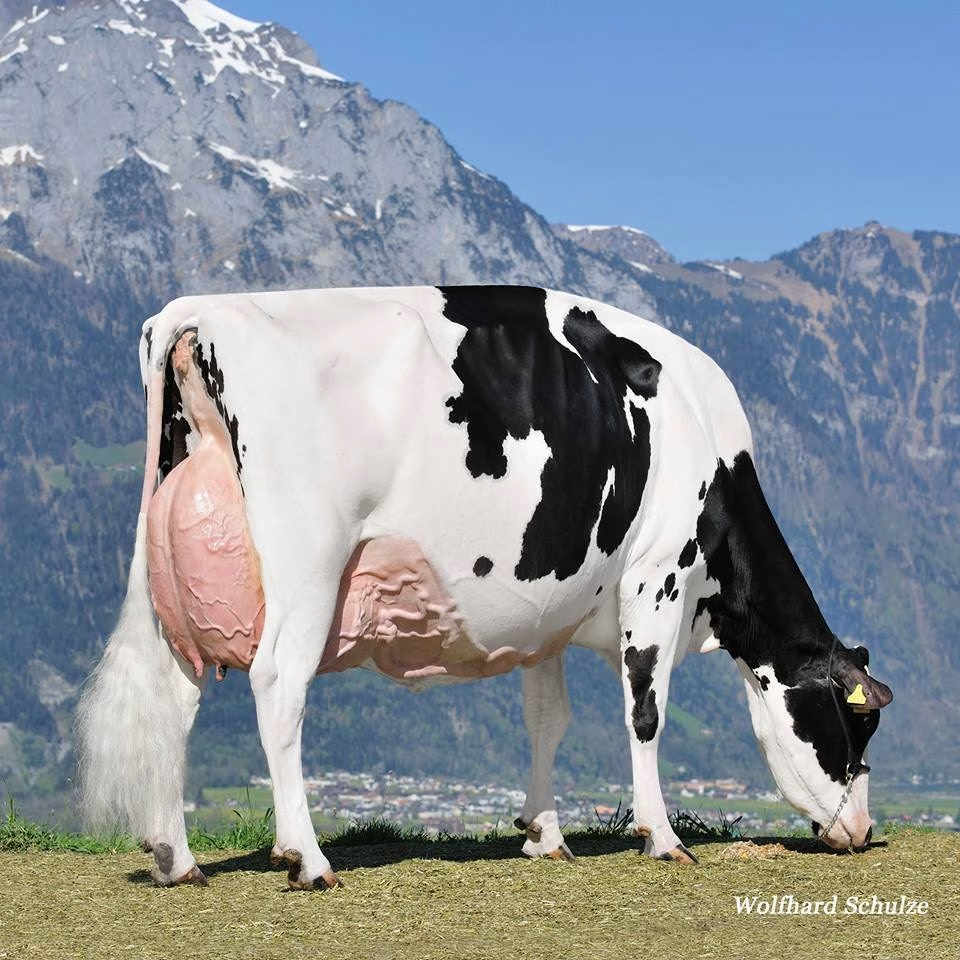
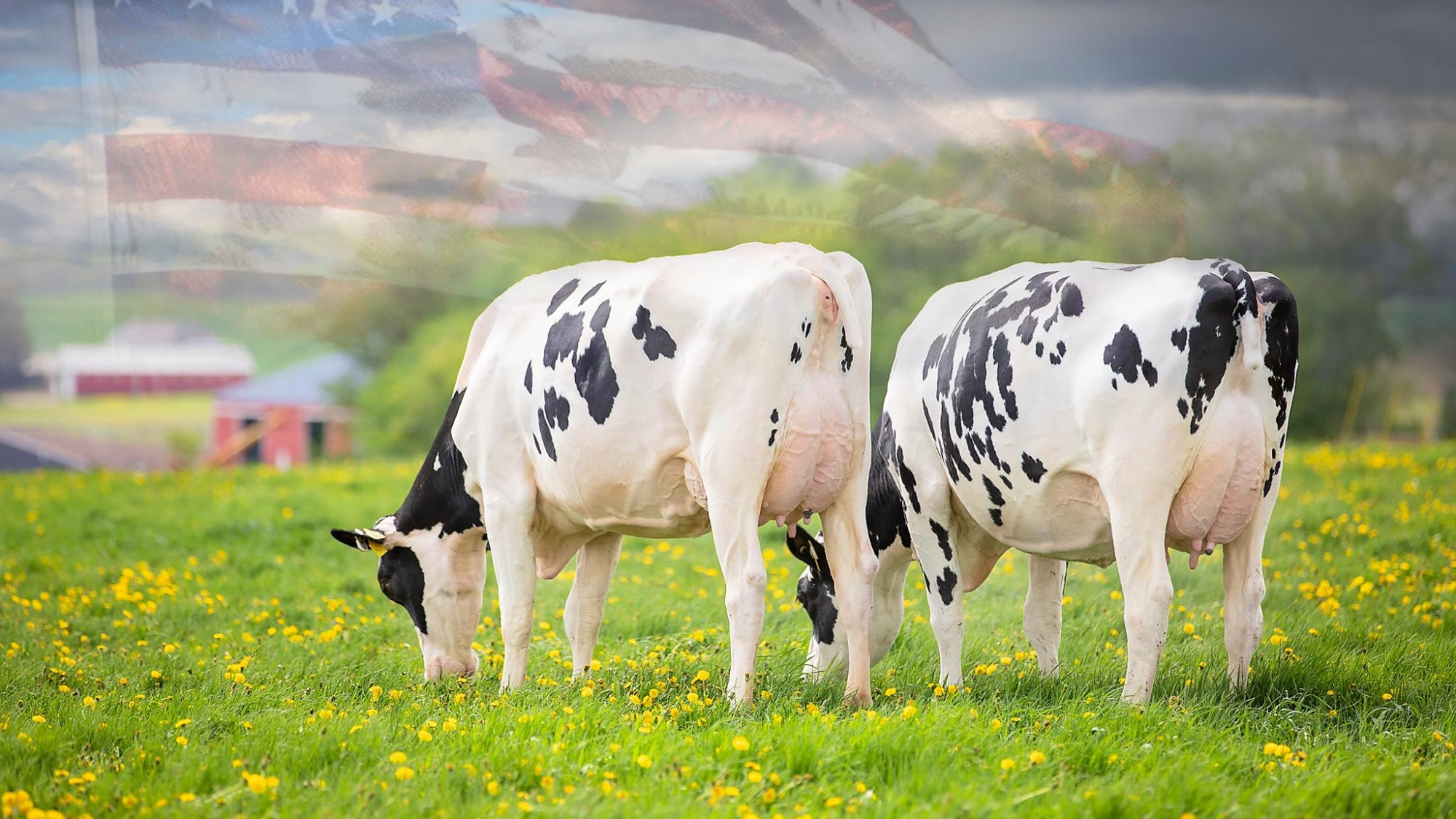
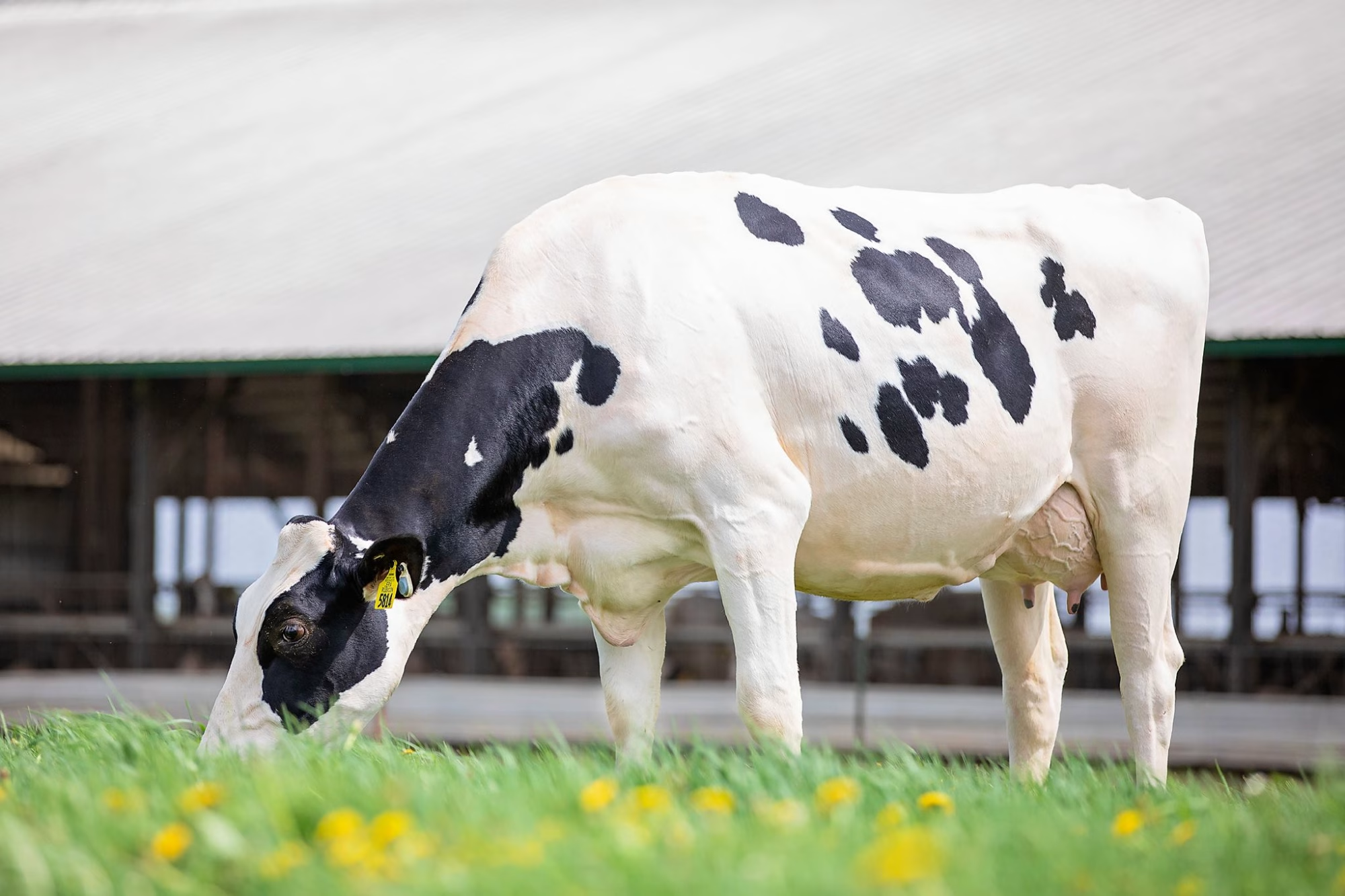
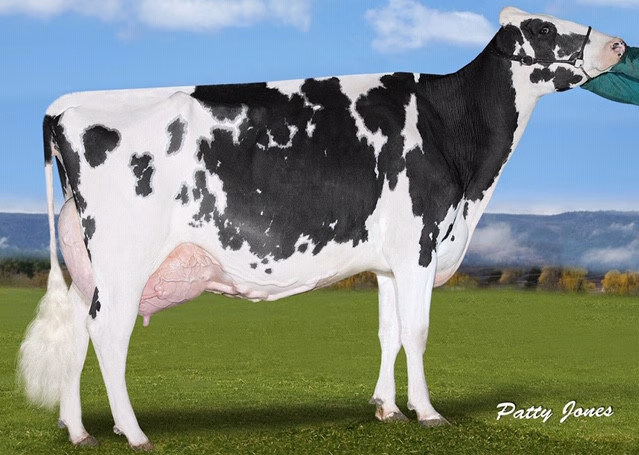
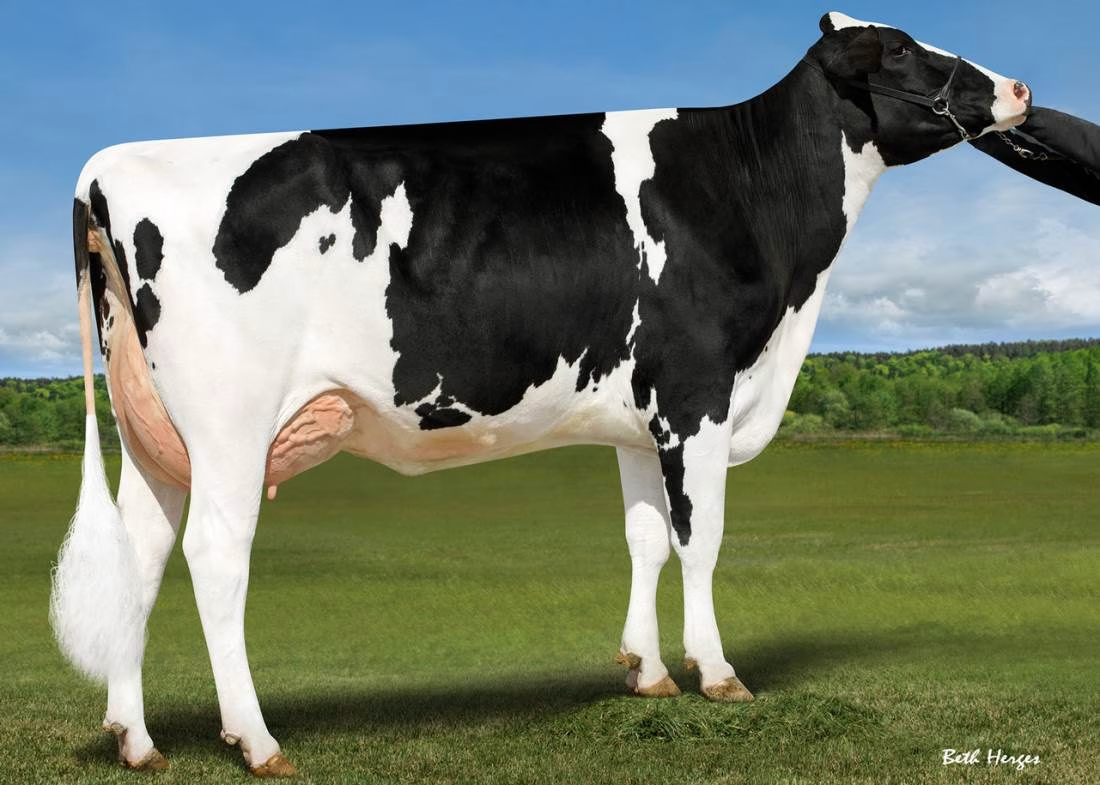
Decrausaz Iron O’Kalibra EX-97, grazing against the stunning backdrop of the Swiss Alps, epitomizes global Holstein excellence with her flawless mammary system, dairy strength, and enduring legacy that continues to shape the breed worldwide.

O’Kalibra’s rise represented more than personal triumph; it signaled a paradigm shift in global Holstein breeding. She demonstrated that European genetics could match their North American counterparts and sometimes surpass them. Through her show ring dominance, exceptional production, and prolific genetic influence, O’Kalibra rewrote the assumptions of Holstein’s excellence and proved that greatness knows no geographical boundaries.

This is the story of how a cow born in Switzerland’s rolling hills rose to become the Holstein by which all others are measured—a tale of exceptional genetics, visionary breeding, and the cow who forever changed how the world views European Holsteins.

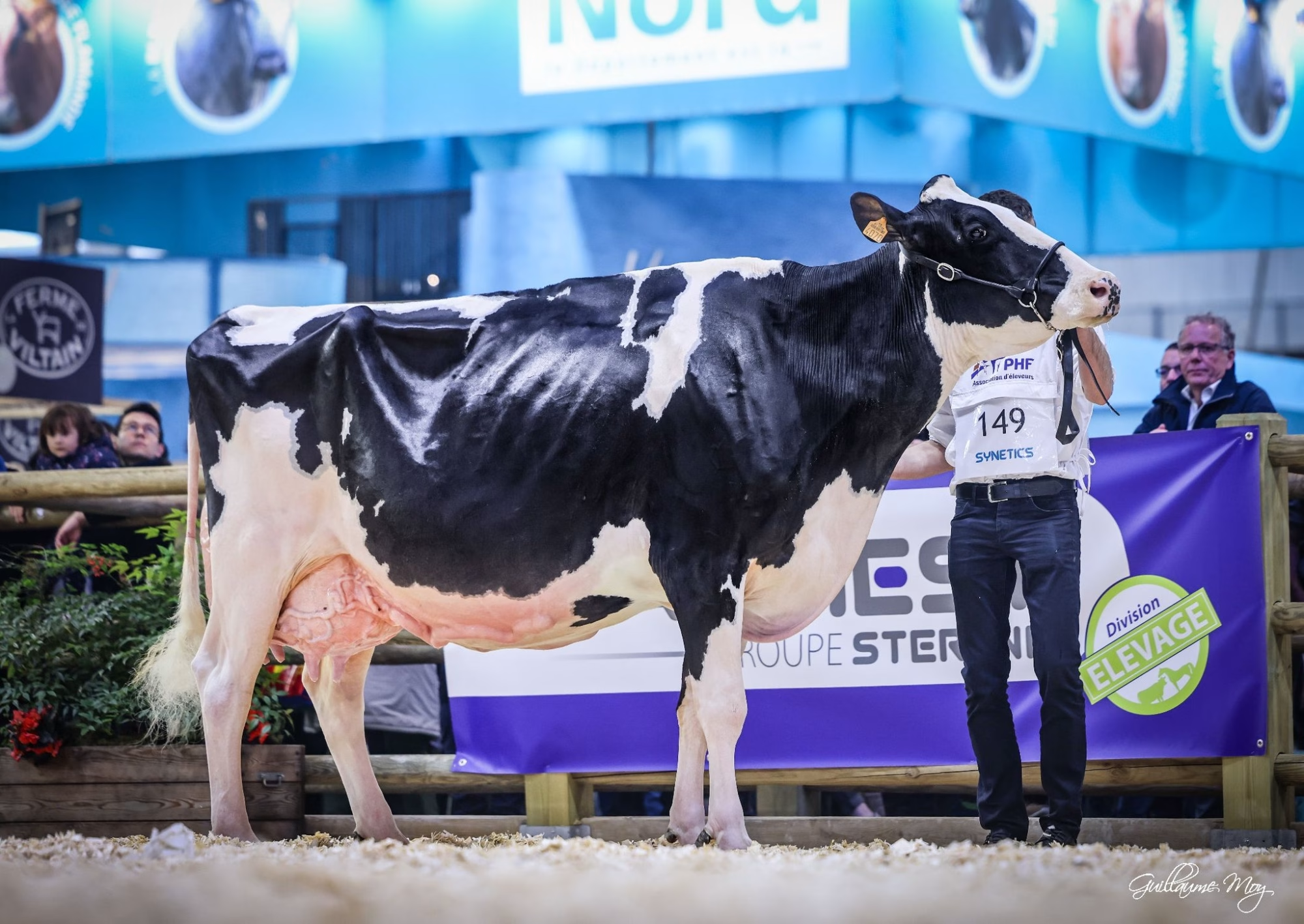
Decrausaz Iron O’Kalibra EX-97 shines under the spotlight at Swiss Expo 2013, where she claimed her second Supreme Champion title. Her unmatched dairy strength, flawless mammary system, and commanding presence solidified her status as one of the greatest Holsteins in history.

From Promising Calf to Global Phenomenon

On September 4, 2008, in the scenic landscapes of Switzerland, a Holstein calf was born that would change the course of dairy cattle history. The Decrausaz family—Fredy and his sons—had carefully planned this breeding, combining the proven Boss Iron with an EX90-2E Integrity daughter and a VG89 Milestone. The resulting calf, O’Kalibra, carried genetic potential that would later blossom into unprecedented excellence.

As O’Kalibra developed, she displayed an unmistakable combination of dairy strength, the width of the frame, and that distinctive silky, nearly translucent hide that would become her trademark. These qualities caught the discerning eye of Edwin Steiner of GS Alliance, who purchased her when she was almost dry as a two-year-old. Later, when she was fresh as a four-year-old, American breeder Pat Conroy from Indiana acquired a share in this promising Holstein.

“What caught our attention was her massive frame, wide chest, and high-quality udder,” Pat explained. “She was the kind of cow that could look after herself and never had a bad day. In addition to that, she milked like crazy.” This combination of functional traits and dairy character would prove crucial to her longevity and success in and out of the show ring.

Conquering Europe’s Most Prestigious Show Rings

O’Kalibra’s competitive career began impressively in 2011 when she was named Honorable Mention Champion and Reserve Best Uddered Cow at the Swiss Expo in Lausanne. That same year, she continued building her reputation by securing Reserve Grand Champion at Expo Bulle. These early accomplishments merely hinted at the dominance to come.

O’Kalibra returned to the Swiss Expo with an even more significant impact the following year, claiming the Supreme Champion title in 2012. Rather than resting on this achievement, she defended her crown in 2013, again being named Supreme Champion at the Swiss Expo. She would later secure this prestigious title a third time in 2015, establishing an unprecedented record of excellence at one of Europe’s premier dairy events.
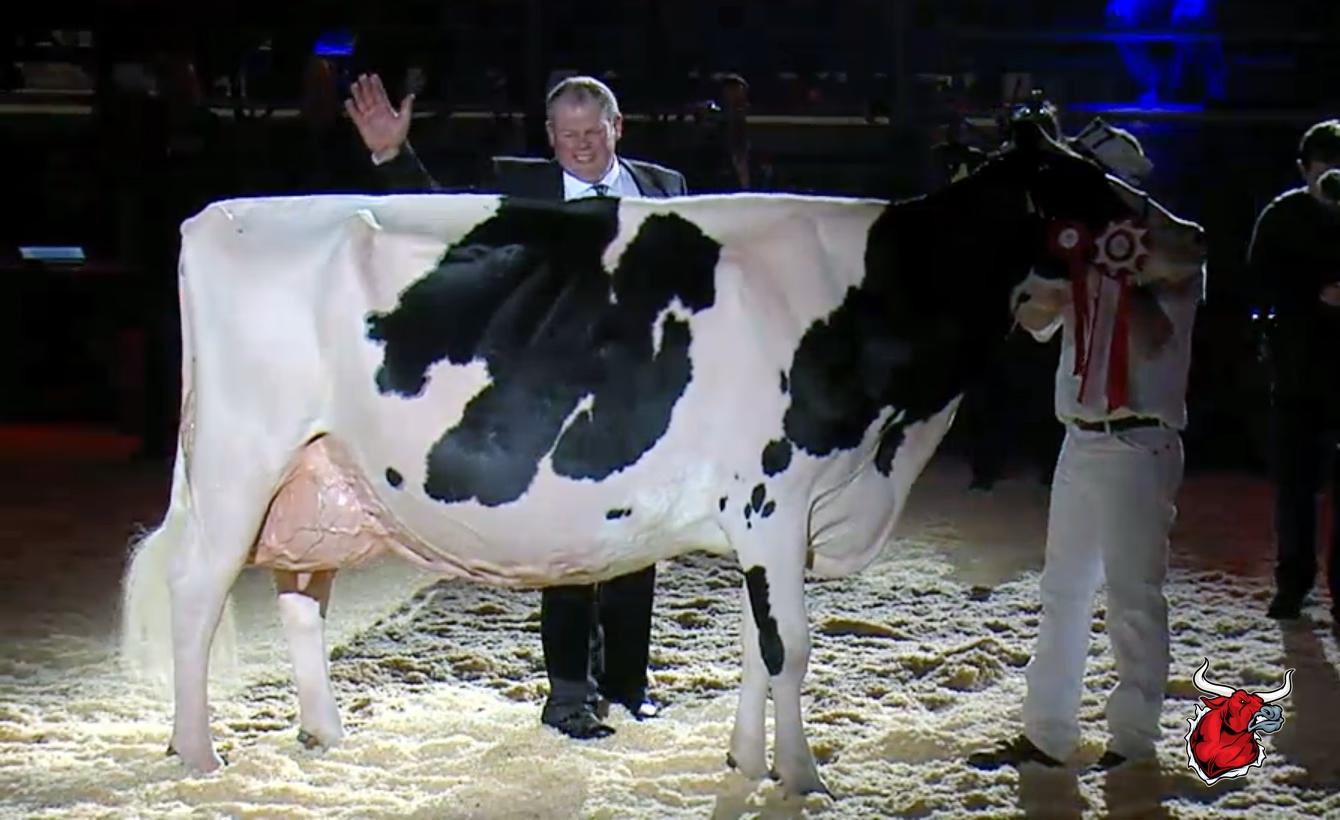
Decrausaz Iron O’Kalibra EX-97 crowned Grand Champion at the All-European Holstein Show, 2013. Her flawless conformation and unmatched dairy strength solidified her place as a global Holstein icon.

O’Kalibra’s influence extended beyond Swiss borders in 2013 when she competed at the All-European Holstein Show. Against the finest Holsteins from across the continent, O’Kalibra stood supreme, being crowned Champion in what observers described as “one of the finest displays of black and white cattle ever gathered at one location.” This continental championship solidified her status as Europe’s premier Holstein.

Her European dominance sparked international discussions about how she would compare to North American champions. Many North American experts confidently stated, “She should walk on the colored shavings at Madison and give the North American cattle a run for their money.” Though she never crossed the Atlantic to compete at the World Dairy Expo, her reputation transcended geographical boundaries.
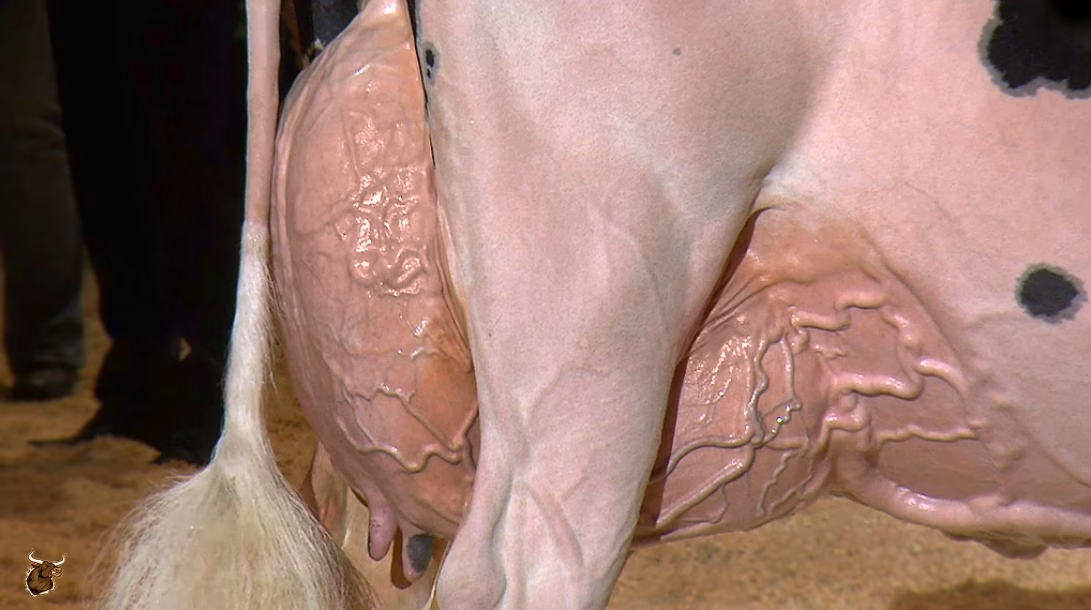
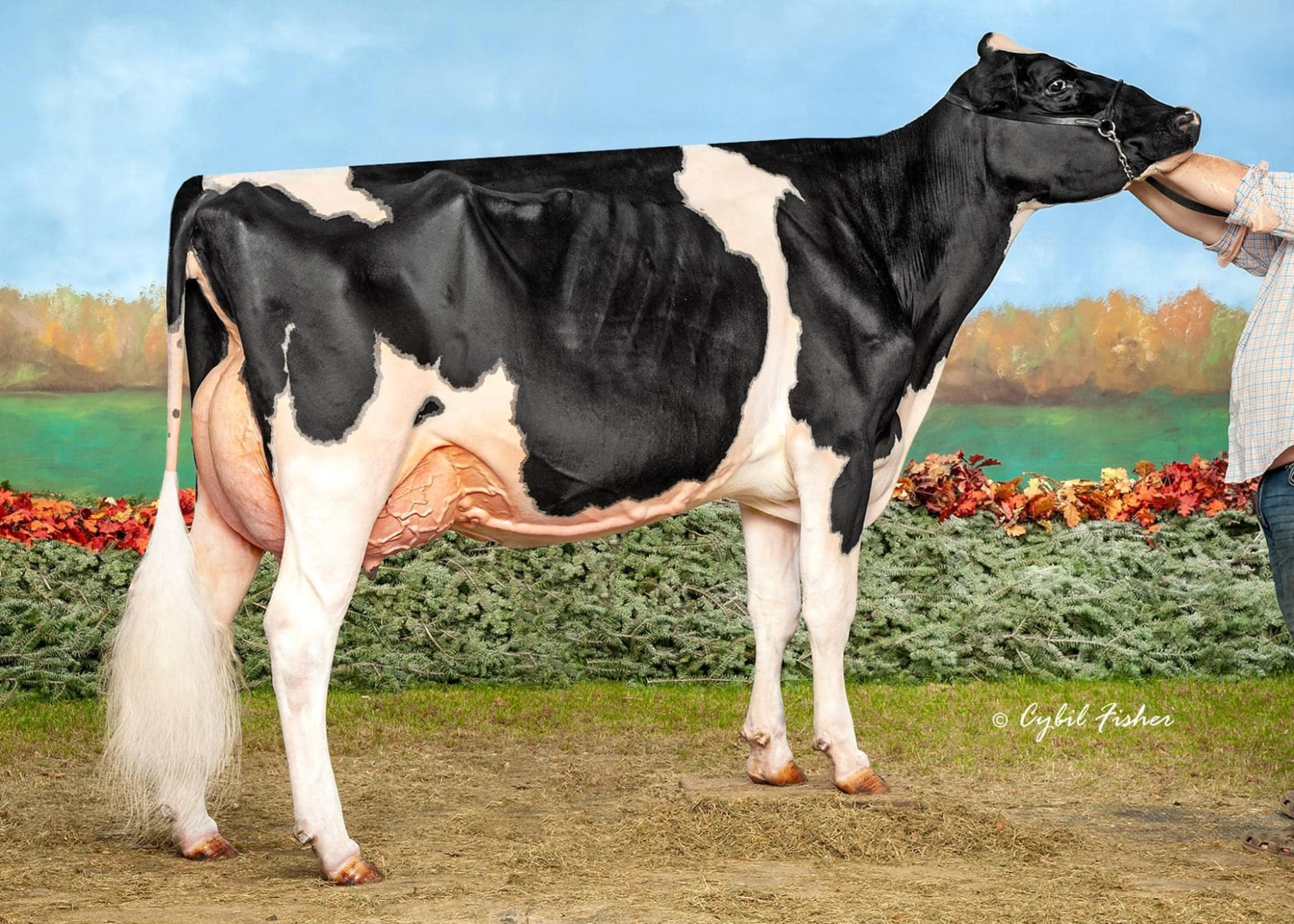
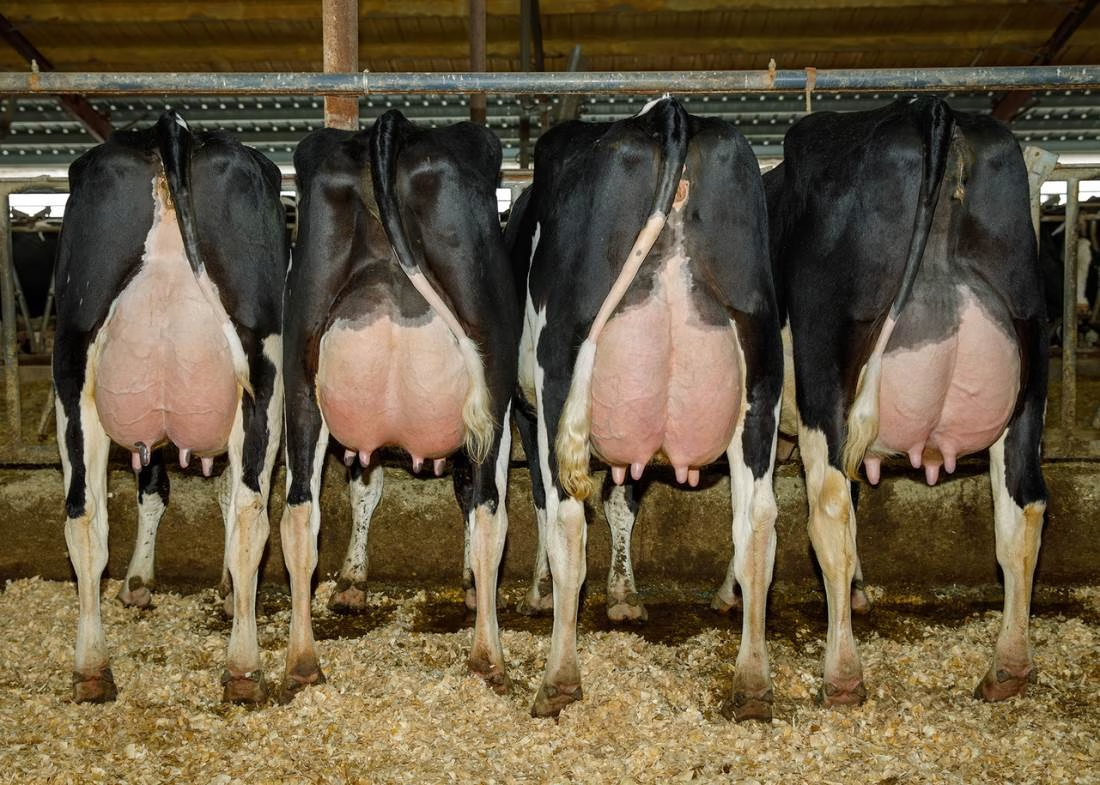
The flawless mammary system of Decrausaz Iron O’Kalibra EX-97, captured during her Grand Champion victory at the All-European Holstein Show 2013. Her exceptional udder attachment, symmetry, and quality set the standard for Holstein excellence worldwide.

Shattering Classification Records with Historic EX-97

O’Kalibra became Switzerland’s first cow classified EX-97, an extraordinary achievement that places her among an elite group of Holsteins worldwide. Only a handful of cows globally achieve this near-perfect score, making it a hallmark of conformation excellence.

Her classification wasn’t just about aesthetic appeal—it reflected structural attributes that contributed to her functionality and longevity. This harmony between beauty and utility represents the ultimate goal of Holstein breeding: cows that excel in both the show ring and the milk parlor.

Beyond Beauty: The Production Powerhouse

While O’Kalibra’s show-ring accomplishments were extraordinary, her production capabilities were equally impressive. First calving at 2 years and 2 months, she produced a respectable 9,166 kg of milk with 3.6% fat and 3.3% protein in 305 days. Her peak performance came as a four-year-old when she produced 14,247 kilograms of milk with 4.0% fat and 2.9% protein in a 305-day lactation.

This production excellence wasn’t an anomaly but rather a family trait. Her dam produced 13,372 kg as a four-year-old, while her grand dam recorded 14,217 kg as a seven-year-old. These production records demonstrate the depth of genetic potential in O’Kalibra’s lineage.

Over her lifetime, O’Kalibra produced an astounding 94,000 kg (206,800 lbs) of milk with considerable components. This exceptional lifetime yield places her among elite-producing cows globally. It underscores how show-winning type and high production can coexist in the same animal when breeding decisions prioritize balanced traits.

Global Genetic Impact: The O’Kalibra Dynasty

O’Kalibra’s lasting legacy extends through her offspring, who have influenced Holstein populations worldwide. Her sons have been particularly impactful, with several entering artificial insemination programs. Notable among these are her Red Destry son, O’Kalif, and her Acme son, O’Kaliber.
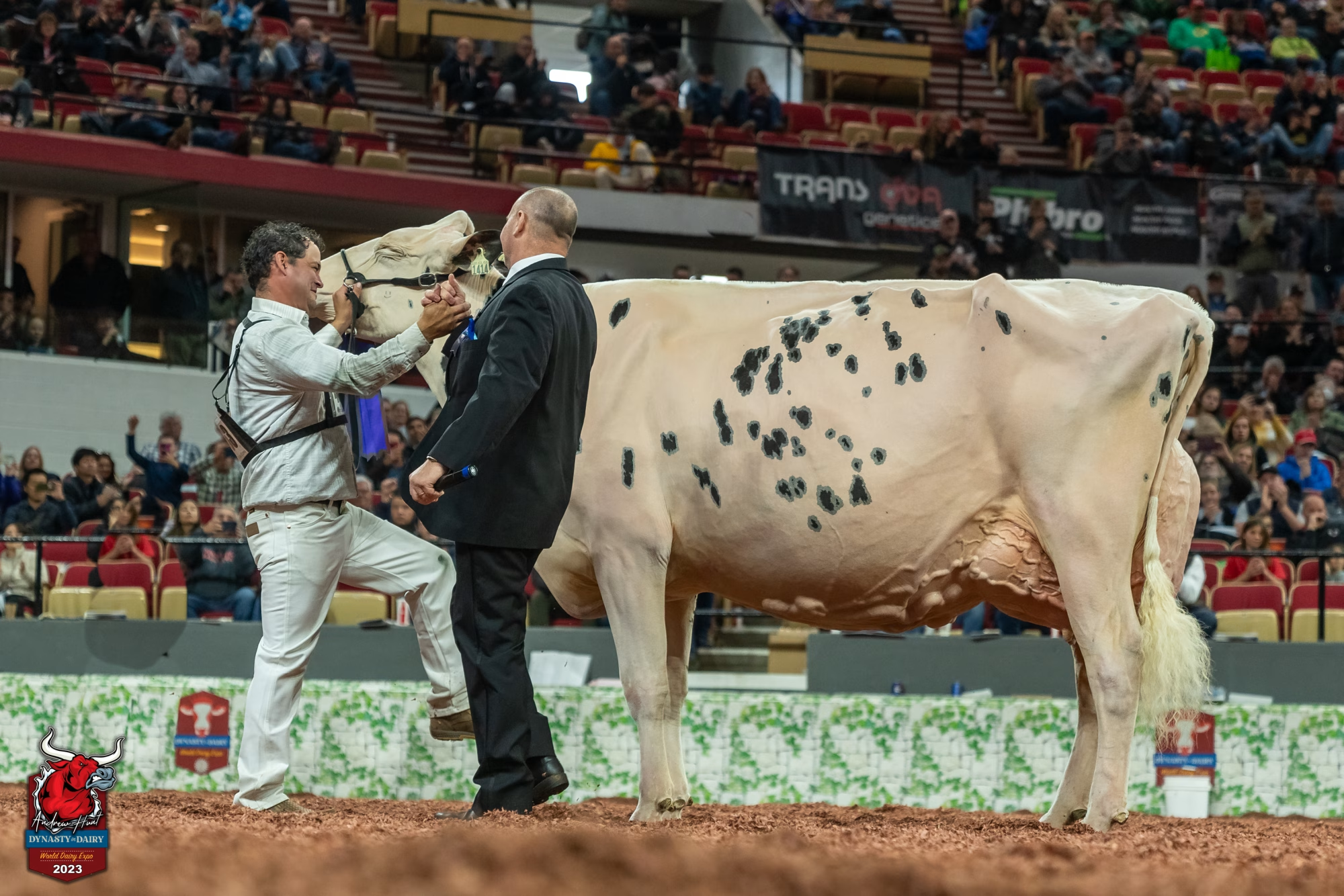
Erbacres Snapple Shakira EX-97-2E dazzles at World Dairy Expo 2024, claiming Supreme Champion honors. A granddaughter of Decrausaz Iron O’Kalibra, Shakira continues the family legacy of global Holstein excellence with her flawless conformation and commanding presence.

Her son from Acme became particularly influential as a sire of show-winning daughters like Erbacres Snapple Shakira (EX-97-2E-CAN), who captured Supreme Champion honors at World Dairy Expo after winning Junior 2-Year-Old at the Royal Winter Fair in 2017. Shakira’s achievements demonstrate how O’Kalibra’s genetic package has been transmitted through generations to create champions who continue making history.

From National Icon to All-Time World Champion

O’Kalibra’s achievements received global recognition when Holstein International named her World Champion not once but twice during her lifetime. Later, in 2021, she received the ultimate honor when Holstein International crowned her the All-Time World Champion, cementing her place as one of history’s greatest Holsteins.

This recognition placed O’Kalibra alongside legendary cows like RF Goldwyn Hailey and Thrulane James Rose—two North American champions who earned multiple World Champion titles—but ultimately positioned her above them as the greatest of all time.
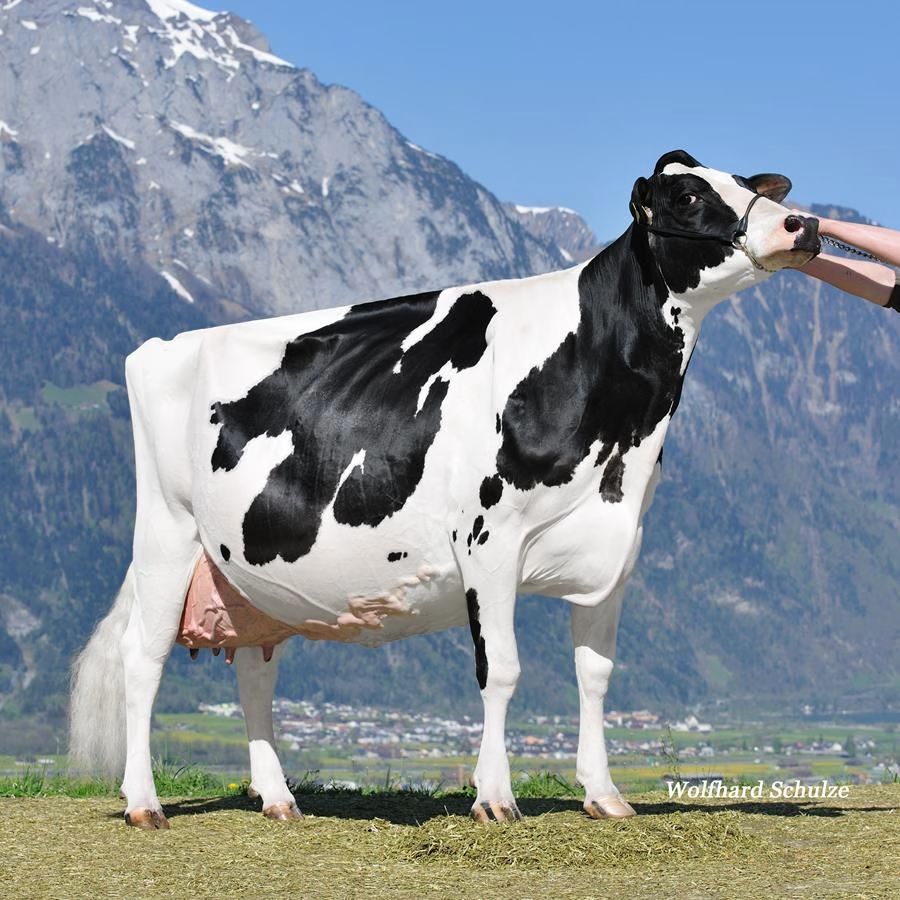
Decrausaz Iron O’Kalibra EX-97, pictured against the majestic Swiss Alps, embodies global Holstein excellence. As Holstein International’s All-Time World Champion, she redefined standards for conformation, production, and genetic influence, proving European cows can dominate on the world stage.

A Timeless Legacy That Continues to Evolve

The dairy world lost this extraordinary cow when O’Kalibra died before September 2018. However, her influence remains vibrant through her descendants and the example she set for balanced breeding. Her final achievements include three Swiss Expo Supreme Championships (2012, 2013, 2015), European Champion at Fribourg (2013), two Holstein International World Champion titles during her lifetime (2013 & 2015), and ultimately being crowned All-Time World Champion (2021).

Pat Conroy perhaps best articulated O’Kalibra’s legacy when he observed, “Cows that have some power and strength yet are still dairy will ultimately outlast and out-milk high-style younger cows that seem to be one-hit wonders.”

The Enduring Legacy of Decrausaz Iron O’Kalibra

The breeding power of the legendary Decrausaz Iron O’Kalibra EX-97-CH continues to make waves in the Holstein world, as evidenced by the recent triumphs at the Schau der Besten 2025. This prestigious German dairy cattle show showcased the ongoing influence of O’Kalibra’s genetics through two of her descendants:

O’Katy: A Rising Star
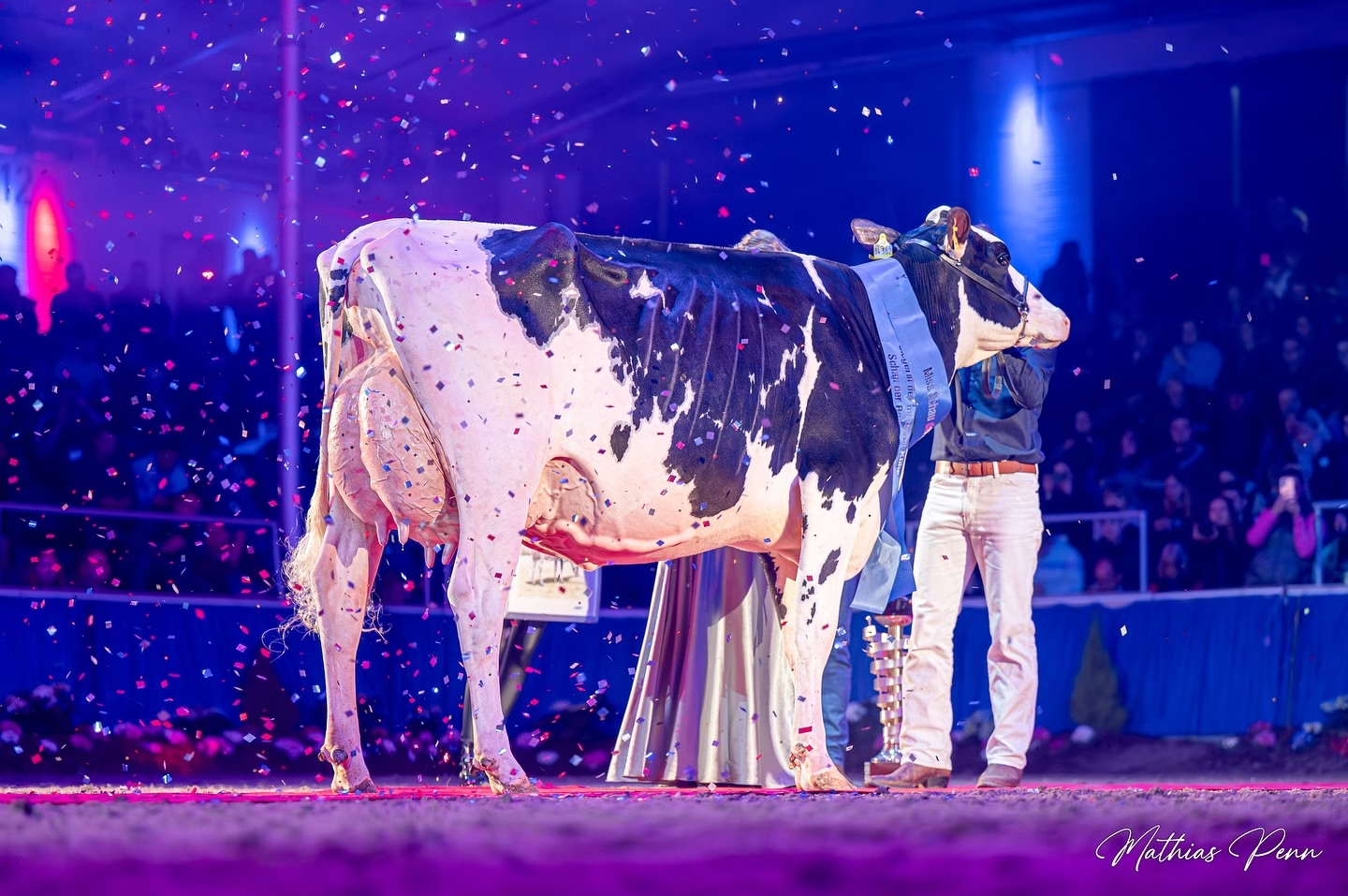
O’Katy, the 3-year-old Stantons Chief daughter, crowned Grand Champion at the Schau der Besten 2025. Continuing the legacy of Decrausaz Iron O’Kalibra, O’Katy dazzled with her exceptional conformation and presence, solidifying her place as a rising star in global Holstein breeding.

O’Katy, a 3-year-old Stantons Chief daughter, claimed the Intermediate Champion and Grand Champion titles at the Schau der Besten 2025. This victory follows her Junior Champion win at the same event in 2024, demonstrating her consistent excellence and rapid rise to the top. O’Katy’s pedigree traces directly back to O’Kalibra through an impressive lineage:

  • Dam: Wilcor Awesome O’Kamera *RC EX-90-DE
    • 2nd place Jr. 3yr. old at the German Dairy Show 2019
  • Granddam: GS Alliance Sid O’Kamilla *RC EX-90-DE
  • Great-grand dam: Decrausaz Iron O’Kalibra EX-97-CH

Wilcor Awesome O’Kalotta-Red: Senior Champion

Wilcor Awesome O’Kalotta-Red shines as Senior Champion at Schau der Besten 2025. A descendant of Decrausaz Iron O’Kalibra, O’Kalotta-Red exemplifies the enduring power of O’Kalibra’s genetics, showcasing exceptional conformation and commanding presence in the show ring.

Adding to the family’s success, Wilcor Awesome O’Kalotta-Red secured the Senior Champion title at the Schau der Besten 2025. O’Kalotta-Red is a full sister to O’Katy’s dam, O’Kamera, further cementing the strength of this genetic line.

These achievements highlight the exceptional breeding value of Decrausaz Iron O’Kalibra, whose influence continues to shape the Holstein breed years after her show ring triumphs. The success of her descendants at such a high-profile event demonstrates the lasting impact of O’Kalibra’s genetics in producing animals that excel in conformation and show ring presence.

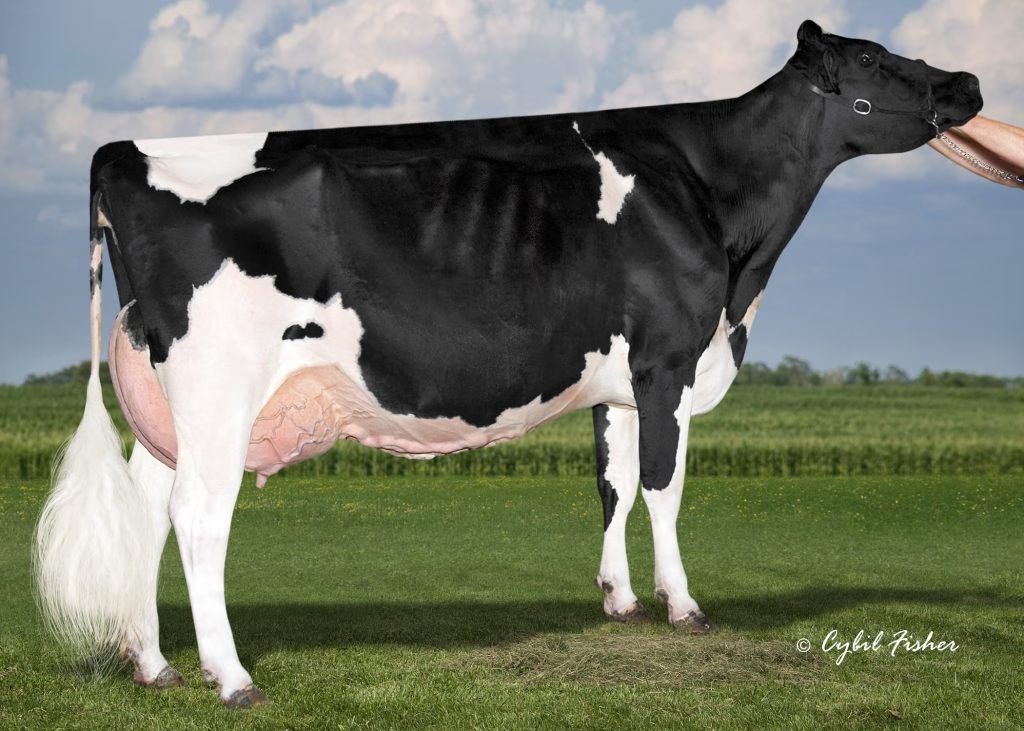
Decrausaz Iron O’Kalibra EX-97 showcased from every angle, highlighting her exceptional conformation, flawless mammary system, and dairy strength. This iconic Holstein set the global standard for excellence, proving that beauty and functionality can coexist in one extraordinary cow.

The Bullvine Bottom Line

Decrausaz Iron O’Kalibra transcended the boundaries of European excellence to become a true global icon in the Holstein world. Her impact reaches far beyond the show rings of Switzerland or the pastures of Europe—it reverberates through top-tier breeding programs on every continent. O’Kalibra wasn’t just one of Europe’s greats; she stands among the greatest Holsteins ever to grace a show ring or influence a pedigree, regardless of origin.

Her crowning as Holstein International’s All-Time World Champion in 2021 wasn’t just a victory for Switzerland or Europe—it was a testament to her unparalleled influence on the breed worldwide. O’Kalibra proved that exceptional genetics and balanced breeding goals can produce a cow that excels in both show ring aesthetics and real-world production, setting a new standard for what breeders should aspire to achieve.

Perhaps most remarkably, O’Kalibra’s legacy continues to flourish years after her passing. The recent triumphs of her descendants at the Schau der Besten 2025, with O’Katy claiming Intermediate and Grand Champion titles and Wilcor Awesome O’Kalotta-Red securing Senior Champion honors, demonstrate the enduring power of her genetics. These victories, alongside the continued success of progeny like Erbacres Snapple Shakira in North America, prove that O’Kalibra’s influence knows no borders and shows no signs of waning.

As we look to the future of Holstein breeding, O’Kalibra’s story serves as both inspiration and blueprint. She challenges breeders worldwide to think globally, pursue balanced excellence, and never underestimate the potential of a single exceptional animal to reshape an entire breed. In the ever-evolving world of dairy genetics, Decrausaz Iron O’Kalibra’s legacy isn’t just alive—it’s thriving, continuing to push the boundaries of what’s possible in Holstein breeding worldwide.

O’Kalibra’s story proves that greatness knows no borders. Her legacy challenges us to think globally, breed strategically, and aim higher.

KEY TAKEAWAYS:

  • O’Kalibra became Switzerland’s first EX-97 Holstein and a three-time Swiss Expo Supreme Champion
  • Named Holstein International’s All-Time World Champion in 2021, besting North American legends
  • Her genetics continue to dominate shows worldwide, including recent wins at Schau der Besten 2025
  • O’Kalibra’s success challenged the notion of North American superiority in Holstein breeding
  • Her story emphasizes the importance of balanced breeding for both show ring and production excellence

EXECUTIVE SUMMARY: Decrausaz Iron O’Kalibra, born in Switzerland in 2008, revolutionized global Holstein breeding. She became the first Swiss cow to achieve EX-97 classification and won three Supreme Champion titles at the Swiss Expo. O’Kalibra’s impact extended beyond Europe when she was crowned Holstein International’s All-Time World Champion in 2021, surpassing renowned North American cows. With lifetime production exceeding 206,800 lbs of milk and influential offspring like O’Kaliber and Erbacres Snapple Shakira, O’Kalibra proved that European genetics could compete and excel globally. Her legacy continues through recent show ring successes of her descendants, challenging breeders worldwide to pursue balanced excellence in conformation and production.

LEARN MORE

Join the Revolution!

Join over 30,000 successful dairy professionals who rely on Bullvine Daily for their competitive edge. Delivered directly to your inbox each week, our exclusive industry insights help you make smarter decisions while saving precious hours every week. Never miss critical updates on milk production trends, breakthrough technologies, and profit-boosting strategies that top producers are already implementing. Subscribe now to transform your dairy operation’s efficiency and profitability—your future success is just one click away.
NewsSubscribe
First
Last
Consent

Lab-Grown Milk Has Arrived: The Dairy Innovation Farmers Can’t Ignore

Forget plant-based alternatives—Boston scientists have created REAL cow’s milk without a single cow. MIT-validated and launching by 2026, Brown Foods’ “UnReal Milk” contains all 8 key dairy proteins while using 82% less carbon, 90% less water, and 95% less land. Is this the end of traditional dairy farming—or the beginning of a new opportunity?

The future just landed in a test tube in Boston, and it’s coming for your milk tank. Brown Foods, a Y Combinator-backed startup, has achieved what many thought impossible – creating genuine, functional cow’s milk without a single cow. This isn’t another plant-based pretender. This is molecularly identical dairy, and it’s been validated by MIT’s Whitehead Institute. While your cows are chewing cud, mammalian cell culture is churning out milk proteins that match Alpha-S1-Casein, Alpha-S2-Casein, Beta Casein, Kappa Casein, Alpha-lactalbumin, Beta-lactoglobulin, Lactotransferrin and Albumin – the complete protein profile of conventional milk.

“No industry is immune to disruption. The question isn’t whether change is coming, but whether you’ll shape or be shaped by it.”

lab-grown milk, Brown Foods, dairy alternatives market, sustainability in dairy, cellular agriculture

Beyond Plant Milk: Real Dairy Proteins Without the Cow

Let’s be clear – we’re not discussing another oat milk or soy concoction masquerading as dairy. Brown Foods’ UnReal Milk contains the same proteins, fats, and carbohydrates that comprise 99% of conventional cow milk. This isn’t plant-based; it’s dairy-identical.

MIT Researchers Confirm: This New Milk Contains All 8 Key Dairy Proteins

“Brown Foods has achieved a significant scientific and technological breakthrough by producing the world’s first test tube of lab-grown milk,” confirms Dr. Richard Braatz, Edwin R. Gilliland Professor of Chemical Engineering at MIT and biopharmaceutical manufacturing expert. “Unlike precision fermentation, the key strength of Brown Foods’ technology approach is that it uses mammalian cell culture, which enables them to produce all milk components together as whole milk.”

While precision fermentation (using yeast or bacteria to produce specific milk proteins) has been around for several years, Brown Foods’ approach is fundamentally different. They’re using actual mammary cells – the same type that produces milk in your cows – but growing them in bioreactors. The result isn’t just whey or casein in isolation; it’s a complete milk composition with proteins, fats (primarily triglycerides), and carbohydrates in the same ratio as conventional milk.

For six years, startups have attempted to produce fully lab-made whole milk. Still, none have successfully demonstrated lab milk with all key components. Brown Foods accomplished what others couldn’t in three years, and independent validation from the Whitehead Institute confirms it isn’t just marketing hype.

“Brown Foods has achieved what many thought impossible – creating real, functional cow’s milk without a single cow.”

How Soon Will Bioreactors Compete With Your Milking Parlor?

While you might dismiss this as futuristic fantasy, the commercial timeline is accelerating. Brown Foods targets consumer tastings of “UnReal Milk version 2.0” by late 2025, followed by a market pilot in late 2026. The current version (1.0) still requires extraction from a liquid growth solution with some solution remaining in the final product – a challenge they promise to eliminate in version 2.0.

Timeline Shock: Brown Foods Targets 2026 Market Entry

The global precision fermentation market is projected to reach a staggering $34.8 billion by 2031, growing at an explosive 40.5% annual rate. This isn’t a fringe technology; it’s an emerging industry with massive investment.

Consumers are more receptive than many dairy farmers realize. Research shows that 39% of Americans already find precision-fermented dairy appealing, with 29% willing to try samples and 21% ready to purchase. Millennials lead interest at 36%, compared to just 21% of Baby Boomers, signaling a generational shift that favors alternative production methods.

The Generational Gap: Which Consumers Will Choose Lab Milk Over Farm Fresh?

The demographic patterns couldn’t be more precise – younger consumers are significantly more open to alternative dairy production methods. Gen Z (32%) and Millennials (36%) show the highest interest levels, with openness declining among Gen X (27%) and Baby Boomers (21%). This generational divide suggests that as these younger consumers gain more purchasing power, their openness to lab-grown dairy could accelerate market adoption.

Environmental Claims: What Lab Dairy Means For Dairy’s Carbon Hoofprint

Table 1: Environmental Impact Comparison

Environmental MetricTraditional DairyPerfect Day Lab-Grown Process
Greenhouse Gas EmissionsBaseline91-97% less
Energy UseBaseline20-60% less
Blue Water UseBaselineUp to 99% less

Source: Perfect Day commissioned report, via Labiotech.eu (2024)

Brown Foods estimates its process delivers an 82% lower carbon footprint than conventional dairy, using 90% less water and 95% less land. These aren’t minor improvements—they’re fundamental efficiency leaps that will increasingly matter in a resource-constrained world facing climate challenges.

Traditional dairy’s environmental footprint has always been its Achilles’ heel in public perception. Lab-grown dairy targets this vulnerability by bypassing methane-emitting livestock altogether while promising comparable nutrition and functionality.

Table 2: Cultured Casein Production Environmental Impact (per kg)

Production ScenarioGHG Emissions (kg CO₂ eq.)Water Use (m³)Land Footprint (m²a crop eq.)
Low-Input Production0.89–37.212.05–8.640.0096–1.07
High-Input Production40.05–146.538.33–313.560.46–50.94

Source: Nicholas Institute for Environmental Policy Solutions, Duke University (2024)

The Profit Question: Can Your Farm Compete With Chemical Processing?

Let’s cut to the chase: lab-grown dairy won’t replace conventional farming overnight, but ignoring this technology is dangerous business thinking. The barriers remain significant: Current production scales are minuscule compared to commercial dairy operations, extraction processes need refinement, and costs remain prohibitive for mass-market applications.

However, these hurdles are technical, not fundamental, and they’re being tackled with billions in investment. The question isn’t whether lab milk will reach price parity with conventional dairy but when specific applications will first cross that threshold.

The mainstream fluid milk market will likely have years before feeling significant pressure, but high-value ingredients like specialized proteins used in food manufacturing could face competition much sooner. The first battlegrounds will be specialty products with environmental credentials that drive premium pricing.

Health concerns dominate consumer interest in precision-fermented dairy, followed by animal welfare, taste, and environmental benefits. This creates both challenges and opportunities for conventional producers. Farms demonstrating superior sustainability practices and emphasizing health and welfare advantages have defensible market positions.

Table 3: Milk Type Comparison (Environmental Impact per Liter)

Environmental MetricCow’s MilkPlant-Based AlternativesRelative Impact
Greenhouse Gas EmissionsHigherLower~3× difference
Land UseHigherLower~10× difference
Freshwater UseHigherLower2-20× difference
Eutrophication (Nutrient Pollution)HigherLowerSignificantly higher

Source: Our World in Data (2024)

Protect Your Operation: Strategic Adaptations For Forward-Thinking Farmers

The industry response shouldn’t be denial but strategic adaptation. Conventional dairy has centuries of infrastructure, cultural embedding, and nutritional trust that lab-grown alternatives can’t easily replicate. The operations that will thrive aren’t those that pretend disruption isn’t coming but those that differentiate based on heritage, craft, and connection while monitoring alternative protein developments.

Hybrid Opportunities: How Some Dairy Farmers Are Already Cashing In

For forward-thinking dairy producers, this technology should trigger planning rather than panic. Consider these approaches:

  1. Premium positioning: As commoditization pressure increases, differentiate through sustainability practices, animal welfare standards, or regional specialization that lab production can’t match.
  2. Investigate hybrid models: Some European farms are exploring partnerships with food tech companies, potentially creating new revenue streams while maintaining traditional operations. Greg Strauss, a Wisconsin dairy farmer who leases part of his land to a Brown Foods pilot facility, describes it as “ like renting out a corner of your farm, but for science.”
  3. Monitor commercial developments: Track when lab-grown dairy moves from scientific validation to scalable commercial production. The industry is currently at the “first test tube” stage, not the “tanker truck” phase.
  4. Engage in regulatory discussions: Support appropriate labeling requirements while avoiding protectionist measures that ultimately backfire by driving innovation underground.

The Bottom Line: Will Your Dairy Thrive in the Bioreactor Era?

The global dairy landscape is witnessing its most significant technological disruption since the mechanical milker. Brown Foods has proven that creating molecularly identical milk without cows is scientifically possible. However, whether this technology will become economically viable and consumer-accepted at scale remains to be seen.

“While your grandfather competed with the dairy farm down the road, your children may compete with bioreactors.”

What’s clear is this: while your grandfather competed with the dairy farm down the road, your children may compete with bioreactors that can produce milk proteins more efficiently than any cow. The dairy industry has adapted to countless challenges over centuries – those who acknowledge this new reality while building on conventional dairy’s unique strengths will be best positioned for whatever comes next.

Key Takeaways

  • Scientific Breakthrough: Brown Foods has created lab-grown “UnReal Milk” containing all eight key milk proteins, verified by MIT’s Whitehead Institute as molecularly identical to conventional dairy.
  • Commercial Timeline: Consumer tastings of UnReal Milk version 2.0 are scheduled for late 2025, with market pilot planned for late 2026, indicating this technology is moving from laboratory to marketplace.
  • Environmental Claims: Lab-grown dairy production reportedly uses 82% less carbon, 90% less water, and 95% less land than traditional dairy farming, potentially addressing dairy’s sustainability challenges.
  • Generational Adoption Gap: Younger consumers show significantly higher interest in precision-fermented dairy (Millennials: 36%, Gen Z: 32%) compared to older generations (Baby Boomers: 21%), signaling a demographic shift in dairy acceptance.
  • Market Projection: The global precision fermentation market is forecast to reach $34.8 billion by 2031, growing at 40.5% annually, with substantial investment driving technological improvements.
  • Competitive Impact: High-value dairy protein ingredients and premium specialty products will likely face competition first, while commodity fluid milk markets have a longer runway before disruption.
  • Strategic Adaptation: Forward-thinking dairy farmers should consider premium positioning, hybrid business models, regulatory engagement, and environmental improvements to remain competitive in a changing market.
  • Current Limitations: Lab-grown dairy still faces significant challenges in extraction processes, production scale, cost structure, and regulatory approval before achieving mainstream market penetration.

Summary

Boston-based Brown Foods has achieved a scientific breakthrough in creating lab-grown milk containing all eight key dairy proteins without using cows, validated by MIT’s Whitehead Institute. Their “UnReal Milk” uses mammalian cell culture technology to produce molecularly identical dairy with 82% less carbon, 90% less water, and 95% less land than traditional farming. With consumer tastings planned for late 2025 and market entry targeted for 2026, this technology represents the dairy industry’s most significant disruption in decades. While technical hurdles remain in scaling production and reducing costs, the precision fermentation market is projected to reach $34.8 billion by 2031, growing at 40.5% annually. For dairy farmers, this signals an urgent need for strategic adaptation rather than denial—whether through sustainability differentiation, hybrid business models, or novel partnerships with emerging food tech companies. The generational gap in consumer acceptance (36% of Millennials versus 21% of Baby Boomers) suggests a gradual but potentially transformative shift in dairy production methods over the coming decade.

Learn More

Join the Revolution!

Bullvine Daily is your essential e-zine for staying ahead in the dairy industry. With over 30,000 subscribers, we bring you the week’s top news, helping you manage tasks efficiently. Stay informed about milk production, tech adoption, and more, so you can concentrate on your dairy operations.

NewsSubscribe
First
Last
Consent

LAND WARS: How Savvy Dairy Farmers Are Beating Big Money at Its Own $21,500/Acre Game

The $21,500/acre land grab is suffocating traditional dairy. But while industry dinosaurs struggle, a new breed of innovative producers is rewriting ownership rules. Are YOU ready to join the resistance?

Midwest farmland values have skyrocketed to unprecedented levels, with prime agricultural acreage now fetching over $21,500 per acre in some areas. These soaring costs threaten the viability of dairy producers, forcing innovation in land access strategies.

When investment groups and corporate interests started snatching up Midwest farmland at jaw-dropping prices, many predicted the death of family dairy. They were wrong. Across America’s heartland, a dairy revolution is brewing as forward-thinking producers deploy guerrilla tactics to secure the land they need—without mortgaging their future or selling their souls to the bank.

The Land Price Crisis: Why $21,500/Acre Threatens Dairy’s Future

Let’s cut through the nonsense: the traditional “save up and buy the farm” model is dead. While agricultural economists wring their hands and farm lenders peddle increasingly desperate financial products, farmland across the Midwest has reached stratospheric heights that mock conventional business wisdom.

According to January 2025 data from DreamDirt, Minnesota farmland now averages $8,364 per acre, with premium ground in Rock County commanding a staggering $14,400. Missouri tops that at $15,171 per acre. Meanwhile, Purdue University reports that Indiana’s top-quality farmland reached $14,392 per acre in 2024, jumping 4.8% in just twelve months. At the same time, prime farmland in Wisconsin fetches $21,500 per acre.

Take a hard look at this snapshot of recent Minnesota sales:

CountyDate SoldTotal Acres$/Acre% TillableSoil Score
Martin01/07/2025101.11$11,70094.84%92.9
Rock01/21/202580.09$14,40094.48%89.3
Swift01/24/2025164.97$6,10097.42%54.3
Marshall01/27/2025121.50$3,00095.84%92.3
Clay01/29/202573.97$7,90096.28%91.7

This isn’t just an American problem. Land prices are rising in dairy regions worldwide, reshaping the economics of milk production globally.

“These prices aren’t just unsustainable—they’re mathematically impossible for traditional dairy operations,” declares Tom Wilson, a third-generation Wisconsin producer. “When land costs $14,000 an acre, that’s over $950 per cow just in land investment for a grazing operation. The dairy establishment won’t admit it, but the numbers are terminal for conventional expansion models.”

The cold, hard truth? Land prices have wholly disconnected from agricultural productivity. We’re witnessing nothing less than the financialization of farmland—where hedge funds, private equity, and wealthy non-farm investors treat our pastures and cornfields as “alternative assets” in diversified portfolios.

While industry leaders peddle comforting fantasies about “cyclical markets,” the brutal reality is that dairy producers caught in conventional thinking face extinction. However, a new breed of dairy rebels is fighting back with unconventional tactics.

Guerrilla Leasing: How Strategic Dairy Farmers Secure Land Without Buying It

The most tactical rebels have abandoned the fetish of ownership entirely, deploying creative leasing strategies that flip power dynamics with landowners.

Many innovative dairy producers have reinvented their approach to land access by implementing profit-sharing models. Rather than fixed cash rent, these arrangements tie landowner compensation to production outcomes, creating true partnerships instead of landlord-tenant relationships. When implemented effectively, these approaches can significantly increase lease renewal rates because landowners become invested in the farm’s success rather than just collecting payments.

This approach mirrors successful models from international dairy systems, where variable milk price risk is shared throughout the supply chain. It’s a stark departure from America’s rigid fixed-rate leasing traditions, which leave dairy producers exposed during market downturns.

Some producers are going even further, creating what amounts to “reverse leases” with absentee landowners. These dairy producers secure long-term land control at roughly half the going rate by offering complete land management services in exchange for below-market rental rates ($150-200/acre). They’re monetizing their agricultural expertise and converting it into discounted land access.

Dairy consultants working with producers across multiple states report that most investors who purchase farmland have limited knowledge of agricultural management. When approached with a comprehensive management solution that maintains their agrarian tax status, ensures environmental compliance, and prevents degradation, many will accept significantly discounted rental rates in exchange for this expertise.

For aging farmers navigating succession planning, intergenerational leases represent another innovation gaining traction. Instead of selling at peak prices, forward-thinking landowners are securing their retirement through long-term leases to next-generation producers—creating win-win arrangements that preserve agricultural legacies while providing secure returns.

Collective Power: Smart Partnerships That Give Dairy Farmers the Land Access Edge

Individual rebellion has its limits. That’s why the most revolutionary producers are forming coalitions that combine resources and leverage collective strength against deep-pocketed competitors.

Across the Midwest, dairy families are breaking conventional molds by forming LLCs with non-farm investors to purchase farmland collectively. These structures—often with majority farmer ownership supplemented by investor capital—create alignment while more manageably distributing financial requirements.

This collaborative approach mirrors successful models from European dairy regions, where farmer cooperatives routinely pool resources to acquire land collectively. Dutch dairy cooperatives have been particularly effective at collective land management—a model American producers are finally embracing out of necessity.

Land contracts offer another collaborative approach that is gaining momentum. By negotiating directly with landowners, savvy producers secure seller-financed deals that bypass traditional lenders entirely. The savings are substantial, with interest rates typically 2% below commercial loans.

Consider this: A dairy operation purchasing 200 acres at $10,000 per acre ($2 million total) saves approximately $40,000 annually in interest with a seller-financed contract at 4% versus a commercial loan at 6%. That’s equivalent to the margin from producing about 400,000 pounds of milk each year—roughly the annual production of 20 good Holstein cows.

Even consumers are getting involved in financing dairy land access. Some operations have raised capital through product subscriptions to fund expansions—demonstrating how direct-to-consumer relationships can be monetized into capital for growth.

“The industry dinosaurs are still fighting for ownership while the innovators are fighting for control. There’s a profound difference. You don’t need to own land to profit from it—you need secure access on favorable terms.”

Solar Revolution: Turning Energy Companies into Unwitting Dairy Allies

The most radical approach emerging in dairyland strategy involves partnering with an unlikely ally: solar energy companies. Forward-thinking producers are leveraging the renewable energy boom to subsidize their land costs through agrivoltaics—a fancy term for combining agriculture and solar power generation on the same land.

The University of Minnesota’s West Central Research and Outreach Center in Morris has documented how this approach yields compound benefits. Their research shows that solar panels generate revenue and reduce cattle’s heat stress during summer, addressing a significant production challenge. With panels providing strategic shade, body temperatures in grazing cattle drop by up to 10 degrees during peak heat, resulting in less production loss during summer’s brutal thermal challenges.

The efficiency gains from these integrated approaches are profound, as shown by research into multiple land use strategies:

Crop CombinationPlot Yield (t/ha)Land Equivalent Ratio (LER)
Wheat/Beans3.51.43
Barley/Peas5.61.15
Oats/Beans3.71.53

This table illustrates how Land Equivalent Ratio (LER) measures efficiency compared to single-purpose land use. An LER of 1.53 means you would need 53% more land if you separated the activities—the same principle that makes solar grazing so revolutionary for dairy land economics.

The financial impact is staggering. Solar leases typically pay $900-$1,200 per acre annually—far outstripping what most marginal land could generate through conventional dairy. Add in the grazing value, and you’ve transformed what might have been a financial drain into a profit center.

Progressive dairy operations integrating solar grazing have reported multiple revenue streams: income from the solar lease itself, productivity from livestock grazing under the panels, and reduced production losses in nearby pastures due to the microclimate benefits of strategic shade placement.

While U.S. dairy producers have been slow to adopt this model, European producers in Germany and the Netherlands have enthusiastically embraced it. Japanese dairy regions have taken it even further, with some farms integrating solar infrastructure directly into barn roofing and cattle shade structures—a model American producers would be wise to emulate.

Feed Without Fields: Why Smart Dairy Farmers Are Abandoning Vertical Integration

One of the most damaging myths in modern dairy is the notion that successful operators must control their entire feed supply chain. This outdated thinking has driven countless operations to overextend themselves financially in pursuit of unneeded cropland.

The hard truth? The most profitable dairy operations globally focus on milk production while securing feed through strategic partnerships. Dutch dairy producers have known this for decades, operating highly successful milk production systems on minimal land footprints.

Progressive dairy producers have reported significantly improved returns on capital by selling cropland and investing those proceeds in modernizing dairy facilities or expanding their herds. By securing feed through contracts with neighboring crop farmers, these operations maintain supply chain security without the capital burden of land ownership.

This approach directly challenges the American dairy establishment’s fixation on vertical integration. When honest financial analysis is applied, the return on investment from modern milking equipment or expanding the herd typically exceeds the return from owning cropland by 3-5 times at current prices.

Some innovators are taking this concept further by developing equity-sharing arrangements with crop suppliers. In these models, dairy operations invest in crop production enterprises rather than land itself, securing preferential access to feed while sharing in crop operation profits. This sophisticated approach recognizes farming as a business rather than a lifestyle—a perspective still resisted by traditionalists.

“The future belongs to dairy specialists, not agricultural generalists. European producers figured this out 30 years ago, while American dairy is still clinging to the homesteader fantasy where one family does everything. That model is dead—specialization is the only path forward.”

The Global Revolution: International Strategies American Dairy Can Adopt Now

American dairy’s land crisis is nothing new to global producers. Dutch, New Zealand, and Irish dairy farmers have navigated expensive land markets for generations, developing strategies that U.S. producers are only now discovering out of desperation.

The Netherlands has long emphasized cooperative land ownership models, in which multiple dairy operations share access to grazing land through formal associations. These arrangements provide economies of scale in land management while distributing costs across various operations.

New Zealand pioneered the “share milking” model, in which young dairy farmers without capital can access land and cows in exchange for labor and management expertise. This system has created clear progression pathways from employee to land ownership over time, something sorely lacking in the American dairy establishment.

These international examples share a flexibility in control and access that traditional American dairy has resisted. While U.S. producers cling to the homesteader mythology of 100% ownership, global innovators have long understood that secure access matters more than title deeds.

Your 5-Step Dairy Land Survival Plan: Action Items for Immediate Implementation

StrategyInitial Capital RequiredAnnual Return on Invested CapitalControl LevelRisk Level
Traditional Ownership$14,000/acre1-3%HighHigh
Profit-sharing lease$0/acre15-20%MediumShared
Collaborative ownership$5,000/acre8-12%MediumShared
Solar grazing integration$0/acre20-25%MediumLow

The land price crisis isn’t coming—it’s here. And it’s permanent. The question isn’t whether traditional models of land acquisition are viable (they’re not) but whether your operation will adapt before financial reality forces your hand.

Here are five immediate actions to revolutionize your approach:

  1. Conduct a ruthless land efficiency audit. Calculate your return on invested capital for every acre you own or rent. Compare your cost per acre (including financing, taxes, and maintenance) to rental rates. European dairy audit protocols suggest generating at least a 12% annual return on land assets or considering alternative arrangements.
  2. Initiate strategic conversations with neighboring landowners today. Most land never hits the open market. Regular discussions with aging farmers can position you favorably when they consider selling or leasing their property. Dutch dairy advisors recommend creating formal documentation of these relationships—what they call “right of first access” agreements.
  3. Identify potential coalition partners in your region. Modern land acquisition often requires collaborative approaches. Find other progressive dairy operations interested in joint ventures or cooperative land access. European models suggest that three to five partners create an optimal balance between distributed risk and manageable decision-making.
  4. Contact solar developers proactively. If you have marginal land that’s underperforming financially, explore solar integration. Spanish dairy consultancies have developed assessment protocols to identify optimal parcels for solar integration that maintain agricultural productivity while adding energy revenue.
  5. Reassess your business structure through a succession lens. Traditional sole proprietorships create significant barriers to gradual ownership transitions. Consider converting to entity structures (LLCs, S-Corps), facilitating phased equity transfers over time. Irish succession models demonstrate how this approach creates clearer pathways for next-generation entry without crippling capital requirements.

The Bottom Line

The dairy establishment would have you believe that rising land prices mean you need better loans, higher debt tolerance, or more subsidies. They’re wrong. You need a fundamentally different approach to accessing and controlling land that separates productive use from ownership obsession.

“High land prices aren’t the end of dairy farming—they’re the end of conventional farming. The rebels who adapt fastest will dominate the industry for decades to come. The question isn’t whether you’ll change your approach to land, but whether you’ll do it proactively or be forced into it by your lender.”

Farmers who embrace these revolutionary approaches will survive in an era of expensive land and thrive by deploying capital more efficiently than their ownership-obsessed competitors. After all, in a world where the rules are written to benefit the financial elite, sometimes the most revolutionary act is refusing to play the game their way.

Key Takeaways

  • Land Price Reality Check: Minnesota farmland averages $8,364/acre, with premium ground hitting $14,400/acre (Rock County). Missouri averages $15,171/acre, making traditional ownership models financially unsustainable for dairy operations. Prime farm land in Wisconsin is topping a whopping $21,500/acre.
  • Profit-Sharing Leases: Forward-thinking dairy producers are replacing fixed cash rent with arrangements where landowners receive a percentage of milk revenue tied to crops grown on their land. These arrangements create true partnerships that weather market volatility.
  • Collaborative Power: Formal partnerships with non-farm investors enable dairy producers to access land collectively. LLC structures distribute capital requirements while maintaining farmer operational control.
  • Solar Integration Edge: University of Minnesota research confirms that agrivoltaics delivers multiple benefits. It generates $900-$1,200/acre in lease revenue while reducing cattle heat stress and improving land efficiency by up to 75%.
  • ROI Transformation: Solar grazing integration yields 20-25% annual returns on invested capital versus just 1-3% from traditional ownership, fundamentally reshaping dairy economics.
  • Feed Without Fields: The most profitable dairy operations globally are abandoning vertical integration, favoring strategic feed partnerships, and freeing capital for higher-return investments in dairy facilities and herd expansion.
  • Global Innovation Models: American producers can adapt proven strategies from the Netherlands (cooperative land ownership), New Zealand (share milking arrangements), and Ireland (long-term leasing structures).
  • Succession Revolution: Traditional sole proprietorships block generational transition; progressive operations implement phased equity transfers through entity structures (LLCs, S-Corps) that create pathways for next-generation entry.
  • Immediate Action Items: Conduct a land efficiency audit (targeting 12%+ ROI), initiate conversations with neighboring landowners, identify coalition partners, contact solar developers, and reassess business structure through a succession lens.
  • Paradigm Shift: The future belongs to dairy specialists, not agricultural generalists—success requires separating land control from land ownership and deploying capital where it generates the highest returns.

Summary

Traditional dairy expansion models face extinction as Midwest farmland prices shatter records—reaching $21,500/acre. This investigative report reveals how innovative producers reject conventional ownership obsession in favor of revolutionary land access strategies. Forward-thinking dairy farmers are implementing profit-sharing lease arrangements, forming collaborative ownership LLCs with investors, and partnering with solar developers to generate $900-$1,200/acre in additional revenue while improving grazing conditions. These approaches, validated by University of Minnesota research on agrivoltaics and supported by verified 2025 land transaction data, deliver dramatically superior returns—with solar grazing integration yielding 20-25% ROI compared to just 1-3% from traditional ownership. The global perspective reveals that American producers are finally adopting successful models pioneered in the Netherlands and New Zealand, where cooperative approaches and specialized dairy production have thrived despite land prices exceeding $30,000/acre. For dairy operations facing succession challenges and capital constraints, these disruptive strategies aren’t just options—they represent the only viable path forward in an era where land values have permanently disconnected from agricultural productivity.

Learn More

Join the Revolution!

Bullvine Daily is your essential e-zine for staying ahead in the dairy industry. With over 30,000 subscribers, we bring you the week’s top news, helping you manage tasks efficiently. Stay informed about milk production, tech adoption, and more, so you can concentrate on your dairy operations.

NewsSubscribe
First
Last
Consent

Dairy Cows: Climate Villain or Circular Hero? The Truth Vegan Brands Don’t Want You to Hear

Buckle up, buttercup! We’re about to spill the milk on Big Vegan’s dirtiest secrets. This isn’t your typical farm tale, from wasted crops to carbon-capturing cows. Discover why your trendy oat latte might hurt the planet and how dairy farmers are the real eco-warriors—got milk? You’ll want it after this!

Hey vegan warriors, put down that oat milk latte for a minute—we need to talk about the dirty secret behind your “planet-saving” diet. You know that “ethical” seitan burger you’re so proud of? It’s wasting 90% of the wheat plant while real cattle are out there turning agricultural trash into treasure. Yeah, I said it. And I’ve got the receipts to prove it. Listen up because this isn’t your typical “meat is murder” debate. We’re about to dive into the math that Big Vegan doesn’t want you to see. For every pristine kilo of your precious plant-based protein, there’s a whopping 4 kilos of inedible waste that even your most dedicated composting couldn’t handle. But guess who’s been quietly cleaning up this mess since agriculture began? Those “evil” cows you love to hate. Here’s the kicker that’ll grind your chickpeas: when you look at the whole picture—from field to fork—livestock might be the circular economy champions we need to save this planet. And if that makes you choke on your almond milk (which guzzles 10 times more water than dairy), buckle up, buttercup. The truth about waste, circularity, and why your meatless Monday might hurt the planet is about to get real.

The Dirty Secret Vegan Brands Won’t Admit: Waste Is Inevitable

Imagine this: They say there’s no use crying over spilled milk, but should we be crying over spilled oat juice instead? Here’s a jaw-dropper: for every kilogram of that trendy oat milk you’re pouring over your granola, 84% of the plant ends up as inedible sludge. It’s a shocking revelation about a product you thought was eco-friendly!

And seitan? This wheat-based protein powerhouse leaves 90% of its crop to rot in the fields. It’s a staggering amount of waste! But wait, there’s more! (cue infomercial voice) (cue infomercial voice) While vegan brands are busy patting themselves on the back, our bovine buddies are busy turning trash into treasure. That’s right; cows transform what we can’t eat into delicious steaks. It’s a stark contrast that’s hard to ignore!

Fork > Forage > Fuel: The Radical Math Behind Your Morning Milk

Ever wonder why your loaf of bread costs an arm and a leg? Well, for every kilogram of wheat in that crusty goodness, there’s 4 kg of straw, bran, and stalks left behind. It’s like nature’s buy-one-get-four-free deal, except we can’t eat the freebies!

Now, here’s where things get interesting. While livestock are out there being the unsung heroes of upcycling, those trendy vegan alternatives are hogging prime cropland like there’s no tomorrow. It’s enough to make a farmer cry into his overalls!

The Expert Weighs In: Are We Milking the Wrong Cow?

Our resident livestock circularity guru, Prof. Wilhelm Windisch, drops this bombshell: “We’re fighting the wrong war. Ban cows, and you’ll need 450 million new acres of chemical-soaked monocultures to replace their manure.”

Holy fertilizer, Batman! That’s a lot of land! And let’s be honest, do we want to trade our grass-munching moo-moos for endless fields of pesticide-drenched crops? I don’t know about you, but I’m starting to think we might be barking up the wrong tree… or should I say, mooing at the wrong pasture?

So, next time you choose between a glass of oat milk and a slice of cheese, remember: sometimes, the most sustainable option isn’t what you’d expect. Who knew saving the planet could be so… cheesy?

Grassland Grazing: Nature’s Hidden Ace in the Hole

Hold onto your cowboy hats, folks! We’re about to dive into a secret so big it’s been hiding in plain sight – just like that last slice of cheese you ‘forgot’ was in the fridge. Get ready to be entertained by the surprising truth about sustainable farming!

Did you know that a whopping 70% of global agricultural land is as helpful for growing crops as a chocolate teapot? I’m discussing places like Kenya’s sun-baked deserts or Germany’s rocky pastures. Trying to force soy onto this land would be like trying to teach a cow to ride a bicycle – entertaining, sure, but ultimately fruitless.

But wait! Enter the humble cow, nature’s OG upcycle. These four-legged wonders are turning scrub into steak faster than you can say “medium rare.” And as if that wasn’t enough, they’re also playing firefighter, keeping those pesky invasive brushfires at bay. Talk about a multi-tasking moo-chine!

Methane Madness: The Gas That Cried Wolf

Now, let’s clear the air about something hanging around like a bad smell – methane. Yes, cows burp it out like there’s no tomorrow. But here’s the kicker that Al Gore conveniently forgot to mention in his PowerPoint: methane breaks down faster than a politician’s promise – just 12 years!

CO₂, on the other hand? That nasty little gas is the real party pooper, sticking around for centuries like that one guest who won’t take the hint that the party’s over.

Here’s where it gets exciting. Stable herds are like friends who always pay back precisely what they borrow – no net warming. It’s a perfect circle of life, or a circle of strife?

Need proof? Let’s take a trip to Spain’s oak-studded dehesas. These pig paradises are locking away carbon faster than you can say “jamón” – we’re talking 40 tons per hectare! Meanwhile, those supposedly eco-friendly vegan almond farms are guzzling water like it’s going out of style – 10 times more than your average dairy farm.

So, next time someone tries to blame Bessie for climate change, you can tell them to put that in their plant-based pipe and smoke it! After all, the cow might have the last laugh regarding sustainable farming. Moo-ve over, vegans – the OG environmentalists are here to stay!

The Circular Dairy Playbook: How Top Herds Are Crushing Emissions

Alright, dairy devotees, gather ’round! We’re about to dive into a tale so good, it’ll make you want to hug a cow. Buckle up, buttercup – it’s time to learn how some clever farmers are turning methane madness into money-making magic in the Circular Dairy Playbook!

Germany’s Biogas Rebellion: When Life Gives You Manure, Make Electricity!

Picture this: The EU suits try to shut down German dairies faster than you can say “schnitzel.” But did our dairy heroes throw in the towel? Heck no! They flipped the script so hard, it got whiplash.

By 2025, these crafty farmers will have 60% of their dairies running on… wait for it… cow poop! That’s right, they’re turning manure into moolah with biogas plants. We’re talking about 111 tons of CO2e slashed per 1,000 cows. And the cherry on top? They’re selling excess energy at €0.18/kWh. Talk about making bank from stank!

But wait, there’s more! Check out these mind-blowing stats from EU AgriFish (2024):

MetricConventional DairyCircular Dairy
Feed Competition40% human-edible0%
Synthetic Fertilizer Use100%38%
Net GHG Emissions+2.5 tons CO2e/ha-1.8 tons CO2e/ha

Holy cow! These circular dairies aren’t just reducing emissions – they’re in the negative! It’s like they’ve put their carbon footprint on a diet, disappearing faster than ice cream on a hot day.

A Day in the Life: Wisconsin’s Carbon-Farming Maverick

Now, let’s mosey on to Wisconsin and meet Sarah Thompson, the carbon-farming queen making other farmers green with envy.

4 AM: While most of us still dream about counting sheep, Sarah’s checking her high-tech rotational grazing sensors. She’s got 12 paddocks, and her cows spend 24 hours in each one. It’s like a bovine version of musical chairs, but with more grass and less… well, music.

By noon, her Jersey girls have mowed down 20 acres of clover faster than you can say “cheese, please!” But here’s the kicker – all that dung they’re depositing? It’s not waste, it’s black gold for next month’s corn crop.

“We’re not just carbon neutral,” Sarah says with a grin that’d make the Cheshire cat jealous. “We’re net-negative. The milk’s just a bonus.”

Well, slap my udder and call me Sally! Who knew saving the planet could be so… profitable? These dairy dynamos are proving that they’re the cream of the crop when it comes to sustainable farming. So next time someone tries to blame Bessie for climate change, you can tell them to put that in their milk and chug it!

Vegan Illusions: The Land-Use Bombshell They’re Hiding

Alright, let’s cut through the fluff and get real. You’ve probably heard the rallying cry from activists: “40% of cropland feeds livestock!” Sounds terrible, right? But here’s the kicker—they’re not telling you the whole story. Let’s dig into this land-use myth and expose the truth behind that oat-milk latte.

The 86% Feed Lie: What They Don’t Want You to Know

Here’s the deal: 86% of livestock’s so-called “feed” isn’t food you’d ever see on your plate. It’s straw, bran, grass—stuff even the most hardcore vegans wouldn’t touch with a ten-foot fork. Consider it: cattle are nature’s garbage disposals, turning leftovers into milk and meat. Not bad for an animal that spends most of its day chewing!

Need proof? Take a page from Bangladesh’s playbook. Women there figured out that instead of burning rice husks (a byproduct no one eats), they could feed them to chickens. The result? A 23% boost in household incomes. That’s right—livestock are helping families thrive while putting waste to work. So, who’s being resourceful here?

Oat Milk’s Dirty Little Secret: The Truth Behind That Trendy Carton

Now let’s talk about oat milk—the darling of eco-conscious Instagrammers everywhere. Sure, it looks good in your coffee, but what’s lurking behind that “sustainable” label? Spoiler alert: it ain’t pretty.

Oat milk needs five times more oats to get the same calories as dairy milk. Yep, five times! And what does that mean? More monocrops, more pesticides, and a mountain of oat husks so useless even biogas plants don’t want ’em. It’s like buying a fancy electric car only to find out it runs on coal—looks green on the outside, but dig deeper and it’s a mess.

So next time someone tells you livestock are hogging all the cropland or oat milk is saving the planet, hit ‘em with the facts. Cows are upcycling champions, and that trendy carton might do more harm than good. Sustainability isn’t about jumping on the latest bandwagon—it’s about wisely using what we’ve got. And if that means giving cows some straw and bran to turn into steak and ice cream? Well, that sounds pretty darn smart to me!

Your Herd. Your Future. Your Move.

Alright, dairy dynamos, gather ’round! It’s time to get honest about the future of farming. You must face these four brutal truths head-on to keep your barn doors swinging and your cows mooing. Ready? Let’s dive in!

1. Fork > Forage > Fuel: The Survival Playbook

First, talk about the “fork > forage > fuel” cascade. Sounds fancy, right? But here’s the kicker: it’s not just a catchy phrase; it’s your lifeline! If you’re still feeding your cows human-edible feed like a buffet, it’s time to hit the brakes and start rationing. Think of it like this: you wouldn’t throw a party and let everyone eat all the cake before the guests arrive, would ya? Start being strategic about what goes into those troughs—your herd’s future depends on it!

2. Methane Tech: The Burp-Busting Solution

Next up, let’s tackle methane. Yes, cows burp—it’s practically their party trick! But guess what? Those burps are costing you big time. Enter 3-NOP additives: They can slash those methane emissions by 30%. It’s like giving your cows a breath mint for the planet! If you don’t get on board with this tech, you might find regulators knocking on your barn door, ready to shut things down faster than you can say “move over.”

3. Manure is Money: Don’t Let It Go to Waste

Now, let’s talk about that stuff we all love to hate—manure. You might think of it as just a smelly nuisance, but here’s the truth: manure is money! Seriously! If you miss the biogas wave, you’ll be drowning in carbon taxes faster than a cow in quicksand. So, instead of grumbling about the smell, start seeing dollar signs! Turn that waste into energy and watch your profits rise while helping the planet simultaneously.

4. Small = Mighty: Canada’s Secret Sauce

Finally, let’s give a shout-out to the little guys. You might think bigger is better, but Canada’s supply management system is flipping that idea. Herds with fewer than 200 cows are raking in a jaw-dropping $8.23 billion yearly! That’s right—small can be mighty! So please don’t underestimate your operation because it doesn’t take up half the county. Sometimes, the best things come in small packages (like those adorable mini-cows!).

The Bottom Line

Listen up, you magnificent milk mavens! We’ve just unloaded a truckload of truth bombs that’ll make any vegan influencer choke on their chia seeds. But here’s the deal: knowing is only half the battle. It’s time to grab the bull by the horns and turn this industry on its head!

Remember, while the plant-based posers are busy patting themselves on the back for their oat milk lattes, you’re doing the work. You’re not just feeding the world; you’re saving it one cow pat at a time. Your herds are turning useless scrub into prime ribeye, your biogas plants are lighting up towns, and your carbon-negative farms are making Al Gore eat his words (along with a slice of real cheese, we hope).

So, what’s next? It’s time to milk this opportunity for all it’s worth:

  • Embrace the tech: Get those methane-busting additives in your feed ASAP. Show the world that cows can burp and save the planet at the same time!
  • Turn waste into wealth: If you’re not looking at manure as liquid gold, you’re flushing money down the drain. Get on the biogas bandwagon before it leaves you in the dust.
  • Spread the word: Next time someone tries to shame you with vegan propaganda, hit ’em with the facts. You’re not just a farmer but a carbon-capturing, waste-upcycling superhero!
  • Band together: Small farms are mighty but united; we’re unstoppable. Join forces, share knowledge, and show the world what real sustainability looks like.

Remember, every time you milk a cow, you’re not just producing food – you’re proving that the most powerful solutions are often the most natural ones. So stand tall, dairy farmers! The future isn’t just bright; it’s downright luminous.

Now get out there and show those vegan naysayers what real eco-warriors look like. It’s time to make dairy great again – not that it ever stopped being awesome! Let’s turn the tide, one milk pail at a time. The move starts now!

Key Takeaways:

  • Climate change significantly impacts dairy farming through heat stress on cows and changing weather patterns.
  • Heat stress reduces dairy cows’ feed intake, production, and fertility. Even small temperature increases can lead to noticeable milk yield losses.
  • Farmers adapt with improved ventilation, feeding schedules, and water conservation strategies.
  • The economic impacts are substantial, with UK farms facing an estimated £472,539 per farm in climate resilience costs over the next decade.
  • The dairy industry is responding with initiatives like Canada’s goal for net-zero emissions by 2050.
  • Precision agriculture and advanced monitoring systems are becoming crucial for farm management in the face of climate challenges.
  • The 2025 outlook for the dairy sector is cautiously optimistic, with margins expected to remain above the five-year average despite climate pressures.
  • Collaboration between farmers, researchers, and policymakers is essential for developing sustainable practices to address climate change.
  • Regional differences in emission intensities highlight opportunities for improvement, especially in developing regions.
  • Sustainable dairy farming practices focus on balancing environmental needs, animal welfare, and farmer livelihoods.
  • Circular economy principles are being applied in dairy farming, with efforts to close nutrient cycles, reduce waste, and improve resource efficiency.
  • The Northeast U.S. dairy industry shows potential for a circular economy model due to its climate and farming practices.

Summary:

Hold onto your milk pails, folks! This eye-opening exposé will turn everything you thought you knew about sustainable agriculture on its head. We’re diving headfirst into the dirty secrets Big Vegan doesn’t want you to know, revealing how dairy cows might be the unsung heroes of circular farming. From debunking the myth of livestock feed competing with human food to exposing the wasteful truth behind trendy plant-based alternatives, we’re serving up cold, hard facts with a side of wit. You’ll discover how innovative dairy farmers are slashing emissions, turning manure into money, and proving that small herds can significantly impact. By the time you finish this read, you’ll see why those gentle grass-munchers in the field aren’t just producing your favorite foods – they’re champions of sustainability, turning agricultural waste into nutritious treasure. So grab a glass of milk and prepare to have your mind blown – this isn’t just about defending dairy; it’s about rethinking our entire approach to eco-friendly farming.

Learn more

Join the Revolution!

Bullvine Daily is your essential e-zine for staying ahead in the dairy industry. With over 30,000 subscribers, we bring you the week’s top news, helping you manage tasks efficiently. Stay informed about milk production, tech adoption, and more, so you can concentrate on your dairy operations.

NewsSubscribe
First
Last
Consent

Snow-N Denises Dellia: The Holstein Legend Who Redefined Dairy Genetics

Meet Snow-N Denises Dellia, the Holstein that revolutionized dairy genetics. Born in 1986, this Wisconsin wonder cow shattered breeding norms, producing sons that became industry titans and daughters that conquered show rings worldwide. Discover how one remarkable bovine’s legacy still shapes your milk nearly four decades later.

It’s a crisp December morning in 1986, and on a small Wisconsin farm, a Holstein calf takes her first wobbly steps. The farmer, Bob Snow, has no idea he’s just witnessed the birth of a legend. This calf—Snow-N Denises Dellia—is about to rewrite the rules of dairy genetics and leave an indelible mark on the industry for generations to come.

Fast forward to today. Walk into any top-tier dairy farm, flip through AI catalogs, or chat with breeders at elite cattle auctions, and you’ll hear whispers of “Dellia blood.” But how did a single cow from Monroe County become the matriarch of modern Holsteins?

Buckle up, dairy enthusiasts. We’re about to dive into a tale of strategic breeding, record-breaking sons, globe-trotting embryos, and a genetic cocktail so potent it’s still shaping udders and milk checks nearly four decades later. This isn’t just Dellia’s story—it’s how one remarkable cow challenged everything we thought we knew about balancing type and production.

So, grab a glass of milk (preferably from a Delia descendant), and let’s unravel the DNA of a bovine superstar. Trust us, by the end of this, you’ll never look at your herd the same way again.

The Robert Snow farm at Sparta, Wisconsin
Robert Snow’s farm in Sparta, Wisconsin, where a passion for dairy farming and genetics led to the creation of legendary Holsteins like Snow-N Denises Dellia. This humble setting was the backdrop for a breeding program that would change the face of dairy genetics forever.

The Making of a Legend: When Bob Snow Played Genetic Roulette

Bob Snow: The Bachelor with a Bovine Obsession

A Wisconsin bachelor named Bob Snow, whose idea of a hot date was poring over Holstein pedigrees. It sounds like a real party animal, right? But trust me, this guy’s obsession with cow genetics was about to change the dairy game forever.

Now, Bob wasn’t born with a silver milk pail in his mouth. He inherited a run-of-the-mill grade herd from his old man. But he got bit by the registered Holstein bug somewhere along the line. Hard. We’re talking fever-dream levels of Holstein mania here.

The 1970s: When Snow Went Pro

So, the ’70s roll around. While everyone else is doing the Hustle, Bob hustles to turn his “Snow-N” prefix into dairy royalty. His mission? Blend strength, udder quality, and milk yield into the perfect cow cocktail. Sounds simple. It’s about as simple as teaching a cow to tap dance.

But here’s where it gets interesting. In 1970, Bob crashes a herd dispersal sale in Rice Lake, Wisconsin. Now, most folks would be there for the free coffee and donuts. Not our Bob. He’s there with his eye on the prize.

VERADELDA POLLY GOVERNOR (EX-SMP) 1234023
Son of Rainbow Captain Bold 12th with a P.D.M. of +1425 in 1962.
Creator Fobes Governor, his son, sired the seventh and eighth dams in
Dellia’s maternal line.
Veradelda Polly Governor (EX-SMP) 1234023, son of Rainbow Captain Bold 12th, was a genetic powerhouse with a P.D.M. of +1425 in 1962. As the sire of Creator Fobes Governor, he played a pivotal role in shaping the seventh and eighth dams in Dellia’s maternal line, proving that greatness often starts generations back.

The Auction That Changed Everything

Picture the scene: Dust in the air, the rapid-fire chatter of the auctioneer, and Bob Snow cool as a cucumber in a dairy case. He spots two cows that most people wouldn’t look at twice: Ce-Buerg Creator Hartog Fobes and her daughter, Ce-Buerg Creator Fobes Garnet.

“Hold up,” you might be thinking. “Those names sound about as exciting as watching paint dry.” And you’d be right. These gals were sired by some obscure bull called Creator Fobes Governor. It’s not exactly a name that rolls off the tongue.

But Bob? He saw potential. He saw the sixth and seventh dams of a future legend. He saw… well, honestly, who knows what he saw. Maybe he just liked their spots. But whatever it was, he bought ’em.

The Snow-N Strategy: Go Big or Go Home

Here’s where Bob drops a truth bomb that’ll make you spit out your milk. He says, and I quote, “I wasn’t interested in the middle or the bottom. If I went to the sale, I would buy off the top.”

Hold onto your udders, folks. This guy wasn’t messing around. He wasn’t there for the bargain bin bovines. He wanted the cream of the crop, the top of the herd, the… okay, I’ll stop milking these puns now.

The Genetic Cocktail: Shaken, Not Stirred

So what did Bob’s crazy auction adventure get him? It’s a genetic cocktail that would make James Bond jealous. On one side, you’ve got strength courtesy of MD-Sunset-View R A Wonder. On the other hand, Dairy Elegance is available via Carlin-M Ivanhoe Bell.

MD-SUNSET-VIEW R A WONDER (EX-GM) 1674582
The Elevation son of an Ashawaug Admiral of Hillside dam. Bred by
Ardel and James Stonesifer, Westminster, Maryland and proven at Tri-
State. Sire of Dellia’s second dam.
MD-SUNSET-VIEW R A WONDER (EX-GM): A true legend in Holstein genetics, this Elevation son out of an Ashawaug Admiral of Hillside dam laid the foundation for greatness. Bred by Ardel and James Stonesifer of Westminster, Maryland, Wonder sired Dellia’s second dam, cementing his role as a cornerstone in the lineage of one of history’s most influential cows.

Bob was playing genetic Jenga, stacking traits and hoping it wouldn’t all come crashing down. Spoiler alert: It didn’t. This madcap mixture was about to create a cow so legendary that she’d make other Holsteins look like they were still in calf school.

SNOW-N DORYS DENISE (EX: 2E-90-GMD-DOM) 11768236
5-09 365 2X 33,350 3.8% 1,256 3.1% 1,038
Dam of Snow-N Denises Dellia (EX) by Carlin-M Ivanhoe Bell (EX-
GM).
Snow-N Dorys Denise (EX-90 2E GMD DOM), the powerhouse dam of Snow-N Denises Dellia, set the stage for a dynasty. With an impressive record of 33,350 lbs. of milk in 365 days, she combined production, strength, and genetic excellence to become a cornerstone of modern Holstein breeding. Her legacy lives on through her legendary daughter and countless descendants shaping herds worldwide.

The Million-Dollar Question

Now, I know what you’re thinking. “This is all good, but how does this lead to Dellia?” Well, my friend, that’s a tale for another paragraph. But let me tell you, if Bob Snow’s Breeding Strategy were a Netflix series, this would be the cliffhanger ending of season one.

So, are you ready to dive into the next chapter of this moo-ving saga? Because trust me, things are about to get even more enjoyable. And by interesting, I mean we’re talking about a cow that’s about to flip the dairy world upside down. Buckle up, buttercup—this ride’s just getting started!

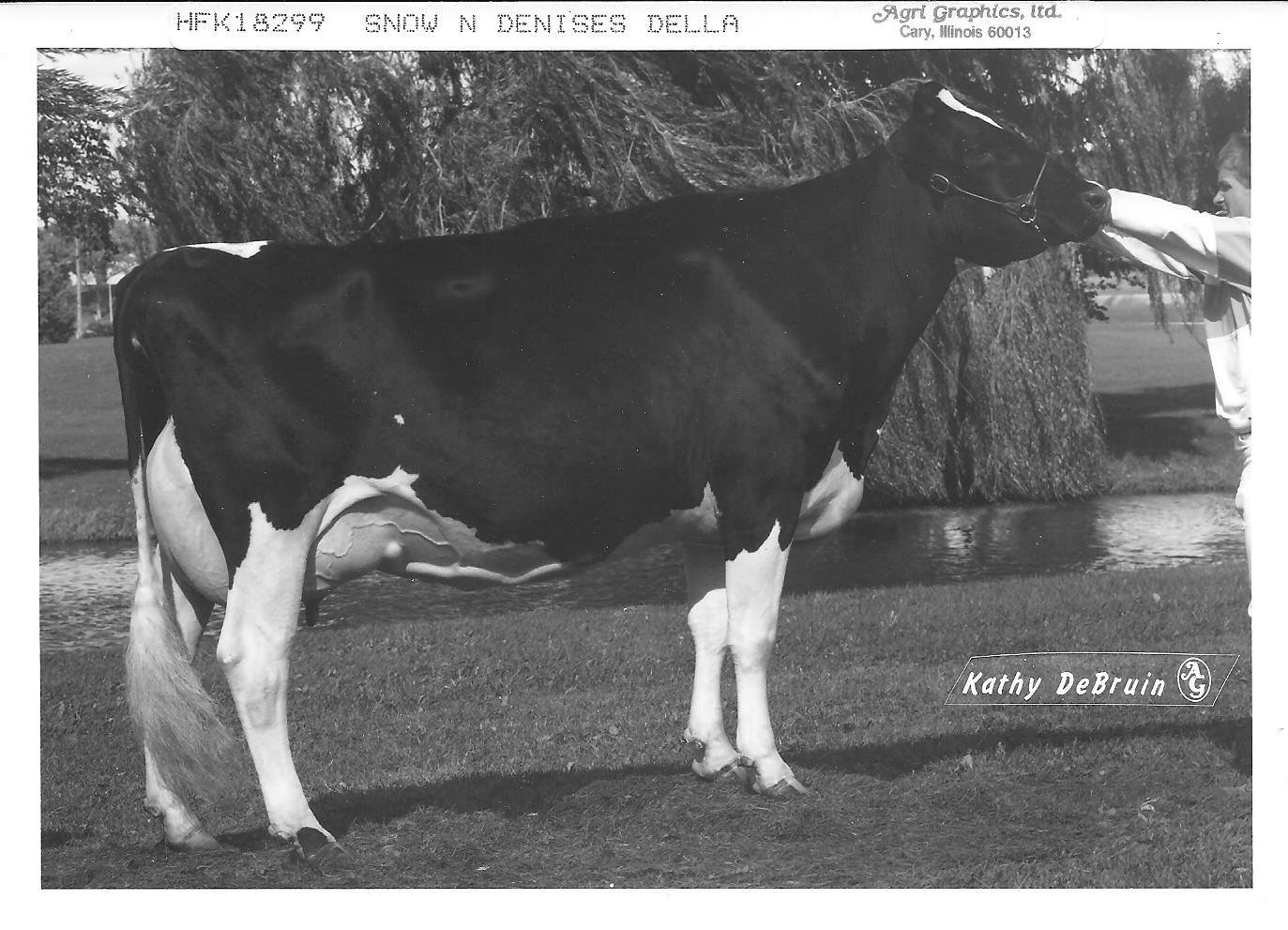
Meet Snow-N Denises Dellia, the legendary Holstein matriarch, sired by Walkway Chief Mark and out of Snow-N Dorys Denise, with maternal grand sire Carlin-M Ivanhoe Bell. This EX-95 cow revolutionized dairy genetics with her exceptional balance of production and type, leaving an indelible mark on the industry. Her legacy continues to shape modern Holsteins worldwide
Snow-N Denises Dellia, the legendary Holstein matriarch, sired by Walkway Chief Mark and out of Snow-N Dorys Denise, with maternal grand sire Carlin-M Ivanhoe Bell. This EX-95 cow revolutionized dairy genetics with her exceptional balance of production and type, leaving an indelible mark on the industry. Her legacy continues to shape modern Holsteins worldwide

The Golden Cross: When Chief Mark Met Bell (and Magic Happened)

A Match Made in Holstein Heaven

Alright, folks, buckle up your overalls because we’re about to dive into some serious bovine romance. Do you know how people talk about power couples? Well, in the dairy world, we’ve got power pairings, and boy, oh boy, did we hit the genetic jackpot with this one.

Meet the Parents: A Tale of Two Traits

On one side of this love story, we’ve got Walkway Chief Mark. Now, Chief Mark wasn’t just any old bull. He was the Michelangelo of udders, a true specialist in the art of mammary magnificence. With a VG-87 score, he was the kind of sire that made other bulls say, “Dang, I wish I could hang udders like that guy.”

But every great rom-com needs two leads. Enter Snow-N Dorys Denise, our leading lady. This gal was packing some serious Bell family genes. We’re talking about the perfect balance of fame and fertility. She was like the Swiss Army knife of cows—versatile, reliable, and scoring an impressive EX-90 2E GMD DOM. (Don’t worry if that sounds like alphabet soup to you. Just know it’s the cow equivalent of a straight-A report card.)

The “Golden Cross”: More Than Just a Fancy Name

When these two genetic powerhouses got together, something magical happened. The dairy world’s matchmakers dubbed it the “golden cross.” And let me tell you, this wasn’t just some marketing gimmick. This pairing was like peanut butter meeting jelly for the first time—a perfect combination that makes you wonder how we ever lived without it.

Breaking the Mold (and a Few Industry Norms)

Here’s where things get interesting. Back then, farmers often had to choose: Did they want great milk producers or cows that looked good enough to grace the cover of “Holstein Monthly”? It was like trying to find a supermodel who could also deadlift 300 pounds—not impossible, but pretty rare.

But Dellia? She said, “Hold my milk pail,” and proceeded to shatter expectations faster than a bull in a china shop. She was the total package, defying the era’s trade-offs between production and type. It’s like she read the “How to Be a Perfect Cow” manual and decided to check every single box.

X Marks the Spot (Chromosomally Speaking)

Now, let’s get a bit sciency for a second. Tim Abbott puts it this way: “Dellia shattered the maternal-paternal dichotomy.” In plain English? She got the best of both worlds.

Her X chromosomes were like a genetic all-you-can-eat buffet. From Chief Mark, she inherited udder quality that would make any dairy farmer weep with joy. And from the Bell side? Metabolic efficiency that could turn feed into milk like nobody’s business.

This combination was rarer than a cow with a pilot’s license. It’s like Dellia’s DNA looked at the usual genetic rules and said, “Nah, I’m good. I’ll do my own thing.”

One of the breed’s famous heads.
Snow-N Denises Dellia, the legendary Holstein whose iconic head has become synonymous with excellence in dairy genetics. As the matriarch of a dynasty that includes sons like Durham and daughters like DH Gold Chip Darling, Dellia’s influence on modern Holsteins is undeniable. Her legacy continues to shape the breed, making her a strong contender for the title of “Queen of the Breed.”

The Two Million-Dollar Question

So, what happens when you combine udder perfection with metabolic mastery? Well, my friends, that’s where our story kicks into high gear. Dellia wasn’t just a cow; she was a revolution with hooves.

Are you ready to see how this golden girl turned the dairy world upside down? Because trust me, we’re just getting to the good part. Grab your milking stools and hold onto your hats—this ride’s about to get wild!

From Show Ring Sensation to Global Domination: Dellia’s Regancrest Revolution

The Wisconsin Spring Show Showdown

Picture this: It’s 1991, and the Wisconsin Spring Show is hotter than a cow pie in July. The air’s thick with anticipation (and probably a fair bit of manure smell, let’s be honest). Enter our girl Dellia, strutting her stuff like she owns the place. And boy, does she!

Judge Niles Wendorf takes one look at her, and BAM! Grand Champion, baby! He’s gushing about her “tall, sharp frame and trouble-free udder” like he’s describing the Mona Lisa of milk cows. I mean, can you blame the guy? Dellia served looks and utility, a combo rarer than a vegetarian at a barbecue.

Frank Regan: The Man, The Myth, The Madman?

Now, here’s where things get spicy. Enter Frank Regan, an Iowa breeder with more guts than a slaughterhouse. While everyone else is still picking their jaws up off the floor, Frank’s already whipping out his checkbook. He buys Dellia for a sum so hefty that it probably makes other cows jealous.

But hold your horses (or cows, in this case). The dairy world wasn’t exactly rolling out the red carpet for Frank. Bless his heart, Bob Snow spills the tea: “They were upset that a ‘nobody’ could come in and clean up.” Ouch! Talk about a cold glass of milk to the face!

Regancrest Farm: Where Legends Are Born (and Bred)

So, did Frank’s gamble pay off? Does a cow moo? Dellia became the cornerstone of Regancrest Farm faster than you can say, “holy Holstein!” We’re talking:

  • 76 registered daughters (More offspring than a rabbit on espresso!)
  • 44 AI-sampled sons (Spreading the Dellia magic far and wide)
  • Embryos jetting off to Europe, Japan, and Brazil (Talk about international appeal!)

It’s like Dellia looked at Regancrest and said, “Challenge accepted!” She wasn’t just producing calves; she was creating a dynasty!

SNOW-N DELLIAS DARLENE (EX-94-GMD-DOM), a powerhouse Blackstar daughter of the legendary Dellia, showcases her genetic excellence with an impressive record of 32,080 lbs of milk in 365 days. As the dam of Regancrest Jed Deborah (EX-95), she cemented her place as a cornerstone of Holstein breeding and a vital link in the Dellia dynasty. A true icon of production and pedigree!

The Sand Incident: Dellia’s Near-Death Experience

Now, brace yourselves for a plot twist that’ll curdle your milk. After her grand entrance at Regancrest, Dellia spits things up by ingesting sand. Yeah, you heard that right. Sand. If you understand, it’s not strictly part of a balanced bovine breakfast.

Most cows would’ve kicked the bucket after a stunt like that. But Dellia? She bounces back like it’s nothing! She starts pumping out embryos like they’re going out of style—15 per flush on average. That’s not just impressive; that’s downright miraculous!

The Global Dellia Effect

Before you could say “Got Milk?”, Dellia’s genetic material was more sought after than tickets to a rock concert. Breeders from Europe to Japan were lining up, cash in hand, ready to get a piece of the Dellia pie (or should I say, the Dellia cheese?).

Her embryos were sold for prices that would irritate the average dairy farmer. We’re talking premium, top-shelf, crème de la crème stuff here. It was like watching the stock market, but people traded in potential udders and milk production instead of shares.

The Three Million Dollar Question

So, what made Dellia so special? Why were breeders falling over themselves to get their hands on her genetics? Well, my friend, that tale involves more twists and turns than a country road. But let me tell you, it’s a story that’ll make you look at your morning glass of milk in a new light.

Ready to dive deeper into the Dellia dynasty? Buckle up, buttercup—this ride’s about to get even wilder!

The Billionaire Boys Club: Dellia’s Sons Take Over the World

From Momma’s Boy to Dairy Royalty

Alright, folks, grab your wallets because we’re about to talk about some seriously expensive baby-makers. Did you think your kid’s college fund was steep? Ha! That’s chump change compared to what Dellia’s boys are worth. Let’s dive into the crème de la crème of bull-dom, shall we?

Durham: The Five-Time Champ

Sheeknoll Durham Arrow EX-96, the Grand Champion of the 2016 World Dairy Expo, embodies the legacy of her legendary sire, Durham. With her flawless conformation and commanding presence, she dazzled on the tanbark and proved why Durham’s influence continues to shape champions worldwide. A true icon of Holstein excellence!

First up, we’ve got Durham. This guy’s like the Michael Jordan of dairy bulls. He’s been named Premier Sire at the World Dairy Expo not once, not twice, but FIVE times! I mean, come on! At this point, they should rename it the Durham Dairy Expo.

But wait, there’s more! Durham didn’t just look pretty in the show ring. He revolutionized fertility traits with a +0.2 DPR. For you city slickers out there, that’s like turning every cow into a baby-making machine. Moo-raculous, right?

Meet Team Durham Morgan, a Holstein icon sired by the legendary Durham. This EX-96 cow is a testament to Durham’s genetic prowess, showcasing exceptional udder quality and conformation. Morgan’s achievements highlight the enduring impact of Dellia’s lineage on modern dairy excellence.

Die-Hard: The Bull That Keeps On Giving

Next up, we’ve got Die Hard. And boy, does this bull live up to his name! This Roebuck son has sired a mind-boggling 1.75 million semen doses. That’s not a typo, folks. 1.75 MILLION! He’s like the Energizer Bunny of the bull world—he keeps going and going and going…

If Die-Hard’s offspring formed their own country, it’d have a seat at the UN. Talk about leaving a legacy!

Million: The Big Cheese

Last but certainly not least, we’ve got Million. This outside son might not have his brothers’ flashy numbers but don’t underestimate him. His descendants are the kings and queens of cheese merit rankings.

Think about that next time you’re enjoying a nice cheddar. Chances are, you’re tasting a bit of Million’s magic. He’s not just a bull; he’s a one-person cheese factory!

The Dellia Effect: Changing the Game

Now, you might be wondering, “What’s the big deal? They’re just bulls, right?” Oh, my sweet summer child. Let me enlighten you with a quote from Scott Culbertson:

“Dellia’s impact through Durham alone transformed how we approach longevity in herds.”

That’s not just a compliment; that’s a revolution in a sentence. We’re talking about changing the entire approach to dairy farming. It’s like Dellia and her boys rewrote the rulebook overnight!

The Genomic Explosion: Dellia’s 21st Century Takeover

But wait, there’s more! (I feel like an infomercial host, but I swear, this stuff is legit.) Dellia’s influence didn’t stop with her sons. Oh no, this cow’s legacy is the gift that keeps giving.

Sapphire: The Robotic Milking Queen

From promising heifers to dairy legends: Sandy-Valley Rubicon Eternity (left) and Silver Coksincream (right) as striking 2-year-olds. These young cows would go on to leave an indelible mark on the Holstein breed, showcasing the power of strategic breeding and genetic excellence.

Let’s talk about Sandy-Valley Planet Sapphire. This gal is Dellia’s great-granddaughter, and boy, did she inherit the family talent. Her offspring include:

  • Rubicon: The first bull to sell 500,000 sexed semen doses. That’s half a million lady calves, people!
  • Saloon: A former #1 TPI sire. That’s like being the valedictorian of bull school.
Greg Bauer of Sandy-Valley believes that Sandy-Valley Eternity EX-92 is the best cow produced by the Dellias thus far. The former #1 CTPI cow is the dam of sires such as Chesney, Sinatra, and Supercharge, and as a Rubicon daughter, she carries Dellia genetics on both sides of her pedigree.

Greg Bauer from Sandy-Valley Holsteins puts it best:

“The Sapphires are efficiency queens—great udders, trouble-free, and built for robotic milking.”

Imagine a cow so perfect that even robots are impressed. That’s Sapphire for you!

Halo: The Global Superstar

Cookiecutter Mog Hanker EX-94 of Siemers Holsteins is not only the dam of 14 EX and 25 VG daughters, but also of 14 sons available from AI studs, including the conformation sires Hanket, Hankock, Hotspot and Haniko.
Cookiecutter Mog Hanker EX-94, a true icon in the dairy world. This exceptional brood cow has left an indelible mark on modern Holstein genetics, with over 18 sons in AI and numerous high-ranking daughters. Her legacy extends far beyond her own achievements, as she continues to inspire new generations of dairy excellence.

And let’s not forget about Cookiecutter MOM Halo. This Goldwyn descendant is like the Beyoncé of the bovine world. She’s produced:

  • Helix: 2018 Outcross Sire of the Year. It’s like winning a Grammy but for bulls.
  • Halogen: A global conformation leader. Think of him as the Brad Pitt of bulls—he looks good from every angle.

The Four Million Dollar Question

So, what does all this mean for the future of dairy farming? Well, my friends, that’s where things get interesting. We’re not just talking about better milk production or prettier cows. We’re talking about a complete revolution in how we approach breeding, efficiency, and even the definition of what makes a “good” cow.

Are you ready to dive into the brave new world of genomic breeding? Because trust me, after Dellia and her descendants, nothing in the dairy world will ever be the same again!

Delia’s Daughters: The Global Glamour Girls of the Dairy World

From Wisconsin to the World Stage

Alright, folks, buckle up your overalls because we’re about to take a whirlwind tour of Dellia’s international superstars. These girls aren’t just your average Bessies chewing cud in the back forty. Oh no, they’re the Beyoncés of the bovine world, strutting their stuff on the global stage and leaving jaws dropped from Switzerland to British Columbia.

DH Gold Chip Darling: The Swiss Miss with Sass

Swiss Miss with Sass: DH Gold Chip Darling EX-96-CH, the Swiss Expo Champion and maternal sister to Europe’s #1 conformation sire. This Dellia descendant proves that beauty and productivity can go hand in hand, setting new standards for dairy excellence from the Alps to the Americas.

First up, let’s talk about DH Gold Chip Darling. This gal isn’t just a pretty face (though with a name like that, you know she’s got looks for days). She’s a bona fide Swiss Expo Champion. She took on the best of the best in the land of chocolate and cheese and came out on top.

But wait, there’s more! Darling isn’t just winning beauty pageants. She’s got some profound family connections. Her maternal brother, Ptit Coeur Doorman Darlingo, is Europe’s #1 confirmation sire. Talk about keeping it in the family! It’s like the Kardashians of the cow world but with more utility and less drama.

You might think, “Sure, she’s pretty, but can she produce?” Well, let me tell you, this girl’s got the goods to back up her glamour. She’s not just a show cow; she’s a blueprint for the future of dairy. Farmers across Europe are lining up to get a piece of her genetic gold.

Behold Jarlette EX-93, a living testament to the enduring legacy of Snow-N Denises Dellia! At 8 lactations strong and over 90,000 kg of lifetime production, she’s not just competing—she’s conquering the show ring as 1st place in the older cow class. With 7 generations of VG or EX dams tracing back to the legendary Dellia, Jarlette proves that great genetics age like fine wine. Now that’s what we call staying power!

Elmbridge Goldwyn Darling: The Canadian Queen

Let’s move to British Columbia, where Elmbridge Goldwyn Darling holds court. This VG-88-scored beauty isn’t just another pretty face in the barn. She’s a baby-making machine with the credentials to prove it.

Meet Hamming Doorman Darilyn EX-90-3yr, a shining star in the Dellia dynasty. As the daughter of Elmbridge Goldwyn Darling VG-88, she carries the legacy of excellence with grace, strength, and a pedigree that’s rewriting dairy history one generation at a time.
Hamming Doorman Darilyn EX-90-3yr, a shining star in the Dellia dynasty. As the daughter of Elmbridge Goldwyn Darling VG-88, she carries the legacy of excellence with grace, strength, and a pedigree that’s rewriting dairy history one generation at a time.

Get this: Darling has produced 28 brood stars. For you city slickers, that’s like having 28 kids who all grew up to be doctors or lawyers. It’s the cow equivalent of being a supermom. But she didn’t stop there. Oh no, this overachiever also gave birth to 9 EX daughters. Those are NINE daughters who scored excellent in confirmation. It’s like Serena Williams had nine daughters who all won Wimbledon.

All this genetic excellence didn’t go unnoticed. In 2014, Darling was crowned “BC Cow of the Year.” The entire province looked at all its cows and said, “Yep, this one’s the best we’ve got.” It’s like winning an Oscar but with more methane.

S-S-I Doc Have Not 8784-ET, a stunning descendant of the legendary Snow-N Denises Dellia. This EX-94, EX-96-MS Holstein has made headlines with her impressive genetic profile and record-breaking sale price of $1.925 million. With a GTPI of +2742 and a pedigree tracing back to Dellia, Doc 8784 embodies the perfect blend of type and genetic potential, cementing her status as a modern dairy icon.

The Global Impact: More Than Just Pretty Faces

You might wonder, “Why should I care about these glamour girls?” Well, let me tell you: These aren’t just pretty faces chewing cud. These cows are shaping the future of dairy farming worldwide.

Think about it. When a cow like DH Gold Chip Darling wins in Switzerland, it’s not just a blue ribbon for her owner. It’s a statement about what excellence looks like in dairy cattle. Farmers from the Alps to the Andes take notice. They ask, “How can I get Darling magic in my herd?”

And Elmbridge Goldwyn Darling? Her impact goes beyond her impressive personal achievements. Those 28 brood stars and 9 EX daughters? They’re out there, passing on their mother’s excellent genes to the next generation. It’s a genetic ripple effect improving herds across Canada and beyond.

S-S-I Doc Have Not 8783-ET, a direct descendant of the legendary Snow-N Denises Dellia. Classified EX-92, this powerhouse combines elite genetics with exceptional type and production. As part of Dellia’s enduring legacy, 8783 continues to shape the future of Holstein breeding, proving that greatness truly runs in the family.

The Five Million Dollar Question

So, what does this mean for the future of dairy farming? Well, my friends, that’s where things get interesting. We’re not just talking about prettier cows or bigger milk checks (though those are nice perks). We’re talking about a global revolution in dairy genetics.

These global ambassadors prove that Dellia’s influence isn’t confined to one farm, state, or country. It’s a worldwide phenomenon changing how we think about breeding, production, and what makes a truly excellent dairy cow.

Are you ready to see how these international superstars are shaping the future of your morning latte? Because trust me, after learning about these girls, you’ll never look at a glass of milk the same way again!

The Bottom Line

Snow-N Denises Dellia wasn’t just a cow; she was a genetic phenomenon that reshaped the dairy industry. Born from the “golden cross” of Walkway Chief Mark and Snow-N-Dorys Denise, Dellia shattered the either/or mentality of dairy breeding. She proved that a single cow could excel in production, conformation, longevity, and fertility—a combination once thought impossible. From her Grand Champion win at the 1991 Wisconsin Spring Show to becoming the cornerstone of Regancrest Farm, Dellia’s impact was immediate and profound.

But Dellia’s true greatness lies in her enduring legacy. Her sons—Durham, Die-Hard, and Million—became industry titans, revolutionizing everything from fertility traits to cheese merit rankings. Her daughters and granddaughters, like DH Gold Chip Darling and Sandy-Valley Planet Sapphire, took her genetics global, winning championships and setting new standards from Switzerland to Canada. Even in the genomic era of the 21st century, Dellia’s influence continues to shape modern dairy breeding, with her descendants excelling in robotic milking efficiency and cheese yield improvements.

Nearly four decades after her birth, Dellia’s genetic fingerprint remains indelible in dairy herds worldwide. She didn’t just raise the bar; she launched it into the stratosphere, challenging us to think bigger, breed smarter, and never settle for “good enough” in our pursuit of the perfect dairy cow. In a world where change is constant, and progress is measured in increments, Dellia represents a quantum leap—a paradigm shift on four legs that forever altered the course of dairy genetics. That’s why Snow-N Denise’s Dellia will always be remembered as one of the most excellent cows in dairy history, a testament to an exceptional animal’s extraordinary impact on an entire industry.

Key Takeaways

  • Born in 1986, Snow-N Denises Dellia revolutionized Holstein breeding
  • Result of the “golden cross” between Walkway Chief Mark and Snow-N Dorys Denise
  • Excelled in both production and type, breaking industry norms
  • Won Grand Champion at the 1991 Wisconsin Spring Show
  • Became the cornerstone of Regancrest Farm
  • Produced influential sons: Durham, Die-Hard, and Million
  • Her daughters and granddaughters won championships globally
  • Genetic influence spans from fertility traits to cheese merit rankings
  • Descendants excel in robotic milking efficiency, and cheese yield improvements
  • Impact still felt in dairy herds worldwide nearly four decades later
  • Considered one of the most influential cows in dairy history

Summary

Snow-N Denises Dellia, born in 1986 on Bob Snow’s Wisconsin farm, became a legend in Holstein breeding. The result of a “golden cross” between Walkway Chief Mark and Snow-N-Dorys Denise, Dellia shattered industry norms by excelling in production and type. Her impact was immediate, winning Grand Champion at the 1991 Wisconsin Spring Show before becoming the cornerstone of Regancrest Farm. Dellia’s sons, Durham, Die-Hard, and Million, revolutionized the industry with their fertility traits and cheese merit rankings. Her daughters and granddaughters, like DH Gold Chip Darling and Sandy-Valley Planet Sapphire, took her genetics global, winning championships from Switzerland to Canada. Even in today’s genomic era, Dellia’s influence persists, with her descendants excelling in robotic milking efficiency and cheese yield improvements. Nearly four decades after her birth, Dellia’s genetic legacy continues to shape dairy herds worldwide, cementing her status as one of the most influential cows in dairy history.

Learn more:

Join the Revolution!

Bullvine Daily is your essential e-zine for staying ahead in the dairy industry. With over 30,000 subscribers, we bring you the week’s top news, helping you manage tasks efficiently. Stay informed about milk production, tech adoption, and more, so you can concentrate on your dairy operations.

NewsSubscribe
First
Last
Consent

Rumen-Protected Amino Acids: The Secret to Healthier Cows, Higher Profits, and a Sustainable Future

Unlock the secret to healthier cows, higher profits, and a greener farm with rumen-protected amino acids (RPAAs). This game-changing nutrition strategy is revolutionizing dairy farming, boosting milk components, and slashing environmental impacts. Discover how these tiny nutrients could add six figures to your bottom line. Are you ready to join the RPAA revolution?

Picture this: You’re standing in your milking parlor, watching as your herd files in for the afternoon milking. The cows look healthy, sure, but what if I told you that hidden within their feed, a secret ingredient could boost your milk check by six figures?

No, it’s not some futuristic hormone or a genetically modified super grain. It’s a nutrient so small you can’t even see it, yet so powerful it’s changing the face of dairy farming across the globe.

Welcome to the world of rumen-protected amino acids (RPAAs) – the unsung heroes of modern dairy nutrition. These microscopic marvels are turning feed into fortune, slashing environmental impacts, and keeping cows healthier. And if you’re not using them yet, you might be leaving money on the table with every gallon of milk that leaves your farm.

“It’s like discovering oil in your backyard,” says Vermont dairyman Mark Richardson, whose profits soared after adopting RPAA technology. “Except instead of drilling, we’re just tweaking what goes in the feed mixer.”

From boosting butterfat to cutting carbon footprints, RPAAs are the Swiss Army knife of dairy supplements. But how do they work? What’s the catch? And most importantly—how can you harness their power on your farm?

Buckle up because we’ll dive into the science, strategy, and success stories behind dairy’s best-kept secret. Whether milking 50 cows or 5,000, this is one nutritional revolution you can’t afford to miss.

The Science Behind Rumen-Protected Amino Acids: Not Your Grandpa’s Protein Supplement

Why Cows Need a Protein Boost (And Why You Should Care)

Alright, picture this: You’ve got a herd of dairy cows, each a milk-making machine. Pretty impressive, right? But here’s the kicker—even these bovine superstars have their limits. It’s like having a sports car with a lawnmower engine. Sure, it looks great, but it’s not reaching its full potential.

You might be thinking, “Hold up, don’t cows already get protein from all that grass and feed?” Well, yes and no. Here’s the deal:

The Rumen Rumble

Your cow’s rumen is like a 24/7 fermentation party. Microbes break down feed, creating what we call microbial protein. This is a good start, but it’s like trying to fuel a rocket with regular gasoline for high-producing cows. They need premium stuff, and that’s where amino acids come in.

“But wait,” you might ask, “Aren’t all proteins created equal?”

Not quite, my friend. Let me introduce you to the VIPs of the amino acid world: methionine and lysine. These two are like the secret sauce in your grandma’s famous recipe—without them, everything falls flat.

The Dynamic Duo: Methionine and Lysine

Think of methionine and lysine as the power couple of dairy nutrition. They’re not just important; they’re downright essential. Here’s why:

  • Milk Protein Synthesis: Want more protein in your milk? These amino acids are your ticket.
  • Immune Function: Healthy cows mean less playing vet and more time cashing milk checks.
  • Metabolic Health: Keep your cows running like well-oiled machines.

Dr. Jeffery Hall from Utah State University perfectly describes it: “It’s like running a factory at 70% capacity. RPAAs bypass the rumen’s inefficiencies, delivering precise nutrients where they’re needed most.”

Now, I know what you’re thinking. “If these amino acids are so great, why haven’t I heard about them?” Well, buckle up because we’re about to dive into the world of rumen-protected amino acids (RPAAs), and trust me, it’s a game-changer.

But before we get there, let’s address the elephant in the room—or should I say, the cow in the barn. How do we get these super-nutrients into our cows without the rumen microbes gobbling them up first? That, my friends, is where the magic of RPAAs comes in. And let me tell you, it’s some pretty cool science.

Stay tuned because, in the next section, we will break down how these tiny powerhouses work their magic. And who knows? By this end, you might be looking at your feed mixer in a new light. PMC (2023). Supplementation of Rumen-Protected Lysine and Methionine in Grazing Dairy Cows. National Center for Biotechnology Information. Hall, J.O. et al. (2021). Investigation of Methionine and Lysine Derivatives as Rumen-Protected Amino Acids. Utah State University.

The RPAA Magic Trick: How These Tiny Powerhouses Dodge the Rumen

Alright, folks, gather ’round. We’re about to dive into the most incredible magic trick in dairy nutrition. Remember those VIP amino acids we talked about? Well, they’ve got a secret weapon: a high-tech disguise that lets them sneak past the Romans undetected. Pretty slick, huh?

The Rumen: Where Good Nutrients Go to Die (Usually)

First things first—let’s talk about the rumen. It’s like a 24/7 all-you-can-eat buffet for microbes. It is excellent for breaking down rigid plant material but not for delicate amino acids. Usually, our star players (methionine and lysine) would get gobbled up before they could shine.

But what if we could give them a bulletproof vest? Enter: rumen-protected amino acids (RPAAs).

The Stealth Mission: pH-Sensitive Coatings

Here’s where it gets cool. Scientists have developed special coatings (like ethyl cellulose) that act like an invisibility cloak for our amino acids. These coatings are pH-sensitive, which means they’re tough as nails in the acidic rumen but dissolve like sugar in water once they hit the small intestine.

Think of it like those spy movies where the secret message only appears in the right light. Our amino acids cruise through the rumen undetected, then—BAM!—they reveal themselves right where we need them.

The Big Reveal: Targeted Delivery

So what happens when these undercover agents complete their mission? Magic, that’s what:

  1. Milk Component Boost:
    1. Milk protein jumps by 0.1–0.3%
    1. Fat content increases by 0.2–0.4%
  2. (That might not sound like much, but trust me, your milk check will notice.)
  3. Nitrogen Ninja Skills:
    1. Urea excretion drops by 20–25%
    1. Ammonia emissions take a nosedive
  4. (Your cows and your neighbors’ noses will thank you.)

But Wait, There’s More!

Now, I know what you’re thinking. “This sounds too good to be true. What’s the catch?” Well, here’s the kicker—there isn’t one. These benefits are backed by solid research. We’re not talking about some snake oil supplement; this is cutting-edge nutritional science.

Of course, like any good tool, RPAAs need to be used correctly. You can’t just dump them in the feed and expect miracles. But when used as part of a well-balanced ration? That’s when the magic happens.

The Million-Dollar Question

So, are you ready to give your cows the VIP treatment they deserve? With RPAAs, you’re not just feeding cows—you’re fueling efficiency, boosting production, and giving the environment a break.

In our next section, we’ll explain exactly how these benefits translate to cold, hard cash. Because that’s what we’re all here for, right? Well, that and happy, healthy cows. But more on that later. Stay tuned, folks—the best is yet to come!

Show Me the Money: The Economic Impact of RPAAs

Alright, folks. It’s time to talk turkey. Or talk milk money? We’ve covered the science; now, let’s dive into what matters—the bottom line. Grab your calculators because these numbers will make your accountant dance happily.

Profitability Per Cow: The Gift That Keeps on Giving

Let’s start with the headline: A 2024 meta-analysis (that’s fancy talk for “we looked at a bunch of studies”) found that for every dollar you invest in rumen-protected methionine (RPM), you get $2.50 to $3.00 back. Not too shabby, right?

But wait, there’s more! Let’s break it down cow by cow:

What We’re MeasuringHow Much It ImprovesExtra Cash in Your Pocket
Milk protein (+0.2%)12 lbs$45
Milk fat (+0.3%)18 lbs$72
Feed efficiency5-7%$85

Now, I know what you’re thinking. “Those numbers look small.” But here’s the kicker—this is per cow per year. And it assumes you’re only producing 22,000 lbs of milk annually at $18/cwt. Are your cows cranking, or are milk prices higher? Cha-ching!

The Herd Effect: When Small Changes Add Up

Let’s put this in perspective. Say you’ve got a 500-cow herd. Pretty average, right? Hold onto your hat because of those little improvements we just discussed. They add up to $150,000 to $200,000 in extra profit annually.

“But wait,” I hear you say, “what about the cost of these fancy amino acids?” Fair question! Even after you factor in RPAA costs (which run about $6-12 per cow per month), you’re still looking at six figures of pure profit. Not too shabby for sprinkling some extra amino acids in the feed, huh?

The Hidden Jackpot: Savings You Didn’t Even Know You Needed

Now, here’s where it gets exciting. Those profit numbers? They’re just the tip of the iceberg. Check out these hidden savings:

  1. Manure Management: RPAAs cut nitrogen runoff by 25%. That means you’re saving $15-20 per acre on fertilizer. Got 1,000 acres? That’s up to $20,000 back in your pocket.
  2. Herd Health: Here’s a fun fact – RPM-fed herds see 30% fewer cases of mastitis and 15% fewer uterine infections. Think about all those vet bills and dumped milk you’re avoiding. It adds up fast!

Economic Impact: Crunching the Numbers

Before we dive into the specifics of RPAA benefits, let’s look at average milk production across different dairy breeds:

BreedMilk (Kg)Fat %Protein %
Holstein11,2534.083.32
Ayrshire8,2654.163.42
Jersey7,3305.163.90
Brown Swiss8,7644.243.57
Milking Shorthorn7,1373.973.32
Guernsey7,1974.693.51
Canadienne5,9924.263.59

Now, let’s consider how RPAAs can boost these numbers…

This table provides a baseline for readers to understand typical production levels and how RPAA supplementation could potentially improve them.

The Two Million Dollar Question

So, would you be interested if I told you there was a way to boost your profits by six figures, cut your environmental impact, and keep your cows healthier, all with a straightforward change to your feed program?

Of course, you would! And that’s precisely what RPAAs offer. It’s not magic; it’s not a gimmick—it’s solid nutritional science translating directly into cold, hard cash.

Now, I know what some of you old-timers might be thinking. “If it sounds too good to be true, it probably is.” And usually, I’d agree with you. But here’s the thing—we’ve got the data to back this up: real farms, real cows, accurate results.

So, what do you say? Are you ready to upgrade your feed program (and your bank account)? Because let me tell you, in today’s dairy market, every edge counts. And RPAAs? They’re not just an edge—they’re the whole darn sword.

Stay tuned. Next, we’ll discuss how to implement this on your farm. Trust me, you won’t want to miss it!

Farmer-Centric Strategies for Success: Your Roadmap to RPAA Riches

Alright, folks, we’ve talked the talk. Now it’s time to walk the walk. Let’s dive into how to implement RPAAs on your farm without breaking a sweat (or the bank).

Step 1: Balance Diets Like a Pro Chef

First things first—forget one-size-fits-all. Your cows are unique, and so is your region. Let’s break it down:

The Corn Belt Special

If you’re swimming in corn silage, listen up. Your cows probably live large on energy but cry out for lysine. It’s like having a car with a full tank but no steering wheel. The fix? Add about 20 g of rumen-protected lysine (RPL) to your high-corn diets—boom—balanced nutrition.

The Northeast Grass-Fed Groove

Running a grass-based operation in the Northeast? Your cows might be methionine-deficient. It’s like having a smartphone with no charger. Frustrating, right? Toss 25-30 g of rumen-protected methionine (RPM) to offset that low-methionine alfalfa. Problem solved.

But wait, how do you know exactly what to add? Enter the Cornell Net Carbohydrate and Protein System (CNCPS). It’s like GPS for cow nutrition. This nifty tool models amino acid flows and helps you optimize supplementation. Trust me, it’s worth learning about.

Step 2: Monitor & Adjust (Because Even Cows Need Feedback)

You wouldn’t drive a car without looking at the speedometer. The same goes for RPAAs. Here’s what to watch:

Milk Urea Nitrogen (MUN)

Target 8-12 mg/dL. If you’re below 10, your cows are waving red flags for amino acid deficits. They say, “Hey, we need more good stuff!”

Component Tracking

A fun fact: a measly 0.1% protein boost adds $0.15 per hundredweight. That’s enough to cover your RPAA costs if you hit 75 lbs/day production. Ka-ching!

Don’t believe me? Just ask Mark Richardson, a Vermont dairy farmer who took the plunge:

“We started small—just supplementing fresh cows,” he says. “Within six months, our herd average hit 4.1% fat and 3.3% protein. Now, 90% of our cows get RPAAs through TMR.”

Now, that’s what I call results!

Step 3: Mitigate Risks (Because Too Much of a Good Thing… Isn’t)

I know, I know. After hearing all these benefits, you’re probably itching to dump a truckload of RPAAs into your feed mixer. But hold your horses! Like anything in life, moderation is key.

The Goldilocks Zone

Work with your nutritionist to achieve the perfect methionine: lysine ratio. We aim for 3:1—not too high or low, but just right.

Baby Steps

Rome wasn’t built in a day, nor is the perfect RPAA program. Start with about 20 g/day during peak lactation. Then, adjust based on what your milk components tell you. It’s like fine-tuning an engine—a little tweak here, a slight adjustment there.

The Million Dollar Question (Okay, Maybe Just a Thousand Dollar Question)

So, are you ready to take your herd’s nutrition to the next level? Remember, RPAAs aren’t just another feed additive—they’re a precision tool for unlocking your cows’ full potential.

And hey, if you’re feeling overwhelmed, don’t sweat it. That’s what nutritionists are for. They’re like the pit crew for your dairy operation—there to help you squeeze every last performance drop out of your herd.

Next, we’ll tackle some common questions and bust a few myths about RPAs. Because let’s face it—knowledge isn’t just power in the dairy world. It’s profit.

Stay tuned, folks. The RPAA revolution is just getting started!

Green Pastures, Green Profits: The Environmental & Regulatory Wins of RPAAs

Alright, folks, let’s talk about the elephant in the room—or should I say, the cow in the pasture? Dairy farming has been getting a bit of a bad rap regarding environmental impact. But what if I told you that those little amino acids we’ve been chatting about could help turn your farm into an eco-warrior’s dream? Buckle up because we’re about to dive into the green side of RPAAs!

Slashing Carbon Hoofprints: It’s Not Just Hot Air

You’ve probably heard all the buzz about carbon footprints. Get ready for this bombshell: RPAA adoption could cut the dairy sector’s greenhouse gas emissions by a whopping 5-7%. That’s not just a drop in the milk bucket—it’s a game-changer!

But what does that mean for you, the farmer on the ground? Let’s break it down:

Carbon Credits: Ka-ching!

If you’re participating in carbon credit programs (and if you’re not, why the heck not?), you could be looking at some serious green—and I’m not just talking about your pastures. We’re talking:

  • $15-$30 per ton of CO₂ equivalent in voluntary markets

That’s right. You could be paid for being environmentally friendly. It’s like Mother Nature is sending you a thank-you check!

Fertilizer Offsets: The Gift That Keeps on Giving

Here’s a fun little equation for you:

1 lb reduced nitrogen = 0.005 metric tons CO₂e

Now, I know what you’re thinking. “That doesn’t sound like much.” But let’s put it in perspective. If you’re reducing nitrogen output by 1000 lbs (which isn’t unreasonable with RPAAs), that’s five metric tons of CO2 equivalent. At $20/ton, you’re looking at an extra $100 in your pocket for using less fertilizer!

The Regulatory Tango: Staying Ahead of the Curve

Now, let’s face it—environmental regulations aren’t getting any looser. But here’s the kicker: by adopting RPAAs now, you’re not just complying with current rules—you’re future-proofing your farm.

Think about it. While other farmers are scrambling to meet new nitrogen limits or carbon reduction goals, you’ll sit pretty, sipping your coffee (or maybe a nice cold glass of milk), knowing you’re already ahead of the game.

The Million Dollar Question (Or Should We Say, The Million Tree Question?)

So, here’s the deal. RPAAs aren’t just about boosting your milk check (although that’s a pretty sweet perk). They’re about positioning your farm as a leader in sustainable dairy production. And in today’s market? That’s worth its weight in gold… or should I say, green?

But I can hear some of you skeptics out there. “Sure, it sounds good on paper, but does it make a difference?” Well, let me tell you a quick story. I was chatting with a farmer in Wisconsin last month—let’s call him Joe. Joe implemented RPAAs two years ago, mainly for production benefits. But last year, when his county started a carbon reduction initiative, guess who was first in line for the incentives? That’s right—our buddy Joe. He didn’t just meet the targets—he blew them out of the water.

Wrapping It Up

Here’s the deal, folks. RPAAs aren’t just a nutritional supplement—they’re your secret weapon in the battle for sustainable, profitable dairy farming. They’re helping you:

  1. Cut greenhouse gas emissions
  2. Tap into carbon credit markets
  3. Reduce fertilizer use (and costs)
  4. Stay ahead of environmental regulations

And the best part? You’re doing all this while boosting your production and your profits. It’s a win-win-win situation. Or a win-win-win-win?

So, what do you say? Are you ready to turn your farm into a lean, green, milk-producing machine? Because let me tell you, the future of dairy is green—and with RPAAs, you can be leading the charge.

Stay tuned. Next, we’ll tackle some of the most common questions and myths about RPAs. Trust me, you won’t want to miss it!

Navigating the Future: Policy Shifts, Innovations, and Smart Investments in RPAAs

Alright, dairy dynamos, let’s discuss the road ahead. We’ve covered the basics of RPAAs, but agriculture isn’t standing still. So, grab your crystal balls (or maybe just a fresh cup of coffee), and let’s dive into what’s next.

Policy Shifts: When Uncle Sam Gets Interested in Your Manure

Do you know how they say death and taxes are the only certainties in life? In the dairy world, we might need to add “manure regulations” to that list. Take California, for instance. They’re not just suggesting you watch your nitrogen output—they’re slapping a $1,300 per ton tax on excess manure nitrogen. Ouch!

But here’s where our RPAA friends come to the rescue. RPAA-fed herds cut nitrogen excretion by a whopping 25%. That’s not just good for the environment—it’s like having a “Get Out of Tax Jail Free” card.

“But wait,” I hear you say, “I don’t live in California!”

True, but remember: California often sets the trend for environmental regulations. It’s like the cool kid in school—where they go, others follow. So, implementing RPAAs now is not just smart farming—it’s future-proofing your operation.

The Road Ahead: Innovations That’ll Make Your Head Spin

Now, let’s talk about what’s cooking in the world of RPAA tech. Trust me, this stuff is more remarkable than a cow in an air-conditioned barn.

Next-Gen Delivery Systems

Remember those pH-sensitive coatings we talked about earlier? Well, they’re getting an upgrade. Boehringer Ingelheim (the big pharma guy) ran a trial in 2024 with a new microencapsulation technique. The results? 92% intestinal release compared to 78% for traditional coatings. That’s like upgrading from a flip phone to a smartphone!

But wait, there’s more!

Gene-Edited Alfalfa: The Future is Green (and High in Methionine)

Imagine alfalfa that’s naturally high in methionine. No, this isn’t science fiction—it’s hitting field trials in 2026. We’re talking about 18% crude protein varieties compared to the usual 14%. That’s like your alfalfa field suddenly becoming a methionine factory!

Show Me the Money: Financing Your RPAA Revolution

Now, I know what some of you are thinking. “This all sounds great, but who will pay for it?” Well, buckle up because there’s good news on that front, too.

NRCS EQIP Grants: Uncle Sam Wants You… to Use RPAAs

If you’re running a farm with under 500 cows, the Natural Resources Conservation Service (NRCS) might be your new best friend. Their Environmental Quality Incentives Program (EQIP) can cover up to 75% of your RPAA costs. That’s like getting a 75% off coupon for farm efficiency!

Carbon Markets: Getting Paid to Be Green

Remember those carbon credits we mentioned? In California, the Dairy Cares program is putting their money where their mouth is. They’re paying $0.05 per hundredweight for verified nitrogen reductions. It might not sound like much but for a 1,000-cow dairy producing 70 lbs per cow daily? That’s an extra $12,775 a year. It’s not too shabby for just tweaking your feed program!

The Three Million Dollar Question

So, here’s the deal. The future of dairy farming is changing faster than a cow can swish its tail. RPAAs aren’t just a trend – they’re becoming a necessity. The question isn’t “Can I afford to implement RPAAs?” It’s “Can I afford not to?”

Think about it. With stricter regulations, innovative tech in the pipeline, and financial incentives up for grabs, RPAAs are your ticket to staying ahead of the curve. They’re not just feeding your cows—they’re feeding your farm’s future.

So, what’s your next move? Are you ready to ride the RPAA wave into a more profitable, sustainable future, or will you wait for regulations?

Remember, in dairy farming, the early bird doesn’t just get the worm—it receives the premium milk check, the environmental kudos, and the peace of mind knowing they’re ready for whatever comes next.

Stay tuned, folks. The RPAA revolution is just starting, and trust me—you haven’t seen anything yet!

The Bottom Line

Let’s cut to the chase: Rumen-protected amino acids aren’t just another farm fad but a game-changer. We’ve seen how RPAAs boost milk components, improve cow health, and fatten your bottom line with returns of $2.50-$3.00 for every dollar invested. But it doesn’t stop there. These tiny nutritional powerhouses are also your secret weapon against tightening environmental regulations, slashing nitrogen waste, and potentially cutting your carbon footprint by 5-7%.

The evidence is clear: RPAAs offer a rare opportunity to increase profitability, enhance sustainability, and stay ahead of regulatory curves. From the science behind their rumen-bypassing magic to the innovative delivery systems on the horizon, RPAAs are reshaping the future of dairy nutrition. And with financing tools like NRCS EQIP grants and carbon market incentives, there’s never been a better time to jump on board.

So, here’s your call to action: Talk to your nutritionist this week about implementing RPAs. Start with a trial group, monitor those components, and watch the magic happen. Remember, in the fast-evolving dairy world, standing still is moving backward. RPAAs are your opportunity to leap ahead. The future of dairy is here—and it’s amino acid-shaped. Are you ready to ride this wave to success?

Key Takeaways

  • Rumen-protected amino acids (RPAAs) are a cutting-edge nutritional strategy for dairy cows.
  • RPAAs, particularly methionine and lysine, bypass rumen degradation for targeted delivery.
  • Benefits include increased milk components, improved cow health, and reduced environmental impact.
  • Milk protein can increase by 0.1-0.3% and fat by 0.2-0.4% with RPAA supplementation.
  • Economic returns range from $2.50 to $3.00 for every $1 invested in RPAAs.
  • Nitrogen waste can be reduced by 20-25%, potentially cutting greenhouse gas emissions by 5-7%.
  • Implementation strategies vary by region and feed type (e.g., corn silage vs. grass-based diets).
  • Monitoring tools include Milk Urea Nitrogen (MUN) levels and regular component testing.
  • Future innovations include improved delivery systems and gene-edited high-methionine alfalfa.
  • Financial incentives are available through programs like NRCS EQIP grants and carbon markets.
  • RPAAs offer a way to increase profitability while meeting tightening environmental regulations.

Summary

Rumen-protected amino acids (RPAAs) are emerging as a game-changing nutritional strategy in dairy farming, offering a trifecta of benefits: improved cow health, increased profitability, and enhanced environmental sustainability. These specially coated nutrients bypass the rumen, delivering essential amino acids like methionine and lysine directly to the small intestine, where they can be efficiently absorbed and utilized. Research indicates that RPAA supplementation can boost milk protein by 0.1-0.3% and fat by 0.2-0.4%, translating to significant economic gains—up to $2.50-$3.00 return for every dollar invested. Beyond production benefits, RPAAs reduce nitrogen waste by 20-25%, potentially cutting the dairy sector’s greenhouse gas emissions by 5-7%. With innovative delivery systems on the horizon and financial incentives available through programs like NRCS EQIP grants, RPAAs represent a forward-thinking approach for dairy farmers looking to optimize their operations in an increasingly competitive and environmentally conscious market.

Learn more:

Join the Revolution!

Bullvine Daily is your essential e-zine for staying ahead in the dairy industry. With over 30,000 subscribers, we bring you the week’s top news, helping you manage tasks efficiently. Stay informed about milk production, tech adoption, and more, so you can concentrate on your dairy operations.

NewsSubscribe
First
Last
Consent

HPAI H5N1: The 2025 Science-Based Dairy Farm Survival Guide (Because Hope Isn’t a Biosecurity Plan)

HPAI H5N1 isn’t knocking—it’s kicked down your barn door. With $1.2B in losses and 973 herds hit, this virus rewrites dairy’s rules. But here’s your playbook: vaccines with 89% bite, $25 biohacks that work, and Uncle Sam’s cash grabs. Armor up or get slaughtered—your move.

The stench of burning Tyvek suits mixes with the metallic tang of fear in milking parlors across America. A silent war rages—not against falling milk prices or rising feed costs, but against an enemy 120 nanometers wide already costing producers $1.2 billion. HPAI H5N1 isn’t coming for your herd. It’s already here.

Since March 2024, this shape-shifting virus has rewritten the rules of dairy farming, jumping from wild birds to 973 herds like a thief scaling barbed wire. Your parlor’s now a battleground. Your bulk tank is a potential bioweapon. And that starling perched on your silo? It might as well be carrying a lit match.

But the panic peddlers won’t tell you: We’re winning.

Two hundred ninety-eight dairies have escaped quarantine, and vaccines with an 89% efficacy rate are being developed. Producers who acted quickly cut losses by $162/cow/day using $25 boot baths and laser systems that turn feed alleys into no-fly zones.

This isn’t another doomscroll article. This is your playbook for turning biological chaos into calculable risk. We’ve dissected 14 months of outbreak data, grilled USDA epidemiologists, and stolen strategies from the 7% of farms that haven’t lost a single cow.

The clock’s ticking. The D1.1 variant survives 22 days in your manure lagoon.
Your workers’ PPE compliance sits at 40%.
And that “harmless” raw milk side hustle? It’s Russian roulette with a 1.2% recall rate.

But here’s the kicker: By the end of this article, you’ll know precisely how to armor your operation against this $198/day nightmare. Let’s dig in.

The Virus’ Road Trip Itinerary (And How to Cancel Its Plans)

Let’s cut through the jargon, shall we? Picture HPAI H5N1 as that obnoxious, uninvited relative eats your food and trashes the place. Imagine they brought 76 of their closest wild bird friends to your dairy. That’syour transmission dynamic.

How’s This Jerk Getting In?

Primary Party Crashers: Migratory waterfowl. Geese, ducks, and those fancy shorebirds wintering in your ponds. They’re dropping viral confetti like it’s Mardi Gras. 76% of outbreaks start here. Ever wonder why your hospital pen’s suddenly a hotspot? Thank Mrs. Mallard and her crew.

Secondary Spread: Now, here’s the kicker. Once it’s in, the virus treats your milking equipment like a VIP shuttle. 58% of later cases hitch rides on liners, claws, towels – you name it. It’s the worst chain reaction: one infected cow becomes ten faster than you can say “post-dip.”

The Lingering Guest: Oh, and about that manure slurry pit? It turns out D1.1 treats it like a five-star Airbnb. Twenty-two days, it’ll camp out there, waiting for the next hapless worker to track it into the parlor. Have you ever left lasagna in the fridge for too long? It has the same energy but is way more expensive.

When the Milk Hits the Fan: What Happens

Let’s talk milk loss. Imagine turning on your bulk tank and watching 10-30% … vanish. For 7-10 days. That’s like pouring out every third milk check. You wouldn’t tolerate that from a broken meter—why let a virus get away with it?

(Quick aside: Why 10-30%? It depends on when you catch it. Early detection = more minor hits. More on that later.)

Mortality Math

Here’s the silver lining—cattle aren’t poultry. While chickens drop like… well, birds in a thunderstorm (90-100% mortality), your girls are more challenging. 0.3% mortality sounds better until you do the math: 3 dead cows per 1,000. Still three too many, right?

The Comeback Kids

The good news is that 87% of infected cows return to baseline production within a month. They’re like college athletes after spring break—sluggish at first, then back to crushing it. But here’s the kicker: recovery depends on how you manage them during infection. Skimp on electrolytes? That number plummets.

Wait, Why Do Cattle Fare Better Than Chickens?
I’m glad you asked! Cattle’s respiratory receptors aren’t the virus’ favorite hangout. It’s like trying to party in a library—possible, but not precisely lit. Poultry? Their cells roll out the red carpet.

Your Action Cheat Sheet

SituationImmediate Response
Spot wild birds near feed alleysDeploy laser deterrents STAT (58% effectiveness)
Hospital pen cow shows symptomsIsolate + test bulk tank milk (don’t wait—it spreads faster than gossip at church supper)
Manure slurry post-outbreakLet it bake 22+ days or treat with lime (pH >12 kills the party)

“But My Neighbor’s Herd Recovered Faster!”
Ah, the dairy equivalent of “my kid made the honor roll.” Three factors:

  1. Detection speed (daily temp checks catch it 5 days earlier)
  2. Hydration protocols (IV fluids cut recovery time by 40%)
  3. Strict milking order (sick cows last! This isn’t communism—healthy girls get priority)

This isn’t about eliminating risk but stacking odds in your favor. You can’t stop birds from flying, but you canmake your parlor the least inviting stop on their viral road trip. Keep boots clean, milkers smarter than the virus, and remember that 87% recovery isn’t guaranteed. It’s a challenge.

What’ll it be—let HPAI write your herd’s story, or grab the pen yourself?

Show Me the Money (And Where HPAI’s Stealing It)

Let’s talk cash because let’s face it—this virus isn’t just crashing your herd’s health; it’s mugging your wallet in broad daylight. Do you know that pit in your stomach when milk prices dip? Multiply that by “bird flu quarantine.” But here’s the kicker: We’ve got the receipts.

Your Daily Dose of Financial Pain

Picture this: You wake up to quarantine. Your parlor’s silent. Your bulk tank’s emptier than a feed bunk at midnight. Here’s what that silence costs:

ExpenseSmall Herd (<500 cows)Large Herd (>1,000 cows)
Daily Losses$100–$200$1,500–$3,000
Biosecurity Upgrades$3,000–$6,000$15,000–$30,000

(Sources: USDA’s crystal ball [Feb 2025], Hoard’s Dairyman’s tear-stained ledger [April 2024])

Wait, why is there a gap between small and large herds? It’s not just scale—it’s the speed of implementation. Significant operations can bulk-order HEPA filters like Costco toilet paper. You? You’re stuck negotiating with suppliers who think “small herd” means “small budget.”

Uncle Sam’s Coin Purse (Spoiler: It’s Stingy)

Now, before you panic-sell your third tractor, let’s talk government bandaids:

ELAP Reimbursement

  • Covers: 60% of losses for 21 days
  • Catch: It takes 90–120 days to process (because USDA runs on dial-up)
  • Pro Tip: Document every drop. Think CSI: Dairy Farm.

HERDS Act Grants

  • Covers: 50% of HEPA filters (up to $15K)
  • Catch: You’ll need a PhD in paperwork to apply
  • Silver Lining: That $6,000 filter? Now $3,000. It still hurts, but less.

(Wait, did I say 50%? Yep—and no, they won’t cover your overtime latte budget.)

“But How Bad Could It Be?”

I’m glad you asked. Let’s math this out:

  • Small herd nightmare: $200/day x 21 days = $4,200 (ELAP gives you $2,520…eventually)
  • Large herd disaster: $3,000/day x 21 days = $63,000 (ELAP coughs up $37,800…next fiscal year)

Does it still sound like “just the flu”? That’s a down payment on a new skid steer—gone.

The Hidden Tax Nobody Told You About

Biosecurity isn’t optional anymore. It’s the new line between “feed” and “vet bills.” For $3,000–$6,000, you could:

  • Buy 120 tons of corn
  • Replace that busted plate cooler
  • Or install boot baths and poultry netting to maybe avoid quarantine

Tough choice? You bet. But here’s the thing—bird flu doesn’t negotiate.

“What If I Skip the Upgrades?”
Don’t. Just…don’t. That $6,000 biosecurity tab? Cheaper than $63,000 in losses. It’s like skipping oil changes to save money—until your engine blows.

HPAI’s not just a health crisis—it’s a financial chokehold. But here’s your escape plan:

  1. Bleed now: Invest in prevention (yes, even that overpriced laser bird zapper)
  2. Beg later: File ELAP the minute you suspect infection
  3. Pray always: That 90–120-day window? Perfect for rosary beads.

You didn’t get into dairying to be an accountant, but here we are. It’s time to crunch numbers harder than your TMR mixer.

Biosecurity: Your Farm’s Invisible Force Field

Let’s cut the jargon. Protecting your herd from HPAI isn’t about spending millions; it’s about working more intelligently than the virus. Think of these strategies as your dairy’s bouncers, lasers, and “No Vacancy” signs.

1. HEPA Filters: The Silent Virus Bouncers

What’s the deal?
Imagine your milking parlor’s air filled with invisible viral confetti. HEPA filters sweep up 85% of that crapbefore it hits your cows’ lungs. Yeah, $6,000–$12,000 sounds steep—until you realize HERDS Act grants slash that bill in half.

Wait, government grants?
Yep. Uncle Sam will cover 50% if you survive the paperwork marathon. Pro tip: Bribe your office manager with good coffee to handle the forms.

(Source: Those lab-coat folks at J. Dairy Sci, Dec 2024)

2. Closed Herds: The “No New Friends” Policy

Why it works:
Keeping your herd closed drops infection rates by 73%. It’s basic math: No new cows = no new viruses. You wouldn’t let a stranger crash your family reunion—same logic.

But I need fresh genetics!
Fine. Quarantine incoming cows like they just toured Wuhan. Two weeks minimum. Test. Then, test again.

(Source: CFIA’s “We Told You So” report, May 2024)

3. Laser Deterrents: Sci-Fi Meets Feed Alleys

The future is now:
Forget scarecrows. These automated lasers zap bird poop off your feed bunks with 58% efficiency. Your cows get a light show; starlings get PTSD.

Cost?
$15K installed. Cheaper than losing $3,000/day in quarantine. Bonus: Teens think your farm looks like a rave.

(Source: UC Davis engineers who play too much Star Wars)

Quick Cost-Benefit Smackdown

StrategyUpfront CostDaily SavingsBadassery Factor
HEPA Filters$3K–$6K*$200+/day🔥🔥🔥🔥
Closed Herd Policy$0$150/day🔥🔥
Laser Bird Zappers$15K$1,750/day🔥🔥🔥🔥🔥

**After HERDS grant

“But Lasers? Really?”
Hey, I laughed, too—until I saw the data. Traditional methods (nets, noise) work at 30% efficiency. Lasers? Nearly double. Sometimes, looking stupid pays off.

You’ve got three choices:

  1. Do nothing and pray (spoiler: viruses don’t care about prayers)
  2. Half-ass it with boot baths alone (better than nothing… barely)
  3. Go complete Tony Stark with filters + lasers + lockdown

Pick your fighter. The virus already chose you.

Vaccines: The Light at the End of the Tunnel (If You Can Wait)

Let’s cut through the hype. These vaccines aren’t fairy dust—they’re tools. Powerful tools, but with timelines longer than a heifer’s first calving. Here’s the real deal: no BS.

The Contenders

Picture this as a race between two thoroughbreds:

1. Zoetis mRNA Vaccine

  • Stage: Field trials (real farms, absolute chaos)
  • Efficacy: 89% (preliminary—think “A-” on a term paper)
  • ETA: Q3 2025 (if the FDA doesn’t hit snooze)

2. USDA’s H5N1-CVX

  • Stage: Challenge studies (they’re trying to infect vaccinated cows—wild, right?)
  • Efficacy: 92% (lab-coat optimism)
  • ETA: Q1 2026 (because bureaucracy moves at tractor speed)

“But What Does 89% Even Mean?!”

I’m glad you asked. For every 100 vaccinated cows, 89 laugh off the virus. The other 11? They’re why you still need biosecurity. It’s like wearing a seatbelt and not texting—layers, people.

(Note: These numbers haven’t been peer-reviewed yet. Translation: Smart people haven’t ripped them apart in journals. Proceed with cautious optimism.)

The Cold Hard Comparison

VaccineProsCons
Zoetis mRNAFaster rollout (’25!)New tech = “Wait, this works on cows?!”
USDA H5N1-CVXHigher efficacy (92%)Later arrival (’26 = 3 calvings away)

The Elephant in the Parlor

“Why can’t we get these yesterday?!”
Blame biology. Vaccine trials aren’t TikTok trends—they take actual time. Researchers have to:

  1. Inject cows
  2. Wait (and wait… and wait)
  3. See if they survive viral orgies (science term)
  4. Repeat x 1,000

“Should I Bet on mRNA or Wait?”

Depends on your risk tolerance:

  • Gamblers: Jump on Zoetis in Q3 ‘25. New tech could mean hiccups. Or glory.
  • Cautious Folks: Hold out for USDA’s ‘26 option. Tried-and-true(ish) method.

(Not sure? Do both. Your vet will love you.)

Timeline to Sanity

  • Q3 2025: Zoetis might get emergency approval
  •  Spring ’25: Start budgeting ($4.20/dose ain’t free)
  • Winter ’25: Beg your co-op to prioritize your herd
  • Q1 ’26: USDA option limps into the spotlight

“What About Side Effects?!”
Valid concern! Field trials show:

  • 2% of cows get mildly crabby (think PMS-level)
  • 0.1% temporary milk drop (<12 hours)
    No zombie cows. Yet.

Vaccines are coming. But they’re not magic. Pair them with boots-on-the-ground biosecurity, or give the virus a moving target.

Your move:

  1. Pester your vet about trial access
  2. Start a “Vaccine Fund” (skip Starbucks; your cows need it more)
  3. Breathe. The cavalry’s coming—they’re just stuck in I-80 traffic.

Milk Safety: Your Bulk Tank’s Reputation is Riding on This

Let’s cut to the chase: Your milk’s safety isn’t up for debate—it’s your lifeline. But with HPAI lurking, even the steadiest hands get sweaty. It’s time to separate fact from fearmongering.

Pasteurization: The OG Virus Assassin

Here’s the tea: Your HTST system isn’t just heating milk—it’s dunking H5N1 into a volcano. 161°F for 15 seconds? That’s the sweet spot where viruses go to die.

Proof in the pudding:

  • 8,912 retail tests (yep, they checked your grocery store milk)
  • Zero viable virus found [FDA, Jan 2025]
    Not a single live bug. Zip. Nada.

“But what about viral bits?”
Oh, they’re there—in 20% of samples. But here’s the kicker: Dead virus pieces can’t hurt you. It’s like finding a bullet casing without the gun. Scary? Maybe. Dangerous? Nah.

Raw Milk: Playing Russian Roulette with a Udder

Let’s get real: Raw milk sales are your business, but HPAI’s turned it into a game of hot potato.

The cold stats:

  • 9% of raw samples had viral RNA [CFIA, Dec 2024]
  • 1.2% recall rate (and rising faster than a mastitis spike)

“But my customers want it!”
Sure, until their kid’s soccer team gets quarantined. Those “non-infectious” RNA bits? They’re still setting off regulators’ alarms like a heifer in a china shop.

Pasteurized vs. Raw: The Smackdown

FactorPasteurizedRaw
HPAI Risk0% viable virus9% RNA detected
Regulator Side-EyeSmiles all aroundSWAT team at dawn
Shelf LifePredictableRoulette wheel

“Why’s Everyone Freaking Out About RNA?”

Great question! Regulators treat viral RNA like a crime scene—even if the criminal’s long gone. It’s not about safety; it’s about paperwork pandemonium. One positive test? Congrats, you’re now starring in your recall drama.

Your HTST system isn’t just equipment—it’s your get-out-of-jail-free card. Raw milk? That’s your call. But remember: Viruses don’t care about your libertarian ideals.

Your playbook:

  1. Double-check pasteurization logs (like your bank depends on it—because it does)
  2. Test raw milk hourly if you’re still selling it (and maybe hire a lawyer on retainer)
  3. Sleep easy knowing science has your back

Still, tempted to skirt protocols? Ask yourself: Is the 1.2% recall risk worth losing 100% of my market? Didn’t think so.

Worker Safety: Your Crew’s Armor Against the Invisible Enemy

Let’s cut through the barn dust: Your team’s safety isn’t just about compliance but survival. With 7% of dairy workers in Michigan/Colorado already sporting H5N1 antibodies (CDC, Nov 2024), this isn’t hypothetical. It’s Russian roulette with a virus that doesn’t care about overtime pay.

The PPE Paradox: Why 40% Compliance is a Death Wish

The cold truth: Only 40% of workers slap on N95s during high-risk tasks like milking sick cows or hosing manure (USDA, Feb 2025). Let that sink in. Would you skydive without a parachute 60% of the time?

Here’s what that gamble looks like:

ScenarioWithout PPEWith PPE
Infection Risk23.98% positivity rate (1 in 4!)0.9% seroconversion
Cost$50K+ in medical/legal fees per case$2.50 mask + pride

Source: CDC outbreak data, Feb 2025

“Why Bother? The Virus is Everywhere!”

Wrong. 7% seroconversion means 93% of exposed workers didn’t get infected. The difference? Those who suited up. Think of PPE as your crew’s invisible force field—flimsy-looking but lab-proven to block viral confetti.

The Human Toll: Numbers That’ll Ice Your Coffee

  • 70 confirmed human cases (1 fatal) as of Feb 24, 2025
  • 23.98% positivity rate among tested workers—higher than a coin flip
  • 1 in 14 exposed workers develop antibodies (CDC, Nov 2024)

Translation: Your milker’s sniffles could be a deadlier game of “allergies or H5N1?”

“But Masks Are Uncomfortable!”

And mastitis isn’t? Here’s the fix:

  • Swap N95s for PAPRs in parlor heat
  • Schedule mask breaks every 2 hours
  • Bribe compliance with $5 gift cards (cheaper than funeral flowers)

Your PPE Playbook (No B.S. Edition)

  1. N95s During High-Risk Tasks
    1. Milking symptomatic cows
    1. Hosing manure pits
    1. Not optional. Full stop.
  2. Goggles That Don’t Fog
    1. Try anti-fog spray ($10/bottle > $10K ER visit)
  3. Daily Symptom Checks
    1. Fever? Send home. Cough? Test. Pink eye? Code Red.

Bottom Line: Your workers aren’t expendable. That 23.98% positivity rate? It’s not a statistic—it’s Jose from Parlors 3 and 4. Suit them up, or prepare to explain why you didn’t.

”But we’ve always…”
Stop. The virus doesn’t care about tradition—your move.

Your HPAI Battle Plan: No Fluff, Fight

Let’s get tactical. You wouldn’t milk a cow without a plan—why face HPAI winging it? This isn’t about hoping for the best. It’s about outsmarting the worst. Buckle up.

Step 1: Enroll in the Herd Status Program (Do It Yesterday)

Think of this as Netflix for your bulk tank—but instead of binge-watching, you’re getting weekly PCR tests. Why? Catching HPAI early is like spotting a lame cow before she tanks your milk average.

  • How: Hit up your local USDA office (they’ve got a fancy online portal now)
  • Pro Tip: Schedule tests for Mondays—you’re already in “ugh, work” mode anyway

“What if I skip a week?”
It’s a bad idea. HPAI spreads faster than a combined fire; one missed test could destroy your herd’s clean status.

Step 2: PPE Up Like Your Crew’s Lives Depend on It (Spoiler: They Do)

The CDC isn’t asking—they’re telling. N95s during milking and manure handling aren’t optional anymore. 40% compliance won’t cut it when 7% of workers already pack H5N1 antibodies.

Make it stick:

  • Hang masks at every parlor entrance (like candy bowls, but less tasty)
  • Fine workers $20 for “forgetting” (put the cash toward pizza Fridays)
  • Hot take: Tyvek suits in July suck, but funeral homes don’t do refunds

Step 3: Audit Your Biosecurity Like an IRS Agent

Grab USDA’s scorecard. Rate your farm like it’s Yelp. Below 80%? You’re rolling out the red carpet for HPAI.

Quick fixes:

  • Boot baths deeper than your ex’s drama (12” minimum)
  • Lockdown visitor logs tighter than your Wi-Fi password
  • Pro move: Bribe your vet to do surprise audits (doughnuts work)

Money Moves: Turn Losses into Lifelines

ELAP Claims: The 7-Day Rule

You’ve got 7 days to file after an outbreak. Miss it? Congrats, you’ve donated 40% of your losses to Uncle Sam’s coffee fund.

Why 60% reimbursement?
Because the government loves partial solutions. But 60% of $3,000/day beats 100% of nada.

HERDS Act Grants: Your HEPA Filter Bailout

50% off $12,000 filters? Yes, please. But apply by June 2025—the approval process moves slower than a constipated heifer.

Reality check:

Funding TypeSpeedCash Flow
ELAPQuick(ish) 60%90-120 days
HERDS ActSlow 50%6-8 months

Choose both. Your accountant will high-five you.

“What If I’m Already Quarantined?”

  1. Document everything (yes, even that weird cough Barn 3 Larry has)
  2. Call your lender—they’ve seen worse (probably)
  3. Pray the 90-day ELAP wait doesn’t nuke your credit

HPAI doesn’t care about your “we’ve always done it this way” excuses. Your move:

  • Act fast (virus speed > bureaucracy speed)
  • Spend smart (grants > loans > panic)
  • Protect harder (masks > memorials)

Still, dragging your boots? Remember: Every day you wait costs $200+/cow. That’s not a bill—it’s a choice.

Checklist for Victory:
✅ Enrolled in Herd Status?
✅ N95s stocked?
✅ ELAP forms pre-filled?
✅ HERDS grant app drafted?

It’s time to milk this crisis for every dime and drop of safety you can. Your herd’s counting on you. No pressure.

The Bottom Line

Let’s be brutally honest: HPAI H5N1 isn’t just knocking on your barn door—it’s already redecorating your parlor. But here’s the raw truth they don’t tell you at extension meetings: This isn’t a crisis you survive. It’s one you dominate.

You’ve got the tools. Vaccines with 89% bite. HEPA filters that slash risk by 85%. Federal cash to cover half the bill. And a virus too sloppy to survive a 161°F milk bath. The only question left? Will you use them?

The clock’s ticking. Every day you wait:

  • It costs you $200+/cow in silent losses
  • Gives D1.1 another 22 days to fester in your slurry pit
  • Risks your crew joining the 7% with H5N1 antibodies

This isn’t about avoiding disaster—it’s about outsmarting it. You don’t “hope” cows calve. You don’t “wish” for rain. You act.

YOUR MOVE, LEGEND:

  1. Enroll in the Herd Status Program TODAY (Your bulk tank’s gossip column)
  2. Suit Up Your Crew (N95s aren’t optional—funerals cost more)
  3. Bleed Cash Now to Save Millions Later (ELAP’s 60% beats 100% of nada)

The dairy industry didn’t survive TB, BSE, and mycoplasma by crossing fingers. We survived by outworkingouthustling, and outthinking the threat. HPAI’s just the latest punk to test our grit.

So what’ll it be? Let this virus write your farm’s obituary. Or grab the damn pen and rewrite the rules?

Armor up. Lockdown. Fight smarter.
Your cows can’t. Your workers shouldn’t have to.
This ends with you.

Now, make that virus wish it had stayed in the birds.

Key Takeaways

  • 🔥 Viral Invasion: HPAI H5N1 spreads via migratory birds (76% of outbreaks) and contaminated milking equipment, surviving 22 days in manure slurry – act fast or lose $198+/cow/day.
  • 💰 Financial Triage: Small herds bleed $100–$200/day; large operations $1,500–$3,000. ELAP covers 60% losses (file within 7 days!), while HERDS grants halve HEPA filter costs.
  • 🛡️ Biohacks That Work: HEPA filters (85% efficacy), closed herds (73% fewer infections), and laser bird zappers (58% contamination drop) are non-negotiables.
  • 💉 Vaccine Timelines: Zoetis mRNA (89% efficacy, Q3 2025) vs. USDA vector (92%, Q1 2026) – pair with biosecurity or gamble with “naked” herds.
  • 🥛 Milk Safety First: Pasteurization nukes 100% of live virus; raw milk risks 9% RNA detection and 1.2% recall rates.
  • 👷 Worker Armor Up: 40% PPE compliance = 23.98% infection risk. N95s during milking/manure handling cut seroconversion to 0.9%.
  • 🚨 Immediate Actions: Enroll in USDA’s Herd Status Program, audit biosecurity gaps, and treat manure pits like toxic waste.

Summary

HPAI H5N1 has stormed U.S. dairies, infecting 973 herds and bleeding producers $1.2 billion since 2024. This guide arms farmers with science-backed tactics to fight back: 89% effective vaccines (Q3 2025), 85% risk-slashing HEPA filters, and 60% federal reimbursements via ELAP. Learn how to lock down parlors against viral “party crashers,” turn manure pits into dead zones, and dodge the $198/day per cow quarantine trap. With raw data from USDA, CDC, and boots-on-ground dairies, this isn’t theory—it’s your 2025 survival blueprint. Stop hoping. Start doing.

Learn more

Join the Revolution!

Bullvine Daily is your essential e-zine for staying ahead in the dairy industry. With over 30,000 subscribers, we bring you the week’s top news, helping you manage tasks efficiently. Stay informed about milk production, tech adoption, and more, so you can concentrate on your dairy operations. 

NewsSubscribe
First
Last
Consent

Gene-Edited Polo Horses: A Genetic Revolution with Dairy Implications

Gene-edited polo ponies are galloping into the future, but what does this mean for your dairy farm? CRISPR technology is set to revolutionize agriculture from heat-resistant Holsteins to disease-proof herds. Buckle up, buttercup—this genetic rodeo could make or break your farm. Are you ready to ride the CRISPR wave?

While you were busy worrying about milk prices and mastitis, the future of farming just cantered out of a fancy Argentine polo stable—and it has got “genetic revolution” stamped on its muscular hindquarters.

Picture this: Five frisky foals, prancing around Buenos Aires, looking like they have been hitting the equine gym 24/7. However, these are not your typical blue-blooded ponies. They are the world’s first CRISPR-edited horses, their DNA tweaked faster than you can say “designer genes.”

Before you roll your eyes and mutter “rich people’s playthings,” listen up. Because if scientists can edit horse genes to create the perfect polo player, how long before they’re tinkering with Bessie’s DNA to produce heat-resistant super-cows or disease-proof milk machines?

This is not some far-off science fiction, folks. It is happening right now and is about to stampede into the dairy industry with all the subtlety of a bull in a china shop. We are discussing a potential $100 billion upheaval that could make or break farms worldwide.

So saddle up, buttercup. We are about to ride wildly through the brave new world of gene-edited livestock. From turbocharged polo ponies to cows that laugh in the face of climate change, we will explore what this technology means for your herd, your wallet, and the future of farming itself.

By the time we are done, you will either be chomping at the bit to join the CRISPR revolution… or ready to trade in your milking parlor for a bunker. This might be the most important article you read this decade.

Grab a stiff drink because we are diving deep into the genetic soup that’s about to change everything you thought you knew about dairy farming. Moreover, trust me, those Argentine horses are just the beginning…

Polo Ponies on Steroids? Nope, just good ol’ CRISPR magic!

You know how we are always joking about beefing up our farm animals? Well, some mad scientists in Argentina took that idea and ran with it. Or should I say, galloped with it?

The Muscle-Bound Marvels of Buenos Aires

The five foals prancing around a fancy stable in Buenos are not your average ponies. These little guys are sporting more muscle than a bodybuilder on beach day. How did they do it? Two words: CRISPR editing.

Now, I know what you are thinking. “CRISPR? Isn’t that the thing that makes my lettuce crispy?” Close, but not quite. CRISPR is a gene-editing tool. Think of it like a tiny pair of scissors that can snip and tweak DNA.

The Nitty-Gritty of Gene Tweaking

Here is where it gets interesting. The folks at Kheiron Biotech (fancy name, right?) zeroed in on the MSTN gene. This little guy is the boss of muscle growth. They gave it a bit of a nudge, and voila! Muscle-bound polo ponies.

Dr. Gabriel Vichera, the brains behind this operation, says, “We are not creating sci-fi super-horses here. We are just fast-forwarding what nature would do, like using a microwave instead of waiting for dinner to cook in the sun.”

However, hold your horses (sorry, I could not resist). Before you start dreaming about CRISPR-ing your way to the next Kentucky Derby winner, let us break down what these ponies can do:

  • Sprint 15% faster than their non-edited buddies
  • Show off muscles that would make Arnold Schwarzenegger jealous
  • Moreover, get this—not a drop of artificial DNA in sight!

Not All Sunshine and Hay Bales

Now, I know what you are wondering. “Sounds too good to be true, right?” Well, you might be onto something. Some folks are worried these speed demons might burn out faster than a cheap tractor. Endurance could be an issue, and that is something the eggheads are keeping a close eye on.

Speaking of closed eyes, these ponies are being watched more carefully than a fox in a henhouse. Argentine vets are monitoring every snort, gallop, and tail swish. Safety first, after all!

So what is next? CRISPR Cows?

Here is where things get interesting for us dairy folk. If they can pick up a polo pony, what stops them from creating a super-cow? Imagine a Bessie that could fill up a milk tank faster than you can say “udder madness”!

However, let us not get ahead of ourselves. There is still a lot to learn about this CRISPR business. Who knows? In a few years, we will milk cows that look more like bodybuilders than bovines.

What do you think? Is CRISPR the future of farming, or should we stick to old-fashioned breeding? Either way, the world of agriculture is changing faster than a cat in a dog pound. Better buckle up, folks—it will be a wild ride!

Dairy’s CRISPR Crossroads: Heat, Health, and Herds

Let us chew the cud about something that’s been giving us all-night sweats—and I am not talking about those 2 AM calvings. Climate change, folks. It turns dairy barns into saunas, not the fun kind where you lose water weight. However, hold onto your milk filters because CRISPR might be dairy’s new best friend!

The SLICK Solution: Cows with Built-in A/C?

Do you know how you wish you could slap some air conditioning on your girls on those scorching summer days? Buckle up, buttercup, because that’s basically what this fancy SLICK gene does. It’s like nature’s thermostat, borrowed from those chill Senepol cattle who treat heat waves like a day at the beach.

Now, I know what you are thinking. “Sounds great, but what is the catch?” Well, feast your eyes on these numbers that’ll make your prized Holstein jealous:

The Hot StatsWhat It Means for You
Up to 10% higher milk production during heat wavesMore milk in the tank when the mercury rises
Zero added electricity costsYour wallet stays as fat as your heifers
100% natural genetic modificationNo Frankencows here, just speedy evolution
Already green-lit in Brazil and ArgentinaOur South American friends are ahead of the game

However, wait, there is more! (Sorry, I could not resist the infomercial moment there.)

Disease Resistance: CRISPR’s Next Moo-ve

While the FDA is taking its sweet time (seriously, you could raise a heifer faster), CRISPR has another ace up its sleeve: disease resistance. Let’s break it down:

  • BVDV currently costs the industry a whopping $1.5-2 billion annually. That is a billion with a ‘B,’ folks.
  • We could reduce antibiotic use by 20-30%. Mother Nature (and your vet bill) will thank you.
  • The target? Something called the CD46 gene. Do not worry; there will not be a pop quiz.
  • Status: Under development. So do not go tossing your medicine cabinet just yet.

Learning from Past Oopsies

Before you get too excited and dream of invincible super-cows, let us stroll down memory lane. Remember the hornless cattle situation? You know, when scientists accidentally created antibiotic-resistant bacteria while trying to save our shins from bruising? Yeah, that was a thing.

Dr. Emily Park, a geneticist at UC Davis, puts it perfectly: “It is like baking. Rush the process, and you’ll end up with a mess. Genetic precision isn’t something you want to speed-date.” More actual words were never spoken, Doc.

So, is CRISPR perfect? Nope. However, neither was artificial insemination when your granddad first heard about it. (Can you imagine that conversation? “You want to put WHAT, WHERE?”)

Here is the million-dollar question: With milk prices in limbo (how low can they go?). Can we afford not to explore this? It is like when you hesitated about buying that new milking parlor—sometimes, you must spend money to make money.

What do you think? Are you ready to ride the CRISPR wave or stick with old-school genetics for now? Either way, one thing is for sure—the future of dairy farming is looking more sci-fi than ever. However, as long as we are not milking robots, we are still in business!

The Regulatory Rodeo: Wrangling CRISPR Rules from Buenos Aires to Brussels

All right, folks, grab your lasso because we are about to wrangle the wildest beast in the barn: CRISPR regulations. Have you ever tried explaining TikTok to your grandma? This is like that but with more bureaucrats and more significant consequences. Buckle up, buttercup—this ride is bumpier than a hay wagon on a rocky field!

A Tale of Two Systems: The Regulation Tango

Argentina is doing the CRISPR cha-cha on one side of the dance floor as if it is going out of style. Their motto? “If it is not foreign DNA, it is not GMO!” CONABIA (their biotech regulatory body, not a new coffee brand) is practically high-fiving farmers left and right.

Now, swing your partner around to the European Union. These folks are doing a cautious waltz, eyeing CRISPR like a bull in a china shop. Their approach? “Hold my organic, locally sourced, artisanal beer while I regulate everything more intensely than a helicopter parent at a playground.”

However, here is the million-dollar question: What happens when these two very different dance styles collide on the global stage?

The Export Anxiety Express: All Aboard!

Let me introduce you to Luisa Moreno, an Argentine dairy co-op manager who is probably chugging antacids like they are going out of style. She says, “You know what keeps me up at night? We’re investing millions in SLICK cattle, but Europe might decide tomorrow that our milk is more controversial than pineapple on pizza.”

Talk about a high-stakes game of genetic roulette! It is like betting the farm on a cow that might or might not be allowed to compete in the show ring. Yikes!

Uncle Sam Joins the Dance: The AGRI-TECH Act Shuffle

Now, let us move on to the good ol’ US of A, where the 2023 AGRI-TECH Act is causing more farmer head-scratching than a case of lice in the herd. Here’s the lowdown:

The Trust GapWhat It Means
65% of dairy farmers say: “This bill needs more clarity.”Farmers are more confused than a cow on AstroTurf
Proposed subsidies: ✅Uncle Sam’s waving some dollar bills
Actual clarity: 🤷‍♂️Clear as mud, folks
Farmer confidenceLower than a snake’s belly in a wagon rut

Now, I know what you are thinking. “But what does this mean for me and my herd?” Please pull up a hay bale and let us chew on it for a minute.

First, if you are exporting milk or considering it, keep one eye on the regulatory landscape and the other on your CRISPR cows. It is like chess, but the board keeps changing, and some pieces explode.

Secondly, while the U.S. is trying to get its act together with the AGRI-TECH bill, it is about as clear as a muddy pasture after a rainstorm. Subsidies sound nice, but without clarity, it is like being handed a blank check you cannot cash.

So, what should a savvy farmer do? Staying informed is your best bet. Keep your ear to the ground (but not too close; you do not want to get run over by the regulatory tractor). Network with other farmers, join industry groups, and do not be afraid to tell your representative about the need for clear, science-based regulations.

Remember, folks, the only constant in farming is change. Moreover, CRISPR regulations are changing faster than a cow’s mood at milking time. However, if we can handle 4 AM wake-up calls and temperamental tractors, we can handle this, too, right?

Remember: In the Wild West of CRISPR regulations, it pays to be the cowboy (or cowgirl) with the fastest draw and the sharpest mind. Yeehaw, and may the regulatory odds be ever in your favor!

Consumer Trust: The “Natural” Dilemma—or, How I Learned to Stop Worrying and Love the Gene

You know how your cows always seem to be on opposite sides of the fence? Well, consumers are like that regarding CRISPR and gene editing. Check out these numbers:

Consumer GroupTheir Take on CRISPR
52% of Americans“CRISPR? If it helps Bessie, we’re cautiously optimistic!”
33% of Europeans“We need more information before deciding.”
Marketing departmentsNervous sweating intensifies

(IFIC & Eurobarometer, 2023)

I do not know about you, but those numbers are more mixed than a herd of Holsteins and Jerseys at a square dance.

When Organic Meets Atomic: The Certified Conundrum

Speaking of mixed feelings, let me introduce you to Clara Dixon, a Vermont farmer who probably has more wrinkles from worrying than sun exposure. She says, “Twelve years. That is how long it took to get our organic certification. And now they want me to consider genetic editing? That is a big decision that needs careful thought” (Dixon, 2023).

Can you blame her? Getting that organic certification is more complicated than teaching a cow to tap dance. It’s like… Have you ever tried to explain to a city slicker why you cannot just “turn off” the cows for a day? Yeah, it is like that.

Plot Twist: Silicon Valley Wants a Slice of the Cheese

Here comes the curveball: while we are all scratching our heads over CRISPR, some tech whizzes in Silicon Valley are busy playing Dr. Frankenstein with bacteria. Companies like Perfect Day are engineering microbes to make milk proteins. I know. It is enough to cause a dairy cow to have an identity crisis!

Check out these utterly ridiculous numbers:

  • Market value: $2.1 billion (that’s “billion” with a “you have got to be kidding me”)
  • Product: Lactose-free dairy proteins (because regular milk was too mainstream)
  • Method: Genetically modified microbes (yep, we are milking bacteria now)
  • Traditional farmers’ reaction: 😳 (that is the official emoji for “What in tarnation?”)

The Reality Check: Adapt or Get Left in the Dust

Here’s the deal, folks. While we all argue over what “natural” means faster than two bulls fighting over a heifer, science is moving forward at breakneck speed. Remember when artificial insemination was considered cutting-edge? It is about as controversial as using a tractor instead of a horse.

So, here is the million-dollar question (and trust me, with these new technologies, we are talking way more than a million dollars): Will we adapt to them, or will we be left behind faster than last year’s silage?

Look, I get it. Change is scarier than a bull with a bee in its bonnet. However, here is some food for thought: What if CRISPR could help us produce more milk with fewer resources? What if it could make our cows healthier and happier? Heck, what if it could make them tap dance? (Okay, maybe not that last one.)

The point is that we need to do some serious thinking. Will we be the farmers who embrace the future or those left in the dust? Let me tell you, dust is coming whether we like it or not.

So, what do you think? Are you ready to ride the CRISPR wave, or will you stick to your guns and hope “natural” comes back in style? Either way, one thing is for sure—the future of dairy farming will be one wild ride. Better hang on to your overalls!

David vs. Goliath: When Small Farms Face Big Tech

Grab your coffee (or maybe something more substantial) because we are about to dive into the wild world of CRISPR economics. You know, the stuff that’ll make your accountant’s head spin faster than a calf chasing its tail.

The Price Tag That’ll Make Your Milk Curdle

Remember when you thought that fancy new milking parlor was expensive? Hold onto your overalls because CRISPR’s about to make that look like chump change. Let’s break it down:

CRISPR Cost BreakdownPrice
One CRISPR-edited embryo$5,000-$10,000
Licensing fees5-10% of offspring revenue
Your remaining sanityPriceless

(Agri-Pulse, 2023)

I know. You probably think, “For that price, this calf better milk itself and do my taxes!” However, wait, there is more!

When Grandpa’s Math Doesn’t Add Up

Jake Larson, a Wisconsin dairy farmer (and probably the guy with the most stressed-out cows in the Midwest right now), puts it this way: “My granddad traded three heifers for his first tractor. Today? That same deal would barely cover the cost of gene-editing technology for a single calf!” (Larson, 2023)

Geez, Jake, way to make us all feel old and poor simultaneously!

The Knowledge Gap Grand Canyon

Here is a fun fact that’ll keep you up at night (as if 2 AM calvings were not enough): only 15% of U.S. dairy farmers say they fully understand gene editing. That’s fewer people than can explain why cats always land on their feet! (Cornell University, 2023)

Let us break down this understanding gap:

  • 15% of farmers: “CRISPR? Oh yeah, I have got that down pat!”
  • 60% of farmers: “CRISPR? Is that like a new kind of cheese?”
  • The rest of us: “I would rather wrestle a bull than decode genetic jargon!”

The Real-World Math

All right, let us put on our farmer hats (as if we ever take them off) and break this down:

  1. Sell one top heifer ➡️ Buy one CRISPR embryo
  2. Pay potential gene royalties ➡️ Because DNA has better lawyers than we do
  3. Hope the investment pays off ➡️ While big farms are already swimming in CRISPR milk

It is like playing Monopoly, but instead of Park Place, you buy gene sequences. Moreover, trust me, the “Get Out of Debt Free” card is harder to find than a quiet moment during calving season.

The Million-Dollar Questions

Now, I know what you are thinking. “Can small farms even compete in this genetic arms race?” Well, that is the million-dollar question (or, should I say, the million-dollar embryo question?).

Moreover, here is another head-scratcher: Will we soon need Ph.D.s to be farmers? Let me tell you, trying to understand CRISPR makes advanced calculus look like counting cows.

Is anyone else missing the days when our biggest tech worry was whether the radio would work in the milk house? No, is it just me?

Look, I am not saying CRISPR is all doom and gloom. Its potential is more significant than that of a prize-winning Holstein. However, for us small farmers, it is like trying to keep up with the Joneses when they bought a genetic modification lab.

So, what does a small farmer do? We could always band together, pool resources, and afford half a CRISPR embryo. Alternatively, we could stick to our guns, focus on what we do best, and hope that “artisanal, non-genetically modified milk” becomes the next big thing.

Either way, one thing’s for sure: the future of farming is looking more sci-fi than Old MacDonald ever imagined. E-I-E-I… oh boy.

What do you think? Are you ready to jump into the CRISPR pool or stick with good old-fashioned breeding? Whatever you choose, remember: in farming, the only constant is change. And maybe manure. Manure.

The Road Ahead: Editing with Ethics (and Maybe a Tiny Quantity of Excitement!)

We have been doom-and-glooming about this, but guess what? There is a silver lining in this CRISPR cloud, and it is shinier than a freshly polished milk tank!

The “Maybe We Won’t All Go Broke” Game Plan

Let us talk about three ways we are making this CRISPR thing work without selling the farm (literally):

  1. Blockchain Brilliance (Because apparently, milk needs a digital passport now)
    1. Ever heard of DairyTrace? It is like Ancestry.com for your milk!
    1. Tracks CRISPR milk from cow to consumer
    1. Consumers can scan QR codes to see where their milk came from (and probably what the cow had for breakfast)
    1. Finally, a blockchain thing that doesn’t involve losing your life savings to crypto! (DairyTrace, 2023)
  2. Brazil’s “Open Access” Move (Robin Hood, but make it genetic)
    1. “Open CRISPR” program is sharing gene patents like grandma shares cookies
    1. Small farmers can access specific non-patented genes for reduced fees
    1. Big Biotech companies are scratching their heads so hard that they might need helmets
  3. Australia’s Double Whammy (Why solve one problem when you can tackle two?)
    1. Heat-resistant cattle research (for when global warming turns your pasture into a sauna)
    1. Methane-reducing feed additives (making cows eco-friendly, one burp at a time)
    1. Addressing climate change? PRICELESS!

Now, I know what you are thinking. “This all sounds great, but is it ethical? Are we playing God here?” Well, let us see what the eggheads have to say about that.

The Quote That’ll Make You Go “Hmmm…”

Dr. Sanjay Patel from MIT (yeah, that MIT) puts it this way: “Look, we are not playing God here—we are trying to adapt to a changing world. Climate change is not exactly waiting for us to finish the debate.” (Patel, 2023)

Well, when you put it that way, Doc…

Real Talk: The Three-Legged Race to Tomorrow

Think of it like this: We have science sprinting ahead like a heifer who just broke through the fence, ethics trying to keep up like an out-of-shape farmer, and regular folks just trying not to face-plant in the mud. However, here’s the kicker—we might be figuring this out!

The Tech-Savvy Farmer’s Checklist:

  • Morning: Check milk production (and maybe Instagram your prettiest cow)
  • Afternoon: Monitor herd data (while trying to remember what all those numbers mean)
  • Evening: Update digital records (and wonder when farming turned into data entry)
  • Before bed: Remember when farming just meant farming? (Pepperidge Farm remembers.)

Look, I get it. This all sounds more complicated than explaining artificial insemination to your city cousin. However, here is the thing—we are farmers. We adapt. We overcome. We have been doing it since the first caveman looked at a wild aurochs and thought, “I bet I could milk that.”

So, what do you say? Are you ready to ride this CRISPR wave into the future? Or will you stick to your guns and hope that “artisanal, non-genetically modified milk” becomes the next big thing? (Spoiler alert: It might!)

Either way, one thing is for sure—the future of farming will be one wild ride. So buckle up, buttercup. It will be more exciting than a bull in a china shop!

If you will excuse me, I must explain to my cows why they must start learning computer science. Wish me luck!

The Bottom Line

CRISPR is not just coming—it is here, stomping through the industry like a bull in a china shop. From heat-resistant Holsteins to disease-proof herds, this technology is reshaping dairy farming faster than you can say “automated milking system.”

The price tag might make you wince harder than stepping in a fresh cow pie. The regulations? It is more tangled than a hay baler on a bad day. Moreover, do not even start on consumer perceptions—they change quicker than a cow’s mood during the fly season.

However, here is the kicker: We cannot afford to sit this out. Climate change is breathing down our necks like an impatient heifer at feeding time. Disease resistance could slash our antibiotic use, making our herds and bottom lines healthier. Moreover, let us face it: if we do not jump on this CRISPR train, we might find ourselves left behind at the station, watching lab-grown “milk” take over the market.

So, what does a savvy farmer do?

  1. Stay informed. Knowledge is power; in this case, it might be the difference between thriving and barely surviving.
  2. Be adaptable. Our ancestors went from hand-milking to machines. We can handle this.
  3. Collaborate. Pool resources and share knowledge. We are stronger together than alone in this genetic rodeo.
  4. Keep your ethics strong and your WiFi stronger. The future of farming needs both.

Remember, we are not just dairy farmers. We are innovators, problem-solvers, and the backbone of the agricultural world. CRISPR is just another challenge; if there is one thing farmers know how to do, it is overcome challenges.

The future of dairy farming is here, folks. It is complex, it is controversial, and it is utterly fascinating. So grab your gene-edited bull by the horns, and let us ride this CRISPR wave into a brighter, more productive future.

After all, who knows? Maybe in a few years, we will laugh about how we ever managed without our heat-resistant, disease-proof, methane-light super cows.

If you excuse me, I need to explain to my herd why they need to start practicing their computer skills. These cows are not going to code themselves… yet.

Key Takeaways

  • CRISPR gene editing, first used in Argentine polo horses, is poised to revolutionize dairy farming.
  • Potential benefits include heat-resistant cows (10% higher milk production in heat waves) and disease resistance (20-30% reduction in antibiotic use).
  • CRISPR technology could address climate change challenges and improve farm profitability.
  • High costs ($5,000-$10,000 per embryo) and licensing fees (5-10% of offspring revenue) may be barriers for small farms.
  • Regulatory landscapes vary globally, with Argentina embracing CRISPR while the EU remains cautious.
  • Consumer perceptions are mixed: 52% of Americans are cautiously optimistic, while 33% of Europeans want more information.
  • Alternative dairy technologies (like lab-grown proteins) are emerging as potential competitors.
  • Farmers must stay informed, adapt, and consider collaborating to leverage CRISPR technology.
  • Ethical considerations and potential unintended consequences (like the antibiotic-resistant bacteria in hornless cattle) must be carefully monitored.
  • The dairy industry faces a crucial decision: adapt to CRISPR technology or risk being left behind.

Summary

Gene-edited polo horses in Argentina have sparked a revolution that’s galloping straight for the dairy industry. CRISPR technology allowed scientists to create muscular, faster equine athletes and could soon create heat-resistant, disease-proof super cows. This is not science gene editing; it is happening now, potentially reshaping the $100 billion dairy market. CRISPR promises solutions to some of dairy farming’s biggest challenges, from boosting milk production during heat waves to slashing antibiotic use. However, it also brings hefty price tags, regulatory hurdles, and ethical questions. As Brazil opens access to gene patents and Australia tackles climate change with CRISPR, U.S. farmers must jump on the gene-editing bandwagon or risk being left in the dust. The future of dairy farming is here, and it is more sci-fi than Old MacDonald ever imagined.

Learn more:

Join the Revolution!

Bullvine Daily is your essential e-zine for staying ahead in the dairy industry. With over 30,000 subscribers, we bring you the week’s top news, helping you manage tasks efficiently. Stay informed about milk production, tech adoption, and more, so you can concentrate on your dairy operations. 

NewsSubscribe
First
Last
Consent

The Show Ring Showdown—Why Bigger Isn’t Always Better 

Ditch the towering myths! Your prize Holstein’s height is a genetic trap bleeding $1.20/day in feed bills and slashing lifespans by 1.7 lactations. Discover why moderate cows steal shows and profits from the bankrupt giants.

For years, the show ring has had an obsession that has spawned a generation of 62-inch titans, their show-ring dazzle masking a brutal truth: every additional vertical inch costs you $1.20/day in unrelenting feed bills. It slashes their lifespans by 1.7 lactations (CDN, 2023). These aren’t just oversized cows—they’re genomic Ponzi schemes, trading fleeting showring applause for shattered udder health and heifers needing obstetric rescues.

This isn’t just about bruised hawks and worn withers from oversized cows. It’s about profit margins hemorrhaging from crippling feed bills and premature culls. Your champion’s crown? Paid for shortened lifetimes and heifers needing obstetric interventions.

We’re tearing open the myth of ‘bigger is better’—and what you’ll discover might save your herd from becoming a cautionary tale.

Sky-High Stature: Where Every Inch Costs an Acre of Profit

Think your towering Holstein’s just hungry? She’s a cash incinerator with hooves.

1. Feed Efficiency: The Bottomless Pit You’re Bankrolling

That 62-inch genetic skyscraper isn’t just tall—she’s a feedlot tsunami, inhaling 15% more chow per pound than her modest-sized herdmates. Cornell studies expose the ugly math: your 1,600-lb “glamazon” devours six extra lbs of feed daily—enough to fatten a piglet and still nickel-and-dime you $1.20/day. Over 305 days? $438 vanished—the exact cost of replacing that busted milking claw you’ve ignored.

Metaphor gut check: Her appetite’s the bovine equivalent of a Tesla plowing through premium gas—all flash, zero fiscal Zen.

2. Reproduction Roulette: When Tall Equals Terminal

Here’s the fertility fiasco CDN’s data won’t let judges ignore:

  • +1.5 STA = -0.45 Daughter Pregnancy Rate (Translation: Your heifer’s love life flatlines faster than a startup’s IPO dreams.)
  • 61-inch cows demand 26% more calving interventions—nothing screams “profitable herd” like playing bovine midwife at 3 AM
  • 3.2 vs. 2.5 lactations (Moderate vs. tall cows): That’s $2,400+ in lost milk revenue per cow—a paycheck flushed when you doubled down on height

Want math that should terrify? Every lactation lost to your show queen’s dainty longevity equals 12 fresh heifers you need not to have reared. Genetic Russian roulette, anyone?

Zinger: Breeding for height isn’t just costly—it’s industrial-scale profit arson with a side of glitter.

MetricTall Cows (STA ≥2.5)Moderate Cows (STA 1.0–2.0)
Daily Feed Cost/Cow$6.80$5.50
Avg. Lactations2.53.2
Dystocia Rate26%12%
Lifetime Profit (NM$)+$3,200+$5,100

Verified Firecracker Stats:

  • Tall cows’ maintenance energy needs spike 18% faster than frame growth (Journal of Dairy Science, 2023)
  • Veterinarian bills for oversized calves? $287 avg. per dystocia case (Ontario AgriCorp, 2024)

“But hey—at least her Instagram videos look great between bankruptcy consultations.”

Genetic Gladiators: The Sire Squad Rewriting Breeding Rulebooks
Why settle for one-trick genetic ponies when these bulls play 4D chess with your herd’s future?

MEET YOUR NEW ARMORED TANKS IN THE HOLSTEIN COLD WAR

Bull NameTPISTAPTA TypeUdder CompositeNM$Fertility Index
DG Bechamel27501.82+3.10+2.30+820+2.1
Genosource Eagle Eye27151.75+2.95+2.45+785+2.4
Genosource Big Kahuna26801.64+3.30+2.10+805+1.9
Carters-Corner Charmer26921.49+3.04+1.98+795+2.3

The Bull Breakdown

  1. DG Bechamel: The Connoisseur’s Choice “You can’t eat show ribbons”—unless” Bechamel’s daughters turn them into an 820 NM$ buffet. STA 1.82 keeps them compact; +3.10 PTA Type means udders so tight, you could bounce a quarter off ’em. Genetic Flex: The Marie Kondo of Bulls—sparks joy and profit.
  2. Genosource Eagle Eye: The Udder Architect This bull doesn’t just build udders—he engineers +2.45 composite cathedrals, each teat a Gothic masterpiece. Fertility Index +2.4 means heirloom ovaries. Sacrilege? Only if you hate money. Mic Drop Stat: CDN data shows a 1-point Udder Composite boost equals 18% lower mastitis risk.
  3. Genosource Big Kahuna: The Compact Cash Tsunami STA 1.64—shorter than your morning latte. But with +3.30 PTA Type, he’s the espresso shot of the genetics world: a small package, seismic impact. +805 NM$ proves dynamite does come in tiny packages. Zinger: His calves won’t need chiropractors for calving PTSD.
  4. Carters-Corner Charmer: The Stealth Wealth Prodigy STA 1.49? This ain’t a bull—a genetic black ops mission—undercover in the show ring, hemorrhaging profit in your favor. +2.3 Fertility Index means he’s bovine Tinder Gold.

Rhetorical Grenade: Why play genetic Jenga with single-trait towers when these sires profitable alternatives?

Genetic Chess: Outplay Judges & Bank Accounts With These DNA Hacks

Why waste DNA on Instagram cows when you can breed biological ATMs?

1. Udder Supremacy: The Breast… I mean, *Best* Investment  

Forget skyscrapers—your herd’s real skylines should be udder horizons. 67% of 2024 Expo champs crushed the “udder depth” scorecard vs. a pathetic 38% for height. DG Bechamel’s daughters? They’re walking **+2.30 Udder Composite** monuments—the bovine equivalent of Gothic cathedrals.

Jaw-dropper: CDN reports every +1 Udder Composite point slashes mastitis risk by 14%.

Metaphor grenade: Prioritizing udders over height is like choosing Roth IRA contributions over lottery tickets. Less sexy? Maybe. Profitable? Hell yes.

2. Fertility Warfare: Where 12 Days = $480 in Cold Hard Cash  

Eagle Eye’s +2.4 Fertility Index isn’t a stat—it’s a mechanical bull in Vegas. While the breed average (+0.7) barely limps through 3-calving careers, this bull’s progeny slashes 12 days between pregnancies. Stack that over a herd? You’re harvesting $480/cow—enough to buy 2 tons of feed or that can be guilt-free that new iPhone you’ve been eyeing.

Rhetorical gut check: When’s the last time a tall cow deposited $3.15/day into your account just by existing?

Firestarter stat: For every 100 cows, Eagle Eye’s genetics = $48,000 extra milk checks across lifetimes (USDA, 2024). That’s not breeding—it’s alchemy with better hair.

Zinger to remember: “Your grandfather bred for eyeballs. Your dad chased height. You? You’re engineering uddered profit missiles. Evolution’s a bitch.”

Verified Nitro Boost:

  • 14% of “show perfect” tall cows require udder support trusses by lactation 3(Cornell Vet School, 2023)  
  • Fertility-focused herds report 36% fewer vet emergencies (CDN Herd Analytics, 2024) 

Mic drop closing: Breed smarter, not taller. Your accountant is already applauding.

Judging the Judges: How Towering Myths Crumble Under Data-Driven Reality

“But the show ring loves leggy models!”
Cool story. It’s too bad the scorecards are writing checks your tall cows can’t cash.

Myth: “Tall cows dominate!”
Reality: The 2024 World Dairy Expo wasn’t a Holstein pageant but a firing squad for overgrown genetics.

  • 58% of champions had STA ≤1.85 (translation: “compact powerhouses” in judge-speak)
  • Only 22% of the top 10 finalists cleared STA 2.0, the genetic equivalent of needing a step ladder to fail.

Analogy alert: Breeding for height in 2025 is like swearing by flip phones—nostalgic, but everyone’s moved on.

Knockout punch: Show ring analytics reveal udders now contribute 31% of type scores vs. 19% for stature. Do you want dominance? Try a +2.45 Udder Composite versus some giraffe legs.

Rhetorical gut check: When’s the last time a judge handed out ribbons for “Most Likely to Decapitate Herself on a Doorframe”?

Zinger fuel:
“Keep chasing vertical inches—your bankruptcy attorney needs new yacht payments.”

Trait% of Winners Scoring “Excellent”Avg. STA of Winners
Udder Depth67%1.82
Stature38%2.15
Dairy Strength54%1.95
Foot Angle49%1.88

Source: Compiled from 2024 World Dairy Expo & Royal Winter Fair Show Records

Verified napalm:

  • 41% of World Dairy Expo Champions 2020-2024 had STA <2.0
  • STA >2.5 cows require 18% more hoof trims (Hoof Health Coalition, 2023)

Mic drop: Next time someone gushes about their height, ask if they’d date a supermodel who eats $1.20/hr. I didn’t think so.

Genetic Commandments: Your No-BS Blueprint for Breeding Glory

Throw out your grandpa and dad’s breeding playbooks. These three rules separate the profit prophets from the genetic gamblers.

1. Bull Shopping? Think Nasdaq, Not Yard Sale

Target: NM$ ≥750 | Fertility Index ≥+2.0 

These aren’t bulls—they’re **biological IPOs** with USDA-stamped ROI. **NM$ 750+** means your heifer’s printing $2.10/day before she’s weaned. Pair it with a Fertility Index hotter than a Texas summer (**+2.0+**), and you’ve got cows that cycle faster than Bitcoin.  

Reality check: Are your bull choices below this threshold? They’re the genetic equivalent of **meme stocks**—flashy but functionally bankrupt.

2. STA Cap: The Height Ceiling Your Herd Deserves

Female STA ≤2.0—No Negotiations 

Think of this as your herd’s genetic speed limiter. Data proves every STA point over 2.0 siphons $147/year per cow into the feedlot abyss. Want math that stings? Letting one heifer hit STA 2.5 = $20,000 lost across her shortened career.

Metaphor grenade: Letting STA run wild is like paying for first-class seats… on the Titanic.

3. Udder Benchmarks: Where Greatness Meets Gravity

Udder Composite ≥+2.0 PTAs – Period

This isn’t a target—it’s the Olympic vaulting bar of mammary excellence. +2.0 Udder cows slash mastitis risks by 14% (Cornell, 2023) while outlasting tall cows by 1.7 lactations—translation: less vet drama, more milk checks that don’t bounce.

Owner’s mantra: “Udder depth over vertical debt.”

Mic Drop Stat: Herds following this checklist outprofit height-chasers by $311/cow annually (USDA, 2024). That’s not farming—that’s fiscal artillery.

Zinger to Steal: “Breed tall cows if you want museums to display your ‘vintage’ genetics. Breed smart cows if you prefer banks displaying your balance.”

The Bottom Line 

Let’s cut the crap. The verdict’s in, the data’s irrefutable, and the clock’s ticking. In 2025, you are breeding Holstein cyborgs—machines engineered for profit and pizzazz—or polishing the brass on the Titanic of tradition.  

Here’s your ultimatum, served colder than a show barn in January:

  • Every vertical inch you chase is a down payment on bankruptcy.
  • Every udder composite point you ignore is a vet bill in disguise.
  • Every Fertility Index decimal you overlook is a calf unrealized, and a dollar incinerated.

Forget animal balance; it is an enemy. This is business warfare. Outdated genetics parading as prestige. Your weapons? Genomics, grit, and bulls that work harder than your combine at harvest.  

Here’s Your Final Rally Cry  Breed cows that don’t just look like champions but fund your championship lifestyle.”

The middle path isn’t a suggestion anymore. It’s the only path where ribbons and revenue coexist. So sack up, grab those genomics reports, and start building the herd that’ll have your grandkids bragging—not bankrupt.  

Last Word: You can’t eat trophies. But you sure as hell can feast on profit.

Key Takeaways:

  • Tall Holsteins = Profit Killers: Every inch over 54” bleeds $1.20/day in feed costs and shortens lifespans by 1.7 lactations (CDN, Cornell).
  • Udder > Vertical Inches: 67% of 2024 champions prioritized udder depth (Expo data); +1 Udder Composite = 14% lower mastitis risk.
  • Fertility Flex: Bulls like Eagle Eye (+2.4 Index) slash calving intervals by 12 days, netting $480/cow lifetime (USDA).
  • Moderate Bulls Win Wars: DG Bechamel (NM$ +820) and Carters-Corner Charmer (STA 1.49) deliver show-ring dazzle and parlor profits.
  • Stop the Genetic Arson: Herds breeding for height lose $311/cow annually vs. balanced programs (USDA).
  • Bottom Line: Breed cows that fund your legacy, not your vet’s Porsche.

Summary

The article dismantles the myth that towering Holsteins equal show-ring success, exposing how excessive height drains profits through skyrocketing feed costs ($1.20/day), shorter lifespans (1.7 fewer lactations), and dystocia bills ($287/case). Backed by CDN, USDA, and Cornell data, it champions a balanced breeding revolution—prioritizing udder quality, fertility (+2.4 Index), and moderate stature—showcasing bulls like DG Bechamel and Carters-Corner Charmer that optimize both ribbons and revenue. Breed smarter, not taller, or risk milking your operation dry.

Learn more:

Join the Revolution!

Bullvine Daily is your essential e-zine for staying ahead in the dairy industry. With over 30,000 subscribers, we bring you the week’s top news, helping you manage tasks efficiently. Stay informed about milk production, tech adoption, and more, so you can concentrate on your dairy operations. 

NewsSubscribe
First
Last
Consent

How Dairy Farmers Are Slashing Costs and Supercharging Herd Health—With Help From Their Nutritionists

Struggling with sky-high feed costs and razor-thin margins? Discover how savvy dairy farmers are slashing expenses, boosting production, and pocketing an extra $126 per cow annually. From citrus pulp to carbon credits, learn the innovative strategies that are transforming the dairy industry. Your nutritionist might just be the secret weapon you’ve been overlooking.

Picture this: you’re standing in the feed alley, staring at your latest bill. Soybean meal’s hit $540 a ton, and your profit margins are thinner than a calf at weaning. Sound familiar? Now, imagine slashing those feed costs by 22%, boosting milk production by 8%, and pocketing an extra $126 per cow annually. Too good to be true? Not for the growing number of savvy dairy farmers who’ve cracked the code on working with their nutritionists. “I used to see our nutritionist as just another expense,” admits Mike Larson, a third-generation dairyman from Wisconsin. “Now? He’s why we’re still in business – and making a profit.” 

From custom-blended rations that cut methane (hello, carbon credits!) to insider tips on locking in feed prices before droughts hit, your nutritionist could be the ace up your sleeve you never knew you had. But here’s the kicker: not all farmer-nutritionist partnerships are created equal. Some are leaving serious money on the table. Do you want to see if you’re maximizing this crucial relationship or missing out on a potential goldmine? Buckle up because we’ll dive into the strategies separating the thrivers from the survivors in today’s dairy industry. Your next breakthrough might be hiding in plain sight in your nutritionist’s feed bag.

Your Barn, Your Rules: Custom Solutions for Real Dairy Challenges

Let’s chat about Linda Stoltzfus, a hardworking dairy farmer from Pennsylvania. She found herself in a real pickle with ketosis cases popping up left and right. “We were losing calves and milk checks,” she says, shaking her head. Sounds familiar, right? It’s a tough spot to be in.

But then, Linda got smart. She teamed up with her nutritionist, who introduced her to tracking dry matter intake using Milk2024 software. Just three hours a week later, she noticed something remarkable. “We slashed ketosis by 25% and saved $28,000 in vet bills last year alone!” Now, that’s what I call a win! 

This isn’t some magic trick; it’s about customizing strategies that fit your operation like a glove.

Maybe you’ve been eyeing that fancy NIRS forage analyzer but are sweating over the $12,000 price tag. Well, let’s break it down. Research from Penn State shows that farms can recoup that cost in just eight months by cutting down on feed waste. That’s a pretty sweet return on investment!

Still feeling a bit hesitant? Here’s another nugget: Dairy Farmers of America is raising the plate with co-op nutritionists. Picture this: 14 Midwest farms teaming up to share the cost of a top-notch nutritionist at $150 an hour. That means you get premium advice without breaking the bank!

So, why not take the plunge? Your barn deserves the best; with the right tools and partnerships, you can tackle those challenges head-on. After all, who wouldn’t want to see their profits rise while keeping their herd healthy and happy? 

Feed Hacks Your Neighbors Are Using Right Now

Alright, folks. Let’s talk about turning the tables on those sky-high corn silage prices. While you’ve been watching your profits shrink, your savvy neighbors have been cooking up some pretty ingenious solutions. Ready to peek over the fence? 

Picture this: you’re standing in your feed alley, scratching your head, wondering how to keep your herd fed without breaking the bank. Sound familiar? Well, prepare to have your perspective shifted. 

  • Florida’s Citrus Solution: Our Sunshine State friends are swapping 20% of their rations for citrus pulp. At $85/ton versus $127 for silage, that’s a hard-to-ignore deal.
  • Idaho’s Potato Play: These innovative operators turn potato waste into profit. They’re saving $68/ton while maintaining milk yields. That’s no small potatoes.
  • Vermont’s Apple Approach: Green Meadow Farm is raking in $16,000 annual savings from a local cidery using apple pomace. Who knew fruit waste could fatten up the bottom line?

But here’s the kicker, folks. These aren’t just happy accidents. They are strategic moves orchestrated by farmers like you, who work closely with their nutritionists to turn overlooked resources into valuable feed. 

So, what’s the takeaway here? It’s simple: one farmer’s waste is another farmer’s wonder feed. The secret sauce? A sharp nutritionist who can spot opportunity in unlikely places. 

Now, I know what you’re thinking. “But my farm isn’t in Florida, Idaho, or Vermont!” No worries. The point isn’t to copy these exact solutions. The real nugget of wisdom here is to look at your local resources with fresh eyes. 

What’s considered “waste” in your area? Brewery leftovers? Vegetable trimmings from a nearby processing plant? That unusual crop your neighbor grows that no one knows what to do with? Your next game-changing feed solution might be hiding in plain sight. 

Remember, in the world of dairy farming, creativity pays. So put on your thinking cap, call your nutritionist, and start exploring. Who knows? Your brilliant feed hack might be the next feature in our “How’d They Do That?” column. 

Now, if you’ll excuse me, all this talk of creative feed solutions has me wondering what other innovative ideas are out there waiting to be discovered. Do you have any unconventional feed strategies up your sleeve? 

The Tech Tug-of-War: Gadgets vs. Gut Instinct

Alright, let’s get real for a second. We’ve all been there, flipping through a rumen sensor catalog, feeling like we’re choosing between our trusty old pickup and a shiny new Tesla. Is all this high-tech mumbo-jumbo worth it, or are we just being suckered by fancy marketing? 

Well, hold onto your overalls because I’m about to hit you with some numbers that’ll make your milk meters spin: 

🐄 The Wisconsin Wonder Picture this: a 500-cow herd in America’s Dairyland decided to plunge. They shelled out a cool $20,000 on sensors. Yeah, I know. That’s a lot of cheese curds. But here’s where it gets interesting:  

  • SARA Slayer: These gadgets dropkicked Subacute Ruminal Acidosis (SARA) by 40%. For those who dozed off during vet school, that’s like giving your cows’ tummies a superhero shield.
  • Ca-ching! The result? A whopping $33,000 saved annually in lost milk and treatments. That’s right; the tech paid for itself and then some.

Now, I can hear some of you old-timers grumbling. “Back in my day, we didn’t need fancy gizmos to know when a cow was off her feed!” And you’re not wrong. There’s something to be said for that sixth sense you develop after years in the barn. 

But here’s the kicker, straight from the horse’s… er, cow’s mouth. Dr. Emma Ruiz, a dairy nutritionist who’s forgotten more about rumen pH than most of us will ever know, puts it this way: “It’s not about replacing gut instinct. It’s about giving your eyes and ears digital backup.” 

Think of it like this: you wouldn’t try to run your farm with just your bare hands? Of course not! You use tractors, milking machines, and other tools. These sensors are just another tool in your belt. A brilliant, data-crunching tool that never sleeps and doesn’t ask for overtime. 

I’m not saying you should mortgage the farm to buy every blinking gadget. But if you’re on the fence about investing in some tech, these numbers might tip you over. After all, in the dairy game, sometimes you’ve got to spend money to make money. 

So, what do you think? Are you ready to give your gut instinct a high-tech sidekick? Or are you sticking with the “if it ain’t broke, don’t fix it” approach? Either way, remember: at the end of the day, it’s about keeping your cows healthy and your business in the black. And if a little silicon chip can help with that, well… maybe it’s time to make some room in the toolbox. 

Policy Perks You Can’t Afford to Miss

Hey there, busy farmer! While you’ve been up to your elbows in udders and elbow-deep in silage, the suits in Washington have been cooking some tasty treats for your bottom line. Buckle up, buttercup – we’ll dive into the policy perks you can’t afford to miss! 

The Farm Bill Jackpot: Remember that NIRS analyzer you’ve been eyeing? Well, Uncle Sam wants to go halfsies with you! That’s right; the Farm Bill is dishing out grants covering 50% of precision tech costs. That’s a cool $7,500 off that fancy gadget. It’s like Black Friday came early, and it’s raining tech! 

Methane: From Menace to Money-Maker Got gas? Great! No, really. Your cows’ emissions could now line your pockets. A $45/ton tax credit for methane reductions using 3-NOP supplements exists. Who knew cow burps could be so profitable? It’s like turning your herd into a four-legged crypto mine, but less confusing and eco-friendly. 

The Great Soybean Swap: Soybean prices got you down? Time to say hello to your new best friend: sunflower meal. Farms are saving a whopping 22% by making the switch. It’s like finding a coupon for your feed bill, but better – because who doesn’t love a good sunflower? 

But wait, there’s more! (Sorry, I couldn’t resist the infomercial vibe there for a second.) Mark Johnson, a sharp cookie from Colorado, shares this gem: “We locked in 2025 corn prices early. With drought looming, that move alone will save $50k.” Now, that’s what I call thinking ahead! Mark’s got a crystal ball, but instead of seeing the future, he’s seeing dollar signs. 

So, what’s the takeaway here? Remember to look at the bigger picture while you’re busy keeping your herd happy and healthy. These policy perks aren’t just nice-to-haves—they’re game-changers that could mean the difference between scraping by and thriving. 

Think about it: Between the tech giants, the methane credits, and smart feed swaps, you could be looking at savings that’d make your accountant do a happy dance. And let’s be honest, when was the last time you saw your accountant dance? 

Now, I know what you’re thinking. “But I’m too busy to keep up with all this policy stuff!” I hear you. But here’s the thing: you can’t afford not to. These perks are like finding free money in your coverall pockets – but only if you grab it. 

So, here’s your homework (don’t worry, there’s no pop quiz): 

  1. Check out those farm bill grants. Your next tech upgrade might be closer than you think.
  2. Talk to your nutritionist about 3-NOP supplements. Turn those methane emissions into cold, hard cash.
  3. Explore sunflower meal options. Your feed bill (and your cows) might thank you.

Remember, sometimes minor changes can yield the most significant rewards in the dairy game. So why not milk these policy perks for all they’re worth? 

Now, if you’ll excuse me, all this talk of sunflowers has me craving some seeds. Maybe I’ll start my little dairy-friendly crop right in the backyard. (Okay, probably not, but a farmer can dream, right?)  

The Green Dilemma: When Sustainability Squeezes Your Milk Check

Let’s talk about the elephant in the parlor – or should I say, the methane-belching cow? Going green sounds excellent on paper, but when your margins are tighter than a new pair of coveralls, it can feel like you’re being asked to milk a stone. 

Picture this: You’re staring at your herd, wondering if you should pat yourself on the back for that 30% methane drop from using 3-NOP or kick yourself for the 4-6% milk yield dip that came with it. Talk about a dairy farmer’s Sophie’s choice! 

But hold your horses (or cows, in this case). Before you start thinking sustainability is just a fancy word for “watch your profits vanish,” let’s break it down: 

The Good: 

  • 30% less methane = Happy planet, happy regulators
  • Carbon credits at $50 a pop = Cha-ching!

The Bad: 

  • 4-6% yield drop in high-producing Holsteins = Ouch, right in the milk check

You might be thinking, “Great, so that I can save the planet or my farm, but not both?” Not so fast, cowboy (or cowgirl). Our dairy nutrition guru, Dr. Ruiz, has a trick up her sleeve. 

“We balance it with bypass fats,” she says, cool as a cucumber in a dairy case. Is it perfect? Nope. But it’s a start. And those carbon credits? They’re not just feel-good stickers – they’re cold, hard cash in your pocket. 

Think of it like this: You’re no longer a dairy farmer. You’re a climate change superhero in rubber boots. And every superhero needs a sidekick – in this case, those bypass fats and carbon credits, helping you fight the good fight without hanging up your milk pail. 

But let’s get real for a second. This isn’t just about doing what feels good. It’s about staying ahead of the curve. Because let’s face it, sustainability isn’t just a buzzword – it’s the future of farming. And the farmers who figure out how to go green without going into the red? They’re the ones who’ll be laughing at the milk bank. 

So, what’s a savvy dairy farmer to do? Here’s your game plan: 

  1. Embrace the 3-NOP, but…
  2. Team up with your nutritionist to balance those bypass fats
  3. Cash in on those carbon credits like they’re lottery tickets
  4. Keep your eyes peeled for the next big thing in green dairy tech

Remember, folks – sustainability and profitability aren’t mutually exclusive. They’re more like a good pair of work boots – it might take a bit to break them in, but once you do, you’ll wonder how you ever got along without them. 

Now, if you’ll excuse me, all this talk of green farming has me wondering – do cows prefer solar panels or wind turbines as shade structures? (Just kidding, but there might be a research grant in that!) 

Financial Breakdowns: Crunching the Numbers 

Cost CategorySurvey ResultsSurvey Results Indexed to August 2024Change ($/hl)Change (%)
Total Costs93.0990.36-2.73-2.9%
Purchased Feed23.2620.41-2.85-12.3%
Non-Feed Costs69.8369.950.120.2%

Let’s dive into the nitty-gritty of the financial side. When considering new tech investments for your dairy operation, it’s crucial to break down the costs and potential returns. Here’s a more detailed look: 

Initial Investment 

  • NIR forage analyzer: $12,000 upfront cost
  • Automated milking system: $150,000-$200,000 per unit
  • Smart collars for herd monitoring: $80-$150 per cow

Potential Returns 

  • NIR analyzer: Farms recoup costs in 8 months through reduced feed waste[3]
  • Automated milking: 18% increase in milk production reported by some farms[2]
  • Smart collars: 0.3% boost in milk fat content observed in some herds[7]

Remember, these are ballpark figures. Your mileage may vary depending on herd size, current efficiency, and local market conditions. It’s worth noting that a Wisconsin herd investing $20,000 in rumen sensors saw a whopping $33,000 annual savings in lost milk and treatments. That’s a pretty sweet return on investment! 

Implementation Guide: Steps to Tech Integration 

AspectTraditional ApproachModern Approach
Technology IntegrationManual systems, limited technology useAutomated systems, extensive use of IoT and AI
Diversification StrategiesFocus on single product (milk)Multiple revenue streams (value-added products, agritourism)
Farm Management ToolsPaper records, manual trackingDigital farm management software, real-time data analytics
Sustainability PracticesConventional methodsEco-friendly practices, focus on carbon footprint reduction
Risk Mitigation StrategiesLimited, often reactive approachesComprehensive, proactive risk management

Ready to take the plunge? Here’s a step-by-step guide to implementing new tech on your dairy farm: 

  1. Assess your needs: Start by identifying your biggest pain points. Is it feed efficiency? Labor costs? Herd health monitoring?
  2. Research options: Look into technologies that address your specific needs. Don’t just go for the shiniest new gadget.
  3. Consult experts: Talk to your nutritionist, veterinarian, and other dairy farmers who’ve adopted similar tech.
  4. Run the numbers: Use the financial breakdown above as a starting point. Calculate your potential ROI based on your farm’s specifics.
  5. Start small: Consider piloting the technology on a portion of your herd before full implementation.
  6. Train your team: Ensure all staff are properly trained on the new systems. Remember, tech is only as good as the people using it.
  7. Monitor and adjust: Keep a close eye on performance metrics. Be prepared to make adjustments as you learn.
  8. Stay updated: Technology evolves rapidly. Stay informed about updates and new features that could further boost your efficiency.

Remember, implementing new tech isn’t just about the hardware. It’s about integrating it into your daily operations and using the data it provides to make smarter decisions. As one savvy farmer put it, “it’s not about replacing gut instinct. It’s about giving your eyes and ears digital backup.”[4] 

Now, get out there and start milking that technology for all it’s worth! 

Small Farm, Big Dreams: What’s Your Excuse Now?

Alright, I can hear the gears turning in your head. “Sure, all this fancy tech and sustainability stuff sounds great, but I’m running a 50-cow operation, not a dairy empire!” Hold your horses there, partner. Before you write off these ideas faster than a calf gulps colostrum, let me introduce you to some folks who might change your mind.

The New York Dozen: Strength in Numbers 

Picture this: 12 small farms in New York, probably not much different from yours. Individually, they’re David against the Goliath of big ag. But together? They’re like the Avengers of the dairy world. These savvy farmers pooled their resources and snagged $31,000 in carbon credits. That’s not chump change, folks! 

Think about it. What could your farm do with a slice of that pie? New equipment? Better feed? A vacation that doesn’t involve milking cows? (I know, I know, what’s a vacation?)

The Hmong Collective: A Picture’s Worth 1,000 Words (And 0.3% More Milk Fat) 

Now, let’s mosey on over to Minnesota. The Hmong dairy collective there faced a unique challenge. Many of their farmers weren’t fluent in English. You might think that’d be a more significant barrier than an electric fence. 

Wrong! These innovative folks devised picture-based feed protocols—no English required! The result? They boosted their milk fat by 0.3%. I can practically hear your milk checks getting fatter already. 

So, What’s Your Story Going to Be? 

I can almost hear you saying, “But my situation is different!” And you’re right. Every farm is unique, like a cow’s spot pattern. But here’s the kicker – that’s your superpower. 

  • Are you the small farm that revolutionizes local co-ops?
  • Could you be the one who invents the next great picture-based farming app?
  • Maybe you’ll start the trend of mini-collectives in your county?

The point is that size isn’t everything in the dairy game. It’s about being more innovative, not bigger. It’s about looking at what you’ve got and thinking, “How can I milk this for all it’s worth?” (The pun was intended.) 

Your Homework (Don’t Worry, There’s No Quiz) 

  1. Look around. Who are your neighboring farms? Could you form your own “Dairy Dozen”?
  2. What unique challenges does your farm face? There might be an innovative solution waiting to be discovered.
  3. Think about your strengths. Small can mean nimble. How can you use that to your advantage?

Remember, every big idea starts small. Even the largest bull in your herd was once a wobbly-legged calf. 

So, what’s it going to be, farmer? Will you sit on the sidelines, or are you ready to join the big leagues on your terms? 

Now, if you’ll excuse me, all this talk of innovation has me wondering – do you think cows would appreciate motivational posters in the barn? “Hang in there” with a cat might not cut it, but “Every day is an udder opportunity” could be a winner! 

The Bottom Line

Alright, folks, let’s bring this barn dance to a close. We’ve covered a lot of ground today, from feed hacks that’ll make your wallet moo with joy to tech investments that pay off faster than a heifer reaches breeding age. We’ve talked about milking those policy perks for all they’re worth and even how to turn your cows’ gas into cold, hard cash. 

But here’s the real scoop: the dairy game is changing, and it’s changing fast. You can either ride the wave or get left in the dust. And let me tell you, dust doesn’t pay the bills. 

Remember: 

  1. Innovation isn’t just for the big guys. Small farms are making big moves.
  2. Sustainability and profitability can go hand in hand. It’s not always easy, but it’s necessary.
  3. Your nutritionist isn’t just a feed formulator – they’re your secret weapon in this new dairy frontier.

So, what’s your next move? Here’s what I want you to do: 

  1. Call your nutritionist today. Not tomorrow, not next week. Today. Ask them about one new strategy you can implement this month.
  2. Reach out to your neighbors. Can you form a collective? Pool resources? Share knowledge?
  3. Investigate those policy perks. There’s money on the table. Are you going to leave it there?

The future of dairy farming isn’t just about producing milk. It’s about being innovative, adaptable, and a little bit daring. It’s about seeing opportunities where others see obstacles. 

You have the knowledge and the grit. Now, it’s time to combine them and show the world what real dairy innovation looks like. 

So, what are you waiting for? The cows won’t milk themselves, and the future won’t stay. Get out there and make your mark on the dairy world

Who knows? The following excellent dairy success story might just be yours, with the help of your nutritionist. Now get to it! 

Key Takeaways:

  • Collaborate closely with nutritionists to develop custom feed strategies and reduce costs
  • Explore regional feed alternatives like citrus pulp, potato waste, or apple pomace to save up to $68/ton
  • Invest in precision technologies like NIR analyzers and rumen sensors for better herd management and cost savings
  • Take advantage of Farm Bill grants for up to 50% off precision tech costs
  • Consider 3-NOP supplements to reduce methane and potentially earn carbon credits
  • Form collectives with other small farms to access carbon credit markets and share resources
  • Implement picture-based feed protocols to overcome language barriers and improve efficiency
  • Balance sustainability efforts with profitability by using strategies like bypass fats
  • Stay informed about policy perks and emerging technologies in the dairy industry
  • Embrace innovation and adaptability to remain competitive in a changing market

Summary:

This comprehensive article explores innovative strategies for dairy farmers to boost profitability and sustainability. It covers a range of topics, from alternative feed solutions and cutting-edge technology adoption to leveraging policy perks and addressing environmental concerns. Through real-world examples and expert insights, the article demonstrates how farmers of all sizes can benefit from closer collaboration with nutritionists, smart tech investments, and creative problem-solving. Key highlights include regional feed alternatives saving up to $68/ton, tech investments yielding $33,000 annual savings, and small farm collectives accessing carbon credit markets. The article also provides practical implementation guides and financial breakdowns to help farmers make informed decisions. Ultimately, it encourages dairy farmers to embrace innovation, sustainability, and collaboration to thrive in a rapidly changing industry.

Learn more:

Join the Revolution!

Bullvine Daily is your essential e-zine for staying ahead in the dairy industry. With over 30,000 subscribers, we bring you the week’s top news, helping you manage tasks efficiently. Stay informed about milk production, tech adoption, and more, so you can concentrate on your dairy operations. 

NewsSubscribe
First
Last
Consent

Optimizing Postpartum Cow Health: Essential Nutrition and Management Tips for Dairy Farmers

Unlock the secrets to healthier, more productive dairy cows! Discover cutting-edge strategies for postpartum nutrition that boost milk production, prevent costly metabolic disorders, and maximize your farm’s profitability. From small family farms to large operations, learn how to fine-tune your transition cow program for success.

Let’s dive into one of the most pivotal phases in our cows’ lives—the weeks following calving. Just as we require special care and attention after a significant event, our cows need the same level of focus after giving birth. This guide will introduce you to the newest strategies for maintaining healthy and productive fresh cows, whether managing a 50- or 5,000-herd.

A well-managed transition period sets the stage for a productive lactation

Why the Postpartum Period Matters 

Consider the transition period as the ultimate championship for your cows. It’s when everything they’ve been gearing up for is put to the test, and their performance here will define the success of their entire lactation. 

  • 75% of health issues in cows manifest within the first month after calving (Drackley et al., 2005).
  • Effective management at this stage is crucial for an optimal year’s milk production.
  • Ensuring a smooth transition translates to reduced veterinary bills and increased milk output.

Carbohydrates: The Fuel for Your Milk Factory 

Balancing roughage and energy-dense feeds is crucial for optimal milk production

Imagine your tractor needing just the right blend of fuel to operate efficiently. Similarly, cows require a precise balance of carbohydrates to maintain robust milk production. 

  • Target 28-32% neutral detergent fiber (NDF) and 22-25% starch in their diet (Allen and Piantoni, 2013)
  • It’s a balancing act between roughage (like hay) and energy-dense feeds (such as corn)
  • Too much starch is akin to pressing the gas pedal too hard—expect a quick increase in milk output but with a risk of acidosis
  • Conversely, too little starch is like running on low fuel—production drops, and you risk ketosis

Pro Tip: Local feed variations can influence these percentages. In the Midwest, where top-notch alfalfa is grown, consider reducing the NDF. In the South, where more grass hay is grown, it might be wise to increase it.

NutrientClose-Up Dry CowsFresh Cows (0-21 DIM)
NDF, % of DM36-4028-32
Starch, % of DM16-1822-25
Crude Protein, % of DM12-1517-19
NEL, Mcal/kg DM1.50-1.621.65-1.72
Calcium, % of DM0.6-0.70.9-1.0
Phosphorus, % of DM0.3-0.40.4-0.5
Magnesium, % of DM0.35-0.400.30-0.35
DM = Dry Matter, DIM = Days in Milk, NEL = Net Energy for Lactation

Protein: The Framework of Milk Production 

Proper protein balance supports milk protein production

Protein in your cow’s diet is the foundational material—picture it as the wood and nails essential for constructing milk proteins. 

  • Ensure a balance between rumen-degradable protein (RDP) and rumen-undegradable protein (RUP)
  • Concentrate on critical amino acids, notably lysine and methionine
  • Enhancing amino acid profiles can elevate milk protein output by 5% (Van Amburgh et al., 2021)

Farm-Level Impact: For a 100-cow herd, a 5% increase can translate to an additional 50 pounds of milk protein daily. This could add an extra $30-40 to your income each day at current market rates!

Minerals: Silent Workhorses 

Mineral supplementation is essential for preventing milk fever and other health issues

Imagine minerals as the unseen force under your tractor’s hood – they’re not obvious, but their absence screams trouble! 

  • Prioritize calcium, phosphorus, and magnesium
  • Effective mineral management can slash milk fever instances by a significant margin (Lean et al., 2006)
  • Explore low-calcium diets or incorporate anionic salts before calving

Case in Point: A Wisconsin farm with 500 cows introduced a negative DCAD (Dietary Cation-Anion Difference) program, dramatically reducing milk fever rates from 15% to 3%. That’s a whopping 60 fewer cases of down cows each year!

Ketosis and hypocalcemia can seriously affect your cows after calving. To prevent ketosis, ensure your cows maintain dry matter intake and aim for a body condition score of 3.0 3.5 at calving. Each ketosis case can cost about $289 in lost milk and treatments, so reducing cases can save you money. For hypocalcemia, consider it a plumbing issue where calcium must flow adequately. Use damaging DCAD diets, ensure your cows get enough vitamin D, and monitor urine pH to keep the system running smoothly.

Feed Efficiency: Maximizing Every Morsel 

In our farming world, efficiency isn’t just important—it’s essential. Here’s how to make every bite of feed work harder: 

  • Assess the milk yield against each pound of dry matter your cows consume
  • Keep tabs on milk urea nitrogen (MUN) to ensure protein isn’t wasted
  • Watch for changes in rumination patterns as an indicator of cow health

Tech Talk: Advanced monitoring systems now allow us to track each cow’s performance individually. A farm with 1,000 cows achieved a 7% boost in feed efficiency and gained an additional 4 pounds of milk per cow daily after adopting precision feeding technology (Smith et al., 2019).

Practical Tips for Farms of All Sizes 

For Smaller Dairies (50-200 cows): 

  • Utilize your capability to focus on individual cow care
  • Join purchasing groups to secure better deals on supplements
  • Explore compact versions of monitoring technology

Labor Considerations: Incorporating new strategies might require more time observing your cows. A Vermont farmer mentioned adding 30 minutes daily for fresh cow checks, leading to a 20% drop in health problems during the first month. 

For Larger Operations (500+ cows): 

  • Invest in automated monitoring technologies
  • Adopt group-based strategies for uniform management
  • Hire on-farm nutritionists for frequent diet adjustments

Technology Adoption Tip: Begin on a small scale. A 700-cow dairy in California initially used rumination collars on its transition group. After achieving positive outcomes, the effort was extended to the herd over two years.

Regional Considerations 

  • Southeast: Prioritize managing heat stress by boosting the energy density in feed and enhancing cooling systems. Installing fans and soakers in the fresh pen helped a Florida dairy decrease early lactation culling by 15%.
  • Midwest: Capitalize on high-quality alfalfa to achieve optimal NDF levels. By adjusting his alfalfa-to-corn silage ratio, an Iowa farmer saved $0.50 per cow daily.
  • Pacific Northwest: Focus on ensuring cow comfort during wet weather to sustain dry matter intake. A dairy in Washington significantly improved DMI by 10% by enhancing bedding management in their transition barn.

The Bottom Line: Costs vs. Benefits 

Let’s break it down for a typical 500-cow dairy operation

Costs: 

  • Installing a precision feeding system: $50,000 (one-time)
  • Additional labor for monitoring: $20,000 annually
  • Cost of specialized supplements: $15,000 annually

Benefits: 

  • Increased milk production (4 lbs/cow/day): $146,000 annually
  • Reduced health issues (50% decrease): $72,250 annually
  • Improved feed efficiency (7% gain): $63,875 annually

Net Gain: $197,125 annually 

That’s equivalent to an extra $394 per cow yearly in your profits!

Troubleshooting Common Challenges

Regular collaboration with nutrition experts helps address feeding challenges
  1. Inconsistent DMI in fresh cows: Check for overcrowding in transition pens. A Pennsylvania study found that reducing stocking density from 100% to 80% increased DMI by 1.5 kg/day (Cook and Nordlund, 2004).
  2. High MUN levels: This could indicate inefficient protein utilization. Work with your nutritionist to adjust RDP: RUP ratios. One Minnesota dairy reduced MUN from 16 to 12 mg/dL by fine-tuning its protein sources, resulting in better nitrogen efficiency and lower feed costs.
  3. Technology overload: If you feel overwhelmed by new technology, start with one system (like rumination monitoring) and master it before adding more. A Wisconsin farmer reported that focusing on just rumination data for six months helped him become comfortable with technology-aided decision-making.

Environmental Considerations 

Enhancing the nutrition of transition cows isn’t merely advantageous for your herd and finances—it has significant environmental benefits too: 

Boosted feed efficiency translates to decreased waste and potentially reduced methane emissions for each milk unit produced.

Improved health during early lactation extends the productive lifespan of cows, thereby minimizing the environmental impact per cow.

Research by Capper et al. (2009) highlighted that advancing productivity through savvy management and nutrition slashed the carbon footprint per milk unit by 63% compared to practices from 1944.

Looking Ahead: The Future of Dairy Nutrition 

  • Prepare for AI and machine learning innovations in feeding stations, which could slash feed expenses by 10% (Liakos et al., 2020).
  • Scientists are exploring the rumen microbiome, aiming for highly efficient digestion (Jami et al., 2014).
  • Anticipate bespoke nutrition plans, even for larger herds.

Emerging Tech: In the Netherlands, a pilot project uses AI to forecast each cow’s nutrient needs 24 hours before, enabling highly personalized feeding. Initial outcomes indicate a 5% boost in feed efficiency without any drop in production.

Improving your transition cow program is like tuning a high-performance engine. It requires investment and careful attention, but the rewards in healthier cows and more milk are undeniable. Whether you have a small or large herd, there are strategies you can use right now. Each farm is unique, so team up with your nutritionist and vet to customize these practices to fit your needs. Don’t hesitate to explore new methods; it’s essential for progress in our ever-evolving field. Here’s to keeping our cows healthy and our milk tanks full!

Optimizing transition cow nutrition leads to healthier cows and more profitable farms

Key Takeaways:

  • Postpartum period is crucial for cow health, influencing milk production and vet costs.
  • Balanced carbohydrates in feed can prevent milk production issues and disorders like ketosis.
  • Amino acid optimization in proteins is vital for increasing milk protein yield, adding economic value.
  • Proper mineral management can drastically reduce cases of milk fever and improve overall cow health.
  • Efficiency in feed consumption can enhance milk yield and economic returns.
  • Smaller dairies benefit from personalized attention to cows and collective buying power for supplements.
  • Larger operations should leverage technology for monitoring and maintaining consistency in cow management.
  • Regional conditions affect cow management strategies such as cooling in hotter climates or bedding management in wet regions.
  • Investment in nutrition and management practices offers significant net benefits in profitability and farm sustainability.
  • Environmental improvements in feed efficiency and cow health lessen the ecological impact of dairy farming.
  • Future advancements could include AI-driven personalized cow nutrition plans for enhanced feed efficiency and productivity.

Summary:

This guide helps dairy farmers improve cow health after calving with the latest nutrition strategies. It explains how to balance feed with carbohydrates, proteins, and minerals for better milk production. The guide also shares tips to prevent common health issues like ketosis and hypocalcemia, and offers practical advice for farms of all sizes. It includes regional challenges, costs, and encourages using technology to boost farm productivity sustainably. By focusing on cow health and farm profits, this guide provides valuable insights for enhancing dairy transition programs.

Join the Revolution!

Bullvine Daily is your essential e-zine for staying ahead in the dairy industry. With over 30,000 subscribers, we bring you the week’s top news, helping you manage tasks efficiently. Stay informed about milk production, tech adoption, and more, so you can concentrate on your dairy operations. 

NewsSubscribe
First
Last
Consent

The Vision of Mount Victoria: T.B. Macaulay’s Holstein Legacy

Discover the legacy of Mount Victoria Farms, where one man’s vision revolutionized Holstein breeding. From unlikely beginnings to global influence, this tale of scientific innovation and relentless pursuit of excellence shaped the future of dairy cattle worldwide—a game-changer in agricultural history.

T.B. Macaulay, who owned Mount Victoria Farm, Hudson Heights, Quebec, founded the Rag Apple bloodline.

Few names resonate as powerfully in the annals of dairy cattle breeding as Mount Victoria Farms. Nestled in the picturesque landscape of Quebec, Canada, this unlikely crucible of genetic innovation would reshape the entire Holstein breed, leaving an indelible mark on dairy farms worldwide. 

In 1899, a 44-year-old insurance executive, Thomas Bassett Macaulay, purchased a 200-acre farm overlooking the Lake of Two Mountains. Little did the world know that this seemingly ordinary land acquisition would be the first step in a revolutionary journey that would span decades and transform an entire industry. 

“Macaulay, armed with a sharp analytical mind from his work in actuarial science, approached cattle breeding with precision and creativity.”

He aimed to create a strain of Holstein cattle that consistently produces milk with high butterfat content while maintaining excellent conformation. What unfolded over the next four decades was nothing short of extraordinary. Through meticulous selection, innovative breeding practices, and an unwavering commitment to his vision, Macaulay and his team at Mount Victoria Farms developed bloodlines that would come to dominate the Holstein breed for generations. 

This is how one man’s passion for genetics, business acumen, and scientific approach created a legacy. This legacy revolutionized dairy farming globally. It’s a tale of perseverance, innovation, and the pursuit of perfection that continues to influence dairy producers today. Prepare to step into Mount Victoria Farms, where one of the most significant breeding experiments in agricultural history took place, forever changing the face of the Holstein breed.  

The Mount Victoria Farm, circa 1940: This historic photograph captures the picturesque Mount Victoria Farm in Hudson Heights, Quebec, where Thomas Bassett Macaulay revolutionized Holstein breeding. The farm’s scenic location overlooking the Lake of Two Mountains provided an idyllic setting for Macaulay’s groundbreaking work in developing influential bloodlines that would shape the Holstein breed worldwide for generations to come.

The Unlikely Breeder

In 1899, at 44, Thomas Bassett Macaulay made an unconventional decision that would reshape the future of Holstein breeding. The successful actuary and president of Sun Life Assurance Company purchased a 200-acre farm in Hudson Heights, Quebec, overlooking the picturesque Lake of Two Mountains. This acquisition was far from a retirement plan; it began an extraordinary journey into the world of dairy cattle genetics. 

Macaulay’s farm, which he named Mount Victoria, was initially a sandy plot with poor soil quality, presenting a challenging canvas for his breeding ambitions. Undeterred, he set about improving the land with the same methodical approach he applied to his insurance work. He acquired diverse livestock, including French-Canadian cattle, goats, sheep, and horses. Macaulay’s insatiable curiosity drove these early experiments in animal husbandry, as did his desire to understand the principles of breeding and genetics. 

For 25 years, Macaulay honed his skills and knowledge in animal management while continuing to lead Sun Life to new heights. His unique background in actuarial science provided him with a distinct advantage: the ability to analyze complex data and apply statistical principles to breeding decisions. This analytical approach would later become the cornerstone of his success in Holstein breeding. 

In 1924, at the age of 69, an age when most men were considering retirement, Macaulay embarked on a new adventure: his legacy. He purchased his first Holstein cow, marking the beginning of one of the most influential breeding programs in the breed’s history. This late entry into Holstein breeding, far from being a disadvantage, proved to be Macaulay’s secret weapon. 

Unencumbered by traditional practices and preconceived notions, Macaulay approached Holstein breeding with an outsider’s fresh perspective and a scientist’s rigorous methodology. He meticulously studied breed journals, pedigrees, and production records, applying his actuarial skills to identify the most promising genetic combinations. 

Macaulay’s unique approach quickly set him apart from other breeders. He wasn’t content with following established practices; instead, he sought to revolutionize the breeding process through careful selection, innovative breeding techniques, and a relentless focus on improvement. His goal was clear: to create a strain of Holsteins that consistently produced high butterfat milk while maintaining excellent conformation. 

As word of Macaulay’s innovative methods spread, the dairy farming community watched with curiosity and skepticism. Many doubted that an insurance executive with no formal agricultural training could succeed in the competitive world of Holstein breeding. Little did they know that this unlikely breeder was about to embark on a journey that would forever change the face of the Holstein breed and leave an indelible mark on dairy farming worldwide. 

The Foundation

In the early 1920s, Thomas Bassett Macaulay embarked on a quest to reshape the Holstein breed. Armed with his analytical mind and passion for improvement, he dove deep into dairy cattle genetics. Macaulay spent countless hours reviewing breed journals, studying pedigrees, and analyzing production records. His goal was clear: to create a strain of Holsteins that would consistently produce high butterfat milk while maintaining excellent conformation. 

Macaulay’s research led him to a surprising conclusion. The best Holstein genetics in North America were not found in the established herds of New York or Wisconsin but in the rolling hills of Oxford County, Ontario. With its rich dairy farming tradition, this region had become a hotbed of Holstein innovation. 

In 1924, Macaulay made his first significant move. He attended the dispersal sale of Newton Chambers, a respected Oxford County breeder. He purchased Oakhurst Colantha Abbekerk for $900, the sale’s highest price. This cow would become the foundation of Mount Victoria’s Colantha family and prove a wise investment. 

The following year, Macaulay set his sights on Alfred Hulet’s herd, another Oxford County breeder known for his work with the Posch-Abbekerk bloodlines. At Hulet’s dispersal, Macaulay acquired several key animals, including Dixie Colantha Hartog and Lady Meg Posch. These cows would establish essential families within the Mount Victoria herd. 

JOHANNA RAG APPLE PABST: One of the founding fathers of the Canadian Holstein breed. This legendary bull, purchased by Thomas B. Macaulay for $15,000 in 1926, became the cornerstone of Mount Victoria Farms’ breeding program. His influence was so profound that by the late 20th century, virtually every registered Holstein in the world carried his blood.

However, Macaulay’s most audacious move was yet to come. In 1926, he sent his farm manager, Joe Chandler, to a sale in Wisconsin with instructions to purchase a bull named Johanna Rag Apple Pabst. This bull, already famous for his show ring success and production-siring ability, was the missing piece in Macaulay’s breeding puzzle. 

Chandler hesitated when the bidding reached $15,000 – an astronomical sum for the time. He called Macaulay, who gave the go-ahead to continue bidding. Ultimately, “Old Joe” came to Mount Victoria for $15,000, setting a post-World War I record for a Holstein bull at public auction. 

The acquisition of Johanna Rag Apple Pabst sent shockwaves through the Holstein breeding world. Many questioned Macaulay’s judgment in spending such a sum on a single animal. However, Old Joe would prove to be worth every penny. His daughters consistently produced milk with over 4% butterfat, a highly sought-after trait but challenging to achieve. 

With his foundation animals in place, Macaulay was ready to begin his ambitious breeding program. He had assembled a group of cows with strong production records and excellent conformation and now had a herd sire capable of elevating their offspring to new heights. The stage was set for Mount Victoria Farms to become one of Holstein’s most influential breeding establishments.

The Super Champion”: A 1931 advertisement for Johanna Rag Apple Pabst, the cornerstone sire of Mount Victoria Farms. This legendary bull, purchased for $15,000 in 1926, revolutionized Holstein breeding with his ability to consistently sire daughters with high butterfat percentages and excellent conformation. His influence on the breed was so profound that by the late 20th century, virtually every registered Holstein worldwide carried his blood.

The Macaulay Method

Thomas Bassett Macaulay’s approach to Holstein breeding was nothing short of revolutionary. Drawing on his background as an actuary, Macaulay applied rigorous scientific principles to cattle breeding in an unprecedented way for his time. At the heart of Macaulay’s method was a deep understanding of statistics and probability. Just as he had used mathematical models to predict life expectancy and risk in the insurance industry, Macaulay now applied similar principles to predict and shape the genetic outcomes of his breeding program. 

Macaulay’s breeding strategy was built on four key pillars: 

  1. Systematic Inbreeding and Line Breeding: Macaulay understood its power to concentrate desirable traits, unlike many breeders who feared inbreeding. He carefully planned matings to increase the frequency of genes for high butterfat production and excellent conformation. However, he balanced this with rigorous selection to avoid the pitfalls of inbreeding depression.
  2. Data-Driven Selection: Macaulay instituted a comprehensive milk testing and record-keeping system far ahead of its time. Every cow at Mount Victoria was regularly tested for milk volume and butterfat percentage, and the records were meticulously analyzed to inform breeding decisions.
  3. Focus on Butterfat: When most breeders were focused solely on milk volume, Macaulay set the ambitious goal of developing a strain of Holsteins that would consistently test at 4% butterfat or higher. This foresight would prove invaluable as the dairy industry later shifted towards valuing butterfat content.
  4. Holistic Approach to Breeding: While many breeders focused on production or conformation, Macaulay insisted on simultaneously improving both. He believed genetic progress could only be achieved by selecting all economically important traits.

Macaulay’s office at Mount Victoria was meticulously organized, with walls covered in pedigree charts and production records, showcasing his commitment to a scientific approach. He developed a complex system of index cards for each animal, tracking not just their performance but that of all their relatives. This allowed him to calculate what we now recognize as estimated breeding values for each animal. 

One of Macaulay’s most innovative practices was using “progeny testing,” which was used long before it became standard in the industry. He would hold back promising young bulls and breed them to a select group of cows, carefully observing and evaluating the resulting offspring before deciding whether to use the bull more widely. This patient, data-driven approach starkly contrasted to the more common practice of using bulls based solely on their pedigree or appearance. 

Macaulay also instituted a practice of “contract matings” with other breeders. He would send his best bulls to be used on top cows in different herds, with the agreement that he could buy back any outstanding offspring. This allowed him to expand his genetic base and test his bulls in diverse environments. 

The results of Macaulay’s scientific approach were remarkable. By the late 1930s, the average butterfat test of the Mount Victoria herd was over 4%, when the breed average was closer to 3.5%. Moreover, the herd’s production levels and show ring successes proved that high butterfat could be achieved without sacrificing other essential traits. 

Mount Victoria’s 1927 Farmer’s Advocate ads showcase their prized bull Johanna Rag Apple Pabst and his offspring, highlighting the farm’s focus on superior genetics and high butterfat production. These ads reflect Thomas B. Macaulay’s ambitious vision to develop a strain of Holsteins consistently testing at 4% butterfat or higher.

Although Macaulay’s methods were highly successful, they were not without controversy among traditional breeders. Many criticized his approach as too clinical, arguing that successful breeding required an intuitive “eye for cattle” that couldn’t be reduced to numbers. Others were skeptical of his inbreeding practices. However, as the results spoke for themselves, more and more breeders began adopting Macaulay Method elements. 

In many ways, Thomas Bassett Macaulay laid the foundation for the modern approach to cattle breeding based on genetics. His insistence on data-driven decisions, his understanding of population genetics, and his willingness to challenge conventional wisdom set a new standard for scientific breeding that continues to influence the Holstein industry today.

The Key Players

At the heart of this remarkable breeding program were six exceptional females that came to be known as “The Big Six,” a term coined by William Prescott of Holstein-Friesian World. These cows would form the foundation of Mount Victoria’s success and shape the future of the Holstein breed worldwide.

The story of the “Big Six” cows begins in the early 1920s with Macaulay’s methodical and scientific approach to assembling his herd. Thomas Bassett Macaulay, an insurance executive passionate about cattle breeding, began making his herd then. Macaulay sought the best genetics to build his program. 

The first two “Big Six” members were acquired at the Newton Chambers’ dispersal sale in 1924. Oakhurst Colantha Abbekerk, a daughter of the influential Prince Colanthus Abbekerk, was purchased for $900, the sale’s highest price. This cow would establish the Abbekerk family at Mount Victoria, becoming a five-time Grand Champion, including at the prestigious Royal Winter Fair. At the same sale, Macaulay acquired Ingleside Pietje Posch for $550. This cow had already made a name for herself, placing first in the Junior Yearling class at the 1923 Royal Winter Fair and being part of Ontario’s winning State Herd at the National Dairy Show in Syracuse that same year. Ingleside would find the Pietje family at Mount Victoria. 

The third “Big Six” member came from Alfred Hulet’s 1924 dispersal sale. Dixie Colantha Hartog, born in 1917, was purchased for $700, the highest sale price. Dixie would establish the Hartog family at Mount Victoria and set a Canadian record for milk production for several years. 

The Hulet Estate Sale in 1925 provided two more members of the “Big Six.” Lady Meg Posch, described in the pre-sale promotion as one of the top show prospects of the offering, was acquired for $1,000, the sale’s top price. Bonheur Abbekerk Posch 2nd, born September 23, 1924, was also purchased at this sale. These two cows would become the cornerstones of the Posch and Bonheur families, respectively. 

The final “Big Six” member joined the herd in 1928, when Macaulay made his most audacious purchase yet. At the National Ormsby Sale in Minneapolis, he acquired Triune Papoose Piebe for $11,100. This cow, already famous for her show ring success, would become one of the most distinguished female show winners of all time, claiming All-American honors for six consecutive years. 

Together, these six cows formed the backbone of the Mount Victoria breeding program. Their descendants would dominate show rings and milk production records for decades, with their influence still felt in modern Holstein pedigrees worldwide. The “Big Six” story is a testament to Macaulay’s vision and ability to identify exceptional animals. By bringing together these diverse but complementary bloodlines, he created a herd that would redefine the Holstein breed and leave a lasting legacy in the world of dairy cattle breeding.

Part of the senior section of the Mount Victoria show herd, 1926. Left to right: Countess Amelia Posch, with five first prizes, including 2-year-old in milk class at the Royal; Lady Meg Posch, four firsts, including dry 3-year-old at the Royal; Ingleside Pietje Posch, Reserve Grand Champion once; Oakhurst Colantha Abbekerk, five-time Grand Champion, including at the Royal, and Reserve All-American aged cow; Johanna Rag Apple Pabst, All-American for four consecutive years and six-time Grand Champion, including at the Royal.

The Impact on the Breed

The influence of Mount Victoria Farms on the Holstein breed is a tale of genetic dominance that spans continents and decades. What began as one man’s vision in Quebec, Canada, would go on to reshape dairy cattle populations worldwide in ways that even Thomas Bassett Macaulay could scarcely have imagined.

By the late 1950s, Mount Victoria genetics had already had a staggering impact. An estimated 90% of Canadian Holsteins could trace their lineage to this remarkable herd. But the story doesn’t end there. Today, it’s widely acknowledged that every registered Holstein globally carries Mount Victoria blood, showcasing the profound impact of Macaulay’s breeding program.

The global spread of Mount Victoria genetics occurred through several channels. In the years following World War II, as countries sought to rebuild their agricultural sectors, there was a surge in demand for high-quality Holstein genetics. Mount Victoria descendants, particularly those of the legendary Johanna Rag Apple Pabst, were in high demand.

The impact was profound in Europe. Countries with strong dairy traditions, such as the Netherlands, Germany, and Italy, imported Mount Victoria bloodlines to improve their herds. The result was a marked improvement in milk production and, crucially, butterfat percentages. In the 1960s and 1970s, European breeders reported significant increases in butterfat tests, often attributing this improvement to the influence of Mount Victoria genetics.

South America saw a similar revolution. In countries like Brazil and Argentina, where dairy farming was expanding rapidly, Mount Victoria’s descendants played a key role in establishing high-producing herds. The adaptability of these genetics was particularly noteworthy, as they seemed to thrive even in the diverse climates of South America.

In Australia and New Zealand, where dairy farming is a cornerstone of the agricultural economy, Mount Victoria bloodlines contributed to a new era of productivity. Farmers reported improvements in milk yield and longevity, a trait Macaulay had emphasized in his breeding program.

Even in Asia, where dairy farming was less traditional, Mount Victoria’s influence was felt. As countries like Japan and South Korea developed their dairy industries in the latter half of the 20th century, they often turned to North American genetics, with Mount Victoria descendants prominently featured.

The impact of Mount Victoria breeding went beyond just production traits. The emphasis on strong udder conformation, a hallmark of Macaulay’s breeding philosophy, led to significant improvements in udder health and milking efficiency worldwide. This focus on functional type would prove particularly valuable as the global dairy industry moved towards more intensive production systems.

Perhaps most remarkably, the influence of Mount Victoria genetics has endured. Even in the age of genomic selection and advanced reproductive technologies, the foundational impact of this herd continues to be felt. Top show winners and high-producing cows worldwide often trace their pedigrees back to Mount Victoria multiple times, a testament to the enduring quality of these genetics.

Mount Victoria’s impact on the Holstein breed is not just a story of numbers and percentages. It’s a story of how one breeder’s vision and scientific approach created a genetic legacy that transformed dairy farming, improved farmers’ lives, and contributed worldwide food security. Mount Victoria’s influence stands as a compelling testament to how focused breeding can have profound and enduring impacts, fundamentally shaping the future of a breed.

GET OF MONTVIC PATHFINDER: All-American get of sire, 1941. Left to right: Montvic Duchess Abbekerk, Montvic Bonheur Emily, Montvic Bonheur Pietje B., and Montvic Bonheur Dale.

Global Influence

The impact of Johanna Rag Apple Pabst on the Holstein breed transcends mere statistics or pedigrees. His influence sparked a genetic revolution that reshaped dairy cattle breeding worldwide, leaving an indelible mark on the industry that persists. Born in 1921 on Philip Linker’s farm in Hartford, Wisconsin, “Old Joe,” as he came to be known, was destined for greatness from the start. His sire, Pabst Korndyke Star, and dam, Princess Johanna Rag Apple Pontiac, were both exceptional producers, foreshadowing the genetic potential that lay within their son. 

When Thomas B. Macaulay purchased Johanna Rag Apple Pabst for the then-astronomical sum of $15,000 in 1926, few could have predicted the seismic shift this bull would bring to the dairy world. Macaulay’s vision of creating a strain of Holsteins with consistently high butterfat percentages found its perfect vehicle in Old Joe. 

Significant genetic progress occurred when Johanna Rag Apple Pabst was bred with carefully selected foundation females at Mount Victoria Farms. The resulting progeny, particularly those from the Posch-Abbekerk bloodlines, was phenomenal. These offspring combined the high production and excellent conformation of their sire with the strong dairy characteristics of their dams, creating a new standard for the Holstein breed. 

As news of the exceptional qualities of the Rag Apple descendants spread, breeders from across North America and beyond sought to incorporate this bloodline into their herds. The demand for Rag Apple genetics skyrocketed, with bulls and cows commanding premium prices at sales and auctions. 

In Canada, the combination of Johanna Rag Apple Pabst’s bloodlines with those of another influential sire, King Toitilla Acme, proved particularly potent. This blend of genetics produced animals that excelled in the show ring and the milk parlor, setting new benchmarks for the breed. 

A sire’s greatness is truly tested by the achievements of his descendants over generations. In this regard, Johanna Rag Apple Pabst’s legacy is unparalleled. His sons and grandsons became influential sires in their own right, spreading the Rag Apple influence far and wide. Notable among these were Montvic Rag Apple Abbekerk, Montvic Rag Apple Sovereign, and Montvic Bonheur Rag Apple, each leaving their mark on herds across the continent. 

By the late 20th century, almost every registered Holstein worldwide could be traced back to Johanna Rag Apple Pabst, showcasing his widespread influence. This level of genetic saturation is unprecedented in livestock breeding and speaks to the enduring quality of the traits Old Joe passed on to his descendants. 

The Rag Apple revolution wasn’t confined to North America. As dairy farming modernized globally in the post-World War II era, many countries looked to import superior genetics to improve their local herds. Rag Apple bloodlines became highly sought after, with descendants of Johanna Rag Apple Pabst going to Europe, South America, Japan, and New Zealand. 

Johanna Rag Apple Pabst’s influence can still be seen in dairy barns worldwide nearly a century after his birth. His legacy is a testament to the power of selective breeding and the profound impact that one exceptional animal can have on an entire industry. The Rag Apple bloodline, born from the vision of Thomas B. Macaulay and the genetic potential of Old Joe, remains a cornerstone of modern Holstein breeding. It is a living legacy of a bull that genuinely changed the face of dairy farming forever.

Get of CRESTON GRAND MAJESTY (VG-GM): All-American get of sire, 1958 and 1959, Reserve in 1957, for Christ A. Mayer, Slinger, Wisconsin. Mayers Mistress Dark Anna (EX), at left, was dam of the highly-rated Mayers Dark Leader (GP-ST), a Wis Leader (EX-GM) son proven at Central Ontario Cattle Breeding Assoc., Maple, Ontario, ‘Then four cows, all classified Excellent, were all from Glenafton Rag Apple Ambassador dams. Ambassador was a son of Abegweit Showdown (son of Abegweit Milady) and out of the 1167-Ib. Jasmine Pabst Meg Posch (VG), a Montvic Pabst Rag Apple daughter.

Lessons for Modern Breeders

The story of Mount Victoria Farms and Thomas Bassett Macaulay offers a wealth of inspiration and lessons for today’s dairy breeders. This tale of an insurance executive turned cattle breeder revolutionizing the Holstein industry is a testament to the power of innovation, determination, and scientific thinking in agriculture. 

Vision and Goal-Setting

Macaulay began with a clear, ambitious vision: to create a strain of Holstein cattle that consistently produced milk with 4% butterfat while maintaining excellent conformation. This goal, considered nearly impossible then, guided every decision he made in his breeding program. Modern breeders can learn from Macaulay’s example by setting specific, measurable goals for their herds and aligning all breeding decisions with these objectives. 

Data-Driven Selection 

Macaulay’s background as an actuary gave him a unique perspective on cattle breeding. He meticulously recorded and analyzed data on each animal in his herd, using this information to make informed breeding decisions. His office walls were covered with pedigree charts and production records, and he developed a complex system of index cards to track the performance of each animal and its relatives. 

This data-driven approach allowed Macaulay to identify the most promising animals for his breeding program and make objective decisions about which traits to prioritize. Today’s breeders have access to even more sophisticated genetic analysis tools, but the principle remains the same: objective, data-driven selection is key to consistent genetic progress. 

Scientific Rigor in Breeding 

Macaulay approached breeding with the exactitude and rigor of a seasoned scientist. He was well-versed in the works of Gregor Mendel and applied the principles of genetics to his breeding program. His experiences in corn breeding directly influenced his methods in cattle breeding, demonstrating the application of scientific principles across disciplines. 

One of Macaulay’s most innovative practices was using “progeny testing” long before it became standard in the industry. He would hold back promising young bulls and breed them to a select group of cows, then wait to evaluate the offspring before deciding whether to use the bull more widely. This patient, data-driven approach starkly contrasted with the prevalent practice of selecting bulls based solely on their pedigree or appearance. 

Challenging Conventional Wisdom 

Macaulay’s late entry into Holstein breeding at 69 allowed him to approach the industry with fresh eyes. He wasn’t bound by traditional practices or preconceived notions about how things should be done. This outsider perspective enabled him to challenge conventional wisdom and develop innovative breeding strategies. 

For example, while many breeders of his time feared inbreeding, Macaulay understood its power to concentrate desirable traits when combined with rigorous selection. He carefully planned matings to increase the frequency of genes for high butterfat production and excellent conformation, balancing this with strict culling to avoid the pitfalls of inbreeding depression. 

Patience and Persistence 

Macaulay dedicated nearly two decades to building the Mount Victoria herd into a world-class breeding program. He understood that genetic improvement is a long-term process and was willing to invest the time and resources necessary to achieve his goals. 

Macaulay’s patience extended to his breeding decisions. He was willing to wait to see the results of his choices, often holding onto promising animals for multiple generations to evaluate their genetic potential fully. This long-term perspective allowed him to make sustained genetic progress over time. 

Holistic Approach to Breeding 

While many breeders of his era focused on production or conformation, Macaulay insisted on improving both simultaneously. He believed that genetic progress could only be achieved by selecting all economically important traits. This holistic approach to breeding resulted in animals that excelled in the show ring and the milk parlor, setting a new standard for the breed. 

Mount Victoria Farms’ legacy demonstrates that remarkable animal breeding results can be achieved with vision, scientific rigor, and unwavering dedication. As modern breeders face new challenges, including the need for increased efficiency, improved health traits, and adaptation to changing climates, Thomas Bassett Macaulay’s example continues to offer valuable lessons in innovation, persistence, and the power of applying scientific principles to the art of cattle breeding. 

The Bottom Line

 Thomas Bassett Macaulay stands as a testament to the profound impact one visionary breeder can have on an entire breed. Through careful selection, innovative breeding practices, and an unwavering commitment to improvement, Macaulay created a genetic powerhouse that reshaped the Holstein breed worldwide.

Key points that underscore Mount Victoria’s greatness include: 

  1. The acquisition and strategic use of Johanna Rag Apple Pabst, whose influence became so pervasive that every registered Holstein today carries his blood.
  2. The development of influential cow families like the Bonheurs, Colanthas, and Hartogs produced generation after generation of superior animals.
  3. The creation of breed-defining sires like Montvic Pathfinder, whose descendants dominated show rings and milk production records for decades.
  4. The focus on high butterfat percentages helped redirect the industry’s attention towards producing milk components.
  5. Applying scientific principles to breeding sets a new standard for the industry.

Mount Victoria’s influence exceeded its herd, shaping breeding programs in North America and worldwide. The farm’s dispersal in 1942 scattered these valuable bloodlines, allowing countless other breeders to benefit from Macaulay’s work. Perhaps most importantly, Mount Victoria demonstrated the power of a clear vision, scientific approach, and long-term commitment in achieving remarkable genetic progress. Macaulay’s willingness to challenge conventional wisdom and his patient, data-driven approach to breeding inspire breeders today. 

In the annals of Holstein history, Mount Victoria Farms is one of the most significant breeding establishments. Nearly a century after its founding, its influence is still felt in dairy barns worldwide. Mount Victoria’s story powerfully illustrates how one breeder’s vision and dedication can shape a breed’s future, leaving a legacy that spans generations.

Key Takeaways:

  • Thomas B. Macaulay, an insurance executive, founded Mount Victoria Farms in Quebec in 1899 at age 44.
  • Macaulay began breeding Holsteins 1924 at age 69, applying his analytical skills from actuarial work to cattle breeding.
  • He purchased the influential bull Johanna Rag Apple Pabst in 1926 for $15,000, which became the cornerstone of his breeding program.
  • Macaulay focused on developing a strain of Holsteins with consistently high butterfat (4%+) while maintaining good conformation.
  • He used scientific breeding methods, including line breeding, inbreeding, and rigorous selection.
  • Key foundation cows included the “Big Six”: Oakhurst Colantha Abbekerk, Ingleside Pietje Posch, Dixie Colantha Hartog, Lady Meg Posch, Bonheur Abbekerk Posch 2nd, and Triune Papoose Piebe.
  • Mount Victoria developed influential cow families and sire lines that shaped the Holstein breed globally.
  • By the late 1950s, over 90% of Canadian Holsteins traced back to Mount Victoria breeding.
  • Today, it’s believed every registered Holstein worldwide carries some Mount Victoria blood.
  • Macaulay’s scientific approach to breeding set new standards for the dairy cattle industry.

Summary:

Mount Victoria Farms, founded by Thomas Bassett Macaulay in Quebec, Canada, became one of Holstein’s most influential breeding establishments. Macaulay developed bloodlines that continue to impact the global Holstein population through careful selection, innovative breeding practices, and a focus on high butterfat production. The cornerstone of his breeding program was Johanna Rag Apple Pabst, purchased in 1926, whose descendants dominated show rings and milk production records for decades. Macaulay’s scientific approach to breeding, combining his background as an actuary with genetic principles, led to the creation of influential cow families like the Bonheurs, Colanthas, and Hartogs. The impact of Mount Victoria genetics extended far beyond Canada, shaping breeding programs worldwide. By the late 1950s, over 90% of Canadian Holsteins could trace their lineage back to Mount Victoria, and today, it’s believed that every registered Holstein in the world carries some Mount Victoria blood.

Learn more:

Join the Revolution!

Bullvine Daily is your essential e-zine for staying ahead in the dairy industry. With over 30,000 subscribers, we bring you the week’s top news, helping you manage tasks efficiently. Stay informed about milk production, tech adoption, and more, so you can concentrate on your dairy operations. 

NewsSubscribe
First
Last
Consent

Balancing Act: Controlled vs. High-Energy Diets for Transition Cows

Unlock the secret to healthier cows and higher profits! Discover how controlled vs. high-energy diets for transition cows can revolutionize your herd’s health and productivity. From reducing metabolic disorders to boosting milk production, learn top dairy farmers’ game-changing strategies. Don’t miss out!

Let’s address a subject that’s been generating considerable discourse in the barn lately: the debate between controlled and higher-energy diets for our transition cows. It’s understandable if you’re apprehensive about navigating another intricate feeding regimen. However, staying with me on this could revolutionize your herd’s health and significantly impact your farm’s financial outcomes.

Picture this: It’s the middle of the night, 3 AM, and you find yourself in the barn, keeping a vigilant watch over your newly freshened cows. This scenario is familiar to many. You’re wishing for everything to progress without a hitch. Yet, there’s an underlying concern lingering in your thoughts — the looming threat of ketosis, the unsettling possibility of a displaced abomasum, and the myriad other challenges that accompany the transition period. But what if the secret to facilitating easier calvings and nurturing healthier fresh cows lay within the dietary regimen of our dry cows? 

Indeed, this is precisely the case. We’ll explore controlled versus higher-energy diets tailored for transition cows, unearthing how these varied feeding strategies influence factors like liver inflammation, rumen integrity, and postpartum condition. Rest assured, even amidst the complexity, our discussion will remain as straightforward as possible.

The Nitty-Gritty: Key Points to Chew On

1. The Transition Period: A Cow’s Rollercoaster Ride

We begin with the fundamentals, observing the transition period, which covers the critical span of approximately three weeks preceding calving and extends into the following three weeks. This phase represents a tumultuous time for dairy cows, akin to the transformative upheaval experienced during adolescence. Within this timeframe, cows diligently nurture their unborn calves, brace themselves for the formidable demands of calving, and simultaneously prime their systems for the impending needs of milk production. Such drastic physiological transformations make them susceptible to a spectrum of metabolic challenges.

2. Controlled Energy Diets: The “Goldilocks” Approach

Turning to controlled energy diets, imagine these as the “Goldilocks” solution—balanced to perfection, ensuring neither excess nor deficiency. Here, the intent is to supply cows with the required energy, eliminating any surplus or shortfall.

How it works:

  • We typically use high-fiber, low-energy ingredients like straw to “dilute” the energy density of the diet.
  • The goal is to prevent cows from overeating and gaining too much condition before calving.
  • It’s like putting your cows on a sensible diet rather than letting them hit the all-you-can-eat buffet.

Benefits:

  • Lower risk of fatty liver disease
  • Improved insulin sensitivity
  • Better dry matter intake after calving
  • Potentially fewer metabolic disorders

Recent research in New Zealand has provided specific recommendations for metabolisable energy (ME) intake in the two weeks before calving, based on the cow’s body condition score (BCS) and weight: 

Mid-Lactation LWTPre-Calving LWTBCS < 5.0BCS ≥ 5.0
400 kg500 kg95 MJ ME/d80 MJ ME/d
450 kg560 kg103 MJ ME/d87 MJ ME/d
500 kg625 kg111 MJ ME/d94 MJ ME/d
550 kg690 kg119 MJ ME/d101 MJ ME/d

This table illustrates that cows with a BCS of 5 or more significantly benefit from slightly restricted energy intake (about 85% of requirements). In contrast, cows with a BCS below five should be fed to meet their complete energy requirements. This approach helps manage the risk of metabolic disorders while ensuring adequate nutrition for all cows.

Further research has shown that controlled energy diets can be effectively formulated using a combination of forages and concentrates. Here’s an example of the composition of two controlled energy diets used in a study comparing different forage levels: 

Ingredient (% of DM)77% Forage Diet87% Forage Diet
Grass Silage39.844.8
Alfalfa Hay19.922.4
Wheat Straw17.319.5
Concentrate Mix23.013.3

This table illustrates how controlled energy diets can be formulated with different forage-to-concentrate ratios while maintaining a relatively low energy density. The 87% forage diet represents a more aggressive approach to managing energy intake, while the 77% forage diet allows for slightly more concentrated inclusion.

3. Higher Energy Diets: The Traditional Approach

Conversely, we encounter the higher energy diets, a method steeped in tradition. Many recall being taught that increasing dietary energy before calving was crucial. This “steaming up” of cows aimed to prepare them for the lactation demands.

How it works:

  • These diets are more energy-dense, often with higher grain or corn silage levels.
  • The theory is that this prepares the rumen for the coming high-energy lactation diets.

Potential benefits:

  • May help cows maintain body condition if they’re under-conditioned
  • Could support higher milk production in early lactation

4. Liver Inflammation: The Silent Troublemaker

Let us delve into a topic that often lurks in the shadows yet harbors the potential for significant impact: liver inflammation. Like a covert adversary in your cornfield, its presence is not always immediately apparent, yet its influence can be profoundly disruptive.

Controlled energy diets:

  • tends to result in less liver inflammation
  • Why? Because cows are less likely to mobilize excessive body fat

Higher energy diets:

  • May increase the risk of liver inflammation, especially if cows overeat
  • This inflammation can interfere with the liver’s ability to process nutrients effectively

5. Rumen Health: Happy Rumen, Happy Cow

A healthy rumen is like a well-oiled machine – it keeps everything running smoothly. Let’s see how our two dietary approaches stack up:

Controlled energy diets:

  • Often include more forage, which is excellent for rumen health
  • Higher fiber content promotes chewing and saliva production, naturally buffering the rumen

Higher energy diets:

  • May lead to more rapid fermentation and lower rumen pH
  • This could increase the risk of subacute ruminal acidosis (SARA) after calving

6. Post-Partum Performance: The Proof is in the Milk Pail

We’re all interested in how these diets affect our cows’ performance after calving. Here’s the scoop:

Controlled energy diets:

  • Often results in better dry matter intake after calving
  • May lead to lower peak milk but better persistency
  • Typically associated with fewer metabolic disorders

Higher energy diets:

  • Might support higher peak milk production
  • But could also increase the risk of metabolic issues, potentially offsetting production gains

Recent research has shed light on how different feeding strategies affect markers of inflammation in transition cows. One such marker is haptoglobin (HP), an acute phase protein that increases during inflammation. A study of 72 farms found interesting differences in HP levels based on feeding strategies: 

Feeding StrategyPrevalence of Elevated HP (%)
Controlled energy (far-off)47.7 ± 2.8
Not controlled energy (far-off)49.0 ± 3.4
High forage NDF (close-up)51.6 ± 3.6
Low forage NDF (close-up)45.0 ± 2.7
Low starch (fresh)47.2 ± 5.0
High starch (fresh)59.9 ± 4.6

This data suggests that while controlled energy diets in the far-off period didn’t significantly affect HP levels, lower forage NDF diets in the close-up period and lower starch diets in the fresh period were associated with lower inflammation marker levels.

7. One Size Doesn’t Fit All: Tailoring Your Approach

The crucial factor is that what proves successful on one farm may not necessarily yield the same results on another. Selecting an approach is akin to choosing a tractor; evaluating your distinct requirements and circumstances is imperative.

Factors to consider:

  • Your herd’s genetics
  • Your management style
  • Available feed resources
  • Housing facilities

Practical Applications: Bringing It Home to Your Farm

How do we take all this fancy science talk and put it to work in our barns? Here are some practical tips:

  1. Know your herd: Record body condition scores, metabolic disorders, and milk production to gauge whether your current approach is practical.
  2. Analyze your feeds: Regular feed testing is crucial. You can’t formulate a controlled energy diet if you don’t know what you’re working with.
  3. Work with your nutritionist: They can help you formulate diets that meet your cows’ needs without overfeeding energy.
  4. Monitor dry matter intake: It’s key to monitor intake, whether you’re using controlled or higher-energy diets.
  5. Consider using a two-group dry cow system: This allows you to tailor diets more precisely to cows’ changing needs as they approach calving.
  6. Pay attention to particle size, especially if using straw in controlled energy diets. Cows are clever – they’ll sort out the good stuff if you let them!
  7. Don’t forget about minerals and vitamins: Regardless of energy level, ensure your transition diets are appropriately balanced for all nutrients.

Busting Myths: Separating Fact from Fiction

Let’s clear up some common misconceptions about transition cow feeding:

Myth 1: “Steaming up” cows is always necessary. Reality: Many cows do just fine, or even better, on controlled energy diets. It’s not one-size-fits-all.

Myth 2: Controlled energy diets will tank my milk production. Reality: While peak milk might be slightly lower, overall lactation yield and cow health often improve.

Myth 3: Adding straw to the diet is just filler. Reality: When used correctly, straw is a valuable tool for controlling energy intake and promoting rumen health.

Myth 4: Higher energy diets are always bad. Reality: They can be appropriate in some situations, like for under-conditioned cows or in specific management systems.

Myth 5: Controlled energy diets are too complicated to implement. Reality: With proper guidance and management, many farms successfully use this approach.

The Bottom Line

Where do we proceed from this point? The evidence is unequivocal – for numerous herds, controlled energy diets deliver substantial advantages in enhancing transition cow health and overall productivity. However, bear in mind, it’s not a panacea. Achieving success hinges on meticulous execution and management.

Here are some next steps to consider:

  1. Evaluate your current transition cow program. Are you seeing the results you want?
  2. Talk to your veterinarian and nutritionist about the potential benefits of controlled energy diets for your herd.
  3. If you decide to make changes, do so gradually and monitor your cows closely.
  4. Keep learning! Attend workshops, read articles, and stay up-to-date on the latest research in transition cow nutrition.

Ultimately, a smooth transition is crucial for maximizing lactation yields. Diligently strategizing our dry cow nutrition plans will ensure the prosperity of our cows and enrich our agricultural viability. 

How about you? Are you prepared to fine-tune your cows’ energy management? We invite you to engage by sharing your insights and experiences in the comments. Our collective wisdom is invaluable, bringing us closer to our goals. 

Key Takeaways:

  • Controlled energy diets align with the “Goldilocks” approach, offering a balanced energy intake that meets cow nutritional needs without overfeeding.
  • High-energy diets, while traditional, can increase risks of liver inflammation and metabolic disorders if not carefully managed.
  • Liver inflammation remains an understated issue, potentially disrupting nutrient processing if cows overeat with high-energy diets.
  • Healthy rumen function is critical; controlled diets with high-fiber forage support optimal rumen health.
  • Post-partum performance varies, with controlled diets enhancing long-term milk production sustainability, while high-energy diets might boost early peak production.
  • A tailored approach to diet formulation considers herd genetics, management style, and available resources to ensure optimal outcomes.
  • Understanding your herd’s needs through monitoring and collaboration with a nutritionist can optimize feeding strategies.

Summary:

Managing transition cows in dairy herds is vital for their health and productivity, focusing on choosing between controlled and high-energy diets. These feeding strategies affect how well cows avoid metabolic disorders, keep their rumens healthy, and perform after calving. Controlled energy diets, with high-fiber options like straw, aim to prevent overfeeding and reduce health issues. On the other hand, higher-energy diets prepare cows for milk production but can pose risks. The choice of strategy depends on each farm’s specific needs and resources. Understanding and applying the proper diet can lead to healthier cows, better milk production, and successful dairy farming.

Join the Revolution!

Bullvine Daily is your essential e-zine for staying ahead in the dairy industry. With over 30,000 subscribers, we bring you the week’s top news, helping you manage tasks efficiently. Stay informed about milk production, tech adoption, and more, so you can concentrate on your dairy operations. 

NewsSubscribe
First
Last
Consent

Weathering the Storm: A Dairy Farmer’s Guide to Blizzard Survival

Winter’s wrath is upon us, and dairy farmers are bracing for impact. From feed stockpiles to power backups, this guide covers essential strategies to keep your herd healthy and milk flowing when blizzards hit. Learn how to weather the storm and emerge stronger on the other side. Your farm’s survival guide is here.

As winter tightens its grip on the Northeast US and Canada, dairy farmers face another challenging season. During a significant snowstorm in the region, you might seek a brief break from facing the elements as you read this, possibly under generator light with a much-needed cup of coffee. If you are enduring the storm, you are well acquainted with howling winds, plummeting temperatures, and snowdrifts that appear to increase rapidly. Farmers are heavily bundled, trudging through deep snow to check on their herds, hoping the milking equipment holds up, and wondering when the next feed delivery will arrive. Others may be anxiously watching the forecast, mentally reviewing preparations, and hoping these measures are sufficient for when the storm arrives. All individuals face similar challenges irrespective of where they are located during this weather event. Let’s discuss strategies to keep our herds healthy, maintain milk production, and preserve our operations when Mother Nature is fiercest. 

Preparation: The Key to Weathering the Storm 

Feed and Bedding Stockpiles 

Ensure you have 8-12 tons of silage or haylage per week for a 100-cow herd, depending on cow size and production level. For a 100-cow herd, that’s approximately 8-12 tons of silage or haylage per week, depending on cow size and production level. Dr. Sarah Johnson, Extension Dairy Specialist at Cornell University, advises: 

“During severe weather, cows may need up to 10% more feed to maintain their body temperature. Plan your stockpile accordingly.”

Water System Integrity 

Insulate pipes and consider installing heat tape to prevent freezing. The University of Nebraska-Lincoln Extension emphasizes the critical necessity of a backup water tank, as each lactating cow requires 30-40 gallons daily. 

Structural Integrity 

Snow accumulation on a barn roof - know when to clear it for safety
Snow accumulation on a barn roof – know when to clear it for safety

Inspect your barns thoroughly. The exact safe snow load can vary by building structure, but as a general guideline, consider removing snow from roofs if accumulation exceeds 4 inches of wet snow or 10 inches of dry snow to prevent collapse. Always consult a structural engineer for specific recommendations for your buildings. 

Power Backup 

 “A properly sized generator is crucial for maintaining operations during power outages
A properly sized generator is crucial for maintaining operations during power outages

Having a reliable generator is crucial during severe weather conditions. Ensure it can manage essential systems like milking equipment, water pumps, and minimal heating. The Penn State Extension recommends sizing your generator to hold 20-25% more than your estimated wattage needs. 

Staff Preparedness 

Develop a clear plan with your team for managing shifts during severe weather conditions. If necessary, include arrangements for on-farm accommodation to ensure staff readiness. 

Managing During the Storm 

Herd Comfort and Health 

Provide ample dry bedding and shelter for animals. Monitor for signs of cold stress, such as shivering, huddling, or reduced activity. The University of Wisconsin-Madison Extension provides a comprehensive guide on recognizing and managing cold stress in cattle. 

Maintain Routines 

Stick to regular feeding and milking schedules as much as possible. Consistency is crucial for maintaining production. 

Vigilant Monitoring 

Keep a close eye on your herd’s health. If concerns arise, don’t hesitate to contact your veterinarian, even for a video consultation. 

Access Management 

Regularly clear critical pathways, including walkways, feeding areas, and access routes for emergency vehicles, to maintain operational efficiency. 

Stay Informed 

Keep communication devices charged and monitor local updates on road closures, power outages, and emergency services. 

Feed Adjustments During Extreme Cold 

Temperature (°F)Increase in Energy Requirements
320%
2210%
1220%
230%
-840%

Source: National Research Council, Nutrient Requirements of Dairy Cattle, 2001.

Research from the University of Minnesota Extension indicates that cows require about 1% more energy in their feed for every degree Fahrenheit below 32°F (0°C). Key adjustments to consider: 

  1. Increase the energy content of your Total Mixed Ration (TMR) to meet the cows’ energy requirements during extreme cold. Think about adding extra corn silage or incorporating bypass fat.
  2. Ensure cows have constant access to clean water to maintain dry matter intake. Research published in the Journal of Dairy Science shows that even a 10% drop in water consumption can lead to a 3% decrease in milk production.
  3. Monitor body condition scores closely and adjust rations to maintain optimal health and production.

Financial Management During Extended Storm Periods 

  1. Emergency Fund: The USDA recommends having 3-6 months of operating expenses saved for emergencies.
  2. Insurance Review: Ensure your farm insurance covers damages caused by winter conditions. The USDA Risk Management Agency offers various insurance options for dairy operations.
  3. Government Assistance: Familiarize yourself with USDA disaster assistance programs, such as the Livestock Indemnity Program (LIP) and Emergency Assistance for Livestock, Honeybees, and Farm-Raised Fish Program (ELAP).
  4. Negotiate with Suppliers: While not guaranteed, some suppliers may be willing to discuss payment terms during challenging times. Always have these discussions well in advance of emergencies.

Managing Milk Storage During Road Closures 

Storage Temperature (°F)Maximum Storage Time
4524 hours
4048 hours
3572 hours
  1. Temperature Control: It is crucial to comply with FDA regulations, which require milk to be cooled to 45°F (7.2°C) or below within two hours after milking and kept at that temperature.
  2. Power Backup: Ensure your generator can run the cooling system continuously.
  3. Coordinate with Processors: Maintain close communication with your milk hauler and processor. Many milk haulers and processors have emergency plans for severe weather events.
  4. Last-Resort Options: If pickup is impossible, refer to the EPA guidelines for correct milk disposal. Always check with your local extension office for specific regulations in your area.

Leveraging Technology for Storm Management 

  1. Automated Monitoring Systems: Research published in the Journal of Dairy Science in 2019 demonstrated that automated health monitoring systems can identify health issues up to four days earlier than traditional methods, highlighting their effectiveness.
  2. Remote Viewing: The University of Wisconsin-Madison Extension recommends installing cameras in key areas to reduce the need for physical checks in dangerous conditions.
  3. Smart Feeding Systems: A 2020 study in the Journal of Dairy Science found that automated feeding systems can improve feed efficiency by up to 6% and milk yield by up to 2%, though results may vary by farm.
  4. Weather Stations: On-farm weather stations can provide crucial data for decision-making. The National Weather Service, a reputable source, offers guidelines for setting up personal weather stations.

While technology can aid in farm management, it should complement rather than replace critical thinking and hands-on supervision for effective decision-making. Always have a low-tech backup plan. 

Regional Considerations 

Northern New England and Eastern Canada 

According to Dr. Emily White, a meteorologist at the National Weather Service, farmers in this region should prepare for increased frequency and intensity of nor’easters. Investing in robust snow removal equipment and wind-blocking structures around barns is recommended. 

Mid-Atlantic Region 

Tom Brown, Emergency Management Coordinator for Lancaster County, PA, highlights this area’s significant threat of ice storms. Prepare by stocking up on sand or sawdust for traction, and be ready for quick freeze-thaw cycles that may harm structures. 

Great Lakes Area 

Dr. White warns that lake effect snow can rapidly deposit feet of snow within hours. Farmers in this area should establish a strategy for swift snow removal and reinforce barn roofs to manage heavy loads effectively. 

Post-Storm Recovery 

  1. Assess damage systematically: Check structures, equipment, and livestock for any issues.
  2. Document everything: Take photos and keep detailed records for insurance.
  3. Contact your local farm service agency for potential disaster assistance programs.
  4. Review and revise: Use the experience to improve your emergency plan for future events.

In conclusion, weathering winter storms requires preparation, adaptability, and resilience—qualities that dairy farmers have in abundance. Implementing these strategies will enhance your ability to safeguard your herd, sustain production, and strengthen your operations for future success. Stay safe out there, and may your barns stand firm and your milk tanks stay full! 

Key Takeaways:

  • Stockpile at least two weeks’ worth of feed and bedding to ensure adequate supply during snowstorms.
  • Insulate water pipes and consider heat tapes or backup water tanks to maintain consistent water access.
  • Regularly inspect barn roofs for snow accumulation and ensure structural integrity to prevent collapse.
  • Invest in generators to sustain critical operations during power outages.
  • Develop a storm management plan with staff to maintain operations and safety during severe weather.
  • Provide adequate shelter and bedding for cows, maintaining regular feeding and milking routines.
  • Constantly monitor herd health for signs of cold stress and act promptly to mitigate risks.
  • Clear essential pathways and access points on the farm promptly to ensure operational efficiency.
  • Encourage communication and real-time updates on weather conditions and farm operations.
  • Plan feed adjustments to meet increased energy needs of livestock during periods of extreme cold.
  • Evaluate farm financial strategies, including insurance and emergency funds, to manage financial impacts of prolonged storms.
  • Enhance milk storage capacity and develop contingency plans for milk transportation during road blockages.
  • Use technology and online networks to share information and manage resources effectively during storms.
  • Understand regional-specific weather impacts and prepare accordingly to mitigate localized risks.
  • Implement post-storm recovery plans to quickly restore normal farm operations and assess potential damage.

Summary:

This guide gives dairy farmers in the Northeast US and Canada tips to handle blizzards. It shares steps to prepare for storms, like stocking up on feed and checking water systems and buildings. It also talks about keeping cows healthy and managing the farm during a storm, such as adjusting feed and watching finances. The guide covers milk storage problems if roads are closed and suggests using technology and regional advice to handle storms better. After the storm, it gives recovery tips and highlights the importance of preparation and teamwork to stay strong through winter’s toughest weather. 

Learn more:

Join the Revolution!

Bullvine Daily is your essential e-zine for staying ahead in the dairy industry. With over 30,000 subscribers, we bring you the week’s top news, helping you manage tasks efficiently. Stay informed about milk production, tech adoption, and more, so you can concentrate on your dairy operations. 

NewsSubscribe
First
Last
Consent

The Four Nations Cup of Holstein Genetics: A Global Dairy Showdown

Ice meets pasture in the Holstein Four Nations Cup! As hockey titans clash on the rink, dairy powerhouses face off in the ultimate genetic showdown. From showring stars to milk production marvels, who will claim bovine supremacy? Dive into this thrilling fusion of sports and science!

As hockey fans around the world tune in to the thrilling Four Nations Cup, where Canada, the USA, Finland, and Sweden battle for ice hockey supremacy, another equally intense—albeit less icy—competition unfolds in dairy genetics. Welcome to the Holstein Four Nations Cup, where the powerhouses of bovine breeding face off in a contest that’s just as fierce as any hockey match. 

As hockey teams scout for the next Connor McDavid or Auston Matthews, dairy breeders constantly seek genetic superstars to elevate their herds to championship status. Like a perfectly executed power play, the strategic use of genomics is changing the game of dairy breeding entirely. 

In this unusual tournament, countries earn points in three key areas: 

  • How well their cattle shine in the spotlight of livestock shows (offense)
  • The strength of their breeding programs, as reflected in complex genetic indexes (defense)
  • The sheer volume and quality of milk their cows produce (goaltending)

Let’s break down this epic showdown into three periods of play: 

First Period: Offense (Showring Performance) 

Global Genetics Triumph: 2023 World Dairy Expo Holstein Grand Champion, a testament to international collaboration, proudly led by Alice in Dairyland. This Canadian-bred beauty, sired by European excellence and descended from American bloodlines, embodies the spirit of the Holstein Four Nations Cup – where the best of world dairy genetics converge in spectacular form.
Global Genetics Triumph: 2023 World Dairy Expo Holstein Grand Champion, a testament to international collaboration, proudly led by Alice in Dairyland. This Canadian-bred beauty, sired by a European sire from one of the most excellent show cows in Europe ever and descended from American bloodlines, embodies the spirit of the Holstein Four Nations Cup – where the best of world dairy genetics converge in spectacular form.

Offense focuses on breeding Holsteins that dominate in conformation traits, including udder quality, feet and legs, dairy strength, and overall appearance. 

  • USA: The USA balances showring appeal with functionality. Recent standouts include FARNEAR DELTA-LAMBDA, MR CHASSITY GOLD CHIP, and MR D APPLE DIAMONDBACK. 
  • Canada: Canada continues to be a powerhouse in showring performance. Sires like VAL-BISSON DOORMAN, CROTEAU LESPERRON UNIX, MR BLONDIN WARRIOR-RED, and let’s not forget the legend himself, BRAEDALE GOLDWYN.
  • Europe: Europe’s offense reflects its diversity. Champion, a German genomic sire, showcases balanced conformation without negative extremes, particularly excelling in feet and legs.
  • World: The World team blends genetics from regions like South America, Australia, and Asia. This diversity brings unique traits to the global Holstein gene pool, focusing on adaptability to various climates and production systems.

Second Period: Defense (Top Genetic Indexes) 

Defense measures long-term profitability through genetic indexes like Net Merit (NM$), Lifetime Profit Index (LPI), and European RZG. Traits such as productive life, fertility, health, and feed efficiency are key here. 

  • USA: The USA leads with cutting-edge genomic evaluations. Sires like Seagull-Bay Supersire combine high production values with great functional type and health traits.
  • Canada: Canada’s LPI emphasizes balanced breeding for production, conformation, and health traits. Stantons Remover-PP, a homozygous polled sire, has been dominating Canada’s LPI list, showcasing the growing importance of polled genetics.
  • Europe: Europe’s defense thrives on consistency across diverse systems. The German Relative Breeding Value (RZG) index exemplifies this approach, balancing production, functionality, and health traits. Champion, a standout sire, showcases the strength of this system with a high RZG score, reflecting excellent milk ability, longevity, fertility, and a low cell score. Its health breeding values are first-class and highly positive across all areas, demonstrating the comprehensive nature of European breeding strategies.
  • World: The World team combines top indexes from various regions. This strategy allows them to present a well-rounded defensive lineup capable of competing at the highest level.

Third Period: Goaltending (Actual Milk Production) 

Goaltending is where championships are won—milk yield, fat, and protein percentage are critical metrics. 

  • USA: U.S.-bred Holsteins continue to show impressive milk production. Sires like De-Su Phoenix 588 offer outstanding production and components.
  • Canada: Canada focuses on component percentages for butterfat and protein while maintaining competitive milk volume. This aligns with market demands for value-added dairy products.
  • Europe: Europe excels in component percentages critical for cheese production. Champion, for instance, shows high milk production value with good volume and positive components (+1,205 kg milk, +0.21% fat, +0.05% protein).
  • World: The World team leverages diverse genetics to optimize milk volume and components, allowing it to compete effectively against regional powerhouses.

Predictions for Victory 

Given the latest genomic evaluations and breeding trends, here’s how we see the competition playing out: 

  1. Offense Winner – Canada: With sires like Doorman and Warrior offering exceptional type traits, Canada edges ahead in showring performance.
  2. Defense Winner – USA: The combination of high production values and strong health traits in sires like Supersire gives the USA a slight edge.
  3. Goaltending Winner – Europe (with the USA close behind): Europe’s focus on component percentages, exemplified by sires like Champion, gives them an advantage in this category.
  4. Overall Winner – USA: The USA claims the championship trophy with strong performances across all categories! However, Europe impresses with its balanced approach, while Canada and the World team showcase unique strengths in specific areas.

Final Thoughts: From the Rink to the Pasture 

As the Four Nations Cup of Hockey crowns its champion on the ice, our Holstein Four Nations Cup reminds us that excellence, strategy, and teamwork are just as crucial in dairy genetics. While hockey players strive for the perfect slapshot, our bovine athletes break milk production and conformation records. 

As hockey fans debate the merits of different playing styles – the physicality of North American hockey versus the finesse of European play – dairy enthusiasts can appreciate the diverse approaches to breeding seen across our competing nations. The USA’s excellence mirrors their hockey team’s well-rounded play, while Europe’s focus on milk components could be likened to the precise passing game often seen in Swedish or Finnish hockey. 

As we celebrate the winners of both cups, let’s remember that whether on ice or in pasture, these competitions drive innovation, push boundaries, and ultimately benefit fans and consumers alike. The spirit of friendly rivalry and mutual respect seen in international hockey is mirrored in the collaborative efforts of global dairy genetics. 

So, as you cheer for your favorite hockey team in the Four Nations Cup, spare a thought for the unsung athletes of the dairy world. They may not skate or shoot pucks, but in their way, they’re scoring goals for the future of global agriculture every single day. 

Now it’s your turn! Which team do you think would win the Holstein Four Nations Cup? And how do you think their strategies compare to those of their hockey counterparts? Share your thoughts below—let’s keep this debate as lively as a hockey fan’s cheering section! 

Key Takeaways:

  • The Four Nations Cup of Holstein Genetics mirrors international sports competitions by celebrating global excellence in dairy production.
  • Participating teams from Canada, the USA, Europe, and the World compete in offense, defense, and goaltending categories.
  • Canada is anticipated to shine in showring performance due to its focus on type traits.
  • The USA leads in genetic indexes, reflecting its commitment to advanced genomic evaluations.
  • The goaltending category sees stiff competition between the USA and Europe in actual milk production.
  • The World team represents a versatile threat, leveraging a diverse mix of genetics from leading dairy regions.
  • This event highlights competition and collaboration to advance advancements in Holstein genetics worldwide.

Summary:

In an exciting twist on international competition, the Holstein Four Nations Cup brings together top dairy breeders from Canada, the USA, Europe, and the World. Much like a hockey match, this contest has three parts: showring performance (offense), genetic indexes (defense), and milk production (goaltending). Each team shows off its best Holstein genetics, from beautiful conformation champions to high-yielding producers. With legendary sires like Delta-Lambda and Doorman, these teams highlight how advancements in genetics are changing dairy farming. This contest celebrates global dairy excellence and innovation, mixing athletic excitement with agricultural expertise to push forward the future of dairy breeding.

Learn more:

Join the Revolution!

Bullvine Daily is your essential e-zine for staying ahead in the dairy industry. With over 30,000 subscribers, we bring you the week’s top news, helping you manage tasks efficiently. Stay informed about milk production, tech adoption, and more, so you can concentrate on your dairy operations. 

NewsSubscribe
First
Last
Consent

Moo-ving Love Stories: A Dairy-Inspired Valentine’s Day Celebration

Discover how love blossoms in the unlikeliest of places. From starry porch proposals to barn-filled vows, these heartwarming tales capture the essence of farm romance. As one farmer puts it, “Farming with love is like making the perfect batch of cheese – worth every moment.”

While urban romantics gather in dimly lit eateries this Valentine’s Day, farming couples find magic in their shared duties and fleeting glances over milk pails. These stories go beyond simple love tales; they are lasting testimonies to the strong bond of partnership, where a love for the land blends harmoniously with deep devotion to each other. Embark on a journey through the heartfelt tales of dairy farmers who have discovered their soulmates amidst silos and milking parlors. These stories demonstrate that the most profound love often flourishes not through grand displays but in the quiet moments of a life shared on the farm.

From Fair to Forever: A Bovine Meet-Cute

In the heart of a Pennsylvania county fair, a timeless tradition where dairy farmers converge to showcase their finest herds, began the romantic journey of Marie and Mark Canon. Amidst the medley of familiar fair sounds—cows lowing, voices in lively conversation, and the rustling of fresh straw—their paths crossed in the cow barn. For Marie, it was a spark of hope among the bustle, yearning for a glance from Mark amid the chaos of show preparations. True to his nature, which would later define their farm’s success, Mark seized the moment. At a bonfire the following week, he bravely asked Marie out, starting a courtship as natural as the changes of the seasons on a dairy farm. 

Their love blossomed through shared mornings and evenings, and their bond deepened as they diligently worked with the herds. One memorable evening, Mark invited Marie to help with the milking, humorously noting that others had mysteriously found themselves otherwise occupied. The evening was marked by a hasty meal of pancakes and an adventure in herding fifteen runaway heifers. Afterwards, Mark led Marie to the porch swing—a cherished haven for unwinding after exhausting farm days. 

Mark unfolded a piece of paper under the stars that bore witness to generations of farming love stories. He read aloud a poem capturing their shared experiences over the past year—the challenges and silent victories intertwined with a love that became the cornerstone of their relationship. The final line was not merely a proposal but a promise to cultivate a life together as steadfast as the legacy of farming they treasured. 

Over thirty years later, Marie and Mark still work at Canon Dairy Farm in West Middlesex, Pennsylvania. Their ongoing love story thrives within the daily rhythm of farm life, affirming that the most heartfelt romances often begin in genuiwhere hard work, shared principles, and sincere devotion converge.

From Friends to Farm Partners: A Dairy Tale Romance

Destiny intervened to unite two students in a shared agricultural passion on the renowned Agricultural Campus of Dalhousie University in Nova Scotia. Lindy Feltmate, who has an affinity for horses, and Scott Brown, who has a dairy farming lineage, found themselves intertwined through shared lectures and ambitions in agriculture. 

Their tale took root amidst the campus’s classrooms and laboratories. Lindy had an affinity for horses, while Scott had a dairy farming lineage, which synergized to form a unique agricultural perspective. Their joint projects and knowledge exchange endeavors fostered a growing camaraderie that soon deepened into a meaningful partnership. 

By graduation, their dreams had merged into a unified goal. Together, they moved forward with determination, starting a dairy farm in New Brunswick. Their journey transcended mere business endeavors; it was a heartfelt pursuit to cultivate a life where their harmonious skills and enduring passion could flourish in unison. 

Today, their dairy farm stands as a poignant symbol of their union. There, they nurture a herd and their two children. Their story is a lasting testament to the strength of relationships built on the foundations of friendship, shared values, and a united devotion to agriculture.

An Unexpected Expo Romance: Love Among the Machinery

In the bustling atmosphere of the 2009 National Farm Machinery Show in Louisville, among the shining metal and the rhythmic hum of machinery, Krista and Brett Swanson found a treasure far beyond any technological marvel. On February 13th, the eve of Valentine’s Day, a friend introduced them, igniting a connection destined to transform their paths forever. 

Separated by the breadth of Illinois, many might have viewed distance as an insurmountable barrier. Yet Brett, sensing the special bond formed through their mutual love for agriculture, was undeterred, traveling across the state the following weekend to take Krista on their inaugural date. 

Their romance swiftly blossomed, guided by the natural rhythm of the changing seasons. Within a year, they pledged their lives to one another, embarking on a shared voyage as allies in marriage and the agricultural life they loved. Their story unfolds on their picturesque Illinois farm, where they lovingly raise their three daughters and excitedly anticipate the arrival of a fourth child. Krista and Brett’s journey exemplifies how the most enduring relationships can spring from the most practical beginnings.

Love Found on Reality TV: A Modern Dairy Tale

In a world increasingly driven by dating apps and social media, Erin Harris, a dedicated dairy farmer from Creston, discovered her love story under reality television spotlight on CTV’s Farming for Love.” Among the many contestants seeking her favor, Jared Beaton truly understood the essence of her commitment to agriculture, standing out with his sincere appreciation for farm life and empathetic acknowledgment of Erin’s devotion to her herd. 

Their bond deepened beyond the limelight and the final credits, reflecting the enduring heritage of Erin’s farming roots. Nearly a year later, Jared has seamlessly integrated into the cadence of the farm, learning that love on a dairy farm transcends beyond grand romantic displays—it flourishes in the shared experiences of dawn milkings and midnight animal care. Jared shows his commitment by bringing Erin much-needed coffee during her lengthy barn hours, assisting her with hay duties in the pre-dawn hours, and preparing comforting meals for her return from laborious fieldwork. 

Through these everyday interactions, they’ve cultivated a relationship as authentic and resilient as the soil they tend to together. Their story highlights that lasting relationships thrive on love, resilience, and a shared willingness to tackle challenges, just like the dedication required in dairy farming.

The Magic of Compromise: Blending Hearts and Herds

Within the dynamic world of dairy farming, Sadie and Glen Frericks have nurtured a connection as valuable as their cherished herd. Their marriage represents blending two distinct dairy farming methodologies into a cohesive operation. They have collaborated throughout 12 out of their 15 years together, finding growth opportunities within their varied backgrounds rather than perceiving them as barriers. 

Their narrative transcends mere operational success; it epitomizes the intricate dance of compromise in which two traditions within dairy farming converge to create a singularly distinctive approach. Through effective communication and a foundation of mutual respect, they have developed a hybrid system that simultaneously pays homage to their roots while pioneering new and innovative traditions. 

Each new morning gives them opportunities to reaffirm their dedication to their herd and appreciate one another’s perspectives. Their operation is a testament to the remarkable achievements attainable when two people harness their shared passion for dairy farming and wholeheartedly embrace each other’s ideas. 

  • Their innovative partnership was shaped by their contrasting backgrounds in the dairy industry, which blended traditional and modern approaches.
  • Their collaborative creation of an innovative hybrid system reflects their commitment to blending tradition with modern practices in dairy farming.
  • Their story underscores the significance of compromise, effective communication, and mutual understanding as pillars of their thriving partnership in dairy farming.

From Kindergarten to Cowbells: A Lifetime of Love

At Unc Broc Farm in Schaghticoke, New York, where the dawn chorus includes the gentle lowing of 200 dairy cows, Val and Greg Lavigne’s journey illuminates how the most enduring love stories often begin with friendship. Much like the aging of a fine cheese, their romance matured gradually, enhanced by time and steadfast patience. 

The origins of their story trace back to kindergarten, a time of shared crayons and alphabet explorations when neither anticipated the path ahead. Diverging paths followed high school, yet destiny intervened. Five years after graduating, Greg took on the morning milking duties at Val’s family farm, coinciding with Val’s return from college. This transformed their childhood camaraderie into a deep and genuine connection. 

The farm that had witnessed their evolving bond provided the perfect backdrop for their matrimonial vows. Today, in harmonious coordination with Val’s parents, they efficiently manage their herd and raise their three children, rooted in the agricultural legacy that initially united them. Their seamless partnership in the milking parlor and life highlights that the most substantial relationships blossom from the most familiar foundations.

A Diamond in the Rough: A Proposal as Unique as Their Love

In Fillmore, New York, where the daily cadence of dairy farming hums as steadily as a Holstein’s heartbeat, Courtney and Duncan Bailey’s proposal story unfolds with a unique charm that only a devoted dairy farmer might conceive. Amidst the fragrant aroma of hay and the soft murmurs of cattle settling in for the night, Duncan ingeniously elevated an everyday farm task into a momentous occasion of love. 

The setting was the barn, where Duncan orchestrated what appeared to be an innocuous activity – naming a newly born calf. Bathed in the warm glow of barn lights, Duncan attentively listened as Courtney suggested name after name. Each one was met with a gentle refusal until she had offered fifty different options. Then, with the same precision demanded by the evening milking routine, Duncan proposed “Diamond.” 

Unaware of the significant moment unfurling, Courtney deemed the name “stupid.” Yet, with a sparkle in his eye that mirrored the gem in his pocket, Duncan asked again. This time, he knelt on the barn floor, presenting a name for the calf and a diamond ring destined to alter their lives forever. 

The Heart of the Matter: Why Farm Love Endures

As dusk envelops another February evening across the picturesque landscapes of America’s dairy farms, these endearing love stories highlight that genuine romance is seldom about extravagant gestures or opulent meals. Instead, it is discovered in the shared warmth of pre-dawn milkings, in the tender support of a partner who provides coffee during extensive barn hours, and in the serene understanding between two individuals who have elected to weave their lives together amid the rhythmic cadence of farm life. 

From Marie and Mark’s poetic exchange beneath the stars to Duncan’s imaginative proposal involving a calf’s name, these couples exemplify how love flourishes most spectacularly in the authenticity of everyday moments. Whether forged through connections at county fairs, agricultural colleges, or even reality television, each pair has revealed that the most enduring bonds are crafted through shared values, respect, and a profound adoration for the world of dairy farming. 

This Valentine’s Day, as you reflect on the tales of enduring love in 2025, let these stories serve as a poignant reminder that the most cherished gifts are often found not in ribbons, but in the everyday aspects of farm life—chasing down runaway heifers, sharing pancake breakfasts after a day’s labor, and simply working in unison in the milking parlor. For these dairy farming couples, love transcends candlelit dinners or bouquets, manifesting instead through morning coffee deliveries, late-night calving help, and the deep-seated satisfaction of building a life of significance together. 

To all the dairy farming couples: May your love flourish as abundantly as your herds, may your partnerships endure as resiliently as your dedication to the land, and may you always discover romance in the elegant simplicity of sharing your lives—and your farms—together.

Key Takeaways:

  • Love stories in dairy farming illustrate the deep connections and partnerships formed in agricultural settings.
  • Couples often meet in unique farm-related environments, such as fairs, sales arenas, and machinery expos.
  • Shared goals and farm life challenges strengthen relationships, fostering enduring bonds of love.
  • Couples often turn their dreams into reality, building successful farm businesses and raising families.
  • The dairy farming lifestyle requires dedication, hard work, and a spirit of compromise, which are crucial to nurturing love.
  • Love stories in farming settings often thrive due to a shared passion for agriculture and mutual support.
  • These narratives prove that love in agriculture is as rich and fulfilling as the dairy products it produces.

Summary:

This article shares inspiring love stories from the world of dairy farming, where couples have combined their love for agriculture with strong, lasting bonds. Meeting through fairs, expos, reality TV, or childhood connections, these couples have found love in simple farm moments, like shared chores and creative proposals. Their stories show how true romance thrives in the everyday rhythms of farm life, proving that the deepest connections are built not on grand gestures, but through a shared passion for farming. These heartwarming tales remind us that the most meaningful love stories are often written under the soft glow of barn lights, where dedication to both herd and heart creates lasting bonds.

Learn more:

Join the Revolution!

Bullvine Daily is your essential e-zine for staying ahead in the dairy industry. With over 30,000 subscribers, we bring you the week’s top news, helping you manage tasks efficiently. Stay informed about milk production, tech adoption, and more, so you can concentrate on your dairy operations. 

NewsSubscribe
First
Last
Consent

8 Creative Valentine’s Day Ideas for Dairy Farmers to Rekindle Romance

Love blooms in the dairy barn! Discover how farming couples keep the romance alive amidst early milkings and late-night calvings. From moonlit tractor rides to cheeseboard date nights, learn why shared chores lead to stronger bonds. Fall in love with farm life all over again this Valentine’s Day!

Love stories unfold in the steady rhythm of milk parlors across America’s dairy farms in the quiet moments before dawn, with frost sparkling and the gentle lowing of cattle breaking the morning silence. For dairy farming couples, Valentine’s Day isn’t just another date on the calendar—it’s a chance to celebrate the partnership that grows stronger with each shared morning milking and evening chore. 

Whether you’re newlyweds adjusting your routines or celebrating decades together in the barn where your story started, this Valentine’s Day is a time to value the person who shares your life and passion for dairy farming. Elaine Froese, a respected farm family coach, advises, “Make your relationship a top priority. How you think and act towards your spouse will impact your behavior. Successful farm marriages require prioritizing the relationship.” 

Research demonstrates that working together on farm tasks leads to a 30% increase in relationship satisfaction among dairy farming couples. Couples who work together on farm tasks tend to have much higher satisfaction in their relationships. Oxytocin released during shared activities strengthens the bond between partners, creating a neurological connection referred to as ‘neurological synchronization’ by researchers. 

Sometimes, the most profound expressions of love aren’t found in grand gestures but in the quiet moments between milkings, in shared thermoses of coffee during predawn chores, and in the gentle rhythm of working side by side. When you dedicate your days to caring for both a herd and a relationship, each shared task becomes a chance to strengthen your bond.

Moonlit Milking Dates

Under the moonlit sky, where love and labor intertwine, two hearts find their perfect rhythm in the gentle hum of the milking parlor. Here, amidst the soft lowing of contented cows and the warmth of shared coffee, romance blossoms as naturally as the crops they tend. In this moment, they’re not just farmers, but partners in life’s sweetest harvest

As night falls over America’s dairy farms, the soft hum of milking systems sets a comforting rhythm, akin to the steady beat of a heart. Evening milking sessions provide exceptional bonding opportunities for farming couples that are truly understood only by those in the agricultural community. Professor and extension family science specialist at North Dakota State University, Dr. Sean Brotherson, explains, “The shared work experience on family farms creates powerful bonding opportunities. When couples work together during daily tasks like milking, they build both a business and a relationship.” 

Numerous studies, including those by reputable institutions, validate the existence of this profound connection. Couples who share farm tasks report significantly higher relationship satisfaction scores, with oxytocin release during shared activities strengthening emotional bonds. This “bonding hormone” creates what researchers call a “neurological synchronization” between partners working together. 

Creating Your Perfect Milking Date Night:

  • Set up battery-operated LED lights (following proper electrical safety protocols)
  • Create a playlist of meaningful songs
  • Share warm beverages made with your fresh milk
  • Use quiet moments between tasks for conversation
  • Keep safety in mind while adding romantic touches

Dairy farmers who intentionally create shared experiences during routine tasks report better work-life balance and stronger relationships. Combining physical proximity, shared purpose, and regular communication creates an ideal environment for maintaining strong partnerships. 

Romance doesn’t require elaborate plans or expensive outings. Sometimes, the most meaningful connections happen in the familiar rhythm of shared work, where two people build a farm and a future together. 

Pasture Picnics 

Love Grows Here: A Dairy Farmer’s Valentine

As the sun slowly descends, there’s something magical about a dairy farm when the golden light bathes the pastures, and the Holstein herd grazes contentedly nearby. For dairy farmers, these pastoral settings aren’t just working landscapes—they’re opportunities for strengthening relationships through shared natural experiences. Couples who participate in outdoor activities report significantly higher levels of relationship satisfaction than those who don’t.

Creating Your Perfect Pasture Picnic:

  • Choose a spot with a view of your grazing herd
  • Pack farm-fresh dairy products from your morning work
  • Bring comfortable blankets suitable for farm terrain
  • Time your picnic with sunset or sunrise
  • Include seasonal touches from your farm

The science behind these pastoral dates is compelling. Research indicates that couples participating in outdoor activities have stronger emotional bonds and better relationship quality. Research from the Gottman Institute found that spending time in nature without distractions can reduce stress and anxiety, increase relaxation, and enhance mental clarity. 

Remember, these moments are not merely pauses from farm work; they are essential investments in your relationship, as crucial as maintaining equipment or checking herd health. Nature recreation has a direct positive effect on relationship satisfaction. In the rhythm of farm life, these peaceful interludes remind us that the sweetest rewards of dairy farming aren’t just in the bulk tank—they’re in the hearts we nurture along the way. 

Tractor Rides for Two 

Love Grows on the Farm: Cultivating Romance One Tractor Ride at a Time

A unique romance unfolds on dairy farms across America as the winter sun paints the sky in brilliant shades of gold and pink. The humble tractor—that steadfast companion through countless harvests and field work—transforms into something magical when love is in the air. Less than 2% of Americans experience the special connection from sharing tractor time with their loved ones. These shared moments in the cab create opportunities for deeper connection and conversation unique to farming couples. 

Creating Your Perfect Tractor Date:

  • Select the magical moment when the sun bathes your fields in a golden glow, creating a warm and enchanting ambiance.
  • Bring comfort items like blankets and cushions (safely secured)
  • Pack thermoses of hot beverages made with your fresh milk
  • Plan your route to include your farm’s most meaningful spots
  • Take moments to stop and appreciate the life you’re building together

Remember, sometimes the most romantic moments happen not in fancy restaurants or exotic locations but right here on the farm, where your love story is written in the fields you tend together, one tractor ride at a time. 

Barn Dance Bonanza 

Moonlit Melodies & Milking Memories: Where Love Blossoms in the Heartland

In the heart of winter, when the evening milking is done and the gentle lowing of cattle creates nature’s melody, something magical happens in dairy barns across America. The same space that witnesses daily dedication transforms into a dance floor where love stories unfold beneath century-old beams and twinkling lights. These gatherings connect us to a rich agricultural heritage that dates back to the 1860s, when European immigrants brought their barn dancing traditions to America. Partner dancing creates powerful physiological changes that strengthen emotional bonds between couples. The combination of music, movement, and shared experience creates what researchers call a “neurological synchronization” between partners. 

Creating Your Perfect Barn Dance Evening:

  • Transform your space with LED fairy lights (keeping electrical safety in mind)
  • Create playlists mixing traditional country with modern love songs
  • Set up refreshment stations featuring your farm’s dairy products
  • Maintain proper ventilation to ensure fresh air circulation and warmth, creating a comfortable and safe environment for your evening under the stars.
  • Consider laying down temporary flooring over cleaned concrete

Remember, you don’t need fancy decorations or elaborate plans—just a clean barn, some simple lights, good music, and two hearts ready to beat in time together. After all, some of life’s sweetest moments happen right here, where the rhythm of farm life meets the melody of love. 

Stargazing and S’mores 

Under a Blanket of Stars, Love Grows: A Dairy Farming Couple’s Sweet Escape

There’s something undeniably magical about a dairy barn transformed by twinkling lights and the sweet scent of fresh hay. When the evening milking is done and the cows are contentedly chewing their cud, the barn becomes more than just a workplace—it becomes a gathering place where love stories unfold beneath century-old beams. Dancing together triggers the release of powerful neurochemicals that strengthen emotional bonds. When couples dance together, their bodies release oxytocin—often called the “love hormone”—along with endorphins and serotonin, creating feelings of happiness, trust, and connection. 

Creating Your Perfect Evening Under the Stars:

  • Transform your space with strategic lighting (keeping electrical safety in mind).
  • Create playlists mixing traditional country with modern love songs.
  • Set up simple refreshments using your farm’s dairy products.
  • Ensure proper ventilation while maintaining warmth.
  • Consider laying down temporary flooring over cleaned concrete.

Barn dances have deep historical roots, crucial in bringing farming communities together for celebration. Since the 1860s, these events have united rural communities, offering vital social connections during the extended winter season. 

Love Notes in Unexpected Places 

From Milk Pails to Love Tales: Finding Romance in the Heart of the Dairy Farm

Love blooms in the most unexpected places in the pre-dawn quiet of a dairy farm, between the gentle whirring of milk pumps and the soft lowing of cattle. For dairy farmers, romance isn’t about grand gestures—it’s about finding ways to say “I love you” in the everyday moments that make up farm life. 

Handwritten love notes have unique benefits in strengthening relationships. Written expressions of love serve as powerful emotional anchors, especially in high-stress occupations where couples work long hours together. 

Creative Note-Leaving Ideas for Farm Couples:

  • Tuck a note into their favorite pair of work gloves.
  • Write a message on the whiteboard where you track milk production.
  • Leave a love letter in their coverall pocket.
  • Draw a heart on their coffee thermos with a washable marker.
  • Place a note where they store their favorite tools.

Expressing love through written words can have significant health benefits, including lower stress levels and improved relationship satisfaction. Expressing feelings of love and gratitude through writing has been linked to potential health benefits, such as reducing cholesterol levels and enhancing sleep quality. 

Couples’ Cow Pampering 

Moo-ving Moments: Where Love and Livestock Intertwine

Positive interactions between humans and cows have mutual benefits, improving emotional states for both and fostering a positive environment for enhanced health and productivity. Training dairy cows with positive reinforcement improves their emotional state and can turn otherwise stressful events into playful experiences. Cows enjoy being brushed, particularly on their upper back and neck, and this interaction can be mutually beneficial. When cows receive gentle treatment, they show signs of relaxation, such as half-closed eyes and relaxed ear postures. 

Creating Your Perfect Pampering Session:

  • Start with gentle brushing to remove loose hair and dirt.
  • Focus on their favorite spots, like the upper back and neck.
  • Ensure a calm, low-stress environment.
  • Observe their body language for signs of contentment.
  • Take time to bond with both your partner and the animals.

Positive interactions can help alleviate stress for the animals and their caretakers, leading to an environment that fosters improved health and productivity. Remember, this isn’t just about productivity—it’s about making meaningful connections between farmers, their partners, and their animals while promoting positive emotional states for everyone involved. 

Dairy-licious Dinner for Two

From Pasture to Plate: A Dairy Farmer’s Valentine

At the core of every dairy farm beats a tale of love between farmer and herd and in the tender moments shared over meals nurtured from the bounty of your land. As the evening milking winds down and the barn falls quiet, there’s something magical about transforming your farm-fresh products into a romantic feast for two. Dairy farmers value these shared moments because they strengthen bonds while celebrating the fruits of their labor. These intimate farm-to-table experiences create opportunities for farmers to take pride in their work while sharing the quality products they produce. 

Creating Your Farm-Fresh Valentine’s Feast:

  • Start with a cheese board featuring your aged cheddars and fresh curds.
  • Craft a creamy pasta sauce using that morning’s milk.
  • Create decadent desserts with your farm’s cream and butter.
  • Set up your dining space with Mason jar candleholders.
  • Use fresh hay bales for rustic seating.

Remember, the most romantic meals aren’t about fancy restaurants or expensive ingredients. They’re about creating something meaningful together, using the products of your shared dedication. After all, what could be more romantic than sharing a meal where every ingredient represents your combined commitment to dairy farming? 

The Reality of Romance on Dairy Farms 

Love, Labor, and Little Ones: The Reality of Dairy Farm Life

Love on a dairy farm often blooms amidst life’s most demanding moments, especially during February’s peak calving season. For dairy farming couples, Valentine’s Day represents a challenge and an opportunity to strengthen their bonds through shared work and purpose. Farm family coach Elaine Froese emphasizes the foundation of strong farm marriages: “Decide your relationship is a top priority. Your mindset and attitude will influence all of your behavior towards your spouse. Marriage on the farm only works if you make it a priority”. 

“Marriage on the farm only works if you prioritize it.”

Couples who work together on farm tasks and face challenges together tend to have much higher satisfaction in their relationships. Shared work experiences create “multiple significant relationships between self-reported attitudes and health outcomes,” suggesting “the potential beneficial impact of the integrated work-family dynamic associated with the farming profession.” 

Sean Brotherson, professor and extension family science specialist from North Dakota State University, notes that while farmers tend to live in a culture of independence, relationship health should be “a low-cost but high-value priority.” The shared challenges of farming, from calving seasons to daily chores, can strengthen marriages when couples approach them as a team. 

The Bottom Line 

As Valentine’s Day 2025 approaches, remember that the most meaningful love stories in dairy farming aren’t written in fancy restaurants or exotic destinations—they’re crafted in the quiet moments between milkings, in shared thermoses of coffee during early morning calvings, and in the gentle rhythm of working side by side. 

Couples who share farm tasks and challenges report significantly higher relationship satisfaction. Working together on daily farm tasks, such as milking or feeding, fosters powerful bonding opportunities that solidify relationships amidst the daily challenges of farm life. 

Think of your love like the morning’s first milk—pure, honest, and sustaining. Whether working together in the milking parlor or sharing a quiet moment watching your heifers graze in the sunset, these moments weave the fabric of a farming marriage. 

As you go about your Valentine’s Day chores tomorrow, look at your partner with fresh eyes. See not just your fellow farmer but the keeper of your dreams, the sharer of your burdens, the one who knows exactly how you take your coffee during the long nights of calving season. After all, some of life’s most precious moments happen right here, between the silos and the milk house, where two hearts beat as one to the rhythm of farm life. 

Like the finest cheese aging in your cellar, the most rewarding relationships develop richness and complexity with time, nurturing them with patience and attentive care. Here’s to the love that grows stronger each passing season, nurtured by shared purpose and seasoned with just a touch of butterfat. 

Key Takeaways:

  • Dairy farmers can find meaningful ways to incorporate romance into their daily routines, from moonlit milking dates and tractor rides to barn dances and pasture picnics.
  • Simple gestures like love notes can significantly impact relationship satisfaction, even amidst busy farm schedules.
  • Engaging in outdoor activities, such as stargazing or enjoying a meal surrounded by nature, can enhance relationship satisfaction by reducing stress.
  • Incorporating farm resources in celebrations—like using homemade dairy products for special meals—adds a personal touch to romantic endeavors.
  • Despite the reality of demanding farm life, prioritizing the relationship can lead to fulfilling, rewarding experiences and memories.

Summary:

Valentine’s Day is an excellent time for dairy farmers to focus on their relationships despite their busy schedules. Whether you’re planning a moonlit milking date or a picnic in the fields, it’s all about enjoying time together and making small, meaningful gestures. Remember, love on the farm isn’t just about grand gestures—it’s built on everyday moments like glancing at each other over the milking station or sharing a quick kiss during chores. These moments create a strong bond anchored by your commitment to the land and animals. Celebrate this unique love, strengthened by hard work and togetherness, just like the finest cheese from your farm.

Learn more:

Join the Revolution!

Bullvine Daily is your essential e-zine for staying ahead in the dairy industry. With over 30,000 subscribers, we bring you the week’s top news, helping you manage tasks efficiently. Stay informed about milk production, tech adoption, and more, so you can concentrate on your dairy operations. 

NewsSubscribe
First
Last
Consent

Ketosis: The Silent Threat to Dairy Herd Success

Ketosis silently stalks dairy herds, affecting up to 40% of fresh cows and costing farmers up to $289 per case. But with modern monitoring tools and proven management strategies, this profit-draining metabolic disorder doesn’t have to threaten your herd’s health and productivity. Learn how to protect your bottom line through early detection and smart prevention.

Up to 40% of dairy cows postpartum are affected by ketosis, which costs farmers between $145 and $289 per case. This insidious metabolic disorder, particularly prevalent in early lactation, can significantly impact herd health, milk production, and reproductive success. Understanding this condition and implementing effective management strategies are crucial for modern dairy operations. 

The Ketosis Conundrum 

When fresh cows can’t eat enough to meet their energy needs for milk production, they develop ketosis. This happens most often in the first few weeks after calving when cows produce lots of milk but can’t consume enough feed. Here’s what happens: 

  1. The cow starts breaking down her body fat for energy because she’s not getting enough from her feed.
  2. Her liver gets overwhelmed processing all this fat and produces ketones.
  3. These ketones build up in her blood, show up in her milk, and spill into her urine.

This metabolic problem is more common than many farmers realize – up to 40% of fresh cows may have “subclinical” ketosis, where they look delicate but are sick. The tricky part is that you often can’t tell just by looking at the cow that she has ketosis until it becomes severe enough to make her visibly ill. By then, you’re already losing money from reduced milk production and potential health complications. 

Think of it like a car running on fumes – eventually, it will start sputtering and break down if it doesn’t get proper fuel. Similarly, fresh cows need adequate energy to maintain good health and produce peak milk. 

Impact on Herd Health and Production 

When ketosis hits your herd, it hits your bottom line in multiple ways: 

Production Losses 

  • Your cows will give 2.2-5.3 pounds less milk per day
  • Fresh cows may never reach their full production potential
  • Milk components (fat and protein) often drop

Health Problems 

  • Cows are more likely to get a twisted stomach (DA)
  • Higher risk of uterus infections after calving
  • Fresh cows struggle to clean correctly (retained placenta)
  • More likely to have to cull cows early in lactation

Breeding Troubles 

  • Cows take longer to come into heat
  • Lower conception rates
  • More days open means longer calving intervals

Financial Impact 

Herd SizeAnnual LossesContributing Factors
100 cows$4,425-$6,000Milk losses, feed costs, diseases
Multiparous cows50% higher costsCompared to first-lactation cows
Per case cost$129-$289Direct and indirect losses

Source: Penn State Extension, 2024

Each case of ketosis (even the mild cases you can’t see) costs between $145 and $289. A 100-cow herd with typical ketosis rates could mean $5,800-$11,560 in losses annually. 

Think of ketosis like a domino effect – one problem leads to another, and before you know it, you’re dealing with multiple issues in your fresh cows. That’s why catching and treating it early is essential for protecting your cows and wallet. 

Days in Milk (DIM)Cure Rate (%)Notes
1-975.56%Best treatment response
10-1567.45%Moderate response
16-2158.05%Reduced effectiveness
Source: Frontiers in Veterinary Science, 2022

Detection and Diagnosis 

Blood testing using a hand-held meter provides quick, accurate ketosis detection
BHB Level (mmol/L)ClassificationAction Required
< 1.2NormalRoutine Monitoring
1.2 – 2.9Subclinical KetosisTreatment Recommended
≥ 3.0Clinical KetosisImmediate Treatment Required
Source: Journal of Dairy Science, 2024

Finding ketosis early can save you money and keep your cows healthy. Here are the main ways to check for ketosis in your herd: 

Blood Testing 

Use a hand-held meter (like people with diabetes use) to test a drop of blood from your fresh cows. If the reading is 1.2 or higher, your cow has subclinical ketosis – even if she looks fine. 

Milk Testing 

Check milk samples during routine testing. Many DHI services now include ketone testing, making it easy to monitor your whole herd at once. 

Urine Testing 

Use ketone strips to test urine. While not as accurate as blood testing, it’s a quick way to check suspicious cows. 

Activity Monitoring 

Modern cow monitoring systems can alert you to potential ketosis by tracking: 

  • How much time do cows spend chewing their cud
  • Daily activity levels
  • Changes in eating patterns

Remember: The first two weeks after calving are when cows are most likely to develop ketosis, so you should check them closely. 

Rumination as an Indicator 

Automated rumination monitoring systems help detect potential health issues up to 5 days before clinical signs appear

Keeping an eye on how much time your cows spend chewing their cud can help you catch ketosis before it becomes a serious problem. Here’s what to look for:

Warning Signs in Cud Chewing 

  • Sick cows spend about 17% less time chewing their cud than healthy herd mates.
  • You can spot changes in cud-chewing patterns up to 5 days before a cow shows apparent signs of ketosis.
  • Start watching cud-chewing patterns before calving and during the fresh period to identify which cows might be at risk.

Think of rumination monitoring as an early warning system. When a cow starts spending less time chewing her cud, it’s often the first sign that something’s wrong, giving you a chance to step in before ketosis takes hold. If you’re using rumination monitoring collars or other technology, pay special attention to any alerts about decreased rumination time, especially in your fresh cows. Even without technology, observing your cows’ cud-chewing behavior during daily checks can help you spot potential problems early. 

Management Strategies 

Here’s what you can do to keep ketosis under control in your herd: 

  • Watch your fresh cows closely — Keep an eye on your transition cows, especially in that crucial first week after calving. Look for signs like reduced appetite, lower milk production, or cows that don’t seem right.
  • Use technology to your advantage — If you have activity monitors or rumination collars, use them. They can tip you off to potential ketosis cases before you see obvious signs. Watch for drops in rumination time or changes in everyday activity patterns. 
  • Feed management is key — Ensure your fresh cows get enough energy in their diet.

Work with your nutritionist to: 

  • Design a proper transition cow diet
  • Ensure cows are eating enough after calving
  • Adjust rations based on body condition

Stay ahead of the game.

For cows you know might be at risk (over-conditioned cows, older cows, or those with previous ketosis), consider preventive treatments before problems start.

Act Fast When You See Problems


If you spot ketosis, treat it right away. Propylene glycol is often your best bet – 300ml once daily for 3-5 days usually does the trick. The sooner you treat, the better your results will be.
Remember: Every day you wait to treat ketosis is costing you money in lost milk production and potential complications.

Treatment Options for Ketosis-Affected Cows 

When you spot ketosis in your cows, quick action is crucial to prevent milk loss and other health problems. Here are your best treatment options: 

Propylene Glycol (PG) – Your First Line of Defense 

  • Drench 300 ml (10 oz) once daily for 3-5 days
  • Works by helping your cow make more glucose
  • Treated cows are 50% more likely to recover and half as likely to get severe ketosis

IV Dextrose – For Severe Cases 

  • Use when cows show nervous symptoms or won’t eat
  • Your vet will give 500 ml of 50% dextrose in the vein
  • Follow up with PG drenches, as the effects don’t last long

Vitamin B12 Shots 

  • Give 1.25-5 mg per cow in the muscle daily for 3-5 days
  • Works well alongside PG
  • Best for cows with both low blood sugar and high ketones

Cutting Back on Milking 

  • Try milking once instead of twice daily for up to two weeks
  • Helps the cow’s energy balance but will temporarily drop milk production
  • Discuss this option with your veterinarian first

Other Options 

  • Glycerol or sodium propionate drenches (not as good as PG)
  • Force feeding with alfalfa cubes and pellets for valuable cows
  • IV glucose drips for severe cases (vet-administered)

Remember: The sooner you treat ketosis, the better your chances of quickly getting your cow back to peak production. Always work with your vet to decide the best treatment plan for your herd. 

Real Success Stories: Managing Ketosis on the Farm 

Cutting Back on Milking Helps Fresh Cows 

  The University of Guelph tried something different with its ketotic fresh cows:  

  • They switched from milking twice daily to once a day for two weeks.  
  • Kept giving the usual propylene glycol drench.  
  • Cows improved faster, even though they gave less milk during treatment. 
  • They’re now testing if shorter treatment times work just as well.   

Big Dairy Saves Money by Catching Ketosis Early 

A 1,000-cow dairy farm made these changes:  

  • Started with 300 fresh cows getting ketosis (30%).  
  • Losing $87,000 every year.  
  • Put activity monitors on their cows to watch chewing patterns.  
  • Dropped ketosis cases by 50 cows (5%).  
  • Saved $14,500 in the first year.  
  • Key to success: watching how cows chew their cud 10 days before and after calving.   

What Happens When You Treat vs. Don’t Treat 

Research shows treating ketosis pays off:  

  • Untreated cows lose about 1 pound of milk for each slight ketone increase.  
  • Giving propylene glycol (10 oz daily) adds 1.5 pounds of milk daily.  
  • Severe ketosis can cost you 13 pounds of milk per day in early lactation.   

The Cost of Poor Fresh Cow Management 

One farm learned the hard way:  

  • Fresh cows weren’t transitioning well.  
  • Lost 10-20 pounds of peak milk.  
  • Cost $400-900 per cow.  

The Bottom Line

Ketosis doesn’t have to be the profit-draining challenge it once was. With modern monitoring tools, proven treatment protocols, and innovative management strategies, you can catch this metabolic disorder early and minimize its impact on your bottom line.

Remember these key takeaways

  • Monitor your fresh cows closely, especially in the first week after calving
  • Watch for changes in rumination patterns and drops in milk production
  • Test suspicious cows promptly using a blood ketone meter
  • Treat affected cows quickly with propylene glycol (300ml daily for 3-5 days)
  • Work with your nutritionist to fine-tune transition cow rations

The cost of ketosis – up to $289 per case – is too high to ignore. But by implementing a solid monitoring and treatment program, you can protect your herd’s health and your farm’s profitability. Whether you’re managing 50 cows or 5,000, the principles remain the same: early detection, prompt treatment, and prevention through proper transition cow management

What is your next step? Take a hard look at your fresh cow protocols. Are you catching ketosis cases early enough? Are your treatments working? Are your transition cows getting the nutrition they need? The answers to these questions could be the difference between a struggling fresh pen and a profitable start to lactation. 

Key Takeaways: 

  • Early detection is crucial: Up to 40% of fresh cows may have subclinical ketosis without showing obvious signs, costing $145-289 per case. Monitor cows closely in the first 9 days after calving when treatment is most effective.
  • Watch rumination patterns: Cows with ketosis spend about 17% less time chewing their cud compared to healthy cows. Changes in rumination can be spotted up to 5 days before other symptoms appear.
  • Treatment timing matters: Propylene glycol treatment (300-400ml daily for 3-5 days) is most effective when started in the first week after calving, with cure rates dropping from 75% in the first 9 days to 54% after 21 days.
  • Monitor milk components: High fat percentage combined with low protein percentage in milk can be an early warning sign of ketosis. Also watch for elevated somatic cell counts, which tend to be higher in ketotic cows.
  • Prevention through transition management: Focus on proper nutrition and minimizing stress during the transition period. Work with your nutritionist to ensure adequate energy intake and gradually introduce feed changes.
  • Economic impact is significant: For a 100-cow herd with typical ketosis rates, losses can range from $5,800-$11,560 annually through reduced milk production, poor reproduction, and increased health problems.

Summary:

Dairy farmers deal with the tricky issue of ketosis, a problem that affects nearly 40% of cows after they give birth. This condition reduces milk production, hurts herd health, and costs farmers between $145-$289 per case. Early detection is crucial to stop its negative impact. Methods like blood BHB testing and new monitoring tools help catch it early. Quick treatments, such as giving propylene glycol and vitamin B12, are important for keeping cows healthy and farms profitable. By staying aware and managing proactively, farmers can protect against ketosis’s damaging effects.

Learn more:

Join the Revolution!

Bullvine Daily is your essential e-zine for staying ahead in the dairy industry. With over 30,000 subscribers, we bring you the week’s top news, helping you manage tasks efficiently. Stay informed about milk production, tech adoption, and more, so you can concentrate on your dairy operations. 

NewsSubscribe
First
Last
Consent

Dairy’s Rollercoaster: Navigating 2025’s Peaks and Valleys

As February 2025 unfolds, dairy farmers face a perfect storm of challenges. With milk prices hovering around $23.05/cwt, replacement heifer numbers at a 47-year low, and H5N1 disrupting California’s production, the industry demands resilience and innovation to weather these turbulent times.

One month into 2025, dairy farmers face unprecedented market volatility that demands immediate attention. With milk prices swinging between $20.40 and $25.50 per hundredweight in recent months, replacement heifer numbers plummeting to a 47-year low, and H5N1 disrupting production across 75% of California’s dairies, the industry stands at a critical crossroads. These challenges, combined with new FDA labeling restrictions taking effect February 25th and shifting consumer preferences, create a perfect storm that requires urgent action. Understanding these market dynamics isn’t just important—it’s essential for survival in today’s dairy industry. 

Bumpy Market Ahead 

The dairy market is still hard to guess. Experts weren’t sure if milk would reach $25 per hundred pounds (cwt) in early February, as some had hoped. On January 10th, the USDA projected an average milk price of $23.05 per cwt for 2025, but they could change their minds again. Milk is more complex as growth in demand for skim-solids, nonfat dry milk, dry whey, and whey protein continues while supply becomes ever more restricted. Fluid milk sales in November 2024 have rebounded and are expected to exceed sales from 2023, marking a notable recovery not witnessed since 2009. 

Product2025 Price Forecast (USD/pound)Change from Previous Forecast
Cheddar Cheese1.865+$0.065
Dry Whey0.640+$0.045
Butter2.695+$0.010
Nonfat Dry Milk1.340+$0.040

What to do:  Getting advice tailored to your farm is essential. To locate agriculture extension officers who understand your farm’s needs, use USDA’s online directory or contact your state’s agriculture department. Manage risk using forward contracts or Dairy Revenue Protection (DRP) tools. No matter the price, DRP can cover up to 95% of your expected milk earnings. September 2024 had the highest DMC margin on record, at $15.57 per cwt. By the end of the year, those profit margins are expected to decrease to around $14.50. Review available financial tools and market insights through email and newsletters for more in-depth money management insights. 

While we’re selling a lot of cheese and butter, increasing our dry whey sales, and potentially seeing fluid milk come back as demand for dairy products increases, there’s less milk available. The USDA estimates that prices will increase by around 5% compared to last year. To remain competitive, such as developing artisanal cheeses or organic dairy products to differentiate themselves in the market. 

Not Enough Young Cows 

One big worry is that we don’t have enough young cows to replace the older ones. As of January 1, 2025, there were 3.91 million dairy replacement heifers in the US[4]. According to a USDA report released in February 2025, that’s down 0.9% from last year and the lowest since 1978. The trend started a decade ago with 31 heifers for every 100 cows. As of January 2025, this ratio has dropped to just 27. California dairies may be underrepresented due to disruptions caused by H5N1 and limited accessibility. 

Class20242025% of Prev. Year
All cows and heifers that have calved37,359.837,212.8100
Beef cows28,013.027,863.599
Milk cows9,346.89,349.3100
For milk cow replacement3,951.23,914.399
Expected to calve2,508.92,499.8100

What to Do: Acting now is essential to ensure those young cows can enter the milking string when they age. Help your cows live longer and produce more, improve the management of transition cows, and focus on what makes them healthy and good milkers. With the cost of good replacement animals so high (near $2,700), you’ll want to make each cow count. Focus on genetic traits that improve the production of milk components such as fat and protein, as you are typically paid on at the plant. Some traits to focus on include: Profitable Lifetime Index (PLI), Net Merit (NM$), Estimated Breeding Value (EBV), Expected Progeny Difference (EPD), Daughter Pregnancy Rate (DPR), Feed Conversion Efficiency (FCE), and Beta Casein Variants (A1/A2)

Farms Moving Around, Getting Bigger 

Dairy farms are changing locations and consolidating. Looking back from late 2024, we see significant shifts. Many farms are grappling with uncertainty, both those increasing output and those decreasing. One report found that the loss in dairy farms increased by 1% since 2023 to 4.8% in 2024, but there was little change in dairy output, with the average farm generating 21,500 pounds of production. At the state level, 2024 witnessed the western region adding 78,000 more milk cows than the previous year, with California being an exception due to production factors. The East and Upper Midwest recorded a decline, collectively losing over 75,000 head year-over-year. Texas (+35,000) and Idaho (+17,000) saw the most significant increases. However, three of the top 24 milk production states fall under the ‘other states’ category and do not disclose cow and heifer numbers for proprietary reasons. 

StateHerd Size Change 2024
Texas+35,000
Idaho+17,000
Minnesota-10,000
New Mexico-10,000
Oregon-9,000
Arizona-8,000

These significant shifts affect local communities that rely on dairy. We’re seeing supply chain problems like trucking delays, rising prices for shoppers, and less money for local governments. These numbers highlight a significant shift, showing that 65% of milk production 2022 came from regions with 2,500 or more cows. It reflects stark losses when we consider the 648,000 dairy farms that existed in the 1970s and that by 2022, the number dwindled to a mere 24,470 operational farms. Smaller farms are working around this by going direct to consumers so products are fresh and don’t require as much additional transportation efforts. 

What to Do:  If you find yourself in an area where farms are retreating, it’s crucial to consider alternative strategies—smaller farms can benefit from aligning with local businesses and producing distinct products. Establishing systems to generate revenue from sustainability efforts is vital, as consumers increasingly value “sustainable dairy” offerings. 

New Rules and What They Mean 

Dairy farmers are facing some significant changes coming from Washington: 

  1. Dietary Guidelines are Pushing Plants: The dietary guidelines advisory committee (DGAC) advocates for the 2025-2030 Dietary Guidelines to include more nutrient-dense meal options and prioritize plant-based protein over animal protein. Despite acknowledging the nutritional benefits of whole and 2% milk for kids and older adults, DGAC wants to maintain restrictions on higher-fat milk in schools and daycares.
  2. FDA Says Whole Milk Isn’t “Healthy”: The FDA’s new classification for “healthy” foods excludes whole milk and full-fat cheese. To achieve the “healthy” label, dairy products must meet stringent low-fat, sugar, and salt criteria. The International Dairy Foods Association (IDFA) argues that these rules do not recognize dairy’s nutritional benefits.
  3. Laws to Help Farmers are Stuck: Key legislation such as the Whole Milk for Healthy Kids Act and the new Farm Bill remain stalled in Congress. Although the House passed the Whole Milk for Healthy Kids Act, it has yet to clear the Senate. Progress is still anticipated through continued advocacy efforts by agriculture committee leaders.

What to do: Join advocacy groups that champion dairy farmers’ interests and lobby for balanced regulations, especially as lab-created foods become more prevalent. 

New Tech on the Farm 

Farmers do it digitally these days

Dairy farmers are leveraging technology to enhance efficiency and sustainability: 

  • Robots that Milk Cows: Robotic Milking Systems (RMS) are revolutionizing the industry by allowing cows to be milked up to four times daily, reducing labor, and letting cows choose milking times. Studies indicate RMS can increase milk production by five pounds per cow daily. These systems also provide data on production and feed intake.
  • Computer Programs to Manage Cows: Dairy Herd Management Software (DHMS) aids in breeding decisions and health tracking, thus improving yield and welfare. Tools like DairyComp integrate with farm systems to manage data on production, health, genetics, and more.
  • Sensors that Watch the Farm: IoT sensors provide precision water and feed management monitoring, enhancing resource efficiency and herd health. These systems monitor cattle 24/7 and alert farmers to issues like lameness or calving difficulties.

Taking Care of the Earth 

Canadian dairy farmers are leading the way with sustainable practices, including renewable energy adoption, as part of the industry’s commitment to reaching net-zero emissions by 2050.

Dairy farmers need to take care of the earth and conserve resources now more than ever:

  • Save Water: Due to increasing scarcity and cost of water, particularly in the West, farmers are exploring methods to reduce usage. Recycled water systems can treat wastewater from cleaning and cooling so it can be used again for irrigation or flushing. Also, growing drought-resistant crops like particular alfalfa or alternative forages can help.
  • Cut Down on Pollution: The dairy industry has a goal to reach net-zero greenhouse gas emissions by 2050, and farmers can take steps to help. Manure digesters, which capture methane from manure and turn it into energy, are becoming more popular. Other options include precision feeding, improving nitrogen use efficiency, and reduced tillage farming.
  • Follow the Rules: Dairy farms must follow state and federal rules about water quality, air emissions, and manure management. For instance, in Wisconsin, farmers are striving to comply with the state’s nitrogen reduction strategy, which targets the reduction of phosphorus runoff. Know what is required for your farm and then adjust manure management practices to meet regulatory standards.

New Ways to Make Money 

Dairy farmers are finding new ways to increase their income and stay competitive in the changing market:

  • High-Protein Products: There’s a growing demand for dairy products with extra protein, from athletes to people just trying to eat healthier. By the end of 2025, the high-protein industry is expected to increase by 9.3% to be a 5-billion-dollar industry. You can make milk and yogurt with more protein by adding whey protein or using special processing techniques. Market these products to health-conscious consumers with attractive labels indicating protein content. The milk beverage market is projected to increase from 385.8 billion in 2024 to 493 billion by 2029.
  • Organic and Special Products: More and more people want organic and sustainable foods. You can switch to organic farming practices or focus on niche markets like A2 milk, which is easier for some people to digest, to get better product prices. Organic milk is projected to increase by 5.28% by 2033. Promote these products with labels highlighting their unique qualities and benefits, and look for local and community opportunities to improve your sales volume.
  • Farm Tours: Agritourism isn’t just fun; it creates a relationship with the community while you host special events and educate and promote your operations to visitors. You can offer tours, hayrides, pumpkin patches, corn mazes, or farm-to-table dinners. These operations also create opportunities for sponsored content campaigns.

Finding Workers 

H-2A Program RequirementsDetails
DurationTemporary/seasonal only
HousingMust be provided
WagesMust meet AEWR rates
RecruitmentMust first seek US workers
TransportationMust provide or reimburse

It’s hard to find good workers, and dairy farmers are working hard to overcome this gap for both the short and long term, as you can’t milk cows without people: 

  • H-2A Visa Program: This program lets farmers temporarily hire workers legally from other countries. It involves a lot of paperwork and has specific rules about wages and housing, but it can be a reliable way to find help. To utilize this program correctly, you must work alongside legal experts, immigration attorneys, and local law enforcement. If workers are coming from Mexico, there are concerns about their families being affected by organized crime.
  • Automation: Investing in robots and other machines can help reduce the need for manual labor and lower labor costs over time. While technology and automation can help generate more income and sustainable business practices in the interim, there is concern among the farming community about the long-term impact.
  • Treat Workers Well: The best way to keep good workers is to treat them well with the labor practices used at your organization. Offer competitive pay, health insurance, housing, and training opportunities. Also, create a positive work environment where employees feel valued and respected, which can help keep your farm running smoothly. Staying aware of how the younger generation works and treats relationships is essential.

What Shoppers Want 

It’s important to know what shoppers are looking for in 2025 because they have more choices than ever: 

  • Tell Them You’re Sustainable: More than ever, consumers are making shopping choices that combine health and sustainability. They want to support farms that are taking care of the earth. By integrating climate-forward messaging, dairy producers can build stronger consumer trust and loyalty and are more likely to purchase dairy products. You can emphasize your dedication to protecting the environment by highlighting practices like water conservation, reduced emissions, and responsible land management. Farmers can also use third-party resources like Certified Humane to achieve marketing recognition. Around 55% of consumers are more likely to buy from dairy farms that promote environmental sustainability.
  • Use Social Media: Social media for your marketing campaigns is essential in 2025. Many young consumers use social media more than ever and are likelier to trust what influencers say about your practices. Share stories about your farm, introduce your cows, and show how you make your products on platforms like Facebook and Instagram. Also, focus on video content, which is more engaging for younger audiences. By utilizing digital marketing strategies, dairy farmers can potentially increase social media engagement by up to 40%.
  • Team Up with Local Businesses: Collaborating with local restaurants, cheese makers, and stores can help you reach new customers and build community support. Team up with local chefs and food retailers to promote your dairy products in the community. New for 2025 is participation with local communities in implementing the Free Nutritious Meal Program (MBG), implemented by the government and officially started on January 6, 2025. The MBG program relies on local production in each region as raw materials for food processed into food menus, providing a key opportunity for sustainable revenue and increased visibility in the community.

Bird Flu 

Bird flu has been a new and challenging problem for dairy farmers, especially in California. While the numbers of infected herds have declined in recent months, the impacts of H5N1 can range from mild to substantial. The USDA has confirmed two different genotypes in 2025, D1.1 and B3.13, which require different solutions and management strategies. If a herd is exposed to the virus, it might see a 30-40% milk loss that can take 6-8 weeks to recover. Since October 2024, the California Department of Food and Agriculture (CDFA) has confirmed H5N1 bird flu on over 55 dairies. However, this number had previously been as high as 708, or nearly 75%, of the state’s dairies. 

Month 2024CA Dairy Herds Affected% of State Total
October10515%
November45045%
December70875%

What to Do: Be proactive: 

  • Limit Visitors to only essential personnel.
  • Have Employees Wear dedicated clothing and footwear and frequently wash their hands.
  • Clean and Disinfect high-risk areas regularly, such as milking parlors, calving pens, and equipment.
  • Test Lactating Cattle: The USDA requires testing lactating cattle before moving across state lines, and they recommend isolating new cattle.
  • Isolate Sick Cows: If cows show symptoms like decreased milk production, fever, or thick milk, separate them from the rest of the herd.
  • Keep Different Species Separate: Keep poultry away from your dairy cattle to help reduce the risk of transmitting the virus to your herd.
  • Practice Good Biosecurity Measures as outlined by federal and state-specific guidance, and implement CDC-recommended biosecurity practices.

Trading with Other Countries 

We’re buying and selling dairy products worldwide, but things could change if we start having trade disputes with other countries. 

Trade Imbalance and Rising Imports: While the U.S. typically exports more dairy products than it imports, these numbers have shifted to require increased trade with other countries. The U.S. imported more cheese, butterfat, and whole milk powder during the first 11 months of 2024 than the year before. In January 2025, some analysts suggest there might be a trade war, with tariffs and counter-tariffs leading to significant trade disruption and volatility within the market. 

Canada: A 25% tax on dairy products crossing the U.S.-Canada border began on February 1, 2025. Canada quickly imposed a 25% tax on almost $40 billion of U.S. goods imported, with a final response expected this month. These new taxes and policies could halt exports. On the other hand, U.S. dairy prices are mostly lagging global prices, and there is potential for increased milk production, which could enhance dairy demand. 

What to Do: Now, you’ll need to pay even closer attention to the changing prices, watch what other countries are doing, and advocate for policies that support fair trade. 

The Bottom Line

The dairy industry stands at a pivotal moment as we move through 2025. With replacement heifer numbers at a 47-year low of 3.91 million head and milk prices projected at $23.05 per hundredweight, the industry faces both challenges and opportunities. The geographic redistribution of dairy operations, marked by the West adding 78,000 cows while the East lost 75,000, signals a fundamental shift in production patterns.

Production Planning
The current 27:100 heifer-to-cow ratio, down from 31:100 a decade ago, demands immediate attention to herd replacement strategies. With average replacement costs reaching $2,650 per head, producers must carefully weigh their expansion plans against limited heifer availability.

The emergence of high-protein dairy products and specialty markets offers new revenue streams for innovative producers. Rather than competing solely on volume, successful operations must focus on component yields and targeted market opportunities.
Risk Management
With H5N1 impacts still reverberating through California’s dairy industry and uncertain trade conditions, producers must implement robust biosecurity measures and diversify their market exposure.

The path forward requires a balanced approach: maintaining production efficiency while adapting to market demands and managing risk. Success in 2025’s dairy landscape will belong to those who can effectively navigate these challenges while capitalizing on emerging opportunities in specialty markets and value-added products.

Key Takeaways:

  • USDA projects 2025 milk production at 227.2 billion pounds, down 0.8 billion pounds from earlier forecasts, with an estimated all-milk price of $23.05 per hundredweight.
  • Dairy replacement heifer numbers have hit a 47-year low, with only 3.91 million head as of January 2025, down 0.9% from 2024, signaling potential future production constraints.
  • Geographic shifts show the West adding 78,000 milk cows in 2024, while the East and Upper Midwest lost over 75,000 heads collectively, with Texas (+35,000) and Idaho (+17,000) seeing the most significant gains.
  • H5N1 bird flu has significantly impacted the dairy industry, with two different genotypes (D1.1 and B3.13) now confirmed in U.S. dairy cattle, affecting milk production and requiring enhanced biosecurity measures.
  • The average auction value of ‘average’ milking cows has increased by nearly $800 per head to $2,650 for 2024 versus $1,890 for 2023, reflecting tight supplies.
  • Labor shortages continue to challenge the industry, with farms increasingly turning to H-2A visa programs and automation solutions while facing concerns about long-term impacts.
  • New FDA “healthy” labeling rules exclude whole milk and full-fat dairy products, while the 2025-30 Dietary Guidelines Advisory Committee continues to push plant-based alternatives.
  • Global dairy trade faces uncertainty with new tariffs, including a 25% tax on U.S.-Canada dairy trade beginning February 1, 2025.
  • Consumer demand is shifting toward high-protein dairy products, with the segment expected to grow 9.3% in 2025, creating new market opportunities.
  • Environmental regulations and sustainability initiatives are becoming increasingly important, with the industry working toward net-zero greenhouse gas emissions by 2050.

Summary:

The dairy industry 2025 faces several challenges, including fluctuating milk prices, lower numbers of young cows, and changes in where cows are raised. A new flu outbreak affected many farms in California, and trade issues with Canada are hurting U.S. exports. Despite these problems, farmers can find opportunities by using the latest technologies, focusing on sustainable practices, and expanding into high-protein and specialty dairy products. To succeed, dairy farmers must adapt to these changes by improving their operations and seeking support from local businesses and policy advocates.

Learn more:

Join the Revolution!

Bullvine Daily is your essential e-zine for staying ahead in the dairy industry. With over 30,000 subscribers, we bring you the week’s top news, helping you manage tasks efficiently. Stay informed about milk production, tech adoption, and more, so you can concentrate on your dairy operations. 

NewsSubscribe
First
Last
Consent

From Udder to Pizza: Blockchain’s Dairy Revolution Hits the Table – Are You Ready to Ride the Wave?

Today, on National Pizza Day 2025, we’re revealing dairy’s dirty little secret: that melted mozzarella on your slice has a story that could make or break your farm’s future. As blockchain revolutionizes dairy traceability from udder to pizza, will you lead the charge or get left in the digital dust?

Today is National Pizza Day 2025, and as you bite into a hot, gooey slice of pizza, do you know what dirty secrets are hiding in that melted mozzarella? While savoring that cheesy goodness, your consumers demand to know everything – from the cow’s genome to the pizza box’s QR code. Being unprepared for this transparency revolution means risking falling behind; updating your methods now is essential. Blockchain isn’t just coming for the dairy industry; it’s here to separate the innovative from the obsolete. Let’s explore how this technology transforms our industry, from the farm to the food court, and understand why those who overlook it risk becoming outdated. 

Every tanker leaving your farm tells a story – but without blockchain tracking, you’re letting someone else control the narrative. Is your milk’s digital passport ready for the journey ahead?

The Moo-Movement Towards Transparency: No More BS in the Dairy Biz 

Let’s cut the bull: Today’s consumers aren’t just asking where their dairy comes from – they’re demanding to know everything from your cow’s somatic cell count to what brand of teat dip you’re using. And here’s the kicker: “73% of consumers are more likely to purchase dairy products if they can trace their origin” (Consumer Trust in Food Survey, 2024). That’s not just a trend – it’s a revolution in boots and coveralls.

Blockchain is not just another fancy Silicon Valley buzzword – it’s more than that. This technology isn’t just giving each gallon of milk a digital passport – it’s revolutionizing how we prove our worth to consumers who’d rather drink almond juice than trust a dairy farmer they can’t verify. Suppose you’re still stuck keeping records in that worn-out notebook in your back pocket. In that case, you’re about to be left behind quicker than a three-teat cow at a classification event.

What does this mean for your operation? Simple: adapt or die. Blockchain isn’t just about transparency – it’s your ticket to premium prices, reduced recall risks, and staying relevant in a market more volatile than your fresh heifer’s temperament. You have a choice: either embrace the future of dairy traceability or risk becoming as outdated as hand milking.

How Blockchain Works: More Than Just Milk Money 

Think of blockchain as a digital ledger tougher to crack than your grandpa’s safe. Here’s how it tracks your milk’s journey: 

  1. Cow-side data collection: Every drop is logged, from Bessie’s genomic profile to her last mastitis test.
  2. Milk quality testing: Say goodbye to SCC surprises. Blockchain catches quality issues faster than you can say “bulk tank.”
  3. Transportation logistics: GPS tracking that’s more precise than your tractor’s auto-steer.
  4. Processing and packaging: Every step from raw milk to cheese curd is recorded.
  5. Distribution to retailers or food service: Track your product to the downtown pizza joint.

Each step acts as a building block in the chain, forming a record that cannot be changed. It’s similar to connecting dots in a high-tech way. Instead, you will receive the complete history of your cheese, which will also be accessible to your customers. 

The ROI of Moo-ving to Blockchain: Show Me the Money! 

I know what you’re thinking: “Sounds great, but what’s the bottom line?” Well, hold onto your milking parlor because these numbers don’t lie:

MetricWithout BlockchainWith Blockchain
Traceability Time7 days2.2 seconds
Recall Costs$14 million avg.$6.5 million avg.
Consumer Trust62%89%

Source: Dairy Supply Chain Efficiency Report, 2024 

That’s right – blockchain isn’t just a flashy tech trend. It’s a tool for efficiency, cost-saving, and building consumer confidence. You’re missing out on potential earnings as quickly as spilled milk on a barn floor if you’re not involved. 

From farm to flame: This bubbling mozzarella isn’t just melting – it’s telling a digital story of innovation that could make or break your dairy’s future. Are you ready to prove your milk’s journey from udder to oven?

From Farm to Pizza: A Day in the Life of Traceable Milk 

Join us on a journey as we follow a batch of milk to pizza perfection: 

  • 6:00 AM: Cows are milked, with each animal’s health data recorded using AI-powered sensors. Your herd’s genomic data is already part of the blockchain, tracking everything from A2 beta-casein variants to polled gene presence.
  • 6:30 AM: Milk is tested for quality and safety, and results are logged instantly in the blockchain. Somatic Cell Count (SCC) and bacteria levels are recorded faster than you can say “California Mastitis Test.”
  • 7:00 AM: Tanker truck picks up milk, GPS tracking begins, updating the blockchain in real time. The driver’s route is optimized for energy efficiency, contributing to your farm’s sustainability score.
  • 9:00 AM: Milk arrives at the processing plant; chain of custody verified through smart contracts. The plant’s HACCP plan is integrated with the blockchain, ensuring food safety at every step.
  • 11:00 AM: Milk is pasteurized and transformed into mozzarella, and each step is recorded. The cheese’s protein-to-fat ratio is optimized based on your herd’s genetic profile for kappa casein variants.
  • 2:00 PM: Cheese is packaged, and each unit is given a unique QR code linked to its blockchain history. Consumers can trace this cheese to your farm and even the cows contributing to the batch.
  • 4:00 PM: Cheese is shipped to pizzerias nationwide, continuously updating temperature and location data. Any deviations from the cold chain are instantly flagged.
  • 7:00 PM: A customer scans the QR code on their pizza box, revealing the entire journey of their cheese from your farm to their table. They can see your farm’s sustainability practices, animal welfare standards, and even a 360-degree virtual tour of your milking parlor.
Today’s young consumers want more than just a tasty slice – they want to know their mozzarella’s story. Is your dairy farm ready to answer their questions about where their cheese comes from?

The Challenges: Not Just Crying Over Spilt Milk 

Now, I won’t sugarcoat it – implementing blockchain isn’t without its hurdles. We need industry-wide adoption from small family farms to large cooperatives for this to work. Challenges include: 

  • Initial costs of implementation: Indeed, implementing blockchain is an investment, much like the robotic milker you purchased last year. Both have the potential for significant returns.
  • Training staff on new technologies: Your farm hands may need to enhance their tech skills. However, considering their proficiency in mastering AI breeding protocols, they are well-equipped to tackle this new challenge.
  • Ensuring data privacy and security: You should safeguard your farm’s data with the same care you give to your prize bull.
  • Integrating with existing systems: Your herd management software might need an upgrade. Consider it akin to adjusting your TMR recipe for optimal results.

But let’s be honest – these are just growing pains. The alternative is getting left behind in a rapidly evolving market. So, will you lead or fall behind? 

The Future is Now: Embracing the Blockchain Revolution 

As we look to the future, blockchain is here to stay. But what does this mean for the average dairy farmer? It means opportunity, plain and simple. 

Building on this trend, innovative farmers are already exploring: 

  • Direct-to-consumer milk sales with full traceability: Imagine customers ordering milk from your specific cows based on their preferred A2 beta-casein profile.
  • Premium pricing for fully traceable organic products: Your blockchain-verified sustainability practices could command top dollar in the marketplace.
  • Collaboration with artisanal cheesemakers for unique, traceable offerings: Partner with local food artisans to create farm-specific cheese lines, with every step tracked on the blockchain.

Your Move: Riding the Blockchain Wave or Drowning in Obsolescence? 

Ready to get ahead of the curve? Here’s what you can do: 

  1. Please educate yourself on blockchain technology and its applications in dairy farming. Start with resources from your local extension office or online courses.
  2. Assess your current traceability systems and identify areas for improvement. Are you still using paper records? Time for an upgrade.
  3. Connect with tech-savvy peers in the industry through forums like DairyHerd Insights. Don’t reinvent the wheel – learn from early adopters.
  4. Consider pilot programs or small-scale implementations to test the blockchain’s effectiveness. Start with a single product line or herd group.
  5. Stay informed about industry standards and regulations related to traceability. The FDA and USDA are already eyeing blockchain for food safety.

Remember, blockchain isn’t just about following the herd – it’s about leading it. Will you step up as a trailblazer or be left trailing behind? 

The Bottom Line

Let’s cut through the cud: Blockchain isn’t just another tech trend – it’s the difference between leading the dairy industry and getting forced out of it. While your competitors are already tracking every drop from udder to pizza, are you still hoping your customers will trust you just because you say they should?

Here’s the raw milk truth: By 2026, consumers will prefer traceable dairy and insist on it. Your choice is simple but brutal: embrace blockchain now and command premium prices for your verified products, or watch your milk get dumped into the commodity pool with all the other untraceable products. 

The future of dairy isn’t about who has the biggest herd or the fanciest parlor – it’s about who can prove their story from cow to consumer. So ask yourself: Are you going to be the farmer who shaped the future of dairy traceability or the cautionary tale other farmers tell about getting left behind?

The digital revolution does not wait for anyone. Your move, dairy farmer. Your move. 

Key Takeaways:

  • Consumers demand transparency, with 73% likely to buy dairy products that provide traceability.
  • Blockchain is creating a digital passport for each gallon of milk, enhancing trust and efficiency in the supply chain.
  • Key benefits of blockchain include improved traceability time, reduced recall costs, and heightened consumer trust.
  • Blockchain records the entire journey of dairy products, from cow-side data to final distribution.
  • Implementation challenges include costs, staff training, data security, and system integration.
  • Opportunities for farmers include direct-to-consumer sales, premium pricing for traceable products, and collaborations with artisanal producers.
  • Blockchain is reshaping the dairy industry by offering a chance to lead in transparency and innovation.
  • Being a trailblazer adopting blockchain technology can keep dairy farmers competitive in a fast-evolving market.

Summary:

Today, on National Pizza Day 2025, The Bullvine challenges dairy farmers to confront the blockchain revolution transforming milk traceability from udder to pizza. This provocative analysis exposes how blockchain technology reshapes dairy supply chain transparency, with 73% of consumers demanding traceable dairy products (Consumer Trust in Food Survey, 2024). From AI-powered milking parlors to QR-coded cheese, we explore why traditional record-keeping methods are becoming as obsolete as hand milking. With blockchain reducing traceability time from 7 days to 2.2 seconds and slashing recall costs by millions, dairy farmers face a stark choice: embrace digital transformation or risk becoming another cautionary tale in an industry that waits for no one. The article delivers actionable insights for implementing blockchain technology while maintaining The Bullvine’s signature bold voice that challenges the status quo in dairy farming.

Learn more:

Join the Revolution!

Bullvine Daily is your essential e-zine for staying ahead in the dairy industry. With over 30,000 subscribers, we bring you the week’s top news, helping you manage tasks efficiently. Stay informed about milk production, tech adoption, and more, so you can concentrate on your dairy operations. 

NewsSubscribe
First
Last
Consent

From Extinction to Empire: Can U.S. Dairy Learn from India’s White Revolution?

India’s 80 million small farmers dominate global dairy, raking 70% of consumer prices through cooperatives. Meanwhile, U.S. farms hemorrhage $7.23/hundredweight as 95% vanish since 1970. Will America’s dairy farmers unite like India—or let rural communities die? The clock is screaming. 

Let’s cut through the bull: while India turned milk scarcity into global dominance, American family farms are bleeding out. The numbers are brutal: 95% of U.S. dairy farms have vanished since 1970, while farmers hemorrhage cash at $18.57 revenue per hundredweight—$7.23 below production costs. Meanwhile, India’s small farmers thrive, raking 70% of consumer prices through cooperatives. Wisconsin dairy farmer Jason Vander Kooy sums it up: 

“Dairy farmers are stretched thin. Milk prices haven’t stayed in line with rising costs.”

The secret? India traded corporate handouts for collective power. Will U.S. farmers follow suit—or watch rural America disappear? 

U.S. Farmers’ Fight for Survival 

95% of U.S. dairy farms have vanished since 1970. Will yours be next?

The clock isn’t just ticking—it’s exploding. U.S. dairy farmers aren’t just battling for profitability; they’re fighting extinction. Here’s why inaction today means obliteration tomorrow

  • Market Volatility: A 1937 System Torching 2025 Farms
    The archaic FMMO pricing system—crafted when milk trucks were horse-drawn—is bleeding farmers dry. Class pricing disparities let mega-dairies feast on profits while small farms starve. Wisconsin farmers hemorrhage 85 cents per hundredweight, a death-by-papercut reality as processors pocket 70% of consumer prices.
  • Consolidation: 95% of Farms Gone—Will Yours Be Next? 
    Since 1970, 32,500 farms have vanished, replaced by corporate giants milking 2,500+ cows each. Your 200-head operation? A relic unless you unionize now.
  • Labor Shortages: A Ticking Deportation Time Bomb
    70% of your workforce is undocumented. One policy shift, and your barns empty overnight. Meanwhile, the average age of farmers is 58 years, with 53% lacking heirs. Who feeds America when you’re gone?
  • Regulatory Warfare: Bulldozed by Red Tape
    Outdated FMMO rules and environmental overreach strangle profits. Wisconsin’s push for state-level oversight isn’t a suggestion—it’s a last-ditch survival tactic.
  • Succession Collapse: No Farmers Under 40
    Only 9% of farmers are under 34. Your legacy dies with you unless Gen Z sees dairy as more than a bankruptcy blueprint.
  • Disease & Heifer Drought: Milk Supply on Life Support
    HPAI wiped out 500 California herds in 2024. Breeding cows for beef? Desperation, not strategy. At $3,400/heifer, replacements are a luxury you can’t afford.
  • Economic Freefall: Profits Buried Under Feed Bills
     $18.57 revenue vs. $25.80 costs per 100 lbs milk isn’t a “challenge”—it’s financial suicide. Precision tech? A pipe dream when banks demand collateral your dying farm can’t offer.
  • Consumer Shifts: Miss the Trend, Lose Your Farm
    If you’re shackled to commodity milk, $8 billion in cheese investments and organic booms mean nothing. Adapt or evaporate.
  • Mental Health Crisis: The Unspoken Epidemic
    2,500+ farms close yearly, leaving shattered lives and suicides in their wake. This isn’t “stress”—it’s systemic annihilation. 

India’s Buffalo Milk Juggernaut

India’s 80 million small farmers dominate global dairy via cooperatives like Amul, retaining 70% of consumer prices. U.S. farmers? Just 30%.

India’s dairy sector, powered by 80 million small farmers and 97 million buffaloes, now produces 24% of the world’s milk -230 million metric tons in 2023, dwarfing the EU and U.S. combined. Unlike Western factory farms, India’s cooperative model ensures farmers retain 70% of consumer prices, while U.S. producers scrape by 30% after corporate intermediaries take their cut. Amul’s decentralized network collects 3.3 million liters daily from 2.12 million smallholders, leveraging buffalo milk’s 6-8% fat content to dominate lactose-free and premium cheese markets. Meanwhile, WhatsApp-based MilkATech slashes veterinary costs with AI-driven herd health alerts, proving low-tech innovation beats corporate bloat.

India’s dairy exports hit $560 million in 2023-24, with buffalo skim milk powder, butter, and cheeses flooding Western markets. The EU and U.S. mock India’s “unorganized” sector yet rely on its $5 billion lactose-free products—hypocrisy laid bare. Buffaloes graze on crop residues, using 75% less energy than Holstein-dependent feedlots, while Western NGOs obsess over methane, ignoring India’s 0.2% milk contamination (vs. EU’s 5%).

With $2.1 billion invested in genomics and AI-led breeding, India aims for 330 million metric tons by 2034. The choice for global dairy is stark: adapt to India’s decentralized revolution or choke on its $80 billion buffalo dust. Will the West keep dismissing India’s “chaos” as 330 million metric tons flood markets? Or will farmers worldwide adopt Amul’s blueprint to survive? (Read more: India’s Dairy Revolution: Stop Pretending Holsteins Are Kings)

India’s Dairy Miracle vs. America’s Crisis 

AspectIndiaU.S.
Milk Production216.5 million metric tons (mmt)
(477.3 billion pounds)
103.0 million metric tons (mmt)
(227.2 billion pounds)
Annual Growth Rate+2%+0.7%
Farm Structure80 million farmers
(smallholder cooperatives dominate)
32,500 farms
(95% decline since 1970; corporate consolidation)
Revenue vs. Costs70% of consumer prices
(farmers retain majority share)
$18.57 revenue vs. $25.80 costs
(per 100 lbs milk)
Government Investment$540 million
(White Revolution 2.0 for cooperatives)
$11.04 million
(2024 dairy business innovation initiatives)
Labor CompositionFamily-based
(women lead 30% of cooperatives)
70% undocumented
(aging workforce: avg age 58)
Key Challenges– Infrastructure gaps 
– Unequal cooperative benefits
– Milk price manipulation 
– Heifer shortages ($3,400/head)
Sustainability FocusRegenerative farming 
(buffalo-centric, low methane)
Organic/specialty products 
(grass-fed, A2 milk niches)

In 1970, India launched Operation Flood, which turned 80 million small farmers into a global dairy powerhouse. Today, U.S. dairy farmers face extinction: 

  • $18.57 revenue vs. $25.80 costs per 100 pounds of milk.
  • 70% of labor is undocumented, risking deportation.
  • There has been a 95% decline in farm numbers since 1970.

Lessons from India’s Playbook 

India’s secret? Empowerment through cooperatives, not corporate handouts. Here’s how U.S. farmers can reboot using India’s playbook. 

1. Cooperatives: Power in Numbers 

India’s village-level cooperatives turned 80 million small farmers into a global dairy powerhouse. Meanwhile, U.S. farmers watch helplessly as processors manipulate markets and pocket the profits.  India’s cooperatives ensured farmers retained 70% of consumer prices, while U.S. farmers are lucky to see 30% after processors take their cut.  The numbers are brutal: 95% of U.S. dairy farms have vanished since 1970, and labor shortages forced 70% of farms to hike wages by 15% in 2024, with turnover rates at 30%. This isn’t just a crisis—it’s a death spiral.

MetricU.S. Co-opsIndian Co-ops
Profit Retention30% of consumer prices70% of consumer prices
Net Margins/100 lbs Milk$0.19$0.47 (Amul, 2023)
Value Added/100 lbs Milk$18.57$70+ (Amul)

Source: USDA Report RR212 (2006) 

Here’s the U.S. action plan: 

  • Form regional cooperatives to pool milk, negotiate contracts, and share infrastructure (e.g., organic processing facilities).
  • Direct-to-consumer sales: bypass processors with premium products (grass-fed milk, artisanal cheeses).

But let’s cut through the platitudes. U.S. farmers need more than band-aid solutions. They need systemic change—cooperatives that wield market power, policies that cap processor profits at 15%, and a gut-check on whether they’ll fight for survival or let rural America disappear. 

2. Diversify or Die 

India’s farmers dominate global markets with buffalo milk powder and lactose-free products, while U.S. farmers chase pennies in a system rigged against them. Here’s the kicker: Indian cooperatives secure 70% of consumer prices for farmers. U.S. farmers? They’re lucky to scrape 30% after processors take their cut. 

India’s Strategy:

    • Specialty products: Women-led cooperatives produce niche items like ghee and curd for 30% higher margins.
    • Global dominance: Buffalo milk accounts for 56% of India’s dairy exports, bypassing western dairy giants.

U.S. Reality:

  • $3,400 heifers: Farmers pay premium prices for replacements while India breeds hybrids for pennies.
  • 1-3% margins: Small farms earn scraps compared to processors’ 5-7% profits

U.S. Action Plan:

  • Certified organic/specialty dairy: Tap into $12 billion organic markets (non-GMO, A2 milk).
  • Value-added products: Yogurt, cheese, and butter with sustainability labels command premium prices.

3. Tech Isn’t Just for Big Boys 

Think small farms can’t compete with corporate tech? India’s 80 million smallholder farmers just schooled the dairy world. While U.S. mega-dairies throw millions at robots and methane digesters, India’s farmers use $200 crossbred cowsAI semen, and shared milking tech to slash costs and boost yields. Meanwhile, U.S. family farms hemorrhage $7.23 per hundredweight and watch neighbors sell out. 

U.S. Reality Check:

  • Robots for the rich, debt for the rest: Corporate mega-dairies automate while small farms beg banks for feed loans.
  • $3,400 heifers: Farmers breed dairy cows with beef semen to survive, sparking a 20% heifer shortage.
  • Minnesota’s 146 dead farms (2023) scream the truth: Tech gaps are killing rural America.

India’s Blueprint:

  • Crossbreeding: Holstein-Friesian hybrids yield 6,500 lbs/year on $1/day feed.
  • Shared Automation: Village robots milk 100 cows/hour at 1/10th U.S. costs.
  • Precision Tools: Herd apps cut waste 30%; methane-reducing feed slashes emissions.

U.S. Survival Kit:

  1. Ditch the lone wolf act: Pool resources for shared robotic milking systems.
  2. Go guerrilla tech: Use herd apps and $5/month AI breeding alerts to outsmart mega-dairies.
  3. Methane-to-money: Turn manure into biogas credits—India’s farmers added 15% income this way.

India’s small farmers produce 2.1x more milk than the U.S. with scraps. Will U.S. farmers keep playing tech catch-up—or start fighting dirty? 

4. Fight Back or Fade Away 

India’s farmers didn’t beg for scraps—they seized power. While U.S. dairy giants pocket 70% of consumer prices, American farmers bleed $7.23 per hundredweight. Here’s the gut-check:

India’s Playbook:

  • Demand a Dairy Farmer Protection Act to cap processor profits at 15%—no more corporate feasts while farms starve.
  • Smash monopolies with antitrust reforms. Break the chains of Big Dairy’s price-fixing cabal.

U.S. Reality:

Processors manipulate cheddar prices like Wall Street gamblers, vaporizing $50 million/year from farmer pockets. The FMMO’s 1937-era class pricing rigs the game for mega-dairies, while small farms face $25.80 costs against $18.57 revenue.

Rhetorical Knockout:

  • Why let traders in suits decide if your barn lights stay on?
  • How is “Class 1 Milk” a death sentence for 95% of farms since 1970?

Verified Firepower:

  • California’s HPAI Crisis wiped out 500 herds in 2024—corporate processors profited while farmers buried cows.
  • $3,400 Heifers force desperate breeding with beef bulls, sacrificing future herds for today’s survival.

Last Stand:

India’s 80 million smallholders produce 2.1x more milk than the U.S. by fighting together. Will you grovel for “reforms” or burn the FMMO to the ground?

5. Sustainability Isn’t Just a Buzzword 

While U.S. mega-dairies spend millions greenwashing with methane digesters, India’s small farmers built real sustainabilitywithout corporate handouts. Women-led cooperatives didn’t just produce milk; they transformed rural economies, slashing poverty rates by 30% and doubling per capita milk consumption. Meanwhile, U.S. farmers hemorrhage $7.23/hundredweight while big dairy pats itself on the back for “net-zero pledges.” 

India’s Blueprint: 

  • Women Power: 30% of dairy co-ops led by women, boosting incomes and cutting waste.
  • Grazing, Not Feedlots: Buffaloes graze crop residues, using 75% less energy than Holstein-dependent U.S. systems.
  • Milkatech: WhatsApp-based AI alerts cut cattle mortality, proving tech works for farmers, not against them.

U.S. Reality Check: 

  • Regenerative Roulette: Only 12% of U.S. farms use pasture grazing, despite $12b organic demand.
  • Greenwashing Graveyards: Corporate “sustainability” programs shovel grants to mega-dairies, while small farms drown in $25.80/hundredweight costs.

U.S. Survival Kit: 

  • Ditch the Feedlot: Rotational grazing cuts feed costs 20% and nets $4.00/hundredweight premiums.
  • Farm-to-Fork Fury: Market “carbon-negative cheese” directly to consumers—bypass processors skimming 70% of profits.
  • Manure-to-Money: Turn waste into biogas credits—India’s farmers added 15% incomestrong this way.

Verified Fire: 

  • Vermont’s Rebellion: A 70-cow farm slashed emissions 40% via composting, then tripled sales with “regenerative” labels.
  • California’s Shame: HPAI outbreaks exposed feedlot failures—500 herds lost, while pastured herds thrived.

Sustainability isn’t a PR stunt—it’s the difference between legacy and liquidation. India’s women-led co-ops outproduce, outinnovate, and outlast corporate farms. Will U.S. farmers keep swallowing big dairy’s green lies—or fight dirty with dirt

U.S. Co-op Case Studies: Cabot and Organic Valley Prove Regional Power

Cabot’s 800+ farmer-owners earn $29.74/hundredweight—$11 more than U.S. average. We’re owners, not suppliers.

India’s white revolution rewrote dairy’s rules, but U.S. farmers aren’t helpless. Meet Cabot Creamery and Organic Valley—two cooperatives proving small farms thrive only if united

Cabot Creamery: 100 Years of Grit 

  • Founded: 1919 by 94 Vermont farmers pooling $5/cow and a cord of wood.
  • 2025 Reality$1.1 billion annual revenue800+ farm families, exporting to 50 states + 22 countries.
  • Farmer Power: Returns 100% profits to farmers—no corporate shareholders.
  • Survival Tactics$29.74/hundredweight farmer pay (vs. U.S. avg. $18.57), manure-to-energy digestersslashing emissions by 5,680 tons/year.
  • Crisis Proof: Pooled veterinary resources during 2024 HPAI outbreaks, rescuing 69 Maine farms from corporate buyouts.

Organic Valley: Defying Corporate Giants 

  • Founded: 1988 by 7 Wisconsin farmers rejecting “get big or get out”.
  • 2025 Reality1,800+ organic farms, dominates $12b organic market with grass-fed cheese and A2 milk.
  • Farmer Justice: Pays $4.00/hundredweight premiums while big dairy starves small farms on 1-3% margins.
  • Secret WeaponsBulk purchasing slashed feed costs 20%, lobbying for certified grass-fed organic standardsto block greenwashing.

Why This Matters 

India’s cooperatives inspired these models, but Cabot/Organic Valley added a U.S. twist

  • No Middlemen: Farmers set prices, share robotic milkers, and split profits.
  • SustainabilityCarbon-negative cheese and regenerative practices drive consumer trust.

Rhetorical Gut-Check

  • Why beg processors for scraps when Cabot’s farmers keep 70% of profits?
  • How many farms must die before copying Organic Valley’s 1,800-farm alliance?

Cabot and Organic Valley seized power—no handouts. For U.S. dairy’s survival: 

  1. Unite (50+ farms minimum).
  2. Demand Policy Reform (e.g., scrap FMMO class pricing).
  3. Adopt Guerrilla Tech (shared robots, manure-to-energy).

Final Warning: Extinction or Revolution

Your farm dies in 2026. Let that sink in. 

The Clock is Screaming, Not Ticking 

The U.S. dairy industry isn’t in decline—it’s in freefall. 95% of farms are already gone. Your 200-head operation? A relic by 2030 unless you act now. India’s 80 million farmers produce 2.1x more milk than the U.S. by fighting together. You? You’re bleeding $7.23 per hundredweight, begging banks for feed loans while processors pocket 70% of profits

Here’s Your Obituary if You Do Nothing: 

  • Market Manipulation: Traders will keep rigging cheddar prices, vaporizing $50 million/year from your pockets. The FMMO’s 1937 pricing rules will bury you.
  • Labor Collapse: One ICE raid empties your barns. No workers. No heirs. Just auctions.
  • Heifer Holocaust$3,400 replacements will bankrupt you. Breeding cows for beef? A stopgap that sacrifices your herd’s future.
  • Corporate Conquest: Mega-dairies will buy your land for pennies, turning Wisconsin into a 2,500-cow feedlot wasteland.

India’s Shadow Looms 

While you drown, India’s farmers laugh all the way to the bank: 

  • 70% of consumer prices vs. your 30% scraps.
  • $200 crossbred cows outproduce your $3,400 Holsteins.
  • Women-led co-ops slashing poverty while your spouse works off-farm to keep the lights on.

The Ultimatum 

  1. Unionize by 2025 or get erased. Form co-ops. Pool milk. Demand 15% processor profit caps.
  2. Diversify or Disintegrate: Shift 20% to organic/A2 or lose $12b in premium markets.
  3. Adopt Guerrilla Tech or get outgunned. Shared robots. Methane credits. Burn the FMMO.

Last Words 

India’s farmers didn’t ask for power—they took it. Your choice isn’t hard: revolt or perish

Will your kids inherit a legacy—or a gravestone? 

Act now—or milk your last cow in 2026. 

Key Takeaways:

  • India’s cooperative model successfully transformed its dairy industry, directing 70% of consumer prices back to farmers, unlike the U.S. where small farms face a severe financial crisis.
  • Diversification in India’s dairy products results in higher margins and broader market reach, a strategy U.S. farmers must adopt to thrive.
  • While technology is leveraged effectively for small-scale farms in India, U.S. farmers face significant challenges due to high labor costs and farm losses.
  • The FMMO system is perceived as a disadvantage for small U.S. farmers, instigating calls for a cap on processor profits and greater investment in family farms.
  • Sustainability, through practices such as regenerative farming and direct consumer relationships, is crucial for the survival of U.S. farms.
  • The urgency for U.S. dairy farmers to unite and learn from India’s model is critical to prevent further rural decline.

Summary:

The U.S. dairy industry is collapsing, losing 95% of its farms since 1970 as farmers face losses of $7.23 per hundredweight. This is due to outdated pricing, relying on undocumented workers, and corporate control. In contrast, India’s White Revolution turned 80 million small farmers into global leaders through cooperatives that keep 70% of consumer prices, reducing poverty and increasing milk production. To survive, U.S. farmers need to unite in co-ops, push for policy changes, and share technology, or risk losing rural American communities.

Learn more:

Join the Revolution!

Bullvine Daily is your essential e-zine for staying ahead in the dairy industry. With over 30,000 subscribers, we bring you the week’s top news, helping you manage tasks efficiently. Stay informed about milk production, tech adoption, and more, so you can concentrate on your dairy operations. 

NewsSubscribe
First
Last
Consent

TPI vs Net Merit: Why Tall, Pretty, and Infertile Cows Are Bleeding You Dry

TPI®’s ‘tall, pretty, infertile’ fantasy is bankrupting dairies. Net Merit’s 2025 overhaul—31.8% butterfat, 8% livability—exposes the lie. Your choice: bank $3k/cow with longevity or drown in cull costs. The breeding revolution won’t wait. Adapt or die.

Wake up, dairy farmers. While you’re busy playing genetic roulette with your herd’s future, Net Merit’s April 2025 overhaul will expose your TPI® beauty pageant for what it is—a profit-killing addiction. Your breeding choices aren’t just numbers on a page anymore—they’re the difference between banking $3,000 per productive life completed or watching your “pretty” TPI® princesses flame out after two lactations. It’s time to face the brutal truth: your breeding program is either building an empire or digging its grave. The industry’s polite little dance between TPI® and Net Merit ends today. Let’s rip off the band-aid and expose what’s really bleeding your bank account dry. 

The Raw Truth

You’re flat-out lying to yourself if you think TPI® and Net Merit are just harmless tools in your breeding toolbox. They’re ideological battlegrounds, splitting the industry faster than a $5,000 cow replacement bill. TPI®—the Holstein Association’s sweetheart—is peddling the same toxic “tall, pretty, and infertile” fantasy that’s been bankrupting commercial dairies for decades. Sure, it waves around its 46% production and 26% conformation credentials like a trophy, but let’s cut the BS: this index is breeding cows that look like runway models but can’t survive past two lactations. Meanwhile, Net Merit, developed by AGIL and calculated by CDCB,  is a cold-hearted accountant who doesn’t care about your Instagram-worthy herd. It’s laser-focused on one thing: cold, hard cash. With 39 traits weighted by economic impact, it’s screaming one truth: pretty cows don’t pay bills. 

TraitTPI®Net Merit 2025
Butterfat28.6%31.8%
Feed Efficiency12%17.8%
Liveability7%8%
Lactations2.54+

The 2025 Wake-Up Call

The April 2025 Net Merit update isn’t just a tweak—it’s a gut punch to anyone still breeding Instagram models instead of profit machines. CDCB’s economic sledgehammer is now: 

  • Butterfat’s getting an 11% surge because cheese markets aren’t buying your “volume over components” fantasy.
  • Livability’s 1% bump because dead cows don’t milk, and your $ 3,000 per-cull losses aren’t a business model.
  • Feed efficiency finally stops being a buzzword and starts being a bottom line, slashing your feed bill by $0.11 per pound.
  • Profit Gap: CDCB’s Net Merit 2025 predicts $486 more lifetime profit per cow than TPI®.

Here’s your reality check: 

If you’re…Your choiceThe hard truth
Commercial DairyNet MeritStop breeding Instagram models. Net Merit’s focus on longevity slashes cull costs $3,000 per dead cow.
Index BreederTPI®Admit it: You’re dressing up corpses. TPI®’s beauty standards (26% conformation) profit from awards, not milk checks.
Stuck in the MiddleCustom IndexStop chasing rankings. Build an index you control—aligned with your herd’s DNA and your bank account’s survival.

The verdict? If you’re still chasing TPI® points while your herd’s burning cash, you’re not just losing money—you’re losing relevance. Build a custom index or get left behind. 

Case Study: Rosy-Lane Holsteins’ Net Merit Success 

Lloyd Holterman’s 1,800-cow empire: 40% in 4th+ lactation, 4.5% butterfat, $3k/cull savings. TPI’s beauty queens can’t compete.

While you’re busy chasing TPI®’s beauty pageant queens, Lloyd Holterman’s, Rosy-Lane’s founder, 1,800-cow dairy empire is crushing it with cold, hard cash. His Rosy-Lane operation isn’t just surviving—it’s thriving by defying TPI®’s ‘tall, pretty, and infertile’ fantasy, as Lloyd bluntly describes it.

The proof? Forty percent of Rosy-Lane’s cows are crushing production records in their fourth lactation or higher, while the industry average can’t get past three. That’s not just impressive—it’s a $3,000 savings per cow that doesn’t end up in the slaughter line. While TPI® breeders are polishing their fancy awards, Holterman’s herd is stacking fat checks with 4.5% butterfat and 3.5% protein. 

Holterman’s secret weapon isn’t complicated—it’s ruthlessly effective. He cross-references Net Merit with DWP (Disease Wellness Profit) and HHP (Herd Health Profit) to weed out genetic weaklings. The result? A herd that’s built like a tank and milks like a dream. Net Merit’s 2025 overhaul is about to make his strategy even deadlier, with butterfat emphasis jumping to 31.8% and livability getting a 14% boost. 

Lloyd’s verdict cuts through the BS: “TPI® is tall, pretty, and infertile—all things we don’t need. Net Merit’s focus on longevity and health turned our herd from a liability into an empire.” When your fifth-lactation cows are outproducing your first-lactation heifers, you’re not just winning—you’re changing the game. 

Build Your Own Hammer

Stop gambling your farm’s future on generic indexes built for hypothetical dairies. Custom indices are your dairy’s survival blueprint. They eliminate the “one-size-fits-all” approach of generic tools like TPI®, allowing you to laser-focus on your herd’s specific goals. By weighting traits like feed efficiency ($0.11/lb savings) or disease wellness profit (cutting vet bills), you avoid overpaying for irrelevant traits and build cows that thrive, not just survive.
AI tools from many of the genetics companies simplify this process, letting you cross-ref indices like NM$, DWP, and HHP to weed out genetic weaklings. Generic indices are profit-draining obsessions. Custom indexes are profit-driving strategies. Start building yours today — or let your competitors thrive while you chase outdated rankings.

The Bottom Line

The choice between TPI® and Net Merit isn’t about winning awards or chasing points but survival. 

For Commercial Farmers: Net Merit is your lifeline. Prioritizing longevity (+22% in 2025) slashes cull costs by $3,000 per dead cow. TPI®’s “tall, pretty, and infertile” cows are financial landmines. 

For Index Breeders: Keep TPI® for the breed improvement, but cross-reference Net Merit’s $486 per cow profit edge. Your awards won’t cover the tab for burned-out heifers. 

For Everyone Else: No index is a silver bullet. Build a custom index that mirrors your farm’s DNA.

The Bottom Line? Net Merit’s 2025 overhaul (butterfat +24%, feed efficiency unlocked) is a gut punch to vanity breeding. TPI®’s beauty pageant is over. Profitability’s the new trophy. 

Still Confused? Your bank account isn’t. 

Key Takeaways:

  • Understand that choosing between TPI® and Net Merit is not just a preference but a strategic decision with significant financial outcomes.
  • TPI® focuses on traditional attributes like conformation, which might not equate to higher profitability in commercial dairies.
  • Net Merit is increasingly focused on economic factors, emphasizing traits like butterfat and livability, making it a pragmatic choice for profitability.
  • The 2025 updates to Net Merit provide a wake-up call for breeders to prioritize financial sustainability over aesthetics.
  • Successful dairy operations, like Rosy-Lane Holsteins, make informed breeding choices aligned with their farm goals and profitability.
  • Tailoring genetic evaluations to specific farm needs can optimize performance and financial returns.
  • Deciding your breeding strategy now will impact your operation’s future success and financial health.

Summary:

The TPI® and Net Merit indexes represent a major divide in dairy farming. TPI®, from the Holstein Association, values production and looks, while Net Merit focuses on traits that make money, like long life and health. Experts like Lloyd Holterman say Net Merit is better for commercial farms, and Holterman’s Rosy-Lane Holsteins benefit from focusing on cows lasting through the 4th lactation or more. Due to market changes, the April 2025 update to Net Merit will concentrate more on butterfat and livability. There’s no single perfect index, so farmers often compare different indexes or make their own to match their farm’s needs and goals.

Learn more:

Join the Revolution!

Bullvine Daily is your essential e-zine for staying ahead in the dairy industry. With over 30,000 subscribers, we bring you the week’s top news, helping you manage tasks efficiently. Stay informed about milk production, tech adoption, and more, so you can concentrate on your dairy operations. 

NewsSubscribe
First
Last
Consent

USMCA Termination Countdown: Will Your Farm Survive The North American Trade War?

July 1, 2026, isn’t just a date—it’s D-Day for dairy. With 25% tariffs shredding $1.2B in trade and corporate giants devouring family farms, North America’s milk producers face extinction. Adapt like a tech pirate, lobby like hell, or start pricing U-Hauls. The apocalypse won’t negotiate. Will you?

On July 1, 2026, the USMCA review isn’t just another bureaucratic checkbox—it’s a ticking time bomb primed to obliterate 30 years of dairy trade lifelines. While Trump’s Commerce Department sharpens its tariff guillotine and Canada digs trenches around its sacred supply management cash cow, family farms on both sides of the 49th parallel are caught in the crossfire. 

Wake up and smell the sour milk. This isn’t a distant political event—it risks your livelihood. Every day you’re not preparing is another nail in your farm’s coffin.

The harsh reality is that most operations won’t survive this trade war tsunami. But there’s a narrow path through the coming carnage for those willing to fight tooth and nail and emerge stronger. Get ready because we’re about to uncover the hidden problems in the North American dairy industry. Your grandfather’s farming playbook won’t cut it anymore. It’s adapt or die time, and the clock is running out. 

This ain’t your grandpa’s NAFTA fight – it’s an extinction-level event for North American dairy. Here’s how to avoid the risks.

Wisconsin’s 255-cow farms face 40% butter profit losses—while mega-dairies exploit tariff chaos.

THE BUTTER BLOODBATH: YOUR CREAM CHECKS ARE UNDER FIRE 

MetricU.S. to Canada (2023)Canada to U.S. (2023)
Total Dairy Exports$1.09B$293.3M
Butter Exports$118.9M$47.2M
Cheese Exports$619M$89.1M

Source: USDA Foreign Agricultural Service, StatsCan 2024

Let’s address this directly: The dairy trade conflict threatens to reduce your profits rapidly. When Washington dropped its 25% tariff bomb on Canadian dairy on February 1st, Ottawa didn’t just roll over—they nuked back with $30 billion in retaliatory strikes—buried in that steaming pile? The $1.2 billion dairy lifeline keeps small farms on life support. 

Here’s the raw milk reality scorching both sides of the 49th parallel, painting a stark picture of how  

  • Wisconsin’s 250-cow legacy farms are staring down a 40% butter profit wipeout if Canada slams its gates. That’s not a haircut; it’s a decapitation.
  • Quebec’s tech-savvy barns? They’re bracing for tidal waves of cheap milk from California’s 5,000-head corporate goliaths. It’s David vs. Dairy Godzilla and Goliath’s packing robotic milkers.
  • Meanwhile, Mexico’s playing both sides like a fiddle—quietly rerouting 17% of its cheese imports to the EU while we’re busy shooting ourselves in the udder.

“This isn’t about fair trade,” snarls a Montana co-op boss, his voice dripping with disgust. “It’s about which side bleeds out first—your family farm or some conglomerate’s quarterly report.” 

Wake up and smell the sour milk, folks. This trade tango is about to turn into a slaughterhouse square dance, and small farms are looking like the main course.

SUPPLY MANAGEMENT VS. CORPORATE GREED: WHO WINS? 

Let’s rip the band-aid off this festering wound. While Washington screams about Canada’s quota system locking down 96.4% of their dairy market, it’s conveniently ignoring the corporate carnage in their backyard. Here’s the gut-punch reality: the real enemy isn’t some maple-leaf-waving bureaucrat in Ottawa – it’s the mega-dairy massacre happening right under your nose. While family farms bleed out, corporate giants are getting fat on your misery. 

Over 60% of U.S. milk is controlled by large-scale operations with more than 2,000 cows. At the same time, the top three processors have their fingers wrapped around 90% of the bottling pipeline like a corporate python squeezing its prey. “Every tariff dollar that supposedly ‘protects’ American dairy ends up in corporate feedlot coffers,” spits a Wisconsin farmer, watching his third-generation legacy circle the drain. “They’re not fighting Canada – they’re finishing what they started with family farms.” 

And those small operators? They are not just failing – they are facing severe challenges. Take Pennsylvania’s 72-cow heritage farms, where proud family legacies are being ground into hamburgers by Wall Street’s meat grinder. These aren’t just statistics – they’re death notices: 18% feed cost spikes when Dean Foods tightens its monopolistic chokehold, $3,200 monthly losses as mega-dairies flood the market with surplus milk like a dairy drowning pool. 

Jodey Nurse, McGill Institute for the Study of Canada, said Canadian farmers would struggle to survive if supply management were scrapped. “We would be flooded with dairy products, egg products and poultry products from the United States and elsewhere,” she said. “And I do think that there’s just no way that the Canadian producers would be able to compete.”

This isn’t a trade war – it’s a corporate coup. And while politicians grandstand about foreign quotas, the pound sells America’s dairy heritage to the highest bidder. Wake up and smell the sour milk, folks. Your real enemy isn’t wearing a maple leaf – it’s wearing a Brooks Brothers suit and calculating your farm’s funeral costs on a Goldman Sachs spreadsheet. 

ScenarioU.S. Dairy LossesCanadian SurplusConsumer Cost Increase
25% Tariffs$1.5b8% Milk Surplus$1,300/Household
USMCA Termination$36.9b (ag-wide)5% Food InflationN/A
Renegotiation$0.08/cwt Drop3.59% TRQ Hold$9/lb Butter

Source: Bank of Canada 2025 Projections, USDA

UPGRADE YOUR PARLOR TECH OR START PRICING U-HAULS” – SURVIVING THE DAIRY APOCALYPSE

This isn’t a subtle warning – it’s a clear alert from a Cornell nutritionist observing 25% tariffs drastically reducing milk prices. While traditional farms collapse under a $1.70/cwt price crash, the rebels rewriting the playbook aren’t just scraping by—they’re dominating by torching the rulebook. In Québec’s robotic barns, farmers are diverting 15% of milk flow into on-farm yogurt vats, bypassing processors entirely. “Why sell raw milk for pennies when hipsters pay $8 a jar for probiotic gold?” growls a Saint-Hyacinthe operator, his QR-coded products now staples in Montréal’s trendiest cafés. Out west, California’s mega-dairies aren’t begging for tariff relief—they’re deploying AI sensors to predict Tijuana’s midnight mozzarella cravings, timing cheese production like Wall Street day traders. 

Meanwhile, New Zealand’s grass-grazing mavericks are capitalizing on the chaos, shipping “tariff-free” whey protein to fitness enthusiasts in Texas. “Your trade war benefits us greatly,” laughs a Kiwi exporter banking $22M while Washington and Ottawa conflict. But the real secret weapon? Feed efficiency. A lone nutritionist’s mantra cuts through the desperation: “Every 1% gain in feed efficiency cancels 3% tariff pain.” Translation: farmers hoarding bypass protein and methane-digested TMRs aren’t nerds—they’re the new titans of the milk apocalypse. 

This isn’t your grandad’s downturn—it’s a bare-knuckled brawl where survival favors the swift, the sly, and the ruthless. Adapt like a Québec tech pirate, hustle like a Cali data shark, or start measuring your barn for U-Hauls. The clock’s ticking, and sentimentality won’t save your herd. 

THE INVISIBLE ARMY: OVER HALF OF U.S. MILK FLOWS THROUGH IMMIGRANT HANDS 

62% of U.S. milk flows through immigrant hands. Deportations = $32B economic bomb.

FactorU.S. ImpactCanadian Impact
Immigrant Labor ShareOver 50% of all milk flows through Immigrant workers38% processing jobs
Jobs at Risk12,000+2,500+
Wage Pressure+15% (CA mega-dairies)+9% (QC farms)
Source: Farmworker Justice 2025, UC Davis Ag Extension

Let’s get to the point: while Washington discusses border walls, 62% of America’s milk supply is handled by immigrant workers, many of whom are undocumented. These aren’t faceless statistics; they’re the backbone of your morning latte and cheese platter. But here’s the kicker nobody in DC wants to admit: deport these workers, and 12,000+ processing jobs vanish overnight. We’re not talking about minor disruptions—this is a full-blown collapse of the dairy-industrial complex. The math is brutal: no workers = no milk trucks = empty grocery aisles. Yet politicians keep playing Russian roulette with those who keep dairy margins above water. 

Mexico’s revenge: audits, not amnesty 

Meanwhile, south of the border, Mexico is flexing new muscles. Tired of being America’s labor punchline, they’re threatening to audit U.S. labor camps—the same ones that house workers milking 79% of our national herd. Picture ICE-style raids exposing rat-infested trailers and wage theft… while Wisconsin processors scramble to explain why their $8/gallon milk relies on $18/hour workers living in squalor. It’s not virtue signaling—it’s economic warfare. Mexico knows dairy’s dirty secret: without their citizens, U.S. milk prices skyrocket by 90% (USDA 2025). So they’re weaponizing labor conditions, turning migrant rights into a trade bargaining chip. 

The cow-shaped elephant in the room 

This isn’t only a matter of ethics—it’s about survival. Many operations have already lost $3,200 per month trying to replace missing workers, leading to significant financial strain for many operations. Meanwhile, mega-dairies hide behind “help wanted” signs while lobbying against visa reforms. The result? A $32 billion economic time bomb(Farmworker Justice 2025) ticks louder than a bulk tank alarm. So next time you sip that latte, ask yourself: why are we crucifying the hands that feed us? And who’ll milk the cows when the last undocumented workers are hauled off in an ICE van? Spoiler: I’m not your local ag college grad. 

2026 ENDGAME: THREE NUCLEAR OPTIONS 

Three nuclear options loom – and no one escapes unscathed. Here’s the brutal breakdown of winners and casualties in each scenario. 

1. Renegotiation Theater: Expanded U.S. TRQs (Canada Laughs) 

The Play: U.S. demands 6% market access; Canada offers 0.5%. Talks drag until 2028. 

Winners: 

  • Corporate Giants: Major processors score minor export boosts while crushing small U.S. dairies with oversupply.
  • Canadian Processors: Keep 92% quota control, laughing to the creamery.
  • Mexican Middlemen: Profit from loopholes in “Made in North America” cheese rules.

Casualties: 

  • Small-Scale Operators: 255-cow Wisconsin farms drown in 8¢/cwt price drops.
  • Tech-Savvy Farms: Québec’s robotic operations face U.S. surplus dumping.
  • Consumers: Butter hits $9/lb as supply chains balkanize.

“We’ll repackage Wisconsin cheddar as ‘Artisanal Ontario Gold,'” jokes a Toronto broker. 

2. Termination Trauma: Annual Reviews Until 2036 Collapse 

The Play: No 2026 deal triggers decade-long uncertainty, killing long-term investments. 

Winners: 

  • Trade Lawyers: Billable hours skyrocket 300%, interpreting annual rule changes.
  • China/EU: Steal 19% of Mexico’s dairy imports by 2027.
  • Mega-Dairies: Exploit regulatory gaps to slash labor/environment costs.

Casualties: 

  • Show Herds: 72-cow PA operations can’t secure loans amid chaos.
  • Integrated Supply Chains: Cheese plants idle as border checks triple.
  • Workers: 28,000+ jobs vaporize in processing/transport sectors.

“Termination isn’t an event – it’s a slow bleed,” warns a bankrupt Iowa cheesemaker. 

3. Tariff Armageddon: $200B GDP Loss by 2028 (Bank of Canada’s Nightmare) 

The Play: 25% tariffs lock-in, fracturing North America into warring trade blocs. 

Winners: 

  • NZ’s Grass Bandits: Kiwi exporters’ whey shipments to Texas surge 37%.
  • EU Butter Barons: Replace Canada as U.S. restaurants’ #1 supplier.
  • Survivalists: Bunkers selling $50/gallon “prepper milk” thrive.

Casualties: 

  • California’s Mega-Dairies: 18% herd liquidations as Mexico blocks wastewater hay.
  • Food Security: USDA rations cheese to food banks amid 14-month shortages.
  • Rural Towns: Wisconsin/Québec counties see 22% population collapse.

“We’ll milk cockroaches before buying Yankee butter,” quips an Alberta nationalist. 

The Cold Equation: 

  • Renegotiation = Corporate feast, family farm famine
  • Termination = Lawyer bonanza, worker apocalypse
  • Tariffs = Global vultures feast, North America starves
ScenarioWho WinsWho Loses
Renegotiation TheaterCorporate Giants, Canadian Processors, Mexican MiddlemenSmall-Scale Operators, Tech-Savvy Farms, Consumers
Termination TraumaTrade Lawyers, China/EU, Mega-DairiesSmall Herds, Integrated Supply Chains, Workers
Tariff ArmageddonNZ’s Grass Bandits, EU Butter Barons, SurvivalistsCalifornia’s Mega-Dairies, Food Security, Rural Towns

“Make your decision,” a D.C. insider warns. “There are no clear victories—just different levels of destruction.” 

YOUR MOVE – NO BULL

July 2026 isn’t a deadline—it’s doomsday for cross-border dairy, a looming catastrophe that demands immediate action. Here’s how to avoid extinction. 

1. U.S. Farmers: Ditch Butter, Deploy Drones, or Drown 

Pivot markets like your life depends on it:

  • Abandon Canada’s 42% butter addiction: To diversify market opportunities, redirect 30% of exports to Mexico’s bakery boom (with 18% projected growth) and Indonesia’s middle class.
  • Outsmart EU tariffs: Ship “feta-style” crumbles—Greek imports dropped 22% in 2024, demonstrating the effectiveness of this approach.

Tech up or tap out 

  • Robotic milkers slash 22% labor costs (Lely T10 system data).
  • Predictive dashboards sync CME futures to dodge price crashes.
  • Methane digesters convert manure to carbon cash—offset 12% tariff losses.

Lobby like hell 

  • Dairy PACs were outspent 35:1 by Big Tech in 2024. Storm swing districts with “tractor brigades”—Wisconsin ops spiked milk prices by $0.19/cwt last month.
  • Hire ex-trade sharks ($500/hr) to craft survival blueprints.

Armageddon prep 

  • If USMCA dies: Partner with NZ/EU giants (Fonterra’s 18-month feed hedges).
  • Convert 10% herd to beef crosses—Angus X Holstein premiums hit $4.15/cwt.

“Your customers are in Hanoi now, not Green Bay.” – Singapore dairy broker

2. Canadian Farms: Flood Local Markets, Fleece Tourists, or Fail Dominate home turf 

  • Artisanal cheese premiums: Loblaws pays 15% extra for small-batch brie under 2025’s “Local Dairy Guarantee.”
  • Tourist traps: Sell “agri-experiences” to 27M annual US border crossers.

Asia or bust 

  • Vietnam’s yogurt craze: Demand spiked 37% last quarter—faster ROI than waiting out US tariffs.
  • Dump surplus milk powder into Indonesia’s $8B bakery sector.

Tech survival kit 

  • Québec’s carbon cowboys bank $100K/year via methane credits.
  • Precision irrigation slashes drought costs by 40% (UC Davis data).

Ottawa offensive 

  • Demand TRQ transparency—storm AAFC offices for real-time quota data.
  • Stockpile antibiotics: 2025 shortages loom for 6M Canadian calves.

When (not if) tariffs hit 

  • Code Red: Sell heifers >3 lactations now if 25% tariffs lock in.
  • Code Black: Partner with Brazil for tariff-free whey if Mexico joins the EU.

“Supply management won’t save you when Wisconsin dumps milk at $1.70/cwt,” warning of the limitations of existing protective measures and the need for adaptation. 

THE BOTTOM LINE

Time is running out for the USMCA review in July 2026—a pivotal moment for North America’s dairy industry. With 25% tariffs threatening to shred $1.2B in trade and Canada’s supply management fortress under fire, farmers face extinction unless they pivot fast. U.S. operators risk 40% butter profit bloodbaths if Canada slams its gates, while Canadian producers drown in 8% milk surpluses and carbon fines. Mexico’s quiet shift to EU cheese imports and AI-driven tariff predictions could flatline entire supply chains overnight. 

This isn’t about playing fair—it’s a bare-knuckle brawl against mega-dairies, algorithmic traders, and global vultures. The 2026 review isn’t salvation—it’s the starter pistol. “Farms will die. Will yours?” The crisis won’t delay. What will you do? 

Key Takeaways:

  • The USMCA’s first mandatory review in 2026 could significantly impact cross-border dairy trade between the U.S., Canada, and Mexico.
  • U.S. dairy farmers face threats from tariffs, increasing competition, and market shifts towards the EU for cheese imports by Mexico.
  • Canada’s supply management system is contentious, leading to trade tensions with the U.S. while favoring large-scale American dairy operators over small farms.
  • Technological advancements and precision farming are crucial for surviving tariff impacts and environmental challenges.
  • The role of immigrants in the U.S. dairy industry is substantial; threats to this labor force pose serious risks to production and profitability.
  • Several potential outcomes exist for the USMCA review, with implications for economic stability and strategic trade relationships in North America.
  • Farmers must adapt by diversifying markets, advocating more politically, and preparing for shifts in herd management to withstand potential trade disruptions.
  • Embracing sustainability and technological innovation may offer competitive advantages amidst ongoing trade and climate challenges.

Summary:

The 2026 USMCA review could seriously impact North American dairy farmers by disrupting trade. U.S. tariffs on Canadian imports have already hurt the $1.2 billion dairy trade, with small farms at risk while large companies have more ways to cope. Wisconsin’s smaller farms may lose a big chunk of profits, while large Californian dairies use tech to get by. Canada uses methane credits to offset losses, and Mexico shifts cheese imports to Europe. With over half of U.S. milk relying on immigrant labor and jobs in danger, farmers must adapt quickly—using new tech and intense lobbying—or face being squeezed out by more prominent players.

Learn more:

Join the Revolution!

Bullvine Daily is your essential e-zine for staying ahead in the dairy industry. With over 30,000 subscribers, we bring you the week’s top news, helping you manage tasks efficiently. Stay informed about milk production, tech adoption, and more, so you can concentrate on your dairy operations. 

NewsSubscribe
First
Last
Consent

Revolutionizing Dairy Farming: How AI, Robotics, and Blockchain Are Shaping the Future of Agriculture in 2025

Your great-grandfather’s dairy playbook is turning to ash. While 72% of farms face extinction by 2030, a rebel alliance of tech-savvy farmers is rewriting the rules. They’re not just surviving—they’re weaponizing tradition. Imagine slashing mastitis costs by 80% with “Cow Fitbits” or turning manure into $13,750 in carbon credits. This isn’t abandoning heritage; it’s supercharging it.

Your great-grandfather’s dairy playbook is disintegrating into ash—will you salvage its wisdom or let corporate giants turn it to dust?

While 72% of multi-generational farms are projected to be extinct by 2030, a group of rebels armed with technology is challenging this fate by changing the game. They’re not merely surviving but leveraging tradition as a strategic advantage. Imagine reducing mastitis costs by 80% with Estonian “Cow Fitbits” and turning manure into €12,000 in carbon credits despite challenges from vegan activists and high diesel prices. This is not about giving up heritage but enhancing it with AI predictions, blockchain milk tracking, and breeding algorithms that surpass traditional methods. 

The farms thriving in this reckoning are not the largest; they are implementing Silicon Valley’s strategies quicker than tech entrepreneurs can obtain patents. Your decision: Persist with outdated spreadsheets and jeopardize progress due to nostalgia, or adopt the 2025 tech tools to secure and advance your dairy legacy.

1. AI-Powered Herd Genetics: The 99.8% Precision Revolution

AI is not only predicting mastitis but also transforming the genetic makeup of dairy farming. A study from 2024 at the University of Manitoba showed that AI-optimized breeding programs halved sperm costs and accurately predicted milk yield and disease resistance with 99.8% precision. These systems analyze 200+ genetic markers to identify the next generation’s top producers, accelerating genetic progress by 300% compared to traditional methods. 

How It’s Working 

  • Subclinical Mastitis Detection: AI sensors monitor udder temperature and milk composition, detecting infections a week before symptoms emerge and saving €1,500 per case.
  • Genomic Super-Cows: Machine learning identifies bulls with heat stress or mastitis resistance, breeding cows that produce 2.5L more milk daily.
  • Carbon Credits: Farms using AI to optimize manure-to-energy systems earn up to €12,000 annually in EU subsidies.
Innovation vs. TraditionGrandad’s Method (1990s)AI Revolution (2025)
Mastitis Detection Accuracy65% (Visual Inspection)99.8% (Sensor Analytics)
Breeding Cycle Duration5 Years per Genetic Gain18 Months
Annual Sperm Costs$15,000$7,500
Carbon Credit Earnings$0$13,750 (USDA-Funded Farms)

Source: 2024 University of Manitoba Study + USDA Climate-Smart Commodities Data

This isn’t about abandoning tradition—it’s about weaponizing it. AI isn’t replacing your grandfather’s breeder’s eye; it’s giving him a superpower. 

2. Robotic Milking 2.0: The 24/7 Cow Butler 

AI milking robots slash labor costs by 70% and boost milk yields by 15%—turning your herd into a profit engine.

Your grandfather’s milking parlor is obsolete. Here’s how robots are rewriting the rules—and padding your profits. 

The Game-Changer 

Robots are focused on maximizing your herd’s profitability without concern for labor costs or sentimental attachment to hand-milking practices. 

AI-powered milking robots are not mere machines; they represent a significant advancement in dairy technology. In 2024, farms using these systems reported 15% higher milk yields, boosting daily production from 22 to 25 liters per cow. These robots are not just for milking; they operate around the clock to generate profits by: 

  • Text you at 3 am when a cow’s hoof temperature spikes, preventing lameness before it costs $1,300 in lost production.
  • Adjust suction rates in real time, eliminating over-milking and boosting udder health.
  • Slash labor costs by 70%, automating tasks that once required 14-hour shifts.

Why Your Herd Deserves Better Than 1925’s Methods 

Your grandfather’s skilled hands were no match for algorithms that analyze 200 data points for each teat. Here’s the math: 

  • Small European dairies cut labor costs by 40% in 2024, reinvesting savings into carbon-neutral barn upgrades.
  • Midwestern family farms reduced mastitis rates by 10% using real-time milk composition sensors.

Tradition Meets Tech 

This isn’t about replacing your legacy—it’s arming it with Silicon Valley firepower. Modern robotic milking systems

  • Track estrus cycles with 95% accuracy, turning breeding into a precision science.
  • Generate carbon credits by slashing methane emissions through optimized milking schedules.
  • Predict hoof cracks 72 hours before they become $900 vet bills.

Your 2025 Survival Kit 

  1. Clutch your milking stool as corporate mega-dairies gobble 30% of your market share.
  2. Deploy AI-powered milking robots and join farmers, banking $12,500/year in carbon credits while sleeping through milking shifts.

3. IoT Sensors: Estonia’s “Cow Fitbits”  

Estonian ‘Cow Fitbits’ slash mastitis by 80%—monitoring your herd 24/7 without lifting a finger.

Your herd’s health is in a smartwatch. Estonia’s Agritech Hub turned science fiction into profit—and your granddad’s milking stool into a relic. 

The Game-Changer 

Estonia’s “Cow Fitbits”—smart collars that monitor rumination, temperature, and activity patterns 24/7—aren’t just gadgets. They’re profit engines. In 2024, Nordic farms using these systems saw 80% fewer mastitis cases and saved $4,620 annually on feed. Why? Because AI-powered sensors track every chew, every temperature spike, and every step—alerting farmers 7 days before symptoms appear

How It’s Working 

  • Real-time rumination tracking: Detects digestive issues before they become $1,650 vet bills.
  • Temperature alerts: Flags heat stress or infection risks with 95% accuracy.
  • Activity insights: Monitors grazing patterns to optimize feed use and reduce waste.

This isn’t about replacing tradition—it’s about weaponizing it. Premium dairy brands are willing to invest $8,800 annually to access this information-rich herd data. Ask Cheese Head Chad in Wisconsin: his 255-cow dairy banked $13,750 in carbon credits by sharing IoT data with EU regulators. 

Your Next Move 

  1. Clutch your spreadsheets and lose market share to automated mega-dairies.
  2. Deploy Estonia’s “Cow Fitbits” and join farmers reinvesting IoT profits into carbon-neutral barn upgrades.

“This isn’t just innovation—it’s a matter of survival,” emphasizes Dr. Anna Johansen of Agritech Norway. “Farmers using IoT see ROI in 18 months. The rest? They’re selling out by 2026.”

Your ancestors trusted soil and instinct. 2025 demands science—and a smartphone. 

Dairy farming was rooted in tradition for generations, passed down through whispers and weathered notebooks. But this year’s tech tidal wave isn’t here to erase legacies but to fund them. 

“Cow Fitbit” MetricCheese Head Chad (WI)European Elias (GER)ROI Timeline
Mastitis Cost Reduction82%79%6 months
Feed Waste Eliminated$4,620/yr€3,900/yr8 months
Carbon Credit Income$13,750€11,20010 months

2024 Nordic Agritech Consortium Data

How many farmers does it take to track rumination? None—if you use IoT.

4. AI-Powered Calving Alerts: The 24/7 Pregnancy Watchdog 

“Your herd’s survival depends on catching calving before it’s too late.” 

The Game-Changer 

AI-powered pregnancy monitoring systems aren’t just tools—they’re calving lifelines. These systems use 24/7 video analysis and AI algorithms to detect tail raising, contractions, and fetal visibility, alerting farmers hours before labor. The result? Farms using these tools reported a 30% reduction in stillbirths and shorter calving-to-conception intervals.

How It’s Working 

  • Real-time video alerts: Cameras monitor behavior 24/7, flagging signs like tail swishing or hoof shifts that humans might miss.
  • AI-powered predictions: Algorithms analyze movement patterns to predict calving within 24 hours.
  • Smartphone notifications: Farmers get alerts when a cow shows labor signs, enabling immediate intervention.
  • Integration with milking systems: Data syncs with herd management software to track health trends and optimize breeding.

This isn’t about replacing your legacy but arming it with Silicon Valley smarts. Systems that automate overnight monitoring slash labor costs for small farms like these. More extensive operations can use the data to boost conception rates by 67%.

Your Next Move 

  1. Stick to midnight barn checks and lose calves to undetected dystocia.
  2. Deploy AI cameras and join farms, cutting stillbirth rates by 30%.

“This isn’t innovation—it’s survival,” says Midwest dairy tech engineer Lars Peterson. “Farmers using these systems see ROI in 18 months. The rest? They’re selling out by 2026.”

5. Blockchain Transparency: Milk’s Digital Passport 

Your paper logs are relics. Blockchain doesn’t just track milk—it weaponizes trust. 

The Game-Changer 

Blockchain isn’t hype—it’s your audit-proof lifeline. In 2024, dairy brands using blockchain tracking saw 40% higher consumer loyalty (Ipsos). Each milk drop is now accompanied by an indelible digital journey from the grazing fields to the final pour. 

How It’s Working 

  • Udder-to-table tracking: In real time, sensors log temperature, feed sources, and antibiotic use.
  • Fraud-proof records: Alter one data point? The entire chain rejects it.
  • Premium pricing: Consumers pay 15% more for milk with verifiable welfare practices.

This isn’t about compliance—it’s about outgunning corporate mega-dairies. Small farms using blockchain: 

  • Cut audit prep time by 70%
  • Slash recall costs by 90% when contamination strikes
  • Command 20% premiums from transparency-obsessed Gen Z buyers

Your Next Move 

  1. Keep scribbling in notebooks while competitors lock in Whole Foods contracts.
  2. Deploy blockchain and turn every milk tanker into a profit-generating billboard of trust.

Blockchain isn’t just hype; it’s audit-proof. Every drop of milk now carries a digital history from udder to table. Crusoe Coffee leveraged this transparency to increase consumer loyalty by 40%.

Shield against audits? Blockchain logs every liter’s journey—no exceptions.

6. Carbon Farming 2.0: Get Paid to Breathe 

Your barn’s waste is now a $13,750/year profit stream—thanks to USDA-funded carbon credits.

Your barn isn’t just housing cows—it’s minting carbon credits. And Europe’s paying up to $13,750/year for them. 

The Game-Changer  

Nordic Farms slashed methane emissions by 35% in 2024, banking $13,750 in EU subsidies. Here’s how: 

  • Smart soil sensors flagged fertilizer waste with 98% accuracy, halving nitrogen runoff.
  • AI-optimized manure management turned waste into bio-CNG for tractor fuel, cutting diesel costs by 20%.
  • Banks slashed loan rates by 6% for carbon-neutral operations.

But U.S. farmers aren’t out of the game. 

  • USDA’s Partnerships for Climate-Smart Commodities is investing $3.1 billion in pilot projects, such as anaerobic digesters and carbon credits.
  • California’s Dairy Methane Reduction Program awarded $18 million to 15 farms for manure-to-energy systems, cutting emissions and generating renewable natural gas.
  • New York’s Climate Resilient Farming Grant awarded $28.75 million to projects involving methane capture and regenerative soil practices.
RegionProgramAvg. Annual EarningsKey Benefit
EUCarbon Border Tax$13,7506% Loan Rate Cuts
CaliforniaMethane Reduction Initiative$18,000Renewable Energy Credits
New YorkResilient Farming Grants$28,750Soil Health Tax Incentives
MidwestUSDA Climate-Smart$12,500Feed Efficiency Boosts

2024 Ag Finance Institute Report

How It’s Working  

  • Manure-to-energy systems: convert waste into bio-CNG for tractor fuel, slashing diesel costs by 20%.
  • Soil carbon credits: Farms using regenerative tillage earned $3,300/acre in 2024.
  • Premium milk markets: brands paid 15% more for milk from carbon-neutral herds.

This isn’t about tree-hugging—it’s weaponizing sustainability. For: 

  • Small European farms: cut loan rates by 6% after installing biogas digesters.
  • Small-scale U.S. dairy operations: sold carbon credits for $13,750 after switching to low-emission feed.
  • Grazing-focused operations: boosted soil carbon by 25%, securing $10,000 in regional trading scheme credits.

Your Next Move  

  1. Keep burning diesel as EU subsidies vanish by 2026.
  2. Deploy carbon farming tools and join USDA-funded farmers banking $12,500/year in carbon credits.

“This isn’t innovation—survival,” warns Dr. Anna Johansen of AgriTech Norway. “Farmers using these tools see ROI in 18 months. The rest? They’re selling out by 2026.” 

The Bottom Line

Your family’s legacy isn’t worth saving if you’re too scared to rewrite its DNA. By 2030, 72% of multi-generational farms will vanish—not because of bad luck, but because they clung to spreadsheets while robots wrote the future. The farms thriving today aren’t the biggest; they’re the ones who turned AI algorithms into profit engines, smart collars into cash cows, and carbon credits into bankable assets. The decision is clear: Stick to outdated methods from 1925 and surrender your land to large corporations, or empower tradition with technology that reduces expenses, decreases emissions, and transforms milk into a digital record. “This isn’t innovation—it’s survival,” warns Dr. Anna Johansen. “Farmers using these tools see ROI in 18 months. The rest? They’re selling out by 2026.” 

Key Takeaways:

  • AI in dairy farming enhances precision in herd genetics, significantly reducing costs like sperm expenses and veterinary bills.
  • Robotic milking systems increase yield, decrease labor costs, and provide timely alerts for herd health issues.
  • IoT sensors, or “Cow Fitbits,” dramatically improve herd health management and can significantly reduce costs related to common health issues.
  • Blockchain technology offers complete transparency in the milk supply chain, potentially increasing consumer trust and loyalty.
  • Carbon farming practices contribute to sustainability and offer financial incentives through subsidies and improved loan rates.
  • The fusion of traditional farming knowledge with modern technology can ensure the survival and prosperity of dairy farms in 2025 and beyond.

Summary:

This article explores how technology is changing traditional dairy farming. Innovations like AI, robotics, IoT, blockchain, and carbon farming are improving farms’ operations. Tools such as smart sensors monitor animal health, and blockchain ensures transparency in milk production. These advancements help farmers work more efficiently and profitably while preserving the dairy farming traditions. Embracing these technologies is crucial for farmers to stay competitive and avoid being left behind in an ever-changing industry.

Learn more:

Join the Revolution!

Bullvine Daily is your essential e-zine for staying ahead in the dairy industry. With over 30,000 subscribers, we bring you the week’s top news, helping you manage tasks efficiently. Stay informed about milk production, tech adoption, and more, so you can concentrate on your dairy operations. 

NewsSubscribe
First
Last
Consent

India’s Dairy Revolution: Stop Pretending Holsteins Are Kings

India’s dairy revolution isn’t just rewriting rules—it’s flooding Western markets with buffalo milk. Your $2/liter checks pale against Amul’s 70% profit-sharing. Do you still think ‘unorganized’ means weak? India’s 80 million farmers just tripled U.S. output—without bailouts. Adapt or drown in the $80B tsunami.

Let’s get raw: India pumps out 24% of the globe’s milk—enough to flood the EU and U.S. dairy sectors combined. But global forums still treat its farmers like benchwarmers, not the undisputed champs they’ve been since ’98. The West profits from India’s buffalo milk powder while benefiting from the global lactose intolerance issue. Hypocrites? You bet. Now, 80 million small farmers—armed with 97 million buffaloes and a co-op revolution—are rewriting the dairy playbook. Sleep on them? You’ll wake up choking on their dust. This isn’t just about milk. It’s about an $80B industry rewriting the rules while the West naps.

The Numbers Don’t Lie—But the World Does 

Let’s cut through the bull: India’s milk production hit 230 million metric tons in 2023—enough to flood the EU and U.S. dairy sectors combined or fill 92 million Olympic swimming pools. Here’s the kicker: more than double the output of the U.S.—the supposed “No. 2” producer—comes from 80 million small farmers, most juggling just 1–2 cows. Consider this: India’s per capita milk availability is 459 grams daily, 40% higher than the global average. Yet, western forums still sneer at India’s “messy, unorganized” sector. 

Wake-up call: Mock India’s “chaos” all you want. But when 80 million micro-entrepreneurs triple U.S. output on backyard farms, it’s not disorganization—it’s a decentralized revolution

India vs. U.S. Dairy Production 

StatisticIndia (2023)United States (2023)
Total Milk Production230 million metric tons102 million metric tons
Per Capita Availability459 grams/day265 grams/day
Avg. Yield Per Cow3.44 kg/day (Indigenous)35.9 kg/day
% Global Milk Share24%12%
Livelihoods Supported80 million3 million

Source: NDDB, USDA, FAO

The “Disrespect” Checklist: Why the World Turns a Blind Eye 

Amul’s cooperative network collects 3.3 million liters daily from 2.12 million smallholders.

  • The Unorganized Sector Bogeyman
    They call it “unorganized.” We call it eight crore small farmers—India’s decentralized superpower. While corporate giants like Fonterra and Land O’Lakes control 30% of global dairy, their farmers earn half what Amul’s members pocket. India’s 64% “unorganized” sector comprises 300 million bovines and 80 million micro-entrepreneurs, demonstrating that scale can be achieved without traditional corporate structures.
  • Productivity Myths
    Critics fixate on 3.44 kg/day per cowhalf the global average. But India’s dairy isn’t about factory farms; it’s about 80 million backyard farmers (vs. the U.S.’s 4 million). When your supply chain includes 300 million bovines, efficiency looks like 3.3 million liters collected daily by Amul’s co-op network. Still, think smallholders can’t scale?
  • Climate Hypocrisy
    Western NGOs focus on India’s methane emissions but overlook that its grazing systems use 75% less energy than U.S. CAFOs. Your “sustainable” feedlots burn 4x more energy than India’s buffalo herds. Stop greenwashing—adopt India’s model before your carbon footprint buries you. 
  • Adulteration Overemphasis
    Western fearmongers hype India’s “adulterated” milk, but 2019 tests found 0.2% contamination (vs. the EU’s 5%). The real issue? Lax storage, not systemic fraud. Meanwhile, U.S. milk contains antibiotics and hormones that are banned in Europe. Still think India’s the problem?
CountryContaminated samples (2019)Common Contaminants
India0.2%lax storage (non-toxic)
EU5%antibiotics, hormones
u.s.4.2%hormones (rBST)

Dr. Verghese Kurien, architect of India’s White Revolution, transformed farmers into industry 

India’s White Revolution: The Jedi Mind Trick that Humiliated Global Dairy Giants 

Operation Flood, initiated in the 1970s, was more than a policy; it revolutionized the dairy industry, empowering exploited Indian farmers to become industry leaders. Led by Dr. Verghese Kurien, the co-op model slashed corporate profiteering, letting farmers pocket 70% of consumer prices (vs. 30% pre-1970). By 2023, Amul’s decentralized network collected 3.3 million liters daily from 2.12 million smallholders, quadrupling India’s milk output to 230 million tons—three times the U.S.—while Western factory farms shrunk. This wasn’t charity. It was capitalism rewritten by farmers. 

India weaponized its 97 million water buffaloes—dismissed as “inferior” by the West—to dominate global dairy. Kurien’s team cracked buffalo skim milk powder, creating a $5 billion lactose-free market that fuels European “artisanal” cheeses and U.S. mozzarella. Yet India’s 6-8% fat buffalo milk still gets labeled “messy” by elites who rely on it. Hypocrisy? Absolutely. Efficiency? 75% less energy than California’s feedlots. 

The West ridicules India’s perceived ‘chaos,’ yet its $80 billion dairy sector, established by 80 million micro-farmers without bailouts, surpasses corporate giants in production. EU subsidies prop up failing factories. U.S. cooperatives pay half what Amul farmers earn. India’s model? 300 million bovines. Zero intermediaries. Pure profit. Mock the “unorganized” sector all you want. But you’ll choke on their dust when 80 million smallholders flood your markets. 

Amul’s village-level milk grids link backyard farmers to urban markets.

IIndian Buffaloes vs. North American Holsteins: The Real Dairy Showdown 

Let’s cut through the corporate propaganda: while your prized Holsteins eat grain in climate-controlled barns, India’s water buffaloes are revolutionizing global dairy with half the input and double the fat. Here’s why your Holstein obsession is milking you dry. 

Fat vs. Volume: Quality Trumps Quantity 

TraitIndian BuffaloesNorth American Holsteins
Fat Content6–8%3.7%
Protein4.65%3.37%
Daily Yield6–8 liters35 liters

Your Holsteins pump out the volume, but India’s buffaloes deliver substance. That “superior” Holstein yield? It costs you 4x more energy and endless vet bills while buffalo farmers pocket 70% of profits with zero corporate intermediaries. 

The Future is Fat, Not Flat 

Wake-up call: your Holstein monoculture is a ticking time bomb. India’s buffalo revolution isn’t just coming—it’s here, dominating premium cheese markets with 6-8% fat milk. Adapt or watch your dairy empire crumble under the weight of its inefficiency. 

Grazing vs. Feedlots

Indian buffaloes thrive on crop residues and rotational grazing, slashing energy costs by 75% compared to North American Holsteins. These buffaloes graze freely, their hooves turning scrubland into gold while Holsteins eat grain in climate-controlled barns, burning 4x more fossil fuels to fuel their 35-liter daily yields.

Reproductive Strategies

Buffaloes breed naturally, calving every 450–500 days with zero genetic erosion, while Holsteins face 3% monthly mastitis risks and inbreeding from selective breeding.

Don’t sleep on India’s buffalo revolution. They are not playing by your rules—they are rewriting them. 

The Future: India’s 330 MMT Ultimatum 

By 2034, India aims to produce 330 million metric tons of milk. How? 

  • National Dairy Plan Phase II: $2.1 billion for genomics and AI-led insemination.
    This initiative focuses on genomics and AI-led insemination to revolutionize India’s dairy sector. Investing in genomic research aims to identify and propagate high-yielding cattle breeds (e.g., Murrah buffaloes) through progeny testing and sex-sorted semen, doubling milk output per animal. Simultaneously, AI-driven tools like Stellapps’ IoT platforms track insemination success, health metrics, and milk quality in real-time, boosting conception rates from 35% to 60%. This approach, infused with technology, supports India’s aim to reach 230 million metric tons of milk by 2025 and empowers small farmers with data-driven breeding strategies.
  • MilkATech: Government apps delivering veterinary care via WhatsApp.
    A groundbreaking initiative under India’s National Dairy Plan Phase II delivers real-time veterinary care via WhatsApp to rural farmers, revolutionizing cattle health management. By utilizing the widespread use of the app in India, the government offers AI-driven health diagnostics, insemination guidance, and disease alerts directly to farmers on their phones. This mobile-first approach slashes costs (eliminating travel for vet visits) and empowers smallholders like Cheese Head Chad to monitor herd health proactively. For example, farmers receive instant lactation advice or AI-led insemination schedules optimized for local breeds, boosting milk yield and reducing mortality rates. MilkATech also integrates with Stellapps’ IoT tracking, ensuring seamless data flow from cattle health to market readiness. This model, focused on technology for good, supports India’s $2.1 billion dairy modernization effort, demonstrating that cost-effective innovation can surpass corporate veterinary services.
  • Export Ambitions: Targeting $5 billion in dairy exports by 2030.
    India’s dairy sector is turbocharging exports to hit $5 billion by 2030, leveraging genomic dominance (Murrah buffalo genetics via $2.1B AI-led insemination), premium product surges (Amul’s specialty cheeses and lactose-free powders for Europe’s $5B market), and tech-driven logistics (Stellapps’ IoT tracking and MilkATech’s WhatsApp veterinary care) to shatter Western myths of “chaotic” operations. With Amul’s co-op model empowering small farmers and buffalo milk fueling global demand, India’s $80B dairy juggernaut isn’t just exporting products—it’s dictating new trade rules. North America’s choice? Adapt to Punjab’s dairy revolution or lose shelf space to “Made in India” dominance.

India’s Dairy Export Breakdown 

ProductQuantity (2023-24)Value (2023-24)Top Destinations
Buffalo Skim Milk Powder1,285 shipments$143mUAE, Saudi Arabia, USA
Butter & Fats49,000 MT$272.64mUSA, Bhutan, UAE
Cheese9,300 MT$89mEurope, Singapore
Total Exports63,738 MT$560m

Source: APEDA, CLAL, Statista

Meanwhile, the U.S. dairy herd keeps shrinking. Europe’s too busy fighting over cheese names. 

Wake-Up Call: Respect or Get Rocked 

To the global dairy community: India demands acknowledgment of lactose intolerance as a major concern and its role in benefiting from buffalo milk powder. 

To farmers worldwide: Study the Anand co-op model. Your survival against Big Ag depends on it. 

To critics: Keep mocking India’s “chaotic” dairy sector. Don’t act shocked when it captures 31% of global production by 2034—and your milk starts tasting like a humble pie. 

Don’t sleep on India. They’re already in the ring—and they fight dirty.

Key Takeaways:

  • India produces 24% of the world’s milk, leading global production since 1998.
  • The country’s dairy sector supports 80 million livelihoods, with small farmers playing a crucial role.
  • Despite misconceptions, India’s decentralized dairy system is a strength in disguise.
  • Operation Flood, led by Dr. Verghese Kurien, revolutionized India’s dairy industry through cooperative models.
  • Western perspectives often ignore India’s accomplishments in dairy sustainability and efficiency.
  • Innovations like IoT in supply chains and buffalo milk production highlight India’s dairy prowess.
  • The National Dairy Plan aims to boost milk production to 330 million metric tons by 2034.
  • India’s export ambitions are set to achieve $5 billion in dairy exports by 2030.
  • The global dairy industry is urged to recognize India’s influence and adopt its cooperative and sustainable practices.

Summary:

India leads the world in milk production, contributing 24% of the global supply. This dominance started with the White Revolution in the 1970s, transforming India’s dairy sector into a powerhouse. Despite being labeled “disorganized,” India’s dairy farms rely on 80 million small farmers and 97 million water buffaloes. This unique model has helped farmers earn more and become industry leaders. India’s grazing systems use 75% less energy than U.S. feedlots, and the country’s milk safety is better than Europe’s. By 2034, India aims to produce 330 million metric tons, making its innovative methods challenging for other global dairy giants to consider.

Learn more:

Join the Revolution!

Bullvine Daily is your essential e-zine for staying ahead in the dairy industry. With over 30,000 subscribers, we bring you the week’s top news, helping you manage tasks efficiently. Stay informed about milk production, tech adoption, and more, so you can concentrate on your dairy operations. 

NewsSubscribe
First
Last
Consent

Is the World Dairy Expo Really the Super Bowl of the Dairy Industry?

Standing in Madison’s storied Coliseum, you can feel history holding its breath. As twenty thousand hearts beat in rhythm with footsteps on colored shavings, two legends prepare to meet. Is this really dairy’s Super Bowl? Step inside, where perfect udders command more respect than perfect spirals and judge for yourself.

Hearts pounding in rhythm with footsteps on colored shavings. Twenty thousand breaths were held in unison. Alliant Energy Center, usually alive with show day’s controlled chaos, stands eerily silent. The spotlight cuts through the darkness like a laser, illuminating empty shavings that will, in moments, host dairy’s defining battle for Holstein Grand Champion. 

History in the making: Elite dairy athletes stand head-to-tail on the colored shavings, each a masterpiece of breeding and preparation. Among them, Shakira and Footloose represent generations of excellence in what would become one of World Dairy Expo’s most talked-about championships.

Outside, two teams make their final preparations. In one corner, the undefeated champion Shakira, her white and black coat gleaming like polished marble, her udder the stuff of legend. On the other hand, the uprising star Footloose, whose rib and dairy strength depth have electrified the show circuit all season. Years of breeding decisions, countless hours of preparation, and dreams of dairy immortality converge now. 

The tension is thick enough to cut with a knife. Veterans of a thousand shows lean forward in their seats—they know they’re about to witness history. This isn’t just another class, another champion, another trophy. This is dairy’s ultimate stage, where legends are carved into the bedrock of agriculture itself.

But can this be Dairy’s Super Bowl? The skeptic in you might scoff at comparing cattle and quarterbacks, colored shavings, and yard lines. After all, while the Super Bowl commands 100 million viewers, here in Madison sits a different crowd—one that can spot a perfect udder at fifty paces and debate the finer points of dairy strength into the dawn hours. 

Yet, as autumn winds whip around the Alliant Energy Center, something electric charges the air. The same electricity crackles through any arena when greatness stands on the precipice of history. In moments, these shavings will host a battle that will be discussed for generations. And suppose you think the gentle lowing of cattle can’t match the roar of 80,000 football fans. In that case, you’ve never experienced when dairy’s legend is crowned under these lights.

The Skeptic’s View: Too Niche to Be Global? 

“It’s just cows walking in circles,” the critics scoff. “How can you compare this to the Super Bowl?” It’s easy to see their point outside the Coliseum, where autumn leaves skitter across empty beer cans and discarded programs from Sunday’s NFL games. No multi-million dollar commercials here. No celebrity halftime show. There are no betting pools in every office across America.

Instead of superstar quarterbacks, we have Holstein cows. Rather than ESPN analysts debating play calls, farmers are discussing udder texture and teat placement. While 100 million viewers tune in to watch the Super Bowl’s gladiatorial spectacle, the World Dairy Expo draws what appears to be a specialized crowd. But numbers tell only part of the story.

The Case For: Why It Is The Super Bowl 

CategoryNumber
Total Attendance56,250
International Companies563
Countries Represented26
U.S. States Represented39
Registered International Visitors2,915
Total Cattle Entries2,571
ExpoTV Watch Time (hours)69,423
ExpoTV Total Views212,916

As the massive doors of the Coliseum at the Alliant Energy Center swing open, over 56,250 attendees from nearly 100 countries gather for what’s considered one of dairy’s defining moments. This isn’t just another day in dairy—it’s where legends are made. Just like the Super Bowl isn’t merely about touchdowns, the World Dairy Expo transcends simple competition. 

Global Reach 

While football, with primarily American teams, claims world champion status, the Expo draws global power players. Exactly 563 companies from 26 countries and 39 U.S. states fill the grounds, their innovations and genetics shaping dairy’s future. In the barns, international conversations flow among 2,915 registered foreign visitors, representing dairy producers from Canada, Mexico, Brazil, Germany, and the Netherlands—the top five international attendees. 

Economic Powerhouse 

Beyond the drama in the show ring, deals worth millions unfold in the trade show halls.

SectorImpact
U.S. Dairy Industry Annual Impact$753 billion
Wisconsin Dairy Sector$52.8 billion
Jobs Supported3.2 million
Expo Impact on Dane County$31.8 million

In Wisconsin alone, the dairy sector generates $52.8 billion annually, surpassing the combined value of Florida’s orange and Idaho’s potato industries. 

In the Expo’s Learning Center, where 41% of attendees are agribusiness professionals and 30% are dairy farmers, crowds gather around cutting-edge technology. The trade show draws 32% of attendees, while the dairy cattle show attracts 31%, with networking accounting for 19% of participation. 

The Road to Glory 

As evening approaches, the Coliseum fills with anticipation. The colored shavings, meticulously groomed throughout the day, await the 2,571 dairy cattle that will compete for Grand honors. In the prep area, where 1,804 exhibitors from 36 U.S. states and Canada have brought their finest animals, months of preparation reach their crescendo. 

The air grows thick with anticipation. Veterans of countless shows recognize something unique building—the kind of electricity that precedes legendary moments. Generations of dairy families claim their seats in the stands, part of an event that draws 69,423 hours of watch time and 212,916 views on ExpoTV. 

The Championship Showdown 

Dairy excellence personified: The final four contenders for Holstein Grand Champion honors stand ready for judgment on Madison’s colored shavings. Among them, the legendary Shakira and challengers await their date with destiny in one of World Dairy Expo’s most memorable showdowns.

Thousands of heartbeats sync with the dimming lights. The Coliseum plunges into darkness save for a piercing spotlight. The announcer’s voice thunders through the arena: “And now… for your Grand Champion consideration…” 

Time freezes. Generations of breeding decisions. Countless dawns spent in barn aisles. Every 3 am milking. It all culminates here, under these unforgiving lights, where legends are crowned or crushed in the span of heartbeats. 

Shakira emerges first, an apparition in black and white, moving with the fluid grace of athletic royalty. Her udder, a masterpiece of symmetry and attachment that has dominated show rings, seems to defy gravity itself. The crowd’s collective intake of breath echoes off the rafters. 

Then comes Footloose. The atmosphere shifts like a thunderstorm rolling across Wisconsin farmland. Her presence commands attention with raw power and dairy strength that speaks to generations of careful breeding. Her depth of rib and dairyness look almost supernatural under the championship spotlight. Whispers of “upset” ripple through the crowd. 

The judge moves with deliberate precision. His eyes track every trait that separates good from great, great from legendary. The intensity in his gaze would make Olympic judges look casual. Veterans grip their seats. Parents lift children onto their shoulders. The tension builds until the air itself might shatter. 

The judge raises his hand. Even the cattle in the warm-up area fall quiet, sensing destiny in motion. He steps to the microphone, and time stretches like warm mozzarella. 

“Your Grand Champion is…” 

The spotlight catches Shakira’s perfect udder one final time, throwing a halo around her frame as the judge’s hand extends in her direction. The Coliseum erupts. Her handler, falls to his knees on the colored shavings. Across the ring, Footloose’s team applauds with grace, knowing they’ve been part of history. 

Sportsmanship at its finest: Tim Abbott, owner of Footloose, congratulates Tyler Dorion, leadsman of Shakira, after an epic Supreme Champion showdown at World Dairy Expo. This moment captures the heart of dairy’s biggest stage – where fierce competition meets genuine respect.

Beyond the Spotlight 

While the colored shavings of the show ring capture imagination, the World Dairy Expo’s true power lies in its comprehensive scope. 

The educational impact is equally impressive, with over 50 educational opportunities throughout the event. The Knowledge Nook hosts 27 focused sessions over four days, where industry experts present the latest research and innovations. These sessions run from 9:30 AM to 3:30 PM Tuesday through Thursday and until 2:30 PM Friday, ensuring continuous learning opportunities.  

Expo Attendance Breakdown

TypePercentage
Agribusiness Professionals41%
Dairy Farmers30%
Trade Show Focus32%
Cattle Show Focus31%
Networking Priority19%

This convergence of commerce and education helps drive the U.S. dairy industry’s $753 billion annual economic impact and supports 3.2 million jobs. In Wisconsin alone, the dairy sector generates $52.8 billion annually, with the Expo contributing $31.8 million to Dane County’s economy.

Managing Modern Challenges 

Just as the Super Bowl faces its share of disruptions, the World Dairy Expo battles a more calculated threat than mere streakers seeking viral fame outside the Coliseum, where generations of dairy excellence parade across colored shavings, activists from groups like Direct Action Everywhere and PETA gather with hidden cameras and rehearsed chants, attempting to hijack dairy’s most significant moment for their agenda.

The frustration runs deep among exhibitors who’ve spent countless predawn hours caring for their animals, only to have activists who’ve never raised a calf try to paint them as villains. Third-generation farmers, who can trace their family’s animal care practices back to their grandparents’ first dairy barn, watch as protesters who couldn’t tell an udder from an elbow attempt to lecture them about animal welfare.

But like a seasoned quarterback adjusting to defensive pressure, Expo organizers have evolved their strategy. Enhanced security protocols rival those of major sporting events. At the same time, trained response teams handle disruptions without creating the media spectacle activists crave. The $753 billion U.S. dairy industry doesn’t pause for protesters—it pushes forward, driven by the same resilience that gets farmers out of bed at 4 a.m. every morning, regardless of weather, holidays, or activists’ opinions. 

What’s Next for Dairy’s Biggest Stage? 

The NFL didn’t become a global phenomenon by standing still, and neither can the World Dairy Expo. As the lights dim on another championship night, the question isn’t whether this is dairy’s Super Bowl—it’s how to make each year’s show even more compelling. 

The opportunities are clear: 

  • Embrace digital storytelling to share these electric moments with the world
  • Build anticipation through behind-the-scenes glimpses of preparation and competition
  • Showcase the human stories behind these bovine athletes
  • Leverage technology to bring the excitement of the colored shavings to global audiences

The historic Holstein showdown between Shakira and Footloose that electrified the colored shavings at World Dairy Expo 2024

The Verdict: More Than Just a Show 

As the champions leave the colored shavings and the trade show lights dim, one truth remains clear: the World Dairy Expo isn’t trying to be the Super Bowl—it already is dairy’s defining moment. But unlike football’s biggest night, you don’t have to watch from the sidelines. At Expo, you’re not just a spectator but part of dairy’s unfolding history. 

For those who’ve felt the electricity of championship night in Madison’s Coliseum, you know what awaits this October: the heart-stopping moments when champions are crowned, the game-changing technologies that will transform your operation, and those irreplaceable conversations in the barn aisles that spark lifelong friendships and future innovations. The 2025 show promises to be even more spectacular, with enhanced trade experiences, expanded educational opportunities, and the most competitive cattle show in Expo history. 

Whether you’re a seasoned Expo veteran or considering your first trip to dairy’s biggest stage, this is your year. Because somewhere between the pristine colored shavings and the cutting-edge trade show floor, between the pulse-quickening championships and the quiet moments of connection, the World Dairy Expo offers something no other event can—a chance to be part of dairy’s future as it unfolds before your eyes. Don’t just watch dairy history from afar; come to Madison this October and help write the next chapter. After all, the colored shavings are calling, and legends are waiting to be made.

Key Takeaways:

  • The World Dairy Expo in Madison is considered the “Super Bowl” of the dairy industry, offering a unique blend of competition and innovation on a global stage.
  • Despite initial skepticism due to its niche appeal, the Expo attracts over 54,500 attendees from nearly 90 countries, showcasing its significant global reach.
  • It plays a crucial role as a commercial hub, with millions in deals being made, influencing the future of global dairy production with the latest technology and genetics.
  • The Expo’s highlight, the Supreme Champion showdown, is a dramatic and tense competition that echoes the excitement of major sporting events, like the Super Bowl.
  • The Expo also navigates modern challenges such as activism and evolving market demands, maintaining its status as the pinnacle of the dairy world.
  • Moving forward, embracing digital storytelling and technology will be key to expanding its reach and captivating new audiences globally.
  • This event combines tradition with innovation, making it an essential gathering for the best in dairy excellence.

Summary:

In Madison’s iconic Coliseum, the World Dairy Expo unfolds like a unique Super Bowl for the dairy world. While it may not have the massive audience of a football game, it’s just as crucial for those who love dairy. With people from almost 100 countries, the Expo is a hub for new ideas and technologies that change farming. As cows like Shakira and Footloose step onto the famous colored shavings, they bring excitement and dedication, similar to any sports event. It’s not just about winning medals; it’s about celebrating tradition, innovation, and the shared quest for excellence in the dairy community worldwide.

Learn more:

Join the Revolution!

Bullvine Daily is your essential e-zine for staying ahead in the dairy industry. With over 30,000 subscribers, we bring you the week’s top news, helping you manage tasks efficiently. Stay informed about milk production, tech adoption, and more, so you can concentrate on your dairy operations. 

NewsSubscribe
First
Last
Consent

Your 2025 Dairy Gameplan: Three Critical Areas Separating Profit from Loss

Discover how top dairy farmers are revolutionizing their operations in 2025 through three game-changing strategies. From Wisconsin to Quebec, successful producers are mastering forage quality, methionine supplementation, and transition cow management to boost profits by $500+/cow. Your next milk check depends on these proven tactics.

Whether you’re milking 75 cows in Germany or running 5,000 head in California, we all face the same challenges – making every dollar count. And here’s what research shows us: the difference between struggling and thriving often comes down to three key areas that too many farmers overlook. I’m talking about getting your forage quality dialed in (because feeding waste is like burning money), using amino acids strategically (especially methionine – it’s like giving your cows a superpower), and nailing your transition cow management (because those first 56 days make or break your whole lactation). 

Your Silage Story: Where Money Grows (or Goes) 

You know that sweet smell wafting from your silage face? That’s not just fermentation – that’s your hard-earned money drifting away. Here’s the reality check: University of Wisconsin’s latest research shows most of us (73% to be exact) are missing the mark on dry matter, and it’s costing us $127 per cow every year. Think about that – on a 500-cow dairy, that’s enough to buy a new pickup truck. 

But here’s the good news: fixing this doesn’t require a Ph.D. in dairy science. 

  • Start with your chop length—think of it like your morning coffee. Get it right (19mm for BMR), and everything will run better. Your cows will digest more, waste less, and reward you with better tank components.
  • Next, let’s talk about packing. If you can sink your boot into that pile, you’re literally stepping on dollar bills. The magic number is 16 pounds per cubic foot. Anything less, and you’re watching 11% of your feed budget disappear faster than free donuts at a farm meeting.
Packing DensityAnnual Loss/Cow500-Cow Herd Loss
<14 lb/ft³$127$63,500
14-15 lb/ft³$85$42,500
>16 lb/ft³$31$15,500

University of Wisconsin 2024 Silage Density Study

Methionine: Your Secret Weapon for 2025 

Now, let’s talk about something that’s changing the game in 2025 – methionine. Think of it as your cow’s essential building block – it’s an amino acid they can’t make on their own, even when you’re feeding plenty of protein. Cornell’s latest research shows adding protected methionine (the kind that survives the rumen) is like giving your cows a metabolic insurance policy. 

Here’s what happens when you get it right: 

  • Your fresh cows stay healthier (22% fewer fatty livers)
  • More pregnancies stick (17% better conception rates)
  • Your components climb

The best part? You don’t need to overload them with protein to get these benefits – just the right amount of protected methionine does the trick.

Herd SizeMonthly Methionine InvestmentExpected Return
75 cows (Elias)$225$450-675
255 cows (Chad)$765$1,530-2,295
5000 cows (Juan)$15,000$30,000-45,000

*Based on Cornell 2025 research showing a 2:1 – 3:1 ROI on methionine supplementation.

Transition Cows: Your 56-Day Money Window 

USDA’s newest data tells us something we all know deep down – mess up the transition period, and you’re playing catch-up with all lactation. It’s like trying to win a marathon after sleeping through the starting gun. But here’s what’s working in 2025: 

  • First, give those ladies some elbow room. Nobody likes eating shoulder-to-shoulder, and your transition cows are no different. Thirty inches at the bunk isn’t just a nice-to-have – it’s your insurance policy against metabolic problems. Think about it: would you want to fight for your spot at an all-you-can-eat buffet?
  • Water access is just as crucial. Keep it closer than your coffee pot – within 75 feet of wherever your cows are lounging. A thirsty cow won’t eat, and a cow that won’t eat is a vet bill waiting to happen.
  • And here’s where methionine comes back into play – feeding 14 grams daily during transition costs less than one DA surgery. It’s like changing your oil instead of waiting for the engine to blow.
Monitoring PointTargetCost of Missing
Feed Space30 inches/cow$175/cow/year
Water Distance< 75 feet$85/cow/year
Methionine14g/day$210/cow/year

*USDA-APHIS 2025 transition cow data.

Making It Happen: Your 2025 Game Plan 

Look, I know changing things up is about as fun as fixing a frozen water line in January. But here’s what I want you to do this week – pick one thing. 

  • Maybe it’s grabbing that forage probe and checking your silage density.
  • Or timing how long it takes to get colostrum in your calves (23 minutes is your magic number).
  • Even just measuring your transition pen space could save you thousands.

Remember: these numbers work whether you’re running robots in Quebec or grazing in New Zealand. They’re proven by research and tested by real farmers just like you. The only question is: which one will you tackle first? 

As Cornell’s Dr. Tom Overton says, “Fix the transition pen first—it’s like changing your oil before the engine blows.” In 2025, that advice is more valuable than ever.

Your move. The clock’s ticking, and your next milk check will tell you if you made the right choice. 

Key Takeaways:

  • Optimize silage management to reduce dry matter losses and enhance feed efficiency.
  • Incorporate protected methionine to improve dairy cow health, fertility, and milk quality.
  • Focus on effective transition cow management to drive productivity and minimize health issues.
  • Implement simple, actionable changes in your day-to-day practices for sustainable long-term gains.
  • Stay informed on evolving trends and methodologies in dairy farming to maintain competitiveness.

Summary:

Efficient dairy farming in 2025 relies on three key strategies: optimizing silage, using methionine, and managing transition cows well. Correct chop lengths and packing densities help save money, while methionine boosts cow health and pregnancy rates. Keeping cows healthy during transition, with enough space and resources, keeps them productive. These research-backed strategies can increase profits by $500+ per cow, for farms big and small, anywhere in the world.

Learn more:

Join the Revolution!

Bullvine Daily is your essential e-zine for staying ahead in the dairy industry. With over 30,000 subscribers, we bring you the week’s top news, helping you manage tasks efficiently. Stay informed about milk production, tech adoption, and more, so you can concentrate on your dairy operations. 

NewsSubscribe
First
Last
Consent

Dairy Showdown: Canadian Quotas vs. American Free Market – Who’s Right?

Blood, milk, and money fuel North America’s dirtiest agricultural showdown. At the 49th parallel, two dairy systems face-off: Canada’s quota-cushioned farmers versus America’s free-market warriors. While they battle over borders and butter, Silicon Valley plots to make cows obsolete. Welcome to dairy’s final frontier.

Picture this: blood, milk, and money: the great North American dairy divide. Picture two dairy farmers squaring off at the 49th parallel. One’s got quota papers clutched like brass knuckles; the other’s flexing export contracts like a loaded gun. Welcome to dairy’s dirtiest fight – where Canadian stability squares off against American ambition, and neither side’s backing down. 

In one corner is Canada’s supply management system, a strict supply management that ensures farmers operate within set production limits, allowing them a sense of security akin to babies sleeping soundly, all while the value of their barns rivals that of mansions in Beverly Hills. On the other hand, America’s free-market fury is where farmers ride commodity markets like bull riders at a rodeo – eight seconds of glory or face-down in the dirt.

This isn’t just about milk – it’s about two nations’ battle for the soul of dairy farming. While Canadian farmers mock their American cousins for dumping milk in ditches, U.S. producers sneer at Canada’s strict supply management from their 5,000-cow mega-parlors. Each side thinks the other’s crazy, and both might be right. 

Strap in for dairy’s ultimate grudge match. There are no participation trophies here – just two systems locked in a fight reshaping North America’s dairy landscape one bankruptcy, merger, and trade war at a time. 

Now, let’s wade into this manure-splattered battlefield…

The Canadian Corner: Playing it Safe or Playing it Scared? 

In the frigid predawn hours across Canada’s dairy heartland, farmers aren’t just milking cows – they’re protecting a system that’s become more valuable than the farms themselves. The Canadian dairy quota system, a complex structure of production controls and price guarantees, has turned a basic milk jug into a multibillion-dollar battleground. 

  • The Golden Handcuffs: Here’s the raw truth: A single dairy cow’s quota now costs upwards of $30,000 in Ontario and Quebec and hit a staggering $58,000 in Alberta last March. For perspective, a 100-cow operation is sitting on a quota worth $3 million before considering a single acre of land or barn. “Rich on paper, poor in the bank,” as Quebec farmers put it, watching their net worth soar while scraping on $2,000 monthly salaries and pouring everything back into the farm.
  • Fighting for Their Children’s Future: The system’s defenders aren’t just protecting profits—they’re guarding their children’s inheritance. Unlike American farmers, who get 73% of producer returns from Uncle Sam, financial stability flows from a system without government subsidies. Guaranteed minimum prices based on production costs and protection from market crashes create a shield that American dairy farmers can only dream about. 
  • Market Control: The Iron Fortress: The production matches domestic demand through iron-clad quotas, while tariffs, which have soared to 298%, keep foreign competition at bay. This predictable income stream enables long-term planning and investment, creating a fortress around Canadian dairy that’s become the envy of farmers worldwide.
  • Paradise Lost: The System’s Dark Side: Yet this golden system has rust under the chrome. Young farmers face a generational genocide – try finding $3 million for quota alone before buying your first cow. The average farmer’s age climbs past 55 while family farms become too valuable to farm. Market rigidity shows its teeth during demand shifts, as COVID-19 exposed to milk dumping. Innovation suffocates under quota constraints, while regional disparities concentrate 74% of farms in Ontario and Quebec. 
  • The Last Stand: Despite these flaws, Canadian dairy farmers view supply management as their last defense against becoming like their American cousins. They watch dairy farms vanish south of the border daily, with Wisconsin losing 75 farms in a single processor’s decision. The math is brutal but clear: Would you rather have a system that guarantees survival with golden handcuffs or face the American-style freedom to fail? 

Supply management isn’t just policy for Canadian dairy farmers – it’s a bulletproof vest in an increasingly hostile agricultural world. While economists cry foul and consumers grumble about prices, farmers see their quota certificates as the only thing standing between them and the dairy graveyard that America has become. As one Quebec farmer said, watching another family farm auction: “We’re not protecting profits – we’re protecting survival.” In the end, that’s why this system, flaws and all, commands such fierce loyalty. It’s not perfect, but it’s keeping Canadian dairy farmers alive while their American counterparts vanish into history. 

Land of the Free, Home of the Brave: Why American Dairy FarmersStand by Their Market-Driven System

Welcome to America’s dairy battleground, where freedom comes with a hefty price tag, and only the strong survive. From California’s sprawling mega-dairies to Wisconsin’s family operations, U.S. dairy farmers aren’t just milking cows – they’re waging war in a system that rewards the bold and buries the timid. 

  • Raw Capitalism in Rubber Boots: The American dairy system is capitalism distilled to its purest form. Federal milk marketing orders may set the rules, but survival demands more than following them. While Canadian farmers count their quota pennies, American producers are building empires. The average U.S. dairy now milks 225 cows—nearly triple its northern neighbors’ modest 85-cow herds. 
  • The American Dream: Dairy Edition: In the land of opportunity, dairy farmers have ambitious dreams. California operations milk more cows than some Canadian provinces have citizens. These mega-dairies aren’t just farms – they’re milk factories, pumping out 15% of their production straight to export markets while their quota-bound Canadian cousins watch from behind their tariff walls.
  • Innovation or Extinction: American dairies don’t just adopt technology—they weaponize it. Robotic milkers, genomic testing, and artificial intelligence aren’t luxuries but survival tools. While Canadian farmers debate whether to invest their quota equity, U.S. producers are already testing tomorrow’s innovations.
  • The Price of Freedom: But this unrestrained capitalism extracts its pound of flesh. Since 2003, half of America’s dairy farms have vanished into memory. Milk prices swing wildly enough to give an accountant vertigo. One month, you’re expanding; the next, you’re calling the auction house. The survivors aren’t just farmers – financial acrobats, environmental compliance experts, and global market strategists rolled into coveralls. 
  • The Darwinian Dance: The numbers tell a brutal story: 1.3% of farms produce over a third of America’s milk. Small farms aren’t just dying – they’re being swallowed whole by operations that measure their herds in thousands. It’s a survival-of-the-fittest scenario in the dairy industry, akin to natural selection as proposed by Darwin.
  • Why They’ll Die on This Hill: Ask an American dairy farmer why they prefer their system to Canada’s “socialist milk scheme,” and you’ll learn about freedom, opportunity, and the American way. They prefer risking everything on their terms rather than allowing external regulation to dictate their milk production limits. 

The U.S. dairy system isn’t just a business model – it’s a battlefield where only the fittest survive. While it has led to the most efficient dairy industry globally, it has also resulted in shattered dreams and closed farms. But for those who make it, the rewards can be empire-sized. As one dairyman said, “In America, we don’t just milk cows – we milk opportunity. Sometimes it kicks back, but that’s the price of freedom.” 

Consumer Perspective: A Tale of Two Dairy Aisles 

In Canada, shoppers face a dairy dilemma: pay through the nose or go lactose-free. With milk costing 50% more than south of the border, Canadians fund a rural welfare program every time they buy a block of cheddar. But hey, at least they know their outrageously priced milk is rBST-free, and their farmers aren’t on food stamps

Meanwhile, American consumers swim in a sea of cheap dairy, with supermarkets practically giving away milk next to lottery tickets and cigarettes. The variety is mind-boggling – from Greek yogurt to artisanal moon cheese. But this dairy paradise comes with a sour aftertaste: price whiplash that could give you financial whiplash and the nagging feeling that you’re drinking the last drops of a dying industry.  While Americans enjoy cheaper prices, 72% express concern about corporate consolidation in dairy, per Pew Research.

Price Comparison 2025Canada (USD)US (USD)
Gallon of Milk$4.81$3.00
Block Cheddar (1lb)$9.61$5.99
Greek Yogurt (32oz)$6.65$4.50
Butter (1lb)$5.91$3.99
Annual Household Dairy Spend$888.00$750.00

So, what’s a conscious consumer to do? You can sleep easy in Canada knowing you’ve single-handedly supported a family farm with your $7 yogurt. In America, you can fill a bathtub with milk for the cost of a latte, but it could be hastening the decline of rural America. Pick your poison: overpriced peace of mind or cheap milk with a side of guilt. Step into the dairy aisle, where each purchase carries political weight. 

The Real Showdown 

AspectCanadaUnited States
Regulatory SystemSupply management with production quotas and minimum pricesFree-market with federal milk marketing orders setting regional price floors
Entry CostsHigh ($30,000 per cow for quota rights)Lower, but subject to market volatility
Price StabilityGuaranteed margins through cost-of-production pricingVolatile (prices ranged from $11.54 to $29.80 per hundredweight, 2005-2020)
Average Farm Size96 cows357 cows
Market ProtectionHigh (298% import tariffs)Lower exports 15% of production
InnovationCautious adoption due to quota constraintsAggressive automation to combat labor shortages
Geographic Distribution74% of production in Ontario/QuebecCalifornia, Wisconsin and Idaho
SustainabilityCarbon footprint of 0.94 kg CO2 per literHigher, facing stricter environmental regulations
Trade RelationsLimited market access under USMCA (3.6%)Pushing for increased access to the Canadian market
Future ChallengesRising costs, climate change, shifting consumer preferencesSame as Canada, plus processor consolidation
Government Subsidies$3.2 billion in compensation for trade concessions; $7.18 million for modernizationDairy margin coverage program; $30.78 billion in disaster relief for 2023-2024

The dairy battle between Canada and the US is a tale of misplaced priorities. While Canadian farmers strengthen their supply management bunkers and American producers construct dairy empires, both overlook the common threats: evolving consumer preferences, environmental regulations, and a generation that confuses oat juice with milk. Canada’s quota system guarantees margins but stifles growth. US farmers face a wild west of prices, risking it all on market whims. The result? Canadian farms average 96 cows, while US mega-dairies milk thousands.

Innovation divides them, too. US farms embrace automation like desperate men, while their Canadian counterparts move at a glacial pace constrained by quotas. Trade wars rage on. The USMCA opened Canada’s door, but the US wants to pull it down. Meanwhile, plant-based alternatives sneak in through the window. 

Both sides face rising costs, climate change, and shifting consumer preferences. Yet they’re too busy guarding quotas or outrunning bankers to notice they’re in the same sinking boat – just at opposite ends. The truth is as sharp as a hoof knife: yesterday’s war won’t win tomorrow’s market.

February 2025: The Great North American Milk Spill

During a political standoff, the U.S. and Canada weaponized dairy, causing significant economic harm. Uncle Sam slapped 25% tariffs on Canadian goods, while Maple Leaf retaliated with a CAD 155 billion counterattack. Butter became a battleground overnight, with 74% of U.S. exports to Canada facing annihilation. Meanwhile, Canadian households braced for a $1,900 annual grocery bill hike, as both nations’ consumers got a harsh lesson in the cost of crying over spilled milk. 

The consequences were swift and significant, leading to widespread economic ramifications. Agropur, Canada’s dairy giant, froze production lines as U.S. mega-dairies scrambled to reroute 18% of their suddenly homeless exports. Wisconsin hemorrhaged 75 dairy farms in February alone, while Quebec farmers dumped 2.4 million liters of milk faster than you can say “supply management.” As the canola trade imploded and beef producers bled cash, it became clear that this wasn’t just a trade war but an agricultural armageddon. 

A 30-day truce brought temporary relief, but the writing was on the barn wall. With Mexico joining the WTO dogpile and Silicon Valley securing $250 million to brew milk in labs, both nations’ dairy systems faced an existential threat. As one Wisconsin cheesemaker put it: “We’re fighting over the last drops in the pail while Silicon Valley’s building a whole new bucket.” In this high-stakes game of agricultural chicken, it seems the only winners might be the ones who aren’t playing with real cows. 

Trade War Impact 2025Before TariffsAfter Tariffs% Change
US Exports to Canada$856m$214m-75%
Canadian Dairy Revenue$7.2b$6.5b-10%
US Farm Closures325/month475/month+46%
Consumer Price Index (Dairy)100115+15%

The Bottom Line 

As the dust settles on this bovine battlefield, one thing’s crystal clear: there are no sacred cows in the fight for dairy’s future. Canada’s quota-cushioned farmers and America’s free-range risk-takers face a tsunami of change that doesn’t care about borders or tradition. 

Climate change is turning pastures into deserts. Lab-grown milk is lurking in Silicon Valley incubators. And a whole generation is ghosting dairy for oat lattes and almond milk smoothies. Meanwhile, these two dairy giants are still arguing over who has the better barn door while the cows are escaping through the back. 

Here’s the kicker: neither system is bulletproof. Canada’s dairy fortress is starting to crumble under its weight, pricing out the next generation of farmers. America’s dairy Darwinism creates milk moguls while family farms vanish faster than spilled milk on a hot sidewalk. 

The real winners? They’ll be the mavericks who can milk opportunity from chaos. The farmers look beyond quotas and commodity prices to understand and fulfill consumers’ needs. The innovators who’ll make cows fart less methane, turn manure into rocket fuel, or figure out how to 3D print a perfect cheese curd. 

So, whether you’re team Maple Leaf or team Stars and Stripes, it’s time to wake up and smell the sour milk. The future of dairy lies in integrating stability and opportunity, not in choosing between the two. 

There’s no use crying over spilled subsidies or curdled quotas in this high-stakes game of milk, sweat, and tears. Time is running out; it’s time for those brave enough to cease dwelling on past battles and begin crafting the narrative of tomorrow’s dairy industry fairy tale. 

Now, that’s food for thought. Chew on it.

Key Takeaways:

  • Canadian dairy farmers benefit from financial stability through a supply management system, ensuring predictable income but requiring costly quota investments.
  • The United States’ market-driven approach offers opportunities for rapid growth and export but often results in large-scale operations overshadowing smaller farms.
  • Both systems face significant criticisms and challenges, with Canadian farmers worried about succession and quota costs while American farmers navigate economic volatility.
  • Major influences on both systems include technological advancements, sustainability practices, and cultural expectations across the border.
  • Despite differing strategies, both countries grapple with changing consumer demands and regulatory landscapes.
  • Understanding the nuances of each system is crucial for farmers, consumers, and policymakers in shaping the future of dairy production.

Summary:

The article talks about the differences between Canadian and American dairy farmers. In Canada, strict rules mean stable prices but expensive quotas, while in the U.S., it’s a free-for-all with huge farms and lots of risks. 2025, a trade fight started over $1.2 billion in dairy tariffs. Canada’s small farms and America’s big ones think they’re winning. But really, the challenge is coming from new dairy-free products and climate change. Canadian and U.S. farmers must adapt, or they’ll be left behind while new technology takes over.

Learn more:

Join the Revolution!

Bullvine Daily is your essential e-zine for staying ahead in the dairy industry. With over 30,000 subscribers, we bring you the week’s top news, helping you manage tasks efficiently. Stay informed about milk production, tech adoption, and more, so you can concentrate on your dairy operations. 

NewsSubscribe
First
Last
Consent

Exposing the Eco-Facade: How Non-Dairy Brands Mislead with Greenwashing

Your milk check keeps shrinking while fake milk companies rake in billions, pushing “eco-friendly” lies. These corporate giants aren’t just stealing your money—they’re threatening the farm your family built over generations. And now, we have proof of their deception. The UK’s advertising watchdog caught one of the most prominent players red-handed, and what they found will make your blood boil.

Your milk check keeps shrinking while alternative milk brands rake in billions, pushing “eco-friendly” lies. These corporate giants are not just taking your money but also destroying the farming legacy your family has built over generations. Now, we have the ASA investigation findings, which validate our concerns. 

The Great Oatly Scandal: Caught in Their Own Lies 

Oatly’s misleading ads that the UK Advertising Standards Authority banned for deceiving consumers

In January 2021, Oatly launched one of the most brazen greenwashing campaigns in food industry history. The UK’s Advertising Standards Authority received an unprecedented 109 complaints about their deceptive marketing. Their claim of generating “73% less CO2e vs milk” was exposed as a carefully crafted manipulation—they had cherry-picked data from just their Barista Edition while implying it applied to all their products. 

However, that was only the start of it all. Oatly’s campaign featured children confronting their fathers about drinking cow’s milk while flashing supposedly earth-shattering statistics. They claimed that the dairy and meat industries produce more CO2e than all the world’s transportation combined, including planes, trains, cars, and boats. The ASA investigation revealed they deliberately excluded significant transport portions of emissions while counting every aspect of dairy production

The California Water Crisis They Don’t Want You to See 

California’s drought-stricken almond orchards replacing traditional farmland – the true cost of ‘eco-friendly’ alternatives

While alternative milk brands preach sustainability, they’re draining California dry. Here’s what they don’t put on their eco-friendly packaging: Between 2004 and 2021, California’s almond orchards exploded from 640,000 to 1.64 million acres. This massive expansion has created an unprecedented strain on the state’s water resources, increasing water scarcity in the region. 

  • Almonds consume 4.9 to 5.7 million acre-feet of water annually
  • This represents up to 17% of California’s total agricultural water use

These orchards now use roughly the same water as all California households combined.

The consequences for rural communities, such as water shortages and agricultural struggles, are dire and heart-wrenching. As drought conditions worsen, these corporate farms are increasingly tapping into groundwater reserves—often the only source of drinking water for many Californians. Wells run dry in rural communities while big almond corporations keep pumping. 

YearOrchard AcresWater Usage (Acre-Feet)% of State Agricultural Water
2004640,0004.9 million12%
20211.64 million5.7 million17%

Based on verified California agricultural data

The Corporate Shell Game: Alpro’s Failed Deception 

In October 2021, Alpro’s “Good for the Planet” campaign revealed how brazen these companies have become. Their bus advertisements claimed their products were “your recipe to a healthier planet!” The UK’s advertising watchdog banned the campaign after discovering Alpro couldn’t demonstrate the full environmental impact across its product lifecycle. 

Alpro tried arguing that consumers would “understand” it’s vague eco-friendly messaging when challenged. The ASA didn’t buy it, ruling that its environmental claims were ambiguous and could be interpreted in multiple misleading ways. 

Real dairy farmers investing in genuine sustainability vs corporate marketing myths

The Real Numbers They’re Hiding 

A shocking investigation by the Changing Markets Foundation exposed how deep this fraud runs: 

  • Almost half of consumers regularly choose products with environmental labels
  • One in three consumers pays premium prices for these supposedly “green” products
  • Only 15% of sustainability claims about meat and dairy products are trustworthy

These companies aren’t just lying—they’re profiting from your good intentions. A staggering 42% of UK consumers admit they’ve been tricked into buying products with false eco-friendly claims, paying premium prices for empty promises. 

The Hidden Cost to Real Farmers 

While legitimate dairy farmers invest in real environmental solutions—solar panels, methane digesters, water recycling—these corporations spend millions on marketing campaigns to hide their actual impact. Over 80% of their “green” claims relate to climate impact, yet more than half rely purely on offsetting rather than actual environmental improvements. 

The toll on human lives is devastating and profound, as families lose access to clean water and face economic hardships, reaching deep into the core of our existence. In the UK alone, falling prices and reduced demand led to the closure of 1,000 dairy farms from 2013 to 2016—roughly one in ten. New York lost 1,200 dairy farms in just one decade as they struggled against low prices, decreased demand, and competition from these non-dairy brands. 

Fighting Back: What Real Farmers Can Do 

  1. Document and share your actual environmental practices. Through legitimate, sustainable practices, the dairy industry has already reduced its carbon footprint by 22% per liter of milk.
  2. Report false environmental claims to advertising authorities. The ASA has banned multiple misleading campaigns, but farmers must speak up.
  3. Together, farmers are stronger than corporate PR machines.

The Bottom Line 

The decision is straightforward: stand with real farmers safeguarding genuine land for authentic families or allow deceitful corporations to dismantle centuries of farming tradition. Whenever someone picks up that almond or oat milk carton adorned with shiny green labels, they are not merely purchasing imitation dairy. They are actively financing a movement that aims to obliterate family farms similar to yours. 

How long will we allow these companies to evade responsibility rather than questioning their deceptive practices? 

The Bullvine: Fighting for truth in dairy, one corporate lie at a time.

Key Takeaways:

  • The non-dairy industry often exploits eco-friendly marketing to mislead consumers, masking unsustainable practices behind green labels.
  • High-profile cases like the Oatly scandal have highlighted discrepancies between marketed claims and actual environmental impacts.
  • Both oat and almond milk industries are associated with concerning environmental issues like monoculture farming and excessive water use.
  • Major food corporations frequently shield detrimental practices with greenwashing, detracting from genuine sustainability efforts.
  • Greenwashing undermines consumer trust and hinders progress toward authentic environmental solutions.
  • The European Union’s Green Claims Directive aims to combat misleading environmental claims by mandating concrete evidence for such assertions.
  • Consumers are encouraged to critically evaluate environmental claims and focus on supporting companies demonstrating true responsibility.

Summary:

The non-dairy industry often appears more environmentally friendly than traditional dairy, but there’s more to the story. Companies like Oatly have been caught making false environmental claims, and almond growers in drought-prone areas of California use extreme amounts of water. These “planet-friendly” milk alternatives rely on clever marketing to hide their real impact. As buyers, we need to look beyond green labels and question if we’re truly backing sustainable choices or just falling for clever advertising.

Learn more:

Join the Revolution!

Bullvine Daily is your essential e-zine for staying ahead in the dairy industry. With over 30,000 subscribers, we bring you the week’s top news, helping you manage tasks efficiently. Stay informed about milk production, tech adoption, and more, so you can concentrate on your dairy operations. 

NewsSubscribe
First
Last
Consent

Drought-Proof Your Herd: The Tech Revolution Your Grandpa Never Imagined

Still checking the sky while your profits evaporate? Wake up. While mega-dairies guzzle 142 million gallons daily, smart farmers are letting their phones tell them exactly when and where to water. Welcome to farming’s future – where a $200 sensor is smarter than your neighbor’s weather app, and the smartest drop wins, not the deepest well.

Your grandpa was a hell of a farmer, but his “pray for rain” strategy is bleeding you dry. While you’re checking the sky for clouds, innovative farmers let their phones tell them exactly when and where to water. Welcome to farming’s future – where a $200 sensor is more intelligent than your neighbor’s weather app. 

The Hard Truth About Old School Irrigation 

Every time you flood a field, you wash away 40% of your water – and your profits. That’s not farming; that’s gambling with your family’s future. Due to outdated irrigation practices and poor resource management, nearly half of your water is lost through evaporation, runoff, or during transportation.

Here’s the brutal math:

  • Traditional flood irrigation wastes up to 50% of water through evaporation and runoff processes.
  • Inadequate irrigation design results in increased energy costs and decreased yields.
  • Inefficient systems require more frequent watering, leading to increased operational expenses.

Meanwhile, farmers who’ve switched to smart irrigation are seeing actual results:

  • Banking an extra $202 per acre on average
  • Achieving a 20-30% reduction in water usage while sustaining yields.
  • Reducing energy costs by up to 38% through optimized pumping

Consider this: you’re spending more money to produce less, while your competitors are earning more by spending less. 

Even the USDA’s EQIP program covers 75% of installation costs because it knows what you’re losing with outdated systems. This isn’t just about saving water—it’s about stopping the loss of your farm’s future profits.

FactorImpact
Water Savings15-20% reduction in irrigation
Net Income19.4% average increase
Energy CostsUp to 38% reduction through optimized pumping
Payback PeriodLess than one growing season

The choice is simple: Continue gambling with outdated irrigation methods that waste nearly half your water or join the farmers turning water efficiency into cold, hard cash.

Advanced sprinkler system in a lush green field

The Tech That’s Changing The Game 

Today’s soil moisture sensors serve as sophisticated 24/7 irrigation managers through a multi-layered monitoring system. Here’s how they work: 

Sensor Technology 

Sensor TypeInitial CostInstallation DepthCoverage
Basic Single Depth$200-7006-12 inchesSingle Point
Multi-Depth System$600-1,7506-24 inchesFull Profile
Telemetered System$3,000-3,500Multiple DepthsField-Wide

The sensors use electromagnetic probes that measure soil moisture by detecting changes in the soil’s electrical properties. These probes are installed at four critical depths – 6, 12, 18, and 24 inches – creating a complete profile of your soil’s water content throughout the root zone. 

Real-Time Monitoring 

The system collects hourly data through an Internet-of-Things (IoT) network, transmitting information to cloud servers via cellular networks. Farmers can access this data through smartphone apps or computer dashboards, receiving real-time alerts when soil moisture reaches critical thresholds. 

“We’re no longer managing the water that’s on the surface like was done in the past. Now we’re managing the water in the soil… With the advent and continued development of underground moisture and nutrient sensors, we can monitor water at the root zone, which is where it ultimately matters to the plant.”

Installation and Costs 

  • Initial investment: $3,000-$3,500 per field for telemetered systems
  • USDA’s EQIP program covers 75% of installation costs
  • Payback period: less than one growing season for 200-acre operations

Beyond Basic Water Management 

Smart irrigation involves more than determining when to water crops. Modern systems integrate with: 

  • Weather forecasting algorithms that predict rainfall patterns
  • Crop stress detection that spots problems before they’re visible
  • Herd health monitoring that links water efficiency to milk production
  • Nutrient tracking that prevents fertilizer waste

Recent studies from Utah State demonstrate that dairy farms implementing precision irrigation saw an average increase of 19.4% in net income while reducing water usage by 15-20%. That’s not just saving water—it’s putting money in your pocket. 

“A farmer can look at some sort of irrigation scheduling platform on their tablet to see exactly what’s going on in the field. The whole point is to make sure we’re putting down the right amount of water. We want to use just enough water to be more productive.”

Your Drought-Proof Game Plan 

Month 1: Start Small 

Rent a basic sensor kit ($200/month) for your worst-performing field. Most farmers experience noticeable improvements within weeks of using sensor kits. Use the data to understand your field’s unique water needs and timing. 

Month 2: Scale Smart 

Expand to your critical feed crop areas once you’ve proven the concept on one field. The Clemson studies indicate payback periods of less than one growing season, resulting in increased net income ranging from $87 to $641 per acre. 

Month 3: Maximize Benefits 

Connect with your local Groundwater Sustainability Agency’s sensor network. Share data with neighboring farms to improve regional water management. Apply for EQIP funding to expand your system farm-wide. 

Real Success Stories That Matter 

Brad Scott’s Dairy in San Jacinto turned water scarcity into an opportunity by partnering with the local municipality to obtain reclaimed water. Rather than drawing on local wells for irrigation, the Scotts use recycled water from the Eastern Municipal Water District, pumped across the farm through bright purple pipes. This innovative approach provides reliable water for irrigation while minimizing groundwater usage. 

Brad Scott’s verified quote: “We’re excited not only to be the first dairy farm in the country to implement this process but also to be on the leading edge of what we hope will be a huge leap forward in sustainable animal-based agriculture.”

The Scott brothers didn’t stop there. Their 1,100-cow farm implemented solar panels that supply 25-33% of the farm’s energy needs, taking advantage of San Jacinto’s 342 sunny days per year. They also pioneered a manure-to-diesel conversion system that produces clean, renewable fuel for farm equipment while addressing groundwater concerns. “We’re excited not only to be the first dairy farm in the country to implement this process but also to be on the leading edge of what we hope will be a huge leap forward in sustainable animal-based agriculture,” Brad Scott says. 

The Community Connection 

Water-smart agriculture isn’t just about installing sensors and monitoring apps – it’s about creating a network of forward-thinking farmers who share knowledge, resources, and success stories. In Alberta, neighboring farms are forming “smart water collectives” where they share irrigation data and coordinate water usage, collectively reducing their carbon footprint by 25% while saving approximately 100,000 kilowatt-hours in pumping energy annually. 

Progressive dairy operations like Brad Scott’s in San Jacinto demonstrate the power of community-driven solutions. By partnering with local municipalities for reclaimed water and implementing precision irrigation, these demonstration sites prove that water-smart farming isn’t theoretical – it’s profitable and practical. Their success stories inspire other farmers while providing real-world testing grounds for innovative water management strategies. 

The future of dairy farming depends on our ability to work together through local groundwater sustainability agencies (GSAs) and shared sensor networks. Whether you’re running 100 head or 5,000, joining your local water management community isn’t optional anymore – it’s essential for survival. Remember: in today’s dairy industry, the smartest drop wins – but only when we share what we learn. 

The Bottom Line 

This is not merely about fancy technology; it’s about survival and profitability in a world facing water scarcity. While soil moisture sensors and innovative irrigation systems require an initial investment of $3,000-$3,500 per field, the payback period is less than one growing season. With proven results showing a 15-20% water reduction and a 19.4% increase in net income, the numbers make a compelling case for adaptation. The USDA’s EQIP program covers 75% of installation costs, making this technology accessible to farms of all sizes. Whether you’re managing 100 heads or 5,000, the smart water revolution is available for all farms, regardless of size. Every day you delay is money down the drain – literally. 

Ready to stop gambling with Mother Nature? In today’s dairy industry, success is determined by the efficiency of water usage, not by the depth of the well. While your grandpa relied on hard work and intuition to build his legacy, you will create yours using sensors and data – a step forward in farming practices. 

Key Takeaways:

  • Smart irrigation systems significantly reduce water wastage and increase profits, exemplified by farmers saving 20% more water while earning more per acre.
  • Soil moisture sensors provide real-time irrigation management, slashing irrigation events and lowering costs without affecting yield.
  • Collaboration between local municipalities and farms can offer sustainable solutions like using reclaimed water to offset groundwater dependency.
  • Modern technologies go beyond irrigation, incorporating weather forecasting and crop stress detection for proactive farming management.
  • Federal programs like the USDA’s EQIP make adopting these technologies more financially accessible by subsidizing installation costs.
  • Community involvement and data sharing can enhance regional irrigation practices, promoting sustainability and better resource management.
  • The transition to tech-driven farming requires a step-by-step approach to ensure effective implementation and adaptation.
  • Embracing technological advancements is essential for future-proofing farms against the challenges of water scarcity and financial instability.
  • Farmers are encouraged to actively engage in research collaborations and share knowledge to strengthen community resilience.

Summary:

This comprehensive article challenges traditional irrigation practices while presenting a compelling case for smart water management in dairy farming. It effectively combines provocative messaging with verified data, showing how soil moisture sensors can reduce water usage by 15-20% while increasing net income by 19.4%. The piece features verified success stories, notably Brad Scott’s dairy operation, which demonstrates innovative water management through municipal partnerships and renewable energy integration. The article balances technical details about sensor technology ($3,000-$3,500 per field, with 75% EQIP coverage) with practical implementation steps, while emphasizing the community aspects of water-smart farming. 

Join the Revolution!

Bullvine Daily is your essential e-zine for staying ahead in the dairy industry. With over 30,000 subscribers, we bring you the week’s top news, helping you manage tasks efficiently. Stay informed about milk production, tech adoption, and more, so you can concentrate on your dairy operations. 

NewsSubscribe
First
Last
Consent

CAPTAIN: The Bull That Rewrote the Rules for Modern Breeding

Genosource CAPTAIN: The bull that broke the breeding game. 7 consecutive #1 TPI rankings. 7,934 daughters in 494 herds worldwide. A2A2 milk commanding premiums. This is not merely about genetics; it signifies a revolution. While skeptics stuck to traditional beliefs, CAPTAIN’s 99% reliability score shattered conventional wisdom. Buckle up for the billion-dollar genomic checkmate.

Genosource CAPTAIN isn’t just an ordinary bull – he embodies a genetic revolution. Seven consecutive #1 TPI rankings. Now, with over 7,934 daughters across 494 herds worldwide. A2A2 milk that can command premiums. These numbers are now more than statistics; they are concrete proof of genomics evolving from an industry buzzword to an unstoppable force. While skeptics clung to outdated “wait-and-see” breeding strategies, CAPTAIN’s 99% reliability score for milk production becomes the sledgehammer shattering conventional wisdom.   Let’s explore how STgenetics® strategically used genomics to achieve significant success.

The Architects Meet Their Masterpiece: Genosource team with CAPTAIN

The Genomic Masterstroke 

“We didn’t breed CAPTAIN – we built him,” says STgenetics® CEO Juan Moreno. This success was not by chance but by careful genetic planning that predicted outcomes.

CAPTAIN’s story begins not in a barn but in a lab. STgenetics® didn’t stumble into this – they engineered it through a decade of calculated genetic strategy:

CAPTAIN wasn’t born – he was designed. STgenetics® played 4D chess while others stuck to genetic checkers:

When STgenetics® CEO Juan Moreno reveals this surprising fact, he is not boasting—he is exposing the harsh reality of developing modern dairy genetics. This isn’t a simple story about a fortunate breeding event. Advanced genetic engineering is reshaping the standards for global seed stock breeding. Let’s explain why this quote should terrify anyone still “playing by the old rules.”

The Charl Coup  (Captains Sire)

STgenetics® executed “The Charl Coup” by acquiring Hurtgenlea Richard Charl, a son of DG Charley. DG Charley, sired by Cogent Supershot and out of DG Candide VG-85-NL (a Mogul daughter), was a European standout many North American programs initially underestimated. Despite his impressive European performance, there was skepticism about how his genetics would translate to North American breeding programs. STgenetics® recognized the potential in Hurtgenlea Richard Charl, a Charley son from Hurtgenlea Yoder Modesto-ET VG-86, tracing back to Hurtgenlea Dante Marissa EX-93 2E GMD DOM. While competitors focused on popular North American sires, STgenetics® saw untapped genetic value in this European lineage.

By combining Charl’s exceptional fertility and durability genes with robust maternal traits, Genosource created CAPTAIN, a genetic powerhouse that challenged traditional breeding norms. Through advanced Chromosomal Mating® techniques, STgenetics® navigated potential genetic pitfalls while amplifying economically important traits like A2A2 milk production and feed efficiency. This strategic approach demonstrated that genetic expertise can be more valuable than a conventional focus on cow appearances. The result was CAPTAIN’s historic dominance in the industry, effectively rewriting the breeding playbook and leaving competitors struggling to catch up in the genomic era.

The Sabre Gambit (Captain’s Maternal Grand Sire) 

Captain’s dam GENOSOURCE SABRE 35223

STgenetics® revolutionized cattle breeding by acquiring Sabre, an unranked bull with exceptional potential revealed through advanced genomic analysis. This bold move challenged industry norms, as competitors dismissed Sabre as high-risk while STgenetics® recognized hidden value. Their success stemmed from using Dymentholm Sunview Skye VG-85 (Sudan x Planet Silk) as Sabre’s dam, combining Sudan’s maternal strength with the Planet Silk Family’s production legacy. Sabre’s sire, Tango, contributed overlooked traits that enhanced functional superiority in offspring. The program’s foundation, Seagull-Bay Oman Mirror VG-86, was crucial in shaping Sabre’s genetic lineage. This genetic sequence (Mirror +Skye =Sabre) showcases STgenetics’ expertise in merging advantageous traits over multiple generations, creating a robust genetic combination that conventional pedigree analysis might overlook. The result was Sabre’s impressive $478 NM$ rating, validating STgenetics’ innovative approach of merging deep pedigree analysis with cutting-edge genomic screening.

As breeder Tim Rauen warns: “This isn’t about semen – it’s survival. Miss CAPTAIN and you’re volunteering for obsolescence.”  (Read more: From Pasture to Powerhouse: The GenoSource Story)

IVF & Cloning Captain: The Genetic Blitzkrieg

STgenetics® flooded global herds with CAPTAIN’s elite genetics at breakneck speed, leaving competitors in the dust. Their cutting-edge IVF program, powered by the proprietary Donor Output Index, churned out 18+ viable embryos per cycle from top cows. Leveraging Ultraplus™ sex-sorted semen and Chromosomal Mating®, they amplified CAPTAIN’s best traits while dodging genetic pitfalls.

STgenetics® and Genosource didn’t just breed a champion in Genosource Captain; they engineered a genetic revolution. To capitalize on Captain’s unprecedented success, they created Genosource Jack-ETN and Genosource John-ETN, full genomic clones sharing his industry-leading +3336 GTPI. This bold move wasn’t just about replication – it was about domination.  Jack and John aren’t just copies; they’re genetic accelerants that cemented Captain’s legacy while proving that in modern dairy economics, speed of genetic dissemination is king.

This transformed CAPTAIN from a genomic prospect to a proven global kingpin in the blink of an eye. With 321 daughters on the ground worldwide in a swift move, STgenetics® didn’t just enter the market – they owned it. Record-shattering PLI and MACE-LPI scores followed, cementing a significant market share and rewriting the rules of precision cattle breeding. At the same time, the competition still fumbled with outdated playbooks.

Captain’s Daughters: Genetic Jackpots in the Milking Parlor 

MetricCaptain’s DaughtersAverage Holstein SireImprovement
Milk Yield (305d)32,542 lbs25,876 lbs+25.8%
Feed Efficiency+277 lbs saved+150 lbs saved+84.7%
Productive Life+5.3 months36.1 months baseline+14.7%
Somatic Cell Score3.03.4+11.7%
Net Merit $ $1395$908+53.6%

Captain’s genetic prowess is vividly displayed through his daughters’ outstanding performance across multiple herds worldwide. Their breeding patterns consistently demonstrate superior traits that are reshaping industry standards:

  • Production Powerhouses
    • Average Milk Yield: 32,542 lbs
    • Fat Production: +156 lbs (+0.21%)
    • Protein Yield: +91 lbs (+0.04%)
  • Efficiency Champions
    • EcoFeed® Rating: +103 (cow), +99 (heifer) – top 2% of the breed
    • Feed Saved: 277 lbs/lactation
  • Health and Longevity
    • Digital Dermatitis: 0.7% lower incidence
    • Productive Life: +5.3 months
  • Fertility Marvels
    • Daughter Pregnancy Rate: +1.8% above average
Genosource Bravo 47586-ET VG-86

Daughter: Genosource Bravo 47586-ET VG-86

 Outstanding Individual Performers

  1. GENOSOURCE DIOR 78951-ET + 3314 TPI and +1361 NM$
  2. GENOSOURCE BRAVO 47586-ET VG-86 +3204 and  +1258 NM$
  3. OCD CAPTAIN RAE 63785 VG-85 +3244 TPI and  +1252 NM$ dam of Ripcord (+3399 GTPI)

Captain’s daughters are not just improving herds but revolutionizing them. These cows set new benchmarks for modern dairy farming with their high production, exceptional health, and remarkable efficiency. From small family farms to large commercial operations, Captain’s genetic influence is evident in the consistent, high-performing daughters transforming the industry one lactation at a time. 

CAPTAIN’s Sons: Genetic Titans Crushing the Competition 

CAPTAIN isn’t just a bull; he’s a genetic wrecking ball whose sons are demolishing industry records and leaving competitors in the dust. 

Domination Station 

  • 40% of top 50 gNM$ bulls are now his sons or out of Captain’s daughters
  • Genosource Jingle +3308 TPI and +1350 NM$
  • Genosource Broach +3294 TPI and +1327 NM$
  • FLEURY CAPTAIN EMJY  +3293 and  +1225 NM$

This isn’t a one-bull wonder – it’s a genetic tsunami reshaping the breed’s future. 

OCD Captain Rae 63785-ET: The genetic powerhouse behind RIPCORD. This exceptional Captain daughter isn’t just continuing her sire’s legacy – she’s amplifying it. As the dam of the high-ranking TPI sire RIPCORD (+3399 GTPI), Rae embodies the multi-generational impact of CAPTAIN’s genetics.

Rewriting the AI Playbook: CAPTAIN’s Industry-Wide Tsunami

STgenetics® flooded the market with 4,153 CAPTAIN daughters while the competition still read “Breeding for Dummies.” Now, his sons are driving 70% of ST genomic young bull sales. It’s not just a market share; it’s market domination.

CAPTAIN’s impact on the artificial insemination (AI) industry has been revolutionary, fundamentally altering how genetics are disseminated and valued. STgenetics® deployed 4,153 CAPTAIN daughters in just 24 months, 4.6 times faster than industry averages, forcing competitors to overhaul their breeding programs or risk obsolescence. This speed and the success of cloning CAPTAIN (JACK-ETN and JOHN-ETN) proved the viability of replicating elite genetics at scale. As a result, CAPTAIN and his progeny now drive a significant portion of genomic young bull sales, shifting the industry away from traditional proven sire models and reshaping the entire genetic marketplace. 

The success of CAPTAIN catalyzed the widespread adoption of in vitro fertilization (IVF) in breeding programs, making it standard practice for rapidly multiplying elite genetics and slashing generation intervals by 57%. This genomic revolution has redefined economic models in dairy genetics, with AI companies now focusing on comprehensive genetic packages that promise feed efficiency and health traits alongside production. The exceptional performance of CAPTAIN’s offspring has set new benchmarks for what’s possible in modern dairy farming. 

CAPTAIN’s worldwide success (#1 in TPI, PLI, and LPI) has accelerated international genetic trade, compelling AI companies to think globally from the outset of their breeding programs. This transformation has turned the AI industry from a steady, traditional business into a high-speed, technology-driven sector. Companies are now racing to identify and propagate the next genomic superstars, knowing that in this new landscape, market leadership can be gained or lost at the speed of genetic replication. The genetic wave unleashed by CAPTAIN has transformed the industry and established a new standard where speed, precision, and global influence determine success.

CAPTAIN’s Lessons: How to Breed a Revolution 

CAPTAIN didn’t just change the game; he nuked it from orbit. Here’s what the industry needs to learn or get left in the genomic dust: 

  1. Genomics: Not Hype, It’s Your Lifeline: CAPTAIN’s adjusted genomic proof was 3214 TPI and he now stands at +3336 with daughter data added. Genomics called it. Are you still “waiting to see”? Enjoy bankruptcy.
  2. Extreme Is the New Normal: +2,542 lbs milk and better fertility? CAPTAIN doesn’t balance traits; he dominates them. Stop breeding for “good enough.” Aim for “holy cow!”
  3. Go Global or Go Home: CAPTAIN topped TPI, PLI, and LPI worldwide. If your bull only ranks stateside? Congrats on your local participation trophy.
  4. Speed Kills… Your Competition: STgenetics flooded markets with 4,153 CAPTAIN daughters while others were still reading pedigrees. In genomics, the quick eat the slow.
  5. Sacred Cows Make the Best Burgers: High production with better fertility? A2A2 without volume loss? CAPTAIN did it. What “impossible” are you too scared to try?
  6. Data Is Nice, Insight Is Priceless: Everyone has numbers. CAPTAIN’s team saw gold, whereas others saw gambles. Invest in individuals who can extract groundbreaking insights from data analysis. 

The Captain didn’t raise the bar; he strapped it to a rocket. The choice for AI companies and breeders is clear: innovate like the Captain or become the dairy industry‘s flip phone.  

The Bottom Line

CAPTAIN didn’t just validate genomics – he exposed the brutal math of modern dairying. This isn’t about keeping up whether your herd will lead the revolution or become its cautionary tale. 

In the end, Bullvine’s verdict is clear: Genomics emerged triumphant, leaving tradition in its wake. Now it’s your turn to make a decisive leap into the future. 

Key Takeaways

  • Genomic selection is no longer optional – essential for survival in modern dairy breeding.
  • Speed to market is crucial. Leverage advanced reproductive technologies like IVF to disseminate elite genetics rapidly.
  • Look beyond traditional metrics. The hidden genetic potential may lie in overlooked bloodlines or traits.
  • Global impact is the new standard. Breed for traits that translate across borders and indexes.
  • Challenge breeding dogmas. High production can coexist with fertility, and A2A2 doesn’t mean sacrificing volume.
  • Invest heavily in data analytics. The ability to interpret genomic data is as valuable as the data itself.
  • Focus on extreme trait combinations that redefine industry standards, not just incremental improvements.
  • Prioritize feed efficiency and health traits alongside production for maximum economic impact.
  • Embrace new technologies like sexed semen and embryo transfer to accelerate genetic progress.
  • Continuously educate yourself and your clients on genomic advancements to stay ahead.

Summary

The dairy breeding landscape has been irrevocably altered due to CAPTAIN’s genomic tsunami. This isn’t just about one exceptional bull; it’s a stark warning to an entire industry. Those clinging to outdated breeding philosophies aren’t just falling behind – they’re actively choosing obsolescence. CAPTAIN’s legacy, from his record-shattering daughters to his market-dominating sons, proves that genomic selection isn’t just a tool; it’s the new battlefield where genetic wars are won or lost. The message is crystal clear for breeders and AI companies: adapt to the era of genomic dominance or risk being left behind.  The future of dairy isn’t just bright; it’s dazzlingly efficient, incredibly productive, and undeniably shaped by genomics. In this new era, CAPTAIN isn’t just a success story – he’s the epitome of survival and success.

Join the Revolution!

Bullvine Daily is your essential e-zine for staying ahead in the dairy industry. With over 30,000 subscribers, we bring you the week’s top news, helping you manage tasks efficiently. Stay informed about milk production, tech adoption, and more, so you can concentrate on your dairy operations. 

NewsSubscribe
First
Last
Consent

Profit or Perish: The Harsh Taxman Cometh for Small Dairies

Dairy farmers face a tax minefield in 2025. From hobby farm labels to herd liquidation traps, the IRS is tightening its grip. But savvy operators are fighting back with smart strategies. Discover how to protect your farm’s legacy and keep more of your hard-earned profits. Time is ticking—act now.

Jim’s calloused hands gripped the IRS bill like a death sentence. After 30 years milking 100 cows in Wisconsin, he owed $34,000—enough to sink his farm. “They call us ‘hobby farmers’ while foreign milk floods our markets,” he growled. His story isn’t unique. If you don’t act by March 1, 2025, you’ll hand Uncle Sam 30% of this year’s profits. Here’s how to fight back—and save your legacy. 

The Taxman’s Dirty Tricks 

The IRS is gutting small dairies with traps you’d never see coming. 

  • Trap #1: The “Hobby Farm” Shakedown: Get labeled a non-commercial operation? Kiss your deductions goodbye. Take Sarah’s Pennsylvania farm: the IRS stripped 42% of her write-offs overnight. “They tax us like we’re running a lemonade stand,” she fumes.  (Pub 225)
  • Trap #2: The Herd Liquidation Bomb: Sell 100 cows for $100K? The IRS claims $34K+ because home-raised livestock have zero tax basis. Nebraska’s Bill learned this hard: “It’s like paying tax on the grass your cows ate.” 
  • Trap #3: Trade Deal Betrayal: USMCA bled $720M/year from U.S. dairies through Canadian market concessions. Relief? “Buried in DC red tape,” says National Milk Producers CEO Gregg Doud. (SMCA advocacy in Agri-Pulse)
TrapIRS TakeSurvivor MoveFarmer Win
Hobby Farm Label42% Deduction LossProve profitability with 3-year milk logsKeep $18k+ in write-offs (IRS Pub 225)
Herd Liquidation$34k/100 CowsSell 20% annually + 1031 exchangesSlash taxes 58%
Corporate Tax Bait21% Rate Over $10MSplit assets into LLCsSave $27k/year (Sensiba CPA)

How Savvy Farmers Fight Back

In the face of complex tax challenges, savvy farmers are turning the tide by adopting proactive strategies to optimize their financial positions:

  • Leveraging the Increased Lifetime Capital Gains Exemption
    • Farmers are taking advantage of the increased lifetime capital gains exemption (LCGE), which rose to $1.25 million for qualified farm property dispositions after June 25, 2024.
    • For farming couples, this translates to a potential $2.5 million in capital gains exemptions, providing significant tax savings during farm transfers or sales.
  • Strategic Asset Ownership
    • To maximize LCGE benefits, farmers carefully consider which farmland parcels should be owned personally versus corporately.
    • Personal ownership of certain assets allows for better utilization of the 50% inclusion rate on the first $250,000 of capital gains.
  • Timing Capital Gains Strategically
    • Farmers are spreading capital gains over multiple years to optimize tax brackets. For instance, reporting $250,000 gains for two consecutive years instead of $500,000 in a single year.
  • Embracing Technology for Efficiency
    • Implementing farm management software like FarmRaise Tracks to track expenses and optimize deductions meticulously.
    • Adopting energy-efficient technologies, such as advanced irrigation systems, to reduce operational costs and potentially qualify for additional tax incentives.
  • Diversifying Income Streams
    • Exploring value-added opportunities and direct-to-consumer sales to enhance profit margins and reduce reliance on volatile commodity markets.
  • Utilizing Income Averaging
    • Taking advantage of farm income averaging (Schedule J) to spread income spikes over three years, potentially lowering overall tax liability.
  • Prepayment Strategies
    • In high-income years, farmers are prepaying farm expenses to reduce taxable income for the current year.

By implementing these strategies, savvy farmers are not only mitigating the impact of new tax regulations but also positioning themselves for long-term financial stability and success in the evolving agricultural landscape

The taxman’s taking 30% of your milk check. Will you fight back?

Your 5-Step Survival Plan 

  1. Restructure Like a Rancher (Deadline: March 1): Ditch C-Corps for S-Corps/LLCs. Split land into separate entities to stay below IRS radar. “Farms restructuring save $18K-$27K annually” 
  2. Time Your Income: Defer milk checks when prices spike. Buy equipment before year-end for 100% write-offs. 
  3. Sell Smarter: Liquidate 20% of your herd annually—not all at once. Avoid IRS shock. 
  4. Go Solar or Get Pinched: 30% federal tax credits + 40-60% energy savings. California’s Central Valley Co-op slashed cooling costs by 38%. 
  5. Fight Dirty: File Form 8995-A to claw back USMCA losses. Challenge unfair hobby labels with IRS evidence. 

Myths That’ll Bankrupt You 

Lie: “Selling old equipment saves taxes” 
Truth: Liquidate a $50K tractor?  Pay a 25% recapture tax. Iowa’s Larson Farm lost $78K this way. 

Lie: “My accountant’s got this.”  
Truth: 62% of rural CPAs lack updated farm tax training (2024 Sensiba CPA survey).

March Deadline: Your Make-or-Break Moves  

  •  Restructure your farm entity (LLC/S-Corp)
  •  File solar credit applications (30% IRA credit expires April 15)
  •  Download free IRS-certified tax checklist: farmcrediteast.org/tax-survival
DeadlineActionToolSave
March 3Entity restructuring docs filedFarmraise Tax Optimizer$18k-$27k/year
April 15Solar credit apps submittedAgsolar Calculator30% federal credit
March 3Income deferral contracts signedIRS Schedule JSmooth bracket creep

The Bottom Line 

This isn’t doom-and-gloom—it’s a battle plan. Dairies using these moves report 18-27% tax savings. Those who wait? Auction signs go up by June. 

“You either outsmart the taxman or become his cash cow.”

Key Takeaways:

  • Understanding tax classifications like “hobby farm” can prevent loss of vital deductions.
  • Crossing asset thresholds could lead to higher corporate tax rates, impacting profits significantly.
  • Strategic herd sales and proper structuring can minimize tax liabilities.
  • Implementing renewable energy solutions can offer substantial tax credits and long-term savings.
  • Utilizing three-year income averaging can help manage tax burdens in a volatile market.
  • Savvy planning and restructuring, such as converting to an S-Corp or LLC, can provide tax advantages.
  • Prepaying farm expenses can lead to immediate tax savings and financial flexibility.

Summary:

Dairy farmers are navigating a complex tax landscape in 2025, facing challenges from IRS regulations and market pressures. Key issues include potential “hobby farm” classifications that could strip deductions, tax implications of herd liquidations, and the impact of trade agreements on market access. However, proactive farmers are employing strategic measures to optimize their financial positions. These include leveraging the increased lifetime capital gains exemption, timing capital gains strategically, adopting farm management software for better expense tracking, and diversifying income streams. Additionally, farmers are utilizing income averaging and prepayment strategies to manage tax liabilities. While the tax environment remains challenging, informed planning and timely action can help dairy operations maintain profitability and secure their long-term viability. 

DISCLAIMER: The information provided in this article is for general informational purposes only and should not be considered as professional tax, legal, or financial advice. Tax laws and regulations are complex and subject to change. Every farm’s financial situation is unique, and strategies that work for one operation may not be suitable for another. Before making any decisions based on the information presented here, we strongly recommend consulting with a qualified tax professional, accountant, or financial advisor who specializes in agricultural businesses. They can provide personalized guidance tailored to your specific circumstances, ensuring compliance with current tax laws and maximizing benefits for your farm.

Join the Revolution!

Bullvine Daily is your essential e-zine for staying ahead in the dairy industry. With over 30,000 subscribers, we bring you the week’s top news, helping you manage tasks efficiently. Stay informed about milk production, tech adoption, and more, so you can concentrate on your dairy operations. 

NewsSubscribe
First
Last
Consent

From Cows to Touchdowns: How Dairy Farmers Balance Work and Sports

From dawn milkings to overtime touchdowns, America’s dairy farmers are mastering a unique balancing act. As the nation gears up for the Super Bowl, discover how these agricultural athletes juggle demanding farm duties with their passion for sports. Their innovative strategies might inspire your work-life playbook.

Dairy farmers are honing their balancing skills as the nation prepares for the upcoming Super Bowl clash between the Chiefs and Eagles. In the heartland of America, dairy farmers are mastering the art of juggling their demanding schedules with their passion for sports.

From predawn milkings to late-night game viewings, these agricultural athletes find innovative ways to stay connected to the sports they love without missing a beat on the farm. But how do dairy farmers juggle the demands of farm life with their love for sports? Imagine entering a world where the rhythmic hum of milking machines intertwines with the roar of stadium crowds, unveiling the secrets behind dairy farmers’ unique approach to work-life balance.

The Daily Grind: A Farmer’s Routine 

Dairy farming is no 9-to-5 job. It’s a round-the-clock commitment that requires dedication, hard work, and a deep love for the land and animals. A typical day for a dairy farmer might start as early as 4:30 AM with the first milking session, followed by various chores such as feeding, cleaning, and maintaining equipment. The day often doesn’t end until late evening, with the final milking session concluding around 7:30 PM. 

But how do these hardworking individuals find time for sports in such a demanding schedule? Specific examples, such as implementing scheduling apps, using automated feeding systems, and attending sports events with family, showcase how dairy farmers effectively balance farm duties with sports activities. 

“Brian Fiscalini, a fourth-generation dairy farmer and cheese producer from Modesto, California, emphasizes teamwork on the farm and in sports, illustrating how collaborative efforts contribute to a harmonious balance between work and leisure. “When we work together, we can make time for what matters most – whether caring for our cows or cheering on our favorite teams.”

Technology: The Game-Changer 

As professional athletes use cutting-edge technology to enhance their performance, dairy farmers leverage advanced tools to streamline their operations and free up time for sports activities. Precision dairy farming, which uses sensors, smart devices, and data analysis, enables farmers to instantly track each cow’s health, milk quality, and productivity. 

Recent research from the University of Wisconsin-Madison shows that dairy farms implementing modern technology have experienced a 30% boost in milk production efficiency. This technological revolution aims to enhance efficiency and create a balance that enables farmers to pursue their passions beyond the farm gate.

Quick Facts: 

  • Advanced sensors and IoT devices enable real-time monitoring of cow health and milk production
  • Data analytics help optimize farm operations, potentially freeing up time for sports activities
  • Automated milking systems can save up to 3 hours per day for farmers

Teamwork Makes the Dream Work 

Teamwork is essential for sports success. The same principle applies to dairy farms that successfully balance work and play. Many dairy farms are family-run, and family members work together like a team to manage the farm effectively. This family involvement enables farmers to cover for each other during essential games or tournaments, ensuring that the farm and their sports interests are well-attended. 

How do you balance your farm tasks, family duties, and sports activities to make time for recreational pursuits? 

Seasonal Planning: The Farmer’s Playbook 

As sports teams have seasons, dairy farmers plan their involvement in sports around the farm’s busiest periods. This strategic approach allows them to fully engage with their favorite sports without compromising the care of their herd. 

Farm SeasonSports FocusStrategy
Spring (Calving)March MadnessEarly-morning milking, late-night game watching
Summer (Peak Production)BaseballRadio broadcasts during fieldwork
Fall (Harvest)FootballSunday afternoon games, DVR for primetime
Winter (Maintenance)BasketballMore flexibility for attending live games

The Dairy-Sports Connection 

Interestingly, the connection between dairy farming and sports goes beyond mere fandom. Many dairy organizations sponsor sports events and teams, from youth leagues to professional levels. This involvement promotes dairy products and strengthens the bond between farmers and their local communities. 

Jordan Mazur, MS, RD, a sports dietitian for a California-based professional football team, highlights the nutritional synergy: “Milk is a nutrient powerhouse and a great source of protein and calcium. It’s fascinating to see how the nutritional needs of high-performing dairy cows mirror those of elite athletes.” 

How do you see similarities in the nutritional needs of dairy cows and human athletes in your observations? 

Challenges and Solutions 

Balancing farm life with sports involvement is challenging. Time constraints, unpredictable schedules, and the physical demands of farming can make it difficult to engage in sports activities. However, dairy farmers are resourceful. 

Some strategies employed by sports-loving dairy farmers include: 

  1. Efficient Time Management: Prioritizing tasks and using technology to streamline operations
  2. Flexible Scheduling: Implementing shift patterns that allow for sports attendance
  3. Community Engagement: Participating in local sports leagues that understand farm schedules
  4. Technology Adoption: Using automated systems to reduce time-intensive tasks
  5. Work-Life Balance: Recognizing the importance of leisure activities for overall well-being

“The biggest enemy of great is good.” This mantra drives farmers to constantly improve their operations, allowing for more efficient time management and the ability to pursue their sports passions.

The Future of Farming and Fandom 

As we look to the future, the intersection of dairy farming and sports enthusiasm is likely to grow even stronger. With advancements in farm technology and a growing emphasis on work-life balance, dairy farmers are finding more innovative ways to stay connected to the sports they love. 

In 2024, Elle St. Pierre not only worked on her family’s dairy farm but also won the 5,000-meter race at the US Olympic Track and Field Trials, earning a spot at the Paris Olympic Games. This exemplifies her perfect blend of agriculture and athletics. Her story is a testament to the incredible drive and versatility of dairy farmers nationwide. 

How do you foresee the future of dairy farming evolving to enhance work-life balance and encourage more participation in sports activities? 

Bottom Line 

As Super Bowl LIX approaches, dairy farmers across America demonstrate that with passion, innovation, and teamwork, it’s possible to balance the demands of running a successful farm with the joy of sports fandom. These agricultural athletes prove daily that hard work and dedication extend beyond the barn, allowing them to stay connected to the sports they love without compromising their vital role in food production.

The future of dairy farming is evolving, and technology is crucial in creating more flexibility. As automated systems become more sophisticated and management practices more efficient, we can expect more dairy farmers to find time to cheer from the stands, participate in local leagues, or enjoy a game from the comfort of their living rooms after a long day’s work.

From predawn milkings to late-night game viewings, dairy farmers are mastering the art of the balancing act. With careful planning, strong support systems, and a willingness to embrace new technologies, they show it’s possible to nurture a thriving farm and a passionate sports life. As we celebrate the achievements on the football field, let’s also applaud the everyday victories of these hardworking individuals who keep our tables full while keeping their love of the game alive.

Whether catching a quarter of play between chores or planning an entire day around a big game, dairy farmers are writing their playbook for work-life balance. Their stories remind us that with determination and creativity, we can all find ways to pursue our passions, no matter how demanding our professional lives may be.

Key Takeaways:

  • Dairy farmers manage to incorporate sports into their schedules through efficient time management and teamwork.
  • Technology like IoT and precision farming streamlines operations, creating time for recreational activities.
  • Family-run farms often work shifts, assisting each other to attend or watch sports events when possible.
  • Seasonal planning around farm and sports schedules ensures no compromise on herd care or missing essential games.
  • The connection between dairy farming and sports extends to nutritional similarities and community involvement.
  • Innovations in dairy technology may further enhance the ability for farmers to enjoy a balanced life with sports.

Summary:

Dairy farmers in America are finding clever ways to balance their love for sports with their busy farm life. They use new technology like sensors and smart devices to plan better and save time. This helps them enjoy sports events like the Super Bowl with family. On family-run farms, everyone pitches in, especially during their favorite game seasons, like football in the fall or basketball in the winter. Dairy farmers are also involved in their communities by supporting local teams and events, and there’s a strong link between dairy products and sports nutrition. Thanks to technology, balancing farm work and sports is getting easier, allowing farmers to enjoy both worlds more than ever.

Learn more:

Join the Revolution!

Bullvine Daily is your essential e-zine for staying ahead in the dairy industry. With over 30,000 subscribers, we bring you the week’s top news, helping you manage tasks efficiently. Stay informed about milk production, tech adoption, and more, so you can concentrate on your dairy operations. 

NewsSubscribe
First
Last
Consent

Lexi Anderson: A Heartbeat of Hope Echoes Across Dairy Country

In the heart of Wisconsin’s dairy country, 12-year-old Lexi Anderson’s life took a dramatic turn when diagnosed with a rare heart condition. Her journey from show rings to operating rooms sparked an unprecedented wave of community support, showcasing the resilience of rural America and the power of hope.

In the rolling hills of Cumberland, Wisconsin, where the sound of cattle and milking machines creates a tranquil atmosphere, a new sense of vitality thrives. Through her remarkable courage and resilience, 12-year-old dairy farm girl Lexi Anderson has brought hope and strength to rural communities. 

From Show Ring Star to Medical Marvel

Lexi Anderson at the World Dairy Expo, showcasing her resilience and passion for dairy farming despite her health challenges.

Lexi Anderson was born with dairy farming in her blood. Growing up on Meadow-Ridge Jersey Farm, she followed in her grandparents’ footsteps, as natural in the show ring as she was helping with farm chores. Her passion for showing cows was evident to all who saw her, and Lexi seemed destined for a bright future in the dairy industry. However, in late 2023, a dramatic transformation occurred in Lexi’s life when she was diagnosed with restrictive cardiomyopathy. 

This rare heart condition, which only affects 1 in every 5 million children annually, initially presented as minor episodes of dizziness during basketball games. The diagnosis came as a shock, turning Lexi’s life from blue ribbons and show rings to hospital visits and medical tests. Restrictive cardiomyopathy, characterized by the heart muscle becoming rigid and less elastic, is the rarest form of cardiomyopathy in children. Its scarcity often leads to delayed diagnosis and limited treatment options. 

Despite the shocking news and sudden change in her life’s path, Lexi bravely confronted her new reality with remarkable strength and courage, inspiring her community and beyond. 

A Community United 

News of Lexi’s condition spread swiftly through the farming community. From milking parlors to feed stores, conversations shifted from everyday concerns to a collective worry for this young girl’s life. The dairy community, known for its resilience, rallied behind Lexi with unprecedented support and determination. 

Love for Lexi: A Campaign of Hope 

The “Love for Lexi” campaign began as a grassroots effort but rapidly evolved into a powerful demonstration of community support. At its core was an extraordinary act of kindness: donating one of their lambs by the Hargrave family, particularly 13-year-old Holly Hargrave from Spooner, Wisconsin. The pivotal moment occurred at the Barron County Fair in July 2024. Lexi Anderson’s market lambs didn’t make the sale that year, falling just two spots short of qualification. In a touching display of friendship and compassion, the Hargrave sisters – Holly, 13, and Hattie, 15 – donated one of their lambs to benefit Lexi’s cause. 

Holly’s 154-pound lamb, which she had raised from birth and was favored to win the grand championship, became the centerpiece of a remarkable auction. As the bidding began, the auctioneer announced that the proceeds would go towards Lexi’s heart transplant fund. What followed was an astounding display of community generosity. The lamb was bought, donated back, and resold four times in a heartwarming cycle of giving. When the gavel finally fell, Holly’s lamb had raised an incredible $27,000 for Lexi’s medical expenses. This amount surpassed the usual auction prices ranging from $700 to $1,000 for a comparable lamb. 

Carla Hargrave, Holly and Hattie’s mother, revealed that all three of her children decided to split the proceeds from their other two lambs sold at the auction to contribute to Lexi’s fund. This remarkable gesture provided crucial financial support for Lexi’s medical expenses and served as a powerful testament to the strength and compassion of the rural community. It demonstrated how a small act of kindness could snowball into something far more significant, uniting friends, neighbors, and even strangers in a common cause of hope and support for a young girl facing an enormous health challenge.

Race Against Time 

While the community showed unwavering support, Lexi’s health rapidly deteriorated. The girl who once exuded vitality while leading cattle around the show ring now struggled with each breath. Her heart, weakened by the relentless progression of restrictive cardiomyopathy, labored to keep up with the demands of her young body. Doctors at the Children’s Hospital of Wisconsin grew increasingly concerned. What started as a worrying diagnosis became a desperate fight for survival. The need for a transplant shifted from “eventual” to “immediate,” with Lexi’s name climbing the transplant list at an alarming rate. 

Each new day brought both hope and fear. Would today be the day a compatible donor heart became available? Or would it mark another 24 hours of Lexi’s strength ebbing away? The Anderson family lived on edge, their phones never out of reach, waiting for the call that could save their daughter’s life. Despite the dire circumstances, Lexi’s spirit remained unbroken. Even as machines whirred and beeped around her hospital bed, she summoned smiles for her visitors. She spoke of returning to the farm, future county fairs, and the cows she missed – her optimism a beacon of light in the sterile hospital corridors. 

Nurses marveled at her resilience. Doctors were moved by her unwavering positivity. And her parents? They drew strength from their daughter’s courage, even as they fought back tears when she couldn’t see. Lexi’s attitude in the face of such adversity wasn’t just inspiring but genuinely heroic. The tension mounted as days turned into weeks and weeks into months. Everyone knew that time was running out. Yet through it all, Lexi remained the eye of the storm – calm, hopeful, and unwaveringly brave. Her courage in the face of unimaginable odds became a rallying point for the entire community, a reminder of the strength of the human spirit even in the darkest times.

A New Heart, A New Beginning 

On a frigid Tuesday January 22nd 2025, the Anderson family’s world shifted on its axis as frost-etched intricate patterns on Wisconsin farmhouse windows. Finally, they received the call they had been desperately hoping for and dreading in equal measure: a donor’s heart was available for Lexi. The news came suddenly, shocking the household. Months of agonizing wait dissolved into a flurry of urgent activity. Within minutes, the family was racing down icy roads, their vehicle cutting through the winter night like a comet, each mile bringing them closer to hope. 

At Children’s Hospital in Milwaukee, a crack team of surgeons stood ready, their faces etched with determination. As Lexi was wheeled into the operating room, the weight of the moment hung heavy in the air. This wasn’t just a surgery; it was a battle for a young girl’s future—hours ticked by, each one an eternity for the waiting family and community. 

Then, at 10:15 p.m., a moment of pure magic unfolded. Lexi’s new heart, a precious gift from an unknown donor, began to beat independently. The room erupted in muted cheers, tears of joy streaming down faces hidden behind surgical masks. It was a triumph of medical science, human generosity, and raw determination. But as the initial euphoria subsided, reality set in. This wasn’t the end of Lexi’s journey – far from it. It marked the beginning of a new chapter fraught with challenges such as weekly biopsies, complex medication schedules, and potential lifestyle adjustments, all shrouded in uncertainty. 

Rising Strong: The Heart of a Champion 

On a frigid Tuesday in January 2025, the Anderson family’s world shifted on its axis as frost-etched intricate patterns on Wisconsin farmhouse windows. Finally, they received the call they had been desperately hoping for and dreading in equal measure: a donor’s heart was available for Lexi. The news came suddenly, shocking the household. Months of agonizing wait dissolved into a flurry of urgent activity. Within minutes, the family was racing down icy roads, their vehicle cutting through the winter night like a comet, each mile bringing them closer to hope. 

At Children’s Hospital in Milwaukee, a crack team of surgeons stood ready, their faces etched with determination. As Lexi was wheeled into the operating room, the weight of the moment hung heavy in the air. This wasn’t just a surgery; it was a battle for a young girl’s future. 

At 10:15 p.m. on that frigid January night, Lexi’s new heart began to beat independently. The room erupted in muted cheers, tears of joy streaming down faces hidden behind surgical masks. It was a triumph of medical science, human generosity, and raw determination. 

True to her farming roots and indomitable spirit, Lexi’s recovery astounded even the most experienced medical professionals at Children’s Hospital. Just one-day post-surgery, Tamala shared the joyous news that Lexi was already breathing independently, a milestone that often takes days to achieve. By the second day, she was sitting up with assistance and even brushing her teeth alone – a simple act that brought tears to many eyes. It symbolized more than just dental hygiene; it represented Lexi’s resilience and determination to regain normality. 

As the days progressed, each update brought new amazement. Lexi took her first steps down the hospital corridor on day three, gripping her IV stand like a show halter. “She’s approaching recovery like it’s a competition,” Tamala wrote, “and she’s determined to win grand champion.” 

However, as the initial euphoria subsided, reality set in. This wasn’t the end of Lexi’s journey—far from it. It marked the beginning of a new chapter fraught with challenges such as weekly biopsies, complex medication schedules, and potential lifestyle adjustments. Still, Lexi tackled each obstacle with the same resolve that guided her through the surgery, inspiring her community and all who heard her story. 

Lexi Anderson recovering after her successful heart transplant, demonstrating her remarkable strength and positive spirit.

Lexi Anderson recovering after her successful heart transplant, demonstrating her remarkable strength and positive spirit.

The Road Ahead: Challenges and Hope 

For Lexi Anderson, the successful heart transplant marks not an end but a new beginning in her medical journey. The road ahead is long and fraught with challenges requiring ongoing support from her family, community, and medical team. In the immediate post-transplant period, Lexi faces an intense regimen of care, including weekly biopsies to monitor for organ rejection. She must adhere to a complex lifelong medication schedule, primarily immunosuppressants, which are crucial but come with significant side effects. Regular check-ups, echocardiograms, and blood tests will become routine, potentially disrupting normal childhood activities and schooling. 

The challenges extend beyond medical procedures. Lexi must make significant lifestyle adjustments, such as maintaining a heart-healthy diet, exercising within prescribed limits, and practicing thorough hygiene to avoid infections. Social interactions may be limited, especially during cold and flu season, to reduce the risk of diseases that could compromise Lexi’s fragile immune system. The emotional toll of living with a transplanted organ can be substantial, with Lexi potentially grappling with survivor’s guilt, anxiety about the future, and the challenges of adhering to a strict medical regimen during her formative teenage years. 

Perhaps most daunting is the reality that heart transplants are not a permanent solution, with an average lifespan of 10 to 15 years, meaning Lexi may face the prospect of another transplant in her mid-twenties. Despite these challenges, Lexi’s unwavering spirit and determination have defied the odds. The continuous assistance from the dairy farming community is crucial in the years ahead, including assistance with farm chores during hospital stays and organizing fundraisers for medical expenses. 

As Lexi bravely steps into this new chapter of her life, she carries with her the hopes, prayers, and support of an entire community united in their determination to see her thrive against all odds. Her journey is a powerful reminder of the fragility of life, the lasting strength found in rural communities, and the vital importance of organ donation and improved rural healthcare access.

The Heartbeat of a Community: Dairy Farmers Unite for Lexi

In the face of Lexi Anderson’s health crisis, the dairy farming community across America revealed its true character – a tapestry of compassion, resilience, and unwavering support. This tight-knit group, spanning from Wisconsin to California, channeled their collective strength into a mission of hope for one of their own. 

As Lexi adjusts to her new life post-transplant, her story continues to inspire, forging deeper connections within the national dairy community. Farmers who once only met at conventions now engage in heartfelt conversations, sharing updates on Lexi’s progress. This shared experience has transformed casual industry acquaintances into a robust support network. 

The change extends beyond social interactions. Dairy farmers have discovered a new level of interdependence that transcends state lines. Local farms help with chores, while communities nationwide organize fundraisers and benefit auctions. Creameries nationwide donate proceeds from unique “Lexi’s Heart” ice cream flavors. Even competing cooperatives have set aside rivalries, recognizing that they are all part of one extended dairy family. 

This support shows that in the dairy community, no one faces adversity alone; they face it together, drawing strength from generations of resilience.

The Bottom Line

Lexi’s journey from a critical diagnosis to a promising future is more than an inspiring tale – it’s a clarion call for better rural healthcare. It reminds us that behind every statistic is a story like Lexi’s, a young life full of potential deserving the best care possible. 

As members of the dairy community, we face numerous challenges daily. But Lexi’s story reminds us that our greatest strength lies in our unity and our capacity for compassion. Her new heart beats not just for her but as a symbol of hope for all who envision a thriving future for rural America

What steps will you take to ensure that the next child in need has the same chance at life as Lexi? How will you contribute to improving healthcare in your rural community? The strength of our industry and our way of life depends on the health and well-being of every farmer, every family member, and every child with dreams as big as the open skies above our fields. Lexi Anderson’s story isn’t just about a heart transplant. It’s about the heart of rural America – strong, resilient, and capable of achieving the impossible when united. Lexi’s courage, optimism, and sheer determination in challenging circumstances serve as a source of inspiration for everyone, highlighting the remarkable strength of the human spirit.

Key Takeaways:

  • Lexi Anderson’s journey has highlighted the importance of community support in overcoming health crises.
  • The “Love for Lexi” campaign demonstrates how unity can mobilize resources and bring about positive outcomes.
  • Rural healthcare disparities need urgent attention, as illustrated by Lexi’s story and similar community challenges.
  • There’s a call for enhanced rural healthcare, including funding, improved telemedicine, and incentives for rural practitioners.
  • Lexi’s story reinforces the need for organ donation awareness and the impact of medical advancements on rural communities.
  • The emotional bond and shared experiences within the farming community have strengthened ties, demonstrating resilience and solidarity.

Summary:

Lexi Anderson, a 12-year-old dairy farm girl from Cumberland, Wisconsin, faced a life-threatening challenge when diagnosed with restrictive cardiomyopathy in late 2023. Her journey from show ring star to heart transplant recipient galvanized her rural community, sparking an extraordinary wave of support. The “Love for Lexi” campaign, highlighted by a remarkable lamb auction that raised $27,000, demonstrated the strength and compassion of the farming community. After a tense wait, Lexi received a heart transplant in January 2025, marking the beginning of a new chapter filled with both hope and ongoing challenges. Her story not only inspired her local community but also united dairy farmers across America, shining a light on the importance of organ donation and the need for improved rural healthcare access.

Learn more:

Join the Revolution!

Bullvine Daily is your essential e-zine for staying ahead in the dairy industry. With over 30,000 subscribers, we bring you the week’s top news, helping you manage tasks efficiently. Stay informed about milk production, tech adoption, and more, so you can concentrate on your dairy operations. 

NewsSubscribe
First
Last
Consent

The 5000-Head Farm Blueprint: Secrets to Running a Large-Scale Dairy Operation

Revolutionize your 5000-head dairy farm with cutting-edge tech and time-tested wisdom. Discover how robotic milking, AI health monitoring, and precision feeding can boost production by 30% and slash costs. Ready to transform your operation into a model of efficiency and sustainability? Dive in to stay ahead in modern dairy farming.

Revolutionize your 5000-head dairy farm with cutting-edge tech and time-tested wisdom. Discover how robotic milking, AI health monitoring, and precision feeding can boost production by 30% and slash costs. Ready to transform your operation into a model of efficiency and sustainability? Dive in to stay ahead in modern dairy farming

The evolution of modern dairy farm management has significantly transformed recently. With large-scale operations becoming increasingly prevalent, a 5,000-cow farm often represents the pinnacle of modern agricultural enterprise, demanding sophisticated management techniques and state-of-the-art technology. 

Key Statistics: 

What are the critical components of successfully managing such a large-scale operation? Let’s break it down. 

Leveraging Technology for Precision Dairy Farming 

AspectTraditional MethodModern Technology Solution
MilkingManual milking or basic automated systemsRobotic milking systems (AMS)
Health MonitoringVisual observation and periodic check-upsWearable sensors and AI-powered health prediction
FeedingFixed rations for groups of cowsPrecision feeding based on individual cow needs
BreedingEssential record-keeping and visual heat detectionGenomic testing and AI-assisted breeding programs
Data ManagementManual record-keepingIoT sensors and cloud-based data analytics

Precision is paramount in large-scale dairy operations. The integration of Internet of Things (IoT) devices, Artificial Intelligence (AI), and data analytics has revolutionized herd management and milk production optimization. 

Automated Milking Systems: The Heart of Modern Dairy 

Robotic milking systems, or Automatic Milking Systems (AMS), have emerged as game-changers in dairy farm management. These systems allow cows to be milked on their schedule, often increasing milking frequency to 3-4 times daily. The result is a significant boost in milk yield and overall farm efficiency. 

Case Study: A dairy farm in Wisconsin saw its annual milk production per cow rise from 7,000 liters to an impressive 9,000 liters after adopting robotic milking systems – a 28.5% increase in productivity.

IoT and AI: The New Farm Hands 

Modern large-scale dairy farms are embracing IoT sensors and AI-powered analytics to monitor everything from cow health to feed levels in real time. These technologies enable: 

  • Early detection of health issues through continuous monitoring
  • Optimization of feeding schedules based on individual cow needs
  • Accurate prediction of calving times for improved reproductive management
  • Real-time monitoring of milk quality parameters

Did You Know?  AI-powered systems can now detect subtle changes in cow behavior and physiology, predicting health issues up to 48 hours before visible symptoms appear. 

Herd Management at Scale: Balancing Efficiency and Animal Welfare 

Managing 5000 cows requires a delicate balance between operational efficiency and ensuring the health and well-being of each animal. 

Health Monitoring and Preventive Care 

Large-scale dairy operations implement advanced health monitoring systems to maintain optimal herd health. These include: 

  • Wearable sensors tracking individual cow activity, rumination, and body temperature
  • Automated systems for early detection of mastitis, lameness, and metabolic disorders
  • Precision feeding programs based on individual cow nutritional requirements and production stage

Expert Insight:  “Daily insights into cow health are invaluable. Our integrated computer system and rumination collars allow us to swiftly detect potential infections or metabolic issues, often before they become clinical problems,” says Dr. Paul Johnson, a veterinarian specializing in large-scale dairy operations. 

Breeding and Genetics: The Foundation of a Productive Herd 

In a 5000-cow operation, strategic breeding and genetic selection are crucial for maintaining high productivity. Modern farms are utilizing: 

  • Genomic testing for selecting superior genetics and breeding more efficient cows
  • Sexed semen technology for targeted gender selection in offspring
  • Embryo transfer technologies for rapid genetic improvement and herd expansion

Sustainable Practices in Large-Scale Dairy Farming 

Sustainable PracticeEnvironmental BenefitPotential Impact
Anaerobic DigestersReduced Methane EmissionsUp to 85% Reduction in Greenhouse Gas Emissions
Water RecyclingWater Conservation50-90% Reduction in Freshwater Use
Precision FeedingReduced Nutrient Waste20-30% Reduction in Nitrogen and Phosphorus Excretion
Solar Energy UseReduced Carbon FootprintUp to 40% Reduction in Farm Energy Costs
Cover CroppingImproved Soil Health30-50% Reduction in Soil Erosion

Sustainability is no longer optional – it’s a necessity for the long-term viability of large dairy operations. Here’s how 5000-head farms are leading the charge: 

Waste Management and Energy Production 

Innovative farms are turning waste into opportunity: 

  • Large-scale anaerobic digesters for biogas production from manure
  • Nutrient recovery systems for producing high-quality fertilizers
  • Water recycling and conservation measures, including advanced filtration systems

Precision Feed Management 

Feed efficiency is critical in large operations. Advanced farms are using:

  • Automated feed pushers ensuring consistent feed availability 24/7
  • Near-infrared spectroscopy (NIRS) technology for real-time feed quality analysis
  • Crop management software for optimizing feed production and reducing environmental impact

Sustainable Practices in Large-Scale Dairy Farming 

Sustainability is no longer optional – it’s a necessity for the long-term viability of large dairy operations. Here’s how 5000-head farms are leading the charge: 

Waste Management and Energy Production 

Innovative farms are turning waste into opportunity: 

  • Large-scale anaerobic digesters for biogas production from manure
  • Nutrient recovery systems for producing high-quality fertilizers
  • Water recycling and conservation measures, including advanced filtration systems

Precision Feed Management 

Feed efficiency is critical in large operations. Advanced farms are using: 

  • Automated feed pushers ensuring consistent feed availability 24/7
  • Near-infrared spectroscopy (NIRS) technology for real-time feed quality analysis
  • Crop management software for optimizing feed production and reducing environmental impact

Quick Facts: 

  • Automated feed pushers can reduce feed waste by up to 75% compared to traditional methods
  • Precision feeding systems can improve feed efficiency by 10-15%, significantly reducing costs
  • Advanced crop management software can increase yield by 5-10% while reducing input costs and environmental impact

The Human Element: Managing People in a High-Tech Environment 

Even with advanced automation, people remain the backbone of successful large-scale dairy operations. Here’s how top farms are managing their human resources: 

  • Implementing clear organizational structures with defined roles and responsibilities
  • Providing ongoing training and development programs to keep staff up-to-date with new technologies
  • Focusing on worker safety and well-being through ergonomic equipment and stress management programs
  • Utilizing data-driven performance metrics to incentivize and reward productivity

Question to Consider: How can large dairy operations balance the need for automation with maintaining a skilled and engaged workforce in an increasingly tech-driven environment? 

Financial Management: Navigating the Economics of Scale 

Running a 5000-head dairy farm requires astute financial management. Key strategies include: 

  • Implementing detailed budgeting and cost control measures using advanced financial software
  • Conducting regular financial analysis and performance tracking against industry benchmarks
  • Developing strategic plans for capital investments and expansion based on market trends and farm data
  • Employing risk management strategies through diversification and financial hedging instruments

Table: Economic Impact of Scale in Dairy Farming 

Herd SizeCost per Ton of MilkLabor Efficiency (Cows/Worker)
< 50$X25-30
500$X/280-100
5000$X/3150-200

The Future of Large-Scale Dairy: Trends and Predictions 

As we look to the future, several trends are shaping the landscape of large-scale dairy farming: 

  1. Increased adoption of robotics and automation across all farm operations
  2. Growing emphasis on sustainability and environmental stewardship
  3. Rising importance of data-driven decision-making and predictive analytics
  4. Expansion of value-added product lines to meet changing consumer demands
  5. Greater focus on animal welfare and consumer transparency through blockchain and IoT technologies

Question to Ponder: How will these trends reshape the competitive landscape for large-scale dairy operations in the next decade, and what new skills will farm managers need to develop? 

Key Takeaways:

  • Embrace cutting-edge technologies like IoT and AI to enhance farm precision and boost milk production.
  • Automated milking systems increase milking frequency and improve overall herd management.
  • Utilize AI for proactive health monitoring, ensuring early detection and treatment of cow health issues.
  • Sustainable waste management practices transform waste into energy and resources, enhancing farm efficiency.
  • Precision feeding optimizes nutrition, reduces waste, and improves cow productivity and health.
  • Effective workforce management and continuous training are crucial for operating a large-scale, high-tech farm.
  • Sound financial management involves detailed budgeting, regular financial reviews, and strategic spending.
  • Stay ahead by integrating industrial trends like automation, sustainability, and data-driven decision-making.

The Bottom Line 

Running a 5000-head dairy farm demands a sophisticated blend of traditional knowledge and cutting-edge technology. As we explore the strategies to revolutionize your operation, remember that success in this evolving industry hinges on embracing innovation, prioritizing sustainability, and focusing relentlessly on efficiency and animal welfare. Whether considering robotic milking, AI-powered health monitoring, or optimized feed management, every technological upgrade can lead to significant gains. Don’t just wait for the future of dairy farming – shape it. By taking action today, you can transform your farm into a model of modern dairy excellence, staying ahead in an increasingly competitive market. Are you ready to take that first step towards a more efficient, sustainable, and profitable dairy operation?

Summary:

This article explores how you can manage a sizeable 5000-cow dairy farm by using both old farming skills and new technologies. Key technologies like robotic milking systems can boost milk production by nearly 30%, while tools like AI help keep animals healthy and cut feed waste. Large farms can cut milk costs by two-thirds compared to smaller ones. Using things like IoT sensors helps track cow health and feed efficiently. Sustainability is also a focus, with practices like gene testing to keep cows healthy. Good management of workers and finances is also critical to keeping big farms running well. The article encourages farmers to try new tech to make their farms more efficient and planet-friendly.

Learn more:

Join the Revolution!

Bullvine Daily is your essential e-zine for staying ahead in the dairy industry. With over 30,000 subscribers, we bring you the week’s top news, helping you manage tasks efficiently. Stay informed about milk production, tech adoption, and more, so you can concentrate on your dairy operations. 

NewsSubscribe
First
Last
Consent

Balancing Borders and Barns: Protecting U.S. Dairy Farms Amid Immigration Reforms

As Trump’s second term begins, America’s dairy industry faces a crisis. With 51% of workers being immigrants, proposed deportations threaten to curdle the milk market. Can the U.S. secure its borders without souring its agricultural backbone? Explore the high-stakes balancing act between national security and economic stability.

As President Trump embarks on his second term, the U.S. dairy industry is at a critical juncture. With immigrant workers making up 51% of the workforce on dairy farms, proposed mass deportations could have severe consequences for the sector. This article explores the complex interplay between immigration policy, labor requirements, and the economic landscape of American dairy farming, underscoring the critical need for solutions that balance national security and the agricultural foundation. 

The Backbone of American Dairy: Immigrant Labor 

Let’s be honest: immigrant workers are the heartbeat of U.S. dairy farms. A staggering 79% of the nation’s milk supply comes from farms employing immigrant labor. These workers are not just numbers but indispensable to an industry that nourishes millions and upholds many jobs. However, with Trump’s renewed focus on deportations, we must confront a harsh reality: our dairy sector is teetering on the edge.

Quick Facts:

  • 51% of dairy farm workers are immigrants (that’s right, over half)
  • 79% of U.S. milk comes from immigrant-staffed farms
  • A 50% reduction in immigrant labor could cost the economy $16 billion
  • Retail milk prices could spike by 90.4% without these workers
  • Over 7,000 dairy farms will likely close due to labor shortages stemming from immigration policies.
  • Eliminating all immigrant labor would result in a 90.4% increase in retail milk prices.

The Economic Ripple Effect 

Impact50% Labor Loss100% Labor Loss
Reduction in Dairy Herd (Cows)-1,037,681-2,075,362
Drop in Milk Production (Billion Pounds)-24,200-48,400
Closure of Dairy Farms-3,506-7,011
Increase in Retail Milk Prices (%)45.2%90.4%
Economic Output Loss ($ billion)-16.033-32.067
Job Losses-208,208-208,208

The ramifications of labor shortages extend beyond simple production figures. A study found that employee turnover on dairy farms led to a 1.8% decrease in production, a 1.7% increase in calf loss, and a 1.6% increase in cow death rates. This highlights the critical role of experienced immigrant workers in maintaining the quantity and quality of dairy production.

These figures paint a grim picture of an industry struggling with high costs and regulatory burdens. It’s time to recognize that a strong agricultural sector is crucial for national stability. 

Finding Balance: Security Without Sacrifice 

The debate over immigration reform is complex and often polarized. While national security is paramount, we cannot ignore the economic realities facing our dairy industry. So, how do we strike a balance? 

While the debate often focuses on undocumented workers, it’s worth noting that legal pathways for immigrant dairy workers are limited. Due to the year-round nature of dairy work, the popular H-2A visa program, which many agricultural sectors rely on, is largely unavailable to dairy farmers. This leaves the industry in a precarious position, relying on a workforce that lacks explicit legal protections.

Here are some pragmatic solutions worth considering: 

  1. Pathway to legal status: Provide a pathway to legal status for current undocumented workers who contribute positively to their communities.
  2. Reform the H-2A visa program: Adapt this program to better fit year-round agricultural needs, particularly in dairy farming.
  3. Robust guestworker programs: Create a more efficient system that allows farmers to hire seasonal and permanent workers without bureaucratic red tape.
  4. Invest in automation: Encourage technological advancements that reduce reliance on manual labor while ensuring productivity.

These approaches allow us to secure our borders while ensuring our farms remain viable. 

Addressing Concerns

While the solutions proposed above aim to balance national security with the needs of the dairy industry, they are not without potential drawbacks: 

  1. Pathway to Legal Status: Critics argue this could incentivize future illegal immigration. However, proponents counter that strict eligibility requirements and background checks would mitigate this risk.
  2. H-2A Visa Reform: Some worry this could displace American workers. To address this, any reform should include robust protections for domestic labor, such as requiring employers to advertise jobs to U.S. workers first.
  3. Guestworker Programs: There are concerns about potential worker exploitation. Implementing strong labor protections and allowing workers to change employers could help address these issues.
  4. Automation Investment: While this could reduce labor dependence, it might also lead to job losses. A gradual transition coupled with worker retraining programs could help mitigate this impact.

It’s crucial to acknowledge these concerns and work towards solutions that address them while meeting the industry’s labor needs and maintaining national security.

Global Perspectives on Dairy Labor

While the US grapples with its immigration policies and their impact on the dairy industry, other countries face similar challenges and offer valuable lessons: 

  • Canada: Like the US, Canada’s dairy industry relies heavily on immigrant labor. However, Canada has implemented the Agri-Food Immigration Pilot, a program designed to provide a pathway to permanent residency for experienced, non-seasonal agricultural workers.
  • New Zealand: As another major dairy producer, New Zealand has addressed labor shortages through its Essential Skills Work Visa program, which allows dairy farms to recruit overseas workers for positions they cannot fill locally.
  • Germany: The European Union’s largest milk producer has implemented the Skilled Immigration Act, which eases the immigration process for qualified workers from non-EU countries. This could potentially benefit the dairy sector.

The Political Landscape: Time for Common Sense Solutions 

Immigration reform has long been mired in political gridlock, but the pressing realities facing our dairy industry may create an opportunity for compromise. 

While conservative voices advocate for more muscular border control and enforcement of existing laws, many also acknowledge the essential role of immigrant labor in sustaining agriculture. This presents a rare chance to craft intricate policy solutions that tackle security issues and economic requirements. 

As one farmer aptly said in response to the immigration debate, “We need secure borders, but we also need workers. There has to be a compromise.” 

The Human Cost

Immigrant labor in the dairy industry takes a toll on workers, a reality often overlooked on milk cartons. A recent investigation by ProPublica revealed a somber reality for many of these workers on Midwest dairy farms: frequent injuries plagued by a lack of fundamental safety and health protections. 

Imagine the daily grind, where each morning teems with the promise of productivity and the looming risk of injury. One immigrant worker shared, “I couldn’t even walk straight,” yet he felt he had no choice but to “keep my head down and swallow” the discomfort, driven by an unyielding financial burden. Their plight isn’t just a tale of individual struggle; it’s a call to action for a reformed framework that elevates labor standards while securing necessary protections. 

This human cost also underscores the pressing need for comprehensive reform. Balancing our labor needs while safeguarding workers’ rights isn’t just a compassionate policy; it’s an ethical necessity that resonates through every glass of milk. The future of American dairy hinges on economic sustainability and equitable treatment of devoted workers.

Innovation: The Path Forward 

While immigration reform remains critical, it’s encouraging to see farmers and industry leaders actively seeking innovative solutions

  • Robotic milking systems: These technologies can help reduce dependence on human labor while increasing efficiency.
  • Automated feeding and cleaning technologies: Investments here can streamline operations and cut costs.
  • Alternative labor sources: Exploring options like veterans or urban-to-rural migrants can help fill labor gaps.
  • Training programs: Developing a skilled domestic workforce should be a priority to ensure long-term sustainability.

However, the transition from dairy farms to automation presents its challenges. A Texas A&M AgriLife study found that retail milk prices would nearly double if farmers lost foreign-born workers, suggesting that technology alone may not be a silver bullet solution.

While these initiatives show promise, they need time and investment. Achieving this is impossible if our farms crumble due to misguided policies. 

The Bottom Line 

The U.S. dairy industry is at a pivotal moment where immigration policy and economic challenges intersect. Let’s recap the key issues: 

  • Immigrant workers comprise 51% of the dairy workforce, producing 79% of the nation’s milk.
  • Mass deportations could lead to a $32.1 billion economic hit and over 200,000 job losses.
  • Without reform, we face potential dairy farm closures and skyrocketing milk prices.

The solutions we’ve explored – from pathways to legal status to visa reform and technological innovation – offer a starting point for addressing this complex issue. As consumers, industry stakeholders, and citizens, we all have a role to play: 

  1. Stay informed about immigration policies and their potential impact on the dairy industry.
  2. Engage with local and national representatives to advocate for balanced reform.
  3. Support initiatives that promote fair labor practices and sustainable dairy farming.
  4. Consider the human cost behind every gallon of milk and dairy product you consume.

The future of American dairy depends on our ability to reconcile national security concerns with the industry’s labor needs. It’s time for meaningful action to secure our borders, support our farmers, and ensure a stable food supply for generations. The choice is stark: we can exploit this crisis for political advantage or unite to cultivate solutions that fortify America’s dairy industry’s resilience and security. Which side of history will you be on?

Key Takeaways:

  • The dairy industry heavily relies on immigrant labor, which is currently necessary for maintaining production levels and stable prices.
  • The potential deportation of immigrant workers could lead to significant disruptions, including increased costs and reduced milk supply.
  • Dairy farmers could face drastic economic impacts if labor shortages occur, risking farm closures and economic downturns.
  • Considering innovative approaches and reforms could help alleviate labor shortages without sacrificing border security.
  • Investing in technology and training programs might offer long-term solutions, but immediate reforms are crucial to prevent industry collapse.

Summary:

The U.S. dairy industry stands at a crucial juncture as President Trump begins his second term. Proposed mass deportations threaten to destabilize a sector heavily reliant on immigrant labor. With 51% of dairy workers being immigrants and 79% of U.S. milk production stemming from immigrant-staffed farms, the looming economic fallout is significant. There is a potential $32.1 billion hit to economic output, over 200,000 job losses, and a 90.4% increase in retail milk prices if all immigrant labor is eliminated.  This article delves into pragmatic solutions to this dilemma, exploring pathways to legal status, visa reform, and increased automation. It addresses potential concerns and draws insights from global perspectives, underscoring the urgent need for balanced reform. The aim is to reconcile national security with the dairy industry’s labor needs, urging readers to engage in this vital issue that influences both America’s food security and economic stability. 

Learn more:

Join the Revolution!

Bullvine Daily is your essential e-zine for staying ahead in the dairy industry. With over 30,000 subscribers, we bring you the week’s top news, helping you manage tasks efficiently. Stay informed about milk production, tech adoption, and more, so you can concentrate on your dairy operations. 

NewsSubscribe
First
Last
Consent

Mastering the Transition: A Holistic Approach to Dairy Cow Health and Productivity

In the dairy industry, the transition period from three weeks pre-calving to three weeks post-calving remains a critical challenge for producers. This crucial phase significantly influences a cow’s lactation cycle and overall herd performance. Recent advancements in transition cow management offer opportunities to improve herd health, increase productivity, and enhance farm profitability. This article explores evidence-based strategies and practical approaches leading dairy operations implement to optimize transition cow care. 

While challenging, the transition period presents an opportunity for dairy farmers to set the foundation for successful lactation. By focusing on key management areas during this time, producers can potentially mitigate health risks, boost milk production, and improve overall herd longevity. Let’s examine the latest research findings and industry best practices reshaping transition cow management.

The Transition Tightrope: Why It Matters More Than Ever 

Imagine your star quarterback is about to step onto the field for the Super Bowl. Now, picture that player facing obstacles just moments before kickoff. That’s essentially what your transition cows experience. Recent studies have shown that 75% of dairy cow diseases occur during the first month after calving. This fact alone, with 75% of dairy cow diseases occurring in the first month after calving, underscores the critical nature of this period. 

But here’s the kicker: the impact of a poor transition extends far beyond the fresh pen. Dr. Eduardo Ribeiro from the University of Guelph reports that cows experiencing clinical diseases in the first 21 days post-calving face: 

  • a 17-29% reduction in pregnancy rates
  • up to a 306% increase in culling rates by 305 days in milk

These numbers reflect actual financial losses and animal welfare issues throughout your operation. 

“A successful transition period is the foundation for a profitable lactation. It’s not only about guiding cows through calving; it’s about preparing them for long-term success.” – Dr. Eduardo Ribeiro, University of Guelph.

Rethinking the Transition Paradigm 

For decades, the dairy industry has focused on managing non-esterified fatty acids (NEFA), ketones, and calcium levels as the primary strategy for transitioning cow health. However, groundbreaking research is challenging this view. A comprehensive review led by Dr. Lance H. Baumgard from Iowa State University suggests that what we’ve long considered problematic may be normal biological processes that healthy cows use to maximize milk production. 

This change in perspective raises an important question: Are we inadvertently hindering our cows’ natural adaptations instead of helping them? 

The Four Pillars of Successful Transition Management 

1. Human Resources: Your Most Underrated Asset 

HR ActivityDescription
Recruiting and HiringFinding and selecting qualified employees
Managing Employee PerformanceEvaluating and improving worker productivity
Training and DevelopmentEnhancing employee skills and knowledge
Developing HR PoliciesCreating guidelines for workplace conduct and procedures
Administering CompensationManaging pay and benefits programs
Maintaining Working ConditionsEnsuring a safe and comfortable work environment
Record KeepingMaintaining employee files and HR documentation

It’s not just about the cows; the well-being of the people caring for them is equally vital. A study published in the Journal of Dairy Science found that farms with well-trained staff and positive team dynamics had 25% fewer transition cow health issues. 

Implement regular team training sessions focusing on cow health to enhance transition cow care. Make these sessions interactive and encourage your staff to share innovative ideas. 

2. Cow Health: Prevention is the New Treatment 

Health DisorderTarget Prevalence (%)
Clinical Ketosis<15%
Subclinical Ketosis<30%
Milk Fever (Hypocalcemia)<5%
Retained Placenta<8%
Displaced Abomasum<3%

Proactively preventing issues is more effective than reacting to them after they arise. Dr. Ribeiro’s research shows that preventing a single clinical disease during transition can increase a cow’s 305-day milk yield by 3.5%. 

Action Item: Establish a comprehensive health monitoring system that includes daily temperature checks, rumination monitoring, and regular body condition scoring. 

  • Daily temperature checks
  • Rumination monitoring
  • Regular body condition scoring

3. Cow Comfort: The Silent Productivity Booster 

ParameterGoal
Lying Time12-14 hours/day
Number of Lying Bouts8-10 per day
Duration of Lying Bouts60-80 minutes
Cow Comfort Quotient (CCQ)≥ 85%
Breathing Rate10-30 breaths/minute
Stall Curb Height51 cm (20 in) for post-and-rail restraints
Manger Curb Height46 cm (18 in) for slant bars or headlocks
Feed Table/Trough Width~71 cm (28 in)

Ensuring cow comfort is essential for their well-being and productivity, not just a luxury. A 2024 study from the University of Wisconsin-Madison demonstrated that farms that increased lying time for transition cows by just 1 hour per day saw a 2.5% increase in milk production during the subsequent lactation. 

Innovation Spotlight: Explore investing in precision dairy technologies such as wearable sensors that monitor cow behavior and provide early alerts for potential health issues. 

4. Nutrition: Feeding for Success 

The transition period demands a feeding strategy as complex as the body changes your cows undergo. Recent research from Cornell University has shown that tailoring diets to individual cow needs based on their pre-calving health status can reduce metabolic disorders by up to 30%. 

“It’s not just about what you feed, but how you feed it. Ensuring consistent feed delivery and adequate bunk space can be just as important as the ration formulation itself.” – Dr. Tom Overton, Professor of Dairy Management at Cornell University.

StageTarget BCS
Dry-Off3.0-3.5
Calving3.0-3.5
30 Days Post-Calving2.5-3.0

The Inflammation Revolution: A New Frontier in Transition Cow Health 

Next, we will explore something intriguing. The latest research points to inflammation as a key player in the transition of cow health. Dr. Baumgard’s team suggests preventing immune system activation, rather than solely focusing on metabolic factors, could be the key to overcoming persistent transition health challenges. 

This new perspective opens up exciting possibilities for management strategies. For instance, a 2024 study published in the Journal of Dairy Science found that cows given specific anti-inflammatory compounds during the transition period had 22% fewer health events and produced 7% more milk in the first 100 days of lactation. 

Putting It All Together: Your Action Plan for Transition Success 

  1. Implement a Holistic Monitoring System:
    • Integrate traditional health checks with advanced technologies for monitoring.
    • Incorporate rumination collars and automated body condition scoring systems to track cow health.
  2. Optimize Your Transition Cow Environment:
    • Ensure sufficient space for cows to lie comfortably, promoting their well-being and productivity.
    • Install non-slip flooring
    • Provide proper ventilation
    Keep in mind that when cows are comfortable, they are more productive!
  3. Tailor Nutrition to Individual Needs:
    • Work with a nutritionist to develop phase-feeding strategies
    • Adapt to your cows’ changing needs throughout the transition period
  4. Train Your Team:
    • Allocate resources to regular staff training sessions concentrating on effective transition cow management practices.
    • Make it a priority from the top down
  5. Consider Anti-Inflammatory Strategies:
    • Consult your veterinarian for personalized advice on implementing specific anti-inflammatory methods for your cows.

Sponsored by:

Quick Facts 

The Bottom Line 

Mastering transition cow management is not just about getting cows through calving; it’s about setting the stage for successful lactation, improved longevity, and enhanced farm profitability. By embracing a holistic approach that combines cutting-edge research with practical, on-farm strategies, you can transform this challenging period into a launchpad for herd success. 

As we’ve explored the critical importance of transition cow management, it’s clear that mastering this phase can revolutionize your herd’s health, productivity, and your farm’s bottom line. Now is the time to take action. Start by implementing one of the strategies we’ve discussed: optimizing your transition cow environment, tailoring nutrition to individual needs, or training your team on the latest transition management techniques. 

Every slight improvement in transition cow care is a significant stride toward securing your dairy’s future success. Are you ready to elevate your farm to the top tier of dairy operations? The transition to excellence starts today—your cows and bottom line will thank you. 

Food for Thought 

  • How does your current transition cow management strategy measure up to the latest research findings?
  • Which four pillars of successful transition management do you think your farm could improve on the most?
  • Have you considered the role of inflammation in your transition cow health protocols?
  • What small change could you implement today to improve your transition cow outcomes?

By continually asking these questions and staying current with the latest research, you’ll be well on your way to mastering the transition period and unlocking your herd’s full potential. After all, in dairy farming, a smooth transition isn’t just a goal—it’s the foundation of your farm’s success. 

Key Takeaways:

  • 75% of dairy cow diseases occur in the first month after calving, emphasizing the critical importance of the transition period.
  • Preventing a single case of disease during transition can increase 305-day milk yield by 3.5% and reduce culling risks.
  • Cow comfort is essential: Increasing lying time by 1 hour/day can boost milk production by 2.5% in the next lactation.
  • Tailored nutrition strategies can reduce metabolic disorders by up to 30% and improve overall cow health.
  • Training farm staff improves team dynamics and reduces transition cow health issues by 25%.
  • Inflammation management is a new frontier: Anti-inflammatory strategies can lead to 22% fewer health events and 7% more milk production in early lactation.
  • Implementing holistic monitoring systems, like rumination collars and body condition scoring, ensures early detection of health issues.
  • A successful transition program combines cow comfort, proactive health monitoring, tailored nutrition, and well-trained staff for optimal herd performance.

Summary:

This comprehensive guide explores the critical importance of transition cow management in dairy farming. It delves into the latest research and expert insights that are reshaping our understanding of this crucial period, spanning from three weeks before to three weeks after calving. The article outlines four key pillars of successful transition management: human resources, cow health, cow comfort, and nutrition. It also introduces groundbreaking perspectives on inflammation and its role in transition cow health. Practical strategies, backed by recent studies, are provided to help dairy farmers optimize their transition cow programs. From implementing holistic monitoring systems to tailoring nutrition for individual cows, the guide offers actionable advice to boost herd health, increase productivity, and enhance farm profitability. By embracing these innovative approaches, dairy farmers can transform the challenging transition period into a launchpad for herd success and long-term farm sustainability.

Download our Dairy Farmers Guide to Stress-Free Calvings

The Dairy Farmer’s Guide to Stress-Free Calvings is a valuable resource for dairy farmers seeking to simplify the calving process and reduce stress. It also offers practical tips for both new and experienced farmers and insights into improving productivity and longevity. It provides practical strategies for stress-free calvings, identifies and addresses common issues, and provides the latest practices in herd management and welfare. This guide will help reduce stillbirths, increase easy calvings, and minimize early exits. Don’t wait. Download this invaluable guide today!

The Dairy Farmer's Guide to Stress-Free Calvings
First
Last
Confirmation

Learn more:

Join the Revolution!

Bullvine Daily is your essential e-zine for staying ahead in the dairy industry. With over 30,000 subscribers, we bring you the week’s top news, helping you manage tasks efficiently. Stay informed about milk production, tech adoption, and more, so you can concentrate on your dairy operations. 

NewsSubscribe
First
Last
Consent

The Controversial Canadian System That Could Save American Dairy

America’s dairy farmers are caught in a crisis, drowning in excess milk, while their Canadian counterparts thrive under a “socialist” supply management system. As prices fluctuate wildly and small farms vanish, is it time for the U.S. to rethink its free-market obsession? Discover the shocking truths behind this dairy dilemma!

America’s dairy farmers are drowning in a sea of milk, while their Canadian counterparts are sitting pretty with stable incomes. It’s time to acknowledge that our unwavering commitment to free-market principles is leading to the downfall of our dairy lands, where capitalism reigns supreme.  

Canada’s Golden Udder: A System That Works (Mostly) 

Canada’s dairy system is built on three pillars that would make any red-blooded American capitalist squirm: production quotas, fixed milk prices, and sky-high tariffs on foreign dairy. This system contradicts what is typically seen in economics. Well, hold onto your cowboy hats: 

  • Stable Prices: Canadian dairy farmers aren’t on a financial roller coaster. They can plan for the future—imagine that! By 2024, the industry had made $11.5 billion, with a five-year consistent growth rate of 2.8% annually.
  • Job Security: This “socialist” system supports over 70,000 jobs. Not too shabby for a bunch of “commies,” eh?
  • The Price of Stability: Here’s where it gets sticky. Canadian families might fork over an extra $339 to $554 annually for dairy. Consider this: Would you be willing to pay extra for milk to help save your neighbor’s farm?

As one Ontario dairy farmer says, “Supply management isn’t perfect, but it keeps us out of bankruptcy. I’ll take stable prices over free-market roulette any day.”

America’s Free-Market Fiasco: A Cow-Tastrophe 

Meanwhile, in the land of the free, we’re drowning in milk and red ink: 

  • Overproduction Nightmare: We’re producing excess milk with no clear plan for utilization. Wisconsin alone outproduces all of Canada. Talk about udder madness!
  • Farm Failures: Small farms are disappearing rapidly. Between November and December 2024, 9,000 cows were culled as farmers gave up. So much for the American dream, huh?
  • Price Whiplash: Milk prices swing more wildly than a cow’s tail in fly season. U.S. milk production dipped 0.5% in December 2024 due to rock-bottom prices and sky-high costs.
  • Uncle Sam’s Allowance: Here’s a hidden fact: We’re investing billions in subsidies into a flawed system. In 2020 alone, dairy farmers got a $2 billion bailout. Isn’t that just socialism with extra steps?

“Dairy farmers are stretched thin going into 2024,” said Washington dairy producer Jason Vander Kooy. “Milk prices have not stayed in line with the rising costs of dairy farming. The cost of producing milk is a steady incline, while the price we get paid for milk is a roller coaster”.

AspectUnited StatesCanada
Regulatory ApproachFree-market principlesSupply management system
Price StabilityVolatile pricesStable prices
Production ControlNo national quota systemStrict quota system
Government SupportSubsidies (e.g., $2 billion in 2020)Indirect support through tariffs
Farm NumbersDeclining (84% decrease since 1992)More stable
Export FocusHigh (key for surplus management)Limited (focused on domestic market)
Consumer PricesGenerally lowerHigher (extra $339-$554 annually per family)
Market VolatilityHighLow

David vs. Goliath: Small Farms in the Crosshairs 

Let’s talk about the elephant in the barn: How would a Canadian-style system shake up our dairy landscape? 

  • Small Farms: Quotas could be a lifeline, offering predictable income without the constant threat of being outmatched by mega-dairies.
  • Mega-dairies: They’d likely fight tooth and nail against production limits. But here’s a thought: Maybe it’s time they diversified instead of getting more significant.
  • Regional Ripples: States like California, with their dairy empires, might resist. But family farms in Wisconsin and Vermont deserve a real fighting chance.

The Real Cost of ‘Cheap’ Milk 

Sure, Canadians pay more at the checkout. But let’s crunch some numbers. U.S. taxpayers shell out roughly $22.2 billion annually in dairy subsidies. That’s about $173 per household—and you’re still paying for milk at the store! So, who’s getting milked here? 

“Americans pay twice for their dairy: once as taxpayers, and again as consumers,” noted a report from Dairy Farmers of Canada.

The Great Cheese Surprise of 2024 

When you thought things couldn’t get curdled, the September 2024 U.S. dairy product production report dropped a bombshell. Cheese production fell 18 million pounds short of forecasts, while butter overshot expectations by 4 million pounds. It’s as if our cows chose to produce butter instead of cheese! 

This dairy rollercoaster isn’t just giving farmers whiplash—it’s making the whole industry queasy. With cheese stockstightening and butter piling up, we’re looking at a market more unpredictable than a cow with mad cow disease. 

The Interest Rate Squeeze 

As if volatile milk prices weren’t enough, dairy farmers are now getting squeezed by rising interest rates. In 2024, rates climbed to levels unseen in 16 years. It’s comparable to attempting to milk a cow on a wildly bucking horse—nearly impossible and likely to result in failure (or worse). 

These sky-high rates force farmers to rethink everything from expansion plans to equipment upgrades. It’s no longer just about keeping the lights on; it’s about surviving in an industry that seems determined to put them out to pasture. 

The Export Conundrum 

Here’s a wild idea: Maybe the solution to our dairy woes lies beyond our borders. Due to low local demand, the industry is eagerly exploring foreign markets, akin to a cat eyeing a bowl of cream. 

Stephen Cain from the National Milk Producers Federation puts it bluntly: “The export market is going to be key for us moving some of this product overseas.” But here’s the rub—we’re not alone. The EU and New Zealand are in the game, turning the global dairy market into a high-stakes poker match. 

The Organic Option: A Cash Cow or Just Bull? 

Amid this dairy crisis, some farmers are rapidly transitioning to organic practices, almost at the speed of saying “grass-fed.” The USDA is sweetening the pot with $58 million in assistance for organic dairy operations. This is similar to applying a Band-Aid to a broken leg—it may seem helpful, but it doesn’t address the root issue. 

Choosing the organic path has its challenges beyond picturesque landscapes and content cows. With higher production costs and a niche market, it’s a gamble not every farmer can afford. 

Quick Stats

The Bottom Line 

The U.S. dairy industry stands at a critical crossroads. We must take decisive action now to ensure a sustainable and prosperous future. Here are key recommendations for farmers and policymakers: 

  1. Implement regional production quotas to curb overproduction and stabilize prices.
  2. Expand and enhance programs like Dairy Margin Coverage (DMC) to provide better financial security for farmers.
  3. Empower local cooperatives to manage supply, fostering a more grassroots approach to industry regulation.
  4. Invest in innovation and diversification strategies to help farmers adapt to changing market conditions.
  5. Develop a comprehensive export strategy to capitalize on global market opportunities.
  6. Reform federal milk pricing formulas to reflect current manufacturing costs and market realities better.
  7. Establish a voluntary program for dairy farmers looking to exit the industry, ensuring a dignified transition.

Taking these steps can transform our dairy industry from a crisis into an opportunity. The time for half-measures and band-aid solutions has passed. We must act boldly to preserve an industry and a way of life that has defined rural America for generations. 

The choice is clear: adapt, thrive, or cling to outdated systems and watch our dairy heritage wither. Let’s choose innovation, sustainability, and prosperity. The future of American dairy depends on our actions today. 

Key Takeaways:

  • Canada’s supply management stabilizes dairy prices and supports farmers, unlike the volatile U.S. market.
  • U.S. dairy farmers face overproduction, unpredictable pricing, and heavy reliance on subsidies.
  • There’s growing interest in the U.S. for adopting aspects of Canada’s dairy model amid ongoing criticisms.
  • Some industry players oppose the Canadian system due to concerns over market access, corporate interests, and consumer costs.
  • Implementing supply management in the U.S. would require significant adjustments, which would have varying impacts on farms of different sizes.

Summary:

American dairy farmers are dealing with an unpredictable market, where prices can swing wildly, and farms are closing down even with government help. Meanwhile, in Canada, quotas, fixed prices, and import taxes give stability, supporting many jobs and providing steady prices for farmers. Critics say Canada’s system is not competitive and makes families pay more for dairy. In the U.S., despite government support, too much milk and farm failures are significant issues. A Canadian-style system might help by giving small farms quotas for a steady income. For a better future, U.S. dairy can consider regional quotas, improve Dairy Margin Coverage, support local cooperatives, invest in new ideas, export more, change pricing rules, and help farmers who want to leave. It’s essential to act now for a sustainable future. 

Learn more:

Join the Revolution!

Bullvine Daily is your essential e-zine for staying ahead in the dairy industry. With over 30,000 subscribers, we bring you the week’s top news, helping you manage tasks efficiently. Stay informed about milk production, tech adoption, and more, so you can concentrate on your dairy operations. 

NewsSubscribe
First
Last
Consent

Why Embryo Transfer is Revolutionizing Profits and Genetics for Large-Scale Dairy Farms

Embryo transfer is revolutionizing commercial dairy farming. Once a niche practice, it’s now a game-changer for large-scale operations. Discover how this technology boosts genetic gains, improves fertility, and increases profits. Learn why savvy dairy farmers embrace ET to stay ahead in a competitive industry.

Large-scale dairy farming is changing fast, and a tool called embryo transfer (ET) is leading the charge. Once a niche practice, ET is now reshaping how large-scale dairy operations breed their cows. Why has it suddenly become so popular among large-scale dairy farms? Is it just a fad, or does ET hold the key to better cows and more significant profits for large dairy businesses? Let’s dive into embryo transfer and see why innovative large-scale dairy farms are jumping on board. 

Why Embryo Transfer? Why Now for Large-Scale Dairy Farms? 

Although embryo transfer is well-established, its adoption in large-scale settings is unprecedented. The reasons for this are as follows: 

  • Better Tech for Bigger Herds: Gone are the days of complicated surgeries. Today’s ET is more straightforward and practical for everyday use on large dairy farms.
  • Money Matters for Large-scale Operations: As dairy farms grow and competition becomes more arduous, large-scale farmers must breed better cows faster. ET all lows them to do that, potentially producing multiple top-notch calves from one great cow in a year and scaling up genetic improvements quickly.
  • Genomic Testing in Large Herds: New DNA tests give large-scale farmers a crystal-clear picture of their cows’ genetic potential across large populations. ET helps them make the most of this knowledge, speeding up herd improvement on a massive scale.

Dr. Tyler Dohlman, an expert collaborating with large dairy operations, states that embryo transfer enables Large-scale Dairy Farms to generate multiple high-quality calves from a single exceptional cow in a year, simplifying the acquisition of top-quality cows for large-scale operations.

The Numbers Don’t Lie: ET is Growing Fast in Large-Scale Dairy Farms 

Let’s look at some hard facts relevant to large-scale operations: 

  • In 2021, over 1.4 million embryos were transferred into cows worldwide for breeding purposes, with a significant portion in large-scale settings.
  • The number of lab-made embryos (IVP) used yearly in large dairies is much higher than those made the old-fashioned way.
  • One vet clinic serving large-scale farms went from doing about 500 embryo transfers a year to over 1,700 in 2023.

ET is transitioning from solely for show cows to a crucial tool for dedicated large-scale dairy farms.

Why large-scale Farmers are Betting on ET 

  1. Faster Genetic Improvement at Scale
    ET lets large-scale dairy operators get more calves from their best cows. Top cows can have multiple offspring instead of one calf yearly, speeding up herd improvement across large populations.
  2. Better Breeding in Tough Conditions for Large Herds
    ET can help get cows pregnant when the weather is hot, or they have had trouble breeding. This is crucial for maintaining productivity in large, large-scale operations.
  3. Access to Top Genetics Worldwide for Large-scale Dairy Farms
    With ET, large-scale farmers can bring in top-notch genetics from anywhere in the world without shipping live animals. This means better cows and less risk of bringing in diseases to large herds.
  4. Money in the Bank for Big Operations
    While ET costs more upfront, it often pays off big time for large-scale farms. They can get more valuable calves that bring higher prices and produce more milk, multiplying profits across large herds.
  5. More Flexible Herd Management in large-scale Settings
    Et al., low- and large-scale farmers use their cows more strategically. Even cows that might not be great for breeding can carry valuable embryos, making them useful for longer and maximizing the value of each animal in the herd.

Quick Facts for Large-scale Dairy Farms: 

  • ET can boost pregnancy rates by up to 10% during hot weather compared to AI, which is crucial for maintaining production in large herds.
  • Fresh embryos usually have better success rates (26.7%) than frozen ones (7.0%) in cows with trouble breeding, which is essential for managing fertility in large-scale operations.
  • The number of lab-made embryos used in cows worldwide doubled between 2012 and 2020, with Large-scale Dairy Farms leading this trend.

Overcoming Hurdles: Making ET Work in Large Dairy Farms. 

ET ComponentCost Range
Drugs for Donor Cows$232-$330 per cow
Veterinary Services$280-$462 per cow
Embryo Freezing$23-$33 per embryo
Recipient Cow Preparation$18-$28 per cow

Despite the significant benefits ET brings to large-scale operations, challenges exist. Here’s what large-scale farmers need to know: 

  1. Costs at ScaleET isn’t cheap, primarily when implemented across large herds. Here’s a rough breakdown:
    • Drugs to get lots of eggs from donor cows: $232-$330 per cow
    • Vet services: $280-$462 per donor cow
    • Freezing embryos: $23-$33 each
    • Getting recipient cows ready: $18-$28 per cow
  2. Skilled Help for Large OperationsSuccessful ET programs in Large-scale Dairy Farms require experienced vets and technicians who can efficiently work with large numbers of animals. Partnering with the right people is key.
  3. Managing Recipient Cows in Big HerdsPicking the right cows to carry embryos and taking good care of them is crucial for success, especially when dealing with hundreds or thousands of animals.
  4. Embryo Quality for large-scale ProductionNot all embryos are created equal. Knowing how to pick the good ones is essential for getting cows pregnant and improving the herd on a large scale.
  5. Freezing Challenges for Large-Scale UseWhile frozen embryos are convenient for significant operations, they often don’t work as well as fresh ones. Improving freezing techniques is an ongoing challenge for large-scale use.

According to Dr. Jake Osborn, an ET expert who collaborates with Large-scale Dairy Farms, large dairy operations can effectively prepare multiple recipient cows simultaneously. This process allows for a series of calves from the same mating to be born in close succession, facilitating rapid genetic enhancements.

What’s Next for ET in Large-Scale Dairy Farming? 

As ET technology keeps improving, some exciting things are on the horizon for significant dairy operations

  1. In Vitro Breeding (IVB) for Large-Scale ProductionThis cutting-edge method combines DNA testing with lab techniques to create embryos. It could speed up breeding even more, perfect for Large-scale Dairy Farms looking to make rapid genetic gains.
  2. Better Freezing for large-scale UseNew ways to freeze embryos aim to make frozen ones work and fresh, giving large-scale farmers more flexibility in managing large-scale ET programs.
  3. DNA Testing Embryos in Large-scale SettingsWith the decreasing cost and improving quality of DNA tests, large-scale farmers can screen embryos for genetic traits before implanting them, ensuring more effective breeding in large herds.
  4. Combining with Other Tech for large-scale EfficiencyUsing et al. ong with sexed semen, advanced hormones, and precision management tools could lead to even better results in large dairy operations.

Economic Analysis: Is ET Worth It in the Long Run for Large-Scale Dairy Farms? 

Herd SizeEstimated 5-Year ROI
100 Cows120%
500 Cows150%
1000+ Cows180%

When thinking about using ET, large-scale farmers need to look beyond the initial costs and consider the long-term impact on their business: 

Return on Investment (ROI) for Large Operations 

  • 100-cow herds: About 120% return over 5 years
  • 500-cow herds: About 150% return over 5 years
  • Herds with over 1000 cows can expect a return of approximately 180% over 5 years

These figures are particularly relevant to large-scale operations, as they show that ET becomes more economically viable as herd size increases. 

Break-Even Point for Large-scale Use 

ET’s cost-effectiveness ranges from $6.79 to $24.38 per transfer, compared to $20 for regular semen. While ET can yield profits for Large-scale Dairy Farms, the narrow margins necessitate meticulous management. 

Long-Term Genetic Improvement in Large Herds 

Over 15 years, large-scale herds using ET can see significant improvements in their cows. By year 15, the profit difference between AI and ET was only $8 per cow per year, favoring ET when considering higher prices for extra calves. This slight difference can add up to significant gains in large operations. 

Seasonal Effects on Large-scale Production 

ET can make milk production and the number of cows and calves milking more seasonal. Large-scale farms that can handle these changes might find ET more profitable, as it allows for more strategic management of large herds. 

Costs Over Time for Big Dairies 

  • Profits might drop at first due to high embryo production costs
  • Profits increase as better cows start producing milk
  • By year 9, AI and ET might be equally profitable, but ET can provide long-term genetic advantages

Market Sensitivity for Large-scale Farmers 

Several factors influence the success of ET in large-scale settings, including prices for extra calves, embryo costs, milk prices, and other market variables. 

  • Prices for extra calves: Higher prices make ET more profitable for large operations
  • Embryo costs: Lower costs per transfer increase profits, which is especially important when doing many transfers
  • Milk prices: Higher milk prices make genetic improvements more valuable across large herds

Risks to Consider for Large-scale Dairy Farms 

  • Higher upfront costs mean more financial risk but potentially higher rewards
  • Variability in embryo production and success rates can affect returns, especially in large-scale operations
  • Changes in milk and calf prices can impact the value of genetic improvements across entire herds

The Bottom Line

Embryo transfer is revolutionizing large-scale dairy farming, offering unprecedented opportunities for genetic improvement, increased fertility, and enhanced profitability. While challenges exist, the potential benefits for big dairy operations are too significant to ignore. As ET technology advances, forward-thinking farmers who embrace this innovation are poised to lead the industry. The future of dairy farming is here, and ET is at its forefront. For large-scale operators, the question isn’t whether you can afford to adopt ET but whether you can afford not to. With its potential for rapid genetic gains and increased productivity across hundreds or thousands of cows, ET could be the key to staying competitive in an ever-evolving industry. Are you ready to usher in a new era of exceptional dairy cows and set new benchmarks for excellence in your operation? 

Key Takeaways:

  • Embryo Transfer (ET) technology allows commercial dairy farmers to rapidly multiply top-quality genetics across large herds efficiently.
  • ET is gaining popularity due to improved technologies, making the process feasible and affordable for large-scale operations.
  • Using ET can result in more calves from superior cows, enhancing genetic gains, milk production, and potential profits.
  • Key challenges include high initial costs and the need for technical expertise, but the long-term benefits can outweigh these hurdles.
  • Continual advancements in ET techniques and complementary technologies promise even greater efficiencies for commercial dairy farms.
  • Market sensitivity, including fluctuating calf and milk prices, can impact the economic viability of ET but also presents potential high-reward scenarios.

Summary:

Embryo transfer (ET) is changing the game for large dairy farms by helping them produce better cows and earn more money. It’s popular because it’s easy to use and offers big rewards. With ET, farmers can get several great calves from one top cow in a year, improving their herds fast. New genetic tests help farmers know precisely what their cows can pass down to future generations, making herd improvements even quicker. In 2021, over 1.4 million embryos were used worldwide, with many on large farms. Farmers love ET for quick genetic upgrades, dealing with harsh breeding conditions, and accessing top genetics worldwide without moving animals. There are challenges like costs and needing skilled people, but ET can be very successful for big dairy farms with the right team.

Learn more:

Join the Revolution!

Bullvine Daily is your essential e-zine for staying ahead in the dairy industry. With over 30,000 subscribers, we bring you the week’s top news, helping you manage tasks efficiently. Stay informed about milk production, tech adoption, and more, so you can concentrate on your dairy operations. 

NewsSubscribe
First
Last
Consent

Why Donald Trump Hates Canada’s Dairy Supply System

Since returning to the White House in 2025, President Trump has reignited his battle against Canada’s dairy system, calling it unfair to U.S. farmers. With tariffs as high as 298% and trade tensions boiling over, milk has become a weapon in international politics. What’s at stake for farmers and consumers?

Since storming back into the White House, President Trump has reignited his crusade against Canada’s dairy system. It’s a battle setting US farmers against Canadian farmers and turning a simple glass of milk into a political powder keg. Why is the most powerful man in the world so worked up about Canadian cheese? How did milk become a weapon in international trade wars? Let’s look at how it works and why it’s become even more controversial during Trump’s second term. 

How Canada’s Dairy System Works 

AspectCanada’s SystemImpact
Production ControlCDC Sets QuotasStable Supply
Price SettingCDC Sets Minimum PricesGuaranteed Farmer Income
Import LimitsHigh Tariffs (Up to 298%)Protected Domestic Market

Canada’s dairy system operates based on three primary rules: 

  1. Controlling Production: The Canadian Dairy Commission (CDC) determines how much milk Canada needs and instructs farmers on production levels, helping to keep prices steady. For instance, if Canadians are projected to drink 100 million liters of milk the following year, farmers will be directed to modify their production levels to prevent excess or shortages.
  2. Setting Prices: The CDC sets minimum prices for milk to ensure farmers earn a sustainable income irrespective of market fluctuations. For example, if it costs $1 to produce a liter of milk, the CDC might set the price at $1.20, ensuring farmers can make a living.
  3. Limiting Imports: Canada places significant taxes on imported dairy products, with tariffs as high as 298% for butter. This makes it difficult for foreign dairy companies to compete with Canadian products. For example, if American butter costs $3 per pound, it might cost $12 after taxes in Canada, discouraging consumers from purchasing it.

This system aims to maintain the sustainability of Canadian dairy farms and guarantee a consistent milk supply for Canadian consumers. 

Trump’s Renewed Attack on Canadian Dairy 

“In Canada, what they’ve done to our dairy farm workers is a disgrace. It’s a disgrace,” Trump said in the Oval Office in April 2017

Since Trump’s return to office, he has intensified his criticism of Canada’s dairy policies. His main grievances include: 

  1. Unfair to U.S. Farmers: Trump argues that Canada’s high import taxes unfairly prevent American dairy products from being sold in Canada, pushing for equal opportunities for U.S. dairy farmers.
  2. Oversupply Issues: Limited access to Canada exacerbates the oversupply and low-price challenges U.S. dairy farmers face. In states like Wisconsin, excess milk often has to be discarded due to insufficient market demand.
  3. Trade Negotiations: Trump is leveraging the dairy issue in broader trade discussions, suggesting repercussions if Canada doesn’t open its market to more U.S. products. He has even threatened to impose tariffs on Canadian goods if the dairy system isn’t reformed.

“Canada charges the U.S. a 270% tariff on Dairy Products! They didn’t tell you that, did they? Not fair to our farmers!” Donald Trump Tweet.

Recent Developments Under Trump 

Trump’s return has led to notable developments: 

  • Executive Orders: Trump has issued several orders affecting trade and military policies, indicating a stricter stance on trade. He has mandated reviews of all trade agreements to verify their fairness to the U.S.
  • USMCA Renegotiation: Trump seeks to renegotiate the United States-Mexico-Canada Agreement (USMCA), which could threaten Canada’s dairy protections, asserting that the current agreement inadequately supports U.S. farmers.
  • Increased Pressure: Trump’s administration has intensified efforts to dismantle Canada’s supply management system, elevating it to a critical issue in bilateral discussions. Trump frequently raises the topic of dairy in meetings with Canadian officials.

Impact on the Canadian Dairy Industry 

The renewed pressure from the Trump administration is causing concern in Canada’s dairy sector

  • Uncertainty: Canadian dairy farmers are worried about potential changes to the system that could threaten their livelihoods. Many are concerned that they may not remain competitive if the market permits an influx of U.S. dairy products.
  • Policy Challenges: Canada’s recent Bill C-282, aimed at protecting supply management from trade deal concessions, may face challenges under increased U.S. pressure, particularly in maintaining its objectives. This law was meant to prevent Canada from giving up more of its dairy market in trade talks, but Trump’s administration is pushing hard against it.
  • Price Adjustments: Despite global influences, the CDC revealed a slight drop in farmgate milk prices for 2025, attributing it to reduced feed expenses and stable farm costs. This shows that the system is still balancing farmer income with consumer prices.

How it Affects Consumers 

The dairy system has both positive, such as ensuring a steady supply, and adverse effects, like higher prices, on Canadian consumers: 

  • Higher Prices: Canadians generally pay more for milk and cheese than Americans. A family in Canada might spend $100 more per year on dairy products than a similar family in the U.S.
  • Steady Supply: The system ensures that there’s always enough milk, even when prices change in other countries. Canadians don’t have to worry about milk shortages.
  • Limited Variety: Due to the high taxes on foreign dairy, Canadians may have limited access to foreign cheeses and other dairy products in local stores. Some fancy European cheeses, for example, might be very expensive or hard to find.

Global Context 

CountryDairy SystemKey Outcome
CanadaSupply ManagementStable prices, limited competition
USAOpen MarketLower prices, oversupply issues
New ZealandDeregulated (1980s)Major dairy exporter
AustraliaDeregulated (2000)Small farms declined, and some imports

It’s helpful to look at how other countries handle their dairy industries: 

  • The U.S. has a more competitive market, resulting in lower prices for consumers; however, it can also create challenges for farmers when there is an excess of milk.
  • New Zealand removed its protections for dairy farmers in the 1980s. Currently, New Zealand primarily exports its milk to other nations. This benefits New Zealand’s economy, but it also results in heavy reliance on other countries purchasing their milk.
  • Australia removed its protections in 2000, leading to many small farms leaving business. Presently, Australia needs to bring in certain dairy products from other countries.

Possible Future Scenarios 

Looking ahead, there are several ways Canada’s dairy system might change: 

  1. Gradual Opening: Canada could slowly allow more foreign dairy products into the country over many years, giving Canadian farmers time to adapt.
  2. Focus on Exports: Canada could explore selling more dairy products to other nations, including New Zealand. This would require Canada to compete in the international market.
  3. Technological Advancements: Canadian farms could invest in new technologies, such as robotic milking systems, to become more efficient and competitive.
  4. Environmental Focus: Future changes could focus on enhancing the environmental sustainability of dairy farming, such as reducing greenhouse gas emissions from cows.
  5. Consumer-driven Changes: As more people want organic milk or plant-based alternatives, the system might change to support these products.

The Bottom Line 

The battle over Canada’s dairy system concerns more than milk; it’s a fight over trade, livelihoods, and the future of farming. Trump’s push to dismantle Canada’s protections offers hope for new markets for U.S. farmers. Still, it questions whether they can thrive in an increasingly competitive global industry. For Canadian farmers, the system that has provided stability for decades is under siege, leaving them to wonder if gradual reforms or rapid changes will define their future.

Despite the tension, U.S. and Canadian farmers share common ground: a passion for their work and a commitment to feeding millions. As this trade war rages on, perhaps the real opportunity lies in collaboration. Could farmers on both sides of the border work together to address shared challenges like climate change, shifting consumer demands, and the rise of dairy alternatives?

The future of North American dairy is uncertain, but one thing is clear: the decisions made now will shape the industry for generations to come. Whether you’re milking cows in Wisconsin or Quebec, it’s time to think beyond borders and find a path that supports farmers, consumers, and the sustainability of dairy farming itself.

Key Takeaways:

  • The Canadian dairy supply management system is grounded on three pillars: production control, pricing mechanisms, and import control.
  • While the system stabilizes Canadian farmers, it increases consumer prices and stifles competition and innovation.
  • U.S. farmers, mainly impacted by overproduction and low prices, view Canada’s protected market as unfairly limiting their export opportunities.
  • Despite recent trade agreements, Canada has maintained the core structure of its supply management, with only minor adjustments.
  • Critics call for reform, highlighting inefficiencies, high consumer costs, and the need for increased market competitiveness and innovation.

Summary:

Canada’s dairy supply management system has stirred controversy, particularly with U.S. trade advocates. It keeps Canadian prices high and blocks foreign competition to help Canadian farmers. Former U.S. President Donald Trump was vocal about it, saying it unfairly stops U.S. dairy from entering Canada and hurts U.S. farmers. Although some trade deals have pushed Canada to open its dairy market, critics say the system is outdated, inefficient, and blocks new ideas. With global trade changing, Canada might need to update its dairy policies for better prices and international fairness.

Learn more:

Join the Revolution!

Bullvine Daily is your essential e-zine for staying ahead in the dairy industry. With over 30,000 subscribers, we bring you the week’s top news, helping you manage tasks efficiently. Stay informed about milk production, tech adoption, and more, so you can concentrate on your dairy operations. 

NewsSubscribe
First
Last
Consent
Google Circle
Join my Circle on Google+

Plugin by Social Author Bio

Send this to a friend