



Archive for Wisconsin dairy farmers

5,100 Herds Left: How Wisconsin Dairy Neighbors Show Up When the Milk Truck Stops Coming

5,100 herds left. Fewer barns, same milk. The real story? The nights when the barn lights stay on—and who pulls in the driveway.

Executive Summary: Wisconsin starts 2026 with about 5,100 licensed dairy herds—roughly half as many as ten years ago and only a third of what there were two decades back. The cows and the milk are still there; what’s changing is which farm lanes the milk truck turns into, and how those roads feel when it stops coming to one more yard. This feature takes readers into the kitchens, barns, and sale rings where neighbors quietly scrub parlors on last‑milk days, pull into yards when barn lights stay on too late, and line rural roads with headlights when one family can’t carry it alone. It shows how consolidation, beef‑on‑dairy economics, and aging owners collide with real tools like Wisconsin’s Farmer Wellness Program, 4‑H and FFA projects for non‑farm kids, and lease‑to‑own and non‑family succession paths that keep some barns in use a little longer. The heart of the story isn’t the numbers—it’s the people: farm families, youth, vets, nutritionists, pastors, and co‑op folks who refuse to let each other fall alone. And it closes with simple, realistic ways any reader can strengthen their own road, from checking on late barn lights to opening their barn to one more kid who wants to learn.

Author’s Note: The scenes in this article are composite narratives—distilled from years of conversations and patterns seen across Wisconsin dairy communities. While no single family is portrayed, the moments here reflect a shared reality. The data is current; the emotions are real; and these acts of community happen far more often than the outside world ever sees.
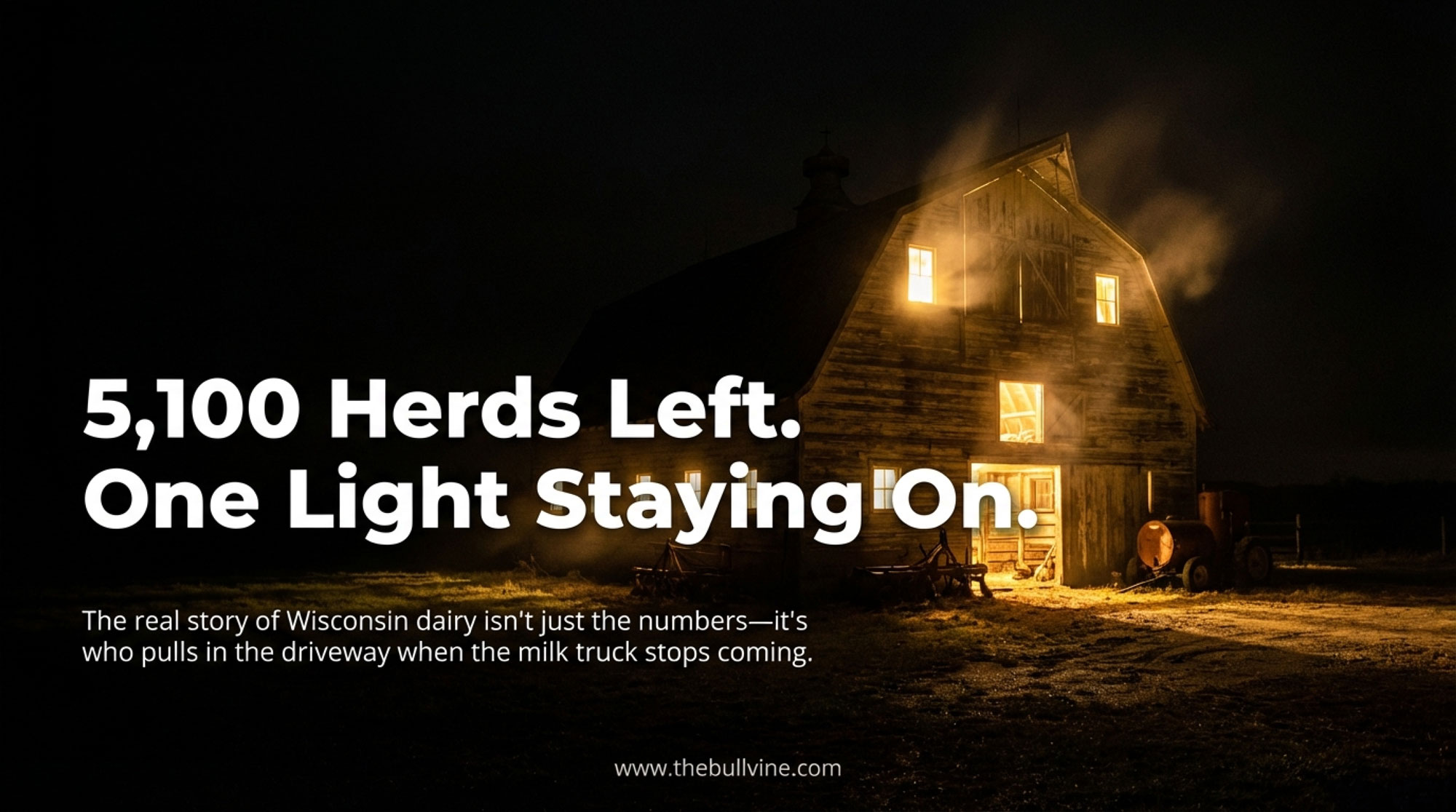
I’ll never forget sitting at a kitchen table in western Wisconsin, steam rolling off a coffee mug that had already been reheated twice between chores. The farmer across from me stared out at a road he’d driven his whole life and said, “There used to be 13 dairies down this stretch. Now we’re down to two.”

Outside, the barns were still there. Silos still reached into the sky. But a lot of those bulk tanks were cold now. No fresh milk truck tracks in the gravel. No kids racing to the bus in chore clothes. Just a road that used to echo with the sound of milk pumps and skid steers, now a little too quiet.

If you’ve milked cows in this state for a while, you don’t need anyone to explain the numbers. Wisconsin has started 2026 with right around 5,100 licensed dairy herds—the fewest in decades and just over half the number that were operating about ten years ago, roughly a third of what there were a couple of decades back. The total number of cows being milked across the state has stayed close to the same, and milk production keeps inching upward as more milk comes from larger, higher‑yield herds. The milk is still coming. It’s just coming from fewer farm lanes and fewer kitchen tables.

On paper, the reasons look straightforward: high costs that squeeze small and mid‑size farms, consolidation into larger herds, and a lot of older farmers deciding they can’t keep doing this level of work into their sixties and seventies. Strong demand for beef and beef‑on‑dairy has nudged some herds toward different choices, too—cull checks and beef cross calves sometimes make selling out or shifting focus a little less painful than it would’ve been a generation ago. The charts and reports will tell you all of that.

What they can’t really show is how it feels when those numbers land on your own road—or how, against all odds, the people on that road keep finding ways to show up for each other.

When Neighbors Became Family

The call to the neighbor came before dawn.
On a short dead‑end road not all that different from yours, everyone knew a family’s last load of milk was scheduled. The signs had been there for a while—fewer replacements in the heifer yard, an auction flyer tucked under a magnet on the fridge, conversations drifting from “next year’s ration” to “how long can we keep this up?”

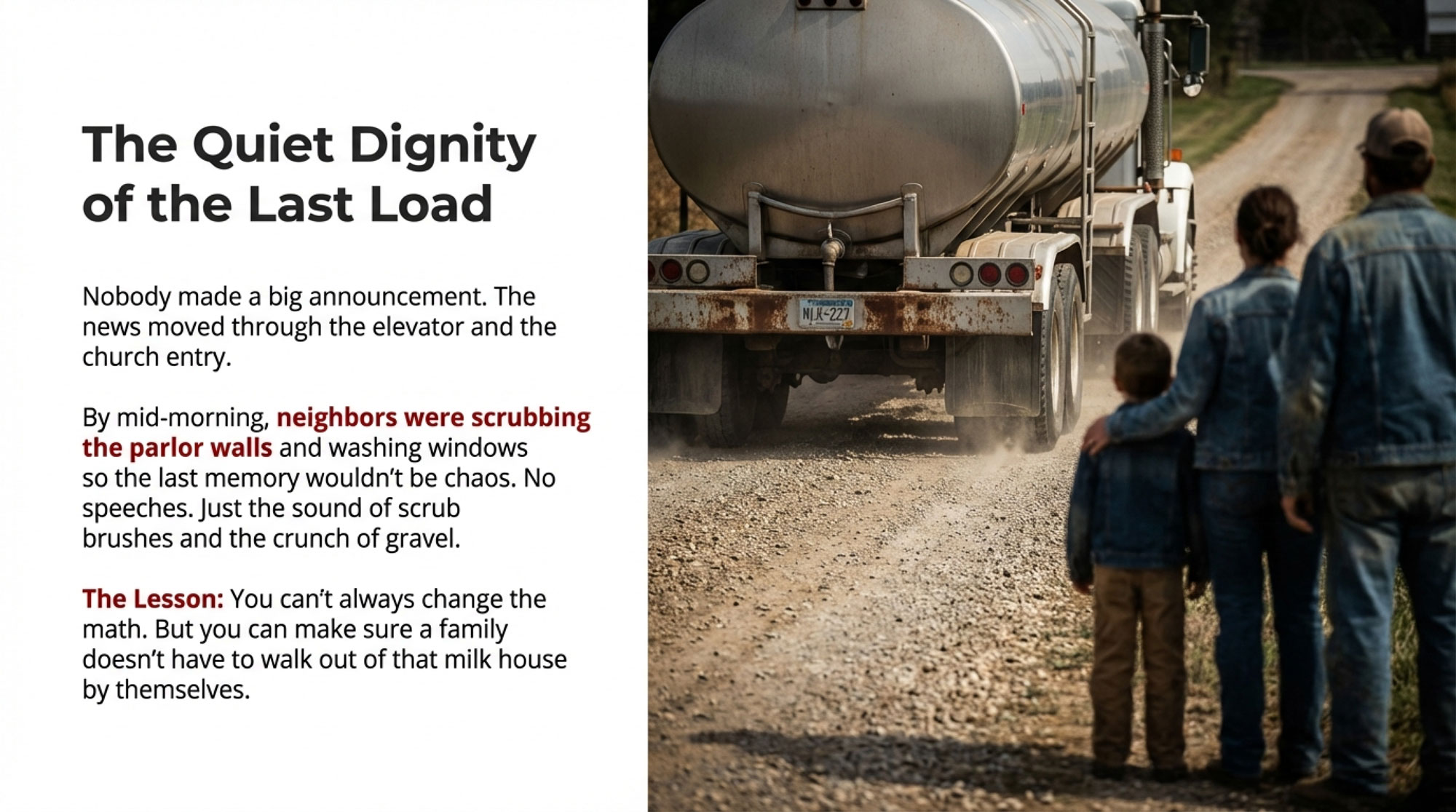
Nobody made a big announcement. The news moved the old‑fashioned way—mentioned at the elevator, in the church entry, over a pickup hood in the school parking lot.

By mid‑morning, that yard felt different.

One neighbor backed in with a skid steer on a trailer because he knew there’d be pens to clean, gates to move, heavy things to lift. Another truck pulled up and a friend climbed out with a couple of casseroles and a stack of paper plates. She just said, “You’re not going to want to cook tonight,” and set them on the counter. Someone else walked straight to the milk house, opened the door, and started wiping down the tank and washing windows so the last memories in that room wouldn’t be of clutter and chaos.

What moved everyone most was how quietly people walked into that space and got to work. No speeches. No “you should’ve done this or that.” Just steady hands on scrub brushes, someone sweeping the parlor, somebody else checking that the light bulbs worked and the breakers were labeled so the next person who came along would be able to find their way.

A couple of neighbors made sure the kids had somewhere else to be that afternoon—a cousin’s house, a 4‑H leader’s place—so they didn’t have to stand in the yard and watch the milk truck pull away.

When the time came, a few people stood with the family at the end of the lane as the stainless trailer eased down the driveway. Nobody said much. There were a few stories about “that old cow who always kicked off the unit” and a little laughter through tears, the way you do when you’re trying to hold it together. Then there was just the sound of the truck, the crunch of gravel under tires, and a quiet that felt heavier than usual.

Over coffee at the co‑op a few days later, a neighbor tried to put words to it. He said you can’t always change the math, but you can make sure a family doesn’t have to walk out of that milk house by themselves. Everyone around the table just nodded. They knew exactly what he meant.

Most of you reading this have seen some version of that day. Maybe you’ve stood in the yard. Maybe you’ve been the one backing in with the skid steer. Either way, it’s the kind of day that changes how you look at the road you live on.

Standing in the Parlor, Not Alone

The text from the neighbor could’ve gone unnoticed on any other night.

It was one of those bitter January evenings when the wind drives snow under every door and makes the short walk from the house to the barn feel a mile long. The cows were milked. The line was washed. But a dairyman found himself just standing in the parlor, staring at a small stack of unpaid bills on the shelf by the wash sink, feeling that tight, heavy weight that doesn’t care how strong your back is.
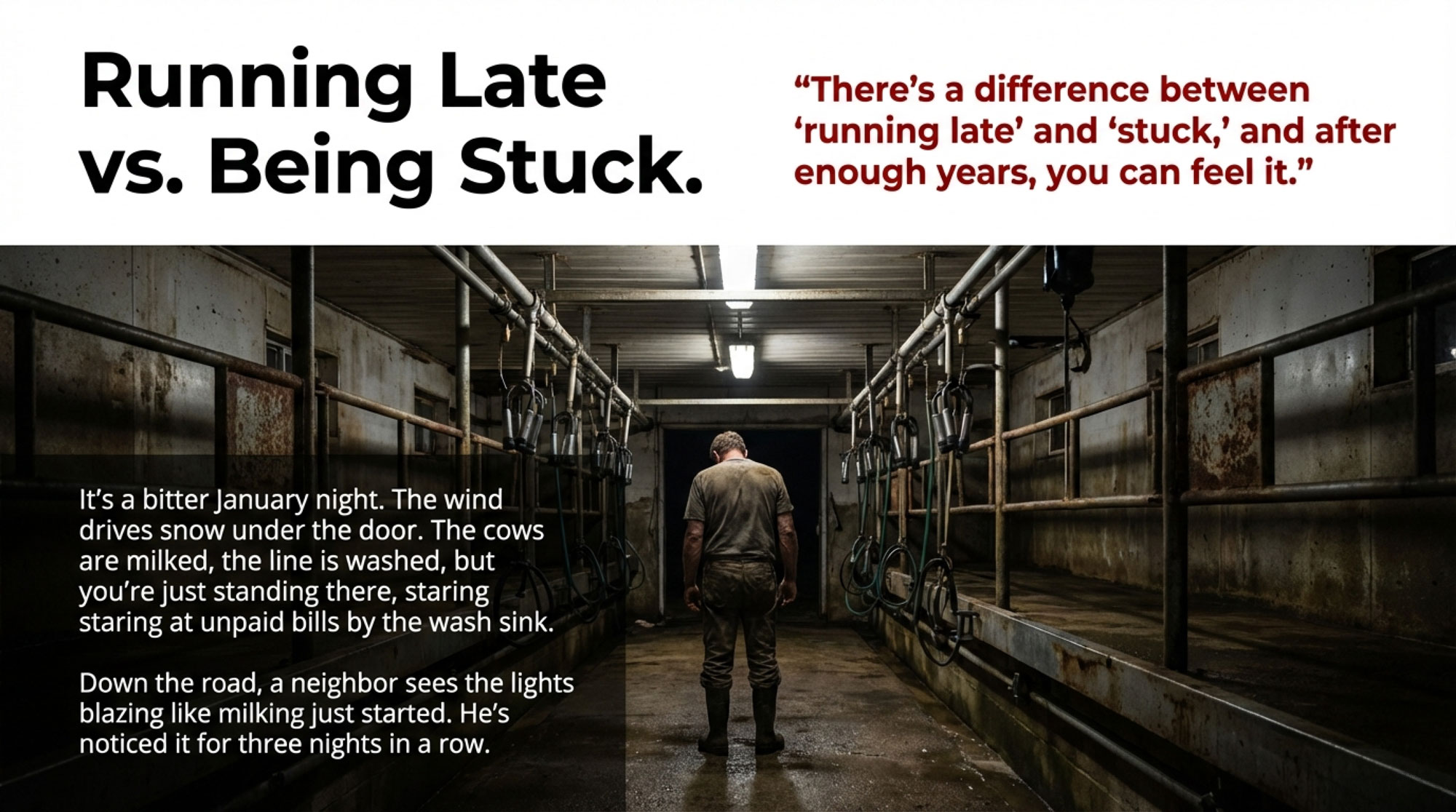
Down the road, a neighbor drove past and saw the lights still blazing like milking had just started instead of being long finished. He’d noticed it the night before. And the night before that. There’s a difference between “running late” and “stuck,” and after enough years in the neighborhood, you can feel it.
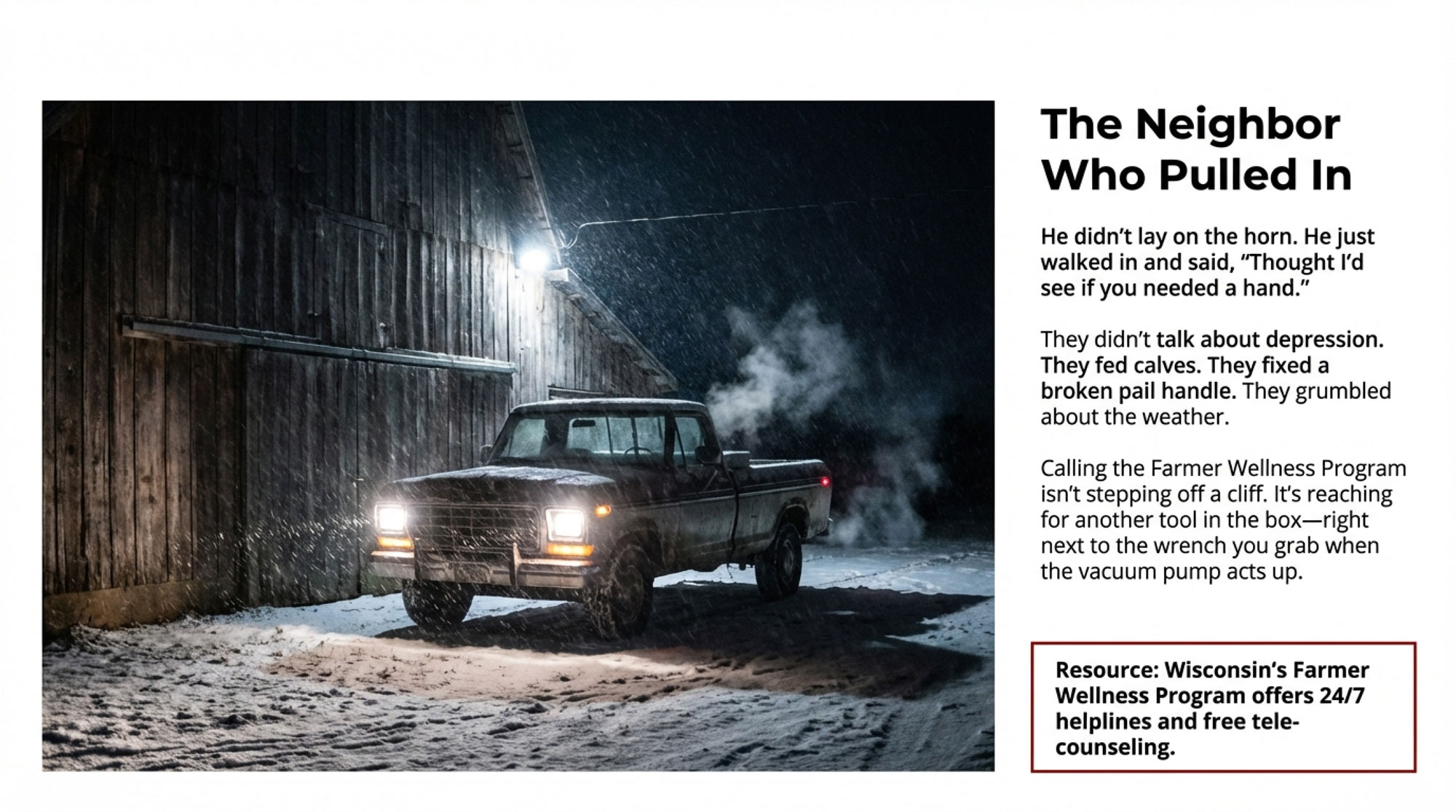
A little while later, that neighbor’s truck rolled into the yard. He didn’t lay on the horn or make a big entrance. He pulled in, shut the truck off, and walked into the barn. He nodded and said something along the lines of, “You done with calves yet? Thought I’d see if you needed a hand.”

They didn’t launch into a deep talk about depression or interest rates. They fed calves together. They grumbled about the weather. They fixed a broken pail handle. The next night, the neighbor came back at the same time. And the next. They didn’t solve everything, not even close. But the chores got done, and the silence didn’t feel quite so sharp.

Somewhere between talking about dry cow shots and the next co‑op meeting, the farmer said, “You know that number they talked about at that meeting? I think I’m going to call it.”

In recent years, Wisconsin has put real muscle behind those numbers. Through the Farmer Wellness Program and the Farm Center, the state offers a 24/7 helpline for farmers and their families, free tele‑counseling sessions you can do from the kitchen table, counseling vouchers that cover in‑person visits with local providers, and online support groups designed specifically for farmers and farm couples. It’s all free to Wisconsin farm families, no matter the size of the operation.

The debt didn’t disappear when he picked up the phone. The milk price didn’t jump. But calling for help stopped feeling like stepping off a cliff and started feeling more like reaching for another tool in the box—right there next to the wrench you grab when the vacuum pump acts up.

We’ve all been taught to tough it out and fix things ourselves. On a lot of farms now, the bravest move isn’t working another couple of hours in the barn. It’s admitting you can’t fix it alone.

Most of you know that feeling, either because you’ve had someone show up for you, or because you’ve pulled into a driveway when the lights were on too late and just said, “Hey, I’m here.”

Programs and hotlines matter. They save lives. But they work best in communities where it’s already normal to keep an eye out for each other, to notice when the barn lights stay on too long, and to show up without making a big deal out of it.

Raising Kids, Cows, and Community
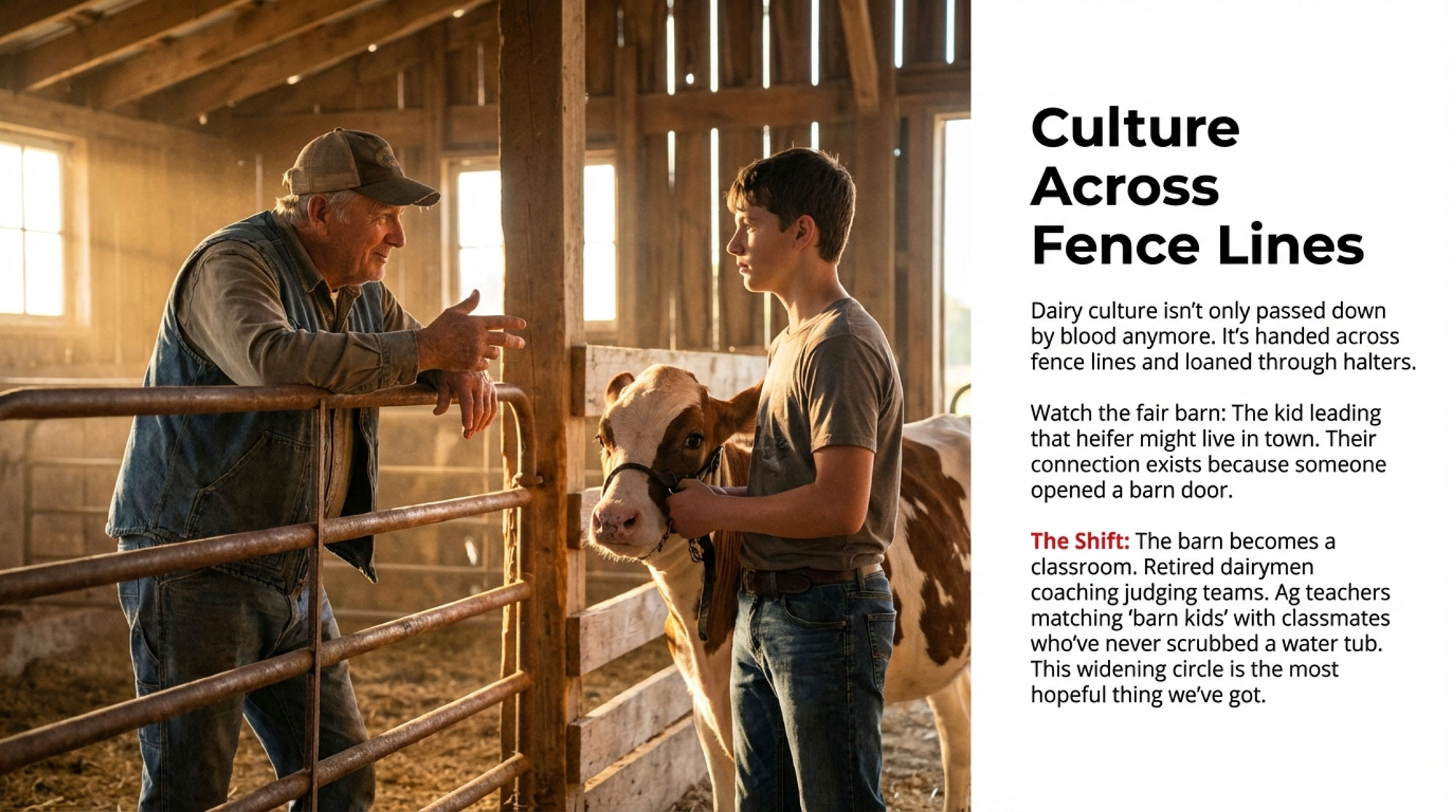
The first time you watch a kid from town lead a heifer into the show ring, you realize something important: dairy culture isn’t only passed down by blood. It’s handed across fence lines, loaned through halters, and shared in the corners of fair barns that smell like shavings, coffee, and nerves.

If you really want to see how this works, spend a day in a Wisconsin dairy barn at fair time or sit in on a 4‑H dairy project meeting.

You’ll see the familiar scenes: kids in white jeans wrestling with halters, parents trying to keep a nervous heifer clean, ag teachers and 4‑H leaders juggling clipboards, show schedules, and pep talks. You’ll hear the usual ring talk about udders and toplines and who’s judging this year.

Listen a little closer, though, and you’ll notice how many of those kids don’t live on working dairies anymore. Plenty come from town. Others live on farms that crop now instead of milk. Their connection to cows exists because somebody with a barn decided to open the door.

In a lot of counties, ag teachers and 4‑H leaders lean into that reality. They match “barn kids” who grew up knowing how to mix milk replacer and clip heifers with classmates who’ve never scrubbed a water tub but are eager to learn.

The conversations start small. A text from a farm kid: “Can I bring a friend to chores tomorrow?” A 4‑H leader saying, “We’ve got a family with an extra calf—anyone want to learn how to work with her?”

Before long, you’ve got a couple of extra pairs of boots in the mud room before school. A kid from town learning how to set up a milking stall. A former dairyman, now retired, volunteering to help coach dairy judging because he misses talking about cows and wants to pass something on.

At the next 4‑H meeting, you can feel the difference. The kids who used to hang back at the edge of the barn are suddenly talking about feed, show strings, and cow families. One signs up for dairy bowl. Another spends Saturday mornings milking for a neighbor. A few just carry the experience with them, knowing they were trusted in a barn when it really counted.

The barn starts to look less like a place for one family and more like a gathering place for a whole community—a barn that helped raise the kids, whether those kids lived on the farm or not. And in a state where the number of farms keeps shrinking, that widening circle might be one of the most hopeful things we’ve got.

The Question at the Kitchen Table

The hardest conversations often start after chores.

You know the scene. Barn boots lined up by the back door. Kids finally in bed. The hum of the refrigerator louder than usual in a quiet farm kitchen. Somewhere between the last bite of supper and the first bill on the table, someone says it.

“We can’t keep doing this forever. So what happens next?”

Over the last several years, that question has stopped being hypothetical for a lot of dairy families. Owners are getting older. Backs and knees don’t bounce the way they used to. The next generation is juggling off‑farm jobs, spouses’ careers, school events, and sports schedules. The cost of buying into a dairy—land, cows, equity in the business—is enough to make even the most determined young person swallow hard.

At the same time, there are young folks who would love nothing more than to get their own herd started. Some grew up on dairies that sold their cows. Others discovered their love for cows through 4‑H or FFA and never had a family farm to go back to. They’re hungry for a chance, but the numbers and the structures don’t always make it easy.

In that gap, more extension educators and farm business advisors have started helping families talk through options: lease‑to‑own agreements where a younger producer rents facilities and gradually buys into the herd, non‑family partnerships with clear roles and exit plans, or longer‑term land leases that keep ground in agriculture even if the parlor goes quiet. None of these paths are perfect. They’re messy, full of hard conversations and what‑ifs. But at least they open a door that used to stay shut.

At one meeting, a producer stood up and said he didn’t walk away from milking because he stopped loving cows. He stepped away because he loved his family too much to keep them under that level of pressure forever. The room went quiet for a moment. Then you could see heads nodding all around. Most of the people there had run those same calculations across their own kitchen tables.

Not every story ends with a perfect handoff and a young couple moving into the farmhouse. Some end in a sale ring crowded with neighbors who come to buy a gate or a water tank and end up standing a little longer than they need to, just to say thank you. But more families are getting the chance to write that ending with intention, and more neighbors are learning how to show up for both the ones who stay and the ones who step away.

The Night the Road Filled With Headlights
Nobody expected the whole road to line up with headlights that night.

In one dairy community, folks had been watching a family wrestle with a tough stretch. You could see it in their faces at the feed mill, in the way they left meetings early, in the number of times they said, “We’ll see,” instead of “See you next year.”

Then the news settled into something heavier. The bank had laid out a few options, and none of them were easy or pretty. The family hadn’t asked for help. They were still doing what dairy folks do—putting their heads down and trying to outwork the problem.

But the community had been talking, too.

A cousin quietly set up an online fundraiser. A friend who worked with a lender said, “If they’re willing, I’ll ask my boss to look things over.” The pastor mentioned it at the end of church: “If you’ve got some time or tools next weekend, there’s a family that could use a hand.” A 4‑H leader sent a message to the parents’ group: “We’re going to the farm on Saturday. If your kids want to help, bring boots and gloves.”

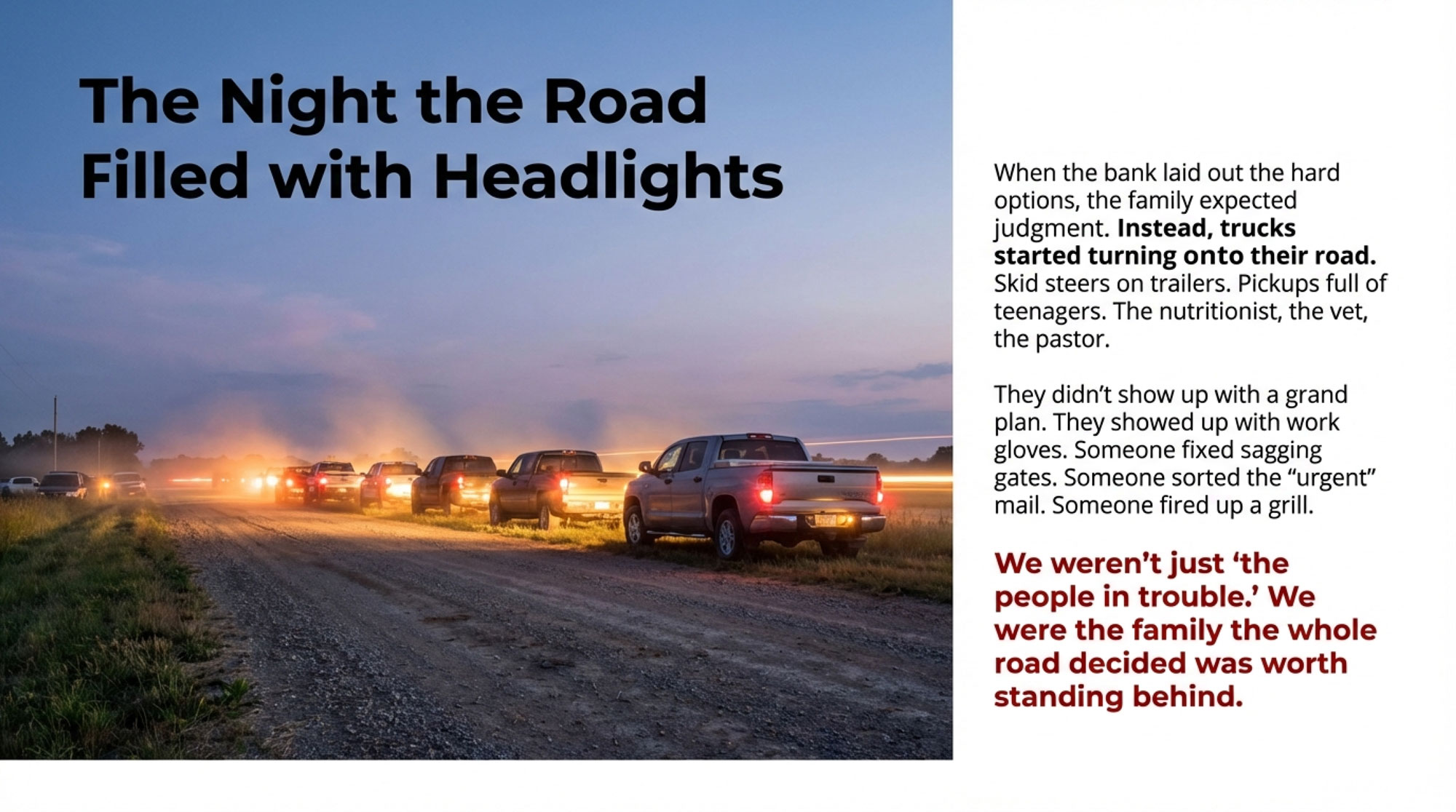
By late afternoon, as the sun dropped behind the silos, trucks started turning onto their road. Skid steers on trailers. Pickups full of teenagers in hoodies. Hired hands from neighboring operations who’d finished their own chores and came anyway. The nutritionist’s car. The vet’s truck. Co‑op folks, church families, 4‑H kids, neighbors from up and down the line.

They didn’t show up with a grand plan. They showed up with work gloves.

Someone tackled the broken boards and sagging gates that had been bugging everyone for months. A couple of people sat at the kitchen table with the family, sorting mail into piles—“urgent,” “call about this,” “we’ll figure this out later.” Others took over feeding calves and bedding pens so the owners could sit for a couple of hours and have real conversations with the banker and the advisor who’d stopped in. At some point, someone fired up a grill. Kids ran parts and fetched tools. People drifted in and out of the house and barn, carrying both coffee and paperwork.

What happened next didn’t erase the debt. It didn’t suddenly double the milk price. But it changed something deeper.

“It made it easier to go into town after that,” one of them said later. “We weren’t just ‘the people in trouble.’ We were the family the whole road decided was worth standing behind.”

They still had sleepless nights. The story is still being written. But that night, in the glow of those headlights, everyone there got a clearer picture of what kind of community they lived in—a community that refused to let them fall alone.

And in the months that followed, that same family showed up when someone else’s barn roof needed shoveling, and when a younger neighbor wanted to talk through a lease‑to‑own offer on a small herd. The help didn’t just land in one yard and stop. It kept moving, in ways none of them expected when those first trucks pulled in.

What You Can Do on Your Road

All of this can sound big and far away until you ask a simple question: “Okay, so what can we actually do where we live?”

It doesn’t have to be complicated. It might look like:

  • Noticing when a neighbor’s barn lights are on much later than usual for a few nights in a row, and choosing to pull in instead of just wondering.
  • Bringing one non‑farm kid into your barn this year through 4‑H, FFA, or your own show string, so they can learn what it feels like to be trusted in that space.
  • Keeping the farmer wellness numbers where you and your neighbors can find them—on the fridge, in the milk house, taped to the bulletin board in the shop—so calling for help feels like using a tool, not admitting defeat.
  • If you’re thinking about succession, talking with your lender, extension, or a farm business advisor about options like leasing, non‑family buy‑ins, or gradual transitions before a health scare or a bad year forces your hand.
  • Checking in, now and then, with the folks who left dairying in your area—inviting them to the fair, the breakfast on the farm, or the next co‑op meeting—so they know they’re still part of the story.
  • Saying “yes” when the pastor, the 4‑H leader, or the co‑op board asks if you’ll show up at a meeting about farm stress or succession, because your voice might be the one that helps somebody else take the next step.

None of these things fix the structural pressures on dairy. They don’t rewrite market reports or change how many zeroes are on the check from the plant. But they change what it feels like to live through those pressures. They turn lonely math into shared load‑bearing.
Community and Legacy: What This Means for All of Us

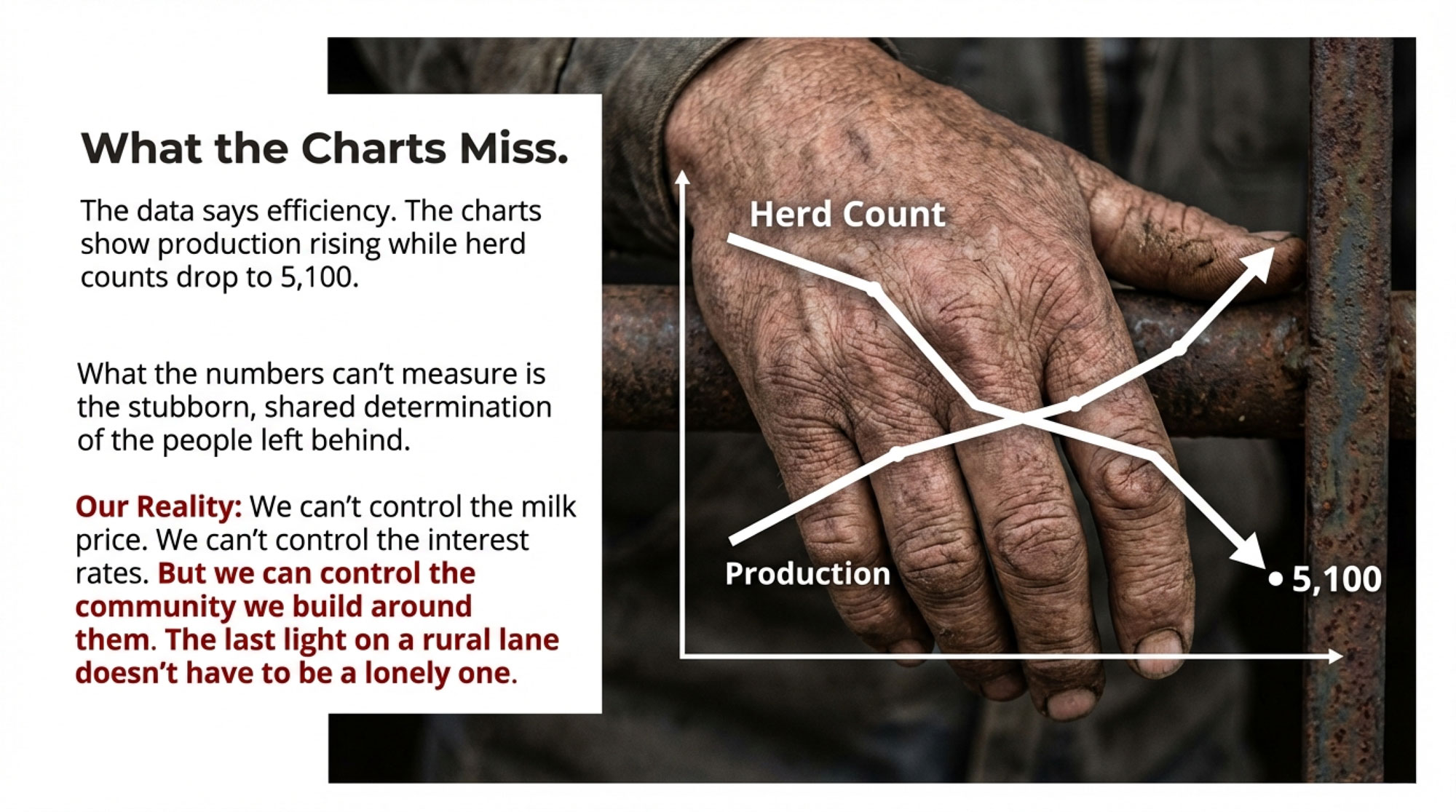
Over the last decade, Wisconsin has watched its dairy herd count slide to levels that would’ve sounded impossible when a lot of today’s producers were kids. You can see it in the empty yards, the lone silos, the “For Sale” signs at the ends of lanes that used to have cows in every window. At the same time, statewide data keeps showing roughly the same total number of cows and steady or rising milk production, as animals move into larger herds and farms lean harder on efficiency.

That’s the big picture. But if you sit at enough kitchen tables and walk through enough barns and community halls, you start to see something those numbers can’t measure: a stubborn, shared determination that even if we can’t save every farm, we can make sure the people on those farms don’t have to go through this alone.

We can’t control the markets, but we can control whether we notice when a neighbor’s barn lights are on too late and check in.

We can’t guarantee a successor for every farm, but we can help kids from town and from former dairy families find their way into the barn through 4‑H, FFA, or a neighbor’s show string.

We can’t erase every hard decision, but we can make sure families who leave dairying still feel welcome at the co‑op, in the sale barn café, and in the fair barn aisles.

You know who your “call list” is—the people you’d phone if something really went wrong at your place. Maybe this week is the time to add one more name to that list. Or to be that name for somebody else.

Most of you reading this have your own version of these stories. A time when someone showed up for you. A time when you dropped everything to show up for someone else. A moment when it hit you that what kept you going wasn’t just the cows—it was the people around you.

  • The last light on a rural lane doesn’t have to be a lonely one. It’s up to all of us, up and down these roads, to decide whether we’re just watching from a distance—or pulling in the driveway when it matters.

Key Takeaways

  • The numbers are stark: Wisconsin starts 2026 with about 5,100 dairy herds—half as many as a decade ago, a third of twenty years back—while cow numbers and milk production hold steady as larger operations absorb the volume.
  • The pressures haven’t changed: high costs squeezing margins, consolidation into bigger herds, owners aging out, and beef‑on‑dairy economics that sometimes make stepping away less painful than holding on.
  • Community still shows up: neighbors scrubbing parlors on last‑milk days, pulling into driveways when barn lights stay on too late, lining rural roads with headlights when one family can’t carry it alone—and then paying it forward when the next neighbor needs a hand.
  • Help is available and free: Wisconsin’s Farmer Wellness Program offers a 24/7 helpline, tele‑counseling, counseling vouchers, and online support groups at no cost to farmers and their families.
  • You can strengthen your own road today: notice late barn lights and check in, bring a non‑farm kid into your barn through 4‑H or FFA, post wellness numbers where neighbors can see them, and keep ex‑dairy families part of the community.

Complete references and supporting documentation are available upon request by contacting the editorial team at editor@thebullvine.com.

Continue the Story

The Sunday Read Dairy Professionals Don’t Skip.
Every week, thousands of producers, breeders, and industry insiders open Bullvine Weekly for genetics insights, market shifts, and profit strategies they won’t find anywhere else. One email. Five minutes. Smarter decisions all week.

NewsSubscribe
First
Last
Consent

How Trump’s Re-Election Will Redefine the Dairy Industry

Trump’s 2024 win reshapes the dairy industry. What does it mean for farmers at home and internationally? Explore the impacts now.

As November 6th, 2024, dawned, the fields of America’s dairy heartland lay still, oblivious to the political earthquake that had just reshaped the nation. Defying predictions, Donald Trump secured a victory that left many stunned, gathering overwhelming support from dairy-centric areas like Wisconsin. This victory transcended politics, marking a significant nationwide movement with far-reaching consequences for the dairy sector. 

“Drawing from the resilience of the dairy heartland, states including Wisconsin, Pennsylvania, and Minnesota became vital contributors to Trump’s electoral strategy, delivering a win that few anticipated.”

The regions rich in dairy farms and industry professionals were central to Trump’s triumph. Their economic and cultural sway made them essential components of the electoral framework, highlighting issues deeply touching rural livelihoods. So, what implications does this victory hold for dairy farmers who propelled this shift? How might it alter the domestic and global scenarios for the dairy industry? The answers hinge on the evolving relationship between policymaking and agricultural expectations, a nuanced balance this administration must skillfully manage.

Trump’s Strategic Embrace of America’s Dairy Heartland Leads to 2024 Triumph

In an unpredictable and fiercely contested political landscape, Trump’s triumphant return to the presidency in 2024 hinged on a strategic embrace of America’s rural backbone—the dairy heartland. 

Central to this electoral victory were the rural voters, who found their voices echoed and their concerns acknowledged in Trump’s policy promises. The commitment to revitalizing industries, reducing federal interference, and offering tax incentives for agricultural success resonated deeply among dairy farmers, whose livelihoods depend on domestic stability and international trade dynamics. 

Wisconsin: The Heartbeat of Victory 

Wisconsin has historically been a battleground state and emerged as the keystone of Trump’s electoral strategy. The dairy industry’s influence runs deep in this state, intertwined with its economic and cultural identity. Trump’s promises to bolster local economies through infrastructure investments and trade policies favoring agricultural exports struck a chord with many voters disenchanted with previous administrative strategies. 

The demographic shifts played a crucial part. An influx of younger farmers embracing innovation and technology in dairy farming aligned with Trump’s vision of an America that rewards hard work and ingenuity. This new generation, more skeptical of globalist policies and more protective of local interests, found a kindred spirit in Trump’s rhetoric and policies. 

Ultimately, targeted campaigning, policy promises tailored to rural and agricultural communities, and the effective use of media to communicate with these pivotal groups again handed Trump the keys to the White House, underlining Wisconsin’s critical role in this political drama.

The Dairy Dilemma: Navigating Opportunities and Challenges in Trump’s New Era

The decisive 2024 election victory heralds a new era for American dairy farmers, one marked by significant shifts in domestic policy. Trump’s administration is expected to drive reforms to invigorate the industry. Central to these changes are tax reforms that could alleviate financial pressures on dairy producers. By reducing tax burdens, farmers might reinvest savings into sustainable practices or expand their operations, fueling growth and innovation across the dairy landscape. 

Deregulation is another cornerstone of Trump’s agenda, promising to peel back layers of bureaucratic red tape. For dairy farmers, this could mean streamlined operations and reduced compliance costs. With fewer regulatory hurdles, there’s an opportunity to enhance efficiencies and accelerate production processes, potentially boosting domestic and global competitiveness. 

Furthermore, a renewed focus on rural infrastructure could provide dairy regions with much-needed resources. Transportation, broadband, and energy investments could drive operational efficiencies and open new markets. Infrastructure enhancement can bridge the urban-rural divide, enabling farmers to sell products more effectively and participate more robustly in the digital economy. 

Yet, alongside opportunities, these policy shifts might introduce challenges. Small-scale farmers could face heightened competition as larger enterprises leverage deregulation and tax savings to consolidate further. Infrastructure improvements, while beneficial, require time; interim periods may see continued struggles with inadequate facilities. 

Ultimately, Trump’s win demands a strategic response from the dairy industry. Farmers must adapt swiftly to harness the benefits of these policy changes, navigating new landscapes while mitigating potential risks. As the administration begins to unfold its agenda, dairy farmers are positioned at a critical juncture where adaptability and foresight will define their future in this evolving market.

Trump’s Global Milking Strategy: Navigating a Protean Dairy Landscape

As President Trump embarks on his second tenure, foreign policy stands at a crossroads, with implications that could ripple across global dairy markets. He has always favored a more protectionist approach, which could mean revisiting existing trade agreements and leveraging tariffs as bargaining chips. The dairy industry, deeply interwoven with international markets, must prepare for a landscape of potential volatility. 

Under a renewed Trump administration, we might witness a recalibration of trade relationships, particularly with key players in the dairy import arena, China and Mexico. Trade talks could pivot towards securing ‘better deals,’ possibly opening doors to new markets that remained elusive during previous negotiations. However, such deals might come with strings attached, reshaping tariff structures that could alleviate or impose new costs on US exports. 

Should Trump lean into his well-known advocacy for American products, we could see an emphasis on creating international demand for US dairy, from milk powder to cheese. This could boost export opportunities for American farmers who successfully ride the wave. Yet, with every new opportunity lies the challenge of staying competitive. Dairy farmers may find themselves vying against countries that could better withstand tariffs should global competition intensify under Trump’s policies. 

Furthermore, how Trump’s foreign policy maneuvers influence global pricing will weigh heavily on profitability. If tariff battles escalate, for example, it may lead to a fragmented trade environment where global dairy prices fluctuate unpredictably. American dairy farmers must stay nimble, perhaps investing in technology or innovations that reduce costs and improve yield to maintain their footing in a potentially tumultuous market. 

If history indicates, Trump’s policies will be audacious and assertive. The real question is whether America’s dairy industry can swiftly adapt to turn emerging challenges into opportunities. The answer lies in the strategies farmers adopt and how well they navigate the administration’s complex and often unpredictable trade strategies.

The Bottom Line

As we reflect on the momentous win in the 2024 election and its implications for the dairy industry, it’s clear that Trump’s administration could bring both challenges and opportunities. The strategic capture of the Midwest’s dairy heartland underscores a pivotal change in political and agricultural landscapes, suggesting a potential recalibration of domestic policies that might favor traditional farming sectors. 

Internationally, the promise of renegotiated trade deals could open new markets or introduce tighter competition. This dual-edged sword presents a unique scenario: will farmers thrive under enhanced market opportunities or struggle with regulatory pressures and global dynamics? 

As dairy professionals, it’s crucial to ponder how Trump’s policies align with your operational strategies. How can you leverage potential tax incentives or subsidies? Could shifts in trade policies necessitate a reevaluation of your export strategies? 

I invite you to share your thoughts and experiences. How do you anticipate navigating these changes brought forth by this victory? What are your biggest hopes or concerns for the dairy industry in the coming years? Engaging in this dialogue is more essential than ever as we collectively shape the future of dairy under this administration.

Key Takeaways:

  • Trump’s victory in the 2024 election relied heavily on securing wins in key dairy-producing states like Wisconsin.
  • The election results signal potential shifts in domestic dairy policies that could affect pricing, trade, and subsidies.
  • For dairy farmers, Trump’s approach may offer new opportunities but demands careful navigation of emerging challenges.
  • Internationally, Trump’s policies are expected to impact trade agreements, affecting the global dairy market dynamics.
  • Dairy farmers must stay informed and adaptable to leverage potential benefits from changes in both domestic and international policies.

Summary:

Donald Trump’s victory in the 2024 Presidential Election, with a strategic focus on the dairy heartland such as Wisconsin, reshapes domestic and international landscapes for dairy farmers. His administration’s policies, aimed at revitalizing industries and reducing federal interference, present challenges and opportunities, including potential deregulation and tax reforms to ease financial pressures. On the global stage, Trump’s approach may redefine trade relationships, impacting export dynamics. As a result, the dairy industry must carefully consider the implications of these strategies on their operations and future growth.

Learn more:

Join the Revolution!

Bullvine Daily is your essential e-zine for staying ahead in the dairy industry. With over 30,000 subscribers, we bring you the week’s top news, helping you manage tasks efficiently. Stay informed about milk production, tech adoption, and more, so you can concentrate on your dairy operations. 

NewsSubscribe
First
Last
Consent

You’re fired! Trump’s Deportation Plan Would Gut Half of US Dairy Labor Force

Will Trump’s deportation plan devastate your dairy farm? Can you survive losing half the workforce? Find out now.

Summary: Imagine waking up to find half of your workforce gone overnight. That’s the reality if former President Trump’s deportation plan happens. In states like Wisconsin, where 70% of dairy farm labor comes from undocumented workers, this could spell disaster. The University of Wisconsin found that 10,000 illegal laborers provide 70% of labor on the state’s dairy farms. In California, over 75% of farmworkers are unauthorized. Removing them would ripple across industries, not just affecting farms. The entire GDP could take a hit; a University of Colorado study suggests mass deportations could eliminate 88,000 jobs. Around 50% of U.S. farmworkers are illegal immigrants. Their deportation is fewer workers and a cascade effect that could collapse entire industries.

  • 70% of Wisconsin’s dairy farm labor is performed by undocumented workers, highlighting their critical role in the industry.
  • Trump’s deportation plan could remove 45% of all agricultural workers in the U.S., leading to potentially catastrophic consequences.
  • California, responsible for a significant portion of U.S. agriculture, employs over 75% of undocumented farmworkers.
  • An immediate drop in the workforce could result in a 3-6% decline in the U.S. economy, with agriculture being hit the hardest.
  • According to a University of Colorado study, an estimated 88,000 jobs could be lost if mass deportations occur.
  • The ripple effect of deportations could disrupt farming and industries interconnected with agriculture.
  • Deporting undocumented workers would not only lead to labor shortages but also increased costs and potential economic decline.

Imagine waking up one morning to discover that half of your workers had disappeared overnight. This is the harsh reality that many dairy farmers, including you, might face under Trump’s deportation proposal. Undocumented workers are not just a gear in the wheel; they are the foundation of the American dairy sector. With over 10,000 illegal laborers working on dairy farms in Wisconsin alone, accounting for more than 70% of labor, the vulnerability of the American dairy farming industry is stark. This is not just a statistic; your livelihood and the future of American dairy farming are in jeopardy.

Is Trump’s Deportation Plan About to Shatter the Backbone of American Dairy Farming?

Trump’s deportation proposal, portrayed as a way to safeguard American employment, notably targets undocumented migrants, who make up a sizable component of the agricultural workforce. These laborers, many of whom are undocumented, play an essential part in the everyday operations of farms and ranches around the United States. The idea is to deport illegal immigrants from the nation in the hopes of freeing up employment for American residents. However, there are alternative solutions, such as comprehensive immigration reform, that could address the issue without causing such a drastic disruption to the agricultural sector.

However, the present situation of the agricultural workforce reveals a different picture. According to the National Milk Producers Federation, around 50% of farmworkers in the United States are illegal immigrants. These people contribute directly to the nation’s food supply by doing vital jobs such as planting and harvesting crops, milking cows, and repairing equipment. Their substantial presence demonstrates the farm sector’s dependence on this underappreciated yet vital labor.

Let’s Talk Specifics 

Let’s get specific. For dairy farmers in Wisconsin, Trump’s deportation proposal is not just a legislative move; it’s a potential economic disaster. The University of Wisconsin investigation reveals some alarming statistics: more than 10,000 illegal laborers provide 70% of labor on the state’s dairy farms. Imagine losing more than two-thirds of your workers overnight. The consequences would be catastrophic for your business and your community, potentially leading to economic downturns and rising costs.

This labor reliance is not limited to Wisconsin. California, another agricultural powerhouse, might see a similar disaster. With over 75% of its farmworkers unauthorized, widespread deportation may destroy the dairy and vegetable sectors, resulting in bare shelves and soaring prices nationally.

Furthermore, foreign-born workers contribute to the effective production of dairy products, guaranteeing that four out of every five liters of milk are provided consistently throughout the year. The consequences of losing such a vital workforce cannot be understated. It’s about more than simply filling employment; it’s about preserving the core of American agriculture.

California’s Agricultural Sector: The Heartbeat of America’s Food System at Risk 

California’s agriculture industry is at the core of the United States food system. This state accounts for around one-third to one-half of the total U.S. agriculture output, making it an essential participant in feeding the country and even sections of the globe. With such an important function, any disturbance may shake the agricultural landscape.

The fact is stark: about 75% of California farmworkers are illegal. These individuals are critical to consistently ensuring fresh fruit reaches tables nationwide. These illegal laborers pick a wide range of produce, from the leafy greens in your local grocery store to the citrus fruits that make up your morning juice. If Trump’s deportation proposal were to be implemented, the immediate consequences for California would be disastrous. The state’s substantial fresh garden and orchard would come to a standstill. The ripple effects would not stop at the farm. Still, they would spread throughout the supply chain, affecting distributors, retailers, and consumers.

It’s not just a local problem but a national disaster. California’s agricultural production is too significant to ignore. Food production would suffer dramatically if this workforce suddenly vanishes, leading to rising costs and empty grocery shelves. Without these illegal laborers, California’s—and, by extension, America’s—food production would suffer greatly, potentially leading to a rise in food prices that would directly impact consumers.

The Historical Context: Migrant Labor as the Backbone of U.S. Agriculture 

The dependence on migrant labor in U.S. agriculture is not new; it extends back to the early twentieth century. The Bracero Program, which began during World War II, saw the U.S. government welcome millions of Mexican immigrants to cover the labor vacuum caused by American troops. These laborers played critical roles in agricultural planting and harvesting, establishing the framework for a labor dynamic that continues today. The Bracero Program was a significant chapter in the history of U.S. agriculture, as it demonstrated the industry’s reliance on migrant labor and the potential consequences of disrupting this labor supply.

Since then, the agricultural industry has become more reliant on migrant labor for various reasons. The job is often seasonal, exhausting, and low-paying, making it unappealing to native-born American workers. The U.S. Department of Labor reports that over 50% of farmworkers in the country are illegal, highlighting the industry’s reliance on these workers.

Furthermore, the cost constraints on the agriculture business contribute to this reliance. Farmers work on tight margins and sometimes need help to afford to pay more excellent salaries, which would attract legal residents and citizens. Undocumented immigrants, prepared to work for lower wages, have become critical to maintaining viable farms. Understanding this historical backdrop is essential for understanding why any changes to immigration rules, such as mass deportations, would have far-reaching consequences for the U.S. agriculture industry.

Why Deporting Farmworkers is a Recipe for a National Economic Catastrophe 

Deporting a large percentage of the agricultural workforce is more than simply a rural issue; it is a national economic catastrophe waiting to happen. A detailed study by a University of Colorado professor found that removing 1 million immigrants from the workforce would result in losing 88,000 jobs. This is more than simply having fewer workers to milk cows or pick vegetables; it’s a cascade effect that may collapse whole industries.

According to economic analysis, such a deportation strategy would negatively impact GDP and increase inflation. Why? The Amnegatively impactor is stagnant. It’s a complicated situation. The American workforce’s skilled labor is removed; skilled people often have to step down to fill the vacancies, which causes project delays and raises expenses.

Furthermore, a significant decline in the working force may reduce agricultural productivity. This implies increased food costs for consumers and a hit to sectors that depend on low-cost agricultural raw resources. Moreover, reducing agricultural productivity could lead to increased pressure on natural resources, such as water and land, and could lead to environmental degradation. According to the Congressional Budget Office, the U.S. workforce is predicted to expand by 5.2 million individuals and contribute $7 trillion to the economy, mainly owing to net immigration. Disrupting this growth trajectory might result in long-term economic stagnation.

Understanding the Ripple Effects in the Labor Market is Crucial 

Understanding the ripple effects in the job market is critical. Deporting illegal workers does more than merely fill vacancies; it creates a difficult-to-fill vacuum. Unskilled labor, which often comprises basic construction or manual agricultural work, allows skilled workers to concentrate on more specialized tasks. Consider a professional carpenter or machine operator filling in for a missing unskilled worker. This shift causes delays, stall segments of construction or manufacturing lines, and a general decrease in output.

Furthermore, the cascading impact does not end there. Industries that rely on these interrelated employment also suffer. If a dairy farmer loses personnel, the tightening of the supply chain directly influences milk distribution, hurting both small retailers and larger food companies. Grocery costs may suddenly increase, while quality suffers due to hurried or compromised manufacturing methods.

Finally, the disruption of this integrated labor market hurts both individuals and the economy as a whole. It’s a domino effect: each missing component undermines the broader framework, jeopardizing employment and economic stability across numerous sectors, and eliminating unskilled labor tears the thread that holds the American workforce together.

Global Lessons on Managing Agricultural Labor: What Can the U.S. Learn? 

To offer a broader perspective, consider how other nations have addressed comparable agricultural labor difficulties and what lessons the United States may learn from them.

Take, for example, Germany. Germany depends heavily on seasonal laborers from Eastern Europe to gather asparagus. When COVID-19 limits threatened to prevent the flow of these workers, the German government promptly acted. They established special charter planes to transport necessary personnel into the nation, ensuring that the agriculture industry remained operational. Germany’s strategy emphasizes the need for efficient and responsive immigration rules to help essential businesses.

Canada provides another example with its Temporary Foreign Worker Program (TFWP). This program recruits thousands of seasonal agricultural laborers from Mexico and the Caribbean. By formalizing the process, Canada secures a dependable agricultural labor force and safeguards workers’ rights. The focus is on balancing between addressing labor demands and protecting employee welfare.

The Seasonal Worker Programme in Australia permits Pacific Islanders to cover agricultural labor shortages. This scheme benefits Australian farmers while contributing to Pacific countries’ economic growth. Furthermore, Australia provides avenues to permanent residence for individuals willing to work in rural agricultural areas, making it a popular choice for many.

Looking at these foreign examples, it’s evident that tackling agricultural labor shortages requires a combination of flexible immigration rules, worker protections, and strategic planning. Implementing comparable initiatives might help the United States sustain agricultural output while protecting the interests of farmers and workers.

The Bottom Line

The new deportation approach weakens the backbone of the American dairy sector, as illegal immigrants account for 70% of labor on Wisconsin dairy farms and contribute heavily to California agriculture. The repercussions are clear: workforce shortages, economic downturns, and rising costs. Losing 950,000 farmworkers may change farms and the overall food production ecosystem, causing inflation and job losses across sectors. Supporting the present workforce is critical to the security and profitability of the U.S. national economy.

Learn more:

Biden vs. Trump: Wooing Wisconsin Dairy Farmers for the 2024 Election

How will Biden and Trump win over Wisconsin dairy farmers in the 2024 election? Discover their strategies in this key battleground state for the White House race.

Wisconsin, a pivotal battleground state in the upcoming 2024 presidential contest, holds the key to the next US leader. At the heart of this political landscape are Wisconsin’s dairy farmers, not just a group essential to the state’s economy but also a force that shapes its political choices. Understanding their significance is what drives former President Donald Trump and President Joe Biden to tirelessly seek their approval.

Dairy farmers, with their billions of dollars in contributions to Wisconsin’s economy, hold the power to sway the next election. For them, this election is not just about choosing a leader but about safeguarding their future. The significant concerns they face, such as trade policy and climate change, are issues that demand our attention and understanding.

From Barns to Ballots: The Political Clout of Wisconsin Dairy Farmers

StatisticData
Total Number of Dairy Farms6,900
Total Dairy Cows1.27 million
Annual Milk Production30 billion pounds
Contribution to State’s Economy$45.6 billion
Percentage of State’s Total Votes12%
Voter Turnout Among Dairy Farmers (2020)78%

With their votes frequently reflecting more general national tendencies, Wisconsin dairy farmers have always been essential in shaping the state’s political scene. Traditionally a Democratic bastion, Wisconsin turned to Donald Trump in 2016 under persuasion from rural voters, including those from the dairy industry. This change represented rural discontent with current policies, which Trump seized upon with promises of economic revitalization and deregulation.

YearCandidatePartyPercentage of Dairy Farmer Votes
2008Barack ObamaDemocratic48%
2008John McCainRepublican46%
2012Barack ObamaDemocratic50%
2012Mitt RomneyRepublican47%
2016Hillary ClintonDemocratic45%
2016Donald TrumpRepublican50%
2020Joe BidenDemocratic47%
2020Donald TrumpRepublican51%

Joe Biden’s tight reclaiming of Wisconsin for the Democrats in 2020 emphasizes the vital importance of rural votes in a divided political landscape. Dairy producers voiced worries reflecting more general national problems like economic stability, healthcare, and immigration regulations, confronting changing milk prices and difficulties driven by the COVID-19 epidemic. Their votes were crucial in this hotly fought state, highlighting their ongoing electoral power.

As Biden and Trump gear up for the 2024 contest, understanding the voting behavior of Wisconsin dairy producers becomes paramount. Their votes and concerns could once again tip the scales in this pivotal battleground state. This is a population that both parties must aggressively contact and address, highlighting the fierce competition for their support.

Wisconsin’s Dairy Industry: Cornerstone of Agricultural Identity and Economic Engine

YearTotal Milk Production (Billion Pounds)Number of Dairy FarmsAverage Farm Size (Acres)Dairy Industry Economic Impact (Billion USD)
201830.67,15422543.4
201930.86,72823044.0
202031.76,44823545.6
202132.26,26524047.2
202232.46,10524548.0

A key component of Wisconsin’s agricultural and economic fabric is its dairy sector. Producing more than 27 billion pounds of milk annually contributes to the state’s GDP of over $45.6 billion. Directly and indirectly, this industry generates over 150,000 jobs, supports rural areas, and guarantees financial security. The sector is still a strong player in Wisconsin’s economy despite environmental issues and swings in the worldwide market.

Biden’s Multifaceted Strategy: Championing Wisconsin’s Dairy Farmers through Subsidies, Trade, and Sustainability 

President Biden has been a prominent champion of American dairy farmers, particularly in Wisconsin. His proposal combines environmental rules, trade agreements, and subsidies to support the sustainability and economic stability of the dairy business. Understanding the vital role these farmers provide, Biden’s programs handle long-term issues as well as acute requirements.

Biden’s approach revolves mostly around increasing government subsidies. Farmers coping with changing milk prices and market uncertainty depend critically on these financial tools. The Pandemic Market Volatility Assistance Program and emergency assistance monies for the COVID-19 epidemic showed how dedicated the government is to dairy enterprises. Furthermore, Biden’s initiatives to modernize the milk price structure seek to create more open and equitable market conditions.

Still, another basis of Biden’s support is trade deals. By negotiating agreements like the USMCA, the government hopes to create new markets and increase American dairy product competitiveness. These changes are meant to improve American export conditions and promote economic development.

Biden’s environmental policies also prioritize sustainability. Programs like the Conservation Stewardship Program (CSP) and the Agricultural Conservation Easement Program (ACEP) provide financial incentives for using environmentally friendly technology and support better agricultural methods. These projects aim to reduce the environmental impact by addressing methane emissions and nutrient runoff, safeguarding farmers’ livelihoods.

Recognizing the difficulties Wisconsin’s dairy producers are experiencing, President Biden’s approach mixes sustainable long-term remedies with quick cash relief.

Trump’s Agricultural Blueprint: Advocating for Dairy Farmers through Tariffs, Deregulation, and Tax Cuts

Three primary pillars—tariffs, deregulation, and tax cuts—formulated former President Donald Trump’s approach to winning support among Wisconsin dairy farmers. By taxing foreign dairy goods, Trump sought to shield American dairy farmers from foreign market pressures, especially from Canada and the European Union. This “America First” strategy was considered to level the playing field for nearby producers.

Trump also aimed to cut bureaucratic red tape by undoing many labor rules and environmental policies, freeing farmers’ operating expenses and giving them more control. Dairy producers battling administrative overhead and compliance costs found resonance in this deregulating drive.

The Tax Cuts and Jobs Act of 2017—which provided additional deductions for capital investments and corporate tax rate cuts—was also helpful for dairy producers. These fiscal measures gave the agricultural community immediate financial relief and growth incentives, encouraging investment in new machinery and technologies.

At the Crossroads: Critical Issues and Political Choices Shaping Wisconsin’s Dairy Future 

Key IssuesBiden’s StanceTrump’s Stance
SubsidiesIncreases in federal subsidies to support dairy farmers, particularly small and medium-scale operations.Maintains subsidies but emphasizes deregulation to boost farmer autonomy.
Trade PoliciesFocus on renegotiating trade deals to ensure fair market access for U.S. dairy products.Strong advocacy for tariffs on foreign dairy products to protect domestic farmers.
Sustainable PracticesPromotes sustainability initiatives and funding for green technologies in agriculture.Less emphasis on sustainability; prioritizes economic growth and reduced regulatory burdens.
DeregulationA balanced approach, seeking to streamline but not entirely eliminate regulatory measures.Aggressively pushes for deregulation to lower operational costs for farmers.
Tax PoliciesSupports targeted tax incentives for farmers adopting sustainable practices and modern technologies.Proposes broader tax cuts aimed at stimulating overall economic activity within the agricultural sector.
Rural DevelopmentInvests in rural infrastructure, healthcare, and education to bolster rural communities.Emphasizes private investment and reduced governmental intervention in rural development.

Dairy producers in Wisconsin are facing a crossroads regarding trade regulations, workforce shortages, and erratic milk prices. Former President Donald Trump and President Joe Biden have different approaches to appealing to this important vote demographic in the 2024 contest.

The milk price still needs to be solved. Biden proposes changes and government support to guarantee farmers’ fair returns. Meanwhile, Trump supports tax cuts and deregulation to lower expenses and increase profitability.

Another critical problem is labor shortages exacerbated by aging workers and immigration laws. Many dairy farms rely on migrant workers. Biden favors visa changes and compassionate immigration laws to guarantee a consistent workforce. Trump, on the other hand, emphasizes rigorous immigration restrictions but advances automation to reduce worker demand.

Dairy producers’ revenues are strongly influenced by trade policy. Biden wants to improve trade deals between countries to keep demand for American dairy intact. Using his prior approaches, Trump utilizes tariffs to safeguard the home industry and negotiate trade agreements benefiting American farmers.

Voices from the Dairy Farm: Diverse Perspectives on Presidential Policies and Their Impact 

Views on Biden and Trump vary as much as the herds Wisconsin’s dairy towns oversee. From Monroe, third-generation farmer Jacob said, “Biden’s sustainability focus aligns with our farm’s goals, but price fluctuations during COVID weren’t addressed adequately.”

Margaret, who runs close to La Crosse, said, “Trump’s tariffs generated worry, but his tax cuts and deregulation offered some respite. But changing the milk price structure would have been vital throughout the epidemic.”

Carlos, an immigrant dairy worker for over ten years, summed up the general attitude: “Both candidates discuss helping farmers, but we need to ensure fair treatment for everyone working on these farms.”

Biden’s Grassroots Engagement vs. Trump’s Rally Showdown: Wooing Wisconsin’s Dairy Farmers

Key players in this pivotal electoral state, such as dairy farmers in Wisconsin, are being aggressively coursed by both Biden and Trump. Emphasizing town halls and farm visits to underline his administration’s dedication to subsidies, sustainable agriculture, and fair trade rules, Biden’s campaign His commercials include quotes from farmers who have profited from these programs, therefore portraying a future of more government backing and environmental knowledge.

Conversely, Trump emphasizes high-energy demonstrations close to dairy towns to highlight his achievements in renegotiating trade agreements and lessening regulatory load. His commercials stress deregulation and tax reduction as engines of economic growth. His group reinforces a message of financial empowerment and agricultural independence via social media and local activities.

The campaigns draw attention to more general ideological differences: Biden supports fair trade and cooperative, sustainable development, while Trump stresses instant economic relief and deregulation. Dairy farmers in Wisconsin have a significant influence in the next election as both contenders fight for support.

Wisconsin Dairy Farmers: Bellwethers of Rural America’s Political Future

Wisconsin dairy farmers are vital for the state’s agriculture and have a significant voting impact. Their vote might determine Wisconsin’s ten electoral votes, influencing the national electoral balance. Aware of this, both Biden and Trump adjust their campaigns to appeal to these critical rural voters. Essential concerns like trade policy, subsidies, and sustainable farming speak to these farmers and mirror more general national discussions.

Should dairy farmers go toward Biden, it would suggest rising rural support for Democratic ideas, subverting conventional voting trends. Conversely, a strong inclination for Trump would support his championing of the working class and deregulation, strengthening the Republican grip on rural America. Agricultural states all around share these Wisconsin farmers’ worries, increasing their national relevance. As a result, both candidates’ campaign plans and policy agendas will mostly rely on these rural voters, therefore underlining the critical part Wisconsin dairy producers play in the 2024 election.

The Bottom Line

Biden and Trump are fiercely trying to win over Wisconsin’s dairy farmers as the 2024 contest draws near. Aimed for long-term expansion, Biden’s approach consists of subsidies, trade partnerships, and environmental projects. With an eye on taxes, tariffs, and deregulation, Trump aims to provide quick financial relief. Reflecting the many points of view among farmers, these approaches emphasize problems like labor shortages, regulatory effects, and economic viability.

Beyond elections, the battle for Wisconsin’s dairy producers is a war for the heart of rural America. Their support might change national leadership, impacting the economic environment and general society trends by highlighting the intricate interaction among policy, wealth, and cultural identity.

Key Takeaways:

As the 2024 election approaches, Wisconsin dairy farmers find themselves at the heart of political strategies from both sides of the aisle. Below are the key takeaways summarizing the central points of this analysis: 

  • Wisconsin dairy farmers are crucial to the state’s political landscape, often serving as a bellwether for broader rural American sentiment.
  • Biden’s strategy includes subsidies, trade negotiations, and sustainability initiatives aimed at capturing the support of this vital constituency.
  • Trump’s approach focuses on tariffs, deregulation, and tax cuts as primary methods to appeal to dairy farmers, asserting that these measures will boost economic resilience.
  • The critical issues at stake for Wisconsin dairy farmers include economic stability, market access, and environmental sustainability.
  • Diverse perspectives among dairy farmers reveal a tapestry of opinions about the efficacy and impact of the candidates’ policies, highlighting the complexity of voter priorities in this sector.
  • Both Biden and Trump are employing distinct grassroots and rally-based campaigning strategies to win over this key demographic.

Summary: 

Wisconsin dairy farmers, with 6,900 farms and 30 billion pounds of milk production, hold significant political power and are at the center of the 2024 presidential contest. In 2016, Wisconsin turned to Donald Trump, who promised economic revitalization and deregulation. Joe Biden’s reclaiming of Wisconsin in 2020 highlighted the importance of rural votes in a divided political landscape. Dairy producers voiced concerns about economic stability, healthcare, immigration regulations, changing milk prices, and COVID-19 difficulties. As Biden and Trump gear up for the 2024 contest, understanding the voting behavior of Wisconsin dairy producers becomes paramount. Key issues in Wisconsin’s dairy future include trade regulations, workforce shortages, and erratic milk prices. Biden proposes changes and government support to guarantee farmers’ fair returns, while Trump supports tax cuts and deregulation to lower expenses and increase profitability. Their vote could determine Wisconsin’s ten electoral votes, influencing the national electoral balance.

Next Steps:

Send this to a friend