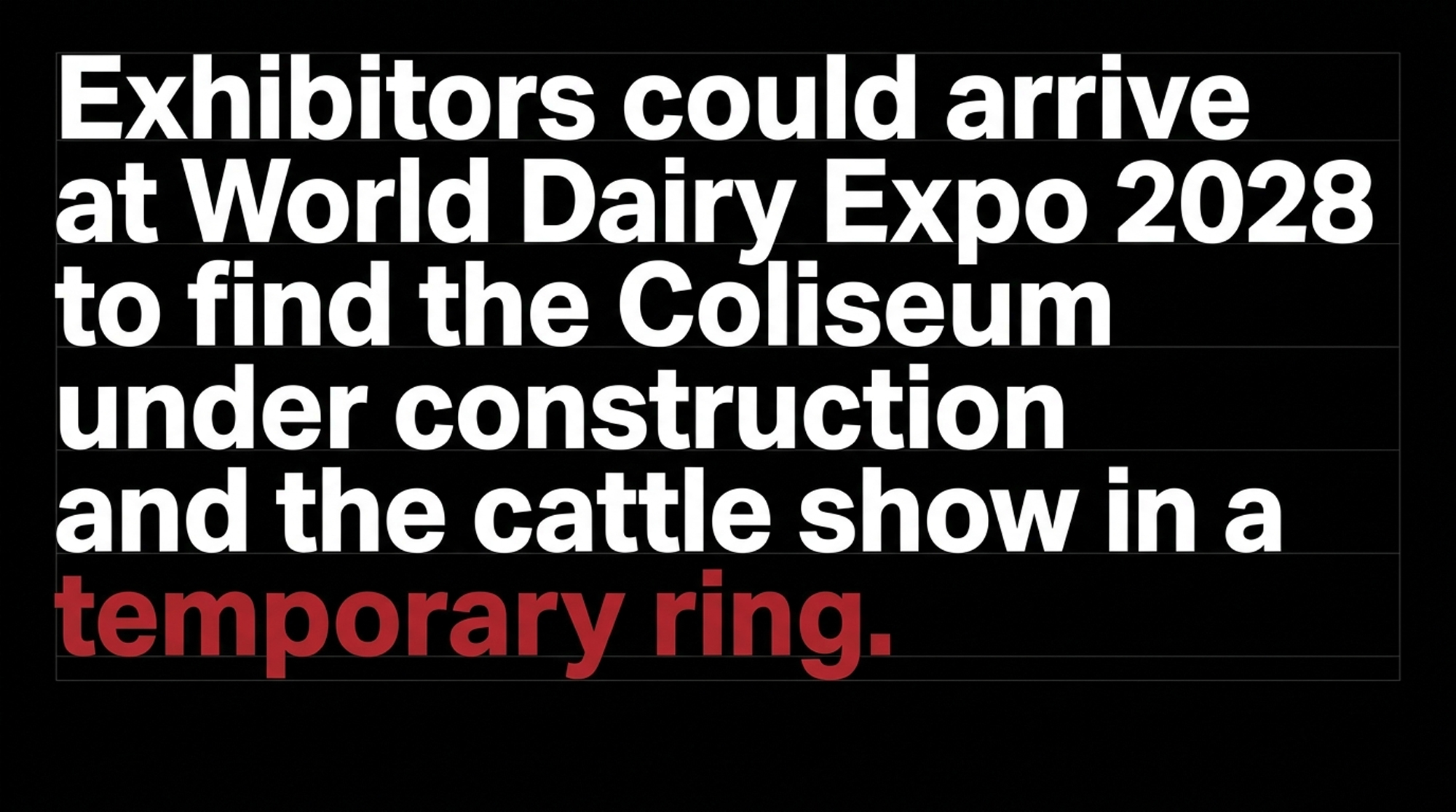
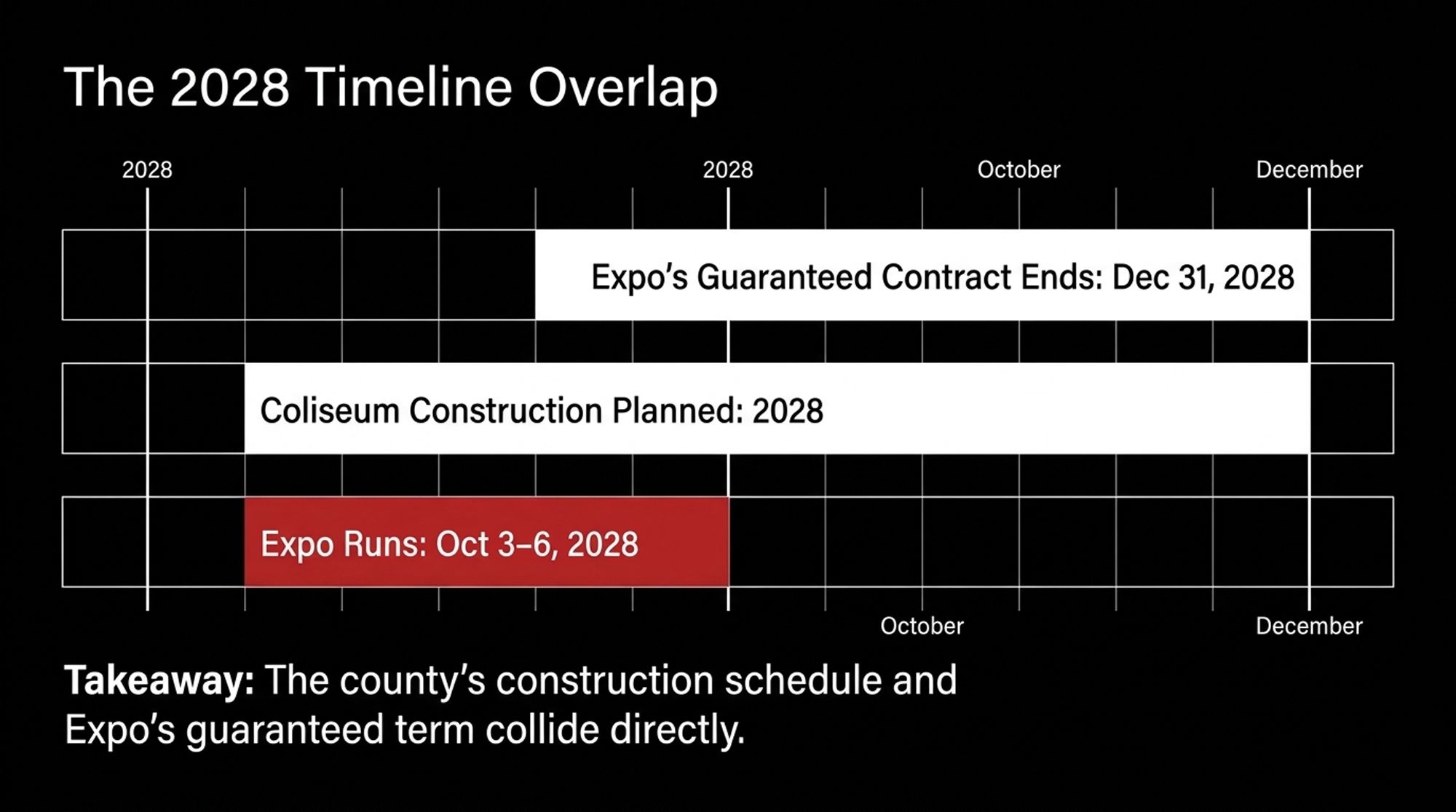
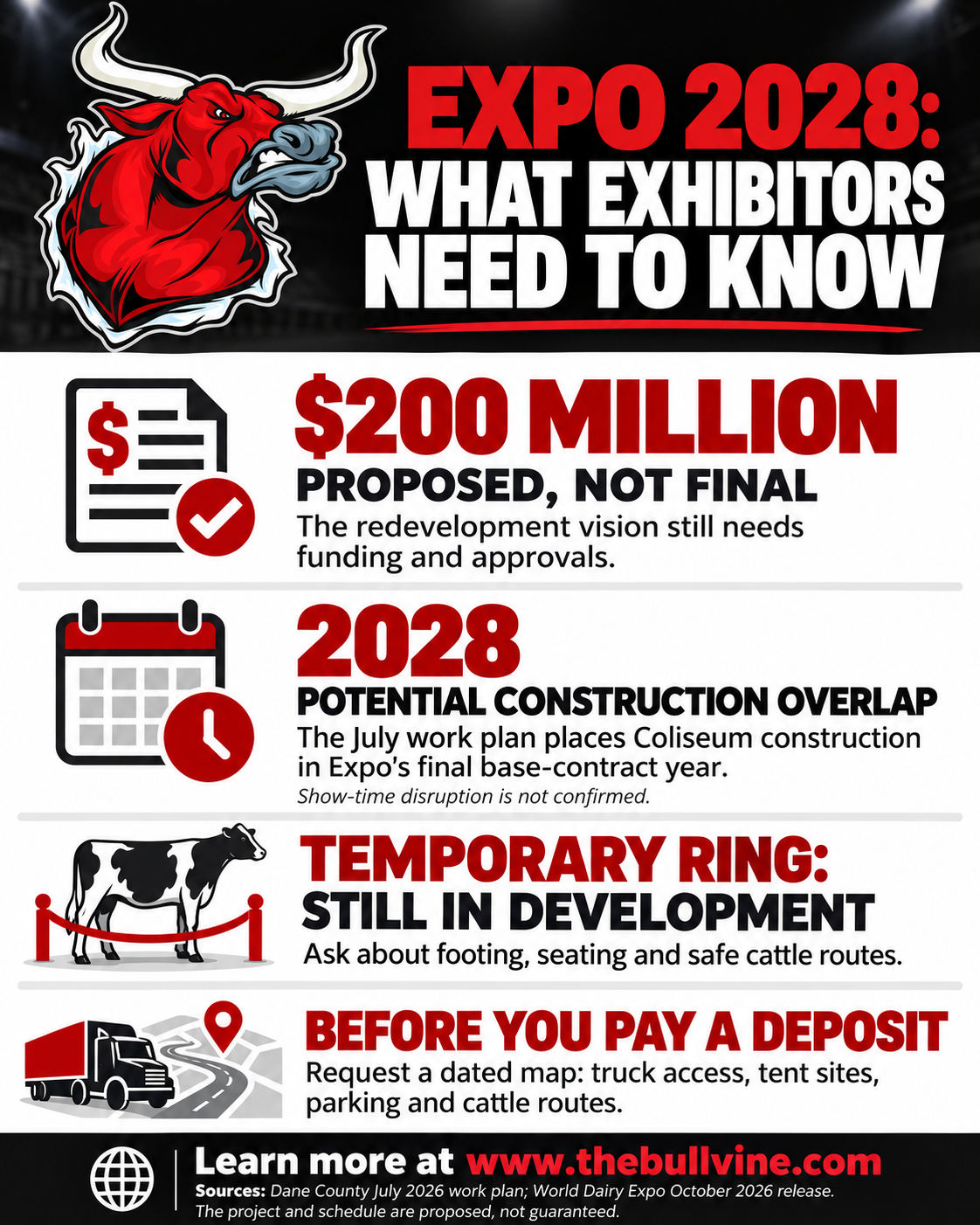
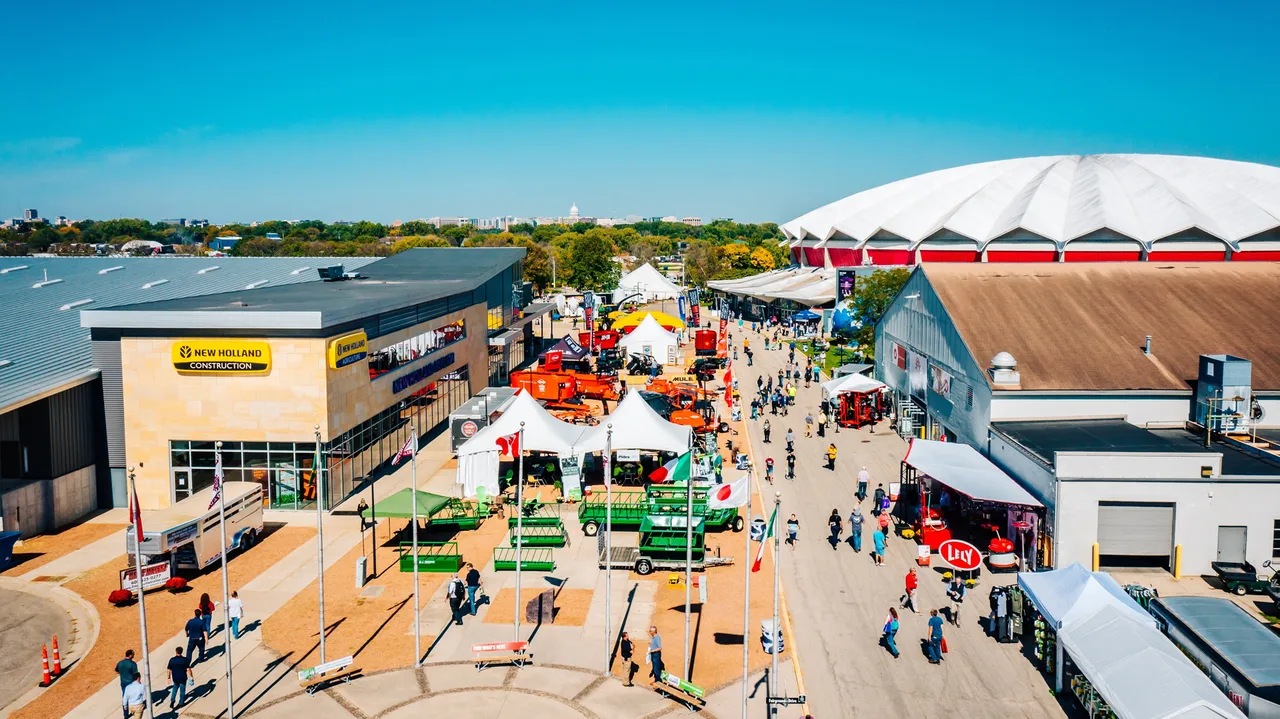
Dane County’s current work plan places Coliseum construction in 2028, the last guaranteed year in World Dairy Expo’s venue agreement. The temporary show ring meant to carry Expo through that work was still being developed when the plan went public. That puts one Expo year squarely inside the county’s timeline.
Dane County’s potential $200 million Alliant Energy Center redevelopment starts with the building World Dairy Expo can least afford to lose: Veterans Memorial Coliseum. The county’s July 20, 2026 work plan put Coliseum design in 2027, construction in 2028 and a goal of reopening in 2029.
Expo’s guaranteed venue agreement runs through December 31, 2028. Three one-year options could keep the show in Madison through 2031. Those options sit outside the guaranteed five-year term approved under Resolution 2023 RES-113 and Contract 15171.
That makes 2028 the exposure year.
Expo is scheduled for October 3–6 that year. On the county’s current calendar, exhibitors could arrive while the Coliseum is being rebuilt and the cattle show runs from a temporary structure. Nobody had designed that structure yet when the plan was presented.
What Dane County has approved
Dane County has not approved a $200 million construction package. The county and World Dairy Expo both describe the redevelopment as a potential project. Each phase still needs financing, agreements and government sign-off.
What the county has approved is Expo’s occupancy agreement. RES-113 authorized Expo to use the Alliant Energy Center from 2024 through 2028, with options through 2031. The County Board adopted it on August 17, 2023.
Contract 15171 runs from January 1, 2024 through December 31, 2028. Its five-year base-space value is about $2.398 million, before parking, catering, goods and services billed at Alliant Energy Center rates.
The redevelopment itself is still a sequence of proposals. The plan presented at Expo in October starts with the Coliseum, then mixed-use development, then the Exhibition Hall expansion. County Executive Melissa Agard’s office said Exhibition Hall capital still needs County Board approval and that the county is working with the Governor’s office on financial backing.
Neither that release nor the July 20 work plan puts a dollar figure on Wisconsin’s share. The only budget item filed so far, 2026 ACT-158, is the Personnel & Finance Committee’s amendments file for the proposed 2027 capital budget. As of October 13 it was still in committee, with no text and no recorded action.
So read “$200 million” as a plan. None of that money is in hand yet.
Which Expo year takes the hit?
Bullvine laid the county’s July 20 work plan over Expo’s occupancy agreement. The result shows one year where the two collide directly, and several years where the risk depends on decisions not yet made.
Expo year
Proposed redevelopment milestone
Expo contract position described in draft
What exhibitors still need to know
2026
Coliseum developer selection and negotiations
Base term: year 3 of 5
Who sets the temporary-ring requirements?
2027
Coliseum design
Base term: year 4 of 5
When will ring specifications and campus-access plans be available?
2028
Coliseum construction
Final year of base term
Will construction affect the October show, and which facilities would replace the Coliseum?
2029
Targeted Coliseum reopening; desired start of Exhibition Hall work
First extension-option year
Will the Coliseum be operational before Expo, and has the option been exercised?
2030–2031
Desired Exhibition Hall construction period, progressing toward 2032
Second and third extension-option years
Which exhibit, meeting and freight areas would remain available?
Reading note: A construction target in the same calendar year establishes potential exposure; it does not establish that work will interrupt Expo. The county’s 2023 announcement confirms a five-year agreement plus three option years.
The strongest verb anywhere in that table is planned. The work plan sets targets, not commitments. It lists no construction start date and no completed financing package. It still tells exhibitors where they need answers first: the ring, in 2028.
The Coliseum goes first
Alliant Energy Center Executive Director Kevin Scheibler said the Coliseum historically hosted about 110 events a year and was planning for about 40 in 2026. That figure covers the Coliseum only, not the whole campus.
Scheibler also said a temporary structure to replace the Coliseum show ring during construction is still under development. The July 20 committee presentations include no design, seating count or cattle-movement plan for it.
For Expo, that temporary ring carries the whole show. It has to handle breed-show schedules, cattle marshalling, footing, seating, production crews, broadcast gear, sponsor inventory and safe movement between barns and ring.
The Alliant Energy Center’s July presentation counted World Dairy Expo as one of 18 agricultural events using the campus. It also showed Expo using every major facility during its late September–early October run.
The July 20 minutes list World Dairy Expo General Manager Laura Herschleb as a committee member. Expo’s October release goes further, calling her committee vice-chair and the only representative of those 18 agricultural events.
That seat gives Expo earlier access to design decisions than any other agricultural show on the grounds. It pays off only if the answers reach exhibitors before contracts, freight orders and travel bookings stop being refundable.
Why the campus needs space
The county’s Exhibition Hall concept adds 50,000 square feet of flexible event space, 19 meeting rooms and a 30,000-square-foot ballroom. The broader proposal also includes a 200-room hotel.
Proposed component
Announced quantity
Intended use or benefit
Question for Expo
Exhibition Hall expansion
50,000 sq. ft.
Additional exhibition and event capacity
How much existing exhibit space would remain usable during construction?
Meeting rooms
19 rooms
More capacity for meetings and associated events
What meeting space would be available during the transition?
Ballroom
30,000 sq. ft.
Additional gathering and event space
Which Expo functions could use it, and when?
New hotel
200 rooms
More lodging on the campus
When would rooms become available for Expo bookings?
Overall redevelopment
Potential $200 million project
Broader campus improvements
Which phases have approved funding and confirmed delivery dates?
Source: World Dairy Expo’s redevelopment announcement, published by DairyBusiness October 7, 2026. The release lists the Exhibition Hall expansion and ballroom separately but does not establish whether their areas should be added together.
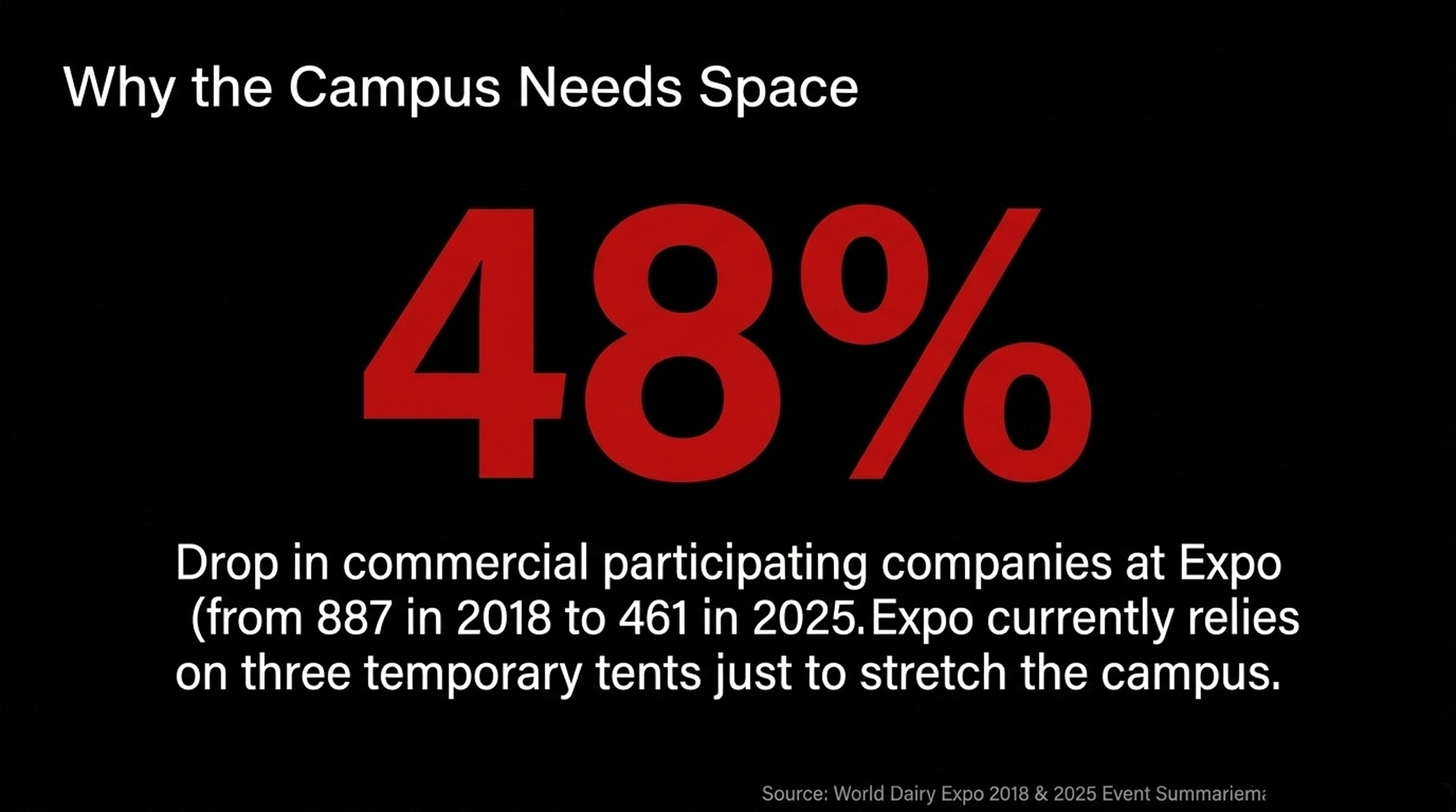
Scheibler said 15 of the Alliant Energy Center’s top 20 events have outgrown the available space. Expo already rents three temporary tents, two for cattle and one for commercial exhibits, to stretch the permanent campus.
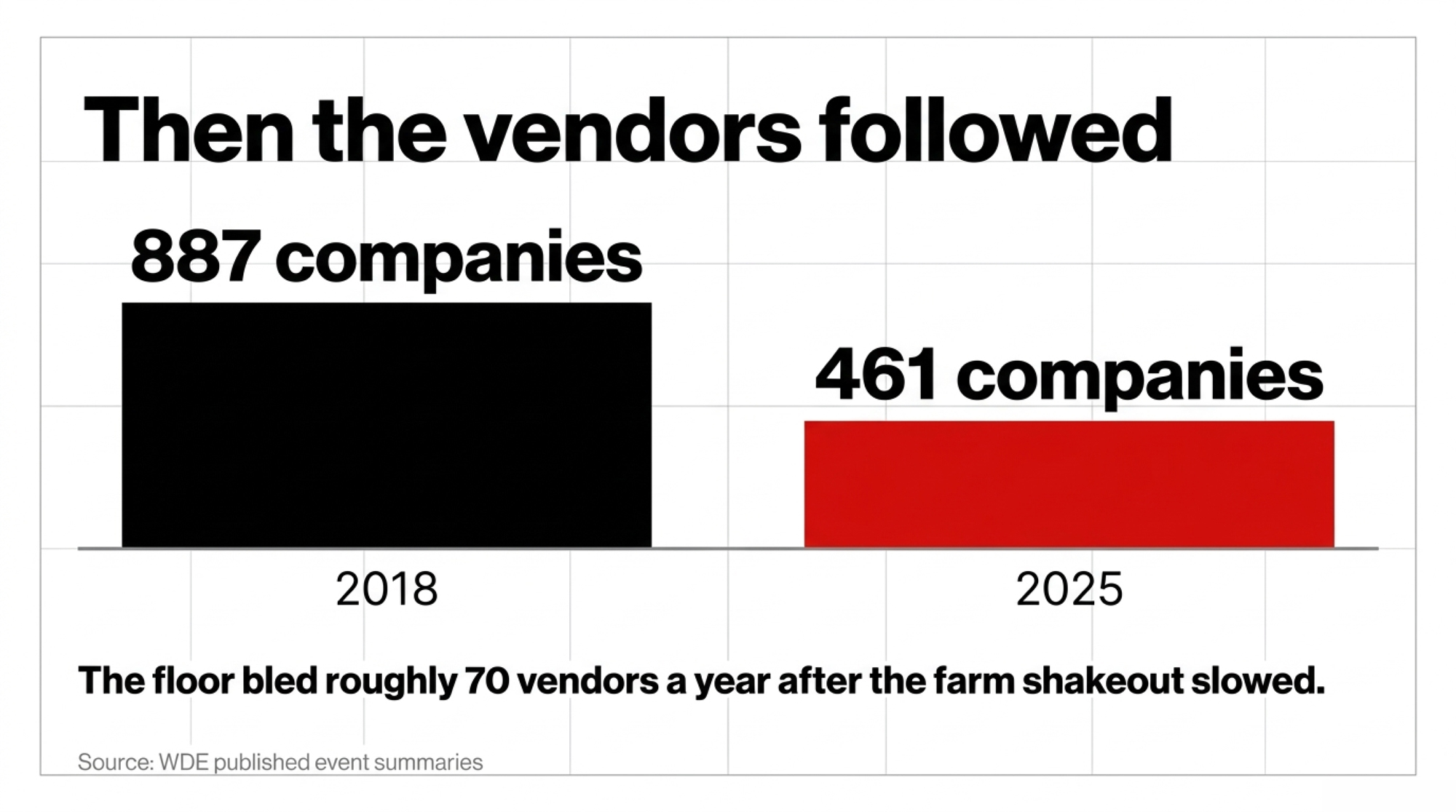
Space hasn’t been the trade floor’s only problem. Expo’s 2018 Show Summary counted 887 participating companies. Its 2025 Event Summary counted just 461. By The Bullvine’s math, that’s 426 fewer companies—a 48.0% drop in seven years.
The July presentation also called for a new agricultural arena, an outdoor exhibition plaza, better vehicle circulation and more than 300 extra hotel rooms across the campus. All of those are still planned improvements, not approved construction.
Trade exhibitors will care about the Exhibition Hall expansion eventually. The 2028 question comes first: does Coliseum construction eat into parking, outdoor exhibit space, freight routes or the ground Expo’s tents sit on now?
What Waterloo already taught
Bullvine’s Waterloo coverage traced how the National Dairy Cattle Congress held dairy’s October slot from 1910 to 1965 and then drifted from the exhibitors who’d built it. Two years later, Expo opened in Madison.
Madison starts this from a stronger position. Expo holds a guaranteed contract through 2028 and a seat on the county’s redevelopment committee. Both only count if they produce an operating plan before exhibitors commit money to the 2028 show.
The 2023 agreement kept Expo at the Alliant Energy Center, its home since the first show in 1967, through at least 2028.
Issue
What the accessible announcements establish
What they do not establish
Information needed next
Redevelopment funding
The project is described as potentially costing $200 million; Exhibition Hall funding needs County Board approval
That the entire project is financed—or that no funding exists for any component
Funding status and approval requirements by phase
Temporary cattle ring
Officials are working with developers on a temporary structure; timing and plans remain under development
A completed design, seating capacity, footing specification or cattle route
Temporary-ring specifications and delivery deadline
Continued occupancy
The announced agreement includes a five-year term and three option years
Option notice deadlines, current exercise status or detailed construction protections
Relevant contract clauses and current option status
Existing temporary facilities
Expo reports using three tents: two for cattle and one for the trade center
Whether construction would affect their sites or access routes
A dated construction and event-layout map
Agricultural representation
Expo’s general manager is identified as redevelopment committee vice-chair and the sole representative of 18 agricultural shows
Exclusive access to information or an approved exhibitor operating plan
A schedule for communicating decisions to affected exhibitors
Sources: Dane County’s July 2023 agreement announcement and World Dairy Expo’s October 2026 redevelopment release. These announcements support the distinctions above; detailed contractual protections require review of the agreement itself.
What this means for your operation
Nobody needs to change their 2027 Expo bookings today. The county’s plan does set three decision points before the 2028 show.
Before 2027 design closes
Cattle exhibitors and breed associations should ask Expo for the temporary ring’s proposed dimensions, footing, warm-up area, marshalling space, seating capacity and covered route from the barns.
The test is simple. If the temporary ring can’t handle the Coliseum’s class volume, crowd and production schedule, breed schedules and stalling plans need to change before 2028 entries open.
Commercial exhibitors should ask whether the 2028 construction footprint reaches outdoor displays, freight staging, parking or the three temporary-tent sites. Your booth can be inside Exhibition Hall and still get hurt by a blocked loading route outside it.
Before signing 2028 contracts
Trade-show companies should ask for a dated campus map showing construction fencing, truck access, unloading windows, temporary power, parking and pedestrian routes.
If that map doesn’t exist before freight, tent, hotel or equipment deposits go non-refundable, build in a contingency. Don’t assume the 2027 layout carries into 2028.
Breed associations should also pin down who pays if temporary facilities need different seating, audiovisual gear, flooring or hospitality setups. Expo’s venue agreement locks in the dates. It doesn’t say who absorbs each association’s construction-related costs.
Before exercising 2029 options
Expo’s 2029–2031 dates are options, not guaranteed years. Any decision to exercise them should be checked against the actual Coliseum delivery date and the Exhibition Hall schedule in force at the time.
If the Coliseum really opens in 2029, the biggest cattle-show risk goes away. But Exhibition Hall construction starting that same year would shift the pressure onto commercial exhibitors, meetings, food service and freight.
Dane County has time to solve the sequence. Exhibitors need that answer before they sign non-refundable 2028 orders.
Complete references and supporting documentation are available upon request by contacting the editorial team at editor@thebullvine.com.
Learn More
The Real Price of World Dairy Expo: $3800 a Cow — Your blueprint for surviving October’s hidden costs. Breaks down the $3,800 per-head reality of hauling a five-cow string to Madison, exposing how fixed fees and skilled fitters dictate your actual show ring margins before the trailer ever leaves.
World Dairy Expo’s Home Base Clears Its First Hurdle for a Major Expansion — Map out your next commercial booth footprint using this timeline of the Alliant Energy Center’s incoming overhaul. Reveals exactly how the Exhibition Hall expansion threatens to choke trade show logistics and force vendors to rewrite their multi-year contracts.
The Kids Aren’t Coming – They Already Own Dairy’s Future (World Dairy Expo Proves It) — Think the next generation is just watching the colored shavings? Think again. Shows how aggressive young breeders are already commanding elite genetics and navigating an 800,000-head heifer shortage to capitalize on $10 billion in new processing capacity.
The Sunday Read Dairy Professionals Don’t Skip.
Every week, thousands of producers, breeders, and industry insiders open Bullvine Weekly for genetics insights, market shifts, and profit strategies they won’t find anywhere else. One email. Five minutes. Smarter decisions all week.
The National Dairy Cattle Congress owned October from 1910 to 1965. Then it dropped “Dairy” from its own name and bet the building on a greyhound track. This month its fair closes two days before Expo’s gates open.
The short version, for anyone reading this in the parlor
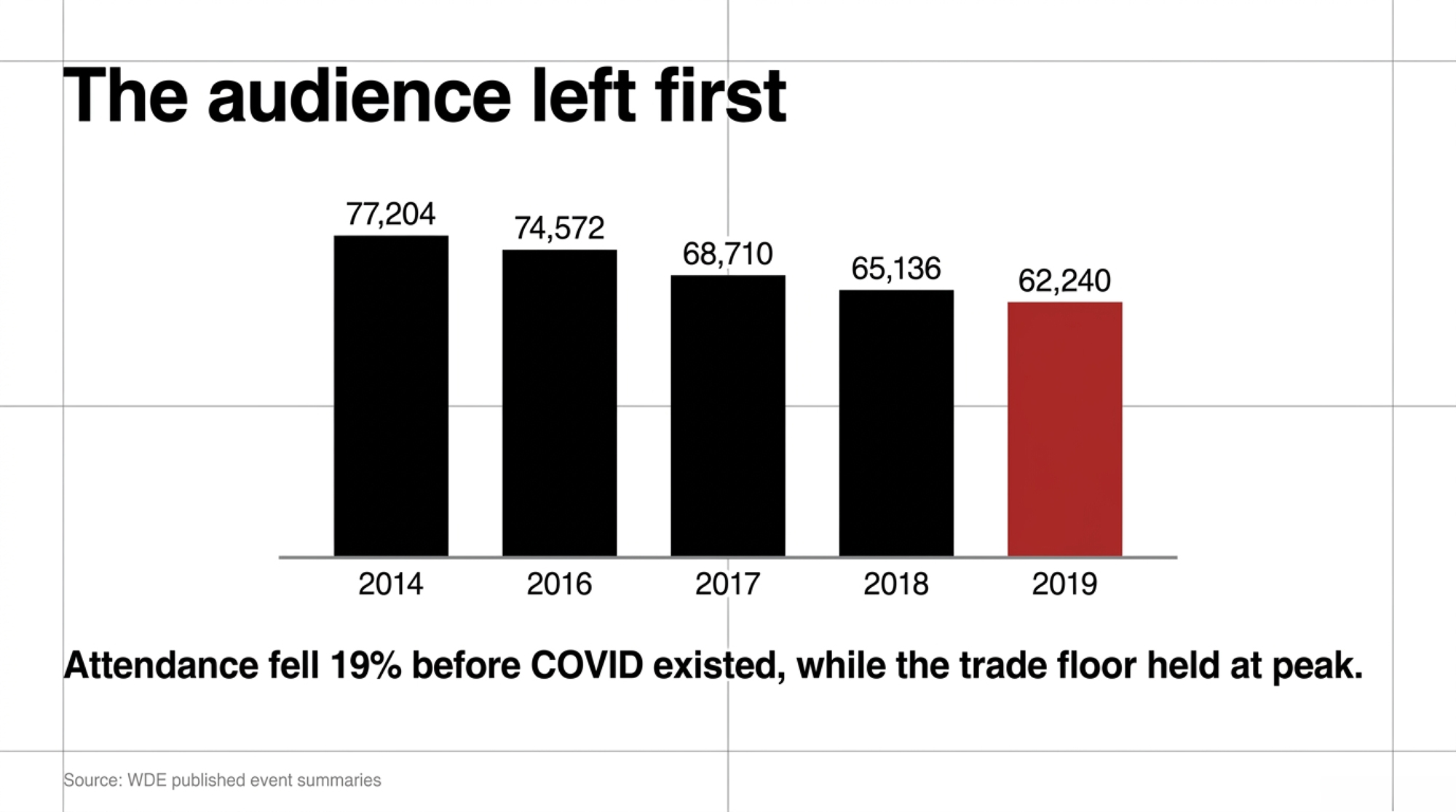
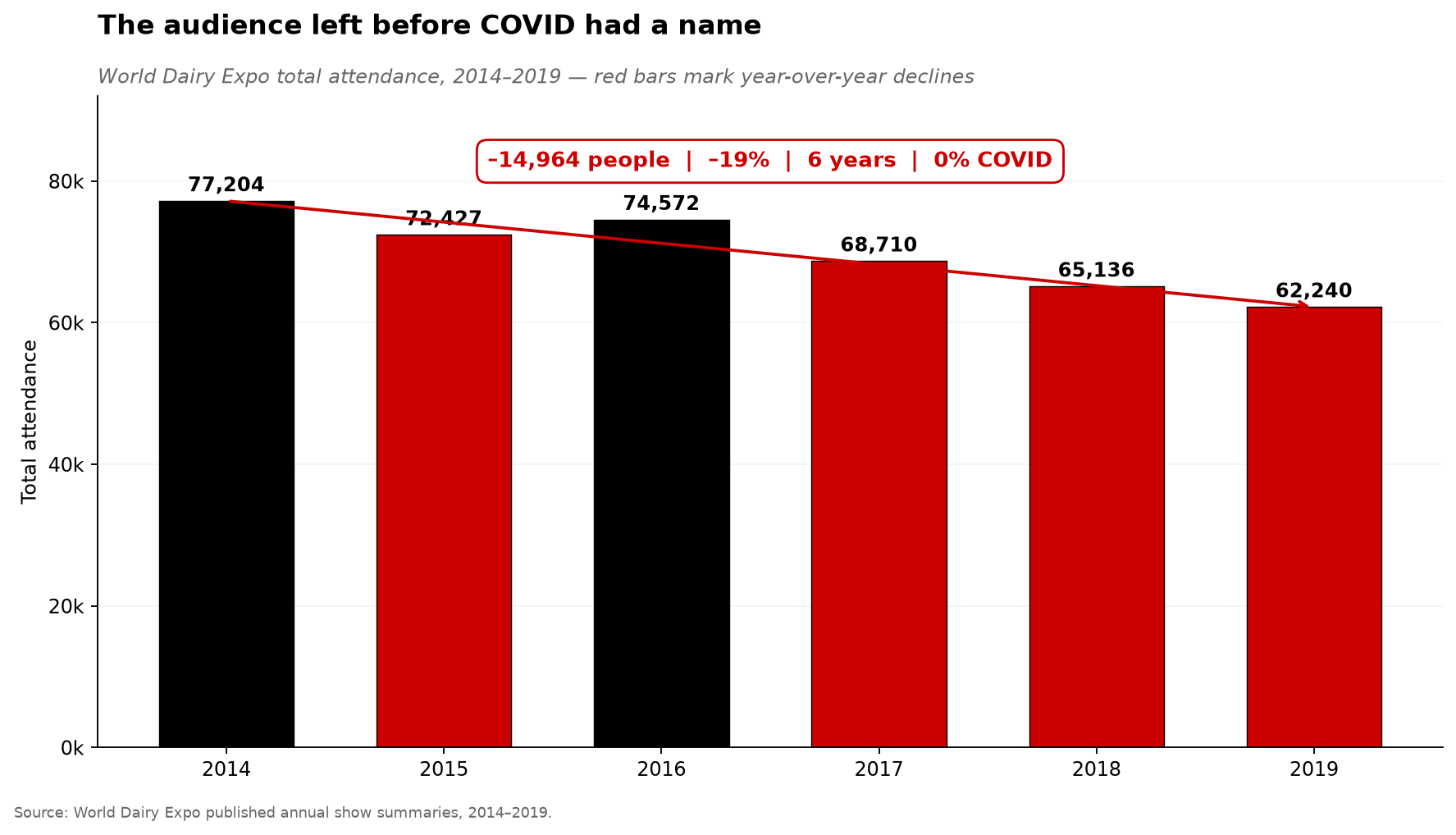
The audience left first. World Dairy Expo attendance fell every year from 2014 to 2019 — down 19% before COVID existed — while the trade floor held near its peak.
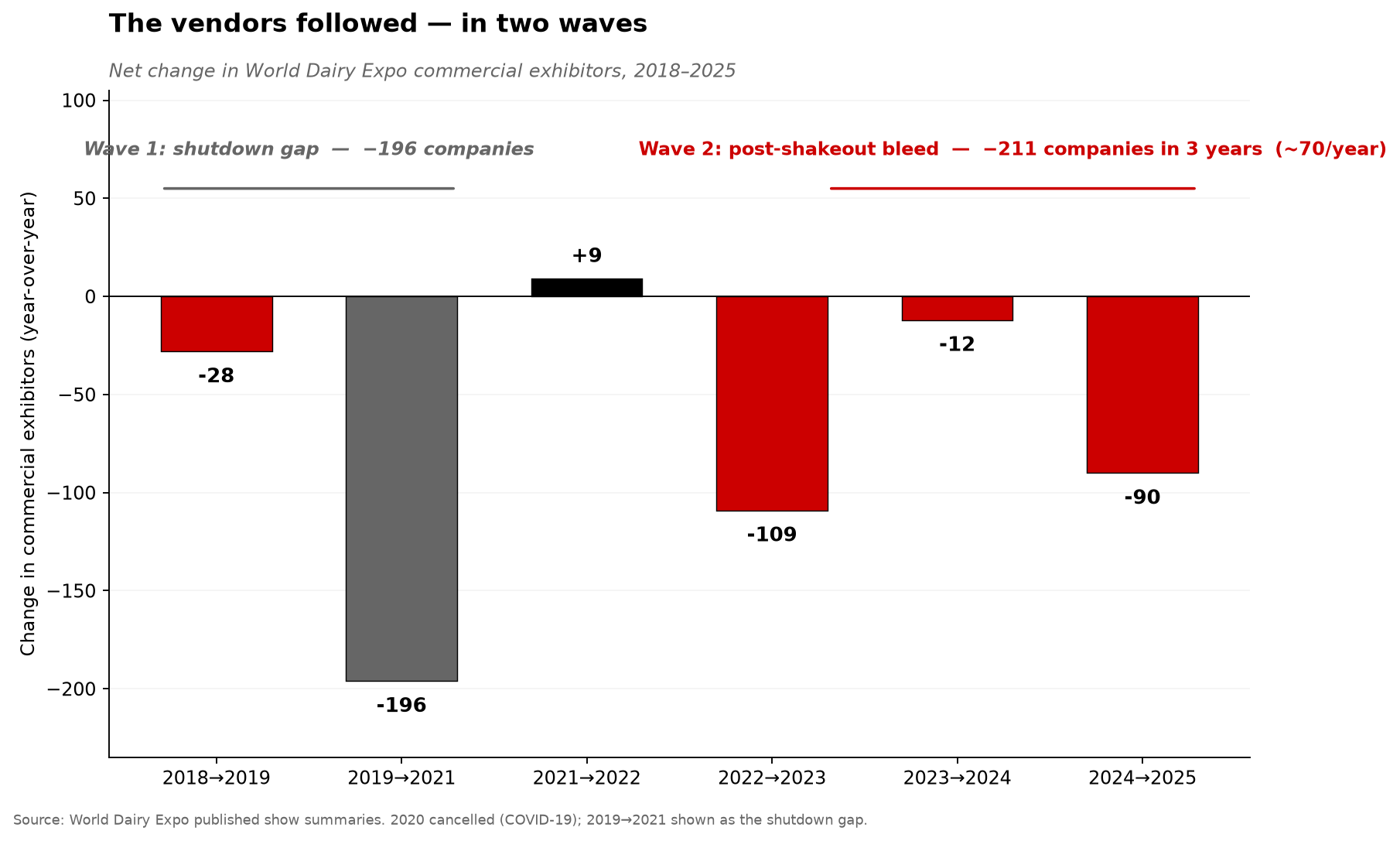
Then the vendors followed. The floor went from 887 in 2018 to 461 in 2025, a 48% loss, with 211 of it in the three years after the farm shakeout slowed.
Cattle sit at 108% against 2016. Waterloo died the opposite way and ended up in the same place. Read the inversion below.
Norman Nabholz can still smell it. “I was captivated by it,” he told The Bullvine in 2013, remembering the National Dairy Cattle Congress in Waterloo, Iowa. “I remember everything, from the smells to the sights, sounds, and the people. It’s why I’m in the business that I’m in today.”
That’s not idle nostalgia. Nabholz has been showing since his first champion in 1974, and he wrote the book on Waterloo — literally, Millionaires in the Cornfields: The Glory Days of the National Dairy Cattle Congress. So when he read our reporting on World Dairy Expo’s decline this summer and reached for a warning in the comments, it carried weight. “Sixty-one years ago this October we were heading to Waterloo and thought we would be doing it forever.”
Do that math. Sixty-one years back from this October is 1965, the exact year the dairy establishment walked out of Waterloo. And when the gates open September 29, the 59th World Dairy Expo runs at the Alliant Energy Center in Madison, on a venue contract that extends through 2028, which makes this the moment to ask an uncomfortable question about permanence.
What Waterloo actually was
Don’t picture a county fair. Picture the center of the dairy universe.
The National Dairy Cattle Congress opened October 9–10, 1910, built by the Iowa State Dairy Association as a nonprofit exposition to grow the industry. It swung big from day one: roughly 5,500 people the first day, about 40,000 over the opening weekend, and it still turned a profit. By the accounts compiled in the National Cattle Congress’s own published history, attendance reached 87,000 by 1919, pulled in by a new Hippodrome seating around 7,000 and the growing prestige of the Belgian Horse Show.
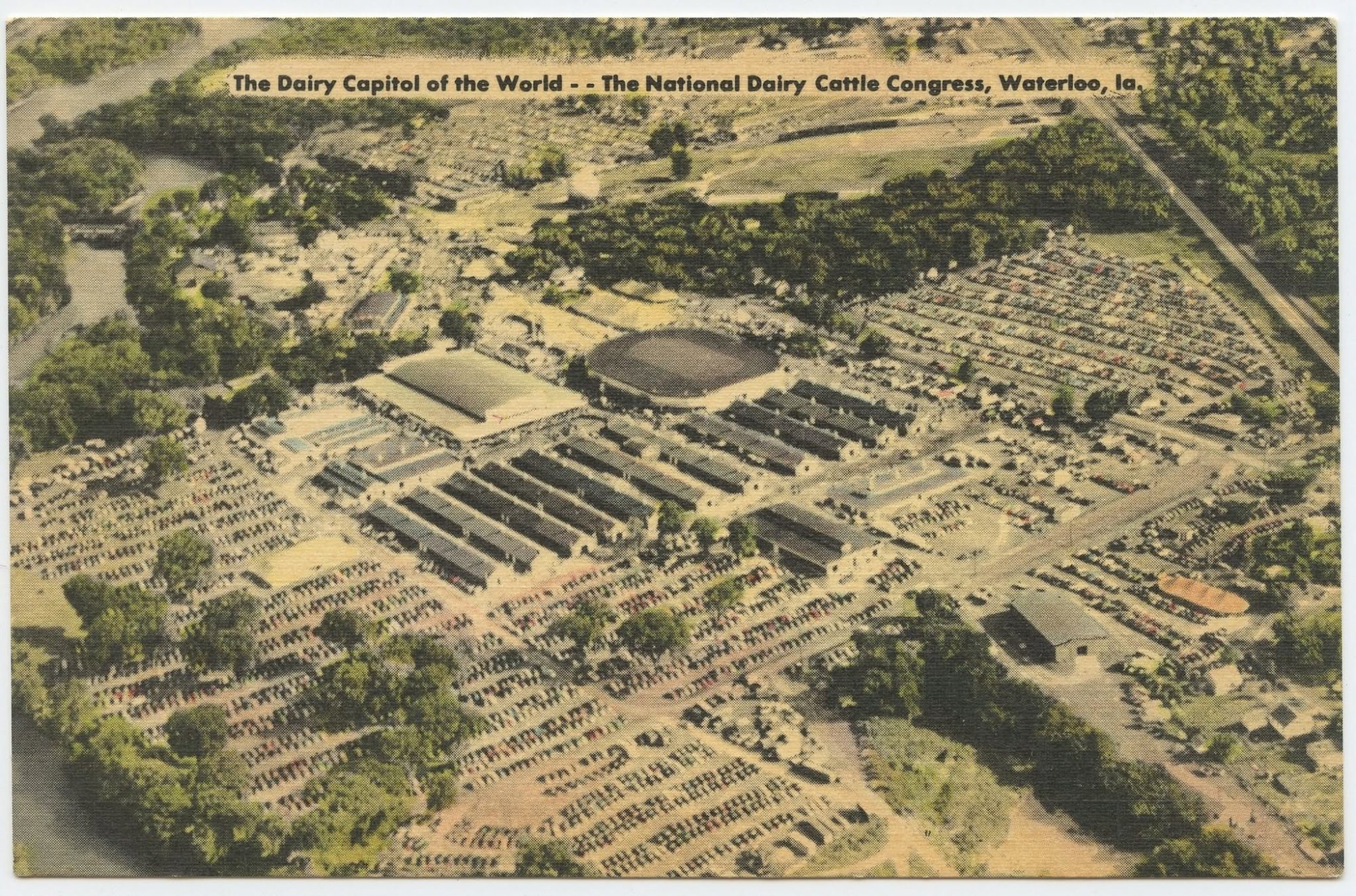
“The Dairy Capitol of the World.” Waterloo printed that on postcards and mailed them. Look at how much of this ground is parked cars rather than barns — at Waterloo the gate was the asset. Remember that when you reach the attendance column.
The credibility followed the crowds. In 1948, four national dairy breed organizations made Waterloo their official National Show, and the National FFA dairy contests had already moved there the year before. This was where the breed sorted itself out. Best cattle, best judges, best people, one barn, every October.
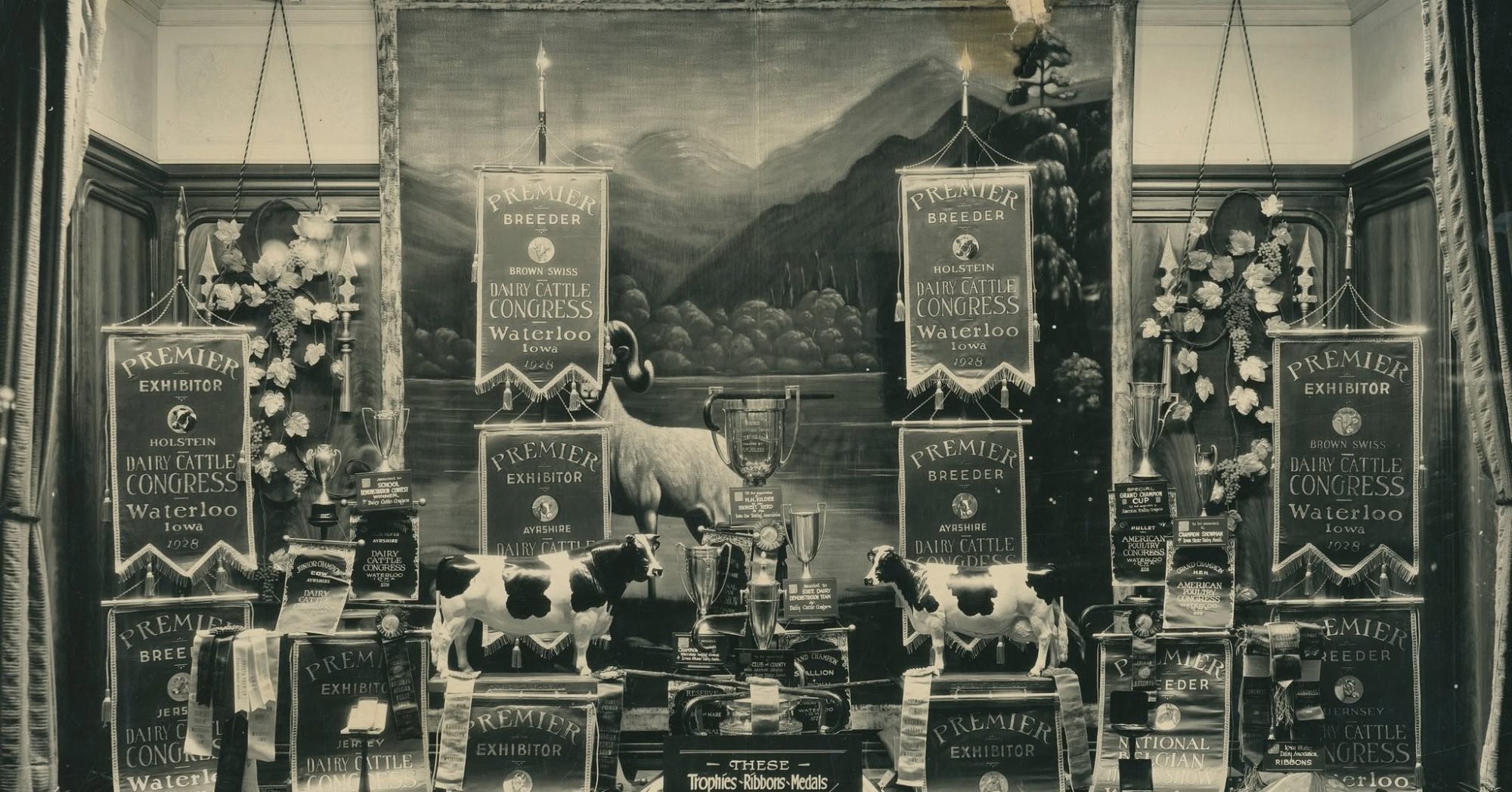
Waterloo, 1928. Premier Breeder and Premier Exhibitor banners for Holstein, Jersey, Guernsey, Ayrshire and Brown Swiss — every dairy breed in America, competing in one Iowa city. Four national breed associations wouldn’t name Waterloo their official National Show for another twenty years. The hardware got there first.
Nabholz doesn’t hedge on what that meant. He’s called it “the world’s greatest dairy cattle show from 1910 to 1965.” Read that end date twice. The man who loves the place most is the one telling you when the clock started running out.
How a legend talks itself into a slow death
Big institutions rarely die in one loud crack. They erode in decisions that each sounded reasonable at the time.
Waterloo’s turn came in the 1960s, when the show started “refocusing.” The University of Northern Iowa’s Black Hawk County history is blunt: the dairy focus was slipping. Farm machinery ate more floor space. Horse shows grabbed more billing. The event stretched to nine days. Every step got sold the same way — the public wants variety, farming’s changing, give people more show. Sounds sensible. It usually does, right up until the mission gets watered down past recognition. You can watch it happen in the show’s own advertising.
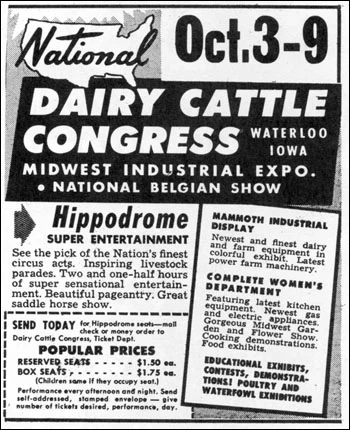
Read what Waterloo was selling. This undated Dairy Cattle Congress advertisement headlines circus acts, a saddle horse show, power farm machinery, kitchen appliances, a flower show and waterfowl. Not one of its three featured attractions is the dairy cattle show. The name still said National. The billing had already moved on.
The problem wasn’t that management adapted. It’s what they adapted toward. The breed associations that had bankrolled Waterloo for decades watched a dairy show trying to be everything to everybody, and they walked. The UNI history says their frustration “came to a head in 1965,” when the National Dairy Association pulled its support and moved its shows to Madison, Wisconsin.
That’s the hinge. Everything before it was a warning. Everything after was a consequence. And here’s the part that should make every breeder wince. With the dairy backing gone, the National Dairy Cattle Congress became simply the National Cattle Congress. They dropped “Dairy” from the name. That’s not rebranding. That’s a coroner’s note.
Maurice Telleen, the secretary-manager who lived through it and later founded the Draft Horse Journal in Waterloo, said the show was no longer national but regional, and pointed to the crumbling economics of shipping cattle long distances by rail as service declined. Real enough. But only half the story. Waterloo also lost its ability to convince the dairy world it was the one show nobody could skip. Lose that, and the trucks stop coming no matter how good your rail spur is.
Madison wasn’t an accident – it was the autopsy
Here’s the twist that should rattle every Expo loyalist. World Dairy Expo exists because Waterloo failed to hold the center.
The Bullvine’s own founders’ history says Gene Nelson saw Waterloo’s “dwindling popularity” firsthand when he and three others launched a new exhibition. The first World Dairy Expo ran in 1967, two years after the dairy establishment abandoned Iowa. The biggest dairy show on earth was born straight out of the moment the old giant stopped being enough.
One detail worth clearing up, because it came up in the same comment. Nabholz pointed readers toward a book called We Need a Show. The book is real, though it tells the other half of the story: We Need a Show: A 50 Year History of World Dairy Expo, published in 2015 by W.D. Hoard & Sons and co-edited by Corey Geiger and Steve Larson. It’s Expo’s history rather than Waterloo’s autopsy. His point survives the correction, though, and the title makes it for him. Expo’s whole reason for existing was a room full of people looking at a drifting institution and saying, flatly, we need a show. That’s the verdict on Waterloo, printed on a cover.
Now the part that cuts the other way. Expo wasn’t born bulletproof either. Dairy Agenda Today’s history shows the early years were shaky, and the trade floor only took off after leadership changes in the late 1980s, when Tom McKittrick and Joe Gilbert rebuilt the commercial engine. When Madison wobbled, people made hard choices and fixed it. Waterloo drifted. Madison fought. Hold onto that difference.
The long fade – from dairy cattle to dog track
After 1965, Waterloo didn’t vanish. That’s exactly what made the decline easy to ignore. The grounds still ran. The fair still opened. The name still carried a century of history. The institution kept moving, which let everybody pretend it was still the same institution. It wasn’t.
The 1970s pushed the same diversification logic into farm implements, more horse shows, and big-name entertainment. The UNI history’s language is brutal: the National Cattle Congress was starting to look like a small-time carnival with sideshow attractions, with people showing up to ride the midway and eat the food while the livestock took a back seat. That reads as a diagnosis of a show that forgot which audience built it.
Then the money ran out. By 1984 the organization was in serious financial trouble, and the rescue plan was pari-mutuel greyhound racing. Waterloo Greyhound Park opened October 15, 1986. For exactly one year it looked like salvation: roughly $600,000 in track profit and a $519,000 gain for the Cattle Congress, figures carried in both the UNI history and the Waterloo Courier’s published NCC timeline. Sit with that. An institution built to crown the world’s best dairy cattle was betting its survival on dog racing.
The bet went bad fast. By 1989, management admitted the track was in trouble and warned that if it failed, the banks would own both the track and the Cattle Congress. In December 1992, the Meskwaki Casino opened in Tama, half an hour away, with gambling the track couldn’t touch. A 1993 bankruptcy auditor concluded the organization would have folded eight years earlier without the track’s yearly cash infusions. The Meskwaki Nation later lent the NCC bailout money and eventually foreclosed on the property. The dogs only stretched out the dying.
Then came the headline that says everything. When the Waterloo Courier ran “Cattle Congress Cuts Cows,” the show once built on elite dairy cattle could no longer afford to hold the livestock shows. That’s the cleanest definition of institutional death you’ll read: the day your institution can no longer afford to do the one thing it was built to do.
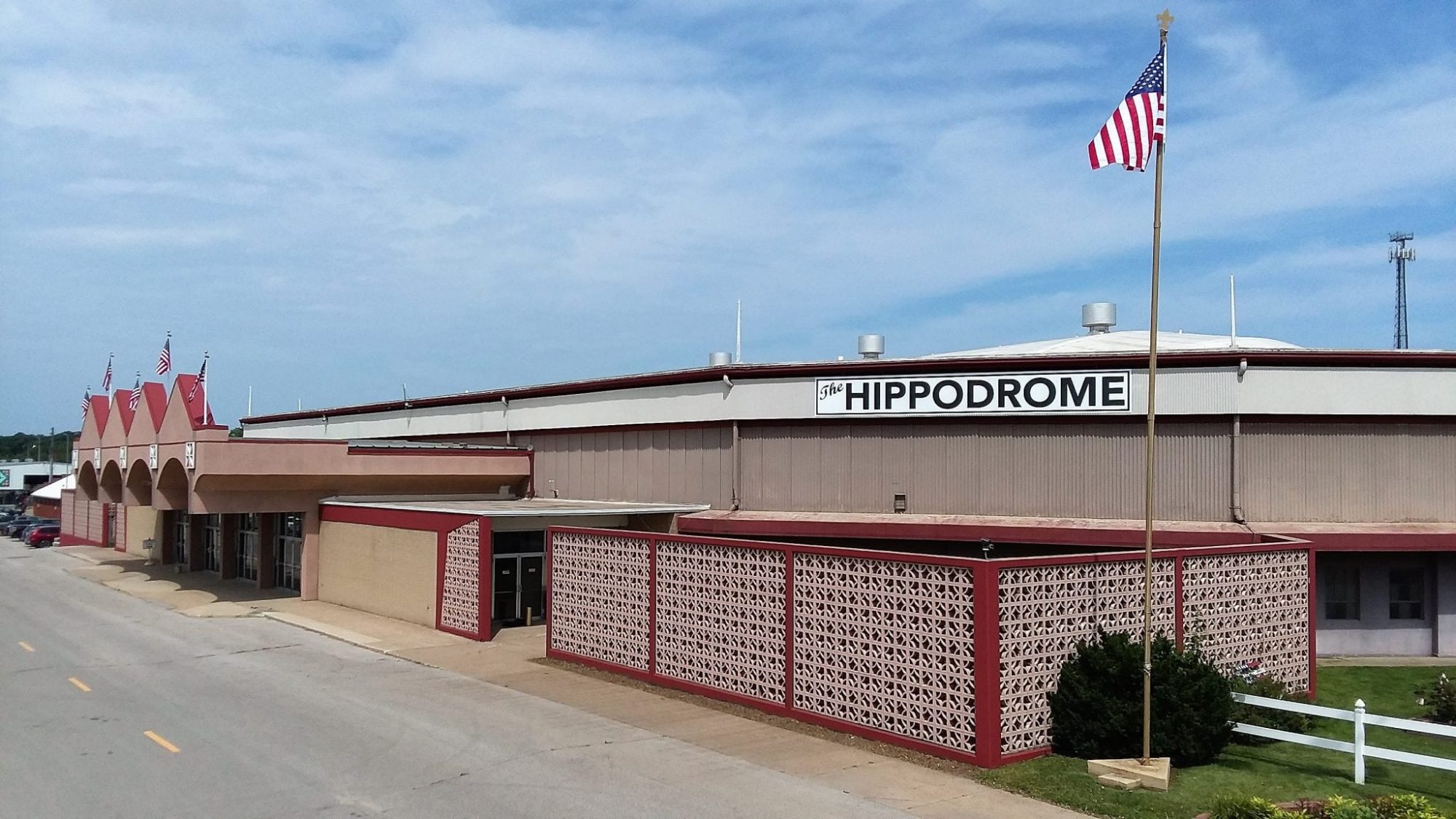
Here’s the part that should stop you cold, and it’s happening this month. The National Cattle Congress is still there. The 116th National Cattle Congress Fair runs September 24 through 27, 2026, on the same Waterloo fairgrounds, with a carnival, ranch bronc and bull riding, general admission at $15, and the tagline “Still Our Story.” The Hippodrome still stands, rented out at 20,000 square feet. The financial difficulties described above belong to that organization’s 1980s and 1990s management, and the National Cattle Congress today operates under different leadership. Their fair closes on a Sunday. Expo’s gates open two days later. The grounds survived. The National Dairy Cattle Congress, as North America’s premier dairy show, did not. The buildings outlived the mission.
Waterloo’s Hippodrome today. Somebody still mows this, still flies the flags, still repaints the trim, still rents the floor at 20,000 square feet. Institutions rarely die because nobody cared for the buildings.
Is World Dairy Expo actually turning into Waterloo?
No. But the specific mechanism is worth understanding, because it isn’t the one people watch for — and the full twelve-year record tells a different story than the headline number does.
Start with what was never in doubt at Madison. The Expo cattle show is healthy. The breeders held their end, and every year the families still hitched up and hauled the best genetics on the continent to Wisconsin. If you’re waiting for someone to say the cows have gone soft, this isn’t that article.
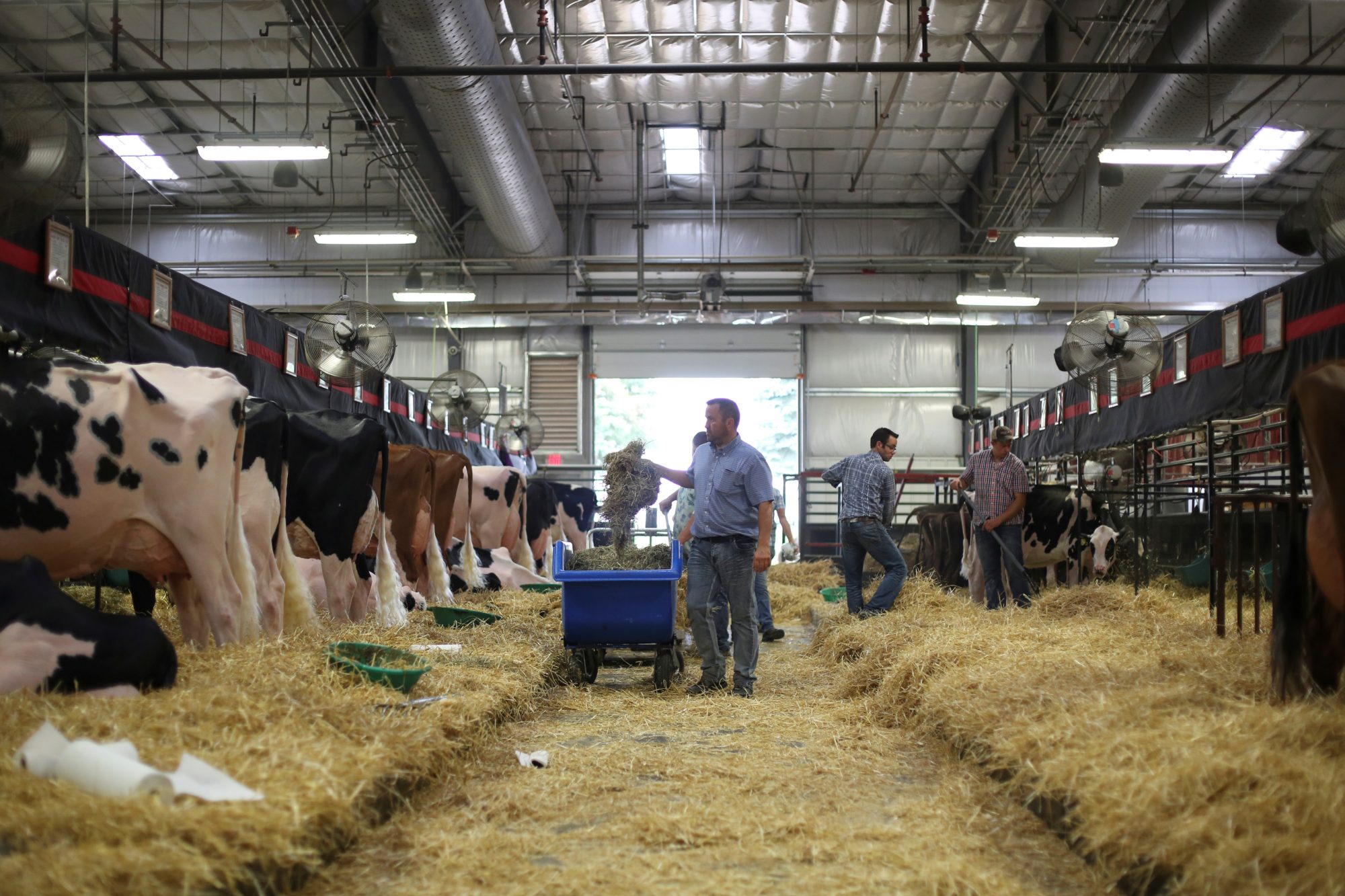
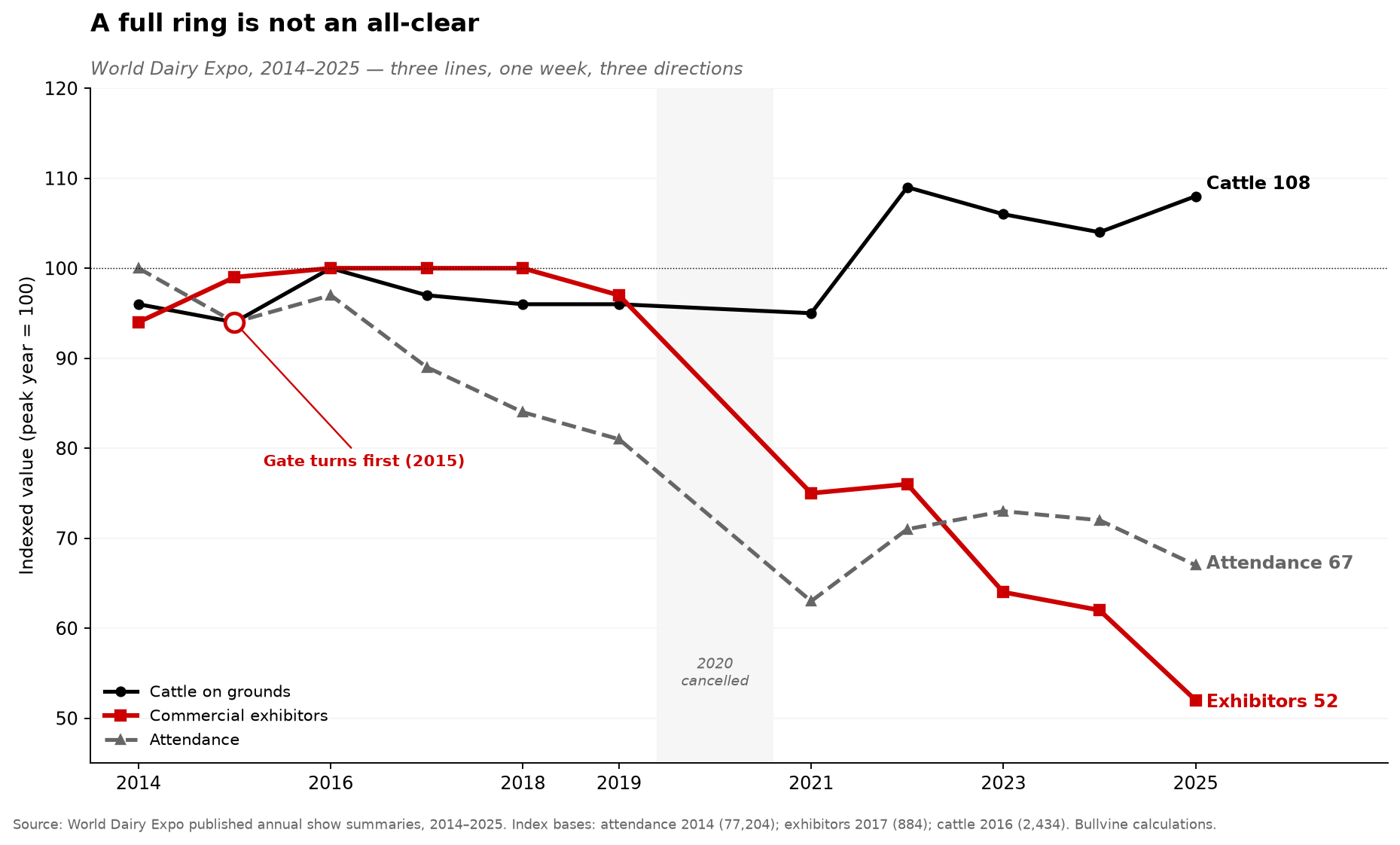
This is the line that went up. Fresh straw, clipped cattle, framed photos on the drapes, a crew still working the aisle — and nobody made them do any of it. Cattle on the grounds sit at 108% against 2016 while attendance sits at 67% and the trade floor at 52%. The only number still climbing is the one exhibitors pay about $3,800 a head to put there.
Here is the complete record, from Expo’s own published show and event summaries. Index values in brackets: exhibitors against 884 in 2017, cattle against 2,434 in 2016, attendance against 77,204 in 2014.
Year
Commercial exhibitors
Cattle on grounds
Attendance
2014
835 (94)
2,334 (96)
77,204 (100)
2015
871 (99)
2,296 (94)
72,427 (94)
2016
881 (100)
2,434 (100)
74,572 (97)
2017
884 (100)
2,356 (97)
68,710 (89)
2018
887 (100)
2,338 (96)
65,136 (84)
2019
859 (97)
2,331 (96)
62,240 (81)
2020
cancelled (COVID-19)
—
—
2021
663 (75)
2,306 (95)
48,502 (63)
2022
672 (76)
2,663 (109)
54,525 (71)
2023
563 (64)
2,571 (106)
56,250 (73)
2024
551 (62)
2,527 (104)
55,209 (72)
2025
461 (52)
2,625 (108)
51,525 (67)
Read the attendance column down before you read anything else. It falls in 2015. It falls again in 2017, 2018, and 2019. By the last show before the pandemic, Expo had lost 14,964 people, down 19% from 2014 — and not one of those years can be blamed on COVID. The crowd was leaving for six years, and the industry talked about it as if it hadn’t started.
Now read the exhibitor column next to it. Through all of that, the trade floor held. It peaked at 887 companies in 2018, the fifth consecutive year of falling attendance. Vendors were still buying booths at a show whose audience had already shrunk by a sixth.
That’s the finding, and it isn’t the one we expected. The audience left first. The vendors followed. They followed in two waves: 196 companies gone across the shutdown gap between 2019 and 2021, then another 211 in the three years from 2022 to 2025 — about 70 a year, in a stretch when the farm shakeout had largely run its course. The first wave has an obvious explanation. The second doesn’t.
These are not contested numbers, and Expo isn’t hiding them. Its own website currently describes the trade show as “over 450 companies from 15 countries,” which squares with the 461 it published for 2025. The disagreement here is about what the trend means, not what the figures are.
And the cattle held throughout. Head on the grounds peaked at 2,663 in 2022 and sits at 2,625 today, index 108 against 2016 and up 12% on 2014. Set that beside a trade floor at 52 and an audience at 67. Same show, same week, one line up and two lines halved or worse.
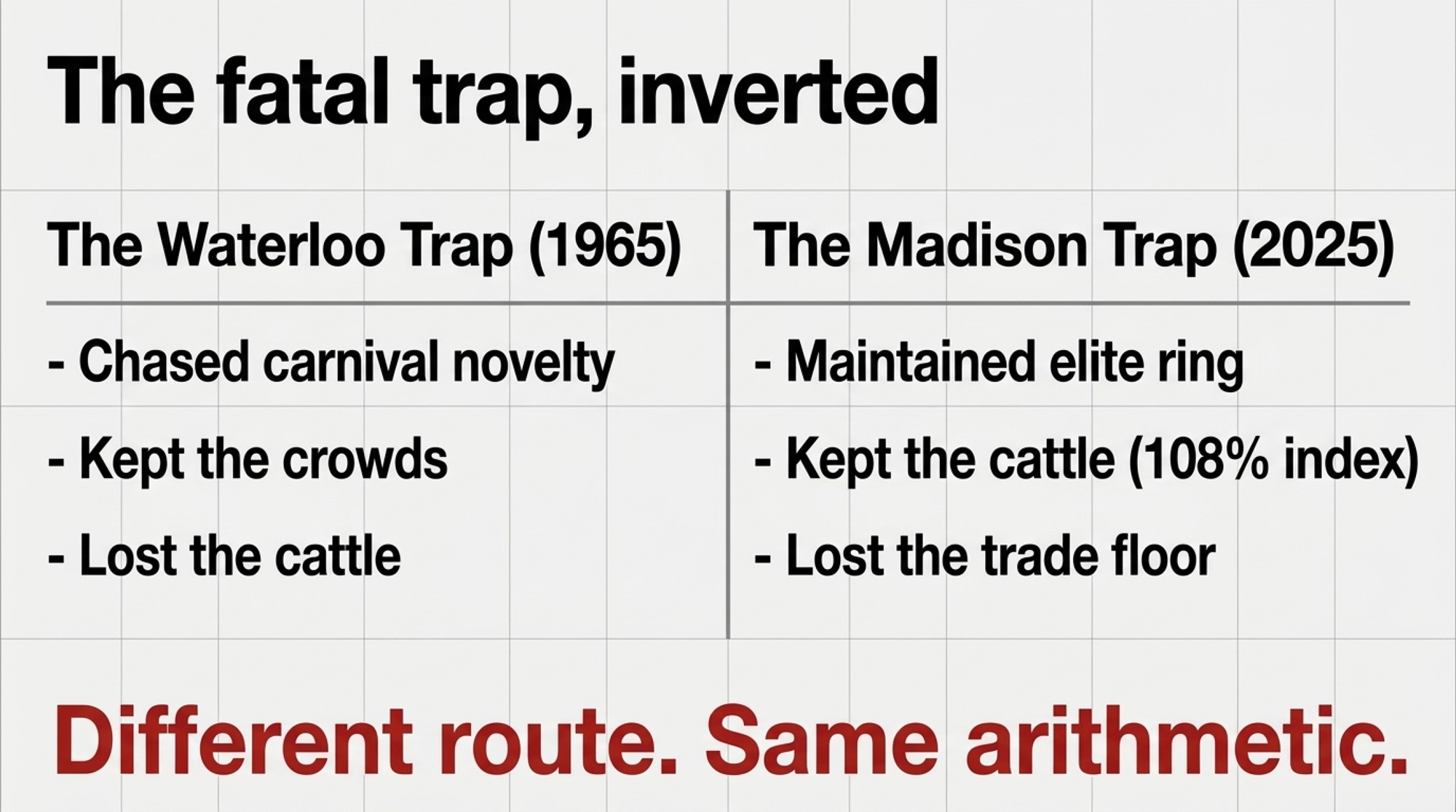
The inversion worth sitting with. Waterloo choked because management chased trade-floor novelty and entertainment at the expense of the cattle, until the breed associations stopped believing it was a dairy show. Madison faces the opposite trap: a ring full of elite cattle whose audience thinned for six years and whose commercial floor then walked. The symptom is inverted. In our view, the fatal outcome is the same: a show whose economics no longer support the thing it exists to do.
Dimension
Waterloo (National Dairy Cattle Congress)
Madison (World Dairy Expo)
Peak era
1910–1965; 87,000 attendance by 1919
2014–2018; 77,204 attendance in 2014
What management protected
Trade floor, horse shows, entertainment
The cattle ring (2,625 head in 2025, index 108)
What management lost first
The dairy mission — breed associations walked in 1965
The audience — down 19% between 2014 and 2019
The visible symptom
Dropped “Dairy” from its own name
Commercial exhibitors down 48% since 2018 (887 → 461)
Unresolved — sponsorship model not yet restructured
Terminal sign
“Cattle Congress Cuts Cows” — could no longer afford its own livestock shows
Trade-floor economics no longer support the ring they exist to fund
Meanwhile, the herd behind those numbers didn’t shrink. Farm counts fell hard, from 39,303 in 2017 to 24,094 in 2022, yet the U.S. still milks roughly 9.4 million cows, producing more milk than ever, around 226 billion pounds. Same cows. More milk. Emptier building. For the fuller picture of what dairy’s consolidation is doing to the whole show week, the pattern is the one Waterloo lived: a strong core on an eroding base nobody wanted to name.
What does a shrinking trade floor actually cost a show like this?
Run it like your own operation. The floor went from 887 companies in 2018 to 461 in 2025, so 426 gone in seven years, with the current bleed near 70 a year. Now price what one vendor represents: a booth fee, yes, but also sponsorship dollars, hospitality spend, and the reason a share of attendees fire up the truck at all. Organizers expect more than 50,000 guests from nearly 90 countries this year, and the show generated $31.8 million in local economic benefit last year. Strip half the commercial base out of an engine that size and what you lose is gravity.
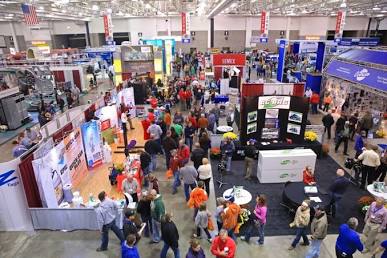
This is what a full floor looks like. Expo’s commercial exhibitor count peaked at 887 in 2018 and stood at 461 in 2025 — 426 booths gone. A booth is never only a booth. It’s a sponsorship line and somebody’s reason to keep coming back.
Expo’s trade show currently runs Tuesday through Friday. Whether four selling days against Madison hotel and facility costs still pencils for a mid-size supplier is a question worth asking out loud — and one only the exhibitors who left can answer. We don’t have that reporting yet. Nobody does, which is part of the problem.
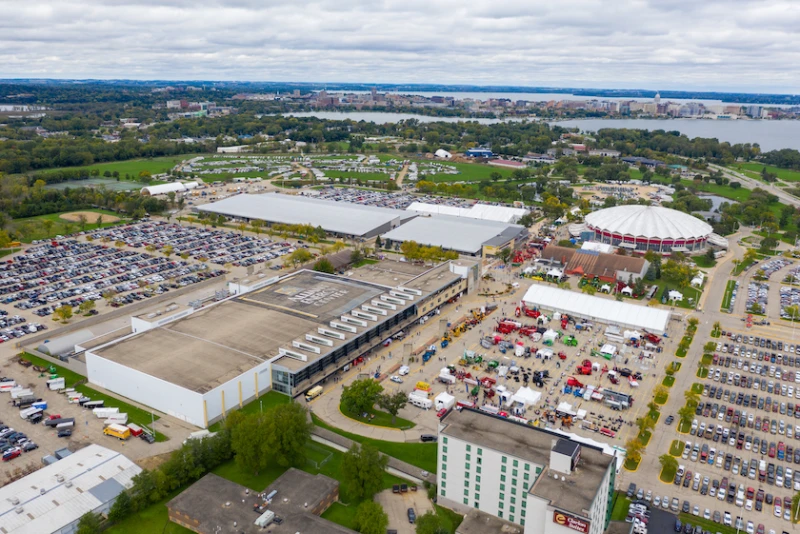
World Dairy Expo at the Alliant Energy Center, Lake Monona and downtown Madison on the horizon. Barns in the middle, cars around the edges — the same composition as Waterloo’s postcard. The lots are full. Fifty thousand people are expected. And nothing here shows you a trade floor that has lost nearly half its companies since 2018.
Here’s the piece romantics skip. A great show ring doesn’t finance itself. Prestige doesn’t cover the power bill, and legacy doesn’t make payroll. Every big show needs an economic engine, and at Expo the trade floor has long been a huge part of that engine. Waterloo’s engine shifted away from cattle and ended up at a dog track, and by the time anyone called it a crisis, the identity damage was done. Different route, same arithmetic.
The disanalogies are real, and they matter. The 1965 break came when the National Dairy Association physically walked, and Madison has no equivalent walkout. Waterloo slid from national to regional while Expo still draws from nearly 90 countries. Rail-era transport economics aren’t Madison’s problem. And where Waterloo’s management answered decline by diversifying away from dairy cattle, Madison has done the opposite, and the cattle numbers prove it. This is a complacency warning, not a collapse prophecy. Say it plainly so nobody twists it.
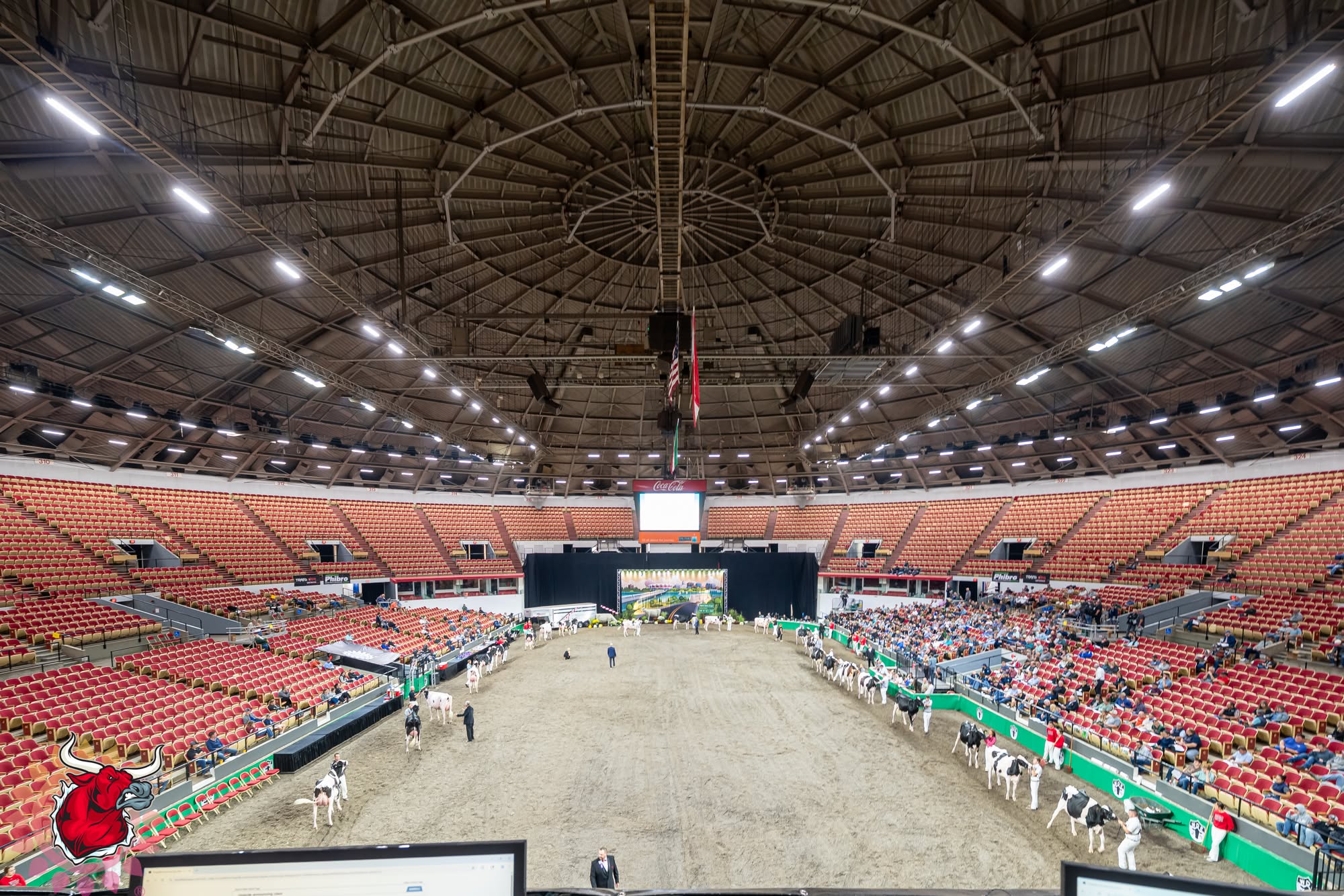
This is the World Dairy Expo Holstein Show — the marquee event of dairy’s premier week. The best cattle on the continent are in the ring. Look at the seats around them.The 2025 International Holstein Show at the Alliant Energy Center Coliseum, Madison. The stands sit barely a quarter full for one of the most prestigious classes in the world. Photo: The Bullvine.
So what do you actually do if it’s your show that’s fading?
Waterloo’s decline wasn’t fate. It was a stack of choices, which makes the fixes choices too, and some shows are already making them. If you sit on a committee, a breed board, or an association that runs an event, these are your live options.
Fix
What triggers it
What it costs to try
How it fails
Watch the gate before the floor
Two consecutive years of falling attendance
An afternoon consolidating existing gate data
One weather-driven year proves nothing; you need three data points before you act
Reconcile numbers to marketing copy
Any published claim older than 3 years
One editor, one afternoon
Fixes credibility, not revenue — and a sponsor’s lead data may find the gap first
Build year-round sponsorship program
Trade-floor revenue falling faster than attendance
12-month sales calendar, naming-rights inventory, education programming
Denver’s model leans on capital-campaign scale that dairy suppliers may not match
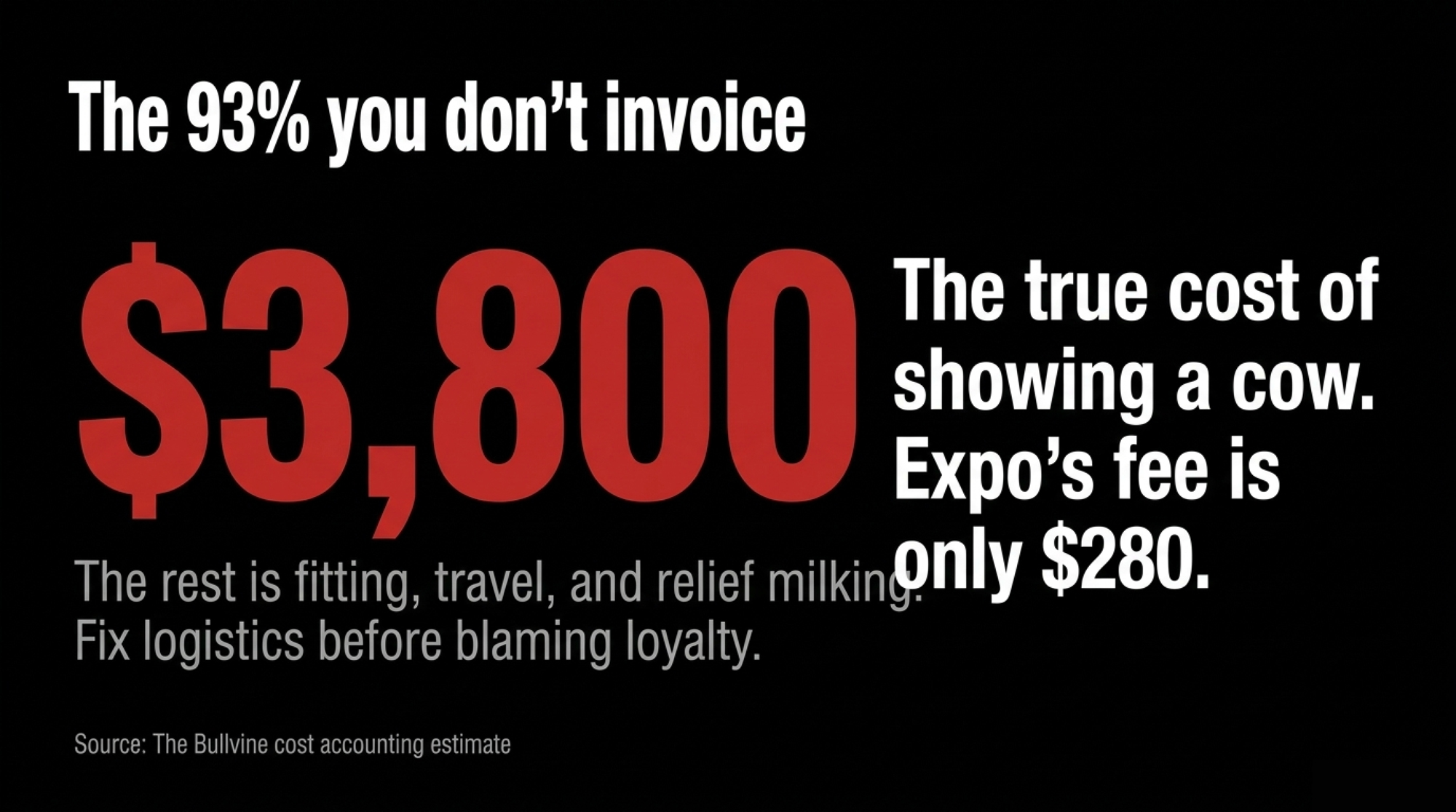
Audit the 93% you don’t invoice
Exhibitors complaining about cost
Block hotel rates, scheduling tie-ins, logistics coordination
$3,800/cow figure is composite, not audited — build policy on your own string first
Path one: watch your gate before you watch your floor. Expo’s own record shows the audience turning six years before the vendors did. Attendance is the leading indicator and booth count is the lagging one, which means a show reading only its exhibitor revenue is reading the slower number. When it works: you track gate and floor as separate series, year over year, and treat two consecutive attendance drops as a trigger rather than weather. What it requires:publishing your own numbers consistently enough to have a series at all. Risks and limits: gate counts move with weather, calendar, and ticket policy, so one bad year proves nothing. Three do.
Path two: check whether your own numbers still match your own story. Waterloo kept the word “National” in its name and on its letterhead for years after the national shows had left for Madison, right up until “Dairy” came out in 1965. The paperwork described an institution that no longer existed. When it works: you compare ten years of published figures against what your website, venue copy, and sponsor decks currently claim, and fix the gaps yourself. What it requires: one afternoon and a willingness to be embarrassed in private. Risks and limits: it fixes credibility, not revenue. If a sponsor’s own lead data finds the gap first, you lose the renewal and the credibility in the same meeting.
Path three: build a year-round sponsorship program. The National Western Stock Show in Denver paid its debt in full for the first time in decades and reached $120 million toward a $150 million capital campaign. Then it packed 750,039 people through the gates over 16 days this January, an all-time record that broke a mark standing since 2006. In the ring, the first Auction of Junior Livestock Champions in the new CoBank Auction Arena set a record at $822,500 for the top eight champions, up $185,000. Read the venue name again. A lender put its name on the arena. When it works: your commercial base is eroding but the brand is still worth investing in. What it requires: naming rights, hospitality, and scholarship alignment sold on a twelve-month calendar. Risks and limits: Denver leans on a multi-year capital campaign and named-facility partners, while dairy equipment and genetics suppliers run on tighter margins and shorter budget cycles. The operating principle survives the difference. You cannot treat commercial partners like booth-renters for five days in October and expect them to behave like stakeholders the other eleven months. Worth testing: the sponsors most likely to stay are the ones buying year-round category alignment, education programming, and naming rights rather than floor space. That’s a hypothesis about where the money is going, not a claim about what any company has said.
Path four: fix the cost math before you blame loyalty. Bullvine’s accounting puts the true cost of showing at Madison near $3,800 a cow in a five-cow string, with Expo’s own fees only about $280 of it. The other 93% is fitting, hotels, travel, and relief milking. When it works: you attack the costs you don’t invoice for, through block rates, scheduling, and tie-in logistics. What it requires: treating exhibitor cost as your problem rather than theirs. Risks and limits: the $3,800 figure is a composite drawn from exhibitor testimony, not audited accounts, so run your own string before you build policy on it.
The 30-day action. Before your next board meeting, pull ten years of attendance and vendor counts from your own published summaries and put both series on one slide. Not one line. Two, so you can see which turned first. This month, while Expo week is fresh enough to argue about. Waterloo’s fatal habit wasn’t ignorance. Plenty of people saw the slide, and nobody made the room stare at it while there was time.
Key Takeaways
Two consecutive years of falling gate is a trigger, not weather Expo’s attendance dropped in 2015, then again in 2017, 2018, and 2019 — 19% gone before COVID. The trade floor was still at peak through 2018. If your gate is sliding while your booth revenue holds, you are reading the lagging number.
If the decline outlasted consolidation, “structural” is an excuse Madison’s floor lost 211 companies in the three years after the farm shakeout slowed, roughly 70 a year. Herd size held and milk output hit records over the same stretch.
Index your three lines against each other before you call anything healthy Cattle at 108, attendance at 67, exhibitors at 52. A full ring is not an all-clear, and the ring is the only line that’s up.
Reconcile your published figures with your promotional copy this week Waterloo kept the word “National” long after the nationals left. Find the gap yourself before a sponsor’s lead data finds it in a renewal meeting.
Ringside banners will not carry a sponsorship program Denver retired its debt, raised $120M toward $150M, set a 750,039 attendance record, and posted an $822,500 junior auction, all off year-round partnership and named-facility deals.
If exhibitors complain about cost, audit the 93% you don’t invoice At roughly $3,800 a cow, only about $280 is Expo’s fee. The rest is fitting, hotels, travel, and relief milking, and a show can move more of that than it thinks.
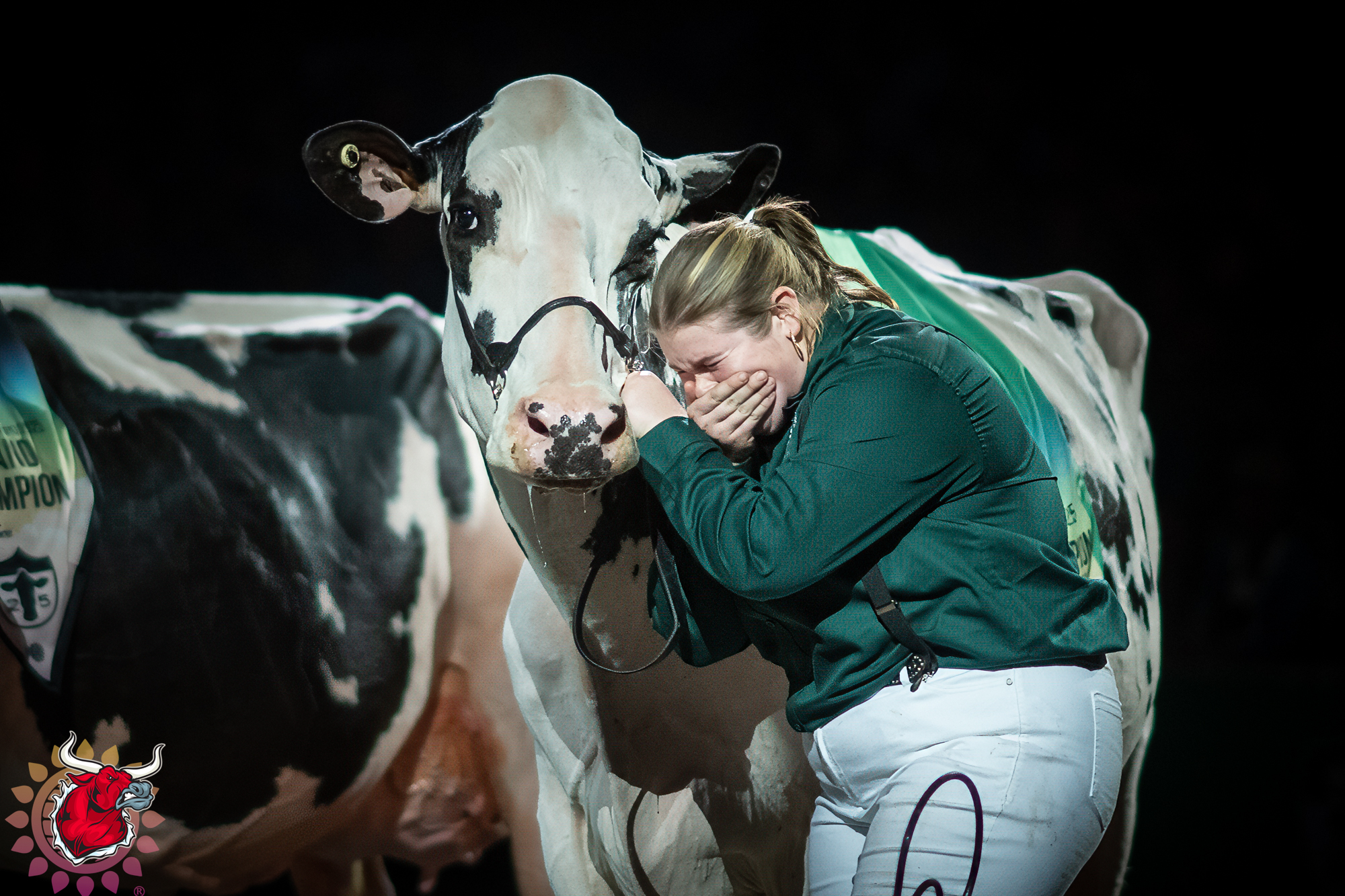
Stella Schmocker and Luck-E Merjack Asalia, Supreme Champion of the 2205 Junior Show. No exhibitor count measures this. It is also the last thing a failing show gives up — Waterloo held its cattle classes until it could no longer afford them.
Before you decide it can’t happen here
The 116th National Cattle Congress Fair closes in Waterloo on Sunday, September 27. Two days later, the gates open in Madison for the 59th time. Carry this question through them: which of your show’s two lines turned first, and how many years ago? Pull the series before you answer, and pull it from the published summaries rather than the brochure.
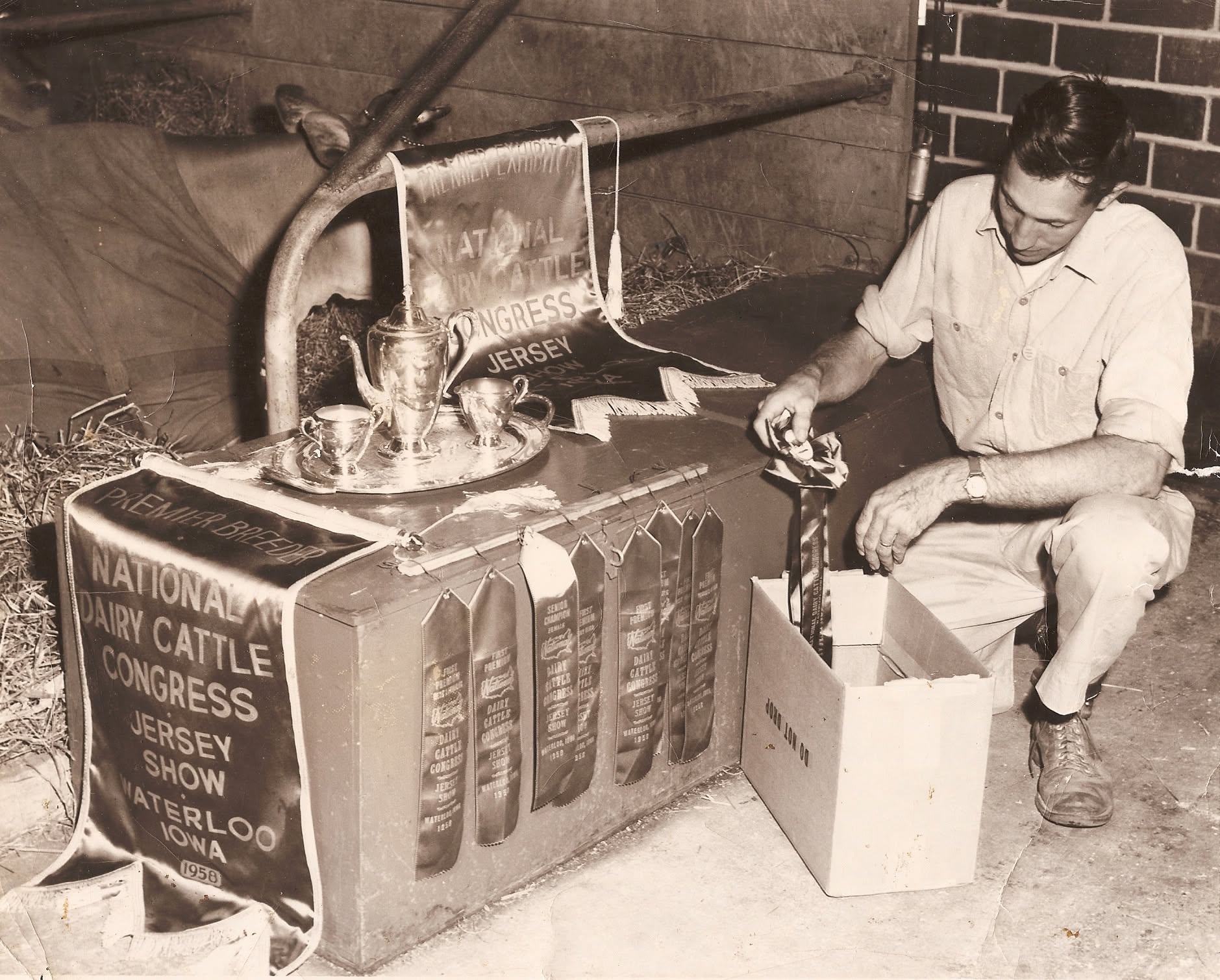
Waterloo, 1958. Premier Breeder and Premier Exhibitor in the Jersey Show, a silver service, and a row of ribbons going carefully into a box. Seven years later the national dairy associations moved their shows to Madison.
Waterloo wasn’t some weak little fair nobody loved. It was enormous, prestigious, woven into generations of October traditions, and it still lost the plot, then the center, then the cattle. Nabholz wrote his book to preserve what a great show had been before the memory thinned out. The people invoking Waterloo around Madison are trying to make sure nobody has to write the eulogy.
Editor’s note: This is an opinion piece. The historical record of the National Dairy Cattle Congress is documented and sourced; the comparison drawn to World Dairy Expo, and the recommendations that follow, are solely those of the author and The Bullvine. They are not a position or viewpoint of World Dairy Expo, which did not request, authorize, or contribute to this article. We consider the long-term health of North America’s principal dairy exhibition a matter of legitimate public interest to the exhibitors, breed associations, sponsors, and producers whose time and capital it depends on. Every attendance, trade-show, and cattle-entry figure cited comes from World Dairy Expo’s own published annual show and event summaries, 2014 through 2025; the indexed comparison and loss rates are The Bullvine’s own calculations based on those published figures, and our interpretation is our own.
Learn More
The True Cost of Showing at World Dairy Expo — Pinpoints the real capital burn of competing in Madison, exposing why overhead outside entry fees drives strings to roughly $3,800 per head and forces exhibitors to audit their marketing budgets.
Is the Show Ring Still Relevant to Commercial Dairying? — Dismantles the widening divide between purebred aesthetics and commercial parlor profitability, revealing whether modern production herds still source genetics from the colored shavings or look entirely to genomic pipelines.
The Sunday Read Dairy Professionals Don’t Skip.
Every week, thousands of producers, breeders, and industry insiders open Bullvine Weekly for genetics insights, market shifts, and profit strategies they won’t find anywhere else. One email. Five minutes. Smarter decisions all week.
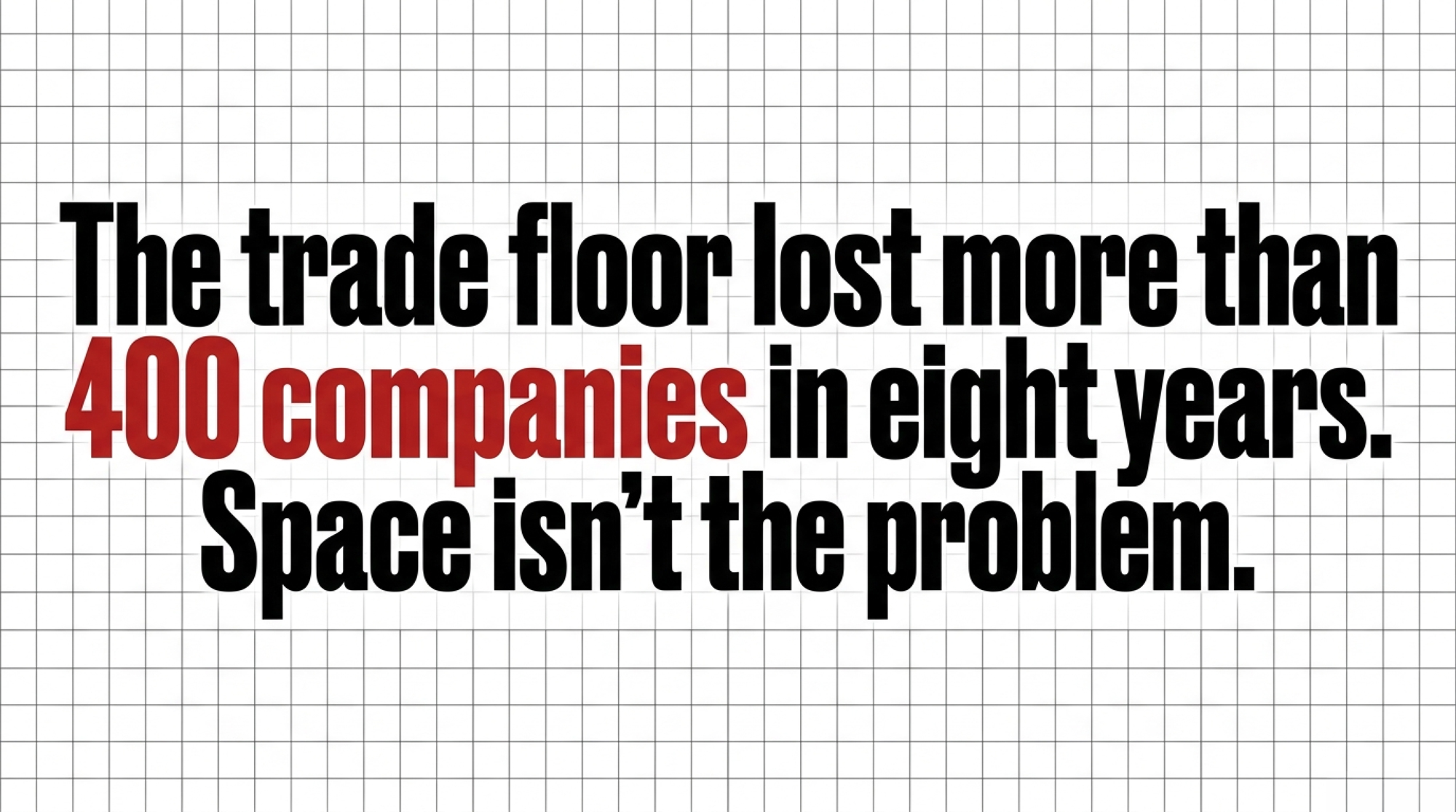
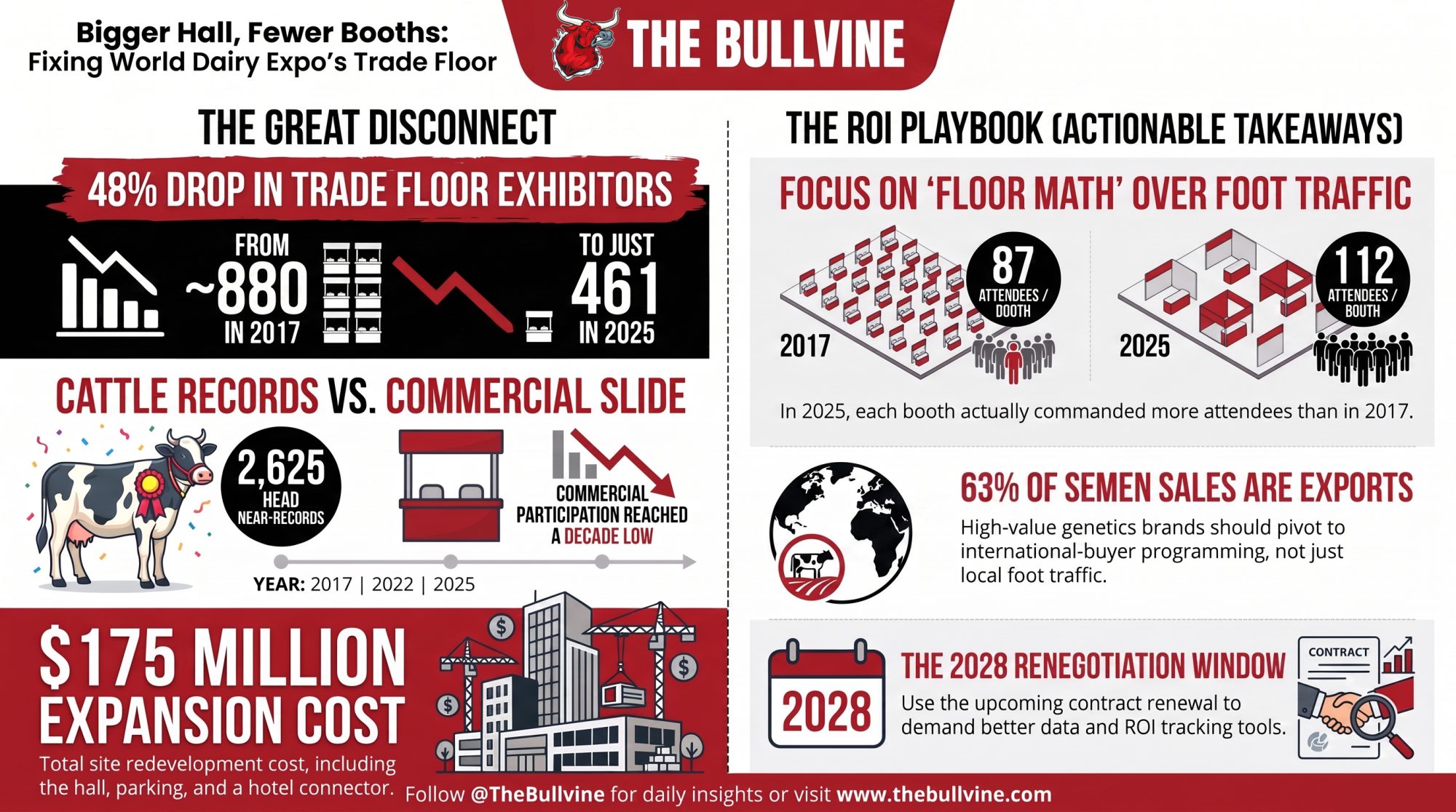
Dane County just cleared the first hurdle on a major Exhibition Hall expansion at the Alliant Energy Center — part of a redevelopment package the county pegs at $175 million. The catch: World Dairy Expo’s trade floor has lost more than 400 companies in eight years, and square footage isn’t the problem.
Big changes are coming to the Alliant Energy Center, and they land right on top of World Dairy Expo. On Wednesday, July 15, the Madison Urban Design Commission voted unanimously to approve plans for a major Exhibition Hall expansion — about 223,000 square feet added across the first two of three construction phases running 2028 to 2031, bringing the hall to a finished footprint of roughly 382,000 square feet, with a hotel connector, new entrances, and reworked pedestrian spaces. It’s the opening move in a broader master plan to modernize the whole campus that’s hosted World Dairy Expo for nearly six decades.
On paper, that sounds like good news for Expo — a bigger, newer building in the place the dairy world gathers every October. But dig into what’s happening on that trade floor and a harder question surfaces: does more space fix Expo’s real problem, or give the problem more room to spread?
What the county actually approved
The plan grows the Exhibition Hall north and south, adds a connector to the neighboring hotel, and updates entrances and gathering areas. Several existing structures would be demolished to make room, including the Dane County Public Works administration and storage buildings and the William H. Ferris Center. This is a Dane County project, not a World Dairy Expo one — but WDE uses the venue, so whatever happens here shapes the show.
When the state first backed the project in 2019, the Exhibition Hall expansion alone was estimated at $77.4 million, with $30 million committed from Wisconsin’s 2019–2021 capital budget. By the county’s 2024 redevelopment planning, the figure being discussed had grown to $175 million — but that number isn’t the hall by itself. Per Dane County’s own Redevelopment Committee, the $175 million covers “the Expo Hall Expansion and Related Site Improvements,” including revamped and new parking, additional storage, a new ring road, stormwater management, a new grand entrance at Rusk Road, a new sewer force main, the hotel connector, and demolition of the Huber Center. So when you see “$175 million,” read “the hall plus everything around it,” not the building alone. This week’s approval covers design and landscaping, not final funding — the county hasn’t committed the capital, and more sign-offs lie ahead.
The commission liked the architecture, approving the plans with one condition: fix the landscaping. Several proposed tree species — yellow birch, showy mountain ash, red maple — aren’t well-suited to southern Wisconsin’s climate, so the team has to swap in native plantings and diversify the shrubs. Minor stuff. The building itself sailed through.
The number nobody’s talking about
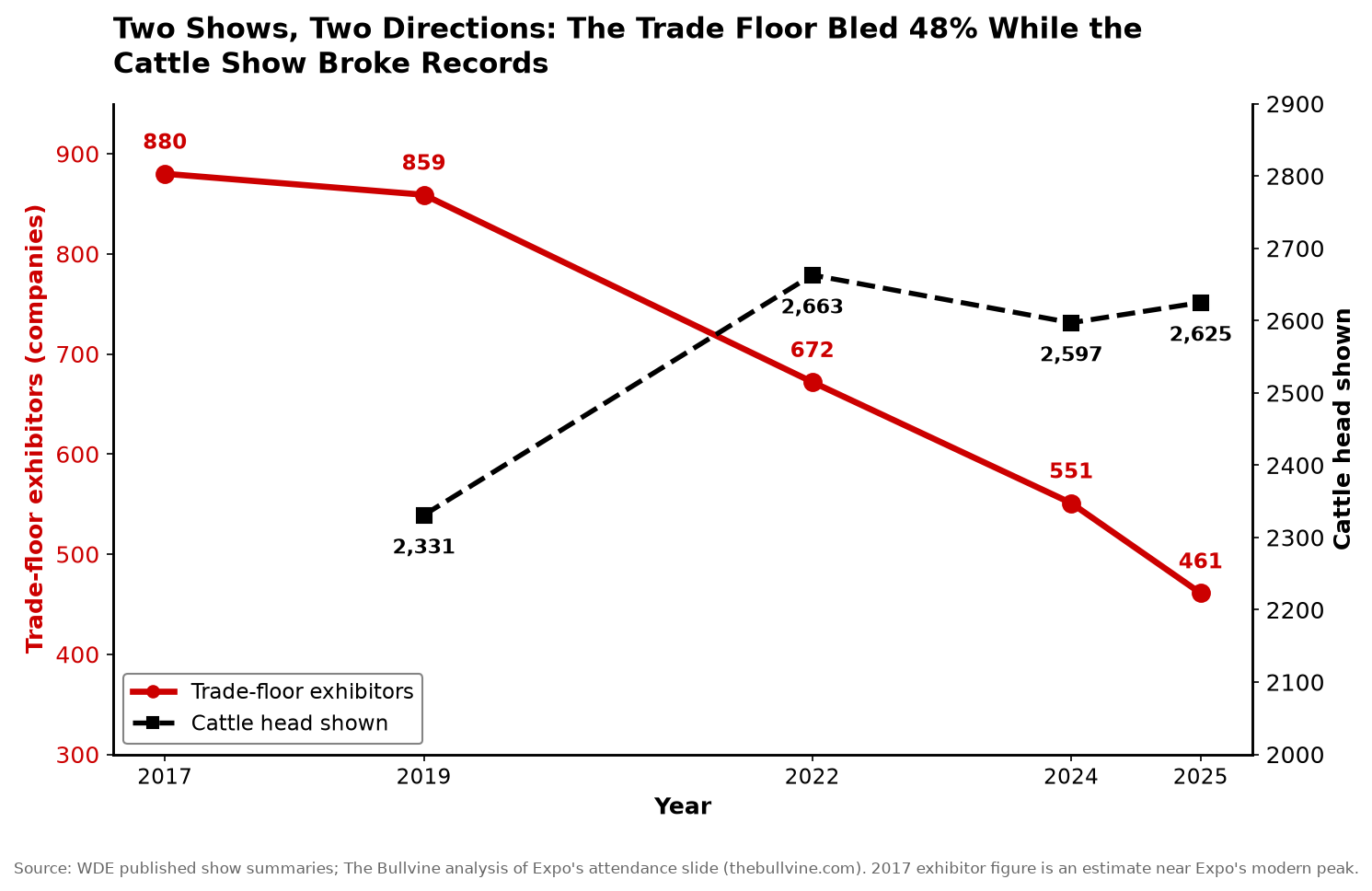
Here’s what gets lost in the ribbon-cutting excitement. In 2017, World Dairy Expo sat near its modern exhibitor peak — roughly 880 participating companies on its trade floor. By 2019, WDE was still touting 859 participating companiesfrom 28 countries, six Canadian provinces, and 41 U.S. states. Last fall, the count was 461. That’s more than 400 companies gone from a floor that used to be packed. (For the full year-by-year breakdown, see The Bullvine’s analysis of Expo’s attendance slide.)
So before anyone celebrates a bigger hall, ask the obvious thing: if the trade floor has shed nearly half its exhibitors, what does more square footage actually solve? This isn’t a space problem. It’s an exhibitor-value problem — and you can build a bigger room and watch the same slide play out in more of it.
There’s a timing wrinkle that makes it sharper. WDE signed a five-year deal in 2023 keeping it at the Alliant Energy Center through 2028, with three option years that could stretch to 2031. So the first real renewal decision lands right as the new hall comes online. Building and contract, hitting the table together. That’s when terms get renegotiated.
Two shows under one roof
The cattle show isn’t just holding — it’s setting records. WDE housed a record 2,663 animals in 2022, topping a mark that had stood since 2008, and drew 2,625 head from 37 U.S. states and 7 Canadian provinces in 2025, up from 2,331 in 2019. The best animals on the continent still load up and fill the Coliseum every October. That part works.
The trade floor is the part that doesn’t. Two different events are happening across the campus, headed in opposite directions.
Year
Trade-Floor Exhibitors
Cattle Head Shown
What It Signals
2017
~880 companies
—
Peak commercial footprint
2019
859 companies
2,331 head
Pre-pandemic exhibitor & cattle baseline
2022
672 companies
2,663 head (record)
Consolidation accelerates as cattle peak
2024
551 companies
2,597 head
Virtual launch tools mature
2025
461 companies
2,625 head
~48% fewer exhibitors, near-record cattle
Cattle figures from WDE published show summaries. Trade-floor figures from WDE show summaries and The Bullvine’s analysis of Expo’s attendance slide; the 2017 figure is an estimate near Expo’s modern peak. Dashes mark years where that metric isn’t in the public record we can verify.
The pattern is brutal in its consistency: the trade floor shed exhibitors every single year while the cattle show sat at or near all-time highs the whole time. And the bleed sped up. Roughly 40-plus companies a year walked away between 2017 and 2022, then about 70 a year from 2022 to 2025 — the same three years cattle never dropped below 2,597 head. The commercial side isn’t stabilizing. It’s accelerating downhill, even as the county lines up more space to hold it.
The companies feel it first — genetics outfits, equipment makers, and nutrition suppliers writing five-figure booth checks every fall. Their customer base is thinning fast. U.S. dairy operations are on track to fall to 15,000–16,000 herds by 2035 and under 10,000 by 2050, and the biggest 3% of operations — those over 2,500 cows — already produce about 46% of the U.S. milk supply. Farms under 500 head make up 86% of farms but just 22% of the milk. Fewer, bigger buyers change the math on a big open trade floor.
What a new building can’t buy back
Three forces compounded here. Genomics decentralized sire selection, so breeders no longer needed a trade floor to pick bulls. Consolidation shrank the pool of independent genetics and equipment brands that exist to buy booths in the first place. Then COVID normalized virtual product launches and on-farm demos — and a lot of that behavior stuck.
None of those is a square-footage problem. WDE describes its purpose as a place to learn, share, do business, and showcase competition. The competition half is delivering — record cattle prove it. The commerce half isn’t. A nicer building makes the commerce space prettier. It doesn’t touch the reasons companies stopped buying booths.
The barn math on a booth
For an exhibitor, it comes down to one cold question: is my customer still walking through that door? For many genetics companies, the honest answer is “somewhere else.” NAAB’s 2025 report shows total dairy semen unit sales fell about 6% from 2024, dropping to 45.8 million units, with 28.3 million of those exported — roughly 62–63% of volume heading overseas. (We broke down what that export tilt means for breeding strategy in why 2025’s 6% semen-sales drop is actually good news.) When two-thirds of your product ships to Brazil, Italy, or China, a trade floor in Wisconsin is brand-building, not deal-closing.
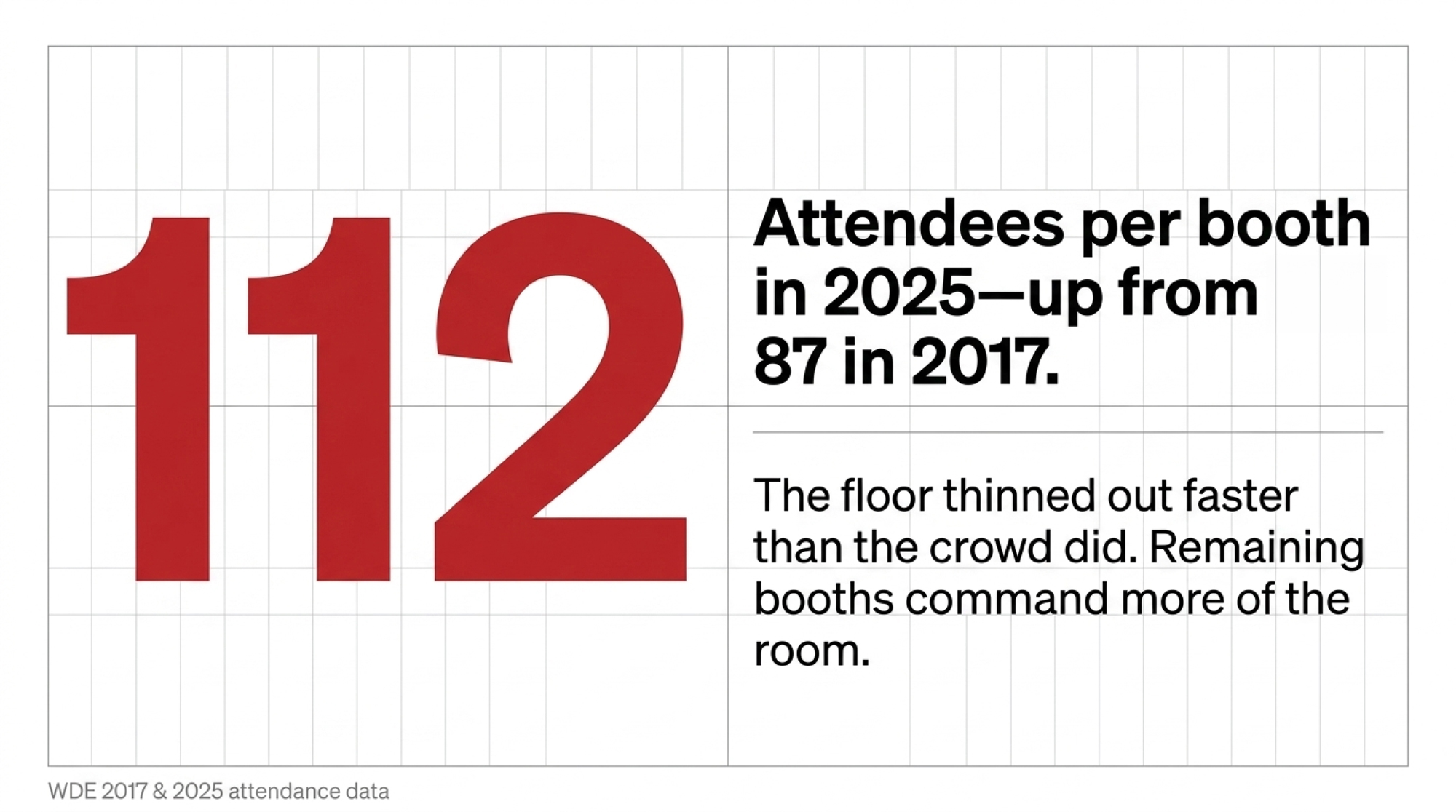
Now run the floor math. In 2017, WDE drew 77,204 attendees against roughly 880 exhibitors — about 87 attendees per booth. In 2025, attendance had fallen to 51,525 while exhibitors dropped to 461, which works out to 112 attendees per booth. Read that twice. Even with attendance down about a third, each remaining exhibitor now has more visitors to itself, not fewer. The floor thinned out faster than the crowd did.
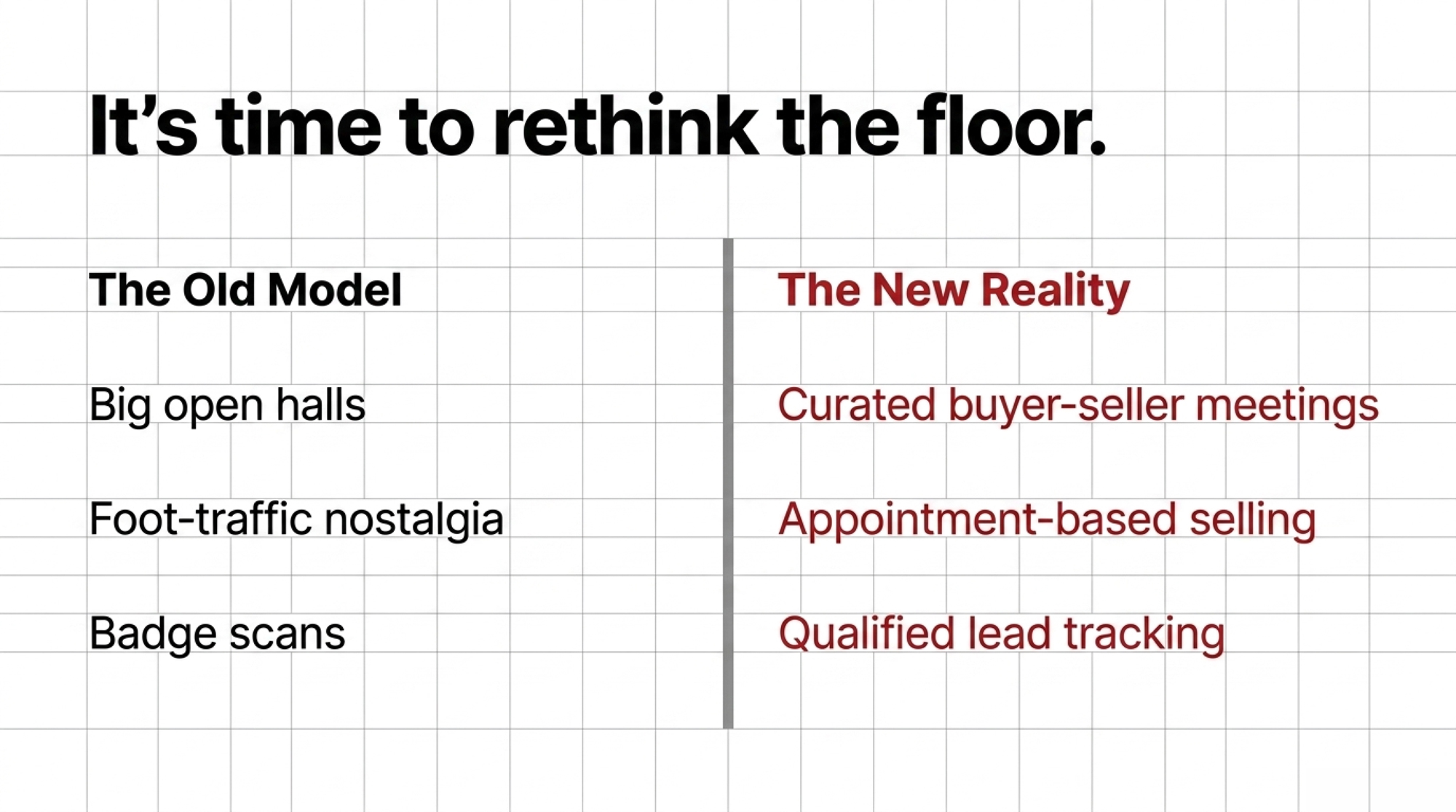
That cuts both ways. Fewer rivals in the aisle can be a reason to stay — more share of a smaller room. Or a reason to leave, if those 112 visitors aren’t the decision-makers you need. And the booth fee is just the entry cost: add design, build, staffing, travel, freight, and marketing, and the real number climbs fast. That whole spend has to earn its keep in qualified leads and real conversations, not badge scans.
What would actually move the needle
It’s easy to stand outside a $175 million project and point at what’s broken. Harder — and more useful — is to say what we’d do if it were our call. The fix doesn’t require a single extra square foot. Four plays Expo could run.
Build and publish an exhibitor-ROI framework. WDE offers exhibitors no public way to measure booth returns. Change that: qualified-lead tracking, badge-to-meeting data, post-show analytics that tell a genetics marketing lead exactly how many real conversations their spend bought. The moment an exhibitor can prove the floor pays, the renewal conversation stops being a leap of faith.
Rethink the floor for the buyers who are left. If 3% of herds make 46% of the milk, and roughly two-thirds of genetics volume ships overseas, the old model — a big open hall and hope the right buyer wanders past — is fighting the math. Design for fewer, higher-value buyers: curated buyer-seller meetings, appointment-based selling, dedicated international-buyer programming that treats the export customer as the center of gravity, not an afterthought. A smaller room built around the people who write the big checks beats a bigger room built on foot-traffic nostalgia.
Bundle the new hall with commerce, not just space. If $175 million is going into the ground, tie it to outcomes an exhibitor can bank. Data tools. Hybrid reach that extends a booth’s audience beyond the four on-site days. A year-round digital presence so the relationship doesn’t go dark for 361 days. Make the building buy commerce — that’s the difference between an investment and a renovation.
Use the 2028 contract window as a redesign moment. The contract and the building landing together is a risk if Expo sleeps on it, an opportunity if it doesn’t. That pressure point is the best chance Expo will get to reset what a booth actually delivers — to walk into the room with a new value proposition instead of the same one at a higher rate. The leverage cuts both directions. The question is who uses it.
None of these need the shovel to hit dirt first. They need someone to decide the trade floor is a product worth rebuilding, not just a space worth expanding.
To be clear: Dane County holds the checkbook, not Expo. But Expo is the anchor tenant with the most at stake in how that space gets built — which gives it real leverage to push for a hall designed around commerce, not just square footage.
Your real competition isn’t another show
For breeders, WDE competes with Cremona, The Royal, and UK Dairy Day on ring prestige and production value. Cremona’s recent edition pulled 800-plus elite cattle from six nations and made the arena the main event — proof a smaller show can win on experience instead of scale, a lesson we dug into in what dairy shows must learn from the booming stock-show world.
But for the companies buying booths, the competition isn’t another cattle show at all. It’s every channel that reaches the same herd for less. A virtual demo. A processor-hosted supplier day. A truck rolling straight to a 2,500-cow operation where the actual buying happens. That’s what WDE is up against, and a shinier hall doesn’t answer it.
The playbook: three ways to work the new floor
If you’re the one signing off on a five-figure autumn budget, here’s how the numbers above turn into a decision you can defend to whoever signs the check. Pick the lane that matches your buyer.
Play
Best For
The Move
Warning Signal
Data-Driven Renewal
North American / mid-size commercial-herd sellers
Stay in Madison; demand qualified lead-capture and track cost-per-real-conversation, not badge scans
Cost per conversation rising while close rate flat
Pull last two shows’ lead logs; calculate real cost per high-value deal before 2028 talks
Renegotiate before the building justifies a price hike
Do Nothing
No one
Renew at higher rates on foot-traffic nostalgia
Paying more for a thinner floor
The Data-Driven Renewal — for North American players. If your buyer is still the mid-sized commercial herd owner walking the aisles, stay in Madison — but stop paying for foot traffic and hoping. Demand qualified lead-capture from Expo, and track your own cost-per-real-conversation instead of badge scans. That one number tells you whether the aisle is earning its keep or just an expensive place to hand out pens. WDE doesn’t offer that framework yet, so build the tracking yourself — before you renew, not after.
The Hybrid Pivot — for export-heavy genetics and tech brands. With 28.3 million of 45.8 million dairy semen units heading overseas in 2025, a booth in Wisconsin is doing a thinner job than your budget assumes. Shrink the physical footprint in the new hall to control travel and build-out costs, then push those five-figure savings into year-round virtual farm tours, localized international-buyer programs, and digital launches that reach the export customer where they actually are. A small booth in a big hall reads as retreat if the design’s sloppy — so make the shrink look deliberate, not defensive.
The 30-Day Audit — for every exhibitor. Before 2028 renewal talks, pull your lead logs from the last two shows and calculate your real cost per high-value deal closed. If that number’s climbing while your close rate sits flat, your own balance sheet is telling you to renegotiate space terms before the concrete dries. The time to set the price of a booth is before the building that justifies the price hike exists.
The bottom line
The money isn’t committed. This week’s vote covers design and landscaping only. The $175 million is the hall plus parking, roads, and site work — the building alone was pegged at $77.4 million in 2019. Treat 2028–2031 as a target, not a guarantee.
A bigger room won’t refill an empty floor. Exhibitors fell every year the cattle show broke records. The real fixes — an ROI framework, a floor built for consolidated buyers, a hall that sells commerce, a 2028 redesign — are decisions, not construction.
Run your own number before you sign. Cost per qualified meeting, last two shows. If it’s rising while your close rate holds flat, that’s your renegotiate-or-reallocate signal.
A thinner floor isn’t automatically fewer prospects. At 112 attendees per booth in 2025 versus 87 in 2017, each booth commands more of the crowd — the question is whether they’re your buyers.
2028 is the leverage point. The contract’s first hard decision and the new building arrive together. That’s the one moment terms are genuinely up for negotiation — for exhibitors and for Expo.
World Dairy Expo acknowledged The Bullvine’s request for comment but did not provide a statement for publication.
The Bullvine — analysis and opinion on the business of the dairy industry.
Complete references and supporting documentation are available upon request by contacting the editorial team at editor@thebullvine.com.
Learn More
World Dairy Expo: Reversing the 33% Attendance Drop — Arms you with a four-step commercial roadmap to fix trade show ROI, rebuild youth pipelines, and transform live cattle judging into high-production entertainment that draws crowds back to Madison.
Every week, thousands of producers, breeders, and industry insiders open Bullvine Weekly for genetics insights, market shifts, and profit strategies they won’t find anywhere else. One email. Five minutes. Smarter decisions all week.
Madison’s Urban Design Commission has unanimously approved plans to expand the Alliant Energy Center’s Exhibition Hall — the building that houses World Dairy Expo’s trade show. Here’s the timeline exhibitors and breed associations need to circle now.
The venue that hosts World Dairy Expo is a step closer to its biggest overhaul in decades. On Wednesday, July 15, Madison’s Urban Design Commission voted unanimously to approve plans for a major expansion of the Exhibition Hall at the Alliant Energy Center — the 164-acre Dane County campus that hosts WDE each fall.
This is a Dane County Public Works project, not a World Dairy Expo one. But because WDE uses the venue, the practical impact lands on every trade show exhibitor, breed association, and show organizer who stakes out space in Madison each October.
First, know which building we’re talking about
If you go to Expo, you live in two different worlds — and only one of them is changing.
The Exhibition Hall is the trade show. It’s where the commercial booths, equipment displays, and vendor space live. This is the building getting expanded.
The Veterans Memorial Coliseum and the New Holland Pavilions are the cattle-show side — the show ring, the barns, the tie-ups, the classifier’s world. They sit apart from the Exhibition Hall and are not part of this trade-show expansion.
So the exhibitors most directly affected are the commercial and trade-floor players. Breed associations and cattle exhibitors tied to the show ring are a step removed — though as you’ll see, the campus-wide plans reach them too.
The timeline exhibitors should circle right now
Here’s why this matters before you read another word about square footage: the construction window and WDE’s contract window overlap.
Work is expected to run across three phases between 2028 and 2031, with the existing building renovated in the final phase. World Dairy Expo’s current agreement with the Alliant Energy Center — signed in 2023 — runs through 2028, with three one-year options that could extend it to 2031. In plain terms: the years you’d be committing to Madison are the same years there’s an active construction site on the trade-floor footprint.
Any trade show exhibitor or vendor planning multi-year space commitments should expect to be planning around that. If you’re signing for booth space at the 2027 or 2028 show, get the construction-phasing language in writing before you commit — you want to know which phase hits your section of the floor, and when.
What was approved
Roughly 223,000 square feet will be added across the first two construction phases, while about 49,000 square feet of the existing building is demolished — bringing the Exhibition Hall’s total finished footprint to about 382,000 square feet. That total is the number to anchor on: it’s the size of the building when the work is done, not an addition stacked on top of the current hall.
The plan expands the hall to the north and south and adds a banquet hall, meeting rooms, offices, a multipurpose room, a replacement commercial kitchen, updated entrances and pedestrian spaces, and an improved connector to the neighboring Spark by Hilton hotel. To make room, several structures come down: two storage buildings, the Dane County Public Works administration building, and the now-shuttered William H. Ferris Center.
The commission’s one condition
The UDC approved the architecture but attached a single condition: the landscaping plan has to be revised, with commissioners asking the team to swap in more climate-appropriate, native plantings. It’s a revision requirement, not a rejection — the core approval stands.
The building itself drew praise. “I think it’s a really beautiful building, with the massing and materials,” said UDC member Nick Hellrood, noting “a nice dialogue between the architecture and the landscape”. The next procedural step is simply the revised landscaping plan.
The bigger picture
The Exhibition Hall expansion is the first major piece of a broader Alliant Energy Center master plan that traces back to a 2018 county board resolution, with a redevelopment committee created in 2019 to guide campus planning. It runs alongside a separate, privately backed proposal to renovate the aging Veterans Memorial Coliseum — the arena that runs the cattle show during WDE week. So while the Coliseum isn’t part of this approval, the ring itself is in play under the wider plan. Taken together, the campus the dairy industry uses for its flagship event will look substantially different by the early 2030s.
This is a developing story based on public Dane County proceedings. World Dairy Expo was invited to comment. The Bullvine will follow with a fuller analysis of what the expansion means for the show’s trade floor and its 2028 contract.
World Dairy Expo: Reversing the 33% Attendance Drop — Exposes the commercial reality driving the campus rebuild, breaking down how a loss of 400+ trade show exhibitors since 2017 demands an urgent shift to high-production entertainment and data-driven ROI.
Every week, thousands of producers, breeders, and industry insiders open Bullvine Weekly for genetics insights, market shifts, and profit strategies they won’t find anywhere else. One email. Five minutes. Smarter decisions all week.
To provide the best experiences, we use technologies like cookies to store and/or access device information. Consenting to these technologies will allow us to process data such as browsing behavior or unique IDs on this site. Not consenting or withdrawing consent, may adversely affect certain features and functions.
Functional
Always active
The technical storage or access is strictly necessary for the legitimate purpose of enabling the use of a specific service explicitly requested by the subscriber or user, or for the sole purpose of carrying out the transmission of a communication over an electronic communications network.
Preferences
The technical storage or access is necessary for the legitimate purpose of storing preferences that are not requested by the subscriber or user.
Statistics
The technical storage or access that is used exclusively for statistical purposes.The technical storage or access that is used exclusively for anonymous statistical purposes. Without a subpoena, voluntary compliance on the part of your Internet Service Provider, or additional records from a third party, information stored or retrieved for this purpose alone cannot usually be used to identify you.
Marketing
The technical storage or access is required to create user profiles to send advertising, or to track the user on a website or across several websites for similar marketing purposes.
To provide the best experiences, we and our partners use technologies like cookies to store and/or access device information. Consenting to these technologies will allow us and our partners to process personal data such as browsing behavior or unique IDs on this site and show (non-) personalized ads. Not consenting or withdrawing consent, may adversely affect certain features and functions.
Click below to consent to the above or make granular choices. Your choices will be applied to this site only. You can change your settings at any time, including withdrawing your consent, by using the toggles on the Cookie Policy, or by clicking on the manage consent button at the bottom of the screen.
Functional
Always active
The technical storage or access is strictly necessary for the legitimate purpose of enabling the use of a specific service explicitly requested by the subscriber or user, or for the sole purpose of carrying out the transmission of a communication over an electronic communications network.
Preferences
The technical storage or access is necessary for the legitimate purpose of storing preferences that are not requested by the subscriber or user.
Statistics
The technical storage or access that is used exclusively for statistical purposes.The technical storage or access that is used exclusively for anonymous statistical purposes. Without a subpoena, voluntary compliance on the part of your Internet Service Provider, or additional records from a third party, information stored or retrieved for this purpose alone cannot usually be used to identify you.
Marketing
The technical storage or access is required to create user profiles to send advertising, or to track the user on a website or across several websites for similar marketing purposes.