




Archive for dairy expansion

From Hormuz to Your 500‑Cow Barn: The $5.39/cwt Trap Hiding in the 2026 Dairy Rally

Your lender’s pro forma works at today’s margins. Your gut remembers 2023. One of them is right — and a $323,600 annual payment doesn’t care which.

Executive Summary: A million dairy expansion at 7% over 15 years costs you .85 million — adding .39/cwt in fixed debt service on a 500‑cow herd before you pay yourself. The Q1 2026 rally, making those numbers look comfortable, rests on two temporary forces: a global restocking wave that pulled demand forward, and a Hormuz closure that stranded six percent of traded dairy behind a war zone. The supply picture behind the rally hasn’t changed — U.S. herds added 49,000 cows in January–February 2026 alone, EU SMP stocks are running 50% above last year, and butter inventories have doubled. Feed costs feel manageable now because you’re still burning through inputs bought before the conflict repriced fertilizer and energy; late 2026 into 2027 is when the real cost of rationing hits. If your expansion math doesn’t survive 18 months at /cwt milk with post‑Hormuz input costs and full debt service loaded, the project’s timing doesn’t match the risk. The 30/90/365‑day playbook here starts with one check: run your true breakeven with family labor, realistic depreciation, and 7% money — then stress‑test it at a price you know you might see.
Dairy expansion risk

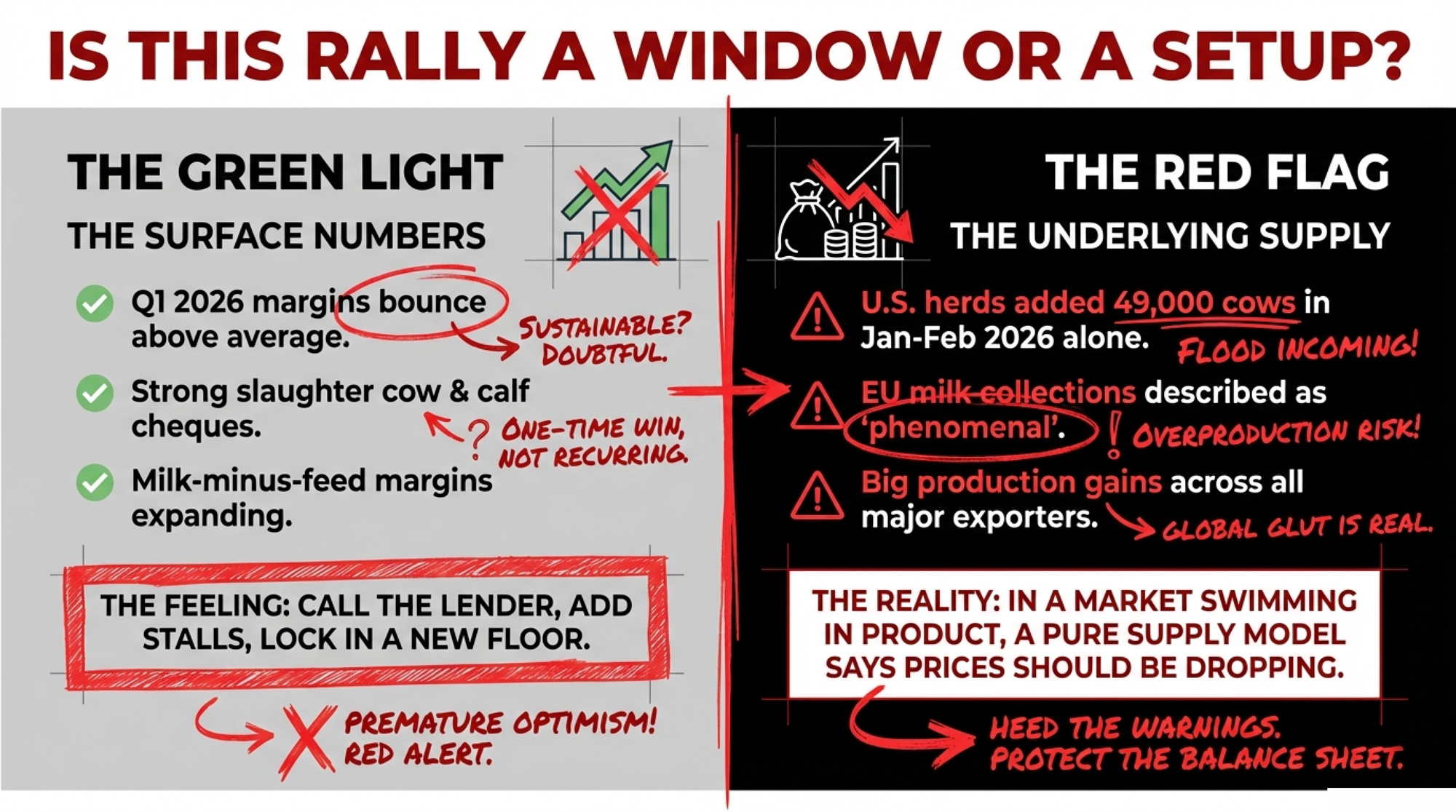
Six percent of global dairy trade sitting behind a chokepoint should’ve pushed prices down, not up. Instead, early 2026 has skim milk powder, cheese, and butter all stronger than most models projected — and a lot of 300‑ to 800‑cow U.S. dairies staring at expansion plans that suddenly “pencil.” You’re looking at a rally and wondering if it’s a window or a setup. On a $3 million project at 7% over 15 years, that choice carries an annual payment of roughly $323,600 and nearly $1.85 million in total interest.

Nate Donnay, a Minneapolis‑based dairy market insight director who’s been modeling international and U.S. dairy markets since 2005, told clients in late 2025 to expect a heavy market: big production gains across every major exporter, growing stocks, and prices under pressure. Instead, the first quarter turned into a demand‑driven rally stacked on top of already strong milk flow. For a 500‑cow family operation, that rally now looks like a green light — call the lender, add stalls or robots, lock in what feels like a new floor.
The Rally That Shouldn’t Have Happened

From a pure supply standpoint, this rally shouldn’t be here.
By late 2025, milk production across the big exporting regions — the U.S., EU, New Zealand, Australia, and Argentina — was running hot. On a component‑adjusted basis, U.S. supply alone was growing at more than three percent year‑over‑year into early 2026. New Zealand was on track for roughly four percent milk‑solids growth for the 2025/26 season after Fonterra revised its midpoint milk price forecast upward to NZ.70, up from NZ.50, with decent weather backing it up. EU collections in the second half of 2025 and early 2026 were described as “phenomenal.”

In Donnay’s models, every scenario pointed in the same direction: more milk, more product, lower prices. That’s not what happened.

The restocking wave outside China

The first twist came from buyers, not cows.

One of Donnay’s key charts tracks milk‑equivalent imports by all countries other than China. As prices fell hard across exporters in mid‑2025, those non‑China imports started climbing in August–September. Buyers in Southeast Asia, the Middle East, and parts of Africa had been running inventories tight, waiting for the bottom to fall out. When prices finally felt “cheap enough,” they moved. Hard.

That restocking didn’t magically remove product. It pulled demand forward into a market that was already well supplied. Then a geopolitical choke point poured fuel on the fire.

Six percent of trade is stuck behind Hormuz.

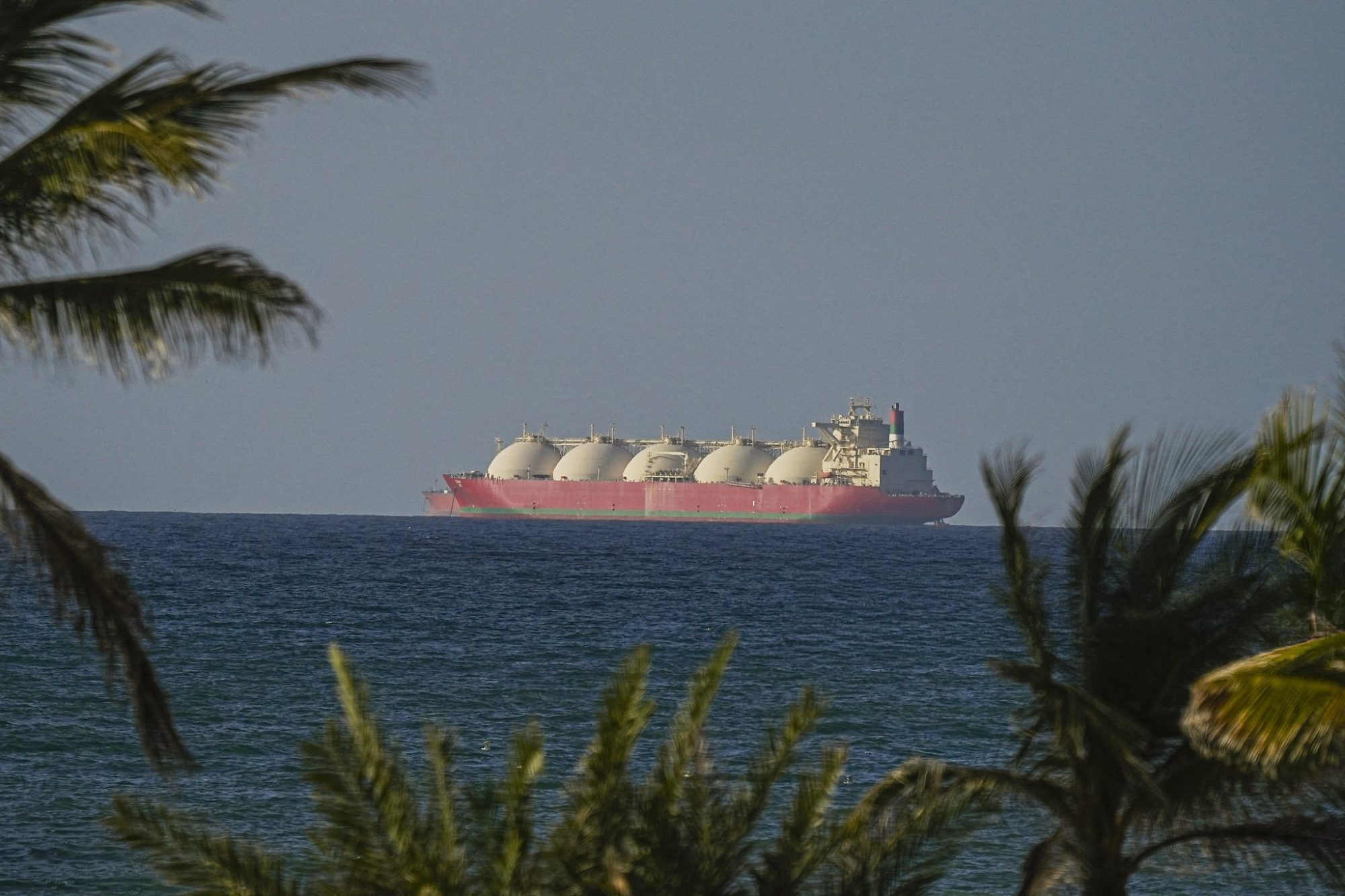
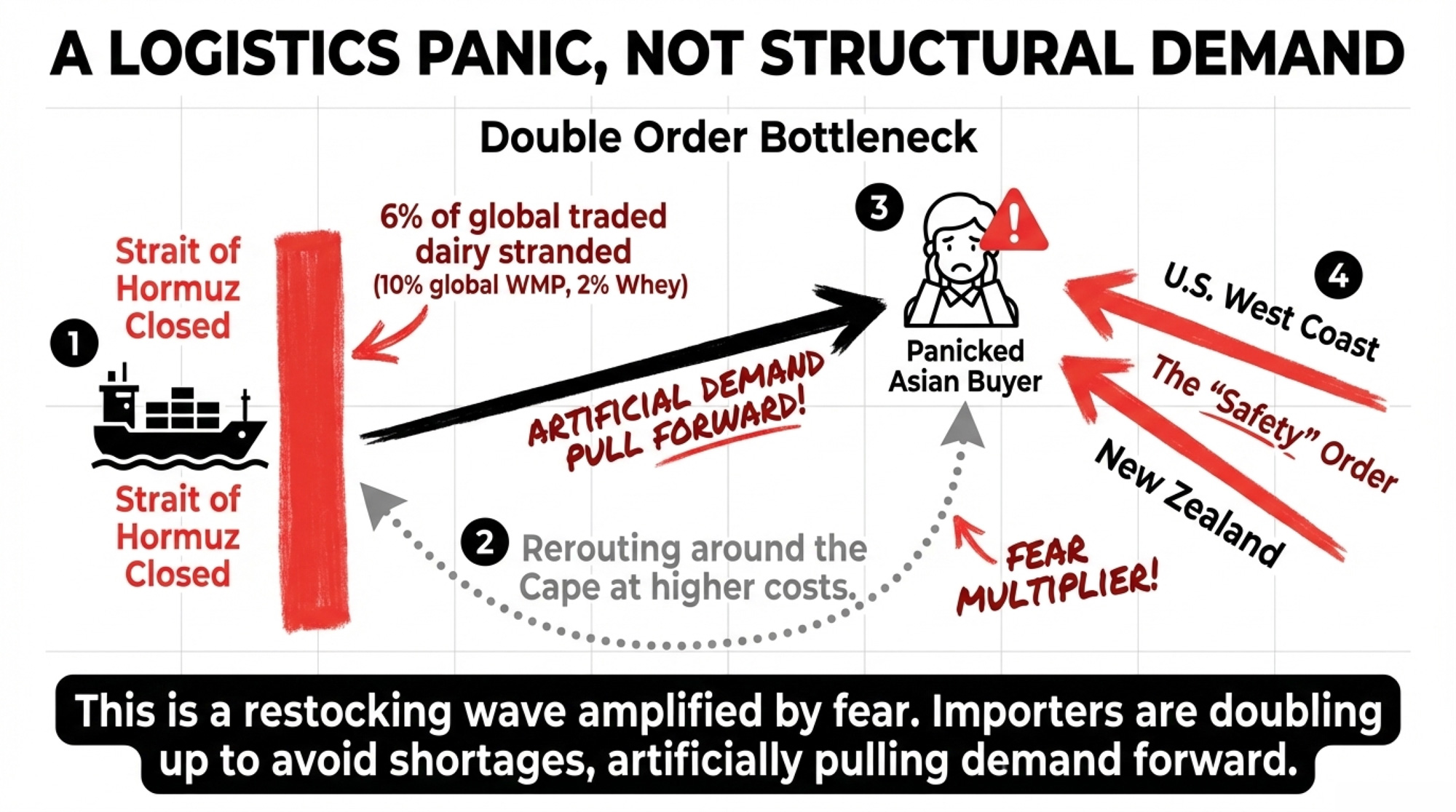
When conflict in Iran effectively closed the Strait of Hormuz in late February, roughly six percent of the world’s traded dairy — on a milk‑equivalent basis, in Donnay’s modeling — suddenly sat behind a chokepoint.

The exposure wasn’t equal:

  • Around 10% of the global trade in whole-milk powder moved through Hormuz. 
  • Roughly two percent of global whey trade relied on the same route. 
  • Europe was the dominant dairy supplier to the Gulf, followed by New Zealand; U.S. volumes into that corridor were smaller. 

The product didn’t vanish, but it didn’t flow smoothly. Exporters rerouted vessels outside the Gulf and trucked loads inland at higher cost. Faced with longer transit times and shipping uncertainty, importers did what risk‑averse buyers always do when they’re afraid of being short: they doubled up.

An Asian buyer with a European powder vessel now going the long way around the Cape might place an additional order from the U.S. West Coast or New Zealand “just to be safe.” Multiply that across enough buyers, on top of the restocking wave already running, and demand suddenly pulled harder than anyone’s supply model expected.

That’s how you get a rally in a market still swimming in product.

SignalDirectionDetailDuration Estimate
Non-China restocking wave🟢 BullishSE Asia, Middle East buyers pulling demand forward into a well-supplied marketShort-term; demand already pulled forward
Hormuz closure (6% of trade)🟢 Bullish near-term~10% of global WMP, ~2% of whey stranded; importers double-orderingTemporary; risk-premium only
EU SMP stocks +50% YOY🔴 BearishModelled January 2026 SMP production up ~20% YOY; stocks well above last yearOngoing; caps rallies through mid-2026+
EU butter inventories ~2× 2025🔴 BearishButter prices already backing off highs in early 2026Ongoing
U.S. herd +49k head (Jan–Feb 2026)🔴 Bearish+63% vs. same period in 2025; component-adjusted growth still ~3% YOYMulti-year structural supply build
NZ milk solids growth ~4%🔴 BearishFonterra midpoint raised to NZ$9.70; good weather backing itSeason-long (2025/26)
Hormuz demand destruction (medium-term)🔴 BearishGulf importing nations face higher costs, shipping disruption reduces ordersDevelops over 6–12 months
China domestic SMP/MPC exports🔴 BearishChinese processors now exporting SMP and MPC70 to SE Asia — competing with NZ and EUStructural shift, not a blip

Europe’s Calving Echo and the Powder Wall Behind This Rally

So why should a delayed calving wave in Germany or France matter to your 500‑cow barn? Because it helped build the powder wall sitting behind every price you’re looking at today.
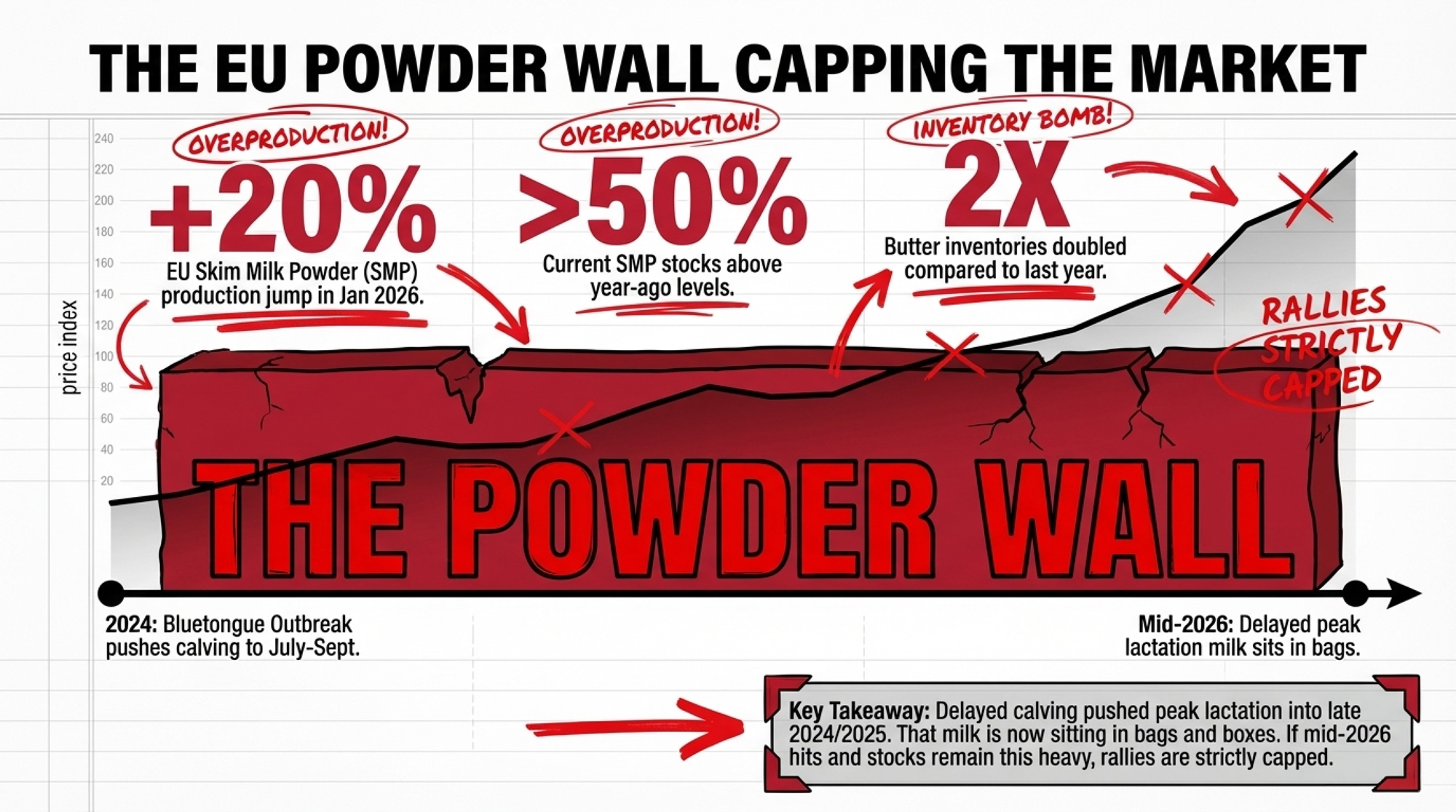
John Lancaster, who leads EMEA dairy and food consulting from Dublin, sees two main EU drivers: how the milk got here, and how much of it is now sitting in bags and boxes.

Delayed calving, prolonged lactation

Lancaster traces the current EU milk profile back to 2024, when Bluetongue hammered fertility in France, Germany, Belgium, and the Netherlands. Cows that should’ve calved in April through June didn’t freshen until July through September. That shoved a wave of peak‑lactation production into late 2024 and well into 2025.

At the same time, with margins decent and feed grains toward the low end of their five‑year range, plenty of EU producers chose to keep marginal cows milking rather than drying them off.

The result in early 2026: a big cohort of late‑calving cows still in relatively strong lactation stages, older cows kept in milk longer than they would be in a tighter year, and a smaller overall herd producing more milk per cow. Growth built on timing and persistence — not a permanent structural jump.

In Lancaster’s modeling, EU production growth slows sharply as 2026 progresses, especially from Q3 onward. Once 2026 starts to be compared against inflated Q3/Q4 2025 numbers rather than weaker 2024 figures, the growth bars shrink quickly. Donnay agrees with the math but admits he’s “nervous” that the slowdown hasn’t yet shown up in weekly collection numbers from Germany, France, and the UK, which remain very strong.

The SMP and butter overhang nobody’s worked off yet

Based on Donnay and Lancaster’s modeling:

  • EU SMP production was up about 20 percent year‑over‑year in January 2026, with estimated SMP stocks more than 50 percent above year‑ago levels. 
  • Butter inventories were estimated at more than double last year’s — one reason EU butter prices have already backed away from their highs. 

Those are modeled estimates, not official Eurostat figures, but they line up with reports from processors and traders and with AHDB analysis showing a build‑up in available SMP and butter supplies into late 2025.

Lancaster’s test is simple. If SMP stocks peak by late Q2 and start a steady decline — and butter stocks narrow their gap versus 2025 as milk growth slows — the overhang is easing. But if we reach mid‑2026 with SMP still very heavy and butter inventories near twice 2025 levels, that overhang is intact. And it’s going to cap rallies.

Right now, the 2026 rally is underway, with that powder-and-butter wall still sitting behind it.

What Does This Rally Really Mean for a 500‑Cow U.S. Dairy’s Cashflow?

Donnay shows a U.S. gross‑margin chart that explains why so many producers are talking expansion again. After dipping below the long‑term average in January 2026, milk‑minus‑feed margins bounced back above average in February and March. Add in strong slaughter cow and calf cheques, and the total margin line jumps “well above average.”

For a 500‑cow herd, that feels like breathing room. For your lender, it looks like the year you finally pull the trigger.

The problem: that gross‑margin line is not your full cash flow. It usually doesn’t load principal and interest on newlong‑term loans, a fair wage for unpaid family labor, depreciation at replacement cost, or fertilizer and fuel that haven’t repriced because you’re still on pre‑conflict contracts.
The barn‑math reality: $3 million at 7% over 15 years

Here’s where compound interest on a farm loan really matters — and why this isn’t just “principal plus a little interest.”

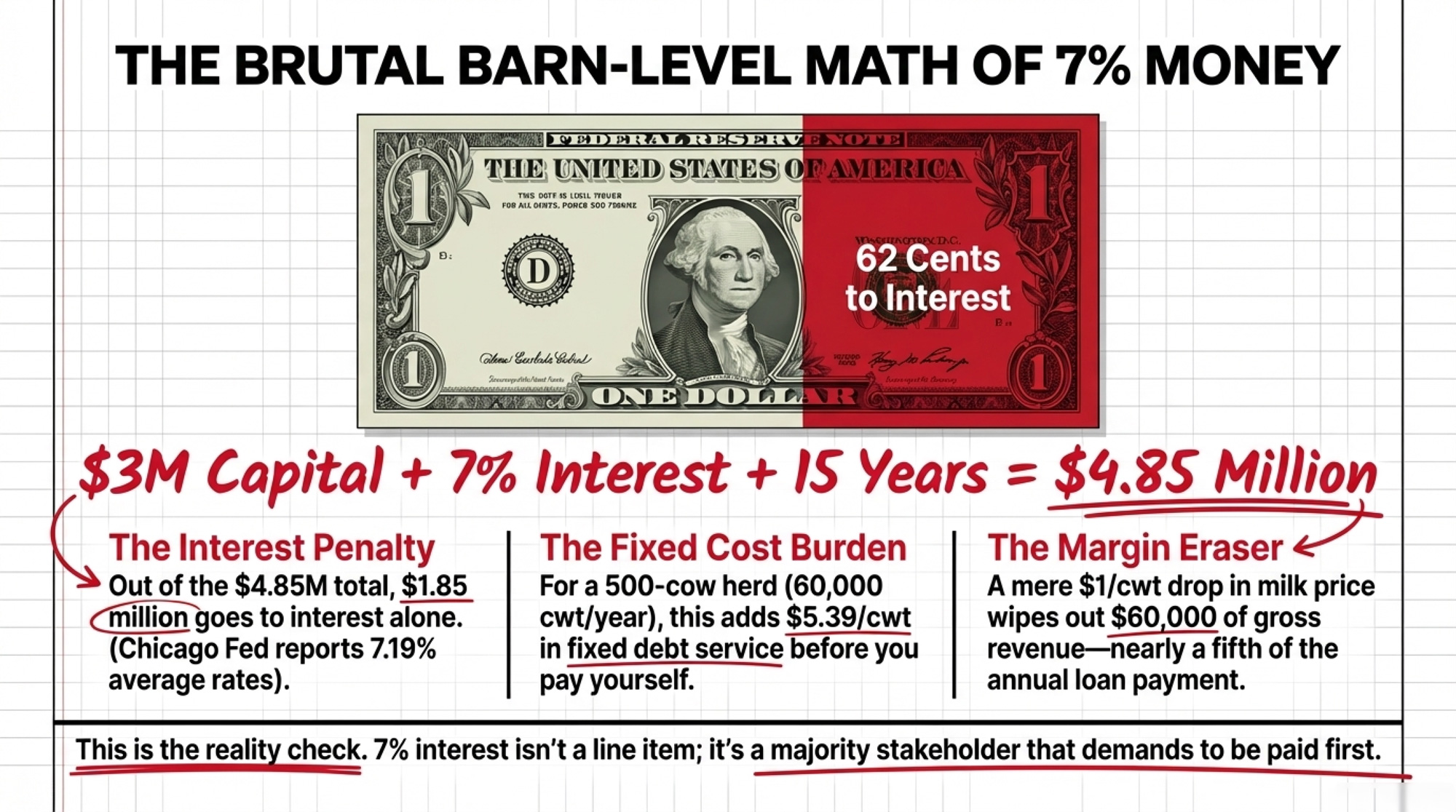
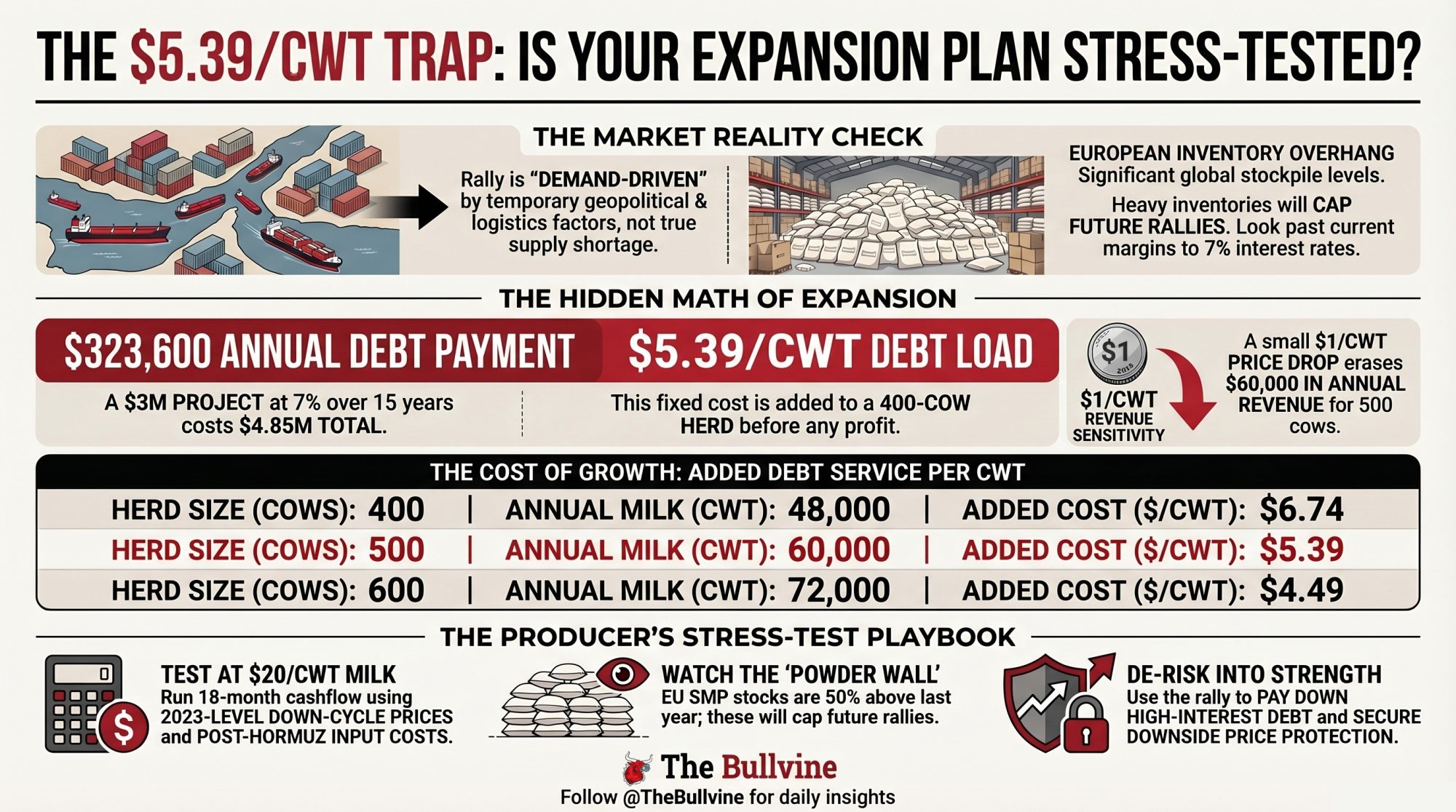
At 7%, each monthly payment on a $3 million, 15‑year loan runs approximately $26,965. That’s roughly $323,600 per year in combined principal and interest. Over the full 15 years, you pay back approximately $4.85 million — meaning roughly $1.85 million goes to interest alone. That’s about 62 cents in interest for every dollar you borrowed.

The 7% rate isn’t hypothetical. The Chicago Fed’s AgLetter reported farm real‑estate loan rates in the Seventh District around the 7.19% range at the start of 2025, with rates hovering in the high‑6 to low‑7 percent band through much of the year. So 7% sits right in the middle of what lenders were actually charging through 2025.

Now translate that annual payment into the number that actually matters — cost per hundredweight shipped:

Herd Size (Cows)Annual Milk (cwt)Added Cost ($/cwt)$1/cwt Revenue Hit
40048,000$6.74$48,000
50060,000$5.39$60,000
60072,000$4.49$72,000

Note: Based on 120 cwt/cow/year and a $3M project at 7% over 15 years (~$323,600/year).

That “$1/cwt Revenue Hit” column is the one that should keep you up at night. Drop milk by just a dollar, and a 500‑cow herd loses $60,000 in gross revenue — nearly a fifth of that annual loan payment.

Many farm financial advisors and extension economists note that once they fully load family labor, realistic depreciation, and current interest costs, breakevens often land several dollars per cwt higher than what producers carry in their heads. That’s the gap you don’t want to discover two years after concrete is poured.

When Do Fertilizer and Fuel Really Hit Your Ration?

Margins feel better today than they did in 2023. Some of that is the milk price. Some of it is just timing.
On the feed side, global grain markets look calmer than in 2022 — prices for corn, wheat, and soymeal are closer to the low end of their five‑year range, helped by expectations for decent yields. That’s one big reason rations feel manageable. But fertilizer and energy are on a different trajectory:

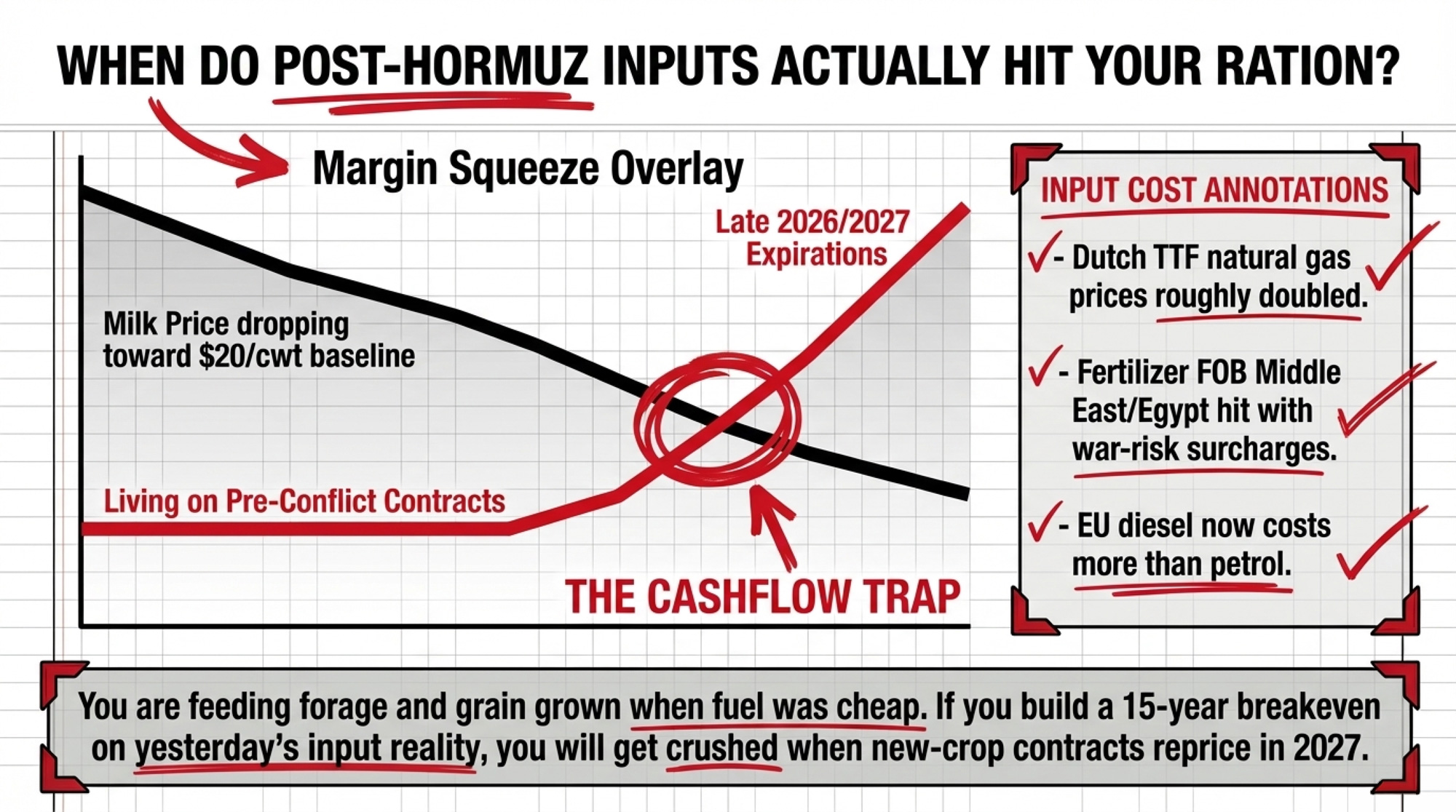
  • Benchmark fertilizer prices FOB Middle East/Egypt have “risen substantially,” with delivered costs pushed higher by freight and war‑risk surcharges. 
  • Gasoline prices have risen enough that, in many European countries, diesel now costs more than petrol after taxes are added — the reverse of normal. 
  • Dutch TTF natural gas prices roughly doubled after the conflict flared, and the spread between European and U.S. gas widened sharply. 

That doesn’t hit your TMR overnight. Through mid‑2026, you’re still feeding off forage and grain grown or bought when fertilizer and fuel were cheaper. Late 2026 into 2027 is when new‑crop contracts fully reflect the higher input environment — and that’s when the true variable‑cost increase lands in your ration.

If you price an expansion project off 2025/early‑2026 input costs and assume they hold, you’re building your 15‑year breakeven on yesterday’s input reality.

What If the 2026 Rally Sticks Around?

This all sounds cautious. So what’s the scenario where the rally holds, and you’d wish you’d built?

In Donnay and Lancaster’s modeling, there is a path where 2026 doesn’t roll over quickly. You’d need some combination of:

  • Europe is slowing harder than the models assume. If weather, disease, or policy push EU collections into outright decline sooner than Lancaster’s base case, that tightens export supply faster. 
  • U.S. herd growth is breaking sooner. Since mid‑2024, U.S. dairy farmers have added 293,000 cows, including 49,000 head in January–February 2026 versus 30,000 in the same period a year earlier. Donnay expects this expansion to slow, with component‑adjusted growth easing toward roughly two percent by late 2026. If it plateaus faster, that’s supportive. 
  • China is tilting back toward imports. Over the last 12 months, Chinese processors exported about 12,000 tonnes of SMP and began shipping MPC70 into Southeast Asia, as Yifan Li notes. If domestic demand or policy nudges them to rely more on imports again, that removes a growing competitor at the margin. 
  • Hormuz is keeping a fear premium without crushing Gulf demand or blowing input costs through the roof. Donnay’s view: the conflict could be “mildly supportive” short term, then turns bearish for demand in the medium term, and potentially bullish longer term if fertilizer and energy costs eventually tighten supply. 

Is that combination impossible? No. Is it guaranteed? Not even close.

Donnay and Lancaster’s base case still points to strong production across major exporters, heavy EU SMP and butter stocks relative to 2025, a U.S. herd that keeps expanding even if the pace eases, and China with one foot in the export game. That’s why the contrarian play isn’t “never expand.” It’s “don’t build as if this rally is a floor.”

The Turn: One Stress Test Before You Sign Anything

Here’s where this shifts from “what the market’s doing” to “what you do about it.”
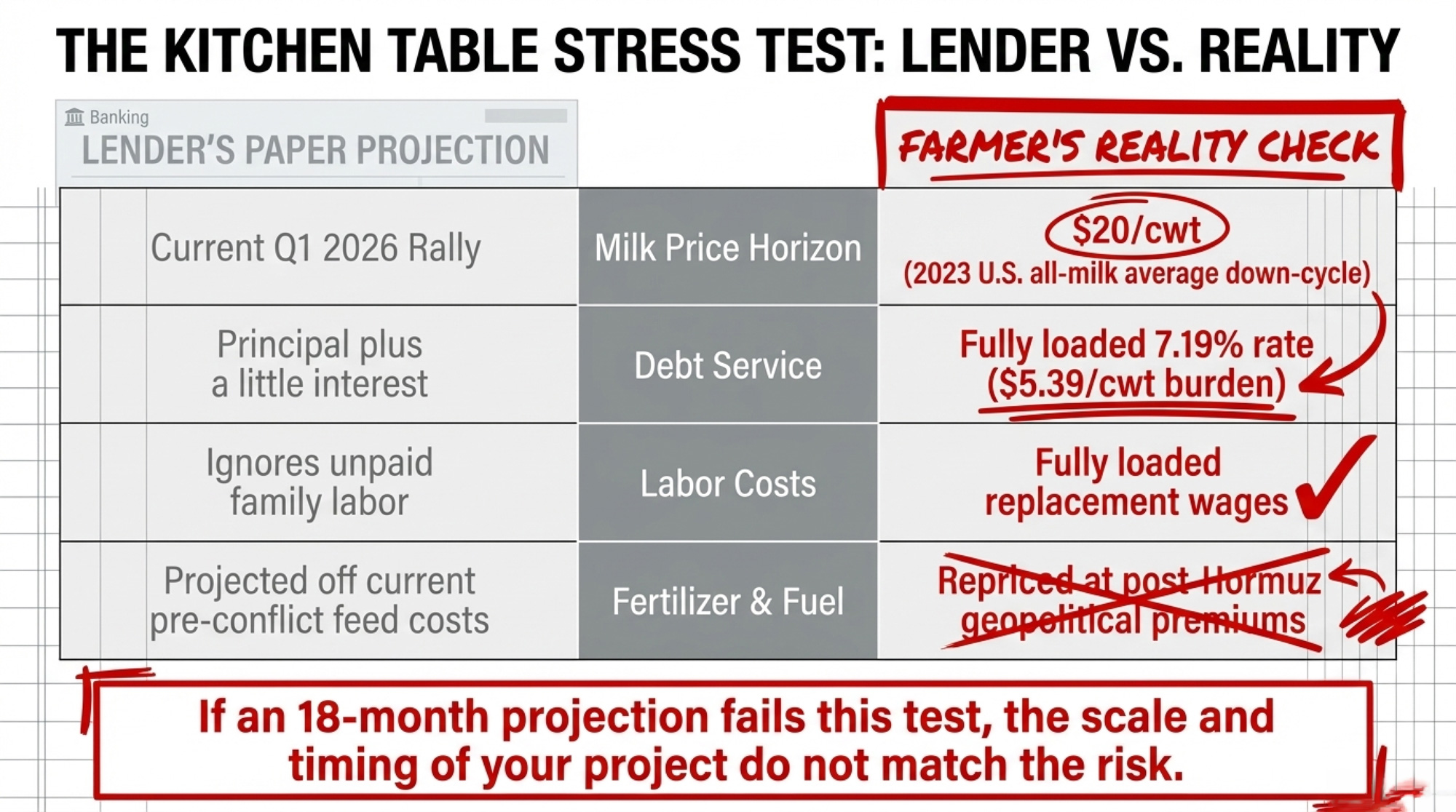
Picture the kitchen table. On one side, your lender has a pro forma that works at current margins. On the other hand, someone in the family remembers 2023 and isn’t sure those margins will be there when your kid takes over payments. The numbers on the screen say “go.” The knot in your stomach isn’t so sure.

The market picture Donnay lays out — strong supply, heavy stocks, a rally built on logistics panic — points to one stress test every expansion plan should pass before pen hits paper:

Run an 18‑month cashflow at a realistic down‑cycle milk price and softer beef cheques, using your full post‑expansion cost structure.

Not the price you hope for. The price you know you might see.

A conservative version of that test:

  • Use a price around the 2023 national U.S. all‑milk average — roughly $20/cwt — as your down‑cycle starting point, then adjust for your own market and component program. 
  • Cut your beef and calf revenue assumptions back from today’s highs. 
  • Load in full principal + interest on all existing and new loans.
  • Pay yourself and your family at replacement wages.
  • Price fertilizer, fuel, and purchased feed at post‑Hormuz levels once current contracts expire. 

If that 18‑month projection shows operating debt climbing with no credible path back down, that’s not just “tight.” It means the scale or timing of the project doesn’t match the risk you’re actually comfortable carrying.

ScenarioMilk Price ($/cwt)Feed+Var ($/cwt)Debt Svc ($/cwt)Net Cash/Cow/yr500-Cow Annual Net
Current Rally (Q1 2026)$23$14.50$5.39$373$186,600
Base / Mid-Cycle$21$14.50$5.39$133$66,500
2023 Down-Cycle Avg$20$14.50$5.39$13$6,600
Post-Hormuz Input Costs$20$16.00$5.39-$$173**-$86,400
Severe Stress (teens)$18$16.00$5.39-$413-$206,400

How Should a 500‑Cow Dairy Use the 2026 Rally Without Getting Trapped?
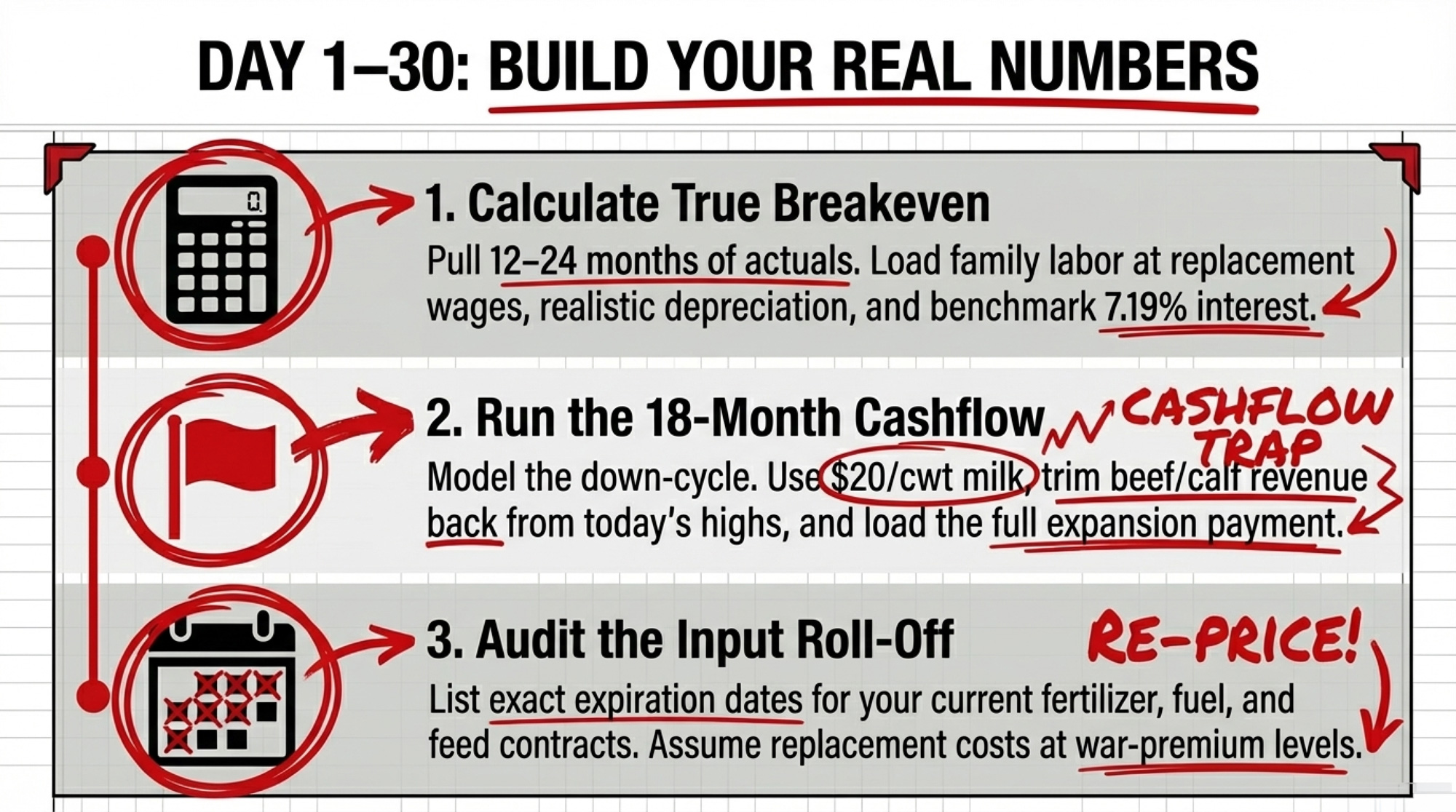
In the Next 30 Days: Build Your Real Numbers

  • CALCULATE your true breakeven. Pull 12–24 months of actual data — milk checks, feed bills, fert, fuel, repairs, debt statements. Build a breakeven that includes family labor at replacement wages, realistic depreciation, and current interest rates. Farm real‑estate rates in the Chicago Fed district sat in the high‑6 to low‑7 percent range through 2025, with farm real‑estate loans around 7.19% at the start of 2025 — use that as your benchmark. 
  • RUN the 18‑month cashflow at a down‑cycle price. Use a conservative milk price for your region (around 2023 levels or below), trim beef revenue, and include full payments on any expansion you’re considering. If operating debt climbs for most of that window, revisit project scale or timing. 
  • AUDIT when “cheap” inputs roll off. List expiration dates for your fertilizer, fuel, and feed contracts. Where you’re still living on pre‑conflict pricing, assume the replacement cost is higher and model it. 
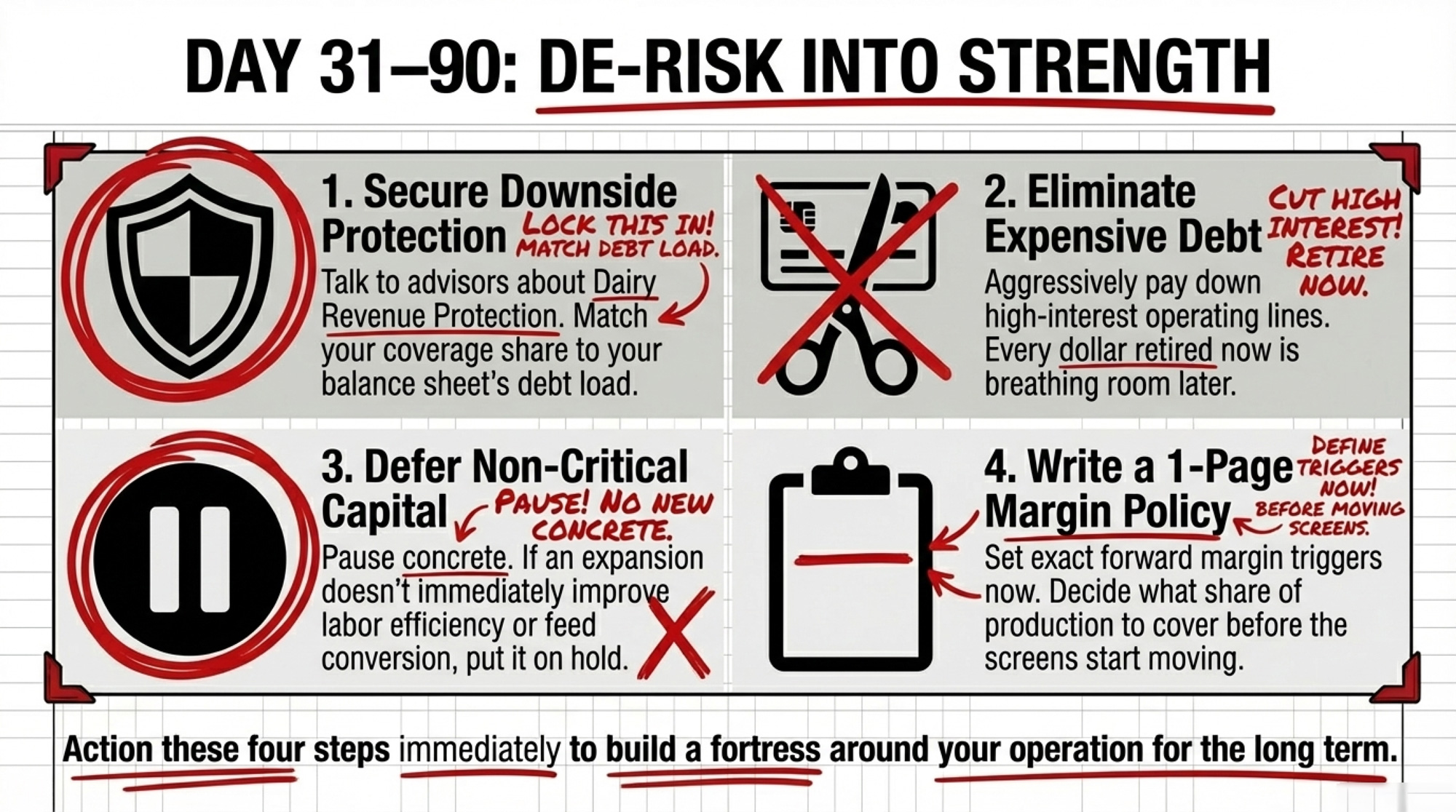
In the Next 90 Days: Lock In Strength

  • SECURE downside protection. Talk with your risk‑management advisor about Dairy Revenue Protection or similar tools in your region. The right share to cover depends on your debt load and risk tolerance, so work it through with someone who knows your balance sheet. 
  • ELIMINATE expensive debt. Prioritize paying down high‑interest operating lines and short‑term notes. Every dollar of principal you retire now is room you get back if you spend time in the teens again. 
  • DEFER non‑critical capital spending. Anything that doesn’t clearly improve labor efficiency or feed conversion goes on hold until you’ve seen how this rally resolves.
  • WRITE a one‑page margin policy. Decide now what forward margin level triggers you to layer in price protection, and what share of production you’ll cover at each trigger. Don’t negotiate with yourself when screens are moving. 
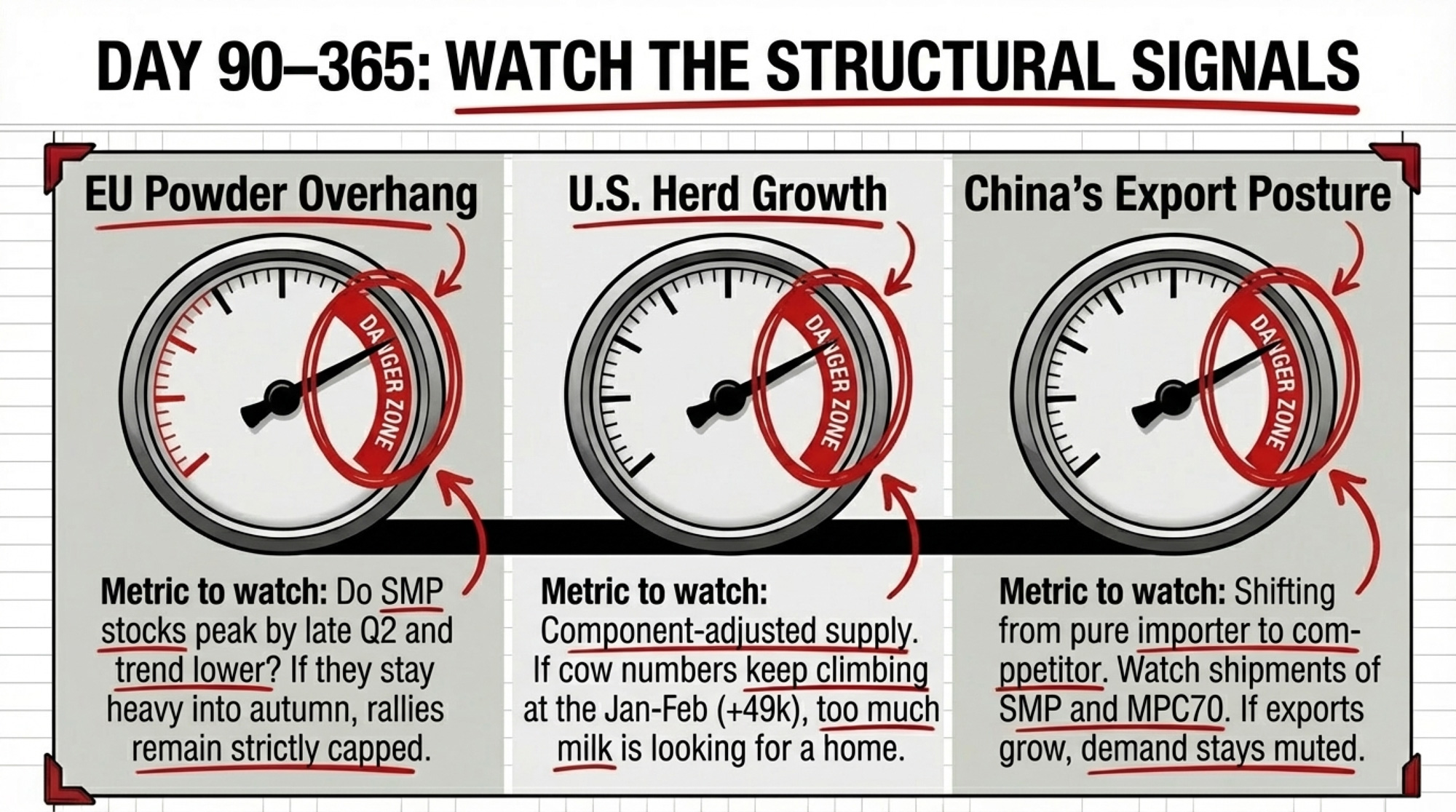
Over the Next 365 Days: Watch the Structural Signals

  • TRACK EU stocks and production. If SMP stocks peak by late Q2 and trend lower as milk growth slows and butter inventories narrow relative to 2025, the overhang is easing. If stocks stay heavy into autumn, assume there’s still a cap on rallies. 
  • MONITOR U.S. herd growth. Donnay’s base case has the U.S. component‑adjusted supply still growing by around 2% by late 2026, even as expansion slows. If cow numbers keep climbing at the Jan–Feb pace, that’s more milk looking for a home. 
  • WATCH China’s role. Li points out that Chinese processors are already shipping SMP and MPC70 to Southeast Asia, and that China’s dairy sector has shifted from pure import dependence to a mixed import‑plus‑export model. If those exports keep growing and imports stay muted, China is a competitor. If exports flatten and imports recover, it’s back as a source of demand. 

What This Means for Your Operation

  • Don’t treat a fear‑driven rally as a permanent rise. Q1 2026 rests on restocking and logistics panic with a heavy EU powder and butter overhang behind it. That’s not a safe foundation for 15‑year debt. 
  • Your “mental breakeven” is probably lower than your actual breakeven. Once you include family labor, realistic depreciation, and post‑Hormuz input costs, the margin cushion you see today may be several dollars per cwt thinner than you think. 
  • Expansion isn’t wrong. Bad timing is. If your 18‑month stress test only works at top‑third milk prices and current beef cheques, the project scale or timing doesn’t match the risk you’re taking on. 
  • The safest contrarian move is to de‑risk into strength. Use this rally to knock down high‑cost debt, lock in partial downside protection for late‑2026/early‑2027, and build flexibility rather than stretch fixed costs. 
  • In the next 30 days, pull one number that forces an honest conversation. Take your current feed cost per cwt and compare it to 90 days ago. Then lay your expansion loan’s $/cwt debt service on top of that. If you wouldn’t sleep with $2–$3/cwt less margin, that tells you whether this project belongs in 2026 or 2027.
Key Takeaways

  • If your expansion doesn’t pencil at $20 milk, it doesn’t pencil. Use the 2023 all‑milk average as your down‑cycle starting point and build your 18‑month stress test from there, with full principal and interest, family labor, and post‑Hormuz input costs loaded. 
  • A $3M project at 7% is a $4.85M commitment. For a 500‑cow herd shipping 60,000 cwt a year, that adds about $5.39/cwt in fixed cost before you pay yourself, and the first $1/cwt drop in milk erases $60,000 of that cushion. 
  • Use the 2026 rally to buy flexibility, not just concrete. If you come out of this year with less high‑interest debt, some downside protection layered in, and a clear margin policy, you’ve gained options whether milk trades at $18 or $24. 
  • Watch the overhang and the herd, not just the headline price. EU SMP and butter stocks, U.S. cow numbers, and China’s export posture will tell you more about how long this rally can last than any single futures quote. 
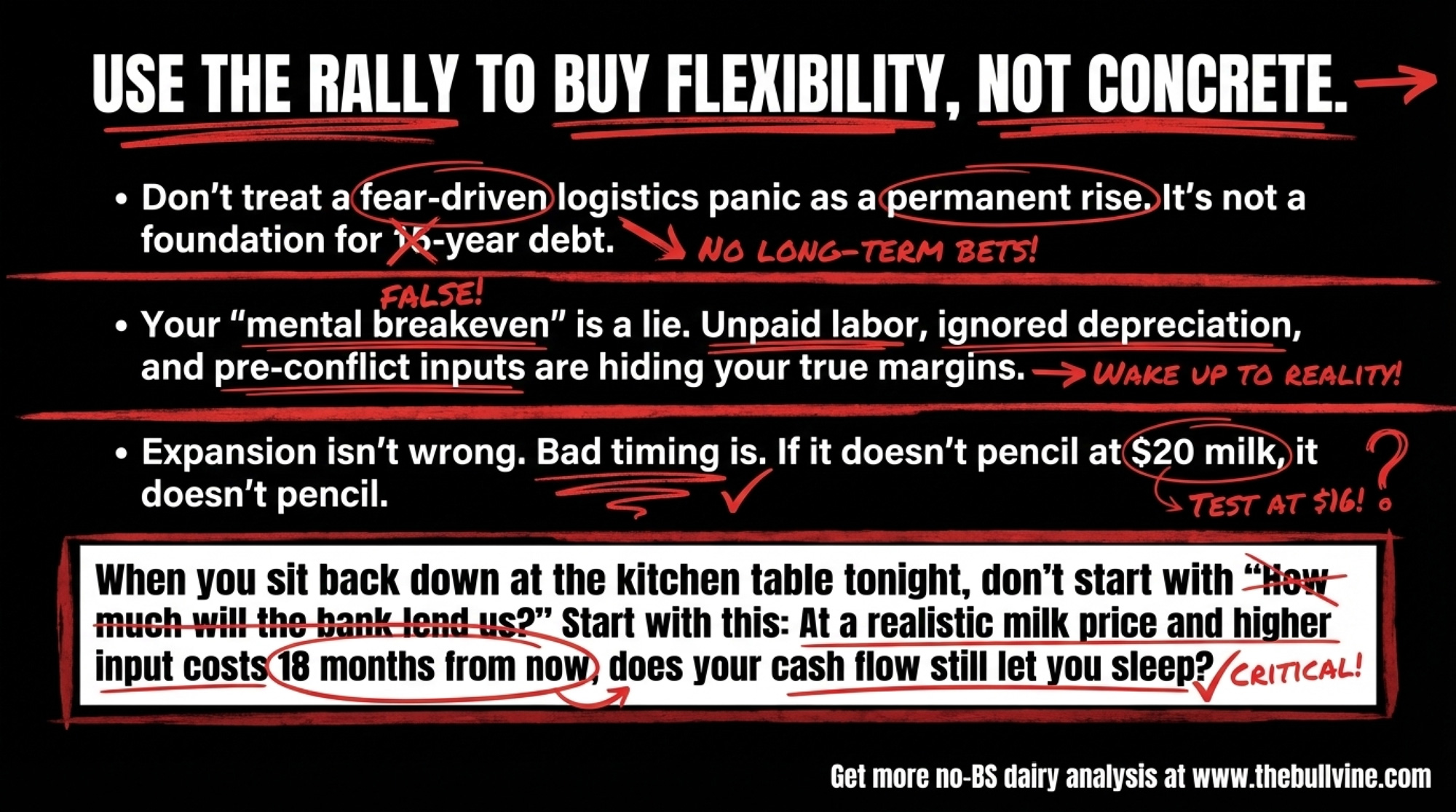
When you sit back down at the kitchen table tonight, don’t start with “How much will the bank lend us?” Start with this: at a realistic milk price and higher input costs 18 months from now, does your operation’s cash flow still let you sleep?

Complete references and supporting documentation are available upon request by contacting the editorial team at editor@thebullvine.com.

Learn More

The Sunday Read Dairy Professionals Don’t Skip.

Every week, thousands of producers, breeders, and industry insiders open Bullvine Weekly for genetics insights, market shifts, and profit strategies they won’t find anywhere else. One email. Five minutes. Smarter decisions all week.

NewsSubscribe
First
Last
Consent

The $1.56/cwt Permit Trap Hiding in Your Next Dairy Expansion: Riverview’s 18,855‑Cow Minnesota Fight

A one‑year permit delay on 600 new stalls quietly adds about $1.56/cwt to that milk you haven’t shipped yet. The Stevens County fight shows exactly how that math catches up to you.

Executive Summary: A one‑year delay on a 600‑cow expansion can quietly add about US$1.56/cwt in interest alone to every cwt those new stalls should be producing. In Stevens County, Minnesota, Riverview’s proposed 18,855‑cow West River Dairy expansion triggered that exact risk profile: a 226‑million‑gallon water permit request, an MPCA EAW under fire, and a room full of neighbors who don’t trust the math. The same company just agreed to an US millionArizona settlement over groundwater in Sulphur Springs Valley, which opponents now point to as Exhibit A in their fight against more cows on the same aquifer system as Morris. The article walks through the barn math on time‑risk (capital × interest ÷ cwt), shows how a 7.5% rate and US$3 million in debt turn into that US$1.56/cwt drag, and then lays out why regulatory compliance no longer guarantees community approval. If you’re planning to add cows in the next 12–24 months, this is a playbook for pricing in permit delays, pressure‑testing your DSCR with your lender, and doing the neighbor and board work before your name shows up in the legal notices.

Dairy permit risk

The number that froze the room in western Minnesota wasn’t the cow count. It was 226 million gallons of water per year — the volume Riverview LLP’s proposed West River Dairy expansion near Alberta would be allowed to pull from an off‑site well under a Minnesota DNR appropriation request, according to MPCA filings and a March 2026 public notice.

For nearby grain farmer Joe Stromen, who lives a few miles from the proposed site, that Minnesota dairy expansion permit isn’t an engineering abstraction; coverage from Land Stewardship Project (LSP) and Sentient Media has him clearly in the “opposed” column. It’s his well, his gravel road, his property value tied to a project that, until the public comment period opened, he had no formal say in. And for any dairy operator planning growth in 2026, Stevens County is a case study in the cost nobody budgets: the price of a permit fight you didn’t see coming, measured in months of lost revenue and interest you’re still paying on barns that aren’t milking cows.

When a Minnesota Dairy Permit Becomes the Biggest Risk in the Room

The West River Dairy proposal didn’t start with protesters. It started with paperwork.

Riverview LLP — the Fehr family‑founded dairy and beef company headquartered near Morris since 1939 and widely identified as Minnesota’s largest dairy producer — filed with the MPCA to expand West River Dairy from 7,855 to 18,855 dairy cattle, which equates to 26,397 animal units under Minnesota’s feedlot formula. LSP’s analysis calls it the largest dairy CAFO ever proposed in Minnesota by animal units.

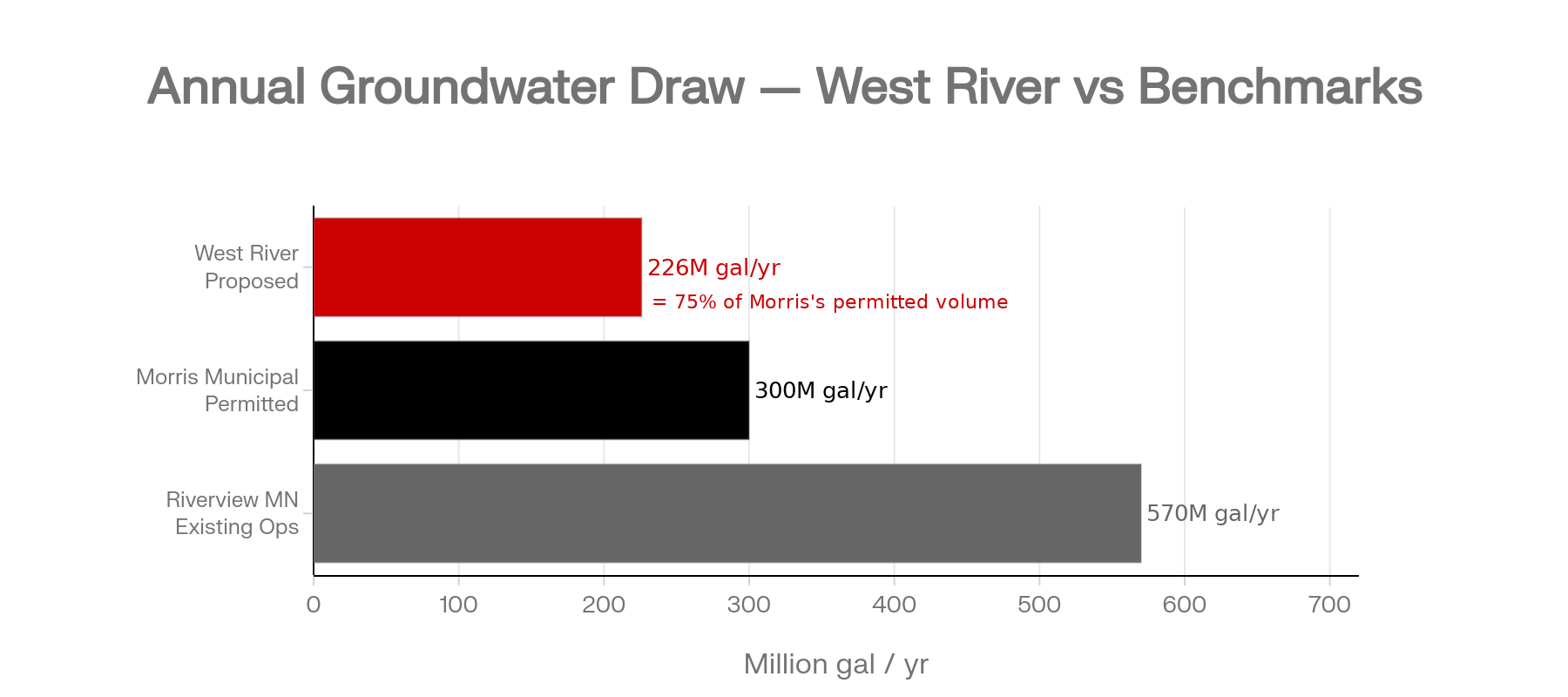
On the engineering side, Riverview’s plan tracks with Minnesota feedlot rules on paper. LSP and MPCA summaries note that the expansion would add a new 11,000‑cow freestall site and increase covered, clay‑lined liquid manure basins from around 102 million gallons to roughly 250 million gallons, with about 13,200 acres of cropland identified for manure application. The DNR water permit would authorize pumping up to 226 million gallons per year, at no more than 1,000 gallons per minute, from an off‑site well near the dairy. The City of Morris — population just over 5,000 — is currently permitted to withdraw up to 300 million gallons per year from its municipal wells in the same aquifer system.

Opponents like Stromen, Carroll, and Matthew Sheets read those numbers differently than Riverview’s engineers.

LSP organizer Sean Carroll, who has tracked CAFO permitting across western Minnesota for years, and residents like Stromen and Sheets point to three numbers in particular: LSP’s reading of state permits says a single dairy expansion is applying to draw roughly 75% of Morris’s annual permitted groundwater volume; the site lies in a landscape dotted with waterfowl production areas and wildlife refuges; and Sentient Media’s review of Minnesota water‑use records estimates Riverview’s existing Minnesota hog and dairy operations already use at least 570 million gallons per year, with West River adding another 226 million if approved.

Carroll’s line, documented in LSP materials and comment letters, is that this isn’t “anti‑dairy,” it’s about cumulative risk: how much animal density and water a single landscape can absorb — and whether the review process is equipped to answer that question at Riverview’s current scale.

Did Riverview File First and Engage Later — and Is That Why They’re Fighting?

From Riverview’s side, the logic is familiar to anyone who has expanded a dairy. Partner and spokesperson Brady Janzen has been quoted in prior coverage saying Riverview grows where cheese demand and processor capacity pull them, and the I‑29 corridor, with billions in new cheese and processing investment, is pulling hard. That’s the same dynamic The Bullvine highlighted in earlier consolidation and plant‑investment work: processors build stainless, and cows, heifers, and capital follow the pipe.

The internal assumption behind West River is one that a lot of growth‑minded herds still share:

  • Hire respected engineers.
  • Model manure, storage, and acres to state specs.
  • Keep water pulls under the modeled aquifer capacity.
  • Deliver a tight nutrient management plan.

If the paperwork is clean, the permit might get noisy — but it eventually lands.

Stevens County is the reality check on that “clean paperwork = smooth permit” assumption. Twice.

First, history. In 2014, the Minnesota Pollution Control Agency’s Citizens’ Board — a now‑abolished citizen oversight panel — ordered a full environmental impact statement (EIS) for a proposed Riverview dairy on essentially the same Stevens County site, citing cumulative concerns about groundwater and downstream impacts. That project did not proceed in its original form. In 2015, after intense political and industry pushback, the legislature eliminated the Citizens’ Board, a move widely linked in state reporting to the Riverview decision and other controversial feedlot calls. When a new, larger West River plan emerged a decade later with only an environmental assessment worksheet (EAW) instead of a full EIS, LSP, and the Institute for Agriculture and Trade Policy (IATP) framed it as a system that had lost a layer of scrutiny, not one that had learned from 2014.

Second, track record. In January 2026, Arizona Attorney General Kris Mayes announced a US$11 million settlementwith Riverview related to concerns about declining groundwater levels in the Sulphur Springs Valley. Under the agreement, Riverview agreed to provide US$11 million to fund replacement wells, emergency and interim water supplies, and community water systems for affected residents, while continuing water‑conservation efforts; the company did not admit legal wrongdoing. LSP and Food & Water Watch have used that case, and that dollar figure, as part of their argument that West River deserves closer scrutiny.

On the one hand, Riverview can cite its MPCA and DNR filings and argue that its West River proposal fits within Minnesota’s current feedlot and water‑permit framework. On the other hand, groups like LSP and IATP argue that Riverview’s current scale — and high‑profile groundwater disputes like the Arizona case — justify tougher questions about cumulative water draw and enforcement. However, that argument plays out legally, the operator who absorbs the financial cost of any delay, conditions, or litigation is Riverview — and in the next county, with the next big barn, that operator could be you.

How Much Does a Dairy Expansion Permit Delay Actually Cost?

Here’s the math almost nobody runs before filing. You don’t need 18,855 cows for this to hurt — the arithmetic hits just as hard at 400, 800, or 1,500 new stalls.

When a permit stalls, you’re carrying:

  • Interest on expansion‑tied capital you’ve already drawn or committed — land, barns, storage, parlor, rolling stock.
  • Fixed costs — insurance, taxes, maintenance, utilities — on infrastructure that isn’t yet shipping milk.
  • Professional fees — engineering, legal, consulting — that tick up with every hearing, comment extension, or requested study.

And you’re missing:

  • Milk revenue from cows that should already be shipping.
  • Component premiums and incentives are baked into the original pro‑forma.
  • Manure nutrient credits you expected to offset the purchased fertilizer on your acres.

Most people budget for construction risk — overruns, weather, and contractors. Very few explicitly budget time‑risk. In a county watching West River and reading about Arizona, that line item is getting more real.

How Much Can a Minnesota Dairy Expansion Permit Delay Actually Cost?

Here’s why that Stevens County fight matters even if you’re “only” adding 600 cows two states away. Walk through this once with transparent numbers. Then swap in your own.

Assume:

  • You’re adding 600 cows to your current herd.
  • You’ve drawn about US$3.0 million in expansion‑tied capital — a midpoint in the US$2.5–3.5 million range seen in some Upper Midwest freestall/parlor plus manure‑infrastructure budgets for 500–700 cows.
  • Your blended interest rate on that capital is 7.5%, consistent with recent Kansas City Fed data showing average interest rates on farm real‑estate loans around 7.49% in early 2025 — near the long‑term average but still high enough to make every month of delay expensive.

Here’s the time‑risk cost profile:

  • Annual interest = capital × interest rate
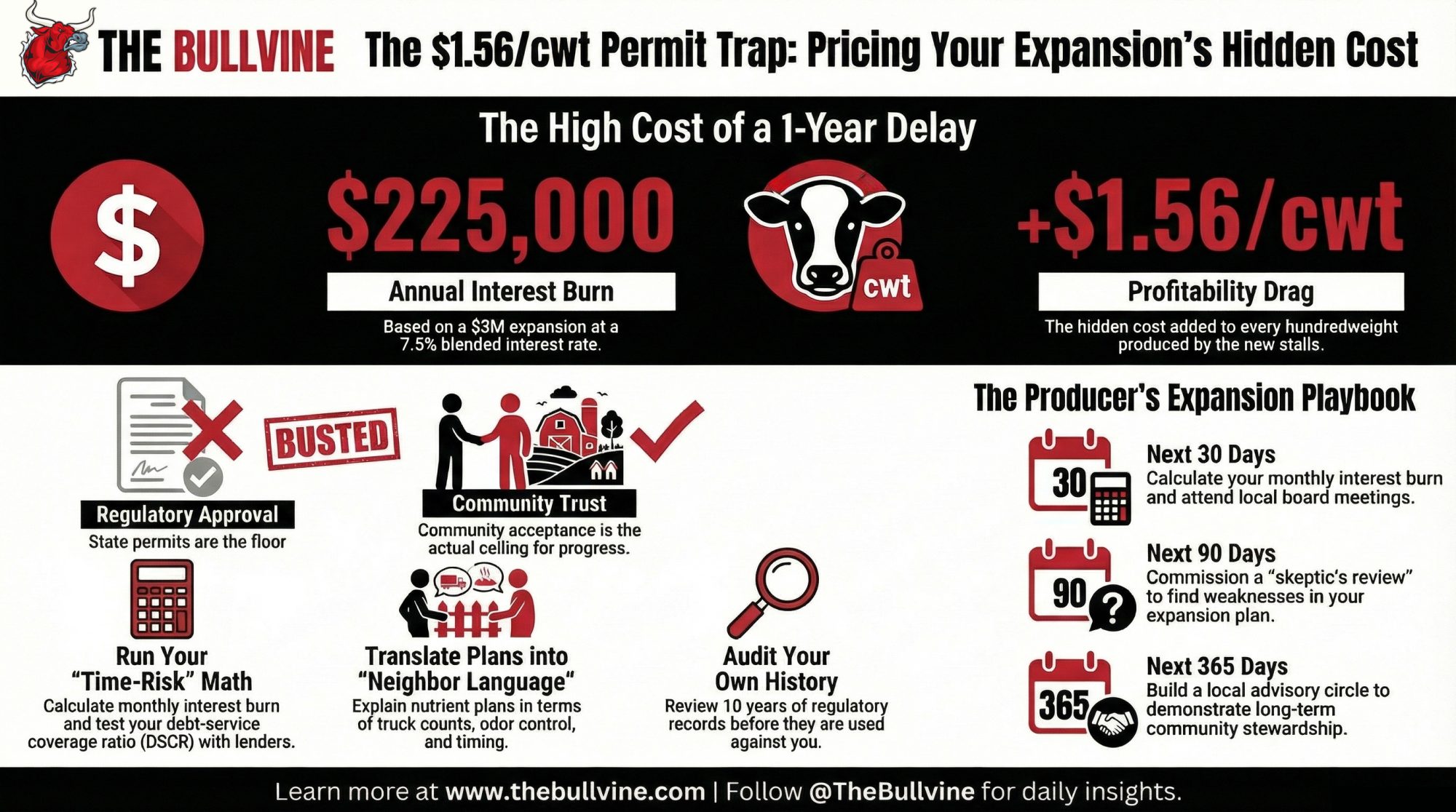
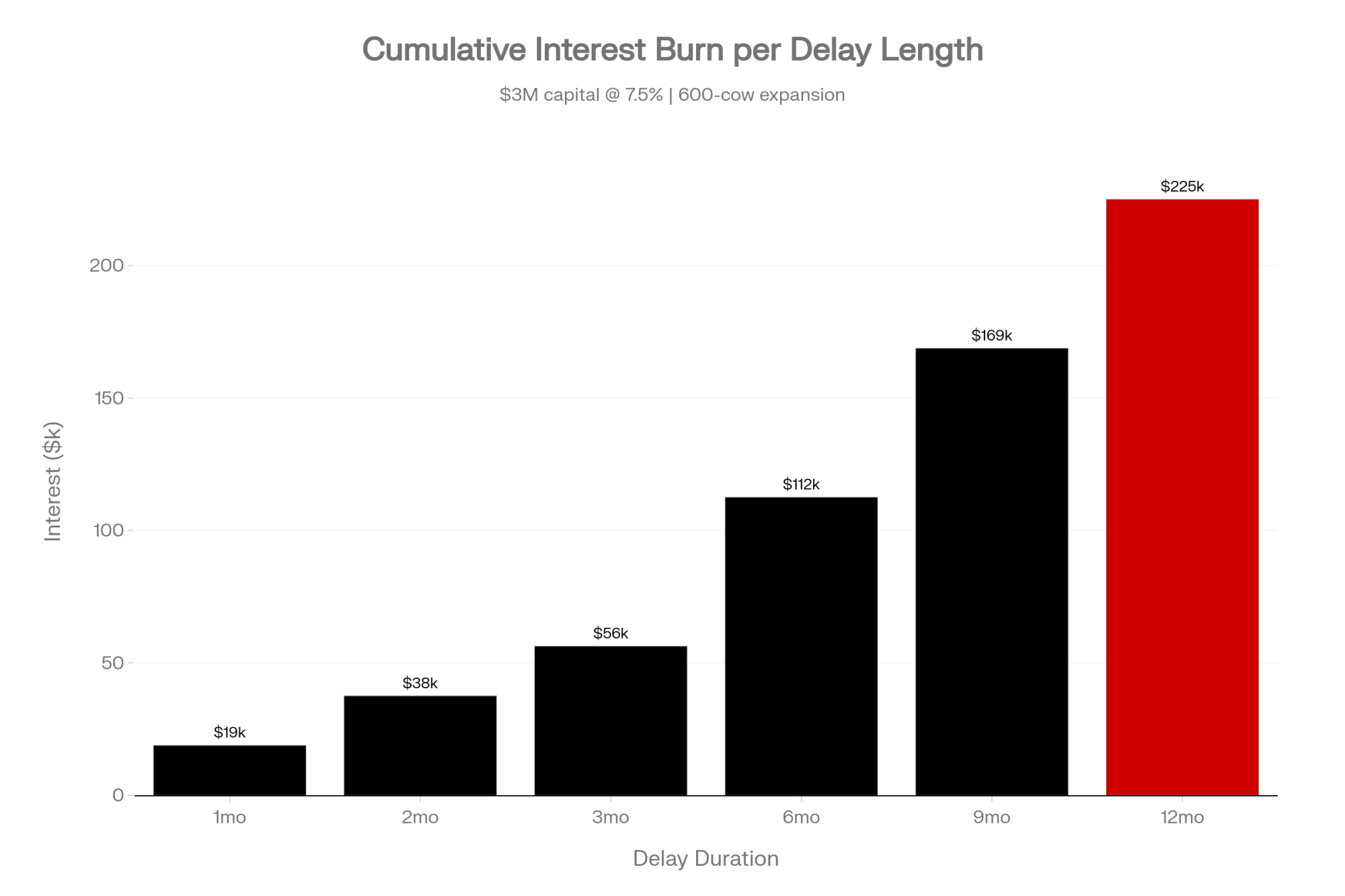
    • 3,000,000 × 0.075 = US$225,000 per year in interest directly tied to the expansion.
  • Monthly burn = 225,000 ÷ 12 ≈ US$18,750 per month in interest — before you count depreciation, taxes, insurance, or legal fees.
  • A 12‑month permit delay at that rate = US$225,000 in interest alone, with no milk from those 600 cows.

Now convert that into something you actually feel in the milk check.

USDA and related summaries put average US milk production per cow in the low‑ to mid‑20,000‑pound range annually; using 24,000 pounds (240 cwt) per cow per year is a reasonable example for a Holstein herd in recent years.

  • 600 cows × 240 cwt/cow/year = 144,000 cwt of milk per year. Those new stalls should produce once they’re filled.

Time‑risk penalty per cwt in this example:

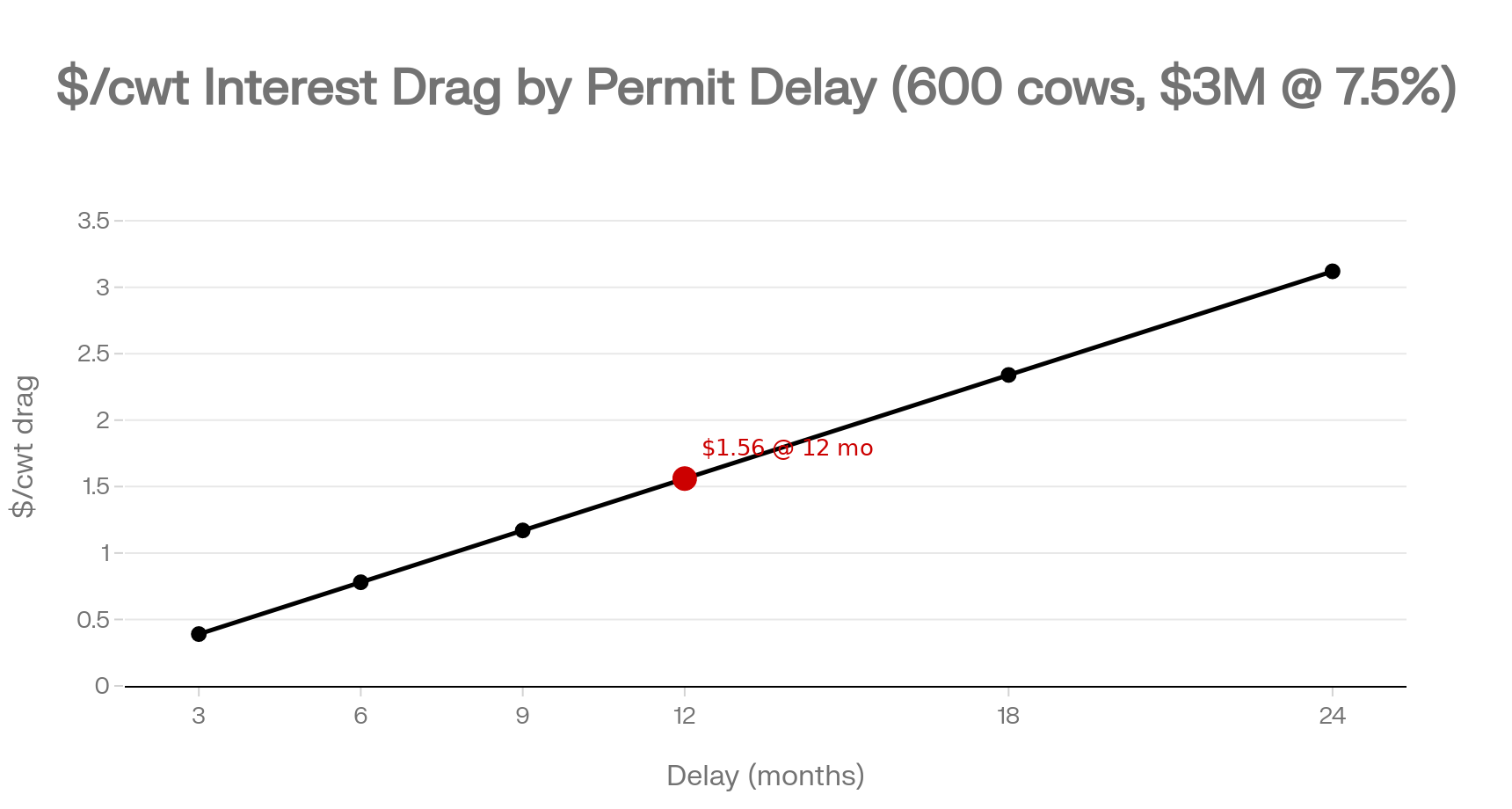
  • 225,000 ÷ 144,000 cwt ≈ US$1.56/cwt.

That’s just the interest — no feed, no labor, no margin‑over‑feed math. In a 600‑cow example at current rates and infrastructure costs, a one‑year permitting delay quietly adds around a dollar and a half per cwt to the effective cost of that new production. If your build is larger, rates are higher, or production runs lower, the penalty climbs.

Run your own version:

  • Expansion capital drawn × interest rate ÷ 12 = monthly time‑risk cost.
  • Monthly time‑risk cost × months of delay = total time‑risk hit.
  • Total time‑risk hit ÷ annual cwt from new cows = your hidden US$/cwt drag.
Expansion SizeCapital DrawnMonthly Interest Burn$/cwt Drag @ 6-Mo Delay$/cwt Drag @ 12-Mo Delay
400 cows$2,000,000$12,500$0.78$1.56
600 cows$3,000,000$18,750$0.78$1.56
800 cows$4,000,000$25,000$0.78$1.56
1,000 cows$5,000,000$31,250$0.78$1.56
1,500 cows$7,500,000$46,875$0.78$1.56

Where in your spreadsheet did you plan for that line?

What Stevens County Teaches Every Dairy Farmer to Grow

Here’s the myth this fight quietly kills: “Big guys get what they want. My smaller expansion won’t draw this kind of heat.”

Riverview did what any seasoned operator is told to do. Tight nutrient numbers. Engineered storage. A water permit request, DNR staff say, can be managed within the aquifer’s capacity on paper. Yet they still walked into a hearing room where opponents had binders of state records, an Arizona AG press release, and a decade‑old EIS fight on the same site to point at.

That dynamic doesn’t stay confined to a 26,397‑animal‑unit project. It shows up when:

  • You grow from 300 to 600 cows on the edge of town.
  • You site a deep pit or lagoon along a gravel road that a newer subdivision uses every day.
  • You move from one barn to a multi‑barn complex in a township that has never seen that density.

Your nutrient management plan might be airtight. The question is whether you’ve done any work to translate those numbers into the lived reality of dust, headlights, and truck counts that your neighbors care about.

Stevens County also exposes a second busted assumption for any operator: “Once regulators sign off, the science argument is over.”

In their formal and media comments, LSP and IATP argue that cumulative nitrate and water‑use risks in the Pomme de Terre watershed aren’t fully captured by current modeling for a project of West River’s size. That’s a technical argument, not just a vibes‑based objection. Whether you buy their analysis or not, once that level of distrust fills a boardroom, another engineering cross‑section or appendix letter from MPCA doesn’t move the room by itself.

In 2026, regulatory approval is the floor for community trust, not the ceiling. If an expansion strategy stops at “the state says yes,” the operator is effectively handing the public narrative about their farm to critics — and doing it while the interest meter ticks and heifers keep aging.

Those months of drift also collide with other structural constraints. Work on the heifer shortage has shown how tight replacement supply and higher heifer values already squeeze expansion timelines and flexibility; every extra month of permit limbo shifts when those heifers calve in, and how you manage culling and breeding. A year‑long permitting detour doesn’t just cost you interest; it can throw your replacement, breeding, and culling plans out of sync.

Risk DimensionWest River (Proposed)Typical 500–1,200 Cow MN Expansion
Herd size (animal units)26,397 AU (18,855 cattle)700–1,700 AU
Water permit request226M gal/yr (75% of Morris municipal)5–25M gal/yr
Manure storage~250M gal liquid basin2–8M gal
Cropland for application~13,200 acres800–3,000 acres
Prior EIS/EAW history on siteYes — 2014 fight, project abandonedTypically none
AZ groundwater settlement (same operator)$11M (Jan 2026)N/A
Community opposition on recordLSP, IATP, local residents, formal commentsOccasional neighbor objections
Permit pathwayEAW only (no full EIS)Standard MPCA feedlot permit

The 30/90/365‑Day Expansion Playbook: What to Do Before You File

You don’t control aquifers, activist groups, or statehouse politics. You do control how exposed you are before your farm’s name shows up in a public notice that opposition groups can organize around.

TimeframeActionOwnerRisk if Skipped
30 daysRun time-risk math (capital × rate ÷ cwt)Operator + lenderFlying blind on $/cwt drag
30 daysAttend 2 township/county meetingsOperatorCan’t name likely opponents before filing
30 daysDSCR stress-test at 6 and 12-mo delayLender conversationCovenant breach risk not modeled
30 daysAudit own regulatory/neighbor historyOperator + attorneyOpposition brings it up first
90 daysThird-party “skeptic’s review” of operationEnvironmental engineerGaps handed to critics at hearing
90 daysTranslate NMP into plain-language neighbor summaryAgronomist + operatorNutrient narrative controlled by opponents
90 daysPre-negotiate haul routes with county road authorityOperatorTruck traffic becomes hearing flashpoint
365 daysBuild advisory circle (neighbors + local officials)OperatorNo trusted voices in the room when it counts
365 daysAnnual stewardship snapshot (public-facing)Operator“Distant operator” framing sticks unopposed
365 daysVisible local investment (FFA, fire dept, road cleanup)Operator.56/cwt permit fight that was avoidable

In the Next 30 Days

  • Show up where decisions are already being made. Attend at least two county or township meetings you’d normally skip. Sit in the back and listen. Note who always comments, which commissioners lean in on ag issues, and what topics stall the room. If you can’t name the three people most likely to speak against your expansion today, you’re filing blind.
  • Run your time‑risk math now, not after you’ve broken ground.
    • Pull your expansion‑tied capital and real blended interest rate.
    • Use your own rolling‑12‑month production to estimate annual cwt from the new cows.
    • Plug into the formulas above to calculate your monthly burn and US$/cwt penalty for a 6‑ and 12‑month delay.
  • Test your coverage with your lender. Take that time‑risk number to your lender and ask, “How many months of zero new revenue from this expansion can we absorb before my debt‑service coverage ratio drops below about 1.2?” Many ag lenders use around 1.2 as a common minimum DSCR covenant on term debt; you need your actual threshold and how close you are to it in writing, not as a guess from memory.
  • Audit your own regulatory and neighbor history. Pull five to ten years of your own interactions with environmental regulators: spill reports, notices of violation, odor complaints, anything formally logged. Make a second list of serious neighbor disputes. Assume every item on those lists will be mentioned in a hearing, and start thinking now about what you’d say in response.

Over the Next 90 Days

  • Commission your own “skeptic’s review” of your current operation. Hire a third‑party environmental or engineering firm — not just the engineer who’ll file your permit — to look at nutrient loading vs acres, seasonal odor, and truck traffic by season and time of day. Ask them explicitly, “Where would a critic reasonably push on this?”
  • Translate your nutrient management plan into a neighbor’s language. Before your name shows up in the legal notices, pull your immediate neighbors into a conversation or mailer that says, in plain numbers:
    • How many acres get manure, roughly how many gallons per acre, and how many times per year?
    • Most of those nutrients replace purchased N, P, and K on those fields, based on your lab results and agronomist recommendations.
    • The specific steps you take on timing, injection/surface‑application, setbacks, and slope to keep nutrients and odors as controlled as possible.
  • Pre‑negotiate haul routes and timing with your county. Sit down with the county or township road authority now and lay out your anticipated truck trips at full build‑out, including peaks for silage, feed, and manure. If you can walk into a hearing with a signed or draft road‑use understanding — or at least a memo showing you’ve offered to contribute to maintenance — it changes the tone of that part of the debate.

Over the Next 365 Days

  • Build a small advisory circle that outlasts the permit fight. That might be two neighbors, one local official, and a representative from the school or fire department. Meet once or twice a year to share high‑level plans and ask for blunt feedback. The goal isn’t consensus; it’s a pattern of engagement that commissioners can point to when they’re under pressure.
  • Create an annual stewardship snapshot you’d be comfortable seeing on Facebook. One page on manure handled, acres receiving it, major changes you’ve made to reduce risk or nuisance, and what you’re doing on water use and emergency preparedness. Post it online and drop a printed copy with immediate neighbors.
  • Invest visibly before you ask for a big yes. Target local support where your trucks and impact already show up: fire department, FFA, local EMS, and road cleanups. You’re not buying votes, you’re demonstrating that you see your operation as part of the community, not above it. That matters a lot when a commissioner is weighing two stacks of testimony.

By the time your permit hits the agenda, you want key people in that room thinking, “We know them. They show up, and they fix things.” That doesn’t eliminate organized opposition. It makes it harder to frame you the way critics have portrayed Riverview in their campaigns — as a distant, growth‑driven operator the community never really got to vet.

What This Means for Your Operation

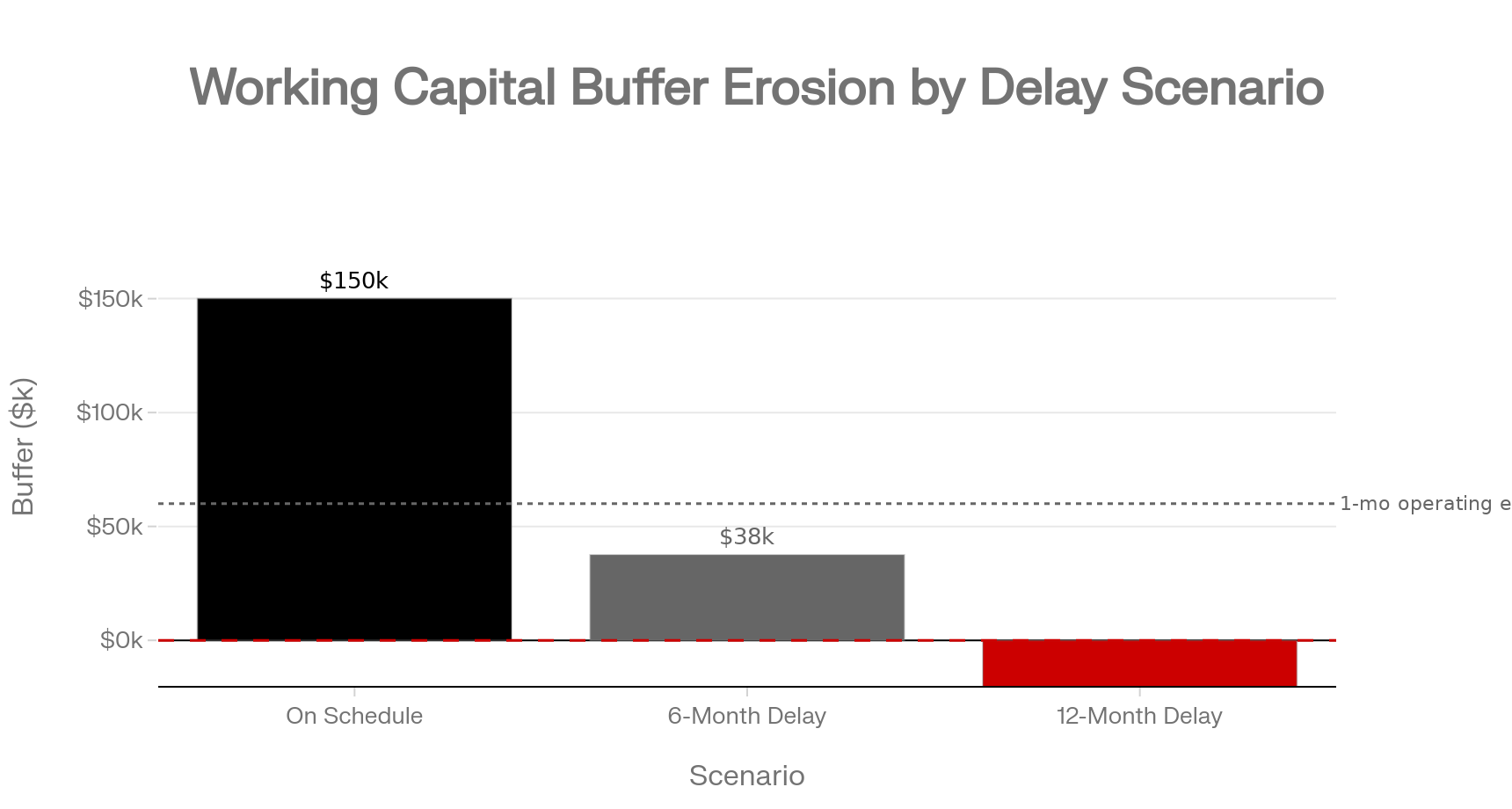
  • Price the year you didn’t plan for. Use your own capital and rate to calculate your monthly time‑risk cost, then stress‑test a 6‑ and 12‑month delay. If that scenario would shove your working‑capital buffer below roughly a month of operating expenses, re‑phase or downsize the project before you file.
  • Stop assuming a clean permit file equals a smooth community process. Build a basic communication and neighbor‑engagement plan the same way you build a nutrient plan — with names, dates, and specific risks you’re trying to manage.
  • Clear your own skeletons off the table first. Make a realistic list of past notices, complaints, and disputes, then decide what you can fix or visibly improve this year so they’re not the only stories in the room when your name comes up.
  • Treat Stevens County as tuition, not spectacle. Watch what happens with the West River Dairy permit — the timelines, the conditions, and the political fallout — and then identify where your own expansion looks similar on scale, water draw, or proximity to town. That’s your risk stripe.
  • Do one concrete thing in the next 30 days. Either show up to a local board or planning meeting to listen, or book a meeting with your lender to walk through your time‑risk math and DSCR headroom. Put the date and the name on your calendar now, not “sometime this summer.”

Key Takeaways

  • If your expansion pro‑forma only works when everything stays on schedule, you don’t have a plan — you have a best‑case scenario. The West River fight shows how fast a technically compliant, well‑engineered project can still get bogged down when history, water, and community trust are in play.
  • Regulatory approval is the starting line in 2026, not the finish. The barns that get built without an extra year of legal and political drag usually belong to operators who did the communication and relationship work before their permit hit the agenda, not after.
  • Your most expensive opponent may not be the loudest person at the hearing — it’s the monthly interest and lost margin you never modeled when the permit timeline slipped. In a realistic 600‑cow example at current rate and cost assumptions, that delay can quietly add around US$1.50 per cwt to the effective cost of that new milk; larger builds carry even more time‑risk.

The Bottom Line

Stevens County’s mega‑dairy fight will keep showing up in headlines and legal filings. Your version will show up in a local boardroom with 30 people, a sign‑up sheet, and a clock.

Before you sign the next construction contract, pull two things: your monthly expansion‑related interest burn, and the name of the first neighbor or local official you’d call before your permit goes public. If either one is blank, that’s your real permitting problem.

Complete references and supporting documentation are available upon request by contacting the editorial team at editor@thebullvine.com.

Learn More

The Sunday Read Dairy Professionals Don’t Skip.

Every week, thousands of producers, breeders, and industry insiders open Bullvine Weekly for genetics insights, market shifts, and profit strategies they won’t find anywhere else. One email. Five minutes. Smarter decisions all week.
NewsSubscribe
First
Last
Consent

Surging Dairy Prices: Are You Prepared for the Impact?

Discover the latest dairy market milestones and record highs. How will rising prices impact your farm? Stay informed to make the best decisions for your dairy business.

Summary: Dairy spot markets have reached historic highs, with prices rising faster than ever. CME spot Cheddar barrels have increased by 25% to $2.255 per pound, the highest level in over two years. Butter has also skyrocketed to $3.18 a pound, a record high for this time of year. Nonfat dry milk has seen its value rise to $1.255 per pound, a level not seen in 18 months. The markets are begging for producers to make more milk, but biology limits their ability to respond. However, there is a silver lining: the potential for increased profits. The demand for butter remains strong, even at record-high costs, providing a stable market for dairy products. Nonfat dry milk (NDM) rose 5.5% to $1.255 a pound, its highest level in 18 months. Class III and Class IV futures have performed exceptionally well, reaching life-of-contract highs and posting significant gains. The primary cause of these tremendous gains is a scarcity of milk, influenced by seasonal factors, such as cow stress and increased school demand.

  • Record-high prices for dairy spot markets, especially for Cheddar barrels and butter.
  • Nonfat dry milk reaches levels not seen in 18 months, highlighting the market’s upward trend.
  • Biological limitations hinder immediate production increases, despite growing market demand.
  • Strong butter demand provides a reliable market for dairy products, even at high costs.
  • Class III and Class IV futures reach life-of-contract highs due to milk scarcity.
  • Seasonal factors, including cow stress and school demand, contribute significantly to milk scarcity.
  • Potential for increased profits for dairy producers amidst the tightening milk supply.
dairy market milestones, rising prices impact, dairy business decisions, dairy market soars, milk supply shortages, Class III futures, Class IV futures, skyrocketing dairy prices, tight milk supply, summer stress on cows, global dairy market, Oceania dairy stabilization, Europe dairy stabilization, dairy market turmoil, butter prices soar, cheese market challenges, milk powder market challenges, dairy producers, record harvests, crop yields, dairy profits, dairy expansion, dairy innovation, dairy market analysis, dairy market insights, sustainable dairy future, political uncertainties dairy, dairy costs, dairy production

Imagine waking up to discover that every drop of milk in your storage tanks is suddenly worth more than a week ago. Dairy spot markets are at historic highs, and prices are rising faster than ever. CME spot Cheddar barrels have increased to $2.255 per pound, the highest level in over two years. Butter skyrocketed to $3.18 a pound, a record high for this time of year. Even nonfat dry milk saw its value rise to $1.255 per pound, a level not seen in 18 months. “The markets are begging for producers to make more milk, but biology limits their ability to respond.” With this fast-paced movement, it’s difficult not to pay attention. But amidst this surge, there’s a silver lining-the potential for increased profits. So, what does this mean for you and your operations? How can you leverage this surge to your advantage?

ProductPrice ChangeCurrent PriceHistorical Context
Cheddar Barrels+25¢$2.255 per lbHighest in over 2 years
Blocks+14.25¢$2.10 per lbHighest since January 2023
Butter+8.25¢$3.18 per lbLoftiest since last October
Nonfat Dry Milk (NDM)+5.5¢$1.255 per lbFirst time in 18 months
Whey Powder-1.25¢$0.55 per lbHigher than much of the past 2 years

Skyrocketing Prices Alert: The Dairy Market Soars to New Heights 

Recent milestones in the CME spot markets for cheddar barrels, blocks, butter, and nonfat dry milk have been impressive. The price of Cheddar barrels increased by 25% to $2.255 a pound, reaching its highest level in two years. This spike reflects fundamental market dynamics, with a temporary increase and a large retreat. Similarly, Cheddar blocks significantly rose 14.25˼, driving the price to $2.10 per pound, matching the highest level since January 2023.

Butter has also been increasing in popularity. The price increased by 8.25 percent to $3.18 a pound, the most since October during the pre-holiday surge. Despite the high cost, merchants were busy, swapping 103 cargoes this week alone. More impressively, 51 loadings were reported on Thursday, the biggest since daily trading started in 2006. This demonstrates that demand for butter remains strong, even at record-high costs, providing a stable market for dairy products.

Nonfat dry milk (NDM) rose 5.5 percent to $1.255 a pound, its highest level in 18 months. This shows that demand is recovering, that supply is constrained, or both. However, whey powder did not share the spotlight, declining 1.25 percent compared to last Friday. Despite a slight decline, the current whey price of 55˼ remains much higher than the previous two years.

Class III and Class IV Futures Break Records: Milk Supply Shortages Fuel Market Surge

Class III and IV futures have lately performed exceptionally well, reaching life-of-contract highs and posting significant gains. On Thursday, September, Class III futures rose to $21.81 per cwt, up $1.13 per week. The October contract advanced 84˼ to reach $22. Despite a modest setback on Friday, these data show tremendous development and a promising future for the dairy industry.

Class IV futures traded steadily, with tiny but continuous weekly gains. In September, Class IV increased by 53% to $22.22; in October, it increased by 67% to $22.41. This consistent rise implies that Class III and Class IV are practically comparable, in sharp contrast to the significant discrepancies witnessed in the previous year.

What’s causing these tremendous gains? The primary cause is a scarcity of milk. Seasonal factors, such as cow stress from a hot summer and increased school demand, have considerably influenced milk supply. Additionally, avian influenza in central areas has reduced milk output, further straining the market. This scarcity has forced processors to give up to $3.50 premiums over the already high Class III price for spot milk, the highest ever recorded in mid-August.

Tight Milk Supply: What’s Behind the Sizzling Summer Stress? 

Several converging variables are principally responsible for the limited milk supply. Seasonal stress has been especially tough for cows this year, with high summer temperatures reducing milk output. Have you noticed your herd is suffering more than usual? This seasonal strain is not a tiny blip; it considerably impacts milk production. Avian influenza is another factor that changes the game in this equation. Bird flu may impede milk production, especially in the central United States. The virus decreases productivity in a significant portion of the country’s dairy cows, causing a ripple effect across the industry.

The challenges of raising milk production add another dimension to this complex problem. Heifers are expensive and rare, making increasing herd levels difficult for farmers like you. Even as attempts to stabilize or grow dairy head numbers intensify, the truth remains sobering: many of you are coping with older cows that produce less milk than younger heifers. This aged herd leads to declining yields, limiting its capacity to fulfill market demand. The shortage of milk raises overall expenses. Have you ever wondered why processors are paying up to $3.50 more than the already high-Class III price for spot milk? High demand combined with limited supply sends prices into the ceiling.

Fresh cheddar supply has dropped, resulting in a significant increase in the barrel market. These limits pushed dairy prices significantly higher, changing market dynamics and placing farmers in power. However, this also entails walking a tightrope, balancing rising prices and the constant fight to increase productivity. The market remains positive, and prices are projected to rise as supply limitations continue.

The Global Dairy Showdown: Stabilization in Oceania and Europe Amid Market Turmoil 

The worldwide dairy production situation has been stable. Since August 2023, production levels among the world’s biggest dairy exporters have consistently been lower than in previous years. However, there is hope for stability, especially in Oceania and Europe. Following months of volatility, these areas are now finding their feet and stabilizing their production, providing a sense of reassurance and confidence in the global dairy market.

The struggle for milk powder market share has intensified owing to a significant fall in Chinese imports. As China adjusts its import plans, Oceania and Europe compete to fill the gaps, reshaping global trade maps and adding complexity to the delicate balance of supply and demand.

This increased rivalry emphasizes an important point: although production may be steady in vital places, market dynamics constantly change. Dairy farmers and exporters must be adaptable and ready to respond to changing global trade and consumer needs, fostering a sense of preparedness and proactivity in the industry.

Mixed Market Realities: Butter Soars While Cheese and Milk Powder Face Challenges 

The demand prognosis for different dairy products is varied. Butter demand is high, and this trend will likely continue, given its importance in-home consumption and processed goods. Strong demand has kept butter prices stable despite volatility in other industries.

Cheese, on the other hand, must deal with increasing pricing, which might reduce worldwide demand. The high prices will make U.S. cheese-less competitive worldwide, reducing export quantities. With Europe already catching up, the American race may halt as global customers seek more economical options.

Whey and milk powder are in a challenging situation. High pricing may dissuade the foreign market, mainly when competing with European peers whose recently increased costs. While many dairy sectors have strong local demand, the export market presents a substantial barrier. The present high pricing may be beneficial for immediate profits. However, they may reduce international competitiveness, resulting in a natural ceiling on dairy prices and balancing the market over time.

Record Harvests and Crop Yields: A Boon for Dairy Producers? 

Turning our attention away from the dairy farms and onto the lush fields, the most recent USDA estimates are optimistic. The organization predicts record harvests for corn and soybeans, with a 183.1 bushels per acre corn output. Soybeans are also doing well, with forecasts indicating that output may reach new highs. These stats are not just astounding; they are game changers.

What does this imply for you as a dairy farmer? Feed expenses might take a significant chunk out of your earnings. With such plentiful crops, feed costs are anticipated to stabilize or fall. Lower feed costs imply higher profits, mainly because milk prices are already upward.

While you may be eager to rejoice, it is essential to remember the bigger picture. Cheap feed may increase animal output, affecting meat markets and milk supply dynamics. As you drink your coffee and analyze these estimates, it’s evident that the USDA’s forecast represents a complicated mix of possibilities and concerns. But one thing sticks out: abundant crops have the potential to flip the tide in your favor, making your dairy farming future sustainable and lucrative.

The Bottom Line

Soaring prices and restricted milk supply have pushed the dairy market to new highs. Record-breaking achievements in cheese, butter, and nonfat dry milk support the optimistic trend. However, the summer stress on the cows and problems like avian influenza and an aging herd hinder attempts to increase milk output. With worldwide supply deficits and competitive international markets, butter demand remains high. At the same time, cheese and milk powder prices face export hurdles. While producers enjoy high prices, the future remains unpredictable, with supply limits and global market dynamics important in determining pricing and availability.

Learn more: 

Send this to a friend