24 heifers, same 60% concentrate ration, same barn—three totally different SARA profiles. The only way anyone saw it was by watching a rumen pH bolus every 15 minutes.
Executive Summary: Continuous pH boluses are already catching SARA patterns that exhalomics can only explain in the lab, and the gap between the two is costing real money. Islam’s JDS work showed breath acetate tracks rumen acetate at r = 0.84, but there’s no affordable barn sensor that can reliably separate a burp from a breath. Meanwhile, Hartinger’s 2024 study bolused 24 first‑lactation cows on the same 60% concentrate ration and found three very different SARA severity clusters, with one extra week on close‑up feed cutting severe SARA odds by 34.5%. Using Stone’s $1.12/cow/day estimate and published prevalence, a 450‑cow herd quietly carries $18,400–$47,800 a year in SARA exposure while relying on four rumen taps and component trends. In contrast, a real 350‑cow UK herd saved £14,647 in 90 days by tweaking the ration twice based on continuous pH curves, with no drop in milk or components. Bolus hardware and data for a 40‑cow trial run about $3,500–$4,000 in year one, and pH sensors last 12–18 months, so the real decision is whether that subscription buys more than another DA surgery and a few lame cows. If you’re serious about collars, feeding tweaks, or future breath sensors, this piece walks through how pH curves can calibrate the tech you already own and show you what four needles a year are missing.
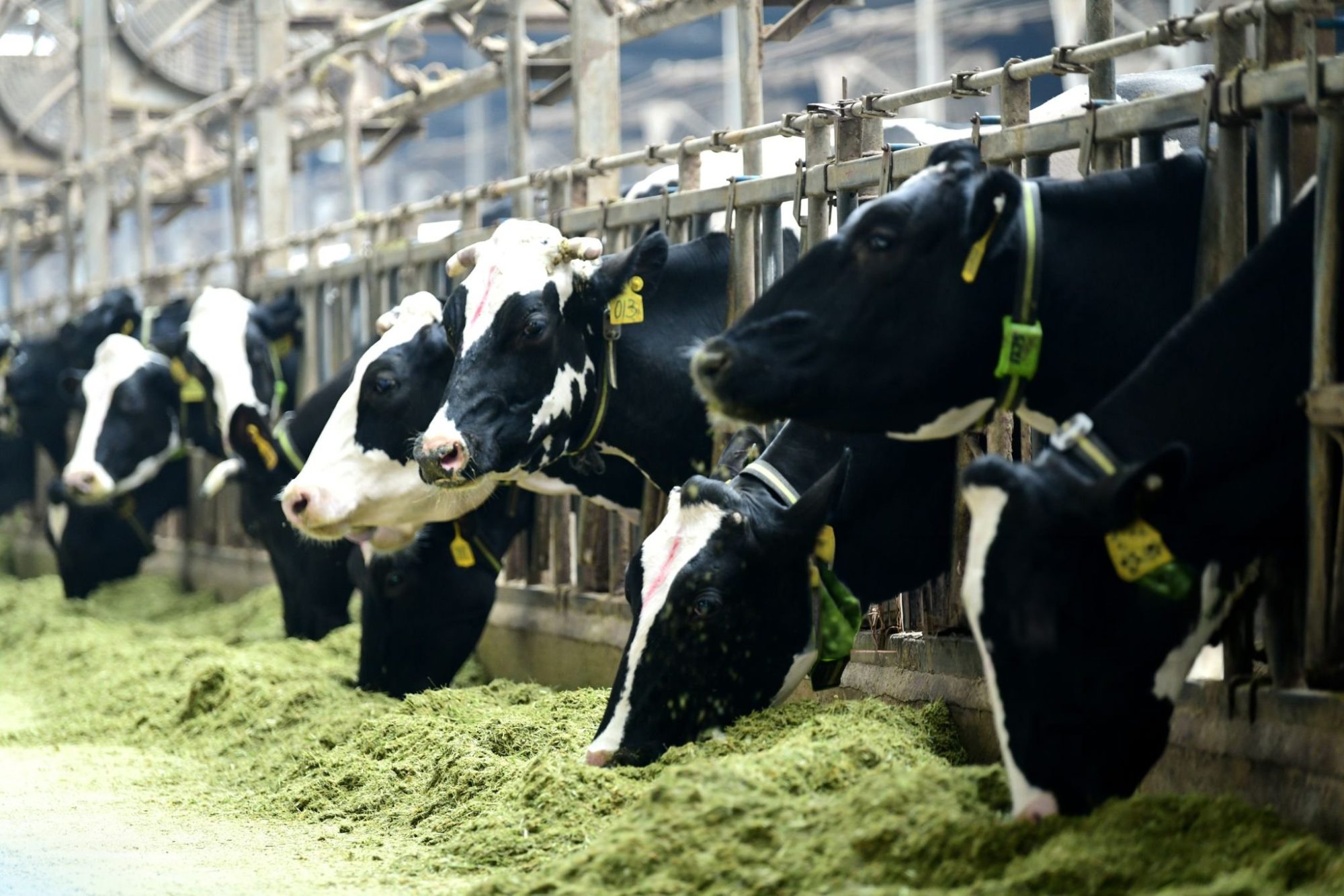
Picture a 450-cow freestall on a Tuesday afternoon. High-starch TMR. Collars on most cows. Ration hasn’t changed on paper. Cows chewing, tank on target, manure acceptable. Everything looks fine from the alley.
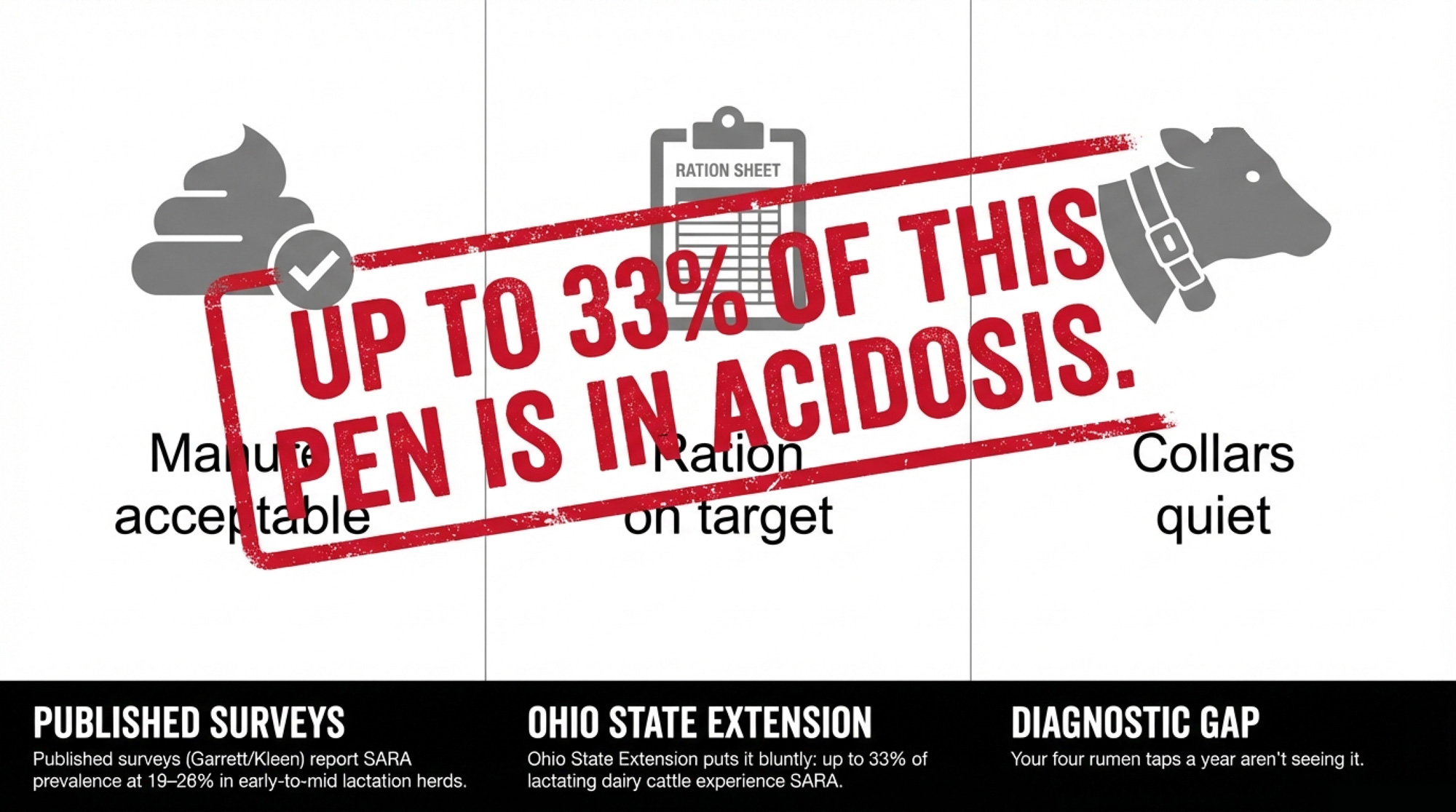
Now picture this: a set of rumen pH boluses in the fresh pen indicates that a quarter of those cows spent more than four hours below pH 5.8 yesterday. Nobody walking through the barn caught it. Published surveys report SARA prevalence at 19–26% in early-to-mid lactation U.S. Holstein herds (Garrett et al. 1997), with European data from Kleen et al. (2013) confirming similar rates across German dairies. Ohio State Extension puts it bluntly: up to 33% of dairy cattle experience SARA during lactation, and up to 40% of pasture cattle have a pH below 5.8. Ontario’s Ministry of Agriculture says if more than 30% of sampled cows sit at or below pH 5.5, consider the whole feeding group at risk. Your four rumenocentesis visits a year aren’t seeing this — and a lab in Zurich has proven it can read those fermentation signals from a field called exhalomics: the metabolic fingerprint in a cow’s exhaled breath.
The science works. The barn sensor doesn’t exist yet. And every progressive operation faces the same question: wait for the perfect tool, or start building your data infrastructure now with what you can actually buy?
What the Breath Data Actually Shows
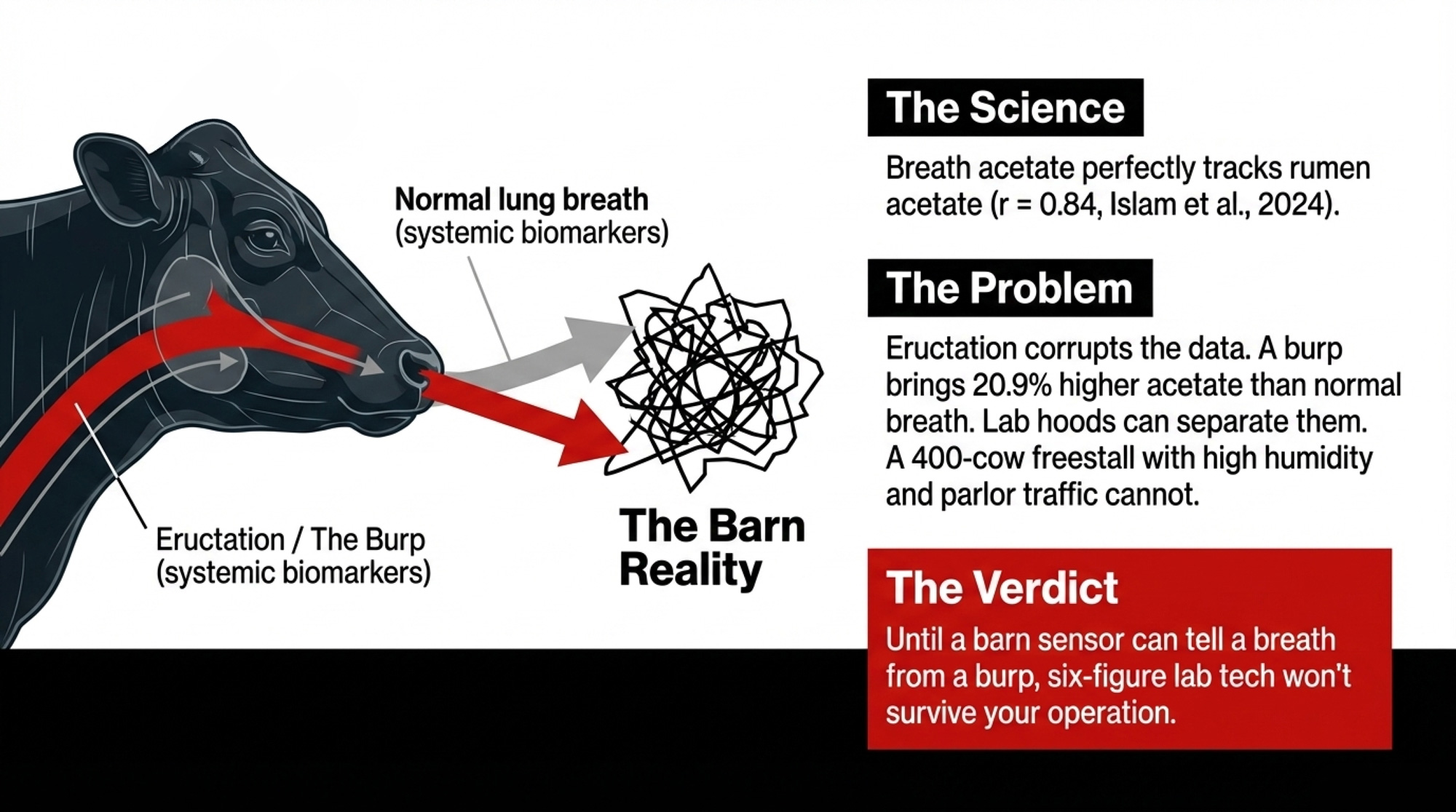
Islam et al. published a Journal of Dairy Science paper in 2024 measuring volatile organic compounds in cow breath using high-resolution mass spectrometry. They fed cows two distinct starch levels — 16.2% versus 6.3% dry matter — and compared what showed up in exhaled air against what was happening in rumen fluid. The correlations landed hard:
- Breath acetate tracked rumen acetate at r = 0.84–0.85
- Breath propionate tracked at r = 0.74
- The acetate-to-propionate ratio in breath tracked rumen A:P at r = 0.80
The analytical platforms driving this — SESI-MS and PTR-MS — detect compounds at parts-per-trillion levels. Think of an electronic nose that could pick out a single molecule of vinegar in an Olympic pool. These instruments identified over 1,298 unique chemical features in the bovine exhalome, capturing volatile fatty acids, ketone bodies, and metabolites that reflect both rumen fermentation and whole-animal metabolism simultaneously.
The Ketosis Signal Worth Watching
Work by Dobbelaar et al. (1996, Veterinary Quarterly) demonstrated that breath acetone correlates with blood BHB with r = 0.81 in dairy cows. More recent temporal evidence points to a 24-to-48-hour head start on intervention compared to conventional testing — breath acetone levels rise faster than changes detectable in milk ketone composition. If this holds up across herds and seasons, your fresh cow protocol could shift from catching clinical ketosis to intercepting it before signs ever appear.
The data on cross-herd reproducibility is thin. But the biological logic is solid: acetone is the most volatile ketone body and crosses the alveolar membrane freely. The question isn’t whether the signal exists. It’s about whether anyone can reliably capture it in a barn.
Why You Can’t Buy This Yet
Here’s where the exhalomics story gets honest.
SESI-MS and PTR-MS setups run into six figures once you add the mass spectrometer, ionization source, installation, and ongoing support. GreenFeed units, used in many exhalomics trials to capture eructation events and methane, cost tens of thousands per unit. Even if you wrote those cheques, VOC stability tests on collection bags show that some compounds degrade or climb as they interact with bag material. The ETH Zurich team calls out sample degradation as a key limitation — proximity to the lab is critical.
Walking samples down the hall in Zurich is one thing. Shipping them across Ontario, Wisconsin, or Alberta is another.
But the commercial gap isn’t just about price and logistics. There’s a harder technical problem that the correlation coefficients don’t warn you about.
What Happens When a Burp Corrupts Your Breath Data?
Not all cow “breath” is created equal. This is the detail that separates the lab results from what a barn sensor would actually face.
Eructation brings rumen headspace gas — VFA-rich, methane-heavy, straight from the fermentation vat. Normal nasal breathing carries lung air with systemic biomarkers but a much lighter rumen fingerprint. Barrientos Blanco et al. (2025) measured the difference: eructation-dominated samples had 20.9% higher acetate, 27.4% higher propionate, and 32.7% higher butyrate concentrations than respiratory breath samples.
On a real cow, those two streams mix at the muzzle. The lab solution is elegant: use GreenFeed or custom hoods to capture eructation events, then monitor methane in real time as a gate signal. When methane spikes, you’re in an eructation window. When it drops, you’re sampling respiratory breath. That works in a controlled setting with a dedicated unit and an analyst watching the screen. In a 400-cow freestall with high humidity, parlor traffic, and nobody spare? Different story.
Until a commercial system can tell the difference between a burp and a breath under barn conditions, the correlations from Zurich don’t transfer cleanly to your operation. That’s not a reason to ignore the science. It’s a reason to build your baseline with a tool that goes straight to the source.
The $3,500 Bridge You Can Deploy This Month
If the rumen is the organ you’re trying to monitor, a bolus sitting in the reticulum is about as direct as it gets. And unlike a breath sensor, boluses are commercially available now — smaXtec launched its latest dedicated pH bolus in September 2025, and the company is actively pushing into North American herds from its U.S. base in Madison, Wisconsin.
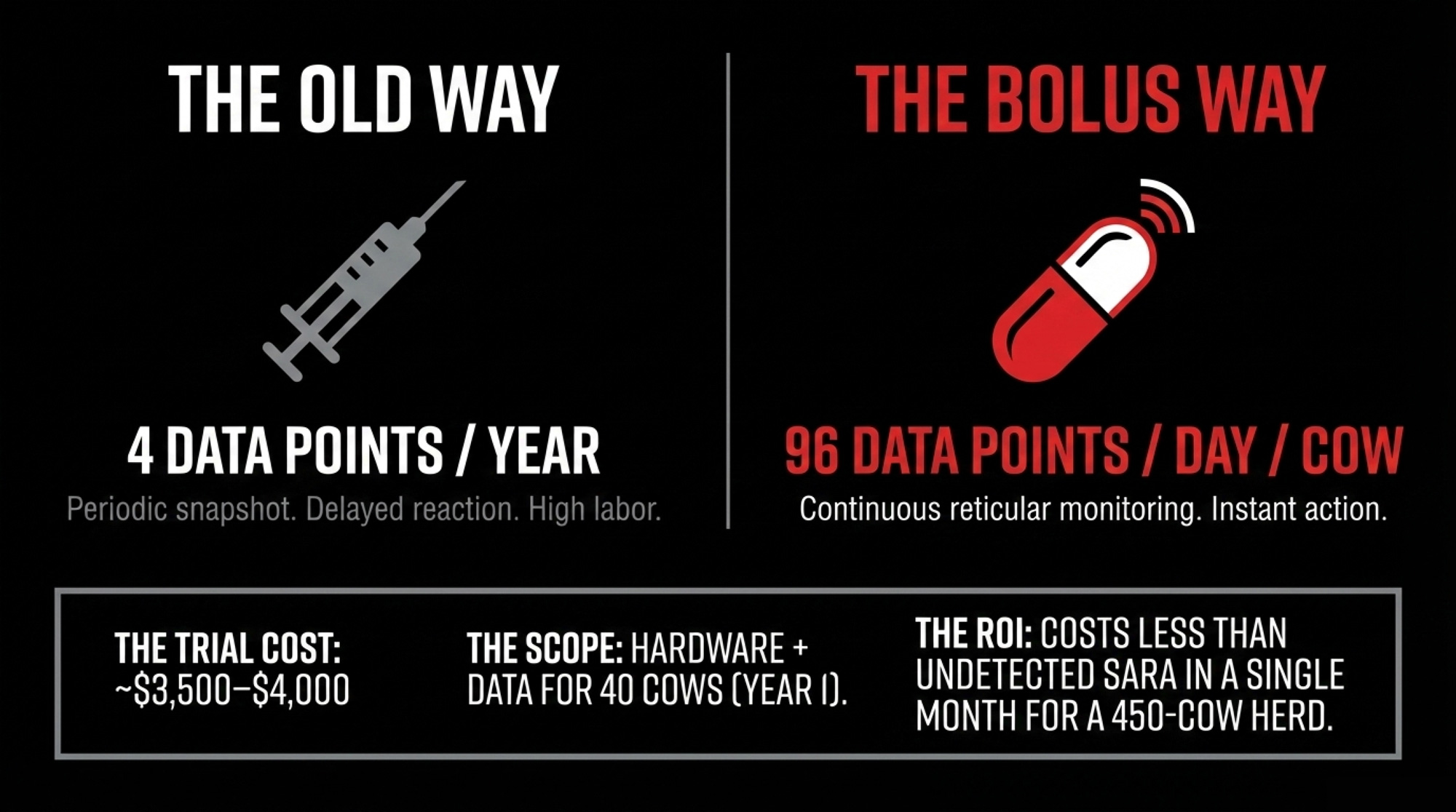
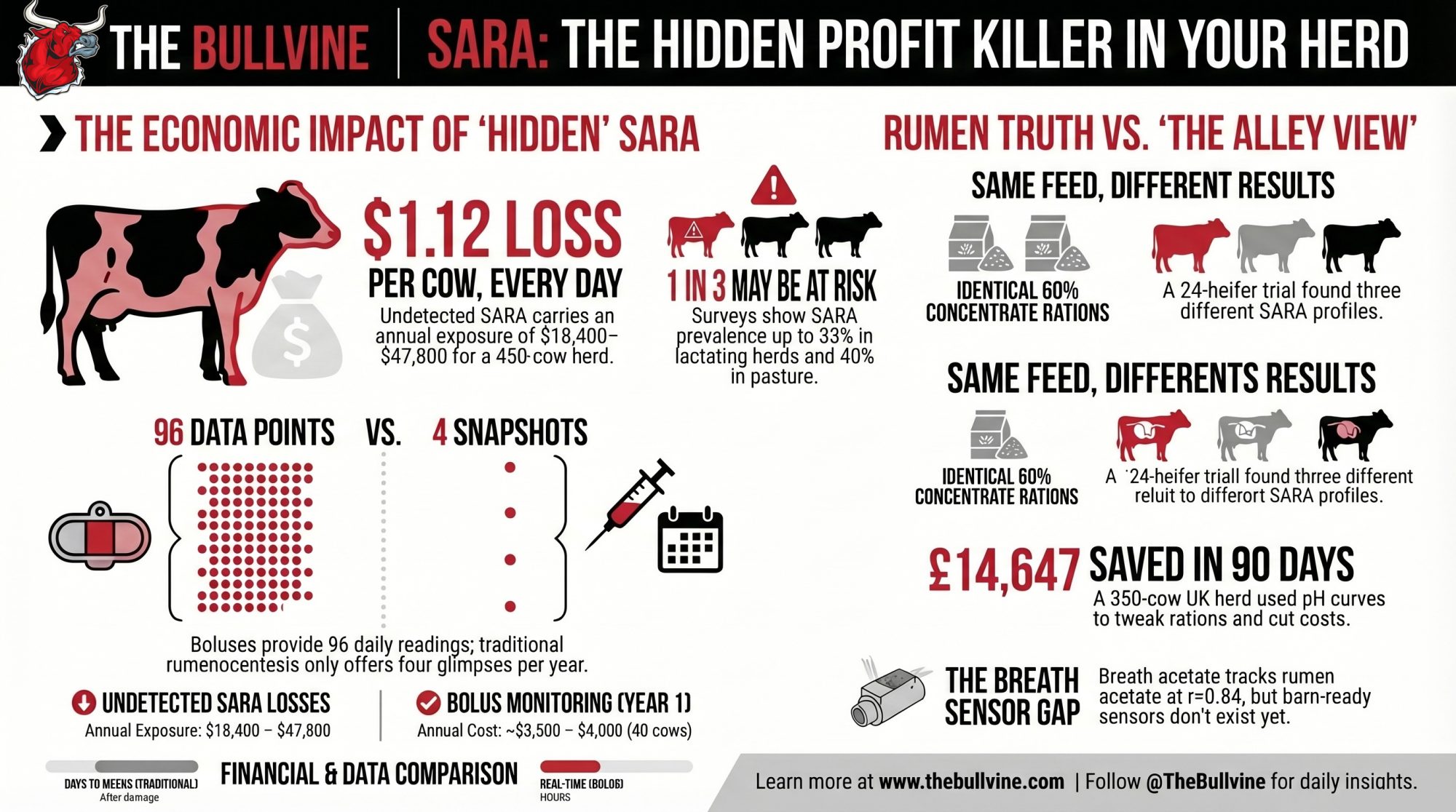
Rumen pH boluses record pH every 10–15 minutes, giving you up to 96 data points per day per cow. Over a 60-day trial on one pen, that’s roughly 5,760 readings per cow. Compare that to four rumenocentesis visits a year.
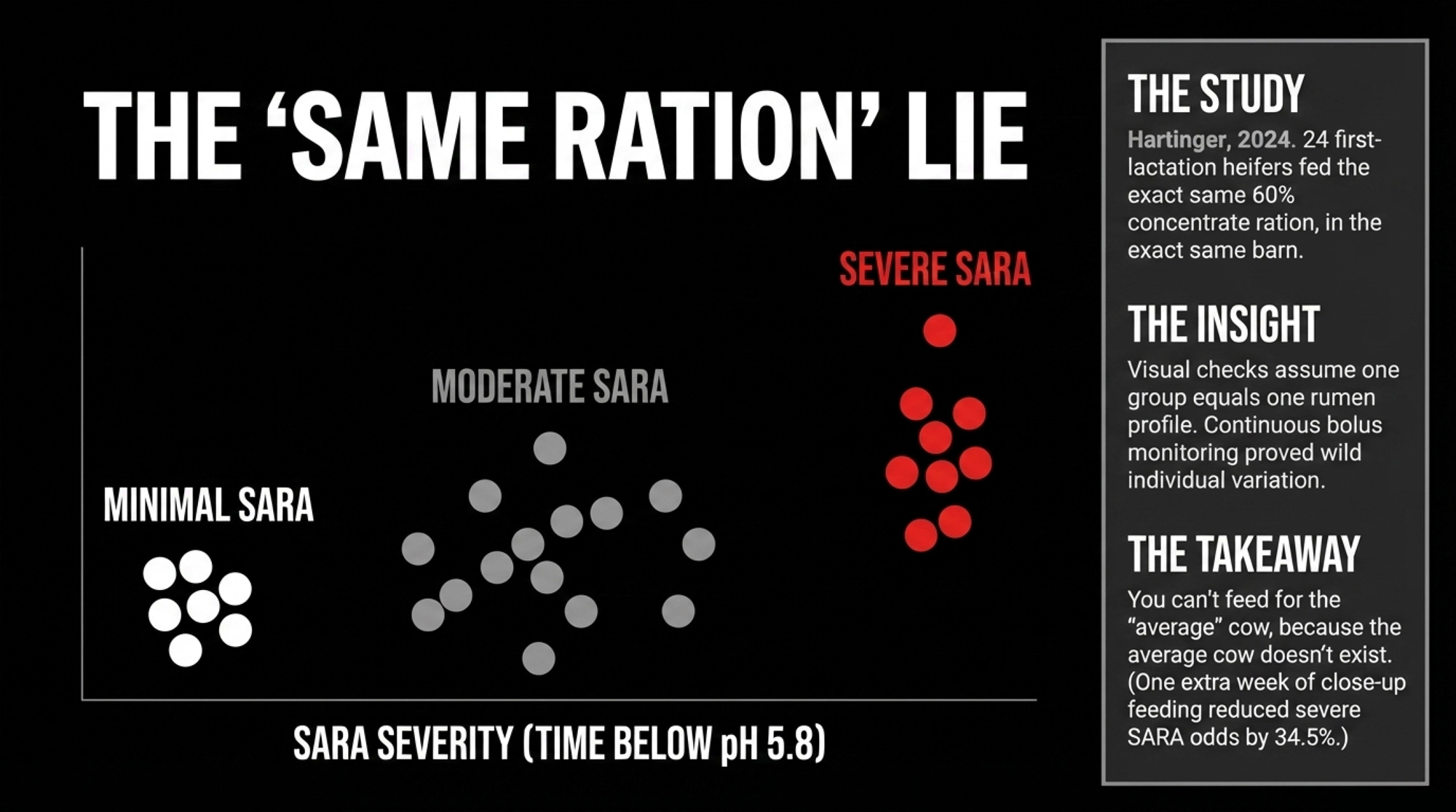
Here’s what makes this uncomfortable. Hartinger et al. (2024) bolused 24 first-lactation Holsteins at the VetFarm research station in Pottenstein, Austria — every heifer on the same 60% concentrate lactation ration. When they clustered the pH data, they didn’t find two groups. They found three. Six cows experienced minimal SARA, exceeding the pH 5.8 threshold for more than 330 minutes on just 7% of experimental days. Nine cows hit that threshold on 20–87% of days. Same feed. Same barn. Wildly different rumens. And one extra week of close-up feeding reduced the odds of severe SARA by 34.5%.
Snapshot rumenocentesis couldn’t have caught that. Neither your collars nor manure scoring alone. Only continuous monitoring revealed the individual variation hiding inside a group that, from the alley, looked like one herd on one ration.
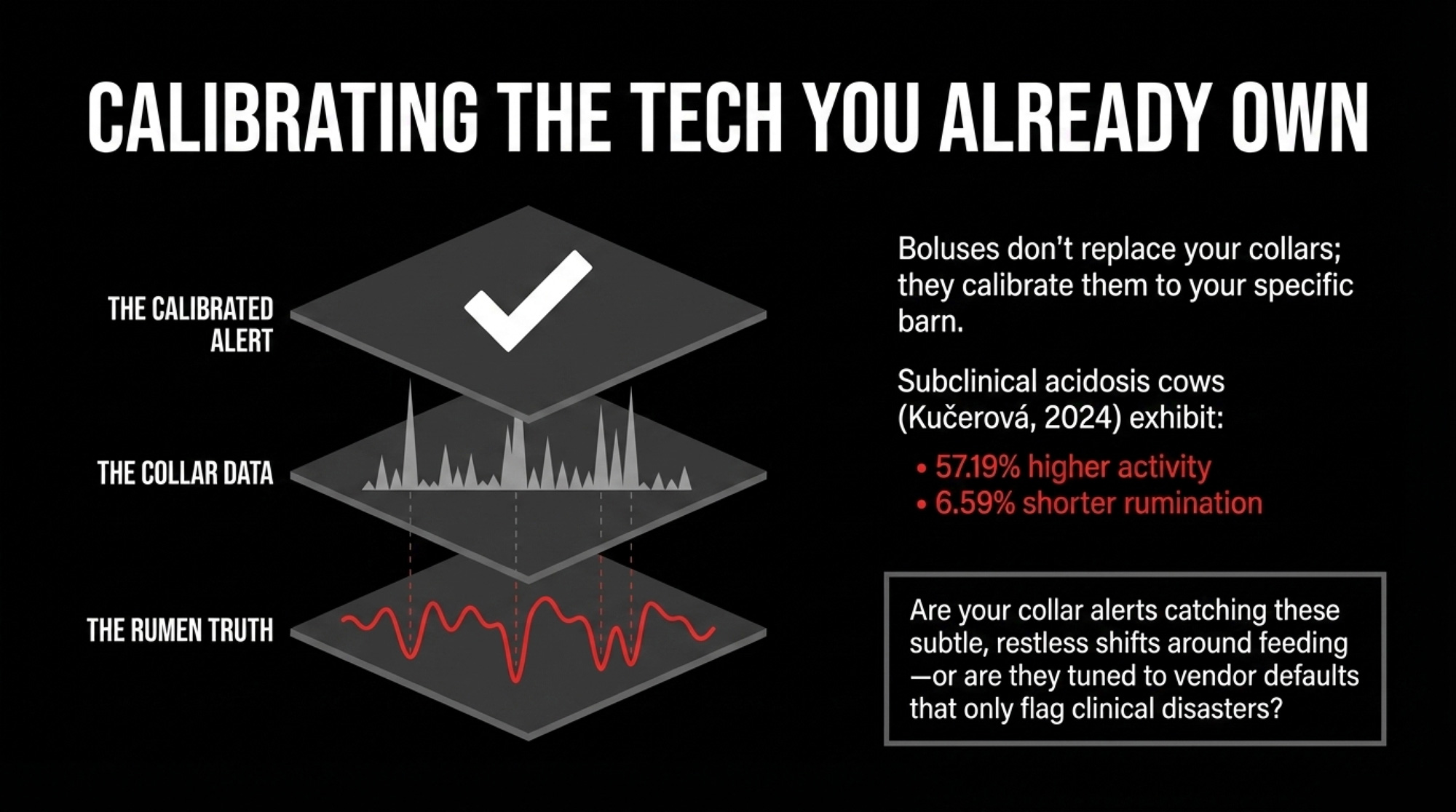
Kučerová et al. (2024) added another layer, finding that subclinical acidosis cows showed an 18.8% lower reticulorumen pH, an 11.88% lower fat-to-protein ratio, a 6.59% shorter rumination time, and a 57.19% higher activity compared to healthy herd mates. Your collars might already be flagging some of these cows. But without rumen truth underneath, you’re reading signals without a reference point.
The Trade-Offs Nobody Puts on the Brochure
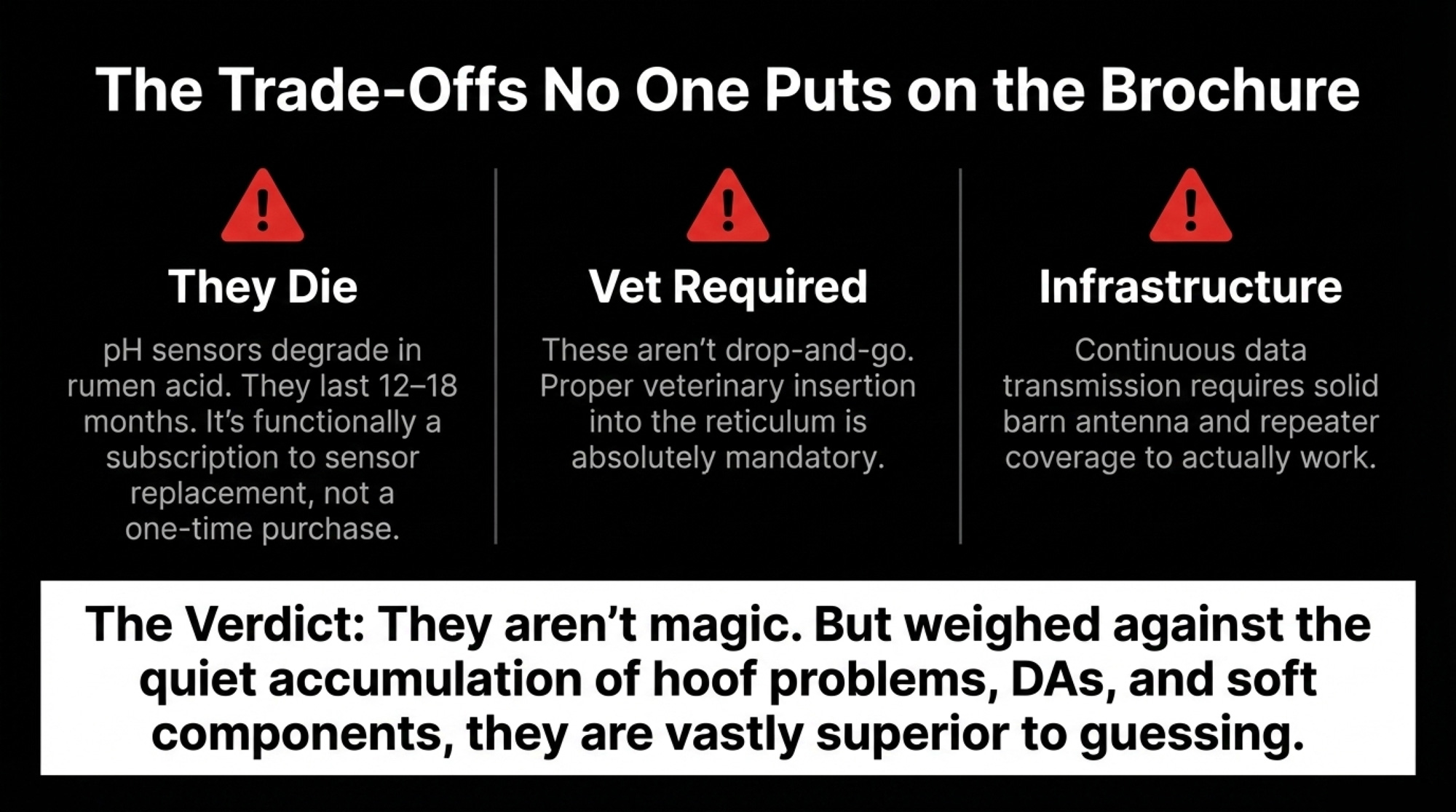
Boluses aren’t magic either. Aidan Connolly, president of AgriTech Capital in Wilmington, N.C., told Farm Progressthat pH sensors in the rumen typically burn out after 12 to 18 months as acid exposure degrades the sensor — compared to 6–7 years for movement-only boluses that track activity and temperature. That means pH monitoring is functionally a subscription to sensor replacement, not a one-time install.
They also need vet insertion. Your barn needs adequate repeater or antenna coverage for continuous data transmission. And pH alone is only one dimension of a complex disorder — it doesn’t directly capture shifts in VFA profiles or microbial population changes. It’s a strong early signal. Not the whole picture.
But weighed against the quiet accumulation of undetected SARA — hoof problems, DAs, sluggish repro, chronically soft components — the question isn’t whether boluses are perfect. It’s whether four rumen taps a year are enough to catch a problem that never stops moving.
How Much Is Undetected SARA Costing Your Herd?
The math isn’t complicated, and it isn’t kind.
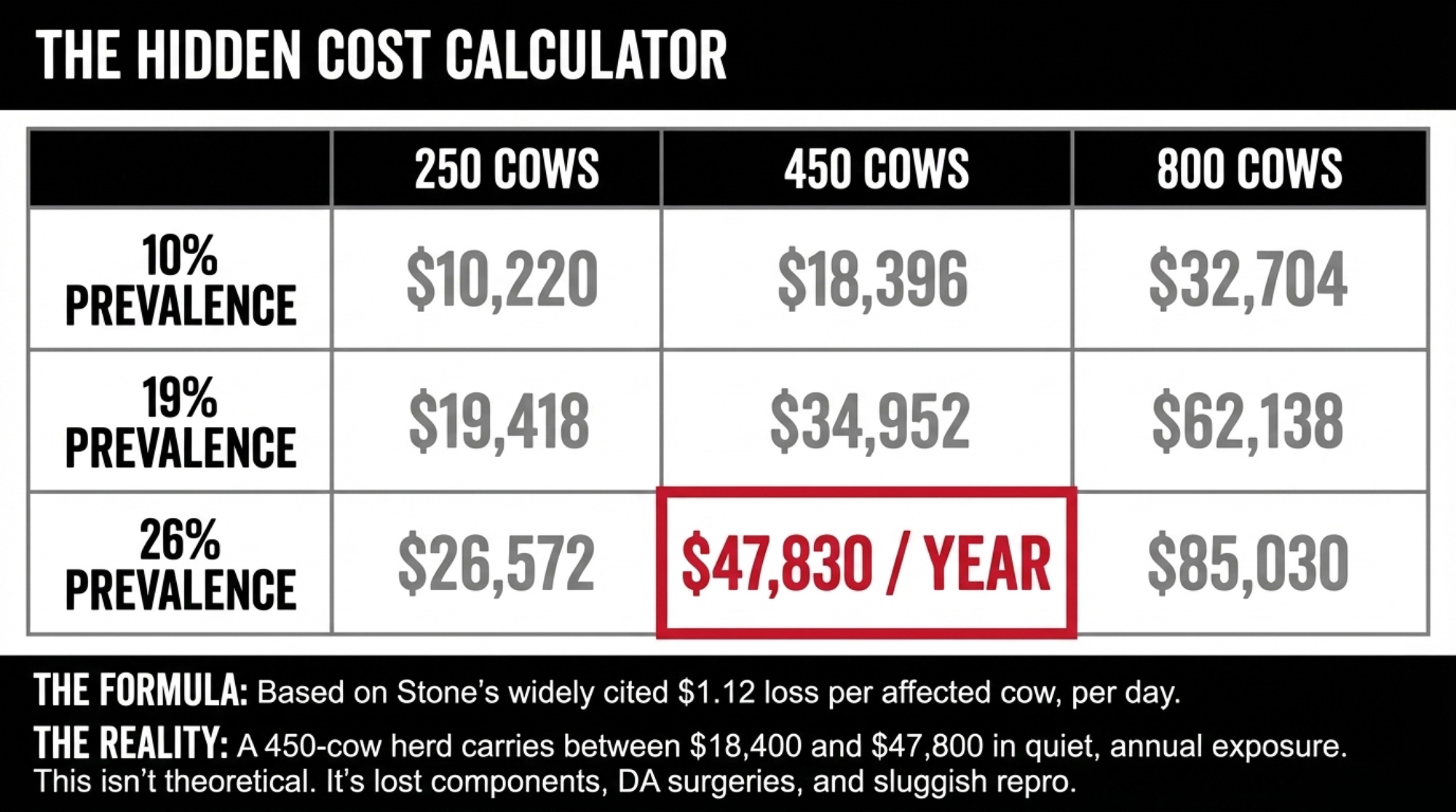
Stone (1999) estimated SARA losses at $1.12 USD per affected cow per day — a figure still cited in Ontario’s current SARA factsheet and widely referenced across the literature. It has never been formally updated. On a 450-cow herd, using the published prevalence range:
| Metric | Undetected SARA Losses | Bolus Monitoring (Year 1) |
| Annual exposure | $18,400 – $47,800 | ~$3,500–$4,000 (40 cows) |
| Per cow/month (herd avg.) | ~$3.41 – $8.85 in hidden loss | ~$4.00 investment |
| Data quality | 4 snapshots / year | 96 readings / day per cow |
| Detection speed | Days to weeks after damage | Hours |
Low end: 450 × 10% × $1.12 × 365 = $18,396. High end: 450 × 26% × $1.12 × 365 = $47,830. For the boluses: 40 units at approximately $39 each plus $3.90/cow/month in subscriptions (user-reported pricing, AgTalk May 2025). Total year-one hardware and data: roughly $3,500–$4,000. That’s using a 27-year-old cost estimate that almost certainly understates the real impact.
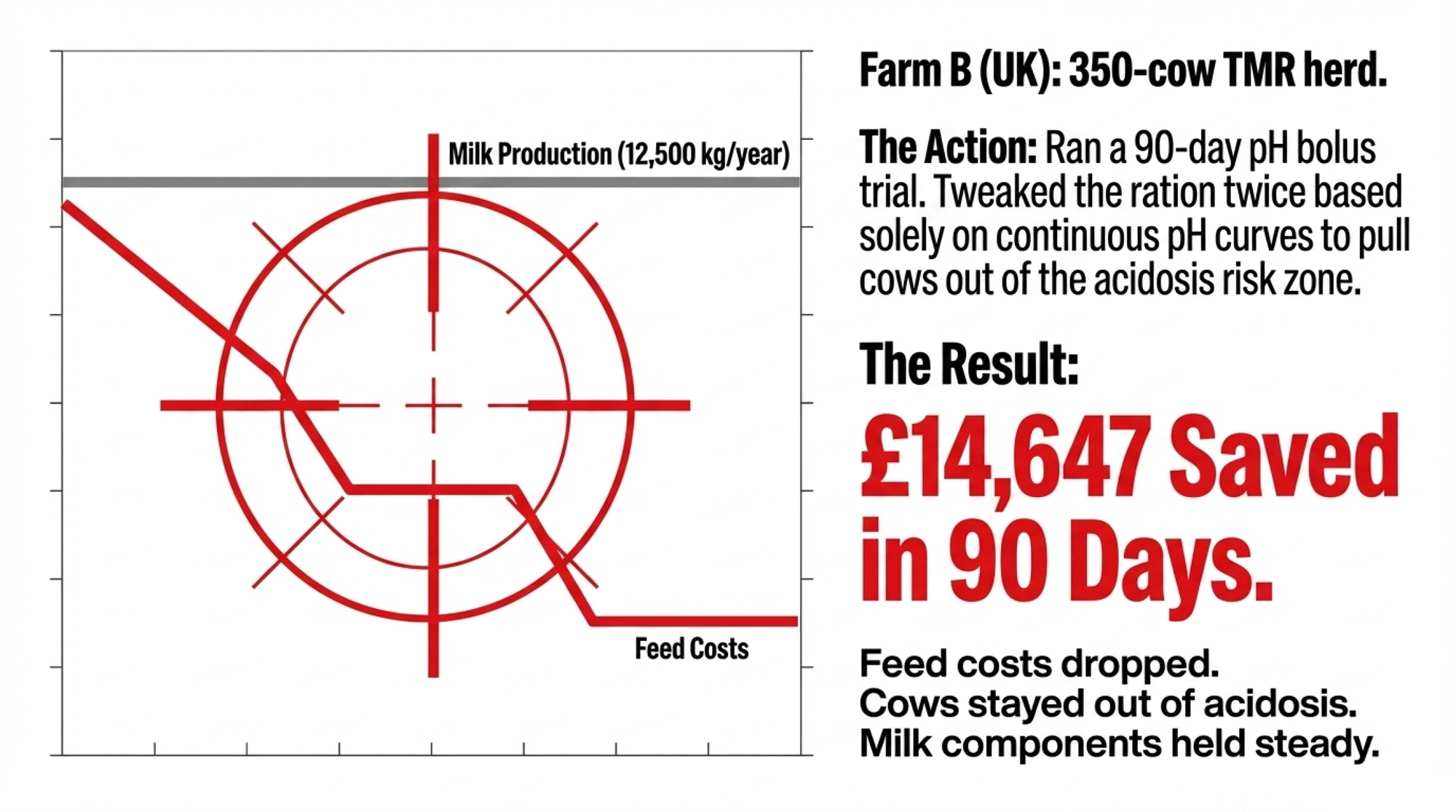
Those aren’t hypothetical numbers. When eCow ran a commercial pH bolus trial across eight dairy farms in South West England, six of the eight farms changed feeding management based on what the bolus data showed. Farm B — a 350-cow, 12,500 kg/year TMR herd — adjusted its ration twice in three months using pH curves as the guide. Each change cut feed cost while keeping cows out of the acidosis risk zone. Total savings: £14,647.50 in 90 days, with no decline in milk production or components. J. Hamilton of Three Counties Feeds, who advised on the trial, called the data “really useful to build up a picture of normal daily pH fluctuations on commercial farms” and noted it “highlighted the nutritional impact of management changes which force cows into unnatural daily routines”.
That UK trial was from 2013. The technology has improved since. At the 2025 Canadian Dairy XPO in Stratford, Ontario, both smaXtec and Guelph-based Cattlescan were promoting bolus-based monitoring to Canadian operators — Cattlescan backed by validation work at the University of Guelph and the University of Wisconsin. The infrastructure is here. The question is whether your herd is collecting data before your neighbor’s is.
How This Calibrates the Tech You Already Own
One of the most valuable things continuous pH data does isn’t replace your collars and parlor system — it calibrates them.
Herds layering bolus pH curves over collar activity, rumination data, and milk components are building what amounts to a green/yellow/red rumen map for their specific conditions. Not a textbook threshold. Not a vendor’s default alert. A picture of what subclinical acidosis actually looks like on their ration, in their barn, with their cows.
If subclinical acidosis cows show 57% higher activity and nearly 7% shorter rumination, do your collar thresholds reflect that? Are your rumination alerts catching the cows that are restless around feeding and short on cud time — or tuned for clinical-level problems that show up weeks later?
When precision tech vendors pitch “real-time metabolic monitoring,” the herd with six months of pH curves and correlated collar data isn’t taking the marketing at face value. They’re evaluating it against data they already own. That’s a fundamentally different buying position than hoping the next sensor works as advertised.
What This Means for Your Operation
Do the SARA math first. Plug your herd size into the prevalence range and the $1.12/day figure. As stale as that estimate is, the number will be uncomfortable. If you’ve never run this calculation, that’s the first problem to solve — before you buy anything.
Start with one pen, not the whole herd. Pick 30–50 cows in your highest-risk group — fresh pen or your hottest starch group. At roughly $39 per bolus and ~$4/cow/month, an 8–12-week trial might run $2,000–$3,000, depending on volume. Compare that to one DA surgery.
Benchmark your collars against rumen truth. Pull your lameness, DA, and chronic low-fat cows from the last six months. If subclinical acidosis cows show 57% higher activity and 7% shorter rumination in published data, are your alerts catching those patterns — or tuned for something else entirely?
Budget for sensor replacement, not just purchase. pH sensors degrade in the rumen after 12–18 months. That’s fundamentally different from an activity collar you buy once. Factor in per-cow annual sensor costs when you run your ROI analysis, not just the upfront hardware.
Get trial-ready before the sensors ship. If a university or sensor company came looking for a test herd tomorrow, could you hand over clean pH data, stable feeding records, and a team comfortable with continuous monitoring? The herds with that infrastructure will shape what “validated” means for breath-based tools. The ones without it will buy whatever ships first and hope.
In the next 30 days: Pick one pen. Talk to your vet about bolus logistics. Get a quote from your smaXtec dealer or regional bolus supplier. Plan one ration adjustment you’ll track with pH curves and collar data together — not just milk and manure.
In the next 90 days: Evaluate whether the bolus data reveals patterns your current monitoring misses. If it does, decide whether to expand bolus coverage or recalibrate your collar alerts based on what the pH curves are teaching you about what subclinical acidosis actually looks like on your farm.
Key Takeaways
- The VFA correlations are real. The barn sensor isn’t. Islam et al. (2024, JDS) showed breath acetate tracking rumen acetate at r = 0.84. Serious science — but the eructation separation problem, six-figure instruments, and sample degradation mean no commercial barn sensor is imminent.
- Same ration doesn’t mean same rumen. Hartinger et al. (2024) demonstrated that 24 first-lactation Holsteins on identical diets were divided into three SARA severity clusters. If continuous bolus monitoring can reveal that kind of hidden variation, what’s lurking in your fresh pen right now?
- Continuous pH turns SARA from a quarterly hunch into a daily decision. Four snapshots a year versus 96 data points per day. One UK herd saved £14,647 in 90 days from two bolus-guided ration adjustments alone.
- Your collars are already capturing part of this story — they need a reference point. Bolus pH curves don’t replace your existing tech. They tell you whether your existing tech is calibrated against what’s actually happening in the rumen.
The next time your nutritionist schedules rumenocentesis, ask what would change if you already had 60 days of pH and collar data for that group. If the answer is “nothing,” you might be right. But if the answer is “I don’t know,” that’s the gap worth closing before the breath sensor ever ships.
Complete references and supporting documentation are available upon request by contacting the editorial team at editor@thebullvine.com.
Learn More
- The $99 Bolus That Protected Ferme Petitclerc’s Royal Winter Fair Run – Reveals the immediate ROI of internal monitoring by protecting elite genetics and show-string reputations. It breaks down a $3,478 investment that builds a firewall against five-figure losses from transition stress and evaporated private sales.
- The 11‑Day Vaccine Shift: From Dry‑Off Tax to 1,500‑lb Sensor Edge – Exposes the hidden “SARA leak” costing transition pens nearly $5,000 annually. It arms you with the specific management shifts needed to audit your real income-over-feed-costs before margin squeezes force your hand.
- Smart Bacteria Revolution: How Microbiology Nutrition is Transforming Dairy Profitability – Delivers the next-gen strategy for managing high-starch rations without digestive fallout. It reveals how controlling the rumen microbial environment can slash health costs and boost feed efficiency by up to 8% today.
 The Sunday Read Dairy Professionals Don’t Skip.
 The Sunday Read Dairy Professionals Don’t Skip.
Every week, thousands of producers, breeders, and industry insiders open Bullvine Weekly for genetics insights, market shifts, and profit strategies they won’t find anywhere else. One email. Five minutes. Smarter decisions all week.