35 of 55 workers gone before afternoon milking. If that happened in your parlor tomorrow, how many days of profit would your 400 cows burn through?
Executive Summary: Outlook Dairy in New Mexico lost 35 of 55 workers before afternoon milking in a single enforcement action, and milk production “effectively ceased” overnight. The article shows how that kind of hit translates into a 30‑day loss of roughly $25,620 in milk from a 10 lb/cow/day drop on 400 cows, plus another ~$17,000 in quality penalties, emergency wages, and repro/vet lag. It explains why 51% of U.S. hired dairy labor and 79% of the milk now depend on immigrant workers, with states like Wisconsin at ~70% undocumented labor and parts of Idaho near 90%. You’ll see why H‑2A still doesn’t fit year‑round dairying, what happens when enforcement touches your county (including the “chilling effect” on neighboring farms), and why robots are a long‑payback strategy, not an emergency exit. Then it walks you through a simple 30‑day “Table of Doom” you can run on your own herd and a 72‑hour backup‑crew checklist that forces you to answer who actually shows up if three key people don’t. If you’ve never put hard numbers on a labor shock for your own cows — or asked your lender to stress‑test one — this is worth ten minutes and a notepad.

Biosecurity signs don’t stop rifles.
Masked Homeland Security agents armed with rifles swept onto Outlook Dairy in Lovington, New Mexico, on the morning of June 4, 2025, brushing past biosecurity signs — posted for H5 bird flu, asking all visitors to check in — without stopping. By the time they left, 11 workers were in custody, and owner Isaak Bos had been ordered to fire 24 more after federal agents conducted an employment document review, according to AP reporting — 35 of his 55 employees gone before the afternoon milking.
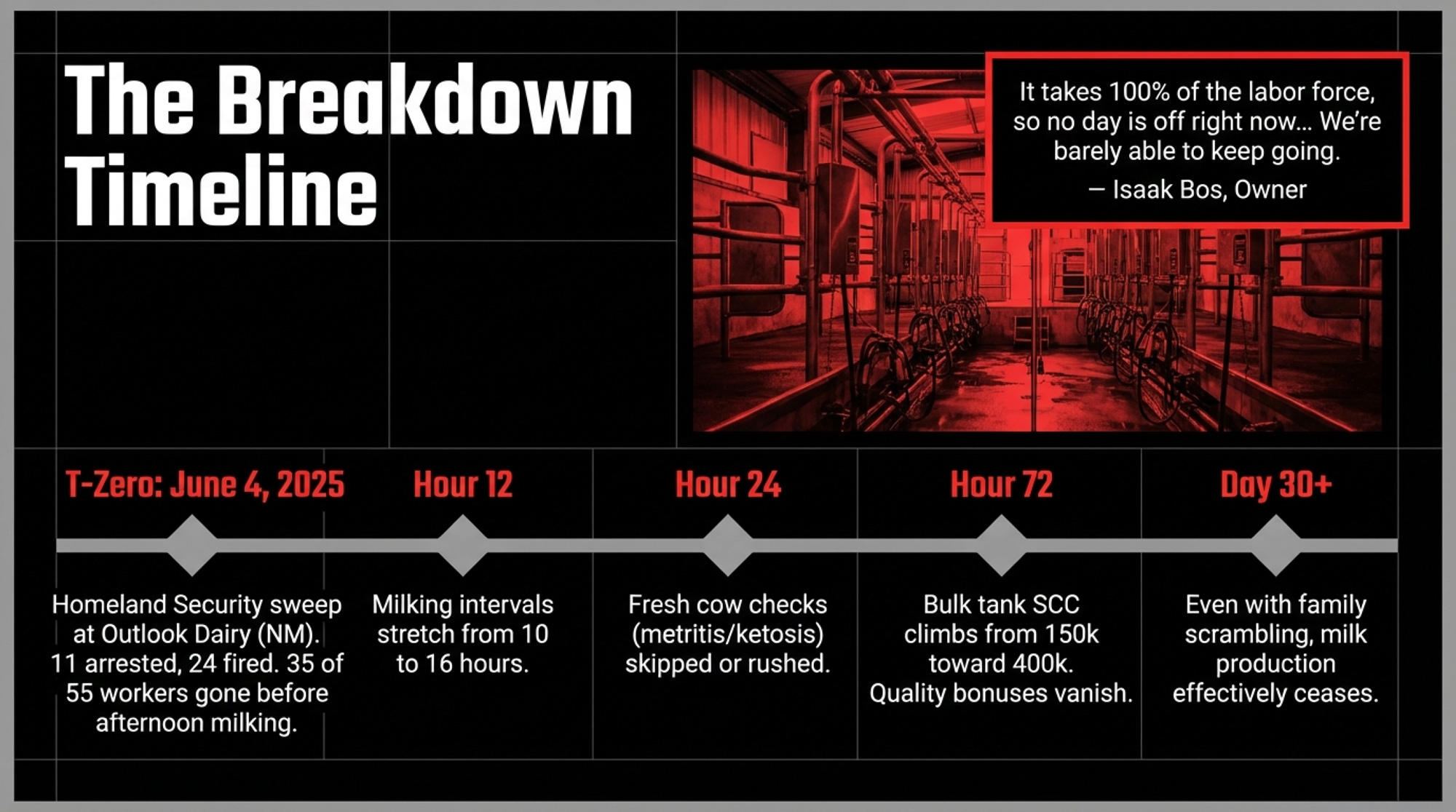
“It takes 100% of the labor force, so no day is off right now,” Bos told reporters as his wife, relatives, and local high‑school kids scrambled into the parlor. “It’s detrimental for our cattle. We’re barely able to keep going.”
“You can’t turn off cows. They need to be milked twice a day, fed twice a day.”
— Beverly Idsinga, Dairy Producers of New Mexico
As of January 2026, Outlook Dairy was still working to rebuild and get back to something resembling normal, months after that June morning tore the operation apart.
If you think your I‑9 binder is a bulletproof vest, you’re already bleeding.
When Two-Thirds of Your Crew Disappears Before Lunch
Outlook runs roughly 5000 Holsteins. At a typical Holstein average of around 70 lb/cow/day and the 2025 U.S. all‑milk price forecast of $21.35/cwt, daily gross milk revenue sat near $7,470 before the raid. Losing 35 workers didn’t trim that number. It broke the system.
Within hours, milking intervals that should’ve been 10–12 hours stretched to 14, then 16. Bulk tank SCC starts climbing almost immediately when intervals get that far apart — from a well‑managed 150,000 cells/mL toward the 300,000–400,000 range where quality bonuses vanish, and deductions kick in at most co‑ops. Fresh cows that need twice‑daily monitoring for metritis and ketosis? Those checks got skipped or rushed.
You know how that story ends. Cows you miss in the fresh pen don’t just hit you with a vet bill. They take peak milk you never see.
The community around Lovington responded. Teenagers showed up. Neighbors climbed into the parlor. Family members who hadn’t worked a shift in years were back on the line. But good intentions don’t replace the guy who’s been reading that holding pen for a decade. Bos himself confirmed that milk production at Outlook “had effectively ceased.”
If you think that’s “a New Mexico problem,” you’re exactly who this piece is for.
The Math Behind 79% of Your Milk
Outlook made the news for the rifles. It matters for the arithmetic.
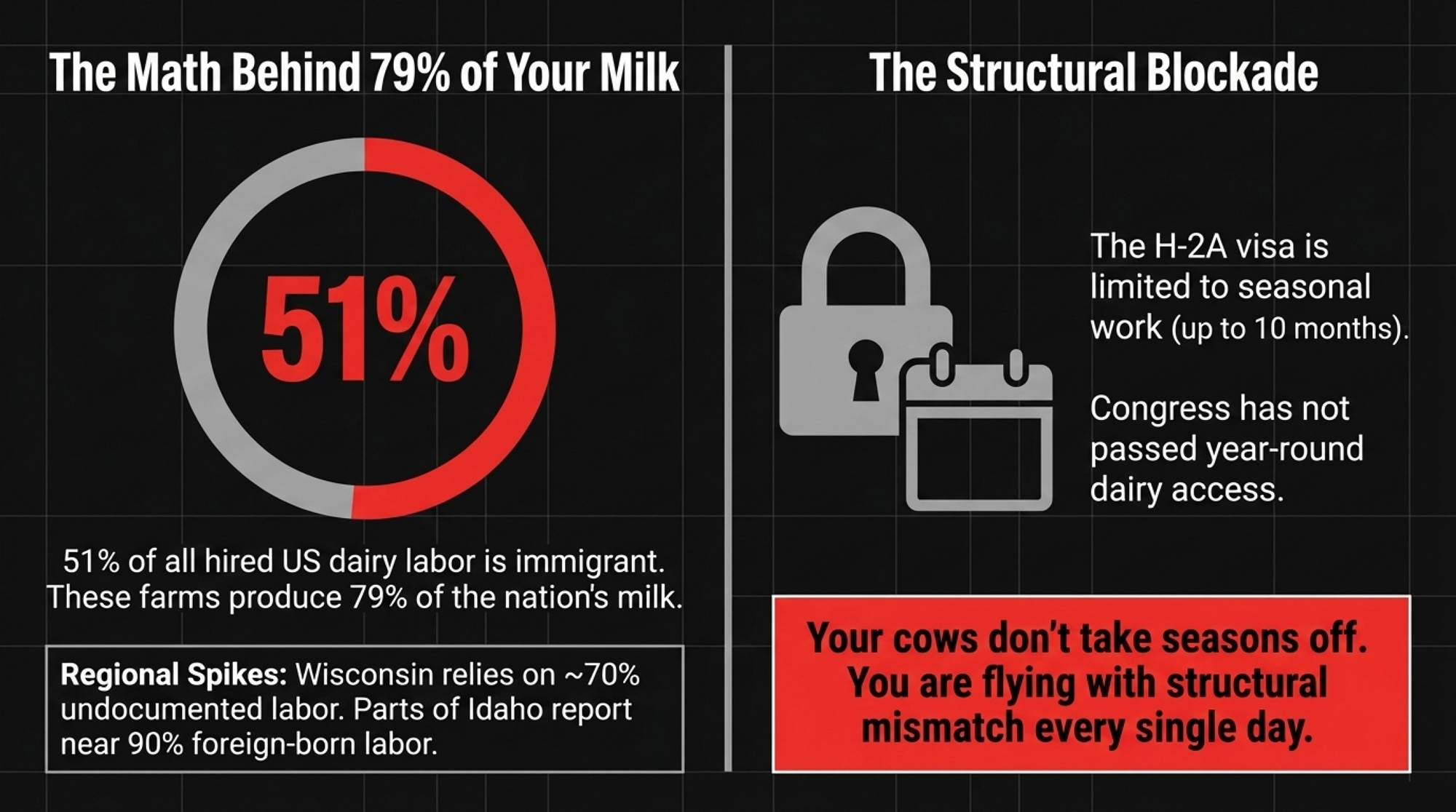
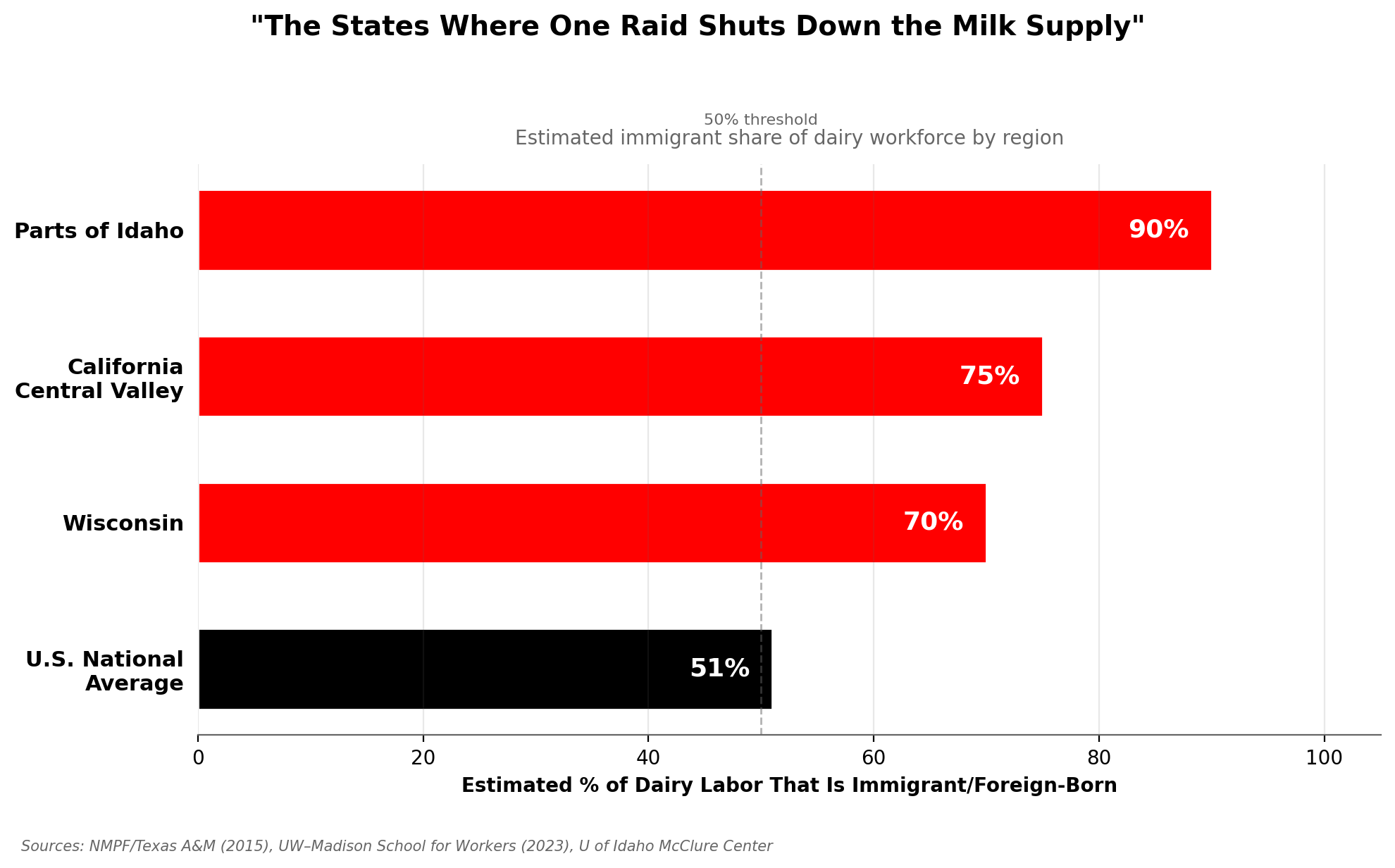
A Texas A&M AgriLife Center for North American Studies survey, conducted for the National Milk Producers Federation, collected data from 973 dairy farms of all sizes and regions in fall 2014. The results: immigrant workers account for 51% of all hired dairy labor, and the farms employing them produce 79% of the nation’s milk supply.
NMPF’s modeling went one step further. It estimated that a sudden loss of immigrant labor would eliminate over 7,000 dairies, cut 48.4 billion pounds of milk, and nearly double retail prices. That’s a national barn‑burn, not an isolated fire.
The dependency hasn’t shrunk since 2015. A 2023 UW–Madison School for Workers survey estimated that more than 10,000 undocumented workers perform about 70% of Wisconsin’s dairy labor, and the authors warned that without them, the state’s dairy industry “would collapse overnight.” In parts of Idaho, the University of Idaho’s McClure Center has documented dairies where roughly 9 out of 10 workers are foreign‑born.
Here’s the structural mismatch you live with every day: the H‑2A visa program — the main legal guest‑worker channel for agriculture — is limited to temporary or seasonal employment, up to 10 months per year. Your cows don’t take seasons off. The Trump administration and multiple agricultural groups have pushed Congress to expand H‑2A to year‑round positions, but that change still needs a congressional vote that hasn’t come. A House Homeland Security appropriations rider would allow year‑round dairy, and the Economic Policy Institute projects that, combined with wage cuts, the program could hit 900,000 workers by 2034.
Right now, that’s theory, not help. As of spring 2026, you’re still dealing with processing delays and uncertainty in H‑2A access, not a smooth year‑round dairy program.
Then the USDA pulled one more rug. On August 29, 2025, the USDA announced it was discontinuing the Farm Labor Survey effective immediately. That’s the main tool Washington used to track farm wages. So, at the exact moment dairy’s labor dependence is under political and economic pressure, the official wage data just went dark.
You’re flying with less information in more turbulence.
How Much Does a 30-Day Labor Shock Really Cost a 400-Cow Herd?
Talking about raids in another state is easy. The only way this gets real is if you run the numbers on your own herd.
Take a 400‑cow herd shipping a typical 70 lb/cow/day at the 2025 all‑milk price of $21.35/cwt. That’s 28,000 lb/day — roughly $5,978 in daily gross milk. Over 30 days, you’re looking at $179,340 in gross milk revenue.
Now imagine a disruption like Outlook’s. It doesn’t have to be ICE. Two experienced milkers get into a car accident.. A family emergency in a three‑person crew. Or enforcement activity one county over that sends half your workforce home to pack a bag.
Here’s the snapshot you should be staring at on your phone in the parlor.
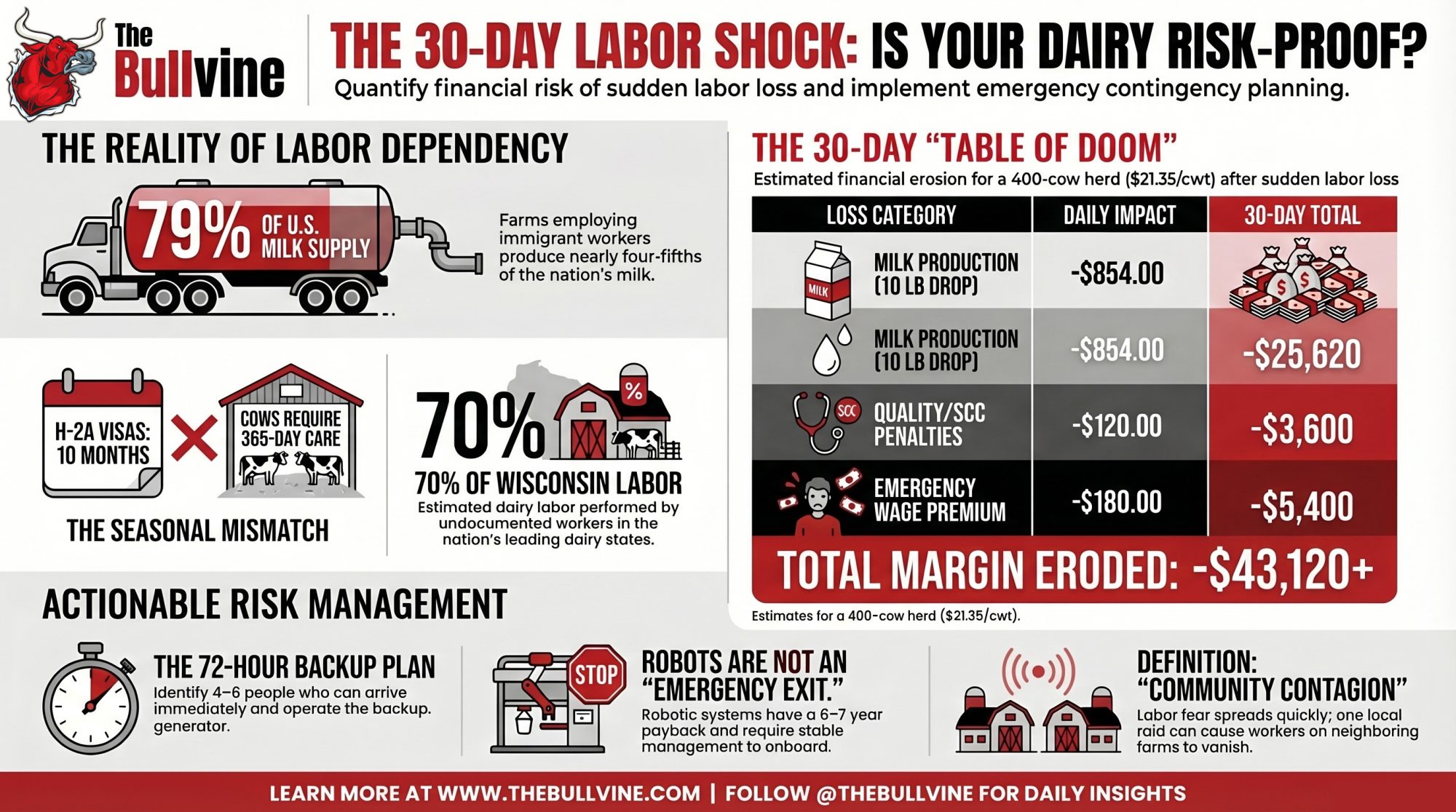
The 30-Day Table of Doom: 400-Cow Herd at $21.35/cwt
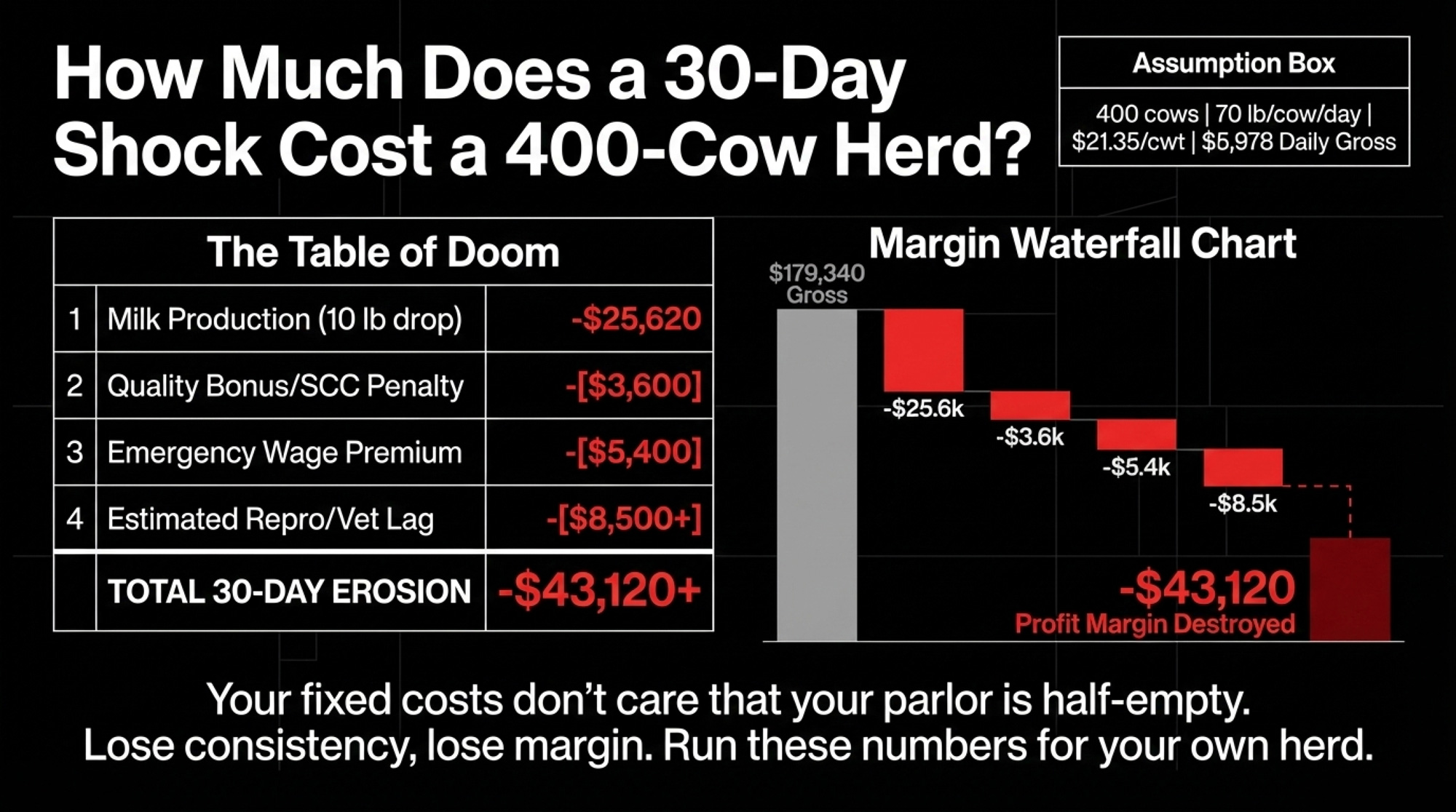
| Loss Category | Daily Impact | 30‑Day Total |
| Milk Production (10 lb drop) | ‑$854.00 | ‑$25,620 |
| Quality Bonus/SCC Penalty | ‑[$120.00] | ‑[$3,600] |
| Emergency Wage Premium | ‑[$180.00] | ‑[$5,400] |
| Estimated Reproductive/Vet Lag | — | ‑[$8,500+] |
| TOTAL MARGIN ERODED | — | ‑$43,120+ |
Brackets on the last three lines mean this is illustrative, not a quote from your co‑op or your vet. The first line isn’t up for debate: 10 lb/cow/day × 400 cows × 30 days = 120,000 lb. At $21.35/cwt, that’s $25,620 in gross revenue gone.
You know what SCC penalties look like on your milk cheque. You know what you’d have to pay to get neighbors, teenagers, and extended family in for an emergency month of milking. You know what happens to repro when fresh cows get missed. Plug your own numbers into those second and third lines. You won’t hit exactly $43,120. You’ll land unpleasantly close.
This isn’t just about gross revenue; it’s about the fact that your fixed costs — debt service, insurance, taxes — don’t care that your parlor is half‑empty. Your break‑even just climbed while you were looking for a milker.
USDA’s January 2026 ERS report (ERR‑356) using 20 years of ARMS data confirmed what you see in the fresh pen every day: milking frequency and consistency are key drivers of net returns. Lose people, lose consistency. Lose consistency, lose margin.
Run that 30‑day cascade with your own herd size and pay price. If the answer makes your stomach drop, that’s not fear‑mongering. That’s your exposure in black and white.
Can Robots Actually Close the Gap When Workers Disappear?
When you hear the Outlook story, the instinct is obvious: “This is why we need robots.” Honestly, that reaction makes sense. It just doesn’t close the gap the way the sales pitch says it will.
Bullvine readers already know the headline numbers: 86% of robotic milking adopters say they’re satisfied, but only 28% say their systems are profitable. A January 2026 USDA Economic Research Service report (ERR‑356) put harder national numbers behind it — robotic milking increases U.S. dairy net returns by about 13% on average, based on five waves of ARMS data from 2000 through 2021. That’s not fluff. That’s the actual margin.
But Iowa State dairy economist Larry Tranel’s cash‑flow work tells the other half of the story. A typical two‑robot installation on surveyed Iowa herds has a payback in the 6.1 to 7.2‑year range, depending on useful‑life assumptions. You get labor relief and management flexibility, but you tie up a lot of capital for a long time.
And robots only touch one slice of your labor picture. AMS units can pull many hours out of the parlor. They don’t push feed, mix colostrum, walk calf pens, fix a frozen waterer, or catch a fresh cow going off feed.
A labor crisis is the worst time to transition to robots. When your barn is in chaos, you’re in no shape to onboard an AMS. Automation is a strategy, not an emergency exit.
If Outlook had been a robot barn, those agents still would’ve walked out the people who feed, scrape, and watch cows. You’d be left with a line of shiny stainless steel and a crew that doesn’t yet know the software, the fetching patterns, or the exceptions. That’s not a hedge. That’s a new failure mode.
If you’re pricing automation as a labor hedge, the sharper question isn’t “should I buy robots?” It’s “which specific jobs on my farm can a machine realistically take over, and what’s the payback on that task?” For many 300–500 cow herds, the first automation dollar probably belongs on a feed pusher, calf feeder, or alley scraper — not on the most expensive box in the catalog.
Could This Happen at Your Place? Look at the Map
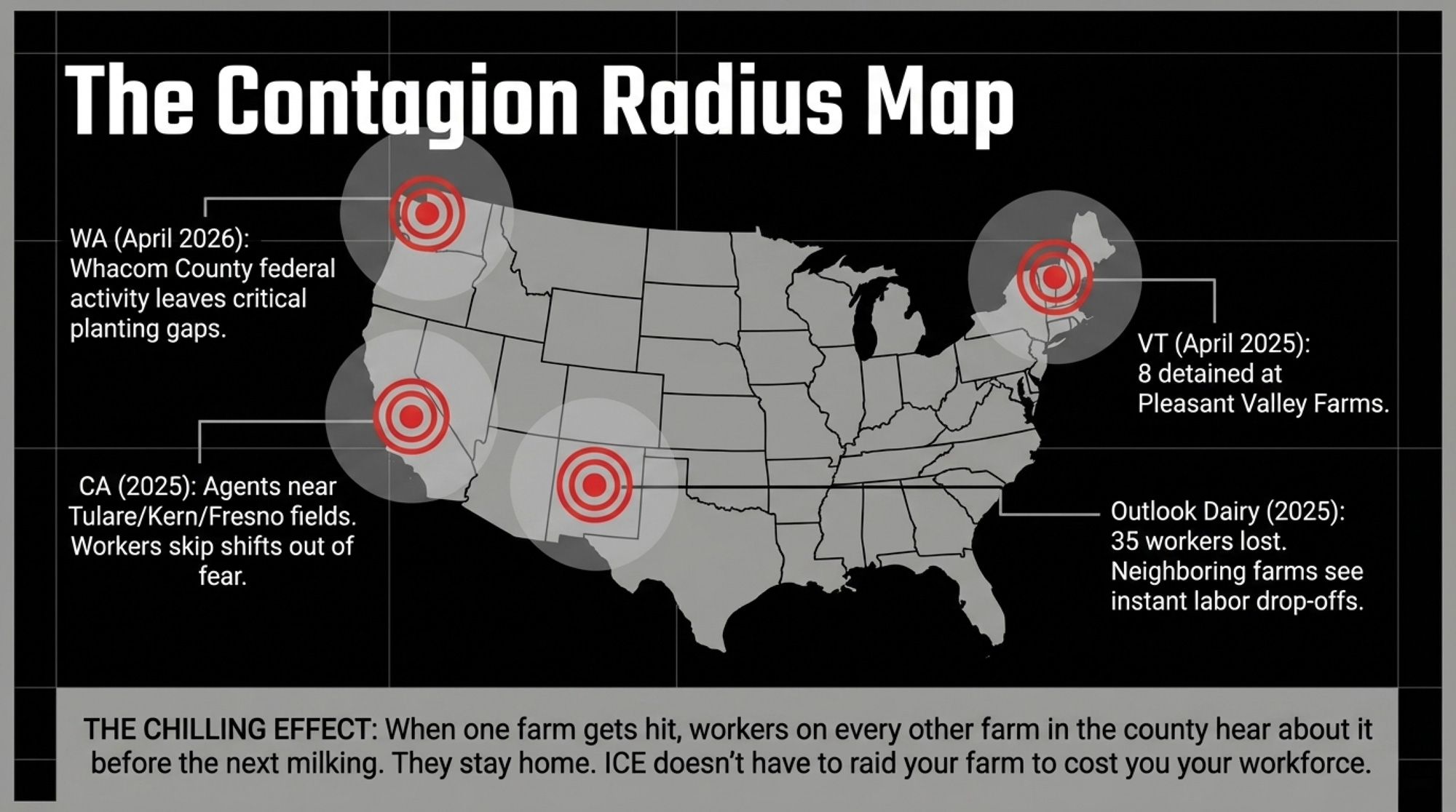
Lovington is a small town in the New Mexico oil patch near the Texas border. It’s easy to shrug and say, “That’s down there. We’re fine up here.”
Then you look at Vermont.
On April 21, 2025, U.S. Customs and Border Protection agents arrested eight migrant workers at Pleasant Valley Farms in Berkshire, Vermont’s largest dairy, a roughly 10,000‑acre operation running more than 3,000 cows, owned by Mark and Amanda St. Pierre. The farm itself was not the target of the operation, and the St. Pierres weren’t accused of wrongdoing. Agents said they were responding to a citizen report of “two individuals carrying backpacks exiting a wooded area” near the Canadian border, and the eight workers were detained during the search that followed. State officials and Migrant Justice called it the largest migrant worker enforcement action in Vermont in recent memory.
Same year, different coast. In California’s Central Valley, ICE and other federal agents were reported near fields and packinghouses in Tulare, Kern, Fresno, and Ventura counties, with workers fleeing fields when agents appeared. Farm bureau leaders for Tulare, Kern, and Fresno counties told reporters they couldn’t confirm specific raids on member farms. But the fear alone was enough to blow holes in crews — workers staying home, skipping shifts, turning off their phones.
By April 2026, a Whatcom County, Washington producer told local TV that federal activity in the area was leaving critical gaps during planting season. He wouldn’t allow his name to be used for fear of making things worse for his workers.
New Mexico. Vermont. California. Washington. The enforcement corridor isn’t one state. It’s a moving target across multiple regions and milk sheds.
And here’s the part you’ll never see in any official statistic: when one farm in a county gets hit, workers on every other farm in that county hear about it before the next milking. Some don’t show up. Not because anyone told them not to — because they’re afraid they’ll be next. Reports from southeastern New Mexico described a chilling effect across dairies after the Outlook raid — Idsinga among those saying labor was disappearing not just from the raided farm but from neighbors’ farms, too.
That “community contagion” isn’t on any spreadsheet in Washington. It absolutely shows up on your bulk tank.
How Should You Price a 72-Hour Labor Shock?
This is where the kitchen‑table math meets your actual risk tolerance.
You don’t need a consultant to start. You need an honest look at what 72 hours without your core crew would really cost — and what you’d do about it.
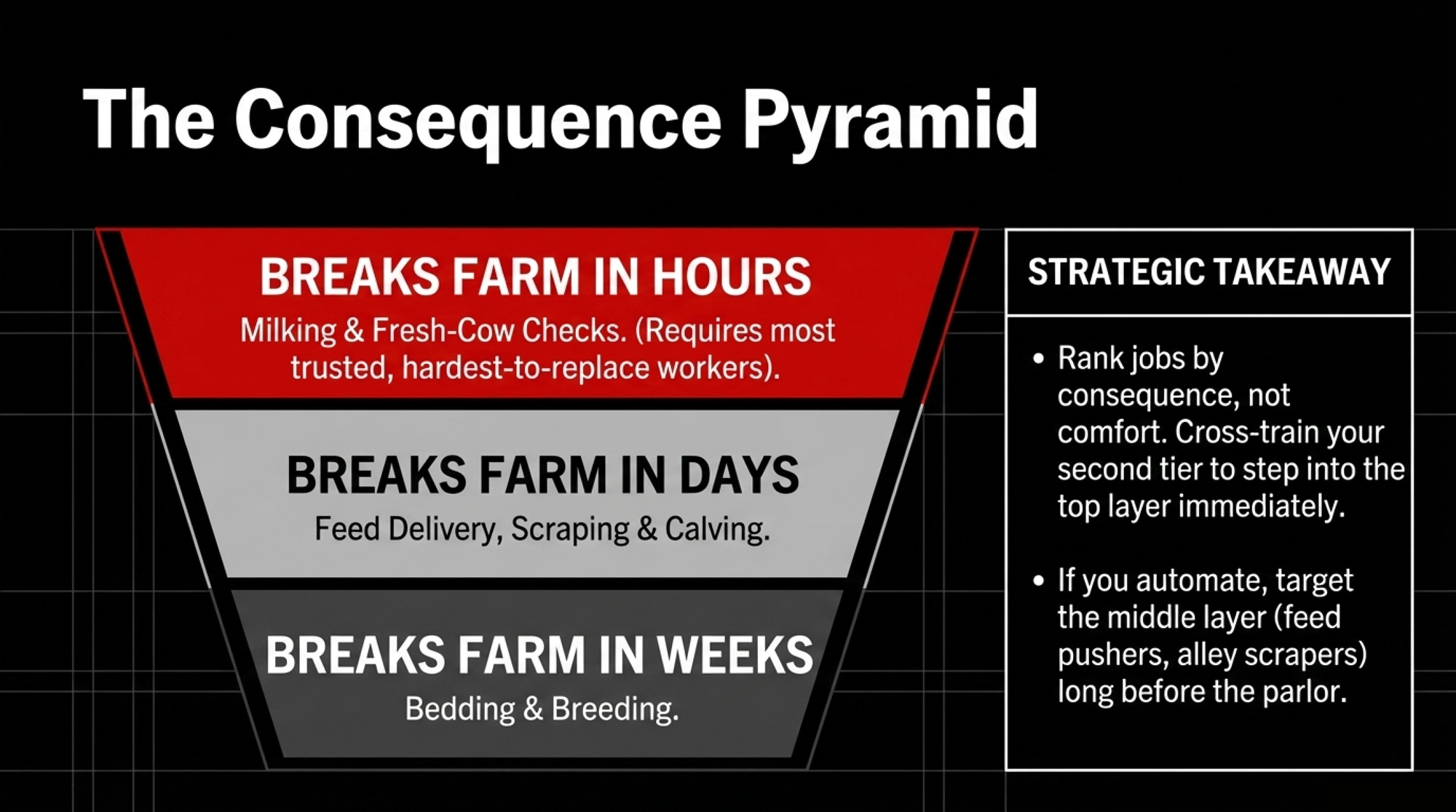
First question: on your farm, which jobs break things the fastest if they don’t get done for 24–72 hours? Milking is obvious. Fresh‑cow checks, calvings, and feed delivery aren’t far behind. Scraping, bedding, and breeding probably slot in after that.
Now ask yourself: do you know exactly who you’d call and what they’d do if three key people didn’t walk in at 4:30 a.m.?
If that question makes your stomach flip, that’s the point.
Are You Counting on Robots or People When Things Go Sideways?
When you start plugging your own herd into the Table of Doom, it’s tempting to jump straight to capital solutions. “If I had robots, this wouldn’t be as bad.”
Sometimes that’s true. A well‑run, dialed‑in robot herd with strong management can absolutely ride out a milker loss better than a parlor operation. The ERS data shows real return. So do many farm case studies.
But look at your own barn honestly. Ask: if your current crew disappeared and a truck delivered robots tomorrow, would your operation smoothly transition to a totally different management system while you’re also scrambling to hire, train, and keep cows healthy?
A farm in chaos is the worst possible candidate for a major technology transition. You need your best management IQ for those first six to twelve months on AMS. You need time to learn exceptions, software quirks, and how specific cows behave on robots. You need your best people focused on onboarding, not plugging holes.
So yes, robots can be part of a labor strategy. They’re not an emergency exit. They don’t remove the need for a 72‑hour plan, cross‑training, or hard conversations with your lender and your lawyer.
Options and Trade-Offs for Farmers
You can’t control when or where the next enforcement action happens. You can absolutely control how exposed your operation is when it does.
Path 1: Run Your Own 30-Day Cascade — This Month
This is your 30‑day action.
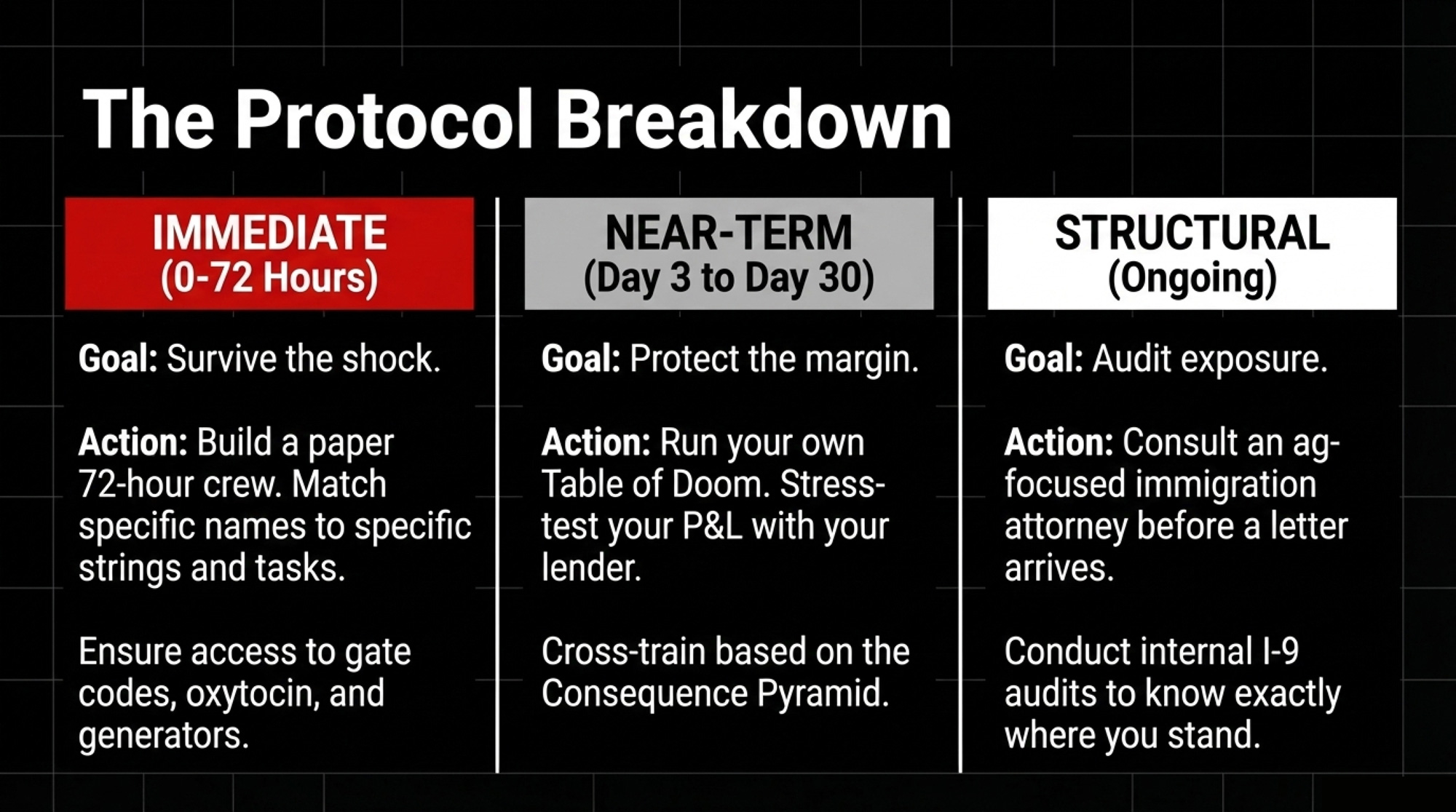
Sit down with your milk cheque and a notepad. Write down three things: herd size, lb/cow/day, and current pay price. Model a 10 lb/cow/day drop for 30 days. Then add:
- A realistic estimate for lost quality bonuses or SCC penalties.
- A bump in wages for emergency help.
- A number for extra vet and repro costs if fresh cows get missed.
You’re not building a thesis. You’re answering one question: how many months of profit would that 30‑day shock erase for your operation?
If the answer is more than two, your risk isn’t “some policy debate in Washington.” It’s a very specific amount of money on your own P&L.
Path 2: Build a 72-Hour Crew on Paper
Picture 4:30 tomorrow morning. Your three most experienced workers don’t walk in. Any reason.
Grab a piece of paper and make this checklist real:
- [ ] Name the 4–6 people who show up if you call.
- [ ] Make sure they have the gate codes.
- [ ] Make sure they know where the oxytocin is kept.
- [ ] Make sure they can start the backup generator and keep it running.
- [ ] Assign each one specific strings, pens, or tasks for those 72 hours.
| Category | Prepared Farm | Average Farm | Exposed Farm |
|---|---|---|---|
| Backup crew identified | 4–6 named, trained contacts | 2–3 people “who might help” | No list exists |
| Cross-training status | 2nd-tier staff trained on milking + fresh cows | Some informal exposure | Single-person dependencies |
| Gate codes / access | All backups have codes + keys | Owner holds all access | “I’ll let them in when they call” |
| Critical supply locations | Documented: oxytocin, colostrum, generator | Known to 1–2 people | Owner’s head only |
| Milking interval risk | Maintains 10–12 hr intervals for 72 hrs | Stretches to 14–16 hrs within 24 hrs | Misses milkings within 12 hrs |
| Fresh cow monitoring | Assigned to specific backup person | “Somebody will check” | Skipped entirely |
| Estimated 72-hr milk loss | < 3 lb/cow/day | 5–8 lb/cow/day | 10+ lb/cow/day |
| SCC impact | Stays under 200K cells/mL | Climbs toward 300K+ | Blows past 400K — penalties hit |
If you can’t fill in those blanks without guessing, you don’t have a backup plan. You have a schedule.
Path 3: Rank Jobs by Consequence, Not Comfort
Not all jobs fail at the same speed.
Your most trusted, best‑documented, hardest‑to‑replace workers should sit where a missed shift hurts fastest — milking and fresh cows. Cross‑train your second tier in feeding, scraping, and calf chores so they can step in when someone is out.
Then look at automation through that same lens: where does a missed job hurt fastest, and which of those jobs can a machine actually cover? That might mean a feed pusher, calf feeder, or manure scraper long before it means AMS.
Path 4: Talk to an Immigration Attorney Before a Letter Shows Up
You probably already know where your workforce realities sit. Hoping your paperwork never gets tested isn’t a plan.
An ag‑focused immigration attorney can help you answer three uncomfortable but critical questions:
- What would a real internal I‑9 audit show?
- Which workers have strong documentation, and which don’t?
- What kind of timeline and exposure would you face if enforcement turned your way?
Uncomfortable conversation. A lot less uncomfortable than having it for the first time in your driveway with a government vehicle idling.
And if Congress finally does open H‑2A year‑round for dairy, the farms with attorneys already in their corner will be first in line to file. If it doesn’t, you’ll still know where you stand — and what your realistic options are.
Key Takeaways
- If your 30‑day cascade shows a 10 lb/cow/day drop that would erase more than two months of profit, your margin of safety is thinner than your balance sheet suggests. That’s your cue to either build a buffer or rethink exposure.
- If you can’t name a 72‑hour backup crew and match each person to specific jobs, what you’ve got is a schedule, not a contingency plan. The Outlook raid showed how fast “we’ll figure it out” turns into “we’ve effectively ceased milking.”
- If your labor strategy is “we’ll add robots when it gets bad,” you’re betting on a technology transition at the exact moment your barn is least able to handle one. Robots can add margin over time — they don’t magic away a crisis.
- If your lender has never stress‑tested your operation for a labor disruption, that risk isn’t priced into your financing. You don’t need their permission to run the Table of Doom with your own numbers — but you should bring it to the next meeting.
You can look at Lovington, Berkshire, Tulare, or Whatcom County and tell yourself the map is somebody else’s problem. Different state. Different politics. Different co‑op.
Your cows don’t care about state lines. Neither do your vet bills, your wage premiums, or the peak milk that never hits your bulk tank.
So here’s the only question that really matters right now: if three people in your barn didn’t show up at 4:30 tomorrow morning, would you have a plan — or just a hope that it works out?
Complete references and supporting documentation are available upon request by contacting the editorial team at editor@thebullvine.com.
Learn More
- 79% of U.S. Milk Runs on Immigrant Labor. If Yours Vanishes, You Have 72 Hours. – Reveals the terrifying math behind our industry’s workforce dependence and delivers a survival strategy for the first 72 hours of a labor crisis. It arms you with a crisis-reserve framework to buy time when biology starts calling the shots.
- The American Dairy Heist: Who Really Owns Your Milk Check? – Exposes the financial machinery syphoning your margins through opaque cooperative “pooling” and marketing fees. This analysis delivers the leverage needed to challenge your board’s status quo and position your equity for the next five years of volatility.
- The Robot Truth: 86% Satisfaction, 28% Profitability – Who’s Really Winning? – Breaks down the massive gap between glossy automation brochures and actual barn-floor returns. It reveals the uncomfortable truth about why quality-of-life gains often mask economic failure, helping you filter out high-priced distractions before you sign the contract.
 The Sunday Read Dairy Professionals Don’t Skip.
 The Sunday Read Dairy Professionals Don’t Skip.
Every week, thousands of producers, breeders, and industry insiders open Bullvine Weekly for genetics insights, market shifts, and profit strategies they won’t find anywhere else. One email. Five minutes. Smarter decisions all week.