BRD treatment runs $42 a calf. In Dr. Bray’s trial, a $5 sodium bisulfate protocol delivered zero lung lesions on the treated side.
Executive Summary: Dr. Joey Bray, a poultry scientist who jumped to dairy in 2023, helped run two calf barn trials that turned ammonia from a background nuisance into a hard-dollar decision. In a 60‑day South Dakota trial, a simple sodium bisulfate protocol — roughly 1 lb per hutch whenever ammonia pushed toward 5 ppm — produced zero lung lesions on the treated side in a blinded veterinary ultrasound. A second trial at Casper’s Calf Ranch in Illinois confirmed lower ammonia and showed statistically higher average daily gain and bodyweight for calves on the same $5‑per‑calf program. Using UC Davis BRD treatment costs and published first‑lactation loss data, the article walks through barn math showing a 200‑calf operation spending about $6,864 a year on sodium bisulfate to avoid $7,500–$9,800 in BRD‑related losses, plus cohort‑wide milk gains if the ADG effect holds. With replacement heifers now worth roughly $2,300 and inventories at 30‑year lows, the piece argues that ammonia control is no longer optional background hygiene — it’s a line item in your heifer and milk‑yield strategy. A 30/90/365‑day playbook gives producers concrete steps to test ammonia at calf height, fix ventilation first, trial sodium bisulfate, and then re‑check BRD, mortality, and milk numbers against their own baseline. The article is candid about the catch: both trials were manufacturer‑funded and require independent university replication, and sodium bisulfate addresses only bedding chemistry, not structural ventilation failures.
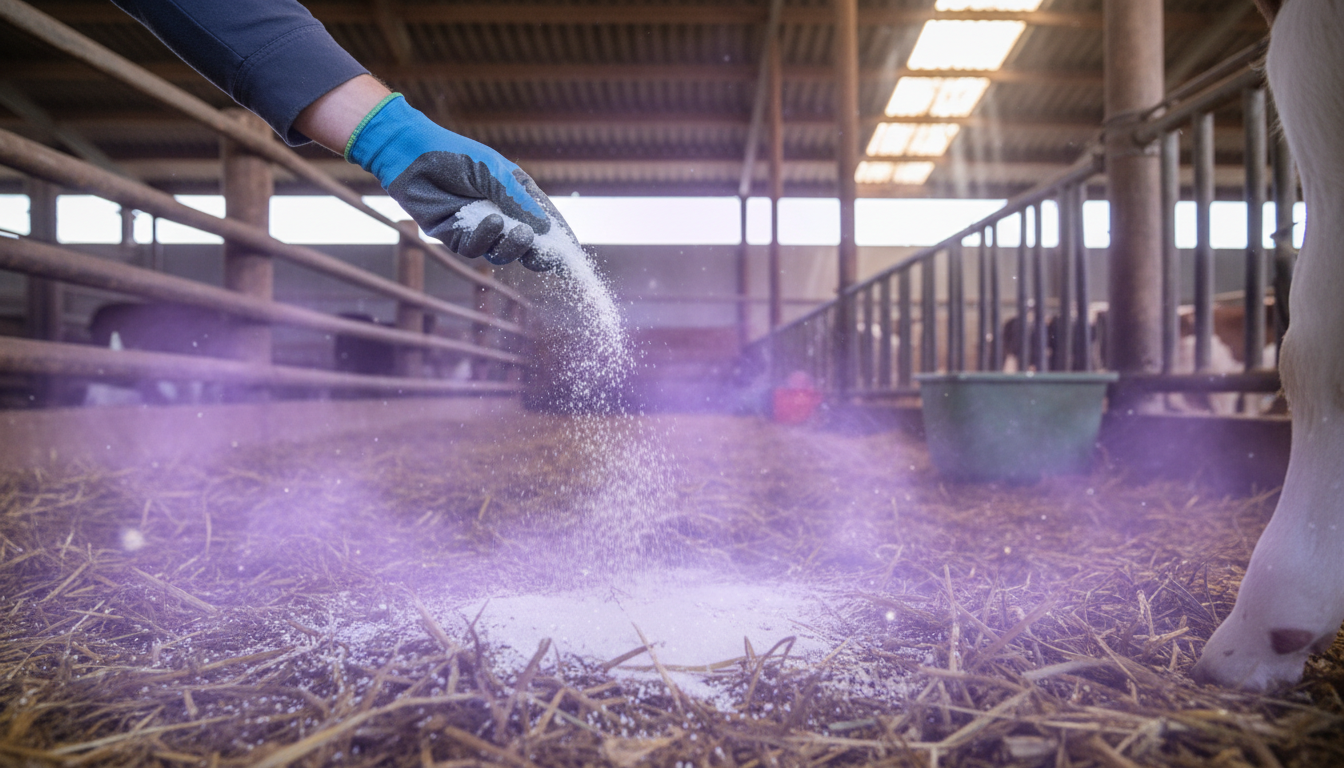
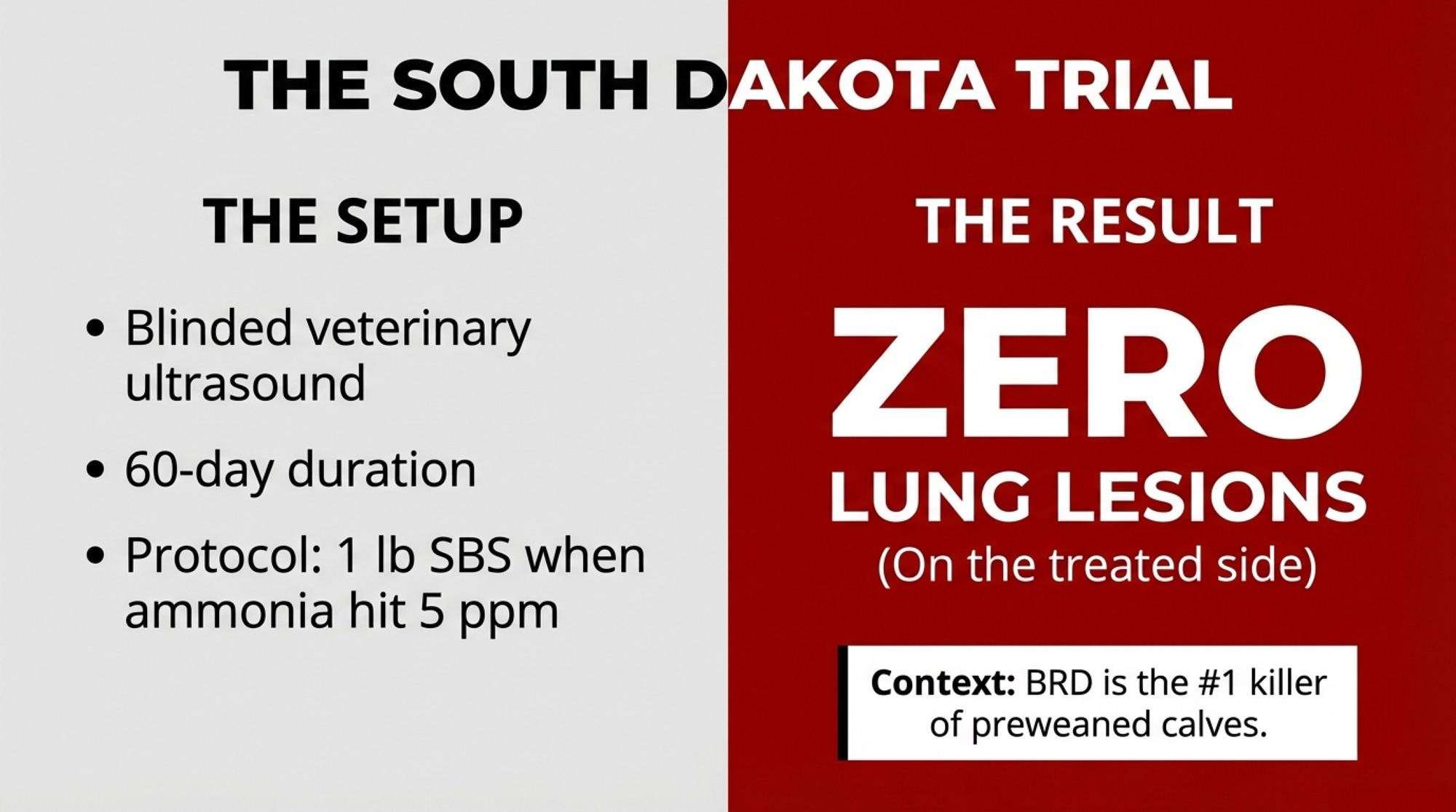
A licensed veterinarian who had no idea which calves were which ran lung ultrasound on every calf after a 60-day rearing period in an enclosed calf barn in South Dakota. The calves on the treated side — the ones whose hutches got roughly a pound of sodium bisulfate whenever ammonia crept toward 5 ppm — showed zero lung lesions. Zero. BRD is the leading cause of preweaned calf death in the United States.
With replacement heifers running $2,300 and heifer inventories at their lowest since 1991, every calf lung matters more than it ever has.
The man behind the trial wasn’t even a dairy guy. Dr. Joey Bray spent over a decade in poultry science — BS and MS from Stephen F. Austin State University, PhD in poultry management from Texas A&M, then years as a professor and department chair at SFA before joining Jones-Hamilton Co. in January 2023. The problem he’d been solving in broiler houses — ammonia destroying respiratory tissue at concentrations most producers can’t even smell — looked identical when he walked into that curtain-sided calf barn. It was the kind of career bet most researchers never make.
The Trial Nobody Expected to Work This Clean
The setup was straightforward. An enclosed barn with calf hutches running down both sides at a large dairy in South Dakota. One side received sodium bisulfate (marketed as SurPHace — the “pH” is intentional) at roughly 1 pound per hutch whenever ammonia readings rose toward 5 ppm. The other side got standard management. No other variables changed.
After 60 days, calves moved to transition pens. The vet was completely blinded to which calves came from which side. Ultrasound doesn’t lie, and it didn’t hedge — the treated group came back clean.
That’s the kind of result that makes you set your coffee down. But it’s also the kind of result that earns healthy skepticism. One trial. One barn. A product manufacturer was funding the work. Anyone who’s sat through an industry trade show has heard a clean dataset from a company-backed study before — and learned to wait for the second act. So they ran it again.
Casper’s Ranch Ran It Again — and the ADG Numbers Got Interesting
The second trial moved to Casper’s Calf Ranch in Freeport, Illinois — a dedicated contract research facility with capacity for 192 calves in Calf-Tel hutches — operated by Dr. David Casper, a senior dairy nutritionist with MS and PhD degrees from South Dakota State University. This time the protocol was tighter: twice-weekly application, roughly a pound per hutch, over 8 weeks.
Ammonia levels came back statistically lower on the treated side. But Casper went further, tracking what most calf studies don’t — production parameters. Calves on sodium bisulfate had statistically higher average body weight, average daily gain, and body weight gain than controls. Exact sample sizes and p-values weren’t publicly disclosed — the trials haven’t appeared in a peer-reviewed journal yet — but the design (blinded veterinary evaluation, split-barn controls) is methodologically strong for pilot data.
“Everything showed very, very good promise,” Bray said on The Dairy Podcast Show (Episode 184, February 2026).
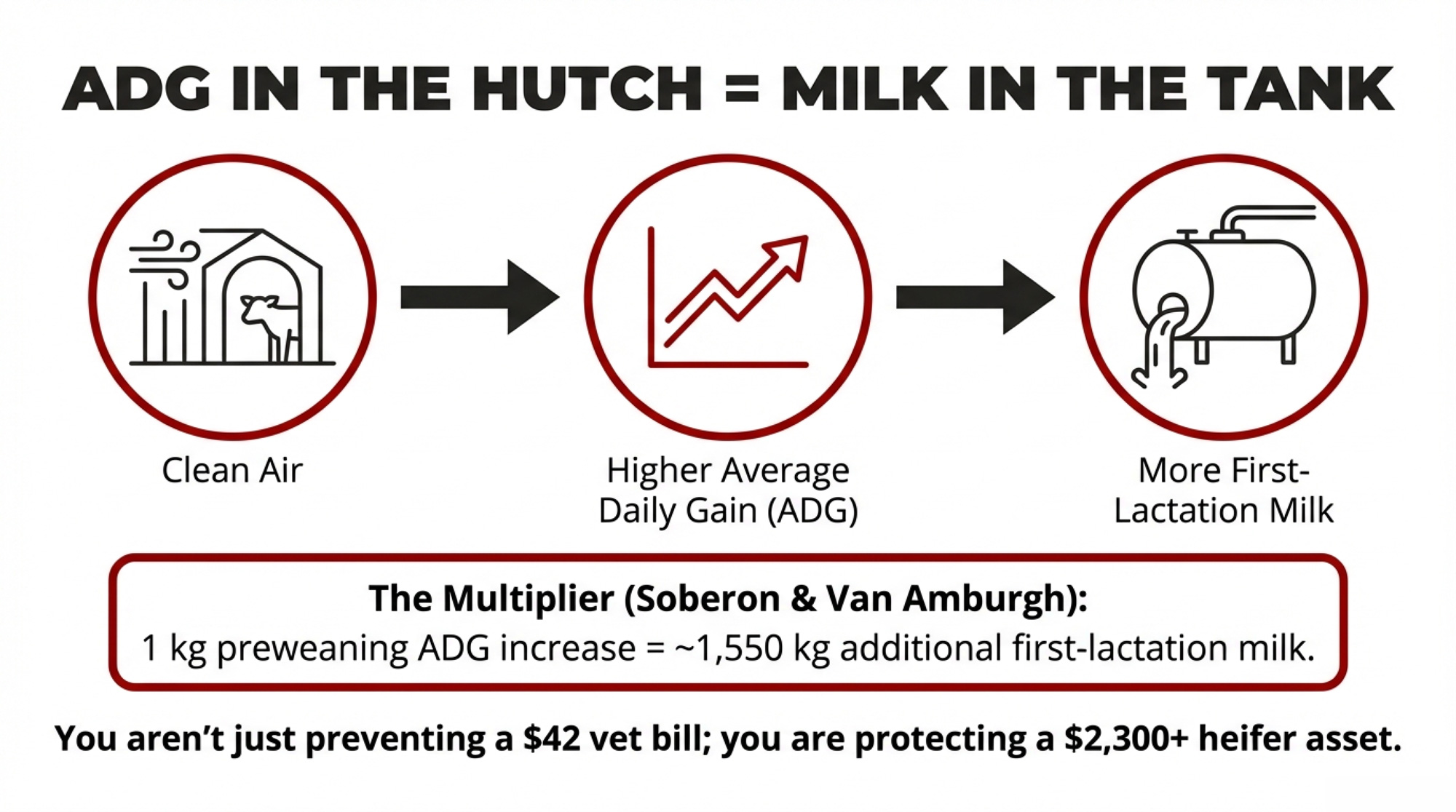
Those ADG gains aren’t just weaning numbers. They compound. A Cornell meta-analysis by Soberon and Van Amburgh found that for every 1 kg increase in preweaning ADG, first-lactation milk yield increased by 1,550 kg. And a decade-long Penn State study by Jud Heinrichs concluded that days of illness before 4 months of age had significant effects on first-lactation production in Holsteins — Hoard’s Dairyman cited his data in October 2024, putting the figure at 278 pounds of first-lactation milk lost per day of preweaning disease. That’s among the higher published estimates; a broader BRD meta-analysis put total first-lactation loss at roughly 267 lbs per episode. But Heinrichs’ 10-year dataset remains the most granular per-day figure available.
Run that backward: anything suppressing ADG in the first 60 days — chronic low-level ammonia exposure, for instance — is compounding milk losses years before that heifer ever enters the parlor.
| Scenario | Baseline First-Lactation Milk (200 calves) | Additional Milk from ADG Improvement | Total First-Lactation Value |
|---|---|---|---|
| Baseline (no SBS) | $40,000 | $0 | $40,000 |
| With SBS protocol (0.05 kg/day ADG improvement) | $40,000 | +$6,800 | $46,800 |
Is 5 ppm the Real Ammonia Threshold for Calves?
Here’s the thing about ammonia in calf barns: readings at your nose height and readings at calf height aren’t the same number.
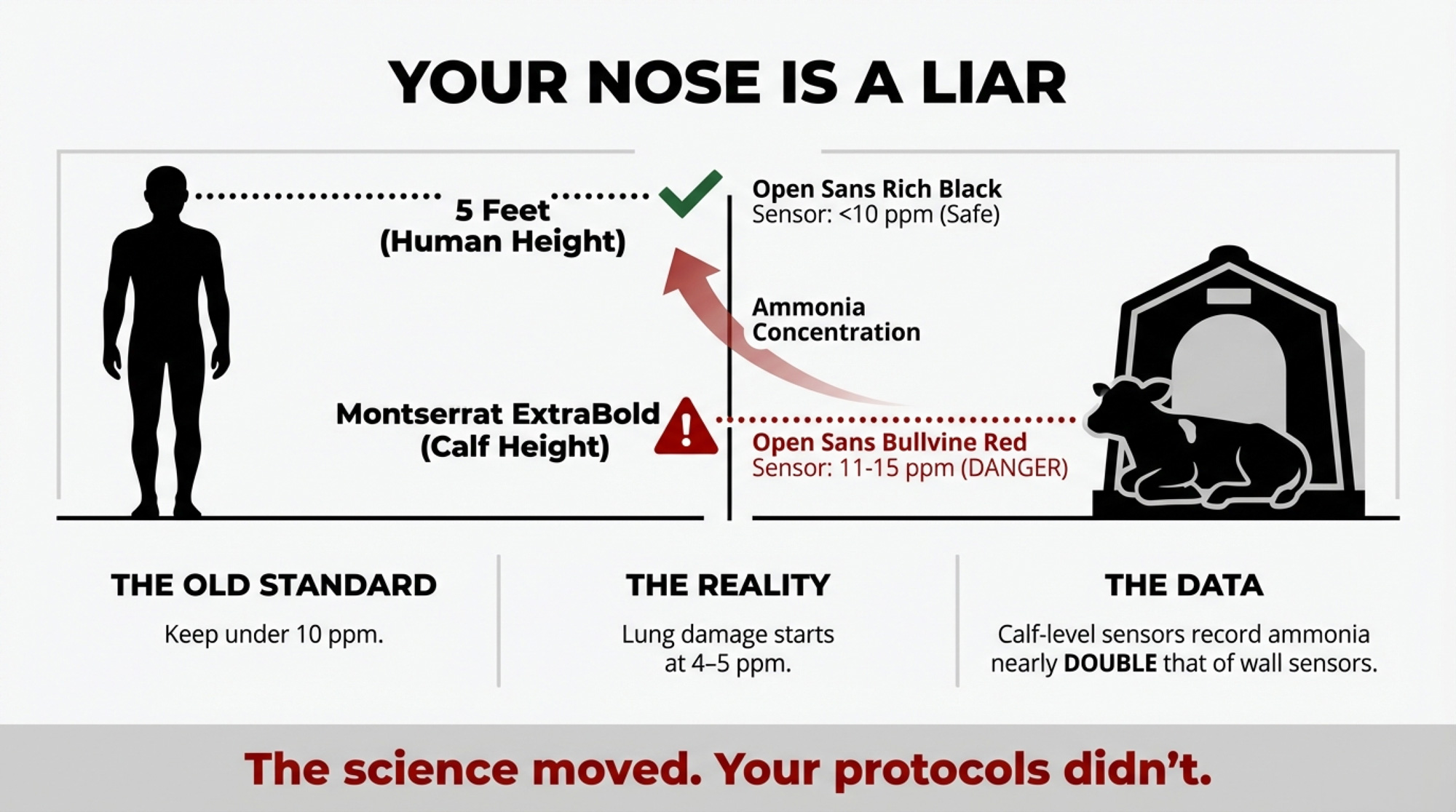
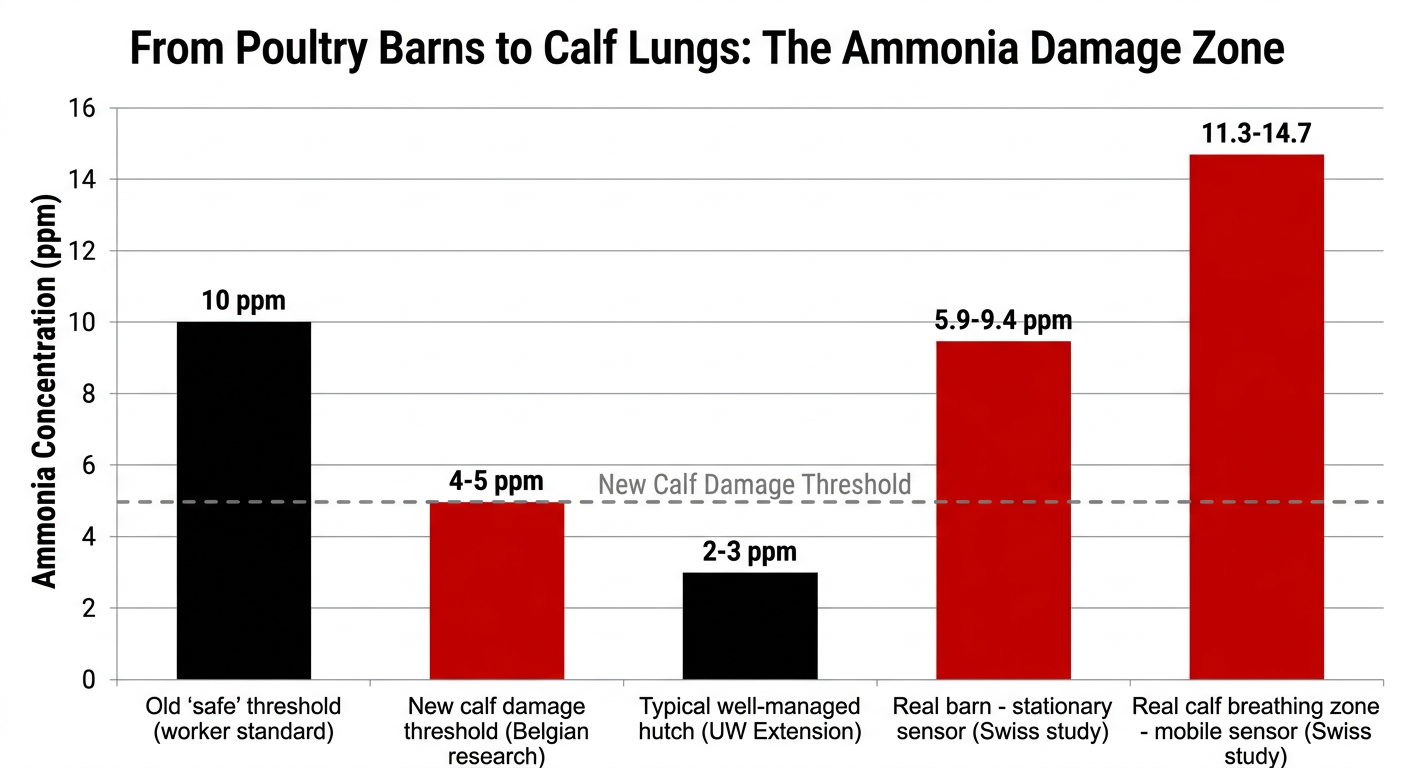
A 2024 Swiss study strapped mobile sensors directly onto calves and compared them to stationary sensors at the barn level. The stationary sensors peaked at 5.9–9.4 ppm. The mobile sensors — recording what the calves actually breathed — hit 11.3 to 14.7 ppm. Nearly double.
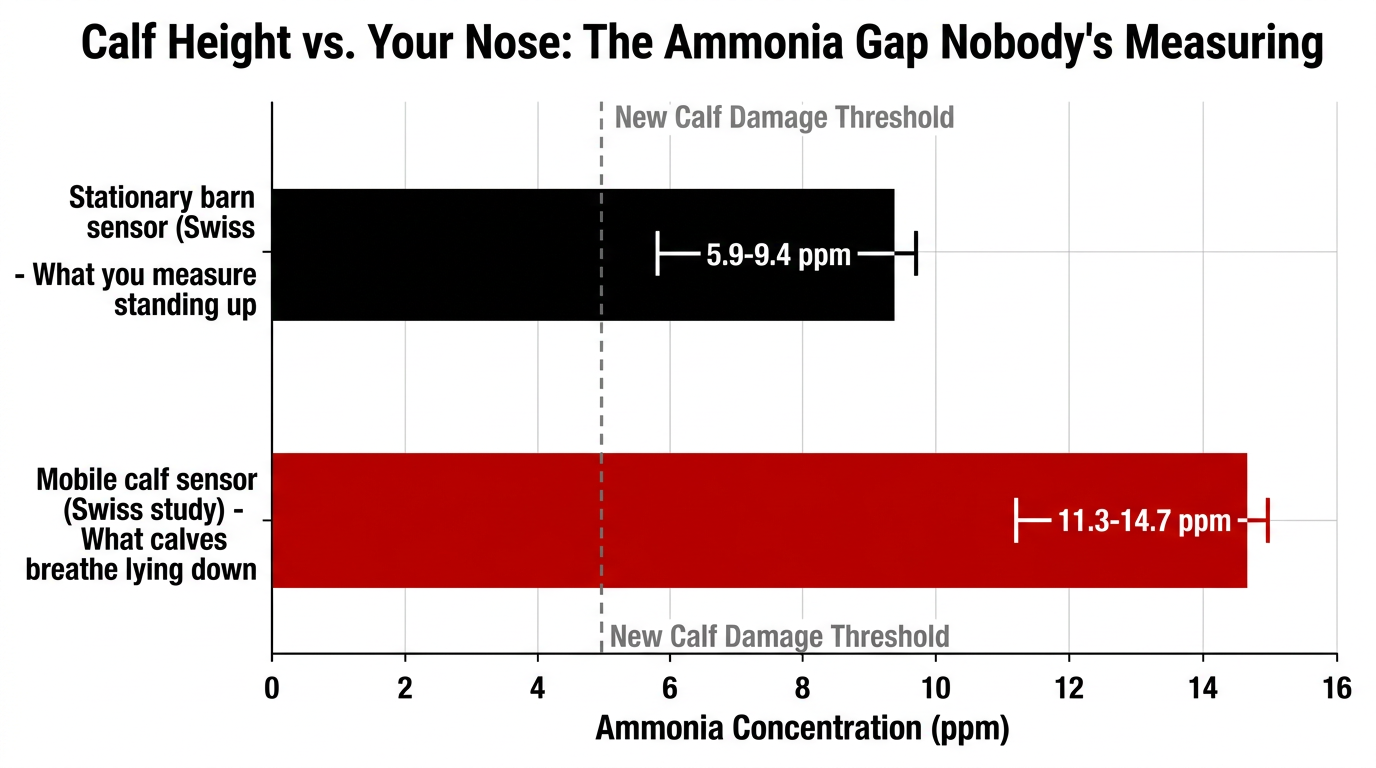
And it doesn’t take a worst-case barn to get there. The University of Wisconsin Extension published a review of calf housing air quality in April 2025 (lead author Neslihan Akdeniz) and reported that well-managed hutches typically remain at a few ppm. But in localized pockets or under poor ventilation, their site visits found ammonia climbing to 10–20 ppm — two to four times the level now linked to lung damage. UW-Extension pushed the target below 5 ppmbecause Belgian research found that ammonia levels above 4 ppm were associated with higher lung lesion prevalence. Italian research published in 2022 found respiratory disease risk climbing above 6 ppm, with some studies flagging problems as low as 3.5 ppm.
The standard advice for a generation has been “keep it under 10 ppm.” That number was calibrated to human worker exposure limits, not calf respiratory biology. The science moved. Your protocols probably didn’t.
In one case documented through USDA’s SARE program, a producer brought in university researchers over concerns about elevated calf mortality in their compost-bedded pack barn. When the team arrived, they discovered wind shadows from surrounding structures were choking natural ventilation and creating stagnant ammonia zones — a problem the producer suspected but couldn’t see.
Ammonia hits calves from two directions. It damages the respiratory epithelium directly — fewer ciliated cells, impaired mucociliary clearance, stripping the calf’s first line of airway defense. Meanwhile, the same high-pH, high-moisture conditions that drive ammonia production are a bacterial playground. So the calf gets respiratory irritation andelevated pathogen loads simultaneously.
“As we stress the animal, weaken their immune system… those bacteria really have the opportunity now to come in and cause problems,” Bray explained.
Does BRD Really Cost $42 a Case? It’s Worse Than That
The commonly cited $42.15 per affected calf comes from the “BRD 10K study” — a UC Davis project that tracked 11,470 preweaned calves across California dairies. That figure covers short-term treatment costs. It doesn’t include the long tail.
And the long tail is where the real money disappears. USDA estimated cattle mortality losses from BRD at $907.8 million annually (2017 data). Add treatment costs, labor, and production losses — which USDA acknowledges are poorly estimated — and total BRD-related losses likely exceed $1 billion per year, a figure confirmed by a 2025 review in Frontiers in Veterinary Science.
Now layer on the heifer inventory picture. As of January 1, 2026, USDA reported 3.90 million milk replacement heifers, and dairy replacement heifers expected to calve fell to 2.922 million, the lowest since USDA began tracking in 2001. The heifer-to-cow ratio sits at 41.9, the lowest since 1991. At $2,300-plus per head, BRD isn’t just a calf health problem anymore. It’s a balance-sheet problem.
The $5 Fix vs. the $4,170 Milk Loss
Sodium bisulfate in bulk runs roughly $0.23–$0.50 per pound, depending on volume and delivery. The LPELC reported $0.23/lb for bulk agricultural-grade SBS in 2024. UC Davis Extension listed $0.33/lb for bulk dairy delivery. Retail 50-lb bags have historically run around $0.50/lb. Jones-Hamilton doesn’t publish SurPHace pricing publicly — contact them for current dairy bulk quotes.
At the Casper’s Calf Ranch protocol — 1 lb per hutch, twice weekly, 8 weeks — that’s roughly 16 lbs of SBS per calf:
- At bulk pricing ($0.33/lb): $5.28 per calf
- At retail pricing ($0.50/lb): $8.00 per calf
An independent calculation from Calf Notes pegged it at roughly $12 per calf, based on $0.50/lb using a slightly heavier three-times-per-week protocol over 60 days — same ballpark.
Scale it to a 200-calf operation running SBS year-round (assuming year-round calving):
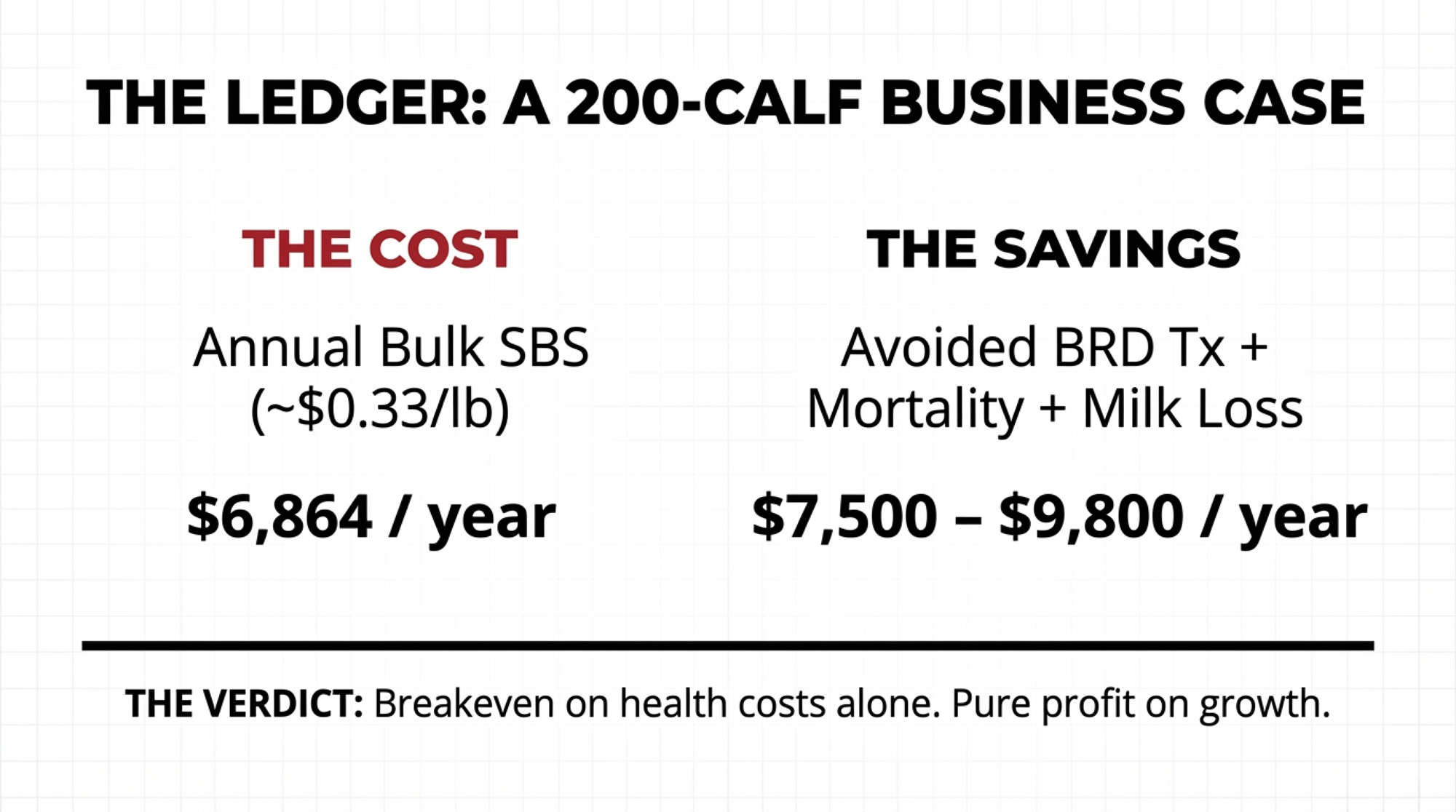
| Line Item | Calculation | Annual Value |
| SBS cost (bulk) | 200 hutches × 104 apps/yr × 1 lb × $0.33 | $6,864 |
| Direct BRD treatment avoided | 25 cases × $42.15 (BRD 10K study) | $1,054 |
| First-lactation milk lost from BRD | 25 calves × 3 sick days × 278 lbs/day × $0.20/lb | $4,170 |
| 1–2 heifer deaths prevented | 1–2 × $2,300 replacement value | $2,300–$4,600 |
Avoided losses: $7,524 to $9,824 conservatively. SBS cost: $6,864. That’s roughly breakeven on direct costs alone. For seasonal calving operations, the annual cost drops proportionally — but you also lose the winter data that matters most, since ammonia is highest when barn doors stay closed.
There’s a labor trade-off, too. At 200 hutches, figure roughly 1.5 to 2 hours per application round — broadcasting a pound of dry, white granules per hutch is comparable to hand-spreading bedding conditioner. Twice weekly, that’s 3 to 4 hours of additional calf crew time per week. Weigh that against the time your team currently spends treating BRD cases, pulling calves for retreatment, and writing up the records.
| Cost Category | Per Calf | 200-Calf Operation (Annual) | What You’re Really Paying For |
| SBS Protocol (8 weeks, bulk pricing) | $5.28 | $6,864 | Bedding chemistry + labor |
| Direct BRD Treatment (avoided) | $42.15 | $1,054 (25 cases) | Antibiotics, vet time, records |
| First-Lactation Milk Loss (avoided) | $166.80 (3 sick days) | $4,170 (25 affected calves) | 278 lbs/day × 3 days × $0.20/lb |
| Heifer Mortality (avoided) | $2,300 (1–2 deaths) | $2,300–$4,600 | Replacement heifer @ Jan 2026 price |
| Total Loss Exposure | $2,509–$4,809 | $7,524–$9,824 | What ammonia actually costs |
| Net Benefit (conservative) | Breakeven to +$19/calf | $660–$2,960/year | Before cohort-wide ADG gains |
But here’s where it flips. That barn math only counts the calves that would’ve gotten sick. What the Casper trial showed was improvement in ADG across the entire treated cohort. Per the Soberon formula, even an illustrative 0.05 kg/day ADG improvement across 200 calves — a conservative scenario, since the trial reported statistical significance but didn’t disclose the exact delta — would translate to roughly 34,000 lbs of additional first-lactation milk across the group. At $20/cwt, that’s another $6,800 in value that never shows up in the BRD treatment ledger.
The real ROI question isn’t “does SBS pay for the BRD it prevents?” It’s “Does the cohort-wide ADG improvement hold up under replication?” If it does, the math tips decisively in its favor.
How Sodium Bisulfate Traps Ammonia at Bedding Level
The granules — white, crystalline, coarse-salt texture — soak up moisture from the bedding, activate on contact, then chemically trap ammonia before it reaches the air. Sodium bisulfate releases hydrogen ions that convert gaseous ammonia (NH₃) back into solid ammonium (NH₄⁺), locking it into the bedding instead of the calf’s lungs.
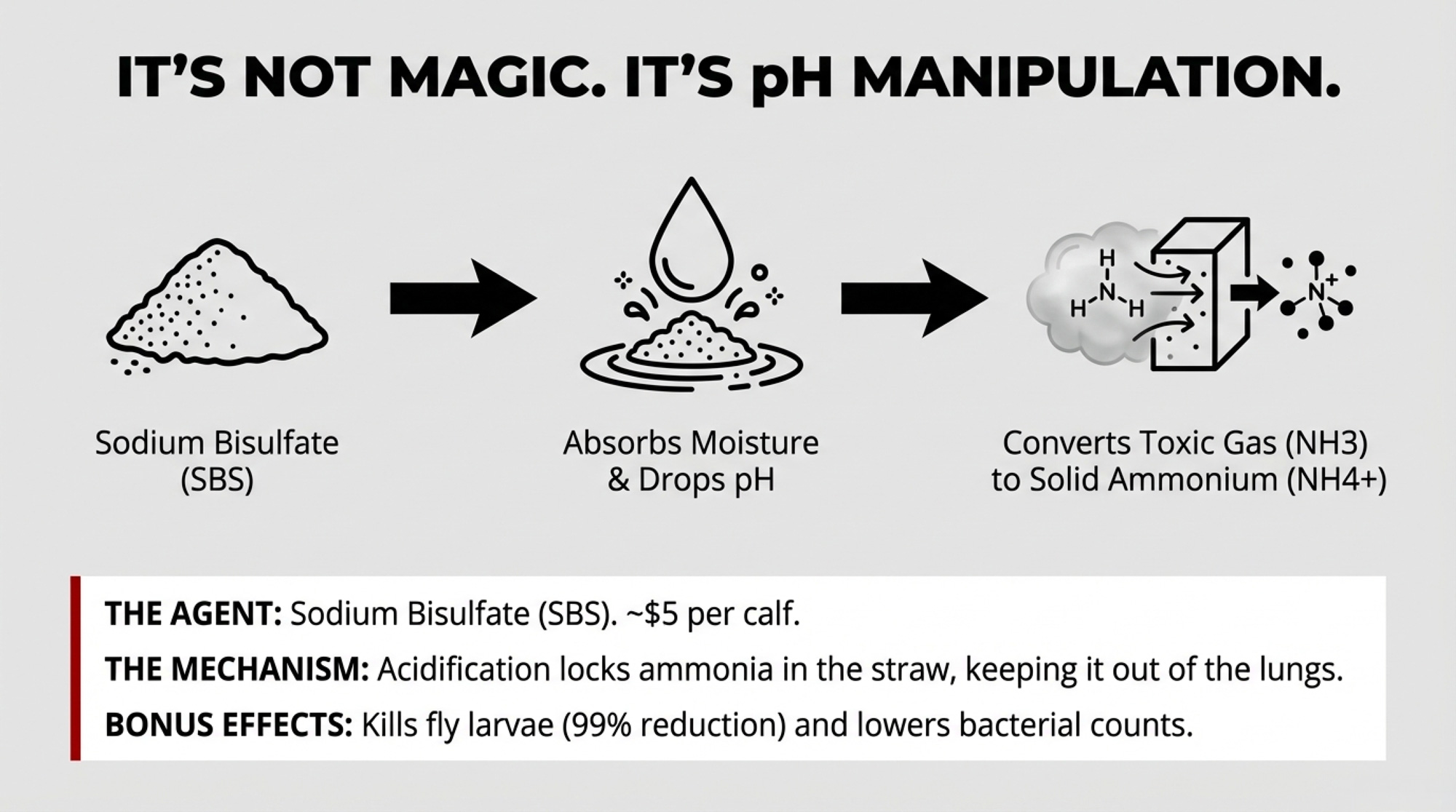
That pH drop does double duty. Lower pH means less ammonia volatilization and a hostile environment for pathogenic bacteria and fly larvae. UC Davis research documented a 60% reduction in ammonia from fresh dairy manure treated with SBS. A peer-reviewed 2010 study on calf hutch bedding found that SBS applied three times per week reduced house fly larvae by 99–100% and bacterial counts by 68%. An independent horse barn study found similar reductions in ammonia and flies at 5–10 lbs per 100 sq ft.
It’s on the EPA’s Safer Choice List and used in human food processing. You can apply it with animals present — a real advantage over formaldehyde-based alternatives nobody wants to handle.
What This Article Doesn’t Tell You (Yet)
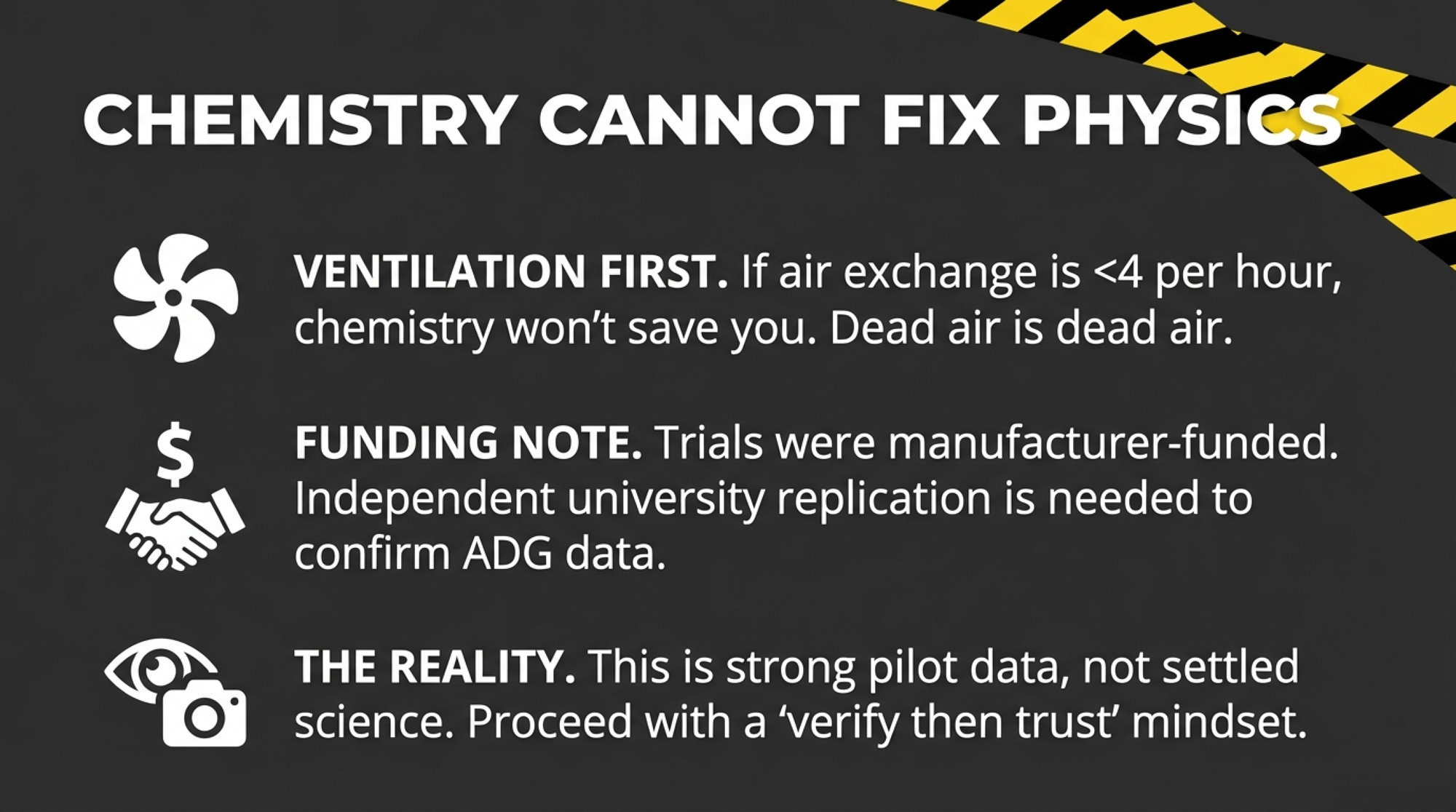
Two things should give you productive pause.
Both calf trials were funded or facilitated by Jones-Hamilton, the company that sells the product. That doesn’t make the data wrong — the blinded vet design is strong, and lung ultrasound results are hard to argue with. The supporting science is solid: SBS reduces ammonia in poultry (established for 30+ years), in dairy slurry (UC Davis), in calf bedding (peer-reviewed, Doane et al. 2010), and in horse barns (independent, peer-reviewed). But calf-specific lung lesion and ADG data from an independent university trial — with full publication of sample sizes, p-values, and methodology — would move this from “promising” to “proven.” Until that publication lands, treat it as strong pilot data. Not settled science.
Second, sodium bisulfate treats the chemistry, not the airflow. If your ammonia problem is fundamentally a ventilation problem (and in converted hog barns across Iowa, Minnesota, and Wisconsin, it very often is), no bedding amendment fixes insufficient air exchange. UW-Extension recommends a minimum of 4 air exchanges per hour in cold weather for indoor calf housing. SBS manages what’s happening at the bedding level. Ventilation manages the air above it. The best protocol combines both.
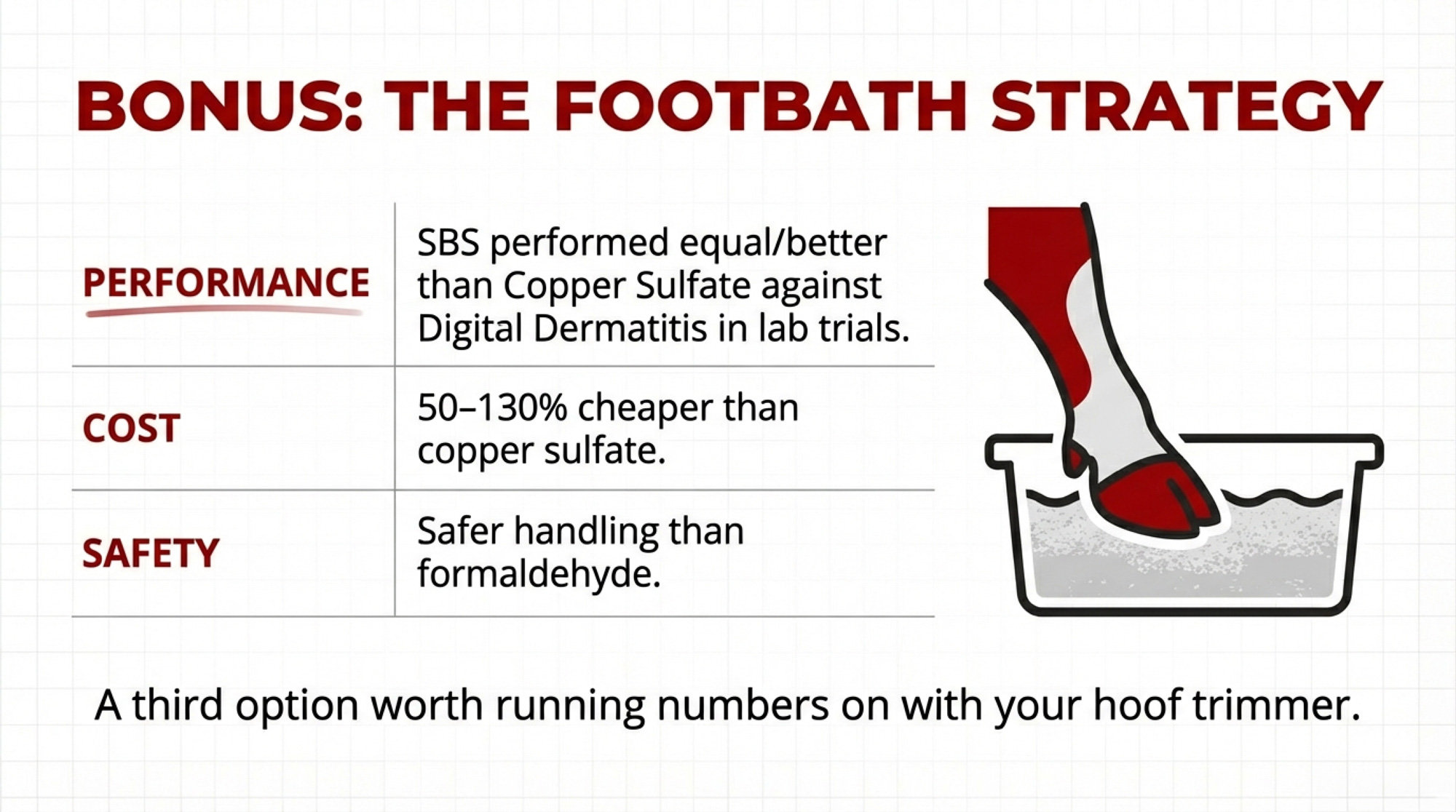
SIDEBAR: Can Sodium Bisulfate Replace Copper Sulfate in Your Footbath?
Jones-Hamilton took SurPHace to RTI Labs for footbath testing, mixing different concentrations and inoculating them with fresh dairy manure at 90-gram intervals — roughly mimicking cow-after-cow traffic — up to a total of 360 grams.
pH stayed consistently low through the manure loading. Aerobic bacteria stayed statistically lower. When they tested specifically against Treponema — the organism behind digital dermatitis — sodium bisulfate “greatly reduced” the count.
Head-to-head against copper sulfate, it performed as well or slightly better. Mixed, the two showed a synergistic effect. Jones-Hamilton claims SBS runs 50–130% less than copper sulfate for footbath use.
The caveat: single lab trial from the manufacturer. Independent replication of the footbath would strengthen the case. But for operations frustrated with formaldehyde and watching copper sulfate prices climb, it’s a third option worth running numbers on with your hoof trimmer.
Your Move
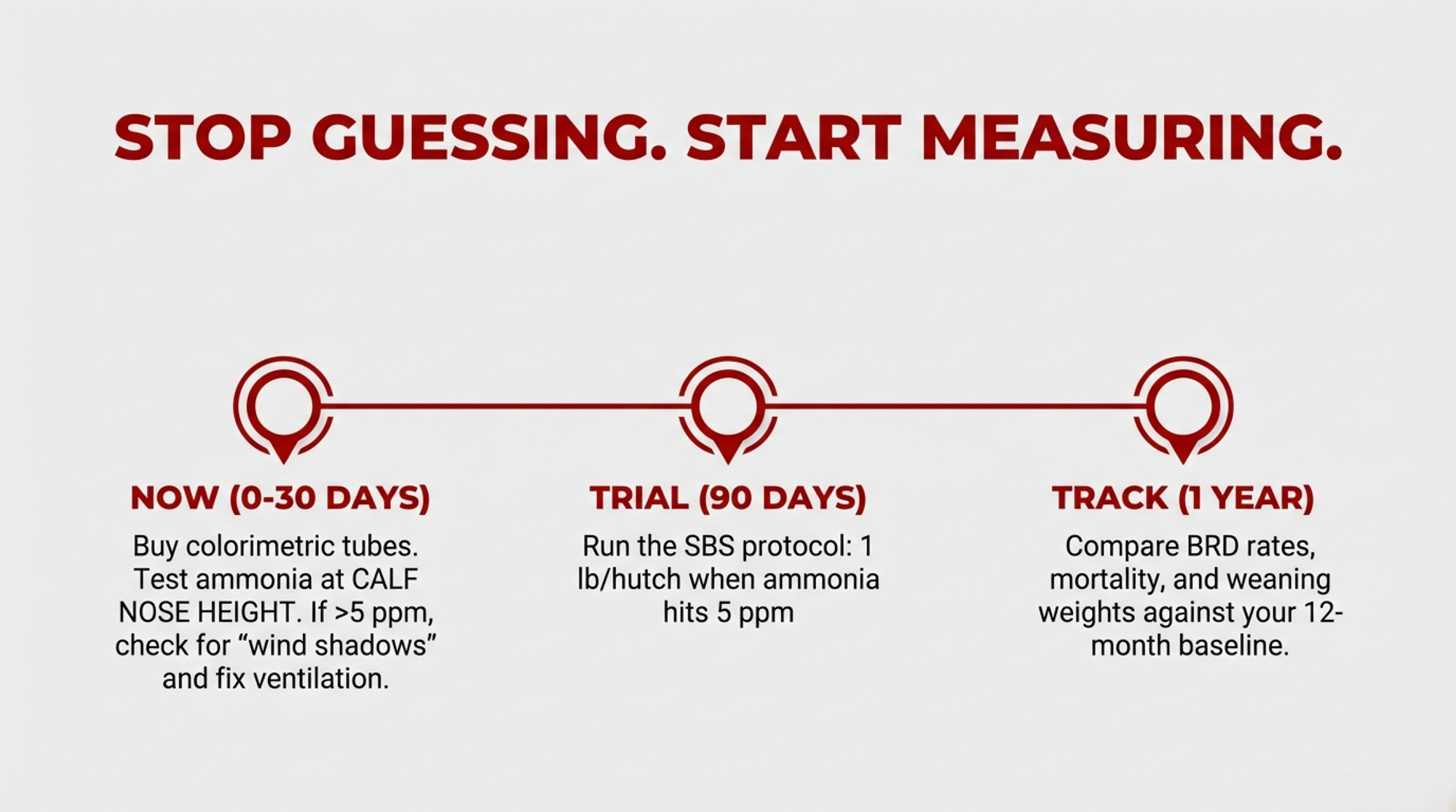
- In the next 30 days, test your calf barn ammonia at calf nose height — not yours. Colorimetric detection tubes cost a few dollars each and give you a reading in minutes. The threshold is 4–5 ppm, not the old 10 ppm. Remember that the Swiss study found calf-height readings nearly double those from stationary sensors.
- Pull your preweaning BRD records from the last 12 months. Calculate your real cost per case — treatment, labor, mortality. Then estimate the first-lactation milk you’re leaving on the table: each day of preweaning illness costs roughly 278 lbs of first-lactation milk, according to Heinrichs’ Penn State data. At $2,300+ per replacement heifer, what’s your actual exposure?
- If your calf facility started life as a hog barn, give it extra scrutiny. Ventilation was designed for a different animal at a different stocking density. These barns are notorious ammonia traps in winter.
- Apply the ventilation-first rule. Below 4 air exchanges per hour? Fix that before you spend a dollar on bedding chemistry — no amendment compensates for dead air. If ammonia stays above 5 ppm after adequate ventilation, then bedding chemistry is your next lever.
- Run the SBS cost against your herd. At bulk pricing, the protocol costs roughly $5 per calf for an 8-week cycle. Factor in 3–4 hours of extra calf crew time per week for a 200-hutch operation. Breakeven on direct BRD costs is tight — but if the cohort-wide ADG improvement holds, the return tips positive. Contact Jones-Hamilton for current dairy bulk pricing.
- Within 90 days, build a weekly ammonia monitoring routine at calf height and track BRD incidence against your baseline. You need 8–12 weeks of data to separate a real protocol effect from seasonal variance.
- At 12 months, compare BRD costs, mortality, and weaning weights against the prior year. If ADG improves, project the first-lactation milk value using the Soberon formula: 1,550 kg per 1 kg increase in ADG. That’s where the real payback shows up — years downstream, not at weaning.
| Scenario | Annual SBS Cost (200 calves) | Avoided Losses | Additional Upside | Net ROI |
| Conservative (direct BRD/mortality only) | $6,864 | $7,524–$9,824 | None assumed | +$660 to +$2,960 |
| If ADG gains hold (cohort-wide milk) | $6,864 | $7,524–$9,824 | +$6,800 (first-lactation milk, 0.05 kg/day ADG improvement) | +$7,460 to +$9,760 |
| Labor cost (3–4 hrs/week × 52 weeks × $18/hr) | — | — | –$2,808 to –$3,744 | Factor into net |
| Breakeven threshold | $6,864 | Need to avoid 13–17 BRD cases + 1 death | None | Conservative case |
| Decision point | Trial for 90 days | Track BRD, mortality, weaning weights | Re-evaluate at 12 months against baseline | Go/no-go based on your numbers |
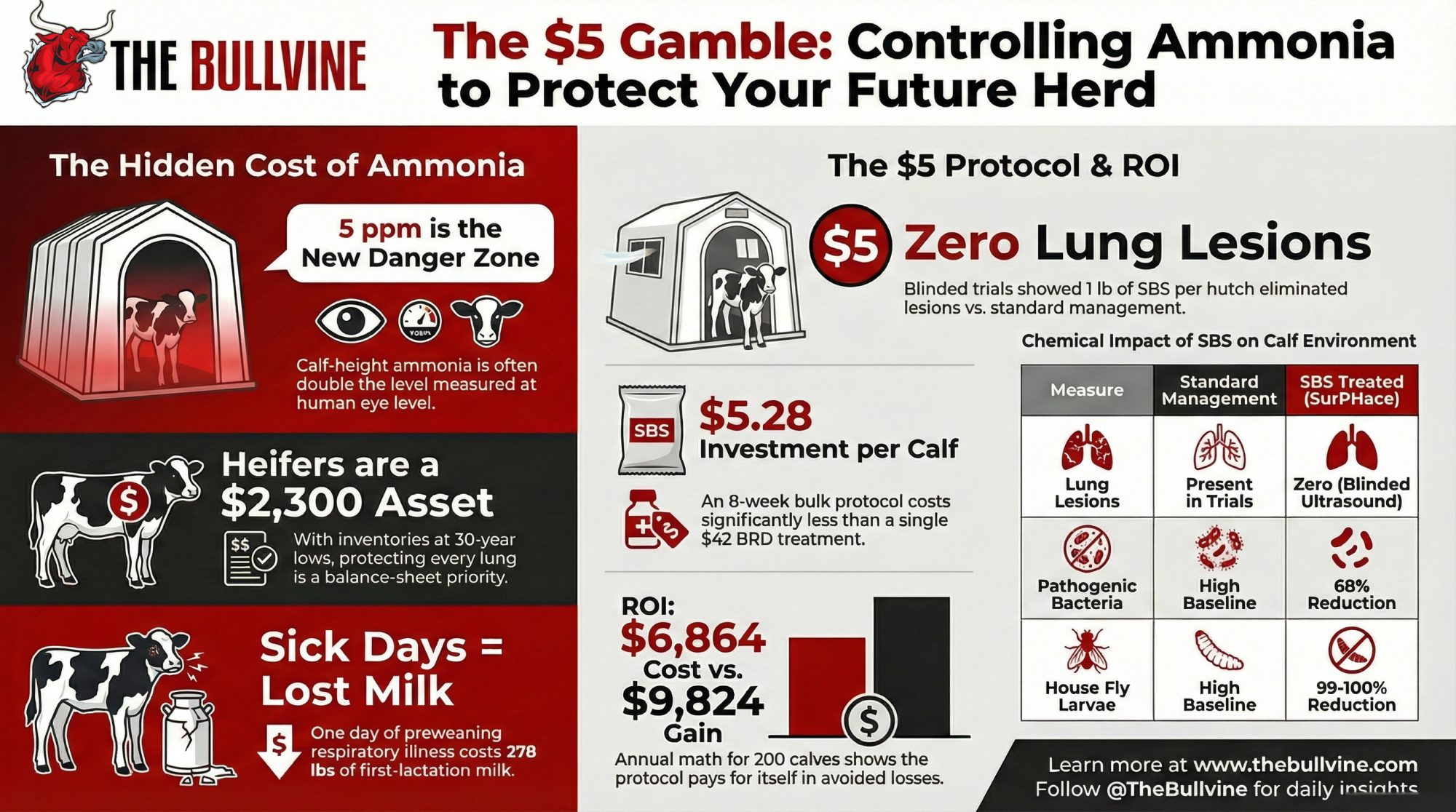
Key Takeaways
- If your calf barn ammonia is above 4–5 ppm at calf height, you’re in the damage zone — recent work shows calf-level readings can run nearly twice as high as stationary barn sensors, with lung lesions and BRD risk climbing fast.
- If you can get ammonia under that 4–5 ppm line, a $5‑per‑calf sodium bisulfate protocol is at least breakeven on BRD and heifer losses for a 200‑calf operation ($6,864/year product cost vs. roughly $7,500–$9,800 in avoided treatment, mortality, and first‑lactation milk loss).
- If your barn is under 4 air exchanges per hour, fix ventilation before you touch bedding chemistry — sodium bisulfate can trap ammonia in the bedding, but it won’t rescue calves from fundamentally dead air.
- If you’re short on replacements or paying $2,300+ for heifers, ammonia control becomes a genetics and milk‑yield strategy, not just hygiene, because early‑life ADG and disease now tie directly into first‑lactation production and herd structure.
- If you decide to trial sodium bisulfate, treat the current data as strong but manufacturer‑funded pilot work — run your own 30/90/365‑day numbers and watch for independent university replication before betting the whole protocol on it.
The Bottom Line
Walk into your calf barn tomorrow morning. Get down to calf height. Take a breath. If you can smell ammonia, you already have your answer about whether this conversation applies to your operation. The next question is what you’re going to do about it — and we’ll be watching for independent university replication data on these SBS trials to report as it comes in.
Complete references and supporting documentation are available upon request by contacting the editorial team at editor@thebullvine.com.
Learn More
- 17-26x ROI: Why Top Dairies Stopped Saving Calves and Started Preventing Loss – Stop bleeding cash on “recovered” calves and start capturing the $1,050 lifetime performance gap through Brix-driven colostrum protocols. It delivers the exact prevention-to-profit math every high-performing manager needs to implement by Monday morning.
- Beef-on-Dairy’s $3,000 Trap: 800,000 Missing Heifers and Who Pays the Bill – Secure your herd’s future by navigating the structural 800,000-head heifer deficit. This analysis exposes the capital-allocation “guard rails” that separate operations positioned for 2028 from those bankrupted by the record-high $3,000 replacement market.
- New Sensor-Based Milking Speed Trait from CDCB Debuts August 2025 – Arm yourself with the next wave of genomic power as the CDCB launches sensor-derived traits for respiratory resistance. It reveals how to breed for a herd that inherently fights the disease pressures that management alone can’t fix.
 The Sunday Read Dairy Professionals Don’t Skip.
 The Sunday Read Dairy Professionals Don’t Skip.
Every week, thousands of producers, breeders, and industry insiders open Bullvine Weekly for genetics insights, market shifts, and profit strategies they won’t find anywhere else. One email. Five minutes. Smarter decisions all week.