Archive for Zoetis Neogen acquisition

$3,150 vs $30,000: The Whole‑Herd Genotyping Math on a 300‑Cow Herd

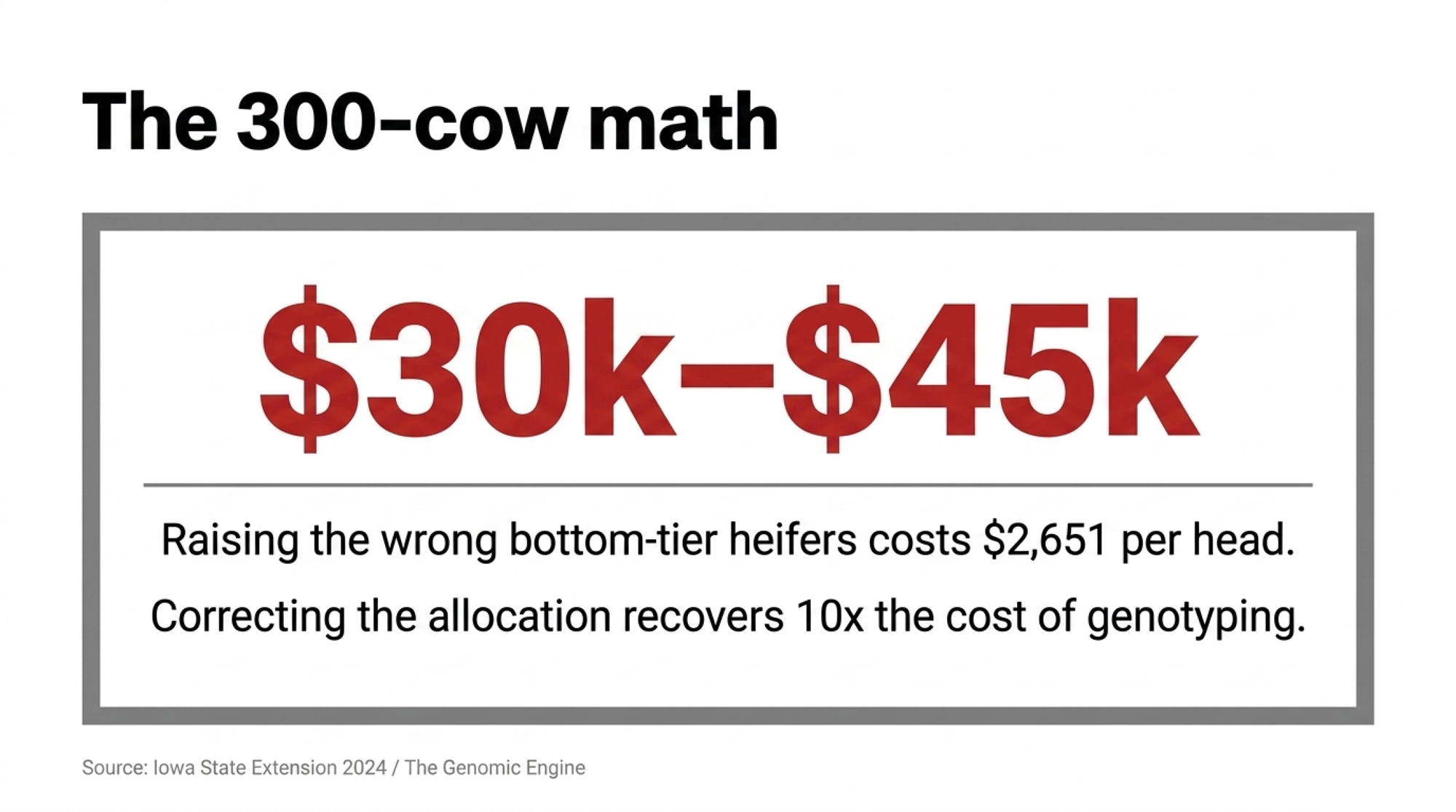
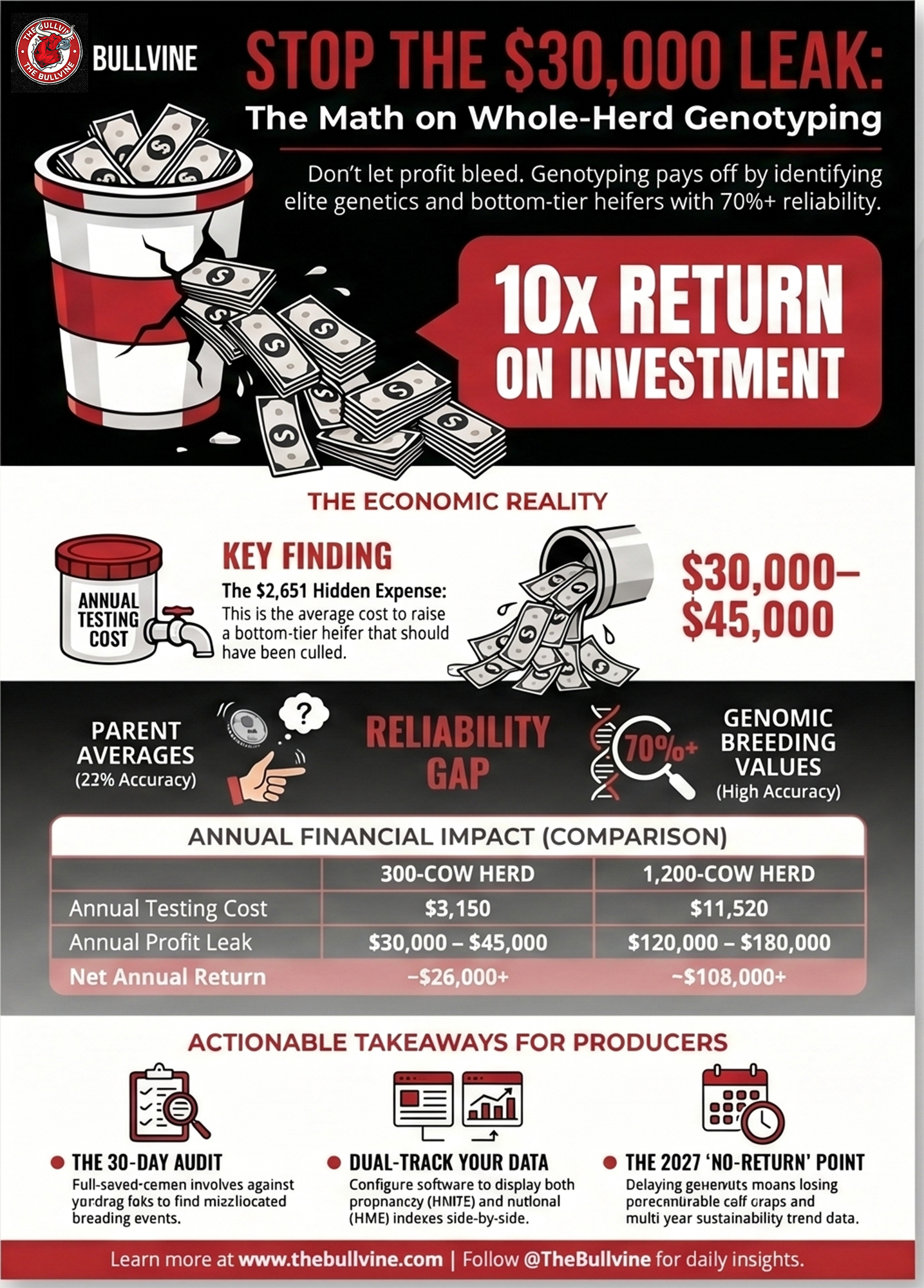
$3,150 a year buys whole‑herd genotyping on 300 cows. The Genomic Engine puts the leak at $30,000–$45,000 — most of it bleeding through misallocated sexed semen and beef straws.

Executive Summary: $3,150 a year buys whole‑herd genotyping on 300 cows. The Genomic Engine analysis puts the annual leak at close to $30,000–$45,000 on that scale — and $120,000–$180,000 on a 1,200‑cow operation — most of it bleeding through sexed semen and beef‑on‑dairy straws allocated at 20–25% parent‑average reliability instead of 70%‑range genomic reliability. Producers running early‑2026 USDA AMS beef‑on‑dairy premiums of about $377 per head and Iowa State’s $2,651 conventional heifer rearing cost are the ones losing the most to coin‑flip allocation. The March 2, 2026, Zoetis–Neogen $160M deal raises a second decision: enroll, but build CDCB data flow, 48‑hour SNP portability, and dual‑track NM$/DWP$ cow‑side display into the contract before signing. Wait until 2027, and three things don’t come back — the calf crops you didn’t sample, the multi‑year FSAV trend data processor sustainability programs will reward by 2028, and the compounding generations of health and fertility selection parent averages can’t deliver. Under‑150‑cow herds are honestly flagged: the full program doesn’t pencil; target specific cow families instead. The 30‑day move is small — pull last year’s sexed‑semen invoices against your yearling list and run retroactive PA rankings on the top and bottom 20 — and the disagreement you’ll find usually pays for year one of genotyping before the audit is finished.
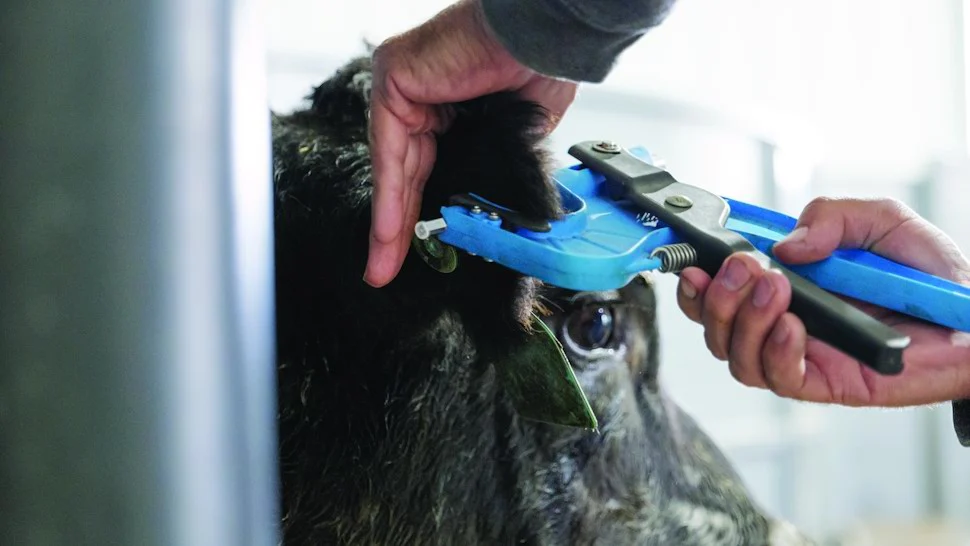
whole-herd genotyping ROI

Editor’s note: The 300‑cow operator and the allocation‑meeting scene in this piece are illustrative composites drawn from The Genomic Engine analysis and recent Bullvine conversations with progressive US producers. They are not based on any single named individual or farm. The dollar figures come straight from the source analysis cited throughout.

Picture an operator working through this season’s breeding plan. Good cows. High‑reliability sires in the tank. Sexed dairy on the front end, beef semen on the back. A herd manager he trusts and an AI tech who’s been with him for a decade. He’s writing six‑figure checks on reproductive technology every year, and he takes genetics seriously.
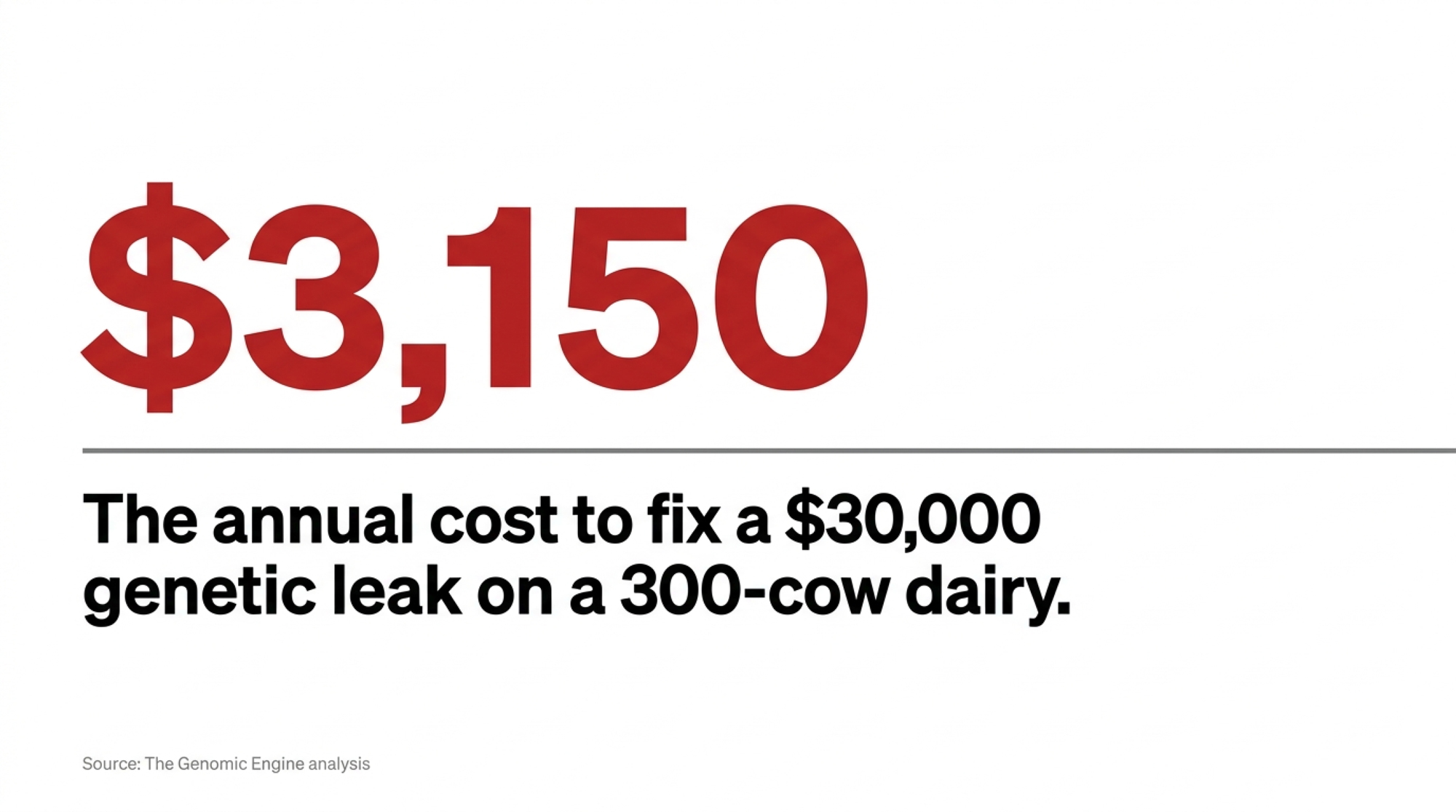
He’s also making most of those decisions on parent averages. That gap — between the tools he’s paying for and the information layer underneath them — is where The Genomic Engine analysis puts the annual leak at $30,000 to $45,000 on a 300‑cow herd running whole‑herd genotyping. On a 1,200‑cow herd in the same analysis, the leak runs $120,000 to $180,000. The fix on the small end costs about $3,150 a year.
What’s Really at Stake on a 300‑Cow Operation

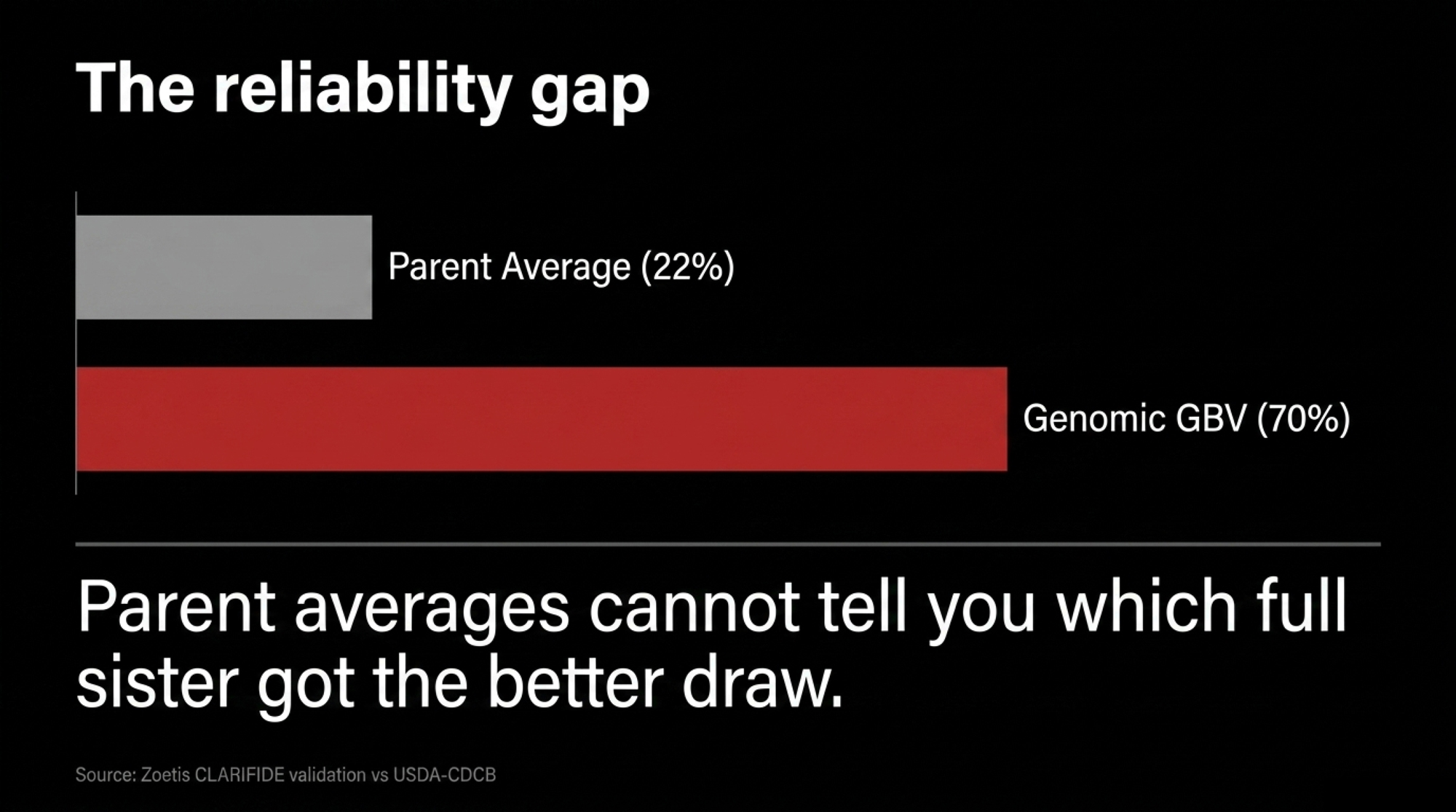
The tension isn’t whether the cows are good. They are. The tension is whether the decisions about which heifers to breed forward, sell, or designate as beef crosses are running on 20–25% reliability or 70–77% reliability — the gap between pedigree‑based parent averages and genomic breeding values at birth for young Holstein females on NM$, per CDCB, and the Lactanet reference figures cited in The Genomic Engine. Zoetis’s own CLARIFIDE validation work against USDA‑CDCB data put traditional NM$ reliability for young Holstein females (≤12 months) at 22%, and CLARIFIDE genomic reliability approaching 70% — per the Zoetis CLARIFIDE technical bulletin, based on USDA‑CDCB evaluation as of April 2014. CDCB has recalibrated NM$ and genomic reliability several times since 2017, with further recalibrations in 2021 and ongoing; the gap between parent‑average and genomic reliability has remained meaningful, though the absolute percentages have shifted. Treat the 22% / ~70% figures as illustrative of the directional gap, not as 2026 absolute values.
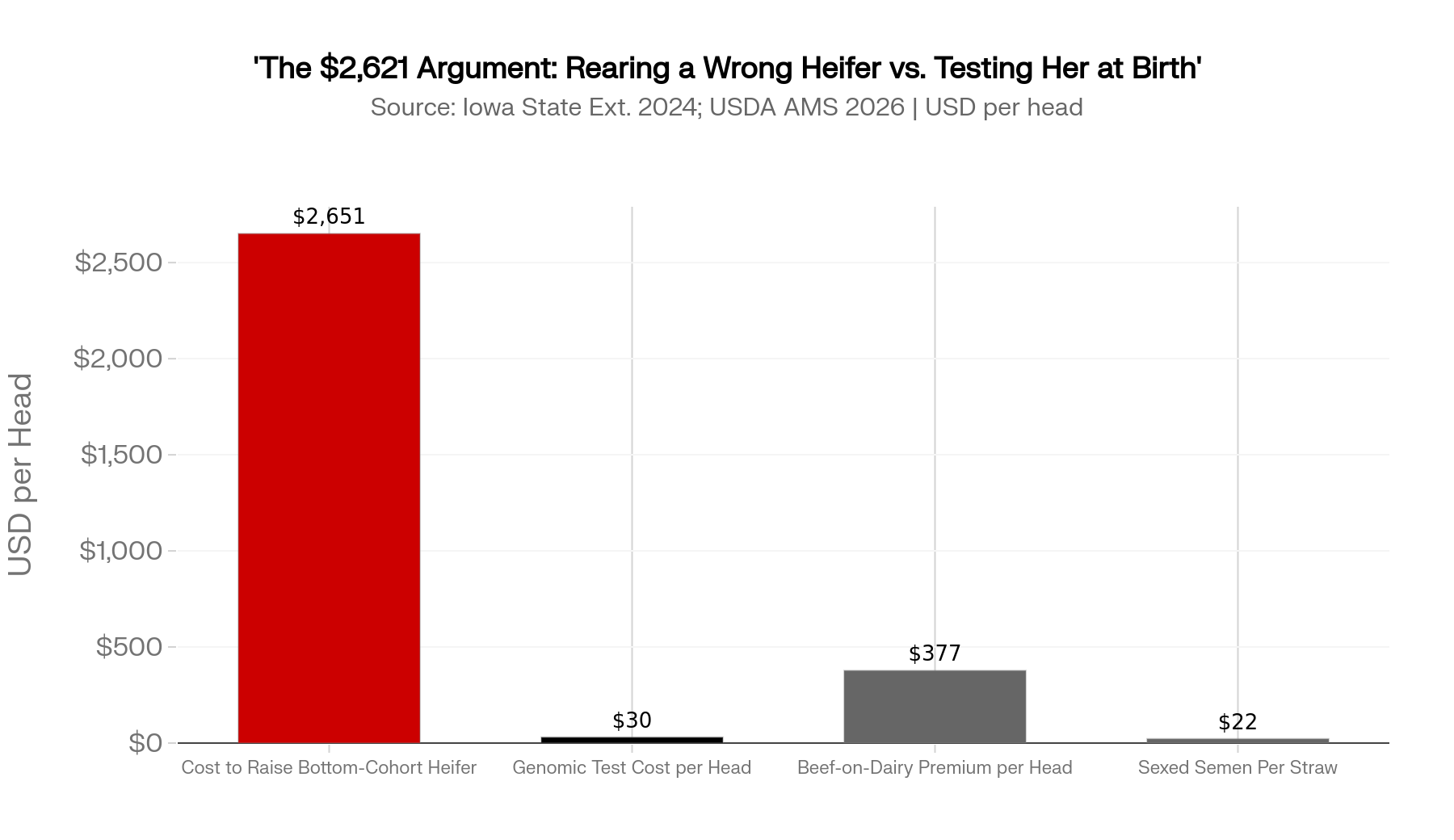
The operator who’ll recognize this setup isn’t the laggard. He’s the one already doing the expensive work. He’s writing checks for sexed semen at roughly 2x the price of conventional straws, running a beef‑on‑dairy program pulling early‑2026 US auction premiums of about 7 per head over straight dairy calves, per USDA AMS auction data cited in the same analysis.

He’s just pointing those tools at the wrong animals more often than he realizes.

How It Plays Out in the Barn

Picture a typical allocation conversation on a herd this size. The herd manager, the AI tech, the genetics consultant — looking down a list of about 105 yearling heifers (35% replacement rate on 300 cows, roughly 105 heifer calves a year).

Without genotypes, they’re sorting on dam records, sire EBVs, and the herd manager’s read of the animal. Informed judgment. Not guesswork. But it’s running on a reliability ceiling that Mendelian sampling puts at roughly a quarter of the truth. Two full sisters out of the same 99% reliability sire and the same dam can end up in opposite percentiles of the herd. Parent averages can’t tell you which sister got the good draw.

So here’s what’s happening on herds in this profile, as the source analysis describes it:

  • Some of the expensive sexed dairy straws are landing on heifers who’ll rank middle‑of‑the‑pack once genotyped.
  • Some of the genuinely elite heifers — the ones whose pedigrees under‑predict them — are getting conventional or beef semen because nothing on the record flagged them.
  • The bottom ~15% of the cohort, who should be sold or designated beef‑only at eight weeks, are being raised to 22–24 months at a total cost of about $2,651 per head on a conventional 26,000 lb herd, per Iowa State Extension’s 2024 heifer raising cost study. Jersey and pasture‑based systems run a few hundred dollars less; higher‑input Northeast herds run higher.

The herd is good. The allocation is a coin flip wearing a lab coat.
How Does the Barn Math Really Work?
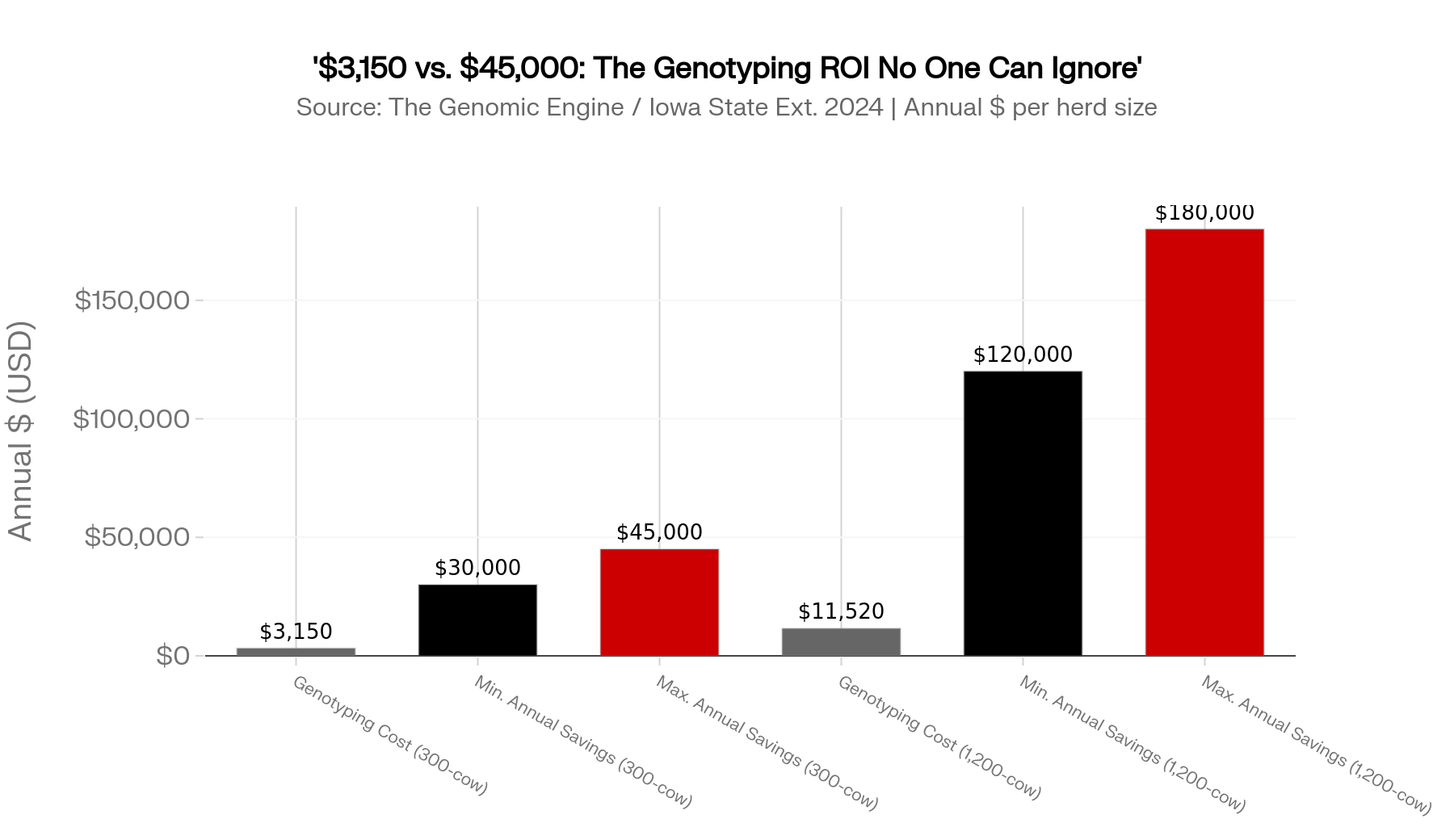
The test bill is four figures. The leak is five or six. — 300‑cow model: $3,150 test vs $30,000–$45,000 recovered. 1,200‑cow model: $11,520 test vs $120,000–$180,000 recovered. (The Genomic Engine)
Metric300‑Cow Herd Profile1,200‑Cow Herd Profile
Annual heifer cohort~105 heifer calves (35% replacement)~384 heifer calves (32% replacement)
Annual genotyping cost$3,150 ($30/test)$11,520 ($30/test)
Bottom‑cohort culls~15 animals culled at 8 weeks~40 animals culled at 8 weeks
Rearing cost saved~$30,000 ($2,000–$2,651/head avoided)~$80,000 ($2,000/head avoided)
Added revenue captureOptimized sexed semen + beef‑on‑dairy allocationCorrectly targeted beef‑on‑dairy + IVF donor discipline
Total net annual return$30,000–$45,000$120,000–$180,000

Sources: The Genomic Engine analysis; Iowa State Extension 2024 heifer raising cost study ($2,651 on a conventional 26,000 lb herd); USDA AMS auction data, early 2026. The lower end of the rearing cost range accounts for partial recovery via cull‑heifer or bull‑calf sale revenue. The 1,200‑cow model assumes a 32% replacement rate vs the 300‑cow model’s 35%, consistent with how The Genomic Engine scales replacement rates by herd size. The 10% vs 15% cull threshold is a management call every operator makes differently.

The takeaway: For both operation sizes modeled by The Genomic Engine, the cost to build the data layer runs roughly 10% or less of the direct capital leaking out of the barn through misallocated reproductive decisions.

A 600‑cow operator sits between those two models and can do the arithmetic on his own replacement rate and heifer costs, but the shape of the curve is clear.

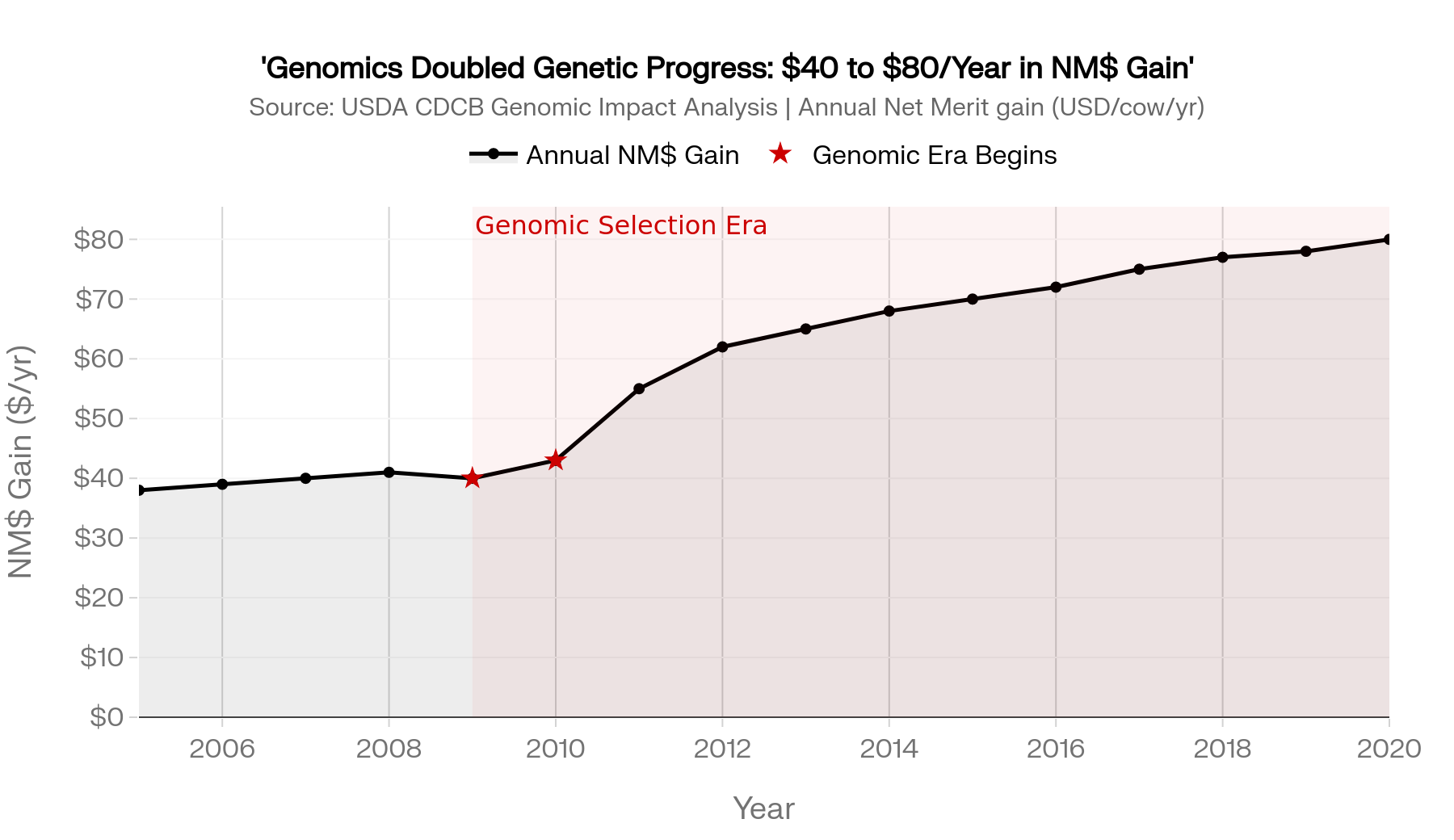
The harder‑to‑price gain is the one that compounds. CDCB’s own genomic impact analysis shows average annual Net Merit gain roughly doubled from $40.33 per year (2005–2010) to $79.20 per year (2016–2020) as genomic selection matured in the US Holstein population. Running parent averages on most of the herd means genetic progress on low‑heritability traits — mastitis, metritis, daughter pregnancy rate — progresses meaningfully more slowly than in operations using GEBVs, particularly on traits parent averages predict poorly. Five years of that gap compounds into the equivalent of losing roughly a decade of genetic progress by 2040 — editorial math, not a cited projection, but the direction is clear.
The Cost of Delay: A Chronological View

Three landmarks you can’t get back. Each one becomes more expensive the closer you get to it.
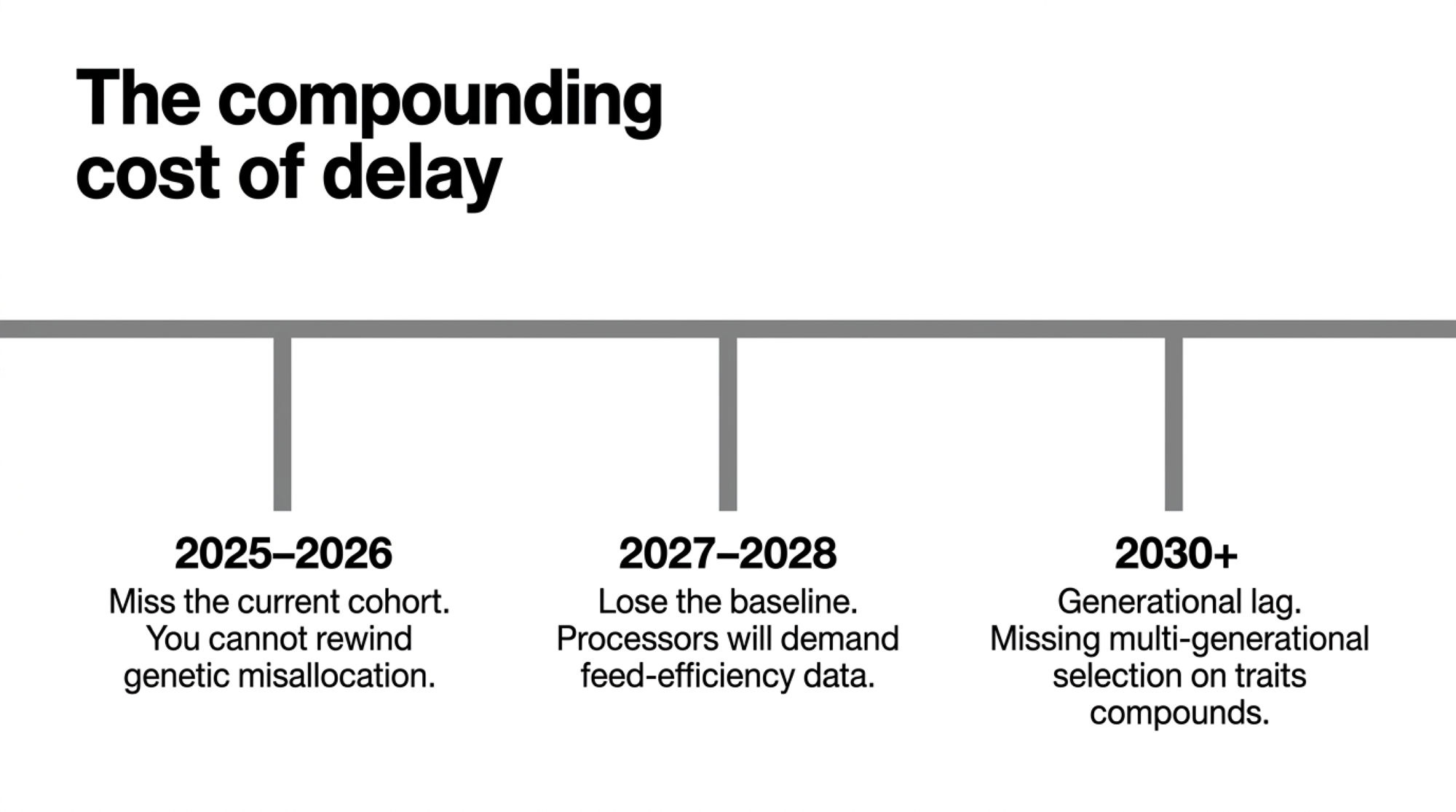
The Current Cohort — 2025–2026. Every heifer calf you skip is selected on a 20–25% parent‑average reliability ceiling. These animals will become your dominant milking string by 2028–2030. There is no retroactive rewind button on genetic misallocation, and there’s no way to genotype a calf crop that has already left the farm.

The Sustainability Baseline — 2027–2028 Processor frameworks begin tying premium payouts to documented resource efficiency. Early adopters leverage two to three years of historical Feed Saved (FSAV) trend data — the US evaluation CDCB has published since December 2020, with a documented link to methane output through residual feed intake. Canadian producers have a separate tool: Lactanet launched what it described as the world’s first national genetic evaluation for direct methane efficiency in April 2023, built on mid‑infrared spectroscopy with an 85% genetic correlation to GreenFeed measurement (per Lactanet). US producers don’t have a parity methane evaluation yet, so for an American operation, FSAV is the trend line that matters today. Delayed operations start at zero with a baseline and an explanation.

The Compounding Generation Gap — 2030+ Low‑heritability traits — mastitis resistance, daughter pregnancy rate, metritis — require multi‑generational, high‑reliability selection to move the needle. Missing three generations of selection on those traits creates a genetic lag that no checkbook fixes in year four.

The remaining kinks, as of 2026, aren’t technical. They’re operational: sample collection discipline, staff buy‑in at the “cull the healthy calf” moment, and contract structure with the genomic vendor. Waiting doesn’t make those easier.

The Platform Question Worth Raising Before You Sign

What follows is editorial analysis. The factual record on the Zoetis–Neogen transaction is summarized below; the commentary on platform consolidation reflects The Bullvine’s editorial perspective on what integrated genomic platforms mean for producer leverage.

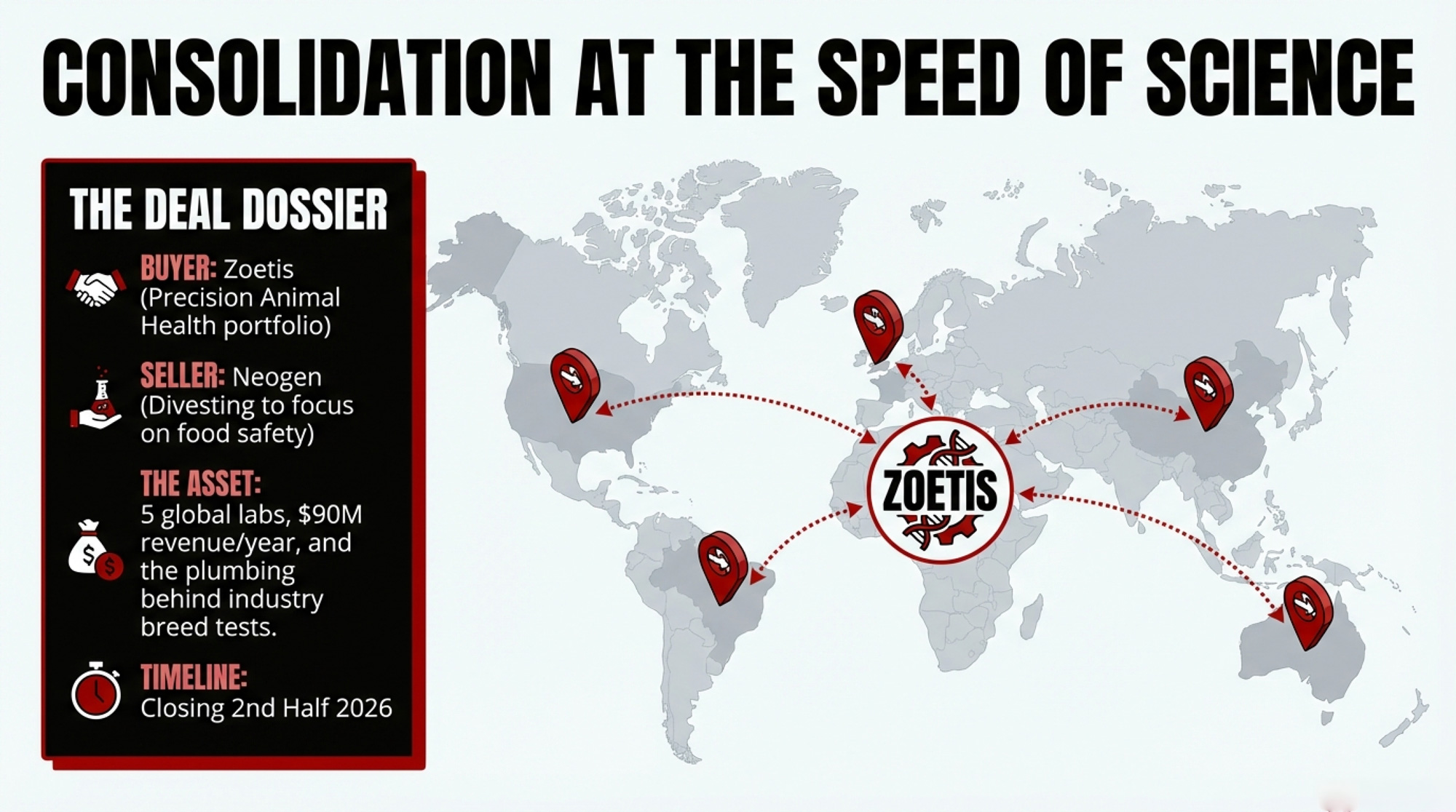
Here’s the piece that’s starting to surface in operator conversations. On March 2, 2026, Zoetis announced a definitive agreement to acquire Neogen Corporation’s animal genomics business for 0 million, subject to customary closing adjustments. Zoetis expects to close in the second half of 2026; Neogen’s filing says the transaction is expected to close by the end of the first half of Neogen’s 2027 fiscal year, pending regulatory approval. The deal brings the GeneSeek laboratory network — five labs across the US, Brazil, Australia, China, and the UK, serving customers in 120+ countries — into Zoetis’s Precision Animal Health platform.

That consolidation concentrates the full genomic value chain — the test, the lab, the proprietary wellness index (CLARIFIDE Plus / DWP$), the mating software integration, and increasingly the processor‑facing sustainability verification — under one roof. Credit where it’s due on the components: DWP$ is a substantive, wellness‑weighted tool, GeneSeek brings real lab capacity and accreditation, and CLARIFIDE’s automatic CDCB submission is a genuinely producer‑friendly default. The editorial concern here is what integrated platforms mean for producers’ leverage over the long haul — not about the underlying technology or lab capability.

The defensible move isn’t to refuse the platform. It’s to build optionality into the relationship from day one — and to do it in this order, before money or samples change hands.

The Dual‑Track Enrollment Protocol

Contract ClauseWhat to ConfirmRisk if Missing
CDCB Data FlowNM$/Pro$ actively visible on cow-side screen, not just background submissionYou’re paying for national evaluation but flying blind on the public index
SNP File PortabilityRaw SNP files delivered to producer within 48 hours of written request, in standard formatPlatform switch requires re-genotyping entire herd — sunk cost trap
Dual-Index DisplayDWP$ and NM$ shown side-by-side in DairyComp/PCDART/BoviSync active cow screenProprietary index runs unchecked; no independent benchmark for mating decisions
Data Deletion RightsExit clause specifies what happens to your herd’s genomic data if contract endsGenomic profile of your genetics may remain on vendor servers post-exit
Lab AccreditationProcessing lab is CDCB-approved and genotypes submitted under your herd IDDelays or denials in national evaluation submission; loss of CDCB history

1. Verify CDCB data flow — Pre‑Enrollment. Confirm with your vendor representative that the national CDCB evaluation data is actively flowing back into your local interface. Every CLARIFIDE sample carries a CDCB service fee that Zoetis collects and forwards to CDCB (per the published Zoetis CDCB Fee Schedule and CDCB’s genomic evaluations documentation), so the national evaluation is happening in the background. Visual presentation of the NM$ metric on the cow‑side screen is a software configuration choice, not a universal default.

2. Secure SNP portability clauses — Contract Review. Require a written guarantee in the service contract specifying that raw genomic SNP files must be ported directly to the producer in a standardized format within 48 hours of a formal request. Before signing, confirm at least one alternate CDCB‑approved lab is on your short list — not because you expect to switch, but because optionality is cheaper to build in upfront than to retrofit.

3. Configure cow‑side displays — Day 1 Integration. Set up your herd management software (DairyComp, PCDART, BoviSync) to display the proprietary index (DWP$) and the public national index (NM$ or Pro$) side‑by‑side on the active cow screen. If only one index is visible, your dual‑track strategy remains theoretical.

The plumbing already exists. National evaluations are built to accept genotypes from accredited labs, including GeneSeek, and CDCB fees accompany every commercial submission. These three steps — CDCB flow, SNP portability, cow‑side display — aren’t always front and center in genomic vendor enrollment conversations. Whether your specific representative covers them in detail can vary. Either way, the prudent move is to add them to your enrollment checklist before signing.

The Bullvine’s editorial position on platform consolidation reflects analysis of publicly disclosed transaction terms; Zoetis has been invited, on standing terms, to respond to producer‑leverage concerns raised in our coverage.

Options and Trade‑Offs for Your Operation

Not every operator needs the same playbook. A few realistic paths, with honest trade‑offs:

Full whole‑herd genotyping with dual‑track data governance. Test every heifer calf, route results to both a commercial index and the national evaluation. Fits operations above roughly 300 cows running sexed semen and beef‑on‑dairy. Demands contract scrutiny at enrollment. It backfires if the 90‑day implementation is botched and the “dual‑track” stays theoretical because the software was never configured to display both indexes.

Top‑half genotyping as a phased entry. Genotype only heifer calves from the top 50% of dams in Year 1 — about 53 calves on a 300‑cow herd. Cuts the test bill in half and captures most of the bottom‑cohort identification. Fits cash‑flow‑tight operations, staging the investment. It backfires if the underlying dam rankings are themselves off, meaning high‑potential outliers in bottom‑50% dams never get tested.

Do nothing, but with a calendar date. If an operator genuinely isn’t ready, the defensible version is to set a specific review date — spring 2027, for example — track current reproductive‑technology spending, and commit to dual‑track setup at that point. The indefensible version is drift. Drift costs calf crops.

One honest caveat: for herds of about 150 cows or fewer, the full program often doesn’t pencil out the same way. The Retention Payoff infrastructure and mating software integration carry fixed costs that don’t scale down gracefully, which the source analysis describes as small herds being “structurally excluded.” Those operators are better served by targeted genotyping of specific cow families rather than whole‑herd barcoding.

The 30‑Day Action, Regardless of Which Path You Pick

In the next month, pull the last 12 months of sexed semen invoices against the current yearling list. Mark, which heifers received sexed dairy semen, which received beef semen, and which received conventional semen. Then ask the genetics consultant to run retroactive parent‑average rankings on the 20 highest and 20 lowest animals in that cohort.

You won’t get genomic reliability. But you’ll see how much spread parent averages alone hide on animals your program already treats as interchangeable. Most operators who run this exercise find enough disagreement between the allocation and the ranking to pay for the first year of genotyping before the audit is finished.

By day 90, the follow‑up check is simple: your herd management software should display DWP$ (or whatever proprietary index you use) and NM$ side by side on the cow screen. If only one number is visible, the dual‑track isn’t real yet. That’s a 30‑day check and a 90‑day configuration — not a 12‑month genetic strategy overhaul — and it’s the sequence that makes every other decision in this article concrete.

What This Means for Your Operation

  • How many of your last 12 months of sexed semen straws landed on heifers you’ve never genotyped? If the answer is most of them, your reproductive technology is running on a coin flip.
  • Pull your current heifer inventory. Raising more than 110% of replacement need means you’re raising “just‑in‑case” animals and paying about $2,651 per head, per Iowa State’s 2024 figures, to find out which ones didn’t work.
  • Check your last IVF donor list. How many of those cows would still be on it if you’d ranked the herd on 70%‑range reliability data instead of pedigree and hunches?
  • If your processor announces a tiered methane or feed‑efficiency incentive in 2028, can you produce three years of herd‑level FSAV trend data — or a baseline and an apology?
  • Audit your current or proposed genomic vendor contract for three clauses specifically: raw SNP file portability within 48 hours of request, cow‑side display of both proprietary and national‑evaluation indexes, and exit data‑deletion rights. CDCB submission happens automatically on a CLARIFIDE invoice; the rest does not.
  • Name the single person on your org chart accountable for reproductive‑technology allocation outcomes. If nobody owns the leak, nobody will fix it.
  • Have the barn conversation before the first cull list is issued. A long‑tenured herdsperson asked to cull a healthy eight‑week‑old needs to hear the stewardship reframe — “we’re not culling your work, we’re pointing your labor at the right animals” — long before the first calf leaves.
Key Takeaways

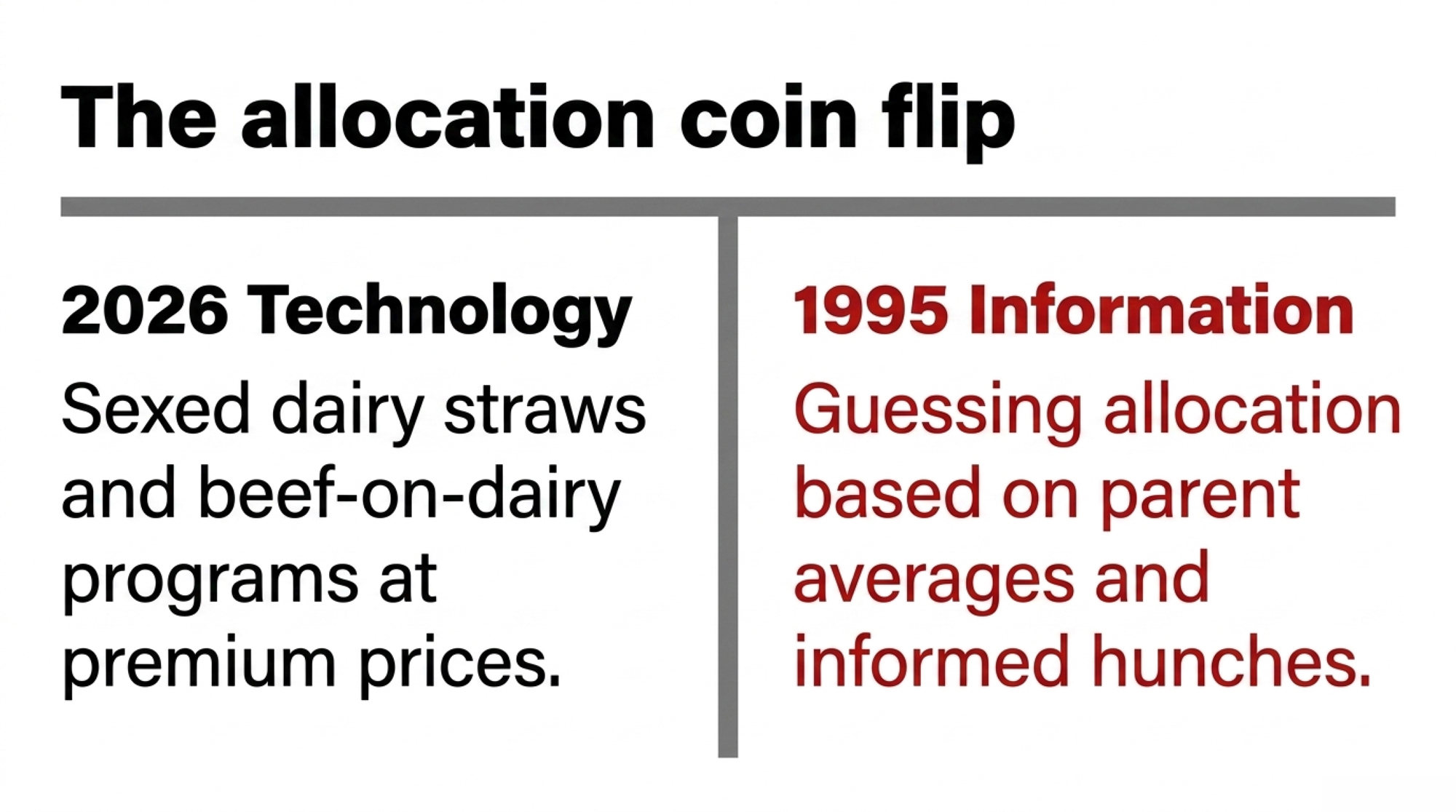
  • If you’re running sexed semen and beef‑on‑dairy without genotyping, the tools are 2026, and the information layer is 1995. The Genomic Engine analysis puts that gap at $30,000–$45,000 a year on a 300‑cow herd against a $3,150 test bill.
  • If you wait until 2027 to start, three things are non‑recoverable: the calf crops you didn’t sample, the multi‑year FSAV trend data processor sustainability programs will reward, and the compounding generations of health and fertility selection that parent averages can’t deliver.
  • If you adopt, adopt a dual‑track on day one. CDCB evaluation is already running in the background on every CLARIFIDE invoice; the battle is whether NM$ shows up next to DWP$ on the cow‑side screen. The incremental cost to configure that at enrollment is small. The cost to retrofit in year three is not.
  • If you’re under 150 cows, don’t force the full program. Target specific cow families instead, and push your breed association and genomic vendor on the fixed‑cost problem — the “structurally excluded” gap is real and worth making noise about.

The Decision Underneath the Decision

The operator picturing himself in this scenario isn’t really deciding whether to spend $3,150 on genotyping. He’s deciding whether the cows in his milking string in 2028, 2029, and 2030 were selected on parent‑average reliability or genomic reliability. He’s deciding whether, when a processor program lands with real premium money attached, he walks into that meeting with a four‑year trajectory or a one‑year baseline.

Money, he can catch up on. Three calf crops of compounding genetic lag, and the data history that proves improvement, don’t come back on any timeline a checkbook can fix. So the real question isn’t whether the technology is proven. It’s the chair the operator is going to be sitting in when the 2030 processor meeting happens — and whether the allocation decisions his herd manager makes in the next 90 days are the ones he’ll want to defend to his kids in 2035.

Complete references and supporting documentation are available upon request by contacting the editorial team at editor@thebullvine.com.

Learn More

The Sunday Read Dairy Professionals Don’t Skip.
Every week, thousands of producers, breeders, and industry insiders open Bullvine Weekly for genetics insights, market shifts, and profit strategies they won’t find anywhere else. One email. Five minutes. Smarter decisions all week.
NewsSubscribe
First
Last
Consent

$43 a Test, $160M for the Lab: Why Select Sires and ABS Are Quiet on the GeneSeek Close

One $43 test, one $160 million lab acquisition, and one Danone preferred-provider letter — and the cooperative system 75 years of dairy farmers built has months, not years, to answer for itself.

The next time URUS, ABS Global, Genex/CRI, ST Genetics, or your Select Sires / Semex -affiliated co-op holds a district meeting on your calendar, look at the slide deck the regional manager hands out. Then ask, out loud, in front of your neighbors: “What’s our plan for the GeneSeek close?”

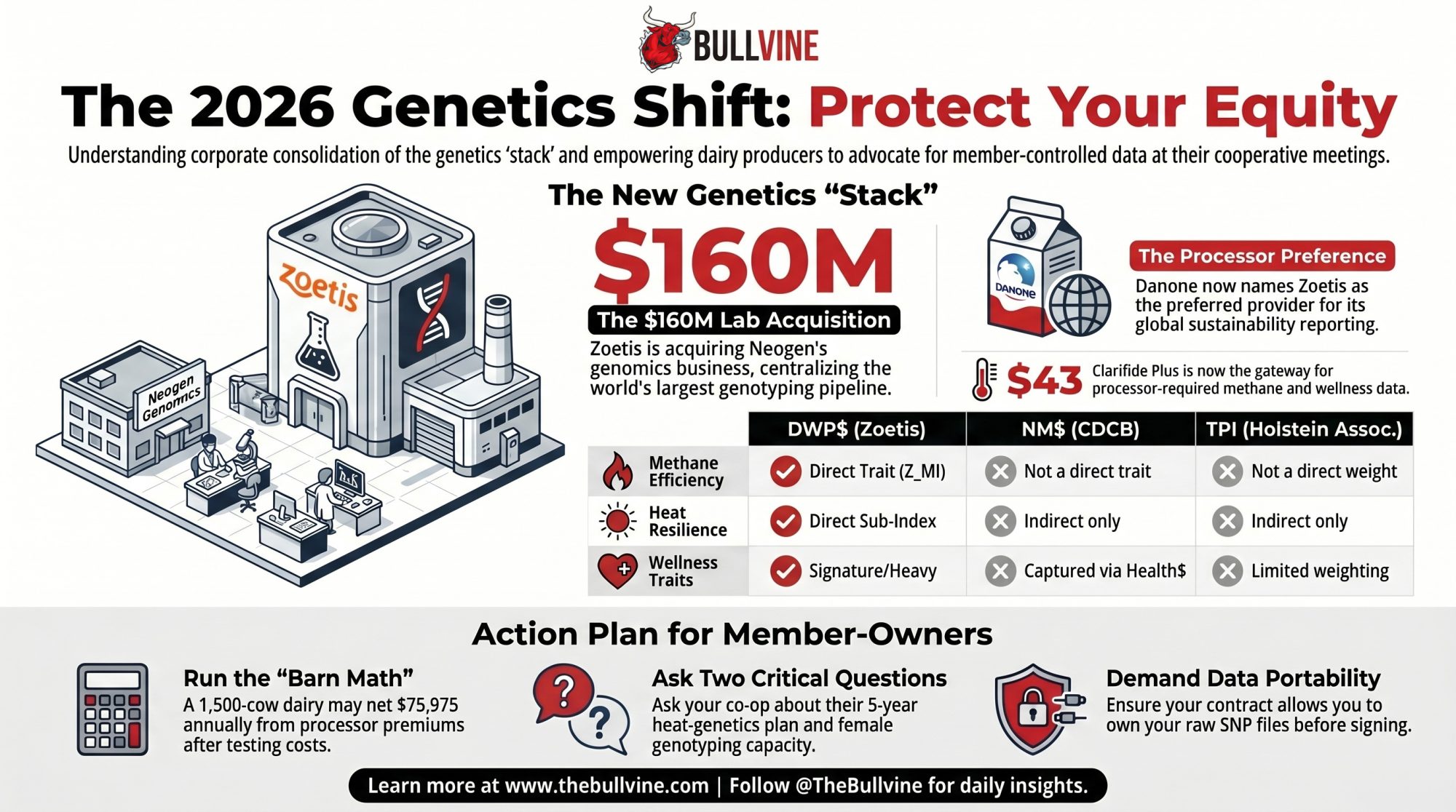
If the room goes quiet, you already have your answer. The publicly announced 2026 dairy genetics stack — Clarifide Plus at $43 a head, the $160 million Zoetis–Neogen lab deal, Danone’s Partner for Growth letter naming Zoetis as preferred testing provider — is reshaping every AI cooperative’s negotiating position through 2030. As of May 1, 2026, none of the major cooperatives most exposed to that shift has published a strategy response.

Your seat at that table. Your kids’ equity in the co-op. The genotyping pipeline three generations of member-owners built. All of it is being decided right now, in rooms where the question hasn’t been asked out loud yet.

This article is built on published program terms, public corporate filings, CDCB evaluation data, NAAB’s 2025 year-end report, USDA NASS Milk Production data, and a peer-reviewed 2025 Journal of Dairy Science study.

What Zoetis Built While the Cooperatives Were Quiet

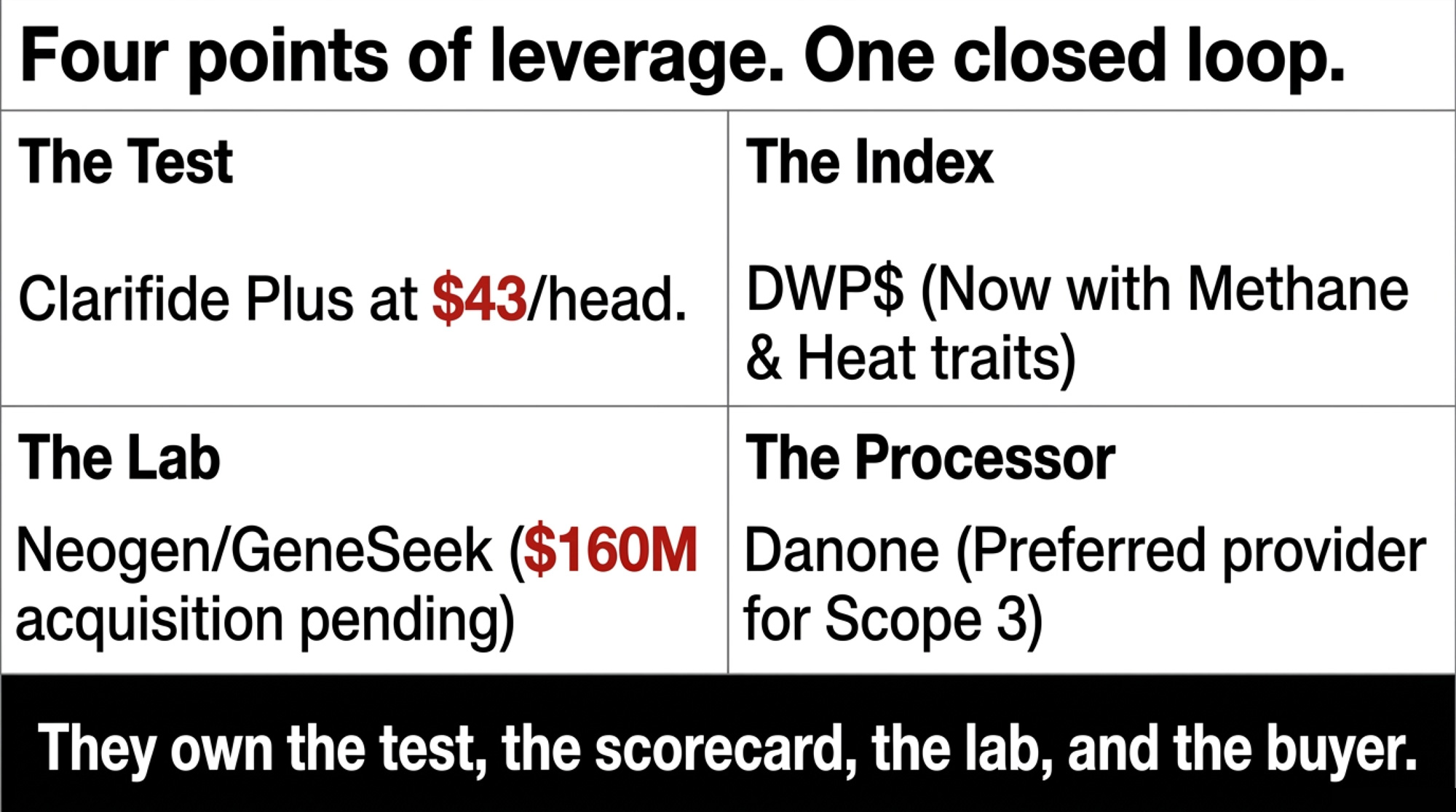
Zoetis doesn’t sell a single straw of semen. But it now sits at four points of leverage in the U.S. dairy genetics chain, and each one was announced publicly, in plain sight.

The test. Clarifide Plus runs $43 per Holstein head at Holstein Association USA’s published member rate, accessed May 1, 2026.¹ It’s already among the most widely used genomic tests in U.S. dairy.

The index. Zoetis owns DWP$, the Dairy Wellness Profit index. In April 2026, the company added Milk Methane Intensity (Z_MI) and a new sub-index called DWP$ Heat — built for herds experiencing heat stress 20% or more of the year, roughly 73 days. That’s Florida, Texas, Arizona, the southern San Joaquin, and increasingly the lower Midwest in late summer. For the back-story on how the index was assembled and what’s actually inside it, see our deeper piece on how Zoetis built the DWP$ index.

The lab. In March 2026, Zoetis announced it would acquire Neogen’s animal genomics business — including GeneSeek’s Igenity and GGP portfolios — for 0 million, subject to customary closing adjustments. That business runs roughly $90 million in annual genomics revenue, operates labs across the U.S., Brazil, Australia, China, and the U.K., and serves customers in more than 120 countries. Close is expected in the second half of 2026, pending regulatory approval.

The processor. Zoetis is the preferred genetic testing provider for Danone’s global Partner for Growth program, with DWP$ as the selection index. The two later expanded that partnership to scale testing across Danone’s supplier base for sustainability reporting — methane intensity, nitrogen efficiency, the metrics that feed scope 3 disclosures.

A company with no semen catalog is now the preferred testing provider for one of the world’s largest dairy processors, owns the index that ranks bulls inside that program, and is acquiring the lab that genotypes much of the rest of the industry. That’s the stack. On one page.

Leverage pointWhat it isKey figureStatus / trigger date
The testClarifide Plus genomic panel$43 / Holstein headHolstein Assn. USA member rate, May 1, 2026
The indexDWP$ (Dairy Wellness Profit$)Z_MI + DWP$ Heat sub-index addedApril 2026
The labNeogen animal genomics (GeneSeek, Igenity, GGP)$160M acquisition, ~$90M annual revenueClose expected H2 2026, pending regulatory approval
The processorDanone Partner for Growth preferred providerDWP$ as selection indexActive; expanded for scope 3 reporting

What 75 Years of Member-Owners Actually Built

Three generations of dairy farmers pooled capital, semen, risk, and bull power so no single member would have to face the genetics market alone. Genex/CRI. Semex. Select Sires-affiliated co-ops — different banners, same logic. Member-owned, member-governed, member-equity. The genotyping pipeline that feeds every NM$ proof you’ve ever read off a sire summary was built on that infrastructure. What’s at stake in the post-GeneSeek environment isn’t whether your cooperative survives. It’s whether the genotyping data, the female reference population your co-op contributes to, and the negotiating leverage your manager carries into a Danone or Saputo or Schreiber meeting — whether all of that stays member-controlled, or gets routed around inside 18 months. That’s not a Zoetis policy question. It’s a member-governance question. And it’s the one your district director almost certainly hasn’t been asked yet.

To be fair to the boards at the major cooperatives, they’re navigating something the cooperative system wasn’t built for. Corporate entities move at the speed of capital. Cooperatives move at the speed of consensus — that’s a feature, not a bug, and it’s the same governance model that built the negotiating leverage worth protecting in the first place. But in 2026, consensus is a luxury members can no longer afford to wait through quietly. The fairness is real. The clock is also real. Both can be true.

Two Questions to Bring to Your Next District Meeting

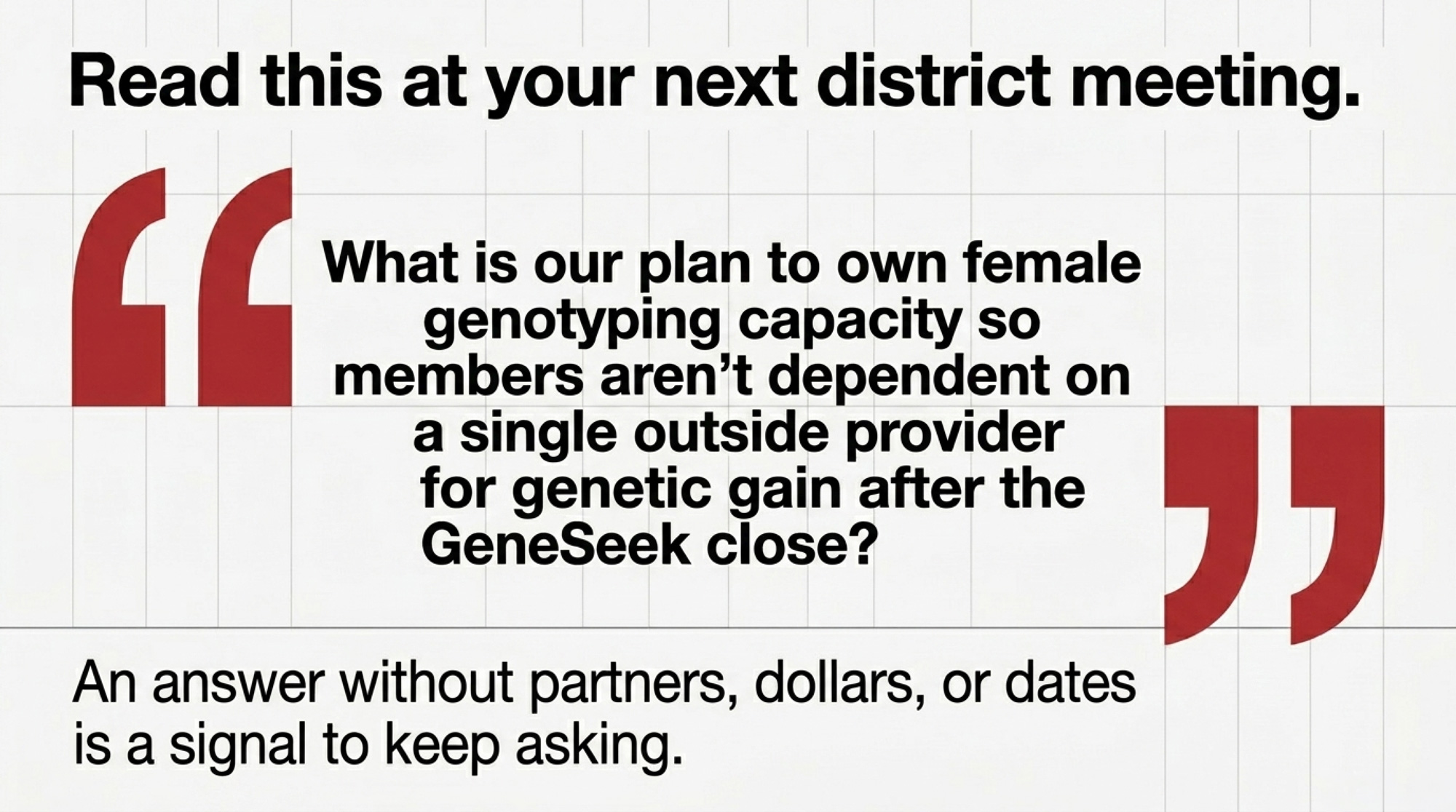
This is the action that matters most this month. Open the notes app on your phone. Type these two questions out. Read them aloud in front of the room when the floor opens for member questions:

“What’s our plan — capital commitment, timeline, named sourcing partners — for heat-tolerant genetics over the next five years?”

“What’s our plan to own or control female genotyping capacity so members aren’t dependent on a single outside provider for health and fertility genetic gain after the GeneSeek close?”

Write the answer down. Date it. A serious answer names specific partners — Embrapa, Trans Ova, a domestic IVF lab — with dollar commitments and timelines beating 2028. An answer without partners, dollars, or dates is a signal to keep asking. Re-raise in 90 days. Document each round.

Boards move when members raise issues. The question is whether you’re the member raising this one.

What Data Are Processors Actually Building Their Scope 3 Programs Around?

The farms most exposed are mid-to-large commercial dairies supplying Danone and the processors likely to follow.

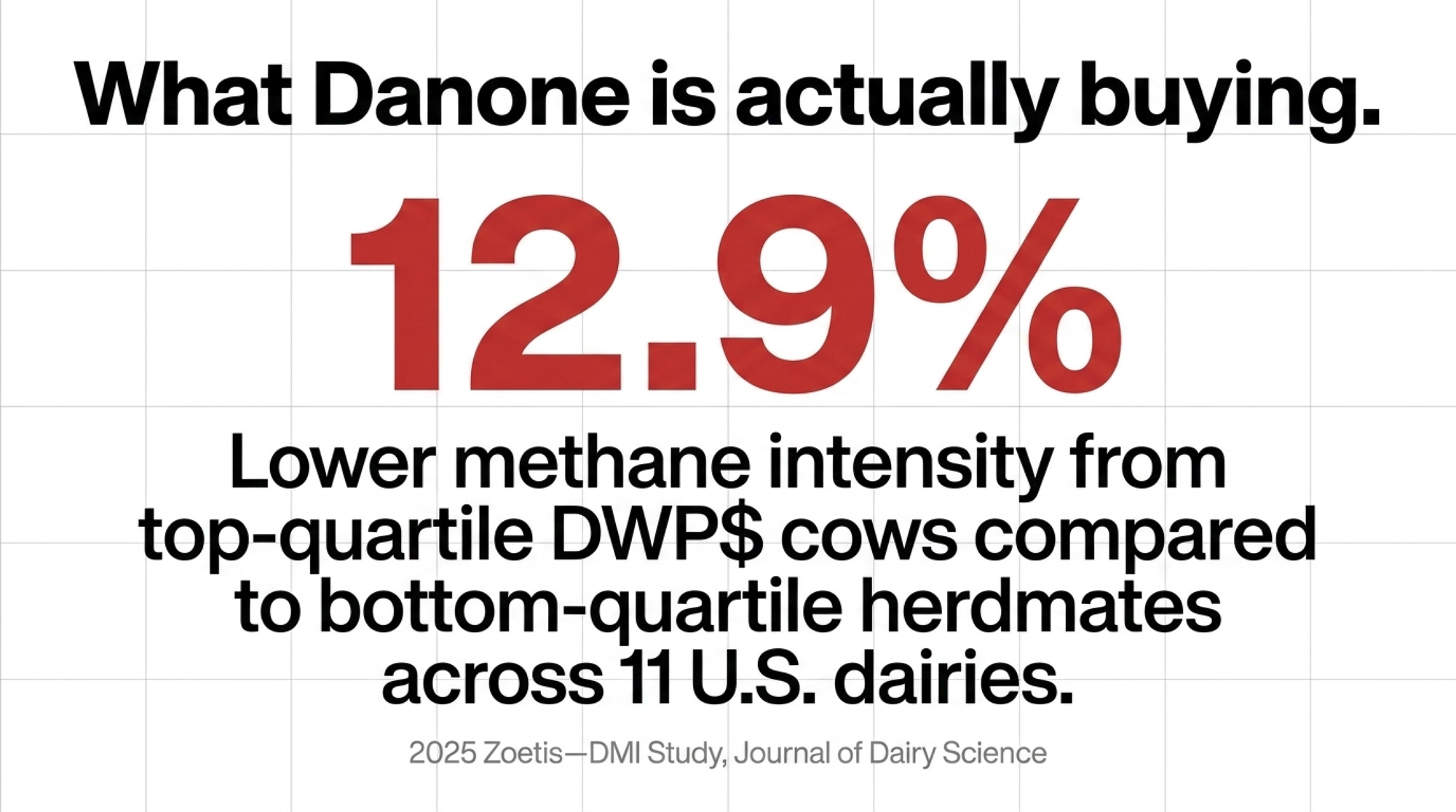
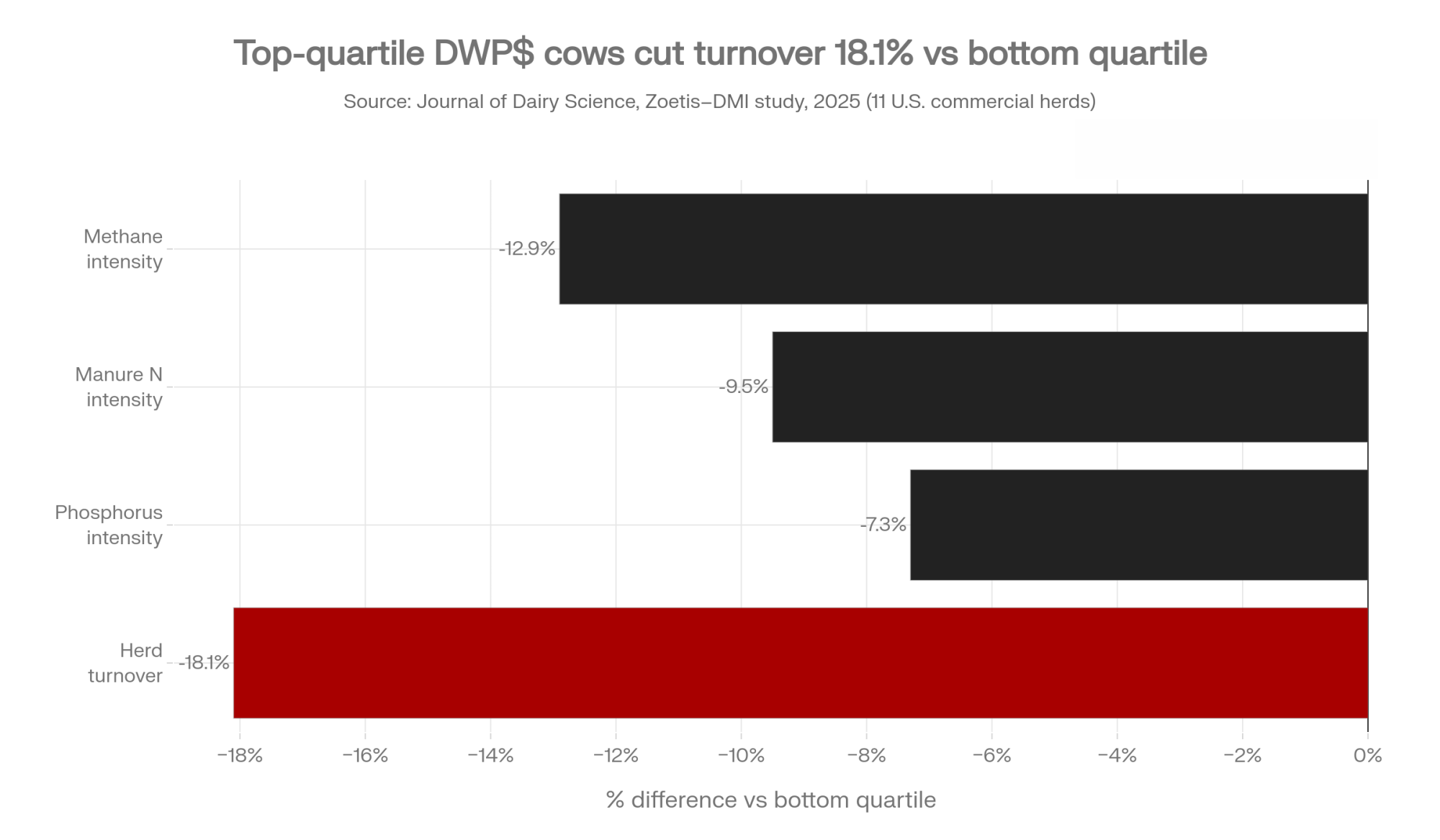
A 2025 Zoetis–Dairy Management Inc. study published in the Journal of Dairy Science — “Reduction of environmental effects through genetic selection” — analyzed cows from the top and bottom DWP$ quartiles across 11 U.S. commercial dairies. Top-quartile cows produced 12.9% lower methane intensity, 9.5% lower manure nitrogen intensity, 7.3% lower phosphorus intensity, and 18.1% lower herd turnover than bottom-quartile herdmates. That’s the dataset processors are now building scope 3 programs around.

Whether your milk check rewards those exact traits is a different question. Whether your cooperative has a counter-proof on the table is a third.

How DWP$, NM$ and TPI Differ on the Traits Processors Now Care About

Trait categoryDWP$ (Zoetis)NM$ (CDCB)TPI (Holstein Assn.)
Methane efficiencyDirect trait (Z_MI), added 2026Not a direct trait in 2025 NM$ revisionNot a direct trait weight
Heat resilienceDirect sub-index (DWP$ Heat), added 2026Indirect (fertility, livability)Indirect (fertility, longevity)
Wellness traitsSignature, heavy weightingCaptured via Health$ subindexLimited direct weighting
Components (fat, protein)Balanced vs wellness/longevitySubstantial weightHeaviest weight historically
Productive LifeStrong weightStrong weightStrong weight
Type / ConformationModest direct weightModest direct weightHeaviest of the three

Direction, not exact percentages. Each index answers a different question. Your milk check decides which one matters most. Your co-op’s catalog depth decides whether you have alternatives.

How Much Is the Processor Premium Really Worth on Your Operation?

Here’s the barn math. Plug your own herd into one of these and see where the net-out lands.

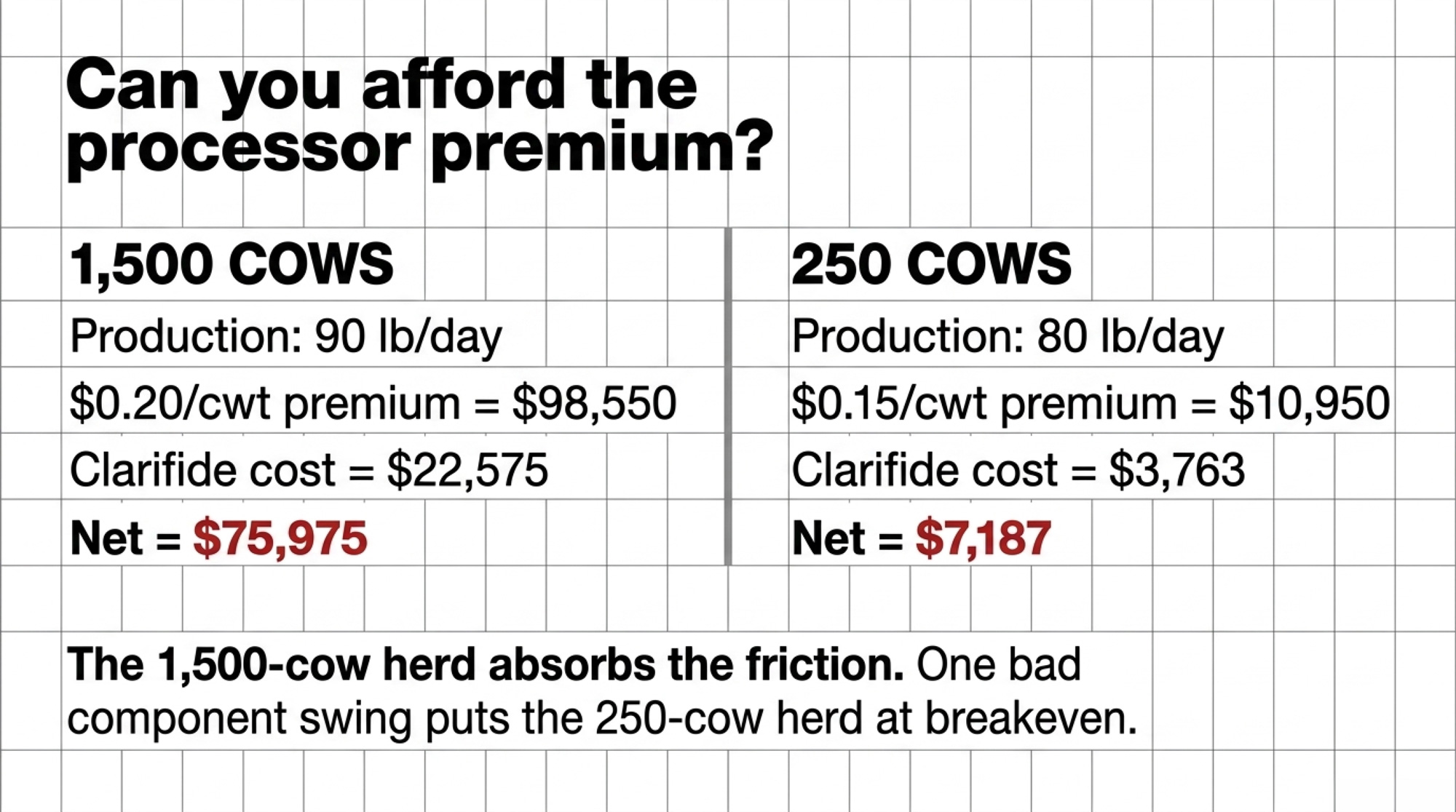
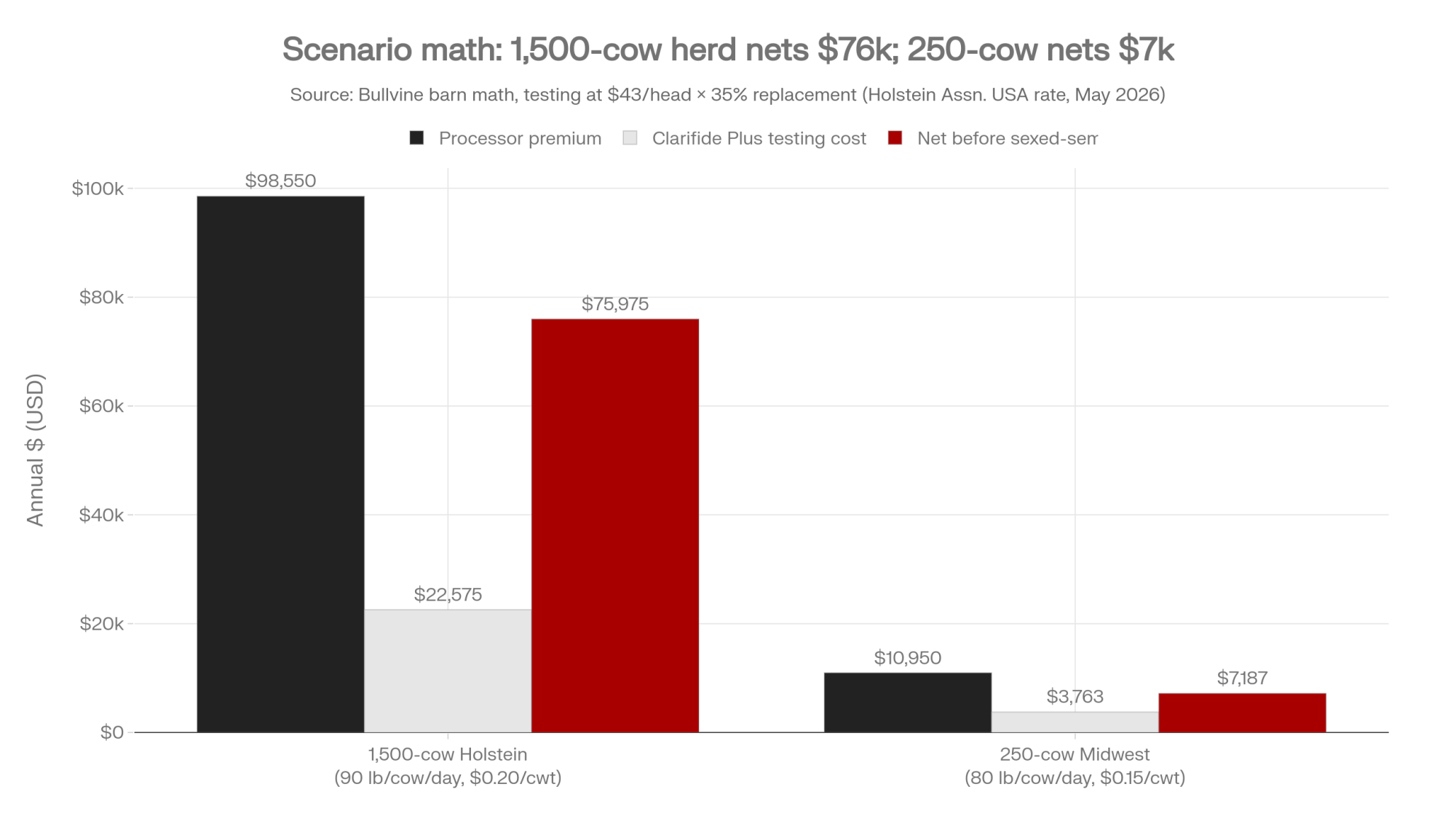
Scenario A — 1,500-cow Holstein operation, 90 lb/cow/day

InputValue
Cows in milk1,500
Daily production per cow90 lb (above the U.S. herd average of ~66–67 lb/day implied by USDA NASS Milk Production, late 2025)²
Total annual production49,275,000 lb = 492,750 cwt
Premium at $0.20/cwt$98,550
Annual Clarifide Plus testing (1,500 × 35% × $43)³~$22,575
Net at $0.20/cwt before sexed-semen differential~$75,975

Scenario B — 250-cow Midwest herd, 80 lb/cow/day

InputValue
Cows in milk250
Daily production per cow80 lb
Total annual production7,300,000 lb = 73,000 cwt
Premium at $0.15/cwt$10,950
Annual Clarifide Plus testing (250 × 35% × $43)³~$3,763
Net at $0.15/cwt before sexed-semen differential~$7,187

These are gross figures. Before the sexed-semen price differential. Before any component-yield drift if your contract pays butterfat and protein harder than DWP$ weights them. Before any year-one Danone signing subsidy.

The 1,500-cow operation has the volume to absorb the friction. The 250-cow operation is one bad component-pay swing from breakeven. If you’re a Wisconsin cheese-milk herd paid hard on components, or a Southern operation whose biggest profit leak is summer fertility — exactly the herds Zoetis is targeting with DWP$ Heat — DWP$ alignment may or may not match how your milk check actually gets built. Run your own math against your own contract before you renew.

Where Will Catalog Pressure Show Up First in Your AI Rep’s Order Sheet?

Indexes improve by consuming data. The one with preferred-provider testing across thousands of farms refines itself faster than one relying on voluntary contributions. Over five to seven years, in our analysis, DWP$ is on track to lead among major U.S. indexes on the traits processors care about — methane, feed efficiency, wellness — because of Zoetis’s vertically integrated testing-plus-index position. The 2025 JDS study is the first peer-reviewed proof point for that thesis.

The compounding runs downstream fast. More processors layer in Clarifide. Studs feel pressure to shift young-sire sampling toward DWP$-ranking bulls. Sampling slots are finite. A slot that doesn’t fit processor demand is a slot unlikely to recover cost.

That’s not Zoetis policy in any direct sense. It’s market dynamics responding to a structural shift. By April 2026, in our analysis of the public NAAB genomic young-sire list, the top tier of genomic Net Merit young bulls in the U.S. showed sharp concentration in a single stud’s NAAB code (methodology available on request). That’s the precedent for what catalog compression looks like when it works through to a published bull list.

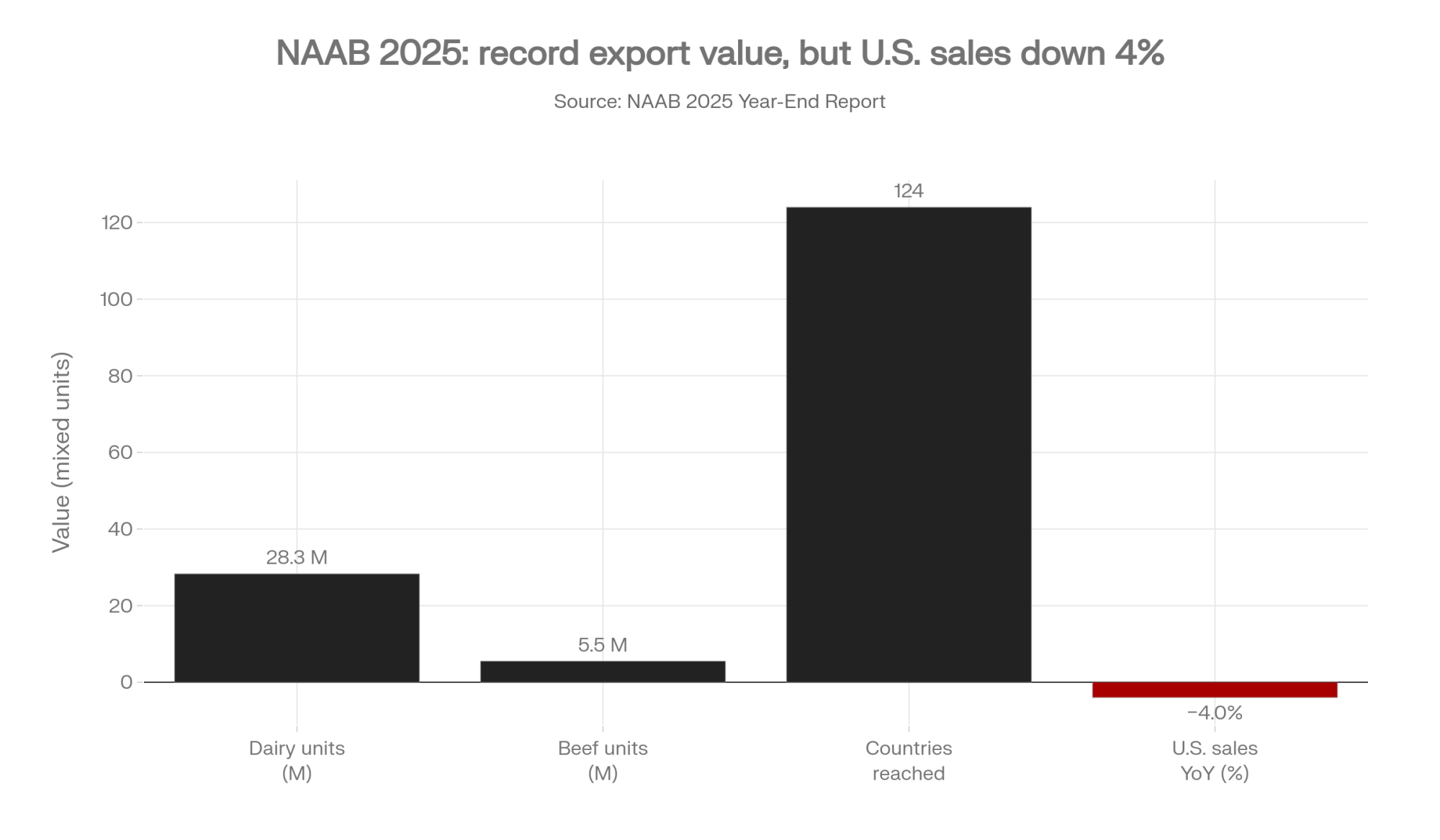
NAAB’s 2025 year-end report shows U.S. bovine semen sales down roughly 4% year-over-year. Export value reached a record $327.6 million even as total export units fell. China exited the U.S. market in early 2025. Dairy units exported settled at 28.3 million; beef exports rose to 5.5 million. U.S. genetics now reach 124 countries, up from 108 the prior year — and a clear majority of all dairy semen produced by NAAB members in 2025 left the country.

The structural pressure to watch is catalog compression outside the flagship top tier. The bulls most exposed in your cooperative’s next two catalogs are the slot 40–80 specialists: outcross health-trait sires, daughter-pregnancy-rate-leading bulls without methane-efficiency rank, show-type longevity sires whose proofs were built around classification rather than wellness data, A2A2-plus-component specialty sires for cheese-milk niches DWP$ doesn’t reward. That’s our read, not NAAB-confirmed sampling-mix data. Your cooperative’s next two catalogs will tell you if it’s right.

Pull slots 40–80 in the next catalog. Count what’s missing.

Options and Trade-Offs

Pick the path that fits how your milk check is built and how much room you’ve still got.

Path 1 — Participate with a parallel scorecard. Stay in Clarifide/DWP$ for processor compliance. Run your own mating logic underneath it, weighted to what your milk check actually pays for. Works when the processor premium is meaningful and your contract pays traits DWP$ underweights. Requires a breeding consultant or software workflow that shows DWP$ and NM$ rankings side by side. The risk: your AI rep’s default view is DWP$-framed. You have to actively ask for the second view every time.

Path 2 — Diversify your testing providers now, while you still can. Before you renew any testing contract, negotiate data-portability terms or split testing between Clarifide and an alternative — Neogen-GeneSeek pre-close, CDCB-based panels, a cooperative-run program. The H2 2026 close narrows the window on pre-close options. The risk: your nutrition software, vet platform, and mating program increasingly default to one data feed. Break one integration and three break with it.

The Switching-Cost Trap — read this before you sign anything.

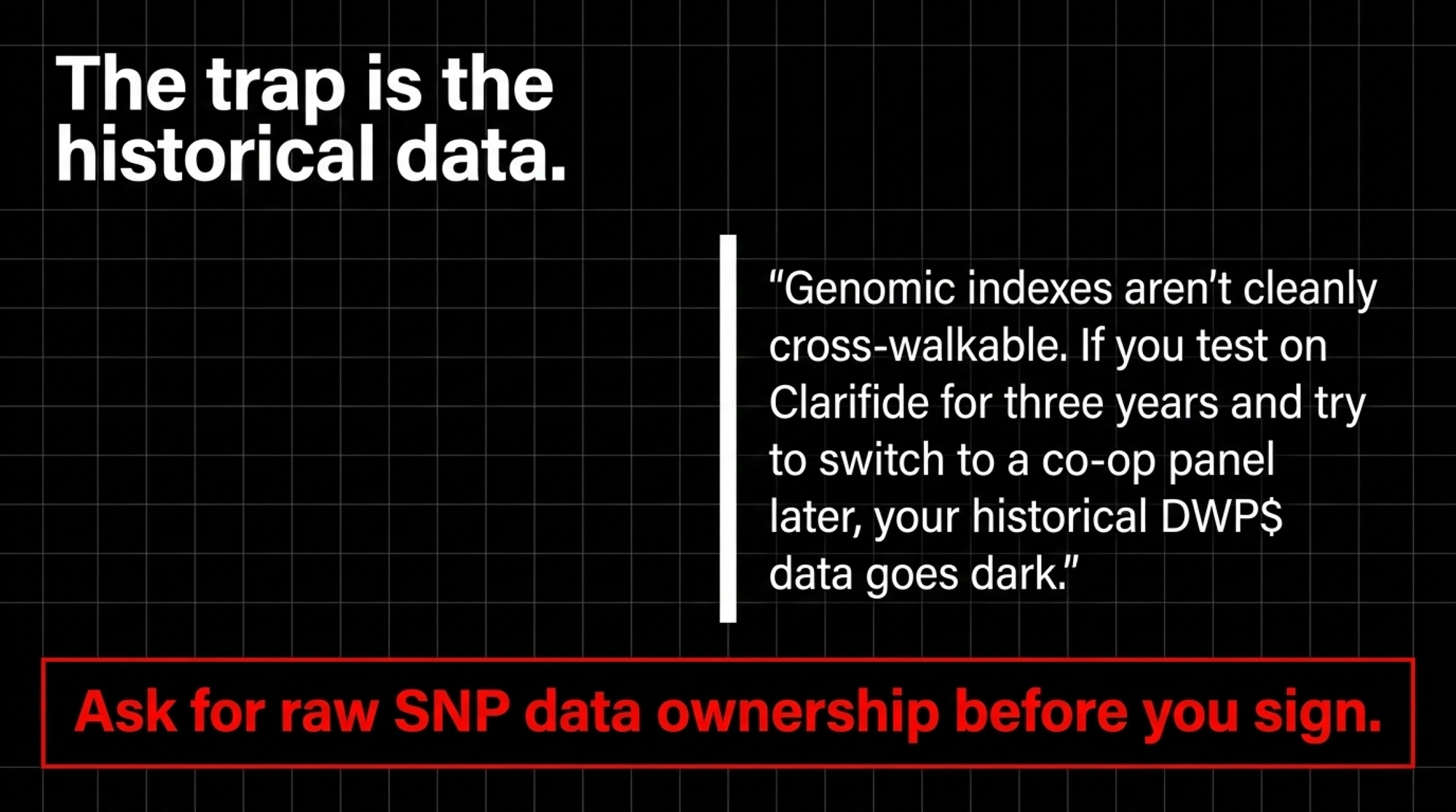
The harder cost in Path 2 isn’t the per-head test fee. It’s what happens to three years of historical rankings if you switch later.

Genomic indexes don’t translate cleanly across providers. The underlying SNP genotype usually does — once a genotype is on file with CDCB, it gets imputed to the same 80K-marker reference base regardless of which chip generated it. What doesn’t translate is the index ranking. DWP$ is Zoetis. NM$ is CDCB. TPI is Holstein Association. Each one weights traits differently, and a cow’s rank on one is not her rank on another.

So if you stay on Clarifide for three breeding crops and then want to move to a CDCB-based panel or a co-op program, the question isn’t whether to re-test the cattle. It’s whether your testing contract gives you export rights to the raw SNP file — and whether your genotypes were deposited with CDCB at the time of original testing. With those two boxes checked, a parallel evaluation costs a fraction of a re-test. Without them, you’re stuck either re-pulling samples or accepting that your historical DWP$ rankings and your forward-going scorecard live on different rulers.

Before you sign any testing contract this year, ask three questions in writing: Who owns the genotype file? Can you receive the raw SNP data, not just the index output? And can you re-run that data through a competing index without paying for a second test? Get the answers in the contract, not over the phone.

Path 3 — Source heat-tolerant genetics directly. If you’re in the South, parts of the West, or the lower Midwest, build a relationship with a Brazilian genetics supplier or a domestic IVF program working with Gyr-Holstein or SLICK-edited genetics. Trigger: summer THI in the upper-70s-to-low-80s range across an extended window — roughly where Zoetis itself recommends DWP$ Heat — and conception rates dropping by more than 5 percentage points across three consecutive summers. The risk: your traditional cooperative supplier probably can’t serve this need, creating a sourcing split you’ll need to manage.

Worth saying plainly as we head into the May–September heat window: DWP$ Heat is a software answer to a hardware problem. Genomic selection inside an existing Holstein population can shift what your daughters inherit at the margin. It cannot change what a Holstein is — a black-and-white animal selected over 75 years for cool-climate fluid-milk production, with body mass and coat type that limit how she dissipates heat at peak summer THI. Gyr-Holstein crosses and SLICK-edited cattle are a different physical platform: shorter coats, smaller body mass, sweat-gland density bred for the tropics. The honest question isn’t “is my DWP$ Heat score high enough?” It’s “do I need a different cow?” For most herds the answer is no — Holsteins still pay best where heat stress is occasional. For Florida, South Texas, Arizona, and the southern San Joaquin, where the answer is increasingly maybe, the Path 3 conversation isn’t optional anymore.

Path 4 — Stay loud at the cooperative. This is the 30-day action. The two questions earlier in this article aren’t a one-time ask. Walk them into the next district meeting on your calendar. Bring them on your phone. Read them aloud. Write the answer down, date it. Talk to two neighbors before the meeting and ask them to do the same. Re-raise in 90 days. Boards respond to repeated, specific, member-coordinated pressure. They do not respond to a single member raising an issue once. The cost is your time and a little social friction. The alternative is having the answer handed to you in 2028 by someone who wasn’t elected by your district.

The 30/90/365 Horizon

HorizonActionTrigger
30 daysRead data-ownership clauses (raw SNP file, portability, re-run rights); bring district-meeting questions; talk to two neighborsRenewal letter on file or expected within 12 months
90 daysNegotiate portability terms; open tropical-genetics conversation; re-raise at next district meetingTHI / fertility decline ORrenewal date inside H2 2026
365 daysTrack slots 40–80; commit to scorecard or diversification path; document board responsesNext two catalog cycles published

Key Takeaways

  • If your processor has mentioned Clarifide, sustainability testing, or scope 3 reporting in any conversation this year, assume a similar letter could land within 6 to 18 months. Negotiate data-portability terms — including raw SNP file access — before you sign, not after.
  • If DWP$ rankings on your last 30 sire selections diverge from your NM$ or TPI rankings by more than your milk-check structure can absorb, you’re breeding against a scorecard that doesn’t match how you get paid.
  • If your summer conception rate has dropped more than 5 points across three consecutive summers, the question isn’t whether to chase a higher DWP$ Heat score. It’s whether the Holstein is the right physical platform for your zip code at all. Put tropical, SLICK-edited, or DWP$ Heat-aligned genetics on your supplier conversations this quarter.
  • If your cooperative can’t name partners, dollar commitments, and timelines when asked the Path 4 questions, treat that as an unanswered question. Re-raise in 90 days. Keep asking.
  • If thinning shows up at slots 40–80 in your cooperative’s next two catalogs, that’s the leading indicator of R&D compression — visible 18 to 24 months before it shows up in flagship marketing.

What Kind of Cooperative Do You Want to Belong to in 2030?

Three generations of dairy farmers decided no member should face the genetics market alone. That decision built shared genotyping pipelines, member-owned data, and the negotiating leverage that has kept U.S. genetics competitive in 124 export markets and in your own barn. None of that is guaranteed to survive a structural shift it doesn’t see coming.

The cow-level economics — full DWP$-versus-NM$ math broken down by contract type and herd size — live in next week’s Bullvine Weekly. That’s where the spreadsheet sits: plug in your own components, your own premium, your own replacement rate, and see where the net-out lands.

But the question that actually matters this month isn’t the spreadsheet. It’s the one you bring to your next district meeting, in front of the neighbors whose kids might still be milking cows in 2050. What kind of cooperative do you want them to belong to?

Editorial note: This article reflects publicly available information as of May 1, 2026. Updates and any post-publication responses will be reflected in subsequent coverage.

¹ Holstein Association USA, Genomic Testing Services price schedule, accessed May 1, 2026: Clarifide Plus Medium-Density SNP Test + Dairy Wellness Traits & Polled at $43 per Holstein animal (member rate). Industry-wide practical costs typically run $40–$50 per head depending on volume and program tier.

² USDA NASS Milk Production monthly report, late-2025 release: U.S. average production per cow for the most recent reported month was 1,963 lb, putting annualized U.S. herd-average in the 24,000–24,400 lb/cow/year band, equivalent to roughly 66–67 lb/day on a steady-state basis.

³ 35% reflects a typical Holstein heifer-replacement rate; operations generally run 30–40% depending on cull rate. Figures rounded to the nearest dollar; testing-cost rows reflect 35% of milking herd as a straight multiplier. Adjust to your own heifer inventory before applying.

Disclaimer: The Zoetis–Neogen $160 million transaction is structural in scope, but individual outcomes vary by state, processor contract, regional milk pricing, herd size, and cooperative affiliation. The barn-math figures above are illustrative benchmarks, not universal forecasts. Run your own numbers against your own contract before any breeding, testing, or supplier decision.

Learn More

The Sunday Read Dairy Professionals Don’t Skip.

Every week, thousands of producers, breeders, and industry insiders open Bullvine Weekly for genetics insights, market shifts, and profit strategies they won’t find anywhere else. One email. Five minutes. Smarter decisions all week.
NewsSubscribe
First
Last
Consent

Zoetis–Neogen’s $160M Genomics Deal: The Hidden Cost of Letting One Company Own Your Pipeline

When the same logo sits on your genomic test, your wellness index, and now the lab behind a big slice of the industry’s DNA cards, the number that matters isn’t just $160 million — it’s the $86,000 you quietly push through that pipeline over five years.

Executive Summary: Zoetis’ just-announced $160 million purchase of Neogen’s animal genomics business is a bet on owning the global DNA pipeline, not just another test brand. Neogen’s unit brings in $90 million in genomics revenue, operates five labs across the U.S., Brazil, Australia, China, and the U.K., and serves customers in 120+ countries, dropping a ready‑made lab network into Zoetis’ Precision Animal Health machine. For a 750‑cow Holstein herd using CLARIFIDE Plus at roughly $43/head, that means around $17,200 a year — about $86,000 over five years — flowing through one company’s genomic loop that now influences breeding, wellness traits, and health protocols. The article shows how that integration can genuinely help (sharper predictions, smoother software, simpler decisions) while also raising switching costs and shifting leverage away from herds, breed associations, and AI programs toward a handful of platforms. It then gives a concrete 30/90/365‑day playbook: audit genomics contracts for data ownership and use, secure export rights, pilot a non‑Zoetis lab as Plan B, and stop letting any single index be the only lens on your genetics and health risk. The core message: you can stay in the Zoetis ecosystem, but before this deal closes in the second half of 2026, you need to decide — and document — who owns your genotypes, how portable they are, and how hard it would really be to change course later.

Zoetis Neogen genomics deal

On March 2, 2026, Zoetis announced it would pay 0 million to acquire Neogen’s animal genomics business, including its GeneSeek laboratories and livestock/companion animal genomics portfolio. Neogen says the net proceeds will primarily go toward debt reduction and a tighter focus on its food safety and animal safety markets, and both companies expect the deal to close in the second half of calendar year 2026, subject to regulatory approvals.

If you’re running 300–1,500 cows or sit on a breed association genetics committee, this isn’t abstract M&A. It means the lab work that used to sit quietly in the background — where your DNA cards went before proofs came back — is on track to sit under the same corporate roof as CLARIFIDE Plus, DWP$, vaccines, mastitis tubes, and digital herd‑software integrations.

The real question for 2026 is blunt: How much control over your genomics and data are you handing to one company — and on what terms — when this closes?

What $160 Million Actually Buys — and What It Doesn’t

Here’s what’s actually changing.

  • Buyer: Zoetis Inc. (NYSE: ZTS), “the world’s leading animal health company,” positioning the deal as strengthening its Precision Animal Health portfolio. Jamie Brannan, Zoetis’ Chief Commercial Officer, says the acquisition “brings complementary capabilities that expand predictive insights and individualized care, enabling us to deliver added value to customers.” 
  • Seller: Neogen Corporation (NASDAQ: NEOG), calling this a “planned divestiture” of its animal genomics business, so it can simplify operations, focus on core food and animal safety markets, and reduce debt. CEO and President Mike Nassif says the sale “allows the company to accelerate de‑leveraging and improve profitability.” 
  • Asset: Neogen’s animal genomics business, which:
    • Generates about $90 million in annual sales as of Neogen’s fiscal 2025. 
    • Operates five laboratories in the United States, Brazil, Australia, China, and the United Kingdom, plus an office in Canada. 
    • Serves customers in more than 120 countries, using fixed‑array and sequencing technologies with associated software to support genetic testing. 
    • Zoetis describes it as a leader in U.S. beef and dairy genomics. 
  • Price: $160 million, a clean ~1.8× revenue multiple on that $90 million sales base. 
  • Timeline: Zoetis expects to complete the acquisition in the second half of 2026, and Neogen expects to close by the first half of its 2027 fiscal year, pending regulatory approvals. 

That 1.8× revenue multiple tells you how each side sees this. For Neogen, it signals that genomics is a scale‑dependent service line — valuable, but not its primary growth engine, compared with food and animal safety. For Zoetis, rolling a ~$90‑million genomics business into a much larger animal health portfolio is easy to justify if it deepens their Precision Animal Health strategy and tightens the link between genetics, medicines, vaccines, diagnostics, and digital tools.

Zoetis isn’t starting from zero on genomics. They already had:

  • CLARIFIDE and CLARIFIDE Plus for dairy, built around genomic predictions and the Dairy Wellness Profit Index (DWP$), with wellness traits aimed at mastitis, metritis, displaced abomasum, ketosis, lameness, twinning, abortion, and more. 
  • INHERIT Select for beef, positioned as a genomic tool for commercial herds. 
  • A genetics lab in Kalamazoo, Michigan, is part of their existing Precision Animal Health infrastructure. 

What they’re buying now is plumbing and reach: a global lab footprint, thousands of customers who’ve used GeneSeek as their processor, and a large base of Igenity and GGP genotypes feeding evaluations and management tools across species.

AssetZoetis Holdings (Before Deal)After $160M Neogen Acquisition
Genomic ProductsCLARIFIDE Plus (dairy), INHERIT Select (beef), DWP$ wellness indexAll existing products + Neogen’s Igenity, GGP platforms, sequencing technologies
Lab Footprint1 genetics lab (Kalamazoo, Michigan)6 total labs: U.S., Brazil, Australia, China, U.K., Canada
Customer ReachNorth America focus via existing distribution120+ countries served through acquired lab network
Annual Genomics RevenueEst. $400M+ (within Precision Animal Health segment)Adds $90M from Neogen genomics business
Strategic ControlOwned genomic testing pipeline for proprietary indexesAlso processes DNA for competitors, associations, AI companies
Competitive PositionLeading dairy genomics brandOwns both the test brand AND much of the third-party lab infrastructure

The 750‑Cow Herd Caught in the New Loop.

Now pull this into a barn you recognize.

Picture a family‑run 750‑cow Holstein herd that’s all‑in on CLARIFIDE Plus:

  • Every heifer gets genotyped through CLARIFIDE Plus.
  • The breeding program leans heavily on DWP$ and wellness traits that Zoetis positions as predictors of health and profitability. 
  • The herd‑management software — through Zoetis or partner integrations — pulls genomics directly into the cow card, so DWP$ and wellness scores sit alongside repro, health, and production records. 

Meanwhile, another herd in the same region runs Igenity or GGP tests through a breed or AI program that sends DNA cards to Neogen’s GeneSeek labs.

As of March 2, 2026, those routes are set to converge:

  • Neogen’s animal genomics business — including its five labs and software — is under a definitive agreement to be sold to Zoetis. 
  • Zoetis says integrating Neogen’s genomic technologies and data solutions will expand “predictive insights, individualized care, and greater value” across major livestock and companion species. 

From the 750‑cow herd’s side of the fence, that means:

  • The lab processing a significant share of breed/AI genomics — Neogen’s business — is on track to have the same corporate parent as CLARIFIDE Plus and other Zoetis genomics offerings. 
  • The company that runs your genomic test, defines your wellness index, integrates with your herd software, and sells you disease‑prevention products will also own a big chunk of the lab capacity behind your neighbors’ tests and some association pipelines you rely on. 

That might pencil out just fine. But it’s no longer the same arm’s‑length relationship you started with.

The Genomics Loop: $43 Per Head, 2,000 Animals, One Company

CLARIFIDE Plus isn’t a mystery line item. Holstein Association USA lists CLARIFIDE Plus at around $43 per Holstein animal, with practical costs for many herds in the $40–$50 per head band depending on volume and program.

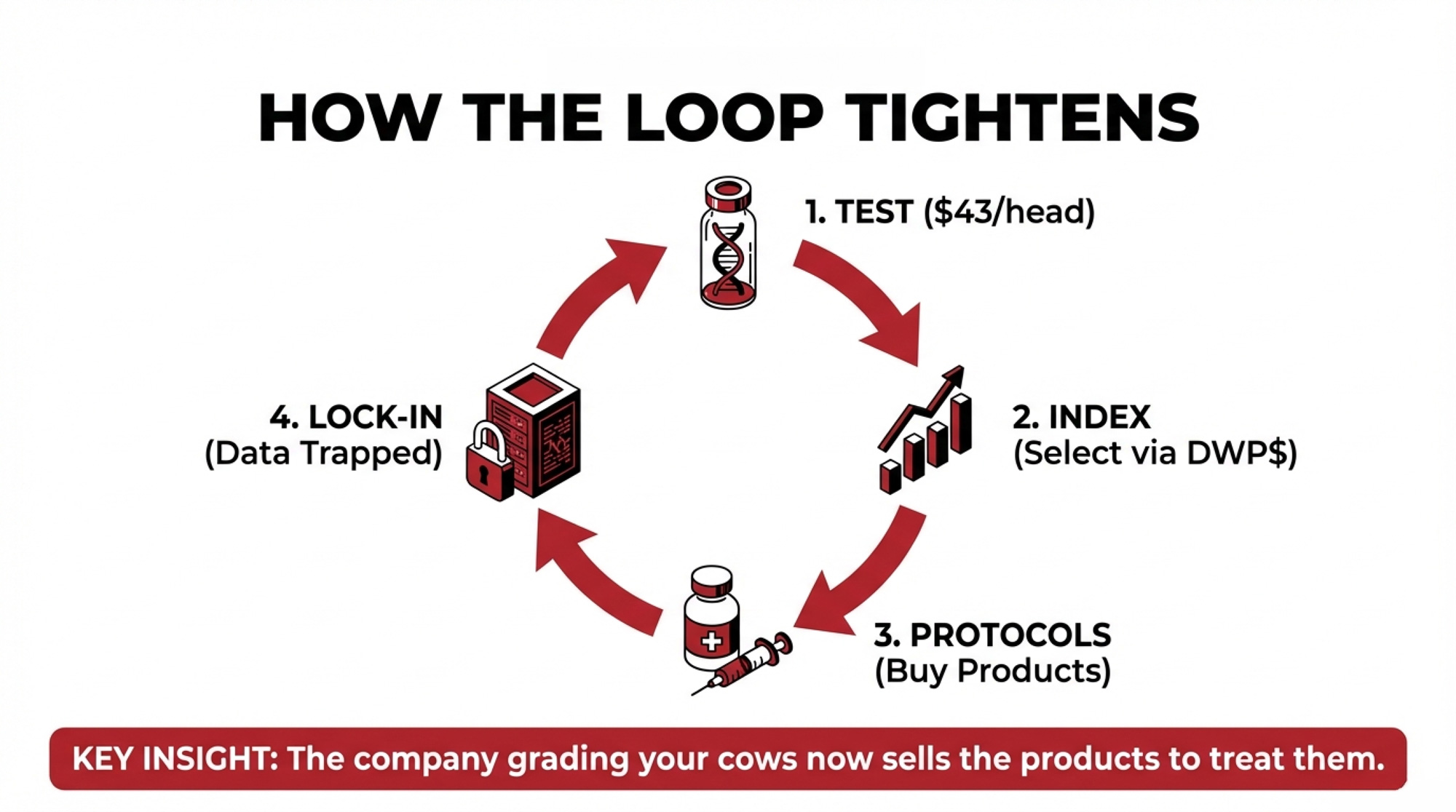
StepAnnual Activity5-Year TotalWho Benefits
Direct Testing400 tests × $43 = $17,200/year$86,000Zoetis (lab revenue)
Genetic DirectionSelection/culling decisions based on DWP$ index2,000 animals shaped by one platform’s trait prioritiesZoetis (proves index “works”)
Protocol AdjustmentsEst. $10/cow/year targeted health spend (750 cows)$37,500Zoetis (wellness-linked product sales)
Switching FrictionStaff retraining, advisor realignment, dual-index periodOpportunity cost: $15,000–$25,000Zoetis (customer retention)
Total Economic Exposure$24,700/year$123,500+Platform lock-in achieved

Now run realistic barn math for that 750‑cow herd:

  • You test 400 head per year — heifers plus some key cows.
  • You keep that up for 5 years.
  • You use one platform’s genomic test and index to steer breeding and culling.

Step 1: Direct testing spend

Using $43 per head as a concrete, sourced test price:

  • 400 tests/year × $43 = $17,200 in genomics fees per year.
  • 5 years × 400 tests/year = 2,000 animals genotyped.
  • 2,000 tests × $43 = $86,000 in direct testing spend over five years.

Your invoices might come in a little lower or higher with discounts and bundling, but you’re still in that neighborhood.

Step 2: Genetic direction

Each year, you and your advisors use those scores to:

  • Push sexed semen on the top DWP$ heifers.
  • Push beef semen or early culling on low‑index animals.
  • Make earlier do‑not‑breed calls when low‑index animals also underperform in the parlor or maternity pen.

After five years, a large share of your milking herd has been shaped by one company’s definition of “profitable genetics” — the way DWP$ weights milk, fat, protein, fertility, and wellness traits.

That’s powerful if DWP$ lines up with your economics. It’s limiting if you ever decide you want different trade‑offs.

Step 3: Downstream product spend

Those wellness traits don’t just sit in a report. They steer protocols.

Zoetis describes its Precision Animal Health vision as predicting, preventing, detecting, and treating disease using integrated tools across medicines, vaccines, diagnostics, and digital solutions. On a CLARIFIDE Plus herd, that often turns into:

  • High mastitis‑risk genetics? More aggressive mastitis prevention and treatment programs.
  • High lameness risk? Tighter hoof‑health schedules, trims, and monitoring.
  • Transition disease risk? Higher‑touch dry‑cow and fresh‑cow protocols backed by specific products.

Nobody’s forcing these choices, but when the same company provides the risk scores and sells the tools, it’s easy for more of your per‑cow health spend to gravitate there over time.

Even modest shifts add up. If wellness‑driven protocols increase targeted health spend by:

  • $10 per cow per year across 750 cows, that’s $7,500/year.
  • Over 5 years, it’s $37,500 in additional health spending guided by the same platform.

You may get every dollar of that back in avoided disease. The point is that your genomics, protocols, and product choices are now tightly coupled to one ecosystem.

Step 4: Switching cost

Fast‑forward to 2031.

You decide you’d like to:

  • Move some or all genotyping to a non‑Zoetis, CDCB‑approved service lab, or
  • Shift your primary emphasis from DWP$ to a national index like NM$, TPI, or PRO$, alongside your own KPIs.

You’re not just changing who prints your reports.

You’re:

  • Re‑training staff who’ve lived in DWP$ bands and wellness trait lists.
  • Re‑aligning conversations with genetics advisors, vets, and lenders.
  • Managing a period where different indexes don’t always agree on which cows are “top” and which are “bottom.”

Each turn of the loop made the system easier. It also raised the friction if you ever want to step partly outside it.

What Does This Deal Change for a 750‑Cow Herd?

StepWhat You Do/SpendWhat Zoetis Gains
1. Testing400 tests/year$17,200/year$86,000over 5 yearsLab revenue and a larger genomic dataset
2. SelectionHerd bred and culled to a single platform indexEvidence their index “works” + genetic direction aligned to their trait priorities
3. ProtocolsWellness traits steer more targeted health programsProduct sales linked to genomic risk and integrated Precision Animal Health offerings
4. SwitchingHigher friction if you try to move labs or indexes after 5+ yearsStickier customers and more leverage in commercial negotiations

That’s the decision pipeline Zoetis is paying $160 million to tighten.

Why Many Producers Will Choose the Loop Anyway

There are plenty of good reasons herds will lean into this ecosystem on purpose.

Zoetis and Neogen both emphasize that combining their genomics businesses will expand “predictive insights,” “individualized care,” and “highly accurate, scalable genetic testing,” giving customers deeper views on animal health, productivity, and sustainability across species.

For a 700‑cow operation juggling labor, data overload, and disease pressure, that upside looks like:

  • Sharper predictions. A larger combined genomics business — more samples, traits, and species — can support more robust trait predictions, especially for wellness and health.
  • Less friction. Results that feed directly into herd software and decision tools cut the time you spend moving files and reconciling systems.
  • Cleaner conversations. When your genomics, wellness traits, and protocols use the same language, it’s easier for your team to pull in the same direction.

So it’s perfectly rational for a herd to say: “We’ll accept more dependence if the tools keep improving and the economics hold up.”

The risk isn’t using the loop. It’s using the loop without knowing how to exit it or what happens to your data if you ever need to.

When “Neutral” Labs Aren’t Neutral Anymore

For breed associations, AI companies, and public genomics projects, the immediate tension isn’t about convenience. It’s about governance.

From Zoetis and Neogen’s own descriptions, Neogen’s genomics business has been:

  • Serving customers in more than 120 countries,
  • Operating five laboratories in the U.S., Brazil, Australia, China, and the U.K., plus an office in Canada, and
  • Acting as a leader in U.S. beef and dairy genomics. 

For years, much of that work sat under Neogen as a third‑party service:

  • Associations sent member DNA for genotyping under genomic‑enhanced evaluations.
  • AI companies used Neogen’s platforms (Igenity, GGP) to genotype bulls and commercial heifers. 
  • Government and research projects used its lab network for large‑scale testing. 

Neogen’s incentive was straightforward: provide accurate, timely testing and invest in genomics technology as a service line.

Once those labs move under Zoetis’ roof, the questions change:

  • What do the firewalls really look like? Zoetis says it’ll integrate Neogen’s genomic technologies and data solutions into its Precision Animal Health offering while “supporting continuity for colleagues and customers” and building on Neogen’s genomics legacy. Partners will want clarity on how individual customer data is segregated and protected. 
  • What visibility does a lab owner get, even without individual IDs? Aggregate volume, array choice, and project timing can reveal a lot about what breeds, studs, and associations are doing.
  • Who benefits most from data aggregation? Associations may own members’ genotypes, but Zoetis’ ownership of the lab business gives it more visibility into patterns than a standalone, service‑only lab would.

Zoetis is open about using this acquisition to “advance animal health through innovation, data, and technology,” and to empower customers with tools for healthier animals and sustainable production. That’s legitimate. The flip side is that it also concentrates influence — as both lab vendor and product competitor — in fewer hands.

If Consolidation Keeps Rolling, Where Does It End?

The Zoetis–Neogen deal fits a familiar pattern from seeds, crop protection, and precision ag:

  • Products evolve into platforms.
  • Platforms build data moats.
  • Data moats raise switching costs — and leverage shifts toward the platform owners.

In animal genetics, current signals already point to:

  • A global market where animal genetics and genomics continue to grow as producers chase productivity, health, and sustainability gains. 
  • A small top tier of players — Zoetis, major genetics companies, and large animal health providers — controlling most of the genomics and evaluation stack.

If current consolidation trends continue, it’s easy to picture a world where:

  • Four to six dominant platforms effectively steer most genetics and health decisions on commercial herds.
  • Genomics becomes a feature inside integrated solutions (software + products + advisory) rather than a standalone service you can easily shop for.
  • Independent labs focus on niche work or act as backup routes for organizations that deliberately keep a second lane open. 

For mid‑size dairies, the risk creeps in quietly:

  • Platform indexes and wellness scores become the default language for your team and advisors.
  • The easiest tools — usually the ones tied to your main platform — get used by default.
  • By the time you question the relationship, your replacement strategy, cull logic, and protocols may all be tuned to a single system.

The myth is: “If this stops working, we’ll just switch.”

The reality, if you don’t plan, is: “We’d like to switch, but the friction is too high, and the whole farm thinks in one platform’s numbers.”

The Turn: It’s Not “Stay or Go” — It’s “On What Terms?”

You’re not going to stop Zoetis and Neogen from closing this deal. Regulatory reviews may tweak conditions, but the labs will likely sit under Zoetis by late 2026.

What you do control is how boxed in you are when that happens.

The real decision over the next 12–18 months is:

  • Do you keep using Zoetis‑linked genomics on default terms, or
  • Do you keep using them while locking in better data and exit terms to maintain leverage?

Most producers and associations will stay in the ecosystem because:

  • The tools are strong and already integrated.
  • The workflows are familiar.
  • Evaluating alternatives takes time and focus.

That’s fine — as long as you treat lab and data contracts like infrastructure decisions, closer to choosing a milk buyer or lender than picking a glove supplier.

That means pushing for:

  • Clear language that your farm or organization owns your raw genotypes.
  • Guaranteed data portability — the right to export complete genotype files with IDs in standard formats if you move some or all volumes.
  • Tight data‑use provisions — especially around using your genotypes, even de‑identified, to train proprietary tools.
  • transition clause that obligates cooperation if you shift business elsewhere.

You don’t have to leave. You don’t want to discover your options are gone the day you actually need them.

The Playbook Before This Deal Closes

Here’s a practical, time‑bound framework.

In the Next 30 Days: Read the Fine Print Like It’s a Milk Contract

Before the announcement fades:

  • Pull your genomics agreement or program terms.
    That might be with Zoetis directly, a stud, a breed association, or a vet/genetics service that bundles testing.
  • Circle language on:
    • Data ownership
    • Data use (especially “de‑identified,” “aggregated,” “research,” “product development”)
    • Term, automatic renewal, and termination
  • Ask your contact three blunt questions:
    • Who legally owns my raw genotype files — me, the association, the vendor, or some combination?
    • Can I get a full export, with animal IDs, in a standard format if I move labs?
    • Will my herd’s genotypes be used to train proprietary tools without a separate, explicit data‑sharing agreement?

If the answers are fuzzy and the contract doesn’t match them, that’s not a problem for tomorrow. That’s a now problem.

In the Next 90 Days: Build a Real Plan B Lab

You may never use it. You’ll still sleep better knowing it exists.

  • Identify at least one non‑Zoetis, cattle‑focused genotyping lab that’s compatible with CDCB or your national evaluation system. holsteinusa Get specifics: pricing, turnaround time, data formats, and how they deliver results back to you or your association.
  • Run a pilot batch.
    • Choose a defined group (e.g., a heifer cohort).
    • Send samples through both your current program and the alternative lab.
    • Confirm that:
      • Results from the alternative lab plug into your existing evaluation system.
      • Service and communication are solid.
      • You can easily map data back into your farm or association records.

Spending roughly the cost of 50 tests to learn how hard it is to move volume is cheap insurance compared to discovering you’re stuck mid‑dispute.

In the Next 365 Days: Rebalance Who Really Steers Your Decisions

As the Zoetis–Neogen integration moves from press release to day‑to‑day reality:

For 300–1,500‑cow herds:

  • Split your steering wheel.
    • Keep using CLARIFIDE Plus, DWP$, and wellness traits if they’re working; Zoetis and its partners built those tools for a reason. 
    • But cross‑check big moves with at least one independent lens:
      • National indexes (NM$, TPI, LPI, PRO$, etc.).
      • Your own data on culls, mastitis, lameness, stillbirths, and reproduction.
  • Get your advisory team aligned.
    Sit down with your genetics advisor, vet, nutritionist, and lender and ask:
    • “Whose index are we effectively breeding to?”
    • “How much of our herd strategy assumes this one platform’s view of genetic value and health risk is the truth?”

For breed associations and genetics committees:

  • Write a lab and data policy on purpose, not by default.
    • Define expectations: independence, firewall standards, audit rights.
    • Decide how often you’ll review lab partnerships and under what conditions you’ll diversify volume.
  • Keep a non‑Zoetis lane open.
    • Even if most samples continue flowing through Zoetis‑owned labs for cost and performance reasons, maintain a meaningful stream through at least one other approved lab. 
    • That stream is your insurance policy; you don’t want to build it from scratch under pressure.

What This Means for Your Operation

Turn this from news into checks you actually run.

  • In the next 30 days, read your genomics contract line by line.
    If it doesn’t clearly say who owns your genotypes and how you can export them, that’s your first negotiation target.
  • Ask for written data‑use boundaries.
    Push for language that says your genotypes won’t be used to train proprietary tools without a separate, explicit agreement you sign.
  • Know at least one backup lab by name and price.
    Make a call, get a quote, and ask exactly what it would take to send 50 heifers through their system.
  • Test the switching friction with a small pilot.
    Don’t wait until you’re unhappy with pricing or terms to find out your data is badly stuck in one ecosystem.
  • Stop letting any single index be the only truth.
    On your next breeding or cull list, compare your platform index with at least one national index and your own health and cull data before you finalize.
  • If you’re on a genetics committee, get this on the agenda.
    Ask staff to map where member DNA goes, who has access, and what it would take to move 10–20% of volume elsewhere over the next 1–3 years.
  • Treat genomics and lab choice like a processor or lender decision, not a glove order.
    The wrong glove order is annoying. The wrong lab contract can shape your herd’s genetics and negotiating power for a decade.

Key Takeaways

  • Zoetis isn’t just buying five labs and $90 million in sales. It’s buying a global genomics business that plugs into its Precision Animal Health strategy and tightens the loop between your DNA, your herd software, and its products. 
  • At roughly 1.8× revenue, Neogen is signaling genomics is a scale‑driven service line for them, not their main growth engine. For Zoetis, that same business is another gear in a much larger machine for animal health and diagnostics. 
  • A typical 750‑cow herd testing 400 head a year at around $43/head is putting roughly $17,200/year — about $86,000 over five years — through one genomic loop. That loop shapes genetics, protocols, and, eventually, your flexibility. 
  • Mid‑size dairies (roughly 300–1,500 cows) are often the most exposed to platform lock‑in. You’re big enough that the loop meaningfully affects your economics, but not always big enough to dictate terms.
  • There are real upsides — sharper predictions and cleaner workflows — that many herds will choose on purpose. The smart play is to enjoy those benefits while making sure your data ownership, portability, and Plan B lab are nailed down in writing before the labs change hands. 

The Bottom Line

When you sit down at the desk tonight, don’t just skim the $160 million headline.

Pull your latest genotyping invoice, find the program terms it points to, and circle every line that spells out who owns your data, who can use it, and what it takes to walk away.

Then ask yourself, honestly: Is that language strong enough for the $17,200 a year you’re putting through this pipeline?

Complete references and supporting documentation are available upon request by contacting the editorial team at editor@thebullvine.com.

Learn More

The Sunday Read Dairy Professionals Don’t Skip.

Every week, thousands of producers, breeders, and industry insiders open Bullvine Weekly for genetics insights, market shifts, and profit strategies they won’t find anywhere else. One email. Five minutes. Smarter decisions all week.
NewsSubscribe
First
Last
Consent
Send this to a friend