Archive for Holstein sire selection

The $1,300 Gap Between the Bull You Want and the Bull You Should Buy

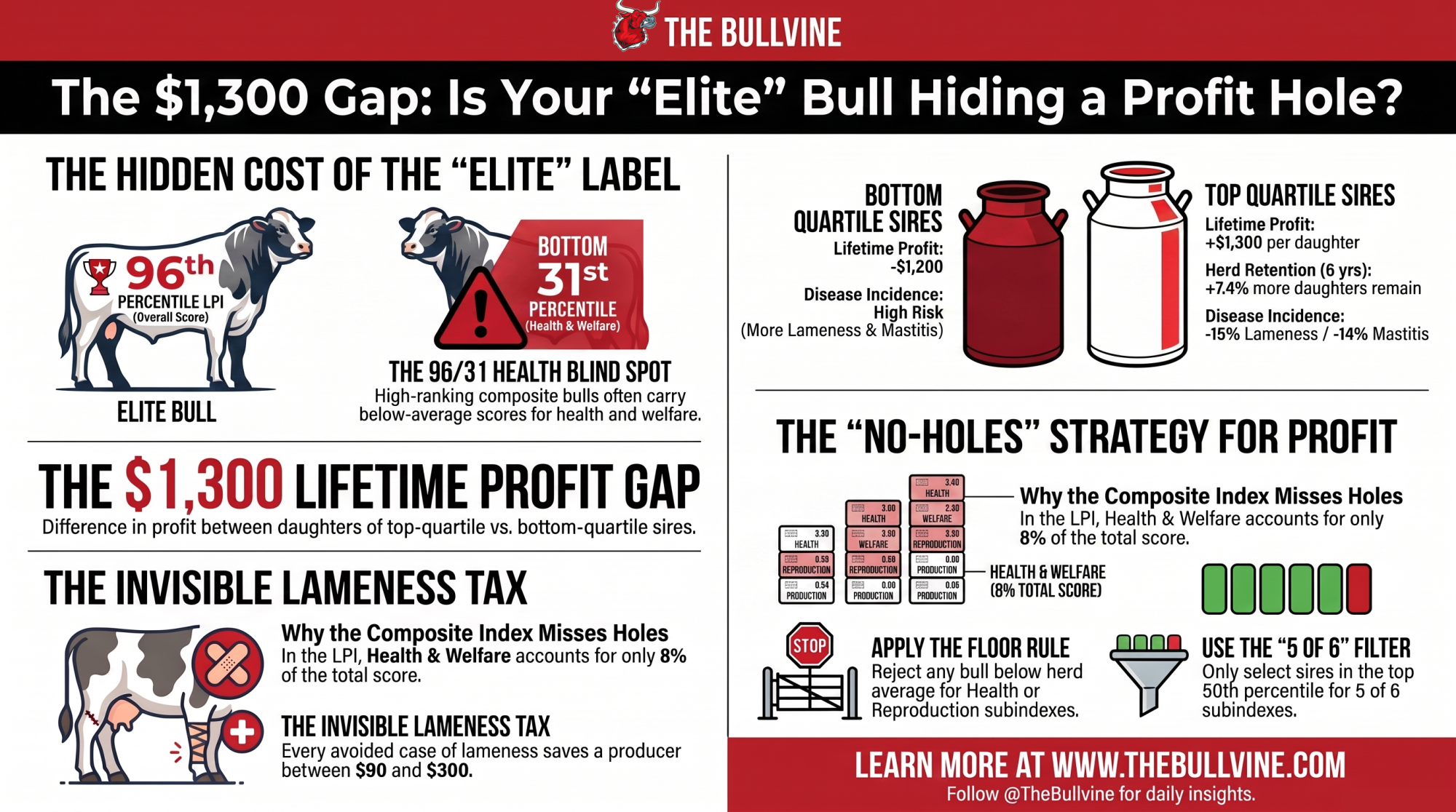
A 96th-percentile LPI bull can rank 31st for health — costing up to $1,300 a daughter in lifetime profit. Here is how taking two minutes with subindexes prevents a multi-generation mistake.

Back in 1970, for my Masters at Guelph under Ted Burnside, I built an index called the Production Dollar Difference Guide (PDDG). The idea was simple enough to fit on one line: measure, in real dollars, how much more profit a bull’s daughters would return over a lactation than an average cow. It became Canada’s first composite sire ranking index, and the profit thinking behind it is the same thinking that eventually produced today’s Pro$. But the arithmetic started earlier than any thesis — it started at my kitchen table, with a pencil and a stack of milk records from Huntsdale, asking which cows actually paid the bills and which bulls made more of them.
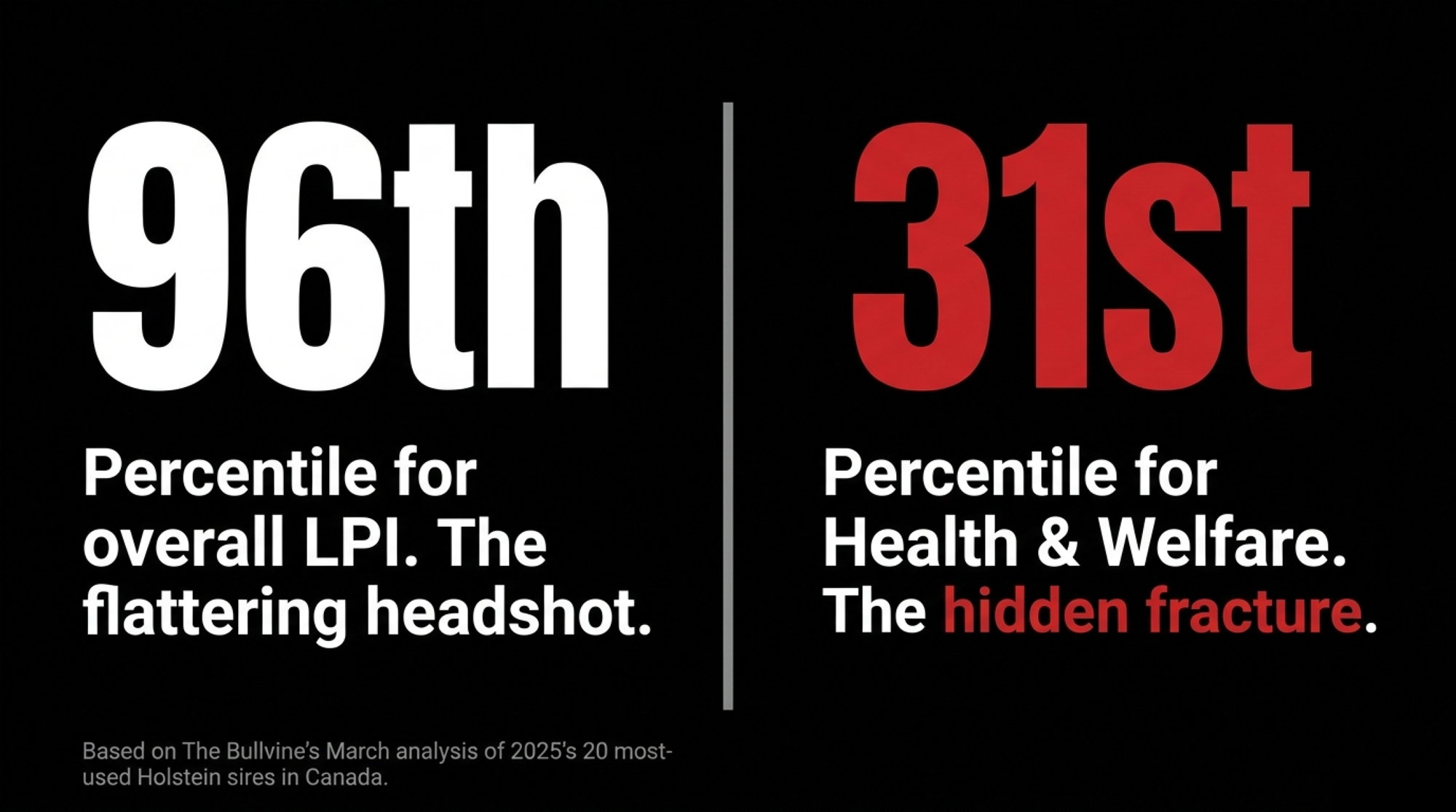
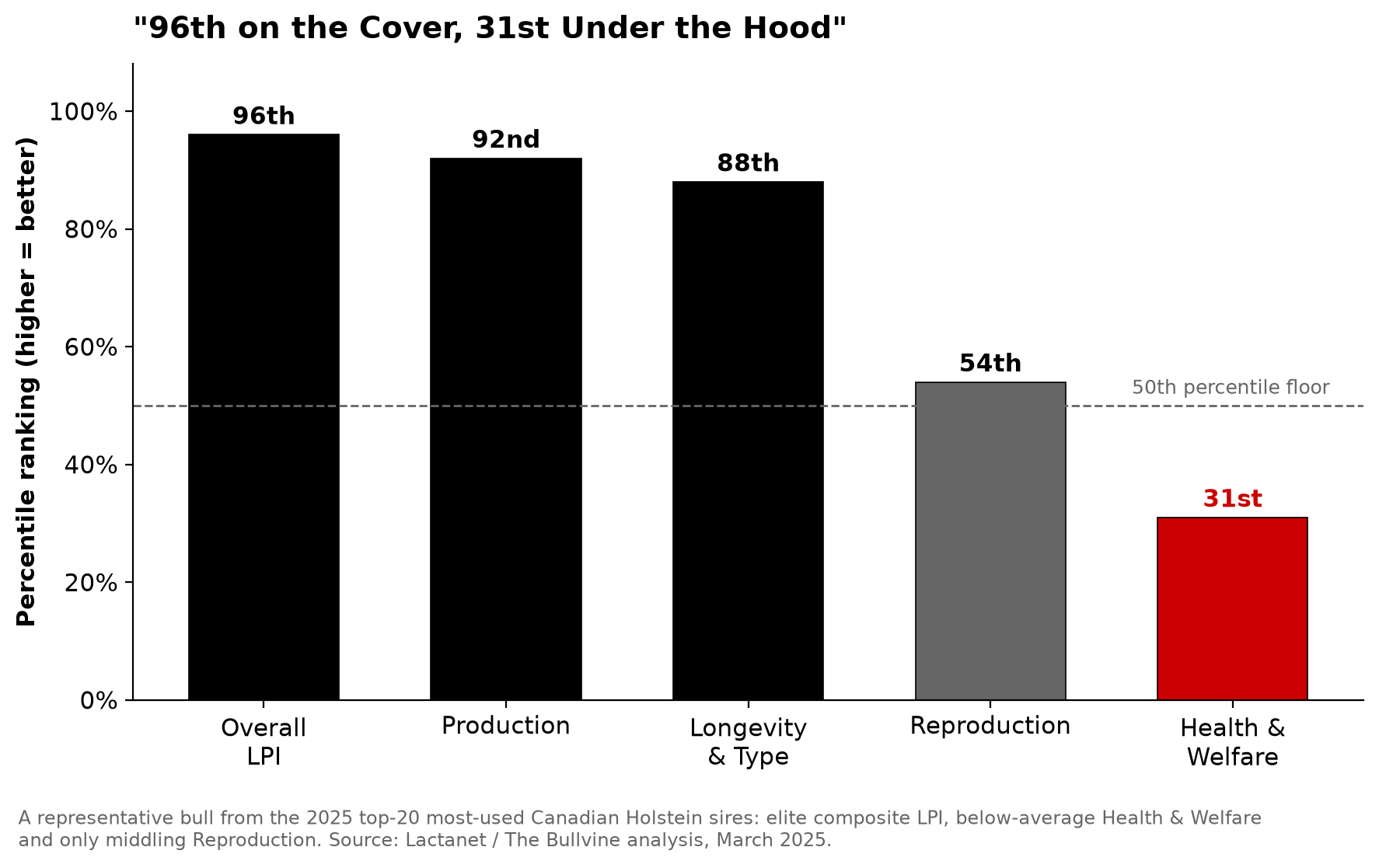
Fifty-six years later, the industry has finally built the machinery to answer that question at scale — six published subindexes including wellness, welfare and reproduction indexes that use lifetime profit curves. And most producers still aren’t using them. They circle the big composite number instead. That number has a blind spot, and it has a face now: when The Bullvine ran Canada’s 2025 20 most-used Holstein sires against Lactanet’s new subindexes this past March, it found bulls sitting at the 96th percentile for overall LPI yet only the 31st percentile for Health & Welfare— a pattern our analysis links to sires behind roughly a quarter of the registered calves born in 2025. That’s our own analysis, not a wire story. If you’re picking sires this month, give me two minutes before you circle a name.

The Core Problem: A Headshot, Not a Scan

For years, “#1” meant something clean. Top 10 TPI or LPI was a badge, and everybody knew what it stood for. That clarity has quietly frayed — not through anybody’s bad faith, but because there are now a dozen ways to be number one. TPI and NM$ anchor U.S. proofs, LPI and Pro$ run Canada, and Zoetis owns DWP$, a proprietary index built to estimate genetic potential for lifetime profit. When every stud keeps its own leaderboard, a bull can honestly be “#1” on a definition narrow enough to flatter him. And when the whole industry circles the same few names, the bill comes due in a different column — 99.84% of Holstein A.I. bulls now trace to just two fathers.

So why does the composite miss the health hole? Because it’s doing exactly what it was built to do — averaging. A bull can post huge components and functional type, ride those into a 96th-percentile LPI, and carry a below-average health score that barely dents the total. The number isn’t lying to you. It just isn’t telling you where the soft spot sits.

“The composite index is a flattering headshot — one number, easy to post, easy to sell. The subindexes are the MRI scan that shows exactly where the joint is failing.”
Lactanet even built a tool called pLPI that lets any producer log in, re-weight the six subindexes to match the herd’s own priorities and read the result beside the official LPI. It’s been live since April 2025. Most producers have never opened it.

Which Index Comes From Where?

The alphabet soup is less confusing once you sort the tools by who runs them and what they’re built to do. Rank animals on your public national index first, then read the health, welfare and fertility details underneath before a private or personalized index ever breaks a tie.
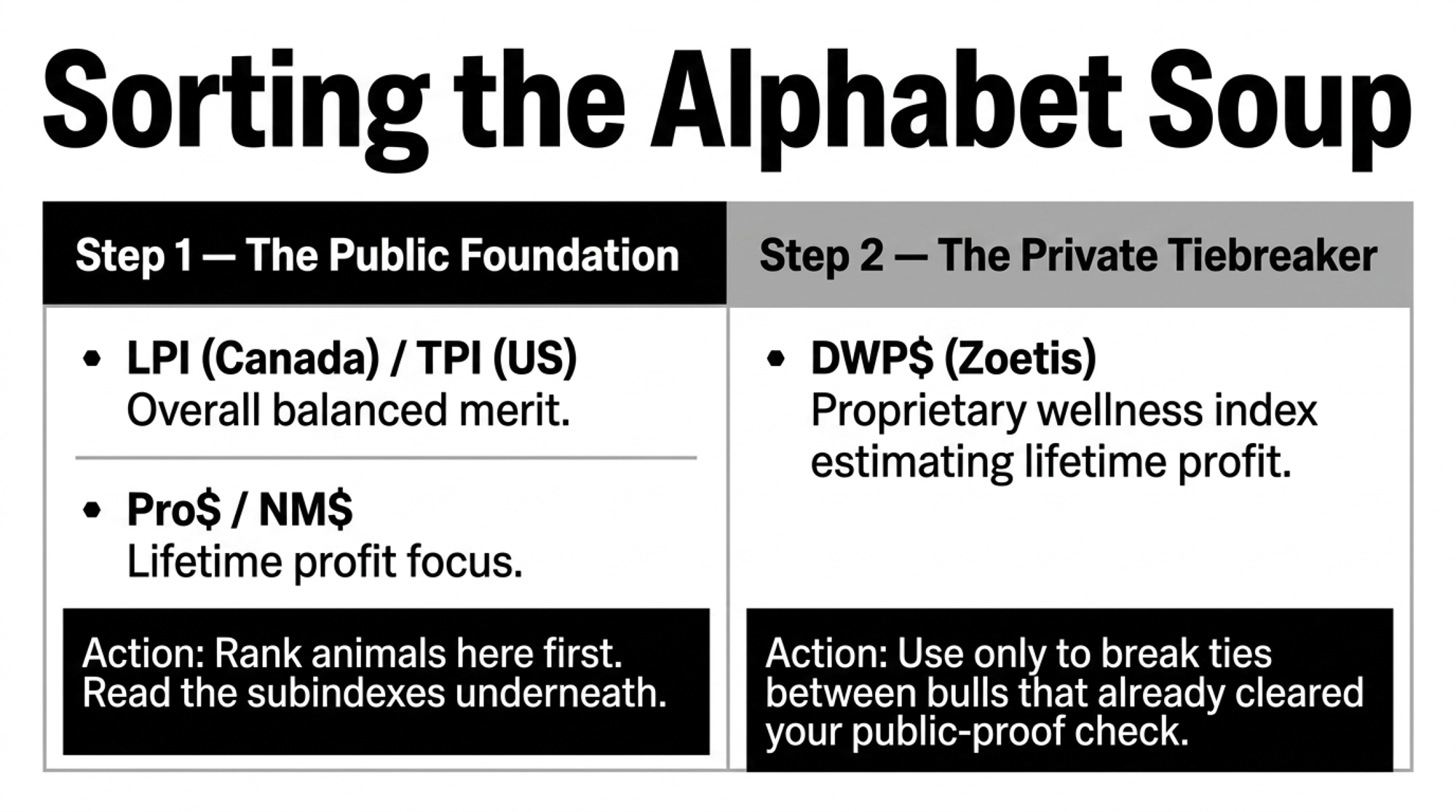
IndexWho runs itRegionWhat it is
LPILactanetCanadaOverall merit, now split into six readable subindexes
Pro$LactanetCanadaLifetime-profit focus ($); the direct heir to the 1970 PDDG logic
TPIHolstein Association USAUSA balanced index across production, health, and type
NM$USDA / CDCBUSRanks animals on combined merit for economically important traits; expected lifetime profit ($)
DWP$Zoetis (proprietary)USMulti-trait wellness index estimating genetic potential for lifetime profit ($); a tiebreaker after the public-proof check

The Hard Math: Top Quartile vs. Bottom

A high-index total merit bull doesn’t fail loudly. His daughters look terrific on paper and freshen fine. Then, a couple of lactations in, they start showing up on the lists nobody wants — the lame pen, the mastitis log, the breeding sheet with too many open cows. The composite averaged his strength and his weakness into one tidy number, and weighting in a weakness doesn’t erase it. It just hides it until your cull list does the accounting for you.

Here’s what the published data says that gap is worth. Read the source column carefully: the retention and profit figures come from Lactanet’s Canadian Pro$ curve, while the disease figures come from a US DWP$ validation across five herds. Two countries, same story.
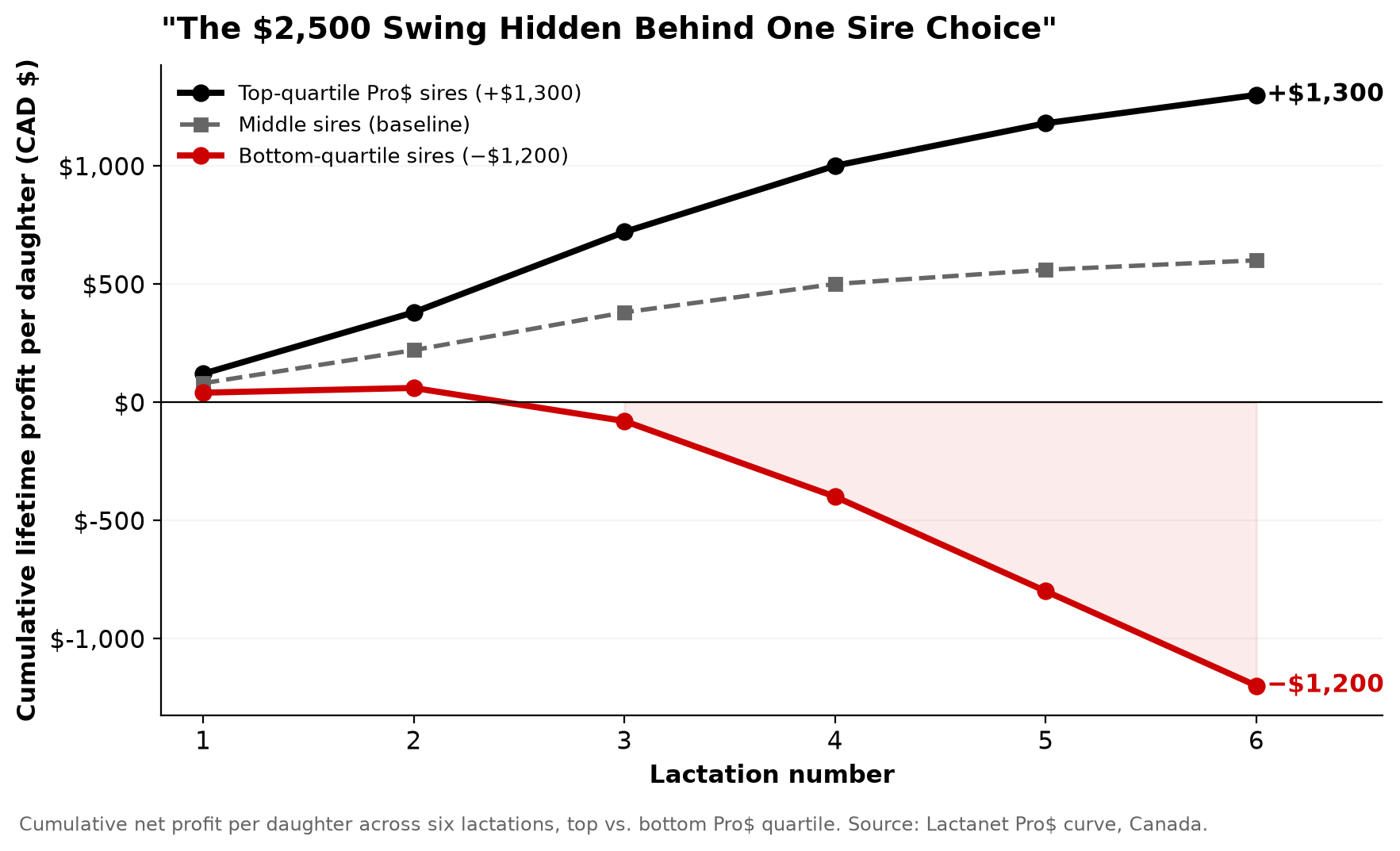
Metric / Risk AreaBottom QuartileTop QuartileBottom-Line ImpactSource
Herd retention at 6 yearsBaseline+7.4% more daughters remain+$1,300 lifetime profit per daughter (bottom sires: −$1,200)Pro$, Canada
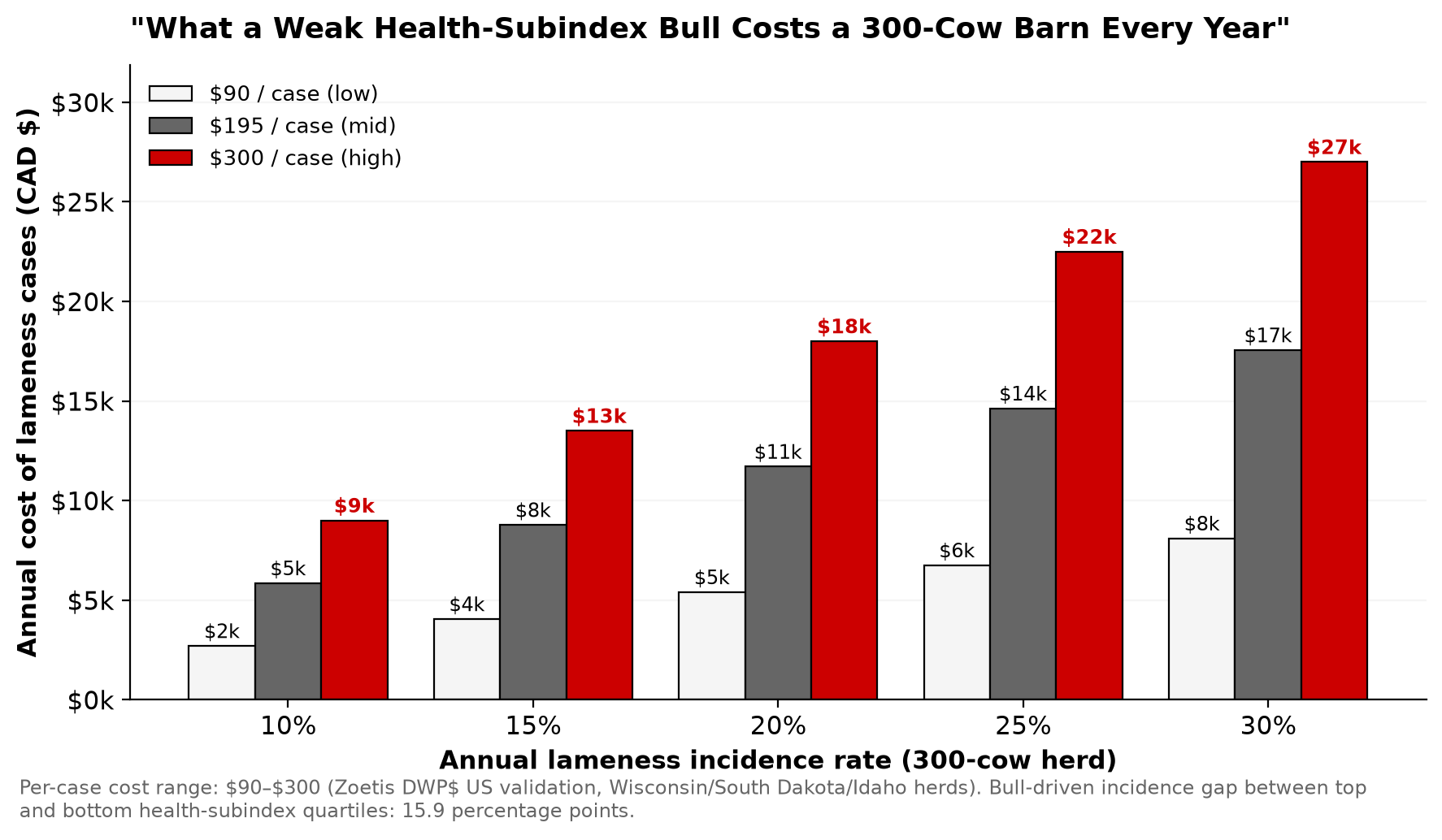
Lameness incidenceHigh−15.9 percentage points$90–$300 saved per case avoidedDWP$ US validation
Mastitis incidenceHigh−14.9 percentage pointsFewer treatments and less dumped milk; +$811 lifetime profit overallDWP$ US validation

Retention and profit figures: Lactanet Pro$ (Canada). Disease figures: Zoetis DWP$ validation across five US herds in Wisconsin, South Dakota, and Idaho.
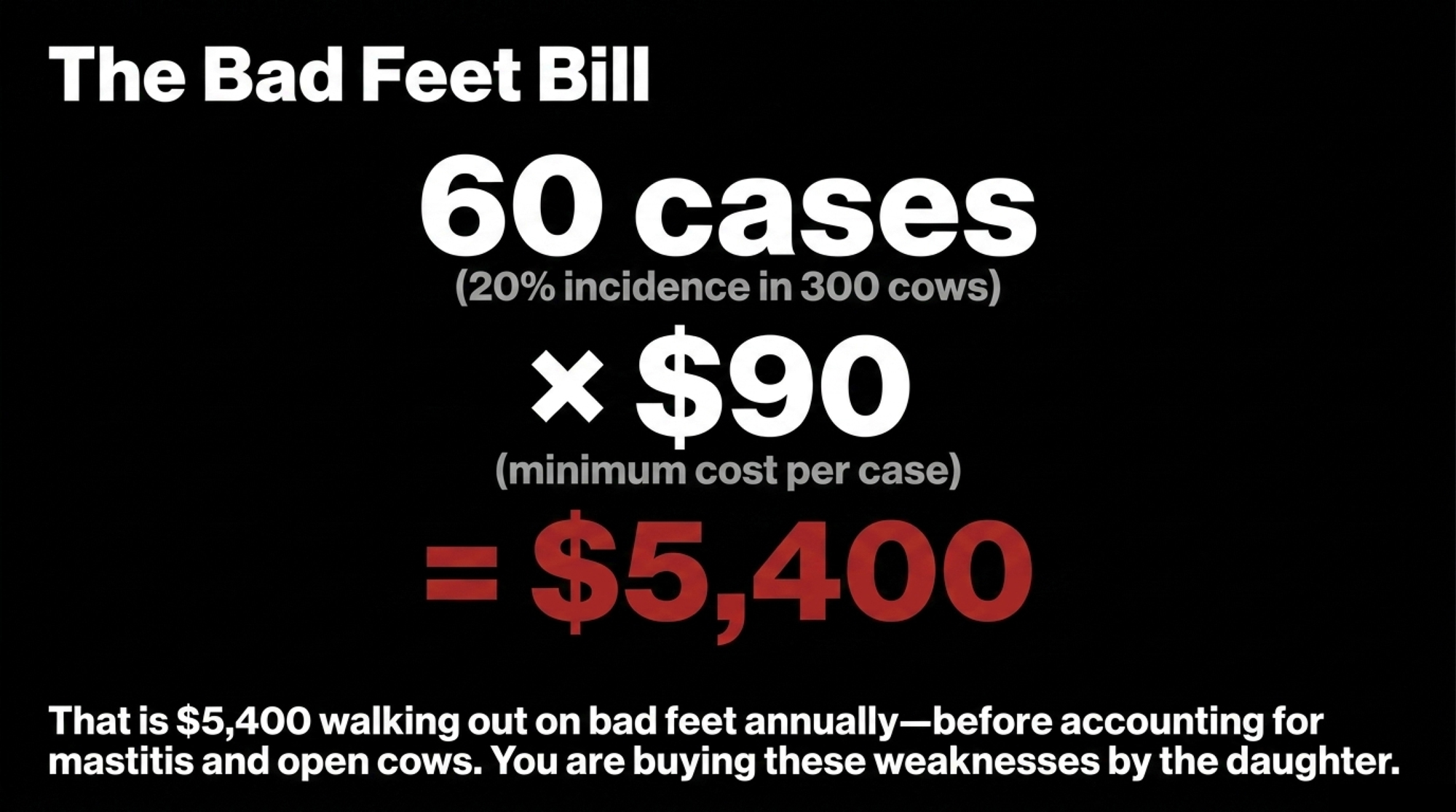
Now run it on your own barn. Take a 300-cow herd with 20% lameness incidence — 60 cases a year. Even at the low $90 figure, that’s $5,400 walking out on bad feet annually, before the mastitis and open cows that tend to travel with weak health genetics. Buy those weaknesses in through a bull, and you’re buying them by the daughters, year after year. If you want to put your own incidence and treatment costs against that, run them through our Health ROI Calculator before your next proof day.
The LPI Weighting Dilemma

The reason the composite can hide a hole is right there in the math. Here’s how modern Holstein LPI is built — and the two changes that landed in April’s proof round:
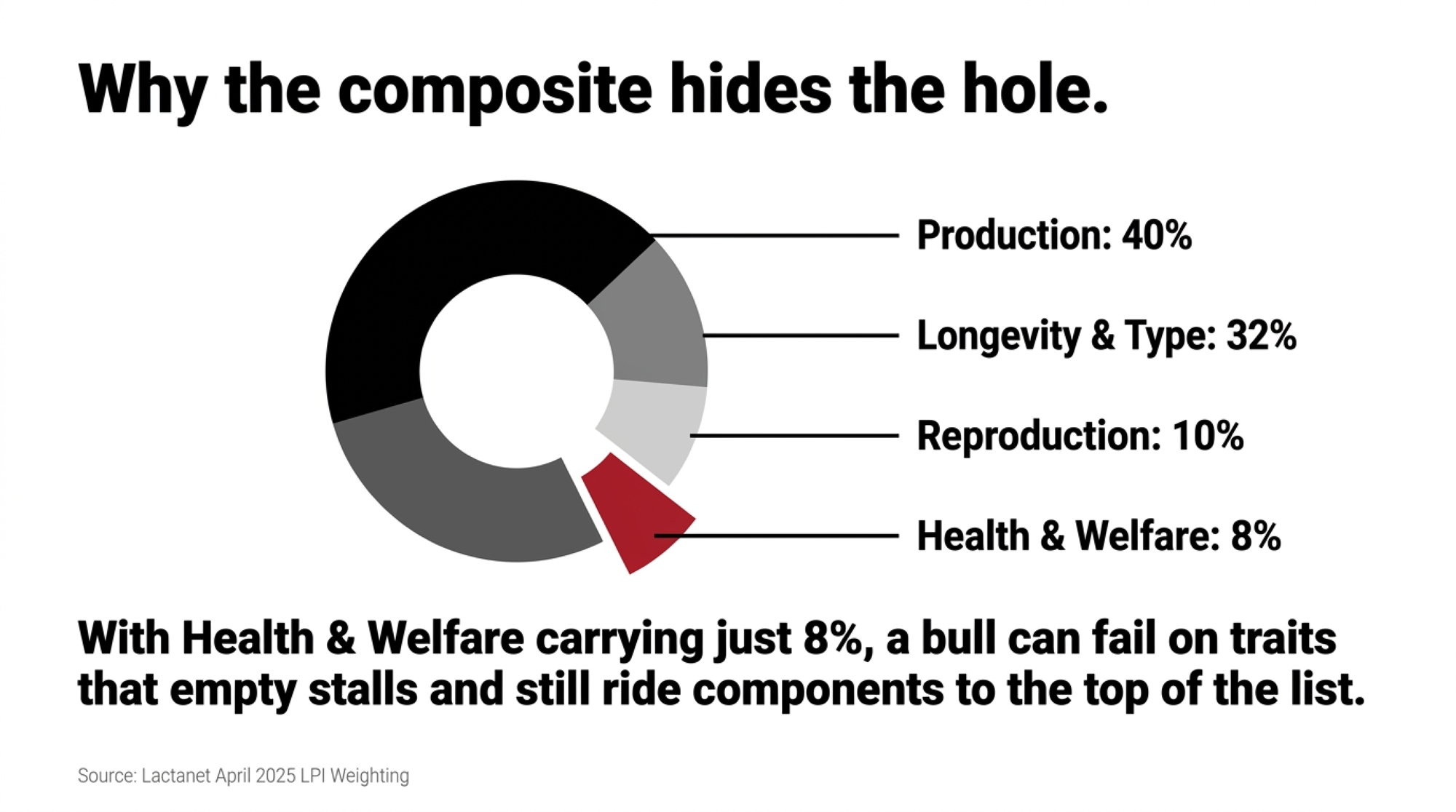
  • Production — 40%. Shifted this past April from 60% fat / 40% protein to 40% fat / 60% protein.
  • Longevity & Type — 32%.
  • Reproduction — 10%.
  • Health & Welfare — 8%. Got sharper in April: Calf Health added at 30% weight, Mastitis Resistance at 40%, Hoof Health at 11%.
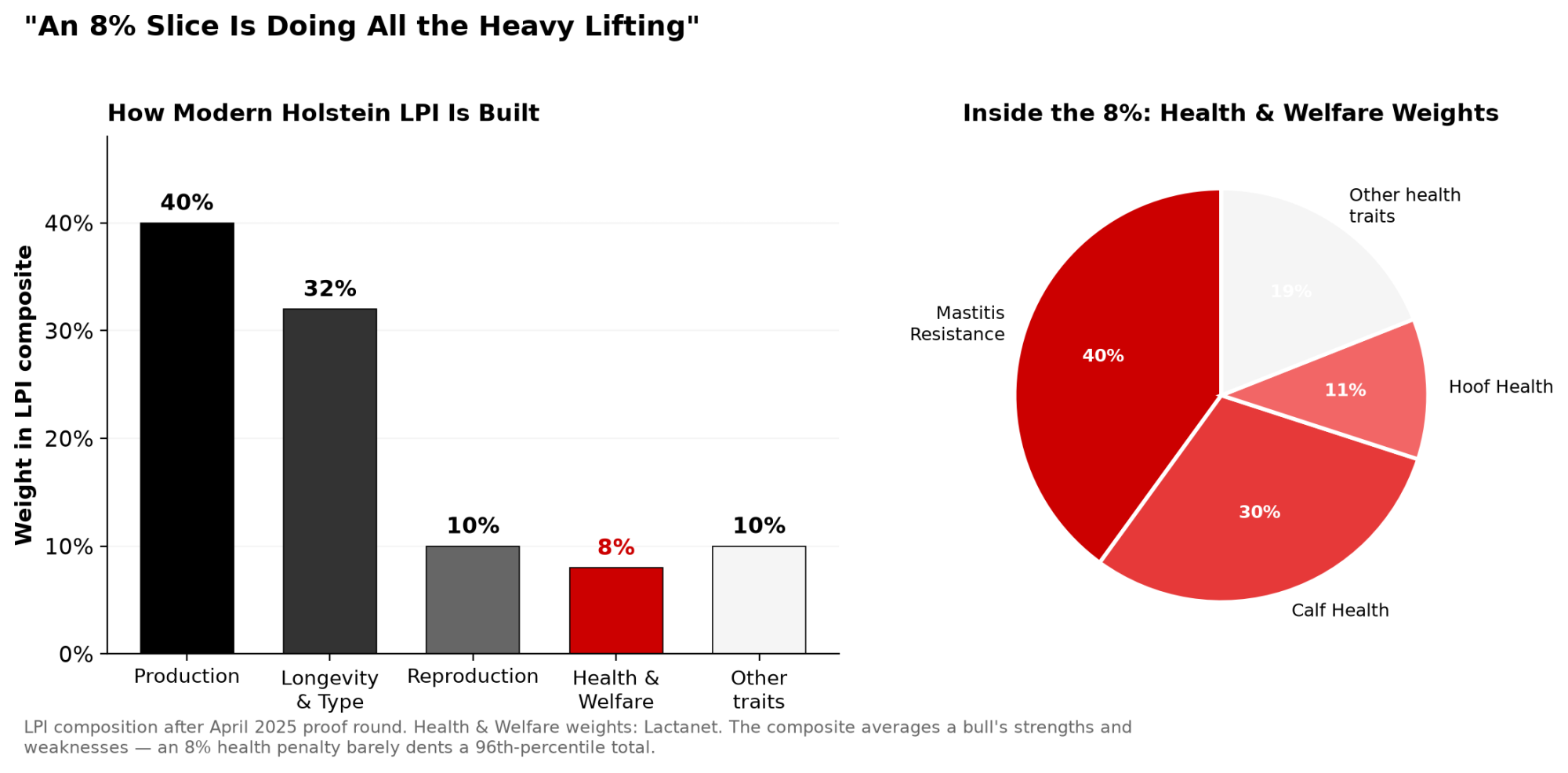
Read that stack plainly. With Health & Welfare carrying just 8% of the total, a bull can be well below average on the traits that empty stalls and still ride his components to a 96th-percentile LPI. That’s the whole blind spot in one line. It’s the same arithmetic behind the 9.99% Holstein inbreeding bill — are you breeding for profit, or just for index points?

What I’d Do With The Six Subindexes Today

I’d welcome them — because they’re the Production Dollar Difference Guide with better arithmetic. My 1970 thesis argued that the way to lift genetic progress was to sample far more young sires each year and let the proven ones rise; at the peak of young sire sampling, Canada was testing over 500 A.I. young dairy bulls annually on that logic. That shield at Huntsdale wasn’t won chasing the hottest bull of the month. It came from breeding cows that lasted, bred back, kept milking and threw enough surplus breeding stock to sell. Holstein Canada recognized the prefix with a Master Breeder Shield in 1984.

Holding a direction takes nerve, mind you. Plenty of bulls get written off early and prove the room wrong — they called Mogul’s heifers fat, and then came the million doses. The point isn’t to avoid every bull with a critic. It’s to avoid the bull with a hole you can already see on the page.

The through-line to today is simple. A sire stack built the way I built one isn’t a shopping list of favorites — it’s a direction you hold across generations, layering balanced bulls so longevity, fertility, and functional type compound while production keeps climbing. The subindexes make that direction visible on a screen instead of in a shoebox of milk records. My rule hasn’t changed in over fifty years: trust the system, improve the system, and use it to produce a continually better product.

How Much Does Chasing the #1 Bull Actually Cost You?

Map it to your own herd, and it stops being abstract. If your “elite” sire’s daughters run even one extra lameness case per ten cows over their productive lives, that’s roughly $900 to $3,000 per hundred daughters at Wisconsin’s cost range. Set that against the $1,300-per-daughter profit swing Pro$ documents between top and middle sires, and the composite-chasing decision starts looking expensive in a column the sire catalog never shows you. The exciting bull isn’t free. You pay for him later, in vet bills and empty stalls.

Is Your Herd’s Genetic Strategy Already a Step Behind?

Here’s a fair gut check, no judgment attached: when did you last look at a bull’s Health & Welfare or Reproduction subindex before you bought him? If the honest answer is “never” or “the rep handles that,” you’re in the same boat as thousands of good producers — the difference is that the tool to do better has been sitting on Lactanet’s site since April 2025. The herds that’ll be ahead in five years won’t be the ones with the flashiest catalog. They’ll be the ones whose cull lists got boring because the same problems stopped showing up.

The Rules for Farmers: The “No-Holes” Strategy

You don’t need a consultant or a spreadsheet to close this gap. You need a filter and the nerve to hold to it. Three moves, in order.

1. The Floor Rule — do this within 30 days. Before you circle any bull, check his Health & Welfare and Reproduction subindexes (or Pro$/DWP$ if that’s your system). Below your herd average on either? He doesn’t become a main sire for your herd — no matter how big his composite index. Costs two minutes. The catch: you’ll pass on some exciting bulls, and that stings.

2. The “No-Holes” Filter — clear 5 of 6. Use only sires that clear at least five of the six LPI Subindexes above the 50th percentile — above average almost everywhere. Best when you’re breeding replacements you plan to keep. The catch: your shortlist gets shorter and a little boring. Boring is the point. It’s about genetics for profit.

3. The Multi-Gen Stack — build for consistency. Sequence balanced bulls across generations so the good traits compound — the PDDG logic in modern dress. The catch: it’s slow to show, and it means ignoring the monthly “new #1” noise sire. With the Production subindex reweighted in April, a written direction keeps you steady when the index itself moves under you.

And use private indexes as a tiebreaker, not a verdict. DWP$ and the like are useful for breaking ties after the public-proof check — not for overruling a hole you can already see.

The Rep Checklist: Four Questions Before You Buy

  • Where does this bull sit for Health & Welfare and Reproduction — not just overall merit?
  • How many of his six subindexes are above the 50th percentile?
  • Which of my cows would you actually mate him to, and why?
  • If I lined up your top three picks by health and fertility instead of by total merit index, would the order change?
Key Takeaways

  • If you’ve never checked a sire’s Health & Welfare or Reproduction subindex, do it this proof run — a 96th-percentile LPI bull can sit at the 31st for health.
  • If a bull falls below your herd average on health or fertility, keep him off your main-sire list regardless of composite rank.
  • If you’re keeping your own replacements, run the five-of-six-above-50th filter on your current catalog or in-tank group and count how many “elite” bulls survive it.
  • If lameness is creeping up, do the math yourself: $90–$300 a case times your incidence times your daughter count.
  • If you’ve never opened Lactanet’s pLPI tool, log in once and re-weight the six subindexes to your herd’s real priorities.
  • If a rep leads with a private index like DWP$, use it to break ties after the public-proof check — not to overrule a visible hole.

So, here’s the question I’ll leave you with for your next proof day: are you picking bulls your future self won’t have to fix — or bulls that look elite tonight and quietly fill your cull list in 2030? Pull your last three sire purchases and check their health and fertility subindexes. You might be pleasantly surprised. You might not.

If you want the deeper cut — how the no-holes filter reshapes a real 20-sire shortlist, one subindex at a time — that’s the breakdown we’re running next in Bullvine Weekly. That’s where the real numbers live.

Sire Health & Hold-to-Proof Cost Simulator

Calculate your herd’s financial exposure to high-index sires with weak health subindexes

Annual Lameness Cost Burden: $5,400
Daughter Lifetime Pro$ Gap Impact: -$1,300 / daughter
Estimated 5-Year Genetic Exposure: $39,000

Run Your Numbers

Health ROI Calculator — The article puts lameness at $90–$300 a case. This tool turns your own incidence, treatment costs, and herd size into a dollar figure, so you can see what a sire’s health hole is actually worth before you circle a name.

Learn More

The Sunday Read Dairy Professionals Don’t Skip.

Every week, thousands of producers, breeders, and industry insiders open Bullvine Weekly for genetics insights, market shifts, and profit strategies they won’t find anywhere else. One email. Five minutes. Smarter decisions all week.
NewsSubscribe
First
Last
Consent

Connect 167, 7 Sires at 161: Why Germany’s Tightest RZG Run Is Really About Bloodline Risk

Picard’s 148 proven RZG won’t win a headline contest — but it won’t re‑rank on you next December either.

Executive Summary: Germany’s April 2026 RZG top 10 didn’t reshuffle — it compressed. Connect holds at 167, but seven sires now sit at exactly 161, squeezing the #1-to-#10 band from 7 points to just 6. Every bull in that top 10 is a returner from December, and every one is still genomic-only — no daughter-proven sire cracks this tier. Picard leads the proven list at 148 RZG (+1 from December), offering run-to-run stability that the genomic cluster can’t yet deliver. The concentration problem is harder to ignore: RealSyn and Rome bloodlines account for at least half the top 10, and if your sire stack mirrors that, you’re building inbreeding pressure into your next generation. Pull your active bull list this month, cap your RealSyn/Rome exposure, and make sure Picard, MustHave, or a Red-carrier like SaturnRDC is in the rotation. When the index can’t separate seven bulls, the bloodline strategy becomes the tiebreaker.

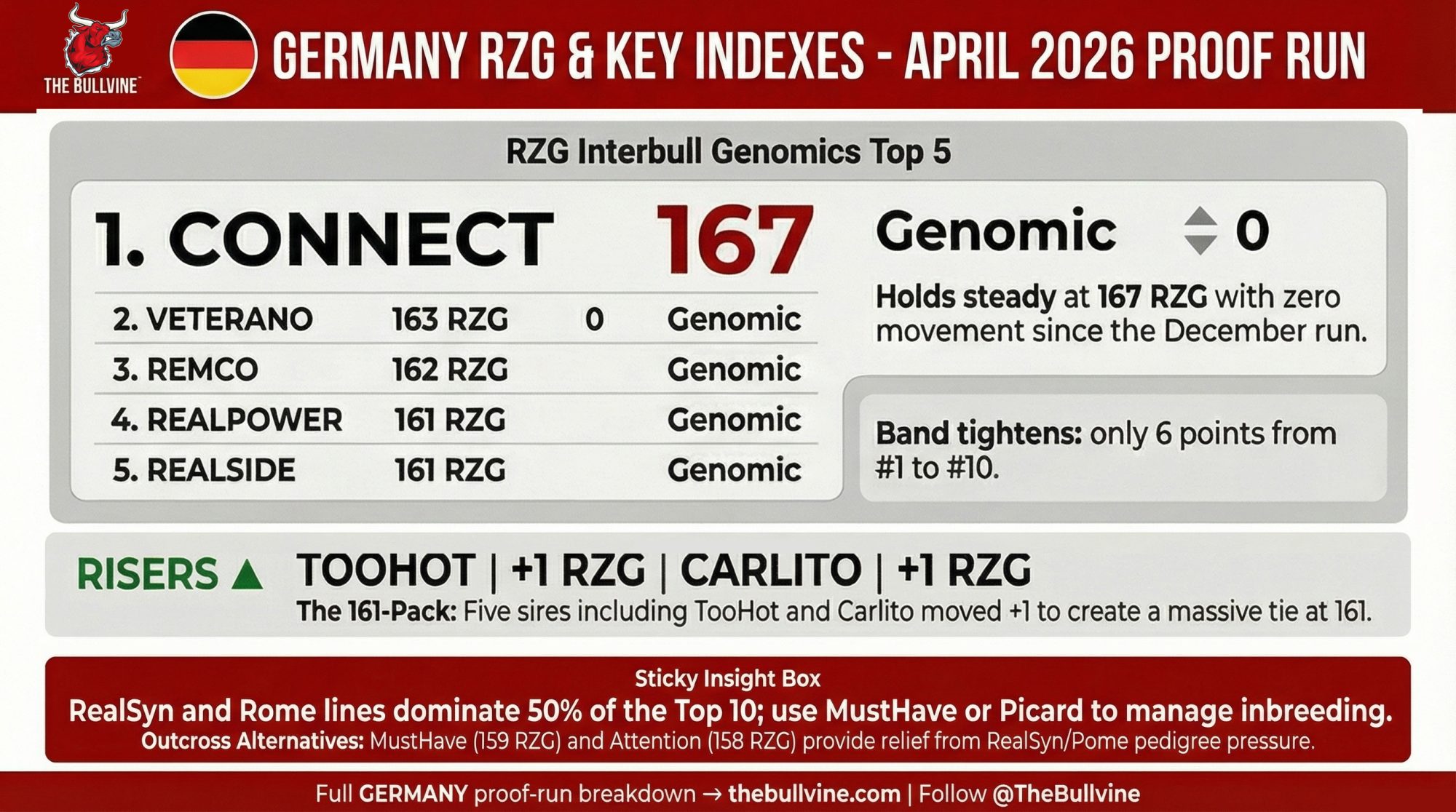
Connect holds the line. Germany’s April 2026 RZG evaluation lands with the Comet son exactly where he stood in December — 167 RZG on both the Interbull and domestic genomic lists, unmoved run to run. All 10 Interbull genomic top‑10 sires return from December 2025 with no new entrants, so this is a stability run at the very top of German Holstein Black & White.

That stability is deceptive, though. The gap between Connect and the pack shrank: the #1‑to‑#10 band compressed from 7 points (167–160 RZG, December 2025) to just 6 (167–161 RZG, April 2026), with Remco climbing to 162 RZG from 161 and seven other sires all ticking from 160 to 161 over the same period. Meanwhile, the daughter‑proven world tells a different story — Picard edges up to 148 RZG in April 2026 from 147 in December, pulling Pattern, Zivet, Glarus, and Glenn into a tighter functional band that sits 13–19 points below the genomic elite but with far more reliability behind it. And in Red & White, HarmonicP arrives at 163 RZG in April 2026 (up from 161 in December 2025), suddenly competitive with half the B&W genomic top 10 and setting up the sharpest black‑vs‑red contrast this system has produced in recent runs.

April 2026 RZG (Holstein B&W, Interbull Genomics): Top 10 Sires

RankBullIndex value + datePrevious value + dateChangeStud
1Connect167 RZG, Apr 2026167 RZG, Dec 20250Synetics
2Veterano163 RZG, Apr 2026163 RZG, Dec 20250
3Remco162 RZG, Apr 2026161 RZG, Dec 2025+1Phönix
4Realpower161 RZG, Apr 2026160 RZG, Dec 2025+1Synetics
5Realside161 RZG, Apr 2026160 RZG, Dec 2025+1Synetics
6TooHot161 RZG, Apr 2026160 RZG, Dec 2025+1Phönix
7Carlito161 RZG, Apr 2026160 RZG, Dec 2025+1Phönix
8Evenstar161 RZG, Apr 2026160 RZG, Dec 2025+1PHX/Qnet
9RealSteel161 RZG, Apr 2026160 RZG, Dec 2025+1
10Romantiker161 RZG, Apr 2026160 RZG, Dec 2025+1Phönix
  • Connect stays #1 at 167 RZG in April 2026, after 167 RZG in December 2025, while the rest of the top 10 compresses tightly at 161–163 RZG. 
  • All 10 are returning genomic sires; there are no new‑in‑top‑10 entrants in April 2026, and no December top‑10 drop‑outs. 
  • The band from #1 to #10 is now just 6 RZG points (167 to 161) in April 2026 versus 7 points last run (167 to 160), indicating further tightening at the top. 
  • Within the 161‑RZG pack, the +1 shifts from 160 RZG, December 2025, to 161 RZG, April 2026, signal micro‑re‑ranking rather than structural change. 

Big RZG risers inside the top 10

  • Remco climbs from 161 RZG, December 2025, to 162 RZG, April 2026, picking up on already strong RZ Milch and RZ Fleisch and pairing that with a balanced RZ Gesund block — a neat “more of everything” move without obvious new holes; as a fully genomic sire, his reliability remains materially lower than the proven anchors. 
  • Realpower steps from 160 RZG, December 2025, to 161 RZG, April 2026, with the profile leaning slightly more to RZ Milch and RZ Fruchtbarkeit than his RealSyn contemporaries, making him a marginally safer production‑plus‑fertility play in this cluster for herds wanting that tilt. 
  • Realside follows the same 160 to 161 RZG, December 2025 to April 2026 uptick, but does it with a touch more RZ Exterieur at the expense of RZ Persistenz, suiting type‑conscious herds that can live with slightly less longevity. 
  • TooHot also jumps from 160 to 161 RZG, December 2025 to April 2026, nudging up in RZ Gesundheit and RZ Kälberfit while accepting more modest RZ Exterieur, making him a health‑leaning option in the 161 group for herds prioritizing health over maximum type. 

Big fallers / notable drop‑outs

  • There are no big fallers within this specific Interbull genomic top 10: all nine 161‑RZG sires move just +1, and Connect and Veterano remain static between December 2025 and April 2026. 
  • Outside the top 10, MustHave holds 159 RZG, April 2026, after 159 RZG, December 2025, and therefore remains just outside the Interbull top 10; he retains clear strength in RZ Milch and RZ Fleisch, so still fits high‑component, index‑driven matings even if the headline rank hasn’t improved. 
  • On the domestic genomic list, Topchamp sits at 158 RZG in April 2026, unchanged from 158 RZG in December 2025, with a fractionally weaker RZFit profile than the very top group but a clearly strong RZ Exterieur, retaining niche value in type‑oriented programs despite staying out of the Interbull top tier. 

What this index is rewarding now

  • The current top 10 is clearly rewarding high RZ Milch combined with robust RZ Gesundheit and calf fitness: Connect sits at 120 RZ Milch, 113 RZ Gesundheit, and 135 RZGes, April 2026, while Remco (138 RZ Milch, 123 RZGes) and Realpower (117 RZ Milch, 118 RZGes) illustrate the “production + health” template. 
  • Trade-off-wise, Realside and Carlito bring more RZ Exterieur and RZ Fundament at the cost of slightly lower RZ Persistenz and RZ Kalbeverlauf compared with Connect and Realpower, so they upgrade frames and feet‑and‑legs but are a shade more management‑sensitive regarding longevity and calving ease. 
  • SaturnRDC shows how the system still pays for RZG in Red‑carrier packages when they can match B&W on RZ Milch and RZ Gesundheit, offering a color-flexible route into the same index logic for herds wanting that genetic option. 

Stud and family concentration

  • Synetics dominates the Interbull genomic top 10 with Connect, Realpower, Realside, and Grafti (just outside at 155 RZG, April 2026), while Phönix owns Remco, TooHot, Carlito, Romantiker, and much of the domestic 99‑RZG band. 
  • The RealSyn and Rome sire lines appear repeatedly (Realpower, Realside, RealSteel, RealLife, Roadhouse; Romantiker, Roadstar, Ramirez), making sire‑stacking around these brands a real inbreeding and diversity concern for anyone using multiple bulls from this cluster. 
  • As outcross moves within this context, MustHave (AltaMuller × non‑RealSyn dam stack) and Attention(Adonis × Arizona) are two practical options to step out of the RealSyn/Rome saturation while remaining at or above 158 RZG in April 2026. 

How stable is Germany’s RZG top tier right now?

  • All 10 Interbull genomic top‑10 bulls from December 2025 return in April 2026, with Connect and Veterano unchanged and the rest gaining just +1, so this is a low‑churn, low‑shock run at the elite end. 
  • The compression from a 7‑point band (167–160 RZG, December 2025) to 6 points (167–161 RZG, April 2026) means breeders are deciding between very similar total‑merit levels and need to lean more on trait shape, reliability, and pedigree than on raw RZG gaps. 
  • Because all of these sires are still genomic, the apparent stability shouldn’t be over‑interpreted as permanent; future daughter data could still significantly reshuffle this pack. 

Volatility and reliability

  • All top‑10 Interbull B&W RZG bulls are genomic; there are zero daughter‑proven sires in this list, so the top is structurally volatile and still heavily genomic‑weighted in terms of reliability. 
  • Connect at 167 RZG, April 2026, and Remco at 162 RZG, April 2026, are the key high‑index/low‑reliability volatility plays; both sit on moderate daughter numbers and heavy genomic weight, so large swings remain possible as daughter information accumulates. 
  • On the proven side, Picard at 148 RZG, April 2026 (147 RZG, December 2025) and Pattern at 145 RZG, April 2026 (145 RZG, December 2025) are the obvious anchors, with full daughter‑proven reliability and stable multi‑run RZG. 
  • Glenn and Glarus, both at 143 RZG in April 2026, with small negative or flat moves vs 143 RZG in December 2025, provide additional high‑reliability ballast for programs that want fewer surprises than the genomic cluster offers. 

Domestic RZG B&W Genomics — A Different Top 10

Mini top‑5 table (domestic active genomic, April 2026)

RankBullRZG (Apr 2026)Primary-index rank (Interbull)
1Connect167 RZG, Apr 20261
2Remco162 RZG, Apr 20263
3Realpower161 RZG, Apr 20264
4Realside161 RZG, Apr 20265
5TooHot161 RZG, Apr 20266
  • Connect, Remco, and Realpower lead both the Interbull and domestic genomic lists, so domestic usage aligns more closely with the global RZG picture in April 2026 than in December 2025. 
  • Key movers here are the same as at Interbull: Remco, Realpower, Realside, and TooHot all add +1 RZG from December 2025 to April 2026, but their domestic rank order emphasizes local availability and stud alignment over raw value changes. 
  • The domestic list adds nuance: SaturnRDC at 161 RZG, April 2026, and Roadhouse at 160 RZG, April 2026 (both unchanged from their December 2025 RZG levels) bring Red‑carrier and slightly more RZ Fruchtbarkeit and RZ Kalbeverlauf into the same band, which the Interbull headline table partially hides. 
  • Overall, this index rewards roughly the same traits as Interbull RZG, but domestic ranks give extra weight to health and calving ease (SaturnRDC, SemianRDC) and to stud portfolio breadth. 

Daughter‑Proven RZG B&W — Proven Power in a Genomic World

Mini top‑5 table (Interbull B&W daughter‑proven, April 2026)

RankBullRZG (Apr 2026)
1Picard148 RZG, Apr 2026
2Pattern145 RZG, Apr 2026
3Zivet144 RZG, Apr 2026
4Glarus143 RZG, Apr 2026
5Glenn143 RZG, Apr 2026
  • Picard leads the proven list at 148 RZG in April 2026, after 147 RZG in December 2025, while the genomic Connect/Remco/Realpower group sits 13–19 points higher but without his high daughter‑proven reliability. 
  • Pattern stays solid at 145 RZG, April 2026 vs 145 RZG, December 2025, and Zivet edges up to 144 RZG, April 2026, from 143 RZG, December 2025, while keeping a very even mix of RZ Milch, RZ Exterieur, and RZ Gesundheit, making them calmer, all‑round options compared with the more aggressive genomic plays. 
  • Glarus and Glenn hold at 143 RZG, April 2026, both offering strong RZ Exterieur and RZEuterus structure, so they remain go‑to options for herds wanting uniform udders and legs without giving away too much total RZG. 
  • This index clearly rewards proven production plus functional traits over sheer RZG height: the top‑5 proven sires sit below the genomic elite but come with far tighter RZ and RZGes confidence bands. 

Where the Indexes Agree — and Where They Don’t

Consensus sires

  • Connect is #1 on both Interbull genomic and domestic genomic RZG at 167 RZG, April 2026, so any RZG‑focused genomic program that down‑weights him is consciously stepping away from the system’s own consensus. 
  • Remco sits #3 on Interbull genomic and #2 domestically at 162 RZG, April 2026, with almost identical trait shape in both systems, making him the logical high‑index “second pillar” behind Connect in RZG‑driven genomic stacks for herds comfortable with genomic risk. 
  • On the proven side, Picard at 148 RZG, April 2026 (147 RZG, December 2025), and Pattern at 145 RZG, April 2026 (145 RZG, December 2025), appear consistently at or near the top of daughter‑proven lists, reflecting the cross‑index agreement that these are the current reliability kings. 

Rank‑divergent sires (illustrative table)

  • Connect and Remco are true cross‑index leaders inside genomics, but they don’t appear on the proven tables yet; for breeders, that’s the classic “high reward, high volatility” trade: for herds prioritizing fast genetic gain and willing to tolerate future re‑ranking, they are obvious first‑line sires. 
  • Realpower looks slightly better domestically (rank 3) than his Interbull rank (4) suggests, reflecting how his trait mix — particularly RZ Fruchtbarkeit and RZFit — is valued by German buyers; for herds prioritizing fertility within a high‑RZG genomic stack, he’s the more conservative complement to Connect and Remco. 
  • SaturnRDC only appears as a domestic genomic 161‑RZG, April 2026 bull, and doesn’t touch the Interbull top 10, but his RZ Gesundheit and RZ Kalbeverlauf profile makes him valuable for herds with calving and heifer health issues, even though his headline rank lags the main B&W leaders. 
  • Picard sits outside all genomic lists but dominates proven RZG at 148 RZG in April 2026; for risk‑averse programs and commercial daughters‑first herds, his lower index but higher reliability is a rational choice, especially where re‑ranking risk has a real economic cost. 

Core tension

The core tension in this April 2026 German run is between a very tight cluster of 161–167 RZG Interbull genomics bulls — headed by Connect, Remco, and Realpower — and a slightly lower, but far more stable, proven layer anchored by Picard, Pattern, and Zivet. Genomic lists are converging rather than exploding: many bulls at 161 RZG, April 2026, with near‑identical trait profiles, making stud affiliation, pedigree, and management fit more decisive than raw index points. Proven lists, meanwhile, still edge up slowly in RZG (Picard +1, Zivet +1 between December 2025 and April 2026) but don’t threaten genomic heights, so breeders have to choose how much of their heifer and heifer‑dam matings they want to allocate to “167‑RZG genomic volatility” versus “145–148‑RZG proven stability.” Red & White adds a further layer: HarmonicP at 163 RZG, April 2026, and SkypeRed at 163 RZG, April 2026 are genuinely competitive with black‑and‑white indexes, but proven red sires still sit lower, amplifying the same risk‑reliability tension in another color.

How to Use These Sires This Season

  • Cross‑index genomic leaders (Connect, Remco, Realpower)
    For herds prioritizing maximum RZG gain and comfortable with genomic volatility, use Connect as the main sire of sons and heifers, backed by Remco and Realpower on cows, but cap any single bull at a modest share of matings to manage re‑ranking risk. For high‑input housed and robot herds that can fully exploit high RZ Milch and RZGes, this trio fits, while lower‑input or grazing‑leaning systems may want to temper their use with more moderate‑production sires. 
  • High‑reliability anchors (Picard, Pattern, Zivet)
    For herds prioritizing predictability, udder consistency, and moderate calving risk over absolute index height, use Picard and Pattern on high‑value older cows and on problem‑free family lines where you want uniform, saleable daughters, then bring Zivet in to keep RZ Milch and RZGes balanced. 
  • Health and fertility specialists (TooHot, SaturnRDC, Roadhouse)
    For herds targeting better fertility, calf survival, and trouble‑free calvings, deploy TooHot and SaturnRDC on heifers and health‑challenged cow families, while Roadhouse can be used where you want to hold RZG around 160, April 2026, but nudge RZ Fruchtbarkeit and RZ Kälberfit upward, giving up a few points vs Connect and Remco in exchange for more health insurance. 
  • Type‑leaning sires (Realside, Carlito, Glarus, Glenn)
    For herds or show‑leaning segments prioritizing frames, udders, and legs, use Realside and Carlito in the genomic space, then Glarus and Glenn as proven follow‑up sires to lock in type once the pedigree and health package are acceptable. 
  • Outcross / de‑stacking sires (MustHave, Attention, MustHave‑line sons)
    For herds worried about RealSyn/Rome saturation, rotate MustHave and Attention into matings on Connect/Realpower/Remco daughters, accepting a small RZG discount relative to the very top in exchange for more flexible future mating options. 

Within 30 days, pull your current active sire list, mark all RealSyn, Rome, and Comet‑line bulls, and cap that group at a predefined percentage of matings while deliberately adding Picard, Pattern, MustHave, and at least one Red‑carrier like SaturnRDC or HarmonicP to diversify both pedigree and system risk.

Key Takeaways:

  • The top 10 is frozen but squeezed. All 10 Interbull genomic sires return from December, with Connect flat at 167 RZG, and the #1‑to‑#10 band narrowing from 7 points to 6 — raw index rank is no longer enough to pick between them.
  • RealSyn and Rome saturation are portfolio risks, not talking points. Those two sire lines account for roughly half the genomic top 10; herds using multiple bulls from this cluster are stacking the same pedigree and need MustHave, Attention, or a Red‑carrier like SaturnRDC to break the pattern.
  • Picard and Pattern are the only sires in this article that won’t surprise you next run. At 148 and 145 RZG (April 2026), they sit well below the genomic ceiling — but their daughter‑proven reliability means breeders aren’t betting on a number that could move 5+ points in either direction by December.
  • Health and fertility now separate the 161 pack. TooHot and SaturnRDC lean into RZ Gesundheit and RZ Kälberfit; Realside and Carlito lean into RZ Exterieur and RZ Fundament — same RZG, very different daughters, and the right pick depends on whether your problem cows need better immune function or better feet.
  • Your 30‑day move: audit your bloodline exposure. Mark every RealSyn, Rome, and Comet‑line bull on your active sire list, cap that group at a set percentage of matings, and deliberately slot in at least one proven anchor and one outcross genomic sire before the next mating round.

Full Lists

The Sunday Read Dairy Professionals Don’t Skip.

Every week, thousands of producers, breeders, and industry insiders open Bullvine Weekly for genetics insights, market shifts, and profit strategies they won’t find anywhere else. One email. Five minutes. Smarter decisions all week.
NewsSubscribe
First
Last
Consent

The $360 DPR Mistake: Why +950 NM$ Holstein Bulls Bleed Pregnancies in Arizona Heat

One DC305 report, a 15-point Preg‑by‑150 gap — and the realization that +950 NM$ Holstein bulls were bleeding pregnancies in Arizona heat.

Executive Summary: A large Arizona Holstein freestall used DC305 to uncover a 15‑point Preg‑by‑150 gap between winter‑ and summer‑fresh cows on the same repro program. The cooling system checked out; the real problem was a sire stack of +950 NM$ Holstein bulls that couldn’t hold fertility once THI stayed high. Using DCRC/Fetrow economics, the article shows how a 3.5‑point DPR gap is worth roughly $157–$367 — up to $360 — per daughter over three lactations, often beating a 150‑point NM$ advantage in a heat‑stress barn. Lameness math from Robcis et al. 2023 adds another hit: about $336.91 per case plus $13.26 for every lame week, concentrated in tall, angular, low‑BCS sire families. The herd’s answer was to ban negative‑DPR bulls from hot pens, tone down knife‑edge type, track “resilience” in milk curves after heat events, and run a small ProCROSS pilot on the bottom 10–20% of cow families. The piece gives producers hard thresholds — a >15‑point summer Preg150 gap, repeat‑offender sires on lameness and abort lists, and cows that don’t recover milk within two weeks of heat — as practical red flags that their own bull list is built for January, not July.

heat stress fertility

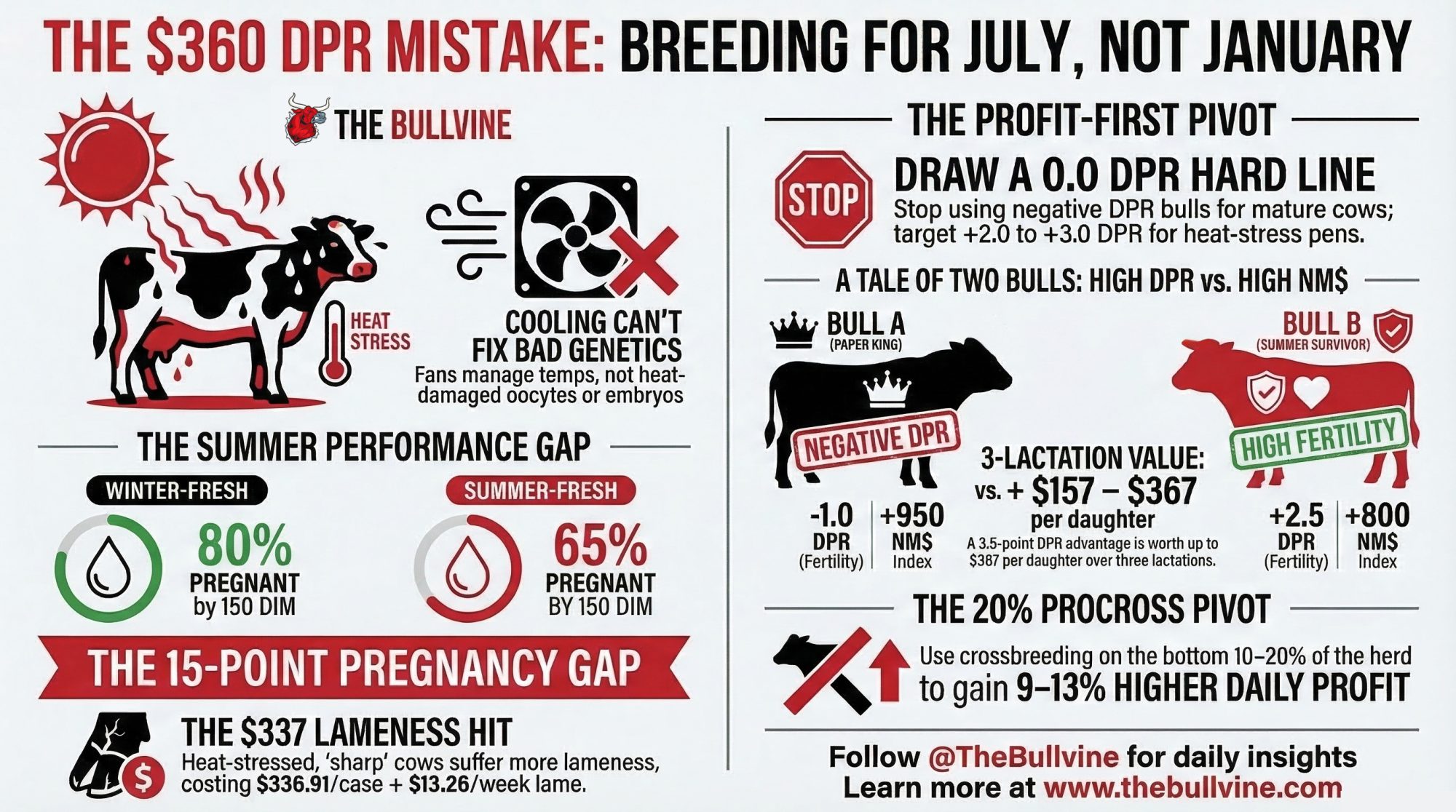
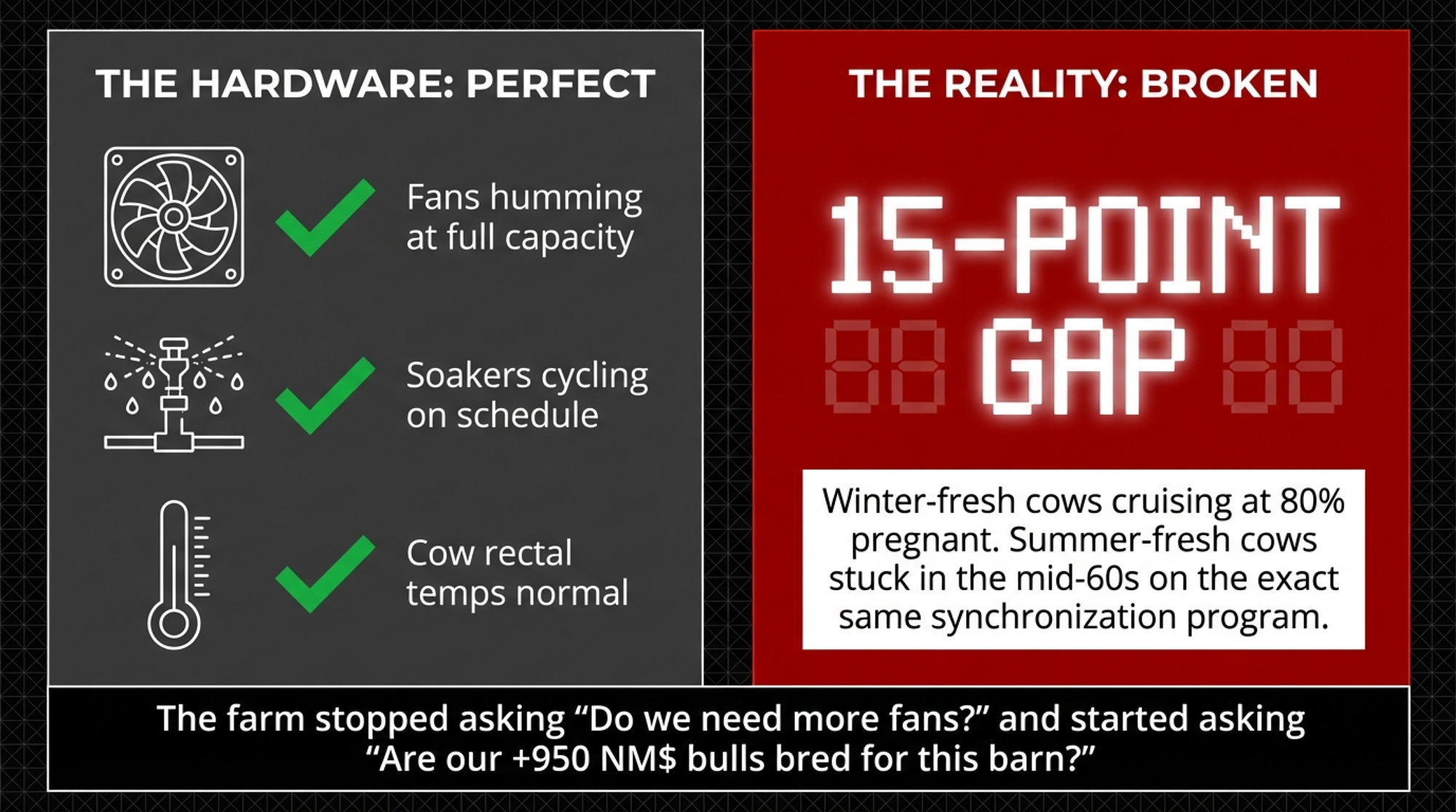
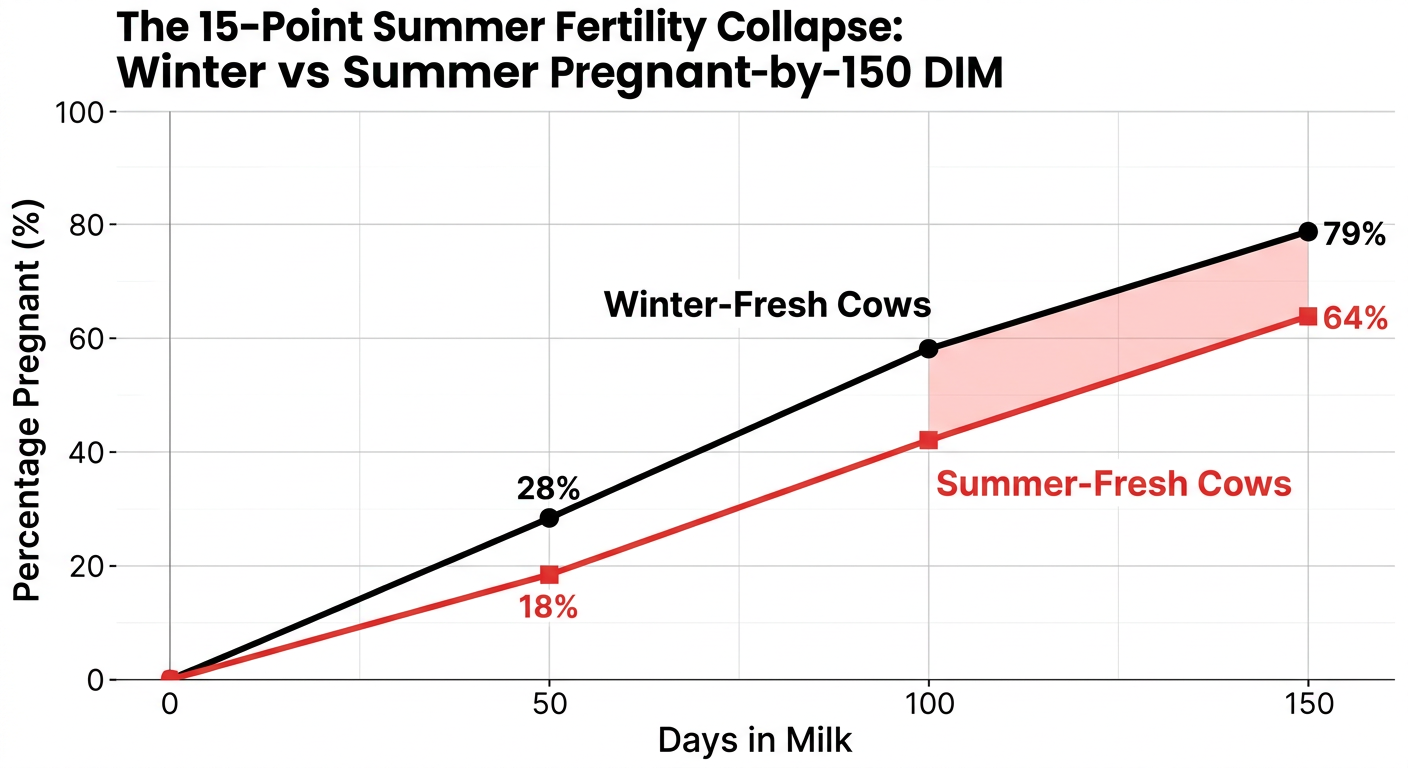
On a big Arizona Holstein freestall, the wake‑up call didn’t come from panting cows or a dead fan. It came from a DC305 screen on a hot August morning, when the herd manager pulled a Pregnant‑by‑150‑DIM report split by calving month and stared at a 15‑point gap between winter‑fresh cows cruising toward 80% pregnant and summer‑fresh cows stuck in the mid‑60s on the same synchronization program.

Fans were humming. Soakers were cycling. Cows were eating. Rectal temps looked reasonable. The only thing that didn’t make sense was why the daughters of certain high‑NM$ bulls collapsed every July while others quietly held up.

That’s when the farm stopped asking, “Do we need more fans?” and started asking a harder question: “Are our +950 NM$ bulls even bred for this barn?”

Days in MilkWinter-Fresh Cows (%)Summer-Fresh Cows (%)
000
502818
1005842
1507964

Why Heat Stress Exposes the Wrong Kind of “Good”

On a lot of Southwest freestalls, sire lists get built in January. The weather’s mild, reproduction looks fine, and national indexes like NM$ feel like safe ground because they average performance across cool freestalls, tiestalls, grazing outfits, and hot drylots. A +950 NM$ bull looks hard to argue with on paper.

Heat stress doesn’t care what the proof sheet says.

Work on U.S. dairy herds shows high‑producing Holsteins start feeling real heat stress at a temperature‑humidity index (THI) in the high‑60s to low‑70s, with milk yield and conception both dropping as THI climbs. In barns that live above that line for weeks, the patterns show up fast when herds split data by calving month: winter‑fresh cows routinely reach 75–85% pregnant by 150 DIM, while summer‑fresh cows in those same barns and programs can slide into the mid‑60s on some farms. Abort rates on pregnancies conceived during the hottest windows often climb noticeably above winter levels and, in some herds, have approached nearly twice the normal baseline. Lameness prevalence tends to bump higher in late summer and fall as cows pay for July and August on their feet.

On herds that have done this kind of DC305 or PCDART split, consultants say the worst heat‑season pregnancies and the ugliest fall lameness often cluster around the same few sire families.

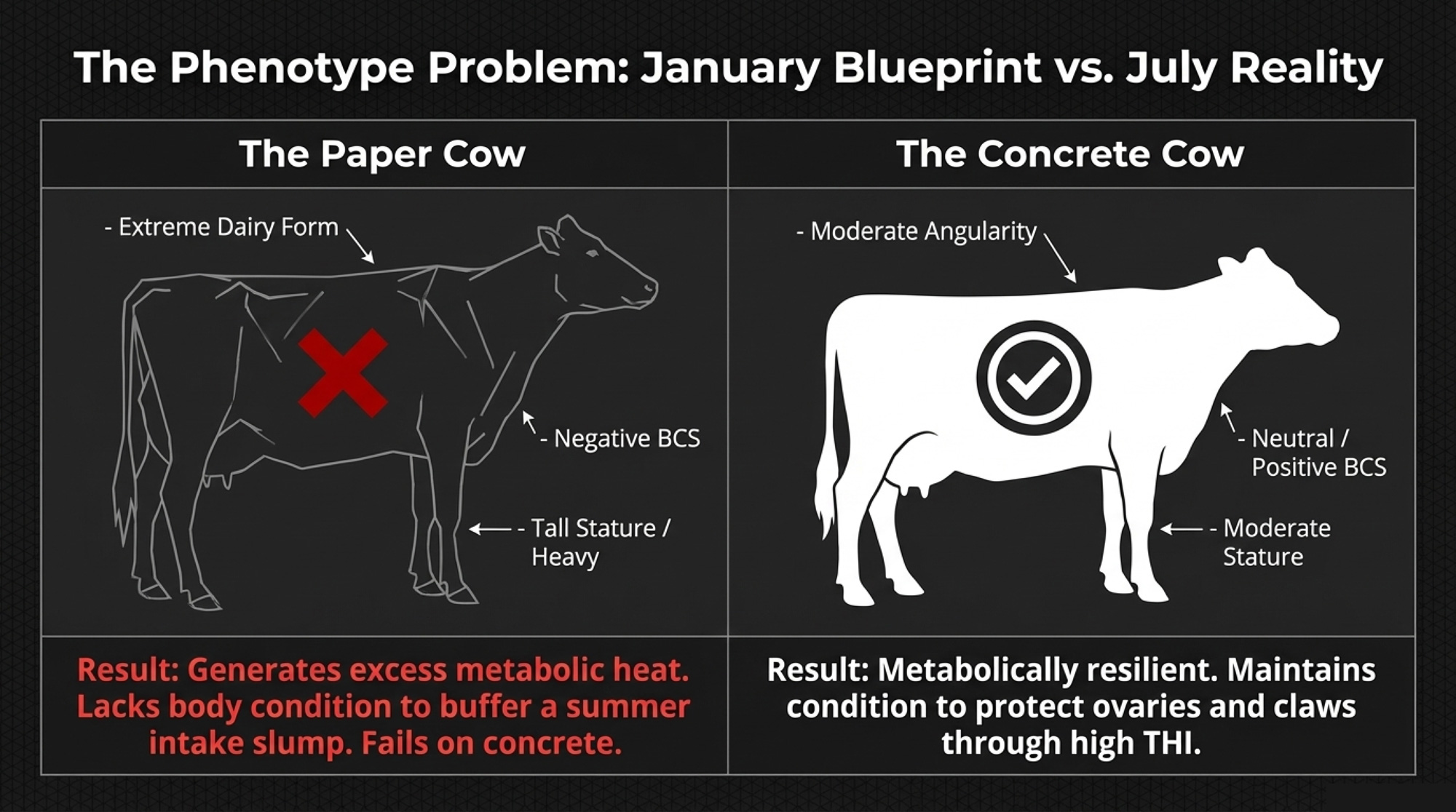
On this Arizona freestall, that cluster shared a familiar profile: very high NM$, big milk, sharp dairy form, negative body condition genetics, and tall frames. Exactly the kind of bulls that looked like automatic “yes” choices when the bull list was built in January.

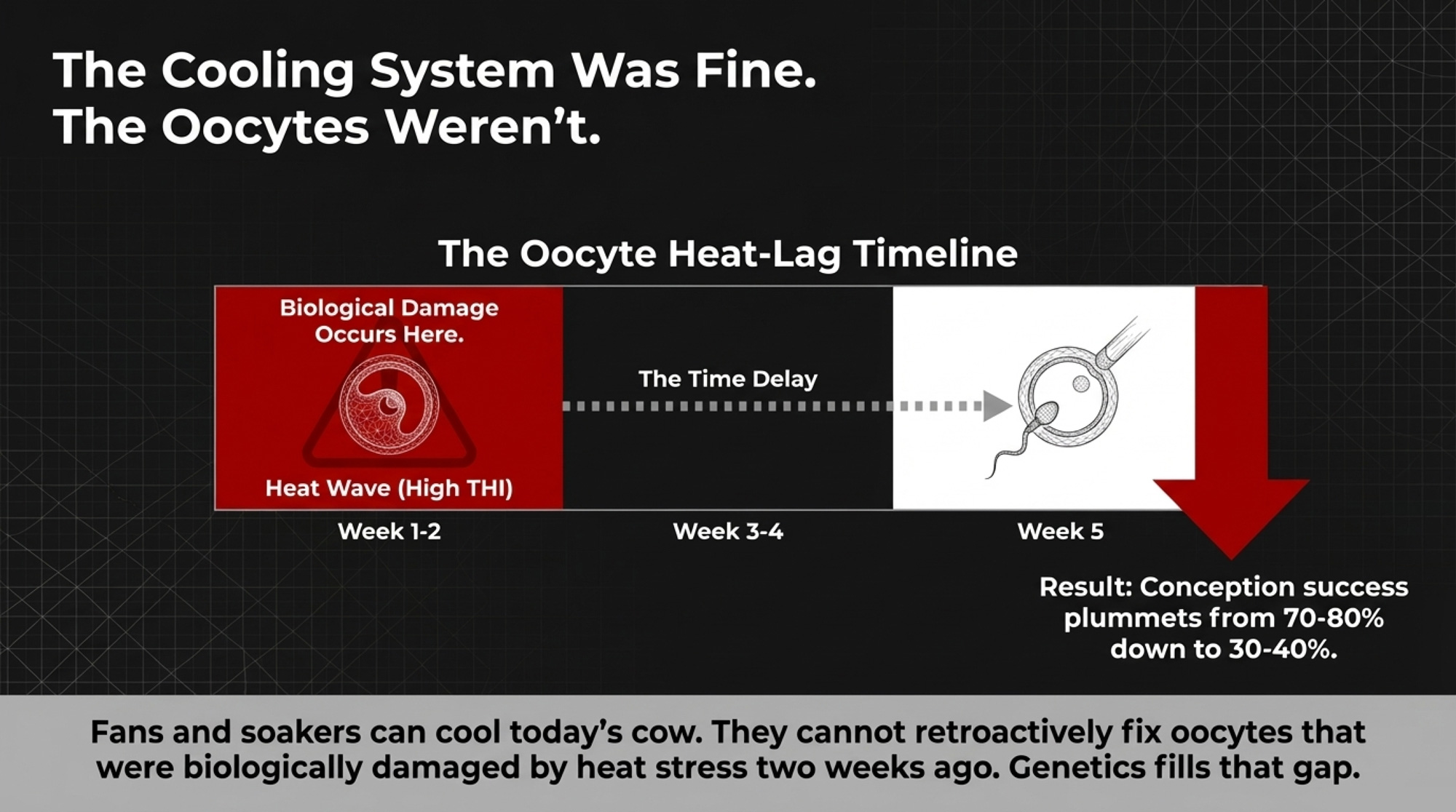
The Cooling System Was Fine. The Oocytes Weren’t.

On that August DC305 check, the herd’s cooling strategy actually looked solid. Cows weren’t piled in front of fans, rectal temperatures mostly stayed out of the danger zone, and milk only dipped hard on the worst days before bouncing back.

Reproduction told a very different story.

Heat stress doesn’t just wreck the day you see cows breathing hard at the bunk. It can damage oocytes during follicle development for weeks before ovulation. In experimental and field work with heat‑stressed cows, researchers have documented large drops in fertilization and early embryo survival — in some settings, rates have fallen from the 70–80% range into the 30–40% range under heat stress.

Early gestation under high THI is also linked to higher embryonic loss, even when cows don’t look obviously distressed. Fans and sprinklers can keep today’s rectal temperatures manageable, but they can’t retroactively fix oocytes that were stressed two weeks ago or embryos that hit a bad stretch of THI in the first month of pregnancy.

Genetics fills that gap. It decides how hard a cow runs metabolically, how much condition she keeps when heat shrinks appetite, and how her reproductive system comes out the other side of three bad weeks. Stack extreme production, negative body condition, and weak fertility on a tall, heavy frame, and small cracks in July turn into big holes by August.

That’s why this herd eventually stopped chasing more hardware and started tearing apart the bull list.

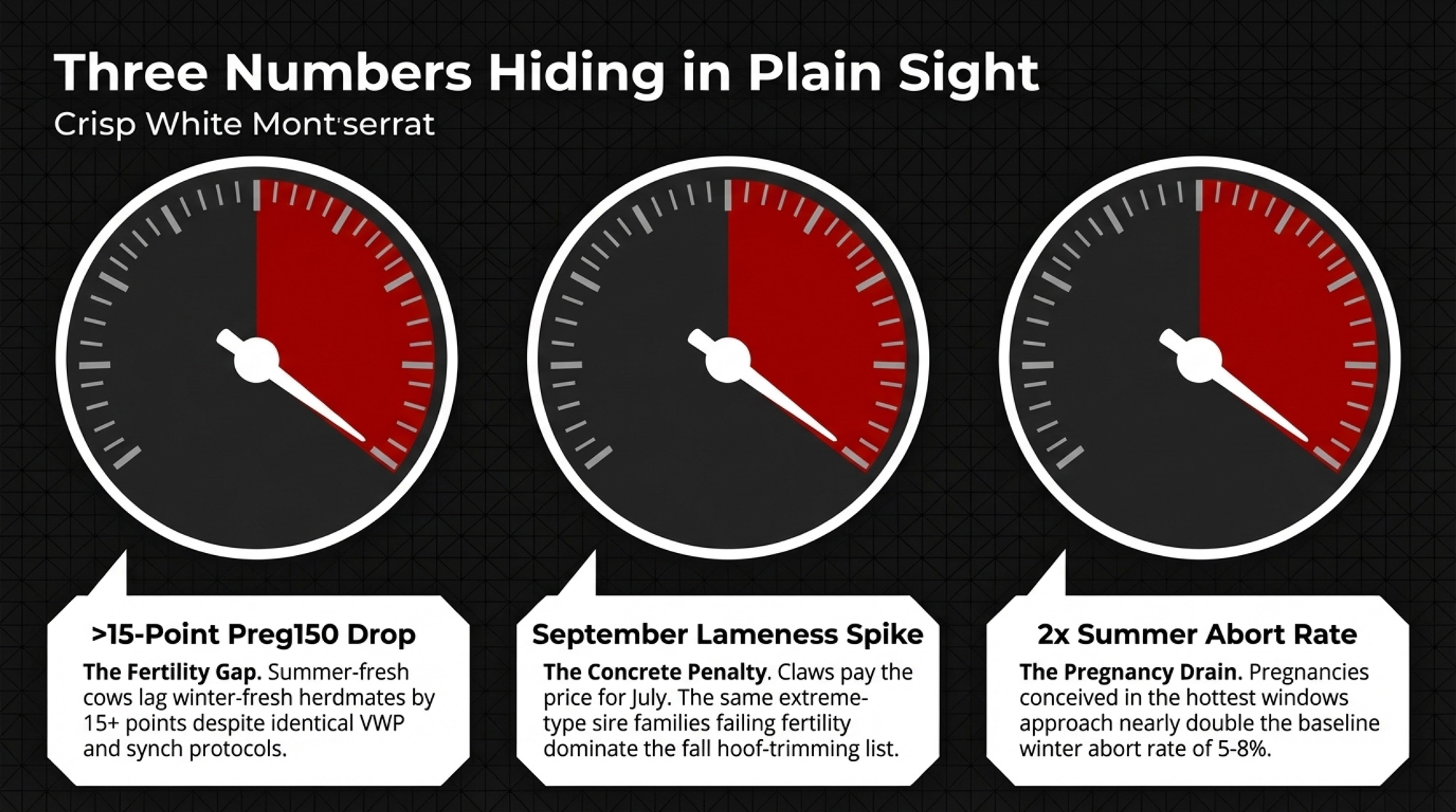
Three Numbers That Should Make You Rethink Your Semen Tank

Once the consultants and the farm sat down with the data, they didn’t start with genomics. They started with three simple, ugly numbers hiding in plain sight.

1. Winter vs Summer Pregnant‑by‑150 DIM

This Arizona herd was comfortably in the 75–85% Preg150 band for winter‑fresh cows. Split the DC305 report by calving month, though, and summer‑fresh cows sat in the mid‑60s — more than 15 points behind.

The facilities hadn’t changed. Same voluntary wait period. Same synchronization protocols. Different genetics trying to get pregnant in the heat.

When they sorted those summer cows by sire, a handful of high‑NM$ family names kept surfacing near the bottom of the Preg150 rankings.

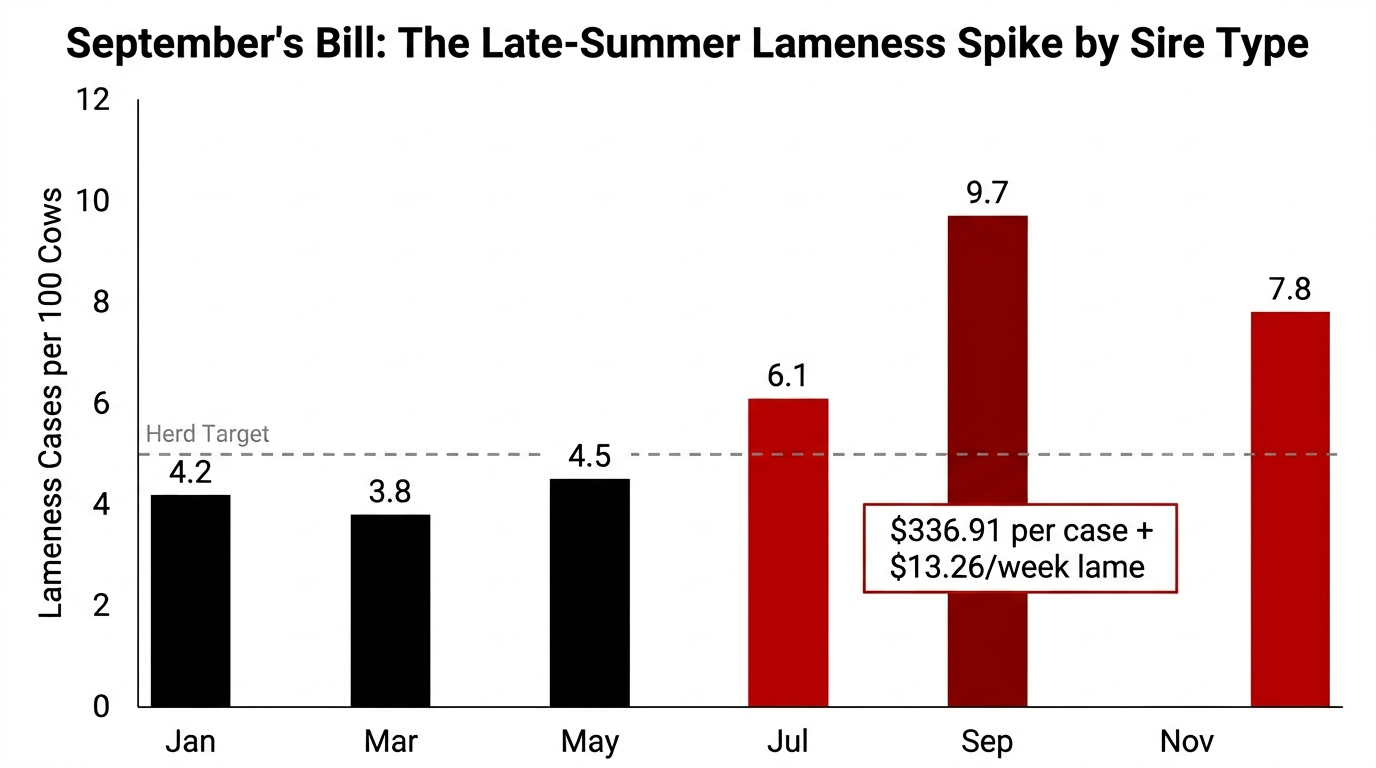
2. The September Lameness Bump

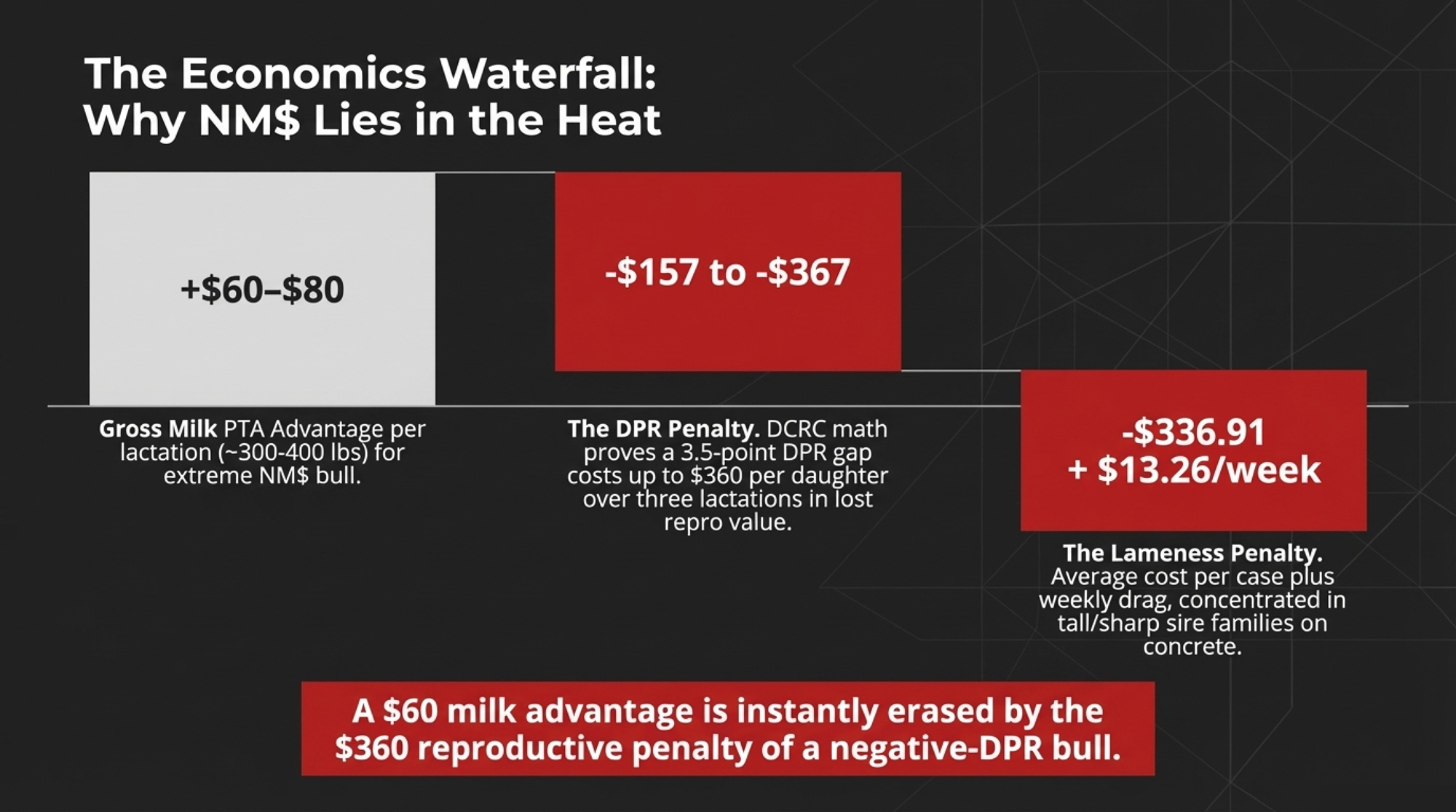
Lameness isn’t just a welfare issue — it’s a clean‑cut economic drag. A Penn State Extension summary of an April 2023 Journal of Dairy Science paper by Robcis and colleagues put the average cost of a lameness case at about $336.91 per cow, once you include lost milk, repro penalties, treatment, and culling risk. For every week a cow stays lame, the model tagged roughly $13.26 in additional lost profit.

When this herd charted lameness by month, the line climbed in late summer and stayed high into fall. Sorting lame cows by sire showed the same families that were failing summer fertility were over‑represented in the hoof‑trimming list.

You don’t need a PhD to connect those dots on concrete in the heat.

3. Abort Rate on Summer Pregnancies

Nobody wants to do pregnancy checks twice. But when the farm looked at abort rates on confirmed pregnancies conceived during the hottest months, the story was just as ugly.

Many herds use a 5–8% abort rate on confirmed pregnancies as a rough field target. On this freestall, winter conceptions sat comfortably in that range. Pregnancies conceived in the hottest windows — especially out of certain sire lines — climbed well above that level and, in their worst years, approached nearly twice the winter baseline.

The same sire stack that shoved cows deeper into negative energy balance and made claws pay for summer was quietly increasing pregnancy loss.

When those three numbers line up — a summer Preg150 gap of 15+ points, a late‑summer lameness bump, and summer abort rates climbing toward twice winter — you’re not just fighting heat. You’re fighting the way your cows are built.

When Heat Stress Turns Holstein Proofs into Liabilities

Once those three numbers were on the table, the next step was to look at the proof sheets behind the problem cows.

The worst offenders shared a familiar set of traits:

  • High dairy form and angularity.
  • Genetically low body condition score.
  • Tall stature and more body weight.

Work using Holstein type and body condition score data has shown a strong negative relationship between dairy form and BCS — sharper cows tend to carry less condition at a given production level. That looks great in a winter show photo. It looks expensive when July shrinks intakes, and you need reserves to protect ovaries and claws.

Heat‑tolerance studies on Holsteins in hot environments report that cows with more extreme angularity and higher production are genetically more sensitive to heat stress — they lose more milk and fertility as THI climbs, with unfavorable genetic correlations between heat‑tolerance indicators and “sharp” type and size. Stack that on top of extra body weight, and you’ve bred a cow that generates more metabolic heat, has less condition to buffer a slump, and pushes harder early in lactation with less room for error.

The bulls that looked perfect in a January bull list turned out to be the wrong fit for an Arizona Holstein freestall in August.

Trait“Paper King” Profile“Summer Survivor” Profile
NM$+950+800
Milk PTAVery high (~+2,200 lb)Moderate (~+1,800 lb)
DPR–1.0 to –2.0+2.0 to +3.0
Body Condition Score (BCS)Negative (–0.5 to –1.0)Neutral to positive (0.0 to +0.3)
Dairy Form / AngularityExtreme / Very sharpModerate
StatureTall (~+2.5 to +3.0)Moderate (~+1.0 to +1.5)
Hoof Health CompositeBelow averageAbove average
Summer Preg-by-150 (field)Bottom quartile (58–65%)Top half (72–80%)
Sept/Oct Lameness FrequencyOver-representedUnder-represented or average

The bulls that quietly held conception rates and stayed out of the hoof‑trimming list looked boring on paper: moderate angularity, neutral or positive body condition score, moderate stature, solid positive DPR and CCR, good hoof‑health composites, and respectable — but not extreme — milk PTAs.

If you want the back story on how Holstein type got so sharp, Four Bulls That Changed the Holstein Breed: Genius, Gambles, and the Price We’re Still Paying is the natural next stop.

How Much Does a Negative DPR Bull Really Cost in the Heat?

This is where the math changed the herd’s thinking.

They had bulls in the tank that looked something like this:

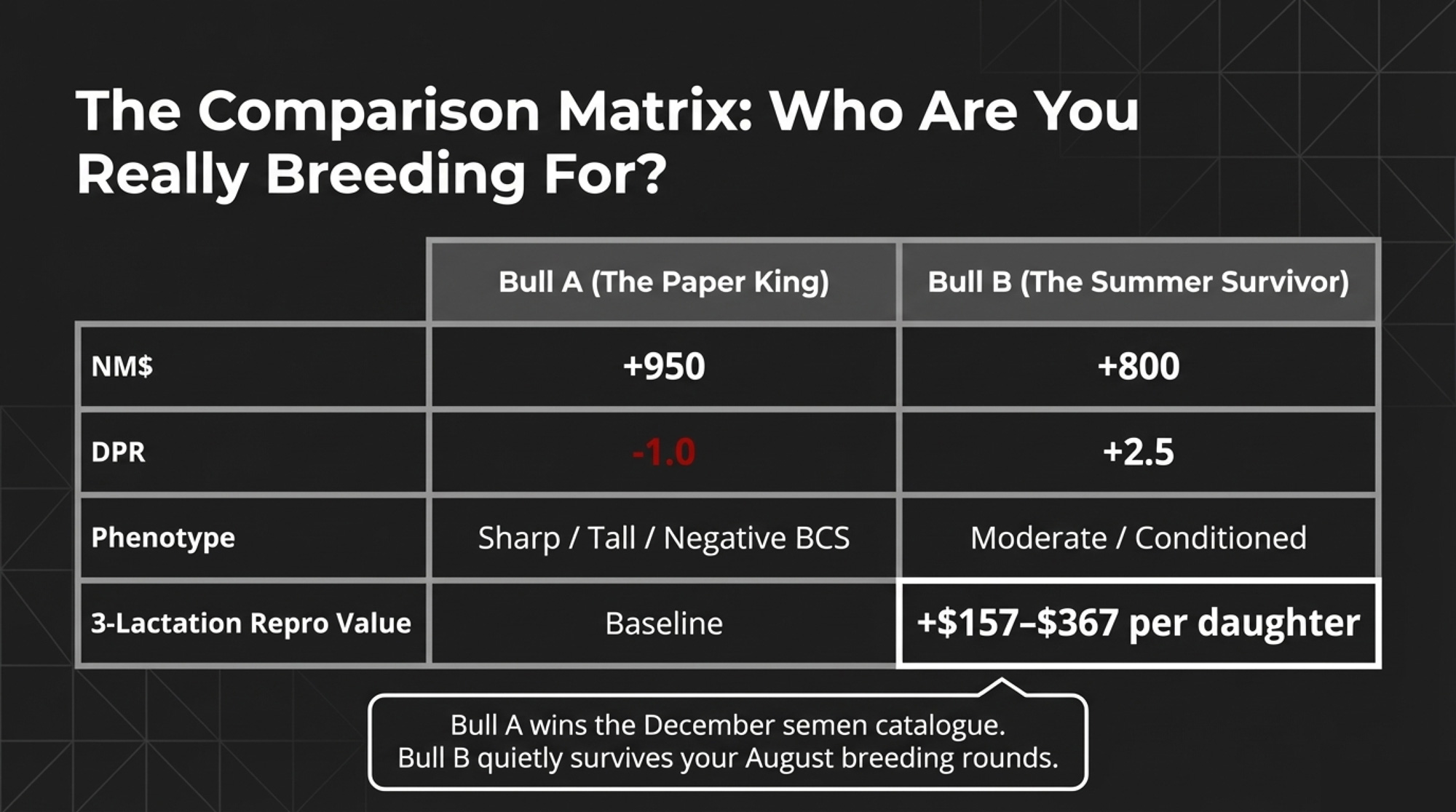
  • Bull A (representative profile): +950 NM$, ‑1.0 DPR.
  • Bull B (representative profile): +800 NM$, +2.5 DPR.

On paper, Bull A feels like the “better” bull. But according to Dairy Cattle Reproduction Council (DCRC) work by Dr. John Fetrow, a one‑percentage‑point improvement in pregnancy rate is worth roughly $15–$35 per cow per year, depending on milk price and the herd’s starting point.

Over a 3.5‑point DPR gap, even at the low end:

  • 3.5 points × $15–$35 ≈ $52–$122 per cow per year in reproduction value.
  • Over three lactations ≈  $157–$367 per daughter in lifetime benefit.

That $157–$367 per daughter is the range this herd kept coming back to. That’s the “$360 DPR mistake” — using the high end of the DCRC range, a 3.5‑point DPR gap can quietly add up to roughly $360 in reproduction value per daughter over three lactations.

At $20/cwt, an extra 300–400 lb of milk PTA is roughly $60–$80 gross per lactation. That matters. But when you add summer days open, abortions, and lameness‑driven culls to the ledger, the reproductive and longevity advantage of a +2.5 DPR bull can match or outweigh the NM$ gap over that cow’s life in a hot barn.

Here’s how that comparison sketches out:

TraitBull A — “Paper King”Bull B — “Summer Survivor”DifferenceWho Wins in Heat?
NM$+950+800–150Bull A
DPR–1.0+2.5+3.5Bull B
Annual Repro Value (DCRC)Baseline+$52–$122/cow/year+$52–$122Bull B
3-Lactation Repro Value+$157–$367/daughter+$157–$367Bull B
Milk PTA Advantage (Bull A)~+350 lb (~$70/lact)~$210 over 3 lact.Bull A
Summer Abort & Days Open CostHigher (daughters fail in heat)Lower (daughters hold fertility)Unquantified penaltyBull B
Net Value Over Life in HeatNM$ advantage eroded by repro lossesRepro value ≥ $360 outweighs NM$ gapBull B

Bull A still looks better on a generic bull list. Bull B looks a lot better when you’re sweating through a July breeding round.

For a wider look at how economics and resilience are reshaping bull lists, From $1.5 Million to $150,000: The Dairy Genetics Shakeout and Your Next Move digs into exactly that.

How This Herd Changed Its Bull List

Once the heat‑season Preg150 gap and the DPR math were on the table, the Arizona freestall made three changes that stuck.

Drew a Hard Line at 0.0 DPR

The first decision was simple: no more negative DPR bulls for cows that have to milk through the heat. Bulls under 0.0 DPR moved to “heifer only” or “do not reorder” for the main herd.

They didn’t chase only extreme fertility bulls. They targeted roughly +2.0 to +3.0 DPR as routine use for mature cows in heat‑stress pens — consistent with DCRC economics showing any gain in pregnancy rate has real dollar value.

That one move cut a lot of angular, low‑BCS, high‑NM$ bulls out of the mature‑cow lineup overnight.

Killed the Knife‑Edge Type in Hot Pens

The second decision came from that ugly September lameness curve.

When they sorted lame fall cows by sire and then looked at proofs, the same patterns kept appearing: high dairy form, negative body condition, taller frames. Those bulls might still earn a slot in specific matings for show‑oriented cow families. But they no longer belonged behind the bulk of cows that had to breed back in August on concrete.

The farm and its genetic adviser agreed to:

  • Avoid extreme dairy form and strongly negative BCS genetics for cows in the hottest pens.
  • Prefer moderate stature and weight for those groups.
  • Put real weight on hoof‑health composites when choosing bulls for young cows already struggling in heat.

That didn’t mean abandoning Holstein type. It meant using it where it pays and pulling it from where it punishes.

Started Watching Milk Curves for “Resilience”

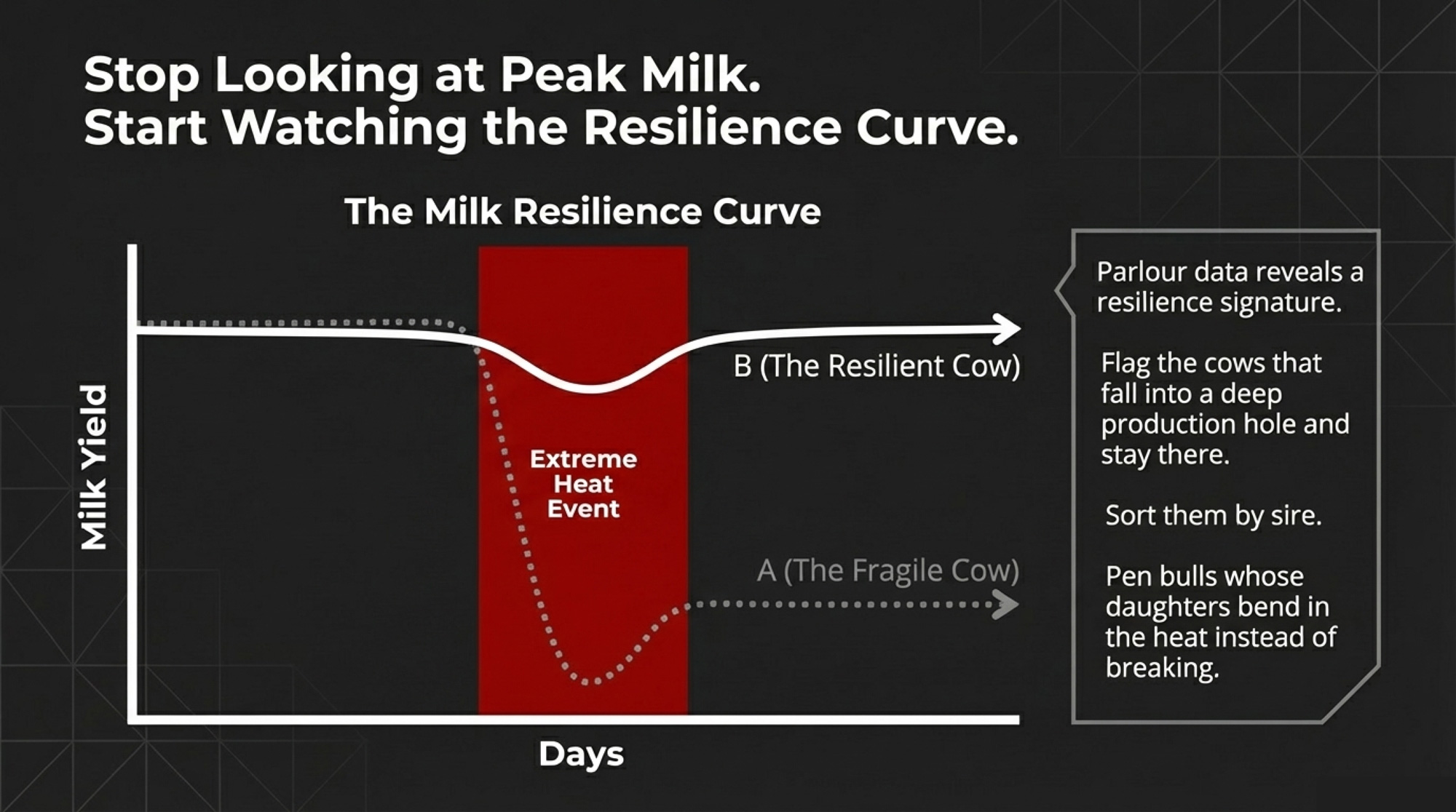
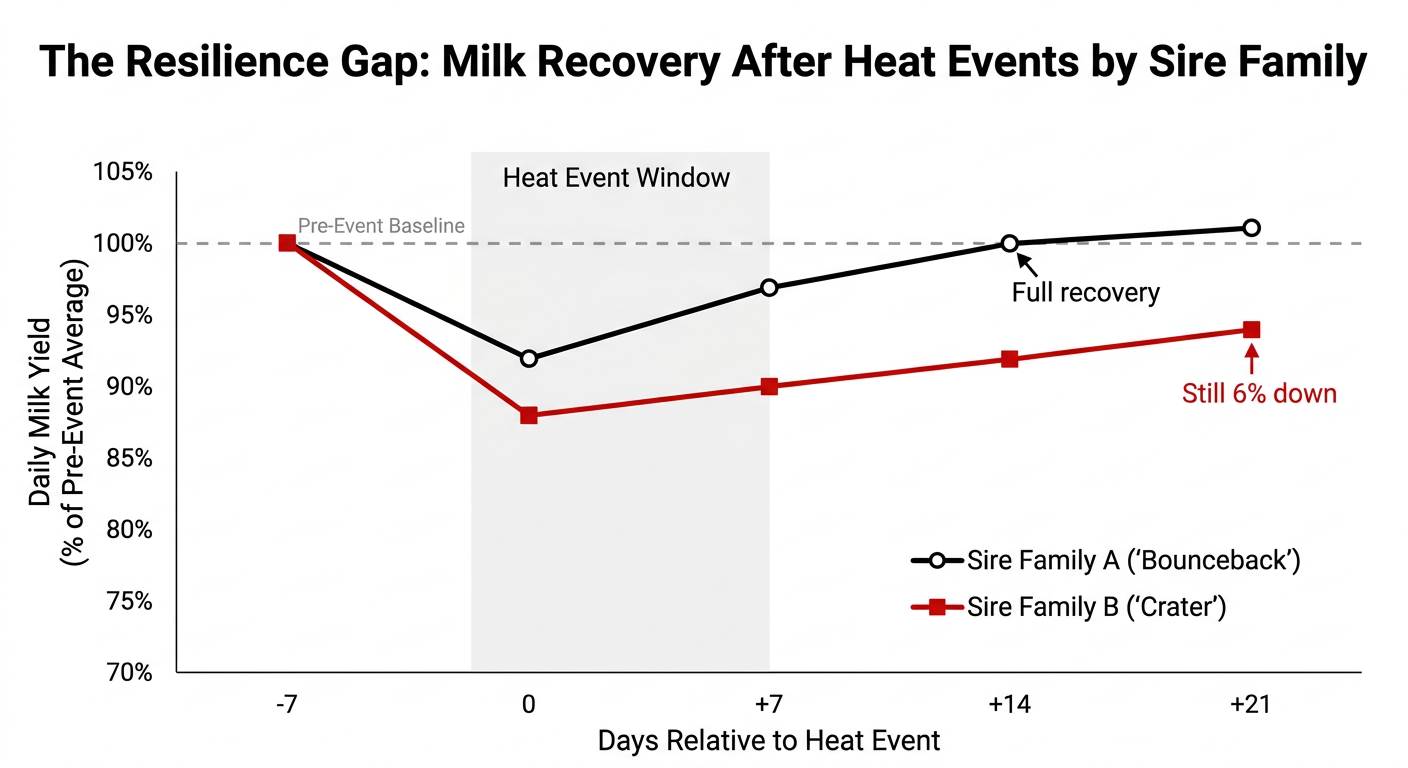
The last change was subtler. The herd had already been logging daily milk through parlour software. After reading emerging work on resilience and day‑to‑day milk variation, they started flagging cows whose production dropped hard during a heat event and didn’t get back near their previous level within two weeks.

They then looked at which sires showed up most often behind those “slow recovery” cows.

Some bulls had daughters whose curves dipped shallowly during hot weeks and bounced back fast. Others fell into a deep hole and stayed there. The farm started treating that “resilience signature” as another signal to move bulls up or down the list — especially for pens that see the worst THI.

It wasn’t a formal index. But it gave them a way to see whether a new round of bulls was producing daughters that bend in heat instead of breaking.

Where Crossbreeding Fit — and Where It Didn’t

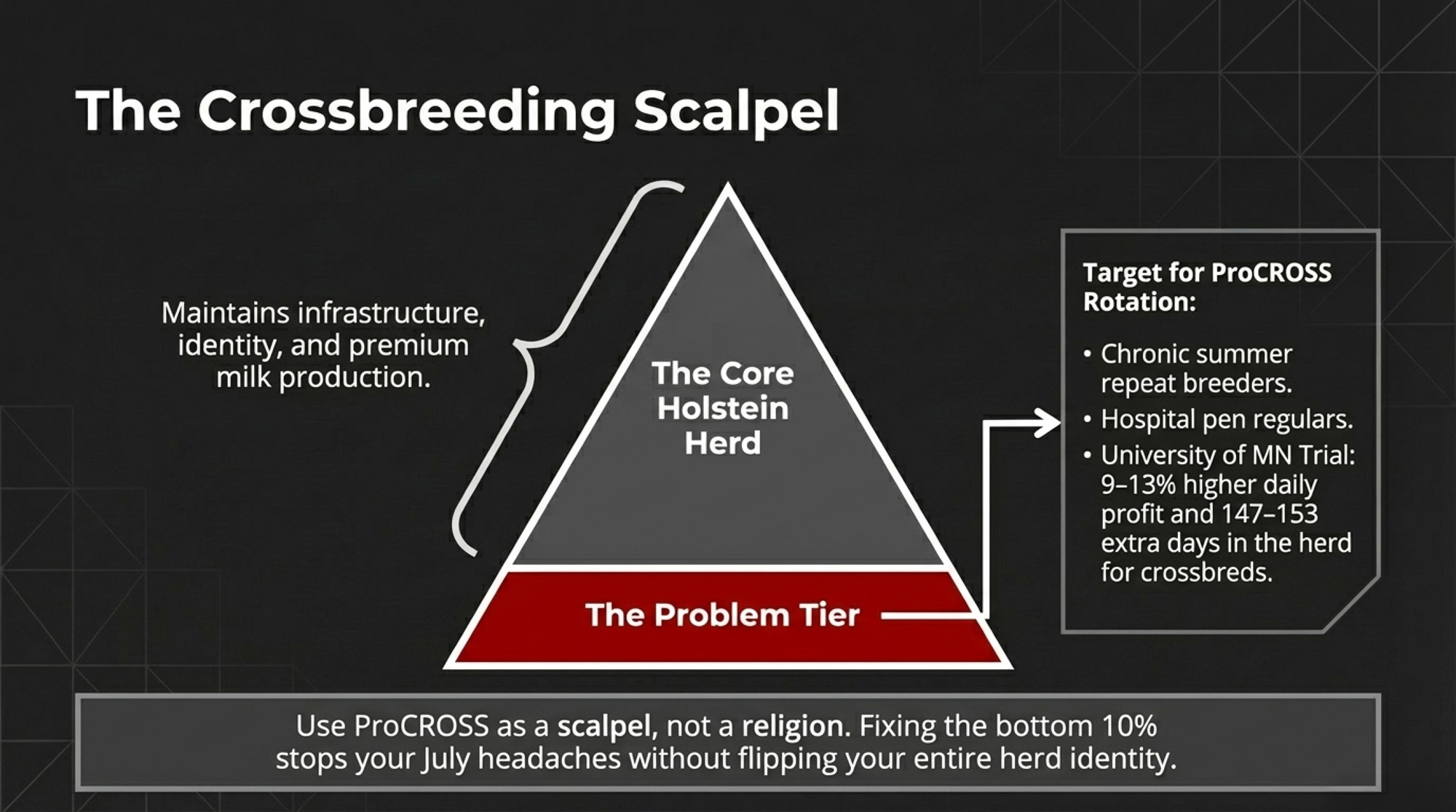
Full‑herd crossbreeding wasn’t on the table for this freestall. They like Holsteins, and their infrastructure is built for Holsteins. But they were honest about the bottom slice of the herd — roughly the bottom 10–20% of cow families that just never seemed to survive summer.

That’s where crossbreeding crept in as a scalpel, not a religion.

A decade‑long, seven‑herd University of Minnesota ProCROSS study led by Brad Heins, Les Hansen, and colleagues found that two‑breed ProCROSS cows (Viking Red × Holstein, Montbéliarde × Holstein) posted about 13% higher daily profit, and three‑breed cows about 9% higher daily profit, than Holstein herdmates in the same systems. Those crossbreds also stayed in the herd roughly 147–153 more days than Holsteins, depending on the specific analysis.

MetricHolstein Controls2-Breed ProCROSS (VR × HO or MB × HO)3-Breed ProCROSS (VR × MB × HO)
Daily Profit per CowBaseline+13% higher+9% higher
Extra Days in HerdBaseline+153 days+147 days
Body ConditionLowerStronger, better reservesStronger, better reserves
Pregnancy RateLowerHigher in heat stressHigher in heat stress
Sick Days / Hospital PenHigherFewerFewer
Study Duration10 years, 7 herds (UMN Heins/Hansen)10 years, 7 herds10 years, 7 herds

Mike Osmundson of Creative Genetics in California has seen similar patterns on commercial dairies using a three‑breed rotation for two decades. In Progressive Dairy coverage, he described crossbred cows in those herds as “stronger cows with better body condition, higher pregnancy rates and fewer sick days spent in the hospital.”

On this Arizona freestall, the family didn’t flip the whole herd. But they started using a ProCROSS‑style rotation on a small slice — roughly the bottom 10–20% of cow families that kept showing up as repeat problems in summer:

  • Chronic summer repeat breeders.
  • Cow families with bad summer fertility and hoof histories.
  • Heifers out of sires that showed up too often on their “summer problem” list.

Those crossbred cows stopped being a constant July headache. That alone justified keeping a small crossbred pilot going on the worst tier instead of pouring more high‑NM$ Holstein semen into the same trouble families.

For a broader view on how a decade of crossbreeding research lines up with inbreeding and profit, The $200‑Per‑Cow Blindspot: What Rising Inbreeding Is Costing You and What a Decade of Crossbreeding Research Is Really Saying ties those threads together.

Is Your Sire List Built for January or July?

After three summers of watching the numbers, this Arizona herd stopped thinking about “good bulls” and started thinking about “right bulls for this climate and this concrete.”

That’s the real question for any Holstein freestall living above a THI of 68 for weeks at a time. You might have as many or more fans and soakers as this herd. The question is whether your sires are built for those nights when the barn never really cools down.

You don’t need genomic heat‑tolerance proofs to see the gap. It’s already sitting in your Preg150, abortion, lameness, and daily milk data.

What This Means for Your Operation

In the next 30 days, you can steal a lot of this herd’s learning without copying their exact program:

  • Pull your own Pregnant‑by‑150 DIM by calving month. If your winter group is in the 75–85% range and your summer‑fresh cows are more than 15 points behind, you’re likely fighting a genetics‑plus‑heat problem, not just a cooling problem.
  • Sort summer Preg150 and abort rates by sire. Look for bull families that consistently post lower Preg150 and higher abort rates on summer conceptions; those sires should be the first to move down your list for cows that milk in heat.
  • Draw a hard line at 0.0 DPR for hot‑season pens. Bulls under that mark can move to limited heifer use or out of rotation entirely for mature cows on concrete in heat. Bulls in the +2.0 to +3.0 DPR range with decent NM$ give you a better balance in those pens.
  • Map your September and October lameness by sire. If the same angular, low‑BCS, tall‑frame families keep showing up, they’re costing you twice — in claws and in pregnancies — every time the barn heats up.
  • Flag cows that took more than two weeks to recover milk after last summer’s worst heat event. Sort by sire. Bulls whose daughters fall into deep production holes and stay there should move down the list for hot pens; bulls whose daughters bounce back quickly deserve more work.
  • Consider a small crossbreeding pilot for your bottom 10–20%. If you’ve got chronic summer repeat breeders and cow families that live in the hospital pen, a limited ProCROSS‑style trial on that tier may clean up headaches without changing your whole herd identity.

Looking further out:

  • By 90 days — before your next summer breeding peak — compare this summer’s Preg150 by sire to last summer’s. Did the bull‑list changes move the needle? If not, widen the DPR floor or swap more moderate‑type sires into hot‑pen rotations.
  • In 365 days, run a full summer‑to‑summer comparison of Preg150 and lameness by sire. The target: close at least half of your winter‑summer Preg150 gap and flatten the September lameness curve. If you can’t, the site list still isn’t built for your climate.

The point isn’t to copy somebody else’s sire list. It’s to make sure your list is built for your actual climate and flooring — not for a barn that only exists in a December bull catalogue.

Key Takeaways

  • If your summer Pregnant‑by‑150‑DIM sits more than 15 points lower than winter in a well‑cooled Holstein freestall, you’re probably not just fighting heat — you’re fighting the way your cows are put together.
  • A 3.5‑point DPR advantage is worth roughly $157–$367 per daughter over three lactations, based on DCRC/Fetrow economics of $15–$35 per point of pregnancy rate per cow per year. That can easily match or outrun a 150‑point NM$ gap once heat‑driven days open, abortions, and culls hit the ledger.
  • Bulls with extreme dairy form, negative body condition score, and tall frames look great in a January photo. In July, they often show up at the bottom of your Preg150 list and at the top of your hoof‑trim list — at roughly $336.91 per lameness case plus $13.26 for every week a cow stays lame, based on Robcis et al. 2023 and Penn State’s extension summary.
  • Crossbreeding isn’t all‑or‑nothing. Used with intention on the worst 10–20% of cow families, a ProCROSS‑style rotation — which delivered 9–13% higher daily profit and around 147–153 extra days in the herd than Holsteins in the University of Minnesota trial — can turn chronic summer headaches into boring, profitable cows without changing the rest of your program.

The Bottom Line

This Arizona freestall didn’t fix its summer fertility gap by installing one more fan. It fixed it by admitting that some of the fanciest bulls in the tank were the wrong bulls for a barn that lives in the heat.

If your cooling system already belongs in 2026 but your summer Preg150 still looks like 2002, the most profitable move you’ll make this year might not be steel or concrete. It might be pulling a few “paper kings” from the lineup and giving more work to the bulls that actually survive July in your postcode.

So when you pull your own summer Preg150 and lameness by sire, which bulls are you really breeding for — January or July?

Complete references and supporting documentation are available upon request by contacting the editorial team at editor@thebullvine.com.

Learn More

The Sunday Read Dairy Professionals Don’t Skip.

Every week, thousands of producers, breeders, and industry insiders open Bullvine Weekly for genetics insights, market shifts, and profit strategies they won’t find anywhere else. One email. Five minutes. Smarter decisions all week.
NewsSubscribe
First
Last
Consent
Send this to a friend