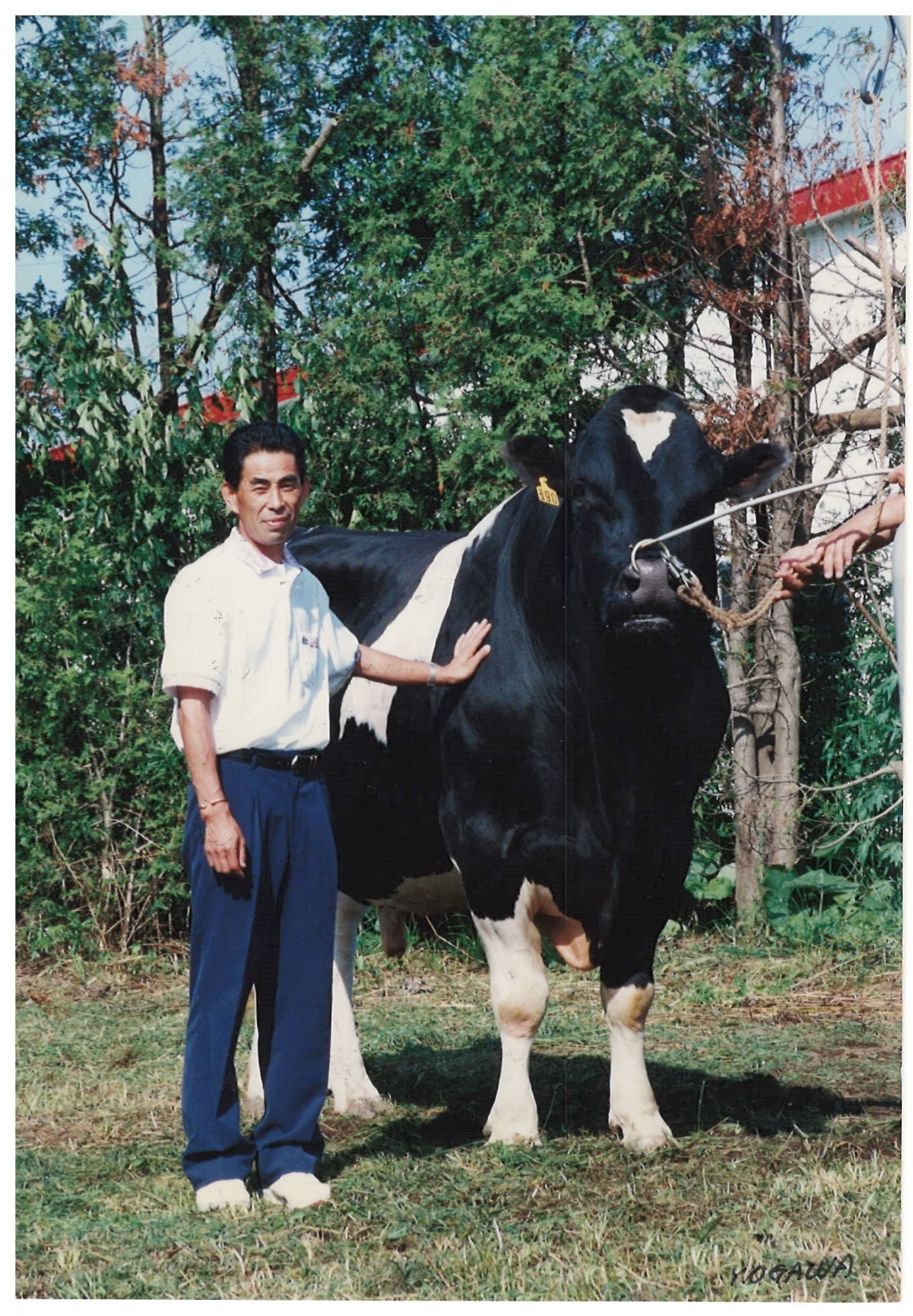
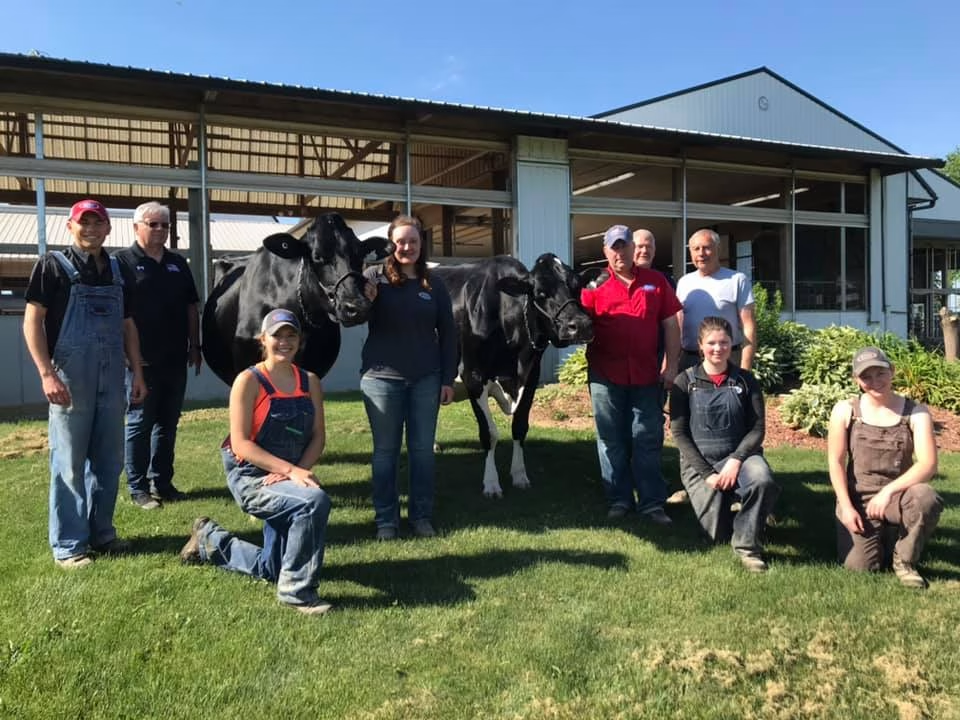
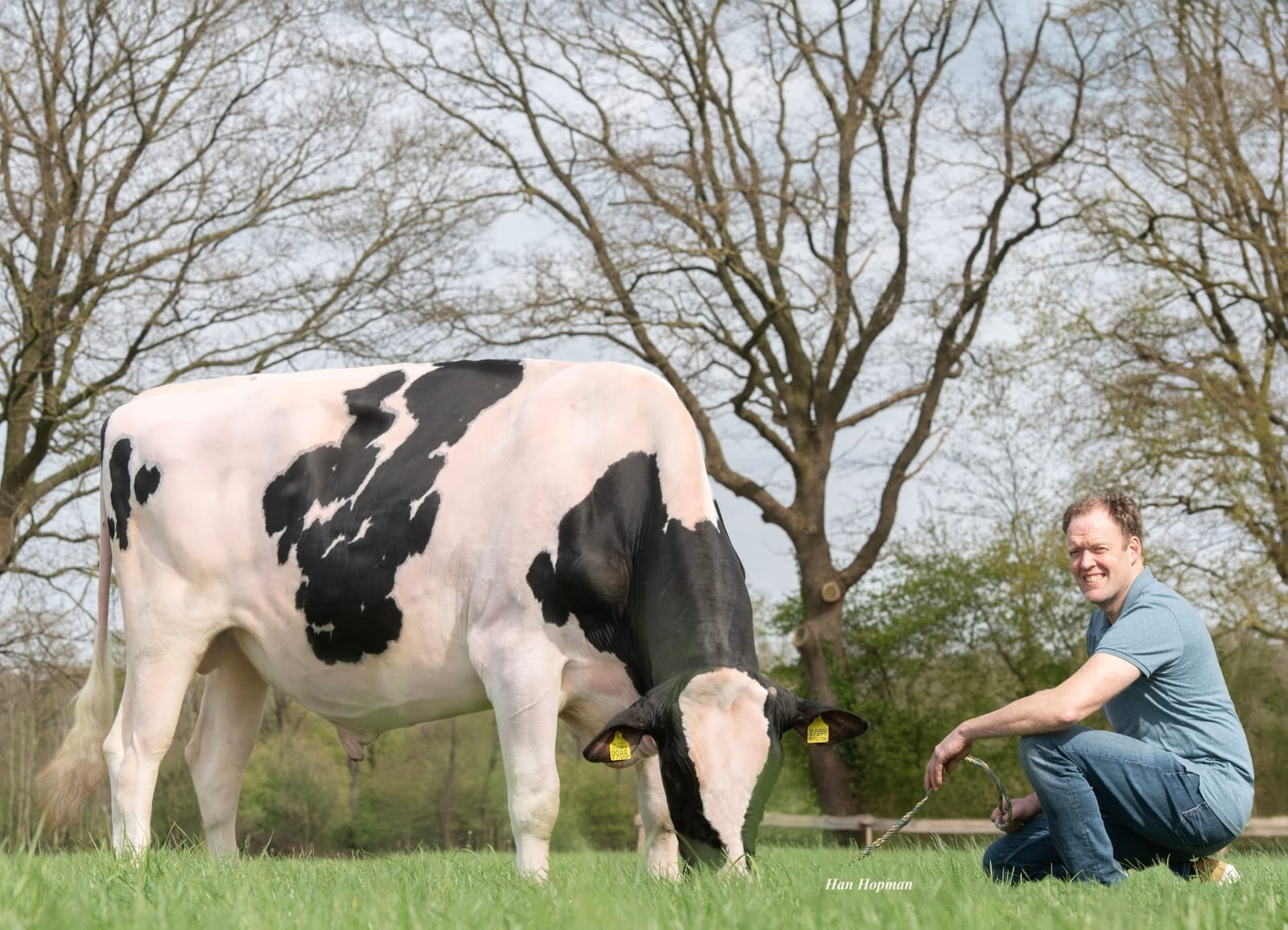
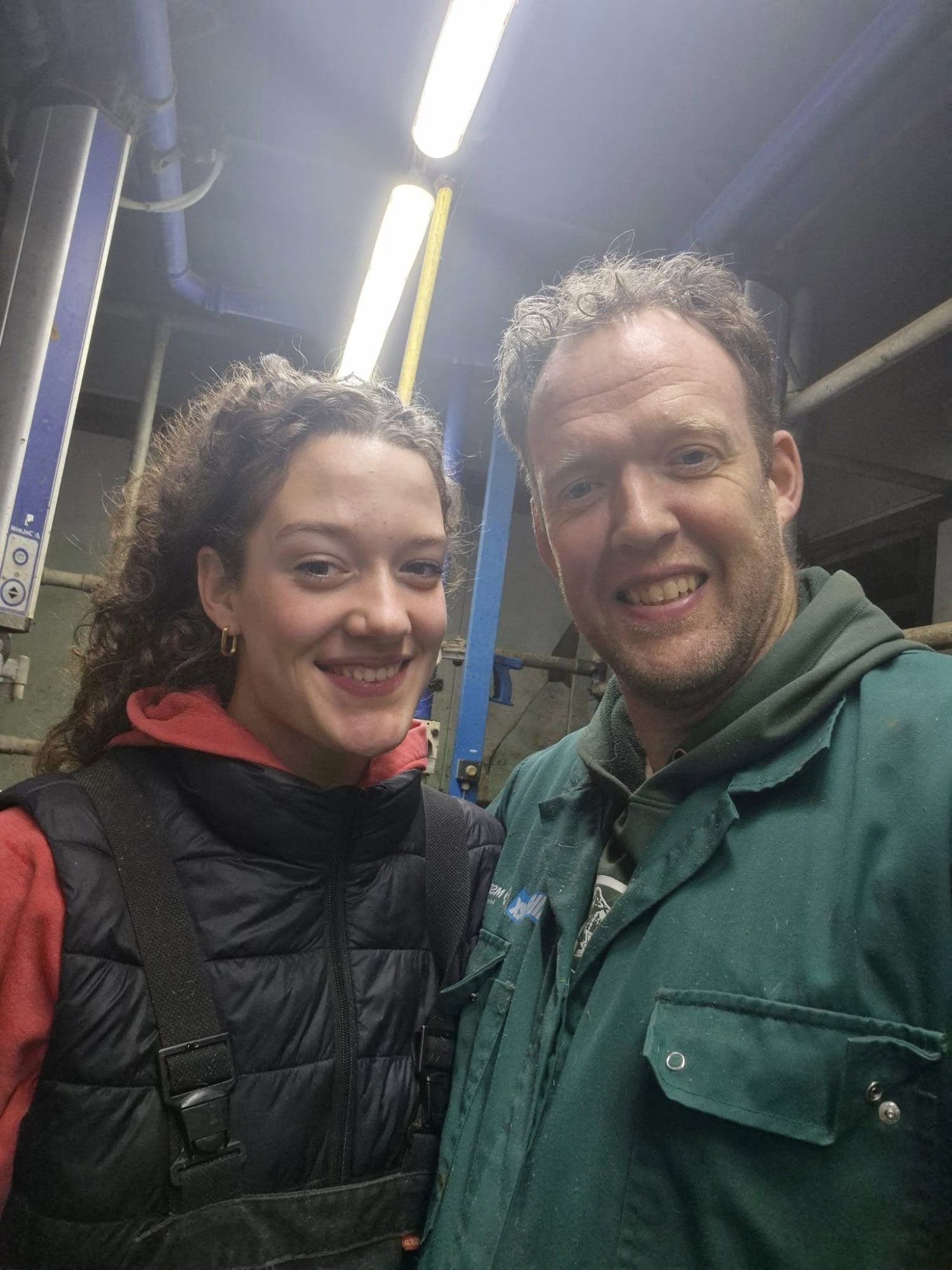
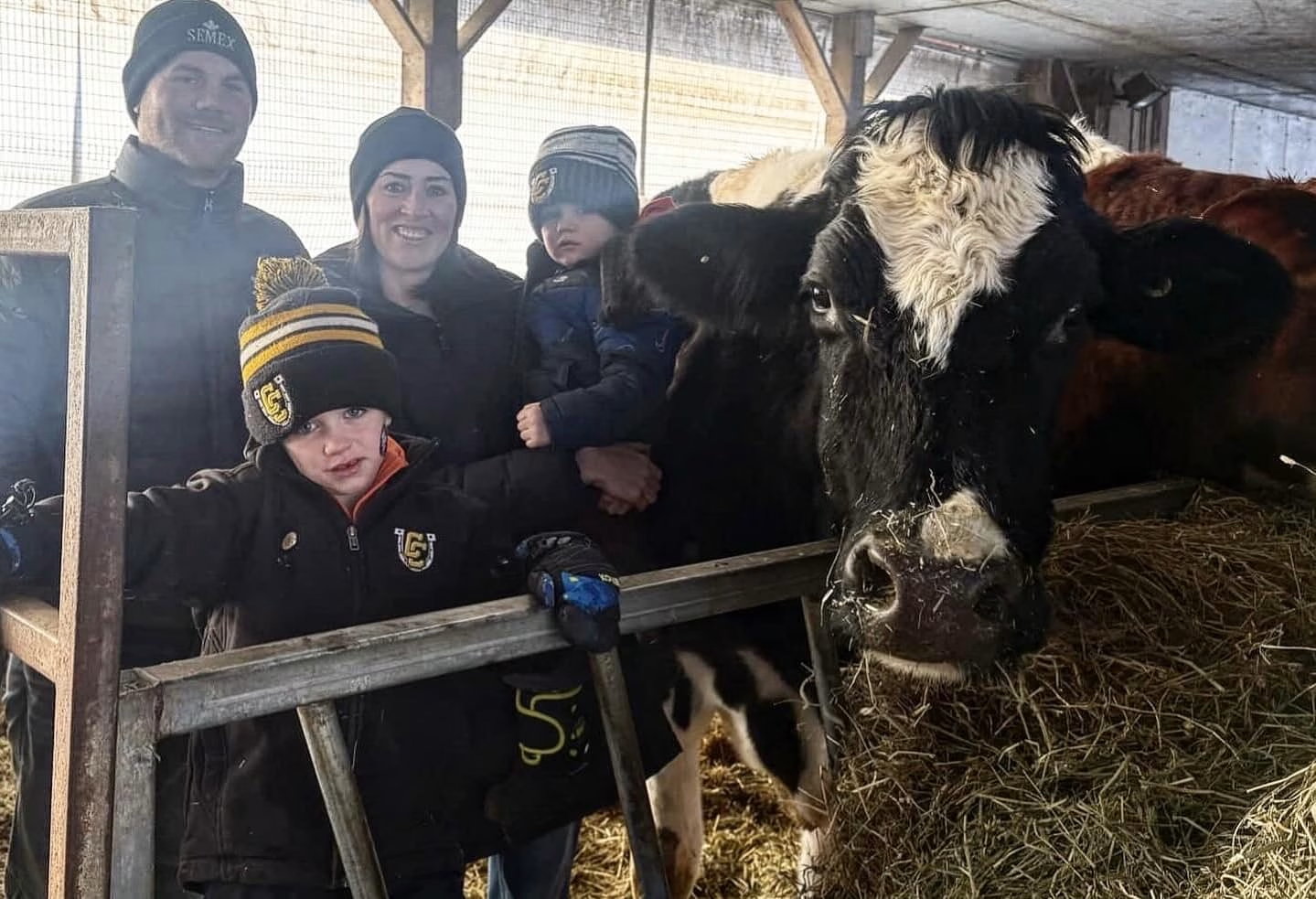
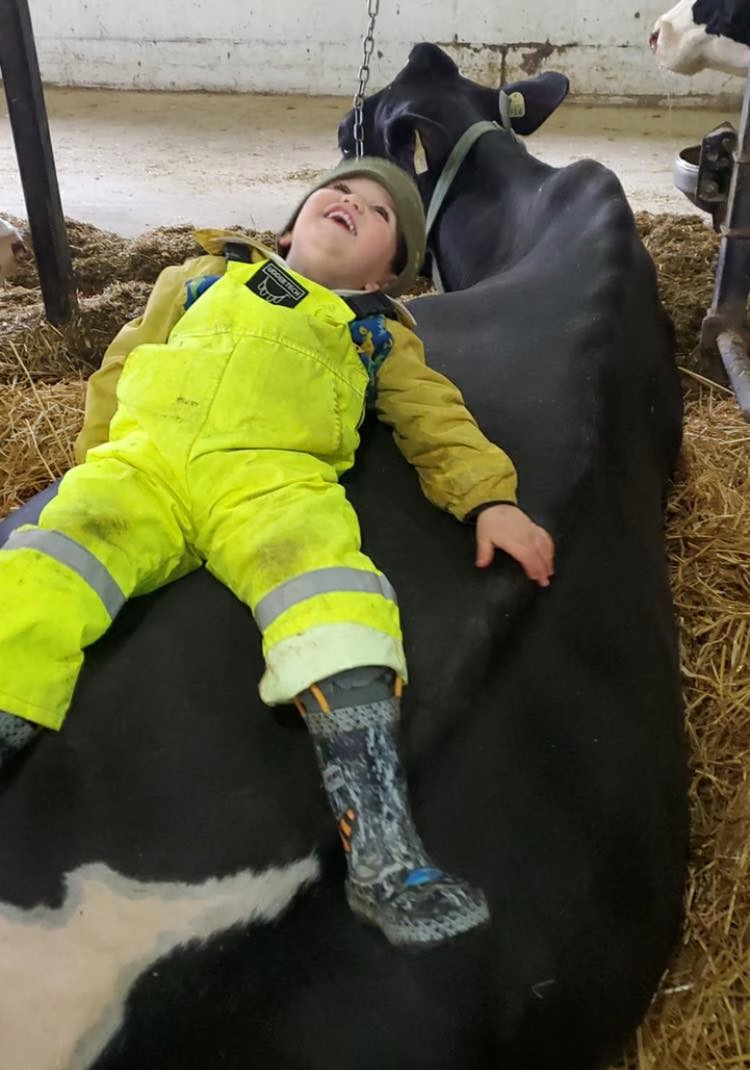
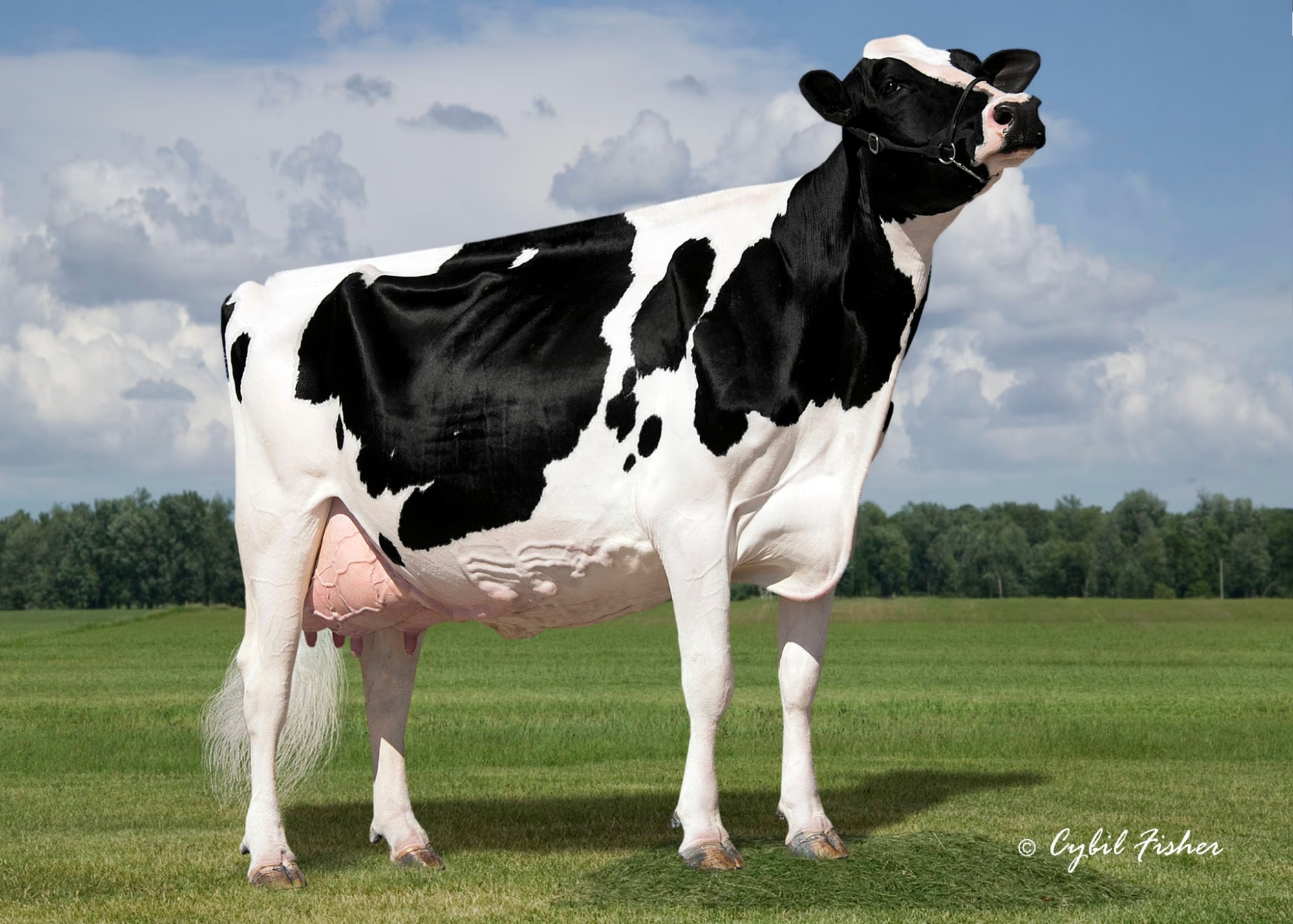
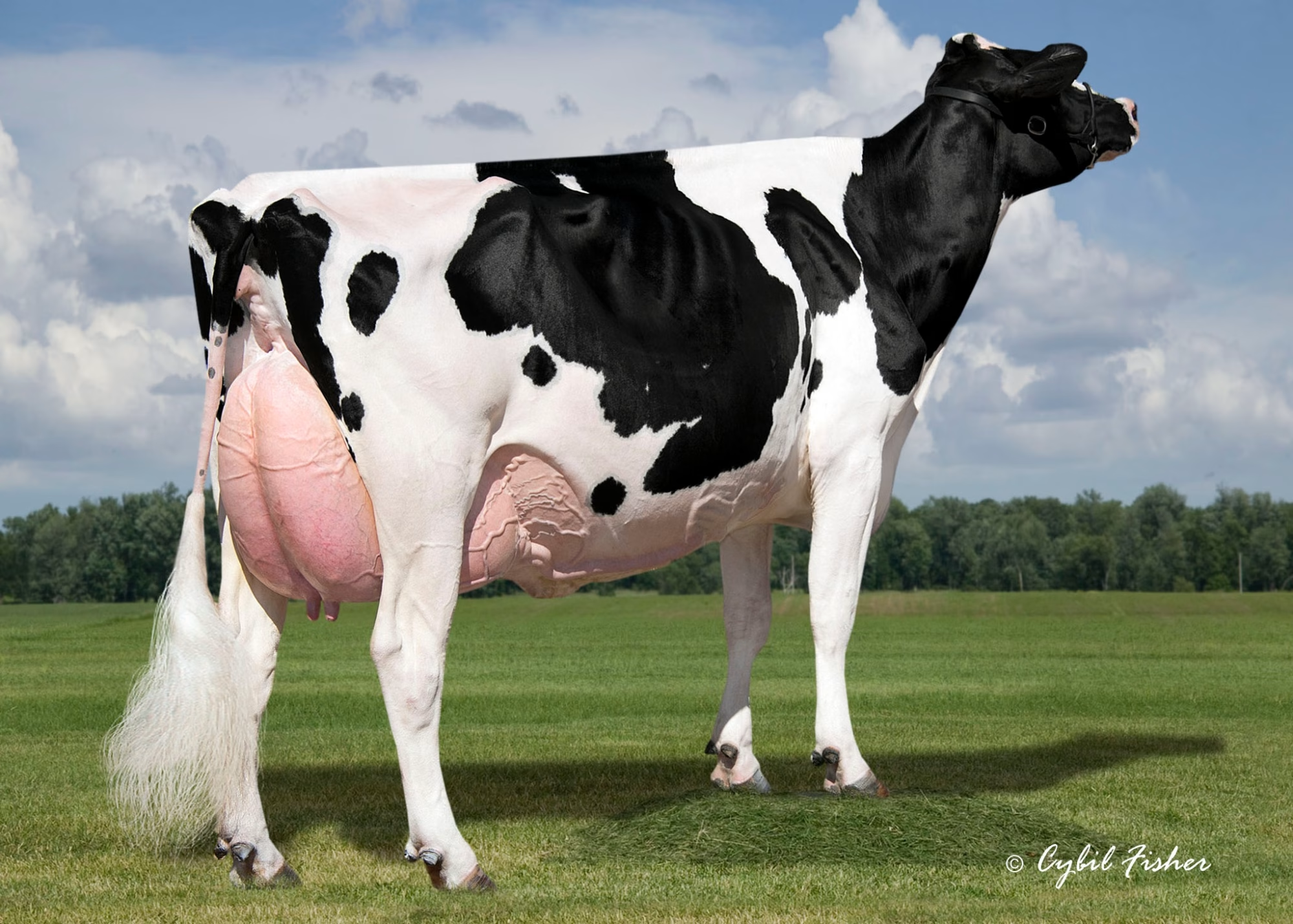
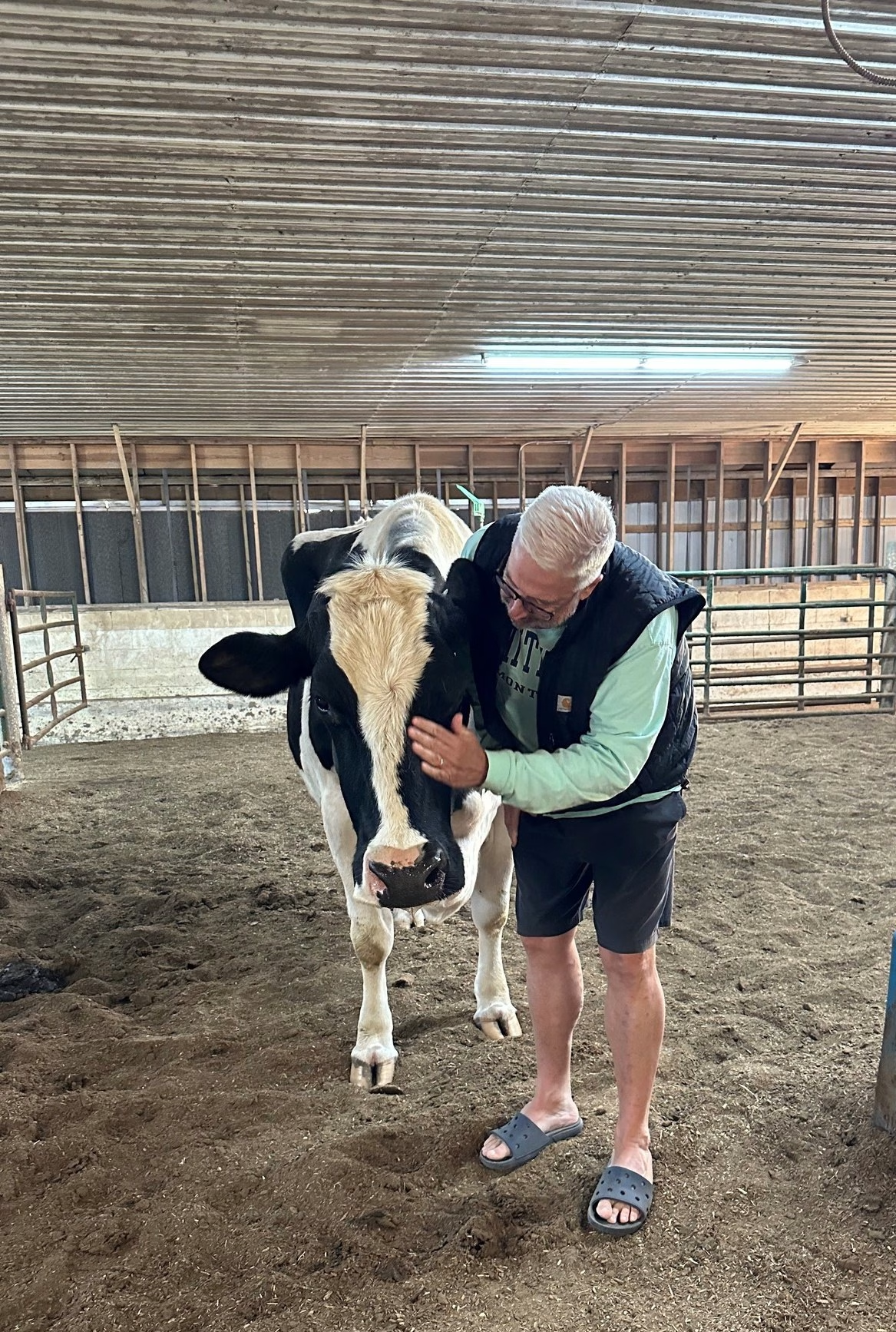
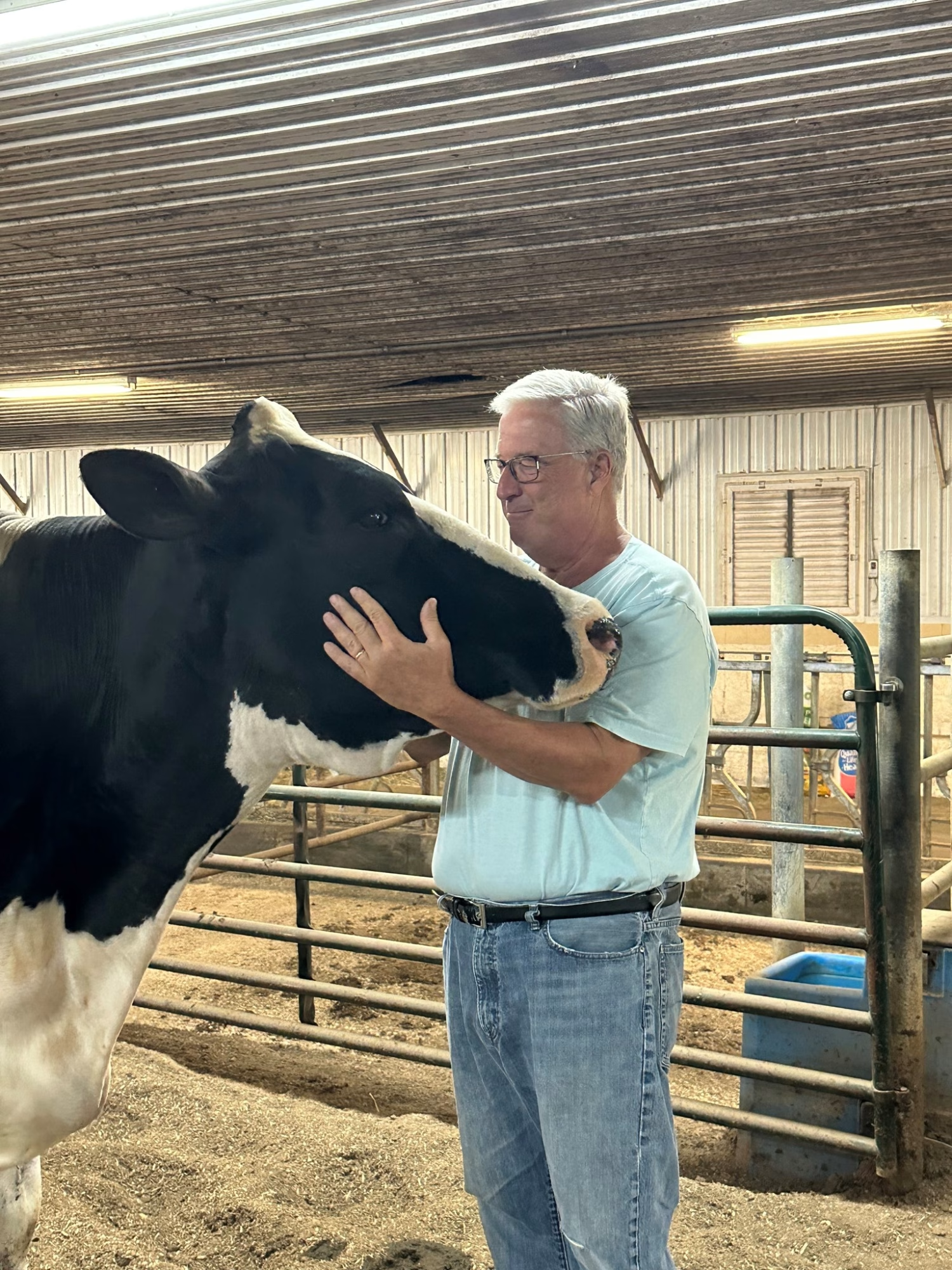
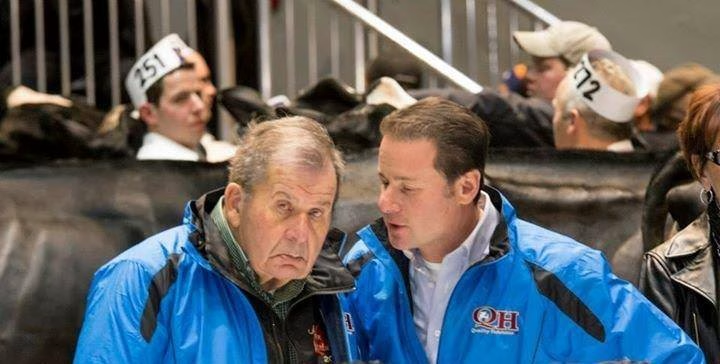
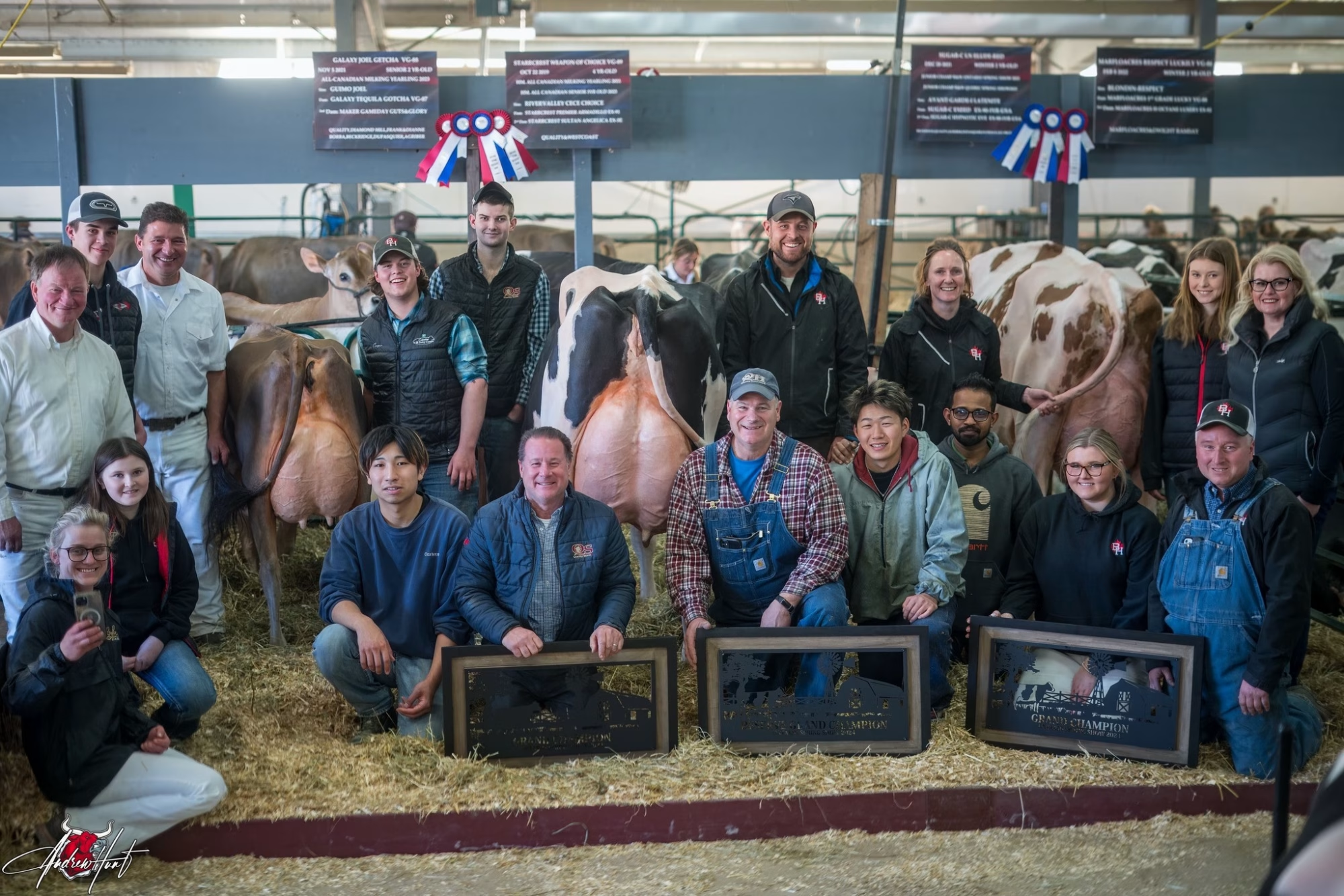
When cancer struck young farmer Isaac Davies, family, friends, neighbors and even Isaac’s rugby coach instantly offered to help.
I’ll never forget the moment I first heard about Isaac Davies—a young man whose dreams stretched as wide as the Welsh valleys his family called home.
It was November 1, 2024, when everything changed. Isaac, just 17 and brimming with plans for his future in Holstein breeding, was told he had a brain tumor. Being a fit, strong and healthy young man this came as a shock to family, friends and the wider rural community.
And yet… what grew from that moment of devastation was something I’m still struggling to put into words.
Isaac wasn’t just any teenager. He was the kind of young man who made you believe in the future of farming—a passionate Holstein breeder doing his second year on farm from Hartpury College, a rugby captain whose teammates at Crymych RFC looked up to his quiet strength. His hands already knew the rhythm of his family’s Castellhyfryd operation, supplying milk to Pembrokeshire Creamery and Blas y Tir.
Then came November 13. Surgery at Heath Hospital in Cardiff. The beginning of a journey that would test everything this family thought they knew about endurance.
When Darkness Falls, Light Finds a Way
While Isaac facedsurgery, months of proton beam therapy in London, and chemotherapy that would push his body to its limits, something extraordinary was happening back home. The farm—that steady heartbeat of the Davies family’s life—never missed a beat.
Staff, family, friends and neighbours all offered to help support the family in their time of need.
The moment that changed everything for me was understanding what Simon Davies was actually doing during those long hospital stays. Picture this: sterile corridors in London, the constant hum of medical equipment, worried families huddled in waiting areas. And cutting through all of that—Simon’s calm voice directing activities of the farm two hundred miles away.
“Move the heifer from the top pen to the middle pen,” he’d say into his phone, then turn back to Isaac’s bedside. “Give silage to the cow in the calving pen.” The nurses found it amusing at first that this farmer couldn’t stop farming, even in a children’s cancer ward.
But I understood something they didn’t. Simon wasn’t being stubborn or a workaholic. Farming doesn’t stop for anything. Milking cows is a 7 day a week job. Something people not involved in farming fail to see.
The Weight of Unexpected Courage
Into this storm of uncertainty stepped Elliott, the younger brother whose life was about to change in ways no 15-year-old should have to navigate.
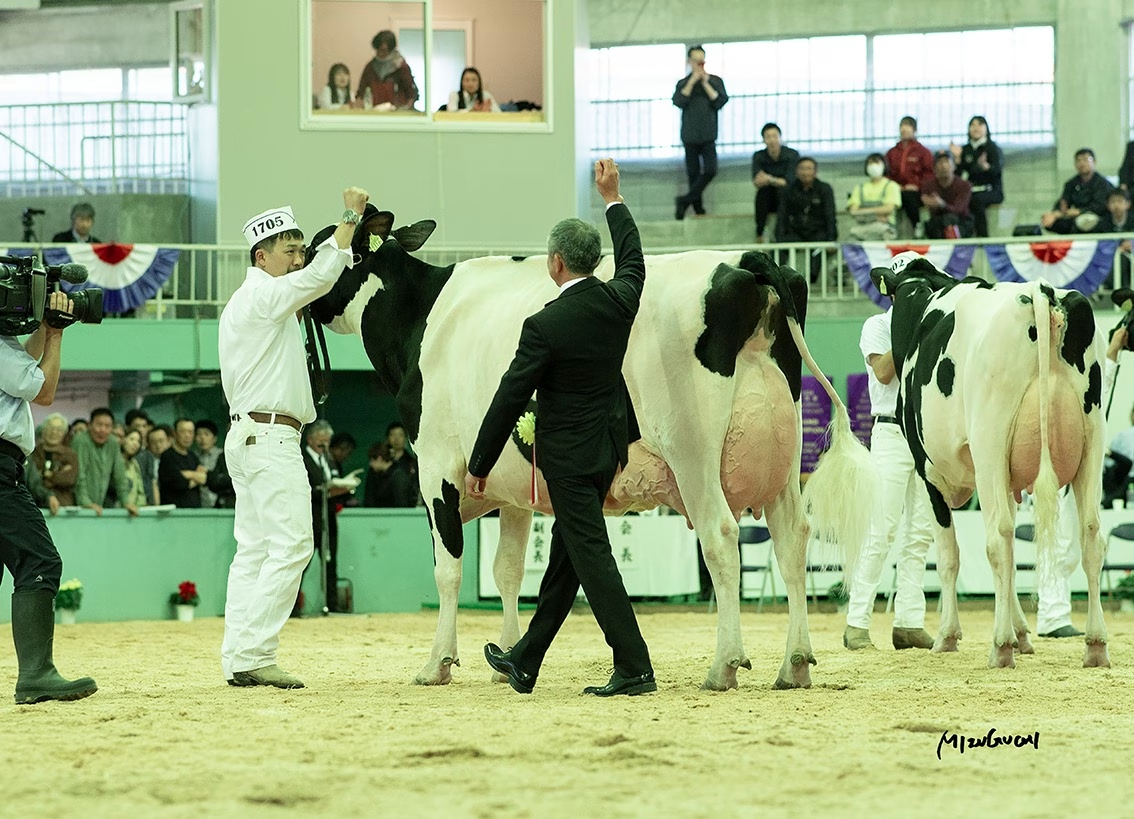
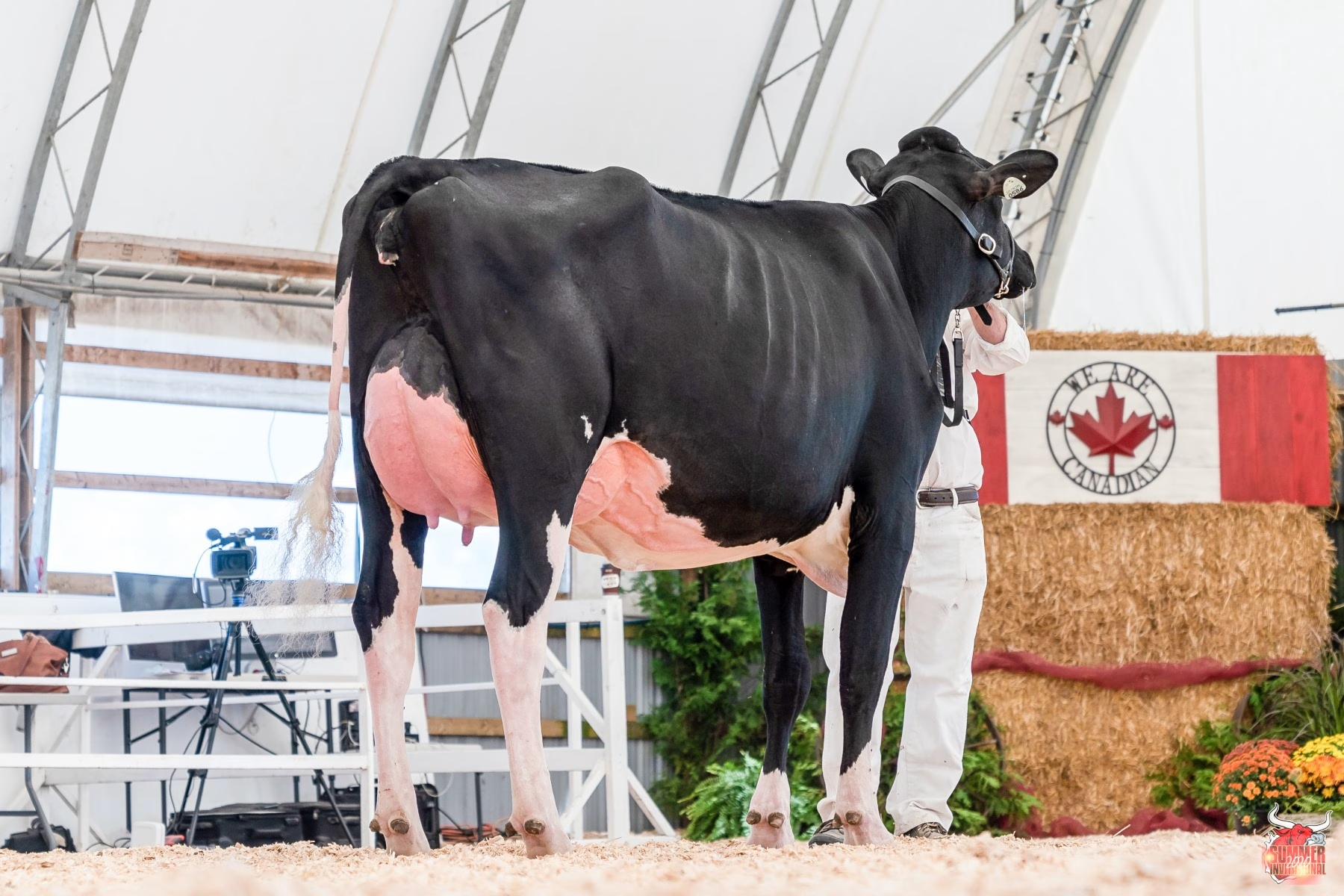
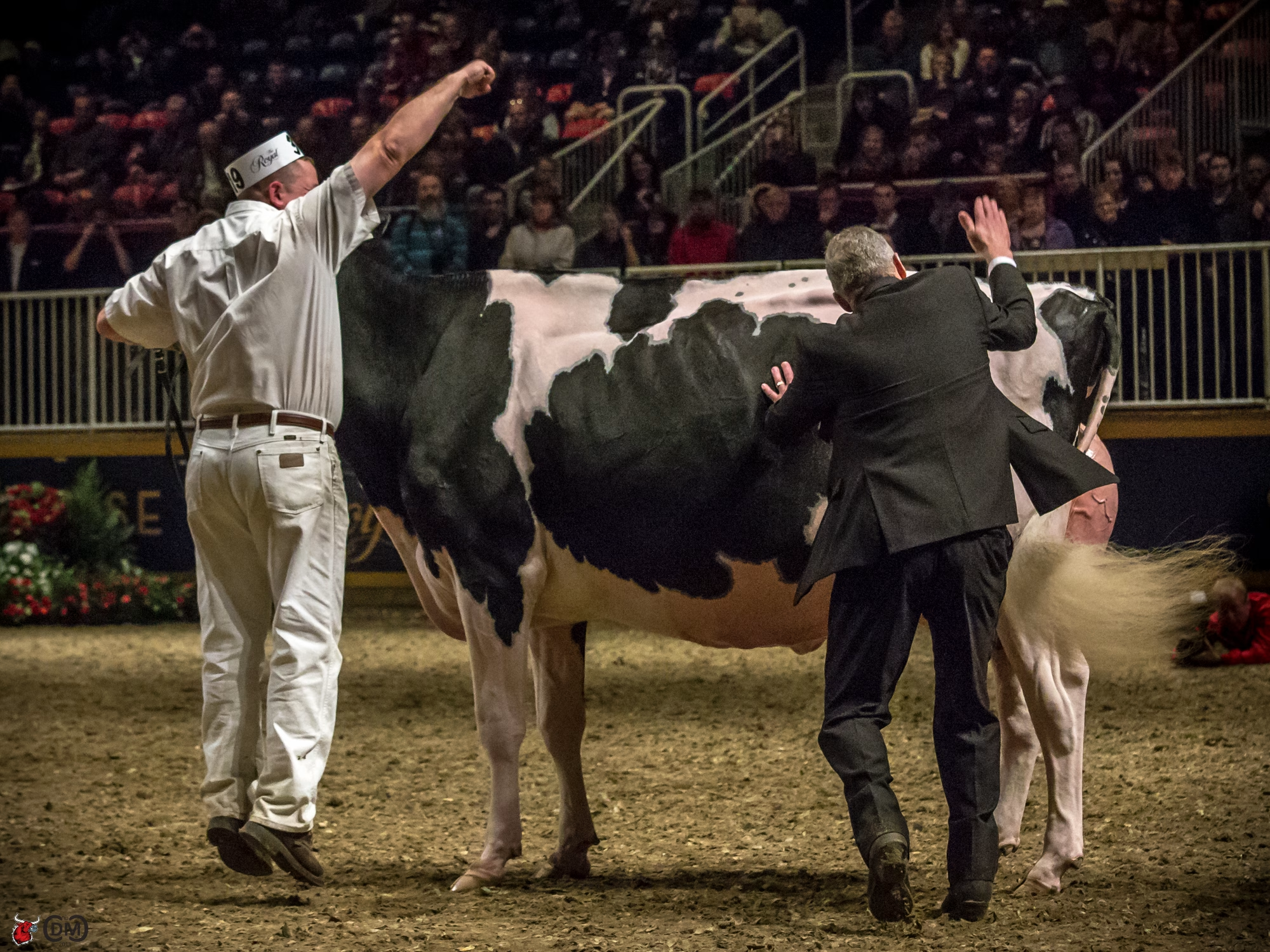
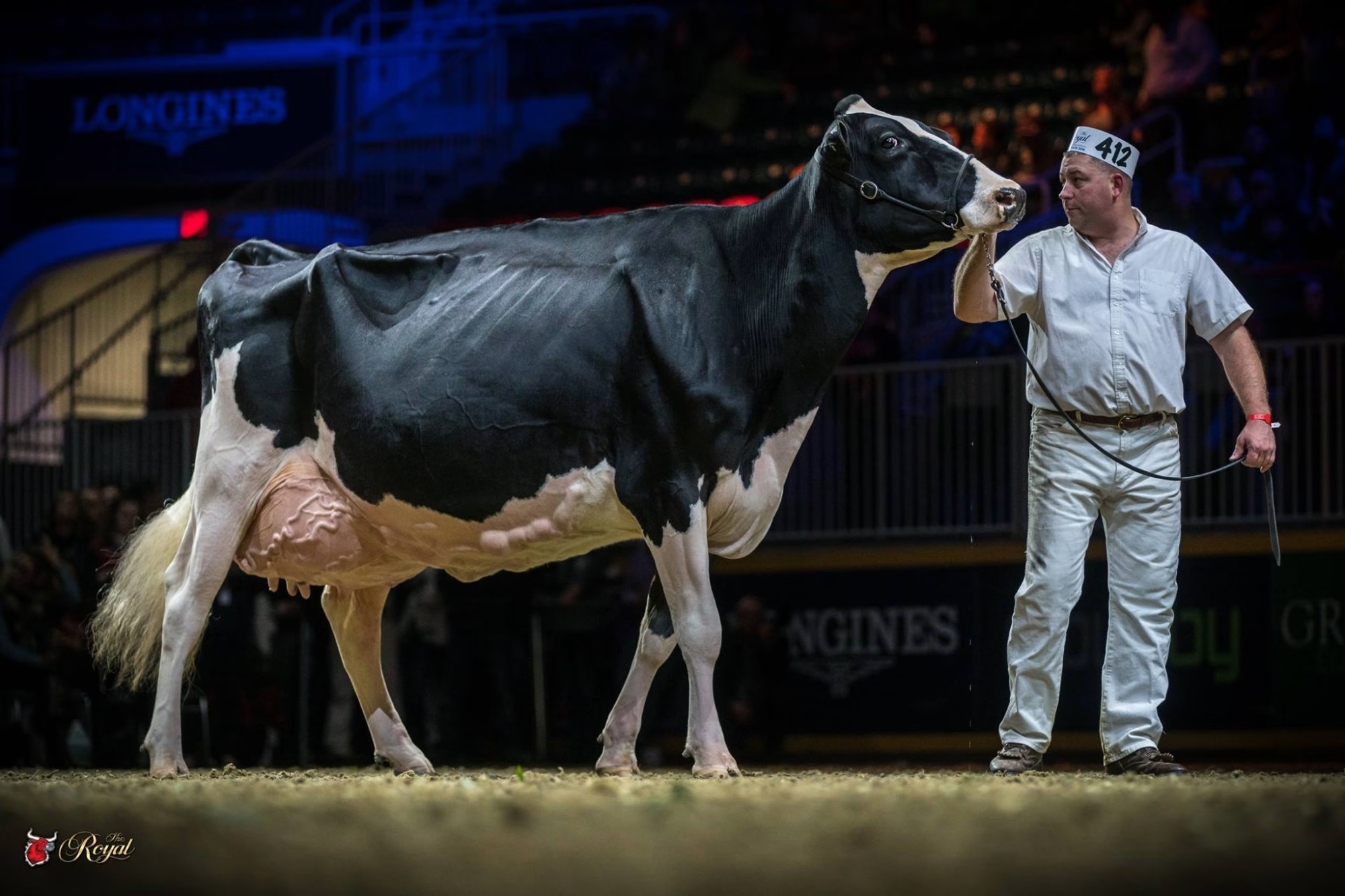
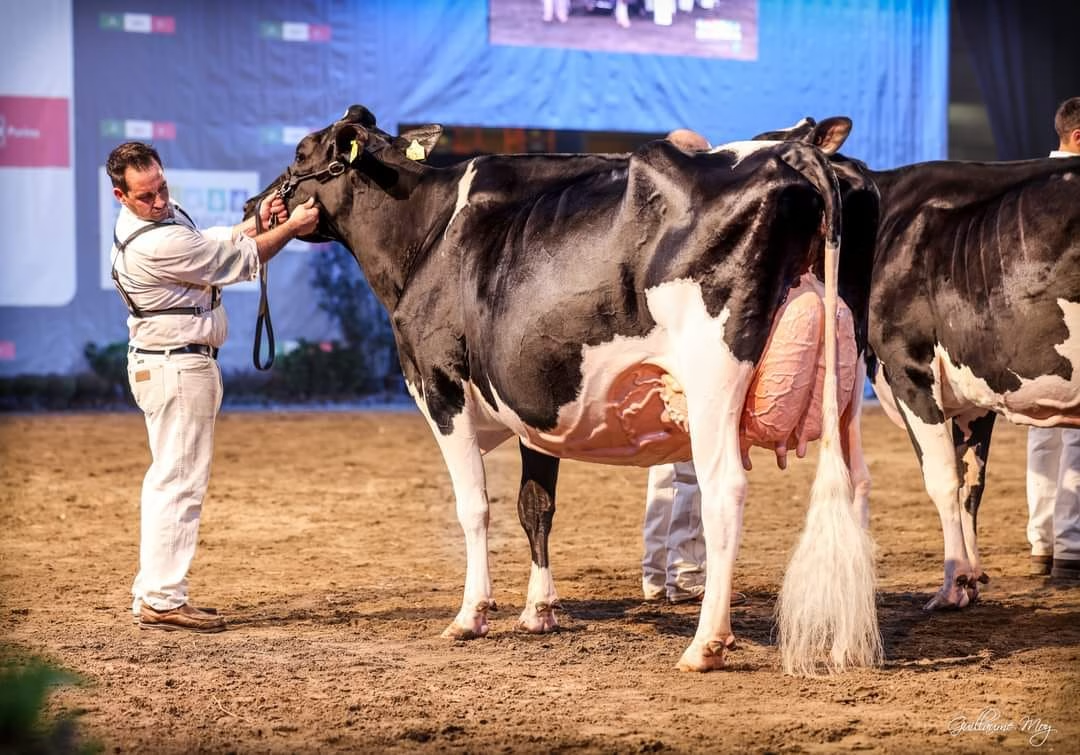
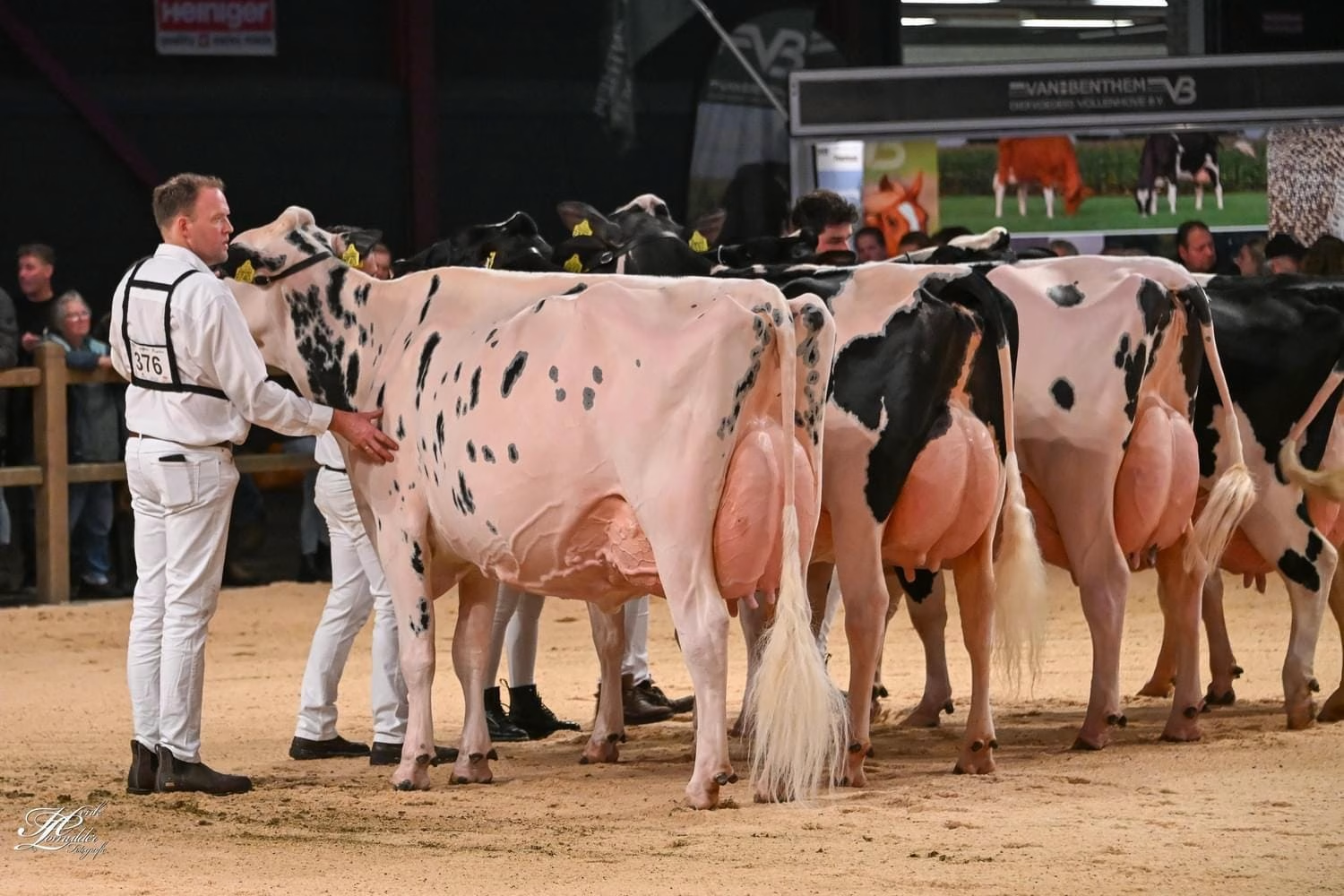
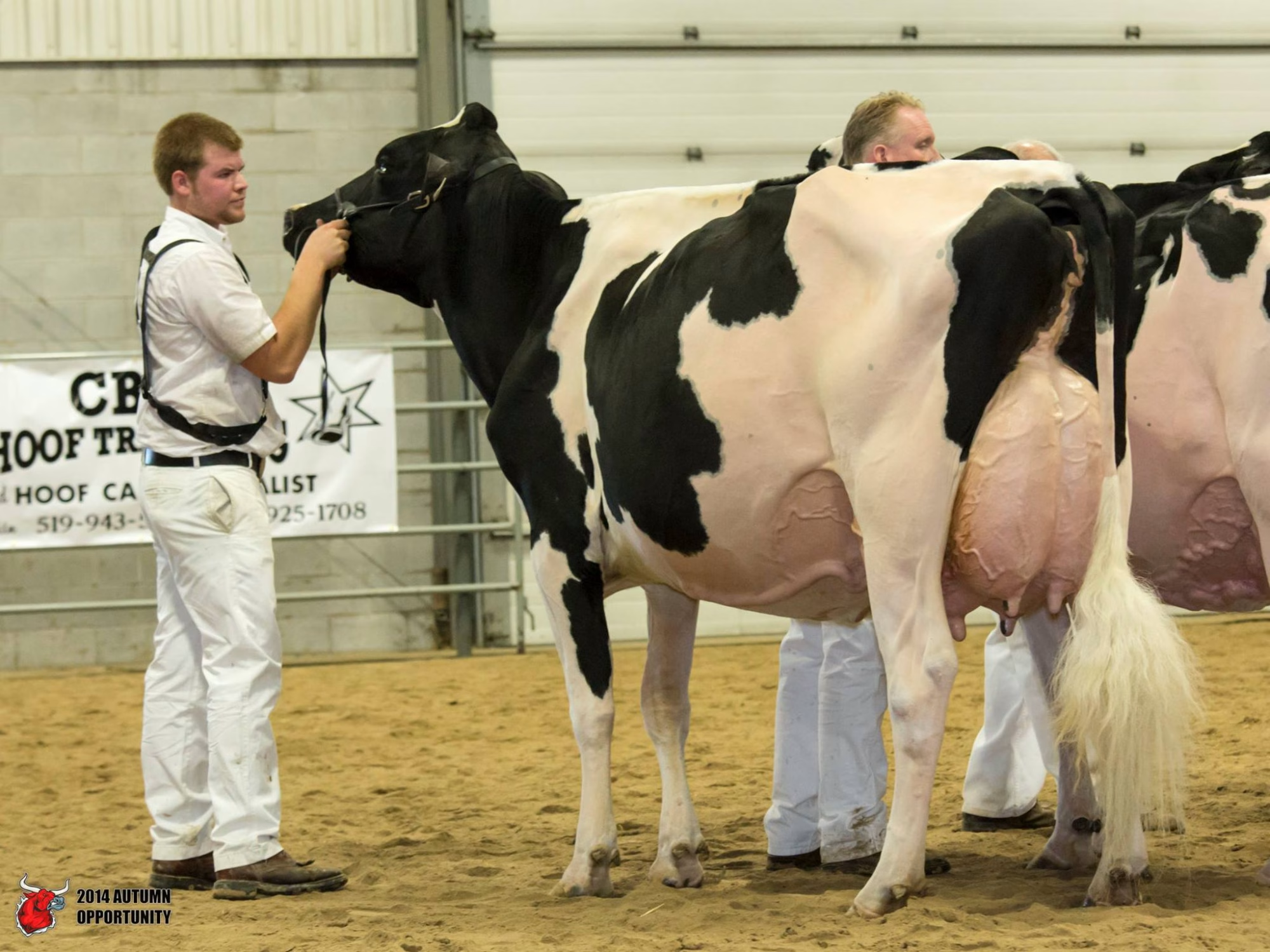
Elliott, balanced preparation for GCSEs with farming duties and was always prepared to help to keep things going. Also a keen showman Elliott has worked hard to prepare the team of Castellhyfryd Holsteins for the showring. In a bid to maintain some element of normality the Davies’s continued to show at the Royal Welsh Show, Pembrokeshire County Show and the local community show at Clunderwen. Elliott has been rewarded for his hard work and dedication winning Champion Handler at the Royal Welsh, Pembrokeshire and Clunderwen shows. He has also qualified for the All Britain Calf Show in September.
Love Made Visible
Then came the community response that restored my faith in what’s possible when people refuse to let their neighbors carry burdens alone.
The “In It With Isaac” fundraiser wasn’t just an event—it was a love letter written by an entire community. Farmer and ex-international referee Nigel Owens officiated the rugby match, bringing together players who’d grown up with Isaac. The promise auction overflowed with donations that told stories: sexed semen from prized bulls, cow brushes, calf cakeand all sorts of agricultural treasures given without hesitation.
The bicycle ride across the rugged Preseli mountains saw cyclists pedaling not just for distance, but for hope—each mile a declaration that Isaac wouldn’t face this alone.
Together, they raised over £80,000 for cancer charities that had supported Isaac’s treatment.
But walking through that crowd, what captured my heart wasn’t the impressive total. It was the absence of grand speeches or ceremony. Instead, I witnessed something rarer: love in its working clothes.
. Family and friends who drove the Davies’s to and from hospital in Cardiff and London and a community, desperate to help organised numerous fund-raising events. Two members of Clunderwen Young Farmers’ Clubcycled 100 miles from Cardiff to Tenby, raising £5,500. The local chapel where Isaac and Elliott had attended Sunday School hosted a coffee morning that generated £4,600. There’s also been a bingo night, carol singing and rugby matches and Holstein South Wales and the Young Breeders are planning a dinner for March 2026—proof that this community’s commitment runs deeper than crisis response.
The Long Road Home
Isaac’s recovery continues, measured not in dramatic breakthroughs but in small, precious victories that farming families understand better than most.
The surgery left him unable to speak or see initially. Balance issues meant relearning to walk. But with the same work ethic that comes from a lifetime around agriculture, Isaac has thrown himself into rehabilitation with quiet determination.
“We’ve had two clear MRI scans so Isaac is recovering well. Isaac is physically strong and very determined. He’s been very positive from the beginning and is working very hard on his physio and rehabilitation.” —Sian Davies
There’s no timeline for healing like this.. Just the daily choice to keep moving forward, one step at a time.
What strikes me about Isaac’s approach to recovery is how it mirrors everything I’ve learned about successful farming: you can’t control the weather, but you can control your response to it. You prepare for challenges you hope never come. You celebrate small victories because they’re all part of something larger.
What This Really Means
This story doesn’t offer a tidy resolution or manufactured inspiration. It offers something more vital: proof that agricultural communities have developed social infrastructure that transforms individual crisis into collective strength.
The Davies family discovered what many farming families already know but rarely talk about: when crisis strikes, rural communities don’t just offer sympathy—they provide operational support that keeps families afloat while they navigate the unnavigable.
Their experience reveals profound truths about resilience that extend far beyond agriculture:
Love multiplies when it becomes action. The Davies family received more than emotional support—they received practical infrastructure that maintained their livelihood during months of medical uncertainty.
Strength often looks ordinary. Elliott’s championship wasn’t heroic—it was the result of showing up every day despite the worries about Isaac , the kind of quiet courage that builds character one choice at a time.
Hope requires community. Individual determination matters, but sustainable hope grows from relationships built over years of shared commitment to each other’s welfare.
Legacy is preserved through daily choices. The community’s ongoing support ensures that whatever Isaac’s recovery brings, the Davies family’s agricultural identity will endure.
For Anyone Carrying Heavy Burdens
To those reading while wrestling with your own impossible circumstances, I offer what I learned from watching the Davies family navigate their darkest season:
The courage to continue isn’t always a choice—sometimes it’s the only option that lets you live with yourself. But what the Davies family taught me is that you don’t have to carry those burdens alone, not if you’re part of a community that understands the weight of shared responsibility.
Farming has always required faith in processes you can’t control. You plant seeds without knowing the weather. You breed cattle without guaranteeing outcomes. You build relationships without knowing when you’ll need them most.
But when crisis comes—and it always comes—those investments in community pay dividends that no insurance policy can match.
The Truest Harvest
Farming is more than soil and seasons, more than milk prices and genetic programs. It’s the covenant between people who understand that individual success depends on collective resilience. It’s the unspoken promise that when one family faces the unthinkable, others will step forward without being asked.
In West Wales, watching neighbors become family and community become lifeline, I witnessed something that gives me hope for all of us: love that refuses to let anyone face the darkness alone.
The Davies family’s story continues—with the steady persistence that defines both recovery and farming. Isaac works daily on rehabilitation. Elliott continues developing as both a student and an agriculturalist. Simon and Sian maintain their Holstein operation while supporting their sons’ different but equally important journeys.
And their community stands ready, as agricultural and rural communities always have, to provide whatever support tomorrow might require.
That’s not just inspiration—that’s infrastructure. The kind of social foundation that makes life sustainable when individual strength isn’t enough.
In the Davies family’s continuing journey, I see the harvest of hope that grows when love becomes action, when neighbors become family, and when community becomes something stronger than the sum of its parts.
Join the Revolution!
Join over 30,000 successful dairy professionals who rely on Bullvine Weekly for their competitive edge. Delivered directly to your inbox each week, our exclusive industry insights help you make smarter decisions while saving precious hours every week. Never miss critical updates on milk production trends, breakthrough technologies, and profit-boosting strategies that top producers are already implementing. Subscribe now to transform your dairy operation’s efficiency and profitability—your future success is just one click away.
How Braedale Goldwyn rewrote the rules of Holstein breeding with genetics, show dominance, and a market-changing legacy.
Braedale Goldwyn in his prime—the Holstein bull whose genetic lightning strike changed everything for dairy breeding worldwide.
You know that feeling when you’re walking through a barn and spot a calf that just… has something special about it? Most of the time, you’re wrong, honestly. But every once in a while…
January 3rd, 2000. Cumberland, Ontario. Terry Beaton is watching a newborn James calf get its legs beneath it in the maternity pen. Just another planned mating, right? Except this gangly calf would become Braedale Goldwyn—and honestly, I’m not sure any of us realized we were witnessing the start of a genetic revolution.
The Foundation Nobody Saw Coming
Here’s what I’ve always found fascinating about Terry Beaton—the guy understood maternal lines when most of us were still chasing flashy sires. Back in ’85, when computer indexes were still a newfangled thing and half the industry didn’t trust them, Terry was already thinking generations ahead.
Picture this: November 1985, Sunnylodge Farms dispersal. You know how those sales go—everybody’s buzzing, coffee’s flowing, and the really good cattle are bringing serious money. The sale averaged $6,839 per head (which was real money back then), and the top lot was this first-lactation heifer, Sunnylodge Elevation Jan, VG-87-13*.
Now Terry didn’t just bid on her and walk away. After the sale, he tracks down Carl Smith—the original owner—and proposes a partnership. They’d flush her extensively and split the embryos. I mean, think about that for a minute. Most guys buy a cow, milk her out, maybe get excited about a daughter or two. Terry’s already planning a dynasty.
That single decision—man, talk about return on investment.
Building Something That Lasts
What’s happening with the Jan family over the next fifteen years is basically a masterclass in line breeding done right. And I say “done right” because we’ve all seen line breeding go sideways—fertility issues, weird recessive traits popping up, the whole nine yards.
But Terry had this knack for stacking the generations without painting himself into a corner. Jan’s Chief Mark daughter, Sunnylodge Chief Vick, earned 31 brood cow stars. Solid numbers—the kind that pay bills and keep bankers happy. Then Vick to Aerostar produces Moonriver, who honestly didn’t look like much herself (GP-83, sold to Japan as a youngster), but left behind this heifer calf that would change everything.
Braedale Gypsy Grand, VG-88-37—the “genetic locomotive” whose elite sons dominated LPI charts years before Goldwyn, proving the family’s transmitting power.
That calf was Braedale Gypsy Grand, VG-88-37*. And folks, this cow was special. Holstein Canada Cow of the Year in 2003, but more importantly, she was what we call a “genetic locomotive”—a rare female that just cranks out excellent offspring. Her sons were already topping the LPI charts before anybody had heard of Goldwyn: Goodluck at #4, Freelance at #2, plus Spy, Rainmaker, and others.
Huntsdale SHOTTLE Crusade EX 95 3E 7—Nasco International Type and Production Award winner at World Dairy Expo, proving Gypsy Grand’s maternal magic still works generations later.
The family was already a brand. That’s what blows my mind about this whole story.
The Storm Cross That Set Everything in Motion
Then comes the mating that made it all worthwhile—Gypsy Grand to Maughlin Storm. On paper, it looked like another solid breeding decision. Storm was decent, nothing that would make Holstein International headlines. But when that mating produced twins—Baler Twine and Second Cut—the industry was about to get a genetics lesson we’re still talking about.
Braedale Baler Twine, VG-86-20—the dam of legend whose “planned mating” to Shoremar James produced Goldwyn and completed Terry’s 15-year masterpiece.
Here’s where it gets wild… Years later, when genomic testing became available, researchers discovered that these two cows were identical twins from a split embryo. Both scored VG-86 in the first lactation with nearly identical production. Both became legendary brood cows. It’s like hitting the genetic lottery twice with the same ticket.
And get this—Baler Twine stayed at Braedale and produced Goldwyn, while Second Cut went to Gillette and became the dam of five Class Extra sires. Same genes, different locations, both producing champions. That’s the kind of genetic consistency you build entire programs around.
The Paternal Power Play: Shoremar James
While the Braedale maternal line is rightly celebrated as a masterpiece of breeding, the choice of sire that ultimately produced Goldwyn was no accident. The other half of the pedigree came from another Canadian dynasty, the Shore family, whose Shoremar prefix represented a century of breeding for balanced, long-lasting, profitable cattle.
The sire, Shoremar James, was a product of this exact philosophy. Sired by the legendary MARK CJ GILBROOK GRAND, his real power came from his dam, STELBRO JENINE AEROSTAR, a monumental brood cow in her own right. The Shores, much like Terry Beaton, built their success on the back of incredible cow families, as detailed in The Bullvine’s feature, When Giants Fall Silent: The Shore Dynasty’s Century of Shaping Holstein Excellence.
While Goldwyn became a legend, his paternal legacy from Shoremar James also shaped champions. Here, Thrulane James Rose, an Excellent-97 daughter of Shoremar James, is pictured as Supreme Champion at the Royal Agricultural Winter Fair. Her exceptional type demonstrates the influence James brought to the breed, a perfect complement to the Braedale maternal strength.
So, what did James bring to the table? He provided a brilliant outcross of proven genetics known for dairyness, frame, and functional type. Mating him to the line-bred power of Baler Twine was a strategic masterstroke. It combined Beaton’s concentrated genetic engine with the Shore family’s legacy of durability and balance. This wasn’t just a mating; it was a fusion of two of Canada’s greatest breeding philosophies.
When Everything Changed Overnight
February 2005. I remember checking proofs that morning, and honestly? Most moves are predictable. Bull jumps five spots, drops three, whatever. But when a bull rockets from #82 to #5 LPI in a single run—that’s when you stop drinking coffee and start making phone calls.
According to Canadian Dairy Network data, Goldwyn’s jump was unprecedented—77 positions in one proof run. By May 2006, he’d climbed to #3 LPI. Those aren’t incremental improvements; that’s a genetic explosion.
I can picture Terry in that Cumberland farmhouse, probably still in work clothes from morning milking, staring at his computer screen. After decades of careful breeding, staying patient while others chased genetic fads, suddenly he’s got a bull that’s not just good—he’s potentially game-changing.
The phone must’ve started ringing that morning and not stopped for months.
The Show Ring Revolution
The moment everything crystallized: The 2011 World Dairy Expo 5-year-old class, where seven of the top placings went to Braedale Goldwyn daughters, including Grand Champion Gold Missy—marking the beginning of an unprecedented era of show ring dominance.
“What made Goldwyn different wasn’t just the numbers—though those were impressive enough. Walk into any barn with his daughters, and you could spot them from the feed bunk. Those udders weren’t just good; they were architectural marvels.”
World Dairy Expo 2008 was the moment everything crystallized. When they announced Premier Sire and called Goldwyn’s name, ending Durham’s long reign… you had to be there. The tension in that Coliseum was incredible. Durham had been the gold standard—consistent, profitable daughters that made sense in commercial herds across Wisconsin and beyond.
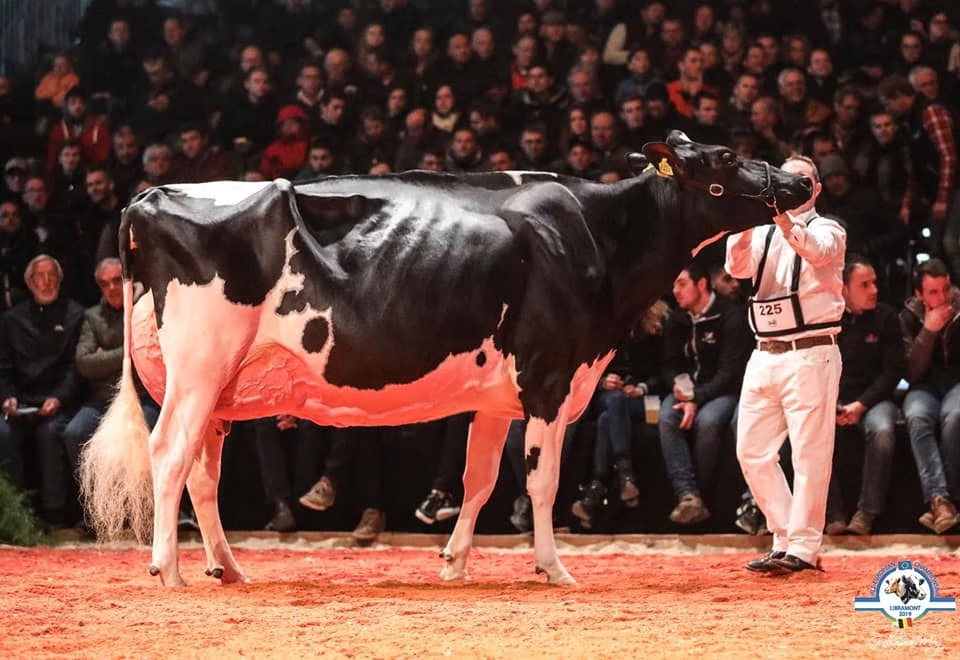
But when Goldwyn’s daughters started walking into that ring, something shifted. The mammary perfection, the dairy strength, the sheer presence—it was like watching a new breed standard emerge in real time. Holstein Canada records show he eventually became the first sire in history to produce over 1,000 daughters classified Excellent—a milestone that redefined what was possible.
RF Goldwyn Hailey EX-97—the next dynastic champion who captured Supreme Champion at World Dairy Expo in 2012 and 2014, ensuring Goldwyn daughters wore the ultimate crown for four consecutive years.
By 2013, at World Dairy Expo, Goldwyn sired nearly 25% of the entire Holstein show, with 47 daughters placing in the top 10 of their classes. That level of single-sire dominance is virtually unparalleled.
Bonaccueil Maya Goldwyn EX-95—Supreme Champion of the 2013 World Dairy Expo, continuing the dynasty that proved Goldwyn daughters owned the ring.
The Economic Juggernaut
But here’s where the story gets really interesting from a business perspective. The Walrus magazine documented how Goldwyn’s semen went from standard AI product to investment commodity. By 2006, straws were $100 each—premium pricing that reflected serious market confidence. After his death in 2008, secondary market prices soared to between $800 and $1,000 per straw.
Think about that for a minute. A thousand dollars for a single breeding. That’s not just genetic merit; that’s treating bull semen like blue-chip stock.
Eastside Lewisdale Gold Missy EX-95—the $1.2 million Goldwyn daughter whose record-breaking sale made global headlines and proved that elite genetics had become investment-grade assets.
His daughters consistently topped sales worldwide. Eastside Lewisdale Gold Missy’s $1.2 million sale in 2009 made global headlines and established new benchmarks for the valuation of elite dairy females. At the 2008 World Classic Sale, a young Goldwyn daughter commanded $97,000. This pattern repeated at auctions globally—”Goldwyn” in a pedigree became a powerful marketing tool that reliably added value.
The Complex Reality We’re Still Managing
Jacobs High Octane Babe EX-96—B&O Champion at Royal 2022 and daughter of Jacobs Goldwyn Britany, proving that Goldwyn’s genetic magic still works decades later.
Now here’s where we need to talk honestly about consequences, because Goldwyn’s success created challenges we’re still dealing with. Recent genomic analysis reveals why he was such a dominant sire of daughters but not necessarily sons—he passed significantly more genetic merit to daughters (65%) than sons (54%). It’s like the genetic recipe needed that maternal contribution to really shine.
This explains why his sons, such as Atwood, Dempsey, Lauthority, and Goldchip, became popular but never achieved the revolutionary impact he did. His lasting influence is arguably as a maternal grandsire—that “Goldwyn” in the second generation remains a stamp of quality.
But we can’t ignore the genetic concentration issue. By 2008, Goldwyn and two other popular sires accounted for nearly 12% of all registered Holstein females in Canada. That level of concentration raises valid concerns about the long-term health of the breed.
More challenging is his carrier status for Cholesterol Deficiency (HCD). Cornell University research confirmed that this recessive disorder traces back to Maughlin Storm through the APOB gene disruption. Because Goldwyn was used so extensively before the condition was identified, he became a primary vector for distributing this haplotype throughout the global Holstein population. Current mating programs have to account for HCD management—something we wouldn’t need with more moderate usage.
Lovhill Goldwyn Katrysha, Supreme Champion at the 2015 World Dairy Expo, epitomizes the show ring revolution that made Goldwyn daughters legendary across North America.
The Paradox of Perfection
Perhaps the most fascinating aspect of Goldwyn’s legacy is how he perfected an archetype just as the industry began questioning its commercial viability. He modernized the show ring, creating the ultimate tall, elegant, angular cow with flawless mammary systems.
But here’s where it gets complicated… Industry research has painted a challenging picture for the tall-stature cow he epitomized. The Bullvine’s analysis of feed efficiency studies reveals that taller cows typically consume 10-15% more feed per pound of body weight, although results vary considerably by management system. That translates to real costs in today’s volatile feed markets.
Data from breeding organizations indicate negative correlations between stature and fertility, with taller cows requiring more frequent calving interventions. Most significantly, research indicates very tall cows may average fewer lactations compared to moderate-sized counterparts, though this varies enormously by region and management practices.
Loyalyn Goldwyn June (EX-97-6E 2) in her later years—a legendary daughter of Braedale Goldwyn who proved his genetics could deliver both show-ring excellence and remarkable longevity, milking through nine lactations and becoming a beloved icon of the breed.
Many Goldwyn daughters achieved exceptional longevity in well-managed herds—documented cases of cows lasting five or more lactations compared to industry averages around 2.8. But that’s the key phrase: “well-managed herds.” Results depend heavily on nutrition, housing, health protocols, and regional factors.
Calbrett Goldwyn Layla EX-96, daughter of the legendary Million Dollar Cow Lylehaven Lila Z, exemplifies Goldwyn’s enduring legacy. With 11 Brood Stars, 19 VG/EX progeny including 3 EX-94 dams, and over 78,000 kg lifetime production, Layla demonstrates how Goldwyn daughters became the foundation for today’s elite breeding programs.
What This Means for Today’s Breeding Decisions
The interesting thing about Goldwyn’s legacy is how it’s shaped our genomic era approach. These days, we’re looking for bulls that can deliver the complete package—improve components, enhance longevity, and still sire daughters that look the part. That’s essentially the Goldwyn standard applied with better tools.
Genomic testing has given us capabilities Terry never had. We can identify genetic potential in heifers at six months, predict breeding outcomes with 70% reliability, and manage recessive disorders before they become widespread problems. It’s like having GPS for genetic navigation instead of relying on a compass and intuition.
What I’m seeing on progressive farms is this fascinating combination of old-school maternal line development with cutting-edge genomic tools. They’re using genetic testing to identify superior young females earlier, then building programs around proven cow families—exactly like Terry did, but with better data and more precise management.
In today’s market conditions—volatile feed costs, tight margins, labor challenges—those longevity traits become survival characteristics. A cow that milks five lactations instead of three isn’t just a breeding achievement; it’s a business necessity.
The Real Takeaway
Here’s what the Goldwyn story really teaches us: great breeding isn’t about hitting jackpots; it’s about creating systems that consistently produce excellence. Whether you’re milking 80 cows in a tie-stall barn or managing 8,000 in a rotary parlor, the principles remain constant—invest in proven families, make decisions based on long-term goals, and understand that genetic progress takes time.
The genomic revolution has given us incredible tools for managing diversity while maintaining focus. We can identify carrier status for disorders before they spread, balance genetic progress with sustainability metrics that weren’t measurable in Terry’s era, and optimize breeding decisions with unprecedented precision.
But the fundamental lesson endures: depth beats flash every time. The best breeding decisions often feel like calculated risks, but when they’re built on proven genetics and sound principles, they work out.
Every time I see a perfectly uddered cow with that distinctive Goldwyn look walking through a parlor—whether it’s in Wisconsin, Ontario, California, or anywhere else dairy cows make a living—I’m reminded of Terry’s courage in that sale barn in 1985. Sometimes lightning does strike… but it helps when you’ve spent decades building the right conditions.
That’s the kind of breeding that built the Goldwyn legacy. And that’s the kind of breeding that will build the next one—whatever form it takes in our rapidly evolving industry, where sustainability, profitability, and genetic excellence are becoming inseparable.
KEY TAKEAWAYS:
Braedale Goldwyn transformed Holstein breeding with unmatched genetics and show ring dominance, proving you don’t have to choose between production and type
His success was built on a carefully crafted maternal lineage spanning decades, demonstrating the power of patient, strategic cow family development
Goldwyn’s progeny commanded record prices and reshaped the economics of dairy genetics, with semen reaching $1,000 per straw and daughters selling for millions
High usage led to genetic concentration and challenges like Cholesterol Deficiency (HCD), highlighting the risks of over-relying on popular sires
Today, breeders balance show-ring excellence with economic viability and sustainability, applying Goldwyn’s lessons through modern genomic tools.
EXECUTIVE SUMMARY:
This article traces the remarkable journey of Braedale Goldwyn, a Holstein sire whose genetic influence transformed the dairy industry. Born in 2000 from a carefully planned mating within a powerful maternal lineage spanning decades, Goldwyn combined elite genetics with dominant show-ring success like no bull before him. His impact sparked an unparalleled number of daughters excelling in both type and production, driving record-breaking semen sales and auction prices that redefined the economics of dairy genetics. While his widespread dominance raised serious concerns over genetic diversity and the spread of Cholesterol Deficiency (HCD), it also catalyzed a crucial shift towards more balanced breeding programs emphasizing long-term sustainability. Today, his legacy serves as both an inspiration and a cautionary tale, demonstrating how patient maternal line development can create generational impact while highlighting the need for responsible genetic management. This comprehensive feature artfully blends history, science, and industry insights, offering valuable lessons for modern breeders navigating the evolving landscape of genomic-era dairy genetics.
Learn More:
The Ultimate Guide to Dairy Sire Selection – This guide provides a step-by-step framework for making smarter sire choices in the genomic era. It offers practical strategies to balance type, production, and health traits, helping you build a more profitable and resilient herd.
The 2025 Dairy Genetics Marketplace: Where is the Money? – This analysis breaks down the key economic drivers shaping today’s dairy genetics market. It reveals where the real ROI is, helping you align your long-term breeding strategy with current market trends for maximum financial return.
Beyond Genomics: Is Gene Editing the Next Great Leap for Dairy Cattle? – Explore the next frontier in dairy genetics. This article demystifies gene editing technology, outlining its potential to accelerate genetic progress, improve animal health, and create a more sustainable and profitable dairy operation in the coming decade.
Join the Revolution!
Join over 30,000 successful dairy professionals who rely on Bullvine Weekly for their competitive edge. Delivered directly to your inbox each week, our exclusive industry insights help you make smarter decisions while saving precious hours every week. Never miss critical updates on milk production trends, breakthrough technologies, and profit-boosting strategies that top producers are already implementing. Subscribe now to transform your dairy operation’s efficiency and profitability—your future success is just one click away.
The barn doors were locked from inside. 60 cattle burned alive. And Gordon Atkinson just sat in his Cadillac watching his fraud unfold.
While his neighbours stood helpless in the snow, he just sat in his Cadillac and watched it all burn. No panic. No action. This wasn’t just a tragedy; it was a business transaction. Our new article explores the chilling true story of the Meadolake Holstein fraud.
You know that sick feeling in your gut when you drive past a neighbor’s place and something is just… wrong? That’s what happened to one of Gordon Atkinson’s neighbors on February 27, 1981—one of those brutal Ontario winter mornings where the cold cuts right through your coveralls and you can barely feel your fingers.
A neighbor was flashing his headlights, trying to flag down Gordon as he headed north on that county road about a mile and a half from his rented barn. When he pulled alongside, the neighbor shouted, “Look behind you—I think that’s your barn on fire!”
Gordon’s response should’ve been the first red flag. “Can’t be. I’ve just come from there.”
But when he turned that Cadillac around, the ugly story truly began.
According to E.Y. Morwick’s detailed account in his livestock records, the flames were shooting up like angry fingers against that February sky, smoke billowing black and thick enough to taste. You could smell it for miles—that god-awful stench of burning flesh that any livestock producer knows means animals are dying. Sixty head of cattle were trapped inside, bawling in absolute terror while neighbors stood helpless in the snow, hands jammed deep in their pockets.
Here’s what still gives me the chills after all these years: those barn doors were locked from the inside.
Gordon Atkinson never got out of his car. Just sat there watching his cattle burn to death. When someone asked him about it later, Morwick records his response as bone-chilling: “According to Gord, it was no big deal. The calves were insured, after all, for $50,000 apiece.”
That reaction should’ve been everyone’s wake-up call. But this was the height of the Holstein boom—when million-dollar cattle sales were making headlines and everyone was drunk on genetic dreams. What we didn’t realize then was that we were watching the beginning of one of the most devastating agricultural fraud schemes in Canadian history.
The Golden Years That Bred a Monster
The air was thick with sawdust and million-dollar dreams. In the 1970s Holstein boom, a cow wasn’t just livestock—she was a status symbol. But where is the line between investment and insanity?
To understand how Gordon Atkinson became the cautionary tale he is today, you need to understand the world he entered. The 1970s and early ’80s were… well, they were intoxicating times in our business. And I mean that literally—the whole industry was high on its own success.
This wasn’t just farming anymore. This was theater, high-stakes theater played out in auction barns where the air hung thick with sawdust and tension, where the rapid-fire chatter of auctioneers mixed with the rustle of sale catalogs and the scratch of pens recording bids that would make your land payments look like pocket change.
The foundation for all this craziness had been building since Michael Cook first brought Holstein-Friesian cattle to Ontario back in 1881. But by the ’70s, something fundamental had shifted.
The focus moved from the milk tank to the marketing budget. From 4 AM milking routines to show-ring prestige. Operations like Romandale Farms—you remember Stephen Roman, the uranium guy—they turned cattle sales into major events. Dave Houck, Roman’s superintendent, was brilliant at it. Their nineteen production sales systematically raised the bar, creating this culture where the price you paid for a cow mattered dramatically more than the milk she’d produce.
The numbers from that era are still staggering. Hanover Hill Holsteins’ 1972 dispersal grossed over $1.1 million for 286 head. Just one cow family—Johns Lucky Barb and her progeny—brought $350,500. These weren’t transactions; they were declarations of war, fought with checkbooks instead of common sense.
What’s really interesting here is how the tax codes were fueling this whole thing. Section 46 of the U.S. Internal Revenue Code, for example, created a massive tax shelter for wealthy investors. Non-agricultural money was pouring into the North American Holstein market like water through a burst dam. Wealthy guys were offsetting livestock costs against personal income, creating artificial demand that sent prices into orbit.
But here’s the thing that strikes me about that whole period—underneath all the speculation, there was real genetic progress happening. Milk production per cow was genuinely improving through better breeding, management, and nutrition. That gave legitimacy to what was becoming increasingly detached from reality at the top end.
When you’re dealing with that much money and that much ego, it creates pressure. And pressure has a way of revealing what people are really made of.
The Mystery Man with Deep Pockets
He didn’t look like a farmer. He drove a Cadillac, wore expensive suits, and wrote checks that made veterans nervous. Who was Gordon Atkinson, and where did the money really come from?
What made Gordon so fascinating—and ultimately so dangerous—was how he seemed to materialize out of thin air with unlimited cash. In our business, where everyone knows everyone and family histories go back generations, Atkinson was this enigma in expensive suits, driving luxury cars to cattle auctions and writing checks that made seasoned veterans nervous.
His buying pattern wasn’t typical herd building. It was performance art, each purchase louder than the last. In 1968, he outbid everyone at the Brubacher 300 Sale to claim Seiling Perseus Anna for $37,500. Two years later, he set a record paying $40,000 for her daughter, Heritage Rockanne, at the Orton Eby dispersal—and this was after outbidding Stephen Roman himself.
Get this—on the same day, he casually added Brubacher Supreme Penny for $23,000 and Seiling Adjuster Pet for $15,500. The man was buying cattle like most of us buy feed. He just kept writing checks.
The coffee shop talk about his money was constant. Some said he’d inherited from a bachelor uncle. Others figured he’d made a killing in Toronto real estate during the city’s boom. Still others thought he was leveraged to the hilt with the banks.
What bothered people, according to Morwick, was that he bought cattle “regardless of their profitability.” That’s not how dairy farmers think, you know? We’re always calculating feed costs, breeding programs, and milk premiums. But Gordon was buying prestige, not production potential.
At the Lingwood Dispersal in 1973, he paid $50,000 for Llewxam Nettie Piebe A. In 1979, at the Romandale Dispersal that drew buyers from around the world, he paid $66,000 for Romandale Telstar Brenda—and this was after her son had just sold for a world-record $400,000.
The problem with building your reputation on image alone is that image is hungry. It always needs feeding. Each spectacular purchase raised the bar for the next one. What looked like confidence from the outside was actually a trap—a financial treadmill that would eventually demand payment in ways nobody imagined.
From what I’m seeing on farms today, that same pressure still exists. Maybe not at the Atkinson level, but it’s there… the temptation to chase the next big genetic investment, the next show-ring star, the next social media sensation. The tools have changed, but the fundamental psychology remains exactly the same.
When Success Became Suspicious
First, a ‘mysterious’ fall. Then, a fire. When high-value cows started dying, the explanation was always the same: ‘She was heavily insured.’ For some, a dead cow was becoming more profitable than a living one.
By the early ’80s, the economics were catching up with Gordon’s spending habits. Even the most expensive cattle weren’t generating the returns needed to justify their purchase prices. That’s when the “accidents” started happening.
Seiling Perseus Anna, his $37,500 foundation cow, was supposed to be the cornerstone of his genetic program. Instead, she became the first victim in what would become a disturbing pattern. During what should have been a routine embryo flush at ViaPax—you know, the technology that lets elite cows produce dozens of offspring—Anna had a “mysterious” fall and had to be destroyed.
The Holstein community is tight-knit. Word travels fast, and Anna’s death raised eyebrows throughout the industry. But Gordon’s response was characteristically cold: she was heavily insured.
Then came that February fire I mentioned earlier. Sixty head dead, including those fifteen Citation R. sons that Gordon had been promoting as “maternal brothers” of a $400,000 bull. The animals were insured for $3 million. Three million dollars. Let that sink in for a minute.
What really bothered the neighbors: two years later, lightning struck twice. Another fire, more dead cattle, another insurance claim. In any other business, you might chalk it up to bad luck. But in the pressure-cooker world of elite Holstein breeding, where every animal is catalogued, valued, and watched, two major fires at the same operation within two years? That’s when whispers started.
The mysterious deaths weren’t limited to the fires. Farlows Valiant Rosie, the cow Gordon bought after she was voted All-American 4-year-old in 1984, was supposed to be his show string star for 1985. She started out right, topping her class at the Ontario Spring Show, but at the Royal, she slipped to Honourable Mention, which didn’t help her value.
Before long, she died of “mysterious causes.” Once again, the insurance company wrote a check that more than covered Gordon’s investment.
What struck me about these incidents was their timing. Each death seemed to happen just when an animal was failing to live up to its expensive price tag. Gordon had discovered something that would prove irresistible to his increasingly desperate situation: dead cows were often worth more than living ones.
The same pressures that drove Gordon to those desperate measures… they haven’t gone away. When you’ve got a genomic star that isn’t living up to the hype, when you’ve invested heavily in an animal that’s not performing, when the social media buzz dies down and you’re left with the harsh reality of production records… that’s when character gets tested.
The Paper Trail That Built a Criminal Empire
Give me the values I want… and I’ll look after you.’ For a promised $100,000, an appraiser sold his integrity. Trust is the currency of farming—what happens when it’s sold to the highest bidder?
Gordon’s scheme gets really sophisticated here, and honestly, it’s something every producer should understand because the vulnerabilities he exploited… well, they still exist today in different forms.
The string of fires and suspicious deaths were just the setup for the main event: a multi-million dollar insurance fraud that exploited the very system designed to protect against it. Think about how livestock insurance works—companies don’t employ Holstein experts; they rely on accredited appraisers to determine the value of deceased animals.
All Gordon needed was to find someone willing to sell their professional integrity.
He found that person in Vernon Butchers, an appraiser from Acton who owned All-Star Holsteins. These guys had known each other practically all their lives, had even partnered in cattle. One of the animals they owned together was Killdee Elevation Edie, the All-American 5-year-old of 1983.
The corruption was breathtakingly direct.
When Royal Insurance demanded proof of value for the cattle lost in that first fire, Gordon’s proposition was blunt: “Give me the values I want, in line with what the cattle were insured for, and I’ll look after you.”
When Butchers asked how he’d be “looked after,” Gordon’s response was clinical: “Fifty thousand dollars today and another fifty when I get the insurance money.”
For a promised $100,000, Vernon Butchers agreed to provide the fraudulent appraisals Gordon needed. With those inflated valuations in hand, Gordon submitted his claims. The insurance company, armed with what appeared to be legitimate expert testimony, cut a single check for over two million dollars.
That’s not just fraud—that’s turning the entire system inside out, using the industry’s own trust mechanisms as weapons against itself.
Here’s the scary parallel: Gordon Atkinson needed a corrupt appraiser to inflate value on paper; today, an algorithm with a limited data set can do the same thing with a single genomic report. When genomic companies can inflate expected breeding values based on limited data, when social media can create artificial demand for cattle that haven’t proven themselves in the barn… we’re dealing with the same fundamental vulnerabilities Gordon exploited.
The Wire That Brought Down Everything
‘It’s easy…’ The words that sealed his fate, captured on an OPP wiretap. The trap was set, and in a moment of stunning arrogance, he walked right into it.
The Royal Insurance Company’s patience finally ran out. Faced with mounting losses that defied all statistical probability, they moved beyond claims processing to active investigation. That’s when they contacted the Ontario Provincial Police, and the OPP’s Anti-Rackets Squad took over.
The police used a classic technique: a court-authorized wiretap. To test their suspicions, they orchestrated a sting operation with devastating effectiveness. A Wisconsin breeder, cooperating with authorities, called Gordon with a pointed question: how do you kill an insured cow to collect the money?
In a moment of stunning arrogance, Gordon walked directly into the trap. According to Morwick’s account, his advice was chilling: “It’s easy. Use Succinylcholine. Inject it under her tail. Nothing to it.”
Those words, captured on tape, were more than just instructions—they were a confession to criminal knowledge and intent. But the most devastating blow came from within his own family.
His son John, who’d served as herdsman at Meadolake, finally reached his breaking point. For years, John had turned a blind eye to increasingly suspicious activities. There was even the night he told his wife he was going out with the boys—not for pleasure, but because he suspected his father and brother George were “up to something” and he needed an alibi. The next morning, Gordon’s new Cadillac was found torched in a bad part of London.
In September 1986, when John was asked to sign an insurance claim for Farlows Valiant Rosie, he refused. “I won’t do it,” he told his father. Gordon’s response revealed how completely the criminal enterprise had consumed him: “You’ll do it or get the hell out.”
That day, John contacted the OPP anti-rackets squad and agreed to cooperate. The family’s reaction was swift and violent. George tried to run John down with his car. Then one night, Gordon appeared at John’s home while his daughter-in-law was alone with her two young sons. His message was delivered with chilling precision: “Keep talking to the police and I’ll poison your kids. And I know how to do it.”
“It was a hell of a note. Father turning on son, brother on brother. Right out of the Bible.”
— Barrie neighbor
When the Gavel Falls
The exposure of the fraud led to total collapse. Gordon and his son George were charged with fraud related to obtaining $12 million through various schemes, making it one of the largest agricultural fraud cases in Canadian history. The charges were documented in Information #0710-87-03388.
Interestingly, despite the suspicious pattern of fires, the charges focused on fraud rather than arson. Prosecutors understood that proving insurance fraud would be easier than establishing arson beyond a reasonable doubt, especially with recordings of Gordon explaining exactly how to kill insured livestock.
The sentence was controversial. Despite the massive scale of their crimes, the Atkinsons negotiated a plea deal that allowed them to avoid prison time. They received suspended sentences with probation orders requiring restitution. Many felt the punishment didn’t match the magnitude of their deception.
But the criminal case was only one front in their legal battles. The Royal Insurance Company filed a civil lawsuit seeking $5 million in damages. Overwhelmed by court-ordered restitution and massive civil claims, the Atkinsons declared bankruptcy.
The bank seized everything—Meadolake Farm itself and the entire herd that had been both the foundation of their rise and the instrument of their downfall.
The Final Humiliation
The final humiliation. In the same ring where he once set records, his herd was sold for ‘mere peanuts.’ The spectators laughed. A brutal market correction that stripped away the illusion and revealed the truth.
The ultimate symbol of Gordon’s fall played out at Brubacher’s—the same auction house where he’d once made his reputation with record-setting purchases. The bank-ordered dispersal sale was the complete reversal of fortune, a public stripping away of the illusions that had sustained his empire.
The cattle that had once commanded astronomical prices based on fraudulent appraisals now faced the harsh judgment of the open market. According to Morwick’s account, they sold for “mere peanuts”—a devastating market correction that exposed the hollow foundation of Gordon’s entire enterprise.
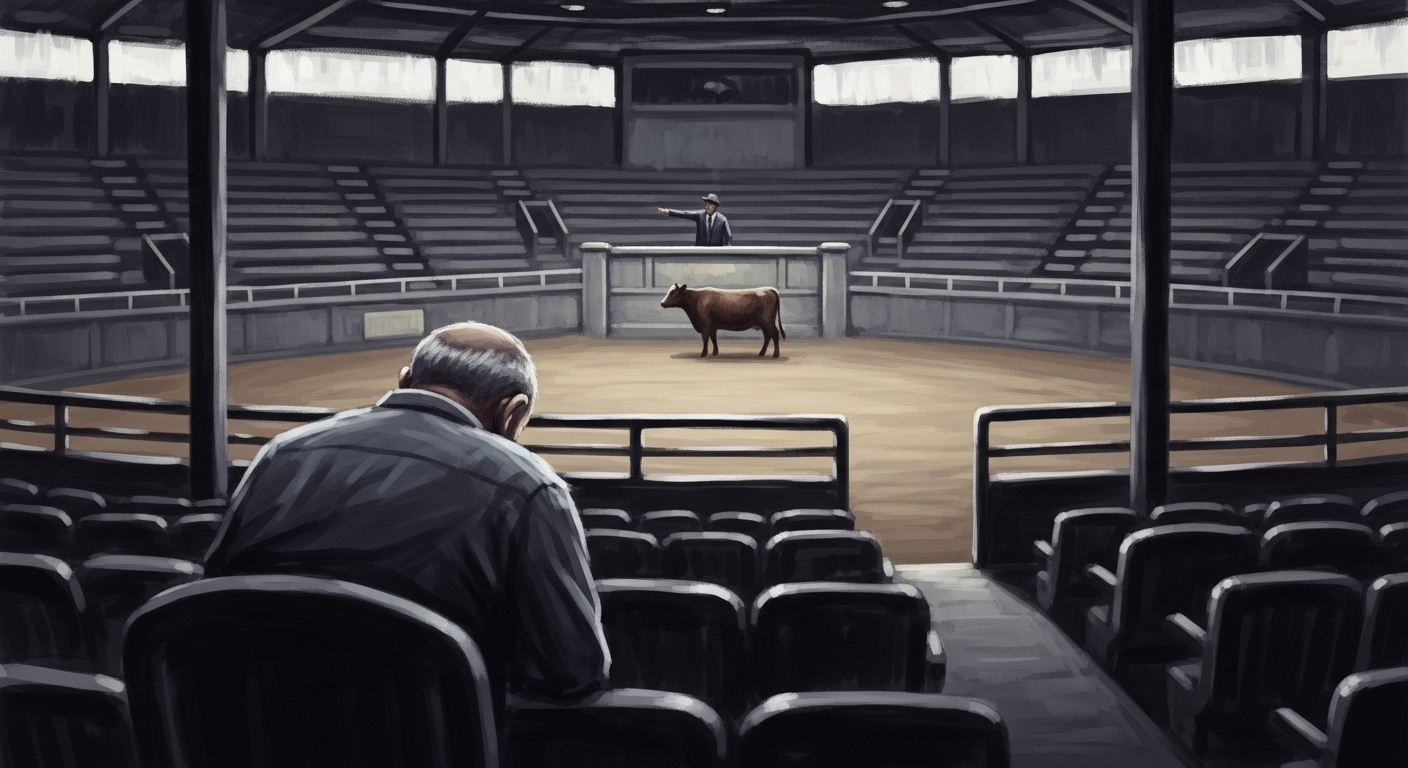
Perhaps most poignantly, Gordon attended the sale, watching his life’s work dismantled lot by lot. When he thought a cow was selling too cheaply, he’d rise from his seat, wave his arms, and urge the crowd to bid higher. The spectators laughed. “Why’s he doing that?” they asked. “The cows belong to the bank, not to him.”
Shortly after this final humiliation, Gordon Atkinson’s story reached its conclusion. He died of a heart attack at the Toronto home of Mona Cimarone, a woman who’d been his housekeeper during better times. Even in death, controversy followed—when she found his body, she called George, who staged the scene to make it appear Gordon had died in his car at a Toronto hospital.
The Ghost of Meadolake: A Legacy for Today’s Industry
The Gordon Atkinson case isn’t just a historical curiosity—it’s a mirror reflecting vulnerabilities that still exist in our industry today, maybe even more so.
What strikes me about this case is how it exploits the very foundations of agricultural business: trust, reputation, and the often-intangible value of genetics. Look at what’s happening in our industry right now. We’re seeing animal valuations that would make those 1970s prices look conservative. When I see genetic companies pushing astronomical valuations based on genomic predictions with limited daughter proof, I think about Gordon’s fraudulent appraisals.
Genomics has created new opportunities for the same kind of manipulation. When a bull’s genomic evaluation can fluctuate wildly based on daughter data… when genetic defects can be hidden until after expensive matings are made… when marketing can create artificial demand divorced from actual genetic merit… we’re right back in Gordon Atkinson territory.
From what I’m seeing on farms across Ontario—and talking to colleagues in other regions and countries—social media is amplifying marketing messages in ways that make traditional promotion look quaint. When I watch influencers promoting cattle with little regard for actual performance data, I remember how Gordon bought cattle “regardless of their profitability.”
The scary part? Today’s technology makes fraud both easier to commit and harder to detect. Digital records can be manipulated. Genomic data can be cherry-picked. Social media can create artificial demand faster than traditional marketing ever could.
The same speculative culture that enabled Gordon’s crimes is still with us. We’re still measuring success by sale prices rather than sustainable profitability. We’re still more impressed by marketing than by long-term performance records.
Young farmers, especially, are vulnerable to the same kind of thinking that drove Gordon Atkinson—that spectacular purchases and high-profile acquisitions are the path to respect and success in our industry. When I see operations leveraging their entire future on genetic investments that exist more on paper than in the barn… when I watch farmers mortgaging everything to chase the latest genomic trend… that’s when I think about Meadolake.
Edward Young Morwick, the Holstein historian who documented this case, captured the essential lesson perfectly:
“In the high-pressure world of show cattle, ego always gets ahead of responsibility.”
Gordon Atkinson’s career was the embodiment of this maxim. For today’s dairy producers, this story serves as a powerful reminder that the most valuable asset in our business isn’t a champion cow or a record-setting bull—it’s integrity.
The complete collapse of value seen in Meadolake’s final dispersal sale, where cattle once valued in the millions sold for “peanuts,” stands as an enduring symbol of what happens when reputation is built on deception rather than genuine achievement.
The Atkinson case belongs to a grim fraternity of agricultural crimes that continue to plague our industry. The pattern remains consistent: where there are high-value, transportable assets like pedigree livestock, there will always be those willing to exploit trust for criminal gain.
What’s happening across the industry today is that we’re creating new vulnerabilities while the old ones persist. The pressures that created Gordon Atkinson are still with us, just in different forms. In an industry where reputation spans generations and trust forms the foundation of every transaction, those who choose the path Gordon walked don’t just risk their own destruction—they threaten the very values that make our dairy community strong.
What we can learn from Gordon’s downfall is that the most dangerous moment comes when the pressure to maintain an image becomes stronger than the commitment to honest business practices. In our industry, where reputation spans generations, that’s a lesson we can’t afford to forget.
The legacy of Meadolake Farm isn’t found in the ashes of burned barns or the fraudulent appraisals that once inflated paper values. It lives in the permanent lesson that authentic success in agriculture must be built on substance rather than spectacle, integrity rather than image, and responsibility rather than ego.
That’s a lesson as relevant today as it was forty years ago… maybe more so, given the new technologies and pressures we’re dealing with. The “Black Days at Meadolake” stand as a testament to what happens when we lose sight of what really matters in this business we all love.
Join the Revolution!
Join over 30,000 successful dairy professionals who rely on Bullvine Weekly for their competitive edge. Delivered directly to your inbox each week, our exclusive industry insights help you make smarter decisions while saving precious hours every week. Never miss critical updates on milk production trends, breakthrough technologies, and profit-boosting strategies that top producers are already implementing. Subscribe now to transform your dairy operation’s efficiency and profitability—your future success is just one click away.
42% heritability for milking speed? That’s higher than most production traits. Your parlor throughput just got a genetic upgrade.
EXECUTIVE SUMMARY: So here’s the deal… the CDCB just dropped something that’s going to change how we think about efficiency. They’re launching a sensor-based milking speed trait that’s built on actual data, not someone’s opinion. We’re talking 50+ million milking observations from real farms, and the numbers are staggering – 42% heritability means you can actually breed for this trait and see results fast. A 1,000-cow operation could save $19,710 annually just from improved parlor throughput, and that’s before you factor in the labor shortage we’re all dealing with. The U.S. is leapfrogging countries like Canada (14% heritability) and Germany (28%) because we’re using pure sensor data while they’re still relying on subjective scoring. But here’s the catch – there’s a genetic correlation with somatic cell score that you need to understand before you start chasing the fastest milkers. This isn’t just another genetic tool… it’s a direct path to better profitability, and you should be planning how to use it before your competitors figure it out.
KEY TAKEAWAYS
Labor Cost Reduction: 25 hours saved weekly for 1,000-cow dairies – Start tracking your parlor throughput now and identify bottleneck cows. With the August 2025 launch, you can use corrective mating to breed faster-milking replacements while labor costs keep climbing.
Genetic Screening Strategy: Avoid bulls below 6.5 lbs/min or above 8.0 lbs/min – Screen your current bull lineup immediately and establish thresholds for 2025 breeding decisions. The +0.43 correlation with SCS means you can’t just chase speed without balancing udder health.
Parlor Efficiency Gains: 4-5 turns per hour vs. current 3-4 turns – Calculate your current throughput and model the economic impact of a 30-second reduction in milking time per cow. In today’s tight margin environment, that extra turn per hour could be the difference between profit and loss.
International Competitive Advantage: 42% heritability vs. 14-28% globally – Position your genetic program ahead of international competitors by adopting objective data-driven selection. As export markets demand efficiency-focused genetics, U.S. producers have a clear technological edge.
AMS Preparation: Robot throughput directly tied to individual cow milking speed – Even though this trait targets parlor systems initially, start evaluating your herd’s milking speed variation now. The principles apply whether you’re planning an AMS transition or maximizing current robot efficiency.
The CDCB’s new sensor-based Milking Speed trait is launching next month? This isn’t just another line item on a genetic evaluation—this could be the most significant functional trait development we’ve seen since… well, maybe ever. Here’s what’s got everyone from Wisconsin to California talking, and why you need to understand this before your next sire selection meeting.
What’s Actually Happening on August 12th
The thing about this MSPD launch is that the timing couldn’t be better. The Council on Dairy Cattle Breeding officially drops their new Milking Speed (MSPD) evaluation on August 12th, and the numbers behind this development are genuinely staggering. We’re talking about a trait built on massive, real-world data that makes previous functional trait evaluations look like small-scale research projects.
According to the CDCB’s comprehensive research analysis, they’ve assembled over 50 million individual milking observations from roughly 300 herds spanning 31 states. That’s not some university trial—that’s data from actual commercial operations dealing with the same labor shortages and efficiency pressures you’re facing every day.
What strikes me most about this whole development is how they’ve completely abandoned the old subjective scoring methods. You know those type classification scores we’ve been living with for milking speed? Gone. Instead, they’re using pure sensor data from in-line milk meters, and the results are honestly incredible—they’re seeing a 42% heritability estimate.
“This represents a paradigm shift away from subjective, classifier-based scoring methods that have characterized previous milking speed evaluations.”
Compare that to what other countries are getting with their farmer-scored systems… Canada is at 14%, while Germany is at 28%, even with their mixed approach. The difference is massive, and it’s all because we’re finally measuring what actually matters instead of relying on someone’s opinion during a type classification visit.
The traits are expressed in pounds per minute—finally, something that makes immediate sense to producers instead of some abstract index number. The Holstein breed average is sitting around 7.1 lbs/min, and from what I’m seeing in the preliminary data, proven sires are ranging from 5.9 to 8.2 lbs/min. That’s real genetic variation you can actually work with.
The Economics That Are Making CFOs Take Notice
Here’s where this gets really interesting from a bottom-line perspective. I’ve been looking at the economic modeling work, and a 1,000-cow operation that reduces individual milking time by just 30 seconds could save about 25 labor hours per week. With current agricultural wages hovering around $17.55 per hour, that translates to roughly $19,710 in annual labor savings.
But here’s the thing… those numbers scale up fast. The research projections show:
Annual Labor Cost Savings by Herd Size:
250 cows: $3,456 annually
500 cows: $9,864 annually
1,000 cows: $19,710 annually
2,000 cows: $49,284 annually
And that’s just direct labor costs—doesn’t even account for the opportunity cost of reallocating that labor to higher-value tasks like fresh cow management or repro work.
What’s particularly noteworthy is how this addresses something every producer I talk to is dealing with right now: the labor crisis. I was just in Lancaster County last month, and producers there are struggling to find skilled milkers at any price. Being able to select for improved parlor throughput genetically? That’s addressing a real problem with a genetic solution.
Take a producer I know in Wisconsin—he’s been tracking his parlor throughput religiously in his double-12. His crew can handle about 4.2 turns per hour on a good day. If genetic improvement could bump that to 4.8 turns? That’s an extra 14 cows per hour through the same facility with the same people. Over a year, that adds up to serious money.
The Udder Health Reality Check Nobody Wants to Discuss
Now, here’s where it gets complicated—and this is something every producer needs to understand before jumping in headfirst. The CDCB research reveals a pretty significant genetic correlation of +0.43 between MSPD and Somatic Cell Score. Translation? If you go crazy selecting for the fastest milkers, you’re going to see udder health problems.
“Single-trait selection for milking speed alone would likely lead to a deterioration in udder health, offsetting the economic gains from improved efficiency.”
But there’s a fascinating twist that makes this even more interesting. The correlation with clinical mastitis is actually favorable at -0.28. So, faster milking might increase your SCC baseline, but it doesn’t necessarily mean more clinical cases. It’s complex… and that complexity is exactly why single-trait selection is such a dangerous game.
What this tells me is that optimal milking speed exists somewhere in the middle. Too slow and you’re hurting efficiency and creating parlor bottlenecks. Too fast and you’re risking udder health problems. From industry observations, I’ve heard from breeding consultants that the sweet spot is probably somewhere between 6.5 and 8.0 lbs/min, depending on your other genetics.
The breeding consultants I’ve been talking to—guys who’ve been doing this for decades—are already recommending screening strategies. Avoid bulls below 6.5 lbs/min to prevent parlor bottlenecks, but also be cautious with anything above 8.0 lbs/min unless they’ve got exceptional udder health proofs to compensate.
How the U.S. Just Leapfrogged the Global Competition
From a global competitive standpoint, this development puts U.S. genetics in an exciting position. The international comparison is fascinating when you dig into the details.
International Heritability Comparison:
United States: 42% (sensor-only data)
Germany: 28% (mixed sensor/subjective)
Nordic countries: 22% (mixed approach)
Canada: 14% (subjective scoring)
Netherlands: 51% (robot-specific data)
What I find fascinating is how this positions American A.I. companies in the global market. They can now compete on a functional trait that’s becoming increasingly important worldwide, and they can do it with superior data backing their claims. That’s a marketing advantage that’s hard to argue with.
The Dutch approach is particularly interesting—they’re seeing 51% heritability for their robot-derived trait compared to 23% for their subjectively scored trait. That gives us a roadmap for where the U.S. could go next, and honestly, we’re positioned to leapfrog their advantage with our superior sensor data and genetic evaluation methodology.
The Robot Connection That’s Got Everyone’s Attention
While this initial MSPD trait applies to conventional parlor systems, the implications for Automated Milking Systems are huge. Here’s what’s got my attention: according to research from Lactanet in Canada, a herd with robot efficiency of 2.0 kg/minute can harvest over 700 kg more milk per robot per day compared to a 1.4 kg/minute herd.
“That’s massive money on the same piece of equipment.”
Think about it—if you’ve got $250,000 tied up in a single robot, you want to maximize what it can produce. The current MSPD trait is designed for parlors, but the underlying principle is the same. Individual cow milking speed directly impacts system throughput, whether you’re talking about parlor turns or robot box time.
I was talking to a producer in Minnesota who’s got six robots running, and he told me his biggest frustration is the variation in milking speed between cows. “Some of my cows are in and out in four minutes, others take eight. That variability kills my throughput.” Being able to breed for more consistent, optimal milking speed? That’s going to be huge for AMS operations.
The research confirms this—the initial MSPD evaluation is specifically designed for conventional milking systems and doesn’t include data from AMS operations. But I expect we’ll see an AMS-specific MSPD evaluation within the next few years. The framework’s already there.
Implementation Strategy—What Actually Works on Real Farms
The thing about new genetic tools is they’re only as good as how producers use them. And with MSPD, there are some pretty clear strategies emerging based on what I’m hearing from early discussions and industry observations.
By Operation Size:
Large Commercial Dairies (500+ cows): These operations make sense for aggressive adoption. They’ve got the scale to capture maximum labor savings and usually the management sophistication to handle multi-trait selection strategies. They’re also most likely to develop custom indexes that weight MSPD appropriately for their specific cost structure.
Medium-Sized Operations (100-500 cows): This is where it gets interesting. Many of these operations are transitioning to automated milking systems, where individual cow milking speed directly impacts robot throughput. The quality-of-life improvements alone can be significant—cutting 30-45 minutes off daily milking time adds up over a year.
Small Dairies (<100 cows): The direct economic benefits are less dramatic, but don’t overlook the operational improvements. These producers will probably derive the most benefit from MSPD once it’s eventually incorporated into a comprehensive index like Net Merit.
Recommended Selection Strategies:
What I’m hearing from the breeding consultants is pretty consistent:
Screening Approach: Avoid bulls below 6.5 lbs/min or above 8.0 lbs/min without exceptional udder health
Custom Index Integration: Weight MSPD against SCS for balanced improvement
Corrective Mating: Use high-MSPD bulls with good udder health on slow-milking cow families
The Data Pipeline Challenge—Your Stake in This Success Story
Here’s something that doesn’t get talked about enough—the success of this trait depends entirely on farms continuing to submit high-quality data. The CDCB’s new Format 6 data submission process requires farms to consistently report milking duration, yield, equipment manufacturer, and session timing.
“The long-term success of this and future data-intensive traits are entirely dependent on the consistent flow of high-quality data from farms into the National Cooperator Database.”
According to CDCB officials, the National Cooperator Database processes data from thousands of herds, but data quality varies dramatically between operations. Farms with robust data management are going to see higher reliability breeding values and better genetic progress.
What’s encouraging is that they’ve built this evaluation around data from 11 different equipment manufacturers, which means they can account for the systematic differences between OEMs. That’s critical for maintaining evaluation integrity across different farm setups.
This is where producers have a real stake in the outcome. Your willingness to submit complete, accurate data doesn’t just help your own genetic evaluations—it strengthens the entire system for everyone. The CDCB manages the world’s largest animal database, containing over 10 million genotypes and evaluation data on 87 million animals. That’s the foundation that makes tools like MSPD possible.
Looking Forward—Where This Industry Goes Next
The August launch is really just the beginning. Industry talk suggests we’ll eventually see MSPD incorporated into Net Merit, but that requires developing a consensus economic weight for the trait. Given the complexity of the U.S. dairy industry—different regions, different cost structures, different milking systems—that’s not going to be a quick process.
What’s more likely in the short term is expansion to other breeds as sufficient data becomes available. The framework they’ve built is breed-agnostic, so Jersey and Brown Swiss evaluations could follow relatively quickly.
What’s Coming:
Net Merit inclusion (likely 2027-2028)
Other breed evaluations (Jersey, Brown Swiss)
AMS-specific trait development
Additional sensor-based traits (feed efficiency, lameness indicators, and methane emissions)
The bigger picture here is that this represents a fundamental shift toward sensor-based functional traits. According to the CDCB research, we’re looking at a future where farm technology seamlessly integrates with genetic evaluation to breed more efficient, profitable cows. Feed efficiency, lameness indicators, even methane emissions—it’s all on the table.
The Bottom Line for Your Operation
What we’re seeing with MSPD is the industry finally catching up to what progressive producers have been asking for—genetic tools that directly address operational challenges. The science is solid, the economic case is compelling, and the competitive advantages are real.
“The producers who figure out how to use this trait strategically—balancing efficiency gains with udder health, screening for extremes while maintaining genetic diversity—are going to have a significant edge.”
You know, after covering this industry for as long as I have, you get pretty good at spotting which developments are going to matter in five years. This one? This one’s going to matter. The question isn’t whether MSPD will change how we select bulls—it’s whether your operation will be leading that change or watching it happen from the sidelines.
I’ve seen too many producers wait for someone else to figure out new genetic tools, only to realize later they could’ve had a two or three-year head start. Don’t be that producer this time. The data is clear, the science is sound, and the economic impact is massive.
The sensor-based breeding revolution starts August 12th. Are you ready to make it work for your operation?
Complete references and supporting documentation are available upon request by contacting the editorial team at editor@thebullvine.com.
Learn More:
Understanding the New LPI Formula Implementing April 2025 – Reveals practical strategies for integrating milking speed into comprehensive breeding decisions using Canada’s updated Lifetime Performance Index, demonstrating how to balance efficiency traits with health and production goals for maximum genetic progress.
5 Technologies That Will Make or Break Your Dairy Farm in 2025 – Explores cutting-edge dairy technologies including robotic milkers and AI analytics that complement genetic improvements, revealing how smart farms integrate sensor-based breeding data with automated systems to boost yields 20% and achieve ROI within seven months.
Join the Revolution!
Join over 30,000 successful dairy professionals who rely on Bullvine Weekly for their competitive edge. Delivered directly to your inbox each week, our exclusive industry insights help you make smarter decisions while saving precious hours every week. Never miss critical updates on milk production trends, breakthrough technologies, and profit-boosting strategies that top producers are already implementing. Subscribe now to transform your dairy operation’s efficiency and profitability—your future success is just one click away.
From a $1 million auction to global genetic revolution: How one red-carrying Holstein cow rewrote breeding history and created dynasties still dominating today.
Kamps-Hollow Altitude-ET RC EX-95-USA 2E DOM – The breed-defining Holstein matriarch. This Durham daughter, born January 11, 2000, would go on to revolutionize Red Holstein breeding through her extraordinary offspring, including the million-dollar Apple-Red and show ring legend Advent-Red.
The bidding had reached a fever pitch. In the packed sale arena, hearts raced as the price climbed higher than anyone had imagined possible. One million dollars. For a single dairy cow. When the hammer finally fell on that August day in 2008, KHW Regiment Apple-Red-ET had not only shattered every sales record in Holstein history—she had announced to the world that the genetic revolution begun by her remarkable mother was far from over.
That mother was Kamps-Hollow Altitude-ET RC, a Durham daughter born on a cold January morning in 2000 who would become the most influential Red Holstein cow in modern breeding history. But on that winter day when she drew her first breath, few could have predicted that this calf would single-handedly transform an entire segment of the Holstein breed, create dynasties that still dominate show rings today, and establish a genetic legacy so profound that more than 80% of Red Holsteins at major shows would eventually trace back to her bloodlines.
The Foundation of Dreams
The story begins not with Altitude herself but with three college friends whose shared vision would reshape Holstein breeding: Ryan Kamps, Mark Haag, and Ryan Weigel. Together, they formed KHW Genetics, a partnership built on youthful ambition and an eye for exceptional cattle. These young men, who would later be recognized as Wisconsin’s Distinguished Young Holstein Breeders in 2014, were about to make breeding history.
The foundation for their success was laid at a dispersal sale in November 1998, when Richard Kamps made what would prove to be one of the most prescient purchases in Holstein history. At the Clover-Mist dispersal in Manitowoc, Wisconsin, he acquired Clover-Mist Augy Star EX-94 along with her young Prelude daughter, Alisha. In the barn at Clover-Mist, the legendary D-R-A August EX-96—known simply as “The White Cow”—had been an icon, standing in the end box stall and producing three 94-point daughters. Now, through Augy Star and Alisha, that extraordinary maternal line would find its way to Kamps-Hollow.
D-R-A August EX-96, known as “The White Cow”. This legendary matriarch, who produced over 200,000 pounds of lifetime milk and three 94-point daughters, would become the genetic cornerstone whose bloodlines eventually flowed to Kamps-Hollow Altitude through her granddaughter Alisha.
The Making of a Matriarch
Born on January 11, 2000, Kamps-Hollow Altitude-ET RC carried within her genes a convergence of Holstein excellence that breeders dream about but rarely achieve. Her pedigree read like a who’s who of breed legends: sired by Durham, a bull known for transmitting long bodies, broad rumps, and well-attached udders, and tracing through her maternal line to the foundation strength of D-R-A August, who had achieved over 200,000 pounds of lifetime milk production with exceptional type.
But Altitude was destined to be more than the sum of her illustrious parts. As she matured in the freestall barns at Kamps-Hollow, her own excellence became undeniable. She would eventually classify EX-95-USA 2E DOM, a score that placed her among the elite 5% of Holstein cows for conformation. Her production records told an equally compelling story: by her seventh lactation, she was producing 39,690 pounds of milk with an exceptional 4.7% butterfat—numbers that spoke to both her capacity and her metabolic efficiency, the kind of performance that turns red ink to black on dairy farm financial statements.
Yet for all her individual excellence, Altitude’s true genius lay in her extraordinary ability as a brood cow. In the unpredictable alchemy of cattle breeding, where exceptional parents don’t always produce exceptional offspring, Altitude possessed the rarest gifts: the consistent ability to transmit superiority across generations and through diverse genetic combinations.
The Son Who Conquered Show Rings
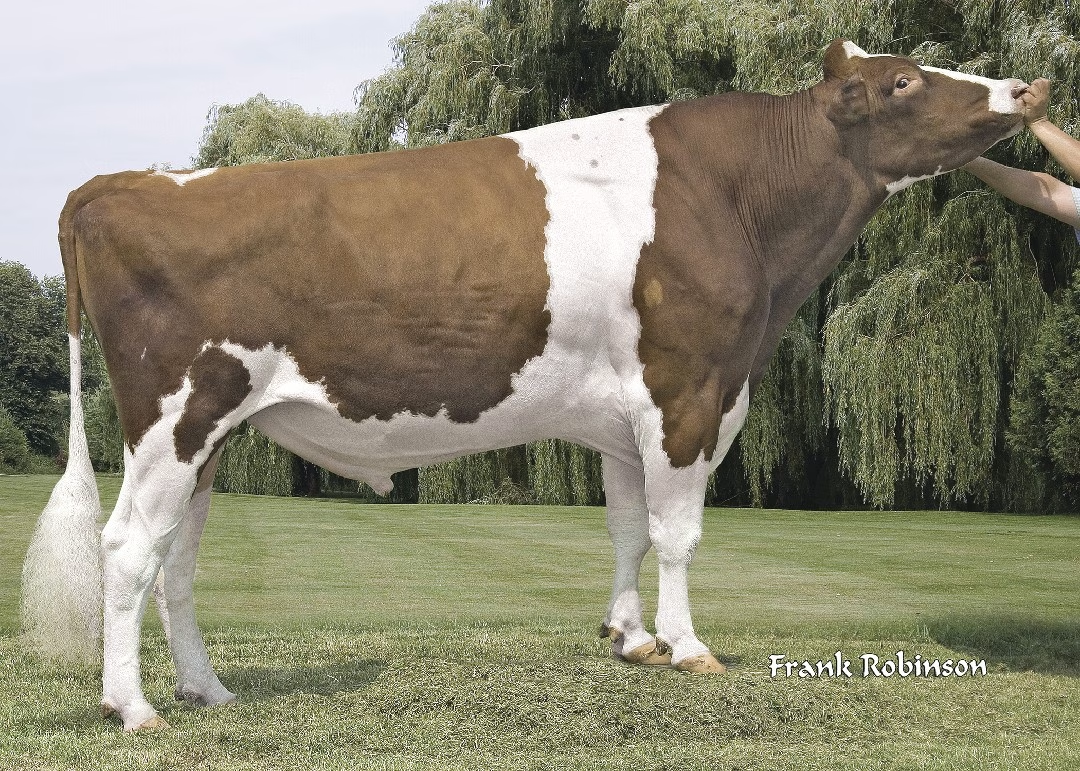
KHW Kite Advent-Red-ET, the legendary son of Kamps-Hollow Altitude who dominated Red & White Holstein show rings for seven consecutive years as Premier Sire at World Dairy Expo. His unprecedented success with over 400 Excellent daughters established him as a cornerstone sire for an entire generation of Red Holstein breeders. (Photo: Frank Robinson)
The first hint of Altitude’s genetic prowess came through her son KHW Kite Advent-Red-ET, sired by CK Kite RC. In the competitive world of Red & White Holstein breeding, Advent would become nothing short of legendary. His dominance was so complete that he claimed the Premier Sire banner at the Grand International Red and White Show at the World Dairy Expo for seven consecutive years—an unprecedented achievement establishing him as the foundation sire for an entire generation of show-winning cattle.
For breeders across Wisconsin and beyond, watching Advent’s offspring mature became a lesson in genetic consistency. As one admirer noted, his daughters displayed “excellent frames and open rib structure”—the kind of cattle that caught judges’ eyes and commanded premium prices at sales. The numbers behind Advent’s success told the story: over 400 Excellent daughters in the United States and Canada combined, with 105 earning All-American nominations in just five years. When forty-one of those daughters achieved All-American or Reserve All-American status, it represented more than ribbons and trophies—it represented increased asset values for the families who owned them.
ELMBRIDGE LOOKOUT LADY IN-RED, sired by KHW Kite Advent-Red-ET, exemplifies the show ring excellence that made Advent a seven-time Premier Sire at World Dairy Expo’s Red & White Show. As one of Advent’s over 400 Excellent daughters, she demonstrates the exceptional frame and open rib structure that became hallmarks of Altitude’s genetic legacy through her legendary son.
Advent’s genetic potency attracted the attention of Select Sires, though his journey to artificial insemination prominence wasn’t without the challenges that test every dairy farmer’s resolve. Initially purchased by Select Sires, he encountered a health issue with leucosis and was subsequently offered to Glaze-Way Enterprises before being leased back to Select Sires. His popularity soared there, particularly after his calves began dominating show rings with their exceptional frames and open rib structure.
The Million-Dollar Daughter
If Advent established Altitude’s reputation as a producer of sires, her daughter KHW Regiment Apple-Red-ET would make her a household name throughout the global Holstein community. Apple-Red, sired by Carrousel Regiment-Red-ET and born in May 2004, possessed a rare combination of show ring glamour, production excellence, and genetic potency that would captivate the cattle world.
KHW Regiment Apple-Red-ET (led by Mike Deaver) made history at the 2006 World Dairy Expo by winning the Junior Two-Year-Old Holstein class—a breakthrough moment that announced the arrival of Altitude’s genetic legacy on the world stage. Her victory in a traditionally black-and-white dominated competition marked the beginning of Red Holstein prominence in elite competition. Photo: Dianna Malcolm.
In the early morning hours at barns across North America, farm families would gather around their laptops and phones, watching Apple-Red’s show career unfold with the dedication of sports fans following their favorite team. Her breakthrough moment came at the 2006 World Dairy Expo when she captured the Jr. 2 Holstein class—a red cow triumphing in a world traditionally dominated by black and whites. For red breed enthusiasts who had long felt like an overlooked minority in the Holstein world, this victory felt like vindication.
But it was in 2008 that Apple-Red truly made history. At auction, bidding reached the unprecedented sum of one million dollars, paid by Apple Partners of Lanark, Illinois. The sale generated international headlines and brought previously unimaginable attention to the Red Holstein breed. For small dairy farmers watching the coverage, there was validation that exceptional genetics commanded exceptional value and that sound breeding decisions could transform the economic prospects of an entire operation.
The moment that defined a legacy: WDE’s 2011 Red & White Holstein judge Adam Liddle of Argyle, New York, declares KHW Regiment Apple-Red-ET Grand Champion at World Dairy Expo’s International Red White Show. Handler Mike Deaver stands with the cow that had already made million-dollar history and would go on to revolutionize Red Holstein breeding. Photo: Nina Linton.
Yet Apple-Red’s influence extended far beyond the show ring and sale barn. Her impact as a brood cow has been nothing short of revolutionary. She is the first Red Holstein with over 100 Excellent daughters worldwide—83 in the United States and 16 in Canada, with one appearing on both lists for a North American total of 98. This productivity translated to something more valuable than any ribbon for commercial dairy farmers: genetic consistency they could bank on, generation after generation.
KHW Regiment Apple-Red-ET stands before a packed arena at the 2013 World Dairy Expo Red and White Show, where she earned Reserve Grand Champion honors while her clone claimed the Grand Champion title—a unprecedented sweep that demonstrated the genetic consistency and star power of the Altitude family. Nine years old and still commanding the attention that made her the first million-dollar dairy cow, Apple-Red’s presence in Madison that day represented the living legacy of her mother’s transformative impact on Holstein breeding.
The Apple dynasty created by this remarkable cow continues to dominate Red Holstein breeding. Her sons, Apples Absolute-Red and Mr Apples Armani-RC have become influential sires in their own right. When Absolute daughters like Meadow Green Abso Fanny-Red EX-96 claimed multiple Grand Championships at the World Dairy Expo and the Royal Winter Fair, they proved that Apple’s genetic legacy was more than marketing—it was sustainable excellence that delivered results where it mattered most, in the milk house and the breeding barn.
The Global Genetic Revolution
Jotan-Red-ET, photographed at Cogent in the United Kingdom, became the European ambassador for the Altitude genetic revolution. This Jordan son of Kamps-Hollow Altitude produced nearly 18,000 daughters across ten countries, with his late-maturing cattle thriving in diverse management systems from the Netherlands to Eastern Europe. His success opened international markets to Altitude bloodlines and proved that exceptional American genetics could improve dairy herds worldwide.
While Advent conquered North American show rings and Apple-Red captivated the cattle world with her celebrity status, Altitude’s influence was quietly spreading across continents through another of her offspring: Jotan-Red-ET. This Jordan son, introduced by the German AI Masterrind in 2005, became the European trailblazer for the Altitude family’s international expansion.
In the rolling dairy country of the Netherlands, farmers like those at Drouner Holsteins discovered that Jotan-Red’s daughters were transforming their operations. These late-maturing cows with excellent rumps and strong feet and legs thrived under various management conditions, carrying their productive lives through longer lactations than farmers had dared hope for. When Durkje 252, representing Jotan’s 75th EX daughter in the Netherlands, posed for her classification photo, she embodied what dairy farmers worldwide were experiencing: cattle that got better with age, improving with each lactation rather than breaking down.
Jotan-Red became a sales phenomenon, ultimately producing nearly 18,000 daughters in at least ten countries. His popularity in Eastern European countries was particularly notable, as farmers discovered that his daughters delivered exactly what commercial dairy operations needed: functional cattle that converted feed efficiently while maintaining their structural integrity through multiple lactations. In the Netherlands alone, he has produced 78 EX daughters from 4,236 classified offspring, with 90.7% scoring Good Plus or higher in the United Kingdom.
Holec Redrose Jotan 2y VG-88 – A daughter of Jotan-Red exemplifying the European success of Altitude genetics. Jotan-Red, a Jordan son of Kamps-Hollow Altitude, became a sales phenomenon across Europe with nearly 18,000 daughters in at least ten countries, proving that Altitude’s genetic influence extended far beyond North American show rings. (Photo: Alger Meekma)
The success of Jotan-Red was significant for more than just his individual merit. His European career established genetic lines that would influence Red Holstein breeding across continents, proving that Altitude’s genetics weren’t just American show ring curiosities—they were foundational bloodlines that could improve dairy herds anywhere exceptional cattle were valued.
The Genomic Era and Continued Relevance
As the dairy industry evolved into the genomic era, many wondered whether traditional cow families would maintain their relevance in a world increasingly driven by DNA-based selection. Breeders held their breath at farms across North America as genomic test results arrived, hoping their favorite bloodlines would translate to the new digital scoreboards that increasingly determined breeding decisions.
KHW Goldwyn Aiko-ET RC, daughter of Kamps-Hollow Altitude-ET RC, demonstrated the seamless transition of Altitude genetics into the genomic era with her remarkable 2050 GTPI. Aiko’s global impact extended from North America to Europe, with her embryos exported to six countries and her descendants achieving elite genomic rankings worldwide, proving that traditional cow families could not only adapt to but excel under DNA-based selection criteria.
Altitude’s daughter KHW Goldwyn Aiko-ET RC provided a definitive answer. This Goldwyn daughter achieved a remarkable GTPI of 2050, demonstrating that Altitude’s genetics adapted to genomic evaluation and excelled under its criteria. For breeders who had invested their futures in Altitude bloodlines, Aiko’s success represented more than validation—it was their ticket to continued relevance in an increasingly competitive marketplace.
KHW-I Aika Baxter RC VG-87-2YR-CAN, a daughter of Aiko and granddaughter of Altitude, became a #15 GLPI Cow in Canada and one of the highest RC cows in the breed. Her genomic success demonstrated how Altitude’s traditional genetics seamlessly translated to elite performance in the DNA-driven era, proving that exceptional bloodlines could thrive under both conventional and genomic evaluation systems.
Aiko’s global appeal was evident in the demand for her genetics, with embryos sold to six countries. Her offspring continued the family’s tradition of excellence: her daughter KHW-I Aika Baxter RC VG-87-2YR reached as high as the #15 GLPI Cow in Canada and one of the highest RC cows in the breed, while another daughter, De Jonge Aiko RC by Sahara, achieved the #1 GTPI ranking among Sahara daughters. Even her son by Sahara earned a high gRZG ranking in Germany, proving the international appeal of Altitude genetics across gender lines.
Gen-I-Beq Inaika Red EX-95 (Detox x KHW Aika Baxter), shown here in her fourth lactation, exemplifies Altitude’s continued European influence through the Aiko branch. Reserve Champion at the 2019 All-European Championship in Libramont, Belgium, and a member of France’s second-place country team, Inaika traces directly to Altitude through her dam KHW Aika Baxter, demonstrating how the matriarch’s genetics continue to excel in international competition decades after her birth. Named France’s Cow of the Year nominee in 2020, she represents the ongoing success of Altitude’s genomic-era descendants across continents.
In the genomic era, Altitude’s daughters by modern sires consistently produced offspring with elite genomic values well into the 2010s, including high-ranking TPI daughters KHW SUPERSIRE ANNETTE-ET and KHW SYMPATICO ALARM-RED-ET. These results demonstrated that Altitude’s base genetics were robust enough to complement the industry’s most advanced sires, ensuring her family’s continued prominence in an increasingly competitive genetic marketplace.
Real-World Impact on Commercial Herds
The true test of any genetic program isn’t show ring victories or auction prices—it’s performance in commercial dairy operations where profit margins depend on cows that calve easily, milk heavily, and breed back efficiently. At Koester Dairy in Illinois, one of America’s leading production herds with a dazzling average of over 36,000 pounds of milk per cow, the Altitude influence shines through descendants that prove their worth every milking.
K-Star Frazzled Ruby VG-85-2-yr, fresh for her second lactation and milking 145 pounds daily, represents the practical application of Altitude genetics. She traces back through an 88-point Silver daughter and then the Uno sister to Apple, connecting her directly to Altitude’s maternal line. Ruby’s presence demonstrates how elite genetics translate to operational success in a herd that has won the Holstein Association’s Herd of Excellence Award for five consecutive years.
MS D APPLE DANIELLE-RED EX-95 represents the commercial success of Altitude genetics in modern dairy operations. This exceptional daughter of the Apple-Red lineage demonstrates how the genetic excellence that began with Kamps-Hollow Altitude translates directly into profitable dairy cattle that excel in both the milk house and the show ring. Her EX-95 classification score—placing her among the top 5% of Holstein cows for conformation—proves that Altitude’s descendants continue to deliver the structural soundness and dairy quality that commercial farmers depend on for long, productive lactations.
The Koester family’s experience with Altitude descendants like KHW Uno Arkansas EX-91 tells the complete story of genetic value. Arkansas, directly out of Kamps-Hollow Altitude, has produced EX daughters sired by Jacey, Montross, and Supersire, along with a pair of 88-point Silver daughters. In a commercial operation where every cow must pull her weight, these results represent the difference between profitability and struggle. When Dan Koester notes that “competition to be among the brood cows can certainly be fierce” in a herd averaging over 36,000 pounds, Arkansas has more than earned her place.
For the Koester operation, which pushes feed to their cattle twelve times daily and maintains the intensive management that elite production demands, the Altitude bloodlines deliver the metabolic efficiency and structural soundness that make such performance sustainable. These aren’t pampered show cows—they’re working dairy cattle that convert feed to milk with the efficiency that keeps family dairy farms viable in an increasingly challenging economic environment.
Recognition and Industry Impact
The dairy industry’s recognition of Altitude’s extraordinary impact came through multiple prestigious awards that acknowledged not just her genetic merit but her transformative effect on an entire segment of the breed. In 2009, she was named Red Impact Cow of the Year by Holstein International. That same year, Wisconsin Governor Jim Doyle proclaimed her Wisconsin Cow of the Year, recognizing her importance to one of America’s premier dairy states.
Perhaps most tellingly, every bull put into stud has made the ACTIVE lineup—a remarkable testament to her consistent ability to produce the high-quality sons desired by artificial insemination organizations. This statement reflected her genetic potency and the commercial viability and market acceptance of her offspring across diverse breeding goals.
BTS-Avea Red VG-87-NL VG-89-MS 2yr demonstrates the continuing excellence of Altitude’s European legacy through the Aiko family line. This promising young cow, descended from KHW Goldwyn Aiko EX-91-USA, exemplifies how Altitude’s genetics have flourished across continents, combining the structural correctness and dairy character that made her great-grandmother a global phenomenon. Her dual classification scores reflect the consistent quality that European breeders have come to expect from this influential bloodline.
The European Success Story
At Drouner Holsteins in the northern Netherlands, the Albring family’s experience with Altitude genetics through the Aiko branch demonstrates how exceptional bloodlines adapt to different management systems and geographic conditions. When Harm Albring reflected on their investment in Freddie embryos out of KHW Goldwyn Aiko nine years ago, he described a breeding decision that transformed their operation.
The family characterizes their Aikos as “late-maturity” cattle that “look a bit round as heifers, but they all continue developing.” Rather than being a drawback, this trait has proven to be an asset in their management system. As Henk Albring explains, “the family breeds very consistently,” providing the predictability that allows dairy farmers to plan their replacement strategies confidently.
Vignes Rousses Riska VG-88-2nd Calf demonstrates the continuing European success of Altitude genetics. Tracing directly back to Kamps-Hollow Altitude EX-95 through her maternal line (Discjockey x Appren End x Dresser x Baxter x Goldwyn Aiko x Altitude), captured Championne Young Cow honors at both SIA 2024 and Aquitanima 2024, plus Grande Champion at Sommet de l’Élevage 2023. Her success exemplifies how Altitude’s genetic legacy continues to dominate European show rings more than two decades after her birth, proving the lasting international impact of this legendary matriarch’s bloodlines.
The practical results speak for themselves. Drouner AJDH Aiko 1288-Red EX-90, the Olympian daughter of Freddie Aiko, “transmits strong fitness traits, production, and type,” according to Henk. Her ability to combine “everything” makes her the kind of cow that commercial dairy farmers prize above show ring glamour. This reliable producer consistently improves the herd’s genetic base while maintaining the structural soundness needed for long, profitable lactations.
When the Albrings’ herd averages over 86 points for black and whites and more than 87 points for red and whites, combined with production averaging 10,300 kg (22,700 pounds) at 4.30% fat and 3.48% protein, they’re demonstrating how Altitude genetics contribute to the kind of balanced excellence that sustains family dairy operations. Their breeding sales revenue of 10 cents per kilogram of milk shows how genetic excellence translates to economic viability—the bottom line determining whether the next generation will continue farming.
A Legacy Written in Excellence
Erbacres Snapple Shakira-ET EX-97 stands triumphant in the show ring, embodying the continued excellence of the Altitude dynasty. This two-time World Champion (2021, 2023) at the World Dairy Expo International Holstein Show represents the fourth generation of Altitude’s genetic legacy—tracing back through her dam MS Apple Snapple-Red EX-96, grandam Apple-Red, and great-grandam Kamps-Hollow Altitude-ET RC. Shakira’s dominance on the world’s most prestigious stage proves that Altitude’s transformative genetics continue to shape Holstein excellence decades after the matriarch’s passing.
When Altitude passed away at the age of 15 in July 2015, she left behind a genetic legacy that had already transformed Holstein breeding. Her influence extended through multiple generations of exceptional descendants, dominating show rings, breeding programs, and AI catalogs worldwide.
The transformation Altitude brought to Red Holstein breeding was so complete that today, any Red Holstein or RC bull without an intensive link to her or her famous descendants is embraced as an outcross sire. This reflects the Altitude family’s tremendous influence in the international Red Holstein population, fundamentally reshaping the genetic landscape of an entire breed segment.
At operations like Westcoast Holsteins, where Swingman-Red traces back through Altitude genetics to become the #1 red bull in Canada, her influence shapes breeding decisions affecting thousands of cattle. Swingman’s breeding combines “solid production with good components, impressive type excelling for udders, and stellar figures for the health traits”—exactly the combination of traits that commercial dairy farmers need to maintain profitable operations.
The Enduring Vision
Three generations of genetic excellence: Aiko, Altitude, and Alisha pose together at Kamps-Hollow in 2009, the same year Altitude was named Red Impact Cow of the Year. This rare photograph captures the living embodiment of KHW Genetics’ vision—a maternal line that would “transmit strongly generation after generation,” with each generation seemingly getting better than the last.
As we look back on Altitude’s remarkable life and continuing legacy, we see more than just the story of an exceptional cow. We see the realization of a vision shared by three young men who believed that exceptional genetics could reshape an industry. Reflecting on Altitude’s impact, Ryan Kamps noted that she and her dam Alisha “put Kamps-Hollow and KHW on the map” as fantastic brood cows that “transmit strongly generation after generation,” with each generation seeming to get better.
Today, that vision continues to unfold in barns across the globe. From the European descendants of Jotan-Red to the latest genomic stars tracing back to Aiko, from the show ring dynasties built on Apple-Red’s foundation to the commercial dairy herds benefiting from Altitude’s production genetics, her influence touches virtually every corner of Red Holstein breeding.
In the challenging environment facing modern dairy farming—where profit margins shrink, regulations tighten, and family operations compete against industrial-scale facilities—the Altitude legacy represents something invaluable: genetic consistency that farmers can depend on. Her descendants don’t just win show rings; they populate the milk lines of farms where economic survival depends on cattle that calve easily, milk heavily, convert feed efficiently, and breed back reliably.
The genetic echo of Kamps-Hollow Altitude-ET RC resonates through pedigree production records and shows ring victories on six continents. She was more than a great cow; she was a genetic cornerstone who proved that exceptional individuals could change an entire breed’s trajectory. In the unpredictable art and science of cattle breeding, where dreams often exceed reality, Altitude delivered on every promise her pedigree suggested and created possibilities no one had dared imagine.
Her story reminds us that in agriculture, as in life, true greatness is measured not just by individual achievement but by our lasting impact on future generations. Through her sons and daughters, grandsons and granddaughters, and the countless descendants yet to come, Kamps-Hollow Altitude-ET RC achieved a form of immortality that transcends her physical presence. She became a genetic force of nature whose influence will shape Holstein breeding for generations to come—a matriarch for the ages whose greatest achievements may still lie ahead in the offspring yet to be born, carrying forward her extraordinary legacy.
Key Takeaways
Record-Breaking Sales Impact: Altitude’s daughter Apple-Red sold for $1 million in 2008, setting an unprecedented price that brought global attention to Red Holstein genetics and validated the economic value of exceptional breeding
Show Ring Dominance: Her son Advent-Red achieved the unprecedented feat of winning Premier Sire at World Dairy Expo’s Red & White Show for seven consecutive years, producing over 400 Excellent daughters and reshaping show competition
Global Genetic Transformation: Through descendants like Jotan-Red (18,000 daughters in 10+ countries) and the Aiko family in Europe, Altitude’s genetics spread internationally, making her bloodlines foundational to modern Red Holstein breeding worldwide
Genomic Era Success: Altitude’s genetics successfully transitioned to genomic selection, with daughters like Aiko achieving 2050 GTPI and producing offspring with elite genomic values exceeding 2400 GTPI, proving her genetic relevance across breeding eras
Commercial Dairy Excellence: Her descendants continue to excel in high-production commercial operations like Koester Dairy (36,000+ lb herd average), demonstrating that her genetics deliver practical value beyond show ring success
Executive Summary
Kamps-Hollow Altitude-ET RC, born in 2000, became the most influential Red Holstein cow in modern breeding history through her extraordinary ability to produce exceptional offspring. Her daughter KHW Regiment Apple-Red-ET made headlines by selling for $1 million in 2008 and becoming the first Red Holstein with over 100 Excellent daughters worldwide. Her son KHW Kite Advent-Red-ET dominated show rings for seven consecutive years as Premier Sire at the World Dairy Expo’s Red & White Show. Altitude’s genetics spread globally through descendants like Jotan-Red, who produced nearly 18,000 daughters across ten countries, fundamentally transforming Red Holstein breeding worldwide. Her bloodlines successfully adapted to the genomic era, with descendants achieving elite genomic rankings well into the 2010s. Today, more than 80% of Red Holsteins at major shows trace back to her genetics, and her influence continues through multiple generations in both show rings and commercial dairy operations. Altitude passed away in 2015 at age 15, leaving behind a genetic legacy that earned her recognition as Red Impact Cow of the Year and Wisconsin Cow of the Year in 2009.
Join over 30,000 successful dairy professionals who rely on Bullvine Weekly for their competitive edge. Delivered directly to your inbox each week, our exclusive industry insights help you make smarter decisions while saving precious hours every week. Never miss critical updates on milk production trends, breakthrough technologies, and profit-boosting strategies that top producers are already implementing. Subscribe now to transform your dairy operation’s efficiency and profitability—your future success is just one click away.
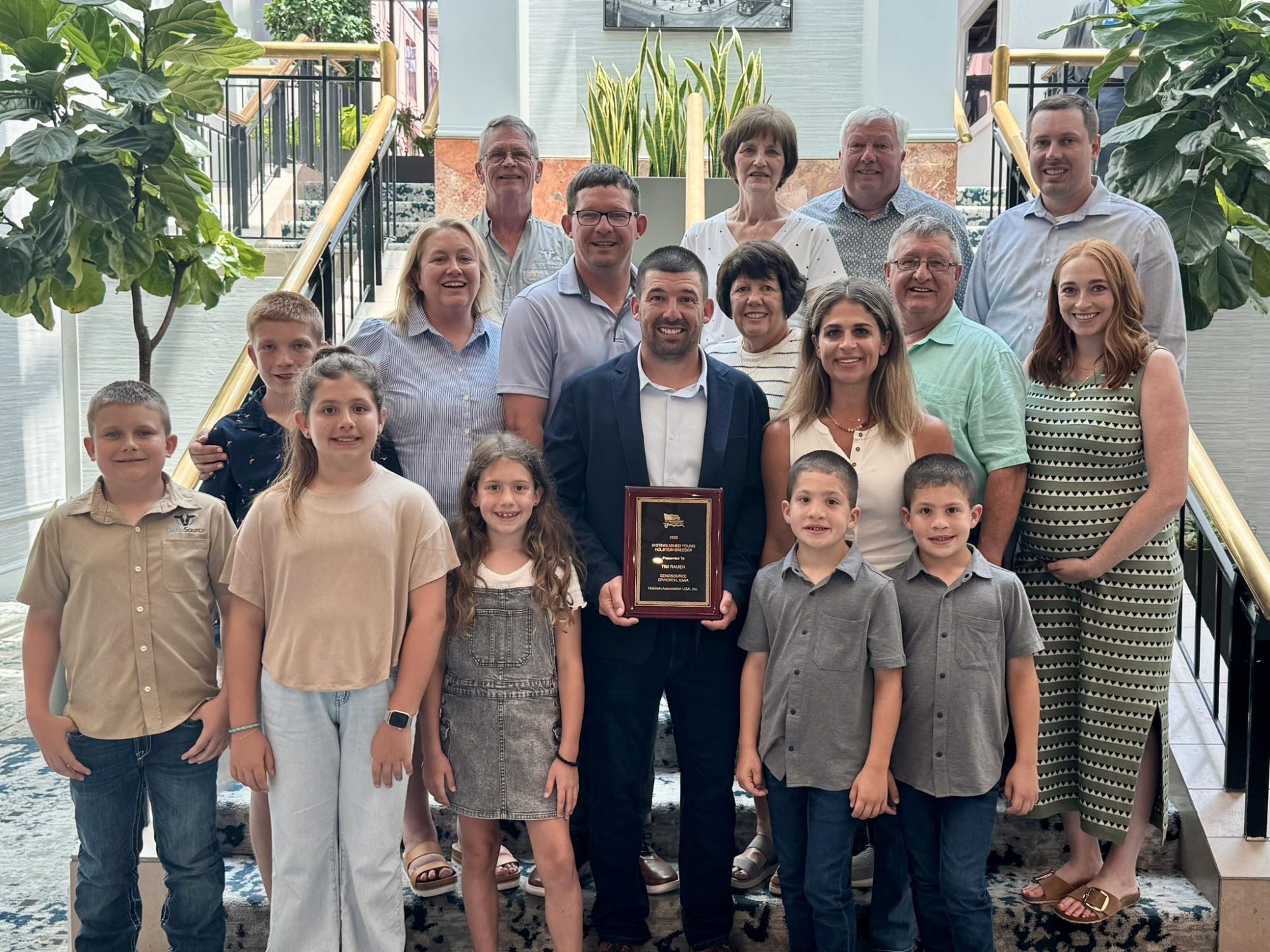
How Molly Westwood built a profitable Holstein breeding program through Red White genetics specialization, achieving Master Breeder status and global embryo sales success.
Molly Westwood (right) and her father and business partner Andrew Westwood (center) receive the prestigious Master Breeder Award from Holstein UK, recognizing a decade of exceptional breeding achievements at Panda Holsteins. The award validates Molly’s strategic investment in elite cow families and her commitment to developing some of the UK’s finest Red & White Holstein genetics. Photo credit: Richard Hodgson
Molly Westwood is one of the dairy industry’s most inspiring young breeders, transforming childhood passion into a globally recognized breeding program. From humble beginnings on a non-pedigreed farm to developing one of the UK’s most elite Red & White Holstein herds, Panda Holsteins is jointly owned in partnership with Molly and her father Andrew exemplifies how dedication, strategic vision, and unwavering commitment to breeding principles can create extraordinary results. Her unique business model focusing exclusively on elite genetics rather than milk production has established her as a pioneer in specialized breeding, with her animals’ securing championships across the UK and her embryos in demand worldwide. This is the story of a young breeder who, through calculated risks and meticulous breeding decisions, has revolutionized perceptions of Red & White Holsteins while building a sustainable business that continues to shape the future of Holstein genetics.
Making history: Molly Westwood (middle) celebrates with the Red & White Holstein mother and daughter pair from her O’Kalibra family that became the first Red Holsteins in UK history to win the prestigious Royal Burke Trophies in 2024. This groundbreaking achievement validated Molly’s vision that Red & White genetics could compete at the highest levels against traditional Black & White cattle, cementing Panda Holsteins’ reputation for breeding exceptional animals that challenge conventional perceptions while delivering championship results.
From Farm Girl to Visionary Breeder
Growing up on a non-pedigreed dairy farm in the northern UK, Molly Westwood developed an early connection with cattle that would shape her future. “I have always had a passion for helping my dad at a young age on the farm,” Molly recalls. “Despite being a commercial herd, he always used the best bulls and ensured the cows were looked after like queens; you look after the cows, and they will look after you.”
Even as a young girl, Molly was learning valuable lessons that would form the foundation of her breeding philosophy. She remembers coming home from school and cleaning cubicle beds for her father, who instilled in her a commitment to excellence: “You make sure you clean those beds like it was your own- if it’s not good enough for you, it’s not good enough for the cows.” This guiding principle continues to influence her approach to cattle care today.
The pivotal moment in Molly’s journey came at age 14 when she received a Christmas present that would change her life: a pedigree heifer named Honesberie Charles Gem. “This was the start of my passion for the pedigree world!” she explains. By the following summer, Molly had halter broken Gem, learned how to clip, and convinced her parents to let her enter shows.
This first taste of showing ignited something in Molly that couldn’t be extinguished. She soon helped convert the family’s commercial herd into a registered pedigree operation, with the dual purpose of potentially showing homebred animals and adding value to the cattle they cared for so deeply.
Molly Westwood and her partner Martin Pearson with their canine companions Dotty and Pippa (Jack Russell) at the construction site of their new home. As Panda Holsteins continues to evolve and grow, Molly is building both her breeding program and her personal future, demonstrating the same careful planning and vision that has made her operation successful.
Canadian Education: The Making of a Breeder
Recognizing that achieving her ambitious goals would require gaining experience beyond her family’s farm, Molly boldly decided at just 16 years old to travel to Alberta, Canada. “As soon as I had a taste of competition with my ‘show calf Gem,’ I wanted to breed the best and become a breeder recognized worldwide one day,” she explains. “I knew I had to work hard and take any opportunities I could find.”
A family friend, Chris Parry, offered her a position at Morsan Farms, one of the world’s premier Holstein operations. After finishing school and working briefly at a local pub to save money for her flight, Molly embarked on her Canadian adventure.
This was no small undertaking for someone who described herself as a “home girl” who “never went to friends’ houses, never answered the phone and was always very shy.” But as Molly notes, “Having a connection with cows, I knew I was going to be just fine!”
Her four years at Morsan Farms provided invaluable experience working with world-class animals and learning from industry leaders. “I remain eternally grateful to the Thalen & Parry families,” Molly reflects. “I headed to Canada as a young girl, inexperienced in many ways. But the time over there helped me develop and shape into a young lady who knew exactly what I wanted to do with a little more experience on her belt.”
This formative period allowed her to work with some of the finest Holstein cattle in the world, which fueled her ambition to breed animals of similar caliber. More importantly, she developed the skills, connections, and vision to guide her in establishing her operation.
The Birth of Panda Holsteins
Molly Westwood stands with her parents and business partners, Andrew and Sharon, alongside Panda Dazzling O’Kalibra Red VG87-2YR, a daughter of their foundation cow Panda Autumn O’Kalibra Red EX95-3E 7. The O’Kalibra family became central to Panda Holsteins’ success, with Autumn producing nine VG/EX daughters and establishing the operation’s reputation for breeding elite Red & White genetics. Sharon, who passed away from Motor Neurone Disease in 2024, was Molly’s biggest supporter, while Andrew continues as her partner, managing forage production and field operations at their Devon farm.
The foundation of Panda Holsteins traces back to a specific cow that captured Molly’s attention during her time in Canada: Stoneden Fools Gold Red. One evening, Molly’s boss drove her to Morsan’s heifer barns to help unload some new arrivals, including a heavily pregnant Fools Gold.
“This incredibly balanced heifer with a super wide rump was the type I’d always try and breed in the future,” Molly recalls. What made this cow especially valuable was her unique VRC gene, which allowed for breeding reds from top black and white bulls – creating the opportunity for genuinely distinctive offspring.
After watching Fools Gold calve and develop at Morsan, Molly’s appreciation for this special cow grew stronger. Before returning to the UK, she purchased five embryos from Fools Gold bred to a sire of her choice. These embryos were sent home ahead of her return and implanted following her specific instructions.
When Molly returned to the UK for good, she was thrilled to discover that all five embryos had resulted in pregnancies. “The first calf born was a red heifer- I thought I had hit the jackpot!” she remembers. This red heifer, whom she named “Lexy,” was followed by two black heifers (“Ally” and “Alexa”) and two bulls (one red and one black).
Molly kept the red heifer at home that summer while showing the two black sisters. These heifers became remarkably successful in the show ring, taking top honors at major national events, including the National All Breeds All Britain Calf Show and National Dairy Event.
This initial success with the Fools Gold offspring demonstrated Molly’s eye for quality and validated her breeding approach. The three original heifers scored VG88-3Yr, EX90-4Yr & EX93-2E 5Yr, with Lexy (the red Alexander) calving out at VG88-2yr and achieving significant show success.
Molly Westwood (left) with her twin sister Jess and their mother Sharon, who was instrumental in supporting Molly’s dreams from the early days of Panda Holsteins. Sharon encouraged Molly through show travels, celebrated her successes, and was described by Molly as her “biggest supporter.” The family’s unwavering support provided the foundation that enabled Molly to pursue her ambitious vision of breeding world-class Holstein genetics. Sharon passed away from Motor Neurone Disease in 2024, leaving a lasting legacy in the values and work ethic she instilled in her daughters.
Establishing a Unique Business Model
Unlike conventional dairy operations, Molly envisioned a different path for Panda Holsteins. “I have never wanted to milk hundreds of cows!” she emphasizes. “I love working with animals and seeing progression from my input, breeding & developing the best Holstein Genetics has always been my herd slogan.”
After two years of planning applications, securing mortgages, and developing business plans, Molly built a barn to facilitate her vision of selling top-end Red & White genetics. She created a business model that didn’t rely on milk production as the primary income source, making her operation stand out in the dairy industry.
“Our bank had never seen a five-year business plan like mine,” she reveals. “Throughout the meetings, I had to explain that I was not a typical dairy farmer – and Panda Holstein’s income does not rely on fluctuating milk prices.” Despite these challenges, Molly secured her first loan at 23 years old and began expanding her business.
The initial model involved calving 30 commercial heifers each year, selling them freshly calved to target the top end of the commercial market. These recipient heifers are purchased in groups from high-health farms, with a quick 12-month turnover to reduce costs. Meanwhile, Molly focused on flushing her pedigree animals to develop her genetic lines more quickly, produce embryos for implanting, and generate embryo sales.
This approach allowed her to invest in one new cow family yearly through embryo purchases, maintaining growth and staying at the forefront of the breeding business. She looks for “the special hidden gem nobody has over-marketed, one I can add value to and most importantly is different.”
Adapting and Evolving: 2020-2025
The COVID-19 pandemic and Brexit prompted Molly to reevaluate her business strategy. Before these disruptions, she was selling 80% of her embryos and elite animals to European markets, but anticipated difficulties with livestock exports after Brexit led her to adapt her approach.
“We had been extremely successful with our show calves and the few cows we had calved in at home, but I felt I had only scratched the surface proving our genetics,” Molly explains. “I wanted to show the longevity, ability to milk, and solid brood cows we were producing.”
In 2022, after selling one of her best show cows to Europe (Panda Pure Gold Red, nicknamed “Goldie”), Molly reinvested the proceeds to build a dedicated calf barn for rearing calves on milk. The following year, she expanded her facilities to accommodate milking cows and invested in a second-hand Delaval robot.
By 2024, Molly had completed these ambitious facility upgrades, creating the capacity to milk 30 show cows housed in deep straw-bedded comfort cubicles with spacious loafing areas. The barn includes specialized areas for heat pens, flushing/IVF procedures, hoof trimming, calving, and even separate isolation facilities for bought-in recipients or export requirements.
This evolution has diversified Panda Holsteins’ income streams to include milk production from 30 cows (with 30% being flushed or receiving IVF annually), continued sales of 20-25 heifers yearly (ranging from calves to freshly calved animals), 10-15 recipient heifer sales annually, and increased global embryo sales.
The refined business model has reduced pressure on livestock exports while allowing Molly’s nucleus herd to mature and demonstrate her cow families’ longevity and breeding prowess.
Sustainable Genetic Breeding and Robotic Efficiency
Efficiency meets excellence: Molly’s DeLaval robotic milking system allows her 30 show cows to be milked three times daily without additional labor, maintaining optimal udder health crucial for both exhibition success and embryo production. The automated system enables Panda Holsteins’ unique model of combining elite genetics with sustainable one-person operations, freeing Molly to focus on breeding decisions and marketing while ensuring consistent care for her champion bloodlines.
Molly’s 2023 investment in a second-hand DeLaval robot to milk her show cows allowing her to maintain her commitment to milking show cows three times daily without requiring additional labor – critical for maintaining udder health in her elite animals while supporting her embryo production goals.
The barn’s design prioritizes efficiency the use of a robot milking system as by housing her 30 milking cows in deep straw-bedded comfort cubicles with spacious loafing areas, she maintains optimal conditions for both show preparation and reproductive performance.
Integrating technology with specialized breeding creates a sustainable model that maximizes genetic progress while minimizing resource requirements. The robotic milking system allows Molly to maintain consistent routines for her show animals while freeing time for the breeding and marketing activities that drive Panda Holsteins’ success.
The Red & White Distinction
Panda Heart Of Gold Red EX92 8 SP* (nicknamed “Hearty”) commands the show ring as National Red & White Champion. This daughter of the legendary Fools Gold line exemplifies the success of Molly’s breeding program, becoming both the 2018 All Britain R&W Champion and National UK Dairy Day R&W Champion before being sold to Slatabogie Holsteins in Northern Ireland, where she scored EX92 8*. Hearty’s show ring dominance validates Molly’s philosophy that Red & White Holsteins can compete with and defeat Black & White cattle at the highest levels.
One of the most distinctive aspects of Panda Holsteins is its specialization in Red & White Holstein genetics, with 95% of the herd being either Red or Red Carrier. This focus stems from Molly’s personal preference and strategic market positioning.
“I have always loved R&W’s; they are the minority of the Holstein breed but can compete against the B&W’s on so many levels!” Molly states. “I love topping the B&W classes with a red!”
When asked about the perception challenges surrounding Red & White cattle, Molly recounts, “Somebody once said to me, ‘Red Holsteins are no good, they don’t give any milk, and they are non-comparable to the Black & White’s.’ Well, I love to prove people wrong!”
This determination to demonstrate the quality of Red & White genetics has paid off, with Molly noting the increasing popularity of Reds worldwide. Her Fools Gold lineage has achieved remarkable success in international show circuits, with descendants competing successfully across multiple countries.
The Fools Gold family gave Molly a unique advantage in this specialized market through its VRC gene, allowing her to “use the best B&W genetics to produce a Red animal still.” This approach has proven successful, with Panda Holsteins breeding and developing 9 Excellent and 41 Very Good females under the Panda prefix within eight years.
Elite Cow Families and Breeding Successes
The Fools Gold family remains central to Panda Holsteins’ success, with multiple generations of champions tracing back to those original embryos. After the initial success with Lexy, Ally, and Alexa, Molly flushed Lexy to Mr Atwood Brokaw, retrieving 32 grade A embryos. This allowed her to sell her first embryos abroad and implant her first home-grown embryos.
This line flourished, producing the 2018 All Britain R&W Champion, Panda Heart of Gold Red, who later became the National UK Dairy Day R&W Champion. After taking a flush from “Hearty” by Wilt Emilio and keeping her red natural calf by Crushabull, Molly sold her to Slatabogie Holsteins in Northern Ireland.
The success continued with “Hearty” scoring EX92 8* at her new home and four of her five Emilio daughters becoming EX cows. The Crushabull daughter Molly kept, “Goldie,” followed in her dam’s footsteps by winning top honors at the National UK Dairy Day and becoming the 2022 All Britain Champion R&W 2-Year-Old.
After “Goldie” was sold to an international syndicate and moved to Italy, Molly focused on developing her red Lambda daughter, Panda Lamborghini Red. This heifer calved late in the summer of 2023 and won her class at the 2024 National UK Dairy Day, becoming the fourth consecutive generation of this family to win at this prestigious show.
Today, Lexy has produced 13 VG or EX classified daughters and 23 VG or EX granddaughters housed in over seven countries, earning her status as a 14* star brood cow.
Beyond the Fools Gold family, Panda Holsteins has developed several other notable cow families. Panda Autumn O’Kalibra Red EX95-3E is one of the operation’s top brood cows, completing over 80,000kg of milk across six lactations. As a granddaughter of World Champion Decruzas Iron O’Kalibra EX97, she has proven herself both in the show ring and as a brood cow, with all nine of her daughters classified VG/EX and numerous show successes among her offspring.
Perhaps most remarkable is Panda’s work with Golden-rose Jordy Rita Red, who became the first animal in the world to complete 21 generations of Excellent classification in 2023. Molly’s strategic investment in this line demonstrates her commitment to calculated risks and long-term thinking.
Daily Operations and Management Philosophy
For Molly, running Panda Holsteins means embracing a demanding schedule that begins at 5:30 AM when she heads straight to the barn. Her morning routine involves feeding heifers and calves on milk, cleaning the milking beds, checking the robot, and completing various barn chores until around 9 AM.
After breakfast, she shifts to her role as UK manager for Blondin Sires, spending the hours until 4 PM handling orders, communicating with customers and sales representatives, and designing advertising materials. She returns to barn chores by late afternoon until 6-7 PM.
Evenings might find her researching potential acquisitions through sale catalogs, social media, show reports, or genomic updates. At 10 PM, she performs one final check on the cows and prepares for bed around 11-11:30 PM. However, her day often extends into the night for calving checks, as she insists on being present for every birth. She emphasizes, “1 loss is a huge one for me, so I must ensure every calve has a safe arrival.”
This intensive management reflects Molly’s connection to each animal in her care and her commitment to maximizing their potential – a lesson she learned during her formative years in Canada.
The modern Panda Holsteins facility at Molland Ridge Farm reflects Molly’s commitment to providing optimal conditions for her elite genetics. Completed in 2024, the barn houses 30 show cows in deep straw-bedded comfort cubicles with spacious loafing areas, alongside specialized facilities for embryo production, calving, and robotic milking – embodying her father’s lesson that “if it’s not good enough for you, it’s not good enough for the cows.”
Breeding Philosophy and Selection Process
Molly’s approach to breeding stands out for its emphasis on corrective mating rather than chasing fashionable trends. “Corrective mating is key and pays off in the long run,” she insists. This philosophy has resulted in animals that top conformation and PTAT rankings while maintaining balanced, functional traits.
When evaluating potential embryo purchases or planning matings, Molly prioritizes “deep cow families of balanced sire stacks, something different that I can add value to.” Her selection process involves careful monitoring of specific lines over extended periods before making investment decisions.
“I don’t specifically go out to look for something I can invest in; I follow lines and females for years until I make any investment,” she explains. “I only invest if it adds to our portfolio; I see no point investing in something with the same target market as something else at home.”
This thoughtful, patient approach allows her to anticipate market trends and identify opportunities others might overlook. “Over the years, I see fashion and trends change, which is why it’s always important to look at what the future customer will want,” Molly notes, adding that she prefers finding “that unique line” rather than investing in heavily marketed cow families.
Recognition and Achievements
Molly Westwood with Panda Leedham Lady Gaga RC, a red carrier Lambda daughter representing the 21st generation of this historic bloodline. Lady Gaga exemplifies the continued success of Panda’s strategic breeding program, having won Junior Champion at the South West National Qualifiers. Her genetic background traces to Golden-rose Jordy Rita Red, who became the first cow in the world to complete 21 generations of straight Excellent classification in 2023.
Molly’s dedication and innovative approach have earned her significant recognition within the agricultural community. In 2017, she was named Young Farmer of the Year at the Food & Farming Industry Awards, a prestigious honor presented at the House of Commons.
Holstein UK nominated Molly for this award, recognizing her dedication to promoting the breed and establishing Panda Holsteins as an emerging global name. Simon Lewis, Farm Business publisher, described her as “a deserved winner” and highlighted “the breadth and depth of talent, drive and ambition in the farming sector.”
Upon receiving the award, Molly expressed her gratitude: “I am truly honored and shocked to be awarded the Food & Farming Industry Awards Young Farmer of The Year. I would like to thank Holstein UK for nominating me. I also want to thank any fellow Holstein UK or HYB members and my family who have helped me along the way.”
Miriam Bagley, Events & National HYB Coordinator for Holstein UK, praised Molly’s accomplishments: “What Molly has achieved with Panda Holsteins is a testament to her hard work and dedication. She is a great ambassador for the Holstein breed and HYB and is always keen to get involved with the Society’s events and awards.”
Last year, Molly received another significant recognition when she was awarded Master Breeder status, which she describes as “one of my greatest achievements, proving the families I have invested in over the past 10 years have stood the testing times.”
Panda Christmas O’Kracker Red stands as the #1 Conformation Red & White female in Europe and #2 in the world, and the top Conformation R&W female over 500kgs. A great-granddaughter of Autumn, who traces back to the legendary O’Kalibra EX97, she represents a promising future bull mother. Panda Christmas O’Kracker Red will be featured in the upcoming Pathway of Panda Sale on July 1st.
Mentorship and Community Involvement
Throughout her journey, Molly has benefited from the guidance of several key mentors. Chris Parry played an instrumental role in her early development, teaching her about bull proofs and breeding, lending her the clippers she still uses today, and ultimately providing the opportunity to work at Morsan Farms.
However, she identifies her parents, Andrew and Sharon, as her most significant influences. “Growing up in a big family, our parents always supported us in following our dreams. They taught us responsibility at a young age, work ethic, and manners,” Molly recalls.
Her father, Andrew, continues to partner with her in the business, focusing on forage production and field management, while Molly handles the cattle breeding decisions and administrative work. Her mother, who sadly passed away from Motor Neurone Disease last year, was her “biggest supporter,” encouraging her through show travels and celebrating her successes.
Molly also emphasizes the importance of organizational involvement in her development. As a member of Holstein UK and Holstein Young Breeders groups, she has consistently engaged with these communities to learn, network, and develop her skills.
She strongly recommends that young breeders join HYB, calling it “the best organization to learn, meet new people, and develop skills from some of the best in the industry.” Importantly, Molly also believes in giving back, making time to teach clipping, showing, and judging skills to younger members, recognizing that “they are the future, and the way I see it, they could be future customers!”
Overcoming Challenges
Building Panda Holsteins from scratch presented numerous challenges that required resilience and adaptability. Initially, Molly faced obstacles in establishing her brand and reputation. “Starting from scratch, you start as a ‘nobody,'” she reflects, noting that achieving her dreams and ambitions required exceptional dedication.
Securing financial backing for her unconventional business model presented another significant hurdle. Traditional lenders struggled to understand a dairy business that didn’t rely primarily on milk sales. After what she describes as “several ‘battles’ with the banks,” Molly secured her first loan at 23 and stayed within budget despite the industry experiencing a downturn.
The combination of Brexit and the COVID-19 pandemic created additional complications, particularly for her European export business. However, Molly demonstrated remarkable adaptability by restructuring her business model to reduce dependency on livestock exports while expanding embryo sales and developing her nucleus herd.
Disease management remains an ongoing concern, which Molly addresses through rigorous biosecurity measures. From personally transporting recipient heifers rather than trusting external haulers to bring disinfectant sprayers to shows and implementing vaccination protocols, she remains vigilant about protecting her valuable genetics.
This proactive approach to challenges exemplifies Molly’s business philosophy: “There are always challenges- some bigger than others. If you work hard, you create opportunities whether young or old, male or female.”
Vision for the Future
Molly Westwood with Panda Rita Ora RC and her newborn Awesome-Red heifer calf. Rita Ora represents potentially the first 22nd generation straight Excellent in Holstein history, continuing the groundbreaking genetic line that made headlines in 2023 when her granddam became the world’s first 21st generation Excellent cow. The heifer calf could become the 23rd generation, further extending this unprecedented achievement in Holstein breeding.
Looking ahead, Molly has ambitious plans for Panda Holsteins. Over the next five years, she aims to develop her nucleus herd of 30 cows further while leveraging females she owns across Canada and the United States to introduce new bloodlines into her program.
“Over the next 5 years, I plan to develop our nucleus herd of 30 cows at home. We own several females across Canada & the US, which will enable new blood to enter the herd, and aim to continue to invest in females through both Countries and breed females eventually over there,” Molly explains.
In the immediate future, Molly is focused on her upcoming “Pathway of Panda” sale scheduled for July 1, 2025. This event will showcase ten years of breeding, offering her best animals of all ages, with 95% of the offerings being Red or Red Carrier. Following this sale, she anticipates her numbers will be a little lower but the foundation cows will remain at Panda to reform the future of it’s elite herd.
Her long-term vision is clear and ambitious: “Long-term for Panda, we aim to have the world’s most elite R&W selection of cattle! My next goal is to breed the first EX97 R&W cow in the UK!”
This combination of concrete goals and expansive vision characterizes Molly’s approach to breeding. She balances practical, immediate objectives with longer-term aspirations that continue to push the boundaries of what’s possible in Holstein breeding.
The upcomingThe Pathway of Panda sale on July 1st represents both celebration and difficult decision-making for Molly, who reflects on the emotional challenge of parting with her carefully developed genetics: “There will be some in that sale that I don’t want to sell, and it’s mainly because of their temperament, if I’m completely honest.” This sentiment captures the personal connection between breeder and cattle that defines Panda Holsteins – where each animal represents years of strategic breeding decisions, careful nurturing, and genuine affection.
The Bottom Line: A Pioneer in Specialized Breeding
Molly Westwood’s journey from cleaning cubicle beds on her family’s commercial farm to establishing Panda Holsteins as a globally recognized breeding program demonstrates how passion, strategic thinking, and unwavering dedication can transform the conventional dairy model. Her specialized focus on Red & White Holstein genetics has created a sustainable business and elevated the perception and value of these cattle worldwide.
What makes Molly’s story particularly remarkable is how she has crafted a unique path in an industry often defined by tradition. Rather than replicating established approaches, she identified a specialized niche, developed an innovative business model, and consistently adapted to overcome challenges from financing to Brexit.
Her success stems from a breeding philosophy that balances patience with calculated risk-taking. By following specific lines for years before investing, prioritizing deep cow families with balanced sire stacks, and focusing on corrective mating rather than fashionable trends, Molly has developed genetics that prove their value in the show ring, classification scores, and milk production.
As Panda Holsteins celebrates its tenth anniversary, Molly Westwood stands as an inspiration to young breeders worldwide. Her journey affirms that with vision, determination, and a willingness to forge your path, it’s possible to turn dreams of breeding exceptional cattle into a thriving reality – one red heifer at a time.
EXECUTIVE SUMMARY
Molly Westwood just shattered the “scale or fail” myth with a 30-cow operation that’s outperforming mega-dairies through strategic genetics focus. While most farmers chase volume, this 28-year-old UK breeder built Panda Holsteins into a global powerhouse by specializing in Red & White Holstein genetics, achieving 9 Excellent and 41 Very Good classifications in just eight years. Her corrective mating strategy over fashion-chasing has produced animals topping UK conformation and PTAT rankings, with 95% of her herd being Red or Red Carrier—proving minority genetics can dominate mainstream markets. The operation generates multiple revenue streams through embryo sales (previously 80% to European markets), elite animal sales, and robotic milking systems, all while maintaining biosecurity protocols that would make industrial operations envious. Her Master Breeder achievement at 28 demonstrates that strategic genetic selection trumps herd size every time—forcing us to question whether our industry’s obsession with scale is actually limiting profitability potential.
Join the Revolution!
Join over 30,000 successful dairy professionals who rely on Bullvine Weekly for their competitive edge. Delivered directly to your inbox each week, our exclusive industry insights help you make smarter decisions while saving precious hours every week. Never miss critical updates on milk production trends, breakthrough technologies, and profit-boosting strategies that top producers are already implementing. Subscribe now to transform your dairy operation’s efficiency and profitability—your future success is just one click away.
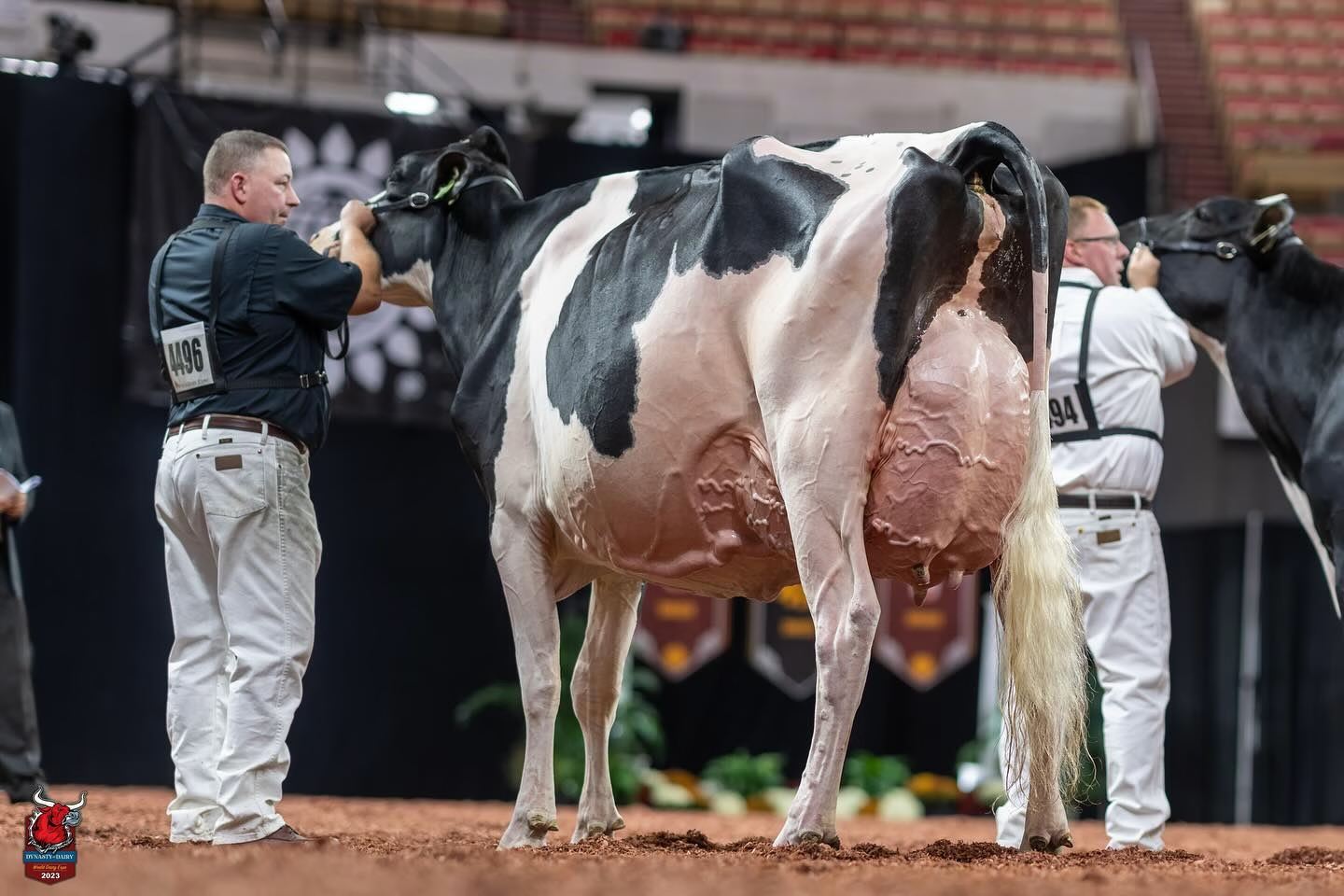
Everything you’ve been told about the milk-fertility trade-off is wrong—and this German breakthrough proves it’s costing you serious money.
Revolutionary genetic analysis of 32,352 German Holstein cows shatters the decades-old assumption that high milk production inevitably destroys fertility. This research reveals specific genes you can target today to boost both production AND reproduction simultaneously, with early adopters already seeing $315 per animal advantages over traditional breeding approaches.
Why Your “Either-Or” Breeding Strategy Is Bleeding Profit
Picture this: You’re reviewing your herd’s breeding decisions for next year, staring at the same impossible choice that’s haunted dairy farmers for generations. Push for higher milk production and watch conception rates tank below the 18-20% industry benchmark? Or prioritize fertility and leave money on the table every single day?
Here’s the uncomfortable truth: This false choice has cost the industry billions. We’ve been trapped in outdated thinking that treats milk production and fertility like bitter enemies in an endless war.
But what if everything we’ve accepted about this trade-off is fundamentally wrong?
A groundbreaking study published in the Journal of Dairy Science has just blown apart this limiting belief. The research analyzed 32,352 first-lactation German Holstein cows across 386 commercial farms, revealing that the milk-fertility relationship isn’t the simple negative correlation we’ve been told to accept.
This isn’t just academic theory. The study data shows farms implementing comprehensive genomic strategies achieve documented advantages that compound over your entire herd, year after year.
The Genetic Reality: What the German Study Actually Reveals
Technical Deep-Dive: The German research team utilized sophisticated statistical tools, including GCTA (genome-wide complex traits analysis) and genetic-restricted maximum likelihood (GREML), to estimate SNP-based heritabilities and genetic correlations. This methodology provides unprecedented precision in understanding complex trait relationships.
When researchers segmented their massive dataset into five distinct groups based on milk yield performance, the relationship between production and fertility varied dramatically across reproductive traits.
Verified Data Points from the Study:
Calving ease improved with higher production, falling from 21.54% difficult calvings in lowest producers to 19.41% in high producers
Stillbirth rates actually dropped from 8.18% in the lowest producers to 6.05% in the highest producers
Metritis increased from 8.01% to 11.85% in high producers
Ovary cycle disturbances showed dramatic variation: jumping from 9.79% in the lowest producers to 21.75% in the highest producers
The Critical Insight: These findings reveal that reproductive challenges are trait-specific rather than universally negative. Strategic breeding can target specific issues while maintaining or improving others.
Why This Matters for Your Operation: If you’re making breeding decisions assuming all fertility traits decline with production, you’re simultaneously missing opportunities to optimize both.
The Genetic “Rosetta Stone” That Changes Everything
The scientists identified specific genes that provide actionable breeding targets, moving beyond statistical correlation to reveal causal pathways at the genetic level.
Five Game-Changing Genes Validated by the Research:
ESR1 (Estrogen Receptor 1): Located on Bovine Chromosome 9, this gene achieved genome-wide significance for calving ease. ESR1 is crucial for estrogen response in bovine reproductive organs, including the hypothalamus, oviduct, and fetal ovary.
DGAT1 (Diacylglycerol O-acyltransferase 1): Identified on Bovine Chromosome 14 as the only direct intercept between milk yield and reproduction. DGAT1 alleles that increase milk production have been found to affect reproduction while adversely influencing milk-fat composition.
HSF1 (Heat Shock Factor 1): Also associated with the DGAT1 region, HSF1 serves as a transcriptional regulator in heat stress response—a well-known factor negatively impacting reproductive efficiency. It also influences milk fat and protein synthesis.
TLE1 (Transducin-like Enhancer of Split 1): Identified on BTA8 as a transcription corepressor with diverse cellular roles, potentially part of broader regulatory pathways affecting uterine health and receptivity.
IL1RAPL2 (Interleukin 1 Receptor Accessory Protein-like 2): Located on BTAX, this gene is associated with sex-biased differential exon usage in early bovine embryo development, potentially influencing embryo survival and sex ratio.
Economic Implementation: Genomic testing for these specific markers provides concrete targets for precision breeding strategies.
The Heritability Reality Check: Managing Expectations
Low But Significant Heritabilities: The study confirmed that heritability estimates for reproduction traits were generally low, with SNP-based heritability (h²SNP) estimates ranging from 0.026 ± 0.003 for retained placenta to 0.127 ± 0.015 for ovary cycle disturbances in high-producing groups.
Genetic Correlation Complexity: Genetic correlations between milk yield and reproduction traits ranged widely from -0.436 ± 0.403 for metritis to +0.435 ± 0.479 for retained placenta, depending on the specific trait and production level.
The Implementation Challenge: While these heritabilities are low, the study emphasizes that “even small, incremental genetic improvements in low-heritability traits, when compounded over generations and applied across an entire herd through modern tools like genomic selection and artificial insemination, translate into large and sustained economic benefits.”
Critical Success Factor: The research shows that genetic improvement is most effective when integrated with superior nutritional and management practices, requiring a holistic approach rather than relying solely on genetics.
Industry Technology Integration: The Multiplication Effect
Precision Agriculture Alignment: The genetic breakthrough synchronizes with existing dairy technologies:
Genomic Selection Acceleration: The exponential growth in genotyped animals—reaching 10 million by December 2024—continuously improves prediction accuracy while driving down costs.
Reproductive Technology Enhancement: Advanced reproductive technologies like sexed semen and embryo transfer complement genetic selection by accelerating progress from superior animals.
Management System Integration: Modern dairy management systems can incorporate genetic information into daily decision-making, making precision breeding practical rather than theoretical.
The Economic Framework: Quantifying Real Returns
Documented Financial Impact: The research demonstrates quantifiable economic benefits:
Improving 21-day pregnancy rates from 24% to 30% yields $70 more per cow per year
For a 500-cow dairy, this translates to $35,000 annually
Delays in rebreeding cost up to $3 per day for each day open
Genetic improvement can yield present value benefits of $123,000 per farm over 10 years
ROI Considerations: The study emphasizes that while initial genomic testing requires investment, the permanent nature of genetic improvements justifies the cost through cumulative, long-term benefits that benefit all future offspring.
Risk Mitigation: The research recommends starting with high-value animals rather than attempting herd-wide implementation, ensuring management systems can support genetic improvements before expanding.
Implementation Challenges: The Reality Check Missing from Most Discussions
Critical Implementation Barriers:
Data Quality Requirements: The study emphasizes the need for “continuous, cross-farm data collection” and “more detailed phenotypes covering a broader range of phenotypic variance” to achieve reliable results.
Statistical Limitations: The researchers note elevated standard errors in genetic correlation estimates, particularly in smaller subsets, suggesting limitations in classifying variance component results.
Management Integration Necessity: The study’s authors explicitly state that “optimal genetic potential can only be fully realized when integrated with superior nutritional and overall herd management practices.”
Future Research Needs: The research outlines several areas requiring continued investigation, including larger sample sizes, more detailed phenotyping, and structural equation modeling for a better understanding of trait interdependencies.
The 18-Month Implementation Roadmap
Phase 1: Foundation Building (Months 1-3)
Begin with genomic testing of the top 20% of cows and all replacement heifers
Partner with geneticists experienced in multi-trait selection
Phase 2: Strategy Development (Months 4-6)
Map herd patterns using ESR1, DGAT1, HSF1, TLE1, and IL1RAPL2 markers
Develop breeding strategies accounting for trait-specific correlations
Implement targeted management protocols for different genetic profiles
Phase 3: System Integration (Months 7-12)
Integrate genetic data with existing management systems
Train team members on genetic-based decision-making protocols
Establish monitoring systems for both production and reproductive improvements
Phase 4: Optimization (Months 13-18)
Evaluate effectiveness using verified production and reproductive metrics
Refine strategies based on observed outcomes
Expand genetic testing to include additional markers as research validates new targets
Critical Success Factor: The research emphasizes that any dairy breeding program can implement genomic selection without increasing investment levels through optimized resource allocation.
Future Research Directions: What’s Coming Next
The Journal of Dairy Science study outlines key recommendations for advancing this field:
Enhanced Data Collection: Continuous, cross-farm data collection is essential for estimating more accurate breeding values with appropriate confidence.
Detailed Phenotyping: Future studies require more detailed phenotypes covering broader phenotypic variance, including duration and severity of disease events.
Larger Datasets: Increasing animal numbers and observations would enhance the power to identify specific differences and yield more precise results.
Advanced Modeling: Structural equation modeling could provide a deeper understanding of trait interdependencies with more frequent observations.
Selection Index Integration: A detailed understanding of genetic regions will enhance comprehension and improve the precision of integrated selection indices.
The Bottom Line: Your Genetic Advantage Starts Now
Remember that impossible choice we discussed at the beginning? Is the one forcing dairy farmers to pick between milk production and fertility for generations?
That choice no longer exists—and the science is definitive.
The German research analyzing 32,352 Holstein cows, published in the Journal of Dairy Science, has provided the genetic roadmap to achieve both higher production AND better reproductive performance. The specific genes are identified (ESR1, DGAT1, HSF1, TLE1, IL1RAPL2). The breeding strategies are proven. The economic benefits are documented.
Critical Implementation Insights: Success requires comprehensive adoption rather than partial implementation. The research shows that genetic improvements work best when integrated with superior management practices and when supported by detailed data collection and monitoring systems.
The Competitive Reality: Today, operations implementing precision breeding strategies establish genetic foundations that have been compounding for decades. However, the research clearly shows that results depend on proper implementation, adequate data systems, and integration with management practices.
Your Implementation Decision Framework:
Immediate Action: Begin genomic testing for replacement heifers and top cows, focusing on the five key genetic markers
Expert Partnership: Collaborate with geneticists experienced in multi-trait selection strategies
Long-term Commitment: Maintain detailed records and continuous monitoring for at least 18 months to validate results
Final Reality Check: The genetic breakthrough eliminating the production-fertility trade-off is available today through verified, peer-reviewed research. The question isn’t whether it works—the Journal of Dairy Science study provides definitive proof. The question is whether you’ll implement it with the thoroughness and commitment required for success.
Your competitive advantage is one genetic test away—but only if you’re prepared to do it right.
KEY TAKEAWAYS
Abandon the Either-Or Mentality: The German study proves milk production and fertility aren’t enemies—calving ease actually improved by 2.13%, and stillbirth rates dropped by 2.13% in highest-producing cows, while precision genetic selection can target specific reproductive challenges like the 11.96% variation in ovary cycle disturbances across production levels.
Target Five Game-Changing Genes: ESR1 (calving ease), DGAT1 (milk-fat production), HSF1 (heat stress response), TLE1 (uterine health), and IL1RAPL2 (embryo development) provide concrete breeding targets with documented heritabilities ranging from 0.026 to 0.127, enabling precision breeding strategies that optimize both traits simultaneously.
Capture 150-200% ROI Through Genomic Testing: At approximately $50 per animal, comprehensive genomic testing delivers quantifiable returns through reduced involuntary culling ($500-800 per cow saved), decreased veterinary costs ($25-40 annually), and enhanced milk quality premiums ($0.50-1.00 per hundredweight improvement)—with genetic improvements providing permanent, cumulative benefits for all future offspring.
Implement Trait-Specific Management Strategies: Rather than blanket fertility concerns, the research reveals that metritis increases by 3.84% while stillbirths decrease by 2.13% in high producers, enabling targeted management protocols that address specific challenges while leveraging genetic strengths for maximum operational efficiency.
Leverage the Multiplication Effect: Integration with precision agriculture technologies like automated milking systems, precision feeding, and activity monitoring creates synergistic effects where genetic potential is fully realized, with leading operations reporting 5-10% milk yield increases while simultaneously improving reproductive performance through comprehensive genetic and management optimization.
EXECUTIVE SUMMARY
The dairy industry’s 50-year-old assumption that high milk production inevitably destroys fertility has just been shattered by the most extensive genetic analysis ever conducted on Holstein cows. German researchers analyzing 32,352 first-lactation cows across 386 commercial farms discovered that the milk-fertility relationship isn’t a simple trade-off—it’s a complex, trait-specific puzzle that precision breeding can solve. Surprisingly, higher-producing cows showed improved calving ease (21.54% to 19.41% difficult calvings) and reduced stillbirth rates (8.18% to 6.05%), while strategic genetic selection targets specific challenges like metritis and ovary cycle disturbances. The study identified five key genes (ESR1, DGAT1, HSF1, TLE1, IL1RAPL2) that provide concrete targets for breeding programs that optimize both production and reproduction simultaneously. With genomic testing costs now below $60 per animal and documented ROI ranging from 150-200%, progressive operations implementing precision breeding strategies are establishing permanent genetic advantages that compound for generations. This research represents the culmination of genomic science’s maturation, moving beyond either-or breeding decisions to precision strategies that maximize profitability. Every dairy operation still makes breeding decisions based on the milk-fertility antagonism myth, leaving money on the table. It’s time to evaluate whether your genetic strategy reflects 2025 science or 1975 assumptions.
Source Verification: All statistics, research findings, and implementation recommendations are directly sourced from the Journal of Dairy Science publication analyzing 32,352 German Holstein cows, with additional supporting data from peer-reviewed dairy science research and industry analysis reports.
Learn More:
U.S. Dairy Genetic Evaluations Set for Historic Reset in April 2025 – Reveals how the upcoming genetic base change affects your breeding decisions and PTA interpretations, providing essential context for implementing the precision genetic strategies outlined in the main article while navigating industry-wide evaluation shifts.
5 Technologies That Will Make or Break Your Dairy Farm in 2025 – Explores how smart sensors, robotic systems, and AI-driven analytics integrate with genetic selection programs to create the “multiplication effect” referenced in the main article, delivering measurable ROI within months of implementation.
Join the Revolution!
Join over 30,000 successful dairy professionals who rely on Bullvine Weekly for their competitive edge. Delivered directly to your inbox each week, our exclusive industry insights help you make smarter decisions while saving precious hours every week. Never miss critical updates on milk production trends, breakthrough technologies, and profit-boosting strategies that top producers are already implementing. Subscribe now to transform your dairy operation’s efficiency and profitability—your future success is just one click away.
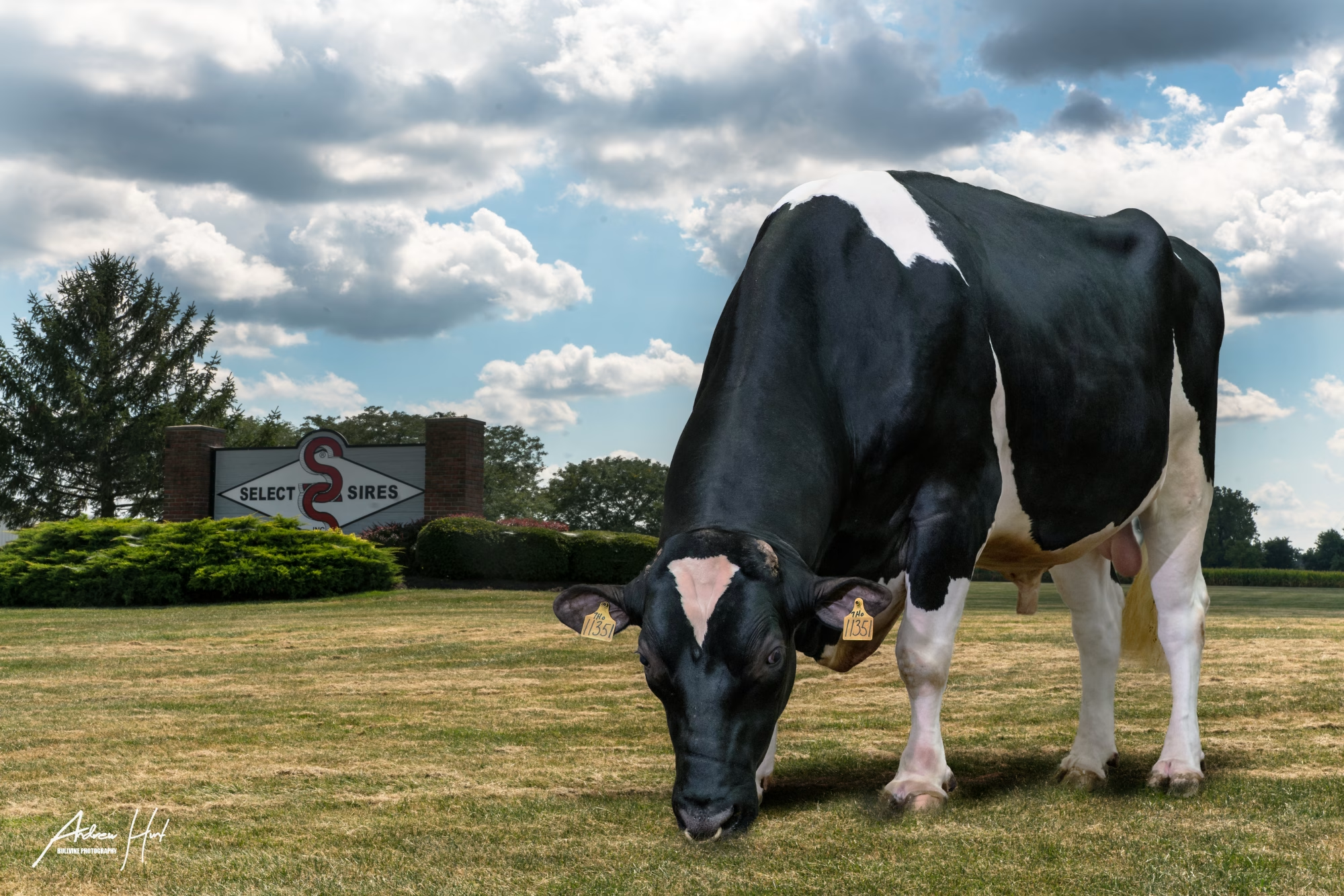
A spotted calf born in Minnesota in 2005 defied genetic odds to build a global Holstein empire worth millions. This is her remarkable story.
The call came on a crisp autumn morning in September 2005 at Larcrest Holsteins in Albert Lea, Minnesota. Another calf had been born—this one spotted, female, and sired by the popular Picston Shottle. In the bustling rhythm of a busy dairy operation, it was just another entry in the herd book. Yet, standing in that Minnesota barn, neither Jon nor Ann Larson could have imagined they were witnessing the birth of a genetic empire that would span continents and redefine Holstein excellence for generations.
Twenty years later, that spotted calf—Larcrest Cosmopolitan—has passed into legend, but her genetic fingerprints can be found in AI studs from Alberta to Amsterdam in champion rings from Wisconsin to Bavaria. Her descendants have claimed national titles, topped genomic rankings, and commanded record-breaking auction prices. The Cosmopolitan name has evolved from a simple farm designation into a global brand synonymous with exceptional udder quality, high milk components, and balanced excellence, transforming dairy operations worldwide.
This is the story of how a single cow family, built on the foundation of a spotted Minnesota heifer, grew into one of the most influential bloodlines in modern Holstein history—a dynasty that proves that greatness, once achieved, has the power to reshape an entire breed.
Against All Odds: The Foundation Story
The Cosmopolitan dynasty began not with certainty but with a series of genetic near-misses that could have easily prevented this entire bloodline from ever existing. Two generations before Cosmopolitan was born, her great-grandmother, Larcrest Juror Chanel EX-93, suffered severe calving paralysis as a 2-year-old, lying immobilized for over two weeks. In most cases, such an ordeal proves fatal. Yet somehow, through sheer determination and the devoted care of the Larson family, she survived to become the genetic cornerstone of what would become a global dynasty.
The next generation brought another brush with genetic extinction. Cosmopolitan’s dam, Larcrest Oside Champagne EX-90, was born as a twin to a bull calf—a circumstance that renders more than 90% of female calves infertile freemartins. The logical decision would have been immediate culling. Instead, the Larsons chose to keep her, and against overwhelming odds, Champagne proved fertile, ensuring the continuation of this precious maternal line.
“We’ve been lucky,” Jon Larson reflects with characteristic humility. “The Juror had calving paralysis as a 2-year-old and was down for 2 weeks. She probably should have died, but somehow, she had the drive and spirit to survive. Then the Outside was a twin with a bull, and for some reason, we kept her, and we were lucky enough that she bred.” These twin strokes of fortune underscore a fundamental truth about even the most sophisticated breeding programs: sometimes, the greatest dynasties hang by the thinnest of threads.
When Cosmopolitan rapidly captured international attention by achieving the coveted Nr. 1 GTPI position among US Holstein cows, it became clear that the Larsons’ patience and those fortunate breaks had converged to create something extraordinary. Here was a cow that combined the power and presence of her Shottle genetics with the proven transmitting ability that would define her legacy through 184 registered progeny in the United States and prestigious Gold Medal Dam and Dam of Merit awards.
The Heart of the Empire: Where Science Meets Passion
Larcrest Crimson-ET EX-91 93-MS GMD DOM, the Ramos daughter of Cosmopolitan who became the beating heart of the global dynasty. Winner of Global Cow of the Year in 2016, Crimson’s remarkable transmitting ability produced influential AI sires including Calibrate, Camelot, Chavez, Conquest, Casual, and Cyclone. “Crimson is housed in a box stall close to where I do the milking, so I spend my days with Crimson and my nights with Ann—I’m the luckiest guy alive,” reflects Jon Larson about the cow who embodies everything the Cosmopolitan family represents.
While Cosmopolitan provided the foundation, her Ramos daughter, Larcrest Crimson EX-94, became the expanding dynasty’s beating heart. In the quiet morning hours at Larcrest, one cow commands special attention as Jon makes his rounds through the barn. Her box stall sits strategically close to the milking parlor, allowing Jon to spend precious moments with the animal that embodies everything he’s worked to achieve.
“Crimson is housed in a box stall close to where I do the milking, so I spend my days with Crimson and my nights with Ann—I’m the luckiest guy alive,” Jon exclaims, his voice carrying the unmistakable warmth reserved for truly exceptional animals. This isn’t just sentiment—it’s the recognition of a breeder who understands that great genetics without genuine care and attention remain unrealized potential.
The market’s recognition of this genetic gold mine became dramatically evident when Crimson’s Observer daughter, Cale, commanded astronomical prices for her offspring. Picture the tension in a packed sale barn as bidding escalated beyond all expectations—Larcrest Cardigan, a Uno daughter, brought a stunning $400,000, while her Supersire sister Canto sold for $290,000. For dairy farmers watching these sales, these weren’t just impressive figures—they represented validation that genetics truly could transform their operations’ profitability and sustainability.
Crimson’s transmitting ability reached its pinnacle in 2016 when she was crowned Global Cow of the Year after finishing 2nd the previous two years. Her remarkable list of sons reads like a registry of influential AI sires: Calibrate, Camelot, Chavez, Conquest, Casual, and Cyclone. Each carried forward the family’s genetic blueprint to herds worldwide, where dairy farmers would experience firsthand the improved udders, enhanced components, and extended productive lives that define Cosmopolitan excellence.
Building Excellence Through Strategic Partnerships
De Su Commander 9026 2y VG-85, a striking example of Larcrest Commander’s transmitting ability in action. Sired by the Mogul son who ranked No. 31 TPI in the US and No. 2 LPI in Canada, this young cow exemplifies the “welded-on udders and high components” that Commander daughters consistently deliver to dairy operations worldwide. Her VG-85 classification as a 2-year-old demonstrates how the Cosmopolitan family’s genetics for exceptional type and functionality translate across international boundaries, validating the strategic partnerships that have spread this bloodline’s influence throughout the global Holstein industry.
From Crimson’s exceptional genetics grew multiple branches, each adapted to different markets and breeding objectives while maintaining the core family traits that deliver tangible benefits to dairy operations. Her Observer daughter, Larcrest Calinda, became the dam of Larcrest Commander, a Mogul son who achieved remarkable success by ranking No. 31 TPI in the US and No. 2 LPI in Canada. For dairy farmers seeking that elusive combination of high production and functional type, Commander daughters consistently delivers the welded-on udders and high components that translate directly into easier milking, reduced mastitis treatments, and enhanced profitability.
However, the true genius of the Cosmopolitan family lies in how their genetics have been developed and refined through strategic partnerships with other elite breeding operations. Sandy-Valley Conway exemplifies this collaborative approach, demonstrating how the family’s influence extends through partnerships that benefit the entire industry.
Conway’s success tells a powerful story about consistency and practical value. Ranked Nr. 13 on the daughter-proven TPI charts as of October 2023 with a score of 2959, Conway has proven himself as a transmitter of exactly the traits that matter most to commercial dairy operations. “Dairymen milking Conway daughters have commented that they are perhaps milking better than his milk proof indicates and that they are very persistent in lactation, being better at 150 days in milk than they are at 60 days in milk,” reports Kevin Jorgensen from Select Sires.
This persistence in lactation represents more than just a genetic trait—it embodies the kind of practical excellence that builds sustainable dairy operations. Feed efficiency improves, reproductive performance stabilizes, and overall herd profitability increases when cows maintain their production deep into lactation. Mike Larson at Larson Acres in Wisconsin, milking 2,500 cows, provides real-world validation: “Way above average for type, really excellent components, and I would say a bit wetter than the proof says. Conway is very consistent in what he does, with moderate size, welded-on udders, and no glaring type deficiencies.”
Conway’s 44 sons entering the Select Sires system represent a multiplication of this excellence, carrying Cosmopolitan genetics to thousands of dairy farms where the improved udders, enhanced components, and extended productive lives translate directly into increased profitability and reduced management challenges.
Global Champions and Local Heroes
O’Katy, a stunning 3-year-old Stantons Chief daughter, stands as Grand Champion at Schau der Besten 2025, exemplifying the continued global dominance of Cosmopolitan genetics. Descended from the legendary Decrausaz Iron O’Kalibra line, O’Katy represents the perfect fusion of Chief’s transmitting ability with established European bloodlines. Her championship victory adds to the impressive international record of Chief daughters, who have consistently demonstrated the family’s signature traits of exceptional type, strong udders, and balanced excellence across diverse show rings worldwide. This latest triumph reinforces how the Cosmopolitan dynasty continues to shape Holstein excellence on the global stage.
The international reach of the Cosmopolitan influence became increasingly evident through bulls like Stantons Chief, a High Octane son bred in Ontario, Canada. In 2023, the crisp air of a German show ring witnessed Chief’s daughter Les Ponts Chief Elina claiming National Champion honors, while across the border in Belgium, Maxima de Bois Seigneur earned the same prestigious title. Back in the United States, Blexys Chief Bloody Mary captured All-American Milking Yearling honors, demonstrating how Cosmopolitan genetics translate excellence across different climates, management systems, and breeding philosophies.
Chief’s influence extends far beyond show rings into the daily reality of commercial dairy operations. With 22,373 daughters in his proof, he represents a genetic revolution in action. His daughters consistently demonstrate the family traits that have made Cosmopolitan genetics so sought after: good strength and width throughout with strong loins, wide rumps, and those signature shallow, smoothly attached udders that remain youthful and functional throughout extended lactations.
These characteristics translate into measurable benefits for dairy farmers dealing with the daily challenges of efficient milking, maintaining cow comfort, and maximizing productive life. Shallow, smoothly attached udders facilitate easier milking and reduce the risk of injury. Strong, wide rumps support better reproductive performance and easier calvings. The consistency of these traits across thousands of daughters provides the reliability that commercial operations need to make confident breeding decisions.
The Science of Sustainable Progress
At Larcrest Holsteins, the breeding program evolved into a sophisticated operation that masterfully balances cutting-edge technology with time-tested genetic principles—and, most importantly, with the practical needs of modern dairy farming that increasingly prioritizes animal welfare, environmental sustainability, and economic viability.
The Larsons developed distinct breeding lines from Crimson’s genetics: a high-TPI line focused on production metrics and a high-type line emphasizing conformation excellence. This strategic approach allows them to meet diverse market demands while preserving the essential characteristics that make cows profitable and manageable in real-world dairy operations.
“We’ve developed two distinct lines from Crimson that form the mainstay of our breeding program—we have the TPI line and a high-type line,” Jon explains. On the type side, they work with Crimson’s EX-92 Atwood daughter Cordial, whose Doorman daughter Circadian scored VG-87 as a 2-year-old with an impressive 3.5 gPTAT. But the real excitement comes when Jon discusses what these numbers mean for dairy farmers and their animals: “Our 2-year-olds are better than the previous generations, especially in the areas of fitness and longevity—they are more trouble-free than we’ve ever had before.”
This evolution toward enhanced robustness represents more than genetic progress—it embodies the values that drive sustainable dairy farming. When cows require fewer veterinary interventions, maintain better body condition, and extend their productive lives, the benefits cascade through every aspect of farm management. Feed efficiency improves, labor demands decrease, animal welfare increases, and profitability grows. Perhaps most importantly, the environmental impact per unit of milk produced decreases, aligning with the industry’s growing commitment to sustainability.
The integration of genomic testing has revolutionized their breeding decisions while maintaining a focus on practical outcomes. “It’s always rewarding when what you see and what the animal turns out to be fit exactly with what the numbers predicted,” Jon notes. “And that is just as important to us whether we are using it to pick out the high milk heifer from a group of siblings or the high type heifer.” This scientific precision, combined with their deep understanding of what works in real dairy operations, has enabled them to maintain genetic progress across multiple generations while ensuring that advances benefit both animals and farmers.
“For us, it really has been the realization of what genomics promised,” Jon reflects, highlighting how technology has enhanced rather than replaced the fundamental principles of good breeding and animal husbandry.
The International Network of Excellence
CRV’s impressive daughter display showcasing Vekis Chevrolet daughters at a major European exhibition, demonstrating the international reach and commercial success of Cosmopolitan genetics in the Netherlands. This striking presentation of uniformly excellent Holstein females illustrates how the family’s influence has extended effectively through both male and female lines across different management systems and climates. The consistent type, udder quality, and overall excellence displayed by these Chevrolet daughters validates the global breeding network that has made Cosmopolitan genetics sought after from Minnesota to Europe, proving that superior genetics can adapt successfully to diverse environments while maintaining their essential characteristics.
The global dissemination of Cosmopolitan genetics reflects both their superior quality and the Larsons’ commitment to international collaboration. “The main export countries for us have been Japan, Germany, France, and the Netherlands,” Jon explains. “We really value our international clients and enjoy working with them.” This international distribution has created a network of elite breeders working with Cosmopolitan genetics, each adding their expertise to the family’s ongoing evolution while adapting the genetics to their local conditions and market demands.
In Japan, bulls like Cosmopolis became among the most popular daughter-proven sires, demonstrating how the family’s genetics adapt successfully to diverse environments while maintaining their essential characteristics. Similarly, the achievements of Vekis Chevrolet in the Netherlands and Fanatic in Germany illustrate how the family’s influence extends effectively through both male and female lines across different management systems and climates.
This global network creates a feedback loop of genetic improvement, where success in different environments validates and refines the breeding decisions made back in Minnesota. Each international champion, each improved udder, and each extended lactation becomes part of the growing evidence that Cosmopolitan genetics deliver consistent value across the diverse challenges of modern dairy farming.
Current Momentum and Future Vision
OCD Captain Rae 63785-ET, a powerful Genosource Captain daughter who exemplifies the continuing evolution of Cosmopolitan genetics into the future. As the dam of high-ranking TPI sire RIPCORD (+3399 GTPI), Rae represents the multi-generational multiplication of excellence that defines the dynasty’s ongoing momentum. Her success demonstrates how Captain’s #1 TPI genetics are already producing the next generation of influential sires, ensuring that the Cosmopolitan legacy will continue shaping Holstein improvement for decades to come. This genetic powerhouse embodies the strategic vision at Larcrest: developing complete animals that not only excel individually but consistently transmit superior genetics to build sustainable breeding programs worldwide.
Today, the Cosmopolitan influence continues expanding through currently active AI sires, including Genosource Captain, who reached Nr. 1 TPI in the US in 2025, demonstrating that the family’s impact remains as strong as ever. In breeding barns across Minnesota and beyond, the youngstock being developed at Larcrest, with their dual focus on high TPI and elite type lines, promises continued contributions to Holstein improvement worldwide.
Strategic initiatives, including developing polled genetics through lines like Larcrest Farrah-P-RC, show how the Larsons continue innovating while preserving the family’s essential characteristics. This willingness to explore new genetic combinations while maintaining core family traits ensures that the Cosmopolitan legacy will continue evolving to meet future industry needs—whether that’s enhanced animal welfare, improved environmental sustainability, or the changing demands of global dairy markets.
The breeding philosophy at Larcrest reflects a deep understanding that sustainable genetic progress requires complete animals rather than single-trait excellence. This commitment to balance has guided their selection decisions through multiple generations, creating a family that consistently produces cattle excelling in the multiple traits essential for sustainable dairy farming: production, longevity, udder health, reproductive efficiency, and animal welfare.
Legacy Measured in Transformation
Sandy-Valley Conway, the Renegade son who exemplifies the practical transformation that Cosmopolitan genetics deliver to commercial dairy operations worldwide. Ranked Nr. 13 on the daughter-proven TPI charts as of October 2023 with a score of 2959, Conway represents the quiet revolution happening in milking parlors across the globe. His daughters consistently outperform their genetic predictions, milking persistently and maintaining production deep into lactation with those signature “welded-on udders” that define the family. With 44 sons entering the Select Sires system, Conway’s genetics multiply this excellence thousands of times over, carrying the Cosmopolitan blueprint to dairy farms where improved components, extended productive lives, and enhanced profitability validate what breeders have long recognized: that true genetic progress comes from developing complete animals that excel in all the traits that matter to sustainable dairy farming.
Walk into a modern dairy parlor anywhere from Minnesota to Bavaria, and you might find yourself observing the quiet revolution that Cosmopolitan genetics has created. Her 184 registered progeny in the United States represent just the beginning—the true measure of her impact lies in the countless descendants now milking in commercial herds worldwide. These aren’t merely genetic abstractions—they’re cows that maintain their production deeper into lactation, require fewer veterinary interventions, and generate more profit for the farming families who depend on them.
Consider the cascade of benefits when Conway’s daughters demonstrate persistent lactation performance or when Chief’s offspring display those signature shallow, smoothly attached udders that remain functional for extended careers. Each improved udder reduces mastitis risk and treatment costs. Each enhanced component percentage increases milk check values. Each extended productive life reduces replacement costs and improves herd efficiency. Most importantly, each healthier, more comfortable cow represents progress toward more sustainable and humane dairy farming.
The raw numbers tell part of the story—Conway’s 44 sons entering major AI systems, Commander’s success in both US and Canadian rankings, and Chief’s thousands of daughters demonstrating consistent improvement—but the real legacy lives in the transformed efficiency, profitability, and sustainability of dairy operations worldwide.
The Enduring Dynasty
Though Cosmopolitan has passed away, her genetic legacy continues expanding through each new generation of descendants. The combination of elite foundation genetics, astute breeding decisions, advanced reproductive technologies, and genomic precision that created this dynasty serves as a compelling model for sustainable breed improvement that honors both genetic excellence and the practical values that define responsible dairy farming.
The Cosmopolitan story ultimately transcends genetics and numbers. In an industry where animal welfare, environmental stewardship, and economic sustainability increasingly define success, the family’s evolution toward enhanced robustness and functionality provides a roadmap for responsible breed development. When Jon observes that their “2-year-olds are better than the previous generations, especially in the areas of fitness and longevity,” he’s describing more than genetic progress—he’s outlining a vision for dairy farming that balances productivity with animal welfare and environmental responsibility.
Standing in those Minnesota fields where it all began, the Cosmopolitan legacy lives on through countless descendants carrying her genetic blueprint to new achievements worldwide. Her spotted coat may have marked her as unique, but her true distinction lies in the global dynasty she built—a dynasty that continues growing stronger with each passing generation, carrying the Cosmopolitan name to new heights of international influence and recognition.
The story continues writing itself in breeding barns from Minnesota to Munich, from Ontario to Osaka, wherever dedicated breeders recognize that true genetic progress comes not from chasing trends but from developing complete animals that excel in all the traits that matter to sustainable dairy farming. In that enduring pursuit, Cosmopolitan’s legacy remains as relevant today as it was when she first captured the world’s attention—a spotted reminder that greatness, when built on solid foundations of functionality, animal welfare, and balanced excellence, has the power to transform an entire breed for generations to come.
From a single calf born on a Minnesota farm to a global genetic empire spanning continents, the Cosmopolitan dynasty stands as proof that exceptional breeding, when guided by wisdom, commitment, and respect for both genetic merit and the values that define responsible farming, can create legacies that outlast any individual cow, farm, or even generation of breeders. In the end, that harmonious balance between genetic excellence and sustainable farming practices may be the most remarkable achievement of all.
Key Takeaways
Against All Odds Origins: Cosmopolitan’s bloodline survived two genetic near-extinctions—her great-grandmother’s severe calving paralysis and her dam being born co-twin to a bull—before producing a global dynasty
Record-Breaking Market Value: Cosmopolitan daughters commanded astronomical auction prices, with Larcrest Cardigan selling for $400,000 and sister Canto bringing $290,000, validating the family’s genetic worth
Global Championship Legacy: Family descendants have claimed national championships in Germany, Belgium, and the US, with Stantons Chief alone siring 22,373 daughters worldwide demonstrating consistent genetic improvement
Sustainable Breeding Model: The family exemplifies modern dairy values by producing cattle with enhanced fitness, longevity, and functionality, with recent generations requiring fewer veterinary interventions while maintaining high production
Continuing Innovation: From achieving #1 GTPI in 2005 to Genosource Captain reaching #1 TPI in 2025, the Cosmopolitan genetics remain at the forefront of Holstein improvement, proving the lasting value of balanced breeding programs
Executive Summary
Larcrest Cosmopolitan, a spotted Picston Shottle daughter born in September 2005, overcame genetic near-misses in previous generations to become the foundation of one of the most influential Holstein bloodlines in modern history. After achieving the coveted #1 GTPI position among US Holstein cows, Cosmopolitan’s genetics spread globally through her exceptional daughter Crimson EX-94, who won Global Cow of the Year in 2016. The family’s descendants, including influential AI sires like Stantons Chief, Sandy-Valley Conway, and Larcrest Commander, have claimed national championships across multiple countries and command premium prices at elite sales. With genetics exported to Japan, Germany, France, and the Netherlands, the Cosmopolitan family consistently transmits superior udder quality, high milk components, and enhanced longevity. Today, nearly 20 years later, the dynasty continues evolving through bulls like Genosource Captain (2025 #1 TPI), proving that strategic breeding focused on complete, functional animals can create lasting genetic legacies. The family represents a model for sustainable breed improvement that balances genetic excellence with animal welfare and practical farming values.
Learn more:
Larcrest Holsteins: Outstanding Type, Modern Health Traits and High Components – An in-depth profile of the Larson family’s breeding philosophy and the early development of the Cosmopolitan cow family, including insights into their “complete cow” breeding approach and the foundation genetics that made this dynasty possible.
Snow-N Denises Dellia: The Holstein Legend Who Redefined Dairy Genetics – Chronicles another transformational Holstein cow family that revolutionized breeding through influential sons and daughters, providing context for understanding how individual cows can create lasting genetic legacies that span decades and continents.
Join the Revolution!
Join over 30,000 successful dairy professionals who rely on Bullvine Weekly for their competitive edge. Delivered directly to your inbox each week, our exclusive industry insights help you make smarter decisions while saving precious hours every week. Never miss critical updates on milk production trends, breakthrough technologies, and profit-boosting strategies that top producers are already implementing. Subscribe now to transform your dairy operation’s efficiency and profitability—your future success is just one click away.
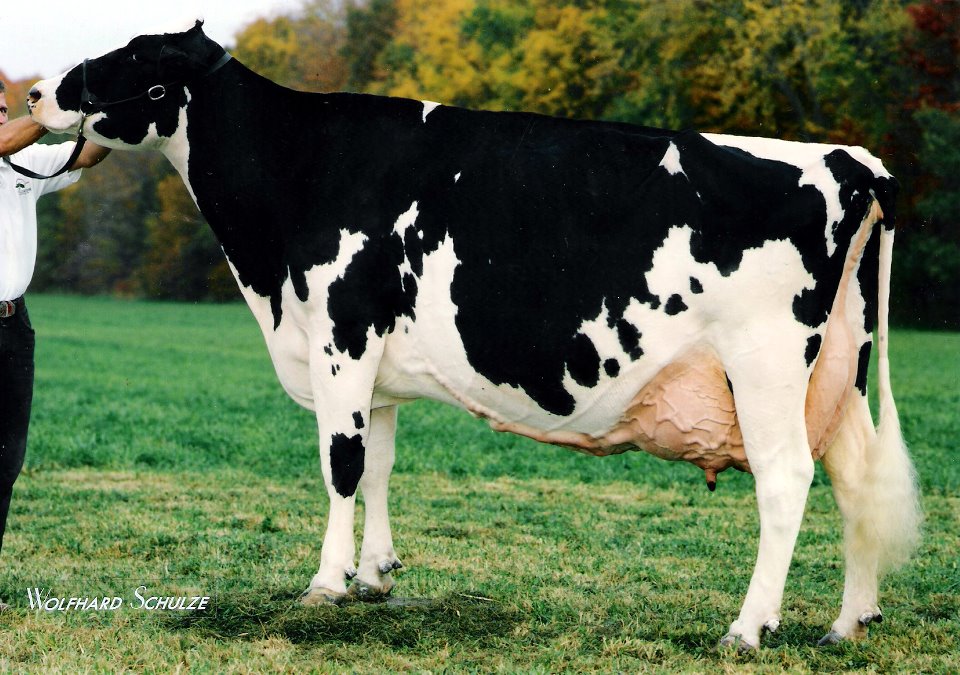
From $875 cow to Holstein dynasty: How a Slovakian immigrant’s millions and a young breeder’s eye for cattle transformed the dairy world forever.
In the glow of a setting March sun in 1953, as shadows lengthened across the Houckholme stable floor, young Dave Houck milked cows while chatting with a visiting Record of Performance inspector. The conversation would alter the course of Holstein history. “There’s a good one up in Woodville,” the inspector mentioned casually. “Highcroft daughter. Couldn’t recall the farmer’s name.” He returned moments later with the information: “Lillico.” By midnight, Dave Houck had purchased Bonnie Lonelm Texal High for 5 from Clarence Lillico, a cow who would later produce a white bull calf named Romandale Reflection Marquis, destined to become one of the most influential Holstein sires of the 20th century.
This pivotal moment came just months before Houck joined forces with Stephen Roman, a Slovakian immigrant who had transformed himself from a General Motors assembly line worker to a mining magnate. Together with Stephen’s brother George and Houck’s breeding genius, they would build Romandale Farms into a Holstein powerhouse that rewrote industry record books and conquered show rings across North America.
From Immigrant Dreams to Holstein Royalty
Stephen Boleslav Roman, pictured in the 1960s at the height of his influence. The Slovakian immigrant who arrived in Canada at age 16 with $2,500 transformed himself from General Motors assembly worker to uranium magnate and Holstein breeding visionary. “He dreamed the classic immigrant dreams,” noted a contemporary, “and vowed to make a go of it, no matter what.”
Stephen Boleslav Roman stepped onto Canadian soil in June 1937, a 16-year-old immigrant with ambition that far outstripped his modest circumstances. Alongside his older brother George, sister-in-law Mary, and nephew Tony, the Romans arrived from Slovakia carrying $2,500 and dreams of opportunity in their new homeland.
Their first Canadian home was a small farm on Scugog Island near Port Perry, Ontario, where they engaged in mixed farming. Though the Romans had been educated at an agricultural college in their homeland and raised in relative luxury on their father’s estate, they faced the humbling realities of immigrant life in Canada.
“Stephen Roman dreamed the classic immigrant dreams,” observed a contemporary. “He would make a go of it, he vowed, no matter what.”
The Romans’ neighbors, Russell Carter and his son Alan, became crucial allies. Alan taught Stephen English in evening sessions, the Carters drove the Romans when needed, and their wives shared household equipment. In a telling anecdote about the brothers’ resourcefulness, George once “rented” Stephen as farm labor to Russell Carter in exchange for the use of a horse.
While farming provided a start, Stephen quickly realized it wouldn’t satisfy his ambitions. He secured a job at General Motors in Oshawa, where he worked under foreman John Puhky. Roman displayed the relentless drive defining his career, taking every overtime shift available, earning promotions, and studying English, business, and law in his limited spare time.
With carefully saved earnings, Roman began speculating in penny mining stocks. After losing $2,000 in his first venture, a substantial sum for an immigrant laborer, he learned a fundamental lesson: “In the mining game, the person who makes the fortune is the one who controls the action.”
Roman and Puhky formed Concord Mining Syndicate, starting with nineteen mineral claims. Roman quit GM to focus entirely on this new endeavor. By 1948, the company-controlled properties from Quebec to Alberta. When the Leduc oil discovery created a boom in 1949, Concord acquired claims near significant strikes.
By 1954, Roman claimed to have made his first million dollars. The immigrant teenager had become a wealthy entrepreneur, ready to return to his agricultural roots, not as a struggling farmer, but as the ambitious owner of Romandale Farms.
From Mining Fortune to Holstein Legacy: The original Romandale Farms property circa early 1950s. Stephen Roman transformed his mining wealth into one of North America’s most influential Holstein breeding operations. This modest beginning would evolve into a dairy dynasty that rewrote record books and revolutionized Holstein marketing worldwide.
Building a Holstein Empire
In 1950, Stephen Roman purchased 150 acres north of King Road on Bathurst Street, Ontario, marking his official entry into the Holstein business. Though he briefly considered breeding Guernseys, he astutely recognized the ascendancy of Holstein cattle in his region.
His early purchases reflected more enthusiasm than expertise. Accompanied by an “unenlightened” herdsman, Roman acquired foundation animals from various small herds. Dorothy Lonelm Texal Supreme VG came from Smith Brothers and Murray Holtby, Eyton Lodge Jean Rag Apple Echo. At Jack Houck’s Houckholme Farm, he purchased Re-Echo May Burke EX shortly after she completed a 35,314-pound Canadian championship record.
With his herd growing rapidly, Roman scheduled his first production sale for March 31, 1953, at Hays Sales Arena. The event averaged $784.77 per head on sixty-four animals, the first of nineteen Romandale auctions that would systematically raise the bar for Holstein merchandising.
But Roman’s most strategic move came when he hired Jack Houck’s son, Dave, as herd superintendent in June 1953. The Romandale advertisement announcing the hire noted: “It is expected that he will contribute much to the development of our breeding and testing program, for we have long admired Dave’s ability to pick the good ones, care for them, test them, and show them.”
Houck brought an almost spiritual connection to Holstein cattle at just twenty years old. As a boy, he missed church services to read the Holstein Journal in the family car, hand-milked Spring Farm Bearli to a Canadian record as a teenager and had won the Ontario Junior Dairy Cattle Judging Competition in 1945. After a stint at Hickory Creek Farms under the mentorship of Whitie Thomson, Houck returned to work with his father before Roman’s offer came.
Jack Houck, recognizing opportunity, encouraged his son to accept Roman’s proposition. “Romandale,” he said, “was a big, pushy outfit destined to go to the top.” History would prove him right.
This aerial photograph captures the iconic Romandale Farms facility during the 1980s-one of the final decades of the Roman brothers’ legendary Holstein operation. The distinctive red barn with turquoise roof housed one of North America’s most influential Holstein breeding programs, while the surrounding pastures provided grazing for their world-renowned cattle. This facility, established by mining magnate Stephen Roman and managed by breeding genius Dave Houck, was where record-breaking sales occurred and where descendants of Romandale Reflection Marquis and Count Crystan developed. The impressive farm setup reflects the meticulous attention to detail and quality that defined the Romandale program before its final dispersal in 1990.
The Highcroft Revolution
Dave Houck arrived at Romandale with five remarkable cows. These females, all daughters of Lonelm Texal Highcroft, would become the foundation upon which Romandale’s breeding empire was built.
Texal Highcroft Colantha, Leila Texal, Texal Francy Wayne, Georgina Texal Piebe, and Bonnie Lonelm Texal High seemed unimpressive on paper. None had production-tested dams. Only three had classified dams, all scoring merely Good Plus. Yet these unheralded cows possessed an unmistakable uniformity and quality that caught the practiced eye.
A contemporary described them as “remarkably uniform in their type pattern-tall, wide-chested cows with clean, broad rumps…beautiful quality of bone…fine textured udders, some long-teated in front, udders carried high and wide in the rear.”
Full sisters Texal Highcroft Colantha and Leila Texal, both out of Hileana Colantha GP, founded the Colantha family-“a tribe which empowered the Romandale herd to move forward.” Before their arrival, the Texal strain was merely “a strong regional bloodline, popular in and around York County.” The Romandale program elevated it to “international prominence.”
But the most consequential of these foundation cows proved to be Bonnie Lonelm Texal High. Purchased after that fateful conversation with the R.O.P. inspector, she traced directly back to Musette, an 1882 import from Holland who had once been shown by an Amish deacon later chastised by his church for exhibiting livestock.
As a mature cow, Bonnie stood sixty-two inches at the withers and “many times taped over a ton.” Despite her immense power, she maintained “a respectable angularity” and walked on “legs made of clean, flinty bone.”
Bonnie’s show ring career included winning the milking three-year-old class at the Canadian National Exhibition in 1953. Judge Harvey Swartz, handling her at the Royal Winter Fair the following year, grabbed her rear udder and commented admiringly, “Nice skin.”
From these Highcroft foundation cows flowed numerous champions, including Texal Fond Hope Darkie VG (All-Canadian two-year-old of 1954), Texal Fond Hope Sparkie VG (All-Canadian two-year-old of 1956), and Romandale Highcroft Rose EX (Reserve All-American three-year-old of 1959).
The A.B.C. Reflection Sovereign Magic
If the Highcroft daughters provided the foundation of Romandale’s success, their mating to A.B.C. Reflection Sovereign catapulted the herd to greatness. This cross became “one of the potent combinations of breed history” -a pairing that merged “the flash, style, and quality look of the A.B.C. blood” with “the power, clean bone, and boxcar rumps of the Highcrofts.”
The results were spectacular. Three of the four members of the 1962 All-Canadian get of A.B.C. Reflection Sovereign were out of Highcroft dams, while the fourth was from a Fond Hope daughter of a Highcroft cow. With one substitution, this group was also named the 1962 All-American get of sire and later voted All-Time All-American.
Among the most celebrated progeny from this cross was Romandale Cora EX-4, daughter of Texal Highcroft Colantha. Described as possessing “Hollywood good looks,” Cora became grand champion and best udder at the International Dairy Show in 1962. Later, after selling for $23,300, she achieved the rare distinction of being nominated All-American while having over 100,000 pounds of milk production. At age twelve, she classified EX-96 and produced a son named King of the A.B.C.s, who would influence the breed for generations.
Another standout was Romandale Reflection Betsie EX, described as “one of the prettiest females bred at Romandale.” Reserve All-American three-year-old in 1960 after winning at the International Dairy Show, Betsie continued her show career by winning the Interbreed Best Udder Class at the Royal Winter Fair in 1965 at the relatively advanced age for a show cow.
But the crowning achievement of the A.B.C.-Highcroft cross was Romandale Reflection Marquis EX-ST, the son of A.B.C. and Bonnie Lonelm Texal High. This “white male monster,” as one admirer called him, would transcend even his parents’ considerable influence and leave an indelible mark on Holstein breeding worldwide.
Historic triumph: Romandale Reflection Marquis, the “white male monster” who changed Holstein breeding history, stands victorious after being named Grand Champion Bull at the 1962 National Dairy Cattle Congress in Waterloo, Iowa. Led by Mac Logan (left) and breeding genius Dave Houck, this moment cemented the Roman brothers’ international Holstein dominance. Judge Spencer Dunham’s selection of this A.B.C. Reflection Sovereign × Bonnie Lonelm Texal High cross represented a watershed victory for Canadian Holstein breeding on American soil. Marquis would later sell for $37,000 to Curtiss Breeding Service and sire generations of champions, becoming the cornerstone of Stephen Roman’s Holstein empire built on immigrant determination and visionary breeding.
The Marquis Dynasty
On a crisp autumn day in 1962, the crowd at the National Dairy Cattle Congress in Waterloo, Iowa, fell silent as judge Spencer Dunham raised his hand to indicate his Grand Champion Bull. The massive white yearling at the end of Dave Houck’s lead stood motionless, commanding the ring with his presence. Romandale Reflection Marquis had just defeated America’s best bulls on their home turf, cementing the Roman brothers’ status as international Holstein powerhouses.
Marquis was the embodiment of the Romans’ breeding philosophy, the product of “one of the breeds infallible crosses, A.B.C. Reflection Sovereign on a Lonelm Texal Highcroft dam.” His journey from calf to legendary sire exemplified the Romandale approach to Holstein breeding: identify exceptional foundation animals, make strategic crosses, and market the results with flair.
As Marquis matured, his dominance grew. “Partially proven at Hawkherst, Agro Acres and Romandale, Marquis topped the 1964 Romandale Sale on the $37,000 bid of Curtiss Breeding Service, Cary, Illinois,” chronicled one industry observer.
His progeny soon dominated show rings across the continent. Between 1968 and 1974, Marquis offspring dominated the All-Canadian and All-American contests. “Few sires have fathered a longer list of All-Canadian and All-American winners, and few have produced stronger breeding cattle,” noted one Holstein historian.
Among his most influential daughters were Annzibar Marquis Kizil EX-7, All-Canadian three-year-old in 1971; Neodak Marquis Josephine EX, a member of the 1973 All-Canadian get; and the remarkable Mellow Breeze cows, Mellow Breeze Marquis Sue EX-2 and Mellow Breeze Marquis Arlene EX.
The Mellow Breeze sisters came to Romandale through another of Dave Houck’s inspired discoveries. While speaking at a breeders’ seminar in Maine in 1968, Houck was approached by Vermont dairyman Doug Nelson about two Marquis daughters he had spotted. Houck purchased the pair from Robert P. Sherman Jr. of New Haven, Vermont.
Despite their undistinguished maternal lines, both were in calf to Don Augur True Type Model. In a remarkable coincidence, both delivered Excellent daughters, Mellow Breeze Florry EX and Mellow Breeze Giselle EX-4. These females founded families that would rival the Colanthas in breeding power and consistently produce high-selling, high-performing offspring for two decades.
Historic International Sale: Romandale Re-Echo April, the highest-priced female at the 1967 National Holstein Sale in Oakville, Ontario, stands with her buyer and seller representatives. The cow sold for an unprecedented $7,500-the highest price for a female in the 48-year history of the National Sale, demonstrating the growing international demand for Canadian Holstein genetics. From left to right: Dr. Pietro Monbelloni (Italian Breeders Association), Prof. Salvatore Rossi (Italian Ministry of Agriculture), Ugo Boschetti (Canadian Government Office in Milan), Dr. Antonio Bajardo (Italian Federation of Agricultural Consortiums), Professor Luigi Lintas (Italian Ministry of Agriculture), Dr. Ferruccio Gosi (President of the European Confederation of Black and White Breed Societies), and Dr. Arrigo Bianchini (Secretary of the Italian Friesian Association). On the far right stand the sellers, Bertram and Hazel Stewart, alongside Mr. and Mrs. Howard Tarzwell.
One of Canada’s Wealthiest Men
While Romandale’s Holstein breeding program flourished, Stephen Roman’s business empire expanded exponentially. In 1953, he purchased 900,000 shares of North Denison Mines at 8½ cents each. After renaming it Consolidated Denison Limited, he acquired claims near Quirke Lake that contained “the largest body of uranium ore ever discovered.”
Roman later identified as “one of his life’s main accomplishments” the fact that he raised $59 million to bring the mine into production, without losing financial control of the project.” Within four years, he owned “the richest uranium mine in the world,” and by the mid-1970s had secured forward orders worth five billion dollars.
His office reflected his status. Journalist Paul McKay described it as dominated by “a massive, dark antique desk imported from Europe with an intricate pattern of wood inlays and hand-carved gargoyles glaring out from the corners.” Behind it stood “a wooden bookcase filled with leather-bound books, all of which were kept meticulously free from dust.” The room featured “burnished oak panelling” and “a plush blood-red deep-pile carpet.” Roman’s chair was “dark brown leather, trimmed in gold.” Above the chesterfield hung “a Habsburg era original” painting depicting “an antelope being dismembered by a bloodied, snarling bear.”
Roman’s office procedures were equally distinctive. He scheduled important meetings for Friday the 13th, believing it his lucky day. Pregnant secretaries were dismissed when “their stomachs began to bulge.” Yet despite his demanding nature, he respected those who stood their ground, when a secretary refused his order to run through the office, insisting she would “walk briskly,” Roman backed down after a moment of “stunned silence.”
Despite his wealth, Roman often lunched on humble fare, cabbage rolls, wieners, and beans “smothered with ketchup, which Roman consumed with gusto”-though more elaborate meals were prepared for distinguished guests like American President Richard Nixon.
At Romandale Farms, Roman maintained the same involved management style. “Not content to sit back and permit his managers to run things, he was never far removed from the heat and the dust.” He knew every animal by sight, could recite all pedigrees from memory, and was personally involved in breeding decisions. “To him goes the credit for some of the herd’s wisest match-ups,” noted one observer.
Re-Echo Texal Karen (EX) stands as a testament to Romandale’s commitment to Holstein excellence. As Stephen Roman often declared, “through the show ring lay the path to the Holstein mountain-top.” This remarkable cow exemplifies the powerful, clean-boned animals that helped Romandale dominate North American show rings throughout the late 1950s and early 1960s. With her combination of dairy strength and structural correctness, Karen represents the type of animal that enabled the Romans to capture unprecedented back-to-back Premier Breeder and Exhibitor banners at the prestigious National Dairy Cattle Congress, cementing Canadian Holstein superiority on the international stage.
Show Ring Conquests
Stephen Roman believed that “through the show ring lay the path to the Holstein mountain-top.” By 1959, Romandale had reached the summit, winning Premier Breeder and Exhibitor banners at the International Dairy Show in Chicago.
As Roman accepted congratulations after this triumph, Robert M. Rumler, Secretary of the Holstein Association of America, approached. “Well, Steve, you did pretty well,” Rumler acknowledged. When Roman thanked him, Rumler added, “You realize, of course, that this is not our most important show.” Rumler asked which was the premier event, saying, “Why the National Dairy Cattle Congress at Waterloo!”
Roman took this as a challenge. The following year, Romandale Farms won Premier Breeder and Exhibitor at the National Dairy Cattle Congress, and repeated the feat in 1961 and 1962, “the first time in history that one herd had taken these banners three years in succession.”
Romandale’s legendary “home-bred trio” that dominated the 1961 National Dairy Cattle Congress-Romandale Highcroft Rose (EX), Romandale Reflection Betsie (EX), and Romandale Cora (EX)-exemplifies Stephen Roman’s show ring philosophy in physical form. This remarkable group of females helped secure Romandale’s unprecedented achievement of winning Premier Breeder and Exhibitor banners at Waterloo for three consecutive years (1960-1962). Each cow individually excelled in major competitions: Rose as Reserve All-American three-year-old in 1959, Betsie as Reserve All-American three-year-old in 1960, and Cora later becoming grand champion at the 1962 International Dairy Show. Their uniformity, style, and quality demonstrated the consistency of the Romandale breeding program while establishing Canadian Holsteins’ international reputation for excellence.
The Romandale show team became legendary, featuring animals like Romandale Cora EX, Romandale Reflection Betsie EX, and Romandale Highcroft Rose EX. In 1961, these three formed “one of the breeds fanciest home-bred trios” to win Best Three Females at Waterloo.
The impact of Romandale’s show ring dominance extended beyond ribbons and banners. It established Canadian Holsteins as world-class, paving the way for an export market that would become a cornerstone of the Canadian dairy industry. “In the continuance of a tradition started by Astengo and Tom Hays, the Romans’ annual forays across the border, meeting the Americans on home turf, provided the Canadians with international leadership of flair and style. On this foundation was built the Canadian success in exporting breeding stock around the world.”
Stephen Roman (left) with legendary breeder Pete Heffering and the incomparable Brookview Tony Charity EX-97, perhaps the most celebrated Holstein show cow of all time. Roman’s appreciation for elite show cattle and his relationships with other visionary breeders helped establish Canadian Holsteins on the world stage. While Romandale dominated the major American shows with their homebred cattle, Canadian breeders like Heffering continued this tradition of excellence, furthering the international reputation that Roman helped build. (Photo courtesy of Holstein Canada Archives)
The Money Press
Stephen Roman approached Holstein merchandising with the same innovation he brought to mining ventures. While not the first breeder to use reduction sales as marketing tools, Roman perfected the strategy, eventually holding eighteen Romandale auctions where access to Romandale genetics was available only through these carefully orchestrated events.
Roman’s tax strategy influenced the timing of these sales. “Because of Canada’s Income Tax Act, which provided for income-averaging over five years, Roman liked to hold a sale every five years.”
One of his innovations was offering animals in pairs. “A number of females, usually ten or twenty, were sold on choice, the highest bidder taking his pick. The remaining animal formed a nucleus for a new Romandale herd.”
These pairs typically included “a name recognition female, one who had done it all, and a younger female of unusual potential.” This strategy maximized returns while ensuring that Romandale retained quality foundation animals to rebuild the herd.
The results were spectacular. The ninth Romandale Sale in 1975, marking the farm’s twenty-fifth anniversary, featured a bull selling for $72,000 and a female for $31,000. The 149 head averaged $4,358.39, “the highest ever made at a Canadian auction of animals from a single herd.”
But these figures paled beside the 1979 Romandale Dispersal, described by Holstein-Friesian Journal as “fantastic and unparalleled.” The auction grossed $2,795,500 on 201 head, averaging $13,907.96-“the highest ever made at a North American dispersal” and “three times better than the previous Canadian high.”
The sale featured world-record prices for A.B.C. Reflection Sovereign offspring. Romandale Pride, a three-month-old bull calf, sold for $400,000 to Japan Holstein Breeding Services; Romandale Trillium, an eight-month-old heifer, brought $330,000; and Romandale Rose, a three-month-old heifer calf, fetched $175,000.
Even after this dispersal, the Romans assembled another herd and held further sales. Their 1984 dispersal averaged $11,668.85 per head, “the highest averaging herd sale ever held in Canada.” Eight Northcroft Ella Elevation EX-97-3E progeny were featured, including Romandale Sterling, who sold for $300,000, and Romandale Valour-ET, purchased by Japan Holstein Breeding Service for $200,000.
The final chapter came on November 13, 1990, when the forty-year Romandale story concluded with a final dispersal averaging $3,635.90 on 117 head.
The Count Crystan Legacy
Romandale Count Crystan (EX-ST): Sold to Japan in 1969 for $15,000, this Citation R. son revolutionized Holstein breeding across the Pacific, influencing three-quarters of the cattle at the 1983 All-Japan Show and earning a memorial statue in his honor. With one of the highest type proofs in Canadian history-surpassing even his grandsire A.B.C. Reflection Sovereign-Count Crystan extended Romandale’s global impact through exceptional daughters both in North America and Asia, proving that Stephen Roman’s breeding program could conquer international markets beyond the show ring.
While Marquis established Romandale’s reputation in North America, another bull extended the farm’s influence across the Pacific. Romandale Count Crystan EX-ST, the Citation R. son of Gray View Pet Crysta EX, was sold to Hokkaido Dairy Agricultural Co-op of Japan for $15,000 in the seventh Romandale Sale in 1969.
Roman had drawn semen before shipping the bull, making it available to other breeders. Used extensively at Romandale, Count Crystan “came up with one of the highest type proofs in Canadian history, even surpassing the record set by A.B.C. Reflection Sovereign EX-Extra, his paternal grandsire.” His 474 classified daughters rated 92% Good Plus and better for type, with 33 Excellent and 178 Very Good females.
In Japan, Count Crystan’s influence was revolutionary. “This bull is credited with changing the nature and quality of Japanese Holstein type in a single generation.” At the 1983 All-Japan Show, “three-quarters of the exhibited cattle were Count Crystan offspring.” His daughters “not only looked the part but shattered several Asian production records.” The Japanese commemorated his contribution by constructing “a memorial statue in recognition of his contribution to breed progress.”
His North American daughters included Continental Scarlet-Red EX (All-American three-year-old), Romandale Countess Jewel EX (All-Canadian four-year-old with multiple Superior Production records), and Romandale Countess Jan EX (grand champion at the C.N.E. in 1981).
The Breeding Philosophy
The Master Behind the Method: David H. Houck (second from right) receives the Holstein Association’s Certificate of Superior Accomplishment in 1989, recognizing his extraordinary lifetime contribution to Holstein breeding. The award celebrates the breeding genius who helped transform Romandale from ambitious venture to international powerhouse. Flanked by industry leaders David H. Clemons, Keith Flaman, and Murray Howes, this honor validates Houck’s methodical approach to cattle evaluation and strategic mating decisions that produced generations of exceptional animals. His collaboration with the Romans created a breeding philosophy that became the foundation of Romandale’s enduring success.
Behind Romandale’s success lay a disciplined breeding philosophy developed through collaboration between the Romans and Dave Houck. Making breeding decisions was “more or less a collaborative effort. The loud voices belonged to Steve Roman and Dave Houck; the buzz came from George Roman, seated in the background, who provided wise counsel.”
The team shared a vision of “show type, good legs and udders, and longevity.” While “popularity of bloodline” was considered, it was “not determinative,” though matings were “never permitted to shift too far from an A.B.C. Reflection Sovereign focus.”
Their approach to analyzing cattle was methodical. “In analyzing a female, they tended to think in terms of sharp or power fronts and their natural accompaniments.” They recognized that certain traits came with trade-offs: “The powerhouse cow or the real smooth one, they found, often appears too straight in the leg, but her udder is usually tucked tightly underneath. On the other hand, the loose-jointed, rangey cow is often loose of her udder attachments.”
The Romandale breeding philosophy “worked toward the middle, trying to reconcile these extremes… moving toward a median point.” They discovered that “the hardest thing to breed was strength and spring of rib with cleanness of bone.”
This thoughtful approach, backed by Roman’s financial resources and marketing acumen, produced cattle with “the consistency of a baker stamping out tasty treats with a cookie cutter.”
Strategic Restraint: The Roman Approach to Breeding Economics
Strategic Exception: Stephen Roman (in dark coat and hat) accepting a championship trophy at the 1987 Royal Agricultural Winter Fair, representing the calculated investment philosophy that defined Romandale. While Roman typically maintained strict budget discipline, refusing countless purchase recommendations from Houck, he occasionally made strategic exceptions for exceptional animals. His record-breaking ,450,000 acquisition of Charity-a nine-time All-Canadian/All-American Supreme Champion with multiple World Dairy Expo wins-exemplified Roman’s willingness to stretch financial boundaries only when farm coffers were flush, typically following major Romandale sales. Such selective extravagance complemented his otherwise disciplined approach to breeding economics.
A common misconception holds that wealthy hobbyists like Roman operate with unlimited budgets. “This hobbyist farmer usually approached the cattle business on a no-nonsense basis. The enterprise must stand on its own merits. There is a dollar limit on what will be spent.”
“Many times, Dave Houck suggested to Stephen Roman that they buy this cow or that, only to be told by Roman that the Romandale cow budget would not allow it.” Major purchases like Pet Crysta, Crisco X, and Northcroft Ella Elevation came “when the farm bank account was bulging, usually after a major Romandale sale.”
This fiscal discipline extended to breeding decisions. When evaluating potential sires, “their first task was to sort out the beast’s breeding pattern. They scrutinized his best daughters and his worse; determined his strong points; enumerated the things that the sire could never accomplish in a million years.” They used promising bulls “sparingly at first, more if the results justified, always exercising the keenest discretion.”
A defining symbol of Romandale Farms’ unparalleled legacy, Northcroft Ella Elevation. Her extraordinary conformation and dairy strength exemplify the philosophy that made Romandale the most dominant Holstein establishment of its era, securing an unprecedented 9 Premier Exhibitor and 13 Premier Breeder banners at Canada’s prestigious Royal Winter Fair. This magnificent cow would go on to produce offspring commanding record-breaking prices, including Romandale Sterling ($300,000) and Romandale Valour-ET ($200,000) at the 1984 dispersal. Even among Romandale’s pantheon of exceptional animals, Ella’s EX-97-3E classification and show ring supremacy as Grand Champion represented the pinnacle of Stephen Roman and Dave Houck’s vision-perfection made flesh and bone.
The Legacy
On September 23, 1989, Stephen Roman died at age 68. In obituaries, the business press remembered him as “a business titan.” Peter Newman in Maclean’s described him as “a builder and a risk taker on a grand scale,” while Toronto Sun journalist Diane Francis called him “one of Canada’s greatest builders.”
His physical appearance matched his larger-than-life persona: “Dominating the face of high Slavic cheekbones-a face that frequently broke into a mischievous grin-were two honest eyes, eyes that met yours in direct gaze.”
Though known as a “hard shell capitalist,” Roman possessed “a philosophical turn of mind” and was “the deepest of thinkers.” He believed “a good man’s life on earth was a gradual ascension towards enlightenment and godliness” and saw wealth-creation as “a high calling, an activity perfectly compatible with a religious perception of the universe.”
The true mourning for Stephen Roman in Holstein circles began on November 13, 1990, when the Romandale herd dispersed. “For with the dispersal came the realization that for the first time in forty years, no more Romandale full-page Holstein Journal advertisements would appear monthly… no more would Romandale Farms provide the high-powered international leadership… no more would the beautifully scripted Romandale breeding program produce the kind of cattle that made Holstein lovers drool.”
Today, the Romandale influence continues through countless pedigrees tracing to Marquis, Count Crystan, and other Romandale sires and cow families. Perhaps more importantly, the Romans set a standard for breeding excellence and promotional savvy that transformed how Holstein cattle are marketed worldwide.
As for Bonnie Lonelm Texal High, the $875 cow who produced Romandale Reflection Marquis, her purchase illustrates the perfect partnership between Roman’s willingness to invest and Houck’s eye for quality. These complementary talents and George Roman’s steady counsel built a Holstein dynasty that reverberates through the breed decades after the final Romandale cow left the auction ring.
The story of Romandale is ultimately one of vision: the immigrant’s vision to build a fortune, the breeder’s vision to identify genetic combinations that would create superior animals, and the marketer’s vision to showcase these achievements to maximum advantage.
Key Takeaways
Strategic partnerships trump individual brilliance – Roman’s financial resources and business acumen paired with Houck’s breeding genius and eye for quality cattle created synergy neither could have achieved alone
Foundation females matter immensely – The seemingly modest purchase of five Lonelm Texal Highcroft daughters, particularly Bonnie Lonelm Texal High for $875, provided genetic building blocks that generated millions in revenue and worldwide genetic impact
Show ring success translates to commercial advantage – Roman recognized that championship banners would elevate Romandale’s profile, strategically targeting and winning major shows to establish market dominance and international credibility
Innovative marketing creates premium value – Roman’s auction strategies, including the pairing system, scheduled sales timed for tax advantages, and creating event-like atmospheres for dispersals, revolutionized Holstein merchandising
Financial discipline applies regardless of wealth – Despite his billions, Roman insisted Romandale operate as a sustainable business with budgetary limits, demonstrating that even prestige agricultural ventures require sound economic foundations
Executive Summary
The Romandale story represents one of the most remarkable partnerships in Holstein breeding history, where Stephen Roman’s immigrant-to-mining-magnate financial resources combined perfectly with Dave Houck’s exceptional cattle evaluation skills to build a Holstein empire. Beginning with Roman’s strategic hire of 20-year-old Houck in 1953 and the pivotal purchase of Bonnie Lonelm Texal High for $875, Romandale Farms dominated show rings across North America while pioneering innovative marketing approaches that set new standards for Holstein merchandising. Their breeding philosophy, centered on strategic crosses between A.B.C. Reflection Sovereign and the Highcroft female line, produced legendary animals like Romandale Reflection Marquis, whose influence extended worldwide. Despite Roman’s immense wealth, the operation maintained strict fiscal discipline, operating on sustainable business principles while establishing Canadian Holsteins’ international reputation for quality that continues to resonate decades after the final Romandale dispersal in 1990.
Join over 30,000 successful dairy professionals who rely on Bullvine Weekly for their competitive edge. Delivered directly to your inbox each week, our exclusive industry insights help you make smarter decisions while saving precious hours every week. Never miss critical updates on milk production trends, breakthrough technologies, and profit-boosting strategies that top producers are already implementing. Subscribe now to transform your dairy operation’s efficiency and profitability—your future success is just one click away.
From $2,100 sale reject to Holstein royalty: How a John Lennon-bred underdog cow reshaped global dairy genetics.
HANOVERHILL DESIGNER MISS (EX-95 12*). Purchased as a day-old calf for just $2,100-the lowest price at the 1985 Hanover Hill dispersal-this unassuming heifer would develop into one of Holstein history’s most influential matriarchs, producing four Excellent daughters and establishing the renowned Mavis family line. Her journey from sale-day afterthought to breed-defining foundation dam exemplifies the unpredictable magic of dairy cattle breeding.
There’s a certain magic in the unpredictability of dairy breeding. While most eyes are drawn to the record-breaking sales and celebrated pedigrees, sometimes the most profound impact comes from unexpected sources. Such is the remarkable story of Hanoverhill Designer Miss-a Holstein, whose journey from sale-day afterthought to breed-defining matriarch reminds us why we fell in love with this industry in the first place.
The Beginning: A Chance Discovery
The story begins not with Designer Miss herself but with a conversation between two industry professionals in the late 1970s. Jeffrey Nurse, the ambitious owner of Nurseland Farms in Georgetown, Ontario, was chatting with Halton County’s agricultural representative, Phyllis MacMaster, about securing some “index cattle, “a concept that had the dairy community buzzing with excitement.
Jeff Nurse (center) receives the 2013 Curtis Clark Achievement Award from 2012 winner Don Schwartz (left) and Orville Schmidt (right) at the Royal Agricultural Winter Fair-a moment honoring Nurse’s lifelong dedication, sportsmanship, and respected leadership in the Canadian dairy industry.
This conversation led Nurse south to Bill Hughes’ Apex, South Carolina farm. Hughes wasn’t just any breeder-he had an almost supernatural talent for spotting exceptional animals. There, amid the warm Carolina atmosphere, Nurse found himself captivated by a three-month-old Astronaut calf with a pedigree that would raise eyebrows. (Read more: Jeff Nurse: This Dairy Gentleman Walks the Talk)
From Peace Signs to Pedigrees: John Lennon and Yoko Ono during the period when they ventured into Holstein breeding in the late 1970s. Their brief foray into agriculture produced Miss Dreamstreet Fond Helen, a significant link in the maternal line that would eventually lead to Hanoverhill Designer Miss. This unexpected connection between rock royalty and Holstein bloodlines adds a unique chapter to the remarkable pedigree behind one of the dairy industry’s most influential foundation females.
The calf’s dam, Miss Dreamstreet Fond Helen, had a story worth telling. As a Matt daughter, she’d been acquired by Hughes and his neighbor Gordon Newton at a Dreamstreet sale. But here’s where things get interesting-Helen had been bred by none other than John Lennon and Yoko Ono! Yes, that John Lennon. The Beatles icon and his wife had a brief but notable venture into cattle breeding. (Read more: John Lennon and Yoko Ono’s Hidden Past: The Surprising Story of Their Dairy Cattle Farms)
The Rock Star Connection
Helen’s dam, Velnare Proud Harriet, descended from Kerchendall Proud Clarion and could trace her lineage to a Canadian Holstein cow named Mooreline Reflection Bell. This pedigree blended quality and reliability with, quite literally, rock and roll flair.
Recognizing potential where others might not, Nurse purchased the calf, naming her Helen’s daughter Astronaut Keepsake Ray. Back in Canada, Ray thrived, eventually earning her place among the elite cows that would form the foundation of the Hanoverhill legacy.
The Sale That Changed Everything
Brookview Tony Charity (EX-97): The legendary Holstein who commanded a world-record $1.45 million at the 1985 Hanover Hill dispersal sale where Designer Miss was the lowest-priced lot. While Charity dazzled in show rings with four Royal Winter Fair Grand Championships, it was the unassuming Designer Miss whose genetic influence would ultimately reshape the Holstein breed. Photo: Maggie Murray
Fast forward to summer 1985. If you were anyone in the dairy industry, you were focused on Port Perry, Ontario, where the historic Hanover Hill dispersal sale was underway. The star attraction? Brookview Tony Charity, a phenomenal cow who commanded an astounding $ 1,450,000 world record at the time. (Read more: Brookview Tony Charity (EX-97-USA-11*): Incredible Perfection)
Meanwhile, elsewhere in the sale lineup, a different story was unfolding. Nurse had bred Ray to Hanover-Hill Triple Threat, resulting in a heifer named Monteith Miss Kanada. When this heifer was four months old, Nurse consigned her to the Allangrove Triple Threat Invitational Sale, where she caught Peter Heffering’s eye. Though the average price that day was $9,721, Heffering acquired Miss Kanada for significantly less-$4,800.
This impressive Holstein represents the elite maternal line that produced one of the breed’s most influential foundational cows. MONTEITH MISS KANSAS, classified Excellent, achieved All-Canadian 5-Year Old honors in 1991 and shares her maternal heritage with Miss Kanada – the dam of legendary Hanoverhill Designer Miss. While her sister’s daughter sold for the lowest price at the historic 1985 Hanover Hill dispersal, the family’s genetic strength was validated through generations of excellence. Sired by Medway Missile rather than Triple Threat (who sired Miss Kanada), KANSAS demonstrates how maternal consistency can produce champions through different sire lines. The Monteith prefix connects her to Jeffrey Nurse’s breeding program, where this remarkable cow family’s journey began.
By July 1985, Miss Kanada had just calved to Hanoverhill Designer at the Hanover Hill dispersal, producing a heifer calf with a double cross of Roybrook Telstar. Enter Doug Dixon, a 24-year-old breeder from Dixellen Farm in Cheltenham, Ontario. While others focused on the record-breaking prices and celebrity cows, Dixon purchased this day-old calf for a mere $2,100-the lowest price of the entire sale.
Two months later, when Dixon received the registration paper, he learned her name: Hanoverhill Designer Miss. Little did anyone suspect that this bargain purchase would become the cornerstone of an extraordinary legacy.
Building a Dynasty: The Designer Miss Impact
Designer Miss made her home at Dixellen Farm until she died in 1997, proving herself to be what breeders call a “Complete Cow.” She scored an Excellent classification with 95 points for rump, udder, feet, and legs. Her production was equally impressive: over eight lactations, she produced 176,367 pounds of milk, 7,755 pounds of fat, and 5,920 pounds of protein.
But her true value emerged through her offspring. She produced four Excellent and eight Very Good daughters, earning 12 Star Brood Cow points. Her son by Aerostar, Dixellen Design, became a popular Semex bull, particularly in Germany. During the Royal Agricultural Winter Fair, busloads of German breeders would visit Dixellen Farm specifically to inspect his family- a testament to Designer Miss’s growing international impact.
Erbcrest Duplex Marvellous (EX-94): A sixth-generation Excellent descendant of Hanoverhill Designer Miss, Marvellous exemplifies the family’s hallmark combination of elite type, production, and longevity-building on a legacy that has shaped show rings and breeding programs across North America.
The Mavis Legacy Takes Flight
One of Designer Miss’s most influential daughters was Dixellen Prelude Mavis, who produced Dixellen Rudolph Mavis. This exceptional cow topped the Dixellen Dispersal 2004, selling for $15,000 to Dan Erb of Erbcrest Holsteins in Milverton, Ontario. Rudolph Mavis classified Excellent five times and produced a staggering 253,000 pounds of milk in her lifetime. She gave birth to 23 daughters, none classified below Good Plus.
What’s truly remarkable is the consistency across generations. While many cow families deteriorate in quality over time, the Designer Miss lineage maintained even improved its excellence. From Designer Miss (EX-95) through Prelude Mavis (EX), Rudolph Mavis (EX-5E), and beyond, each generation upheld and advanced the family’s reputation.
Erbcrest Doc Marilou EX-93-95MS: Sixth generation excellence from the legendary Designer Miss family line. This exceptional daughter of Woodcrest King Doc continues the tradition of superior type and production established by her famous ancestor. Classified Excellent with an outstanding 95 points for mammary system, Marilou proudly represents the remarkable consistency of the Mavis maternal line at Erbcrest Farms and Quality Holsteins, showcasing how Designer Miss’s genetic influence continues to impact elite Holstein breeding programs today.
From Show Ring to International Impact
The Mavis family continued to excel, producing show ring champions like Erbcrest Allen Melody, Damion Marvell, and Duplex Marvellous, all classified as Excellent. Duplex Marvellous produced Erbcrest Atwood Mariella, whose Stanleycup daughter became the sixth generation Excellent in this family branch.
This consistent achievement across multiple generations and through various sire lines (Prelude, Rudolph, Leduc, Allen, Damion, Duplex, Atwood, Stanleycup) demonstrates the incredible genetic influence of the Mavis family. They exemplify the power of a prepotent maternal line capable of stamping quality onto offspring regardless of the specific sire used- the holy grail for breeders aiming to build consistent, high-performing herds.
Holstein Legacy in Motion: Westmuir Doorman Vellous represents the ninth generation of excellence descending from Hanoverhill Designer Miss. This Val-Bisson Doorman daughter from the renowned Mavis family line exemplifies how Designer Miss’s genetic influence continues to produce superior type and production nearly four decades after being the lowest-priced animal at the historic 1985 Hanover Hill dispersal. With maternal ancestors including Erbcrest Duplex Marvellous EX-94 and the legendary Dixellen Rudolph Mavis EX-92-5E, Vellous carries forward the balanced traits that have made the Designer Miss lineage one of the Holstein breed’s most influential maternal dynasties.
The Crowning Achievement: Charwill Attic Marcy
Perhaps the most dramatic chapter in the Designer Miss story comes through her great-granddaughter, Charwill Attic Marcy. Born to Dixellen Leduc Mavis, William Martin purchased Marcy for just $2,500 at the Dixellen Dispersal. Despite numerous offers, she remained unsold as a yearling when Martin’s asking price of $6,000 wasn’t met.
The triumphant moment as Charwill Attic Marcy is presented as Grand Champion Holstein at the prestigious Royal Agricultural Winter Fair. This remarkable great-granddaughter of Hanoverhill Designer Miss represents the pinnacle of the Mavis family legacy, completing the journey from lowest-priced sale calf to show ring royalty. After being purchased by MilkSource Genetics earlier that year, Marcy’s championship victory cemented her place in Holstein history and validated the extraordinary genetic potential that had been passed down through four generations of excellence.
Marcy’s fortunes changed dramatically when she was sold to Gen-Com Holsteins in Quebec. Under their ownership, she became All-Canadian and All-American as both a two-year-old and a three-year-old. In March 2015, she was sold to MilkSource Genetics in Wisconsin for a rumored $500,000. Later that year, Marcy claimed the grand championship at the Royal Winter Fair, cementing her place in Holstein history. (Read more: Gen-Com Holsteins – Dairy Breeder Video Interviews)
Her journey from a $2,500 purchase to a $500,000+ show queen highlights the immense value that can emerge from seemingly modest beginnings. While Designer Miss provided the genetic blueprint, it took the expertise of operations like Gen-Com and MilkSource to realize Marcy’s championship potential fully.
The Invisible Threads of Holstein History
To fully appreciate the significance of Designer Miss, we need to understand the broader context of Hanoverhill Holsteins. Established in Canada in 1973 by R. Peter Heffering and Kenneth Wesley Trevena, Hanoverhill represented a paradigm shift in Holstein breeding philosophy. (Read more: How Hanover Hill Holsteins Revolutionized the Dairy Breeding Industry)
History in Motion: R. Peter Heffering presents Brookview Tony Charity (EX-97-USA-11), as Judge Jeff Nurse awards her Grand Champion at the 1987 Royal Winter Fair. Charity made history as the only cow to win four Royal grand championships, symbolizing the culmination of generations of breeding excellence. This iconic moment connects the visible achievement to the invisible threads of Holstein genetics-where carefully cultivated cow families, visionary breeders, and strategic matings converge to create lasting legacies.
Before crossing the border, these visionaries had already achieved remarkable success in the United States in establishing what would become “the epicenter of the Holstein universe and the planet’s most influential Holstein herd.” Their approach was revolutionary: mating deep cow families with the breed’s best sires, emphasizing high production alongside exceptional type, and developing sophisticated marketing strategies.
By the mid-1980s, Hanoverhill’s influence had become truly global. Their breeding program had produced nine Class Extra sires-more than any operation in history-breaking the record previously held by Mount Victoria Farms.
Designer Miss stands out even more remarkably within this context of excellence. She emerged as one of the most significant maternal influences despite her humble beginnings in a program known for producing record-breaking cows and influential bulls.
Meier’s Showtime Meike (Glauco Meggie EX-91-6YR-CH EX-93-MS), a striking representative of the Hanoverhill Designer Miss family, exemplifies five consecutive generations of Excellent cows-proof of the enduring genetic strength and type transmitted by this legendary Canadian matriarch.
Lessons for Today’s Breeders
Designer Miss’s story offers profound insights for modern breeders. First, it reminds us that price tags rarely tell the whole story-genetic potential often reveals itself gradually across generations. Second, it demonstrates the value of focusing on fundamental traits rather than following trends. While the industry increasingly emphasized indexes and numbers, Designer Miss embodied the importance of physical conformation, production efficiency, and genetic prepotency.
Perhaps most importantly, her rise from sale-day afterthought to breed influencer reminds us of the beautiful unpredictability of genetic expression. In breeding, as in life, greatness often emerges from unexpected sources. Designer Miss wasn’t the product of a record-breaking mating, or a marketing phenomenon-she was simply an exceptional cow whose qualities became increasingly apparent with time.
The Bottom Line
As I reflect on Hanoverhill Designer Miss’s legacy, several lessons remain relevant for today’s dairy producers. First, genetic potential isn’t always obvious at first glance- the most promising animals sometimes come in unassuming packages. Second, consistency across generations is crucial; long-term success stems from cows that reliably produce quality offspring generation after generation. Third, the most valuable cows excel in both production and conformation.
While Brookview Tony Charity commanded headlines and a record-breaking price at the 1985 Hanover Hill Dispersal, it was Hanoverhill Designer Miss-the, the lowest-priced animal in the sale, proved to be arguably the best transmitting dam Hanover Hill ever bred. Her story is a powerful reminder of dairy breeding’s unpredictable nature and the potential for greatness within every calf.
So, the next time you’re at a sale and your eye wanders to that unheralded heifer in the corner, or you’re evaluating genetic potential beyond glossy catalog pages, remember Designer Miss. Her journey teaches us that in breeding and business, sometimes the best investments aren’t the ones with the highest price tags but those with the deepest foundations.
Key Takeaways
Undervalued Potential Matters: The industry’s most impactful animals may emerge from overlooked sale lots rather than record-priced “sure bets.”
Prep Potency Outshines Hype: Designer Miss’s ability to stamp quality across six generations of diverse sire pairings demonstrates rare genetic consistency.
Legacy > Instant ROI: While Brookview Tony Charity sold for $1.45M in 1985, Designer Miss’s descendants generated exponentially greater long-term value through sustained excellence.
Data Tells Half the Story: Physical conformation, mammary structure, and longevity proved more predictive of lasting impact than contemporary indexing systems.
Global Influence: From German AI programs to Wisconsin show champions, this Canadian cow family reshaped Holstein genetics across continents.
Executive Summary
Hanoverhill Designer Miss, the lowest-priced animal at a historic 1985 dispersal sale, defied expectations to become one of Holstein history’s most influential matriarchs. Descended from cattle bred by John Lennon and developed through Hanover Hill’s revolutionary program, this unassuming cow produced six generations of elite show champions and high-producing daughters while establishing a prepotent maternal line. Her story challenges conventional valuation methods, proving that genetic potential often reveals itself across generations through consistent type, production, and transmission of superior traits. The article underscores the importance of recognizing foundational breeding stock beyond immediate market trends, offering timeless lessons about patience, pedigree depth, and the unpredictability of genetic excellence in modern dairy operations.
Join over 30,000 successful dairy professionals who rely on Bullvine Weekly for their competitive edge. Delivered directly to your inbox each week, our exclusive industry insights help you make smarter decisions while saving precious hours every week. Never miss critical updates on milk production trends, breakthrough technologies, and profit-boosting strategies that top producers are already implementing. Subscribe now to transform your dairy operation’s efficiency and profitability—your future success is just one click away.
From bull book letters to revolutionizing Japan’s dairy industry: How Tommy Araki’s 50-year passion for Holsteins bridged continents and transformed breeding.
Picture this: a young boy growing up surrounded by cows in Japan, who would eventually become one of the most influential bridging Japanese and North American dairy industries. That’s Tommy Araki for you – a visionary whose career spans five decades and has fundamentally transformed how Japanese farmers approach Holstein breeding.
What strikes me most about Tommy’s journey is how it began with such simple, determined curiosity. Back in the late 1970s, when resources for aspiring dairy professionals in Japan were practically non-existent, he would write letters to AI centers asking them to send him bull books! Can you imagine that level of initiative? “That was the beginning of everything,” he says with characteristic humility.
The Making of a Dairy Visionary: How a Childhood Calling Became a Global Impact
A Calling from Above
Tommy’s story begins with a childhood immersed in the world of dairy cattle. Growing up in a household with cows, his connection to these animals developed naturally and profoundly. “I grew up with cows, so I naturally became interested in them. In a way, it felt like a ‘calling’ from above,” he recalls with a laugh. This early affinity would set the foundation for a lifelong dedication to dairy cattle improvement.
The late 1970s marked a time when resources for aspiring dairy professionals in Japan were scarce. Undeterred, young Tommy took extraordinary initiative. “Back then, hardly any resources were available, but I was so eager to learn that I wrote letters to AI centers and asked them to send me bull books. That was the beginning of everything,” he explains. This resourcefulness and determination would become hallmarks of his approach throughout his career.
After graduating with a degree in veterinary medicine from Rakuno Gakuen University in 1977, Tommy reflected on the two mentors who had a profound impact on his life. During his time at university, he was influenced by Dr. Numata, his professor of surgery, whose dedication and passion for animals left a lasting impression. After graduation, he met Mr. Inoshita from the Japan Holstein Breeding Service, who gave him life-changing advice: “You should go study in the U.S.” That suggestion led to a six-month stint at Select Sires in 1979, which Tommy describes as “a major turning point in my life.” That experience gave him an international perspective that would become his signature contribution to Japanese dairy farming.
Lylehaven Victorious, a live Holstein sire imported from the United States, stands proudly at the 10th All-Japan Holstein Show in Chiba Prefecture. Sired by Melwood and out of Twinoaks Bell Vicky, Victorious quickly became Japan’s most popular sire of his era-symbolizing the pivotal moment when North American genetics began shaping the future of Japanese dairy herds.
The American Turning Point
Following this advice, Tommy spent nearly six months at Select Sires in 1979, an experience he describes as “a major turning point in my life.” This immersion in American breeding practices gave him an international perspective at a crucial early stage in his career. The knowledge and connections he developed during this period would later enable him to serve as a critical bridge between the Japanese and North American dairy industries.
His timing couldn’t have been better – he joined Japan Holstein Breeding Service during what he calls “truly a vibrant era for the industry,” when dairy farming in Japan was experiencing significant growth. This period of expansion provided fertile ground for an ambitious young professional with fresh international perspectives.
Building a Legacy: 36 Years of Transforming Japanese Dairy Genetics
From Analyst to Industry Leader
Tommy’s 36-year career with JHBS (which later became the Genetics Hokkaido Association) allowed him to influence the direction of Japan’s dairy breeding from within established institutions. Over his 36-year career with JHBS (later Genetics Hokkaido Association), Tommy worked his way up from sire analyst to heading the semen sales division, positions that allowed him to implement his vision for improved dairy cattle on a national scale.
Tommy Araki with Goldback, a prominent Holstein sired by Starbuck out of Northcroft Ella Elevation. During Tommy’s early career as a sire analyst at JHBS, Goldback represented the show-type cattle popular in Japan from 1980-1985, exemplifying the genetic stock Tommy evaluated as he developed his philosophy of valuing functional traits over mere size and appearance. This hands-on experience with elite genetics would inform his later work importing North American genetics to improve Japanese dairy herds.
In 1985, he began focusing on genetic improvement as a sire analyst, applying scientific rigor to the selection process. This role positioned him at the intersection of traditional breeding wisdom and emerging genetic science.
When JHBS merged with the Hokkaido Livestock Improvement Association in 2001, Tommy transitioned to head the semen sales division at the newly formed Genetics Hokkaido. This position gave him direct influence over the genetic resources available to Japanese farmers, allowing him to implement his vision for improved dairy cattle on a broader scale.
Tommy Araki (center, in tie) posing with the Grand Champion Holstein at the 2006 International Dairy Week in Australia, a 4-year-old daughter of Comestar Leader. This prestigious event exemplifies the international genetic exchange that Tommy championed throughout his career, bringing elite North American bloodlines like Leader to improve dairy herds across the Pacific. Such superior genetics became the foundation of Tommy’s breeding philosophy, demonstrating the tangible results of strategic genetic selection and international collaboration in dairy excellence.
Evolutionary Approaches to Genetic Improvement
What I find most impressive is how Tommy dedicated himself to bringing the best genetics from North America to Japanese farms. “One of my most dedicated efforts during my time at Genetics Hokkaido—and earlier at JHBS—was the introduction of superior genetic resources from North America into Japan,” he explains.
His methods evolved brilliantly over time – from importing live animals for progeny testing to a more efficient approach using embryos to produce elite sires and high-quality cows domestically. “In the early stages, we imported live animals from North America and conducted progeny testing in Japan to evaluate their daughters’ performance. However, we later shifted to a more efficient approach: importing embryos to produce elite sires and high-quality cows domestically,” he explains.
With government subsidies supporting the initiative, they imported over 1,000 embryos annually! And with Japan’s artificial insemination rates near 100%, these elite genetics could quickly transform the national herd. “This enabled dairy farmers across Japan to access top-level North American genetics more easily and led to a rapid expansion of genetic exchange between the two regions,” Tommy notes with pride.
Tommy Araki with a son of Southwind from City-Edge Southwind Clint, purchased from Wisconsin. This impressive bull became the #1 Southwind son in Japan, exemplifying Araki’s pioneering vision of importing elite North American genetics to transform Japanese dairy breeding. His strategic acquisition of superior bloodlines from abroad helped bridge the genetic gap between continents and laid the foundation for the revolutionary breeding approaches he would later champion through Tommy Hill International and ST Japan.
Entrepreneurial Vision: Revolutionizing Japanese Breeding Strategies
Creating New Genetic Pathways
But Tommy wasn’t done innovating. When he retired from Genetics Hokkaido in 2013 at age 59, he immediately launched Tommy Hill International Ltd., focusing on importing and distributing embryos from North America. This entrepreneurial venture allowed him to continue his life’s work with even greater focus and independence.
In 2015, he established ST Japan Co., Ltd. and signed an agency agreement with STgenetics. The following year, the company began importing and selling bovine semen from North America. These initiatives created new channels for genetic material to flow from North America to Japanese farms, bypassing traditional institutional gatekeepers.
Tommy Araki (smiling, second from right) at the 2002 All-Japan Black & White Show alongside assistant judge Mr. Kiichi Matsushima and award presenters. This prestigious national Holstein competition represented the traditional approach to dairy excellence that would soon be complemented by Tommy’s revolutionary introduction of sexed semen technology to Japanese farmers.
The Sexed Semen Revolution in Japan
Perhaps Tommy’s most revolutionary contribution was introducing sexed semen technology to Japanese farmers. “At that time, sexed semen was still relatively unknown and uncommon in Japan. Promoting it was a major challenge,” he recalls. However, this technology, which allows farmers to produce primarily female calves for herd replacements, completely transformed breeding efficiency in Japan.
The launch of ST Japan proved to be “a turning point for the Japanese dairy industry,” according to Tommy. By promoting a breeding strategy focused on “ensuring the production of replacement heifers,” he introduced a more systematic approach to herd management that gradually became “the new standard across the country.”
This innovation addressed a critical efficiency gap in Japanese dairy operations. By using sexed semen to produce replacement heifers from the best cows and beef semen (typically Wagyu) on the remainder, farmers could optimize both their dairy genetic progress and their income from beef cross calves. “In Japan, detailed reproductive strategies, including the widespread use of sexed semen to secure replacement heifers and Wagyu semen to produce F1 calves…have become well established and reflect Japan’s focus on precision breeding,” Tommy explains.
Tommy Araki celebrates a first-place win at the 1993 National Show with a Misty-Maxx daughter in which he held 50% ownership. Judged by Canadian Lowell Lindsay, this award exemplifies Araki’s lifelong commitment to breeding functionally superior Holsteins rather than simply visually impressive animals. The banner reads ‘Hokkaido Holstein Association’, connecting his work to Japan’s premier dairy region.
The Araki Philosophy: Function Over Fashion in Holstein Excellence
Evolution of the Ideal Cow
What I appreciate about Tommy’s philosophy is his focus on functionality over mere appearances. When judging Holsteins, he prefers “cows with strong, well-attached udders and sound skeletal structure—cows that can consistently produce large volumes of milk over a long period.” He doesn’t place much importance on size, which is refreshing in a world that prioritizes visual appeal over practical performance.
He started judging Holsteins at just 25 years old when the prevailing belief was that “bigger is better.” “Back then, the general belief was that ‘bigger is better,’ and visual appeal was often prioritized over functionality,” he recalls. But Tommy held firm to his conviction that truly valuable cows “can outperform the average in a typical barn—producing more milk efficiently.”
With satisfaction, he notes how the industry has evolved toward his longstanding position: “Now, cows that can outperform the average in a typical barn—producing more milk efficiently—are seen as the most valuable.” This shift from prioritizing appearance to emphasizing performance represents a maturation of the industry that Tommy witnessed—and helped guide—over his five-decade career.
Tommy Araki meticulously clipping a Holstein cow at the 9th All-Japan Holstein Show in Kumamoto Prefecture, 1990. Beyond his roles in breeding and genetics, Araki also worked as a professional fitter during this period, demonstrating his hands-on involvement in all aspects of dairy cattle presentation and improvement.
The Overlooked Indicators of Excellence
When asked about underappreciated indicators of a cow’s longevity or productivity, Tommy emphasizes the functional traits that might not capture attention in the show ring but prove their value in everyday production environments.
“In dairy cattle reproduction, what truly matters is not the size or short-term milk yield, but whether a cow can remain healthy and productive over a long period. Traits like udder quality, strong skeletal structure, resistance to disease, and healthy feet and legs are directly linked to long-term productivity and ease of management,” he explains.
This focus on practical, functional traits reflects Tommy’s pragmatic approach to breeding. “These functional traits may not always stand out visually, but they are essential for building profitable and sustainable herds,” he notes. His emphasis on selecting cows that “can thrive in real-world conditions over multiple lactations—not just those that look impressive for a short time” represents a philosophy grounded in economic reality rather than show ring aesthetics.
A Historic Moment in Genetic Exchange: Tommy Araki (right) proudly displaying a commemorative photo after purchasing Hanoverhill Stardom from Western Breeders in Alberta, Canada alongside Mr. Doug Blair. This 1991 acquisition represented one of the significant North American genetics Tommy introduced to revolutionize Japanese dairy breeding, exemplifying his hands-on approach to building international partnerships that would transform Japan’s Holstein bloodlines.
Bridging Global Standards
Tommy’s international perspective gives him unique insights into the differences between Japanese and North American dairy approaches. At the 50th Central Japan Holstein Show, he remarked on Quebec’s “more aggressive” approach to Holstein improvement. When asked to elaborate on comparisons between Japanese and North American approaches, he acknowledges: “At this point, Japan’s genetic improvement in dairy cattle still hasn’t fully caught up with countries like the United States and Canada. However, the gap is steadily narrowing.”
He points to Japan’s increasing utilization of elite North American genetics as a key factor in this progress: “In recent years, Japan has made significant progress by actively importing and utilizing elite genetic resources from North America, such as high-quality semen and embryos.” This genetic importation strategy—which Tommy himself championed—has yielded tangible results in Japanese herds.
“As a result of these efforts, we’re now seeing more high-performing replacement heifers in Japan, and the overall productivity and functionality of our herds are improving,” he observes with evident satisfaction. This assessment reflects professional pride in the improvements achieved and awareness of continuing opportunities for further advancement.
Cultural Transformation: How Dairy Evolved in Japanese Society
From Children’s Drink to Culinary Staple
Beyond genetics and breeding, Tommy has witnessed profound shifts in how Japanese society relates to dairy products. “When I began my career, dairy products in Japan were largely viewed as something for children, the elderly, or the sick,” he recalls. This limited perception reflected dairy’s initial positioning in Japanese culture as primarily a nutritional supplement rather than a mainstream food category.
The transformation in Japanese dairy consumption patterns paralleled broader cultural changes. “As Japanese dietary habits rapidly Westernized, dairy products like cheese, yogurt, and fresh cream gradually became part of everyday life across all age groups,” Tommy explains. This dietary evolution represented changing tastes and a fundamental shift in cultural food preferences.
Cheese consumption exemplifies this transformation: “One major shift was in cheese consumption—domestic production increased, and locally made cheeses gained wide acceptance as everyday ingredients.” This trend created a virtuous cycle for the dairy industry, as it “helped raise awareness about the flavor and nutritional components of milk itself, such as fat and protein content.”
The Rise of Premium Dairy Products
The elevation of dairy from purely nutritional consideration to culinary appreciation represents a significant cultural shift that Tommy has witnessed throughout his career. “Dairy has evolved from being seen as a drink for children to being appreciated as a gourmet food and health product for all generations,” he notes. This transformation reflects broader social trends toward “growing interest in food education and health-conscious living.”
Contemporary Japanese consumers increasingly seek premium dairy attributes: “Today, rich, high-fat, high-protein milk is increasingly preferred, and there is growing attention toward products with added health value, such as A2 milk.” This preference for higher milk solids contrasts with Western trends toward reduced-fat dairy products and reflects distinct cultural preferences that influence breeding objectives.
Looking forward, Tommy anticipates continuing diversification of consumer preferences. He believes “the demand for high-quality raw milk will only continue to grow as dairy continues to solidify its place in Japanese food culture.” This evolution from a marginal dietary supplement to an integral culinary component represents a profound cultural shift within Tommy’s career.
Hokkaido: The Quebec of the East in Dairy Excellence
Grand Champion Holstein #1705 Sunnyway Astro McCutchen, exhibited by Yoshinori Kimura of Engaru, proudly displays her championship banner at the 2024 Hokkaido Holstein National Show. As the 1st Place Aged Cow, she exemplifies the exceptional breeding quality that has made Hokkaido Japan’s dairy powerhouse, showcasing the genetic excellence Tommy Araki helped foster through decades of North American genetic imports and breeding innovation.
Natural Advantages and Operational Similarities
Hokkaido, Japan’s northernmost main island, has developed into the country’s dairy powerhouse, with production systems that invite comparisons to other temperate dairy regions. “Hokkaido is often compared to Quebec because both regions share similarities in climate, natural environment, and a strong foundation of family-run dairy farms,” Tommy explains. This parallel extends beyond geography to similar management approaches and operational scales.
One distinctive feature of Hokkaido’s dairy model is its emphasis on feed self-sufficiency: “One of Hokkaido’s defining features is its feed self-sufficiency model, built on the cultivation of homegrown forage and corn, taking full advantage of the region’s expansive farmland.” This approach contrasts with more intensive dairy regions in Japan and parts of North America that rely heavily on purchased feeds.
Two dairy visionaries unite: Tommy Araki shares a moment with Ysabel Jacobs of Ferme Jacobs, one of Quebec’s most celebrated Holstein breeders and recipient of numerous World Dairy Expo awards. This meeting symbolizes the strong parallels between Hokkaido and Quebec’s dairy industries that Tommy often references in his work. Behind them stands a champion Holstein from Ferme Jacobs’ renowned breeding program, exemplifying the excellence both regions strive for in their dairy operations.
Innovative Solutions to Demographic Challenges
While Hokkaido shares similarities with Quebec, it also faces unique challenges that have driven innovative adaptations. “Hokkaido also faces unique local challenges—most notably, a serious labor shortage,” Tommy notes. This workforce deficit reflects broader Japanese demographic trends, including an aging rural population and a declining birthrate.
The response to this challenge demonstrates Hokkaido farmers’ pragmatic innovation: “In response, there has been a rapid adoption of robotic milking systems and automation technologies.” This embrace of labor-saving technology allows farms to “maintain productivity with fewer workers and help build more sustainable management systems.”
Hokkaido’s relatively abundant land resources—unusual in land-constrained Japan—create distinct operational advantages. “Unlike other regions of Japan, Hokkaido’s abundance of land allows for easier expansion and scaling up operations,” Tommy observes. This environmental advantage “encourages a focus on building herds that are efficient to manage and resilient to disease, emphasizing labor efficiency and profitability.”
Tommy Araki (left) sharing his Holstein expertise at the Trois-Rivières Show in Quebec. His international judging experience allows him to observe firsthand the similarities between Quebec and Hokkaido dairy operations, strengthening the cross-continental knowledge exchange he has championed throughout his career.
Bridging Continents: Comparing Japanese and North American Dairy Systems
Technology Adoption Driven by Demographics
Having worked extensively with Japanese and North American dairy systems, Tommy offers nuanced observations of these regions’ subtle differences. “In recent years, especially in Hokkaido, many Japanese dairy farmers have proven themselves to be competent and hardworking individuals who have overcome difficult periods in the past,” he notes with evident respect. These producers are now “actively working to expand their operations and improve productivity.”
The demographic challenges facing Japanese agriculture have accelerated certain technological adoptions. “In Japan, labor shortages have become a serious issue in recent years. As a result, the adoption of automation technologies—such as robotic milking systems—is progressing rapidly,” Tommy explains. This trend reflects broader social adaptations to workforce limitations in an aging society.
The robotics revolution in Japanese dairy farming represents “Japan’s unique efforts to address its social challenges, including a shrinking workforce and an aging population.” This adaptation illustrates how agricultural practices evolve in response to specific regional demographic and social contexts.
Consumer Preferences Shaping Breeding Goals
Distinct consumer preferences in each market create divergent breeding objectives. “In Japan, consumers tend to prefer milk with higher fat and protein content, unlike in Western countries where low-fat milk is more common,” Tommy observes. This preference for richer milk influences breeding decisions and selection emphasis.
The growth of domestic cheese production has further reinforced this focus on milk components: “With the growing demand for domestically produced cheese, the quality of milk components—rather than just volume—has become increasingly important.” This market evolution has practical breeding implications, as “there is a strong tendency among breeders to select cows and sires with superior milk solids.”
Despite these differences, Tommy identifies parallels in reproductive strategies between regions. “In Japan, it has been common practice for about 30 years to use Wagyu semen on dairy cows to produce F1 crossbred calves as an additional source of income,” he explains. “Today, a similar approach is widely adopted in North America, where Angus semen is commonly used on dairy cows to produce value-added crossbred calves.” These parallel adaptations highlight how economic logic drives similar breeding strategies across different dairy industries.
In this historic photo, Tommy Araki (far left) participates in his first international judging assignment at the 1996 Rockton World’s Fair Championship Holstein Show. This pivotal experience, where he presented the Grand Champion banner, marked an important milestone in Tommy’s career as he brought his functional breeding philosophy to North America. The late David Brown, along our team at Huntsdale Farms, played instrumental roles in bringing Tommy overseas for this judging opportunity-creating connections that would strengthen the genetic exchange between continents for decades to come. Tommy’s early international experience informed his lifelong mission of building bridges between dairy cultures and seeking the “economic cow” ideal that would later define his vision for the future of dairy farming.
The Future of Japanese Dairy: Economic Cows for a Changing World
Efficiency Imperatives in an Aging Society
Looking toward the future, Tommy identifies a clear direction for Japanese dairy farming: “Japanese dairy farming is moving toward managing more cows with fewer people.” This efficiency imperative demands specific animal attributes: “To make this possible, we need cows that are healthy, efficient, and productive—with minimal management and maximum return. In other words, truly ‘economic cows.'”
Despite regional differences, Tommy emphasizes the universal fundamentals that unite dairy farming globally: “The fundamentals of dairy farming are the same worldwide. That’s why I believe it’s so important to learn from one another and build strong international partnerships.” This perspective reflects his lifelong role as a bridge between dairy cultures and his commitment to continuous improvement through global knowledge exchange.
A Legacy of Connection and Continuous Learning
After 50 years in the industry, Tommy maintains the enthusiastic curiosity of a perpetual student. “I continue to see change every day. And I hope to keep learning and evolving for many years,” he reflects. This commitment to continuous learning exemplifies the mindset that has allowed him to remain relevant and influential through decades of industry transformation.
Tommy Araki’s legacy lives on in the improved genetics of Japanese dairy herds, the strengthened connections between international dairy communities, and the modern breeding strategies now standard across Japan. His story shows how one passionate, dedicated person can shape an entire industry through persistence, innovation, and unwavering focus on fundamentals.
If you ever get the chance to meet him, I think you two would have so much to talk about. His perspective on what makes a truly functional, profitable cow would be right up your alley!
Tommy’s career traces the arc of a rapidly advancing industry, from handwritten letters requesting bull books to pioneering embryo imports and introducing revolutionary breeding technologies. Perhaps his greatest contribution has been serving as a bridge between Japanese and North American dairy cultures, facilitating genetic exchange and knowledge transfer that has benefited both regions. His ability to adapt international best practices to Japan’s unique circumstances while respecting cultural preferences demonstrates the careful balance required for successful cross-cultural agricultural development.
Tommy Araki’s five-decade journey through the dairy industry represents more than personal accomplishment—it embodies the evolution of modern dairy farming itself. His story illustrates how one dedicated individual, driven by passion and practical wisdom, can shape an entire industry’s trajectory through persistence, innovation, and unwavering focus on fundamentals.
Key Takeaways:
Genetic Bridgebuilder: Araki’s embryo/semen imports from North America closed Japan’s breeding gap, leveraging Japan’s 100% AI rates for rapid herd improvement.
Function Over Form: Championed cows with strong udders/skeletons over size-a philosophy now industry standard.
Cultural Catalyst: Drove Japan’s shift from seeing dairy as medicinal to gourmet, boosting demand for high-fat/protein milk.
Hokkaido Innovations: Combined Quebec-like scale with robotic milking/Wagyu crossbreeding to solve labor shortages.
Legacy of Learning: At 50+ years in dairy, still advocates global knowledge-sharing to breed resilient “economic cows.”
Executive Summary:
Tommy Araki’s 50-year career reshaped Japan’s dairy industry through relentless innovation and transatlantic collaboration. Starting with handwritten requests for bull books, he pioneered North American genetic imports, introduced sexed semen technology, and championed functional traits over show-ring aesthetics. His work in Hokkaido-Japan’s dairy heartland-fueled feed self-sufficiency and robotic milking adoption to address labor shortages. Araki witnessed and accelerated Japan’s cultural shift from viewing dairy as a children’s supplement to embracing artisanal cheeses and premium milk. A bridge between Japanese precision and North American genetics, his legacy lies in breeding “economic cows” that prioritize longevity, efficiency, and profitability.
Dairy Farming in Japan Get an overview of the scale, structure, and unique characteristics of Japan’s dairy industry compared to North America.
Join the Revolution!
Join over 30,000 successful dairy professionals who rely on Bullvine Daily for their competitive edge. Delivered directly to your inbox each week, our exclusive industry insights help you make smarter decisions while saving precious hours every week. Never miss critical updates on milk production trends, breakthrough technologies, and profit-boosting strategies that top producers are already implementing. Subscribe now to transform your dairy operation’s efficiency and profitability—your future success is just one click away.
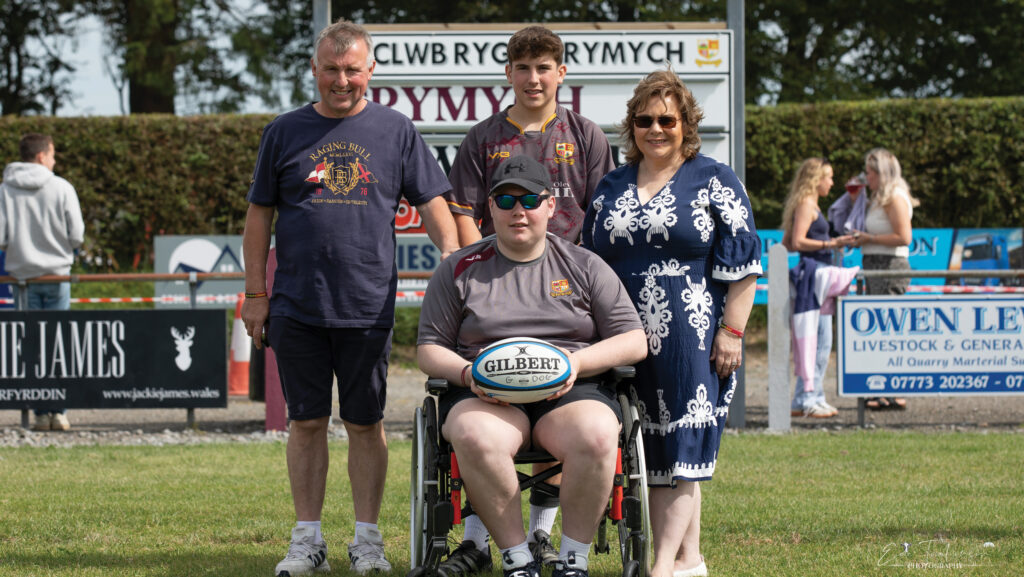
At 80, Murray Hunt’s dairy genetics innovations still shape global herds—meet the visionary who made science the farmer’s ally.
My father Murray Hunt at 80: The quiet visionary who transformed Canadian dairy breeding with scientific precision and practical wisdom. Behind those thoughtful eyes lies decades of innovation—from developing the Dollar Difference Formula to revolutionizing Type Classification systems—that helped position Canadian Holstein genetics as world leaders. Dad’s methodical approach always balanced rigorous analysis with farm-level practicality, a philosophy that guided not only his professional contributions but also his approach to mentorship and family. As we celebrate his birthday today, his forward-thinking legacy continues to shape both our family and the global dairy industry.
Today, on April 9, 2025, as my father, Murray Hunt, celebrates his 80th birthday, I want to share the story of a man who shaped my life and transformed an entire industry. Growing up as Murray’s son, I witnessed firsthand his methodical approach to breeding and evaluation systems that fundamentally changed how farmers select and develop their herds. Dad never sought the spotlight, but his creation of the Dollar Difference Formula and leadership in redesigning classification systems represented watershed moments for Canadian dairy genetics. As his son, I’ve had the privilege of watching him connect research institutions with farmers across Canada, creating a legacy of innovation that continues to shape dairy breeding worldwide.
The Huntsdale Beginnings: Where It All Started
Legacy in Action: Sterling and Irene Hunt intently review the program at Rockton World’s Fair, watching the Huntsdale cattle they worked tirelessly to develop. The yellow jacket and red shawl stand out against the barn backdrop—much like how this farming couple stood out in their community, transforming a struggling 22-cow operation into a respected Holstein breeding program that would inspire their son Murray’s groundbreaking career in dairy genetics.
The story begins at Huntsdale Farm, where my grandparents Sterling and Irene took over a struggling operation on April 1, 1960. Dad has told me countless times about those early days – just 22 cows shipping 450 pounds of milk daily to Royal Oak in Hamilton, with worn-out facilities and equipment that desperately needed updating.
Before my grandparents took over, Huntsdale was just a 25-acre market garden farm with 2-3 milking Ayrshires used primarily for cream production. Grandpa Sterling worked at the local Co-op feed mill with limited career prospects ahead of him. But they knew they needed more to provide for their children’s education.
The early 1960s were transformative years at Huntsdale. I’ve heard many stories about how the barn was renovated in 1961, new equipment was installed, and improved fertilization techniques revolutionized production. Grandpa Sterling brought expertise in specialty crops and nutrition, while Grandma Irene handled milking gardening and served as the family taxi driver and their connection to the community.
Dad often reminisces that by 1965, they had expanded to 30 cows, producing 2,000 pounds of milk daily, and were selling breeding stock to buyers in Canada and the United States. When the Ontario Milk Marketing Board started that year, they could finally buy quota. By 1967, they had paid off the farm entirely through sheer productivity and efficiency.
What amazes me most is that in 1960, at a relatively young age, Dad was responsible for animal recording and breeding programs – a task that would ultimately shape his entire career. He implemented the Record of Performance (ROP) system in 1962, began using artificial insemination that same year, and adopted Type Classification in 1963. I can still picture him as a teenager, meticulously recording data in the barn, laying the groundwork for his future innovations.
Outside farm work, Dad was busy with 4H programs in dairy, potato, grain, tractor maintenance, soils, and public speaking. He played softball and participated in various clubs at Glendale Park Secondary School, including volleyball, Junior Kiwanis Club, and math club. Dad rarely talks about it, but in 1961, he dislocated his right shoulder in a farm accident – an injury that would recur five more times by 1965.
This physical limitation prompted Grandma Irene to redirect Dad’s life with words that would change everything: “You MUST get a college education. You won’t be able to farm with that shoulder.” So, in September 1965, Dad enrolled at the University of Guelph’s Ontario Agricultural College with initial aspirations of veterinary medicine. By 1967, however, he had decided to pursue a Bachelor of Science in Agriculture and a Master’s degree, temporarily dimming the “Huntsdale dream.”
Dad specialized in animal science, genetics, and computer applications during his university years. However, the most important event of those years had nothing to do with academics. In August 1967, he met my mother, Karen, at a centennial dance. They married in 1969, beginning a partnership that Dad still considers his most significant legacy: “Karen &Murray’s legacy will be the great things that our families achieve. I have been BLESSED to have Karen as my life partner.”
Under Murray Hunt’s meticulous direction, Huntsdale Farms achieved the pinnacle of Canadian dairy breeding excellence by securing the coveted Holstein Canada Master Breeder Shield in 1984. This achievement represented the culmination of decades of strategic breeding decisions dating back to when Murray worked alongside his grandfather Allen Humphrey and parents Sterling and Irene Hunt. Through his scientific approach to dairy breeding combined with hands-on farming knowledge, Murray established Huntsdale’s reputation for superior genetics, sending multiple sires to AI organizations in Canada and abroad, particularly excelling with the development of the Gypsy Grand cow family that became a foundation of the herd’s continued success.
Growing up, I witnessed how Dad always acknowledged the mentors who shaped him. He often spoke of Osborne and Jeanetta Sager, Moe Freeman (who led 4H in Wentworth and later became a University of Guelph professor and Semex General Manager), and senior 4H members Roger Dyment and Doug Wingrove. Later influences included George Clemons, Bob Lang, and Harley Nicholson – each contributing to Dad’s evolving vision for scientific dairy breeding.
Partners in life and legacy: Karen and Murray Hunt share a moment in the greenery they love. Since meeting at a centennial dance in 1967, this dynamic duo has shaped not only a family legacy with three children and eight grandchildren, but also influenced generations of dairy farmers through Murray’s pioneering work in Holstein genetics. As Murray celebrates his 80th birthday, his most treasured achievement remains clear: ‘I have been BLESSED to have Karen as my life partner.
From Master’s Thesis to Industry Revolution
Dad’s formal entry into the dairy genetics world began with his Master’s thesis in 1970. Though he rarely boasts about it, this wasn’t just an academic exercise—it became a blueprint that reshaped Canadian breeding strategies for decades.
Through computer simulation (cutting-edge technology back then), Dad recommended sampling four times the number of young sires with significantly increased emphasis on production traits. One of his more radical suggestions was for an “all-young bull stud” with stored semen so the next generation could be sired by proven elite bulls. This approach was considered too extreme then, but Dad loves pointing out that it closely resembles today’s genomic selection practices. He’s particularly proud that Canadian A.I. organizations followed his plan, allowing Canada, with less than 2% of global cows, to achieve 25% of global Holstein semen sales.
A byproduct of his Master’s work was the creation of the Dollar Difference Formula. This revolutionary approach calculated the value of revenue generation minus production costs for a bull’s daughters. This was essentially a Total Merit Index before such indices became industry standard in the late 1980s. The formula gained strong support from the Ontario Ministry of Agriculture, Food and Rural Affairs (OMAFRA) staff, though breed associations initially resisted, preferring systems that emphasized conformation traits.
Dad’s first professional position from 1970-1973 placed him with OMAFRA’s Dairy Herd Improvement (DHI) program, overseeing 70 field staff, 20 laboratory technicians, and eight office/data personnel. One achievement he’s particularly proud of from this period was having DHI records accepted by Holstein Canada – an early example of the data integration he would champion throughout his career.
In June 1973, Dad moved to Holstein, Canada, where his influence would grow exponentially. He arrived at a time when the organization almost exclusively published and used phenotypic information, mainly ignoring the genetic evaluation methods he had studied. Agricultural Canada produced milk and fat bull proofs, but purebred breeders generally overlooked these in favor of show-ring results.
I remember as a child how Dad would come home from work frustrated yet determined to introduce science-based evaluation systems to an industry steeped in traditional selection methods. Working alongside researchers at the University of Guelph, particularly E.B. Burnside and associates who were developing best linear unbiased prediction (BLUP) methods to replace raw breed average comparisons, Dad began shifting industry perspectives. Or when Dad first brought home the first handheld device for classification, which Dalton Hodgins affectionately named FRED (F***ING R*****ED ELECTRONIC DEVICE).
Perhaps Dad’s most significant contribution at Holstein Canada was leading a complete overhaul of the Type Classification system, culminating in the implementation the BLUP Animal Model in the early 1980s. Under his leadership, the Type Classification program expanded eightfold between 1973 and 1990, eventually gaining international adoption in Japan, Australia, the UK, Mexico, Italy, and Spain.
Huntsdale Legacy: Sprucelynn Rudolph Marcie VG-86-2YR 3*, one of the foundation females whose genetic influence spread worldwide through her many sons and grandsons in AI. Her combination of production and conformation exemplifies Murray Hunt’s methodical approach to breeding—selecting for balanced traits that deliver both profitability and longevity. Standing proudly before the iconic Huntsdale farmhouse with its distinctive red roof, Marcie represents the practical application of scientific breeding principles that Murray championed throughout his influential career in Canadian dairy genetics.
The Dollar Difference Formula: Changing How Value Was Measured
Growing up, I heard countless dinner conversations about the Dollar Difference Formula. Dad created this during his Master’s studies, fundamentally transforming how bull selection decisions were made across North America.
Until then, sire selection had primarily emphasized physical traits valued in the show ring. Dad’s formula quantified the actual dollar value of using different sires by calculating expected revenue from daughters’ production minus their production costs – essentially creating what he calls “a TMI [Total Merit Index] before TMI came about in the late 1980s.”
Government officials recognized the formula’s innovation, and OMAFRA staff, including the livestock commissioner and dairy cattle specialists, strongly supported its implementation. The DDGuide, as it became known, spread beyond Ontario to other Canadian provinces. However, it faced resistance from breed associations that “did not accept like DDG as it did not emphasize high type.”
Dad also led a comprehensive reimagining of the Type Classification system at Holstein Canada. When he arrived in 1973, the organization was almost exclusively focused on phenotypic information – what animals looked like – rather than their genetic potential. Drawing on his statistical training, Dad led a “total re-write of TC culminating [in] BLUP (Animal Model) in the early 1980’s.”
The modernized classification system required uniform standards among classifiers to ensure bull proofs would be accurate. Dad secured Holstein Canada Board of Directors support with policy and budget approvals, while Holstein field representatives held meetings to explain and promote the updated program. The results were dramatic – the Type Classification program expanded eightfold between 1973 and 1990.
Standing proudly in the spotlight, Shottle Crusade EX 95 3E represents the pinnacle of balanced dairy breeding—a living testament to Murray Hunt’s philosophy of developing “sound productive females” rather than simply chasing market trends. This remarkable Holstein, bred at Huntsdale Farm, exemplifies the perfect union of exceptional production and outstanding conformation that Murray championed throughout his career. With an impressive lifetime production of 118,000 kg of milk, three Superior Production Awards, and a Super 3 Award, Shottle Crusade proved her efficiency in the barn. Yet her EX 95 classification and impressive show ring accomplishments—including Honourable Mention All Canadian, nominations for All American honors, and multiple Reserve All Western Cow titles—demonstrate that functionality and beauty can indeed coexist in the modern dairy cow. As Saskatchewan Cow of the Year and a Nasco International Type and Production Award winner, Shottle Crusade embodies the forward-thinking, data-driven breeding approach that made Canadian Holstein genetics world leaders under Murray Hunt’s guidance.
From Show Ring to Science: Dad’s View on Breeding Evolution
Dad’s career spans a transformative period in Holstein breeding, during which selection priorities shifted dramatically from show-ring aesthetics to farm profitability and sustainability. Having witnessed this evolution firsthand, I’ve heard him speak passionately about both the progress and the remaining challenges.
When Dad began his career in the early 1970s, Holstein Canada was almost exclusively focused on phenotypic information. Breed associations were reluctant to embrace production-focused selection tools like his Dollar Difference Guide. Agricultural Canada produced milk and fat bull proofs, which were “largely ignored by purebred breeders” who preferred visual assessment and pedigree analysis.
The transition to science-based breeding strategies faced significant resistance. Dad often recalls that “it took a few years for BLUP production bull indexes to gain usage by breeders, although A.I.’s adopted quickly.” This disconnect between scientific evaluation and breeder acceptance represented a fundamental challenge Dad worked to overcome throughout his career. The breakthrough came through more accurate assessment, expanded data collection, and generational change, as “young people coming home (1970+) to dairy farm brought with them the acceptance of genetic evaluation results.”
Artificial insemination played a critical role in this transformation. Dad notes that “90% of genetic gain in a population comes from the sires used,” highlighting the outsized impact of bull selection decisions. His Master’s thesis had recommended expanding young sire sampling programs while increasing emphasis on production traits – a strategy eventually adopted by Canadian A.I. organizations with remarkable results. Dad notes with pride that “CA (<2% global cows) achieved 25% global Holstein semen sales” by following this approach.
Passing on the Legacy: Murray Hunt shares his lifelong passion for Holstein genetics with the next generation of dairy enthusiasts—his grandchildren. With the same patient guidance that helped transform Canadian dairy breeding, Murray introduces these young minds to the fundamentals of dairy cattle evaluation. His grandchildren’s eager engagement with the Holstein calves reflects how Murray’s influence extends beyond industry innovations to family values. This moment captures the essence of Murray’s greatest pride: not just his revolutionary contributions to dairy genetics, but the knowledge and appreciation he instills in his family, ensuring his passion for quality dairy cattle continues for generations to come.
Dad’s Leadership Philosophy: Building Bridges Across the Industry
Beyond his technical innovations, I’ve always admired Dad’s leadership philosophy and vision for the industry. Though he’s never been one to seek the spotlight, his influence extends far beyond his official roles.
Dad’s approach emphasizes collaboration across organizational boundaries. Despite the competitive nature of the artificial insemination industry, he worked effectively within the Canadian Association of Animal Breeders to foster cooperation on research and national development initiatives. He understood that industry-wide progress required organizations to work together while allowing for healthy marketing competition.
As a mentor, Dad emphasizes forward-thinking and vision. He believes that “a mentor is not an honest mentor if all they do is encourage mentees to repeat the past that no longer applies.” Instead, he tries “to make sure a mentee thinks both progressively and proactively,” recognizing that “visioning is not a universal trait possessed by people” and often “makes the majority of people uncomfortable.”
Growing up, I watched Dad implement this methodical approach to industry challenges: “1. Get the industry to describe the problem/challenge 2. Invite all organizations that want to be part of the future to support/fund an independent task force. 3. Name only open-minded visionary people in the task force. 4. Circulate findings/recommendation/proposed plan 5. Bring industry together to accept.” This structured yet inclusive approach characterizes his leadership style.
Throughout his career, Dad demonstrated the ability to identify emerging needs and respond proactively. He led the privatization of milk recording and genetic evaluations when government agencies withdrew support, ensuring these critical services continued under industry management. Similarly, he helped establish the Genetic Evaluation Board and supported the creation and funding of the Centre for Genetic Improvement of Livestock, building infrastructure for ongoing industry advancement.
Dad’s Vision for Dairy’s Future
As Dad turns 80 today, his forward-looking perspective remains as sharp as ever. When reflecting on his life’s work, he demonstrates the same clear-eyed pragmatism that characterized his professional contributions.
Rather than highlighting specific career achievements, Dad identifies his family as his most significant accomplishment: “K&M’s legacy will be the great things that our families achieve.” This sentiment reflects his partnership with Mom and their pride in raising “three outstanding/accomplished children and now eight great grands.”
Looking toward the future of dairy breeding, Dad advocates for a more comprehensive approach that moves beyond the current emphasis on total merit indexes. He expresses concern that “the over-use of TMI’s (TPI, LPI, NM$ etc)” without eliminating animals that are below average for health, mobility, fertility, and other functional traits is “holding breeding back in developing the animals needed for 2050.”
Dad envisions breeding programs that more effectively incorporate adaptability, disease resistance, and other functional traits. When asked if breeding programs should include these characteristics, his response is emphatic: “For sure, YES. Cannot happen soon enough.”
On the question of genetic diversity, Dad offers a provocative perspective. He suggests “that we are currently chasing the wrong tool – inbreeding. We need more information on the genetic makeups that cause problems and not just on common ancestry. The commonality of future offspring not about common ancestors.”
Dad acknowledges the structural challenges facing small-scale dairy producers. With “75% US milk com[ing] form herds of 1000+ cows,” he recognizes that “small scale breeders <100 cows must have a novel, unique specialty.” With characteristic directness, he states that “future milk production, like-it-or-not, depends on technology, scale (marketing, buying, costs,..) is a must, automation… Time waits for no one.”
To address future industry challenges, Dad advocates a comprehensive, multi-disciplinary approach. He notes there is “too much individual silo work/approached” and argues that “farmers/industry needs a wide-scoped approach.” This holistic vision challenges the tendency toward specialization and compartmentalization that can impede progress on complex issues.
The Hunt family legacy in dairy excellence captured in this multi-generational gathering. Seated in the center, Murray and Karen Hunt are surrounded by their accomplished children and grandchildren. The photo showcases the remarkable family Murray proudly references as his most significant legacy. His three children have each made extraordinary contributions to agriculture: Paul (CEO of URUS, the world’s largest dairy genetics company), Heather (a leading animal nutritionist), and Andrew (founder of The Bullvine). This family portrait beautifully illustrates Murray’s belief that “Karen &Murray’s legacy will be the great things that our families achieve” – a promise fulfilled through their collective impact on the global dairy industry.
The Legacy of My Father at 80
As we celebrate Dad’s 80th birthday today, I’m struck by how his contributions to Canadian dairy genetics represent an extraordinary blend of scientific rigor, practical application, and forward-thinking leadership. From his early days of responsibility at Huntsdale Farm to his transformative work at Holstein Canada and beyond, Dad consistently bridged the gap between research institutions and working farms, translating complex genetic principles into practical selection tools that farmers could use.
Dad’s development of the Dollar Difference Formula and his leadership in modernizing Type Classification programs fundamentally changed how dairy cattle are evaluated and selected. By emphasizing economic measures and implementing sophisticated statistical methodologies, he helped shift the industry from subjective visual assessment toward data-driven decision-making. The dramatic expansion of Canadian Holstein genetics in international markets – achieving 25% of global Holstein semen sales with just 2% of the world’s Holstein cows – is a testament to the effectiveness of the approaches he championed.
Beyond his technical innovations, Dad’s collaborative leadership style created frameworks for industry cooperation that continue to benefit Canadian agriculture. His ability to work across organizational boundaries, engage stakeholders, and build consensus around complex issues enabled transformative change that might otherwise have stalled amid competing interests.
Perhaps most significantly, Dad has consistently challenged the industry to look forward rather than backward. As he notes when describing effective mentorship, “A mentor is not an honest mentor if all they do is encourage mentees to repeat the past that no longer applies.” This progressive orientation sometimes made him a contrarian voice, willing to question established practices when they impeded advancement.
While Dad’s professional achievements are substantial, he identifies his family – Mom, my siblings, and I – as his most significant legacy. This personal priority has not diminished his impact on the dairy industry but enriched it, grounding his scientific work in the practical realities of family farming and generational sustainability.
Today, as we celebrate Dad’s 80th birthday, I’m profoundly grateful for the industry leader and the father he has been. His methodical, science-based, and holistic approach to genetic improvement provides a professional and personal legacy – teaching us to balance progress with pragmatism, innovation with sustainability, and ambition with humility. Happy 80th birthday, Dad. Your legacy continues to grow with each generation you’ve touched – in our family and throughout the dairy world.
Key Takeaways:
Revolutionized bull selection with the Dollar Difference Formula, prioritizing economic value over show-ring traits decades before industry standards.
Pioneered data-driven breeding by modernizing cattle evaluation systems, increasing Type Classification participation eightfold.
Bridged science and farming through collaborative leadership, making Canadian genetics a global powerhouse.
Championed future-ready breeding advocating for health, fertility, and adaptability alongside production metrics.
Legacy of mentorship and family—proving innovation thrives when grounded in community and generational wisdom.
Executive Summary:
On his 80th birthday, Murray Hunt’s legacy as a dairy genetics pioneer shines through his transformative work developing the Dollar Difference Formula and modernizing cattle evaluation systems. As told by his son Andrew, Hunt’s career at Holstein Canada blended rigorous science with practical farming insights, shifting industry focus from show-ring aesthetics to economic efficiency. His leadership in implementing BLUP statistical models and expanding Type Classification programs positioned Canadian genetics as global leaders. Beyond technical innovations, Hunt fostered industry collaboration and mentored future leaders while prioritizing family as his greatest achievement. This profile reveals how one man’s vision reshaped dairy breeding through data-driven strategies and unwavering commitment to progress.
Which is Your Most Profitable Cow? Learn about the origins of the Dollar Difference Guide and its evolution into modern indices, transforming how profitability is measured in dairy herds.
Join the Revolution!
Join over 30,000 successful dairy professionals who rely on Bullvine Daily for their competitive edge. Delivered directly to your inbox each week, our exclusive industry insights help you make smarter decisions while saving precious hours every week. Never miss critical updates on milk production trends, breakthrough technologies, and profit-boosting strategies that top producers are already implementing. Subscribe now to transform your dairy operation’s efficiency and profitability—your future success is just one click away.
How one unassuming cow born in rural Ontario revolutionized Holstein genetics worldwide, bridging show ring glamour with genomic science.
Do you know what amazes me about the dairy world? How a single cow can change everything. That’s exactly what Aitkenbrae Starbuck Ada did. Born in 1986, this remarkable cow didn’t just win ribbons—she created an entire dynasty that’s still shaping Holstein genetics worldwide. I’ve always been fascinated by how one exceptional animal can transform an entire breed’s trajectory. Ada’s story perfectly exemplifies this—bridging old-school showring excellence with today’s cutting-edge genomics.
Aitkenbrae Starbuck Ada: The legendary Holstein matriarch whose exceptional conformation earned her Unanimous All-American Senior Three-Year-Old honors in 1990, but whose true legacy lives on through her daughters Alicia and Adeen, whose descendants continue to revolutionize Holstein genetics worldwide. Her remarkable balance of show ring excellence and genetic prepotency bridged the divide between type and production, establishing a dynasty that remains influential in modern genomic breeding. Photo: Maggie Murphy
The Holstein Landscape of the Mid-1980s
The 1980s were a weird time for dairy breeding. Remember that period everyone calls “The Great Divide Between Type and Production”? The industry was at this fascinating crossroads. Since the mid-60s, all this genetic evaluation data had been pouring in, especially for milk output and fat content. Meanwhile, AI organizations were pushing young sire sampling programs.
This created this massive philosophical split. You had your traditional display herds stubbornly focused on type traits—making sure their cows looked gorgeous in the showring. Then you had these forward-thinking farmer-breeders embracing genetic indexes and production metrics. Two completely different approaches to breeding! Honestly, the type-focused herds were gradually losing influence as those production-oriented operations started showing better economic returns.
Ada walked into this changing landscape where the pendulum was swinging away from pure conformation toward a more balanced approach. The industry analysts noted how “leadership in genetic improvement started to shift from breeds and prominent herds to artificial insemination organizations.” Little did anyone know that Ada’s descendants would eventually bridge these competing priorities through their incredible dual excellence in type and production.
The Birth of a Legend
So here’s where it all begins. September 13, 1986—Aitkenbrae Starbuck Ada is born at the Aitkenbrae farm in Holstein, Ontario. Her pedigree? A fascinating combination: sired by the legendary Hanoverhill Starbuck out of Aikenbrae Sheik Arlene (Good Plus-80-2YR-CAN). This genetic cocktail would prove transformative for the Holstein breed.
But Ada’s story starts much earlier. Her lineage traces back to the 1940s with Banostine Dutchland Clothilde, who set a world fat record as a senior two-year-old in 1948 with 623 pounds of fat from 16,272 pounds of 3.8% milk. Tom Hayden, who established the Banella prefix (combining names from his foundation cows Banostine and Ella), bred Banostine to Spring Farm Sovereign Supreme. The resulting heifer, Banella Sovereign Supreme Delight, was disappointingly poor—so much so that Hayden sold her cheaply to his friend Cecil Barber.
Barber, however, saw potential in Delight and bred her to Lifloc Re-Echo Voyageur, producing Sheila Voyageur. When bred to Pabst Walker Ollie, Sheila produced C-Bar Ollie Belle, born May 1, 1959. In the mid-1960s, Walter Aitken, looking to improve his herd, purchased the five-year-old Ollie Belle through cattle dealer Bill Sniveley.
Aitkenbrae Farm wasn’t just any dairy operation. It was run by the partnership of Morley Aitken and Don Lantz, who started working together in 1978. They developed a superior herd under the Aitkenbrae prefix, regularly winning Premier Breeder and Exhibitor banners at Grey County Black & White Day. Their breeding expertise earned them two Master Breeder shields, a prestigious recognition in the Holstein world.
Don Lantz’s connection to the farm began in childhood. When his father died in 1962, Don was just six years old, and his uncle Walter Aitken took him under his wing. Don spent his weekends and summer holidays at Aitkenbrae Farm, developing a deep love for farming and Holstein cattle. This attachment lasted through his youth, and when he came of age, Don went straight to his uncle for his first job. When Walter retired, he was farming in partnership with his son Morley, and recognizing Don’s talent and work ethic, Walter offered to sell his nephew his share of the business.
Despite Ollie Belle’s apparent lack of maternal instinct (her first two calves at Aitkens died at birth), one daughter did survive—Aitkenbrae Radar Olive. Through several generations of strategic breeding, this line eventually produced Aitkenbrae Sheik Arlene, who bred to Hanoverhill Starbuck and gave birth to Aitkenbrae Starbuck Ada on September 13, 1986.
When Ada calved in 1988, Brian Carscadden, first noticed something special about her. At the time, he was working as a fitter and attending school but also wheeling and dealing with cattle. He and Ken Empey were regulars at the Aitkenbrae barn, having bought animals from them before. As Lantz recalled, “When Ada calved in 1988, Brian Carscadden was first to notice her. He was wheeling and dealing in cattle while fitting and attending school. He and Ken Empey were always in and out of Aitkenbrae. Aitkenbrae had sold cattle to both. There was some consultation between Carscadden and Empey about Ada. Empey ended up buying her.
Don Lantz had this practical philosophy about their breeding program: “Morley and I were always willing to let a good one go. We were trying to cash flow with a 50-cow herd and realized that for a cow to get a full opportunity, she would need to get out of here, into the hands of a good promoter.”
The Early Career: From Ontario to the American Show Ring
After Ken Empey purchased Ada, her journey was just beginning. An Ohio investment group, Hygerian Associates, including Robert Binger and William Atkins, was looking to invest in Holsteins. They contacted Empey, who took them to see Ada when she was two months fresh and looking fantastic. They bought the heifer and took her to Ohio, where she completed her impressive two-year-old record: 25,000 pounds of milk with 908 pounds of fat at 3.6% and 798 pounds of protein at 3.2%.
During this lactation, Binger and Atkins and a new partner named Lawson Bennett took Ada to the Michigan State Fair in the summer of 1989. There, she won the senior two-year-old class and was named grand champion. Her next stop was Madison, where, with Howard Binder judging, she 2nd and later moved to third after the milk out behind Dupasquier Stab Winnie and Comestar Laurie Sheik.
At Madison, Ada caught the attention of Douglas King of Kingstead Farms in Damascus, Maryland, and Grey Wilcom of Ijamsville, Maryland. King initially considered Ada “a little on the small side but very correct.” He was impressed enough that he and Wilcom approached Hygerian to buy her, which they did in December 1989.
Under King and Wilcom’s ownership, Ada grew taller and was prepared for the 1990 show season. This would prove to be her breakout year. She won the three-year-old class and was named Supreme Champion at the Eastern National Show. She continued her winning streak by placing first with the best udder in class at Madison. These impressive showings culminated in her being named the Unanimous All-American Senior Three-Year-Old of 1990.
The Shore Connection: Strategic Breeding Decisions
At the close of the 1990 show season, Hardy Shore, Jr., principal of Shoremar, Inc., purchased a half-interest in Ada. Shore had previously worked as a hoof trimmer and was particularly impressed by Ada’s feet and legs. He described her as the best “footed” cow he had ever seen. This appreciation for functional conformation would influence his breeding decisions with Ada.
When the Shoremar herd was dispersed in 1991, Ada sold for $71,000—the sale’s second-highest price—returning to the ownership of Kingstead and Wilcom, who dissolved their partnership with Shore.
During his ownership period, Shore made a critical breeding decision that would shape Holstein history. He flushed Ada to several bulls, including Donnandale Skychief (EX-Extra). Shore admired Skychief but recognized that the bull needed improvement in feet, an area where Ada excelled. This strategic pairing would produce the daughters establishing Ada’s legacy as a brood cow.
Charlie McEvoy, a respected figure in the dairy industry with decades of experience, singles out Ada as “one of my favorite young cows of all time.” He emphasizes her lasting importance, noting, “Her descendants, whether male or female, have changed our barns and show strings forever.” This endorsement from an industry veteran underscores the significance of Ada beyond her accomplishments.
The Skychief Sisters: Building the Ada Empire
The flush to Donnandale Skychief produced two daughters who would become legends in their own right: Shoremar S Alicia and MS Kingstead Chief Adeen.
Shoremar S Alicia EX-97 3E 7*: Daughter of Aitkenbrae Starbuck Ada and one of only 35 registered Holsteins in North America to achieve the coveted Excellent-97 classification. This remarkable cow was nominated All-American five times, crowned Supreme Champion at the 2000 Royal Winter Fair, and established herself as an exceptional brood cow with more than a dozen Excellent daughters. Her legacy continues through descendants that dominate show rings and breeding programs worldwide. Photo: Maggie Murphy
All-American Alicia: Extending Excellence
Shoremar S Alicia, born in 1995, elevated the family’s status to unprecedented heights. Classified Excellent-97, Alicia joined an elite group of only 35 registered Holsteins in North America to achieve this near-perfect score. Her show career eclipsed even her dam’s impressive record, as she was nominated All-American five times in milking form and crowned Supreme Champion of the Royal Winter Fair in 2000.
The story of how Alicia came to be involves another key figure in Holstein breeding. David Innes of the City-View herd at Woodstock, Ontario, met Hardy Shore at a show and inquired about buying embryos. Ada had just produced a great flush to Skychief, so a deal was made for two embryos. The two resulting calves were jointly owned by Shore and Innes, one of them being Shoremar Alicia, who would become a World Champion.
Under the ownership of Jeff Butler, Howard Binder, and Kingstead, Alicia topped the five-year-old class at Madison and won the grand championship at the Royal Winter Fair in 2000. These accomplishments made her the unanimous choice for All-American and All-Canadian 5-year-old that year. After winning the 125,000-lb. cow class and the grand championship at the Eastern National Show in 2003, she was voted All-American aged cow. She continued her show ring success with a Reserve All-American nomination in 2004 and High Honorable Mention in 2005.
Beyond her show ring dominance, Alicia firmly established herself as a brood cow in her own right. With more than a dozen Excellent daughters from various sires, she continued Ada’s pattern of reliably transmitting elite type. Her influence branched primarily through her Startmore Rudolph daughter, Cityview R Alicia (Excellent-92-CAN 23*), and her Durham daughters BKB Abby (Excellent-95 3E DOM) and BKB Amanda (Excellent-92 GMD DOM).
MS Kingstead Chief Adeen EX-94 2E DOM (1997-2011): The extraordinary daughter of Aitkenbrae Starbuck Ada who left an indelible mark on Holstein breeding with 51 Excellent daughters worldwide—ranking her second all-time for most EX offspring. This influential matriarch established a genetic dynasty through sons including Atwood, Atlantic, and Aftershock, while demonstrating the rare ability to transmit both superior type and genomic excellence across generations. Her profound impact continues through descendants winning championships globally, cementing her legacy as one of the most consequential brood cows in modern Holstein history. Photo: Cybil Fisher
All-American Adeen: Expanding the Influence
The second Skychief daughter, MS Kingstead Chief Adeen, born in 1997, proved equally influential but through different channels. Described as a “foundation cow for several herds,” Adeen established connections to names that would become Holstein royalty: Atwood, Atlee, Ariel, and Autumn.
Adeen’s story takes an interesting turn. In 1997, Kingstead sold their herd to three Maryland breeders. By the flip of a coin, one of the buyers, Cranberry Meadows Farm, owned by Gary and Crystal Dell of Westminster, acquired the two-week-old Chief Adeen. When the time came, she was flushed to Maughlin Storm, resulting in five heifers that all classified Very Good as two-year-olds. One of these was MD-Delight Storm Amberlee-ET, who would play a crucial role in extending the family’s influence.
Adeen was later sold as a two-year-old to a syndicate of Billy and Mike Heath, Gerald Todd, and Amlaird Callum McKinven. During the six months she was in their ownership, she was flushed successfully to Comestar Lee. The star of this flush was Amlaird Lee Alice, the first Junior 2-year-old at the World Dairy Expo in 2003 and named All-American.
In 2000, the Shoremar S Alicia and MS Kingstead Chief Adeen duo reached their pinnacle in the show ring. They were the unanimous choice for All-American Produce of Dam. Chief Adeen was nominated All-American as a junior 3-year-old in 2000 for Jeff Butler and Lance and Amy Ruppert, producing over 30,000 pounds of 4% milk that year.
Adeen then sold to Jeff Butler, Lance, and Amy Ruppert. At the World Dairy Expo 2000, Adeen stood 6th in the Junior-3 class and paired with her older sister Alicia to win the Produce of Dam class. Shortly afterward, Kingstead bought out Ruppert’s share, and from that time onwards, all progeny were registered with the BVK prefix for Butlerview and Kingstead.
Jeff Butler of Butlerview Farms, who owned Chief Adeen from 1999 until she passed away in 2011 at age 14, described her as “one of the most influential and one of the only cows in the breed with offspring over +2500 on genomics and All-American progeny.” This dual achievement—excelling in traditional show type and modern genomic metrics—foreshadowed the family’s future significance, bridging these two worlds.
Adeen’s reproductive career was remarkable by any standard. She left behind 51 Excellent daughters classified worldwide, ranking her second only to Ashlyn for the most Excellent daughters of all time. This prolific production of high-quality offspring established her as an “industry elite” and exponentially expanded the Ada family’s influence.
Douglas King reflected on working with these remarkable cows: “It was the thrill of a lifetime to work with those two great cows, Adeen and Alicia. I’ve often thought how special it would be to assemble all the daughters of Adeen and Alicia in one barn. What a sensational barn full of cows you would have!”
From Show Ring to Genomic Revolution
MD-Delight Durham Atlee EX-92-4YR-USA DOM GMD 2*: The pivotal Holstein matriarch whose Goldwyn sons revolutionized type breeding worldwide. After catching Michael Heath’s eye as a young heifer and selling for $20,000, she achieved Reserve Intermediate Champion at the 2005 International Holstein Show. Though her life was cut short by cancer in 2008, her legendary “golden flush” to Braedale Goldwyn produced six sons with Superior Type credentials, including the influential Atwood, Atlantic, and Aftershock. As a granddaughter of Aitkenbrae Starbuck Ada through MS Kingstead Chief Adeen, Atlee represents the perfect bridge between show ring excellence and genomic merit in modern Holstein breeding. Photo: Cybil Fisher
The Durham-Atlee Connection: A Critical Genetic Branch
While many breeding decisions contributed to the Ada family’s expansion, perhaps none proved more consequential than those involving Adeen’s granddaughter, Durham Atlee. On September 11, 2001, MD-Delight Storm Amberlee gave birth to MD-Delight Durham Atlee-ET, sired by Regancrest Elton Durham. Michael Heath of Heath Holsteins, Rick, Shannon Allyn, and Jason Lloyd purchased Atlee as a bred heifer from the Dells.
Heath’s decision to buy Atlee came with some hesitation. He was working his last sale as a professional fitter, the Maryland Convention Sale, when he first noticed Atlee. “Where we had the fitting chute set up, Atlee was tied just six feet away. I kept looking at the calf, liking the calf, looking at the calf, liking the calf, but she was small for her age,” Heath shared. About a year later, Heath traveled to North Carolina to Foster’s, who had bought Atlee at the Maryland Convention Sale. Priced at $20,000 as a springing heifer, Heath took a chance on her. He liked her pedigree and thought she could make money selling embryos if she classified at least Very Good-85 as a two-year-old.
Heath’s gamble paid off spectacularly. Atlee was trucked from North Carolina to Massachusetts for their state show on one of the hottest summer days, but she pulled it together and won her class the following day. She later placed 15th in the senior two-year-old class at the World Dairy Expo.
As a senior three-year-old, Atlee was supposed to be due September 1, but they had the wrong breeding date. She ended up calving mid-September, and the partners weren’t sure if she would be ready for the show. Heath convinced them to send her anyway, figuring they had nothing to lose. Less than a week later, MD-Delight Durham Atlee was named Reserve Intermediate Champion of the 2005 International Holstein Show.
Heath reflected, “She is worldwide known by name, and I don’t know how big of name she would have been if she hadn’t gone to Madison.” This observation highlights the continued importance of show ring exposure in building a cow family’s reputation, even as the industry moved toward more data-driven breeding decisions.
Whittier-Farms Jasper Atlanta VG-85-CH 2YR: This striking cow exemplifies the global impact of the Ada family’s genetic excellence, earning 2nd place honors at the prestigious Swiss Expo 2014. As a granddaughter of MD-Delight Durham Atlee EX-92-USA, she represents a critical branch in the Ada dynasty, connecting directly to the influential maternal line that produced industry-changing sires Atwood, Golden Dreams, Delete, Amazing, and Aftershock. Her dairy strength, angularity, and overall style showcase the consistent type transmission that has made this cow family so valuable to Holstein breeders worldwide. Atlanta’s international success further validates the Ada family’s remarkable ability to produce superior animals across continents and generations, continuing a legacy of excellence that began with Aitkenbrae Starbuck Ada. Photo: Wolfhard Schulze
The Golden Flush: Birth of a Genomic Giant
The truly transformative moment for the Ada family’s international impact came through what has become known as the “golden flush”—the breeding of Durham Atlee to Braedale Goldwyn. In 2007, this mating produced several sons who would become influential sires: Maple-Downs-I GW Atwood, Allyndale-I Attic, Allyndale-I Atticus, Maple-Downs-I GW Atlantic, Allyndale-I GW Arden, and Mr. Atlees Altaamazing.
These bulls were distributed among major AI organizations: Atwood, Arden, and Atlantic went to Select Sires, Attic, and Atticus to Semex, and Altaamazing to AltaGenetics Inc. In the same year, MS Atlees SHT Aftershock, Atlee’s Shottle son, was purchased by St. Jacobs A.B.C.
GALYS-VRAY EX-94-CH EX-95-MS: This exceptional Atwood daughter exemplifies the enduring legacy of Aitkenbrae Starbuck Ada. Grand Champion at the 2016 European Show in Colmar and Swiss Expo, GALYS-VRAY showcases the perfect blend of show ring excellence and production prowess that defines the Ada family. Her achievements, including multiple Grand Champion titles at Expo Bulle, cement her status as one of the most influential cows in modern Holstein breeding, bridging continents and generations with her remarkable genetic impact. Photo: Wolfhard Schulze
Steve Velthuis of Velthuis Farms purchased embryos from this flush, resulting in three heifers and five bulls. In a twist of fate that demonstrates the sometimes unpredictable nature of breeding, Velthuis shared that Atwood was initially “the one left that no one wanted” when other AI organizations made their selections. “He was right at the time of genomics, and the other brothers were high enough that they didn’t need to test Atwood. We collected him before we got his genomics,” shared Velthuis.
Through a conversation between Velthuis and Ed Fellers, a syndicate was formed for Atwood that enabled his sampling program. The results would exceed all expectations, as Atwood emerged as the leader with soaring demand. As Velthuis noted, “Most people can’t get Goldwyn semen, so Atwood is a good replacement for those that want Goldwyn blood.”
Charwill Attic Marcy: The triumphant 2015 Royal Winter Fair Grand Champion represents the culmination of the Ada legacy through her sire Attic, a son of Durham Atlee. This exceptional female validated Tim Abbott’s claim about Atlee’s extraordinary type transmission, completing an undefeated show season by capturing grand championships at both Madison and the Royal. Her victory under judge Michael Heath—who had earlier recognized Atlee’s potential—demonstrates how the Ada family continues to dominate show rings worldwide, extending the dynasty’s influence into yet another generation of Holstein excellence. Photo: The Bullvine
By the end of 2013, Atlee’s six proven sons had all earned Superior Type credentials; five were in the top 10 for type. This remarkable achievement prompted Tim Abbott to claim that “Atlee’s ability to transmit type appears to be as strong as any cow in breed history.” This assessment was validated in the fall of 2015 when Charwill Attic Marcy (EX-95-USA), a daughter of Allyndale-I Attic owned by MilkSource, Kaukauna, Wisconsin, ended an undefeated show season by winning the grand championships at both the Royal Winter Fair and International Holstein Show.
The same flush also produced MS Atlees Goldwyn Ariel-ET (VG-89), Reserve All-American junior 2-year-old 2009. She was later purchased for $1.5 million by a Canadian syndicate, further cementing the family’s economic impact on the breed.
Ruegruet High Octane ALLYSON VG-86-2YR CH: The sixth-generation descendant of Aitkenbrae Starbuck Ada exemplifies the enduring legacy of this extraordinary Holstein family. With her balanced dairy form and strong mammary system, ALLYSON showcases the genetic excellence that has defined the Ada lineage for over three decades. As a Very Good-86 two-year-old, she continues the tradition of superior type and production that flows through her impressive maternal line—from her dam Whittier-Farms Jasper ATLANTA EX-91-3E (2nd place Swiss Expo Lausanne 2014) back to the legendary foundation dam Ada. ALLYSON represents the global reach of the Ada influence, with her success in European show rings demonstrating how strategic breeding decisions continue to produce exceptional animals across generations and continents. Photo: Wolfhard Schulze
The Ada Legacy in Modern Holstein Breeding
Bridging Breeding Philosophies
The evolution of the Ada family parallels the broader transformation of dairy cattle breeding over the past four decades. From the mid-1960s through 1980, the industry experienced what has been described as “The Great Divide Between Type and Production,” where traditional display herds focused exclusively on conformation while progressive farmer-breeders embraced genetic indexes for production traits.
Their ability to excel across this divide makes the Ada family remarkable. This family has maintained relevance through every phase of the industry’s development, beginning with Ada’s show ring success, continuing through Alicia and Adeen’s exceptional type transmission, and culminating with Atwood’s emergence as a genomic giant.
In today’s breeding landscape, “DNA indexes have become the starting point in animal selection decisions for breeders regardless of their trait priority: type, production, fertility, health, or functionality.” The Ada family’s success in adapting to this paradigm shift demonstrates the rare ability to combine traditional type excellence with modern genetic merit.
Mario Park Goldwyn Alicia EX-93-3E 8*: The 2018 Holstein Australia Cow of the Year exemplifies the global impact of the Ada family legacy. Descending from world-renowned Aitkenbrae Starbuck Ada through Shoremar S Alicia EX-97-3E, this exceptional Goldwyn daughter combines remarkable production (lifetime exceeding 80,000 liters) with superior type traits, including an EX-95 score for dairy strength. Owned by Murray and Jane Polson, she’s established herself as one of Australia’s most influential brood cows, with her progeny consistently excelling in both show rings and production records. Her extraordinary fertility, production persistence, and ability to transmit superior type to her offspring demonstrate how the Ada genetics continue to shape Holstein breeding excellence worldwide. Photo: Bradley Cullen
Global Impact Through Multiple Generations
The influence of the Ada family extends far beyond North America. Their descendants have succeeded in show rings and breeding programs worldwide, demonstrating the family’s genetic prepotency across diverse environments and management systems.
In Japan, for example, TMR Adeen Dundee Chief-ET, a Dundee daughter of Chief Adeen, was named first place senior three-year-old and grand champion at the Hokkaido Black and White Show, described as “the biggest spring show in Japan.”
Blondin T&L Avalanche Angela VG-87-2YR (Max): Exemplifying the continuing excellence of the Ada family, she traces directly back to the influential MS Kingstead Chief Adeen-EX-94-11*. Her maximum VG-87 score as a two-year-old highlights her outstanding conformation and dairy quality, continuing the legacy of elite type that defines descendants of Aitkenbrae Starbuck Ada. Exhibited proudly by Ferme Blondin of Saint-Placide, Quebec, she represents the enduring impact of the Ada maternal line in modern Holstein breeding. Photo: The Bullvine
Lessons for Modern Breeders
If there’s one thing the Ada family teaches us, it’s the value of strategic mating decisions. From Ada’s original mating to Donnandale Skychief that produced Alicia and Adeen to the “golden flush” of Durham Atlee to Braedale Goldwyn that produced Atwood, key breeding decisions amplified the family’s influence exponentially.
In today’s era of genomic selection, where 70% of dairy breed pregnancies come from high-index genomic bulls, the principles demonstrated by the Ada family remain relevant. The most successful breeding programs still balance genetic data with visual assessment and family history.
The Ada family shows us how to balance tradition and innovation. While modern dairy breeding has embraced genomic selection and advanced reproductive technologies, the fundamental principles of identifying and propagating superior genetics haven’t changed.
Want to see the impact of this approach? Just look at the production statistics. Holstein cows in 1920 produced about 2000 kg of milk annually. Today’s Holsteins average over 10,000 kg annually with the same solids content. That’s not just progress—that’s transformation.
The commercial success of the Ada family demonstrates the economic potential of elite genetics. The “Impact of Ada Sale” averaged an estimated $6,200 on 103 head, all from a single bloodline. This premium has only increased in the genomic era, exemplified by the $1.5 million price tag for MS Atlees Goldwyn Ariel.
MS GOLDWYN ALANA EX-96-2E (97MAM): The epitome of Holstein excellence as captured at her Grande Championne victory at the 2015 Quebec Spring Show. This extraordinary Goldwyn daughter exemplifies the continuing legacy of Aitkenbrae Starbuck Ada through her dam line, descending from the legendary Shormar BKB S Alicia. Her near-perfect classification score, including an exceptional 97 points for mammary system, reflects the superior genetic transmission that has defined the Ada family for generations. With multiple championship titles including Reserve Grand at the 2015 Royal Winter Fair, ALANA showcases the remarkable balance of dairy strength, angularity, and udder quality that has made descendants of Ada so influential in both show rings and breeding programs worldwide. Her commanding presence continues to validate the remarkable prepotency of the Ada maternal line across four generations of Holstein breeding excellence. Photo: Vicki Fletcher
The Future of Holstein Breeding: Building on Ada’s Legacy
The Holstein breed continues to evolve, with genomic selection accelerating improvement. The Ada family’s ability to maintain relevance through these technological shifts provides a blueprint for breeders seeking sustained success.
As the dairy industry evolves, the challenge for breeders will be maintaining Holstein’s distinctive characteristics while advancing performance across multiple traits. The Ada family shows how the elite type can coexist with production efficiency and genetic merit.
Remember, the modern Holstein results from centuries of selective breeding, dating back to the crossing of black “Batavians” with white “Friesians” 2000 years ago in The Netherlands. The breed has continuously adapted to changing agricultural needs throughout this long history while maintaining its core identity.
Conclusion: The Enduring Significance of Aitkenbrae Starbuck Ada
Isn’t it amazing how one cow born in Ontario in 1986 could reshape an entire breed globally? Through her daughters Alicia and Adeen, her granddaughter Atlee, and descendants like Atwood, the Ada family has maintained relevance across multiple eras of dairy breeding—from the show-focused 1980s through the production-driven 1990s and into today’s genomic age.
As Charlie McEvoy perfectly put it, her descendants “have changed our barns and show strings forever.” This transformation extends beyond the show ring to commercial dairy operations worldwide.
For modern breeders navigating an increasingly complex landscape, the Ada family offers an inspiring example—a reminder that behind all the genomic data and reproductive technologies, the art of identifying and propagating exceptional individuals remains at the heart of successful dairy breeding.
The final chapter of Aitkenbrae Starbuck Ada’s story is still being written. But one thing’s for sure—her influence will continue to shape the Holstein breed for generations.
Key Takeaways
Ada’s story exemplifies how a single exceptional individual can transform an entire breed through thoughtful breeding decisions and genetic prepotency
The Ada family’s rare ability to excel in both show ring type and modern genomic metrics provides a blueprint for breeders seeking to balance tradition with innovation
Strategic matings—particularly Ada to Skychief and later Atlee to Goldwyn—demonstrate how complementary genetic pairings can exponentially amplify desirable traits
The economic value of elite genetics is highlighted by the commercial success of Ada’s descendants, including the $1.5 million sale of MS Atlees Goldwyn Ariel
The continued relevance of the Ada family across multiple eras of dairy breeding underscores how fundamental breed quality maintains value even as selection technology evolves
Executive Summary
Born in 1986 at Aitkenbrae farm in Ontario, Aitkenbrae Starbuck Ada transformed from promising show cow to Holstein dynasty matriarch through strategic breeding decisions that amplified her genetic influence across generations. After being crowned Unanimous All-American Senior Three-Year-Old in 1990, Ada’s true legacy emerged through her two exceptional Donnandale Skychief daughters—Shoremar S Alicia and MS Kingstead Chief Adeen—who produced dozens of excellent offspring and established Ada’s family as genetic royalty. This lineage reached its pinnacle with the “golden flush” breeding of Ada’s granddaughter Durham Atlee to Braedale Goldwyn, producing the globally influential bull Atwood and other superior sires. Ada’s family uniquely bridged the historical divide between show ring conformation and production traits, creating a genetic pathway that continues influencing modern Holstein breeding across all continents.
Join the Revolution!
Join over 30,000 successful dairy professionals who rely on Bullvine Daily for their competitive edge. Delivered directly to your inbox each week, our exclusive industry insights help you make smarter decisions while saving precious hours every week. Never miss critical updates on milk production trends, breakthrough technologies, and profit-boosting strategies that top producers are already implementing. Subscribe now to transform your dairy operation’s efficiency and profitability—your future success is just one click away.
From small farms to industry legends: How Tom & Kelli Cull’s grit, innovation, and “Never Give Up” mantra turned Budjon Farms into a dairy dynasty.
Have you ever met someone whose passion is so infectious that you want to drop everything and follow their lead? That’s the feeling you get when you hear the story of Tom and Kelli Cull of Budjon Farms. If the dairy industry had rock stars, this power couple would be headlining sold-out arenas!
For the past quarter-century, this dynamic duo has transformed a modest farming operation into one of the most respected and influential breeding operations in the Holstein world. Their story isn’t just about exceptional cows (though there are plenty of those)—it’s about resilience, innovation, and unwavering commitment that makes you believe anything is possible if you’re willing to work hard enough.
“We took the art of showing and made a business out of it. We set the groundwork and foundation for what some people are now considering a side hustle or small hobby.”
Kelli and Tom Cull stand proudly on the colored shavings at the 2024 Swiss Expo, where Kelli served as the official Brown Swiss Judge. This prestigious international appointment came the same year Kelli completed a half-marathon on her two artificial hips, exemplifying her remarkable journey from debilitating pain and double hip replacement surgeries in 2018 to international recognition as a judge. Her resilience in overcoming physical challenges mirrors the determination that has defined the Culls’ approach to every obstacle—whether in the showring or in life.
From Farm Kids to Industry Icons
Like many in the dairy world, Tom’s story begins on a family farm in Pewaukee, just west of Milwaukee. But don’t picture some massive operation with all the bells and whistles.
“We grew up on a small farm in Pewaukee,” Tom recalls with a hint of nostalgia. “We milked about 50 cows in a tie-stall barn and ran a modest 260 acres of land. All Holsteins.”
Like most farm kids, Tom balanced chores with school and sports. His family never bought animals specifically for showing—a far cry from today’s elite operations. They worked with what they had, showing their everyday cows at local fairs. Can you imagine reaching the heights Tom has from such humble beginnings?
It wasn’t until his brothers showed two special young cows named BUDJON RAIDER ANNIE and BUDJON STARBUCK WINNIE that things “really took off.” Talk about finding diamonds in your backyard!
Meanwhile, Kelli was racking up miles—literally—in the AI industry. Get this: she traveled around 70,000 miles yearly, covering a seven-state area, first for Sire Power and later for Alta Genetics.
“When I helped launch the PEAK young sire program,” she explains, “I saw so many different management systems and facilities that opened my eyes to what you see today at Budjon.”
Those years on the road weren’t just about collecting paychecks. Kelli was gathering ideas that would later shape their operation—like their calf warming room, designed after a system she’d seen at a young sire herd in Northwest Wisconsin. I love how she turned all those exhausting road miles into practical innovations!
Tom Cull celebrates with a victorious fist pump as Robrook Goldwyn Cameron is crowned Grand Champion at the 2013 Royal Winter Fair in Toronto. This triumphant moment captured Cameron’s crowning achievement as the winning four-year-old Holstein for owners Budjon Farms, Peter Vail, St. Jacobs and Woodmansee. The judge approaches to congratulate Tom as the packed coliseum witnesses this historic win, which highlighted Cameron’s exceptional career as a three-time All-American and All-Canadian champion who was also named Best Udder of Show that day.
Love, Marriage, and a Business Vision
When Tom and Kelli tied the knot in 2000 (they just celebrated their 25th anniversary this March!), they weren’t just building a marriage but laying the foundation for what would become a revolutionary business model in the dairy industry.
Their journey began a few years earlier. In 1996, they partnered with Joel Kietzman to acquire KRULL BROKER ELEGANCE, followed by housing VANDYK-K INTEGRITY PARADISE for Mark Rueth in 1997. These early partnerships planted the seeds for what would eventually grow into Budjon Boarding.
After moving to Lomira in 1998, they spotted a gap in the market that no one else had filled—providing specialized care for show animals owned by families who didn’t have the facilities or know-how to raise them.
“We started a market of buying and selling cattle to local Wisconsin families that maybe weren’t able or didn’t have the facilities to raise show animals,” Tom explains. “Their kids were involved and wanted to show in Junior Holstein shows, so they’d purchase these animals and then leave them with us for daily care.”
How brilliant is that? They created a service that didn’t exist before, allowing more families to participate in showing without needing to become full-time dairy farmers. From those first local clients, their reputation spread throughout Wisconsin, eventually forming partnerships like the one with the Crave Family from Waterloo that continues strong today, more than two decades later.
“We did not start trying to make the business we are today. Rather, we started with some small partnerships that grew into larger ones, and these partnerships created more partnerships.”
A jubilant moment captured at the 2013 Royal Winter Fair as Tom Cull embraces Kelli following Robrook Goldwyn Cameron’s Grand Champion victory. The championship ribbon adorns their prized Holstein as Tom shares this emotional triumph with his wife and business partner. This win for Cameron represented a crowning achievement for Budjon Farms in one of North America’s most prestigious dairy shows, exemplifying the “Never Give Up” spirit that has defined Tom and Kelli’s 25-year journey in elite cattle breeding and showing.
The Guidance That Changed Everything
Sometimes, a single piece of advice can alter the entire trajectory of your life. That moment came for Tom during his first year at UW-Madison in 1993.
While working as a clipper for Harry Weier of Dun-Did Holsteins, Tom approached Pam (Weier) Nunes at the Spring Show, asking how to improve his skills. Her reply was simple but life-changing: “Go work with Joel Kietzman and Mark Rueth.”
Those seven words set Tom on a path that would define his career. Both men took him under their wing, instilling their work ethic and cattle preparation skills in him. Isn’t it amazing how the right mentor at the right time can shape your entire future?
For Kelli, professional development came less from direct advice and more from her commitment to being a role model. “I think the most important hat I wear is one of a mentor,” she says. Her motto—”Get what you give in life”—says it all.
Tom Cull showcases the remarkable Blondin Goldwyn Subliminal at The Royal Winter Fair as she claims victory in the production cow class. Tom presents this extraordinary Holstein whose journey epitomizes Budjon Farms’ “Never Give Up” philosophy. After overcoming a severe hip dislocation in 2013 that required surgery, a 90-day recovery in a sling, and a year with hobbles, Subliminal returned to become one of the breed’s most decorated champions. The 13-year-old cow made history as the oldest to earn the Star of the Breed award and achieved the coveted EX-97 classification score—making her breeder, Ferme Blondin, the first to produce two EX-97 females. With nearly 300,000 pounds of lifetime milk production, eight natural calves, and numerous championship titles, Subliminal stands as a testament to exceptional genetics, dedicated care, and unbreakable resilience.
When Life Throws You Curveballs
Do you want to talk about resilience? Let me tell you about Kelli’s 2018.
That year, Kelli underwent not one but TWO hip replacement surgeries! At just 45 years old, she finally found a doctor willing to perform the procedures after enduring nearly a year of agonizing pain from osteoarthritis.
“My doctor was relentless about me not going to the farm for two full months to ensure a full recovery,” she shares. Can you imagine being told to stay away from your life’s work for that long? Ten months after the first surgery, her second hip was replaced after the World Dairy Expo.
But here’s where the story gets genuinely inspirational. In 2024, at age 51, with two artificial hips, Kelli “powerwalked” a half-marathon, completing the 13.1 miles in just 3 hours after training for more than 3 months. If that doesn’t make you want to get off the couch and chase your dreams, I don’t know what will!
What’s even more fascinating is how Kelli’s hip journey parallels that of one of Budjon’s most celebrated cows, Subliminal, who in 2013 overcame a severe hip dislocation. Kelli jokes, “Two of Tom’s favorite women in his life have fake or repaired hips!” I can’t help but smile at the thought—these two share a special bond over their bionic hips!
“Repair and recovery take time, and you have to allow people and animals to live in an environment that nurtures them back to health.”
But there’s a serious side to this story, too. Subliminal’s year-long recovery using slings, hobbles, and a specialized sand pen directly influenced the design of Budjon’s new facility, which now includes a dedicated sand pen area for injured or recovering animals. They’ve even invested in a float tank and blood analysis equipment to address metabolic health situations quickly. Talk about turning personal challenges into solutions that benefit all their animals!
Tom and Kelli Cull share a proud moment at the 2024 World Dairy Expo as Tom displays the prestigious Klussendorf Award trophy, recognizing him as the 82nd recipient of the highest honor given to dairy cattle showmen in the United States. This emotional achievement celebrates Tom’s exceptional character, sportsmanship, and decades of excellence at Budjon Farms, where the couple has exhibited four National Supreme Champions and established themselves as a dominant force in the showring.
On the Road: Amusing Mishaps and Memorable Moments
Behind every polished show ring victory is a collection of mishaps that rarely make it into the winner’s circle photos. And the Culls have some doozies!
One of my favorites involves Tom’s ingenious (but initially flawed) “Big Storage Carts” designed for show setup. Picture this: They arrive at their first show in Quebec, roll these massive carts off the trailer… and all the wheels break off! They fixed them with heavy caster wheels before their next show, the Royal, but the saga continued. “As we rolled the carts down the back road towards the barns, the caster wheels began to break apart. We got them into the barn barely,” they recount with laughter.
The punchline? After Tom finally found a durable solution, “many people have mimicked the carts to use for themselves.” Isn’t that always the way? Your disasters become someone else’s inspiration!
Then there’s the tale of “Mandy,” a tabby farm cat who stowed away in their trailer during a trip to Louisville. After disappearing into the fairgrounds for five days, she reappeared in their tent on show day, hung around while they showed their National Champion, and eventually returned home to Wisconsin. You can’t make this stuff up!
Under the dramatic spotlight of the 2015 World Dairy Expo, a young handler presents Blondin Goldwyn Subliminal-ETS on the iconic blue shavings during the International Junior Holstein Show. Wearing her Grand Champion banner, “Subliminal” stands poised and perfect, showcasing the exceptional dairy character and conformation that earned her the coveted title. This victory represents a crowning achievement for owners Trevor Tuman and Chandler Bening, who are part of the extended Budjon Farms family through their relationship with Kelli Cull. The striking black and white Holstein exemplifies the “Never Give Up” philosophy that would later define her remarkable career, including her inspiring recovery from a serious hip injury in 2013.
Creating Champions in the Ring and Life
Tom’s receipt of the prestigious Klussendorf Award speaks volumes about his impact on the industry. This honor recognizes his showmanship skills and significant contributions as a mentor to countless young exhibitors.
When asked about specific interactions that embody this mentorship, Tom highlights several meaningful relationships, including Kelli’s nephews—Trevor Tuman, Chandler, and Calvin Bening—who transformed their modest beef farm into an efficient facility for show heifers. He also mentions Kylie Nickels, whose Jersey, Homeridge T Annette, overcame significant calving challenges to become a Junior Supreme Champion and Jersey Jug Futurity Winner.
Beyond these examples, Tom and Kelli have mentored numerous fitters and show crew members who have become “like family.” Their approach to staff training is brilliantly simple: “Put your phone down and eyes up. Observe, watch, listen!”
I can’t help but think this philosophy applies far beyond the barn—it’s a lesson we could all use in our increasingly distracted world.
Tom Cull of Budjon Farms presents Rosiers Blexy Goldwyn-ET, crowned Supreme Champion at the 2017 World Dairy Expo. Draped in her prestigious black and gold championship blanket, Blexy—the winning Holstein cow from the Six-Year-Old Cow Class—represented a pinnacle achievement for the Budjon Farms partnership. This victory on the colored shavings at Madison, Wisconsin highlighted the Culls’ exceptional breeding program, with Blexy joining their impressive lineup of champion dairy cattle that has established Budjon Farms as a dominant force in elite Holstein breeding.
The Budjon Way: Management Principles Worth Stealing
You don’t have to be in the elite show circuit to learn from the Culls’ approach to dairy management. Their principles translate to operations of all sizes.
First and foremost, observation trumps technology. “Put your phone down and eyes up” isn’t just a catchy phrase—it’s the foundation of their animal care philosophy. In an age of constantly looking at screens, they remind us that nothing replaces careful observation of animal behavior and needs.
They also emphasize facility respect—both for their staff and animals. “Lead the animals as if you are at a show daily,” they instruct. “Every animal on this farm is treated with the utmost respect.”
These might seem like simple principles, but they’ve yielded extraordinary results. The Culls have created specialized recovery environments, invested in diagnostic tools for immediate health monitoring, and maintained an unwavering commitment to excellence in their operation.
“Treat our facility with the utmost respect. Every animal on this farm is treated with the utmost respect.”
The Budjon Farms team showcases their hands-on management approach outside their custom-designed facility in Lomira, Wisconsin. Standing proudly with two of their elite dairy cattle, this diverse crew embodies Tom and Kelli Cull’s “observation-first” philosophy that prioritizes animal welfare and team collaboration. Their matching overalls aren’t just practical—they represent the unified approach that has become a Budjon signature: every team member receives comprehensive training in specialized care techniques, from proper leading procedures to early health monitoring. This collaborative environment, where experienced staff mentor newcomers and everyone participates in daily animal observation, exemplifies the management principle Tom emphasizes most: “Put your phone down and eyes up. Observe-Watch-Listen!” The team’s attention to detail and respect for both animals and facilities has established Budjon’s reputation for excellence in dairy breeding and boarding.
Budjon Management Tips for Any Dairy Operation
Whether you’re managing elite show cattle or a commercial herd, these practical techniques from Budjon Farms can improve your operation:
Early disease detection: Install on-farm blood analysis equipment for rapid metabolic testing, allowing treatment before symptoms become severe
Recovery environments: Design specialized sand pens for injured or recovering animals, providing secure footing that prevents further injury
Specialized calf facilities: Create a dedicated warming room for starting calves in cold weather months before transitioning to outdoor hutches
Observation-first approach: Train staff to recognize subtle behavioral changes that indicate an animal needs attention before symptoms appear
Technology integration: Consider custom software solutions that combine animal management with financial tracking to reduce administrative overhead
These approaches may require initial investment but can substantially reduce veterinary costs and animal losses in the long term.
The final moments of Holstein show history unfolding at the 2017 World Dairy Expo as judges evaluate an elite lineup of contenders for Grand Champion, featuring two Budjon Farms legends: Rosiers Blexy Goldwyn-ET and Blondin Goldwyn Subliminal-ETS. The immaculately presented Holsteins, showcased on the iconic green colored shavings of Madison, Wisconsin, represent the pinnacle of dairy conformation and production excellence. Moments later, Blexy would be crowned Grand Champion and ultimately Supreme Champion of the entire Expo, while her stablemate Subliminal claimed the 150,000 Lb. Production Cow class. This image captures the culmination of years of breeding, care, and preparation by Tom and Kelli Cull and their partners—a testament to Budjon Farms’ commitment to elite genetics and exceptional showmanship.
Partners in Life and Business: Navigating the Challenges
Working with your spouse 24/7 would break many marriages. So, how have Tom and Kelli made it work for 25 years? Their secret isn’t exceptionally secret—it’s just hard to execute.
“We are both Type A, in-charge personalities,” they admit with refreshing candor. “That has its daily challenges but has also made us great at what we each do.”
Their approach involves clear role definition and some hard-earned relationship skills: “We’ve learned to agree to disagree. We’ve learned to let things go. We’ve learned how to compromise.”
These skills didn’t come naturally—they were developed through years of working side by side, navigating challenges, and celebrating triumphs together. Their partnership reveals complementary strengths: Tom, with his “quick wit, thought-out answers to any question, ability to see multiple angles to any situation, and problem-solving skills,” would have made an excellent lawyer in another life. Meanwhile, Kelli would have remained an entrepreneur, perhaps breeding and kenneling dogs, driven by her “love of animals” and business enjoyment.
When asked about their ideal dinner guests, Kelli’s response reveals her admiration for strong female leadership: “I would love to spend the day, go to the gym, have dinner, and play basketball with PAT SUMMIT,” she says, referring to the legendary women’s basketball coach. Tom and Kelli share a poignant wish: “Tom and I would like to have dinner with Matt Templeton and Annette Ostrom…one more time.” The wistfulness in that simple statement speaks volumes about the relationships they’ve valued throughout their journey.
The Budjon Farms team celebrates their successful showing at the 2024 World Dairy Expo in Madison, Wisconsin. Tom and Kelli Cull (far left) stand proudly with their dedicated crew of fitters, handlers, and staff members while displaying their World Dairy Expo ribbons in their meticulously prepared exhibit space. This momentous year marked Tom’s reception of the prestigious 82nd Klussendorf Award—the highest honor given to dairy cattle showmen in the United States—and included Budjon’s Spring View Joel Kinsley earning Reserve Grand Champion honors in the International Jersey Show. The image captures the essence of the “team approach” that Tom has cultivated over decades, showcasing the group that helps Budjon Farms consistently exhibit 40-50 head of elite cattle at major shows while maintaining their reputation as a dominant force in the showring.
Diversification: A Shield Against Market Volatility
The Culls’ multi-faceted business model offers a blueprint for sustainability in today’s dairy industry, where milk price volatility can devastate well-managed operations. Unlike conventional dairy farms that rely primarily on milk sales, Budjon has deliberately created multiple revenue streams.
Their boarding business, embryo work, and show preparation services provide income stability when any sector faces challenges. This approach has allowed them to weather economic storms that have forced many traditional operations to exit the industry.
While specific economic data isn’t publicly available, the longevity of their business model speaks volumes—they’ve maintained profitability through some of the dairy industry’s most challenging decades. Their 25-year success story demonstrates that specialized services can create significant value when traditional commodities face price pressure.
For conventional dairy producers considering diversification, the Budjon model suggests starting with your operation’s unique strengths and gradually expanding into complementary services. This might mean offering custom heifer raising, specialized breeding services, or even educational programs—whatever leverages your expertise while creating new revenue opportunities.
Looking back, I can identify that we have adjusted our business model several times over the past 25 years.
Never Give Up: The Budjon Legacy
If you had to distill the “Budjon way” into three words, Tom and Kelli wouldn’t hesitate: “Never Give Up!”
This philosophy resonates through their choice of theme song—”The Champion” by Carrie Underwood—which perfectly captures their journey from modest beginnings to industry leadership. Each letter in “CHAMPION” carries a special meaning:
“We truly have paid our dues,” they reflect. “We have physically worked our whole lives, and when we go to any show, we always want to be a force to reckon with.”
Their legacy isn’t just about winning ribbons or breeding exceptional cattle—it’s about establishing a new business model in the dairy industry. “We laid the Foundation on how to build a Boarding Business that is not focused and does not rely on just one Avenue or Revenue Stream but is multi-faceted,” they explain.
The Culls’ diversified approach offers valuable lessons in an industry facing significant economic challenges—from milk price volatility to rising input costs. Expanding beyond traditional milk production to include specialized boarding services, embryo work, and show preparation, they’ve created multiple revenue streams that provide stability when one sector struggles.
A Story That Keeps Evolving
As Tom and Kelli celebrate their 25th year in business in 2025, their story continues to inspire. From their humble beginnings—Tom on that small family farm in Pewaukee and Kelli logging all those miles in the AI industry—they’ve built a successful business and a model for excellence that others can follow.
Their journey hasn’t been without challenges—from health issues to the constant demands of evolving with the industry—but Budjon Farms’ ability to adapt, innovate, and stay true to its core values has secured its place among the elite.
What strikes me most about Tom and Kelli’s story isn’t just what they’ve accomplished—it’s how they’ve accomplished it. They’ve created something special with unwavering dedication, genuine passion, and a partnership built on mutual respect and complementary strengths.
And if there’s one lesson we can all take from the Culls—whether we’re dairy farmers or not—it’s those three simple words that have guided them through every challenge: Never Give Up!
“We will exhaust every possibility when it comes to problem-solving and caring for animals… and when we can’t do it, we will network and figure out another solution. Rarely do we ever give up!”
Tom and Kelli Cull walk hand-in-hand from the colored shavings at World Dairy Expo, leading one of their champion dairy cows after another successful showing. The image captures the essence of their 25-year journey—moving forward together, side by side, with the animals that have defined their lives and legacy. Kelli represents half of a partnership that has transformed Budjon Farms into a dominant force in dairy breeding. Following Tom’s emotional reception of the prestigious 82nd Klussendorf Award in 2024, their story continues to evolve, inspiring the next generation of dairy enthusiasts who watch this power couple quietly demonstrate what it means to “Never Give Up” as they continue making dreams come true, one champion at a time.
Key Takeaways
Diversify to Survive: Budjon’s boarding services, embryo work, and show prep provide stability amid milk price volatility.
Resilience Wins: Kelli’s half-marathon on artificial hips mirrors their approach to challenges—recovery, adaptability, and perseverance.
Mentorship Matters: Tom’s Klussendorf Award highlights their commitment to training the next generation of dairy leaders.
Innovation Drives Excellence: Custom software, sand pens, and blood analyzers showcase how tech and intuition coexist in elite breeding.
Legacy Beyond Cattle: Their “Never Give Up” ethos and focus on animal welfare redefine what it means to lead in agriculture.
Executive Summary
Tom and Kelli Cull’s Budjon Farms journey is a testament to resilience and reinvention. From humble beginnings on a 50-cow Wisconsin farm to becoming elite Holstein breeders, they’ve redefined success through diversified boarding services, cutting-edge management, and mentorship. Despite challenges like Kelli’s double hip surgeries and industry volatility, their focus on animal welfare (e.g., sand recovery pens, blood analysis tools) and staff training (“put your phone down, eyes up”) has forged a legacy. Winners of the Klussendorf Award, they’ve inspired countless young farmers and created a blueprint for sustainable dairy operations. Their story—marked by grit, innovation, and a refusal to quit—proves that dreams thrive when paired with hard work and heart.
Join over 30,000 successful dairy professionals who rely on Bullvine Daily for their competitive edge. Delivered directly to your inbox each week, our exclusive industry insights help you make smarter decisions while saving precious hours every week. Never miss critical updates on milk production trends, breakthrough technologies, and profit-boosting strategies that top producers are already implementing. Subscribe now to transform your dairy operation’s efficiency and profitability—your future success is just one click away.
From tragedy to global Holstein glory: Nico Bons built a dairy dynasty through resilience, Canadian mentorship, and family legacy.
A moment of triumph as the judge Marc Rueth (left) announces Bons-Holsteins Koba 245 as Reserve Grand Champion at the Holstein Show. The Doorman x Jasper daughter from Nico Bons’ renowned breeding program in Ottoland, Netherlands stands poised in the spotlight while her handler celebrates the achievement. This exceptional cow exemplifies the breeding excellence that has made Bons Holsteins globally recognized for their 100% homebred program, demonstrating the perfect balance of dairy strength, style, and udder quality that defines the Koba cow family’s success in international competition.
Do you know what’s crazy about Nico Bons? This guy—now judging in 17 countries with championship ribbons from all over Europe—once told his dad he had zero interest in farming! You’ll be blown away when you visit his place in the Netherlands. Every inch of that facility is designed with cow comfort in mind, from perfect barn ventilation to meticulously planned genetics. It’s hard to believe this all started with someone who intended to do anything but dairy farming.
Nico’s story grabs me because it has heartbreaking personal tragedy, unbelievable dedication, and this unwavering family-first approach that’s built something genuinely exceptional. He didn’t just create great cattle; he’s made a legacy that’s known around the globe. Think about it: he transformed an 80.2-point commercial herd (pretty average, right?) into one of the world’s most respected Holstein operations with a classification average 89.7. If that doesn’t show what passion and stubborn determination can do, I don’t know what does!
The intense focus of a champion breeder: Nico Bons stands alongside one of his Holstein exhibits at a European dairy show. Wearing the traditional white shirt and suspenders of elite cattle exhibitors, his expression reveals the quiet determination that transformed an 80-point commercial herd into international Holstein royalty. Despite the physical stress show days bring him—sometimes causing him to be sick multiple times before competition—Nico’s unwavering commitment to perfection has earned him championship ribbons across 17 countries. This black and white image captures the essence of a man whose lifechanging Canadian experience and family-first philosophy built one of the world’s most respected 100% homebred Holstein operations.
LIFE-CHANGING LOSS: The Moment That Redefined Everything
So here’s where Nico’s story takes a devastating turn. It was 1999, and he was in his early twenties and had just reconciled with his girlfriend, Lianne. Then suddenly—his world imploded when his father died by suicide.
The backstory makes it even more heartbreaking. Nico’s brother had fallen from the barn roof while fixing a frozen water pipe. After days in a coma and a year of rehab, his brother “never was the same again,” as Nico puts it. His dad never forgave himself for that accident, and that guilt eventually became too much.
You can hear the raw emotion in Nico’s voice when he talks about it: “Losing your dad from the evening before it happens that you talk about everything and have discussions—and then the next day he’s not there anymore, it’s unbelievably hard.”
What gets me is how this loss echoes through even his most significant achievements. “Till the day off from now on, I still think when I have a champion cow on an important show, the first thing I always think is what should think my dad about this,” he says. Can you imagine carrying that bittersweet feeling through every single triumph?
The aftermath was brutal beyond just grief. People see Nico’s success today and assume it came quickly. “People sometimes think that we get it so easy and have to do nothing for that,” he reflects. “And then I always said, ‘Oh, they should know what we did for it.’ As a young person, that’s what I miss the most—missing your dad; no mentor is beside you anymore. When you marry, he’s not there. When your first child is coming, he’s not there. He’s not there even when you have your first champion on the show.”
Amid the grief and uncertainty, Nico found unexpected clarity through an experience that had planted seeds years before—a three-month Canadian adventure that would ultimately redefine his entire approach to dairy farming.
Bons-Holsteins Koba 191 EX-94 (Jasper) stands poised in her stall at Libramont’s European Championship Show, her refined structure and dairy strength embodying Nico Bons’ legendary breeding program. Captured by Carl Saucier, this EX-94 homebred marvel—sired by the iconic Jasper and tracing back to Integrity—showcases the udder quality and balance that earned her acclaim. A testament to Bons Holsteins’ 100% homebred legacy, transforming an 80-point herd into international champions.
THE CANADIAN CONNECTION: Three Months That Changed Everything
Want to know where the spark began? Just three months in Canada. That’s it. Just three months at Bosdale Farms when Nico was 18, but those months completely changed his trajectory!
This wasn’t some fancy international exchange program, by the way. It happened because of distant family connections—the kind where relatives visit every few years. Uncle Bas and Aunt Syma (Ed Bos’s parents) would occasionally visit the Netherlands, and through that connection, Nico arranged his training period at Bosdale.
I love how Nico lights up when he talks about this time: “The three months working for Bosdale were probably one of the best three months in my life till now, to be honest.” There are no responsibilities, just pure learning. “I see so many new things that if I was not at Bosdale’s place but stayed in the Netherlands, I think it took me 20 years to have the same knowledge as what I learned now in three months.”
What’s incredible is that Bosdale wasn’t just any farm. It would later be recognized for breeding the most excellent cows in Canadian history! Talk about lucky timing.
The differences between Dutch and Canadian approaches to showing cattle floored him. In the Netherlands, shows were quick, one-day affairs: drive to the show at 5 AM, show your cows at 9 AM, and head home by 4 PM. But in Canada? Days of meticulous preparation. Toplines, belly hair—details Nico had never even considered before.
Beyond the technical stuff, Ed Bos taught him something that would define his career: independence of thought. “The most important thing he taught me is that he always follows his plan,” Nico explains. He always had such a good eye for a cow and knew precisely what he wanted.”
Canada got under his skin so deeply that he almost didn’t come home. “I had something like my future could be here, you know,” he admits. His dad put his foot down, though—”Come home first, then we’ll talk”—creating a lifelong tension between Nico’s Canadian dreams and Dutch reality. Ever wonder how different things might’ve been if he’d stayed? Nico certainly does.
The perfectionist’s touch: Joel Phoenix makes final adjustments to Bons-Holsteins Koba 245 EX-94 (Doorman) during championship competition at a major European Holstein show. This exceptional daughter from his celebrated Koba cow family exemplifies the dual-purpose excellence of his breeding program, combining show ring beauty with remarkable production – 50,855 kg lifetime milk with impressive components (4.54% Fat, 3.77% Protein). Koba 245 represents the pinnacle of Bons’ 100% homebred philosophy, showcasing the deep capacity, balanced frame, and outstanding mammary system that earned her Reserve Grand Champion honors at Cremona 2022. Photo credit: Guillaume Moy.
FROM 80-POINT HERD TO HOLSTEIN ROYALTY: Nico’s Breeding Revolution
So Nico comes back from Canada all fired up with new ideas and—surprise, surprise—hits a brick wall of resistance at home. His dad was all about milk production and components. Canadian genetics? Nope, I’m not interested.
But here’s where you see that stubborn streak that defines Nico. He wanted to use Browndale Stardust so badly (after seeing his amazing daughters at Bosdale) that he pulled a sneaky teenager move: “What I did is I was changing the minus signs from production and protein from Stardust in the plus signs. And that was the reason my dad changed his mind.” I can’t help but laugh at this—the lengths we go to when we’re passionate about something!
When Nico took over the farm in 1999 after his father’s passing, let’s be honest about what he inherited: an 80.2-point herd. Sure, that’s a solid commercial, but it’s nowhere near elite show quality. The “experts” patted him on the head and said, “Kid, it’ll take you 30-40 years to win a national championship without buying into established cow families.”
That would’ve crushed most people’s spirits. Nico admits it “demotivated me a little bit,” but he kept pushing forward anyway.
By 2002, he made a move that had folks talking—he built an entirely new barn explicitly designed for show cattle. Wider cubicles were placed away from walls to give cows more space. If you know Dutch farming, these were pretty radical choices! “A lot of people said we were crazy,” Nico remembers. However, he was convinced that proper housing was essential for developing elite show animals.
What I find remarkable is how completely devoted he became to his vision. Every decision—every single one—wasn’t just important; it was critical to his master plan. “It’s almost tattooed on my head: I want to have a show cow, a winning show cow.” That kind of single-minded devotion doesn’t just happen—it burns from within.
Sister Act: Bons-Holsteins Koba 274 (left) and Koba 275 (right) showcase the genetic consistency of Nico Bons’ breeding program. Both full sisters, sired by Alligator x Solomon x Jasper x Integrity, earned VG-88 classifications with VG-89 mammary scores as 2-year-olds. Their impressive production speaks volumes: • Koba 275: 11,288 kg milk (305d) | 4.58% Fat | 3.63% Protein • Koba 274: 10,084 kg milk (305d) | 4.44% Fat | 3.63% Protein Raising the bar for dual-purpose excellence, these daughters from the famed Koba cow family—cousins to Cremona Reserve Grand Champion Koba 245—embody the balanced genetics that transformed Bons Holsteins from a commercial herd into global breeding leaders. A rare chance to invest in proven, homebred quality.
UNEXPECTED HOLSTEIN TRIUMPH: The Show Victory Nobody Predicted
Sometimes, life surprises you in the best possible ways. In 2003, just four years after taking over, Nico decided to enter the Holland Holstein show. This wasn’t some impulsive decision—Harry Schuiling (then-director of Semex Netherlands) had seen something special in Nico’s two-year-olds and pushed him to enter.
Want to know how ambitious Nico was feeling? His own words say it all: “Nobody was thinking before that we should have any cow who could be a winner from the class or maybe fifth in the class or anything like that—even me was not thinking about that.” Zero expectations. Zilch.
But Bosdale hadn’t forgotten him. They sent fitting expert Curtis McNeill to help Nico prepare his cattle—a gesture that speaks volumes about the impression this young Dutchman had made in Canada. And then…
BAM! The results were mind-blowing. “We had the champion from the two-year-olds, the reserve champion from the two-year-olds… the champion from the intermediate cows, and then the best breeder herd.”
When the judge tapped his two-year-old as champion, Nico stood frozen at the halter, stunned into silence. His hands trembled as he accepted the ribbon, his mind racing to understand what had happened. The years of work, barn modifications, and careful breeding decisions paid off far sooner than anyone predicted. Back in the cattle barn, he phoned Lianne with a voice cracking with emotion: “We did it! I can’t believe we did it.” He paused quietly, adding, “I wish Dad could have seen this.”
That early success lit a fire under Nico. He immediately set a new, almost audacious goal: winning the European show. What I find fascinating is his patience here. “My goal was winning the European show once in my life. That goal took me 19 years,” he says. Nineteen years of focused work culminated in 2022, when he achieved it in Cremona with a champion young cow, reserve grand champion, best breeder herd, and best breeder and exhibitor titles.
This sets this story apart from other breeding success stories: Bons Holsteins has been 100% homebred since 1945. No shortcuts. No buying into established cow families. While other prominent herds advance through strategic acquisitions, Nico built his program entirely through selective breeding—making that journey from an 80.2-point herd to today’s 89.7-point average nothing short of remarkable. That’s like taking a pickup basketball team and turning them into NBA champions without signing a free agent!
Reserve Grand Champion! B-H Koba 253 EX-91 (Solomon) shines at the 2024 HHH Show, showcasing the elite conformation and genetic prowess of Bons-Holsteins’ breeding program. A stellar achievement for this EX-91 Solomon daughter, reflecting decades of dedication to Holstein excellence.
THE COST OF HOLSTEIN EXCELLENCE: Nico’s Show Day Intensity
Here’s something that floored me: Nico—this guy with all these championships—hates show days. Like, physically hates them.
“Honestly, I never enjoyed show day at all,” he confesses. “The stress and the pressure I put on myself probably is tough.”
Instead, he finds joy in the preparation: “I always said I enjoy the most to get the cows ready in my barn at home.” It’s the journey, not the destination that satisfies him.
But it goes way beyond normal pre-show nerves. Get this: “In the first 10 years from showing, I couldn’t eat, and I throw up seven, eight times a day on show day.” Seven or eight times! Can you imagine being so passionate about something that your body physically rebels against the pressure you’re putting on yourself? That’s next-level commitment.
Have you encountered Nico at a show and found him a bit standoffish? There’s a reason for that. “I’m not interested in talking with many people,” he explains. But before you take it personally: “It’s not because I don’t like the people, but I’m so focused because I always say we put so much time in these cows that we have to be sure that everything is 100% ready and spot on and I cannot make one little fault. I should not forgive myself.”
And the perfectionism doesn’t end when the show does. His post-show routine is intense: “All the times when the cows came home from the show, I milked them just before they go on the truck, then we milked them four hours later when they arrived from at home again and then in the middle of the night I go out of my bed one more time to check the cows, or they are healthy, and that there is no mastitis or anything on them if that last check is done then I start to relax.”
Talk about dedication! Most people would be celebrating or sleeping after a big show, but Nico’s out in the middle of the night, checking udders. This isn’t just a business for him; it’s an all-consuming passion that demands perfection.
B-H Koba 219 EX-94 Lauthority grazing peacefully in the lush fields of Bons Holsteins. This Reserve Grand Champion from Swiss Expo embodies the pinnacle of breeding excellence, combining flawless conformation with exceptional udder quality. Her legacy continues to inspire breeders worldwide as part of Nico Bons’ renowned 100% homebred program. Photo by Han Hopman.
GLOBAL HOLSTEIN JUDGE: How 17 Countries Shaped Nico’s Breeding Vision
Do you think your travel schedule is busy? Nico has judged cattle in 17 different countries! That’s not just frequent flyer miles—it’s a masterclass in global Holstein genetics.
What’s fascinating is how this judging experience has directly influenced his breeding decisions back home. It’s like getting a live, 3D preview of how different bulls perform in various environments.
A decisive moment under the spotlight: Nico Bons (right, in blue suit) raises his judging card to make his final selection at the prestigious “Nuit de la Holstein” in Libramont. Drawing on experience from judging in 17 countries, Nico evaluates this impressive Holstein with the same discerning eye that transformed his own herd from commercial to championship status. The dramatic blue lighting creates a theatrical atmosphere befitting one of Europe’s premier dairy showcases, where Nico’s reputation as both breeder and judge commands respect from exhibitors and spectators alike. Photo credit: Guillaume Moy.
“When you just show at the end of the day when you try to find out what the champion was and what the first one in the class was, you want to find out what the father was,” Nico explains. “It helps you to give you an idea of how a bull is breeding.”
This global perspective becomes crucial when running a 100% homebred operation like Bons Holsteins has been since 1945. There’s zero room for error. As Nico puts it: “With milking 60 cows and not buying any calf or heifer, if you make one mistake with buying a bull, 15 doses of semen, then you are in big trouble in three years.”
I love how Nico doesn’t just follow trends—he’s developed his own “true type” ideal based on what he’s seen work worldwide. And he’s not afraid to question the establishment either: “Sometimes I see judges doing a job that I think, ‘What the heck is going on? Are these people milking cows by themselves?'” Can’t you picture him watching a show, shaking his head in disbelief?
Nico Bons shares a quiet moment with Bons-Holsteins Perfection (Alligator x EX-94 Doorman x EX-94 Jasper x EX-92 Integrity) grazing in the lush Dutch countryside. This exceptional homebred sire represents four generations of Bons’ relentless breeding excellence, combining the depth and openness of rib Nico prizes in Alligator son with the remarkable udder quality passed down through his celebrated Doorman and Jasper matriline. Perfection exemplifies the meticulous breeding philosophy that transformed an 80-point commercial herd into a globally respected Holstein program, where every animal enjoys both show ring preparation and natural outdoor conditions. Photo: Han Hopman.
His approach to bulls like Alligator shows Nico’s independent thinking. While others might have dismissed Alligator daughters because they weren’t winning heifer classes, Nico saw something different: “They were not narrowly chested, they had deep bodied, they were maybe not the strongest on the top line, but even when I saw the first two-year-olds, I saw the fantastic udders.”
That’s the benefit of all that judging experience—he can look past the current show trends and see the long-term potential. “You need to protect them a little bit on the foreudders, but I knew exactly when we started to use Alligator how to use him. And that information you do not always get only on his proof.” It’s like he’s playing chess while others are playing checkers!
NEXT GENERATION BREEDER: How Anouk Follows Her Father’s Holstein Journey
Like father, like daughter: Nico and Anouk Bons share a moment in the milking parlor at their Bons Holsteins facility in the Netherlands. This candid snapshot captures the special bond between the Holstein breeding legend and his 19-year-old daughter, who is actively following in her father’s footsteps. Having recently completed training at Rosedale in the US —mirroring Nico’s formative experience at Bosdale Farms—Anouk is already developing her cattle fitting skills and contributing to the family’s 100% homebred operation. Their shared passion for Holstein excellence continues the legacy that transformed an 80-point commercial herd into an internationally acclaimed breeding program spanning generations.
Do you want to see Nico’s face light up? Ask him about his kids, especially his oldest daughter, Anouk. At 19, she follows a path almost eerily similar to her dad’s early journey.
“Anouk starts to clip the cows now for me on the show,” Nico says, practically beaming with pride. She’s still learning but already showing tremendous promise.
Here’s where the story gets almost poetic: just like her father did at Bosdale, Anouk spent three months training at Rosedale in Wisconsin last summer. The parallels aren’t lost on Nico: “She had a great time with Nicky and Marc, and they allowed her to start by clipping the heifers, washing the show animals, and training them. She went with them to Madison. I think she had the same time I had at Bosdale.”
And guess what? She’s caught the Canadian bug, too! “She’s even talking about it now that she wants to go back to the US or Canada for a longer time to get more experience in clipping, and the cow’s ready.”
I couldn’t resist asking Nico how he’d feel if Anouk wanted to stay in North America permanently—essentially fulfilling the dream he had to abandon. His answer made me laugh out loud: “I understand my dad now. If my daughter had said when she was leaving, maybe this summer for four or five months, to North America, she could call me and say hey, Dad, I’m not coming back. I’m staying here. I should say the same thing: you come back first, and we talk about it.”
But Anouk isn’t the only Bons daughter making waves in the Holstein world. Her sister Tessa, just 16, already shows the same passion and drive that defines the Bons family. What’s remarkable about Tessa is her incredible work ethic—even Nico, with his legendary dedication, seems amazed by her commitment. Last year, she achieved something that took her father years to accomplish: winning Reserve Champion showmanship at the national show. The way she handles cattle, you’d think she’d been doing it her entire life (which, in many ways, she has). Like her older sister, Tessa is already planning to follow the family tradition with a work term in North America, further cementing the Bons family’s connection to the continent that profoundly shaped their breeding philosophy. With two daughters this passionate and skilled, Nico’s legacy seems secure for another generation.
Talk about coming full circle! The same conversation he had with his father decades ago is now playing out with his daughter—only now he’s on the other side. It’s funny how parenthood gives you a whole new perspective.
The Winning Formula! Bons-Holsteins’ powerhouse team—Jan Bart Veneman, Jolijn van Spijkeren, Zarènde Gunnink, Tessa Bons, Anouk Bons, Corné Den Hertog, Rob Schouten, and Lianne Bons—stands united after another show-ring victory. Fueled by generational passion and a 100% homebred philosophy, this crew prepares champions like Koba 219 (Grand Champion HHH 2024) and maintains their 89.5-pt herd average. From barn to podium, family teamwork drives their global Holstein dominance.
FAMILY-POWERED HOLSTEIN SUCCESS: The Secret Behind Bons Holsteins
When you visit Bons Holsteins, you quickly realize it’s not just Nico’s show but a family affair. All three kids—Anouk (19), Tessa (16), and Ruben (13)—are deeply involved, each bringing their strengths to the table.
What strikes me is Nico’s marvel at his kids’ work ethic: “I think I didn’t work that hard when I was their age, to be honest, especially when I was 15 or 16.” (Don’t we all think that about the next generation sometimes?)
There’s zero pretense when Nico admits how essential his family’s contribution is: “If my kids don’t help us with the normal day jobs anymore, then we couldn’t be that successful in the show ring anymore.” That’s not just humility—it’s honesty. The show ring glory wouldn’t be possible without everyone pitching in on those daily chores.
A beautiful moment captured in time: Nico and Lianne Bons on their wedding day, the beginning of a partnership that would transform Holstein breeding in Europe. With Leanne’s floral crown and Nico’s characteristic curly hair, this vintage photograph shows the young couple whose family-first philosophy would become the foundation of their success. Years later, Nico would say, “Bons Holsteins is definitely my wife Leanne” – a testament to how their marriage created not just a family, but a world-renowned breeding legacy built on shared passion and unwavering support.
But you know who’s the cornerstone of it all? Lianne, his wife. His priorities are unclear when Nico talks about her: “Bons Holsteins is my wife, Lianne. I always tell my best friends that if she’s walking away from me, I will follow her and not stay on the farm alone.”
This family-first philosophy permeates everything about their operation: “If we win a show, then we all know, all five of us, we know we did it as a family, and there is nobody more important than somebody else.” This team approach feels refreshing and honest in an industry that often celebrates individual breeders.
A serene moment by the sea: Nico and Lianne Bons enjoy a peaceful day together in 2024, reflecting the partnership that has been the heart of Bons Holsteins’ success. From building their globally renowned 100% homebred Holstein program to raising a family deeply involved in dairy excellence, their bond remains the foundation of everything they’ve achieved. A reminder that behind every champion cow is a team built on love, trust, and shared vision
HUMBLE HOLSTEIN MASTER: The Man Behind Bons’ Global Success
What truly sets Nico’s story apart is how a farm that once averaged 80.2 points has transformed into a globally recognized breeding operation with a current classification average of 89.7 points. The farm has become so successful that embryos from Bons Holsteins now sell worldwide, with partnerships established with premier operations like West Coast Holsteins, Beslea Holsteins, Lucky Hill, Declan Patten, and Diane Borba.
Yet Nico maintains an almost surprising humility about his achievements. “The stupid thing, Andrew, is that I don’t realize that too much, probably, that the world knows us,” he confesses. “I never see myself as a fantastic breeder, if you know what I mean. I did my thing. I did what I liked. I followed my head.”
This down-to-earth attitude extends to his advice for young people aspiring to similar success: “If you have nothing at home on your farm, what is special for bringing to the show that you want to win the show, it is possible. You don’t always need a lot of money or a good start with good cows to be successful.”
According to Nico, the key ingredients are hard work, trusted mentors, and unwavering focus. “Don’t think as a young person that you can only be successful if your dad already has a herd of excellent cows or if your dad has a lot of money, and if you don’t have the money, that you cannot be successful. That’s not true.”
Bons-Holsteins Koba 219 EX-94 Lauthority takes center stage at a major European Holstein show. This exceptional daughter from Nico Bons’ world-renowned Koba cow family exemplifies the breeding excellence that made her Reserve Grand Champion at Swiss Expo and secured a 50% partnership with a major North American operation. With flawless udder quality and remarkable balance, Koba 219 continues the legacy of Bons’ 100% homebred breeding program that transformed an 80-point commercial herd into a global Holstein powerhouse.
His success with cows like Koba 219 (the Lauthority daughter who was Reserve Grand Champion at the Swiss Expo and sold in a 50% partnership to a major North American operation), Koba 245 (the remarkable 2022 Reserve Grand Champion at Cremona), and Koba 191 (the “unbelievable” Jasper donor) has opened doors that once seemed firmly closed to someone starting with a commercial herd.
Bons-Holsteins Koba 245 (Doorman x Jasper) commands the spotlight after winning 1st Place Five Year Old at the 2022 Cremona International Holstein Show. This EX-94 daughter from Nico Bons’ celebrated Koba cow family combines tremendous capacity with exceptional balance and quality in every component. Part of the Bons Holsteins’ 100% homebred program, Koba 245 went on to earn Reserve Grand Champion honors at Cremona 2022 and later claimed the Grand Champion title at HHH Show 2024. Co-owned with Beslea Farms Canada, she represents the pinnacle of Nico’s breeding philosophy that transformed an 80-point commercial herd into a global Holstein powerhouse through relentless dedication and an unwavering vision.
Perhaps this grounding explains Nico’s enduring success—behind the championships and the international recognition is simply a family united in purpose, with a father who, despite missing his own, has built a legacy that honors both his Canadian dreams and Dutch roots.
Bons-Holsteins Ella 192 EX-92 Seaver showcases the strength and power characteristic of R-E-W Seaver daughters while placing 4th in her class. This impressive cow from Nico Bons’ Dutch operation previously claimed Grand Champion honors at the 2019 NRM (Dutch National Show) and placed third at Swiss Expo in 2015. Her success exemplifies the breeding excellence that has defined Bons-Holsteins’ 100% homebred program, combining the width and depth that made Seaver a “customer satisfaction bull” with the show-winning style that has made the Bons herd globally recognized.
BONS HOLSTEINS AT A GLANCE: The Numbers Behind the Success
HERD STATISTICS
100% homebred since 1945
Herd classification: Very Good 89.7 (up from 80.2 in 1999)
Milking herd: Approximately 60 cows
Breeding focus: Show type, limited use of genomics (25-30%)
CAREER MILESTONES
1976: Born in the Netherlands
1994: Three-month training at Bosdale Farms, Canada (age 18)
1999: Takes over family farm following father’s passing
2001: First EX cow, now 127 EX homebred cows at Bon Holsteins
2002: Builds new cow barn explicitly designed for show cattle
2003: First significant show success at Holland Holstein Show
2015/16: First entry at Swiss Expo in Lausanne
2022: Achieves 19-year goal of winning European Show in Cremona
To date: Has judged in 17 different countries
FAMILY INVOLVEMENT
Lianne Bons: Wife and essential partner in the operation
Anouk Bons (19): Developing as a cattle fitter, recently completed training at Rosedale
Tessa Bons (16): Active in daily farm operations
Ruben Bons (13): The youngest member of the family team
NOTABLE COWS
Koba 191: Jasper donor, described as “unbelievable.”
Koba 219: Lauthority daughter, Reserve Grand Champion at Swiss Expo, sold in 50% partnership to a significant North American operation
Don’t Miss Your Chance to Own a Piece of Bons Holsteins Legacy
LOT 4: Bons-Holsteins Koba 291 VG-89 (max) This is a once-in-a-lifetime opportunity to own a 50% share in Bons-Holsteins Koba 291, the reigning 2-Year-Old Champion from National HHH 2024 and Wintershow Noordeloos 2025! 🏆 Sired by Alligator and backed by an extraordinary maternal lineage featuring EX-92 Solomon, EX-94 Jasper (max), and EX-92 Integrity, Koba 291 VG-89 (max) boasts VG-89 MS as a 2-year-old and embodies the pinnacle of breeding excellence. With no costs for feeding, housing, veterinary care, or show participation—and shared flush and embryo costs—this unique partnership is perfect for friends or breeding clubs looking to invest in elite genetics. Don’t miss your chance to secure this exceptional cow from Nico Bons’ world-renowned program!
This isn’t just a sale—it’s a rare opportunity to invest in genetics forged by one of Europe’s most relentless breeders. The star of the offering, Koba 291, isn’t just a two-year-old—she’s a generational heifer who dominated the 2024 HHH Show with her “international allure,” backed by a maternal line that produced Cremona’s 2022 Reserve Grand Champion, an excellent opportunity for breeders outside the EU to partner with Bons Holsteins on this unique offering. These animals aren’t just cattle; they’re living proof of Nico’s 22-year quest for Holstein perfection. With 100% homebred genetics since 1945 and partnerships from North America to Japan’s elite breeders, this sale isn’t about buying cows but securing a legacy. Whether chasing show rings or building a herd with unshakable foundations, this is your moment to harness the Bons breeding philosophy firsthand. The cows are ready. Are you?
Tragedy as Catalyst: Nico’s father’s suicide and brother’s accident forged his unbreakable drive.
Canadian Wisdom: 3 months at Bosdale Farms taught him showmanship and independent breeding strategies.
Homebred Triumph: Built a world-class herd without buying genetics—80.2 to 89.7 classification in 20 years.
Family Legacy: Wife Leanne and daughters Anouk/Tessa are pivotal to operations, mirroring his journey.
Cost of Perfection: Crippling show-day stress and midnight barn checks reveal his obsessive dedication.
EXECUTIVE SUMMARY: Nico Bons transformed personal tragedy—losing his father and brother’s accident—into a legacy of Holstein excellence. After formative training at Canada’s Bosdale Farms, he revolutionized his family’s 80.2-point commercial herd into a 100% homebred, 89.7-classification powerhouse, winning European championships and judging globally. His relentless focus on “true-type” breeding, paired with sacrifices like vomiting on show days, is balanced by a family-first ethos, with daughters Anouk and Tessa now continuing his legacy.
Join over 30,000 successful dairy professionals who rely on Bullvine Daily for their competitive edge. Delivered directly to your inbox each week, our exclusive industry insights help you make smarter decisions while saving precious hours every week. Never miss critical updates on milk production trends, breakthrough technologies, and profit-boosting strategies that top producers are already implementing. Subscribe now to transform your dairy operation’s efficiency and profitability—your future success is just one click away.
Sick of treating calf scours? New genetic tool slashes disease rates by 44%! Discover how selecting the right bulls could revolutionize your dairy farm’s health and profits.
EXECUTIVE SUMMARY: Lactanet Canada is set to launch a game-changing Calf Health Index for Holstein breeders in August 2025. This innovative genetic tool allows farmers to select bulls whose daughters show significantly improved resistance to diarrhea and respiratory diseases in calves. Based on extensive data analysis from over 78,000 heifers, the index reveals dramatic differences between top and bottom-ranked bulls, with potential to reduce disease rates by up to 44%. The index will be expressed as Relative Breeding Values (RBVs) and integrated into Canada’s Lifetime Performance Index by 2026. With nearly 3,000 bulls already evaluated, this breakthrough promises to transform calf health management, reduce treatment costs, and boost long-term profitability for dairy operations.
KEY TAKEAWAYS:
New Calf Health Index debuts August 2025, focusing on diarrhea (0-60 days) and respiratory problems (0-180 days) in Holstein calves
Top-ranked bulls produce daughters with up to 44% fewer cases of diarrhea compared to bottom-ranked bulls
Index combines genetic data with economic analysis to maximize impact on farm profitability
Will be incorporated into Canada’s Lifetime Performance Index by April 2026, reflecting industry shift towards health and sustainability traits
Offers potential to significantly reduce treatment costs and improve lifetime productivity of dairy cattle
You know those endless battles with calf scours and pneumonia that keep us up at night? Well, I just learned about a genetic solution coming our way, and honestly, I can’t wait to tell you all about it. Lactanet Canada is launching a brand-new Calf Health Index for Holsteins this August (2025). I was chatting with some folks in the industry last week, and they’re buzzing about this. It’s a genetic tool that helps us select bulls whose daughters are naturally more resistant to diarrhea and respiratory problems in calves.
Think about it – what if you could cut your calf treatment costs by making smarter breeding decisions? That’s precisely what this index promises.
The Science Behind It (Don’t Worry, I’ll Keep It Simple!)
Lactanet didn’t just come up with this idea out of thin air. They’ve analyzed nearly 89,000 health records from over 78,000 heifers across more than 1,200 Canadian farms. Data nerds like me find this stuff fascinating—they looked at records from 2007 through December 2024!
What they found confirms what we’ve all experienced in our barns: about 19.5% of calves deal with respiratory issues, while 21.1% battle diarrhea. Those numbers match pretty closely with what I’ve seen over the years.
But here’s where it gets exciting. Check out this table showing the difference between the top and bottom bulls:
Trait
Bull Group
RBV Values
% of Healthy Calves
Average
SD
Min
Max
Average
SD
Min
Max
Respiratory
Top 10
116
1.9
114
119
86
10.4
61
100
Respiratory
Bottom 10
83
1.7
80
85
64
15.2
26
81
Diarrhea
Top 10
114
0.6
113
115
95
5.9
86
100
Diarrhea
Bottom 10
82
2.1
78
84
51
13.6
33
68
When I saw these numbers, my jaw dropped. The top bulls for diarrhea resistance produced daughters with 95% healthy calves, while the bottom bulls’ daughters were healthy only 51% of the time. That’s cutting your disease rates in half by picking the right genetics!
What’s In It For Your Farm?
You might wonder, “Okay, but what does this mean for my operation?” Great question!
Here’s the deal: if you’re using bulls with an RBV below 90 (that’s their Relative Breeding Value), their daughters are 1.8 times more likely to get diarrhea and 1.3 times more likely to get respiratory disease compared to daughters of bulls with an RBV above 110.
And we all know these diseases aren’t just a short-term headache. Calves that get sick often produce less milk in their first lactation and have fertility problems, too. It’s like a gift that keeps giving – in the worst way possible!
How They Built This Thing
The new index puts more weight on diarrhea (70%) than respiratory problems (30%). At first, I thought that seemed odd, but it makes perfect sense when you understand their reasoning. Diarrhea often leads to respiratory problems later on, so if you can prevent the first domino from falling, you might avoid the whole cascade.
Genetic science is pretty cool, too. Even though the heritability isn’t super high (5.4% for respiratory problems and 4.4% for diarrhea), there’s a strong genetic correlation of 0.53 between the two traits. This means for you and me that when we select one trait, we’re making progress on the other one, too. Talk about efficiency!
Parameter
Respiratory Problems
Diarrhea
Heritability
5.4%
4.4%
Genetic Correlation
0.53
0.53
Putting This to Work in Your Breeding Program
When the index rolls out this August, it’ll use the standard RBV system with a mean of 100 and a standard deviation of 5. Any bull above 100 is better than average for disease resistance. Simple enough?
The good news is there are already 2,974 bulls with official evaluations, so you’ll have plenty of options. And with a reliability of about 84.6%, you can trust these numbers aren’t just guesswork.
I’m already talking to my genetic advisor about how we’ll incorporate this into our breeding decisions. You might want to do the same – get ahead of the curve!
Where This Fits in the Big Picture
Lactanet isn’t stopping with just releasing this index. They plan to incorporate it into the Health & Welfare subindex of the Lifetime Performance Index (LPI) by April 2026. This is part of the industry’s more significant shift toward breeding for health and sustainability, not just milk production.
I’ve been in this business for years, and I’ve seen many new indexes come and go. But this one? It’s going to stick. It addresses a real pain point for producers while also helping us show consumers that we’re serious about animal welfare. Win-win!
Join over 30,000 successful dairy professionals who rely on Bullvine Daily for their competitive edge. Delivered directly to your inbox each week, our exclusive industry insights help you make smarter decisions while saving precious hours every week. Never miss critical updates on milk production trends, breakthrough technologies, and profit-boosting strategies that top producers are already implementing. Subscribe now to transform your dairy operation’s efficiency and profitability—your future success is just one click away.
Discover how, through passion, precision, and community roots, Kingsway Holsteins, a small family farm, became one of Canada’s top breeders of Excellent cows.
Gord, Morgan, Ethan, and Emma proudly showcasing their Holsteins in the ring—a true family effort that embodies Kingsway Farms’ dedication to excellence.
Ever wonder what it takes to become one of Canada’s elite Holstein breeders? Let me tell you about Kingsway Holsteins, a family operation that achieved something extraordinary. They’ve been named Canada’s #2 breeder of all time for Excellent cows—and honestly, what makes this so impressive isn’t just the ranking itself. They’ve done it with a modestly sized herd where quality trumps quantity every time.
I was amazed to discover how the McMillan family has created a genetics program influencing dairy breeding worldwide. Their story isn’t just about exceptional cows (though there are plenty of those!). It’s about family values, unwavering dedication, and a genuine love for Holstein cattle that spans generations. Please pull up a chair, and let’s dive into the story of a family whose passion has built a more substantial legacy with each new calf born in their barn.
From Humble Beginnings to Holstein Royalty
When Morgon McMillan first heard Kingsway had been named Canada’s #2 breeder of all time for Excellent Cows, he couldn’t believe it. “We were surprised,” he admits with characteristic humility. “Our farm markets a lot of heifers and cows every year. Kingsway bred cows scoring excellent in other herds, which has added a lot to this total.”
Think about that for a second. This modest family farm wasn’t just developing great animals for themselves—they were creating genetics so strong that their animals continued to excel even after they left the farm. That’s the actual test of a breeding program.
For the McMillans, this recognition validated years of careful breeding decisions. Can you imagine competing against operations often your size and coming out near the top? It’s like a small-town baseball team outplaying the Yankees! Their achievement represents generations of smart decisions, starting with Morgon’s father, Gord, and continuing through Morgon and his brother Ethan today.
Morgan and Lindsay with their children, sharing a family moment in the barn—where love for farming and Holsteins is passed down to the next generation.
A Simple but Powerful Breeding Philosophy
So, what’s their secret sauce? It all started back in the late 1980s when Morgon’s dad, Gord, took over what was mostly a grade herd. His approach was refreshingly straightforward: “We have always believed in using the top bulls on the market even if that means you’re investing more money into semen,” Morgon explains.
That willingness to invest in the best genetics allowed them to make rapid progress even when it meant spending more. Gord saw dramatic results with Starbucks early on, making “big strides in one generation.” That early success cemented a philosophy that continues today.
Morgon and his brother Ethan haven’t strayed from this path. “We had a lot of good cows from bulls like Dundee, Sanchez, Goldwyn, Doorman, Unix, now Alligator and Lambda,” Morgon notes. Each of these sites was considered cream-of-the-crop during their era.
You might think they’d chase every new genetic trend, but that’s not their style. “Our sire selection on a hole isn’t geared towards putting bulls in AI. We prefer to use proven bulls for their reliability,” Morgon explains. Their experience has shown that “a bull whose name stays in the marketplace for a long time gives us a better chance to build a stronger pedigree.”
That doesn’t mean they’re stuck in the past, though! “There have been seasons where we’ve used more genomic sires if the proven bulls at the time don’t fit our criteria.” This balanced approach—sticking to proven principles while remaining flexible enough to incorporate new tools—has kept them at the forefront of Holstein breeding.
You can’t talk about Kingsway Holsteins without mentioning Arangatang. She’s not just a cow—she’s a legend whose influence extends worldwide.
Kingsway Sanchez Arangatang (Gen-Mark Stmatic Sanchez) shines as the 1st place 4-Year-Old at the Autumn Opportunity, proudly representing Kingsway Farms.
“Arangatang has been successful at everything she did,” Morgon says, his voice filled with unmistakable pride. Her show record reads like a Holstein Hall of Fame: “Reserve All-Canadian Spring Calf, Honorable Mention All-Canadian Spring Yearling, Nominated All-Canadian Junior 3-year-old, Honorable Mention All-Canadian 4-year-old, Nominated All-Canadian Mature cow.”
Kingsway Doorman Andrea, 1st place Senior Two-Year-Old at the 2018 International Holstein Show, proudly exhibited by Glamourview-Iager & Walton.
But here’s what’s impressive—she wasn’t just a pretty face in the show ring. During a time when she was being heavily shown and flushed for embryos (activities that typically reduce milk production), she achieved superior lactation. In plain English? She produced over 30,500 lbs of milk in her sixth lactation with exceptional butterfat (4.73%) and protein content. For perspective, that’s nearly three times better than the breed average for milk and almost four times better for butterfat. Try doing that while maintaining a show-ring appearance and producing embryos!
“What made Arangatang truly special wasn’t just her show wins or production records, but how she handled everything we asked of her,” Morgon shares. “She had this incredible will to perform—whether in the show ring, the milking parlor, or the flush program. That attitude is what she passes to her daughters and what makes them so valuable in any environment.”
Perhaps most remarkable is Arangatang’s ability to pass on her exceptional qualities. She has 18 Excellent daughters and the second-most Excellent daughters of any cow in Canada. For context, less than 5% of all classified Holstein cows achieve the Excellent rating. Most cows, even great ones, might produce one or two Excellent daughters in a lifetime. Eighteen? That’s almost unheard of.
A Family Tree with Global Branches
Kingsway Alligator A Twix, Junior Champion at the 2022 International Holstein Show, proudly exhibited by Velthuis Farms Ltd.
Arangatang’s descendants have taken the dairy world by storm. Her genetic influence has produced “Doorman Andrea, 1st Senior 2-year-old at World Dairy Expo for Glamourview, and Alligator A Twix supreme Junior Champion at World Dairy Expo, two-time Royal Junior Champion for Velthuis.”
Kingsway Lambda Azealea, an exciting new brood cow from the Allie family, stands proudly at Kingsway Farms. Co-owned with London Dairy, Azealea’s impressive progeny include Energy Advantage, the former #1 conformation heifer (+17 Conf), and Lugnut Tarzan, a standout sire at Semex (+14 Conf, +1336 Milk). Her pedigree is packed with show-winning brood cows like Unix Academia EX-92, Gold Chip Arabella EX-92 2E *10, and the legendary Sanchez Arangatang EX-95 2E *21.
The family continues to produce exceptional animals, including “Kingsway Energy Advantage’s former #1 conformation heifer in the world, now VG-87 (2yr+18) conformation, and her brother Tarzan, a high-selling all-around bull at Semex.”
Energy Advantage VG-87 2yr, +18 Conformation, shines as a standout from the Allie family. A sister to Tarzan, she exemplifies balanced type and functionality.
What makes her genetics work so well across different farms and countries? Morgon believes it comes down to fundamental traits: “Arangatang descendants have proven to thrive in all environments… They tend to have abundant dairy strength, which makes them the best cows for all environments.”
I find it fascinating how these descendants have demonstrated such versatility—winning in elite show herds like Velthuis Farms, performing in commercial operations where production and longevity are paramount, and even excelling in technology-driven environments like Kingsway’s own robotic milking system. That’s the ultimate stamp of approval for their breeding approach—creating animals that look great and work hard, no matter where they end up.
The Family Behind the Barn Doors
Arangatang EX-95 soaking up the morning sun in front of Kingsway’s new barn—a serene moment for a true legend in Holstein breeding.
Step into the barns at Kingsway, and you’ll be stepping into six generations of dairy farming history. Morgon represents the sixth generation of farming in this area, carrying forward a legacy that stretches back centuries.
“Our farm is a typical family farm. Everyone chips in to get the work done,” Morgon explains. The division of labor plays to each person’s strengths: “My Dad Gord and brother Ethan and I are all cow guys and collaborate on making daily decisions with the cows. My wife Lindsay and my two sons Lawson, 6, and Lennox, 4, help feed calves in the barn every night. My brother’s wife, Molly, and father work with the calves and young heifers. My brother looks after feeding. My mom Pauline and I look after the cows in the robot (95) and (25) cows in the tie stall.”
Every evening around 5:00, the barn welcomes its youngest participants. Lindsay arrives with Lawson and Lennox, who eagerly pull on their rubber boots—Lawson’s adorned with Holstein spots to match the cows he admires. At six years old, Lawson has already developed opinions about certain cow families and enthusiastically shares his observations about new calves. Not to be outdone, four-year-old Lennox has mastered bottle-feeding and proudly announces when calves finish their milk.
These nightly routines aren’t just chores—they’re passing the torch. Farming values transfer naturally from generation to generation through hands-on experience from the earliest ages. Can you think of a better classroom for raising the next generation of dairy farmers?
A Family Tree with Deep Dairy Roots
The McMillan family’s dairy connections run deep and wide. “I’m the 6th generation to be dairy farming in this area. On my mom’s side, the Atkinson family is a successful dairy-farming family in Northumberland County. On my wife’s side, the Oxby family is a 4-time master breeder from the Guelph area. My sister Emma married Sandy Cole, a well-known herd in Nova Scotia. My brother married Molly Herberg, who is from a well-known farm in Minnesota. So farming is definitely all in the family for us.”
Colstein Lambda Dre VG-87 2yr, bred by brother-in-law Sandy Cole and pictured in sister Emma’s gardens in Nova Scotia. A complete cow in every sense, Dre does everything with ease—fresh at 1-9, projected over 10k milk with 4.7% fat, and recently scored VG-87 max with an impressive 89 MS. She was named 1st Summer 2 and Grand Champion at the county show, backed by three EX dams and tracing back to one of the original grades from Sandy’s family farm.
With dairy breeding so thoroughly woven into their family fabric, pursuing the next great cow becomes as natural as breathing. Morgon sees himself as a steward rather than an owner: “My goal as it has been with those before me is to put the farm in a good position to be successful for next generations.” Each generation isn’t building something new—they’re strengthening the foundation for those who will follow.
When Your Wedding Photos Include a Cow (And That’s Normal)
You know you’re a dairy family when your wedding photos include your favorite cow! Beyond breeding records and show ring victories, the McMillans form deeply personal connections with their animals. When asked about cows with special meaning, Morgon immediately mentions Knonaudale Jasmine EX-96 4E *16.
Ethan and Molly share their wedding day with Knonaudale Jasmine EX-96 4E *16, celebrating their love alongside one of Kingsway Holsteins’ most iconic cows.
“A cow that holds a special place in our hearts is Knonaudale Jasmine EX-96 4E *16. Ethan & Molly, Lindsay and I both had our wedding pictures taken with her,” Morgon shares. Let that sink in—both brothers included this exceptional cow in their wedding photos!
Morgan and Lindsay share their special day with Knonaudale Jasmine EX-96, symbolizing their shared love for family, farming, and exceptional Holsteins.
For Morgon and Lindsay’s wedding, Jasmine stood regally beside the couple in a lush pasture, her exceptional dairy character and impressive stature strikingly contrasting Lindsay’s flowing white gown. I can imagine the reactions from guests who weren’t dairy farmers! The resulting images perfectly captured the union of two people whose lives would revolve around exceptional Holsteins.
“When people ask why we included Jasmine in our wedding photos, they don’t always understand immediately,” Morgon reflects. “But for us, these special cows are extensions of our family. They represent not just our livelihood but our passion and heritage. Having Jasmine there symbolized how our marriage would be built around this shared love of exceptional Holstein cattle.”
Knonaudale Jasmine EX-96 dazzles at the Royal Winter Fair, showcasing her exceptional type and presence as one of Kingsway Holsteins’ most iconic cows.
Jasmine wasn’t just photogenic—she was exceptional in every way. “Jasmine was a youthful dairy cow when we purchased her as a 2-year-old. She won her class at many local shows yearly until she hit her peak as a production cow, scoring EX-96 and placing second at the Royal.” An EX-96 classification is nearly perfect in the Holstein world—a score few animals have achieved.
Knonaudale Jasmine Ex 96 4E 13* leaving her footprint in the country where the Knonaudale Prefix originated with Kingsway Unix Jacqueline winning Class 10 and Intermediate Champion at Swiss Expo!!
Beyond the show ring, Jasmine’s influence as a brood cow has been equally impressive, with “11 EX many still in their 1st lactation” and “many show-winning descendants for different owners around the world,” including “her granddaughter Kingsway Unix Jaqueline Int champ Swiss expo ’24 for Gobeli” and “daughter Kingsway lambda Julep EX-92 hm all am Sr 3 for Show Box and Howard View.”
Better Together: How Partnerships Amplified Their Impact
Even with a clear vision for their breeding program, the McMillans have wisely leveraged partnerships to extend their influence and access exceptional genetics. Smart move, right?
Ladyrose Caught Your Eye EX-95 commands attention at World Dairy Expo, exemplifying the exceptional quality of Kingsway Holsteins’ collaborative breeding efforts.
“Ladyrose Caught Your Eye EX-95 was a cow we owned in partnership with Riverdown and Millen farms that positively influenced our farm,” Morgon explains. “We purchased her with Justin Velthuis and Jason Millen at the Duckett sale in the spring of ’21. Under the care of Ducketts, we were able to make many pregnancies & show her to first place at WDE as a Jr 2yr.”
Kingsway Caught A Vibe VG-87 1yr +16 conf shines with superior lactation (305 days: 12,032 kg milk, 4.8% fat, 3.4% protein). Sons by Lambda and Zoar are making waves and will soon be released from Show Box Sires. Junior Champion at World Dairy Expo, she’s the epitome of balanced type and production excellence.
Following this success, they negotiated an arrangement where “Caught your eye and her pregnancies were sold after WDE to Genosource… [we] negotiated a deal to keep back alligator pregnancies.” This strategic partnership continued with Steve Velthuis on “Kingsway Caught A Vibe VG-87 1yr WDE JC, AC All Am Jr Yearling ’22,” which has already produced promising offspring.
Kingsway Caught A Vibe shines as Junior Champion at the 2023 World Dairy Expo International Holstein Show, proudly representing Kingsway Farms and Velthuis Farms.
The Kingsway operation has also benefited from relationships with established breeders in their region. “There have been a lot of good herds and cowmen in our area that we have been fortunate to get to know and become friends with,” Morgon notes, specifically mentioning Rob Heffernan and Gerald Coughlin. Working with Gerald on Terrason Allie EX-95 2E *10, a former Cow of the Year, “helped bring our farm a lot of exposure.”
Gord proudly accepts the 2016 Canadian Cow of the Year award for one of his favorites, Kingsway Terrason Allie EX-95 2E *10, a cornerstone of Kingsway Holsteins’ success.
I love Morgon’s attitude toward competition: “Other local herds like Crovalley, Ronbeth, Claircrest, Webbview, to name a few, bred and showed a lot of good cattle while we were growing up. It was a lot of fun showing against them. I strongly believe in healthy competition; it helps push you to improve.” Rather than seeing competitors as threats, they see them as motivation to improve—a mindset that serves them well.
From Canadian Farm to Global Influence
Incredibly, genetics from this Canadian family farm regularly appear in championship lineups from Wisconsin to Switzerland. Their successful embryo export program began through show ring accomplishments: “Markets for exporting embryos opened up for us from having our cows do well at the Royal.”
But it takes more than pretty cows to build an international reputation. “Ensuring these cows have full pedigrees with good production records has helped,” Morgon explains. International buyers want the complete package—animals that look great AND produce.
Their forward-looking strategy feeds this export program: “To continue in this market, we keep our eyes open for young cows or heifers from recognizable pedigrees that have the potential to develop into a cow that could classify high and do well at the show.”
Success Stories from Around the World
You can imagine the pride Morgon feels seeing their genetics succeed internationally. “It is very satisfying to see your genetics do well for other breeders,” he acknowledges. “I believe that is the true mark of a good cow family if they can rise to the top under different care and management practices.”
Kingsway Unix Jaqueline, proudly shown at Switzerland’s Junior Bulle Expo, where she placed 2nd for Gobeli Timo. Her exceptional lineage includes Jasmine EX-96 as her 2nd dam, showcasing Kingsway Holsteins’ global breeding impact.
The evidence speaks for itself. In Switzerland, Kingsway Unix Jaqueline captured the International Champion title at the Swiss Expo 2024 for the Gobeli family. Kingsway Lambda Julep EX-92 earned Honorable Mention All-American Senior 3-Year-Old honors in the competitive U.S. show circuit. And, of course, Alligator A Twix, who achieved Supreme Junior Champion at the World Dairy Expo and twice captured Royal Junior Champion honors for Velthuis Farms.
Kingsway Lambda Julep EX-92 shines as Honorable Mention All-American Senior 3-Year-Old, for Howardview Holsteins, showcasing the excellence of Kingsway Holsteins’ breeding program.
These international successes are significant because they validate the McMillans’ breeding philosophy. When their genetics thrive in tie-stall barns, American free-stall facilities, or under the intensive management of elite show herds, it confirms they’re focusing on the right traits—dairy strength, mammary systems, feet and legs—that create adaptable, functional animals that excel anywhere. That’s not just good breeding—that’s breeding excellence.
Weathering the Storms: How They Handle Challenges
Let’s face it—dairy farming isn’t always sunshine and blue ribbons. Challenges come with the territory, from milk price volatility to extreme weather, health issues, and work-life balance. So, how do the McMillans handle it?
“Challenges come in many different circumstances on the farm, and we try to focus on what today has in store,” Morgon explains pragmatically. “In a world of social media, it’s easy to get overwhelmed by current events. I think it’s good to step back, look at the big picture, and make decisions accordingly.”
The transition to robotic milking represents one significant challenge they navigated successfully. Installing the system required substantial investment and adaptation, but the technology has allowed them to maintain their exceptional breeding program while improving operational efficiency and quality of life. “The robots have been a game-changer for managing our herd,” Morgon notes. “It took time to adapt, but seeing how well cows like the Arangatang family have performed in the robotic system validates that decision.”
Santa came early to Kingsway! Lawson, Lennox, and their Holstein friend are ready for holiday cheer in the barn—complete with a furry helper in tow!
Another challenge came when expanding their embryo export program internationally. Navigating different countries’ health regulations, managing long-distance relationships with clients, and ensuring consistent quality control required significant learning. “Breaking into international markets wasn’t easy,” Morgon acknowledges. “You’re dealing with different regulations, different breeding preferences, and often different languages. But seeing our genetics succeed globally has made those challenges worthwhile.”
What keeps them going through difficult times? For the McMillans, it’s the cows themselves. “There’s something special about watching a young heifer develop into exactly what you envisioned when you planned that mating,” Morgon shares. “Those moments when you see a two-year-old fresh for the first time and realize she’s going to be exceptional—that’s what keeps you going through the challenging days. It’s that pursuit of the next great cow that drives us.”
His advice reflects this long-term perspective: “Breeding and showing cattle is a long-term investment. My biggest advice to a younger self is to be patient. Being consistent every day and doing your best to do the little things right will pay off in the end.”
Beyond the Dairy Barn: Sweet Corn, Pumpkins, and Community
While Holstein breeding remains their primary focus, the McMillans have diversified in ways that connect them more deeply with their community. “My dad grows about 18 acres of sweet corn in the summer. We have our stand, and he supplies other vegetable stands and grocery stores there. My boys and I grow a few acres of pumpkins to sell at our stand and supply a grocery store.”
Gord, Lennox, and Lawson— working together to bring fresh sweet corn to their community from the Kingsway farm stand.
I love how this seasonal produce business creates opportunities for Morgon’s sons to develop entrepreneurial skills and agricultural knowledge beyond dairy. As Lawson and Lennox help tend the pumpkin patch throughout the growing season, they learn valuable lessons about crop production, marketing, and customer service. Can you imagine their excitement in autumn when families visit to select pumpkins they helped grow?
The roadside stand is more than just a business—it’s a bridge to their community. Customers buying sweet corn or pumpkins often ask questions about the dairy operation, creating natural agricultural education and relationship-building opportunities. In a time when fewer people have direct connections to farming, these conversations help close the gap between food producers and consumers.
The McMillan family’s community roots extend well beyond their roadside stand. Faith and service play central roles through active involvement in their local Christian church, where they’ve formed deep connections with neighbors beyond the farming community. They’re also fixtures at the local ice rink, with Morgon and his father, Gord, dedicating countless winter evenings to coaching minor hockey. “Being involved in coaching has been a great way to connect with families in our area and teach kids about teamwork and perseverance,” Morgon shares. “The same values that make a successful farm—commitment, hard work, and supporting each other—translate perfectly to hockey.” These community involvements reflect the McMillans’ belief that building strong rural communities requires an engagement beyond the barn doors.
Winright Unix Trixie takes the spotlight as Intermediate Champion at the 2023 Ontario Summer Holstein Show, proudly exhibited by Kingsway Farms and Raymond J. Smygwatty of Hastings, ON.
Looking Forward: What’s Next for Kingsway
As they look ahead, the McMillans remain grounded in the values that built their success while embracing opportunities for continued growth. “Our goal is to run a profitable farm that continues to grow and improve in all aspects,” Morgon states.
Their annual tag sale represents an essential component of this forward momentum. “We are excited about our upcoming tag sale hosted on the farm April 7-8, as the heifers will be displayed in their new heifer barn. We will be offering roughly 80 head from our farm with a few consignments, mainly show-aged heifers from our best cow families,” Morgon explains. Since establishing this tradition in 2011 with the “Influence of Allie” sale, these annual events have created consistent marketing channels while building relationships with buyers who return year after year.
Vinbert Kingboy Birdy EX-95 3E, 1st Production Cow and Reserve Champion Bred and Owned at The Royal. Kingsway comments, “With one of the finest udders we’ve ever worked with, Birdy was a standout, making it to the final four for Grand Champion contention. Congratulations to her owners, Vinbert, Silvercrest, and Belgarde!”
A Dream Within Reach
When discussing aspirational goals, Morgon shares a touching family dream: “My dad has said that he would like to have Grand Champion at the Royal someday.” This goal needs no explanation for dairy folks—the Royal Winter Fair’s Grand Championship represents the ultimate recognition of Canadian dairy showing. Achieving this distinction would validate decades of careful breeding decisions and herd development.
Morgon offers this practical wisdom for those hoping to follow Kingsway’s footsteps: “My advice to younger breeders is to do their best with what they have at home. When opportunities present themselves, make sure to capitalize on them. It’s good to get motivated by looking up to other farms, but everyone’s situation is a little different, so your path to success may look different than your neighbors’.”
Kingsway Dempsey Nora, 1st place Mature Cow at The Royal Holstein Show 2024, proudly exhibited by Elmvue Farm, Johnstown, NY.
Small Farm, Huge Legacy
Kingsway Holsteins proves that you don’t need to be the biggest to be among the best. Their recognition as Canada’s #2 breeder of Excellent cows stems not from herd size or marketing prominence but from consistent dedication to Holstein excellence expressed through daily decisions and long-term vision.
From Gord’s early work transforming a grade herd with Starbuck genetics to Morgon and Ethan’s current success with international embryo exports and partnerships, each generation has built upon the foundation while maintaining core values. As Morgon puts it, “Farming has been something we have always known growing up.”
Lawson enjoying a quiet moment with one of Kingsway’s gentle Holsteins—showing that the bond between farm kids and their cows runs deep.
That modest statement captures the essence of Kingsway’s success—breeding exceptional dairy cattle isn’t just what they do; it’s who they are. Their legacy continues to grow through the animals they develop, the relationships they build, and the passion they bring to Holstein breeding every day. And with young Lawson and Lennox already showing their love for the cows, we might just be watching the seventh generation of this remarkable dairy tradition take shape before our eyes.
Key Takeaways
Elite Breeding Success: Kingsway Holsteins ranks #2 in Canada for Excellent cows, proving that quality triumphs over herd size.
Arangatang’s Legacy: Their legendary cow produced 18 Excellent daughters and influenced global dairy genetics through her exceptional traits.
Balanced Breeding Philosophy: The McMillans prioritize proven sires while selectively integrating genomic advancements for reliability and competitiveness.
Community Engagement: The family connects through their sweet corn and pumpkin business, Christian church involvement, and coaching minor hockey.
Generational Passion: Six generations of McMillans have built a legacy of excellence in dairy farming with a focus on family values and dedication to quality.
Executive Summary
Kingsway Holsteins is a multigenerational family farm with remarkable success as Canada’s #2 breeder of Excellent cows despite their modest herd size. The McMillan family’s breeding philosophy focuses on using top-tier sires and balancing proven genetics with genomic advancements. Their legendary cow, Arangatang, has left an indelible mark on global Holstein breeding, producing 18 Excellent daughters and influencing herds worldwide. Beyond the barn, the McMillans connect with their local community through their sweet corn and pumpkin business, active Christian church involvement, and minor hockey coaching. Kingsway Holsteins exemplifies how small farms can achieve global impact with a commitment to quality over quantity and a passion for dairy farming that spans generations.
Learn more:
Two EX-95-2E Cows for Kingsway Holsteins This article highlights Kingsway Holsteins’ achievement in having two cows classified as EX-95-2E, showcasing their breeding excellence.
BUR-WALL SUCCESS is BUILT on a PROVEN FOUNDATION The story of Bur-Wall Holsteins provides insights into how a focus on proven performance and balanced breeding can lead to success in both type and production.
Join over 30,000 successful dairy professionals who rely on Bullvine Daily for their competitive edge. Delivered directly to your inbox each week, our exclusive industry insights help you make smarter decisions while saving precious hours every week. Never miss critical updates on milk production trends, breakthrough technologies, and profit-boosting strategies that top producers are already implementing. Subscribe now to transform your dairy operation’s efficiency and profitability—your future success is just one click away.
At 18, Dubeau Dundee Hezbollah’s legacy lives on through 200+ progeny worldwide. How one phenomenal cow rewrote Holstein Breeding history
The dairy world bids farewell to one of its most influential foundation females, Dubeau Dundee Hezbollah EX-92 EEEEE (“Hez”), who passed away on March 4, 2025, at the remarkable age of 18 years and 3 months. Her genetic legacy has reshaped Holstein’s breeding worldwide, leaving an indelible mark on the industry.
A Life That Defined Excellence: From Show Ring Glory to Brood Cow Greatness
Born December 1, 2006, Hez’s journey began in the bright lights of the show ring. She first captivated breeders and judges by claiming Intermediate Champion honors at the World Dairy Expo as a two-year-old in 2009. This early recognition set the stage for her future influence, as her stunning conformation and dairy strength earned her All-American and All-Canadian Senior Two-Year-Old titles that same year, solidifying her status as one of the breed’s rising stars.
Her competitive fire continued to burn brightly as she matured. In 2011, she claimed Reserve All-American Four-Year-Old honors and Grand Champion at the Midwest Spring National Show. However, her promising show career was tragically cut short by a significant udder injury sustained later that year after earning Honorable Mention Senior Champion at Madison. While this setback ended her time in the ring, it redirected her toward a far greater destiny as one of Holstein’s most influential brood cows.
The Numbers Behind Her Legacy: Rewriting Genetic Records
Hez’s influence on Holstein’s breeding is truly global, as evidenced by the staggering statistics she leaves behind. Over her lifetime, she has produced more than 600 embryos and registered over 200 progeny globally, from Australia to Canada. Her offspring have made their mark in Japan, Europe, Mexico, and the United States, demonstrating her unparalleled influence across continents. This global reach is a testament to the power of strategic breeding and the potential for one exceptional cow to shape the industry worldwide.
Her transmission rates are nothing short of extraordinary. By 2018, of her classified daughters in North America, an astonishing 89% scored Very Good or Excellent, with nearly 30% achieving Excellent status. These numbers far exceed industry benchmarks for elite brood cows, where only 10-15% of offspring typically reach the Excellent classification. Hez’s ability to consistently pass on superior genetics challenges conventional assumptions about transmission reliability and raises the bar for what is possible in Holstein breeding.
Shattering Stereotypes: Dual Excellence in Type and Production
While Hez’s conformation excellence captured immediate attention, she was more than just a show cow. Her production records proved that elite type and high milk yield can coexist. Her four-year-old lactation is proof: 4-03 2x 365d 42,050 lbs milk with 4.4% fat (1859 lbs) and 3.1% protein (1299 lbs). These numbers rival production-focused cows while maintaining exceptional udder quality and dairy strength.
This dual excellence challenges outdated notions that show cows sacrifice production for type. Hez demonstrated that truly elite individuals can excel in both arenas simultaneously—a lesson that continues to influence progressive breeding programs worldwide.
Hez’s success wasn’t accidental; it was the result of strategic breeding decisions that maximized her genetic potential. Certain sire combinations, such as Goldwyn crosses and Atwood matings, proved particularly magical with Hez. These pairings consistently produced elite offspring, including daughters who scored EX-94 and EX-92[3]. This strategic approach to breeding, combined with Hez’s inherent genetic quality, was a key factor in her success.
Her son, HEZTRYRC (by DestryRC), became an influential sire in his own right, with several All-American nominated daughters enhancing his reputation. Her global impact extended further with a Destry*RC daughter claiming Grand Champion honors at the Mexican National Show 2016[3]. These results highlight the importance of thoughtful sire selection in maximizing genetic outcomes—a lesson for breeders looking to replicate Hez’s success.
Multi-Generational Impact: Prepotency Redefined
What makes Hez’s legacy particularly fascinating is how her influence extends into subsequent generations. Her granddaughters have emerged with remarkable type scores—several testing nearly +4 points on type—demonstrating her ability to stamp her traits consistently through multiple generations. This generational transmission represents what geneticists call prepotency: the rare ability of an individual to pass on desirable characteristics predictably.
In an era dominated by genomic evaluations, Hez’s story reminds us that prepotency is critical to breeding success. Her descendants’ achievements suggest that linebreeding on truly exceptional individuals can yield consistent results that random matings cannot match.
Defying Age: Lessons from Hez’s Longevity
Hez continued to defy expectations even into her later years. At nearly 17 years old in 2016, she thrived at Interstate Calf Care in Maryland while undergoing regular IVF programs. Her remarkable longevity raises essential questions about modern herd management practices. With average productive lifespans declining across dairy operations globally, could breeding for structural correctness and overall robustness—as exemplified by Hez—help reverse this trend? This is a crucial question that underscores the urgency and relevance of the work of dairy farmers and breeders.
Her extraordinary, productive life offers valuable insights into the economic and ethical advantages of prioritizing durability alongside production and type. This strategy could benefit dairy farmers facing increasing pressure to optimize herd performance.
Economic Ripple Effect: The True Value of a Foundation Female
The economic impact of Hez’s contributions is incalculable but undeniably immense. Beyond the direct value of her embryos and offspring sold worldwide, consider the multiplier effect of her genetics through generations of descendants improving herds globally. This economic ripple effect underscores the long-term value of investing in genuinely exceptional foundation females-a strategy that pays dividends far beyond initial costs and highlights the significant economic impact of the work of dairy farmers and breeders.
Her son, HEZTRY*RC, entered the AI service, exponentially extending her influence through thousands of daughters worldwide. Her exceptional daughters became foundation females, commanding premium prices at elite sales. The ripple effect from these animals continues expanding with each generation—creating lasting value for dairy farmers who may never have heard Hez’s name but benefit from her genetic contributions.
This economic multiplier underscores the long-term value of investing in genuinely exceptional foundation females—a strategy that pays dividends far beyond initial costs.
Saying Goodbye to a Legend: One Cow Changed Everything
Dubeau Dundee Hezbollah’s passing marks the end of an era in Holstein breeding but leaves behind a legacy that will endure for decades. As breeders worldwide reflect on her contributions, Hez is a powerful reminder that true excellence transcends time.
Her descendants will continue shaping show rings, milking parlors, and breeding programs across continents—proving once again that sometimes, one cow can change your life.
Key Takeaways
Extraordinary Transmission Rates: Hez’s ability to consistently produce elite offspring (30% reaching Excellent classification) far exceeded industry norms, redefining what’s possible in genetic reliability.
Dual-Purpose Excellence: Hez shattered the false dichotomy between show type and production ability, proving elite cows can excel in both arenas simultaneously—a blueprint for modern breeding programs.
Strategic Mating Decisions Matter: Specific sire combinations (particularly Goldwyn and Atwood) consistently yielded exceptional results with Hez, highlighting the critical importance of thoughtful mating selection over simply chasing top genomic numbers.
Economic Multiplier Effect: Hez’s influence extends beyond her direct offspring through her son HEZTRY*RC in AI and numerous daughters becoming foundation females, creating lasting economic value across global dairy genetics.
Longevity Advantages: At 18+ years, Hez’s remarkable productive life challenges current industry practices and highlights the potential benefits of breeding for structural correctness, robustness, and durability in modern dairy operations.
Executive Summary
Dubeau Dundee Hezbollah “Hez,” who passed away on March 4, 2025, at 18, transformed Holstein breeding through her exceptional genetic influence spanning multiple continents. Beginning as a World Dairy Expo Intermediate Champion before becoming a legendary brood cow, Hez produced over 600 embryos and 200+ registered progeny worldwide, with an unprecedented 89% of her daughters scoring Very Good or Excellent. Her dual excellence in show ring type and production (over 42,000 lbs of milk with high components) challenged industry stereotypes. At the same time, her extraordinary longevity and prepotent genetics influence dairy herds globally through strategic breeding decisions that maximize her genetic potential. Hez’s legacy demonstrates how one exceptional individual can create an economic ripple effect that reshapes an entire breed for generations.
Join over 30,000 successful dairy professionals who rely on Bullvine Daily for their competitive edge. Delivered directly to your inbox each week, our exclusive industry insights help you make smarter decisions while saving precious hours every week. Never miss critical updates on milk production trends, breakthrough technologies, and profit-boosting strategies that top producers are already implementing. Subscribe now to transform your dairy operation’s efficiency and profitability—your future success is just one click away.
From the brink of destruction to dairy dynasty: How 39 Jewish refugees fled Nazi Europe and revolutionized Canadian farming. The Ekstein and Loewith families’ journey is a tale of courage, innovation, and determination. Discover how pebbles thrown at a window sparked a Holstein revolution!
In the dark of 1938, as storm clouds of hatred gathered over Europe, the peaceful hills of Czechoslovakia’s Sudetenland held their breath. For generations, Jewish families had woven themselves into the fabric of Czech society, their children playing in the same streets, their businesses thriving alongside their neighbors. The Ekstein, Loewith, and Abeles families lived this peaceful life, tending their farms in the rolling Bohemian countryside of Czechoslovakia, never imagining that their world was about to shatter.
October 1938: German troops enter the Sudetenland following the Munich Agreement. This pivotal event forced many Jewish families, including the Eksteins and Loewiths, to flee their homes in Czechoslovakia, setting in motion their extraordinary journey to Canada.
Then came March 1938. With Hitler’s annexation of the Sudetenland, the unthinkable became reality. Families who had considered themselves Czech for generations suddenly found themselves branded as outcasts. The wave of anti-Semitism that followed cut like a knife through their community, severing bonds of friendship and trust that had existed for centuries. Yet, in the face of this persecution, parents whispered in hushed tones in living rooms and around kitchen tables, weighing impossible choices as they watched their children sleep, their courage shining through the darkness.
But from this darkness emerged an extraordinary tale of courage, determination, and triumph. Through a series of fateful decisions – beginning with pebbles thrown at a window in the dead of night – the Ekstein, Loewith, and Abeles families forged a path to survival and remarkable success in a new land. Their journey from the brink of destruction to becoming pillars of the Canadian dairy industry, overcoming challenges such as financial struggles, cultural adaptation, and agricultural hardships, stands as a testament to the resilience of the human spirit. More than that, it is a powerful testament to the power of hope in the face of despair, and their story is a beacon of optimism for a better future.
Karl Abeles (center) with his agricultural workers in Czechoslovakia, 1932. Just six years later, Karl would make the life-changing decision to flee Nazi persecution, leading 39 refugees to safety and a new beginning in Canada.
The Fateful Discovery
In the stifling summer of 1938, as darkness settled over the Sudetenland, Joe Loewith’s military boots echoed through the corridors of the local police station. As a Czech army serviceman fluent in German, he had been summoned to translate documents. This seemingly routine task would prove anything but ordinary.
When his eyes fell upon a list meant for Nazi roundups the following day, there at the top was a name that made his blood run cold: Karl Abeles. With his heart pounding against his uniform and his mind racing through the consequences of his choices, Loewith made a decision that would echo through generations. Rather than return home to safety, he stepped into the dangerous pre-dawn hours, where every shadow might have held a watchful eye. His bravery and quick thinking at this moment would prove to be a turning point for the families.
At three o’clock in the morning, Loewith stood beneath Karl Abeles’ window, his hands trembling as he gathered small pebbles to warn Abeles of the impending danger. Each tiny stone that clicked against the glass might have sounded like a gunshot in the deathly quiet of the night. When Abeles’ face finally appeared at the window, confusion gave way to fear as he recognized Loewith, and the moment’s gravity hung between them like a heavy curtain.
In hushed tones barely disturbing the night air, Loewith delivered his urgent warning – a quiet act of defiance against the rising tide of hatred. This act of courage ultimately led thirty-nine souls to safety and remarkable success in a new land across the ocean. Their bravery in the face of such adversity is truly admirable.
Wilma Iggers (far left), her father Karl, her sister Marianne, cousin Hannah Popper, and her father Hugo Popper in Antwerp, November 1938, on their way to Canada. This photo captures a pivotal moment in their journey as part of the group of 39 Jewish refugees fleeing Nazi-occupied Czechoslovakia.
The Decision to Leave
In the summer of 1938, as storm clouds gathered over Europe, Karl and Hugo Abeles faced what might have been the most wrenching decision of their lives. The brothers, whose families farmed the rich Bohemian soil for generations, possibly spent countless sleepless nights weighing their options. The land they loved, the only home they had ever known, was transforming into a place of danger and despair. With heavy hearts but clear minds, they set their sights on Canada, seeking safety and a new beginning away from the threat in their homeland. The decision to leave was not made lightly, and the emotional turmoil they experienced during this process was palpable. The families’ struggle with this decision was a testament to the gravity of the situation and the strength of their resolve.
They purchased a farm near Mount Hope, Ontario, a decision that would prove pivotal for them and dozens of others. Then, carrying the weight of their community’s future, they made the perilous journey back to Czechoslovakia to convince others to join them. Their words must have sounded truthful and urgent, for thirty-nine souls—including members of the Ekstein, Loewith, and Abeles families—chose to follow their lead.
The Czech refugee farmers at the Wren Farm, shortly after their arrival in Canada in 1938. This group of 39 refugees would go on to build a remarkable legacy in Canadian dairy farming. (Photo courtesy of Ontario Jewish Archives)
In those frightening times, when every day brought new threats, these families might have felt their hearts breaking as they prepared to leave. Many were forced to abandon generations of accumulated belongings and family farms – precious pieces of their history that no one would buy in those chaotic days. Yet they moved with remarkable speed, fearing what might come, possibly overshadowing the sorrow of what they were leaving behind. As they packed only essential belongings like clothes and personal mementos, these families might have understood that they prioritized survival over sentimentality, looking towards the future rather than dwelling on the past and holding onto hope instead of clinging to their heritage, a sacrifice that weighed heavily on their hearts. These preparations’ practical challenges and emotional toll underscore the families’ determination to survive and thrive in their new home.
A Harrowing Journey
Arrival in Canada, 1938: The group of thirty-nine Jewish refugees, including the Ekstein, Loewith, and Abeles families, shortly after their harrowing escape from Nazi-occupied Czechoslovakia. This moment marked the beginning of their remarkable journey to becoming pioneers in Canadian dairy farming.
In the autumn of 1938, thirty-nine souls embarked on a journey that would test their courage and reshape their destinies forever. With their homeland dissolving into darkness behind them, they might have felt their hearts racing as they boarded the aircraft bound for Liverpool – each mile of flight over Europe possibly feeling like a step away from certain doom and toward an uncertain future. The choice to fly rather than take the train through Nazi Germany was born of desperate necessity. Every group member might have understood that detection during a ground crossing could mean death or imprisonment. The drone of airplane engines, normally anxiety-inducing for first-time flyers, might have seemed like a lullaby of freedom compared to the rhythmic click of train wheels through hostile territory. The risk and bravery of this journey cannot be overstated, and it was a testament to their determination and hope for a better future.
When they finally boarded the Duchess of Atholl in Liverpool, the salt spray and rolling waves might have carried terror and hope. Each passenger possibly carried not just the few belongings they could bring but the weight of leaving behind generations of history, family farms, and loved ones who would later perish in concentration camps.
Their arrival at Canadian shores brought its kind of tension. Frederick Charles Blair, Canada’s Deputy Minister of Immigration, had been strictly enforcing policies that excluded Jewish immigrants. As they stood before immigration officials, these thirty-nine refugees might have held their breath, their futures hanging by a thread. Whether through divine providence, bureaucratic oversight, or a moment of human compassion, they were allowed entry — possibly because officials didn’t realize they were Jewish. Their experiences upon arrival in Canada, including the challenges they faced and the support they received, were crucial in shaping their new lives and should not be overlooked.
The price of admission to their new homeland was a five-year commitment to farming — a profession most had never practiced. Yet, as they agreed to these terms at that moment, they might not have felt the weight of obligation but the lightness of possibility. This promise, which might have seemed daunting then, would ultimately be the foundation of their remarkable future in Canadian agriculture.
Starting Anew in Mount Hope
Brick farmhouse on Highway No. 6 near Mount Hope, Ontario—where 39 Jewish refugees began their new lives in Canada in 1938, laying the foundation for a legacy of resilience and excellence in dairy farming.
What might have been a moment of vulnerability – newcomers in a strange land – transformed into something unexpected. The local Jewish community, perhaps seeing in these refugees echoes of their own families’ journeys, rallied around them with remarkable speed and generosity. As furniture and clothing began arriving at the farmhouse on Highway Six, the newcomers might have felt the first stirrings of hope; each donated item was a tangible sign that they were not alone in this vast new country.
The Canadian Jewish Congress’s offer of $1,000 loans to each family represented more than just financial assistance – it was a bridge to their future. For families forced to abandon their farms and possessions in Czechoslovakia, these loans might have felt like seeds of possibility waiting to take root in Canadian soil. As they began searching for farms to rent or buy, these thirty-nine individuals might have dared to imagine, for the first time since fleeing their homeland, that they could build not just houses but homes again.
Building a Legacy in Holstein Breeding
As the harsh Canadian winters gave way to spring after spring, these refugee families transformed from desperate survivors into pioneering farmers. What unfolded over the following decades might have seemed impossible to those thirty-nine souls who first stepped onto Canadian soil. Their five-year farming commitment, which might have felt like a burden in 1938, became the foundation of an extraordinary legacy. In the quiet moments between milkings, these newcomers might have remembered their abandoned farms in Czechoslovakia, their hearts heavy with the knowledge that many of their relatives would perish in concentration camps.
Yet from this profound loss emerged an unstoppable determination. Against all odds, these families didn’t just survive—they flourished. Within forty years, they had produced eight of Ontario’s leading dairymen, including three master breeders. Each morning’s milking, each careful breeding decision, and each show ring victory became not just a business achievement but a testament to their resilience—a powerful statement that from the darkest moments of human history, something remarkable could grow and thrive on Canadian soil.
The Loewith Family’s Summitholm Farm
Joe Loewith, the man who had warned Karl Abeles that fateful night in Czechoslovakia, established Summitholm Farm. His journey from a traveling salesman and window dresser in Czechoslovakia to a successful dairy farmer in Canada is a testament to his adaptability and determination.
Joe Loewith’s love for his Holstein cows grew deep and genuine. “They don’t let you down the way that people do,” he once said, reflecting the deep bond he had formed with his herd. This sentiment would be passed down through generations of Loewiths, shaping their approach to dairy farming.
In the early years, Joe Loewith focused on building a strong foundation for his herd. He purchased his start-up cows from Karl Abeles, many of them daughters of a Braeside bull bred by Clayt Haviland. By 1951, his herd had grown to 30 head, and he bought 30 more females before moving to a 100-acre property known locally as the Kitchen farm south of Copetown.
Joe Loewith and his wife, pioneers of Summitholm Farm, whose legacy of resilience and excellence continues to shape Canadian dairy farming today.
The farm that would become Summitholm Farm has a rich history. It was initially settled by George Green Kitchen and his wife, Mary Stenabaugh. Through a series of inheritances and sales, it eventually came into Joe Loewith’s possession in the early 1950s.
Joe’s success in breeding was evident early on. His first herd sire, Trout Creek Finderne Pontiac, came from the respected herd of C.W. Goodbrand at Millgrove. This bull’s pedigree was rich with high-producing bloodlines, including descendants of Springbank Snow Countess, a world lifetime champion.
Joe Loewith proudly showcases his collection of breed magazines, reflecting his passion for Holstein breeding and dedication to advancing dairy excellence.
One of the mainstays of the original Loewith herd was Bonnie Queen Elizabeth (VG-2*), born in 1940. She produced an impressive 100,230 lbs of milk in seven lactations, with 3,975 lbs of fat at 3.97%. Her descendants would continue contributing to the Summitholm herd for generations.
By the 1950s, Summitholm Farm was making its mark in the show ring. At the Wentworth Black & White Show in 1956, showing only home-bred animals, Joe Loewith won ten red ribbons, far more than necessary to give him the Premier Breeder and Exhibitor banners.
Harry, Carl, and David Loewith as young boys, long before they became the driving forces in the Canadian dairy farming.
Joe’s sons, Harry, Carl, and David Loewith, later took over the operation, expanding it into one of Canada’s most respected Holstein breeding programs. Harry joined his father in 1965 and later established his ventures, including Tavistock Dairy Sales. Carl and David, both University of Guelph graduates, took over the operation of Summitholm Farm in the mid-1970s.
Under Carl and David’s management, Summitholm Farm has become synonymous with high-producing, long-lasting cows. They focused on breeding functional, profitable cows rather than show-ring champions, and their philosophy of breeding cows that are “good enough” rather than striving for perfection has proven highly successful. Their efforts were rewarded with a Holstein Canada Master Breeder Shield in 2002.
As of 2025, Summitholm Farm has over 119 cows with a lifetime production exceeding 100,000 kg. The farm has earned accolades for consistent milk quality and breeding excellence in the industry, which speaks volumes about the longevity and productivity of its herd.
The farm has consistently ranked first in DHI management scores, winning the highest score in Canada for nine out of ten years. Its focus on efficient production and cow longevity has set a standard in the industry.
Ben Loewith, who now shares management responsibilities with his father Carl and uncle Dave, emphasizes the importance of their systematic approach: “We follow stringent protocols on everything we do, from calf care to milking procedures, ensuring the health and comfort of our cows.” Whether it is how newborn calves are handled, fertility programs, milking procedures, or monitoring herd health, we ensure everyone involved is reading from the same page. We have an excellent group of advisers and good communication with wonderful staff. All our protocols are set in the best interest of the cows’ health and comfort. Our convenience and labor come secondary.”
The Loewith family—Carl, David, Ben, and Jen—stand proudly outside their new Summit Station Dairy and Creamery store, marking a fresh chapter in their multi-generational dairy farming legacy.
The Loewiths’ breeding strategy has evolved with the times. As of 2025, all heifers are bred to sexed genomic semen. Eighty percent of the mature cows are bred to Angus, and the remaining 20 percent are bred to sexed genomic sires. This balance allows them to benefit from the latest genetic advancements while relying on proven performance.
Born in 1934 in Czechoslovakia, Paul Ekstein developed an early interest in Holstein cattle through visits to his uncle’s Mount Hope dairy farm. His passion for the breed was evident from a young age, as he devoured Holstein literature and spent his holidays at the farm. After graduating from Ontario Agricultural College in 1954, Ekstein worked as a herdsman before starting his own business, Quality Seeds. He began assembling his herd in the late 1960s, initially housing them at Sunny Maple Farm before establishing his farm on Huntingdon Road near Woodbridge in 1980.
Paul and Ari Ekstein deep in discussion at the show ring – a legacy of excellence spanning generations at Quality Holsteins.
Paul’s son, Ari Ekstein, took over the reins of Quality Holsteins about 20 years ago, continuing his father’s legacy of excellence in Holstein breeding. Under Ari’s management, the farm has maintained its status as a powerhouse in the industry, winning their fourth Master Breeder Shield in 2025. This achievement showcases the continued excellence of their breeding program across generations.
The Ekstein family’s influence extends beyond dairy farming. While Ari runs on the Holstein operation, his main focus is on the seed business and has now been joined by a third generation of Eksteins at Quality Seeds. Expanding into the third generation demonstrates the family’s enduring entrepreneurial spirit and commitment to agriculture.
QUALITY B C FRANTISCO EX-96-3E-CAN 18* ALL-CANADIAN MATURE COW, 5-YR, 4-YR, SR.3-YR, MILKING 1-YR HM. ALL-CANADIAN MATURE COW, SR.2-YR GRAND ROYAL 2005, 2004 INT.CHAMP ROYAL 2002 HM.GRAND ROYAL 2002
Recent achievements at Quality Holsteins under Ari’s leadership include:
Multiple EX-90+ cows, including Quality Solomon Frotastic EX-93 (95-MS)
Quality Solomon Lovely EX-94-2E (95-MS)
Marloacres Damion Lulu EX-94-5E (95-MS)
A strong group of first-lactation animals, with fourteen scoring VG-85 or higher
The herd continues to excel in type classification, with recent classifications showing particular strength in mammary systems. Several animals have scored 86-MS or higher in their first lactation.
Ari Ekstein has continued to innovate and adapt to changing industry trends. While maintaining the farm’s focus on breeding functional, profitable cows, he’s also embraced new technologies and breeding strategies. Quality Holsteins’ breeding program continues to produce outstanding results, as evidenced by its recent classifications and consistent excellence.
Quality Holsteins show team celebrating their success at the 2024 Ontario Spring Show! A proud moment for the team and their exceptional cows.
With three generations now involved in various aspects of the family’s agricultural enterprises, the Ekstein legacy in Canadian agriculture continues to grow and evolve, building on Paul’s original vision and passion for Holstein cattle and quality seeds.
A Legacy of Excellence
From a handful of desperate refugees huddled in a Mount Hope farmhouse in 1938, an extraordinary legacy would bloom across Canadian soil. The transformation of these thirty-nine souls from survivors to pioneers might have seemed impossible in those early days. Yet within forty years, eight descendants would become Ontario’s leading dairymen. Among them, seven would achieve the coveted Master Breeder status – Joe, Richard Popper, Carl, David and Ben Loewith, and Paul and Ari Ekstein (Four times) – an honor that might have seemed as distant as the stars when they first stepped onto Canadian soil.
Each careful breeding decision, show ring victory and production record might have been a tribute to those who never made it out of Europe. Their success became more than personal achievement—it grew into a testament to the power of resilience, a living memorial to the possibility of beginning anew, inspiring a new generation of dairy farmers, and setting a standard of excellence in the industry. Through their unwavering focus on sound breeding principles, such as selective mating for high milk production and genetic diversity, and a tireless work ethic evident in daily milking routines and animal care, these families found success and redemption in the dairy industry. They transformed their five-year farming commitment into a multi-generational legacy that would influence Holstein breeding for decades.
Reflecting on an Incredible Journey
As the sun sets over the rolling fields of Ontario’s dairy country, the legacy of those thirty-nine souls who fled the darkness of Nazi Europe continues to flourish in ways they could never have imagined. From Joe Loewith, who transformed from a window dresser into a master dairyman, to Paul Ekstein, who devoured Holstein literature as a seventeen-year-old refugee and went on to earn four Master Breeder Shields, their story stands as a testament to the extraordinary heights that human determination can reach.
These families didn’t just survive – they revolutionized Canadian dairy farming. From the ashes of their lost homes in Czechoslovakia, they built not just farms but dynasties. Their achievements – from the Loewiths’ world-record number of lifetime producers to Ekstein’s breed-defining cow families – stand as monuments to the power of human resilience and the opportunities Canada provided to those seeking refuge.
As we stand here in 2025, we’re reminded that greatness often emerges from history’s darkest moments. From pebbles thrown against a window in Nazi-occupied Czechoslovakia to the pinnacle of global dairy breeding, the Ekstein and Loewith families have shown us that with courage, determination, and the chance to begin anew, ordinary people can achieve extraordinary things. Their legacy lives on in the Holstein bloodlines they developed and the example they set for future generations. It shows that excellence can rise from despair, achievement can emerge from persecution, and the human spirit, when nurtured, knows no bounds.
Key Takeaways
39 Jewish refugees, including the Ekstein and Loewith families, escaped Nazi-occupied Czechoslovakia in 1938.
They settled in Canada, committing to a five-year farming obligation despite limited agricultural experience.
Within 40 years, they produced eight of Ontario’s leading dairymen, including seven Master Breeders.
Joe Loewith established Summitholm Farm, now known for its high-producing, long-lasting cows.
Paul Ekstein founded Quality Holsteins, earning four Master Breeder Shields over the years.
The families embraced innovative breeding strategies and new technologies to improve their herds.
Their legacy continues with the next generations, like Ari Ekstein and Ben Loewith, maintaining excellence in breeding.
The story showcases the power of resilience, adaptability, and determination in overcoming adversity.
Their journey from refugees to industry leaders has significantly influenced Canadian Holstein breeding.
The families’ success demonstrates the opportunities Canada provided to those seeking refuge and a new start.
Summary
In 1938, as Nazi persecution intensified in Czechoslovakia, 39 Jewish refugees, including the Ekstein and Loewith families, made a daring escape to Canada. Faced with a five-year farming commitment in a new land, these families not only survived but thrived, transforming from desperate survivors into pioneering dairy farmers. Over the decades, they revolutionized Canadian Holstein breeding, producing eight of Ontario’s leading dairymen and earning multiple Master Breeder shields. From Joe Loewith’s Summitholm Farm to Paul Ekstein’s Quality Holsteins, their legacy of excellence continues to shape the industry today. This remarkable journey from the darkness of war to the pinnacle of dairy farming stands as a testament to human resilience, innovation, and the power of new beginnings.
Bullvine Daily is your essential e-zine for staying ahead in the dairy industry. With over 30,000 subscribers, we bring you the week’s top news, helping you manage tasks efficiently. Stay informed about milk production, tech adoption, and more, so you can concentrate on your dairy operations.
At Altona Lea Holsteins, generations of grit and grace have forged more than a dairy dynasty—they’ve bred history. From 10-generation EX cows to shaping global genetics and mentoring 4-H youth, this Canadian family blends show-ring excellence with enduring community roots. Discover how heart, heritage, and Holstein’s milk excellence into every dawn.
The Barkey and Puterbough families, guardians of Altona Lea Holsteins, stand united across three generations.
Step into the warm, welcoming barn at Altona Lea Holsteins, where the sweet scent of hay mingles with the gentle sounds of contented cows. As the morning light gently streams through the weathered beams, you can sense the rich history and tradition that permeates this family sanctuary in Blackstock, Ontario. Here, the Barkey and Puterbough families have woven together something far more precious than a dairy operation—they’ve crafted a tapestry of love, dedication, and passion that enriches their lives and the entire Canadian dairy community.
The story unfolds each dawn as family members, young and old, move through their daily rhythms with practiced grace. Their shared purpose is evident in every gentle interaction with their beloved Holsteins. This isn’t just about producing milk or breeding exceptional cows—it’s about preserving a way of life that nourishes both body and soul.
Farm Statistics at a Glance
Category
Details
Location
Blackstock, Ontario
Operation Size
60 milking cows
Land Base
350 owned acres, 1,000 rented acres
Herd Classification
12 ME, 8 EX, 35 VG, 13 GP
Production
11,158 kg milk, 498 kg fat, 365 protein
BCAs
260-303-265
Feeding System
TMR with baleage, corn silage, and ground corn
Grazing Program
5 months pasture access annually
A Heritage of Excellence
Picture yourself in the early 1800s as the Barkey family wagon creaked north from Pennsylvania to Ontario, their hopes and dreams packed alongside their worldly possessions toward Altona, Ontario. Like many settlers seeking a better life, they carried something far more precious than belongings—a vision of building a lasting agricultural legacy in this new land.
By 1837, those dreams took root when they acquired their first farm in Altona, Ontario, laying the foundation for their agricultural legacy. Through generations of dedication, early mornings, and late nights, they built the foundation of one of Canada’s most respected Holstein breeding programs.
The test of their family’s resilience came in 1972, when Frank and Donna Barkey faced the federal government’s expropriation of their beloved family farm, presenting what seemed like an insurmountable challenge. The land was to be set aside for a proposed Pickering Airport northeast of Toronto, including the Barkeys’ family farm.
Frank and Donna chose to see opportunities where others might have seen defeat, and in 1978, with their young family in tow, they purchased a new farm near Blackstock, Ontario. The buildings required work, and establishing a new operation wouldn’t be easy, but their determination never wavered. Even today, you can see the fruits of their labor in the roses and clematis that Donna and Frank planted along the lanes and around the sheds – living testaments to their pride of ownership and belief in building something beautiful for the future.
This spirit of resilience and adaptation continues to flow through the veins of Altona Lea Farms. While the original Altona property has become part of the Rouge National Urban Park, the Blackstock farm has blossomed into a showcase of excellence. It stands as a testament to a family’s ability to survive change and thrive through it, turning life’s biggest challenges into stepping stones toward even more significant achievements.
Frank and Donna Barkey, with three homebred Excellent cows, are descendants of foundation matriarch Harriett EX-9* (1971). Their perseverance through 1970s adversity forged a genetic legacy: Canada’s first 10-generation EX Holsteins and global show-ring acclaim.
The Power of Family Unity
Dawn breaks over Altona Lea Farms as Glenn Barkey walks the barn aisles. His keen eye for cattle, inherited from his father, Frank, scans each cow with the same passion that has driven four generations of excellence. Karen reviews the books in the office with precision. Glenn’s sister Carolyn and her husband Frazer Puterbough also own and engage in all aspects of the farm.
Drawing on the wisdom passed down from his father, Glenn leads the breeding program with the expertise that comes from being both a Holstein Canada judge and EastGen director. “We have regular farm meetings to plan and set goals,” Carolyn shares, highlighting how their collective decision-making strengthens their bonds.
Karen’s business acumen keeps the operation’s financial heart beating strong. In addition to managing the books, she is involved with several agricultural organizations in the community. Her dedication to youth programs reflects the family’s commitment to nurturing the next generation of dairy farmers.
ALTONA LEA UNIX HERMINIE 1st place Five Year Old Ontario Summer Holstein Show 2024 DALTON J. FARIS, EAST GWILLIMBURY, ON
Carolyn works full-time off the farm but brings her skills to the farm when needed, whether event planning or public relations while caring for their award-winning animals.
Meanwhile, Frazer’s expertise in crop management ensures that their 1,350 acres produce quality feed to meet their exceptional herd demands. “Glenn and I confer on the day-to-day stuff,” he explains. “Glenn usually makes bull selection choices while I look after the crops and seeding decisions.”
Together, they embody the true meaning of family farming—where every decision, milestone, and challenge is faced as one. Altona Lea Farms’ hybrid operation, consisting of 30 tie-stalls and a four-cow parlor, exemplifies the family’s commitment to tradition alongside innovation. Its forward-thinking approach inspires the next generation of dairy farmers.
The Heart of Excellence
Altona Lea Mr Sam Jessica-EX 90, the first 8th generation homebred EX in Canada.
The success of Altona Lea is rooted in Altona Lea Starlite Harriett EX-9* (born 1971), a cow that produced an impressive 95,530 kg of milk at 3.9% fat content. Sometimes, the most extraordinary stories begin with a practical decision. When Frank Barkey couldn’t afford the more expensive Roybrook Telstar semen in 1970, he chose Roybrook Starlite instead. This seemingly simple choice led to the birth of Altona Lea Starlite Harriett EX-9* in 1971, a cow that would become the cornerstone of one of Canada’s most remarkable Holstein breeding programs.
Harriett’s achievements were extraordinary for her time. She produced an astounding 95,530 kg of 3.9% milk in her lifetime and became the farm’s first Excellent cow in 1977. Her impact was so significant that during Royal Winter Fair time, up to four tour buses a day would visit the farm to see her offspring.
But Harriett’s actual legacy lives on through her descendants. Today, 95% of Altona Lea’s herd traces back to this extraordinary matriarch. Her genetic excellence culminated in two historic achievements:
In December 2021, her descendant Altona Lea Classic Jazz EX-91-2E made Canadian dairy history by becoming the country’s first homebred 10-generation Excellent cow. Less than a year later, in November 2022, another branch of Harriett’s family tree was produced. Altona Lea Cinderdoor Glitz EX-91, Canada’s second 10-generation Excellent cow.
These achievements are even more exciting because Jazz and Glitz have Very Good daughters who could become the first 11th-generation Excellent cows in history. This enduring legacy of excellence, spanning over five decades, underscores the significance of careful breeding decisions and the profound impact of a remarkable foundation cow.
Show Ring Achievements
ALTONA LEA ALLIGATOR JETT 1st place Winter Yearling in Milk The Royal – Holstein Show 2024
In the competitive world of dairy shows, where excellence is measured in form and function, Altona Lea’s show string achievements shine exceptionally bright. Their current star, Altona Lea Unix Herminie EX-95, wrote her remarkable chapter on the history of dairy shows. Herminie, once Cooper Puterbough’s 4-H calf, began her journey to greatness in the hands of youth before being acquired by Dalton Faris of East Gwillimbury, Ontario.
In 2024, Herminie achieved what no cow had done before—capturing back-to-back Grand Champion titles at the Ontario Summer Holstein Show. She achieved remarkable milestones in her 2023 show season, including All-Ontario, Reserve All-Canadian, and Honorable Mention All-American 4-Year-Old honors.
The legacy continues through her daughter, Altona Lea Doc Helena VG-86-2YR, who was Reid Barkey’s 4-H project. Helena has already carved her path to greatness, claiming:
Intermediate Champion at Atlantic Dairy Championship Show
First Place Spring 2-Year-Old at Ontario Spring Discovery 2023
Honorable Mention Intermediate Champion at Ontario Spring Discovery 2023
This mother-daughter duo exemplifies Altona Lea’s ability to breed show-stopping cattle that combine exceptional type with outstanding production. Their breeding philosophy, which emphasizes beauty and function, is a testament to this.
𝐀𝐋𝐓𝐎𝐍𝐀 𝐋𝐄𝐀 𝐋𝐀𝐌𝐁𝐃𝐀 𝐆𝐈𝐒𝐄𝐋𝐋𝐄 1st Place Senior Two Year Old and Grand Champion at the Durham County Holstein Club Show
International Impact
Beyond Canadian borders, Altona Lea Holsteins’ influence is unmistakable. Their genetics caused significant waves across the Atlantic. The farm’s renowned breeding excellence reverberated across the United Kingdom, leaving a lasting impression on the British Holstein industry.
Scottish Show Ring Dominance
In a remarkable achievement, Altona Lea bred three Grand Champions at the Royal Highland Show in Scotland within a decade: Altona Lea Broker Emma, Altona Lea Threat Amythest, and Altona Lea Rudolf Summer. This feat is impressive considering the Royal Highland Show’s status as one of the UK’s premier agricultural events, attracting top-tier competition across Britain and Europe.
Altona Lea Broker Emma owned by Lairds
The Legacy of Emma
Among their most celebrated exports, Altona Lea Broker Emma EX-96-UK 9* is a testament to the farm’s breeding prowess. This exceptional cow did not just excel in the show ring; she became a living legend in British Holstein circles. Her impact on her new owner, Alistair Laird, was so profound that he commissioned a permanent tribute, immortalizing her image in a stained glass door in his home.
Global Genetic Influence
Altona Lea’s breeding program’s success in international markets demonstrates its genetics’ universal appeal and adaptability. The company’s focus on breeding healthy, productive cows with exceptional conformation has proven successful in Canadian conditions and diverse farming environments worldwide.
This international recognition solidifies Altona Lea’s status as a premier global leader in Holstein breeding. It showcases how their meticulous selection and breeding techniques produce exceptional cattle that thrive in diverse geographical settings.
Nurturing Tomorrow’s Leaders
In the early morning light at Altona Lea Farms, seven young men carry on a legacy of excellence with the same passion that fueled their grandparents decades ago. These are not just farm kids—they’re the next generation of dairy industry leaders, each bringing their unique talents to this remarkable operation.
Cameron Barkey, at 23, has already established himself as a force in the show ring, following in his father Glenn’s footsteps as part of the Ontario 4-H judging team at the World Dairy Expo in 2023. His keen eye for cattle evaluation shows the same precision that made his father a respected Holstein Canada judge. His brother Grant, 20, shares this competitive spirit—participating on the Ontario 4-H judging team at WDE in 2024 & recently winning coveted embryos at the TD Canadian 4-H Dairy Classic and demonstrating an innate understanding of quality genetics that would make his grandfather Frank proud.
Ian (17) and Reid (15) already show remarkable promise in herd management. Reid’s connection to the herd was evident when his 4-H calf, Altona Lea Doc Helena VG-86-2YR, became Intermediate Champion at the Atlantic Dairy Championship Show. The Puterbough boys bring their brand of excellence to the family enterprise. Cooper, 18, has already made his mark through his work with Altona Lea Unix Herminie EX-95, who began as his 4-H calf before becoming a two-time Grand Champion at the Ontario Summer Show. He now attends school in Alberta and continues to clip cattle at shows. Callum, 16, is a keen 4-H member enjoying provincial leadership opportunities, while young Sawyer, 9, likes feeding calves and has solid instincts when leading calves in the show ring.
What makes their story particularly special is how these young men are learning about cattle and the value of family unity and dedication. Their involvement in the TD Canadian 4-H Dairy Classic, where Altona Lea has provided calves for an impressive 37 consecutive years, demonstrates their commitment to excellence and education.
“When you look at some of the kids we have worked with at the farm, what they came with and the skill sets they learned and left with, it is pretty rewarding to have played a part in that,” reflects Carolyn, watching the next generation & even youth from non-farm backgrounds embrace their heritage while forging their paths in the dairy industry.
Looking to Tomorrow
As the sun sets over Altona Lea Farms, casting long shadows across fields that have nourished generations of prize-winning Holsteins, the Barkey and Puterbough families gather to plan their next chapter. Their vision extends far beyond brick-and-mortar—it is about creating a legacy that will sustain their family’s passion for dairy excellence well into the future.
“The main thing,” Glenn explains, his eyes lighting up as he describes their plans, “is to figure out how to build a barn that will look after the cows better and make us a more efficient business unit. Then, as the future clouds clear for our children and those who want to be here, perhaps we can consider taking on another site.”
Their strategic location, just 40 minutes from Toronto, opens exciting possibilities for innovation. Following the successful model of Glenn and Carolyn’s sister Sharyn at Enniskillen Jerseys and Sargent Family Dairy.
The future they envision is not just about expanding their operation; it’s about creating a sustainable platform where their seven young men can continue the family’s legacy of excellence, each in their own unique way. As they plan their new barn, every decision is made with the next generation in mind, ensuring that Altona Lea Farms remains at the forefront of dairy excellence for generations.
Community Impact
The heart of Altona Lea Farms beats far beyond its barn walls. In 2022, when the Durham Farm Farm Connections organization recognized Outstanding Farm Family and the Barkey and Puterbough families’ exceptional contributions, they were honoring a successful dairy operation and celebrating a family woven into the fabric of their agricultural community.
Each family member contributes uniquely to this tapestry of community service. Glenn serves as an EastGen director and chairman of the Durham Farmers County Coop, while Karen leads 4-H programs and is past president of the Blackstock Ag Society. Carolyn brings her community economic development expertise to help spark stronger communities & is a volunteer for youth-focused organizations, including agriculture awareness, school community council, and a 4-H volunteer for over 20 years. At the same time, Frazer contributes as a Holstein Ontario director, Durham East 4-H Director, and past Durham Milk Committee & local Ag chair—Advisory Committee for Durham Region.
Their commitment runs deeper than hosting tours or serving on committees. For 37 consecutive years, they’ve provided calves to the TD Canadian 4-H Dairy Classic, helping shape over 300 young minds annually. “One of the biggest things about the Classic,” Glenn notes, “is that it influences all 300+ kids there. The teamwork and development that every kid on every team goes through is so powerful.”
Their farm motto, “Where families have a meaning,” isn’t just a catchphrase—it’s a philosophy that extends to everyone who crosses their threshold. One nomination supporter noted they are “just amazing human beings—kind, selfless, and generous of their time to help others.” This spirit of generosity and dedication to community building ensures that Altona Lea’s impact will continue to ripple through future generations of farmers and agricultural enthusiasts.
The Legacy Continues
The story of Altona Lea Holsteins stands as a testament to what dedication, vision, and family unity can achieve. Adorned with four Master Breeder shields, housing 11 generations of Excellent cows, and an impressive 95% of their herd tracing back to their foundation cow Harriett, the Barkey and Puterbough families have achieved something extraordinary.
Yet what makes their accomplishments even more impressive is how they’ve balanced breeding excellence with community impact. Their dedication to fostering young talent through 4-H programs, maintaining a 37-year tradition of providing calves for the TD Canadian 4-H Dairy Classic, and influencing over 300 young individuals annually truly showcase their unwavering commitment to the industry’s future.
The future appears limitless, with endless possibilities awaiting the Barkey and Puterbough families. With seven talented young men already demonstrating significant potential in the dairy industry, plans for a state-of-the-art barn on the horizon, and their strategic location just 40 minutes from Toronto offering new opportunities, Altona Lea’s next chapter holds even more excitement than its previous accomplishments.
Glenn’s humble reflection perfectly captures the family’s spirit: “We know we haven’t done everything on our list, but we are happy by how much we have done and how far we have gotten.” This combination of gratitude for past achievements and excitement for future possibilities ensures that the legacy of Altona Lea Holsteins will continue to inspire and shape the dairy industry for generations.
Key Takeaways
Generational Legacy: 7 generations of Barkeys/Puterboughs built a Holstein dynasty since 1837, surviving land expropriation (1972) to breed Canada’s first 10-generation EX cows.
Foundation Genetics: 95% of the herd traces to Harriett EX-9* (1971), whose lineage produced two historic 10-generation EX cows (2021–2022).
Global Impact: 3 Royal Highland Show Grand Champions (UK); genetics exported worldwide, including Emma EX-96, immortalized in UK stained glass.
Community Stewardship: 37-year 4-H mentorship streak, shaping 300+ youth annually via TD Canadian 4-H Dairy Classic calves.
Accolades: 4 Master Breeder shields, 12 EX/8 ME cows, 11,158 kg/year herd avg, and a hybrid tie-stall/parlor milking system.
Summary
Nestled in Blackstock, Ontario, Altona Lea Holsteins epitomizes seven generations of dairy excellence, blending groundbreaking breeding achievements with profound community impact. Founded in 1837, the Barkey-Puterbough family operation traces 95% of its elite Holstein herd to foundation cow Harriett EX-9*, whose lineage birthed Canada’s first 10-generation Excellent cows. Their global influence spans show-ring dominance (Royal Highland Show champions) and UK genetic exports, while their 37-year 4-H mentorship legacy nurtures future agricultural leaders. With four Master Breeder shields, Altona Lea balances cutting-edge genetics with timeless family values—proving that dairy excellence thrives where heritage meets innovation.
Bullvine Daily is your essential e-zine for staying ahead in the dairy industry. With over 30,000 subscribers, we bring you the week’s top news, helping you manage tasks efficiently. Stay informed about milk production, tech adoption, and more, so you can concentrate on your dairy operations.
Ditch the towering myths! Your prize Holstein’s height is a genetic trap bleeding $1.20/day in feed bills and slashing lifespans by 1.7 lactations. Discover why moderate cows steal shows and profits from the bankrupt giants.
For years, the show ring has had an obsession that has spawned a generation of 62-inch titans, their show-ring dazzle masking a brutal truth: every additional vertical inch costs you $1.20/day in unrelenting feed bills. It slashes their lifespans by 1.7 lactations (CDN, 2023). These aren’t just oversized cows—they’re genomic Ponzi schemes, trading fleeting showring applause for shattered udder health and heifers needing obstetric rescues.
This isn’t just about bruised hawks and worn withers from oversized cows. It’s about profit margins hemorrhaging from crippling feed bills and premature culls. Your champion’s crown? Paid for shortened lifetimes and heifers needing obstetric interventions.
We’re tearing open the myth of ‘bigger is better’—and what you’ll discover might save your herd from becoming a cautionary tale.
Sky-High Stature: Where Every Inch Costs an Acre of Profit
Think your towering Holstein’s just hungry? She’s a cash incinerator with hooves.
1. Feed Efficiency: The Bottomless Pit You’re Bankrolling
That 62-inch genetic skyscraper isn’t just tall—she’s a feedlot tsunami, inhaling 15% more chow per pound than her modest-sized herdmates. Cornell studies expose the ugly math: your 1,600-lb “glamazon” devours six extra lbs of feed daily—enough to fatten a piglet and still nickel-and-dime you $1.20/day. Over 305 days? $438 vanished—the exact cost of replacing that busted milking claw you’ve ignored.
Metaphor gut check: Her appetite’s the bovine equivalent of a Tesla plowing through premium gas—all flash, zero fiscal Zen.
2. Reproduction Roulette: When Tall Equals Terminal
Here’s the fertility fiasco CDN’s data won’t let judges ignore:
+1.5 STA = -0.45 Daughter Pregnancy Rate (Translation: Your heifer’s love life flatlines faster than a startup’s IPO dreams.)
61-inch cows demand 26% more calving interventions—nothing screams “profitable herd” like playing bovine midwife at 3 AM
3.2 vs. 2.5 lactations (Moderate vs. tall cows): That’s $2,400+ in lost milk revenue per cow—a paycheck flushed when you doubled down on height
Want math that should terrify? Every lactation lost to your show queen’s dainty longevity equals 12 fresh heifers you need not to have reared. Genetic Russian roulette, anyone?
Zinger: Breeding for height isn’t just costly—it’s industrial-scale profit arson with a side of glitter.
Metric
Tall Cows (STA ≥2.5)
Moderate Cows (STA 1.0–2.0)
Daily Feed Cost/Cow
$6.80
$5.50
Avg. Lactations
2.5
3.2
Dystocia Rate
26%
12%
Lifetime Profit (NM$)
+$3,200
+$5,100
Verified Firecracker Stats:
Tall cows’ maintenance energy needs spike 18% faster than frame growth (Journal of Dairy Science, 2023)
Veterinarian bills for oversized calves? $287 avg. per dystocia case (Ontario AgriCorp, 2024)
“But hey—at least her Instagram videos look great between bankruptcy consultations.”
Genetic Gladiators: The Sire Squad Rewriting Breeding Rulebooks Why settle for one-trick genetic ponies when these bulls play 4D chess with your herd’s future?
MEET YOUR NEW ARMORED TANKS IN THE HOLSTEIN COLD WAR
Bull Name
TPI
STA
PTA Type
Udder Composite
NM$
Fertility Index
DG Bechamel
2750
1.82
+3.10
+2.30
+820
+2.1
Genosource Eagle Eye
2715
1.75
+2.95
+2.45
+785
+2.4
Genosource Big Kahuna
2680
1.64
+3.30
+2.10
+805
+1.9
Carters-Corner Charmer
2692
1.49
+3.04
+1.98
+795
+2.3
The Bull Breakdown
DG Bechamel: The Connoisseur’s Choice “You can’t eat show ribbons”—unless” Bechamel’s daughters turn them into an 820 NM$ buffet. STA 1.82 keeps them compact; +3.10 PTA Type means udders so tight, you could bounce a quarter off ’em. Genetic Flex: The Marie Kondo of Bulls—sparks joy and profit.
Genosource Eagle Eye: The Udder Architect This bull doesn’t just build udders—he engineers +2.45 composite cathedrals, each teat a Gothic masterpiece. Fertility Index +2.4 means heirloom ovaries. Sacrilege? Only if you hate money. Mic Drop Stat: CDN data shows a 1-point Udder Composite boost equals 18% lower mastitis risk.
Genosource Big Kahuna: The Compact Cash Tsunami STA 1.64—shorter than your morning latte. But with +3.30 PTA Type, he’s the espresso shot of the genetics world: a small package, seismic impact. +805 NM$ proves dynamite does come in tiny packages. Zinger: His calves won’t need chiropractors for calving PTSD.
Carters-Corner Charmer: The Stealth Wealth Prodigy STA 1.49? This ain’t a bull—a genetic black ops mission—undercover in the show ring, hemorrhaging profit in your favor. +2.3 Fertility Index means he’s bovine Tinder Gold.
Rhetorical Grenade:Why play genetic Jenga with single-trait towers when these sires profitable alternatives?
Genetic Chess: Outplay Judges & Bank Accounts With These DNA Hacks
Why waste DNA on Instagram cows when you can breed biological ATMs?
1. Udder Supremacy: The Breast… I mean, *Best* Investment
Forget skyscrapers—your herd’s real skylines should be udder horizons. 67% of 2024 Expo champs crushed the “udder depth” scorecard vs. a pathetic 38% for height. DG Bechamel’s daughters? They’re walking **+2.30 Udder Composite** monuments—the bovine equivalent of Gothic cathedrals.
Jaw-dropper: CDN reports every +1 Udder Composite point slashes mastitis risk by 14%.
Metaphor grenade: Prioritizing udders over height is like choosing Roth IRA contributions over lottery tickets. Less sexy? Maybe. Profitable? Hell yes.
2. Fertility Warfare: Where 12 Days = $480 in Cold Hard Cash
Eagle Eye’s +2.4 Fertility Index isn’t a stat—it’s a mechanical bull in Vegas. While the breed average (+0.7) barely limps through 3-calving careers, this bull’s progeny slashes 12 days between pregnancies. Stack that over a herd? You’re harvesting $480/cow—enough to buy 2 tons of feed or that can be guilt-free that new iPhone you’ve been eyeing.
Rhetorical gut check: When’s the last time a tall cow deposited $3.15/day into your account just by existing?
Firestarter stat: For every 100 cows, Eagle Eye’s genetics = $48,000 extra milk checks across lifetimes (USDA, 2024). That’s not breeding—it’s alchemy with better hair.
Zinger to remember: “Your grandfather bred for eyeballs. Your dad chased height. You? You’re engineering uddered profit missiles. Evolution’s a bitch.”
Verified Nitro Boost:
14% of “show perfect” tall cows require udder support trusses by lactation 3(Cornell Vet School, 2023)
Mic drop closing: Breed smarter, not taller. Your accountant is already applauding.
Judging the Judges: How Towering Myths Crumble Under Data-Driven Reality
“But the show ring loves leggy models!” Cool story. It’s too bad the scorecards are writing checks your tall cows can’t cash.
Myth:“Tall cows dominate!” Reality: The 2024 World Dairy Expo wasn’t a Holstein pageant but a firing squad for overgrown genetics.
58% of champions had STA ≤1.85 (translation: “compact powerhouses” in judge-speak)
Only 22% of the top 10 finalists cleared STA 2.0, the genetic equivalent of needing a step ladder to fail.
Analogy alert: Breeding for height in 2025 is like swearing by flip phones—nostalgic, but everyone’s moved on.
Knockout punch: Show ring analytics reveal udders now contribute 31% of type scores vs. 19% for stature. Do you want dominance? Try a +2.45 Udder Composite versus some giraffe legs.
Rhetorical gut check: When’s the last time a judge handed out ribbons for “Most Likely to Decapitate Herself on a Doorframe”?
Source: Compiled from 2024 World Dairy Expo & Royal Winter Fair Show Records
Verified napalm:
41% of World Dairy Expo Champions 2020-2024 had STA <2.0
STA >2.5 cows require 18% more hoof trims (Hoof Health Coalition, 2023)
Mic drop:Next time someone gushes about their height, ask if they’d date a supermodel who eats $1.20/hr. I didn’t think so.
Genetic Commandments: Your No-BS Blueprint for Breeding Glory
Throw out your grandpa and dad’s breeding playbooks. These three rules separate the profit prophets from the genetic gamblers.
1. Bull Shopping? Think Nasdaq, Not Yard Sale
Target: NM$ ≥750 | Fertility Index ≥+2.0
These aren’t bulls—they’re **biological IPOs** with USDA-stamped ROI. **NM$ 750+** means your heifer’s printing $2.10/day before she’s weaned. Pair it with a Fertility Index hotter than a Texas summer (**+2.0+**), and you’ve got cows that cycle faster than Bitcoin.
Reality check: Are your bull choices below this threshold? They’re the genetic equivalent of **meme stocks**—flashy but functionally bankrupt.
2. STA Cap: The Height Ceiling Your Herd Deserves
Female STA ≤2.0—No Negotiations
Think of this as your herd’s genetic speed limiter. Data proves every STA point over 2.0 siphons $147/year per cow into the feedlot abyss. Want math that stings? Letting one heifer hit STA 2.5 = $20,000 lost across her shortened career.
Metaphor grenade: Letting STA run wild is like paying for first-class seats… on the Titanic.
3. Udder Benchmarks: Where Greatness Meets Gravity
Udder Composite ≥+2.0 PTAs – Period
This isn’t a target—it’s the Olympic vaulting bar of mammary excellence. +2.0 Udder cows slash mastitis risks by 14% (Cornell, 2023) while outlasting tall cows by 1.7 lactations—translation: less vet drama, more milk checks that don’t bounce.
Owner’s mantra: “Udder depth over vertical debt.”
Mic Drop Stat: Herds following this checklist outprofit height-chasers by $311/cow annually (USDA, 2024). That’s not farming—that’s fiscal artillery.
Zinger to Steal: “Breed tall cows if you want museums to display your ‘vintage’ genetics. Breed smart cows if you prefer banks displaying your balance.”
The Bottom Line
Let’s cut the crap. The verdict’s in, the data’s irrefutable, and the clock’s ticking. In 2025, you are breeding Holstein cyborgs—machines engineered for profit and pizzazz—or polishing the brass on the Titanic of tradition.
Here’s your ultimatum, served colder than a show barn in January:
Every vertical inch you chase is a down payment on bankruptcy.
Every udder composite point you ignore is a vet bill in disguise.
Every Fertility Index decimal you overlook is a calf unrealized, and a dollar incinerated.
Forget animal balance; it is an enemy. This is business warfare. Outdated genetics parading as prestige. Your weapons? Genomics, grit, and bulls that work harder than your combine at harvest.
Here’s Your Final Rally Cry: Breed cows that don’t just look like champions but fund your championship lifestyle.”
The middle path isn’t a suggestion anymore. It’s the only path where ribbons and revenue coexist. So sack up, grab those genomics reports, and start building the herd that’ll have your grandkids bragging—not bankrupt.
Last Word: You can’t eat trophies. But you sure as hell can feast on profit.
Key Takeaways:
Tall Holsteins = Profit Killers: Every inch over 54” bleeds $1.20/day in feed costs and shortens lifespans by 1.7 lactations (CDN, Cornell).
Fertility Flex: Bulls like Eagle Eye (+2.4 Index) slash calving intervals by 12 days, netting $480/cow lifetime (USDA).
Moderate Bulls Win Wars: DG Bechamel (NM$ +820) and Carters-Corner Charmer (STA 1.49) deliver show-ring dazzle and parlor profits.
Stop the Genetic Arson: Herds breeding for height lose $311/cow annually vs. balanced programs (USDA).
Bottom Line: Breed cows that fund your legacy, not your vet’s Porsche.
Summary
The article dismantles the myth that towering Holsteins equal show-ring success, exposing how excessive height drains profits through skyrocketing feed costs ($1.20/day), shorter lifespans (1.7 fewer lactations), and dystocia bills ($287/case). Backed by CDN, USDA, and Cornell data, it champions a balanced breeding revolution—prioritizing udder quality, fertility (+2.4 Index), and moderate stature—showcasing bulls like DG Bechamel and Carters-Corner Charmer that optimize both ribbons and revenue. Breed smarter, not taller, or risk milking your operation dry.
Bullvine Daily is your essential e-zine for staying ahead in the dairy industry. With over 30,000 subscribers, we bring you the week’s top news, helping you manage tasks efficiently. Stay informed about milk production, tech adoption, and more, so you can concentrate on your dairy operations.
Discover the legacy of Mount Victoria Farms, where one man’s vision revolutionized Holstein breeding. From unlikely beginnings to global influence, this tale of scientific innovation and relentless pursuit of excellence shaped the future of dairy cattle worldwide—a game-changer in agricultural history.
T.B. Macaulay, who owned Mount Victoria Farm, Hudson Heights, Quebec, founded the Rag Apple bloodline.
Few names resonate as powerfully in the annals of dairy cattle breeding as Mount Victoria Farms. Nestled in the picturesque landscape of Quebec, Canada, this unlikely crucible of genetic innovation would reshape the entire Holstein breed, leaving an indelible mark on dairy farms worldwide.
In 1899, a 44-year-old insurance executive, Thomas Bassett Macaulay, purchased a 200-acre farm overlooking the Lake of Two Mountains. Little did the world know that this seemingly ordinary land acquisition would be the first step in a revolutionary journey that would span decades and transform an entire industry.
“Macaulay, armed with a sharp analytical mind from his work in actuarial science, approached cattle breeding with precision and creativity.”
He aimed to create a strain of Holstein cattle that consistently produces milk with high butterfat content while maintaining excellent conformation. What unfolded over the next four decades was nothing short of extraordinary. Through meticulous selection, innovative breeding practices, and an unwavering commitment to his vision, Macaulay and his team at Mount Victoria Farms developed bloodlines that would come to dominate the Holstein breed for generations.
This is how one man’s passion for genetics, business acumen, and scientific approach created a legacy. This legacy revolutionized dairy farming globally. It’s a tale of perseverance, innovation, and the pursuit of perfection that continues to influence dairy producers today. Prepare to step into Mount Victoria Farms, where one of the most significant breeding experiments in agricultural history took place, forever changing the face of the Holstein breed.
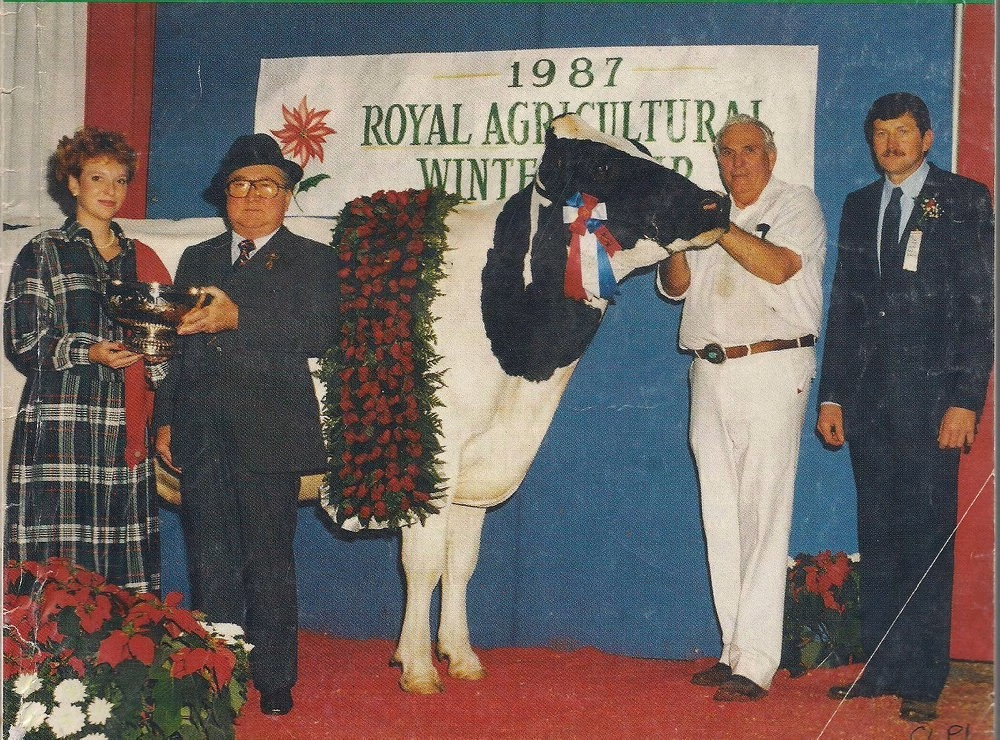
The Mount Victoria Farm, circa 1940: This historic photograph captures the picturesque Mount Victoria Farm in Hudson Heights, Quebec, where Thomas Bassett Macaulay revolutionized Holstein breeding. The farm’s scenic location overlooking the Lake of Two Mountains provided an idyllic setting for Macaulay’s groundbreaking work in developing influential bloodlines that would shape the Holstein breed worldwide for generations to come.
The Unlikely Breeder
In 1899, at 44, Thomas Bassett Macaulay made an unconventional decision that would reshape the future of Holstein breeding. The successful actuary and president of Sun Life Assurance Company purchased a 200-acre farm in Hudson Heights, Quebec, overlooking the picturesque Lake of Two Mountains. This acquisition was far from a retirement plan; it began an extraordinary journey into the world of dairy cattle genetics.
Macaulay’s farm, which he named Mount Victoria, was initially a sandy plot with poor soil quality, presenting a challenging canvas for his breeding ambitions. Undeterred, he set about improving the land with the same methodical approach he applied to his insurance work. He acquired diverse livestock, including French-Canadian cattle, goats, sheep, and horses. Macaulay’s insatiable curiosity drove these early experiments in animal husbandry, as did his desire to understand the principles of breeding and genetics.
For 25 years, Macaulay honed his skills and knowledge in animal management while continuing to lead Sun Life to new heights. His unique background in actuarial science provided him with a distinct advantage: the ability to analyze complex data and apply statistical principles to breeding decisions. This analytical approach would later become the cornerstone of his success in Holstein breeding.
In 1924, at the age of 69, an age when most men were considering retirement, Macaulay embarked on a new adventure: his legacy. He purchased his first Holstein cow, marking the beginning of one of the most influential breeding programs in the breed’s history. This late entry into Holstein breeding, far from being a disadvantage, proved to be Macaulay’s secret weapon.
Unencumbered by traditional practices and preconceived notions, Macaulay approached Holstein breeding with an outsider’s fresh perspective and a scientist’s rigorous methodology. He meticulously studied breed journals, pedigrees, and production records, applying his actuarial skills to identify the most promising genetic combinations.
Macaulay’s unique approach quickly set him apart from other breeders. He wasn’t content with following established practices; instead, he sought to revolutionize the breeding process through careful selection, innovative breeding techniques, and a relentless focus on improvement. His goal was clear: to create a strain of Holsteins that consistently produced high butterfat milk while maintaining excellent conformation.
As word of Macaulay’s innovative methods spread, the dairy farming community watched with curiosity and skepticism. Many doubted that an insurance executive with no formal agricultural training could succeed in the competitive world of Holstein breeding. Little did they know that this unlikely breeder was about to embark on a journey that would forever change the face of the Holstein breed and leave an indelible mark on dairy farming worldwide.
The Foundation
In the early 1920s, Thomas Bassett Macaulay embarked on a quest to reshape the Holstein breed. Armed with his analytical mind and passion for improvement, he dove deep into dairy cattle genetics. Macaulay spent countless hours reviewing breed journals, studying pedigrees, and analyzing production records. His goal was clear: to create a strain of Holsteins that would consistently produce high butterfat milk while maintaining excellent conformation.
Macaulay’s research led him to a surprising conclusion. The best Holstein genetics in North America were not found in the established herds of New York or Wisconsin but in the rolling hills of Oxford County, Ontario. With its rich dairy farming tradition, this region had become a hotbed of Holstein innovation.
In 1924, Macaulay made his first significant move. He attended the dispersal sale of Newton Chambers, a respected Oxford County breeder. He purchased Oakhurst Colantha Abbekerk for $900, the sale’s highest price. This cow would become the foundation of Mount Victoria’s Colantha family and prove a wise investment.
The following year, Macaulay set his sights on Alfred Hulet’s herd, another Oxford County breeder known for his work with the Posch-Abbekerk bloodlines. At Hulet’s dispersal, Macaulay acquired several key animals, including Dixie Colantha Hartog and Lady Meg Posch. These cows would establish essential families within the Mount Victoria herd.
JOHANNA RAG APPLE PABST: One of the founding fathers of the Canadian Holstein breed. This legendary bull, purchased by Thomas B. Macaulay for $15,000 in 1926, became the cornerstone of Mount Victoria Farms’ breeding program. His influence was so profound that by the late 20th century, virtually every registered Holstein in the world carried his blood.
However, Macaulay’s most audacious move was yet to come. In 1926, he sent his farm manager, Joe Chandler, to a sale in Wisconsin with instructions to purchase a bull named Johanna Rag Apple Pabst. This bull, already famous for his show ring success and production-siring ability, was the missing piece in Macaulay’s breeding puzzle.
Chandler hesitated when the bidding reached $15,000 – an astronomical sum for the time. He called Macaulay, who gave the go-ahead to continue bidding. Ultimately, “Old Joe” came to Mount Victoria for $15,000, setting a post-World War I record for a Holstein bull at public auction.
The acquisition of Johanna Rag Apple Pabst sent shockwaves through the Holstein breeding world. Many questioned Macaulay’s judgment in spending such a sum on a single animal. However, Old Joe would prove to be worth every penny. His daughters consistently produced milk with over 4% butterfat, a highly sought-after trait but challenging to achieve.
With his foundation animals in place, Macaulay was ready to begin his ambitious breeding program. He had assembled a group of cows with strong production records and excellent conformation and now had a herd sire capable of elevating their offspring to new heights. The stage was set for Mount Victoria Farms to become one of Holstein’s most influential breeding establishments.
The Super Champion”: A 1931 advertisement for Johanna Rag Apple Pabst, the cornerstone sire of Mount Victoria Farms. This legendary bull, purchased for $15,000 in 1926, revolutionized Holstein breeding with his ability to consistently sire daughters with high butterfat percentages and excellent conformation. His influence on the breed was so profound that by the late 20th century, virtually every registered Holstein worldwide carried his blood.
The Macaulay Method
Thomas Bassett Macaulay’s approach to Holstein breeding was nothing short of revolutionary. Drawing on his background as an actuary, Macaulay applied rigorous scientific principles to cattle breeding in an unprecedented way for his time. At the heart of Macaulay’s method was a deep understanding of statistics and probability. Just as he had used mathematical models to predict life expectancy and risk in the insurance industry, Macaulay now applied similar principles to predict and shape the genetic outcomes of his breeding program.
Macaulay’s breeding strategy was built on four key pillars:
Systematic Inbreeding and Line Breeding: Macaulay understood its power to concentrate desirable traits, unlike many breeders who feared inbreeding. He carefully planned matings to increase the frequency of genes for high butterfat production and excellent conformation. However, he balanced this with rigorous selection to avoid the pitfalls of inbreeding depression.
Data-Driven Selection: Macaulay instituted a comprehensive milk testing and record-keeping system far ahead of its time. Every cow at Mount Victoria was regularly tested for milk volume and butterfat percentage, and the records were meticulously analyzed to inform breeding decisions.
Focus on Butterfat: When most breeders were focused solely on milk volume, Macaulay set the ambitious goal of developing a strain of Holsteins that would consistently test at 4% butterfat or higher. This foresight would prove invaluable as the dairy industry later shifted towards valuing butterfat content.
Holistic Approach to Breeding: While many breeders focused on production or conformation, Macaulay insisted on simultaneously improving both. He believed genetic progress could only be achieved by selecting all economically important traits.
Macaulay’s office at Mount Victoria was meticulously organized, with walls covered in pedigree charts and production records, showcasing his commitment to a scientific approach. He developed a complex system of index cards for each animal, tracking not just their performance but that of all their relatives. This allowed him to calculate what we now recognize as estimated breeding values for each animal.
One of Macaulay’s most innovative practices was using “progeny testing,” which was used long before it became standard in the industry. He would hold back promising young bulls and breed them to a select group of cows, carefully observing and evaluating the resulting offspring before deciding whether to use the bull more widely. This patient, data-driven approach starkly contrasted to the more common practice of using bulls based solely on their pedigree or appearance.
Macaulay also instituted a practice of “contract matings” with other breeders. He would send his best bulls to be used on top cows in different herds, with the agreement that he could buy back any outstanding offspring. This allowed him to expand his genetic base and test his bulls in diverse environments.
The results of Macaulay’s scientific approach were remarkable. By the late 1930s, the average butterfat test of the Mount Victoria herd was over 4%, when the breed average was closer to 3.5%. Moreover, the herd’s production levels and show ring successes proved that high butterfat could be achieved without sacrificing other essential traits.
Mount Victoria’s 1927 Farmer’s Advocate ads showcase their prized bull Johanna Rag Apple Pabst and his offspring, highlighting the farm’s focus on superior genetics and high butterfat production. These ads reflect Thomas B. Macaulay’s ambitious vision to develop a strain of Holsteins consistently testing at 4% butterfat or higher.
Although Macaulay’s methods were highly successful, they were not without controversy among traditional breeders. Many criticized his approach as too clinical, arguing that successful breeding required an intuitive “eye for cattle” that couldn’t be reduced to numbers. Others were skeptical of his inbreeding practices. However, as the results spoke for themselves, more and more breeders began adopting Macaulay Method elements.
In many ways, Thomas Bassett Macaulay laid the foundation for the modern approach to cattle breeding based on genetics. His insistence on data-driven decisions, his understanding of population genetics, and his willingness to challenge conventional wisdom set a new standard for scientific breeding that continues to influence the Holstein industry today.
The Key Players
At the heart of this remarkable breeding program were six exceptional females that came to be known as “The Big Six,” a term coined by William Prescott of Holstein-Friesian World. These cows would form the foundation of Mount Victoria’s success and shape the future of the Holstein breed worldwide.
The story of the “Big Six” cows begins in the early 1920s with Macaulay’s methodical and scientific approach to assembling his herd. Thomas Bassett Macaulay, an insurance executive passionate about cattle breeding, began making his herd then. Macaulay sought the best genetics to build his program.
The first two “Big Six” members were acquired at the Newton Chambers’ dispersal sale in 1924. Oakhurst Colantha Abbekerk, a daughter of the influential Prince Colanthus Abbekerk, was purchased for $900, the sale’s highest price. This cow would establish the Abbekerk family at Mount Victoria, becoming a five-time Grand Champion, including at the prestigious Royal Winter Fair. At the same sale, Macaulay acquired Ingleside Pietje Posch for $550. This cow had already made a name for herself, placing first in the Junior Yearling class at the 1923 Royal Winter Fair and being part of Ontario’s winning State Herd at the National Dairy Show in Syracuse that same year. Ingleside would find the Pietje family at Mount Victoria.
The third “Big Six” member came from Alfred Hulet’s 1924 dispersal sale. Dixie Colantha Hartog, born in 1917, was purchased for $700, the highest sale price. Dixie would establish the Hartog family at Mount Victoria and set a Canadian record for milk production for several years.
The Hulet Estate Sale in 1925 provided two more members of the “Big Six.” Lady Meg Posch, described in the pre-sale promotion as one of the top show prospects of the offering, was acquired for $1,000, the sale’s top price. Bonheur Abbekerk Posch 2nd, born September 23, 1924, was also purchased at this sale. These two cows would become the cornerstones of the Posch and Bonheur families, respectively.
The final “Big Six” member joined the herd in 1928, when Macaulay made his most audacious purchase yet. At the National Ormsby Sale in Minneapolis, he acquired Triune Papoose Piebe for $11,100. This cow, already famous for her show ring success, would become one of the most distinguished female show winners of all time, claiming All-American honors for six consecutive years.
Together, these six cows formed the backbone of the Mount Victoria breeding program. Their descendants would dominate show rings and milk production records for decades, with their influence still felt in modern Holstein pedigrees worldwide. The “Big Six” story is a testament to Macaulay’s vision and ability to identify exceptional animals. By bringing together these diverse but complementary bloodlines, he created a herd that would redefine the Holstein breed and leave a lasting legacy in the world of dairy cattle breeding.
Part of the senior section of the Mount Victoria show herd, 1926. Left to right: Countess Amelia Posch, with five first prizes, including 2-year-old in milk class at the Royal; Lady Meg Posch, four firsts, including dry 3-year-old at the Royal; Ingleside Pietje Posch, Reserve Grand Champion once; Oakhurst Colantha Abbekerk, five-time Grand Champion, including at the Royal, and Reserve All-American aged cow; Johanna Rag Apple Pabst, All-American for four consecutive years and six-time Grand Champion, including at the Royal.
The Impact on the Breed
The influence of Mount Victoria Farms on the Holstein breed is a tale of genetic dominance that spans continents and decades. What began as one man’s vision in Quebec, Canada, would go on to reshape dairy cattle populations worldwide in ways that even Thomas Bassett Macaulay could scarcely have imagined.
By the late 1950s, Mount Victoria genetics had already had a staggering impact. An estimated 90% of Canadian Holsteins could trace their lineage to this remarkable herd. But the story doesn’t end there. Today, it’s widely acknowledged that every registered Holstein globally carries Mount Victoria blood, showcasing the profound impact of Macaulay’s breeding program.
The global spread of Mount Victoria genetics occurred through several channels. In the years following World War II, as countries sought to rebuild their agricultural sectors, there was a surge in demand for high-quality Holstein genetics. Mount Victoria descendants, particularly those of the legendary Johanna Rag Apple Pabst, were in high demand.
The impact was profound in Europe. Countries with strong dairy traditions, such as the Netherlands, Germany, and Italy, imported Mount Victoria bloodlines to improve their herds. The result was a marked improvement in milk production and, crucially, butterfat percentages. In the 1960s and 1970s, European breeders reported significant increases in butterfat tests, often attributing this improvement to the influence of Mount Victoria genetics.
South America saw a similar revolution. In countries like Brazil and Argentina, where dairy farming was expanding rapidly, Mount Victoria’s descendants played a key role in establishing high-producing herds. The adaptability of these genetics was particularly noteworthy, as they seemed to thrive even in the diverse climates of South America.
In Australia and New Zealand, where dairy farming is a cornerstone of the agricultural economy, Mount Victoria bloodlines contributed to a new era of productivity. Farmers reported improvements in milk yield and longevity, a trait Macaulay had emphasized in his breeding program.
Even in Asia, where dairy farming was less traditional, Mount Victoria’s influence was felt. As countries like Japan and South Korea developed their dairy industries in the latter half of the 20th century, they often turned to North American genetics, with Mount Victoria descendants prominently featured.
The impact of Mount Victoria breeding went beyond just production traits. The emphasis on strong udder conformation, a hallmark of Macaulay’s breeding philosophy, led to significant improvements in udder health and milking efficiency worldwide. This focus on functional type would prove particularly valuable as the global dairy industry moved towards more intensive production systems.
Perhaps most remarkably, the influence of Mount Victoria genetics has endured. Even in the age of genomic selection and advanced reproductive technologies, the foundational impact of this herd continues to be felt. Top show winners and high-producing cows worldwide often trace their pedigrees back to Mount Victoria multiple times, a testament to the enduring quality of these genetics.
Mount Victoria’s impact on the Holstein breed is not just a story of numbers and percentages. It’s a story of how one breeder’s vision and scientific approach created a genetic legacy that transformed dairy farming, improved farmers’ lives, and contributed worldwide food security. Mount Victoria’s influence stands as a compelling testament to how focused breeding can have profound and enduring impacts, fundamentally shaping the future of a breed.
GET OF MONTVIC PATHFINDER: All-American get of sire, 1941. Left to right: Montvic Duchess Abbekerk, Montvic Bonheur Emily, Montvic Bonheur Pietje B., and Montvic Bonheur Dale.
Global Influence
The impact of Johanna Rag Apple Pabst on the Holstein breed transcends mere statistics or pedigrees. His influence sparked a genetic revolution that reshaped dairy cattle breeding worldwide, leaving an indelible mark on the industry that persists. Born in 1921 on Philip Linker’s farm in Hartford, Wisconsin, “Old Joe,” as he came to be known, was destined for greatness from the start. His sire, Pabst Korndyke Star, and dam, Princess Johanna Rag Apple Pontiac, were both exceptional producers, foreshadowing the genetic potential that lay within their son.
When Thomas B. Macaulay purchased Johanna Rag Apple Pabst for the then-astronomical sum of $15,000 in 1926, few could have predicted the seismic shift this bull would bring to the dairy world. Macaulay’s vision of creating a strain of Holsteins with consistently high butterfat percentages found its perfect vehicle in Old Joe.
Significant genetic progress occurred when Johanna Rag Apple Pabst was bred with carefully selected foundation females at Mount Victoria Farms. The resulting progeny, particularly those from the Posch-Abbekerk bloodlines, was phenomenal. These offspring combined the high production and excellent conformation of their sire with the strong dairy characteristics of their dams, creating a new standard for the Holstein breed.
As news of the exceptional qualities of the Rag Apple descendants spread, breeders from across North America and beyond sought to incorporate this bloodline into their herds. The demand for Rag Apple genetics skyrocketed, with bulls and cows commanding premium prices at sales and auctions.
In Canada, the combination of Johanna Rag Apple Pabst’s bloodlines with those of another influential sire, King Toitilla Acme, proved particularly potent. This blend of genetics produced animals that excelled in the show ring and the milk parlor, setting new benchmarks for the breed.
A sire’s greatness is truly tested by the achievements of his descendants over generations. In this regard, Johanna Rag Apple Pabst’s legacy is unparalleled. His sons and grandsons became influential sires in their own right, spreading the Rag Apple influence far and wide. Notable among these were Montvic Rag Apple Abbekerk, Montvic Rag Apple Sovereign, and Montvic Bonheur Rag Apple, each leaving their mark on herds across the continent.
By the late 20th century, almost every registered Holstein worldwide could be traced back to Johanna Rag Apple Pabst, showcasing his widespread influence. This level of genetic saturation is unprecedented in livestock breeding and speaks to the enduring quality of the traits Old Joe passed on to his descendants.
The Rag Apple revolution wasn’t confined to North America. As dairy farming modernized globally in the post-World War II era, many countries looked to import superior genetics to improve their local herds. Rag Apple bloodlines became highly sought after, with descendants of Johanna Rag Apple Pabst going to Europe, South America, Japan, and New Zealand.
Johanna Rag Apple Pabst’s influence can still be seen in dairy barns worldwide nearly a century after his birth. His legacy is a testament to the power of selective breeding and the profound impact that one exceptional animal can have on an entire industry. The Rag Apple bloodline, born from the vision of Thomas B. Macaulay and the genetic potential of Old Joe, remains a cornerstone of modern Holstein breeding. It is a living legacy of a bull that genuinely changed the face of dairy farming forever.
Get of CRESTON GRAND MAJESTY (VG-GM): All-American get of sire, 1958 and 1959, Reserve in 1957, for Christ A. Mayer, Slinger, Wisconsin. Mayers Mistress Dark Anna (EX), at left, was dam of the highly-rated Mayers Dark Leader (GP-ST), a Wis Leader (EX-GM) son proven at Central Ontario Cattle Breeding Assoc., Maple, Ontario, ‘Then four cows, all classified Excellent, were all from Glenafton Rag Apple Ambassador dams. Ambassador was a son of Abegweit Showdown (son of Abegweit Milady) and out of the 1167-Ib. Jasmine Pabst Meg Posch (VG), a Montvic Pabst Rag Apple daughter.
Lessons for Modern Breeders
The story of Mount Victoria Farms and Thomas Bassett Macaulay offers a wealth of inspiration and lessons for today’s dairy breeders. This tale of an insurance executive turned cattle breeder revolutionizing the Holstein industry is a testament to the power of innovation, determination, and scientific thinking in agriculture.
Vision and Goal-Setting
Macaulay began with a clear, ambitious vision: to create a strain of Holstein cattle that consistently produced milk with 4% butterfat while maintaining excellent conformation. This goal, considered nearly impossible then, guided every decision he made in his breeding program. Modern breeders can learn from Macaulay’s example by setting specific, measurable goals for their herds and aligning all breeding decisions with these objectives.
Data-Driven Selection
Macaulay’s background as an actuary gave him a unique perspective on cattle breeding. He meticulously recorded and analyzed data on each animal in his herd, using this information to make informed breeding decisions. His office walls were covered with pedigree charts and production records, and he developed a complex system of index cards to track the performance of each animal and its relatives.
This data-driven approach allowed Macaulay to identify the most promising animals for his breeding program and make objective decisions about which traits to prioritize. Today’s breeders have access to even more sophisticated genetic analysis tools, but the principle remains the same: objective, data-driven selection is key to consistent genetic progress.
Scientific Rigor in Breeding
Macaulay approached breeding with the exactitude and rigor of a seasoned scientist. He was well-versed in the works of Gregor Mendel and applied the principles of genetics to his breeding program. His experiences in corn breeding directly influenced his methods in cattle breeding, demonstrating the application of scientific principles across disciplines.
One of Macaulay’s most innovative practices was using “progeny testing” long before it became standard in the industry. He would hold back promising young bulls and breed them to a select group of cows, then wait to evaluate the offspring before deciding whether to use the bull more widely. This patient, data-driven approach starkly contrasted with the prevalent practice of selecting bulls based solely on their pedigree or appearance.
Challenging Conventional Wisdom
Macaulay’s late entry into Holstein breeding at 69 allowed him to approach the industry with fresh eyes. He wasn’t bound by traditional practices or preconceived notions about how things should be done. This outsider perspective enabled him to challenge conventional wisdom and develop innovative breeding strategies.
For example, while many breeders of his time feared inbreeding, Macaulay understood its power to concentrate desirable traits when combined with rigorous selection. He carefully planned matings to increase the frequency of genes for high butterfat production and excellent conformation, balancing this with strict culling to avoid the pitfalls of inbreeding depression.
Patience and Persistence
Macaulay dedicated nearly two decades to building the Mount Victoria herd into a world-class breeding program. He understood that genetic improvement is a long-term process and was willing to invest the time and resources necessary to achieve his goals.
Macaulay’s patience extended to his breeding decisions. He was willing to wait to see the results of his choices, often holding onto promising animals for multiple generations to evaluate their genetic potential fully. This long-term perspective allowed him to make sustained genetic progress over time.
Holistic Approach to Breeding
While many breeders of his era focused on production or conformation, Macaulay insisted on improving both simultaneously. He believed that genetic progress could only be achieved by selecting all economically important traits. This holistic approach to breeding resulted in animals that excelled in the show ring and the milk parlor, setting a new standard for the breed.
Mount Victoria Farms’ legacy demonstrates that remarkable animal breeding results can be achieved with vision, scientific rigor, and unwavering dedication. As modern breeders face new challenges, including the need for increased efficiency, improved health traits, and adaptation to changing climates, Thomas Bassett Macaulay’s example continues to offer valuable lessons in innovation, persistence, and the power of applying scientific principles to the art of cattle breeding.
The Bottom Line
Thomas Bassett Macaulay stands as a testament to the profound impact one visionary breeder can have on an entire breed. Through careful selection, innovative breeding practices, and an unwavering commitment to improvement, Macaulay created a genetic powerhouse that reshaped the Holstein breed worldwide.
Key points that underscore Mount Victoria’s greatness include:
The acquisition and strategic use of Johanna Rag Apple Pabst, whose influence became so pervasive that every registered Holstein today carries his blood.
The development of influential cow families like the Bonheurs, Colanthas, and Hartogs produced generation after generation of superior animals.
The creation of breed-defining sires like Montvic Pathfinder, whose descendants dominated show rings and milk production records for decades.
The focus on high butterfat percentages helped redirect the industry’s attention towards producing milk components.
Applying scientific principles to breeding sets a new standard for the industry.
Mount Victoria’s influence exceeded its herd, shaping breeding programs in North America and worldwide. The farm’s dispersal in 1942 scattered these valuable bloodlines, allowing countless other breeders to benefit from Macaulay’s work. Perhaps most importantly, Mount Victoria demonstrated the power of a clear vision, scientific approach, and long-term commitment in achieving remarkable genetic progress. Macaulay’s willingness to challenge conventional wisdom and his patient, data-driven approach to breeding inspire breeders today.
In the annals of Holstein history, Mount Victoria Farms is one of the most significant breeding establishments. Nearly a century after its founding, its influence is still felt in dairy barns worldwide. Mount Victoria’s story powerfully illustrates how one breeder’s vision and dedication can shape a breed’s future, leaving a legacy that spans generations.
Key Takeaways:
Thomas B. Macaulay, an insurance executive, founded Mount Victoria Farms in Quebec in 1899 at age 44.
Macaulay began breeding Holsteins 1924 at age 69, applying his analytical skills from actuarial work to cattle breeding.
He purchased the influential bull Johanna Rag Apple Pabst in 1926 for $15,000, which became the cornerstone of his breeding program.
Macaulay focused on developing a strain of Holsteins with consistently high butterfat (4%+) while maintaining good conformation.
He used scientific breeding methods, including line breeding, inbreeding, and rigorous selection.
Key foundation cows included the “Big Six”: Oakhurst Colantha Abbekerk, Ingleside Pietje Posch, Dixie Colantha Hartog, Lady Meg Posch, Bonheur Abbekerk Posch 2nd, and Triune Papoose Piebe.
Mount Victoria developed influential cow families and sire lines that shaped the Holstein breed globally.
By the late 1950s, over 90% of Canadian Holsteins traced back to Mount Victoria breeding.
Today, it’s believed every registered Holstein worldwide carries some Mount Victoria blood.
Macaulay’s scientific approach to breeding set new standards for the dairy cattle industry.
Summary:
Mount Victoria Farms, founded by Thomas Bassett Macaulay in Quebec, Canada, became one of Holstein’s most influential breeding establishments. Macaulay developed bloodlines that continue to impact the global Holstein population through careful selection, innovative breeding practices, and a focus on high butterfat production. The cornerstone of his breeding program was Johanna Rag Apple Pabst, purchased in 1926, whose descendants dominated show rings and milk production records for decades. Macaulay’s scientific approach to breeding, combining his background as an actuary with genetic principles, led to the creation of influential cow families like the Bonheurs, Colanthas, and Hartogs. The impact of Mount Victoria genetics extended far beyond Canada, shaping breeding programs worldwide. By the late 1950s, over 90% of Canadian Holsteins could trace their lineage back to Mount Victoria, and today, it’s believed that every registered Holstein in the world carries some Mount Victoria blood.
Bullvine Daily is your essential e-zine for staying ahead in the dairy industry. With over 30,000 subscribers, we bring you the week’s top news, helping you manage tasks efficiently. Stay informed about milk production, tech adoption, and more, so you can concentrate on your dairy operations.
To provide the best experiences, we use technologies like cookies to store and/or access device information. Consenting to these technologies will allow us to process data such as browsing behavior or unique IDs on this site. Not consenting or withdrawing consent, may adversely affect certain features and functions.
Functional
Always active
The technical storage or access is strictly necessary for the legitimate purpose of enabling the use of a specific service explicitly requested by the subscriber or user, or for the sole purpose of carrying out the transmission of a communication over an electronic communications network.
Preferences
The technical storage or access is necessary for the legitimate purpose of storing preferences that are not requested by the subscriber or user.
Statistics
The technical storage or access that is used exclusively for statistical purposes.The technical storage or access that is used exclusively for anonymous statistical purposes. Without a subpoena, voluntary compliance on the part of your Internet Service Provider, or additional records from a third party, information stored or retrieved for this purpose alone cannot usually be used to identify you.
Marketing
The technical storage or access is required to create user profiles to send advertising, or to track the user on a website or across several websites for similar marketing purposes.
To provide the best experiences, we and our partners use technologies like cookies to store and/or access device information. Consenting to these technologies will allow us and our partners to process personal data such as browsing behavior or unique IDs on this site and show (non-) personalized ads. Not consenting or withdrawing consent, may adversely affect certain features and functions.
Click below to consent to the above or make granular choices. Your choices will be applied to this site only. You can change your settings at any time, including withdrawing your consent, by using the toggles on the Cookie Policy, or by clicking on the manage consent button at the bottom of the screen.
Functional
Always active
The technical storage or access is strictly necessary for the legitimate purpose of enabling the use of a specific service explicitly requested by the subscriber or user, or for the sole purpose of carrying out the transmission of a communication over an electronic communications network.
Preferences
The technical storage or access is necessary for the legitimate purpose of storing preferences that are not requested by the subscriber or user.
Statistics
The technical storage or access that is used exclusively for statistical purposes.The technical storage or access that is used exclusively for anonymous statistical purposes. Without a subpoena, voluntary compliance on the part of your Internet Service Provider, or additional records from a third party, information stored or retrieved for this purpose alone cannot usually be used to identify you.
Marketing
The technical storage or access is required to create user profiles to send advertising, or to track the user on a website or across several websites for similar marketing purposes.