

Archive for FMMO make allowances

$50K Gone: Von Ruden Reveals FMMO Make Allowance’s 300-Cow Dairy Gut Punch

50K vanished from WI 300-cow dairy’s Jan check. Von Ruden blames FMMO make allowances. Yours?

Executive Summary: In January 2026, a 300-cow Wisconsin dairy watched $50,000 vanish despite shipping the same milk to the same plant under the same management. This massive revenue hemorrhage is the direct result of the FMMO’s new “make-allowance” deductions—a structural 90¢/cwt tax that processors now skim off the top before you see a dime. While the industry touts federal “safety nets,” the cold math reveals a brutal 23-to-1 gap where DMC pennies cannot stop formula-driven dollar losses. This is not a market anomaly; it is a fundamental wealth transfer from the barn to the plant that your own co-op likely bloc-voted into existence. To survive, producers must audit their statements, isolate their specific “hidden drag,” and demand immediate accountability from leadership before their equity evaporates. Your January check wasn’t just a disappointment—it was a warning shot for an 18-month fight for survival.

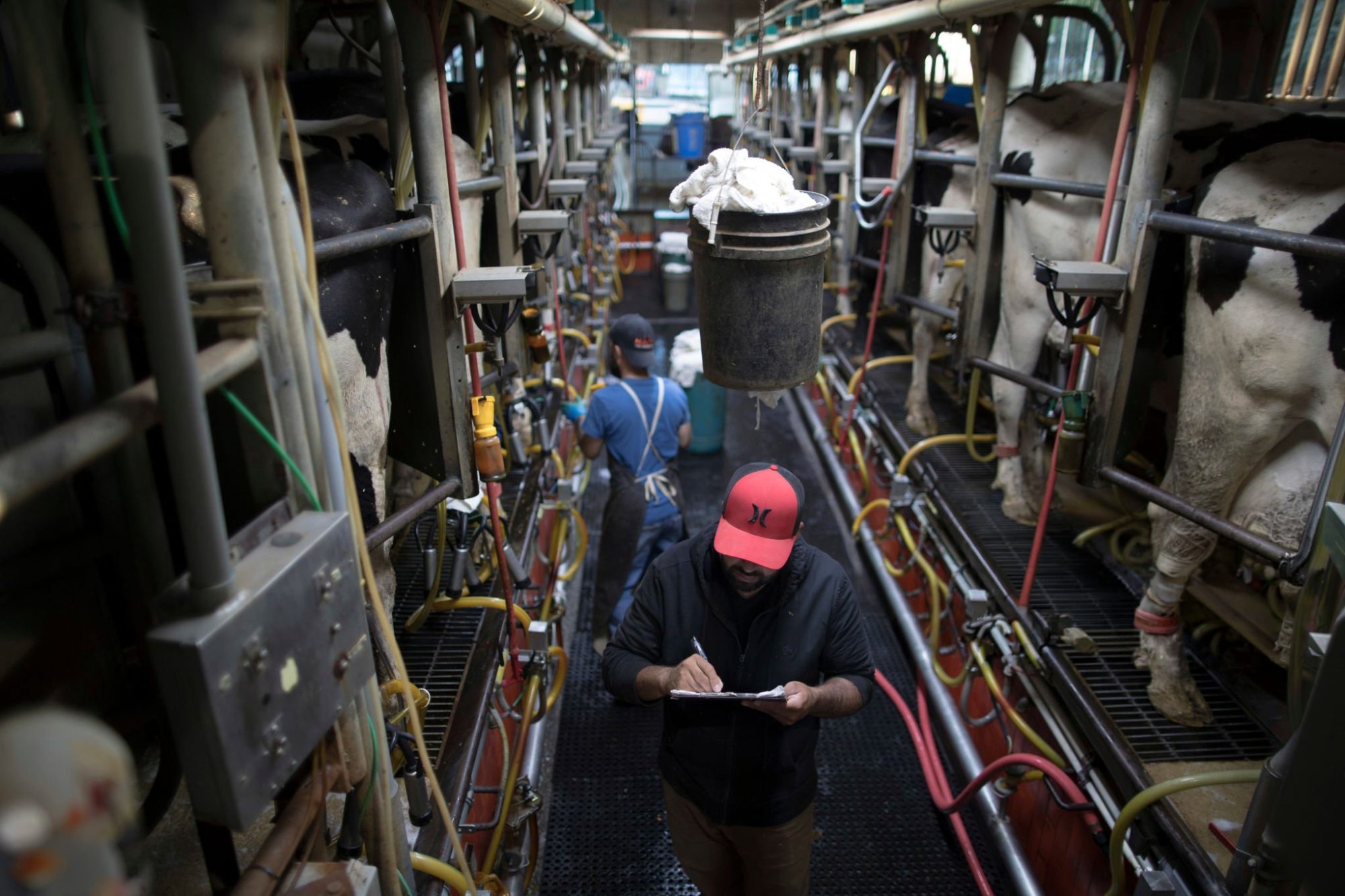
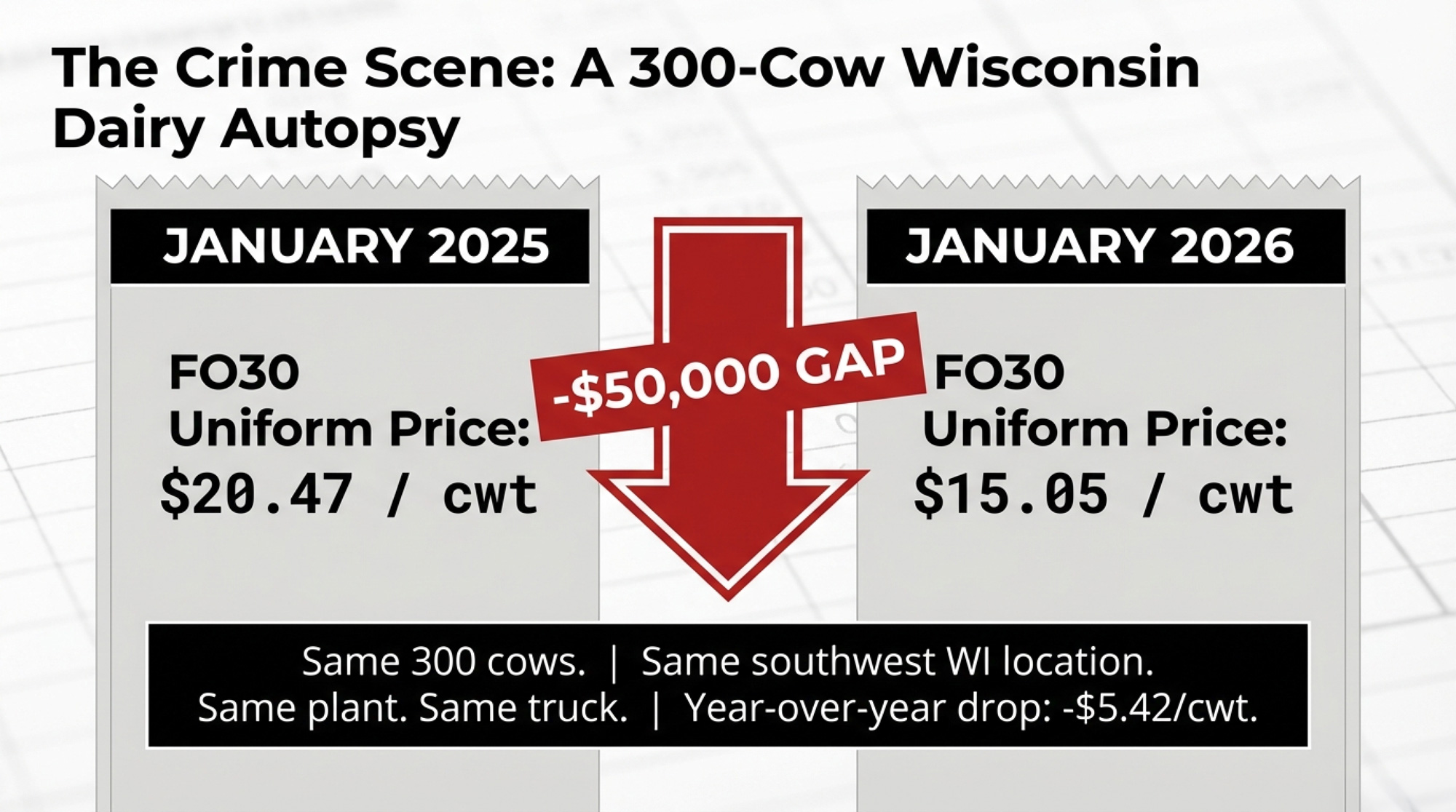
At the National Farmers Union’s 124th annual convention this March, Wisconsin Farmers Union president Darin Van Ruden stood up in a delegate session and dropped a number that stuck: about $50,000.  That’s how much less a 300‑cow dairy operator in southwest Wisconsin received on his January 2026 milk check compared with January 2025, according to Van Ruden. 

He told Brownfield Ag News this wasn’t a model herd or a spreadsheet example. It was a neighbor he’d spoken with the week before — 300 cows, southwest Wisconsin, same plant, same truck, roughly $50,000 gone in one month.  The cows didn’t change. The formulas did. 

From $20.47 to $15.05: What Changed in a Year

Before you argue about anyone’s $50,000, look at the numbers every FO30 producer faced.

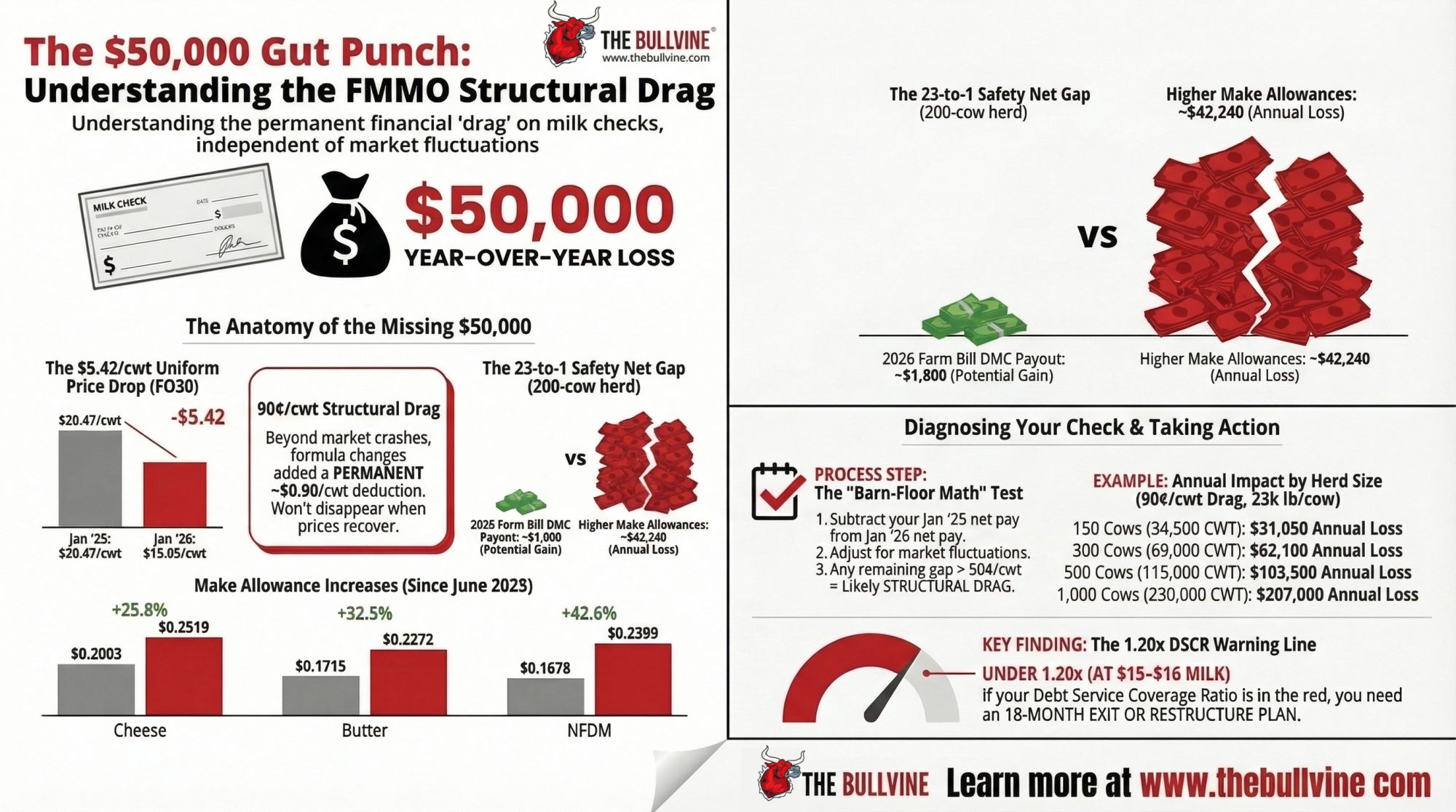
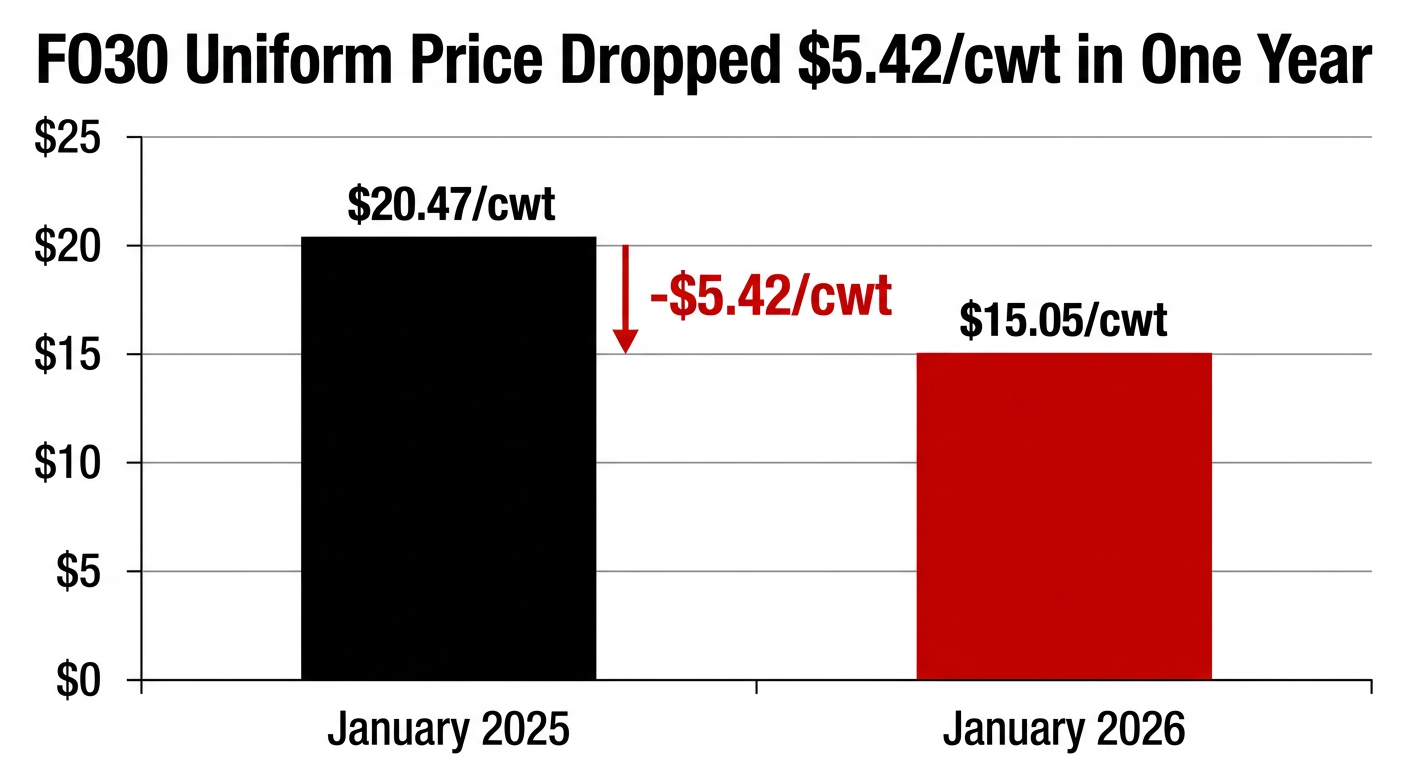
The Upper Midwest FMMO (Order 30) statistical uniform price for January 2025 was $20.47/cwt.  In January 2026, it was $15.05/cwt — a year‑over‑year drop of $5.42/cwt.  That’s the base reality under every milk check in the order. 

Commodity prices did plenty of damage. CME butter’s monthly average price slid from $2.6042/lb in January 2025 to $1.4266/lb in January 2026, down about $1.18/lb — roughly a 45% crash.  Cheddar blocks dropped from $1.8954/lb to $1.4003/lb, a 26% hit.  FO30’s January Class III price followed that slide, falling from $20.34/cwt in 2025 to $14.59/cwt in 2026 — off $5.75

ProductJan 2025 PriceJan 2026 PriceChange
CME Butter$2.6042/lb$1.4266/lb–$1.18/lb (–45%)
Cheddar Blocks$1.8954/lb$1.4003/lb–$0.50/lb (–26%)
FO30 Class III$20.34/cwt$14.59/cwt–$5.75/cwt (–28%)
FO30 Class I Util7.7%7.7%No blend cushion

And FO30 is built to feel that pain harder than most. Class I made up just 7.7% of pooled producer milk in the order in 2025 — the lowest share of any federal order.  Almost everything else is Class III and IV. When cheese and butter break, there isn’t much Class I volume to pull the blend up. 

Handlers behaved exactly how you’d expect in that setup. In January 2026, FO30’s producer price differential was $0.46/cwt, and an estimated 2.6 billion pounds of eligible milk weren’t pooled — more than the 1.4 billion that stayed in the pool.  When more milk sits outside the pool than inside it, you don’t have a healthy pricing system. You have a blender that’s barely plugged in. 

Where the Missing 90¢/cwt Really Went

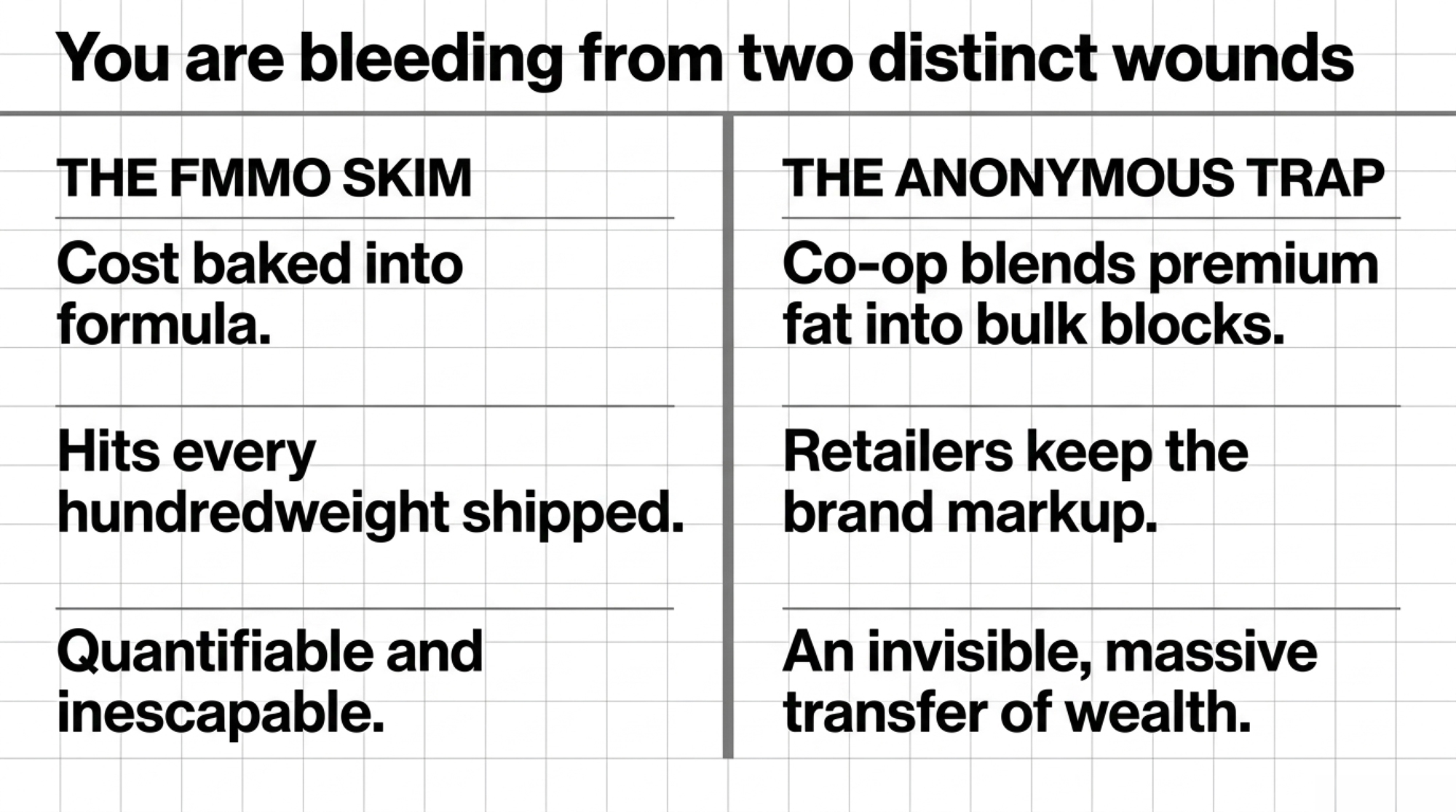
That $5.42/cwt drop in FO30’s uniform price is not all structure. A big chunk is just a miserable butter and cheese month.  But there’s a permanent piece baked into your check now, and that’s the make‑allowance jump. 

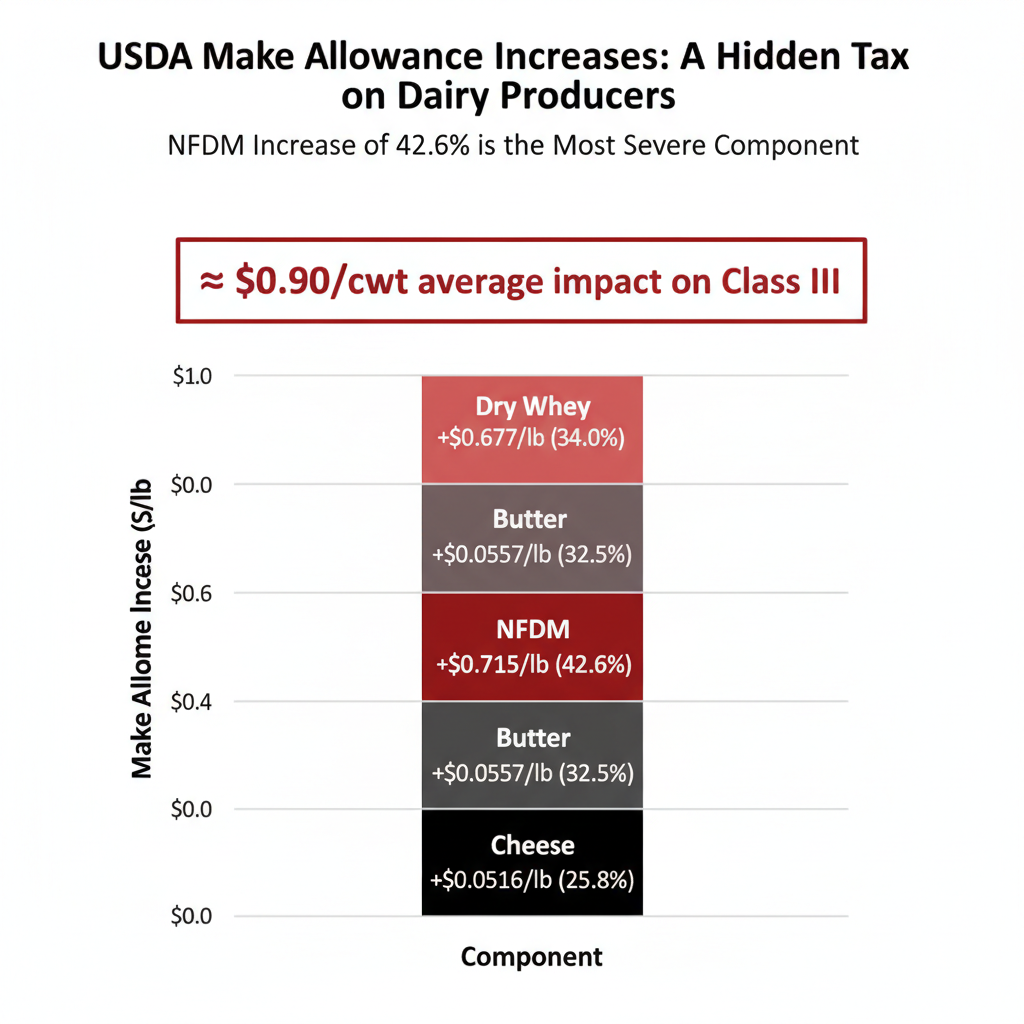
Make allowances are the manufacturing‑cost numbers USDA subtracts from surveyed cheese, butter, powder, and whey prices in the FMMO formulas. When those numbers go up, class prices go down by the same amount. USDA’s modernization package raised the allowances effective June 1, 2025: 

ProductOld make allowanceNew make allowanceChange
Cheese$0.2003/lb$0.2519/lb+5.16¢ (25.8%)
Butter$0.1715/lb$0.2272/lb+5.57¢ (32.5%)
NFDM$0.1678/lb$0.2393/lb+7.15¢ (42.6%)
Dry whey$0.1991/lb$0.2668/lb+6.77¢ (34.0%)

American Farm Bureau Federation economist Danny Munch ran those new allowances through 2020–2023 markets. His Market Intel analysis found that higher make allowances alone would have lowered average FMMO class prices by about $0.92/cwt for Class III$0.85/cwt for Class IV$0.89/cwt for Class I, and $0.85/cwt for Class II.  That’s not worst‑case. That’s the average. 

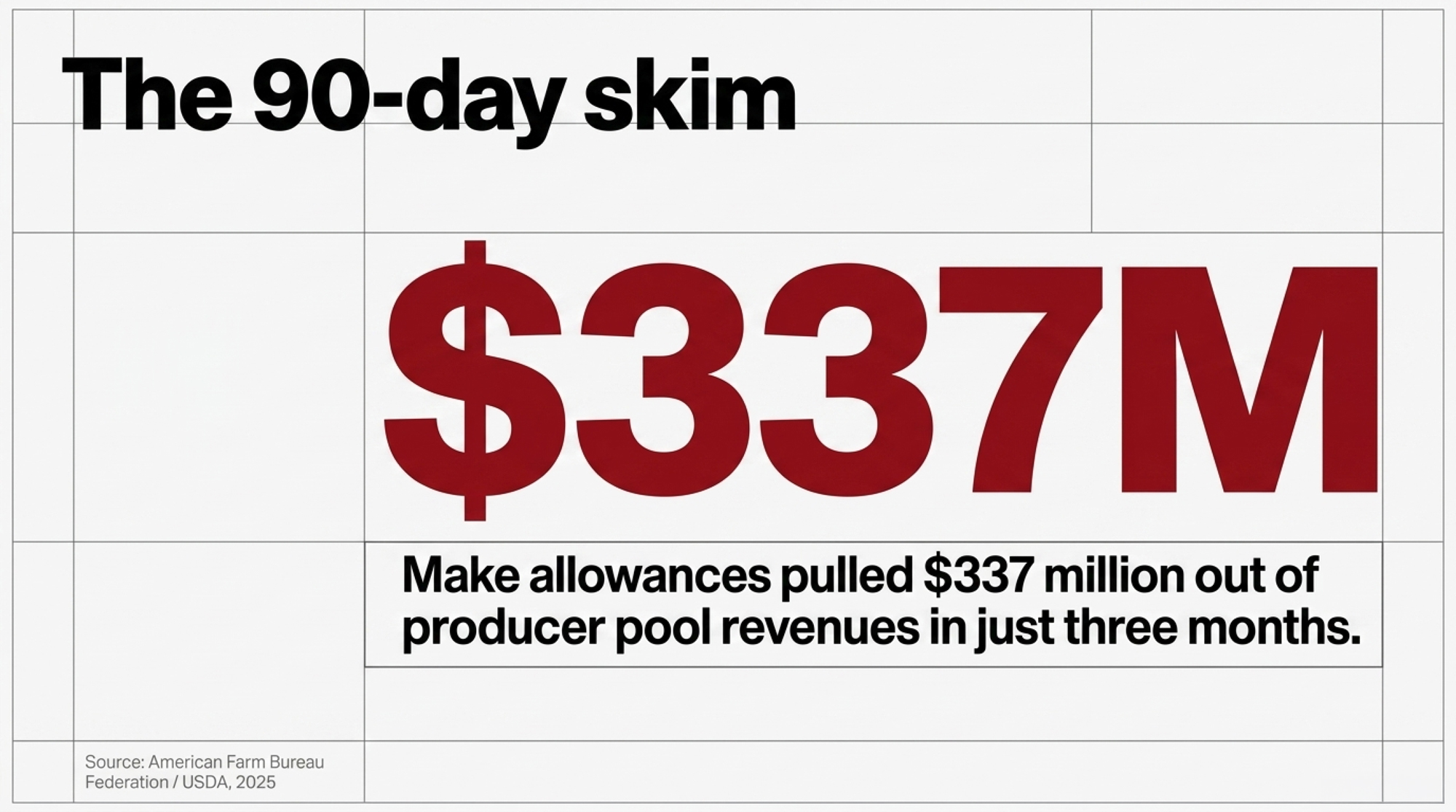
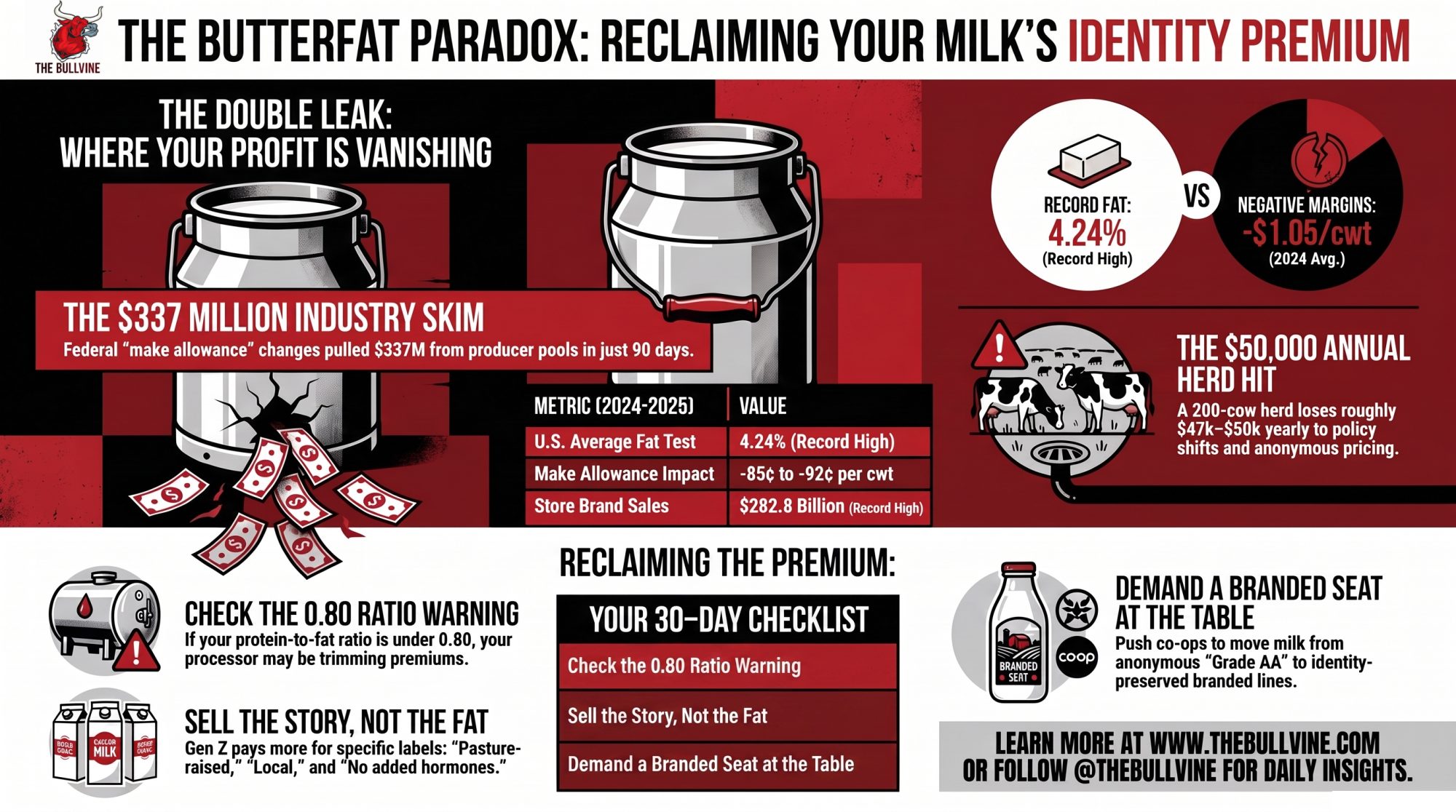
AFBF then looked at what that would have done to pool values. Over just three months — June through August — higher make allowances stripped about $337 million out of producer pools nationally, including roughly $64 millionfrom the Upper Midwest, $62 million from the Northeast, and $55 million from California.  That’s money that would’ve been in milk checks under the old formulas. 

Yes, USDA did throw some offsets into the same package. The final rule restores the “higher‑of” Class I mover, revises Class I differentials, and updates composition factors so higher‑solid milk gets recognized at 3.3% protein and 9.3 lb SNF instead of the old 3.1/8.7.  But timing matters. Make allowances went up on June 1, 2025. The composition factor change didn’t kick in until December 1, 2025.  For six months, producers received the full cost increase with no solid‑adjustment relief. 

If you want the deeper class‑by‑class walk‑through, The Bullvine’s own FMMO Reset analysis uses AFBF’s numbers to show how that roughly 90¢/cwt drag plays out across orders and herd sizes.  The short version: there’s now a structural discount sitting in your class prices that won’t disappear just because butter has a good month. 

How Much Did the FMMO Rewrite Actually Cost Your January Milk Check?

Now let’s get close to home.

Take the herd Van Ruden talked about: 300 cows in southwest Wisconsin.  If that operation is shipping about 85 lb/cow/day in January, that’s roughly 7,905 cwt in 31 days. 

FO30’s statistical uniform price dropped $5.42/cwt from January 2025 to January 2026.  The straight arithmetic on that herd looks like this: 

  • 7,905 cwt × $5.42/cwt = $42,845 less on the check, just from the change in the uniform price at test.

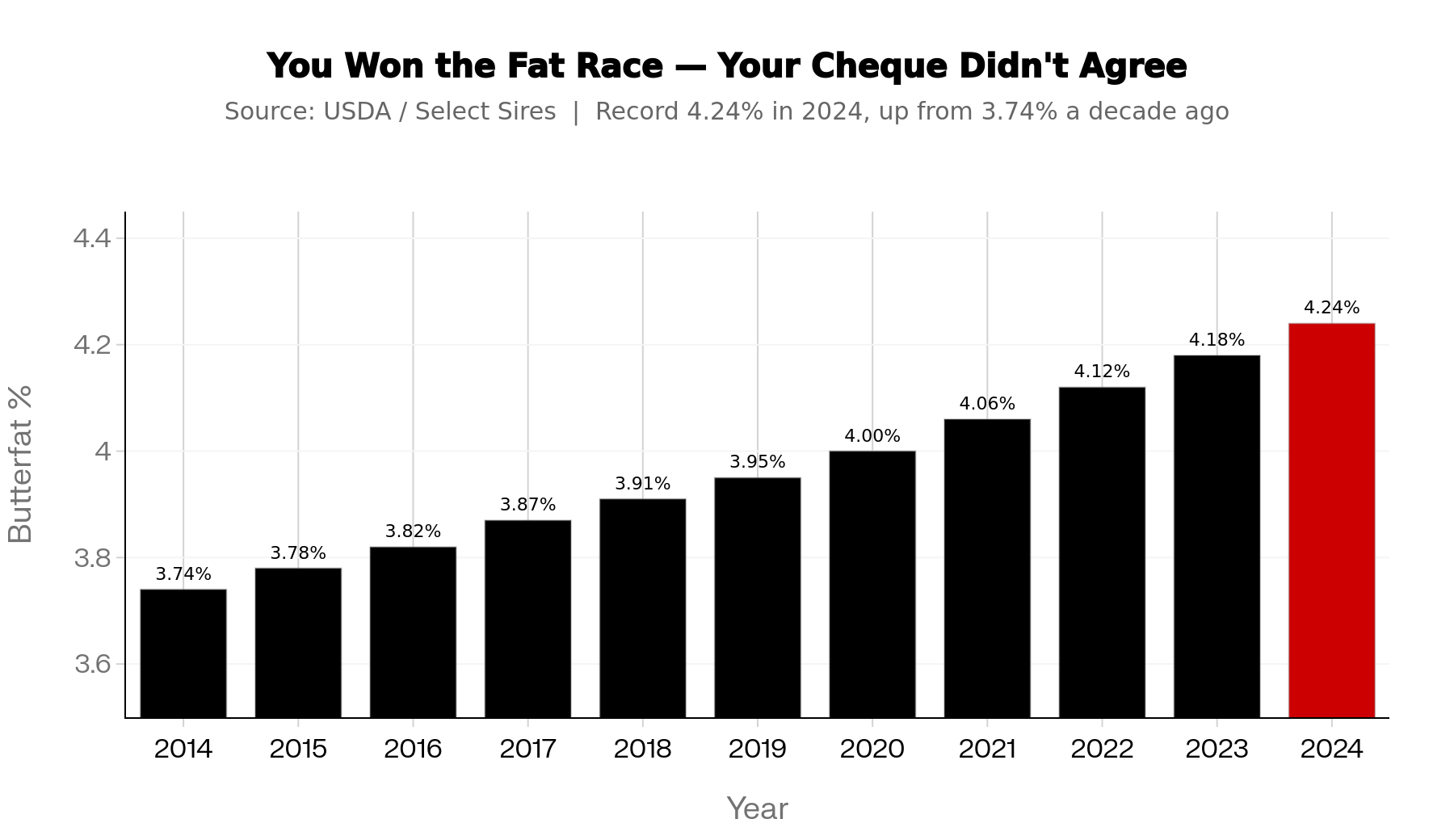
But FO30’s “at test” milk isn’t 3.5% butterfat. In January 2026, pooled butterfat averaged 4.52%, with protein at 3.42%.  At the same time, the butterfat component price fell from $2.9487/lb in January 2025 to $1.4525/lb in January 2026 — a collapse of $1.4962/lb.  That hits all the butterfat you’ve bred and fed for above 3.5%. 

Layer in premium changes. Plants facing lower class prices and higher make allowances have every reason to trim or restructure volume incentives, quality bonuses, and over‑order payments. You don’t see those cuts in a USDA bulletin. You see them when your “other credits” line shrinks.

When you add the FO30 uniform‑price drop, the butterfat collapse on high‑component milk, and likely premium erosion, you’re suddenly right in the neighborhood of Van Ruden’s $50,000 example for a 300‑cow herd.  The exact number belongs to that family. The order‑level math says the story is believable. 

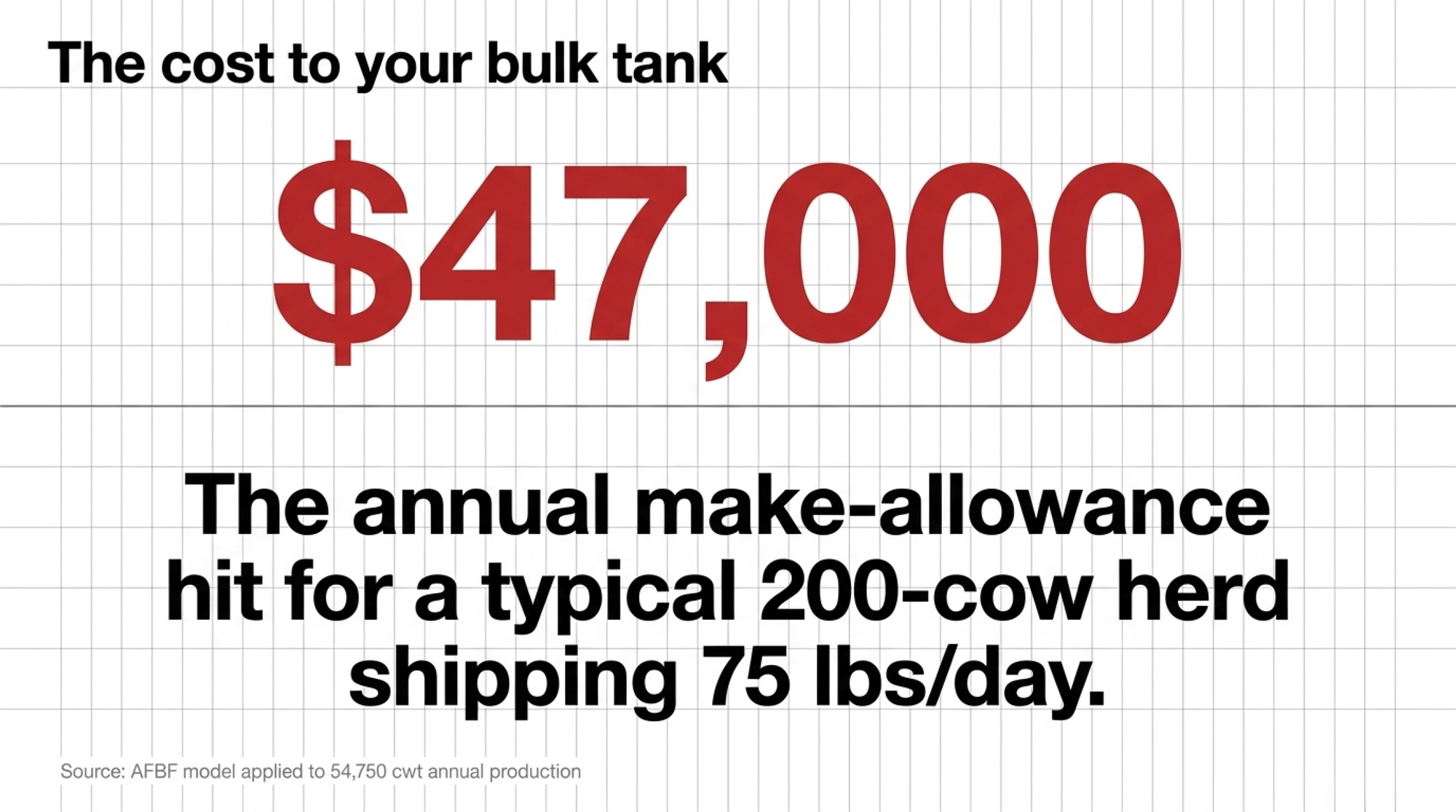
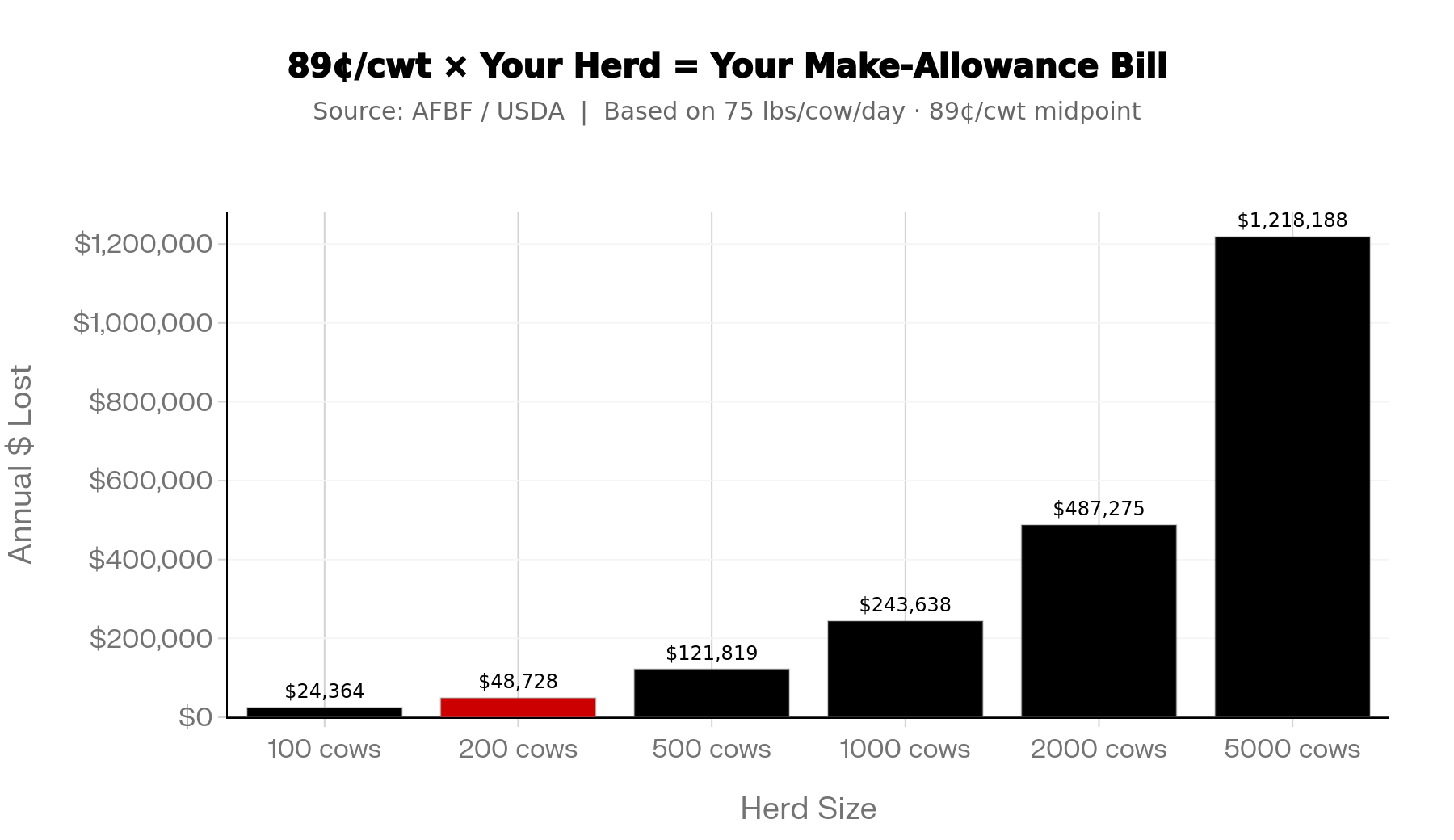
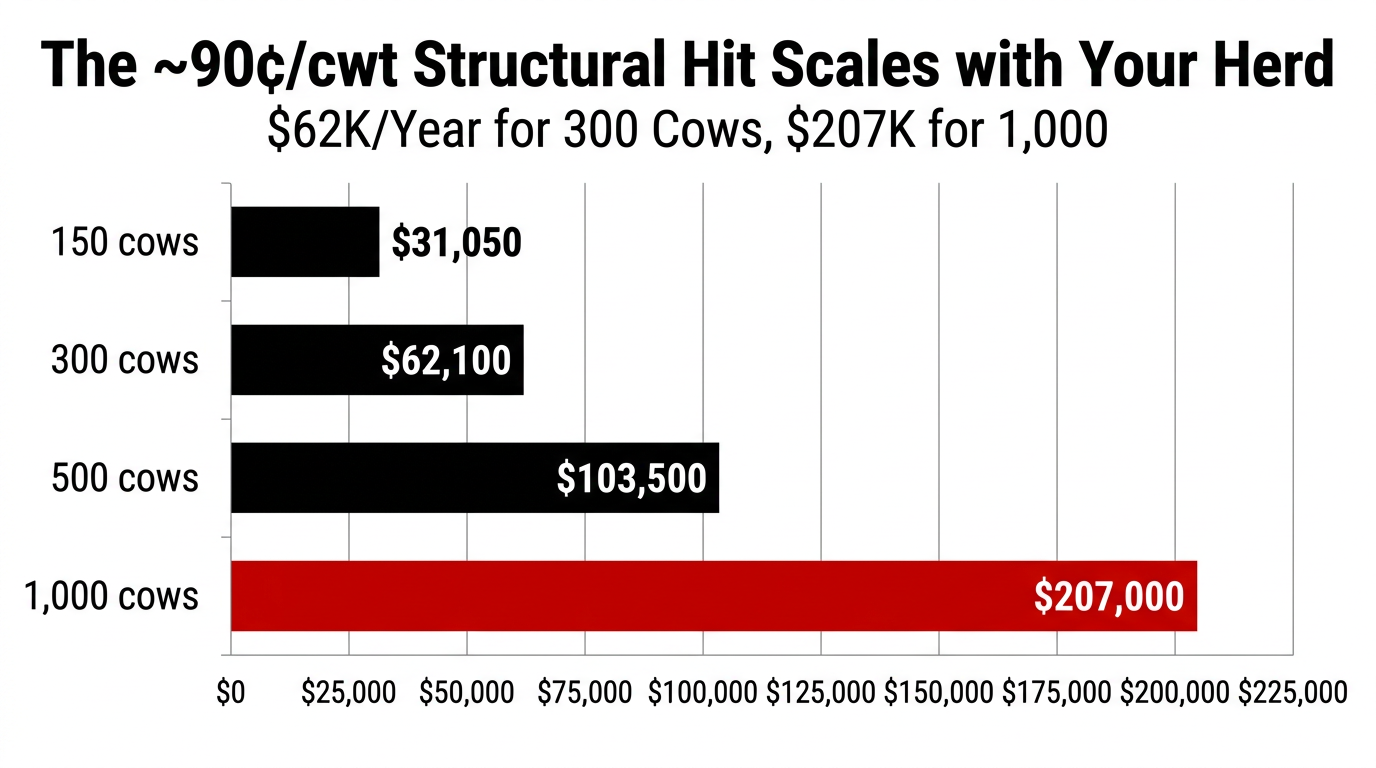
Now pull out the structural part. AFBF’s modeling suggests that higher make allowances alone cut FMMO class prices by roughly 90¢/cwt.  Here’s what that looks like across herd sizes at 23,000 lb/cow annual production: 

Herd sizeAnnual cwt90¢/cwt drag/yearMonthly drag
150 cows34,500$31,050$2,588
300 cows69,000$62,100$5,175
500 cows115,000$103,500$8,625
1,000 cows230,000$207,000$17,250

That’s what “structural” means. Those dollars disappear off the table every year until formulas, cost surveys, or utilization change. Markets might add to or subtract from that. The drag itself stays.

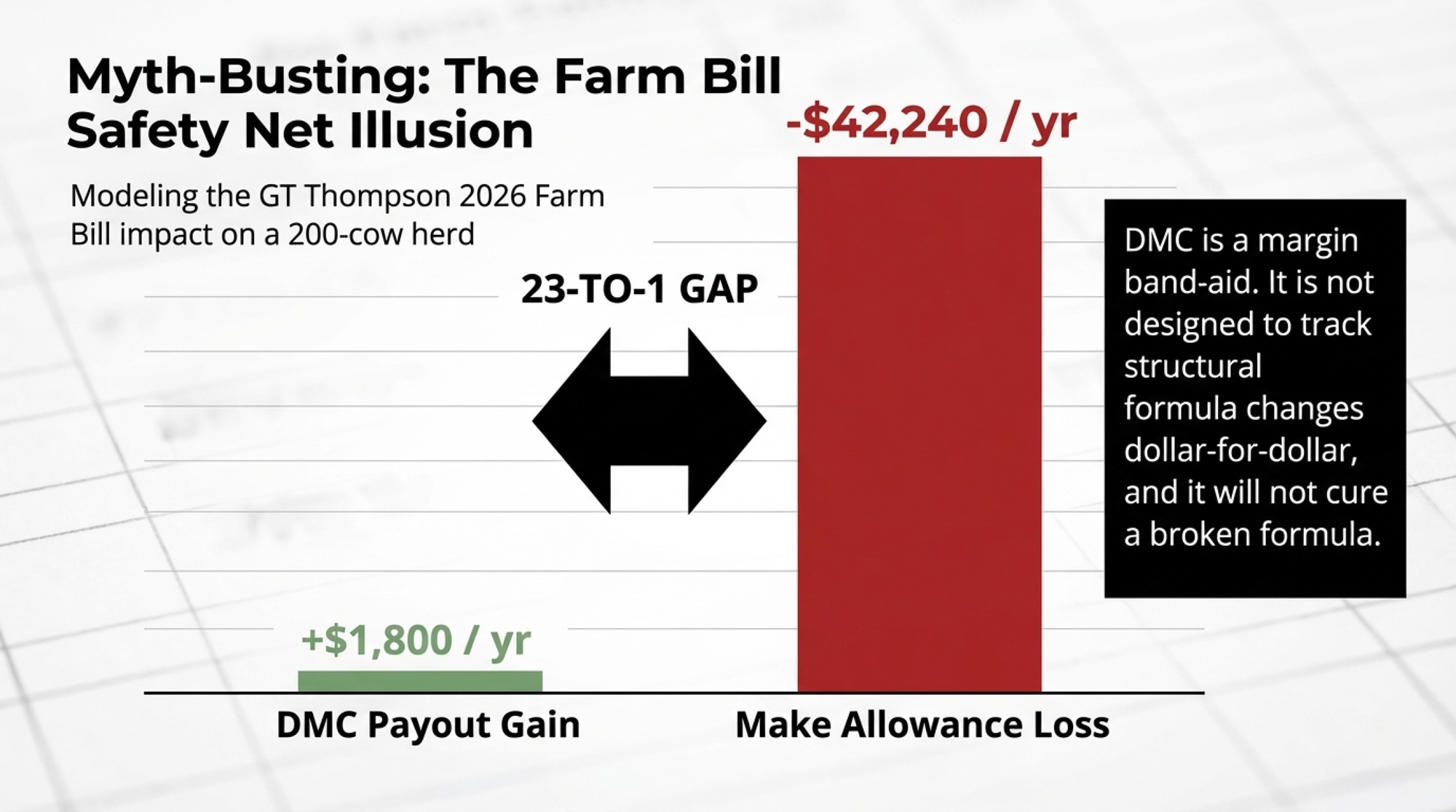
And when you park that drag next to the Farm Bill safety net? The Bullvine’s GT Thompson 2026 Farm Bill pieceshows a 200‑cow herd gaining roughly $1,800/year in improved DMC payouts while losing about $42,240/year from higher make allowances.  That’s a 23‑to‑1 gap. For every dollar DMC gives back, the formula takes twenty‑three. 

How Much Did the Formula Change Actually Cost Your January Check?

Now it’s your turn.

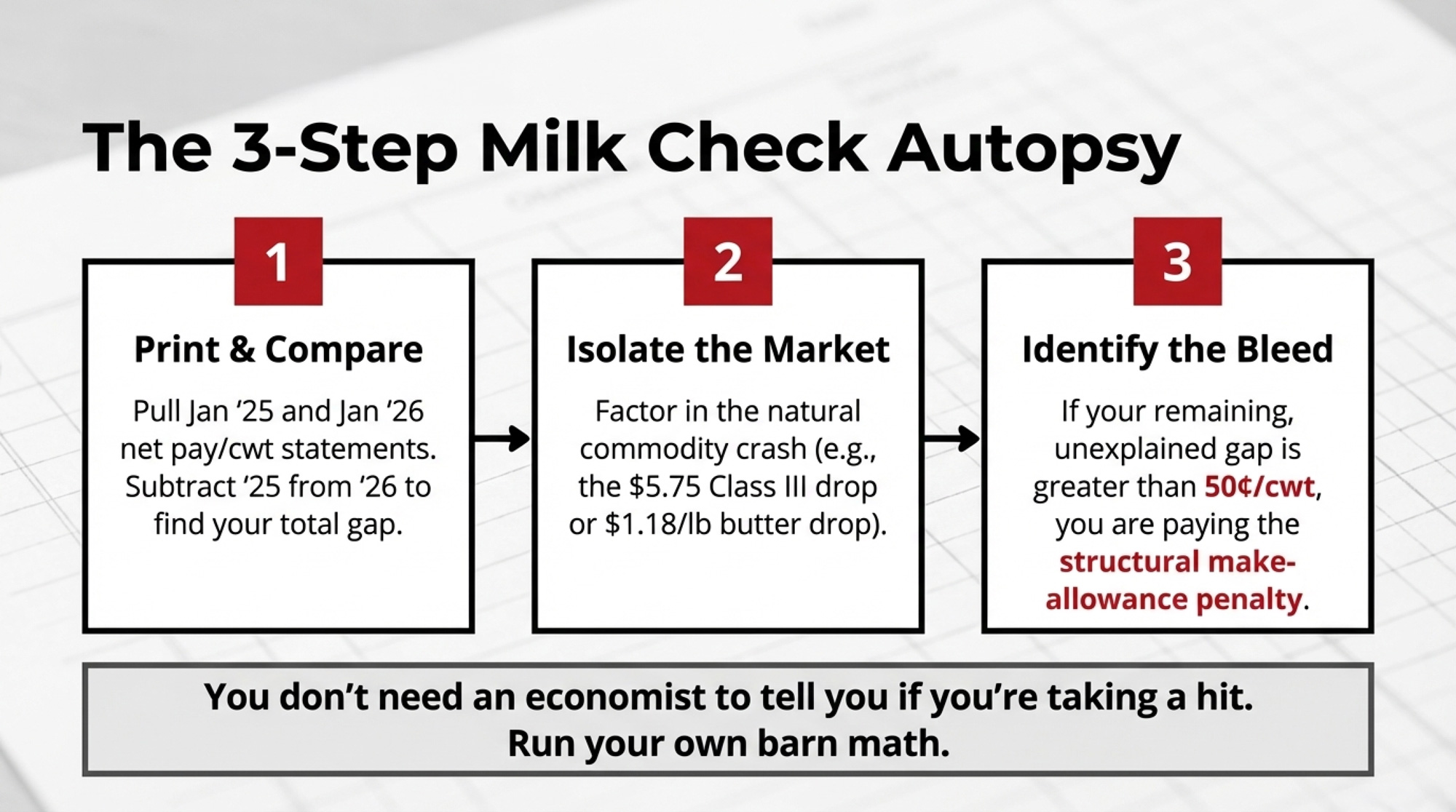
Step 1: Put a real number on your January‑over‑January price.

  • Grab your January 2025 milk statement. Take net pay (after hauling, dues, and fees) and divide by total cwt shipped. Write that number down.
  • Do the same for January 2026.
  • Subtract 2025’s $/cwt from 2026’s $/cwt. That difference is your real‑world January drag.

Step 2: Separate what the market did from what the formula did.

Look at the same FO30 numbers Van Ruden’s neighbor faced: 

  • Class III price: $20.34/cwt → $14.59/cwt (down $5.75).
  • Statistical uniform price: $20.47/cwt → $15.05/cwt (down $5.42).
  • Butter: about $2.60/lb → $1.43/lb (down roughly $1.18/lb).

If your $/cwt drop is roughly in line with those moves, most of your pain is “just” the butter and cheese crash. Whatever you can’t explain with those class‑price and butter moves is where the structural make‑allowance hit and co‑op decisions are hiding.

Step 3: Put a number on the “hidden” part.

  • If your unexplained gap sits under 30–40¢/cwt, your buyer might already be buffering some of the structural drag with premiums or patronage.
  • If it’s over about 50¢/cwt, especially in Class III‑heavy orders like the Upper Midwest and Central, you’re almost certainly feeling that ~90¢/cwt structural penalty from higher make allowances plus whatever your plant adjusted in premiums. 

You don’t need an economist to tell you if Van Ruden’s neighbor is alone. That three‑step math will answer the question for your own barn.

StepCalculationYour Number
1Jan 2026 net $/cwt – Jan 2025 net $/cwt$ ______
2FO30 uniform price drop (baseline: –$5.42/cwt)–$5.42/cwt
3Butterfat price collapse (–$1.50/lb on 4.52% avg)~$ ______ /cwt
4Unexplained gap (Step 1 minus Steps 2 + 3)$ ______
5If unexplained gap > 50¢/cwt: Structural drag + premium cuts likely 

Can You Recapture 90¢/cwt Through Components, or Is This a Permanent Loss?

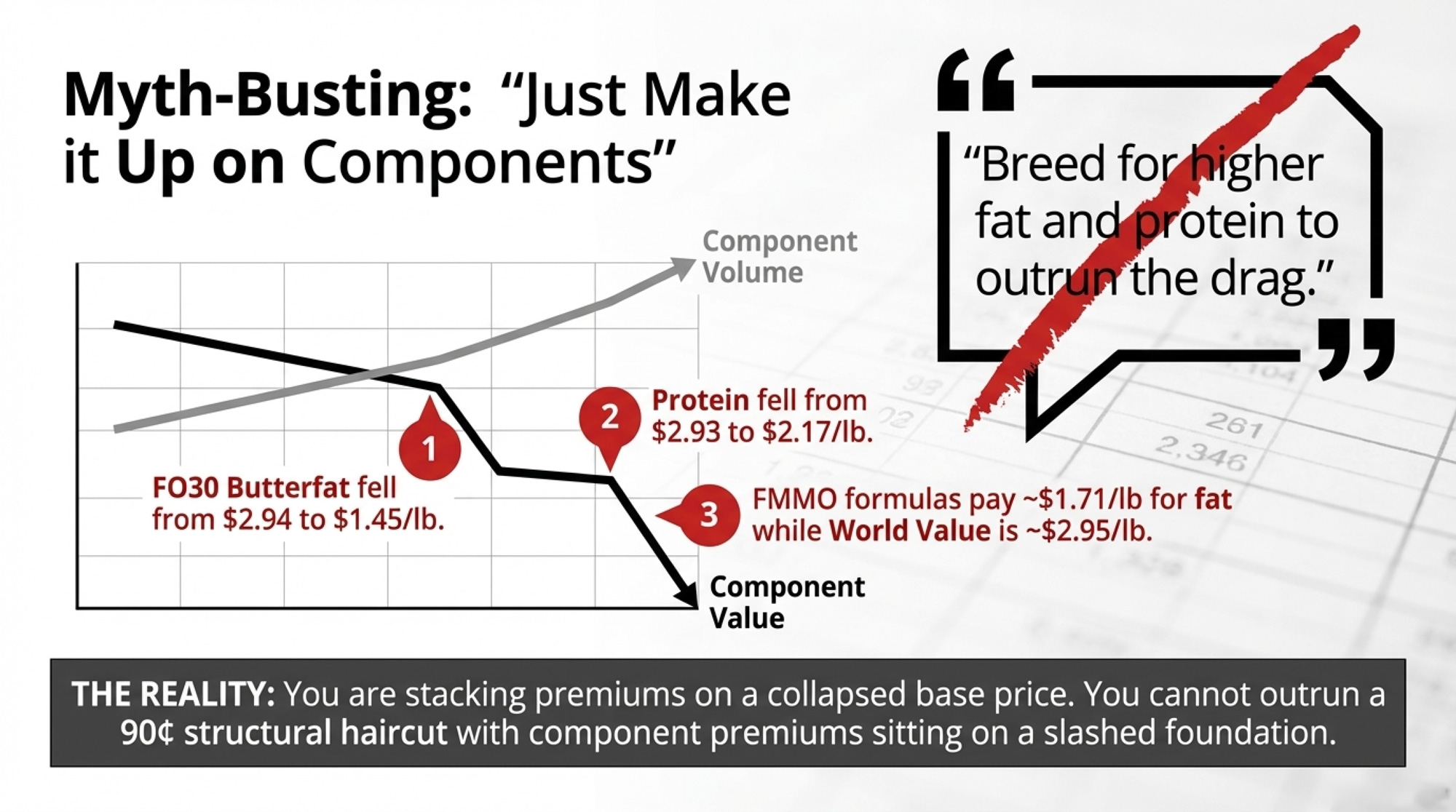
A lot of advisors will tell you the path is simple: “Just make it up on components.”

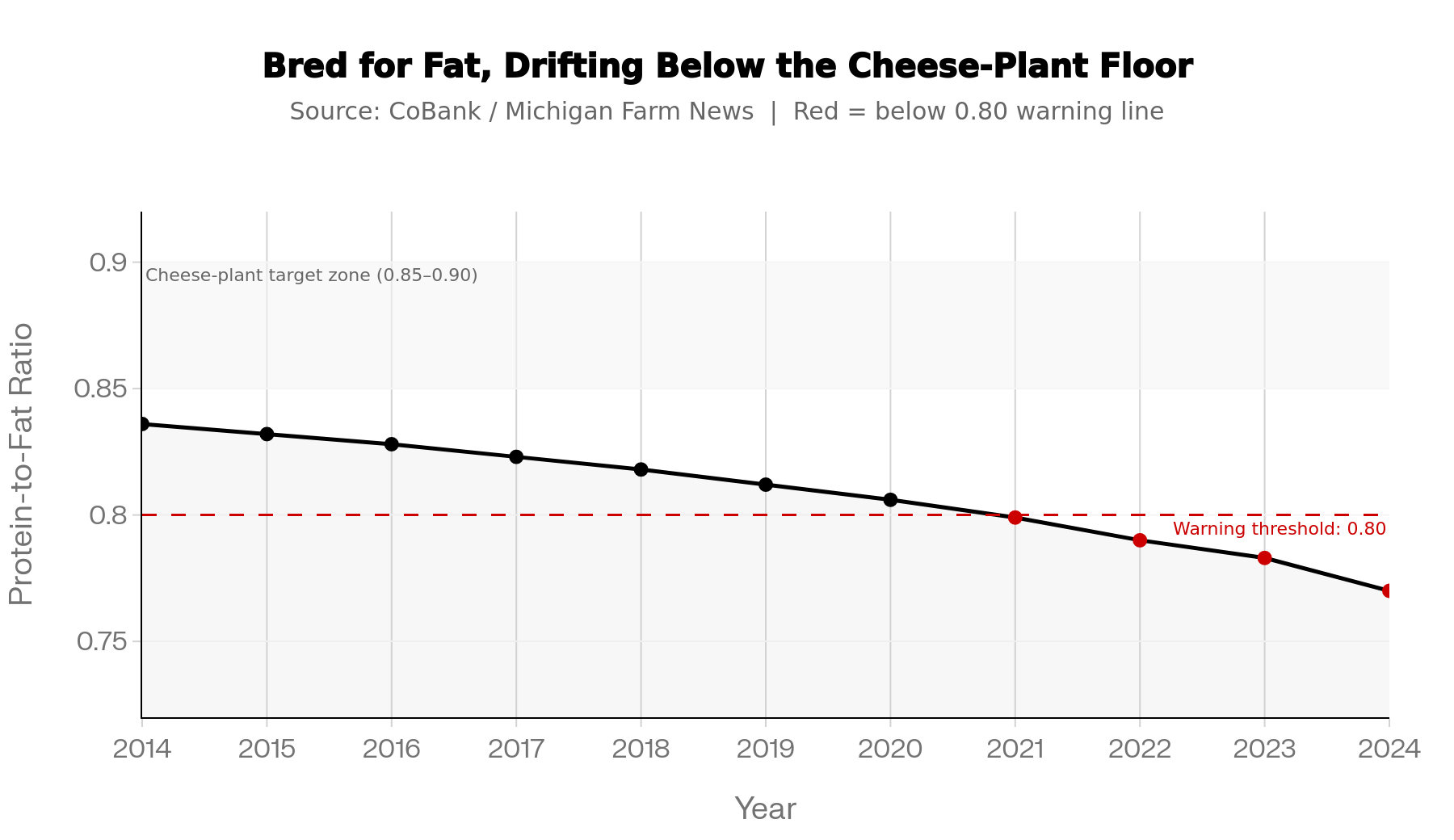
There’s truth in that — up to a point. FO30 herds have pushed components hard. Pooled butterfat averaged 4.52% and protein 3.42% in January 2026.  The December 2025 composition factor change in the final rule now prices “standard” milk at 3.3% protein and 9.3 lb SNF, up from 3.1/8.7, so you finally get some formula credit for the progress you’ve already bred and fed. 

If you’re behind that bar, there’s money on the table. Picking up 0.1–0.2% protein through sire selection, grouping, and ration tuning in a decent Class III month can add 20–25¢/cwt. That’s real.

But look at what happened to the underlying prices you’re stacking that on. In January 2026, the protein price in FO30 was $2.1768/lb, down from $2.9307/lb a year earlier.  Butterfat went from $2.9487/lb to $1.4525/lb.  You’re trying to outrun a 90¢/cwt structural haircut with component premiums that are themselves sitting on a lower base. 

And the system still doesn’t pay you full world value for the fat you ship. In The Bullvine’s butterfat deep‑dive, we showed FMMO formulas paying around $1.71/lb for butterfat at a time when Global Dairy Trade butterfat equivalents were closer to $2.95/lb — a gap north of $1.20/lb.  You can crank out more fat, but the pricing system captures barely half its export value for you.

What about DMC? The 2026 Farm Bill draft raises Tier I coverage to 6 million pounds — roughly 260 cows at 23,000 lb —, but anything you ship beyond that is in Tier II or uncapped.  USDA and Progressive Dairy coverage show the program helping when margins collapse, but even in “tight” years, the realistic annual benefit is low thousands of dollars on a 200‑cow herd — against roughly $42,240/year lost to higher make allowances in the GT Thompson example.  DMCs aren’t designed to track structural formula changes dollar-for-dollar. It’s a margin band‑aid. 

So yes, push components. Yes, use DMC intelligently. Just don’t fool yourself into thinking you can component your way out of a 90¢ structural discount that hits every cwt you ship.

Options and Trade-Offs for Farmers

You can’t undo June 1, 2025, on your own. You can decide how you’re going to respond to what it did to your check.

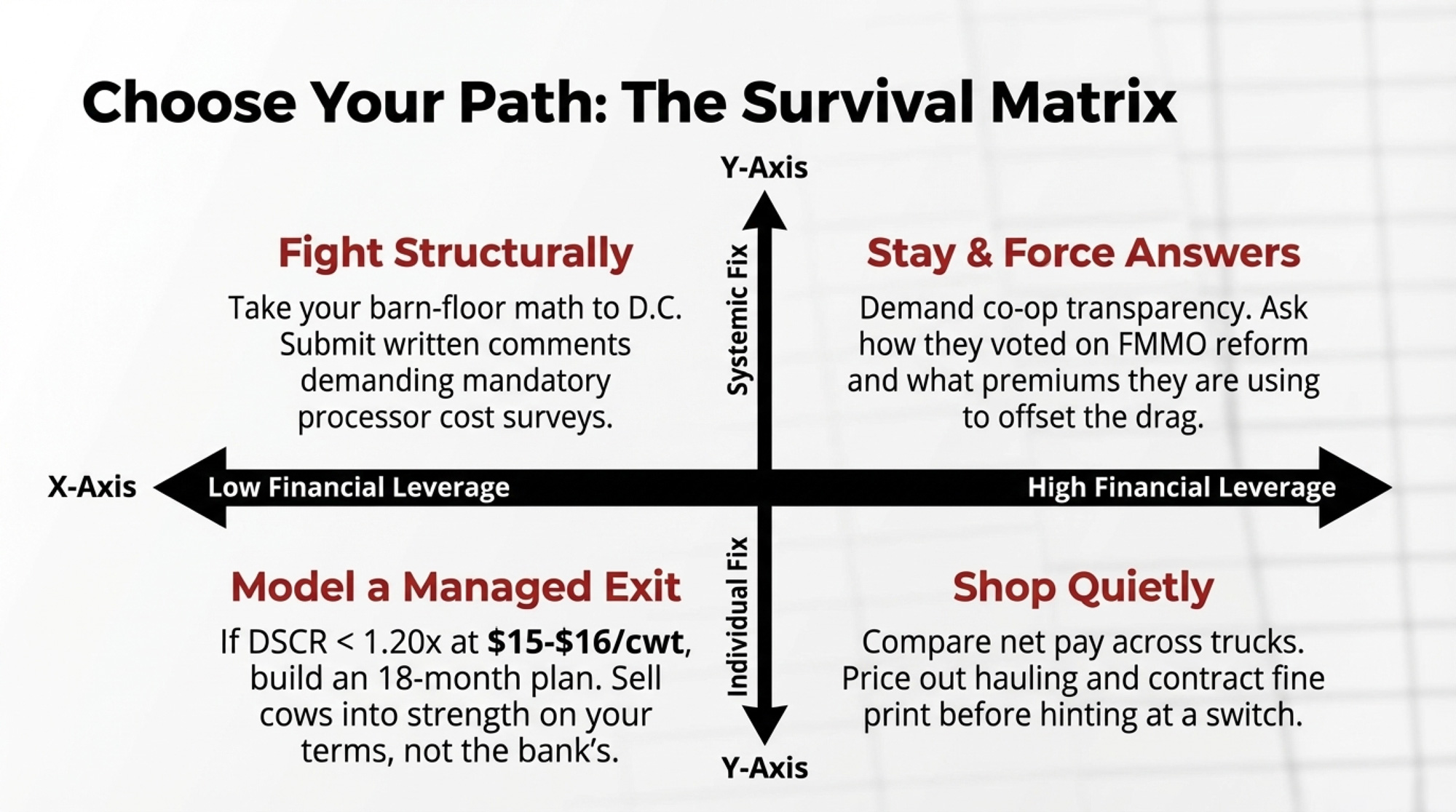
Path 1: Stay Put and Force the Conversation (Your 30‑Day Move)

This path fits if your co‑op or buyer has generally been fair on hauling, basis, and access, and you’ve got some runway.

Here’s the 30‑day checklist:

  • Print your January 2025 and January 2026 milk statements.
  • Calculate your net $/cwt for each and the gap between them.
  • Highlight the part you can’t explain with Class III, Class IV, and butter moves.

Bring those pages to your next district or annual meeting and ask three straight questions:

  1. How did we vote in the FMMO modernization referendum — yes, no, or bloc‑voted by the co‑op? 
  2. How much did higher make allowances cost our pool in 2025 and 2026, in dollars and cents per cwt?
  3. What are we doing — via premiums, over‑order pricing, or patronage — to push some of that value back toward member checks?

The risk with this path is time. The FMMO hearing process that produced this package took years. Nobody should be promising a quick redo.

Path 2: Shop Quietly for a Better Milk Check

This path makes sense if you’re consistently 50–60¢/cwt behind neighbors shipping similar milk to another buyer, and you have leverage left — equity, cow quality, location.

You’d need to:

  • Compare net pay — after hauling, dues, and fees — with producers on other trucks.
  • Price out hauling, quality penalties, balancing charges, and contract fine print before you even hint at switching.
  • Equity factor that might get stranded if you leave a co‑op for a proprietary processor.

There’s real upside if another buyer structurally pays closer to class value. But you give up governance and some safety if milk markets get ugly. And in some regions, the “different” hauler still leads back to the same corporate plant.

If you want a sober look at how chasing a higher pay price can still leave you in a margin trap, pair this piece with The Bullvine’s coverage on $14.59 milk against $20‑plus/cwt cost of production — the DSCR math isn’t pretty.

Path 3: Model a Managed Exit While You Still Have Leverage

Nobody wants to be the one to say this, but here it is: some operations already know $15–16/cwt milk with a 90¢ structural drag, and current debt loads won’t pencil long term.

This path fits if:

  • Your DSCR is stuck under roughly 1.20× at $15–16 uniform prices, and you’ve been there more than a quarter.
  • You’re putting bills in a stack instead of paying them as they arrive.
  • Your lender has already started asking for more “updated” projections.

You’d need to:

  • Build an 18‑month cash flow projection at today’s price levels and at one or two “what if” scenarios.
  • Sit down with your lender now, not when covenants are already broken.
  • Price what a step‑back or exit looks like while cull cow and beef‑cross prices are still decent.

Selling cows into strength on your terms almost always preserves more equity than waiting until the bank’s credit committee decides you’re done. It’s ugly. It still beats pretending the structural drag doesn’t exist.

Path 4: Fight the Structural Battle Beyond Your Farm Gate

If the problem is structural, part of the solution has to live in D.C. hearing rooms and comment dockets.

This path fits if:

  • You can keep the wheels on long enough to care what FMMO 2030 looks like.
  • You’re angry enough to turn your drag number into testimony, not just coffee‑shop talk.

It looks like:

  • Submit written comments to USDA the next time pricing hearings or make‑allowance surveys open up, with your herd size, order, and real $/cwt drag front and center. 
  • Pushing your state associations and co‑ops to take specific positions: mandatory processor cost surveys, automatic adjustments tied to verified costs, and a path for make allowances to come down if costs do. 
  • Using Farm Bill touchpoints — like the GT Thompson draft — to argue that a $1,800/year DMC fix against a $42,240/year make‑allowance hit isn’t “modernization.” 

You won’t see these efforts reflected in your next milk check. But if producers don’t show up with barn‑floor math, the only numbers on the table will come from people whose margins just got protected.

Key Takeaways

  • If your unexplained January‑over‑January gap is more than about 50¢/cwt after you factor in Class III, Class IV, and butter moves, treat that as structural drag — not just a bad month. That’s the make‑allowance change and premium structure, and it will hit every cwt you ship until something changes in the formulas or your contracts. 
  • If your DSCR can’t stay above roughly 1.20× at $15–16/cwt uniform prices, you need a written 18‑month plan — not just hope for “better milk.” That’s the line where most lenders start looking harder at restructuring or collateral.
  • If your co‑op or buyer can’t explain how they voted on FMMO reform and what they’re doing to offset the drag in one clear conversation, treat that as a data point. You have every right to know how your volume was cast and where the money went. 
  • If you missed the 2026 DMC sign‑up, don’t miss the 2027. Run the USDA or AFBF decision tools against your own margins at $15.05 blend and $14.59 Class III, then decide ahead of enrollment how much coverage is worth paying for. 

Print the Statements Before Your Next Meeting

Somewhere in southwest Wisconsin, a 300‑cow operation walked into 2026 shipping milk to the same plant in an order where average butterfat hit 4.52% — and opened a January check roughly $50,000 lighter than the year before, if Van Ruden’s account is right.  About 90¢/cwt of that hit came from the pricing formula changing underneath them. The rest came from a butter-and-cheese crash that FO30 is structurally exposed to.  Only one of those problems is guaranteed to cycle back on its own. fb

Before your next co‑op or lender meeting, do the thing most people keep putting off. Print your January 2025 and January 2026 statements. Run your own $/cwt math. Circle the part you can’t explain with commodity moves. Then lay those pages on the table and ask:

“If this is what the new rules did to my milk check, what’s our plan to change that math?”

If you want to go past envelope math into full spreadsheets — region‑by‑region drag, component strategy, DSCR stress tests — The Bullvine’s FMMO Reality Check analysis and Farm Bill/DMC coverage are built for that deeper dive.  Next month, we’ll run this same barn math on a 1,000‑cow Upper Midwest herd and see whether scale fixes the equation — or makes the hole bigger. 

Complete references and supporting documentation are available upon request by contacting the editorial team at editor@thebullvine.com.

Learn More

The Sunday Read Dairy Professionals Don’t Skip.

Every week, thousands of producers, breeders, and industry insiders open Bullvine Weekly for genetics insights, market shifts, and profit strategies they won’t find anywhere else. One email. Five minutes. Smarter decisions all week.
NewsSubscribe
First
Last
Consent

From 1,810 Dairy Farms to 18: How North Dakota’s Processing Collapse Cornered the Holle Family – and Could Corner You

You can’t breed your way to cheaper diesel.” North Dakota did the math, lost 1,792 dairies, and left one 1,000‑cow family asking what to do next.

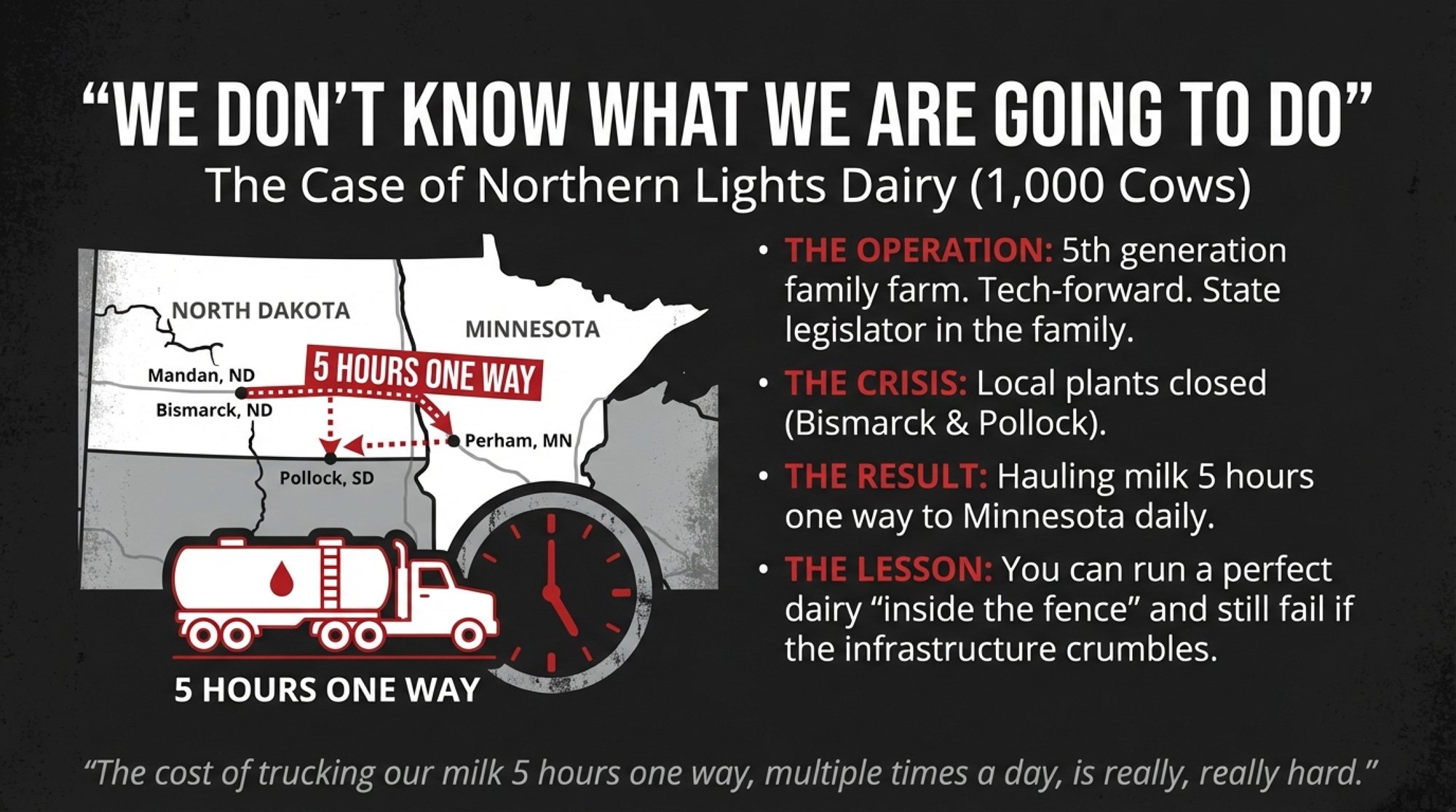
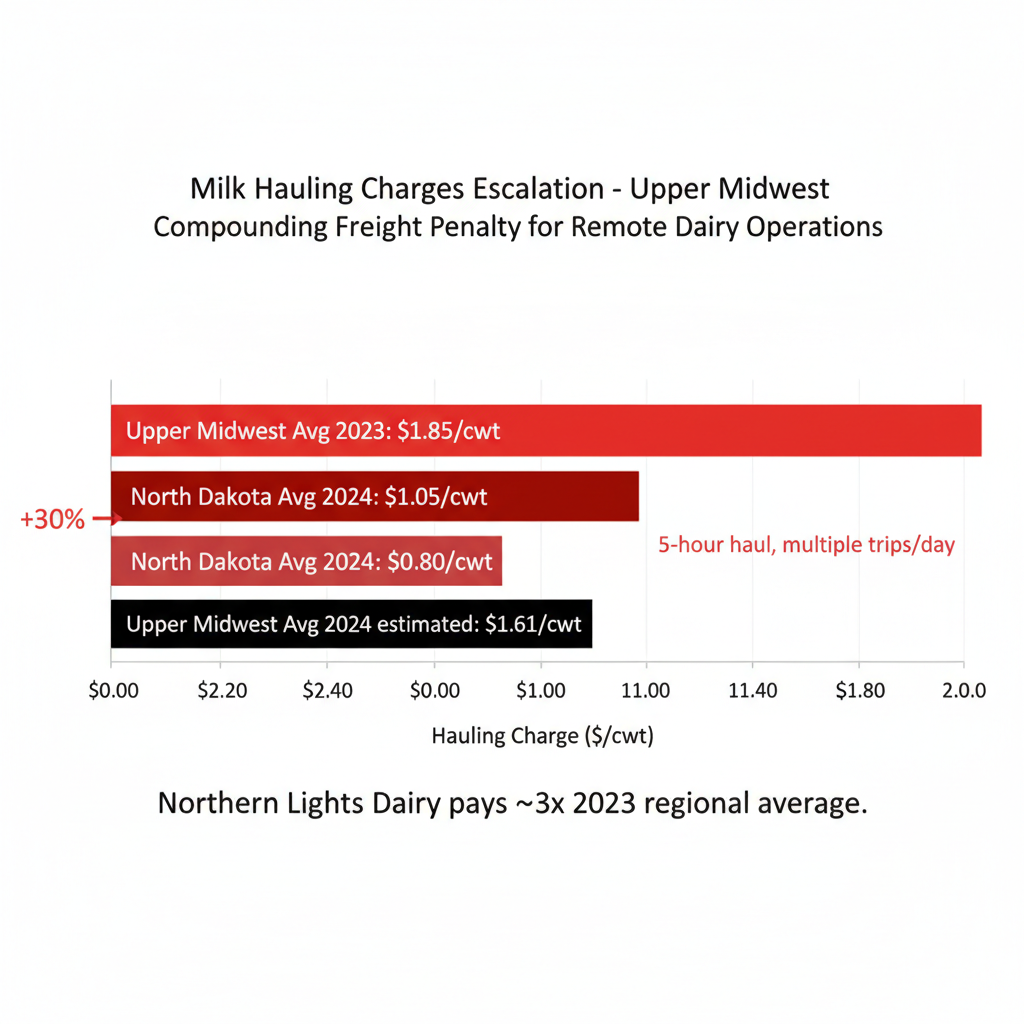
Northern Lights Dairy sits about 12 miles south of Mandan, North Dakota — a 1,000‑cow Holstein operation run by the Holle family. Over the past 30 months, the Holles have been forced to find a new market for their milk twice. Not because of anything they did wrong, but because every processing facility in their state either closed or stopped taking raw milk. They now ship to a Bongards plant in Perham, Minnesota—a haul that runs about 5 hours one way, several times a day.

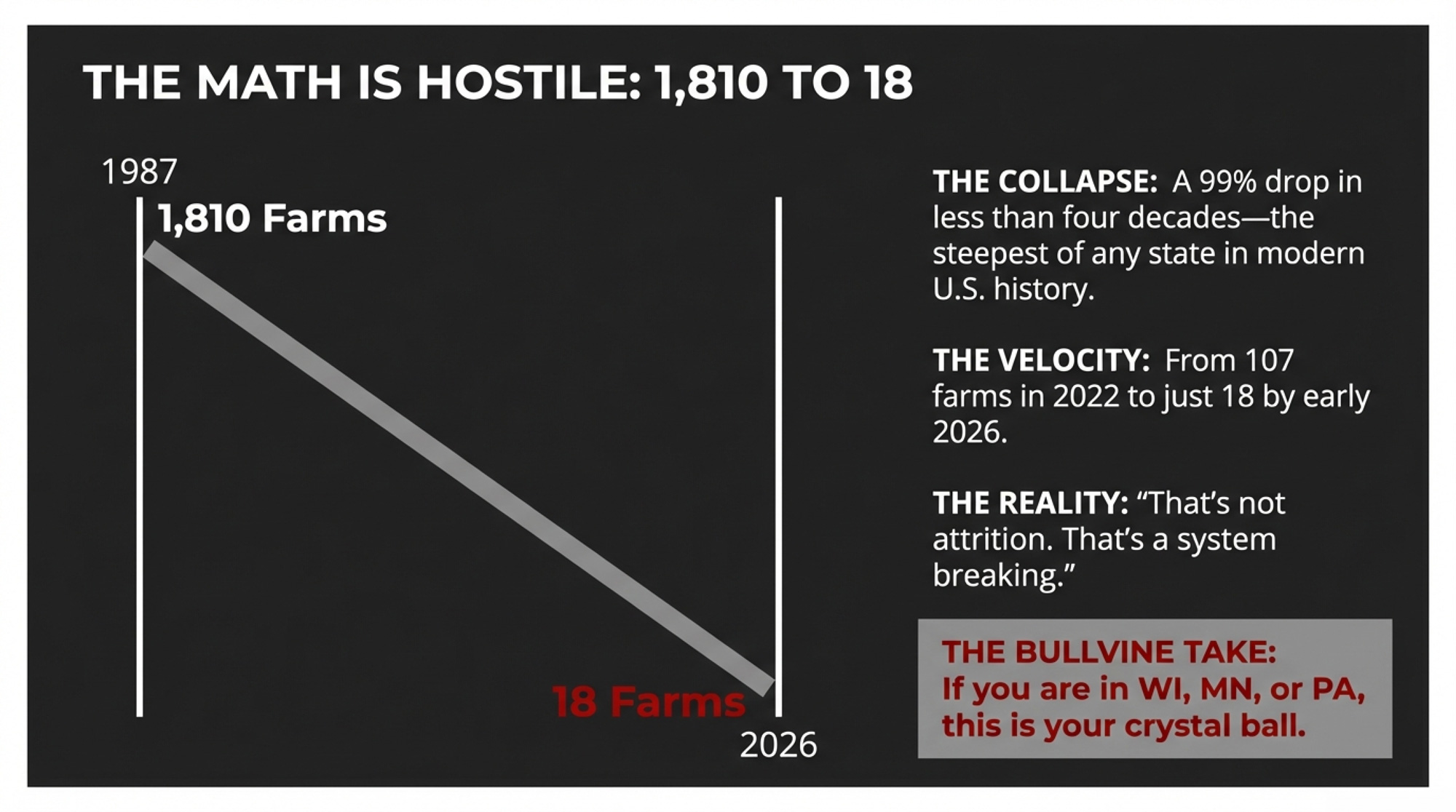
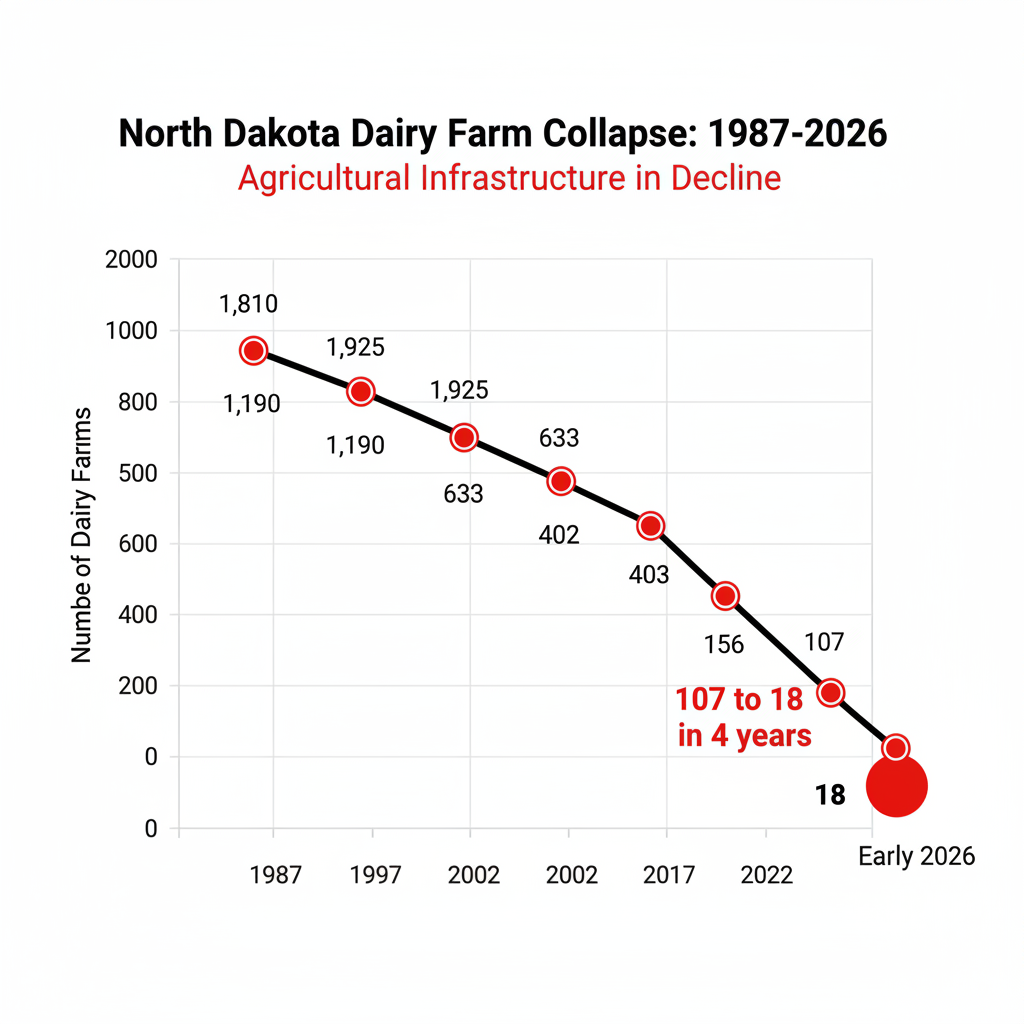
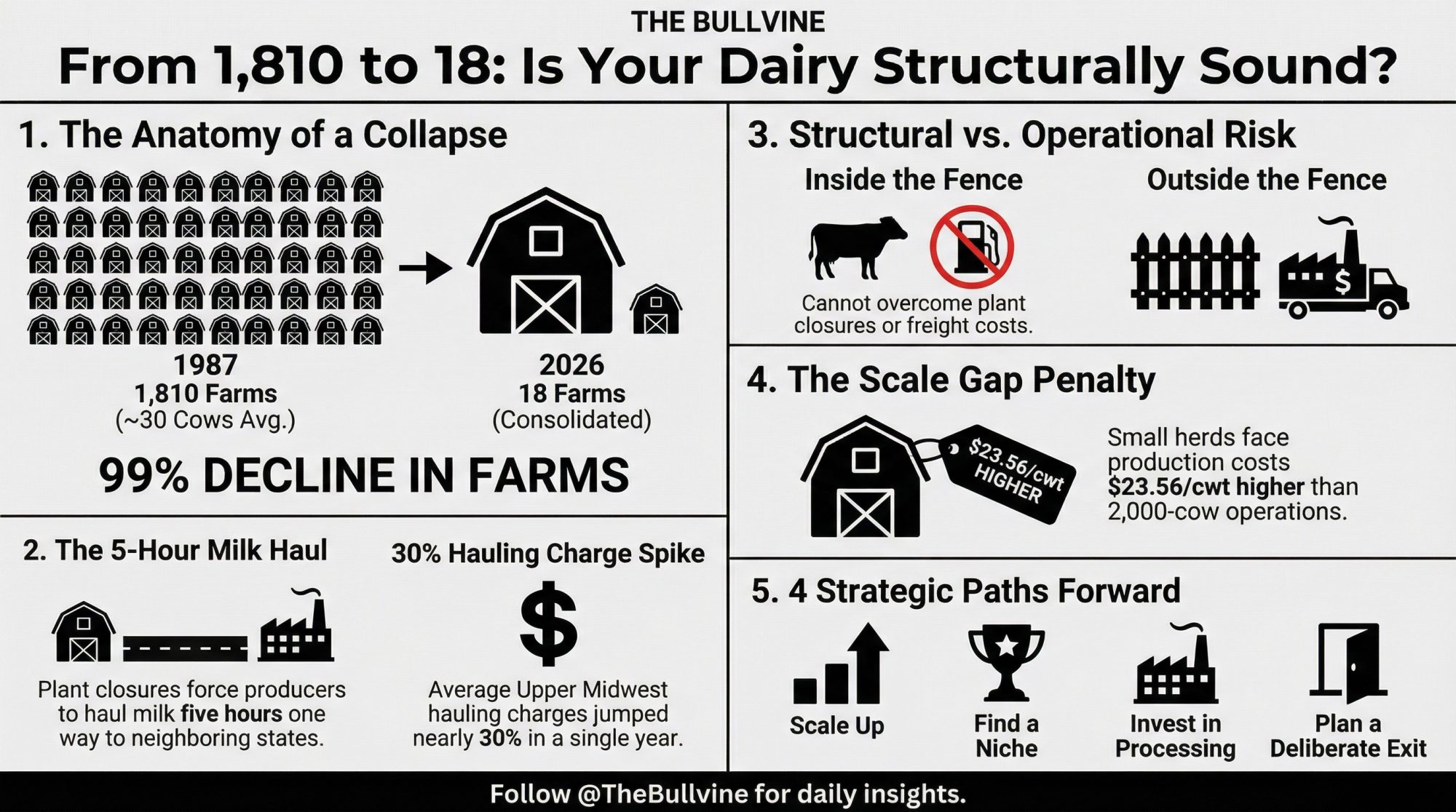
According to the Holle family, there are now just 18 Grade A dairy farms left in North Dakota as of early 2026. In 1987, there were 1,810. That’s a dairy farm collapse of more than 99% in less than four decades — the steepest of any state in modern American history, according to USDA Census of Agriculture data and the North Dakota Milk Marketing Board. If you’re milking in Wisconsin, Minnesota, Pennsylvania, or Vermont, North Dakota isn’t someone else’s cautionary tale. It’s a diagnostic tool for your own operation.

The Numbers: 1,810 to 18

North Dakota’s dairy collapse was both a slow grind and a sudden implosion. USDA Census data tells the story in five‑year snapshots:

YearDairy FarmsMilk CowsAvg. Herd Size
19871,810Not specified~30
19921,92574,88539
19971,19053,83545
200263334,50555
200740226,47966
201715616,470106
202210714,191133
2025~23–25~8,700–10,000~400
Early 202618

Note: Farm counts vary by source and methodology. Deputy Agriculture Commissioner Tom Bodine testified in March 2025 that 23 permitted dairy farms remained, with one not operating and “about 8,700 cows.” Dairy Star reported 25 regular‑milk dairies and 10,000 cows in June 2025. USDA NASS and NDSU Extension list approximately 10,000 cows for 2025. The Holle family at Northern Lights Dairy reports 18 Grade A dairy farms remaining as of early 2026.

From 107 farms in 2022 to 18 by early 2026. That’s not attrition. That’s a system breaking.

For comparison, Wisconsin went from 5,661 licensed herds in January 2024 to 5,348 by January 2025 — a loss of 313 farms, or 5.5%. By January 2026, state figures showed roughly 5,100 active dairy herds. A decade ago, Wisconsin had 10,081 dairy farms. Nearly half are gone. The rate is steadier and slower than North Dakota’s implosion. But the physics are the same. When processing density thins and routes stretch, the math turns hostile for everyone on the wrong end of the haul.

Two Plant Closures That Broke a State

Your dairy is only as viable as your ability to get raw milk onto a truck and into a plant at a cost that leaves a margin. When that chain breaks, everything you do inside the fence — genetics, feed efficiency, cow comfort — stops mattering.

North Dakota’s chain broke in two stages.

In September 2023, Prairie Farms Dairy closed its processing facility in Bismarck and converted it to distribution only. That plant had been the primary Class I destination for central and western North Dakota. Agriculture Commissioner Doug Goehring didn’t mince words: “With no other processors nearby, those dairies will likely pay for shipping longer distances that will be deducted from their milk checks. This will have a dramatic impact on their bottom line.” He was right. One producer about 50 miles northwest of Bismarck — identified in Dairy Star’s September 2023 reporting as Henke — saw his milk rerouted 151 miles to a DFA facility in Pollock, South Dakota, at an immediate freight surcharge of $0.55 per hundredweight. He also had to invest in an additional bulk tank to store two days’ worth of milk between every‑other‑day pickups. “That is going to be more important all the time,” Henke told Dairy Star.

Then, DFA closed the Pollock plant effective August 30, 2024, displacing 33 full‑time and four part‑time employees. That eliminated the backup destination. Suddenly, milk wasn’t traveling dozens of miles. It was traveling hundreds — into Minnesota plants that had no particular reason to pay a premium for distant, hard‑to‑route volume. Today, the only milk plant still operating in North Dakota is Cass‑Clay’s facility in Fargo, pressed against the Minnesota border. For smaller herds west of the Missouri, those added miles wiped out whatever thin margin remained.

Who Survived — and Why It Matters

The farms still milking aren’t random survivors. They sort into three models, and each tells you something about what works — and what doesn’t — when regional infrastructure collapses.

The scaled conventional — hanging on by the freight bill. Northern Lights Dairy’s permit allows up to 1,275 milking cows, and the Holles are currently milking about 1,000. That’s enough volume to keep haulers coming — but not enough to make a five‑hour haul one way, multiple times a day, feel anything but brutal. “The cost of trucking our milk 5 hours one way, multiple times a day, is really, really hard,” the family told The Bullvine in early 2026. “Dairying is really hard right now… we’re praying for the milk price to rebound, but the year looks bleak.”

The numbers back them up. The January 2026 Class III price landed at $14.59 per hundredweight (USDA AMS) — the lowest since April 2021. Strip the Holles’ massive freight costs off that already‑depressed price, and you can see why the family describes this as the toughest stretch they’ve faced.

In March 2025, Dawson Holle told the North Dakota House Agriculture Committee that the family had been researching on‑farm processing — a logical response after being forced to switch milk markets twice. But a year later, the family told The Bullvine they aren’t sure they’re in a financial position to build, that it’s “extremely expensive,” and that state funding may not be a realistic option. When asked directly about their plans, the answer was blunt: “We don’t know what we are going to do.”

Sit with that for a second. A 1,000‑cow operation. Fifth‑generation family. Fiber‑connected monitoring technology. A state legislator in the family. And the honest answer about the future is we don’t know. That’s not a failure of management or planning. That’s what it sounds like when every option outside the fence has been stripped away and the ones that remain are either unaffordable or uncertain.

The Holle family — Jennifer, Andrew, and their four children — at Northern Lights Dairy near Mandan, North Dakota. Behind them: the barns, the equipment, and a 1,000‑cow operation that now depends on a five‑hour milk haul to Minnesota just to stay in business. (Photo courtesy of Northern Lights Dairy)

Jennifer Holle, who serves as calving manager and oversees an average of three to four births a day — sometimes up to 15 — has described the farm’s monitoring technology as critical to managing individual cow care at that scale. Inside the fence, they’re running a tight, modern operation. Outside the fence, the system offers them no good answers.

The industrial entrant. Riverview LLP, based in Morris, Minnesota, is developing two massive projects in eastern North Dakota: a 25,000‑head facility in Traill County and a 12,500‑head facility in Richland County. An NDSU Extension analysis from December 2025 estimated the two dairies would inject approximately $270 million in initial investment and generate gross annual revenue ranging from $122 to $227 million. Both sites sit near the Minnesota border and the I‑29 processing corridor. North Dakota may stay on the map for total cow numbers. But these aren’t family farms — they’re industrial production units built for integration with large‑scale processing.

The direct‑to‑consumer niche. Twenty‑three farms sell raw milk directly to consumers under HB 1515, which legalized those sales effective August 1, 2023. These aren’t necessarily the same 23 farms Bodine referenced as permitted dairies — there’s overlap, but some raw‑milk sellers may not hold conventional permits and vice versa. Dawson Holle, who co‑sponsored HB 1515, told Dairy Star that “more are poised to come on board” as the 2025 legislature expanded sales to include raw milk products. “This also gives consumers in some of those 50‑person towns the chance to buy local, fresh milk,” he said. By capturing a far larger share of the retail dollar, these farms sidestep FMMO pricing and long‑haul freight entirely.

Here’s the tension worth sitting with: North Dakota will likely remain a dairy state in cow numbers. But the era of family‑scale dairy as a widespread enterprise there is over — unless someone can rebuild the processing link on terms the math can support. Right now, even the families best positioned to try can’t make it pencil.

Three Forces That Grind Margins to Zero

Plant closures pulled the trigger. But three deeper forces had been weakening the foundation for years.

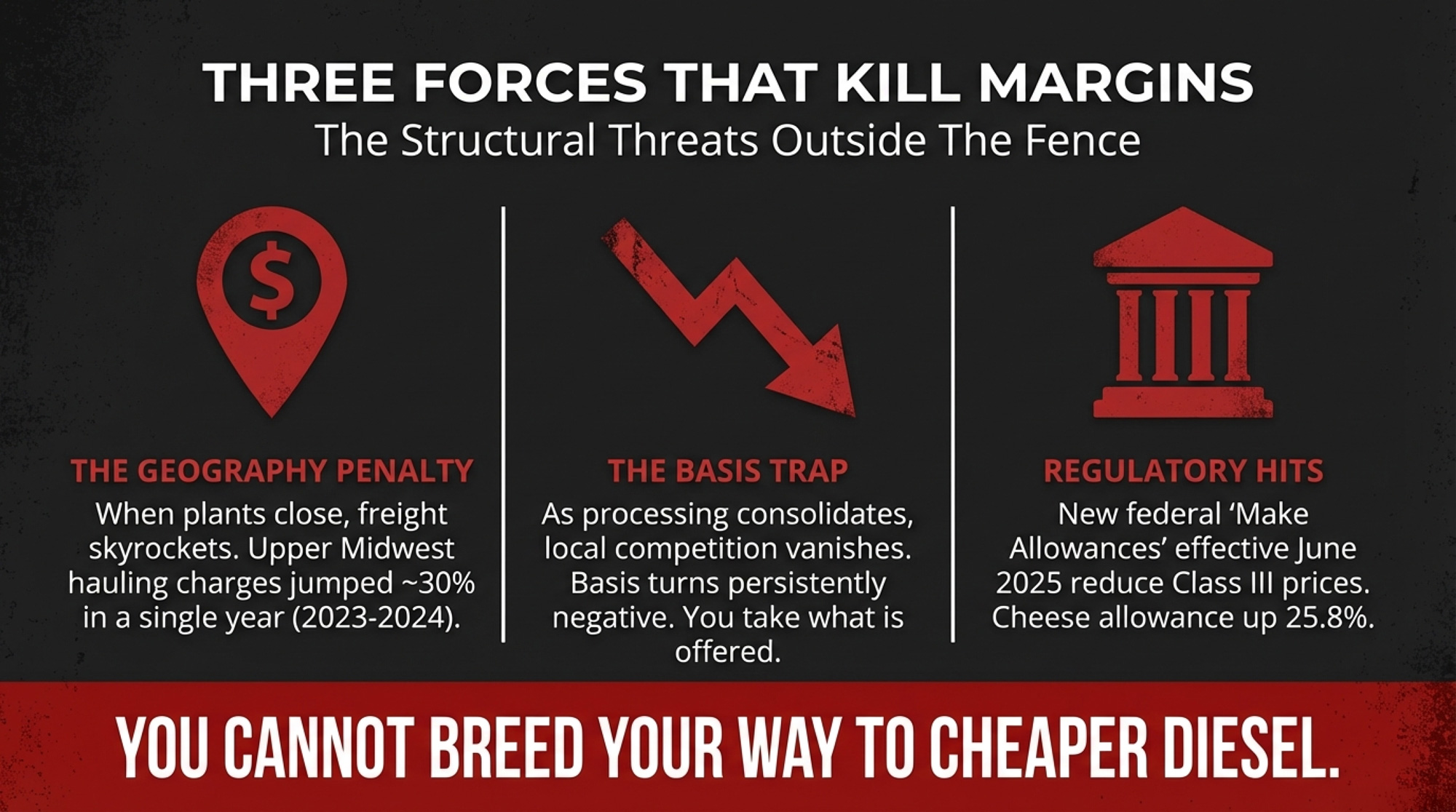
Basis and the geography penalty. Basis — the gap between what you actually get paid and the CME benchmark — is shaped by how far your milk travels and how badly the nearest plant needs it. As processing consolidated along the I‑29 corridor, North Dakota producers saw their basis turn persistently negative with no local plant competition to bid it back up. You took what was offered, or you quit.

Federal Order 30 hauling data makes the geography penalty concrete. The weighted average milk hauling charge across the Upper Midwest jumped from $0.6137 per cwt in 2023 to $0.7969 in 2024 — a 30% increase — and North Dakota carries the highest average hauling charge of any state in the order. For an operation like Northern Lights, those averages understate reality. They’re hauling roughly 5 hours one way, several times a day, and describing the freight bill as “really, really hard” to carry, even though headline Class III is already at $14.59.

Make allowances: the quiet regulatory hit. In November 2024, USDA issued its final decision on FMMO pricing amendments—the most significant since 2000. The referendum passed in all 11 FMMOs in January 2025, with changes effective June 1, 2025. The cheese make allowance rose from $0.2003 to $0.2519 per pound (25.8%). Butter: $0.1715 to $0.2272 (32.5%). Nonfat dry milk: $0.1678 to $0.2393 (42.6%). Dry whey: $0.1991 to $0.2668 (34.0%).

The American Farm Bureau Federation estimated that if these increases had been in place from 2019 to 2023, they’d have reduced Class III prices by an average of $0.90 per hundredweight and cut annual pool values by over $91 million beyond the $1.26 billion decline already projected. On paper, that hits every farm equally. In practice? Producers in dense processing regions sometimes claw back some of the premium through higher prices. Producers in remote areas with one buyer and long hauls take it dollar‑for‑dollar on a check that was already thin.

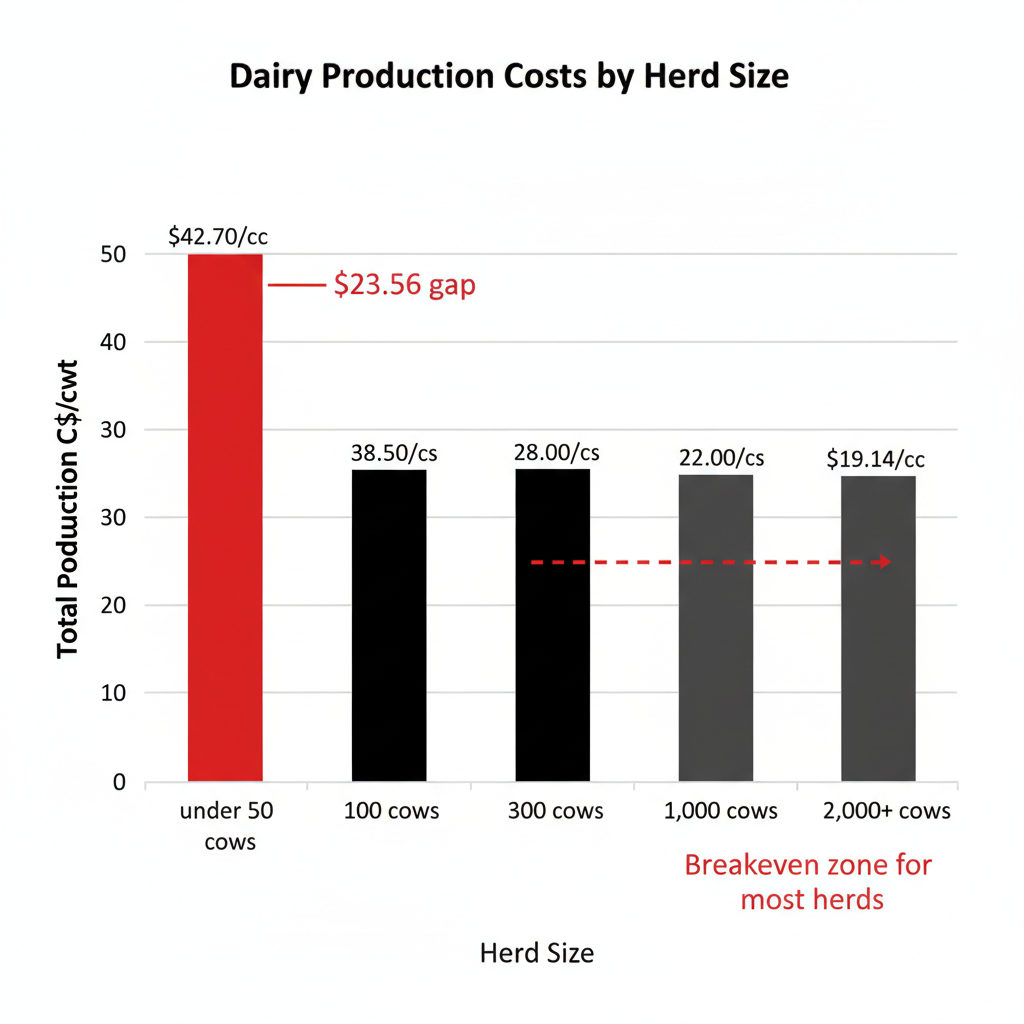
The scale gap. USDA Economic Research Service data from the 2021 Agricultural Resource Management Survey, published in August 2024, found the average total production cost was $42.70 per cwt for herds under 50 cowscompared with $19.14 per cwt for herds of 2,000 or more — a cost gap of $23.56 per hundredweight. That gap is wider than many producers’ entire margin. Illinois Farm Business Farm Management data for 2024 reinforces the pattern: across all herd sizes, the average dairy posted a net economic return of negative $409 per cow, and returns haven’t exceeded total economic costs in any of the last ten years.

Our own internal benchmarking puts it in profitability terms: roughly 89% of operations milking 1,000+ cows report positive returns in typical conditions, compared with about 31% at 300 cows and roughly 11% at 100 cows or fewer. (Specific breakpoints vary significantly by region, management, and debt level.)

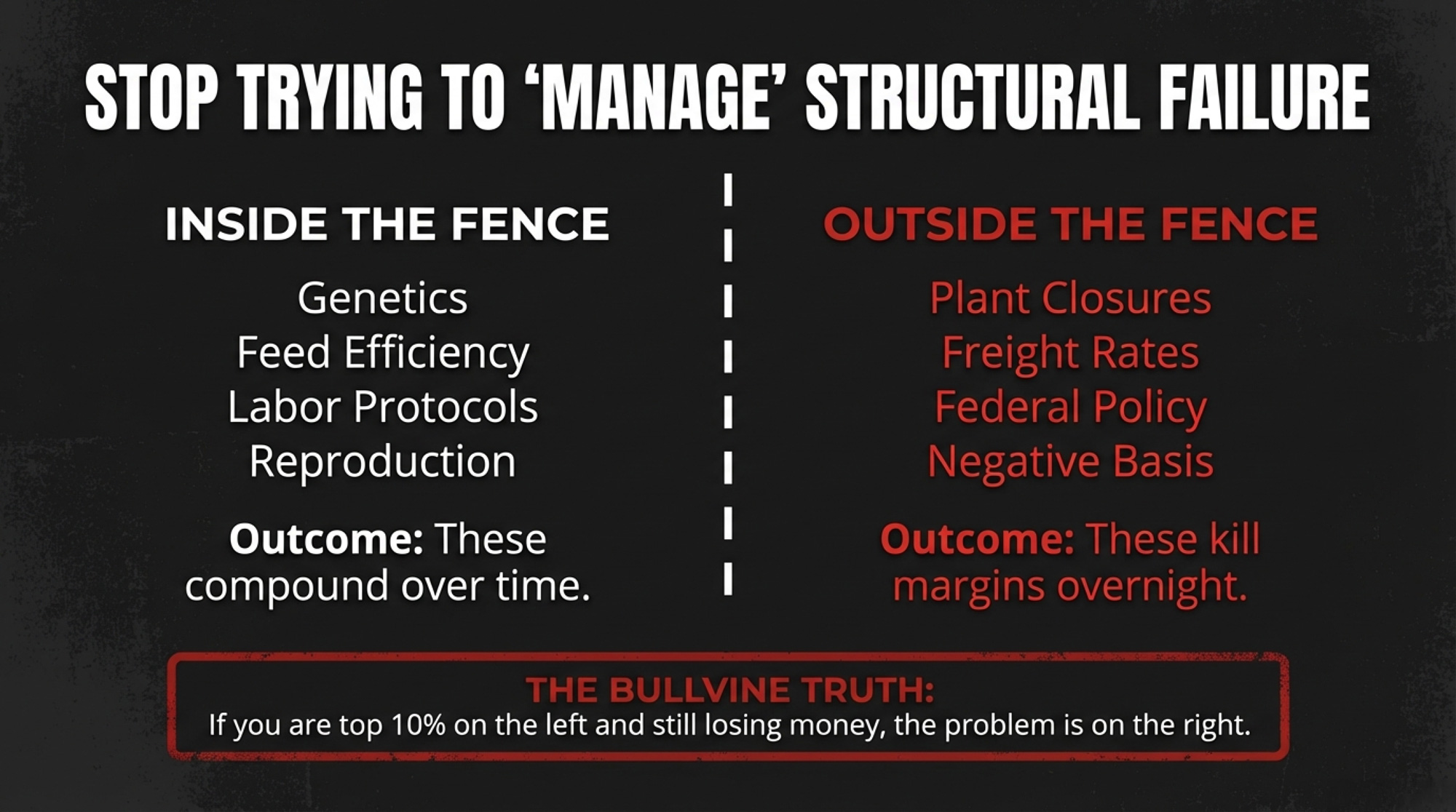
And that brings us to the distinction that matters most in this entire story: inside the fence versus outside the fence.Feed efficiency, reproduction, labor protocols — those live inside the fence, and improving them compounds over time. Basis, plant closures, make‑allowance hikes, route economics — those live outside it. If you’ve become top‑10% at everything inside the fence and your three‑to‑five‑year average still shows red, North Dakota’s lesson is blunt. The problem is structural, not operational. You can’t breed your way to cheaper diesel.

FactorInside the Fence (You Control)Outside the Fence (You Don’t Control)
Feed EfficiencyRation formulation, feed additives, bunk managementCommodity prices, regional drought, tariffs
ReproductionHeat detection, semen selection, protocol timingBull stud consolidation, semen price inflation
LaborTraining, retention, shift structureRegional wage competition, immigration policy
Milk QualityParlor hygiene, milking routine, mastitis protocolsProcessor quality premiums (or lack thereof)
BasisHerd size, contracts, buyer relationshipsPlant density, regional supply/demand, co-op pricing
FreightBulk tank size, pickup frequency negotiationHauling distance, route economics, plant closures
RegulatoryCompliance, record-keepingMake allowances, FMMO rules, environmental regs

The National Numbers Say You’re Next

The forces that dismantled North Dakota aren’t slowing down. Nationally, the U.S. lost roughly 15,866 dairy farms between 2017 and 2022, according to the USDA Census of Agriculture, followed by an estimated 8,400 more between 2022 and 2025. The average age of U.S. farm producers reached 58.1 years in the 2022 Census (USDA NASS), up from 57.5 in 2017. Producers over 65 grew by 12%, while the 35‑to‑64 bracket shrank by 9%. Widely cited family‑business research puts the third‑generation survival rate at roughly 12%, and dairy’s capital intensity makes it especially exposed.

Then there’s depooling. When the spread between Class III and Class IV prices gets wide enough, processors opt out of the federal pool, destabilizing pricing for everyone who stays in. By late October 2025, The Bullvine’s own CME market data showed the Class III–Class IV spread hitting $4.06 per hundredweight — Class III at $17.81, Class IV at $13.75 — creating a gap of roughly $3,800 per month per 100 cows between cheese‑plant shippers and butter‑powder shippers . The producers who get hurt the worst are in regions with limited local Class I demand and no bargaining power.

And 2026 offers no relief. USDA’s January 2026 WASDE projects the all‑milk price at roughly $18.25 per cwt, but Class III futures are hovering in the mid‑$16s with some contracts dipping toward the mid‑$15s. Capital Press reported in December 2025 that Class III is expected to average $17.05 in 2026 — down 7.3% from 2025 — while Class IV is forecast at $14.40, a 17% drop. The February 2026 Base Class I price fell to $14.70 — down $1.65 from January. The pricing environment is the most restrictive in half a decade. For producers already absorbing long hauls and thin basis, 2026 may be the year the structural math becomes undeniable.

What This Means for Your Operation

North Dakota’s lesson isn’t “work harder.” It’s “know whether your business model is structurally viable — and act on the answer before someone else makes the decision for you.”

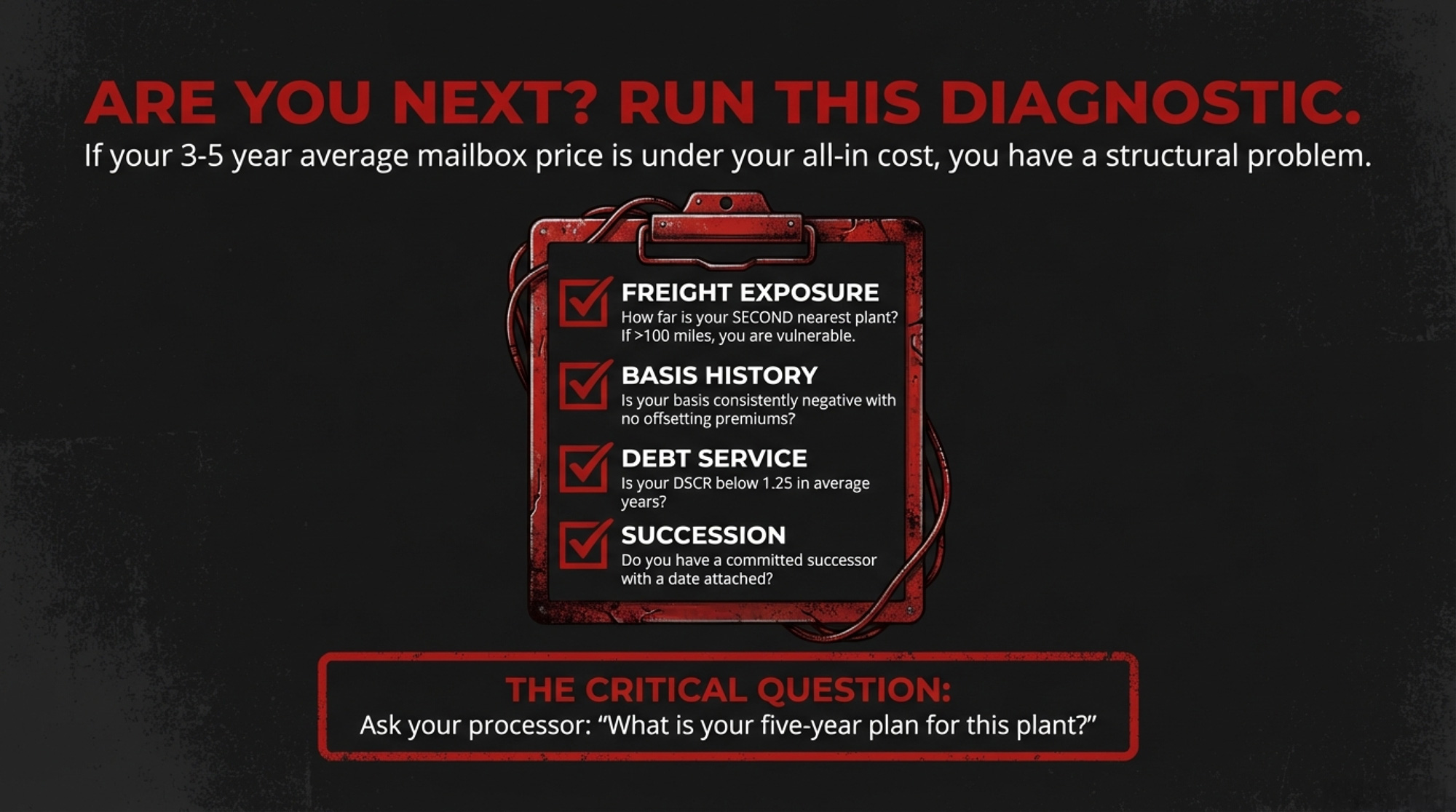
The core diagnostic is one number: your true all‑in cost of production per hundredweight — including family labor at a realistic market wage, full debt service, and capital replacement — minus your three‑to‑five‑year average mailbox price after hauling, co‑op fees, and deductions. If that gap is consistently negative, you’re not in a bad year. You’re in the same structural position that killed 1,792 North Dakota dairies.

From that single number, everything else follows:

  • Know your freight exposure. What’s the hauling distance to your second‑nearest plant? If your current processor closes and your milk has to travel an additional 100 miles, what does that do to your net margin? If you effectively have only one buyer within practical distance, your vulnerability mirrors that of pre‑collapse North Dakota.
  • Track your basis monthly. Compare your actual mailbox price to the relevant CME Class price over 12 to 36 months. A persistently negative basis with no offsetting premium is a structural warning, not noise.
  • Stress‑test your debt service coverage. A DSCR consistently below 1.25 in average milk‑price years — or one that drops below 1.0 with a $1.50/cwt price dip — signals structural vulnerability.
  • Sort your problems: inside or outside the fence? If you’ve become top‑10% at feed, repro, and labor, and your multi‑year average still shows red, the problem is structural. You need a strategic pivot, not better protocols.
  • Have the succession conversation with a date attached. Not “someday.” If no committed successor exists, use that clarity to design a deliberate exit while you still have options.
  • Ask your processor one direct question: What’s your five‑year plan for this plant?

Four Paths Forward — and What Each Costs

If you recognize pieces of this pattern in your own operation, four strategic paths emerge. None is universally right.

Path 1: Scale toward the efficiency band. If you can credibly reach 1,000 to 1,500 cows, have strong plant relationships, and sit in a geography where processing is growing, the USDA ERS cost data says the math favors you. But scaling in a region with thinning plant density is a different bet than scaling near an I‑29 corridor. If your second‑nearest plant is more than 150 miles away and you don’t have a direct contract, bigger might just mean a bigger version of the same trap.

Path 2: Build a defensible niche. Organic, grass‑fed, A2, farmstead cheese, direct‑to‑consumer — these can work, but only with real margins. The threshold: your niche needs to deliver roughly $8 or more per hundredweight above commodity after all added costs — certification, labor, marketing, packaging. North Dakota’s 23 raw‑milk sellers prove the model. But they depend on location and customer base, not just good intentions.

Path 3: Own or invest in processing — but be honest about what it actually takes. On paper, producer‑owned processing is the logical answer to a processing desert. In practice, it’s “extremely expensive,” as the Holles put it, and state grant programs may not bridge the gap. North Dakota’s SB 2342, sponsored by Sen. Paul Thomas (R‑Velva), offers grants of 5% of processing plant construction costs, capped at $10 million. “Dairy without processing is going to be really tough to kick back in,” Thomas told the House Agriculture Committee. He’s right. But the Holles — a 1,000‑cow, fifth‑generation operation with a state legislator in the family and every reason to make this work — looked at the numbers and told The Bullvine flatly: “We don’t know what we are going to do.” If they can’t pencil it, that tells you something about the gap between policy intent and farm‑level reality. Cooperative models like Idaho’s Glanbia and Wisconsin’s Foremost Farms show producer‑aligned processing can work at scale — but organizing those structures requires volume, capital, and regional density that places like central North Dakota no longer have.

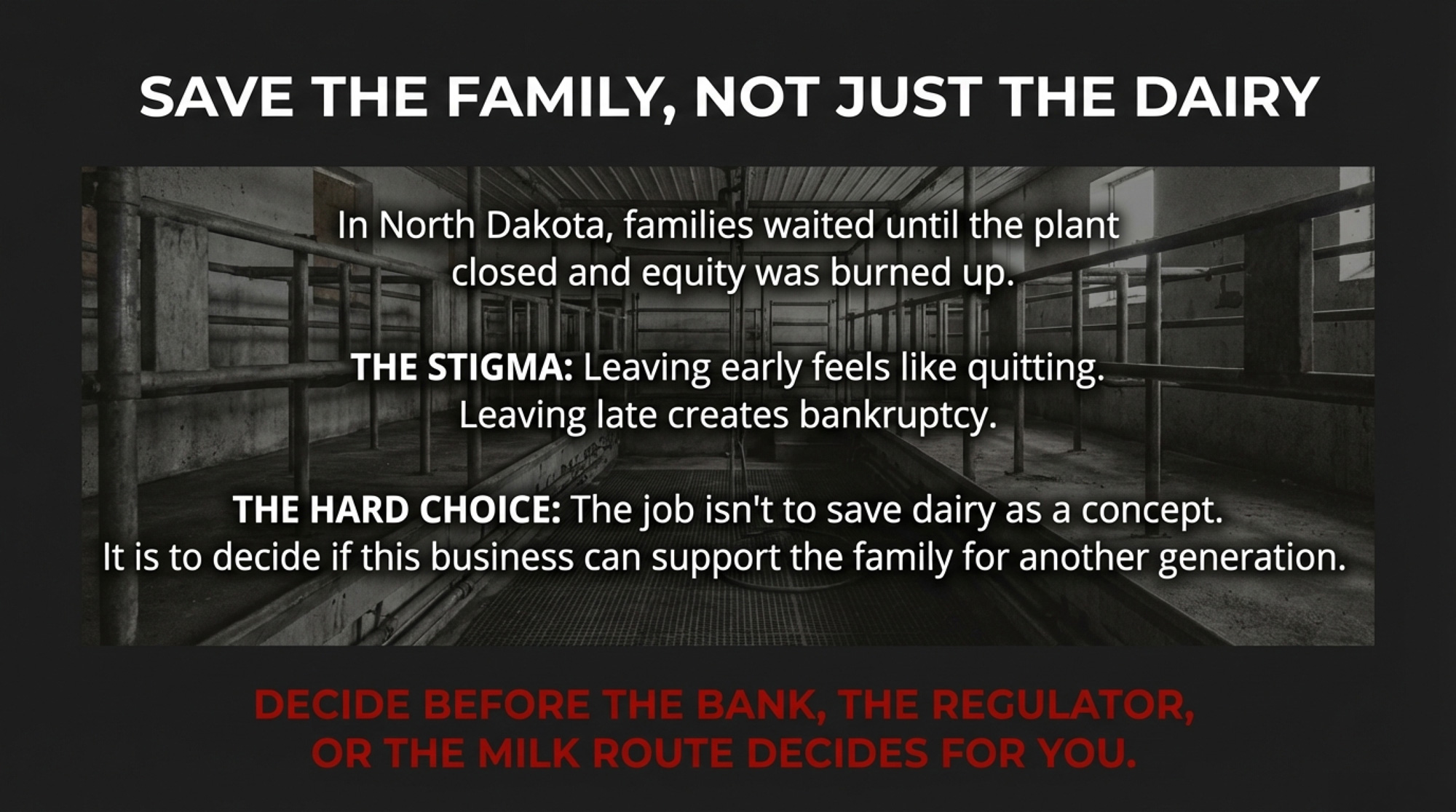
Path 4: Plan a profitable, deliberate exit. If your structural math is negative over a multi‑year average, no successor is committed, and major capital expenditures loom, the most rational move may be to sell cows and equipment while they still command reasonable prices, keep the land, and redeploy capital. In North Dakota, hundreds of families waited until plant closures and exhausted equity forced distressed exits. The families who got out earlier kept more of what they’d built.

One trade‑off nobody talks about openly: in tight‑knit dairy communities, exiting early carries real social stigma. That pressure keeps people milking past the point of economic sense. Acknowledging it doesn’t make the math any friendlier.

The Choice That Sits Heaviest

There’s a moment every producer in a structurally challenged region eventually faces. The morning you realize you’re no longer fighting to save the dairy, you’re deciding whether to fight to preserve the family and the land.

In North Dakota, too many families reached that moment after the plant closed, when equity was burned and options had narrowed to a distressed sale. The ones who came through with something to show — whether they’re still milking or whether they pivoted to cropping and kept the ground — ran the numbers honestly, believed what the math told them, and moved while they still had choices.

Your job isn’t to save dairy as a concept. It’s to decide — clearly, honestly, and soon enough to matter — whether this business, in this form, can support your family for another generation. If the answer is yes, invest accordingly and fight like hell. If it’s no, preserve what you’ve built and redirect it before the route, the regulator, or the bank makes the call for you.

If the financial and emotional weight of these decisions feels overwhelming, resources are available. The Farm Aid hotline (1‑800‑FARM‑AID) connects producers with local support services, and most state extension programs offer confidential financial counseling for farm families.

Key Takeaways

  • North Dakota’s crash from 1,810 dairies to 18 is your warning label for what happens when processing deserts, long hauls, and weak basis stack up.
  • The Holle family’s 1,000‑cow Northern Lights Dairy — hauling milk five hours one way and saying, “We don’t know what we are going to do” — shows how structural risk can corner even well‑run herds.
  • National and Upper Midwest data confirm the math: small and remote herds often face >$23/cwt higher production costs than 2,000‑cow farms, plus roughly 30% higher hauling charges in just one year.
  • You need to run the six diagnostics in this article to sort your problems into “inside the fence” (feed, repro, labor) versus “outside the fence” (basis, plants, freight, policy).
  • If your three‑ to five‑year average mailbox price sits under your true all‑in cost, your job isn’t to work harder — it’s to choose one of the four paths laid out here before the route, the regulator, or the bank chooses for you.

The Bottom Line

Northern Lights Dairy is still milking today, still hauling to Minnesota on a five‑hour route, still doing everything they can to keep the lights on. When we asked about the future, the family didn’t offer a polished plan or a confident prediction. They said, “We don’t know what we are going to do.” Honestly? That might be the most important sentence in this entire article. Because if a 1,000‑cow, fifth‑generation operation with every advantage inside the fence can’t see a clear path forward, the structural crisis isn’t coming. It’s here.

Complete references and supporting documentation are available upon request by contacting the editorial team at editor@thebullvine.com.

Learn More

The Sunday Read Dairy Professionals Don’t Skip.

Every week, thousands of producers, breeders, and industry insiders open Bullvine Weekly for genetics insights, market shifts, and profit strategies they won’t find anywhere else. One email. Five minutes. Smarter decisions all week.
NewsSubscribe
First
Last
Consent

Record Exports, Reeking Checks: How a 34% Hidden Tax Costs You $5.85/Cwt

U.S. dairy exported $801M in November. Your butterfat paid $5.85/cwt less. The missing money isn’t magic — it’s a 34% ‘hidden tax.

Executive Summary: November 2025 U.S. dairy exports hit $801.7 million, but many producers watched their butterfat pay $5.85/cwt less than late 2024. This piece unpacks that paradox and shows how exports surged because U.S. butterfat got cheap, not because buyers paid premiums. It brings the June 2025 FMMO reforms front and center, explaining how a 34% jump in the butter make allowance acts like a “hidden tax” on high‑component herds by pulling more value out before it ever reaches your milk check. Real‑world examples from Wisconsin and Minnesota walk through how wide Class III/IV spreads, depooling, and $180,000 in locked-up co‑op equity shift risk and revenue off the farm. From there, the article lays out four concrete paths — demand co‑op transparency, measure your mailbox vs. uniform gap, honestly assess switching costs, and tighten DMC/forward‑pricing coverage. It gives you specific triggers to watch, like a $0.50/cwt mailbox gap and a $2.00–$2.50 Class III/IV spread, so you can decide whether your current marketing channel is earning its share — or just taking it.

“If exports are so great, why don’t I feel it?”

That’s what one Wisconsin producer said when he opened his December milk statement after weeks of headlines celebrating record U.S. dairy exports. It’s the right question.

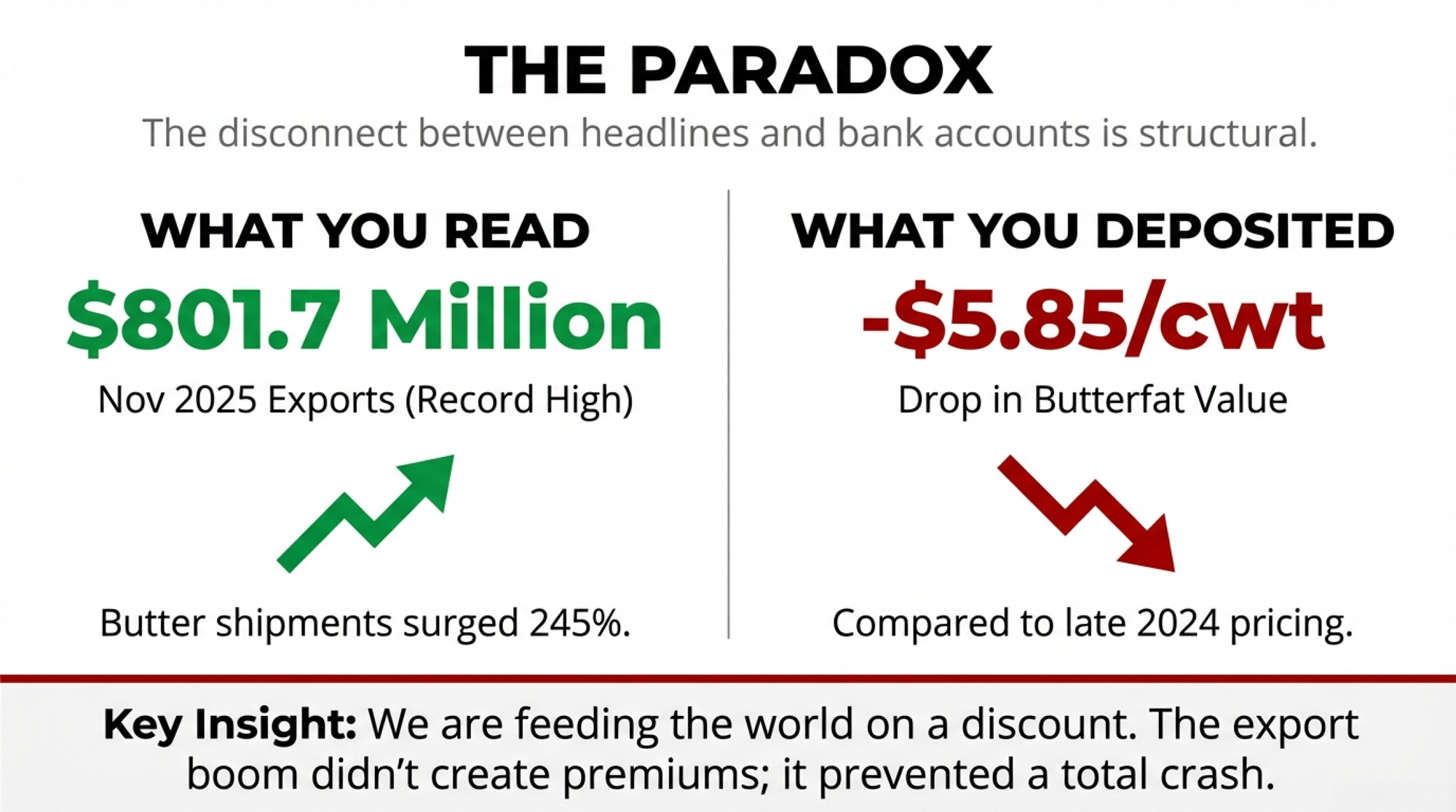
November 2025 delivered $801.7 million in U.S. dairy export value — up 14% from the prior year, according to USDEC data released in January 2026. Butter shipments surged 245%. Total butterfat exports reached 15,308 metric tons, the highest single-month total ever recorded. Yet Class IV checks arrived at $13.89 per hundredweight, and butterfat component values had dropped roughly $5.85 per cwt compared to late 2024.

We’re feeding the world on a discount, and the only ones not invited to the feast are the people milking the cows.

That gap between headline and mailbox isn’t random. It’s structural. And understanding why — plus what you can do about it — matters more now than it has in years.

The Hidden Tax on Your Efficiency

Before we get to export mechanics, here’s the piece most producers miss entirely.

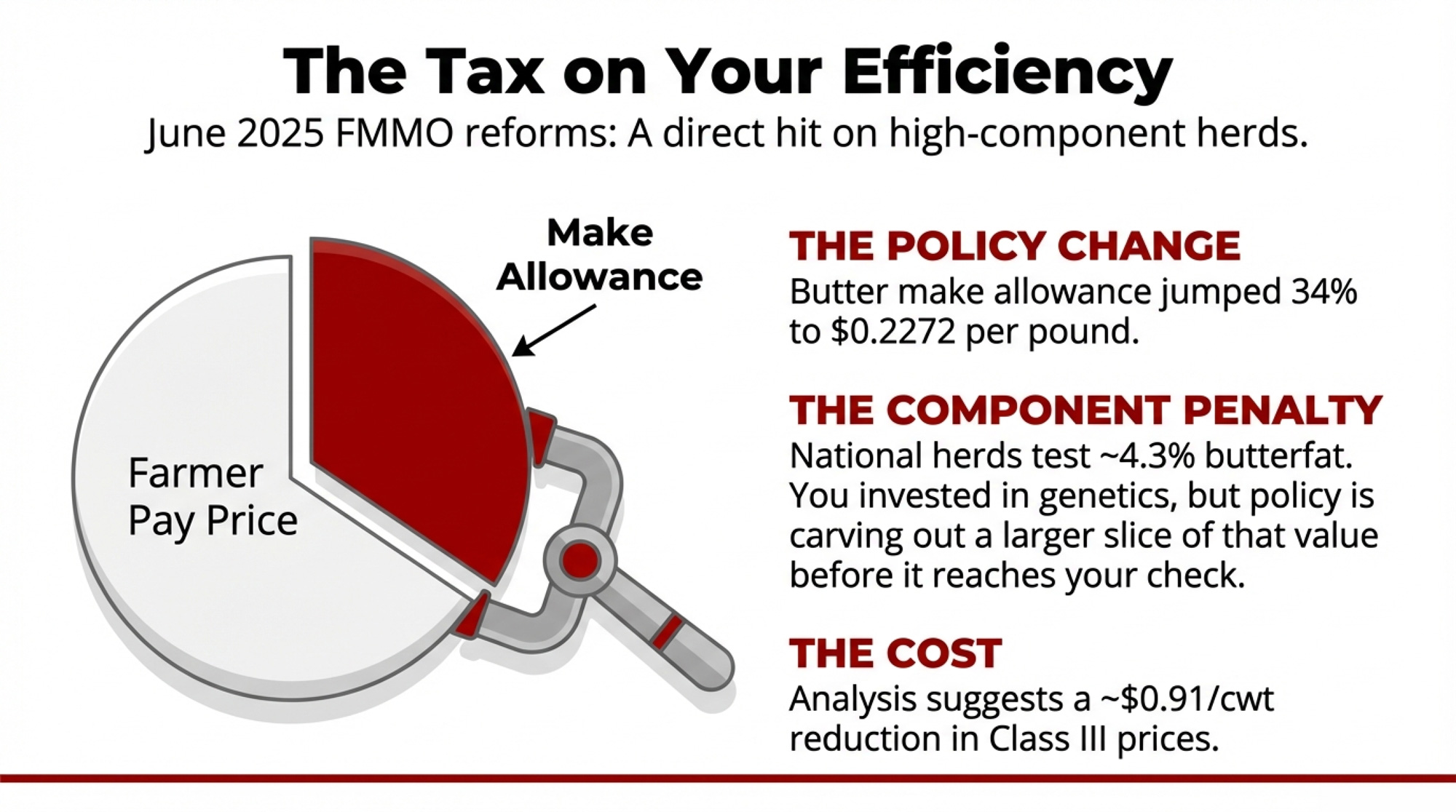
The Federal Milk Marketing Order reforms that took effect in June 2025 included increases in make allowances across product categories. According to USDA Agricultural Marketing Service data, butter’s make allowance rose 34% to $0.2272 per pound. These allowances get deducted before class prices and producer payments are calculated.

ComponentBefore June ’25After June ’25% Increase
Butter$0.1694/lb$0.2272/lb+34%
Cheese (Cheddar)$0.2003/lb$0.2367/lb+18%
Dry Whey$0.1991/lb$0.2210/lb+11%
Nonfat Dry Milk$0.1678/lb$0.1889/lb+13%
Avg. Impact on Class III-$0.91/cwt
Avg. Impact on Class IV-$0.85/cwt

Think about that: you invested in genetics, management, and components. Your herd is testing 4.3% butterfat — roughly 23% above the 3.5% baseline FMMO pricing assumes. And now a larger slice of that value gets carved out before it ever reaches your check.

American Farm Bureau Federation analysis estimated the FMMO changes reduced Class III prices by approximately $0.91 per cwt and Class IV by $0.85.

That’s not market forces. That’s policy. And it happened while everyone was watching export numbers.

Why Exports Surge When Prices Fall

Here’s the assumption most of us carry: strong export demand drives prices up, rising prices lift milk checks. November 2025 proved that the opposite can happen.

What actually drove the export boom? U.S. butterfat got cheap.

When domestic butter prices fell from nearly $2.89 per pound in late 2024 to roughly $1.53 by late 2025, American product became the discount option. Global buyers noticed. According to USDEC’s January 2026 analysis, butterfat imports from the U.S. to the Middle East and North Africa topped 4,000 metric tons in November alone. Bahrain and Saudi Arabia led the surge ahead of Ramadan buying.

South Korea emerged as a standout cheese market too, with November shipments jumping 136% year-over-year — mozzarella and cream cheese for foodservice driving those gains.

But here’s the thing: these weren’t premium buyers paying top dollar for American quality. They were price-sensitive markets taking advantage of a cheap supply.

When exports function as a release valve for surplus — moving product that would otherwise crash domestic prices further — they provide real value. That value shows up as market stabilization, though. Not enhanced producer premiums.

November’s export surge prevented worse. It didn’t create better.

Where the Dollars Disappear

That Wisconsin producer ships to a Class IV-heavy cooperative focused on butter and powder. In theory, a record butterfat export month should benefit operations in that channel.

The math didn’t work that way.

  • First, those export sales happened at prices reflecting the domestic collapse, not premiums above it. When butter trades at $1.53 domestically, export sales at competitive global prices don’t generate a margin to pass back to domestic customers. They generate volume movement that keeps plants running.
  • Second, cooperatives operate with their own cost structures — debt service, equity retention, and balancing costs. Large co-ops with recent processing investments may be servicing significant debt before member payments hit your account.

The Wisconsin producer put it bluntly: “So when they say exports are good for dairy farmers, they don’t actually know if that’s true?”

Not at the individual level. The system doesn’t track it.

The Pricing Mechanics Absorbing Your Margin

The 4.3% vs. 3.5% Problem

Federal order pricing assumes a 3.5% butterfat baseline. Actual farm tests have been running around 4.3% nationally—roughly 23% higher than that.

When butterfat prices are strong, high-component herds benefit. When prices collapse, those same herds have greater downside exposure.

Here’s the math: A producer shipping 4.3% butterfat saw component value drop from approximately $12.43 per cwt in late 2024 to $6.58 in late 2025. That’s $5.85 driven entirely by commodity price movement — same cows, same management, same milk.

The $3.29 Spread

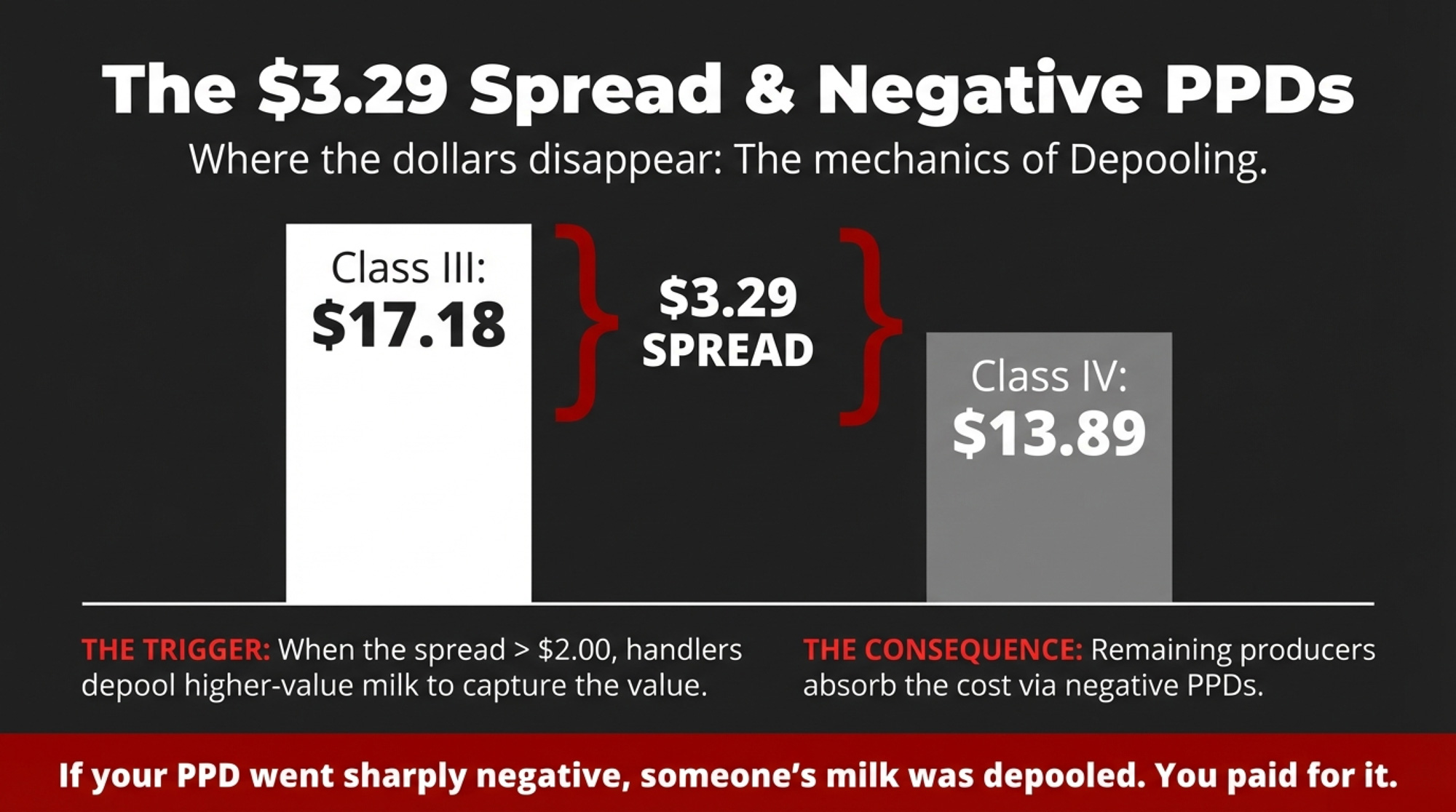
November 2025’s gap between Class III ($17.18) and Class IV ($13.89) was $3.29 per hundredweight — the widest since April 2024.

Wide spreads create depooling incentives. Under federal order rules, milk can be pooled or depooled at the handler’s discretion — this is a permitted structural feature, not a violation. When one class commands a significantly higher price than the blend, handlers can pull that milk out and capture the full value.

When milk is depooled, the higher-value revenue exits the system. Producers remaining in the pool absorb the cost through negative PPDs.

If your PPD went sharply negative in a month with a wide class spread, someone’s milk was depooled. It might not have been yours, but you paid for it.

When Equity Becomes a Barrier

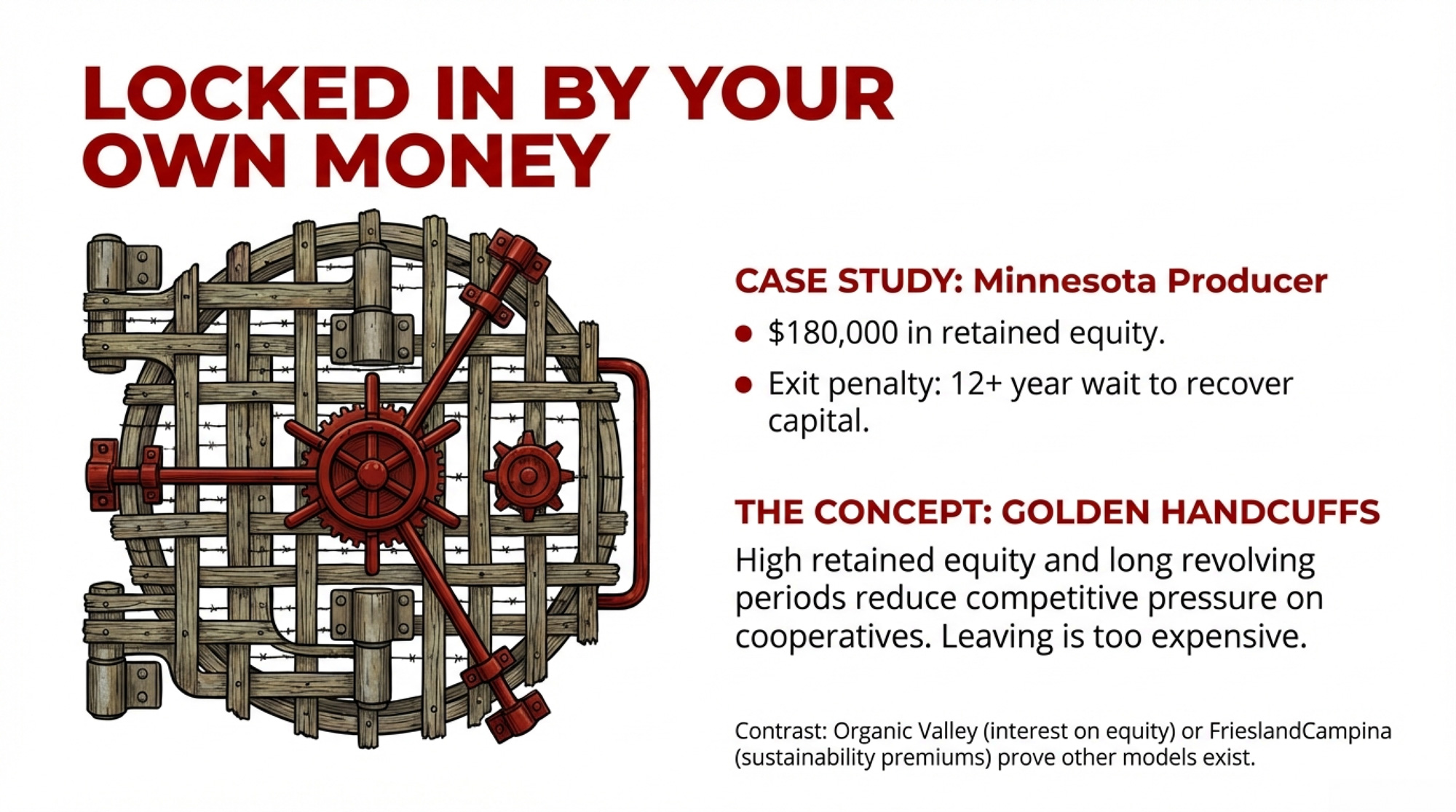
One Minnesota producer calculated he had roughly $180,000 in retained equity with his cooperative. When he explored switching, he discovered leaving would mean waiting 12+ years to access that money — and the bylaws allowed offsets for “losses attributable to departing members.”

He stayed. Not because he was satisfied. Because $180,000 was more than he could walk away from.

His situation illustrates a common barrier, though specific equity positions and terms vary by cooperative and tenure. Retention policies for 15-20-year revolving schedules are standard across much of the industry.

What Works Differently

Not every cooperative operates the same way.

Organic Valley (CROPP Cooperative) pays 8% interest on retained member equity — treating members as capital partners, not just milk suppliers. Their pay prices have historically run several dollars per cwt above conventional, with organic premiums in the $8-10 range during favorable periods. That gap narrows when organic supply exceeds demand, but the structure rewards member investment differently than most commodity co-ops.

FrieslandCampina in the Netherlands paid €245 million in documented sustainability premiums to member farmers in 2023, according to the cooperative’s annual report. Transparent indicator systems show exactly what farmers earn for meeting specific targets.

FeatureTypical U.S. Commodity Co-opOrganic Valley (CROPP)FrieslandCampina
Interest on retained equity0% – 2%8%Variable, disclosed
Premium above conventional$0 – $0.50/cwt$8 – $10/cwt€0.02 – €0.05/kg
Sustainability premiumsRare, undisclosedDisclosed, integrated€245M (2023, documented)
Transparency on export revenueMinimal to noneMember reportsAnnual public reporting
Equity recovery timeline12 – 20 years7 – 10 years5 – 7 years
Member decision-makingBoard-driven, limited inputStrong member voiceIndicator-based, transparent targets

These examples prove the mechanics can work differently. But they represent a small fraction of U.S. production.

Four Paths Forward

Path 1: Demand Transparency

The most accessible option is better information from your current cooperative.

Three Questions to Send Before the Annual Meeting Season

Send these in writing — responses aren’t guaranteed, but asking creates a record:

  1. “What was our cooperative’s gross export revenue in 2025, and what net amount reached member pay prices after all costs?”
  2. “For months when the Class III/IV spread exceeded $2.00, what was our pooling policy?”
  3. “How did our member mailbox prices compare to the FMMO statistical uniform price?”

One producer asking gets brushed off. Five people sending the same letter gets a board agenda item.

Path 2: Know Your Numbers

This week: Pull your milk checks from the last 12 months. Calculate your actual mailbox price — total dollars received divided by total hundredweights, after every deduction.

ScenarioAnnual Production (lbs)FMMO Uniform ($/cwt)Mailbox ($/cwt)Annual Gap
Small herd, commodity co-op850,000$18.25$17.45-$6,800
Mid-size, high-component1,400,000$18.25$17.50-$10,500
Large herd, Class IV heavy3,200,000$18.25$17.70-$17,600
Regional co-op, transparent1,400,000$18.25$18.15-$1,400

Then compare to the statistical uniform price for your federal order.

If your mailbox trails the uniform by more than $0.50 per cwt consistently, that gap warrants investigation. On a 200-cow herd shipping 1.4 million pounds annually, a $0.75 gap is roughly $10,500 per year.

Path 3: Evaluate Switching — Honestly

The barriers are real: retained equity that takes 10-15 years to recover, 12-18 month notice periods, geographic constraints on handlers, and social pressure in tight-knit communities.

But understanding your options provides context for negotiation. A producer who knows their alternatives negotiates differently.

Path 4: Strengthen Risk Management

  • Dairy Margin Coverage remains cheap insurance. December 2025 was the only month triggering a DMC payment all year — but with margins now compressing toward the $9.50 trigger, payments appear increasingly likely in 2026. The enrollment period runs through February 26, and the One Big Beautiful Bill Act expanded Tier 1 coverage to 6 million pounds.
  • Forward contracting through the Dairy Forward Pricing Program allows locks through September 2028. You trade upside for certainty — appropriate for tight debt service, less so if you can absorb volatility.

What to Watch Through Q2 2026

Class III/IV spreads: When they exceed $2.00, depooling pressure builds. Past $2.50, it’s likely affecting your check.

Your PPD trend: Sustained negative PPDs during wide-spread months signal pooling decisions that aren’t serving you.

Co-op annual meetings: Q2 is your window to ask questions with other members present.

What This Means for Your Operation

  • Calculate your mailbox-to-uniform comparison this week. More than $0.50 below consistently? You need to understand why.
  • Send the three questions in writing before your annual meeting. See what answers you get — and how long they take.
  • Know your equity position and departure terms now. Not because you’re leaving, but because understanding constraints lets you evaluate options clearly.
  • Connect with two or three producers in your cooperative. Compare mailbox prices. Collective inquiry creates dynamics different from those of individual complaints.
  • Review your DMC enrollment before February 26. With margins tightening and December’s payment fresh, coverage costs are minimal compared to downside protection.
  • Watch the spread monthly. Past $2.00, pay attention. Past $2.50, act.

Key Takeaways

  • Export records don’t equal premium checks. November’s $801 million was due to U.S. prices collapsing. The surge prevented worse; it didn’t create better.
  • The 34% make allowance hike is a hidden tax on your efficiency. You bred for components. Policy changes are capturing more of that value before it reaches your check.
  • The $5.85/cwt butterfat drop hit high-component herds hardest. The same genetics that boosted 2024 revenue also increased 2025 exposure.
  • $3.29 spreads create depooling that costs you. If you don’t know your co-op’s pooling policy, you can’t evaluate whether it’s working for you.
  • Your mailbox vs. the uniform price is the comparison that matters. A consistent $0.50+ gap means your channel is extracting more than it’s adding.

The Bottom Line

That Wisconsin producer figured something out after digging into the mechanics: the opacity isn’t inevitable. Some cooperatives operate transparently. Some structures actually return a value to members.

The difference is whether you know enough to ask — and whether you’ll ask alongside others who are tired of the same answer.

Where does your mailbox sit relative to the uniform?

Complete references and supporting documentation are available upon request by contacting the editorial team at editor@thebullvine.com.

Learn More

The Sunday Read Dairy Professionals Don’t Skip.

Every week, thousands of producers, breeders, and industry insiders open Bullvine Weekly for genetics insights, market shifts, and profit strategies they won’t find anywhere else. One email. Five minutes. Smarter decisions all week.
NewsSubscribe
First
Last
Consent
Send this to a friend