A University of Georgia study proves what your rumination curves are already showing: convenient dry‑off routines cost mature cows 1,200–1,500 lb — and the fix is just 11 days away.
Executive Summary: You’re vaccinating cows on dry-off day because it’s convenient — but your sensors see the rumination crash it causes. Wageningen tracked 414 Dutch farms and found conventional herds milking less per cow after installing sensors, turning tech into expensive wallpaper. Samantha Reighard, Standard Dairy Consultants, shows how to fix it: Ontario SARA math reveals $4,900/year leaking from a 60-cow transition pen, while UGA’s 328-cow study proves an 11-day vaccine shift adds 1,200–1,500 lb milk per mature cow. This gives you a 30-day CEO checklist to run the numbers on your own herd and close that gap. In a world of vanishing herds and static milk checks, that’s the difference between surviving and pulling ahead.
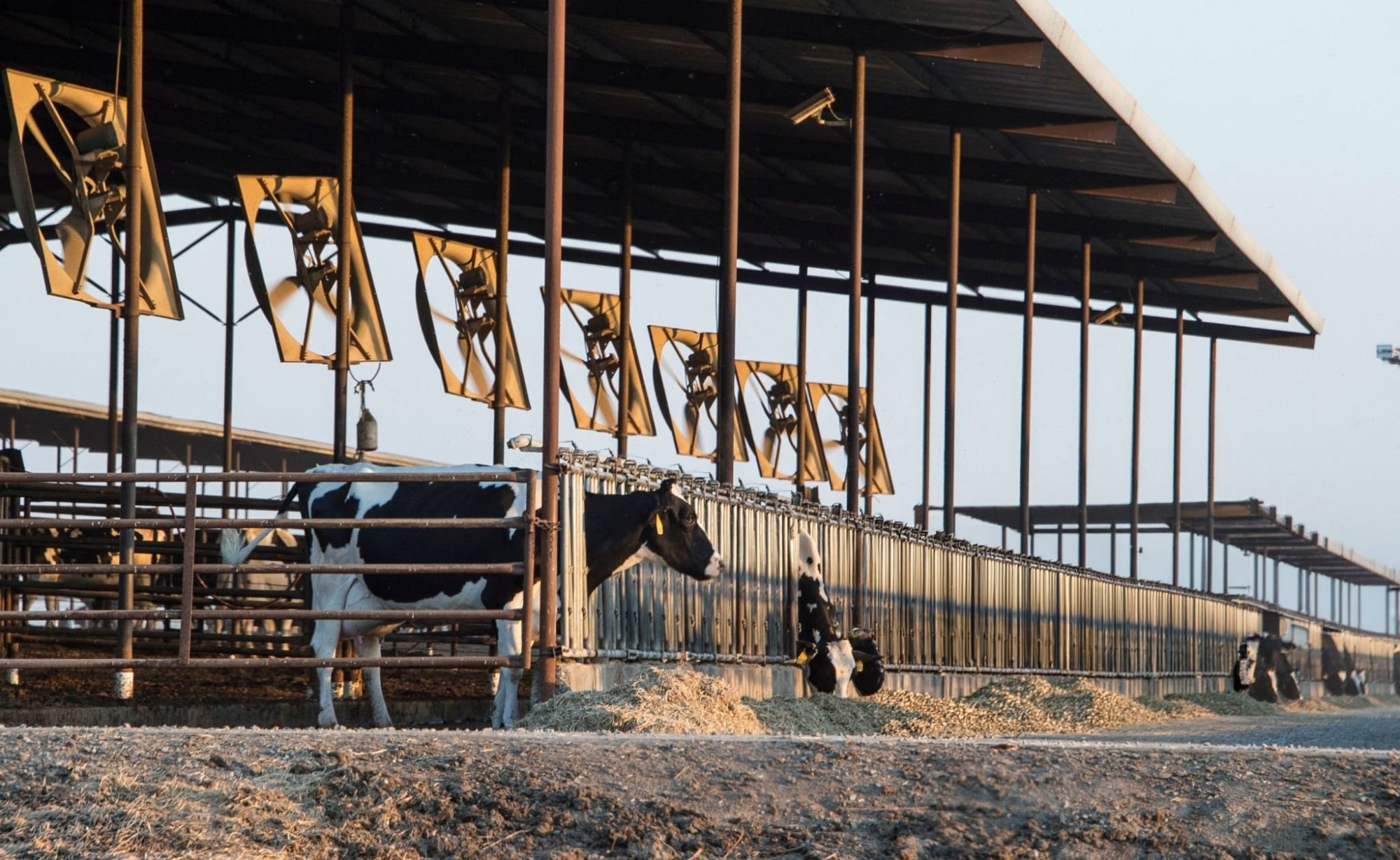
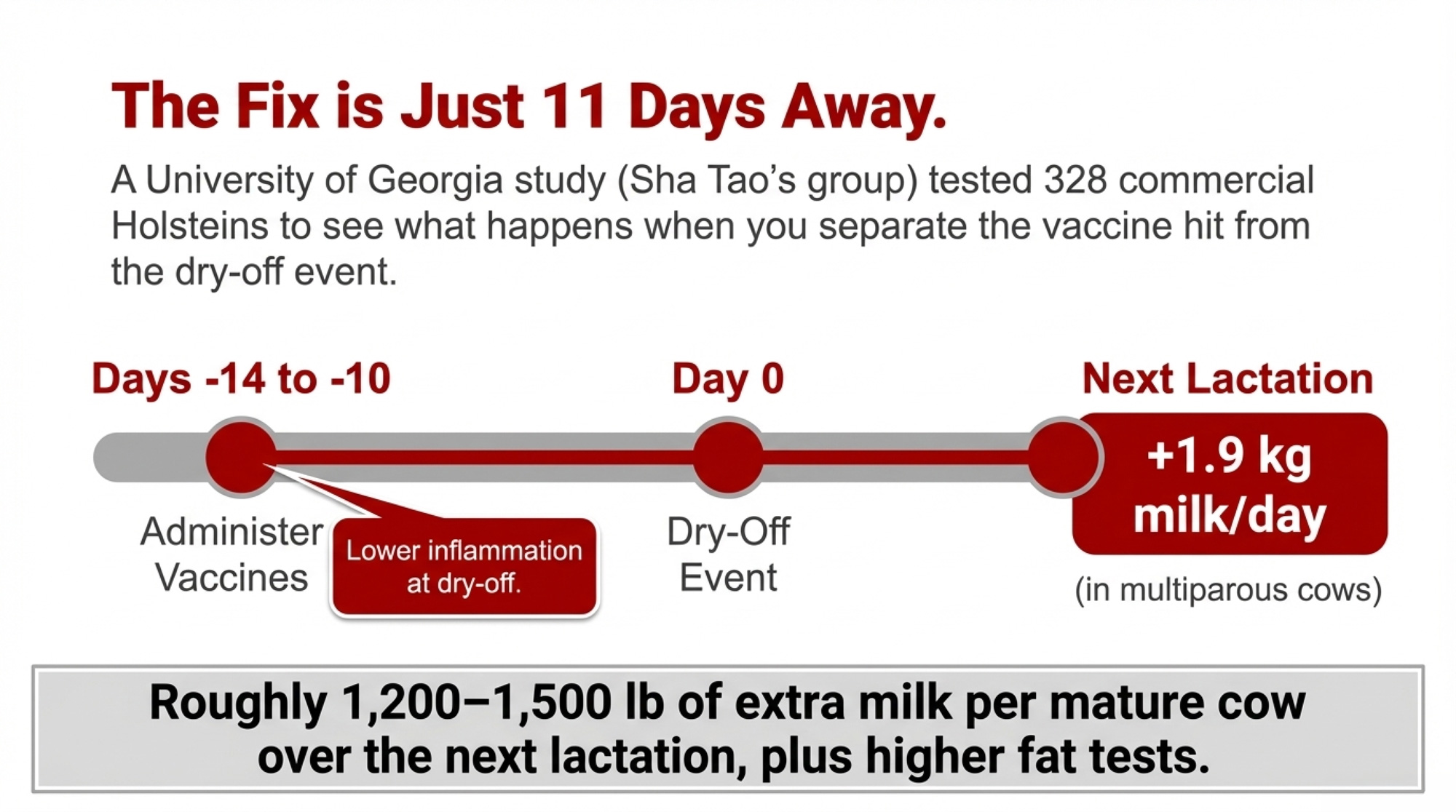
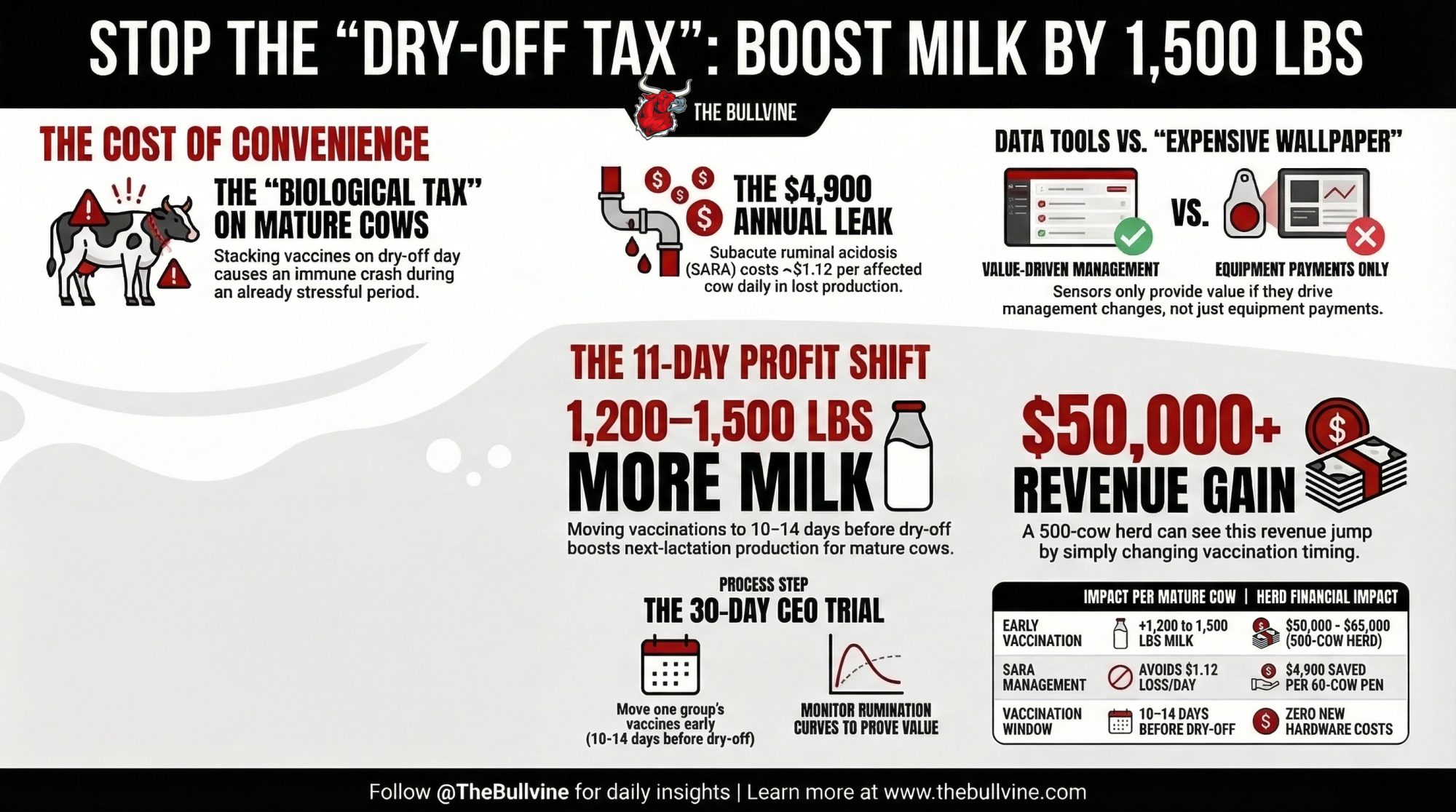
When dairy nutritionist Samantha Reighard walks into a herd still vaccinating cows on dry‑off day because it fits the lock‑up schedule, there’s a number she wants you to look at twice. In a University of Georgia study on 328 commercial Holsteins, moving vaccinations to 10–14 days before dry‑off boosted milk in multiparous cows by about 1.9 kg per day in the next lactation. Over 305 days, that’s roughly 1,200–1,500 lb more milk per lactation per mature cow, with better fat tests on top.
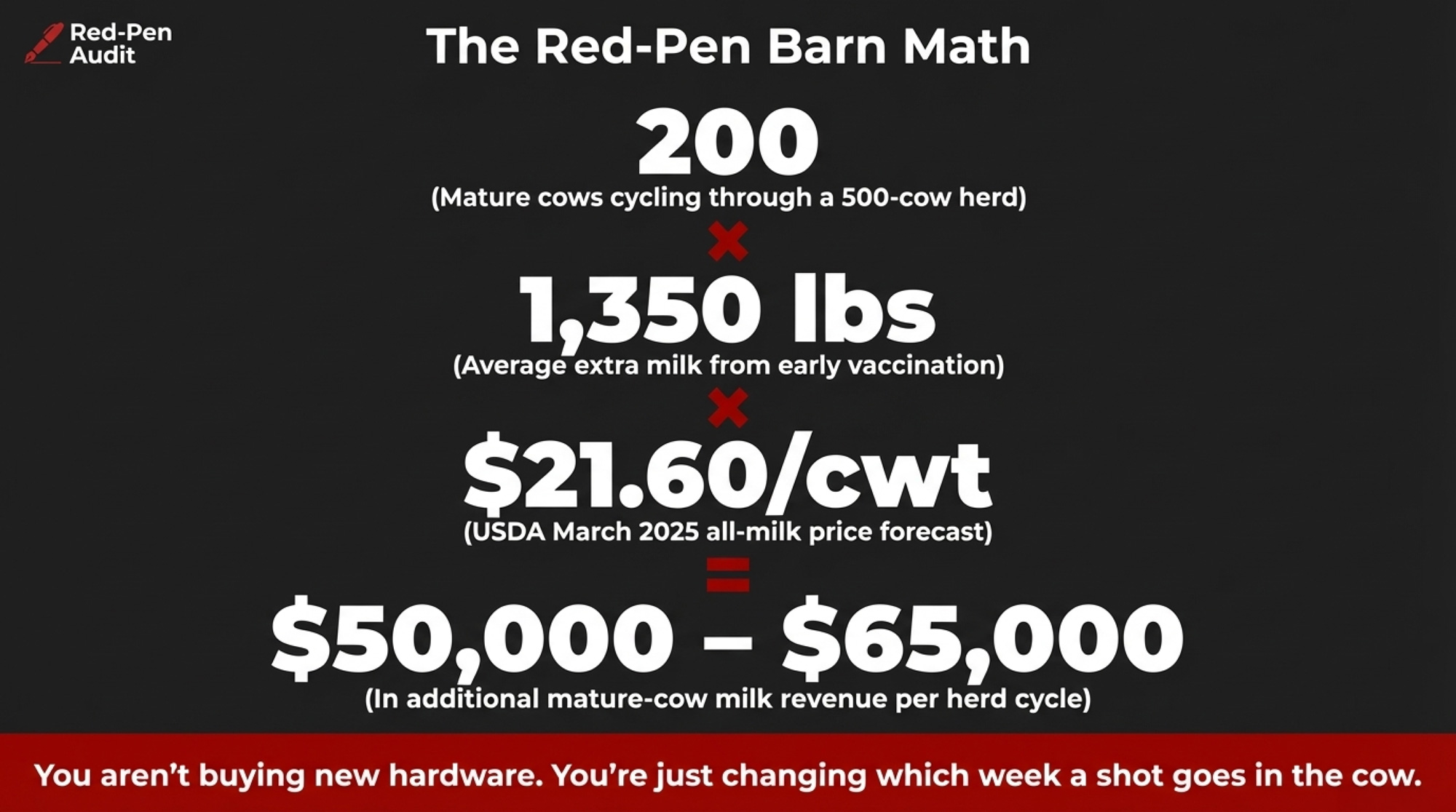
Now plug in the USDA’s March 2025 all‑milk price forecast of $21.60/cwt — and given how the rest of 2025 actually played out, that number was generous. On a 500‑cow herd with roughly 200 mature cows cycling through, that 1,200–1,500 lb window is worth in the neighborhood of $50,000–$65,000 in mature‑cow milk revenue over a full herd cycle — just from which side of dry‑off you choose to vaccinate on. You’re not buying new hardware. You’re changing which week a shot goes in the cow.
Reighard, a consultant with Standard Dairy Consultants who spent time in high‑pressure swine genetics at PIC before coming back to dairy, calls transition stress a biological tax on your best cows. Your tags are out there watching rumination crash around dry‑off and after feeding. They’re capturing exactly how much stress your routines are putting on that cow. Some herds use that information as a competitive advantage. Others treat it like expensive wallpaper.
Transition Stress: The Biological Tax You Can’t See from the Alley
Dry‑off and early lactation are already expensive weeks for a cow’s body. She’s dealing with udder involution, ration changes, a different pen, new neighbors, and the push to get up and going after calving. Work from Dr. Lance Baumgard’s group at Iowa State has shown just how costly that is: an activated immune system can divert more than a kilogram of glucose per day from the udder to immune cells, and the level of inflammation at dry‑off can rival that seen at freshening. That’s energy your cows could have turned into saleable milk.
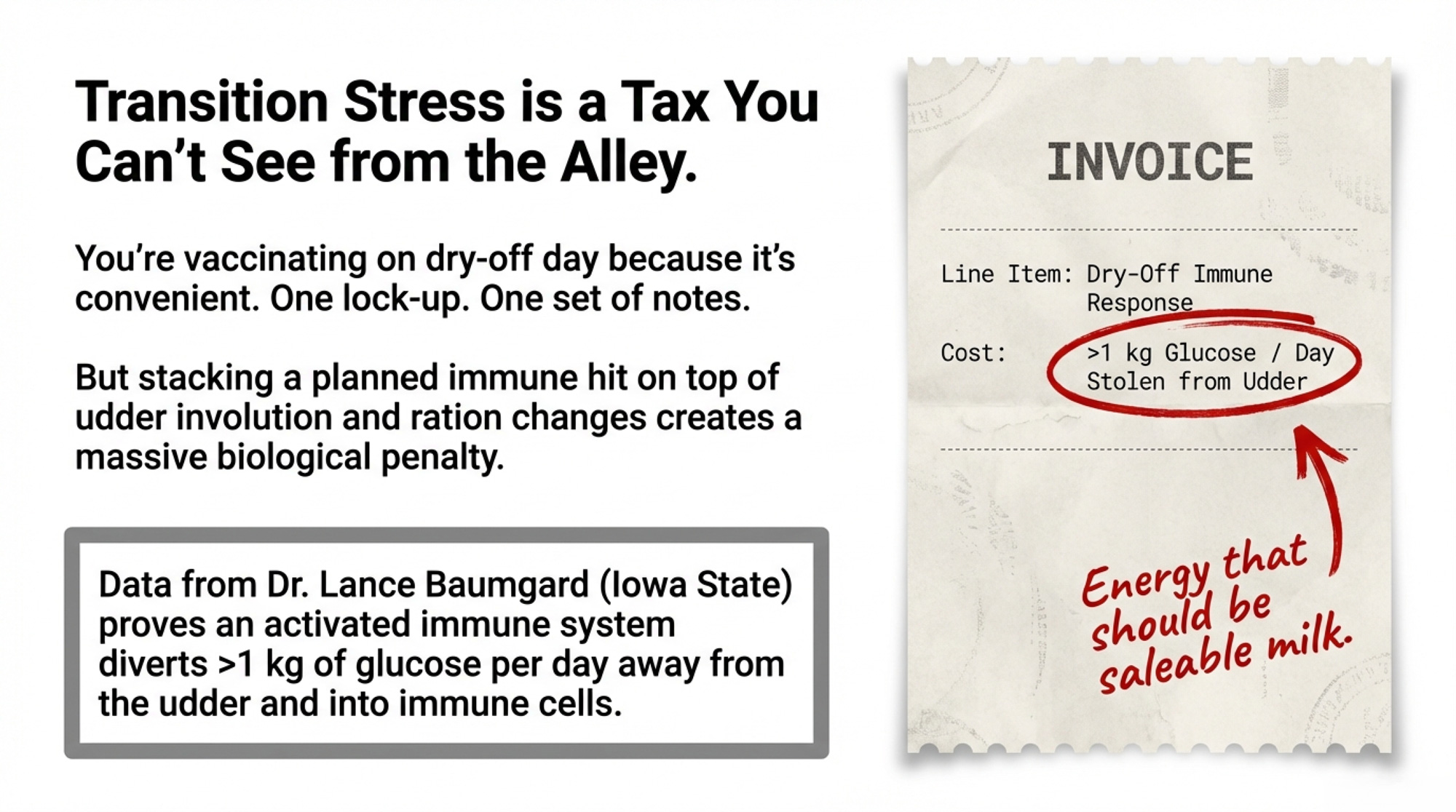
For years, the standard has been to stack vaccinations right on top of dry‑off. It’s simple for you: one handling, one lock‑up, one set of notes. But that means you’re layering a big planned immune hit on a day that’s already a perfect storm. The UGA team — led by Sha Tao’s group — asked a different question: what if you pulled the vaccine response away from the dry‑off event itself and separated those two hits?
In their trial of 328 Holstein cows (174 control, 154 early‑vaccination), animals vaccinated on the day of dry‑off showed a strong, persistent inflammatory response afterward. Cows vaccinated 10–14 days earlier had significantly lower inflammation at dry‑off. Multiparous cows in that early‑vaccination group produced about 1.9 kg more milk per day in the next lactation, while first‑lactation animals changed very little, which makes biological sense, since younger cows haven’t accumulated the same inflammatory load through repeated lactations. The study’s summary translates this into roughly 1,200–1,500 lb of extra milk per mature cow over the lactation period, with a higher fat percentage reported in that group.
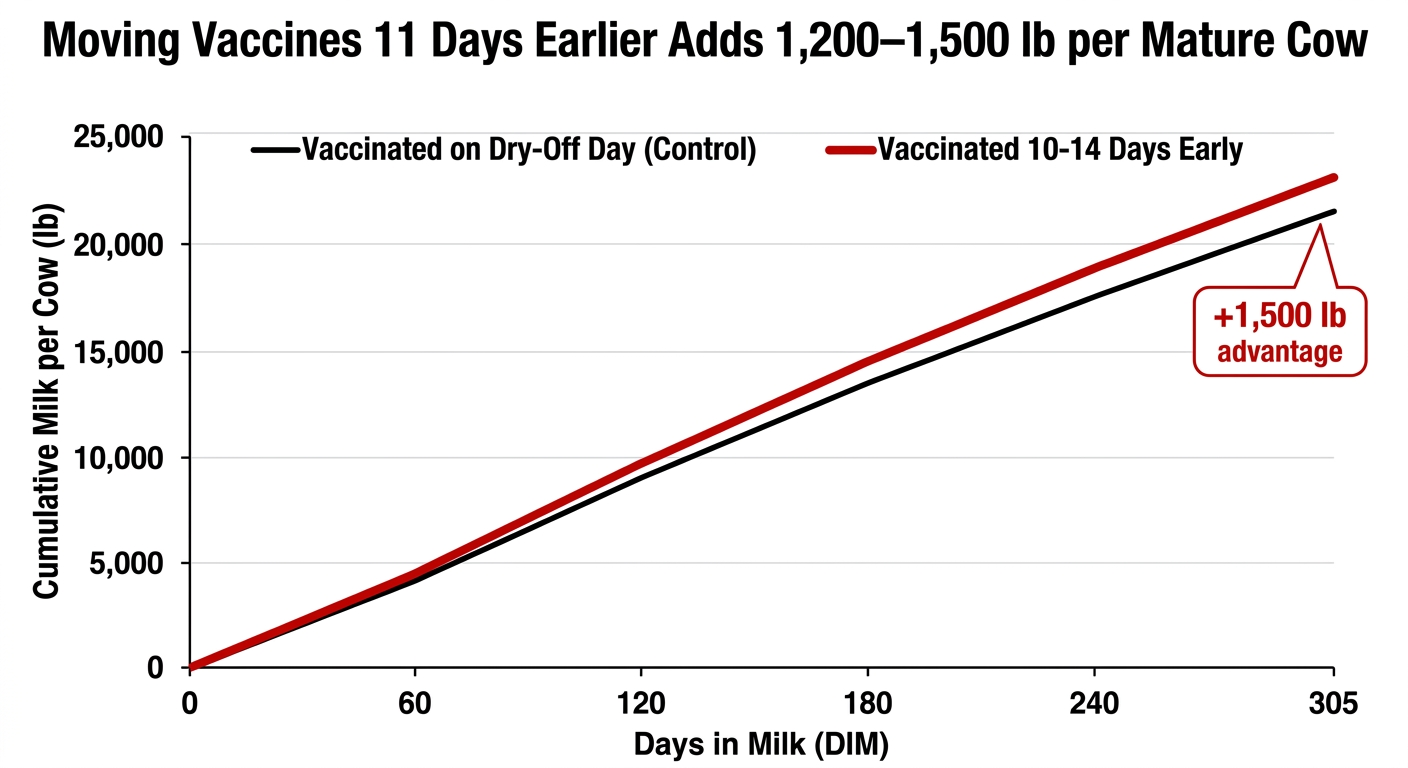
| DIM | Control (lb) | Early Vaccination (lb) | Advantage (lb) |
|---|---|---|---|
| 0 | 0 | 0 | 0 |
| 60 | 4,200 | 4,400 | +200 |
| 120 | 9,100 | 9,600 | +500 |
| 180 | 13,600 | 14,400 | +800 |
| 240 | 17,800 | 18,900 | +1,100 |
| 305 | 21,500 | 23,000 | +1,500 |
That’s what transition stress looks like when you stop talking about “tough weeks” and start doing barn math. Dry‑off shots on the convenient day aren’t free. They’re part of the tax bill.
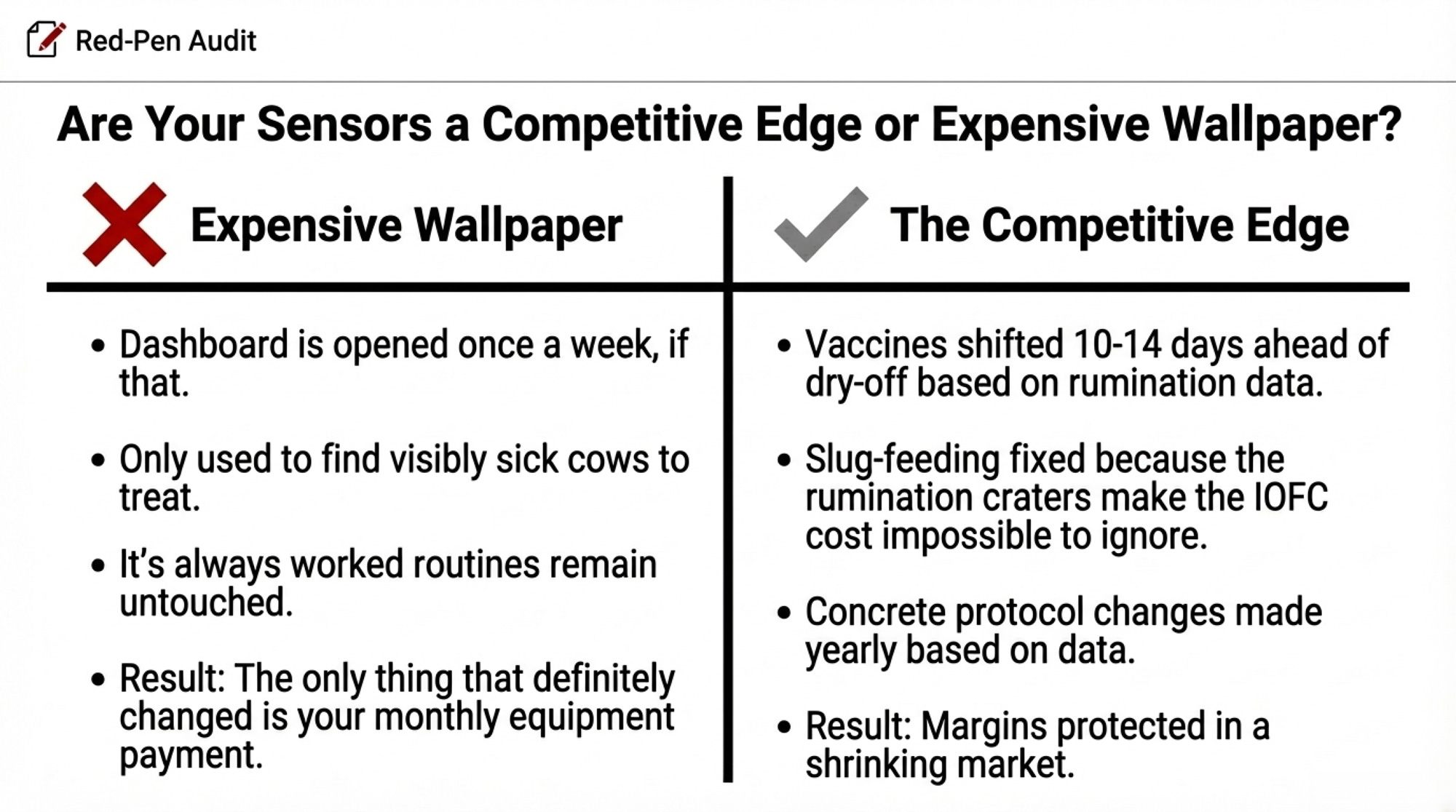
Competitive Advantage or Expensive Wallpaper?
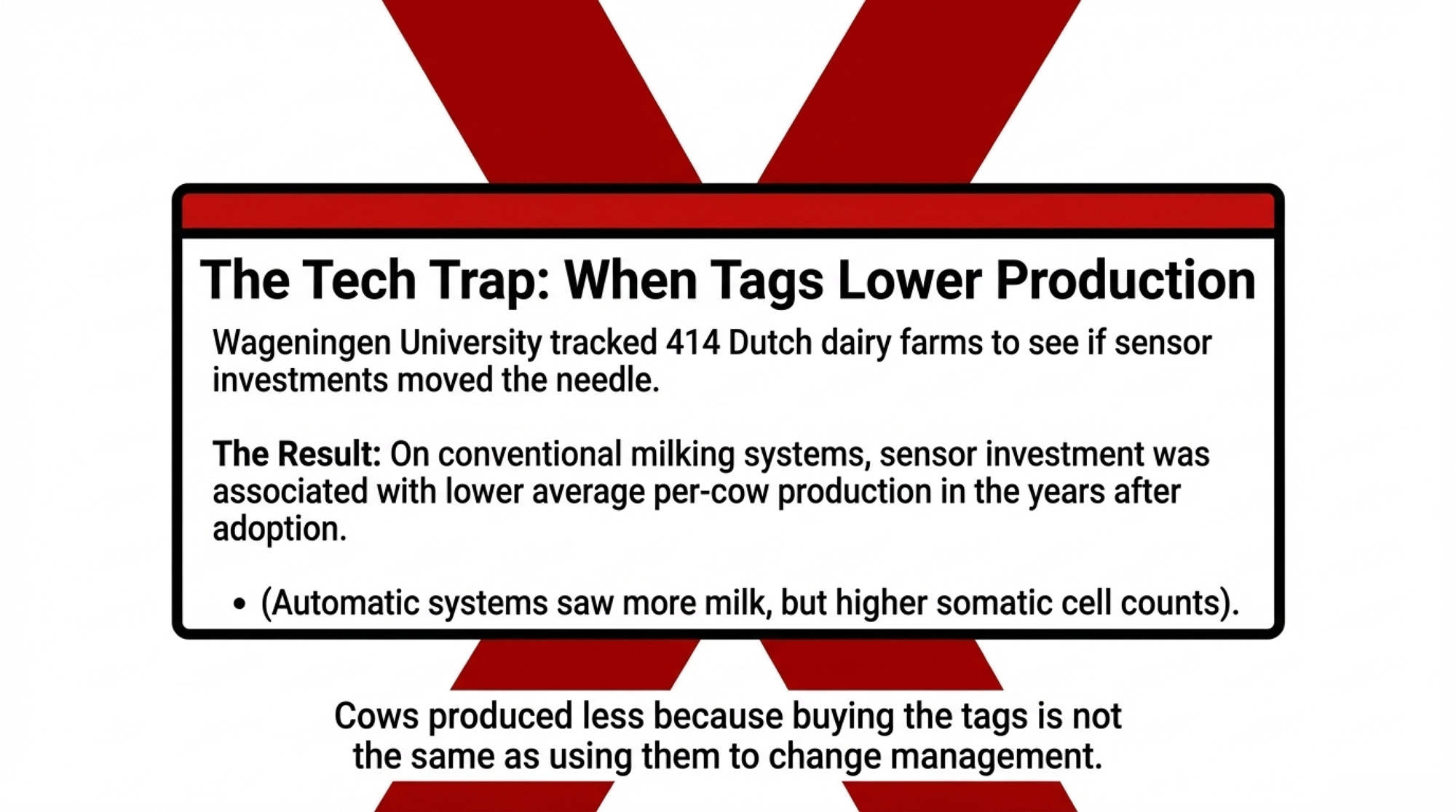
Now zoom out from the pen to the whole herd. In a 2019 Journal of Dairy Science study, Wageningen University researchers Steeneveld and Hogeveen tracked 414 Dutch dairy farms to see whether sensor investments actually moved the needle on health and production. The findings weren’t what the tech brochures promise. On farms with conventional milking systems — the kind most closely comparable to a typical North American parlor setup — sensor investment was associated with lower average per-cow production in the years after adoption. Farms with automatic milking systems saw higher production, but also higher somatic cell counts.
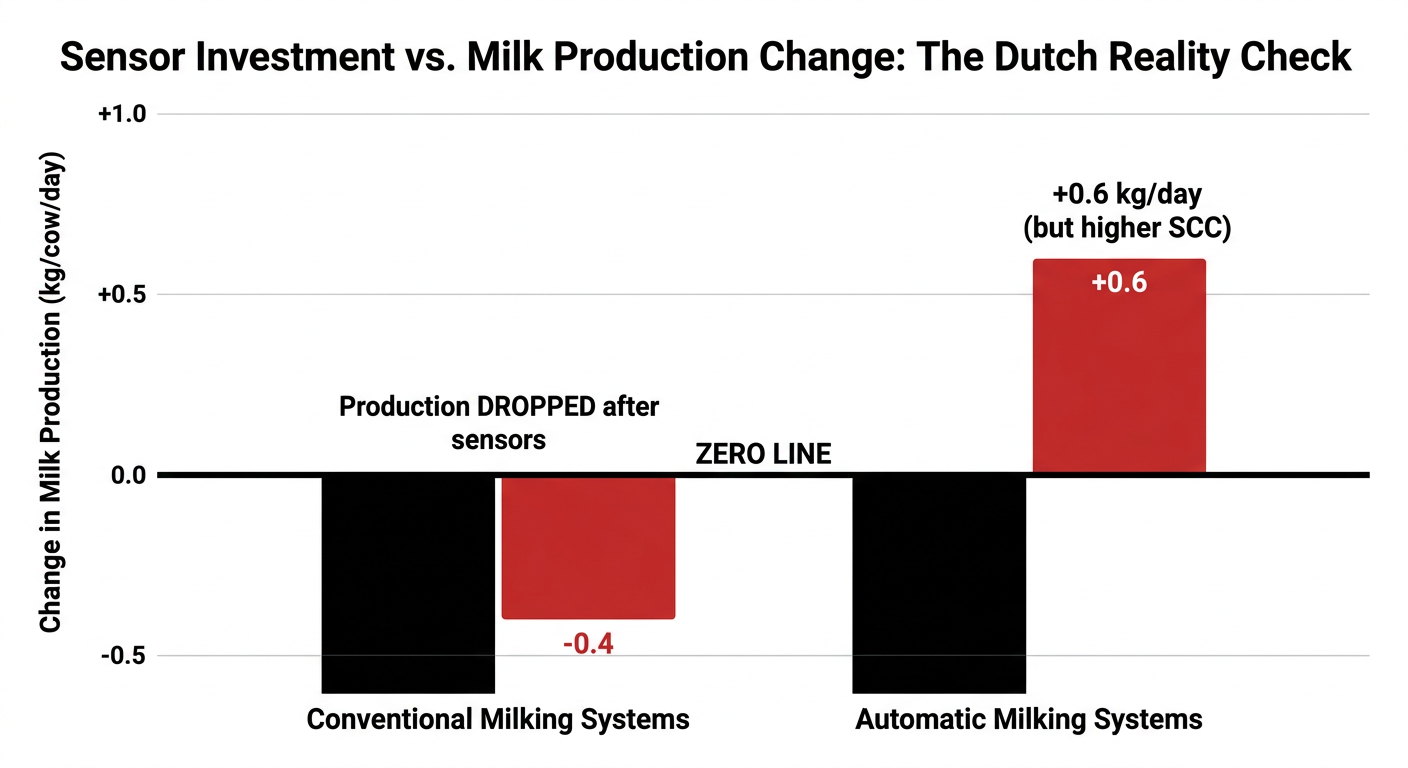
Read that again. On conventional farms, cows produced less after the sensors went in. Not because the sensors broke something, but because buying the tags was apparently not the same as using them to change management.
You can see that same split playing out now, just with fewer herds and more milk per farm. U.S. data show that from 2004 to 2024, the number of licensed dairy herds fell from 66,825 to 24,811 — a 63% drop — while total milk production climbed about 32% over the same period. Bigger herds, more technology, tighter per‑cow margins. There’s less room than ever to carry hardware that doesn’t move the needle.
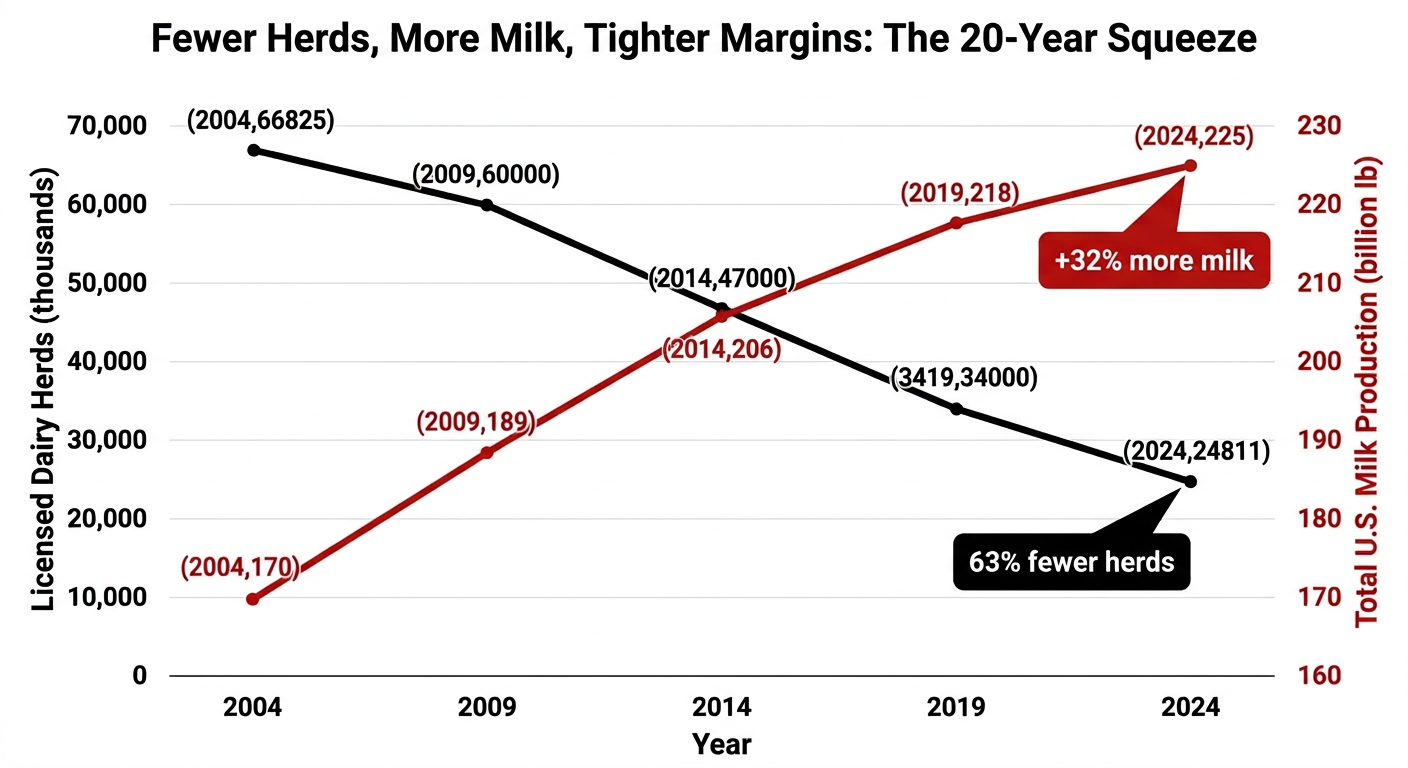
| Year | Licensed Dairy Herds | Total U.S. Milk Production (billion lb) |
|---|---|---|
| 2004 | 66,825 | 170 |
| 2009 | 60,000 | 189 |
| 2014 | 47,000 | 206 |
| 2019 | 34,000 | 218 |
| 2024 | 24,811 | 225 |
On one side of that split, sensors are clearly a competitive advantage:
- Cows get pulled into a dry‑cow health list days before they’re visibly sick.
- Vaccines shift 10–14 days ahead of dry‑off on the cows that benefit most.
- Slug‑feeding patterns in the transition pen get fixed because the rumination curves make the cost impossible to ignore.
On the other side, you’ve got a dashboard that might get opened once a week, if that. The only line item that’s definitely changed is the equipment payment.
The tech itself isn’t the edge. The edge is whether you’re willing to let those transition‑stress numbers outrank your “it’s always worked” routines.
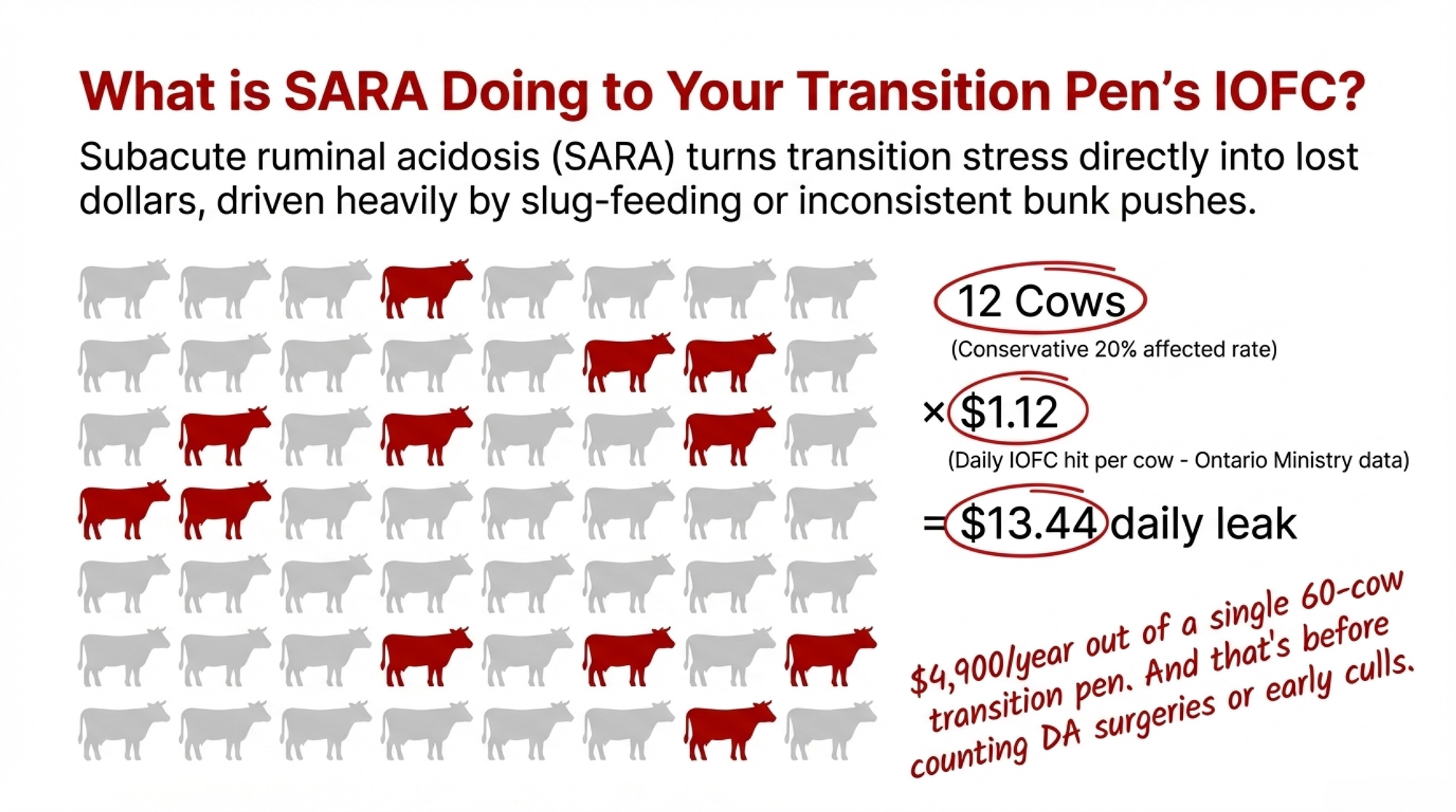
What’s SARA Doing to Your Transition Pen’s IOFC?
Subacute ruminal acidosis is one of the cleanest places to see transition stress turn into dollars. Field reports and reviews frequently cite SARA affecting 20–30% of cows in high‑producing herds, with some studies reporting even higher rates in certain situations. The Ontario Ministry of Agriculture estimates that SARA costs the North American dairy industry between $500 million and $1 billion (U.S.) per year, with an average hit of about $1.12 per affected cow per day, mostly due to lost milk and components.
Take a single transition group of 60 cows. If a conservative 20% — 12 cows — are in a SARA zone, you’re dropping roughly $13.44 per day in income‑over‑feed‑cost in that one pen (12 × $1.12). Over a year, that’s just under $4,900 out of a single transition group, and that’s before you count DA surgeries, early culls, or a string of harder‑to‑breed cows.
| Transition Pen Size | Affected Cows (20%) | Daily IOFC Leak | Annual IOFC Leak |
| 30 cows | 6 cows | $6.72 | $2,453 |
| 60 cows | 12 cows | $13.44 | $4,906 |
| 100 cows | 20 cows | $22.40 | $8,176 |
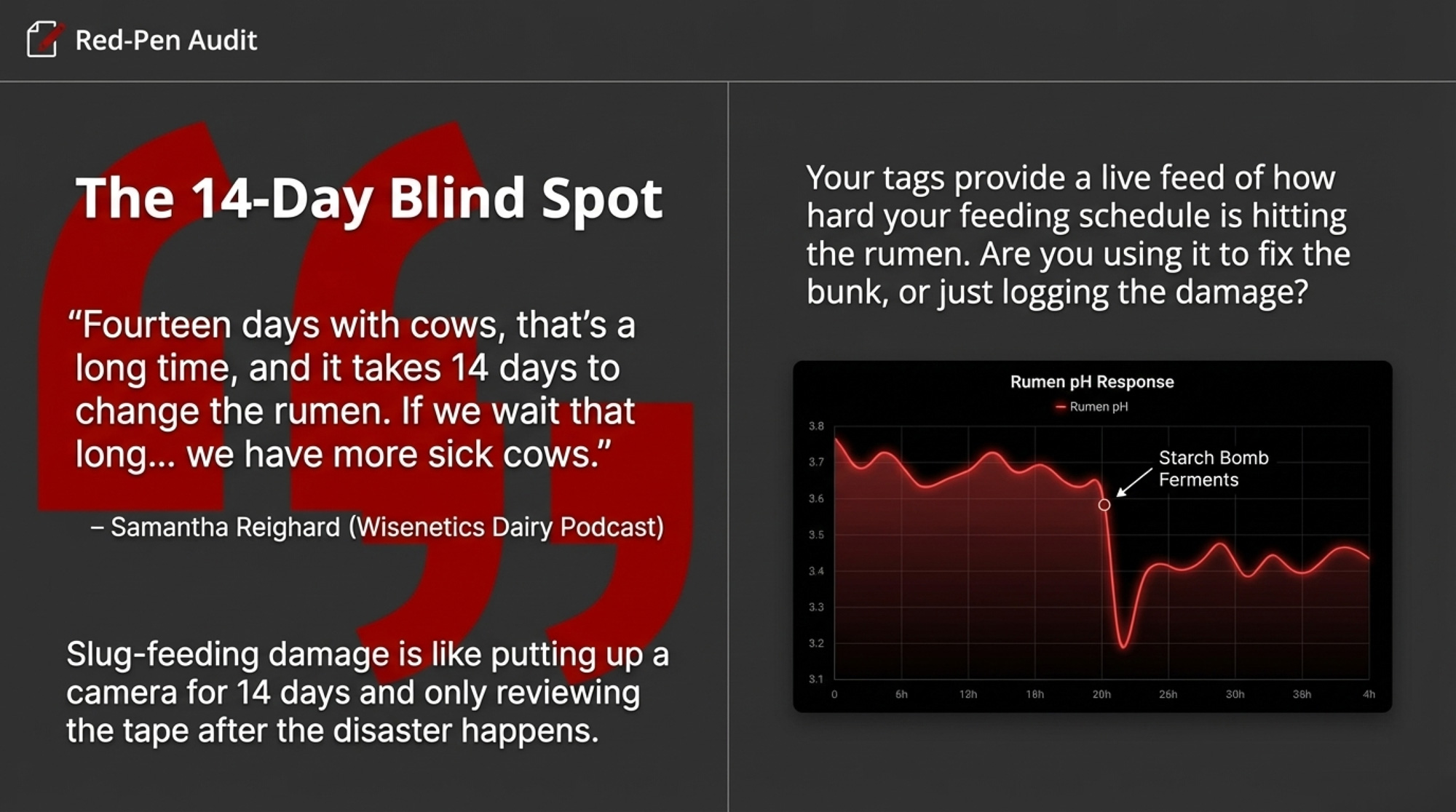
In her interview on the Wisenetics Dairy Podcast Show, Reighard talked about how sensors make that pattern painfully obvious. On slug‑fed pens — once‑a‑day feeding or inconsistent bunk pushes — rumination spikes while cows attack fresh feed, then crashes a few hours later as that starch bomb ferments and rumen pH drops. She compared that with the camera work she sometimes uses: put a camera up for 14 days, pull it down, then spend time reviewing every clip. “Fourteen days with cows, that’s a long time, and it takes 14 days to change the rumen,” she told host Barry Bradford. “And so if we wait that long, you know, we have more sick cows or more issues where I can get ahead of it a lot sooner.”
Your tags are giving you a live feed of how hard your feeding schedule is hitting the rumen. The question is whether you treat that information as another nice‑to‑know or the reason to change how you manage a pen that’s already your highest‑risk group.
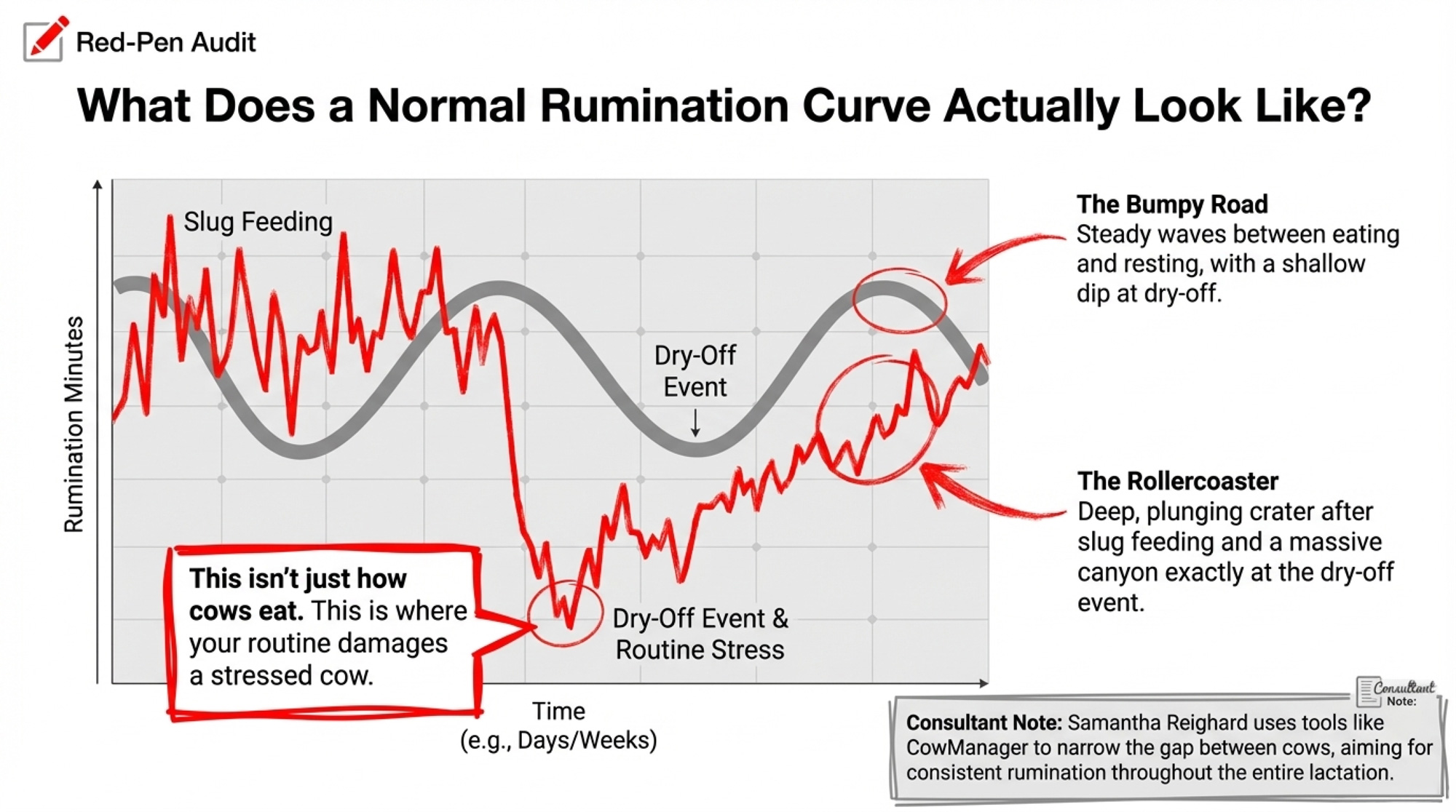
What Should a “Normal” Transition Rumination Curve Actually Look Like?
For all the marketing around early disease alerts and heat detection, the most valuable line on your sensor dashboard might be the boring one: the daily rumination curve.
In a well‑run transition pen, total rumination minutes per cow stay relatively steady from day to day. You’ll see small waves as cows rotate between eating, ruminating, and resting, but not a big canyon after feeding. Rumination dips while cows are at the bunk, then climbs back into their normal band within a couple of hours. Overlay 60 cows over a week, and the average line looks like a slightly bumpy road, not a roller coaster.
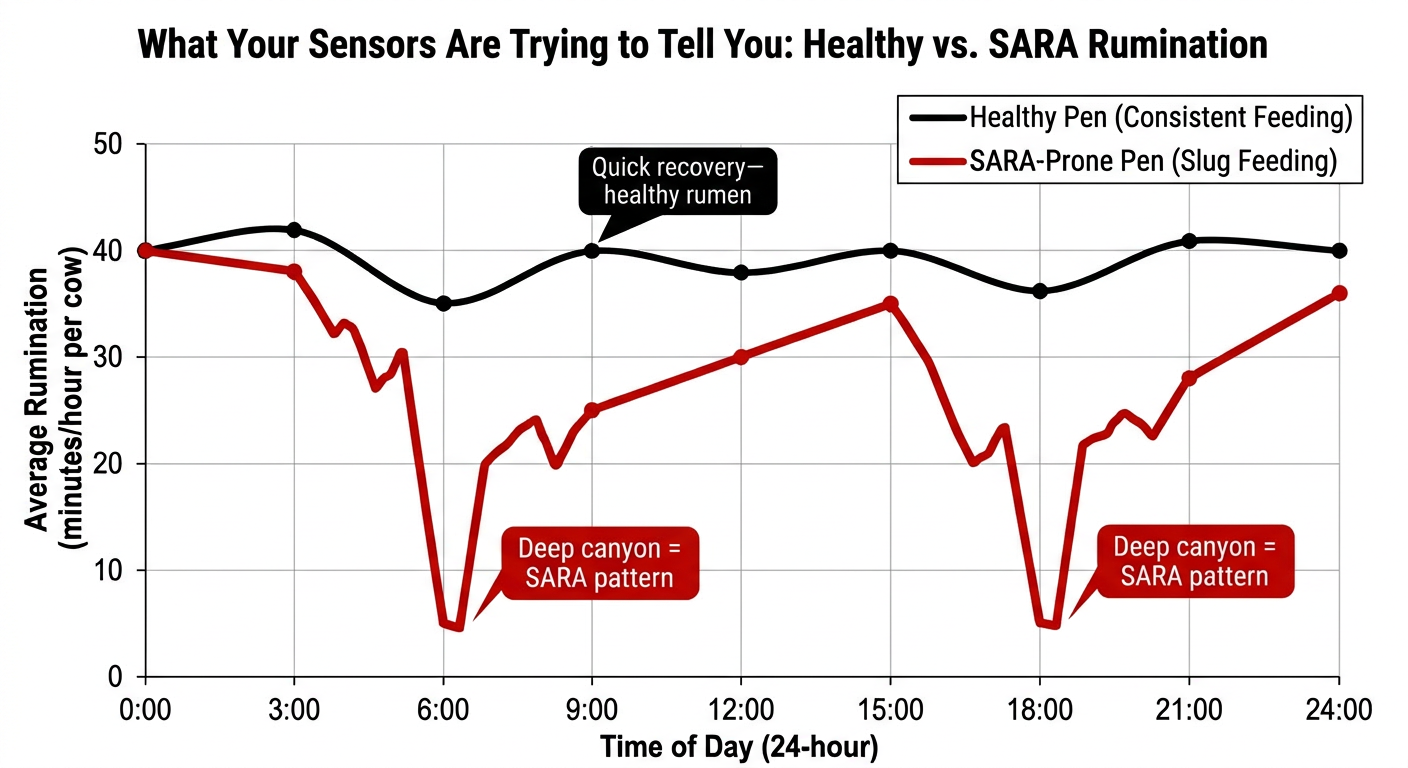
Around dry‑off, you still expect a dip. That’s a real physiological hit. But the UGA data suggest that when vaccinations move 10–14 days ahead, the inflammatory load at dry‑off is lower. On farms using sensors, you’d expect that to show up as a shallower and shorter rumination drop in mature cows around dry‑off, instead of the deep crater you see when everything gets stacked on one day.
Reighard uses tools such as the CowManager nutrition module to narrow the gap between cows. She looks at each cow against her own history and against her group — heifers with heifers, third‑lactation cows with third‑plus — and focuses on narrowing the spread between the top performers and the laggards. “Keeping that consistent, and then keeping the ruminations consistent throughout her whole lactation,” is how she described the goal to Bradford.
If your transition rumination pattern shows a deep canyon after feeding and a long hole at dry‑off, your sensors aren’t just telling you that cows are different from each other. They’re telling you where your routines are doing the most damage to a cow that’s already under a lot of stress.
What This Means for Your Operation
The uncomfortable question isn’t whether your sensors work. It’s whether you’re willing to let what they show you change “convenient” routines that are quietly expensive.
If you’re still vaccinating on dry‑off day because that’s when cows are already in the headlocks, the UGA numbers say you’re probably taxing your mature cows harder than you need to. You’re stacking immune activation on top of an already tough day and asking the cow to wear the cost in the next lactation.
If your transition rumination graph drops off a cliff after feeding, that’s not just “how your cows eat.” It’s a SARA pattern with a daily IOFC bill attached. The Ontario math shows it doesn’t take many cows per pen to add up to thousands of dollars a year.
If your monitoring system can’t be tied to at least a few concrete protocol changes in the last year — a different vaccination window, a change in feed frequency, a cap on time away from the pen — then it’s an equipment line item right now, not a survival tool. In a world where licensed herds keep disappearing, and total milk keeps climbing, that’s not a great place to be.
The CEO’s Transition Checklist
You don’t need a 20‑page protocol rewrite to start turning transition‑stress data into a competitive edge. You need a short, honest checklist you can run against your own herd this month.
| Action Lever | When It Fits | 30-Day Trial Protocol | Success Metrics | Dollar Outcome (Potential) |
| Shift Vaccines Off Dry-Off Day | Still vaccinating on dry-off day; have basic tracking | Move multiparous cows’ vaccines to 10–14 days before dry-off; tag cows in records | Watch rumination around dry-off, health alerts in dry pen, early-lactation milk & components through 60 DIM | $50,000–$65,000/year (500-cow herd, 200 mature) |
| Put a Dollar Number on SARA | Talked about slug feeding, butterfat dips, but no hard cost estimate | Pull 30 days of rumination/eating data; mark daily gaps; apply $1.12/cow/day × 20% prevalence | Weekly and annual leak number written on office whiteboard; compare to labor/diesel cost of fix | $2,500–$8,000/year (30–100 cow transition pen) |
| Give One Person the Transition Dashboard | Have sensors, but nobody really owns transition data | Pick one person to spend 20 minutes/week on software; adjust one management lever at a time | Three specific protocol changes in 12 months driven by sensor data | Equipment ROI proven (or exposed as wallpaper) |
| Make Sensors Prove They’re a Tool | Had sensors running 1+ year; monthly payment is real; not sure of competitive edge | List three management changes in last 12 months that came directly from sensor data | If you struggle to get to three, system is wallpaper, not tool—reality check before next upgrade | Prevents wasted capital on more tags/antennas |
1. Shift Vaccines Off Dry‑Off Day — and Measure It
When it fits: You’re still vaccinating on dry‑off day, and you’ve got at least basic tracking on dry and fresh cows.
- For the next month, move multiparous cows’ vaccines to 10–14 days before dry‑off, matching the UGA timing window as closely as your vet protocol allows.
- Tag those cows in your records or in your sensor software so you can pull them as a group. Use lock‑ups you already have scheduled — herd check, preg checks, footwork — instead of inventing a brand‑new event.
- Watch what happens to rumination around dry‑off, the number of health alerts in the dry pen, and early‑lactation milk and components through about 60 DIM.
This is your 30‑day, one‑group trial. You’re not betting the whole farm. You’re just finding out whether that 11‑day move is worth keeping in your barn, not just in a UGA chart.
2. Put a Dollar Number on Your SARA Pattern
When it fits: You and your nutritionist have talked about slug feeding, butterfat dips, or edgy behavior around the bunk, but nobody has ever put a hard number on it.
- Pull 30 days of rumination and eating data for your close‑up and fresh pens. Mark the daily gaps where rumination craters after feeding.
- Use conservative math: assume 20% of the pen is in a SARA‑affected zone and apply the $1.12 per cow per day cost estimate from Ontario’s field data. Multiply it out to a weekly and yearly number for that pen.
Once that daily leak is written on the office whiteboard, it gets a lot harder to say you “can’t afford” another feed run or bunk push‑up. You might still decide the labor or diesel isn’t worth it. But you’ll be arguing about real dollars, not gut feel.
3. Give One Person the Transition Dashboard
When it fits: You have a monitoring system, but nobody really owns the transition data. It’s everybody’s job, which means it gets squeezed in between everything else.
- Pick one person — you, your herdsman, or a trusted outside advisor — to be the “data boss” for transition cows for the next three months. Their job is to spend 20 quiet minutes once a week on the software and pick one management lever to adjust if the numbers point hard at it.
- That lever might be feed time, vaccination timing, maximum time away from pen, or how often feed is pushed up. Only one at a time.
Reighard told Bradford she learned not to dump a laundry list on farms. “If I go in there and, like, do 5–10 things, it overwhelms them,” she said. The same is true for your crew. One lever, watched carefully, beats five half‑done changes every time.
4. Make Sensors Prove They’re a Tool, Not Just Hardware
When it fits: You’ve had sensors running for at least a year. The monthly payment is very real. You’re not sure the competitive edge is.
- Sit down with your vet and nutritionist. Make a list of three specific management changes in the last 12 months that came directly from sensor data — not “we found a sick cow earlier,” but actual protocol changes: feed frequency, when you vaccinate, how long cows spend away from the pen, how you handle heat‑stress diets.
If you struggle to get to three, your system is still acting more like expensive wallpaper than a management tool. That’s not a moral failure. But it’s exactly the kind of reality check a CEO needs before signing on for more tags, more antennas, or another subscription upgrade.
Key Takeaways
- If your mature cows are still getting vaccinated within 48 hours of dry‑off, run a 30‑day early‑vaccination trial on one group and let your own rumination curves and fresh‑cow performance tell you whether that 11‑day shift cuts transition stress in your barn.
- If you don’t know what SARA is costing your transition pens, pull 30 days of rumination data and apply the $1.12 per cow per day estimate so you can decide whether extra feed runs or push‑ups are actually more expensive than your current IOFC leak.
- If you can’t name three concrete protocol changes your sensors drove in the last year, you’re paying for hardware, not a competitive advantage — exactly the situation those 414 Dutch dairy farms walked into when Wageningen researchers found conventional‑milking herds actually produced less milk per cow after installing sensors.
- If lender conversations are getting tighter, start by trimming transition stress with moves that cost time, not new capital — vaccination timing and feeding consistency — before piling on more equipment or expensive additives.
The Bottom Line
A lot of herds right now are only covering full economic costs because cull checks and beef premiums are propping up the cash flow. The milk keeps shipping, but once you add labor, interest, depreciation, and your own time, the math doesn’t look like much of a plan. That’s not a judgment. It’s the reality of the margin stack you’re living in.
The producers who are quietly pulling ahead in that environment aren’t just the ones with the fanciest tags. They’re the ones willing to look at a transition‑pen graph that makes them uncomfortable, admit that “convenient” isn’t the same as “profitable,” and change the routine anyway. As Reighard put it when Bradford asked what separates the most successful dairy professionals: “We got seven pounds of solids. How do we get seven and a half? How do we get eight?”
Complete references and supporting documentation are available upon request by contacting the editorial team at editor@thebullvine.com.
Learn More
- The Triple Cushion Trap: Why 2025’s Strong Margins Won’t Save You in 2026 – Lock in your herd’s survival strategy. Exposes the hidden “cushions” propping up your current profits and delivers the specific “Survivor Zone” benchmarks needed to audit your real costs before the 2026 margin squeeze hits.
- More Milk, Fewer Farms, $250K at Risk: The 2026 Numbers Every Dairy Needs to Run – Own the 2026 structural reset. Reveals why the current “more milk, fewer farms” era isn’t a cycle but a permanent shift, delivering the hard math you need to choose between scaling up or exiting with equity.
- The Next Frontier: What’s Really Coming for Dairy Cattle Breeding (2025-2030) – Jump the curve with 2030 innovation. Unveils the roadmap for AI-powered breeding and 70% labor cuts, arming you with the disruptive tactics to out-yield the industry using precision genetics and real-time robotic insights.
 The Sunday Read Dairy Professionals Don’t Skip.
 The Sunday Read Dairy Professionals Don’t Skip.
Every week, thousands of producers, breeders, and industry insiders open Bullvine Weekly for genetics insights, market shifts, and profit strategies they won’t find anywhere else. One email. Five minutes. Smarter decisions all week.