A runner-up at the biggest Holstein show in Japan doesn’t usually get a second act. This one did.
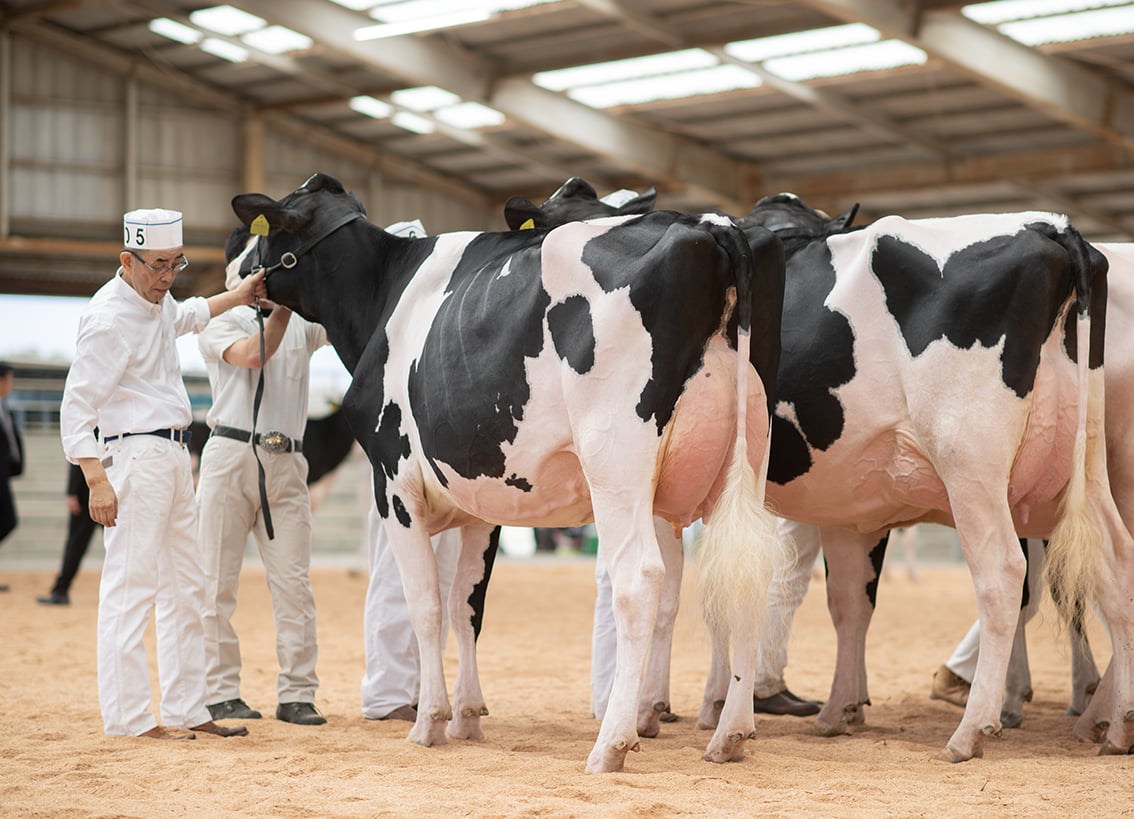
She wasn’t the one who won at All-Japan. She was the one who almost did.
Sakuland Hasit Loewe ET — a Has It All daughter — placed second in her class at the 2025 All-Japan Holstein Show, the event Japan holds once every five years. Impressive, but not the banner. Then she sold for $27,000 USD at the Golden National Sale, shipped south to Kyushu, and landed at Sakuland Holsteins in Miyazaki Prefecture.
At the All-Kyushu Black & White Show, the wait paid off. Loewe entered the 2-Year-Old Junior class, won it, and kept going — all the way to Grand Champion.
The Judge Saw the Complete Package
Standing in the center ring was Jun Hosono of Alta Japan. Kyushu’s warm, humid climate isn’t the environment most people associate with elite Holstein conditioning — but Hosono noted remarkable depth of quality across all age groups, from heifers to mature cows.
Loewe stood apart.
“A clean, well-balanced frame, open rib, and a high, strong rear udder — she is the complete package.”
For anyone paying attention to Japanese Holstein shows, this result wasn’t random. The pedigree practically demanded it.
Seven Generations Back to the Queen
Loewe traces to the same Sakuland Roxy branch that produced one of the most remarkable Holsteins in Japanese history: Sakuland Doorman Rocket ET, scored EX-95-2E — tying Japan’s second-highest classification ever recorded for a female Holstein, behind only L’Espoir ReganStar Hagen EX-96. Owned by Tsuyoshi Yamagishi of Shihoro in the Tokachi region of Hokkaido, Rocket climbed from VG-85 as a two-year-old to EX-95 at six years of age with five calvings behind her. She’s been Grand Champion at the Tokachi Livestock Show and the Hokkaido Holstein National Show multiple times.
Both Rocket and Loewe trace their maternal line back to the same foundation: C Glenridge Citation Roxy EX-97-4E-GMD — born April 15, 1968, on Lorne Loveridge’s farm at Grenfell, Saskatchewan. The pathway runs through Mil-R-Mor Roxette, the branch of the Roxy family that Bob Miller developed after purchasing Roxy in 1973.
Roxy’s career lifetime production totaled 209,784 lbs of milk at 4.5% fat and 9,471 lbs of fat — a third-generation 200,000-lb producer. She was the first cow in the world to have ten daughters classified as Excellent. Sixteen eventually scored EX. She earned the title Queen of the Breed twice, was named Top Cow of the Century and International Cow of the Century, and was part of eight All-American and All-Canadian groups.
The Bullvine’s own research into the Roxy family has documented over 381 descendants achieving Excellent classification — branches producing Grand Champions, high-genomic sires, and elite donors across North America, Europe, and now Asia.
That a Roxy-family heifer just claimed Grand Champion in Kyushu — seven generations deep and half a world away from Saskatchewan — says more about the durability of that maternal line than any genomic printout ever could.
$27,000 Was a Read, not a Gamble
Here’s what’s easy to miss: this wasn’t a long shot. Loewe placed second at the biggest Holstein show in Japan, from one of the most documented cow families in breed history, and moved to a region where she could develop and compete.
In North American show circles, $27,000 USD for this kind of pedigree depth wouldn’t raise an eyebrow. In Japan’s intensely competitive but smaller-scale Holstein show culture, it was a deliberate, conviction-driven purchase — the kind of move that only makes sense if you trust the cow and trust the bloodline.
Six months later, the cow proved the read was right.
From Hokkaido to Kyushu — That Climate Jump Matters
Hokkaido is Japan’s northern dairy heartland: cool climate, large-scale operations, conditions that feel closer to Wisconsin or the Netherlands than to anything subtropical. Kyushu sits at the opposite end of the country. Heat, humidity, and conditions that stress Holsteins hard.
Loewe made the transition and went Grand. The Roxy family has now produced Excellent and Grand Champion females on four continents, across vastly different management systems and climates — from Grenfell, Saskatchewan, in 1968 to Kyushu in 2026.
What This Means for Your Breeding Program
Show banners don’t automatically translate to profit — we’ve said it before. But deep cow families with this kind of documented, multi-generational track record aren’t just show-ring nostalgia. Over 381 EX descendants across multiple countries and management systems is evidence that the genetic floor in this family is genuinely high.
If you’re building a donor program or evaluating embryo purchases, the Roxy family’s record is worth a look. And if someone tells you cow families don’t matter in the genomic era, point them to Kyushu.
Loewe’s All-Japan runner-up finish came at Japan’s once-every-5-years Holstein spectacular, where surprises defined every class.
Key Takeaways
- Loewe placed second at All-Japan, sold for $27,000, and went Grand Champion at All-Kyushu. The pedigree — seven generations back to Roxy EX-97 — told you she would.
- The Roxy legacy is real and still growing. Over 381 documented EX descendants. Sixteen Excellent daughters from one cow. Career lifetime production of 209,784 lbs at 4.5% fat. The family keeps delivering because the genetic floor is that high.
- $27,000 bought a cow family, not a placing. There’s a difference between paying for a show result and paying for seven generations of proven maternal depth.
- Loewe moved from Hokkaido-bred genetics into Kyushu’s subtropical heat and went Grand. Cow families that hold up across environments aren’t just show assets — they’re breeding stock that travels.
Learn More
- Glenridge Citation Roxy: The Legendary “Queen of the Breed” – The full deep dive into the cow behind Loewe’s maternal line. Breaks down Roxy’s 381+ EX descendants, the Mil-R-Mor Roxette branch, and how one Saskatchewan-born cow’s genetics ended up dominating show rings on four continents.
- The Traits That Should Disqualify Bulls — But Often Don’t: How Genomic Selection Changed the Rules and Why Cow Family Validation Still Matters – Loewe’s story argues cow families still matter in the genomic era. This piece delivers the evidence — revealing how operations like McCarty Family Farms use multi-generational transmitting consistency to catch what single-point genomic tests miss.
- The $4,917 Breakeven: When Your ET Holstein Calves Sell for Less Than They Cost to Make – Before you flush your next Roxy-line donor, run the math. This barn-level cost analysis arms you with the real 2026 breakeven on ET show heifers — $4,917 at middle scenario — and shows exactly where working-tier sale averages fall short.
 The Sunday Read Dairy Professionals Don’t Skip.
 The Sunday Read Dairy Professionals Don’t Skip.
Every week, thousands of producers, breeders, and industry insiders open Bullvine Weekly for genetics insights, market shifts, and profit strategies they won’t find anywhere else. One email. Five minutes. Smarter decisions all week.