USDA says robots boost net returns 13% — after seven years of red ink. Here’s the barn math the dealer brochure leaves out.
EXECUTIVE SUMMARY: A 240‑cow Upper Midwest family sat down with a million‑dollar robot proposal and ran the numbers at $18 milk instead of the dealer’s $22 — and watched their milking cost jump from $2.03 to $4.07 per cwt, with a breakeven at $19.45. USDA’s January 2026 ERR‑356 confirms robots boost net returns 13% on average, but Iowa State economist Larry Tranel’s cash‑flow modelling shows seven years of red ink before that payoff starts — and only if maintenance doesn’t blow past $15,000 per box by year five. The deal died at the kitchen table because the family’s debt‑to‑asset ratio couldn’t absorb seven lean years, and their hired‑hand wage of $18–20/hr sat well below the $27.05/hr breakeven where robot labour savings actually pencil out. For herds above 1,000 cows, a 60‑stall rotary runs roughly $1.05/cwt cheaper on total operating cost than a 20‑robot barn — unless you literally can’t staff a parlour at any price. If you’re sitting on a robot quote right now, the full article walks through the barn math by herd size, the lameness and pellet traps that silently kill box throughput, and a 30‑day stress‑test checklist you can run with your lender before you sign anything.
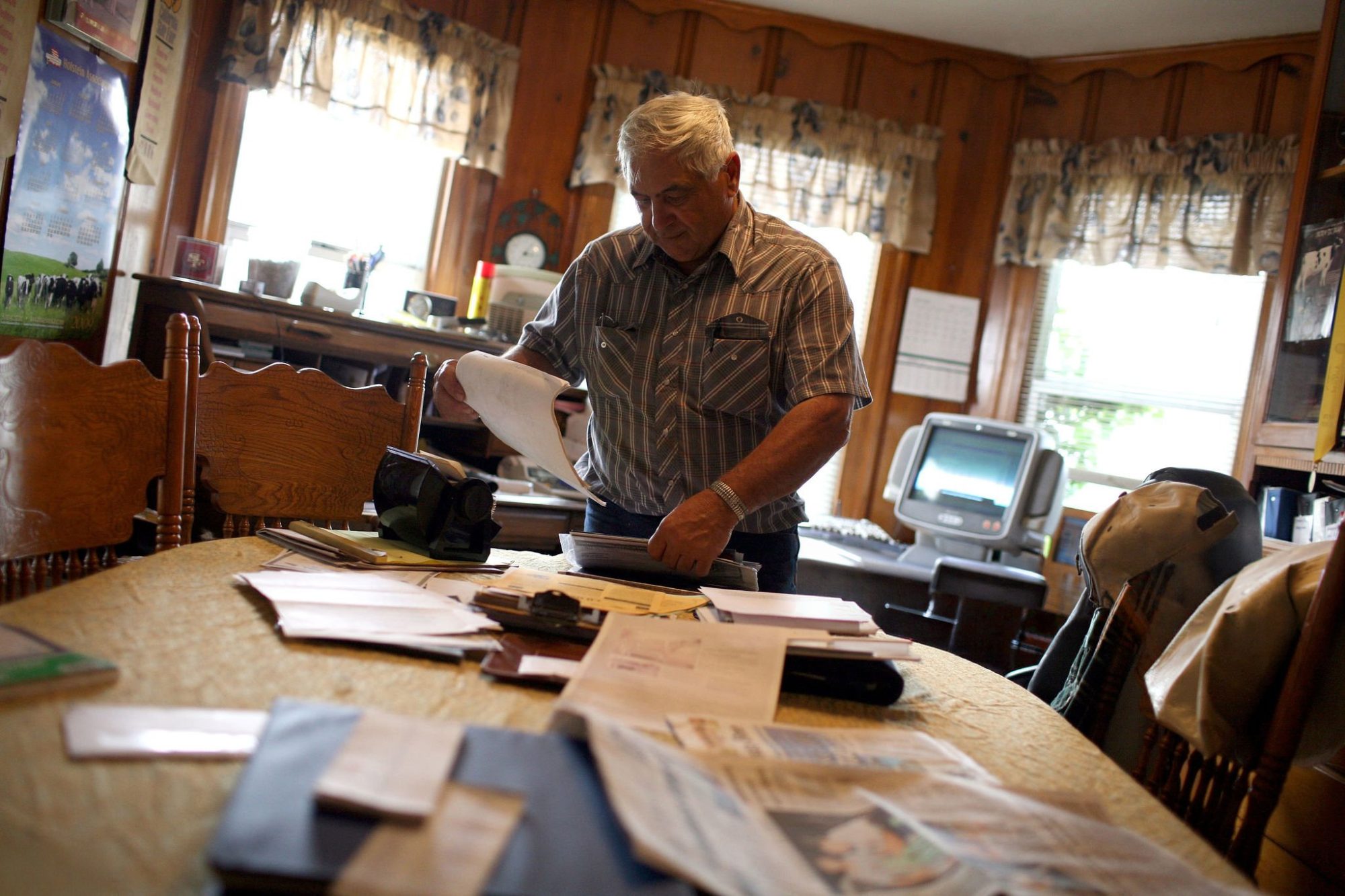
The laminated spreadsheet was still warm from the dealer’s truck when it hit the kitchen table. Four robotic milking units for a 240‑cow Upper Midwest family herd, ,000,000 all‑in, paying for itself in five years. The dealer’s math assumed a steady $22 all‑milk price, a 12% production lift, and a 75% cut to milking labour.
But the family’s mailbox price had already slid toward $18, the lender was circling “debt‑to‑revenue” on the cash‑flow projection, and the oldest son asked the question nobody wanted to say out loud: “Can this place really carry that note if $18 sticks around?”
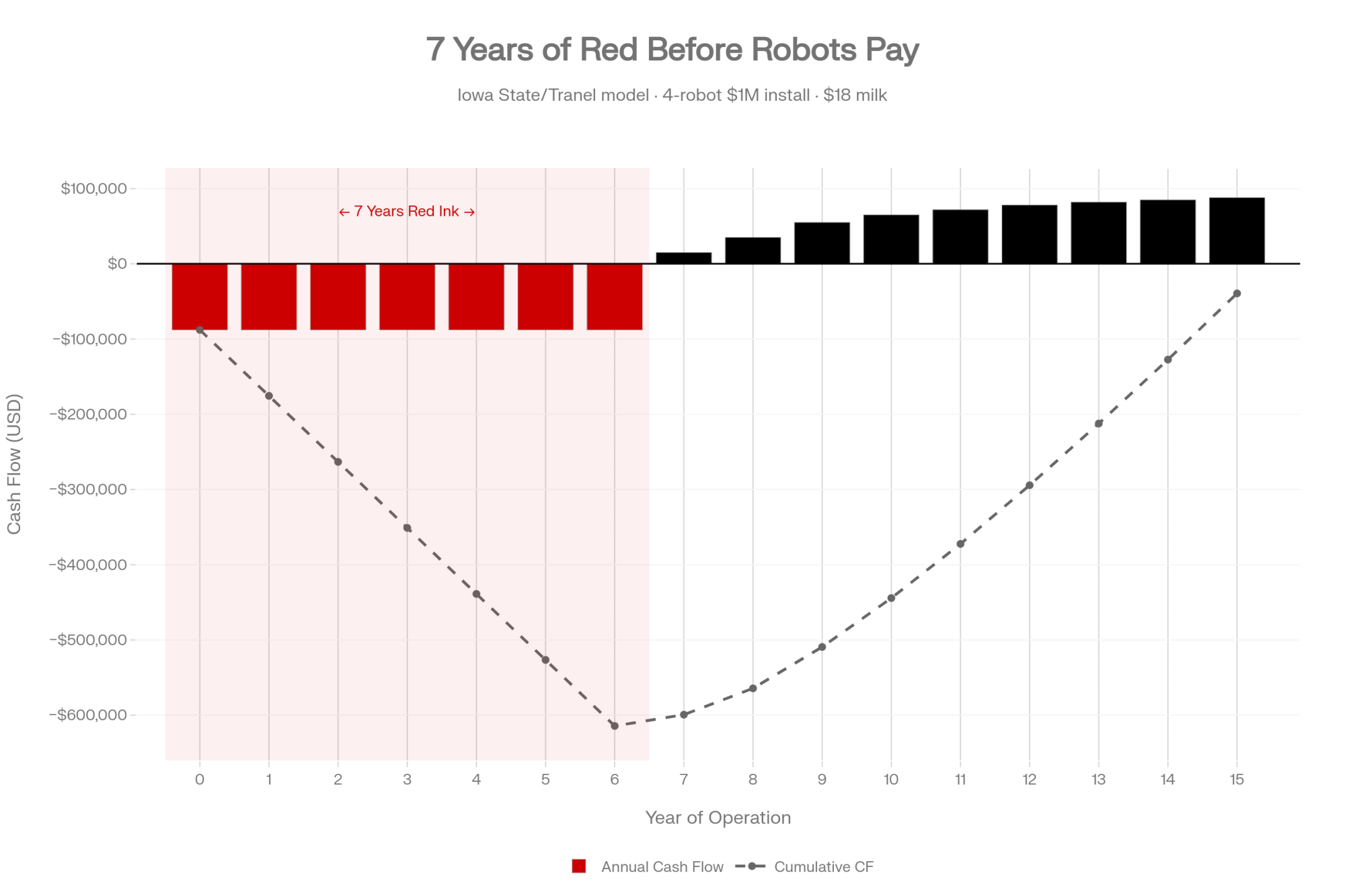
That question sits at the center of robot economics in 2026. A January 2026 USDA Economic Research Service report (ERR‑356) confirmed that automatic milking systems (AMS) boost U.S. dairy net returns by 13% on average — the strongest national evidence yet that robot profitability is real. Iowa State dairy economist Larry Tranel, who’s been running AMS economics since before most dealers had a demo unit, doesn’t disagree. He adds the part that rarely makes it into the sales brochure: “Cash flow of a robot tends to be very negative in the first seven years, then pretty positive for the rest of the life of the AMS, but that is dependent on many variables, especially repair costs across the whole life of the robot.”
Both things are true. The gap between them is where this family’s decision — and your next capital bet — lives.
The Dealer Spreadsheet vs. the Barn Floor
On paper, the pitch looked bulletproof. Four robots at roughly $200,000 apiece plus $200,000 in retrofit and infrastructure — a tidy $1,000,000 for a “future‑proof” barn. In the dealer’s world, that Upper Midwest herd jumps from 6.5 million to over 7.2 million pounds shipped per year, labour drops by three‑quarters, and maintenance stays at a nice round $5,000 per box. The kind of math that makes everybody feel just brave enough to sign.
When the family asked their lender to run the same scenario at $18 milk using extension data instead of brochure numbers, the picture changed fast. The realistic retrofitted lift landed closer to 5% — 6.5 million pounds to 6.825 million. Tranel’s work backs that up: production gains of 3–5% are realistic for herds switching from twice‑daily milking, and much of any larger “robot bump” comes from new facilities — better ventilation, sand‑bedded stalls, cleaner lanes — not the box itself. The labour “savings” looked more like a 35–40% shift into higher‑paid tech hours, not a 75% disappearance.
Then came the line that mattered most at that table: the milking cost going from $2.03 per cwt in their existing 2x parlour to $4.07 per cwt once the robot debt and year‑five maintenance were fully baked in. The banker didn’t give a motivational speech. They just pushed the spreadsheet back and let the numbers talk.
| Metric | Dealer Sales Pitch | Realistic Scenario ($18–20 Milk) | Gap |
|---|---|---|---|
| Milk response lift | 10–12% | 3.5–5.0% (retrofits) | -7 points |
| Labour hours saved | 75% gross reduction | 35–40% net shift to specialised | -35 points |
| Annual maintenance / box | $5,000 flat | $7,000 early → $15,000+ yr 5 | 3× by yr 5 |
| Payback period | 3–5 years | 7–15 years | +2–10 years |
| Breakeven labour wage | Not specified | $27.05/hr (fully loaded) | Dealer ignores entirely |
| Milking cost / cwt | ~$2.03 (implied) | $4.07 at $18 milk | +$2.04/cwt |
| Breakeven milk price | ~$17–18 (implied) | $19.45/cwt | Below current mailbox risk |
| Capital req. vs. alternatives | $1,000,000 AMS | 330 replacement heifers @ $3,000 | Opportunity cost ignored |
Do Robot Barns Actually Pay at $18 Milk?
Once you strip away the laminated brochure math, three realities stare you down.
Production lift usually comes from the barn, not the box. That 10% “robot bump” you see in marketing material is often really a new barn bump — superior air, better stalls, more bunk space. Tranel doesn’t sugarcoat it: “Often, much of the increase reported on AMS is due to the new cow housing facility, not just the AMS, as new facilities often increase production 6 to 8 percent over old, worn-out facilities.” Drop robots into tired housing and the realistic gain is 3–5% from more frequent milkings, and only if box utilisation is dialled in. Already milking 3x in an efficient parlour? His data says you may actually lose ground if box throughput isn’t perfect.
Labour doesn’t vanish — it changes shape. On this farm, twelve hours of parlour shifts turned into 3–4 hours of higher‑stakes work: robot maintenance, fetch cows, fresh‑cow checks, and screen time with AMS software. The hours dropped. The wage didn’t. Keeping competent people on call for 2:00 a.m. alarms meant $28–35 per hour fully loaded, not $18.
Tranel’s partial budget work puts the breakeven labour rate at $27.05 per hour — wage plus benefits, housing, and taxes. Unless you’re paying at least that for milking labour, the robot note can’t be justified on labour savings alone. For an Ontario operator facing a .60 minimum wage or a Wisconsin farmer paying –20 for hired hands, that’s a big gap. At those rates, the robot is a lifestyle choice rather than a pure economic one.
Year five is the mechanical cliff. The first couple of years live under warranty. After that, lasers, liners, boards, and hoses all start aging at the same time. A joint survey by extension educators at UW‑Madison, the University of Minnesota, and Penn State found maintenance climbing from $5,000–7,000 per robot to more than $15,000 per boxfor about a quarter of installations after five years. Among those producers, some “made it clear that adaptation to AMS didn’t go well for them and that they were transitioning back to conventional milking systems or exiting the dairy sector.”
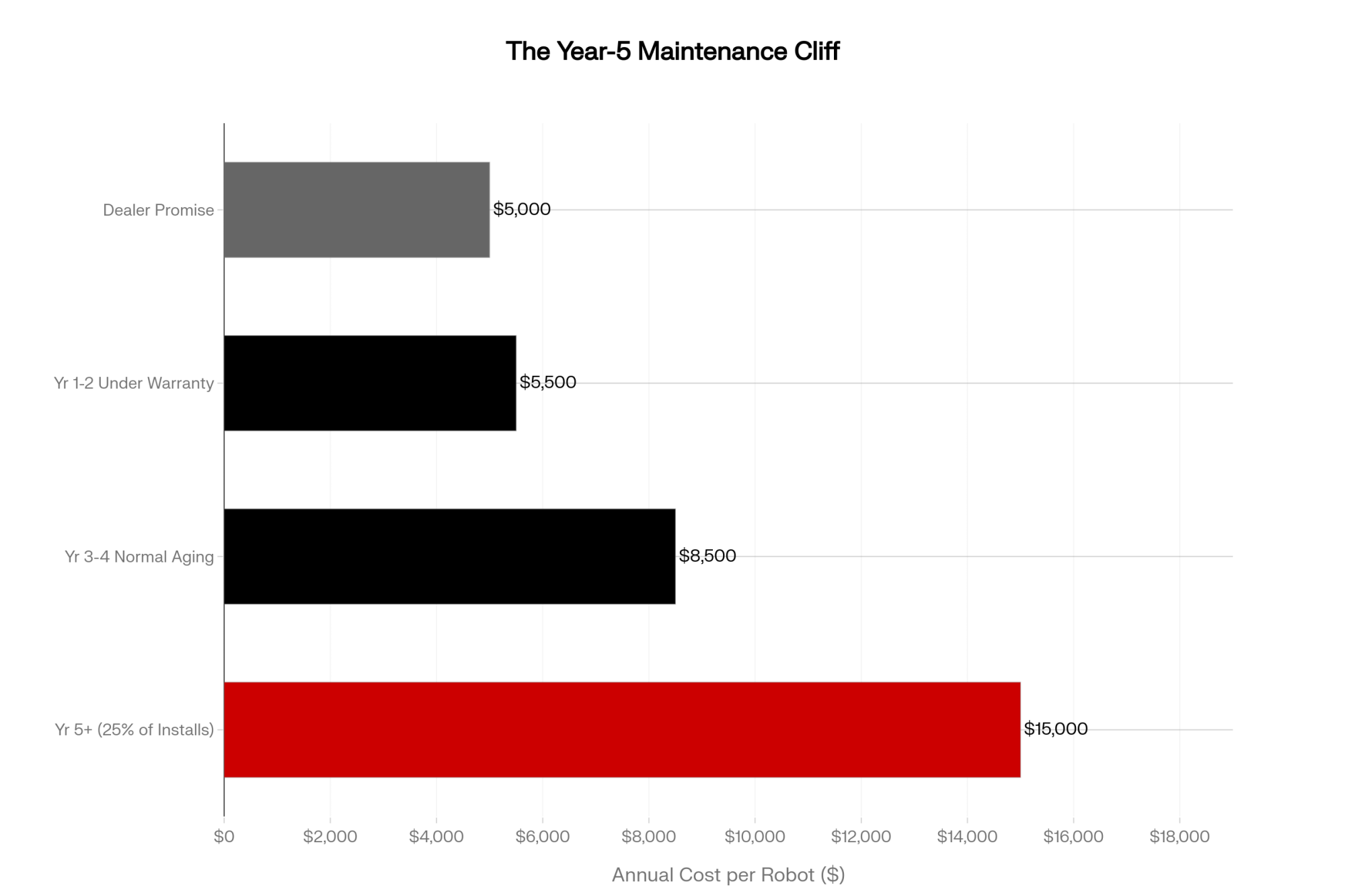
One in four older installs hitting that cost wall isn’t a tail risk. It’s a quartile. For this 260‑cow scenario, that maintenance spike translated into roughly $0.35 per cwt of extra cost on the milk passing through each robot. Scale that across a 300‑cow herd, and you’re suddenly staring at an $80,000‑plus annual hit — basically a robot payment disappearing into the cost column.
Where the Breakeven Actually Sits at $18 Milk
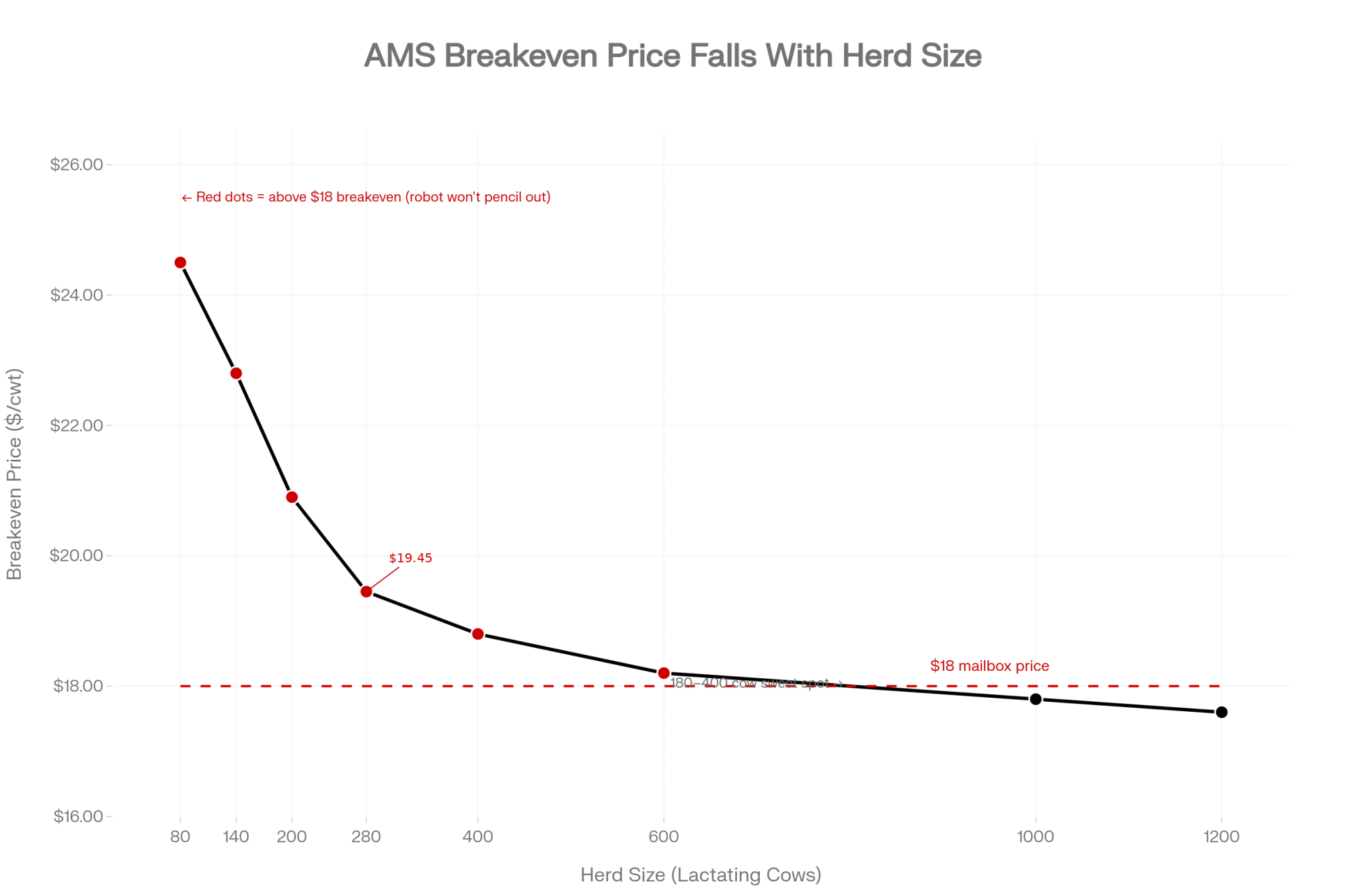
At $22 milk, the extra 325,000 pounds of production in this scenario pencil out at about $71,500, and labour savings of roughly $40,000 help narrow the gap. At $18, that same milk is only $58,500. Debt service alone burns 12.7% of total revenue, and the breakeven milk price for this specific 260‑cow scenario sits at $19.45 per cwt.
Below that number, you’re not “riding out a rough patch.” You’re quietly selling down equity to keep the robots running.
And $18 milk isn’t a one‑off bad year. Bullvine’s analysis of the .6 billion processor migration to Texas and Kansas — and the fact that 76% of Wisconsin’s dairy farms have disappeared since the mid‑2010s — shows it’s part of the structural gravity reshaping where and how milk gets produced across North America.
The opportunity cost of that $1,000,000 told the same story at the family table. In a high‑interest environment, that capital could buy roughly 330 high‑quality replacement heifers at $3,000 each, potentially increasing total milk volume more than the robot lift ever could. Or fund the stalls, ventilation, and cow‑flow fixes that lift everything you already own.
The 180–400 Cow Sweet Spot — and Its Catch
The banker didn’t tell this Upper Midwest family that robots never work. When they pulled more data together, a pattern emerged.
Below about 140 cows, the fixed cost of a robot is spread over too few animals. Even with sharp management, each cow carries too much capital per pound shipped.
For herds in the 180–400 cow range, the math looks very different. Three to four robots allow high box utilisation, meaningful labour displacement, and a system that doesn’t drown in complexity. This is also the window where equity positions are often still strong enough to absorb the ugly early years. Iowa State extension modelling for robot startups predicts roughly seven years of red ink before the system settles into the black — and Tranel’s own partial budget model for a two‑robot install estimates an $8,776 per year cash flow gap in those early years.
To survive that, this lender wanted to see a debt‑to‑asset ratio under about 35% going in. Once the balance sheet climbs north of 50%, the $1,000,000 note stops being “the next step” and starts looking like the handcuff that might block future parlour upgrades, stall renovations, or a successor buy‑in.
Brad Guse, Senior Vice President of Agriculture at BMO Harris Bank, frames the question the way your banker will: “Given the significant capital outlay for robotic dairy equipment, how are you going to repay the debt?” He warns specifically against balloon payments — you’re deferring principal at exactly the point maintenance costs start climbing. And Tranel adds a horizon check most dealers don’t mention: if you’ll be farming another 13–17 years, robots make more sense; if you’re planning only seven, they probably don’t.
At that kitchen table, the conversation shifted from “Are robots good or bad?” to “Does this specific herd actually sit in that sweet spot?” On size and management, they were close. On leverage, they weren’t.
When Does a Rotary Beat 20 Robots?
If growth is the real plan, the next question is whether to go bigger or more expensive. The same modelling compared a 1,000–1,200 cow operation choosing between a 20‑robot barn and a 60‑stall rotary parlour.
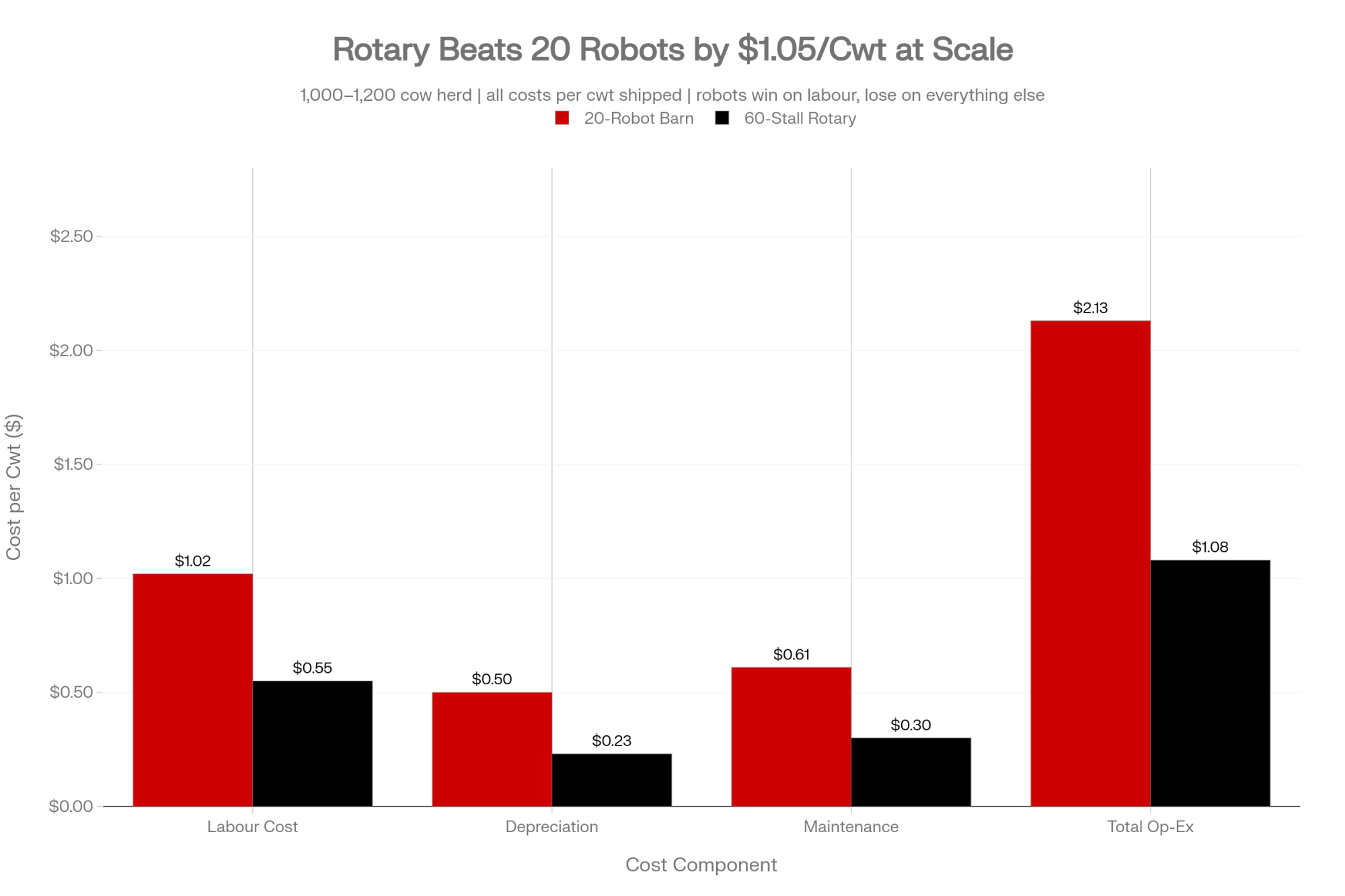
| Metric | 20‑Robot Barn | 60‑Stall Rotary |
| Total capital outlay | $4,500,000 | $2,800,000 |
| Labour hours/cow/year | 18.2 | 26.5 |
| Depreciation per cwt | $0.50 | $0.23 |
| Maintenance per cwt | $0.61 | $0.30 |
| Total op‑ex per cwt | $2.13 | $1.08 |
Robots clearly win on the labour line. But once depreciation and maintenance are added, the rotary comes out roughly $1.05 per cwt cheaper on total operating expense.
At $18 milk, that spread isn’t a rounding error. It’s the whole game.
The only scenario where the 20‑robot barn comes out ahead is the one where more and more large herds are already living in: a labour market so tight that adding another parlour shift isn’t possible at any wage. Large herds that win with robots do so by driving throughput — pushing each box to milk 65–70 cows, despite vendor warnings about behavioural bottlenecks. The breakeven milk price where robots become superior to a well‑run rotary at this scale is often above $23, unless labour availability is essentially non‑existent at any price.
The 15.8% Who Walked Away
The family’s lender had seen enough robot barns to know the modelling wasn’t just theory. Real‑world adoption data backs that up.
Dr. Nicolas Lyons, dairy technology leader at NSW Department of Primary Industries and a key researcher on Australia’s FutureDairy project, tracked that country’s entire AMS adoption history: “Of the 57 farms that commissioned robots since 2001, now there were only 48 operating. We had nine cease — some went back to a conventional dairy, and some left the industry entirely.”
Nine of 57. A 15.8% discontinuation rate — not among tire‑kickers, but among farms that installed robots, ran them, and then walked away. Lyons doesn’t dodge the reasons: “It basically comes down to things like expectations weren’t met; some couldn’t make it work; some didn’t have a good relationship with the equipment provider; and some didn’t achieve what they had hoped.”
And among the U.S. operations that stuck with it? A 2024 study of large AMS farms — herds running seven or more boxes, median around 940 lactating cows — found 54% would recommend AMS, another 38% said do your homework first, and just 8% were neutral or wouldn’t recommend. Perhaps most telling for anyone about to pour concrete: 68% wished they’d planned their barn differently — the one thing you absolutely cannot fix without a jackhammer.
Lameness: The Invisible Capacity Killer
The deeper this family dug, the clearer it became that the real robot game wasn’t about list price and payments. It was about how many cows would quietly wreck the system from the inside.
In a robot barn, the cow has to choose to be milked. Lame cows are about 2.2 times more likely to need fetching, which chews up the very labour you thought you were saving. A cow visiting the robot 2.1 times a day instead of 2.8 isn’t just giving less milk — she’s occupying a slot a sound cow could use. At a 20% lameness rate, the modelling treats the robot barn as functionally underwater at milk — the system can’t hit the throughput it needs to pay its own way.
The fixes aren’t glamorous. They are non‑negotiable:
- Frequent footbaths — 1–2 times weekly in a dedicated lane.
- Professional trimming every ~150 days.
- Layouts that avoid tight 90‑degree turns at robot entry and exit.
- At least 20 feet of clearance in front of the robots for low‑stress cow traffic.
Those are exactly the details that get shaved off in cheap retrofits, and they show up later as a steady flow of white‑line lesions and lost box capacity.
Tranel puts an even finer point on it: milk per AMS unit is “very highly correlated” to AMS profitability — more so than milk per cow. One 2019 extension survey showed milk per visit ranging from 21.4 to 39 lb, and that spread is where all the money lives. The gap isn’t about the brand of robot. It’s cow flow, stall comfort, feed management, and lameness protocols.
The Pellet Tax and the $50,000 You Forgot to Budget.
At $18 milk, the cost of 4–8 pounds of high‑energy robot pellet per cow per day becomes a serious lever. In this family’s modelling, their nutritionist’s quiet “pellet creep” — bumping pellet quality to fix visit problems caused by poor stalls or inconsistent feed push‑up — added $0.15–0.20 per cow per day. Across a full year and full herd, that leaked tens of thousands straight out of the margin.
What surprised them was how aggressively some farms have gone the other way. Heeg Brothers Dairy near Colby, Wisconsin, milks roughly 450 cows in a robot barn that’s run completely pellet‑free since day one, using a guided‑flow design. They’re shipping about 98 lb per cow per day in the robot herd versus around 94 lb in their parlour herd, with butterfat running near 4.5%. As The Bullvine’s pellet‑free analysis breaks down, guided‑flow barns like Heeg’s can often save tens of thousands per year while improving components, and a 2024 Michigan State trial found that free‑flow barns needed about 3.2 times more pellets to maintain visits.
Then there’s the infrastructure nobody wants to talk about. A $200,000 robot plugged into a $20 internet router is a $220,000 mistake. Roughly 62% of robot difficulties trace back to bad power or bad connectivity, not finicky cows or fussy software.
Smooth AMS life requires at least 600 amps of dedicated power, solid surge protection, and internet latency under 50 milliseconds, so alerts hit your phone in real time. Positive‑pressure ventilation in the robot room keeps corrosive barn air off circuit boards. On a barn that went up before smartphones were a thing, that adds about $50,000 to make the place robot‑ready.
The 2:00 a.m. Phone Problem
The shift from a defined 4:00 a.m.–noon parlour crew to a 24/7 “robot manager” changes more than the clock. A 2014 survey of 228 Finnish AMS farmers — published in 2016 by Karttunen, Rautiainen, and Lunner‑Kolstrup in Frontiers in Public Health — found 71.5% reported mental stress from nightly AMS alarms and 51.7% experienced stress from the 24/7 standby. Overall, 93.4% mentioned at least one AMS‑related issue causing mental strain.
Christina Lunner Kolstrup of the Swedish University of Agricultural Sciences, a co‑author on that study, put it bluntly: “Previously, with conventional milking, the working day had a clear and natural ‘start’ and ‘end’, but with the AMS, there are no specific working hours.”
Alarm management tech has improved since 2014. The underlying reality hasn’t changed — a robot never clocks out. One Wisconsin producer in the UW–UMN–Penn State extension survey nailed it: “AMS is not stress-free. Physically, it is easier. Mentally stressful.”
At that Upper Midwest kitchen table, this became a hard, personal question. Nobody in the next generation really wanted to be the person whose phone never shuts up. If you can’t staff a management team that genuinely likes living inside data and alerts, staying with a well‑run parlour and investing in people and protocols is the better economic move. [INTERNAL LINK: $234,000 Gone: The Gap Between Dairy Tech Promises and Farm-Gate Reality — Tier 2 tech ROI piece]
What This Means for Your Operation
| Farm Factor | 🔴 Don’t Sign (High Risk) | 🟡 Borderline — Do the Math | ⚫ Green Light (Best Case) |
|---|---|---|---|
| Herd size | < 140 cows | 140–179 cows | 180–400 cows |
| Debt-to-asset ratio | > 50% | 36–49% | < 35% |
| Current labour wage | $17–20/hr | $22–26/hr | $27+/hr (or can’t staff) |
| Farming horizon | < 7 years remaining | 7–12 years | 13+ years |
| Current lameness rate | > 20% | 12–19% | < 10% |
| Milking system | Efficient 3x parlour | Standard 2x | Struggling to staff any shifts |
| Electrical/internet | < 400 amp, poor internet | 400–599 amp, adequate | 600–800 amp, sub-50ms latency |
| Likely breakeven milk price | > $21/cwt | $19.50–21.00/cwt | $18.00–19.45/cwt |
For a 200–400 cow family herd sitting on a robot quote right now, this isn’t about robots being “good” or “bad.” It’s about whether they genuinely work for your numbers and your people. In the next 30 days, before you sign anything:
- Stress test your current parlour at $18 milk with your lender. If your operation can’t survive 12 months at $18 on your existing system, a $1,000,000 robot note doesn’t fix the math — it magnifies it. Have your banker show you what your breakeven price does if milking cost jumps from $2.03 to $4.07 per cwt.
- Check your debt‑to‑asset ratio before you fall in love with the idea. At or above 50%, think very hard before tying up another million in steel. Tranel’s modelling and Iowa State extension data both assume you’ll need room for seven lean years of red ink before the cash flow turns.
- Audit your labour reality against the $27.05/hr breakeven. Well below that number and still able to staff your parlour? Robots become a lifestyle choice, not an ROI play. Consistently above it and still struggling to fill shifts? Robots might be a legitimate labour hedge — but only if you can also hit box‑throughput and fetch‑rate targets.
- Measure your box potential honestly, not aspirationally. Could you realistically push each robot toward 5,500 lb per day and keep the fetch rate under 10% with your current genetics, stall design, and hoof‑care program? Tranel’s data shows milk per visit ranging from 21.4 to 39 lb — that spread is where all the money lives.
- Price the hybrid path instead of jumping from parlour to full AMS. Activity monitors, automated sort gates, and a feed pusher can deliver roughly 60% of the labour savings at about 10% of the capital cost.
- Audit the electrical and internet infrastructure now, not after the quote. No 600–800 amp service and high‑speed connectivity? Add $50,000 to the dealer’s quote before you compare their “payback period” to anything.
- Look at your lameness report before you look at robot brochures. If your lame‑cow rate is flirting with 20%, you’re setting yourself up to spend robot dollars on fetch cows instead of margin. Fix stalls and hoof health before you pour the robot room concrete.
For 1,000+ cow herds, you’re choosing between management models, not between buckets and boxes. A well‑run rotary parlour running roughly $1.05/cwt cheaper is usually a smarter place to park capital in an $18 milk world — unless labour is your absolute binding constraint and your team genuinely wants to live inside AMS reports.
For herds already running robots: if your fetch rate sits above 10% and box throughput below 4,500 lb per day, stop blaming the machines. Look at stalls, hoof health, cow flow, and pellet creep. And pull your genetic index — shift selection toward milking speed and teat placement. A slow‑milking cow isn’t just annoying; she’s a capital‑inefficient cow that drags down ROI on every dollar you’ve put into the system.
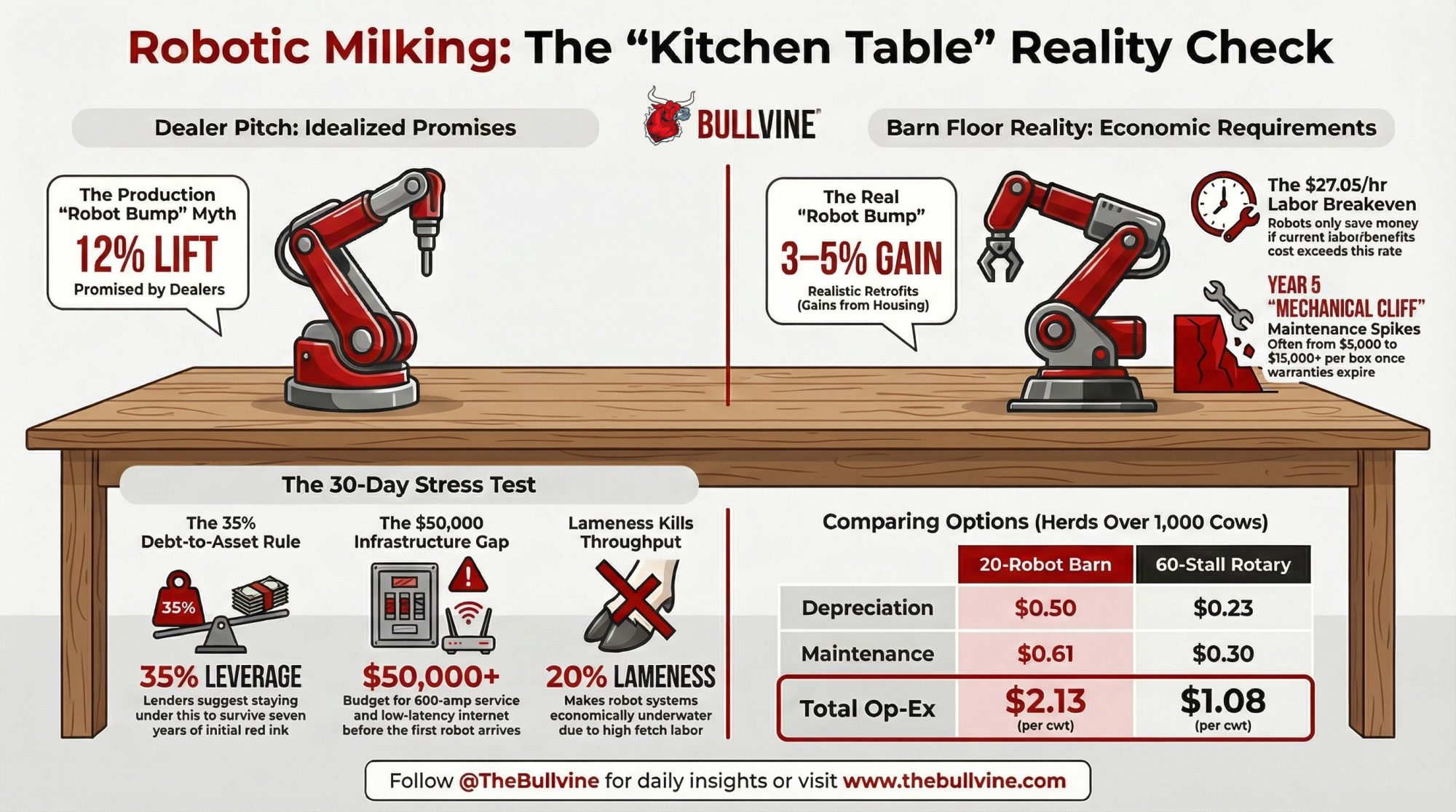
Key Takeaways
- If your robot ROI depends on a 10–12% milk lift and a 75% labour cut, you’re working off dealer fiction, not barn math. Plan around 3–5% lifts in retrofits and 35–43% net labour savings if you want your numbers to survive real life.
- If your lameness rate is at or above 20%, a robot barn will quietly bleed you at $18 milk. Fix hoof health, cow flow, and stall design before you let anyone cut a hole in your wall for a robot.
- If your barn can’t support 600–800 amps of clean power and low‑latency internet, add at least $50,000 to the robot quote — or accept that you’re wiring a Ferrari to a garden hose.
- If you sit in the 180–400 cow range with debt‑to‑asset under 35%, robots can work — but you need to budget for $15,000 per robot in maintenance by year five and be honest about whether you have 13–17 years of farming left to harvest the 13% net‑return upside Tranel and USDA are seeing.
The Bottom Line
Robots aren’t the villain in this story. They’re amplifiers. On the right farm — with the right labour pressure, equity position, cow flow, and hoof health — they’re a powerful tool that can deliver that 13% net return over the long haul. On the wrong farm, they quietly turn one tough $18 year into a structural problem you can’t grow your way out of.
That Upper Midwest family walked away from the four‑robot proposal and put their first million into stalls, ventilation, and hybrid tech instead. No ribbon. No show‑ring photo. But ten years from now, that decision might be the reason their grandkids still have a barn to argue about.
When you look at your own numbers — and you should look this month, not next quarter — are you buying into seven years of hard math with a genuine payoff on the other side, or financing a dealer’s best‑case scenario with your family’s equity?
Complete references and supporting documentation are available upon request by contacting the editorial team at editor@thebullvine.com.
Learn More
- $234,000 Gone: The Gap Between Dairy Tech Promises and Farm-Gate Reality – Reveals why research-grade gains often vanish before reaching your checkbook and arms you with an 8-point framework to stress-test any major investment. Identify the maverick strategies needed to verify performance and protect your equity.
- More Milk, Fewer Farms, $250K at Risk: The 2026 Numbers Every Dairy Needs to Run – Exposes the brutal “margin gap” facing 500-cow dairies and delivers a tactical roadmap for navigating the 2026 price reset. Position your operation to survive the expansion squeeze and capitalize on shifting component values.
- Tech Reality Check: The Farm Technologies That Delivered ROI in 2024 (And Those That Failed) – Stop gambling on vendor promises and arm yourself with the hard data from our 2024 ROI audit. This breakdown exposes which technologies actually move the needle and delivers the implementation strategies needed to protect your margins.
 The Sunday Read Dairy Professionals Don’t Skip.
 The Sunday Read Dairy Professionals Don’t Skip.
Every week, thousands of producers, breeders, and industry insiders open Bullvine Weekly for genetics insights, market shifts, and profit strategies they won’t find anywhere else. One email. Five minutes. Smarter decisions all week.