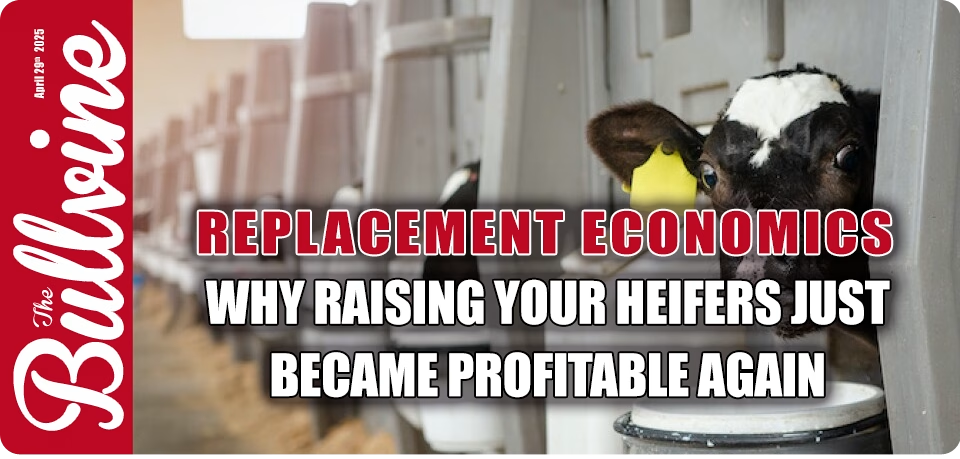





Heifer prices hit record highs! Discover why raising your own replacements is now 54% cheaper than buying.
The North American dairy industry is witnessing a dramatic shift in replacement heifer economics. With market prices at historic highs and inventory at a 47-year low, the traditional “buy versus raise” equation has fundamentally changed. This comprehensive analysis reveals why 2025 has become the pivotal year when raising your replacements has regained its economic advantage for forward-thinking producers.
The Perfect Storm: Record Prices Meet Vanishing Supply
The current replacement heifer market is experiencing unprecedented pressure from multiple directions. Recent auction data from Ontario reveals the staggering reality: replacement heifers weighing over 900 pounds are commanding between $326.50 and $328.00 per hundredweight (cwt), averaging $326.92. Lighter replacement heifers in the 800-899 pound category fetch even higher prices, ranging from $372.00 to $383.00/cwt, while those in the 700-799 pound range are selling for $356.07 to $407.11/cwt, with peaks reaching $412.00.
These aren’t just numbers—they represent a financial barrier reshaping dairy farm economics. A single 900-pound replacement heifer costs approximately $2,942, making the purchase option increasingly prohibitive for many operations.
37,000 Heifers Vanished: Why Your Replacement Pipeline Is Drying Up
This price surge stems directly from a dramatic contraction in heifer availability. As of January 1, 2025, dairy heifers expected to calve totaled just 2.5 million head, down 0.4% from the previous year and representing the lowest level since USDA began tracking this metric. The broader category of dairy heifers weighing 500 pounds or more totaled merely 3.914 million head—a decline of 0.9% year-over-year and the smallest inventory since 1978.
What’s particularly alarming is that these official figures understate the actual severity of the shortage. USDA has made significant downward revisions to previous years’ inventory numbers. Between January 2023 and January 2024, the agency revised dairy replacement numbers by a staggering 371,600 head—an 8.6% reduction that wasn’t initially reported.
“We’re seeing the beef-semen-on-dairy-cow trend taking hold like shoppers looking to grab deals on a Black Friday shopping spree,” notes James Wilson, a dairy market analyst with AgriTrends. “With beef cattle numbers in retreat nationwide, this trend shows no signs of slowing.”
Unlock Hidden Profits: The True Economics of Home-Raised Replacements
While market prices for purchased heifers have skyrocketed, the cost structure for raising heifers on-farm offers a compelling alternative for producers who can manage their expenses effectively.
According to data from the Canadian Cow-calf Cost of Production Network, the average cost of raising a replacement heifer in 2023 was estimated at $2,904. This comprehensive figure includes opportunity costs, feed, labor, housing, and health management expenses.
“When we adjusted for a 10% open rate, the cost for each bred heifer was $2,382, assuming bred heifers will bear the cost of developing the opens,” explains Dr. Sarah Johnson, extension specialist at the University of Guelph. “That’s a significant savings compared to current purchase prices.”
The most significant component—approximately 60%—is attributed to the opportunity cost of not selling the heifer calf at weaning. Other significant expenses include labor (9%), feed (6%), machinery (6%), land (5%), and various smaller cost categories such as veterinary medicine, fuel, and building maintenance.
Labor Efficiency: The Make-or-Break Factor in Heifer Economics
Labor represents a critical component in the raise-versus-buy equation. Research from the Canadian Cow-calf Cost of Production Network reveals that labor intensity averages 15 hours per cow but varies dramatically based on operation size and management practices.
“The most profitable operations demonstrate significantly greater labor efficiency,” says Michael Thompson, who manages a 300-cow dairy in eastern Ontario. “We’ve cut labor costs by 40% by implementing automated feeding systems and strategic grouping. It’s made raising our replacements financially viable again.”
High-profit farms average 8.8 hours per cow compared to 23.9 hours in low-profit operations. This efficiency translates directly to the bottom line, with labor costs averaging $327 per cow and accounting for 18% of total production costs.
Genomics: The Game-Changer That Purchased Heifers Can’t Match
The most compelling reason to raise your replacements in 2025 isn’t just about avoiding high purchase prices—it’s about capturing the unprecedented value of genetic selection that purchased animals simply can’t match.
“Genomics cut our heifer losses by 40%—it’s not just for mega-dairies,” reports David Williams, who operates a 120-cow dairy near Woodstock, Ontario. “We’re seeing conception rates above 65% in our genomically-selected heifers compared to 52% in our conventionally-selected animals.”
Modern genomic testing has revolutionized replacement selection. The Replacement Heifer Profit Index (RHPI) places 80% emphasis on hybrid vigor score and 20% on seven traits associated with efficiency, growth, fertility, and longevity.
The results are remarkable: heifers with above-average RHPI scores demonstrated significantly lower open rates (13.7%) than below-average heifers (23.4%). This 9.7 percentage point difference resulted in nine more calves per 100 replacement heifers—a productivity improvement that no AI company can match regarding ROI.
Genomic Selection ROI Comparison
| RHPI Score Tier | Conception Rate | Avg Lactations | Lifetime Revenue Premium |
| Top 25% | 86.3% | 4.7 | +$2,810 |
| Bottom 25% | 76.6% | 3.1 | Baseline |
3 Questions Every Dairy Breeder Should Ask Before Buying Heifers
- What’s the true genetic potential? Purchased heifers often represent someone else’s genetic culls, while raising your own lets you implement your specific genetic strategy.
- What’s your labor efficiency? If you’re averaging more than 15 hours per cow annually, focus on improving labor efficiency before committing to raising replacements.
- What’s your feed cost advantage? Operations with homegrown forage typically save 30-40% on feed costs compared to purchased feed operations.
Critical Benchmarks That Determine Your Heifer Program’s Success
Producers should track several key benchmarks that provide insights into both short-term costs and long-term returns to evaluate the financial sustainability of an on-farm heifer-raising program.
The payback period—the years required for a replacement heifer to recover her development costs—is a critical benchmark for financial sustainability. Analysis of Canadian benchmark farms revealed that depending on the total cost of raising a replacement heifer, the payback period ranged from 5 years for low-cost operations to 7 years for medium-cost operations.
“We’ve found that operations with lower development costs not only achieve shorter payback periods but also maintain greater flexibility to adapt to changing market conditions,” explains Dr. Robert Chen, agricultural economist at the University of Manitoba. “The most successful operations maintain replacement costs under $2,400 per heifer.”
From a whole-herd perspective, the total cost of replacements distributed across the entire cow herd provides a valuable benchmark for comparing different operations. Canadian research indicates that the average replacement cost per cow was approximately $139 in 2023, ranging from $50 to $272 per cow, depending on the replacement rate and the cost of developing each heifer.
Cost Breakdown for Raising Dairy Heifers (2025 Projections)
| Cost Component | % of Total | $/Heifer | Key Drivers |
| Opportunity Cost | 60% | 1,742 | Record calf prices |
| Labor | 9% | 261 | $23.50/hr avg wage |
| Feed | 6% | 174 | Lower 2025 grain costs |
| Veterinary | 4% | 116 | Vaccine price increases |
Why Mega-Dairies Are Hoarding Heifers (And What It Means For You)
The current heifer shortage isn’t just a market anomaly—it’s a strategic play by the industry’s largest operations. As milk production becomes increasingly concentrated among fewer, larger dairies, these operations have recognized the strategic advantage of controlling their replacement pipeline.
“The top 5% of producers are securing their genetic future while smaller operations struggle to maintain herd size,” warns industry consultant Jennifer Martinez. “They’re creating a genetic firewall that will widen the productivity gap over the next decade.”
With milk margins expected to remain above historical levels at $13.37/cwt in 2025, these mega-dairies are positioning themselves for expansion while smaller operations struggle to maintain herd size. The result is a self-reinforcing cycle: larger operations secure their replacement needs, driving prices higher for everyone else and further challenging smaller producers.
Health Management: Turning Science Into Survival
Implementing comprehensive health management protocols is essential for minimizing losses in replacement heifers and maximizing the return on investment in an on-farm raising program.
A well-structured vaccination program protects against common bovine diseases affecting heifer development and future productivity. Key vaccines include those for infectious bovine rhinotracheitis (IBR), bovine viral diarrhea (BVD), bovine respiratory syncytial virus (BRSV), parainfluenza-3 (PI3), and clostridial diseases.
Optimal vaccination timing generally includes initial immunization at about 4 months of age, with boosters administered 4-5 weeks before weaning, at pre-breeding (13-16 months), and 40-60 days before calving. This comprehensive approach helps ensure that heifers develop strong immunity to key pathogens at critical stages of development.
While feed prices dip in 2025, labor costs now eat 15% of heifer budgets—making robotic feeders and automated health monitoring systems increasingly essential rather than optional for competitive operations.
Long-Term Planning: Securing Your Herd’s Future Against Rising Costs
The ideal replacement rate varies depending on herd goals, but research indicates that most efficient operations maintain replacement rates between 10% and 14% annually. Data from Canadian benchmark farms showed that low-cost operations averaged a 10.4% replacement rate, medium-cost operations averaged 12.5%, and high-cost operations averaged 13.7%.
Modern reproductive technologies can help producers optimize their replacement strategies. Using sexed semen for genetically superior animals can increase the number of potential replacement heifers from the best cows in the herd. Conversely, using beef semen on lower genetic merit cows can reduce the number of dairy heifer calves while producing valuable beef-cross calves that generally command higher prices in the market.
This strategic approach to breeding allows producers to precisely manage their replacement pipeline while maximizing the value of all calves produced, whether destined to become herd replacements or marketed for other purposes.
The Bottom Line: 2025’s Replacement Reality
The current market dynamics, characterized by record-high heifer prices and reduced inventories, have created a favorable economic environment for raising replacement heifers on many operations. While purchasing replacements remain viable for some producers, particularly those facing resource constraints or seeking rapid genetic change, the financial advantages of raising replacements have become increasingly compelling in 2025.
Several factors contribute to this shift in the economic equation. The substantial gap between market prices for purchased heifers and the cost of raising replacements on efficient operations provides a direct financial incentive for on-farm development. The ability to implement targeted genetic selection programs enhances this advantage by improving the productivity and longevity of home-raised animals.
That “bargain” $3,000 heifer? She’ll need to birth 24 calves just to break even compared to the genetically superior animal you could raise yourself. The real question isn’t whether you can afford to raise replacements—it’s whether you can afford not to when your competitors are already breeding tomorrow’s profit engines today.
Key Takeaways:
- 54% Savings: Raising replacements beats buying at 2025’s record prices (700-799 lb heifers: $388.81/cwt).
- Genomic ROI: Top 25% RHPI-scored heifers deliver +$2,810 lifetime revenue via 86.3% conception rates.
- Automation Wins: Robotic feeders cut labor costs by 40%, saving $261/heifer annually.
- Ideal Rates: Maintain 10-14% replacement rates for herd sustainability.
- Toolkit: Use the BCRC Calculator to model break-even points and genetic ROI.
Executive Summary:
In 2025, soaring heifer prices and shrinking supply have flipped the economics of herd replacements. Raising heifers on-farm now offers up to 54% cost savings over purchasing, driven by genomic tools that slash infertility rates by 41% and labor strategies saving $261/heifer. The article provides a roadmap for dairy producers, including critical benchmarks (10-14% replacement rates), real-world case studies, and the BCRC Replacement Heifer Calculator to optimize decisions. With mega-dairies strategically hoarding replacements, smaller operations must leverage these insights to remain competitive.
Learn more:
- The $1,200 Heifer Paradox: Why Your Healthiest Cows May Produce Your Worst Replacements
Explore smarter replacement heifer strategies using genomic tools, heat stress insights, and ROI-focused methods to boost herd genetics and profits. - Should You Raise Replacement Heifers Yourself?
A deep dive into the pros and cons of on-farm rearing versus custom heifer rearing services, including cost management, genetic selection, and biosecurity considerations. - Replacement Heifer Prices Reach Record Territory
Analyze the impact of record-high replacement prices and strategies like beef-on-dairy breeding, extending cow longevity, and precision breeding to adapt to the crisis.
 Join the Revolution!
 Join the Revolution!
Join over 30,000 successful dairy professionals who rely on Bullvine Daily for their competitive edge. Delivered directly to your inbox each week, our exclusive industry insights help you make smarter decisions while saving precious hours every week. Never miss critical updates on milk production trends, breakthrough technologies, and profit-boosting strategies that top producers are already implementing. Subscribe now to transform your dairy operation’s efficiency and profitability—your future success is just one click away.