



Archive for herd expansion economics

Pipestone Springers Hit US$3,700. IDFA’s US$15 Billion Isn’t a Milk Contract

Processors have tallied more than US$15 billion in new capacity. None of it tells you how many heifers to buy until your buyer puts the extra pounds and the first receiving date in writing.

Even at US$3,000 a head, below what top springers brought at Pipestone in August, a 100-head heifer order ties up US$300,000 in cattle alone. That money goes out before the buyer has said how much extra milk it will take or when the first load ships.

At the Aug. 20 dairy sale in Pipestone, Minnesota, the latest results the market has posted, the top 200 springing heifers sold for US$3,700 to US$4,175 a head. Jerseys and crossbreds at the same sale brought US$2,000 to US$3,000. The sale is a reference point. The budget number is a delivered quote for the cattle the farm actually needs. 

The International Dairy Foods Association, the processors’ trade group, tallied more than US$15 billion across more than 85 projects in 23 states in October. The projects are planned or underway through 2030 and include new plants, expansions, added lines and modernization. Milk and cream carry the largest category share at $5.63 billion. 

New York tops IDFA’s state list at $2.8 billion. Two of its plants show how far a capacity announcement gets a supplying farm, and where the buyer still owes it an answer.

Rome and Webster Add Up to 17 Million Pounds a Day. Neither Discloses Open Volume

Chobani’s planned Rome plant carries a US$1.2 billion investment and, according to New York’s April 2025 announcement, would process more than 12 million pounds of milk a day at full capacity. The announcement attached no date to reaching that intake. 

Fairlife’s US$650 million Webster plant was in its initial production ramp-up in August, with projected intake starting at 5 million pounds a day, according to the state’s update. Fairlife said it was already sourcing milk daily from more than 40 local farms and expected full operations later in 2026. Its update gave no daily poundage and no volume still open to suppliers. 

Taken together, the two announcements come to a conservative 17 million pounds a day: 12 million at Chobani’s full capacity and 5 million at the low end of fairlife’s projection. How many of those pounds a given buyer still has to fill is a separate number, and neither announcement gives it.

A farm planning to ship more milk needs three figures from its buyer for that month: the pounds it expects to take, the pounds already lined up, and the pounds it will commit to the farm. The first receiving date belongs in writing before the next group is bred to freshen.

A 1 Million-Pound Plant Can Need 3,125 Cow Equivalents or 12,500

Take a hypothetical plant that still needs 1 million pounds of milk a day, at 80 pounds per total herd cow with dry cows included. That yield is our assumption, not a USDA average. The cow count then turns on one input: the share of that milk that has to come from additional cows rather than redirected milk or higher output per cow.

Bullvine scenarioShare requiring additional cowsMilk supplied by additional cowsCow equivalents at 80 lb/day
Low additional-cow case25%250,000 lb/day3,125
50% additional-cow case50%500,000 lb/day6,250
High additional-cow case100%1,000,000 lb/day12,500

The formula for a buyer’s supply area is the remaining daily milk requirement × the share supplied by additional cows ÷ the assumed daily yield per total herd cow. The three shares above are illustrative. A single farm’s order starts from the extra pounds its own buyer will take. The Bullvine Pipeline Index Calculator shows how much of that gap a herd’s own replacement pipeline can cover.

The same million pounds produces a fourfold spread between the low and high cases. Yield moves it too: at 70 pounds per total herd cow instead of 80, the high case climbs from 12,500 to about 14,290 cow equivalents. A plan that assumes every pound needs a new cow has picked the high case before any supply work is done.

Even 12,500 cow equivalents aren’t 12,500 heifers to buy. A replacement plan still has to net out cows retained or acquired, herd exits, expected freshenings and the date the milk is due.

July’s USDA Count Works Out to 37 Replacement Heifers per 100 Cows

On July 1, USDA counted 3.6 million heifers of at least 500 pounds for milk cow replacement, up from 3.5 million a year earlier, along with 9.65 million milk cows. Calves under 500 pounds sit in a separate category. That works out to about 37 replacement heifers per 100 milk cows (our math), before any are assigned to expansion. 

A plant’s full-capacity figure and a July inventory measure different things. Matching them means lining up the year the milk is received with the animals due to freshen that year, after the replacements the existing herd needs just to hold steady.

CoBank’s June model projects a combined rebound of about 360,000 in dairy replacements entering herds in 2027 and 2028, after a projected combined decline of about 796,000 in 2025 and 2026. The rebound equals about 45% of the decline. CoBank built the projection on sexed dairy semen sales and national assumptions for conception, pregnancy loss, births and completion rates, and those assumptions vary by region. 

At 45%, the rebuild is too small to count on cheap replacements and too large to ignore. A five-year expansion plan that holds today’s replacement squeeze constant is testing only one of the two cases. 
Five Checks Before a 2027–28 Heifer Order

For a U.S. herd weighing expansion in 2027 or 2028, these checks run against the buyer’s actual terms before capital goes out. A buyer that won’t commit extra pounds or a receiving date ends the list at the first check.

  1. Before ordering heifers: written confirmation of the accepted volume, the first receiving date and the contracting party.
  2. Before matching freshenings to a ramp: price the calendar. At the same Aug. 20 Pipestone sale, short-bred heifers 1–3 months along brought US$2,800 a head, about US$900 under the low end of the top 200 springers. The cheaper animal freshens later, so the purchase has to fit the receiving date, not the price. The budget also needs another milk outlet and the cost of carrying animals through a delay. The plant doesn’t absorb that risk unless the contract says it does.
  3. Before counting on the milk check: proceeds after hauling, marketing deductions, required retains and any volume-related deductions in the actual offer, set against the farm’s extra production, financing and capital costs.
  4. Before using a replacement forecast: expected freshenings matched to planned exits and the contracted milk requirement, month by month. CoBank expects stronger replacement demand in New York, Texas, Wisconsin, Michigan, Idaho and parts of the I-29 corridor, so the budget runs on delivered quotes for the class of cattle needed, tested against quotes that rise before purchase. 
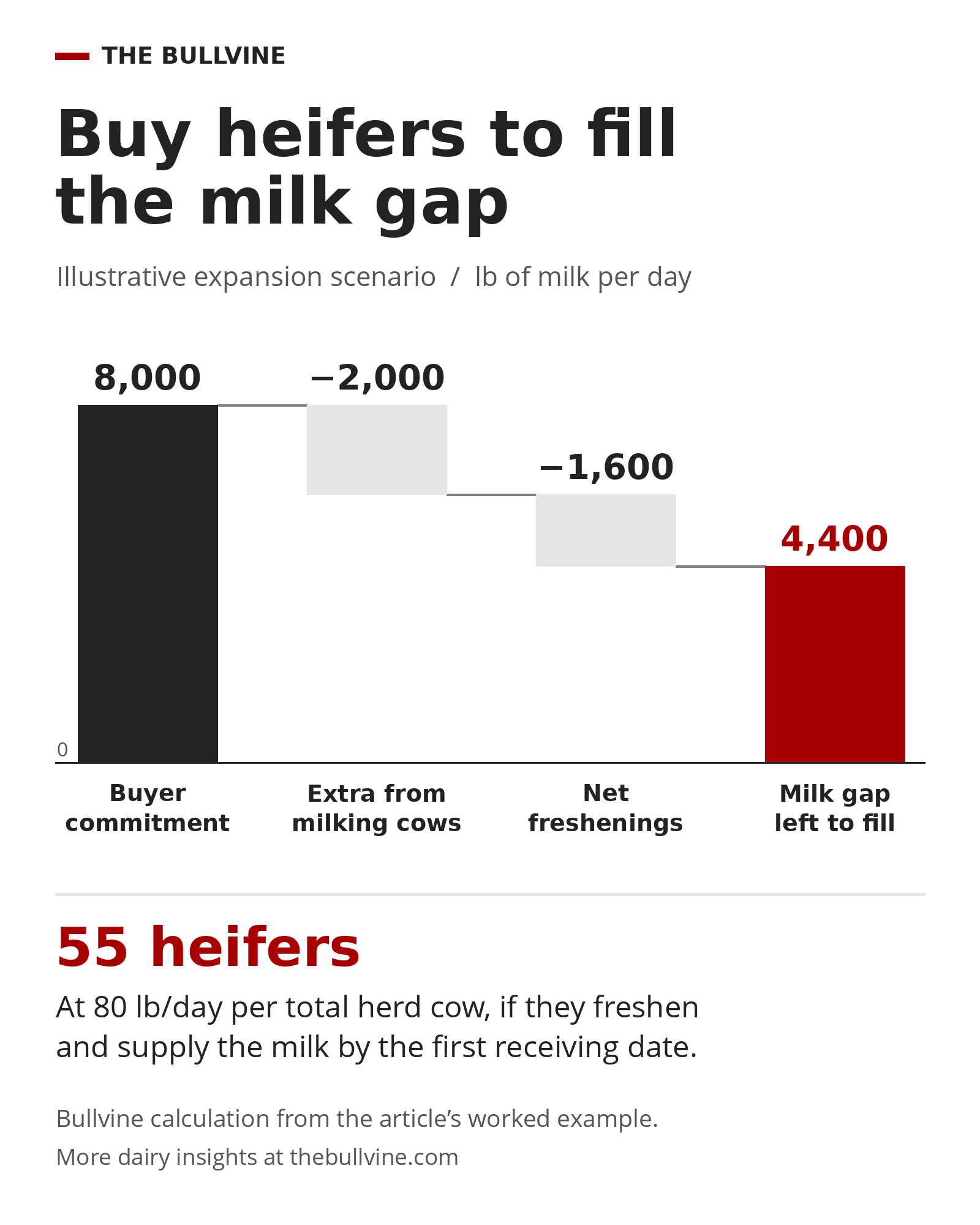
  5. Before approving expansion: the buyer’s committed extra pounds per day. In this example the buyer commits 8,000 extra pounds a day, and cows already milking supply 2,000 more through higher output. That leaves 6,000 pounds, or 75 cow equivalents at an assumed 80 pounds per total herd cow. Scheduled freshenings that add 20 cows after expected exits, shipping at the same rate by the first receiving date, cut the gap to 55. If 55 purchased heifers can freshen in time, cattle alone cost US$165,000 at US$3,000 a head and US$203,500 at Pipestone’s US$3,700 top-200 floor, a US$38,500 difference. Short-breds at US$2,800 bring the bill to US$154,000, US$49,500 less than the springer floor, but those animals won’t be milking by the same receiving date.

A 55-head order that cash-flows only on the first receiving date is too big for the contract behind it.

What’s this costing your herd?

Enter your plant’s volume requirement to see your cash exposure before signing the contract.

Welcome back — your last result was saved on .
Example: 8,000 (Source: Bullvine illustrative math)
Through redirected milk or higher output
Includes dry cows. Article assumes 80 lbs.
Expected freshenings minus planned exits
Current local quote. Article assumes $3,000.
Capital tied up in cattle $0 To buy 0 heifers
At your quote
At Pipestone peak ($3,700)
1. Volume Gap: Extra buyer volume − Existing herd supply
2. Cow Equivalents: Volume Gap ÷ Yield per cow (rounded up)
3. Heifers to Buy: Cow Equivalents − Scheduled net additions
4. Capital Cost: Heifers to Buy × Delivered heifer quote
Illustrative estimate based on your inputs and Pipestone Livestock Auction Market, August 20, 2026. Not financial advice. Bullvine calculation.
Get The Bullvine Weekly
A Bullvine tool · Last updated November 2026

Bullvine calculations, November 6, 2026: 100 head × US$3,000 (assumed price) = US$300,000; cow-equivalent scenarios (one million pounds a day; 80 and 70 pounds per total herd cow a day; 25%/50%/100% shares, all illustrative); 12M + 5M = 17M lb/day; 3.6M ÷ 9.65M ≈ 37 heifers per 100 cows; 360,000 ÷ 796,000 ≈ 45%; (8,000 − 2,000) ÷ 80 = 75 cow equivalents; 75 − 20 net additions from scheduled freshenings = 55. At US$3,000 per head, 55 head cost US$165,000; at Pipestone’s US$3,700 August top-200 low end, US$203,500 (+US$38,500); US$3,700 − US$2,800 (1–3-month short-breds) = US$900 a head; 55 × US$2,800 = US$154,000; US$203,500 − US$154,000 = US$49,500.

Learn More

The Sunday Read Dairy Professionals Don’t Skip.

Every week, thousands of producers, breeders, and industry insiders open Bullvine Weekly for genetics insights, market shifts, and profit strategies they won’t find anywhere else. One email. Five minutes. Smarter decisions all week.
NewsSubscribe
First
Last
Consent

California’s Water Board Drew a Herd Line. The Next Cow Has to Carry Its Own 

Sept. 15 set your existing herd. Add 100 cows now, and their manure must clear 1.4 A/R before they arrive: 35 to 64 acres, or a hauler who beats $0.87 a pound of N.

California dairy manure order

Executive Summary

  • The baseline: Order WQ 2026-0028 makes Sept. 15, 2026 the dividing line for “existing” herds in the Central Valley. The final groundwater-loading formula doesn’t arrive until 2030.
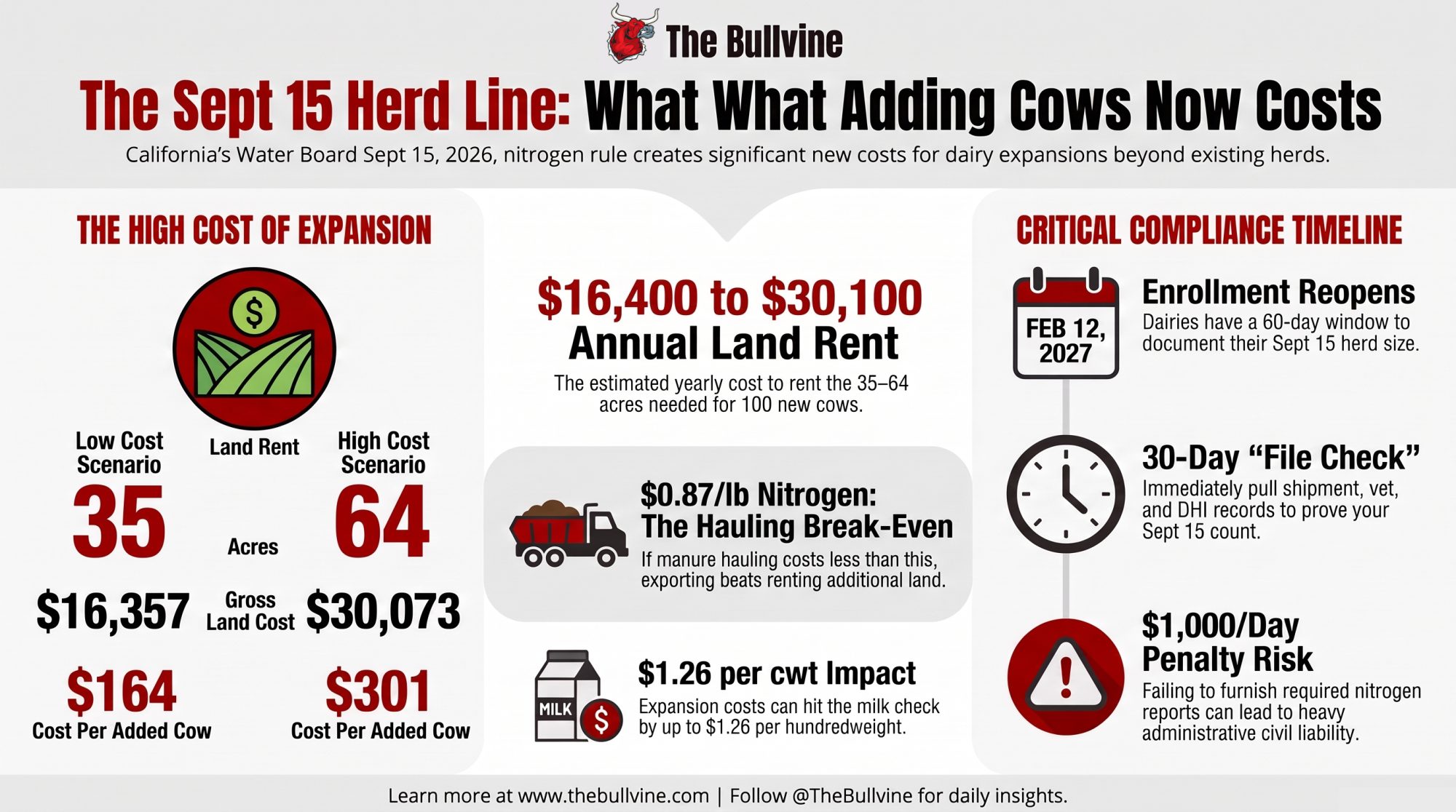
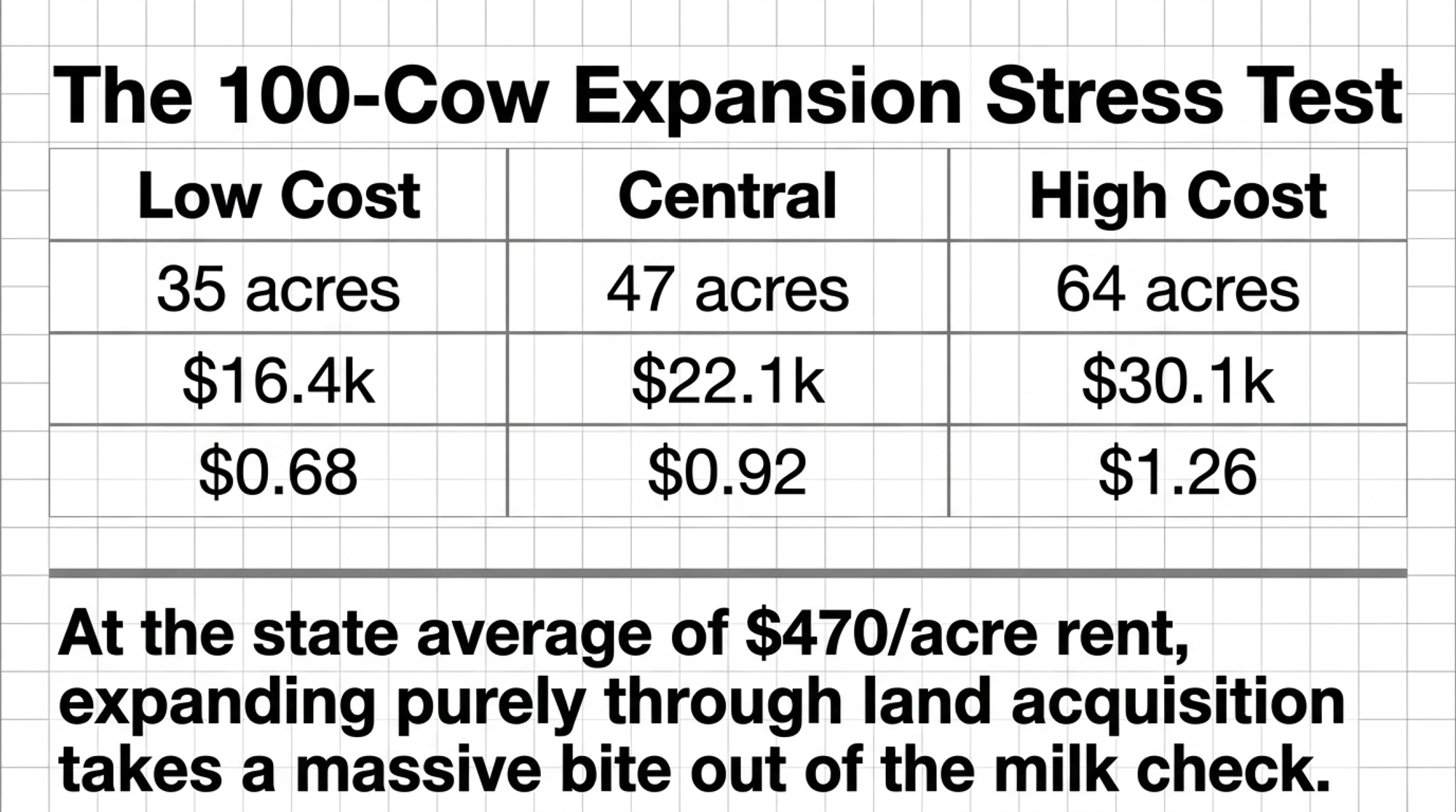
  • The cost: In a Bullvine stress test, 100 cows added after Sept. 15 must clear the 1.4 A/R test before coverage. That takes 35 to 64 more acres, or $16,400 to $30,100 a year in gross land rent (68 cents to $1.26 per cwt on their milk).
  • The deadline: Herd capacity left undocumented when enrollment reopens, around Feb. 12, 2027, risks being treated as new.

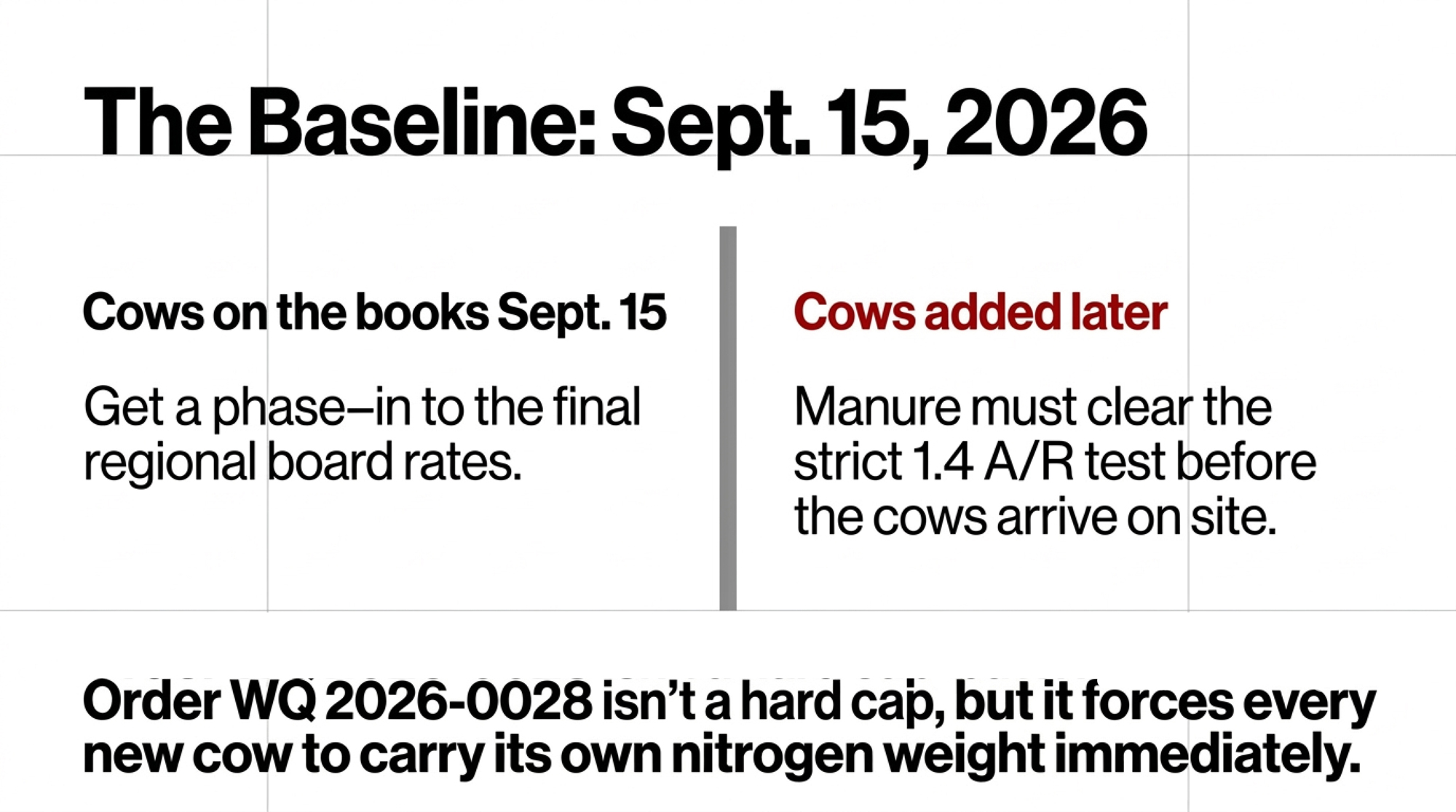
On Sept. 15, the State Water Resources Control Board adopted Order WQ 2026-0028. It sends the Central Valley’s 2013 dairy permit back to the regional board and sets out a new nitrogen framework for every dairy under that board’s authority. The biggest immediate change isn’t a new limit. It’s a date. Cows milking on Sept. 15 count as the “existing” herd. It’s not a cap: dairies can still expand. But until the revised permit is adopted, the added cows’ manure has to clear the 1.4 A/R test before the expansion gets coverage.

Here’s what that costs. In a Bullvine stress test, 100 cows added to a Central Valley dairy need 35 to 64 more acres. At California’s 2026 statewide irrigated rent of $470 an acre, that’s $16,400 to $30,100 a year in gross land cost. On the added cows’ milk alone, it’s 68 cents to $1.26 per cwt.

That’s a Bullvine calculation, not a Water Board estimate. Every input is listed below.

What the order did — and didn’t

The board didn’t adopt a final land-application rate. It told the Central Valley Water Board to build a groundwater-loading limit and a land-application formula within four years, and to adopt a revised dairy permit within five. That limit has to keep nitrogen leaving the root zone under the 10 mg/L nitrate drinking-water objective, with a safety margin. The order mentions 8 mg/L as an example, not as a limit it has adopted.

The 1.4 test carries over from the 2013 permit. Total nitrogen applied to a field can’t exceed 1.4 times the nitrogen removed in the harvested crop. Existing dairies already live under that test. The order keeps it but orders more accurate measurement of both sides, and it adds whole-farm nitrogen accounting that could eventually sit alongside the field method or replace it.

All data the order requires is public, and it has to go into GeoTracker in a format people can analyze. The order specifically says PDF uploads don’t count as usable. A dairy’s nitrogen balance is going to become something neighbours, lenders and advocates can download.

The Sept. 15 line

Under the 2013 permit, an existing dairy could run the herd size in its original report plus 15%. An increase of more than 15% in mature cows made it an “expanded” dairy. The new order adds its own baseline on top: the mature cows operating on Sept. 15, 2026. The Water Board hasn’t said how the two fit together.

The deadlines follow from that date. The regional board has 150 days, until about Feb. 12, 2027, to reopen enrollment. Dairies then get a 60-day window to document their Sept. 15 herd. The board has until about March 14, 2027 to finish its inventory of operating dairies. Herd capacity that goes undocumented risks being treated as new.

To keep existing-dairy treatment, a pre-permit expansion needs four things: a complete report of waste discharge, documented compliance with the California Environmental Quality Act, proof that the added cows’ manure meets 1.4 A/R right away, and coverage in hand before the cows arrive. Once the revised permit is adopted, expansion manure faces the final rates immediately, with no phase-in.

Why it comes down to land

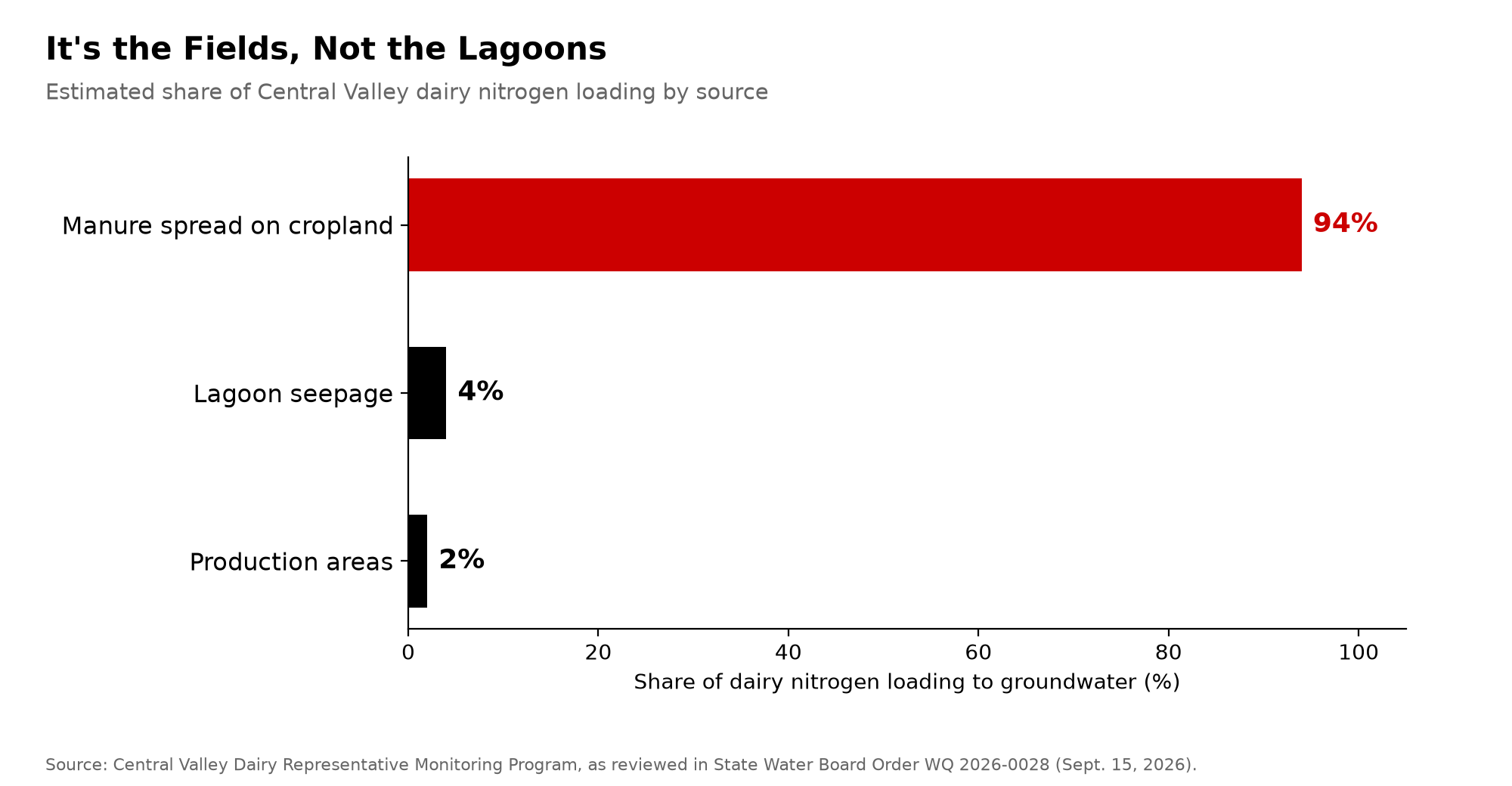
The Central Valley Dairy Representative Monitoring Program estimated that about 94% of dairy nitrogen loading comes from spreading manure on cropland. Lagoon seepage accounts for 4% and production areas for 2%. The Water Board reviewed that data and wrote that it generally agrees.

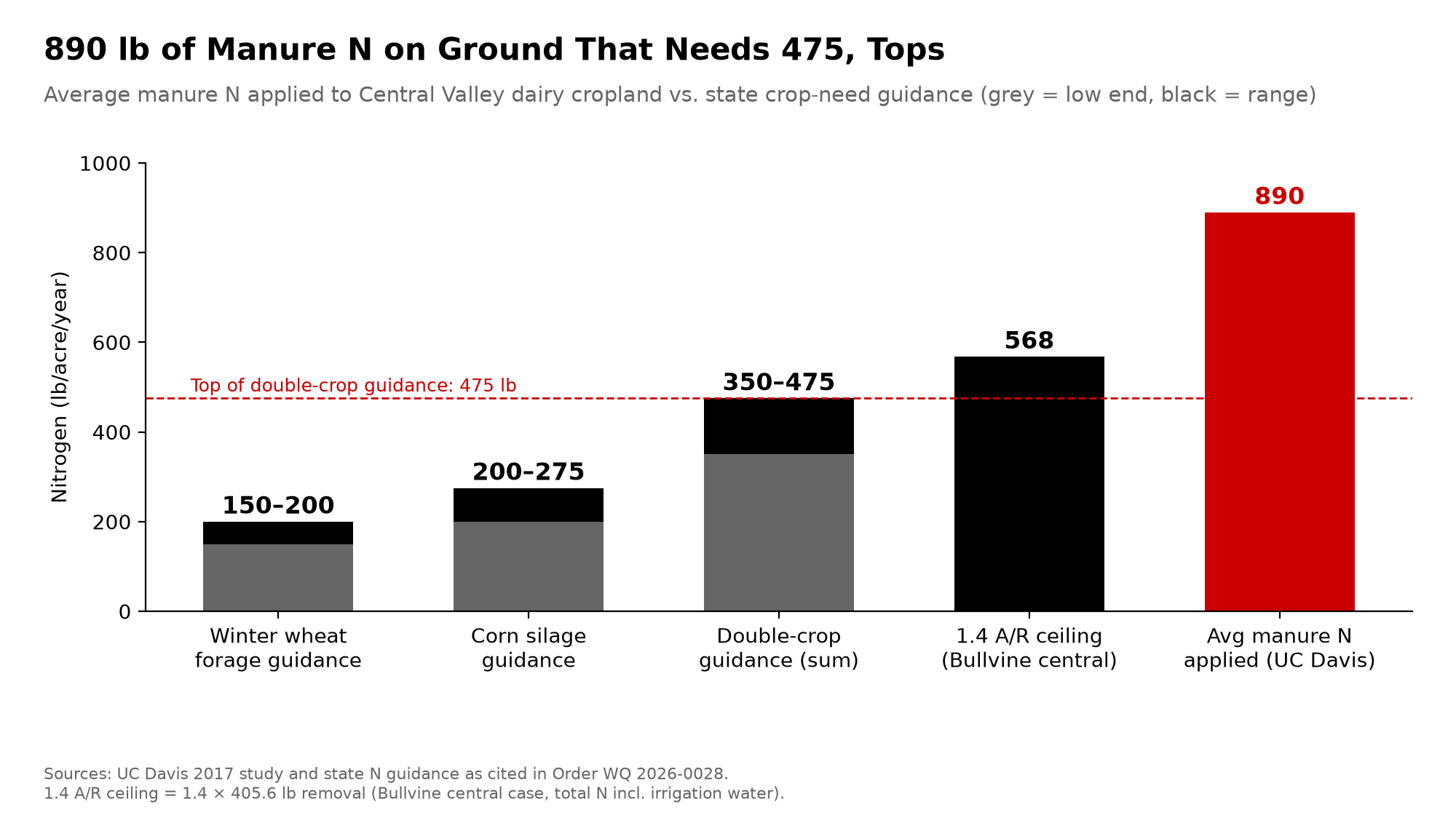
The UC Davis 2017 study the order relies on puts average manure nitrogen on Central Valley dairy cropland at 890 lb per acre a year. The order sets that against state guidance of 200–275 lb for corn silage and 150–200 lb for winter wheat forage. The board’s written finding is that “extensive over-application” treated land application largely as disposal.

The order also concedes that government pricing mechanisms stop dairies from simply raising their prices to cover manure-management costs. Whatever this costs comes out of the milk cheque.

The Bullvine math

The scenario: 100 mature cows added to a Central Valley dairy after Sept. 15, managed under the current 1.4 A/R test, double-cropped with corn silage and a winter forage.

InputLow costCentralHigh costBasis
Nitrogen excreted, lb/cow/yr365365365Order WQ 2026-0028: ~1 lb/cow/day
Storage and air losses40%30%20%Assumption; central matches UCCE’s 30% ammonia-loss figure
Managed nitrogen, 100 cows (lb)21,90025,55029,200Calculated
Corn silage yield (t/ac)3330.528Yield range cited in the order
Corn silage N removed (lb/ac)249.5230.6211.7Yield × 7.56 lb N/ton (CDFA/FREP)
Winter forage N (lb/ac)200175150Proxy: state N-requirement guidance, not measured removal
Total removal R (lb/ac)449.5405.6361.7Calculated
Irrigation-water N (lb/ac)02550Assumption; ≈0, 3.6 and 7.2 ppm nitrate-N at 30 in. applied (UCCE conversion)
Manure capacity (lb N/ac)629.3542.8456.41.4 × R − irrigation N
Added acres needed34.847.164.0Managed N ÷ capacity
Rent$470$470$470USDA NASS 2026, California statewide irrigated average
Gross annual land cost$16,357$22,123$30,073Acres × rent
Per added cow$164$221$301÷ 100
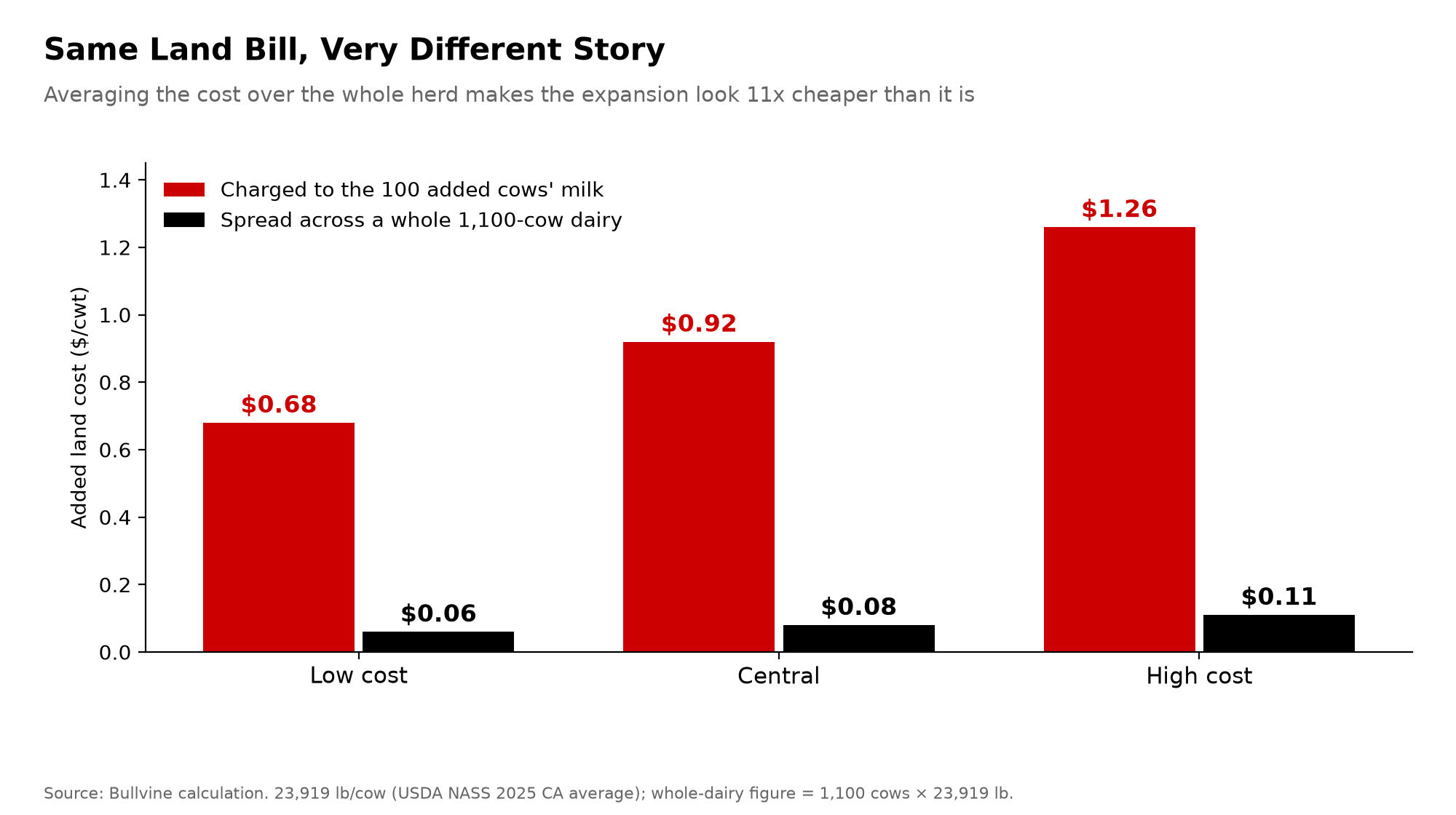
Per cwt, added milk$0.68$0.92$1.26÷ 23,919 cwt

What this model leaves out cuts both ways. There’s no delivery cost: rented acres only work if the manure gets there by pipe or truck, so the model understates cost on ground that isn’t contiguous with the dairy. There’s also no forage credit: the rented acres grow feed, and if the dairy would otherwise buy that feed, the net cost is lower. The rent is a statewide average. Central Valley forage ground may rent above or below it, and county NASS figures are the next check.

Milk uses 23,919 lb per cow, California’s 2025 NASS average. The Federal Order market administrator puts California’s January–June 2026 mailbox price at $17.81/cwt, so those 100 cows gross about $426,000. The central land cost takes 5.2% of that before any feed, labour or capital. Spread across a whole 1,100-cow dairy, it’s 6 to 11 cents per cwt. That’s accurate, but it’s the wrong way to judge an expansion.

The threshold

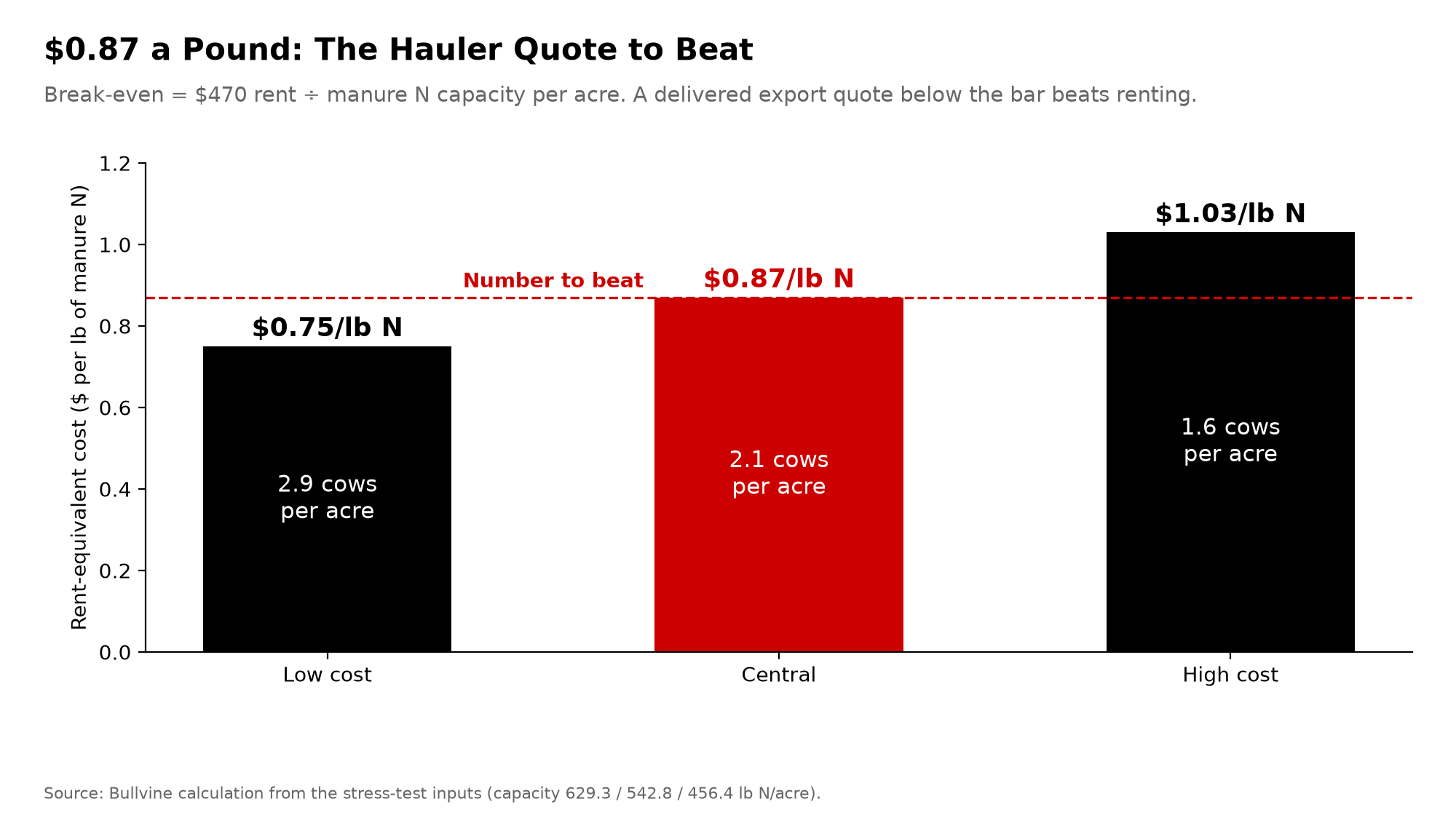
In the central case, one acre handles the nitrogen from 2.1 mature cows. The low case handles 2.9 and the high case 1.6. If a dairy already runs more cows per controlled forage acre than its own crop-removal records support, the next cow needs a new outlet: rented land, export or treatment.

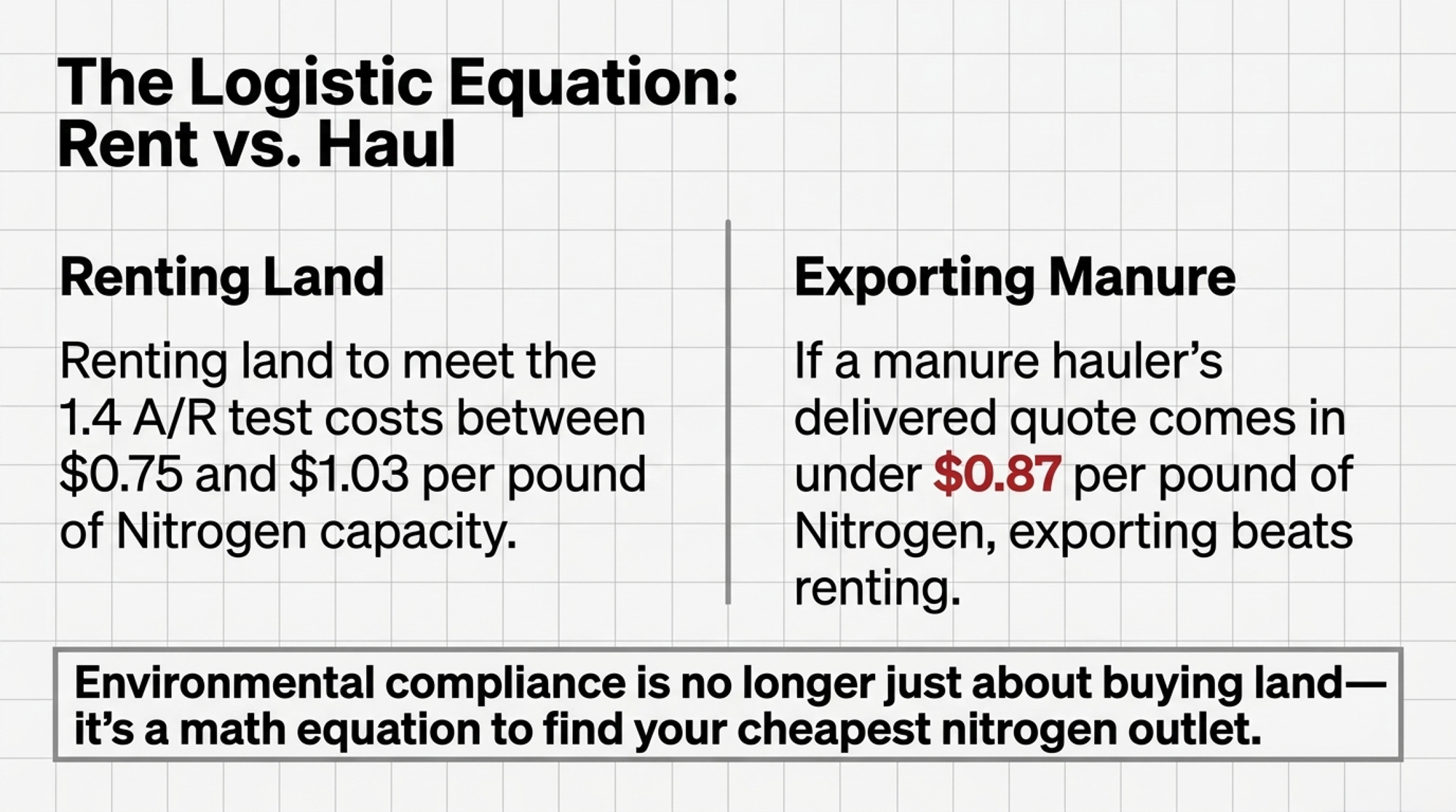
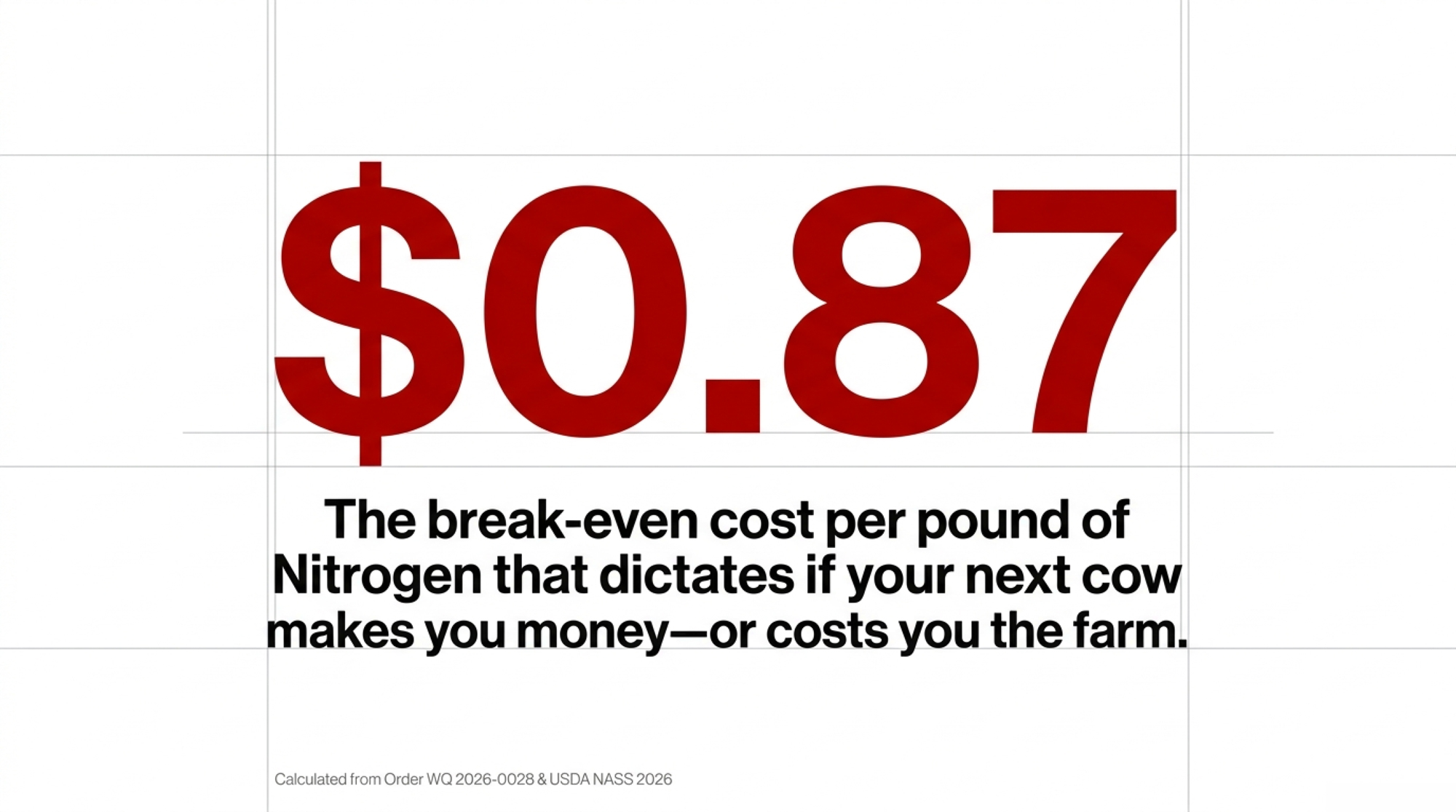
Here’s the break-even an operator can use. Renting costs $470 divided by the manure capacity per acre: $0.75, $0.87 and $1.03 per lb of nitrogen across the three cases. Take a hauler’s delivered quote and turn it into dollars per pound of nitrogen using a lab test of the manure. If it comes in under that number, exporting beats renting. Judge treatment the same way, on pounds of nitrogen actually removed, not on lower concentration.

The paperwork floor

ObligationCostFrequencyWhat it means
Expanded nutrient plan + whole-farm reporting$165–$1,070Per yearAbout 0.4¢/cwt at the top end on 1,100 cows
Drinking-water well sampling$200–$400Per sampleAnnual nitrate test to start
Pond hydraulic-continuity report$2,000–$15,000One timeOnly if ordered (from Sept. 2027)
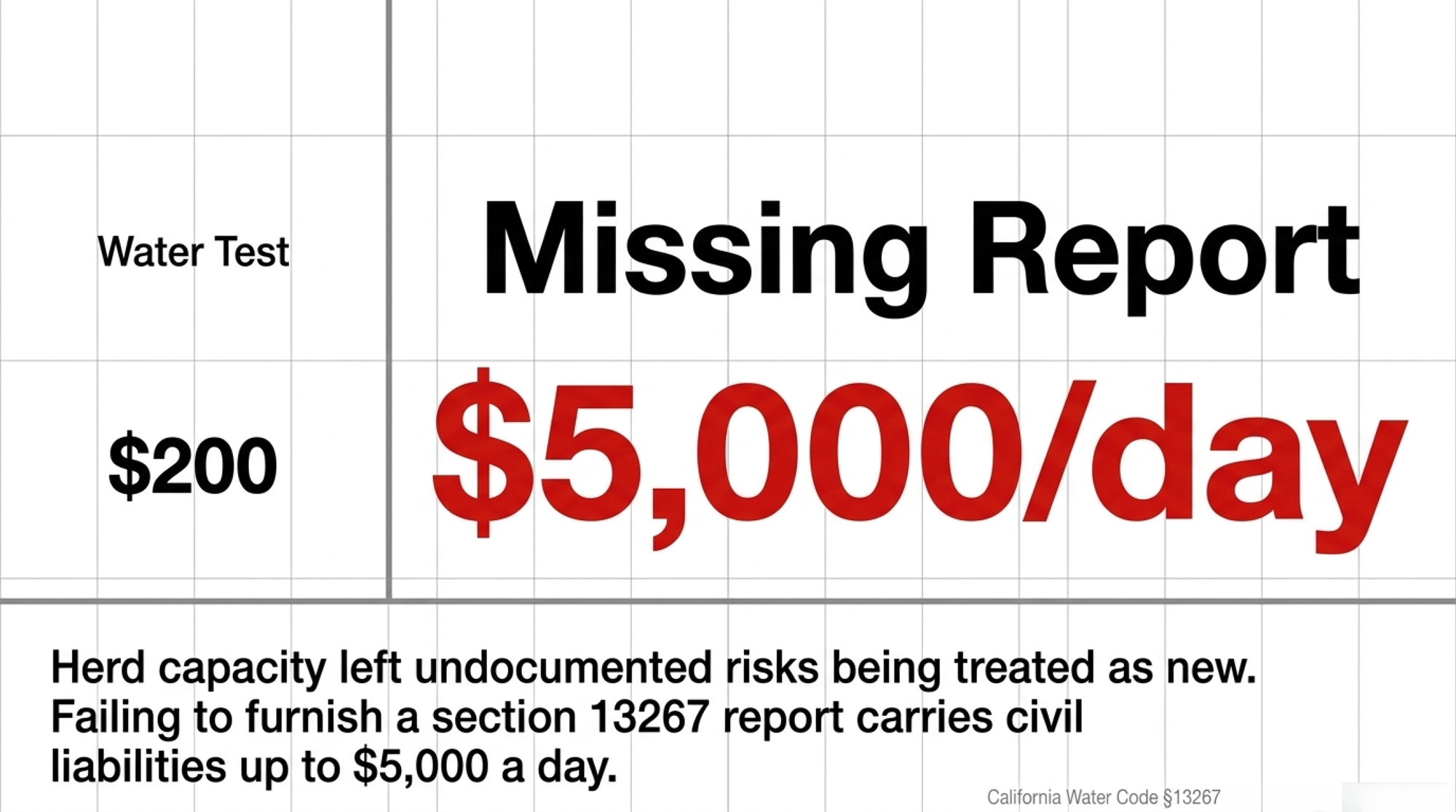
Missing §13267 report (administrative)Up to $1,000Per day$30,000 after one month
Missing §13267 report (superior court)Up to $5,000Per day$150,000 after one month

The order’s own estimates for the new reporting are small. Expanded nutrient-plan and whole-farm reporting runs $165–$1,070 a year per dairy. Drinking-water sampling runs $200–$400 a sample. A pond hydraulic-continuity report, for dairies ordered to do one, costs $2,000–$15,000 once. Failing to furnish a report required under Water Code section 13267 is different. It can bring civil liability of up to $1,000 a day administratively, or up to $5,000 a day through the superior court. The Central Valley board has applied the $1,000-a-day cap to a missing dairy annual report before. Iowa shows how the bill can run past the penalty itself: in four consent orders there, restitution ran 6.7 times the penalty.

Dairies with on-farm drinking-water wells start with annual nitrate sampling. A result over 10 mg/L means users must be notified within 10 days. Where the operator doesn’t own the property, the operator can pass the result to the owner within 24 hours. The owner then has the rest of the notice period to tell users and copy the regional board.

What isn’t settled

  • Losses: how much storage and air loss the whole-farm accounting will credit. The monitoring program found that volatilization doesn’t fully explain the “unaccounted-for” nitrogen.
  • Support stock: whether the order’s 1-lb-a-day figure covers dry cows and heifers.
  • The two baselines: how the Sept. 15 herd count fits with the 2013 permit’s 15% allowance.
  • Removal definitions: the order points the revised permit to the removal definitions it endorsed in Order WQ 2018-0002.
  • The final formula: the groundwater-loading limit and land-application formula, due in 2030.

Implementation calendar

Deadline the order sets (calculated from Sept. 15)Directed action
~Feb. 12, 2027Regional board to reopen 2013 permit enrollment; 60-day documentation window follows
~March 14, 2027Inventory of operating dairies and herd sizes due
Sept. 2027Regional board to begin issuing section 13267 pond-continuity orders
Sept. 2028Improved A/R measurement orders and drinking-water well monitoring due
Sept. 2029Draft revised permit and environmental impact report due
Sept. 2030Groundwater-loading limit and land-application formula due
Sept. 2031Revised dairy permit due for adoption

The file check

  • 30 days: Pull the proof of your Sept. 15 mature-cow count: shipment, vet and DHI records. Check it against your enrolled herd plus 15%.
  • 90 days: Get fresh lab tests on your manure and irrigation water. Work out crop removal from actual tonnage, and get one hauling quote converted to dollars per pound of nitrogen.
  • 365 days: Before adding cows, decide which outlet their nitrogen goes to — land, export or treatment — and put it in writing.

The order doesn’t send anyone a bill yet. What it does is sort the herd. Cows on the books Sept. 15 get a phase-in to the final rates. Cows added later have to clear the test before they arrive. For a dairy weighing expansion, $0.87 a pound is the number to beat.

Complete references and supporting documentation are available upon request by contacting the editorial team at editor@thebullvine.com.

Learn More

The Sunday Read Dairy Professionals Don’t Skip.

Every week, thousands of producers, breeders, and industry insiders open Bullvine Weekly for genetics insights, market shifts, and profit strategies they won’t find anywhere else. One email. Five minutes. Smarter decisions all week.
NewsSubscribe
First
Last
Consent
Send this to a friend