





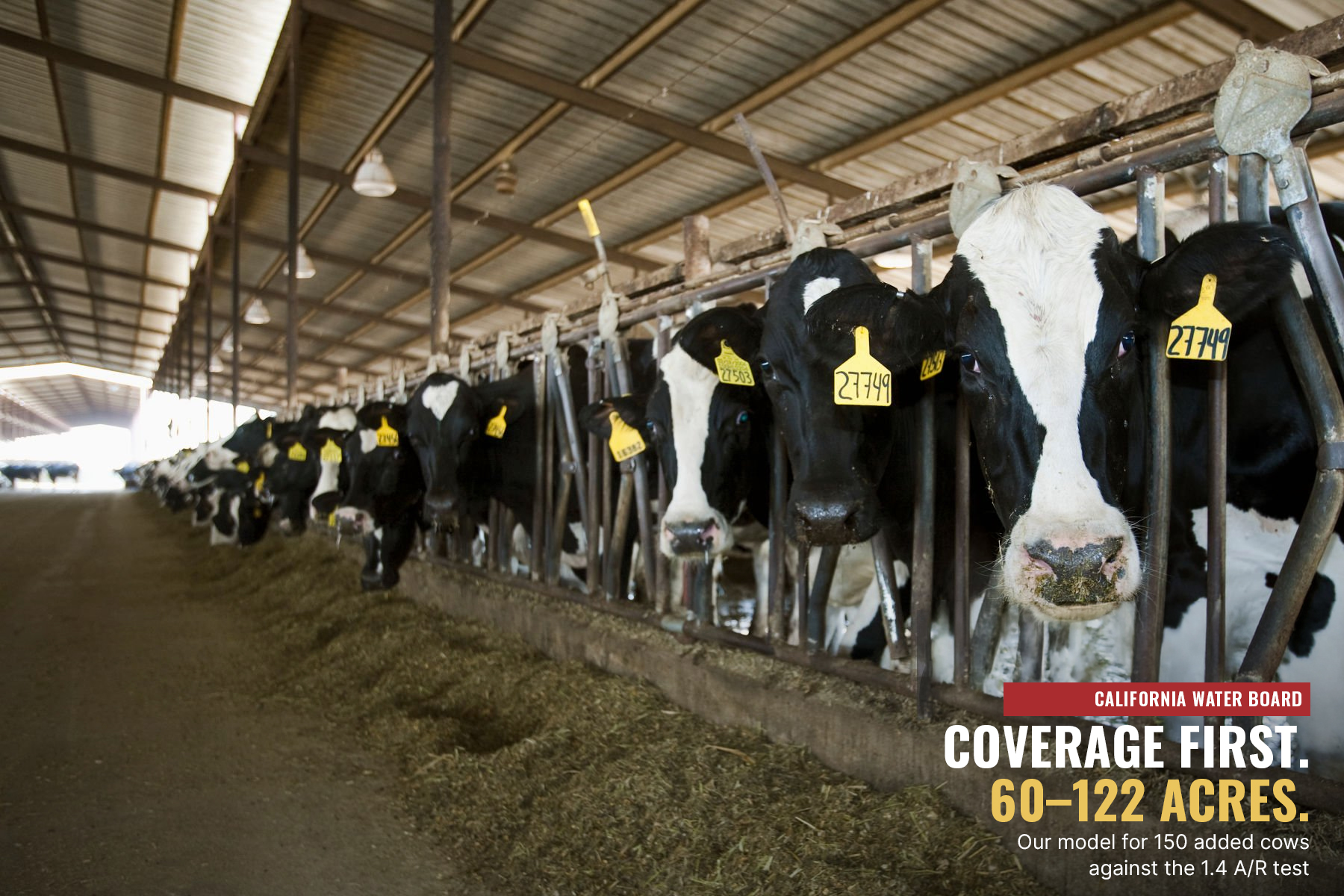
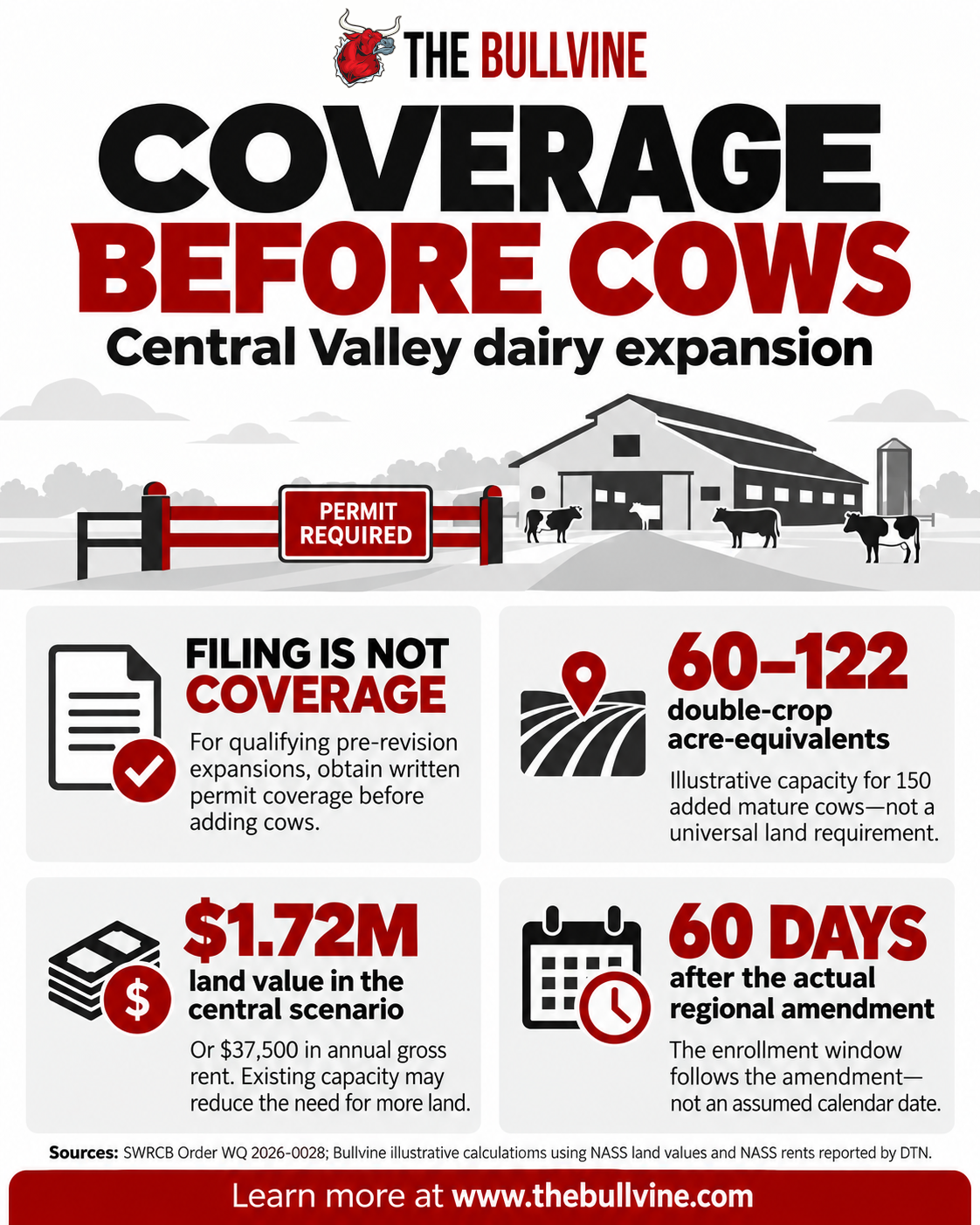
150 added cows, 60 to 122 acre-equivalents of nitrogen room by our math. To count them as existing herd, California’s order wants coverage before the cattle truck backs in.
The State Water Resources Control Board changed the order of operations for Central Valley dairy expansions on Sept. 15. Under the order it adopted that day, a dairy that wants added cows treated as part of its existing herd has to show it can handle their manure nitrogen, and secure permit coverage, before the cattle arrive. “Coverage” means the Regional Board has formally enrolled the dairy, at a stated herd size, under a waste discharge permit.
Five dairy organizations have gone to court over the order. Dairy Cares, a coalition of California dairy organizations, announced Oct. 19 that it had filed a legal challenge in Tulare County Superior Court, Agri-Pulse reported Oct. 21. Milk Producers Council, California Farm Bureau, Western United Dairies and California Dairy Campaign are also petitioners.
For a 1,000-cow dairy adding 150 mature cows, Bullvine’s illustrative nitrogen-capacity estimate is 60, 80 or 122 acre-equivalents of double-cropped forage. It’s measured against the 1.4 A/R test. A/R is nitrogen applied divided by nitrogen removed in the harvested crop, and applied nitrogen generally can’t exceed 1.4 times removal. The figure measures nitrogen capacity. Fields the dairy already farms, fertilizer the manure replaces, export and treatment can all supply it. Buying or renting ground is one more option.
What Order WQ 2026-0028 Requires
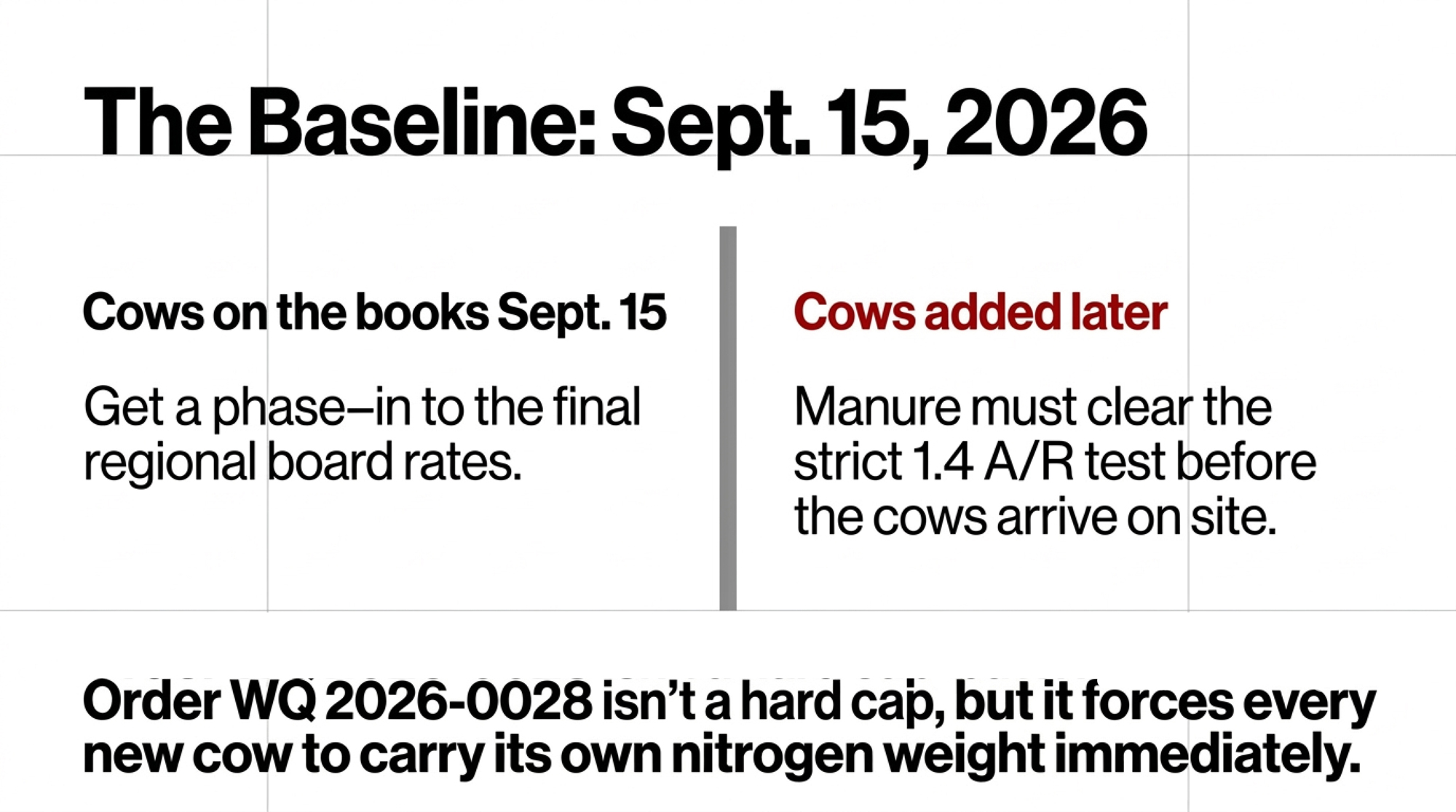
Order WQ 2026-0028 sends the Central Valley’s 2013 dairy waste discharge requirements back to the Central Valley Regional Water Quality Control Board. That 2013 order covers about 1,300 dairies.
The Regional Board has three years to circulate draft revised requirements (by Sept. 15, 2029) and five years to adopt them (by Sept. 15, 2031). Meanwhile, State Board staff have four years to develop and peer-review the groundwater loading limit and land-application formula behind the final rates.
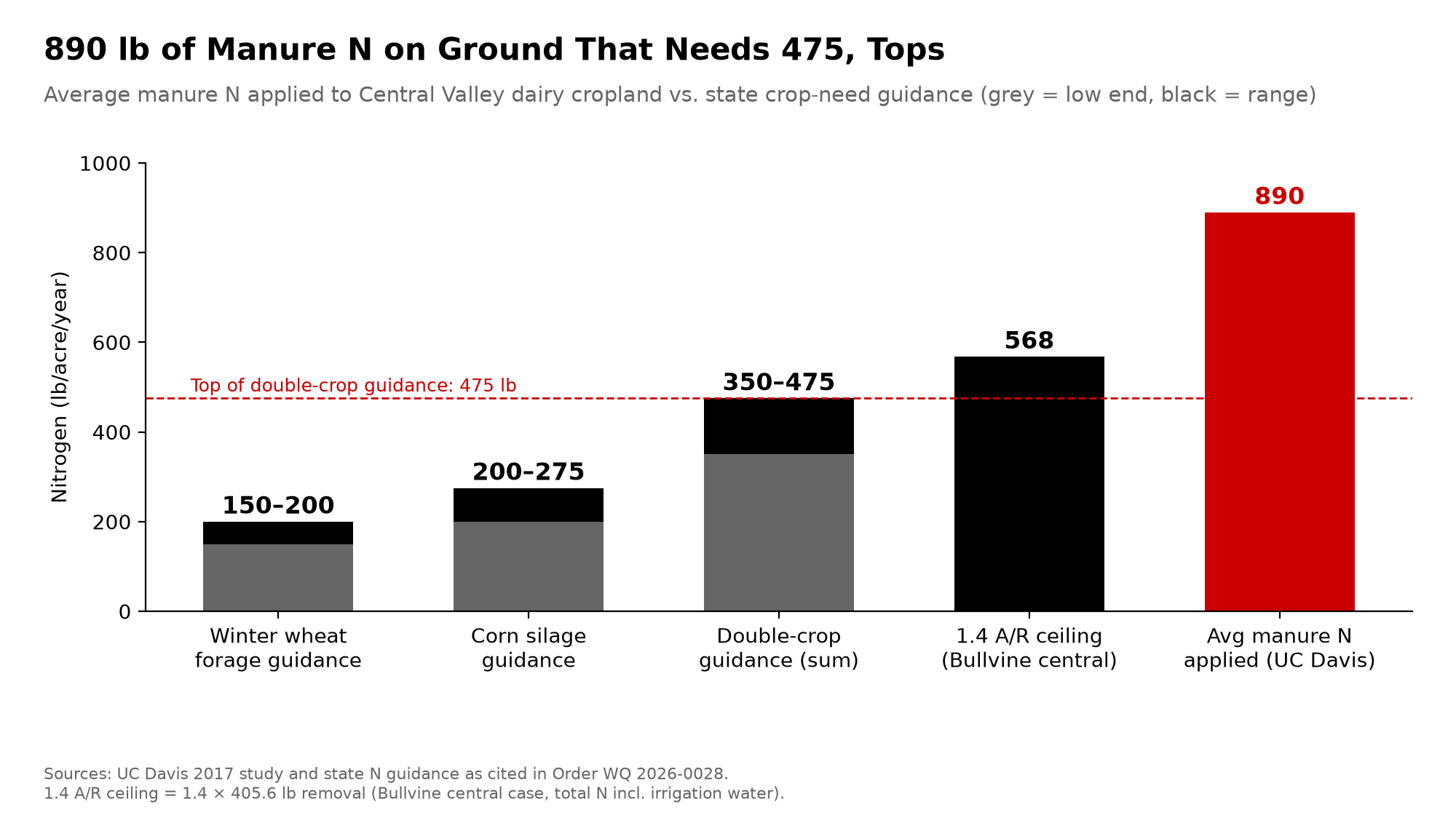
That formula is the number a lender most wants, and it doesn’t exist yet. For expansions seeking existing-dairy treatment before the revised requirements are adopted, the order specifies the existing 1.4 A/R test.
The Board doesn’t think much of that ratio. It wrote that 1.4 “does not have a direct relationship with protecting groundwater quality” and that its implementation “has been ineffective to date.”
Existing dairies get a runway. Their schedules to reach the final rates must be “as short as practicable,” with a maximum of 35 years, starting when the Regional Board approves an exception and schedule.
The first such schedule, approved June 3, 2026, covers 54 dairies in the Modesto Management Zone. The State Board said that if the Regional Board sets one final deadline for the dairies needing the most time, it would fall no later than June 3, 2061.
Later expansions don’t get that runway. For expansions after the revised requirements, the Board found it “not appropriate” to let them “perpetuate, or even exacerbate, that pollution.”
Herds that are covered or enrolled on time are eligible for existing-dairy scheduling, and so are qualifying pre-revision expansions. Thirty-five years is the ceiling, and the order guarantees no dairy that long.
Three Windows, One Herd
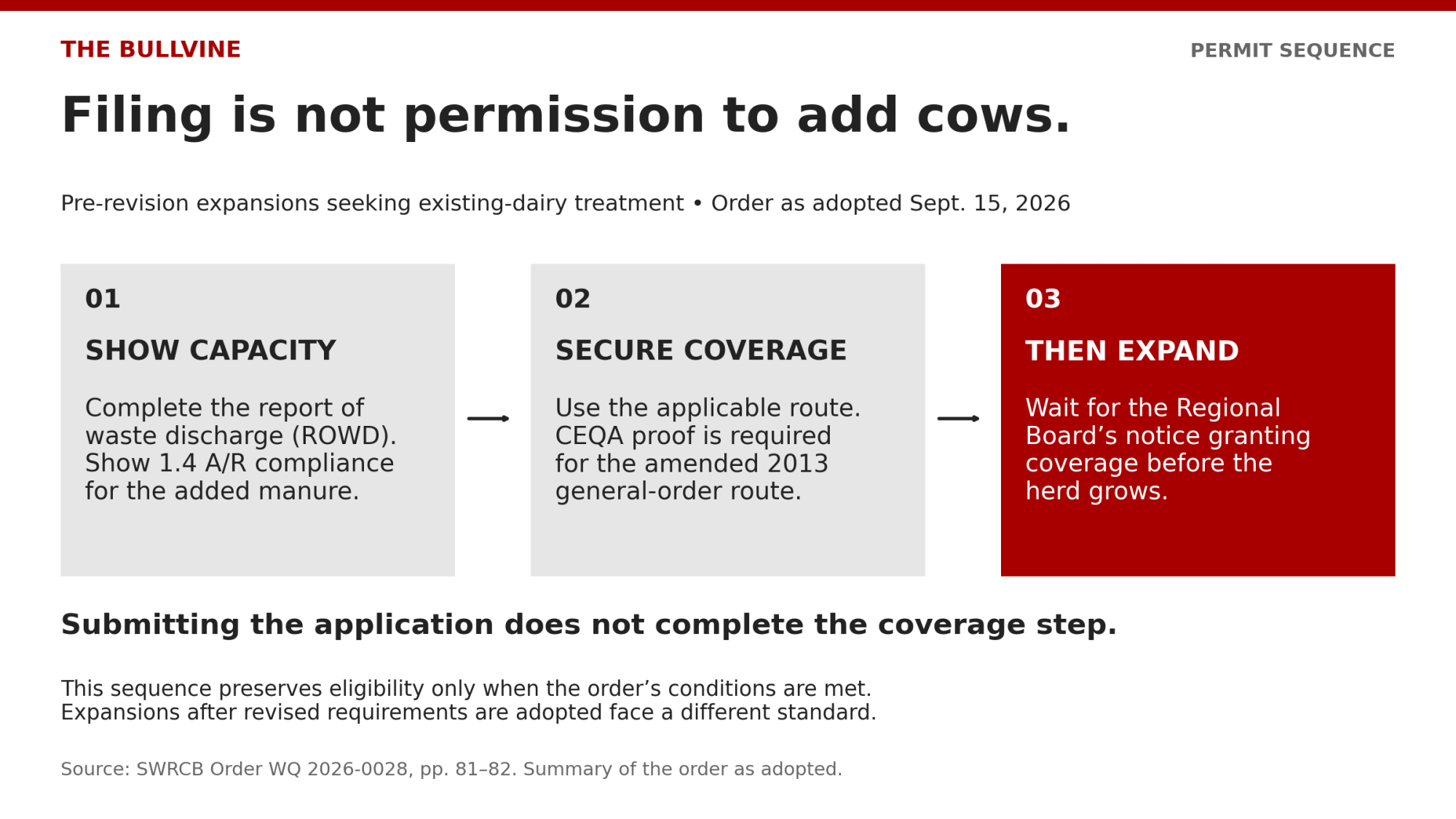
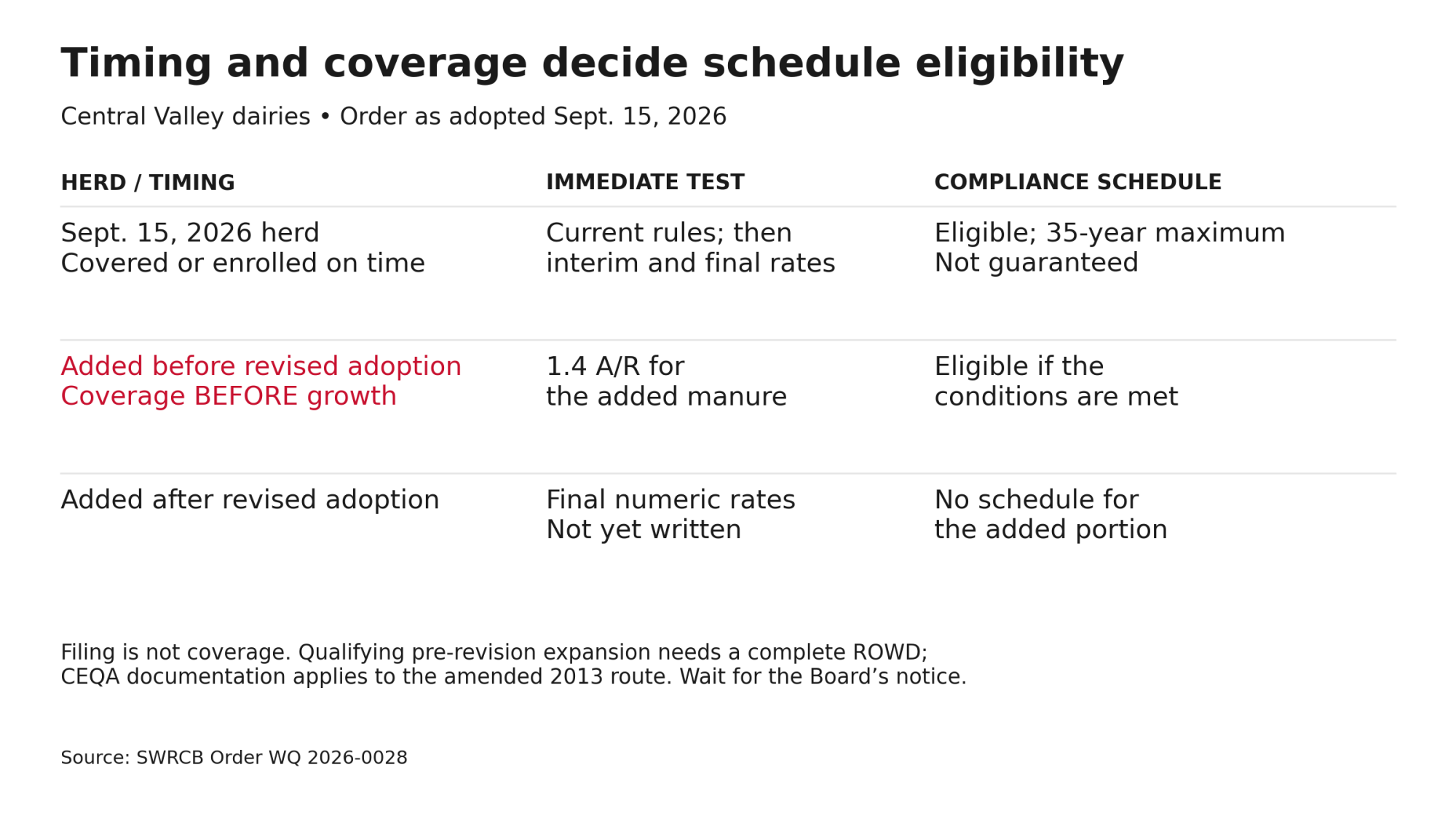
Under Order WQ 2026-0028, two things decide how added cows are treated: when they arrive, and whether the applicable coverage process was finished first. A ROWD is a report of waste discharge, the application a dairy files with the Regional Board. CEQA is the California Environmental Quality Act.
| When added cows arrive | Treatment | Immediate standard | Compliance schedule |
| In the documented Sept. 15, 2026 herd | Existing, if covered or enrolled by the deadline¹ | Current rules, then interim and final rates | Eligible for existing-dairy scheduling (35-year max) |
| After Sept. 15, before the revised permit is adopted | Existing only if coverage is granted before the herd grows² | Existing 1.4 A/R test | Eligible if conditions are met |
| After the revised permit is adopted | New | Final numeric rates, not yet written | None for the added portion |
¹ Coverage can be under the 2013 general order, an individual permit or a digester or co-digester general order. ² Coverage under the amended 2013 general order or a digester or co-digester general order requires a complete ROWD showing immediate 1.4 A/R compliance for the added manure, plus CEQA documentation for the 2013 route. Filing isn’t coverage. The dairy waits for the Regional Board’s notice.
The order says the dairy must “wait for the Central Valley Water Board’s notice that it has granted coverage prior to expanding the herd size.” It adds: “All other expansions of herd sizes, either before or after the Central Valley Water Board adopts the revised dairy general waste discharge requirements will be treated the same as new dairies.”
One herd can carry two sets of rules. In the Board’s illustration, 80% of a herd is existing at 1.4 and 20% is new at an illustrative 1.1 ratio, which isn’t an adopted final rate. The whole herd works out to 1.34.
The acreage doesn’t know what day the cows arrived. The permit does.
Graphic: Three windows, one herd. How Order WQ 2026-0028 treats added cows, with milestone dates from Sept. 15, 2026 to Sept. 15, 2031. Source: SWRCB Order WQ 2026-0028. Feb. 12 and April 13, 2027 are conditional dates calculated by Bullvine.
The Enrollment Clock: 150 Days, Then 60
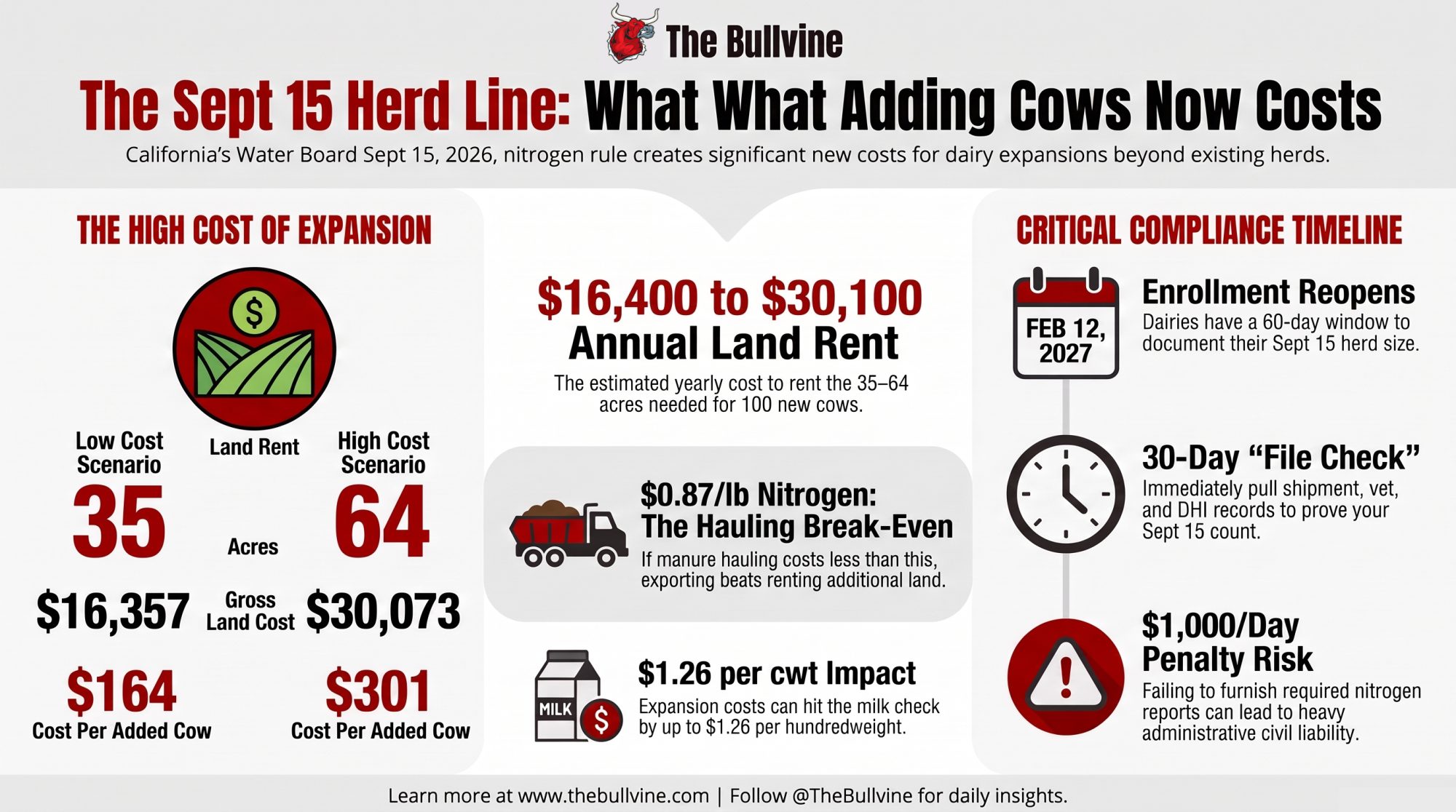
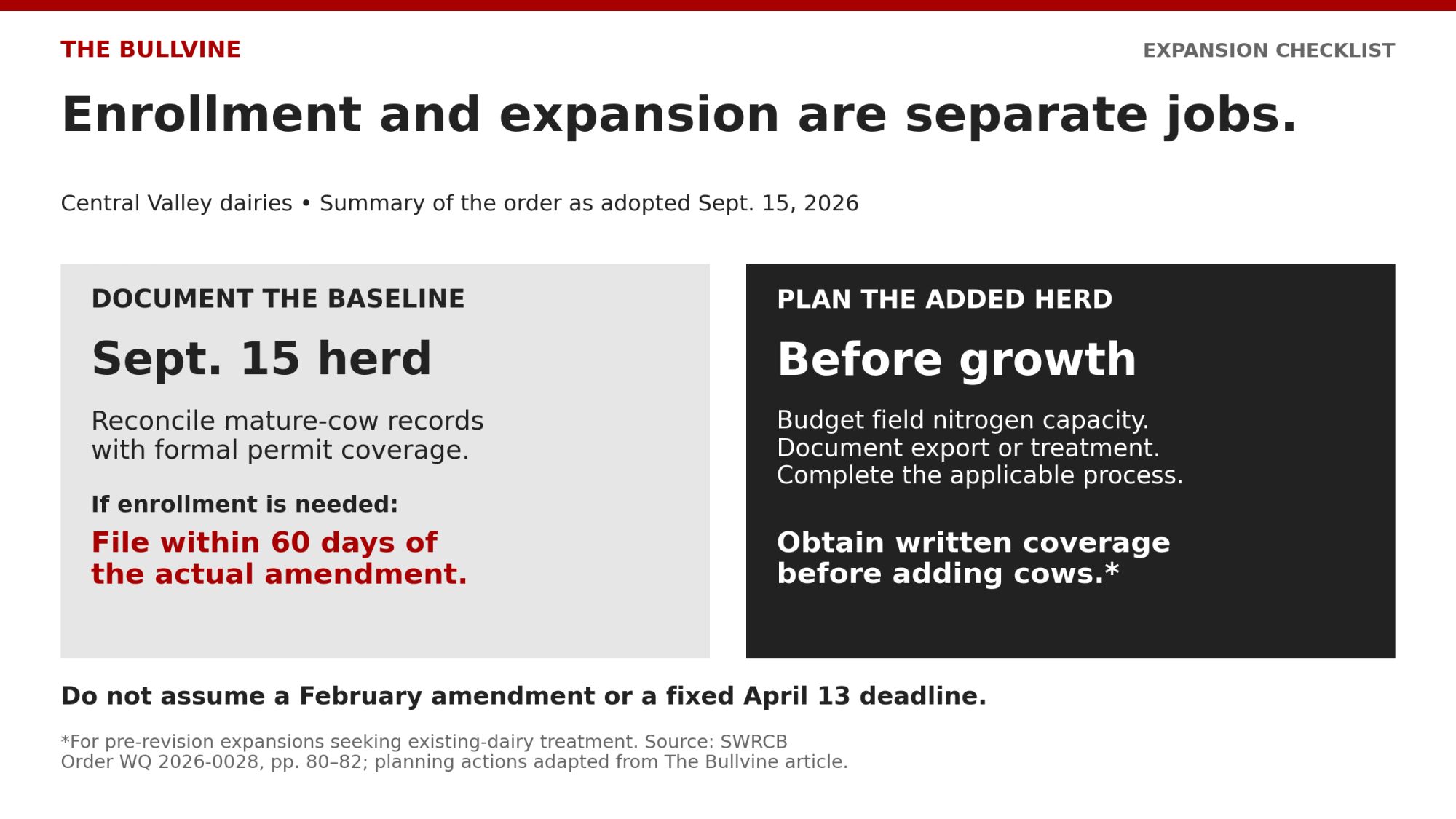
The Regional Board has 150 days from Sept. 15 to amend the 2013 order so currently operating dairies can enroll their current herd sizes. Dairies then get 60 days after that amendment to file. On Bullvine’s date math, the latest the amendment can land is Feb. 12, 2027. If it lands that day, the enrollment deadline is April 13, 2027. Both dates move earlier if the amendment comes sooner.
Enrollment covers the herd a dairy had on Sept. 15. Cows added since then follow the expansion route in the table above.
Does the Old 15% Allowance Still Apply?
Under the 2013 order, a dairy’s permitted herd was its reported mature-cow count plus 15% for normal variation. Adding 150 cows to 1,000 is a 15% increase, but that arithmetic says nothing about whether a particular dairy has unused permitted capacity. That depends on its own reported baseline. Order WQ 2026-0028 doesn’t say plainly whether the old allowance covers growth after Sept. 15, so it can’t be treated as a safe harbor.
Calculating Nitrogen Capacity and Land Cost
For an expansion seeking existing-dairy treatment now, the order specifies the 1.4 A/R test. The model measures against that test: the acres of crop removal it would take to hold the manure nitrogen from 150 added mature cows.
The Capacity Formula
Acre-equivalents = (daily nitrogen excretion per cow × 365 × added cows) ÷ (annual crop nitrogen removal per acre × 1.4)
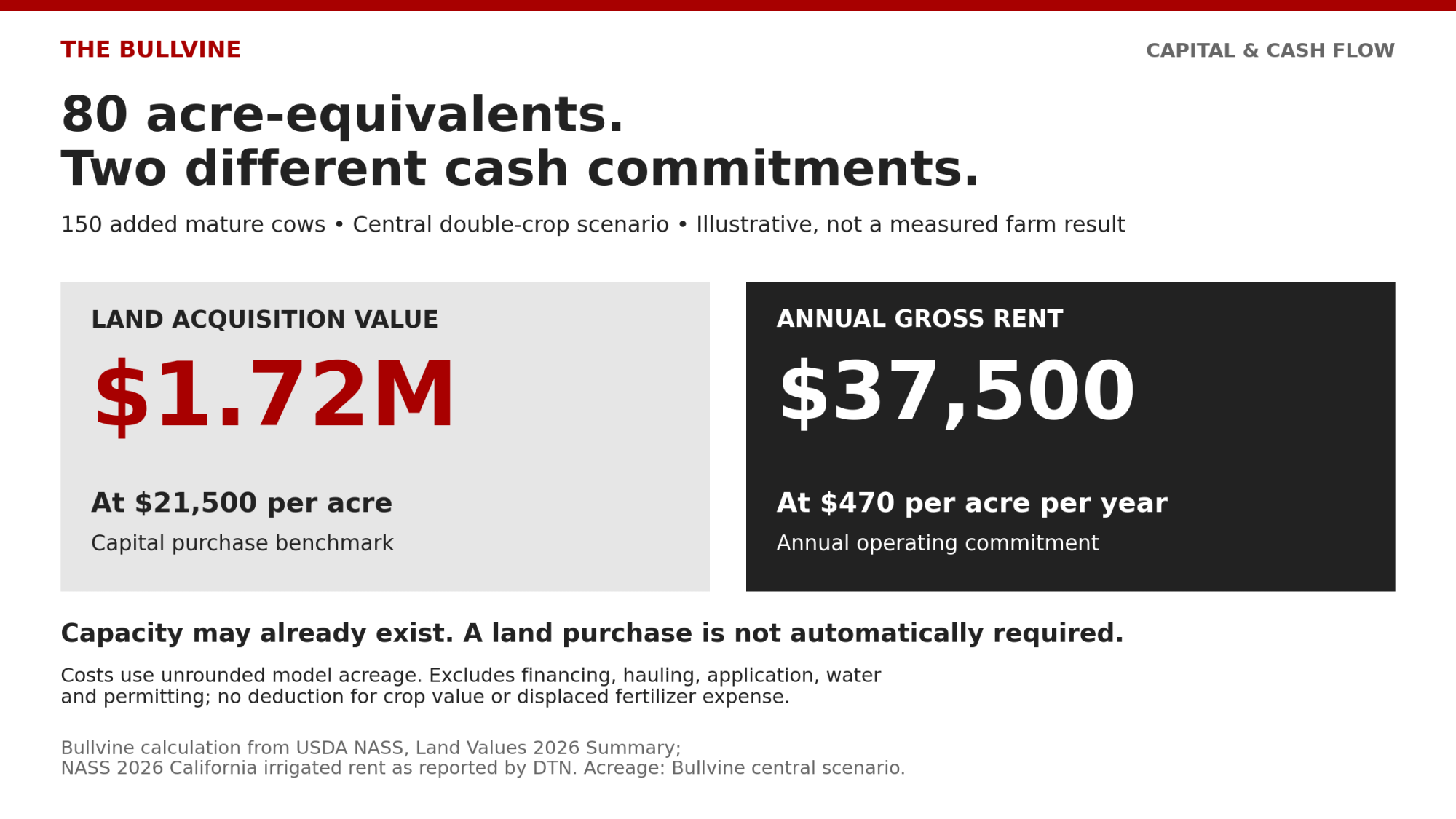
Central double-crop calculation for 150 cows: (1.02 lb N/day × 365 days × 150 cows) ÷ (500 lb N removed per acre × 1.4) = 79.78 acre-equivalents
That works out to roughly 80 acre-equivalents. Bullvine calculated the costs below from the unrounded figure.
Double-crop system (150 added mature cows, 1,000 → 1,150)
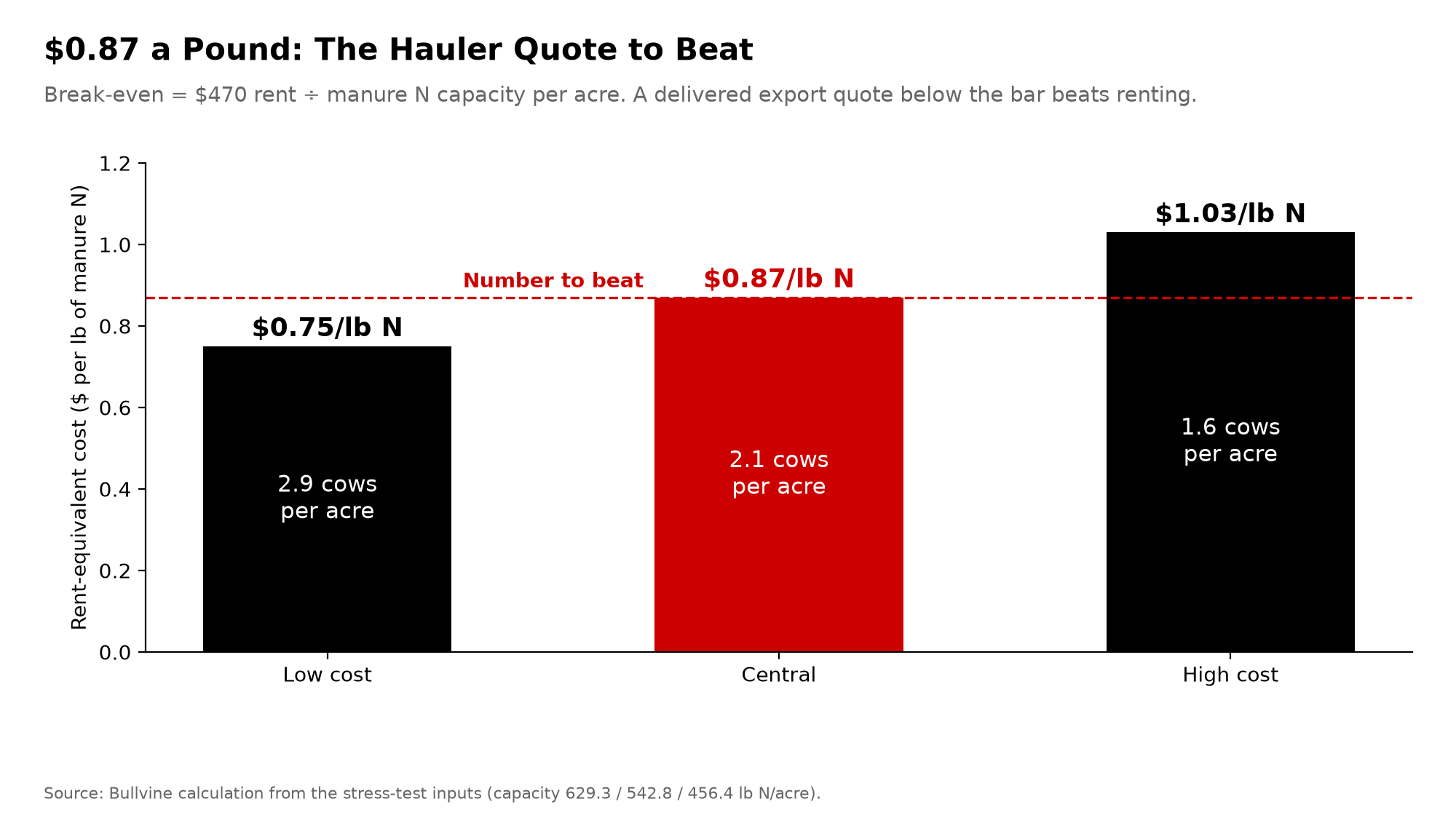
| Measure | Low | Central | High |
| N excreted, lb/cow/yr | 335.8 | 372.3 | 456.3 |
| Crop removal, lb N/ac/yr | 600 | 500 | 400 |
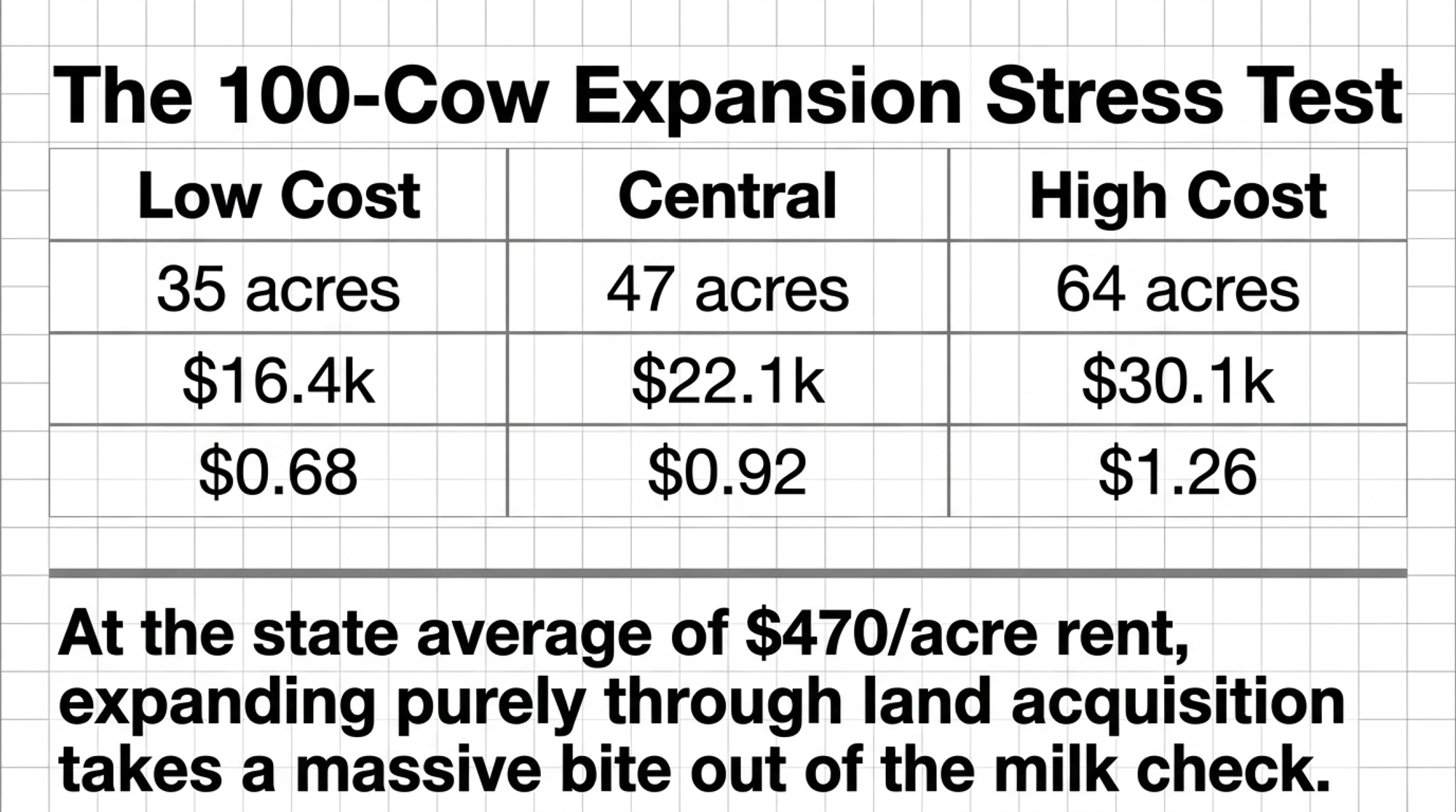
| Acre-equivalents | 60 | 80 | 122 |
| Acre-equivalents per added cow | 0.40 | 0.53 | 0.81 |
| Illustrative land acquisition value ($21,500/ac) | $1.29M | $1.72M | $2.63M |
| Illustrative annual gross rent ($470/ac) | $28,200 | $37,500 | $57,400 |
Single-crop corn (same 150 cows)
| Measure | Low | Central | High |
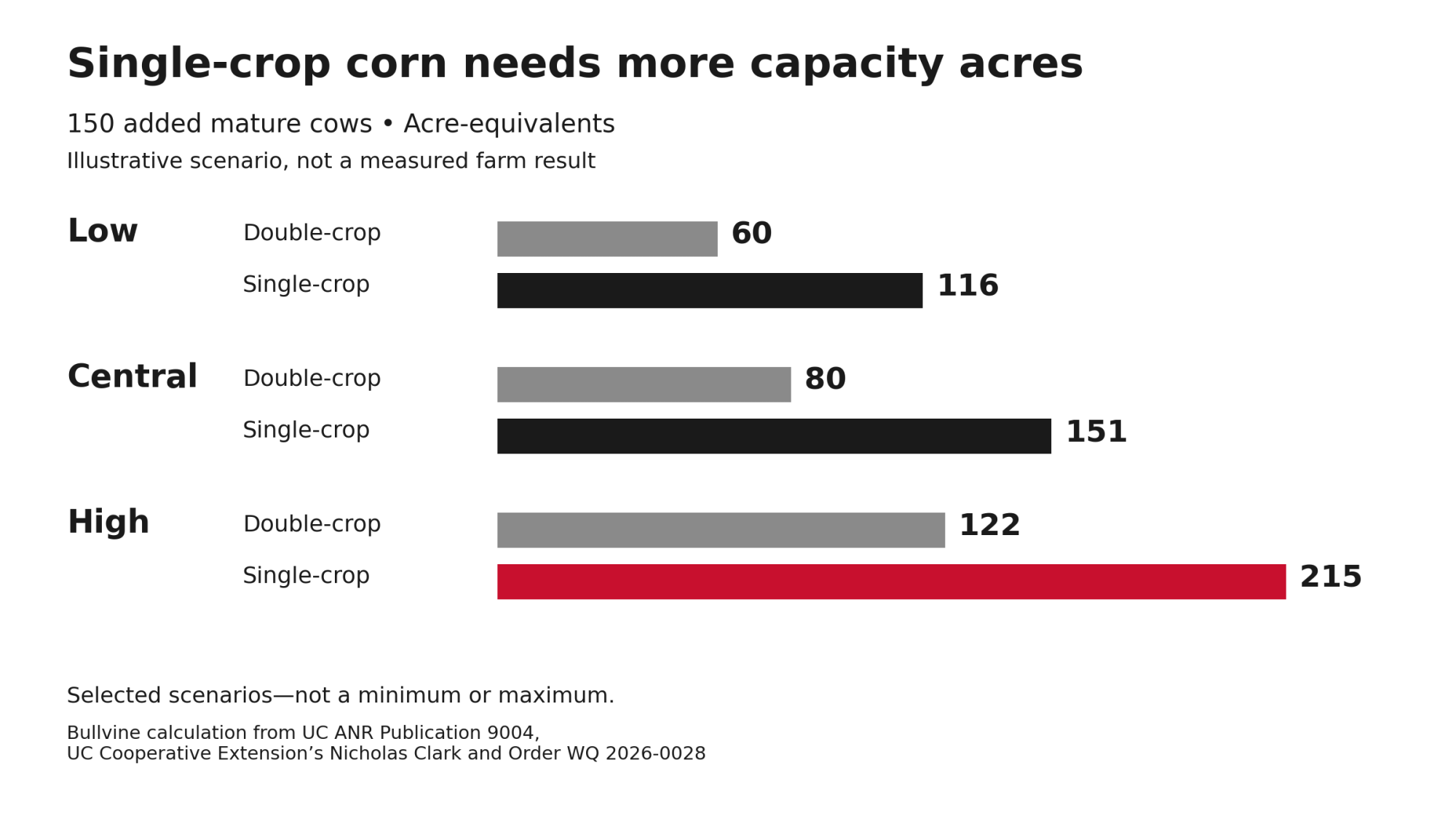
| Crop removal, lb N/ac | 309 | 265 | 227 |
| Acre-equivalents | 116 | 151 | 215 |
| Illustrative land acquisition value | $2.50M | $3.24M | $4.63M |
| Illustrative annual gross rent | $54,700 | $70,700 | $101,200 |
Graphic: Nitrogen capacity for 150 added mature cows, double-crop vs. single-crop corn. Bullvine calculations under stated assumptions.
The 122-acre scenario is not a guaranteed upper bound, and the 60-acre scenario isn’t a floor. Other nitrogen inputs, lower crop removal or future requirements can push a particular operation outside this range.
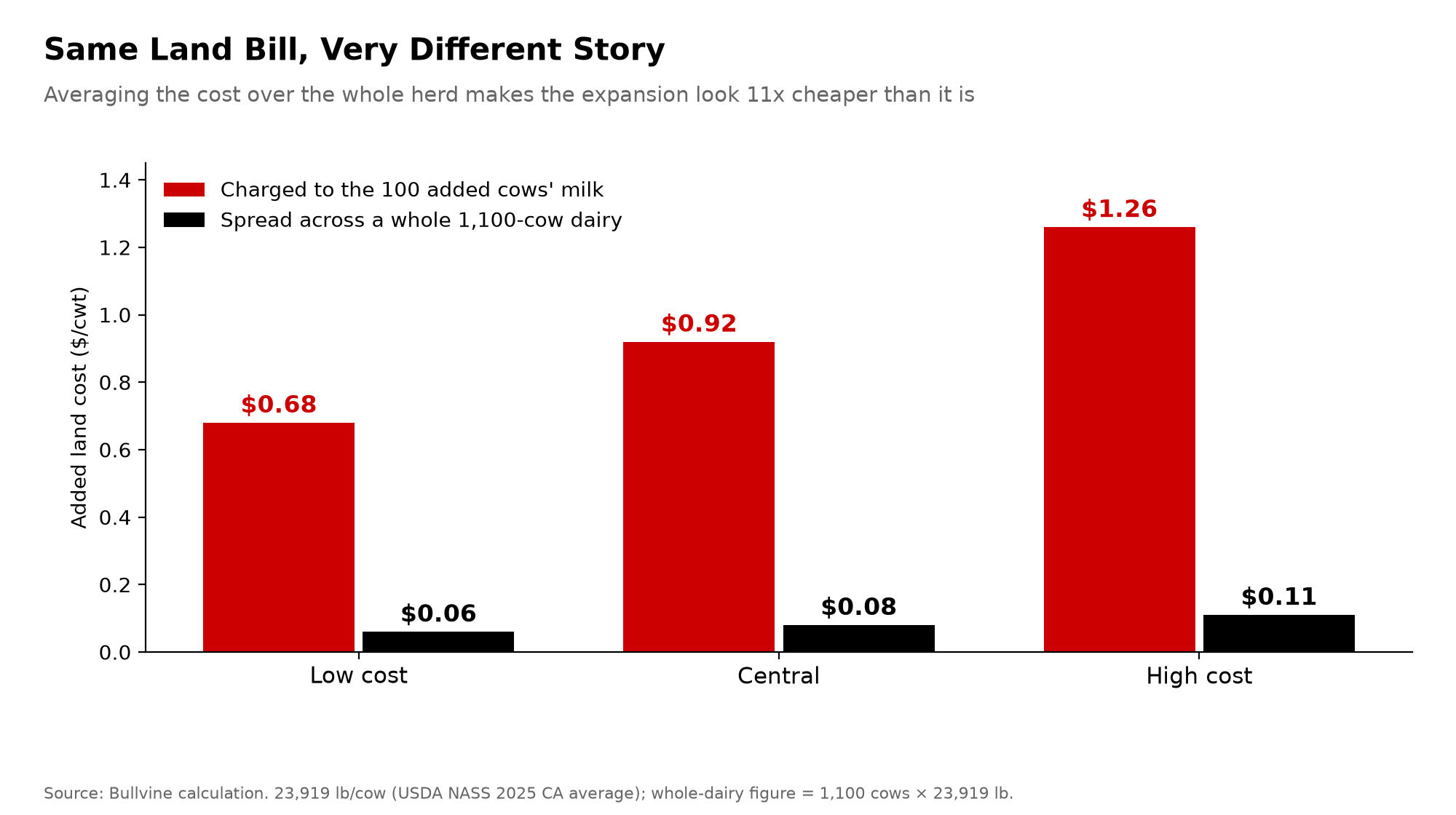
Acres are rounded. Dollar values come from unrounded acres, with rents rounded to the nearest $100. They exclude financing, hauling, application, water, permitting and other project costs, and they don’t deduct crop value or displaced fertilizer expense.
Three assumptions sit under every number:
- The model counts only the 150 added mature cows. Dairies must also report the calves and heifers that generate manure, and the model leaves those youngstock out.
- It uses gross excretion at lactating rates for all 150 cows and takes no credit for storage or air losses.
- It assumes no other counted nitrogen on those fields. Fertilizer or irrigation-water nitrogen on the same acres reduces the room for manure unless the manure displaces it.
The three columns are selected planning scenarios. They carry no probability and aren’t a confidence interval.
At a 400-cow dairy, the same 15% (60 cows) works out to 24, 32 or 49 double-crop acre-equivalents. That’s about $516,000, $686,000 or $1.05 million of land at the state average.
Limits of the model: It can’t establish a final-rate acreage requirement, because the final formula hasn’t been written. Usable capacity depends on the applicable permit requirements and a site-specific nitrogen budget, and a permit may set conditions rather than a single acreage number. Central Valley parcels with reliable water will also price differently from the statewide averages.
Update to our Sept. 24 analysis
- Coverage: Our Sept. 24 piece said cows milking on Sept. 15 “count as the ‘existing’ herd.” Existing-dairy treatment also depends on coverage or timely enrollment.
- Deadlines: Feb. 12, 2027 is the latest date for the Regional Board’s amendment, and dairies then have 60 days to file. The earlier piece’s body had this right; its summary compressed it.
- Model: The main change is that we no longer take an automatic 20–40% nitrogen-loss credit. The methodology note covers the other input changes.
An Acre Isn’t Capacity Until Its Budget Is Checked
A clean lease gets a dairy onto the field, and the nitrogen budget shows how much more the field can take. In a 2024 UC Cooperative Extension example, Nicholas Clark put the same field in two columns: the nitrogen the crop “sees” and the nitrogen that was applied. Those columns answer different questions. A first-year availability discount on manure helps plan crop nutrition, but it doesn’t erase the rest of that manure’s nitrogen from total-applied accounting. Total applied is what the A/R test counts.
For any acre in the plan, the question is how much nitrogen already goes onto it, and whether the 150 added cows replace that nitrogen or add to it.
The Lawsuit Over Future Final Limits
Dairy Cares’ challenge centers on whether final discharge and application limits that haven’t been developed yet should apply immediately to dairies that expand in the future, Agri-Pulse reported. The groups argue that because those limits are unknown, no one can say whether any dairy could meet them. In a statement reported by Agri-Pulse, Dairy Cares Executive Director Michael Boccadoro said the Board had “overstepped their authority.” State Water Board spokesperson Nick Cahill told Agri-Pulse the agency “will defend its decision in court.”
That provision decides whether added cows get any compliance schedule at all. Existing dairies can get schedules of up to 35 years to reach the final limits. Cows added after the revised permit is adopted get none and must meet those limits from the start. As reported, Dairy Cares’ statements don’t say the suit challenges the current coverage-before-cows step.
This account comes from Agri-Pulse‘s reporting of the Dairy Cares and Board statements. The Bullvine hasn’t independently reviewed the filed petition or the current docket. This story describes the order as adopted Sept. 15, and later court or Board action could change it.
What This Means for an Expanding Dairy
Holding off on expansion spending while the case runs is a business choice. Under the order as adopted, the enrollment and coverage steps still apply. Dates in this section are Bullvine planning targets unless the order sets them.
Right now: Reconcile the Sept. 15 mature-cow count against the herd size current coverage allows. Start collecting the records that back up nitrogen credits later: harvest tonnage, forage N, manure analyses, irrigation-water nitrate tests and export receipts.
Warning: If the Sept. 15 herd is larger than the covered herd, those cows need the upcoming enrollment window. Cows added after Sept. 15 don’t use that window. They go through the separate expansion process.
Before committing to expansion: Establish usable capacity field by field. Line up export contracts or treatment with nitrogen numbers attached, confirm which coverage route applies, scope CEQA and build approval time into the schedule.
Warning: Don’t count leased acres as available capacity until their existing nitrogen inputs and crop removal are budgeted.
When the amendment is issued: Confirm the actual enrollment deadline, 60 days after the amendment, and submit the Sept. 15 herd documentation by then. Expansion approval is a separate process. Filing an expansion ROWD starts it, but coverage comes only with the Regional Board’s notice. The 60-day enrollment window isn’t an expansion filing deadline.
Warning: April 13, 2027 holds only if the amendment lands on the last allowed day.
Lender checks before cattle money moves:
- Documented usable capacity for the added nitrogen.
- Coverage timing. An expected approval date can inform financing and scheduling, but written coverage is the condition for bringing added cows in through this route.
- The plan if an export outlet disappears.
A cattle contract that delivers before the coverage notice puts the added cows on the new-dairy track.
Methodology Note. These are Bullvine calculations, not Water Board acreage requirements or cost estimates.
- Excretion inputs. UC ANR Publication 9004 states in its text that lactating cows on four California commercial dairies (Petaluma, Modesto, Tulare and Chino) excreted 0.92–1.25 lb N per head per day, averaging 1.02. The model’s daily inputs are 0.92 (low), 1.02 (central) and 1.25 (high) lb N per cow per day.
- Low input. We kept 0.92, the low end of the range UC states in its text, as a selected scenario input. We didn’t recheck the ration-level results in the report’s tables for this article.
- Age of the data. The data come from dairy measurements in the early 2000s. UC’s committee expected excretion to trend higher as milk per cow rises.
- Dry cows. UC’s recommended dry-cow figure is 195 g N per day, against 462 g for lactating cows. Applying lactating rates may therefore overstate mature-herd nitrogen when dry cows are included.
- Losses. UC’s committee suggested planning for 20–40% atmospheric nitrogen losses from liquid manure before land application. Our base case credits none.
- Crop removal. UC says dairy forage fields typically remove 400–600 lb N per acre per year. Single-crop corn removal of 227–309 lb comes from UC Cooperative Extension’s Nicholas Clark (Nov. 18, 2024).
- Comparison with Sept. 24. That piece used a flat 365 lb of excretion, 20–40% loss credits, 362–450 lb of removal and a 0–50 lb irrigation-nitrogen deduction. Dropping the loss credit pushes acres up. The higher removal range and the dropped irrigation deduction pull them down.
- Land and rent. Land value comes from USDA NASS, Land Values 2026 Summary: $21,500 per acre for California irrigated cropland in 2026, up 2.9%. Rent is the NASS 2026 California irrigated average of $470 per acre, down $13, as reported by DTN.
- The 1.4 ratio. Order WQ 2026-0028 carries forward the existing 1.4 A/R test for the expansion route discussed here. It’s an interim test, not the final rate.
Complete references and supporting documentation are available upon request by contacting the editorial team at editor@thebullvine.com.
Learn More
- The Forage Grower’s Guide to SDI: Making Drip Pay on Your Dairy When Water and N Are Tight — Arms you with the math to make subsurface drip irrigation profitable, detailing how dairies cut applied water by 30% while managing nitrogen through lagoon effluent to hit strict A/R targets.
- California Dairy’s Death Spiral: Why Your Operation Could Be Next — Maps out the structural squeeze threatening the Central Valley feed chain, tracking how regulatory compliance costs surged to $1,600 per acre so you can anticipate the next margin threat.
- California’s $522 Million Secret: How Smart Dairy Farmers Turned Methane into Money While Saving the Planet — Reveals a parallel economy where environmental rules actually build margins, delivering hard numbers on how progressive operations leverage digesters and feed additives to generate up to $160 per cow in new revenue.
The Sunday Read Dairy Professionals Don’t Skip.

Every week, thousands of producers, breeders, and industry insiders open Bullvine Weekly for genetics insights, market shifts, and profit strategies they won’t find anywhere else. One email. Five minutes. Smarter decisions all week.