




Archive for dairy genetics ROI

The Great Milk Divorce: The $383,000 IOFC Gap Splitting 500‑Cow Midwest Herds Into Upstairs and Downstairs Milk

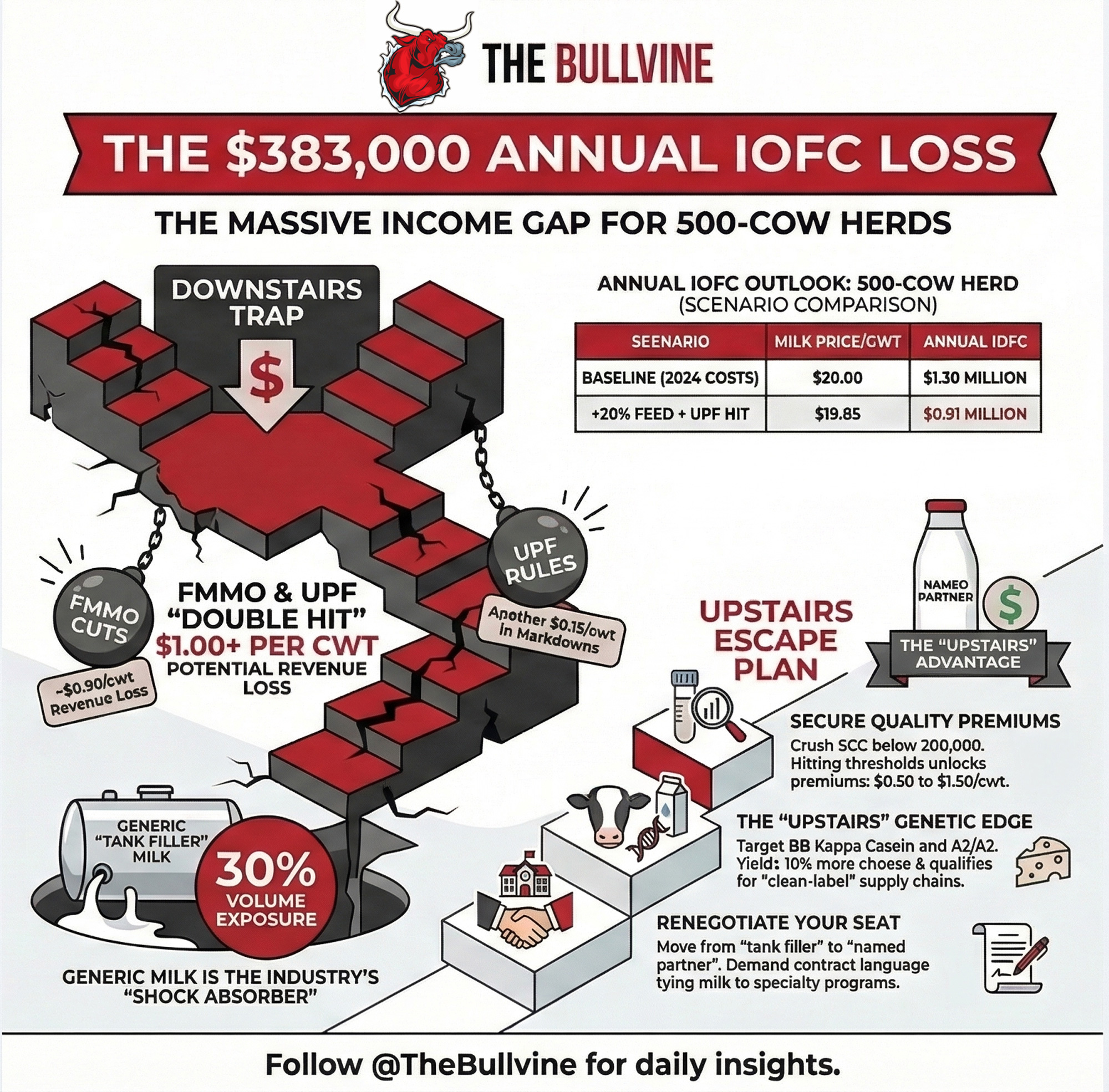
On a 500-cow Midwest dairy, FMMO and UPF rules can turn the same 425 cwt/day into either solid margins or a $383,000 IOFC hole.

Executive Summary: Federal make‑allowance changes and looming UPF rules are quietly splitting processor milk into “upstairs” and “downstairs” streams, with huge IOFC consequences for 500‑cow herds. Using Illinois FBFM data, the article shows how a 500‑cow Midwest dairy shipping 425 cwt/day can see a $383,000/year swing in income over feed as feed costs rise 10–20% and processors squeeze premiums on UPF‑exposed products. Mark, a composite based on 2024 FBFM economics, sits below full‑cost breakeven at $20 milk once the June 2025 FMMO make‑allowance cuts pull about $0.85–$0.93/cwt from his milk check. Sarah, built from the same regional benchmarks, closes that gap by driving SCC under 200,000, selecting for BB kappa casein and A2/A2, and renegotiating to tie her herd to school, hospital, and clean‑label programs. The piece walks through three IOFC scenarios, a transparent $0.15/cwt “UPF hit” calculation, and the math behind SCC and protein‑variant premiums. It then lays out a 30/90/365‑day playbook so producers can diagnose whether they’re upstairs or downstairs milk today, and what it takes to move up a tier in their buyer’s supply plan.

dairy milk quality premiums

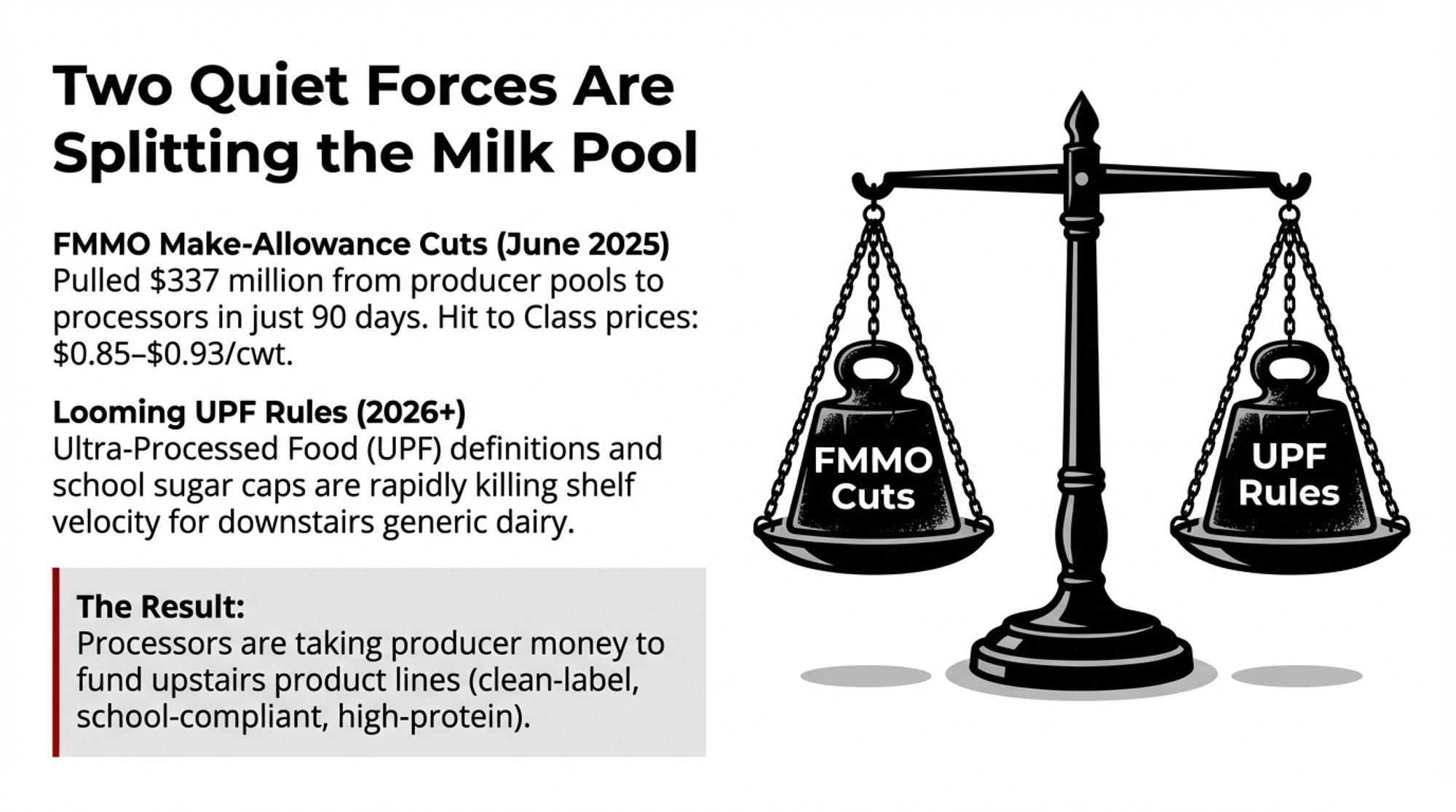
A 500‑cow Midwest operation shipping 425 cwt a day can see about a 3,000/year swing in income over feed depending on which side of the plant its milk lands on. Two forces that have hit in the last nine months are widening that gap fast.

The June 2025 FMMO make‑allowance increase pulled an estimated $337 million from producer pool revenues in its first 90 days, per AFBF economist Danny Munch’s September 2025 Market Intel analysis, with Class price reductions ranging from $0.85 to $0.93/cwt. Now, a federal UPF definition — possibly arriving in 2026, based on HHS Secretary RFK Jr.’s public statements about FDA timelines — could sort every dairy plant’s product lines into “upstairs” (clean‑label, school‑compliant, high‑protein) and “downstairs” (likely to face UPF classification under proposed frameworks, with growing regulatory and market pressure on shelf velocity and margins).
Two composite operators — call them Mark and Sarah — show how that split plays out on real milk checks, benchmarked to Illinois 2024 FBFM data. They’re composites built from regional averages, not real people. But the math is real.

Mark’s Baseline: A Good Herd on the Wrong Side of the Plant

Mark runs 500 cows. Solid management. Reasonable genetics. His milk goes to a regional plant running both institutional and retail/UPF product lines.
His 2024 cost structure comes straight from the Illinois Farm Business Farm Management Association’s annual summary (farmdoc daily, December 18, 2025, Bradley Zwilling):

  • Feed cost: $11.64/cwt
  • Non‑feed costs: $11.92/cwt (a record high)
  • Total economic cost: $23.56/cwt
  • Milk production: 23,530 lbs/cow (up 549 lbs from 2023)

The actual 2024 milk price averaged $21.63/cwt — already $1.93 below total economic cost, costing Illinois producers negative $409/cow for the year. For this analysis, we model a $20.00/cwt milk price — in line with farmdoc’s 2025 projection of approximately $20.15/cwt and USDA’s outlook for further price decreases into 2026.

At $20.00 milk against $11.64 feed cost:

  • IOFC: about $8.36/cwt
  • Daily IOFC (425 cwt): ~$3,553/day
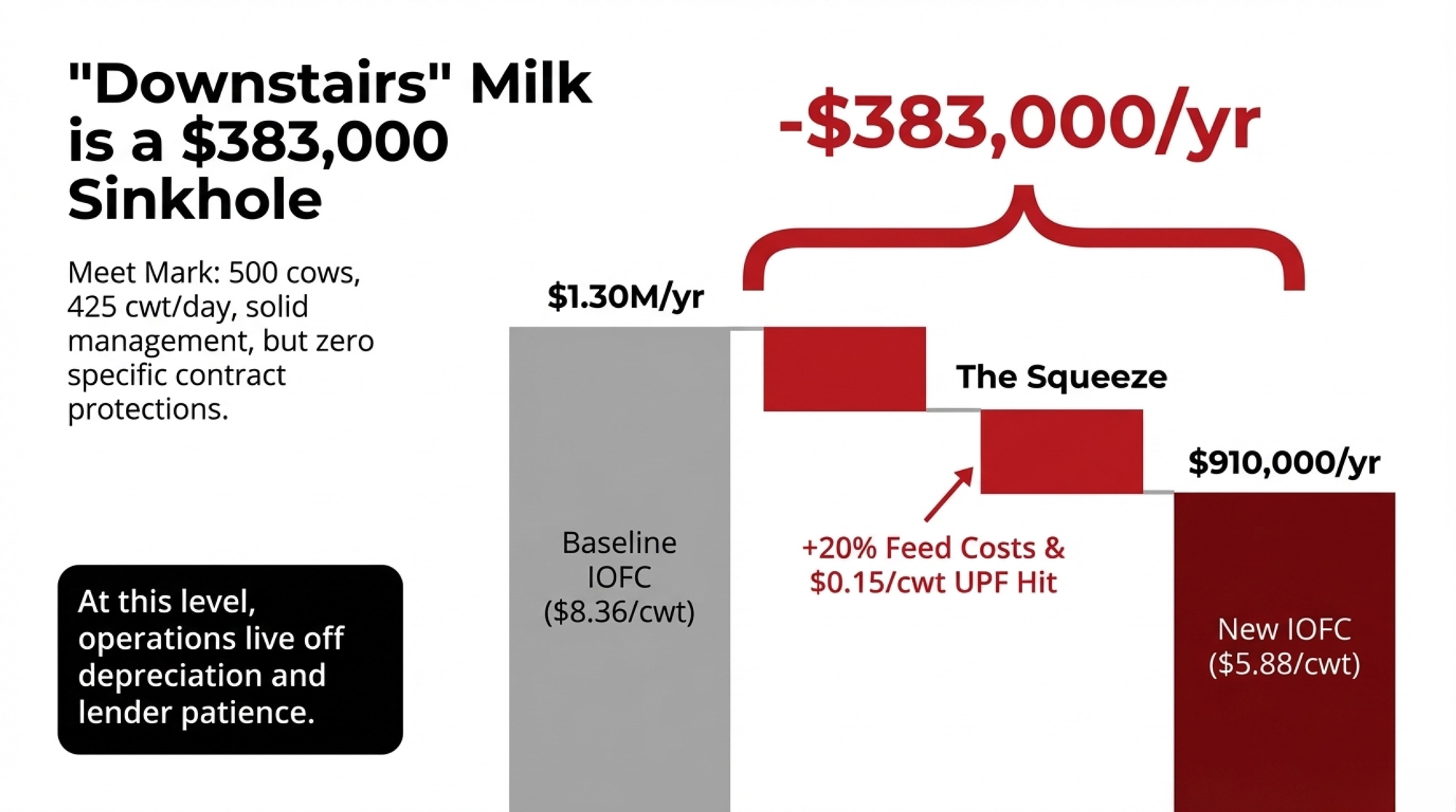
  • Annual IOFC: ~$1.30 million/year

He’s well below full‑cost breakeven. Then the ground moved.

The FMMO make allowance hit: On June 1, 2025, USDA raised allowances for butter, cheese, whey, and nonfat dry milk. Munch at AFBF estimated the hit to Class prices at $0.85–$0.93/cwt, shifting roughly $337 million from producer pools to processors in 90 days. That money went to the plant side of the ledger — funding reformulation, equipment upgrades, and premium‑grid tightening.

The UPF policy timeline is stacking up just as fast. In July 2025, HHS, FDA, and USDA issued a formal Request for Information on UPFs. USDA school meal standards now cap added sugar in flavored milk at 10 g/8 oz by the 2026–27 school year, and IDFA’s Healthy School Milk Commitment brought average added sugar in school milks down to 7.2 g/serving by July 2025.

That’s the federal picture. At the state level, California’s AB 1264 requires identification of harmful UPFs by July 1, 2026, with phased K–12 removal running through 2035. And north of the border, Canada’s mandatory front‑of‑pack nutrition labelling went live January 1, 2026, with enforcement beginning the same date.

Mark didn’t change his cows, his feeding program, or his contract. The economics around him changed plenty.

What Does a $383,000 Dairy IOFC Gap Look Like in 2026?

Most kitchen‑table talk still treats UPF as a nutrition story or a PR problem. Run the numbers, and it’s a feed and IOFC issue.

The following scenarios are not based on any specific processor’s current or announced pricing. They model what the economics could look like if UPF‑related policy changes affect feed costs and processor pricing grids over 3–5 years.

An IIED analysis of 2016–2021 agricultural support across 72 countries plus the EU, led by principal researcher Alejandro Guarín (published May 2025), found $14.5–$42.5 billion/year in support effectively subsidizing UPF ingredients — corn, soy, wheat, sugar — while penalizing fresh fruits and vegetables by about $16.3 billion/year. IIED’s modeling suggests repurposing those supports toward fruits, vegetables, and pulses would reduce production of previously subsidized commodities in OECD countries, though the exact percentage depends on how governments redesign the programs.

For this analysis, a 10–20% increase in feed costs over 3–5 years is the stress‑test range — not a forecast. But the directional pressure is real. USDA’s May 2025 Feed Outlook flagged that protein costs, soybean meal in particular, are expected to remain firm or increase even as corn softens — creating what the report described as a “barbell economy” of feed expenses. Purdue ag economist Michael Langemeier separately flagged DDG price shifts as a factor that could push livestock feed costs higher in 2026, with estimated DDG prices ranging from $145 to $155 per ton.

Three Scenarios for Mark’s 500‑Cow Herd

ScenarioFeed/cwtMilk Price/cwtIOFC/cwtDaily IOFCAnnual IOFC
Baseline (FBFM 2024 costs, projected price)$11.64$20.00$8.36$3,553~$1.30M
+10% feed$12.80$20.00$7.20$3,060~$1.12M
+20% feed + UPF hit$13.97$19.85$5.88$2,499~$0.91M

Note: The bottom scenario uses this article’s modeled assumptions — 30% of volume exposed to UPF‑side SKUs, $0.50/cwt plant markdown on that slice. These are illustrative. Your exposure depends on your buyer’s product mix and pricing grid.

The gap between baseline and the bottom row: about $383,000/year in IOFC. Same herd. Same people. Very different economics.

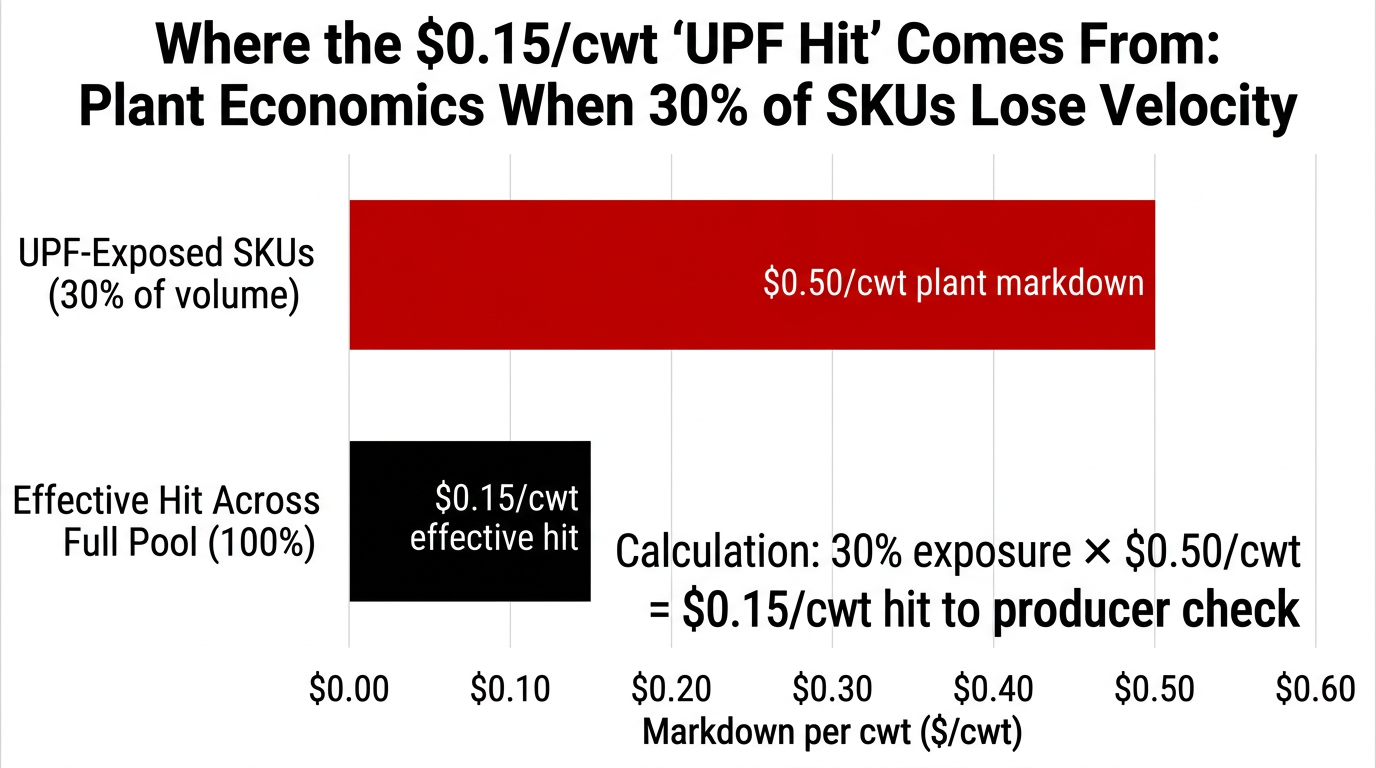
Where Does the $0.15/cwt “UPF Hit” Come From?

This isn’t on anyone’s milk statement yet. It’s a calculated risk tied to what happens when the plant’s downstairs side starts losing shelf velocity.

When Chile’s mandatory warning labels and marketing restrictions took effect, purchases of “high‑in” beverages — primarily sugary drinks — fell 23.7% over 18 months (Taillie et al., PLOS Medicine, February 2020). Canada’s black‑and‑white warning symbols for high‑sugar, high‑sodium, and high‑saturated‑fat products went live in January 2026, with immediate enforcement. FDA’s proposed front‑of‑pack labels could follow.

Plants won’t eat reformulation and marketing costs on slow‑moving UPF‑flagged SKUs forever. They’ll pass more of that pressure back through the pool — lower premiums, tighter quality grids, higher marketing deductions.

If 30% of Mark’s volume feeds UPF‑exposed SKUs and the plant shaves $0.50/cwt on that slice, the effective hit across his whole pool is 0.30 × $0.50 = $0.15/cwt. New effective price: $20.00 − $0.15 = $19.85/cwt.

IOFC in the $5.88–$6.10/cwt range, while non‑feed costs sit near $11.92/cwt, is where operations start living off depreciation, open lines of credit, and lender patience.

How Are Dairy Processors Sorting Upstairs From Downstairs Milk?

The Wisconsin Cheese Makers Association, representing more than 850 companies and cooperatives across 44 states, laid this out directly in their September 22, 2025 position statement: “In practice, a cup of fortified yogurt or a protein‑packed slice of cheese could be treated as nutritionally suspect, because it required pasteurization, culture development, or added rennet to create.” NMPF filed formal comments on October 23, 2025, warning that how UPFs are ultimately defined “could affect how [dairy] products can be marketed, and whether or not they will be included in federally funded programs such as SNAP, WIC or school meals programs.” IDFA urged the FDA not to rush a definition that lumps all processing together.

That’s the public positioning. The private math is sharper.
Upstairs products — school milk meeting sugar caps, clean‑label yogurts, high‑protein UF, A2‑certified brands, hard and specialty cheeses — are politically and contractually protected. Products more likely to face UPF classification— heavily sweetened yogurts, flavored snack cups, sugary retail-flavored milks, and private‑label processed cheese — are facing growing regulatory and market pressure.

Plants now have more manufacturing margin from the make‑allowance bump to fund that upstairs transition. They’ll pay more for milk feeding the upstairs lines — and spend less to keep the downstairs pool happy.

Where plant capacity is tight, and every tanker matters, that shift hasn’t landed yet. Generic volume still has negotiating power. But plants investing in upstairs products are getting pickier about which herds earn those seats — and building the kind of buyer relationships that survive the next downturn.

Mark’s milk goes to both places. His contract doesn’t specify which.

Sarah’s Turn: What Moving Upstairs Actually Takes

Sarah farms in the same region. Similar size. She looked at the same FMMO and UPF calendar and saw a 24‑month repositioning window, not a label headache.
She asked her processor one question: When you pitch school milk or hospital yogurt, is our herd one of the names in the deck? The honest answer — good volume, but not the herd they highlight in RFPs — told her everything.

So she made three moves.
Move 1: Crush SCC and Bacteria Counts

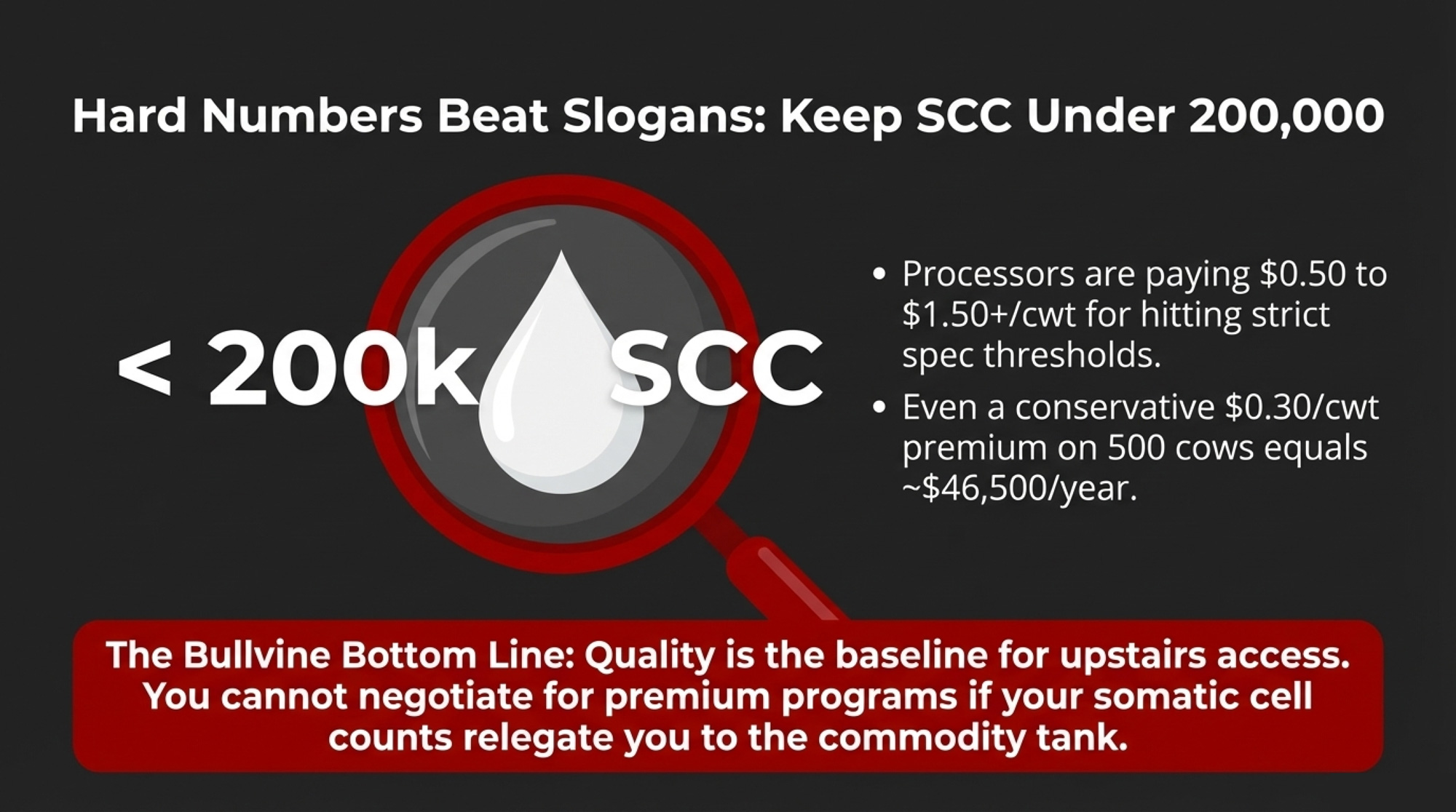
Pulling herd SCC from the mid‑300k band under 200,000 unlocks consistent quality premiums. The Bullvine’s own reporting on processor expansion found that farms hitting spec thresholds are seeing premiums ranging from $0.50 to over $1.50/cwt, and an 85‑cow Pennsylvania operation captured $0.75/cwt through relatively simple bypass protein and consistent feed push‑ups. Even at a conservative $0.30/cwt SCC premium on 500 cows shipping 425 cwt/day, that’s 425 × $0.30 = $127.50/day, roughly $46,500/year. That’s before the extra pounds and lower treatment costs.

Move 2: Get Specific on Protein Variants

Sarah’s genetics team didn’t just target “more solids.” They targeted which solids matter for products that survive UPF scrutiny.

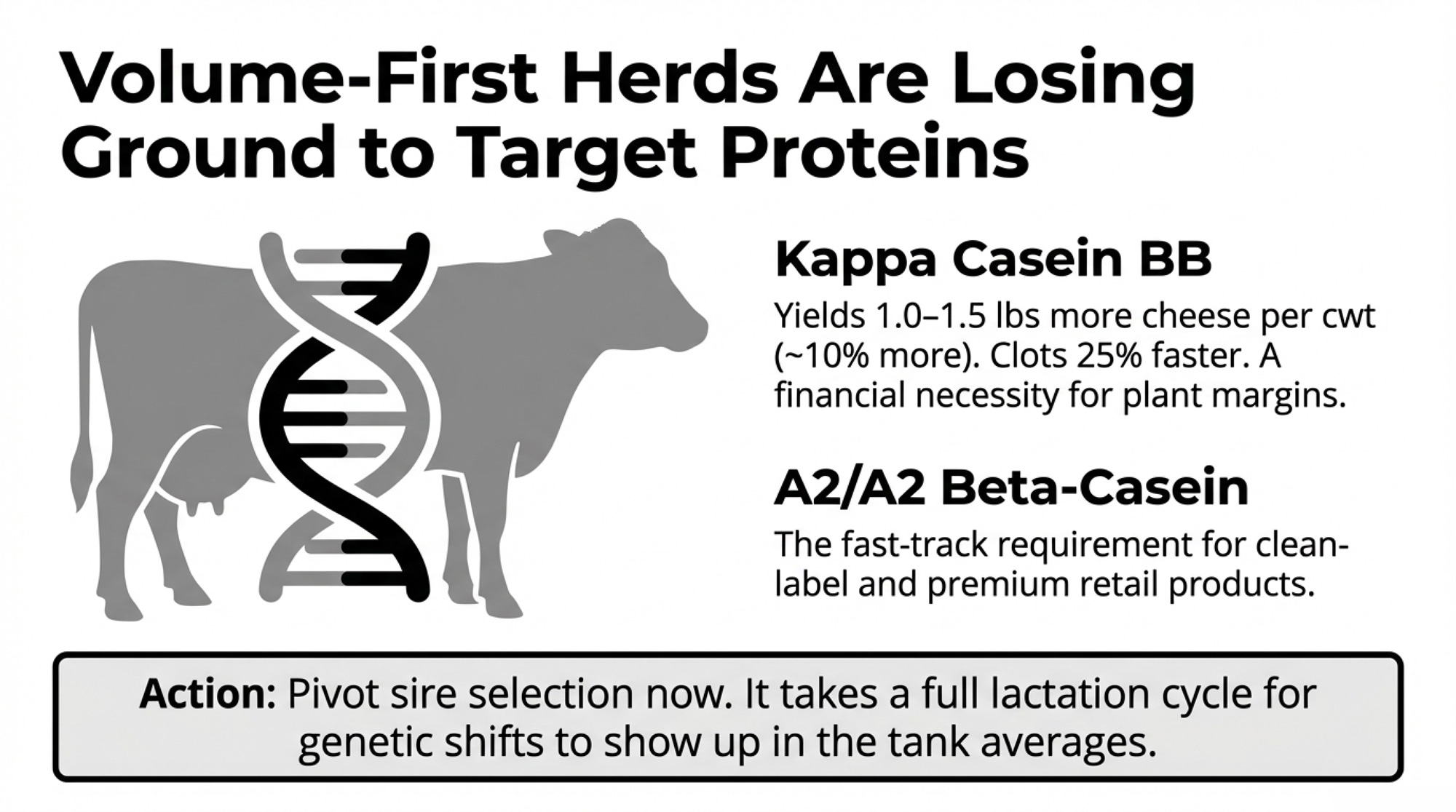
Kappa Casein BB: Cheese from BB cows clots around 25% faster, produces curd roughly twice as firm, and yields about 1.0–1.5 lbs more cheese per cwt — roughly 10% more — than AA cows. For a cheese plant, that’s not a nice‑to‑have. That’s money. Lactanet data (CDN document #586, August 2022) show BB is the dominant genotype in Jerseys (82.2%) and Brown Swiss (61.5%), but in Holsteins, it’s just 37.6% — meaning active selection toward BB and AB sires matters most where most milk is produced.
A2/A2 Beta‑Casein: Lonnie Holthaus at Milkhaus Dairy in Fennimore, Wisconsin, has selectively bred his Holsteins for A2/A2 — more than half the herd now produces only A2 protein milk, with products available through local grocery stores and direct‑to‑consumer channels. UW–Madison Extension notes the Holstein breed “is quickly moving to be an A2A2 only breed,” with a survey of five A.I. studs turning up over 800 A2A2 Holstein bulls — by far the most common beta‑casein combination now offered.

Lactanet’s published breeding guidance spells out the path: producers can increase BB frequency by “selecting for BB or AB sires,” and increase A2 frequency by “preferred use of A2A2 or A1A2 sires.” It’s not a complicated selection — it just has to be intentional.

New U.S. plant capacity backs the same direction. IDFA reported in October 2025 that processors have committed more than $11 billion in new and expanded manufacturing capacity across 19 states — over 50 individual building projects between 2025 and early 2028. A significant share of the capacity is for cheese and whey, positioned for what MarkNtel projects as a global whey protein market growing from .5 billion (2023) to .2 billion by 2030. UW–Madison Extension dairy economist Leonard Polzin noted that fat and protein components keep climbing “every single year” — and the new processing infrastructure is built to reward exactly that. Volume‑first herds are losing ground.

Sarah pivoted sire selection toward BB kappa casein and A2/A2 alongside health, solids, and longevity. Not a one‑month fix — it took a lactation cycle to start showing up in tank averages.

Move 3: Renegotiate Her Seat in the Supply Plan

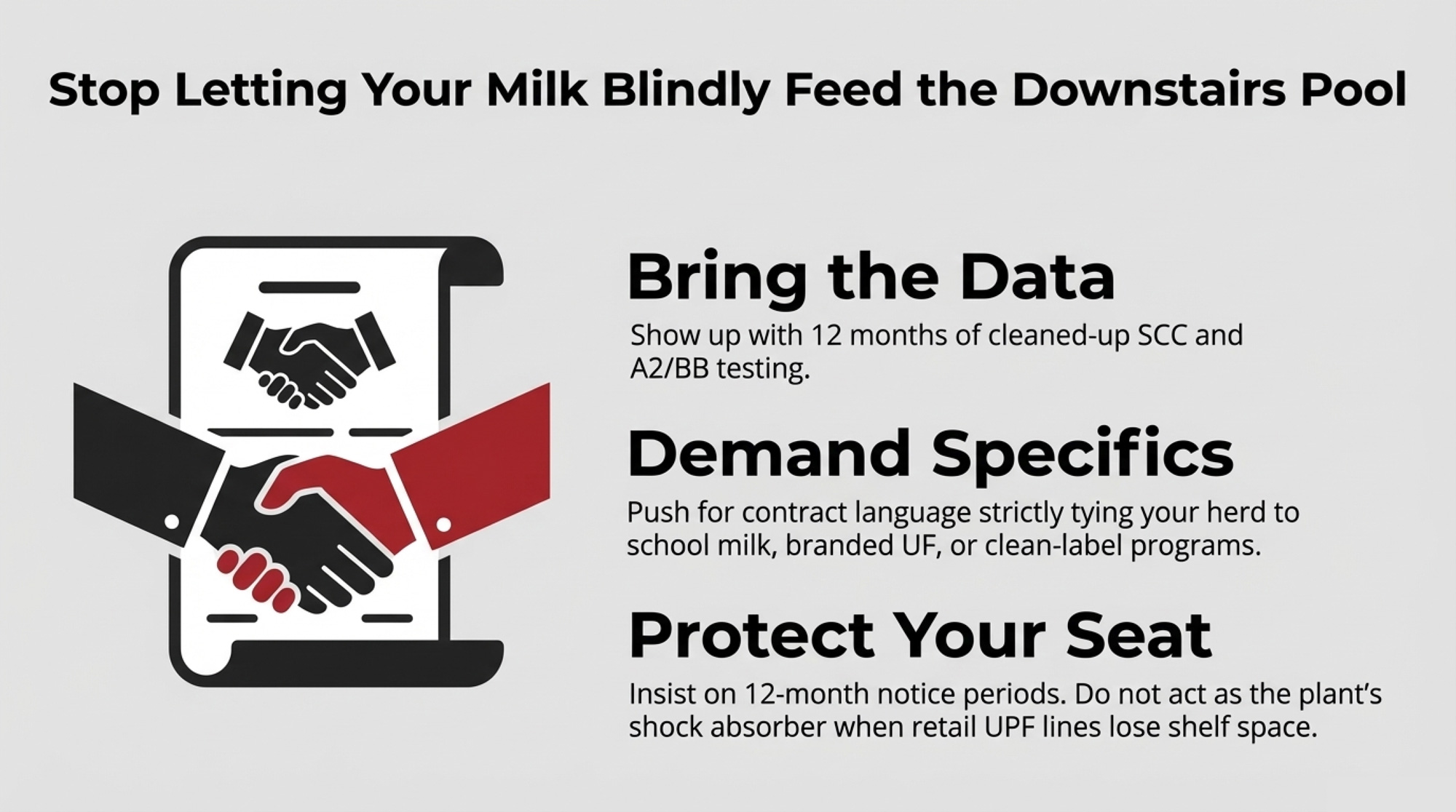
Instead of asking for a better average price, she brought 12 months of cleaned‑up SCC, strong components, and documented A2/BB testing to the table. She pushed for program language tying her herd to specific products and 12‑month notice periods, so she wasn’t locked in if the plant doubled down on UPF‑heavy retail.

Two years from now, both herds could still be shipping 425 cwt/day. The difference sits on the milk check. Sarah carries a stable stack of quality and program premiums — consistent with The Bullvine’s reporting on processor expansion, which documented premiums of $0.50 to over $1.50/cwt for farms meeting spec thresholds, with top‑tier programs potentially reaching higher for herds that qualify on components, protein variants, and SCC simultaneously.

MetricMark (Downstairs)Sarah (Upstairs)Gap Impact
Herd Size500 cows500 cowsIdentical
Daily Volume425 cwt/day425 cwt/dayIdentical
SCC Average320,000185,000−42% SCC
Kappa Casein / A2 StatusNot testedBB & A2/A2 selectedActive selection
Processor Contract TypeGeneric pool volumeNamed in school/hospital RFPsProtected seat
Quality/Program Premiums$0.10/cwt$0.80/cwt+$0.70/cwt
Feed Cost/cwt$13.97$13.97Identical
Milk Price Received$19.85/cwt (base − UPF hit)$20.80/cwt (base + premiums)+$0.95/cwt
IOFC/cwt$5.88$6.83+$0.95/cwt
Annual IOFC~$912,000~$1,059,000
Annual IOFC Difference+$147,000/year

Mark is still letting his milk feed the downstairs pool.

Can You Move Off the Downstairs Staircase in 24 Months?

Federal UPF definitions, front‑of‑pack labels, and school standards all have dates attached. Here’s what to do with that calendar.

In the Next 30 Days

  • Pull the last 3–6 months of milk statements. What’s your average SCC? Where are protein and butterfat sitting? How much per cwt is the base vs. quality vs. program premiums?
  • Print your milk supply agreement. What’s the notice period? Does it mention specific programs — school milk, branded UF, clean‑label — or are you just generic pool volume?
  • Ask your field rep one blunt question: “When you pitch our plant’s school and clean‑label contracts, is our herd one you mention by name — or are we just filling tanks?”
  • Check your herd’s kappa casein and A2/A2 status. Individual tests run about $40/head through labs like UC Davis VGL; the full Milk Protein Panel (A2 + kappa casein + beta‑lactoglobulin) runs $93/head (UC Davis VGL pricing, October 2023). On 500 cows, that’s $20,000–$46,500 — significant upfront, but budget it against the $46,500/year SCC premium recovery alone. If you’re already running broader panels, Zoetis CLARIFIDE Plus costs roughly $43/head, including health and wellness traits.

Red flag: No quality or program premiums on your statement, no program language in your contract, and your buyer can’t link your herd to anything strategic? You’re deep in the downstairs story right now.

Green flag: Your buyer names your herd specifically in RFP submissions, your contract ties to at least one program, and you’ve got 12+ months of SCC under 200K on record? You’re upstairs. Protect that seat — keep specs high, contract language specific, and your testing documentation current.

In the Next 90 Days: Pick Your Branch

  1. Upgrade into the A‑pool where you are. Targets: SCC consistently <200,000, protein >3.15%, start genomic testing for kappa casein BB and A2/A2. You gain leverage with your current buyer, but you’ll spend more upfront on vet work, cow comfort, nutrition, and testing.
  2. Scout a processor switch. Map processors within a realistic hauling radius that are building school, hospital, “no UPF,” A2, or specialty cheese contracts. You gain alignment with a buyer who values upstairs milk. You take on hauling changes, relationship risk, and the chance that if the new buyer’s program changes specs mid‑contract, you’re rebuilding from scratch in a market where your old plant already filled your slot.
  3. Renegotiate your seat at the table. Push for a program language that ties your herd to products that must survive UPF rules. Aim for 12‑month notice periods. You keep the relationship you know, but it may be a harder conversation if your buyer isn’t under immediate pressure yet.

Opportunity signal: If your buyer is already talking about school sugar caps, UPF definitions, or “real food” wins with institutions, they’re feeling the heat. That’s when A‑team milk becomes more valuable inside their business than it looks on your statement.

Over the Next 365 Days

Build a 6–12 month run with SCC under 200,000 and documented component and protein‑variant testing. Lean hard into sires that bring BB kappa casein, A2/A2, solids, and longevity. After that, go back to your buyer with a simple ask: “Here’s our updated quality and component record. Which of your school, hospital, or clean‑label programs could we qualify for, and what premiums go with them?”

What This Means for Your Operation

  • If your IOFC is under about $7/cwt and quality/program premiums are thin on your statement, you’re in the zone this $383,000 gap describes. Run your own numbers — swap in your feed cost, your milk price, and your best guess at how much of your buyer’s volume feeds UPF‑exposed products.
  • If your buyer can name specific products and contracts your herd supports, you’re already upstairs. Don’t assume that the seat is permanent — keep your specs high and your contract language specific.
  • If your contract doesn’t mention notice periods or programs, assume you’re the shock absorber, not the protected volume. That doesn’t mean panic. It means read the fine print and decide if that’s where you want to sit in your buyer’s supply plan.
  • If you don’t know your herd’s kappa-casein or A2 status, you can’t negotiate for traits you haven’t tested for. At $40–$93/head, that’s cheap insurance relative to the premium it could unlock.

Signals to Watch

  • FDA UPF definition timeline: If a federal definition arrives in 2026, processor contract language could start shifting within 90 days of publication. We’ll be tracking processor responses and contract grid changes as they surface — this is the story to watch for the next 18 months.
  • California’s AB 1264 identification deadline (July 1, 2026): The first real test of which products get flagged and which don’t. What happens in California school districts will signal how other states and federal programs respond.
  • Your buyer’s institutional wins: Track whether your processor is growing school milk and hospital contracts. If those are growing, your leverage is growing too.
Key Takeaways

  • If your IOFC on a 500‑cow herd is drifting under ~$7/cwt, today’s FBFM‑style costs and a small UPF‑driven markdown can easily add up to a $383,000/year gap between you and a neighbour on the upstairs side of the plant.
  • The fastest upgrades into that upstairs pool are hard numbers, not slogans: SCC consistently under 200,000, protein north of ~3.15%, and a clear plan to move your herd’s genetics toward BB kappa casein and A2/A2 for cheese, school, and clean‑label programs.
  • Your most important 30‑day check isn’t on a spreadsheet; it’s one question for your field rep: “When you pitch school and clean‑label contracts, is our herd one you mention by name—or are we just filling tanks?”
  • If your contract doesn’t spell out program links and at least a 12‑month notice period, assume you’re in the cut‑first volume, not the protected pool—and build a 365‑day plan to either upgrade in place, switch buyers, or renegotiate your seat.

The Bottom Line

In the next 30 days, do one thing: calculate your real IOFC — not from memory, from your actual milk statements and feed records. Break down how much of your check is base price vs premiums. Then ask your buyer in plain language: Is our herd part of the milk you rely on for your safest contracts, or are we in the pool you can cut first?

What’s your real IOFC this month — and does your buyer know your milk by name, or just by tank number?

Complete references and supporting documentation are available upon request by contacting the editorial team at editor@thebullvine.com.

Learn More

The Sunday Read Dairy Professionals Don’t Skip.

Every week, thousands of producers, breeders, and industry insiders open Bullvine Weekly for genetics insights, market shifts, and profit strategies they won’t find anywhere else. One email. Five minutes. Smarter decisions all week.

NewsSubscribe
First
Last
Consent

The $3,500 Calf Question: What Dairy Farmers Need to Know About April 2026’s New CDCB Calf Health Evaluations

6% calf mortality = $350K annual loss. New genomics launching April 2026. Your cost? Maybe nothing if you’re already genomic testing, up to $40K if starting fresh.

You know that sinking feeling when you walk into the calf barn and spot another one with scours? And these days—with replacement heifers running $3,000 to $4,000 according to the latest USDA market reports—every sick calf feels like watching money evaporate.

Here’s what’s got my attention: we’re still losing about 6% of our calves before weaning, at least according to the last comprehensive USDA survey from 2014. Canadian research from just a couple years back shows similar numbers, which tells me we haven’t made much progress despite all our management improvements. It’s frustrating, honestly.

So when I heard about the April 2026 launch of national genomic evaluations for calf health traits at the CDCB meeting on October 1st in Rosemont, I had to dig deeper. The Council on Dairy Cattle Breeding and USDA’s genetics lab have been working on this for years, and they’re targeting exactly what’s killing our calves—scours and respiratory disease. Those two culprits are responsible for about 75% of our pre-weaning deaths, based on research published in the Journal of Dairy Science (Urie et al., 2018).

What I’ve found is that for many of us running typical 1,000-cow operations, the economics of calf losses are worse than we probably realize. When you do the math—and I’ll walk through this with you—we’re looking at significant potential here. But there’s also a lot to consider before jumping in.

Click the link to view the presentation.

Genetic Tools for Healthier Calves
John Cole, Ph.D., CDCB Chief Research and Development Officer
Slides

What They’re Actually Measuring (And Why It Matters)

Decision Flowchart: Should Your Dairy Invest in Genomic Calf Health Testing? Follow this evidence-based decision tree to determine your optimal investment strategy based on current mortality rates. Red paths indicate caution zones where management improvements should precede genetic investments.

Let me be clear about something: these aren’t treatment protocols or management recommendations we’re talking about. These are genetic predictions—basically, which bloodlines tend to produce calves that stay healthier.

The data foundation is pretty impressive. CDCB researchers analyzed over 200,000 diarrhea records and nearly 700,000 respiratory disease records spanning the last decade. That’s a lot of sick calves, unfortunately. What’s interesting is how the breeds compare—Holstein calves made up about 80% of the dataset, with Jerseys at 17%. And here’s something worth noting: Jersey calves in this dataset showed slightly higher disease rates. We’re talking 17.8% for scours and 23.7% for respiratory disease, compared to 13.5% and 14.5% for Holsteins.

Now, the heritability numbers—2.6 for diarrhea resistance and 2.2 for respiratory disease resistance—those might seem pretty low if you’re used to seeing 30 or 40 percent for production traits. But as Dr. John Cole from CDCB pointed out at the October meeting, you can’t really compare them that way. He basically said, “Don’t worry about the lower heritability—it’s about getting started and making progress where we can.”

What really piques my interest, though, is that these calf health traits appear to be genetically independent from the other stuff we select for. The correlations with production, fertility, and longevity are hovering near zero based on the preliminary research. If that holds up—and it’s still early days—we might not face those painful trade-offs we’ve dealt with before. You know, like what happened with milk yield and fertility over the past few decades.

Let’s Talk Real Economics (The Cost Depends on You)

So here’s where it gets interesting—and more nuanced than you might think. Based on current market conditions and what we’ve seen in other countries, your actual investment could range from zero to $40,000.

The True Cost of Calf Losses: Most producers only calculate replacement value ($189K), but feed, labor, veterinary care, and reduced lifetime production from sick calves that survive push total annual losses above $350,000 for a typical 1,000-cow operation at 6% mortality.

First, the losses we’re all facing. For a typical 1,000-cow dairy, you’re probably losing around 54 calves annually at current mortality rates. That’s roughly $189,000 just in replacement value at today’s prices. Then you’ve got what you already invested in those calves before they died—feed, labor, vet care—probably another $15,000 to $20,000 based on typical rearing costs through weaning.

And that’s just the ones that die.

The survivors that got sick? They’re costing you too. Research from the University of Guelph (Winder et al., 2022, Journal of Dairy Science) shows these calves produce significantly less milk in their first lactation—we’re talking over 700 kilograms less. Plus, they tend to calve later and leave the herd earlier. Add it all up, and the total annual hit from calf health problems could easily exceed $350,000 for a 1,000-cow operation.

Your Investment Options – Quick Cost Breakdown

Your Current SituationYour Cost for Calf Health Evaluations
Already genomic testing$0 (Free on existing tests)
Never tested – heifers only$18,000 (450 animals)
Never tested – full herd$40,000 (1,000 animals)
Gradual approach$4,000-6,000 per year

Now, here’s where it gets interesting on the investment side. Your costs depend entirely on your current genomic testing status:

If you’re already genomic testing: Based on what happened in Canada, Australia, and other countries when new traits were added, you’ll likely get these calf health evaluations for free on all previously tested animals. That’s potentially thousands of animals with zero additional cost. You’d only pay for new animals going forward, and even then, the per-test cost shouldn’t increase.

If you’ve never genomic tested: That’s where the $40,000 figure comes from—testing your entire cow herd plus replacement heifers (roughly $40 per test for 1,000 animals), plus the premium for genetically superior semen (maybe $10-15 more per unit), and getting your data systems up to speed.

The smart middle ground: Start with just your replacement heifers. That’s maybe 450 animals at $40 each—$18,000instead of $40,000. You’ll still get valuable information for breeding decisions while keeping costs manageable.

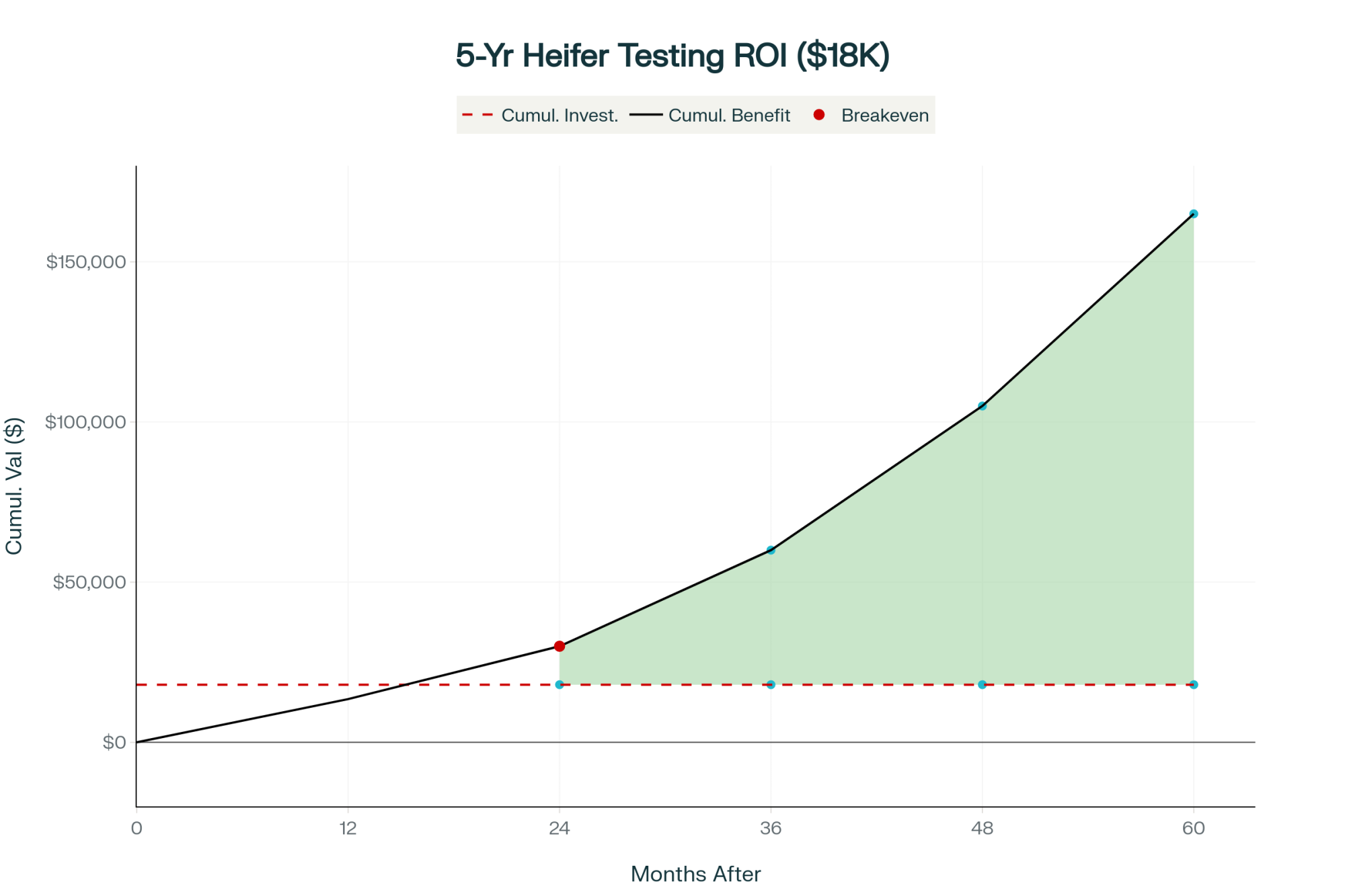
Here’s the reality check, though—and this is important—the first-year returns are modest regardless of your testing approach. Maybe $12,000 to $15,000 in reduced mortality and morbidity. You’re not breaking even until somewhere between 24 and 30 months if everything goes right. By year five, though, the modeling suggests annual benefits of around $60,000 with a pretty decent return on investment.

The Long Game Pays Off: While genomic calf health testing requires patience—hitting breakeven around 24-30 months—the compounding benefits reach $60K annually by year five as improved genetics permeate your herd. This assumes heifer-only testing strategy starting at $18K investment.

But—and this is a big but—these projections assume you’re already doing a decent job with management. If you’re at 3-4% mortality through solid protocols, genetic improvement might push you toward that elite 1-2% range. If you’re struggling at 8-10% mortality? Fix your management first. The genetics won’t overcome broken systems.

Smart Entry Strategies (You Don’t Need to Go All-In)

Here’s what many producers don’t realize: you have options beyond the all-or-nothing approach.

Option 1: The Free Ride
If you’ve been genomic testing for years, you’re sitting pretty. When April 2026 rolls around, all your historical data should automatically get calf health evaluations. No additional investment needed.

Option 2: Heifer-Only Testing
Never tested before? Start with your 450 replacement heifers. At $40 each, that’s $18,000—less than half the full-herd cost. You’ll get genetic information on your future cows and can make smarter sire selection decisions immediately.

Option 3: The Gradual Build
Test 100-150 animals per year. Spread the cost over 3-4 years while you validate whether the technology works in your herd. This approach costs $4,000-6,000 annually—much more manageable.

Option 4: Bulls Only
Just focus on selecting better sires using the published evaluations. Zero testing cost, though you won’t know which of your cows to breed to which bulls for optimal results.

The Zoetis Factor (Competition Already Exists)

Here’s something many producers don’t realize: we’re not waiting in a vacuum for CDCB’s launch. Zoetis has been selling wellness trait evaluations since 2016. Nearly a decade head start.

Their system draws from hundreds of thousands of health records and genotyped animals, based on research they’ve published in JDS (Vukasinovic et al., 2019). And from what I’m hearing from producers who use it—especially those larger operations in California and the upper Midwest—it works reasonably well. The wellness traits are already integrated into most AI stud catalogs, and the genomic prediction reliabilities are pretty solid for young animals.

Rosy Lane Holsteins 12-Month Study

Health MetricBottom 25% GeneticsTop 25% GeneticsImprovement
Scours Cases (per 100 calves)28 cases14 cases50% reduction
Pneumonia Cases (per 100 calves)44 cases30 cases32% reduction
Treatment Costs (per 100 calves)$4,200$2,100$2,100 saved
Overall Calf Mortality6.5%4.0%38% reduction

Based on Zoetis Calf Wellness Index data (similar methodology to CDCB)

So, where might CDCB have advantages? Well, they’re drawing from a broader population through the national database—we’re talking millions of genotypes from over 15,000 DHI herds. The methodology is transparent and peer-reviewed. And if you’re already on DHI, there’s no premium pricing.

Something that’s puzzling folks is the difference in heritability. Zoetis reports about 4.5 for scours, while CDCB shows 2.6. That’s not necessarily a contradiction—different statistical approaches, different populations, different ways of measuring. Both might work fine; they’re just looking through different lenses.

My guess? Both systems will coexist. Smart producers will probably compare them once CDCB launches. If the bull rankings correlate strongly, they’re telling you the same thing. If not… well, that’s when it gets interesting.

The Data Challenge Nobody Wants to Talk About

The Uncomfortable Truth: Only 12% of dairy farms contribute calf health data to genetic evaluations—and they’re mostly large, well-managed operations. This selection bias means CDCB’s predictions might not work as well for smaller dairies or different management systems. Know your risk before investing.

Here’s what really concerns me, and it’s barely mentioned: only about 12% of dairy farms systematically record calf health data, according to Canadian research (Renaud et al., 2023) that probably reflects our situation too. And those 12%? They tend to be the larger, better-managed operations that already have lower mortality.

This creates what’s called selection bias. The genetic evaluations end up being optimized for farms that look like the ones contributing data. So if you’re running a large operation with dedicated calf managers and automated systems, these predictions will probably work great. But what about smaller operations with different management styles? Or those grazing operations in Vermont compared to the freestall operations in Idaho?

What farmers are finding in states like Iowa and South Dakota is that their management systems—often smaller herds with different housing approaches—might not match what’s in the database. That’s a real concern.

What’s more, you need to actively authorize your Dairy Records Processing Center to transmit health data to CDCB using Format 6. No permission, no data contribution. And if farms like yours aren’t contributing data, the evaluations might not predict well in your environment. It’s a bit of a catch-22.

From conversations with DRPC folks, participation is growing but still lower than ideal. We need more farms sharing data before these evaluations become truly representative of the industry as a whole.

How to Know If It’s Actually Working

If you’re thinking about jumping in, you need concrete checkpoints. Here’s what I’d be watching:

Around 12-18 months after you start (late 2027), compare disease rates between calves from your top genetic sires versus your average ones. You should see the better genetics showing noticeably lower disease—maybe 20-30% lower—once you’ve got enough calves to compare. If you don’t see that difference, the evaluations aren’t predicting right in your barn.

At 24-30 months, check your financials. If you’re still deep in the red, it might be time to reconsider. Also, watch for unexpected issues—are those “healthier” calves growing slower? Birth weights creeping up? I’ve seen this with other traits where unexpected correlations pop up after a few generations.

By 36-42 months, your first heifers from high-health sires are entering the milking string. If their production is way below genetic predictions or fertility is tanking, you might be seeing those dreaded antagonistic correlations emerging.

The kicker is that all this requires obsessive record keeping. If you can’t document every health event consistently—including the healthy calves—you’ll never know if it’s working. And let’s be honest, that’s a challenge for a lot of us.

A Practical Approach to Implementation

Based on what I’ve learned from producers who’ve adopted genomics for other traits, here’s what makes sense:

Right now, through April 2026, take an honest look at your situation. Can your team consistently record health data? Is management or genetics your bigger constraint? Either way, start recording health data now—you’ll need that baseline. And call your DRPC to get the Format 6 data transmission authorized. Ask specifically about fields like “calf health event,” “treatment date,” and “disease code”—those are the critical ones.

If you’re already genomic testing: Relax. You’re likely getting these evaluations for free on all your tested animals. Focus on understanding how to use the new information effectively.

If you’ve never tested: Consider starting with just your heifers. It’s a $18,000 investment instead of $40,000, and you’ll learn whether this technology works for you before going all-in.

When April 2026 rolls around, don’t go all-in with your breeding decisions either. Start with maybe 20-30% of your breedings using top calf health sires. Keep detailed records. See if performance matches predictions. And stick with proven bulls with decent reliabilities—this isn’t the time to gamble on unproven young sires with reliabilities under 50%.

By the end of 2027, you’ll have enough data to make a decision. Seeing good improvement and approaching breakeven? Expand to more of your breedings. Mixed results? Stay conservative. No improvement or weird trade-offs? Maybe redirect that investment to management improvements.

The Bigger Industry Picture

What we’re seeing goes beyond just another trait to select for. Based on how genetic trends have evolved since genomic selection became available in 2009, this technology might widen the gap between large and small operations.

Research tracking genetic progress over the past couple of decades shows that large herds (over 500 cows) have achieved significantly faster improvement than small herds (under 100 cows) since the advent of genomics. The genetic merit gap has actually widened, not narrowed.

The same dynamics will probably play out here. Operations in Wisconsin’s Central Sands region, with their large-scale calf-raising facilities, will likely benefit more than small grazing operations in Vermont’s Northeast Kingdom. Down in Texas and New Mexico, those big dairies with automated calf feeding systems are positioned differently than the traditional tie-stall barns still common in parts of Pennsylvania and New York’s North Country.

Looking at this trend more broadly, what’s happening in the Midwest—particularly in states like Michigan and Ohio, where you’ve got a mix of farm sizes—might be most telling. The mid-sized operations (300-800 cows) are the ones really wrestling with whether this technology makes sense for them.

It’s not that the technology is biased—it’s that successful implementation requires resources that aren’t equally distributed. But here’s the silver lining: if you’re already genomic testing, you’re not at a resource disadvantage for this new trait.

Three Key Questions for Your DRPC

Before making any decisions, here’s what to ask at your next DRPC meeting:

First, what percentage of herds in your region are contributing health data? If it’s below 20%, the evaluations might not accurately reflect your management system.

Second, can they show you how CDCB and Zoetis rankings compare for bulls you’re currently using? This tells you whether the systems agree or if you’re looking at conflicting information.

Third, what’s the actual process and cost for setting up data transmission from your herd management software? Some systems need upgrades—better to know upfront. DairyComp 305 users might need different modules than PCDART folks, for instance.

And here’s the new critical question: If I’m already genomic testing, will my historical tests automatically get calf health evaluations in April 2026? Get this in writing.

The Bottom Line for Your Operation

After digging through all this, here’s my take:

If your mortality is over 5%, focus on management first. Whether genomic testing costs you nothing or $40,000, it won’t fix broken protocols.

If you’re at 3-4% mortality, you’re in the sweet spot. If you’re already genomic testing, you’ll get free evaluations to work with. If not, start with heifer testing at $18,000 to validate the technology.

If you’re already under 3%, you’re bumping against biological limits. These evaluations might be exactly what you need to get to that elite level—and if you’re already testing, it’s free value.

What concerns me is how much your success depends on other producers’ data. It’s a collective challenge that individual farms can’t solve alone. And remember—genetic selection and good management work together. They’re not either/or propositions.

At current replacement prices, we can’t afford historical mortality rates. These genomic tools offer one path forward, but only for operations positioned to use them effectively. The technology is real. Whether it revolutionizes your operation depends on matching these tools to your specific situation—and your cost of entry might be much lower than you think.

The economics are compelling if you get it right. But genomic selection can create problems as easily as it solves them if applied incorrectly. Take your time, validate carefully, and don’t let anyone convince you there’s a one-size-fits-all solution to something as complex as calf health.

What’s your take on all this? Are you planning to jump in early, or taking more of a wait-and-see approach? I’d be interested to hear what other producers are thinking as we head toward this launch. Send your thoughts to editorial@thebullvine.com—these conversations help us all make better decisions.

Key Takeaways

  • Your mortality rate dictates your path: Under 3% = invest in genomics | 3-4% = test cautiously | Over 5% = fix management first—any investment is wasted on broken basics
  • The real cost varies wildly: Free for existing genomic testers based on international precedent | $18,000 for heifer-only testing | Up to $40,000 for full-herd startup
  • Data bias could sink you: Only 12% of farms (mostly large operations) contribute health data, meaning these predictions might fail in your specific environment
  • Start smart, not big: Test heifers only ($18,000) or use free evaluations on existing tests, validate for 18 months, then decide whether to expand

Executive Summary: 

Your sick calves drain $350,000 annually, but April 2026’s genomic fix isn’t a silver bullet. CDCB’s new calf health evaluations could cost you nothing if you’re already genomic testing (based on precedent from other countries), or up to $40,000 if starting from scratch—farms above 5% mortality should invest in basics first regardless. The genetics target scours and respiratory disease with modest heritabilities of 2.6 percent and 2.2 percent, meaning gradual multi-generational progress, not instant transformation. Here’s the catch: only 12% of farms share health data, so predictions favor large operations and may not work for your specific system. With Zoetis already dominating this space since 2016, producers must choose between competing evaluations while validating what actually works in their barns. Bottom line: this technology amplifies excellent management but won’t salvage broken protocols—know which category you’re in before writing any check.

Complete references and supporting documentation are available upon request by contacting the editorial team at editor@thebullvine.com.

Learn More:

The Sunday Read Dairy Professionals Don’t Skip.

Every week, thousands of producers, breeders, and industry insiders open Bullvine Weekly for genetics insights, market shifts, and profit strategies they won’t find anywhere else. One email. Five minutes. Smarter decisions all week.
NewsSubscribe
First
Last
Consent

Mexico Announces Ambitious Dairy Self-Sufficiency Plan, Reshaping North American Trade

Mexico’s $4.1B dairy plan threatens commodity exports but creates massive genetics market, 280% milk yield gaps mean unprecedented ROI opportunities.

Executive Summary: While North American dairy exporters panic about Mexico’s self-sufficiency rhetoric, they’re missing the biggest genetics and technology goldmine in decades. Mexico’s $4.1 billion investment to achieve 80% domestic milk production by 2030 isn’t closing the market, it’s bifurcating it into a government-controlled commodity segment and an exploding private sector desperate for productivity solutions. The productivity gap tells the real story: northern Mexican dairies achieve 37 liters per cow daily while southern operations struggle with 9-10 liters—a 280% differential that screams opportunity, not threat. Recent imports of 8,000+ Holstein heifers rated at 10,220 kg annual production prove Mexican buyers will pay premium prices for genetic performance that doubles their current yields. The processing equipment market alone is projected to grow 5.8% annually, reaching $517 million by 2030, while sexed semen and genomic testing demand explodes to support the impossible math of reaching 15 billion liters without dramatic genetic improvement. Mexico’s “Self-Sufficiency Paradox” ensures continued import growth for cheese (forecast up 5% to 200,000 MT in 2025) and specialized ingredients while creating state-supported demand for the very inputs needed to achieve their goals. Stop fighting Mexico’s industrial policy and start positioning as the essential partner providing the genetics, technology, and expertise that makes their ambitious plan actually work.

Key Takeaways

  • Genetics Market Explosion: Mexico’s structural inability to meet production targets without genetic improvement creates immediate demand for sexed semen, embryos, and genomic testing services—recent Australian Holstein imports averaging 10,220 kg/year prove willingness to pay premium prices for productivity gains of 150-200% over domestic averages.
  • Technology Infrastructure Cascade: The $680 million government investment in processing plants during 2025 alone triggers bottom-up demand for precision dairy technology, with automated milking systems offering $150,000-$200,000 ROI opportunities as labor costs rise and farms consolidate to meet new processing capacity.
  • Market Bifurcation Strategy: While commodity skim milk powder exports face displacement risk in government channels, private sector cheese imports are forecast to grow 5% to 200,000 MT in 2025, creating sustained demand for high-value ingredients that domestic producers cannot supply.
  • Heat Stress Solution Premium: Northern Mexican dairies lose 15-25% productivity to heat stress in water-scarce regions, creating immediate ROI opportunities for environmental management technologies including cow cooling systems and water conservation equipment that directly impact milk yield and feed conversion ratios.
  • Knowledge Transfer Multiplier: Mexico’s rapid “hard infrastructure” investment outpaces “soft infrastructure” development, creating high-margin consulting opportunities for North American firms providing integrated solutions combining genetics, technology, and training—the key differentiator that transforms one-time transactions into long-term partnerships.
dairy export opportunities, Mexico dairy market, dairy genetics ROI, milk production technology, dairy trade analysis

Mexico has unveiled a comprehensive national strategy aimed at achieving 80% domestic milk production by 2030, which could potentially reduce annual U.S. and Canadian dairy imports by $2.1 billion while also creating new opportunities for genetics and technology exports.

The Ministry of Agriculture and Rural Development (SADER) announced the “Milk Self-Sufficiency Plan” as part of a broader MX$83.76 billion ($4.1 billion) investment between 2025 and 2030 to boost domestic production of key agricultural staples. The policy represents a fundamental shift in North American dairy trade dynamics, with immediate implications for exporters, genetics companies, and technology providers across the continent.

Government Mobilizes Multi-Billion Dollar Investment

Mexico’s strategy focuses on increasing annual milk production from 13.3 billion liters to 15 billion liters by 2030, with a specific target of displacing imported powdered milk, which currently accounts for around 30% of national consumption. The plan operates through coordinated action between SADER, the Mexican Food Security agency (Seguimiento y Evaluación de la Seguridad Alimentaria y Nutricional), and state-owned Liconsa.

The cornerstone “Milk for Wellbeing” program guarantees producers MX$11.50 per liter, a significant premium over previous market rates of MX$8.20 per liter. This above-market pricing provides powerful financial incentives while the program simultaneously sells subsidized milk to consumers for MX$7.50 per liter, creating stable demand channels.

Processing infrastructure represents the largest single investment component. The government committed MX$13.5 billion ($680 million) in 2025 alone for dairy processing facilities, including new milk drying plants and pasteurization facilities. Key projects include a MX$140 million pasteurization plant in Campeche with a daily capacity of 100,000 liters and a MX$350 million milk drying facility in Michoacán, specifically designed to produce domestic skim milk powder.

U.S. Exports Face Strategic Displacement Risk

The policy directly targets U.S. skim milk powder exports, which represent Mexico’s largest dairy import category. Mexico purchases 51.5% of all U.S. nonfat dry milk exports, making it the single largest buyer globally. U.S. dairy exports to Mexico are projected to reach $2.5 billion in 2025, accounting for nearly one-quarter of total U.S. dairy exports by value.

However, the impact varies significantly by product category. While commodity milk powder faces a displacement risk, Mexico’s growing private sector continues to require diverse dairy ingredients that domestic producers cannot supply. Cheese imports are forecast to increase by 5% to 200,000 metric tons in 2025, driven by the expansion of the food service and manufacturing sectors.

The relationship represents profound interdependence – Mexico supplies over 80% of its total dairy import requirements from the United States under the zero-tariff framework of the USMCA. This concentration creates vulnerability for both trading partners, with historical precedent showing that trade disputes can trigger retaliatory tariffs of 20-25% on sensitive agricultural products.

Genetics and Technology Markets Emerge as Growth Opportunities

Mexico’s productivity gap creates a massive demand for imported genetics and technology. National milk yields vary dramatically, ranging from 37 liters per cow per day in modern northern operations to just 9-10 liters per day in traditional southern systems. Achieving the 15 billion liter target requires substantial genetic improvement across the national herd.

Recent purchasing patterns demonstrate a willingness to pay premiums for high-performance genetics. Mexico imported over 8,000 high-yield Holstein heifers from Australia, rated at 10,220 kg annual milk production, nearly double the average domestic yields. Government programs explicitly include “genetic improvement” components, with the “Harvesting Sovereignty” initiative providing subsidized credit for herd enhancement.

The technology market spans both industrial processing equipment and on-farm precision systems. The construction boom of processing plants creates immediate demand for pasteurizers, separators, evaporators, and automated packaging lines. Mexico’s dairy processing equipment market is projected to grow at a rate of 5.8% annually, reaching $517 million by 2030.

Industry Experts Assess Policy Feasibility

Analysis of global precedents reveals mixed outcomes for similar self-sufficiency initiatives. India’s “Operation Flood” successfully transformed the country into the world’s largest milk producer through cooperative-led development over a 30-year period. However, China’s recent industrialization drive created massive milk surpluses and market imbalances despite meeting production targets ahead of schedule.

Mexico’s approach combines elements from both models – India’s focus on smallholder empowerment with China’s top-down infrastructure investment. The critical success factor appears to be effective knowledge transfer and technical assistance programs, similar to Brazil’s “Balde Cheio” initiative that tripled participating farmers’ milk production.

The policy creates a “Self-Sufficiency Paradox” where protectionist measures coexist with growing import dependencies. While targeting specific commodity categories, Mexico’s structural consumption growth and need for specialized ingredients ensure continued reliance on foreign suppliers for high-value products.

The Latest

Mexico’s dairy self-sufficiency timeline extends through 2030, with major processing facilities coming online in 2025-2026. The policy’s success depends heavily on mobilizing the country’s fragmented base of small producers, who represent 97% of dairy operations but lack modern technology and management practices.

Trade implications bifurcate the market rather than close it entirely. While commodity exporters face a risk of displacement in government channels, private sector demand for specialized ingredients, genetics, and technology continues to expand.

“The greatest risk is not Mexico’s industrial policy itself, but the potential for broader trade tensions that could trigger retaliatory tariffs and disrupt the integrated $2.5 billion trade relationship,” according to the comprehensive policy analysis. Success for North American suppliers lies in pivoting from commodity sales to integrated solutions partnerships that support Mexico’s modernization objectives.

Complete references and supporting documentation are available upon request by contacting the editorial team at editor@thebullvine.com.

Learn More:

The Sunday Read Dairy Professionals Don’t Skip.

Every week, thousands of producers, breeders, and industry insiders open Bullvine Weekly for genetics insights, market shifts, and profit strategies they won’t find anywhere else. One email. Five minutes. Smarter decisions all week.

NewsSubscribe
First
Last
Consent

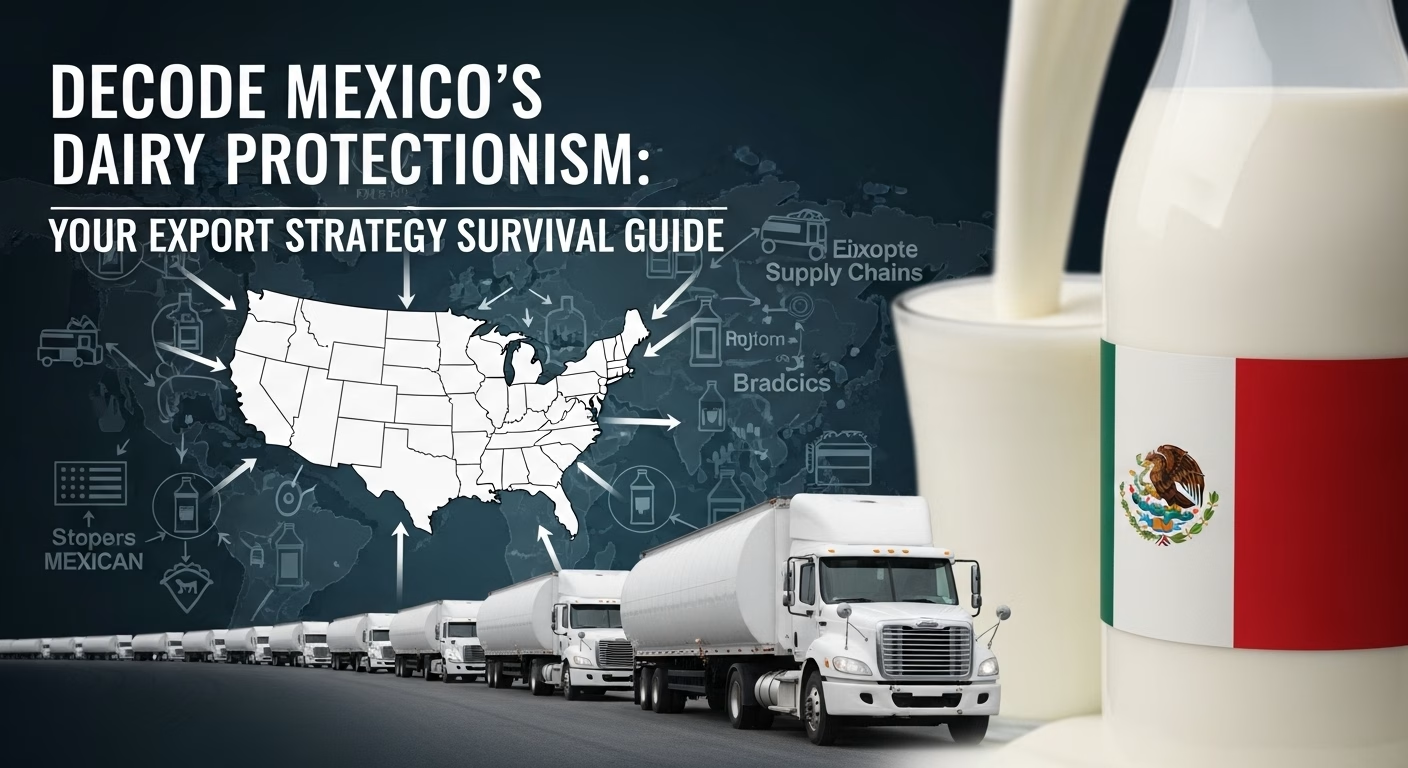
Decode Mexico’s Dairy Protectionism: Your Export Strategy Survival Guide

Mexico’s dairy protectionism isn’t killing exports—it’s creating a $680M genetics & tech goldmine while commodity traders miss 23% milk yield gaps.

Executive Summary: While everyone’s panicking about Mexico’s $4.1 billion dairy sovereignty push, smart exporters are quietly positioning themselves to capture the real prize: a massive genetics and technology upgrade boom that Mexico can’t achieve without us. Mexico’s ambitious goal to jump from 13.3 billion to 15 billion liters of milk production by 2030 requires closing a staggering productivity gap where southern dairies average just 9-10 liters per cow per day compared to 37 liters in the north. Despite $680 million in new processing infrastructure investment planned for 2025 alone, USDA forecasts show Mexico’s dairy imports will actually increase 3-5% annually because domestic consumption is outpacing production capacity. The smoking gun? Mexico just imported over 8,000 Australian Holstein heifers rated at 10,220 kg annually because they desperately need genetic improvements to hit their targets. While commodity exporters worry about losing the $2.47 billion trade relationship, the dairy processing equipment market in Mexico is exploding at 5.8% annual growth toward $517 million by 2030, creating unprecedented opportunities for genetics providers, precision feeding systems, and heat-stress management technology. Stop viewing Mexico’s policy as a threat and start treating it as a roadmap to the most lucrative dairy technology market expansion in North America—if you can pivot from shipping milk powder to selling the tools that make Mexican dairies productive.

Key Strategic Takeaways

  • Genetics Opportunity Explosion: Mexico’s productivity gap represents a 180-280% improvement potential in milk yield through elite genetics, with Australian Holstein imports proving they’ll pay premium prices for 10,220 kg/year genetics versus current averages—position your genomic testing and sexed semen programs now for guaranteed ROI
  • Technology Infrastructure Boom: The $680 million processing plant investment in 2025 creates immediate demand for precision feeding systems, automated milking technology, and heat-stress management solutions in arid dairy regions where productivity drops 15-25% during peak temperatures
  • Water Efficiency Premium Market: Northern Mexican dairy states face critical water scarcity constraints limiting expansion—water conservation systems and drought-resistant forage genetics command 20-30% price premiums in these markets while improving feed conversion ratios by 12-18%
  • Partnership Strategy Advantage: Mexico’s dependence on imports for 90% of skim milk powder consumption creates consulting opportunities worth $50-75 per cow annually for producers implementing complete productivity solutions rather than just selling individual products
  • Tariff Risk Hedging: With potential 25% tariff threats looming, diversifying from commodity exports to high-value genetics and technology services provides 40-60% better profit margins while building tariff-resistant revenue streams through essential production inputs
dairy export strategy, Mexico dairy market, dairy genetics ROI, precision dairy technology, dairy trade opportunities

Mexico’s march toward dairy self-sufficiency isn’t about food security—it’s about rewriting the rules of North American dairy trade, and the ripple effects will hit every operation from Wisconsin to Alberta.

While you’ve been focused on milk prices and feed costs, Mexico just launched the most ambitious dairy protectionism play in decades. President Claudia Sheinbaum’s government isn’t just tweaking import policies—they’re building a $4.1 billion fortress around their domestic dairy industry. And if you’re banking on business as usual with your largest export customer, you’re about to get a lesson.

Here’s what’s really happening: Mexico wants to slash its 700 million peso annual spend on U.S. skim milk powder and replace it with homegrown production. They aim to increase domestic milk production from 13.3 billion liters to 15 billion liters by 2030. That’s not just ambitious—it’s a direct challenge to the $2.4 billion U.S. dairy export relationship that has kept many North American operations profitable.

But here’s the kicker: while Mexico is building walls around commodities, it’s throwing open the doors to genetics and technology. Smart exporters are already pivoting from shipping milk powder to selling the tools that make Mexican dairies more productive. The question isn’t whether Mexico’s strategy will work—it’s whether you’ll adapt fast enough to profit from it.

The Mechanics of Mexico’s Dairy Fortress

Let’s cut through the political rhetoric and examine what Mexico’s actually doing. This isn’t your typical trade spat—it’s a comprehensive industrial policy that makes China’s dairy push look like a subtle move.

The Carrot: Guaranteed Profits for Mexican Producers

Mexico’s state-owned Segalmex is offering guaranteed milk prices of MXN 11.50 per liter to small and medium-sized producers. That’s a 40% jump from the MX$8.20 they were getting in 2019. Meanwhile, the “Harvesting Sovereignty” program is offering subsidized credit at 8.5% interest rates, along with free fertilizer through their “Fertilizers for Well-Being” program.

Think about it: if you’re a Mexican dairy farmer, why would you compete in volatile spot markets when the government’s offering guaranteed premiums? This isn’t just policy—it’s market manipulation on a massive scale.

The Stick: Infrastructure Investment to Cut Imports

Here’s where it gets expensive. Mexico’s committing 13.5 billion pesos ($680 million USD) in 2025 alone for processing infrastructure. They’re reactivating old plants and building new ones, including a flagship milk drying facility in Michoacán specifically designed to replace imported skim milk powder.

The new pasteurization plant in Campeche? That’s a $7.14 million investment targeting 100,000 liters per day. Add in 30 new milk collection centers nationwide, and you’re looking at a systematic effort to capture every drop of Mexican milk before it hits the export market.

The Contradiction: Subsidizing Imports While Building Walls

Here’s where Mexico’s strategy gets weird. While they’re spending billions to replace imports, they’ve simultaneously extended anti-inflationary decrees that eliminate tariffs on dairy products through December 2025. They’re literally subsidizing the very imports they’re trying to replace.

This isn’t incompetence—it’s politics. Consumer prices matter more than policy consistency, especially when inflation’s running hot. However, it reveals the tensions at the heart of Mexico’s approach.

Learning from Global Dairy Protectionism: The Playbook

Mexico isn’t pioneering dairy protectionism—they’re copying it. Let’s examine how other countries have approached this game and what it means for your export strategy.

China: The Industrial Blitz Model

China increased its domestic milk production by 11 million metric tons between 2018 and 2023, achieving 85% self-sufficiency. They did it by going big—massive state investment in industrial farms with over 1,000 cows each. The result? Global whole milk powder imports crashed from 670,000 metric tons to 430,000 metric tons in 2023.

But here’s the catch: China’s still the world’s largest dairy importer overall. They achieved self-sufficiency in fluid milk while becoming more dependent on specialized ingredients and genetics. Sound familiar?

India: The Cooperative Revolution

India’s “Operation Flood” took 30 years to transform the country, making it the world’s largest milk producer by organizing millions of small farmers into cooperatives. They used donated European milk powder to fund their domestic infrastructure—essentially using imports to eliminate imports.

Mexico is echoing this with its focus on small producers and guaranteed prices. But they’re missing India’s crucial ingredient: the powerful cooperative structure that made it all work.

Russia: The Forced March

Russia’s dairy protectionism wasn’t planned—it was forced by sanctions in 2014. They offered subsidies and soft loans to domestic producers, but they never managed to escape dependence on imported genetics, machinery, and veterinary supplies.

That’s Mexico’s real vulnerability. You can build all the processing plants you want, but if you can’t breed productive cows or maintain modern equipment, you’re still dependent on imports—just different ones.

The Numbers Don’t Lie: Why Mexico’s Math Doesn’t Add Up

Let’s talk reality. Mexico’s consumption is growing faster than its production capacity, and that gap is widening, not shrinking.

The Production Challenge

Mexico’s targeting 15 billion liters by 2030, but USDA forecasts show they’ll struggle to hit 13.9 billion liters by 2025. That’s a massive gap between political promises and economic reality.

Why? Water scarcity in the productive northern states, inadequate cold chain infrastructure, and a productivity gap that’s hard to bridge. Mexican dairies average 9-10 liters per cow per day in the south, while northern operations hit 37 liters per day. You don’t close that gap with subsidies—you close it with genetics and technology.

The Import Reality

Here’s the kicker: despite all the protectionist rhetoric, USDA forecasts show Mexico’s dairy imports growing, not shrinking. Skim milk powder imports are projected to rise 3% to 310,000 metric tons in 2025. Cheese imports? Up 5% to 200,000 metric tons.

Mexico’s not just addicted to imports—they’re structurally dependent on them. Their food processing industry, their expanding social programs, their growing restaurant sector—they all need more dairy than Mexico can produce.

The Opportunity Hidden in the Threat

Here’s where smart exporters are getting ahead of the curve. Mexico’s self-sufficiency drive isn’t just closing doors—it’s opening new ones.

Genetics: The $500 Million Opportunity

Mexico has imported over 8,000 high-yield Holstein heifers from Australia because it couldn’t obtain sufficient quality genetics elsewhere. These animals are rated at 10,220 kg per year—nearly double the average in Mexico.

That’s your opportunity right there. Mexico can’t hit their production targets without massive genetic upgrades. They need elite semen, embryos, and live animals. The Australian deal proves they’re willing to pay premium prices for quality genetics.

Technology: The Infrastructure Gap

Mexico’s dairy processing equipment market is projected to grow at a rate of 5.8% annually, reaching $517 million by 2030. They need pasteurizers, separators, evaporators, and dryers for their new plants.

But here’s the smart play: focus on productivity technology. Heat Stress Management Systems for the Arid Dairy States. Precision feeding systems. Automated milking technology. Water conservation systems. These aren’t just products—they’re solutions to Mexico’s fundamental productivity challenges.

Consulting: The Knowledge Premium

Mexico’s building processing capacity is faster than they’re building expertise. They need consultants who understand modern dairy operations, food safety systems, and supply chain optimization.

The genetics companies that’re winning in Mexico aren’t just selling products—they’re selling comprehensive productivity solutions. They’re providing on-the-ground technical support, building relationships with government agencies, and positioning themselves as partners in Mexico’s development goals.

The Tariff Wild Card: Your Biggest Risk

Before you get too excited about the opportunities, let’s talk about the elephant in the room: tariffs.

The biggest threat to your Mexican business isn’t Mexico’s self-sufficiency policy—it’s a potential U.S.-initiated trade war. The U.S. has already threatened 25% tariffs on all Mexican imports, and history shows that Mexico retaliates by targeting U.S. agricultural products.

In 2018, Mexico imposed tariffs of 20-25% on U.S. cheeses during a trade dispute. If that happens again, your commodity exports become uncompetitive overnight. That’s not a gradual policy shift—that’s a market-killing shock.

The smart money is preparing for this scenario. Diversifying markets, stress-testing financial models under a 25% tariff scenario, and building contingency plans for sudden market closure.

Your Strategic Playbook: Three Moves to Make This Week

1. Segment Your Mexican Portfolio

Stop treating Mexico as a single market. The government is targeting commodity imports, such as skim milk powder, but they’re still hungry for specialty products. Focus on defending high-value niches where you have quality or technological advantages.

2. Become a Solutions Provider

Shift from product sales to partnership. Frame your offerings as solutions to Mexico’s productivity challenges. Emphasize genetics that offer both high yields and heat tolerance. Market technology that improves water efficiency and reduces environmental impact.

3. Build In-Country Presence

Success requires more than just exporting. Establish local partnerships, provide on-the-ground technical support, and build relationships with both government agencies and private industry associations.

The Bottom Line

Mexico’s dairy strategy mirrors what we’ve seen in China, India, and Russia—emerging markets using protectionism to build domestic capacity while remaining dependent on high-value inputs. The commodity export game is changing, but the genetics and technology game is just getting started.

Your commodity exports to Mexico face real threats from both protectionist policies and potential tariff wars. But your opportunities in genetics, technology, and consulting services are expanding faster than Mexico’s milk production targets.

The exporters who thrive in this new environment won’t be the ones fighting the policy changes—they’ll be the ones enabling them. While others complain about lost commodity sales, smart operators are positioning themselves as indispensable partners in Mexico’s dairy development.

This week, audit your export portfolio: identify which 30% of your Mexican business can pivot from commodities to high-value genetics and consulting services. The market’s changing, whether you adapt or not. The question is whether you’ll be ready when the walls go up.

Complete references and supporting documentation are available upon request by contacting the editorial team at editor@thebullvine.com.

Learn More:

The Sunday Read Dairy Professionals Don’t Skip.

Every week, thousands of producers, breeders, and industry insiders open Bullvine Weekly for genetics insights, market shifts, and profit strategies they won’t find anywhere else. One email. Five minutes. Smarter decisions all week.

NewsSubscribe
First
Last
Consent
Send this to a friend