




Archive for dairy farm debt

Estate Dairy Hit £26M on £5,000. Your 300-Cow Herd Can’t Copy That. 

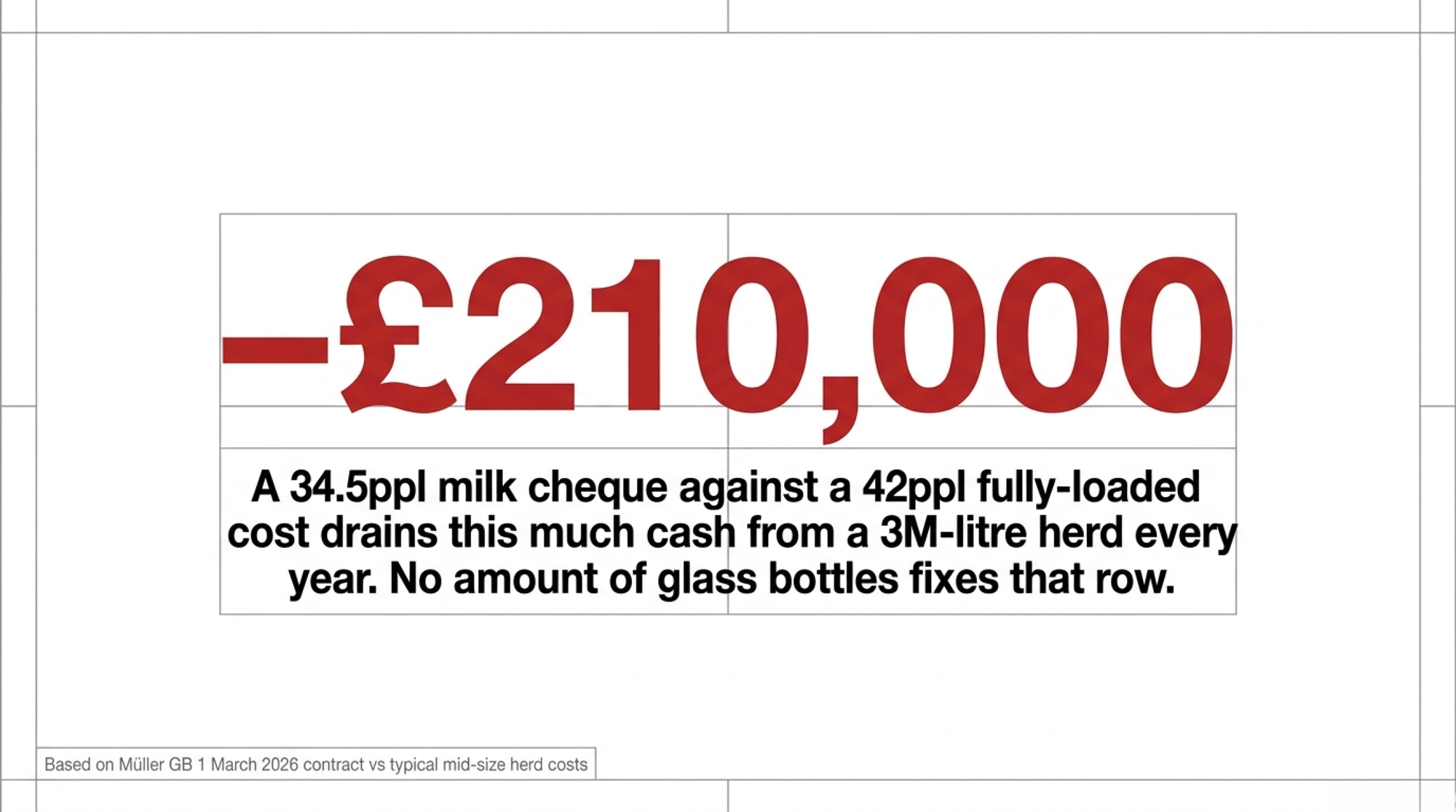
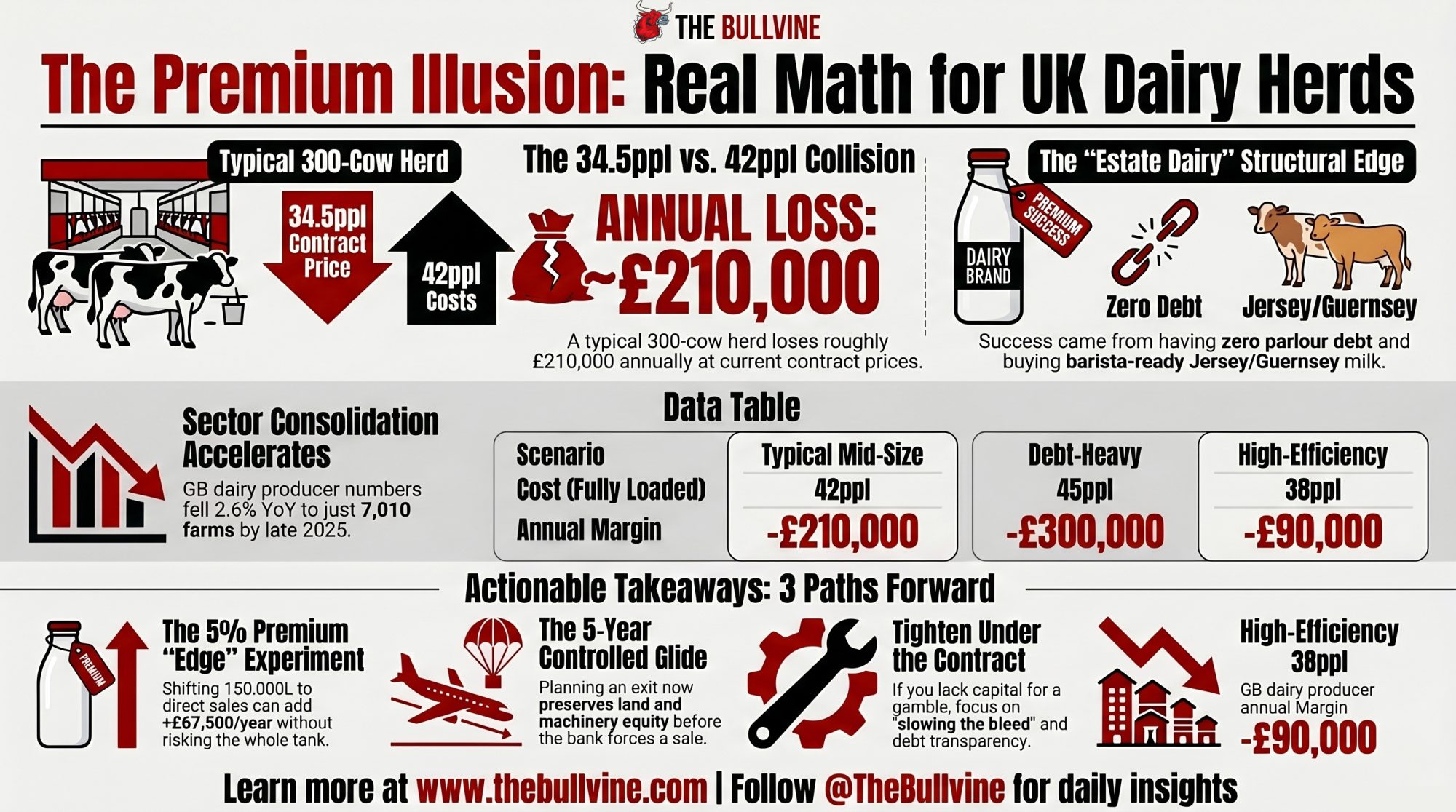
Müller’s cheque cleared at 34.5ppl on 1 March. Your fully-loaded cost sits near 42ppl. On 3 million litres that’s –£210,000 a year — and no amount of glass bottles fixes that row.

Executive Summary: Müller GB cut its Advantage contract price to 34.5ppl from 1 March 2026, while Estate Dairy — the asset-light London brand that started with £5,000, a borrowed catering van and no cows of its own — just reported turnover of about £26M on Claridge’s, Ritz and Savoy tables. For a 300-cow Holstein herd shipping around 3M litres a year, that cheque at 34.5ppl against a typical fully-loaded cost of roughly 42ppl pencils out at –£210,000 annually, and at 45ppl it widens to –£300,000. AHDB’s October 2025 survey puts GB down to 7,010 producers (–2.6% YoY), so the pressure to “do an Estate Dairy” is real — but the Youngs’ edge was starting with no parlour debt and buying Jersey and Guernsey milk already suited to baristas, not flipping a Holstein herd. A disciplined 5%-of-the-tank premium experiment (150,000 L at a net 80ppl) could add about +£67,500 a year, enough to close the gap on the High-Efficiency row but nowhere near the Debt-Heavy row. The four paths worth costing this month: tighten under the contract, run a bounded 12-month premium edge experiment, plan a 3–5 year glide exit, or go big on premium only if most debt is secured against land. Read the full piece if you want the row-by-row barn math and the 30-day actions before the next Müller price letter lands.
UK dairy farm economics

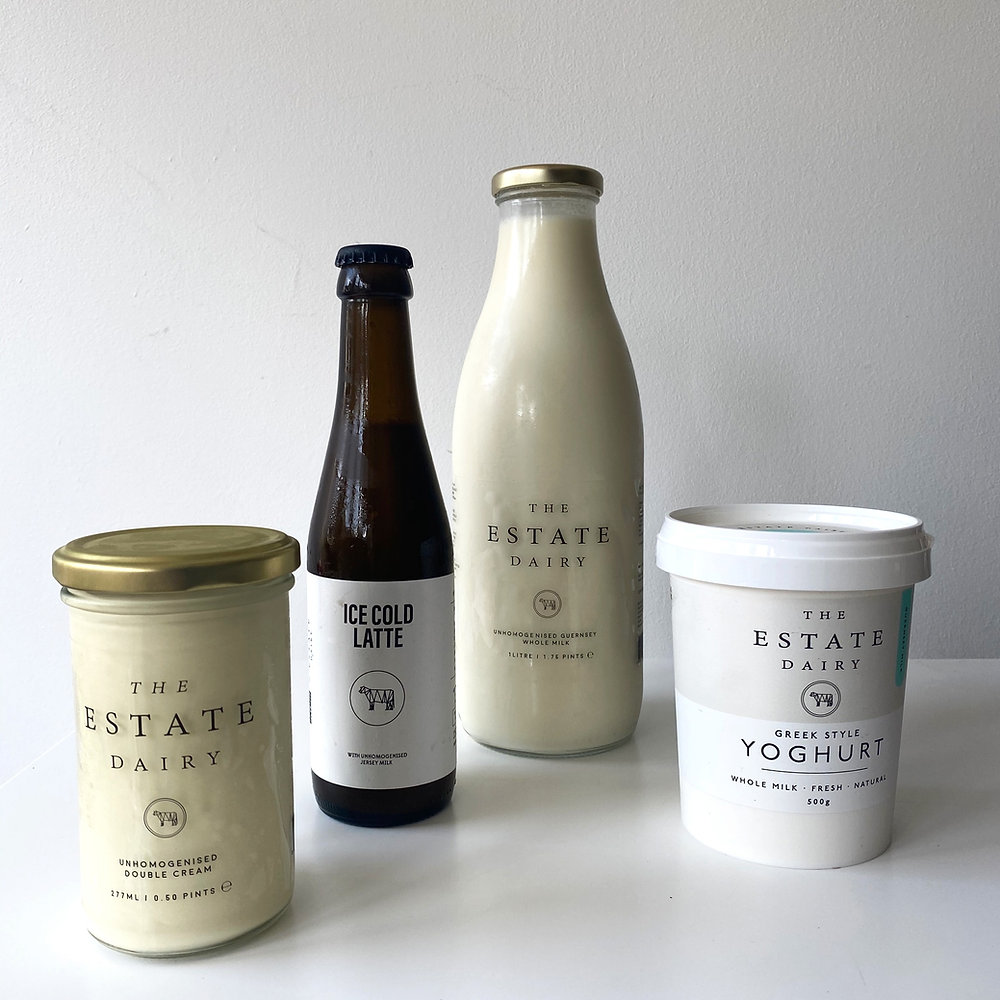
Shaun and Rebecca Young built UK’s Estate Dairy from £5,000, a borrowed catering van and no cows of their own, and turned it over at about £26 million in its most recently reported financial year, with hospitality names like Claridge’s, The Ritz and the Savoy on the customer list, according to reporting in The Times. If you’re milking 300 cows in 2026, carrying more kit finance than you’d like and staring at a 34.5ppl Müller cheque from 1 March, that headline lands differently at your kitchen table than it does in a London Sunday supplement.

Estate Dairy is a real business with real cows’ worth of milk moving through it. The mirage isn’t whether the Youngs did it — it’s whether a 300-cow Holstein herd carrying parlour and shed finance can copy it. Let’s put the glossy version next to the one that actually matters — yours — and ask the quiet question nobody in the farm press wants to say out loud: are you really failing if you stay on the contract?
What the Estate Dairy UK Growth Story Really Proved

FactorEstate Dairy (Youngs)Your 300-Cow Holstein Herd
Starting capital£5,000 + borrowed van£800k–£2M in parlour, shed & kit finance
Herd ownershipNone — bought milk from othersOwned; replacement costs ~20–25%/yr
Milk breedJersey / Guernsey (high fat, high protein)Holstein (high yield, lower fat/protein)
Parlour debt£0 legacy debtTypically £200k–£600k outstanding
Annual turnover~£26M (FY 2025 reported)~£1.05M at 35ppl on 3M litres
Pre-tax profit~£1M (reported)–£90k to –£300k depending on cost tier
Customer baseClaridge’s, Ritz, Savoy, M&S, OcadoSingle processor contract (e.g., Müller)
Route to marketBuilt coffee/hospitality channels firstProcessor sets price; no direct market
Genetic pivot timelineN/A — sourced milk already suited to premium4–7 years to shift bulk tank profile via crossbreeding
Key replicable elementBrand building, channel relationshipsCost discipline, premium edge experiment (5% of tank)

Before the brand, the Youngs worked in London’s specialty coffee scene, not a parlour. Around 2015 they scraped together £5,000, sold a car, borrowed Rebecca’s mum’s catering van, and used a friend’s cold store as a first “plant.” They spent roughly a year driving between farms and cafés, looking for milk that would actually perform in a barista’s hands.

A few hard facts about that journey:

  • Founded 2016. The Estate Dairy brand launched that year.
  • Asset-light entry. No parlour, no robot, no slurry store, not an acre of their own — and no legacy dairy debt. That structural difference matters more than any branding lesson you could copy off them.
  • Bought the milk, didn’t breed it. Suppliers reported in Estate Dairy’s public origin story have included Brades Farm’s Jerseys in Lancashire’s Lune Valley and Bickfield Farm’s Guernseys in Somerset — higher fat, higher protein, that “gold top” look in a glass.
  • High-end customer base. As reported in early 2026, the customer list has included Claridge’s, The Ritz, the Savoy, plus retailers such as Sainsbury’s, Marks & Spencer, Ocado and Waitrose.
  • Profitable from the start. The Times reported turnover in the most recently reported financial year at around £26 million, with just under £1 million pre-tax profit.

Strip the Instagram glow off that and the proof is narrower than the headline suggests. Start with no herd and no farm debt. Buy milk already suited to premium channels. Build the coffee and hospitality relationships before you spend big on plant. Do those things in that order and you can build a profitable premium dairy brand that never lives or dies by a processor contract. None of that is the same as saying a 300-cow Holstein herd with parlour finance, shed loans and machinery leases should try to become The Estate Dairy 2.0.

What’s Actually Changing for Mid-Size UK Herds

Step away from Shoreditch cafés for a moment and look at the picture most readers are standing inside.

A fairly typical GB mid-size setup in 2026:

  • Around 300 Holstein-type cows in a higher-yield system.
  • Roughly 2.4–3.0 million litres/year, depending on litres per cow and days in milk — comfortably above the UK all-cow average of about 8,148 litres/cow/year in the 2023/24 milk year. [VERIFY: confirm exact litres/cow/year figure from latest Defra/AHDB milk utilisation release at sub-edit.]
  • A processor contract — say Müller — paying 34.5ppl for Advantage-eligible milk from 1 March 2026, down 1ppl from the 35.5ppl paid from 1 February, according to Müller GB’s own published 1 February 2026 and 1 March 2026 price announcements.
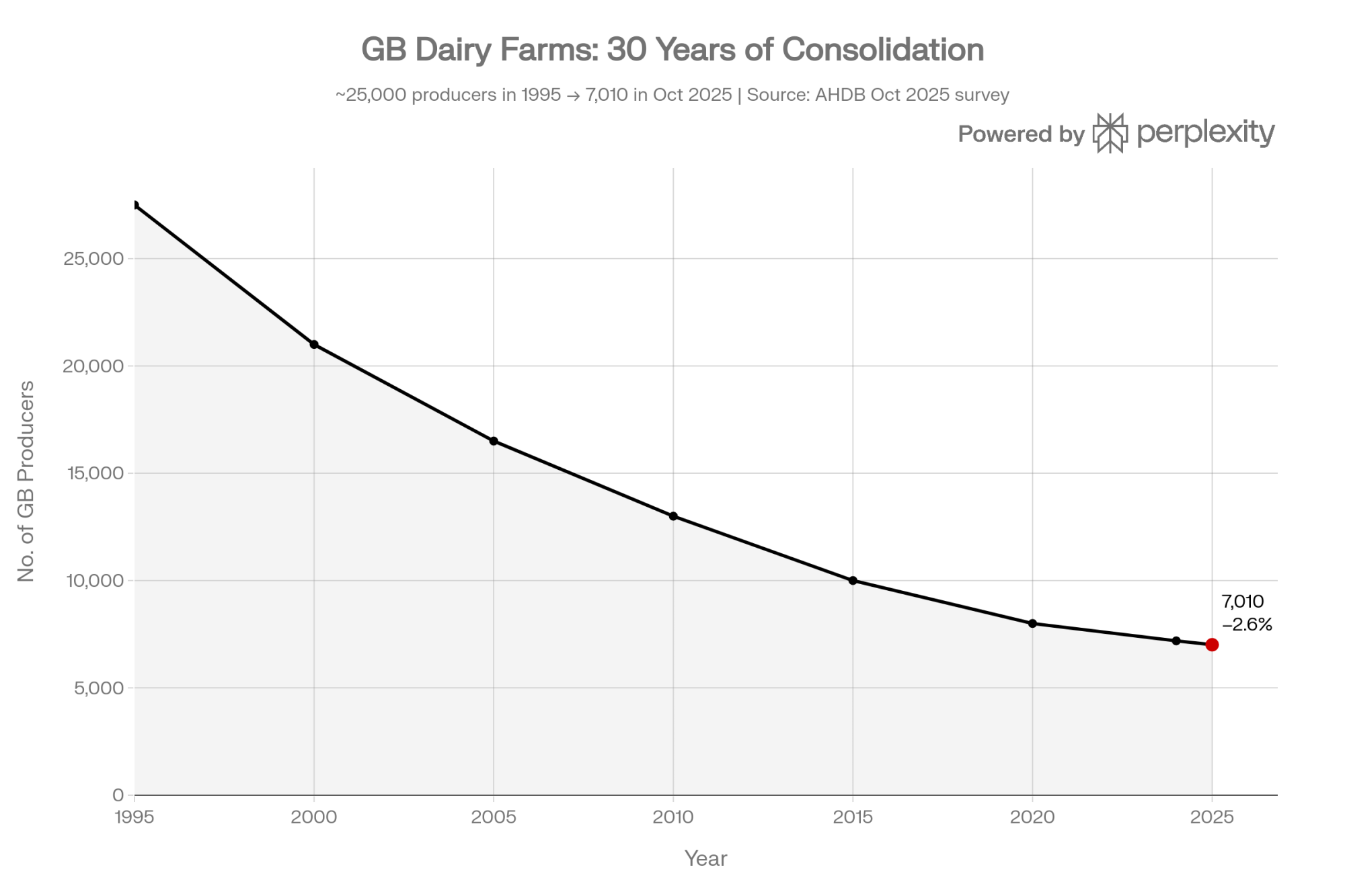
AHDB’s October 2025 milk buyer survey counted 7,010 GB dairy producers, down 2.6% year-on-year, and structural work on the industry shows GB farm numbers were roughly 25,000–30,000 in the mid-1990s. The sector has consolidated hard. Major GB processors have restructured supply pools over the past year, and UK farm trade press has reported termination or restructure notices involving cases at Müller and other buyers. Müller GB was approached for comment on this piece; any response received post-publication will be added as an update.

AHDB’s recent cost-of-production work shows dairy costs have climbed sharply since 2019, with feed, energy and finance squeezing margins even where milk prices lifted. Fully-loaded costs in many higher-input, debt-heavy systems can end up above 40ppl. AHDB’s 2024/25 cost banding places a meaningful minority of GB producers in the high-cost tier where contract price alone cannot close the gap.

Find Your Tier on One Page

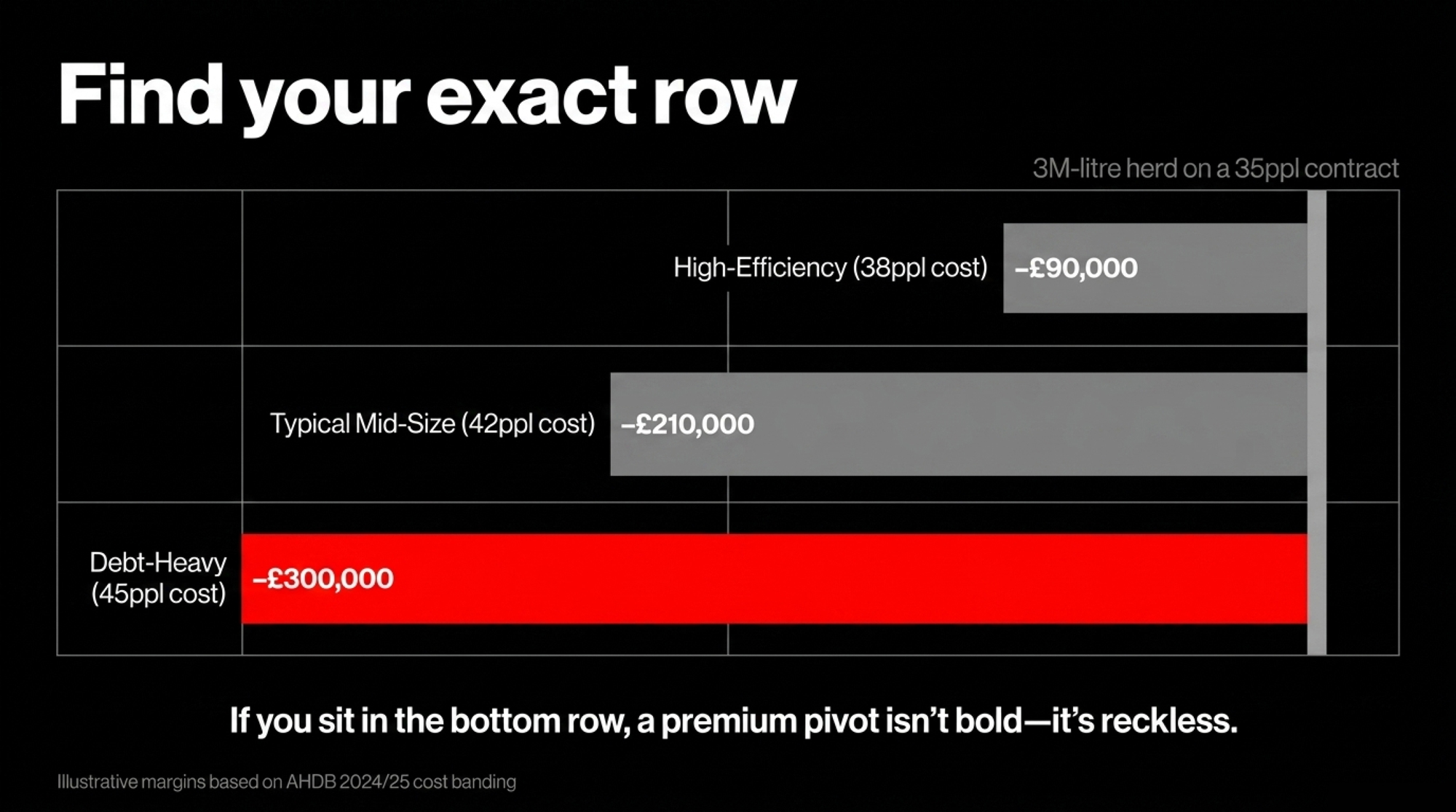
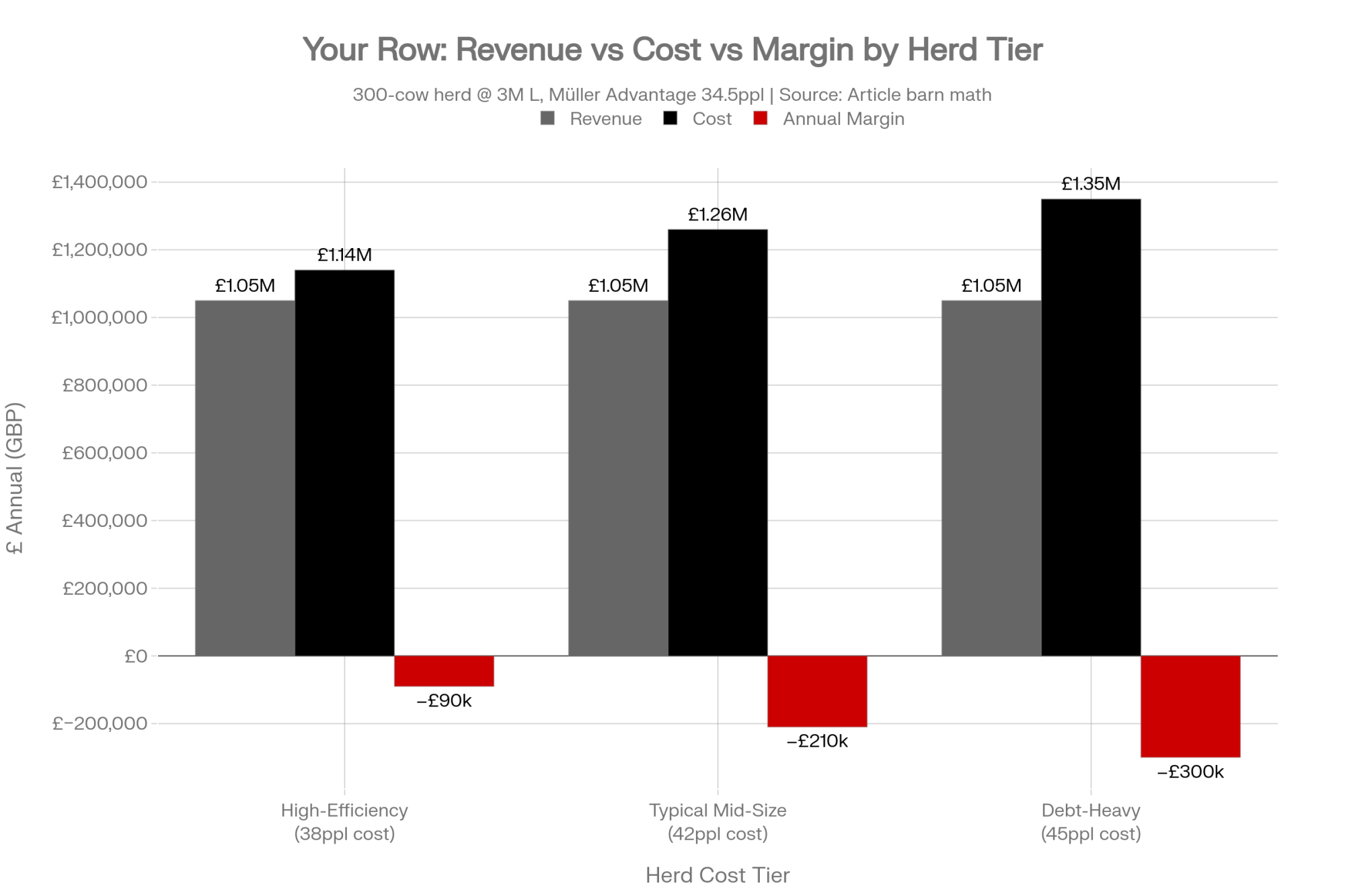
Three illustrative scenarios, same 3.0M-litre herd, same 35ppl contract price. Find the cost band closest to your own books and read down.

Illustrative only — not a benchmark for any named farm. Before you scroll further, decide which of these three rows your last milk cheque actually puts you in.
ScenarioRevenue (3M L @ 35ppl)Cost (fully loaded)Annual Margin
High-Efficiency (38ppl cost, 3.0M L baseline)£1,050,000£1,140,000–£90,000
Typical Mid-Size (42ppl cost)£1,050,000£1,260,000–£210,000
Debt-Heavy (45ppl cost)£1,050,000£1,350,000–£300,000

The shape holds. The size changes. Higher-yielding 300-cow herds pushing 3.2–3.3M L should re-run the High-Efficiency row on their own litres before drawing conclusions. When you read the £26M Estate Dairy headline after looking at your own bank statement, the emotional math can feel worse than the financial math — and the first honest move is knowing which row you’re standing in.

How Does a 12-Month Premium “Experiment” Actually Hit Your Cashflow?

On paper, “go premium” almost always looks better than “stay commodity.” That’s what makes it dangerous.
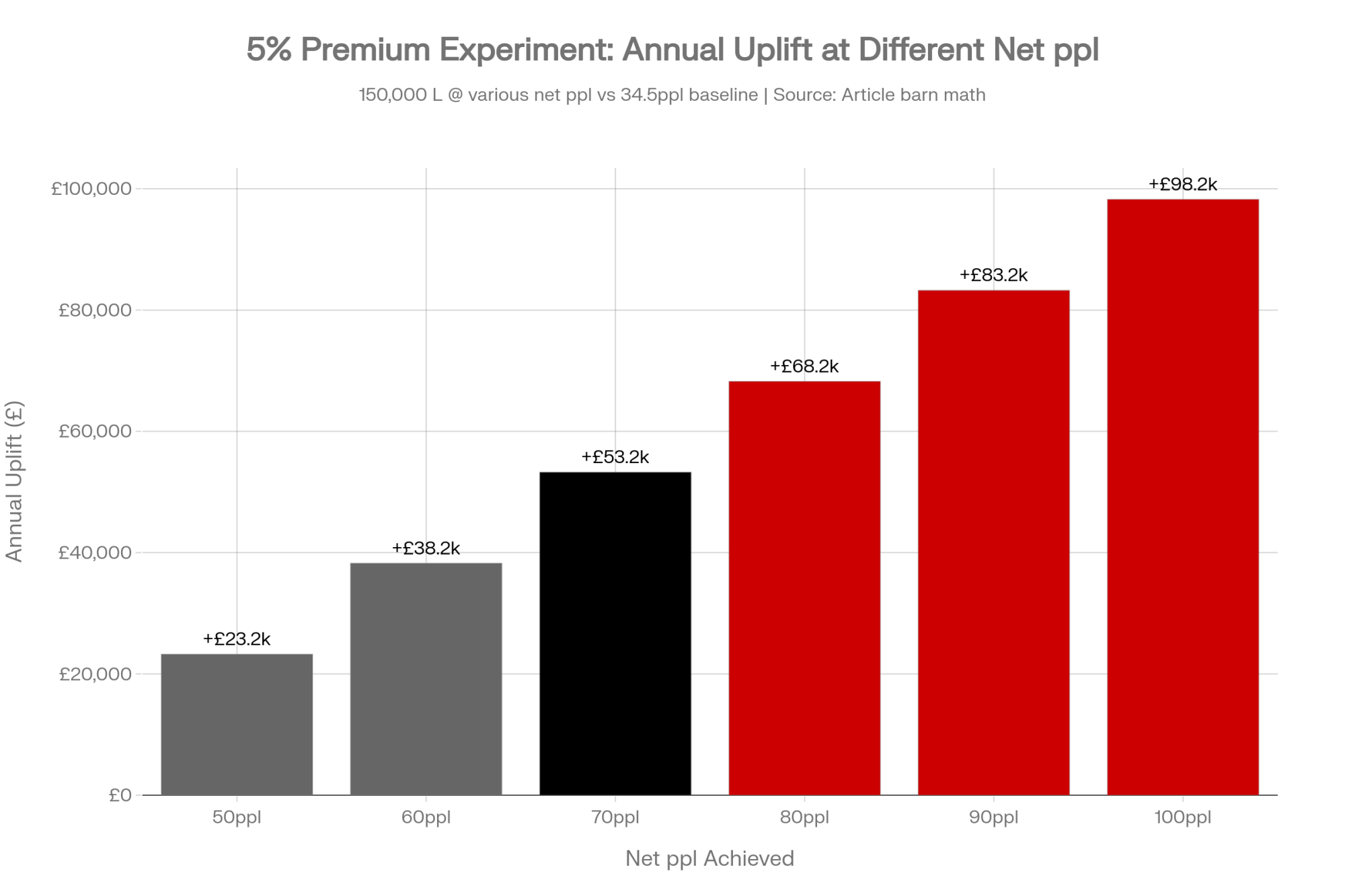
Say your herd is in that 3.0M-litre zone and you decide not to go all-in. You’ll test the waters with 5% of your milk.

  • 5% of 3,000,000 L = 150,000 litres.
  • At contract, 150,000 × 35ppl = £52,500.
  • If you can move those 150,000 L at a net 80ppl after packaging, labour, fuel and extras — the kind of margin some UK glass-bottled premium lines report achieving, though published per-litre net margins from GB direct-sales operators remain thin and this figure should be read as illustrative — it brings in around £120,000.
  • Upside: roughly +£67,500/year on 5% of your milk.

The upside is real. The road to it isn’t free. You’re buying bottles, labels and crates, maybe a vending unit. You’re building delivery routes or paying someone to run them. And it all lands on top of the deficit rows in the table above.

The Soft Cost Nobody Puts on the Spreadsheet

Every direct-sales plan underestimates the same line item: your time. If even a day a week of your time goes to chasing café invoices and fixing the vending machine, who’s walking fresh cows? A premium margin can be eaten alive by a measurable drop in pregnancy rates — even a couple of percentage points — because the boss was busy being a delivery driver instead of managing the transition pen.

Even when the premium slice eventually works, total cashflow often gets worse before it gets better. If your real monthly gap is already around £17,500 (Typical Mid-Size row) or £25,000 (Debt-Heavy row), extra capex and learning curves can push that wider for a few months while new channels settle. The honest question isn’t “should you try premium?” It’s whether your balance sheet and your management bandwidth can fund 6–12 months of worse-before-better on top of the gap you already carry, without your lender losing patience or your herd losing performance.

Is Your Herd’s Milk Even What Premium Buyers Want?

Estate Dairy didn’t invent its supply story. It bought into one that already existed. Brades Farm’s Jerseys in Lancashire’s Lune Valley are known for rich, high-fat milk and barista-focused work, and Bickfield Farm’s Guernsey herd in Somerset produces the classic “gold top” milk that behaves differently in a glass or a flat white.

Those herds came with fat and protein that make better foam, butter and yoghurt — plus a story buyers can tell: long-established herds, grass-based systems, heritage breeds tied to a specific region. A lot of GB 300-cow herds are built on a different model: Holstein-heavy, often chasing 8,000–10,000+ litres/cow/year, with regular beef-on-dairy use to add calf and cull value, which limits dairy heifers if you suddenly want to pivot the whole herd.
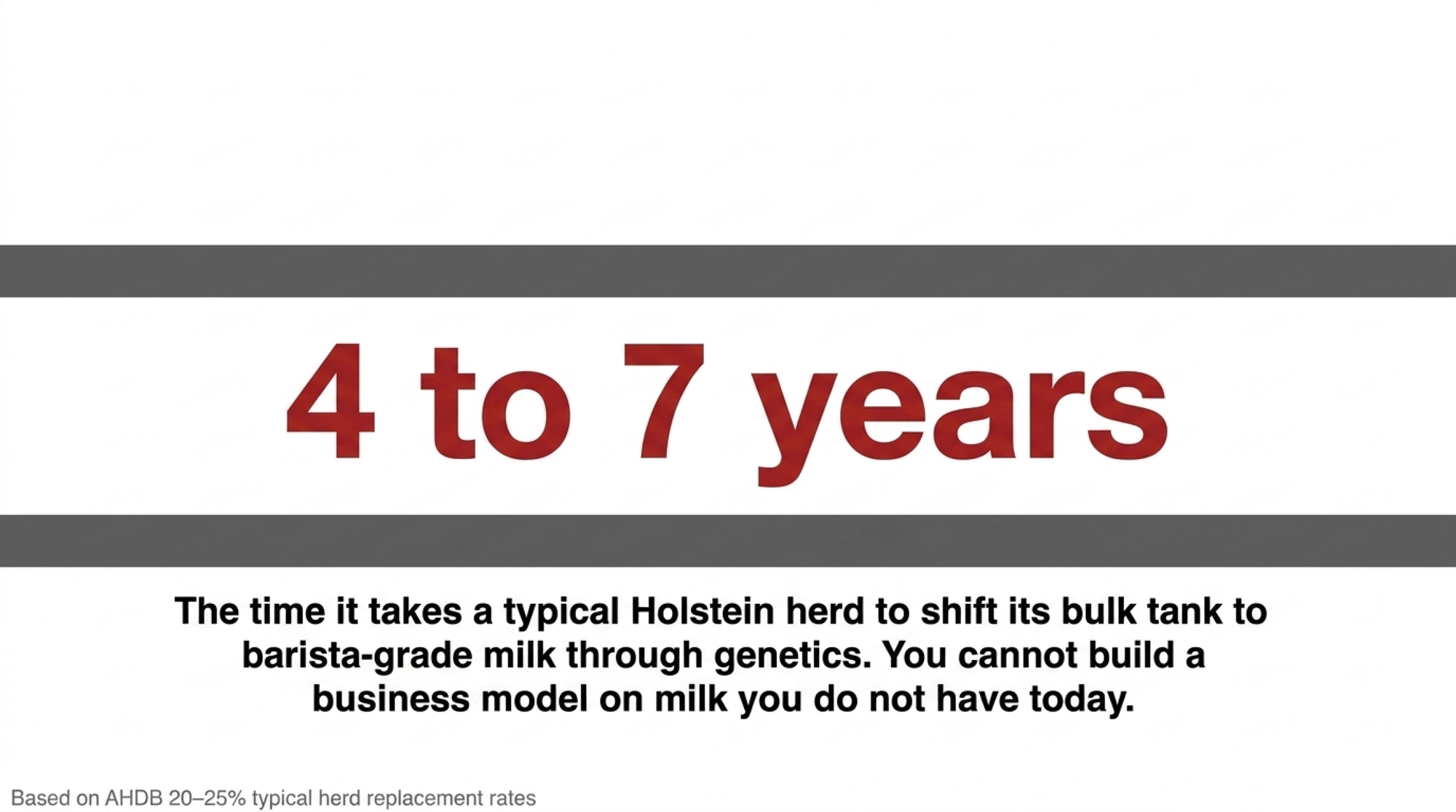
You can shift the profile of your tank — crossbreeding, selection for fat and protein, changing feeding strategy. But with a GB replacement rate typically in the 20–25% range reported in AHDB benchmarking, you’re usually looking at 4–7 years before a new genetic strategy really shows up in the bulk tank.

If the story in your head is, “We’ll flip our Holstein herd into Jersey-type milk in a couple of years and then go premium,” you’re stacking two big bets. Bet one: you can fund the genetic transition while you’re still paid mostly on litres. Bet two: a premium buyer who cares about that new profile will be there at scale when you’re ready. Estate Dairy didn’t wait for genetics. They went and found the milk they needed. That difference matters when you decide how much of their path is even available to you.

Options and Trade-Offs for Farmers

Stop measuring yourself against someone else’s starting line and your choices sharpen. None of these paths are glamorous. All of them are real.

1. Tighten Under the Contract — and Drop the Guilt

When it makes sense:

  • You’re already losing money at today’s milk price.
  • You’re 12–24 months from contract renewal.
  • You don’t have six figures of spare cash for a gamble.

What it requires:

  • A blunt look at the books: which row of the table above you actually sit in, and which kit upgrades are habit rather than need.
  • A frank talk with your lender: “Here’s cost per litre. Here’s the gap. Here’s what we’re doing about it.”

Risks and limits:

  • You’re still exposed to processor cuts.
  • This is a “slow the bleed” strategy, not a growth story.

30-day action: print the last 12 months of bank statements and milk cheques. On a single sheet of paper, write down your average monthly gap at today’s price. If you can’t do that in an hour, that’s your first job.

Go deeper: our Tier 3 piece on what happened to GB farms that tried to ride out Müller’s 1ppl cut without changing anything else picks up where this path ends.

2. Try Premium at the Edges, Not the Whole Tank

When it makes sense:

  • You can name at least three realistic local buyers — a farm shop, a cluster of cafés, a gelato maker, a small cheese plant — who might pay more for what you already produce.
  • You have labour or capital you can risk without missing loan payments.

What it requires:

  • Treat it as a bounded experiment, not salvation. “We’ll put 5–10% of our milk and £X of capital into this. In 12–18 months we either have a clear profit or we shut it down.”
  • Honest costing of the soft stuff: bottling, cleaning, deliveries, invoice chasing — and whose attention shifts away from fertility, transition and feed while that happens.

Risks and limits:

  • Side projects creep. 5% can quietly become 20% if you don’t watch it.
  • A vending-machine side business that trims a couple of points off your pregnancy rate isn’t a win — it’s a distraction with a logo.
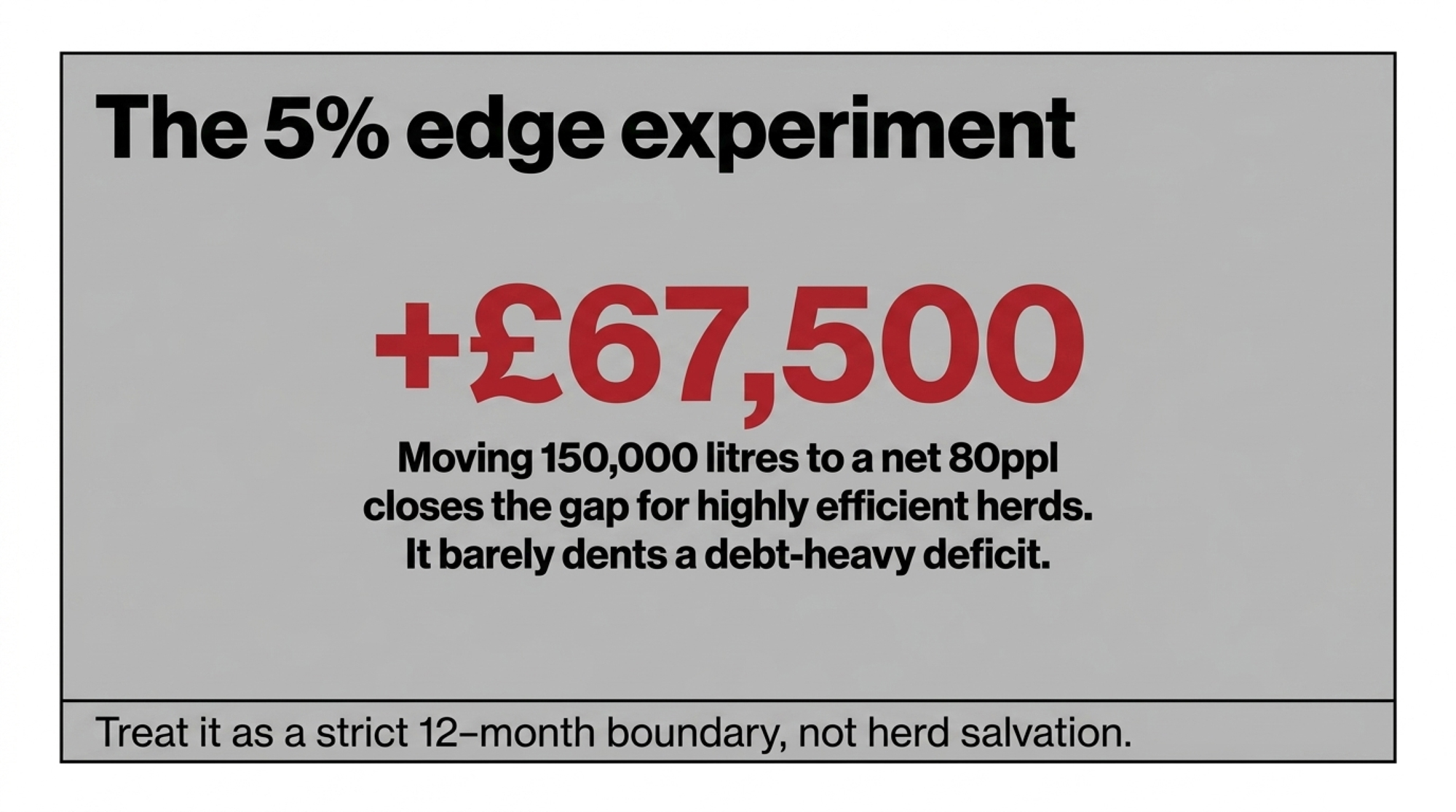
Barn-math example: shift 150,000 L (5% of 3.0M) from 35ppl to a net 80ppl after extra costs. That’s roughly +£67,500/year. On its own, it won’t fill the Typical Mid-Size –£210,000 row or the Debt-Heavy –£300,000 row. Paired with tight cost control, it can close most of the gap on the High-Efficiency row.

30-day action: write a short list of who within 30 miles would pick up the phone if you offered something different. If you can’t fill that list with real names, you’re not ready to spend on stainless.

Go deeper: our case study on how one GB farm kept 95% of its milk on contract and still made a vending machine pay in 12 months shows what a disciplined edge experiment actually looks like.

3. Plan a Controlled Glide Path Instead of a Crash

When it makes sense:

  • Age and family plans make a 10-year turnaround unlikely.
  • You care more about protecting equity and health than about the size of the herd on your funeral card.

What it requires:

  • A 3–5 year plan with your bank and your family: freeze non-essential capex, keep the unit tidy and saleable, pay down what you can, and pick a window to sell cows and machinery while they still hold value.
  • The guts to say “enough” before the lender says it for you.

Risks and limits:

  • Emotionally brutal. It can feel like walking away from generations of work.
  • Resist jumping back in when milk blips up for a few months.

Reframe what “winning” looks like. Exiting with your land, machinery and cow values substantially intact is not losing — it’s walking away with capital in hand. A forced liquidation by an administrator or a fire-sale dispersal under bank pressure typically turns far less equity into cash than a planned, well-timed exit on your own calendar. One path ends with something left to pass on. The other doesn’t.

Talk to enough GB 300-cow operators and you hear the same thing: hard work doesn’t scare them. Betting the kids’ future on a shiny new bottling line that may or may not pay? That’s what really weighs on them.

30-day action: book a two-hour session with your accountant and your bank manager in the same room. Walk them through your land vs kit-finance split, your cull and machinery values, and ask one question out loud: “If we chose to glide out over five years starting this autumn, what does the best-case exit balance sheet look like?”

4. Go Big on Premium — Only If the Runway Is Real

When it makes sense:

  • Most of your debt is secured against land, not short-term kit finance.
  • You have strong reserves or credible outside backing.
  • You can name specific buyers who need what you could produce — not a vague sense that “people will pay more.”

What it requires:

  • A phased plan, not a leap. Secure one or two anchor customers first — a cluster of independent cafés, a regional foodservice wholesaler. Size your first processing kit to those customers, not your entire herd. Consider retail only once you can move product consistently and stay on top of compliance.

Risks and limits:

  • Specialist coffee and high-end hospitality already have suppliers like Estate Dairy. You’re not filling an empty niche — you’re asking someone to switch.
  • A mis-timed plant investment can sink a business faster than a bad milk cheque.

30-day action: map your existing relationships — chefs, retailers, wholesalers — and ask, quietly: “If we built this, would you sign a contract, and for how much volume?” If the answers are vague, hit pause.
Key Takeaways

  • If your fully-loaded cost puts you in the Debt-Heavy row (–£300,000/year), a big premium pivot isn’t “bold” — it’s reckless. Tighten under the contract or plan a controlled exit instead.
  • If you’re in the High-Efficiency row (–£90,000/year), a +£67,500 edge experiment can credibly close most of the gap when paired with cost discipline — but only with hard limits on volume, capital and timeframe set before you start.
  • If most of your debt is tied to parlour, robots and sheds rather than land, your runway for a 6–12 month “worse-before-better” transition is short. The more repayments depend on today’s litres, the less room you have for a bet that temporarily reduces them.
  • If you can’t name three realistic local buyers within driving distance who would pay more for what you already produce, you’re not “behind” on premium — you just don’t have a market yet.
  • If your breeding and replacement plan means 4–7 years to shift your tank’s profile, don’t build a business model that assumes Jersey-style milk is two winters away.
  • If a planned 3–5 year glide path preserves more land, cow and machinery equity than a forced liquidation would, that’s a win in cash terms — not a defeat in identity terms.
Strategic PathBest-fit scenario12-month cash requirementBiggest hidden risk30-day action
Tighten under the contractCost sits near 38–40ppl; within 12–24 months of renewalMinimal capex; focus on cost cutsStill exposed to processor cuts; no upsidePrint 12 months of bank statements + milk cheques onto one sheet
Premium edge experiment (5% of tank)Can name ≥3 local buyers; 150,000 L available£15,000–£40,000 upfront (bottles, crates, labour)Management time drag drops pregnancy rates; side project creeps to 20%List real buyer names within 30 miles; no list = not ready
Controlled glide exit (3–5 yr)Age/succession makes 10-yr turnaround unlikely; land equity intactFreeze non-essential capex; no new debtEmotional — hardest path to hold when milk ticks up for a seasonTwo-hour session: accountant + bank manager, same room, exit balance sheet
Go big on premiumMost debt secured against land; credible outside backing; anchor customer committed£100,000–£300,000+ for processing kit and working capitalNiche already occupied by Estate Dairy et al.; mis-timed plant investment is terminalMap existing chef/retailer relationships; ask for a volume commitment in writing

You can’t control which dairy stories the business pages choose to spotlight. The Youngs’ £5,000-to-£26M arc was always going to make headlines. You can control which game you’re actually playing.

Pull the 12-month milk cheque total, the average ppl and your best estimate of fully-loaded cost, and put them on one page before the end of the week. Find your row in the table above. Then answer the question out loud, in front of the person whose name is also on the loan:

If your fully-loaded cost is 42ppl and the cheque clears at 34.5ppl, are you running a dairy — or quietly funding your processor’s margin with your own equity?

Run Your Numbers

Farm Benchmark Snap Check — Drop in your herd’s litres, ppl, and fully-loaded cost per litre and see which row you’re actually standing in — High-Efficiency, Typical Mid-Size, or Debt-Heavy — before you decide whether to tighten under the contract, experiment at the edges, glide out, or bet on premium.

Learn More

The Sunday Read Dairy Professionals Don’t Skip.

Every week, thousands of producers, breeders, and industry insiders open Bullvine Weekly for genetics insights, market shifts, and profit strategies they won’t find anywhere else. One email. Five minutes. Smarter decisions all week.
NewsSubscribe
First
Last
Consent

Why Greg Bethard Passed on Private Equity — and the $6,638‑Per‑Cow Debt Line Behind That Call

Greg Bethard told a roomful of dairy operators he doesn’t want investors — he wants partners who know what a bad milk year smells like.

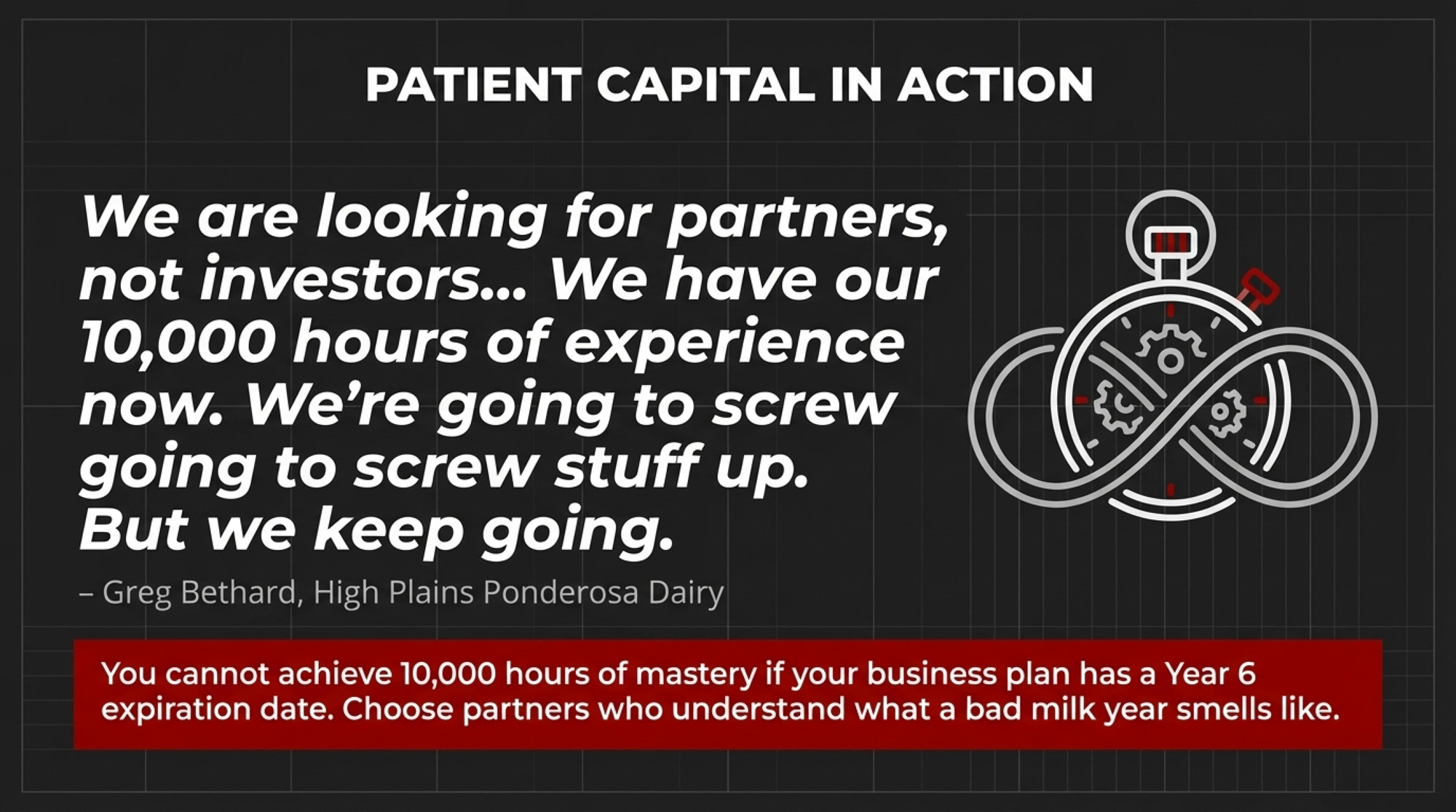
“We are looking for partners, not investors.”

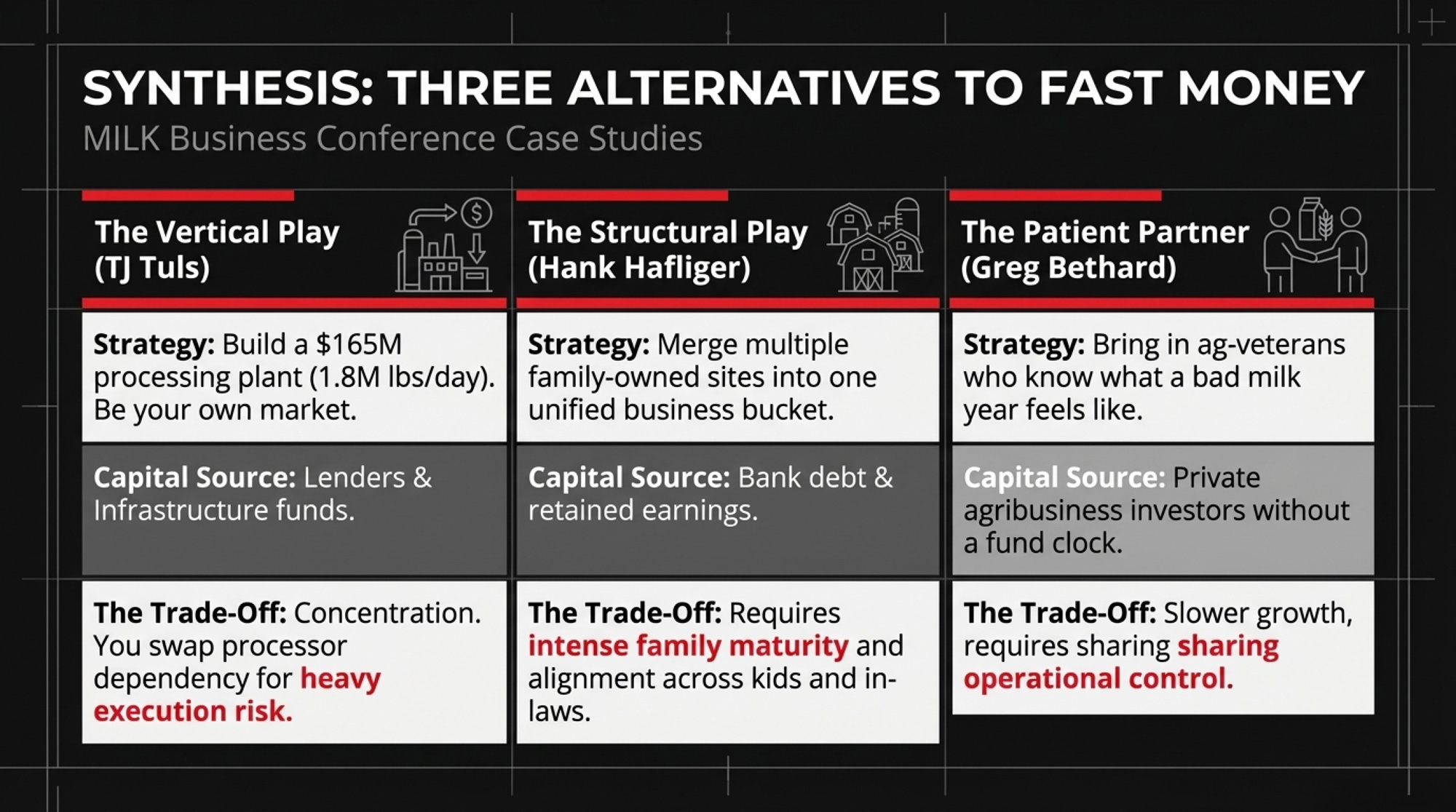
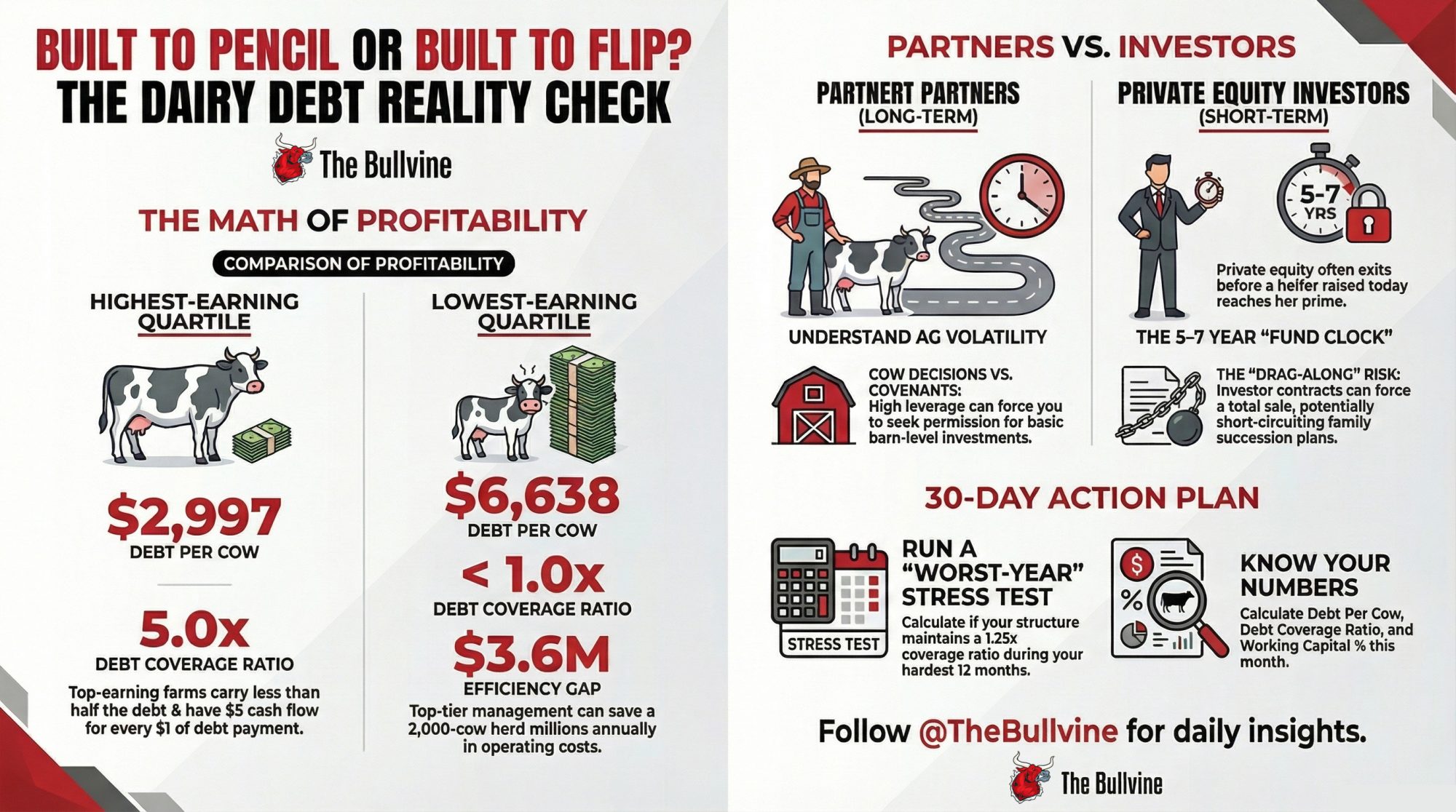
That’s how Greg Bethard opened his talk at the 2025 MILK Business Conference. He’s the CEO and managing partner of High Plains Ponderosa Dairy near Plains, Kansas — a rotary‑parlor operation that ships milk to the Hilmar Cheese Co. plant in Dodge City and earned the 2025 Kansas Distinguished Dairy Award. Bethard has expanded without private equity, choosing people who already understand cows and volatility over funds that want out in five to seven years. Sitting beside him on the panel were TJ Tuls, a fourth‑generation Nebraska dairy farmer, and Hank Hafliger of Cedar Ridge Dairy in Filer, Idaho. Different herds, different structures, same basic bet: keep the timeline with the cows and the family, not the fund clock.

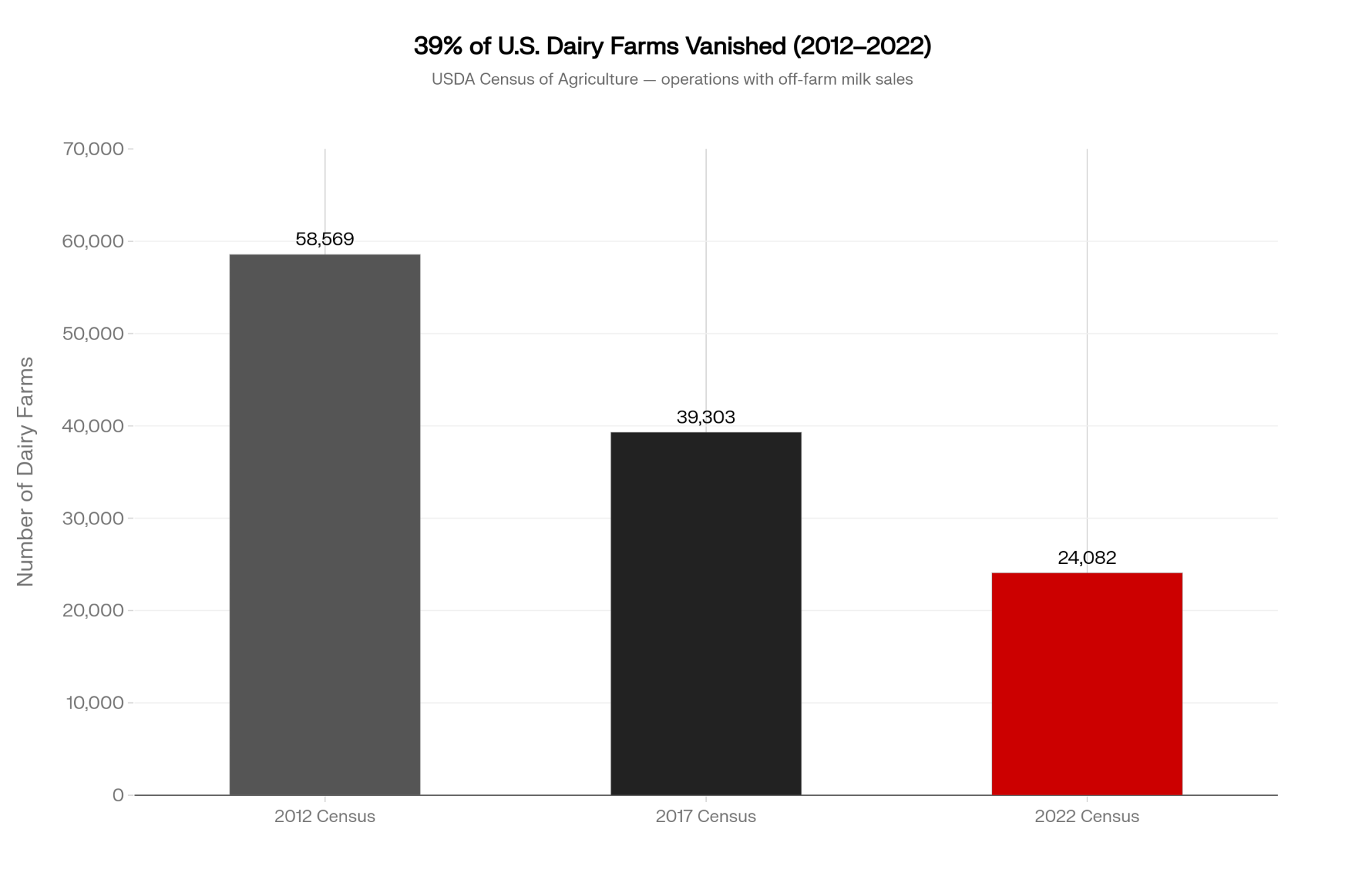
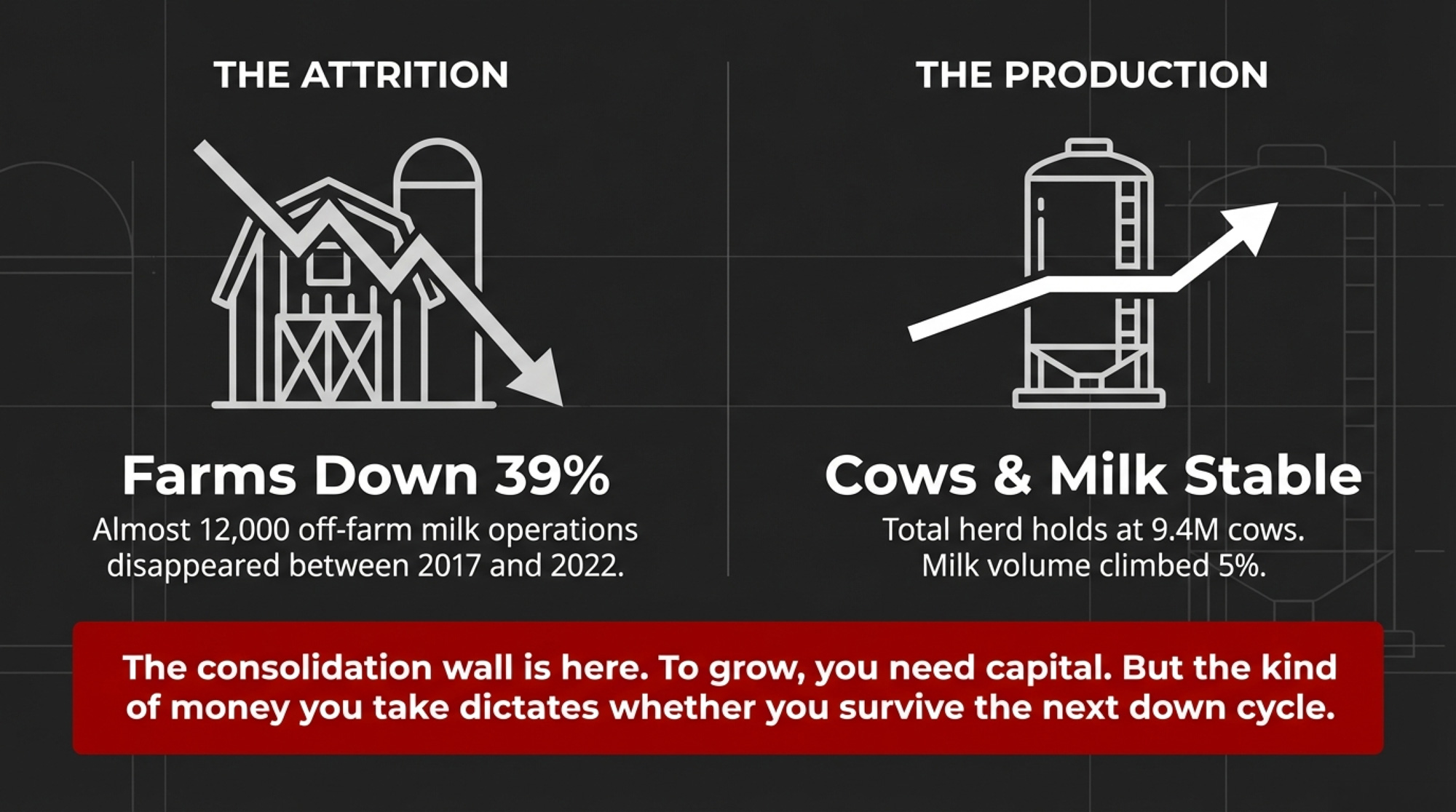
Nearly 4 in 10 U.S. dairy farms with off‑farm milk sales disappeared between 2017 and 2022. Cow numbers barely moved — still around 9.3–9.4 million head — but milk shifted hard into fewer, bigger herds. Those herds now face a blunt question: do you take fast capital and more leverage, or do you find slower money that lets you sleep at night?

The Fork Every Growing Dairy Hits

Any serious expansion now runs into the same wall: your own balance sheet.

USDA’s 2022 Census of Agriculture shows the number of dairy operations with off‑farm milk sales fell from 39,303 in 2017 to 24,082 in 2022 — almost 12,000 farms gone, roughly a 39% decline. Over that stretch, total cow numbers held near 9.3–9.4 million while milk volume climbed about 5%. Just over 2,000 herds with 1,000‑plus cows now produce about two‑thirds of the country’s milk by value, according to Census analysis and Rabobank estimates. PE funds look at that curve and see a defensive thesis. People still buy food in a downturn.

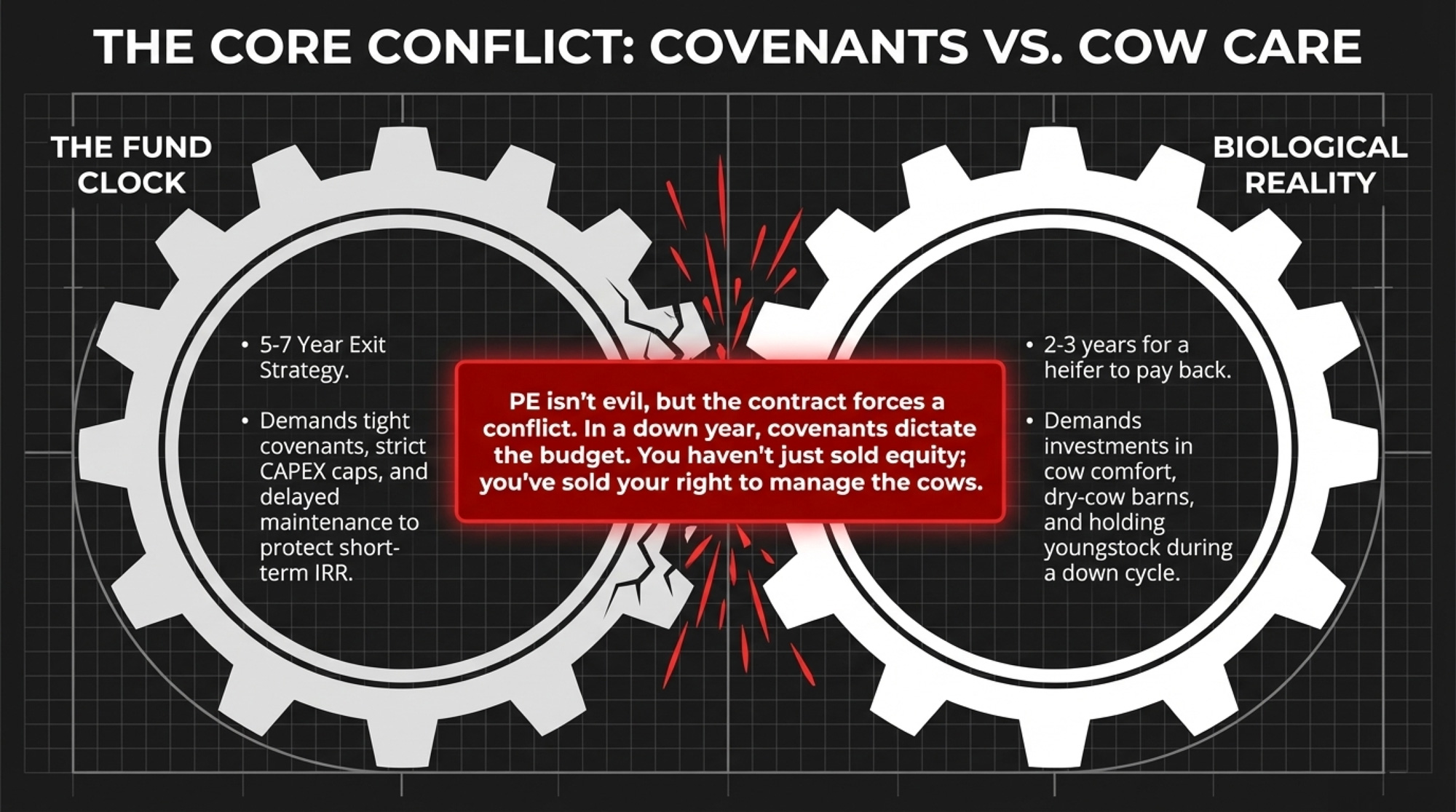
You know the other side of it. A heifer you raise this year won’t really pay back until her second or third lactation. You invest for years before you know whether genetics and cow‑care decisions actually worked. When you finance that biology with a five‑ to seven‑year buy‑grow‑flip model, something gives — either the cows, the capital, or your control.

Three Families, Three Very Different Paths

What made the MILK Business panel worth paying attention to wasn’t just that Bethard, Tuls, and Hafliger all said no to PE. It’s that each built a completely different alternative — and accepted the trade‑offs that came with it.

OperatorCapital ModelStructureGeographic AnchorCore Trade-OffExit Timeline
Greg Bethard— High Plains Ponderosa Dairy, KSPatient ag-industry partners; no PEPrivate partnershipPlains, KS → Hilmar Cheese, Dodge CitySlower growth; full cow-level decision controlNone — family timeline
TJ Tuls — Nebraska, DARI ProcessingBank + infrastructure lenders for $165M greenfield plantFamily + lendersSeward Rail Campus, NEConcentration risk; construction/ramp-up execution riskNone — generational build
Hank Hafliger— Cedar Ridge Dairy, IDFamily equity + bank debt; no outside shareholdersMulti-site family unified businessFiler, ID (moved from CA)High people/alignment demands across kids and in-lawsNone — family-controlled
PE-Backed Generic ModelPrivate equity fund; limited partnersFund-controlled; DSCR covenantsProcessor clusters; “packageable” geography5–7 yr hold period; drag-along exit rights; covenant restrictions5–7 years (fund clock)

TJ Tuls went vertical. His family is building DARI Processing at Nebraska’s Seward Rail Campus — reported in mid‑2025 coverage as the state’s first major greenfield dairy plant in more than six decades. Trade and state sources peg the project at about $165 million, designed to handle roughly 1.8 million pounds of milk per day, with groundbreaking in 2025 and start‑up targeted around 2027. When asked where he’d build a new dairy, Tuls didn’t hesitate: “Close to a milk plant.” His family decided to be the milk plant. Their capital partners are lenders and infrastructure‑focused entities, not limited partners, grading them on quarterly IRR.

The trade‑off is concentration. If DARI hits a rough patch — construction overruns, a slower ramp‑up, margin squeeze — every part of the family’s operation feels it. You swap processor dependency for execution risk. Not every family wants that exposure.

Hank Hafliger went structural. Cedar Ridge Dairy started in California before the family moved the operation to Filer, Idaho. Today, Hank owns it with three of his children and their spouses, running multiple dairy sites as a single unified business. No PE fund. No outside equity. Bank debt, retained earnings, and a family agreement that everything lands in one bucket. “By running them as one, we don’t have that ‘my dairy is doing better than yours’ conflict,” Hafliger told the crowd. “It’s about maturity, learning to relax and let things happen rather than trying to force them.”

That model asks a lot of people, not just paper. Not every family can operate three sites as one business without it fracturing. When it works, you get alignment across kids, in‑laws, and locations. When it doesn’t, the damage runs deeper than dollars.

Bethard went for patient partners with ag scars. High Plains Ponderosa has grown by bringing in people who already know what a bad milk year feels like — not financial sponsors planning a sale before the heifers from this year ever calve. He’s honest about the early expansion learning curve. “We have our 10,000 hours of experience now,” he said, borrowing Malcolm Gladwell’s mastery concept. “We’re going to screw stuff up. There are going to be bad days… But we keep going at it, and we’ll get it figured out.”

You don’t get to 10,000 hours if the business plan has a Year 6 expiration date.

What Does $6,638 of Debt Per Cow Actually Look Like?

Here’s where this stops being theoretical and starts hitting your spreadsheet.

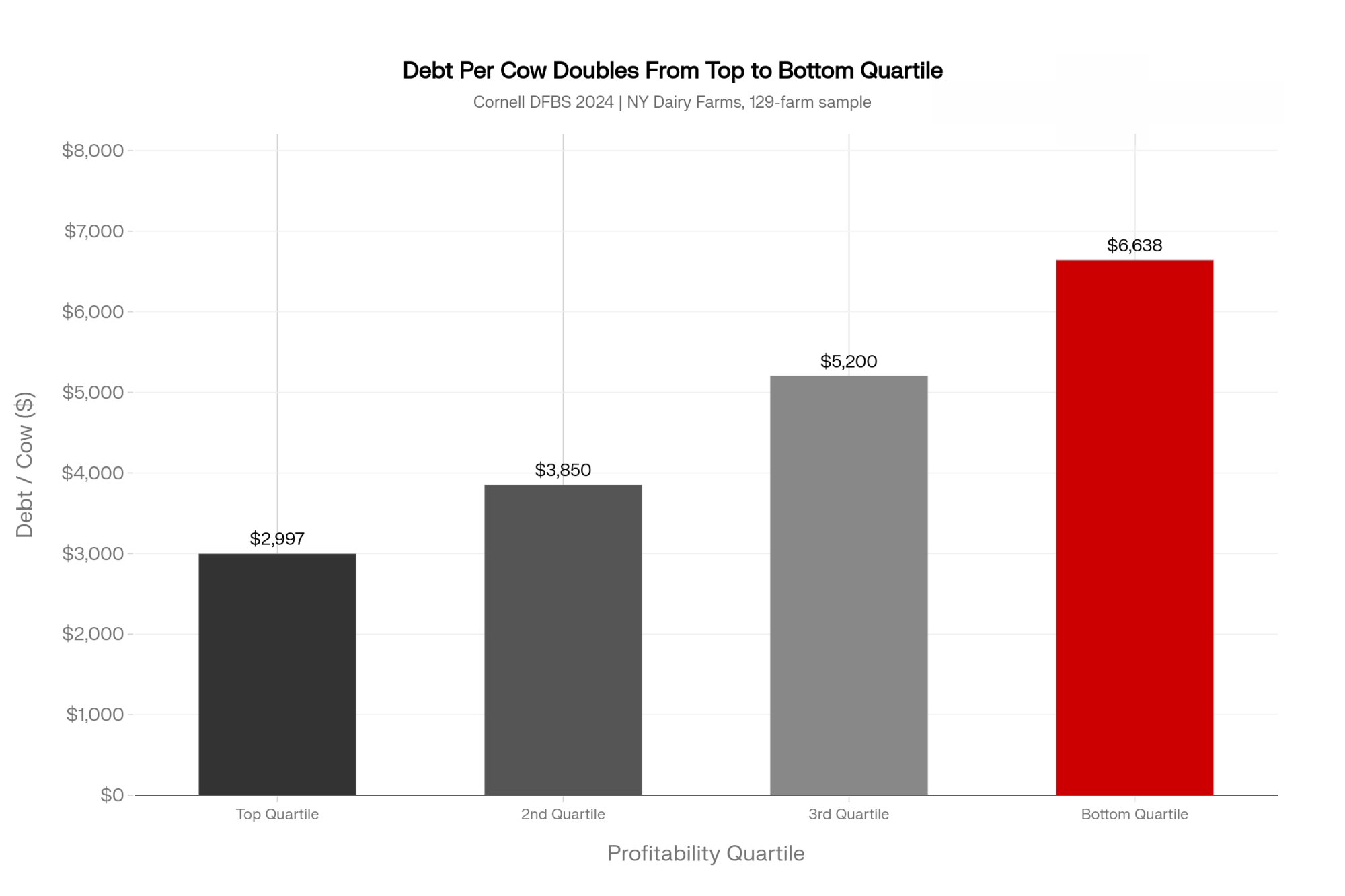
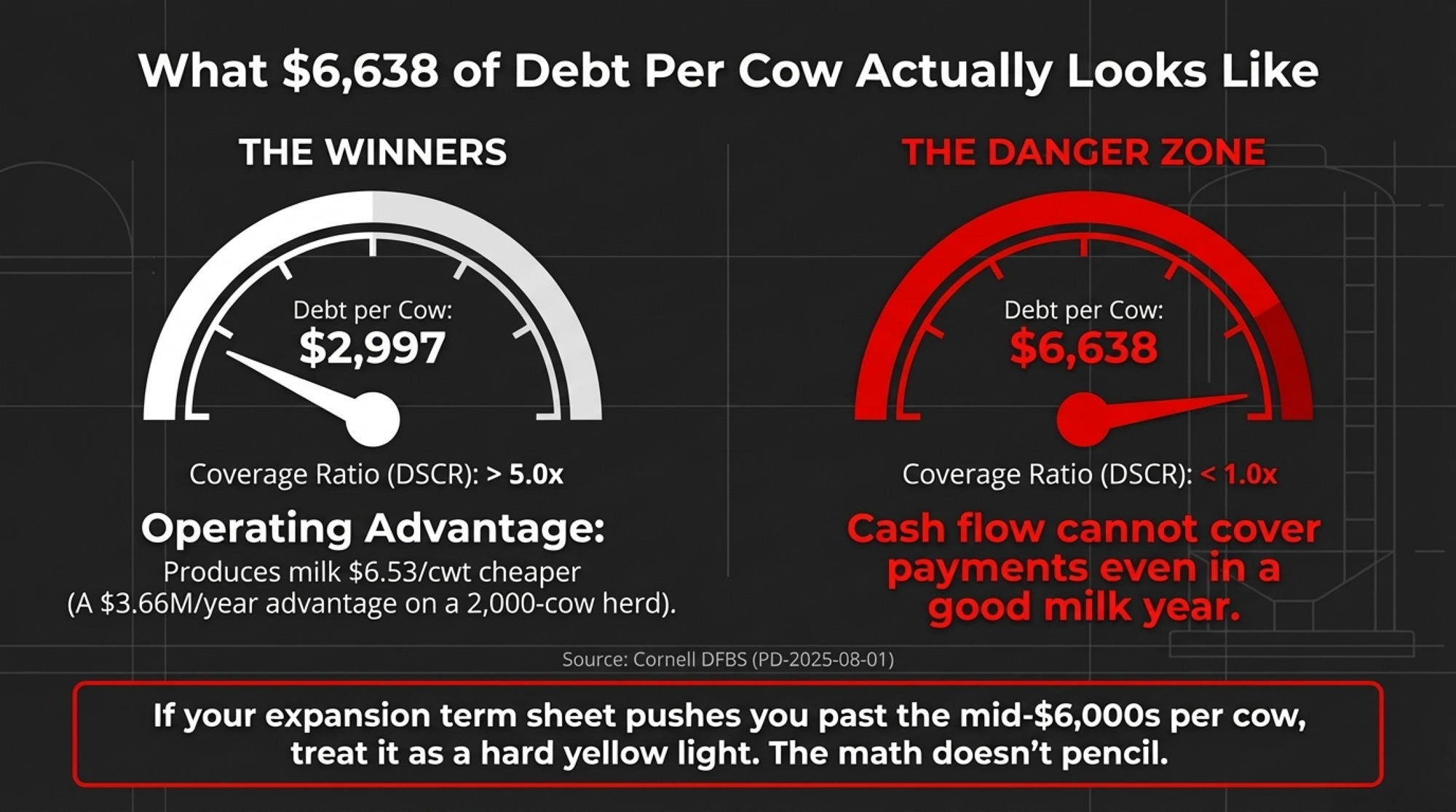
Cornell’s July 2025 bulletin “Comparing New York dairy farm characteristics, costs, and returns by profitability, 2024” (PD‑2025‑08‑01) sorted 129 New York dairy farms into earnings quartiles. The patterns are stark. More profitable herds consistently carried less debt per cow, held stronger debt coverage ratios, and produced milk at a substantially lower cost per cwt than the least profitable group. In that dataset, the highest‑earning quartile averaged about $2,997 of debt per cow with a debt coverage ratio north of — roughly five dollars of cash flow for every dollar of scheduled principal and interest. The lowest‑earning quartile? About $6,638 per cow, with coverage under . Cash flow couldn’t cover the payments. And this was during a year when average net farm income per cow jumped sharply.

Even in one of the best income years in recent memory, the most leveraged herds couldn’t comfortably service their debt.

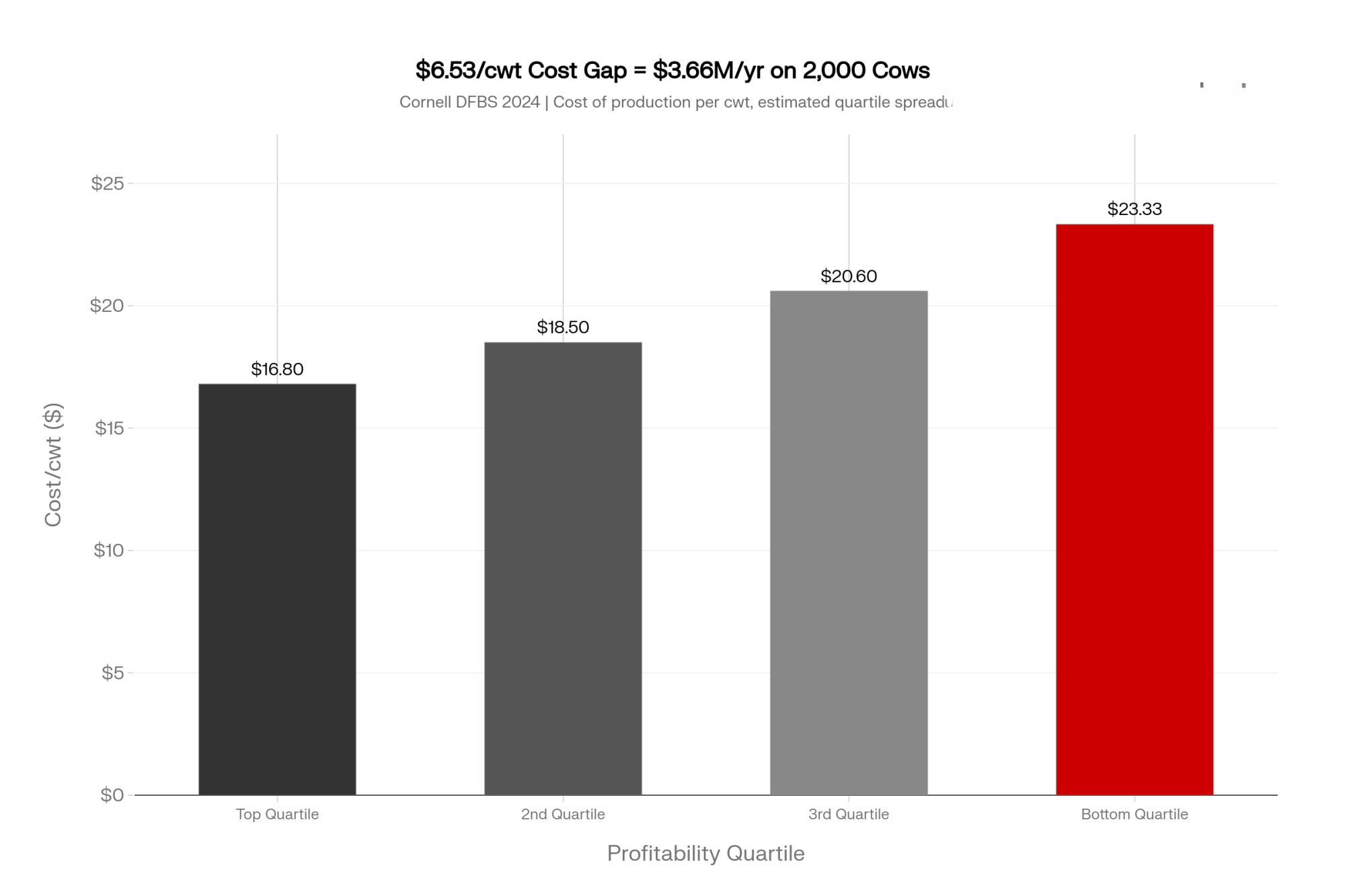
The cost‑of‑production gap runs parallel. Cornell’s public DFBS tables show top‑quartile farms producing milk several dollars per cwt cheaper than the bottom group — a function of better feed efficiency, labor productivity, and fixed‑cost absorption. Using a spread of roughly $6.53/cwt between the top and bottom quartiles, run that through a real herd: 2,000 cows shipping 280 cwt per cow per year gives you 560,000 cwt. Multiply by $6.53, and you’re looking at approximately $3.66 million per year in operating‑cost difference. Same milk prices. Same feed markets. Very different bank statements.

That’s New York data, not a national average — your region’s numbers will look different. But the pattern between top and bottom tends to hold across state farm‑business summaries. When any capital source — PE or otherwise — pushes you toward that $6,600‑per‑cow neighborhood before your earnings and cost structure say you belong there, the term sheet isn’t your biggest problem. The math is.

Is the Deal Built to Pencil — or Built to Sell?

This is the economic question you actually live with: can you still hit your numbers when things go sideways?

Highly leveraged structures — PE‑backed or just aggressive debt — usually come with tighter covenants than a traditional bank expansion. DSCR floors, restrictions on new borrowing, caps on capex, and sometimes approval requirements on major operational changes. None of that bites when milk is good, and feed is reasonable. It bites when you need breathing room.

You’ve probably had that year already. Health wreck, feed quality issue you chase for months, or a long run of heat that drags component tests. Your instinct says: slow expansion, keep youngstock, invest in a dry‑cow barn or fans, buy time to reset. Tight covenants can push in the opposite direction: freeze spending, delay maintenance, and more milk per stall. That’s the structural conflict Bethard described on the panel — not that PE is evil, but that the contract can force you to make the opposite call from what your gut and cows are telling you.

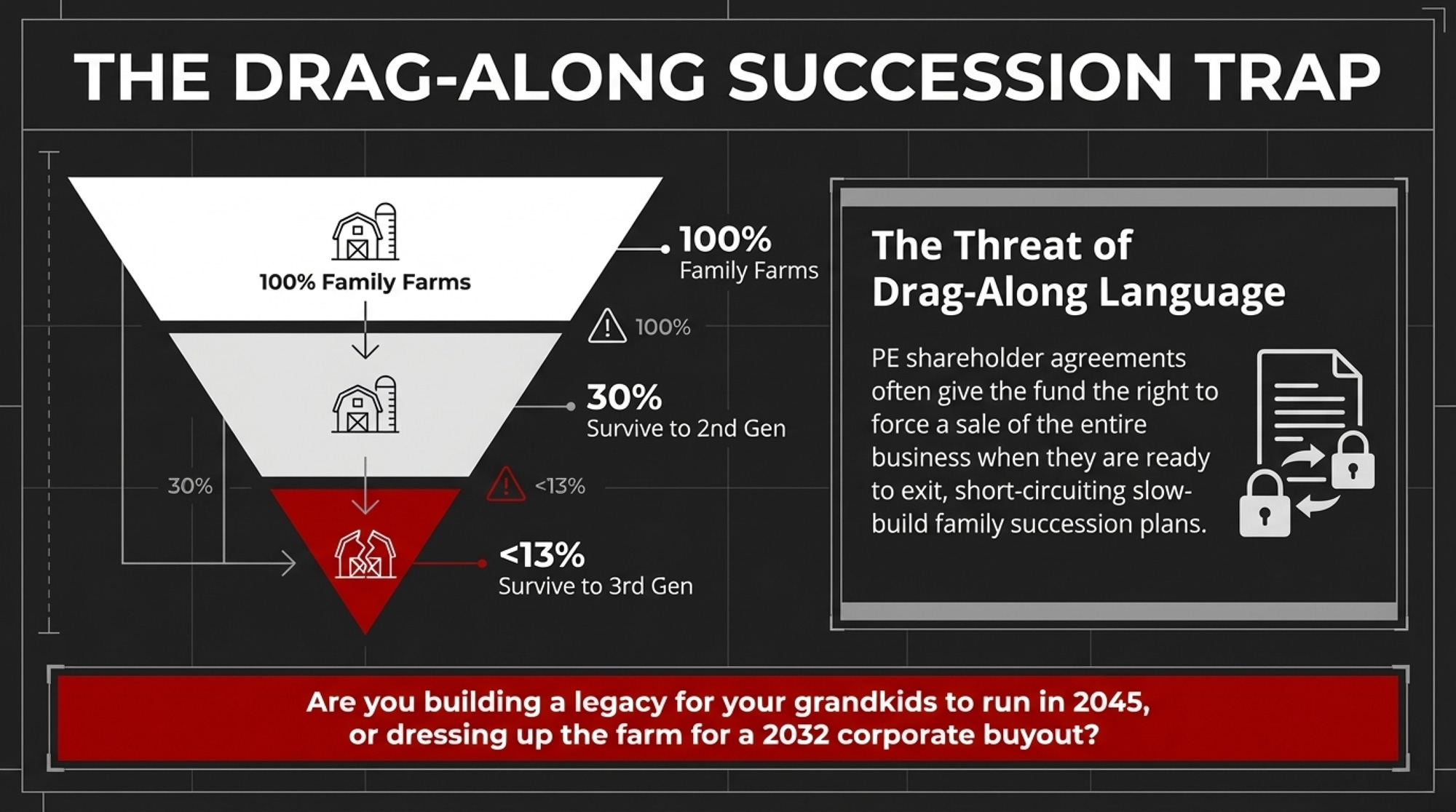
Then there’s drag‑along language. Many PE shareholder agreements give the fund the right to force a sale of the whole business when they exit. In corporate settings, that’s standard. On a family place, depending on how it’s written, it can short‑circuit a slow‑build succession plan. Cross‑industry family‑business research consistently reports that only about 30% of family businesses transition to the second generation, and fewer than 12–13% make it to the third. Contract provisions that accelerate a sale timeline don’t improve those odds.

Before you stare at the check size, it’s fair to ask: Is this structure built to pencil through your worst 12‑month stretch, or is it built to be easy to sell?

Can You Still Make Cow‑Level Decisions When Covenants Control the Budget?

This is the operational version of the same question.

Ask anyone who’s lived under tight covenants. The day‑to‑day pressure doesn’t feel like “capital structure.” It feels like arguing with your own spreadsheet about things you’d normally just do..

Do you need a lender sign‑off to build that fresh‑pen addition you know would take stress off transition cows? Does a board have to agree before you hang more fans, add a hoof‑trimming visit, or keep more heifers this year instead of selling? On paper, those are capital‑allocation decisions. In the barn, they’re cow‑care decisions that directly change milk, longevity, and cull rates.

Bethard was blunt on this point. When you pick partners, you’re also picking who sits at the table when there’s a tough quarter. He wants people who understand that holding onto extra heifers in a bad year can be the best long‑term move, even if it drags DSCR in the short run.

If a deal puts you in a position where every down‑cycle adjustment needs outside permission, you haven’t just sold equity. You’ve sold a chunk of how you manage cows.

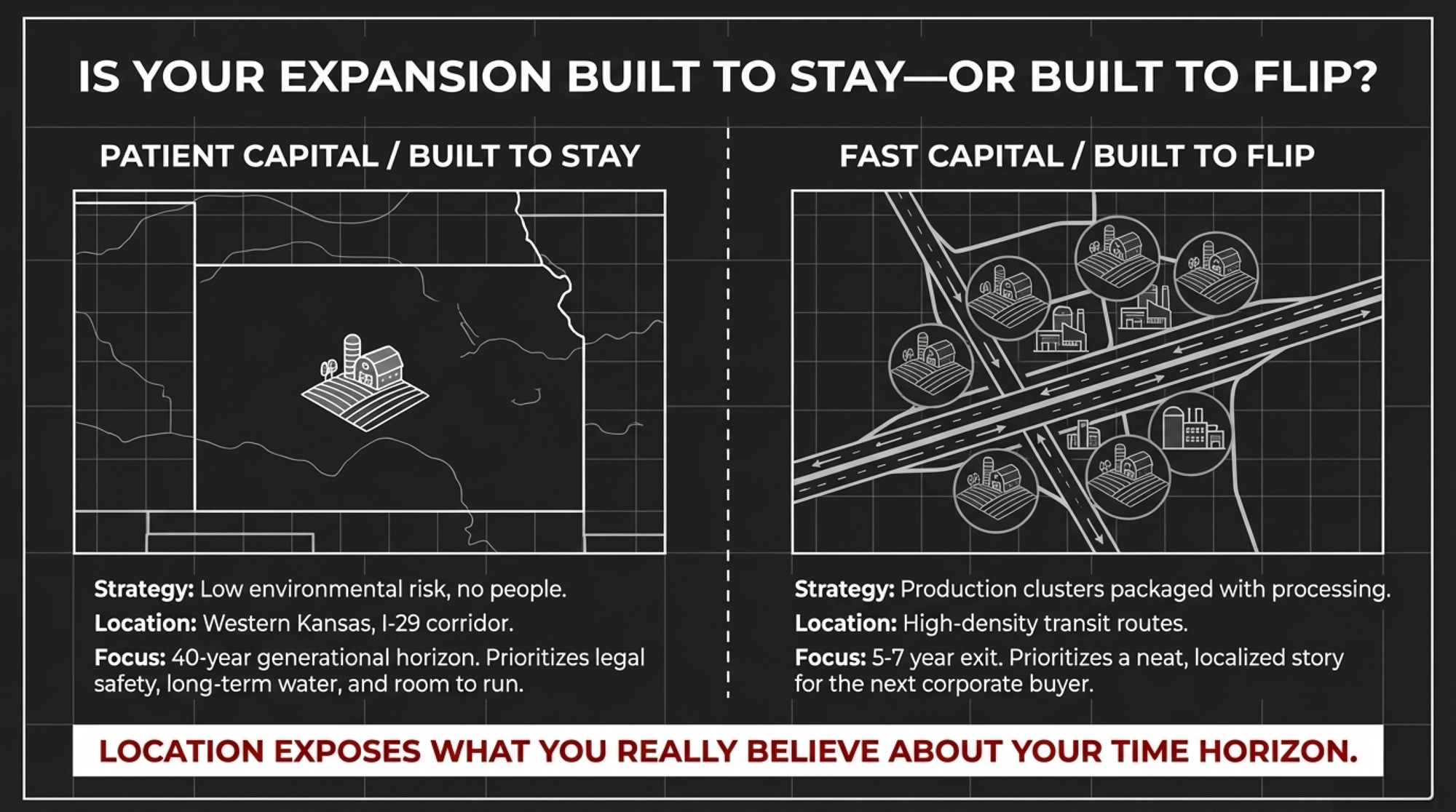
Is Your Expansion Built to Stay — or Built to Flip?

Location exposes what you really believe about your time horizon.

Bethard told the audience that if he were siting a new dairy today, he’d look for “low environmental risk and a place without a lot of people.” Fewer neighbors, less legal risk, more room to run. Tuls’ answer was short: “Close to a milk plant.” For him, that means DARI — because that’s the anchor his family is building generations around.

Investors running a shorter‑term play often think about geography differently. They like production clusters that can be packaged with processing capacity and sold together: multiple herds within hauling distance of a plant, good roads, a neat story for the next buyer. That doesn’t automatically make a site wrong for a 40‑year plan. But it means you need to double‑check the long‑term water, permitting, and community story — not just the current land price.

Bethard noted you need a contract before you can even build now. That reality has pushed new capacity toward regions like western Kansas and the I‑29 corridor, where processors like Hilmar and Valley Queen are pulling milk into existence rather than chasing existing herds. If you’re choosing a spot for your grandkids to renew contracts in 2045, that’s a completely different filter than picking the easiest site to sell in 2032.

Options and Trade‑Offs for Farmers

You don’t need a PE term sheet on your desk for this to matter. Any expansion that stretches your balance sheet forces you to pick a path.

PathTypical Debt/CowDSCR in Bad YearCow-Level Decision ControlExit PressureBest ForYellow / Red Flag
1. Traditional Debt + Patient Bank~$2,997–$4,500>1.25× if sized rightFull — no outside approvalNoneSolid profitability, clean financials, moderate growth🔴 Red if debt pushed past ~$5,500/cow
2. Strategic Partners (No Fund Clock)$3,500–$5,500>1.0× if structured correctlyHigh — per operating agreementMinimal if agreements are written rightExpansion beyond bank capacity; multigenerational family🟡 Yellow if partners want short-term return hurdles
3. Private Equity / PE-Style Equity$4,500–$6,638+May drop below 1.0× under covenantsReduced — capex/hiring may require board approvalHigh — 5–7 yr hold, drag-along rightsRapid roll-up, processing integration, very large facilities🔴 Red if DSCR <1.0× in bad-year scenario
4. Slow-Build / Do Less, Better<$3,500Typically >1.5×Full — sole-prop or tight familyNoneOperations with sub-optimal cost structure needing reset🟡 Yellow if facility is fundamentally inefficient

Path 1: Traditional Debt + Patient Partners

When it makes sense: You’ve got solid profitability, reasonable leverage, and a lender who understands your history. Your debt per cow sits closer to that top‑quartile DFBS band than the most leveraged group, and your coverage ratio stays above roughly 1.25× even when you run a bad‑year scenario.

What it requires: Clean financials, believable projections, and genuine working capital. In Cornell’s 2024 DFBS, the most profitable quartile held substantially more working capital relative to operating expenses than the least profitable group. You don’t need to match any specific benchmark exactly, but you need real cushion — not wishful thinking.

Risks and limits: You’re still exposed to milk price and interest‑rate swings. Size the project too aggressively relative to your earnings, and the “traditional” deal lands you in bottom‑quartile debt territory without a PE fund anywhere in the picture.

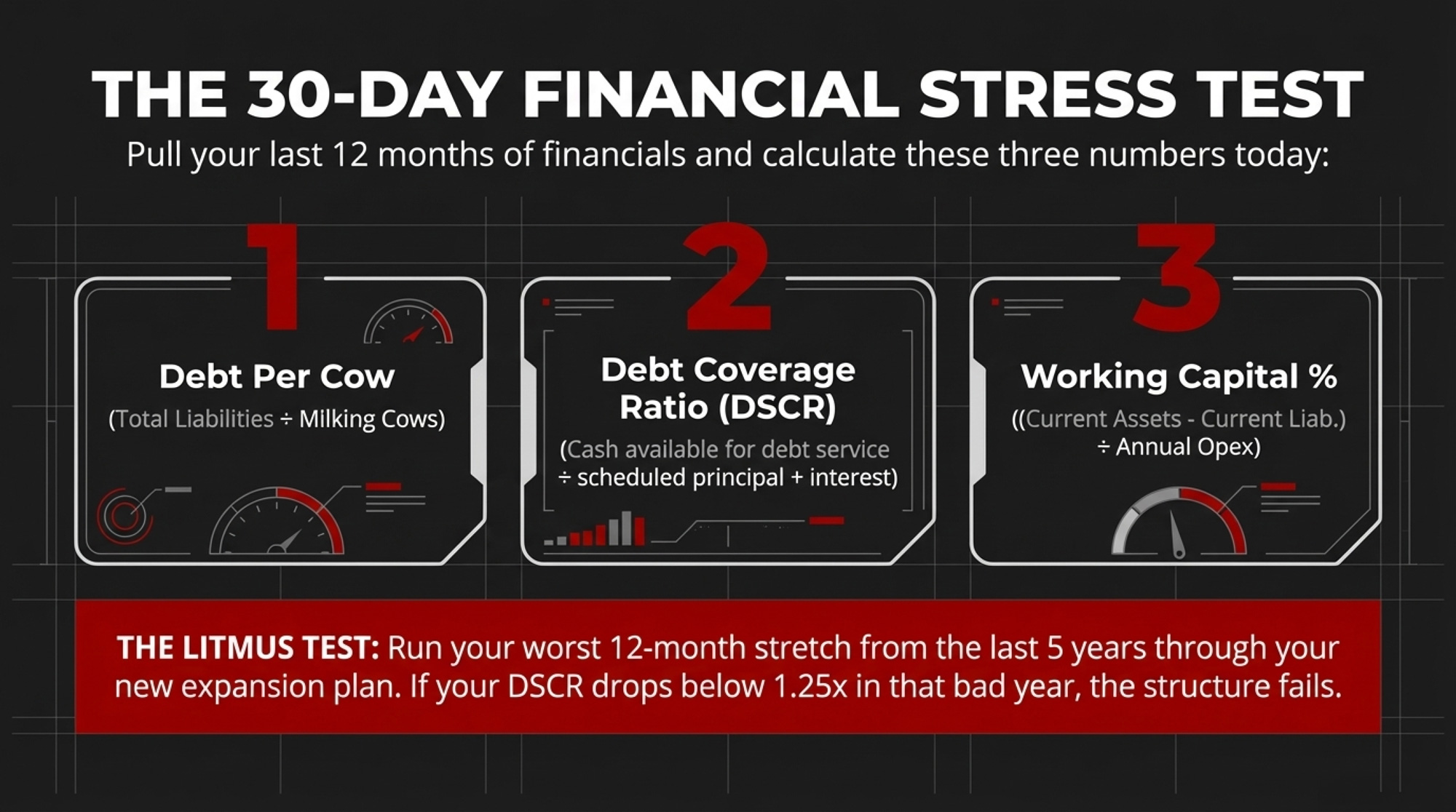
30‑day action: Pull your last 12 months of financials this month and calculate three numbers:

  • Debt per cow (total liabilities ÷ milking cows)
  • Debt coverage ratio (cash available for debt service ÷ scheduled principal + interest)
  • Working capital % ((current assets − current liabilities) ÷ annual operating expenses)

Then run your worst 12‑month stretch from the last five years through your next‑step plan. If this structure keeps DSCR above ~1.25× in that bad year, it stays on the table. If it drops below 1.0×, the red flag goes up.

Path 2: Strategic Partners Without a Fund Clock

When it makes sense: You need more capital than your bank will supply alone, but you want partners who’ll stay through cycles — family members, neighbors, or agribusiness investors who aren’t running a 5‑ to 7‑year fund. This is the space Bethard lives in, and it’s what Hafliger built with his kids and spouses across multiple Idaho sites.

What it requires: Hard conversations about control. Operating agreements that spell out who decides what: capex thresholds, hiring and firing senior managers, land purchases, and dividend policy. A common understanding that you’re building for 20–40 years, not dressing the place up for a sale.

Risks and limits: People risk. These deals fall apart when expectations around distributions, lifestyle, or succession were never put on paper. Even without PE, your partners may still want tighter covenants than a simple family sole‑prop structure.

Signals to watch: If a potential partner insists on sale or IPO timelines, short‑term return hurdles, or aggressive drag‑along rights, you’re drifting back into fund‑clock land. That’s not automatically wrong — but call it what it is.

Path 3: Private Equity or PE‑Style Outside Equity

When it makes sense: You’re chasing a very specific play: rapid multi‑site roll‑up, vertical integration into processing, or a large‑scale facility where the check size isn’t realistic any other way. Teams like Tuls’ on the processing side live near this territory, even if their specific capital stack isn’t classic PE.

What it requires: Exceptional cost of production, real management depth, and a story that sells in a boardroom as well as it does in the parlor. You need a cold‑eyed lawyer walking you through every clause: covenants, drag‑along, tag‑along, non‑competes, and reserved matters.

Risks and limits: The fund’s holding period is usually 5–7 years. That’s a heifer and a half. If milk prices and interest rates don’t cooperate, pressure to hit IRR targets can show up as stalled maintenance, pushed cows, or delayed people investments. At the family level, drag‑along language can force a sale on a timeline that doesn’t match the next generation’s readiness.

Forward‑looking signals: Where are interest rates headed over the next 3–5 years? How tight are current milk‑supply contracts in your region, and how long are they written for? Are lenders and investors pricing in environmental and labor risk — or assuming they’ll be gone by the time it matters?

Path 4: Slow‑Build or “Do Less, Better”

When it makes sense: Your numbers don’t justify aggressive leverage, you don’t like the idea of outside veto power, and there’s still a path to solid profitability by tightening the cost of production and modestly growing components instead of cow numbers.

What it requires: Patience. Relentless work on cost per cwt instead of headline herd size — feed efficiency, cow longevity, reproduction, labor efficiency. In DFBS data, the most profitable, lower‑debt farms didn’t just borrow less; they also produced milk several dollars per cwt cheaper. That combination is what gives them room to breathe.

Risks and limits: You may age out of opportunities if processors shift or neighbors move faster. And if your current facility is fundamentally inefficient, no amount of small tweaks fully fixes that.

Forward‑looking signals: Watch how processors tweak premiums in your area, what they say about components, and whether they start writing water‑ or sustainability‑linked clauses into contracts. That tells you how far a “do less, better” strategy can carry you where you sit.

Key Takeaways

  • If your expansion plan pushes debt past the mid‑$6,000s per cow, treat that as a hard yellow light.Cornell’s 2024 DFBS shows the lowest‑earning New York quartile at about $6,638 per cow with debt coverage under 1×, even in a strong income year. Top earners sat near $2,997 with coverage above 5×. 
  • If one capital structure survives your worst recent 12‑month stretch and another fails the DSCR test, believe the math. Run both through your ugliest year. The structure that keeps coverage above roughly 1.25× when everything goes wrong is the one you can build on.
  • If you can’t approve cow‑comfort or youngstock spending in a down year without outside sign‑off, someone else is making your cow‑level calls. Any deal that pulls basic barn decisions into board or lender approval changes how you manage stress years. 
  • If there’s drag‑along language, understand what it can force — and when. Cross‑industry benchmarks say only about 30% of family businesses survive to the second generation and fewer than 13% reach the third.  You don’t want contract terms cutting those odds even further. 

The Bottom Line

Hafliger’s grandkids are already counting cows. Bethard talks about 10,000 hours of expansion scars. Tuls is backing a $165 million plant with no exit date in the plan.

None of them got there quickly. All of them got there on terms they chose.

So here’s the question worth sitting with: five years from now, do you want to be explaining your decisions to a board — or to your kids?

We’re building the full debt‑per‑cow stress‑test model now — covenant math, leverage thresholds by herd size, and a PE‑vs‑partner calculator you can drop your own numbers into. Watch for it in The Bullvine Weekly and our follow‑up economics deep dive.

Source note: Quotes and panel insights are drawn from MILK Business Conference coverage in Dairy Herd Management. Financial patterns are based on Cornell’s 2024 Dairy Farm Business Summary bulletin, “Comparing New York dairy farm characteristics, costs, and returns by profitability, 2024” (PD‑2025‑08‑01).

Learn More

The Sunday Read Dairy Professionals Don’t Skip.

Every week, thousands of producers, breeders, and industry insiders open Bullvine Weekly for genetics insights, market shifts, and profit strategies they won’t find anywhere else. One email. Five minutes. Smarter decisions all week.
NewsSubscribe
First
Last
Consent

The $586‑Per‑Kilo Dairy Quota Trap: Why New Ontario Quota at 6% Bleeds Cash Every Year

In March, 1,908 Ontario producers bid on quota. Only 190.60 kg traded. Every financed kilogram lost $586 at 6%. The math has flipped — and most farms haven’t noticed yet.

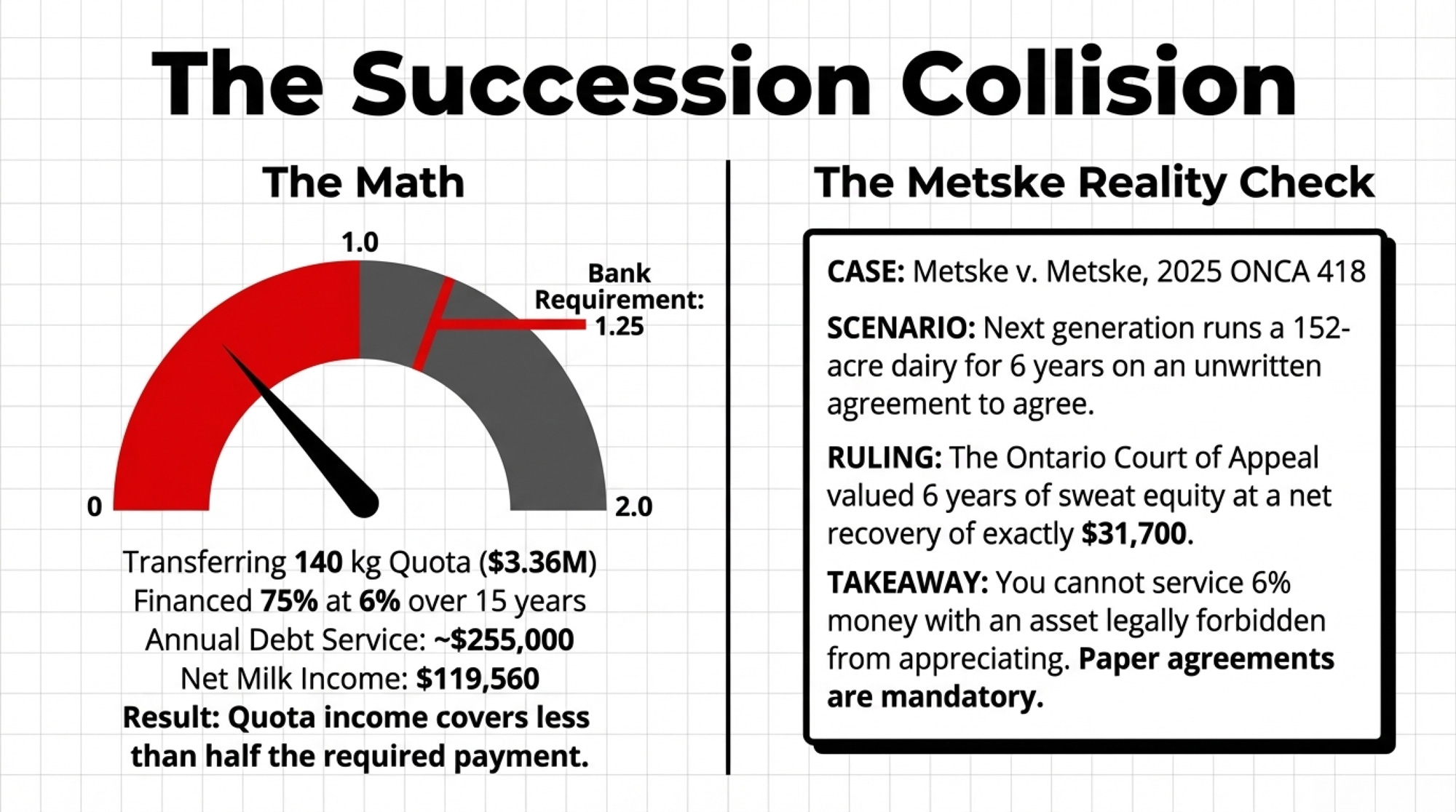
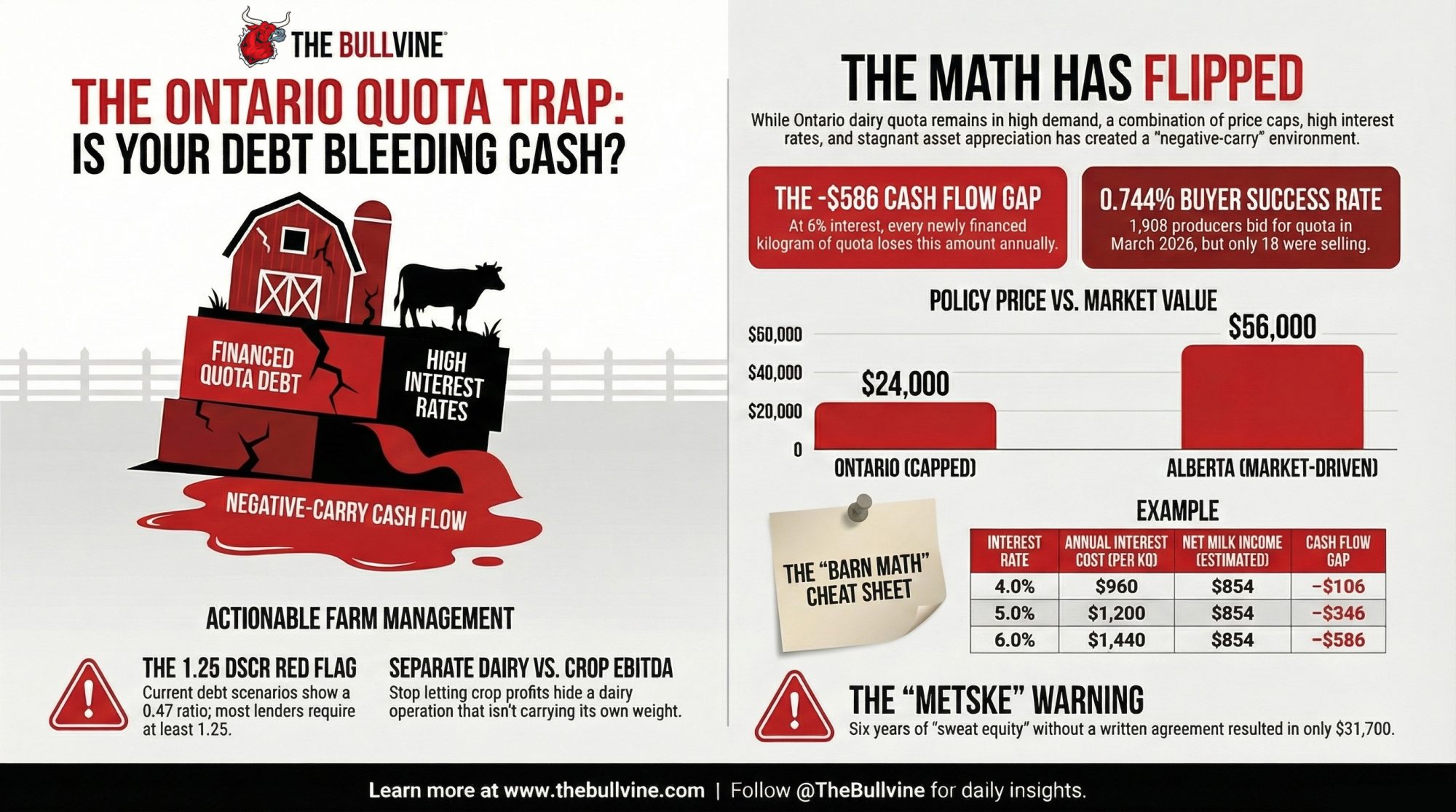
Tim and Amanda Metske ran daily operations on their parents’ 152‑acre Ontario dairy from 2012 to 2018. They invested in quota and cows during those years, working under a family understanding that they’d eventually buy the farm on favourable terms. Martin Metske had discussed a combined price of roughly million — million for the quota, million for the land. But no purchase price, payment terms, or financing structure were ever committed to writing.

When it fell apart, the Ontario Court of Appeal — in Metske v. Metske, 2025 ONCA 418 — awarded $33,700 for tangible improvements, then subtracted a $2,000 counterclaim. Net recovery: $31,700. Six years on a 152‑acre operation carrying millions in Ontario dairy quota, and the court valued the tangible result at less than one kilogram of Alberta quota is worth today.

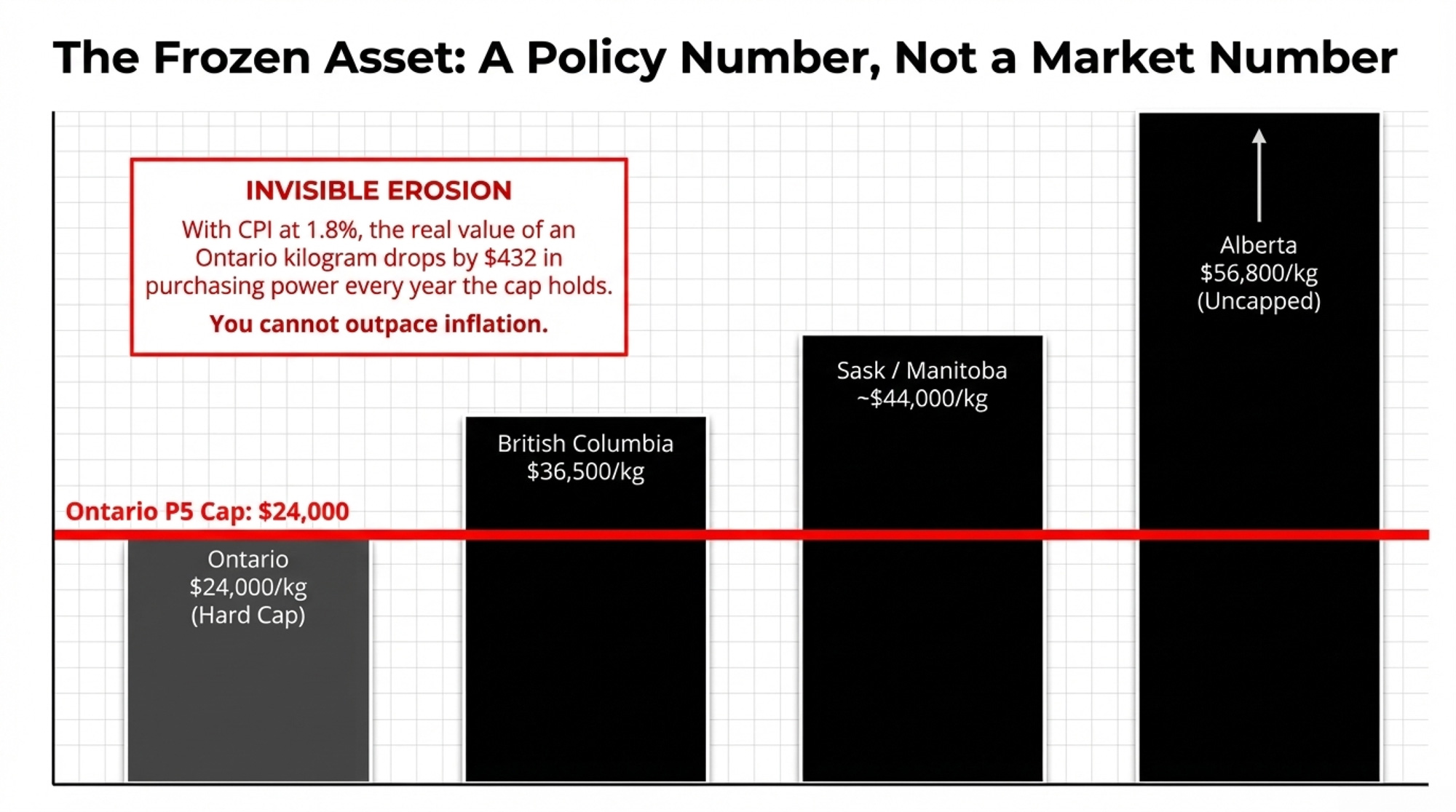
That number matters well beyond one family. It shows how fast sweat equity evaporates on a farm where the P5 quota cap fixes the single largest asset at ,000 per kilogram of butterfat per day — a policy number, not a market number. And right now, the math on buying that asset has quietly turned against anyone carrying debt on it.

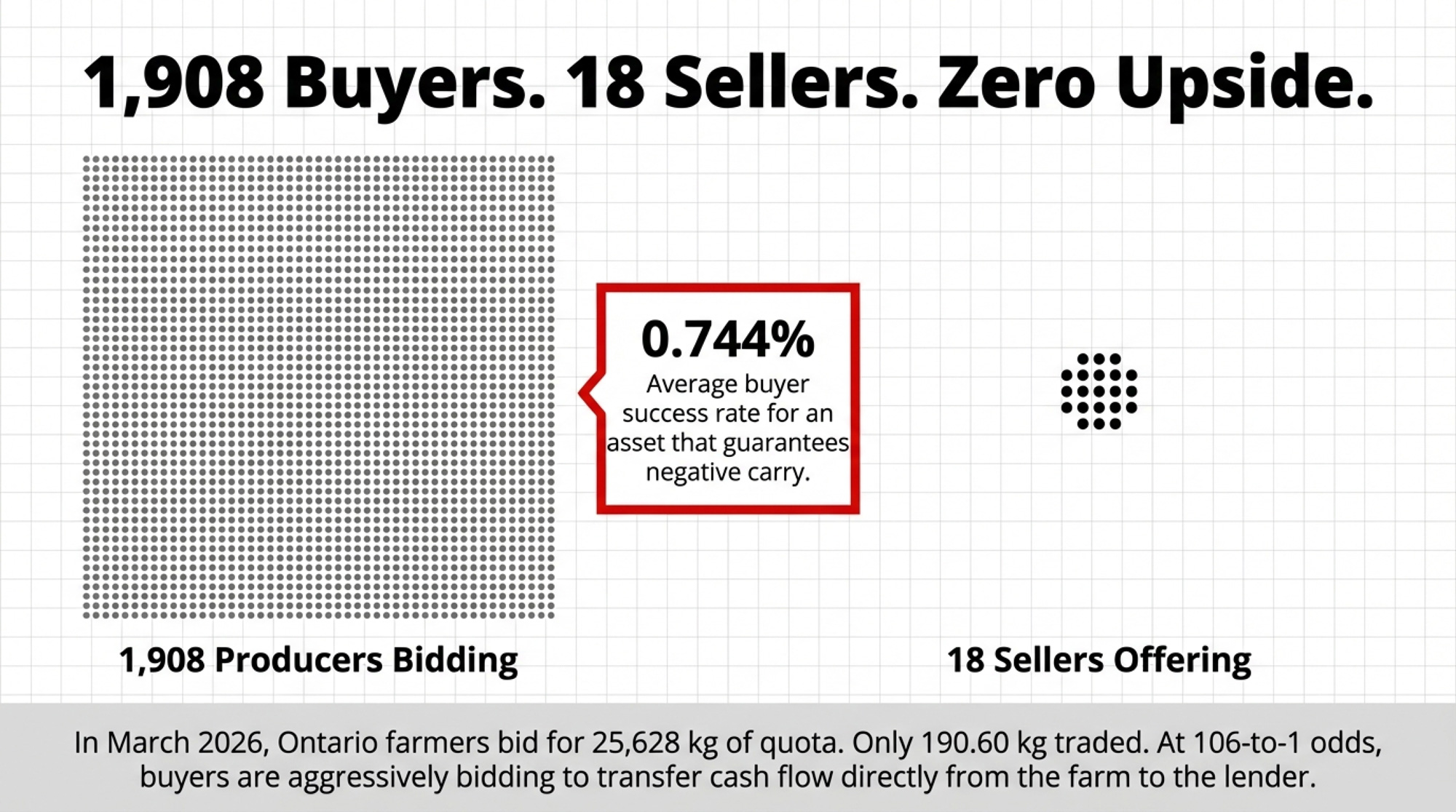
1,908 Buyers. 18 Sellers. Zero Upside.

On March 19, 2026, Dairy Farmers of Ontario released the monthly quota exchange results. The numbers are stark: 1,908 producers placed bids to buy. Just 18 offered quota for sale. All kilograms cleared at the $24,000 cap. Of the 25,628 kg bid by buyers, only 190.60 kg actually traded — what DFO’s own summary calls a “0.744% average buyer success rate.”

A month earlier, it was worse. On the February exchange, 1,915 producers tried to buy. DFO needed 191.40 kg to run even the first allotment round, but only 129.27 kg was offered. The exchange was cancelled outright. Not a single kilogram changed hands.

At roughly 106‑to‑1 by producer count, Ontario farmers are bidding into a market where each newly financed kilogram loses about $586 a year at current rates. That’s not building equity. It’s transferring cash flow from the farm to the lender.

Why Ontario Quota Stopped Growing Your Wealth

Before the P5 provinces imposed quota price ceilings, values rose steadily. Ontario prices ranged from roughly $17,000 to $22,000/kg around the 1999/2000 dairy year, according to University of Guelph research, and climbed past $40,000/kg in the 2000s before the caps took hold. That capital gain, layered on top of milk income, made quota one of the best‑performing agricultural assets in the country.

The cap shut off that tailwind. At $24,000/kg, Ontario quota is frozen. It doesn’t climb in a good year, track inflation, or compound. With CPI at 1.8% in February 2026, the real value of each kilogram drops by roughly $432 per year in purchasing power — money you won’t recover as long as the cap holds.

MetricOntarioAlberta
Current Quota Price (Jan–Feb 2025)$24,000/kg (policy cap)$56,648/kg (market price)
Gap vs. Ontario+$32,648/kg
Appreciation PotentialNone (hard cap)Uncapped; market-driven*
Real Value Loss at 1.8% CPI/yr–$432/kg/yrPartially offset by price appreciation
Supply Management SystemP5 / NationalP5 / National
Annual Cash Flow at 6% Financing–$586/kgNegative at same rate; higher income potential
Exit Price for Seller Today$24,000/kg (capped)~$56,648/kg (market)
Asset Class BehaviourFixed liabilityAppreciating asset

Look west for proof that $24,000 is a policy number, not a market number. According to AAFC’s monthly quota trade data, Alberta’s exchange averaged $56,495/kg in January 2025 and $56,800/kg in February. British Columbia — which caps at $35,500/kg — traded at that ceiling in January and at $36,500/kg in February. Saskatchewan and Manitoba traded in the $40,000–$44,000/kg range over the same two months. Ontario sits more than $32,000/kg below Alberta. Same supply management system. Same national milk pool. Radically different asset values.

Is Every Financed Kilogram of Ontario Quota Now Underwater?

Here’s the barn math. Stick it on a sticky note beside your desk.

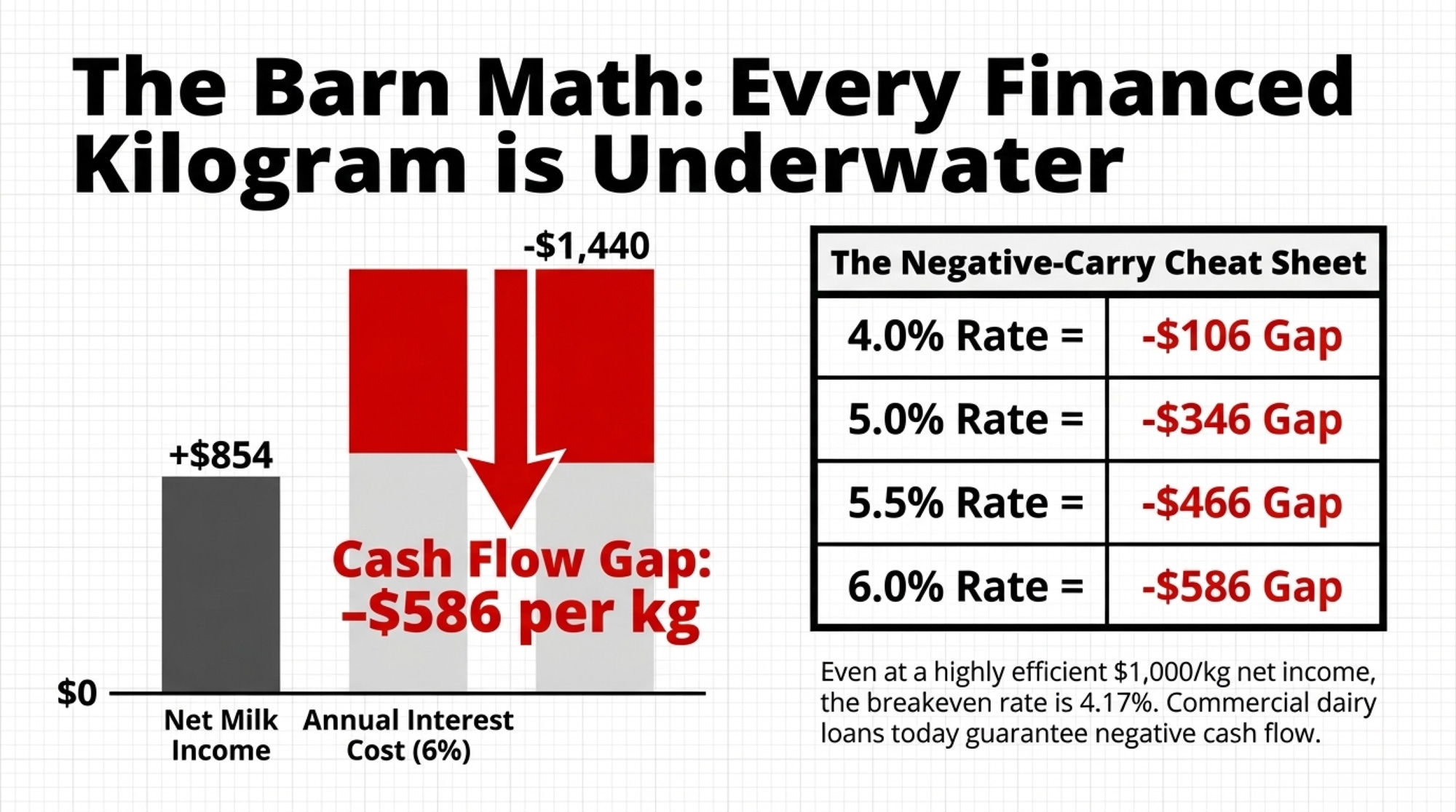
Take one kilogram of Ontario quota at the $24,000 cap. The Canadian Dairy Commission calculated the 2024 cost of production — indexed to the three months ending August 2025 — at $92.82 per standard hectolitre, up 2.72% from $90.36 the previous year. That iCOP result is what feeds the 2.3255% farmgate price increase effective February 1, 2026.

Using current P5 farmgate pricing with that increase baked in, and subtracting cost of production for feed, labour, overhead, and cow depreciation, you land in the ballpark of 4 in net annual milk income per kilogram of quotaon many Ontario herds. That’s The Bullvine’s modeled estimate using current farmgate pricing and recent P5 cost‑of‑production benchmarks — not a DFO or CDC published constant. Your own number will shift with components, feed costs, and overhead. But it’s a defensible mid‑range figure for this math.

The Bank of Canada cut its overnight rate to 2.25% on October 29, 2025, and has held it there through four consecutive decisions — December, January, March — with the next call on April 29. But commercial lenders price quota loans 200–350 basis points above that floor. A rate of 5.5–6% on a quota loan is realistic right now. Nesto’s March 2026 forecast projects no further easing, with bond markets assigning a slight probability of a 0.25% rate hike by October.

Loan RateAnnual Interest Cost/kgEst. Net Milk Income/kgCash Flow Gap/kg/yrRate Needed to Break Even
4.0%$960$854–$106~3.56%
5.0%$1,200$854–$346~3.56%
5.5%$1,320$854–$466~3.56%
6.0%$1,440$854–$586 🔴~3.56%
If $1,000/kg net$1,200 (5%)$1,000–$200~4.17%

At $854/kg net income, there isn’t any commercial dairy loan rate on offer today that makes newly financed Ontario quota cash‑flow positive. Even if you’re running tighter than most and clearing $1,000/kg net, your breakeven is only 4.17%. Where’s your rate sitting right now?

Scale it up. Say you’ve picked up 35 kilograms on the exchange in the past few years, all financed at 6%:

  • 35 × $586 = $20,510 of cash leaving your operation every year
  • That’s interest only. No principal repayment. No new calf barn. Just debt service.

What Did Kyle Horst Find When He Ran His Own Numbers?

Kyle Horst dairy farms with his wife, Jen, and his brother Craig, a school teacher, near Formosa, Ontario. The farm has about 88 kg of butterfat quota, purchased as part of an ongoing operation in 2019.

When Horst enrolled in Chris Church’s Central Dairy Solutions course, he came in carrying the assumption most dairy farmers hold: more milk means more money. Church’s data challenged that head‑on.

“When I started the course, I always thought another litre of milk is obviously more profitable, but he brought that into question with good data,” Horst told Farmtario in August 2025. “I still think high performance through better management is a winner at the end of the day. But simply doing it through added cost is not necessarily financially sustainable.”

Church — DVM, MBA, University of Guelph, and founder of Central Dairy Solutions — spent years as a dairy vet before shifting his focus to farm finance. “I always just figured, as long as we could make more milk, we could make the farm more money,” he told Farmtario. “And that’s about as deep as we’d usually go. And unfortunately, that’s as deep as most of the producers go.” His courses walk Ontario dairies through their quota ranges, from 40 kg to 1,200 kg, using metrics such as operating expense ratio, EBITDA per kilogram of quota, and debt‑service coverage.

Are You Running a Dairy, a Crop Farm — or Both Without Knowing It?

The Terpstra family milks about 420 cows near Brussels, Ontario. Joe farms with his wife Barb, daughter Emily, and son Cole. Joe and Emily both took Church’s course as part of their succession planning. According to Farmtario, the family has moved to monthly financial reviews, with Emily now managing the books.

It’s exactly the kind of operation where Church’s framework — splitting dairy EBITDA from crop EBITDA — can reveal whether the cows are actually carrying their own weight or riding on crop margins.

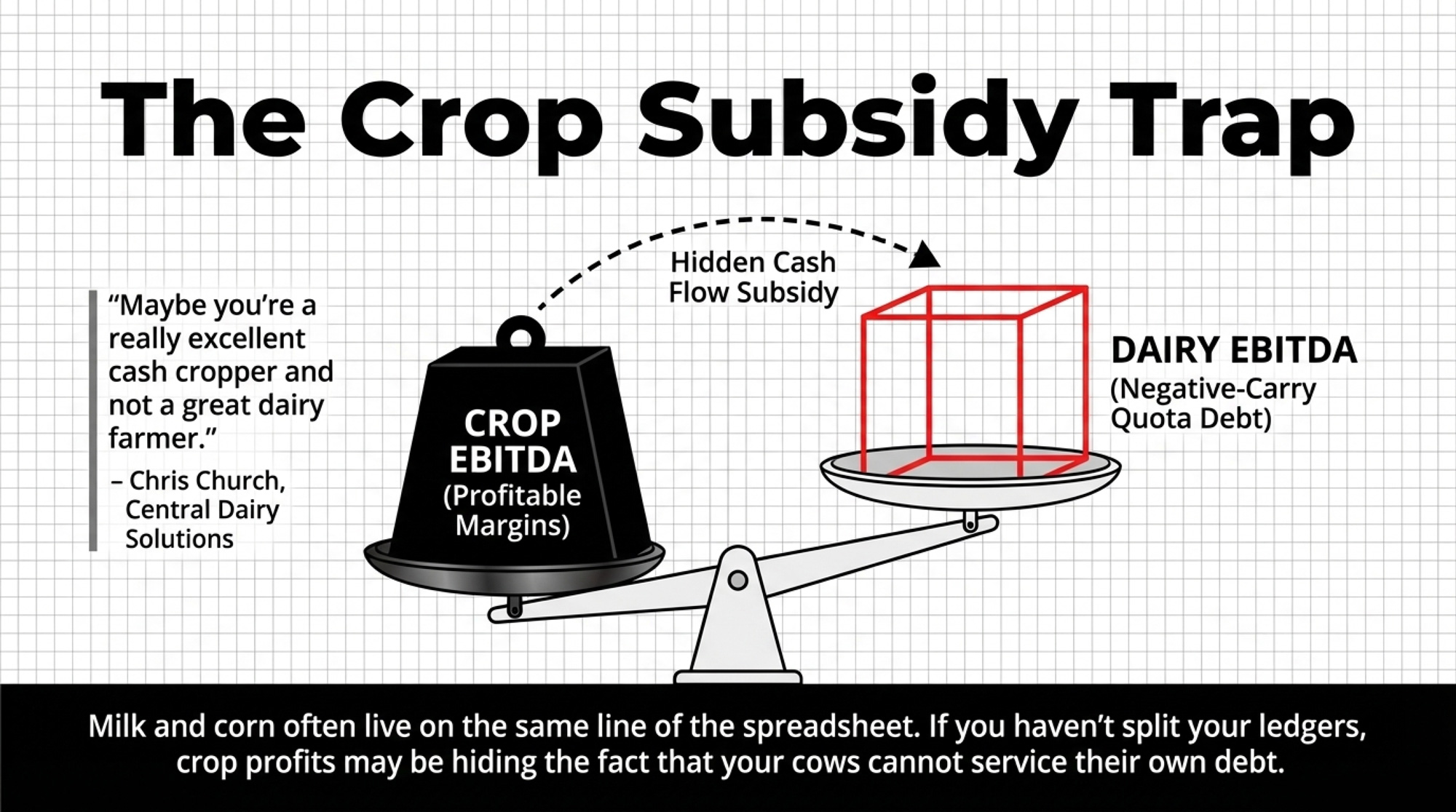
“Maybe you’re a really excellent cash cropper and not a great dairy farmer.”
— Chris Church, Central Dairy Solutions, Farmtario, August 2025

A lot of farms have never actually separated the financial performance of their dairy from that of their cropping operation. Milk and corn live in the same line on the spreadsheet. As long as the overall farm makes the payment, nobody digs deeper.

But when grain prices drop or weather punches your yields, that cross‑subsidy disappears. The dairy suddenly has to stand on its own. If it can’t, that’s when the bank meeting gets tense. And if your dairy numbers and your crop numbers live in the same line — while you’ve also got leveraged quota in the mix — you might be using crop profits to service a dairy business that, on its own, is financing a negative‑carry asset.

The Succession Collision

This is where the Metske ruling, the quota cap, and the interest rate environment crash into each other.

Most Ontario successions assume the next generation will take over quota — structured as a sale, a gradual buy‑in, or a gift with a vendor take‑back. However you paper it, the incoming operator still has to cash‑flow the debt tied to that quota on their own balance sheet.

Run a DSCR on a mid‑size scenario:

  • Quota position: 140 kg of butterfat per day
  • Quota value at $24,000/kg: $3.36 million
  • Financing: 75% at 6%, amortized over 15 years
  • Loan amount: $2.52 million
  • Annual debt service (P+I): ~$255,000
  • Net milk income: 140 kg × $854 = $119,560
  • DSCR: $119,560 ÷ $255,000 = 0.47

Most lenders want at least 1.25. In this scenario, quota income covers less than half the payment. The rest has to come from crops, off‑farm income, parents deferring payments, or more borrowing.

In Metske, the Court of Appeal found the family’s discussions were an “agreement to agree” — too vague to create ownership rights. The parents’ decision to sell their dairy quota separately was held to be a legitimate exercise of autonomy. That’s how six years of contributed labour ended up valued at $31,700.

The P5 boards agreed to increase the saleable quota by 1% as of December 1, 2025, which will slightly dilute your share of the national milk pool. The February 2026 farmgate price bump helps offset that erosion, but doesn’t fix the structural problem: you’re trying to service 5.5–6% money with an asset that isn’t allowed to appreciate.

The Trade Risk Nobody’s Priced In

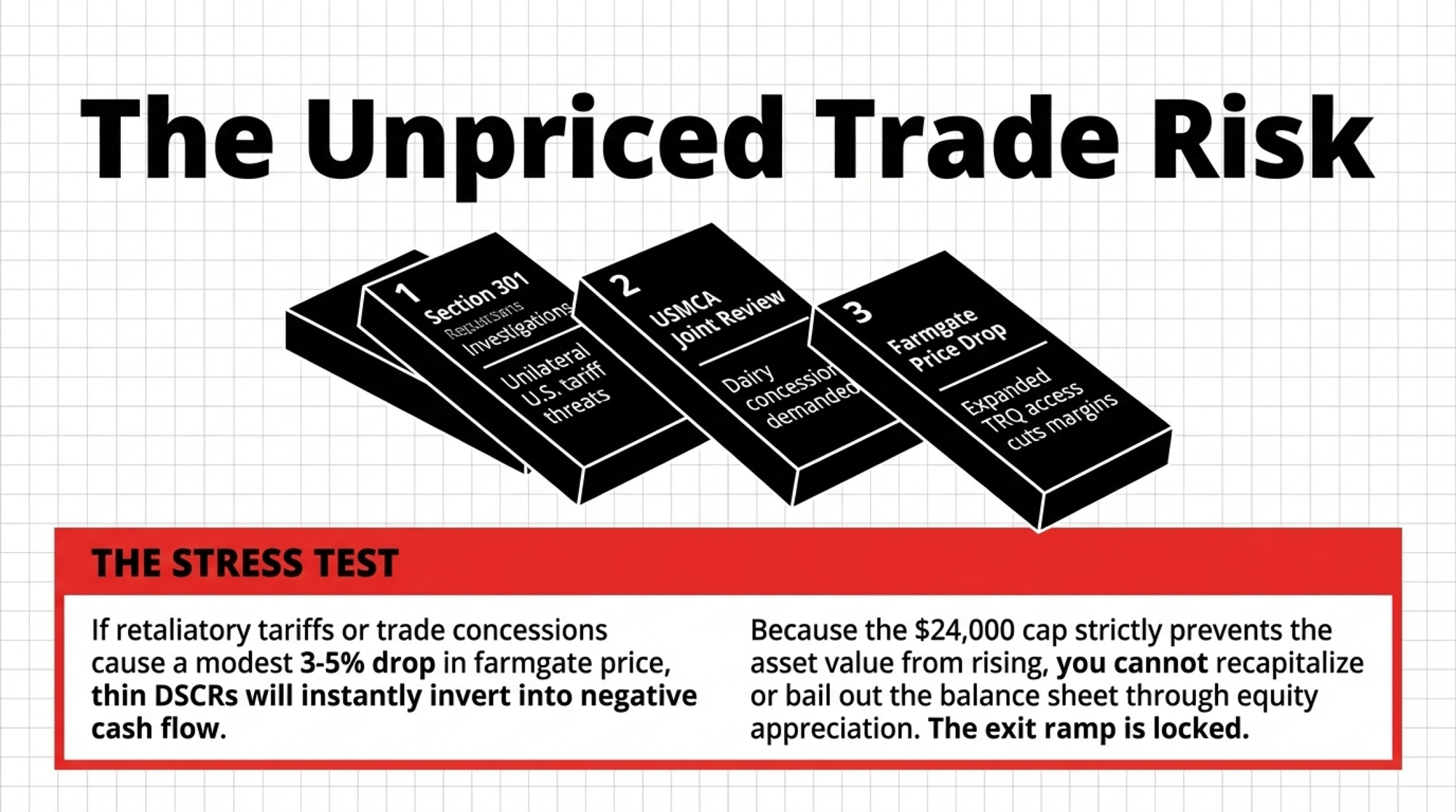
The CUSMA joint review is underway, and it’s not happening in a vacuum. In March 2026, the Trump administration launched Section 301 trade investigations covering Canada and 59 other economies — focused on forced labour and manufacturing overcapacity — after the Supreme Court struck down IEEPA‑based tariffs, according to CBC. USTR fact sheets and the 2026 Trade Policy Agenda make it clear these investigations will feed into the broader USMCA review.

CBC’s coverage notes that U.S. officials have repeatedly flagged Canadian dairy policies as part of a “non‑exhaustive” list of trade irritants. Dairy isn’t the only target, but it’s very much on the table.

Wiens has repeatedly warned that Canada has already conceded roughly 18% of its dairy market access in past trade deals, and that further access would cut directly into domestic production.

Carney has repeatedly said in public that supply management isn’t up for negotiation.

But a Section 301 investigation is different from a negotiation. It’s a unilateral tool the U.S. can use to justify tariffs without Canadian consent. And here’s the link between trade and succession that deserves attention: if a wider TRQ, retaliatory tariffs, or a forced restructuring devalues the exit ramp, the next generation isn’t just fighting to make the numbers work. They’re fighting over a shrinking pie — sale prices might fall at the same time debt loads stay fixed.

Here’s the stress test you can run on your own numbers: assume a modest 3–5% drop in farmgate price if TRQ access expands or tariffs bite. On a farm already running a negative‑carry quota, that price hit drops directly onto your already‑thin DSCR. If a 3–5% decline pushes you below 1.0, you’re into negative cash flow unless something else gives. The quota can’t bail you out by appreciating. The cap keeps that door shut.

Options and Trade‑Offs for Farmers

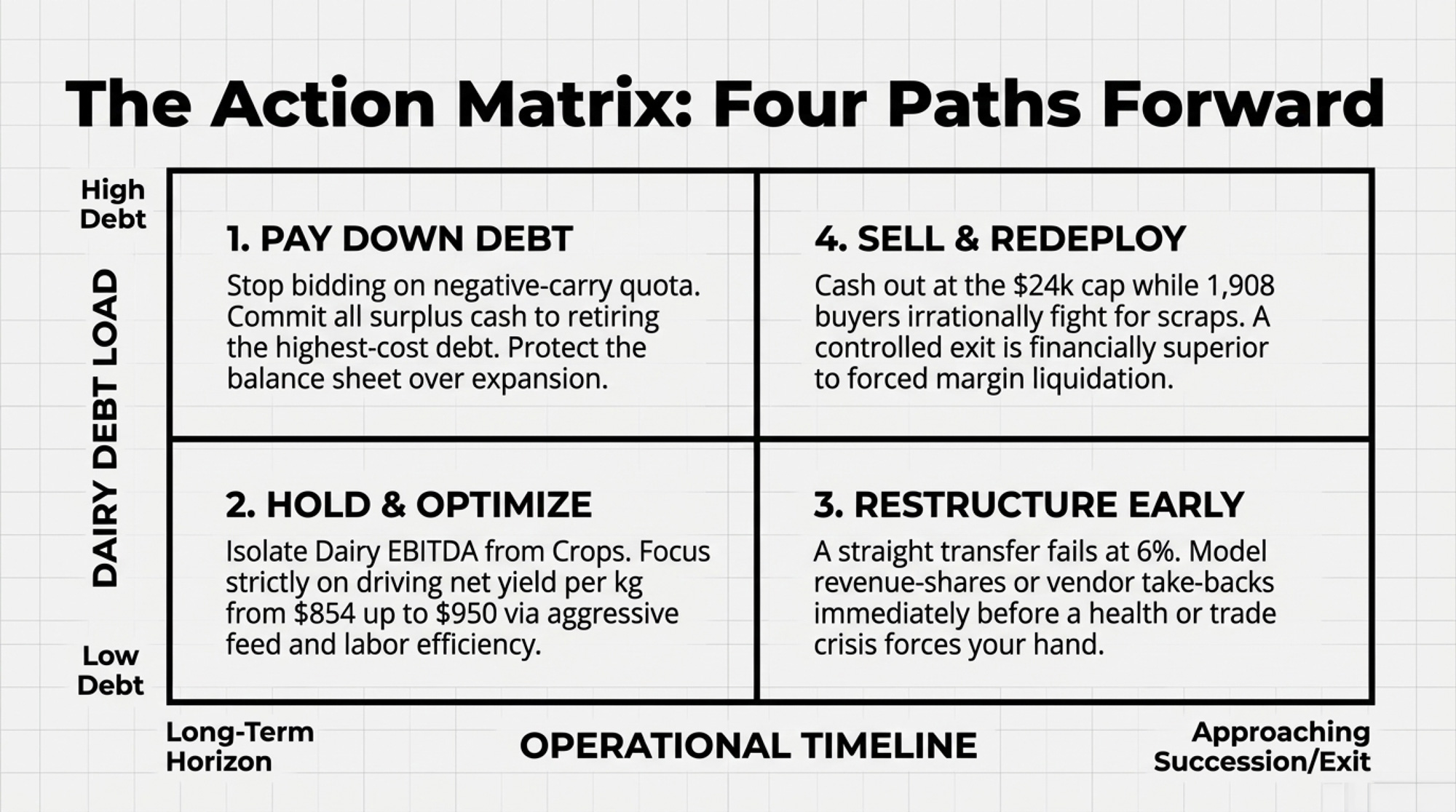
Path 1: Pay Down Debt First — Your 30‑Day Action

When it makes sense: You’re carrying quota debt at 5% or higher, and your DSCR is hovering near or below 1.25.

What it requires: One meeting with your lender in the next month. Bring your current loan schedule and ask for a simple ranking: highest to lowest effective interest rate. Then commit your next 12 months of surplus cash to retiring the highest‑cost debt instead of bidding on new quota.

Risk/limits: You won’t grow your quota position while your neighbours might. But right now, negative‑carry quota growth is eating equity. You give up bragging rights to keep your balance sheet intact.

Signals to watch: The BoC has held at 2.25% since October 29. Bond markets currently price a small probability of a rate hike by fall. Even if they cut, commercial quota loan rates would need to drop below roughly 3.6% before newly financed quota stops bleeding cash at $854/kg net income, and below 4.17% even at $1,000/kg. Plug your own numbers into the cheat sheet above.

Path 2: Hold and Optimize What You’ve Got

When it makes sense: Your quota is mostly or entirely paid off, and your net yield per kilogram sits comfortably above your personal opportunity cost.

What it requires: Doing the Church‑style split — separate dairy EBITDA from crop EBITDA and calculate net profit per kilogram of quota. Then tighten the screws on the cost of production: feed efficiency, labour per cow, components, and cull strategy. If you’re earning around $854/kg but could push to $950 through better management, that’s the cheapest “quota purchase” you’ll ever make.

Risk/limits: Inflation quietly erodes your real equity every year the cap holds. At 1.8% CPI, that’s $432/year in real purchasing power per kilogram. You’re not building asset value. You’re milking income from a flat line.

Path 3: Restructure the Succession Before the Bank Does

When it makes sense: You’re within 5–10 years of wanting to step back, and a straight transfer at today’s values and rates produces a DSCR under 1.25 for the next generation.

What it requires: Getting uncomfortable now, not desperate later. Sit down with an ag‑focused accountant and your lender to model alternatives: longer amortizations, revenue‑share structures, vendor take‑backs with interest‑only periods, or partial transfers that let the next generation build equity gradually instead of swallowing a $3‑million loan on day one.

Risk/limits: These structures take time and trust. If you wait until a health scare, a marital split, or a CUSMA/301 shock, you’ll be negotiating with fewer options and less leverage. And here’s the trade risk tied back to your succession: if a 301 finding or wider TRQ devalues quota even 10–15%, the exit ramp the parents are counting on to fund retirement gets shorter — while the next generation faces the same debt load on a less valuable asset.

Path 4: Sell and Redeploy

When it makes sense: Your dairy only cash‑flows when crop income props it up, your debt‑to‑asset ratio keeps climbing, and your kids are lukewarm about taking over.

What it requires: Facing the hardest question in farming: is your equity better deployed in quota, cows, and concrete — or somewhere else? Selling quota into a market where 1,908 buyers are chasing 18 sellers at $24,000/kg turns paper into cash fast. That cash can fund debt elimination, retirement, or a pivot into a different enterprise entirely.

Risk/limits: The risk here is almost entirely emotional. You lose the barn, the routine, the identity. Financially, a controlled exit at the cap is far better than a slow slide into forced liquidation if rates stay stubborn and margins tighten. Right now, 1,900+ buyers are competing for scraps. Last month, the exchange was cancelled because not enough quota even made it to the table. That level of demand won’t last forever.

Key Takeaways

  • If your blended borrowing rate on quota is above ~3.6%, every new kilogram is cash‑flow negative. At 6%, the gap is –$586/kg/year. Even at a net income of $1,000/kg, breakeven is only 4.17%. Plug your own numbers into the cheat sheet before your next exchange bid.
  • If the next generation’s DSCR on quota debt alone falls under 1.25, the succession structure needs to change — not your kid’s work ethic. The Metske ruling shows where “we’ll figure it out later” ends: $31,700 for six years of contributed labour.
  • If you haven’t separated dairy EBITDA from crop EBITDA, you don’t actually know which side of your business is profitable. Church’s Central Dairy Solutions courses are working with Ontario farms from 40 to 1,200 kg — and the answers aren’t always what people expect.
  • If trade pressure devalues the quota even modestly, the exit and entry ramps both get steeper at the same time. Get the succession on paper now, while the exchange is still massively in the sellers’ favour.

What This Means for Your Farm Right Now

Before the next DFO exchange deadline, ask yourself two questions. When was the last time you ran a real DSCR on your quota loans at today’s rates? And what happens to that ratio if the farmgate price slips 3–5% for a year?

Complete references and supporting documentation are available upon request by contacting the editorial team at editor@thebullvine.com.

Learn More

The Sunday Read Dairy Professionals Don’t Skip.

Every week, thousands of producers, breeders, and industry insiders open Bullvine Weekly for genetics insights, market shifts, and profit strategies they won’t find anywhere else. One email. Five minutes. Smarter decisions all week.
NewsSubscribe
First
Last
Consent
Send this to a friend