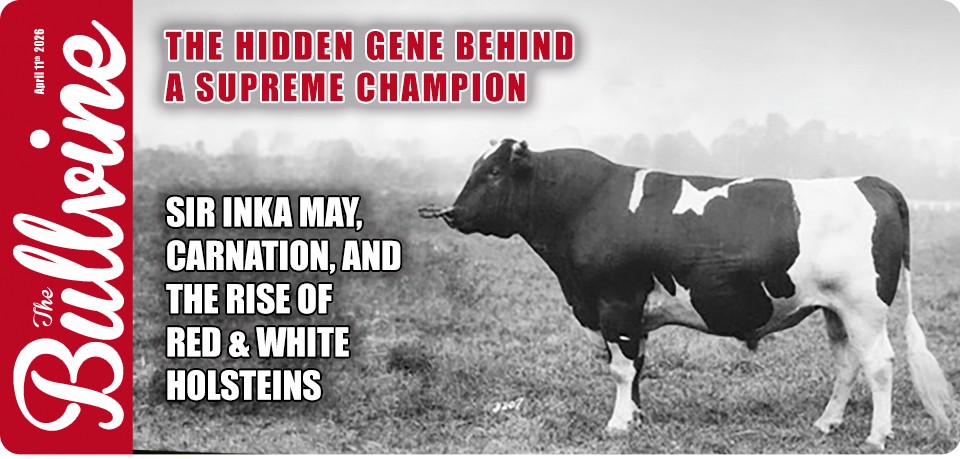





Four Minnesota farmers bet $25,000 on a calf they could still pick up. A century later, his hidden gene produced a World Dairy Expo Supreme Champion.
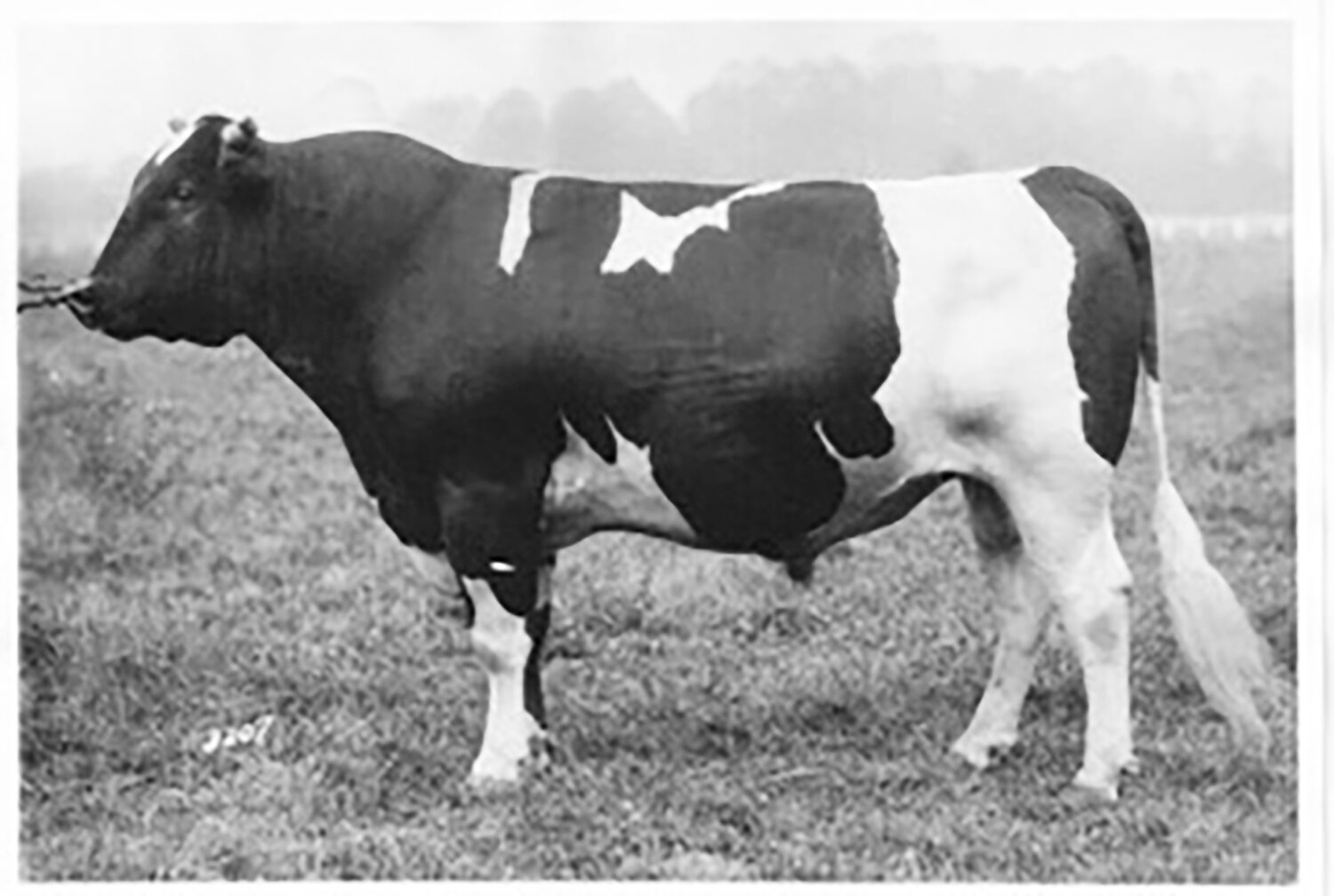
The auctioneer’s chant bounced off the rafters in that Philadelphia sale barn like hoofbeats on a wooden bridge. It was the Fourth Brentwood National Sale in 1925—one of those days when you could look down the rows and see every kind of dairyman, from small‑town breeders in their Sunday coats to corporate buyers with sharper suits and even sharper pencils. Then the next lot stepped into the ring: a two‑year‑old bull with that big‑time show bloom and a catalog page that read like a wish list. Sir Inka May. When the gavel finally crashed at 12,000 dollars to Carnation Milk Farms out in Seattle—and word buzzed through the crowd that Carnation had been willing to go to 30,000 if they had to—you didn’t need a crystal ball to know this bull was going to matter.
What nobody in that ring could see—not the auctioneer, not the Minnesota men who’d raised him, not even the Carnation buyer signing off on the biggest bull check of his career—was that this wasn’t just a sale. It was the opening scene of a story that would run a hundred years, stretch from a 75‑cow outfit in Austin, Minnesota, to the colored shavings at World Dairy Expo, and peak with a Red & White cow named Golden‑Oaks Temptres‑Red‑ET walking out of Madison as Supreme Champion. The thread that ties those moments together is the bull the Mower County News once called the “Crown Prince of the Inka herd”—and one small, recessive gene the Holstein world wanted nothing to do with at the time.
Act I – A Crown Prince in a Little Powerhouse
To really understand Sir Inka May, you’ve got to start in Austin, Minnesota. Not the Seattle of Carnation advertisements, but a place where cream cans rattled down gravel roads, and neighbors knew which barns housed the good cows.
In 1919, Vere Culver and his partner Alpha Eberhard set out to build more than just a herd there. They created the Minnesota Holstein Company. On the surface, it was a small Holstein operation. In reality, it was an early boutique genetics program. The herd never topped 75 head, youngstock included, yet in eight years they piled up 85 first‑place ribbons and 14 championships at national Holstein shows. In 1925, they attended the National Cattle Congress in Waterloo, Iowa, and returned with both the Premier Breeder and Premier Exhibitor banners. Think about that for a second: a herd you could walk through in under an hour, being called the best in the country that year.
Here’s what made that possible. Her name was May Walker Ollie Homestead.
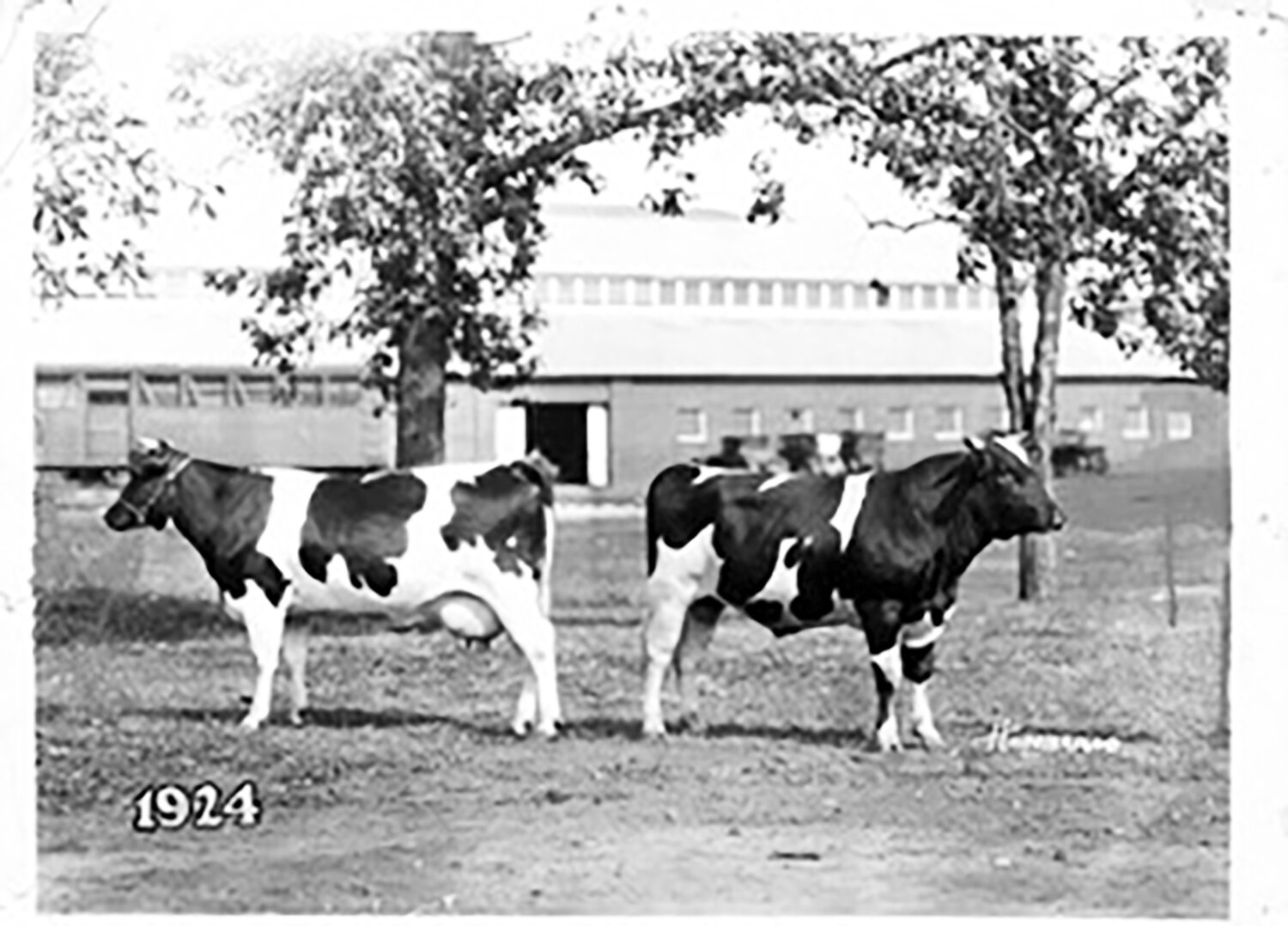
By all accounts, she was the kind of cow that made people change their travel plans. On December 18, 1922, just as winter settled in, she wrapped up a lactation that made test sheets look like misprints—31,608.6 pounds of milk and 1,521.59 pounds of butterfat. This was the era of hand milking, wooden stanchions, and hay and grain. That record didn’t just push the envelope; it blew it right open. Her butterfat record held nearly five years. She went on to be the dam of three All‑Americans and an All‑American produce of dam, and the Farmers Independent noted that no other animal had performed so “sterlingly for the upbuilding of the dairy industry.”
Now, put yourself in Culver and Eberhard’s boots. You’ve got a cow like that in your barn. You’ve watched the milk scales, felt the spring in her pasterns after months of that kind of production, seen her hold condition. What keeps you up at night? The hope that she’ll give you a son who can pass it on.
On April 8, 1923, hope hit a straw. May Walker Ollie Homestead calved a bull by Sir Inka Superior Segis. The Mower County News didn’t play coy. “This introduces you to the Crown Prince of the Inka herd,” they wrote, adding that he was being “groomed to keep up the family trait of being American champion of something.” That’s rural Minnesota in 1923—half humor, half prophecy.
Sir Inka Superior Segis already had a reputation for siring winners. The Minnesota Holstein Company had six All‑Americans on the farm at one time; this calf came from the very center of that genetic storm. No wonder breeders were watching.
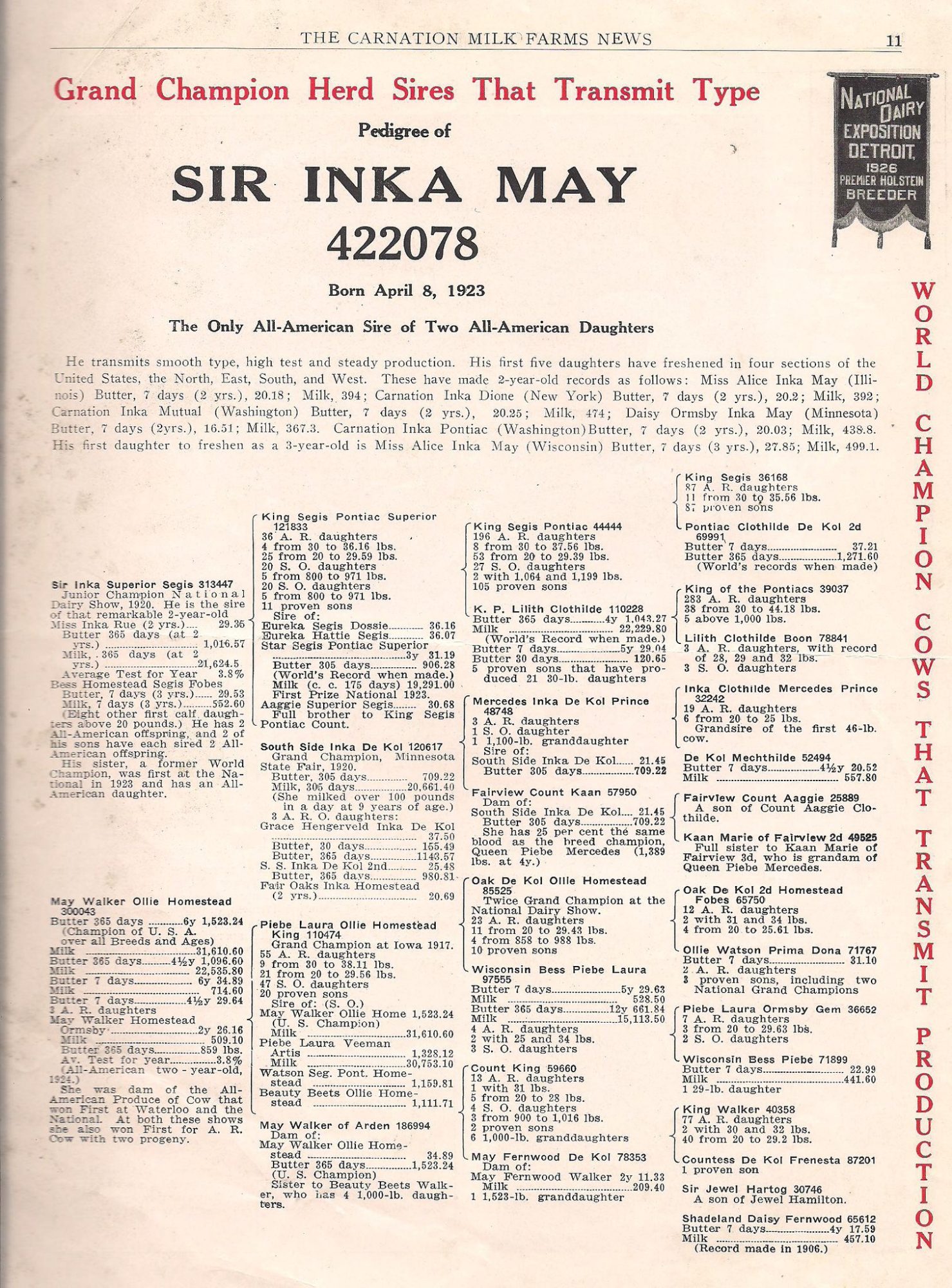
Sir Inka May’s pedigree page in The Carnation Milk Farms News—a 1920s proof sheet showing the “Crown Prince” as the only All‑American sire of two All‑American daughters, backed by May Walker Ollie Homestead’s record 31,608‑lb lactation and a stack of red‑carrier ancestors the breed didn’t yet understand.
A few months later, four breeders from McLeod County sat down at a kitchen table with that calf’s future in front of them. By all accounts, that’s when talk turned to numbers that made thumbs drum against the tabletop. They decided to buy a 50% interest in Sir Inka May for $ 25,000. In today’s money, that’s around 476,000. That’s not “let’s see how he does” money. That’s a level of risk that makes your stomach feel light when you sign.
You can picture it. Catalogs pushed aside, coffee cups cooling, someone saying, “We’re not going to see another one out of a cow like May Walker any time soon.” Another answering, “If he sires like she milks, we’ll be glad we did it. If he doesn’t…” Silence. Then somebody pushes his chair back, walks over to the desk, and does the hardest part of any breeding decision: puts pen to paper.
The next year, 1924, the wider Holstein world got its first real look at the “Crown Prince.” The All‑American program had just been formalized in the Holstein‑Friesian World in 1922. Sir Inka May went into the junior yearling bull classes and came out as an All‑American Junior Yearling—one of the first bulls to carry that new national “ideal” All‑American title beside his name. According to dairy historian Ron Eustice, he didn’t stop there. He became the first All‑American bull to sire an All‑American daughter, proving that his show-ring quality wasn’t going to stop with him.
Back home in Minnesota, he was doing the quieter work that really builds a legacy. During his tenure there, Sir Inka May sired at least 70 calves in the state, more than 30 of them in those McLeod County herds. This was still pre‑A.I. If his daughters looked good, the neighbors saw them. If they milked like their granddam, the talk at the local creamery reflected it.
Nobody in those conversations was thinking about coat color genetics. Red calves popped up here and there in the breed, usually met with frowns or quiet culls. The Holstein identity was black and white. Folks talked about Segis, Rag Apple, and Clothilde; recessive alleles were still a mystery. Sir Inka May’s promise, as far as anyone knew, was about more milk and better-looking cows, period.
Act I ends in that sale ring, with a great Minnesota hope going west—and a gene nobody understood hitching a ride in his semen.
Act II – Carnation, Red Calves, and a Breed That Wasn’t Ready
Now, the thing about that 1925 Brentwood Sale is that it wasn’t just a fancy auction; it was a snapshot of where the Holstein breed was headed. The sale grossed 88,950 dollars—serious money in an era when the average cow was a 3,000‑pound milker. Buyers came from 18 states and three countries. Breeders sent cattle there to make statements.
Carnation Milk Farms didn’t come to watch. They came to buy.
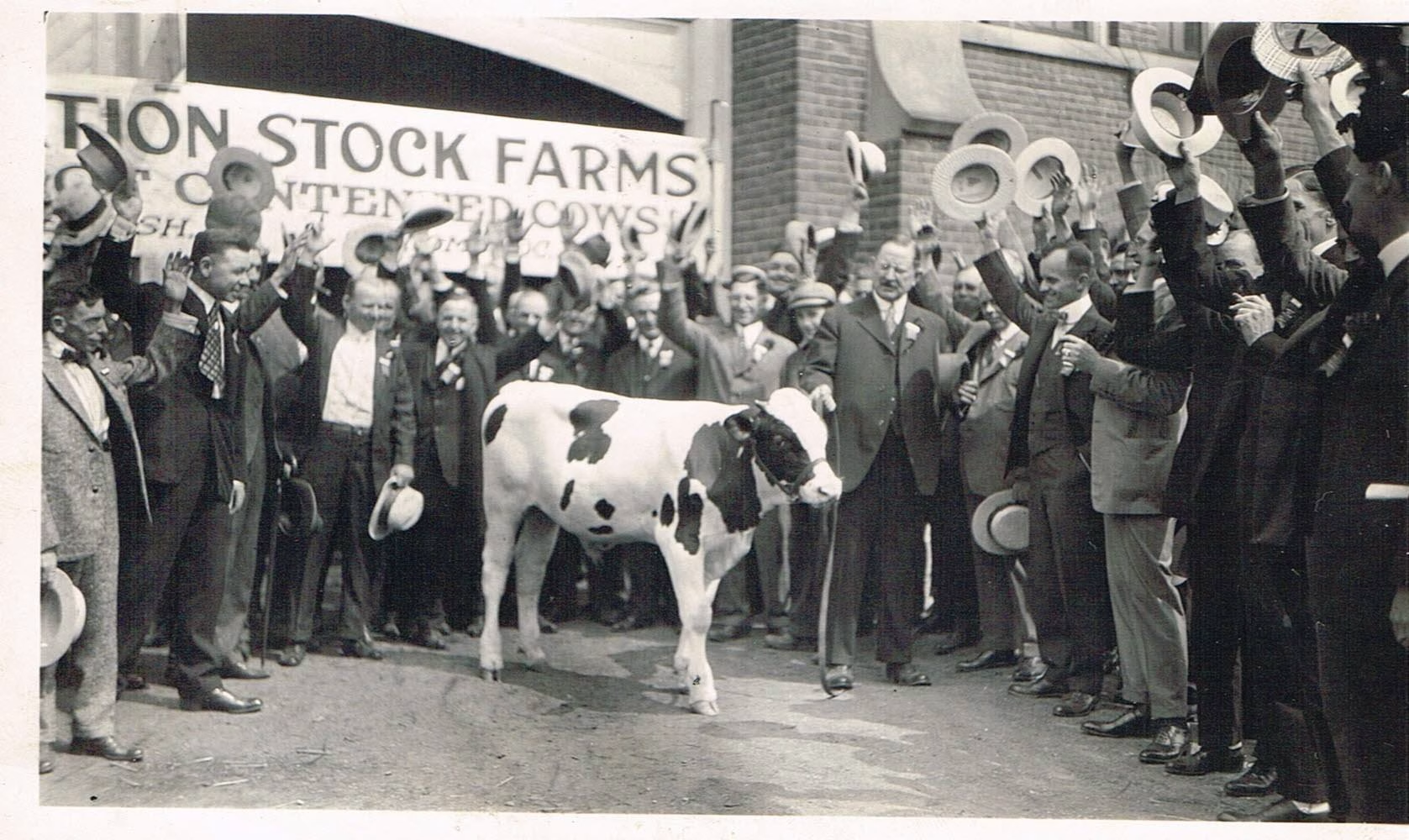
Owned by the Carnation milk products company—which would later end up under Nestlé—Carnation Milk Farms was built around a simple idea: breed cows so productive that their numbers alone would sell semen back to the dairymen whose milk Carnation was hauling. At a time when the national average cow gave about 3,000 pounds of milk in 1900 and 7,000 pounds by 1950, Carnation was recording herd outputs of 37,000 pounds as early as 1927. They weren’t there to hang ribbons. They were using genetics as part of a corporate business plan. (Read more: When Cows Were Kings: Revisiting Carnation’s Golden Age of Dairy Breeding)
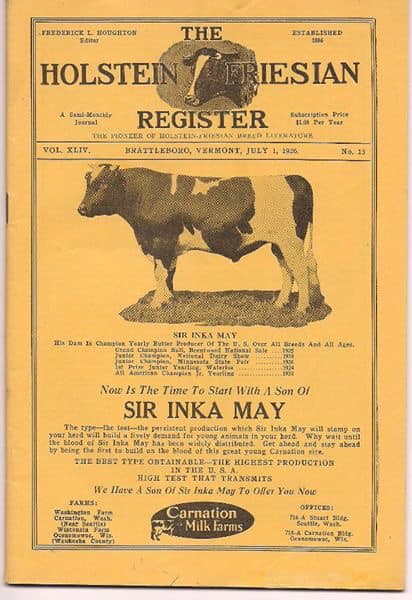
Carnation’s own ad for Sir Inka May on the July 1, 1930 cover of The Holstein‑Friesian Register—proof that the “Crown Prince” from Minnesota had become the headline sire in a program built on turning big records into even bigger semen sales.
Sir Inka May arrived in Seattle with exactly what they were looking for: All‑American credentials, a dam with a world‑record butterfat test, and a growing reputation for prepotency. The fact that they’d been prepared to pay 30,000 if necessary tells you just how badly they wanted him in their bull barn.
One can imagine those first Sir Inka May daughters freshening in the Carnation barns. Long, airy concrete barns, lime dusting the floor, the new sound of milking machines chugging where hand milking used to echo. Herdsmen with clipboards, watching test weights and butterfat numbers, circling the ones that made their eyebrows go up.
Within a few years, his calves had already racked up over 90 blue ribbons in the 1926 and 1927 show seasons. By October 1940, Holstein‑Friesian World wrote that he had 11 daughters over 1,000 pounds of fat and 45 over 800—more than any other living sire of any breed. In the records, only Matador Segis Ormsby sat ahead of him. The magazine concluded that “the Sir Inka May production and his influence on the breed today is perhaps greater than that of any other sire now living.” Carnation’s own people later said no bull had ever had more impact on their program.
Sir Inka May featured in a 1927 issue of The Carnation Milk Farms News—pitched as the All‑American champion sire whose daughters and All‑American heifers, Inka Pontiac and Inka Bonnie, were proving that one Minnesota bull could stamp both type and production across Carnation’s herd.
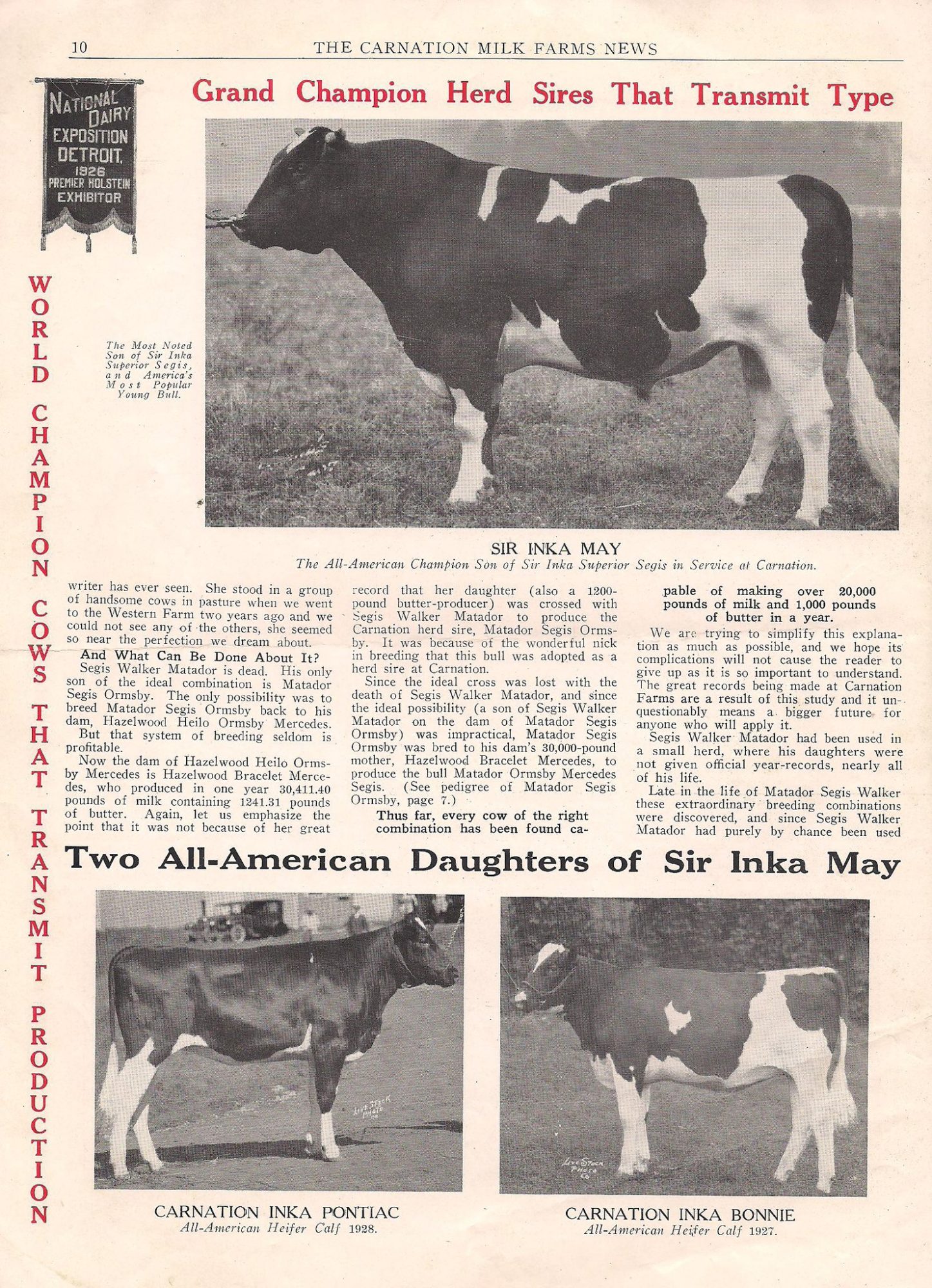
Behind those numbers were bulls and cows that carried his name. By 1940, Sir Inka May had sired four of Carnation’s main herd sires, and at least six of his grandsons were also serving as herd bulls there. At that point, you could walk down the bull line and see his influence in every pen.
But while the production records were climbing, something in the calving pens was making the company nervous.
Between 1928 and 1937, Sir Inka May sired at least 13 red‑and‑white calves at Carnation. His sons, used in that same herd, also threw red. This wasn’t entirely new—Carnation’s records show a red calf as early as 1915, and a bull named Carnation Segis ProspectRC siring red calves in 1923–24. But when your top sire, the bull you’ve hitched your program to, starts throwing that color in your best cow families, the stakes feel higher.
Picture a scene from those years. A Carnation herdsman, coat collar turned up against Washington drizzle, is in a box stall with a Sir Inka May daughter whose test sheet has been making everybody smile. The calf hits the straw; they wipe it off with a sack; the lantern light hits the coat, and it’s not black. Not mostly black with a funny cast. It’s clearly red and white. There’s probably a long pause. Maybe a muttered, “Well, that’s not what we ordered.”
Breeders hate mysteries in a pedigree. To explain the red calves, a story started that you still hear in some corners today: that Sir Inka May’s red gene came from an unrecorded Ayrshire in his background—a fence‑jumper somewhere along the line. It was a convenient way to pretend “true” Holsteins didn’t carry that gene.
Eustice’s research shuts that down. The red factor was already present in the Holstein breed through imported Dutch cattle such as Clothilde and Coronet. Sir Inka May’s sire, Sir Inka Superior Segis, was a known red carrier. His full sister, May Walker Inka Segis—sold to Senator A.C. Hardy in Ontario at the Minnesota Holstein Company dispersal—was a red carrier. A maternal brother, Sir Bess Ormsby May, went to Osborndale Farm in Connecticut and sired red calves. The gene was woven into some of the breed’s most elite families. No Ayrshire needed.
Carnation, though, had a brand to protect. As late as 1963, long after Sir Inka May was gone, their own magazine ran a line that many old‑timers still remember: “The red factor is becoming so much a problem in some places that it does not seem advisable to run the risk of further spreading the factor throughout the breed.” One Carnation editor, looking back on the red calves those years later, wrote that they made some folks “nervous” even when the numbers on their dams were spectacular—numbers like Sir Inka May’s daughters were posting. That tension between what the eye liked and what the ledger demanded was playing out in real time in their barns.
They weren’t alone in that attitude. Both the Holstein‑Friesian Association of America and its Canadian counterpart held the line for decades against registering Red & Whites. Some state associations placed ads arguing that adding red cattle to the herdbook would damage the Holstein “brand.” Red calves were not just unfashionable; they were seen as a threat.
Sir Inka May himself kept doing the only job he knew. He worked at Carnation until about a year before his death. On July 15, 1943, they euthanized him at the farm. He was 20 years old, a venerable age for a bull that had seen the breed shift from hand milking to milking machines and watched new bulls come and go while his daughters stayed in the milking string.
By then, his official record was sealed: 18 All‑Americans and 15 Reserves, 33 banners in total; 11 daughters with 1,000‑pound fat records and 45 with 800 pounds or more, more than any living bull of any breed at the time; four sons and six grandsons at work in the Carnation bull barns. If his story had ended right there, he would still be remembered as one of the great sires of that era.
But the gene nobody wanted was still out there, riding quietly in the pedigrees of the cows and bulls he’d made famous.
And this is where the story that started with that 12,000‑dollar bid in 1925 starts climbing toward its peak.
Act III – Sovereign, Outcasts, and a Red & White Supreme
The Minnesota Holstein Company itself didn’t last long on paper. In 1927, after only eight years, they dispersed the herd. At that sale, 61 head averaged 1,078 dollars—about three times the industry’s average cow price of 376 dollars at the time. The buyers might not have been thinking about recessive color genes, but they definitely recognized elite cattle when they saw them.
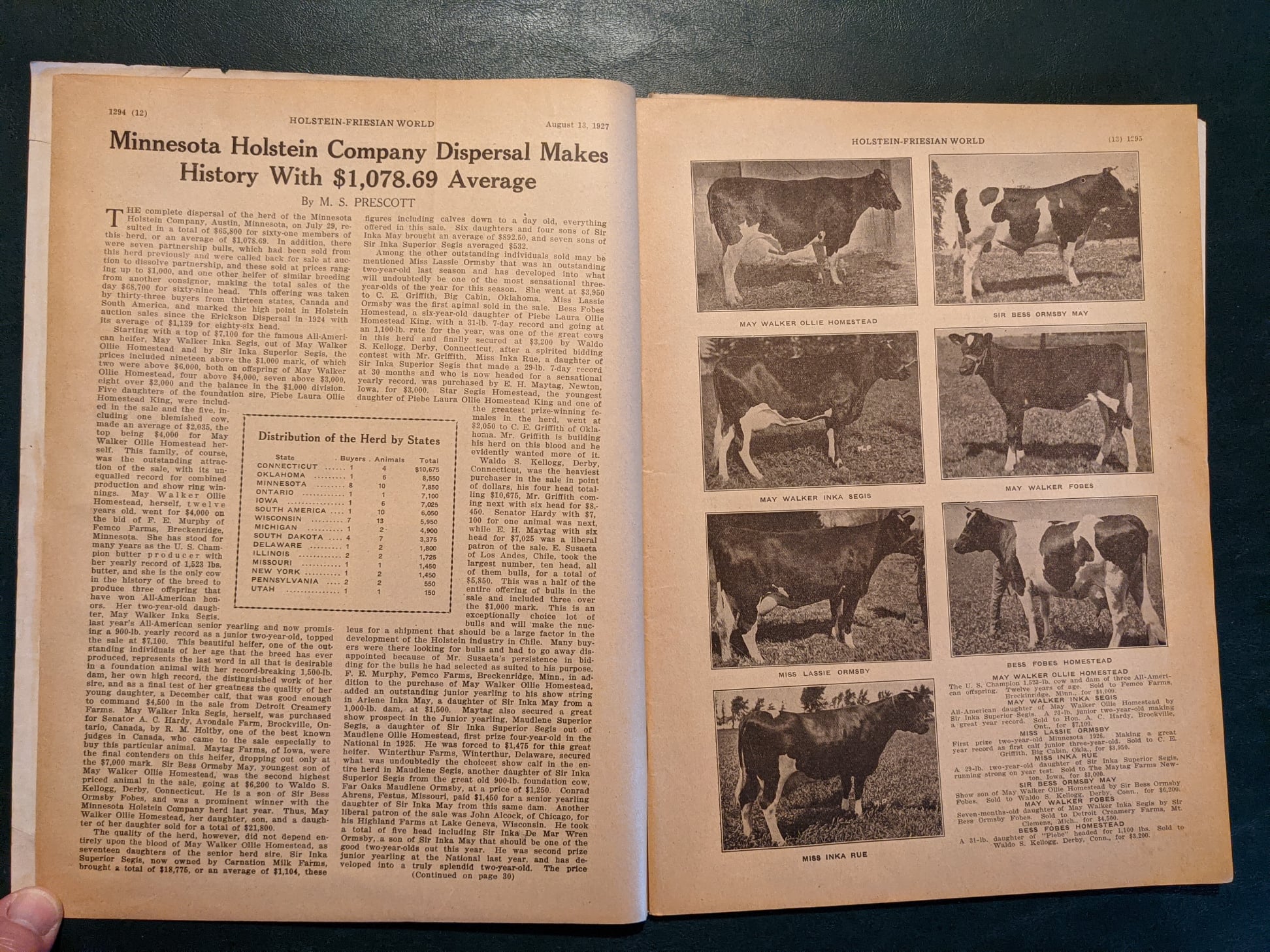
Minnesota Holstein Company Dispersal Makes History with $1,078.69 Average” — the 1927 Holstein‑Friesian World spread that proved Culver and Eberhard’s 75‑cow “boutique” herd was no hobby, with buyers from across North America paying triple the going rate for cows like May Walker Ollie Homestead and the families behind Sir Inka May.
Looking back, Eustice wrote that through its cattle, the Minnesota Holstein Company “unknowingly and irrevocably disseminated the recessive gene for red hair color throughout the North American Holstein population.” That word “unknowingly” sits heavily. Culver, Eberhard, and the McLeod County breeders—they were chasing performance, type, and banners. They didn’t set out to change the breed’s palette. They just happened to put a powerful red gene carrier at the center of a very influential program.
The survival and eventual triumph of that gene runs through one key link: Montvic Rag Apple Sovereign.
Sovereign was born April 17, 1942, at Mount Victoria Farm in Hudson Heights, Quebec, under the eye of another legend: T.B. Macaulay. Macaulay had a very specific vision. He wanted Holsteins that could consistently test 4% butterfat with udders that would stand the strain year after year. At a time when breeders sometimes accepted leaky udders in exchange for big production, that was a clear, disciplined breeding philosophy.
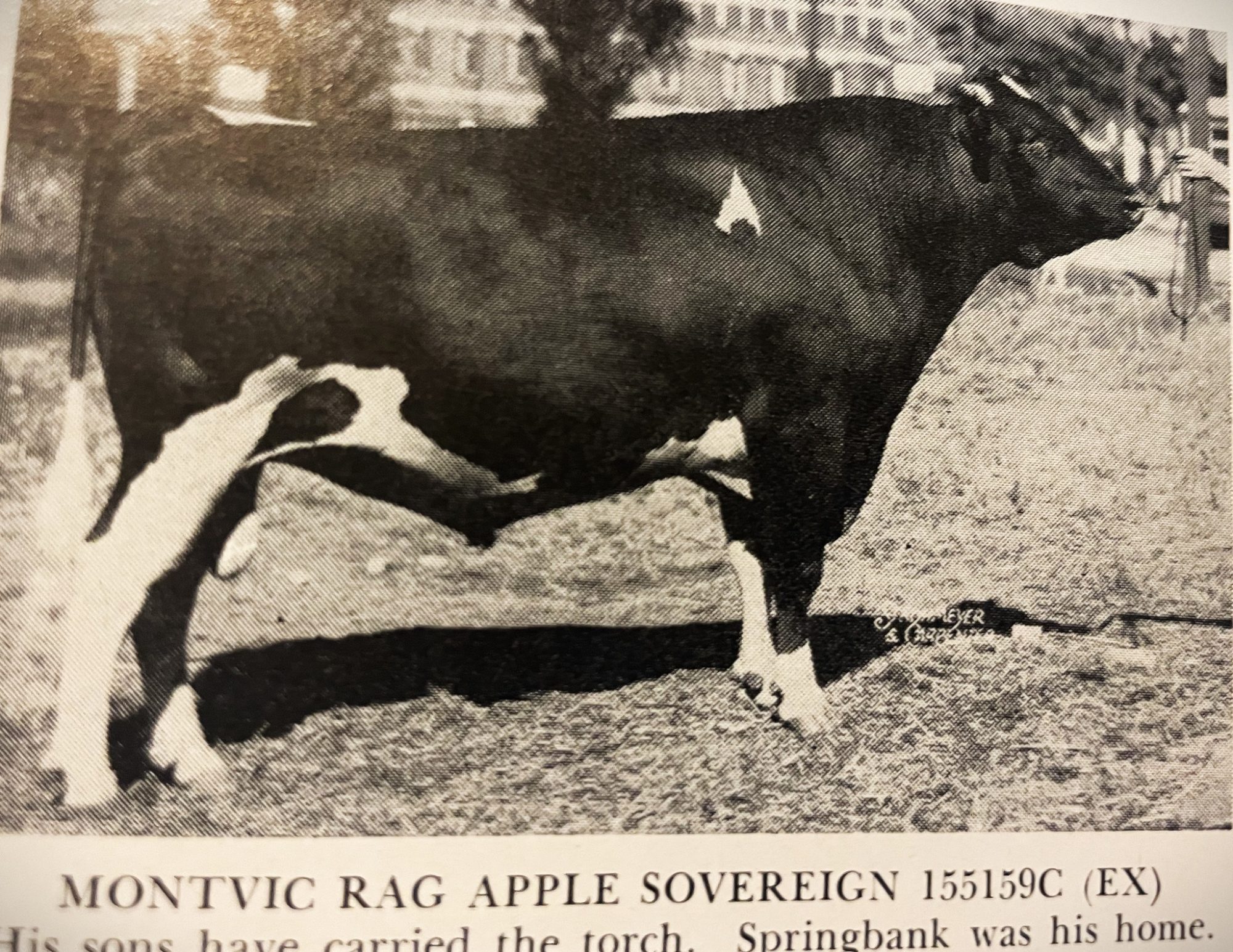
Sovereign was a great‑grandson of Sir Inka May. When the Mount Victoria dispersal came in 1942, he was only a two‑month‑old calf, but he still fetched 4,075 dollars from Tom Dent and Clark Brown. That price told you everything: people believed in the breeding behind him, not his size on sale day.
Here’s where timing helped. Artificial insemination was stepping out of its experimental phase. Sovereign became one of the bulls to ride that first real wave of A.I. At one point, he had more registered offspring in the Canadian herdbook than any other sire. Instead of influencing a handful of herds the way a natural service bull would, his genetics spread coast to coast—and beyond.
The line sharpened again at ABC Farms in Brampton, Ontario. There, ABC Inka May EX showed what Sir Inka May’s family could do from the female side—a four‑year‑old All‑Canadian with a record of 24,141 pounds of milk and 1,128 pounds of fat. She was sired by Inka Supreme Reflection and traced back to Temple Farm May, a 400‑dollar purchase that turned out to be one of those cows whose price looks comically small in hindsight.
When ABC Inka May was mated to Montvic Rag Apple Sovereign, they produced A.B.C. Reflection Sovereign EX‑Extra. The bull books tell you what happened next. Reflection Sovereign dominated the show ring in the 1950s, siring seven All‑Canadian Gets and five All‑American Gets. Breeders across North America built cow families on his daughters. Because he carried the red gene from Sir Inka May, those lines quietly banked that recessive factor even as the official herdbooks still refused to print “Red & White” beside a registration number.
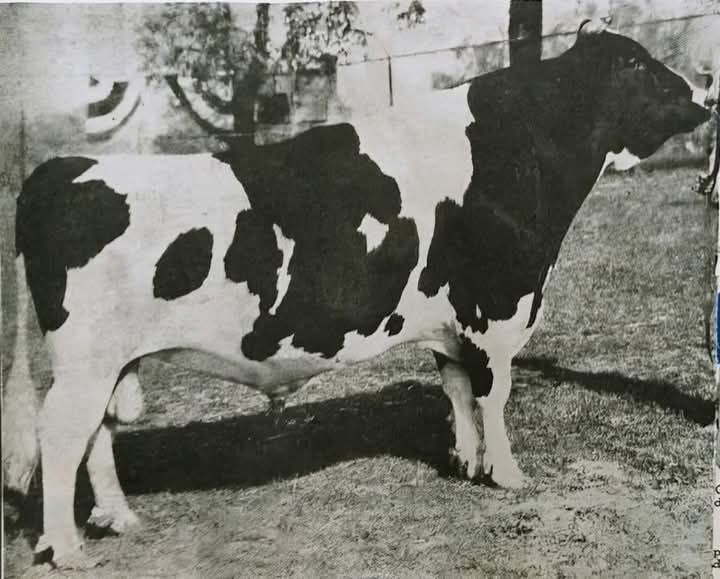
Meanwhile, the institutional resistance was still in full swing. The Holstein‑Friesian associations in both the U.S. and Canada stood firm against the registration of Red & Whites. Some state associations ran ads warning that letting red cows into the registry would tarnish the Holstein image. As late as 1963, Carnation’s magazine was still warning that the red factor was “becoming so much a problem… that it does not seem advisable to run the risk of further spreading the factor.” That line tells you all you need to know about how deep the prejudice ran.
But the cows—and the data—were winning. Around the world, demand for high‑production Holstein genetics often meant buying semen from bulls that happened to carry the red gene. The first Red & White show at World Dairy Expo was held in 1968. Canada opened its herdbook to Red & Whites in 1969. The U.S. followed in 1970. In 1969, Carnation themselves—the same outfit that had spent years trying to breed red out of their own herd—introduced Red & White bulls into their A.I. lineup to meet global demand. Talk about coming full circle.
By that point, as Eustice notes, almost all Red & White and red‑carrier Holsteins in the world could be traced back to Montvic Rag Apple Sovereign. Follow that line back a little farther, and you land squarely on Sir Inka May. A bull who’d once been valued for his black‑and‑white daughters and fat records had become, through his great‑grandson, the backbone of a color variety the breed had spent decades trying to keep out.
And this is where the story that started with that high price in Philadelphia finally hits its peak.
Fast‑forward to Madison, Wisconsin, 2025. If you’ve been to World Dairy Expo, you can smell it just thinking about it—sawdust, coffee, hoof black, and cool fall air. In the International Red & White Show, Golden‑Oaks Temptres‑Red‑ET walks into the ring. The minute she does, you can tell the class has just changed. Classified EX‑94, she’s got that welded‑on udder, that long, clean frame, that way of carrying herself that makes judges forget their lunch breaks.
There’s that familiar hush in the Coliseum—the kind where you can hear a shank chain rattle three rows over—while the Supreme lineup stands under the lights. Then there are her numbers. As a three‑year‑old, Temptres had already rung up 37,030 pounds of milk and 1,510 pounds of butterfat in 365 days. Put that beside May Walker Ollie Homestead’s 1922 record—31,608.6 pounds of milk, 1,521.59 pounds of fat—and it sends a little chill up your spine. Different eras, different rations, different technology, same kind of ridiculous capability in the milking parlor.
Her pedigree is a Red & White road map. Dam: Miss Pottsdale DFI Tang‑Red EX‑94. Granddam: Al‑N‑Tine Debonair Tart‑ET EX‑92 3E. Further back, C Alanvale Inspiration Tina EX‑95 2E, plus a list of elite red and red‑carrier names that any modern breeder will recognize. Underneath it all, if you walk the branches back far enough, you find Sovereign, Reflection Sovereign, and the Inka lines that lead back to Sir Inka May.
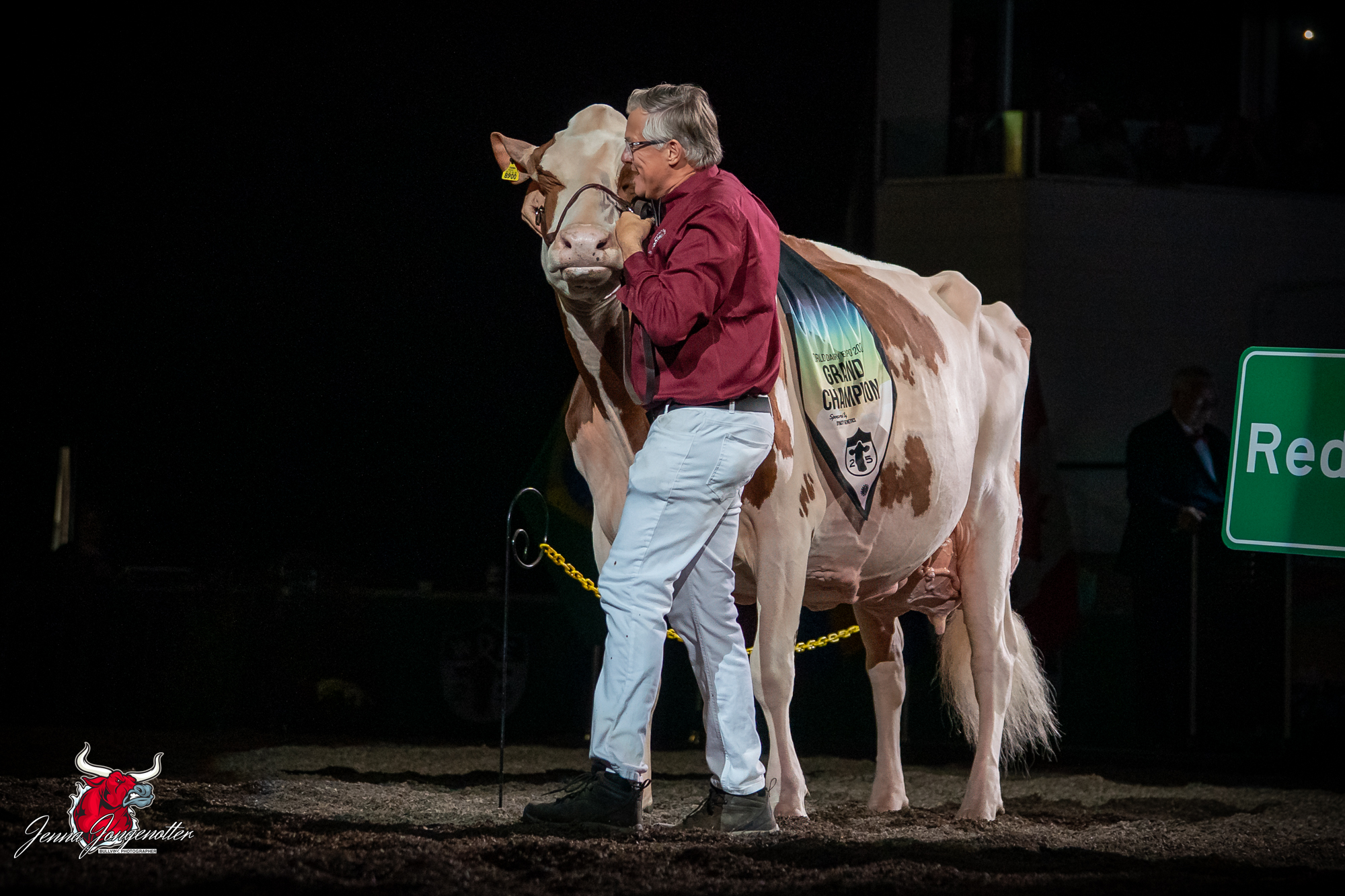
When the announcer in Madison finally says it—Temptres named Supreme Champion of World Dairy Expo 2025—everything that had come before folds into that moment. This isn’t just a Red & White cow winning her color show. This is a Red & White cow, carrying elite production and elite type, standing as the top Holstein on the grounds. The gene Carnation, once called “a problem,” and the associations that once wouldn’t register are under the spotlight, and nobody’s complaining.
That’s the climax. That’s the peak. A story that started with a record cow in Minnesota, a high‑priced bull calf, and some red calves that made people mutter in the barn has finally walked to the colored shavings and taken the whole show.
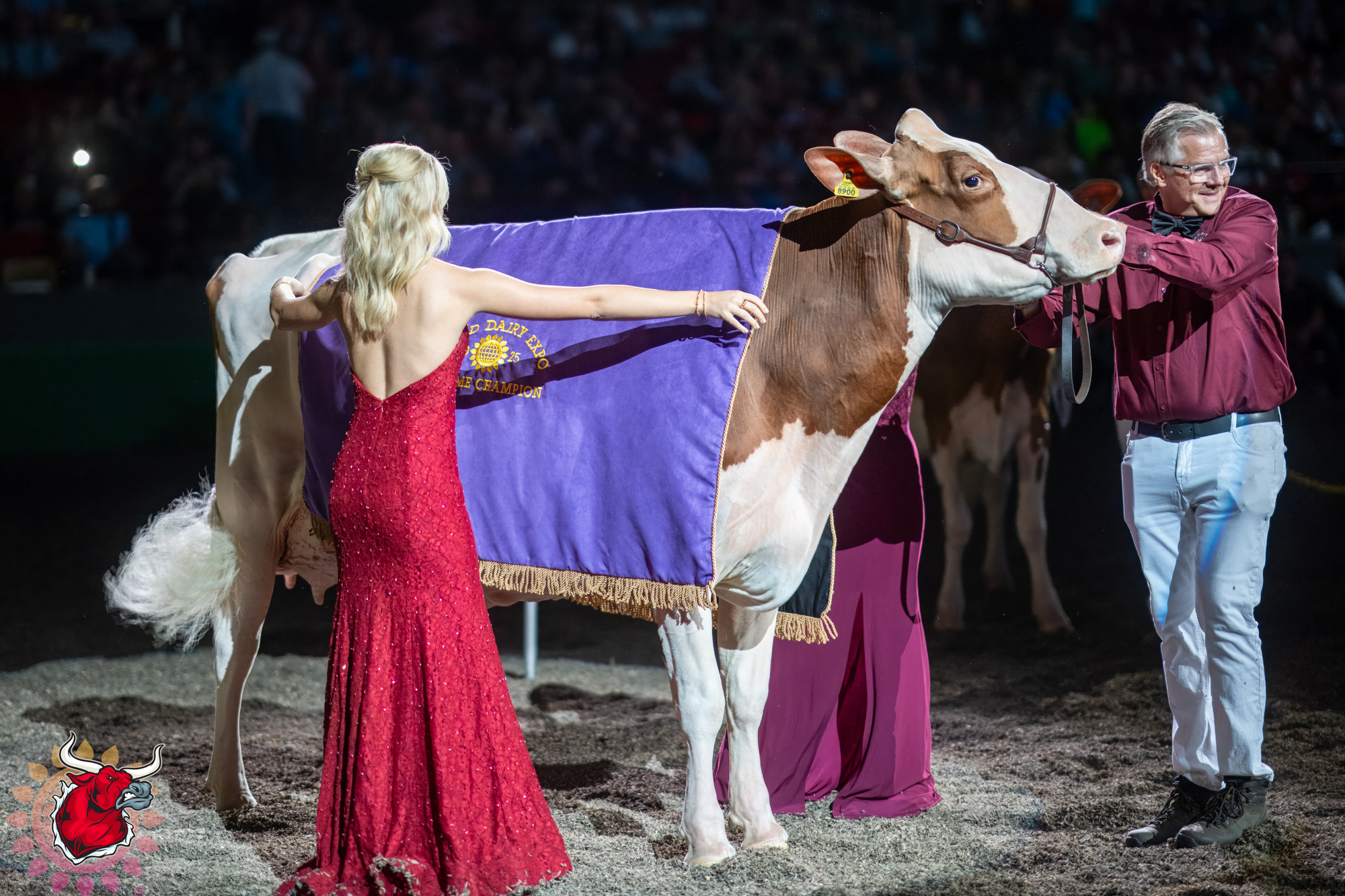
Supreme Champion – World Dairy Expo 2025
Milk Source, Fischer, Steincrest & Crescentmead Kaukauna, WI
Why Sir Inka May Still Matters in Today’s Barns
So why should a producer in 2026, juggling feed costs, labor, and breeding decisions, care about a bull born in 1923?
First off, Sir Inka May is living proof that influence in this breed doesn’t spread out evenly. If you’ve ever flipped through a pile of pedigrees and seen the same name pop up three, four, five times in four generations, you’ve seen what happens when one bull ends up at the center of multiple powerful herds. Put a highly prepotent sire in a boutique show herd like the Minnesota Holstein Company, then move him to a corporate production herd like Carnation, and you’re not just making a good bull. You’re laying down a genetic highway that his traits can travel for generations.
Another thing his story says, loud and clear: you don’t get to choose which genes tag along with the ones you’re chasing. We assess milk, fat, udder quality, feet and legs, and health traits. The rest of the package—fertility quirks, disease resistance, coat color—climbs into the trailer with them. Sir Inka May was used heavily because he made the kind of daughters Carnation needed and sired sons that bred true. The red gene never asked permission. It just stayed in the blood and kept moving forward.
Stand him between Culver and Eberhard at that kitchen table in Austin and the Carnation team reading test sheets in Seattle, and you can watch the breed walk from kitchen tables to conference rooms. On one side, you have a small herd, big goals, and a lot of faith in what you can see in front of you. On the flip side, you have herd records, planned matings, and a corporate mindset that uses genetics as a tool in a larger business machine. Sir Inka May is a reminder that the tension you feel today between what the computer says and what the cow in front of you looks like has long been part of this breed.
And if you’re milking Red & Whites today—or even just using red‑carrier bulls in a black‑and‑white herd—this isn’t ancient history. Every time you trace a Red & White pedigree back and find Sovereign or Reflection Sovereign, every time you see RC show up in a bull’s proof and shrug because his daughters are exactly what you want in your free stalls, you’re staring right down the line that runs back to Sir Inka May. Every Supreme Champion Red & White at Madison, Temptres included, is another banner hanging on the same genetic rope he helped string.
A Quiet July Day, and a Long Echo
Let’s go back, one last time, to Carnation Milk Farms in July of 1943. By then, Sir Inka May had been walking those alleys for nearly two decades. He’d seen the barn change around him—new paint on the walls, new milking units, new bulls on either side of his stall. His daughters had filled the milking strings, and his grandsons were already standing in the bull pens.
The records tell us, not the memories, that he was euthanized on July 15. One can imagine the day. Summer haze over the fields. A few of the long‑time herdsmen pause as they walk by his pen, thinking of the calves they’d pulled from his daughters, the fat tests that had rolled off the tester’s scale, the herd sires with his name on their registration papers. For them, the bull wasn’t just a list of numbers; he was a fixture.
By then, Holstein‑Friesian World had already called his influence on the breed “perhaps greater than that of any other sire now living.” Carnation had acknowledged that no bull had shaped their program more. On paper, his story was staggering: 18 All‑Americans, 15 Reserves; more 1,000‑pound‑fat daughters than any other living sire of any breed; four sons and six grandsons in the Carnation bull barns.
If that were all he’d done, Sir Inka May would still deserve his place in Holstein history. But we know now that the deepest part of his legacy wasn’t visible in those 1940s scorecards. It was in the quiet way a recessive gene slipped out from under the shadow of prejudice, stayed alive in elite families, and eventually walked into the center ring at Madison with a Supreme banner over its head.
Without Sir Inka May, Carnation’s production records would have different numbers beside them. Mount Victoria’s breeding experiments might have taken a different turn. Sovereign’s widespread impact on A.I. would look different in the herdbook. Without him, the Red & White pedigrees behind cows like Temptres would read another way, and it might have taken longer for the breed to admit what the cows had been saying all along: that excellence comes in black and white—and in red and white.
Every time a breeder today opens a catalog and sees RC next to a bull’s name, every time a Red & White calf hits the straw and the reaction is a smile instead of a sigh, there’s a little bit of Sir Inka May in that moment. When Golden‑Oaks Temptres‑Red‑ET walked out of the ring in 2025 as Supreme Champion of World Dairy Expo—with a 37,000‑pound record and a pedigree that leads back through Sovereign to Minnesota’s Crown Prince—that was his echo, loud and clear.
In 1923, a small-town newspaper introduced a newborn bull as the “Crown Prince of the Inka herd” and joked that he’d be groomed to be “American champion of something.” A hundred years later, we can say they were right in ways they never could have imagined. He helped lift a little Minnesota herd into the spotlight. He gave Carnation the sires they needed to rewrite what “high production” meant. And he quietly carried a red gene that turned out to be one of Holstein history’s greatest stories of redemption.
So the next time you watch a Red & White cow circle the ring at Madison, or look at a red‑carrier bull’s proof, wondering how his daughters will look in your barn, remember that quiet July day at Carnation and that loud day in the Philadelphia sale ring. Remember the world‑record cow in Austin, the four farmers betting 25,000 dollars on her son, and a corporate herd that tried to keep the red gene behind the curtain even as it rode their best pedigrees.
You’re not just looking at color. You’re looking at the long echo of a bull born in 1923 whose influence ran farther and lasted longer than anyone in that first barn could have guessed.
Crown Prince, indeed.
Key Takeaways:
- Sir Inka May turned a 75‑cow Minnesota show string into a global genetic force, anchoring both Carnation’s record herds and the emerging A.I. era.
- His daughters’ 1,000‑lb fat records and multiple All‑Americans made him a sire-of-sires at Carnation—even as his red calves were treated as a problem to erase.
- The red gene he carried spread quietly through elite lines to Montvic Rag Apple Sovereign and A.B.C. Reflection Sovereign, seeding almost all modern Red & White and RC Holsteins.
- Association resistance to Red & Whites finally broke in 1968–1970, setting the stage for cows like Golden‑Oaks Temptres‑Red‑ET to stand Supreme at World Dairy Expo.
- For today’s breeders, his story is a reminder that you can’t cherry‑pick only the “good” genes—concentrated influence always brings hidden passengers along for the ride.
Continue the Story
- The Vision of Mount Victoria: T.B. Macaulay’s Holstein Legacy – In the same era Sir Inka May was transforming Carnation, T.B. Macaulay was applying actuarial science to create the Rag Apple bloodline. This profile explores how Macaulay’s quest for 4% butterfat parallelled the high-production dreams born in Minnesota.
- Sire Spotlight: The Backup Bulls Who Created Holstein History – Deepen your understanding of the historical world these bulls were navigating. This retrospective examines the industry forces and “backup” status of legends like O-Man and Elevation, proving that the foundation held even when the experts looked elsewhere.
- A.B.C. Reflection Sovereign – Trace the line from Sir Inka May’s hidden gene to the bull who carried it into the modern era. This analysis shows how Reflection Sovereign became the ultimate genetic bridge, proving that excellence and color could finally walk the same path.
 The Sunday Read Dairy Professionals Don’t Skip.
 The Sunday Read Dairy Professionals Don’t Skip.
Every week, thousands of producers, breeders, and industry insiders open Bullvine Weekly for genetics insights, market shifts, and profit strategies they won’t find anywhere else. One email. Five minutes. Smarter decisions all week.