If you don’t know your stall‑standing index, you don’t know how much of that $18 milk your neck rails are quietly stealing every month.
Executive Summary: If your freestall Holsteins aren’t getting close to 12 hours of lying time a day, you’re almost certainly leaving milk—and margin—on the table. Rick Grant’s Miner Institute work ties each extra hour of rest to roughly 2–3.5 lb more milk per cow per day, which matters a lot when USDA is only forecasting about $18.25/cwt all‑milk for 2026. In a 100‑cow pen with a 1.5‑hour rest deficit, that math points to roughly $1,600–$2,800/month in potential gross revenue at current price levels. Most of that loss comes from fixable things you already walk past: neck‑rails that don’t fit today’s bigger cows, transition pens stocked well over 100%, and cows spending more than 3–3.5 hours a day out of the home pen. The piece lays out four practical paths—from low‑cost “wrench and tape” stall tweaks to comfort‑plus‑tech strategies—so you can choose what fits your herd size, cash position, and risk tolerance. It closes with specific barn‑level checks (stall‑standing index, neck‑rail measurements, lying‑time math, transition stocking counts) you can run this week to see how much of that “unbilled milk” might be hiding in your own pens.
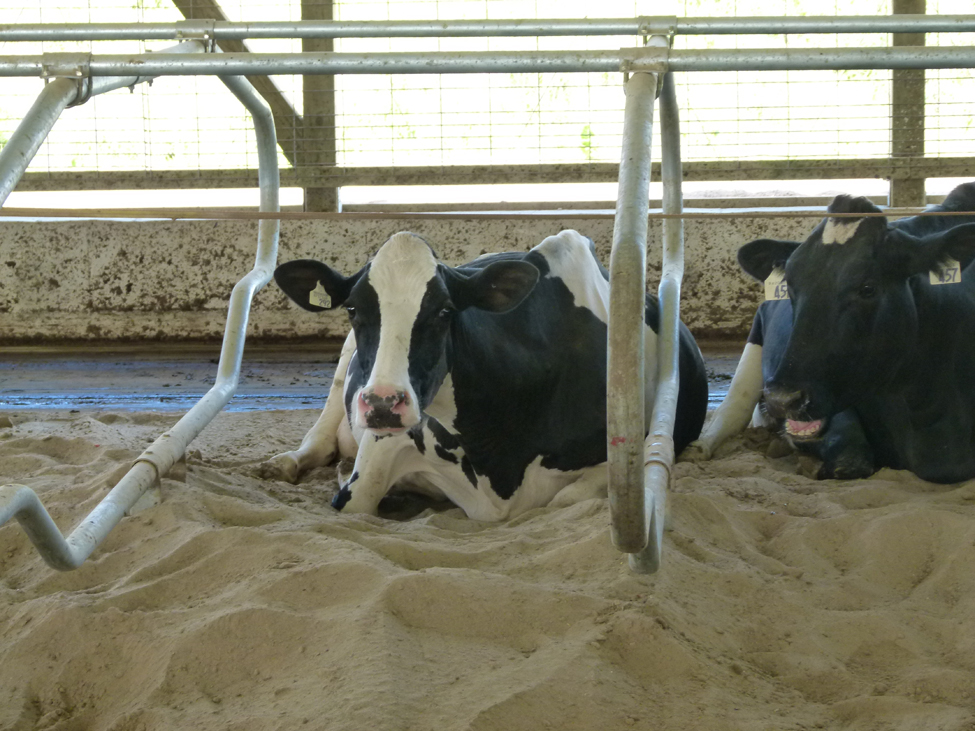
Let’s be blunt. If your cows can’t lie down when they want to, you’re shipping less milk than your genetics and facilities are built to produce. You just don’t see that line on the milk cheque.
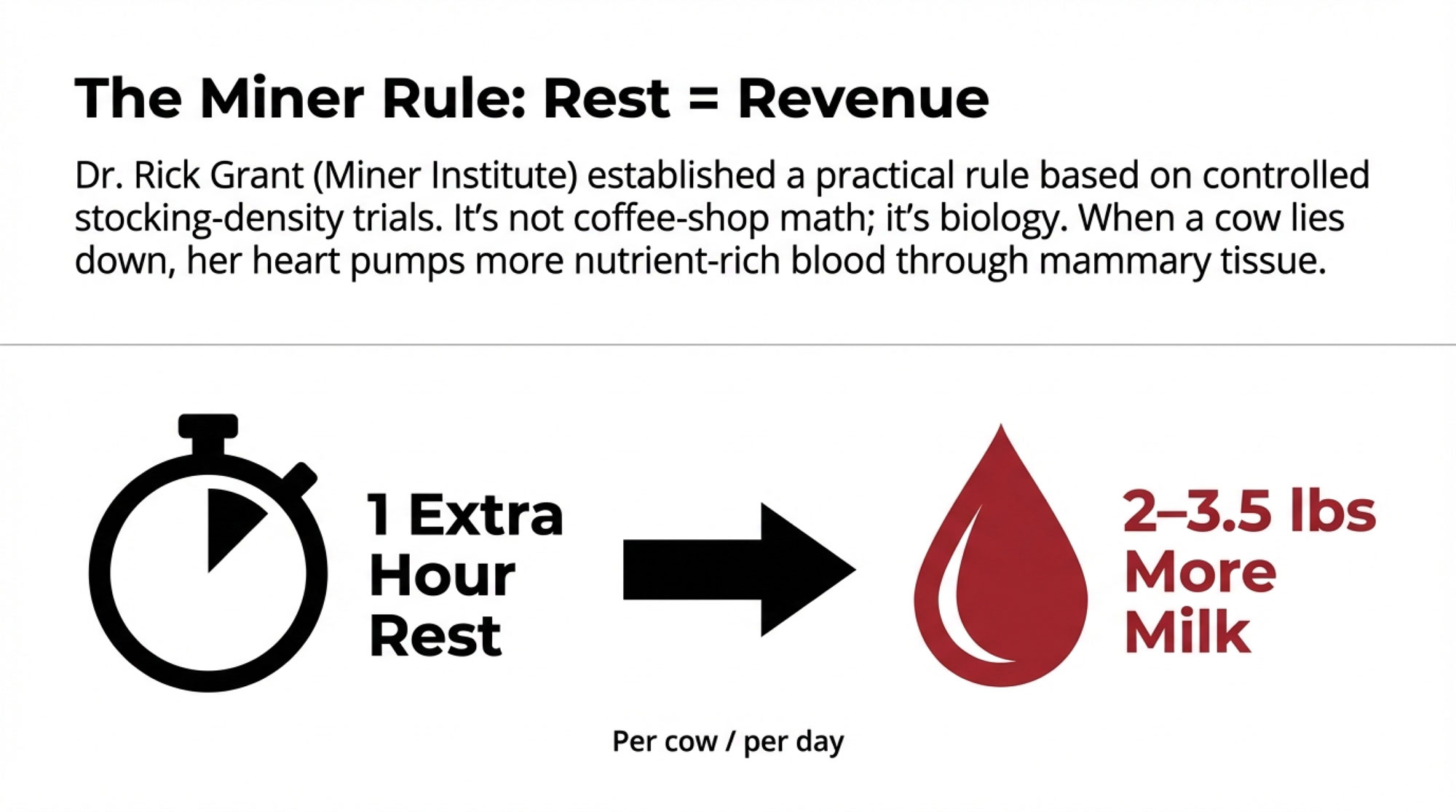
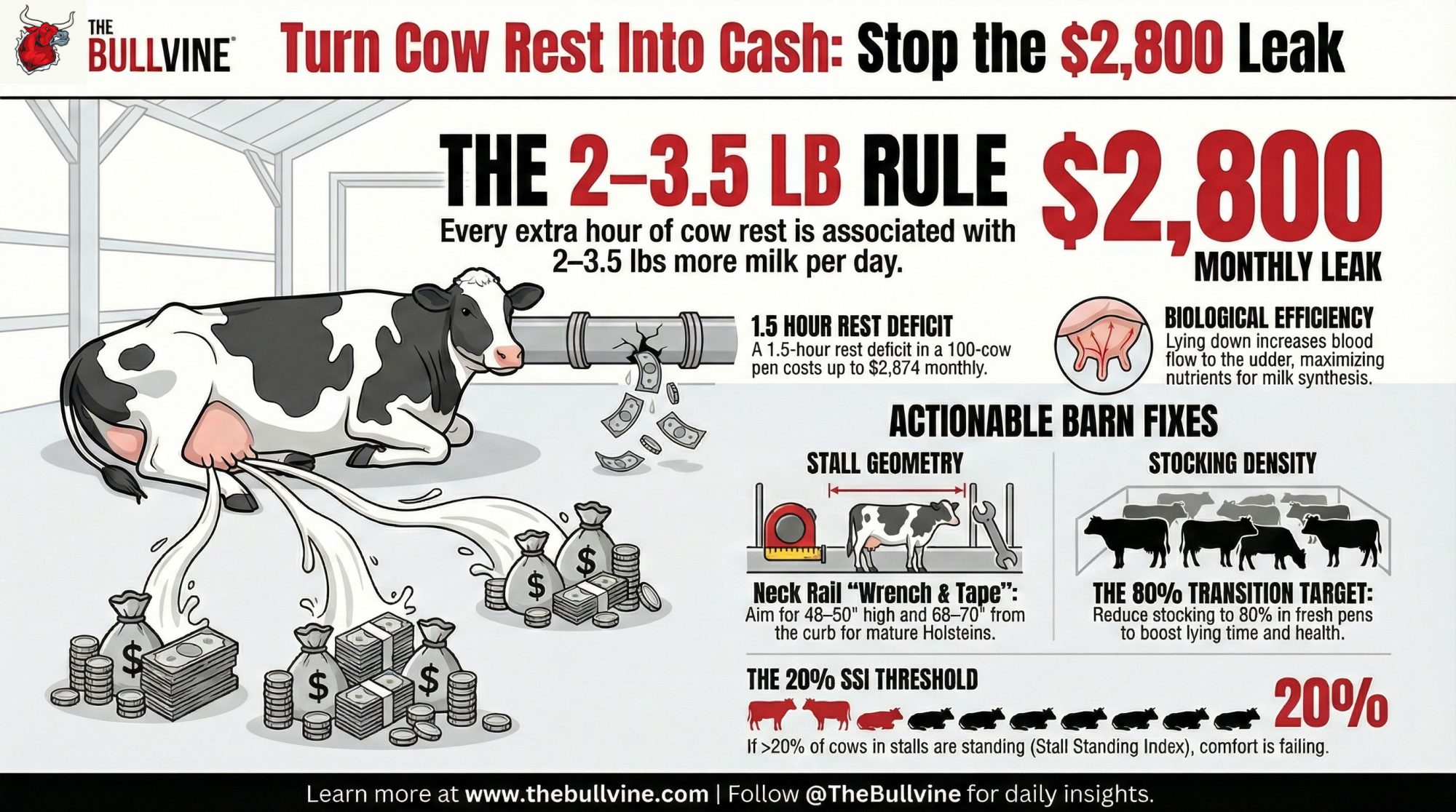
Dr. Rick Grant at William H. Miner Agricultural Research Institute in New York has spent more than two decades putting hard numbers on cow time budgets. His work shows that each extra hour of rest time is associated with roughly 2–3.5 pounds of additional milk per cow per day in freestall Holstein herds. That band comes from controlled stocking‑density and time‑budget trials in Miner’s freestall research barn—not coffee‑shop math.
At the same time, USDA’s January 2026 Livestock, Dairy, and Poultry Outlook forecasts the 2026 all‑milk price at $18.25/cwt and Class III at about $16.35/cwt. In Canada, the Canadian Dairy Commission has approved a 2.3255% farm‑gate price increase effective February 1, 2026, which, together with higher carrying charges, translates into a combined impact of about 2.3750% and “just over 2 cents per litre” at the processor level. Helpful, sure. Game‑changing for your dairy economics? Not really. So the question that matters is simple: how much unbilled milk are your stalls, stocking decisions, and time budgets hiding at those price levels?
The Core Number: How Grant Got to 2–3.5 lb per Hour
Grant’s WDMC 2004 paper “Stocking Density and Time Budgets” is the backbone for most serious lying‑time economics.
In Miner’s freestall research barn, Holsteins were stocked at different densities. When stocking increased from 100% to 145% of stalls, two key changes showed up:
- Lying time dropped by about 1.1 hours per cow per day
- Milk yield dropped by 3.3 lb per cow per day (from 94.6 to 91.3 lb)
Across that and related trials, Grant and colleagues distilled a practical rule: when comfort improves, and cows actually use it, each additional hour of lying time is associated with roughly 2–3.5 lb more milk per cow per day in freestall Holstein herds.
Biologically, it tracks. When a cow lies down, her heart doesn’t have to work as hard against gravity to pump blood to the udder. More blood per minute flows through the mammary tissue, carrying more nutrients for milk synthesis. You don’t see that in one milking, but you sure see it when you look at weekly averages or how close high‑index cows get to the peaks their proofs suggest.
What Real Herds Saw When They Fixed Comfort
Grant’s 2015 “Economic Benefits of Improved Cow Comfort” paper, prepared for Novus International, compiled data from commercial herds that invested in stall design and lying surfaces. Across those farms, improving cow comfort was associated with:
- 3–14 lb more milk per cow per day
- 6–13% lower annual turnover
- 37,000–102,000 cells/mL lower bulk tank SCC
- 15–20% less lameness
That’s a wide range because starting points varied. A herd moving from overstocked, short, thin‑bedded stalls to well‑bedded, correctly sized freestalls at sane stocking densities will see more change than a herd that was already close to the target.
Economically, though, even the low end—3 lb/cow/day, a modest SCC drop, and a few points off turnover—pays back fast when your U.S. baseline is $18.25/cwt all‑milk, and your Canadian baseline is a low‑single‑digit percentage increase on top of 2025 prices. In both systems, you earn your living on margin per cow, not just gross litres.
The 2026 Math: Turning Rest into $/Cow
Now put Miner’s 2–3.5 lb/hour band against today’s projected prices.
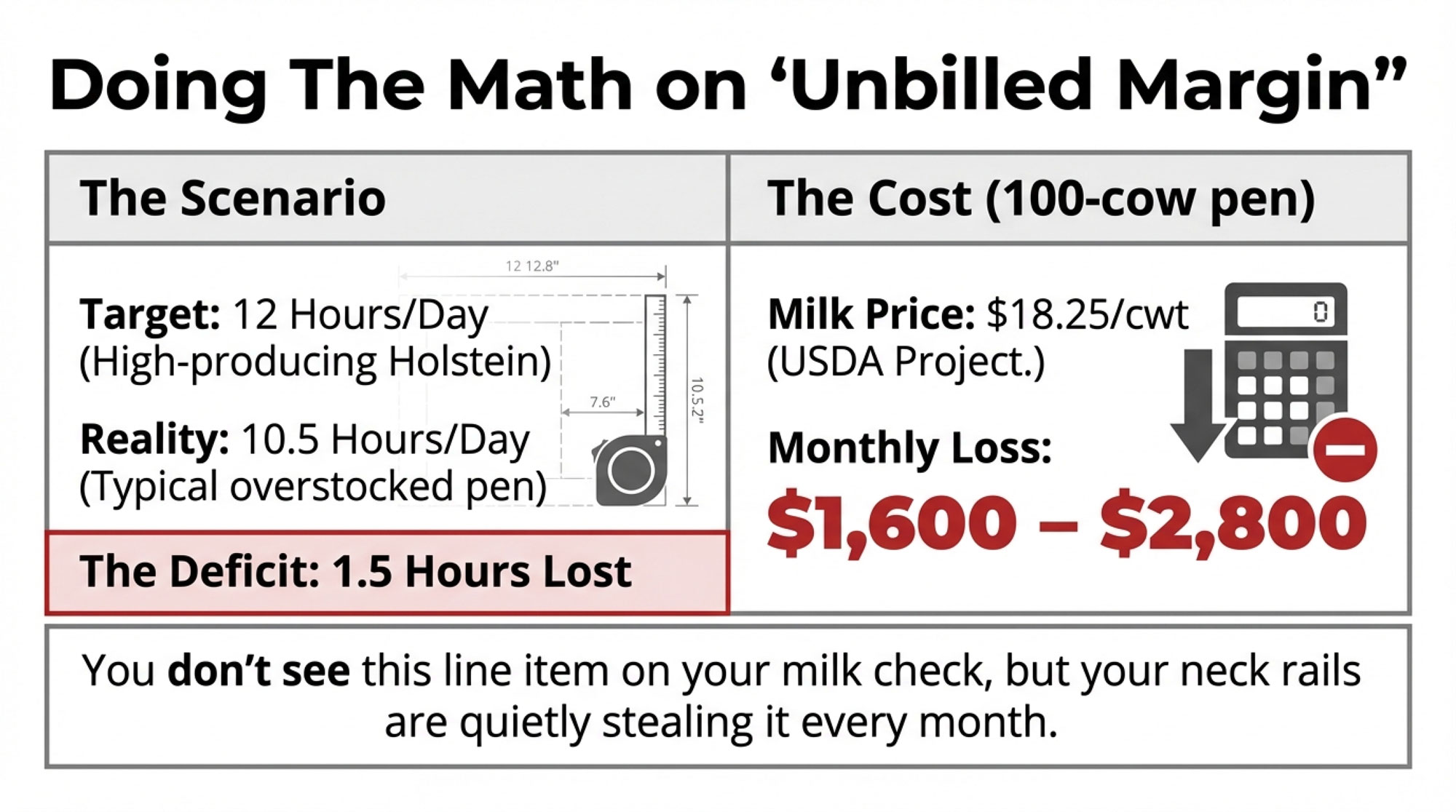
USDA’s January 2026 outlook pegs the 2026 all‑milk price at $18.25/cwt and Class III at $16.35/cwt. Your actual milk cheque will move with components, basis, and pooling, but $18.25/cwt is a fair reference.
Say your early‑lactation pen averages 10.5 hours of lying time per day. That’s a common number in overstocked high and fresh groups once someone actually measures time budgets. Behaviour and welfare work, including extension summaries, often point to about 12 hours per day as a realistic lying‑time target for high‑producing Holsteins in well‑designed freestalls.
You’re looking at a 1.5‑hour rest deficit per cow per day.
Using Grant’s response band:
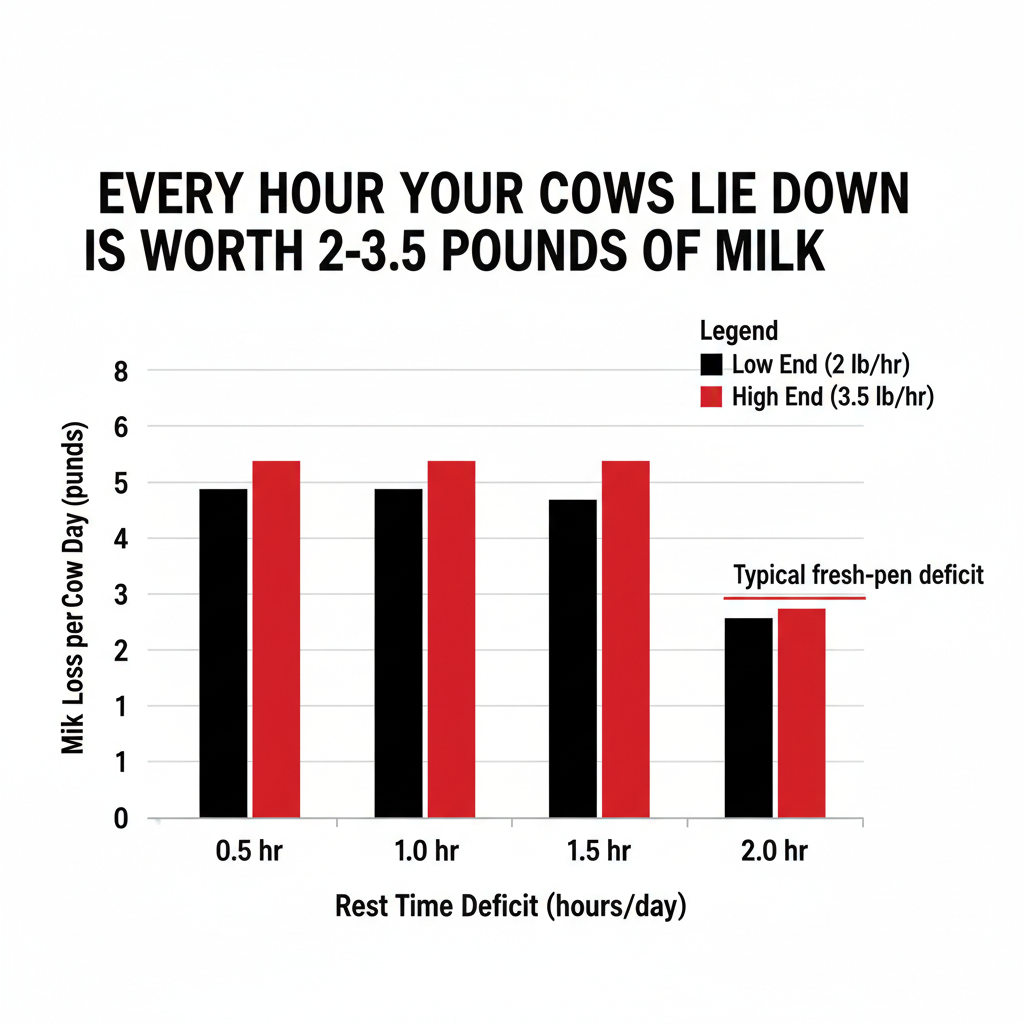
| Scenario | Rest Deficit | Milk Loss | Daily Revenue Loss | Monthly Revenue Loss |
|---|---|---|---|---|
| Low End (2 lb/hr) | 1.5 hr | 3.0 lb/cow | $54.75 | $1,643 |
| High End (3.5 lb/hr) | 1.5 hr | 5.25 lb/cow | $95.81 | $2,874 |
| Conservative (1/3 capture) | 1.5 hr | 1.0–1.75 lb/cow | $18.25–$31.94 | $548–$958 |
You’re not guaranteed that exact gain. But even if you only capture a third—1–2 lb/cow/day—you’ve still paid for a lot of neck‑rail steel, extra bedding, or hoof‑trimming in a few months.
Where the Hours Go: Stall Design, Stocking, and Time Out of the Pen
Those 1.5 missing hours usually aren’t hiding. They’re standing right in front of you.
Stall Geometry That Doesn’t Fit Today’s Cows
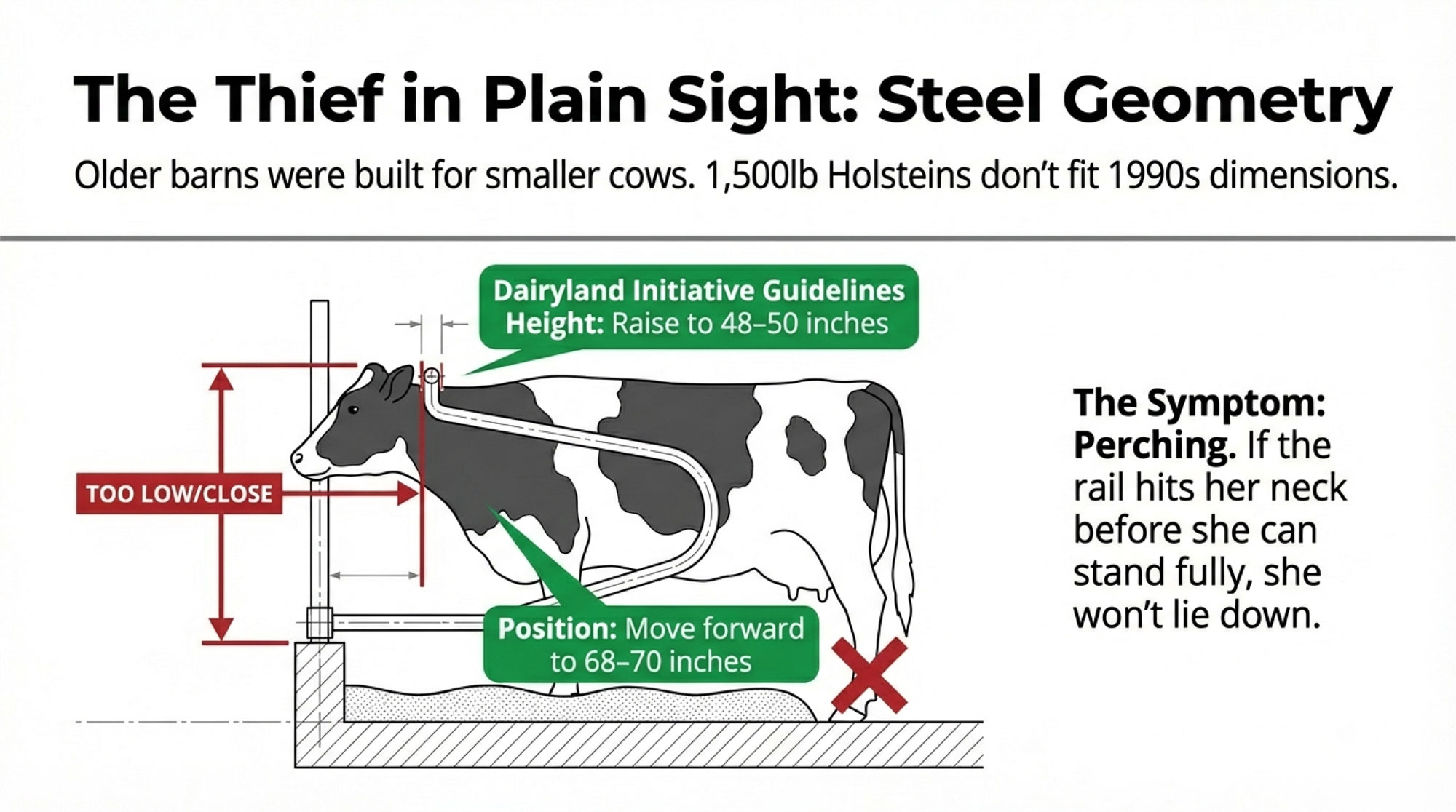
The Dairyland Initiative’s 2025 “Freestall Design and Dimensions” guide lays out recommended dimensions based on cow size and stall type. For large, mature Holsteins in many mattress‑style stalls, their tables and supporting extension pieces typically land around:
- Neck‑rail height: about 48–50 inches above the top of the bed
- Neck‑rail forward position: about 68–70 inches from the rear curb, within a broader 64–72 inch range depending on stall length and design
In many older barns consultants walk into, neck rails still sit in the mid‑40‑inch range and closer to the rear curb—dimensions originally laid out for smaller cows than the roughly 1,500‑lb Holsteins many herds are milking today. Dairyland and Cook’s freestall work both show that low, tight neck rails increase perching (front feet in the stall, rear feet in the alley) and standing time in stalls instead of lying.
That perching time is exactly where you quietly lose lying time. And Miner’s research tells you exactly what an hour of lost lying time costs.
Stocking Density: Especially in Transition Pens
Miner’s WDMC 2004 trial already showed that jumping stocking from 100% to around 145% of stalls cost cows 1.1 hours of lying time and 3.3 lb of milk per day.
Work on grouping and stocking by Chebel and others adds a transition‑specific lens. In one frequently cited trial, pre‑fresh Holsteins were stocked at target headlock densities of 80% vs. 100% (actual about 74% vs. 94.5%), and cows at the lower density experienced fewer displacements and had more time to eat and lie down. Combining that with Miner and other behaviour studies, transition specialists now commonly recommend:
- Target around 80% stocking density in close‑up and fresh pens (both stalls and headlocks)
- Recognize that consistently running those pens in the 100–120%+ range increases competition, cuts lying time, and raises transition‑disease and lameness risk
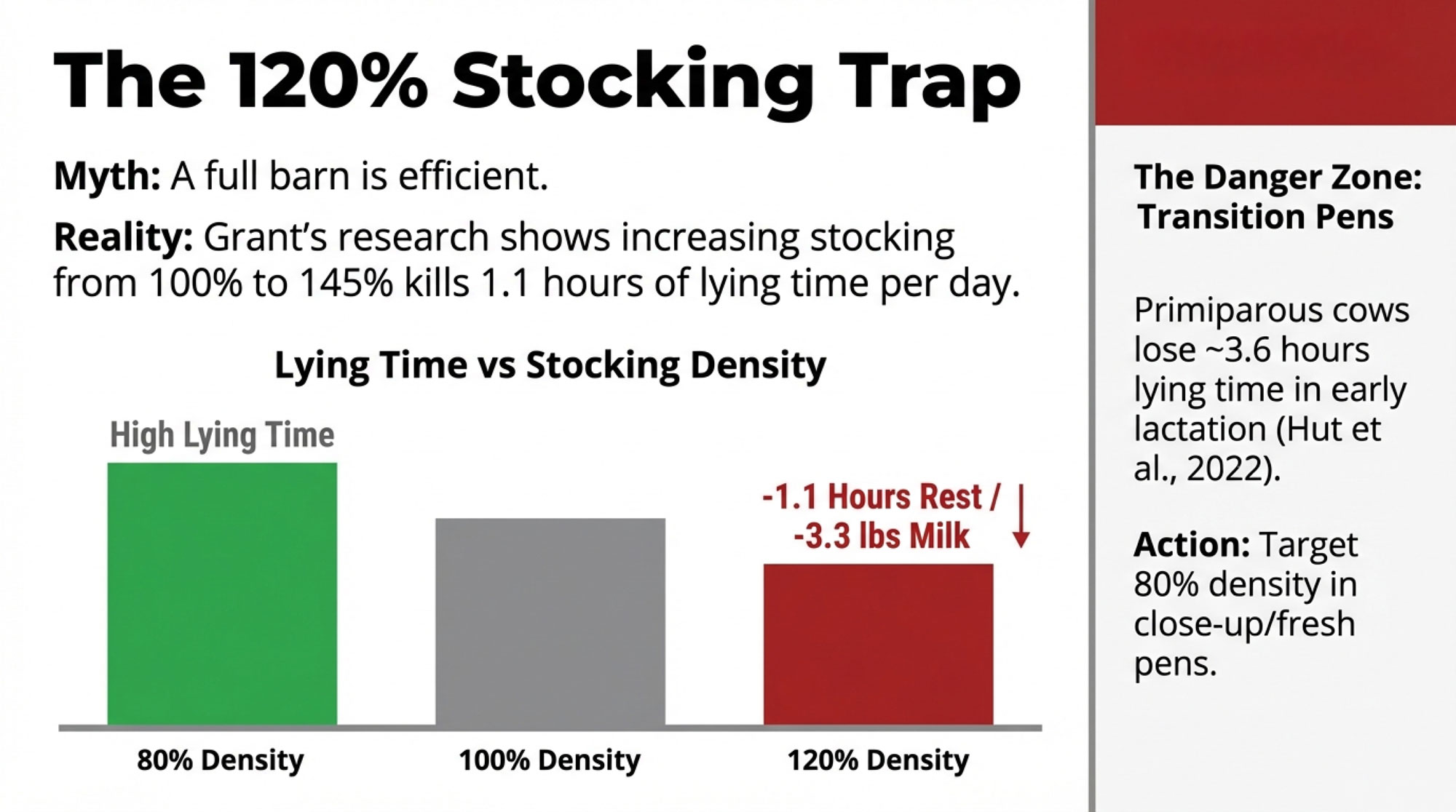
On a spreadsheet, a 120%‑stocked fresh pen looks efficient. On the vet bill and in the cull list, it often doesn’t.
Time Out of the Home Pen
Even if stalls and stocking aren’t terrible, time budgets can still get shredded by hours away from the pen.
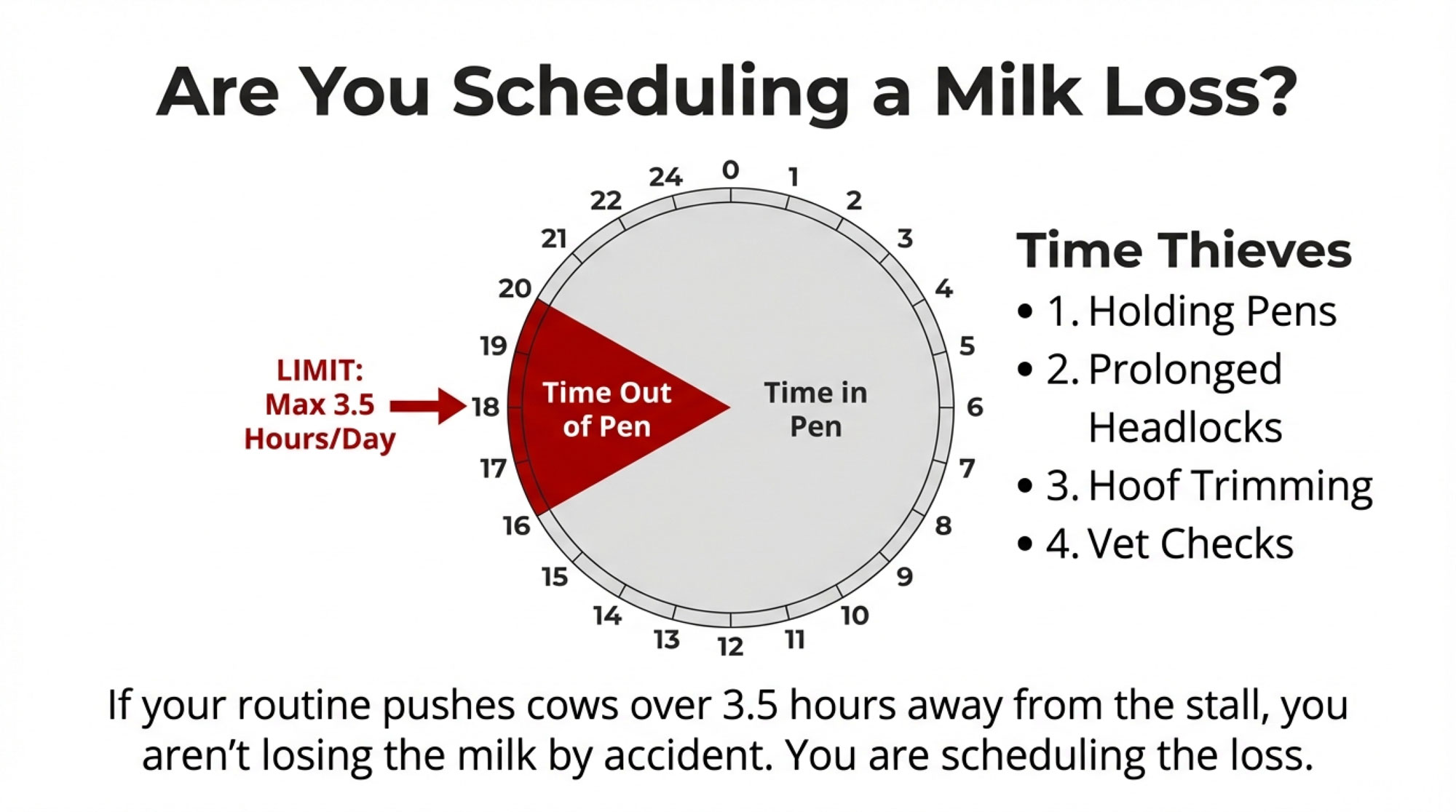
Cook’s cow‑comfort indices and Dairyland’s barn‑design tools emphasize time out of the home pen—holding pens, headlocks for repro and herd health, hoof‑trimming—as a third big thief of lying time. Their guidance, grounded in time‑budget and behaviour data, frequently aims to keep total time out of the home pen under about 3–3.5 hours per day on 2× milking to protect lying time.
If your routine quietly pushes cows over that line, the 1.5 missing hours aren’t mysterious. You’ve scheduled them.
| Lying-Time Thief | What Research Shows | Typical Time Loss | Audit Check |
|---|---|---|---|
| Neck Rails Too Low/Close | Dairyland: 48–50″ high, ~68–70″ forward for big Holsteins. Low/tight rails → perching & standing in stalls (Cook/Miner) | 0.5–1.0 hr/cow/day | Measure height + forward position. Run SSI check (>20% = problem). |
| Transition Overstocking | Miner: 145% stocking cut lying time 1.1 hr, milk 3.3 lb/day. Chebel: ~80% density (stalls + headlocks) in close-up/fresh reduces competition | 1.0–1.5 hr/cow/day | Count cows, stalls, headlocks in fresh pen. Are you >100%? |
| Time Out of Pen | Cook/Dairyland: Keep total time out <3–3.5 hr/day (2× milking) to protect lying time. Includes milking, repro, hoof trim, holding | 0.5–1.0 hr/cow/day | Track total hours in holding, lockups, parlor. Add it up honestly. |
The Global View: Hut’s Dutch Time‑Budget Data
This pattern isn’t just showing up in North America.
Pieter Hut and colleagues at Utrecht University published a 2022 PLOS ONE paper on sensor‑based time budgets in eight commercial Dutch Holstein herds. They used leg and neck sensors on 1,163 cows in freestall barns to track lying, standing, and activity over the lactation.
One number stands out:
- Primiparous cows lost about 215 minutes (3.6 hours) of lying time per day from the month before calving to the first month in milk.
Older cows also lost substantial lying time during early lactation, then gradually increased lying time as lactation progressed, though the exact number of minutes differs by parity.
So even in well‑managed Dutch freestall herds, fresh cows start lactation in a deeper rest deficit than they had in late gestation. Add in overstocking, short or unforgiving stalls, or long time out of the pen, and you’re digging that hole deeper—exactly where Miner’s 2–3.5 lb/hour economics say it hurts the most.
Steel First, Then Sensors: Getting Sequence and ROI Right
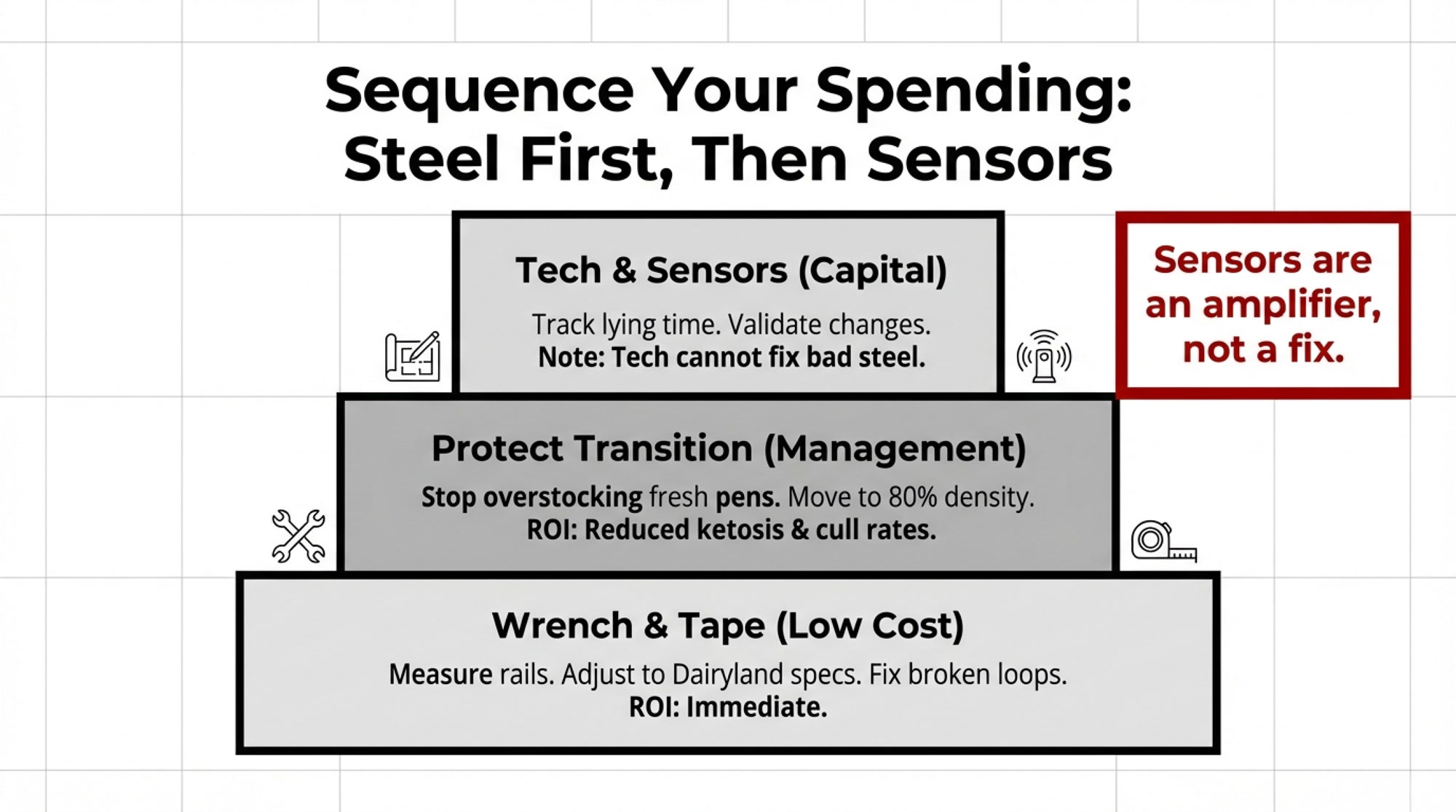
There’s no shortage of clever hardware on the market. The key is spending in the right order.
What Sensors Do Well
Validation work shows that leg‑mounted and neck‑mounted accelerometers can measure lying and standing time with very high agreement (correlations often above 0.9) compared to direct observation in freestall herds. Commercial systems translate that into:
- Total lying time per cow per day
- Number and duration of lying bouts
- Activity and often rumination or eating time
- Alerts when an individual cow’s behaviour deviates from her baseline
That makes them powerful for flagging cows whose rest or rumination crashes before they look obviously sick, quantifying before/after changes when you move neck rails or change stocking, and letting bigger herds manage by exception instead of scanning every cow, every day.
Where ROI Actually Shows Up
There isn’t a single national dataset that tells you payback by herd size. But extension reports and vendor case summaries show consistent patterns:
- Under ~50 cows: If you’re in the barn all the time and know every cow, dedicated lying‑time monitoring alone is a tougher ROI case. A watch, a notebook, and disciplined barn walks catch a lot.
- Around 50–150 cows: In herds already battling repro or fresh‑cow health issues, integrated systems (heat, rumination, activity, lying time) have shown roughly 1–3‑year paybacks in documented case examples, especially where they replaced labour‑heavy heat detection.
- 150+ cows: At this scale, many managers say they have to manage by exception; behaviour data helps focus limited labour on the 10–20% of cows that truly need attention on a given day.
Those bands aren’t hard rules from a formal study. They’re a synthesis of case reports and advisor experience. Your own ROI will move with your milk price, starting health and repro status, and how aggressively your team actually uses the data.
What doesn’t change is this: no sensor can unlock Miner’s 2–3.5 lb/hour response if neck rails are wrong and transition pens are jammed. Steel, bedding, and stocking are the foundation. Tech is the amplifier.
| Sequence | Action | What It Fixes | Typical Cost | Payback Window |
|---|---|---|---|---|
| 1. Wrench & Tape | Adjust 10–20 neck rails in one row; measure SSI before/after | Standing in stalls, perching (low-end: +1–2 lb/cow/day) | $0–$500 | 1–2 months |
| 2. Protect Transition | Audit close-up/fresh stocking; move toward ~80% density (stalls + headlocks) | Fresh-cow rest deficit, DA/ketosis risk, lameness | $0–$2,000(mostly management changes) | 2–4 months |
| 3. Comfort + Tech | Fix worst stalls/stocking first, then add sensors to confirm gains & flag outliers | Scales individual-cow management; tracks ROI of comfort investments | $15,000–$40,000+(system-dependent) | 1–3 years |
| 4. Wait & See | No action; continue with current stalls, stocking, routines | Nothing—but ongoing cost continues every month | $0 upfront | Negative ROI (lose $1,600–$2,800/mo per 100-cow pen) |
Four Realistic Paths Herds Are Taking
Pull the research, economics, and 2026 price forecasts together, and you see four real‑world paths.
1. “Wrench and Tape” First
For cash‑tight herds with obvious stall issues.
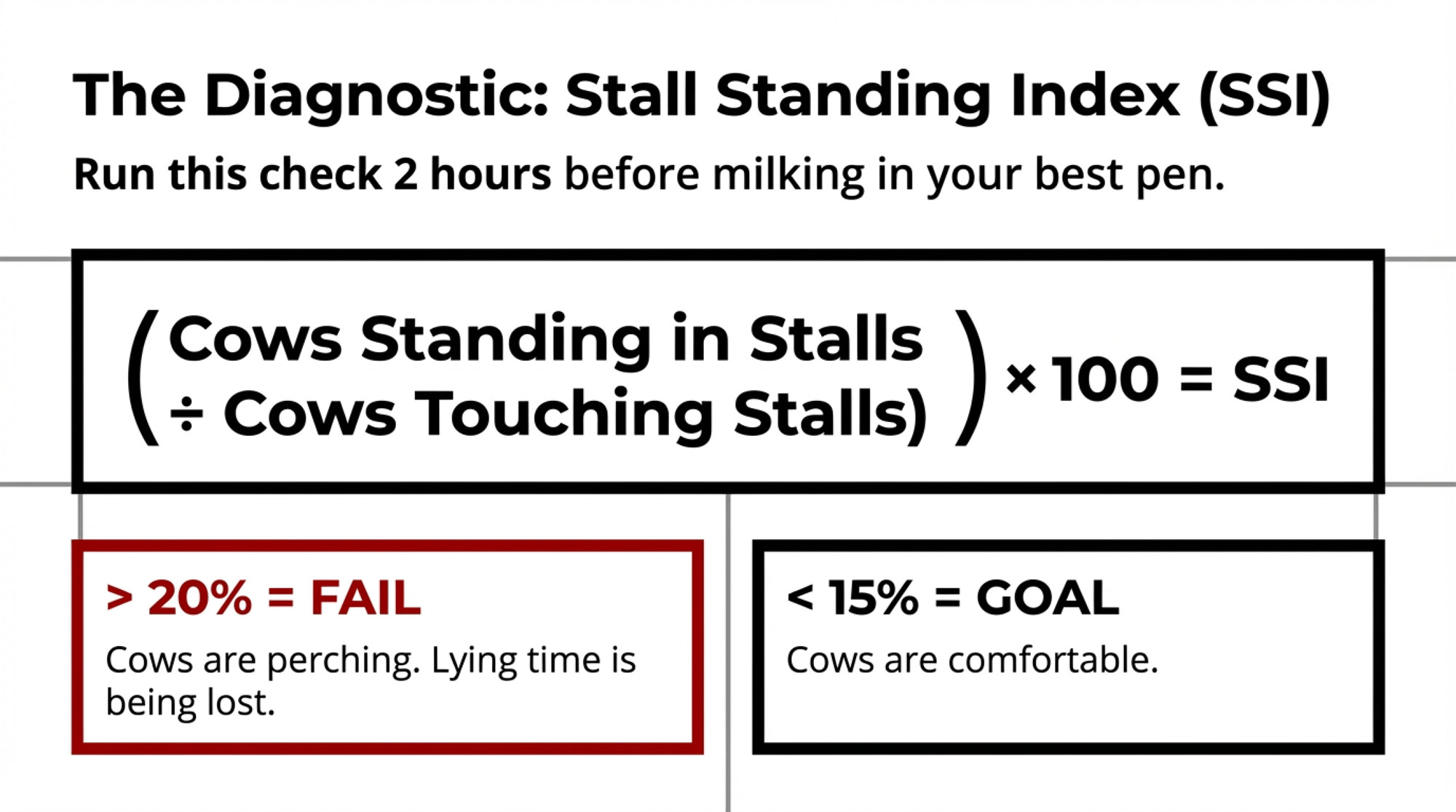
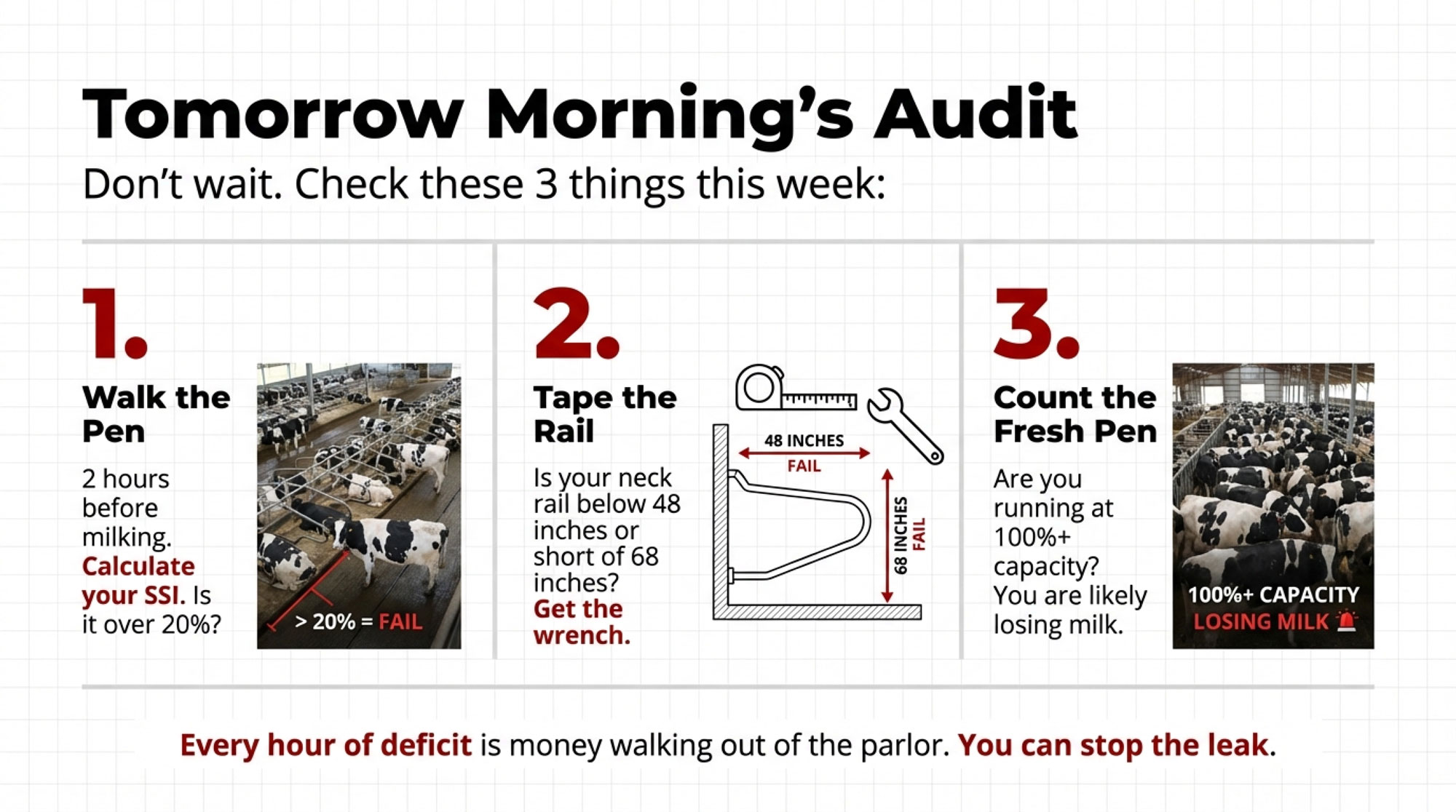
- Run a 10‑minute stall‑standing index (SSI) check two hours before milking in your best freestall pen.
SSI = (cows standing in stalls ÷ cows touching stalls) × 100
If it’s consistently 20% or higher, too many cows are standing in their stalls when they should be lying down.
- Measure neck‑rail height and forward position. If they’re below about 48 inches high or shorter than around 68 inches from the rear curb for big Holsteins, pick one row of 10–20 stalls and adjust into Dairyland’s target range for your stall type.
- Re‑check SSI, perching, and stall use 7–10 days later at the same time.
| SSI Result | What It Means | Likely Causes | What to Check This Week |
|---|---|---|---|
| <15% | Excellent stall comfort; cows lie down readily | Stalls sized/positioned well for herd; bedding + stocking OK | Maintenance mode—focus spending elsewhere (transition, tech, feed) |
| 15–20% | Acceptable but room for improvement | Minor stall fit issues or bedding depth inconsistency | Spot-check neck-rail height + forward position; review bedding protocol |
| >20% | Problem zone—cows standing when they should lie down | Neck rails too low/close; stalls too short; overstocked; poor bedding | Measure neck rails (target ~48–50″ high, ~68–70″ forward). Count cows vs. stalls. Check bedding depth. |
Trade‑offs: Minimal cost; you’re testing Miner’s economics in your own barn, not in a spreadsheet. But it won’t fix under‑sized stalls, poor traffic flow, or a chronically undersized barn.
2. Protect the Transition Pen
For herds getting chewed up on DA’s, ketosis, and lame fresh cows.
- Audit close‑up and fresh pens: cows vs. stalls vs. headlocks.
- If you’re routinely living in the 100–120%+ range, compare that to the ≈80% stall and headlock density used in Chebel’s grouping work and many transition‑management talks.
- Look at levers: smoothing calving peaks, grouping heifers away from dominant older cows, or temporarily reducing numbers in close‑up and fresh pens during heavy calving.
Trade‑offs: Aligns with research linking lower transition stocking to better lying time, intake, and fewer antagonistic interactions. But you may give up some short‑term shipped volume or flexibility in pen use, especially when under quota or processor-volume expectations.
3. Comfort and Tech Together
For mid‑sized and larger herds with some capital flexibility.
- Use barn walks and design guides to fix the worst stall and stocking problems first.
- Then add an integrated monitoring system to confirm that lying‑time and behaviour actually improved, flag fresh or lame cows whose time budgets still lag, and track whether your comfort investments are paying back in milk, SCC, lameness, and turnover.
Trade‑offs: Structural changes plus data‑driven management; lets you scale without losing individual‑cow focus. But it’s a higher upfront spend, and ROI depends on whether someone actually has time and authority to act on the alerts.
4. Wait and See
For herds in a holding pattern.
- Facilities are maxed, labour is stretched, contracts or quota plans feel rigid.
- You know stalls and stocking aren’t ideal, but everything else feels more urgent.
Trade‑offs: No new cash or time outlay in the short run. But you keep paying the ongoing cost of rest deficits—lost milk, more disease, higher turnover—that never shows up as a neat line on the P&L but quietly drags margin every month.
Doing nothing is still a decision. It just means the unbilled milk keeps walking out of the parlour.
What This Means for Your Operation
Here’s how to turn all of this into decisions and numbers on your own farm.
- Run your own lying‑time math. If you have sensors, pull 30‑day average lying times for your early‑lactation group. If not, work with your vet or advisor to build a time‑budget snapshot. Compare your number to a 12‑hour/day target for high‑producing Holsteins in freestalls. Multiply the gap by 2–3.5 lb/hour and your actual $/cwt. That’s your own estimate of the unbilled milk on the line.
- Do the SSI walk this week. Two hours before milking, in your best pen, calculate SSI. If more than 20% of cows touching stalls are standing, Miner and Cook’s work both say lying time and hoof health are taking a hit, you’ll eventually see on the milk sheet and the cull list.
- Put a tape on your neck rails. Compare your measurements with Dairyland’s freestall and neck‑rail placement guidance for your cow size and stall type. If you’re significantly below roughly 48 inches high or short of around 68 inches from the curb in a group of big Holsteins, you’ve probably found a low‑cost project with some of the best documented returns available.
- Be brutally honest about transition stocking. Count cows, stalls, and headlocks in close‑up and fresh pens. If you’re consistently over 100% and unhappy with fresh‑cow health, ask what it would take—breeding adjustments, regrouping, or pen‑use changes—to trend toward 80% during peak calving stretches.
- Sequence your spending. If stall geometry and stocking are obviously off, move steel and cows before you add more hardware. Once comfort is closer to what Miner, Dairyland, and Hut’s Dutch data suggest, then use technology to hold gains and sharpen management.
- If your SSI is already below ~15% and lying time is near 12 hours, your next ROI dollar is probably better spent on transition stocking, tech, feed, or something else—not more stall tweaks.
Key Takeaways
- Grant’s 2–3.5 lb/hour rule turns lying time into a hard economic variable. It’s built on controlled stocking‑density trials and real‑farm economic data showing 3–14 lb/cow/day gains when comfort improves.
- Fresh cows in freestall systems that have been studied start lactation in a serious rest deficit. Hut’s Dutch work shows that primiparous cows lose 215 minutes (3.6 hours) of lying time from late gestation to early lactation, with similar but varied patterns in older cows.
- Simple stall and stocking changes are often your cheapest tons of “invisible feed.” Adjusting neck rails into Dairyland’s typical range and easing the worst overstocking in transition pens can unlock part of that 2–3.5 lb/hour response without pouring a new barn.
- At 2026 price forecasts, the cost of waiting is real money. In realistic scenarios, a 100‑cow pen running 1.5 hours short on rest can easily be talking about $1,600–$2,800/month in potential gross revenue, before you even count health and survival changes.
- Tech pays best as a multiplier, not a crutch. Sensors and dashboards help you manage by exception once stalls and stocking are close to right; expecting them to fix bad steel is just adding depreciation on top of lost milk.
The Bottom Line
Tomorrow morning, before you refresh futures or open the milk‑cheque email, walk into your best freestall pen two hours before milking. Pick one cow that clearly wants to lie down and watch what she does next.
Does she step into a stall, drop, stretch out, and start chewing her cud like she owns the place—or does she hit steel, perch with her back feet in the alley, or just stand and wait for space? Her answer might be the clearest look you’ll get this year at how much unbilled milk your barn is holding back.
Complete references and supporting documentation are available upon request by contacting the editorial team at editor@thebullvine.com.
Learn More
- Concrete, Air, and Shade: The Real Drivers Behind Milk Yield – Capture a massive competitive advantage by mastering the stall geometry and cooling tweaks that deliver 300% ROI. This breakdown reveals how to blow past the biological production ceilings currently capping your herd’s profitability.
- USDA Says $18, Futures Say $16: The $150K Gap That’s Rewriting 2026 Dairy Budgets – Insulate your bottom line against market volatility by utilizing the stress-test frameworks needed to de-risk capital projects. Exposes the gap between USDA forecasts and 2026 market reality, ensuring you stay profitable at $17 milk.
- AI Slashes Feed Costs $31 Per Cow While Your Competitors Pull Further Ahead: The Data-Driven Revolution Reshaping Dairy’s Future – Stop leaving money in the bunk and capture $31 in annual per-cow savings through precision nutrition. This guide reveals how to correctly sequence tech investments to amplify your management instead of adding digital noise.
 Join the Revolution!
 Join the Revolution!
Join over 30,000 successful dairy professionals who rely on Bullvine Weekly for their competitive edge. Delivered directly to your inbox each week, our exclusive industry insights help you make smarter decisions while saving precious hours every week. Never miss critical updates on milk production trends, breakthrough technologies, and profit-boosting strategies that top producers are already implementing. Subscribe now to transform your dairy operation’s efficiency and profitability—your future success is just one click away.