How One Iowa Grandfather’s ‘Best Bull, Not Cheapest Bull’ Principle Built GenoSource Into a 4,000-Cow, Genetics Powerhouse
There’s a photograph I keep coming back to.
Eight families standing together in front of their Blairstown, Iowa operation. The Carrolls, the Simons, the Rauens, the Demmers. Husbands and wives. Partners who became family. Three generations of dairy people captured in a single frame.
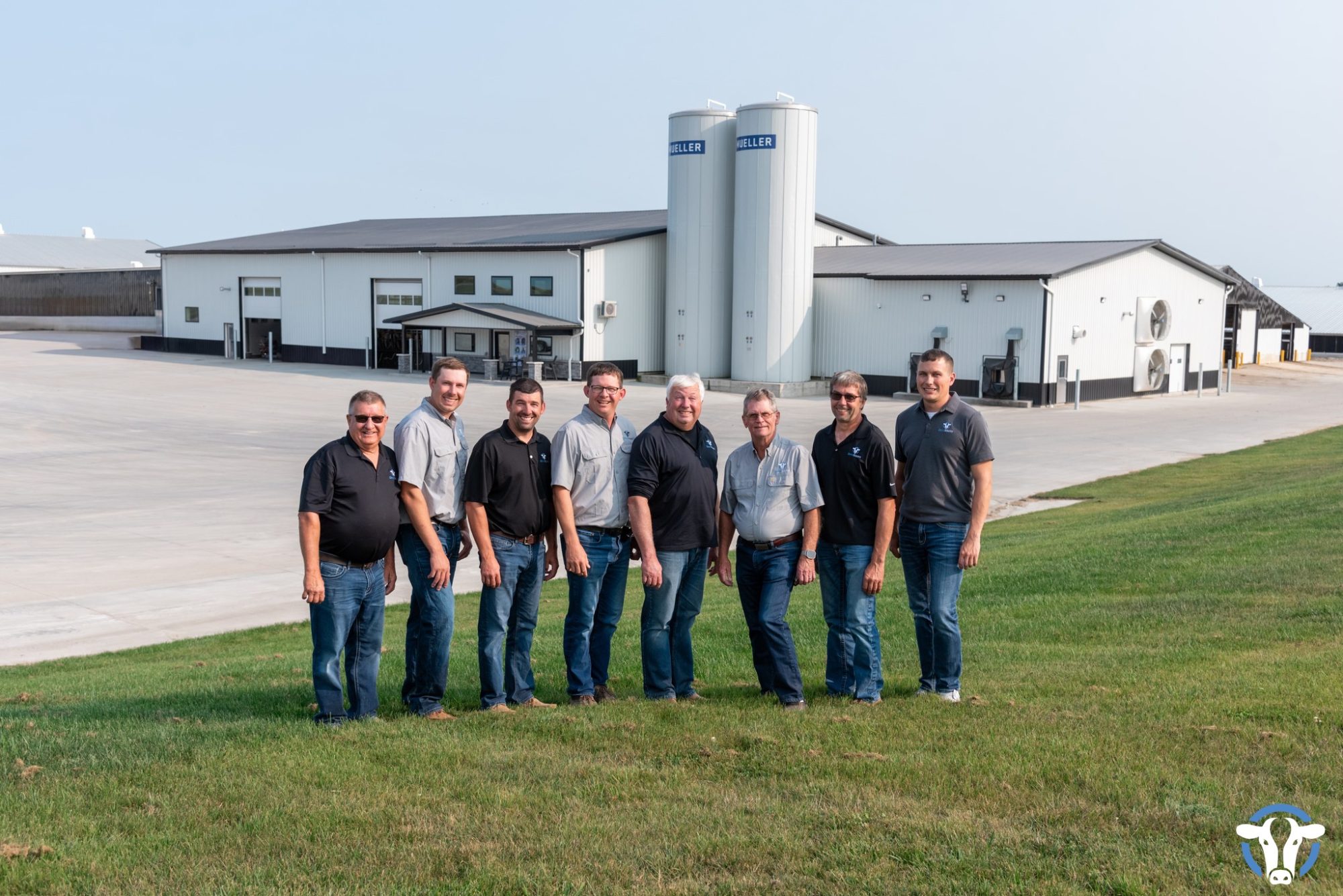
What moves me isn’t the scale of what they built—though 4,000 cows producing 93 pounds daily at 4.8% butterfat and 3.6% protein is genuinely extraordinary. What moves me is that they’re all still standing there together. Eleven years into a partnership that most consultants would say couldn’t work. Eight families who somehow agreed on the one thing that matters most.
Joe Simon started it all.
Here’s the part of this story I can’t stop thinking about: Joe lived to see everything. He passed away in September 2025 at age 97—just three months before the Dairy First Award was announced.
I find myself turning that timing over in my mind more than I probably should. Ninety-seven years old. Sixty-three years of living by a principle most people would’ve abandoned the first time it got expensive. And he left just before this final piece of validation arrived.
I don’t know if that’s tragic or perfect. Maybe both. Maybe by the time you’ve watched two of your bulls win Premier Sire at the same World Dairy Expo—which happened in October 2024, less than a year before he passed—maybe you’ve already seen everything you needed to see. Maybe the award was just paperwork at that point.
The Simon family philosophy has always been clear: never use the cheapest bull—use the best bull.
I’ve covered this industry long enough to know that everyone claims to believe in quality. What moves me about this story is that these families actually lived it—through market crashes, through a derecho that destroyed half their farm, through every moment when the cheap option sat right there waiting.
That philosophy changed everything for these families. It might change something for you, too.
The Man Who Refused to Compromise
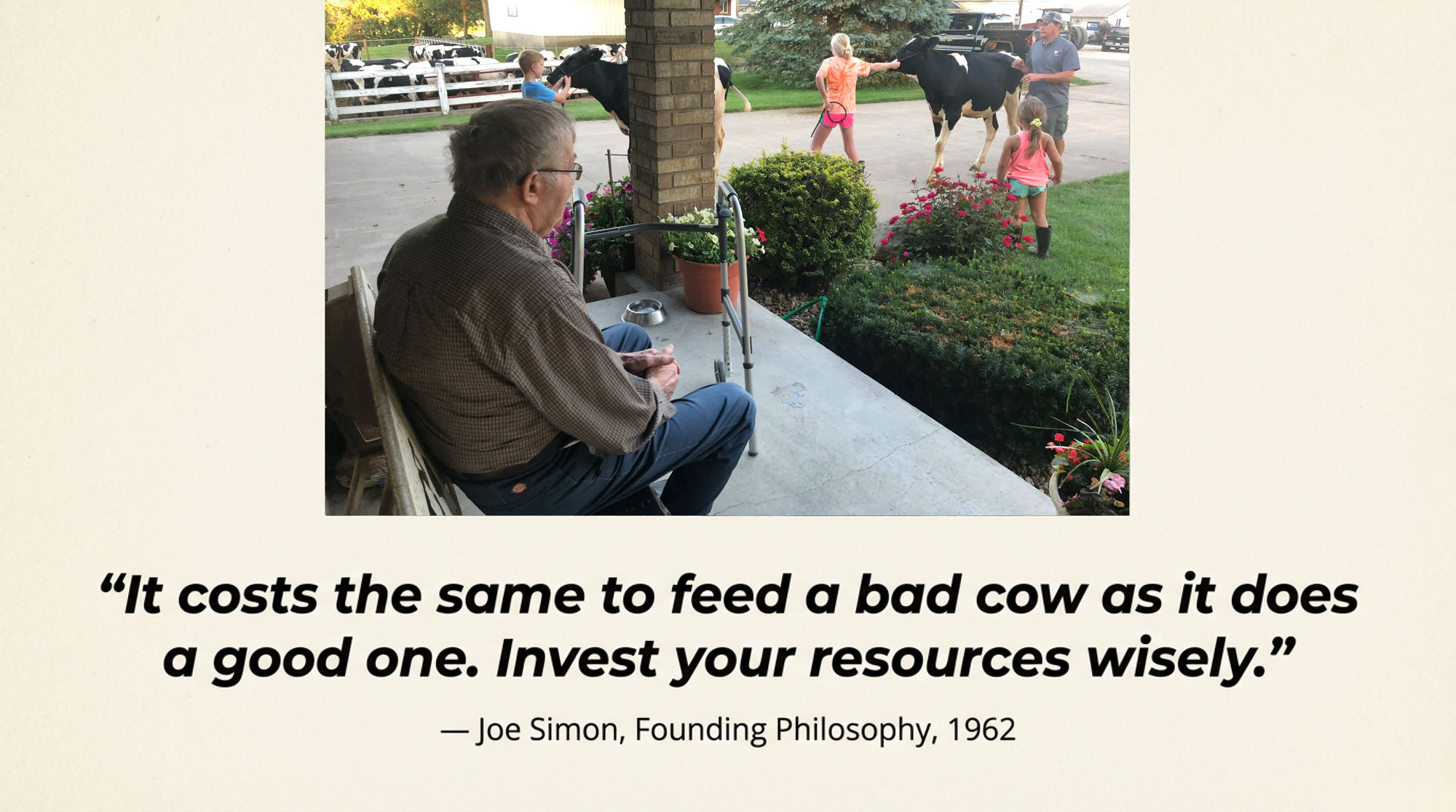
Joe Simon founded Farnear Holsteins in 1962 with a principle so simple it almost sounds naive: invest your resources wisely, because it costs the same to feed a bad cow as it does a good one.
I imagine him saying it—probably in a barn somewhere, probably to one of his ten children or forty grandchildren who’d just suggested cutting corners on a breeding decision. The kind of quiet wisdom that doesn’t feel revolutionary until you try to actually live by it when money gets tight, and the cheap option is sitting right there.
Joe lived by it for sixty-three years. Right up until the end.
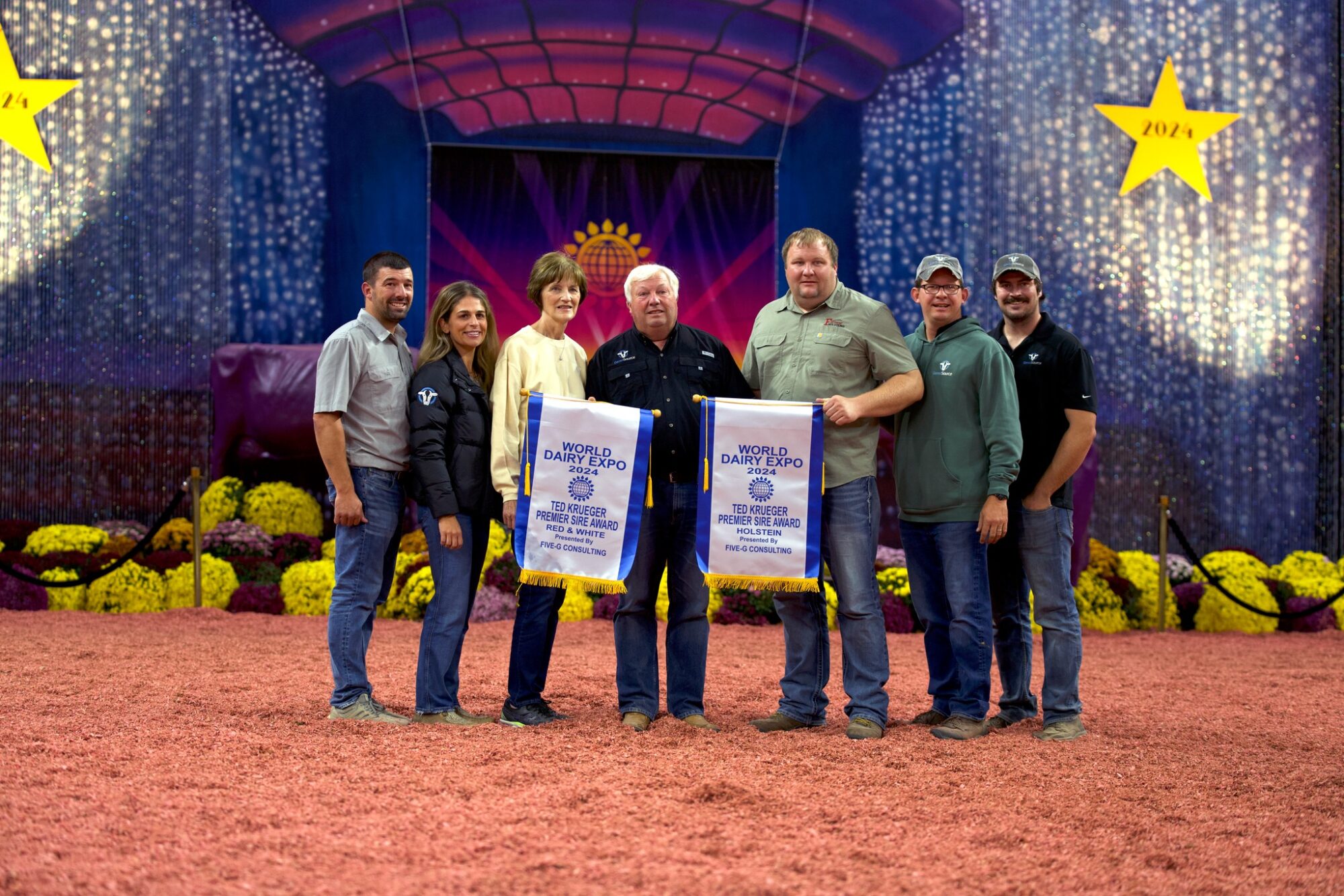
Tom Simon (center, holding banner) and the Farnear team celebrate a historic achievement at the 2024 World Dairy Expo, where Farnear Delta Lambda-ET and Farnear Altitude Red-ET were both named Premier Sires—a testament to sixty years of strategic breeding.
I think about what his face must have looked like when he heard that two Farnear-bred bulls had won Premier Sire at World Dairy Expo in October 2024. Delta-Lambda taking the black-and-white honor. Altitude Red is claiming the red-and-white title. The same show, the same year, the same family philosophy validated twice over.
In his late nineties at that point. Watching his life’s conviction proven on the biggest stage in dairy.
There’s a moment in every family when wisdom stops being “what Grandpa says” and becomes “what we believe.” Joe Simon didn’t just live long enough to see that moment—he lived to see it matter.
We all pay lip service to quality. But when milk checks shrink, and feed costs rise, “quality” is usually the first line item cut from the budget. That’s where the Simon family differed.
Joe held onto it anyway. And somehow, that stubbornness (because that’s what it is—a kind of holy stubbornness) passed down through the family like genetics itself.
The Conversation That Started Everything
I wish I could have been there in 2014 when the eight families first sat down together.
Pat Carroll. Tom Simon. Rick Simon. Matt Simon. Tim Rauen. Bill Rauen. Steve Rauen. Kyle Demmer. Their spouses, their hopes, their fears about what they were considering.
I picture the scene: maybe someone’s kitchen table, coffee going cold as the conversation stretched longer than anyone expected. Probably some uncomfortable silences. Definitely some hard questions about money, risk, and what happens if this doesn’t work. Someone’s kid wandering through asking when dinner would be ready, not understanding that the adults were deciding something that would shape their family’s next fifty years.
Tim Rauen, who would become CEO, describes their founding vision this way: “GenoSource was founded to create a modern, efficient cow capable of excelling in free-stall environments with few health issues and high feed efficiency. Each of our partners already had a start on their own genetic lines, and we believed bringing these bloodlines together could ultimately create a great genetic offering not only to our farm but to dairymen across the country.”
I don’t know if everyone said yes immediately. I’d be surprised if they did—eight families means eight different risk tolerances, eight different financial situations, eight different ideas about what “quality” actually means when you’re writing checks. But somehow, through whatever conversations I wasn’t there to hear, they found their way to the same answer.
That’s the part that still amazes me.
They formed GenoSource LLC with three cousins at the helm: Tim as CEO, handling vision and genetics strategy; Matt as CFO, managing the financial weight of their collective bet; and Kyle as COO, turning philosophy into daily operational reality.
“We don’t want to milk just any cow,” Tim explains. “We want to milk the best cow.”
What strikes me about that quote is who’s saying it. The conviction runs so deep now that it doesn’t matter whose grandfather first said it. That’s the thing about principles you actually mean—they don’t stay in one family. Somehow, they spread until everyone owns them.
The eight families didn’t just agree to use good genetics; they agreed to live by it. They agreed that “best bull, not cheapest bull” would be the non-negotiable foundation of every decision they’d make together.
“It costs the same to feed a bad cow as a good cow, so invest your resources wisely.” — Joe Simon, founding philosophy of Farnear Holsteins, 1962
When Teams Actually Work
Here’s something Matt Simon shared earlier this year that I keep thinking about: “Each member of our partner team brings their own area of expertise, whether it’s genetics, milk markets, finances, construction, cow care, or other specialties. We depend on each other to offer the best solutions, collaborating openly.”
That sounds like corporate boilerplate until you hear what comes next.
“With such a diverse team of partners and employees, we approach challenges with a focus on what’s best for the farm, leaving emotions aside. Disagreements or better suggestions don’t hold us back; we understand that everyone shares the same ultimate goal. We have discussions, make decisions, and move forward together.”
Eleven years. Eight families. “We have discussions, make decisions, and move forward together.”
The fact that they made it work for eleven years says something profound about what shared conviction can accomplish. Or maybe they’re all just really good at group texts.
I’ve seen partnerships like this fracture over less—over one family wanting to exit when another wanted to expand, over different ideas about debt tolerance, over whose kids get leadership roles and whose don’t. Eight families is a lot of futures to keep aligned.
But they did it. And six of their original team members have been with them since 2014. That kind of loyalty doesn’t happen by accident.
When Everything Falls Apart
Five years ago, the skies over Iowa darkened.
A derecho—a wall of wind with hurricane-force intensity—tore across the state in August 2020. When it passed, half of GenoSource lay in ruins.
[IMAGE: Aerial view of GenoSource facility damage following the August 2020 derecho]
Matt described the moment of decision that followed: “We had to decide whether to make quick fixes or invest in long-term improvements. True to GenoSource’s style, we chose to invest and started making upgrades.”
That’s not a small sentence. “True to GenoSource’s style” means they saw a destroyed farm and an opportunity to build something better. Most operations would have patched what they could and moved on. These eight families decided to rebuild toward a vision rather than back toward what they’d lost.
“Since then, we’ve been in a continuous state of construction,” Matt continued. “We’ve added stalls to all our barns, installed tunnel ventilation with smart controls, built a new 90-stall rotary, created a sand separation facility, and incorporated numerous cattle monitoring systems.”
They’re still not done. A methane digester is coming online. A state-of-the-art maternity barn is in progress.
“When we set our minds to something, we dive in fully.”
That’s the same philosophy Joe Simon lived by for sixty-three years. Never the cheapest option. Never the easy path. Always the best choice for the long term, even when the short term is screaming for relief.
The derecho didn’t break them. It revealed what they were made of.
The Numbers That Tell the Story
Today, GenoSource milks 4,000 cows in that 90-stall rotary parlor, with plans to expand to 4,500. They milk three times daily—a practice most large dairies avoid because the labor economics seem impossible. They’re producing 18,000 embryos annually from a donor group of about 250 head and placing around 200 bulls into AI collection each year.
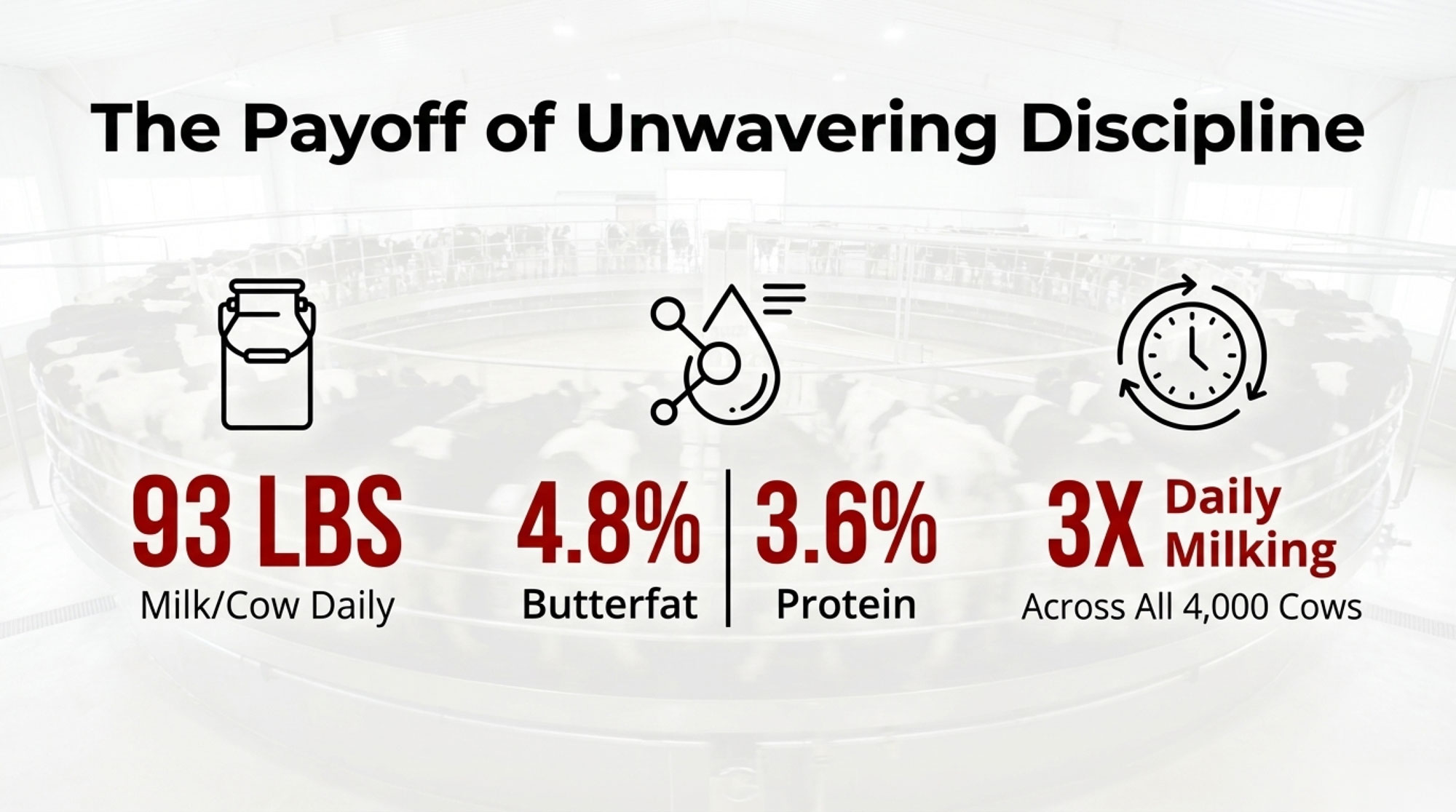
Their herd averages 93 pounds per cow daily at 4.8% butterfat and 3.6% protein. Those aren’t just impressive numbers individually—achieving them consistently across 4,000 cows is where management discipline and genetic foundation intersect in ways that matter.
And here’s the detail that shows me the philosophy actually works at scale: they test every female calf genomically. Every single one. All to identify which animals carry the legacy forward and which don’t.
Kyle Demmer captures the mindset driving all of this: “If you are not progressing, you are dying. We don’t believe in sitting still in any space of our business.”
Most operations would call genomic testing on every calf excessive. GenoSource calls it the whole point.
When Welfare and Economics Stop Fighting
Here’s something that surprised me in researching this story.
GenoSource milks three times daily across all 4,000 cows—not just the elite genetics tier, not just the registered animals, but everyone. That’s expensive. That’s labor-intensive. Most large operations avoid it because the math doesn’t seem to work.
Running a 90-stall rotary three times daily means cows are moving through that parlor around the clock—early morning, midday, and evening. It means staffing patterns that most operations can’t sustain. It means every cow, every day, getting that third milking, whether she’s a $50,000 donor or a commercial animal. No exceptions. No shortcuts.
But three-times-daily milking reduces udder pressure. It improves cow comfort. It lowers mastitis risk when properly managed. At their component levels—4.8% fat, 3.6% protein—the extra production from 3x milking actually pays for the additional labor.
They didn’t choose 3x milking because it was profitable. They chose it because it was right for the cows—and then they built a system where being right for the cows also happened to be right for the business.
Tim puts the broader philosophy this way: “Our milk check tells the story. Higher pregnancy rates, lower vet costs, and premium components all trace back to smart genetics.”
That’s not an accident. That’s what happens when you start every decision with “what’s actually right?” instead of “what’s cheapest?” Sometimes—not always, but sometimes—you discover that right and profitable aren’t as far apart as everyone assumes.
The Recognition That Kept Coming
The validation came in waves during 2024 and 2025—each one a quiet answer to sixty-three years of conviction.
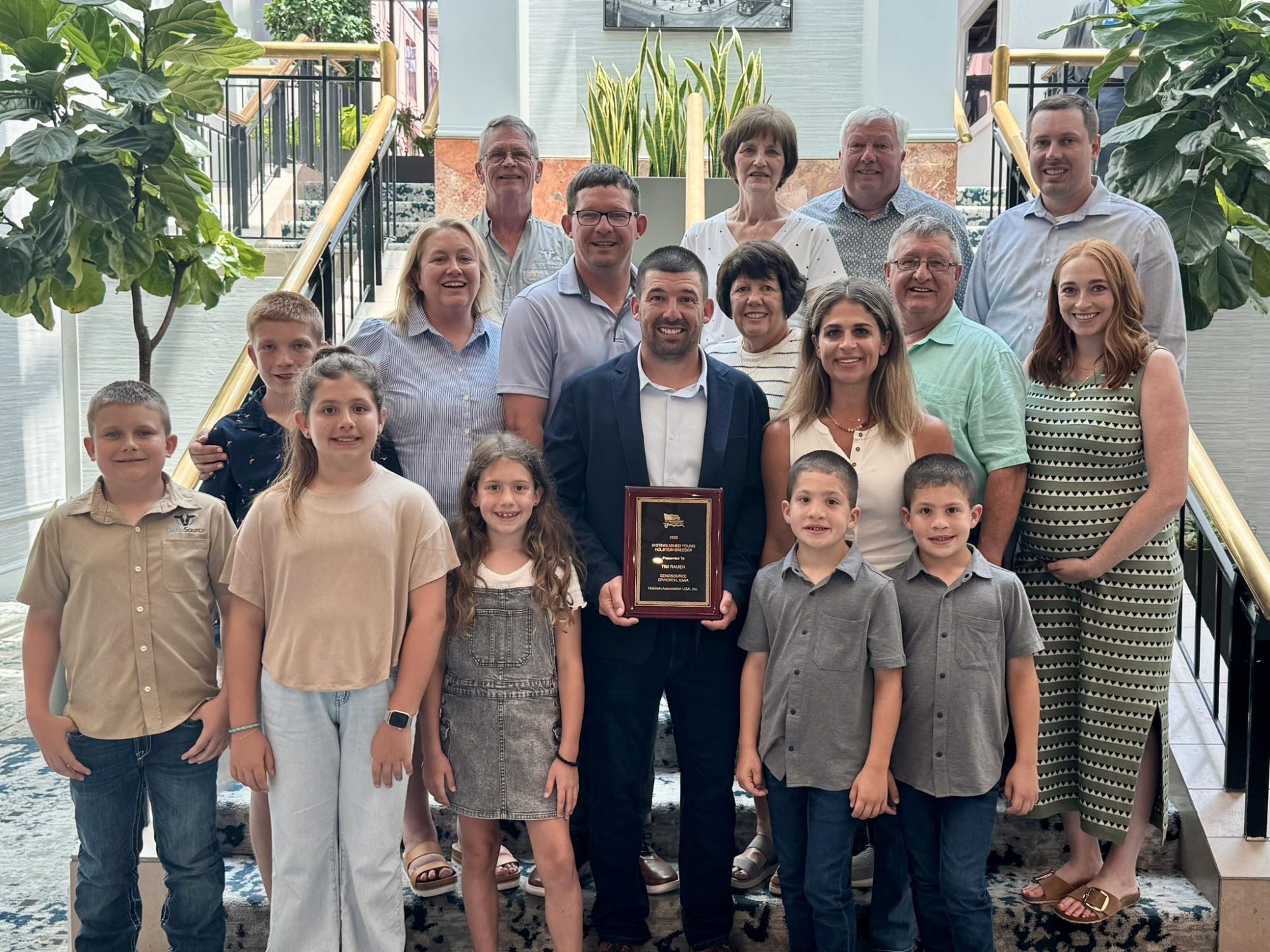
First, Tim Rauen was named Holstein Association USA’s 2025 Distinguished Young Holstein Breeder. Then came the 2024 World Dairy Expo, where Farnear Delta-Lambda-ET won Premier Sire of the International Holstein Show and Farnear Altitude Red-ET won Premier Sire of the International Red & White Show. Two Premier Sires from the same breeding program in the same year. That almost never happens.
Joe Simon was still alive for that. In his late nineties, watching his philosophy proven on the biggest stage in dairy.
Then, in December 2025—three months after Joe’s passing—Boehringer Ingelheim announced that GenoSource had won the 2025 Dairy First Award for their commitment to milk quality and animal welfare.
I’ll admit I’m always a little skeptical when pharmaceutical companies hand out awards. There’s usually a business relationship underneath, and recognition programs are rarely pure altruism. But here’s what matters: GenoSource had actually to perform to be award-worthy. You can’t fake 4.8% butterfat across 4,000 cows. You can’t fake the three-times-daily milking commitment when there’s no one watching.
Tim Rauen’s response captures something real: “We take great pride in the products we create for the end user. Whether it’s the milk or cheese, or selling semen around the world, we’re producing the best products to the best of our abilities, and feel really proud of what we’re doing.”
Pride. That word echoes through this whole story. Not pride in the scale—though the scale is impressive. Pride in knowing that every cow in that rotary, whether she’s registered elite or commercial milk, gets the same 3x milking, the same baseline of care. Pride in the philosophy holding up when it would’ve been easier to let it slip.
The Uncomfortable Math Most Farms Face
I want to be honest about something that bothers me about award stories: they can make success seem inevitable. They can make the distance between “you” and “them” feel unbridgeable.
So let me be clear about what GenoSource has that most farms don’t.
They have 63 years of genetic inventory, which began with Joe Simon in 1962. You can’t replicate that in a decade. They have eight families’ combined capital cushion—enough to absorb bad years, fund long-term investments, and rebuild after a derecho without betting the whole operation.
They have scale economics that make technology investments cost far less per cow than they would on a smaller operation. They have relationships with genetics companies that took years to build—partnerships with STgenetics, Select Sires, Semex, ABS, and others developed through consistent performance.
A 200-cow dairy reading this story cannot simply “do what GenoSource does.”
I need you to hear that, because pretending otherwise would be dishonest.
But—and this is the part I keep coming back to—a 200-cow dairy can absolutely do what Joe Simon did.
You can decide, today, that you’ll never use the cheapest bull again. Premium semen versus budget options might cost several thousand dollars more annually, but the genetic gain compounds over decades.
You can genomically test your top heifer calves and make smarter culling decisions. That’s a few thousand dollars per year for information that used to be impossible to get.
You can identify your elite cows and produce embryos for regional sales. That’s investment for genetics revenue that most farms leave on the table.
You can focus on milk components that earn premium pricing and invest in welfare practices that reduce health costs while improving cow comfort.
That’s not GenoSource at 200-cow scale. That’s Joe Simon at any scale—a commitment to something better, applied to whatever you’re working with.
The eight families didn’t start with 4,000 cows. They started with a shared belief. The cows came later.
What Keeps Me Up at Night
Here’s the question nobody asks at award ceremonies: What happens next?
Eight families can agree on a philosophy when they’re building something together. It’s harder to stay aligned when you’re protecting something valuable, and everyone has different ideas about how to do so.
The generation with direct memory of Joe Simon is getting older. Tim, Matt, and Kyle are running the operation beautifully. But their kids are growing up too—some already showing cattle on the national circuit. Within ten years, they’ll be in their 30s, asking their own questions about what “best bull” means in 2035.
Some families will have kids ready to enter the business. Some will be approaching retirement. Some will have children with no interest in dairy. What happens when those interests diverge?
Tim said something earlier this year that gives me hope: “We want to pass our farm down to our kids and in order to do that we have to make all our decisions count.”
That’s not just about genetics. That’s about building something durable enough to survive the transitions that break most partnerships.
I don’t know how that story ends. Nobody does. That’s the article someone will write in 2035.
But here’s what gives me hope: they’ve already done the hard thing once. They’ve already proven that eight families can share one vision, that cousins can lead together, that a grandfather’s wisdom can scale beyond anything he imagined. They’ve already rebuilt from a derecho that would have ended most operations.
If they did it once, maybe—just maybe—they can keep doing it.
What This Story Actually Means
I’ve been thinking about why this matters to farmers who will never have 4,000 cows, produce 18,000 embryos, or win industry awards.
It matters because Joe Simon’s principle isn’t really about bulls at all.
“Never use the cheapest—use the best” is a decision framework for life. It applies to the genetics you choose, yes. But it also applies to the people you hire, the equipment you maintain, the corners you refuse to cut, the standards you hold when nobody’s watching.
Every dairy farmer faces that choice daily. The easy path or the right path. The cheap option or the quality option. Good enough or actually good.
Kyle Demmer captures this mindset: “If you are not progressing, you are dying. We don’t believe in sitting still in any space of our business.”
The choices add up. Joe Simon understood that in 1962. His grandchildren proved it in 2024. And somewhere in the math of sixty-three years of breeding decisions, the compounding became undeniable.
The Photograph, One More Time
Look again at those eight families standing together in Blairstown, Iowa.
Pat Carroll. Tom Simon. Rick Simon. Matt Simon. Tim Rauen. Bill Rauen. Steve Rauen. Kyle Demmer. Their spouses. Their children. Their shared conviction.
What you’re seeing isn’t just a 2025 award winner. You’re seeing a sixty-three-year experiment in whether the choices actually add up, whether families can stay united around shared principles, whether a grandfather’s simple stubbornness can survive industrialization and scale, and whether a derecho that destroyed half of everything they’d built can be overcome.
The experiment is still running. The next generation is already learning the philosophy—some of them probably rolling their eyes at another “Grandpa Joe story” while secretly taking notes. The future is already being shaped by decisions made today.
Joe Simon isn’t here to see what comes next. He passed in September 2025, at 97, having witnessed more validation of his life’s philosophy than most people ever do. Two Premier Sires. An operation that kept his principle at its center. Eight families still standing together. Grandchildren who speak his wisdom as their own.
And somewhere, right now, a farmer is reading this story and thinking about next spring’s breeding decisions. Not because they’ll ever have 18,000 embryos or win industry awards. Because they recognize the truth in what Joe Simon figured out before most of us were born.
Joe bet sixty-three years on a simple idea. Eight families bet their futures on it. The awards and the photograph already answered whether they were right.
The question is what you’ll bet on, the next time you’re standing in front of a choice that could go either way.
For the complete story of GenoSource’s genetic program, technology innovations, and Captain’s remarkable legacy, see our in-depth profile: From Pasture to Powerhouse: The GenoSource Story and The Farnear Formula: How Strategic Thinking Built a Sixty-Year Dairy Dynasty
Learn More
- Unlock Hidden Dairy Profits Through Lifetime Efficiency – Cut your feed costs by $251 per cow using the specific RFI genetic selection and nutrition protocols detailed here. This guide moves beyond theory to show you exactly how efficiency compounds on your balance sheet, regardless of milk price volatility.
- Bred for Success, Priced for Failure: Your 4-Path Survival Guide – Decide your operation’s future before the market decides for you. We break down the only four viable business models left in the genomic era—from hyper-scale to specialized niche—so you can stop guessing and start positioning your farm for 2030.
- The Epigenetic Edge: How UK Herds Are Achieving a 7:1 ROI – See the technology that makes standard genomic testing look outdated. Discover how European herds are generating a 7:1 return by measuring gene expression (not just potential), delivering a 22% yield bump that most U.S. producers don’t even know is possible yet.
 The Sunday Read Dairy Professionals Don’t Skip.
 The Sunday Read Dairy Professionals Don’t Skip.
Every week, thousands of producers, breeders, and industry insiders open Bullvine Weekly for genetics insights, market shifts, and profit strategies they won’t find anywhere else. One email. Five minutes. Smarter decisions all week.