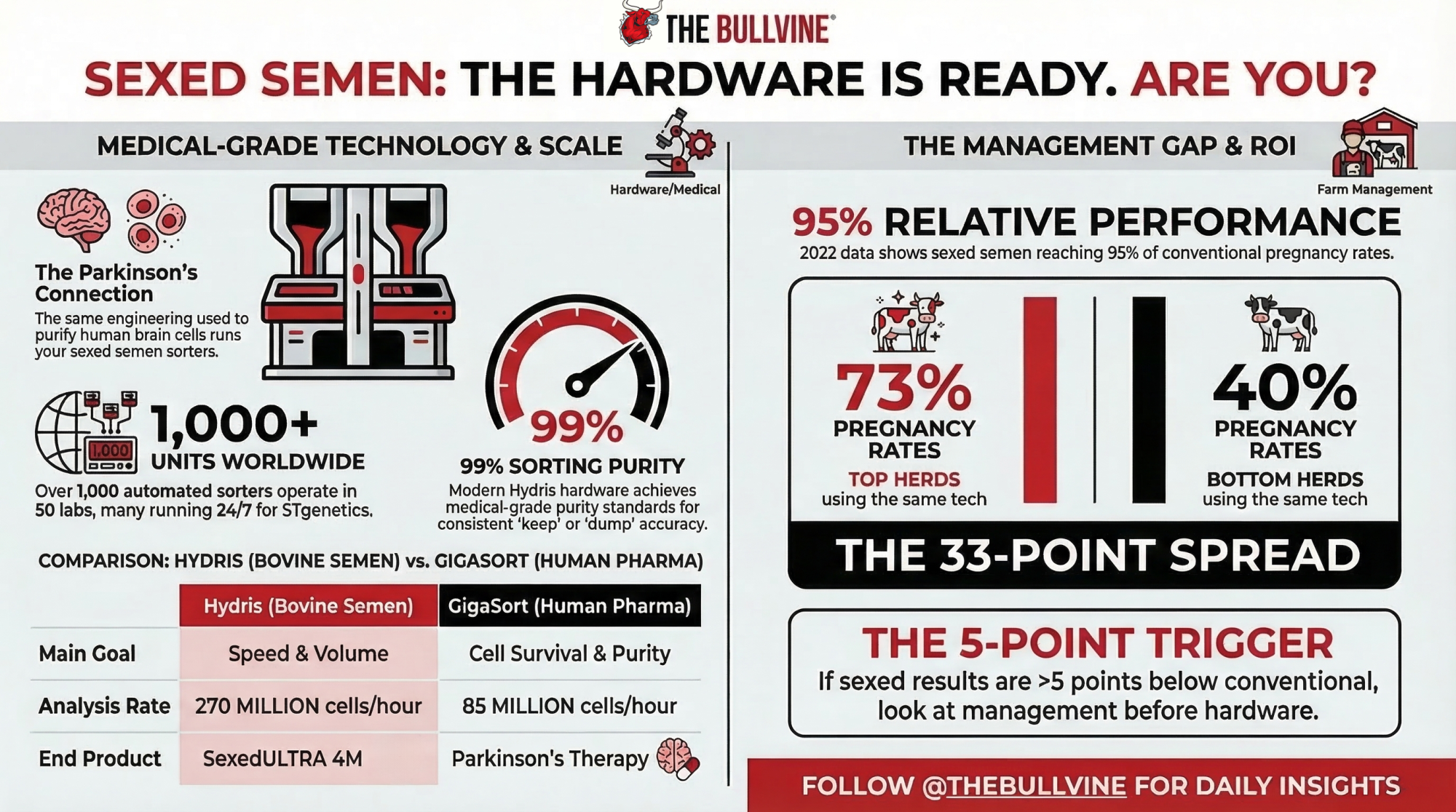
The same engineering trusted to run over 1,000 industrial sorters behind SexedULTRA 4M is now being trusted to purify cells for a human brain to treat Parkinson’s disease.
Executive Summary: Japan approved the world’s first iPS cell therapy for Parkinson’s disease on March 6, 2026. The sorter that purified those cells for human brains was built by Cytonome-ST — a subsidiary of STgenetics — and its sibling platform, Hydris SuperGen, now runs over 1,000 units across 50 labs, sorting every SexedULTRA 4M straw ST and its licensees sell. The hardware story has shifted fast: Ireland’s ICBF reports sexed semen at 95% of conventional pregnancy rates in 2022 commercial inseminations, up from 84% in earlier rounds. But the sharper stat is the 33-point spread between top herds (73% CR) and bottom herds (40%) — same technology, same country, gap driven almost entirely by management. For producers loading SexedULTRA 4M or genderSELECTed straws, the sorting machine is no longer the weak link in the chain. Your records — not the hardware — now hold the answer to whether you’re capturing what this technology can deliver.

If you’re loading SexedULTRA 4M straws this spring, you’re tied to a piece of hardware you’ve probably never seen. Somewhere between collection and your heifer pen, that semen ran through a Cytonome Hydris sorter — built by the same company, under the same engineering roof, that helped manufacture AMCHEPRY® (raguneprocel), the world’s first approved iPS cell-derived therapy for Parkinson’s disease. Japan’s health ministry granted conditional approval on March 6, 2026.
That’s a strange connection. A machine built to clean up cell batches destined for human brains was developed by the same team that developed the sorting platform to separate the sperm that decide your next calf crop. But here’s the part that matters for your operation: if the hardware is that serious, are your sexed semen results keeping up — or are you paying a premium for technology your management hasn’t caught up with yet?
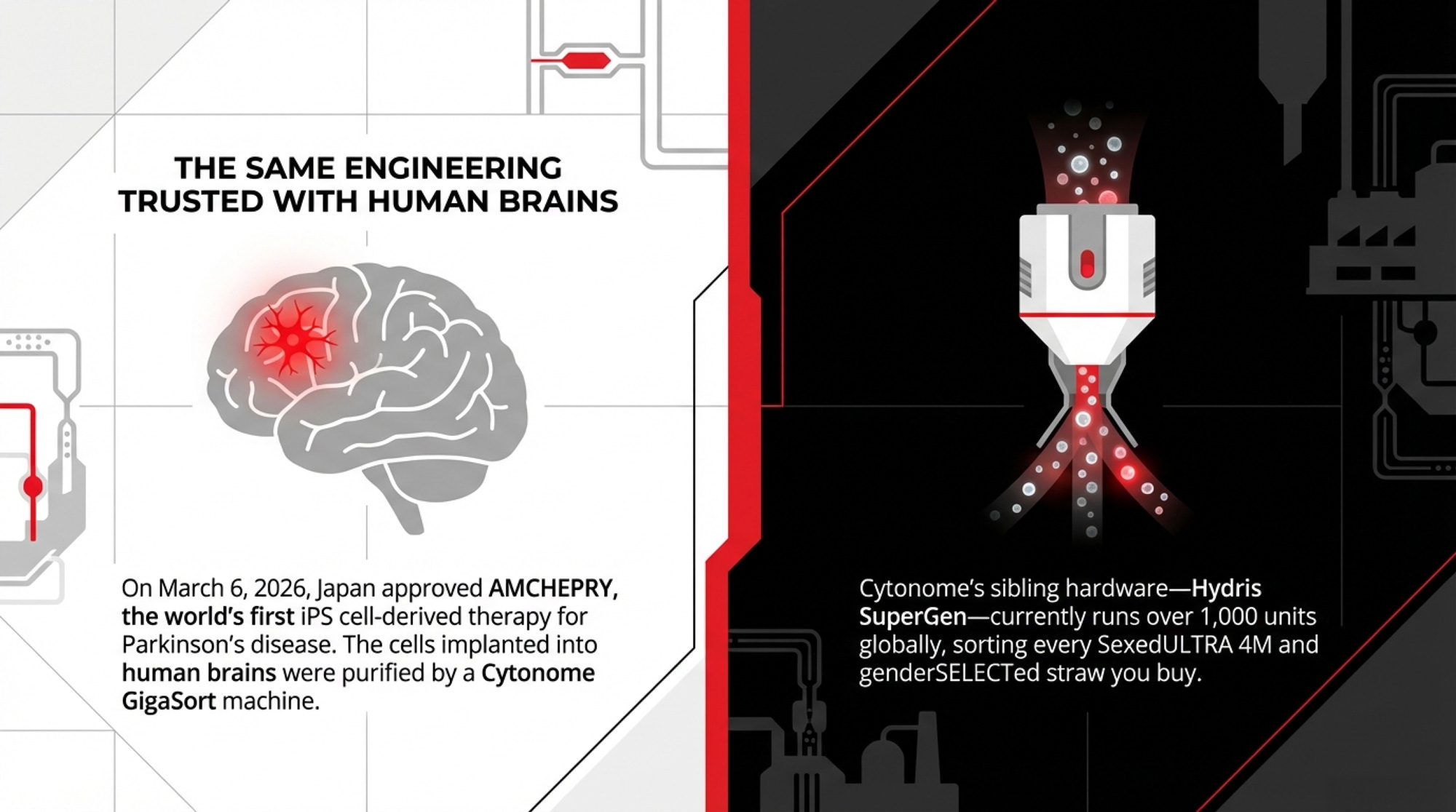
The Parkinson’s Connection: Why a Human Therapy Trusted Cytonome
Under a recently published clinical trial, Kyoto University Hospital transplanted dopaminergic neural progenitor cells into the brains of seven patients with Parkinson’s disease aged 50–69. The cells were derived from induced pluripotent stem (iPS) cells, and the entire project hinged on whether those cells were safe and pure enough to be implanted into a living brain.
The published results in Nature landed hard: PET scans showed an average 44.7% increase in dopamine synthesis, with a 63.5% bump in the high-dose group. Off-state motor scores improved by about 9.5 points (20.4%). No tumors. No graft-induced dyskinesia in the follow-up window.
But the clinical results only happened because somebody solved the manufacturing bottleneck first. Differentiating iPS cells produces a messy mix — some cells are exactly what you want, others are off-type or undifferentiated troublemakers that could potentially turn malignant. Jun Takahashi, who led the Kyoto trial, called sorting CORIN-positive cells the “biggest challenge.” CORIN is the surface marker that flags dopaminergic progenitors: enrich those, eliminate the rest, and you’ve got a product. Miss, and you’ve got a liability.
Cytonome’s GigaSort™ microfluidic sorter handled that job. Sumitomo Pharma used the GigaSort as a key manufacturing step for AMCHEPRY, and it’s named in the trial’s production record — not buried in a footnote but documented as part of the clinical-grade workflow.
Inside the GigaSort: 24 Sorting Lanes, Zero Aerosols
GigaSort works nothing like a conventional cell sorter. Instead of launching cells through a single high-velocity jet, it runs them through 24 parallel microfluidic channels in a sealed glass chip. Think of it as 24 tiny sorting lanes operating simultaneously inside a closed cartridge (akin to someone who might try to use 24 lanes to draft cattle or sheep). A 532 nm laser and a multi-channel fluorescence system read markers such as CORIN as each cell passes the detection point.
When the system spots a target cell, a microfluidic switch diverts it into the “keep” stream. Everything else goes to waste. No aerosols, no open jets, no charged droplets. The entire fluid path is contained within a single-use, gamma-irradiated cartridge — swap the consumable, and you’re back in business with zero risk of cross-contamination with the next cell batch.
Cytonome’s published specs: 500 million cells processed in about six hours, sort purity above 99% depending on cell type. The platform is built under ISO 9001:2015 and ISO 13485:2016 standards. In other words, it’s engineered and documented like a medical device.
That’s the hardware behind AMCHEPRY. Now look at the other machine in this family.
Hydris Supergen: The Workhorse Behind SexedULTRA 4M
GigaSort is gentle. Hydris is relentless.
Cytonome’s Hydris platform is built to sort massive cell volumes around the clock. The company’s own product page states that “over 1000 highly automated and self-monitoring cell sorting units are in use in 50 labs around the world, many of which are in 24/7 operation environments.” Those units are primarily working for STgenetics and its partners.
Hydris runs on classic jet-in-air droplet sorting — the same fundamental approach that’s powered sperm sexing for decades, but with Cytonome’s engineering refinements:
- Semen is stained with a DNA dye so that X- and Y-bearing sperm fluoresce at different intensities.
- A nozzle aligns sperm in a single file; a 355 nm laser excites the stain.
- Electronics read the fluorescence signal, characterise each cell, and assign “keep” or “dump” to the droplet carrying it.
- Droplets get electrically charged and deflected into separate collection tubes.
The spec sheet: analysis rate up to 1 billion cells per hour, purification rate up to 300 million per hour, sort purity above 99%. The system supports up to three parallel sort heads, each individually monitored. It’s built for walk-away operation in high-volume labs.
Cytonome doesn’t hedge about where Hydris lives commercially. Their website says it’s “been deployed with great commercial success by STgenetics, our customer and major shareholder, for their livestock reproductive products.” And if you’re buying Select Sires’ genderSELECTed semen — confirmed by Select Sires Canada’s own materials and Missouri Extension’s G2026 factsheet as using SexedULTRA technology licensed from ST — Hydris hardware is almost certainly in your supply chain too.
| Factor | Parkinson’s Cell Therapy (GigaSort) | Dairy Sexed Semen (STgenetics) | Shared Technology |
| What’s Being Sorted | Human iPSC-derived dopaminergic progenitor cells | X-bearing vs. Y-bearing bovine sperm | Single-cell flow cytometry |
| Sorting Speed | 500M cells in 6 hours | 25,000 droplets/second @ 50 mph | Parallel microfluidic channels |
| Purity Accuracy | 95%+ (prevents tumor formation) | 90%+ (guarantees female calves) | Laser fluorescence detection |
| Equipment Cost | $500K-1.5M per GigaSort unit | $500K per Genesis sorter | High-precision flow cytometers |
| Clinical/Commercial Use | Sumitomo Pharma clinical trials (2021-present) | 50M+ calves born globally (2014-2024) | FDA/GMP-compliant protocols |
| Why It Matters | Enables cell replacement therapy for brain disease | Accelerates genetic gain in dairy herds by 30% | Biotech precision meets agriculture scale |
Does the Sorting Machine Actually Affect Your Conception Rate?
Bull sperm are tougher than human stem cells, but they’re not indestructible.
They’re designed to survive ejaculation, cooling, freezing, and the female reproductive tract. But the parts that actually matter for fertility — the acrosome cap, mitochondrial sheath, and DNA integrity — are sensitive to exactly the stresses a sorter introduces: pressure differentials, electrical charging, UV exposure, and chemical staining.
A December 2025 meta-analysis by Yodrug and colleagues in Veterinary World compiled 91 studies across 13 species,spanning nearly two decades of sperm-sexing research. Across all species, flow-cytometry-sorted semen showed a pooled pregnancy rate of around 46.47%. In cattle specifically: 37.67%. Sorted semen also tended to show lower post-sort motility than samples processed with gentler centrifugation methods.
That 37.67% cattle average is dragged down hard by older data — other earlier-generation machines, rougher staining protocols, smaller trials, and management practices that hadn’t yet adapted to sexed semen’s narrower margin for error. It doesn’t reflect what’s coming off a modern Hydris line under current commercial protocols.
The real question isn’t whether sorting stresses sperm. Obviously, it does. The question is whether your program is still paying a fertility penalty from old technology, or whether the hardware and management have caught up enough that the gap has effectively closed.
Are Sexed Semen Conception Rates Finally Matching Conventional?
You don’t make breeding decisions off one trial. But the trend line is hard to argue with.
Beef Baseline: Crites et al. (2018)
A Theriogenology study out of the University of Kentucky compared SexedULTRA 4M with conventional semen in 394 beef females (316 cows, 78 heifers) across six locations under fixed-time AI. Among females expressing estrus, conception rates were 63.8% for sex-sorted vs 61.9% for conventional — statistically no different (P = 0.61).
That was beef, not dairy. Different management, different nutrition, different stress loads. But it proved something that mattered: under controlled conditions with modern hardware, sexed semen didn’t have to carry a built-in 15-point penalty.
Commercial Scale: ICBF Ireland (2023)
The Irish Cattle Breeding Federation, Teagasc, and four AI companies analyzed 1.82 million conventional inseminations and 85,645 sexed inseminations across Irish dairy and beef farms from 2018–2022. Their May 2023 report:
- Overall 2018–2022 pregnancy rates: 64% conventional vs 59% sexed — 92% relative performance.
- 2022 inseminations alone: 63% conventional vs 60% sexed — 95% relative performance.
That 95% figure is a massive jump from earlier Irish studies in 2013, 2018, and 2019, which had sexed semen sitting at about 84% of conventional.
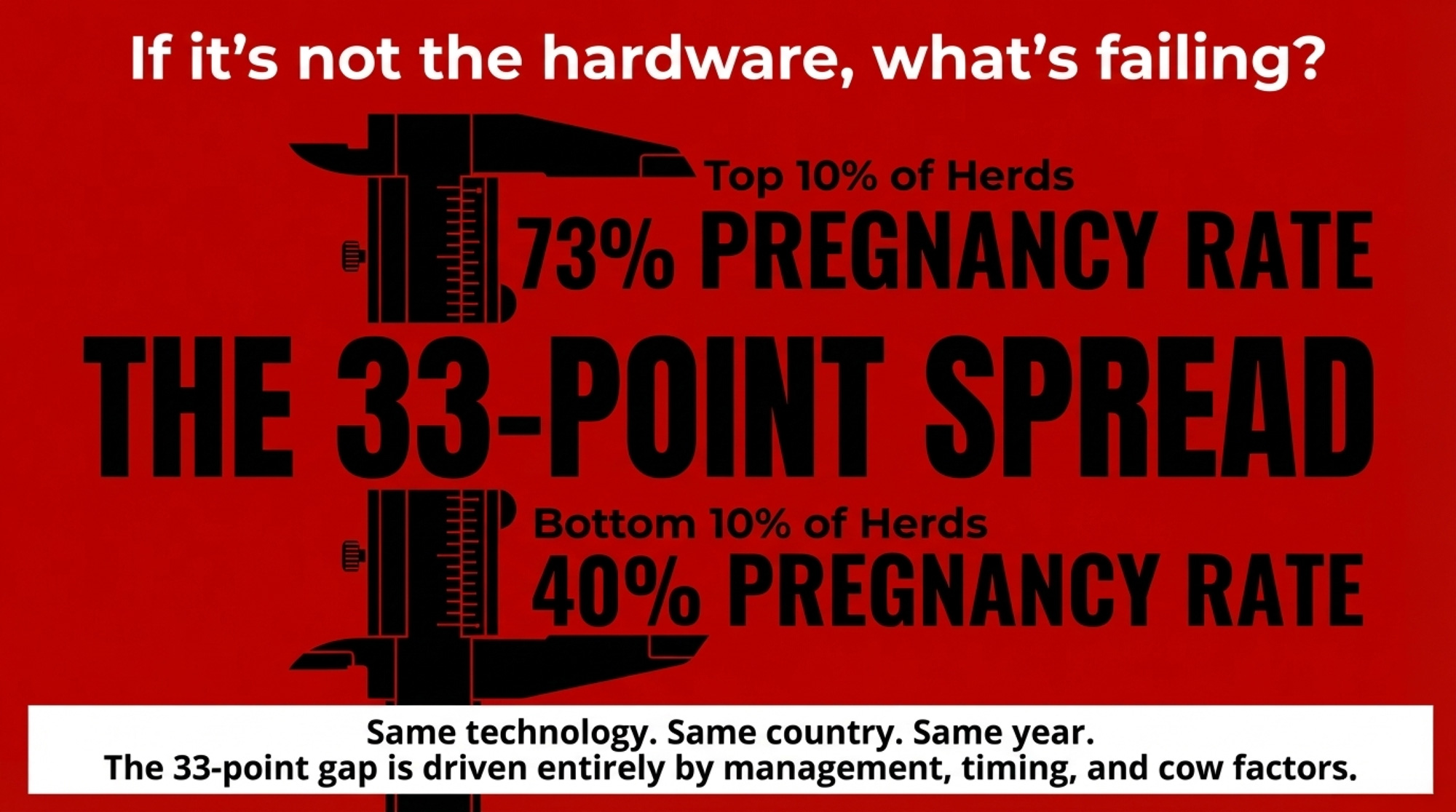
But the line that should stop you cold isn’t the average. It’s the spread between herds:
- Top 10% of herds using sexed semen: 73% pregnancy rate.
- Bottom 10%: 40%.
Same technology. Same country. Same year. A 33-point gap driven almost entirely by management and cow factors — not hardware. [Read: the genetics decisions hiding in plain sight]
As Teagasc’s Stephen Butler noted, the relative performance, now at 92–95%, “should hopefully encourage more dairy farmers to consider using the product.”
One important caveat: this is Irish data, collected under Irish seasonal grazing systems. North American commercial dairy field data at a comparable scale — millions of inseminations, multi-year, specifically with SexedULTRA 4M— hasn’t been published in peer-reviewed form as of March 2026. The trend direction is consistent, but your regional results will reflect your own management, climate, and cow condition.
| Technology Generation | Year Introduced | Key Hardware Upgrade | Sperm per Straw | Conception Rate (Heifers) | Competitive Impact |
| Legacy Flow Cytometry | 2004-2011 | Basic single-head sorters | 2 million | 35-40% | Experimental only |
| Genesis Multi-Head | 2012-2014 | Digital processing, orienting nozzles, automation | 2 million | 45-50% | First viable commercial product |
| SexedULTRA Genesis | 2015-2018 | Advanced extenders, improved handling protocols | 2-3 million | 52-58% | Narrows gap to conventional by 50% |
| UltraPlus 4M (Current) | 2019-present | 4 million sperm/straw (2x standard) | 4 million | 56-62% | Near-conventional fertility + 90% female accuracy |
The Barn Math: What a Few Percentage Points Actually Cost
Here’s where percentages turn into dollars.
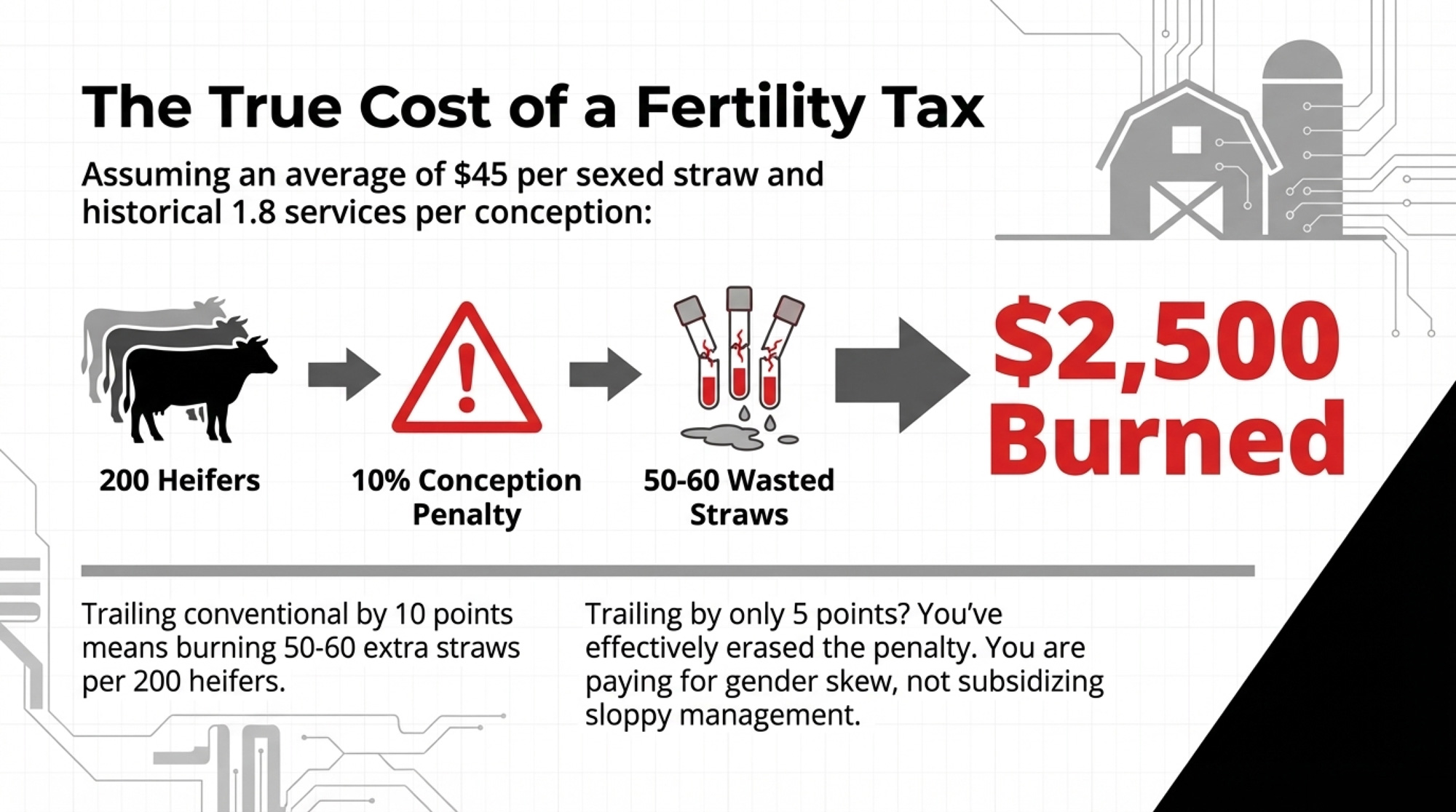
Say you’re breeding 200 heifers this year with sexed semen. ST’s Spring 2021 price sheets showed many elite Holstein SexedULTRA 4M sires in the $50–60 per straw range versus $15–22 conventional on the same bulls. On the beef side, STgenetics’ own marketing listed VBV ROA Red Galaxy at $60 SexedULTRA 4M vs $45 conventional in 2018–2019 posts. Your local, current pricing will differ — plug in your own numbers.
Using a mid-range $45 per straw and a historical 1.8 services per conception (~56% CR):
- 200 heifers × 1.8 services = 360 straws.
- 360 straws × $45 = $16,200 for that heifer group.
Each percentage point of conception-rate improvement saves roughly 5–6 straws across the group, or about $225–270 per year at that price point.
If sexed semen in your herd runs 10 points behind conventional, you’re burning 50–60 extra straws and $2,250–2,700on that 200-head cohort — plus the knock-on cost of extra days open, more rebreeds, and a slower heifer pipeline. If it’s running within about 5 points? You’ve mostly erased that old penalty. You’re paying for gender skew and flexibility, not subsidizing a fertility tax.
The ICBF data say it’s possible. Your records say whether it’s real on your farm. [Read: your heifer breeding window matters more than you think]
Where STgenetics Fits: Hardware and Bulls Under One Roof
Most studs don’t own their sorting technology. ST does.
STgenetics owns Cytonome-ST — the company behind both GigaSort (used in AMCHEPRY’s manufacturing chain) and Hydris (used in ST’s global livestock labs). Cytonome lists over 1,000 Hydris sorters deployed in 50 labs, many running 24/7, and publicly calls STgenetics their “customer and major shareholder.”
Select Sires’ genderSELECTed semen uses SexedULTRA technology licensed from ST — confirmed in Select Sires Canada’s own publications and Missouri Extension’s G2026 factsheet. Those straws run over Hydris hardware, too.
That vertical integration gives ST a different position than studs buying time on someone else’s machines. When they talk about SexedULTRA 4M performance, they’re talking about a platform they helped engineer. Not a black box somebody else maintains.
That doesn’t automatically make SexedULTRA the right product for every herd. Some operations will concentrate with one supplier because the hardware, genetics, and service line up cleanly — one system to tune. Others will keep two studs in play to hedge pricing or policy shifts. The point is to make that choice deliberately, based on your data, not by default. [Read: the economics driving consolidation]
What This Means for Your Operation
In the next 30 days, ask your supplier one straight question. “What sorting platform processed my last sexed semen order, and what sort-purity or QA standards does it meet?” From ST or Select Sires, you should hear “Cytonome Hydris SuperGen, >99% purity,” backed by published specifications. If any supplier can’t name their platform or share basic QA documentation, that tells you something about how seriously they take the process.
In the next 90 days, pull your own sexed vs conventional conception rates. Run at least two breeding seasons side by side — heifers vs heifers, cows vs cows, same season. If sexed semen is consistently more than about 5 points below conventional on comparable groups, that’s your troubleshooting trigger. Look hard at heat detection, timing, semen handling, and cow body condition before you point at the straw.
Within a year, decide whether hardware transparency matters in your supplier mix. Concentration has advantages — simpler data, tighter relationships, and one QA system to understand. Diversification hedges risk. Neither answer is wrong. The wrong answer is never asking the question.
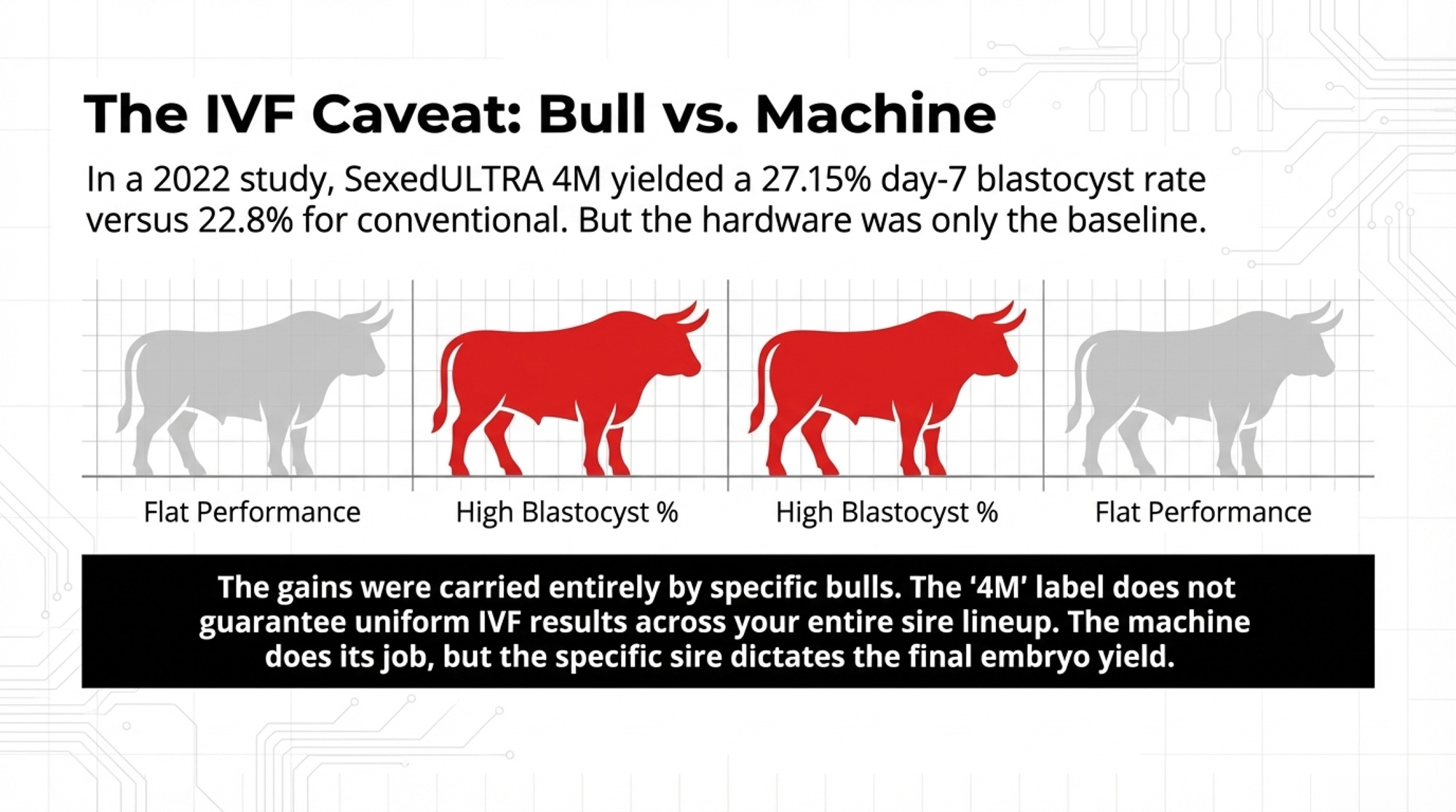
If you’re running IVF, treat the sorting platform as part of the sire decision. A 2022 Animal Reproduction study by Álvarez-Gallardo et al. using SexedULTRA 4M found 27.15% day-7 blastocyst rates vs 22.8% for conventional (P = 0.009) — but most of that gain came from specific bulls. Bulls 2 and 3 carried the result; Bulls 1 and 4 showed no significant advantage. Ask your IVF lab which sires over- or under-perform with sexed semen on their system. The “4M” label doesn’t guarantee uniform results across every bull in your lineup.
Watch microfluidics. The Yodrug 2025 meta-analysis flagged microfluidic sperm separation as an emerging technique with potential for gentler handling, but noted that in vivo fertility data are thin and throughput can’t yet match Hydris-scale production. Cytonome already operates a proven microfluidic platform (GigaSort) capable of processing tens of millions of cells per hour for human therapy. If that engineering ever migrates to sperm sorting at Hydris-like volume, the sexed semen hardware conversation changes again. [Read: how a handful of genetics decisions changed an entire breed]
Key Takeaways
- If your sexed semen conception rate is consistently more than about 5 points below conventional on comparable cattle and seasons, you’ve got a management issue worth fixing before you question the hardware.
- If you’re buying SexedULTRA 4M or genderSELECTed semen, you’re betting on Cytonome Hydris every time you breed — the same engineering family behind a human Parkinson’s cell therapy. That’s a credible hardware story, as long as your own numbers back it up.
- If your supplier can’t tell you what sorters they use or share QA documentation, factor that into your buying decisions.
- If you’re investing in IVF, treat sexed semen performance as bull-specific. The sorting platform and your sire list both matter to whether those embryos hit the targets you’re paying for.
The Bottom Line
The hardware behind your straws has quietly become medical-grade. The independent field data say parity with conventional is genuinely within reach for herds that manage the details.
Whether your operation is actually capturing that — or still paying the old penalty through sloppy timing, rough handling, or cows that aren’t ready — is a question only your own records can answer. When’s the last time you pulled those numbers?
Complete references and supporting documentation are available upon request by contacting the editorial team at editor@thebullvine.com.
Learn More
- Beef-on-Dairy’s $6,215 Secret: Why 72% of Herds Are Playing It Wrong – Breaks down the 30% pregnancy rate threshold that separates $6,215 in monthly calf revenue from absolute failure. It delivers concrete tiers for sexed semen deployment, ensuring your Monday morning breeding decisions maximize profit without starving your replacement pipeline.
- $3,010 Per Heifer. 800,000 Short. Your Beef-on-Dairy Bill Is Due. – Exposes the brutal reality of a $3,000-per-heifer market and the 800,000-head inventory gap through 2026. It arms you with four strategic paths to rebalance your breeding sheet before skyrocketing replacement costs erode your operation’s long-term equity.
- The UK’s Sexed Semen Playbook: How UK Dairies Hit 84% While You’re Still Stuck at 50/50 – Reveals how UK producers hit 84% sexed semen adoption while North America lags behind. It breaks down the systematic approach to 4M technology and policy shifts that converted a feared “fertility penalty” into a high-margin competitive advantage.
 The Sunday Read Dairy Professionals Don’t Skip.
 The Sunday Read Dairy Professionals Don’t Skip.
Every week, thousands of producers, breeders, and industry insiders open Bullvine Weekly for genetics insights, market shifts, and profit strategies they won’t find anywhere else. One email. Five minutes. Smarter decisions all week.