The smartest dairies aren’t just milking cows anymore—they’re connecting breeding, markets, and risk into one profitable system
EXECUTIVE SUMMARY: What farmers are discovering across the country is that 2025’s most profitable dairies have stopped treating breeding, market timing, and risk management as separate functions—they’re integrating them into strategic systems that maximize both immediate cash flow and long-term genetic progress. Recent USDA data shows milk production in major dairy states increased 3.3% year-over-year to 18.8 billion pounds, driven largely by farms confident in dual revenue streams where beef-cross calves now contribute meaningful dollars per hundredweight to overall margins. Progressive operations are using genomic testing to segment herds strategically, with top genetic performers earmarked for replacement production while bottom performers generate premium beef-cross income that funds facility improvements and equipment upgrades. This shift is supported by the $1.2 billion in Dairy Margin Coverage payments delivered in 2023, which smart farms are using not just as insurance but as strategic tools that influence breeding timing and production planning. Extension specialists from Wisconsin to California report that operations implementing these integrated approaches are seeing substantial improvements in breeding economics while maintaining genetic progress rates. The transformation suggests we’re moving toward a more sophisticated industry where success comes from strategic thinking rather than just operational efficiency. Here’s what this means for your operation: the tools and expertise needed for this integration are increasingly accessible to farms of all sizes, creating unprecedented opportunities for producers ready to adapt their decision-making systems.
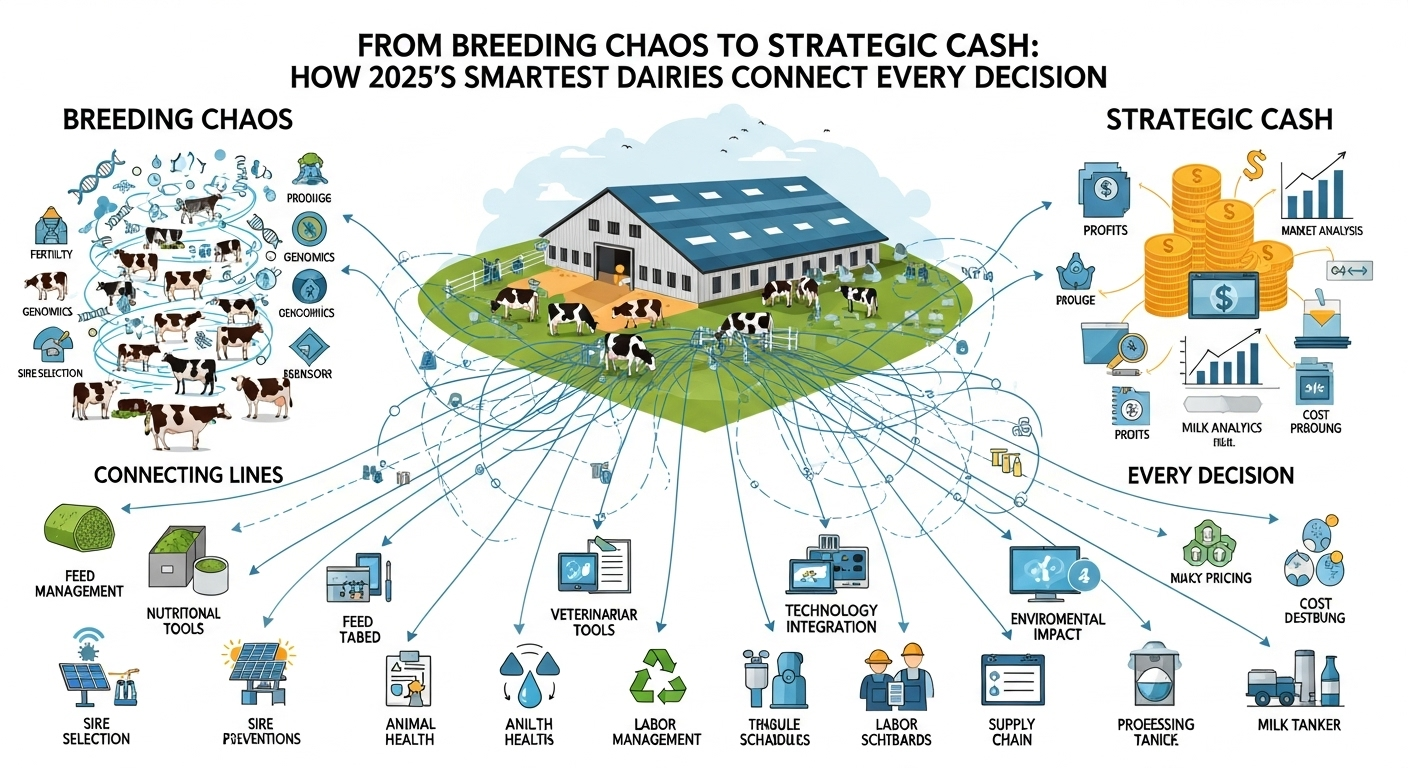
What started as a dairy boom has become something far more significant—a fundamental shift in how progressive farms balance genetics, markets, and risk in real-time decision-making.
You know that feeling when you walk into the hotel lobby after a producer meeting and everyone’s huddled around talking about the same thing? That’s where we are with dairy right now. What’s unfolding in 2025 goes way beyond the obvious headlines—the massive processing investments and the beef-cross calf premiums that have everyone’s attention.
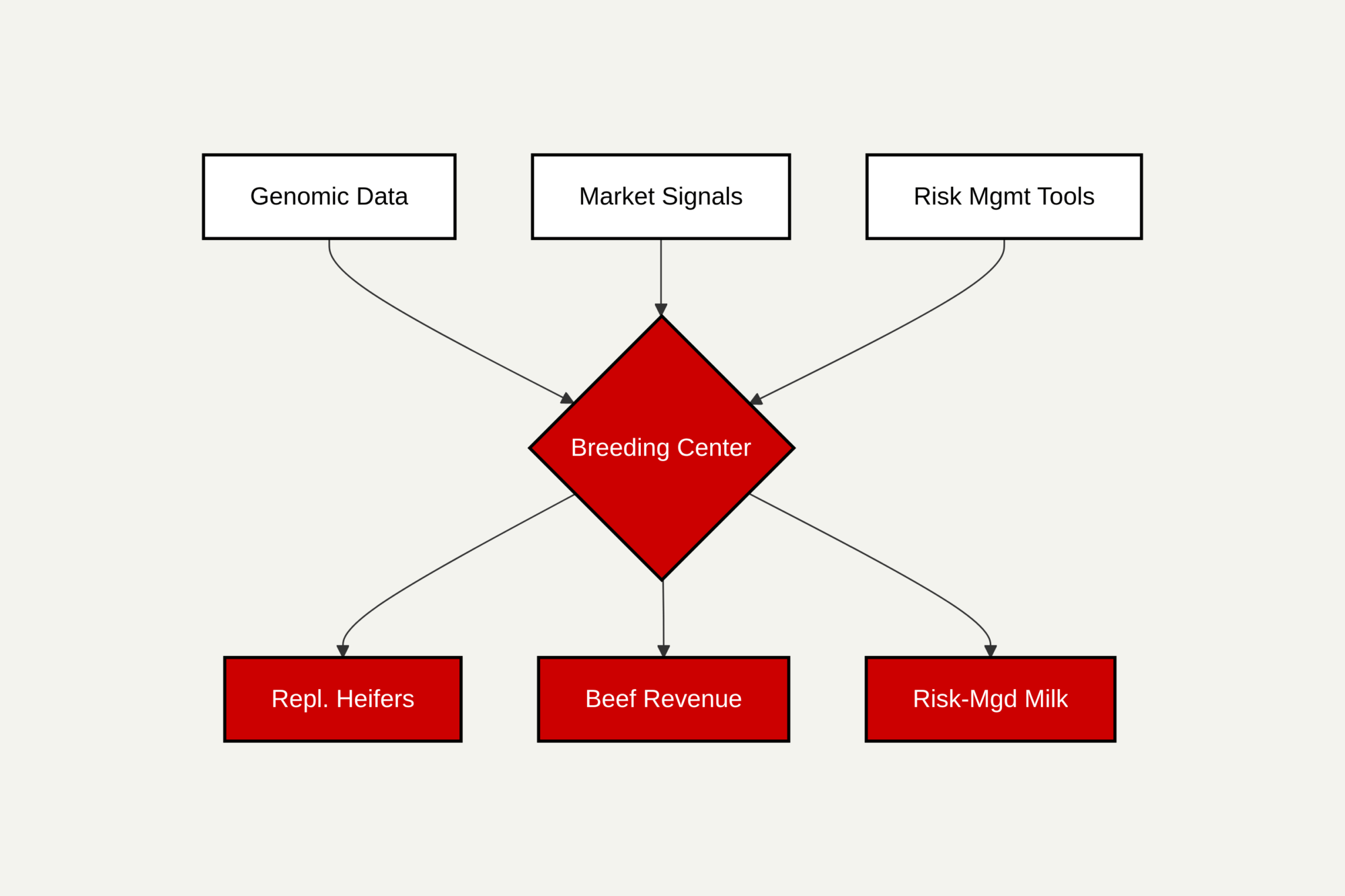
I’ve been watching this closely across different regions, and the smartest operations aren’t just riding this wave. They’re developing methods to connect the dots between breeding, market signals, and risk management, rather than treating them as separate farm functions. And honestly, it’s changing how we need to think about running a dairy.
This isn’t about getting fancier technology—though that’s certainly part of it. It’s a whole new approach that’s helping progressive operations navigate unprecedented complexity while actually maximizing both short-term cash flow and long-term genetic progress. Not an easy balance, as many of us have learned the hard way.
Market observations and examples in this article reflect general industry trends and producer experiences as of September 2025.
What’s Really Behind This Perfect Storm
So here’s what we’re seeing across different regions. With the increasing number of new processing plants coming online, combined with strong beef-cross calf markets, we have created a unique moment in dairy economics that I don’t think any of us were quite prepared for.
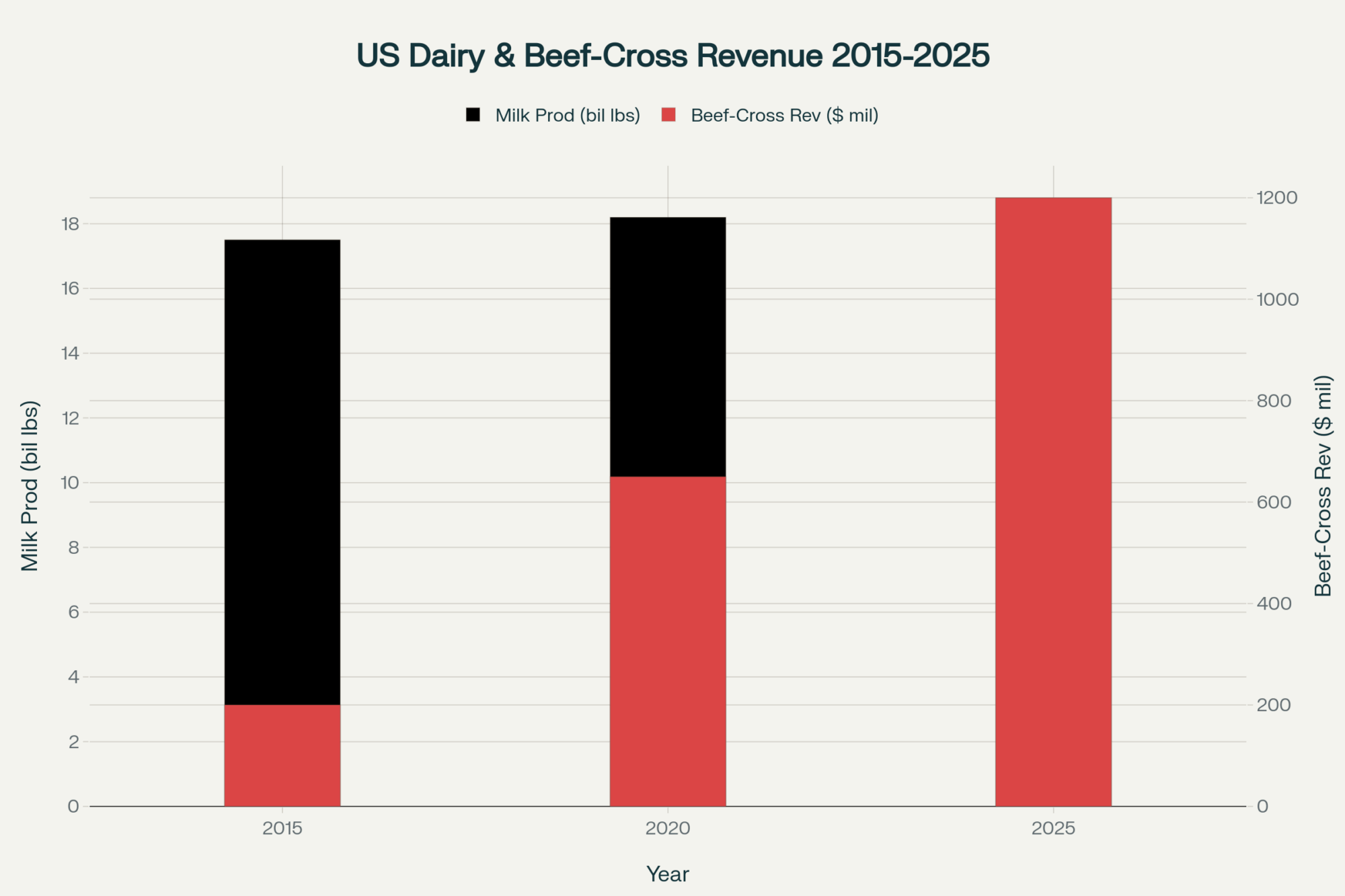
The data from the USDA’s August report show that production in the 24 major dairy states jumped 3.3% year-over-year to 18.8 billion pounds. Both infrastructure demand drives that, and—let’s be honest—farmers’ growing confidence in having multiple revenue streams, rather than just milk.
Phil Plourd from Ever.Ag Insights captured what many of us were thinking when he noted, “Market pricing and conditions encouraged additional production going into this year, and now it’s here, with historic force. As is often the case with on-farm production, it probably took longer than some thought to get going, and now it will probably take longer than many think to slow down.”
And what’s particularly noteworthy is that many producers I talk with at conferences report that cattle sales contribute significantly more to their bottom line than they did just a few years ago. We’re talking about operations where beef-cross calves have become a meaningful part of overall farm margins. Producers who’ve implemented strategic genomic testing are finding that they can identify their lowest-performing dairy genetics for beef breeding while preserving their elite animals for replacement production.
This builds on what we’ve seen in recent years with infrastructure development. Michael Dykes from the International Dairy Foods Association put it well at their San Antonio forum: “Our farmers want to grow, and so do our processors. If we aren’t growing, if we aren’t looking toward the future, we’re going to get surpassed by others.”
What gives me hope is that we’re seeing the emergence of truly dual-purpose dairy operations—farms that are optimizing for both milk production and beef genetics simultaneously. It’s a strategic shift that would’ve been nearly impossible to justify economically just five years ago.
How Genomics Finally Made Sense for Regular Dairies
Something that has caught my attention lately is how genomic testing has evolved from being used primarily in elite herds with advanced genetics programs to becoming a cornerstone of breeding strategies for regular commercial operations like yours and mine.
You probably already know this, but genomic testing costs have decreased to the point where most operations can afford to be strategic about it. Extension personnel from Wisconsin, Penn State, and UC Davis are collaborating with progressive dairies to utilize genomics for informed breeding decisions across their entire herds, not just their top-performing animals.
What I find fascinating is how farms are implementing three-tier genomic breeding strategies. They’re using the overnight genomic reports to segment their herds into strategic breeding groups. The top genetic performers get tagged for sexed dairy semen to produce the next generation of high-producing replacements. The solid middle performers are bred to conventional dairy semen, balancing cost with reliable genetic progress. And here’s the key—the bottom performers are targeted for beef-on-dairy matings to maximize calf value from animals with lower dairy potential.
Many producers report substantial improvements in their breeding economics using this approach. Some operations are seeing their replacement costs drop while calf income increases. More importantly, they’re maintaining their genetic progress rate while generating cash flow that funds facility improvements and equipment upgrades.
Why is this significant? The economics tell the story. Dr. Chad Dechow from Penn State’s dairy genetics program explained it this way: this approach transforms breeding from guesswork into putting your resources where they’ll do the most good. When you can identify which cows should produce premium beef-cross calves versus replacement heifers, the numbers work out pretty quickly.
What farmers are discovering—and this has been particularly encouraging to see—is that genomic testing creates a ripple effect that extends beyond just breeding decisions. It’s changing how they think about culling strategies, feed allocation during the transition period, and even barn design for managing fresh cows. When you know exactly which animals have the genetic potential to be your next generation of leaders, everything else falls into place differently.
Of course, not everyone’s convinced this approach works for their operation. Some producers I know—particularly those running smaller organic operations in the Northeast—are taking a more cautious approach with genomics, and honestly, they might be right for their specific situation where every breeding decision carries a different weight than in larger conventional systems.
The Replacement Crisis Nobody Saw Coming
What I find fascinating is how an unexpected problem emerged from all this excitement about beef-on-dairy premiums—replacement heifer shortages.
Dr. Geoff Smith from Zoetis put it bluntly: “Many farms have fallen so in love with producing beef-on-dairy that they don’t have the number of replacement heifers needed. And they’re not able to make proper culling decisions because they don’t have the numbers of replacements in the pipeline.”
I keep hearing variations of the same story from producers across different regions. In their eagerness to capture strong calf premiums during peak breeding seasons, some operations bred too high a percentage of their herd to beef sires for extended periods. By the time they realized the implications for their replacement pipeline, they were facing serious heifer shortages for the following year.
The scramble to correct course has been expensive for these farms. Premium-priced sexed semen, repeat breedings on marginal cows, and veterinary bills for extending lactations on older animals. Even with immediate corrections, that heifer gap can’t be filled for almost two years, creating productivity delays that ripple through multiple breeding cycles.
This teaches us that even the most profitable market opportunities require disciplined balance with long-term herd needs. The farms that implemented strict breeding ratio guardrails early on are now in much stronger positions.
It’s worth noting that seasonal operations face different challenges here. If you’re running a spring calving system in the northern plains or fall freshening to avoid summer heat stress in the Southeast, missing a breeding window can affect your entire production pattern for years to come. For operations using robotic milking systems, where individual cow management is even more critical, the replacement pipeline becomes absolutely essential.
Quick Decision Framework
Essential breeding ratio guardrails producers are using:
- Maintain a minimum of 20-25% dairy semen regardless of market signals
- Set alerts when dairy-semen usage drops below your calculated threshold
- Factor seasonal calving patterns into replacement timing
- Account for regional mortality and retention patterns
Figuring Out Your Farm’s Breeding Sweet Spot
So how do you avoid that replacement trap? The most sophisticated operations have moved beyond the old “use 25-30% dairy semen” rule of thumb to develop calculations tailored to their specific operations. Extension specialists from major dairy states are helping producers develop these customized models, and the results vary significantly based on management style and regional factors.
Generally speaking, annual culling rates can vary significantly depending on the type of operation and management intensity. Free-stall operations in the upper Midwest often exhibit different patterns than dry lot systems in California’s Central Valley, where heat abatement strategies and water availability influence distinct management decisions. These differences fundamentally change the replacement math.
Walking through barns in different regions, I keep hearing producers focus on these key variables:
- Annual culling rate (and this varies a lot depending on your region and management style)
- Conception and calving rates specific to your breeding program
- Pre-weaning mortality and retention sales patterns
- Herd expansion or contraction plans for the next 24 months
- Actual heifer-out percentage per dairy breeding
The basic calculation becomes pretty straightforward: replacement heifers needed divided by your heifer-out rate equals dairy-semen services required.
For example, a farm that needs 300 replacements annually with a 35% heifer-out rate requires approximately 857 dairy semen services. If they plan 3,000 total breedings, that requires 29% dairy semen use—close to the rule of thumb, but adjusted for their specific performance metrics.
This approach transforms breeding decisions from guesswork into a strategic allocation of resources. And what’s particularly valuable is that this calculation helps farms identify their flexibility margins. How much can you adjust your beef-on-dairy quotas without compromising your replacement pipeline? What happens when you factor in seasonal mortality patterns or drought conditions that might affect conception rates?
Making Risk Management Actually Strategic
What I’m still trying to figure out is how some operations have gotten so sophisticated at integrating Dairy Margin Coverage and Revenue Protection into real-time production decisions. The $1.2 billion in DMC payments delivered in 2023 represents far more than insurance—it has become a strategic business tool that influences breeding timing and production planning.
Leading dairy financial consultants are helping farms implement strategies that would’ve seemed impossible just a few years ago. Instead of simple coverage at one margin level, progressive operations buy tiered protection: maybe 25% of milk at a higher margin level, 50% at a middle tier, and the remainder at a lower level. This ladder approach ensures partial payouts as margins erode, smoothing cash flow during volatile periods.
Some operations are even timing their breeding decisions around coverage triggers. When margin forecasts indicate potential payouts during their breeding season, they temporarily shift more breedings toward dairy semen, knowing the safety net cushions milk-price risk and protects replacement targets.
Phil Plourd noted that “DMC can go a long way to providing real, meaningful protection to a farm’s profitability. And the cost of it is, you know, it’s sort of a no-brainer in terms of what it takes to get involved.”
This creates a strategic cushion that allows farms to make longer-term decisions without being whipsawed by short-term market volatility. When you know DMC will cover margin compression below certain thresholds, you can stick to your genetic improvement plans and maintain proper butterfat performance levels rather than making reactive breeding adjustments.
Examining this trend more broadly, what’s notable is how risk management tools have evolved from simple insurance to strategic decision-making components. Farms that master this integration don’t just protect against downside—they use the protection to make more aggressive moves during periods of opportunity.
When Market Signals Don’t Agree
And this is where it gets tricky. Current market conditions are testing these integrated systems pretty hard. Market conditions have been mixed recently, with some segments experiencing pressure despite production continuing to climb and beef-cross markets remaining relatively strong.
Progressive farm managers are learning to navigate this tension through disciplined frameworks that quantify trade-offs rather than making emotional market reactions. It’s fascinating to watch how different operations handle these conflicting signals—particularly comparing seasonal calving operations with year-round breeding programs, or how organic operations in Pennsylvania approach these decisions differently than large conventional dairies in Idaho.
When beef calf markets stay strong while milk margins feel pressure, smart managers pause to calculate the actual impact. Higher beef income might cover some of the margin shortfall. However, dropping your dairy semen use for one breeding cycle means losing future dairy heifers for immediate cash flow.
The most successful operations establish guardrails in their breeding programs, with alerts triggered when dairy semen usage dips below critical thresholds. They might make tactical adjustments—shifting their ratios temporarily—that capture market opportunities without sacrificing herd integrity.
And something worth noting… seasonal timing affects these decisions differently. Spring breeding adjustments have different long-term implications than fall changes, since spring-born calves enter the milking string during peak production periods the following year. As many of us have seen, timing is everything in dairy—whether it’s breeding decisions, dry-off timing, or fresh cow management protocols.
Making It Work Without Breaking the Bank
You’ve probably seen this in your own region… not every operation needs a corporate-style integrated system to compete effectively. Smart mid-sized dairies—particularly those with 300-800 cows, which form the backbone of many regional dairy communities—are adopting targeted elements that deliver outsized returns without requiring massive investment.
What’s working for smaller operations:
Selective Genomics Strategy: Rather than testing every animal, focus genomic testing on first-lactation heifers (your future genetic leaders) and the bottom performers in your current milking string. With strategic testing, you can pinpoint high-value breeding decisions without incurring significant costs. Even smaller organic operations where every breeding decision carries extra weight are finding success with this targeted approach.
Simple Heifer-Out Tracking: Build a straightforward spreadsheet model tracking your annual cull rate, conception rate, calving rate, and heifer mortality. Update it quarterly to calculate the exact dairy-semen share you need each month to hit replacement goals. This process takes approximately 30 minutes per quarter, but it can save you thousands in breeding mistakes. Some producers even factor in seasonal variations—like higher mortality during summer heat stress periods in the Southeast.
Tiered DMC Coverage: Purchase coverage at multiple bands—maybe half of your production at your true cost of production margin, and a portion at one level lower. This ladder ensures partial payouts as margins erode, without the need for complex hedging programs. The premium difference is minimal, but the protection value is substantial, especially for operations dealing with higher feed costs or transportation challenges in remote areas.
Monthly Breeding Reviews: Pull your herdsman, nutritionist, and bookkeeper together for 30 minutes monthly to review dairy versus beef-semen usage, replacement pipeline status, and current market signals. Agree on one tactical adjustment if needed. These sessions prevent drift and keep everyone aligned on strategic goals. I’ve noticed that operations running these reviews tend to catch problems earlier—before they become crisis situations.
Regional extension specialists and dairy consultants can provide expertise without the need for full-time analyst salaries, helping to interpret genomic reports, advise on optimal DMC triggers, and facilitate quick scenario analyses. The best consultants help farms build internal capabilities rather than creating dependency.
Warning Signs We Should All Watch
While the beef-on-dairy revolution presents unprecedented opportunities, there are several risk factors we need to monitor closely. Early indications suggest these warning signs are becoming more apparent as market conditions evolve, and they affect different regions and operation types in unique ways.
Overreliance on dual revenue streams poses the biggest concern. If calf markets retreat or soften, farms counting on sustained premium values could face compressed milk margins and discounted calf values simultaneously. This double-exposure risk is particularly concerning for operations that expanded based on dual-income projections—especially in regions where land costs and environmental regulations make expansion expensive.
Production momentum effects also create risk. Continued strong milk output despite shifting market conditions could lead to prolonged margin compression, especially given the time lag between market signals and breeding decisions that affect herd size. Milk production has its own momentum that doesn’t always align with market signals—particularly in systems designed for maximum efficiency rather than flexibility.
Debt service exposure represents another vulnerability—something that affects family operations differently than corporate structures. Many expansions were planned, assuming both strong milk prices and substantial beef-cross income. Market pressure risks exposing operations with high leverage ratios, particularly those that financed expansion during recent periods of low interest rates.
Daniel Basse from AgResource Company remains optimistic about long-term prospects, noting that “the average age of cow-calf producers climbs into the upper 60s,” and predicts beef-on-dairy will remain in demand for years to come. Still, smart operations are treating beef income as a strategic bonus that enhances profitability rather than a replacement for sound milk-price risk management.
The farms that seem most resilient are those that treat this as one component of their overall strategy, rather than the foundation of their business model. What do you think separates the operations that weather these transitions successfully from those that struggle?
Making It Happen on Your Farm
For the immediate implementation of the fall breeding season, successful farms are calculating their specific dairy semen threshold based on their actual culling, conception, and mortality data, rather than relying on industry averages. They’re implementing tiered DMC coverage that provides partial protection as margins shift, and using genomic testing strategically on animals where breeding decisions have the highest financial impact.
For long-term success through multiple breeding cycles—particularly important for seasonal operations planning next year’s calving pattern, or operations dealing with climate challenges in drought-prone regions—winning operations treat beef-on-dairy income as a strategic bonus while building frameworks that balance market opportunities with genetic progress and replacement needs.
Ken McCarty from McCarty Family Farms summed up the balanced approach well: “This certainly has helped bolster profitability while also enhancing the long-term productivity and profitability of our farms through increased genetic selection intensity. We don’t see tremendous downside risk in the beef-on-dairy market anytime soon.”
Getting Started This Season
Week One:
- Calculate your farm’s actual heifer-out percentage from last year’s data
- Review current DMC coverage levels and consider a tiered approach
- Identify animals for strategic genomic testing (focus on first-lactation animals and bottom performers)
Week Two:
- Set up monthly breeding review meetings with your key team
- Create breeding ratio alerts in your herd management system (or simple spreadsheet alerts)
- Document your breeding decision framework so everyone’s on the same page
Next Quarter:
- Evaluate integration opportunities between risk management and breeding decisions
- Build relationships with regional extension specialists or consultants
- Assess return on investment from initial changes
- Factor in seasonal adjustments for your specific climate and management system
Regional Considerations:
- Northern operations: Account for winter housing constraints in replacement planning
- Southern dairies: Build heat stress impacts into conception rate calculations
- Western operations: Factor water availability and feed cost volatility into risk planning
- Organic systems: Verify breeding strategies align with certification requirements and transition timing
Where This Is All Heading
We’re witnessing a fundamental transformation in dairy operations management. The farms thriving in this environment have learned to integrate genetics, markets, and risk as interconnected variables rather than separate functions. This development suggests that we’re moving toward a more sophisticated industry, where success stems from strategic thinking rather than just operational efficiency.
The opportunity is unprecedented for producers ready to adapt. Infrastructure investments, technology tools, and current market conditions are aligned to reward farms that can successfully navigate this new complexity. This isn’t about getting bigger or spending more—it’s about strategically integrating available resources in ways that weren’t possible even five years ago.
Time will tell if this approach holds up through different market cycles, but early signs suggest the dairy operations that master this integration will define the industry’s future for decades to come. The question isn’t whether this trend will continue, but how quickly farms can adapt their decision-making approaches to capture the full potential of this evolving operating environment.
The dairy industry stands at an inflection point. Producers who adopt this integrated approach to strategic decision-making, while maintaining a disciplined focus on fundamentals, will be well-positioned to thrive regardless of market volatility. Those who don’t adapt risk being left behind as the industry continues its rapid evolution toward more sophisticated, interconnected operational systems that reward strategic thinking over traditional scale-focused approaches.
KEY TAKEAWAYS:
- Quantified breeding improvements: Producers using strategic genomic testing report replacement costs dropping while calf income increases substantially, with the most successful operations maintaining genetic progress while generating cash flow that funds major facility and equipment investments
- Risk management as strategy: Smart farms are implementing tiered DMC coverage (25% at higher margins, 50% middle-tier, remainder lower) to ensure partial payouts during margin compression, creating strategic cushions that enable longer-term breeding decisions without market volatility disruption
- Flexible breeding ratios: Top operations calculate farm-specific dairy-semen thresholds using actual culling, conception, and mortality data rather than industry averages, then set alerts when usage drops below critical replacement levels—typically maintaining 20-25% dairy semen minimums regardless of beef market premiums
- Regional adaptation strategies: Northern operations factor winter housing constraints, Southern dairies account for heat stress conception impacts, Western farms consider water availability and feed cost volatility, while organic systems verify breeding decisions align with certification timing requirements
- Monthly strategic reviews: The most resilient operations conduct 30-minute monthly meetings with key team members to review breeding ratios, replacement pipeline status, and market signals, making tactical adjustments that capture opportunities without sacrificing herd integrity—a practice that consistently catches problems before they become expensive crises
Complete references and supporting documentation are available upon request by contacting the editorial team at editor@thebullvine.com.
Learn More:
- Why the Smartest Dairy Operators Are Unlocking Over $150,000 in Potential Returns While Others Get Blindsided by Market Chaos – This article provides a strategic framework for using blended risk management strategies to protect against market volatility. It reveals how top producers combine contracts and technology to reduce income swings by up to 40% and maintain profitability regardless of milk price fluctuations.
- The Genomic Kick in the Pants: Why NZ Dairy is Facing a Sink-or-Swim Moment – Explore the tactical implementation of genomics with this piece. It provides practical strategies for turning raw genomic data into profitable on-farm decisions, revealing how to use test results for better mating choices, culling strategies, and overall herd improvement. It also breaks down the economics of genomic testing with real-world returns.
- The Future of Dairy: Lessons from World Dairy Expo 2025 Winners – This article is a great case study in operational innovation and technology adoption from a leading dairy operation. It offers insights into how a multi-state family farm manages labor, optimizes transportation costs, and implements sustainability practices, demonstrating how technology integration can lead to massive gains in efficiency.
 Join the Revolution!
 Join the Revolution!
Join over 30,000 successful dairy professionals who rely on Bullvine Weekly for their competitive edge. Delivered directly to your inbox each week, our exclusive industry insights help you make smarter decisions while saving precious hours every week. Never miss critical updates on milk production trends, breakthrough technologies, and profit-boosting strategies that top producers are already implementing. Subscribe now to transform your dairy operation’s efficiency and profitability—your future success is just one click away.