9.57M milk cows. 3.9M replacements. $3,000 heifers. Beef-on-dairy and genetics built this paradox — and 2027 is when it breaks.
Executive Summary: The U.S. milking herd just climbed back to 9.57 million cows — a 30‑year high — while replacement heifers fell to 3.905 million, a 48‑year low, with only 2.498 million actually expected to calve. That gap isn’t a fluke; it’s what happens when beef‑on‑dairy premiums pull calves to the feedlot, genomic selection lets good cows work longer, and $3,000–$4,000 heifers convince producers to stop culling anything that still stands in a stall. CoBank and AFBF both say this “shrinking herd pipeline” hits the wall in 2027, right as more than $10–11 billion in new U.S. processing plants come online, looking for milk that the heifer pipeline may not be able to supply. At the farm level, that shows up as a replacement bill jumping from about $567,000 to $903,000 a year on a 1,000‑cow dairy, while a genetically driven extra lactation can be worth $8,000–$9,000 per cow when you combine one less replacement and one more year of mature‑cow milk. Research from Albert De Vries and Mike Overton draws a bright line between real longevity and desperation: keeping healthy, high‑PL cows longer pays, but hanging onto chronic, low‑producing cows because you can’t afford replacements can cost three times more than culling too early and easily $500–$600 per cow in lost opportunity. For 2026–2027, the winning herds will be the ones that tighten up PL and health in their sire stack, genomic‑test and sort the milking herd, pull some breedings back from beef to dairy on their best cows, and model their 2027 heifer needs now — while there’s still time to grow the replacements they’ll need.
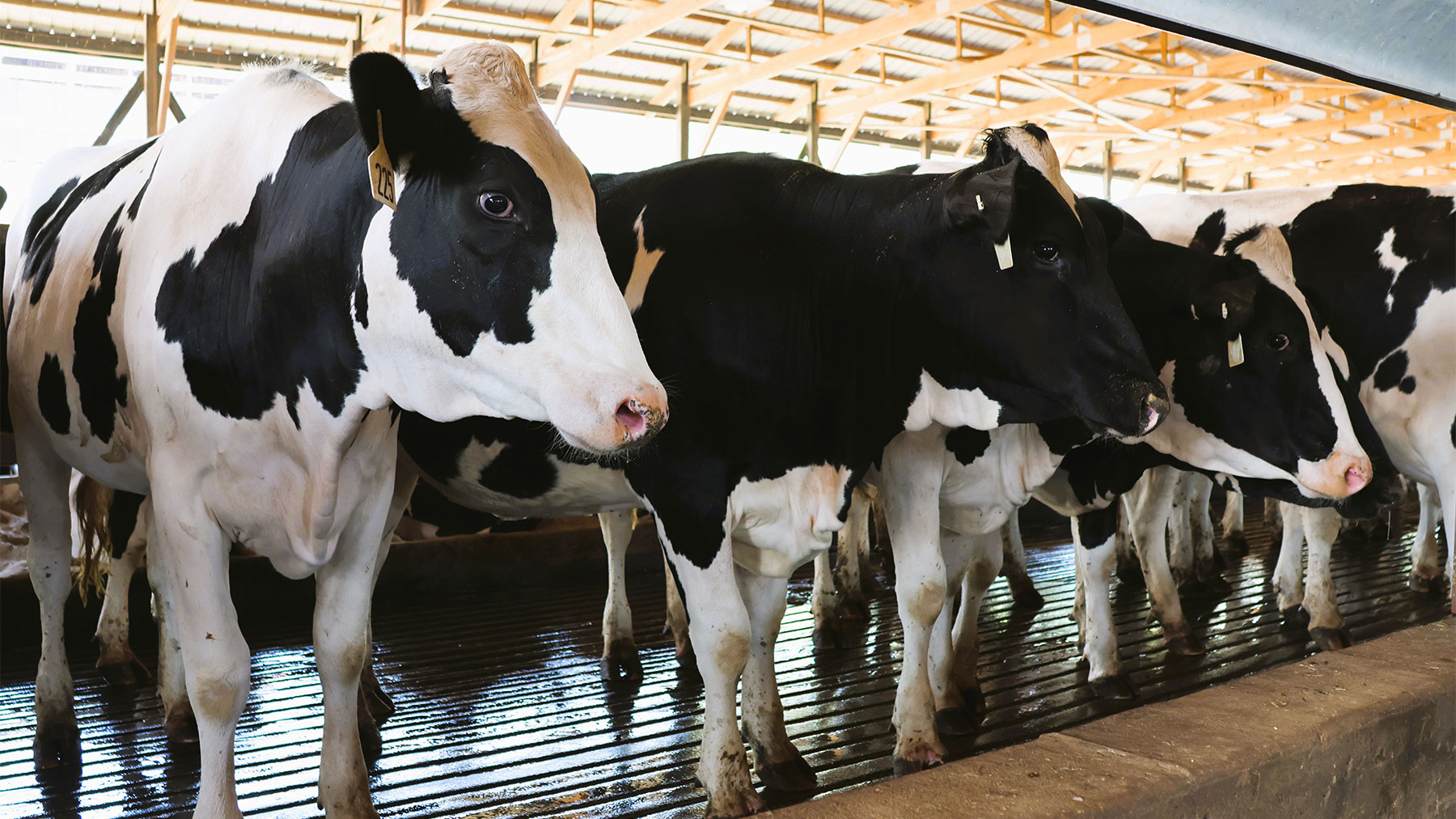
At the CDCB Industry Meeting at World Dairy Expo last October, Eric Grotegut told a room of 200 people — and another 375 watching the livestream — that he runs a 25% replacement rate on 3,500 cows.
A decade ago, that number would’ve raised eyebrows. The national average was pushing 39%. But Grotegut Dairy in Newton, Wisconsin, isn’t running short-lived cows out the door. The 2025 IDFA/Dairy Herd Management Innovative Dairy Farmer of the Year is keeping them — and paying less for replacements because of it.
“Fifteen to 25 years ago, it seemed like I was selling cows every day; lameness, mastitis, and pneumonia… there was something all the time,” Grotegut told the panel, titled Cows Can Live Longer — Are We Letting Them? “Now, most cull cows are one day a week. They don’t have to go as early.”
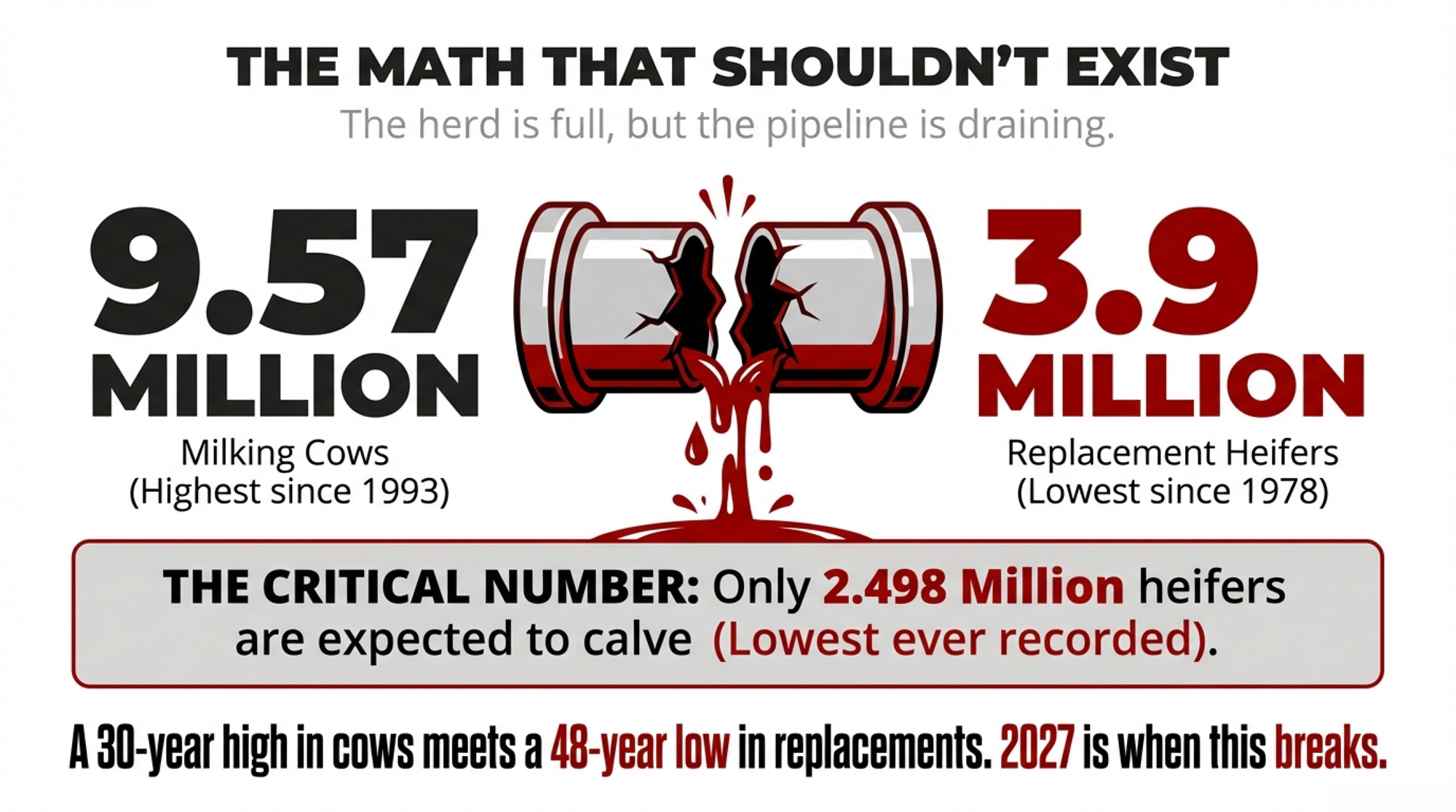
He and nearly 600 attendees were there because of two numbers that shouldn’t coexist in the same industry. 9.57 million milking cows as of November 2025 — the most since 1993. And 3.905 million replacement heifers as of January 1, 2026 — the lowest since 1978. Both numbers are verified. Neither survives 2027 without something giving way.
| Year | Milking Cows (M) | Heifers Expected to Calve (M) |
|---|---|---|
| 2001 | 9.10 | 4.10 |
| 2005 | 9.03 | 4.35 |
| 2010 | 9.09 | 4.20 |
| 2015 | 9.31 | 4.65 |
| 2020 | 9.40 | 3.10 |
| 2024 | 9.36 | 2.70 |
| 2025 | 9.50 | 2.55 |
| 2026 | 9.57 | 2.50 |
Three Forces, One Collision
Danny Munch has watched these lines diverge for months. The American Farm Bureau Federation economist isn’t subtle about what’s driving it.
“All of these statistics are accumulating into sort of a system that’s more responsive to the beef sector than it is to dairy,” Munch said.
He pointed to record U.S. and global milk production — production that “has weighed heavily on dairy prices” — while beef-cross calves pull $1,000 within two or three days of birth.
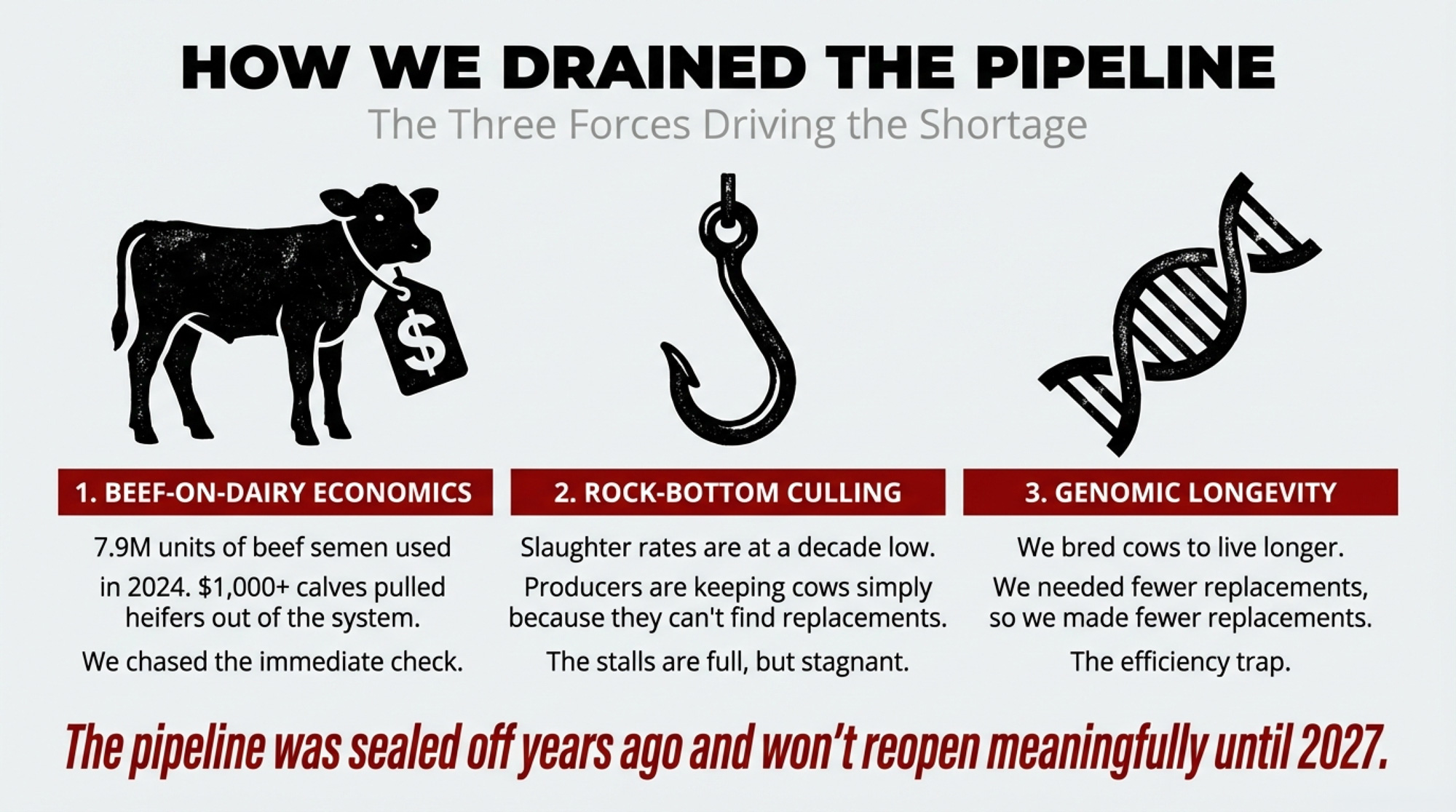
That’s the first force: beef-on-dairy economics. High Ground Dairy’s income model projects an average revenue boost from beef-cross calves of $4.37/cwt in 2025, with seven of the next 12 months projected above $5.00/cwt as of their October analysis. On most operations, that’s not a bonus. That’s the margin.
Mike North of Ever.ag framed it bluntly last July: “We’re creating a lot of revenue, upwards of two and a half dollars per hundredweight in revenue back to the farm just in beef breeding, and even higher than that in some cases.” By January 2025, he noted some replacement heifers “moving in the northwest were north of $4,000 an animal. That’s a pretty tall price.” He was talking about the heifers that beef-on-dairy has made scarce.
The second force: rock-bottom culling. Cumulative dairy cow slaughter through the first 50 weeks of 2025 totaled just 2.53 million head — the lowest in more than a decade, well below the roughly 3 million slaughtered annually in most prior years. Cull rates fell below 30% in 2024, per High Ground Dairy — historically unusual. And USDA’s October 2025 Agricultural Prices report showed the price received for milk cows hit a record $3,110 per head. Nobody’s shipping cows. Because the heifer to fill that stall doesn’t exist.
The third force is the one you won’t read about in most outlets: genetics. Cows are living longer because we bred them to live longer. That’s both the solution and the ticking clock.
Why Are Replacement Heifer Numbers at a 48-Year Low?
Start with this: across two consecutive January Cattle reports, USDA revised its dairy replacement heifer estimates downward by a combined 371,600 head. The original January 2023 figure of 4.337 million was later corrected to 4.073 million — a 263,600-head haircut. Then, in January 2024’s original 4.059 million dropped to 3.951 million. Nearly 372,000 heifers USDA thought existed… didn’t.
USDA’s latest Cattle report pushes the number even lower — 3.905 million as of January 1, 2026, down 16% from January 2020 and nearly 20% below the 4.81 million record set in 2016. The heifer-to-cow ratio dropped to 40.8%, down from 41.7% a year earlier and the lowest since 1990.
Here’s the number that should keep you up at night. Heifers expected to calve — the animals actually approaching the milking string — fell to 2.498 million head as of January 2026. That’s the lowest since USDA began reporting the series in 2001. Each of the last four years has posted a new record low.
Corey Geiger, the CoBank economist tracking this, put it simply: “The U.S. dairy herd is like an ocean liner, and it takes three years from conception to reach the milk barn. That would be the time necessary to make more heifers.”
The Semen Data Seals It
CoBank’s model — built on NAAB semen sales data — predicts 357,490 fewer heifers in 2025 and another 438,844 fewer in 2026 before any recovery begins. NAAB’s 2024 year-end report shows U.S. dairy farmers used an estimated 7.9 million units of beef semen on dairy cows, out of 9.7 million total domestic beef units sold. Domestic dairy semen sales totaled 16.2 million units, with gender-selected dairy semen reaching 9.9 million units, up 1.5 million from 2023.
Sexed semen is helping maximize the dairy heifers that do get bred. But the sheer volume of beef breeding means the pipeline was sealed off years ago and won’t reopen meaningfully until 2027 at the earliest.
And even those dairy heifer calves aren’t all making it. Mike Overton, DVM — Global Dairy Platform Lead at Zoetis — analyzed heifer completion rates across 65 herds in 2025. The median: just 76% of dairy heifer calves born alive actually reach first calving. Most producers assume closer to 90%. That 14-point gap means roughly one in four dairy heifer calves born today won’t produce a gallon of milk. Layer that attrition on top of 7.9 million units of beef semen, and the pipeline math gets even uglier.
Read more: the full heifer-economics math reshaping replacement decisions in 2026
What Glenn Kline Learned When He Had to Buy Cows
Glenn Kline started genomic testing his herd back in 2011, when Y Run Farms LLC in Troy, Pennsylvania, milked about 500 cows with 15 employees. “We wanted a source of truth,” he told Dairy Herd Management.
Fourteen years later, Y Run milks 1,200 cows across 2,700 acres with a crew of 20 full-time employees. The herd more than doubled — through 830 cows by mid-2023 and 1,200 by late 2024. But it didn’t get there on organic growth alone.
“We did expand here three years ago, and we had to buy some animals in,” Kline told the CDCB panel at World Dairy Expo. “There was really a significant difference with our original animals lasting longer.”
That one sentence is the genetics story in miniature. Thirteen-plus years of genomic selection showed up in the barn: his homegrown cows outlasted the purchased replacements by a margin he could see.
His strategy now: beef on the bottom end, IVF from the top. “We’ve been using beef on dairy to keep our lower production cows using beef, and we use IVF to try to make better heifers of the good ones,” Kline said.
Kristen Metcalf takes a different approach at Glacier Edge Dairy in Milton, Wisconsin, where her family milks about 300 registered Jerseys. They breed their best cows to Jersey bulls and the rest to Charolais, Angus, and Limousin. Metcalf told the WDE panel she’d ideally keep Jerseys in the herd for five or six lactations.
“If we’re using management tools correctly and really looking at some different traits when we’re breeding, I don’t think you should be burning cows out,” Metcalf said. “They should be able to live productive and healthy lives until they naturally reach that dip in milk production.”
Both approaches — Kline’s concentrate-and-IVF model on 1,200 cows and Metcalf’s longevity-from-the-best-Jerseys strategy on 300 — are exactly the kind of rational, individual decisions that, multiplied across thousands of herds, have thinned the national replacement pipeline to its breaking point.
The Genetics Nobody Else Is Connecting to This Crisis
Every outlet covers the heifer shortage as a supply story. Beef-on-dairy pulled heifers out of the pipeline. True enough. But there’s a second, quieter force — and it’s the one that makes breeders and genetics-focused producers the central players: genomic selection is keeping cows productive longer, and that changes the math on whether you even need replacements at the old rates.
A 2016 study in the Journal of Dairy Science found that following the implementation of genomic selection, “dramatic response… was observed for the lowly heritable traits DPR, PL, and SCS. Genetic trends changed from close to zero to large and favorable, resulting in rapid genetic improvement in fertility, lifespan, and health.” Rates of genetic gain per year for Productive Life increased three- to fourfold compared to pre-genomic baselines.
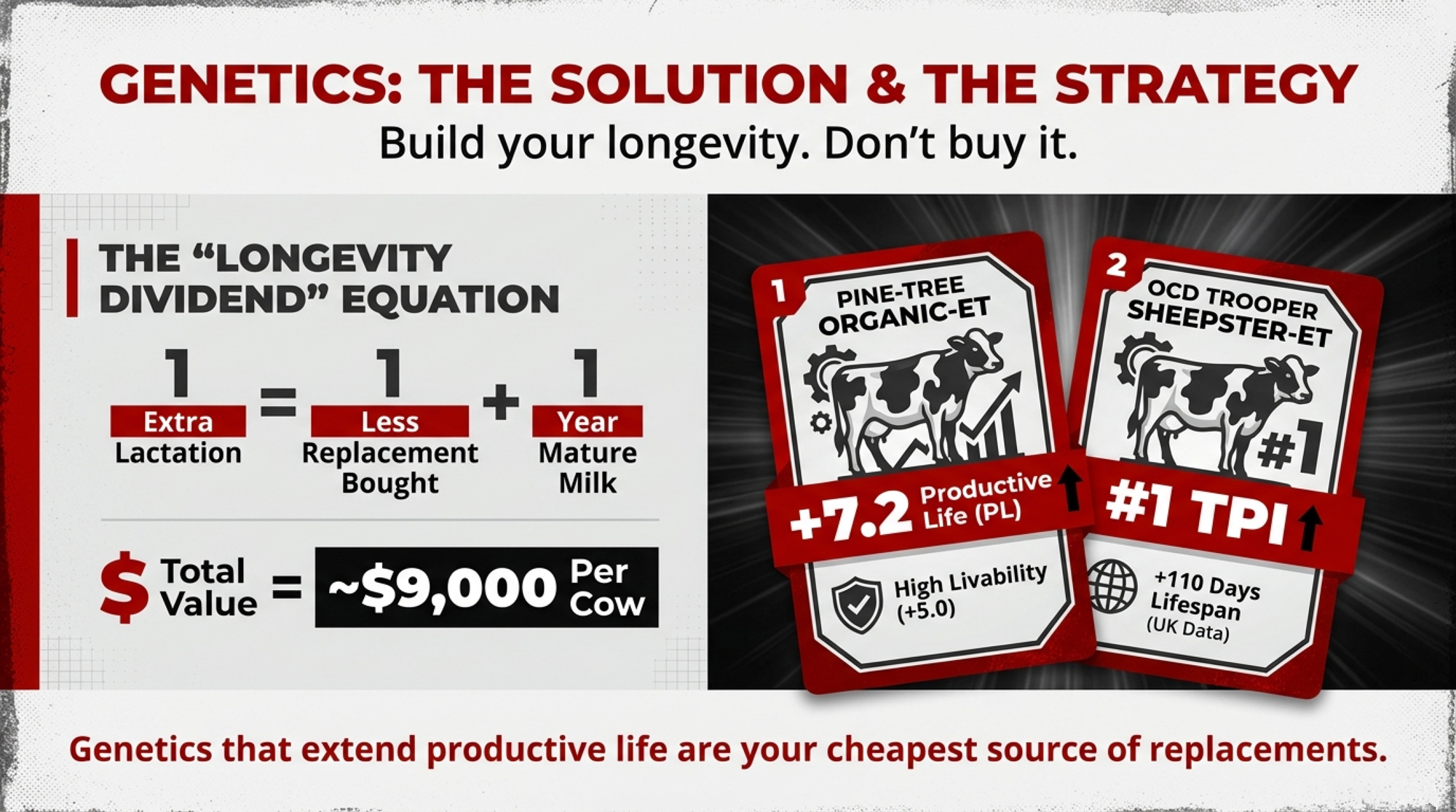
Those gains are compounding. The April 2025 NM$ revision set the combined longevity emphasis at 18.0% — PL at 8.0%, Cow Livability at 8.0%, and Heifer Livability at 2.0%. It’s the index equivalent of saying, “Keep them alive, and we’ll figure out the rest.” And the sire lineup reflects it.
Longevity Sires Worth Screenshotting (December 2025 Evaluations)
| Sire | PL | TPI | Status | Key Detail |
| PINE-TREE ORGANIC-ET | +7.2 | 3131G | Genomic | +5.0 Livability |
| OCD MASSEY SURLY-ET | +5.6 | 3176G | Genomic | +4.1 Livability |
| OCD TROOPER SHEEPSTER-ET | +5.5 | 3572G | Proven | #1 TPI all bulls, Dec 2025 |
| PEAK ALTAPOWERBUCK-ET | +5.5 | 3122G | Genomic | Balanced PL + index |
| MR EDG NOBLE IMPERIAL-ET | +4.0 | 3149G | Proven | +5.4 Livability |
| DENOVO 2776 LEEDS-ET | +3.9 | 3146G | Proven | +2,123 Milk with longevity |
These aren’t niche longevity specialists. SHEEPSTER graduated to the daughter-proven ranks in December 2025 as #1 TPI across all bulls — proven and genomic — at 3572G. The next closest bull, SDG CAP GARZA, sits at 3464G. That’s a 108-point gap. His daughters in the UK posted a lifespan of +110 days, and multiple SHEEPSTER sons now rank in the genomic top 10.
One caution worth flagging: when an entire industry chases the same longevity sires, inbreeding concentrations accelerate. If SHEEPSTER and his sons dominate your sire stack, that’s a different kind of risk—the genetic narrowing kind.
Read more: the four sires who reshaped what Holsteins can do — and the genetic narrowing that followed
New CDCB Tools Accelerating the Trend
Milking Speed launched as an official genetic evaluation in August 2025 — PTAs expressed as pounds of milk per minute, with a Holstein breed average of 7.0 lbs/min. CDCB geneticist Kristen Gaddis, Ph.D., reported the heritability at 42%, an unusually high figure for a management-linked trait. That matters: slow milkers are a primary reason cows get culled in robotic herds. Remove that as a cull trigger, and productive life extends.
John B. Cole, Ph.D., told the WDE audience that genomic evaluations for calf respiratory disease and scours are the next tools that could help more calves survive long enough to enter the milking string. Ashley Ling, Ph.D., is developing camera-based mobility scoring for hoof health evaluations to address another major involuntary cull trigger.
Read more: the genetic narrowing risk hiding in your fresh pen
Is Longevity a Solution — or a Ticking Clock?
Here’s the part of this story that doesn’t fit the hero narrative.
University of Florida dairy scientist Albert De Vries dug into the productive lifespan as an economic question. He noted cows used to live 5 to 10 years after calving in the 1930s; by 2018, the average was down to 35.3 months — fewer than 3 lactations. Using a simple economic model, De Vries arrived at an “ideal” productive lifespan of about 5 years total. “Longer productive lifespans for healthy dairy cows are not necessarily profitable,” he concluded. “Optimal replacement decisions and optimal annual cow replacement rates are dynamic and change over time.”
The critical word is healthy. A 2025 study in Frontiers in Veterinary Science found that the economic loss from retaining unprofitable cows was approximately three times greater than from culling too early. Cows held past their productive window produce less milk, carry higher somatic cell counts, face more lameness and mastitis, and have lower fertility — costs that cascade past the replacement price they were supposed to avoid.
What Forced Retention Actually Costs
Overton put numbers to this at the 2025 Western Dairy Management Conference in Reno. He compared Holstein herds that had adequate replacements in 2020–2022 against herds running short on heifers in 2023–2024. The short herds retained cows 25 days longer in milk. Those cows averaged 7 pounds less milk per day over their last 30 days before culling — and chronic mastitis cases climbed.
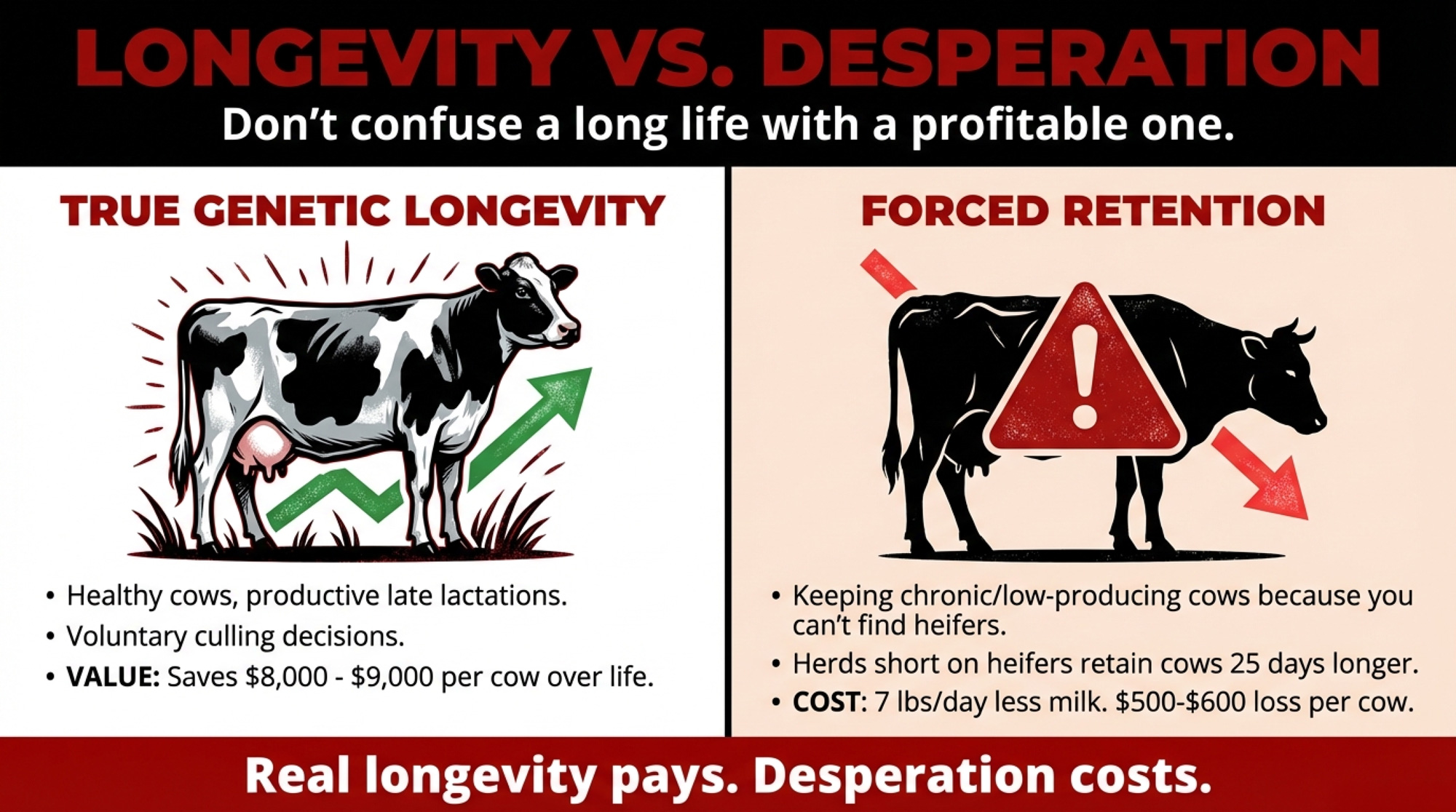
In a separate analysis, Overton modeled the impact of a 4% drop in replacement rate from 39% to 35%: cows stay roughly 100 days longer than optimal, costing $500–$600 per cow in lost opportunity. That’s not longevity. That’s treading water.
| Strategy | Days Kept Beyond Optimal | Milk Loss (last 30 days) | Cost per Cow |
|---|---|---|---|
| Genetic longevity (planned) | 0 | 0 lbs/day | $0 |
| Forced retention (no heifers) | +25 days | -7 lbs/day | -$525 |
| Extended retention (4% rate drop) | +100 days | -10 lbs/day est. | -$600 |
| Culling chronic cows 3x too late | +150 days | -12 lbs/day est. | -$1,800 |
Penn State Extension’s Michael Lunak puts the breakeven at three-plus lactations — that’s what it takes to recoup the cost of raising a replacement. But the average productive life of a U.S. dairy cow is just 2.7 lactations, and 70% of cows are culled before completing their third.
That difference matters more right now than it ever has, because the heifers to replace those cows just aren’t there. Extend productive life through genetics and management — better feet, better fertility, better disease resistance — and you win. Extend it through forced retention — keeping cows because you can’t afford to replace them — and you’re borrowing against your herd’s future health.
$11 Billion in Processing Steel Meets 2.498 Million Heifers
This paradox might survive 2026. It won’t survive the construction cranes.
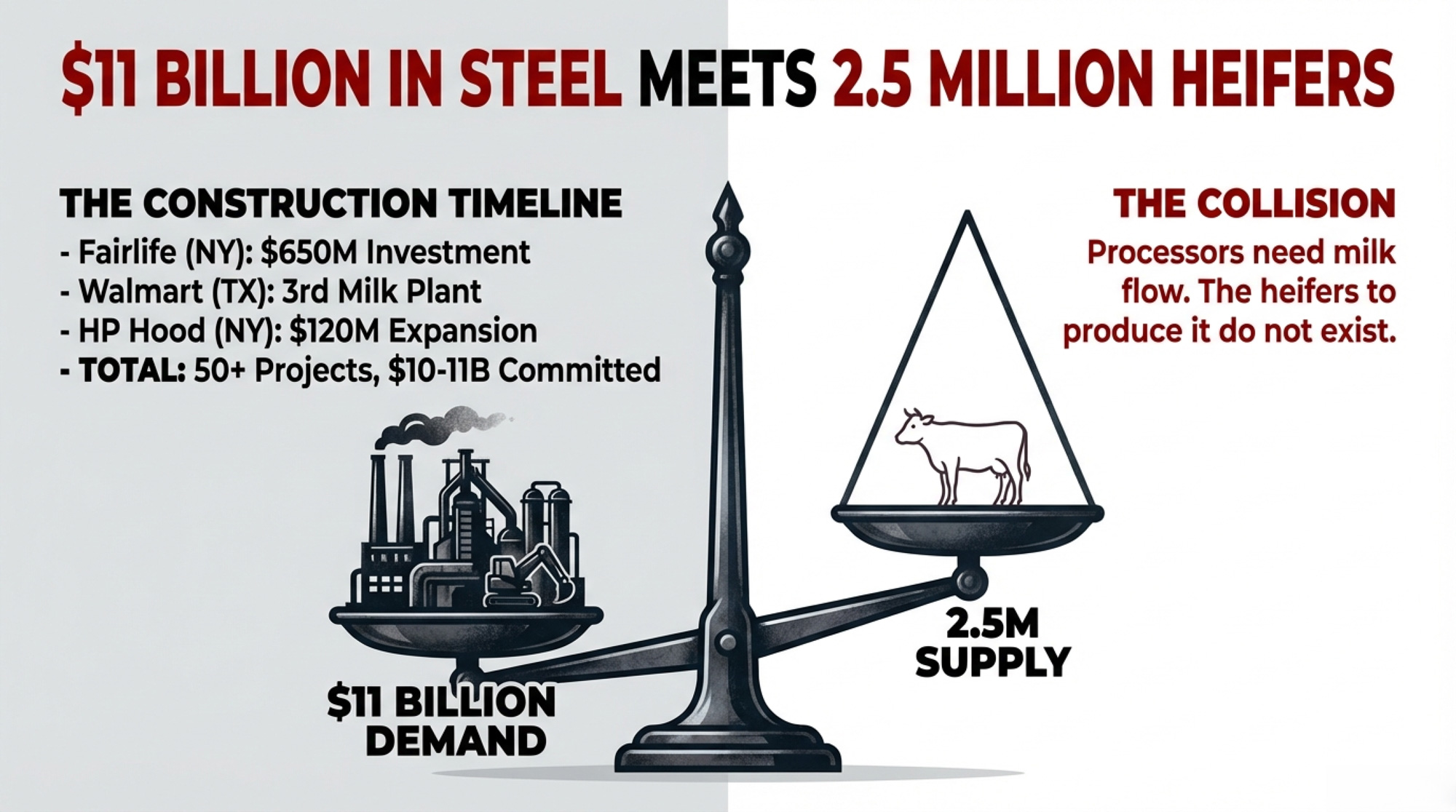
America’s dairy processors have committed more than $11 billion in new and expanded manufacturing capacity across 19 states, with over 50 building projects planned between 2025 and early 2028, according to IDFA data released in October 2025. Gregg Doud, NMPF president, put it this way: “It really is $10 billion — 2023, 2024, 2025, 2026 — in new dairy processing investment in the U.S. There’s nothing like it in the history of U.S. agriculture, of any commodity, anywhere in the world.”
The named projects tell the story. Fairlife broke ground on a $650 million, 745,000-square-foot facility in Webster, New York, scheduled to take in five to six million pounds of milk per day from local dairy farmers and projected to create 250 jobs. Walmart is building its third milk processing plant, this time in Robinson, Texas. HP Hood committed $120 million to expand its Batavia, New York, plant by 20 million gallons per year. Valley Queen Cheese in Milbank, South Dakota, invested $195 million in a three-year expansion completed in January 2025, and projected needing approximately 25,000 additional cows in 2025 and 2026 to supply the added capacity.
Every one of those plants needs milk. And IDFA president Michael Dykes acknowledged the tension: “I can’t tell you how many meetings I went to where people said, ‘We’re scared to death there won’t be enough milk.'”
CoBank’s Geiger connected the dots directly: “Given these tight inventories and the $10 billion of new dairy plants set to come online through 2027, dairy replacement values will likely climb even higher.”
When $11 billion in processing steel meets 2.498 million heifers expected to calve — the lowest pipeline ever recorded — the collision isn’t theoretical. It’s on the construction timeline.
The Barn Math: What This Costs You Right Now
Plug in your own herd size.
Replacement Cost Shock
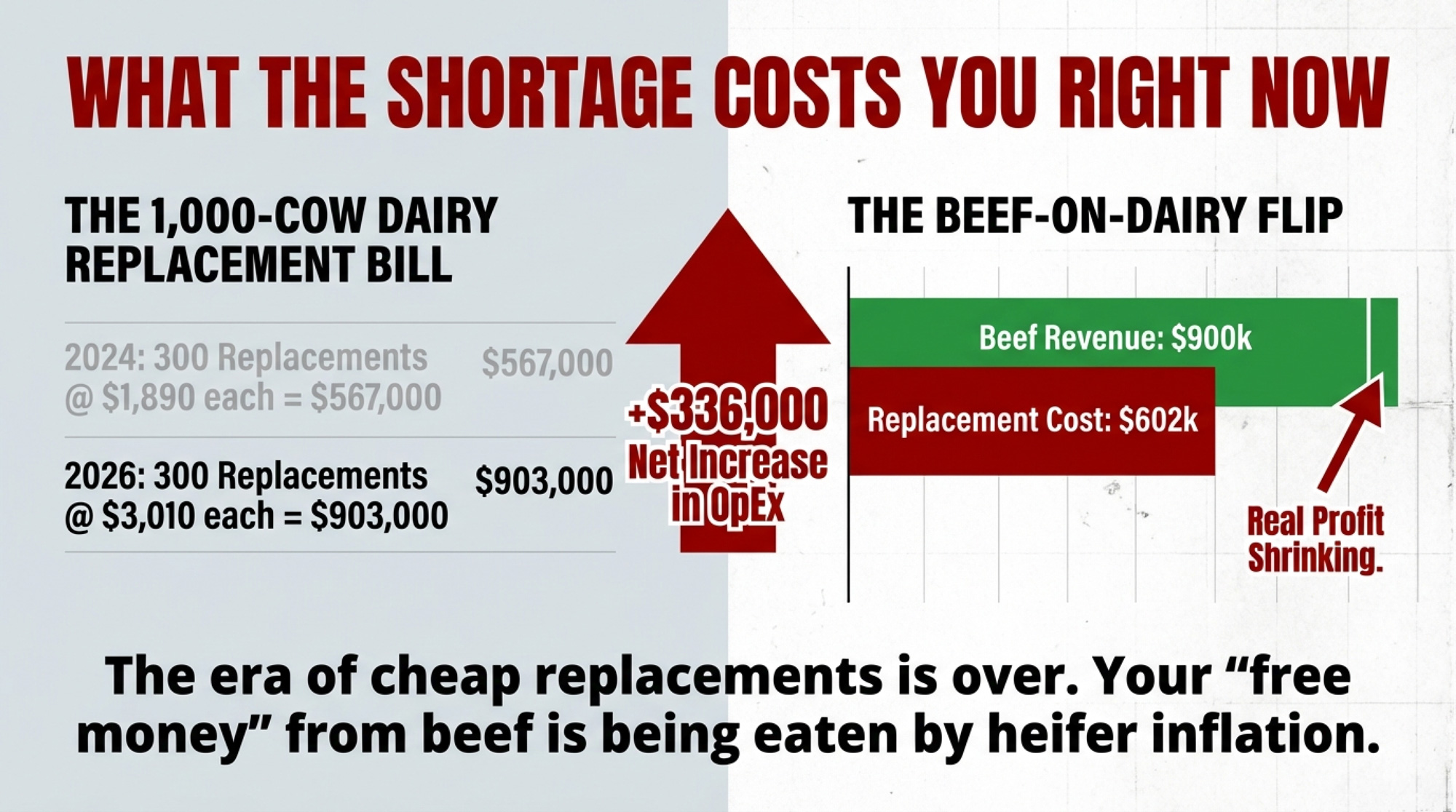
A 1,000-cow dairy replacing 30% of its herd annually needs 300 replacements. At USDA’s July 2025 price of $3,010/head, that’s $903,000. The same 300 head in January 2024 cost $1,890 each — $567,000 total.
The annual replacement bill rose $336,000. On a 300-cow dairy, it’s still $100,800.
And auction-quality springers keep climbing. At Premier Livestock & Auctions in Pennsylvania, top-quality springing heifers hit $3,000–$3,750 at the January 27, 2026, special heifer sale — 765 head through the ring. By mid-February, top Holstein springers there were fetching $2,800–$4,400. Open heifers in the 700–850-lb range moved at $1,550–$3,000.
The Longevity Dividend
Every lactation you extend through genetics saves one replacement purchase and adds a year of mature-cow milk revenue. First-lactation animals produce 80–85% of the milk that a third-plus-lactation cow can.
| Component | Value ($) |
|---|---|
| Saved replacement cost | $3,010 |
| Mature-cow milk premium (1 year) | $5,500 |
| Total longevity dividend | $8,510 |
At current prices: one fewer replacement saves $3,010. One more year of mature-cow production adds roughly $5,000–6,000 in milk revenue above feed costs. Net value of a longevity-driven extra lactation: approximately $8,000–$9,000 per cow. That’s PL, expressed in real dollars.
The Beef-on-Dairy Trade-Off Is Flipping
On a 1,000-cow dairy breeding 60% to beef: 600 beef-cross calves at $1,500 each = $900,000 in calf revenue. At Premier Livestock’s February 2026 sale, beef-cross calves were moving at $1,200–$1,910/head — so per-calf revenue is holding up, for now.
| Metric | Jan 2024 | Feb 2026 |
|---|---|---|
| Beef-cross calf price | $1,500 | $1,500 |
| Purchased replacement cost | $1,890 | $3,010 |
| Revenue gap (per head) | -$390 (in your favor) | +$1,510 (against you) |
| Net margin shift (300 replacements) | -$117,000 saved | +$453,000 cost |
But those 600 cows didn’t produce dairy heifer calves. If you need to buy replacements for even a fraction of them at $3,010+, the math reverses. Two hundred purchased replacements cost $602,000 — eating two-thirds of that beef calf revenue in a single line item.
Two years ago, the beef premium overwhelmed replacement costs. That gap is closing. By 2027, it may flip entirely for herds that didn’t plan their dairy-heifer pipeline.
What 3.9 Million Heifers and $3,010 Replacements Mean for Your Breeding Plan
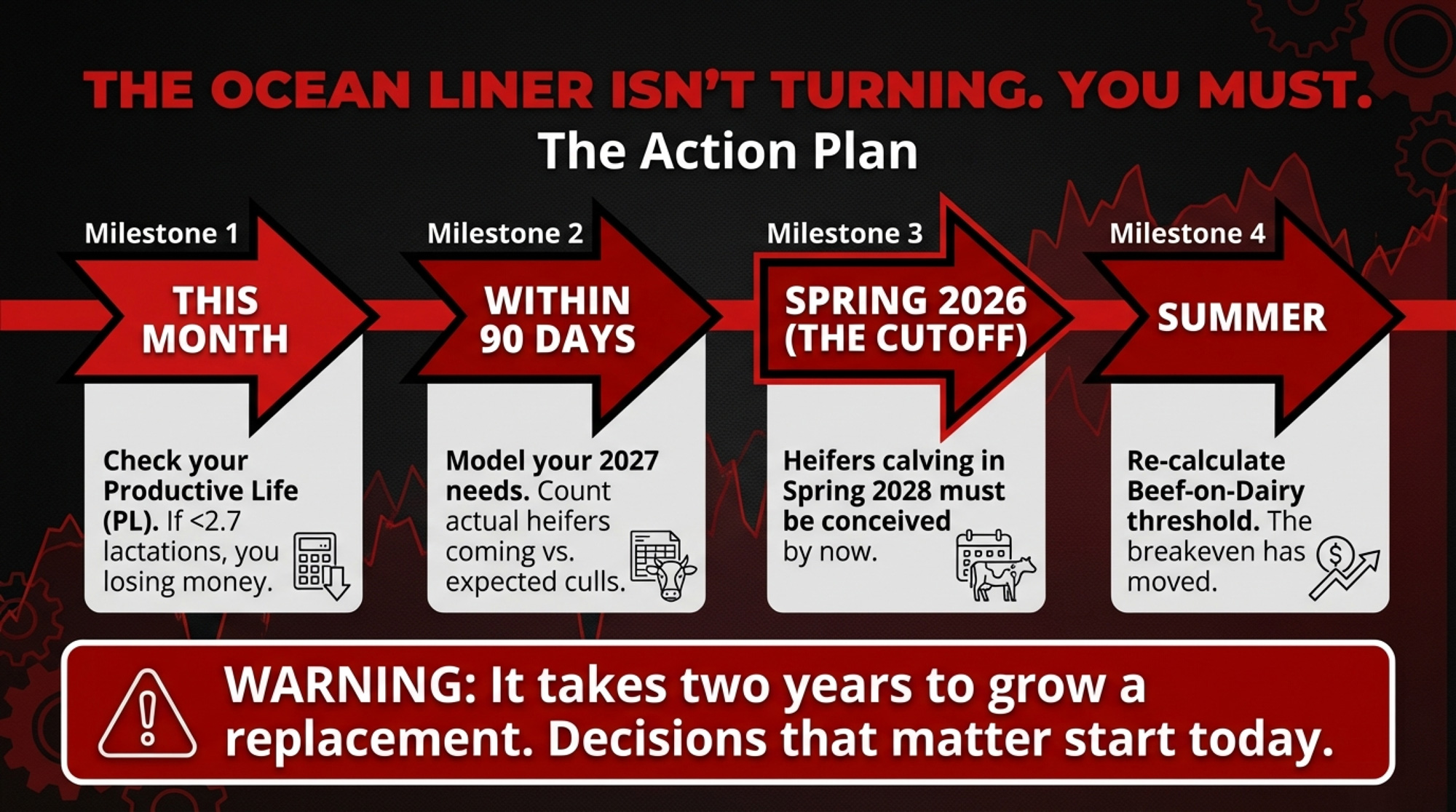
This isn’t a crisis you can wait out. The heifers that calve in spring 2028 need to be conceived by spring 2026. The clock is running.
This month: Pull your herd’s current replacement rate and weighted-average PL breeding value. If your cows average fewer than 2.7 lactations — the current national average — you’re replacing faster than the industry and paying $3,010+ per head to do it. If PL in your sire stack averages below +3.0, you’re not making the longevity bet.
Within 90 days: Model your 2027 heifer needs. Count the cows in your milking string who’ll likely leave within 18 months — age, health status, reproductive failure. Count the heifers you have coming. If there’s a gap, it takes two years to grow a replacement. Decisions that matter start now.
Before summer: Run the updated barn math on your beef-vs-dairy breeding split with your actual calf prices and youractual replacement costs. At Premier Livestock’s late-January sale, open Holstein heifers in the 700–850-lb range moved at $1,550–$3,000. For many herds, the breakeven has already shifted.
Within 12 months: If you haven’t genomic-tested your milking herd, that’s the single highest-ROI decision available right now. You can’t breed your best cows to dairy sires and your worst to beef if you don’t know which is which. Grotegut, Kline, and Metcalf all started with testing. The strategy flows from there.
Read more: the 140-day heifer breeding timeline that could close your replacement gap
Key Takeaways
- If your cows average fewer than 2.7 lactations, you’re replacing faster than the industry — and the cost per replacement has risen $1,120+ in two years. The longevity dividend runs $8,000–$9,000 per cow per extra lactation. Genetics that extend productive life aren’t optional anymore; they’re your cheapest source of replacements.
- If you’re breeding more than 50% of your herd to beef, model what happens when you need to buy back 200 replacements at $3,010+. Two years ago, beef-on-dairy economics were a no-brainer. Today, the breakeven is moving. Know where yours sits.
- If you haven’t modeled your 2027 heifer pipeline, do it this quarter. CoBank’s data says the shortage gets worse before it gets better — 438,844 fewer heifers in 2026 before any recovery in 2027. The processors coming online need your milk. The question is whether you’ll have the cows to produce it.
- Forced retention is not longevity. Overton’s data shows herds running short on heifers retain cows 25 days longer and lose 7 lbs/day in the process — plus $500–$600/cow in opportunity cost. Keeping cows alive through genetics and management pays. Keeping them alive because you can’t afford to replace them costs three times more than culling too early.
The Bottom Line
Pull your herd’s average productive life. If your cows average fewer than 2.7 lactations — the current national average — you’re replacing faster than the industry, and paying $3,010+ per head for the privilege. If your PL breeding values don’t reflect the kind of genetic progress driving the national culling decline, you’re watching this story unfold from the wrong side.
Glenn Kline figured this out in 2011, when he started genomic testing 500 cows in Troy, Pennsylvania. Fourteen years and 700 additional cows later, he can see the difference between the animals he built and the ones he had to buy. Eric Grotegut built a 25% replacement rate on 3,500 cows by letting genetics do the culling for him. Kristen Metcalf’s 300 Jerseys are bred to stay five or six lactations. Different scales. Different breeds. Same bet.
The ocean liner isn’t turning. But what you breed this spring determines which side of the deck you’re standing on when it does.
Complete references and supporting documentation are available upon request by contacting the editorial team at editor@thebullvine.com.
Learn More
- The Six-Figure Execution Leak Happening on Most Dairies: Broken Protocols, Heifer Costs, and Dairy‑Beef Checks – Stop hemorrhaging capital by fixing the “execution leaks” in your breeding program. This guide exposes how sloppy protocols turn high heifer costs into a six-figure loss, arming you with genomic sorting tactics to protect your margin immediately.
- $3,010 Per Heifer. 800,000 Short. Your Beef-on-Dairy Bill Is Due. – Position your operation for the 800,000-head replacement gap already locked into the 2026 market. This deep dive reveals why beef premiums are no longer a no-brainer, delivering the intelligence needed to survive dairy’s looming structural reset.
- Did Genomics Really Deliver What We Think It Did? $238,000 Says Yes – If You Steer It Right – Capture the $238,000 genetic dividend by mastering the new indices that drive modern profit. This analysis reveals how to balance accelerated gains with inbreeding risks, transforming your breeding program into a high-value asset that outpaces the commodity curve.
 The Sunday Read Dairy Professionals Don’t Skip.
 The Sunday Read Dairy Professionals Don’t Skip.
Every week, thousands of producers, breeders, and industry insiders open Bullvine Weekly for genetics insights, market shifts, and profit strategies they won’t find anywhere else. One email. Five minutes. Smarter decisions all week.