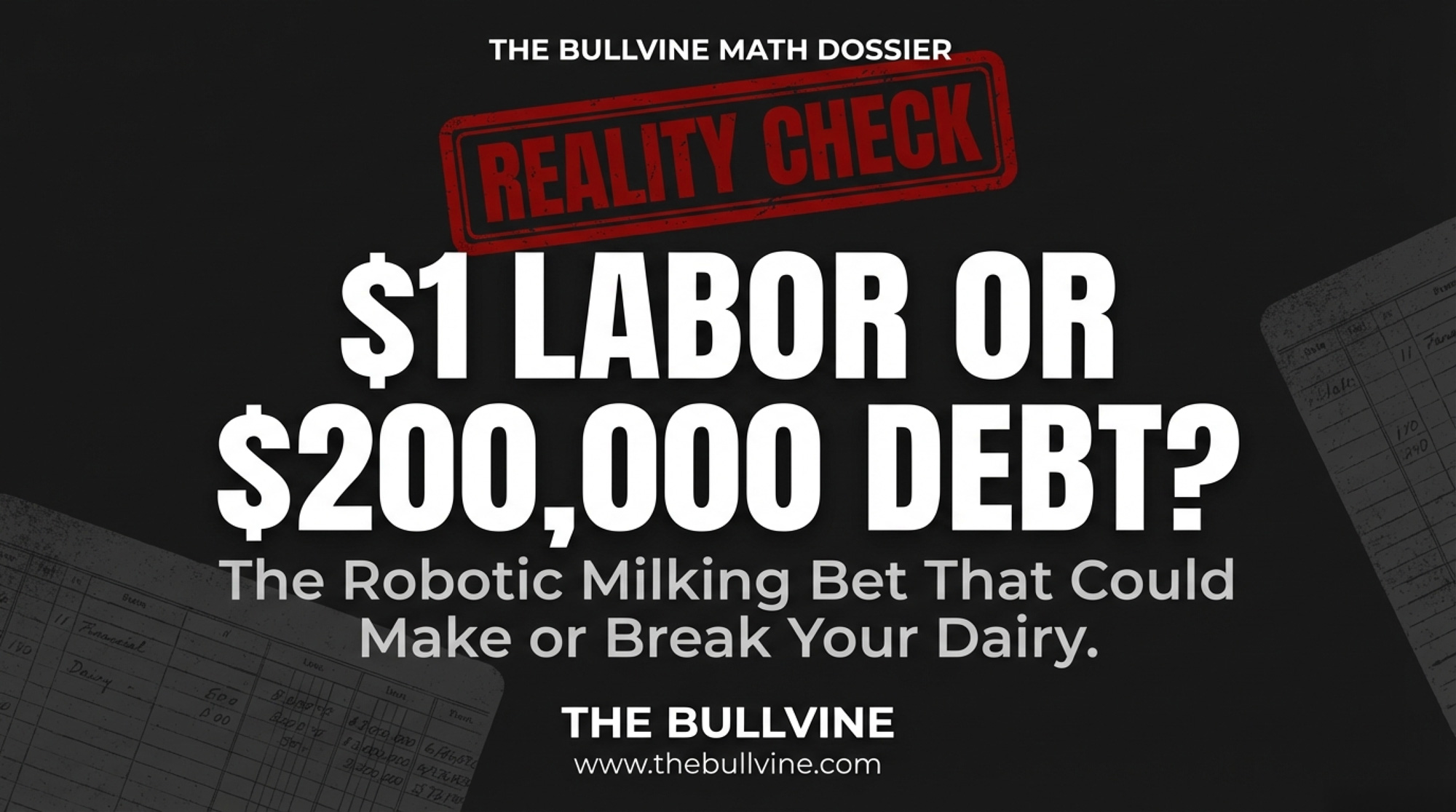
A $4/hour raise costs this 480‑cow family $48,000 a year. The robots their dealer pitched added $200,000 in payments. Which one are you actually signing up for?
Executive Summary: A $4/hour wage bump on a 480‑cow dairy costs $48,000 a year — painful but variable. The AMS alternative runs $150,000–$230,000 in annual debt service on $1.5–$2.0 million in robot capital, and that number doesn’t flex when milk hits $18. UW–Minnesota–Penn State data show average AMS labor savings of $1.50/cwt, but roughly 8% of adopters saved nothing, and USDA’s ERR‑356 confirms that the 13% net‑return upside emerges only after about seven years of red ink. Layer on a direct‑supply contract with three‑to‑seven‑year terms and six‑month termination windows — structures attorney Todd Janzen has compared to broiler grower agreements — and you’ve converted a labor problem into a fixed‑debt‑plus‑captive‑buyer problem. If your DSCR drops below 1.15× with robot payments added, your lender’s comfort disappears before your labor savings arrive. This piece walks through the full barn math, the contract hooks, the risk transfer nobody’s putting in the dealer proposal, and a 30/90/365‑day playbook for stress‑testing the decision on your own numbers.
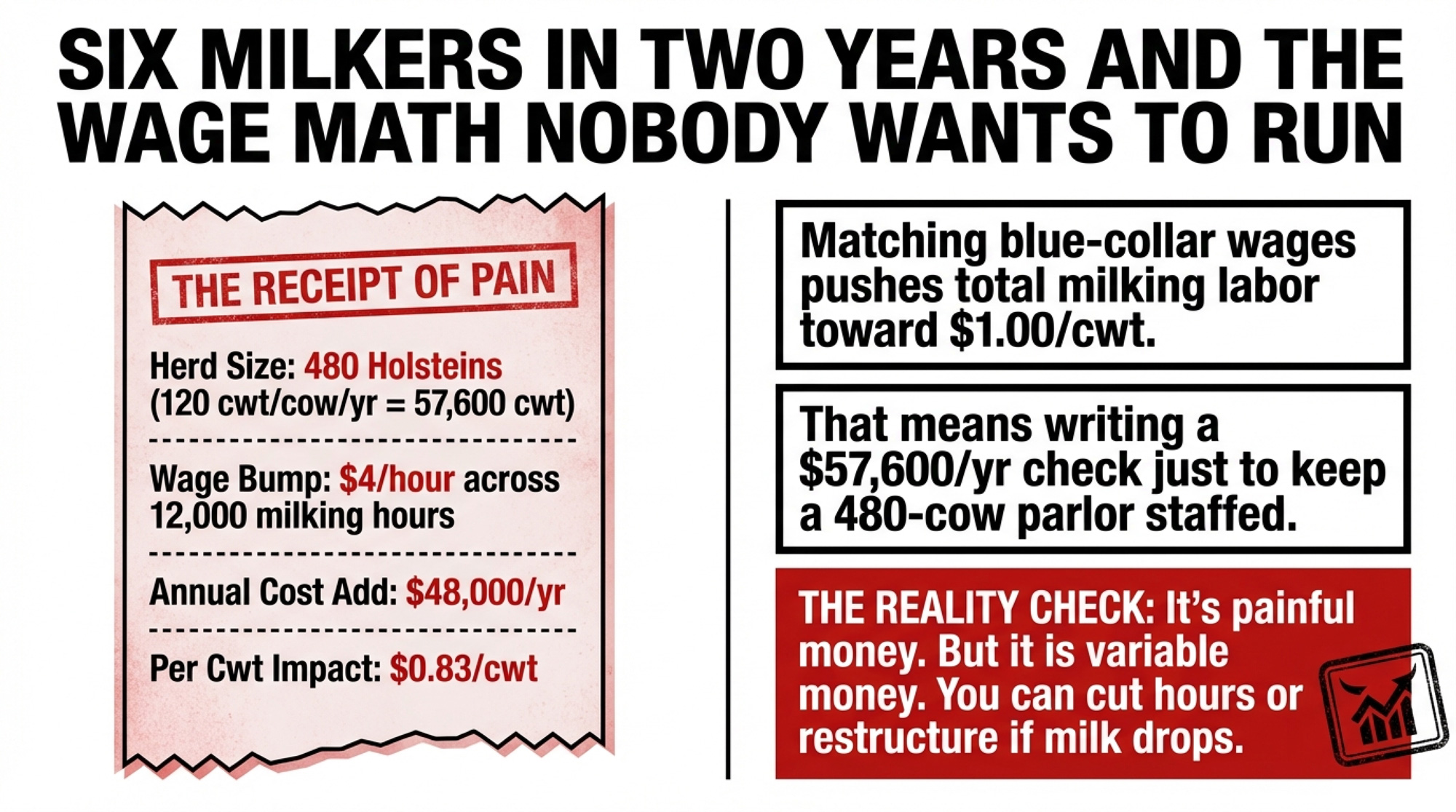
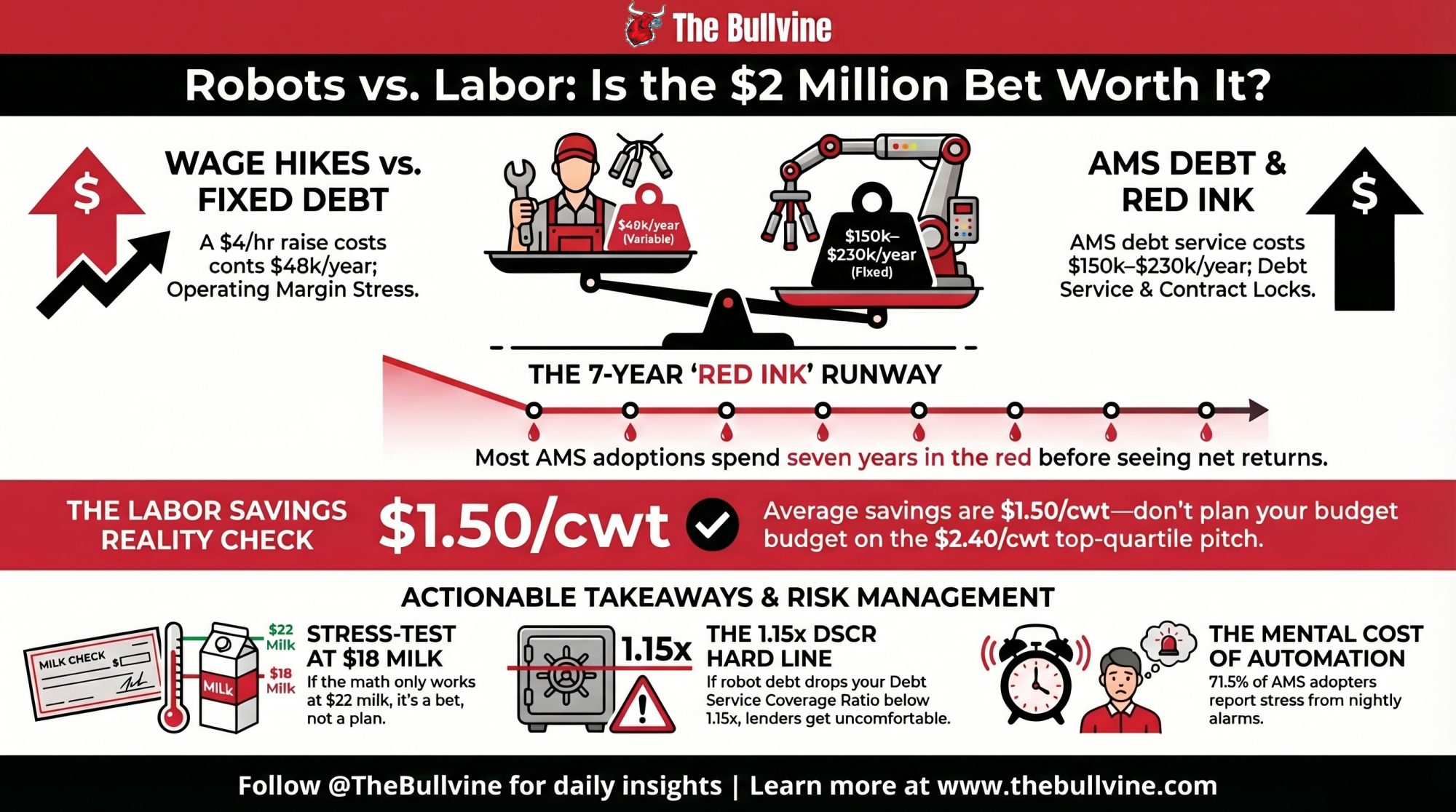
A Wisconsin family milking 480 Holsteins burned through six hired milkers in two years. They’re not unusual. Finding and keeping parlor labor at competitive wages has become one of the hardest operational problems on mid‑size U.S. dairies, and every time this family bumped pay to stop the bleeding, it showed up on the milk check. A $4‑per‑hour raise across roughly 12,000 milking‑related labor hours adds $48,000 a year — that’s $0.83/cwt on a herd shipping 57,600 cwt annually.
So when a robot dealer walked in with an AMS proposal, the pitch was simple: trade variable labor headaches for fixed payments on machines that never quit. But the math behind that pitch deserves a harder look than most families give it.
This example pulls together numbers and decisions from several real mid‑size herds The Bullvine has followed, written as a single composite family so you can see the whole decision in one place.
Six Milkers in Two Years — and the Wage Math Nobody Wants to Run
Here’s the core tension. Matching local blue‑collar wages can push milking labor toward $1.00/cwt for herds in the 300–600‑cow band. On a 480‑cow dairy shipping 120 cwt per cow per year, that’s 57,600 cwt. If your all‑in labor cost for milking sits at $1.00/cwt, you’re writing a check for $57,600 a year to keep the parlor staffed — and that’s before benefits, turnover costs, and the nights you’re filling in yourself.
Drop to 300 cows at the same per‑cwt cost, and it’s still $36,000 a year. That’s real money. But it’s variable money. You can cut hours, adjust shifts, or restructure if milk prices tank. That flexibility matters more than most robot proposals acknowledge.
The question isn’t whether $1.00/cwt labor is painful. It is. The question is whether the alternative — a seven‑figure capital commitment — actually fixes the problem or converts it into a different kind of pain.
Is AMS Really Cheaper Than Labor on a 480‑Cow Dairy?
Let’s run it.
A joint survey by the Universities of Wisconsin, Minnesota, and Penn State — covering 50 U.S. dairy operations that adopted AMS — found an average labor saving of 0.10 hr/cwt, which works out to roughly $1.50/cwt at a $15/hour wage. On average, those herds cut milking time by 38% per cow and 43% per hundredweight. The top quartile — 25% of respondents — saved 0.16 hr/cwt or better, translating to $2.40/cwt at the same wage rate.
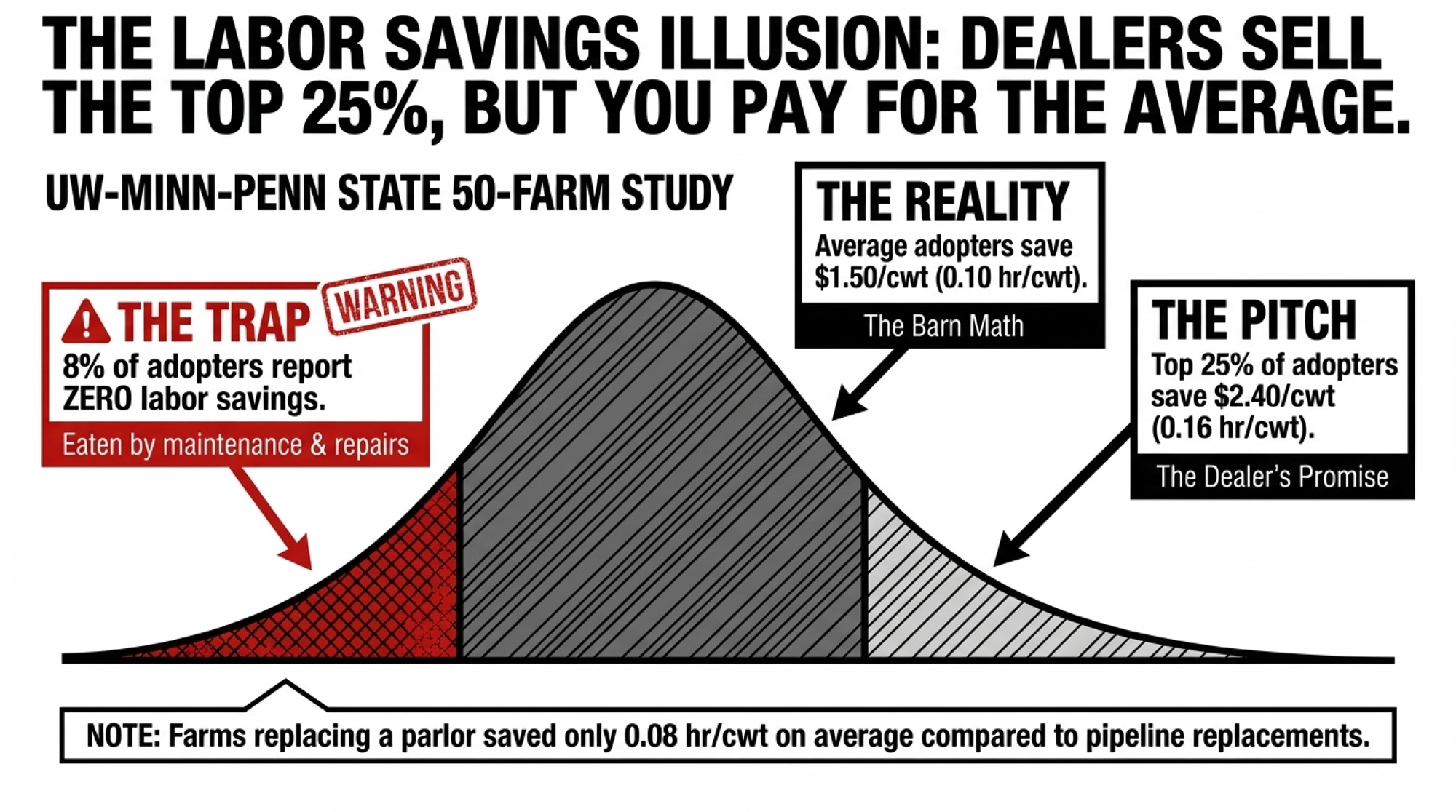
But here’s the spread that matters: roughly 8% of AMS adopters reported zero labor savings. Maintenance and repair ate the hours right back. And farms replacing a parlor (not a pipeline) saved less on average — 0.08 hr/cwt versus 0.16 hr/cwt for pipeline replacements.
Now price the robots. Each AMS box handles 50–70 cows. A 480‑cow herd needs 7–8 boxes, depending on how hard you push cows per unit. Installed cost ranges from $200,000 to $300,000 per box in the current U.S. market. That puts total AMS capital at roughly $1.4 million to $2.4 million.
| Scenario A: Raise Wages | Scenario B: Install AMS | |
| Annual cost | $48,000 ($4/hr raise on 12,000 hrs) | $150,000–$230,000 P&I (on $1.5–$2.0M, 10–15 yr, post‑2023 rates) |
| $/cwt impact | $0.83/cwt | $2.60–$3.99/cwt in debt service alone |
| Labor savings | None (still paying people) | $86,400–$138,240/yr ($1.50–$2.40/cwt × 57,600 cwt) |
| Net annual gap | — | Debt service exceeds labor savings by $12,000–$144,000/yr in early years |
| Risk type | Variable — adjustable if prices drop | Fixed — payments don’t flex with milk price |
The labor savings are real. But in the early years, debt service on the robots often exceeds the labor dollars you save— sometimes by a wide margin. That’s not a reason to never automate. It is a reason to stress‑test the deal at $18 milk, not just $22.
The 13% That Hides Seven Years of Red Ink
USDA’s Economic Research Service published ERR‑356 in January 2026 — the first nationally representative study of AMS profitability using multi‑year ARMS data (2000–2021). The headline finding: robotic milking and precision dairy technologies increase U.S. dairy net returns by about 13% on average, after controlling for the fact that stronger managers tend to adopt first.
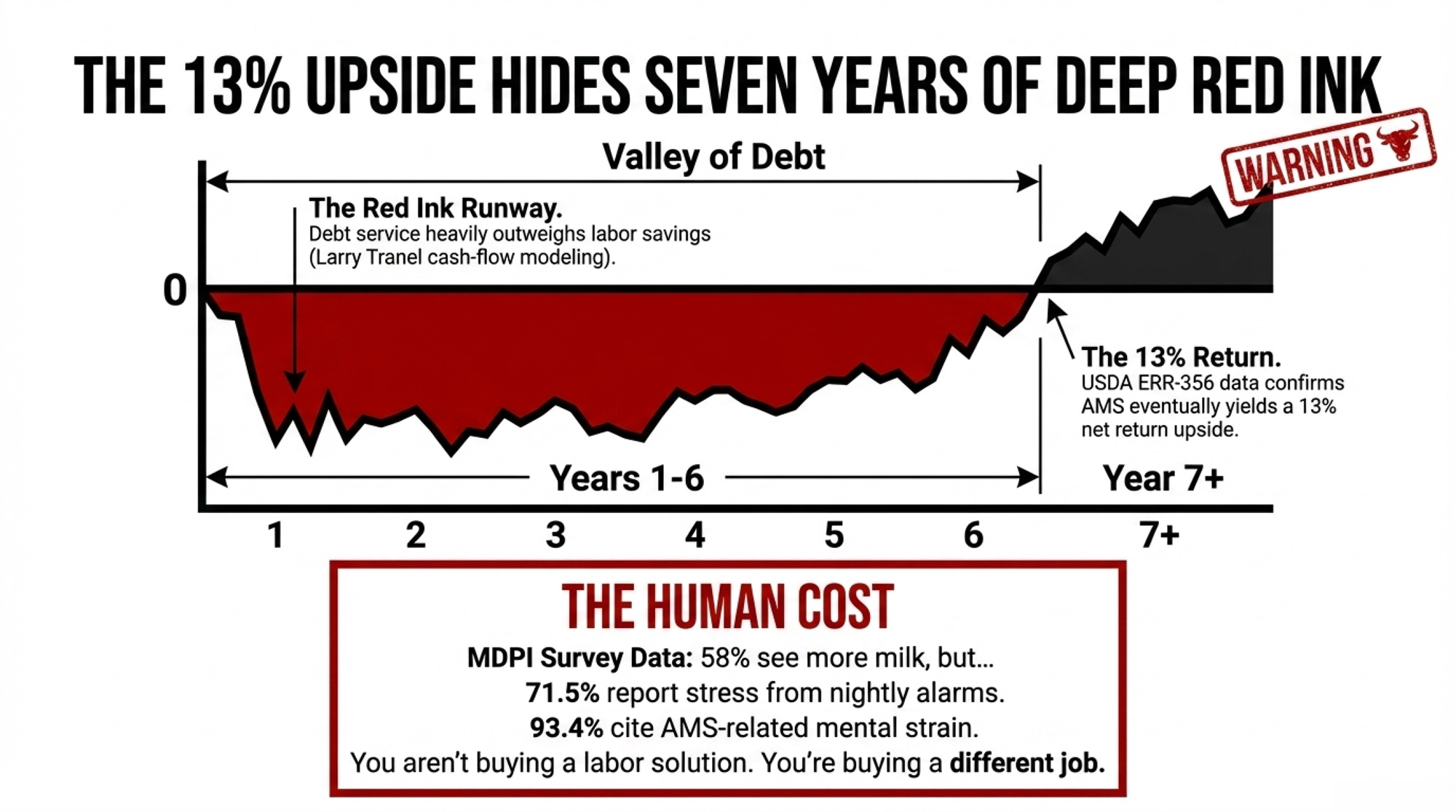
That 13% is an adjusted treatment effect, and it’s the strongest national evidence yet that AMS can pay. But Iowa State economist Larry Tranel’s cash‑flow modeling tells the rest of the story: a typical two‑robot install often spends roughly seven years in the red before that upside appears. One 240‑cow Iowa family profiled by The Bullvine ran their numbers through Tranel’s model and saw exactly that arc — years of negative cash flow before the math finally turned.
The MDPI perception study of large U.S. AMS dairies (those running seven or more robots) backs up both sides: 54% of respondents would recommend AMS to other farms. But 38% said, “consider more aspects before deciding.”Among adopters, 58% reported increased milk production, and 32% reported higher component levels. At the same time, 71.5% reported stress from nightly alarms, and 93.4% cited at least one AMS‑related mental strain.
You’re not buying a labor solution. You’re buying a different job — and a different risk profile.
When the “Labor Fix” Comes With a Contract Hook
Here’s the turn most AMS proposals don’t mention. A seven‑figure capital investment often changes your relationship with your milk buyer.
Attorney Todd Janzen — general counsel to the Indiana Dairy Producers — reviewed direct‑supply contract trends in a 2018 analysis and flagged structural shifts that matter even more now. Direct‑buy contracts typically run three to seven years, compared to 30‑day termination windows at most cooperatives. The termination notice can stretch to six months, and in most cases, as Janzen reviewed, the contract language gave buyers more lenient exit terms than producers.
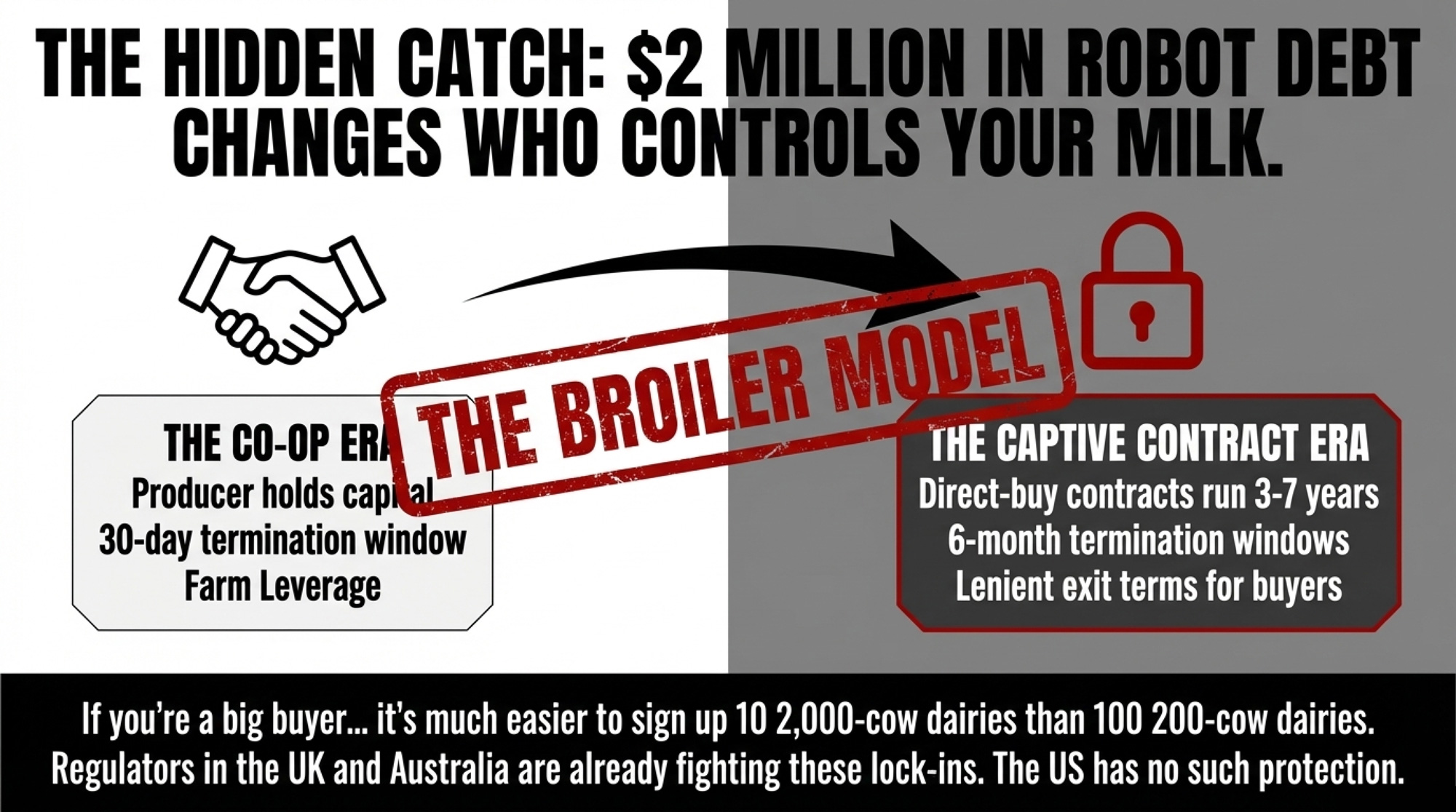
Janzen compared the “Cost+” direct‑supply model specifically to broiler and swine grower contracts — arrangements where the producer carries the capital and the buyer controls the terms. His conclusion was blunt: these contracts would “hasten the demise of small farms” and could be “the nail in the coffin for many small dairies.” As he put it: “If you’re a big buyer of milk, it’s much easier to sign up 10 2,000‑cow dairy farms than 100 200‑cow dairy farms.”
Regulators elsewhere have started to act. In Australia, the ACCC fined Lactalis AU$950,000 in July 2023 for breaching the Dairy Code during the 2020/21 season — the Code’s first enforcement action. The ACCC alleged contract clauses made non‑exclusive supply “inefficient and commercially unviable,” effectively locking producers in. In the UK, new Fair Dealing Obligations took effect for new milk contracts in July 2024, with existing contracts required to comply by July 2025.
The U.S. has no equivalent code. If you’re carrying $1.5 million in robot debt and your processor is your only realistic buyer, your negotiating leverage looks a lot different than it did when you ran a parlor with a 30‑day co‑op agreement.
| Contract Feature | Traditional Co-op | Direct-Supply / Cost+ |
|---|---|---|
| Typical term length | Month-to-month or annual | 3–7 years |
| Termination notice | 30 days (standard) | Up to 6 months |
| Exit symmetry | Generally equal both sides | Buyer often has more lenient exit (Janzen, 2018) |
| Price mechanism | Pool price + premiums | Cost+ formula set by buyer |
| Exclusivity | Non-exclusive (can ship elsewhere) | Often exclusive or “commercially unviable” to split |
| Capital alignment | Farm chooses own equipment | AMS investment may tie you to buyer’s specs |
| Regulatory protection (U.S.) | Capper-Volstead cooperative protections | No equivalent code — contrast with AU Dairy Code (ACCC, 2023) and UK Fair Dealing Obligations (2024) |
| Janzen’s comparison | Traditional dairy relationship | “Broiler and swine grower contracts” |
| Risk profile | Variable but flexible | Fixed debt + captive buyer |
When Does “Modernization” Become Risk Transfer?
In practice, a lot of this modernization tends to shift more day‑to‑day risk and control onto the farm, while processors and lenders benefit from more predictable supply and better data.
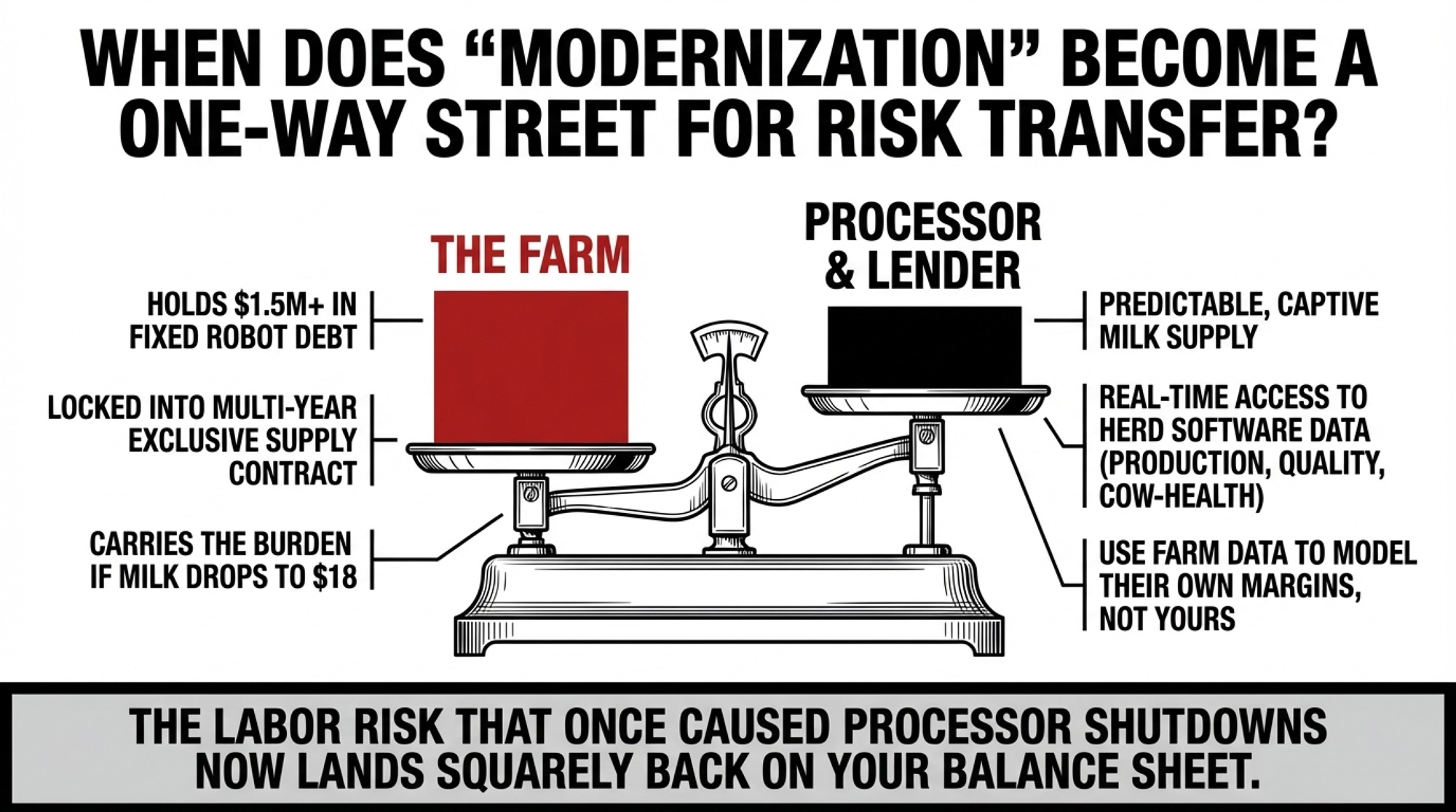
Your AMS and herd‑management software now stream production, quality, and cow‑health data in real time. In some programs, processors and lenders can access that feed directly. And in some arrangements, they may use it to model things like herd performance and potential margins much more precisely than in the past. That’s not inherently bad — better data can mean better lending terms and more responsive supply chains. But it also means your buyer and your banker may know your numbers as well as you do, and they’re using that transparency to manage their risk, not yours.
The labor risk that once showed up as processor shutdowns and trucking chaos now often lands back on the farm. Either solve it with capex, pay more, or eventually scale down or exit. When you add a multi‑year exclusive supply contract on top of robot debt, you’ve layered two fixed commitments that don’t flex when milk drops to $18.
Which Path Fits Your Balance Sheet?
There isn’t one right answer. But there are three honest paths, and each comes with real trade‑offs.
| Path A: Automate | Path B: Stay Manual | Path C: Niche / Value-Added | |
|---|---|---|---|
| Capital required | $1.4M–$2.4M | $0 | $50K–$300K (processing, branding) |
| Annual fixed cost | $150K–$230K debt service | $0 new fixed | Varies by channel |
| Annual variable cost | Maintenance + reduced labor | $48K–$58K milking labor | Marketing + labor |
| DSCR impact | Drops 0.2–0.4x | No change | Neutral to positive |
| Milk price sensitivity | HIGH — payments don’t flex | LOW — hours adjustable | MODERATE — margin-dependent |
| Buyer leverage | Often locked to 1 processor | 30-day co-op terms | Multiple small buyers |
| Break-even timeline | ~7 years (Tranel model) | Immediate (no new debt) | 2–4 years |
| Best fit | DSCR ≥1.15x pre-robot, 2+ buyers, strong equity | DSCR < 1.15x, or single-buyer market | Geography supports premium, operator wants scale control |
| Biggest risk | 7 years of red ink + captive contract | Chronic turnover, burnout | Small market, limited scale |
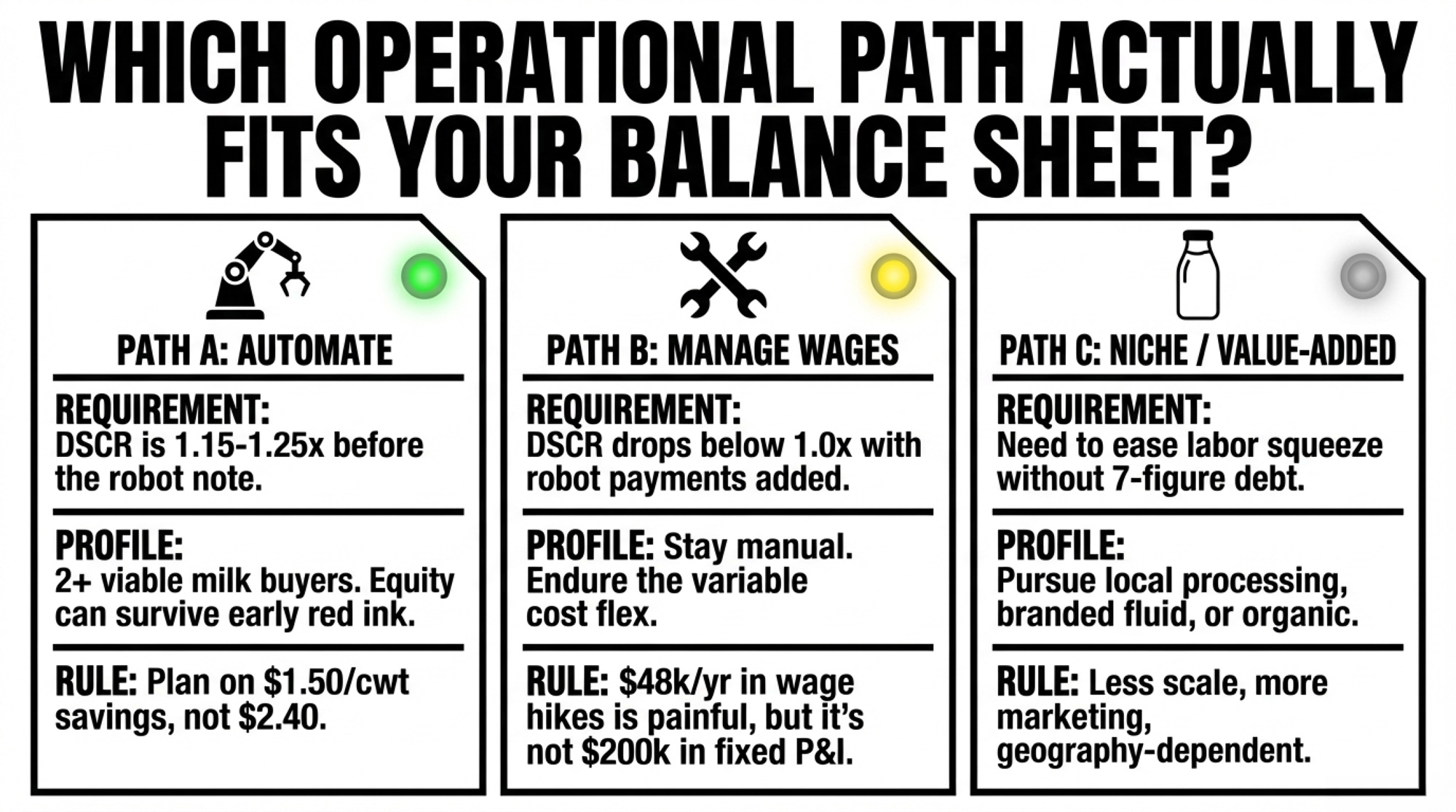
Path A — Automate. This works best when your debt‑service coverage ratio (DSCR) sits comfortably in the 1.15–1.25× range or higher before the robot note, you have at least two viable milk buyers, and you can survive the early red‑ink years on existing equity. Plan using $1.50/cwt in labor savings, not the $2.40 top‑quartile figure — only 25% of adopters hit that.
Path B — Stay manual, manage wages. Variable labor costs hurt, but they flex. If your DSCR would drop below 1.0×with robot payments layered on, you’re in the stress zone. A $4/hr raise costs this composite herd $48,000 a year. That’s painful — but it’s not $150,000–$230,000 in fixed P&I.
Path C — Pursue niche or value‑added channels. Smaller, higher‑margin markets — local processing, branded fluid, organic, specialty — can ease the labor‑cost squeeze without a seven‑figure capital bet. Trade‑off: less scale, more marketing effort, and not every geography supports it.
What This Means for Your Operation
- Run your milking labor $/cwt this month. Pull 12 months of milking‑related labor costs and divide by cwt shipped. If you’re approaching $1.00/cwt, you’re in the band where AMS proposals start to feel urgent — but that doesn’t mean they’re right.
- Stress‑test any AMS proposal at $18 milk, not $22. Ask the dealer and your lender to model robot payments at the bottom of a realistic price range. If the deal only works at high milk, it’s a bet, not a plan.
- Check your DSCR before and after. If adding robot debt pushes your ratio below 1.15×, you’re entering the band where lenders get uncomfortable. Below 1.0×, and you can’t cover debt obligations from farm income alone.
- Read your supply contract like it’s a second mortgage. Check termination notice periods, exclusivity clauses, and whether the contract gives the buyer more lenient exit terms than you get. If you have only one viable buyer, treat it as a risk signal.
- Audit your data flows. Know exactly what production, quality, and herd data your systems share with processors and lenders — and whether you’ve consented to that sharing explicitly.
- Ask your lender one direct question: “If milk drops to $18 for 18 months, does our AMS note plus our operating line still pencil at a DSCR your credit committee would approve today?”
Key Takeaways
- If your DSCR sits below 1.15× before adding robot debt, you’re already in the caution band. Layering $150,000–$230,000 a year in fixed payments on top of that is a high‑risk move regardless of labor savings.
- The average AMS labor saving is $1.50/cwt, not $2.40. Planning on top‑quartile performance when only 25% of adopters achieve it is how you end up in year four with negative cash flow and no exit.
- AMS can pay — eventually. USDA’s ERR‑356 shows a 13% net‑return advantage on average. But Tranel’s cash‑flow work shows roughly seven years of red ink first. If your equity can’t carry that runway, the 13% upside is academic.
- Your robot decision is also a contract decision. A seven‑figure capital commitment often ties you to a single buyer on terms that increasingly resemble grower agreements in poultry and pork — not the cooperative relationships most dairy families grew up with.
The dealer’s pitch is always clean: swap variable labor for fixed automation. But the spreadsheet that actually matters is yours — and the number that decides whether this works isn’t labor saved per cwt. It’s the gap between your total debt service and your income in the worst milk‑price year you can realistically model. What does that gap look like on your operation right now?
Complete references and supporting documentation are available upon request by contacting the editorial team at editor@thebullvine.com.
Learn More
- Robotic Milking Pays 13% More – After 7 Years of Red Ink – This case study exposes the brutal seven-year cash-flow valley producers face before hitting that 13% net-return upside. It arms you with a realistic timeline to survive the transition without bleeding out your equity.
- 2025 Dairy Year in Review: Ten Forces That Redefined Who’s Positioned to Thrive Through 2028 – Gain a high-level view of the structural shifts—from heifer shortages to shifting culling math—redefining North American dairy. This analysis reveals how to position your balance sheet to thrive through 2028 despite persistent volatility.
- Winning the Workforce War: How Top Dairies Are Solving Labor Shortages in 2025 – This field report delivers unconventional tactics for increasing retention and production by blending wearable tech with creative human capital. It reveals how to win the labor war without automatically defaulting to a massive robot debt load.
 The Sunday Read Dairy Professionals Don’t Skip.
 The Sunday Read Dairy Professionals Don’t Skip.
Every week, thousands of producers, breeders, and industry insiders open Bullvine Weekly for genetics insights, market shifts, and profit strategies they won’t find anywhere else. One email. Five minutes. Smarter decisions all week.