86% of fresh heifers have udder edema. That’s not a cosmetic issue — it’s $3,500–$16,000 a year walking out your door.
That rock-hard, swollen udder on your fresh heifer isn’t just “how it is.” It’s a disease process with a measurable price tag — and in 2025–2026, that price just got a lot steeper.
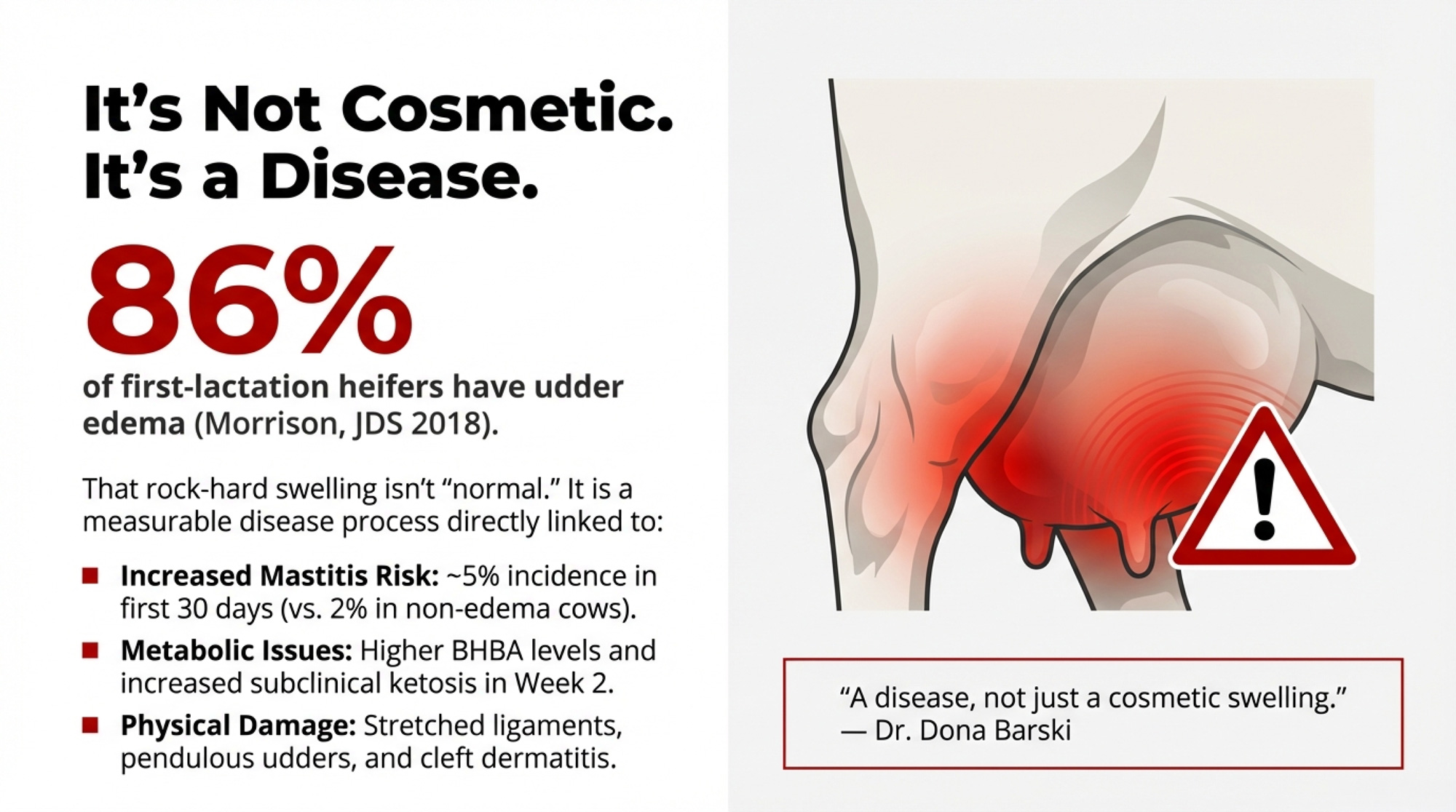
Work by Emma Morrison and colleagues, published in the Journal of Dairy Science in 2018 using data from three commercial freestall herds, found udder edema in 86% of first-lactation heifers and around 56% of second-lactation cows in early lactation. When you apply conservative economics — recent U.S. milk prices, realistic assumptions for extra mastitis, slow-milking heifers, and earlier culling — Bullvine’s 2025 modeling puts herd-level losses at roughly $3,500–$16,000 a year on a 100-cow operation. The fix? About $40 per heifer in targeted vitamins and ration adjustments.

If you’re raising replacements at $3,000–$4,000 a head — and that’s where the U.S. market sits right now — watching even a few of them leave early isn’t just frustrating. It’s a serious hit to your balance sheet.
The Fresh-Heifer Problem You’re Underpricing
Morrison’s 2018 JDS paper scored udder edema on 1,346 cows across three North American freestall herds during the first three weeks in milk. The pattern held across all three operations:
- 86% of first-lactation heifers had udder edema
- About 56% of second-lactation cows showed edema, with prevalence dropping in older animals
Michigan veterinarian Dona Barski called udder edema “a disease, not just a cosmetic swelling.” She linked it directly to increased mastitis risk and subclinical ketosis in early lactation.
Here’s the milk math. Using Morrison’s health and performance associations and Bullvine’s 2025 fresh-cow economic modeling, a conservative estimate of the direct milk loss per affected heifer is around 316 lb per lactation. At roughly $20/cwt — a reasonable working average for recent U.S. Class III/IV prices — that’s about $63 per heifer in milk alone.
But that’s just the opening act. Morrison’s data shows cows with edema are more likely to:
- Have clinical mastitis in the first 30 days (approximately 5% vs 2% in non-edema cows)
- Show higher BHBA levels and more subclinical ketosis in week 2
Those are the heifers that burn through treatment dollars, waste saleable milk, slow down your parlor or robots, and hit the cull pen a lactation earlier than their clean-uddered herdmates.
The Herd-Level Economics
Take a 100-cow herd, with 40 replacement heifers freshened per year. If your incidence looks anything like Morrison’s study herds, 80–90% of those heifers show edema at some level — that’s about 34 affected animalsannually.
Annual Udder Edema Cost (100-Cow Herd, 40 Heifers/Year)
| Cost Category | Rate/Quantity | Dollar Impact | Notes |
| Heifers affected | 34 of 40 (86%) | — | Morrison et al. 2018 JDS |
| Direct milk loss | ~316 lb/heifer | ~$63 each | At ~$20/cwt |
| Total milk loss | 34 × 316 lb | ~$2,149 | Milk only |
| Extra mastitis | ~2.5× higher odds | ~$300–$350/case | Treatment + discarded milk |
| Mastitis cases | 1–3/year | ~$300–$1,050 | Field estimate |
| Slow-outs & dermatitis | 5–10 heifers | ~$500–$2,000 | Labor, robot issues |
| Early culling | 1–2 heifers | $3,000–$4,000+ each | At 2025 replacement prices |
Bullvine’s 2025 modeling — which treats these components as scenario-based ranges, not precise accounting — puts annual losses at $3,500/year on the low end (minimal mastitis, no early culling) to $8,000–$16,000/year in more realistic scenarios that include mastitis complications, slow-milking heifers, and one or two early culls.
Your mileage will vary based on your actual edema rates, how quickly you catch problems, and what replacements cost in your market. But the pattern holds: edema isn’t free.
Why the Stakes Are Higher in 2026
The heifer shortage is real, it’s historic, and it’s not going away soon.
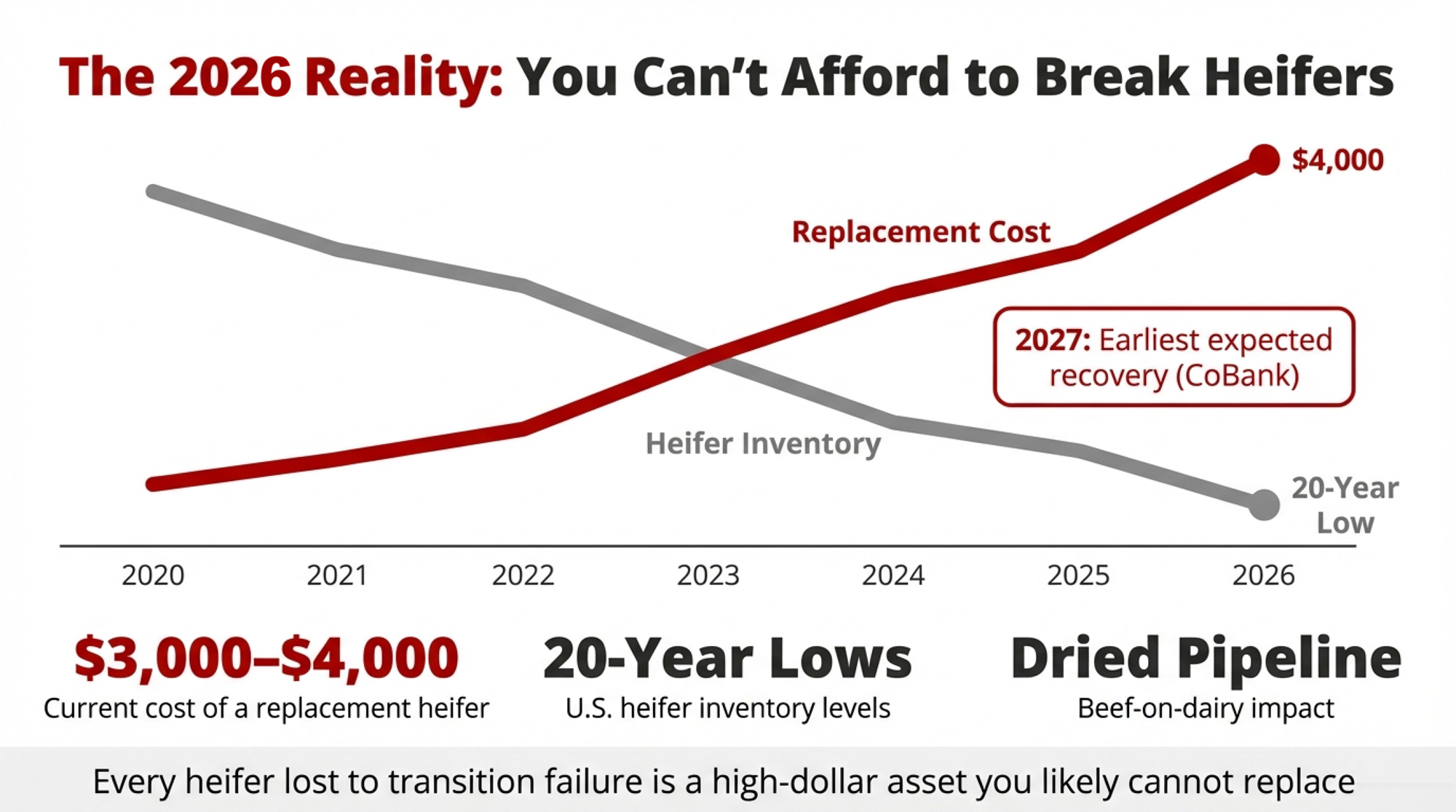
According to CoBank’s August 2025 heifer inventory outlook, which draws on USDA data, U.S. dairy replacement heifer inventory sat at approximately 3.9 million head in January 2025 — the lowest level since the late 1970s and roughly 18% below 2018 levels. CoBank’s projections show heifer numbers continuing to tighten through 2026, with recovery not expected until 2027 at the earliest.
USDA’s Agricultural Prices series and market reports show average replacement heifer prices climbing from around $1,700 in 2023 to roughly $3,000 by mid-2025, with many auction lots bringing $4,000 or more for top genetics.
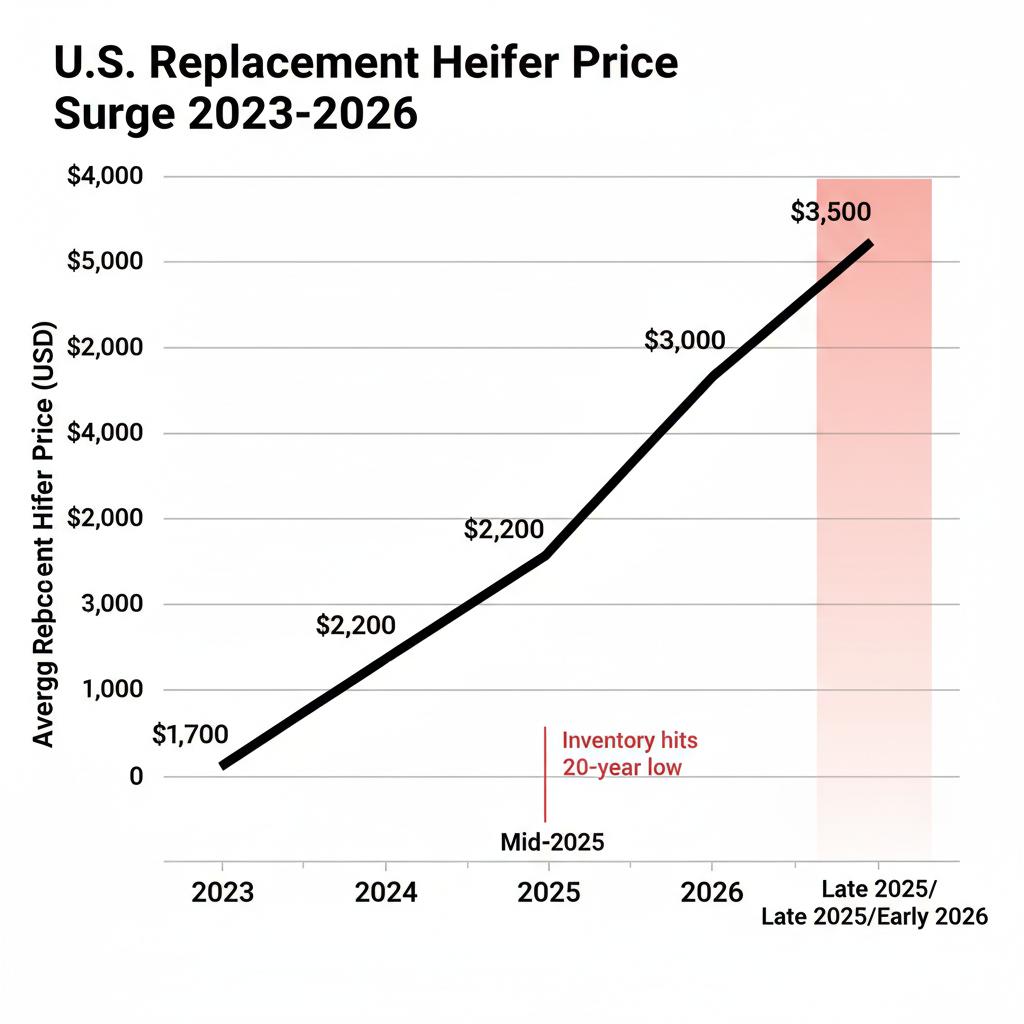
That’s not a typo. Replacement costs have nearly doubled in about two years.
Why the squeeze? Beef-on-dairy worked. Day-old crossbred calves now bring $800–$1,000 in many U.S. markets, compared to around $100 for straight Holstein bull calves just a few years back. As Mike North with Ever.Ag shared in early 2025: “If I’ve got an opportunity to make a thousand dollars on a calf without having to feed it for a year and a half, that’s a fantastic opportunity.”
The math made sense — until the replacement pipeline dried up.
CoBank’s 2025 report notes that producers have responded by “hoarding cows” and delaying culls, but warns that “this historic pullback cannot be sustained long-term” as cull cow values and herd health pressures build.
The bottom line: Any heifer you lose early — whether edema is the main driver or part of a bigger transition train wreck — likely means spending $3,000–$4,000 to replace an animal that cost far less a few years ago. Even one or two extra heifers leaving early on a 100-cow herd can add $6,000–$8,000 a year in replacement costs, before you count the milk and health losses that led up to that decision.
The Opportunity Cost You’re Not Counting
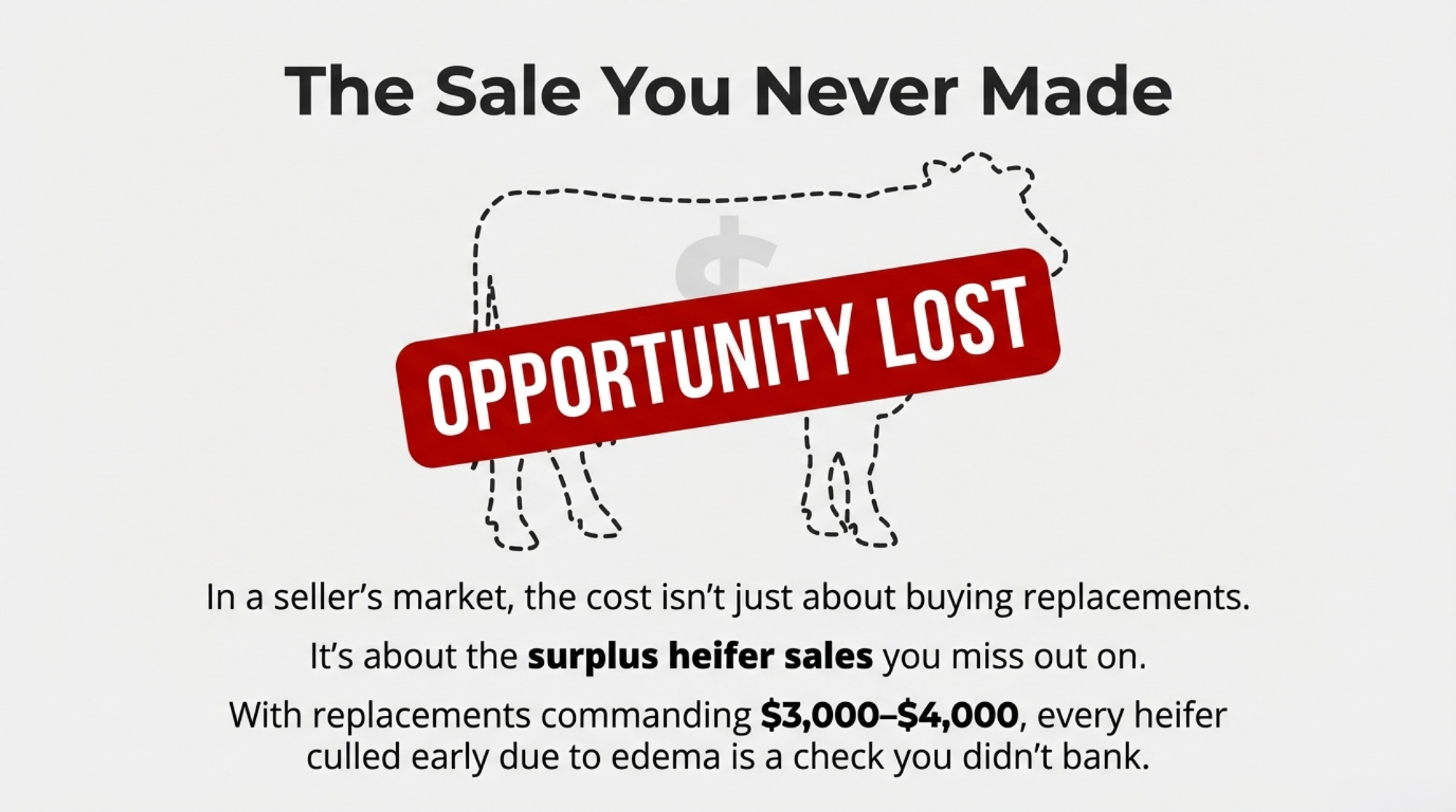
Here’s an angle that doesn’t get enough attention: the opportunity cost isn’t just about buying replacements. It’s about the sales you’ll never make.
If you were positioned to sell surplus heifers into this $3,000–$4,000 market, every heifer that leaves early to edema complications is revenue that evaporates. You don’t just pay more to replace her — you lose the check you would have banked from selling one of her herdmates.
For herds running tight on replacements, that math is bad enough. For herds that built their beef-on-dairy strategy around selling a few extra dairy heifers each year at premium prices, it’s a double hit.
Why Fresh Heifers Get Hammered
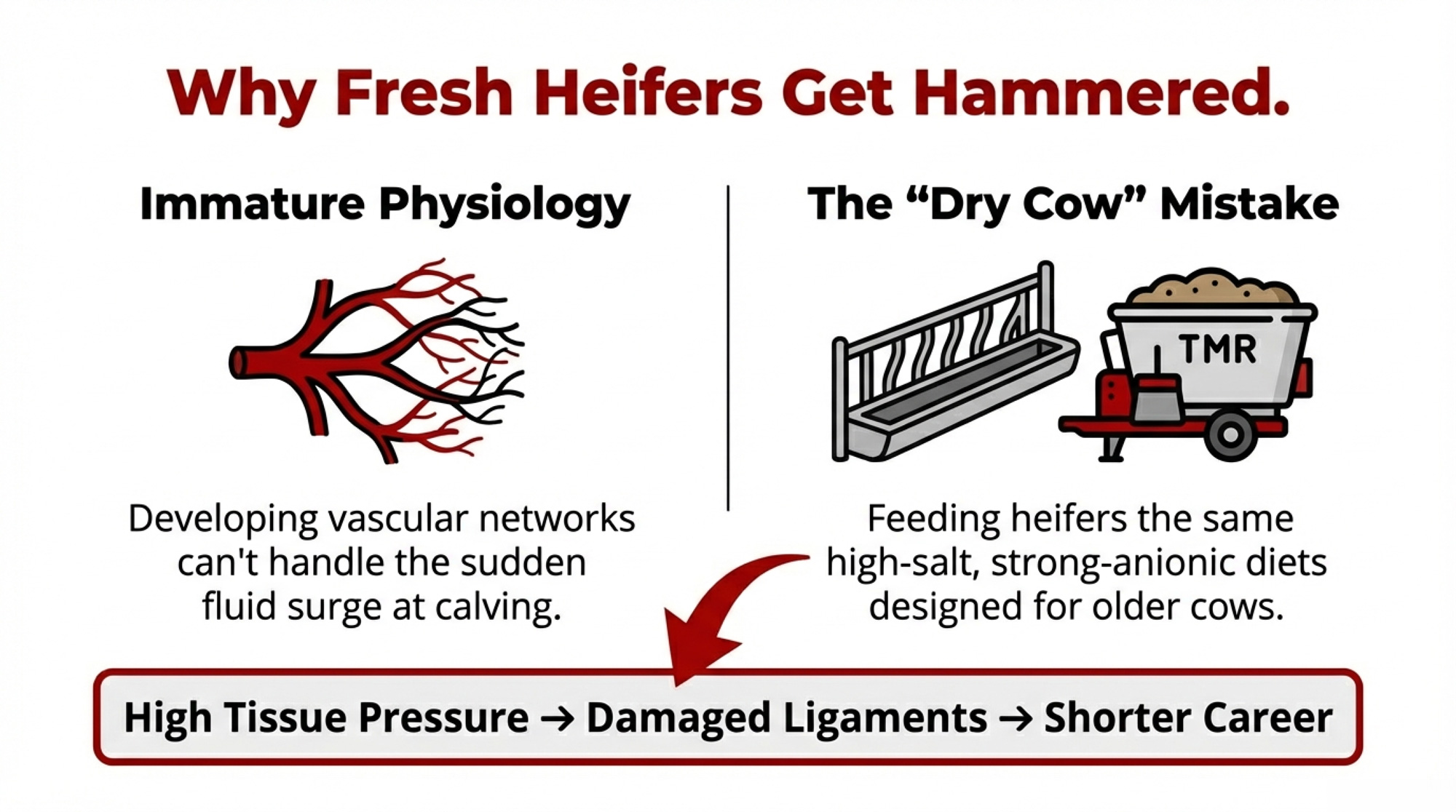
First-calf heifers don’t have the same mature vascular network as older cows. Their milk veins are still developing, so they’re less equipped to handle the surge of blood flow and fluid that comes with calving and ramping up production.
Meanwhile, we ask them to:
- Finish their own skeletal growth
- Carry and calve their first calf
- Jump straight into a high-yield first lactation — often because we bred them off impressive genomic proofs
Then we compound the problem with nutrition that was never designed for them.
Classic JDS trials on sodium and potassium showed that high-salt anionic diets significantly increased edema scores and slowed recovery in heifers. Cora Okkema with MSU Extension advised that heifers should not receive the same strong DCAD ration as older dry cows.
You see it every day in the barn: tight, shiny quarters with a disappearing cleft. Heifers standing wide, flinching at the unit, or kicking. Quarters that won’t empty properly for the first several days.
When swelling lingers, it stretches ligaments, predisposes cows to pendulous udders, and creates a moist, damaged skin environment where udder cleft dermatitis takes hold. A 2020 review links chronic swelling and compromised skin to long-term udder problems and higher culling rates.
“A bit of swelling” isn’t cosmetic. It’s the front door to a shorter career.
Three Levers That Can Move the Needle
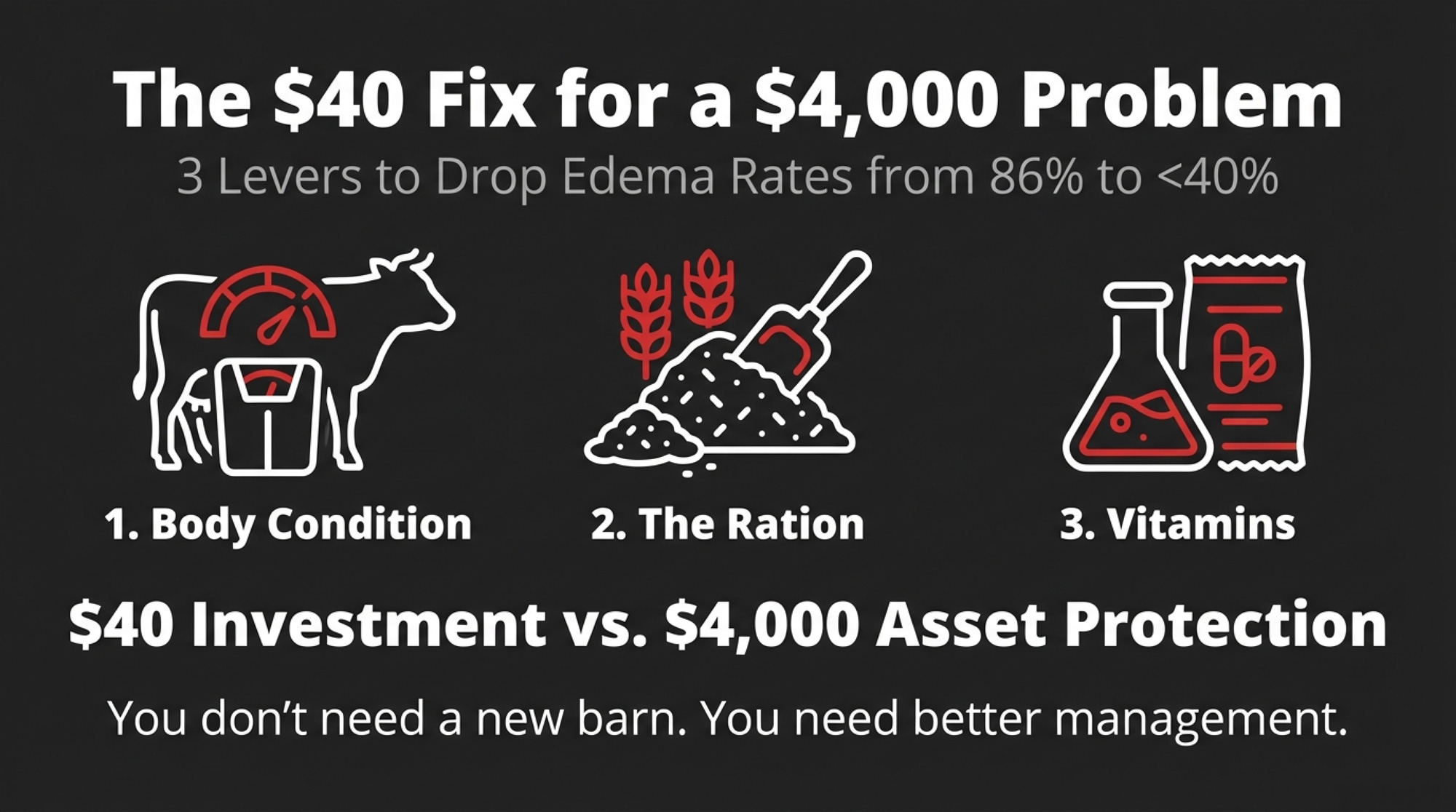
You don’t need robots or a new barn to make progress here. Field reports from herds that get serious about edema management — implementing all three levers below and tracking results over 12–24 months — suggest it’s realistic to push incidence from the 70–90% range down toward 30–40%, and hold severe cases under 10–15%.
Results will vary by herd, and edema is one of several transition issues competing for your time and capital. But it’s one of the cheaper levers to move because the fixes are more about feed allocation and fine-tuning premixes than buying new steel.
Lever 1: Nail Body Condition
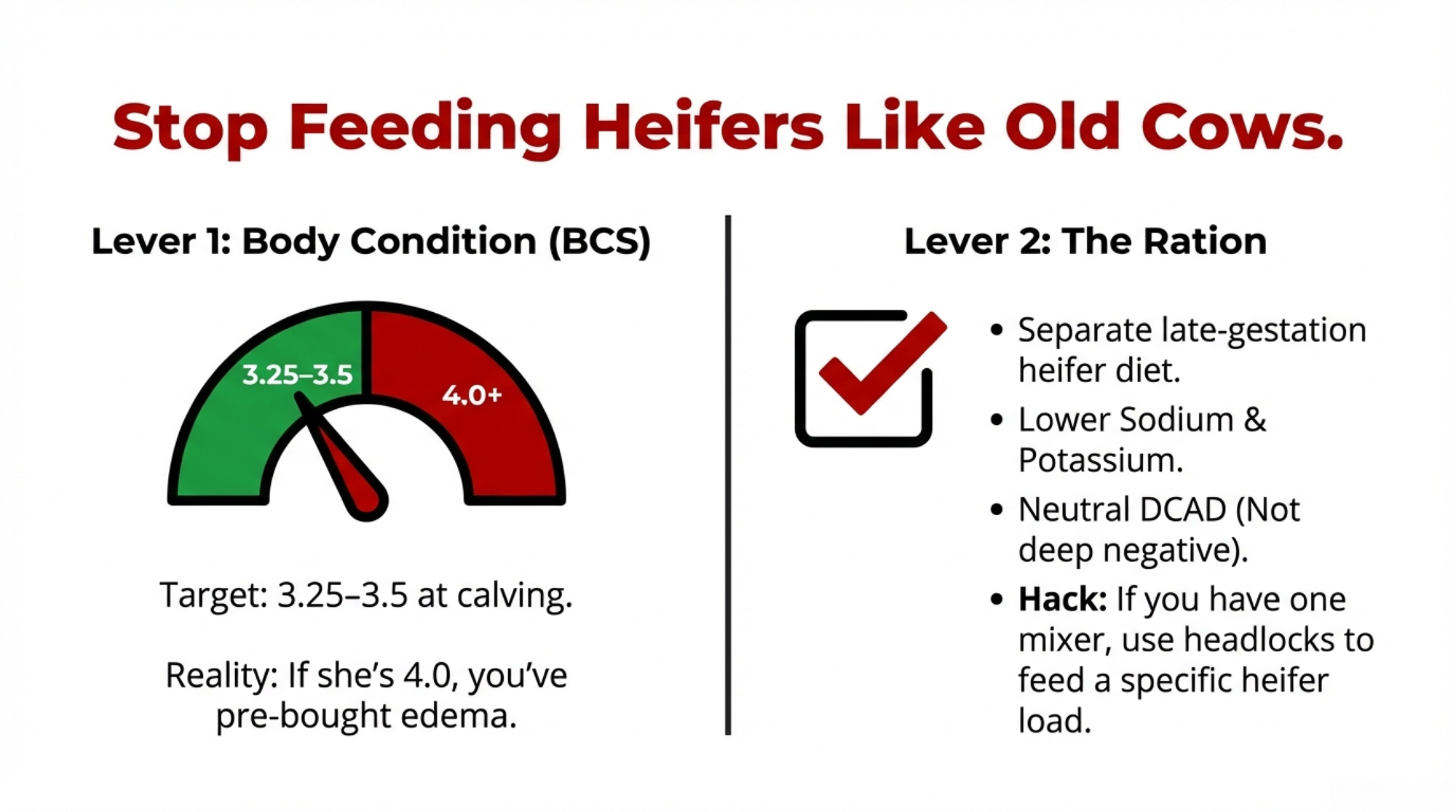
Overconditioned heifers repeatedly appear as higher-risk animals. Extra fat around the udder and brisket increases tissue pressure and makes it harder to move fluid out.
| Stage | Target BCS | Why It Matters |
| 2–3 weeks pre-calving | 3.25–3.5 | Enough reserve, not over-fat |
| At calving | 3.25–3.5 | Sweet spot for transition |
| 60 DIM | 2.75–3.0 | Controlled loss, no crash |
If most of your heifers are calving at 3.75–4.0, you’re pre-buying edema and transition risk.
Lever 2: Stop Feeding Heifers Like Old Dry Cows
This is where good herds get burned — not from laziness, but logistics. One close-up pen. One mixer. Everybody eats the same high-salt, strong-anionic ration designed for multiparous cows.
That’s a recipe for swollen heifers.
Top herds handle it differently:
- Separate late-gestation heifer ration wherever possible
- Lower sodium and potassium than the cow prefresh ration
- Neutral to only slightly negative DCAD — not the deep negative aimed at older cows
If you’ve only got one mixer, use headlocks to feed a heifer-specific load into one row twice a day. Pull free-choice salt blocks out of heifer prefresh pens. Something is better than nothing.
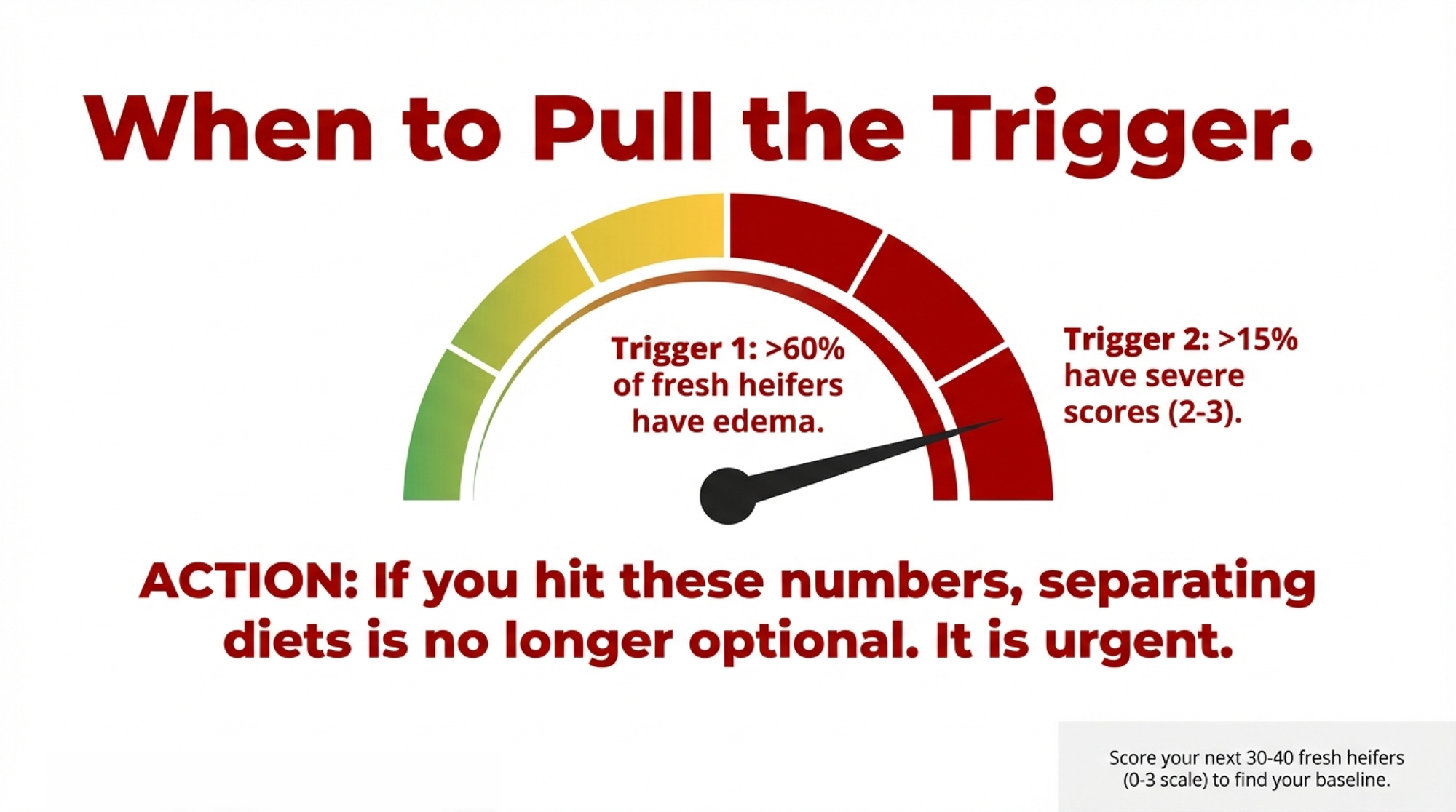
Decision rule: If heifers and cows are on the same prefresh ration, and more than 60% of fresh heifers show any edema with more than 15% severe, separating diets moves from “nice to have” to “this month.”
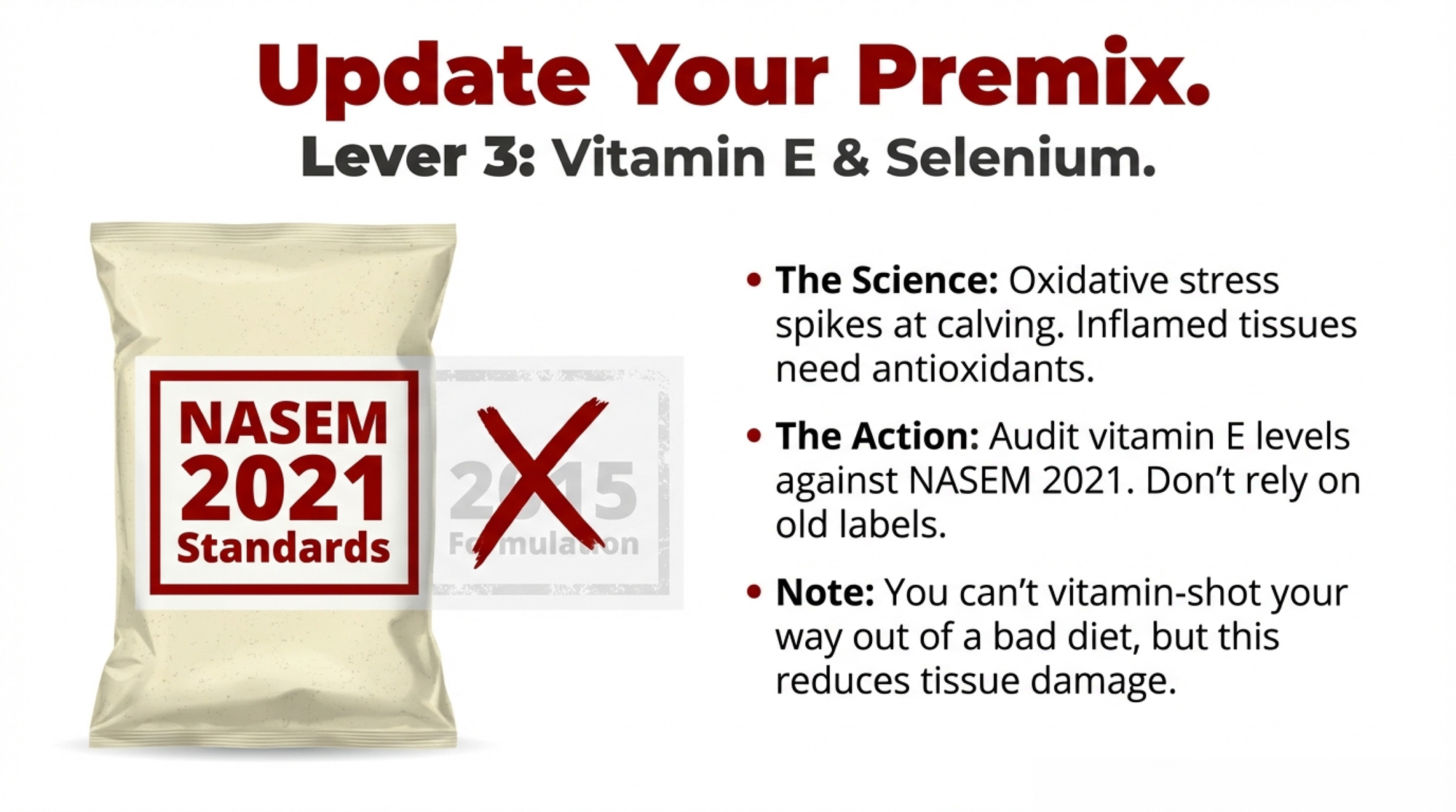
Lever 3: Tune Vitamin E and Selenium
Oxidative stress spikes at calving. If tissues are inflamed and antioxidant capacity is low, more damage and slower healing follow.
NASEM’s 2021 Nutrient Requirements of Dairy Cattle update reinforces the importance of adequate vitamin E and selenium in close-up diets for both cows and heifers. Selenium supplementation levels remain constrained by FDA limits and didn’t change in the 2021 update — yet many herds are still using premix formulations from years ago.
High-performing herds:
- Compare heifer vitamin E levels against current recommendations — not a premix label from 2015
- Audit selenium intake from forage, premix, and injectables — adequate but not excessive, especially in high-Se regions
You’re not going to vitamin-shot your way out of bad BCS or wrong DCAD. But you can reduce tissue damage while you fix those fundamentals.
| Lever | What Good Looks Like | What Risky Looks Like | Cost per Heifer | Time to Results |
|---|---|---|---|---|
| Body Condition | BCS 3.25–3.5 at calving; controlled gain through transition | BCS >3.75 at calving; over-fat heifers crowding udder with tissue pressure (red text) | ~$0–$10 (monitoring only) | 6–12 months (requires earlier heifer program changes) |
| Heifer-Specific Prefresh Ration | Separate heifer diet with lower Na/K; neutral to slightly negative DCAD; no free-choice salt | Heifers eating same strong-anionic cow ration; shared mixer loads; salt blocks in pen (red text) | ~$15–$20 per heifer (ration cost, not capital) | 2–4 months (immediate once ration separated) |
| Vitamin E / Selenium | Prefresh levels match NASEM 2021 targets; premix formulation reviewed in last 2 years | Using premix formulation from 2015+; selenium “adequate” but never audited (red text) | ~$10–$15 per heifer (premix upgrade) | 3–6 months (tissue response builds over time) |
What This Means for Your Operation
- If more than 60% of your fresh heifers score ≥1 for edema, and more than 15% hit scores 2–3, you’ve got a transition risk that belongs in the same conversation as DAs and metritis.
- On a 100-cow herd with 40 heifers freshening annually, Bullvine’s modeling suggests at least $3,500/year in edema-related losses on the low end — and more realistically $8,000–$16,000/year once you factor in mastitis, slow-milkers, and early culls at current replacement prices.
- With U.S. replacements at $3,000–$4,000+ and inventory at 20-year lows per CoBank’s 2025 outlook, any heifer that leaves early is an asset you can’t easily replace. The opportunity cost of surplus sales you’ll never make adds to the sting.
- Run a simple cost comparison: $40 per heifer for your top management changes vs the combined cost of one extra early cull plus a replacement at current prices. If the replacement side is bigger — and at $3,000–$4,000, it almost certainly is — edema work moves up your list.
- Score your next 30–40 fresh heifers using a simple 0–3 scale. Not what you think edema looks like — what it actually is. Compare your baseline to Morrison’s research benchmarks.
- Audit your prefresh program with your nutritionist: Are heifers actually on a different ration, or just a different pen eating the same feed? Get real Na, K, and DCAD numbers on paper.
- Check BCS at close-up and calving. If most heifers are over 3.5, talk with your team about heifer growth rates and age at first calving.
| Edema Score | What It Looks Like | Herd-Level Threshold (40 Heifers/Year) | Decision Rule |
| 0 | No visible swelling; normal udder contour | Baseline — track your percentage | Monitor; this is your target for >40% of heifers |
| 1 | Mild swelling; slight puffiness but udder cleft still visible | If <60% of heifers: Keep monitoring | Continue current program; fine-tune as needed |
| 1 | Mild swelling; slight puffiness but udder cleft still visible | If >60% of heifers: ACT | Audit BCS and prefresh ration — you’ve got a systemic issue |
| 2–3 | Moderate to severe; tight, shiny quarters; cleft disappearing or gone; heifer standing wide or kicking | If <15% of heifers: Monitor closely | Watch for progression; tighten BCS and vitamin protocols |
| 2–3 | Moderate to severe; tight, shiny quarters; cleft disappearing or gone; heifer standing wide or kicking | If >15% of heifers: ACT NOW | Separate heifer prefresh ration immediately; review BCS and premix with your team this week |
The Bottom Line
Udder edema hits 86% of fresh heifers in Morrison’s published research, with direct and downstream costs that Bullvine’s modeling places at $3,500–$16,000/year on a 100-cow herd at current U.S. prices. Replacement heifer costs have nearly doubled since 2023, with inventory at historic lows and no relief expected until 2027, according to CoBank. That makes every heifer that leaves early more expensive to replace — and every surplus heifer you can’t sell a missed opportunity in a seller’s market.
Three management levers — heifer BCS, heifer-specific prefresh rations, and tuned vitamin E/Se programs — can significantly reduce edema incidence when applied consistently over 12–24 months. About $40 per heifer in targeted changes gives you a realistic shot at cutting the edema penalty on animals that now cost four grand to replace.
You can keep treating this as “just fresh-heifer stuff” and quietly tax your best genetics every year. Or you can invest $40 per heifer and give yourself a realistic shot at cutting that penalty.
Score your next 30–40 fresh heifers. Separate their diet from the older cows as best you can. Tighten body condition. Fix the vitamins. Then look at your own numbers and decide: are you done paying the edema tax—or is this the transition change you finally make stick?
Key Takeaways
- Udder edema hits 86% of fresh heifers (Morrison 2018 JDS), costing $3,500–$16,000/year on a 100-cow herd when you add up milk loss, mastitis, and early culls.
- With heifers at $3,000–$4,000 and U.S. inventory at 20-year lows, every edema-related early exit is a high-dollar loss you can’t easily replace — and a surplus sale you’ll never make.
- Three levers move the needle: heifer body condition, heifer-specific prefresh rations, and updated vitamin E/selenium — all for about $40 per heifer.
- Know when to act: if more than 60% of fresh heifers show edema and more than 15% score severe, separating diets is no longer optional.
Executive Summary:
Udder edema hits 86% of fresh heifers in Morrison’s 2018 JDS study, and, when you stack up milk loss, mastitis, slow‑milkers, and extra culls, Bullvine’s 2025 modeling puts the bill at $3,500–$16,000 a year on a 100‑cow herd. In a 2025–2026 U.S. market where replacement heifers cost $3,000–$4,000, and inventories sit at 20‑year lows, every heifer who leaves early because edema derails her transition is now a high‑dollar asset gone. The piece walks through how edema links to higher early mastitis and ketosis, udder damage, and earlier culling, so you can see how it’s taxing both your best young cows and your labor. It then lays out three practical levers — heifer body condition targets, heifer‑specific prefresh rations, and updated vitamin E/selenium programs — that field reports show can significantly cut edema over 12–24 months. On most herds, those changes work out to roughly $40 per heifer, which is inexpensive risk management on an animal worth $3,000–$4,000. Finally, you get a simple edema‑scoring system, clear thresholds (60%+ incidence, 15%+ severe), and a 60‑day on‑farm trial so you can run your own numbers and decide where this fits in your transition priorities right now.
Complete references and supporting documentation are available upon request by contacting the editorial team at editor@thebullvine.com.
Learn More
- Transition Cow Success: Winning The High-Stakes Game That Makes or Breaks Your Dairy’s Profit Margin – Arms you with the specific benchmarks—from urine pH targets to bunk space requirements—needed to audit your close-up pen immediately. This guide delivers the “test, don’t guess” tactics to ensure your $4,000 heifers hit the fresh pen running.
- The $1750 Calf: Is Your 2026 Breeding Plan Leaving $800 a Head on the Table? – Exposes the structural heifer shortage through 2027 and delivers the “guard rails” for your breeding mix. This strategy reveals why over-relying on beef semen today creates a high-cost replacement gap you can’t afford to fill later.
- 42% Heritability: The Milking Speed Breakthrough That Fixes Your Labor Problem – Reveals how to leverage the massive 42% heritability of milking speed to breed out parlor bottlenecks. This breakthrough guide breaks down how to balance flow-rate gains with udder health, securing a permanent labor advantage for your next generation.
 Join the Revolution!
 Join the Revolution!
Join over 30,000 successful dairy professionals who rely on Bullvine Weekly for their competitive edge. Delivered directly to your inbox each week, our exclusive industry insights help you make smarter decisions while saving precious hours every week. Never miss critical updates on milk production trends, breakthrough technologies, and profit-boosting strategies that top producers are already implementing. Subscribe now to transform your dairy operation’s efficiency and profitability—your future success is just one click away.