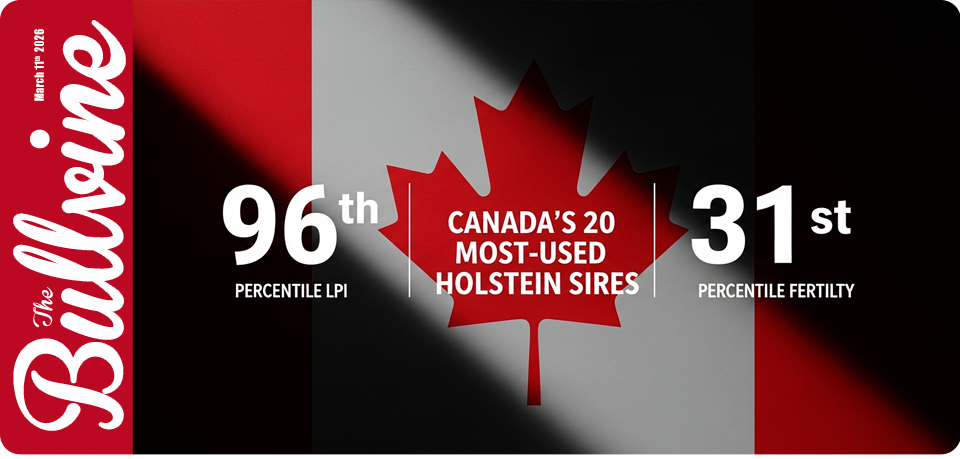





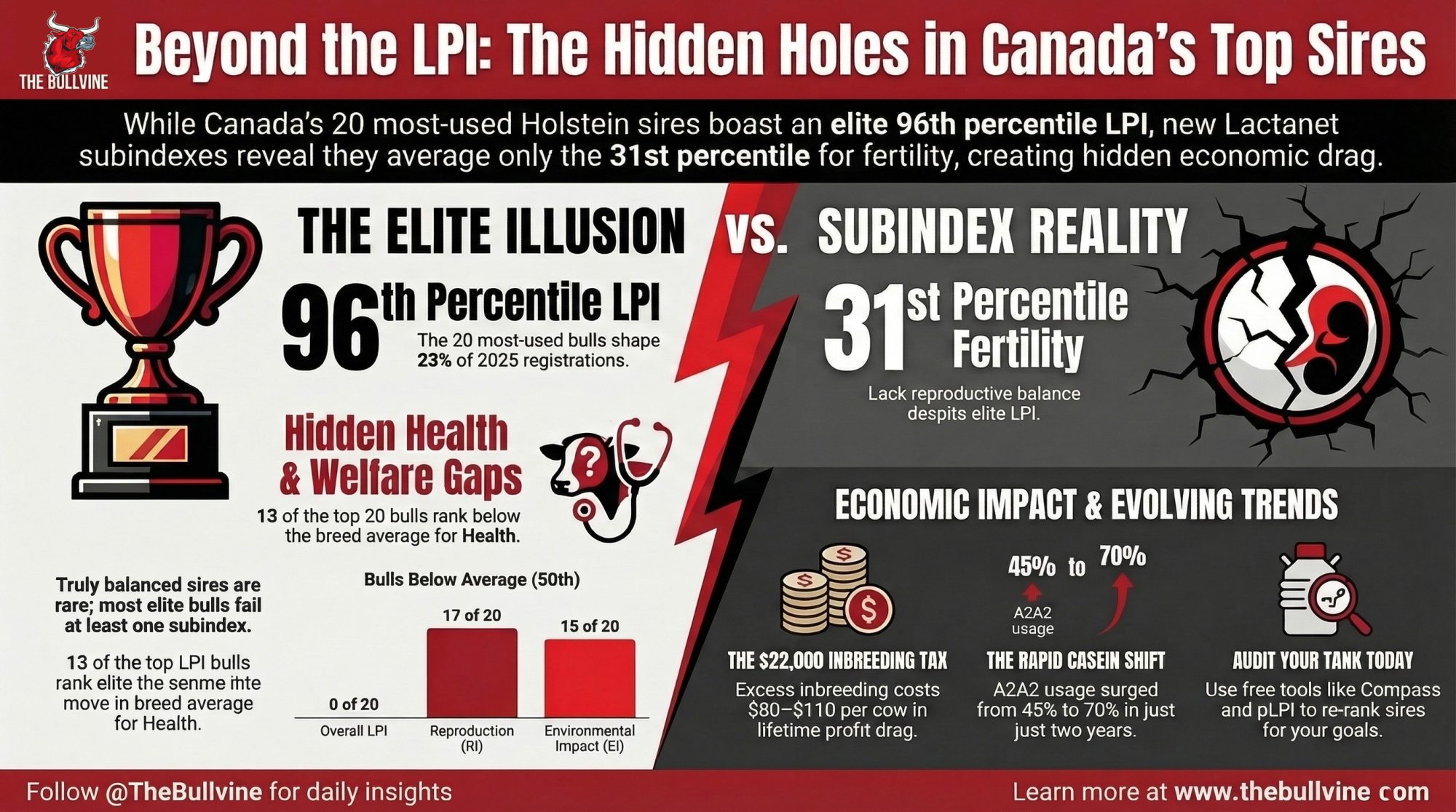
Canada’s 20 most-used Holstein sires average 96th percentile LPI — and only 31st percentile where it costs you cows: fertility.
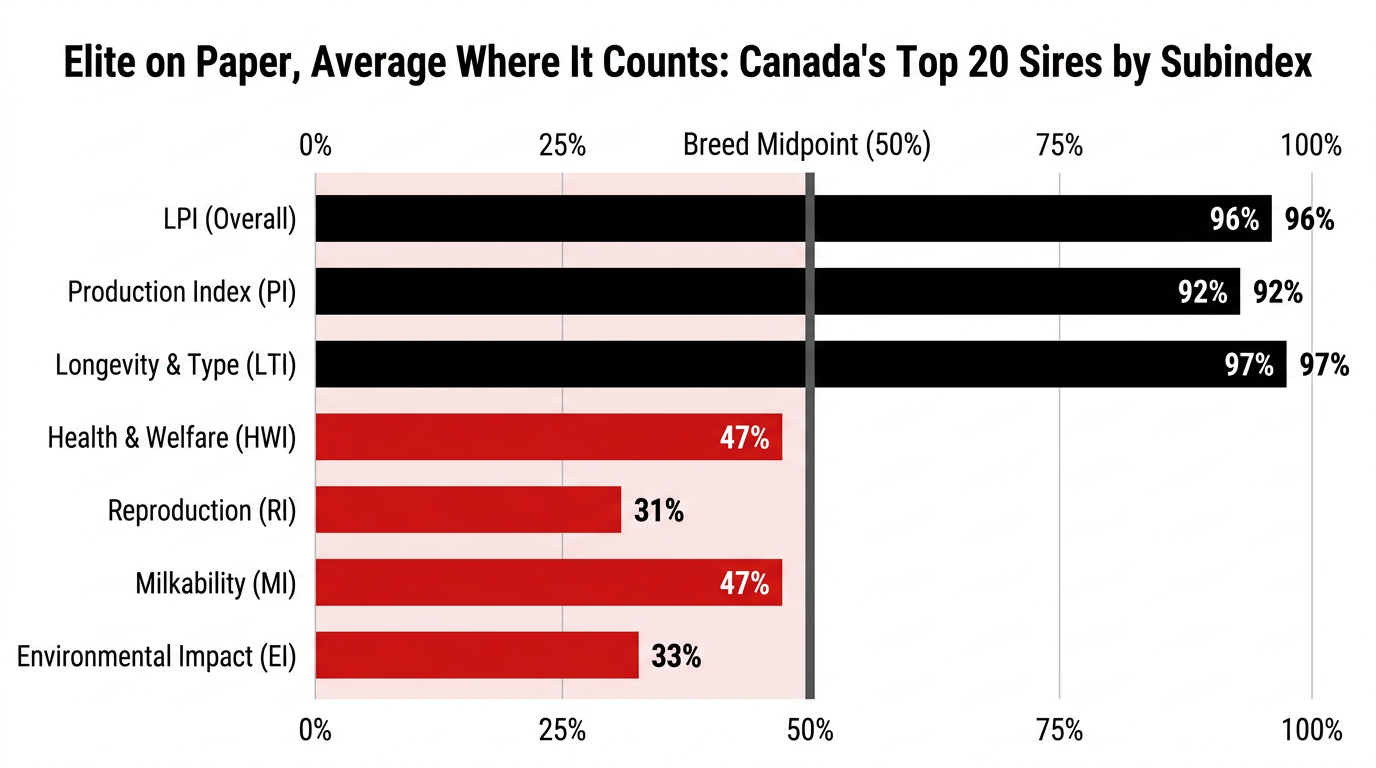
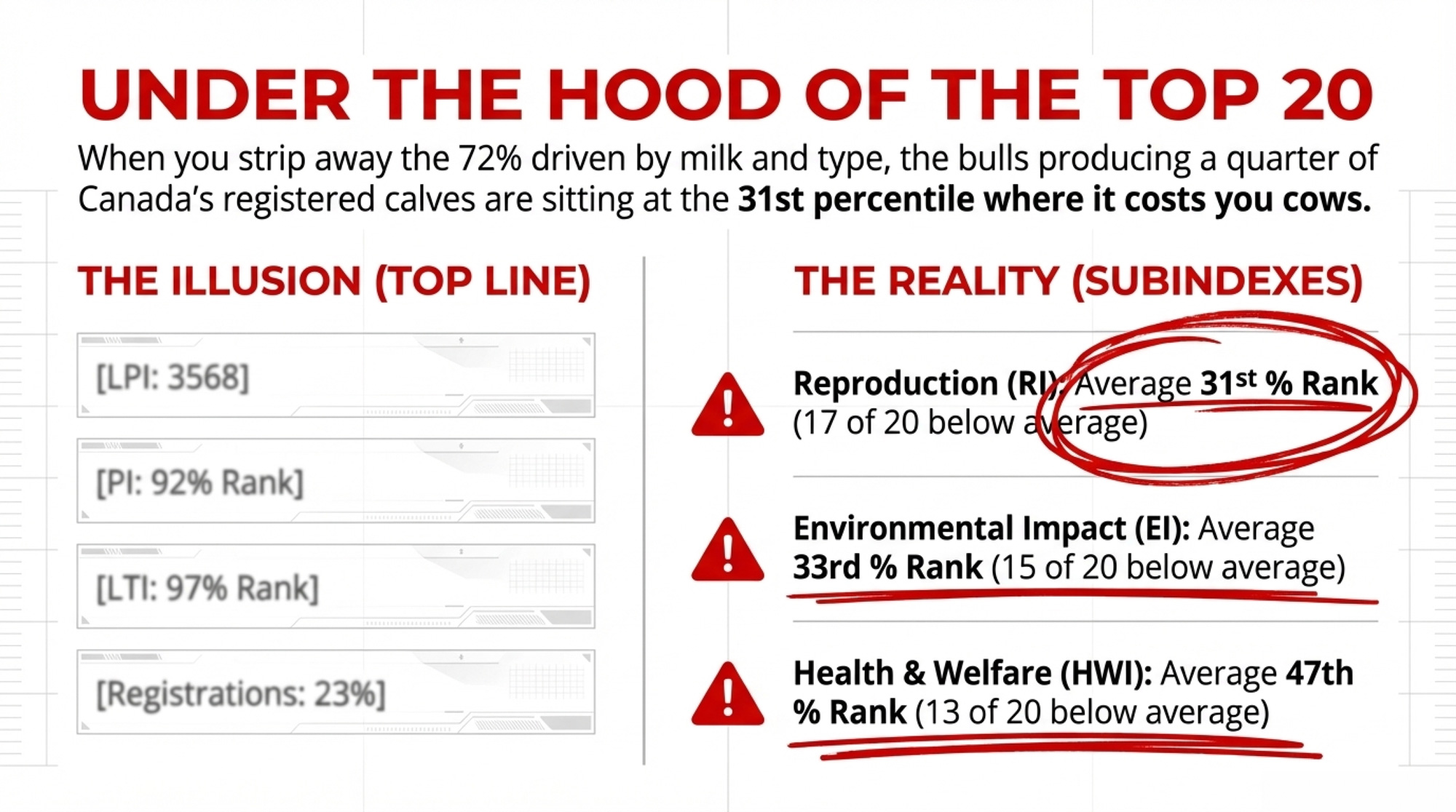
Lactanet’s new subindexes reveal a pattern hidden within elite proof sheets — and it runs through nearly a quarter of every registered calf born in 2025. Seventeen of Canada’s twenty most-used Holstein sires rank below the breed-indexed midpoint for reproduction.

Not below the top quartile. Below the middle! These aren’t marginal bulls filling tanks at small operations — they’re the bulls shaping roughly 23% of all Canadian Holstein registrations in 2025, averaging about 2,940 daughters each, according to Holstein Canada data. A2P2 leads the list. Fuel sits at number twenty. On the December 2025 Lactanet proof sheets, the twenty average LPI hits 3,568 — the 96th percentile. By any traditional measure, this is an outstanding working sire team.
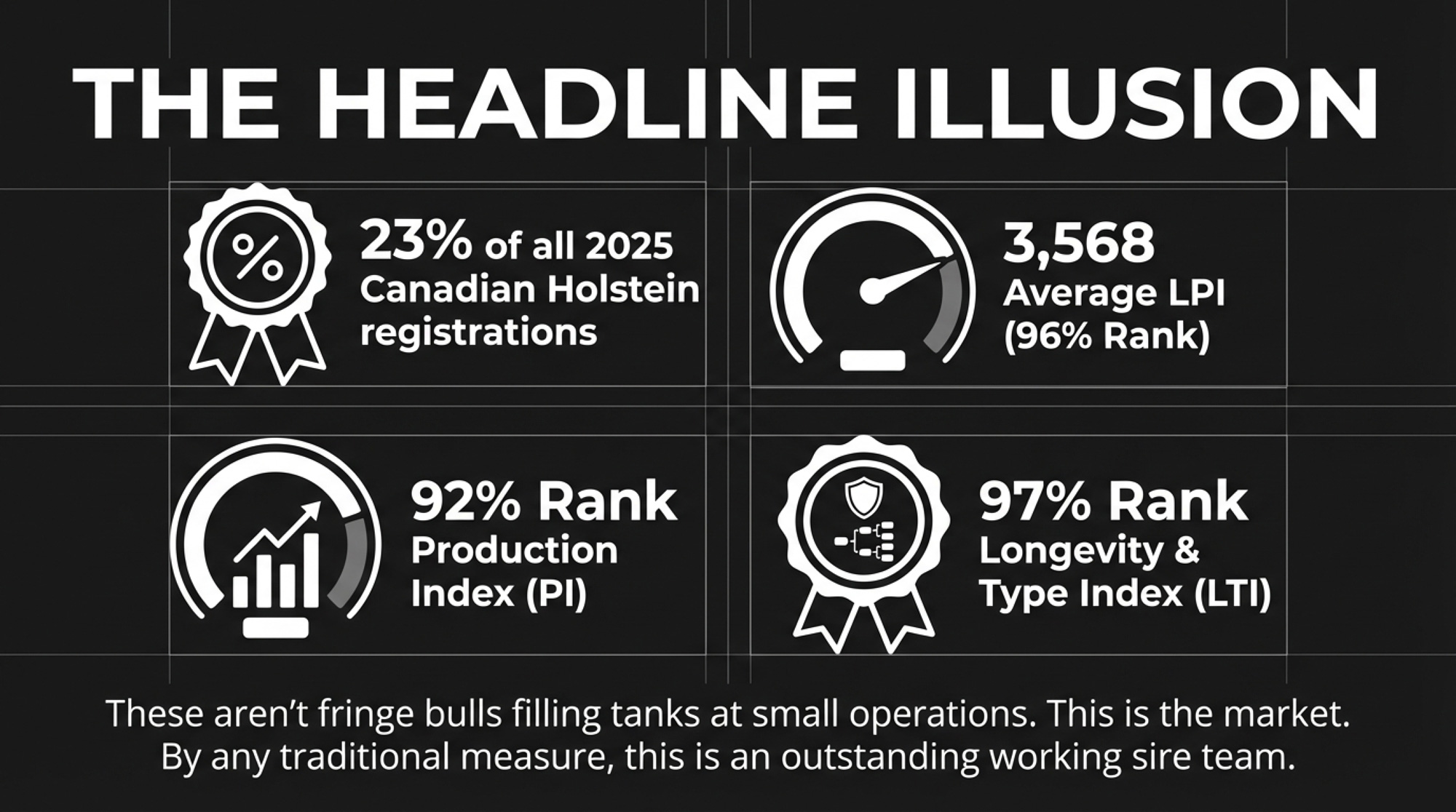
But Lactanet launched a modernized LPI in April 2025 with six new subindexes — and those subindexes tell a story the headline number doesn’t.
Who’s Actually Doing the Breeding?
The top-20 registration list reads like the semen order form at half the barns in the country:
| Rank | Bull | Rank | Bull |
| 1 | A2P2 | 11 | Right Stuff PP |
| 2 | Pursuit | 12 | Bullseye |
| 3 | Anahita | 13 | Poprock |
| 4 | Johnboy | 14 | Zippy |
| 5 | Knowhow | 15 | Capone |
| 6 | Alcove | 16 | Landfall |
| 7 | Zoak | 17 | Troy |
| 8 | Renegade | 18 | Lehigh |
| 9 | Conway | 19 | Lateshow |
| 10 | Ambrose | 20 | Fuel |
A2P2 at number one — polled, A2A2, daughter-proven with elite Conformation — would have been unthinkable at the top of a registration chart five years ago. Right Stuff PP at eleven reinforces the point: polled genetics aren’t a show-barn curiosity anymore. They’re mainstream enough to dominate usage. The group includes a mix of daughter-proven and genomic-only sires. When The Bullvine analyzed the 2021–2023 registration data, 29 of the 53 most-used sires (55%) were genomic, but they accounted for just 36.4% of actual registrations. The genomic share on this 2025 list suggests that the gap has narrowed — breeders aren’t just accepting genomic sires anymore, they’re choosing them first.
96th Percentile LPI, Yet Only 31st on Fertility — How?
The December 2025 top-line indexes for this group look genuinely impressive:
- LPI: 3,568 average (96% RK)
- Production Index (PI): 92% RK
- Longevity & Type Index (LTI): 97% RK
- Pro$: about 2,008 (around 93% RK)
If you stopped reading there, you’d think Canadian breeders had assembled the strongest working lineup in the breed’s history.
Then you read the subindexes.
When Lactanet rolled out the modernized LPI in April 2025, six subindexes replaced the old two-pillar structure, each on a standardized scale (average 500, standard deviation 100). For Holsteins, the weights are 40% Production (PI), 32% Longevity & Type (LTI), 8% Health & Welfare (HWI), 10% Reproduction (RI), 5% Milkability (MI), and 5% Environmental Impact (EI) — confirmed in Van Doormaal et al.’s Interbull Bulletin paper (No. 61, June 2025), with economic values estimated by AbacusBio.
Here’s how the top-20 registration bulls score on the four subindexes outside production and type:
| Subindex | Avg Percentile Rank | Range | Bulls Below 50th |
| Health & Welfare (HWI) | 47% | 7–94% | 13 of 20 |
| Reproduction (RI) | 31% | 2–68% | 17 of 20 |
| Milkability (MI) | 47% | 9–87% | 12 of 20 |
| Environmental Impact (EI) | 33% | 1–73% | 15 of 20 |
These are group averages — individual bulls vary widely, as the ranges show. A few cleared the 50th percentile on every subindex. The concern is the pattern across the group, not any single sire.
But the pattern is stark. Bulls producing nearly a quarter of all registered Canadian Holsteins average the 31st percentile on reproduction. Fifteen of the twenty fall below the breed midpoint on environmental impact. On health and welfare, thirteen of the twenty sit below average.
The combined weight of HWI + RI + MI + EI inside LPI is only 28%. That’s enough to show up on a proof sheet — nowhere near enough to change a sire’s ranking when 72% of LPI comes from production and type. Van Doormaal et al. noted this tension directly: the Reproduction Index has the lowest correlation with overall LPI (0.39) among all six subindexes, “stemming from the underlying negative correlation between female fertility traits and other key traits in the LPI, especially milk yield and some key conformation traits.”
The system is built so that bulls can be elite on LPI while being middling on fertility. And the twenty most-used sires are proving it.
Fat and Type Are Strong — But Look at That Milk Range
The production and type averages reinforce why these bulls earned their registrations:
| Trait | Average | %RK | Range |
| Milk | +75 kg | 70% | −419 to +2,053 kg |
| Fat | +88 kg (+0.40%F) | 80% | 30–118 kg (−0.07 to +1.08%F) |
| Protein | +58 kg (+0.21%P) | 77% | 9–93 kg (−0.01 to +0.53%P) |
| Conformation | +9.7 | 94% | +2 to +16 |
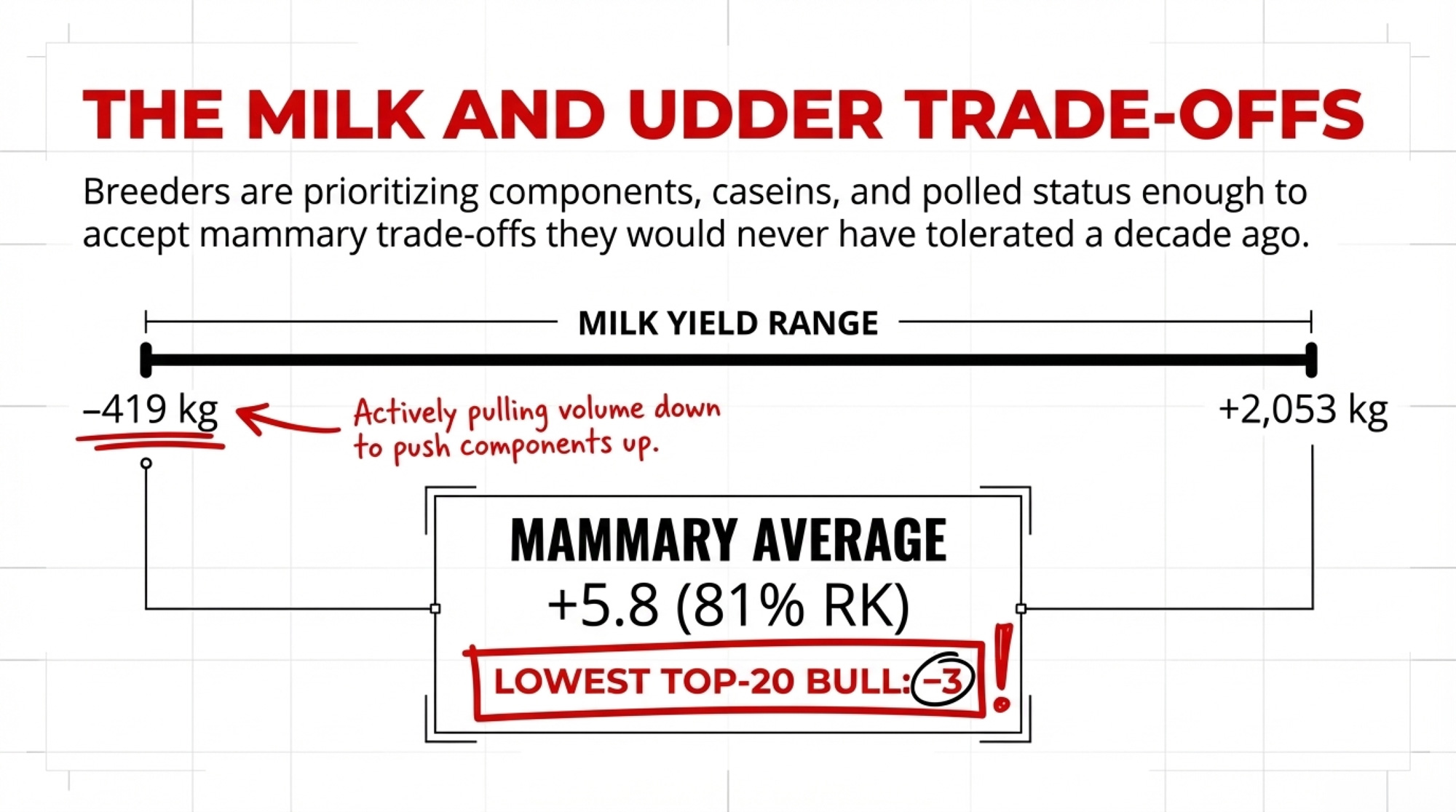
| Mammary | +5.8 | 81% | −3 to +12 |
| Feet & Legs | +8.0 | 91% | +4 to +15 |
| Dairy Strength | +8.6 | 92% | +4 to +15 |
| Rump | +5.7 | 81% | +1 to +13 |
Components are solid — +0.40%F and +0.21%P — which matters in every component-pricing province. Conformation at 94th percentile, Feet & Legs at 91st, Dairy Strength at 92nd. This is a type-forward group, exactly what you’d expect from bulls popular with breeders who register.
One number is lower than expected: Mammary at +5.8 and 81% RK. Mammary System carries 37% of the LTI subindex in the modernized formula, so you’d think the most-used bulls would rank higher. One bull in this group actually scores −3 on the Mammary trait. When a sire below average on udders still cracks the top-20 usage list, it tells you breeders are prioritizing other traits — components, caseins, polled status — enough to accept trade-offs they wouldn’t have a decade ago.
That milk range deserves a second look too: −419 to +2,053 kg. Some of these bulls are actively pulling volume down while pushing components up. That’s a deliberate bet on solids percentages over volume — smart if your processor rewards percentage, risky if they still pay primarily on litres.
What Happens When You Pull Your Own Tank’s Subindex Sheets?
Here’s where the subindex data shifts from abstract to personal: most producers using these bulls haven’t had easy access to this breakdown of their sire lineup — at least not in a format that puts the information front and center at decision time.
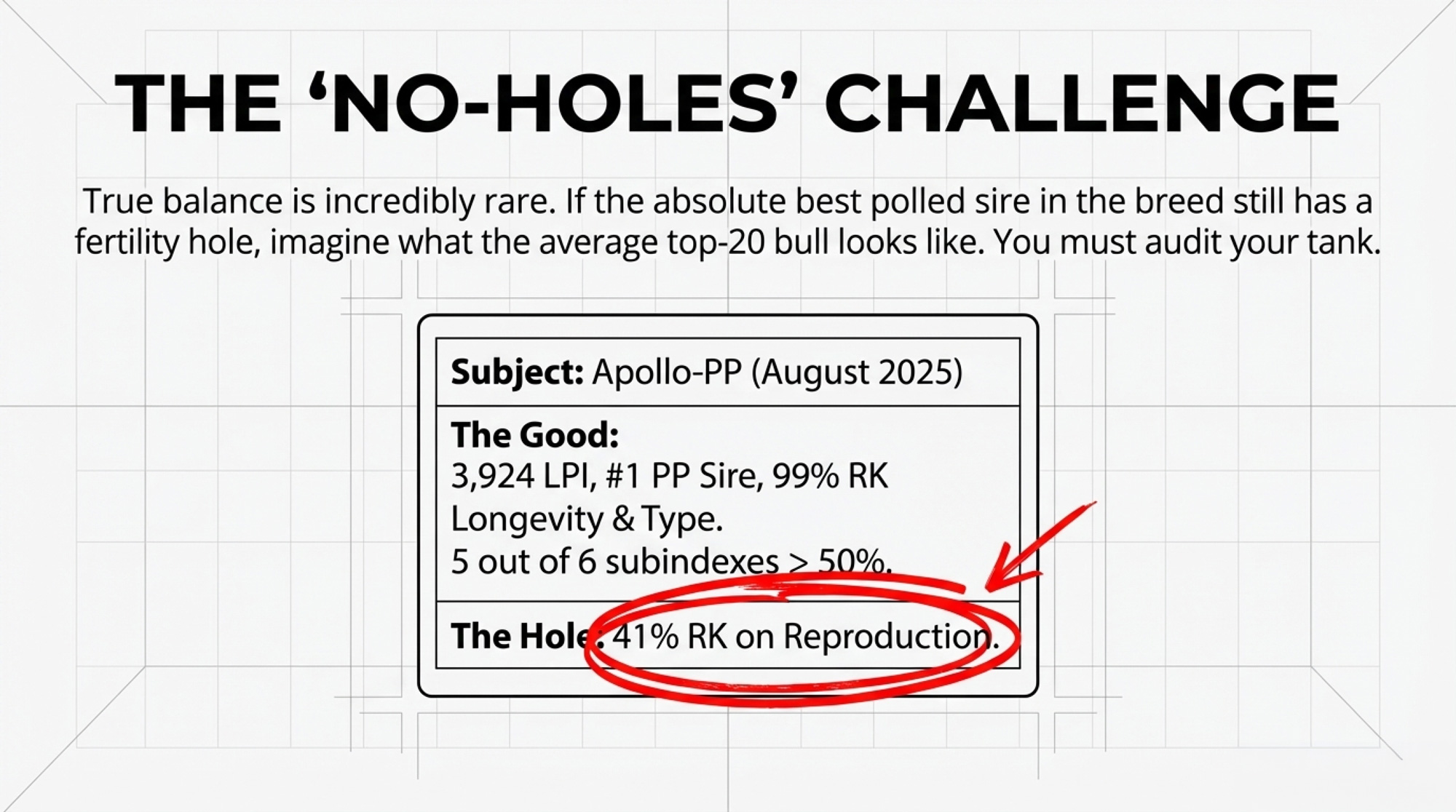
The Bullvine’s “No-Holes Sire” analysis (August 2025) drove this point home. Even among the highest-ranking LPI bulls in the breed, genuinely balanced profiles are rare. Apollo-PP — the highest-ranking homozygous polled sire with five of six subindexes above 50% RK — still falls to 41% on Reproduction. At 3,924 LPI and 99% RK on Longevity & Type, Apollo-PP is an outstanding bull. But if the best polled sire available in August 2025 still had a fertility hole, imagine what the average top-20 registration bull’s sheet looks like when you scan all six subindex columns.
That gap between what the data shows and what breeders actually see when choosing semen is the real story here. It all starts with complete information, but the rubber truly meets the road when milking daughters are performing on Canadian farms.
From 45% A2A2 to 70% in Two Years — The Casein Shift Is Real.
Across the top 20 in 2025:
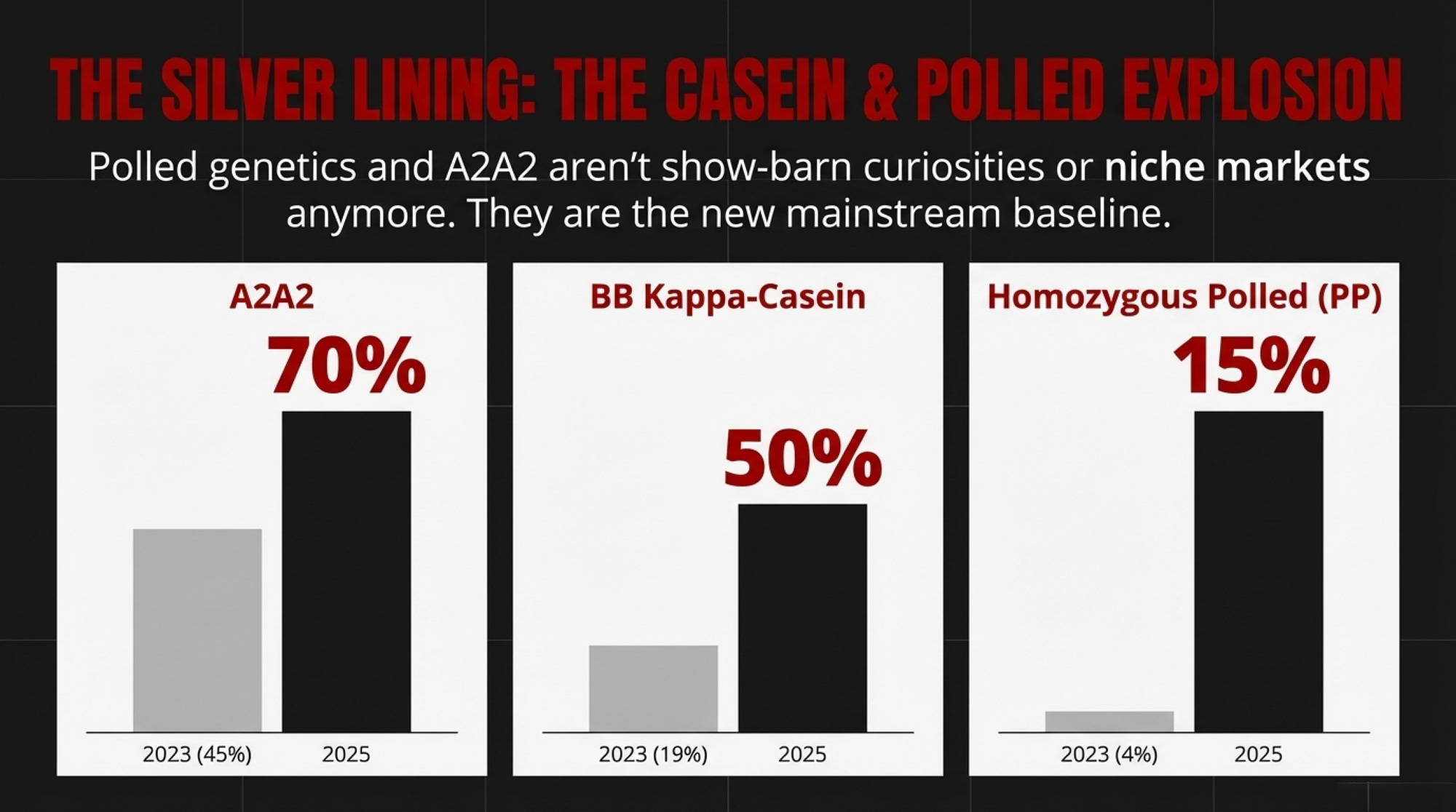
| Trait | 2021–2023 | 2025 |
|---|---|---|
| A2A2 beta-casein | 45% | 70% |
| BB kappa-casein | 19% | 50% |
| Homozygous polled (PP) | 4% | 15% |
- A2A2 beta-casein: about 70%
- BB kappa-casein: about 50%
- Homozygous polled (PP): about 15%
- Red carrier (RC): about 15%
These aren’t soft impressions. When The Bullvine analyzed the 2021–2023 registration data using Holstein Canada’s sire lists, the numbers looked very different: 45% of registrations came from A2A2 sires, 19% from BB kappa-casein sires, and just 4% from homozygous polled bulls. In two years, A2A2 representation among the top sires has jumped from 45% to roughly 70%. BB kappa-casein has gone from 19% to about 50%. Homozygous polled has nearly quadrupled — from 4% to approximately 15%.
A2P2, sitting at number one, and Right Stuff PP, at number eleven, are the headline acts. But even further down the list, casein and polled profiles are stacking. Breeders aren’t just checking the box on caseins anymore — they’re treating them as a primary selection criterion, driven partly by processor signaling on cheese yield and partly by consumer-facing A2 milk marketing.
The polled story is even more pointed. With 15% of the top-20 sires homozygous polled — up from 4% in the 2021–2023 window — the old argument that “there aren’t enough good polled bulls” doesn’t hold up against the registration data. If you’re still dehorning every calf in 2026, that’s a management choice, not a genetic constraint.
11.9% Average Inbreeding — and Only Three Below 10%
Here’s where the data shifts from uncomfortable to urgent.
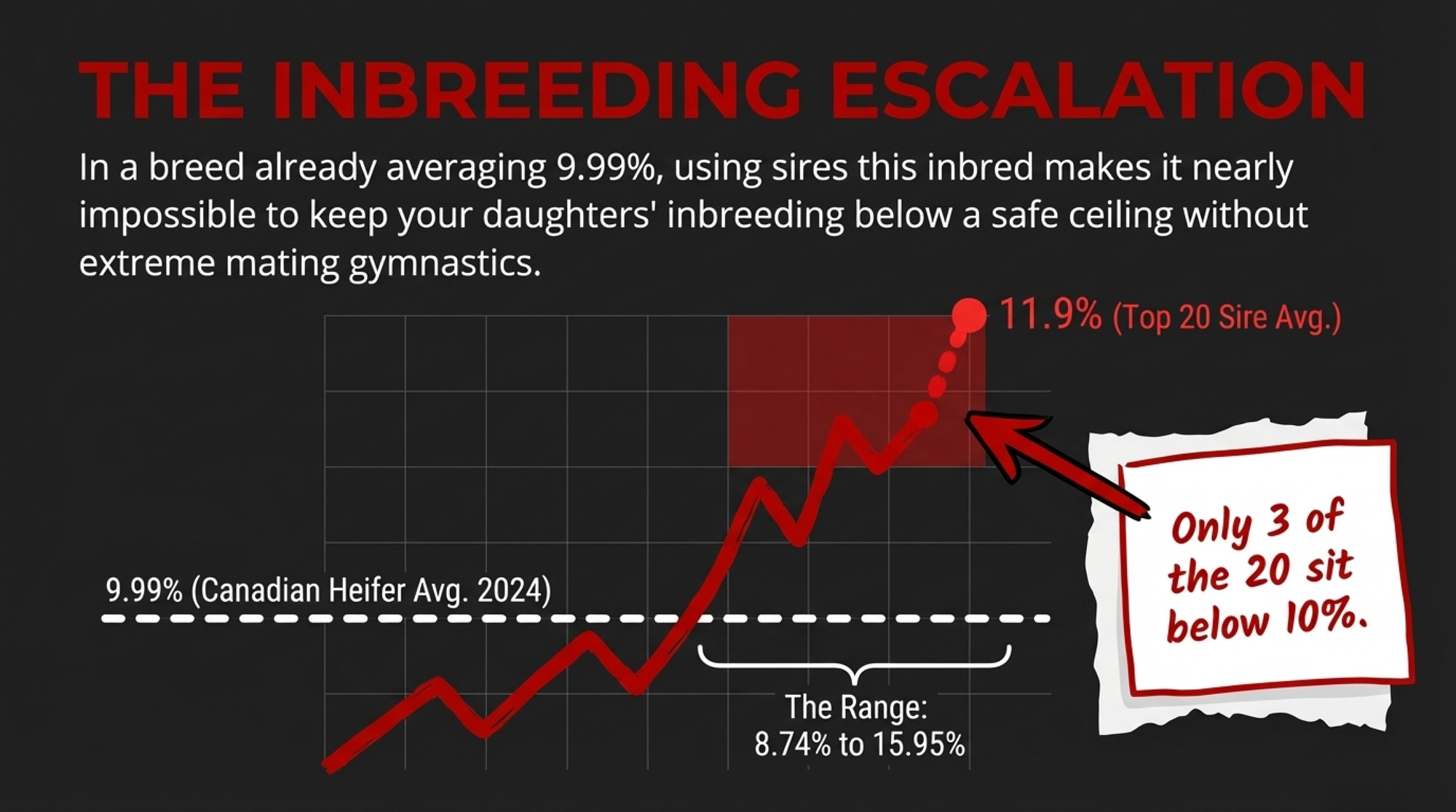
Average inbreeding coefficient across the top 20 is 11.9%, with a range of 8.74% to 15.95%. Only three of the twenty sit below 10%.
For context: Lactanet’s August 2025 inbreeding update reported that the average inbreeding level for Canadian Holstein heifers born in 2024 reached 9.99%. On a pedigree basis, Holstein inbreeding has been increasing by approximately 0.25% per year since 2010, according to Lactanet’s annual reports authored by Brian Van Doormaal. That’s the breed average. These twenty bulls — the ones shaping nearly a quarter of the next generation — sit almost two full percentage points above it.
Penn State geneticist Dr. Chad Dechow has documented that current U.S. Holstein inbreeding averages around 8%, with young bulls running 9–10%. In the Netherlands, Doekes et al. (2019) at Wageningen University studied 38,792 first-parity Dutch Holstein-Friesians and found that a 1% increase in genomic inbreeding (FROH) was associated with a 36.3 kg decrease in 305-day milk yield, a 0.48-day increase in calving interval, and a 0.86-unit increase in somatic cell score. At the University of Parma, Ablondi et al. confirmed the pattern: their 2023 analysis of 27,735 Italian Holstein cows found every 1% increase in genomic inbreeding cut 305-day milk yield by approximately 61 kg and reduced both fat and protein yields (Journal of Animal Science, 101:1–10).
Virginia Tech research goes back further — and the numbers are bigger than most people assume. Smith, Cassell, and Pearson studied over 2.6 million lactation records from U.S. Holsteins (Journal of Dairy Science, 81:2729–2737, 1998). The all-cow results showed a loss of $12–$15 per 1% increase in inbreeding. But when Cassell drilled into the registered-cow subset — 257,449 animals with complete pedigree data, where true inbreeding levels are most accurately captured — the loss jumped to $22–$24 per 1%: $24 in a fluid market, $22 in a cheese market (1999 Western Canadian Dairy Seminar). Cassell advised placing “greater reliance on results from registered herds” because incomplete pedigrees in grade cows understate true inbreeding. Adjusted for inflation, the registered-cow figures come to roughly $40–$46 in today’s dollars.
| Inbreeding Gap (% points above 9.5%) | Cost per Cow (CAD, lifetime) | Cost on 200-Cow Herd (CAD) | Cost on 500-Cow Herd (CAD) |
|---|---|---|---|
| +1.0 percentage point | $40–$46 | $8,000–$9,200 | $20,000–$23,000 |
| +1.5 percentage points | $60–$69 | $12,000–$13,800 | $30,000–$34,500 |
| +2.0 percentage points | $80–$92 | $16,000–$18,400 | $40,000–$46,000 |
| +2.4 percentage points (top-20 avg) | $96–$110 | $19,200–$22,000 | $48,000–$55,000 |
| +3.0 percentage points | $120–$138 | $24,000–$27,600 | $60,000–$69,000 |
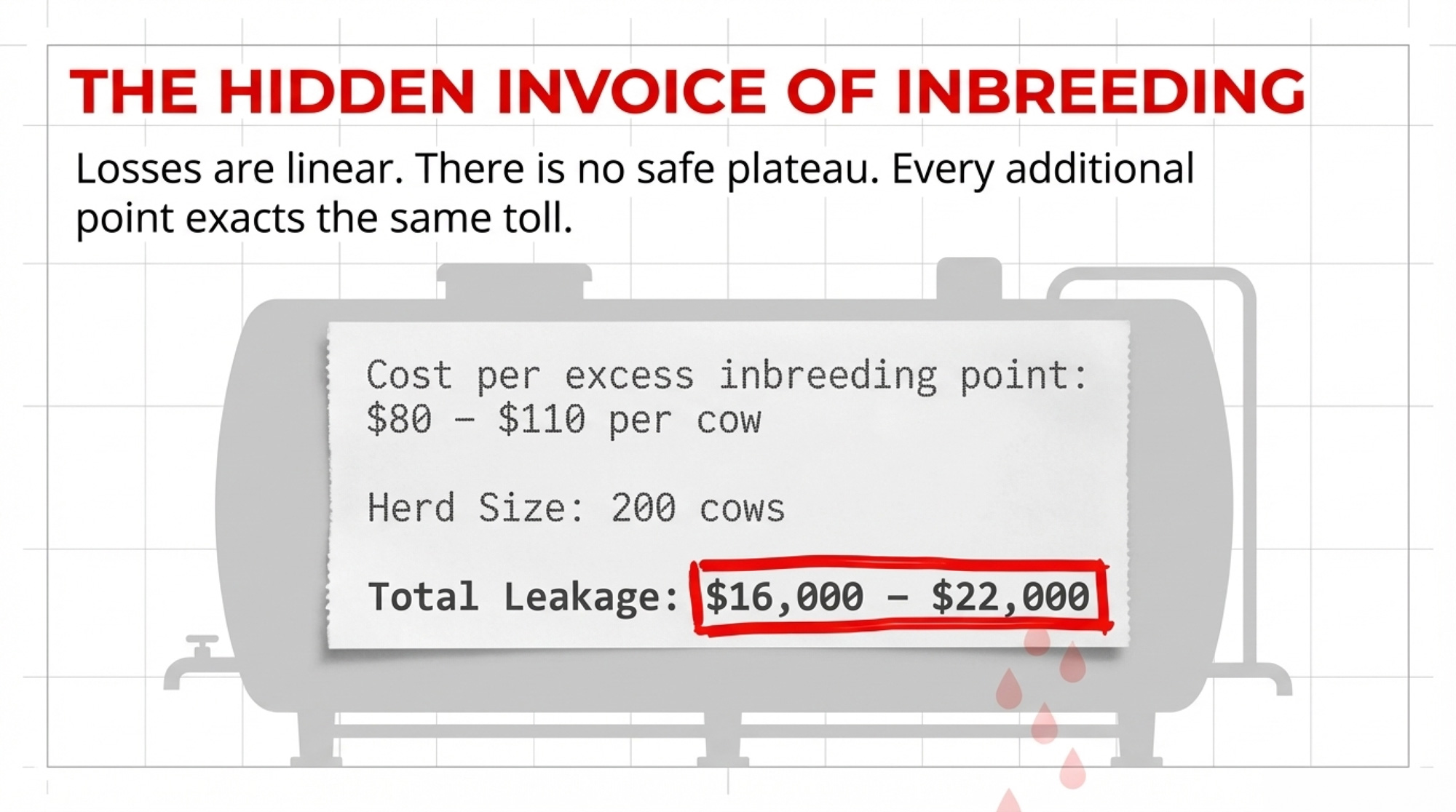
One more finding from that WCDS paper worth noting: the losses were linear. The cost per percentage point at 12% was the same as at 3%. There’s no safe plateau — every additional point of inbreeding extracts the same toll.
What Does 11.9% Actually Cost at the Cow Level?
That 11.9% is the sires’ own inbreeding — a measure of their homozygosity, not a direct prediction of where their daughters will land. Daughter inbreeding depends on the dam side of every mating, too.
But in a breed already averaging 9.99%, using sires this inbred makes it nearly impossible to keep daughters below a 9.5% ceiling without deliberately seeking low-relationship dams. If daughters end up even 2 percentage points above a 9.5% target — a conservative estimate given these sire levels — the registered-cow figures suggest roughly $80–$92 per cow in lifetime profit drag, or $16,000–$18,400 on a 200-cow herd. Push that gap to 2.4 points, and the numbers run to $96–$110 per cow and $19,200–$22,000 per herd.
The exact cost depends on your mating program. As Cassell himself wrote in that 1999 WCDS paper: “There is no magic level of inbreeding that is acceptable.” But the direction is clear — and these are the bulls most herds are already using.
Can Breeders Actually See the Problem — Or Is It Buried?
Lactanet deserves credit for building the tools. The modernized LPI subindexes launched in April 2025. A detailed percentile-rank guide followed in June. And the Lactanet Inbreeding Calculator — which shows projected inbreeding levels and parent averages for any potential mating — has been one of the site’s most frequently used features for years.
Compass, the free genetic management software built by Holstein Canada and Lactanet (with Zoetis support), launched on November 14, 2019, lets producers create a customized version of LPI or Pro$ that matches their breeding goals, track genetic progress, and view return-on-investment projections. It’s an unbiased source — it doesn’t sell semen. Lactanet also offers a Personalized LPI (pLPI) through LactanetGen.ca — you set the subindex weights yourself to match your own priorities. A producer who wants more emphasis on health and reproduction can shift from the default 8% HWI / 10% RI to, say, 12% and 14%, and the system re-ranks every bull accordingly. The trade-off is real, though: those extra percentage points have to come from somewhere, typically Production or Longevity & Type, which means your pLPI rankings will look different from the semen catalog’s default LPI list — and that’s exactly the point.
| Balance Threshold | # of Top-20 Sires Meeting Threshold | What This Means |
|---|---|---|
| All 6 subindexes above 40% RK | ~8–10 | Marginal balance — still risky on 1–2 traits |
| All 6 subindexes above 50% RK | ~3–5 | True breed-average balance — rare even in elite sires |
| 5 of 6 subindexes above 50% RK (1 weakness OK) | ~7–9 | “No-Holes Sire” standard — strategic weakness acceptable |
| HWI + RI both above 50% RK | ~3–4 | Health and fertility balance — where replacement costs are decided |
So the tools exist. But scroll through the sire listings from major AI companies and the picture changes. EastGen’s online catalog lets you sort bulls by GLPI, Pro$, A2A2, Polled, and Robot Ready — but not by subindex rank for Health & Welfare or Reproduction. Semex’s SemexWorks™ builds custom client indexes with reps, which can incorporate more traits — but that requires a conversation the rep initiates. The default presentation in most catalogs still leads with LPI or Pro$ in large type. Subindex percentile ranks, if they appear at all, sit in the fine print.
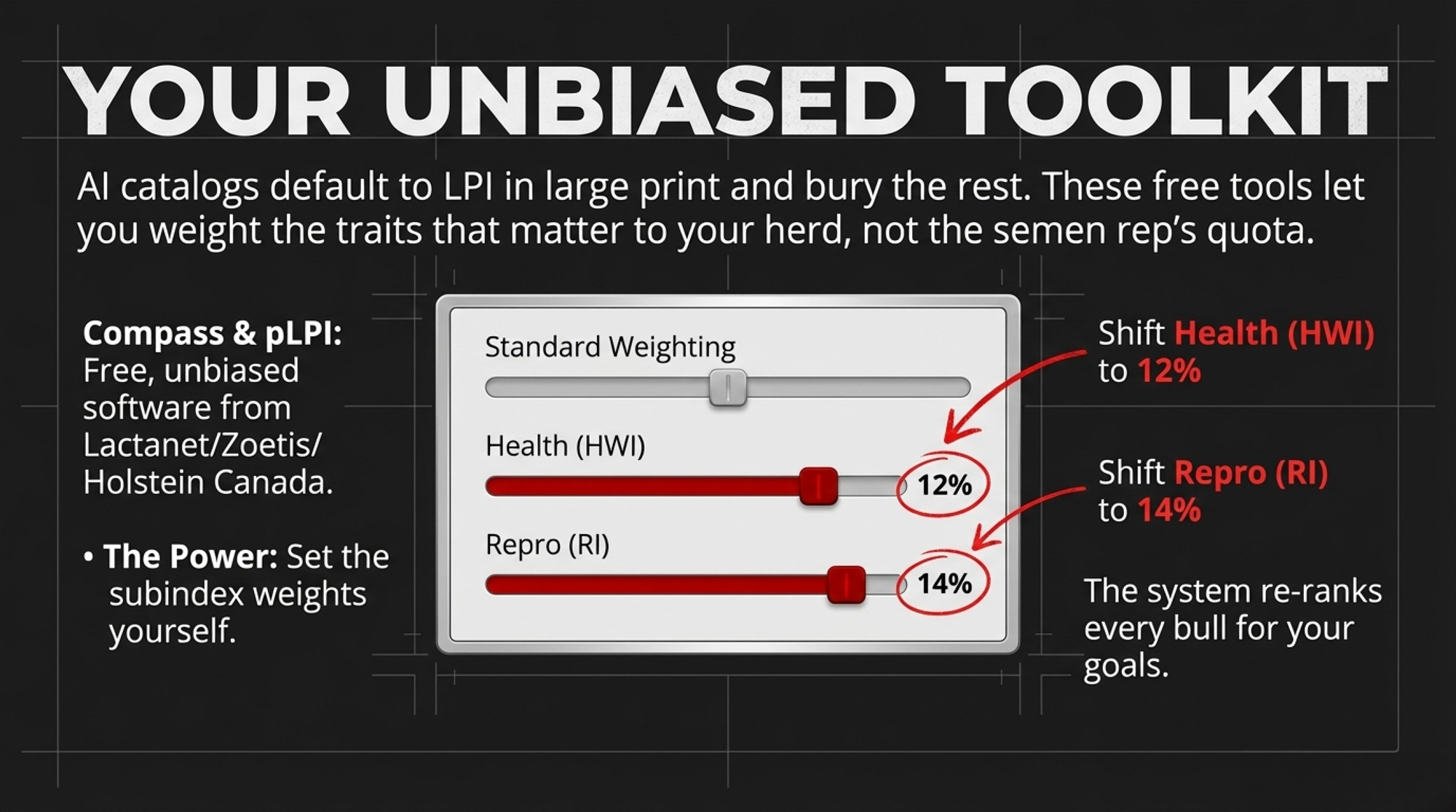
That means the data Lactanet publishes and the data breeders see when they’re choosing semen are often two different things. Until AI catalogs give subindexes the same real estate as LPI and Pro$, producers who want that information are pulling it themselves — and, based on how those catalogs are structured, most aren’t.
That’s not an indictment of anyone. It’s a description of where the industry sits and where the opportunity is widest.
| Action | Timeline | Tool/Resource | What to Look For |
|---|---|---|---|
| Pull subindex breakdown for every sire in your tank | This month | Lactanet proof sheets | Bulls below 50% RK on 3+ subindexes (HWI, RI, MI, EI) — flag for strategic use |
| Run inbreeding projections on planned matings | Before next order (90 days) | Lactanet Inbreeding Calculator | Set 9.5% ceiling — compare sire IB% to breed average (9.99%) |
| Audit first-born 2025 calves from top-20 sires | By April 2027 proof run | On-farm health/repro records | Track SCC, conception rate, health events by sire group — proof vs. reality check |
| Ask AI rep for all 6 subindex ranks on recommended sires | Next semen order meeting | Compass (free, unbiased) or pLPI | If they can’t answer or deflect, you know how that sire list was built |
What This Means Before Your Next Semen Order
Every one of these findings connects to a decision you’re making this year.
This month: Pull Lactanet’s subindex breakdown for every sire currently in your tank. Flag any bull below 50% RK on three or more of HWI, RI, MI, and EI. That doesn’t mean you drop him — it means you know which cow groups he should and shouldn’t be matched with, and you’re not flying blind. The Bullvine’s “No-Holes Sire” analysisrecommends at least five of six subindexes above 50% RK as the threshold for a balanced sire. Even Apollo-PP — the highest-ranking August 2025 PP sire in the breed at 3,924 LPI — hits five of six but still falls to 41% RK on Reproduction. That should tell you how rare true balance is, and how intentional you need to be to get it.
Before your next order (within 90 days): Run inbreeding projections on planned matings using Lactanet’s Inbreeding Calculator and set an explicit ceiling. A target of 9.5% is a defensible starting point — already below where the 2024-born heifer average sits. One honest trade-off: in narrow pedigree pools, hitting that ceiling may force you toward lower-LPI sires. That’s a real cost. But a bull at 3,400 LPI with 9% inbreeding and solid health and fertility scores may deliver more lifetime profit than one at 3,800 LPI with 13% inbreeding. The LPI gap is smaller than the inbreeding depression gap. If you’re thinking about how to structure a complementary sire roster — balancing production, components, durability, and an outcross slot — that $869-per-cow lifetime profit gap between top-quartile and bottom-quartile genetics from the Zoetis study of 12,952 Holsteins makes the case for being deliberate.
By the April 2027 proof run: Audit the first-born 2025 calves from these top-20 sires in your herd. Track health events, conception rates, and SCC by sire group. Compare actual daughter performance against proof-sheet promises, especially for traits where these bulls scored below average. That’s your reality check — and the data you need to adjust for 2027 sire selection.
On caseins and polled: If your processor pays any component or A2 premium, use the 70% A2A2 baseline in this top-20 group as your floor, not your ceiling, with BB kappa-casein at 50% and PP at 15% — both up dramatically from 45% and 19%, respectively, just two years ago — you can build a casein-forward, polled herd without sacrificing competitive LPI. A2P2 and Right Stuff PP demonstrate that.
At the kitchen table with your AI rep: Ask where each bull ranks on all six Lactanet subindexes — not just LPI and Pro$. Ask about the projected inbreeding on the specific mating. Ask how many of their “recommended” sires sit above the breed midpoint for HWI and RI. If the answers are vague, you’ve learned something important about how that sire list was put together. And ask whether they’ve set you up in Compass and pLPI — both are free, both are unbiased, and both let you weight the traits that matter to your herd, not theirs.
Key Takeaways
- If your working sire team is drawn heavily from this top-20 list, you’re getting elite production and type — but you’re likely below the breed midpoint on health, fertility, milking speed, and environmental impact without active subindex management.
- At 11.9% sire inbreeding in a breed averaging 9.99%, the cost of genetic narrowing runs roughly $80–$110 per cow in lifetime profit drag, depending on mating patterns — using Virginia Tech registered-cow estimates adjusted for inflation. On a 200-cow herd, that’s $16,000–$22,000 that shows up in your replacement pipeline, not on any invoice.
- The casein and polled shift is accelerating. A2A2 went from 45% to about 70% of top-use sires in two years; BB kappa-casein from 19% to about 50%; homozygous polled from 4% to about 15%.
- Lactanet built the subindexes, standardized them, and published them with a June 2025 percentile-rank guide. Compass and pLPI are both free and unbiased. The gap isn’t in the data — it’s in how consistently AI catalogs and sales representatives’ conversations put that data in front of producers when they’re choosing bulls.
The Bottom Line
These twenty bulls are real. They bring strong LPI, solid components, high type, and casein profiles that Canadian breeders couldn’t access a decade ago. That’s genuine progress — and it shouldn’t be dismissed.
But the same proof sheets that make them dominant also expose a national breeding program tilted toward production and type at the expense of health, fertility, and genetic diversity. Lactanet gave breeders the subindex tools ten months ago. Whether the industry — AI companies, breed associations, and the producers writing the semen cheques — will use them before the next generation of heifers hits the milking string is the question that matters now.
Pull your subindex sheets this week. How many of your current sires clear 50% RK on all six subindexes?
Complete references and supporting documentation are available upon request by contacting the editorial team at editor@thebullvine.com.
Learn More
- April 2025 Canadian Genetic Evaluation Updates: What Dairy Farmers Need to Know Now – Gain an immediate advantage with this field-ready guide to the April 2025 index updates. It delivers the interpretation tables needed to predict real-world daughter performance and exposes how stagnant breeding thresholds are costing your operation today.
- Genetic Revolution: How Record-Breaking Milk Components Are Reshaping Dairy’s Future – Positions your operation for a component-heavy future by analyzing the decoupling of milk volume from fat and protein. This strategic roadmap reveals how to capture the 30% surge in butterfat demand and maximize your next milk check.
- From $1.5 Million to $150,000: The Dairy Genetics Shakeout and Your Next Move – Arms you with a defensive strategy against the corporate consolidation of elite genetics. It breaks down how JIVET and vertical integration are moving value from farms to boardrooms, providing a 12-month roadmap to maintain your genetic independence.
 The Sunday Read Dairy Professionals Don’t Skip.
 The Sunday Read Dairy Professionals Don’t Skip.
Every week, thousands of producers, breeders, and industry insiders open Bullvine Weekly for genetics insights, market shifts, and profit strategies they won’t find anywhere else. One email. Five minutes. Smarter decisions all week.