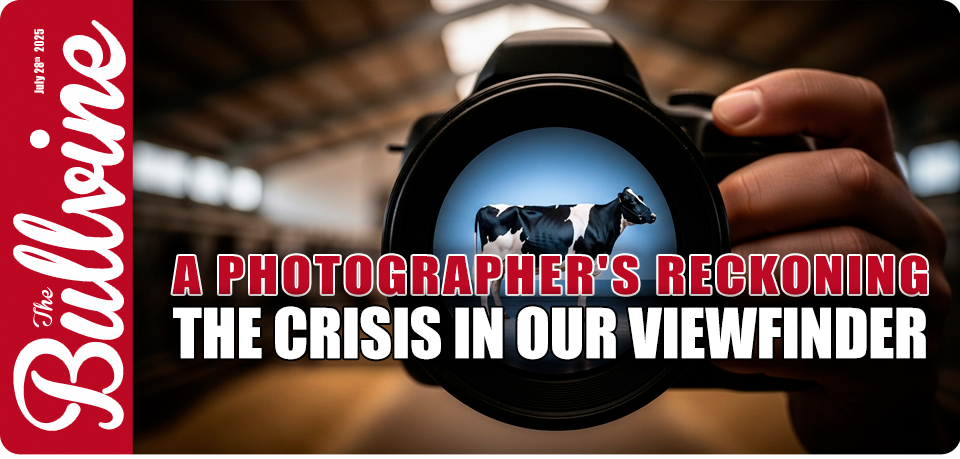
A Photographer’s Reckoning: The Crisis in Our Viewfinder
Monday,July28th,2025
Every photo tells a story—but what if it’s a lie? Investing thousands in genetics based on deceptive images? Demand truth in dairy photography
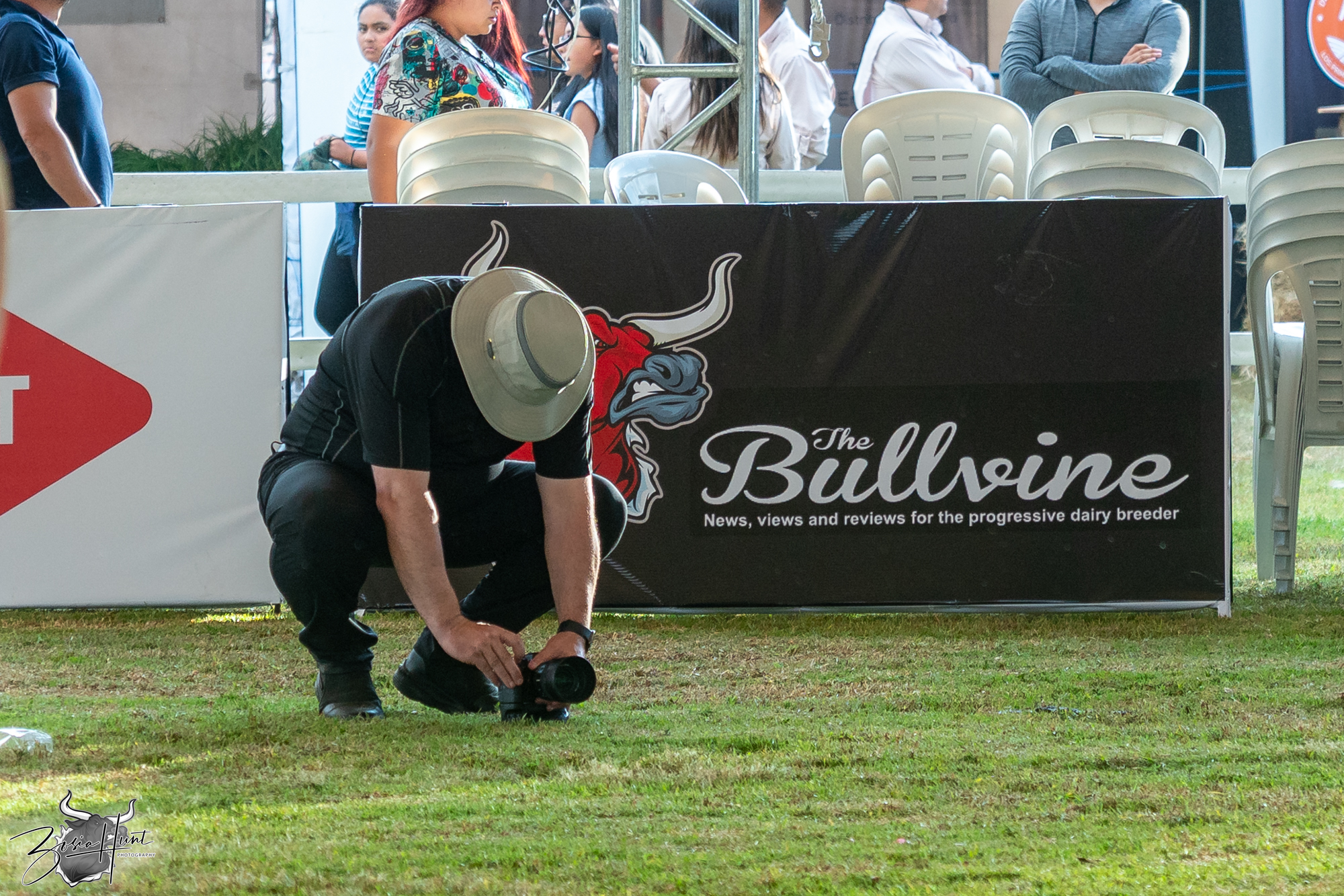
From behind the lens in Ecuador. For the author, the work of capturing an authentic image—the subject of this article—feels more critical than ever.
As a photographer who’s spent countless hours in the show ring, my eye pressed to the viewfinder, trying to capture that perfect moment when a cow hits her pose… I need to be honest about a problem that’s eating at our profession from the inside out.
When I scroll through social media these days, I see images from our industry that make me pause. They’re stunning, flawless—almost too perfect. And because I know what’s possible with modern software, I find myself asking a question that should haunt all of us: When did we allow our tools to cross the line from enhancement to deception?
This isn’t coming from some outsider throwing stones. This is me, grappling with a problem from within our own profession.
The Wake-Up Call We Needed
Recently, Brad Cullen—a photographer who has significantly advanced in his craft and mastered lighting techniques better than most—spoke out about the realities behind the scenes. While Brad’s work shows improvement and higher standards than many, it’s essential to acknowledge that even his images sometimes demonstrate the very editing practices we debate, such as enhancing contrast on udders to make veins stand out or adjusting shine to highlight rib structures.
ENOUGH IS ENOUGH Raw images matter — because truth matters. And so does ethics, transparency, and the respect we show one another as professionals. That’s why I’ve worked hard to create a Photography Ethics Board a space for trusted, independent professionals to hold our industry to a higher standard. I believe in this work. I believe in doing the right thing. But lately, I’ve been the target of gossip, assumptions, and judgment. I’ve been spoken about, not spoken to. I’ve been, harassed, and even sent legal letters —all for doing my job, and doing it with integrity. And I’ll be honest — it hurts. I’ve spent over 15 years immersed in this craft — learning from some of the best in North America, refining the artform, and working my ass off to build something I’m proud of here in Australia. I’ve kept every original image for over a decade. I have nothing to hide. Let me also explain this clearly — because it’s time someone did: Do we change backgrounds? Yes. Sometimes we have no choice. We’re photographing 150+ animals a day, and we don’t always have ideal settings. Do I use studio lighting and modern cameras? Yes — that’s exactly why our highlights, colours, and lighting look the way they do at our biggest shows. It sets a professional standard. It’s completely different to photographing cattle outdoors — and that’s why we do it. Do we remove scars, smudge marks, dirt, and blemishes? Yes — including dust from the wind at IDW. Do we colour correct blacks, whites, and colours? Yes — just like every professional photographer should. Do we change the tail or its direction? Yes. Does that affect the conformation of the animal any more than a fake tail in person? No. Do we fill in toplines? Yes — because putting cattle on a board can alter the natural shape of their spine. It’s no different to what was done in the film days with shaving cream and potting soil. If the person holding the cow doesn’t stand it correctly, will we replace their arms? Yes — because that has nothing to do with the animal itself. Between my team and I, we photograph and turn out over 600+ portraits across IDW and NZDE in January, and send them to clients in just three weeks every February here in Australia. My mentor, Cybil Fisher, and her photographer, Lea Jordan — based in North America — produce over 2500+ portraits between September and November across major shows like Harrisburg, World Dairy Expo (WDE), and Louisville. We may be in different countries, but we share one thing: high standards. We don’t have time for major manipulation — and we don’t need it. We work hard, we put in the long hours, and I truly believe that kind of respect is earned. And we’ve earned it. When NZDE and IDW clashed this year, Lea Jordan travelled to New Zealand to photograph on my behalf. That’s the level of trust, professionalism, and international collaboration we operate with. I rely on Cybil and her editing crew to help process my work from IDW and NZDE efficiently. In return, I support them with post-production for events like WDE and Louisville. We work through our images together — and I deeply value that relationship. I trust their work, and so should you. And for those asking about RAW files — here’s the truth: I don’t send them. Because they’re not the product. RAWs are like unwashed cattle before the show: unfinished, unpolished, and not ready to represent anyone’s standard. Clients pay for a finished image — edited, colour-corrected, refined — not a digital negative. What we deliver is our craft. Our reputation. A final product we’re proud to stand behind. And that’s what they deserve. Do we manipulate conformation? No. If you think my intermediate champion cow from the 2025 Victorian Winter Fair was digitally altered — please show me where. What’s been hardest isn’t just the comments. It’s the silence. It’s the fact that I came forward with a solution — a board, a plan, a path forward — and heard nothing back. It was accepted, and then ignored. Despite all of this, I still believe in this industry. I still believe in raising the bar. I’m proud of the work we do. I’m proud of my team. And I’ll keep showing up with integrity — even when it’s hard. If you’ve ever doubted that — I ask you to look again. With honesty. With empathy. Because behind every image is a person. And behind this one… is me.
As Brad Cullen stated in his public Facebook post on Facebook July 27th 2025
“Do we change backgrounds? Yes. Do we remove scars, smudge marks, dirt, and blemishes? Yes… Do we fill in toplines? Yes—because putting cattle on a board can alter the natural shape of their spine.”
And this is where, with the greatest respect for a fellow professional, I have to draw a different line. It’s something I’ve done before for side shots, not show ring shots, but I now feel that’s too much. When you’re digitally adding inches of “hair” to transform a weak-loined heifer into something that looks championship-caliber… that is manipulating conformation. We need to call it what it is.
I hesitate to fully endorse any individual because the line between artistry and deception can be fuzzy—even when intentions align with integrity. What I can say is that Brad’s willingness to discuss these practices openly is more than most are doing.
It’s one thing to hear about these practices, but it’s another to see a show ring photo of an animal you just witnessed in person, and barely recognize its topline. That experience forces a difficult question: are we marketing real genetics, or showcasing digital artistry?
The Financial Pressures That Got Us Here
One of the key aspects of our industry is the intense financial pressures it faces. When someone’s making a $15,000 genetics purchase based on your photograph, there’s enormous pressure to make that animal look perfect. When AI companies are expecting your images to help sell semen globally, the stakes feel impossibly high.
However, those pressures have created a system in which ethical lines have become blurred for many of us. It’s not about villains—it’s about how technology and market forces evolved faster than our professional ethics could keep up.
I’ve watched photographers I know and respect navigate this tension on a daily basis. Some feel pushed to enhance more than they’re comfortable with, worried they’ll lose clients to competitors who’ll create whatever reality the client wants. Others fight hard to maintain standards, even when it means their work looks “less impressive” next to heavily manipulated images.
We’ve documented these practices at The Bullvine for over a decade through our Dairy Marketing Code of Conduct. Back in 2013, photographers would quietly admit that toplines had “hair” added and udder texture had been enhanced. But they’d always follow with “everyone’s doing it” or “if I don’t do it, breeders won’t call me anymore.”
Twelve years later, we’re still having the same conversation because the profit motive continues to override ethical reform.
The Justifications We Tell Ourselves
Here’s what happens in editing rooms across our industry: “This isn’t really changing the animal, just correcting for the photography setup.” Or “What’s the harm in improving a topline digitally—it’s not like we’re changing her genetics.”
But if I’m being honest with myself… the line keeps moving. A little adjustment here, a small enhancement there, and suddenly you’re creating an animal that exists only on screen.
The hardest part isn’t the technology—it’s watching breeders make $50,000 breeding decisions based on images where the topline was digitally created, the udder attachment was enhanced, and the overall capacity was artificially inflated. They’re making choices that will affect their herds for generations, based on animals that don’t actually exist.
Young photographers entering our field are being trained to enhance as standard practice. Meanwhile, veteran photographers who try to maintain authentic standards find themselves losing work to those willing to create digital perfection.
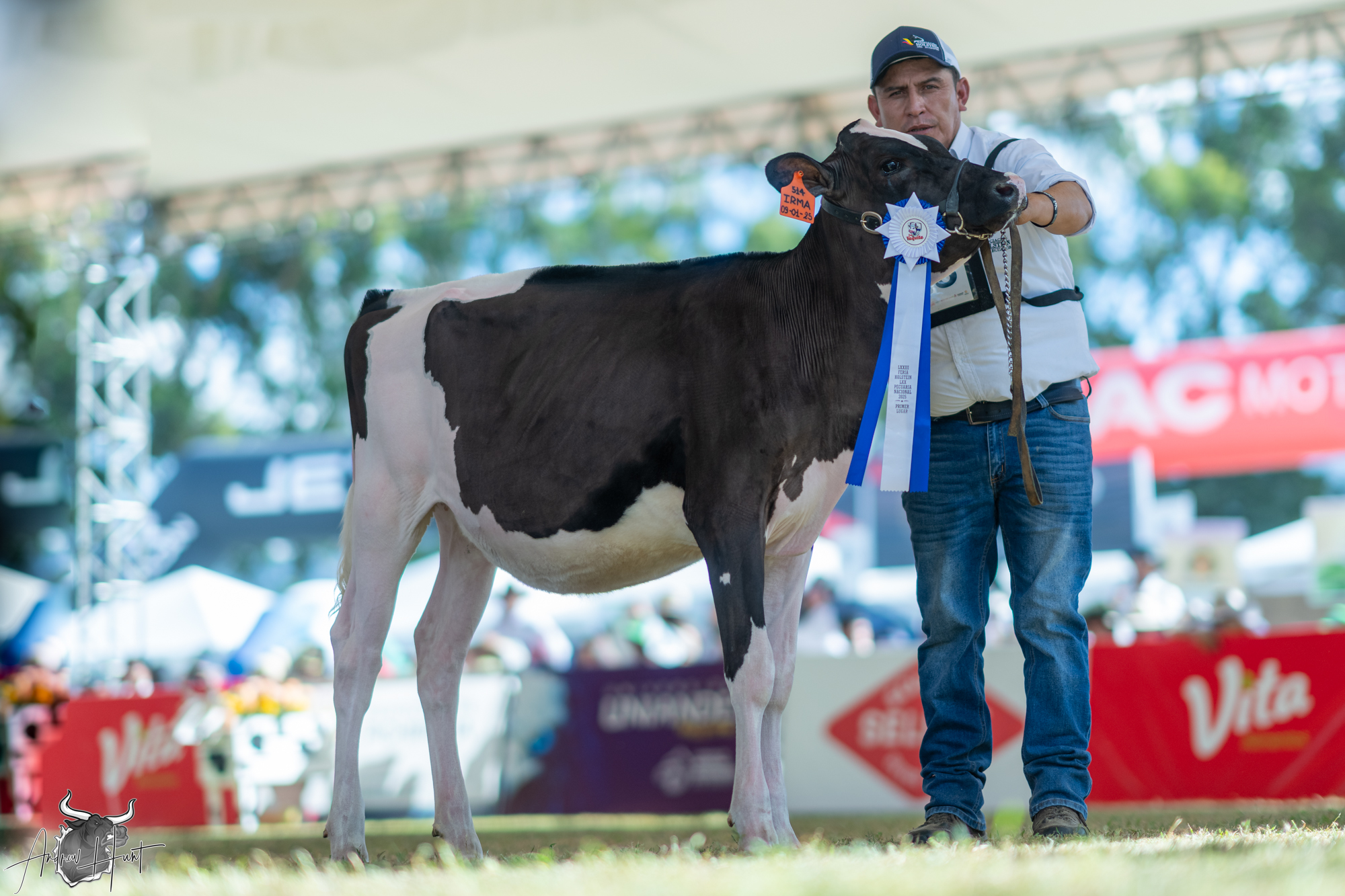
This is our commitment to ethical photography. This powerful heifer, captured this week in Ecuador, is presented with only cropping and exposure adjustments. No conformation was altered. We believe the best genetics don’t need digital deception.
When Authentic Looks Wrong
What strikes me most about this crisis is how we’ve developed collective amnesia about what real cattle photography used to look like. We’ve become so accustomed to enhanced images that authentic photos now seem unprofessional or poorly executed.
The genetics companies are caught in their own trap. They’ve trained customers to expect perfection in every image, so now they can’t step back without admitting they’ve been misleading buyers for years.
When experienced breeders tell me they “pretty much ignore promotional photos entirely now,” that’s not just sad—it’s a market failure that affects all of us. We’ve broken trust in our own visual marketing.
Technology That Could Save Us (If We Wanted It To)
Here’s what’s fascinating about where we are in 2025: the technology exists to solve this problem completely. AI-powered systems can detect photo manipulation with over 95% accuracy. Blockchain verification can create tamper-proof records of image authenticity.
But we’re not using these tools. Why? Because admitting there’s a problem would require acknowledging how much of our current marketing relies on enhanced imagery.
The European Union already includes livestock marketing photos under authenticity requirements. Blockchain verification systems are being deployed in dairy supply chains for product authenticity. The technology is real and available.
Insurance companies are now offering “genetics purchase protection” policies that cover losses from misrepresented animals—a market response that tells you everything about how common these disputes have become.
The Path Forward From Inside
I don’t have all the answers, but I know this: the companies and photographers who embrace authenticity first will eventually have a significant competitive advantage. The question is whether we’ll lead that change or be forced into it when customers get fed up.
The technology exists to restore trust to our visual marketing. The market is hungry for honest partners. What we’re missing is industry leadership willing to prioritize long-term credibility over short-term profits.
My Stand on All Our Tools
I’m not here to cast stones at colleagues I respect. I’m here to hold up a mirror and ask tough questions about where our profession is heading.
Brad Cullen writes, “Raw images matter—because truth matters,” and his willingness to discuss these practices openly is commendable. However, we all—myself included—need to examine where we draw the line between enhancement and manipulation.
If we want to preserve the credibility that underpins our livelihoods, we need to choose truth over convenience. This conversation is just the beginning.
Executive Summary
The dairy cattle photography industry is facing a critical crisis of trust, as digital manipulation blurs the line between reality and illusion. While technological advances have improved image quality, practices such as enhancing toplines and brightening features raise ethical concerns and mislead buyers, leading to high-stakes genetic investments. Insurance companies now offer policies protecting buyers from losses caused by misrepresented genetics—a stark indicator that this crisis has reached a market tipping point. Despite strong financial pressures and industry inertia, the growing availability of AI verification and blockchain transparency offers hope for authentic representation. The call to action is clear: all stakeholders—photographers, breeders, buyers, and organizations—must unite to promote honesty, establish ethical standards, and rebuild trust in our community. Only by choosing integrity over illusion can we safeguard the future of dairy genetics and honor the hardworking farmers who rely on truthful representation.
Author’s Note on Technology and Ethics
For the sake of full transparency, it’s essential to state that AI programs are an integral part of my writing and research process. I know that for some, this will seem contradictory to an article calling for authenticity. My critics will be quick to frame this as hypocrisy. However, the principle is exactly the same. The ethical questions surrounding AI are no different from those surrounding Photoshop. Both are powerful tools. Their morality is not inherent in the software, but rather in the user’s intent. A photographer can use software to correct for harsh lighting, presenting a more accurate representation of the animal. That is an enhancement for the sake of clarity. They can also use it to construct a topline that doesn’t exist naturally. That is deception. Similarly, I use AI as a partner to organize complex research, challenge my assumptions, and refine my language. I do not use it to generate facts I haven’t vetted or to create an opinion that isn’t genuinely my own. My commitment, in every aspect of my work, is to use technology to serve the truth, not to distort it. This article is my stand on where that line must be drawn, for all the tools we use.
Learn More:
The 7 Biggest Dairy Marketing Mistakes & How to Avoid Them – After seeing what’s wrong with industry marketing, learn how to get it right. This guide reveals the most common errors breeders make and provides actionable strategies to ensure your own operation’s marketing is both effective and honest.
Dairy Genetics: The Investment That Produces A Lasting Legacy – This article puts the high stakes of genetic purchases into perspective. It explores the long-term financial impact of breeding decisions, helping you develop a strategic mindset to maximize the return and legacy of your genetic investments.
Genomics: A Game Changer for Dairy Cattle Breeding – Move beyond the visual and embrace the data. This piece details how genomic testing provides objective, reliable data to accelerate genetic progress, reduce purchase risk, and make breeding decisions based on scientific fact, not just a picture.
Join the Revolution!
Join over 30,000 successful dairy professionals who rely on Bullvine Weekly for their competitive edge. Delivered directly to your inbox each week, our exclusive industry insights help you make smarter decisions while saving precious hours every week. Never miss critical updates on milk production trends, breakthrough technologies, and profit-boosting strategies that top producers are already implementing. Subscribe now to transform your dairy operation’s efficiency and profitability—your future success is just one click away.
Having grown up a rural dairy farm in southern Ontario, Andrew learned early in life the value of community and a hard day’s work. Leveraging that experience and work ethic, Andrew started his own Animal Genetics marketing company that launched some of the most engaging and innovative campaigns.
To provide the best experiences, we use technologies like cookies to store and/or access device information. Consenting to these technologies will allow us to process data such as browsing behavior or unique IDs on this site. Not consenting or withdrawing consent, may adversely affect certain features and functions.
Functional
Always active
The technical storage or access is strictly necessary for the legitimate purpose of enabling the use of a specific service explicitly requested by the subscriber or user, or for the sole purpose of carrying out the transmission of a communication over an electronic communications network.
Preferences
The technical storage or access is necessary for the legitimate purpose of storing preferences that are not requested by the subscriber or user.
Statistics
The technical storage or access that is used exclusively for statistical purposes.The technical storage or access that is used exclusively for anonymous statistical purposes. Without a subpoena, voluntary compliance on the part of your Internet Service Provider, or additional records from a third party, information stored or retrieved for this purpose alone cannot usually be used to identify you.
Marketing
The technical storage or access is required to create user profiles to send advertising, or to track the user on a website or across several websites for similar marketing purposes.
To provide the best experiences, we and our partners use technologies like cookies to store and/or access device information. Consenting to these technologies will allow us and our partners to process personal data such as browsing behavior or unique IDs on this site and show (non-) personalized ads. Not consenting or withdrawing consent, may adversely affect certain features and functions.
Click below to consent to the above or make granular choices. Your choices will be applied to this site only. You can change your settings at any time, including withdrawing your consent, by using the toggles on the Cookie Policy, or by clicking on the manage consent button at the bottom of the screen.
Functional
Always active
The technical storage or access is strictly necessary for the legitimate purpose of enabling the use of a specific service explicitly requested by the subscriber or user, or for the sole purpose of carrying out the transmission of a communication over an electronic communications network.
Preferences
The technical storage or access is necessary for the legitimate purpose of storing preferences that are not requested by the subscriber or user.
Statistics
The technical storage or access that is used exclusively for statistical purposes.The technical storage or access that is used exclusively for anonymous statistical purposes. Without a subpoena, voluntary compliance on the part of your Internet Service Provider, or additional records from a third party, information stored or retrieved for this purpose alone cannot usually be used to identify you.
Marketing
The technical storage or access is required to create user profiles to send advertising, or to track the user on a website or across several websites for similar marketing purposes.







 Join the Revolution!
 Join the Revolution!