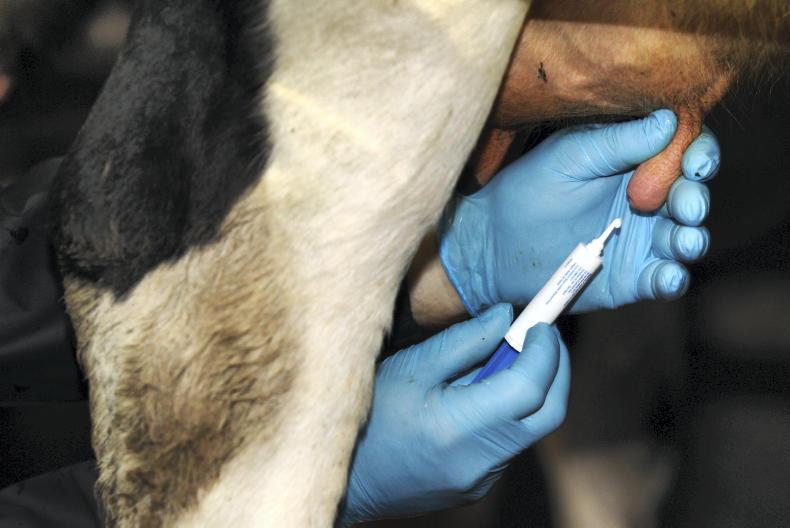
Same cow, same bug — one farm pays $120, another $330. The gap isn’t the infection. It’s the extra “just to be safe” days, at about $65 apiece in dumped milk.
Executive Summary: Michigan State’s Pam Ruegg tracked 37 commercial dairies and found the same mastitis case costing anywhere from $120 to $330 to treat — and the gap wasn’t the bug, it was how long crews kept tubing. Every extra treatment day past label minimum runs about $65, almost all of it dumped milk: on an 80-lb cow at $18/cwt, that’s $14.40 a day gone, roughly $43 over three needless days. It’s not a fringe habit either — Canadian data (Aghamohammadi 2018) show that 83% of producers treat longer than the label calls for, chasing milk that “looks clean” even as clinical cure already lags biological cure by 24–48 hours. Scale it, and a 500-cow herd bleeds around $6,500 a year in unnecessary discard alone, before you touch subclinical and culling losses. Culture-guided treatment cuts antibiotic use roughly in half with no hit to cure rates, and a $2,500–3,000 quad-plate setup typically pays back in 60–90 days — but only if your sampling’s clean and your crew trusts the plate over the reflex. Before you buy any “alternative,” the practicality test one Australian mastitis researcher lives by still holds: if it can’t save time, pencil out, and fit your routine, it won’t survive the barn no matter how good the trial looks. The 30-day move is free — pull your treatment records, sort clinical cases by duration, and that column past label minimum is your habit’s price tag in ink.
The Numbers at a Glance
Metric
Figure
What it means
Same-case cost spread
$120 vs. $330
Nearly triple, driven by habit — not biology
Cost per extra treatment day
~$65
Mostly dumped milk, not the drug
Daily milk value, 80-lb cow @ $18/cwt
$14.40
~$43 lost over three needless days
Producers treating past label
83%
~2 extra days on average (Canadian data)
Biological vs. clinical cure lag
24–48 hrs
You’re often treating inflammation, not infection
Wasted discard, 500-cow herd
~$6,500/yr
Before subclinical and culling losses
Culture-guided antibiotic cut
~50%
No hit to cure rates
Quad-plate culture setup / payback
$2,500–3,000 / 60–90 days
If sampling’s clean and the crew trusts it
It’s 5 a.m. and a cow flags in the parlor. Flakes in the milk, maybe a firm quarter. You know the drill, because your hands know it before your brain does: grab a tube, start treating, keep going until the milk runs clean. It feels responsible. It feels like insurance.
Here’s the number that should stop that reflex cold. Michigan State University research led by Dr. Pam Ruegg — tracking 37 commercial dairies averaging around 1,300 cows each — found that out-of-pocket costs for essentially identical mastitis cases ran anywhere from $120 to $330 per farm. Same antibiotics. Same case severity. Nearly triple the cost. And the difference wasn’t biology. It was habit.
Same Cow, Same Bug, Triple the Cost — Why?
The reason the spread is so wide comes down to one thing most of us never think of as a decision at all: how long you keep treating.
Ruegg’s team put a price on it. Each additional treatment day beyond label minimum costs roughly $65 in discarded milk and extended withdrawal, and milk discard — not the drug — is the bulk of what you’re paying for. Here’s the math on your own cows: an 80-pound cow at $18/cwt makes about $14.40 in daily milk value. Stretch treatment three days past what the case actually needed, and that’s roughly $43 in dumped milk per cow, before you count the antibiotic and the labor. It adds up faster than most of us realize.
Ruegg is blunt about why farms keep waiting. Producers treat until the milk looks normal — but, as she explains, the abnormal appearance stems from inflammation and isn’t predictive of whether bacteria are still present. Clinical cure lags biological cure by 24 to 48 hours. So those extra days are often spent treating a cow whose infection already cleared. You’re medicating inflammation. And paying dumped milk for the privilege.
The 83% Problem
If this were a fringe habit, it’d be a footnote. It isn’t.
The Canadian Bovine Mastitis Research Network study (Aghamohammadi et al., 2018) found that among producers using a single protocol for mild or moderate cases, 83% treated longer than the labeled regimen — averaging about two extra days. Only 17% followed the label exactly. And the classic decision-tree work from Pinzon-Sanchez and Ruegg, published in the Journal of Dairy Science in 2011, laid out why that habit costs money: for mild and moderate cases, the economically optimal play is a two-day course for gram-positive infections and no antibiotics at all for gram-negative or no-growth cases.
The extended five- and eight-day regimens? They consistently produced the worst economic outcomes in that model, because a small bump in bacteriological cure couldn’t cover the milk you dumped chasing it. As Ruegg put it flatly in Veterinary Clinics of North America in 2018, “using antibiotics to treat many cases of nonsevere clinical mastitis does not result in improved bacteriologic or clinical outcomes.” The tube you grabbed for peace of mind, in a lot of cases, bought you nothing the cow wasn’t going to do herself.
The Barn Math on a 500-Cow Herd
Put real numbers to it. For a 500-cow herd, The Bullvine’s analysis of the MSU work pegs treating past label minimum at roughly $6,500 a year in unnecessary discard alone — money that vanishes purely because the decision runs on reflex rather than results. That’s before you touch the bigger hidden buckets the same analysis flags: subclinical losses and culling each account for close to half of total mastitis cost in the Canadian data.
Cost Bucket
Approx. Share of Total Mastitis Cost
Driven By
Subclinical losses
Close to 50%
Reduced milk yield, undetected without SCC testing
Culling
Close to 50% (combined w/ subclinical)
Chronic/repeat cases, treatment failures
Unnecessary discard (over-treatment)
~$6,500/yr on 500 cows
Treating past label minimum, habit not biology
Drug and labor cost
Smaller share
Antibiotic units, treatment time per case
Treat the $6,500 as a starting illustration, not gospel — it moves with your milk price, your incidence, and your pathogen mix. But the direction is never in doubt. Farms that culture before they treat consistently report around 50% reductions in antibiotic use while holding or improving cure rates, with a quad-plate culture setup running $2,500–3,000 and typical payback in 60–90 days.
None of this needs a new gadget or a bigger drug budget. It needs the decision slowed down just long enough to ask what you’re actually treating.
What “Sample First, Treat Later” Really Costs to Run
The fix isn’t new, and the evidence for it is solid. A multi-state clinical trial in the Journal of Dairy Science found that using on-farm culture to guide clinical mastitis treatment reduced intramammary antibiotic use by about half and trimmed roughly a day off milk withholding — with no significant difference in clinical cure, bacteriological cure, recurrence, or culling compared with treating everything. Dairy Farmers of Canada’s 2024 stewardship guidance now formally recommends selective treatment of non-severe cases based on rapid diagnostics within 24 hours.
Metric
Treat Everything (status quo)
Culture-Guided Treatment
Intramammary antibiotic use
Baseline (100%)
~50% lower
Milk withholding time
Longer, ~1 day more
~1 day shorter
Clinical/bacteriological cure
No significant difference
No significant difference
Recurrence and culling rates
No significant difference
No significant difference
Setup cost
$0 (no new equipment)
$2,500–3,000 quad-plate
Payback period
N/A
60–90 days
Failure mode
Reflex over-treatment, hidden cost
Contaminated samples erode crew trust
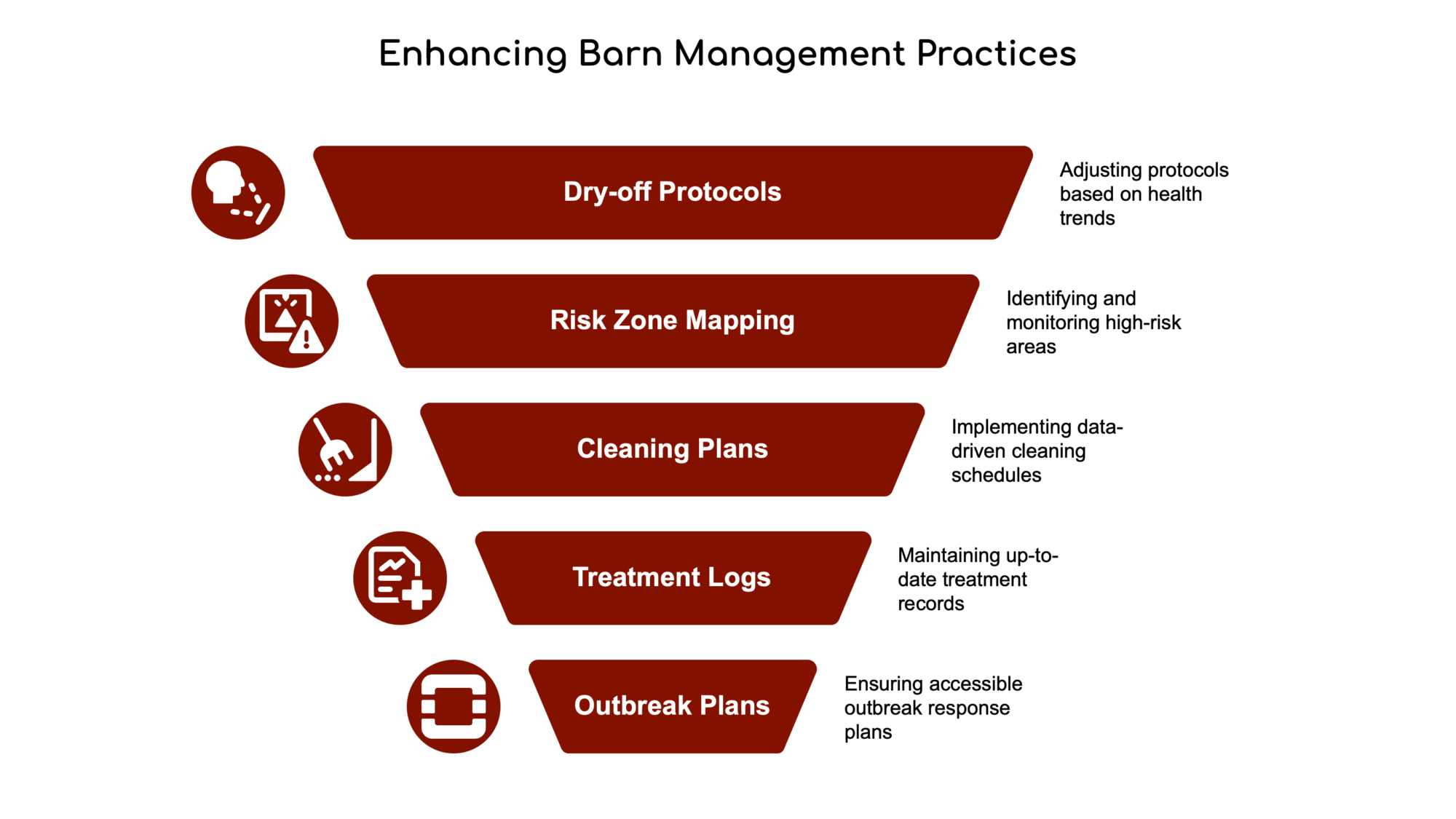
So why doesn’t every barn run it? Because on a big dairy with lean labor, “sample first” is a systems change, not a tweak. It means aseptic sampling at the parlor, a small on-farm culture setup or a disciplined send-out, and — this is the part that breaks — a protocol short enough that a weekend relief milker follows it at 4 a.m. without guessing.
The predictable failure point isn’t the science. It’s the crisis of faith around Day 3, when the milk still looks abnormal, and the crew wants to keep treating. Herds that have made the switch consistently describe that first month as the hard part: staff need to see, firsthand, that milk clears on its own after a short course before they’ll trust the protocol. Contaminated samples and SOPs nobody follows are the other two killers. The protocol that lives in a binder instead of on the wall is the one that quietly reverts to “just grab a tube.”
Can a Machine Do What the Tube Can’t?
Here’s where the conversation gets genuinely tricky. Once you accept that reflex-tubing is expensive, the door opens to non-antibiotic tools — and the market is happy to sell you a lot of them. Most aren’t ready. A few are.
Of the non-antibiotic options, Acoustic Pulse Therapy (APT) has the strongest peer-reviewed evidence published to date. A 2024 PLoS One retrospective across four Israeli commercial herds (Merin et al.) reported 65.8% subclinical udder recovery at 90 days versus 11.5% in untreated controls, and mastitis culling of 1.35% versus 16.7%. The paper estimates a benefit of $15,106 per 100 cows per year against roughly $1,440 in APT cost. Striking numbers. Read the fine print, though: the study’s authors disclose that the device’s maker was involved in the work, and it’s a retrospective across four Israeli herds with subclinical cases defined by SCC over one million — promising evidence worth testing on your own cows, not a closed case.
The rest of the “natural” toolbox — probiotics, botanicals, immune modulators — isn’t there yet. A 2018 critical appraisal concluded that treating clinical infections with lactic acid bacteria “cannot be recommended” in current practice. Interesting science, the whole category — but the independent evidence hasn’t caught up to the marketing yet. If a product’s best support lives in a brochure, your milk cheque shouldn’t depend on it.
The Test That Kills Good Products: Will a Farmer Actually Use It?
Tiana Sherry, a genetics-and-law-trained PhD researcher in Australia working on non-antibiotic mastitis therapies, makes a point that should reframe how you read every “next big thing” pitched at your parlor. A treatment can’t just work in a lab — it has to survive the barn.
“There’s just no point in creating a different research direction or trying to implement a new practice on farm,” Sherry told the Dairy Black Belt podcast, “if farmers were never going to go for it in the first place.” She runs producer surveys alongside her lab work precisely because the graveyard of dairy innovation is full of compounds that were effective and completely impractical. Her own read on the antibiotic treadmill is blunt: churning out new antibiotic derivatives teaches bacteria to beat the next one, “so I believe the antibiotic journey should be stopping, and we should be looking for alternatives.”
Distill her logic into a filter you can use tomorrow: does the treatment save time, does it pencil out, and does it fit the way your barn already runs? A product that demands twice-a-day dosing — something Sherry flags as a real barrier in large systems — is a non-starter no matter how clean the trial data looks. Her own candidate compounds are years from a barn; she puts commercialization on the familiar six-to-eight-year horizon. The takeaway isn’t “wait for the miracle.” It’s that the same three questions are the ones you should run on anything a rep sets on your office desk today.
The 30-Day Mastitis Audit & Decision Framework
The hard part was never the bug. It’s that the most expensive input on most dairies — the reflex to reach for a tube — never shows up as a line item. It hides in dumped milk and vague vet bills, which is exactly why it survives. Here’s how to drag it into the light and decide what, if anything, to change. Work it in order.
Pull and sort your records (this week, free). Export your last 12 months of clinical mastitis cases and sort by treatment duration. Count how many ran past label minimum. At roughly $65 a day in dumped milk, that column is your number — the cost of habit, in ink.
Write the rule down. Do you have a written rule for which cases wait for culture and which get treated immediately, or does it live in one person’s head? If it isn’t on the parlor wall, a 4 a.m. relief milker can’t follow it — and it reverts to “just grab a tube.”
Carve out the sick cows first. Flag severe cases (fever, off-feed, systemic signs) for immediate treatment, so “sample first” never delays a genuinely sick cow. This is the guardrail that makes selective treatment safe.
Decide if culture-guided treatment fits your herd. Best for mid-to-large herds with the labor to sample cleanly and the case volume to justify the $2,500–3,000 setup, paying back in 60–90 days at ~50% less antibiotic use. It backfires when sampling is sloppy — contaminated plates are worse than no plates, because the crew stops trusting results. And if you culture, actually act on gram-negative and no-growth results by withholding the tube.
Check whether selective dry cow therapy is on the table. Fits herds with reliable SCC records, lower bulk tank counts, and internal teat sealant on hand; AABP’s 2024 guidelines set the readiness criteria, with roughly a 50% antibiotic cut and about $5.37/cow in savings at equivalent udder health. Weak records or poor hygiene? Stay blanket until the basics are fixed rather than under-treat blind.
Run the practicality test on anything a rep is selling. Before you buy any non-antibiotic tool — APT included — ask the three questions: does it save time, does it pencil out, does it fit your routine (or demand twice-a-day dosing your crew can’t sustain)? And does its best evidence live in an independent trial or a vendor’s slide deck? For APT specifically, run your own numbers against the manufacturer-linked Israeli-herd data before committing a full budget.
Bottom Line Takeaways
If you’ve never audited your treatment durations, assume you’re in the 83% — and that the fix is a records pull, not a purchase.
Milk that “looks clean” isn’t the finish line. When a mild or moderate case comes back gram-negative or no-growth, the decision-tree math says the tube likely earns you nothing.
A culture setup that pays back in 60–90 days isn’t an affordability question — it’s whether your case volume justifies it. Below a certain scale, discipline on treatment duration matters more than the plates.
No trial result survives a barn it doesn’t fit. If a therapy can’t clear time, cost, and routine fit, how good the data looks is beside the point.
You already run the numbers on a ration before you feed it and a bull before you breed to him. So next time you’re standing in the parlor on Day 3, staring at milk that still looks off — what’s your treatment log actually telling you about the peace of mind you’ve been buying?
Run Your Numbers
Health ROI Calculator — This article puts $65 a day on the overtreatment habit. The Health ROI Calculator turns that into your number: run your mastitis case load, milk-withdrawal losses, and cull pressure to see whether tightening treatment durations or moving to culture-guided protocols actually pays on your herd.
Complete references and supporting documentation are available upon request by contacting the editorial team at editor@thebullvine.com.
Learn More
Biofilm mastitis protocol cuts treatments 50–75% — Reveals how an 1,100-cow Wisconsin dairy slashed hospital load by 50% and shortened treatments to two days by targeting bacterial biofilm communication before reaching for traditional intramammary tubes.
Dairy herd health and reproduction 2026 benchmarks — Delivers the exact somatic cell count thresholds, internal teat sealant protocols, and selection criteria required to implement selective dry cow therapy without risking fresh-cow clinical flare-ups.
Every week, thousands of producers, breeders, and industry insiders open Bullvine Weekly for genetics insights, market shifts, and profit strategies they won’t find anywhere else. One email. Five minutes. Smarter decisions all week.
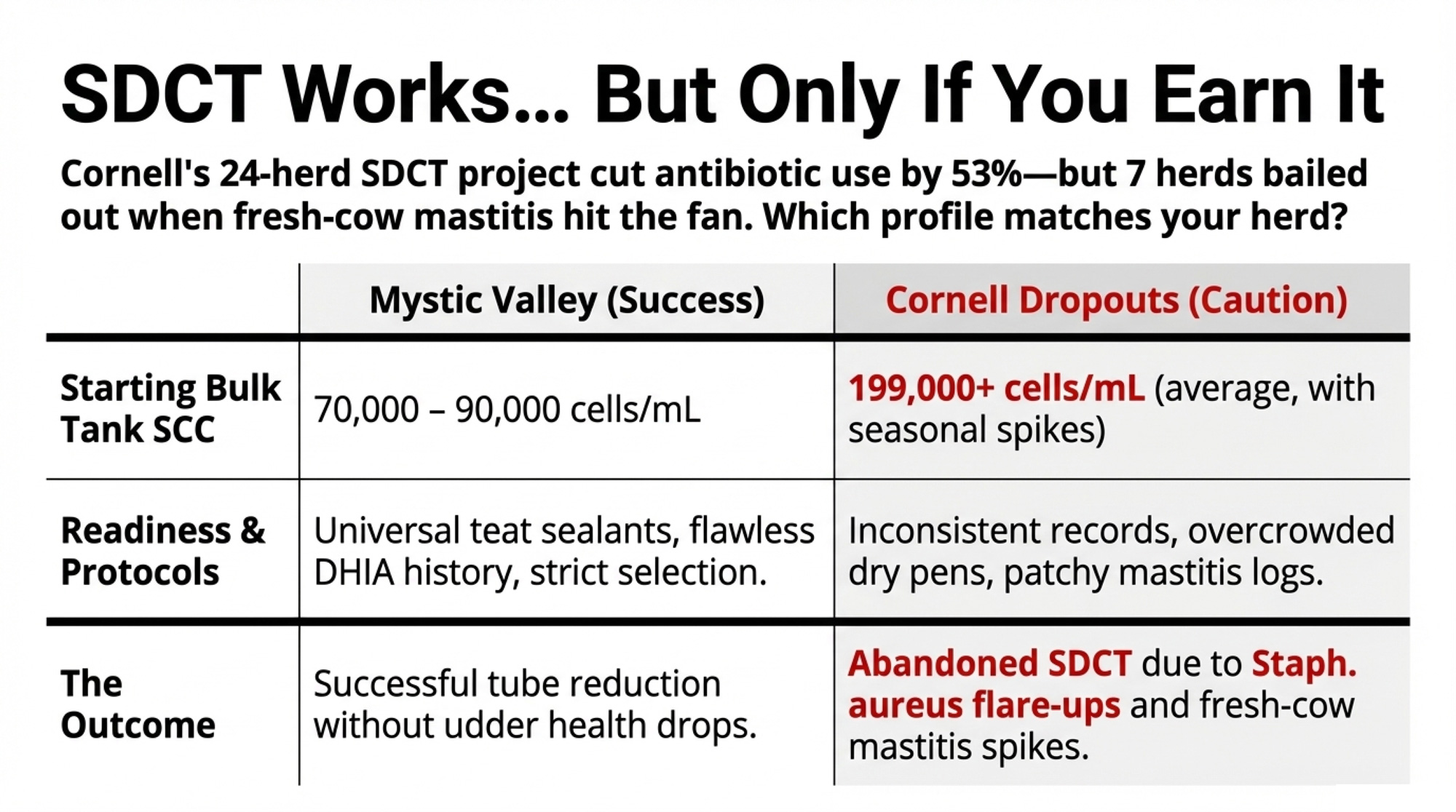
Seven of Cornell’s 24 SDCT herds bailed on the program once their fresh‑cow mastitis numbers hit the fan. Before you join them, you’d better know which group you’re in.
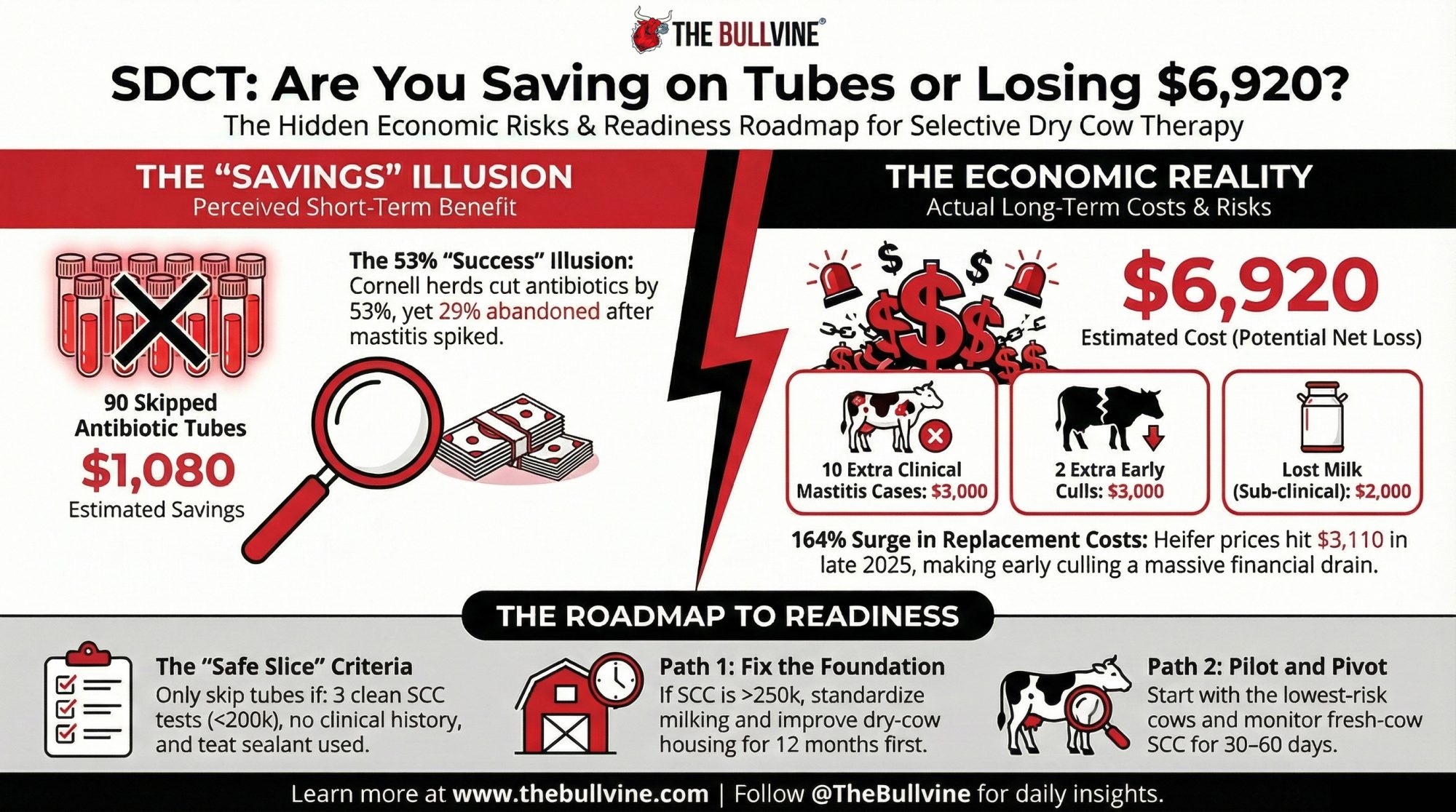
Executive Summary: Herds trying selective dry cow therapy at 240,000 SCC can easily turn “antibiotic savings” into a $6,920 loss on 300 cows once extra mastitis, culls, and lost milk are in the math. Cornell’s 24‑herd SDCT project cut dry‑cow antibiotic use 53% on average, but 7 herds still abandoned SDCT when fresh‑cow mastitis and milk quality slipped. Dutch data shows dairy can cut antimicrobial use roughly 47% without wrecking udder health, but only after years of tightening SCC, housing, and protocols. This piece lays out three realistic paths for higher‑SCC herds under processor pressure: fix infections first, pilot SDCT on the safest slice only, or use that SDCT letter as leverage for a 12–18‑month runway. You’ll see the exact SCC thresholds, AABP readiness criteria, and barn‑math assumptions so you can plug in your own DHIA and cull numbers. If your bulk tank’s been north of 200,000 and your mastitis records are patchy, you’ll likely walk away treating SDCT as a future goal, not a box to tick this dry‑off season.
When The Bullvine first profiled Mystic Valley Dairy’s move to selective dry cow therapy, one detail jumped off the page: a bulk tank somatic cell count around 78,000 cells/mL and a decision to start skipping dry‑cow tubes on some cows anyway.
Around the same time, Cornell’s Quality Milk Production Services team was quietly tracking 24 New York herdsthrough their own SDCT transition. Those farms averaged 199,000 cells/mL SCC going in and still managed to cut dry‑cow antibiotic use by 53% on average (range: 32–78%) without wrecking udder health. Put those two stories beside a 240,000‑SCC herd with a processor letter on the kitchen table, and the contrast gets real fast.
Mystic Valley’s SDCT Story: Low SCC, High Scrutiny
Mystic Valley Dairy, Sauk City, Wisconsin, milks about 450 registered Holsteins, with a bulk tank SCC typically ranging from 70,000 to 90,000 cells/mL. In The Bullvine’s earlier coverage, owner Mitch Breunig laid out why a herd with that kind of SCC profile would even consider cutting dry‑cow tubes.
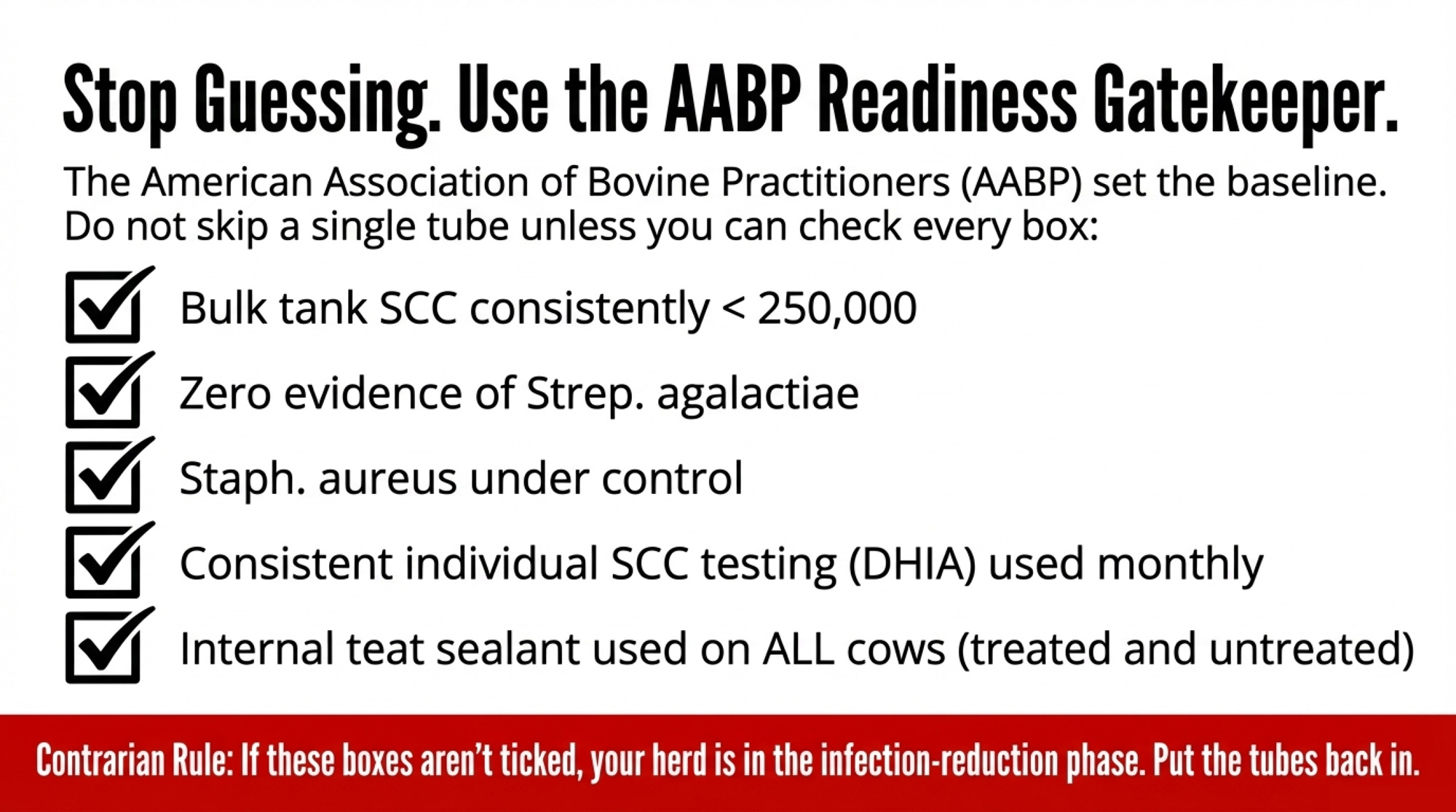
Mystic Valley already ticked every box in the 2024 AABP SDCT readiness guidelines and then some: bulk tank SCC regularly less than 250,000; no evidence of Streptococcus agalactiae; Staphylococcus aureus under control; consistent individual SCC testing; written milking and dry‑off SOPs; and internal teat sealant at dry‑off for all cows. On paper, they looked a lot like the 12 Flemish herds in Lipkens, Piepers, and De Vliegher’s 2023 trial, which had a geometric mean bulk tank SCC of 145,000 cells/mL at enrollment (range: 84,000–195,000; median 157,000) and used teat sealants on every dry cow.
Mystic Valley’s criteria were conservative from the start: cows needed three straight SCC tests under 200,000, no clinical mastitis during the lactation, no flagged problem quarters, and a good‑eyes‑on udder check at dry‑off before they were considered for sealant‑only treatment. Everyone else stayed on full dry‑cow therapy plus sealant.
Even in that low‑SCC, well‑run context, Mystic Valley still saw some early‑lactation cows whose performance raised eyebrows. Those early outcomes led the farm and its vet to tighten criteria further and pay closer attention to which cows truly belonged in the sealant‑only column.
The point isn’t that SDCT was easy for them. It’s that they were operating from a starting point — and with protocols — most 240,000‑SCC herds don’t have yet.
Cornell’s 24 SDCT Herds: 53% Fewer Tubes, Not for Everyone
If Mystic Valley shows what SDCT looks like on a very low‑SCC herd, Cornell’s New York project shows what happens when you put it into a broader mix of operations.
Readiness factor
Mystic Valley Dairy
240,000‑SCC herd under pressure
Bulk tank SCC (cells/mL)
70,000–90,000; long‑term <150,000
240,000+; bounces 230,000–280,000
Individual SCC data
3 consecutive tests <200,000 required for SDCT cows
Patchy DHIA; high‑SCC cows not consistently flagged
Contagious pathogens
No Strep. ag; Staph. aureus under control
Staph. aureus “suspected” or intermittently cultured
Dry‑off protocol
Written SOP; one named dry‑off lead; sealant for all cows
Shared between milkers; protocol drift between shifts
Teat sealant use
100% of dry cows receive internal teat sealant
Used on “problem cows” only or inconsistently
Housing & dry pens
Stocking density and bedding managed; low overcrowding (implied by low SCC)
Overcrowded, wetter pack; limited capital for upgrades
AABP 2024 SDCT checklist
Ticks every box and more
Fails multiple criteria; SDCT pushed by processor, not data
Potter, Forrestal, Capel, and Nydam’s 2022 AABP paper followed 24 commercial dairy farms across New York State. Herd sizes ranged from 65 to 3,774 cows, averaging 985 cows, with a starting bulk tank SCC of 199,000 cells/mL. Farms worked with veterinarians to use individual cow SCC and mastitis history to decide who received full dry‑cow therapy plus sealant and who received sealant only, and then monitored bulk tank SCC, fresh‑cow SCC, and clinical mastitis as they transitioned.
Across those 24 herds:
53% average reduction in dry‑cow antimicrobial use (individual herds ranged from 32% to 78%).
No consistent herd‑level spikes in fresh‑cow SCC or mastitis when SDCT was implemented inside the project’s framework.
17 of the 24 farms still used SDCT at the end of the study period.
7 farms stopped SDCT, citing seasonal milk‑quality challenges, more dry‑period clinical mastitis, or flare‑ups of contagious pathogens such as Staph. aureus.
Cornell didn’t treat SDCT as a universal good or an obvious mistake. They treated it as a tool that fit most of those herds — but not all — even with structured support and monitoring. For a 240,000‑SCC herd being pushed toward SDCT, that nuance matters more than the headline number.
When Selective Dry Cow Therapy (SDCT) Helps — and When It Bites
The published science lines up with what Mystic Valley and Cornell saw.
A 2000–2021 systematic review and meta‑analysis found that selective dry cow therapy can deliver udder‑health outcomes similar to blanket dry cow therapy (BDCT) while reducing antibiotic use — but only in herds with low bulk tank SCC, good mastitis control, and consistent use of internal teat sealants in untreated quarters. Winder et al. (2019, Animal Health Research Reviews) concluded that SDCT increases the risk of intramammary infection at calving compared with BDCT unless internal teat sealants are used; with sealants, IMI risk is similar across strategies.
The Lipkens trial offers a clean real‑world comparison. In those 12 Flemish herds (466 cows; 244 BDCT, 222 SDCT), all cows received an internal teat sealant at dry‑off. Total antimicrobial consumption for udder health between dry‑off and 100 DIM dropped from 1.25 defined course doses (DCD) per cow in the BDCT group to 1.06 DCD per cow in the SDCT group — a 22% reduction — with no significant differences in test‑day SCC, clinical mastitis incidence, milk yield, or culling hazard. Only 33.8% of SDCT‑group cows actually skipped antibiotic tubes at dry‑off, and that share varied widely between herds (6.2–73.9%).
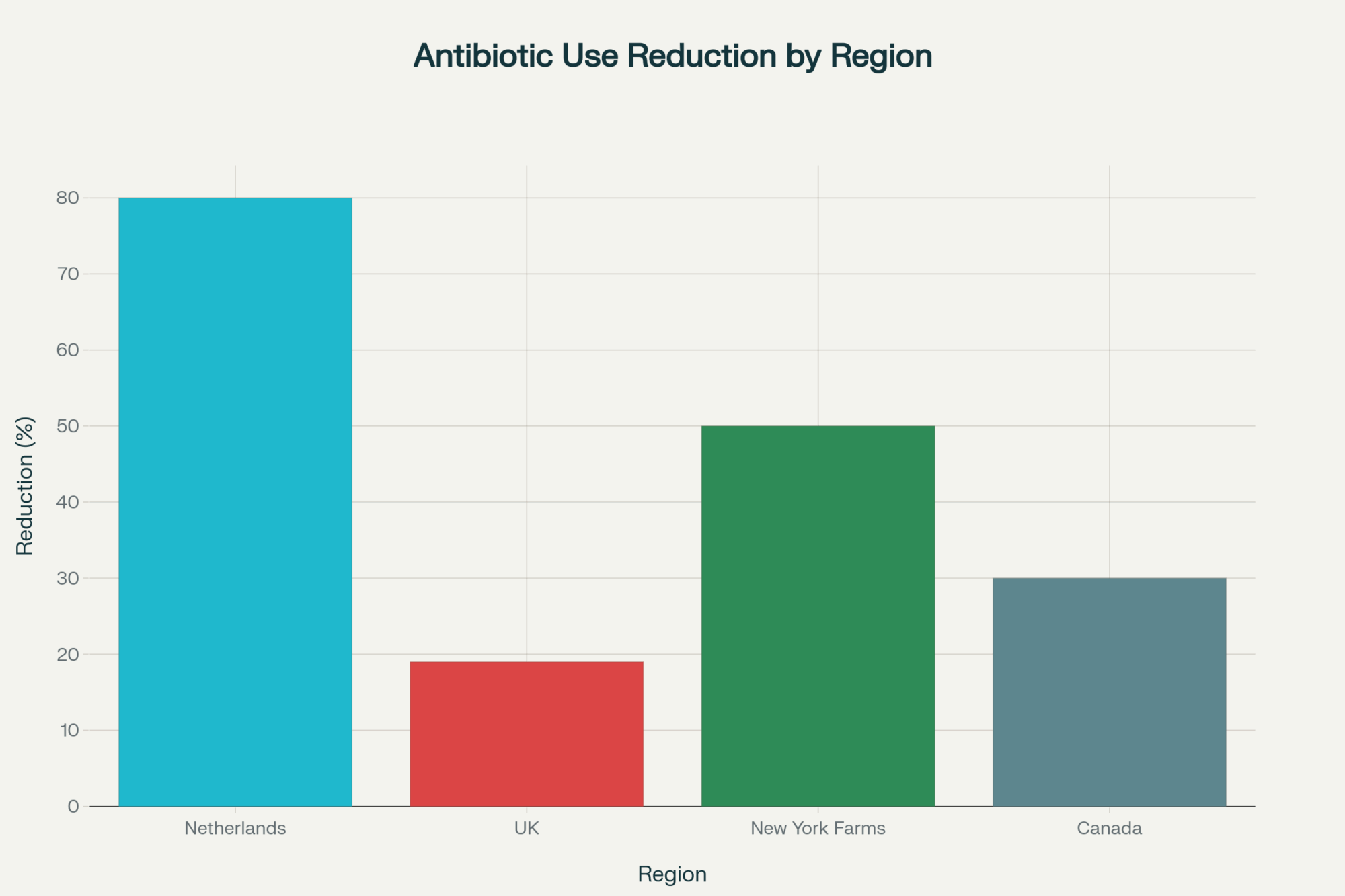
At the national scale, the Dutch experience shows how far antibiotic use can fall when an entire system commits to it. The Netherlands set mandatory reduction targets starting in 2009 and banned preventive antimicrobial use — including blanket dry‑cow treatment — beginning in 2012–2013. Across all Dutch livestock, the result was a 70.8% reduction in kilograms of antimicrobials sold since 2009 (Moura et al., 2022, Frontiers in Veterinary Science). Within the dairy sector specifically, Lam et al. (2020, Pathogens) reported a 47% decline in total antimicrobial usage from 2009 to 2015, after which usage stabilized at around 3 DDDA per cow per year.
Critically, Santman‑Berends et al. (2020, Journal of Dairy Science) monitored approximately 17,000 Dutch dairy herds (about 1.67 million cows) from 2013 through 2017 and found that the ban on blanket dry‑cow therapy drove a 63% drop in dry‑cow antimicrobial usage and a 15% reduction in intramammary treatment overall — with no deterioration in udder health at the herd level. An increase in new high‑SCC cases during the dry period was expected, but as their census data showed, it was not observed.
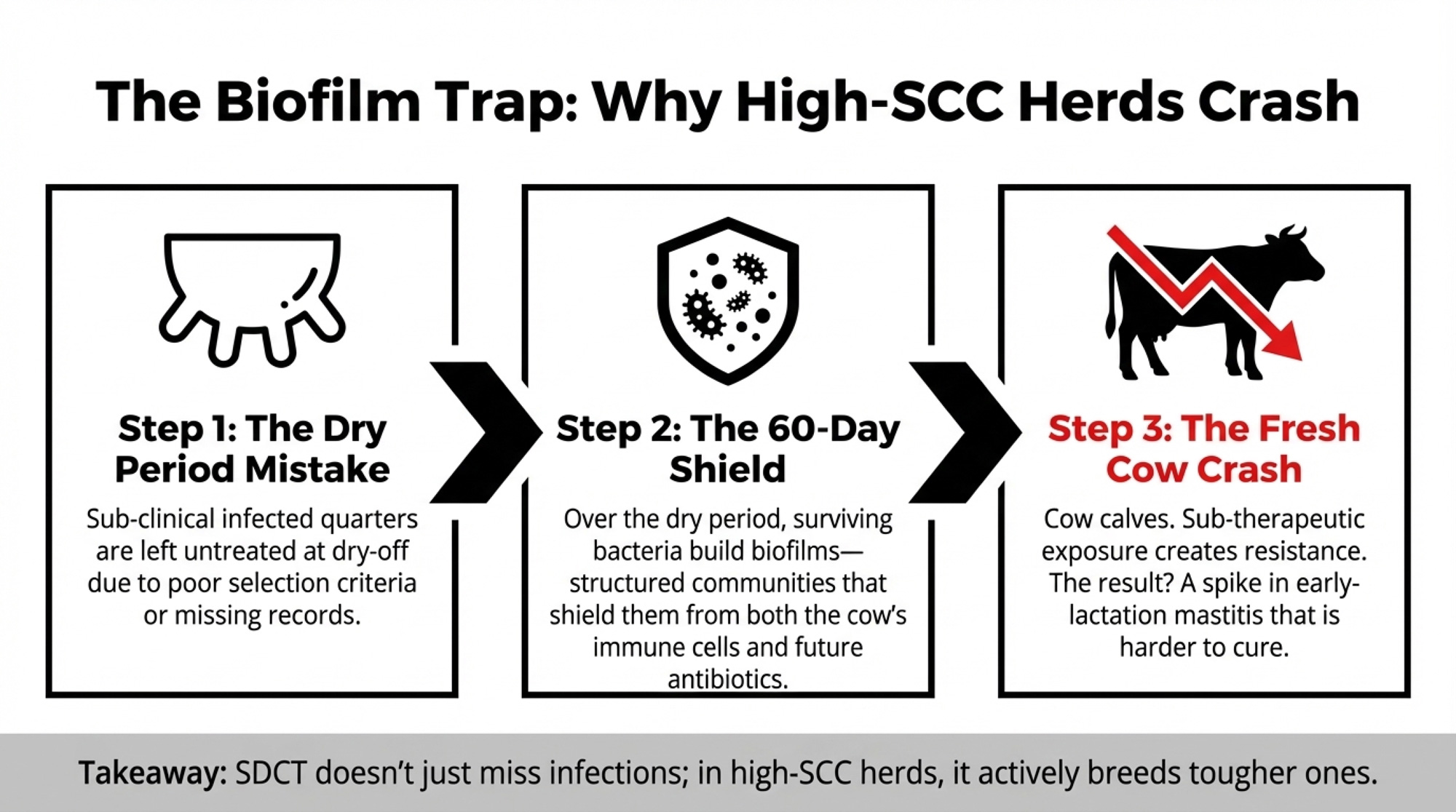
But those same studies underscore a risk that doesn’t appear in tube‑count dashboards: the biofilm and resistance trap. If infected quarters aren’t treated at dry‑off, bacteria have the entire dry period to build biofilms — structured communities that shield them from antibiotics and immune cells. Within those biofilms, resistance genes can move between bacteria more easily via plasmids and mobile DNA elements. When those cows calve and receive intermittent or incomplete lactation treatments, sub‑therapeutic exposure becomes a selection program for resistance.
For low‑SCC herds with solid protocols, that risk is manageable. For a 240,000‑SCC herd with inconsistent records or overcrowded dry pens, it’s a much easier trap to fall into.
Can a 240,000‑SCC Herd Really “Save” on SDCT?
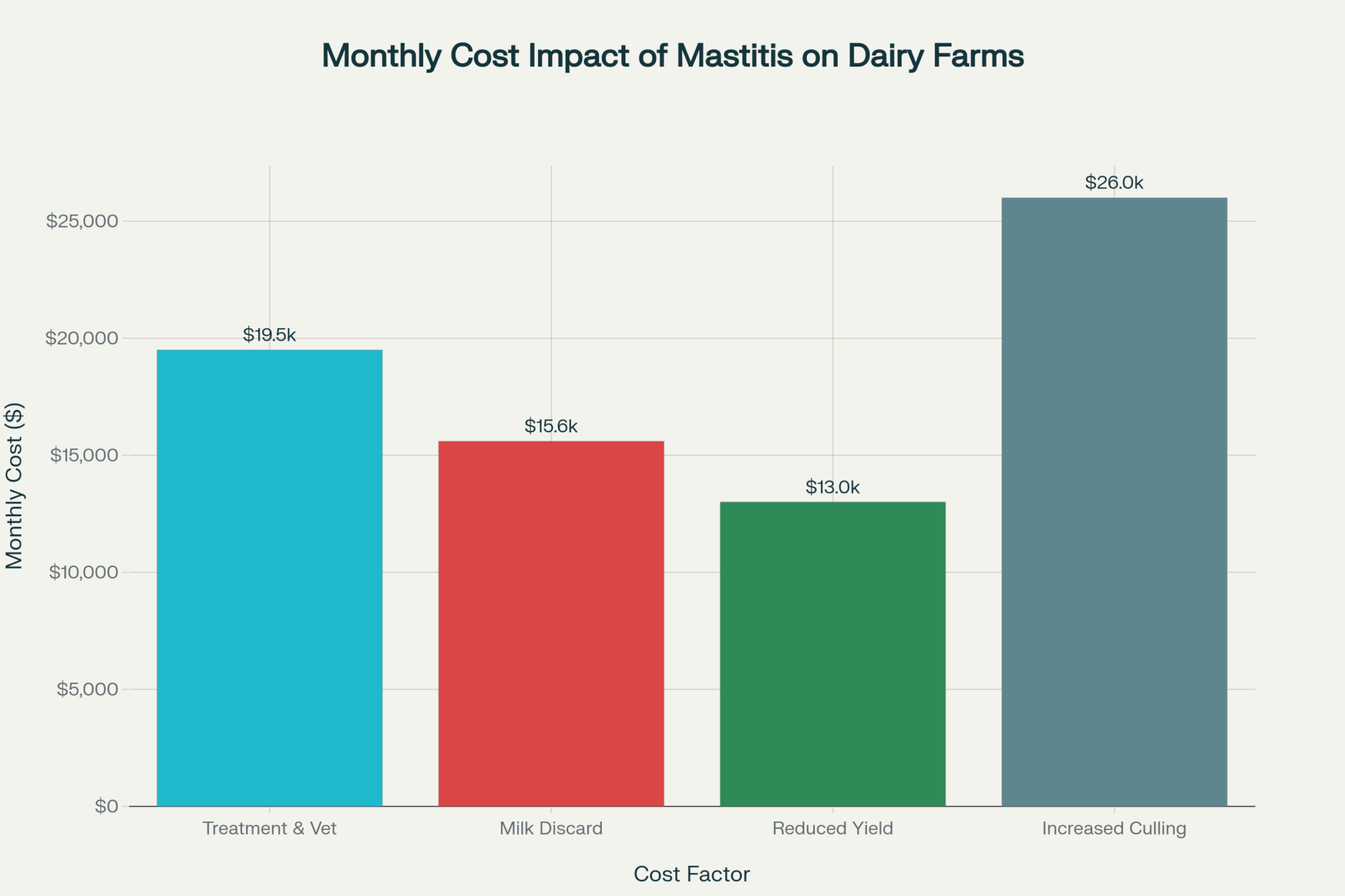
Rollin, Dhuyvetter, and Overton (2015, Preventive Veterinary Medicine) estimated the total cost of a single clinical mastitis case in the first 30 DIM at approximately $444 per case, including lost production, treatment, discarded milk, labour, and culling risk. Other work puts direct costs closer to $120 per case, making a $120–$444 range across studies reasonable.
Replacement economics have shifted just as sharply. CoBank and USDA data show:
October 2014: dairy replacement heifers at $2,120 per head.
April 2019: down to $1,140.
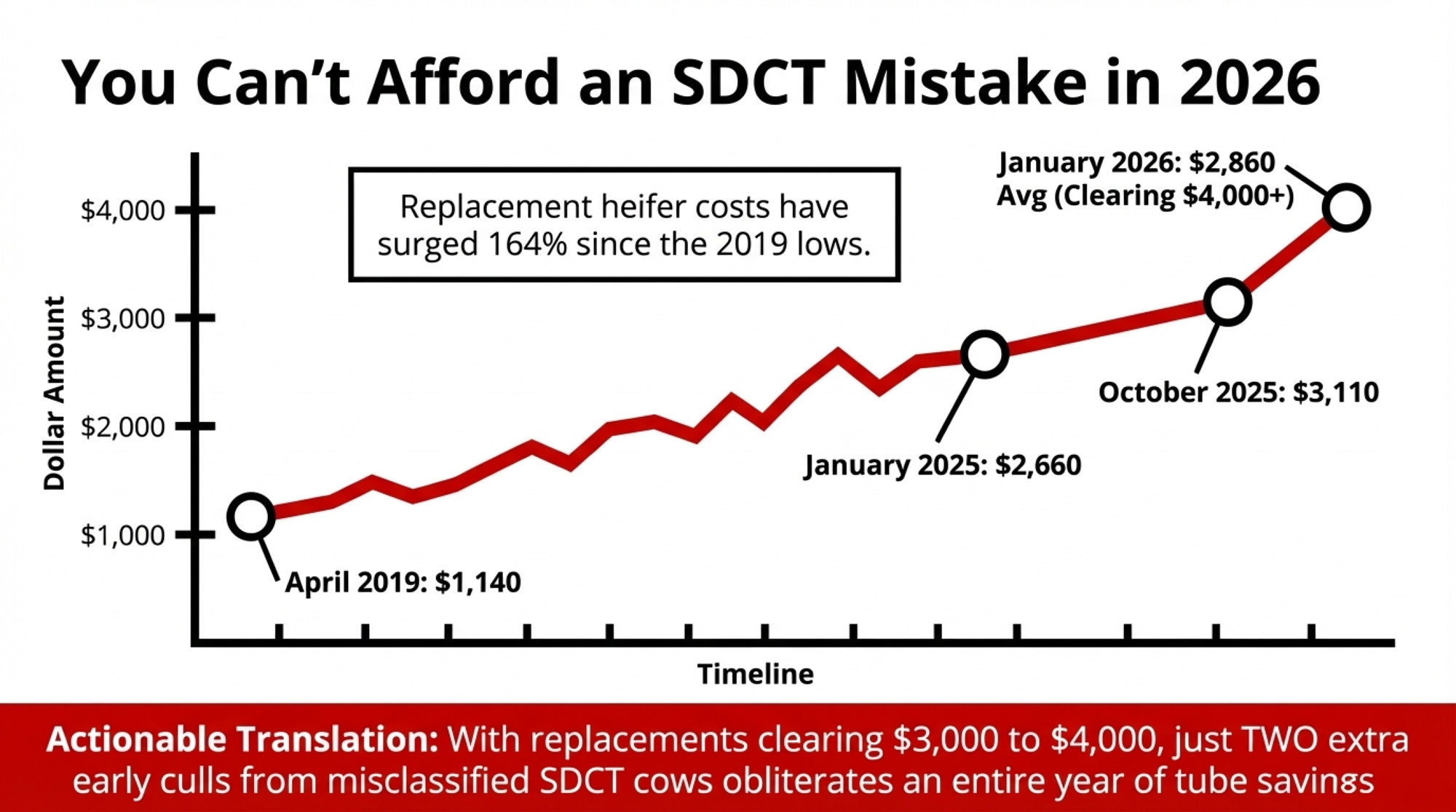
January 2025: back up to $2,660.
July 2025: $3,010.
October 2025: $3,110 — about a 164% increase from the 2019 low.
Best‑case upside, before any mastitis or cull penalties
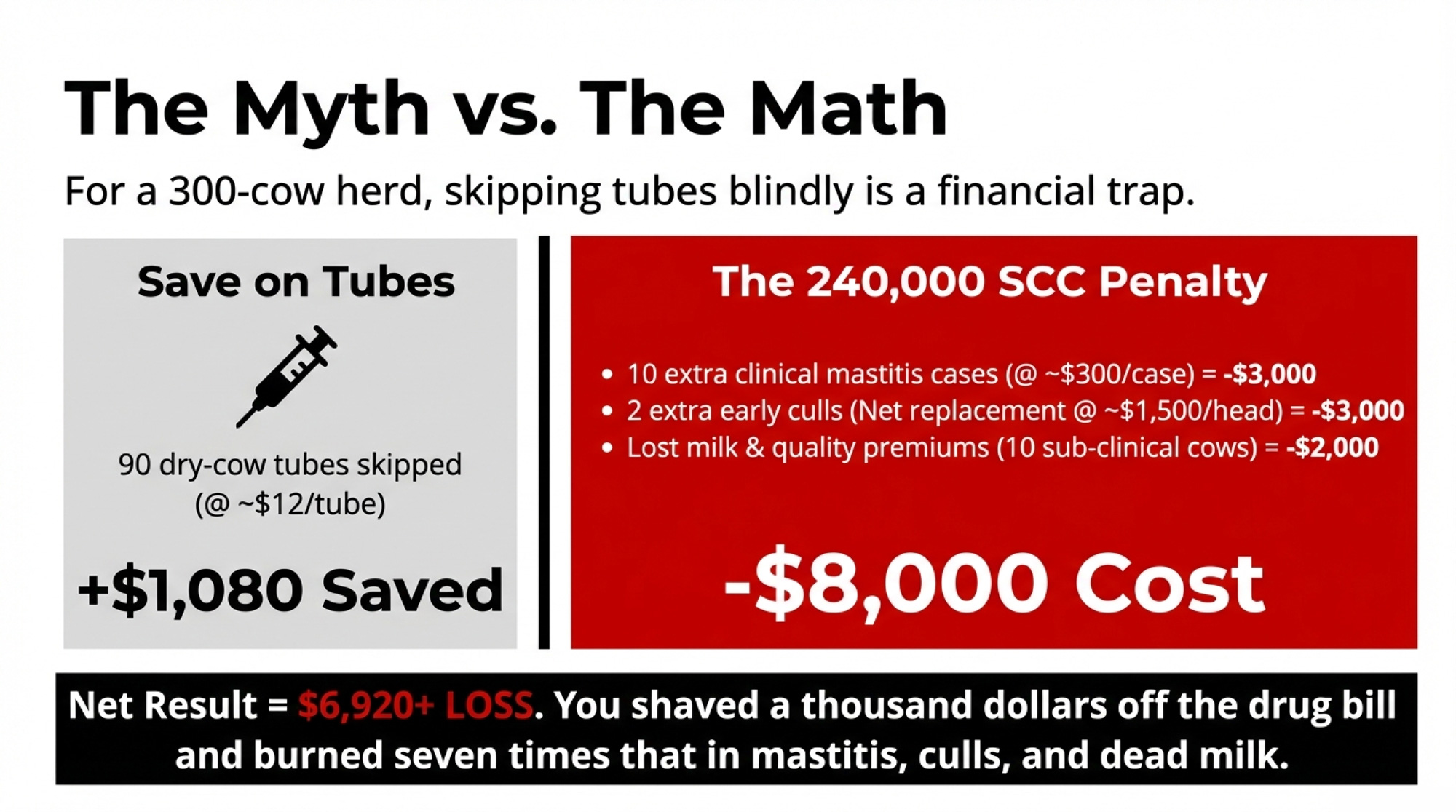
Now put that together on a 300‑cow herd with a BMSCC around 240,000 that jumps into SDCT before its infection pressure, and records are ready. If your dry‑off person is also your night milker and calf feeder, SDCT will show every crack in that schedule. And if selection criteria or follow‑through miss even a modest number of quiet infections, you can see a bump in early‑lactation mastitis, a couple of cows pushed into earlier culls, and several sub‑clinical cases dragging SCC and milk across the whole lactation.
Here’s what that looks like, using conservative assumptions:
Item
Savings
Cost
90 dry‑cow tubes skipped (@ ~$12/tube)
$1,080
—
10 extra clinical mastitis cases (@ ~$300/case)
—
$3,000
2 extra early culls (net replacement @ ~$1,500/head after cull credit)
—
$3,000
Lost milk from 10 sub‑clinical cows (a few hundred dollars per cow across the lactation)
—
≈$2,000
Net result
≈$6,920+ loss
Assumptions: tubes $8–$15 each (long‑acting dry‑cow products) with $12 used here; mastitis cost $120–$444/case, $300 mid‑range; net replacement cost $2,860 USDA Jan 2026 average minus roughly $1,400 cull cow value ≈ $1,500; sub‑clinical cows losing a few hundred dollars worth of milk and quality premiums per cow across a full lactation.
You’ve shaved about a thousand dollars off your dry‑cow drug bill. You’ve potentially burned seven times that in mastitis, culls, and dead milk.
Mystic Valley’s low SCC, universal sealant use, and disciplined selection meant it could adjust early and keep that risk in check. The Cornell herds that stuck with SDCT had similar structures and data feedback loops. A 240,000‑SCC herd without those pieces is betting $6,920+ a year that its infection status and records are better than they really are.
Three SDCT Paths: Matching the Science to Your Herd
The Mystic Valley and Cornell stories don’t say “don’t do SDCT.” They say “do it on the right herds, with the right prep, and be ready to stop if the data turns.”
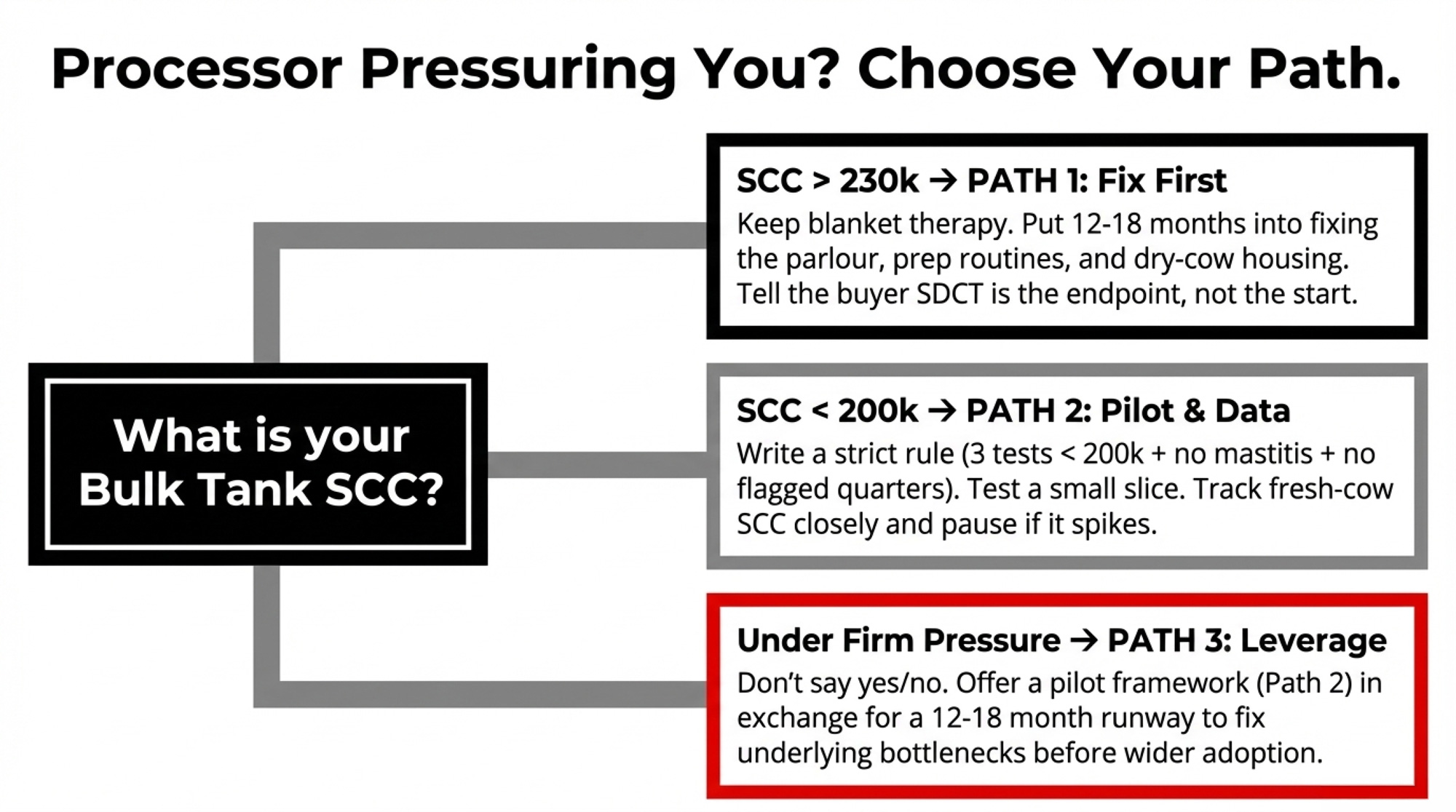
For a 240,000‑SCC herd with a processor letter, you’ve got three realistic paths forward.
1. Infection‑First: Fix the Foundation Before You Touch Tubes
This fits herds with BMSCC regularly above 230,000–250,000, chronic high‑SCC cows you already know by number, and dry pens that are too full or too wet.
You tell your buyer SDCT is the endpoint, not the starting point. Then you put 12–18 months into:
Standardizing milking routines: consistent prep, lag time, and post‑dip across every shift; fix drift in technique between employees.
Tuning the parlour: vacuum levels, pulsation, liners, unit alignment.
Culling or segregating chronics instead of carrying them through another lactation.
You stay on blanket dry‑cow therapy plus internal teat sealant for all cows while you do that work. That’s exactly how the AABP 2024 SDCT guidelines recommend sequencing for herds that don’t yet meet readiness criteria. You’re trading short‑term antimicrobial‑use “wins” for long‑term udder‑health and economic stability.
2. Pilot SDCT on the Safest Slice — and Let the Data Decide
This fits herds with BMSCC trending toward 200,000 or below, reasonably clean records, and a willingness to course‑correct.
With your vet, you write a short, strict rule:
Last three SCC tests all under 200,000.
No clinical mastitis this lactation.
No known problem quarters or chronic flags.
Cows that pass become eligible for sealant‑only at dry‑off. Eligibility isn’t a guarantee — if anyone on the crew has doubts about a cow, she stays on full treatment.
Then you monitor:
Fresh‑cow SCC at first test (5–45 DIM), focusing on the percentage over 200,000.
Clinical mastitis in the first 60 DIM, clearly tagged by dry‑off treatment group.
The AABP guidelines include specific DairyComp setups to track this. University of Minnesota Extension’s SDCT resources walk through herd‑level readiness and monitoring in plain language. Cornell used similar metrics to sort their 24 herds into “stayed in” and “opted out.”
If your graphs look like the Lipkens and Cornell success herds — stable SCC, no disproportionate mastitis spike among sealant‑only cows — you can cautiously widen eligibility. If they start to look like the seven Cornell herds that stopped, close the gate and go back to Path 1.
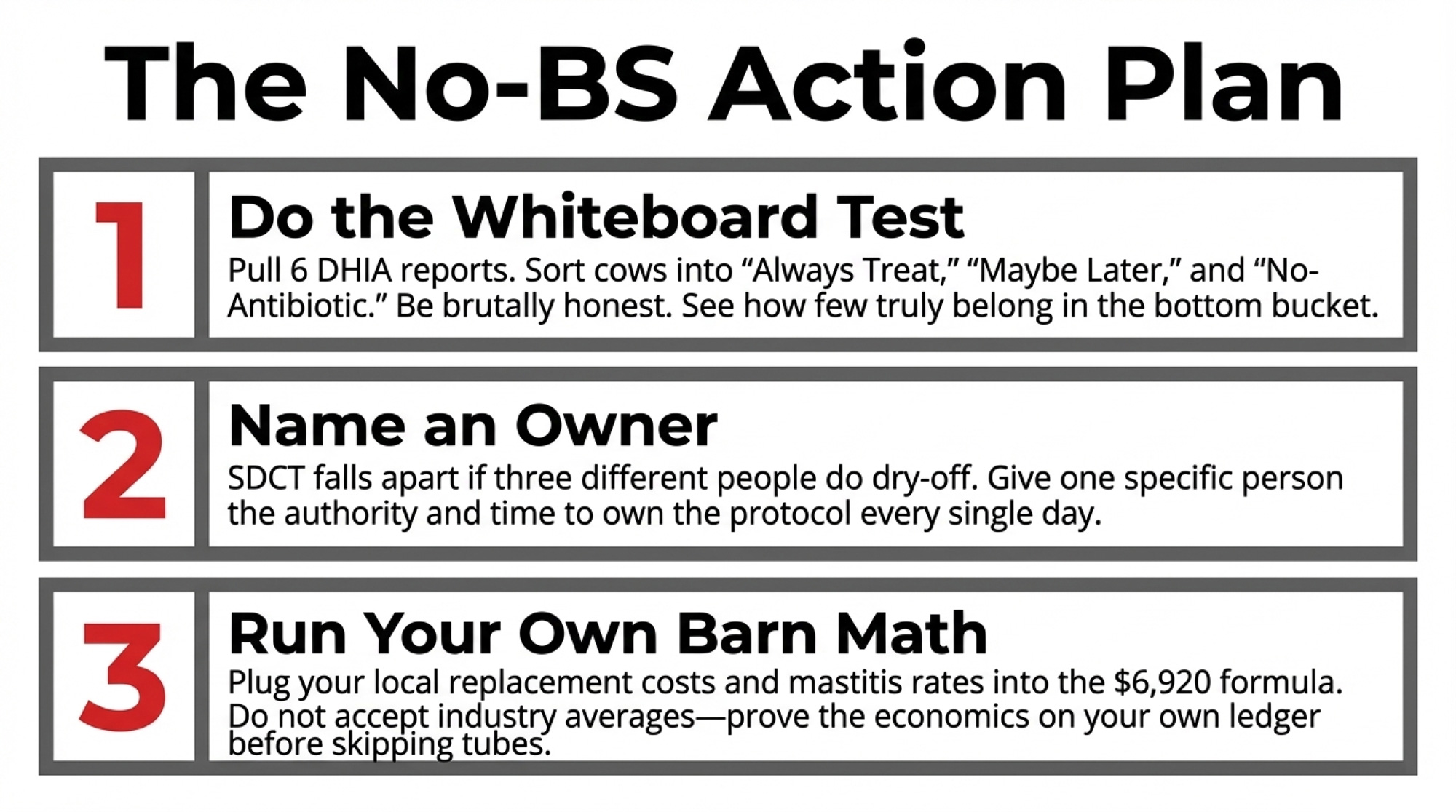
Do this within 30 days: Pull your last six DHIA reports and your current dry‑off list. On a whiteboard, make three columns:
“Always treat”
“Maybe selective later.”
“Pilot no‑antibiotic candidate”
Fill it in honestly. That one exercise will show you how many cows truly belong in the lowest‑risk bucket — and how far your herd sits from one that looks like Mystic Valley or the Lipkens group.
3. Turn the Processor Letter Into Leverage, Not a Deadline
This fits herds that need time and capital to fix underlying issues while facing firm SDCT language from buyers.
Go back to the processor with a framework instead of a yes/no:
You’ll pilot SDCT only on the safest slice (as in Path 2) this coming dry‑off season.
You’ll report quarterly on the bulk tank SCC trend, the percentage of fresh cows with SCC over 200,000, and the first‑60‑day mastitis incidence.
In return, you ask for a 12–18‑month runway to hit agreed improvements in SCC and mastitis, and to address facility bottlenecks, before any push toward wider SDCT.
The Dutch experience backs you up: that 47% dairy‑sector antimicrobial reduction happened over years, not months, and required simultaneous work on management, housing, and monitoring — not just a ban on tubes. A buyer who can show auditors your plan and your numbers is better off than one who forced SDCT onto a high‑SCC herd and then watched the metrics wobble.
What This Means for Your Operation
Start with your own SCC curve, not the industry average. If your bulk tank has lived under 200,000 for the last 6–12 months and you can pull a trustworthy mastitis and SCC history for each cow, you’re in the same readiness zone as the Lipkens herds and Cornell’s average SDCT adopter. If you’re swinging 230,000–280,000, you’ve still got infection work ahead of you.
Decide who owns dry‑off — by name. SDCT falls apart when three different people “kind of” handle it. One person needs to own that protocol and have enough time and authority to stick to it every day.
Use the AABP checklist as your gatekeeper, not your processor’s email. Bulk tank SCC regularly less than 250,000; no Strep. ag; Staph. aureus under control; individual SCC data; written SOPs; sealant for all cows. If those boxes aren’t ticked, your herd is still in the infection‑reduction phase.
Run your own barn math before you skip tubes. At a USDA average of $2,860 per replacement heifer — with individual animals clearing $4,000+ — even two extra early culls from mis‑classified SDCT cows can blow past a full year of tube savings. Put your own numbers into the $6,920 example; don’t just accept the model.
Within 90 days: Sit down with your vet and put your last six months of SCC and mastitis data beside the AABP SDCT criteria. Wherever your herd fails on that checklist, that’s where your next management or capital dollar should go.
Within 12 months: If you stay on BDCT while fixing management, re‑run your fresh‑cow SCC and first‑60‑day mastitis plots against last year’s. A noticeable step change does more to prove you’re SDCT‑ready than any pledge about tube counts.
Key Takeaways
If your herd’s SCC isn’t consistently under ~200,000 and your records can’t reliably sort truly low‑risk dry cows from the rest, SDCT is a future objective, not a current target.
If you pilot SDCT, every cow that skips tubes should have three consecutive SCC tests under 200,000, no mastitis this lactation, no problem quarters, and still receive a teat sealant — and you need to track her fresh‑cow outcomes separately from full‑treated cows.
If fresh‑cow SCC or first‑60‑day mastitis in your SDCT group climbs above your own baseline, that’s your cue to pause or narrow and invest harder in infection control rather than hoping the numbers settle.
If your processor is pushing a hard SDCT timeline, bring them a plan with a pilot cohort, monitoring metrics, and 12–18‑month milestones — not blanket SDCT on a 240,000‑SCC herd that isn’t structurally ready.
The Bottom Line
The herds that will be least stressed by the next round of antimicrobial stewardship rules aren’t the ones bragging about cutting the most tubes. They’re the ones whose data can prove their cows do fine without them.
When you pull up your last year of SCC curves, mastitis logs, and cull codes, do those numbers honestly look like a Mystic Valley‑style foundation for selective dry cow therapy — or are they telling you to keep the tubes while you fix what’s underneath?
Complete references and supporting documentation are available upon request by contacting the editorial team at editor@thebullvine.com.
Stop Tightening Your Belt: Dairy’s $6.35/cwt Gap and Your 90-Day Window to Close It – Exposes the structural shifts in replacement heifer inventory and component pricing that will define your margins through 2028. It reveals how to reposition your herd to meet aggressive processor quality standards before the market decides for you.
The Next Frontier: What’s Really Coming for Dairy Cattle Breeding (2025-2030) – Breaks down the emerging AI and sensor breakthroughs that detect mastitis a full week before clinical signs appear. It delivers a 5-year strategy to breed “invisible” cows that fundamentally outperform stewardship audits through superior natural immunity.
The Sunday Read Dairy Professionals Don’t Skip.
Every week, thousands of producers, breeders, and industry insiders open Bullvine Weekly for genetics insights, market shifts, and profit strategies they won’t find anywhere else. One email. Five minutes. Smarter decisions all week.
Lose cows, save $277 on tubes, risk $2,220 in mastitis. Mystic Valley ran that math and still chose selective dry cow therapy. Would your herd?
Executive Summary: Mystic Valley Dairy tried selective dry cow therapy with all the “right” prerequisites—low SCC, Food Armor, strong records—and still lost cows in the first 60 days. Instead of reverting to blanket dry-cow therapy, they changed how they used teat sealant, tightened fresh‑cow monitoring, and kept SDCT in the protocol. This article pairs that real‑world experience with 2021–2024 research showing that algorithm‑guided SDCT can deliver average net returns of about 7–8 USD per cow at dry‑off and culture‑guided SDCT around 2 USD per cow, assuming udder health stays comparable to blanket therapy. It also draws on a 37‑herd Wisconsin cost study showing typical dry‑off product costs of about 19.57 USD per cow, with modeled SDCT protocols trimming partial direct costs by roughly 1–5 USD per cow, depending on product mix and how many cows still receive treatment. A simple barn‑math example for a 300‑cow herd (about 277 USD saved on tubes versus 2,220 USD in potential mastitis costs) turns SDCT from a philosophical debate into a concrete risk‑reward decision. Genetics aren’t an afterthought: health traits like mastitis resistance, livability, and DPR are positioned as the long‑term lever that makes SDCT safer and more scalable. The piece closes with a 90‑day playbook—paper‑testing an SDCT algorithm on last year’s dry‑offs, tightening records, and piloting one low‑risk group—plus clear “go/no‑go” signals on SCC, compliance, and mastitis trends so owners and herd managers can decide when SDCT makes sense and when it doesn’t.
In 2018, Mystic Valley Dairy in Sauk City, Wisconsin, was already an outlier — treating fewer than 20% of cows with antibiotics at dry‑off. Owner Mitch Breunig’s 450 registered Holsteins averaged just over 30,000 pounds of milk per cow, with a bulk tank somatic cell count sitting at 78,000 cells/mL. He’d already gone through the Food Armor antimicrobial stewardship program and was confident enough in his selective dry cow therapy (SDCT) system to change something most dairies still considered untouchable.
The results didn’t cooperate.
In published interviews, Breunig said the herd lost a couple of cows in the first 60 days of SDCT, likely due to toxic gram‑negative mastitis. He could’ve gone straight back to blanket dry cow therapy. Instead, he changed the way his team handled dry‑off — and doubled down on SDCT anyway.
Quick Stats: Mystic Valley and SDCT
Herd: ~450 registered Holsteins, Sauk City, Wisconsin
Milk: Just over 30,000 lb per cow per year (2018)
Bulk tank SCC: ~78,000 cells/mL
BAA: 105.2, ranked 7th in the U.S. for herds >300 cows at the time
Dry‑off antibiotics: <20% of cows treated when SDCT began
Energy‑corrected milk (2025): ~125 lb ECM/cow/day, 4.5% fat, 3.4% protein
Why Blanket Dry Cow Therapy Is Under Pressure
For decades, the default was simple: every cow, every quarter, every dry‑off got an antibiotic tube. Blanket dry cow therapy cured existing infections and helped prevent new ones during the dry period. It was effective and, honestly, easy.
That’s changing.
The EU’s Farm to Fork strategy targets a 50% reduction in antimicrobial sales for farmed animals and aquaculture by 2030, which directly pressures routine blanket treatments. In the U.S., the FDA’s Guidance for Industry #263 — which pulled all over‑the‑counter medically important antibiotics under veterinary oversight — took full effect in June 2023. In states like New York, lawmakers have introduced bills targeting routine or prophylactic antimicrobial use in food animals, adding another layer of scrutiny to practices such as blanket dry cow therapy.
A Wisconsin study of 37 large herds found the average dry‑off product cost under blanket therapy was 19.57 USD per cow, with a range of 8.72–24.04 USD depending on the product mix. When researchers modeled a standard SDCT algorithm with fixed tube prices, the average modeled cost dropped from 18.68 USD per cow under blanket DCT to 17.69 USD per cow under SDCT, while observed farm‑specific antibiotic costs alone averaged 11.54 USD per dried cow (range 8.72–15.44 USD). There’s real spread between herds — and between products — in what dry‑off actually costs, which is why your per‑cow savings may land anywhere from “about a buck” to several dollars.
Not everyone thinks those dollars are a good enough reason to switch. Larry Fox at Washington State University has argued that there’s no solid evidence that blanket dry cow therapy has selected for resistant mastitis pathogens, and that, for many herds, the established protocol remains the safest default. That tension — between regulatory pressure, economics, and herd health reality — is exactly where selective dry cow therapy sits.
Algorithm vs. Culture: Two Selective Dry Cow Therapy Paths
A lot of the SDCT debate boils down to how you decide who gets a tube.
Side‑by‑Side: Algorithm vs. Culture‑Guided SDCT
Feature
Algorithm‑Guided SDCT
Culture‑Guided SDCT
Core input
DHIA SCC history, mastitis treatment records, sometimes milk at dry‑off
Quarter milk samples cultured before dry‑off on on‑farm media
Typical rule
Any SCC >200,000 cells/mL or clinical mastitis = antibiotic + sealant; others = sealant only
Treat based on what grows; high‑risk pathogens get antibiotic, low/no growth may get sealant only
Antibiotic reduction
Cuts dry‑off antibiotic use by roughly half in trial and field settings when protocols are followed
Similar magnitude of reduction when implemented correctly
Average economic impact
+7.85 USD per cow vs blanket (5–95%: 3.39–12.90 USD; 100% of iterations ≥0 USD)
+2.14 USD per cow vs blanket (range −2.31 to 7.23 USD; 75.5% of iterations ≥0 USD)
Strengths
Cheaper, faster, easy to implement where records are strong
More pathogen‑specific info that can improve mastitis control beyond dry‑off
Weak points
Relies heavily on SCC and mastitis records being accurate and complete
More labor, supplies, and training; practical fit for fewer herds
Rowe, Godden, Nydam, and colleagues’ 2021 partial budget analysis in the Journal of Dairy Science showed that when SDCT is implemented properly, both algorithm‑guided and culture‑guided programs can be economically favorable compared with blanket therapy, with algorithm‑guided SDCT delivering more consistent positive returns. The algorithm approach produced a mean net cash impact of +7.85 USD per cow, with every modeled scenario at or above break‑even, while culture‑guided SDCT averaged +2.14 USD per cow but included some scenarios with a small net loss.
In applied projects, including Cornell‑linked implementation efforts across New York dairies, farms tended to gravitate toward algorithm‑based SDCT because it fit better with their existing labor and record systems. Culture‑guided SDCT demanded more time, equipment, and training than many herds could justify. Health outcomes can be equivalent when the fundamentals are solid — but the logistics and risk tolerance aren’t the same across herds.
Inside Mystic Valley: The Criteria, the Crash, and the Turn
Breunig didn’t land on SDCT by accident. He came in through the Food Armor program, which forced his team to look hard at every antimicrobial they were using.
By 2018, his herd’s public record looked like this: 450 registered Holsteins, herd average just over 30,000 lb of milk per cow, bulk tank SCC around 78,000 cells/mL, and a BAA of 105.2, ranking the herd seventh in the U.S. for herds over 300 cows at the time. To decide which cows could skip antibiotics at dry‑off, he used four specific criteria: last SCC of the lactation, second‑to‑last SCC, peak SCC during the lactation, and any treatment for clinical mastitis. If any test was well above 200,000 cells/mL, or she’d been treated for mastitis, she still got antibiotic dry cow therapy; if not, she was a teat‑sealant‑only candidate.
On paper, that’s a textbook algorithm‑guided SDCT. The results didn’t match.
Breunig said the herd lost a couple of cows in the first 60 days, likely due to toxic gram‑negative mastitis. For any herd, losing cows in the first two months of a new protocol raises an immediate question: Is the system wrong, or the execution?
Breunig was initially using internal teat sealant on all cows — treated and untreated — at dry‑off. After those early losses, he changed course: Mystic Valley now uses internal teat sealant only on cows that also receive antibiotic dry cow treatment. That’s a departure from many published SDCT protocols, which typically recommend teat sealant on all cows, and it reflects Mystic Valley’s specific experience and veterinary guidance — not a one‑size‑fits‑all recipe.
He also tightened monitoring. The herd moved to weekly SCC checks at freshening to catch subclinical spikes before they became clinical mastitis or necessitated culling.
Over time, the system held. A later Bullvine profile reported Mystic Valley averaging about 125 pounds of energy‑corrected milk per cow per day with roughly 4.5% fat and 3.4% protein. Breunig has publicly attributed the progress to a lot of small management decisions lining up over time, and selective dry cow therapy was one of those decisions.
Can Your Records Actually Support This?
The science is the easy part. The messy part is your records.
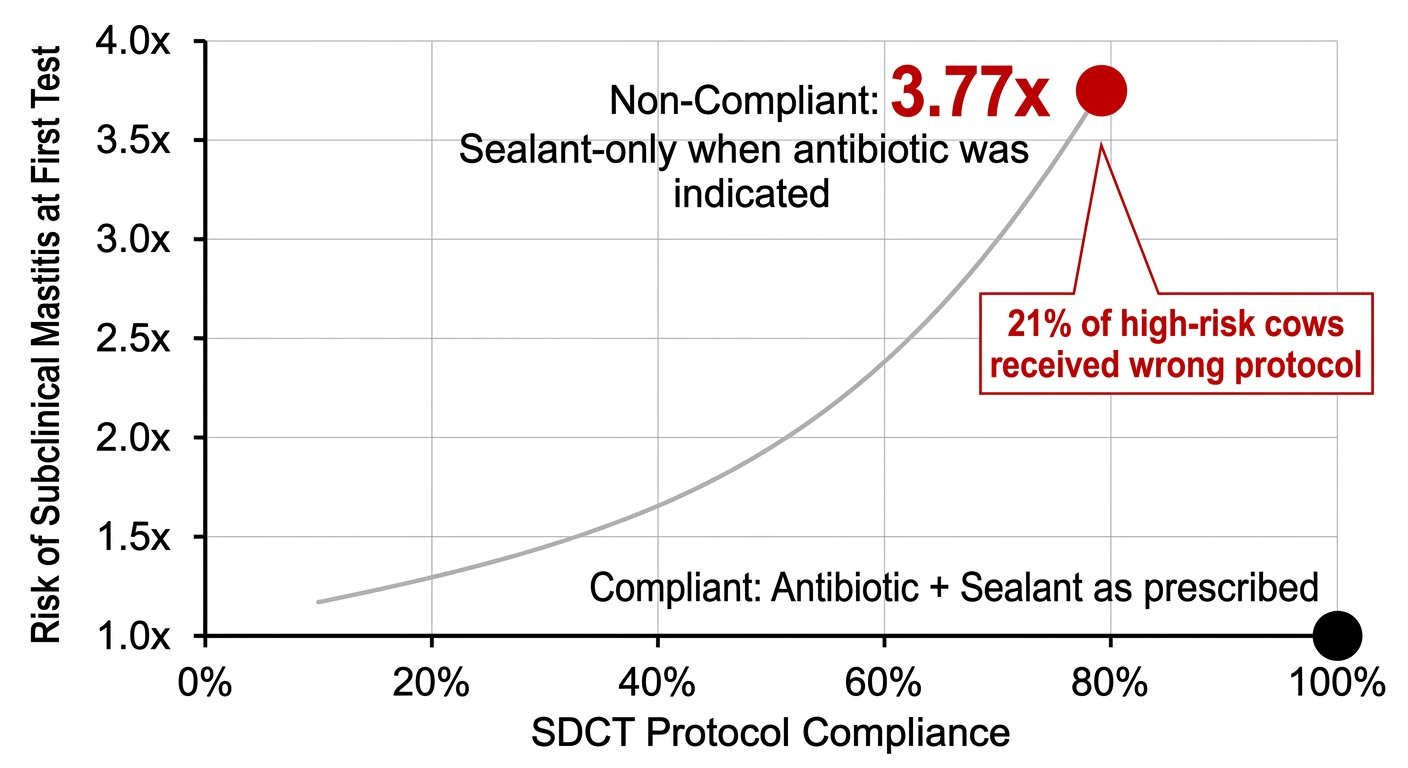
Among 11 early‑adopter Italian dairy farms studied by Guadagnini, Moroni, and colleagues, a specific slice of SDCT non‑compliance emerged: 21% of cows that should have received antibiotic treatment at dry‑off were instead given only internal teat sealant. Those non‑compliant cows were 3.77 times more likely to have subclinical mastitis at their first DHI test post‑calving compared with cows that received the recommended antibiotic plus sealant.
The research team reported that both veterinarians and farmers were unaware of the compliance deviation until data analysis was performed. When they dug into why it happened, 10 of the 11 herds attributed the problem to a lack of any monitoring system for whether the dry‑off protocol was actually being followed. There wasn’t malice or laziness. There just wasn’t a feedback loop, which is exactly how you end up with one in five high‑risk cows slipping through without the antibiotic the protocol calls for and a 3.77‑times higher risk of subclinical mastitis at first test.
A Cornell‑linked implementation project across New York dairies ran into the same kind of friction. The biggest barrier wasn’t herd health — it was recording and consistency. Some farms only started documenting mastitis events when they began SDCT, which made it look like mastitis was suddenly increasing when, in reality, they were finally writing everything down. A couple of herds pulled the plug on SDCT early, convinced it was causing extra mastitis in the dry period, and later review suggested that at least one of those spikes was part of a broader herd event unrelated to SDCT.
Compliance Failure Point
What Happened in Research
Risk Multiplier
Fix Before You Start SDCT
No monitoring system
10 of 11 Italian herds had no way to verify dry-off protocol was followed
NY herds only started logging clinical events when SDCT began; looked like spike
False alarm, protocol pause
Backfill 12 months of mastitis/treatment history
Crew turnover/training gaps
High-risk cows received sealant-only when algorithm called for antibiotic
21% non-compliance rate
Written protocol + hands-on demo for every person doing dry-off
Seasonal pressure ignored
Some herds ran SDCT through peak heat; environmental mastitis spiked
Not quantified, but protocol paused
Pilot SDCT in lowest-risk season (fall/winter in most climates)
Blame the wrong variable
Herds attributed mastitis increases to SDCT when broader herd event was occurring
Early protocol abandonment
Track 0–90 DIM mastitis separately; compare to baseline by dry-off group
Then there’s Jean Amundson — a veterinarian and co‑owner of Five Star Dairy near Elk Mound, Wisconsin. She and her partners milk about 1,000 cows and ship around 90 pounds of milk per cow per day. Amundson enrolled her herd in a University of Minnesota SDCT research trial and reported that the trial reduced dry‑cow antibiotic use by about half, thereby validating their approach. But her herd had been running on‑farm cultures and tight treatment records for years before the trial; selective dry cow therapy didn’t strengthen their data, strong data made SDCT possible.
The Genetics Angle: Why Health Traits Matter for SDCT
SDCT lives at the intersection of management and genetics.
The Council on Dairy Cattle Breeding (CDCB) publishes a mastitis resistance evaluation (MAST PTA) expressed as percentage points above or below the breed average, and these evaluations are favorably correlated with lower somatic cell scores, longer productive life, and better livability and fertility. That matters for SDCT because the herds that do best with selective dry‑off are the ones with consistently low SCC, good cure rates, and fewer chronic cows — exactly the profile you build when you lean harder on mastitis resistance and health traits in sire selection.
As you put more selection pressure on health traits — including mastitis resistance, livability, and fertility — in your breeding program, you’re gradually building a herd with fewer high‑risk animals at dry‑off and more cows that legitimately qualify as “low risk” in an SDCT algorithm. Over time, that shrinks the gap between what the algorithm recommends and what you’re actually comfortable doing.
The published SDCT studies in Italy, Belgium, and North America mostly focus on protocols, economics, and compliance rather than dissecting the role of genetic evaluations in those herds. But the direction is clear: genetics and management are beginning to work together to address mastitis, and herds that lean into both will have more room to pull tubes without paying for it in the fresh pen.
Does the SDCT Math Actually Pencil Out on Your Farm?
So what does the math look like when you actually take the tubes out of the cart?
Leite de Campos and Ruegg’s 37‑herd Wisconsin study provides a real‑world benchmark for direct product costs, assuming udder health remains comparable between blanket DCT and SDCT. That’s the starting point before you ask what happens if mastitis creeps up:
Average blanket‑therapy dry‑off cost (observed): 19.57 USD per cow (range 8.72–24.04 USD)
Average cost per dried cow when only intramammary antibiotic DCT was considered: 11.54 USD, with a range from 8.72 to 15.44 USD across herds
Modeled cost using fixed prices for intramammary products: 18.68 USD per cow for blanket DCT vs 17.69 USD per cow for selective DCT — about 0.99 USD per cow savings at those standard prices
Other modeled scenarios in that dataset and related work show that, depending on product choices and how aggressively you pull tubes, partial direct cost reductions can reach roughly 5 USD per dry cow in some herds, but be closer to 1 USD in others. The per‑cow savings on tubes can range from “a noticeable line item” to “pretty modest,” depending on your current products and how aggressively you already use them.
If you’re running a 300‑cow herd and drying off about 280 cows a year, a 0.99 USD per‑cow savings at dry‑off is roughly:
280 cows × 0.99 USD ≈ = 277 USD in tube savings per year at standardized prices.
If your current protocol uses higher‑priced tubes and extensive sealant, your actual product savings under SDCT could exceed the modeled figure; if you already run a lean protocol, your savings could be smaller.
Year one is messier. You’ll spend money and time on veterinary consults to set up a herd‑specific algorithm, cleaning up mastitis and SCC records, writing a protocol people can actually follow at 4:30 p.m. in the parlor, and training the crew that does the dry‑off work. There isn’t a clean, published “X USD per herd” setup figure for this, but you should plan on meaningful first‑year overhead in vet time, staff time, and management attention that might eat most of the savings in year one.
And if your execution is sloppy, it can eat more than that. Rollin and colleagues estimated the total economic cost of a clinical mastitis case in the first 30 days of lactation at approximately 444 USD per case on U.S. dairy farms, including direct costs and lost future milk. Turn five extra fresh‑cow mastitis cases loose because you misclassified cows or botched dry‑off hygiene, and you’ve just burned 5 × 444 USD = 2,220 USD — easily more than a year’s worth of SDCT tube savings for a 300‑cow herd under many product‑cost scenarios.
Your quick math: take the number of cows you dry off per year and multiply by a realistic, herd‑specific per‑cow savings number — which might be around 1 USD per cow if your current drugs and sealant use look like the modeled Wisconsin herds, and potentially more if you’re using higher‑priced tubes. Then set that against the cost of a handful of extra mastitis cases at roughly 444 USD each.
Now ask yourself what one bad dry‑off month — with a half‑dozen explosive mastitis cases — would do to that balance.
What This Means for Your Operation
These aren’t talking points. They’re checks you can run on your own herd.
Can you pull a complete SCC and mastitis treatment history for every cow in your current lactation? If the answer is “sort of” or “not really,” SDCT should wait; your first 30 days should go into fixing the records, not the tubes.
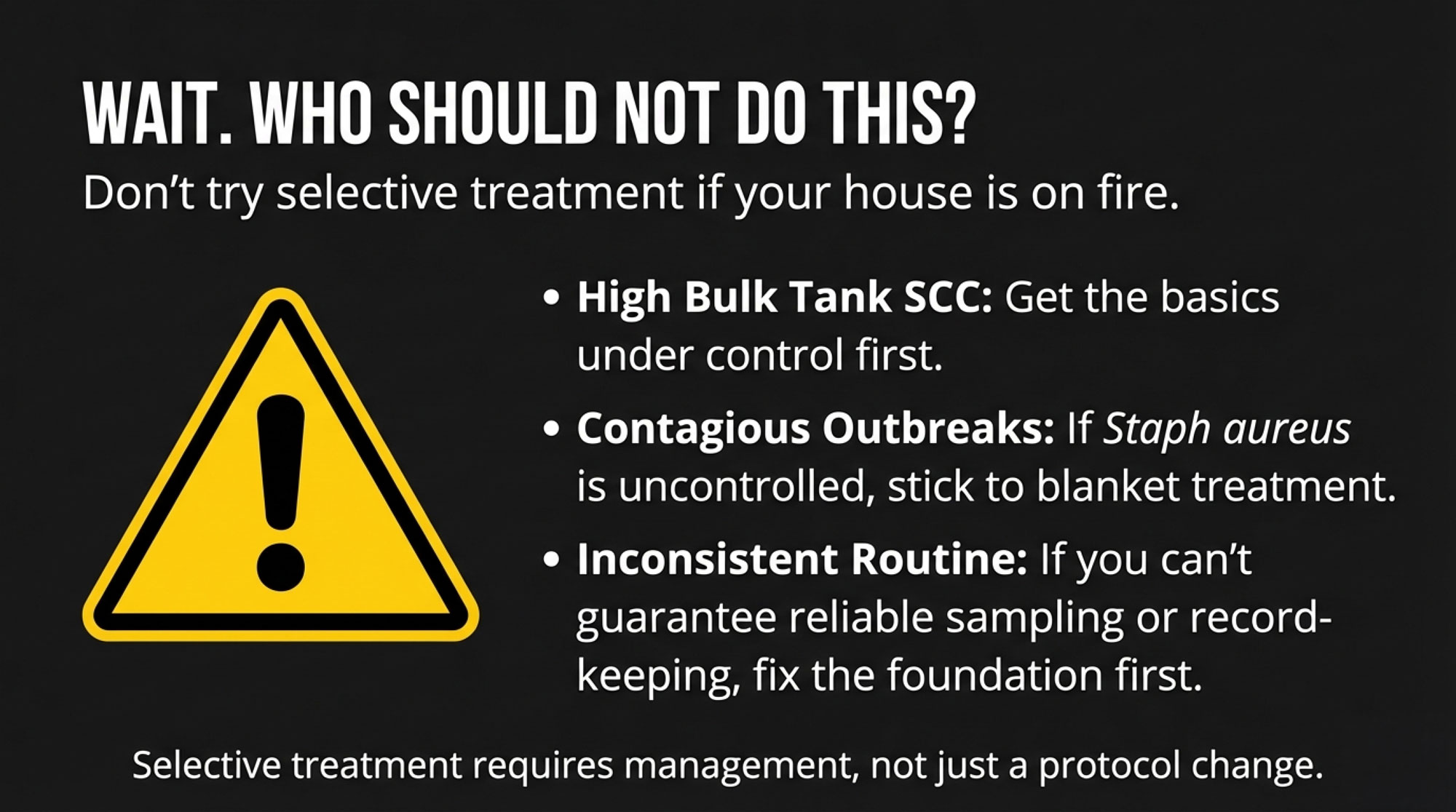
Do you know your pathogen mix? At minimum, confirm your herd is clear of Streptococcus agalactiae and has Staphylococcus aureus under control before you pull antibiotics at dry‑off, because SDCT is a bad place to discover a chronic contagious mastitis problem.
Who actually does dry‑off on your farm? The more people involved, the more ways the protocol can drift, and European work on dry‑off routines and the Cornell experience both found that technique — not theory — was often the weak link, which is why checklists and monitoring systems matter.
Is your dry pen ready for cows without antibiotic safety nets? Stocking density, bedding, ventilation, and transition management all matter more when more quarters head into the dry period with only a teat sealant barrier.
When would you start? Some New York herds in that implementation work paused SDCT during peak heat when environmental mastitis pressure spiked; if you’re going to experiment, start in your lowest‑risk season.
Are you tracking fresh‑cow mastitis separately? If your 0–90 DIM mastitis rate climbs more than about two percentage points above your pre‑SDCT baseline for two consecutive dry‑off groups, that’s a loud signal to pause and audit before continuing.
Can your software help? Herd software like DairyComp 305 and others can run SDCT‑style classifications off DHIA data or at least help you pull the logic together in reports; if you’re not on a full‑featured platform, even a simple spreadsheet with cow IDs, SCC history, and mastitis events can get you close as long as the data’s real.
Is your breeding program moving in the right direction? If you’re already pushing health traits tied to mastitis resistance and cow longevity in your AI matings — including CDCB mastitis resistance, livability, and DPR where available — you’re quietly building a herd that should be a better SDCT candidate five years from now than it is today.
Where do you want to be in a year? Within 12 months of your first pilot, you should be able to decide — based on your own mastitis and SCC data — whether SDCT is a permanent protocol, a seasonal tool, or something you park for now.
What to Do in the Next 90 Days
You don’t need to change a tube or buy a culture plate to learn something useful.
First 30 days
Pull your last 12 months of DHIA records and export the SCC history for every cow you dried off in that period.
Run a simple SDCT algorithm on paper: for each dry‑off, ask “Did this cow ever test over 200,000 SCC this lactation, or receive clinical treatment for mastitis?” and mark which cows would’ve been “sealant‑only.”
Compare your “sealant‑only” list to fresh‑cow outcomes: which of those cows had mastitis in the first 30 days of lactation, and which ones were clean all the way through?
If that paper exercise makes you sweat, that’s useful information; it shows you where your protocol or your confidence is weak before you risk the cows.
Days 30–90
Sit down with your vet and walk through the results from the paper exercise: where do your records have gaps, where does the algorithm agree with what you already suspected, and where does it surprise you?
If the paper exercise looked promising, pilot SDCT on one dry‑off group during your lowest environmental mastitis pressure window, monitor 0–90 DIM outcomes for that group against your baseline, and track compliance from day one.
At the same time, pull your last two proof runs and look at how strongly you’re actually selecting for health traits tied to mastitis risk and longevity — including mastitis resistance and related CDCB health traits where available — and adjust your mating plan before you treat SDCT as your new normal if those traits are an afterthought.
Key Takeaways
If your bulk tank SCC isn’t consistently under about 250,000 cells/mL, your mastitis records aren’t rock solid, or you haven’t cleaned up contagious pathogens like Strep agalactiae and Staph aureus, SDCT isn’t your next move; tighten those fundamentals and fix the bugs first.
Algorithm‑guided SDCT can deliver savings on tubes — but the per‑cow number is often modest, and the real money is made or lost in mastitis cases, not boxes of product; a few extra fresh‑cow mastitis cases can easily erase a year’s worth of tube savings.
Compliance isn’t a detail, it’s the whole ballgame: those Italian early‑adopter herds saw one in five high‑risk cows miss the antibiotic they should’ve received, and those cows were 3.77 times more likely to show up with subclinical mastitis at first test.
Genetic selection for health traits is now real and measurable: CDCB health traits — including mastitis resistance — and their favorable correlations with somatic cell score, productive life, and fertility give you a way to breed cows that fit SDCT better over time instead of relying on management alone.
The safest way to start is on paper: running the algorithm on last year’s dry‑offs gives you a real‑world stress test of your data and your cows’ behavior without risking this year’s dry pen.
The Bottom Line
Mystic Valley’s first 60 days on SDCT included cow losses that would’ve sent most herds back to blanket therapy, but Breunig changed his sealant protocol, tightened monitoring, and kept going. Amundson’s herd at Five Star Dairy got there after years of building a culture‑and‑records foundation, and the University of Minnesota trial basically confirmed they were on the right track.
The tubes you pull — or don’t — on your farm will sit on top of your own system, not theirs. If your system can’t spit out clean mastitis data and your dry‑off crew can’t follow a checklist on a busy Friday, pulling tubes is the wrong place to start. So before you put down the dry cow gun, here’s the real question: if you ran a selective dry cow therapy algorithm on your last 100 dry‑offs tomorrow, would you trust what it told you?
Complete references and supporting documentation are available upon request by contacting the editorial team at editor@thebullvine.com.
Learn More
83% of Dairies Overtreat Mastitis – That’s $6,500/Year Walking Out the Door – Slash unnecessary expensesby mastering on-farm culture systems. This breakdown reveals the $6,500 error most herds make and arms you with a 90-day protocol to reclaim lost margins through precision treatment and smarter culling.
The Next Frontier: What’s Really Coming for Dairy Cattle Breeding (2025-2030) – Unlock the biological advantage hiding in your breeding program. This look at the 2025–2030 frontier breaks down how new health-trait markers for mastitis resistance and genomic testing will fundamentally replace traditional “treat-and-wait” management strategies.
The Sunday Read Dairy Professionals Don’t Skip.
Every week, thousands of producers, breeders, and industry insiders open Bullvine Weekly for genetics insights, market shifts, and profit strategies they won’t find anywhere else. One email. Five minutes. Smarter decisions all week.
Your robot’s mastitis alerts aren’t gospel. A $15 strip cup plus selective treatment beat blanket tubes on cost, antibiotics, and cow survival.
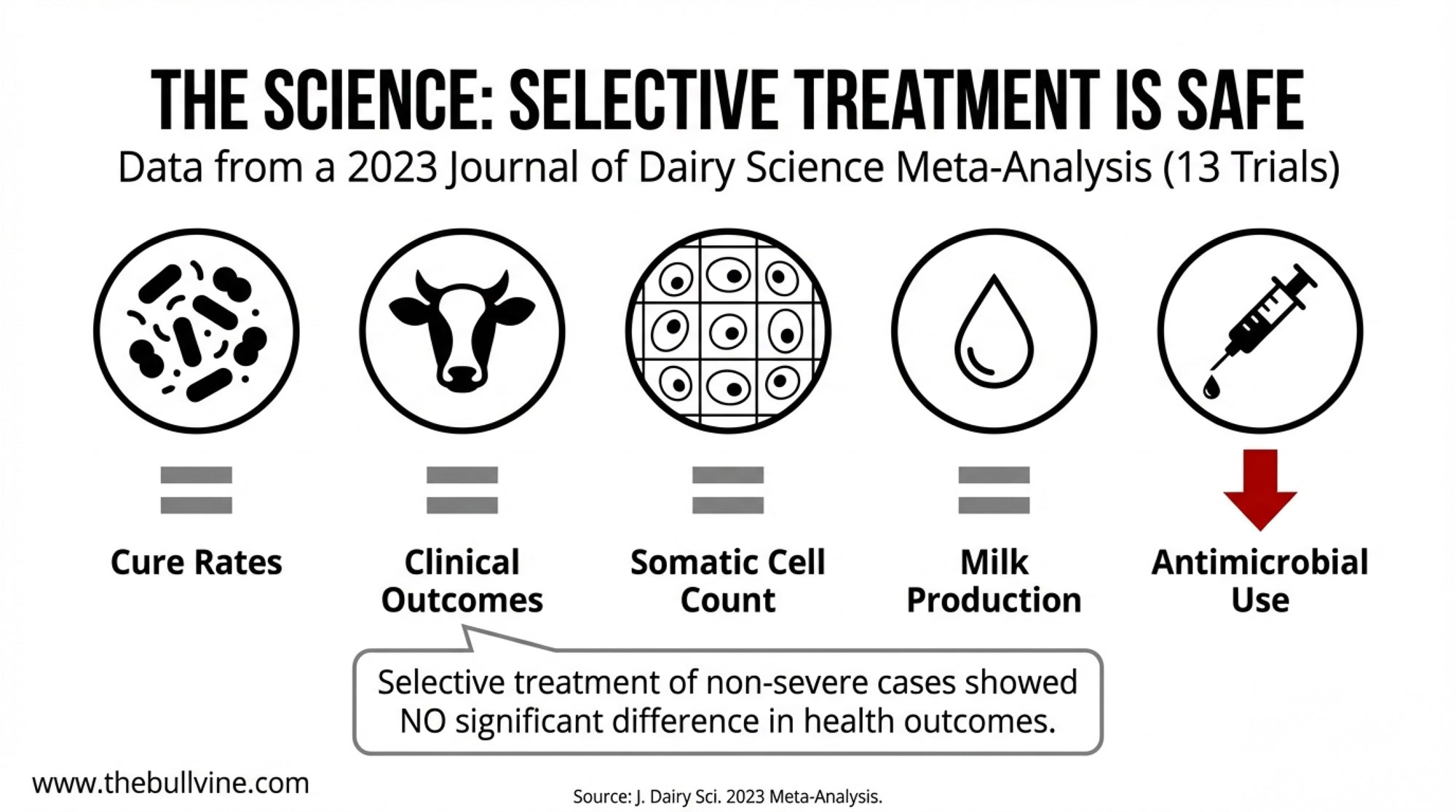
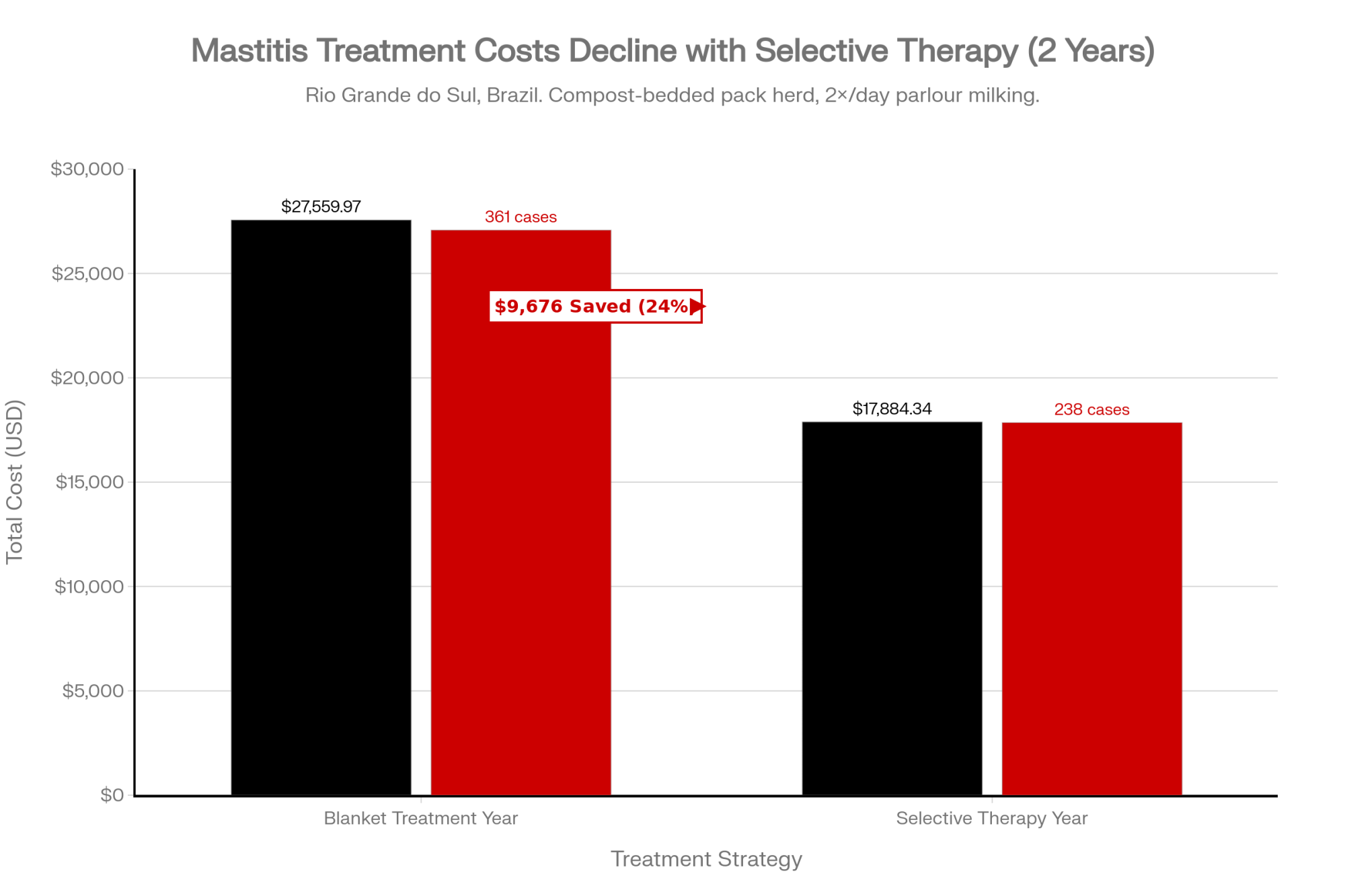
Executive Summary: Most dairies still tube every mastitis cow “just to be safe,” but a 2023 Journal of Dairy Science meta‑analysis of thirteen trials found that selective treatment of non‑severe cases based on bacterial diagnosis can maintain cure, SCC, milk yield, and culling while cutting antimicrobial use. One 500‑cow Holstein herd in southern Brazil, for example, dropped its clinical mastitis treatment costs from US$27,559.97 to US$17,884.34 in a year—a 24% reduction, roughly US$6,000—after switching from blanket treatment to on‑farm culture–guided selective therapy. At the same time, a Bavarian field study showed that robot mastitis alerts have only 61–78% sensitivity and 79–92% specificity, depending on the brand, which means AMS systems are great at generating “cows to check” lists but shouldn’t be deciding which quarters automatically get tubes. This article pulls those threads together into a three‑phase playbook: tighten detection with strip cups, run a six‑ to eight‑week on‑farm culture “learning phase,” then build a vet‑driven selective protocol that fits your pathogen mix and labour reality. The focus is squarely on lowering mastitis costs and antibiotic use while protecting milk, SCC, and butterfat levels in real freestalls, tie‑stalls, and robot barns. The bottom line is that if your SOP still says “treat every case,” you’re probably spending more than you need to on tubes and discarded milk—and this gives you a practical path to test that on your own farm.
Outcome Measured
Selective Treatment (Diagnosis-Guided)
Blanket Treatment (All Non-Severe Cases Tubed)
Statistically Significant Difference?
Key Insight
Bacteriological Cure Rate
✓ Maintained
✓ Maintained
NO
Both protocols achieve cure; diagnosis-guided doesn’t lose ground
One more day to visual recovery is negligible vs. cost savings
Bulk Tank SCC
✓ Maintained / Improved
✓ Maintained
NO
Selective treatment does NOT compromise herd SCC
Milk Yield (kg/day)
✓ Maintained
✓ Maintained
NO
No yield penalty; both manage production equally
Recurrence Rate
✓ Maintained
✓ Maintained
NO
Future mastitis risk is identical between groups
Culling Rate
✓ Maintained
✓ Maintained
NO
Selective treatment does NOT increase forced culls
Antibiotic Use (volume & exposure)
↓ Significantly Lower
✓ High
YES – Selective Wins
Fewer cows receive tubes; direct reduction in farm-level antibiotic footprint
Treatment Cost (relative)
Base: 100%
Base: 131%
YES – Selective Wins
24–31% cost savings in real herds (see Visual 2)
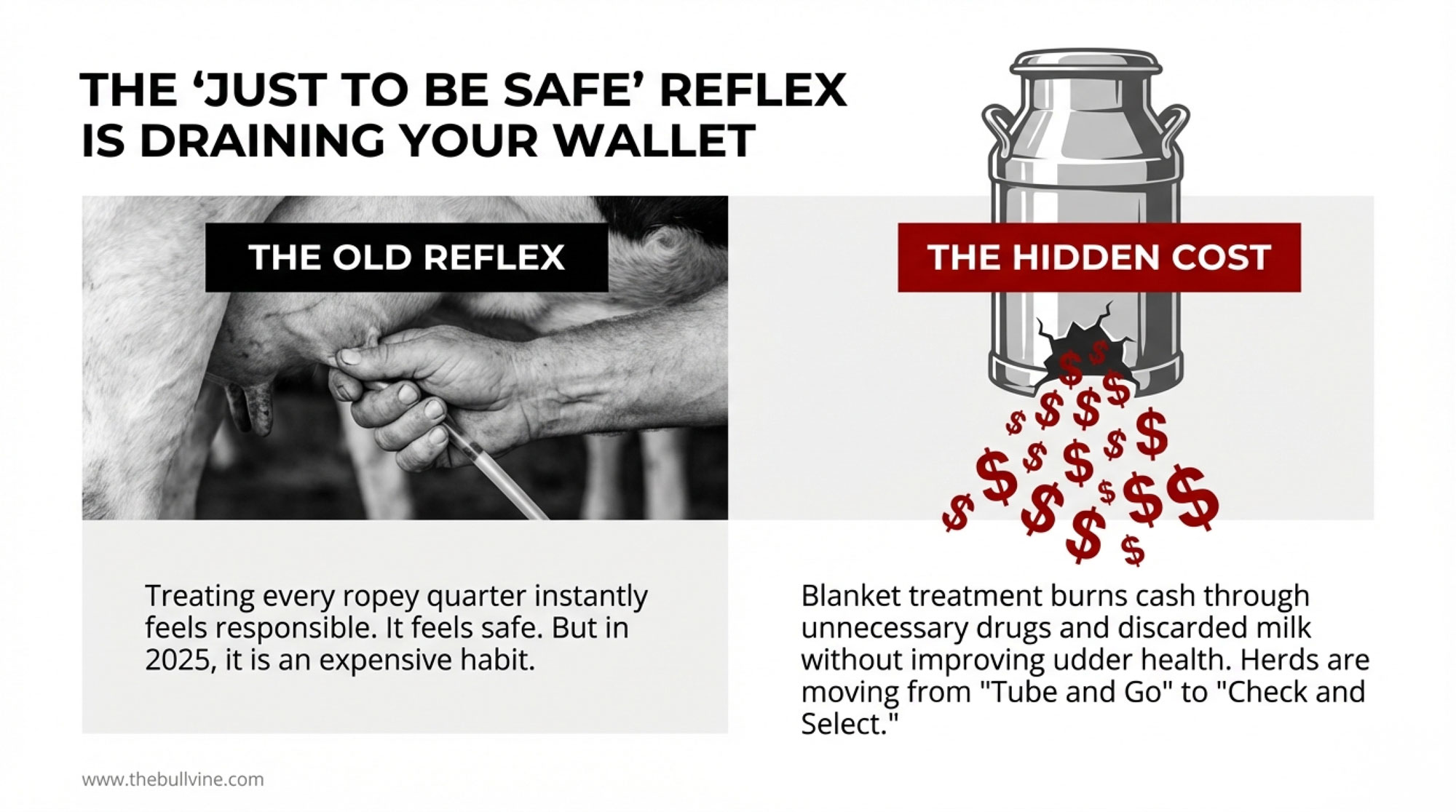
Picture us at a winter dairy meeting, coffee on the table, and someone says, “We treat every ropey quarter the same way—grab a tube and go.” A lot of heads still nod at that. It’s familiar. It feels safe.
Here’s what’s interesting. A 2023 meta‑analysis in the Journal of Dairy Science, led by Dutch and Canadian researchers, including Ellen de Jong, pulled together results from 13 studies that compared selective treatment of non‑severe clinical mastitis to blanket treatment, in which every mild case receives intramammary tubes. The data suggests that when treatment decisions are based on bacterial diagnosis, selective protocols did not worsen bacteriological cure, clinical cure, somatic cell count, milk yield, recurrence, or culling compared with treating every non‑severe case automatically. The only clear trade‑off they picked up was a very small difference—on the order of half a day—in how long it took cows to look clinically normal again.
So that old reflex—tube every non‑severe case “just to be safe”—made sense in a world with less information and less pressure on antimicrobial use. But what this newer work is telling us is that on many farms in 2025, that reflex is quietly draining money in drugs and discarded milk, and it’s not necessarily buying you better udder health.
What I’ve found, walking barns in Ontario, Wisconsin, and across the Northeast, is that the herds making selective treatment work aren’t just university herds or fancy show strings. They’re regular freestalls, tie‑stall barns, and some well‑managed dry lot systems that have tightened up detection, put simple on‑farm culture plates on a bench, and started making more targeted treatment calls. And at the centre of that shift, there’s usually a strip cup that cost about fifteen dollars.
Looking at This Trend: What’s Actually in That Mastitis Quarter?
To make sense of selective treatment, it helps to start with what’s actually going on in the quarter when you see a clinical case.
Herd Category
Culture-Negative (%)
Gram-Negative (E. coli, Coliforms) (%)
Gram-Positive (Strep, Staph, Lacto) (%)
Sample Size / Source
Typical North American Herds (Meta-analysis range)
20–40%
25–35%
30–50%
13 trials, meta-analysis
Modern European Dairy (mixed systems)
18–35%
28–40%
35–52%
Frontiers Vet Sci, JDS reviews
High-SCC Problem Herds
10–20%
20–25%
60–70%
Contagious mastitis-dominant
Well-Managed Low-SCC Herds
25–45%
30–40%
25–45%
Environmental mastitis-dominant
Recent reviews on mastitis in journals like Frontiers in Veterinary Science and Journal of Dairy Science describe how milk from clinical mastitis is usually grouped into three broad categories in research trials and on‑farm diagnostics work:
Culture‑negative cases, where no growth appears on routine culture media
Gram‑negative infections, often Escherichia coli and related coliforms
Gram‑positive infections, like Streptococcus uberis, Streptococcus dysgalactiae, and various staphylococci
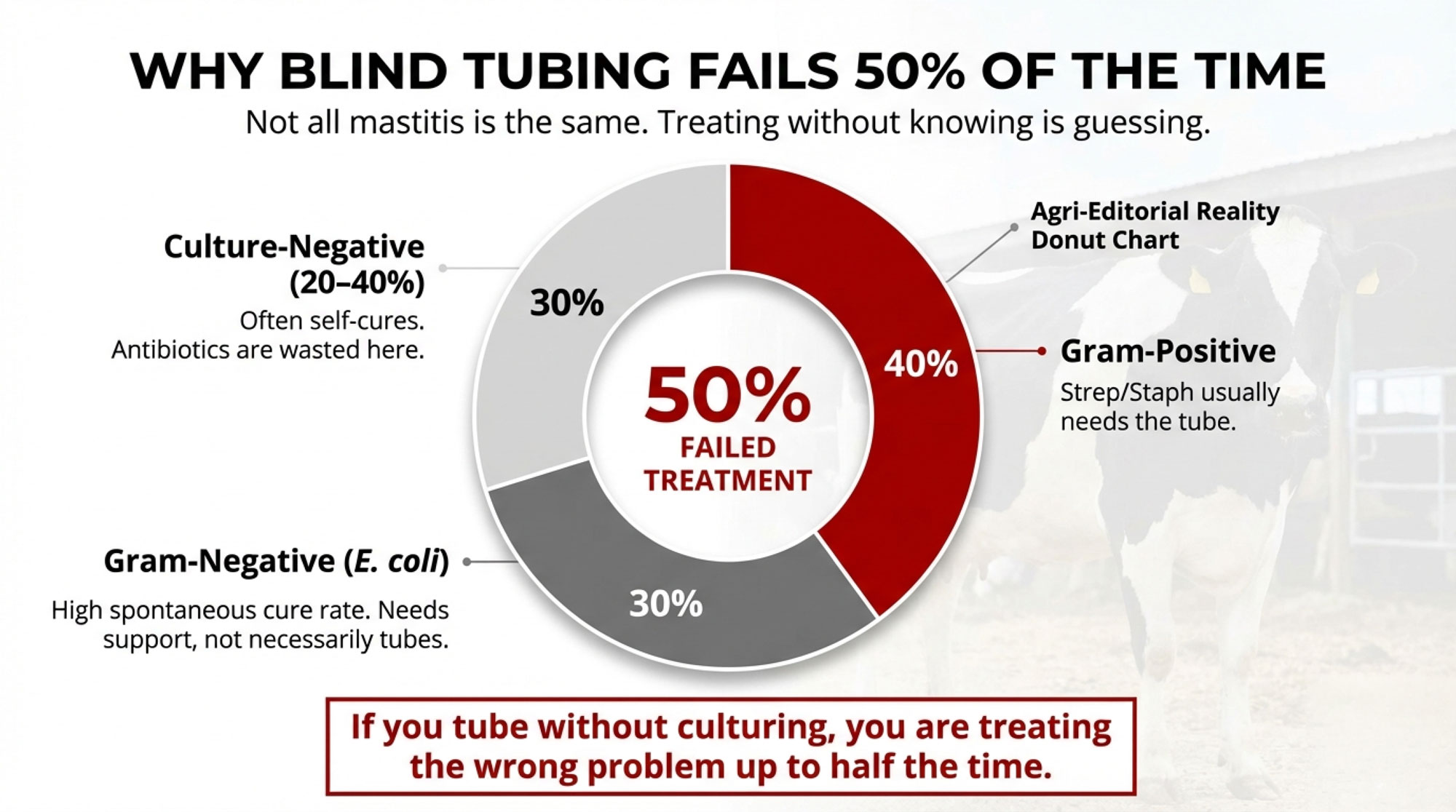
Across modern datasets from North American and European herds, researchers often report that a substantial share—commonly in the 20 to 40 percent range—of clinical mastitis samples are culture‑negative when they hit the plate. You know how that goes: by the time you see clots or watery milk, and you grab a sample, the cow’s own immune system may already have knocked bacterial numbers down below the detection limit of the culture system.
And here’s where the math starts to matter.
In the non‑severe clinical mastitis trials that fed into that 2023 meta‑analysis, culture‑negative cases were either treated with intramammary antibiotics or left without intramammary therapy, with both groups monitored closely and supported as needed. When researchers pulled those results together, they didn’t see worse bacteriological or clinical cure, SCC, or recurrence in the culture‑negative cows that were managed without intramammary antibiotics, compared with those that received tubes. In plain terms, a lot of those culture‑negative, non‑severe cases were going to get better either way.
For non‑severe gram‑negative cases—especially E. coli—the story is similar in many of the better‑controlled studies. Several trials, including work from Brazil and Europe, show that mild and moderate E. coli mastitis has a relatively high spontaneous cure when cows are otherwise healthy and well monitored. When you look at the numbers in those trials, intramammary tubes don’t always give you a big extra jump in cure compared with careful observation and supportive care, as long as you’re ready to move fast with systemic treatment if a cow spikes a fever, goes off feed, or otherwise starts looking systemically ill.
That’s where good fresh cow management during the transition period and overall environment really start pulling their weight. In herds where cows come into early lactation in good condition, with clean, dry stalls or well‑drained lots and minimal stress, it’s a lot easier for the immune system to do its part in these milder environmental mastitis hits.
Gram‑positive infections are trickier. For years, most of us have felt that these “pay” for a tube, and some work backs that up. Trials are showing that certain gram‑positive pathogens, especially some streptococci and staphylococci, respond better to intramammary antibiotics than to no treatment. At the same time, a 2024 randomized trial in JDS Communications that followed non‑severe gram‑positive mastitis cases identified by on‑farm culture—many of them Lactococcus—found no significant difference in bacteriological cure between several intramammary regimens and no treatment during a 21‑day follow‑up.
So the honest summary is this:
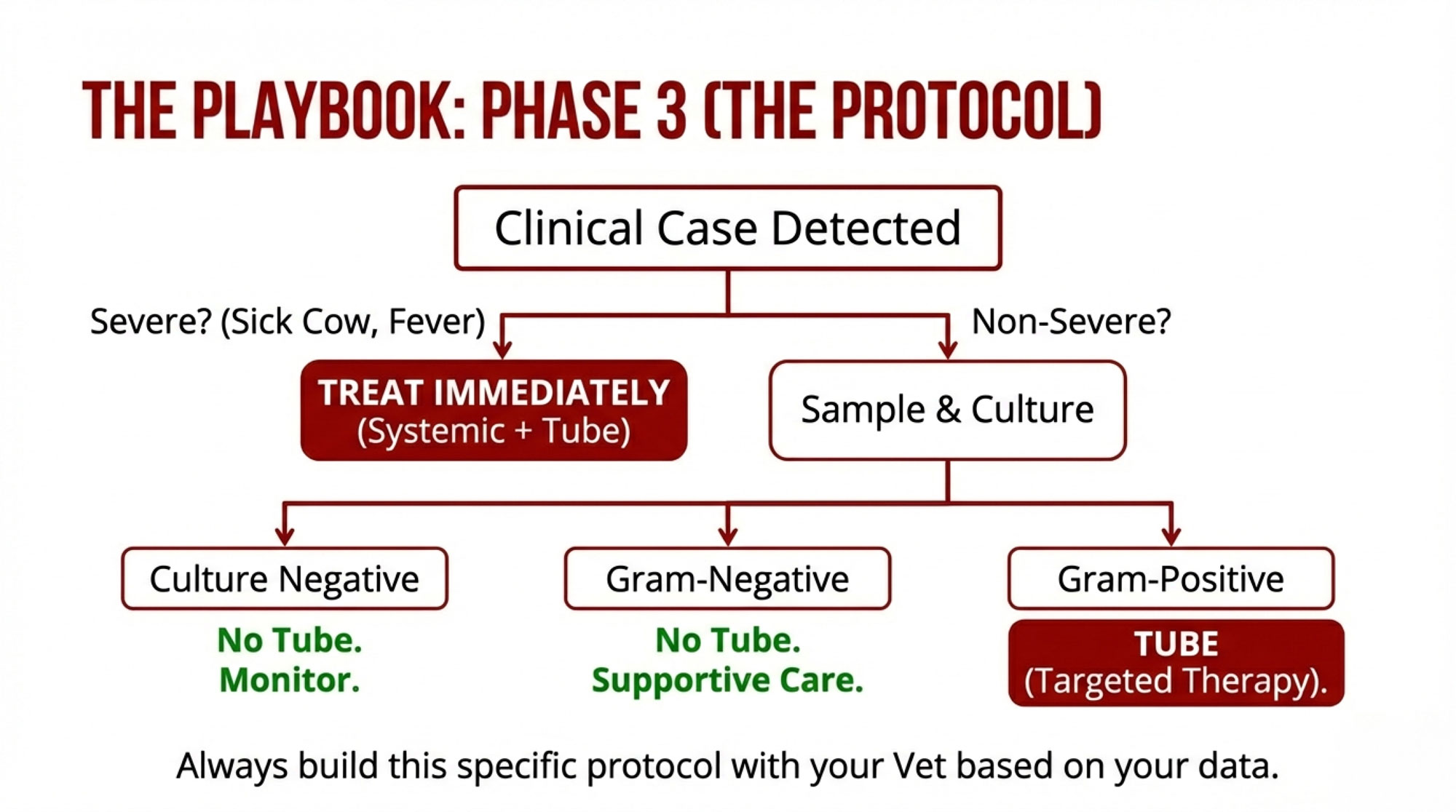
For non‑severe culture‑negative and many gram‑negative clinical mastitis cases, there’s good evidence that you can withhold intramammary antibiotics and lean on careful monitoring and supportive care without harming overall udder‑health outcomes—provided you still treat severe cows aggressively.
For non‑severe gram‑positive cases, the evidence is mixed. Some pathogens and situations clearly benefit from targeted intramammary therapy; others, like the Lactococcus‑dominated cases in the 2024 trial, don’t show a big difference in cure either way.
And that’s exactly why just looking at a ropey strip on the floor doesn’t get you very far. As mastitis specialists at places like Minnesota and Penn State keep reminding people, foremilk appearance and udder feel by themselves simply don’t tell you which pathogen group you’re dealing with. If you want a true selective treatment program—not just a dressed‑up version of “treat everything”—you need some sort of diagnostic information, usually from an on‑farm culture plate or a rapid lab test.
A Real‑World Case: A 500‑Cow Herd That Ran the Numbers
Let’s ground this in a real farm.
Metric
Blanket Treatment Year
Selective Therapy Year
Difference
% Reduction
Total CM Treatment Cost (USD)
$27,559.97
$17,884.34
$9,675.63
24.23%
Number of CM Cases
361
238
123 fewer
34% case reduction
Cost per Case (USD)
$76.35
$75.17
$1.18
1.5% per-case efficiency
Antibiotic Spend Component (est.)
$15,200
$8,900
$6,300
41% reduction
Discarded Milk Cost (est.)
$12,360
$8,984
$3,376
27% reduction
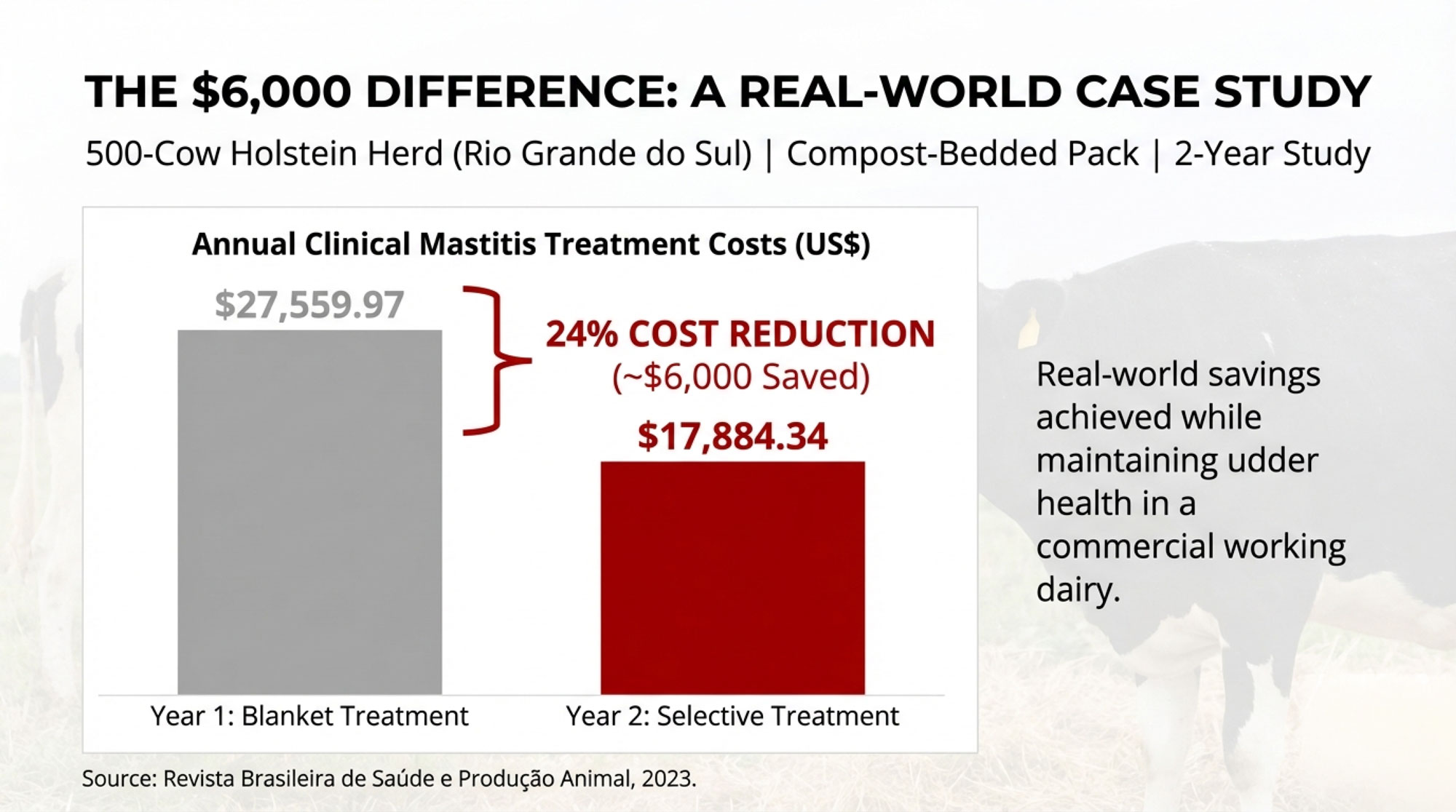
A 2023 Brazilian study in Revista Brasileira de Saúde e Produção Animal followed a commercial Holstein herd of about 500 lactating cows in Rio Grande do Sul as it transitioned from blanket clinical mastitis treatment to selective therapy based on on‑farm pathogen identification. They ran it for two full years: one year before the new protocol and one year after.
During those two years:
They recorded 599 clinical mastitis cases: 361 in the blanket‑treatment year (period one) and 238 in the first selective‑therapy year (period two).
They calculated the full cost of treating CM, including antibiotics and discarded milk. Across both years, CM treatment cost the farm US$45,444.31.
In the blanket year, costs were US$27,559.97.
In the first year with selective therapy, costs dropped to US$17,884.34.
That’s a 24.23 percent reduction in total CM treatment costs from year one to year two—around US$6,000 saved in that first selective‑therapy year—while also reducing antibiotic use and the volume of milk discarded because of treatment.
It’s worth noting that this wasn’t some disinfected research station. This was a compost‑bedded pack herd, milking twice a day with mechanical parlour equipment, producing roughly 14,000 litres of milk per day at the time of the study. In other words, a big, normal, working dairy.
Now, your milk price and drug costs aren’t going to match that dollar for dollar. But that kind of shift—24% lower CM treatment costs while maintaining udder health—is exactly the kind of “big math” that makes people sit up and ask, “Are we tube‑happy on our farm too?”
You Know This Step Already: Forestripping Still Matters
We can’t talk about selective treatment without talking about detection, because the whole program falls apart if you only find mastitis when the quarter is hard, and the cow is obviously miserable.
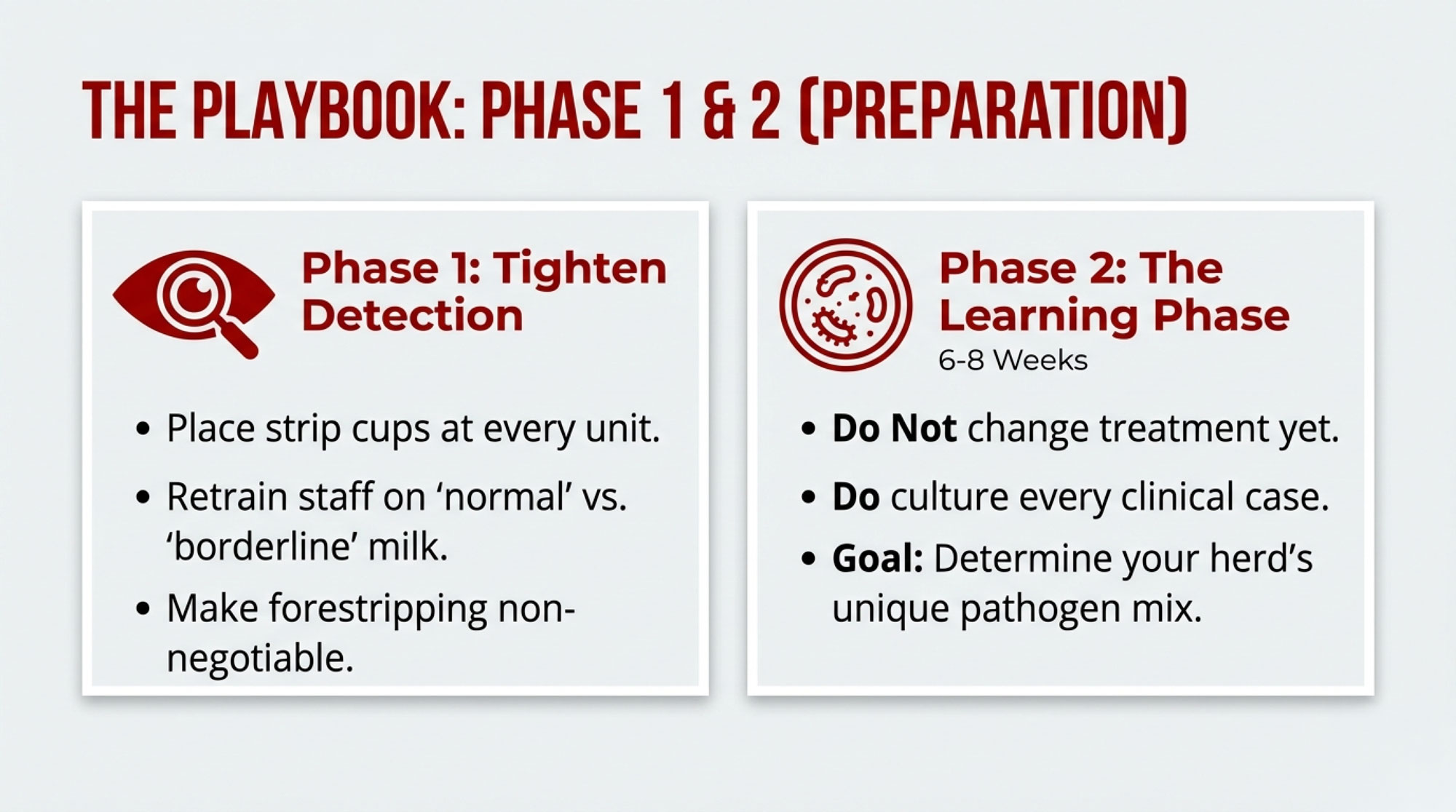
National Mastitis Council guidelines, along with extension programs from places like Wisconsin and Minnesota, still place a lot of emphasis on foremilk stripping into a strip cup or onto a dark surface, and on actually looking at that foremilk before you attach the unit. Reviews on on‑farm mastitis diagnostics have pointed out that subtle changes—slightly watery milk, a few fine flakes, a mild shift in colour—often show up before you feel heavy swelling or heat in the udder.
On the ground, in parlours from Ontario to Wisconsin, as many of us have seen, this step can quietly slip. In some operations, it becomes one quick squirt on the floor with barely a glance, and mastitis effectively doesn’t show up on the radar until things are already severe. In others, who’ve decided to do selective treatment or just take udder health seriously, you’ll see strip cups in every milker’s hand and people actually looking at what’s in them.
What’s encouraging is that it doesn’t take a big technology investment to tighten this up. A strip cup is cheap, and retraining people to use it mostly comes down to attention and habit. Once you’re catching more mild cases early, the idea of waiting 18–24 hours to see what grows on a plate in a non‑severe case doesn’t feel as risky as it does when every case you see is already advanced.
Robots and Sensors: Great Assistants, Not Autopilots
A lot of you are milking with robots now, especially in Western Canada, parts of Ontario, the Upper Midwest, and northern Europe. Whether it’s Lely, DeLaval, GEA, or another brand, your automatic milking system is already collecting a ton of data every milking: electrical conductivity, quarter yield, milking interval, flow curves, and in some setups, colour, blood, and somatic cell count.
The natural question is, “If the robot sees all this, do we still need strip cups and culture plates, or can we just let the system decide?”
A 2022 study out of Bavaria, published in the journal Animals, took a close look at that question. Researchers there evaluated four major AMS manufacturers on commercial Bavarian dairy farms and calculated the sensitivity and specificity of each system in detecting clinical mastitis under real‑world conditions.
AMS Manufacturer
Sensitivity (% of true mastitis detected)
Specificity (% of non-mastitis correctly ruled out)
What This Means in Plain Language
False Positive Rate (approx.)
Field Notes
Lely MQC / MQC-C
~78%
~86%
Catches 78 of 100 real mastitis cases; flags ~14% of normal cows as mastitic
~14%
Colour, EC, temp; somatic cell if MQC-C enabled. Best sensitivity.
DeLaval MDi
~61%
~89%
Misses ~39 of 100 mastitis cases; very conservative alerting (fewer false alarms, more missed cases).
~11%
Conductivity + blood detection + interval. Lowest sensitivity; flag for high-risk quarters.
GEA DairyMilk M6850
~76%
~79%
Catches 76 of 100; flag rate on false positives is highest among the four (~21%).
~21%
Permittivity-based SCC categories; no reagents. Good yield of data; more labour on false checks.
Specialty systems; strong on ruling out false mastitis. Slower to escalate.
Theoretical “Perfect” System
99%+
99%+
Would catch nearly all real cases, rarely flag false alarms.
<1%
Not commercially available; cutting-edge machine learning in development labs.
They found that:
The Lely systems in the study showed sensitivity around 78% and specificity around 86%.
DeLaval systems came in with a sensitivity of around 61% and a specificity of around 89%.
GEA units had a sensitivity of around 76% and a specificity of around 79%.
Lemmer‑Fullwood systems showed sensitivity around 68% and specificity around 92%.
The authors described detection performance as “satisfactory,” which is fair. But they also pointed out that none of the systems achieved the 99% specificity needed to eliminate false alarms nearly, and that low specificity can mean more milk unnecessarily discarded and more staff time spent checking cows that ultimately aren’t truly mastitic.
It’s worth knowing what those alerts actually mean.
Lely’s Milk Quality Control (MQC) system tracks quarter‑level electrical conductivity, colour, and temperature. Farms that bolt on MQC‑C also get real‑time somatic cell count readings, a big step up in monitoring udder health.
DeLaval’s Mastitis Detection Index (MDi) combines conductivity, blood detection, and milking interval into a single score. Somatic cell counts are handled separately in the DelPro system.
GEA’s DairyMilk M6850 uses electrical permittivity to give quarter‑level SCC categories without needing reagents, which is attractive for some robot herds that want frequent SCC information.
And in the research world, people are layering machine‑learning approaches on top of SCC data and other signals to improve detection performance beyond these simple thresholds. Those systems have shown they can approach very high sensitivity and specificity when built and trained well, although they’re not yet standard on most commercial farms.
So, if we’re being practical, AMS data is powerful, but it’s not magic. Sensitivity in the 60–70‑something percent range means some mastitis cows are missed. Specificity below the mid‑90s means you’ll get some false positives. That’s fine, as long as you use the system for what it’s good at.
On better managed robot herds I’ve visited—from two‑robot setups in Quebec to larger systems in northern Europe—the farms getting the most out of the technology tend to use the alerts like this:
The robot generates an “attention list” based on MDi, MQC, conductivity jumps, yield changes, and milking intervals.
Staff treat that list as “cows to check,” not “cows to tube automatically.” They strip those cows, feel the udder, and decide whether it really looks like clinical mastitis or just a funky day.
If a quarter truly looks like non‑severe mastitis, they take a clean sample before treating and let their selective protocol, plus the culture result, guide whether they use an intramammary product.
When you treat AMS data as a list generator, not as an autopilot, you get the benefit of the technology without turning it into an expensive random‑number generator for mastitis treatments.
Key Numbers That Are Worth Putting a Pencil To
If you’re like most producers, you probably want to see what this looks like in numbers before you consider changing anything.
A few data points are worth having in your back pocket:
That 2023 meta‑analysis on non‑severe CM treatment found that, across thirteen studies, selective treatment based on bacterial diagnosis did not worsen bacteriological or clinical cure, SCC, milk yield, recurrence, or culling compared with blanket treatment, aside from a small increase in time to clinical cure.
In the 500‑cow Brazilian Holstein herd, clinical mastitis treatment costs dropped from US$27,559.97 in the blanket‑treatment year to US$17,884.34 in the first year of on‑farm culture–guided selective therapy—about a 24.23% reduction, roughly US$6,000 in that one year—while CM cases fell from 361 to 238, and overall CM treatment across the two years totalled US$45,444.31.
The Bavarian AMS study showed sensitivity values in the 61–78% range and specificity from just under 80%to the low 90s, depending on the manufacturer, with the authors warning that lower specificity increases labour and discarded‑milk costs due to false alarms.
Those numbers aren’t your herd, of course. Milk price, mastitis incidence, labour costs, and your payment system will change the exact dollars per cow or per hundredweight. But the pattern across these very different situations is pretty consistent: when you’re able to decide which quarters truly need intramammary treatment, and you stop tubing the ones that don’t, you usually see a meaningful drop in antibiotic use and CM treatment costs without wrecking udder health.
A Simple Three‑Phase Playbook That’s Working on Real Farms
What I’ve found is that the herds that make selective treatment work don’t usually jump straight from “treat everything” to a complicated new protocol overnight. They roll it in over time.
Phase 1: Tighten Up Detection
This is the lowest‑cost, lowest‑risk step, and it pays off whether you ever go fully selective or not.
Place a strip cup with a dark insert at each milking unit or in each AMS mastitis‑check area.
Build deliberate foremilk checks back into your milking SOP, not just in your head.
Use your own herd’s milk—jars of abnormal foremilk, photos, short parlour demos—as training material so everyone sees what “normal,” “borderline,” and “this is mastitis” actually look like in your barn.
In Ontario and Wisconsin operations that do this well, I’ve seen vets and milk quality advisors walk the parlour with staff, looking into strip cups together. You strip some cows, talk through which quarters you’d culture, which you’d treat on sight, and which you’d flag for monitoring. Those conversations often show you that people aren’t always reading the same cow the same way.
Phase 2: Run a 6–8 Week “Learning Phase” With On‑Farm Culture
Once you’re actually catching non‑severe cases early and consistently, the next step is to figure out what bugs you’re dealing with.
For six to eight weeks:
Pick a validated on‑farm culture system with your vet—something like the Minnesota Easy Culture System or another kit backed by a university.
Set up a simple incubator and a clean spot for plates, and train one or two key people in aseptic sampling and reading plates using extension resources.
Culture every clinical mastitis case you reasonably can, but don’t change your treatment protocol yet.
At the end of this “learning phase,” you’ll know:
What proportion of your CM cases are culture‑negative?
How many are gram‑negative versus gram‑positive.
Whether your current habit of tubing every non‑severe case is actually aligned with the kinds of infections that benefit most from intramammary therapy.
In many Midwest and Canadian herds that have done this, people are surprised by how many CM cases are either culture‑negative or mild gram‑negative infections with good spontaneous cure. In other herds, particularly where contagious mastitis is still an issue, they find more gram‑positive problems than they realized. In both cases, the conversation shifts from “studies say” to “this is what our plates are showing.”
Phase 3: Build a Written Selective CM Protocol With Your Vet
If your culture results and your comfort level say it’s a good idea, then it’s time to sit down with your herd vet and map out a selective treatment protocol that fits your reality.
The protocols that travel well between herds usually look something like this:
Severe CM cases—cows with fever, depression, or other systemic signs—are always treated aggressively and promptly with appropriate systemic therapy and, when indicated, intramammary products. No waiting for culture there.
Non‑severe cases—abnormal milk with possibly mild udder changes, but no systemic illness—should be sampled aseptically before any intramammary treatment. Often, they’ll also get an anti‑inflammatory for comfort while you’re waiting for results.
Culture‑negative non‑severe cases are typically managed without intramammary tubes, with clear monitoring instructions for the next several days.
Non‑severe gram‑negative cases are often managed with observation and supportive care, with systemic treatment ready to go if the cow deteriorates.
Gram‑positive cases receive intramammary treatment where evidence and experience suggest there’s a reasonable benefit, with product choice and duration agreed on with your vet.
In Canada, Dairy Farmers of Canada and the Canadian Dairy Network for Antimicrobial Stewardship and Resistance have highlighted this kind of selective, diagnosis‑based CM treatment as one of the key opportunities to reduce antimicrobial use without sacrificing udder health, and it lines up neatly with proAction’s expectations on protocols, veterinary involvement, and responsible drug use. In the U.S. and Europe, major mastitis reviews and one‑health antimicrobial guidelines are making the same point: selective treatment of non‑severe CM is one of the more practical levers farms can pull.
Phase
Duration
Key Task(s)
Main Deliverable
Cost & Effort
Expected Payoff by End of Phase
Success Signal
Phase 1: Tighten Detection
Weeks 1–4 (parallel to normal ops)
– Place strip cup at every unit – Retrain staff on foremilk checks – Use herd’s own milk as training reference – Spot-check compliance weekly
Written SOP for forestripping; trained staff; strip cups in use
~$50 (strip cups) + 2–3 h management time
Catch 20–30% more non-severe cases early; catch cases beforeudder swelling severe
Foremilk checks are daily habit; staff can name “normal vs. mastitis” by look
Phase 2: Learning Phase (On-Farm Culture Pilot)
Weeks 5–12 (8-week pilot)
– Select culture system with vet (e.g., Minnesota Easy Culture) – Set up incubator & clean bench – Train 1–2 key staff on aseptic sampling & plate reading – Culture every CM case (continue normal treatment SOP) – Log & analyze results at weeks 4 and 8
Culture database of your herd’s pathogen breakdown: % culture-negative, % gram-neg, % gram-pos; cost per case baseline
Know your herd’s pathogen mix; baseline CM costs; early confidence in “we can do this”
% culture-negative cases, pathogen ratios, and staff competence confirmed; no major surprises
Phase 3: Build & Implement Selective Protocol
Weeks 13–24 (parallel ramp, then full protocol)
– Sit down with vet; review phase 2 culture results – Draft written selective CM protocol (severe vs. non-severe; thresholds for tube vs. observe) – Train staff on new decision tree – Run first 4–6 weeks as “soft launch” (staff practice; vet checks calls) – Adjust protocol based on early feedback; go full by week 20 – Measure outcome (SCC, cases, costs) at weeks 12, 24
Written, vet-approved selective CM protocol; staff trained & confident; data showing cost drop & SCC maintained
~$0–200 (any consumables; mostly vet & management time) + 1–2 h/week for first 6 weeks (ramp)
15–25% reduction in CM treatment costs (based on real herd data) Antibiotic use down 20–30% SCC & cure rates stable or improved
Herd costs drop $5,000–15,000 (scaled to size); staff confidence high; vet sees fewer auto-tube calls
People and Training: Where It Either Sticks or Slides Back
It’s worth noting—and you’ve probably seen this yourself—that nothing in mastitis management sticks just because it’s written down once.
Reviews of milking routines and mastitis risk keep coming back to the same thing: herds that combine written SOPs, actual staff training, and periodic feedback tend to have better udder health than herds that just have “the way we do it” floating around in people’s heads.
In practice, on farms that make selective CM treatment part of their culture, you see things like:
An initial team meeting where someone walks through the herd’s CM numbers and costs, shows some culture results, and explains why the protocol is changing.
Short “toolbox talks” every few weeks in the parlour or robot room, going over a couple of recent CM cases and what was learned.
Occasional observation of milking and culture work by the herdsperson or manager, followed by specific, friendly feedback.
A yearly sit‑down with the vet—and sometimes the nutritionist—to review CM incidence, bulk tank SCC, mastitis‑related culls, antibiotic use, and the economics, then adjust the protocol if needed.
In many Wisconsin and Midwest operations, this kind of rhythm already exists for fresh cow checks or repro programs. Selective CM treatment just gets folded into that same cycle of “plan, do, check, adjust.”
When Selective Treatment Makes Sense—and When It Might Need to Wait
Selective CM treatment isn’t the right first move for every herd, and that’s okay.
It tends to work best on farms that:
Have bulk tank SCC at least under moderate control
Keep udders reasonably clean and dry in their freestalls or well‑managed dry lots
Have fairly stable milking routines across shifts
And have at least one or two people who can reliably handle sampling, culture plates, and record‑keeping
If your bulk tank SCC is high, contagious mastitis problems like uncontrolled Staph aureus are still walking the barn, or staff turnover is so high that basic milking routines aren’t consistent, then your best return in the short term is probably on the fundamentals: stalls, bedding, teat prep, fresh cow management through the transition period, and dealing with chronic high‑cell cows.
If your SCC is on fire, it usually makes more sense to put your energy into the basics first and treat it selectively as a second‑phase project once the house is more in order.
The research base is still growing, too. Most CM-selective treatment trials have been conducted in herds with at least reasonable monitoring and mastitis control. Newer studies are starting to tackle different pathogens and management systems, and we’re seeing some differences, like that 2024 gram‑positive RCT with Lactococcus. That’s why it’s helpful to treat the published data as a strong guide, but still test things against your own herd’s results.
So What’s the Take‑Home in 2025?
If you zoom out and look at this through a 2024–2025 lens—with more talk about antimicrobial stewardship, labour that’s not getting cheaper, and milk cheques that depend more than ever on SCC and butterfat levels—the idea of selective treatment for non‑severe clinical mastitis stops being a theoretical exercise and starts looking like a practical tool.
For a 100‑cow herd shipping on components, pulling even a few fewer high‑SCC cows out of the bulk tank over the year can be the difference between hanging onto a quality premium and watching it slip. For that 500‑cow Brazilian herd, a 24‑percent drop in CM treatment costs was worth about US$6,000 in one year—enough to matter for anyone’s budget.
If you don’t change anything else in your mastitis program this year, four moves are worth your time:
Put real numbers on your mastitis costs. Work with your vet or advisor to tally up what CM is costing you in drugs, discarded milk, and mastitis‑related culls—per cow and per hundredweight—so you know what your current reflex is actually costing.
Make strip cups and foremilk checks non‑negotiable again. Get strip cups into everyday use, retrain people as needed, and spot‑check that forestripping and visual checks are happening at every milking, whether you’re in a parlour or running robots.
Run a six‑ to eight‑week on‑farm culture pilot. Culture every CM case you can without changing your treatment protocol yet, then sit down with your vet to look at what percentage of your cases are culture‑negative, gram‑negative, and gram‑positive.
Use your own herd’s data to decide on a selective protocol. Don’t just copy the Brazilian farm or a university script. Use your culture results, your cost numbers, and your vet’s judgement to decide if selective treatment of non‑severe CM makes sense for your herd right now—and if it does, write it down and train people on it.
You know as well as I do that doing nothing usually means you keep spending on tubes that don’t always change outcomes, while other herds slowly move those dollars into genetics, better fresh cow programs, improved housing, and lower SCC.
In the end, the question isn’t simply “treat or not treat.” It’s: Which quarters actually pay to treat—and how do you figure that out reliably on your farm?
From that 500‑cow compost‑barn herd in southern Brazil to AMS barns in Europe and North America, the gap between guessing and knowing in mastitis treatment has turned out to be worth a lot more than the price of a strip cup. And quite often, the very first step in closing that gap isn’t new software or a new sensor. It’s a cheap strip cup in a milker’s hand and a small, intentional decision, right in the middle of a busy shift, to pause for a couple of seconds, really look at what’s coming out of each teat, and start letting that information guide where your tubes—and your mastitis dollars—actually go.
Key Takeaways
The blanket‑treatment reflex is costing you. A 2023 meta‑analysis of 13 trials found that selective treatment of non‑severe mastitis—guided by on‑farm culture—maintained cure, SCC, milk yield, and cow survival while cutting antibiotic use.
Real‑farm math: 24% lower mastitis costs. One 500‑cow Holstein herd dropped CM treatment spending from US$27,559 to US$17,884 in a single year—about US$6,000 freed up for genetics, transition‑cow programs, or equipment upgrades.
Your robot’s mastitis alerts aren’t gospel. Field data show that AMS systems achieve only 61–78% sensitivity and 79–92% specificity—great for building a “cows to check” list, but terrible for auto‑tubing decisions.
Start with a $15 strip cup, not new software. Restore real foremilk checks, run a 6–8 week on‑farm culture pilot, then build a vet‑approved selective protocol matched to your herd’s actual pathogen mix.
Not every herd is ready today—and that’s okay. If SCC is on fire, contagious mastitis is loose, or staff turnover is constant, lock down the basics first; selective treatment pays best when the foundation is solid.
Complete references and supporting documentation are available upon request by contacting the editorial team at editor@thebullvine.com.
Learn More
83% of Dairies Overtreat Mastitis – That’s $6,500/Year Walking Out the Door – Gain immediate financial relief by identifying the clinical cases that don’t need expensive tubes. This breakdown delivers the hard math on a 90-day payback system that stops thousands of dollars from walking out your barn door annually.
The Milking Speed Game-Changer That’s About to Shake Up Your Breeding Program – Reveals how new sensor-based genetic traits are ending the era of subjective milking speed scores. This method leverages objective data to breed a faster, more efficient herd that maintains udder health while slashing total parlor labor.
The Sunday Read Dairy Professionals Don’t Skip.
Every week, thousands of producers, breeders, and industry insiders open Bullvine Weekly for genetics insights, market shifts, and profit strategies they won’t find anywhere else. One email. Five minutes. Smarter decisions all week.
One Midwest herd just banked $30K cutting antibiotics by 78%—while their neighbors still treat every cow the old way.
EXECUTIVE SUMMARY: Look, I’ve been digging into this selective dry cow therapy thing, and honestly? Most of us are throwing money away treating perfectly healthy cows. Wisconsin researchers tracked 37 herds and found producers saved $5.37 per cow when they switched to data-driven protocols instead of blanket treatments. That’s real money—not company marketing fluff. The Dutch have already figured this out, cutting antibiotic use by 80% while keeping their herds healthier than ever. Here’s the kicker: it only works if your bulk tank SCC stays under 250,000 and your dry cow housing doesn’t suck. But if you’ve got those basics down? The economics work, especially for bigger operations. It’s time to stop guessing and start using the data right in front of you.
KEY TAKEAWAYS
Scale determines success — Operations over 1,000 cows see payback in 12-18 months with $2.12 net benefit per cow, while herds under 500 struggle to break even on testing costs
Timing is everything — Launch your selective protocols in March-May when environmental pressure is lowest; summer heat and winter mud will crush your success rates if you’re not careful
SCC threshold isn’t gospel — That 200,000 cutoff everyone talks about? University of Georgia found too many false positives, so adjust seasonally and watch your individual cow patterns
Regulatory pressure building — FDA ramped up antibiotic oversight in 2023, and processors are starting to reward documented reduction programs with premium payments
Start small, measure everything — Pilot selective treatment on 25% of your dry-offs first, track every dollar, and make sure your vet’s on board before going all-in
Let’s be honest. Most of us have been drying off cows the same way our dads did—antibiotics for every cow, every time. But agriculture’s moving fast, and that approach might be costing you.
A recent HerdHQ case study found a large Midwest herd cut antibiotic use by 78%, saving nearly $30,000 annually. Now, that’s company data and not independently reviewed, so keep your skepticism. University research gives more modest but reliable numbers—$2 to $8 saved per cow when selective dry cow therapy (SDCT) replaces blanket treatment.
One thing’s clear: the old ways won’t cut it much longer.
What’s Working in the Midwest Barnyard
University of Wisconsin research covering 37 herds that switched to SDCT found that producers saved an average of $5.37 per cow. But here’s the no-nonsense reality: savings usually come only from herds with bulk tank Somatic Cell Counts (SCC) below 250,000 cells/mL, good dry cow housing, and well-trained staff.
Consider the case of a producer in rural Minnesota who initiated SDCT during a harsh winter. “Mud and frozen water lines made our old SCC thresholds useless,” the producer recalls. “We adjusted protocols for the cold, keeping infections in check.” This demonstrates that facilities and management are just as important as any technology.
The Science Backing SDCT
Dr. Simon Dufour’s meta-analysis found a 66% reduction in antibiotic use when teat sealants were applied properly, with no increase in the incidence of mastitis.
While a 200,000 SCC cutoff is a useful guideline, University of Georgia specialists warn it’s not perfect. False positives can occur, so producers should adjust thresholds seasonally and based on their herd’s history.
Experts from Minnesota Extension agree: stay flexible and watch how your cows respond to changing conditions.
Size Matters: Financial Viability of SDCT
Here’s the tough talk: Your herd size directly impacts the financial viability of SDCT. The following table breaks down estimated costs and payback periods:
Herd Size (Cows)
Testing Cost/Cow
Avg. Savings/Cow/Year
Net Benefit/Cow/Year
Payback Time
Under 300
$8.50
$5.37
-$3.13
Not viable
300-500
$6.25
$5.37
-$0.88
Marginal
500-1,000
$4.75
$5.37
+$0.62
36-48 months
Over 1,000
$3.25
$5.37
+$2.12
12-18 months
*Payback time represents the estimated months to recoup costs of testing and training.
If you milk fewer than 500 cows, focus first on housing improvements and consider cooperative testing with neighbors to reduce costs.
What’s Happening Beyond Our Fences
The Dutch government pushed hard for antibiotic cuts, slashing antimicrobial use by over 80% in a decade. In the UK, dairy farms have reduced antibiotic use by 19% since 2020 through targeted, selective treatments, while maintaining milk quality and herd health.
New York farms are proving the concept works. Of the 24 dairies that tried SDCT, nearly all continued the practice, resulting in a 50% or more reduction in antibiotic use.
Canada’s veterinary-led programs confirm health and financial wins from SDCT implementation.
This global momentum demonstrates that the model is effective, but success ultimately depends on adapting these principles to local farm conditions.
Regulatory pressure is mounting, too. The FDA increased veterinary oversight for medically important antibiotics in 2023, signaling that prudent antibiotic use isn’t just good business—it’s becoming a required practice.
Stay Sharp: Use Technology, Not Just Buzz
HerdHQ is popular, but recent research indicates that machine learning has not yet outperformed tried-and-true rule-based SDCT decisions.
Bottom line: master the basics first—clean housing, solid protocols, and veterinary backing.
The Blueprint for SDCT Success
Here’s what Midwest producers and vets say you need:
Prerequisites for Success:
Maintain bulk tank SCC under 250,000 cells/mL for six months
Keep dry cow housing clean, dry, and comfortable
Train your staff on the proper steps for dry-off
Build a trusted relationship with your vet
Timing Matters: The optimal time for initiating selective dry cow treatment tends to be spring (March through May). Summer heat triggers mastitis, while winters call for careful adjustments.
“Trying to go it alone with selective therapy usually ends in frustration.” —A New York dairy veterinarian, from a 2021 Journal of Dairy Science study¹³
Your SDCT Action Plan by Herd Size
For herds of 1,000 cows and up:
Schedule a vet consultation to design an SDCT program
Audit your dry cow treatment expenses
Pilot selective therapy on 25% of dry-offs
For 300 to 1,000-cow herds:
Prioritize dry cow housing upgrades
Explore testing cooperatives with neighbors
Work closely with your vet to tailor protocols
For herds under 300 cows:
SDCT savings are likely further out
Focus on improving dry cow care fundamentals
Explore group testing and extension support programs
Regardless of farm size, keep track of treatment costs, monitor SCCs, and collaborate with your veterinarian.
Bottom Line
Farmers ahead of the curve on SDCT didn’t get lucky—they got prepared. They invested in proper housing, built strong vet relationships, and understood their numbers before making the switch.
The question isn’t whether selective dry cow therapy will become standard practice. The question is whether your operation will be ready when the economics make sense for your herd size and regulatory requirements become even tighter.
Are you ready?
Complete references and supporting documentation are available upon request by contacting the editorial team at editor@thebullvine.com.
Learn More:
The Golden Opportunity of the Dry Period – This article provides tactical strategies for optimizing dry cow management and nutrition. It reveals practical methods for reducing metabolic issues and improving udder health, directly supporting the on-farm prerequisites needed for a successful selective therapy program.
The Future of Dairy Farming is Now: How to Stay Ahead of the Curve – Go beyond the barn with this strategic look at market trends shaping the industry. It explores how consumer demands for sustainability and antibiotic stewardship are creating new economic opportunities, positioning your prudent use of antibiotics as a market advantage.
On-Farm Culturing: A Game Changer in Mastitis Management – This piece is a deep dive into the innovative technology that powers precision SDCT. It demonstrates how on-farm culturing provides the actionable data needed to identify specific pathogens and make confident, cost-effective treatment decisions for individual cows.
The Sunday Read Dairy Professionals Don’t Skip.
Every week, thousands of producers, breeders, and industry insiders open Bullvine Weekly for genetics insights, market shifts, and profit strategies they won’t find anywhere else. One email. Five minutes. Smarter decisions all week.
Stop throwing antibiotics at problems. Smart farms use data, not desperation, to beat superbugs
EXECUTIVE SUMMARY: Look, here’s what’s happening in barns right now — superbugs aren’t just a lab problem anymore, they’re hitting your milk check hard. With Class III sitting around $17.32 and prime at 7.5%, every repeat mastitis case is costing serious money through dumped milk and extended treatments. But here’s the kicker… farms running targeted PCR testing and tightened biosecurity protocols are seeing mastitis drop by 50% — that’s real cash back in your pocket. The Danes figured this out years ago, New Zealand’s all over it, and even Australia’s proving that smart biosecurity beats blind antibiotic use every time. This isn’t about spending more on drugs; it’s about working smarter with the bugs you’ve got. Trust me, if you’re not thinking strategically about antimicrobial resistance right now, you’re leaving money on the table.
KEY TAKEAWAYS
Deploy targeted PCR testing now — cut repeat mastitis cases by 50% and stop throwing good money after bad treatments when milk’s trading in the high teens
Switch to selective dry cow therapy with your vet — slash antibiotic use by 40-60% without sacrificing udder health, plus you’ll breeze through those FARM audits
Map your trouble zones and swab monthly — stop guessing where bugs live and start cleaning where they actually are (calf pens, sick areas, parlor lanes)
Get your records audit-ready today — with BC rolling out new protocols and buyers getting pickier, clean documentation saves your bacon when the inspector shows up
Train your crew on outbreak SOPs — turn those good intentions into muscle memory because when superbugs hit, you need everyone moving fast and smart
Thin margins are forcing a tough conversation in barns across North America, but it’s not just about feed costs or milk prices—it’s about the rising threat of superbugs. Repeat mastitis cases, milk in the drain, and sudden stoppages in animal movements are hammering producers just as Class III holds around $17.32 per cwt and—with the prime rate at 7.5%—financing any setback from a herd health crisis is more punishing than ever.
The manager of a 1,500-cow herd in Wisconsin put it perfectly: “It’s not the first shot that burns your pocket, it’s the second one, plus the dumped milk and the auditor knocking on your door.” He was discussing how quickly today’s health events can spread to every corner of your farm when good protocols are not followed.
The New On-Farm Threat: Why Biosecurity Is Now a Financial Strategy
Meanwhile, fresh research from the Journal of Dairy Science delivers a hard dose of on-farm reality: the real chokepoints in biosecurity aren’t the paperwork or signs—it’s where people, feeders, and vendors cross tracks, or bottlenecks at the calf pen, that keep letting bugs in. Fixing the “sweat-level stuff” isn’t an easy walk.
One operator in a lower-prevalence county in New York, running 800 cows, grumbled that “These new rules feel like a big-city solution to a rural problem—tying us up and costing extra vet time without a clear payout.” That’s a sentiment you hear in a lot of barns off the interstate routes.
The evidence is tough to ignore. For example, Danish researchers recently confirmed why proactive biosecurity matters: herds scoring higher on traffic management, visitor logs, and feed storage biosecurity had a significantly reduced risk of testing positive for Salmonella Dublin. Extension offices now offer outbreak playbooks with practical, not theoretical, steps—these can make the difference between a close call and a costly shutdown.
Connecting Biosecurity to Your Bottom Line
Higher butterfat pulls from firm butter, but soft block cheese markets are squeezing those who rely on component premiums, which is the reality for most producers. That spread can make or break your margin if your quality or volume takes a single health-related hit: a ten-cent loss on milk dumped, or a 20% cull spike, suddenly tips the cashflow balance. And feed? The USDA reported a national average corn price just shy of $3.90/bu at the end of August 2025, but the basis is a roll of the dice everywhere except in the Midwest heartland.
A 2,000-cow dairy in the Texas Panhandle, for instance, switched to targeted PCR testing and cut repeat mastitis cases by half after spring freshening. That’s not a fluke—that herd’s profit and parlor time both showed a jump as soon as repeat treatment costs decreased.
Producers ask if the added step for diagnostics is worth the hold-up, especially during fresh cow rushes. The reality is that most labs now deliver results in 2–5 days. The herds that plug those results straight into their cleaning maps wind up moving sooner on emerging problems, not after the fact. That’s actual cash in the tank instead of poured on the floor.
The Producer’s Playbook: 5 Steps to Bulletproof Your Barn
If you’re juggling a 500- or 1,000-cow herd, here’s what sharp operators are doing:
Dry-off protocols are set and recalibrated in consultation with the herd veterinarian, always tied to the last quarter’s SCC and mastitis culture trends.
Barn maps target known risk zones, including calf pens, sick lines, and parlor passes. Swabs and PCR tests should be conducted every month, not just at audit time.
Cleaning and isolation plans rely on live lab data—when a trouble zone arises, it’s already on the rota.
Treatment logs? They’re updated every shift, printed, and hung up where anyone can check before a FARM Program audit rolls in.
Outbreak plans are posted by the loading dock, not locked in a desk.
All of it comes back to muscle memory—turning those SOPs into habit. The Wisconsin manager put it plain: “We stopped getting caught off guard when SOPs became second nature.”
Learning from the global leaders
Australia? It’s not just talk. Dairy Australia’s Antimicrobial Resistance Guidelines demonstrate that the industry is actively reviewing on-farm antibiotic use, working with veterinarians to maintain low resistance and ensure access to critical medications remains open. That’s action beyond the poster.
New Zealand goes further: DairyNZ’s Smart Dry-Off podcast features South Island operators sharing exactly how team training on SDCT, real-time culture results, and peer accountability have not only reduced antibiotic use but also improved cow health and year-end numbers. The manager of a 600-cow Kiwi-cross herd in Southland told me, “When we made SDCT a priority, training was hard at first—especially with the rush at calving. But by October, our SCCs dropped, and our vet bills looked a lot less frightening.”
Danish data goes even further—biosecurity scores remain the single strongest predictor of staying negative on S. Dublin. Simple fixes, repeated with discipline, work. For insights into how UK dairy farms have successfully slashed antibiotic use by 19% while maintaining herd health, The Bullvine’s recent coverage offers valuable lessons for North American operations.
What’s coming down the pipeline
Let’s talk about the future. What are the most promising alternatives to traditional antibiotics? Phage therapy is in the news, and the science is catching up. It’s not quite in your parlor yet, but it’s showing real potential to mitigate multi-drug resistance in mastitis.
On the prevention and audit front, MSU Extension’s Farm Outbreak Response Plan offers the best step-by-step protocols—from staff communication to animal isolation to emergency supply checklists. Worth bookmarking, especially given how fast these events seem to come.
A recent visit to a dairy in Ohio, as part of their preparation for their FARM Program audit, tells the story—the crew had mapped every PCR result directly into the cleaning schedule, and the auditor’s grin said it all. “Wish this was standard,” he muttered. It’s not about paperwork; it’s about demonstrating you know your on-the-ground risks.
For producers seeking to comprehend the broader context of antimicrobial resistance challenges in US dairy operations, The Bullvine’s comprehensive analysis offers crucial background on the factors driving resistance and practical steps for mitigation.
The New Baseline for Survival and Success
Margins are tight, health risks are up, and nobody can afford to lose product or credibility with the plant, inspector, or lender. Proving stewardship, tightening diagnostics, and making traffic flows unbreakable—these aren’t extras. They’re the new baseline.
It starts with mastering the fundamentals: refining dry-off procedures, mapping every barn zone, documenting protocols, training your team, and executing the plan. The industry is evolving fast, and the producers who master this new reality won’t just survive—they’ll lead. The choice is yours.
Ready to turn this superbug threat into your competitive advantage? The farms that nail this strategy won’t just survive the next few years—they’ll dominate.
Complete references and supporting documentation are available upon request by contacting the editorial team at editor@thebullvine.com.
Learn More:
The Ultimate Guide to Selective Dry Cow Therapy – This guide moves from theory to action, providing a practical framework for implementing SDCT on your farm. It details how to use data like SCC and clinical history to make profitable, health-positive decisions cow by cow.
The Future of Dairy Farming: How Technology is Shaping the Industry – This article explores the innovative technologies that underpin modern stewardship. It reveals how precision tools, from automated sensors to data analytics, are helping producers prevent disease, optimize treatments, and secure a competitive edge in a demanding market.
The Dairy Industry’s Evolution: Navigating a Changing Marketplace – Zooming out from the barn, this piece analyzes the market forces and consumer trends driving the push for antibiotic stewardship. It provides the strategic context you need to align your on-farm practices with evolving global demands and opportunities.
The Sunday Read Dairy Professionals Don’t Skip.
Every week, thousands of producers, breeders, and industry insiders open Bullvine Weekly for genetics insights, market shifts, and profit strategies they won’t find anywhere else. One email. Five minutes. Smarter decisions all week.
To provide the best experiences, we use technologies like cookies to store and/or access device information. Consenting to these technologies will allow us to process data such as browsing behavior or unique IDs on this site. Not consenting or withdrawing consent, may adversely affect certain features and functions.
Functional
Always active
The technical storage or access is strictly necessary for the legitimate purpose of enabling the use of a specific service explicitly requested by the subscriber or user, or for the sole purpose of carrying out the transmission of a communication over an electronic communications network.
Preferences
The technical storage or access is necessary for the legitimate purpose of storing preferences that are not requested by the subscriber or user.
Statistics
The technical storage or access that is used exclusively for statistical purposes.The technical storage or access that is used exclusively for anonymous statistical purposes. Without a subpoena, voluntary compliance on the part of your Internet Service Provider, or additional records from a third party, information stored or retrieved for this purpose alone cannot usually be used to identify you.
Marketing
The technical storage or access is required to create user profiles to send advertising, or to track the user on a website or across several websites for similar marketing purposes.
To provide the best experiences, we and our partners use technologies like cookies to store and/or access device information. Consenting to these technologies will allow us and our partners to process personal data such as browsing behavior or unique IDs on this site and show (non-) personalized ads. Not consenting or withdrawing consent, may adversely affect certain features and functions.
Click below to consent to the above or make granular choices. Your choices will be applied to this site only. You can change your settings at any time, including withdrawing your consent, by using the toggles on the Cookie Policy, or by clicking on the manage consent button at the bottom of the screen.
Functional
Always active
The technical storage or access is strictly necessary for the legitimate purpose of enabling the use of a specific service explicitly requested by the subscriber or user, or for the sole purpose of carrying out the transmission of a communication over an electronic communications network.
Preferences
The technical storage or access is necessary for the legitimate purpose of storing preferences that are not requested by the subscriber or user.
Statistics
The technical storage or access that is used exclusively for statistical purposes.The technical storage or access that is used exclusively for anonymous statistical purposes. Without a subpoena, voluntary compliance on the part of your Internet Service Provider, or additional records from a third party, information stored or retrieved for this purpose alone cannot usually be used to identify you.
Marketing
The technical storage or access is required to create user profiles to send advertising, or to track the user on a website or across several websites for similar marketing purposes.






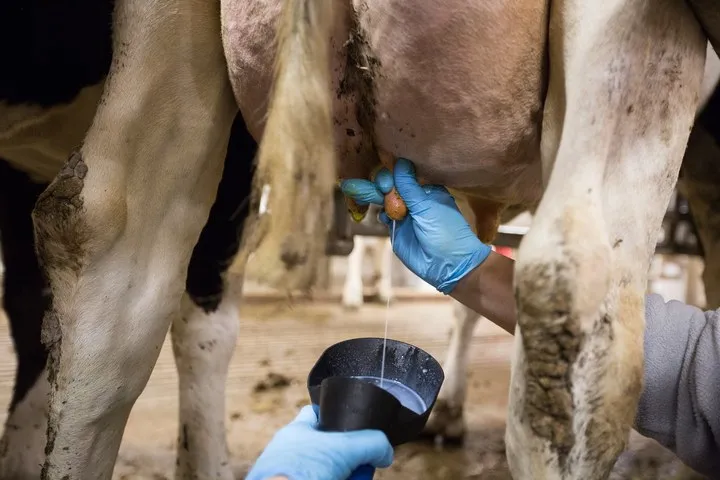

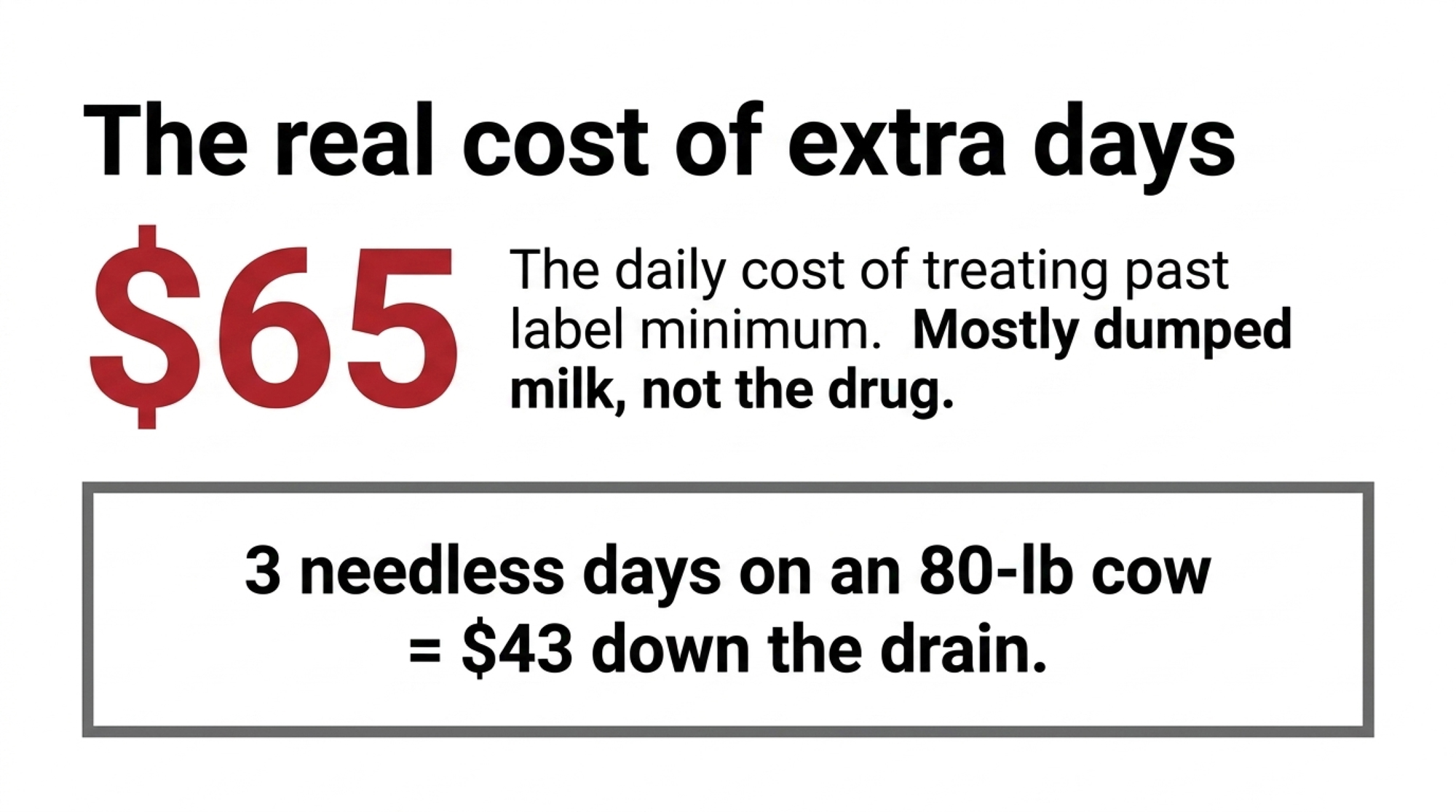

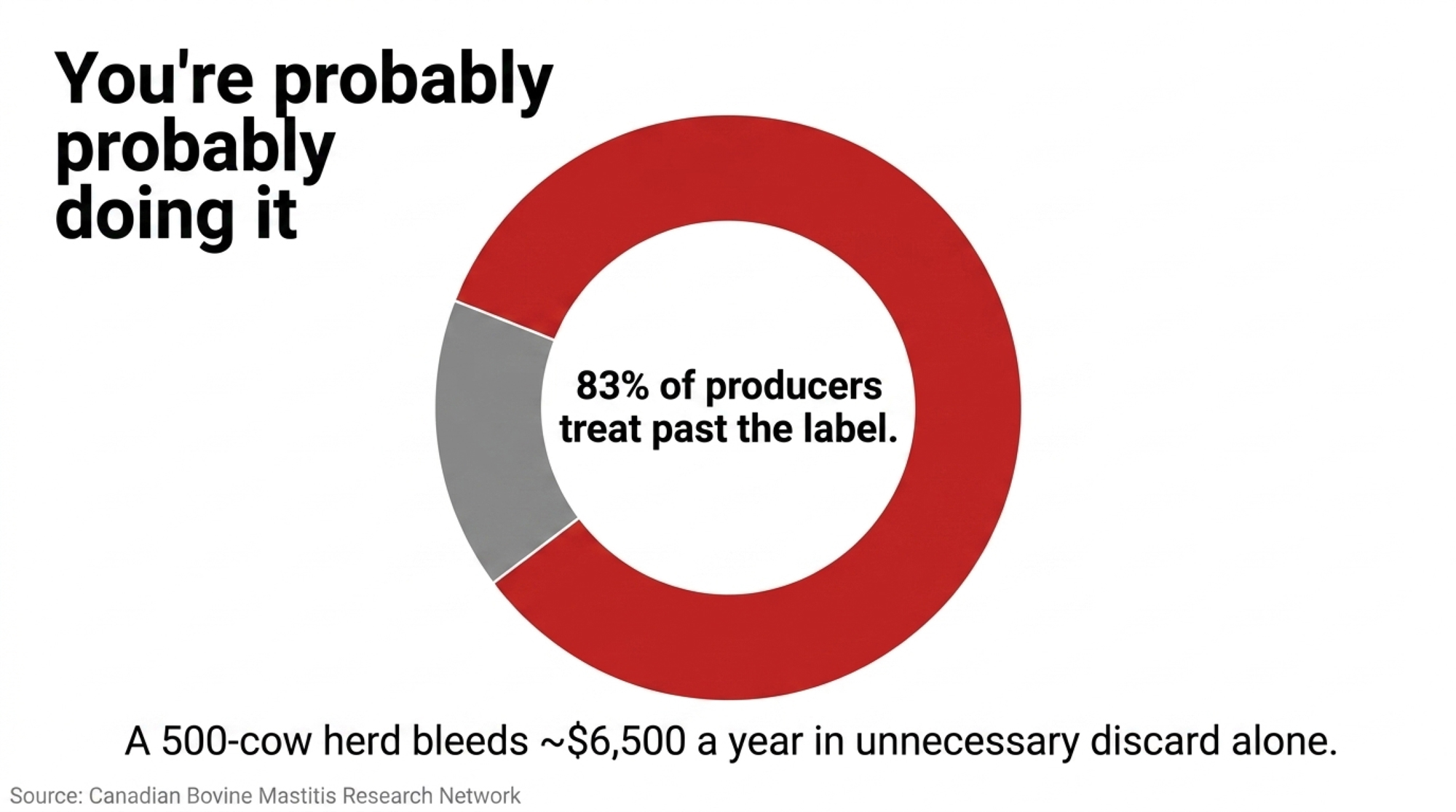
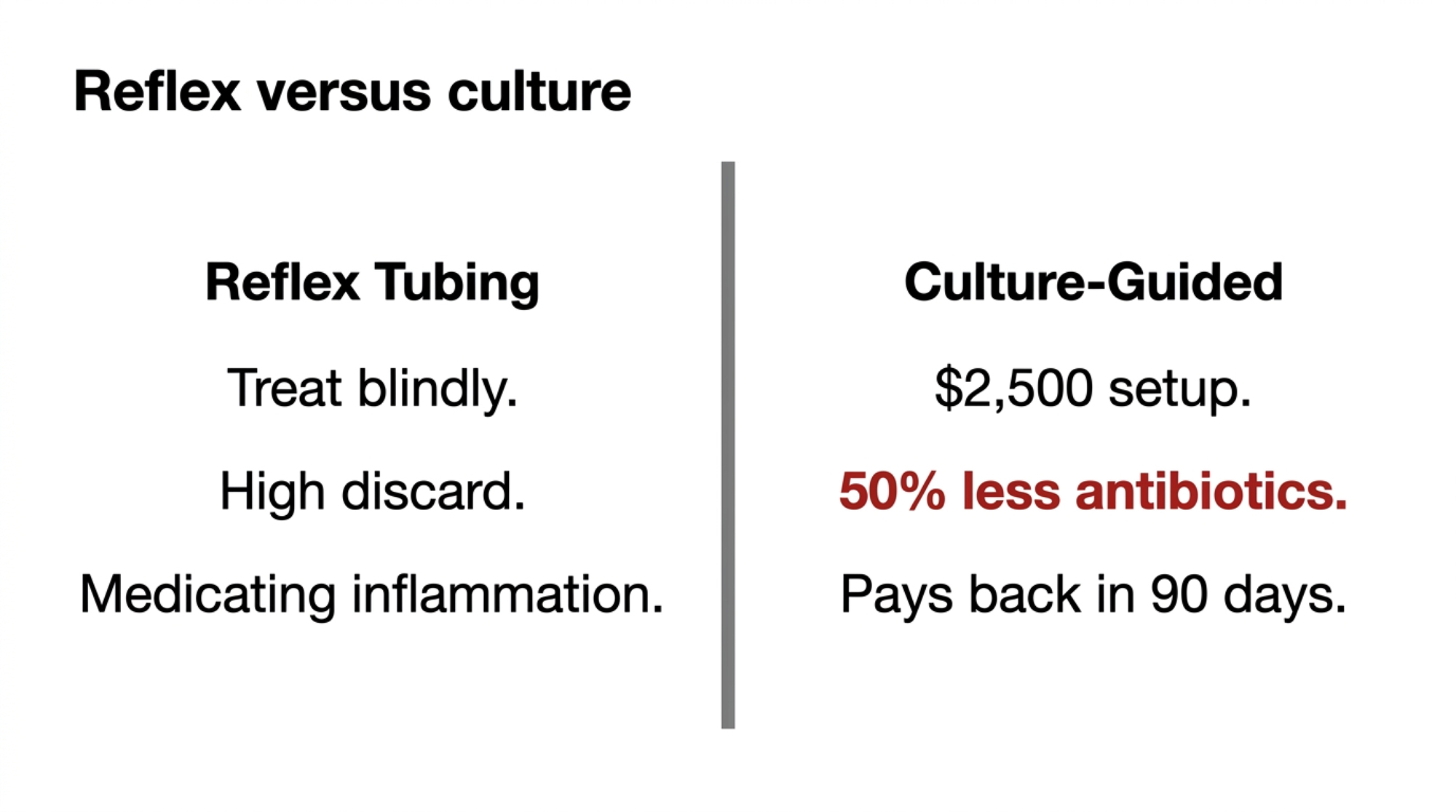
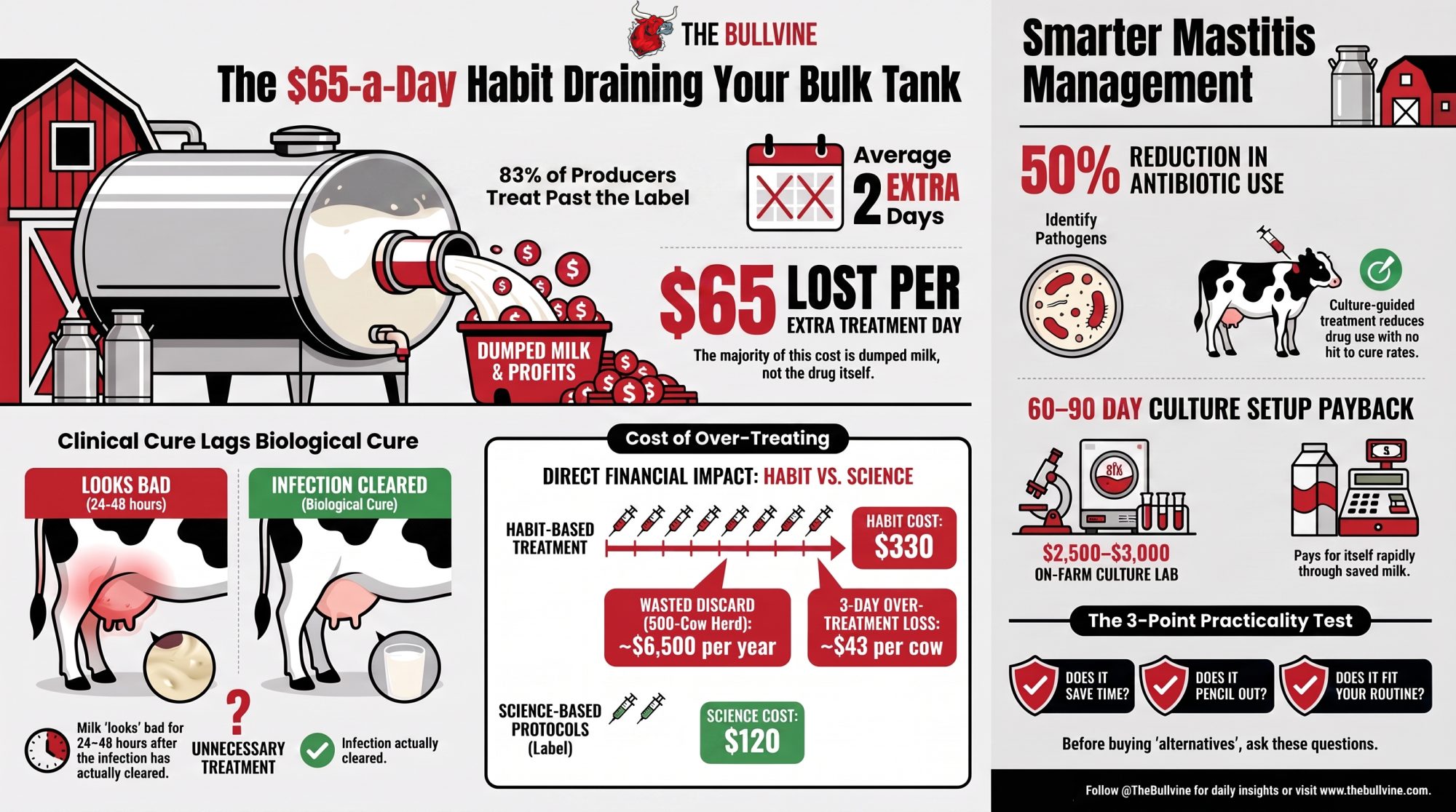

 The Sunday Read Dairy Professionals Don’t Skip.
 The Sunday Read Dairy Professionals Don’t Skip.