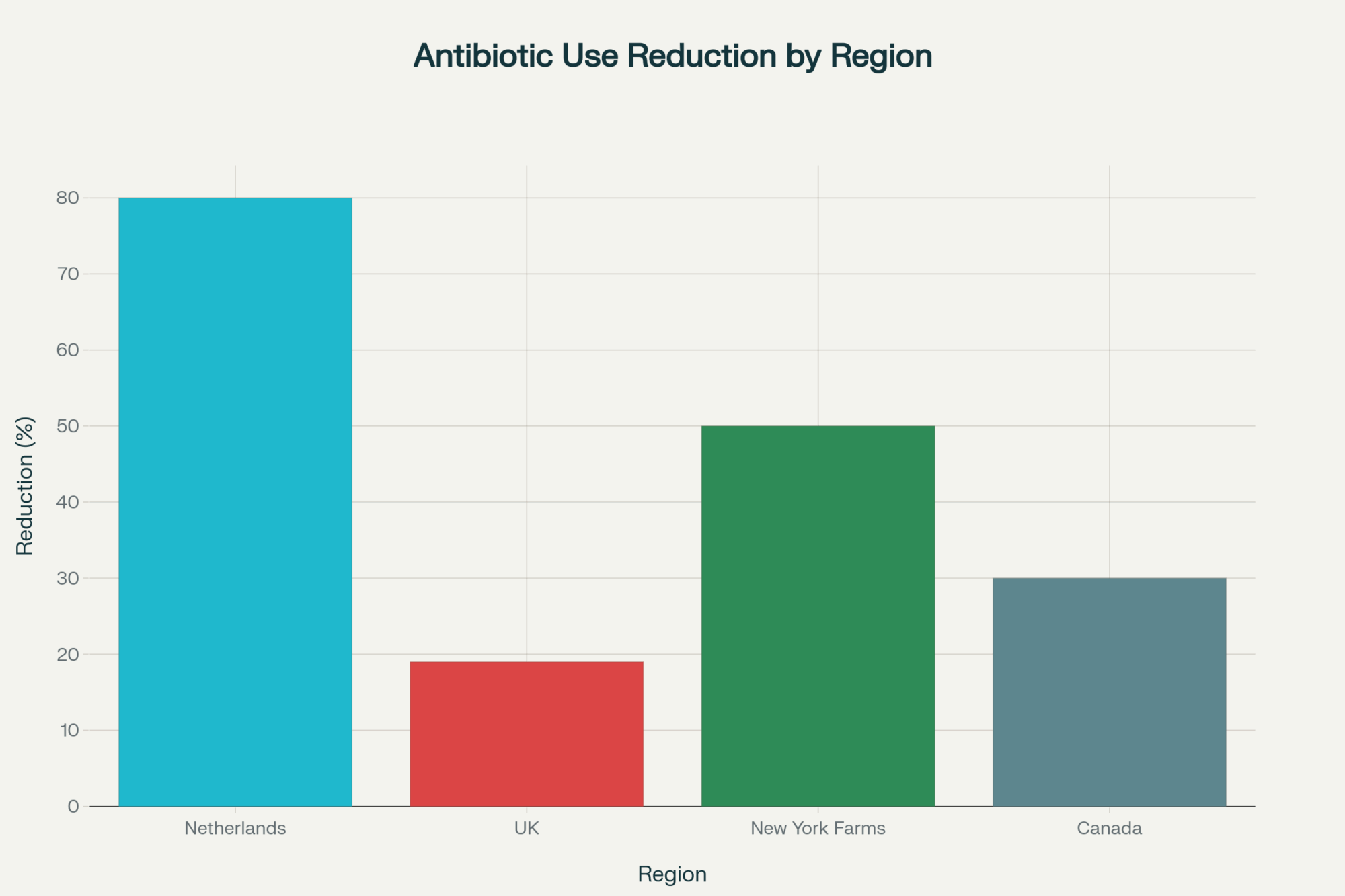







Same cow, same bug — one farm pays $120, another $330. The gap isn’t the infection. It’s the extra “just to be safe” days, at about $65 apiece in dumped milk.
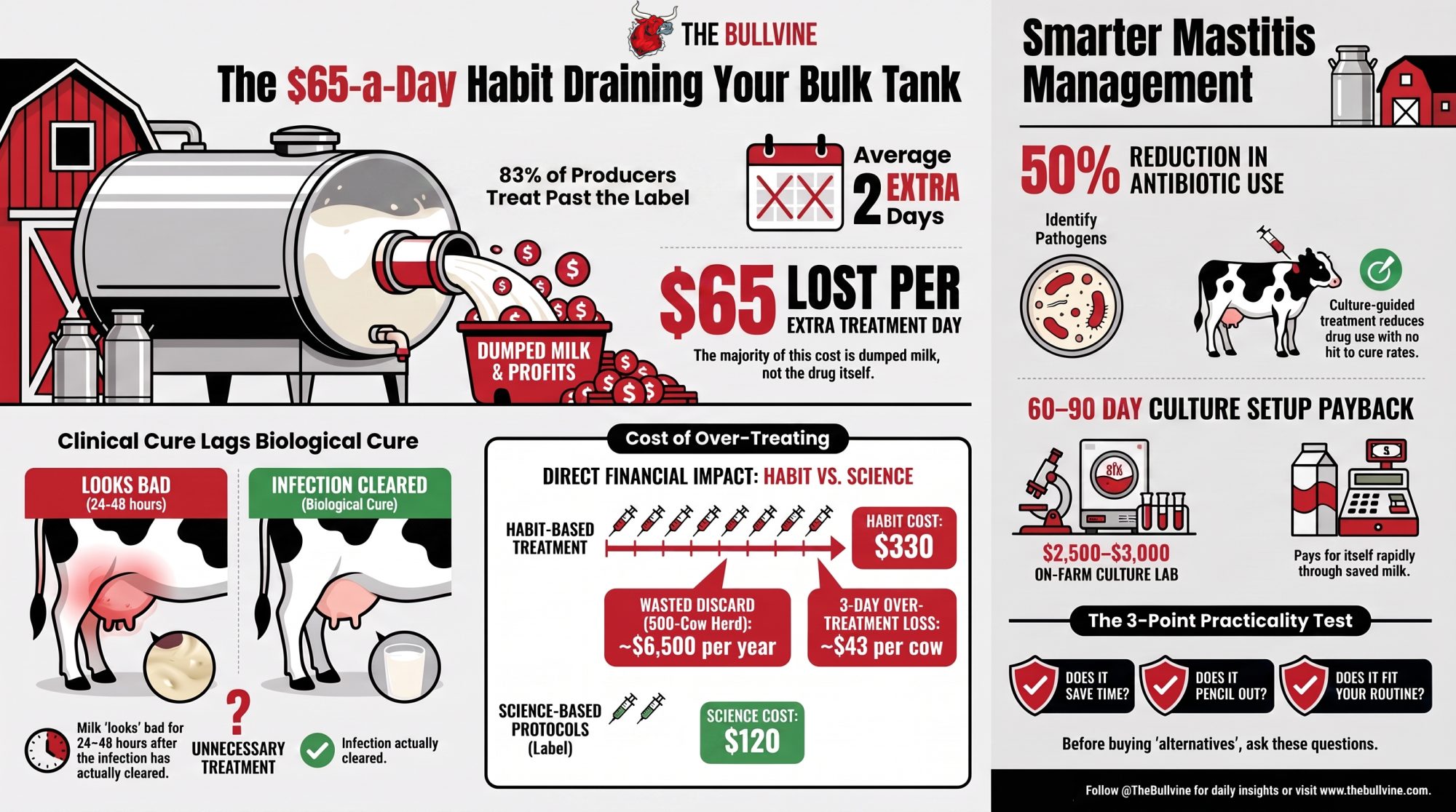
Executive Summary: Michigan State’s Pam Ruegg tracked 37 commercial dairies and found the same mastitis case costing anywhere from $120 to $330 to treat — and the gap wasn’t the bug, it was how long crews kept tubing. Every extra treatment day past label minimum runs about $65, almost all of it dumped milk: on an 80-lb cow at $18/cwt, that’s $14.40 a day gone, roughly $43 over three needless days. It’s not a fringe habit either — Canadian data (Aghamohammadi 2018) show that 83% of producers treat longer than the label calls for, chasing milk that “looks clean” even as clinical cure already lags biological cure by 24–48 hours. Scale it, and a 500-cow herd bleeds around $6,500 a year in unnecessary discard alone, before you touch subclinical and culling losses. Culture-guided treatment cuts antibiotic use roughly in half with no hit to cure rates, and a $2,500–3,000 quad-plate setup typically pays back in 60–90 days — but only if your sampling’s clean and your crew trusts the plate over the reflex. Before you buy any “alternative,” the practicality test one Australian mastitis researcher lives by still holds: if it can’t save time, pencil out, and fit your routine, it won’t survive the barn no matter how good the trial looks. The 30-day move is free — pull your treatment records, sort clinical cases by duration, and that column past label minimum is your habit’s price tag in ink.
The Numbers at a Glance
| Metric | Figure | What it means |
| Same-case cost spread | $120 vs. $330 | Nearly triple, driven by habit — not biology |
| Cost per extra treatment day | ~$65 | Mostly dumped milk, not the drug |
| Daily milk value, 80-lb cow @ $18/cwt | $14.40 | ~$43 lost over three needless days |
| Producers treating past label | 83% | ~2 extra days on average (Canadian data) |
| Biological vs. clinical cure lag | 24–48 hrs | You’re often treating inflammation, not infection |
| Wasted discard, 500-cow herd | ~$6,500/yr | Before subclinical and culling losses |
| Culture-guided antibiotic cut | ~50% | No hit to cure rates |
| Quad-plate culture setup / payback | $2,500–3,000 / 60–90 days | If sampling’s clean and the crew trusts it |
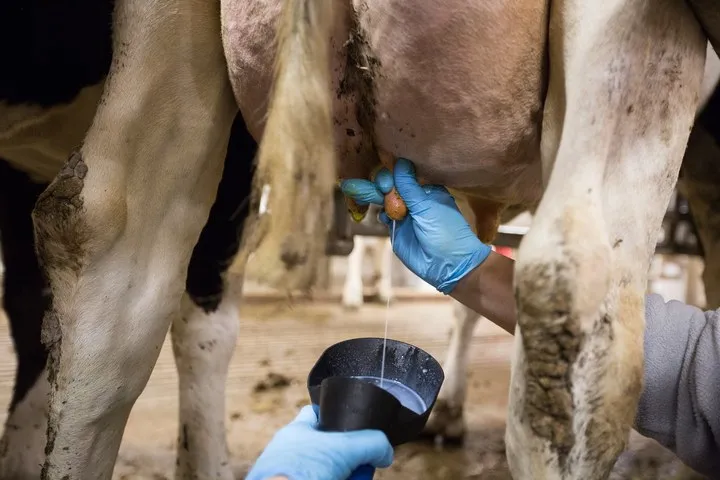
It’s 5 a.m. and a cow flags in the parlor. Flakes in the milk, maybe a firm quarter. You know the drill, because your hands know it before your brain does: grab a tube, start treating, keep going until the milk runs clean. It feels responsible. It feels like insurance.

Here’s the number that should stop that reflex cold. Michigan State University research led by Dr. Pam Ruegg — tracking 37 commercial dairies averaging around 1,300 cows each — found that out-of-pocket costs for essentially identical mastitis cases ran anywhere from $120 to $330 per farm. Same antibiotics. Same case severity. Nearly triple the cost. And the difference wasn’t biology. It was habit.
Same Cow, Same Bug, Triple the Cost — Why?
The reason the spread is so wide comes down to one thing most of us never think of as a decision at all: how long you keep treating.
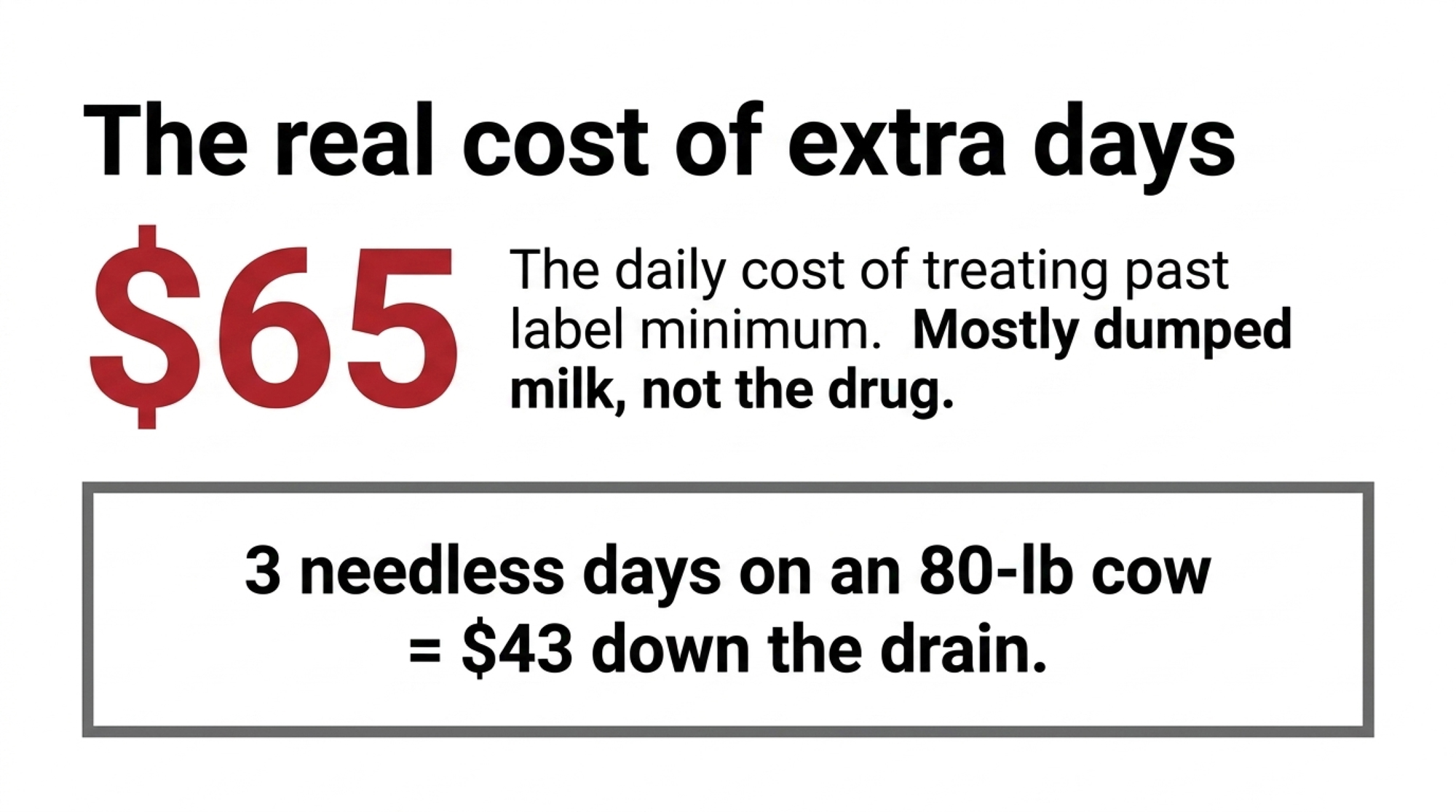
Ruegg’s team put a price on it. Each additional treatment day beyond label minimum costs roughly $65 in discarded milk and extended withdrawal, and milk discard — not the drug — is the bulk of what you’re paying for. Here’s the math on your own cows: an 80-pound cow at $18/cwt makes about $14.40 in daily milk value. Stretch treatment three days past what the case actually needed, and that’s roughly $43 in dumped milk per cow, before you count the antibiotic and the labor. It adds up faster than most of us realize.

Ruegg is blunt about why farms keep waiting. Producers treat until the milk looks normal — but, as she explains, the abnormal appearance stems from inflammation and isn’t predictive of whether bacteria are still present. Clinical cure lags biological cure by 24 to 48 hours. So those extra days are often spent treating a cow whose infection already cleared. You’re medicating inflammation. And paying dumped milk for the privilege.
The 83% Problem
If this were a fringe habit, it’d be a footnote. It isn’t.
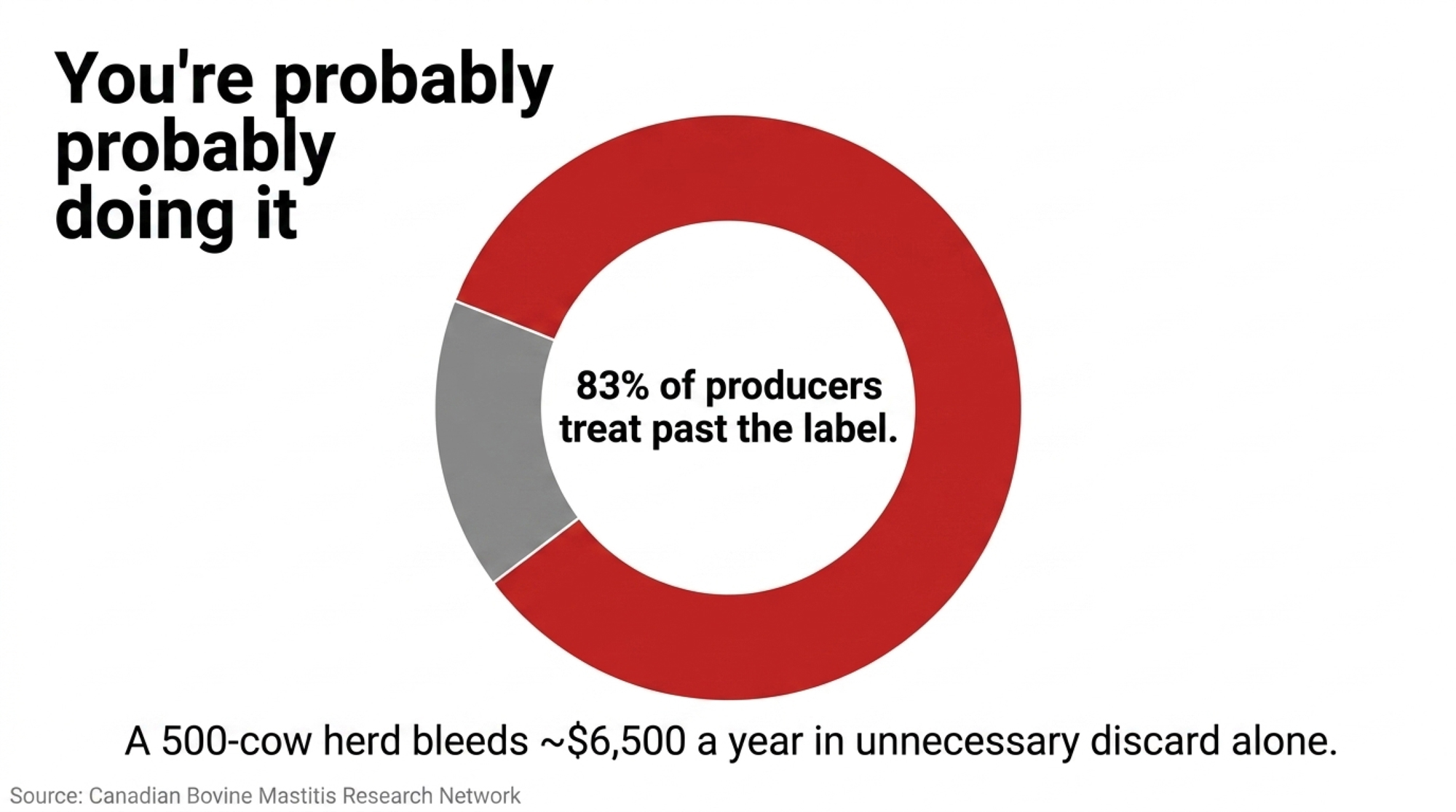
The Canadian Bovine Mastitis Research Network study (Aghamohammadi et al., 2018) found that among producers using a single protocol for mild or moderate cases, 83% treated longer than the labeled regimen — averaging about two extra days. Only 17% followed the label exactly. And the classic decision-tree work from Pinzon-Sanchez and Ruegg, published in the Journal of Dairy Science in 2011, laid out why that habit costs money: for mild and moderate cases, the economically optimal play is a two-day course for gram-positive infections and no antibiotics at all for gram-negative or no-growth cases.
The extended five- and eight-day regimens? They consistently produced the worst economic outcomes in that model, because a small bump in bacteriological cure couldn’t cover the milk you dumped chasing it. As Ruegg put it flatly in Veterinary Clinics of North America in 2018, “using antibiotics to treat many cases of nonsevere clinical mastitis does not result in improved bacteriologic or clinical outcomes.” The tube you grabbed for peace of mind, in a lot of cases, bought you nothing the cow wasn’t going to do herself.
The Barn Math on a 500-Cow Herd
Put real numbers to it. For a 500-cow herd, The Bullvine’s analysis of the MSU work pegs treating past label minimum at roughly $6,500 a year in unnecessary discard alone — money that vanishes purely because the decision runs on reflex rather than results. That’s before you touch the bigger hidden buckets the same analysis flags: subclinical losses and culling each account for close to half of total mastitis cost in the Canadian data.
| Cost Bucket | Approx. Share of Total Mastitis Cost | Driven By |
| Subclinical losses | Close to 50% | Reduced milk yield, undetected without SCC testing |
| Culling | Close to 50% (combined w/ subclinical) | Chronic/repeat cases, treatment failures |
| Unnecessary discard (over-treatment) | ~$6,500/yr on 500 cows | Treating past label minimum, habit not biology |
| Drug and labor cost | Smaller share | Antibiotic units, treatment time per case |
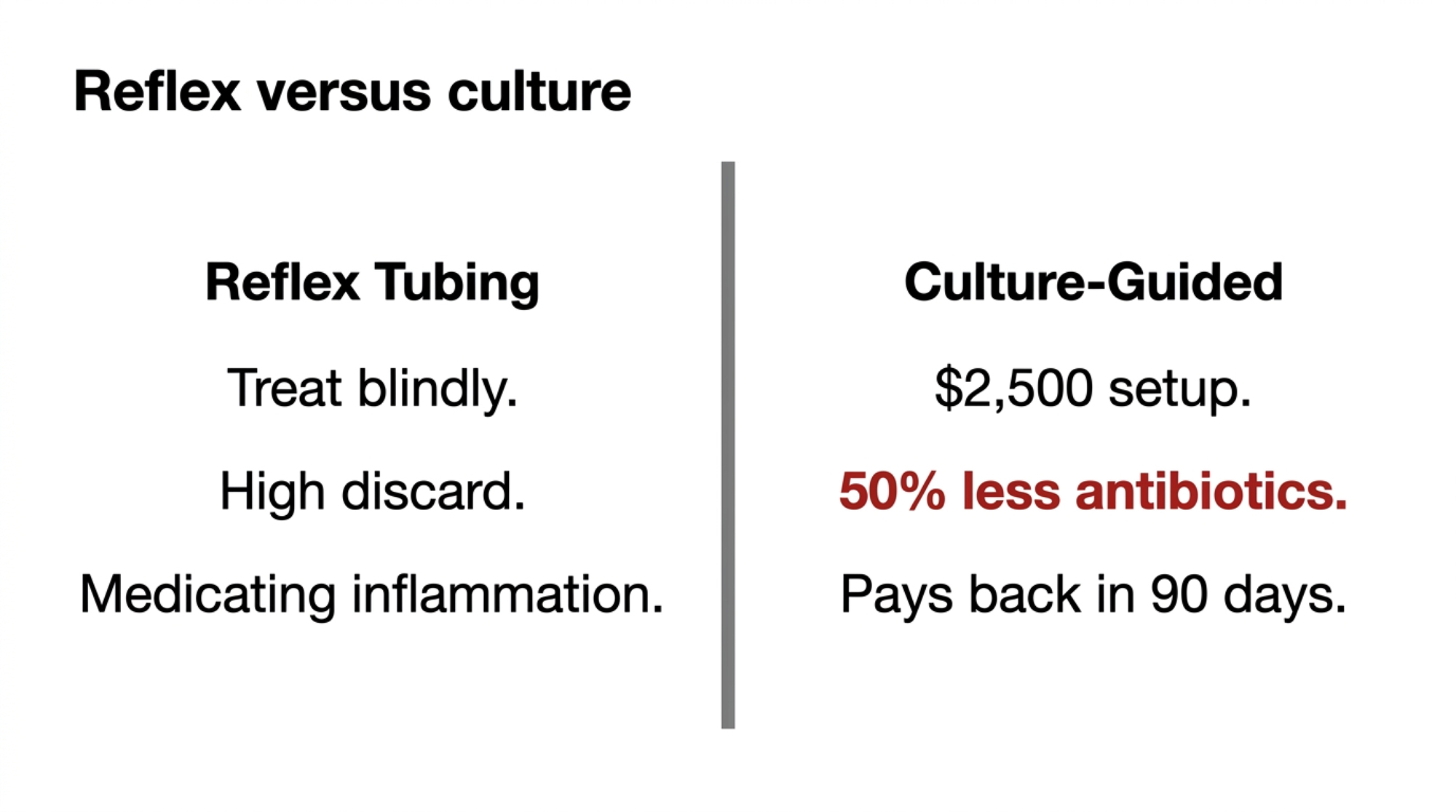
Treat the $6,500 as a starting illustration, not gospel — it moves with your milk price, your incidence, and your pathogen mix. But the direction is never in doubt. Farms that culture before they treat consistently report around 50% reductions in antibiotic use while holding or improving cure rates, with a quad-plate culture setup running $2,500–3,000 and typical payback in 60–90 days.
None of this needs a new gadget or a bigger drug budget. It needs the decision slowed down just long enough to ask what you’re actually treating.
What “Sample First, Treat Later” Really Costs to Run
The fix isn’t new, and the evidence for it is solid. A multi-state clinical trial in the Journal of Dairy Science found that using on-farm culture to guide clinical mastitis treatment reduced intramammary antibiotic use by about half and trimmed roughly a day off milk withholding — with no significant difference in clinical cure, bacteriological cure, recurrence, or culling compared with treating everything. Dairy Farmers of Canada’s 2024 stewardship guidance now formally recommends selective treatment of non-severe cases based on rapid diagnostics within 24 hours.
| Metric | Treat Everything (status quo) | Culture-Guided Treatment |
| Intramammary antibiotic use | Baseline (100%) | ~50% lower |
| Milk withholding time | Longer, ~1 day more | ~1 day shorter |
| Clinical/bacteriological cure | No significant difference | No significant difference |
| Recurrence and culling rates | No significant difference | No significant difference |
| Setup cost | $0 (no new equipment) | $2,500–3,000 quad-plate |
| Payback period | N/A | 60–90 days |
| Failure mode | Reflex over-treatment, hidden cost | Contaminated samples erode crew trust |
So why doesn’t every barn run it? Because on a big dairy with lean labor, “sample first” is a systems change, not a tweak. It means aseptic sampling at the parlor, a small on-farm culture setup or a disciplined send-out, and — this is the part that breaks — a protocol short enough that a weekend relief milker follows it at 4 a.m. without guessing.
The predictable failure point isn’t the science. It’s the crisis of faith around Day 3, when the milk still looks abnormal, and the crew wants to keep treating. Herds that have made the switch consistently describe that first month as the hard part: staff need to see, firsthand, that milk clears on its own after a short course before they’ll trust the protocol. Contaminated samples and SOPs nobody follows are the other two killers. The protocol that lives in a binder instead of on the wall is the one that quietly reverts to “just grab a tube.”
Can a Machine Do What the Tube Can’t?
Here’s where the conversation gets genuinely tricky. Once you accept that reflex-tubing is expensive, the door opens to non-antibiotic tools — and the market is happy to sell you a lot of them. Most aren’t ready. A few are.
Of the non-antibiotic options, Acoustic Pulse Therapy (APT) has the strongest peer-reviewed evidence published to date. A 2024 PLoS One retrospective across four Israeli commercial herds (Merin et al.) reported 65.8% subclinical udder recovery at 90 days versus 11.5% in untreated controls, and mastitis culling of 1.35% versus 16.7%. The paper estimates a benefit of $15,106 per 100 cows per year against roughly $1,440 in APT cost. Striking numbers. Read the fine print, though: the study’s authors disclose that the device’s maker was involved in the work, and it’s a retrospective across four Israeli herds with subclinical cases defined by SCC over one million — promising evidence worth testing on your own cows, not a closed case.
The rest of the “natural” toolbox — probiotics, botanicals, immune modulators — isn’t there yet. A 2018 critical appraisal concluded that treating clinical infections with lactic acid bacteria “cannot be recommended” in current practice. Interesting science, the whole category — but the independent evidence hasn’t caught up to the marketing yet. If a product’s best support lives in a brochure, your milk cheque shouldn’t depend on it.
The Test That Kills Good Products: Will a Farmer Actually Use It?
Tiana Sherry, a genetics-and-law-trained PhD researcher in Australia working on non-antibiotic mastitis therapies, makes a point that should reframe how you read every “next big thing” pitched at your parlor. A treatment can’t just work in a lab — it has to survive the barn.
“There’s just no point in creating a different research direction or trying to implement a new practice on farm,” Sherry told the Dairy Black Belt podcast, “if farmers were never going to go for it in the first place.” She runs producer surveys alongside her lab work precisely because the graveyard of dairy innovation is full of compounds that were effective and completely impractical. Her own read on the antibiotic treadmill is blunt: churning out new antibiotic derivatives teaches bacteria to beat the next one, “so I believe the antibiotic journey should be stopping, and we should be looking for alternatives.”
Distill her logic into a filter you can use tomorrow: does the treatment save time, does it pencil out, and does it fit the way your barn already runs? A product that demands twice-a-day dosing — something Sherry flags as a real barrier in large systems — is a non-starter no matter how clean the trial data looks. Her own candidate compounds are years from a barn; she puts commercialization on the familiar six-to-eight-year horizon. The takeaway isn’t “wait for the miracle.” It’s that the same three questions are the ones you should run on anything a rep sets on your office desk today.
The 30-Day Mastitis Audit & Decision Framework
The hard part was never the bug. It’s that the most expensive input on most dairies — the reflex to reach for a tube — never shows up as a line item. It hides in dumped milk and vague vet bills, which is exactly why it survives. Here’s how to drag it into the light and decide what, if anything, to change. Work it in order.
- Pull and sort your records (this week, free). Export your last 12 months of clinical mastitis cases and sort by treatment duration. Count how many ran past label minimum. At roughly $65 a day in dumped milk, that column is your number — the cost of habit, in ink.
- Write the rule down. Do you have a written rule for which cases wait for culture and which get treated immediately, or does it live in one person’s head? If it isn’t on the parlor wall, a 4 a.m. relief milker can’t follow it — and it reverts to “just grab a tube.”
- Carve out the sick cows first. Flag severe cases (fever, off-feed, systemic signs) for immediate treatment, so “sample first” never delays a genuinely sick cow. This is the guardrail that makes selective treatment safe.
- Decide if culture-guided treatment fits your herd. Best for mid-to-large herds with the labor to sample cleanly and the case volume to justify the $2,500–3,000 setup, paying back in 60–90 days at ~50% less antibiotic use. It backfires when sampling is sloppy — contaminated plates are worse than no plates, because the crew stops trusting results. And if you culture, actually act on gram-negative and no-growth results by withholding the tube.
- Check whether selective dry cow therapy is on the table. Fits herds with reliable SCC records, lower bulk tank counts, and internal teat sealant on hand; AABP’s 2024 guidelines set the readiness criteria, with roughly a 50% antibiotic cut and about $5.37/cow in savings at equivalent udder health. Weak records or poor hygiene? Stay blanket until the basics are fixed rather than under-treat blind.
- Run the practicality test on anything a rep is selling. Before you buy any non-antibiotic tool — APT included — ask the three questions: does it save time, does it pencil out, does it fit your routine (or demand twice-a-day dosing your crew can’t sustain)? And does its best evidence live in an independent trial or a vendor’s slide deck? For APT specifically, run your own numbers against the manufacturer-linked Israeli-herd data before committing a full budget.
Bottom Line Takeaways
- If you’ve never audited your treatment durations, assume you’re in the 83% — and that the fix is a records pull, not a purchase.
- Milk that “looks clean” isn’t the finish line. When a mild or moderate case comes back gram-negative or no-growth, the decision-tree math says the tube likely earns you nothing.
- A culture setup that pays back in 60–90 days isn’t an affordability question — it’s whether your case volume justifies it. Below a certain scale, discipline on treatment duration matters more than the plates.
- No trial result survives a barn it doesn’t fit. If a therapy can’t clear time, cost, and routine fit, how good the data looks is beside the point.

You already run the numbers on a ration before you feed it and a bull before you breed to him. So next time you’re standing in the parlor on Day 3, staring at milk that still looks off — what’s your treatment log actually telling you about the peace of mind you’ve been buying?
Run Your Numbers
Health ROI Calculator — This article puts $65 a day on the overtreatment habit. The Health ROI Calculator turns that into your number: run your mastitis case load, milk-withdrawal losses, and cull pressure to see whether tightening treatment durations or moving to culture-guided protocols actually pays on your herd.
Complete references and supporting documentation are available upon request by contacting the editorial team at editor@thebullvine.com.
Learn More
- Biofilm mastitis protocol cuts treatments 50–75% — Reveals how an 1,100-cow Wisconsin dairy slashed hospital load by 50% and shortened treatments to two days by targeting bacterial biofilm communication before reaching for traditional intramammary tubes.
- Dairy herd health and reproduction 2026 benchmarks — Delivers the exact somatic cell count thresholds, internal teat sealant protocols, and selection criteria required to implement selective dry cow therapy without risking fresh-cow clinical flare-ups.
- The Missing Piece in Genomic Selection: Why the Best Herds Still Walk the Pens — Exposes why mastitis accounts for 18.6% of involuntary culls despite rising Net Merit scores, arming you with genetic filtering strategies to remove high-SCS risk heifers before raising them.
The Sunday Read Dairy Professionals Don’t Skip.

Every week, thousands of producers, breeders, and industry insiders open Bullvine Weekly for genetics insights, market shifts, and profit strategies they won’t find anywhere else. One email. Five minutes. Smarter decisions all week.