




Archive for antimicrobial stewardship

Selective Dry Cow Therapy at 240,000 SCC: Are You Saving on Tubes or Losing $6,920?

Seven of Cornell’s 24 SDCT herds bailed on the program once their fresh‑cow mastitis numbers hit the fan. Before you join them, you’d better know which group you’re in.

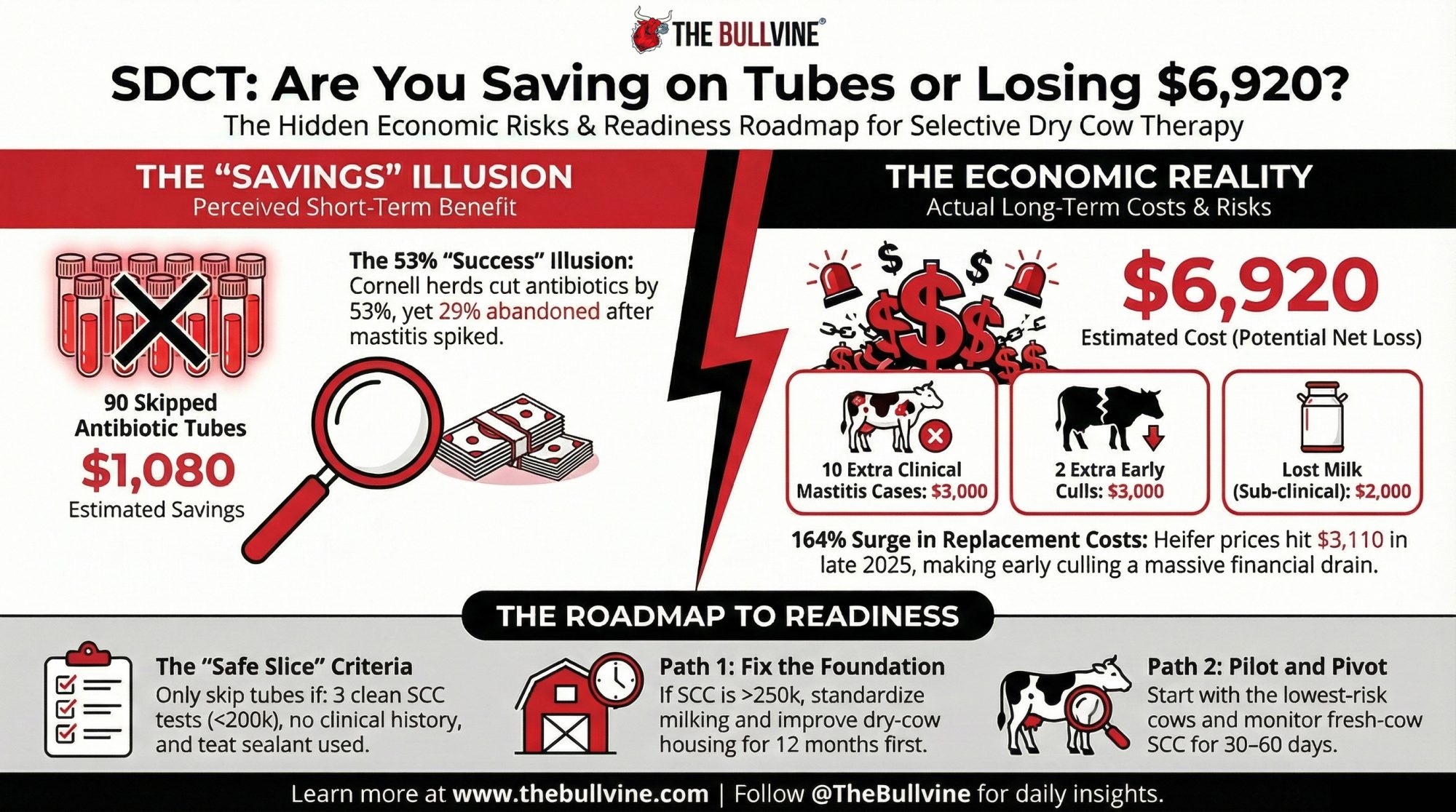
Executive Summary: Herds trying selective dry cow therapy at 240,000 SCC can easily turn “antibiotic savings” into a $6,920 loss on 300 cows once extra mastitis, culls, and lost milk are in the math. Cornell’s 24‑herd SDCT project cut dry‑cow antibiotic use 53% on average, but 7 herds still abandoned SDCT when fresh‑cow mastitis and milk quality slipped. Dutch data shows dairy can cut antimicrobial use roughly 47% without wrecking udder health, but only after years of tightening SCC, housing, and protocols. This piece lays out three realistic paths for higher‑SCC herds under processor pressure: fix infections first, pilot SDCT on the safest slice only, or use that SDCT letter as leverage for a 12–18‑month runway. You’ll see the exact SCC thresholds, AABP readiness criteria, and barn‑math assumptions so you can plug in your own DHIA and cull numbers. If your bulk tank’s been north of 200,000 and your mastitis records are patchy, you’ll likely walk away treating SDCT as a future goal, not a box to tick this dry‑off season.
selective dry cow therapy

When The Bullvine first profiled Mystic Valley Dairy’s move to selective dry cow therapy, one detail jumped off the page: a bulk tank somatic cell count around 78,000 cells/mL and a decision to start skipping dry‑cow tubes on some cows anyway.

Around the same time, Cornell’s Quality Milk Production Services team was quietly tracking 24 New York herdsthrough their own SDCT transition. Those farms averaged 199,000 cells/mL SCC going in and still managed to cut dry‑cow antibiotic use by 53% on average (range: 32–78%) without wrecking udder health. Put those two stories beside a 240,000‑SCC herd with a processor letter on the kitchen table, and the contrast gets real fast.

Mystic Valley’s SDCT Story: Low SCC, High Scrutiny

Mystic Valley Dairy, Sauk City, Wisconsin, milks about 450 registered Holsteins, with a bulk tank SCC typically ranging from 70,000 to 90,000 cells/mL. In The Bullvine’s earlier coverage, owner Mitch Breunig laid out why a herd with that kind of SCC profile would even consider cutting dry‑cow tubes.
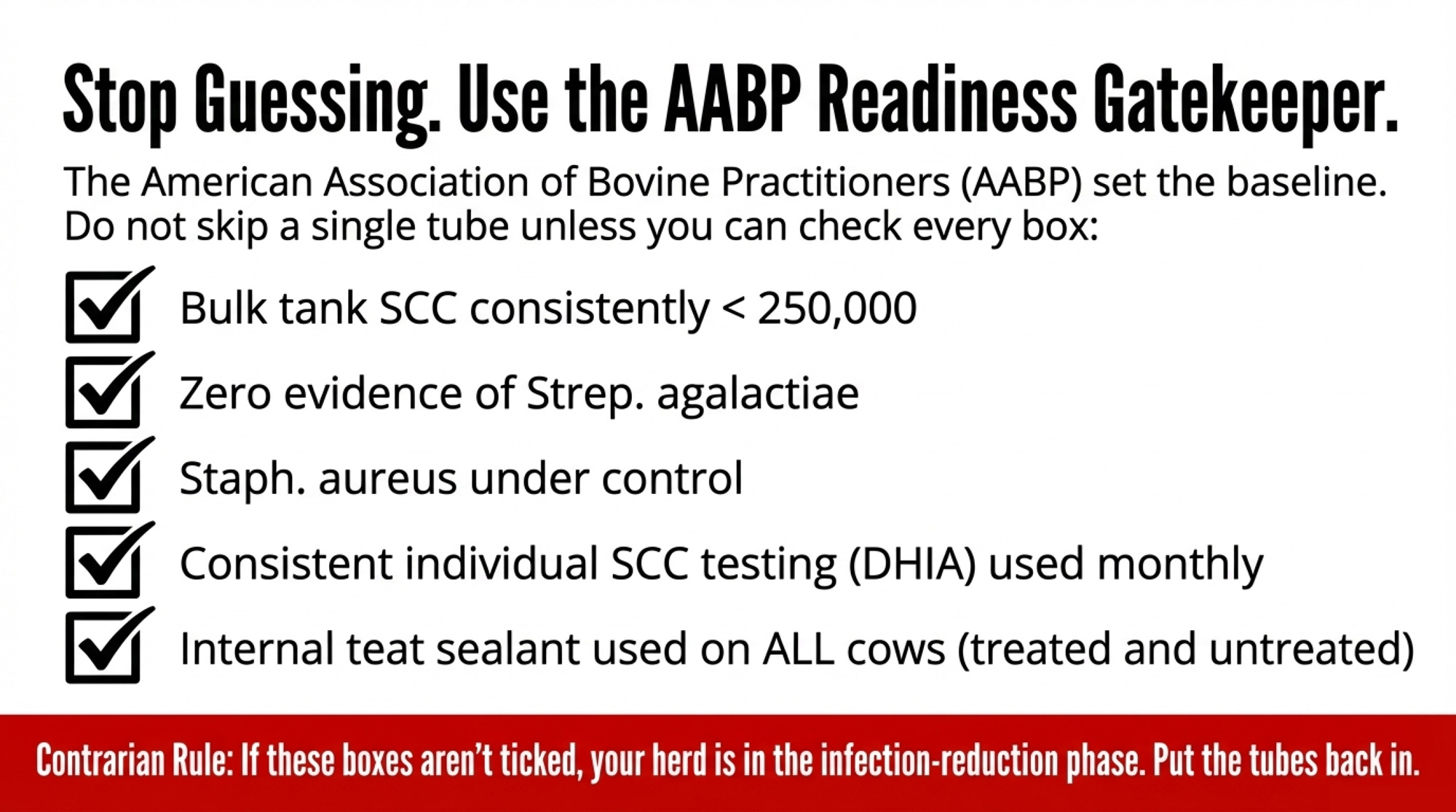
Mystic Valley already ticked every box in the 2024 AABP SDCT readiness guidelines and then some: bulk tank SCC regularly less than 250,000; no evidence of Streptococcus agalactiae; Staphylococcus aureus under control; consistent individual SCC testing; written milking and dry‑off SOPs; and internal teat sealant at dry‑off for all cows. On paper, they looked a lot like the 12 Flemish herds in Lipkens, Piepers, and De Vliegher’s 2023 trial, which had a geometric mean bulk tank SCC of 145,000 cells/mL at enrollment (range: 84,000–195,000; median 157,000) and used teat sealants on every dry cow.

Mystic Valley’s criteria were conservative from the start: cows needed three straight SCC tests under 200,000, no clinical mastitis during the lactation, no flagged problem quarters, and a good‑eyes‑on udder check at dry‑off before they were considered for sealant‑only treatment. Everyone else stayed on full dry‑cow therapy plus sealant.

Even in that low‑SCC, well‑run context, Mystic Valley still saw some early‑lactation cows whose performance raised eyebrows. Those early outcomes led the farm and its vet to tighten criteria further and pay closer attention to which cows truly belonged in the sealant‑only column.

The point isn’t that SDCT was easy for them. It’s that they were operating from a starting point — and with protocols — most 240,000‑SCC herds don’t have yet.

Cornell’s 24 SDCT Herds: 53% Fewer Tubes, Not for Everyone

If Mystic Valley shows what SDCT looks like on a very low‑SCC herd, Cornell’s New York project shows what happens when you put it into a broader mix of operations.
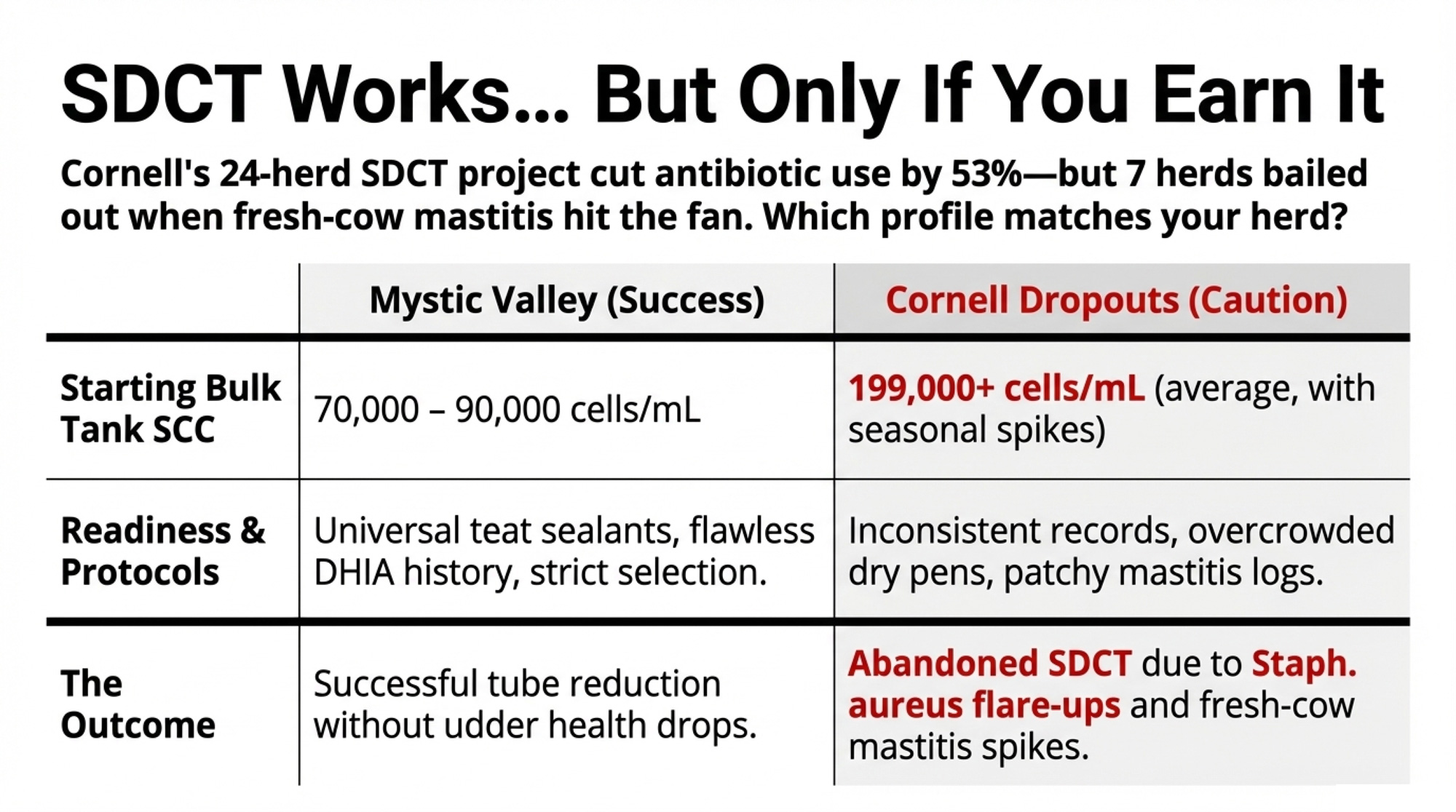
Readiness factorMystic Valley Dairy240,000‑SCC herd under pressure
Bulk tank SCC (cells/mL)70,000–90,000; long‑term <150,000240,000+; bounces 230,000–280,000
Individual SCC data3 consecutive tests <200,000 required for SDCT cowsPatchy DHIA; high‑SCC cows not consistently flagged
Contagious pathogensNo Strep. ag; Staph. aureus under controlStaph. aureus “suspected” or intermittently cultured
Dry‑off protocolWritten SOP; one named dry‑off lead; sealant for all cowsShared between milkers; protocol drift between shifts
Teat sealant use100% of dry cows receive internal teat sealantUsed on “problem cows” only or inconsistently
Housing & dry pensStocking density and bedding managed; low overcrowding (implied by low SCC)Overcrowded, wetter pack; limited capital for upgrades
AABP 2024 SDCT checklistTicks every box and moreFails multiple criteria; SDCT pushed by processor, not data

Potter, Forrestal, Capel, and Nydam’s 2022 AABP paper followed 24 commercial dairy farms across New York State. Herd sizes ranged from 65 to 3,774 cows, averaging 985 cows, with a starting bulk tank SCC of 199,000 cells/mL. Farms worked with veterinarians to use individual cow SCC and mastitis history to decide who received full dry‑cow therapy plus sealant and who received sealant only, and then monitored bulk tank SCC, fresh‑cow SCC, and clinical mastitis as they transitioned.

Across those 24 herds:

  • 53% average reduction in dry‑cow antimicrobial use (individual herds ranged from 32% to 78%).
  • No consistent herd‑level spikes in fresh‑cow SCC or mastitis when SDCT was implemented inside the project’s framework.
  • 17 of the 24 farms still used SDCT at the end of the study period.
  • 7 farms stopped SDCT, citing seasonal milk‑quality challenges, more dry‑period clinical mastitis, or flare‑ups of contagious pathogens such as Staph. aureus.

Cornell didn’t treat SDCT as a universal good or an obvious mistake. They treated it as a tool that fit most of those herds — but not all — even with structured support and monitoring. For a 240,000‑SCC herd being pushed toward SDCT, that nuance matters more than the headline number.

When Selective Dry Cow Therapy (SDCT) Helps — and When It Bites

The published science lines up with what Mystic Valley and Cornell saw.
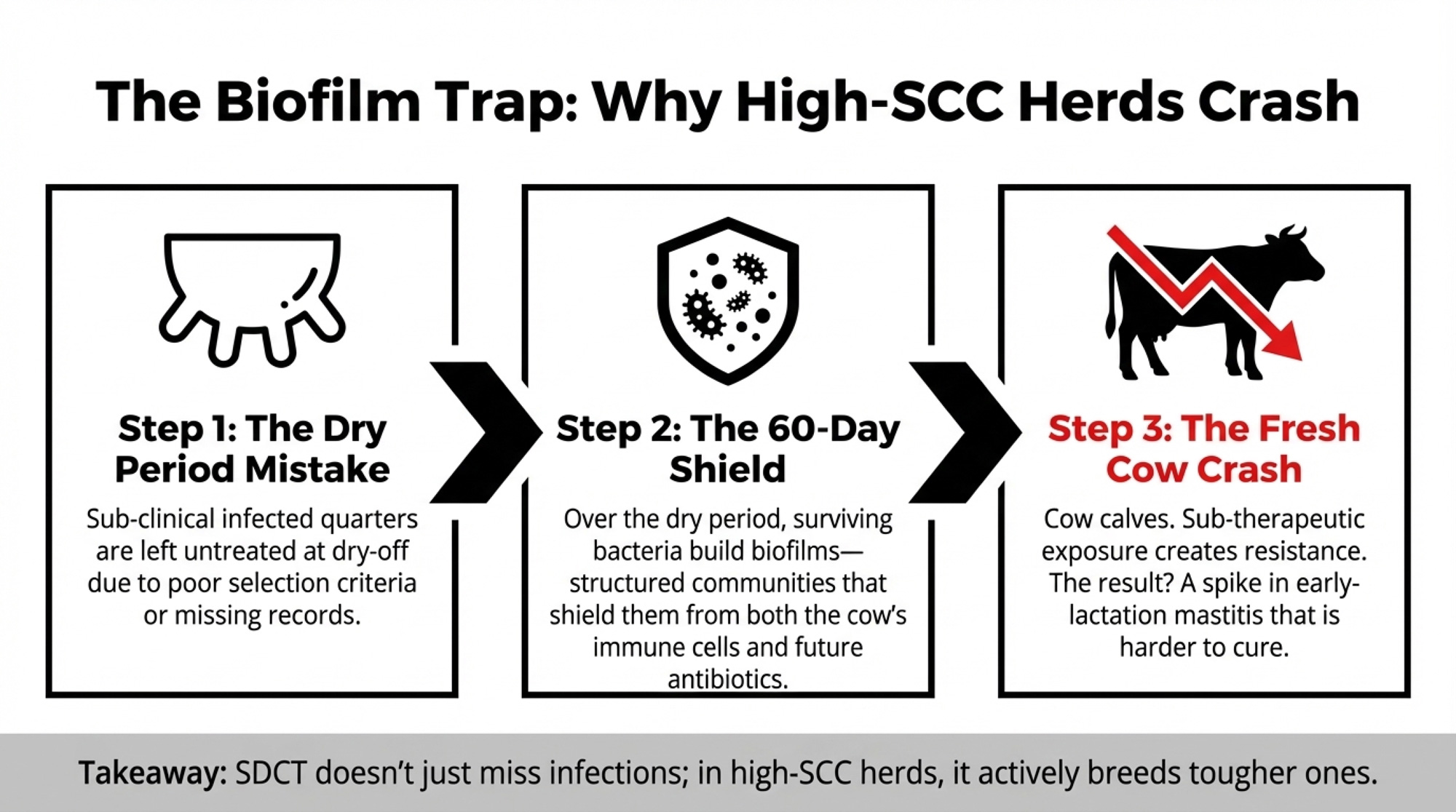
A 2000–2021 systematic review and meta‑analysis found that selective dry cow therapy can deliver udder‑health outcomes similar to blanket dry cow therapy (BDCT) while reducing antibiotic use — but only in herds with low bulk tank SCC, good mastitis control, and consistent use of internal teat sealants in untreated quarters. Winder et al. (2019, Animal Health Research Reviews) concluded that SDCT increases the risk of intramammary infection at calving compared with BDCT unless internal teat sealants are used; with sealants, IMI risk is similar across strategies.

The Lipkens trial offers a clean real‑world comparison. In those 12 Flemish herds (466 cows; 244 BDCT, 222 SDCT), all cows received an internal teat sealant at dry‑off. Total antimicrobial consumption for udder health between dry‑off and 100 DIM dropped from 1.25 defined course doses (DCD) per cow in the BDCT group to 1.06 DCD per cow in the SDCT group — a 22% reduction — with no significant differences in test‑day SCC, clinical mastitis incidence, milk yield, or culling hazard. Only 33.8% of SDCT‑group cows actually skipped antibiotic tubes at dry‑off, and that share varied widely between herds (6.2–73.9%).

At the national scale, the Dutch experience shows how far antibiotic use can fall when an entire system commits to it. The Netherlands set mandatory reduction targets starting in 2009 and banned preventive antimicrobial use — including blanket dry‑cow treatment — beginning in 2012–2013. Across all Dutch livestock, the result was a 70.8% reduction in kilograms of antimicrobials sold since 2009 (Moura et al., 2022, Frontiers in Veterinary Science). Within the dairy sector specifically, Lam et al. (2020, Pathogens) reported a 47% decline in total antimicrobial usage from 2009 to 2015, after which usage stabilized at around 3 DDDA per cow per year.

Critically, Santman‑Berends et al. (2020, Journal of Dairy Science) monitored approximately 17,000 Dutch dairy herds (about 1.67 million cows) from 2013 through 2017 and found that the ban on blanket dry‑cow therapy drove a 63% drop in dry‑cow antimicrobial usage and a 15% reduction in intramammary treatment overall — with no deterioration in udder health at the herd level. An increase in new high‑SCC cases during the dry period was expected, but as their census data showed, it was not observed.

But those same studies underscore a risk that doesn’t appear in tube‑count dashboards: the biofilm and resistance trap. If infected quarters aren’t treated at dry‑off, bacteria have the entire dry period to build biofilms — structured communities that shield them from antibiotics and immune cells. Within those biofilms, resistance genes can move between bacteria more easily via plasmids and mobile DNA elements. When those cows calve and receive intermittent or incomplete lactation treatments, sub‑therapeutic exposure becomes a selection program for resistance.

For low‑SCC herds with solid protocols, that risk is manageable. For a 240,000‑SCC herd with inconsistent records or overcrowded dry pens, it’s a much easier trap to fall into.

Can a 240,000‑SCC Herd Really “Save” on SDCT?

Rollin, Dhuyvetter, and Overton (2015, Preventive Veterinary Medicine) estimated the total cost of a single clinical mastitis case in the first 30 DIM at approximately $444 per case, including lost production, treatment, discarded milk, labour, and culling risk. Other work puts direct costs closer to $120 per case, making a $120–$444 range across studies reasonable.
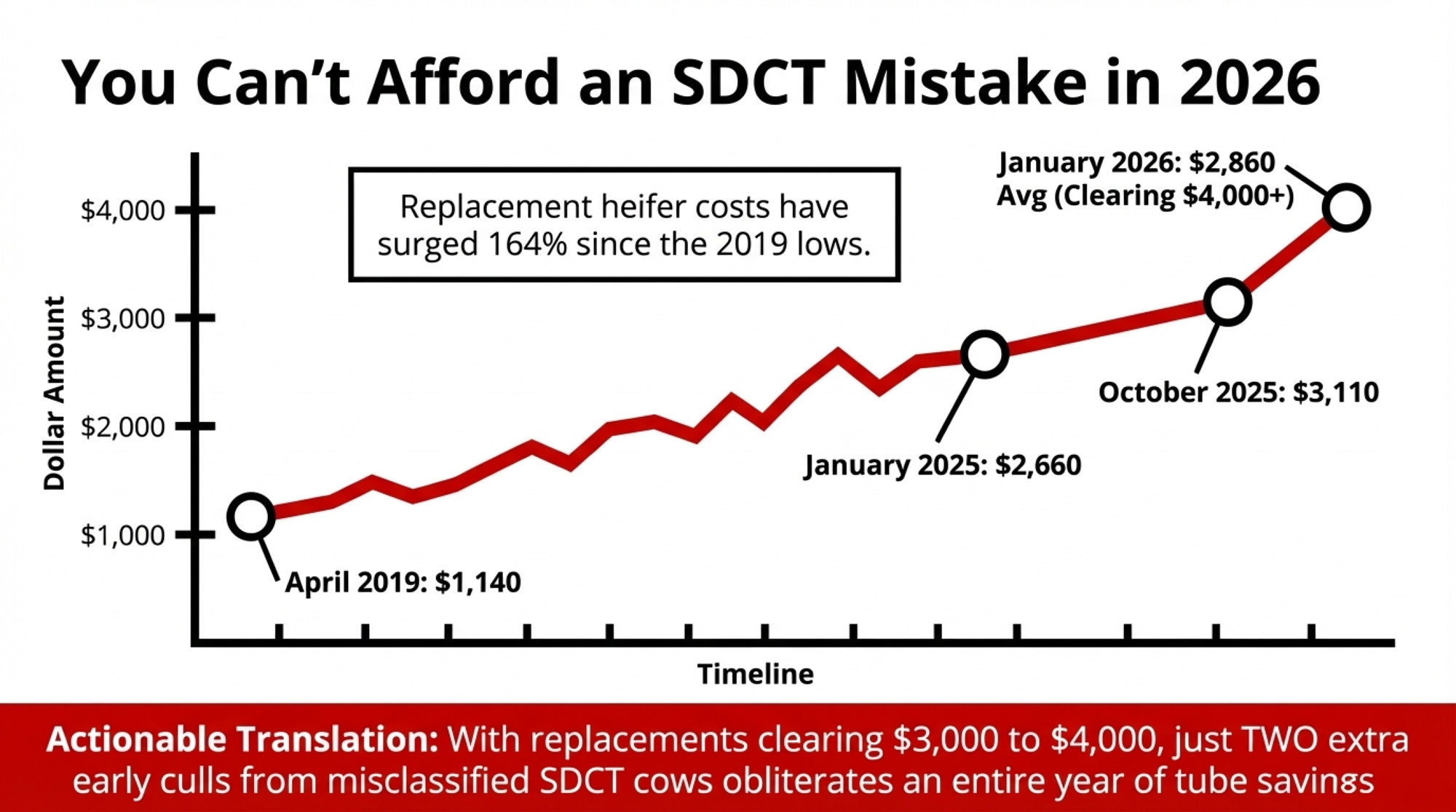
Replacement economics have shifted just as sharply. CoBank and USDA data show:

  • October 2014: dairy replacement heifers at $2,120 per head.
  • April 2019: down to $1,140.
  • January 2025: back up to $2,660.
  • July 2025: $3,010.
  • October 2025: $3,110 — about a 164% increase from the 2019 low.
  • January 2026: USDA average around $2,860, with individual Holstein springers clearing $4,000+ in some California and Midwest auctions.
Cost itemConservative valueCost vs. $1,080 tube “savings”
Clinical mastitis case (first 30 DIM)$300 per case (mid‑range of $120–$444)image.jpg4 cases = $1,200 (already exceeds tube savings)
Sub‑clinical mastitis over lactation~$200 lost milk/premiums per cowimage.jpg6 cows = $1,200 in hidden loss
Net replacement heifer (Jan 2026 avg)$2,860 − ~$1,400 cull value ≈ $1,500 per headimage.jpg+11 early cull = 1.4× tube savings; 2 culls = 2.8×
High‑end Holstein springer (auction)$4,000+ per head in some marketsimage.jpg+11 cull on premium cow = 3.7× tube savings
90 tubes skipped at dry‑off$12 per tube; total $1,080 “saved”image.jpgBest‑case upside, before any mastitis or cull penalties

Now put that together on a 300‑cow herd with a BMSCC around 240,000 that jumps into SDCT before its infection pressure, and records are ready. If your dry‑off person is also your night milker and calf feeder, SDCT will show every crack in that schedule. And if selection criteria or follow‑through miss even a modest number of quiet infections, you can see a bump in early‑lactation mastitis, a couple of cows pushed into earlier culls, and several sub‑clinical cases dragging SCC and milk across the whole lactation.

Here’s what that looks like, using conservative assumptions:
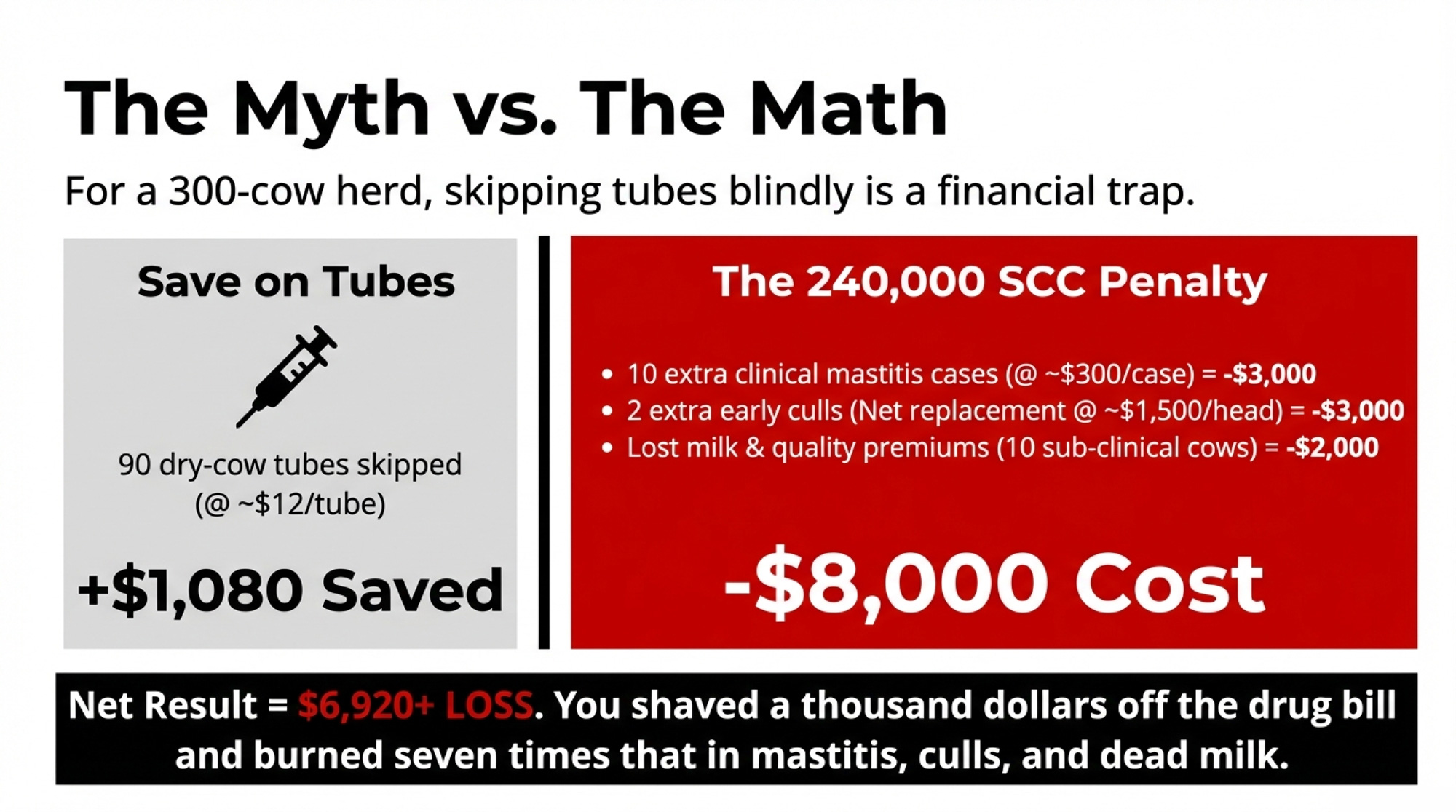
ItemSavingsCost
90 dry‑cow tubes skipped (@ ~$12/tube)$1,080
10 extra clinical mastitis cases (@ ~$300/case)$3,000
2 extra early culls (net replacement @ ~$1,500/head after cull credit)$3,000
Lost milk from 10 sub‑clinical cows (a few hundred dollars per cow across the lactation)≈$2,000
Net result ≈$6,920+ loss

Assumptions: tubes $8–$15 each (long‑acting dry‑cow products) with $12 used here; mastitis cost $120–$444/case, $300 mid‑range; net replacement cost $2,860 USDA Jan 2026 average minus roughly $1,400 cull cow value ≈ $1,500; sub‑clinical cows losing a few hundred dollars worth of milk and quality premiums per cow across a full lactation.

You’ve shaved about a thousand dollars off your dry‑cow drug bill. You’ve potentially burned seven times that in mastitis, culls, and dead milk.

Mystic Valley’s low SCC, universal sealant use, and disciplined selection meant it could adjust early and keep that risk in check. The Cornell herds that stuck with SDCT had similar structures and data feedback loops. A 240,000‑SCC herd without those pieces is betting $6,920+ a year that its infection status and records are better than they really are.

Three SDCT Paths: Matching the Science to Your Herd

The Mystic Valley and Cornell stories don’t say “don’t do SDCT.” They say “do it on the right herds, with the right prep, and be ready to stop if the data turns.”

For a 240,000‑SCC herd with a processor letter, you’ve got three realistic paths forward.
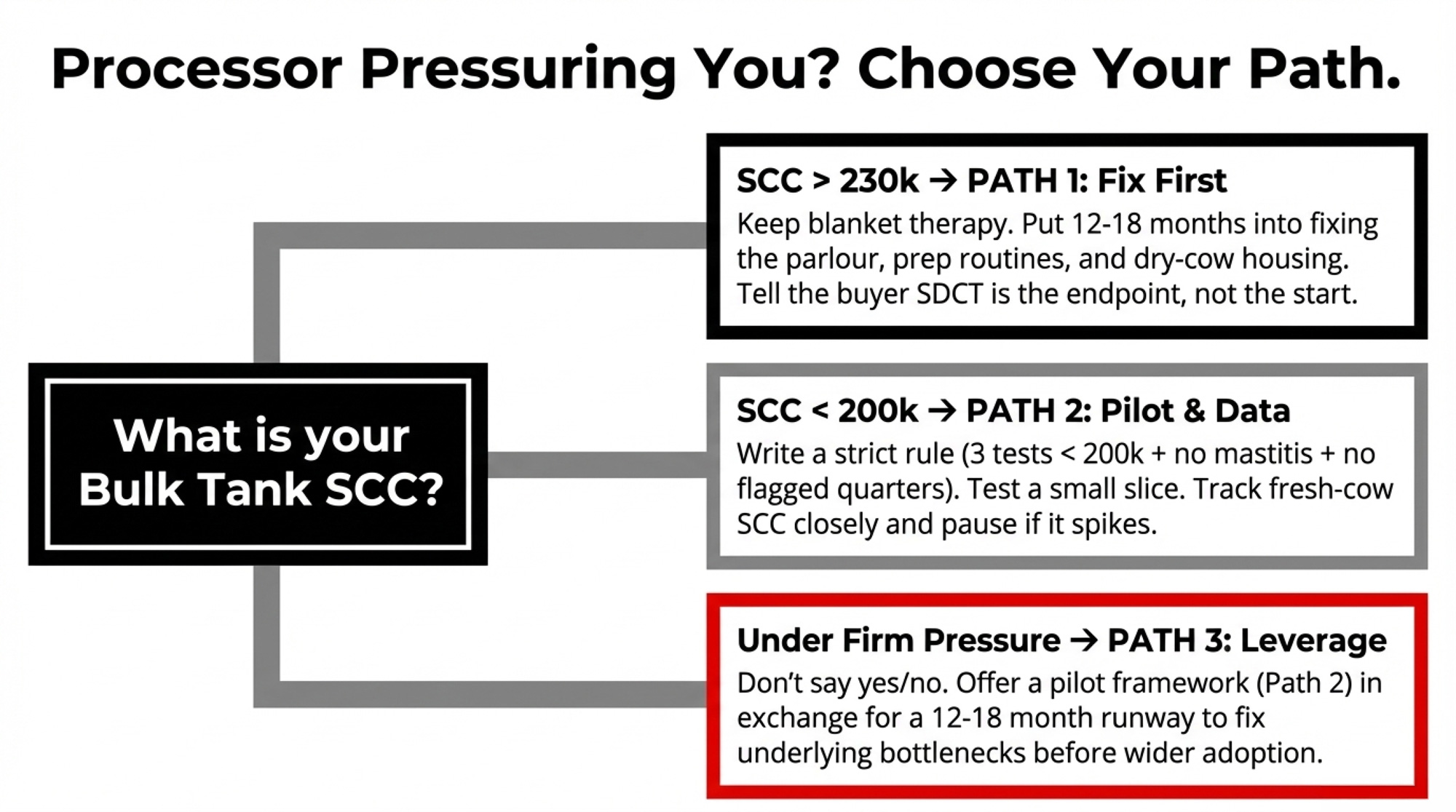
1. Infection‑First: Fix the Foundation Before You Touch Tubes

This fits herds with BMSCC regularly above 230,000–250,000, chronic high‑SCC cows you already know by number, and dry pens that are too full or too wet.

You tell your buyer SDCT is the endpoint, not the starting point. Then you put 12–18 months into:

  • Standardizing milking routines: consistent prep, lag time, and post‑dip across every shift; fix drift in technique between employees.
  • Tuning the parlour: vacuum levels, pulsation, liners, unit alignment.
  • Improving dry‑cow housing: stocking density, bedding, drainage, airflow.
  • Culling or segregating chronics instead of carrying them through another lactation.

You stay on blanket dry‑cow therapy plus internal teat sealant for all cows while you do that work. That’s exactly how the AABP 2024 SDCT guidelines recommend sequencing for herds that don’t yet meet readiness criteria. You’re trading short‑term antimicrobial‑use “wins” for long‑term udder‑health and economic stability.

2. Pilot SDCT on the Safest Slice — and Let the Data Decide

This fits herds with BMSCC trending toward 200,000 or below, reasonably clean records, and a willingness to course‑correct.

With your vet, you write a short, strict rule:

  • Last three SCC tests all under 200,000.
  • No clinical mastitis this lactation.
  • No known problem quarters or chronic flags.

Cows that pass become eligible for sealant‑only at dry‑off. Eligibility isn’t a guarantee — if anyone on the crew has doubts about a cow, she stays on full treatment.

Then you monitor:

  • Fresh‑cow SCC at first test (5–45 DIM), focusing on the percentage over 200,000.
  • Clinical mastitis in the first 60 DIM, clearly tagged by dry‑off treatment group.

The AABP guidelines include specific DairyComp setups to track this. University of Minnesota Extension’s SDCT resources walk through herd‑level readiness and monitoring in plain language. Cornell used similar metrics to sort their 24 herds into “stayed in” and “opted out.”

If your graphs look like the Lipkens and Cornell success herds — stable SCC, no disproportionate mastitis spike among sealant‑only cows — you can cautiously widen eligibility. If they start to look like the seven Cornell herds that stopped, close the gate and go back to Path 1.

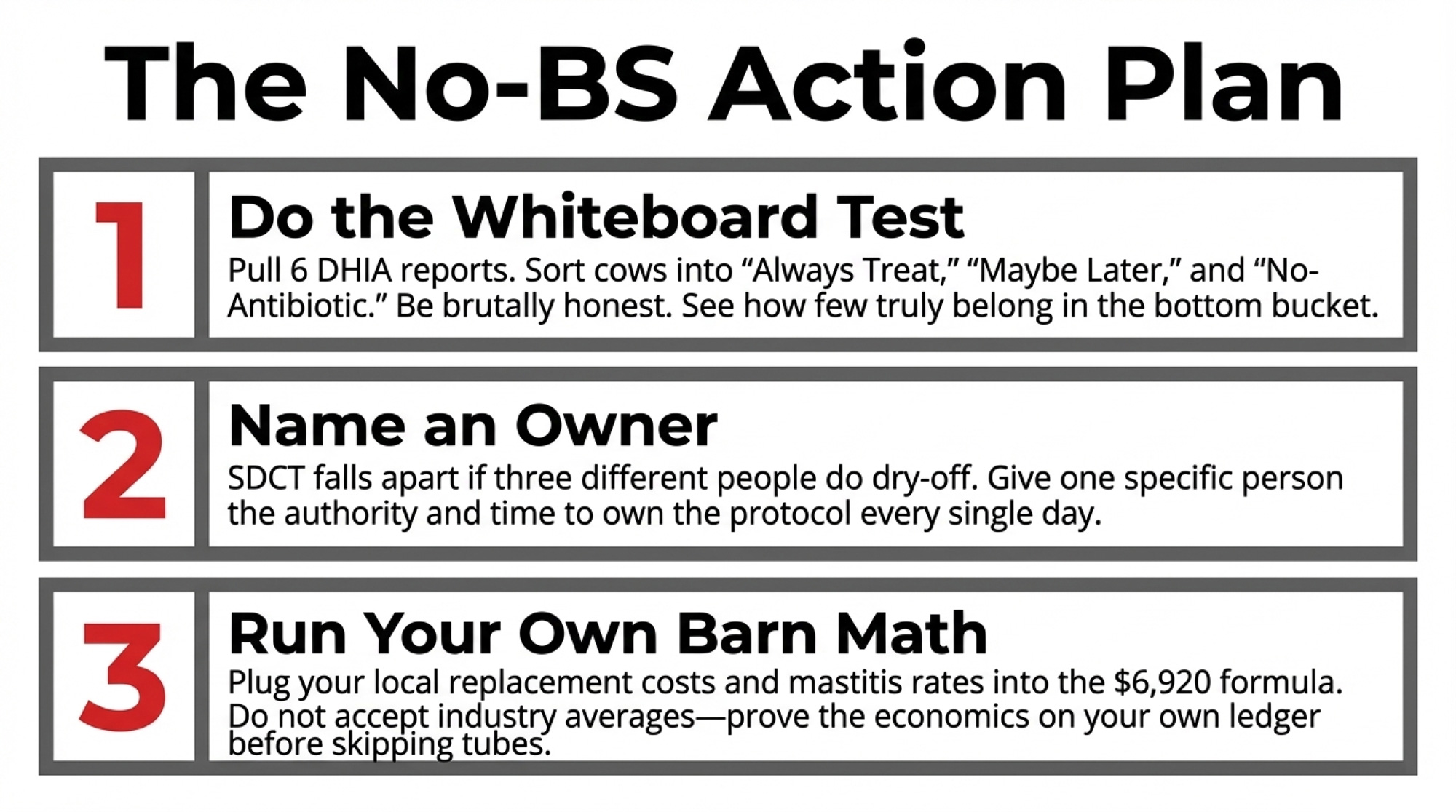
Do this within 30 days: Pull your last six DHIA reports and your current dry‑off list. On a whiteboard, make three columns:

  • “Always treat”
  • “Maybe selective later.”
  • “Pilot no‑antibiotic candidate”

Fill it in honestly. That one exercise will show you how many cows truly belong in the lowest‑risk bucket — and how far your herd sits from one that looks like Mystic Valley or the Lipkens group.

3. Turn the Processor Letter Into Leverage, Not a Deadline

This fits herds that need time and capital to fix underlying issues while facing firm SDCT language from buyers.

Go back to the processor with a framework instead of a yes/no:

  • You’ll pilot SDCT only on the safest slice (as in Path 2) this coming dry‑off season.
  • You’ll report quarterly on the bulk tank SCC trend, the percentage of fresh cows with SCC over 200,000, and the first‑60‑day mastitis incidence.
  • In return, you ask for a 12–18‑month runway to hit agreed improvements in SCC and mastitis, and to address facility bottlenecks, before any push toward wider SDCT.

The Dutch experience backs you up: that 47% dairy‑sector antimicrobial reduction happened over years, not months, and required simultaneous work on management, housing, and monitoring — not just a ban on tubes. A buyer who can show auditors your plan and your numbers is better off than one who forced SDCT onto a high‑SCC herd and then watched the metrics wobble.
What This Means for Your Operation

  • Start with your own SCC curve, not the industry average. If your bulk tank has lived under 200,000 for the last 6–12 months and you can pull a trustworthy mastitis and SCC history for each cow, you’re in the same readiness zone as the Lipkens herds and Cornell’s average SDCT adopter. If you’re swinging 230,000–280,000, you’ve still got infection work ahead of you.
  • Decide who owns dry‑off — by name. SDCT falls apart when three different people “kind of” handle it. One person needs to own that protocol and have enough time and authority to stick to it every day.
  • Use the AABP checklist as your gatekeeper, not your processor’s email. Bulk tank SCC regularly less than 250,000; no Strep. agStaph. aureus under control; individual SCC data; written SOPs; sealant for all cows. If those boxes aren’t ticked, your herd is still in the infection‑reduction phase.
  • Run your own barn math before you skip tubes. At a USDA average of $2,860 per replacement heifer — with individual animals clearing $4,000+ — even two extra early culls from mis‑classified SDCT cows can blow past a full year of tube savings. Put your own numbers into the $6,920 example; don’t just accept the model.
  • Within 90 days: Sit down with your vet and put your last six months of SCC and mastitis data beside the AABP SDCT criteria. Wherever your herd fails on that checklist, that’s where your next management or capital dollar should go.
  • Within 12 months: If you stay on BDCT while fixing management, re‑run your fresh‑cow SCC and first‑60‑day mastitis plots against last year’s. A noticeable step change does more to prove you’re SDCT‑ready than any pledge about tube counts.
Key Takeaways

  • If your herd’s SCC isn’t consistently under ~200,000 and your records can’t reliably sort truly low‑risk dry cows from the rest, SDCT is a future objective, not a current target.
  • If you pilot SDCT, every cow that skips tubes should have three consecutive SCC tests under 200,000, no mastitis this lactation, no problem quarters, and still receive a teat sealant — and you need to track her fresh‑cow outcomes separately from full‑treated cows.
  • If fresh‑cow SCC or first‑60‑day mastitis in your SDCT group climbs above your own baseline, that’s your cue to pause or narrow and invest harder in infection control rather than hoping the numbers settle.
  • If your processor is pushing a hard SDCT timeline, bring them a plan with a pilot cohort, monitoring metrics, and 12–18‑month milestones — not blanket SDCT on a 240,000‑SCC herd that isn’t structurally ready.

The Bottom Line

The herds that will be least stressed by the next round of antimicrobial stewardship rules aren’t the ones bragging about cutting the most tubes. They’re the ones whose data can prove their cows do fine without them.

When you pull up your last year of SCC curves, mastitis logs, and cull codes, do those numbers honestly look like a Mystic Valley‑style foundation for selective dry cow therapy — or are they telling you to keep the tubes while you fix what’s underneath?

Complete references and supporting documentation are available upon request by contacting the editorial team at editor@thebullvine.com.

Learn More

The Sunday Read Dairy Professionals Don’t Skip.

Every week, thousands of producers, breeders, and industry insiders open Bullvine Weekly for genetics insights, market shifts, and profit strategies they won’t find anywhere else. One email. Five minutes. Smarter decisions all week.
NewsSubscribe
First
Last
Consent

They Lost Cows and Still Cut Tubes: Mystic Valley’s Selective Dry Cow Therapy Math

Lose cows, save $277 on tubes, risk $2,220 in mastitis. Mystic Valley ran that math and still chose selective dry cow therapy. Would your herd?

Executive Summary: Mystic Valley Dairy tried selective dry cow therapy with all the “right” prerequisites—low SCC, Food Armor, strong records—and still lost cows in the first 60 days. Instead of reverting to blanket dry-cow therapy, they changed how they used teat sealant, tightened fresh‑cow monitoring, and kept SDCT in the protocol. This article pairs that real‑world experience with 2021–2024 research showing that algorithm‑guided SDCT can deliver average net returns of about 7–8 USD per cow at dry‑off and culture‑guided SDCT around 2 USD per cow, assuming udder health stays comparable to blanket therapy. It also draws on a 37‑herd Wisconsin cost study showing typical dry‑off product costs of about 19.57 USD per cow, with modeled SDCT protocols trimming partial direct costs by roughly 1–5 USD per cow, depending on product mix and how many cows still receive treatment. A simple barn‑math example for a 300‑cow herd (about 277 USD saved on tubes versus 2,220 USD in potential mastitis costs) turns SDCT from a philosophical debate into a concrete risk‑reward decision. Genetics aren’t an afterthought: health traits like mastitis resistance, livability, and DPR are positioned as the long‑term lever that makes SDCT safer and more scalable. The piece closes with a 90‑day playbook—paper‑testing an SDCT algorithm on last year’s dry‑offs, tightening records, and piloting one low‑risk group—plus clear “go/no‑go” signals on SCC, compliance, and mastitis trends so owners and herd managers can decide when SDCT makes sense and when it doesn’t.

In 2018, Mystic Valley Dairy in Sauk City, Wisconsin, was already an outlier — treating fewer than 20% of cows with antibiotics at dry‑off. Owner Mitch Breunig’s 450 registered Holsteins averaged just over 30,000 pounds of milk per cow, with a bulk tank somatic cell count sitting at 78,000 cells/mL. He’d already gone through the Food Armor antimicrobial stewardship program and was confident enough in his selective dry cow therapy (SDCT) system to change something most dairies still considered untouchable.

The results didn’t cooperate.

In published interviews, Breunig said the herd lost a couple of cows in the first 60 days of SDCT, likely due to toxic gram‑negative mastitis. He could’ve gone straight back to blanket dry cow therapy. Instead, he changed the way his team handled dry‑off — and doubled down on SDCT anyway.

Quick Stats: Mystic Valley and SDCT

  • Herd: ~450 registered Holsteins, Sauk City, Wisconsin 
  • Milk: Just over 30,000 lb per cow per year (2018) 
  • Bulk tank SCC: ~78,000 cells/mL 
  • BAA: 105.2, ranked 7th in the U.S. for herds >300 cows at the time 
  • Dry‑off antibiotics: <20% of cows treated when SDCT began 
  • Energy‑corrected milk (2025): ~125 lb ECM/cow/day, 4.5% fat, 3.4% protein 

Why Blanket Dry Cow Therapy Is Under Pressure

For decades, the default was simple: every cow, every quarter, every dry‑off got an antibiotic tube. Blanket dry cow therapy cured existing infections and helped prevent new ones during the dry period. It was effective and, honestly, easy.

That’s changing.

The EU’s Farm to Fork strategy targets a 50% reduction in antimicrobial sales for farmed animals and aquaculture by 2030, which directly pressures routine blanket treatments. In the U.S., the FDA’s Guidance for Industry #263 — which pulled all over‑the‑counter medically important antibiotics under veterinary oversight — took full effect in June 2023. In states like New York, lawmakers have introduced bills targeting routine or prophylactic antimicrobial use in food animals, adding another layer of scrutiny to practices such as blanket dry cow therapy.

A Wisconsin study of 37 large herds found the average dry‑off product cost under blanket therapy was 19.57 USD per cow, with a range of 8.72–24.04 USD depending on the product mix. When researchers modeled a standard SDCT algorithm with fixed tube prices, the average modeled cost dropped from 18.68 USD per cow under blanket DCT to 17.69 USD per cow under SDCT, while observed farm‑specific antibiotic costs alone averaged 11.54 USD per dried cow (range 8.72–15.44 USD). There’s real spread between herds — and between products — in what dry‑off actually costs, which is why your per‑cow savings may land anywhere from “about a buck” to several dollars.

Not everyone thinks those dollars are a good enough reason to switch. Larry Fox at Washington State University has argued that there’s no solid evidence that blanket dry cow therapy has selected for resistant mastitis pathogens, and that, for many herds, the established protocol remains the safest default. That tension — between regulatory pressure, economics, and herd health reality — is exactly where selective dry cow therapy sits.

Algorithm vs. Culture: Two Selective Dry Cow Therapy Paths

A lot of the SDCT debate boils down to how you decide who gets a tube.

Side‑by‑Side: Algorithm vs. Culture‑Guided SDCT

FeatureAlgorithm‑Guided SDCTCulture‑Guided SDCT
Core inputDHIA SCC history, mastitis treatment records, sometimes milk at dry‑offQuarter milk samples cultured before dry‑off on on‑farm media
Typical ruleAny SCC >200,000 cells/mL or clinical mastitis = antibiotic + sealant; others = sealant onlyTreat based on what grows; high‑risk pathogens get antibiotic, low/no growth may get sealant only
Antibiotic reductionCuts dry‑off antibiotic use by roughly half in trial and field settings when protocols are followedSimilar magnitude of reduction when implemented correctly
Average economic impact+7.85 USD per cow vs blanket (5–95%: 3.39–12.90 USD; 100% of iterations ≥0 USD) +2.14 USD per cow vs blanket (range −2.31 to 7.23 USD; 75.5% of iterations ≥0 USD)
StrengthsCheaper, faster, easy to implement where records are strongMore pathogen‑specific info that can improve mastitis control beyond dry‑off
Weak pointsRelies heavily on SCC and mastitis records being accurate and completeMore labor, supplies, and training; practical fit for fewer herds

Rowe, Godden, Nydam, and colleagues’ 2021 partial budget analysis in the Journal of Dairy Science showed that when SDCT is implemented properly, both algorithm‑guided and culture‑guided programs can be economically favorable compared with blanket therapy, with algorithm‑guided SDCT delivering more consistent positive returns. The algorithm approach produced a mean net cash impact of +7.85 USD per cow, with every modeled scenario at or above break‑even, while culture‑guided SDCT averaged +2.14 USD per cow but included some scenarios with a small net loss.

In applied projects, including Cornell‑linked implementation efforts across New York dairies, farms tended to gravitate toward algorithm‑based SDCT because it fit better with their existing labor and record systems. Culture‑guided SDCT demanded more time, equipment, and training than many herds could justify. Health outcomes can be equivalent when the fundamentals are solid — but the logistics and risk tolerance aren’t the same across herds.

Inside Mystic Valley: The Criteria, the Crash, and the Turn

Breunig didn’t land on SDCT by accident. He came in through the Food Armor program, which forced his team to look hard at every antimicrobial they were using.

By 2018, his herd’s public record looked like this: 450 registered Holsteins, herd average just over 30,000 lb of milk per cow, bulk tank SCC around 78,000 cells/mL, and a BAA of 105.2, ranking the herd seventh in the U.S. for herds over 300 cows at the time. To decide which cows could skip antibiotics at dry‑off, he used four specific criteria: last SCC of the lactation, second‑to‑last SCC, peak SCC during the lactation, and any treatment for clinical mastitis. If any test was well above 200,000 cells/mL, or she’d been treated for mastitis, she still got antibiotic dry cow therapy; if not, she was a teat‑sealant‑only candidate.

On paper, that’s a textbook algorithm‑guided SDCT. The results didn’t match.

Breunig said the herd lost a couple of cows in the first 60 days, likely due to toxic gram‑negative mastitis. For any herd, losing cows in the first two months of a new protocol raises an immediate question: Is the system wrong, or the execution?

Breunig was initially using internal teat sealant on all cows — treated and untreated — at dry‑off. After those early losses, he changed course: Mystic Valley now uses internal teat sealant only on cows that also receive antibiotic dry cow treatment. That’s a departure from many published SDCT protocols, which typically recommend teat sealant on all cows, and it reflects Mystic Valley’s specific experience and veterinary guidance — not a one‑size‑fits‑all recipe.

He also tightened monitoring. The herd moved to weekly SCC checks at freshening to catch subclinical spikes before they became clinical mastitis or necessitated culling.

Over time, the system held. A later Bullvine profile reported Mystic Valley averaging about 125 pounds of energy‑corrected milk per cow per day with roughly 4.5% fat and 3.4% protein. Breunig has publicly attributed the progress to a lot of small management decisions lining up over time, and selective dry cow therapy was one of those decisions.

Can Your Records Actually Support This?

The science is the easy part. The messy part is your records.

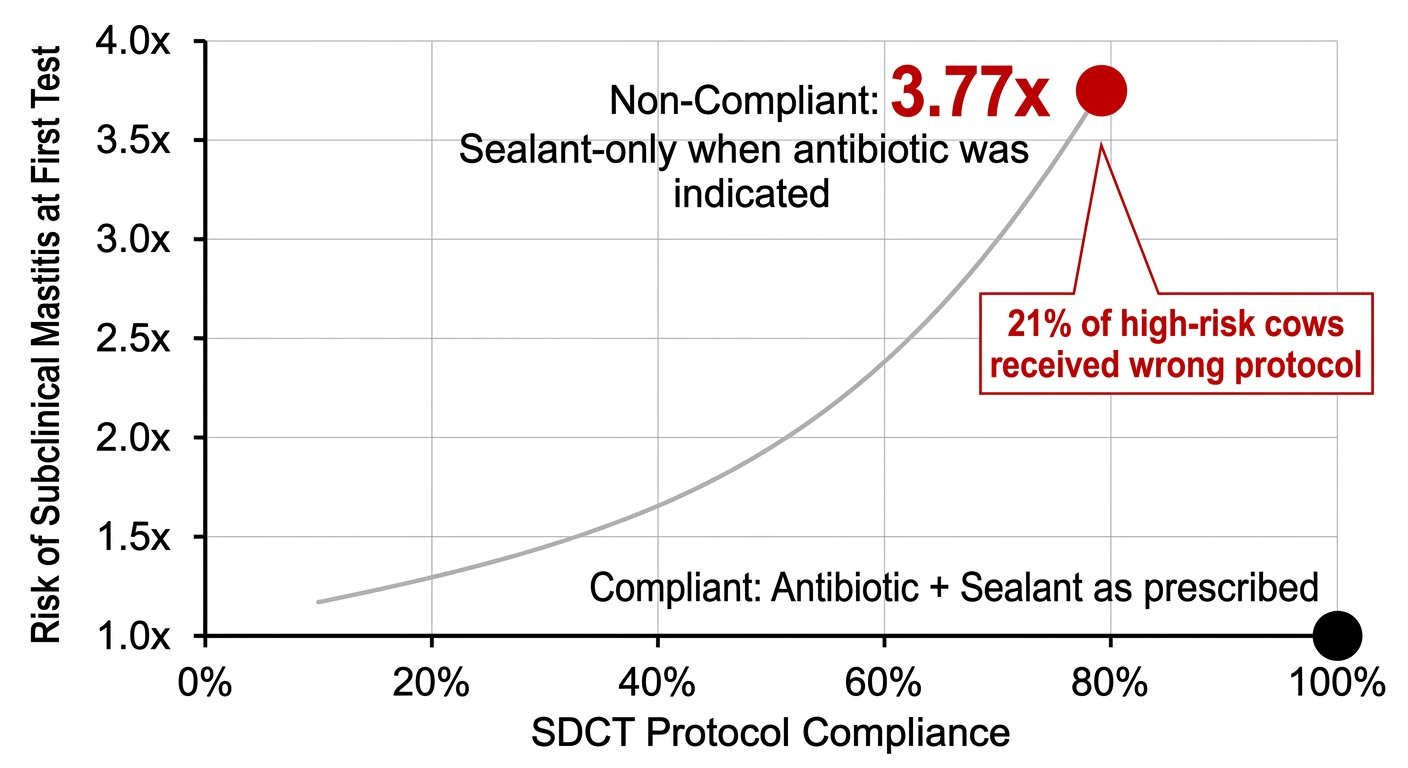
Among 11 early‑adopter Italian dairy farms studied by Guadagnini, Moroni, and colleagues, a specific slice of SDCT non‑compliance emerged: 21% of cows that should have received antibiotic treatment at dry‑off were instead given only internal teat sealant. Those non‑compliant cows were 3.77 times more likely to have subclinical mastitis at their first DHI test post‑calving compared with cows that received the recommended antibiotic plus sealant.

The research team reported that both veterinarians and farmers were unaware of the compliance deviation until data analysis was performed. When they dug into why it happened, 10 of the 11 herds attributed the problem to a lack of any monitoring system for whether the dry‑off protocol was actually being followed. There wasn’t malice or laziness. There just wasn’t a feedback loop, which is exactly how you end up with one in five high‑risk cows slipping through without the antibiotic the protocol calls for and a 3.77‑times higher risk of subclinical mastitis at first test.

A Cornell‑linked implementation project across New York dairies ran into the same kind of friction. The biggest barrier wasn’t herd health — it was recording and consistency. Some farms only started documenting mastitis events when they began SDCT, which made it look like mastitis was suddenly increasing when, in reality, they were finally writing everything down. A couple of herds pulled the plug on SDCT early, convinced it was causing extra mastitis in the dry period, and later review suggested that at least one of those spikes was part of a broader herd event unrelated to SDCT.

Compliance Failure PointWhat Happened in ResearchRisk MultiplierFix Before You Start SDCT
No monitoring system10 of 11 Italian herds had no way to verify dry-off protocol was followed3.77x mastitis riskCreate dry-off checklist + weekly compliance audit
Incomplete mastitis recordsNY herds only started logging clinical events when SDCT began; looked like spikeFalse alarm, protocol pauseBackfill 12 months of mastitis/treatment history
Crew turnover/training gapsHigh-risk cows received sealant-only when algorithm called for antibiotic21% non-compliance rateWritten protocol + hands-on demo for every person doing dry-off
Seasonal pressure ignoredSome herds ran SDCT through peak heat; environmental mastitis spikedNot quantified, but protocol pausedPilot SDCT in lowest-risk season (fall/winter in most climates)
Blame the wrong variableHerds attributed mastitis increases to SDCT when broader herd event was occurringEarly protocol abandonmentTrack 0–90 DIM mastitis separately; compare to baseline by dry-off group

Then there’s Jean Amundson — a veterinarian and co‑owner of Five Star Dairy near Elk Mound, Wisconsin. She and her partners milk about 1,000 cows and ship around 90 pounds of milk per cow per day. Amundson enrolled her herd in a University of Minnesota SDCT research trial and reported that the trial reduced dry‑cow antibiotic use by about half, thereby validating their approach. But her herd had been running on‑farm cultures and tight treatment records for years before the trial; selective dry cow therapy didn’t strengthen their data, strong data made SDCT possible.

The Genetics Angle: Why Health Traits Matter for SDCT

SDCT lives at the intersection of management and genetics.

The Council on Dairy Cattle Breeding (CDCB) publishes a mastitis resistance evaluation (MAST PTA) expressed as percentage points above or below the breed average, and these evaluations are favorably correlated with lower somatic cell scores, longer productive life, and better livability and fertility. That matters for SDCT because the herds that do best with selective dry‑off are the ones with consistently low SCC, good cure rates, and fewer chronic cows — exactly the profile you build when you lean harder on mastitis resistance and health traits in sire selection.

As you put more selection pressure on health traits — including mastitis resistance, livability, and fertility — in your breeding program, you’re gradually building a herd with fewer high‑risk animals at dry‑off and more cows that legitimately qualify as “low risk” in an SDCT algorithm. Over time, that shrinks the gap between what the algorithm recommends and what you’re actually comfortable doing.

The published SDCT studies in Italy, Belgium, and North America mostly focus on protocols, economics, and compliance rather than dissecting the role of genetic evaluations in those herds. But the direction is clear: genetics and management are beginning to work together to address mastitis, and herds that lean into both will have more room to pull tubes without paying for it in the fresh pen.

Does the SDCT Math Actually Pencil Out on Your Farm?

So what does the math look like when you actually take the tubes out of the cart?

Leite de Campos and Ruegg’s 37‑herd Wisconsin study provides a real‑world benchmark for direct product costs, assuming udder health remains comparable between blanket DCT and SDCT. That’s the starting point before you ask what happens if mastitis creeps up:

  • Average blanket‑therapy dry‑off cost (observed): 19.57 USD per cow (range 8.72–24.04 USD) 
  • Average cost per dried cow when only intramammary antibiotic DCT was considered: 11.54 USD, with a range from 8.72 to 15.44 USD across herds 
  • Modeled cost using fixed prices for intramammary products: 18.68 USD per cow for blanket DCT vs 17.69 USD per cow for selective DCT — about 0.99 USD per cow savings at those standard prices 

Other modeled scenarios in that dataset and related work show that, depending on product choices and how aggressively you pull tubes, partial direct cost reductions can reach roughly 5 USD per dry cow in some herds, but be closer to 1 USD in others. The per‑cow savings on tubes can range from “a noticeable line item” to “pretty modest,” depending on your current products and how aggressively you already use them.

If you’re running a 300‑cow herd and drying off about 280 cows a year, a 0.99 USD per‑cow savings at dry‑off is roughly:

280 cows × 0.99 USD ≈ = 277 USD in tube savings per year at standardized prices.

If your current protocol uses higher‑priced tubes and extensive sealant, your actual product savings under SDCT could exceed the modeled figure; if you already run a lean protocol, your savings could be smaller.

Year one is messier. You’ll spend money and time on veterinary consults to set up a herd‑specific algorithm, cleaning up mastitis and SCC records, writing a protocol people can actually follow at 4:30 p.m. in the parlor, and training the crew that does the dry‑off work. There isn’t a clean, published “X USD per herd” setup figure for this, but you should plan on meaningful first‑year overhead in vet time, staff time, and management attention that might eat most of the savings in year one.

And if your execution is sloppy, it can eat more than that. Rollin and colleagues estimated the total economic cost of a clinical mastitis case in the first 30 days of lactation at approximately 444 USD per case on U.S. dairy farms, including direct costs and lost future milk. Turn five extra fresh‑cow mastitis cases loose because you misclassified cows or botched dry‑off hygiene, and you’ve just burned 5 × 444 USD = 2,220 USD — easily more than a year’s worth of SDCT tube savings for a 300‑cow herd under many product‑cost scenarios.

Your quick math: take the number of cows you dry off per year and multiply by a realistic, herd‑specific per‑cow savings number — which might be around 1 USD per cow if your current drugs and sealant use look like the modeled Wisconsin herds, and potentially more if you’re using higher‑priced tubes. Then set that against the cost of a handful of extra mastitis cases at roughly 444 USD each.

Now ask yourself what one bad dry‑off month — with a half‑dozen explosive mastitis cases — would do to that balance.

What This Means for Your Operation

These aren’t talking points. They’re checks you can run on your own herd.

  • Can you pull a complete SCC and mastitis treatment history for every cow in your current lactation? If the answer is “sort of” or “not really,” SDCT should wait; your first 30 days should go into fixing the records, not the tubes. 
  • Do you know your pathogen mix? At minimum, confirm your herd is clear of Streptococcus agalactiae and has Staphylococcus aureus under control before you pull antibiotics at dry‑off, because SDCT is a bad place to discover a chronic contagious mastitis problem. 
  • Who actually does dry‑off on your farm? The more people involved, the more ways the protocol can drift, and European work on dry‑off routines and the Cornell experience both found that technique — not theory — was often the weak link, which is why checklists and monitoring systems matter. 
  • Is your dry pen ready for cows without antibiotic safety nets? Stocking density, bedding, ventilation, and transition management all matter more when more quarters head into the dry period with only a teat sealant barrier. 
  • When would you start? Some New York herds in that implementation work paused SDCT during peak heat when environmental mastitis pressure spiked; if you’re going to experiment, start in your lowest‑risk season. 
  • Are you tracking fresh‑cow mastitis separately? If your 0–90 DIM mastitis rate climbs more than about two percentage points above your pre‑SDCT baseline for two consecutive dry‑off groups, that’s a loud signal to pause and audit before continuing. 
  • Can your software help? Herd software like DairyComp 305 and others can run SDCT‑style classifications off DHIA data or at least help you pull the logic together in reports; if you’re not on a full‑featured platform, even a simple spreadsheet with cow IDs, SCC history, and mastitis events can get you close as long as the data’s real. 
  • Is your breeding program moving in the right direction? If you’re already pushing health traits tied to mastitis resistance and cow longevity in your AI matings — including CDCB mastitis resistance, livability, and DPR where available — you’re quietly building a herd that should be a better SDCT candidate five years from now than it is today. 
  • Where do you want to be in a year? Within 12 months of your first pilot, you should be able to decide — based on your own mastitis and SCC data — whether SDCT is a permanent protocol, a seasonal tool, or something you park for now. 

What to Do in the Next 90 Days

You don’t need to change a tube or buy a culture plate to learn something useful.

First 30 days

  • Pull your last 12 months of DHIA records and export the SCC history for every cow you dried off in that period. 
  • Run a simple SDCT algorithm on paper: for each dry‑off, ask “Did this cow ever test over 200,000 SCC this lactation, or receive clinical treatment for mastitis?” and mark which cows would’ve been “sealant‑only.” 
  • Compare your “sealant‑only” list to fresh‑cow outcomes: which of those cows had mastitis in the first 30 days of lactation, and which ones were clean all the way through? 

If that paper exercise makes you sweat, that’s useful information; it shows you where your protocol or your confidence is weak before you risk the cows.

Days 30–90

  • Sit down with your vet and walk through the results from the paper exercise: where do your records have gaps, where does the algorithm agree with what you already suspected, and where does it surprise you? 
  • If the paper exercise looked promising, pilot SDCT on one dry‑off group during your lowest environmental mastitis pressure window, monitor 0–90 DIM outcomes for that group against your baseline, and track compliance from day one. 
  • At the same time, pull your last two proof runs and look at how strongly you’re actually selecting for health traits tied to mastitis risk and longevity — including mastitis resistance and related CDCB health traits where available — and adjust your mating plan before you treat SDCT as your new normal if those traits are an afterthought. 

Key Takeaways

  • If your bulk tank SCC isn’t consistently under about 250,000 cells/mL, your mastitis records aren’t rock solid, or you haven’t cleaned up contagious pathogens like Strep agalactiae and Staph aureus, SDCT isn’t your next move; tighten those fundamentals and fix the bugs first. 
  • Algorithm‑guided SDCT can deliver savings on tubes — but the per‑cow number is often modest, and the real money is made or lost in mastitis cases, not boxes of product; a few extra fresh‑cow mastitis cases can easily erase a year’s worth of tube savings. 
  • Compliance isn’t a detail, it’s the whole ballgame: those Italian early‑adopter herds saw one in five high‑risk cows miss the antibiotic they should’ve received, and those cows were 3.77 times more likely to show up with subclinical mastitis at first test. 
  • Genetic selection for health traits is now real and measurable: CDCB health traits — including mastitis resistance — and their favorable correlations with somatic cell score, productive life, and fertility give you a way to breed cows that fit SDCT better over time instead of relying on management alone. 
  • The safest way to start is on paper: running the algorithm on last year’s dry‑offs gives you a real‑world stress test of your data and your cows’ behavior without risking this year’s dry pen. 

The Bottom Line

Mystic Valley’s first 60 days on SDCT included cow losses that would’ve sent most herds back to blanket therapy, but Breunig changed his sealant protocol, tightened monitoring, and kept going. Amundson’s herd at Five Star Dairy got there after years of building a culture‑and‑records foundation, and the University of Minnesota trial basically confirmed they were on the right track.

The tubes you pull — or don’t — on your farm will sit on top of your own system, not theirs. If your system can’t spit out clean mastitis data and your dry‑off crew can’t follow a checklist on a busy Friday, pulling tubes is the wrong place to start. So before you put down the dry cow gun, here’s the real question: if you ran a selective dry cow therapy algorithm on your last 100 dry‑offs tomorrow, would you trust what it told you?

Complete references and supporting documentation are available upon request by contacting the editorial team at editor@thebullvine.com.

Learn More

The Sunday Read Dairy Professionals Don’t Skip.

Every week, thousands of producers, breeders, and industry insiders open Bullvine Weekly for genetics insights, market shifts, and profit strategies they won’t find anywhere else. One email. Five minutes. Smarter decisions all week.

NewsSubscribe
First
Last
Consent

Thin Margins, Rising Superbugs: How Dairy Producers Are Fighting Back in 2025

Stop throwing antibiotics at problems. Smart farms use data, not desperation, to beat superbugs

EXECUTIVE SUMMARY: Look, here’s what’s happening in barns right now — superbugs aren’t just a lab problem anymore, they’re hitting your milk check hard. With Class III sitting around $17.32 and prime at 7.5%, every repeat mastitis case is costing serious money through dumped milk and extended treatments. But here’s the kicker… farms running targeted PCR testing and tightened biosecurity protocols are seeing mastitis drop by 50% — that’s real cash back in your pocket. The Danes figured this out years ago, New Zealand’s all over it, and even Australia’s proving that smart biosecurity beats blind antibiotic use every time. This isn’t about spending more on drugs; it’s about working smarter with the bugs you’ve got. Trust me, if you’re not thinking strategically about antimicrobial resistance right now, you’re leaving money on the table.

KEY TAKEAWAYS

  • Deploy targeted PCR testing now — cut repeat mastitis cases by 50% and stop throwing good money after bad treatments when milk’s trading in the high teens
  • Switch to selective dry cow therapy with your vet — slash antibiotic use by 40-60% without sacrificing udder health, plus you’ll breeze through those FARM audits
  • Map your trouble zones and swab monthly — stop guessing where bugs live and start cleaning where they actually are (calf pens, sick areas, parlor lanes)
  • Get your records audit-ready today — with BC rolling out new protocols and buyers getting pickier, clean documentation saves your bacon when the inspector shows up
  • Train your crew on outbreak SOPs — turn those good intentions into muscle memory because when superbugs hit, you need everyone moving fast and smart
antimicrobial stewardship, mastitis prevention, dairy farm profitability, selective dry cow therapy, farm biosecurity protocols

Thin margins are forcing a tough conversation in barns across North America, but it’s not just about feed costs or milk prices—it’s about the rising threat of superbugs. Repeat mastitis cases, milk in the drain, and sudden stoppages in animal movements are hammering producers just as Class III holds around $17.32 per cwt and—with the prime rate at 7.5%—financing any setback from a herd health crisis is more punishing than ever.

The manager of a 1,500-cow herd in Wisconsin put it perfectly: “It’s not the first shot that burns your pocket, it’s the second one, plus the dumped milk and the auditor knocking on your door.” He was discussing how quickly today’s health events can spread to every corner of your farm when good protocols are not followed.

The New On-Farm Threat: Why Biosecurity Is Now a Financial Strategy

British Columbia isn’t just talking tough—they’re running the Salmonella Dublin Investigation and Management Program (SDIMP), launched out of immediate concern that this pathogen’s making barn life riskier and costlier each year.

Meanwhile, fresh research from the Journal of Dairy Science delivers a hard dose of on-farm reality: the real chokepoints in biosecurity aren’t the paperwork or signs—it’s where people, feeders, and vendors cross tracks, or bottlenecks at the calf pen, that keep letting bugs in. Fixing the “sweat-level stuff” isn’t an easy walk.

One operator in a lower-prevalence county in New York, running 800 cows, grumbled that “These new rules feel like a big-city solution to a rural problem—tying us up and costing extra vet time without a clear payout.” That’s a sentiment you hear in a lot of barns off the interstate routes.

The evidence is tough to ignore. For example, Danish researchers recently confirmed why proactive biosecurity matters: herds scoring higher on traffic management, visitor logs, and feed storage biosecurity had a significantly reduced risk of testing positive for Salmonella Dublin. Extension offices now offer outbreak playbooks with practical, not theoretical, steps—these can make the difference between a close call and a costly shutdown.

Connecting Biosecurity to Your Bottom Line

Higher butterfat pulls from firm butter, but soft block cheese markets are squeezing those who rely on component premiums, which is the reality for most producers. That spread can make or break your margin if your quality or volume takes a single health-related hit: a ten-cent loss on milk dumped, or a 20% cull spike, suddenly tips the cashflow balance. And feed? The USDA reported a national average corn price just shy of $3.90/bu at the end of August 2025, but the basis is a roll of the dice everywhere except in the Midwest heartland.

A 2,000-cow dairy in the Texas Panhandle, for instance, switched to targeted PCR testing and cut repeat mastitis cases by half after spring freshening. That’s not a fluke—that herd’s profit and parlor time both showed a jump as soon as repeat treatment costs decreased.

Producers ask if the added step for diagnostics is worth the hold-up, especially during fresh cow rushes. The reality is that most labs now deliver results in 2–5 days. The herds that plug those results straight into their cleaning maps wind up moving sooner on emerging problems, not after the fact. That’s actual cash in the tank instead of poured on the floor.

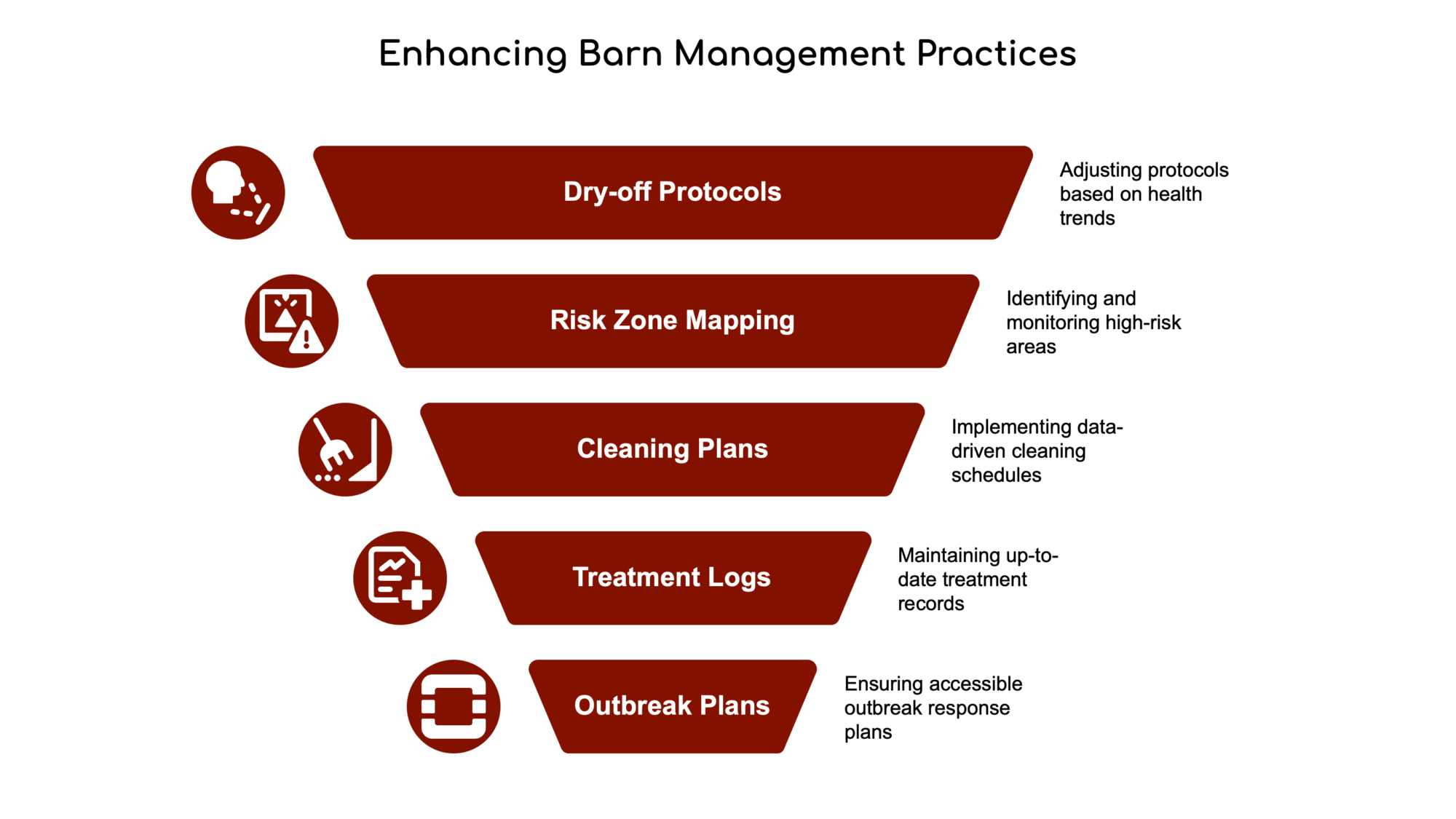
The Producer’s Playbook: 5 Steps to Bulletproof Your Barn

If you’re juggling a 500- or 1,000-cow herd, here’s what sharp operators are doing:

  • Dry-off protocols are set and recalibrated in consultation with the herd veterinarian, always tied to the last quarter’s SCC and mastitis culture trends.
  • Barn maps target known risk zones, including calf pens, sick lines, and parlor passes. Swabs and PCR tests should be conducted every month, not just at audit time.
  • Cleaning and isolation plans rely on live lab data—when a trouble zone arises, it’s already on the rota.
  • Treatment logs? They’re updated every shift, printed, and hung up where anyone can check before a FARM Program audit rolls in.
  • Outbreak plans are posted by the loading dock, not locked in a desk.

All of it comes back to muscle memory—turning those SOPs into habit. The Wisconsin manager put it plain: “We stopped getting caught off guard when SOPs became second nature.”

Learning from the global leaders

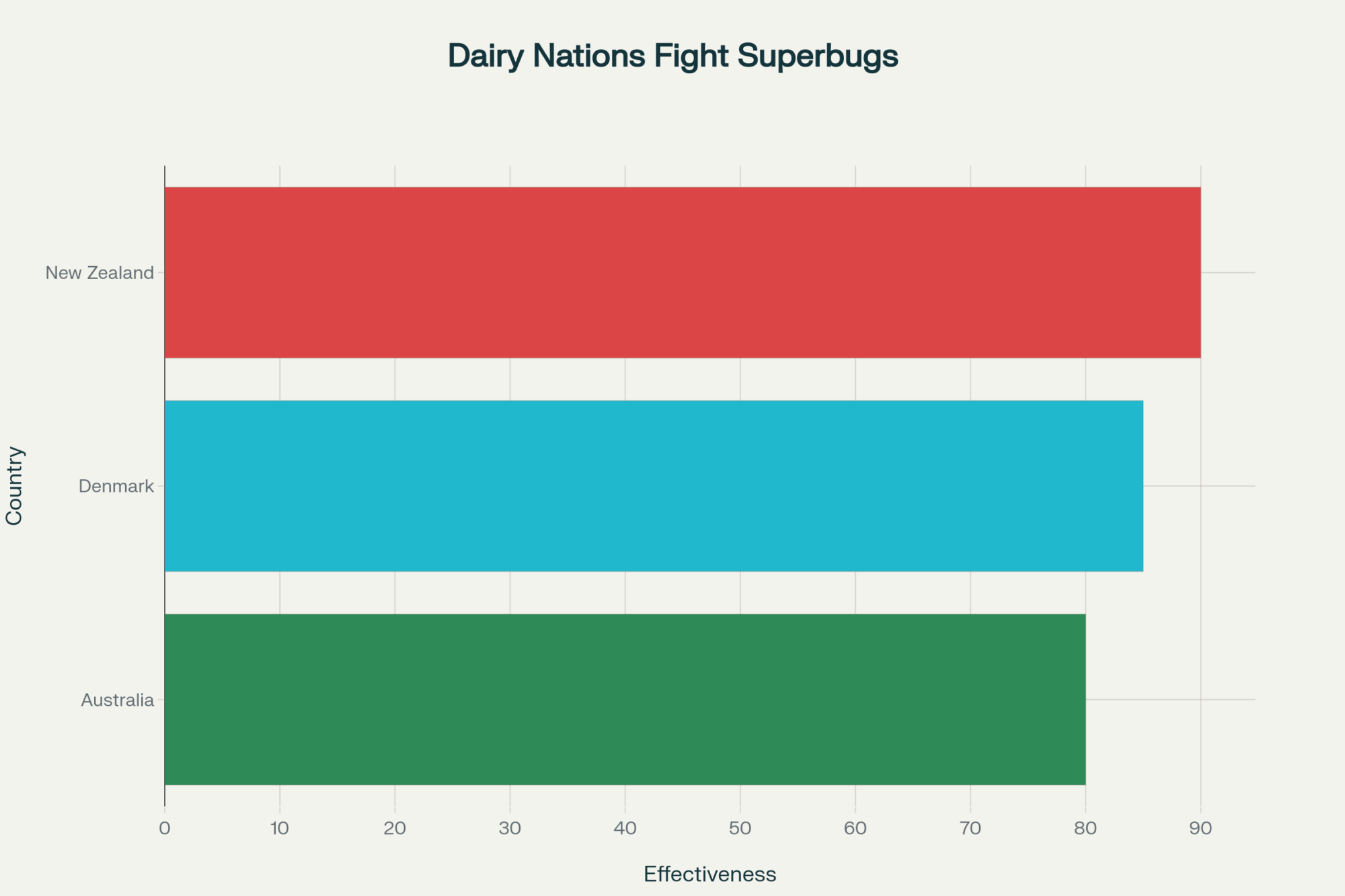
Australia? It’s not just talk. Dairy Australia’s Antimicrobial Resistance Guidelines demonstrate that the industry is actively reviewing on-farm antibiotic use, working with veterinarians to maintain low resistance and ensure access to critical medications remains open. That’s action beyond the poster.

New Zealand goes further: DairyNZ’s Smart Dry-Off podcast features South Island operators sharing exactly how team training on SDCT, real-time culture results, and peer accountability have not only reduced antibiotic use but also improved cow health and year-end numbers. The manager of a 600-cow Kiwi-cross herd in Southland told me, “When we made SDCT a priority, training was hard at first—especially with the rush at calving. But by October, our SCCs dropped, and our vet bills looked a lot less frightening.”

Danish data goes even further—biosecurity scores remain the single strongest predictor of staying negative on S. Dublin. Simple fixes, repeated with discipline, work. For insights into how UK dairy farms have successfully slashed antibiotic use by 19% while maintaining herd health, The Bullvine’s recent coverage offers valuable lessons for North American operations.

What’s coming down the pipeline

Let’s talk about the future. What are the most promising alternatives to traditional antibiotics? Phage therapy is in the news, and the science is catching up. It’s not quite in your parlor yet, but it’s showing real potential to mitigate multi-drug resistance in mastitis.

On the prevention and audit front, MSU Extension’s Farm Outbreak Response Plan offers the best step-by-step protocols—from staff communication to animal isolation to emergency supply checklists. Worth bookmarking, especially given how fast these events seem to come.

A recent visit to a dairy in Ohio, as part of their preparation for their FARM Program audit, tells the story—the crew had mapped every PCR result directly into the cleaning schedule, and the auditor’s grin said it all. “Wish this was standard,” he muttered. It’s not about paperwork; it’s about demonstrating you know your on-the-ground risks.

For producers seeking to comprehend the broader context of antimicrobial resistance challenges in US dairy operations, The Bullvine’s comprehensive analysis offers crucial background on the factors driving resistance and practical steps for mitigation.

The New Baseline for Survival and Success

Margins are tight, health risks are up, and nobody can afford to lose product or credibility with the plant, inspector, or lender. Proving stewardship, tightening diagnostics, and making traffic flows unbreakable—these aren’t extras. They’re the new baseline.

It starts with mastering the fundamentals: refining dry-off procedures, mapping every barn zone, documenting protocols, training your team, and executing the plan. The industry is evolving fast, and the producers who master this new reality won’t just survive—they’ll lead. The choice is yours.

Ready to turn this superbug threat into your competitive advantage? The farms that nail this strategy won’t just survive the next few years—they’ll dominate.

Complete references and supporting documentation are available upon request by contacting the editorial team at editor@thebullvine.com.

Learn More:

  • The Ultimate Guide to Selective Dry Cow Therapy – This guide moves from theory to action, providing a practical framework for implementing SDCT on your farm. It details how to use data like SCC and clinical history to make profitable, health-positive decisions cow by cow.
  • The Future of Dairy Farming: How Technology is Shaping the Industry – This article explores the innovative technologies that underpin modern stewardship. It reveals how precision tools, from automated sensors to data analytics, are helping producers prevent disease, optimize treatments, and secure a competitive edge in a demanding market.
  • The Dairy Industry’s Evolution: Navigating a Changing Marketplace – Zooming out from the barn, this piece analyzes the market forces and consumer trends driving the push for antibiotic stewardship. It provides the strategic context you need to align your on-farm practices with evolving global demands and opportunities.

The Sunday Read Dairy Professionals Don’t Skip.

Every week, thousands of producers, breeders, and industry insiders open Bullvine Weekly for genetics insights, market shifts, and profit strategies they won’t find anywhere else. One email. Five minutes. Smarter decisions all week.

NewsSubscribe
First
Last
Consent
Send this to a friend